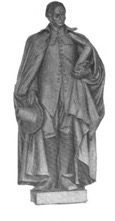
Some of America’s Founding Fathers were direct descendants of the hearty Pilgrim settlers from which the tradition of our modern Thanksgiving originates. Included in this group are John Adams, John Trumbull, and Noah Webster.1 These descendants openly maintained the faith of their forefathers and expressed continued thankfulness to God.
In fact, Noah Webster, “The Schoolmaster to America” and a descendant of Pilgrim Governor William Bradford, defined Thanksgiving as:
A public celebration of Divine goodness; also, a day set apart for religious services, specially to acknowledge the goodness of God, either in any remarkable deliverance from calamities or danger, or in the ordinary dispensation of His bounties. The practice of appointing an annual thanksgiving originated in New England.2
War for Independence
Following the Pilgrim’s example, Thanksgiving celebrations were common throughout New England. After the April 1775 battles of Lexington and Concord, a city in Massachusetts issued a Thanksgiving proclamation that November. It urged the people, even as war continued, to give thanks for all their blessings, including…
devoutly to offer up their unfeigned Praises to Almighty God…that the lives of our officers and soldiers have been so remarkably preserved, while our enemies have fell before them…that our unnatural enemies, instead of ravaging the country with uncontrolled sway, are confined within such narrow limits, to their own mortification and distress, environed by an American Army, brave and determined.3
Throughout the War for Independence, the Continental Congress called for official days of thanksgiving and prayer4 through eight separate Proclamations. (Congress also issued seven proclamations for times of fasting and prayer. Thus, the national governing body of which many Founders were a part, called for a total of 15 official times of prayer.5)
New Hampshire Speaker of the House John Langdon (later signer of the US Constitution and governor of New Hampshire) wrote a Thanksgiving proclamation in 1778 which is available in WallBuilders’ collection. Clearly acknowledged in this proclamation is a strong reliance on God:
The mercies which, notwithstanding our great unworthiness, we are constantly receiving at the hands of Almighty God, ought ever to remind us of our obligations to Him; and it becomes our especial duty at the close of a year, to unite together in rendering thanks to the Divine Disposer of all good for the bounties of His providence conferred on us in the course thereof.6
Early Federal Proclamations
America’s first national Thanksgiving occurred in 1789, after having won independence and adopting the US Constitution. According to the Congressional Record for September 25th of that year, the first act after the framing of the Bill of Rights was that:
Mr. [Elias] Boudinot said he could not think of letting the session pass without offering an opportunity to all the citizens of the United States of joining with one voice in returning to Almighty God their sincere thanks for the many blessings He had poured down upon them. With this view, therefore, he would move the following resolution:
Resolved, That a joint committee of both Houses be directed to wait upon the President of the United States to request that he would recommend to the people of the United States a Day of Public Thanksgiving and Prayer. . . .
Mr. Roger Sherman justified the practice of thanksgiving on any single event not only as a laudable one in itself but also as warranted by a number of precedents in Holy Writ. . . . This example he thought worthy of a Christian imitation on the present occasion.7
That congressional resolution was delivered to President George Washington who subsequently issued the first federal Thanksgiving proclamation, declaring in part:
Whereas it is the duty of all nations to acknowledge the providence of Almighty God, to obey His will, to be grateful for His benefits, and humbly to implore His protection and favor. . . . Now, therefore, I do recommend and assign Thursday, the 26th day of November [1789] . . . that we may all unite to render unto Him our sincere and humble thanks for His kind care and protection.8
Following this 1789 initial proclamation, national Thanksgiving Proclamations occurred only sporadically. For example, another was issued by President Washington in 1795, John Adams issued proclamations in 1798 and 1799, and James Madison issued them in 1814 and 1815.9 Most official Thanksgiving observances during this time occurred at the state level.
Proclamation Examples
In fact, by 1815, the various state governments had issued at least 1,400 official prayer proclamations, almost half for times of thanksgiving and prayer and the other half for times of fasting and prayer.10
Below are representative examples of the scores of Thanksgiving proclamations penned by various Founding Fathers.
[Congress] recommended [a day of] . . . thanksgiving and praise [so] that . . . the good people may express the grateful feelings of their hearts and . . . join . . . their humble and earnest supplication that it may please God, through the merits of Jesus Christ, mercifully to forgive [our sins] and . . . [to] enlarge [His] kingdom which consisteth in righteousness, peace and joy in the Holy Ghost.11 Continental Congress, 1777 – written by SIGNERS OF THE DECLARATION SAMUEL ADAMS AND RICHARD HENRY LEE
[I] appoint . . . a day of public Thanksgiving to Almighty God . . . to [ask] Him that He would . . . pour out His Holy Spirit on all ministers of the Gospel; that He would . . . spread the light of Christian knowledge through the remotest corners of the earth; . . . and that He would establish these United States upon the basis of religion and virtue.12 GOVERNOR THOMAS JEFFERSON, 1779
[I] appoint . . . a day of public thanksgiving and praise . . . to render to God the tribute of praise for His unmerited goodness towards us . . . [by giving to] us . . . the Holy Scriptures which are able to enlighten and make us wise to eternal salvation. And [to] present our supplications…that He would forgive our manifold sins and . . . cause the benign religion of our Lord and Savior Jesus Christ to be known, understood, and practiced among all the inhabitants of the earth.13 GOVERNOR JOHN HANCOCK, 1790
As it hath pleased Almighty God to continue to the people of this Commonwealth great and unmerited Favors in the course of the year past; it is highly becoming, that after the example of our pious and renowned ancestors, a day should be set apart, at this season of the year, for the special purpose of rendering to the Father of all mercies the just tribute of gratitude and praise.14 GOVERNOR SAMUEL ADAMS, 1794
See additional Thanksgiving Proclamations and Sermons on our Resources page. Below are a few specific items of interest:
See Thanksgiving Proclamations issued by the Continental Congress in 1777,15 1781,16 1782,17 and many other historic proclamations.
Read the 1795 Thanksgiving Sermon by the Rev. Thomas Baldwin18 in response to George Washington’s call for a Day of Thanksgiving.
1 (Additionally, numerous Presidents can trace their lineage to the Mayflower Pilgrims, including John Quincy Adams, Zachary Taylor, Ulysses S. Grant, Franklin Delano Roosevelt, George Bush, and George W. Bush. See for example “The Pilgrims of the Mayflower,” June 2015, Pilgrim Monument: Provincetown Museum, https://www.pilgrim-monument.org/wp-content/uploads/2015/06/Pilgrims-Bio-Information-rev-6-20151.pdf; Gary Boyd Roberts, “#42 Royal Descents, Notable Kin, and Printed Sources: Yankee Ancestors, Mayflower Lines, and Royal Descents and Connections of Arthur Ochs Sulzberger, Jr.,” American Ancestors, December 1, 1999.) 2 “Thanksgiving,” Noah Webster, American Dictionary of the English Language (New York: S. Converse, 1828). 3 Watertown City Council, “Thanksgiving Proclamation,” issued November 4, 1775, WallBuilders, https://wallbuilders.com/proclamation-thanksgiving-day-1775-massachusetts/. 4 Religion and the Founding of the American Republic, “Religion and the Congress of the Confederation,” Library of Congress, accessed August 30, 2023, https://www.loc.gov/exhibits/religion/rel04.html. 5 See the Journals of the Continental Congress (1905) for June 12, 1775; March 16, 1776; December 11, 1776; November 1, 1777; March 7, 1778; November 17, 1778; March 20, 1779; October 20, 1779; March 11, 1780; October 18, 1780; March 20, 1781; October 26, 1781; March 19, 1782; October 11, 1782; October 18, 1783. 6 Meshech Ware & John Langdon, “Thanksgiving Proclamation,” issued November 19, 1778, WallBuilders, https://wallbuilders.com/proclamation-thanksgiving-day-1778-new-hampshire/. 7The Debates and Proceedings in the Congress of the United States (Washington: Gales & Seaton, 1834), I:949-950. 8 George Washington, Proclamation for a National Thanksgiving on October 3, 1789, Writings of George Washington, ed. Jared Sparks (Boston: Russell, Odiorne and Metcalf, 1838), XII:119; George Washington, “Thanksgiving Proclamation,” issued on October 3, 1789, WallBuilders, https://wallbuilders.com/proclamation-thanksgiving-day-1789/. 9 See, for example, H. S. J. Sickel, Thanksgiving: Its Source, Philosophy and History With All National Proclamations (Philadelphia: International Printing Co, 1940), 154-155, “Thanksgiving Day- 1795” by George Washington; 156-157, “Thanksgiving Day – 1798” by John Adams; 158-159, “Thanksgiving Day – 1799” by John Adams; 160, “Thanksgiving Day – 1814” by James Madison; 161, “Thanksgiving Day – 1815” by James Madison; etc. 10 Deloss Love, in his work The Fast and Thanksgiving Days of New England, lists some 1,735 proclamations issued between 1620 and 1820, in a non-exclusive list. Of those, 284 were issued by churches and 1,451 by civil authorities. 1,028 of the civil proclamations were issued prior to July 4, 1776, and 413 from July 4, 1776 to 1820. 278 of the church proclamations were issued before July 4, 1776, and six afterwards. These, however, are only a portion of what were issued; for example, the author personally owns hundreds of additional proclamations not listed in Love’s work. While the exact number of government-issued prayer proclamations is unknown, it is certain that they certainly number in the thousands. 11Journals of the Continental Congress (Washington: Government Printing Office, 1907), IX:855, November 1, 1777. 12 Thomas Jefferson, Proclamation Appointing a Day of Thanksgiving and Prayer, November 11, 1779, The Papers of Thomas Jefferson, ed. Julian P. Boyd (Princeton: Princeton University Press, 1951), 3:178. 13 John Hancock, Proclamation for a Day of Public Thanksgiving (Boston, 1790), from an original broadside in possession of the author. 14 Samuel Adams, “Thanksgiving Proclamation,” issued October 15, 1794, WallBuilders, https://wallbuilders.com/proclamation-thanksgiving-day-1794-massachusetts/. 15 Continental Congress, “Thanksgiving Proclamation,” issued November 1, 1777, WallBuilders, https://wallbuilders.com/proclamation-thanksgiving-day-1777/. 16 Thomas McKean & Continental Congress, “Thanksgiving Proclamation,” issued October 26, 1781, WallBuilders, https://wallbuilders.com/proclamation-thanksgiving-day-1781/. 17 John Hanson & Continental Congress, “Thanksgiving Proclamation,” issued October 11, 1782, WallBuilders, https://wallbuilders.com/proclamation-thanksgiving-day-1782/. 18 Thomas Baldwin, “Thanksgiving Sermon,” February 19, 1795, WallBuilders, https://wallbuilders.com/sermon-thanksgiving-1795-massachusetts/.
The tradition of Thanksgiving as a time to focus on God and His blessings was introduced by European Americans and dates back well over four centuries in America.
For example, such thanksgivings occurred in:
1541 at Palo Duro Canyon, Texas with Coronado and 1,500 of his men1
1565 at St. Augustine, Florida with French Huguenot (Protestant) colonists2
1598 at El Paso, Texas with Juan de Oñate and his expedition3
1607 at Cape Henry, Virginia with the landing of the Jamestown settlers4
But it is primarily from the Pilgrim’s Thanksgiving celebration of 1621 that we derive the current tradition of Thanksgiving Day.
The Pilgrims
The Pilgrims were known as Separatists.6 This set of Protestants believed they would be unable to reform the Church of England and therefore needed to separate and form their own church. (In contrast, the Puritans believed they could reform the Church of England.7 They were wrong and, following severe persecution, some 20,0008 followed the Pilgrims to America.)
They set sail in the Mayflower for America on September 6, 1620, and for two months braved the harsh elements of a storm-tossed sea. The Pilgrims had originally obtained a land grant for Virginia9, but after a rough ocean crossing, they landed some 200 miles north of Virginia10 in what became known as Massachusetts. On November 11, 1620, they finally dropped anchor and came ashore11.
Upon disembarking at Plymouth Rock, they held a prayer service and then hastily began building shelters. However, they were unprepared for a harsh New England winter, and nearly half of them died before spring.12 Emerging from that grueling winter, the Pilgrims were surprised when an Indian named Samoset approached them and greeted them in their own language, explaining to them that he had learned English from fishermen and traders. A week later, Samoset returned with a friend named Squanto13, who lived with the Pilgrims and accepted their Christian faith.
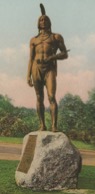
Squanto taught the Pilgrims much about how to survive in the New World, and he and Samoset helped forge a long-lasting peace treaty between the Pilgrims and the Wampanoag Indians. Pilgrim Governor William Bradford described Squanto as “a special instrument sent of God for [our] good . . . and never left [us] till he died.”14
The 1621 Thanksgiving
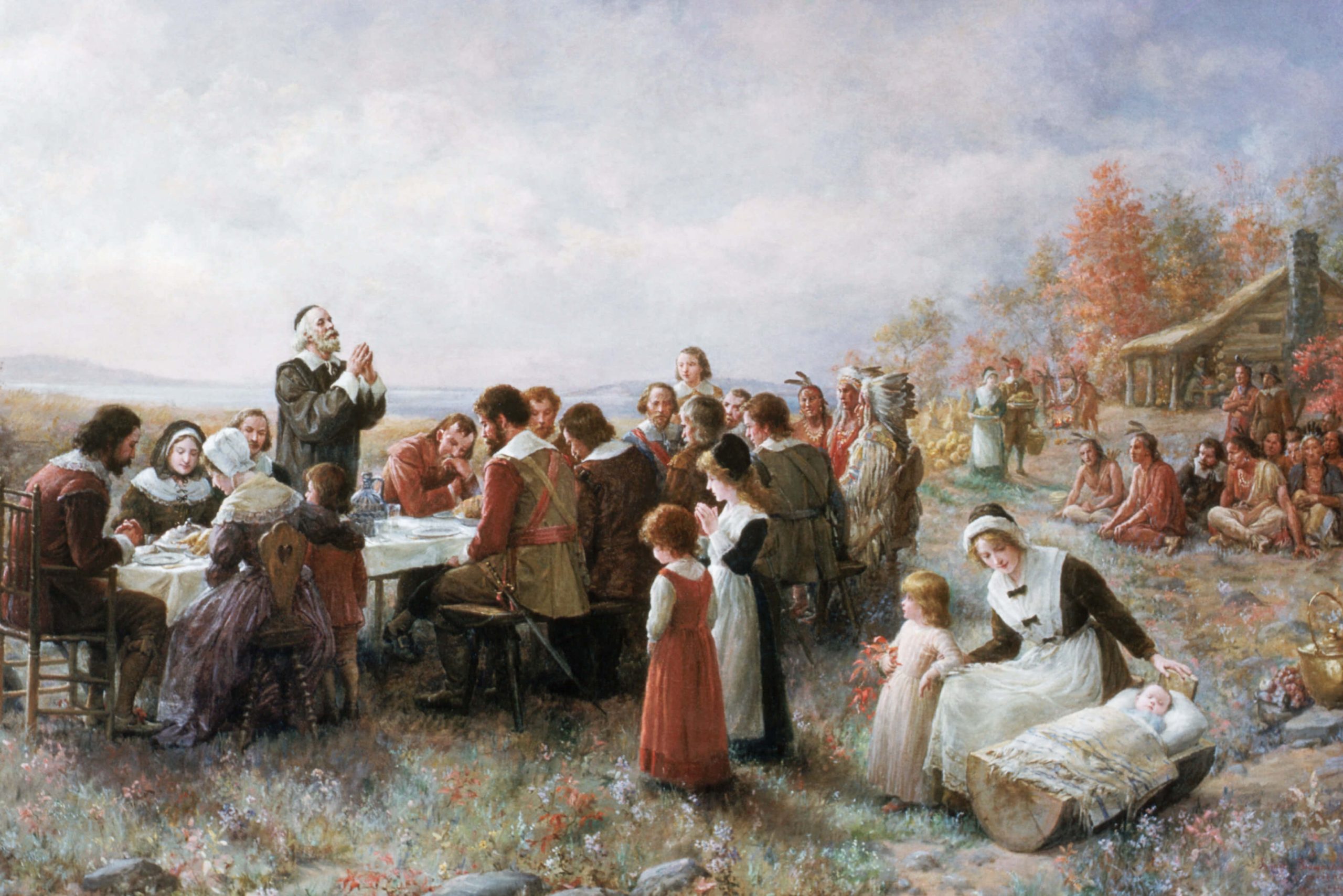
That summer, the Pilgrims, still persevering in prayer and assisted by their Indian neighbors,15 reaped a bountiful harvest.16 The grateful Pilgrims therefore declared a three-day feast in December 1621 to thank God and to celebrate with their generous friends.17 This was America’s first Thanksgiving Festival.
Ninety Wampanoag Indians joined the fifty Pilgrims for these three days of feasting, play, and prayer. Pilgrim Edward Winslow (later governor of Plymouth), wrote about this time:
[O]ur harvest being gotten in, our Governor sent four men on fowling, that so we might, after a special manner, rejoice together after we had gathered the fruit of our labors. They four in one day killed as much as, with a little help beside, served the company almost a week. At which time, amongst other recreations, we exercised our arms, many of the Indians coming amongst us, and among the rest their greatest king, Massasoit, with some ninety men, whom for three days we entertained and feasted; and they went out and killed five deer, which they brought to the plantation and bestowed on our governor, and upon the captain and others. And although it be not always so plentiful as it was at this time with us, yet by the goodness of God, we are so far from want.18
Historian Benson Lossing later recounted:
[T]he Pilgrims at Plymouth rejoiced in an abundance of food in the autumn of 1621, the first year of their settlement. Thereby their hearts were filled with gratitude, and after the fruits of their labors had all been gathered, the governor sent out huntsmen to bring in supplies for a general and common thanksgiving. That was the first celebration of the great New England festival of Thanksgiving, now annually held in almost every State and Territory of the Union in the month of November. Great quantities of wild turkeys and deer were gathered at Plymouth, and for three days the Pilgrims indulged in rejoicing, firing of guns, and feasting – entertaining, at the same time, King Massasoit and ninety of his dusky followers, who contributed five deer to the banquets. Seven substantial houses had been built during the summer; the inhabitants were in good health; a few emigrants from England had come in a second ship, and there were happy homes in the wilderness the ensuing winter.19
After 1621
However, while the Pilgrims enjoyed times of prosperity for which they thanked God, they also suffered extreme hardships. In fact, in 1623 they experienced an extended and prolonged drought. Knowing that without a change in the weather there would be no harvest and the winter would be filled with death and starvation, Governor Bradford called the Pilgrims to a time of prayer and fasting to seek God’s direct intervention. Significantly, shortly after – and to the great amazement of the Indian who witnessed the scene – clouds appeared in the sky and a gentle and steady rain began to fall. As Governor Bradford explained:
It came without either wind or thunder or any violence, and by degrees in abundance, as that ye earth was thoroughly wet and soaked therewith, which did so apparently revive and quicken ye decayed corn and other fruits as was wonderful to see, and made ye Indians astonished to behold; and afterwards the Lord sent them such seasonable showers, with interchange of fair warm weather as, through His blessing, caused a fruitful and liberal harvest, to their no small comfort and rejoicing.20
The drought had been broken; the fall therefore produced an abundant harvest; there was cause for another thanksgiving. The Pilgrim practice of designating an official time of Thanksgiving spread into neighboring colonies and became an annual tradition.21 And just as those neighboring colonies followed the Pilgrims’ example of calling for days of thanksgiving, so, too, did they adopt their practice of calling for a time of prayer and fasting. The New England Colonies therefore developed a practice of calling for a day of prayer and fasting in the spring, and a day of prayer and thanksgiving in the fall.
The recorded story of America begins with the European discovery of the New World in the late fifteenth-century by Christopher Columbus. Even though the Vikings had come inland in America as far as Minnesota hundreds of years earlier, it was the announcement of Columbus’ landing that opened up the Western Hemisphere to European interest and colonization.
Columbus eventually made four voyages from Europe to the new western lands, but few today know what inspired him to do so—a motivation he clearly revealed in a book he wrote in 1502 after his third voyage. That work, called his Book of Prophecies, contains his collection of scores of Scriptures addressing the propagation of the Christian Gospel in distant lands that he, Christopher (which means “the Christ bearer”), believed he was fulfilling.
Also included in his Prophecies is the letter he wrote to the King and Queen of Spain (Ferdinand and Isabella, who financed his voyage), in which he explained:
[I] have seen and put in study to look into all the Scriptures….Our Lord opened to my understanding (I could sense His hand upon me), so that it became clear that it was feasible to navigate from here to the Indies….All those who heard about my enterprise rejected it with laughter, scoffing at me….Who doubts that this illumination was from the Holy Spirit? I attest that He [the Spirit], with marvelous rays of light, consoled me through the holy and sacred Scriptures….No one should be afraid to take on any enterprise in the name of our Savior, if it is right and if the purpose is purely for His holy service.[1]
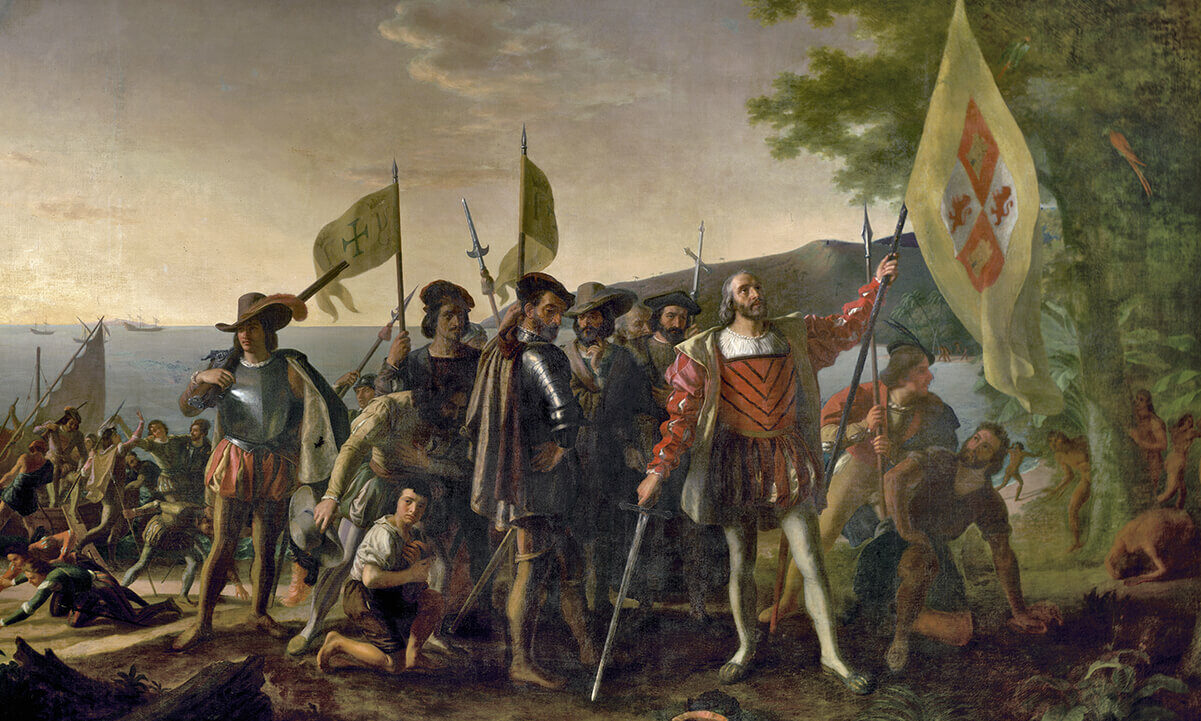
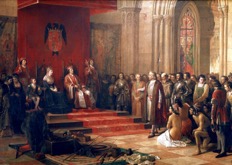
Not only do Columbus’ writings affirm his strong Christian faith, so do the choice of names for the new lands he visited. For example, the massive painting of the Landing of Columbus permanently on display in the Rotunda of the US Capitol shows him arriving at an island in October 1492 in what today is the Bahamas. After coming ashore, he knelt, kissed the ground, led the men in prayer to God for their safe arrival, and christened that new land “San Salvador,” meaning “Holy Savior.”[2] Another island he named “Trinidad” after the Christian Holy Trinity of God the Father, Christ the Son, and the Holy Spirit.[3]
Landing of Columbus displayed in the US Capitol.
For almost five centuries, Columbus was celebrated as a hero, with over 600 monuments being erected to honor him.[4] In fact, the city of Washington, DC was named after him (DC stands for District of Columbia, or Columbus).[5] But in recent years, he has been portrayed as a villain because of his so-called atrocious “treatment” of Native Indians. But sadly, too many of today’s narratives fail to give the true factual story of his encounters and relationships with those peoples.
Columbus was involved with two principal Indian tribes. The first, the Taíno, was a very kind and gentle people, and Columbus repeatedly praised them as “the best people in the world.”[6] He wrote Spain, advocating for their full equality, citizenship, and civil rights. The second tribe, the Caribs, was the mortal enemy of the Taíno, raiding their villages, enslaving their people, and especially cannibalizing them. When Columbus arrived on his first journey, the Taíno told him about these atrocities, so on his second voyage Columbus journeyed to the Carib lands to see if the reports were true.[7]
Arriving there, he discovered slave camps where the Caribs housed Taino captive women who were raped for the purpose of producing children for the Caribs to eat. The stories of the barbaric cannibalism were confirmed by the abundance of human remains found boiling in the cooking pots as well as the gnawed bones throughout the camps.[8] Columbus liberated the enslaved women and proceeded to fight against the Caribs whenever they engaged him (and the Caribs had attacked and murdered dozens of his men).[9]
So Columbus was largely just and kind with the Taíno tribes but did indeed war against the horrific cannibal Caribs. Yet claims abound today that Columbus sought to destroy and pillage all Indians, without discussing who he fought or even why he was fighting them. Modern critics also fail to mention the good relations he had with many tribes.
Columbus’ Return to Spain
Another modern claim is that Columbus enslaved Natives and forcibly carried them back with him. But nearly all those he forcibly brought to Spain were cannibalistic Carib murderers, captured in open war. Some of the friendly Indians had volunteered to travel back to Spain with Columbus, including an important local chieftain and his entire family, but Columbus urged him to stay in his own kingdom.[10] One Indian who chose to go with Columbus after his first voyage actually became a member of the royal Spanish court; another took Columbus’ last name and traveled with him as his interpreter for his various visits to native tribes. [11]
But returning to Columbus’ “discovery” of the New World, it is significant that while Columbus is credited with opening the western hemisphere to European colonization, neither he nor Spain (the nation for which he sailed) actually colonized what would eventually become the United States. This is fortunate, for at that time, civil and religious tyranny were common in Spain and numerous other nations of Europe.
This Spanish tyranny was not Columbus’ practice, however, for he was Italian, not Spanish. He sailed under the banner of Spain simply because they funded his voyages, not because he agreed with their people or practices. In fact, on numerous occasions, he openly denounced the atrocious behavior of many of the Spaniards who had been assigned to him as his crew.[12]
Fortunately, it was nearly a century after Columbus’ discovery of the new western lands before permanent colonists began arriving in America. Why the long wait? Nineteenth century historian B.F. Morris explained:
[G]od held this vast land [America] in reserve as the great field on which the experiment was to be made in favor of civil and religious liberty. He suffered not the foot of a Spaniard, or Portuguese, or Frenchman, or Englishman to come upon it until the changes had been wrought in Europe which would make it certain that it [America] would always be a land of [Biblical] freedom.[13]
Those “changes wrought in Europe” refer to what today is called the Reformation—a religious movement that birthed both civil and religious liberty in several nations. That movement began in the 1300s and for the next two centuries steadily spread across Europe and then into other parts of the world.
The movement began with several Catholic priests urging a return to the teachings of the Bible—teachings that had been largely ignored by both State and Church over the previous thousand years. This back-to-the-Bible movement (that is, the Reformation) began a reform of the Catholic Church and also birthed the Protestant Church.
One particularly strong emphasis of that movement was to make the Bible available to the average person in his own language. Over previous centuries, the Bible had been largely unavailable to the ordinary individual and was nearly always written in a foreign language that only a handful of the elite and most highly-educated could read. But with the Reformation, Bibles became available for all citizens in their own language; and when the people began to read and apply the Bible and its teachings, their personal lives and practices changed. This had a direct beneficial impact on both State and Church, for as Biblical principles of liberty became known and adopted, both civil and religious tyranny began decreasing.
With the gradual return to Biblical teachings, key theological ideas were recovered by the Church, including Sola Scriptura (“by Scripture alone”), Sola Fide (“by faith alone”), Sola Gratia (“by grace alone”), Solus Christus or Solo Christo (“Christ alone” or “through Christ alone”), and Soli Deo gloria (“glory to God alone”). Many new Christian denominations were built upon these ideas, and they impacted the society at large in a positive manner.
America, perhaps more than any other country at the time, was directly shaped by the Reformation, for the early colonists who settled here (including the Pilgrims, Puritans, and others) were a direct product of Reformation teachings. In fact, many of them had been driven from Europe simply because they sought to live out their faith according to Bible precepts, and in America they found the freedom to openly live their lives by its teachings on government, economics, law, family, education, and much else.
As a result, the Biblical concepts of religious freedom, representative government, individual enterprise, jurisdictional authority, limited government, and private property began to appear in many of the civil documents that came forth in the seventeenth and eighteenth centuries (such as the Mayflower Compact, the Fundamental Orders of Connecticut, the Massachusetts Body of Liberties, the Frame of Government of Pennsylvania, the Declaration of Independence, and the United States Constitution). Personal liberty as well as religious, civil, political, and economic liberty was the result of applying the Bible’s teachings to all areas of life.
In fact, the Bible became so influential in the birth, growth, and development of the United States that even modern publications such as Newsweek affirm that “historians are discovering that the Bible, perhaps even more than the Constitution, is our founding document.”[14] Without God and the Bible, there would be no free and prosperous America as we have come to know it today.
The Bible: The Rock of Our Republic
Interestingly, one group of American leaders that repeatedly affirmed the historic impact of Bible teachings in shaping America was US Presidents. For example:
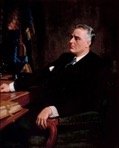
Franklin Delano Roosevelt
In the formative days of the Republic, the directing influence the Bible exercised upon the fathers of the Nation is conspicuously evident….We cannot read the history of our rise and development as a Nation without reckoning with the place the Bible has occupied in shaping the advances of the Republic.[15] I suggest a nationwide reading of the Holy Scriptures….for a renewed and strengthening contact with those eternal truths and majestic principles which have inspired such measure of true greatness as this Nation has achieved.[16]President Franklin Delano Roosevelt
[T]he teachings of the Bible are so interwoven and entwined with our whole civic and social life that it would be literally—I do not mean figuratively, I mean literally—impossible for us to figure to ourselves what that life would be if these teachings were removed. We would lose almost all the standards by which we now judge both public and private morals—all the standards toward which we, with more or less resolution, strive to raise ourselves. Almost every man who has by his life-work added to the sum of human achievement of which the [human] race is proud—of which our people are proud—almost every such man has based his life-work largely upon the teachings of the Bible.[17]President Teddy Roosevelt
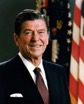
Ronald Reagan
Of the many influences that have shaped the United States of America into a distinctive Nation and people, none may be said to be more fundamental and enduring than the Bible….The Bible and its teachings helped form the basis for the Founding Fathers’ abiding belief in the inalienable rights of the individual—rights which they found implicit in the Bible’s teachings of the inherent worth and dignity of each individual.[18]President Ronald Reagan
It was for the love of the truths of this great Book [the Bible] that our fathers abandoned their native shores for the wilderness. Animated by its lofty principles, they toiled and suffered till the desert blossomed as the rose [Isaiah 35:1].[19] The Bible is the best of books and I wish it were in the hands of everyone. It is indispensable to the safety and permanence of our institutions; a free government cannot exist without religion and morals, and there cannot be morals without religion, nor religion without the Bible. Especially should the Bible be placed in the hands of the young. It is the best school book in the world….I would that all of our people were brought up under the influence of that Holy Book.[20]President Zachary Taylor
Ulysses S. Grant
Hold fast to the Bible as the sheet-anchor of your liberties. Write its precepts in your hearts, and practice them in your lives. To the influence of this book we are indebted for all the progress made in true civilization, and to this we must look as our guide in the future.[21]President U.S. Grant
[The Bible] is the best gift God has given to men. All the good the Savior gave to the world was communicated through this book. But for it, we could not know right from wrong.[22]President Abraham Lincoln
America was born to exemplify that devotion to the elements of righteousness which are derived from the revelations of Holy Scripture.[23]President Woodrow Wilson
Harry S. Truman
The fundamental basis of this Nation’s law was given to Moses on the Mount. The fundamental basis of our Bill of Rights comes from the teachings which we get from Exodus and St. Matthew, from Isaiah and St. Paul. I don’t think we emphasize that enough these days.[24]President Harry Truman
But long before our Presidents stressed the importance of the Bible, our Founding Fathers (the early leaders largely responsible for the birth and establishment of America as an independent nation) had already done so. For example:
John Adams
[T]he Bible is the best book in the world.[25] Suppose a nation in some distant region should take the Bible for their only law book and every member should regulate his conduct by the precepts there exhibited…. What a Utopia—what a Paradise would this region be![26] John Adams, signer of the declaration of independence, president
[T]he Bible contains more knowledge necessary to man in his present state than any other book in the world.[27] By renouncing the Bible, philosophers swing from their moorings upon all moral subjects….It is the only correct map of the human heart that ever has been published.[28]Benjamin Rush, signer of the declaration of independence[The Bible] is a book worth more than all the other books that were ever printed.[29]Patrick Henry
[N]o book in the world deserves to be so unceasingly studied and so profoundly meditated upon as the Bible.[30] The first and almost the only book deserving such universal recommendation is the Bible.[31]John Quincy Adams, president
John Jay
[W]ere you to ask me to recommend the most valuable book in the world, I should fix on the Bible as the most instructive both to the wise and ignorant. Were you to ask me for one book affording the most rational and pleasing entertainment to the enquiring mind, I should repeat, it is the Bible. And should you renew the inquiry for the best philosophy, or the most interesting history, I should still urge you to look into your Bible. I would make it, in short, the alpha and omega of knowledge.[32]EliasBoudinot, president of the continental congress, framer of the bill of rights
The Bible is the best of all books, for it is the Word of God and teaches us the way to be happy in this world and in the next. Continue therefore to read it and to regulate your life by its precepts.[33]John Jay, president of the continental congress, author of the federalist papers, original chief justice of the us supreme court
I believe the Bible to be the written Word of God and to contain in it the whole rule of faith and manners.[34]Robert Treat Paine, signer of the declaration of independence
[T]he Holy Scriptures….can alone secure to society order and peace, and to our courts of justice and constitutions of government, purity, stability, and usefulness….Bibles are strong entrenchments [lines of defense]. Where they abound, men cannot pursue wicked courses and at the same time enjoy quiet conscience.[35]James McHenry, signer of the constitution
All of the miseries and evils which men suffer from vice, crime, ambition, injustice, oppression, slavery and war, proceed from them despising or neglecting the precepts contained in the Bible.[36]Noah Webster, early educator, “schoolmaster to America”
There are similar declarations from countless other noted national leaders.
The Virginia Colony
Many of the early explorers who had been influential in the growth and development of America were inspired by a love of God and His word. One such example was Richard Hakluyt (1558-1603), a Gospel minister and the greatest English geographer of America’s early colonization period. For decades he advocated for America to become a safe haven for those being persecuted for their desire to live by God’s Word. As he explained in his 1584 Discourse on Western Planting:
We shall, by planting there [in America], enlarge the glory of the Gospel, and from England plant sincere religion and provide a safe and a sure place to receive people from all parts of the world that are forced to flee for the truth of God’s Word.[37]
The Rev. Hakluyt was a member of the governing body of Virginia–America’s first successful colony. And not surprisingly, the original charter of Virginia (1606) openly declared its Christian beliefs, affirming that the colony was being started to propagate the “Christian religion to such people as yet live in darkness and [unhappy] ignorance of the true knowledge and worship of God.”[38]
Jamestown, 1607
The first Virginia settlers landed in America in April 1607. They erected a wooden cross at Cape Henry, where they came ashore. At the foot of this cross, the Rev. Hunt led the 149 men of the Virginia Company in prayer, thanking God for their safe journey and recommitting the group to God’s plan and purpose for the New World.
John Smith and Pocahontas
Those settlers sailed up a nearby river and chose a site for their new colony. They named the waterway up which they journeyed the “James River,” and their new settlement “Jamestown”—both in honor of King James of England.
The initial reaction of the neighboring Indians to this unexpected but friendly arrival was fear, suspicion, and outright hostility. In fact, only two weeks after their arrival, 200 Indians made a surprise attack on the settlement, killing two and wounding ten others. But this hostile beginning eventually changed, thanks in large part to Pocahontas, the young daughter of Powhatan, chief of the neighboring Indians.
Carved relief in the US Capitol Rotunda showing Pocahontas saving John Smith’s life.
Pocahontas befriended the colonists from the beginning, causing John Smith (who would later become governor of the Virginia Colony) to state that it was the “ordinance of God thus to make her His instrument.”[39] According to Smith, she was “next, under God,…the instrument to preserve this colony from death, famine, and utter confusion.”[40] His initial meeting with Pocahontas, however, was certainly unplanned.
Smith and a small group were exploring the region around their settlement when they were captured by a band of Indians and taken to Powhatan’s village. Those with him were tortured and killed, and Smith was held captive for weeks. Eventually, the Indians ordered him killed as well. They placed his head on a large stone, preparing, as Smith himself reported, “with their clubs, to beat out his brains.”[41] At that moment, Pocahontas intervened. She took Smith’s “head in her arms and laid her own [head] upon his to save him from death.”[42] She pleaded for his life, which her father granted.
Powhatan declared they were now friends and that Smith could go back to Jamestown. Smith did so, but fearfully, “still expecting, as [I] had done all this long time of [my] imprisonment, every hour to be put to one death or other….But Almighty God, by His Divine Providence, had mollified [softened] the hearts of those stern barbarians with compassion.”[43] Pocahontas saved Smith from death, and over the coming months she also saved many others of the Jamestown settlers as well.
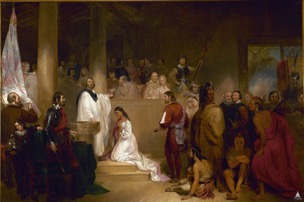
The painting of the Baptism of Pocahontas in the US Capitol Rotunda.
For example, during their first winter, their food ran out; but Pocahontas was instrumental in getting Indians to bring them supplies. She brought food to the starving colonists at other times as well, and also helped them secure peace treaties with surrounding tribes. Early historian John Fiske writes of Pocahontas: “But for her friendly services on more than one occasion, the tiny settlement would probably have perished.”[44]
The colony survived and slowly began to grow, openly espousing Christian principles. For example, between 1609 and 1612, their code of civil laws (called their Lawes Divine, Morall, and Martiall, etc.) was penned, and it succinctly affirmed the intent of the colonists to live according to God’s commands.[45]
In 1619, civic elections were held in Jamestown, and the result was the first elected representative body of the New World. It opened with prayer, and then met in the choir loft of the church.[46] One of the early acts of this body was to encourage colonists to open their homes to Indian youth with the purpose of teaching them the precepts of the Bible.[47]
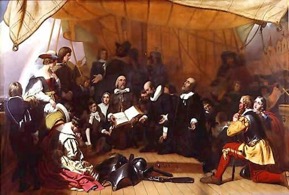
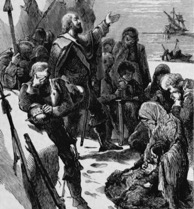
The painting of the Embarkation of the Pilgrims shows them on the ship the Speedwell observing a time of fasting and prayer before leaving Holland to come to America.
Significantly, many Native Americans became Christians, including Pocahontas, who was brought to a knowledge of Jesus Christ by the ministry of the Rev. Alexander Whitaker and others. In fact, a massive painting hanging in the US Capitol Rotunda (near that of Columbus’ landing) shows the baptism of Pocahontas by the Rev. Whitaker. After her baptism, Pocahontas adopted the Christian name Rebecca, by which she was called the remainder of her life.
Governor John Smith, like so many others in the Virginia Colony (including Rebecca) was an outspoken Christian. His personal faith was reflected in many open acknowledgments of God throughout his life, including his Last Will and Testament (1631):
[I] commend my soul into the hands of Almighty God, my Maker, hoping through the merit of Christ Jesus my Redeemer to receive full remission of all my sins and to inherit a place in the everlasting kingdom.[48]
The Pilgrims and the Plymouth Colony, 1620
Another of the massive paintings that hangs in the US Capitol Rotunda (each is 14 feet high and twenty feet wide) is the Embarkation of the Pilgrims at Delfts Haven, Holland, July 22nd, 1620, painted by Robert Weir and placed in the Capitol in 1843.[49]
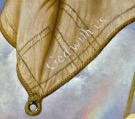
Painted on the sail is the phrase, “God with us,” which was the heart cry of the Pilgrims.
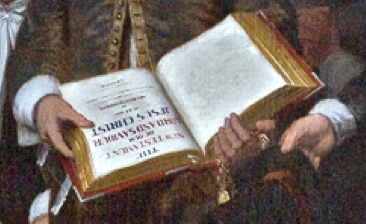
This painting shows leading Pilgrims in prayer (including Pastor John Robinson, Governors John Carver and William Bradford, military leader Miles Standish, and others). In the center of the painting, Elder William Brewster has an open Bible upon his lap on which are written the words: “The New Testament of our Lord and Savior Jesus Christ.” On the sail of the ship can be seen the phrase, “God with Us,” which accurately describes the lifestyle of these men and women.
William Brewster is holding an open Geneva Bible with the words, “The New Testament of our Lord and Saviour Jesus Christ.”
The version of the Bible being held by Brewster (and the version used extensively by the Pilgrims) was known as the Geneva Bible. It was the primary Bible of the English Reformation and was the favorite Bible of the Dissenters—those who largely settled America. (They were called Dissenters because they objected to—that is, dissented from—the corrupt European practices of both State and Church).
The Geneva Bible was first published in Geneva, Switzerland, in 1560 by English reformers (and their followers) who had fled there to escape severe religious persecution at the hands of the state-established churches in their various home countries. That Bible went through 140 editions from 1560 to 1644.[50] It was the first Bible to add numbered verses to each chapter. It was also the first Bible to be taken to America, having been carried first by the Virginia colonists and then by the Pilgrims.
One factor that made the Geneva Bible distinctive from all other Bibles at the time was its unique marginal commentaries. Penned by prominent reformers, these commentaries regularly challenged the corrupt European culture of the day, especially criticizing practices that violated God’s Word, whether in government, judiciary, education, law, culture, or elsewhere.
The Dissenters, by their study of the Geneva Bible and its commentaries, saw how flawed the civil and religious system was at that time in most countries across Europe. When the Dissenters in England publicly pointed this out, they received vigorous persecution from the state-established national church. (This same pattern of ill-treatment by state-established churches was common across Europe.)
After years of enduring this government persecution, the Pilgrims (according to their governor and historian, William Bradford) finally “shook off this yoke of anti-Christian bondage, and as the Lord’s free people joined themselves (by a covenant of the Lord) into a church estate, in the fellowship of the Gospel, to walk in all His ways.”[51] They left England and went to Holland, where they finally found religious freedom.
But after twelve years in the secular culture of Holland, they became concerned for the faith of their children. They also preferred the overall English culture to that of the Dutch, so they decided to move to the new land of America, where they could (1) freely worship God, (2) raise Godly children, and (3) share the wonderful truths of the Christian Gospel with others. Concerning this third point, Bradford affirmed that the Pilgrims had: “a great hope and inward zeal…for the propagating and advancing the Gospel of the kingdom of Christ in those remote parts of the world [i.e., America].”[52]
When they set sail for America in 1620 aboard the ship Mayflower, it bore 102 “Pilgrims and strangers” (which they called themselves—a quote from 1 Peter 2:11 in the Bible). But the ship also carried much more: it carried the Bible-based principles they had learned—principles that were to become the seeds of the greatest and freest nation the world has ever known.
After sixty-six days at sea, including sailing through some treacherous storms, the Mayflower finally reached America. The Pilgrims had intended to settle in the northern parts of the existing Virginia Colony and had tried diligently to reach that region, but despite their best efforts, fierce winds providentially blew them far north to a region completely outside Virginia’s jurisdiction. They finally put ashore at Cape Cod in the Massachusetts area, and after some searching they found an empty and uninhabited location in which to settle.
Significantly, had the Pilgrims arrived at that same place some years earlier, they would have been met by the fierce Patuxet Indian tribe, which likely would have attacked and killed them all. But in 1617, a plague had mysteriously wiped out all of the tribe except one man: Squanto. He had been in England at the time of the outbreak and returned to the area just before the Pilgrims arrived, finding his entire tribe gone. Due to the devastating nature of the epidemic, the neighboring tribes were afraid to come near the place; they believed that some great supernatural spirit had destroyed the people there and might also kill them as well. So the land was left abandoned and open—a perfect situation for the Pilgrims.
Having arrived in an area not under the authority of the Virginia Colony, the Pilgrims drew up their own governmental compact before leaving the Mayflower, which declared:
Having undertaken for the glory of God and advancement of the Christian faith, and the honor of our king and country, a voyage to plant the first colony in the northern parts of Virginia, do by these presents [that is, by this legal document and charter] solemnly and mutually, in the presence of God and one of another, covenant and combine ourselves together into a civil body politic.[53]
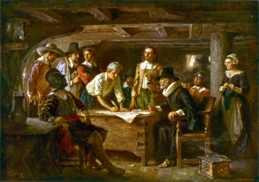
Signing of the Mayflower Compact
That document, known as the Mayflower Compact, was the first civil governing document written in America and the New World. It placed the Pilgrim’s civil government on a firm Christian basis and was the beginning of American constitutional government.
When the Pilgrims came ashore, they fell to their knees and thanked God, reaffirming their continuing reliance upon Him. Squanto later met them and would become instrumental in their survival. (For more on this part of the story, see the article in the Appendix at the end of Lesson 1, “Why We Celebrate Thanksgiving”).
The Pilgrims’ Colony became known as Plymouth Plantation, or the Plymouth Colony. It was built on land purchased from the Indians—at the price set by the Indians.[54] In fact, the longest-lasting treaty in American history between Anglos and Native Americans was that of the Pilgrims. (For more on the relations between the Pilgrims and Indians, see “No, Revisionists, Thanksgiving is not a Day of Mourning,” also at the end of this Lesson).
In the beginning, life in that colony was very difficult. In fact, in the first winter alone, half the Pilgrims died. But despite that hardship, the next spring when the Mayflower returned to England, not one Pilgrim chose to go back. They all stayed, for they had come neither for personal convenience nor reward but rather that they might walk in religious and civil liberty and became what they called “stepping stones”[55] for others after them to follow and do the same. At the end of the first year, the Pilgrims celebrated the thanksgiving festival that has become the national holiday we still celebrate each year today in November.
The Laws of the Pilgrims
The Pilgrims believed the Bible was a complete guidebook for how to live all of life, and their code of laws clearly reflected this belief. Significantly, much of what they instituted (as early as 1623) became standard in America, including trial by jury and private property rights.[56] They also elected their civil leaders separately from their religious leaders[57]—a practice quite different from what had become customary for Europe.
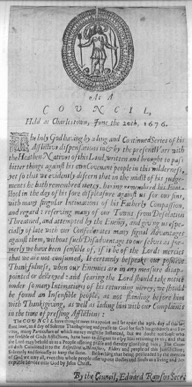
A 1676 broadside of a proclamation for a Day of Prayer and Thanksgiving, with the deal of Massachusetts Bay at the top and an Indian speaking the words, “Come Over and Help Us.”
By 1636, the Pilgrims had compiled what historians describe as “the first comprehensive body of law in North America.”[58] That legal code served as a model for future American codes of laws, and while the original Laws of the Pilgrims were revised over subsequent years, they always remained rooted in the Bible. In fact, the preface to the 1658 Book of Laws specifically states that “laws…are so far good and wholesome as by how much they are derived from and agreeable to the ancient platform of God’s Law.”[59] Reflecting this, many of their individual laws directly cited specific Scriptures as their basis.
The Puritans and Massachusetts, 1630
Jamestown was the first English colony in America; and in 1620 the Pilgrims founded the second English colony, but the first one in the northern parts of America. Over the next decade, other settlers occasionally arrived in the area, but in 1630 came the “Great Puritan Exodus” that left England, resulting in the founding of America’s second northern colony, and its third overall.
Those Puritans in that Exodus had spent years attempting to purify the tyrannical Church of England (from which they received their name “Puritans”), but with little result. In fact, they were severely persecuted by the king for their attempts to clean up the corrupt church. Finally deciding they could not purify that Church, they came to America and set up their own model Church of England to be an example of a true uncorrupted Church.
The Puritans (like the Pilgrims before them) were committed to God and His Word, wanting to share the good news of the Christian faith with others. Their original charter (1629) affirmed their desire to be…
so religiously, peaceably, and civilly governed, as their good life and orderly conversation [that is, their Godly lifestyle] may win and incite the natives of country to the knowledge and obedience of the only true God and Savior of mankind, and the Christian faith, which…is the peaceful end of this plantation [colony].[60]
In the spring of 1630, some 1,000 Puritans (which was more than the total number of inhabitants living in the then ten-year old Pilgrim Plymouth Colony) left England and sailed to America, establishing the Massachusetts Bay Colony. (Their new colony adjoined the Pilgrims’ Plymouth Plantation Colony, and in 1691, the two merged to become Massachusetts.) During their voyage from England, the Puritans “constantly served God, morning and evening, by reading and expounding a chapter [in the Bible], singing, and prayer.”[61]
While at sea, their leader, John Winthrop (who for many years after their arrival served as their governor) penned “A Model of Christian Charity,” setting forth the Puritan’s reasons for starting the new colony. Winthrop affirmed their desire to be “as a city upon a hill” (quoting from Jesus’ words in Matthew 5:14), where all the people of the earth could see their uncorrupted colony as a model (which they called the “New” England) and would say, “The Lord make [us] likely that of New England.”[62] But Winthrop warned those with him that, “If we shall deal falsely with our God in this work we have undertaken, and so cause Him to withdraw His present help from us, we shall be made a story and a byword [an example of something very bad] through the world.”[63] (Interestingly, more than three centuries later, President Ronald Reagan also spoke of America as being a “city upon a hill” for the rest of the world to see and copy,[64] just as our Pilgrim and Puritan Fathers had long before envisioned.)
Massachusetts Body of Liberties
When the Puritans arrived, they, like the Pilgrims, lived on land purchased from the Indians, at the price set by the Indians.[65] They then began building their system of civil governance. Their legal code, known as the Massachusetts Body of Liberties, was written in 1641 by the Rev. Nathaniel Ward. The Pentateuch (the first five books of the Bible) was the basis for that legal code. In addition to listing specific Bible verses as the basis for many of its laws,[66] it further affirmed that “in case of the defect [lack] of a law” the general standard to be what was in “the Word of God.”[67]
Sharing the Gospel
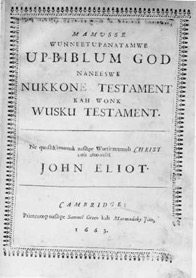
Title Page of John Eliot’s Algonquin Bible
The official seal of the Massachusetts Bay colony was an Indian speaking the words, “Come Over And Help Us.”[68] (This was a quote from Acts 16:9, where the Apostle Paul saw a vision of the neighboring people asking him to come over and preach the Gospel to them.) By this official colony seal, these early settlers yet again openly affirmed their desire to bring the Gospel to those who had never heard it before, including Native Americans.
Typical of the Puritans’ efforts in this regard was the work of the Rev. John Eliot (known as the “Apostle to the Indians”) and Daniel Gookin, a civil magistrate. These two men worked over forty years to evangelize and civilize the Algonquin tribe of Massachusetts. Eliot constantly traveled to Indian villages to teach them the Bible. Many Native Americans converted to Christianity, and Eliot set up fourteen self-governing and self-supporting “Praying Towns” where these Christian Indians could live out their new life as believers. A number of these Indians became ministers in order to carry on the work of the Gospel among their own people.
Eliot believed that for the Indians to fully enjoy the complete benefits of the Bible, they needed it in their own language. He therefore learned the Algonquin, or Massachusetts Indian language and then created a written language for them since none existed at that time. He worked twelve years in translating the Bible into their language, while simultaneously continuing his pastoral duties in his own church. In 1658, he completed the new Indian-language Bible, and it was published in 1661-1663. This was the first Bible ever printed in America, and it was printed in the Algonquin, or Massachusetts language.
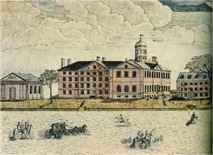
Another way the Puritans’ sought to reach Native Americans with the Gospel was the founding of Harvard in 1636—America’s first successful university (an earlier college had been started in Virginia, but it was wiped out in a surprise attack by a nearby Indian tribe). The Puritans started Harvard not only to train ministers but also to evangelize and educate Indians. Many other early American colleges had the same dual purpose.
Roger Williams obtained land from the Narragansett Indians to start the colony of Rhode Island and Providence Plantation.
For example, the College of William and Mary (founded in Virginia through the efforts of the Rev. James Blair in 1693) was started so that “the Church of Virginia may be furnished with a seminary of ministers of the Gospel, and that…the Christian faith may be propagated among the western Indians to the glory of Almighty God.”[69] The college of Dartmouth in New Hampshire began in 1770 when Congregational pastor Eleazar Wheelock (1711-1779) secured a charter from the governor of New Hampshire to establish a college to train young men for missionary service among the Indians. Its Latin motto means: “The voice of one crying in the wilderness” (quoting from John 1:23 and Isaiah 40:3) and it became known as “the Indian College.”[70]
Rhode Island, 1636
In 1631, a brilliant young minister, Roger Williams, came to the Massachusetts Bay Colony as a refugee from the tyranny of England’s King Charles I and the corrupt British state-established church. For a time, Williams served as minister in Plymouth (home of the Pilgrims), and then by mutual agreement left to pastor in Salem (in the Puritans’ colony).
His outspoken manner and firm convictions regarding liberty of conscience brought him into conflict with the sometimes intolerant Puritan leaders of the Massachusetts Bay Colony. After failing to comply with the edicts of those civil leaders, he was tried and banished from the Colony. In 1636, he purchased land from the Indians and founded the Providence Plantation Colony (later to become Rhode Island).[71]
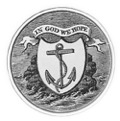
Seal of Rhode Island Colony
Williams believed strongly that civil authorities should have no jurisdiction over the religious beliefs of any individual’s conscience and he incorporated this conviction into the laws of the new colony. With this official policy of religious tolerance, those who had been persecuted for their religious convictions began settling in Rhode Island.
Religious principles remained central to the colony—as affirmed by the 1663 Royal Charter of Rhode Island. It not only announced the colonists’ intentions both of “Godly edifying themselves, and one another, in the holy Christian faith and worship” but also of converting the Indians to Christianity.[72] It further declared that:
[The colonies are to pursue] with peaceable and loyal minds their sober, serious, and religious intentions…in holy Christian faith…[A] most flourishing civil state may stand and best be maintained…with a full liberty in religious concernments; and that true piety, rightly grounded upon Gospel principles, will give the best and greatest security to sovereignty and will lay in the hearts of men the strongest obligations to true loyalty.[73]
Maryland, 1633
In 1633, Cecil Calvert, a Catholic (known as Lord Baltimore), established the colony of Maryland. The Charter of Maryland describes him as “being animated with a laudable, and pious zeal for extending the Christian religion.”[74] In 1634, he established a policy of religious toleration that welcomed both Protestant and Catholic settlers. (At that time in world history, it was common that Catholics and Protestants alternately persecuted each other; but this colony welcomed any who were fleeing persecution, whether Catholic or Protestant—a policy very rare at that time.)
In 1649, the famous Maryland Toleration Act was passed, declaring that “No…persons… professing to believe in Jesus Christ shall [be] troubled, molested, or discountenanced for or in respect of his or her religion, nor in the free exercise thereof,”[75] thus further protecting both Catholic and Protestants. That Act provided the broadest protection of religious freedom that had been offered in the world in the 1600s.
Connecticut, 1636
Rev. Thomas Hooker
In 1633, English minister Thomas Hooker, like the Pilgrims and Puritans before him, was driven from England by the corrupt state-established national church. He came to the Puritans’ Massachusetts Bay Colony and became pastor of the Church at Newtown (now Cambridge). After observing the workings of the colony, he noticed some intolerance among Puritans there and attempted to correct it. Having little success, he asked the Bay Colony leaders and was granted permission to migrate to the Connecticut Valley.
In June 1636, he and most of his Newtown congregation (about 100 people) settled in what would become the Connecticut Colony, on land they had purchased from the Indians, at the price set by the Indians.[76] Other settlers followed, and by May 1637, 800 people had moved into the valley. In May 1638, Hooker presented an influential sermon preached before the General Court (that is, the Connecticut legislature). Three of the key principles he laid out included:
The foundation of civil authority is based on the willing consent of the people;
The choice—that is, the public election—of civil officials belongs to the people by God’s own permission;
The people not only have power to appoint officers and magistrates but also to set the bounds and limitations of the government.[77]
In 1636, Rev. Thomas Hooker led a company from his church in Massachusetts to settle in Connecticut.
As a result of that sermon, in January 1639, the Fundamental Orders of Connecticut was penned and adopted as the colony’s first constitution. Significantly, it was the first constitution ever written in America. Early historian John Fiske wrote that “the government of the United States today is in lineal descent more nearly related to that of Connecticut than to that of any of the other thirteen colonies.”[78] (This is why Connecticut is known as “the Constitution State.”) The Christian basis of that constitution was readily apparent.
For example, it began with the inhabitants covenanting together under God “to maintain and preserve the liberty and purity of the Gospel of our Lord Jesus, which we now profess.”[79] And the oath taken by civil officials required them “to administer justice according to the laws here established, and for want [lack] thereof, according to the rule of the Word of God.”[80] The oath taken by the governor (and the magistrates) ended with these words: “I…will further the execution of justice according to the rule of God’s Word, so help me God, in the name of the Lord Jesus Christ.”[81] Some of the key principles found in that Bible-based constitution included the rule of law, popular elections, representative government, freedom of speech, local self-government, and taxes levied on the people—but only through representatives elected by the people, which certainly was not the general practice of Europe at that time.
More than a century later, Noah Webster (a soldier in the American War for Independence, and then a judge, legislator, and teacher afterwards) used Connecticut’s constitution as a model for his 1785 work Sketches of American Policy—one of the first works in America to call for a federal constitution.[82] Webster said that Connecticut’s early constitution was “the most perfect on earth” and that it provided an excellent example to the American nation of the proper balance of power between local and state governments.[83]
In 1637, the year after Rev. Hooker had founded Connecticut, Puritan minister John Davenport founded the New Haven Colony, which adjoined the Connecticut Colony. He, too, purchased the land from the Indians,[84] and his motivations for starting that Colony were similar to those of Hooker. The New Haven Colony rested its frame of government upon the idea that “the Scriptures do hold forth a perfect rule for the direction and government of all men in all duties…in families and commonwealths,”[85] thus making (as famous historian George Bancroft noted) “the Bible its statute-book.”[86] (In 1665, the New Haven Colony united with the Connecticut Colony to form Connecticut.[87])
The New England Confederation, 1643
In 1643, the four separate colonies of Massachusetts Bay, Plymouth Plantation, Connecticut, and New Haven agreed to form an association known as the New England Confederation. This was the first attempt to unite several colonies in mutual cooperation (such as later happened with the thirteen colonies during the American War for Independence). The governing document for that Confederation clearly states the Christian nature of the early settlements:
Whereas we all came into these parts of America with one and the same end and aim, namely, to advance the kingdom of our Lord Jesus Christ and to enjoy the liberties of the Gospel in purity and peace….The said United Colonies…[do] enter into a firm and perpetual league of friendship…for preserving and propagating the truth and liberties of the Gospel and for their own mutual safety and welfare.[88]
The New England Confederation lasted until 1684.
America’s First Schools
The colonists of all the early colonies believed that every child should be educated—a belief very different from that in England and Europe at the time. While many children in America were educated at home, the colonists also started public schools as well and then later added colleges to provide higher education for students. Significantly, the concept of education for every individual was developed first in Christian and Biblical civilization.
Early Massachusetts School Laws
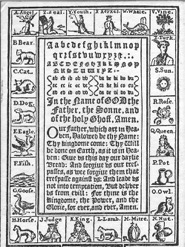
A colonial hornbook. The Lord’s Prayer was the first reading lesson.
In 1642, the General Court of Massachusetts (that is, its legislature) enacted an education law requiring each town to see that children were taught “to read and understand the principles of religion and the capital laws of this country.”[89] Five years later, the laws of 1647 noted education and schools were necessary because it was the “one chief project of that old deluder, satan, to keep men from the knowledge of the Scripture”[90]—that is, Satan wanted to keep people from knowing the Bible, but Massachusetts was not going to let this happen: it would establish schools for every child so they would be able to know and read the Bible. (This law became known as “The Old Deluder Satan Act.”)
This Massachusetts law was America’s first public education law, and it was the direct result of the horrific persecutions experienced by so many of the early settlers who had arrived in America. Those colonists were acutely aware of the civil atrocities that had earlier occurred across Europe, such as the tortures during the Inquisition and other similar purges often wrongly perpetrated under the banner of Christianity. They knew of these atrocities because many of them had personally experienced harsh persecution simply for practicing their Biblical faith.
The colonists and their leaders were convinced that a widespread lack of Biblical knowledge lay at the root of these barbarities. If people had been literate and able to read the Scriptures and judge the accuracy of what the leaders of both State and Church were telling them, they would not have blindly believed and followed, thus abetting the commission of that savagery.
The American Witch Trials
On rare occasions, even these early Christians fell into the same bad behavior from which they had fled. One example of this is seen in the Witch Trials of 1691-1692 in which twenty-seven individuals died at the hands of the Puritans in the Massachusetts Bay Colony.[91]
While this behavior is indefensible, an appropriate question to ask is, “Why were only twenty-seven put to death in America?” After all, witch trials were also occurring across the world at that time, with 500,000 put to death in Europe,[92] including 30,000 in England, 75,000 in France, and 100,000 in Germany.[93]
Significantly, the American trials lasted eighteen months, while the European trials lasted for years and even decades.[94] The difference was that the American trials were brought to a close when Christian leaders such as the Reverend John Wise, the Reverend Increase Mather, and Thomas Brattle confronted civil leaders, pointing out that Biblical rules of evidence and due process were not being followed in the courts, thus convincing officials to end those trials.[95]
What are some of the Biblical rules of evidence? An answer comes from Supreme Court Justice Stephen Breyer—one of the most secular-minded justices in Supreme Court history. Yet even he openly acknowledges that “The right of an accused to meet his accusers face-to-faceis mentioned in, among other things, the Bible.”[96] In proof of this, Breyer cites Federal Practices & Procedure, Federal Rules of Evidence, which devotes more than twenty pages to show the ways in which the Bible directly shaped numerous of the individual Due Process protections for citizens now found in the Fourth through the Eighth Amendments of the Bill of Rights.[97]
When Biblically-informed Christians pointed out these basic rights to Puritan leaders:
The trials were stopped by Governor Phipps in October, 1692, and five years later the Massachusetts Court publicly repented and set apart a special day of fasting and prayer, that prayers might be offered asking for forgiveness for the “late tragedy raised amongst us by Satan,” while the twelve jurors published a declaration of sorrow for accepting insufficient evidence against the accused; and Judge Sewall rose in his pew in the South Church and made public confession of his sense of guilt.[98]
Sadly, modern texts are quick to emphasize the twenty-seven deaths that occurred under the Puritans but ignore the hundreds of thousands committed in Europe. But as an early historian pointed out, a knowledge of the actual facts “should moderate our denunciations and charges of severity, brutality and narrow-mindedness against the colonial forefathers, who, it clearly appears, were much in advance of their times.”[99] And offering even more evidence to prove his point, he noted:
When the Mayflower left England [in 1620], thirty-one offenses were punishable with death in the mother country. By the middle of that century [the 1650s], the black list had enlarged to 223, of which 176 were without the benefit of the clergy [i.e., there were no exceptions]. How far in advance the New England colonies were is evident from the fact that not a single colony code [in New England] recognized more than fifteen capital crimes.[100]
It is undeniable that some missteps were made in early America; but because of the significant positive influence resulting from a widespread knowledge of the Bible, we had less atrocities and more that was positive than any other nation at that time.
Recognizing the positive difference a knowledge of the Bible could produce, those early settlers therefore passed America’s first education law, which required:
After the Lord hath increased [the settlement] to the number of fifty householders, [they] shall then forthwith appoint one within their town to teach all such children as shall resort to him, to write and read….And it is further ordered that where any town shall increase to the number of one hundred families or householders, they shall set up a grammar school…to instruct youths, so far as they may be fitted for the university. [101]
The fact that the purpose of public education was to equip students to know the Bible and thus better know the limits the Bible placed on governing authorities was confirmed by numerous foreign visitors to America. One such was Edward Kendall of Britain. While in Connecticut, he found the state’s illiteracy law of interest—particularly the opening declaration of that law:
This [legislature] observing that notwithstanding the former orders made for the education of children…there are many persons unable to read the English tongue, and thereby incapable of reading the Holy Word of God or the good laws of this [State]… [102]
Notice that the Connecticut legislature was concerned about illiteracy because if a child could not read, then he would not know the Word of God or the laws of the state, and thus might not prevent the passage of a bad law.
America’s First Colleges
Henricus College (1619)
In 1618, the Virginia Company obtained a charter from King James I for a college in Virginia. Its purpose was to train both the children of the settlers and the children of the Indians.[103] By 1622, a teaching staff had been chosen and construction at the college begun. But while it was being built, Native Americans led an unexpected surprise attack against the settlers (who had long been their neighbors) resulting in what is called the “Great Massacre.” This stopped further efforts for a college in Virginia until seventy years later, with the establishment of the College of William and Mary in 1693.
Harvard College (1636)
Harvard College
As noted earlier, Harvard (started in 1636 by the New England Puritans) was the first successful college in America. Some of its rules and precepts included:
Let every student be plainly instructed and earnestly pressed to consider well [that] the main end of his life and studies is to know God and Jesus Christ, which is eternal life (John 17:3), and therefore to lay Christ in the bottom, as the only foundation of all sound knowledge and learning.
>And seeing the Lord only giveth wisdom, let everyone seriously set himself by prayer in secret to seek it of him (Prov. 2:3).
Everyone shall so exercise himself in reading the Scriptures twice a day that he shall be ready to give such an account of his proficiency therein…seeing the entrance of the Word giveth light, it giveth understanding to the simple (Psalm 119:130).[104]
Harvard, with its motto “Christo et Eccleslae” (For Christ and the Church),[105] was typical of almost all of the early American colleges. In fact, over the next two centuries, some 246 colleges would be started, with 226 (ninety percent) of them directly founded on the Christian faith.[106]
— — — ⧫ ⧫ ⧫ — — —
So…
America was founded on the teachings of the Bible.
Our colonies were founded and populated largely by people who desired to freely worship the God of the Bible.
Our common schools were begun so that every young person would be able to read, study, and understand the Bible for themselves.
Our universities were founded to train civil and religious leaders who would be knowledgeable in the Scriptures.
Our civil laws and constitutions were routinely based on specific Biblical verses and ideas.
There is much additional historical documentation available from this early period of America’s history, and it affirms that America was founded on Christian principles and that the Bible was instrumental in shaping our institutions and securing our individual rights and liberties. The evidence overwhelmingly supports the conclusion reached by President Andrew Jackson that “ It [the Bible] is the rock on which our Republic rests.” [107]
_____________
Lesson 1: Appendix A
Why We Celebrate Thanksgiving
(And a Lesson in Economics)
Innumerable blessings have been bestowed upon the United States of America. Concerning these, President Abraham Lincoln affirmed, “No human counsel hath devised, nor hath any mortal hand worked out these great things. They are the gracious gifts of the Most High God.”[108] In 1863, he therefore set apart the last Thursday of November as “a day of thanksgiving and praise to our beneficent Father, Who dwelleth in the heavens.”[109] President Lincoln thereby established America’s official Thanksgiving holiday; but it was the Pilgrims’ 1621 Thanksgiving celebration over two centuries earlier that originally started the tradition observed annually by the nation over succeeding years.
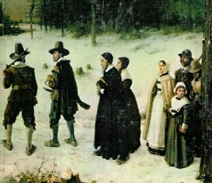
The Pilgrims are going to church.
The Pilgrims had arrived in America in November 1620. As they gathered their harvest in autumn of 1621 and looked back over the preceding year, they knew they had so much for which to be thankful. It was a miracle they had not only survived their first year in the wilderness of New England but also that they had reaped a good harvest the following fall. And they had also found a home where they could freely worship God—a place for “propagating and advancing the Gospel of the kingdom of Christ.”[110] The Pilgrims were grateful for these blessings.
Their early days had been very difficult. Coming to America, they had spent sixty-six perilous days at sea; and the storms were so ferocious that their ship, the Mayflower, was blown literally hundreds of miles north of its intended destination. Their captain continued attempting to sail south to Virginia, but the weather didn’t permit, so the Pilgrims were forced to settle in New England.
Because of the long voyage, lack of provisions, and harsh conditions, numerous diseases afflicted the settlers when they reached land. Making the situation worse, the Pilgrims arrived in December, so winter had already set in, and they had no homes in which to take shelter. In their weakened physical condition, and in the unrelenting cold, they started to build houses to protect themselves. Under these extreme hardships, within only three months, half of the original 102 Pilgrims were dead.
During the height of the sickness, there were only six or seven persons strong enough to move about, but they worked hard on behalf of all the rest. As Governor Bradford affirmed, those few…
spared no pains night nor day, but with abundance of toil and hazard of their health, fetched them wood, made them fires, dressed them meat, made their beds, washed their loathsome clothes, clothed and unclothed them; in a word, did all the homely and necessary offices for them which dainty and queasy stomachs cannot endure to hear named; and all this willingly and cheerfully, without any grudging in the least, showing herein their true love unto their friends and brethren. A rare example and worthy to be remembered.[111]
With only half of them surviving that first winter, the prospects of the coming year were bleak. They were surrounded by Indians (some hostile), short of food and supplies, and knew little of how to live in the American wilderness. But to their astonishment, an English-speaking Indian named Squanto unexpectedly came among them (from where they knew not) and took them under his care, teaching them how to survive in the new land.
He showed them how to plant corn (assuring its growth by setting it with fish) and he taught them how to catch fish during thetimes when they could find the creeks well stocked with fish (in the four months before Squanto’s arrival, the Pilgrims had caught only one cod). He also taught them to stalk deer, plant pumpkins, find berries, and catch beaver (whose pelts proved to be their economic deliverance). Additionally, Squanto was helpful in securing a peace treaty between the Pilgrims and the neighboring Wampanoag tribe. (It became the longest-lasting treaty in American history between Anglos and Native Americans.) Pilgrim leader and governor William Bradford properly affirmed, “Squanto…was a special instrument sent of God for [our] good.”[112]
Squanto was indeed key to their survival, and he helped shape the story of America. But his own life story is amazing as well. In 1605, long before the arrival of the Pilgrims, he had been captured and taken to England. He remained there nine years, during which time he learned to speak English. In 1614, he came with Captain John Smith of Virginia back to New England, but shortly after Squanto’s return Captain Thomas Hunt took him and sold him into slavery in Spain. Thankfully, some local friars bought and rescued him.
The Pilgrims “set a part a solemn day of humiliation to seek the Lord by humble and fervent prayer in this great distress. And He was pleased to give them gracious and speedy answer.”
Being freed in Spain, he went to England, where he remained until 1619, when he obtained passage back to his home in New England. As Squanto went ashore at his former home (which eventually became Plymouth, the Pilgrims’ home), he found his entire tribe (the Patuxets) had been wiped out by a plague. He was the only survivor; and had he been there instead of in Spain and England, he, too, surely would have died. Joining himself to a nearby tribe, he remained there until the spring of 1621, when he took the remaining half of the Pilgrims under his tutelage, determined to see them survive at the place where his tribe had not.[113]
With Squanto’s help, the Pilgrims harvested sufficient food for their upcoming second winter. They had no surplus, but things definitely looked much better than they had the preceding winter when they arrived. With this definite improvement over the previous years’ situation, Pilgrim Governor William Bradford appointed a Day of Thanksgiving and invited the nearby Wampanoag Indians (Squanto’s adopted tribe) to celebrate with them and give thanks to God.
Chief Massasoit and ninety of his men came and feasted with the fifty-one Pilgrims. They ate deer, turkey, fish, lobster, eels, vegetables, corn bread, herbs, berries, and pies; the Indians even taught the Pilgrims how to make popcorn. The Pilgrims and Indians also engaged in athletic competition, including running, wrestling, and shooting. Chief Massasoit enjoyed himself so much that he and his men stayed for three days.[114]
Historically, there had been thanksgivings in America prior to the one by the Pilgrims, including in Texas in 1541,[115] El Paso in 1598,[116] St. Augustine, Florida in 1564,[117] Jamestown, Virginia in 1607,[118] and Berkley Plantation, Virginia in 1619,[119] but these were primarily times of prayer. The Pilgrim thanksgiving certainly included prayer, but it also added feasting and athletic events, thus birthing the tradition that has become our modern Thanksgiving holiday.
Shortly after the Pilgrims’ Thanksgiving celebration, thirty-five new settlers unexpectedly arrived. They were family and friends of the Pilgrims, who gladly welcomed them. The new group had brought no provisions with them, so the Pilgrims freely shared with them their own food, clothing, and homes. But with the new arrivals, their supplies were cut to half allowance for each person. Several died.
The following spring their provisions were almost completely exhausted when they spied a boat approaching on the horizon. The Pilgrims hoped that the English Company (which had sponsored their colonization of Plymouth) was sending them provisions, but the boat did not bring any food. To the contrary, it brought seven more hungry people to stay in Plymouth.
Early that summer, sixty more men, many of whom were sick, also showed up seeking help. The Pilgrims gladly took care of them all. The sixty men stayed nearly all summer and eventually left, expressing no gratitude for the help they had received; and their stay had further depleted the Pilgrim’s meager supplies. Yet the Pilgrims continued to put their trust in God. Significantly, no one starved to death, although, understandably, they had many days when, as Governor Bradford described it, they “had need to pray that God would give them their daily bread above all people in the world.”[120]
The following year (1623), the Pilgrims considered how to produce a larger harvest beyond what they predicted to be their immediate needs. After all, the previous year had presented to them many unexpected surprises that had depleted their scarce resources. So how could they produce enough to meet their own needs as well as others that might arise? Applying Biblical principles, the Pilgrims chose to replace the collective socialistic style of farming they had practiced in the two preceding years with an early free-market individual approach to farming, assigning to every family its own personal parcel of land.[121]
Of the new free-market system they began implementing, Pilgrim Governor Bradford reported:
This had very good success, for it made all hands very industrious, so as much more corn was planted than otherwise would have been by any means the Governor or any other could use…and gave far better content. The women now went willingly into the field and took their little ones with them to set corn, which before would allege [fake, or pretend] weakness and inability.[122]
When the Pilgrims abandoned economic socialism and adopted the individual free-enterprise model, their productivity dramatically increased and abundance actually began to emerge among the people. In fact, because the Pilgrims’ were able to directly benefit from their own hard work and the fruit of their own labors, they planted about seven times more than they had only two years earlier.[123] The Pilgrims finally had great hopes for a large crop. But as is often the case in life, things did not go as planned, for according to Bradford:
[T]he Lord seemed to blast [plague] and take away the same, and to threaten further and more sore famine unto them by a great drought which continued from the third week in May till about the middle of July without any rain and with great heat (for the most part) insomuch as the corn began to wither away.[124]
In response to this unexpected spring drought, Bradford reported that:
[T]hey set a part a solemn day of humiliation to seek the Lord by humble and fervent prayer in this great distress. And He was pleased to give them a gracious and speedy answer both to their own and the Indians’ admiration that lived amongst them. For all the morning, and greatest part of the day, it was clear weather and very hot and not a cloud or any sign of rain to be seen, yet toward evening it began to overcast, and shortly after to rain with such sweet and gentle showers as gave them cause of rejoicing and blessing God. It came without either wind or thunder or any violence, and by degrees in that abundance as that the earth was thoroughly wet and soaked therewith, which did so apparently revive and quicken the decayed corn and other fruits as was wonderful to see, and made the Indians astonished to behold.[125]
An Indian named Hobamak who witnessed this event said to a Pilgrim:
Now I see that the Englishman’s God is a good God, for He hath heard you and sent you rain, and that without storms and tempests and thunder, which usually we have with our rain, which breaks down our corn; but yours stands whole and good still. Surely your God is a good God.[126]
The rains rejuvenated the dying crops and the harvest of 1623 brought plenty to each person, with the more industrious Pilgrims even having excess to sell to others. The Pilgrims once again set aside a time of Thanksgiving to God.
Significantly, from the time the Pilgrims adopted a Biblical economic system, nogeneral want ever again existed among them.
This is the story of the Pilgrims’ thanksgivings that became the model for our modern national Thanksgiving celebrations.
_____________
Lesson 1: Appendix B
No, Revisionists, Thanksgiving is not a
Day of Mourning
When a modern college professor presented to his students the traditional view of the Thanksgiving holiday as a time for gratefulness and thankfulness a student objected and sent him eleven articles she found on the internet purporting to show that the Pilgrims actually killed and oppressed the Indians, and that Thanksgiving Day was thus not to be celebrated or honored.[127]
Of those articles and their claims, some referred to an encounter with the Indians in 1623, some referenced the Indian war of 1637, and others King Philip’s War of 1675 (the three early conflicts between Indians and the Pilgrims). So what is the truth? Did the Pilgrims indeed kill and oppress Indians?
— — — ⧫ ⧫ ⧫ — — —
Of the three major conflicts between the Pilgrims and the Indians, King Philip’s War of 1675 was by far the biggest and most serious. It finally broke the official 1621 peace between the Pilgrims and the Indians. No other treaty with Native Americans lasted longer than the 54 years of the Pilgrim treaty (1621–1675); and significantly, when the treaty was eventually broken during King Philip’s War, it was the Indians and not the Pilgrims who violated it.
Here is a brief overview of three conflicts, including the one that led to the breaking of the decades old treaty between the Pilgrims and the Wampanoags.
Chief Massasoit
The Pilgrims, after arriving in the New World December 1620, survived a difficult beginning with the help of Indians who befriended them.[128] Intending to live in the area where they had landed, the Pilgrims approached the local tribe, seeking to purchase land. The price was set by the Indians, and written documentation of sale was received for those purchased lands.[129]
The policy of purchasing land from the Indians came to characterize the general practice of New England and portions of the mid-Atlantic regions, being mirrored not only by the Puritans in the Massachusetts Bay Colony[130] but also by the Rev. Roger Williams with Rhode Island,[131] the Rev. Thomas Hooker with Connecticut,[132] and William Penn with Pennsylvania.[133] (On one occasion, Penn actually purchased some of the same tracts multiple times because at least three tribes claimed that specific land, having taken and retaken it from each other in conquest; so Penn secured it from each.[134]) The practice of purchasing land from the Indians was also followed[*] in New Hampshire,[135] New Jersey,[136] and New York.[137]
The Pilgrims and their Indian neighbors (the Wampanoag) had entered into a peace treaty in 1621. Two years later in 1623, Chief Massasoit informed his friends, the Pilgrims, of a treacherous surprise assault to be made against them by the Massachusetts tribe, which was gathering other chiefs for an unprovoked attack.[138] Facing potential extermination, Pilgrim Miles Standish led a preemptive strike against the Algonquin, thus saving the colonists. Without this, the Pilgrim story could have been as short-lived as that of the colonists in the failed colonies of Roanoke, Virginia, or Popham, Maine. But despite the conflict with some hostile tribes, good relations continued between the Pilgrims and Wampanoag. The next period of tensions between the Pilgrims and other tribes occurred in the 1637 Pequot War.
The Pequot tribe was warlike and aggressive, not only against colonists but also against their Indian neighbors on every side, including the Wampanoag (allies and friends of the Pilgrims), Narragansett, Algonquian, and Mohegan tribes. The warring Pequot tribes had established an exclusive trading monopoly with the Dutch, and they believed the arrival of English colonists threatened that monopoly. They therefore determined to strike and kill the English, completely ridding the area of them. After the Pequot murdered a number of English settlers, the colonists responded and organized strikes against the Pequot.[139] The war spread across much of Connecticut, and also threatened the Plymouth and Massachusetts Bay Colonies. The conflict ended when Sassacus, the chief of the Pequot, was pursued and killed by the Mohegan and Mohawks tribes, against whom the Pequot also warred.[140]
King Philip
One of the aforementioned articles provided by the student specifically claimed that it was during this war that Pilgrims killed Indians;[141] but this claim is wrong. The Pilgrims’ participation in this conflict was limited to a skirmish at Manisses Villages, where no Indians were killed.[142] Some of the other articles provided by the student claimed that the Thanksgiving of 1637 was to give thanks that Indians were killed,[143] but this was also wrong. It was called to give thanks for the end of the Pequot War and a restoration of peace to the region.[144]
The Pilgrims lived in harmony with the Wampanoags from the time of their 1621 treaty, through the 1623 and 1637 conflicts, and until the long-lasting peace finally collapsed in 1675 with King Philip’s War. Today, revisionist scholars such as James D. Drake, Daniel R. Mandell, and Jill Lepore claim that this conflict was the result of Indians pushing back against greedy land-grabbing colonists, with the Indians simply trying to regain territory that was rightfully theirs,[145] but such a portrayal is inaccurate.
In fact, at the outbreak of the war Pilgrim Governor Josiah Winslow avowed:
I think I can clearly say that before these present troubles broke out, the English did not possess one foot of land in this colony but what was fairly obtained by honest purchase of the Indian proprietors.[146]
So, if King Philip’s War was not retaliation for the unjust seizing of Indian land by colonists, then what was its cause? The answer is simple: Christian missionaries. Metacom—who took the English name King Philip, and was chief of the Wampanoag Indians and the grandson of Massasoit, the friend of the Pilgrims—recognized that missionaries were converting Indians to Christianity, which was changing some Indian behaviors and “traditions.”
For example, Indians often engaged in prolonged barbarous and sadistic torture of their captives,[147] but missionaries sought to end those horrific practices by converting Indians and teaching them Christian morals.[148] Such missionaries, including John Eliot, Thomas Mayhew, and Andrew White, worked extensively with various tribes and had great success in converting Indians to Christianity. By 1674, Eliot’s Christian villages of “praying Indians” in Massachusetts numbered as many as 3,600 converts.[149] It was in the following year (1675) that Metacom, fearing that Christianity would change “traditional” Indian “culture,”[150] launched ferocious surprise assaults against settlers throughout the region.[151]All English colonists in Rhode Island, Connecticut, and Massachusetts were to be exterminated—no exceptions.
Colonists were indeed murdered and their belongings burned or destroyed.[152] This included even the town of Providence, where Roger William’s own home was burned.[153] Significantly, Williams had always been on the best of terms with the Indians, not only having purchased his colony from them[154] but also having championed Indian rights and claims.[155] Yet, regardless of how well Christian settlers had previously treated Indians, all Christians were all to be exterminated; their very existence was perceived as a threat to Indian practices.
But King Philip’s War cannot be accurately characterized as Indians versus the English, for many of those who were attacked by the Indians were themselves Indians—but they were Christian Indians. They, too, were targeted, hurt, or killed by their unconverted brethren,[156] and many of the converted Christian Indians fought side-by-side with the colonists throughout the conflict.[157] In fact, the war eventually ended when Metacom was killed—by an Indian, not a settler.[158]
Returning to the objections raised by the student, it is true that in this war Pilgrims and Puritans killed Indians—but in the context of a just and defensive war. The war lasted about fifteen months, and early in the war more settlers died than Indians—largely because of the surprise attacks. (Of the ninety towns in Massachusetts and Plymouth Colony, twelve were totally destroyed and forty more attacked and partially destroyed.[159]) But eventually the colonists organized local militias and fought back, finally gaining the upper hand. By the conclusion of the war, 600 settlers and 3,000 Indians had been killed—the highest casualty rate by percentage of total population of any war in American history.[160]
This information about King Philip’s War is not to suggest that the amount of land owned by Indians was not decreasing; it was. But the diminishing land holdings in this region during this time was definitely not for the reason we are often told today. Indian land in this period, especially in New England, was routinely purchased by settlers, not stolen.[161] Early historian George Bancroft (1800-1891), known as “The Father of American History” for his systematic approach to documenting the story of America,[162] confirmed that Indian lands were shrinking because the Indians’ own “repeated sales of land has narrowed their domains” to the point where “they found themselves deprived of their broad acres, and by their own legal contracts driven, as it were, into the sea”[163] (emphasis added).
This is not to say that land was never stolen from Indians. Some definitely was. For instance, during the heyday of westward expansion that began in the early nineteenth century, the Indian removal policies of Andrew Jackson certainly violated private property rights,[164] and such policies became the rule rather than the exception, forcibly driving Indians from their lands in Georgia, Mississippi, Louisiana, and elsewhere across the Southeast.[†] By 1845, the term “Manifest Destiny” was coined to describe the growing notion that it was America’s “destiny” to spread westward, and that nothing—including Indians—should be allowed to stand in the way. As a result, the Biblical view of purchasing private property from its owner was replaced with the anti-Biblical notion that “possession was nine-tenths of the law” and therefore whoever could take and hold the land was its “rightful” owner.[165]
But the 19th century deterioration in relations between Americans and Indians over unjust land seizures occurred most commonly two centuries after the Pilgrims. The original treaty the Pilgrims negotiated with the Indians lasted for 54 years—until the Indians broke it. In general, the Pilgrim and Puritan killings of Indians occurred first in their own self-defense against the perfidious unprovoked attacks from Metacom’s Indians, and then in ending the war he had started. There is no historical basis to support the claim that the Pilgrims oppressed the Indians. ■
___________ [*]WallBuilders (www.wallbuilders.com) owns one of the nation’s largest private collections of Founding Era materials, containing over 100,000 originals, or copies of original documents that predate 1812. Among these holdings are multiple original signed deeds in which Indians willingly and voluntarily sell their land to settlers. One example is an Indian deed dated February 9, 1769, and signed by four Indian leaders from the Aughquageys tribe, selling 300,000 acres—or nearly 470 square miles of land—to settlers in New York. The land-area sold by the Indians in just this one transaction was the equivalent of modern Los Angeles or San Antonio, was larger than modern New York City, and seven times larger than modern Washington DC. Another deed from March 12, 1664 transfers 1000 acres of land from eight Wappinger leaders to two English settlers in New York, in the area that is now the Bronx. There are hundreds of such deeds, legitimately transferring land by mutual agreement and purchase from various Indian tribes to colonists/settlers.
[†]Among the other original documents in the WallBuilders collection are land deeds from he state of Georgia selling parcels in Cherokee-held lands directly to settlers, seeking to drive the Cherokee from their homelands.
___________ [1] Kay Brigham, Christopher Columbus’s Book of Prophecies, Reproduction of the Original Manuscript with English Translation (/originally written 1501-1505; published Fort Lauderdale, Fl.: TSELF, Inc., 1992), pp. 178-183.
[2] Ferdinand Columbus (son of Christopher Columbus), The Life of the Admiral Christopher Columbus, Benjamin Keen, translator (New Brunswick: Rutgers University Press, 1992), p. 59.
[3] Ferdinand Columbus (son of Christopher Columbus), The Life of the Admiral Christopher Columbus, Benjamin Keen, translator (New Brunswick: Rutgers University Press, 1992), p. 180.
[5]The Papers of George Washington. Presidential Series, Mark A Mastromarion, editor (Charlottesville: University Press of Virginia, 1999), Vol. 8, pp. 506-508, from Thomas Jefferson, September 8, 1791.
[6] Christopher Columbus, The Journal of Christopher Columbus During His First Voyage, 1492-93, Clements Markham, translator (London: Hakluyt Society, 1883), entry dated December 16, 1492, p. 112.
[7] A.M. Fernandez De Ybarra, Smithsonian Miscellaneous Collections (Washington: Smithsonian Institutions, 1907), Vol. XLVIII, p. 436, letter of Dr. Diego Alvarez Chanca, 1494.
[8] A.M. Fernandez De Ybarra, Smithsonian Miscellaneous Collections (Washington: Smithsonian Institutions, 1907), Vol. XLVIII, p. 436, letter of Dr. Diego Alvarez Chanca, 1494.
[9] A.M. Fernandez De Ybarra, Smithsonian Miscellaneous Collections (Washington: Smithsonian Institutions, 1907), Vol. XLVIII, p. 439-440, letter of Dr. Diego Alvarez Chanca, 1494.
[10] Samuel Eliot Morison, Admiral of the Ocean Sea: A Life of Christopher Columbus (New York: MJF Books, 1970), p. 476.
[11] Samuel Eliot Morison, Admiral of the Ocean Sea: A Life of Christopher Columbus (New York: MJF Books, 1970), pp. 257, 360.
[12] See, for example, Christopher Columbus, The Journal of Christopher Columbus, Clements Markham, translator (London: Hakluyt Society, 1893), pp. 124-125, journal entry for December 21, 1492; pp. 127-128, journal entry for December 22, 1492; pp. 152-156, journal entries for January 8-10, 1493; Select Letters of Christopher Columbus, R. H. Major, translator & editor(London: Hakluyt Society, 1870), 155-156, 158, 162-163, 165, Christopher Columbus, “Letter of the Admiral to the (quondam) nurse of the Prince John, written near the end of the year 1500,”; Journals and Other Documents on the Life and Voyages of Christopher Columbus, translator Samuel Morrison, (New York: Heritage Press, 1963), pp. 215, Michele de Cuneo, “Michele de Cuneo’s Letter on the Second Voyage, 28 October 1495.”
[13] B.F. Morris, Christian Life and Character of the Civil Institutions of the United States (Philadelphia: George W. Childs, 1864), p. 69, quoting The Protestant Quarterly Review, Benjamin J. Wallace, editor (Philadelphia: Presbyterian House, 1858), p. 393, No. XXIII, “Article II. The Settlement of Maryland,” December 1857.
[14] Kenneth Woodward and David Gates, “How the Bible Made America,” Newsweek, December 27, 1982, p. 44.
[15] Franklin D. Roosevelt, “Statement on the Four Hundredth Anniversary of the Printing of the English Bible,” American Presidency Project, October 6, 1935 (at: https://www.presidency.ucsb.edu/node/209257).
[17]Bible Society Record (New York: The American Bible Society, 1901), Vol. 46, p. 99, Number 7, “Vice-President Theodore Roosevelt Addresses the Long Island Bible Society.”
[19]The American Quarterly Register and Magazine (Philadelphia), February 23, 1849, Vol. II, No. 1, p. 239, “Quarterly Chronicle” (President Zachary Taylor).
[20] “The President and the Bible,” New York Semi Weekly Tribune, Wednesday, May 9, 1849, Vol. IV, No. 100, p. 1 (President Zachary Taylor).
[21]The New York Times,June 15, 1876, p. 4 (President Ulysses Grant).
[22] Abraham Lincoln, Abraham Lincoln Complete Works, John G. Nicolay and John Hay, editors (New York: The Century Co., 1894), Vol. II, p. 574, “Reply to Committee of Colored People of Baltimore Who Presented Him With a Bible,” September 7, 1864.
[23] Paul Pearson and Philip Hicks, Extemporaneous Speaking (New York City: Hinds, Noble & Eldredge, 1912), p. 177, Woodrow Wilson, “Addresses Delivered in Denver on the Occasion of the Tercentenary Celebrations of the Translation of the Bible into the English Language,” May 7, 1911.
[25] John Adams, The Works of John Adams, Charles Francis Adams, editor (Boston: Little, Brown and Company, 1856), Vol. X, p. 85, to Thomas Jefferson on December 25, 1813.
[26] John Adams, The Works of John Adams, Charles Francis Adams, editor (Boston: Charles Little & James Brow, 1850), Vol. II, pp. 6-7, diary entry for February 22, 1756.
[27] Benjamin Rush,Essays, Literary, Moral & Philosophical (Philadelphia: Thomas & Samuel F. Bradford, 1798), p. 93, “A Defence of the Use of the Bible as a School Book.”
[28] Benjamin Rush,Letters of Benjamin Rush, L. H. Butterfield, editor (Princeton, NJ: Princeton University Press, 1951), p. 936, to John Adams on January 23, 1807.
[29] William Wirt, Sketches of the Life and Character of Patrick Henry (Philadelphia: James Webster, 1818), p. 402.
[30] John Quincy Adams, Letters to His Son on the Bible and Its Teachings (New York: Derby, Miller, & Co., 1848), p. 119.
[31] B.B. Edwards and W. Cogswell, The American Quarterly Register (Boston: Perkins & Marvin, 1840), Vol. XII, p. 86, letter from John Quincy Adams to members of a literary society in Baltimore on June 22, 1838.
[32] Elias Boudinot, The Age of Revelation or The Age of Reason Shewn to be an Age of Infidelity (Philadelphia: Asbury Dickins, 1801), p. xv, “Dedication. To Mrs. Susan V. Bradford.”
[33] John Jay, John Jay: The Winning of the Peace. Unpublished Papers 1780-1784, Richard B. Morris, editor (New York: Harper & Row Publishers, 1980), Vol. II, p. 709, letter to Peter Augustus Jay on April 8, 1784.
[34] Robert Treat Paine, The Papers of Robert Treat Paine, Stephen T. Riley and Edward W. Hanson, editors (Boston: Massachusetts Historical Society, 1992), Vol. I, p. 49, “Confession of Faith,” 1749.
[35] Bernard C. Steiner, One Hundred and Ten Years of Bible Society Work in Maryland, 1810-1920 (Maryland Bible Society, 1921), p. 14 (James McHenry).
[36] Noah Webster, The History of the United States (New Haven: Durrie & Peck, 1832), p. 339, ¶ 53.
[37] Richard Hakluyt, A Discourse Concerning Western Planting. Written in the Year 1584, Charles Deane, editor (Cambridge: John Wilson and Son, 1877), p. 158, “A brief collection of certain reasons to induce her Majesty and the state to take in hand the western voyage and the planting there.”
[38] Howard W. Preston, Documents Illustrative of American History: 1606-1863 (New York: G. P. Putnam’s Sons, 1886), p. 3, “First Virginia Charter—1606.”
[39] John Smith, The Generall Historie of Virginia, New-England, and the Summer Isles: with the Names of the Adventurers, Planters, and Governours from their First Beginning An 1584 to This Present 1626 (London: I.D. and I.H: 1632), p. 122.
[40] John Smith, The Generall Historie of Virginia, New-England, and the Summer Isles: with the Names of the Adventurers, Planters, and Governours from their First Beginning An 1584 to This Present 1626 (London: I.D. and I.H: 1632), p. 122.
[41] John Smith, The Generall Historie of Virginia, New-England, and the Summer Isles: with the Names of the Adventurers, Planters, and Governours from their First Beginning An 1584 to This Present 1626 (London: I.D. and I.H: 1632), p. 49.
[42] John Smith, The Generall Historie of Virginia, New-England, and the Summer Isles: with the Names of the Adventurers, Planters, and Governours from their First Beginning An 1584 to This Present 1626 (London: I.D. and I.H: 1632), p. 49.
[43] John Smith, The Generall Historie of Virginia, New-England, and the Summer Isles: with the Names of the Adventurers, Planters, and Governours from their First Beginning An 1584 to This Present 1626 (London: I.D. and I.H: 1632), p. 49.
[44] John Fiske, Old Virginia and Her Neighbors (New York, Houghton, Mifflin, and Co., 1897), Vol. I, p. 111.
[45]For the Colony in Virginia Britannia. Laws Divine, Moral, and Martial & c. (London: Walter Burree, 1612), pp. 9-12, “Articles, Lawes, and Orders, Divine, Politque, and Martiall for the Colony in Virginea,” 1610 & 1611.
[46]Narratives of Early Virginia: 1606-1625, Lyon Gardiner Tyler, editor (New York: Charles Scribner’s Sons, 1907; reprinted 1946 & 1959), p. 251, “Proceedings of the Virginia Assembly,” July 30, 1619.
[47]Narratives of Early Virginia: 1606-1625, Lyon Gardiner Tyler, editor (New York: Charles Scribner’s Sons, 1907; reprinted 1946 & 1959), p. 264, “Proceedings of the Virginia Assembly: Instructions Given by His Majesty’s Council of Virginia in England,” August 2, 1619.
[48] John Smith, The Last Will and Testament of Captain John Smith (Cambridge: John Wilson and Son, 1867), p. 2.
[50]The Encyclopedia Britannica (New York: Encyclopedia Britannica Company, 1910), Vol. III, p. 901, s.v. “Bible, English”.
[51] William Bradford, History of Plymouth Plantation (Boston: 1856), p. 9.
[52] William Bradford, History of Plymouth Plantation (Boston: 1856), p. 24.
[53] William Bradford, History of Plymouth Plantation (Boston: 1856), p. 90.
[54] James Thacher, History of the Town of Plymouth, from its First Settlement in 1620 to the Present Time (Boston: Marsh, Capen & Lyon, 1832), p. 145.
[55] William Bradford, History of Plymouth Plantation (Boston: 1856), p. 24.
[56] For trial by jury, see: The Compact with the Charter and Laws of the Colony of New Plymouth, William Brigham, compiler (Boston: Dutton and Wentworth, 1836), p. 28, “Laws of the Colony of New Plymouth, 1623.” For private property rights, see: William Bradford, History of Plymouth Plantation (Boston: Little, Brown, and Company, 1856), pp. 134-136.
[58] John D. Cushing, The Laws of the Pilgrims, A Facsimile Edition of The Book of the General Laws of the Inhabitants of the Jurisdiction of New Plimouth, 1672 & 1685 (Wilmington, DE: M. Glazier, 1977), p. xiv.
[59] Francis Baylies, An Historical Memoir of the Colony of New Plymouth (Boston: Wiggin & Lunt, 1866), Vol. I, Part Two, p. 75, excerpt from “The Book of the General Laws and Liberties of the Inhabitants of the Jurisdiction of New Plymouth,” 1658.
[60] William T. Davis, History of the Judiciary of Massachusetts (Boston Book Company, 1900), p. 379, “Charter of the Colony of Massachusetts Bay.”
[61] Thomas Wentworth Higginson, Life of Francis Higginson (New York: Dodd, Mead, and Company, 1891), p. 65, “A true relation of the last voyage to New England,” by Francis Higginson, 1629.
[62]Collections of the Massachusetts Historical Society (Boston: Charles C. Little and James Brown, 1838), Third Series, Vol. III, p. 47, “A Modell of Christian Charity. Written on Board the Arbella, on the Atlantic Ocean,” by John Winthrop, 1630.
[63]Collections of the Massachusetts Historical Society (Boston: Charles C. Little and James Brown, 1838), Third Series, Vol. III, p. 47, “A Modell of Christian Charity. Written on Board the Arbella, on the Atlantic Ocean,” by John Winthrop, 1630.
[64] President Reagan used this phrase several times in his addresses. See, for example, Ronald Reagan, “Remarks at the Annual Convention of the National Religious Broadcasters,” The American Presidency Project, January 31, 1983 (at: https://www.presidency.ucsb.edu/node/262161); Ronald Reagan, “Remarks at the Opening Ceremonies of the Statue of Liberty Centennial Celebration in New York, New York,” The American Presidency Project, July 3, 1986 (at: https://www.presidency.ucsb.edu/node/259193); Ronald Reagan, “Farewell Address to the Nation,” The American Presidency Project,January 11, 1989 (at: https://www.presidency.ucsb.edu/node/251303).
[65] George Bancroft, History of the United States (Boston: Charles C. Little and James Brown, 1848), Vol. I, pp. 350-351.
[66]The Colonial Laws of Massachusetts. Reprinted from the Edition of 1660, with the Supplements to 1672. Containing Also the Body of Liberties of 1641, William H. Whitmore, supervisor (Boston: 1889), pp. 6-8, “Introduction” by William H. Whitmore, and pp. 32-61, “The Body of Liberties. 1641.”
[67]The Colonial Laws of Massachusetts. Reprinted from the Edition of 1660, with the Supplements to 1672. Containing Also the Body of Liberties of 1641, William H. Whitmore, supervisor (Boston: 1889), p. 33, “The Body of Liberties. 1641.”
[68] George Bancroft, History of the United States (Boston: Little, Brown, and Company, 1853), Vol. I, pp. 346-347.
[69] Abiel Holmes, The Annals of America, From the Discovery by Columbus in the Year 1492 to the Year 1826 (Cambridge: Hilliard and Brown, 1829), Vol. I, p. 443, quoting from the preamble of the 1693 charter of the College of William and Mary.
[70] See, for example, “Dartmouth at a Glance,” Dartmouth (at: https://home.dartmouth.edu/dartmouth-glance) (accessed on September 20, 2018); Memorials of Judges Recently Deceased, Graduates of Dartmouth College (Concord: Republican Press Association, 1881), p. 5.
[76] G.H. Hollister, The History of Connecticut, From the First Settlement of the Colony to the Adoption of the Present Constitution (New Haven: Durrie & Peck, 1855), Vol. I, pp. 18-19, 96.
[77] John Fiske, The Beginnings of New England (Boston: Houghton, Mifflin, and Company, 1902), pp. 154-155.
[78] John Fiske, The Beginnings of New England (Boston: Houghton, Mifflin, and Company, 1902), p. 155.
[79]The Code of 1650, Being a Compilation of the Earliest Laws and Orders of the General Court of Connecticut (Hartford: Silas Andrus, 1825), pp. 11-12.
[80]The Code of 1650, Being a Compilation of the Earliest Laws and Orders of the General Court of Connecticut (Hartford: Silas Andrus, 1825), p. 12.
[81]The True-Blue Laws of Connecticut and New Haven, J. Hammond Trumbull, editor (Hartford: American Publishing Company, 1876), p. 58.
[83] Noah Webster, Sketches of American Policy (Hartford: Hudson and Goodwin, 1785), pp. 33-35.
[84]Papers of the New Haven Colony Historical Society (New Haven: 1865), Vol. I, p. 29, “The New Haven Colony” by Henry White; and Edward E. Atwater, History of the Colony of New Haven (New Haven: 1881), pp. 67, 73.
[85] Benjamin Trumbull, A Complete History of Connecticut, Civil and Ecclesiastical (New Haven: Maltby, Goldsmith and Co. & Samuel Wadsworth, 1818), Vol. I, p. 503, “The fundamental articles, or original constitution of the colony of New-Haven, June 4th, 1639.”
[86] George Bancroft, History of the United States (Boston: Little, Brown, and Company, 1853), Vol. I, p. 404.
[88]The Federal and State Constitution, Colonial Charters, and Other Organic Laws of the States, Territories, and Colonies Now or Heretofore Forming the United States of America (Washington: Government Printing Office, 1909), Vol. I, p. 77, “The Articles of Confederation of the United Colonies of New England—1643-1684.”
[89]Public Documents of Maine: 1902, Being the Annual Reports of the Various Departments and Institutions for the Year 1901 (August: Kennebec Journal, 1902), pp. 29-30, “History of Education and the Evolution of the Present School System in Maine.”
[90]Records of the Governor and Company of the Massachusetts Bay in New England, ed., Nathaniel B. Shurtleff (Boston: William White, 1853), II:203, November 11, 1647. Connecticut followed suit a few years later. See, The Code of 1650, Being a Compilation of the Earliest Laws and Orders of the General Court of Connecticut (Hartford: Silas Andrus, 1825), p. 90.
[91] Of the 27, 14 women and 5 men were tried, found guilty and hanged; another man was tortured to death by crushing because he refused to cooperate with the court by not answering their questions. To persuade him to talk they took him to a field and put a board on him with rocks, they increased the number of rocks until he would cooperate but he continued to refuse and was crushed to death. He was therefore never convicted but is considered the 20th victim as he was on trial for being a wizard. And 7 individuals died in prison awaiting trial; one was a baby in prison with her mother, who was awaiting trial as a witch. “The Salem Witch Trials of 1692,” Salem Witch Museum, January 13, 2011 per the museum’s Department of Education.
[92] William Warren Sweet, The Story of Religion in America (New York: Harper & Brothers, 1950), p. 61.
[93] Charles B. Galloway, Christianity and the American Commonwealth (Nashville: Publishing House Methodist Episcopal Church, 1898), p. 110. Lower numbers are calculated by Brian P. Levack, The Witch-Hunt in Early Modern Europe (New York: Longmans, 1987), pp. 20-28, but still surpass 100,000. See also Ann Llewellyn Barstow, Witchcraze: A New History of the European Witch Hunts (San Francisco: Pandora, 1994), pp. 179-181.
[94] Charles B. Galloway, Christianity and the American Commonwealth, p. 110.
[95]Dictionary of American Biography, Allen Johnson, editor (New York: Charles Scribber’s Sons, 1929), s.v. “John Wise,” “Increase Mather,” and “Thomas Brattle.” See also Mark Gribbean, “Salem Witch Trials: Reason Returns,” Court TV: Crime Library (accessed on February 28, 2013); David D. Hall, Witch-Hunting in Seventeenth-Century New England (Boston: Northeastern University Press, 1991), pp. 350, 354 fn25; and Jonathan Kirsch, The Grand Inquisitor’s Manual (New York: Harper One, 2008), p. 245.
[96] See, for example, Lilly v. Virginia, 527 U. S. 116, 141 (1999), Breyer, J., (concurring).
[97] Charles Alan Wright, et al., Federal Practices & Procedure Federal Rules of Evidence (New York: West Publishing Co., 2010), Vol. 30, sec. 6342, pp. 200-207, 212-214, 234-246.
[98] William Warren Sweet, The Story of Religion in America (New York: Harper & Brothers Publishers, 1950), p. 62.
[99] Daniel Dorchester, Christianity in the United States from the First Settlement Down to the Present Time (New York: Phillips & Hunt, 1889), p. 124.
[100] Daniel Dorchester, Christianity in the United States from the First Settlement Down to the Present Time (New York: Phillips & Hunt, 1889), p. 122.
[101]The Code of 1650, Being a Compilation of the Earliest Laws and Orders of the General Court of Connecticut (Hartford: Silas Andrus, 1825), pp. 91-92.
[102] Edward Augustus Kendall, Travels Through the Northern Parts of the United States, in the Years 1807 and 1808 (New York: I Riley, 1809), Vol. I, pp. 270-271.
[103]The Virginia Magazine of History and Biography (Richmond, VA: Virginia Historical Society, 1895), Vol. II, pp. 158-159, “The treasurer and company of adventurers and planters of the first colony in Virginia. To Captain Yeardley, Elect Governor of Virginia, and to the council of state therein being or to be greeting,” November 18, 1618.
[104]New England’s First Fruits (London: R.O. and G.D., 1643; reprinted New York: Joseph Sabin, 1865), p. 26, “Rules and Precepts that are observed in the College,” 1642.
[105] Alexander Young, The Life and Character of John Thornton Kirkland, and of Nathaniel Bowditch (Boston, Charles C. Little and James Brown, 1840), p. 11; and Josiah Quincy, The History of Harvard University (Cambridge: John Owen, 1840), p. 49.
[106] Ellwood P. Cubberley, Public Education in the United States (Boston: Houghton Mifflin Company, 1919), p. 204.
[110] William Bradford, History of Plymouth Plantation (Boston: 1856), p. 24.
[111] William Bradford, History of Plymouth Plantation (Boston: 1856), p. 91.
[112] William Bradford, History of Plymouth Plantation (Boston: 1856), pp. 94-95.
[113] William Bradford, History of Plymouth Plantation (Boston: 1856), pp. 94-97; and Mourt’s Relation, or Journal of the Plantation at Plymouth (Boston: John Kimball Wiggin, 1865), pp. 90-91; and Nathaniel Morton, New England’s Memorial (Boston: Crocker and Brewster, 1826), pp. 55-56.
[114] Ashbel Steele,Chief of the Pilgrims: Or the Life and Time of William Brewster (Philadelphia: J.B. Lippincott and Co., 1857), pp. 269-270; and Mourt’s Relation, or Journal of the Plantation at Plymouth (Boston: John Kimball Wiggin, 1865), pp. 132-133; and Benson Lossing, Our Country. A Household History of the United States (New York: James A. Bailey, 1895), Vol. 1, p. 372.
[124] William Bradford, History of Plymouth Plantation (Boston: 1856), pp. 141-142n.
[125] William Bradford, History of Plymouth Plantation (Boston: 1856), p. 142n.
[126] Nathaniel Morton, New England’s Memorial (Cambridge: S.G. & M.J., 1669; reprinted, 1855), pp. 64-65; and Cotton Mather, Magnalia Christi Americana: Or, the Ecclesiastical History of New England (London: 1702), p. 11.
[127] Email received by WallBuilders on November 26, 2016, which listed:
[128] For example, Samaset and Squanto are both mentioned in William Bradford, History of Plymouth Plantation (Boston: 1856), pp. 93-95; Squanto is called Tisquantum in Mourt’s Relation, or Journal of the Planation at Plymouth (Boston: John Kimball Wiggin, 1865), pp. 102, 106. Mourt’s Relation also mentions Hobamak (also known as Hobbamock), p. 123.
[129] James Thacher,History of the Town of Plymouth, from its First Settlement in 1620 to the Present Time (Boston: Marsh, Capen & Lyon, 1835), p. 138.
[130] George Bancroft, History of the United States (Boston: Charles C. Little and James Brown, 1848), Vol. I, pp. 350-351.
[131] William Gammell, Makers of American History: Roger Williams (New York: The University Society, 1904), pp. 61-62.
[132] G.H. Hollister, The History of Connecticut, From the First Settlement of the Colony to the Adoption of the Present Constitution (New Haven: Durrie & Peck, 1855), pp. 18-19, 96.
[133] Samuel M. Janney, The Life of William Penn: With Selections from His Correspondence and Autobiography (Philadelphia: Hogan, Perkins & Co., 1852), pp. 114-115, 427-428; and George Bancroft, History of the Colonization of the United States (Boston: Charles C. Little and James Brown, 1844), Vol. II, pp. 381-382.
[134] Samuel M. Janney, The Life of William Penn: With Selections from His Correspondence and Autobiography (Philadelphia: Hogan, Perkins & Co., 1852), pp. 427-428.
[135] Jeremy Belknap, The History of New Hampshire (Dover, NH: J. Mann & JK Remick, 1812), pp. 16-17.
[136] John Warner Barber, The History and Antiquities of New England, New York, and New Jersey (Worcester: Dorr & Howland & Co, 1841), p. 66.
[137] W.H. Carpenter and T.S. Arthur, History of New Jersey (Philadelphia: Lippincott, Grambo & Co., 1853), pp. 25, 27-28.
[138] William Bradford, History of Plymouth Plantation (Boston: 1856), p. 131.
[139] William Bradford, History of Plymouth Plantation (Boston: 1856), pp. 351-352, 356-357.
[140] William Bradford, History of Plymouth Plantation (Boston: 1856), pp. 349-361; and John Winthrop, The History of New England from 1630 to 1649, James Savage, editor (Boston: Phelps and Farnham, 1825), Vol. I, pp. 222-226.
[142] For an account of the non-involvement of the Pilgrims in the 1837 Pequot War, see: William Bradford, History of Plymouth Plantation (Boston: 1856), pp. 355-356; and John Winthrop, The History of New England from 1630 to 1649, James Savage, editor (Boston: Phelps and Farnham, 1825), Vol. I, p. 226.
[144] John Winthrop,The History of New England from 1630 to 1649, James Savage, editor (Boston: Phelps and Farnham, 1825), Vol. I, p. 226, entry for March 15, 1637.
[145] James D. Drake, King Philip’s War: Civil War in New England 1675-1676 (MA: University of Massachusetts Press, 1999), pp. 1, 30-31; and Daniel R. Mandell, King Philip’s War: Colonial Expansion, Native Resistance, and the End of Indian Sovereignty (MD: Johns Hopkins University Press, 2010), pp. 27, 30; and Jill Lepore, The Name of War: King Philip’s War and the Origins of American Identity (Random House, 2009), “What’s in a Name?” More reputable writers have made similar claims. See, for example, Francis Jennings, The Invasion of America; Indians, Colonialism, and the Cant of Conquest (Chapel Hill: University of North Carolina Press, 1975), pp. 128, 144-145; and New England Encounters: Indians and Euroamericans ca. 1600-1850. Essays Drawn from The New England Quarterly, Alden T. Vaughan, editor (Boston: Northeastern University Press, 1999), pp. 61-64, David Bushnell, “The Treatment of the Indians in Plymouth Colony”; and Karen Ordahal Kupperman, Indians and English: Facing Off in Early America (Ithaca and London: Cornell University Press, 2000), p. 239.
[146] James Thacher,History of the Town of Plymouth, from its First Settlement in 1620 to the Present Time (Boston: Marsh, Capen & Lyon, 1835), p. 138; and Abiel Holmes, The Annals of America from the Discovery by Columbus in the Year 1492, to the Year 1826 (Cambridge: Hilliard & Brown, 1829), p. 383.
Franklin B. Hough, A Narrative of the Causes which Led to Philip’s Indian War, of 1675 and 1676, by John Easton of Rhode Island (Albany, NY: J. Munsell, 1863), pp. 143-144, an eyewitness account dated February 25, 1675: “Thomas Warner one of the two that came down from Albany and had been prisoner with the Indians who arrived here this morn, being examined, faith, that he was one of the persons that begin sent out from Hatfield where the English Army lay, to discover the enemy, but a party of Indians waylaid them, and shot down 5 of their company, and took 3 of which he and his comrade are two, the 3rdthey put to death, the 9thwas an Indian that came with them and escaped away. That the Indians lay still two days after they were taken, and then a party of about 30 with whom he was marched to a river to the north-east from thence about 80 miles called Oasuck, where about a fortnight after the rest of the army came to them, having in the mean time burnt two towns: they killed one of the prisoners presently after they had taken him, cutting a hole below his breast out of which they pulled his guts, and then cut off his head. That they put him so to death in the presence of him and his comrade, and threated them also with the like. That they burnt his nails, and put his feet to scald them against the fire, and drove a stake through one of his feet to pin him to the ground. The stake about the bigness of his finger, this was about 2 days after he was taken.”
John S. C. Abbott, The History of King Philip (Harper & Brothers, New York, 1857), pp. 317-318, where Abbott, using the words of Cotton Mather, describes Indian tortures: “They stripped these unhappy prisoners, and caused them to run the gauntlet, and whipped them after a cruel and bloody manner. They then threw hot ashes upon them, and, cutting off collops of their flesh, they put fire into their wounds, and so, with exquisite, leisurely, horrible torments, roasted them out of the world.”
Richard Markham, A Narrative History of King Philip’s War and the Indian Troubles in New England (New York: Dodd, Mean & Company, 1883), pp. 241-242, describing an event at the beginning of King Philip’s War: “A little after the middle of April [1676] Sudbury was attacked…Captain Wadsworth with fifty men had been dispatched from Boston that day to strengthen the garrison at Marlborough. After his company reached Marlborough, more than a score of miles from Boston, they learned that the savages were on their way against Sudbury…A small party of Indians encountered them when about a mile from their destination, and withstood them for a short time, but yielding to their superior numbers retreated into the forest. Wadsworth and his men followed, but when they were well into the woods suddenly found themselves the centre of five hundred yelling demons, who attacked them on all sides. They made their way to the top of a hill close at hand, and for four hours fought resolutely, losing but five men, for the savages had suffered severely in the first hand-to-hand attack, and feared to come to close quarters. As night came on the enemy set fire to the woods to the windward of their position. The leaves were dry as tinder, and a strong wind was blowing. The flames and smoke rolled up upon the devoted band, threatening their instant destruction. Stifled and scorched, they were forced to leave the hill in disorder. The Indians came upon them so like so many tigers, and outnumbering them ten to one in the confusion slew nearly all. Wadsworth himself was slain. Some few were taken prisoners, and that night were made to run the gauntlet, and after that were put to death by torture.”
[148] See, for example, J.W. Barber, United States Book; Or, Interesting Events in the History of the United States (New Haven: L.H. Young, 1834), p. 53; and Methodist Quarterly Review: 1858, D.D. Whedon, editor (New York: Carlton & Porter, 1858), Vol. XL, pp. 244-245.
[149] Gustav Warneck, Outline of a History of Protestant Mission from the Reformation to the Present Time (New York: Fleming H. Revell Company, 1903), p. 165.
[150] J.W. Barber, United States Book; Or, Interesting Events in the History of the United States (New Haven: L.H. Young, 1834), p. 53n; and John S. C. Abbott, History of King Philip (Harper & Brothers, New York, 1857), pp. 171-172.
[151] J.W. Barber, United States Book; Or, Interesting Events in the History of the United States (New Haven: L.H. Young, 1834), pp. 53-54; and Richard Markham, A Narrative History of King Philip’s War and the Indian Troubles in New England (New York: Dodd, Mean & Company, 1883), pp. 109-110.
[152] Franklin B. Hough, A Narrative of the Causes which Led to Philip’s Indian War, of 1675 and 1676, by John Easton of Rhode Island (Albany, NY: J. Munsell, 1863), p. 42, a letter dated June 29, 1675, pp. 176-177, “Record of a Court Martial, Held at Newport, R.I. in August, 1676, for the Trial of Indians charged with begin engaged in Philip’s Designs”; and William Hubbard, A Narrative of the Indian Wars in New-England from the First Planting Thereof, in the Year 1607, to the Year 1677 (Danbury: Stiles Nichols, 1803), p. 64, notes from a meeting of the commissioners of the united colonies held at Boston, Sept. 9, 1675, pp. 77-78.
[153] National Park Service, “Frequently Asked Questions,” Roger Williams National Memorial Rhode Island (at: https://www.nps.gov/rowi/faqs.htm) (accessed on October 26, 2018). See also Welcome Arnold Greene, The Providence Plantations for Two Hundred and Fifty Years. An Historical Review of the Foundation, Rise, and Progress of the City of Providence (Providence, RI: J.A & R.A. Reid, 1886), p. 42.
[154] William Gammell, Makers of American History: Roger Williams (New York: The University Society, 1904), pp. 61-62.
[155] Romeo Elton, Life of Roger Williams (New York: G.P. Putnam, 1852), pp. 21, 33-34, 39-41, 44-45.
[156]Methodist Quarterly Review: 1858, D.D. Whedon, editor (New York: Carlton & Porter, 1858), Vol. XL, pp. 244-245; and John S.C. Abbott, The History of King Philip (New York: Harper & Brothers, 1857), pp. 187-190, 216. Some specific accounts recorded by the Rev. John Holmes (Historical Sketches of the Missions of the United Brethren, New York: Harper & Brothers, 1857), include p. 210, “With a view to execute their horrid purpose, the young Indians got together, chose the most ferocious to be their leaders, deposed all the old Chiefs, and guarded the whole Indian assembly, as if they were prisoners of war, especially the aged of both sexes. The venerable old Chief Tettepachsit was the first whom they accused of possession poison, and having destroyed many Indians by his art. When the poor old man would not confess, they fastened with cords to two posts and began to roast him at a slow fire.”; pp. 210-211, “During this torture, he [Chief Tettepachsit] said, that he kept poison in the house of our Indian brother Joshua. Nothing was more welcome to the savages than this accusation, for they wished to deprive us of the assistance of this man, who was the only Christian Indian residing with us at that time….We knew nothing of these horrible events, until the evening of the 16th, when a message was brought that the savages had burned an old woman to death, who had been baptized by the Brethren in former times, and also that our poor Joshua was kept close prisoner.”; p. 139, “Their external troubles, however, did not yet terminate. They had not only a kind of tax imposed upon them to show their dependence on the Iroquois , but the following very singular message was sent them: “The great head, i.e., the Council in Onondago, speak the truth and lie not: they rejoice that some of the believing Indians have moved to Wayomik, but now they lift up the remaining Mahikans and Delawares, and set them down also in Wayomik; for there a fire is kindled for them, and there they may plant and think on God: but if they will not hear, the great head will come and clean their ears with a red-hot iron (meaning they would set their houses on fire) and shoot them through the head with musquet-balls.”
[157] Increase Mather, The History of King Philip’s War (Albany: J. Munsell, 1862), pp. 49-50, 127-128, 184; and Henry William Elson, History of the United States of America (New York: The MacMillan Company, 1904), p. 122; and George Madison Bodge, Soldiers in King Philip’s War (Boston: 1906), pp. 34, 37, 104.
[158] John S.C. Abbott, The History of King Philip (New York: Harper & Brothers, 1857), p. 361.
[159] John Fiske, The Beginnings of New England (Boston and New York: Houghton, Mifflin and Company, 1890), p. 240.
[160] James David Drake, King Philip’s War: Civil War in New England, 1675-1676 (Amherst: The University of Massachusetts Press, 1999), pp. 1–15.
[161] See, for example, George Bancroft, History of the United States (Boston: Charles C. Little and James Brown, 1848), Vol. II, p. 99.
[163] George Bancroft, History of the United States (Boston: Charles C. Little and James Brown, 1848), Vol. II, p. 99.
[164] William Garrott Brown, Andrew Jackson (New York: Houghton, Mifflin and Company, 1900), pp. 130-131; and William Graham Sumner, American Statesmen: Andrew Jackson (Boston: Houghton, Mifflin, and Company, 1899), pp. 224-229.
[165] See, for example, the Cherokee nation in Georgia, the Sioux nation in the Dakotas, and the Apaches in the southwest. Georgia wanted land so passed laws dividing Cherokee land up in various counties and put those lands in control of the state. Andrew Jackson, the president at that time, did not interfere with the Georgia laws and would not enforce or support the Supreme Court’s decision that declared this Georgia law unconstitutional. (See William Garrott Brown, Andrew Jackson (New York: Houghton, Mifflin and Company, 1900), pp. 130-131.) The federal government promised to remain off Sioux land in the Dakota territory but when gold was found on those lands, they reversed this position; the land dispute is still ongoing. (See “Sioux Treaty of 1868,” National Archives, September 23, 2016 (at: https://www.archives.gov/education/lessons/sioux-treaty); and “History of the Black Hills,” National Park Service, February 16, 2018). The Yavapai and Tonto Apaches were forced to march over 150 miles to another location because settlers wanted their land for development. (See “Yavapai and Tonto Apaches,” National Park Service, August 25, 2017 (at: https://www.nps.gov/tont/learn/historyculture/yavapai_and_apache.htm).)
The issue of slavery in America’s Founding Era was complex. Initially, many people saw slavery as a normal part of life; this perspective is acknowledged by Chief Justice John Jay, who stated that, before the War for Independence, very few “doubted the propriety and rectitude of it.”1
However, the changing attitude towards slavery was evident even before the War for Independence when several colonies passed anti-slavery laws.2 (Each of these were overturned by King George III.3) Notably, a section of the Declaration of Independence written by Thomas Jefferson criticized the king for maintaining slavery and the slave trade.4
After the Declaration of Independence, states such as Massachusetts, Rhode Island, Connecticut, New Hampshire, Vermont, New York, and New Jersey abolished slavery.5 Additionally, Virginia, in 1778, outlawed the further importation of slaves.6
Among the Founders themselves, some slave-owners, such as Thomas Jefferson and George Washington, openly spoke against slavery.7 Conversely, others were demonstrably pro-slavery.8 There were also Founders involved in abolition movements. For example, Benjamin Franklin and Benjamin Rush helped establish the first abolition society in 1774.9 Furthermore, John Jay served as president of the New York abolition society.10
Again, this was a complicated issue for Americans during the Founding Era, but the actions of many demonstrate that this reprehensible practice had much opposition among the Founders. For more information on this topic, please see these additional resources.
1 John Jay, The Correspondence and Public Papers of John Jay, ed. Henry P. Johnston (New York: G.P. Putnam’s Sons, 1891), 3:342, to the English Anti-Slavery Society, June 1788.
2 W.O. Blake, The History of Slavery and the Slave Trade (Columbus: J. & H. Miller, 1858), 386; George M. Stroud, A Sketch of the Laws Relating to Slavery in the Several States of the United States of America (Philadelphia: Kimber and Sharpless, 1827), 137; Thomas F. Gordon, The History of Pennsylvania from its Discovery by Europeans to the Declaration of Independence in 1776 (Philadelphia: Carey, Lea & Carey, 1829), 554-555.
3 Benjamin Franklin, The Works of Benjamin Franklin, ed. Jared Sparks (Boston: Tappan, Whittemore, and Mason, 1839), 8:42, to Dean Woodward on April 10, 1773; Benson J. Lossing, Harpers’ Popular Cyclopaedia of United States History (New York: Harper and Brothers, 1892), 1299.
4 Thomas Jefferson, The Writings of Thomas Jefferson, ed. Albert Ellery Bergh (Washington DC: Thomas Jefferson Memorial Association, 1903), 1:34, from Jefferson’s original draft of the Declaration of Independence. This section was removed on the objection of two states: Thomas Jefferson, Memoir, Correspondence, and Miscellanies, ed. Thomas Jefferson Randolph (London: Colburn and Bentley, 1829), 1:16, from his Autobiography.
5A Constitution or Frame of Government Agreed Upon by the Delegates of the People of the State of Massachusetts-Bay (Boston: Benjamin Edes and Sons, 1780), 7; An Abridgement of the Laws of Pennsylvania, ed. Collinson Read, (Philadelphia: 1801), 264-266; The Public Statute Laws of the State of Connecticut (Hartford: Hudson and Goodwin, 1808), Book I, 623-625; Rhode Island Session Laws (Providence: Wheeler, 1784), 7-8; The Constitutions of the Sixteen States (Boston: Manning and Loring, 1797), 50, New Hampshire, 1792; The Federal and State Constitutions Colonial Charters, and Other Organic Laws of the States, Territories, and Colonies Now or Heretofore Forming The United States of America, ed. Francis Newton Thorpe (Washington DC: Government Printing Office, 1909), 6:3762, Vermont, 1793; Laws of the State of New York, Passed at the Twenty-Second Session, Second Meeting of the Legislature (Albany: Loring Andrew, 1798), 721-723; Laws of the State of New Jersey Compiled and Published Under the Authority of the Legislature, ed. Joseph Bloomfield (Trenton: James J. Wilson, 1811), 103-105.
6The Statues at Large; Being A Collection of all the Laws of Virginia From the First Session of the Legislature in the Year 1619, ed. William Waller Henning (Richmond: J & G Cochran, 1821), IX:471-472, “An act for preventing the farther importation of Slaves,” October, 1778.
7 Paul Leland Haworth, George Washington: Farmer (Indianapolis: Bobbs-Merrill Company, 1915), 192; Mary V. Thompson, “The Only Unavoidable Subject of Regret,” Mount Vernon, 1999; The Works of Thomas Jefferson, ed. Paul Leicester Ford (New York: G.P. Putnam’s Sons, 1905), 11:417, to Edward Coles on August 25, 1814; Thomas Jefferson, The Writings of Thomas Jefferson, ed. H.A. Washington (New York: Riker, Thorne, & Co., 1855), 6:378, to Thomas Cooper on September 10, 1814; Thomas Jefferson, Notes on the State of Virginia (Philadelphia: Mathew Carey, 1794), 236-238, “Query XVIII.”
8 See, for example, Jeffrey Crow, “Liberty to Slaves: The Black Response,” Anchor, accessed August 23, 2023; James Madison, The Writings of James Madison, ed. Gaillard Hunt (New York: G.P. Putnam’s Sons, 1903), 4:267-268, “Journal of the Constitutional Convention,” August 22, 1787; The Debates and Proceedings in the Congress of the United States, ed. Joseph Gales (Washington DC: Gales and Seaton, 1834), 1:1242-1243, February 12, 1790.
9Constitution of the Pennsylvania Society for Promoting the Abolition of Slavery, and the Relief of Free Negroes, Unlawfully Held in Bondage. Begun in the Year 1774, and Enlarged on the 23rd of April, 1787 (Philadelphia: Joseph James, 1787), 8.
10 “Race and Antebellum New York City: The New York Manumission Society,” New York Historical Society, accessed August 23, 2023; The Works of Samuel Hopkins (Boston: Doctrinal Tract and Book Society, 1854), 2:548, Advertisement page for “A Dialogue Concerning the Slavery of the Africans.”
Validating a book’s historical accuracy can be challenging, but there are actionable pointers to aid assessment.
Primary Sources
Start by considering the publication date vis-à-vis the historical era discussed. A book written during or shortly after the period in question (within 50 years) holds higher credibility due to its reliance on primary sources – the most reliable historical references. Conversely, modern works addressing distant history warrant closer scrutiny.
A book reliant on primary sources, rather than secondary sources, proves more reliable. Primary sources encompass contemporaneous event-related documents. These may include eyewitness accounts like letters, essays, journals, and autobiographies. In contrast, secondary sources provide non-contemporary summaries of, or insights into, events or people and often rely on other modern authorities. Over-dependence on secondary sources can lead to historical inaccuracies and revisionism.
Revisionism
Inadvertent revisionism is evident in The Search for Christian America. Three scholars concluded that America did not have a Christian founding. But in studying America’s Christian founding, 88% of their sources postdated 1900 and 80% postdated 1950. Relying on citations much later than the Founding Era (1760-1805), caused them to arrive at an errant conclusion, and one much different than if they had consulted primary sources.
Deliberate revisionism is readily seen in The Godless Constitution. Professors Isaac Kramnick and Laurence Moore assert the Founders were atheists, agnostics, and deists aiming for a secular government. This text is a staple of universities and is cited by courts and other professors. However, no footnotes are included, simply this statement, “we have dispensed with the usual scholarly apparatus of footnotes.” So, these professors’ sweeping claims about the Founders’ faith is seen as a great scholarly achievement, but there is not a single reference to primary documents proving that claim. Accurate history definitely necessitates caution with works lacking proper citations.
Tips
When dealing with early America, biographies and pre-1900 history works offer less biased insights. They are more likely to be written by contemporaries of the subjects and events, and are not likely colored by modern agendas. Works printed from 1900-1920 have around 75% confidence. But our confidence drops to about 50% for works from 1920-1950, which were heavily influenced by the progressive educational transformation. Modern books are often tainted by historical malpractices,1 excluding those rich in primary source citations. Authors like Mark David Hall, David McCullough, Dumas Malone, Daniel Dreisbach, James Hutson, and Peter Lilliback exemplify this exception.
The good news is that primary sources are easier than ever to locate. Thousands of early books and documents have been digitized and made available via online platforms.2 Many older books are available as reprints through major book outlets. These sources offer direct access to primary documents, reducing dependence on secondary ones. Utilize these resources for reliable research.
Endnotes
1 Examples of these malpractices can be found in WallBuilders’ article “Deconstructionism and the Left.” 2 Check out WallBuilders’ historical reprints, or Helpful Links page to find some of these online resources.
To see additional articles about How to Research, check out the articles posted here, here, and here.
When delving into historical research about individuals or events, it’s crucial to identify factors that might lead to an inaccurate portrayal. Two major concerns in this realm are revisionism and bias.
Definitions and Goals
Revisionism involves advocating for a reevaluation of established views, theories, or historical events.1 It often seeks to reshape how people perceive history to encourage acceptance of, or to justify, new policies. Bias refers to an inclination towards certain perspectives without logical reasoning; assumptions rooted in a worldview are another factor of bias.2 Modern works often use either or both of these factors, thus requiring careful consideration to avoid adopting an incorrect historical standpoint.
Revisionists achieve their goal of rewriting history by:
Minimizing or overlooking aspects of American history they deem politically incorrect, while magnifying those they support.
Criticizing historical figures who held opinions they reject.
Crafting an illusion of widespread historical approval for the social policies they are attempting to promote.
Identifying Concerns
To identify signs of revisionism or bias in a text, pay attention to its tone, the documents referenced, and the featured individuals. For example, when assessing a book or article on American History, consider the following questions:
Is exploration and colonization portrayed solely as driven by greed for land or wealth?
Are proponents of religious and moral values depicted as harsh and unyielding?
Do the depictions favorably portray other religions while degrading Christianity?
Is a concept of traditional family ignored?
Does the portrayal overshadow individuals, families, and communities, positioning the government as the sole solution to societal needs?
Is there a consistent focus on victimhood, highlighting exploited groups rather than those who positively impacted their culture?
Do the books present original historical documents? If so, are they extensively edited or do they offer contextual content?
Who are the figures portrayed as heroes? Do they primarily express anger towards an unjust society or government? Are they exclusively modern and secular leaders?
By keeping these considerations in mind, you can better evaluate historical texts and discern potential issues in accuracy and perspective.3
There were a total of 56 men who signed the Declaration of Independence in 1776. They knew their signatures could cost them their lives but willingly signed anyway. Many, in fact, did make sacrifices and had to endure hard times as a result of their courageous action. Several would not live to witness the independence they had devoted their “lives, fortune, and sacred honor” to achieve. Below are just a few of the numerous examples.
Two signers suffered battle wounds: George Walton and Thomas Heyward, both of whom were also held as prisoners of war. Arthur Middleton, Thomas Hayward, Edward Rutledge, and Richard Stockton were prisoners of war, some for over a year. Many signers were forced to flee their homes to evade capture. This group included Francis Hopkinson, John Hart, George Clymer, Thomas Jefferson, Arthur Middleton, Lyman Hall, Francis Lewis, and William Floyd.
Moreover, 17 signers lost their homes or property. For instance, Josiah Bartlett and William Ellery’s residences were set ablaze. Lewis Morris faced property destruction and severe damage to his home. George Clymer endured the loss of his belongings and Lyman Hall had his property confiscated. John Hart’s house was looted while his mill and crops were destroyed. Richard Stockton, Francis Lewis, and Reverend John Witherspoon endured looted property and burnt libraries.
Additionally, several signers suffered family hardship. For example, two of Abraham Clark’s sons were taken as prisoners; Francis Lewis’ wife was held captive for months, resulting in broken health and leading to her untimely death; and John Witherspoon’s eldest son lost his life during the Battle of Germantown.
Discover more about the courageous Signers of the Declaration in the historical reprint Lives of the Signers. Read also, the hardships their wives shared in the companion book Wives of the Signers. Additional articles include:
While a number of Declaration signers received training as ministers, only a few were actively engaged in ministry at the time of signing. Notable among them was John Witherspoon, who was fulfilling a ministerial role. Robert Treat Paine was a military chaplain, and Lyman Hall had been a minister prior to the War for Independence. However, many other signers should be noted for their ministry work.
Francis Hopkinson, for instance, was a church music director and choir leader, and also compiled a famous American hymnbook. Roger Sherman wrote the doctrinal creed for his denomination in Connecticut. Benjamin Rush started Sunday School in America and helped to found the country’s first Bible Society. James Wilson trained as a clergyman in Scotland but became an attorney, teaching students the Biblical basis of civil law. And there are many others.
In fact, at least 29 of the signers had been trained in schools whose primary purpose was the preparation of ministers (listed below). They attended universities and seminaries of learning such as Harvard, Yale, William and Mary, Princeton, Cambridge, and Westminster. You can read about each of these Declaration signers in WallBuilders’ book Lives of the Signers.
More than 250 individuals are considered Founding Fathers. These include those who signed the Declaration of Independence and/or the Constitution, played a role in drafting the Bill of Rights, served as state governors, commanded military forces during the War for Independence, etc. A more precise definition of those we consider Founding Fathers is given in our book Original Intent.
The vast majority of our Founders were God-fearing men, and most were Christians. But even though they are the exception, today’s critics typically focus on only a few Founding Fathers with less pronounced religious beliefs, such as Benjamin Franklin and Thomas Jefferson. Americans often know very little about the more numerous and noteworthy Christian Founders. For example, most people are unaware that 29 of the 56 signers of the Declaration of Independence possessed qualifications that would now be considered equivalent to Bible school degrees. Many of them also regularly and openly expressed their personal faith – men such as Benjamin Rush, John Adams, Charles Carroll of Carrollton, John Jay, John Hancock, and many more. It’s important to emphasize that none of the Founders adopted secular worldviews.
For more information on the faith of the Founders check out these articles (or search our resources for additional information):
Researching a topic, person, or even finding specific quotes might feel daunting, but don’t worry! We’ve put together some simple tips to guide you through the process.
Give It Time: Remember, good research takes time. For straightforward tasks like checking a quote, set aside 1-2 hours. For more complex topics, expect to spend 1-2 days, or even longer.
Focus Your Topic: Narrow down your topic. Instead of tackling something broad like “America’s Christian Heritage,” zoom in on a specific angle, such as “America’s Christian Heritage in Colonial Times.” This will help you find more relevant information.
Diversify Your Sources: While sites like Wikipedia or other online encyclopedias are fine as starting points, don’t rely on them. Mix it up by using various sources such as online articles, newspapers, and books to cross-reference and verify information. (Please note: Wikipedia is editable by the public at large, so we recommend using it as a launchpad to help you trace back to primary sources instead of using it as an authority on any given topic.)
Seek Primary Sources: For the most accurate historical info, turn to original sources or works written within about 50 years of the time you’re researching. If you’re reading a newer book with sources listed, it can sometimes help you trace back to more authentic materials. (Remember, your goal is to hear it from the horse’s mouth instead of through the grapevine.)
Review the Pitfalls to Avoid: Understand how to look for book accuracy, and how to identify revisionism and bias before researching a topic. Check out the Just Facts Academy for more information on determining accurate information and other research tips.
Tap into Online Libraries: Websites like Google Books, Hathi Trust, and Internet Archive offer free access to old books that are no longer under copyright. These are great places to find primary sources.
Additionally, here are some resources from WallBuilders that could be used as a great starting point for research…
WallBuilders Online Resources: Discover historical sermons, documents, and articles from our collection that are available online.
Recommended Reading List: Dive into our curated list of helpful books that can provide you with historical overviews and a place to begin your research. (For writings of the Founders or other historical resources, see the Helpful Links page. The Recommended Reading List page contains more modern works.)
FAQ: Check out our Frequently Asked Questions (FAQ) section, where our team addresses common historical queries.
Helpful Links: Utilize a compiled list of external sources and organizations that can aid your research.
Remember, research is a journey. Take your time to explore different sources and enjoy the process of uncovering hidden truths and fascinating stories.
To see additional articles about How to Research, check out the articles posted here, here, here, here and here.
New Release
Discover the stories and sacrifices behind the 56 signers’ famous pledge.
American liberty is being eroded, and our Biblical foundation is under constant attack. Here at WallBuilders, we provide education, training, and resources to equip people to know and defend the truth to protect our freedom.