Revisionism: How to Identify It In Your Children’s Textbooks

Revisionism Definition & Goals

Revisionism is the common method employed by those seeking to subvert American culture and society. The dictionary defines revisionism as an “advocacy of the revision of an accepted, usually long-standing view, theory, or doctrine; especially a revision of historical events and movements.

Revisionism attempts to alter the way a people views its history and traditions in order to cause that people to accept a change in public policy. For example, during the 150 years that textbooks described the Founding Fathers as being devout men and Christians who actively practiced their faith, civic policy embraced and welcomed public religious expressions. But in recent years as the same Founders have come to be portrayed as atheists, agnostics, and deists who were opposed to religious activities, public policies have similarly been reversed.

Revisionists generally accomplish their goal of rewriting history by:

Underemphasizing or ignoring the aspects of American history they deem to be politically incorrect and overemphasizing those portions they find acceptable;

Vilifying the historical figures who embraced a position they reject; and

Concocting the appearance of widespread historical approval for the social policy they are attempting to advance.

There are many means that are used by revisionists to accomplish these goals but the most common include:

1. Patent Untruths

Numerous history texts make claims such as: our “national government was secular from top to bottom,” or that the Founders “reared a national government on a secular basis.” Those who have studied the American Founding know that this is a patent untruth. Many Founders proved the opposite, such as John Adams. He declared: “The general principles on which the fathers achieved independence were the general principles of Christianity.” (Even the text of the Declaration of Independence refutes any charges of government secularism.) This approach usually relies on a general lack of public knowledge about that untruth. Consequently, such untruthful claims are rarely made in areas where citizens have broad general knowledge. (For example, claiming that James Madison used an atomic bomb to end the Civil War. Or that the first sub-machine gun was developed in 1536 in Nevada by the Quakers). Revisionism relies on a lack of citizen knowledge in specific areas.

2. Overly Broad Generalizations

This revisionist tool presents the exception as if it were the rule. For example, texts often name Thomas Jefferson, Benjamin Franklin, and Thomas Paine as proof of the lack of religiosity among the Founders. Yet they fail to mention the rest of the almost 200 Founding Fathers. Dozens of these men received their education in schools specializing in the training of ministers of the Gospel and were active in Christian ministry and organizations. Some examples include: John Hancock, Samuel Adams, John Adams, Benjamin Rush, Roger Sherman.

Similarly, when discussing religion in America, the Salem Witch trials are universally presented. Rarely mentioned, however, are the positive societal changes produced by Quakers, Baptists, Presbyterians, and dozen of other religious groups. These organizations worked for the abolition of slavery, secured religious freedoms, and fought to end societal abuses. Also never mentioned is that the American witch trials resulted in some two dozen deaths and were halted by religious leaders. The European witch trials resulted in 100,000 deaths. American Christianity at that time might not have been perfect but it was light years ahead of Europe. European secularism also resulted in thousands of executions in the French Revolution.

3. Omission

Notice the following three examples from American history works:

We whose names are under-written . . . do by these presents solemnly and mutually in the presence of God, and one of another, covenant and combine our selves together into a civil body politick. MAYFLOWER COMPACT, 1620

Is life so dear or peace so sweet as to be purchased at the price of chains and slavery? . . . I know not what course others may take, but as for me, give me liberty or give me death? PATRICK HENRY, 1775

. . . ART. I.—His Britannic Majesty acknowledges the said United States . . . PEACE TREATY TO END THE AMERICAN REVOLUTION, 1783

What was omitted from these important historical quotes?

We whose names are under-written having undertaken for the glory of God, and advancement of the Christian faith and honor of our king and country, a voyage to plant the first colonie in the Northern parts of Virginia do by these presents solemnly and mutually in the presence of God, and one of another, covenant and combine ourselves together into a civil body politick.

Is life so dear or peace so sweet as to be purchased at the price of chains and slavery? Forbid it, Almighty God! I know not what course others may take, but as for me, give me liberty or give me death?

In the name of the Most Holy and Undivided Trinity. It having pleased the Divine Providence to dispose the hearts . . . ART. I.—His Britannic Majesty acknowledges the said United States . . .

The omitted segments are those that indicate the strongly religious nature of American government documents and leaders. Also regularly omitted from texts is the fact that gratitude to God was central to the first Pilgrim Thanksgiving. And ignored is that, in 1782, the US Congress approved America’s first English-language Bible. Also, in 1800, Congress voted that on Sundays, the Capitol Building would serve as a church building. (By 1867, the largest protestant church in America was the one that met inside the US Capitol.)

4. A Lack of Primary Source References

The avoidance of primary-source documents is characteristic in revisionism. For example, the authors of the widely-used text The Godless Constitution blatantly announce that they have “dispensed with the usual scholarly apparatus of footnotes.” This is supposed to support their thesis that America’s government is built on a secular foundation. Similarly, The Search for Christian America purports to examine the Founding Era and finds a distinct lack of Christian influence. Yet 80 percent of the “historical sources” on which it relies to document its finding were published after 1950! That is, to determine what was occurring in the 1700s, they quote from works printed in the 1900s.

Identify Revisionism

To locate revisionism in a text, look at its tone, the documents it presents, and the heroes it elevates.

  1. To discover a revisionist tone, find the answers to these questions in the textbook: Is exploration and colonization motivated only by the desire for land or gold? Are those who promoted religious and moral values portrayed as harsh, punitive, and intolerant? Is traditional family ignored? Is government presented as statist — that is, that the state (rather than individuals, families, churches, or communities) is to take care of society’s needs? Is there a victim ideology — a steady diet of those who have been exploited throughout history rather than those who have uplifted their culture? Are other religions portrayed positively and Christianity negatively (if at all)?
  2. Are original documents presented? (Do students see the actual text or only what someone else says about it?) Do they see the Mayflower Compact? Or the Declaration of Independence and the Constitution? Are George Washington’s “Farewell Address” and Abraham Lincoln’s Second Inaugural Address presented? Are the documents edited to present only a few sentences or do they provide a substantive amount of text?
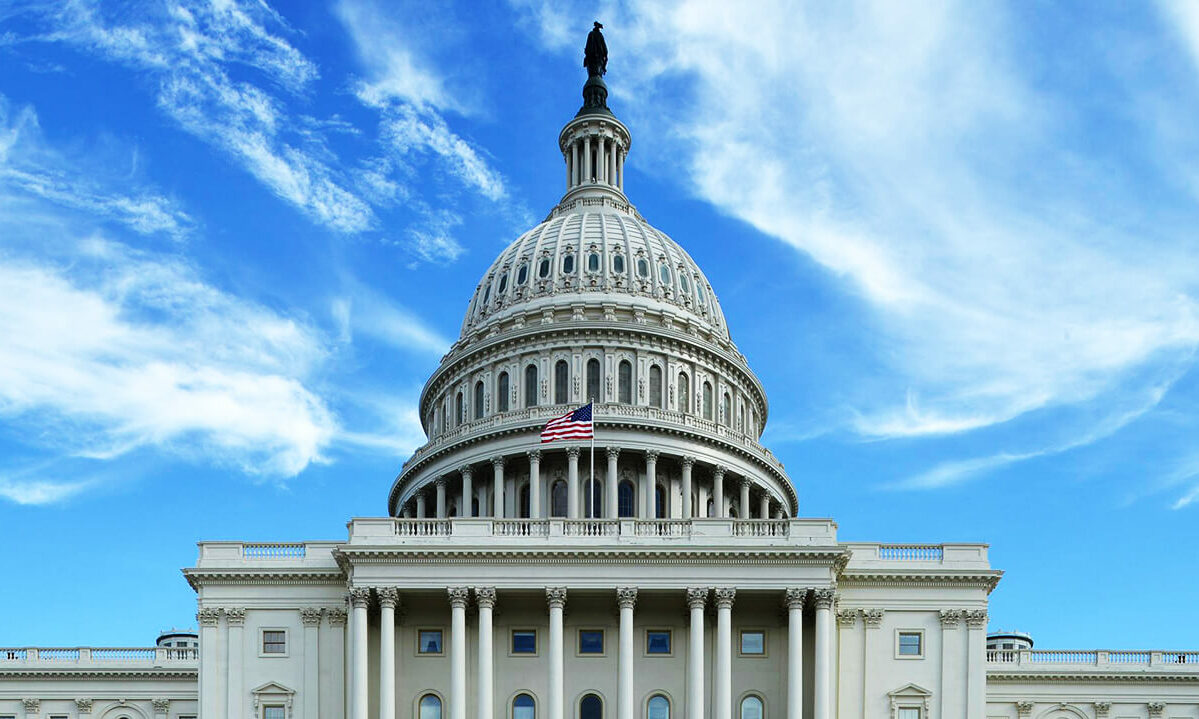
  3. Who are the heroes presented? Do they tend to be angry – fighting an unjust society or government? Do they tend to be modern heroes only? Do they tend to be only secular leaders? For example, the U. S. Capitol displays some 100 statues of the most important individuals in America’s history; a significant percentage of those statues are of ministers and Christian leaders. Will your children receive in their textbooks at least the same view of American heroes that is presented in America’s pre-eminent government building?

Conclusion

When examining a text, always remember that your children do not know as much about history as you do. Consequently, they have no basis for identifying bias. Therefore, examine each text as if you knew nothing at all about history except what is presented in that text. On that basis, will you be pleased with the tone toward America inculcated in your child through that text? If not, then urge your school to get a better text or be diligent to supplement for your children what is missing or wrongly presented in the text.

It is not melodramatic to state that America’s future rests on what is taught to our children, for as Abraham Lincoln wisely observed:

The philosophy of the school room in one generation will be the philosophy of government in the next. (attributed)

Famous American educator Noah Webster therefore rightly admonished:

The education of youth should be watched with the most scrupulous attention. . . . [It] lays the foundations on which both law and gospel rest for success.

Indeed!

Ten Commandments Displays

Introduction

While there have been dozens of rulings striking down Ten Commandments displays (another indication that federal judges need to be appointed to the courts who are well-versed in original constitutional understandings); no ruling has been more publicized than that against Judge Roy Moore in Alabama. In that case, the 11th Federal Circuit Court of Appeals ruled that a 5,280 pound granite monument of the Ten Commandments could not be displayed in the rotunda of the Alabama State Judicial Building.

The ACLU, Americans United for Separation of Church and State, and the Southern Poverty Law Center filed suit against the Ten Commandments display on behalf of three attorneys. And why did those attorneys want the monument removed? They alleged that they had been “personally offended” by the monument and “as a result, suffered direct injury.” A three-judge panel of the 11th Federal Circuit Court of Appeals agreed with them and prohibited the display.

Court Decision

In order to reach their decision, the panel of federal judges transformed themselves into an ecclesiastical council of theologians. They ruled that the version of the Commandments posted by Judge Moore was a “Protestant” version and that “Jewish, Catholic, Lutheran and Eastern Orthodox faiths use different parts of their holy texts as the authoritative Ten Commandments.”

Strange! I thought that “Do not kill” and “Do not steal” meant the same regardless of the version! In fact, I am not aware of any person in America who, after seeing the granite monument, would cry out, “I have just seen the 9th command forbidding perjury, but it is a Protestant version of the Ten Commandments that I just saw, so I cannot obey it for I am a Lutheran (or a Catholic, or a Jew, or whatever).”

The 11th Circuit had ignored an elementary principle of law—and thus a fundamental responsibility of the courts: establish the spirit and intent of a law before making any ruling about it. Signer of the Constitution John Dickinson had explained the importance of this legal principle:

[N]othing is more certain than that the forms of liberty may be retained when the substance is gone. In government, as well as in religion, “the letter killeth, but the spirit giveth life.” 2 Cor. 3:6

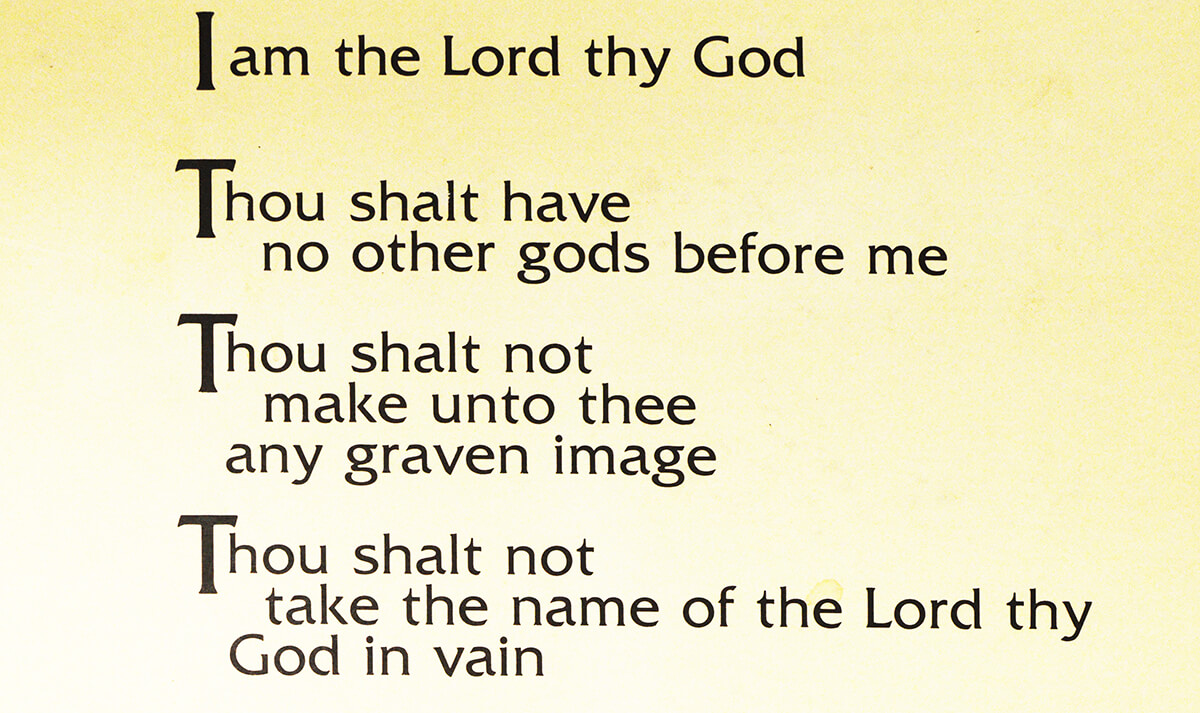
The Ten Commandments

Actually, the Ten Commandments themselves were the result of God’s demonstration of this principle. When God delivered the Commandments, He told Moses “According to the tenor of those words I have made a covenant with you” (Exodus 34:27). That is, God Himself declared that the Ten Commandments were merely the general theme (the tenor) of what He wanted. “Don’t steal,” “Don’t kill,” “Don’t commit perjury,” etc. were simply the summation of over 600 laws given at or about the same time.

That these laws simply represent the spirit of all civil and criminal laws was made clear by an elderly Texas woman, Esther Armstrong. Despite her advanced years, Esther maintained a ministry in local prisons and jails, frequently visiting the inmates, all of who considered her as their own grandmother. One day, one of the “jail-house attorney” inmates (a prisoner who has become obsessed with the study of the law) told Esther in amazement: “Mama Esther? Did you realize that there are over one-hundred thousand laws that will put you in jail?” To which she promptly replied, “Do you realize that there are Ten that will keep you out?”

11th Circuit Court

Nevertheless, the federal judges refused to consider the general purpose of the Commandments. Instead, they focused on theological minutia about which version of the Ten Commandments was on display (which they apparently felt completely competent to address) much in the same way that theologians of former generations vigorously debated such useless and inane topics as how many angels would fit on the head of a pin.

Perhaps only a liberal activist judge, an ACLU attorney, or a member of Americans United for the Separation of Church and State (i.e., groups and individuals who have demonstrated their distaste for religion in general) would make this “theological” distinction as they did in this case. I am quite sure that Judge Moore, just like 99.9 percent of Americans, was not aware (nor would he have cared) that there were allegedly different theological versions of the Commandments. As a judge, he was concerned with general behavior, not theology.

Furthermore, I firmly believe that no matter which version of the Ten Commandments Judge Moore would have displayed (whether Jewish, Catholic, Protestant, or one of each), the same arguments still would have been used against him.

The three theologians (Oops! My bad!!! I meant the three judges) in the 11th Circuit who delivered the decision even personally impugned Moore, comparing him to “those Southern governors who attempted to defy federal court orders during an earlier era.” Amazing! Apparently in the minds of those judges, Judge Moore’s displaying the Ten Commandments must be a sin akin to racism! The three also forcefully pronounced to Moore a warning that when the time came, he would obey their order to remove the Commandments.

Protests

Following the 11th Circuit’s decision, federal district judge Myron Thompson (who originally ruled against Moore before the case rose to the 11th Circuit) promptly issued his own order that the monument be removed. Now! Even before Judge Moore’s appeal to the Supreme Court had been filed. Judge Moore refused to comply with that order, and hundreds rallied outside the court building in an effort to prevent the removal of the monument.

Dozens who exercised their First Amendment right “peaceably to assemble and to petition the government for a redress of grievances” were handcuffed and arrested, including an elderly woman in a wheel chair. She was one among hundreds willing to resort to peaceful civil disobedience in order to preserve respected symbols of our nation’s heritage and the constitutional right to free exercise of religion. Amazing! Americans are being arrested for trying to preserve the nation’s moral law rather than break it!

This same type of peaceful civil disobedience eventually turned the tide in the civil rights’ protests of the early 1960s. When Americans saw blacks arrested and beaten by police simply for sitting in the wrong seat on a bus, or going to the wrong table in a cafe, public sentiment propelled legislators to action to provide a political solution. Such may well be the effect of the current arrests—if they continue for an extended period. Perhaps the current publicity will cause Christians to stand up not only for this display but also for those in their own local communities.

Judge Moore

Interestingly, voices of condemnation against Judge Moore have been raised around the nation, alleging that he refuses to follow “the rule of law.” Such claims constitute some of the more civically-illiterate statements made in recent years.

Consider: in every student civics or government book in America is a page on “How a Bill Becomes a Law.” Anyone who examines those pages will notice that the judiciary has no role in making law; laws come from bills passed by the legislature and signed by the president or governor. Since no such law has been passed in this case, what “rule of law” is Judge Moore not upholding? Can it actually be that these critics talking about “the rule of law” believe that an order by a single unelected federal judge is actually the equivalent of a law? Apparently so.

Don’t misunderstand: this is not to suggest that judicial rulings should be ignored based on the personal predilections of an individual in a case; however, this ruling goes against every deeply embedded legal standard in America’s common law, and Judge Moore’s refusal is not based solely on his selfish or personal inclinations. (To learn how deeply the Ten Commandments have been implanted into American law and traditions, read our legal brief on this issue.)

Actions Against Him

Following Judge Myron Thompson’s edict, the other eight justices on the Alabama Supreme Court announced their unanimous opposition to Judge Moore’s position and agreed to cooperate in the removal of the monument. Judge Moore was subsequently suspended from his judgeship by the Alabama Judicial Inquiry Commission for his refusal to comply with the federal judge’s order.

Importantly, Judge Moore is elected (as are the other eight State Supreme Court  judges) and therefore ultimately accounts directly to the people of Alabama, who can have the final say on this issue. When that time comes, the decision of the voters likely will not agree with the State’s other Supreme Court judges or the State’s Judicial Inquiry Commission. Moore was already well-known for his stand for the Ten Commandments before he was elected to the Supreme Court (he had already won three legal decisions on the Ten Commandments at the time of his election) and recent polls show that 77 percent of the State supports the display.

Conclusion

The U. S. Congress is well aware of the situation in Alabama, and the House has already taken direct action.

Rep. John Hostettler introduced, and the House overwhelmingly passed (260-161), an amendment that prohibits federal funds from being used to enforce the judicial order against the display. Similarly, Rep. Robert Aderholt has introduced (and the House has twice passed) the Ten Commandments Defense Act, allowing State and local communities rather than federal judges to have the final say in displays of the Ten Commandments. The Senate Democrats have killed the bill each time.

Sen. Wayne Allard (R-CO) has introduced a bill (S 1558) that applies powers from Art. III, Sec. 2 of the U. S. Constitution to restrict the federal judiciary’s right to rule on this issue, but the bill is not likely to move unless Democratic Senators feel substantial pressure to do so.

The monument was eventually removed from the Rotunda and relocated in a remote non-public room in the building. This is simply a reconfirmation of the overall judicial message of recent years: if you must have a religious expression, it must be done in private (like pornography), not out in public where others can see it.


Recommended Reading List

There is no substitute for immersing oneself in original, primary source material if one hopes to understand American history. However, it is also useful (and enjoyable) to read books about great American leaders and events. The following list is far from comprehensive, but it includes works that we have found to be helpful. We hope it is a valuable starting place for those interested in learning more about America’s Godly heritage.

WallBuilders has provided the following list of books to provide helpful information and sources for people who want to dig deeper and research on their own. We do not endorse every aspect of every book, but we believe that each provides a good, balanced, and reliable overview its subject. Some of these books are available as ebooks, while some may be found at libraries or can be purchased through online booksellers.

American History

  • Gary Amos, Defending the Declaration (Providence Foundation: 1996)
  • Taylor Branch, Parting The Waters: America in the King Years, 1954-1963 (Simon & Schuster, 1988)
  • Derek H. Davis, Religion and the Continental Congress, 1774-1789: Contributions to Original Intent (Oxford University Press, 2000)
  • Daniel L. Dreisbach, Reading the Bible with the Founding Fathers (Oxford University Press, 2016)
  • Daniel L. Dreisbach and Mark David Hall, The Sacred Rights of Conscience: Selected Readings on Religious Liberty and Church-State Relations in the American Founding (Liberty Fund Press, 2009)
  • Daniel L. Dreisbach, Mark D. Hall, and Jeffry H. Morrison, The Forgotten Founders on Religion and Public Life (Notre Dame University Press, 2009)
  • Daniel L. Dreisbach, Mark D. Hall, and Jeffry H. Morrison, The Founders on God and Government (Rowman & Littlefield, 2004)
  • Dinesh D’Souza,What’s So Great About America? (Regnery Publishing, 2015)
  • John Eidsmoe, Christianity and the Constitution: The Faith of our Founding Fathers (Baker Academic, 1995)
  • David D. Hall, A Reforming People: Puritanism and the Transformation of Public Life in New England (Alfred A. Knopf, 2011)
  • Philip Hamburger, The Separation of Church and State (Harvard University Press 2004)
  • Benjamin Hart, Faith and Freedom: The Christian Roots of American Liberty (Lewis & Stanley, 1988)
  • James H. Hutson, Religion and the Founding of the American Republic (Washington, D.C.: Library of Congress, 1998)
  • Paul Johnson, A History of the American People (HarperCollins, 1997)
  • Thomas R. Kidd, God of Liberty: A Religious History of the American Revolution (Basic Books, 2010)
  • Barry Loudermilk, And Then They Prayed. Moments in American History Impacted by Prayer (Campbell: CA: FastPencil, 2011)
  • Donald S. Lutz, The Origins of American Constitutionalism (Baton Rouge: Louisiana State University Press, 1988)
  • Peter Marshall & David Manuel, The Light and the Glory: 1492-1793 (Grand Rapids, MI: Fleming H. Revell Company, 1977, reprint 2009)
  • Peter Marshall & David Manuel, From Sea to Shining Sea: 1787-1837 (Grand Rapids, MI: Fleming H. Revell Company, 1985, reprint 2009)
  • Peter Marshall & David Manuel, Sounding Forth The Trumpet: 1837-1860 (Grand Rapids, MI: Fleming H. Revell Company, 1998, reprint 2001)
  • Stephen McDowell, America’s Providential History (Providence Foundation, 1991)
  • Stephen McDowell, Liberating the Nations (Providence Foundation, 1995)
  • William H. McGuffey, McGuffey’s Eclectic Reader (Various publishers: various editions between 1836-1901). These books covered grades 1 through 5.
  • James McPherson, Battle Cry Freedom: The Civil War Era (Oxford University Press, 1988)
  • Robert Middlekauff, The Glorious Cause: The American Revolution: 1763-1789 (Oxford University Press, 2005)
  • Clinton Rossiter, 1787 The Grand Convention (WW Norton, 1966)
  • Leland Ryken, Worldly Saints: The Puritans As They Really Were (Zondervan, 1990)
  • Barry Alan Shain, The Myth of American Individualism: The Protestant Origins of American Political Thought (Princeton University Press, 1994)
  • Harry Stout, The New England Soul: Preaching and Religious Culture in Colonial New England 2nd (Oxford University Press, 2011)
  • Thomas G. West, Vindicating the Founders (New York: Rowman & Littlefield Publishers, 1997, reprint 2001)

Biographies

  • Andrew Allison, The Real Thomas Jefferson (Washington, D. C.: National Center for Constitutional Studies, 1983)
  • Glenn Beck, Being George Washington: The Indispensable Man, as You’ve Never Seen Him (New York: Threshold Editions, 2011)
  • E. Bradford, Worthy Company: Brief Lives of the Framers of the United States Constitution
(Plymouth Rock Foundation: 1982)
  • Richard Carwardine, Lincoln: A Life of Purpose and Power (Knopf, 2003)
  • Ron Charnow, Alexander Hamilton (Penguin Press, 2004)
  • Allen Guelzo, Abraham Lincoln: Redeemer President (Eerdmans, 2002)
  • Mark David Hall, Roger Sherman and the Creation of the American Republic (Oxford University Press, 2012)
  • Charles E. Hambrick-Stowe, Charles G. Finney and the spirit of American Evangelicalism (Eerdmans, 1996)
  • Bill Kauffman, Forgotten Founder, Drunken Prophet: The Life of Luther Martin (ISI Books, 2008)
  • Michael Kazin, A Godly Hero: The Life of William Jennings Bryan (Anchor, 2007)
  • Thomas Kidd, Patrick Henry: First Among Patriots (Basic Books, 2011)
  • Peter Lillback, with Jerry Newcombe, George Washington’s Sacred Fire (Providence Forum Press, 2006)
  • George Marsden, Jonathan Edwards: A Life (Yale University Press, 2004)
  • David McCullough, John Adams (Simon & Schuster, 2008)
  • Stephen McDowell, Apostle of Liberty: The World-Changing Leadership of George Washington (Cumberland Publishing, 2007)
  • Robert Middlekauff, The Mathers: Three Generations of Puritan Intellectuals, 1596-1728 (University of California Press, 1999)
  • Edmund Morgan, Roger Williams: The Church and the State (Harcourt Brace Jovanovich, 1967)
  • Edmund Morgan, The Puritan Dilemma: The Story of John Winthrop (Scott, Foresman, and Company, 1958)
  • Jeffry H. Morrison, John Witherspoon and the Founding of the American Republic (University of Notre Dame Press, 2005)
  • Michal Novak and Jana Novak, Washington’s God: Religion, Liberty, and the Father of Our Country (Perseus Books, 2006)
  • Charles Page Smith, James Wilson: Founding Father, 1742-1798 (1956; reprint, University of North Carolina Press, 2011)
  • PragerU, Trailblazers of America (PragerU, 2025): biographical resource for middle school ages
  • Ira Stoll, Samuel Adams: A Life (Free Press, 2009)
  • Harry Stout, The Divine Dramatist: George Whitefield and the Rise of Modern Evangelicalism (Eerdmans, 1991)
  • Michael Toth, Founding Federalist: The Life of Oliver Ellsworth (ISI Books, 2011)
  • Harlow Giles Unger, John Quincy Adams (Da Capo, 2012)
  • Gordon S. Wood, The Americanization of Benjamin Franklin (Penguin Press, 2004)

Christianity & Worldview

  • Dinesh D’Souza, What’s So Great About Christianity? (Regnery Publishing, 2008)
  • John Eidsmoe, Columbus & Cortez, Conquerors for Christ (New Leaf Press, 1992)
  • James Garlow, Well Versed: Biblical Answers to Today’s Tough Issues (Regnery Faith, 2016)
  • Wayne Grudem, Politics According to the Bible: A Comprehensive Resource for Understanding Modern Political Issues in Light of Scripture (Zondervan, 2010)
  • Nathan O. Hatch, The Democratization of American Christianity (Yale University Press, 1991)
  • Martin Marty, A Short History of Christianity ed. (Augsburg Fortress Publishers, 1987)
  • Eric Nelson, The Hebrew Republic: Jewish Sources and the Transformation of European Political Thought (Harvard University Press, 2010)
  • Quentin Skinner, The Foundations of Modern Political Thought: The Renaissance (Cambridge University Press, 1978)
  • Quentin Skinner, The Foundations of Modern Political Thought: The Age of Reformation (Cambridge University Press, 1978)
  • Rodney Stark, The Victory of Reason: How Christianity Led to Freedom, Capitalism, and Western Success (Random House, 2005)
  • John Witte Jr., The Reformation of Rights: Law, Religion, and Human Rights in Early Modern Calvinism (Cambridge University Press, 2007)


Civic Ignorance on Display

Introduction

Many stories have already been written about CNN anchor Chris Cuomo’s embarrassing historical gaff when he told a judge: “Our rights do not come from God, your honor, and you know that. They come from man.” 1 Of course, American governing documents state exactly the opposite.

But what has not been adequately covered is why Cuomo might make such a statement. I, for one, am not particularly surprised by it – and I don’t say that because of his liberal pedigree as the son of former New York Governor Mario Cuomo, the brother of current Governor Andrew Cuomo, or because he graduated from Yale. Rather, I say that because he is 44 years old, and therefore graduated from American schools in the past three decades. After all, according to recent studies:

  • Two-thirds of Americans cannot identify the three branches of government (legislative, executive, judicial), 2 three-fourths do not know what the Judiciary Branch does, 3 and eight in ten cannot name even one of the federal government’s powers. 4
  • Seven in ten do not know that the Constitution is the supreme law of the land. 5
  • Eight in ten cannot name even two of the rights listed in the Declaration, 6 and forty-four percent are unable to define the Bill of Rights. 7
  • Only 1 in 1000 can name the five freedoms protected by the First Amendment (speech, religion, press, assembly, and petition). 8

We actually pay a lot to get these abysmal results – $12,000 per year per student, or well over $140,000 in their twelve years of public education. 9

Celebrate Freedom Week

No wonder states like Arizona and North Dakota recently enacted laws requiring that students pass the nation’s 100-question immigration test in order to graduate. 10 And why not? Shouldn’t native born Americans know at least as much about America as our foreign immigrants are required to know?

Reflecting the same concern, other states have passed laws establishing annual Celebrate Freedom Week, 11 during which public school students study the Declaration, Constitution, and Bill of Rights; and those in grades 3 through 12 learn and recite the specific section of the Declaration of which Cuomo was apparently unaware:

We hold these truths to be self-evident: that all men are created equal, that they are endowed by their Creator with certain unalienable rights, that among these are life, liberty, and the pursuit of happiness, that to secure these rights, governments are instituted among men, deriving their just powers from the consent of the governed.

Unless we take decisive action regarding civic education, growing numbers of Americans will make the same mistake Cuomo did – or worse yet, we may reach a time when we no longer recognize that what he said was a mistake.

Inalienable Rights Defined

Incidentally, in case there is any confusion about the intent behind the Declaration of Independence’s unambiguous language that our inalienable rights come from God, consider the words of those who created our government.

John Dickinson, a signer of the Constitution, defined an inalienable right as one “which God gave to you and which no inferior power has a right to take away.” 12 He further explained that human governments . . .

could not give the rights essential to happiness. . . . We claim them from a higher Source – from the King of kings, and Lord of all the earth. They are not annexed to us by parchments and seals. They are created in us by the decrees of Providence, which establish the laws of our nature. They are born with us; exist with us; and cannot be taken from us by any human power, without taking our lives. 13

John Adams said that inalienable rights are . . .

antecedent to all earthly government; rights that cannot be repealed or restrained by human laws; rights derived from the Great Legislator of the Universe. 14

Inalienable Rights Come From God

Alexander Hamilton explained that inalienable rights . . .

are not to be rummaged for among old parchments or musty records. They are written, as with a sunbeam, in the whole volume of human nature by the hand of the Divinity itself and can never be erased or obscured by mortal power. 15

Samuel Adams avowed that:

They are imprinted by the finger of God on the heart of man. 16

And according to Thomas Jefferson:

[C]an the liberties of a nation be thought secure when we have removed their only firm basis: a conviction in the minds of the people that these liberties are of the gift of God? – that they are not to be violated but with His wrath? 17

Conclusion

Understanding this, John Jay, an author of the Federalist Papers and the original Chief Justice of the Supreme Court, therefore wisely urged:

I . . . recommend a general and public return of praise and thanksgiving to Him from Whose goodness these blessings descend. The most effectual means of securing the continuance of our civil and religious liberties is always to remember with reverence and gratitude the Source from which they flow. 18

The Founding Fathers were clear about our rights coming from God, but Cuomo chose the opposite position.


Endnotes

1. Cheryl K. Chumley, “Chris Cuomo, CNN Host, to Roy Moore: ‘Our Rights Do Not Come from God’,” Washington Times, February 12, 2015.

2. “Only One Third of Americans Can Name Three Branches of Government,” infowars.com, March 8, 2009; Brit Hume, “Three Stooges, But Not Three Branches of Gov’t,Fox News, August 15, 2006. See also, Lion Calandra, “Why do Americans get the Constitution so wrong?The Christian Science Monitor, September 17, 2010.

3. “Americans Failing Citizenship Test Again,” AEI, April 30, 2012.

4. “Take the Quiz: What We Don’t Know,” Newsweek, March 30, 2011.

5. “Americans Failing Citizenship Test Again,” AEI, April 30, 2012; “Take the Quiz: What We Don’t Know,” Newsweek, March 30, 2011.

6. “Americans Failing Citizenship Test Again,” AEI, April 30, 2012.

7. “Take the Quiz: What We Don’t Know,” Newsweek, March 30, 2011.

8. “Study: More know ‘The Simpsons’ than First Amendment rights,” USA Today, March 1, 2006. See also, “34% say First Amendment goes too far in protecting rights,” First Amendment Center, July 16, 2013; “State of the First Amdnment: 2013,” First Amendment Center.

9. “Fast Facts,” Institute of Education Sciences (accessed on February 16, 2015).

10. Reid Wilson, “Arizona Will Require High School Students to Pass Citizenship Test to Graduate. Can You Pass?,” The Washington Post, January 16, 2015; James MacPherson, “North Dakota May Require High School Students to Pass Citizenship Test,” Huffington Post, December 1, 2014.

11. “Celebrate Freedom Week,” Rick Green.com (accessed on February 16, 2015).

12. John Dickinson, Letters From a Farmer in Pennsylvania (New York: The Outlook Company, 1903), p. xlii, “Introduction.”

13. John Dickinson, The Political Writings of John Dickinson (Wilmington: Bonsal and Niles, 1801), Vol. I, pp. 111-112.

14. John Adams, The Works of John Adams, Charles Francis Adams, editor (Boston: Charles C. Little and James Brown, 1851), Vol. III, p. 449, “A Dissertation on the Canon and Feudal Law.”

15. Alexander Hamilton, The Works of Alexander Hamilton, John Church Hamilton, editor (New York: John F. Trow, 1850), Vol. II, p. 80, “The Farmer Refuted.”

16. Samuel Adams, The Writings of Samuel Adams, Henry Alonzon Cushing, editor (New York: G. P. Putnam’s Sons, 1908), Vol. IV, p. 356, “to the Legislature of Massachusetts, January 17, 1794.”

17. Thomas Jefferson, Notes on the State of Virginia (London: John Stockdale, 1787), p. 272, “Query XVIII.”

18. William Jay, The Life of John Jay: With Selections From His Correspondence and Miscellaneous Papers (New York: J. & J. Harper, 1833), Vol. I, pp. 457-458, to the Committee of the Corporation of the City of New York on June 29, 1826.

Stansbury’s Elementary Catechism on the Constitution (1828)

A catechism is defined as “a set of formal questions put as a test” and can be on a variety of subjects.

An 1828 book by Arthur Stansbury presented a series of questions and answers on the U.S. Constitution. This work, Elementary Catechism on the Constitution of the United States: For the Use of Schools, is mentioned in this video by David Barton. Test your knowledge of the Constitution with this book — and below are a few questions from this catechism!


Q. Cannot all the people of a country govern themselves?

Q. Who is to determine whether any law is contrary to the Constitution or no, the people themselves?

Q. Suppose all the members of the Senate, or all the members of the House of Representatives do not attend a meeting, can those who do attend make laws without them?

Q. Who executes the laws which Congress have made, that is, who takes care that every body shall obey the laws?

Q. Can he [the answer to the above] make the law?

Q. How are the Judges of the Courts of the United States appointed?

Q. How long do they [these Judges] remain in office?

Q. Has the United States Government any power but such as is contained in the Constitution?


Stumped? See the answers below. And be sure to check out the complete book!


A.If every man was perfectly virtuous, and knew what would be best for himself and others, they might. But this is far from the case; and therefore the people of every country are and must be governed.

A. No: but certain persons whom they have appointed, [called Judges of the Supreme Court of the United States].

A. If more than one half are present, they have in most cases power to do whatever the whole number could have done. More than one half are called a Majority, less than one half are called a Minority. As many as are necessary to do business are called a Quorum.

A. The President of the United States.

A. Not at all. These two powers, of making law, and executing law, are kept by the Constitution, entirely separate; the power that makes the law cannot execute it,and the power the executes the law cannot make it. (The one of these powers is called the Legislative, and the other is called the Executive power.

A. By the president, with the advice and consent of the Senate.

A. During good behavior; that is, until they resign their office or are turned out of it for some great offence.

A. No.

The Declaration of Independence

When in the course of human events, it becomes necessary for one people to dissolve the political bands which have connected them with another, and to assume among the powers of the earth the separate and equal station to which the laws of nature and of nature’s God entitles them, a decent respect to the opinions of mankind requires that they should declare the causes which impel them to the separation.

We hold these truths to be self-evident, that all men are created equal, that they are endowed by their Creator with certain unalienable rights, that among these are life, liberty and the pursuit of happiness. That to secure these rights, governments are instituted among men, deriving their just powers from the consent of the governed. That whenever any form of government becomes destructive of these ends, it is the right of the people to alter or to abolish it and to institute new government, laying its foundation on such principles and organizing its powers in such form as to them shall seem most likely to effect their safety and happiness. Prudence, indeed, will dictate that governments long established should not be changed for light and transient causes; and accordingly, all experience hath shown that mankind are more disposed to suffer while evils are sufferable than to right themselves by abolishing the forms to which they are accustomed. But when a long train of abuses and usurpations, pursuing invariably the same object, evinces a design to reduce them under absolute despotism, it is their right, it is their duty, to throw off such government and to provide new guards for their future security. Such has been the patient sufferance of these Colonies; and such is now the necessity which constrains them to alter their former systems of governments. The history of the present King of Great Britain is a history of repeated injuries and usurpations, all having in direct object the establishment of an absolute tyranny over these States. To prove this, let facts be submitted to a candid world.

He has refused his assent to laws, the most wholesome and necessary for the public good.

He has forbidden his Governors to pass laws of immediate and pressing importance, unless suspended in their operation till his assent should be obtained; and when so suspended, he has utterly neglected to attend to them.

He has refused to pass other laws for the accommodation of large districts of people unless those people would relinquish the right of representation in the legislature, a right inestimable to them and formidable to tyrants only.

He has called together legislative bodies at places unusual, uncomfortable, and distant from the depository of their public records, for the sole purpose of fatiguing them into compliance with his measures.

He has dissolved representative Houses repeatedly for opposing with manly firmness his invasion on the rights of the people.

He has refused for a long time, after such dissolutions, to cause others to be elected; whereby the legislative powers, incapable of annihilation, have returned to the people at large for their exercise; the State remaining in the meantime exposed to all the dangers of invasion from without and convulsions within.

He has endeavored to prevent the population of these States; for that purpose obstructing the laws for naturalization of foreigners; refusing to pass others to encourage their migrations hither, and raising the conditions of new appropriations of lands.

He has obstructed the administration of justice by refusing his assent to laws for establishing judiciary powers.

He has made judges dependent on his will alone for the tenure of their offices and the amount and payment of their salaries.

He has erected a multitude of new offices and sent hither swarms of officers to harass our people and eat out their substance.

He has kept among us, in times of peace, standing armies without the consent of our legislature.

He has affected to render the military independent of and superior to the civil power.

He has combined with others to subject us to a jurisdiction foreign to our constitution and unacknowledged by our laws; giving his assent to their acts of pretended legislation:

For quartering large bodies of armed troops among us:

For protecting them, by a mock trial, from punishment for any murders which they should commit on the inhabitants of these States:

For cutting off our trade with all parts of the world:

For imposing taxes on us without our consent:

For depriving us in many cases of the benefits of trial by jury:

For transporting us beyond seas to be tried for pretended offenses:

For abolishing the free system of English laws in a neighboring province, establishing therein an arbitrary government, and enlarging its boundaries so as to ren-der it at once an example and fit instrument for introducing the same absolute rule into these Colonies:

For taking away our charters, abolishing our most valuable laws, and altering fundamentally the forms of our governments:

For suspending our own legislatures, and declaring themselves invested with power to legislate for us in all cases whatsoever.

He has abdicated government here, by declaring us out of his protection and waging war against us.

He has plundered our seas, ravaged our coasts, burnt our towns, and destroyed the lives of our people.

He is at this time transporting large armies of foreign mercenaries to compleat the works of death, desolation and tyranny, already begun with circumstances of cruelty and perfidy scarcely paralleled in the most barbarous ages, and totally unworthy the head of a civilized nation.

He has constrained our fellow citizens taken captive on the high Seas to bear Arms against their country, to become the executioners of their friends and brethren, or to fall themselves by their hands.

He has excited domestic insurrections amongst us, and has endeavoured to bring on the inhabitants of our frontiers, the merciless Indian savages, whose known rule of warfare, is an undistinguished destruction of all ages, sexes and conditions.

In every stage of these oppressions we have petitioned for redress in the most humble terms: Our repeated petitions have been answered only by repeated injury. A Prince whose character is thus marked by every act which may define a tyrant, is unfit to be the ruler of a free people.

Nor have we been wanting in attentions to our Brittish brethren. We have warned them from time to time of attempts by their legislature to extend an unwarrantable jurisdiction over us. We have reminded them of the circumstances of our emigration and settlement here. We have appealed to their native justice and magnanimity and we have conjured them by the ties of our common kindred to disavow these usurpations which would inevitably interrupt our connections and correspondence. They, too, have been deaf to the voice of justice and of consanguinity. We must, therefore, acquiesce in the necessity which denounces our separation and hold them, as we hold the rest of mankind, enemies in war, in peace friends.

We, therefore, the Representatives of the United States of America, in general Congress assembled, appealing to the Supreme Judge of the world for the rectitude of our intentions, do, in the name and by the authority of the good people of these Colonies, solemnly publish and declare that these United Colonies are, and of right ought to be, free and independent States; that they are absolved from all allegiance to the British Crown and that all political connection between them and the State of Great Britain is and ought to be totally dissolved; and that as free and independent States, they have full power to levy war, conclude peace, contract alliance, establish commerce, and do all other acts and things which independent States may of right do. And for the support of this Declaration, with a firm reliance on the protection of Divine Providence, we mutually pledge to each other our lives, our fortunes, and our sacred honor.

Signers of the Declaration of Independence

NEW HAMPSHIRE: Josiah Bartlett, William Whipple, Matthew Thornton

MASSACHUSETTS: John Hancock, John Adams, Samuel Adams, Robert Treat Paine

RHODE ISLAND: Elbridge Gerry, Stephen Hopkins, William Ellery

CONNECTICUT: Roger Sherman, Samuel Huntington, William Williams, Oliver Wolcott

NEW YORK: William Floyd, Philip Livingston, Francis Lewis, Lewis Morris

NEW JERSEY: Richard Stockton, John Witherspoon, Francis Hopkinson, John Hart, Abraham Clark

PENNSYLVANIA: Robert Morris, Benjamin Rush, Benjamin Franklin, John Morton, George Clymer, James Smith, George Taylor, James Wilson, George Ross

DELAWARE: Ceasar Rodney, George Read, Thomas McKean

MARYLAND: Samuel Chase, Thomas Stone, William Paca, Charles Carroll of Carrollton

VIRGINIA: George Wythe, Richard Henry Lee, Thomas Jefferson, Benjamin Harrison, Thomas Nelson, Jr., Francis Lightfoot Lee, Carter Braxton

NORTH CAROLINA: William Hooper, Joseph Hewes, John Penn

SOUTH CAROLINA: Edward Rutledge, Thomas Heyward, Jr., Thomas Lynch, Jr., Authur Middleton

GEORGIA: Button Gwinnett, Lyman Hall, George Walton

Eighth Grade Exit Exam

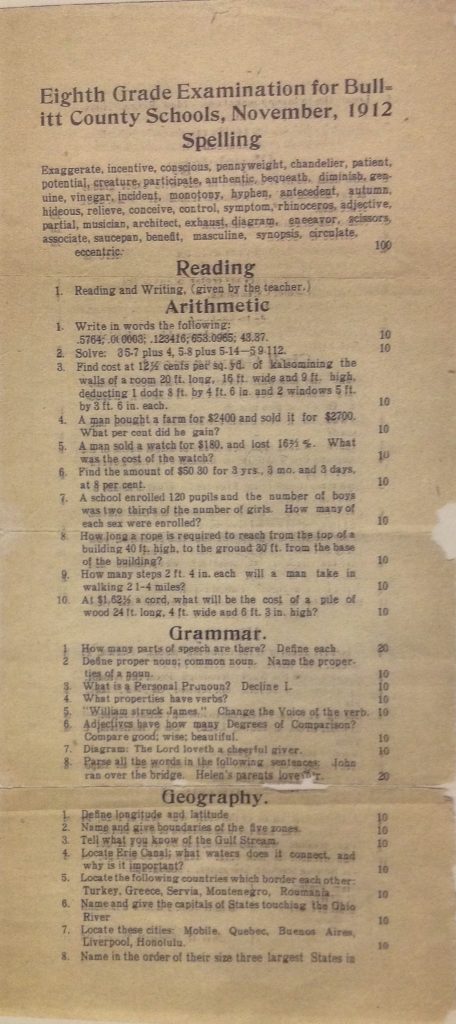
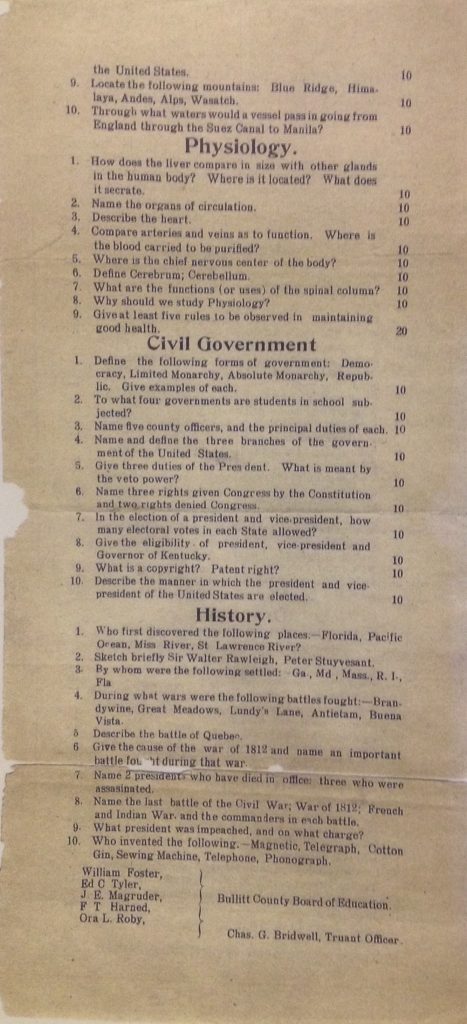
In the late 1800s, the 8th grade exit exam was a major milestone of education in the United States. In states like Kansas, students had to  correctly answer hard questions in subjects like reading, writing, arithmetic, geography, and US history to graduate from grammar school. For many students, especially in farming towns, this was the highest level of school they would attend. High schools existed, but they were mostly found in cities, and not every town had one. Passing the 8th grade exam meant a student was ready for work, to help on the farm, or even become a teacher. As time went on, some schools began to change how they tested students, but in the 1800s, these exams were a serious and important indicator of competency.

Below is an example of an 8th Grade Exam. Click here to see the answers to the questions.