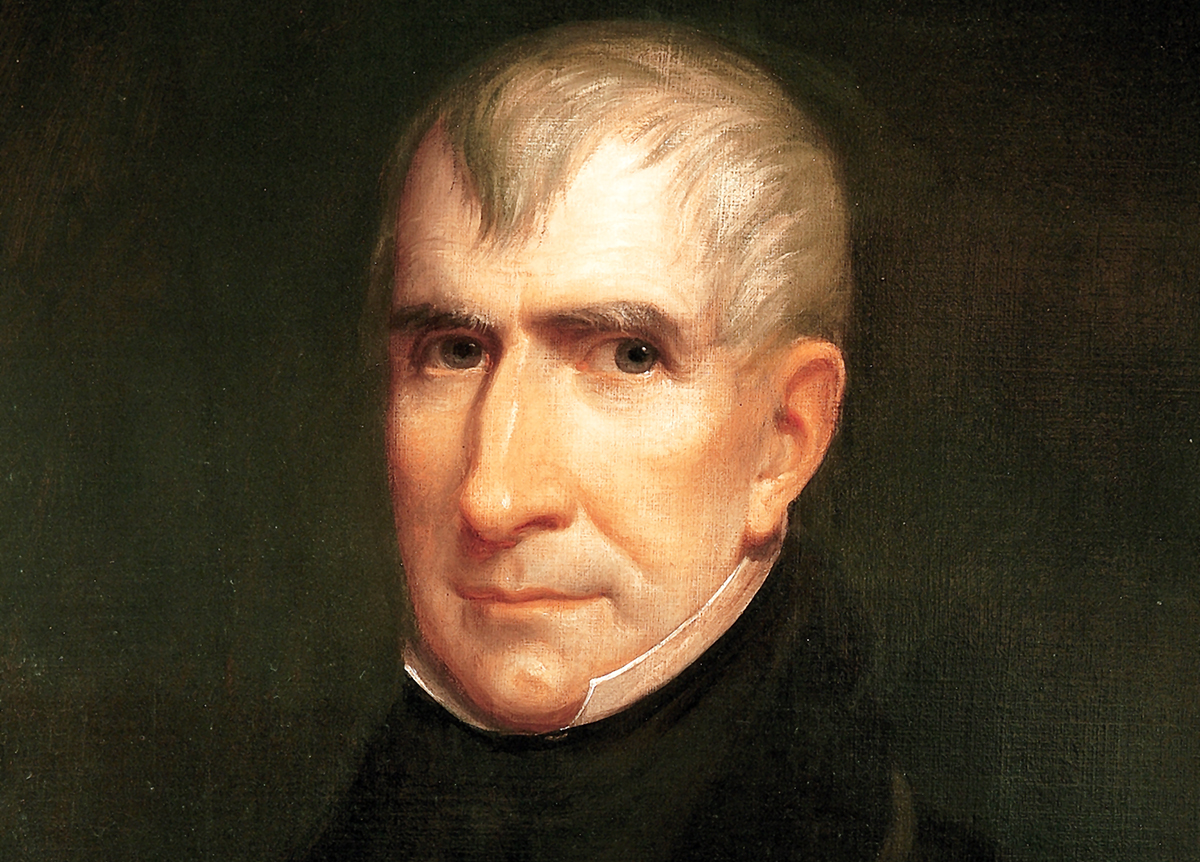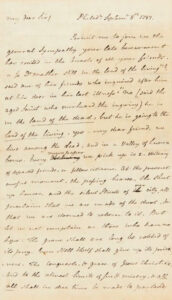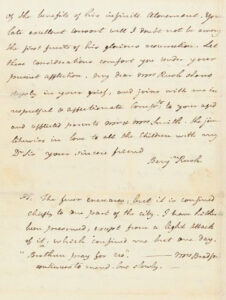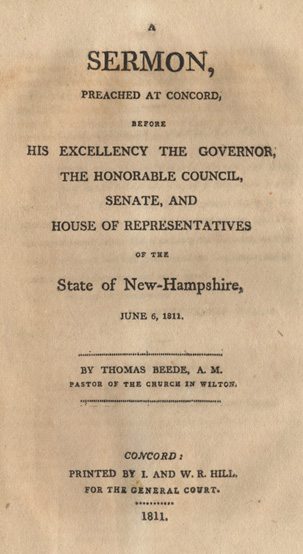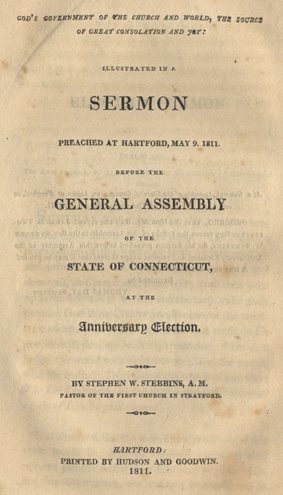
William Henry Harrison 1835

Sermon – Fasting – 1841, Massachusetts


Bela Bates Edwards (1802-1852) graduated from Amherst in 1824 and was licensed to preach in 1831. He served in the American Education Society, as editor of several publications, Professor of the Hebrew Language and later the chair of Biblical Literature at Andover Theological Seminary. This sermon was preached on May 14, 1841, a fast day mourning the death of President William Henry Harrison.


ADDRESS

DELIVERED ON THE DAY OF THE

NATIONAL FAST, MAY 14, 1841,

AT A UNITED MEETING OF THE

RELIGIOUS SOCIETIES IN ANDOVER.

BY B. B. EDWARDS,

PROF. IN THE THEOLOGICAL SEMINARY, ANDOVER.

ANDOVER:

PUBLISHED BY WILLIAM PEIRCE.

ALLEN AND MORRILL, PRINTERS.

1841.


                                                                                                Andover, May 14, 1841.


Rev. B. B. Edwards—Dear Sir,

The undersigned, ministers of the several denominations of Christians in this town, having to-day, with their people, listened, with great pleasure, to your eloquent and appropriate Address on the character of General William H. Harrison, our lamented Chief Magistrate, and wishing to have the sentiments expressed in it placed before their fellow-townsmen, and the public generally, do hereby most respectfully request a copy for publication.

LORING.

C. JACKSON.

PAGE.

FULLER, Jr.

L. TAYLOR.

HERVEY.

A. MUDGE.

H. GRISWOLD.


ADDRESS.

The event which has called us together on this occasion,  is commonly spoken of as unexpected.  That the President of the United States should die, immediately upon his elevation to his high office, appears to have been wholly unanticipated.  Possibly not one in a thousand of those who contributed to his election, ever imagined, that he could claim no exemption from the common lot of man.  It seems to have been taken for granted, that after one had reached the object of his wishes, perhaps the fruit of a long and hard struggle, he should be permitted to enjoy it awhile; that even the inexorable enemy would show some pity.

But is it so?  Does the crown which was yesterday put on, sit more firmly than that which has been worn for half a century?  Is the life, which is vigorous to-day, insured against the accidents of to-morrow?  On the contrary, is there not in the anxiety and heated action which are incident to the pursuit of power, or wealth, or great usefulness, an obvious cause, why the over-tasked frame should suddenly fail?  Besides, no observation is more common, and none is more just, than that adversity is set over against prosperity; and often it is an invisible line which divides them.

We read, last week, in the public papers, of a family that had come into the possession of about all which is commonly regarded as desirable.  A joyous household shared in the nameless delights which wealth honorably acquired, could secure.  But in three or four days, an only son was borne from that household to his burial-place, and the frantic mother, like Rachel, refused to be comforted.

Last November, a youthful preacher,[i] whom some of you knew, was set apart to his work.  Many years he had spent, most industriously, in the fields of human and sacred learning.  Rich in acquisition, graceful in manners, bland in temper, strong in aspiration, he entered upon his labors.  A large, and almost for the first time unanimous, congregation hung upon his lips, as if they uttered the accents of angels.  The educated and the illiterate alike acknowledged his mastery over them.  But he passed away like some dream of the night which is too delicious to be real.  In four short months, he added another impressive commentary upon frail man’s fondest hopes.  He had hardly essayed his polished armor before he must put it off forever.

On the 17th of April last, a morning newspaper in a neighboring city informed us that the proprietor and principal editor would on that afternoon embark for Europe.  He had labored long and almost convulsively in his vocation.  His sleepless vigilance was crowned with success.  Those for whom he battled so unintermittingly came into power, and the worn laborer thought that he might rest from his toil.  “I have dreamed all my life,” he said, “of seeing Europe.  To-day I go:  yes, I am going to Rome.  These eyes will soon gaze on the Eternal City.”  He did embark, but it was upon that great ocean from which no voyager returns.

These, however, it may be said, were individuals in private life.  They did not sit in the seat of presidents or kings.  Surely the men who are high in power, and who are entrenching themselves in the warm affections of millions, will not thus pass away.  Their premature death will not crush in the germ hopes which are so sanguine.  But what is the testimony of the historian?  What are the annals of States and Empires?  Is it not the concurrent voice of history both sacred and profane, that it is the good, the ardently beloved among sovereigns who die first, while those, “whose hearts are dry as summer dust, burn to the socket.”

Across the centre of the Holy Land, from the Mediterranean to the Jordan, is a large plain, called the valley of Jezreel, or the plain of Esdraelon, which has been the theatre of many sanguinary battles, from the days of Joshua to those of Bonaparte and Sir Sidney Smith.  Thirty-three hundred years ago, the brook which winds its way through this plain, was called the Kishon of battles.  A few hundred years later, its pure water was reddened with the blood of a Jewish monarch, who there fell mortally wounded.  Never, perhaps, did death come in more affecting circumstances.  Hardly in the page of universal history is there a character more faultless than his.  In his continued life, the very existence of his nation was bound up.  He fell too in the meridian of his days, when he was just ready to enjoy the fruits of the gigantic reformation which he had accomplished.  Well might the tearful Jeremiah lament for Josiah, while all the singing men and singing women spake of him in their lamentations, for the hope of the nation was extinct, and we shut up the remaining history in despair.

Coming down to modern times, we find that the best king that France ever had, Henry the Fourth, the most interesting monarch, it is said, whom history describes, the defender of Protestantism against hosts of enemies, whose only victories, during a large part of his life, were those which he won over the hearts of his subjects by his generosity, magnanimity and patience, fell by the dagger of a Jesuit; he fell too just as he was on the point of commencing a great enterprise for the peace of Europe.  The grief for his death partook of the character of madness.  Tears were the least tokens of sorrow.  Many persons died on learning the catastrophe.

A few years earlier, the English Josiah, the good king Edward, as he was familiarly called, died in the sixteenth year of his age, leaving a nation in tears, the Protestant cause in despair, and the throne to one whose characteristic epithet is, “the bloody.”

On the 2d of May, 1816, an English princess, of the age of twenty-one years, was married.  She was the undisputed heiress to the most enlightened and coveted throne of earth; and to which she would have brought the spirit of an English queen of former days.  She had read much and with discrimination.  There was a mingled dignity and sweetness in her looks.  Warmth and openness of heart marked her conduct through life.  Her cherished place of resort was not the palace, but the cottage of the poor.  She was the favorite of the religious portion of her people, for she was of pious habits, and a strict observer of the Sabbath day.  When she found herself blessed with the husband of her choice, and saw that choice justified by his virtues, she more than once repeated, that she was the happiest woman in the kingdom.

Just eighteen months after her marriage, her bonnet and cloak were on the screen where she placed them, and her watch was suspended upon the wall by her own hands; and there they remained untouched for weeks, for the brokenhearted survivor would not allow them to be removed, and he looked upon them with such fixedness, as if his eyes had been marble.  Never, perhaps, was there an instance in which a whole nation, through all its ranks and degrees, was more deeply moved.  Never had a mourning been so universal; and its universality attested its sincerity,  It was as if the whole people formed but one afflicted family, and every individual had lost a dear sister, an affectionate friend, or a kind benefactress.  To this universal grief, there was but one exception, and that was the most lamentable sight of all, for to the old king, there was neither sun, nor moon, nor kingdom, nor wife, nor children.[ii]

Somewhat similar has been our experience during the last few weeks.  It is not, indeed, over departed youth and beauty, that the country mourns, but it is over withered hopes, blasted expectations, and fallen goodness.  The solemn observance of this day, these tokens of universal grief are not uncalled for.  The sorrow is no less considerate and befitting, than it is extensive and heart-felt.  The United States have experienced a heavy calamity.  Every incident which has come to light respecting the President since his decease, every new development of his character which has been brought to our knowledge, is fitted to awaken a profounder impression of our loss, and to create a more thorough conviction, that but poor justice was done to him while living, even by his more immediate friends.

We are aware, that there may be some, who, now that the first shock occasioned by his death has passed away, do not regard it as a national calamity at all.  He died, they say, at the critical moment for his own fame, before he had plunged into the treacherous sea of politics.  The government will move on as strongly and as prosperously as before.  Only one of the many eminent men in the nation has been removed.  Let us thank God, and take courage.

But we are not among those who can dispose of a great event so summarily. We are not ready to brand this universal sorrow as a hollow show, or an irrational sympathy.  If it is not to be viewed in the light of a national judgment; if in the President’s death there be no cause for mourning, why was he elected to his office.  Why was he borne to it by an overwhelming majority?  Why should we raise one to his high position whose death would be nothing more than an ordinary calamity?  He was not chosen by a mere popular impulse.  Wise and discerning men thought that they saw in his honesty, integrity, and comprehensive views, evidence of his eminent fitness for the station.

If we cannot, indeed, say what would have happened, had he lived.  We do not know but that the country maybe more prosperous under his successor, than if he had completed his term of office.  These things do not now concern us.  They are understood only by God.  They do not, however, diminish in the least the causes for the national sorrow.

His death may be, in various aspects of it, a most calamitous event.  It may be that his personal influence was indispensable in order to carry through some one of those prominent measures, on which, in the opinion of many, the repose of the country depends.  It may appear, without reflection on any other individual, that a President was needed, whose home was neither in the North, nor in the South, but in the controlling West.  It is a possible thing, that some of the great religious interests of the country are destined to suffer several additional years of embarrassment; and that, too, not through any fault of his successor.  It may be found, that as a people we were not worthy of a President who was manifestly a religious man, and who had determined to exert that religious influence, which is so much needed at our capital city, and which is so becoming in the Head of a great Christian people.  It may be, that the fate of the wretched Aborigines was depending on his continued life.  No paragraph in his Inaugural Address was perused with a warmer gush of emotion than that which asserted his determination to protect their rights.  We had hoped, that the time had now come when their captivity would be turned back, when some of the wrongs which we have ruthlessly heaped upon them should be redressed.  Their lot has been a hard one, and the day of their extinction draws near.  General Harrison might not have been able to arrest their descent; but he would have wiped some of the tears from their cheeks.  The good old soldier would have placed himself between them and the remorseless whiskey-dealer of the frontier.  His heart was full of tenderness towards them.  His death they may well mourn with bitterer tears than others shed, for no one who has survived him so well understood their peculiar circumstances; none would have administered so effectually to their relief.  For many years, he stood up their unflinching guardian, when they were infested by hordes of depredators and swindlers.

It is not my intention, on the present occasion, to narrate the incidents of General Harrison’s eventful life.  They are, doubtless, perfectly familiar to all who hear me.

It has seemed to me, that the main features of his character might be legitimately deduced from his Inaugural Address.  With the political views contained in that document, I shall not meddle.  I refer, mainly, to certain moral lineaments which cannot be mistaken.  The address is perfectly characteristic of the mind from which it proceeded.  It bears the indubitable impress of the generous soldier, of the man of integrity, compassion, forbearance, firmness, patriotism, unaffected simplicity.

Exceptions have, indeed, been taken to it in several respects; among others, as a literary performance.  It does not exactly please the refined scholar.  There are too many words in it; and the classical allusions are too frequent.  But General Harrison was not educated as a scholar.  His collegiate course was early interrupted, and never resumed.  The days of his later youth were passed in the unbroken forests and tangled swamps of the North West Territory.  His intellectual discipline was gained in unraveling the plots of the wary trapper, and in reconciling the feuds of the jealous and fault-finding emigrant.  His academic halls were the ancient woods of Vincennes; the lamps by which he read Caesar and Tacitus were the watch-fires of Tippecanoe.  Almost the whole of his adult life, from the time when he received an ensign’s commission from Washington, was spent in the most laborious practical duties, far away from books, and from nearly everything which could nurture a correct literary taste.

We have, however, but little patience with the men who dwell on defects of this nature.  Such defects are not, indeed, to be overlooked in documents which emanate from high places.  But compared with certain other things, they are lighter than the dust of the balance.  What we need in these papers are evidences of candor, benevolence, love of country, firmness, incorruptible integrity.  We want plain, direct, straight-forward writing, such as flows from the heart of an honest man, though the style may not be modeled after Quinctilian, and though the periods are not altogether graceful.

General Harrison had studied Roman History attentively and fondly, and in the Latin originals.  His address throughout betrays this predilection, while certain features of his character are in accordance with the models with which he was familiar.

He possessed the sterling integrity of some of the old Romans.  At certain periods of his life, he had immense pecuniary resources at his command.  But no one has detected, after the sharpest scrutiny, the slightest trace of dishonesty.  General Harrison never prostituted any office to the purpose of personal emolument.  By taking advantage of legal technicalities, he might have become affluent.  In former times, land-titles in the western country were loosely secured.  In one case, it is stated, that an individual recovered $80,000 for property which his ancestors had designed to alienate, but for which they gave no sufficient title.  In circumstances almost precisely similar, General Harrison, in the right of his wife, might he ejected the honest purchaser, and entered upon the possession of property of untold value.  But, said he, “if I have no moral title, I have no legal title.[iii]  No man who has filled an office in our country has enjoyed so many tempting opportunities as General Harrison did, to amass great wealth by deviating from the strict line of integrity, and, at the same time, with less risk of detection.  But he had that nice sense of honor in pecuniary and official engagements, which shrank from the remotest contact with aught corrupt or mean.  With Roman fastidiousness, he disdained all modes of acquiring wealth, which would not bear investigation.  In the Head of government, in these times of peculation and fraud, how inestimable such an example of more than Catonian probity!

All who knew General Harrison, speak of his unaffected simplicity.  He was a frank, large-hearted, affable farmer.  In his dress, equipage, manners, domestic arrangements, in all his intercourse with society, he was a plain man.  Pride of office, superciliousness of aspect, impatience of contradiction, airs of bustling importance, were as alien to him, as if he had had no conception of their existence.  He was not the friend of the people for the sake of winning their applause, or of buying their votes.  Everywhere, and at all times, he showed the same guileless, unassuming deportment, in office and out of office, retiring from public life, and a candidate for its honors.

These qualities were not, however, isolated and disproportionate.  If President Harrison had the unostentatious simplicity of him who was called from the plough to the dictatorship, he had his firmness also.  Without a large measure of it, he could never have fulfilled the numerous and complicated trusts which were committed to him.  The governor of a newly-established, ill-defined territory, filling up with emigrants from every region, who were dissimilar in habits, and often involved in bickering and law-suits, must have been a man of firm nerves.  The superintendent of a score of Indian tribes, that were at enmity with each other, always jealous of the encroaching white settler, and often the dupes of some French renegade, or Canadian sharper, could not have proceeded a single step, if he had not had a will of his own.

To these characteristics of integrity, simplicity, and decision, which might have flourished, and which did flourish on Roman soil, others were associated, which are more peculiarly the growth of a Christian land.  General Harrison was a remarkably kind and compassionate man.  In the document to which we have referred, there is an entire freedom from all acerbity of feeling, from all expressions of bitterness towards the party which had so strenuously sought the election of another individual.  There is not a harsh phrase in it.  This magnanimous forbearance characterized his whole life, military as well as civil.  Many of the anecdotes related of him strikingly illustrate his freedom from censoriousness, his habit of putting a charitable construction upon the conduct of others.  In his protracted, public career, he must have met with many temptations to indulge in exasperated passion and bitter animosity.  Even General Washington, on one or two occasions, could not control his anger.  But among all the military officers with whom General Harrison was associated, he had no enemy.  All unite in testifying to his habitual kindness, and his promptitude, in every emergency, to succor those in distress.  Even the poor comforts which followed him in his wet encampments and forced marches, he was prompt to resign to one who had greater need, let him be friend or foe.  The miserable man who had determined to take his life, he promptly rescued from his deserved punishment; thus exemplifying that forgiving spirit, which he could not have learned from Plutarch or Caesar, but which beams from every page of that volume which it was both his habit and his pleasure to read morning and evening.

In respect to the most interesting of all questions relating to the deceased President—his religious character—his countrymen are not required, nor are they competent, to decide.  This must be left with Him who judges without prejudice or partiality, and before whom the distinctions of earth are of no avail.  Amid the sorrow in which the country is involved, it is affecting to observe the solicitude which is felt on this point, and which is not confined to the religious press, or to professedly religious men.  All other questions are merged in this:  Was General Harrison a true Christian?  Every minute circumstance, every casual incident bearing on this subject, is repeated, as affording the most precious consolation which can be set before an afflicted people.  It shows what are the honest convictions of men.  We are not content with vague generalities.  In the case of one so much beloved, we cannot rest calmly on mere negative evidence.  We search for something more specific; we enter into his secret retirements, and rejoice to find, that, amid the strife of parties, and even the excitements of a triumphal march, he did not neglect his Maker, nor his Bible.

This solicitude indicates, also, that there is a conviction in the public mind of the indispensableness of moral principle in him who administers our government.  We have ceased to be frightened with the miserable bug-bear of “Church and State.”  We do not demand that a president or a judge should be an atheist, lest he should infringe on the rights of conscience.  For several years a reaction has been going forward in the public mind towards the better feelings and practices of our early ancestors.  Every recognition of a superintending Providence, every reverential allusion to the Inspired Word, in the doings or writings of the high officers of State, is welcomed with joy by multitudes in every part of our land, and of all Christian sects.

When it was seen, that General Harrison went beyond this, and avowed his profound reverence for the Christian system, as distinguished from Judaism, or from the religion of nature, multitudes hailed it as a still brighter omen.  And when, further, it was understood, that this was not mere profession, but was the utterance of what the President was, and what he meant to be and to do, how could a Christian people help feel a rushing of heart towards him?  The blessed days of the Winthrops, the Trumbulls, the Belchers, the Boudinots, the Witherspoons, were coming once more.  The highest man in the nation was not ashamed to have it known, that he bowed his knees daily to the God and Father of our Lord Jesus Christ, and that he had determined, whatever others might do to interrupt him, to hallow the Christian Sabbath.

Now when these joyous anticipations were dashed to the ground by his sudden departure, how could a Christian people suppress their tears?  How could they avoid being astonished at the inextricable mystery?  Most appropriately is it regarded as a national judgment.  Pertinently is this day set apart to learn the solemn lessons which it cannot fail to teach.

I. One use of this bereavement, we say in general, is the same, which should be made in every instance of personal or family grief.  In such a case, you are the subjects of a new experience.  The stony soil in your hearts is broken up.  The vain things which cheat men out of the great object of life, you instinctively cast aside.  Death and the eternal state rise up before you as vital realities, which are not to be shuffled away by any of the devices which fools may invent.  So in the bereavement which affects a whole  people.  The national heart is softened.  The general conscience has an unwonted susceptibility.  Practices which are at war with virtue and with God, are felt to be what they are, an impertinence, or an abomination.  When the news of the death of the Princess Charlotte Augusta reached London, the midnight reveler stole silently away from his unfinished banquet.  Not a theatre was opened, and, we presume, not an infidel club was held, that week, throughout Great Britain.  Thus, when the intelligence of the great calamity which has befallen our country first reached us, amusements lost their power to charm; secular business stood still.  Tears came unbidden.  It was felt that God was in his holy Temple, and that the whole land should keep silence before Him.  The public mind was in that mellowed, softened state, which is one of the richest blessings of Heaven; which indicates the presence of the Holy Spirit, affecting millions, as a mighty wind bows down the forest, and which, if cherished, is the sure harbinger of a brighter day.

II. We are taught by this event the importance of cherishing kind feelings towards our rulers, and of forming liberal judgments of their measures.

It would shock us now to hear any harsh epithets applied to General Harrison.  We should turn away in sorrow or in anger from him who had it in his heart to vilify the dead.  We should be ready to eject from civilized society the man who could wantonly traduce the motives of one who is now alike insensible to human praise or blame.

But is it not wrong to lacerate the feelings of the living?  Is it any palliation of our offence, that the object at which we aim our envenomed shafts has nerves which are quick with sensibility?  It is a poor business to make war upon the dead.  But it is a poorer business to injure the feelings and vilify the name of the living.

Yet it has been done to a mournful extent in relation to our civil rulers.  We do not now refer to any particular individual or party.  It is a national sin.  It is the original sin, we had almost said, of every party.  The utmost ingenuity is called into requisition in the invention of abusive epithets, in distorting the plainest facts, in tearing open character, and then pouring into the wounds the venom of asps.  He is apt to be regarded as the ablest editor of a newspaper, who can use the most stinging phrases, who has at his command the largest vocabulary of excoriating epithets.  It is not unfrequently mentioned in praise of some zealous orator hat he flayed alive his poor opponent.  Withering sarcasm has come into the place of calm reasoning; the traducing of motives into that of respectful remonstrance, or of gentlemanly refutation.  One would think that many among us had passed their lives in studying the plays of Aristophanes, or the writings of John Wilkes or William Cobbett.

And the abuse is as indiscriminate, as it is abundant.  Who does not now see that Mr. Madison did not deserve the torrent of obloquy which was heaped upon him in 1812?  Thousands would gladly recall the hard speeches which they then uttered against that illustrious patriot.  So we feel it a duty to say, that many illiberal and unjust accusations were laid against the immediate predecessor of General Harrison; accusations to which General Harrison gave no countenance, and whose circulation conferred no honor upon their authors or abettors.

One would think, that it is the great business of men living under a free government, to show their freedom by maligning their rulers, just as the Athenians showed their democracy by ostracizing every citizen of extraordinary virtue.  But why can we not learn to distinguish between ignorance and bad intention, between limited capacity and malice, between ignorance which is unavoidable and that which is criminal?  Our rulers are not omnipresent.  They must often, and necessarily, decide on imperfect information.  If they waited for exact knowledge in every case, they would commit flagrant wrong, by the delay, in some other quarter.  Many of them have not the keen-sighted sagacity of Sully, nor the comprehensive statesmanship of Burke.  They must sometimes test a measure before they can decide upon its practical utility.  Why should we assign a sinister motive, when an honorable one is much more probable?

An eminent individual is strongly attached to office.  He wishes to have a voice in public affairs up to extreme old age.  We attribute it to his ambition, to his love of office for its own sake; whereas it may result from the perfect consciousness which he has, that the abandonment of an occupation with which he has been fifty years familiar, would be the shipwreck of his understanding.  The same individual does not act in some great emergency as we had anticipated.  He does not remain steadfast in the traces of the party with which he generally votes.  We wonder at his inconsistency.  We are amazed at his wrong-headedness.  Now the day of the revelation of all hidden things may show, that he was not obstinate, but conscientious, that his solemn and well-ascertained convictions of duty would not allow him to vote with his party.  Shall we then visit him with our maledictions?  To his own Master, he standeth or falleth.

Ought we not to practice a little magnanimity?  Ought we not to judge our public men with comprehensive and Christian charity?  It may be the trade of a partisan to show how adroit he can be in the use of opprobrious terms.  Be it ours, so far as we can, to correct this crying national offense, to rise superior to the miserable arts of the demagogue, and to demonstrate in our own case the ennobling influence of our free institutions, whose foundation rests upon a fraternal and affectionate equality.  In no other way, can we obey the authoritative injunctions of the Bible; for how an we offer intercessions for “all in authority,” when in the next breath, we cast out their names as evil, and denounce their knavery or incompetency.

III. Another vice, for which we may be suffering the chastisement of Heaven, is a want of moral integrity, which is the result, in part at least, of an insatiable desire for the acquisition of wealth.  This is one of the most vigorous off-shoots of our national depravity.  And yet, for the most part, it seems to be overlooked and uncondemned. When we speak of the offences for which we are visited in judgment, our minds instantly revert to the violation of the Sabbath, to intemperance, or to the wrongs inflicted by involuntary servitude.  But we are not certain, that either of these is more offensive, or more wide-spread than that controlling love of money which is growing upon the country and menacing alike its purity and its happiness.  Thus it was regarded by the departed President.  In a speech before the Historical Society of Ohio in 1837, he said, “The inordinate desire for the accumulation of riches, which has so rapidly increased in our country, if not arrested, will ere long effect a deplorable change in the character of our countrymen.  This basest of passions could not exhibit itself in a way more destructive to republican principles, than by exerting an influence on the course of education adopted by our youth.”

This impatience of labor, this reluctance to pursue the honorable and toilsome way for the acquisition of wealth, manifests itself in a great variety of forms.  It has occasioned a rush of young men from the country to the large towns and cities, many of whom look with contempt upon what they consider the menial and ill-requited tasks of the husbandman; imagining that, as merchants or importers, they shall rapidly rise to the high places of wealth and consideration.  Hence, in the reverses or stagnation of business, they are thrown out of employment, and are compelled to resort to almost any occupation, provided it is in a city, for their habits and tastes now unfitted to the dull and prosaic vocation of the tiller of the soil.  Hence, also, we may account, in part, for the disgraceful eagerness which thousands manifest to obtain a public office, saying like some of former times, “Thrust me into one of the offices, that I may obtain a morsel of bread;” preferring to live in a sort of precarious vassalage, rather than to go to work, like independent men, and earn, by hard labor, the means of subsistence.

Hence, also, the before unheard-of speculations, the stupendous frauds, forgeries, embezzlement of public funds, ruin of character, which are so common now as to cease to create any surprise.  This vice has infested all classes of society.  It has even crept into the sacred profession, and men have been found who could preach against the love of money on the Sabbath, and during the whole of the following week speculate in western lands.

It is obvious, that something was necessary to stop this insinuating and fatal vice.  It was fast corrupting the vitals of our prosperity, disgracing our character and institutions in the view of the civilized nations of Europe, some of whom are not unwilling now to brand us a community of swindlers and knaves.  If the death of General Harrison, coupled with the fact, that both his example and remonstrances were uniformly and decidedly in opposition to the vice in question, should be the means, in any degree, of turning the minds of men to it, with a view to its utter abandonment, then that death, so much lamented, will not have been in vain.  It may have been one of the principal reasons of the frown of Heaven.  In this matter, we have gone in defiance of the plainest precepts of the Bible.  We have run counter to the laws impressed on our own nature, and to the whole tenor of human experience.

IV. One use of this national bereavement maybe to teach us to estimate more adequately the value of our free institutions.

During the last twelve months, these institutions have passed through pretty severe ordeals.  It has been proved again, that there is in them some fitness to our character and wants, some adaptation to the genius of the people.  It has been too common to represent them as arbitrary and conventional, as something to which the people must inure themselves with long and severe discipline.  They are often likened to a reed shaken by the wind, to a rope of sand, to a sheet of perishing parchment, or to the feeblest and frailest objects in nature.  It seems to be imagined, that the great Author of our freedom is honored when we speak disparagingly, or contemptuously, of our political institutions, as though he could protect us just as well in some other way, by a monarchical establishment, for instance, or a paternal despotism, between which and the feelings of the people, there is no possible correspondence.  It is often said, that our frame of government is no defense against exasperated passion.  It is a mere paper bulwark, which a breath may throw down.  But is it not thus with any of the works of man?  Would not the boasted British constitution be like tow in the fire in some conceivable exigency?  And yet that instrument is fitted to the spirit and genius of the British people.  It has weathered the storms of more than a dozen centuries.  So with our Constitution.  It has had somewhat violent handling for more than fifty years, and yet it is substantially unimpaired.  It may be battered by some daring innovator, but it has a self-recovering energy.  It may be infringed upon by some State or local partisanship, but it is so nicely balanced, so perfectly adjusted, that the attack will call forth a powerful defense from some opposite quarter of the Union; and where one hand of violence is raised for its overthrow, a thousand hands will rally for its rescue.  God is to be honored, we conceive, not by mournful ditties on the worthlessness of these civil privileges, but by praising Him, that they are as good as they are, and that He presided in those illustrious councils which gave birth to them.  His wisdom was most conspicuously manifest.  His spirit of conciliation, and of comprehensive benevolence was breathed into the hearts of the venerable fathers of our republic.  One is struck in reading the journals of their secret deliberations, with their repeatedly-expressed consciousness of the solemnity of their work; that the well-being of a “continent,” to use their favorite term, was suspended on the result of their deliberations.[iv]

It has been confidently predicted, over and over again, by the wise and by the unwise, that our frame of government would not endure this or the other sharp trial.  Men trembled for the ark when General Washington’s steadying hands were withdrawn from it.  The gulf of ruin was yawning before us in the period of the embargo, and of the Berlin and Milan decrees.  Many men gave up all for lost when the war of 1812 burst upon us.  The financial embarrassments, which succeeded, would ruin forever, it was thought, our public credit.  The horrors of civil strife would inevitably follow the discussion of the Missouri question, whichever way it should be decided.  Again, when one of the twenty-six planets showed some tokens of rushing out of its orbit, the whole system, it was supposed, would be thrown into disastrous confusion.  But the sun still shines in the centre, and the goodly company of stars hold on their luminous road.  The elections of the last year were full of inauspicious omens.  The immense meetings of the people would be a fatal precedent.  The voice of reason would be drowned in the uproar of a multitude.  But the constitution and the country came out of the conflict without any serious defacement.  It was certainly a sublime spectacle to see two or three millions of men meet together, with strong political preferences, and elect peaceably, without the loss of a single human life, and without anything which could be termed a riot, a fellow-citizen to preside over them, whom most of them had never seen, and who resided hundreds or thousands of miles from them; and then, in the course of a few days, to behold all parties quietly acquiesce in the will of the majority.  It shows, that, with all our degeneracy, there is some self-control among us, some true love of country.  It demonstrates that our Constitution is not that miserable parchment, which some men would call it.  It proves that our fathers’ God has not wholly deserted the people whom he once blessed with his presence.

To one test, however, our institutions had never been subjected.  There was one fire into which their metal had never been thrown.  No President had ever died in office.  No one, for any reason, had ever vacated his seat.  A provision of the Constitution is now, for the first time, practically applied.  For fifty years the vice-president, as such, as a cipher in our system.  A slumbering article of the immortal instrument awakes into life.  We have a President, not by the choice of even a minority of the people.  He assumes his office, by the immediate dispensation of Almighty God.  There is not, however, the slightest jarring in the system.  When Alexander of Russia died—the only one of the monarchs of Europe who was styled an autocrat—there were serious disturbances.  His legitimate successor soon abdicated his office, and the present emperor succeeded, not without hazard of the most fearful insurrections.  But in our country, which is full of the fiery elements of freedom, there has been a succession to the chief magistracy, without the slightest desire or whisper of those changes, which sometimes perplex hereditary monarchs.  This noiseless and admirable working of our system must, we should suppose, exert some influence in Europe in favor of republican and representative governments.  We are aware, that the people of Europe do not like to take lessons of us.  They are much more apt to chronicle our misdemeanors, than to study patiently our invaluable civil polity.  Still, our country is, in this respect, like a city set on a hill.  The eagerness with which our faults are scanned shows that our example, be it good or bad, is felt among the old despotisms of Europe.  Every great and successful struggle which we pass through is welcomed by all the friends of human improvement from the cliffs of Norway to the rock of Gibraltar.  Several of the Northern and central governments of Europe are gradually extending to their people the benefits of representative forms.  Whether this improvement shall advance any further depends essentially upon us.  Dishonesty, want of integrity, misgovernment here, will certainly put an end to the generous aspirations which are breathed forth there.  We cannot but believe, that the severe tests to which our civil institutions are subjected, from time to time, in the Providence of God, are intended to demonstrate the superiority of our system, for the benefit of other nations.

We are aware, that the common doctrine is, that one form of government is as good as another.  What is best for us could not be administered in Austria.  Some tribes of men are born to be the tools of a despot.  All these fond and ardent expressions about freedom and popular governments are but idle prating.  The Cossacks and the Tartars must be taught, as the men of Succoth were, with the thorns and briers of the wilderness.  But we suppose that the Russian emperor is not always to rule over a nation of rein-deer or of wolves.  A despotic government is as good as any other, provided the people do not know the difference between it and any other.  But the moment you enlighten them, you infuse a doubt into their minds whether an irresponsible monarchy is the best form of human government.  And just according to the degree in which you enlighten them, to that degree you make a popular government indispensable for them.  The reason why Nicholas is an autocrat is, that his subjects are boors.  England and France are becoming more enlightened every year, and they are approximating, indisputably, to the American theory.  Therefore it is, that our example is of immeasurable importance.  Therefore it may be that God afflicts us, that he may benefit our brethren over the waters.

It is, however, objected, that our form of government, by its leveling tendencies, annihilates all that wholesome reverence which every people should manifest towards their rulers.  This feeling sickens and dies except under the sun-light of a monarchy.  We deny the position altogether.  The observance of this day is a refutation of it, borne upwards by voices like the sound of many waters, from the Southern Gulf to the Lake of the Woods.  Yes, the simple observance of this day is a tribute of mingled love and reverence from a people towards a ruler, sublime than was ever chanted in royal cathedral, or listened to in the precincts of courts.  It was not ordered, it was recommended; it is not a hard service; it is a spontaneous outflow.  And it is not a solitary instance.  What sovereign in Europe was ever honored as Washington is now, and as he will be till the republic which he founded shall cease to exist?

V. One lesson, we might say, the great lesson, to be learned from this bereavement is, the necessity of a profounder conviction that God is the Governor of the world.

If there be one truth on the pages of the Bible more luminous than any other it is this, that Jehovah is King of kings.  The Jewish theocracy is sometimes spoken of as if God’s Providence were confined to it, and as if he permitted the contemporary nations to live as they listed.  Nothing, however, is plainer, than that they felt his punishing arm, or heard his cheering voice, according as they sinned or feared before Him; and this too when their conduct had no special reference to his chosen race.  The cry of the oppressed in Nineveh and in Jerusalem alike clothed Him in vengeance.  Repentance was equally opportune with both.  Monuments of his consuming wrath met you in the Holy City and in the fastnesses of Edom.  They jut out from under the second temple, they rise up from the sands of Egypt, and from the banks of the Euphrates.

All history is full of like examples.  Evidences of God’s supremacy, and of his anger with nations, are chronicled on every shore.  The lightning has scorched them into the eternal rocks on every part of the globe.

Fifty years ago, men wondered at the events which were transpiring in the French capital.  There appeared to be no cause adequate to the tragedy.  France was suffering a punishment, not only greater than she could bear, but greater than she deserved.  Demons could hardly merit a heavier infliction.  But men forgot the age of Louis XIV. And the night when the great bell of St. Bartholomew tolled.

So when the storm of war swept over the central and northern kingdoms of the continent, near the beginning of the present century.  Why were the old capitals of Europe sacked?  Why were the hoary thrones of despotism like the chaff before the wind?  Why were the Francises and the Gredericks compelled to flee, like the veriest thieves, under cover of midnight?  Because God was remembering Poland.  When the sun went down upon Austerlitz and Jena, thoughtful men recurred to Warsaw and Kosciusko.  “Righteous are thy judgments,” might have been written on “the ocean of flame” which rose up from the old palace of the czars.  Spain too—she suffers a long time, for it will take a long time to expiate the innocent blood which her viceroys poured out on this continent, for ages, like water.

May we not learn a lesson from the honest page of history?  Can we safely neglect the warning voice?  Has not God a controversy with us?  May not our long-continued commercial embarrassments, which have brought ruin into so many families, and disgrace upon our national character, have a deeper cause than our worldly-wise men are apt to imagine?  May they not be foretokens of more bitter afflictions to come?  Behind this visible scene of things, there is One, “who shutteth up a man and there can be no opening;” “who leadeth away” the most sagacious financiers, the most sharp-sighted statesmen, “spoiled;” “who discovereth deep things out of darkness, and bringeth out to light the shadow of death;” “who enlargeth the nations, and straiteneth them again.”  In the sad event which we this day mourn, is there not some other agency than the course of nature, or the ministry of a disease?

Lay not, therefore, upon thy soul any atheistic unction by practically denying the Providence of God, by referring to accident or to nature what was meant as a pointed admonition.  Beware, that thou do not hide thyself under any indistinct generalities.  If God speaks to the whole people, he speaks to thee.  Interrogate thyself, personally, under this national bereavement.  Break off the sins which make a part of the vast national aggregate.  Beware, lest thou provoke God to withdraw in anger from thy country.  See to it, that the cry of the oppressed does not arm Him in wrath.  Pollute not his holy Sabbath.  Profane no more his awful name, for he is a jealous God.  Take heed, lest thy thoughtless ingratitude, thy abuse of favors and of afflictions alike, prove the ruin of the fairest inheritance which the sun in his circuit beholds; lest the friends of freedom and the rights of conscience in other lands should curse thee as miserably faithless to the most precious hopes ever entrusted to man.


END.


[i] Rev. William Bradford Homer.

[ii] See the details in the English newspapers, Nov. 1817.

[iii] Se the Sermon of Rev. Thomas Brainerd of Philadelphia.

[iv] See the Journals of Mr. Madison.

Sermon – Fasting – 1832, Massachusetts


Orville Dewey (1794-1882) graduated from Williams in 1814 and pastored various churches from 1823 to 1862. This sermon was given on August 9, 1832.


     SERMON        

On the Moral Uses

Of the Pestilence

Denominated

Asiatic Cholera

Delivered on
Fast-Day August 9, 1832

By Rev. Orville Dewey

Pastor of the First Congregational Church in New-Bedford

published by Request of the Society

New – Bedford

Printed by Benjamin T Congdon

1832

SERMON

Isaiah XXVI

When Thy Judgments Are In The Earth, The Inhabitants of the

World Will Learn Righteousness

   The visitation of a calamity in some respects of an unprecedented character, has awakened the world to an unusual degree of consideration.  It is most desirable that this consideration should be rightly directed; that it should be guarded from all resorts to superstitious reliances and from an absorption in mere world fears; and that it should yield some results adequate to the greatness of the occasion.  If the world after this calamity shall have passed over it, is to be no wiser than it was before, such a failure must, to every sober mind, believing in providence, be a deep cause of regret.  The end is more important than the means.  It more concerns every being to improve God’s discipline, than to escape it.  To fail of that end, to fail of the improvement of the discipline would be a greater calamity than it is to endure the visitation of the pestilence itself.  For surely we are not , as Christians to forget that there are worse evils than the pestilence—worse evils than all outward calamities— evils so much worse , that all outward calamities  are designed to be their antidote and cure.
   

This consideration too, of the moral uses of the prevailing pestilence, would tend more than anything else, to allay the fears it inspires.  To caution the people against being alarmed, to reiterate  and multiply admonitions on this point, to warn the timid and terror-sticken, that this panic is among the surest harbingers of the dreaded disease, to tell them continually that the more alarmed , the more exposed they are, to exhort and urge them, as they value their lives, to be calm,  to recommend to them , in fine, by such constant implication,  to try not to be afraid—this seems to be very ill adapted to answer the purpose.  It is as if we would frighten people out of their fears, or hurry them into moderation and calmness.  Besides, it is not easy, unless we look at the moral aspects of this calamity, to prevent some natural tremors, some agitations, perhaps of unmanly fear.  If the elements are left to work their will upon us, if they are working to no end, but to show their awful and destructive power; if the scourge is borne upon the uncommissioned winds and its pavilion is darkness and its way is mystery and its end is death and there is no object and no explanation and nothing for the mind to deal with, but elements and powers, but inevitable fate and dire necessity.  How can mortal hearts sustain themselves in the dread encounter with agents so blind, inexorable and awful!  But if there is a Power, beneficent as it is mighty, that stays at its pleasure, the pestilence that walketh in darkness and the destruction that lays waste at noon-day; if it suffers the prevalence of disease to answer wise purposes.  If this calamity , however singular it is , nevertheless a part of the universal providence; if it is , like all other means for the reform and improvement of the world , to do more good than evil; then surely may we learn to look upon it with calmness and acquiescence.  Then indeed shall we look seriously upon it and we shall look upon it and we shall look upon it with fear too, but with a fear that is rational  and religious ; with a fear that will turn very much indeed upon the state of our own minds.  We shall think much of ourselves and so much more the less of the outward and physical forms of this evil.  We shall think much of the good it is to do millions of our fellow-men and so much the less of the mere bills of mortality , dreadful as they are.  In fine, we shall have our fears, but they will mingle much of devout and grave consideration with them —a trust and satisfaction in the wisdom of God’s providence; an apprehension lest we and others shall not reap the good designed to be communicated and these moral considerations will assuage and moderate those panic sensations which are now occupied with nothing but danger and rumors of danger.
     

There is another argument for attention and for universal attention.  The visitation of this calamity is a voice to the world.  Other calamities have been partial in their extent.  Other forms of pestilence have been confined to particular countries, or districts of country.  No famine ever devastated a whole continent.  No war ever raged from ocean to ocean.  But to the ravages of this fearful destroyer, neither oceans nor continents have set bounds.  It has compassed the habitable globe.  From the plains of India, from the mountains of central Asia, its march has been steady and irresistible.  It has traversed deserts and seas.  It has broken through all the defenses which the power and vigilance of governments could set up against it; till that which for years has been the rumor of far off evils, is suddenly become terrific reality and the spoiler of two continents knocks at the door of our American homes.

At such a visitation, it is meet that the world should pause.  It is meet that days of fasting and humiliation and prayer should suspend the ordinary pursuits and cares of life and give an opportunity to meditate upon the “ways of God to man”. 

I have thus far urged the propriety and advantage of a sober and attentive consideration of this extraordinary calamity, but is there anything to consider?  Is there any meaning in this visitation which can without presumption, be fixed upon by us, as the subject of attention.

I ask in reply:  Is there not a providence in it?   Permitted, or produced, does it not come within the range of the Almighty power and Agency?  Who will say that it is without the sphere of God’s government?   Who will tell us where those dread regions are, over which God has no control, in which He does not His pleasure?  Has not the whole course of events which take place in the world, a design?  Did they receive their original, do they receive their present impulses from the tendencies of matter, or the ordinations of fate?  But if there are ends to be accomplished by all things, will there not be a relation, an intentional relation between the means and the ends?  Why then —- so far as the agency of any event is specific —-why shall we not say that the object, the design, the meaning, is specific.

And now, let me ask, was there ever a calamity in the world, not miraculous, which apparently possessed such a high and solemn moral significance as this pestilence?  Was any design of earthly events ever more clear, specific or solemn?  We saw an evil, the most insidious and deadly, entering the world by a thousand avenues and gaining a strength, unknown to former ages, by the modern improvements, if improvements we must call them, in the process of distillation.  We saw the produce of ten thousand harvest-fields wrought, from all wholesome uses, into an intoxicating and destroying poison.  We heard the voice of wailing and lamentation and despair, from ten times ten thousand dwellings: and we asked, with many others, what can stay the progress of this horrible evil?  What is to save the world?  What is to leave in the world, any innocent father, mother, sister, friend, not utterly broken-hearted?  And now, at this very crisis, when good men had begun to be alarmed, indeed, but when the good were more alarmed than the bad were reformed—at this very crisis, there appears in the world, a disease  unknown to former times and it appears as the grand antagonist power to the monster, Intemperance.  It strikes as its foremost victims the votaries of strong drink and to them, its blow, though all others, or nearly all, with prudence may escape-–to them its blow is almost inevitable death!

If this be not providence, what is providence?  If this be not a voice from heaven, by what tokens shall we know such a voice?  If all the pains and penalties that follow vice, are held, in all creeds but that of the atheist, to be the remedial and disciplinary process of the Supreme wisdom; if those specific diseases, which set their mark and brand upon particular vices, are justly to be regarded as possessing, in a more striking degree, the same admonitory character, what less shall we think of a visitation like this unprecedented pestilence?  If a new species of brain-fever were to appear in the world and if it made gamesters its principle victims, what more specific and solemn moral would it hold out, than to be found in this plague of the cholera?

It is true, indeed, that the desire, natural to the reflecting mind, of finding reasons for things and of finding reasonableness, intelligence and wisdom, in the whole surrounding scene of life, may have carried us too far.  It is true, too, that this is one of the subjects that comes not within the range of demonstrative, but only of moral evidence. I do not say that I know that this is a special visitation, designed to check a particular vice; and on the other hand, no man can say that he knows it is not. I can only say, that my mind leans to this view of the subject.  I firmly believe that if there had been no intemperance in the world, this pestilence would not have been in the world.  But what do I say?  I had thought that I was arguing and I find that I am stating a simple fact.  Certainly there would have been no such pestilence in the world; there might have been such a disease and it might have prevailed like other diseases—but there would have been no such pestilence in the world, if it had not been for intemperance.  Intemperance is its very haunt, its resort, its prey—that without which it could not live.  Intemperance has occasioned it, created it, called it into being.  Has it not?  What means then, the language of every medical report and opinion on the subject?  What is to be made of the sense and experience of the whole world upon this point?  Why do the intemperate everywhere feel that it is they who are exposed, that it is they who are meant?  And why are so many moderate drinker, as the disease approaches nearer and nearer to them, setting down the untasted cup?  Is it too much to say , that it was designed for the check and destruction of the vice in question?

But it may be said, that the intemperate are not its only victims.  It is true, that they only its chief, its most conspicuous victim; others suffer.  But this only comports with the general order of God’s providence.  The innocent are everywhere suffering with, and for, and through, the guilty.  It may possibly be said, also, that this pestilence does not, after all and will not, altogether reform the world and so will fail of the alleged end and therefore could not have been designed for that end.  The general answer to both these objectives is the same.  God’s providence over the mind, is adapted to the mind; does not compel it or overwhelm it with flagrant and instantaneous results, but appeals to its reason, elicits it powers, respects its freedom, deals with it by influences that are gentle and persuasive and not coercive and irresistible.  Whether the world will be reformed or not—it is warned—and this is the material point for us to establish.  It  is all the less likely to be reformed, till it feels that it is warned.

It is for this reason that I am concerned to urge the doctrine of a providence, in relation to this stupendous and wide-spreading calamity: for indeed the facts without the doctrine, are sufficient for my main purpose.  And so eminently providential does it appear, that it might not be difficult for us to persuade ourselves, that it was designed to teach and explain this great doctrine of a providence, to the generation of the thoughtless, the negligent and skeptical.  Let us then, dwell a moment longer on this point, to illustrate this use, if not design, of the affliction that is sent upon us.

The difficulty sometimes found with the doctrine of a providence is, that it is held to be special, that it recognizes the efficacy of prayer, that it is believed to interpose at the call of human weakness and distress and penitence.  It is the interposition of providence, that is by some doubted.

But let it be supposed that the world were to be reformed from the vice of intemperance and then, the cholera—that peculiar disease which is now prevailing—would cease.  It would cease, because it would no longer find victims.  The very element which supports it, would be taken away.  On what condition then, would it cease?  The answer is, on the very condition of repentance.  It would cease at the voice of humiliation and prayer; at the voice of a sorrowing and reformed people.  Here then, in a general view, is the efficacy of prayer and here is the doctrine of a providence.

And why may we not go farther?  Why may we not go beyond the general view?  Why should it be thought “a thing incredible” with us, that who inflicts the blow, should with an interposing hand, suspend it, when its purpose is answered?  It is here perhaps, that the difficulty about a providence presses hardest.  Are not the operations of nature, it may be said—are not the laws that govern the elements, uniform?  I answer, we do not know that they are.  What saith the visitation of this calamity?  It reminds us how wide a theatre there is for the operations of the overruling hand—how vast a region, before which the vail is lifted up, that none can penetrate.  Where is the origin of this dread pestilence?  Where are its dark magazines, out of which swift destruction comes?  Where is the secret of its presence and the hiding of its power? Wisdom is baffled in the inquiry and experience is but a blind guide.  Whether it is in the heaven or in the earth or in the waters under the earth, it is questioned and it is questioned in vain.  Whether it is in the atmosphere or in the human system—whether it is contagious or infectious or epidemic or local, the understanding of the learned has not found out and the wisdom of the wise has not decided.  It has travelled through the world: the eyes of millions have been eagerly bent upon it; the voices of every language have invoked from it, its dark secret; the seers of every healing art, from the Ganges to the Atlantic shore, have sought for the interpretation of its fearful signs and still it is shrouded in impenetrable mystery.  The object is clear; it is proclaimed as with the voice of a trumpet; all else is darkness and silence.  Where the bolt strikes, we can see; we see who are its foremost victims; but the bosom of the black cloud, as it rolls onward, no eye has penetrated.

Let no man tell me, that in the bosom of that black cloud, there is no might or mystery beyond the reach and measure of His understanding—no space for the secret work of God—for the operations of an inscrutable and interposing providence.  Let no man tell me, that he who rides on the whirlwind and directs the storm, is bound by the chains of any fate or necessity.  He does his pleasure amidst the armies if heaven, amidst the thrones and powers of the firmament and among the inhabitants of the earth and none can say unto Him, what doest thou?  None can know what He does, or may dare to say what He doeth not.  What is interposition or what is not interposition; how far the overuling hand is stretched out or where it is stayed; what chord in the mighty system of things it touches or what hidden spring it unlocks; what it binds that shall not be loosed, or losses that shall not be bound.

But the skeptic will perhaps say, in fine, that man is a creature too insignificant to be the object of such attention and care, as we allege, that the Being who sits enthroned above the heavens and governs millions of world, will not stoop to regard a thing so inconsiderable and indifferent as this dweller in the dust.  But look at this being, when struggling as a victim in the grasp of the fell destroyer.  If it were the lot of man, to drop from the course of life like an animal, a mere inert lump of clay, we might think differently.  But what is the death of a man?  What is it when it comes in the form of this disease, held to be so terrible?  It is not any frightful paroxysm of pain, which makes that hour so awful; it is not the gathering mist that settles upon the closing eye-lids, that makes it so dark; it is not convulsion and grasping for breath and the mortal strife , that gives such intensity to every thought and feeling; but it is parting from the thousand ties that bind the heart to life; it is the solemn vision of eternity opening upon the soul; it is that intense spiritual consciousness that seems to concentrate all that is solemn and sublime in the universe, upon that dread moment; it is an element mightier than any earthly power, that imparts such grandeur to the death-bed scene; it is a portion of the Divinity, that is holding conflict with disease and pain and sorrow and death.  Will not God regard it, in its great and perilous hour?   Can He hold that which was made in His own image, as too mean for His interposition or disposal?  Can we believe that thousands and millions in the world are dying under the stroke of this one peculiar and extraordinary infliction and that there is no providence and no meaning in all this?

II. But if there is a meaning in this, what is it?  If there is a providence, what does it teach?  What do facts teach, let the doctrine be what it may?

The answer to this question has been necessarily implied in the previous discussion; but we should be totally wanting to the occasion that has assembled us together, if we did not give it our direct and separate attention.  I say then, that which providence teaches, that which facts teach the world in this great calamity, is a lesson of temperance.  The calamity itself, as I think, naturally leads us to recognize a providence and a special interposing providence.  But providence, if there be any in this matter, has an end.  That end, if there be an end, must be, I repeat, to teach the world a lesson of temperance.

Will it not teach this?  Will not increased temperance be the effect?  And if it will, why should we not say, that it was intended to be the effect?  But will it not, I repeat?  Suppose the cholera were to remain ten years in this country or in Europe : there is no reason to expect its speedy disappearance—it has already returned to some of the cities in Europe—it has been a long period in Asia: if I say, the cholera were to remain ten years among us; if for that length of time it should hover in the air, ready to stoop with its deadly talons upon any dissolute city or village or individual, can it be doubted that by such an agency, the work of reform would be carried on with a success  and effect, beyond all former example?  Can it be doubted, that ten years, with the sword hanging over every man’s head, would make us comparatively a temperate people?  How many is this single summer’s experience showing that they can live without spirituous drinks and that they are altogether better without them!  “When thy judgments are in the earth,” saith the prophet and surely when such judgments are in the earth, “the inhabitants of the world will learn righteousness.”

And if they are to learn righteousness, or if this going forth of the pestilence is fitted to teach them, then I am prepared to take another step, and to say, that it is a beneficent visitation.  If you doubt whether your ears hear me rightly, I repeat it, and say it is a beneficent visitation.  I confess that I do not partake of the unmixed and supreme horror, which many feel at this disease.  There is another calamity, another curse, which, as I believe, it is designed to remove, and which impresses me with greater horror.  The Cholera, I am firmly persuaded, will prevent more suffering than it will occasion.  The woes of unrestricted intemperance in this country for ten years, would be far greater than the woes of a ten years’ plague.  I cannot pray, therefore, without the most careful qualification, and the most guarded submission, that this pestilence should depart from our borders.  I dare not say, it is best for us that it should depart.  I dare not absolutely pray for the removal of this disease, any more than for the removal of many diseases.  I see clearly that the world would sink at once into the ruins of sensual indulgence, if no pain or sickness followed excess.  I see that to indulgence, disease, of some kind or other, is the antagonist power.  I now see indulgence of one particular species, rising to a most alarming height; and I see a disease breaking out at the same time to counteract it.  This, to my apprehension, is the method which Providence has adopted for teaching the lesson of temperance.  Say that his pestilence is developed by intemperance itself, or say that its causes, not of any new creation, have always lain hidden in the bosom of the elements; or say that it is the result of general laws; still it is none the less the teaching of Providence.  And I dare not absolutely ask that the teaching should be suspended till the lesson is learnt.  Though the discipline be costly and dear, I dare not ask it.  I know that it is taking from us the lives of some valuable and beloved citizens, but I do not esteem even their lives too precious a sacrifice for the salvation of the land.  I see the innocent, indeed, dying for the guilty; but I see in this, only the usual order of God’s providence; I see, indeed, the order of his grace; I see, as it were, Jesus again in his members, dying for the world.

The horrors of the Cholera, I must be allowed to repeat, are not the greatest horrors that are to be found in the abodes of the civilized world.  The convulsions of this disease are not, in my eyes, so horrible as the paroxysm of drunkenness—the riotings of its merriment, or the writhings of its fury.  The delirium of sickness is not so dreadful as the madness of the inebriate man. The dreaded “collapse” presents not a picture so dreadful as the poor wretch who lies by the wayside; no waiting friends or sympathizing kindred around him; senseless to the passing jest or buffet; no longer a human being, but the ghastly ruins of what was once human.  And a brief sickness and a speedy death carry no such agony to the bosom of a family as ten, or twenty, or thirty years of dissoluteness in it; no, nor as one year’s woe and shame of intemperance, in one of its before cherished and beloved members.  Nor doth the land mourn, nor ever can it mourn for a pestilence, nor is its substance wasted, nor are all its laws and safeguards sapped and undermined, though all the plagues of Egypt fall upon it—no, there is no such peril to any people in all this, as there is in the poisoned fountains of intoxication that are now deluging the world—there is no such sorrow, as the sorrow of millions by their desolate hearths, made desolate by this accursed indulgence; there is no such “cup of trembling” and of “wrath poured out without mixture,” as the horrible cup or excess!

It is impossible not to observe in this connection, that this judgment of Providence on the people at large, is especially a voice of admonition, a call for reform, to cities and populous places.  It has always been found that in proportion as men congregate together, and wealth increases in the hands of some, and poverty presses hard upon others, that the vices shoot up into monstrous and fearful luxuriance.  The most splendid advantages, the brightest gifts of heaven as they seem as least to most men, are here set in glaring and mournful contrast with most awful abuses of them.  It is here too perhaps, that the noblest virtues are developed and formed; but the powers of good in these circumstances have hitherto held but a feeble and doubtful conflict with the powers of evil; they have not, indeed, been put forth; and Christian men and women in our cities, are yet, perhaps, to learn the measure and the methods of their duty. 

It would be dullness, worse than ingratitude, and more inexcusable, not to refer in this view to the noble efforts for teaching the poor and rescuing the vicious, which are now making by a Christian ministry devoted to those objects, in the metropolis of our own State—efforts, which it is hoped will in process of time, present to the world, the model of a Christian City.  This Ministry for the poor in cities, like the Sunday School, and the improved Prison Discipline, and the Bethel Churches, I regard as one of the great moral discoveries of the age.  Physical causes, I trust, are also to lend their aid.  It seems to me, not an extravagant anticipation, that the astonishing improvements about to be introduced in the facilities for carriage and passage,—the rail-roads, I mean—will have the effect to prevent the enormous growth of cities, to send their inhabitants abroad to build beautiful and delightful abodes in the country, and will thus tend to break up those hot beds of vice, those congregated masses of filth and misery which are now found in them.  Meanwhile this pestilence is doing its work—its work of mercy as well as of judgment—its work of physical as well as moral purification.  It would be scarcely too much to say, that the cleansing of our cities and villages, especially if it may be a precedent for future years, will save more lives, than the cholera will destroy. 

Will there not be a moral cleansing, also?  Will not this judgment of the Most High, strike a salutary dread into the scenes of drunkenness, debauchery, and Sabbath-breaking—and of that horrible filthiness which is itself a heinous sin?  Is not that very point—the mass of evil in cities—that  wickedness in high places, to which, of all the earth, the philanthropist and Christian have looked with the greatest despondency,—is it not to have light poured in upon it—the light of inquiry and of hope?  Are not the miseries of those ten thousand thronged abodes, which it makes the heart ache to think of—are they not to be relieved?  Is not that pestilential atmosphere of contagious vice, forever hanging ever the cities and crowded villages of the world, and every year drawing millions from the healthful airs of a simple and rural life, to breathe it and die—is it not, at length, to be purified?  Is not this fearful stroke of the lightning from the heaven, to break the heavy and thick and settled cloud, beneath which such iniquities and abominations have been done for ages?  When, ye children of darkness and vice and vileness!  Will ye hear?  Hath not trembling and death come into your habitations?  Hath not horror taken hold of your hearts?  When, till the judgment-hour break upon you, will ye listen to the voice of God?

I feel, too, that the visitation ought to speak to men in power, to the rulers of the earth, and to those, who, by their influence, reign in society.  Why are those masses of vice, and filth, and famine, and bodily prostration, where the cholera finds its haunt, suffered to exist?  It is, in part, because great men, aye, and good men, have failed to do their duty.—Much of this prostration, physical and moral, is to be referred, ultimately, to political oppression, to arbitrary distinctions in society, to cruel and unjust laws, and to proud self-complacency and selfishness, “passing by, on the other side.”  In Asia, helpless millions have been swept away, the victims of grinding tyranny and of unparalleled social abuses.  Such victims are to be found in Europe, too; nor are they wanting America!  When, let me ask then—ye great ones of the earth, and ye good men!  When will ye hear?  When will the whole power of the world, political and moral, arise to do good, and to heal the wounds of society, and to build up the fallen fortunes of afflicted humanity!

No, I am not indifferent to the fate of the unhappy victims of this visitation, hurried as they are by thousands to an untimely grave, and to a sudden and unlooked-for judgment.  Who, with a Christian’s heart, will not mourn for them, as well as for the evil that they have inflicted upon the world? And yet, what can I say to them, or to the partakers of their guilt—what can I say, more or less than this?  “You have been reasoned with, pleaded with, besought, warned, by every voice of tenderness and by every voice of terror, that God has given to man, or to woman, to utter, and it has been all in vain.  You have resisted the outstretched hands of affection, and the pleading eye, and the breaking heart.  You have trampled upon the dearest interests of society, as if it were without remorse.  You have trampled upon all the admonitions of God’s word and providence, as if it were, without fear.  You have trodden under foot all the agonizing remonstrances of your own heart and consciences, as if they were but fit to pave you way to the resorts and haunts of indulgence.  Would to God, that all this had not been in vain; but it has been in vain.  It has been all in vain!  You would not hear.  You would not relent.  You would not give up the deadly draught that bereaved you of everything to respect, and of everything to love.  The child, the wise, the friend, have asked permission but to respect, but to love you; and you have hardened yourself against appeals, that might have broken—Oh!  They might have broken, a heart of stone.”  What then shall we say?  Must we say and think, that it is hard, very hard, that this additional, this last dread infliction, has come upon the victims of excess,—that this bolt has fallen, as it were, direct from heaven, to dash the guilty cup from their hands?  God Almighty give them grace to be wise in the day of his rebuke!  We dare not prescribe the term of this, to the vicious, tremendous day.  May it be shortened, we are ready to say; yet we dare not ask that it may be shortened, but through the intervention of repentance, at the instance of a humbled and reformed people!

This, my friends, is the only escape, of which we can feel any assurance, or ought to feel any very strong desire.  This pestilence has a moral mission to fulfill; its fulfillment is the only pledge for its termination.  No services, no offerings to God, coming short of this, can promise us any relief.  No wall of prayers is to be built up, to keep out this dreaded disease; no mere solemnities of fasting and humiliation, will disinfect the atmosphere; nothing, within our knowledge, but removing the cause, will remove the curse.       

One word more, and I will relieve you attention from the unusual task, which I have ventured, at this time, to lay upon it. 

What is it, then, I ask, which imparts to the pestilence, whose ravages have been the occasion of setting apart this day of solemn prayer and humiliation,—what imparts to this pestilence, I say, its peculiar horror?  And, I answer, it is the terrible speed with which it does its work.  It is not that its victims, according to present appearances, are likely to be more numerous than sometimes are the victims of a prevailing influenza, of a malignant fever; not more numerous, than are, every year, the victims of consumption.  It is, that the cholera, unlike every other disease that has appeared among us, makes but a step, between us and death.  It is, that death has been brought near to many minds, as it never was before.  The impression has been made upon them, in a character and with an emphasis altogether new, that they might, indeed, die suddenly; that their moral account with this life, might be made up, and settled, and sealed forever, in a few brief hours; that although to-day in the midst of life, to-day walking in the same negligent course as for years before, to-day unprepared to die,—yet that to-morrow’s rising sun might behold them dead, and its parting ray might shine around the grave, that had closed upon them forever. 

It is, my brethren, a most solemn and monitory conviction.  This pestilence has created an era, I believe, in many of our minds, from which a new spiritual life ought to be dated.  We have erred in this matter; we have erred in regard to the strict account, which we have to give, of life.  We have been misled, with the negligent world, into the irrational, the absurd idea, that we may live in sin, and yet die in safety; that we may live without religion, and yet die with it; that we may at last find some gracious dispensation from the law that is to “render to every man according to his living deeds.”  We have vaguely and vainly imagined, with multitudes in the same delusion, that our sickness may, at length, do, what our health will not;  that the last feeble pulses of life, may be strong enough to turn back the mighty current of tastes, and affections, and habits, that for years has been flowing on with accumulated power. 

This is one of the grand ruining delusions of the world.  “It is not this day,” men are perpetually saying, and still with every successive period of life they are saying, forever saying, “it is not this day, it is not this year, on which I can venture the decision of the great question for eternity; by and bye,” is the secret thought of thousands of hearts, “by and bye, amidst the days of sickness and sorrow, or of old age, I will prepare for heaven.”  Let this solemn visitation of God, let this voice of the pestilence, break up forever that tremendous delusion.  It speaks not only to the heinous transgressor, but scarcely less awfully to the careless neglector of his duty.  It is in his heart, a voice of weighty admonition.  What meaneth,—if it means not this—what meaneth that fear, curding the very heart’s blood,—the fear of smiting disease and sudden death?  Yes, its meaning is moral.  It is not a mere dread of pain, or of parting with life.  It is fear, breathed in the deeper recesses of the soul.  It is a voice, that speaks of duties neglected, of sins indulged, of the soul, unprepared for death.  That very fear, that very voice, believe me, shall yet give witness at the bar of judgment: for us, or against us,—to proclaim our fidelity, or our neglect,—to declare that we have listened to the voice of God’s judgments, or have hardened ourselves in the day of his rebuke.  But let me not close with the words of this last dreadful alternative upon my lips.  Let us hope better things, and things, that pertain to salvation.  Let us give all earnestness, to meditation, and watchfulness, and humble prayer, that we may be found faithful to all the teachings of God’s wisdom, and all the tokens of God’s will!   

The Sermon on the Mount Carl Bloch, 1890

Sermon – Election – 1811, New Hampshire


This election sermon was preached by Rev. Thomas Beede in New Hampshire on June 6, 1811.


sermon-election-1811-new-hampshire

A

SERMON,

PREACHED AT CONCORD,

BEFORE

HIS EXCELLENCY THE GOVERNOR,

THE HONORABLE COUNCIL,

SENATE, AND

HOUSE OF REPRESENTATIVES

OF THE

STATE OF NEW HAMPSHIRE,

JUNE 6, 1811.

BY THOMAS BEEDE, A. M.
PASTOR OF THE CHURCH IN WILTON.

STATE OF NEW HAMPSHIRE.

IN THE HOUSE OF REPRESENTATIVES,
JUNE 6. 1811.

VOTED, That Messrs. MORRIL, WILSON and HARRIS, with such as the Senate may join, be a Committee to wait upon the Rev. THOMAS BEEDE, and present him with the thanks of the Legislature for the ingenious and patriotic discourse this day delivered before His Excellency the Governor, the Honorable the Council, and both branches of the Legislature, and request a copy for the press; and make report.

Sent up for concurrence.
CLEMENT STORER, Speaker

IN SENATE – SAME DAY
READ and concurred. Mr. HAM joined.
P. C. FARNUM, Assistant Clerk.

SERMON.

JOHN VII. 48.

HAVE ANY OF THE RULERS OR OF THE PHARISEES BELIEVED ON HIM?

The manner of this question evidently implies a negative answer, and is expressive of that pride and prejudice which marked the characters of distinguished men in the days of our Saviour. At this time the rulers, Pharisees and scribes arrogated to themselves the sole right of judgment and conscience. Their opinion must be held up as the standard of truth, and if the lower class of people differed from them in construing the law, they were deemed accursed.

When the words of the text were uttered, the Jewish nation had just been engaged in the solemnities of the feast of tabernacles. In the great and last day of that feast, as their custom was, they had been praying with increased earnestness for the coming of the promised Messiah. The priests had poured out their wonted libations upon the altar, and the people had chanted the cheering lay of the prophet, “with joy shall ye draw water out of the wells of salvation.” 1 Isa. xii. 3. While these things were doing midst, and opened declared himself to be the Messiah, for whom they prayed, and with a loud voice stood and cried, “If any man thirst, let him come unto me and drink.” At these words there was a division among the people. Some, from the extraordinary things they saw and heard, believed him to be the prophet, the forerunner of Christ. Others, from a consideration of the miracles he wrought, were ready to conclude, that he was the Christ himself. A third party objected on account of the place of his birth. As he came from the town of Galilee, they, without making due inquiry, supposed this was the place of his nativity : whereas they knew according to the prophecy of Micah, (v. 2) that the true Messiah was to proceed from Bethlehem Ephratah, where David dwelt; so there were diverse opinions among the people concerning him. In the mean time the chief priests and Pharisees, remaining obstinately fixed in unbelief, dispatched officers to take him by force, and bring him before them. But the officers, when they came to him, where so melted at the gracious words which proceeded out of his mouth, that they had not courage enough to lay upon him the hands of violence; so they returned without him; and, when interrogated in regard to their conduct by those who sent them, they made no vain excuses to justify themselves, but frankly confessed the truth; “Never man spake like this man.” “Then answered them the Pharisees, are ye also deceived? Have any of the rulers, or the Pharisees believed on him? But his people who knoweth not the law are cursed.”

How pitifully were these vain mortals puffed up with the pride of earthly distinction! Because they were Pharisees, i. e. separated as the word imports; because they fasted often, and made long ostentatious prayers, their persons must be had in admiration, as men of superior wisdom and sanctity. Because they made broad their phylacteries, or parchments (on which were written several passages of the law) and enlarged the borders of their garments as badges of distinction, they must be hailed as the only true judges of religion, and the sovereign dictators of faith and worship.

A further consideration of Christ’s principal opposers the reasons of their opposition, together with a few of some of the most prominent features of the religion he taught, will now follow.

The miracles of Jesus had been wrought openly in testimony of his divine authority; the scripture prophecies were fulfilled in him; he was born in Bethlehem of Judea, the very place designated by the prophet; and those who candidly listened to his instructions were “astonished at his doctrine, for he taught as one that had authority and not as the scribes.” But these circumstances had no weight on the minds of the Jewish leaders.

The benevolent Jesus preached the gospel to the poor, and the common people heard him gladly; but the chief priests, Pharisees and rulers, on most occasions, used all their authority and influence to destroy both him and his religion; and whenever they failed to put their malicious intentions into effect, it was because they “feared the people.” – If, toward the close of the Saviour’s sufferings, the common people took a leading part and appeared foremost in the persecution – if they cried out “Away with him, away with him, crucify him, crucify him,” it was because their minds were infatuated by the evil insinuations of a corrupt authority.

The same observation will hold true in regard to other nations as well as Jews. It may be seen in the history of the church, that for centuries after the Jewish polity was overthrown, the religion of Jesus found its most violent and successful opposers among characters of distinction – among the priests, rulers, and philosophers of pagan nations. These were the principalities and powers, which the holy confessors and martyrs of old had to encounter and from whose cruel hands they received the most rigorous and painful punishments.

In modern times the rage of religious persecution has abated. The ferocious passions in this respect are in some degree softened. Men do not trouble themselves now a days so much about religion, as they do about riches and honor. But still Christianity has its opposers, though the mode of opposition is altered. It is now opposed by sophistry, wit, ridicule, and by the sarcastic sneers of men who value themselves for learning, rank and influence in the world; and sometimes also by a tactic denial of the world; and sometimes also by a tactic denial of the faith where men brand the doctrine and institutions of Christ with infamy, by passing them over in silent contempt.

Will any ask a reason for such conduct? It is easily given. Men are naturally proud and selfish, and while the heart remains unsanctified, human promotion serves to nourish and strengthen these roots of bitterness. This being the case, the meek and lowly appearance of the “Son of man” disappoints their expectations, and the purity of his doctrine but ill accords with their feelings. They find nothing in the Christian system, calculated to flatter their pride, or gratify their avaricious desires; but “the axe is laid at the root of the tree;” everything that exalteth itself with vain glory is cut down; every sordid affection is designated for destruction. Another reason is, their “deeds are evil,” and Christianity brings them to light and demands repentance. They therefore hate that light which “maketh manifest,” which discovers the hidden things of darkness, and obliges them to acknowledge they have been in the wrong.

It is no wonder that such a proud and wicked ruler, as Herod should be exasperated, when a holy man preached a doctrine, which pointed particularly at him, and exposed the vileness of his incestuous connection. It is no wonder that the self righteous Pharisees should be provoked, when, contrary to all their preconceived opinions, a man of no worldly rank or distinction preached a doctrine, which unfolded their price, hypocrisy, and oppression, and tended to destroy that influence among the people, which they had unjustly gained. It is no wonder that men of worldly wisdom everywhere, especially those who are vainly puffed up on account of their abilities acquirements or stations, should be opposed to that religion, which, morally speaking, reduces them to a level with other men; which requires them to “forsake all and follow Christ;” which requires “faith that works by love,” and expressly declares, “Except a man be born again he cannot see the kingdom of God.” Such doctrine is killing to human pride, and the exalted heart, which is ever blinded with prejudice and grown to the world will resist it and avoid the evidence, which may be brought in its support.

These are the true reasons, we believe for the opposition, which has been maintained against the Christian religion ever since it was first preached. That it has been treated and rejected as “a cunningly devised fable,” is not owing to any deficiency of evidence to prove its divine original; but it is because men, whose “hearts are waxed gross, whose ears are dull of hearing, and whose eyes are closed against the truth,” have refused to give the offered evidence a diligent and careful examination. – Those who believe not, therefore, “in the name of the only begotten Son of god are condemned already; and this is the condemnation, that light is come into the world, and men loved darkness rather than light, because their deeds were evil. For every one that doeth evil hateth the light, neither cometh to the light left his deeds should be reproved. But he that doeth truth cometh to the light, that his deeds may be made manifest that they are wrought in God.” John iii. 18, 21.

Let us now proceed to a view of Christianity with regard to the doctrine it inculcates; and in this view what shall we find to condemn? It is not contradictory to reason, however it may rise above it. In a revealed religion there may be some things beyond our weak comprehension; things which we cannot account for in this imperfect state. And this is no more strange in the volume of revelation, than in the volume of nature. If a philosopher cannot tell why one body attracts another; if he cannot tell why the magnetic fluid circulates, or why the needle of a compass proves true to its pole; he will not say that his reason is contradicted, because it is out-done. He will have no cause to deny the proposition, because he is obliged to resolve it into the mighty power of God.

So the Christian believer, if he cannot investigate the cause of moral evil, or let why it was infused into this world; if he cannot fully explain the doctrine of the Trinity, or tell why God should have sinners through the sufferings of his Son, will not say that these doctrines are contradictory to reason, though every faculty of our reason, when employed upon them, be confounded. Our not being able, therefore, to comprehend what, in its own nature is mysterious, is the thing and the contradiction of reason is another, entirely different.

But, in regard to the practical doctrine of the gospel, it is not enveloped in mystery. It is reduced to a level with the meanest capacity, so that he who “runs may read,” and know his duty and perceive the reasonable ness of it.

Will not reason itself allow, that creatures, who are dependent on their Creator for existence and happiness, do rightfully owe him their supreme affection, and most cheerful service? Will it not allow, that the “royal law,” “Thou shalt love thy neighbor as thyself,” is fit and right that it is every way adapted to our social capacity, and as such ought to be regarded? And these two things contain a summary of Christ’s moral precepts.

But it will be asked, if reason teaches such good doctrine, what need of revelation? Why did the Son of God humble himself to visit the world, and introduce a system of religion, when the world by the wisdom of its own reason could have done just as well without it? In answer to such questions, it should be observed, that unassisted reason, however perfect, should be observed, that unassisted reason however perfect, never invented such doctrine; it came by revelation, and all that reason has to do in the case is to approve of it, when brought from heaven to men and its purity and fitness are rendered visible by divine teaching.

Reason is the gift of God. It elevates man above the brute, and when rightly direction, constitutes the glory of his nature. It is, therefore, not to be despised, nor in the smallest degree depreciated. But by reason alone, though mankind are naturally prone to some kind of religion, they have never been able to invent or compose a religious system either consistent in itself, or adapted to the circumstances of fallen human nature. Among the wisest of the heathen nations, where reason had all the assistance of the arts and sciences it is notorious, that their religion was filled with the grossest superstition, impurity and folly. It was not calculated to make them wiser or better, but rather to debase the noblest faculties of the soul, and increase the depravity of the heart. Systems of religion, which absurdly acknowledge a multiplicity of deities, admitted human victims for sacrifice, ascribed the vilest lusts, as attributes of some of their principal gods; which required worship to birds, beasts and creeping thing, as well as to silver and gold and wood, the molten and carved works of men’s hands, were among the miserable establishments of the heathens, who by their wisdom knew not God, and had nothing but reason and philosophy, or the light of nature for their light.

It is true indeed that some individuals among the heathens were more correct in their notions about virtue and religion; they were more correct in their ideas of God and the great duty of man; and, could they have reduced their principles to general practice, they might have done good in reforming the world. But it was the misfortune of these wise moralists to be unable to carry anything into general effect. If they had any thing in their systems, which favored of pure divinity or morality we have substantial reason to believe that they were indebted to revelation for it, through the medium of tradition. 2 But unaccompanied with the powerful influences of the Holy Spirit, with all their wisdom, philosophy and tradition, they were unable to convert a single town or village, much less to reform the whole world. If the writings of the heathens were correct in some things; yet they were ever found deficient in matters of the greatest importance. With all the light they had, they were in darkness in regard to the forgiveness of sin, the resurrection of the dead, and the life everlasting. Some of them hoped for these things, but they had nothing to make them certain.

It was reserved for the religion of Christ, accompanied with the outpouring of God’s spirit to convince the world of sin, of righteousness and of judgment;” – to proclaim “liberty to captives, the recovering of sight to the blind,” and to give substantial “rest to the weary and heavy laden.” I t was reserved for the religion of Christ to open “a fountain for the guilty and unclean to wash in,” and to make it certain that the dead shall be raised from their slumber; that this “mortal shall put on immortality;” that “this corruptible shall put on incorruption;” that “death shall be swallowed up of victory;” that “the wicked shall depart accursed into everlasting punishment;” and that “the righteous with songs and joy shall go away into life eternal.”

When the Lord Jesus came to our world, he found the nations in darkness. Even the house of Israel, to whom were committed the oracles of God, had erred and strayed like lost sheep. Through the unfaithfulness of their teachers and rulers they had received the “commandments of men” for the doctrine of heaven; and the law of God was “made of none effect through their traditions.” The gentiles also, “who did not like to retain God in their knowledge,” were in still greater darkness, being given up to “a reprobate mind and filled with all unrighteousness.” Verily darkness had covered the earth and thick darkness the people, but the sun of righteousness arose with healing in his beams” to give light and joy and peace, to the whole earth. And nothing but an “evil heart of unbelief” has prevented the complete accomplishment of his glorious design.

The gospel of Jesus Christ, wherever preached in its purity, is as “a light shining in a dark place.” It is calculated to inform the understanding and amend the heart; to give us r5ight views of the character of Deity, and of our duty to him, and one another. It proclaims “glory to god in the highest peace on earth, and good will toward men.” It is not unfriendly to right reason, or found philosophy, but encourages both. It gives to reason direction and to philosophy an object. It reproaches only that knowledge, which “puffeth up;” but the knowledge, which is tempered with the edifying grace of charity, it always cultivates and cherishes. Whatever increases true wisdom, or aids the cause of justice and philanthropy; whatever renders men industrious, honest and amiable; whatever produces “love, joy, peace, longsuffering, gentleness, goodness, faith, meekness, temperance;” whatever promotes the true dignity of human nature and fortifies the heart for every trial in this life, and directs the immortal soul to abodes of eternal rest in heaven, belongs to the province of Christianity.

It now remains to make some observat6ions and address suited to the subject and the occasion.

1. We may observe, that true believers in Christ have advantage every way. They have a perfect system of moral government, and a sure foundation of their hope; and in every condition of life, whether prosperous or adverse, their faith affords them direction and comfort. If in this world they are poor; yet they have a confident hope that they are “right toward God;” that they have “treasure in heaven,” “a good foundation against the time to come;” that they shall soon be in possession of “an inheritance, incorruptible, undefiled, and that fadeth not away.” If they are blest with riches, they know how to use and distribute them to the glory of God, and the benefit of society. The gospel of Christ, which they have adopted by faith as a rule of life, instructs them how to “make friends of the mammon of unrighteousness, who will receive them into everlasting habitations.” If they are promoted to the splendor of earthly dignity they know the hand of providence is in it; and in this condition, that it becomes their duty to cause “their light to shine before others, so that others seeing their good works may glorify their Father in heaven,” by imitating a pious and virtuous example. And, when the glare of earthly grandeur is about to be lost in the obscurity of the grave, they have a well grounded expectation that they shall be made “kings and priests to God;” that they shall receive “a crown of righteousness,” and shine, as stars, forever in the kingdom of glory. If they are oppressed with affliction, they are not forsaken. They have then a reconciled Father, an Almighty Friend, to whom they may safely and successfully open their hearts. He hears the afflicted when they pray. His grace is ever sufficient for all those who put their trust in him, and call on him in the day of troubled. Even if they be deprived of all earthly distinction and comfort, and obliged to drag out their lives in servitude and wretchedness, yet they have this for their consolation, that the great and faithful shepherd, in whom they believe and trust, “knows his sheep, calls them by name;” that “none is able to pluck them out of his hand;” that he will “raise them up at the last day,” and present them with all the liberties and privileges of the sons of God. And in the mean time they comfort themselves with the belief that the angels of God, as ministering spirits, do attend them by day and by night, as they do all the heirs of salvation. Though they be servants of the lowest grade, yet they are consoled with the assurance, that they are more royally attended than the mightiest of ungodly men.” Whereas, on the other hand, those, who oppose “an evil heart of unbelief” to the doctrine of the gospel, do evidently deprive themselves of the best directions and solaces in this world; and, by renouncing the name of Jesus, the only name given under heaven among men, whereby they can be saved, they cut themselves off from all hope, except a presumptive hope, of happiness in a future state.

2. In adopting the gospel of Christ, as a rule of life, there is safety. It can do no man any injury to “live soberly, righteously and godly” according to gospel rules, even if what we deem “the grace of God in Christ Jesus,” should eventually prove all delusion. To “render honor to whom honor is due;” to “follow peace with all men and holiness;” to “deal justly, love mercy and walk humbly with the Lord our God;” to “lead quiet and peaceable lives in all godliness and honesty;” to “love the Lord our God with all our heart” and to “love our neighbor as ourselves,” can never abridge our happiness in this world, but will greatly promote it.

3. It is the part of good policy to encourage the Christian faith. Human laws, let them be ever so perfect, can be executed only on conviction of actual transgression, but cannot reach the heart; they cannot alter the dispositions of men, or sanctify their affections. Such is the subtlety of worldly wisdom, that the lawless and disobedient will find frequent opportunities to elude the vigilance of the magistrate, and practice according to the corrupt “desires of the flesh and of the mind” with impunity. But the principles of Christianity, implanted in the heart, bow the will, change the desires, and purify the dispositions of men. The true believer in Christ knows, that he is religiously about to respect human authority, because it is of divine appointment; that he must “submit to every (reasonable and consistent) ordinance of man, for the Lord’s sake; whether it be to the king as supreme, or unto governors, as unto them that are sent by him for the punishment of evil doers, and for the praise of them that do well.” He knows also that he must not “speak evil of dignities;” that he must “bridle the tongue,” and “keep the whole body in subjection.” He knows that the gospel renders him accountable to the Judge of all the earth, for the opinions he forms and the thoughts he cherishes as well as for the practice he exhibits. He is sensible that there is One, who seeth in secret, who will reward openly; that he is answerable to God for what can not be punished by human laws – for pride, self conceit, envy, malice, covetousness, and the like. These mischievous passions affections, before they are made visible by overt acts, are not punishable by human laws; but the law of Christ takes notice of them. He, who has “all power in heaven and earth,” knows the hearts of men and will deal with them according to their prevailing desires and intentions. The believer, belong convinced of this, uses all diligence to govern himself accordingly.

In order, therefore, to make men virtuous citizens; to render them peaceable and obedient subjects, they should be encouraged, by all suitable means, to become the subjects of that regenerating faith, which produces “a new creature;” which molds and fashions the whole soul according to “that good and acceptable and perfect will of God.”

4. We observe, that it is eminently the duty of civil rulers and distinguished characters to encourage the Christian faith; because they have the most influence. They are placed in a situation, where they can do more good, or more injury to the community than any others; and their rank and influence should be engaged on the side of virtue; should ever be employed in consulting and promoting the public welfare.

The history of the Jews renders it certain, that the prosperity and adversity, which that nation alternately experienced, were in proportion to the virtue and vice of its rulers and leading men. When these “feared God and wrought righteousness,” they influenced the generality of the people, at least, to do well, and prepared them for a blessing; and, on the contrary when these distinguished persons cast off all religious restraints, they influenced the people to do wickedly, and thereby fitted them for desolating judgments. We are particularly assured that the last dreadful calamities, which befell that devoted nation, happened in consequence of willfully rejecting the Christian religion, and murdering its founder. When “by wicked hands they crucified the Lord of glory,” they sealed their own destruction. They nailed their exalted privileges to the same accursed tree, on which their Messiah was executed, and thus prepared themselves for utter dispersion and alienation.

By such examples the “ministers of God for good” should be instructed, and admonished of their duty. They should remember, that the Christian faith is the best support of their own authority, and the only sure foundation of the public virtue and welfare. If it be said that he work of religion is the Lord’s that “he works in men both to will and to do of his own good pleasure;” yet it should be remembered, though he work in them, he never the less works by them, as his instruments; and “to whom much is given much will be required.” Blessed are they, therefore, who, under a sense of duty, cheerfully cooperate with the “Lord of lords and King of kings” in promoting the great and benevolent designs of his providence.

But, it will be asked, by what methods civil rulers shall encourage the religion of Christ? Shall they officiously interfere in matters of conscience, and in their zeal for the faith, become the persecutors of their subjects? Or shall they bring forward measures for the benefit of a particular sect, which will prove oppressive to other peaceable worshippers, who have an equal right to their religious opinions? By no means. We contend not for intolerance, persecution, or oppression. But we would have all in authority express a practical regard for the Christian faith and worship. In their public deliberations, let them piously “ask wisdom of God, who giveth to all liberally, and upbraideth none.” In the laws they enact for the government of the people, let them not only manifest a sacred regard to justice, but let justice itself be tempered with gospel benevolence. In their appointments to subordinate offices, let them lay aside all party views and party feelings, and, “with conscience toward God,” consider their favors on men of undoubted piety, ability, and integrity. And, in their more private walks, let them demonstrate to those about them, that they have a sincere attachments to the Christian faith, by “walking in all the commandments and ordinances of the Lord blameless.” By such methods they will act in character, as magistrates, and discharge their duty, as Christians. And while they are a “terror to evil doers,” by the influence of a holy example, they will become “a praise, and encouragement to them, who do well.”

The occasion on which we have assembled, suggests the propriety of a more particular application of our discourse to the respective branches of the Legislature, and the people present.

His Excellency the Governor, after receiving our affectionate salutations, will please to indulge us in a few words expressive of our solicitous concern for his usefulness and happiness.

While you continue in office, Sir, (and, if Providence should smile upon the choice of the people, we trust you will continue in office, at least, during the present year) you are placed in situation of distinguished importance. Many thousands of people fix their eyes on you, as their political father. It is in your power to do them much good, or much injury, according to the measures you may take. We hope, therefore, that the considerations, which have been suggested, relative to the advantage, safety, policy and duty of a practical faith in the religion of Christ, will make a suitable impression on your mind.

A due regard to the principles of the gospel will not only guide you in judgment, but add stability and firmness to your labors and exertions for the public good. And, while it renders you a rich blessing to the people, it will afford peace and satisfaction to your own mind, such peace and satisfaction as you will frequently need. As long as there is evil in the world, the very best of rulers will sometimes meet with ingratitude and abuse; but if you have “faith in a good conscience,” you have inward comfort, which none can take away. The high and mighty Ruler of the universe, from whom you have derive authority to govern, is “the rewarder of them that diligently seek him.” If you aim at fidelity in his service, he will approve the purity of you motives. Though the world condemn, he will justify; and, for your sake, will grant a blessing on the community. We presume not to dictate you in regard to the particular measures you may see fit to adopt, but we steadfastly hope and pray, that you will maintain the faith, you have embraced, “without wavering;” that in all your official conduct you will “hold fast your integrity,” as a Christian ruler; and, by the energy of your own example, you will promote and encourage the gospel of peace among all those, who are subject to your authority.

The members of the honorable Council Senate and House of Representatives will, it is hoped, feel interested in being the subjects of that faith, which hath subdued kingdoms, wrought righteousness, and turned to slight the armies of aliens. We hail you, legislators, as the guardians of your rights and privileges. And, if guided by those principles of rectitude, which our holy religion establishes, you undertake the management of our public concerns, we shall have no apprehensions of disappointment in the issue.

In regard to the qualifications of civil rulers, good natural and acquired abilities are undoubtedly requisite; they should have penetration and judgment, should have skill to discern and ability to execute. But these qualifications alone are not sufficient to make good rulers. A tyrant may have the best of natural ability improved by all that art can contrive, and still be unfit to be entrusted with the affairs of government; because his object is not to promote the happiness of his subjects, but his own pleasure and aggrandizement. The principles of the religion of Christ, which are embraced by faith in his name, added to knowledge, skill and judgment, are indispensably necessary to the characters of those, who bear rule.

The most civilized nations of the world have nominally declared in favor of the Christian religion. And, no doubt, there are some good Christians among them, who like the “salt of the earth,” scattered through the great mass, keep the rest from putrefying. But where do we find a vein of pure Christianity running throughout the whole political conduct of the same civilized and powerful nations?

When nations trample on the rights of others or lay unjust burdens upon any part of their subjects; when they tax them without representation, or consent, and assume the right to “control them in all cases whatever” contrary to their will, can it be said, that such administration, though carried on by those who have professed the faith corresponds to the justice and benevolence of the gospel?

Or, when an ambitious conqueror usurps a throne, puts a crown upon his own head, establishes a military despotism, and hurls firebrands, arrows and death into all nations, who oppose his universal sway, or who will not tamely become his co-adjustors at his imperial command; can it be said that such a sovereign, let his profession be what it will, has learned the principles, which govern his conduct in the school of Christ?

We hope, gentlemen, by the evil examples of other rulers, both ancient and modern, you will receive lessons of admonition; and, as the representatives of an important section of this Christian republic, you will do honor to the Christian faith by conscienciously consulting the precious interests of your constituents. Beware of pride, beware of covetousness. Let the glory you seek, be the glory of God, and the riches you most anxiously desire, be the riches of his grace. Ever study to please Him, by whom “actions are weighed;” and bear it in your minds, that the religion of Christ, which has been despised by Jewish and pagan pride; which for many ages has borne the sarcastic sneers of mocking infidels, is to be the rule of your public, as well as private conduct; and by your example, is to be recommended to the people of this State, as the only sure guide to virtue and happiness here, and glory, honor and immortality in heaven.

May we now ask this assembly at large, Have ye believed on the Son of God? If so, then “add to your faith virtue, knowledge, temperance, patience, godliness, brotherly kindness and charity. Render honor to whom honor is due. Be of one mind; live in peace, and the God of peace will bless you.” But, if you willfully reject the only appointed methods of grace and salvation, forever and ever” and “hath all power in heaven and in earth.” “If ye believe not that I am he, ye shall die in your sins.”


Endnotes

1. See an Introduction to the reading of the Holy Scriptures, by Messrs. Beausobre and L’Enfant. Camb. 1779.

2. “Those few pagan philosophers, who believed in one Infinite Mind, borrowed this sentiment, by their own acknowledgment, from eastern tradition. Indeed they could not derive it from artumentation; for whenever they reason from visible effects they always infer a plurality of causes. Whenever they speak of providence, or of religious worship, they refer the one and the other to a multiplicity of gods. If their own wisdom could not fully direct and establish them in the first principle of natural religions; much less could it assure divine pardon and succor, and future everlasting happiness, to conscious guilt and depravity, or even to sincere but defective virtue.”
See Dr. Tappan’s two Sermons on the Beauty and Benefits of the Christian Church, delivered at Plymouth, 1800.

The Sermon on the Mount Carl Bloch, 1890

Sermon – Election – 1811, Connecticut


This election sermon was preached by Rev. Stephen W. Stebbins in Connecticut on May 9, 1811.


sermon-election-1811-connecticut

GOD’S GOVERNMENT OF THE CHURCH AND WORLD; THE SOURCE
OF GREAT CONSOLATION AND JOY:

ILLUSTRATED IN A

SERMON

PREACHED AT HARTFORD, MAY 9, 1811.

BEFORE THE

GENERAL ASSEMBLY

OF THE

STATE OF CONNECTICUT,

AT THE

ANNIVERSARY ELECTION

BY STEPHEN W. STEBBINS, A. M.
PASTOR OF THE FIRST CHURCH IN STRATFORD.


At a General Assembly of the State of Connecticut, holden at Hartford, in said State, on the second Thursday of May, A. D. 1811.

ORDERED, That the Hon. Mr. Daggett, and Jabez H. Tomlinson, Esq. return the thanks of this Assembly to the Rev. Stephen W. Stebbins, for his Sermon preached before this Assembly at the Anniversary Election, and request a copy thereof that it may be printed.

A true copy of record,
Examined by
THOMAS DAY, Secretary


ELECTION SERMON.

PSALM xcvii. 1

The Lord reigneth, let the earth rejoice, let the multitude of Isles be glad thereof.

SEVERAL Psalms preceding this, contain encomiums upon the divine perfections. The Psalmist takes notice of the works of God, both in creation and providence. He represents God to be acting above all, as Creator and Preserver; and then calls upon the heavens to rejoice, and the earth to be glad; because God their Creator would observe the strictest conformity to justice, goodness and truth, in his providential dealings with his creatures. “He shall judge the world with righteousness, and the people with his truth.” Then follow the words of our text: The Lord reigneth, let the earth rejoice, let the multitude of Isles be glad thereof.

It is observed, that the more literal rendering of this verse would be, Jehovah reigneth, the earth shall rejoice: yea the multitude of Isles shall be glad. Under this construction, our text may be considered as a direct prophecy of the coming of Christ; of the conversion of the Gentiles, and of their joy and felicity under his reign. And it leads us, in contemplating the divine government, to view God, both as Creator and Preserver of the world, and as Redeemer and Saviour of the church.

It may not, therefore, be unsuitable to the present occasion, and it is hoped it will not prove uninteresting to this numerous assembly, to notice some things which are either expressed or implied in the text.

In the first place, we will attempt to show what is implied in the assertion, “The Lord reigneth.”

This I take to be an affirmation of the sovereign and universal providence of God, exercised in the oversight, preservation and government of the world. The word reign signifies to rule, or command as a sovereign prince. It is to govern, order and direct. This is the prerogative of one invested with regal power. Whenever we read, either in sacred or profane history, that a king reigned, such a number of years, we understand, that, for that space of time, he exercised supreme authority and command over his subjects. Again,

The word reign sometimes signifies to influence, by presenting motives to the view of the understanding. In this way the affections of the heart are engaged, and the actions of the life are governed. Thus sin is said to have reigned unto death: that is, said to have reigned unto death: that is, it had usurped an unreasonable and destructive power over men. Thus also grace is said to reign: that is, the infinitely free and rich mercy of God takes possession of the hearts of all them who believe, and reigns with benign authority, through the righteousness of mediator unto eternal life. The subjects of this grace are delivered from the dominion of sin; and do earnestly seek to conform themselves to such impressions as are made upon their understandings and hearts by the word and spirit of God. The reigning power of sin is destroyed in them, so that it can no longer influence them as it did before grace was implanted in the heart. All the powers of body and soul are now consecrated to the service of God, and employed as instruments of righteousness to his glory.

Further, To reign also implies the exercise of paternal care and protecting love towards good and loyal subjects. It signifies the execution of an office which has for its object the greatest good of community. Supreme authority should always be regulated by a principle of love. God promised that the kings of Israel should be nursing fathers to the people. By the expression, therefore, the Lord reigneth, we may understand that he rules, governs and orders all the works of his hands; that he directs and controls the thoughts and actions of his creatures; and constantly preserves and upholds them in being. These several acts of the deity, considered together, form the idea of providence, and whenever in the remaining part of this discourse I use the word providence, I would be understood to mean God’s government, direction and preservation of all his creatures.

We will, in the second place, mention some evidences of the truth of the assertion the Lord reigneth.

Notwithstanding human reason boasts of her knowledge of the causes of those effects which every day meet our eye.; and vain philosophy has ascribed to nature and to second causes, the various appearances which we behold in the world; yet the inspired writers resolve all these things into the immediate providence of God. This indeed is the truest reason, the soundest philosophy, and the best divinity. For it is as much the work of divine providence to manage and maintain the stated laws of nature, as it is a work peculiar to God to create a world. As much of the power and providence of God are to be seen in the natural and common occurrences of life, as in the extraordinary and supposed unaccountable events which have sometimes happened. The incomprehensible power and wisdom of God are as conspicuous in the light of the sun, which we every day behold, as in the blaze of a comet, which appears to the inhabitants of the earth not above once in several centuries.

A general providence with regard to day and night, summer and winter, cannot be denied by any who allow the existence of a God of unlimited power and wisdom. If there be such a God, the general and stated course of nature, and all second causes, are ordered and limited by him. Matter has not power of itself to exist or to move, much less has it power to produce with such exactness all the changes and various revolutions which we see in the creation, and which subserve the convenience of man. These must therefore be produced by some intelligent being, which is either God himself, or some other being by him invested with sufficient power and authority to do it; for nothing can happen without the knowledge and permission of that being who is both omniscient and almighty. Whoever allows the Bible to be inspired, and given by God, must confess it is by his appointment, that while the earth remaineth, seed time and harvest, cold and heat, day and night do not cease; he must also confess that it is God who directeth all things under the whole heaven. This is what none can with any reason deny; for to deny a general providence is in effect to deny the existence of God.

In regard to a particular providence over all men, and all the various occurrences in the world, I would observe, that the smallest and most minute events are as much under God’s direction and control as the greatest and most stupendous. While the heavens declare God’s glory, and the firmament showeth his handy work, while the wonderful order and harmony in which the heavenly bodies move and are preserved demonstrate an almighty Protector and Ruler, it is no less evident that such a being preserves the several parts of this globe, that he hath set bounds to the sea, that he satisfies the desolate and waste ground, that he causes the bud of the tender herb to open, and that he provideth for the raven his food. All this the God of providence has plainly told us in his word. He is very particular in recounting the objects of his providential care, and even mentions such inconsiderable creatures as to leave no room to doubt that his providence descends to the smallest.

Though God doth according to his will in the armies of heaven above, yet he doth not neglect the earth beneath. Though his hand has fashioned the stars, and his power sustains them in being, yet even a sparrow doth not fall to the ground without his notice; and so particular is his providence, that the very hairs of our heads are all numbered. Even those things which happen according to the stated laws of nature, are ordered and brought about by the providence of God. Though we are so accustomed to the course of nature that we seldom observe and admire the finger of God in it; yet surely, as the Psalmist speaks, “fire and hail, snow and vapor, and stormy wind fulfill his word.” And his providence sometimes works contrary to the ordinary course of nature. Several instances of this kind are recorded in scripture. It was the providence of God which caused the sun and moon to stand still, at the word of Joshua; which influenced the ravens to feed Elijah; and which preserved the persons and the clothes of the three children amidst the raging flames of the furnace.

The providence of God also directs and governs the thoughts of men; for it is written, “The Lord turneth the heart of man, as the rivers of water whithersoever he will.” We are not however to suppose that the Divine Being acts arbitrarily or capriciously; or so as to exclude human freedom: neither are we to imagine that man is independent of God, so as to live and act without his knowledge and sustaining power. Man is not a mere passive being, whose thoughts and affections are mechanical; but he retains his freedom of will, though he is often influenced by motives, which are presented by divine providence. God, who has appointed its proper end to everything, hath also appointed the beginning; and all the means by which that end is attained. The children of Jacob were perfectly free and voluntary, in selling their brother Joseph into Egypt; yet Joseph, speaking to them about it, says, “Ye thought evil against me: but God meant it for good, to save much people alive.” It appeared to have happened by mere chance, that Saul met the prophet Samuel; but the Lord had previously said to the prophet, “To morrow I will send thee a man of the tribe of Benjamin.” We read “The lot is cast into the lap; but the whole disposal thereof is of the Lord.” Though the eleven apostles determined by lot, who should succeed Judas, yet they evidently supposed God’s providence would order the issue. “Thou, Lord,” said they, “who knowest the hearts of all men, show whether of these two thou hast chosen.”

Again, God’s providence preserves every individual. This is an unquestionable fact. God’s governing men, seems in some measure to imply his preservation of them. Innumerable evils lie all around us, and the arrows of death fly invisibly in every place. If the wise and good providence of God did not direct our feet, and uphold our goings, we should meet death wherever we went. Though many actions and occurrences of life may seem accidental to us, it is impossible they should be so to God. His understanding is infinite, and comprehends at one view, not only things past and present, but even those which lie in the remotest depths of futurity. Once more,

The providence of God is conspicuous, and may well be admired, when we reflect upon the great and extensive dispensations of it, which have appeared in our world; in causing the most flourishing countries, and populous kingdoms to be ravaged and depopulated by a small number; in causing the wicked to fall into the pit, which they had made for others; in raising powerful states, from small beginnings, even a few defenceless individuals; in making the knowledge of those accounted wise to prove ignorance and folly, and turning their counsels backward. Instances might be brought in support of each of these particulars, from sacred and profane history, and from our own observation. But enough has been said to prove that an invisible hand guides all the affairs of the world; that an unseen providence sits at the helm of universal government. As that directs, everything on earth happens; as that directs, nature herself obeys; and as that disposes, so are the circumstances of individuals and nations; and such will be the state of the church and of the world.

It is proper to observe in this connection, that although God be the Supreme Ruler of heaven and earth, and so independent that he is not accountable to any for his acts of government, yet he always exercises his authority according to rules of the most consummate wisdom, spotless righteousness, unblemished integrity, and diffusive goodness. He reigns, not by an unreasonable determination of will, or a capricious humor, but by a constitution the most wisely framed, and by laws which are all holy, just and good; so that his conduct may most effectually secure the important ends of his government.

The Supreme Ruler of the world, is stiled the only wise God. He says, “Counsel is mine, and sound wisdom: I am understanding.” This attribute appears with surprising brightness, in God’s government of the world. When the methods of providence are the most unsearchable in the view of mortal man, there is reason to cry out, “O the depth both of the wisdom and knowledge of God!” He fully understands the nature and powers of all creatures; the several relations and dependencies of all things, and the fitness of means to their proposed ends. Hence all his acts are according to rules of the most perfect wisdom. All the wheels of his providence are so turned, as to subserve the design of his government in regard to his subjects, and manifest that he who reigneth is “great in counsel.” The Lord also reigns in righteousness. Clouds and darkness may sometimes encircle the ways of providence, yet righteousness and judgment are always the habitation of God’s throne. The Lord is a just God, and can do no wrong to any of his creatures. Nothing can be more opposite to the divine government, than injustice and oppression. There is no iniquity with the Lord, nor respect of persons, nor taking of gifts. I have already hinted that God is a being of infinite compassion and tenderness. This is an essential property of his government over his people. “Like as a father pitieth his children, so the Lord pitieth them that fear him. In all their afflictions he is afflicted.” And when he sees it needful to correct them he does it with a father’s hand.

Thirdly, It was suggested at the beginning of this discourse, that our text may be viewed as a direct prophecy of the coming of the Messiah, and of the felicity of the Gentiles under his reign. I would therefore observe, that while God’s government tends to the good of the world, it is especially designed for the direction, support and defence of his church. Jehovah hath given the brightest display of his adorable attributes in the administration of his Son, whom he hath set as king upon his holy hill of Zion. In his regal office, Jesus Christ gives law, and exercises authority; he brings his people to yield a willing and watchful obedience to all his precepts; he affords them his protection, and overrules all things for their good; he restrains and conquers their enemies, and will, at the last day, sit in judgment and pronounce sentence upon the whole rational creation.

To the inquiry, by what means the kingdom of Christ is advanced and maintained in the world, we may reply, that the gospel is the chief instrument in the hands of the eternal Spirit, by which the divine Jesus subdues all things to himself. This gospel was once preached throughout the Roman empire; but its glorious light was soon circumscribed by very narrow limits. Darkness covered the earth, and gross darkness the people. The spreading of Christ’s kingdom in the world was prevented for a long time, by ignorance, superstition and bigotry, which possessed the minds of men. And there are several things which still operate as hindrances to the conversion of sinner, and to the enlargement of Christ’s kingdom in the world, which must be removed out of the way, before the nations of the earth will become the kingdoms of our Lord Jesus Christ.

One of these, is that spirit of discord and division which unhappily prevails among professing Christians. This has prejudiced the minds of many againt Christianity, and led them to conclude that it is not so excellent in its nature, nor so beneficial in its tendency, as its advocates declare. Heathen nations form their opinion of religion, very much from the conduct of its professors. Alas! that this should exhibit so melancholy a picture! Now, before the general extension of Christ’s kingdom in the world, we may conclude that both Jew and Gentile will be united. That variety of opinions, which now divides men into so many sects and parties, shall in a great measure cease, and the happy age of Christianity shall return, in which it may again be said, “The multitude of them that believed, were of one heart and of one soul.”

Another thing which hath greatly hindered the conversion of sinners, is the impurity, sensuality and worldliness of those who are stiled Christians. The unholy lives of Christian professors cast a stumbling block in the way, and harden both Jews and Gentiles in their opposition to the gospel.

Again, Men of corrupt minds have also arisen, by whom some parts of the Bible are represented to be of doubtful authority; and other parts of it are wholly discarded. In this most daring and systematic attempt to withstand the force of light and truth, the sacred code of Christian faith is mutilated and perverted; the divinity of the Son of God the personal existence of the Holy Spirit, with other important and essential doctrines of the gospel, are openly denied; and an impious attempt is made to take away the foundation of hope and safety for perishing sinners, which God has laid in Zion.

But these and all other obstacles in the way of the conversion of sinners, and of the increase of the church, shall in due time be removed. Whatever enemies set themselves to oppose Christ, and his reign, shall surely be vanquished, and utterly overthrown in the end.

I would now observe that there are many prophecies in scripture of the great increase and flourishing state of the church of God, by the conversion and accession of the heathen nations to it. This subject is set forth in such ample and exalted terms, as plainly show that the prophecies have not yet received their full accomplishment. Hence we are led to believe that a day is coming when, through an abundant effusion of the Holy Spirit, the kingdoms of this world shall more generally become the kingdoms of our Lord Jesus Christ.

At the Reformation in Germany, the day of gospel light and liberty began to dawn on the nations, and ever since that period there hath been a gradual increase of the light. We have reason to believe that the revolutions which have taken place, within the space of twenty or thirty years past, are probably designed to prepare the way of the Lord Jesus; as the earthquake, the tempest, and the fire, prepared Elijah for “the still small voice, in which God was.” Amidst these commotions which have agitated the nations of Christendom, a missionary spirit hath been excited to an extraordinary degree, and greater exertions have been made to spread the savor of the knowledge of Jesus Christ among all nations, than have appeared at any other period since the days of the apostles. The king of Zion hath sent, and is now sending forth ministers, as heralds to proclaim the acceptable year of the Lord, to many poor and long benighted nations, for whose souls no man cared. Oh, may a double portion of the spirit rest on the several societies which are formed, and on all gospel ministers and missionaries which are employed, for the purpose of communicating and extending, far and wide, the knowledge of the holy scriptures, and of salvation by Jesus Christ. And may their united efforts and personal labors be crowned with abundant success. “The harvest truly is plenteous, but the laborers are few. Pray ye, therefore, the Lord of the harvest, that he would send forth laborers into his harvest.”

The present period is a crisis replete with great events. The Lord of hosts is shaking all nations. And shall Christians be silent, unconcerned and inactive spectators? No; it is our duty to pray for the day “when the eyes of the blind shall be opened, and the ears of the deaf unstopped; when the lame man shall leap as a hart; and the tongue of the dumb shall sing. When in the wilderness, waters shall break out, and streams in the desert.”

In the last great conflict between the church of Christ and her enemies, before the church’s peace and rest, the kings of the earth, and the whole world are represented as gathered together for battle. And Christ is represented as riding forth, having on his head many crowns, and on his vesture a name written, “King of Kings, and Lord of Lords.” This we may well suppose signifies that he is going to that conquest, whereby Satan’s kingdom shall be wholly overthrown, and that kingdom be set up which shall never be moved, and in which all the true friends and loyal subjects of Jesus Christ shall find sure defence, and experience almighty and everlasting protection.

I scarcely need observe that the authority, protection and munificence of our glorious King, demand of us implicit obedience. The faith, which welcomes his salvation, works by love, and ensures a cheerful and conscientious attention to his commands. All the precepts of scripture are either the mandates of Christ our King, to those who rejoice in his government, and share the blessings of his peaceful reign, or they constitute that law which is the ministration of death and condemnation to his enemies.

How greatly then does it concern us to enquire and to ascertain whose government we are under, and who is king over us? Does Christ, or does Satan and the world sway the scepter over our souls? His subjects ye are to whom ye yield obedience. It is but mockery to give Christ the empty titles of Lord and King, while ye give your real service to sin and Satan. This is to imitate the Jews, who bowed the knee to him and cried, hail, master; and then conspired in putting him to death. Then are ye his disciples when ye do whatsoever he commands. May we, my fellow citizens, be found so doing; and then we shall be in perfect safety, amidst all the dangers and calamities of this world, and be received up to a kingdom of everlasting righteousness, peace and joy; when all the enemies of Zion and her king will be brought forth and slain before him. The Lord’s portion is his people; his counsel shall stand; and he will do all his pleasure.

I would now, in the fourth place, show that there is reason to rejoice that the Lord reigneth.

This is evident from a survey of the perfections and government of Jehovah. It is matter of rejoicing to any kingdom or state, that those who are set to bear rule in them, be endowed with wisdom, justice and goodness. Now, the Almighty Ruler of the world is infinitely superior to any created being, in wisdom; he is righteous in all his ways, and holy in all his works, and his government is perfectly wise and holy, just and good. There is, therefore, abundant reason to rejoice that the Lord reigns, when we view him as the Creator and Preserver of the world; but if we consider him as the Redeemer and Saviour of the church, there is still greater reason to rejoice.

Jesus Christ, the king of Zion, when he appeared upon earth, was not indeed arrayed with outward grandeur, nor surrounded with external pomp, like earthly kings; but on the contrary, he came clothed with humility, and submitted to a state of poverty. Yet it is said by the prophets, “Rejoice, O daughter of Zion! Shout, O daughter of Jerusalem! Behold thy King cometh unto thee; he is just, and having salvation; lowly, and riding upon an ass.” He appeared indeed, without form or comeliness in the eye of the men of this world; and was despised and rejected by them. But still he is the “Wonderful Counselor, the mighty God, the everlasting Father, and the Prince of Peace.” He rules all worlds with righteousness, and is constituted head over all things for the good of his church.

The mode of administration in Christ’s kingdom, is likewise infinitely superior to any which is practiced among earthly kingdoms. It is not conducted with carnal policy; nor are the subjects of it ever forced to comply with its mandates, contrary to their wills; for the Lord Jesus makes his people willing as well as obedient in the day of his power; he works in them to will as well as to do his good pleasure. He draws them with the cords of love, as with the bands of a man; not by might, nor by power, but by the Spirit of the Lord. The administration of Jesus brings everything into sweet subjection.

The laws of his kingdom are written not only in his statute book, the Bible, but are copied out, by his Spirit on the hearts of his subjects in correspondent principles and affections. Human laws are imperfect, but the Law of the Lord is perfect, converting the soul; the statutes of the Lord are pure, making wise the simple. The promises of Zion’s King are likewise exceedingly great and precious. He promises and bestows upon his subjects pardon and peace, righteousness and eternal life. How many and powerful are our inducements to e Christ’s willing and obedient servants; and how strong are the reasons to rejoice in his government and dominion!

I now proceed to some application of what has been said.

1. The Lord reigneth. Let not individuals complain under affliction. God is the Judge of all the earth, and he will do right. His wisdom is sometimes unsearchable by us, but we know that he can never be unrighteous in his dealings with any of his creatures. His mercy is infinite, and all the present afflictions of his people are intended as means of good unto them. Assured of this, we should suffer no murmuring thoughts to arise in our minds though now we may not comprehend the purposes of God, in all dispensations of his providence. Our present views are often too much limited by time and sense, but God’s dealings with men in this world have reference to another state. Hence an afflictive providence, which is painful at present, may occasion our future joy, and prove an introduction to permanent happiness.

2. From a view of the character and end of God’s government it is very justly inferred, “that his church may derive consolation in the darkest seasons. If like the bush which Moses saw at Horeb, she be in the midst of devouring flames, she shall not be consumed. Faithful is the holy one of Israel. He hath said, I will never leave thee nor forsake thee. Nothing can defeat the purposes of infinite wisdom, rectitude and goodness; but all things are governed in subordination to the divine plan. In this world we behold the distress of nations; we see the church threatened, both by the lukewarmness of her friends and the malice of her enemies; but let us check all anxiety by calling to mind that the Lord reigneth, and that he is the refuge and strength of his people. He will bring good out of evil, light out of darkness, and order out of confusion. The righteous endure affliction but for a short time. They will not long behold the triumphs of the wicked, but will soon rise to dominion, and shine forth as the sun in the kingdom of their Father. If we be reconciled to the government of God, we need not fear the power of wicked men and devils.” The Father hath set his king upon his holy hill of Zion in defiance and contempt of all those who say, let us break his bonds asunder, and cast his cords away from us. He governs all events in the manner which may best promote the safety and happiness of his church and of true believers.

3. The preceding observations may serve to remind my fellow laborers in the gospel, of the vast importance of the work to which they are called. Do we sustain the office of pastors and teachers in the church of God; and are we ambassadors of Jesus Christ? Let us remember the dignity, condescension and benevolence of our divine Master. Let us remember the end and design of our office. Let us consider how Paul the great Apostle to the Gentiles and his faithful associates preached and fulfilled their ministry; and also how they had their conversation in the world. They made Jesus Christ the chief subject of their discourses; they endeavoured to extol and glorify him. And they called on men of every rank, as sinners, to accept of his salvation; to submit to his authority, and to become his obedient subjects and servants. They spake and wrote of Jesus Christ in such a manner, as might most effectually enlarge and establish his empire, over the consciences, the hearts and lives of men.

If we, my brethren, imbibe the same spirit which the Apostles imbibed, and make their conduct and manner of preaching, the model of ours, we may hope for the gracious presence of Christ, and that by his Spirit, he will cause the great ends of our ministry to be answered in the reformation of men’s lives, and the eternal salvation of their souls.

In all communications we make to our fellow sinners, we should remember our common mortality. Of our fathers and brethren in the ministry in this state, several have been removed by death during the last year. 1 While we lament the desolations which God is thus making in his sanctuary, let us pray that he would raise up and continue a succession of faithful and laborious, serious and spiritual ministers in all the churches. While we drop a tear at the remembrance of our departed brethren, let the admonition which our divine Master is thus giving us be heedfully regarded. Let us remember that each one of us, who yet survives, is drawing after; as there are innumerable gone before to the land of silence. And let it b considered that Jesus Christ our Lord is witness to all our conduct in this life; he knows all our thoughts, designs and affections, and marks with approbation all humble and benevolent exertions for the advancement of his kingdom in the world.

A question therefore, which with propriety we may put to our consciences, is this: “Have our exertions been suited to the design, and awful responsibility of the trust which our divine master hath committed to us, by putting us into the ministry. If the great head of the church should meet us, and solemnly ask us, “What have you done for the advancement of my kingdom in the world, should we not be filled with confusion, and our faces be covered with blushing? In a short time,” my brethren, “we must have such a meeting, and be called to answer such a question.” We should therefore give all diligence that we may be found of our Judge in peace, and accepted of him in that day. The applause of thousands is but an empty sound, when compared with that of, “Well done, good and faithful servant, enter into the joy of thy Lord.” All the honors and possessions of this world are lighter than vanity, when laid in the balance with that unfading crown of glory, which every faithful minister of the gospel may expect when the chief Shepherd shall appear.

4. Our subject deserves the most serious attention of our honored rulers; with whom the important public concerns of the state are entrusted. The Lord who reigns in Heaven, and among the inhabitants of the earth, is uniformly revealed in scripture as omnipresent and omniscient. He is represented as a God who searches the hearts and tries the reins of all the children of men; as one who loves righteousness and hates iniquity. His universal presence and inspection are indeed necessary to the present administration of his providential government, and to his righteous distribution of rewards and punishments in the judgment of the great day. It is therefore proper for all of every rank and station often to reflect, that while the Lord sitteth on his throne in the heavens, his eyes run to and fro, throughout the whole earth, and that he will show himself strong in behalf of those whose hearts are perfect before him. It is under his kind and protecting providence that the legislative body of the state is again collected in this city; and that the members of it are here present before God. His eye now seeth them, and will be continually upon them from the commencement to the conclusion of their session. He is, and will be present, both as a critical observer, and a righteous judge.

He beholds, with approbation, those wise and faithful servants who conform to the moral character of the Supreme Ruler of the Universe, and who make his administration the pattern and standard of theirs. He observes their unwearied endeavours to possess their minds with political wisdom, that they may fully comprehend the duties of their station, and their uncorrupted fidelity in discharging those duties; their careful attention to the removal of every needless burden, and the redress of every real grievance. He sees their solicitude to remove whatever endeavours that it may be impartially administered to all of every rank, and in every part of the community. He observes their vigilance and firmness in causing the laws to be duly regarded and executed the fortitude and steadiness with which they oppose themselves to all evil doers and workers of iniquity; with what zeal and ardor they labor for the suppression of vice and immorality, so utterly ruinous to individuals, and to communities, both from natural tendency, and the righteous judgment of God. He regards their meekness, self-denial and patience; their prudence, paternal affection and public spirit, and that patriotism and god-like benevolence, which animates to the noblest exertions for the public good. He particularly notices, with approbation, the serious reference they cultivate to his all-seeing eye; and the habitual influence which this has upon the temper of their hearts, as well as the discharge of the duties of their stations, and all the duties of life.

The great Governor of the world is also present with those in authority, as a righteous judge. He critically observes the deportment of the whole, and of each individual; and takes cognizance whenever they lose sight of the great end of their appointment. That all-piercing eye, which pervades the universe, and penetrates every disguise, perfectly discerns the character of those who constitute an assembly of rulers over men. He perfectly knows the various views they have, and the different improvement they make of their talents and opportunities. They are raised above their brethren, not that they may shine in affluence, and fare sumptuously every day; much less that they may indulge to inglorious ease and sloth; and least of all that they should pervert judgment and justice; but that having a more extended circle of duty, they may be more extensively useful.

If, however, there are any who neglect the business of their station, who permit their talents to lie by them useless, as though folded in a napkin; if, content with the honors and profits of preferment, they leave the duties of it to be performed by others,. He who stands in the midst of their assembly observes it. If through their delinquency, judgment is turned away backward, and justice standeth afar off; if truth falleth in the street, and equity cannot enter, the Lord sees it. If they forbear to deliver those who are drawn unto death, and those who are ready to perish; if they say, behold, we knew it not, doth not He that pondereth the heart, consider it? And He that keepeth their soul, doth not He know it? And shall He not render to every man according to his works?

And now, will not the consideration of the presence of the Lord, in the assembly of political rulers, most powerfully engage them to a conscientious and faithful discharge of their official duties? If their minds are possessed with a lively sense of his immediate inspection, and of their accountableness to him, they will, they must attend to the important affairs which come before them with great solemnity of spirit. Every matter which is suggested or submitted to their consideration will be impartially examined, and nothing will be suffered to pas merely upon the account of its plausible appearance. In every debate the enquiry will be, not what measure will most contribute to my popularity, to secure my present station, or advance me to an higher office; nor what will be most for my personal interest, or the advantage of those with whom I am particularly connected; but what is fit and right in itself; and in the view of my most calm and serious thoughts, and when divested as much as possible of all passion and prejudice. In fine, what will stand the awful trial of the Supreme Governor of the universe, and meet his final approbation.

Faithful rulers, acting uniformly under the influence of this most excellent principle, have the fairest prospect of securing the acceptance and approbation of their fellow citizens, and thereby of protracting the period and enlarging the sphere of their usefulness. But whatever returns are made them by their fellow men, God is not unrighteous to forget their work and labor of love. That peace of his which passeth all understanding shall possess their hearts, and prove their support under every present pressure. And in the nearest views of dissolution, the testimony of their consciences, that they have walked before God with a perfect heart, that they have served their generation according to the will of God, and have had their conversation in the world, in godly sincerity, and as the grace of God teaches, will inspire them with love and gratitude, and cause them to rejoice in hope of glory.

To conclude. Let the whole body of this people be persuaded to approve themselves worthy of rulers of this noble character, by aspiring after an holy conformity to God. And then they may be assured that the Lord who reigns in heaven and on earth, and who has all hearts in his hand, and all events at his disposal, will cause them to possess the blessing.

And now, what remains but that we lift up our hearts to God in heaven, that he would make us a wise, virtuous and holy people, and give us rulers to go in and out before us, who shall indeed be his ministers unto us, and our children for good. And if God will answer us, and make our rulers and this people the willing and obedient subjects of the divine government, we shall be an happy people.

The mountains will bring forth peace, and the little hills righteousness. Our land shall not be called desolate nor forsaken, for the glory of the Lord shall arise and shine upon it. God himself shall arise and save us; and we shall send our praises on high, and sing with the church. “Blessed be the Lord God, the God of Israel, who only doth wonderous things, and blessed be his glorious name.” The Lord reigneth, let the earth rejoice, let the multitude of Isles be glad thereof.

AMEN.


Endnotes

1. Rev. Judah Champion, Litchfield; Rev. James Johnson, Weston; Rev. Allen Olcott, East-Hartford, who had been for several years Pastor of the first church in Farmington; Rev. Lemuel Tyler, Preston; Rev. Israel B. Woodward, Wolcott; Rev. Israel Ward, Danbury.

Sermon – Fasting – 1811, Massachusetts


Elijah Parish (1762-1825) graduated from Dartmouth in 1785. He was the pastor of a church in Byfield, MA (1787-1825). This sermon was preached by Parish on the fast day of April 11, 1811.


sermon-fasting-1811-massachusetts

A SERMON,

PREACHED AT BYFIELD,

ON THE

ANNUAL FAST,

APRIL 11, 1811.

BY ELIJAH PARISH, D. D.

“The voice, which cries through all the Patriot’s veins
“When at his feet his country groans in chains,
“With angel-might, opposed the rage of hell,
“And fought like Michael, till the Dragon fell.”

A SERMON, &c.

REVELATION, CH. XVIII. V. 2.

Babylon the great is fallen, is fallen and is become the habitation of devils and the hold of every soul spirit, and a cage of every unclean and hateful bird.

In this and several other passages of scripture, Babylon means the Roman empire or Papal power and influence over the nations. 1 The fall of Babylon, therefore, is not the fall of Rome, or any particular city; but the destruction of that power, which has been so long, and so terribly exercised by the sovereign Pontiffs of Rome, or any particular city; but the destruction of that power, which has been so long, and so terribly exercised by the sovereign Pontiffs of Rome. As when the literal city of Babylon was destroyed, her deserted houses, her falling palaces, became the habitation “of wild beasts of the desert, with the wild beasts of the islands, a dwelling place for dragons;” so mystical Babylon in her fall becomes the habitation of men, possessing similar characters; of men to be compared with “hateful birds, foul beasts, and devils.” Another scripture saith, “They are as natural brute beasts, made to be taken and destroyed;” and another scripture referring to the same period, saith, “They are the spirits of devils.”

If spiritual Babylon be not completely “fallen,” or destroyed, yet is her power wonderfully lessened; her hour of entire dissolution makes haste. The Pontiff of Rome, once the terror of Europe, whose frown shook crowns from the heads of kings, and overturned their thrones, is now, if he exist, a mere puppet in the hands of the mighty Napoleon. A chained captive, or a trembling vassal, he goes and comes at his command. Strong reasons, however, are not wanting to prove, that the Papal power “is fallen.” The Emperor has not only arrested the head of that church, but “is constantly issuing laws against her, and banishing her priests.” The college of Cardinals, who alone have the authority of electing a Pope, are now many of them “confined in the different prisons of France; so that probably, in the present state of things, a new election is impracticable.”

But whether Babylon be “fallen” or not, certainly she has become the habitation of devils, of foul spirits, of unclean and hateful birds. This diabolical influence prevails, in a particular manner, through the Papal nations. There Napoleon has raised his standard, there he has blown the blast of victory; there his spies, his agents, his officers, his laws, or his armies, spread devastation, solitude, and woe. The hail of divine judgments has fallen on those countries; yet none of them repent; but madly blaspheme God and his Son.

Our design is to illustrate the propriety and truth of the text, when applied to this ruling influence of Europe.

I. The power, which now rules Papal Europe, which occupies the place and influence of Babylon, may be compared to foul beasts and birds, and devils, on account of its falsehood, fraud, and treachery. The devil is a liar from the beginning. This is one of the prominent features of his character; and this is equally a trait of the reigning power of Europe. The Chieftain of Europe totally disregards all promises, disdains all oaths, and daily violates the most solemn treaties. Though a formal treaty binds him in amity to this country; yet so long has he trampled on all its articles; so long has he plundered our commerce, and insulted our applications for redress; so long has he continued to capture, to sink, or to burn our ships, to chain and imprison our seamen, that most people have forgotten, that he is bound to offices of friendship, that any treaty ever existed between the two countries. Why should they not? Does our government presume to mention it? Do our public officers refer to it? Is it not, like a dead man, forgotten and out of mind?

The monarchs of Spain, though they were his friends, his allies, his humble servants, and obedient vassals, were betrayed in a most perfidious manner. Just before he laid violent hands on Ferdinand, he wrote him an epistle, full of brotherly affection. Among many other kind things, he says, “The caution with which I have proceeded ought to convince you of the support you will find in me, if factions of any description, ever disturb your reign.” In another place he says, “Your royal highness knows all the recesses of my heart.” He concludes his letter of love in the following manner. “Rely upon my wish to reconcile every thing, and to find opportunities to give you proofs of affection and high regard. And so I pray God may keep you, Brother, under his holy and worthy protection.” Proceeding to cajole and flatter him with an Imperial visit; then, changing his tone, he invites, persuades, and forces him to enter the French dominions. 2 There was he instantly seized, as a malefactor, a slave, an outlaw, confined by guards and walls, every step watched by the angel of death. There was he compelled to issue a proclamation, requiring all the inhabitants of Spain, his faithful subjects, to abandon him, to submit to Napoleon, “the Scourge of God.” Army after army is poured into Spain, the fields are laid waste, the churches are robbed, the cities are besieged and destroyed; myriads of the peaceful inhabitants are made prisoners, myriads are slain. The whole country is deluged with blood. Would the annals of hell furnish an instance of viler falsehood, treachery, fraud, and violence?

In Portugal a similar tragedy is acting. There too the government was friendly; there like Spain they contributed their wealth and influence to promote the despotism of the destroying Angel. Now their country is overwhelmed with armies; their daughters, their wives, their mothers, are exposed to the wanton brutality of French soldiers. Blood flows; the royal family have gone into banishment. They prefer reigning in the wilds of South America, to the vicinity of the Tyrant whose atmosphere is pestilence and death.

The pusillanimous monarch of Prussia, on the eve of his destruction, received a letter from the French Emperor, breathing esteem and affection.3 But time would fail me; volumes are necessary to relate half his deeds of falsehood, fraud, and treachery. Is not Babylon the habitation of devils? But I ought not to have forgotten the establishment of numerous Spies in every town, village, and neighborhood. Cruel as death, brother betrays his brother, and fathers their sons. No man dares utter his thoughts with freedom. 4

I ought to mention the march of armies to Egypt and Palestine, their robberies and murders, on the banks of the Nile and Jordan; the misery they caused at Alexandria, Joppa, and Jerusalem. I ought to describe them furious, as hungry tigers in the massacre of their Turkish prisoners; in a moment a thousand captives are shot in cold blood. 5 But the sun would go down ere I had done.

II. The oppression and barbarity of their laws prove that Babylon is inhabited by devils, or governed by one, who may be justly compared to Beelzebub, the chief of the devils.

His laws like those of Draco are written in blood. Any one concerned in British traffic shall be shot. In Hamburg at one time goods to the amount of six millions have been burned. In every part of papal Europe the conflagration spreads. These are not the goods of an enemy; but of his own subjects. Their taxes are cruel and barbarous beyond conception.

The farmer is compelled to pay a tax at every stage of his labor, as he plows, plants, or gathers his fruits. Often his means fail, he is unable to advance the last tribute, and his harvest is consumed in the field. 6 Very thing, almost, which can be named, is subject to heavy taxation, “servants, vehicles, household furniture, dogs, gateways, chimneys, windows, doors.” Even industry itself groans under a heavy impost; all persons exercising any responsible trade, as “butchers and brokers,” are doomed to a heavy tax for the privilege. Some persons pay “the fourth, others a third, and others one half their income in taxes to the government.” But these direct taxes are not the most dreadful part of the story. A certain percentage is levied on all those taxes; sometimes forty per cent. In 1800 it was more.

More barbarous still; no proprietor may cut down timber, or clear his own land under heavy penalties, without applying six months previously, and obtaining the permission of government. This is often refused.

But the conscription, or draughts for the army and navy, are the most terrible of all human regulations. Children are torn from their parents, to be disciplined and trained to butcher mankind. But here I think it my duty to be more particular by liberal quotations from a late writer, who had the best possible means of ascertaining the truth, so lately as 1809. 7 He says, “The narrative I have laid before the public are facts, and I pledge my existence to the truth of what I have stated.” He assures us that, “The dreadful conscriptions pursued with unrelenting severity, have given rise to such a general discontent, that the death of Bonaparte is devoutly wished for; his name is feared and abhorred by every reflecting Frenchman, by all, who are not enjoying pensions or lucrative employments, under his tyrannical power. The severe and arbitrary restrictions laid on the little commerce that remains, the overbearing insolence and extortion of his numerous custom-house officers paralyze all the efforts of trade in the interior of France.

Far greater proportion of France shows a poverty and a negligence in the general cultivation of the lands, that strongly mark the weak state of commerce and the great want of capital.

In villages scarcely a cottage can you enter without beholding the fathers and mothers of families, bewailing the loss of a beloved child, dragged to the armies. Several assured me, they had lost three, four or five sons of the age of seventeen or eighteen; some had at last their only child wrested from them. As for the cultivated fields, there the sturdy youth is not to be seen; but old and infirm men, with old women, scarcely able to support the fatigue of ploughing, tilling and reaping their lands, perform all the labours of agriculture. For hundreds of leagues, that population formerly so remarkable in France has disappeared: in the field scarcely a peasant is seen. The medical men often sell a powder to these brave youths, that produces a temporary blindness, if applied to the eye; and if applied to any open wound, an inflammation and swelling of the limb, that often endangers the life of the wretched lad; but notwithstanding heavy fines and severe imprisonments, in some instances for life, the government cannot stop it. These are facts, many of which came within my own knowledge. When the unfortunate young men are collected together, they are often sent chained by the neck and hands, and driven, like condemned criminals, to the different places of rendezvous.

If any thing further were necessary to prove the wretched situation of the French people, it would be sufficient to allude to what is seen at all her churches, her fairs, her public festivals, and amusements. There you meet with scarcely any thing but old age and infirmity.

Ask the women where the young men are? They one and all answer; “they are gone to be butchered.”

To this the Editors of the Literary Panorama add, “This expression, ‘gone to be butchered,’ more literally true than either the speakers, or Mr. Sturt intends. We have spared our readers the pain of perusing accounts of this nature, that have reached us from the highest authority. We shall only mention two. One of them related to the slaughter of three hundred French conscripts in the bloom of life and manhood, led in pairs to the slaughter-house where cattle were usually slain, and treated in a like manner. The other was of no less than seven hundred French, conducted to a similar death, on a much later occasion. Humanity shudders at these facts, and what says policy to the loss of the rising generation in the mad pursuit of insatiable ambition?

But to return to our author, “This is no secret. This is no untruth. They speak feelingly; for many are parents, sisters, or lovers of these absent youths, dragged to the armies. One of the most formidable engines of tyranny in France is the military police, called the Gens d’armes, a number of soldiers scattered in every little neighborhood, who excite the dread and hatred of the whole nation. Their employment is to search for murderers, thieves, and deserters. They are also employed to execute the dreadful orders of Bonaparte. This increases that fear, hatred, and contempt, so universally felt. Unprincipled in general, of course corrupt and treacherous, they accept your bribe, and then betray you.

In every town, city, village, or commune, throughout the departments, these instruments of tyranny are established, and being in general artful men, and very poor, they exercise a tyranny equal to their ruler. To every coffeehouse and every place of public amusement, they have access under the pretence of preserving peace and order.

They establish idle and worthless people in every public house and hotel as spies, who make their reports often from pique and malice, or to prove their zeal. The same system is established by seducing servants of every family to report what is said at the table, of whatever nature. These reports, true or false, are sent to the minister of police, who without notice and even without enquiry, sends an order to arrest the whole family, often in the dead of night.

If any observations have been made on Bonaparte or his government, or on his favorites, they never see the light again, nor can a friend trace them out.8 Another description of police more terrible even than the gens d’armes is employed by Fouche, minister of police. These men travel through every city, town, and village of a department, and are supplied with money, that they may attend public places, being men better drest, better educated, and often wearing the insignia of the legion d’ honneur, they insinuate themselves into society and freely abuse the government, Bonaparte, and his favorites, in the hopes of entrapping the unwary. Having given his information the miscreant leaves the district for another, and the unfortunate family are seized in the accustomed manner and conveyed to the dungeons of Paris, or to some strong fortress in the departments, and never are heard of any more. Does any reflecting man need to hear another syllable to be convinced of the diabolical influence, which governs Papal Europe, and which, like the deadly winds of the African desert, is blasting all the fair prospects of our country’s glory?

Do not the same causes produce the same effects? Can that power, which has proved fatal to the best interests of man even in France, be friendly and useful in America? Will he, who has changed the laws, the customs, the morals of Europe, confirm our privileges, or secure our felicities? As well may we expect that pestilence and plague, transported to our shores, will become harmless and pleasant; that the angel of death will be a cheerful companion, and the grave a sumptuous habitation. Will not our countrymen be convinced? Or must they like Babylon’s king be driven from men, be hewers of wood, be degraded to brutes, before they can learn the signs of the times, that the Most High ruleth in the kingdom of men, and that Napoleon is the angel of his vengeance?

III. The power of France carries discord, slavery, and ruin among the nations; therefore on this account, she may be represented, as having the character of Satan.

The devil sows discord even among brethren. He is a murderer from the beginning. As a roaring lion he walketh about, seeking whom he may devour. He casteth men “into prison.” He is the prince of the power of the air. His emissaries and agents are in every quarter. Where do we not find the agents, the spies, the armies, the laws, the influence, the hired demagogues of France? The foe of humanity, is she not making war on the human race? Her maxim is, “A king of France resigns his scepter, on the day that he lays aside his sword.” 9 Such are the citizens of Babylon, of Papal Europe. Like devils, their element is fire, discord, and destruction. It is their boast, their pride and glory, to swell the tide of human misery.

Switzerland, like us, was happy in her religion, her liberty, her republican virtues. She became divided by French intrigue. A French party, as in our country, raised their voice, and poisoned their councils. Still they could not prevail, till a French army appeared; a dreadful battle was fought; their women raised their swords, and fell covered with blood in their first ranks. The poor farmers were vanquished. The standard of France was unfurled in their towns, and a new constitution from Paris was adopted. The brave Swiss are slaves.

Holland was rich, and free, and happy; but she like Switzerland had her Republicans, who envied their neighbors, and wished to see them reduced to their level. A French army marches, and Holland is ruined. Miserable is the consolation of the good people, that their distracted neighbors, once so partial to their oppressors, are not only as miserable as themselves, but as heartily join in execrating their new Rulers. Their funds are plundered; their hospitals and other humane institutions have lost their support. The sick and poor are dying in their streets. The Hollanders are slaves.

Prussia was a powerful monarchy; but her king listened to the prattle of French amity; he reposed confidence in French promises, till Napoleon came, as a whirlwind of heaven, and overturned his empire. Solitude, desolation, and misery, darken his palaces. Not only his people; but Himself and his nobles are slaves.

Hamburgh, lately one of the most opulent cities on the globe; happy in her little Senate, her numerous humane institutions, and her immense commerce, is brought down to the dust. She has supported French armies, and been plundered and plundered, till a great part of her population has vanished; her misery is extreme. The Hamburghers are slaves.

Sweden is a victim bound and laid on the altar of sacrifice. Nothing but the name and the carcass remain. Her vital life, and vigor, and glory, have fled.

Germany—the Emperor of Germany has resigned his crown and throne, and ceases to be. The different States are divided, crushed, and scattered, like leaves of the forest, before the autumnal blast.

Spain and Portugal are overrun with the armies of France. Their fields are red with blood, their people pale with famine and terror. Italy, Naples, Venice, Milan, Mantua, Modena, Genoa, Tuscany, and other States, are conquered, revolutionized, impoverished, robbed, and ruined. The ancient mistress of the world is incorporated with the terrific empire of the Corsican; she sits solitary like a widow.

If there be one friend to French domination in our country, would not a moment of serious reflection convince him of his error? Where is the Stadtholder of Holland? Driven by French influence an exile to England.

Where is the King of Sweden, and brother in law of the Emperor of Russia? An exile in England. Where is Lucien, brother to Napoleon? Driven by his brother to England, the asylum of the afflicted, the land of mercy, which rises from her surrounding waters, like the mountain of Ararat; to save a sinking world. Where is the King of Naples; where the King and Queen of Etruria; where the monarchs of Spain? Prisoners of Napoleon. Where is the Prince and Royal Family of Portugal? Exiles in South-America. Where is Louis, the late King of Holland? A wanderer in Europe, hurled from his throne, or compelled to resign, by his own brother Napoleon. In the name of goodness, what would convince men of the malignity of French amity, if they are not convinced by these things? Bears and tigers spare their own families. Is not Babylon, or Papal Europe, a habitation of devils?

IV. The impiety and atheism of the dominant power in Europe, are not equaled in that world “where hope never comes.”

But on this subject, my beloved people, I have heretofore been so particular, that I shall not awaken your distress by a review of the dismal prospect. I only remark to you, that the same immorality, the same crimes, irreligion and infidelity still prevail in these ill-fated countries. The Christian Sabbath, the preached gospel, the book of God, every thing most sacred, is treated with daring mockery or impious contempt. A late decree of the government in Paris, among other things, remarks, “That the greater part of the population of Paris has but the Sunday for the enjoyment of theatrical exhibitions.”

This entirely agrees with the account, which one of our most respectable countrymen, 10 lately received from several ministers of religion in France. They informed him that “the seeds of piety had in the course of the revolution been completely extirpated from the breasts of almost every class of the community; and that since the re-establishment of the hierarchy, and the resurrection of the altar, Christianity had regained but a small share of influence over the public mind.”

Moral darkness, iron slumbers, universal death, more than Egyptian horrors, brood over papal Babylon. She is a province, belonging to the kingdom of darkness; she lieth on the confines of the capital; she experiences to the full the impressions of its manners, the terror of its laws, the influence of its officers, the authority of its prince. According to prophecy, there was to be a period in the fall of Babylon, or the papal power, when her superstition should change to infidelity;11 when a further degradation of moral character should take place; when her people should be “brute beasts,” and “devils.” That awful period has arrived. These “spirits of devils,” according to another prophecy respecting them, “have gone forth unto the kings of the earth, and of the whole world, to gather them to the battle of that great day of God Almighty.” The war has commenced; the war will rage, till the final battle in Armageddon. These spirits go to enlist “the whole world,” in the war; they have reached our credulous shores; they have defiled our soil, polluted our atmosphere, enlisted a great portion of our people, poisoned them with a moral plague.

“Men are scorched with great heat, and blaspheme the name of God.” They sigh under intolerable suffering; but repent not to give glory to God. This period is marked as the uproar of moral chaos and the reign of devils. Babylon is fallen. Her ceremonies have ceased to awe the minds of the people; her terrors cease to appall the heart; her Edens cease to charm the fancy. All is doubt, uncertainty, and atheism. Apostacy unfurls her standard; persecution builds her prisons and kindles her fires; crimes triumph; hell is let loose; devils swarm in Babylon, and rule the empire.

Such is the picture of the dominant power, which governs the world. Say not, that the colors are too coarse. Not the pencil; but the subject is in fault. Were a painter to give you a demon in the enchanting tints of virgin innocence, or to represent a storm of fire, and a nation wrapt in flames, with the lovely colors of the rainbow, you night admire the delicacy of his strokes; but certainly you would not applaud the soundness of his judgment, his fidelity, or his love of truth.

The subject suggests several general
REFLECTIONS.
1. Let us bless God, if he has afforded us light and grace, not to join ourselves to that dreadful influence described in the text.

Has God removed your former prejudices? Once we thought as children; we spake as children. The killing of oxen and the songs of triumph, at the dissolution of government in France, did not awaken our terrors. We did not know that the triumph of hell, and the reign of devils had commenced. Has God increased your information, and opened your eyes, as he did those of the Assyrians, “And they saw and behold they were in the midst of Samaria,” surrounded with their enemies.

Though the fatal influence mentioned in the text is to be more particularly felt in Babylon, or among the papal nations, yet all nations and people are exposed, who do not hold fast the faith of the gospel. Geneva, and a part of Switzerland, and Holland, did not constitute any portion of Babylon, yet they so far had her character, that they have joined this dreadful confederacy against God and his Son. Our country has manifested an awful portion of the same diabolical spirit. The Lord knoweth how to sever the chaff from the wheat. If we, our families, church, and congregation, are delivered from this spirit of Anti-Christ, is it not matter for devout thanksgiving? Is it not a rich consolation to labor in your shops, to turn the furrows of your fields, to bid the wheels roll at your different manufactories, for the support of sound principles? Is it not a high privilege from God, to save your seed and gather your harvests, with a direct design, to resist the hosts of Babylon, to sustain the cause of good government, and true religion? Whatever pleasure a man may take in a course of error, how much soever he may boast, and exult, and triumph; there is, there ever will be, an immense, an essential difference between him, and the man, laboring in the cause of God, of truth, and benevolence. A thousand “ways may seem right to a man, which are the ways of eternal death;” in these ways he may enjoy a proud pleasure; yet there is in the way of true wisdom a pure satisfaction, a moral luxury, which he can never know. There is a peace, a dignified courage, in the way of duty, the way of correct principles, which a deluded mind, however confident and daring, will never experience. Error may be bold; she may be sanguine; she may have raptures of delight; but her joys do not satisfy, they do not enrich the soul; they are hollow, without foundation, like the baseless fabric, reared by a gay vision of the night. Hypocriscy and error have their rash pleasures; but they never have the consolations of sincerity, of rational conviction, and heavenly truth. Bless God, therefore, for directing your steps on the side of his people, his cause and glory. “A man’s heart deviseth his way; but the Lord directeth his steps.”

2. What a miserable interest are those supporting, who favor and abet French influence in any country!

Is one man in the world so deluded, so hardy, so cruel, so abandoned, as to favor such an influence? We should instantly answer, No, had not such men already ruined other countries, were they not actually endangering our own country. A French party has brought destruction upon Holland, Switzerland, Geneva, and other countries. They called themselves republicans, and their country and themselves are crushed. They excused the outrages of Napoleon; they apologized for his atheism; they disbelieved his designs of universal devastation, till they felt his sword in their own vitals.

All ye, who have commiseration for the miseries of others, weep over those, who are left of God to believe such fatal delusions.

3. What must be the character of the French party in any country?

The prophecy says, that “the spirits of devils” from the falling empire of Babylon, should go forth to enlist in support of her cause “the whole world.” Passing events perfectly correspond with the prophecy. The agents of Anti-Christ, the power, which has risen upon the ruins of falling Babylon, are known in every civilized country of “the whole world.” From Petersburgh to Pekin, from Washington to Constantinople, “they are compassing sea and land!” to make proselytes. They have a party in every country. Congenial minds harmonize. As the different streams from the same fountain blend and unite; so do minds of the same character.

But it has been said, that some good men have enlisted in their ranks. For proof we have their own testimony. There was a Noah in the old world, a Lot in Sodom; but he came out and separated from them, and saved himself and part of his family.

Doubtless many, who have given their names and influence to the cause of falling Babylon, did not intend to proceed where their leaders are conducting them.

The “rich intended only to secure some emolument or office; the poor, some of them, were fascinated with the dream of bringing others down to their level. But once launched on the stormy ocean of wild delusion, they wander without a compass; they see no star; they find no shore. They proceed all lengths with their party. Now they would deprive the ministers of religion of various privileges, common to other citizens. They must not write, nor act, nor speak, though it be in their view for the advantage of the human race, as though they had not common discernment, a common interest in saving themselves, their families, their people, and their country. Probably the next step will be to silence and crush this order of men; then to abolish the Sabbath; then to cast their bibles into the fire, kindled by Philosophy; then to scoff at the Saviour, proclaim death an everlasting sleep, and shout, “No God,” “no monarch in heaven, we would preserve our republic on earth.” Such is the general course of French republicanism in all countries.

4. What must be the character of our government?

Does it not harmonize with Babylon? In falling Babylon are their laws oppressive and cruel, are they crushed by their commercial restrictions? Have we not our embargoes, and our non-intercourse laws, precisely, in the same stile? Is there falsehood, and treachery in the government of Babylon? Have we not our false and treacherous proclamations, declaring the decrees of Milan and Berlin to be revoked, when they were not revoked! Do not the two governments harmonize, like the pulse in different limbs of the same body? If there be fever in one the other glows.

Does not our government quaff the cup of humiliation, as though it were the nectar of immortality? Like trembling vassals, they kiss the rod, which lacerates them; their complaints are not those of a magnanimous nation; but the pulling’s of corrected children. They make laws to admit the armed ships of France into our ports, while an English vessel may not ride in our waters. What do I say? While our own vessels dare not enter our ports for fear of confiscation and robbery! It is an awful truth, that our vessels at this moment, a large portion of them, can find no protection in any quarter of the world, but under the guardianship of the British flag. If they go to any nation of Babylon, the pirates of Napoleon arrest them, and they are lost forever. If they fly to our own country; our own country, more unmerciful than Babylon, with all her devils, instantly seizes them, and in addition extorts three times their value.

Does not every good man exclaim, why this gratuitous contribution to accomplish the ruin of our country? We were no part of spiritual Babylon; why should we be volunteers in the work of self destruction? Why should our country, like a comet flying from her orbit to be lost in the sun, rush to certain ruin? Why should our country plunge into the political pandemonium which is opened before us, and make us fellow-citizens with the infernal demons of Babylon? Forbid it heaven, forbid it; Oh my country! The nation is afflicted, the merchants, the farmers, complain; all our calamities rise from the friendship of our government to their haughty Master. Whenever you choose independent Rulers, your commerce will be free, your markets will be full, your country will be prosperous. Just so far as you conform to Babylon, you will suffer; just so far as you are independent, you will be happy. We are entirely the authors of our own embarrassments. If there no hope? Do you not hear a voice from the tomb of Washington, warning you of your danger? Do you not hear God himself, informing you that “Babylon is the habitation of devils, that to be prosperous, you must be separate from her? Why then did our country make a monstrous law to ruin her own citizens? Why did the majority of our Legislators perjure themselves, when they had sworn to support the constitution? Why did they knowingly violate that article, which declares, that no “ex post facto” law shall be made?

What mighty kindness had Napoleon done us; what infinite injury had England inflicted, to produce this outrageous act of gratitude and revenge? I will inform you. France had made such havoc on our commerce, that our treasury was compelled to pay $75,550 merely for the support of our distressed seamen, taken prisoners in that country. What then must have been the loss of ships and merchandize? What think ye was the expense of those taken in England? Not a single cent. 12 To increase the outrage, the law has not been published. Yes, vessels have been seized by an unconstitutional law, never published. Blush, Algiers, blush ye Neroes of the world. Ye are outrivaled in the science of despotism. This is the government prating about impartiality and equal justice to all nations; this is the government, which embargoes the produce of your farms, and the hopes of your families; this is the government, which makes laws to punish honest deeds performed long before the law existed; this is the government, which cuts off all intercourse with the only nation, which protects your property and your lives; this is the government, which harmonizes with – – – – – – -“devils.”

If we come down to the State government, we find the same intolerant, treacherous, and tyrannical temper. I mention only a single instance. Look at the proclamation, which has called us together. Beside many things, which are obliquities from the line of truth, there is an insidious attempt to overawe the consciences of Ministers and people, and to deprive them of the privilege of worshipping God, according to their own belief. In the third section is the following sentence. “Who has blessed us with a wise and upright national government, which amidst numerous embarrassments and difficulties has promoted beyond reasonable expectations, our peace, prosperity, and happiness.” This the Chief Magistrate doubtless expected the clergy would read in a serious manner to their people, as a part of their instruction, without comment or remark. I would as soon have administered poison in your cups. He would be “a lying spirit” in the mouths of Christian ministers. He knew that very few clergymen in the Commonwealth believed a single word of this sentence; yet he treacherously intended they should read it. He doubtless intended to silence murmurs by this sanctimonious declaration, and to gain influence. A more fraudulent sentence never came from a scribe of Babylon. What have the general government done more than could be reasonably expected? From what burden have they relieved you? What branch of commerce have they protected? What husbandman or artisan owes them any thanks? What virtue have they cherished? What comfort have they increased? What religion have they promoted? None, none, none. This very year they refused to incorporate a Baptist Society, as though they were outlaws, and not to be protected by government. Thus we harmonize with spiritual Babylon, not only in her falsehood and fraud, her oppression, and barbarity, and slavery; but in her irreligion and infidelity. The same moral putrefaction covers the land with the damps of death. Oh my God, do we “not partake her sins, must we not drink the cup of her plagues?” Would the people see the prospect before them, their hearts would shake with terror; they would not proceed to challenge omnipotence to execute his threatening’s.

But we must not forget the proclamation. We are called upon “devoutly to perform the sacred duties” of the day “for unparalleled ingratitude to that Being, who has indulged us with wise Legislatures.” Where is a solitary instance of their wisdom?—“with codes of mild and equitable laws.” Are not those of the present administration, quite of another sort?—“who has smiled on our navigation and commerce.” Have not our present Rulers bound them in chains, bid them vanish from the ocean?—“for rendering invincible our beloved country.” Miserable man, why does he adopt this dialect of a demagogue? Why does he not as the tender father of a numerous household of children, tell us our weakness, our danger, our guilt, and lead us devoutly to the temple of humiliation and prayer? Why does he tell us of sins, which we have never committed, of blessings, long, long departed from us? But we turn with disgust from the unpleasant theme. Other parts of the proclamation are equally aberrations from truth and decency.

Such is the spirit of our State and General governments. Do they not exhibit the hypocrisy, the oppression, and cruelty of Babylon? Had they sold themselves to her Prince, had they sworn to destroy their country, would they dare perform more than they have?

5. Has the glory and power of Babylon fallen? Then we see what may be expected in our country, if she imbibes the same spirit, and adopts the same cause.

Resistance is our only security. The only power in Europe, which has uniformly resisted, is the only one, which has not materially suffered. If we make a common cause with “the hateful birds, beasts and devils,” their cup of judgments will be poured out for us. We must endure the same oppression, the same misery, the same ruin. Look again and behold the woes of Europe. Emerging from the ark, and from the top of Ararat, surveying the countries around, how hideous was the prospect to Noah. He looked; no husbandman appeared in the fields, no herds in the pastures, no flocks on the hills. He looked; the courts of justice were swept away; the royal palaces were gone; the holy temples had fallen. Proud cities, their lofty spires, their dazzling splendors, have vanished. Solitude, desolation, and death, brood over the world. More terrible is the state of things in a great part of Europe. Their fields are not drowned; but they are red with the blood of the people; their harvests are perishing where they grew, or torn away by the hand of ruthless violence. Their sons and brothers are not buried in a flood; but they are oppressed, degraded, chained, and dragged to the field of slaughter and death. Their courts are continued, not to repress iniquity; but to terrify, to torture, to imprison, and destroy the enemies of despotism; their temples open not to adore the Prince of Peace; but to echo the blasphemies of atheism.

I say not these things to convince you, for you are convinced. This is one of the richest consolations of my heart, and an abundant reward for my feeble services. But, I say these things to confirm and establish you in the truth. I would have these sentiments riveted in your bosoms. I would have them sink to the bottom of your hearts, and constitute a part of your souls. As to the preacher and the aged, these things will soon cease to be interesting. Our ears will not hear the sighs of the nations; our eyes will not see the cloud of “woes,” which is coming on the world; but to you, who are younger, I say, Hold fast these truths. Remember that your Pastor was never more in earnest, than on this subject. If you should be persecuted; or what is more dangerous, if you should be flattered or rewarded, join not the antichristian party of the land. Go not among them; enter not their city. Babylon is become the habitation of devils, and the hold of every foul spirit, and the cage of every unclean and hateful bird. “I hear a voice from heaven, saying, “Come out of her, my people.”

AMEN and AMEN.


Endnotes

1. Faber.

2. Narrative of one who was near his person.

3. See his Manifesto.

4. See Belgian Traveller.

5. Testimony of a French officer.

6. Walsh.

7. Charles Sturt, Esq. late Member of Parliament for Bridport, resident in France, and detained there as a hostage, nearly seven years.

8. Bonaparte has erected 8 bastiles in which he confines those he dares not try.

9. American Review.

10. Mr. Walsh.

11. See Faber.

12. Report of a Committee of the last Congress.

Sermon – Election – 1810, Massachusetts


Elijah Parish (1762-1825) graduated from Dartmouth in 1785. He was the pastor of a church in Byfield, MA (1787-1825). The following election sermon was preached by Parish in Boston on May 30, 1810.

sermon-election-1810-massachusetts

A

SERMON,

PREACHED AT BOSTON,

BEFORE

HIS EXCELLENCY CHRISTOPHER GORE,

GOVERNOR,

HIS HONOR DAVID COBB,

LIEUT. GOVERNOR,

THE COUNCIL AND LEGISLATURE,

UPON

THE ANNUAL ELECTION,

MAY 30, 1810

BY ELIJAH PARISH, D. D.
Pastor of the Church in Byefield


[This Discourse is printed by private subscription. A majority of the Honorable House of Representatives, against the usage of a century and a half, in the instances, not only refused to observe the customary form of civility, and ask a copy for the press; but passed a resolution containing high charges against the Sermon, and purporting the dignity of the House forbade the usual courtesy to the preacher. It is thought proper, the public should have the means of judging, whether the falsehood or the truth of the alleged “accusations” in the discourse, and whether its “language,” or its meaning had the greatest influence, in subjecting it to such peculiar censure.]


ELECTION SERMON.

ROM. 13-4
FOR HE IS THE MINISTER OF GOD TO THEE FOR GOOD.

The salutary control of government is everywhere conspicuous. Order is the glory of the universe. The excellence of creation results from the subordination of the parts to the whole. Revolving worlds move in obedience to fixed laws. In civil government the people obey, the magistrates rule, order and security follow. Defense and aid are necessary to man; because he is feeble and exposed to dangers. The goodness of God, therefore, has inspired us with social natures, that dispose us to yield and receive those favors, which are necessary to our being. Thence arise those conventions, which constitute civil society. Government, therefore, results from the nature of man and the goodness of God. The people require and the government promise protection. The government demand, and the people promise obedience. These obligations are mutual, whether they rest on usage or a written compact. Civil government, therefore, is an appointment, or ordinance of God, and those, who govern, are the ministers of God. “The powers that are ordained of God.” “By him kings reign, and princes decree justice; by him princes rule and nobles, even all the judges of the earth.” They are ministers or servants of God. He prepares them for their work. Their understanding talents and opportunities are from him. He “girded” or prepared Cyrus for his great work.

If God raise up rulers for evil; if he elevate them in his wrath; if they be “set over the people for their sins” ; then their hearts are hardened; they abandon the laws or Revelation and the principles of rectitude; they exult in the ruin, which they bring on their country. Such are God’s ministers of vengeance. They pull down the judgments of heaven on the land.

When God intendeth good to a people, he elevates good men; “he giveth wisdom”; “he maketh man to inherit the throne of glory.” “He putteth down one; he setteth up another.” The good, accomplished by a wise government is incalculable; the comforts and blessings, which it produces, are innumerable. A few of these we shall now mention.

I. A good government is the minister of God for good, by commanding the confidence of the honest and enlightened part o the community.

Is this possible? Will not men always complain of government?

A portion of every community will always complain. They envy those possessions and comforts, which they have not the power or virtue to obtain. They hate those Excellencies, which are strangers in their own hearts. They delight in pulling down those mounds and bulwarks of society, which protect the industrious, the good, and successful citizens. The confidence of such men may not be expected, except when they suppose the government base and abandoned like themselves.

The stability and public approbation of good government, therefore, depend on the prevalence of public virtue. By a frank and noble style of procedure the government may prevent murmurs among their most worthy citizens. They enjoy the delight of conscious security; they expect a reward for all their labors; they are stimulated to noble darings. Mutual confidence is necessary for the most useful transactions between man and man. It is the animating principle of all that is great or happy in society. Unless intelligence and integrity be supposed timidity, and caution, and distrust, will prevent that union of interest, that combination of influence, and that ardour of exertion, which are necessary for everything great or excellent. Every bud of hope will be blasted by the wind of jealousy. When the government are suspected of weakness or corruption, public and private enterprise will die with the palsy. Public institutions will languish. Corporations will tremble for their rights. Individuals will become torpid with fear.

For want of union most of the Powers in Europe have recently fallen in rapid succession, like the spires of a city, overwhelmed in a furious conflagration. To establish this union or confidence, among the sound part of the community, is the duty of Rulers. Such Rulers once diffused their blessings over these states. So feeble was the first Confederation, that public confidence had taken her flight; Industry had deserted her unfinished labors. Commerce and revenue had vanished from the land; Hope was expiring; Despair, Murmurs, and Insurrections were carrying terror through the nation. A new government was organized. It was administered by good men. No tale of enchantment equaled the change in real life. Labor was roused from his slumbers; Commerce spread her sails; the stars of America enlightened every region of the world; Wealth rolled in with every tide. In every village and family the means of comfort and improvement were multiplied. While the people of Europe were drenching their fields in the blood of their friends and neighbors; while in one of its most populous kingdoms the fury of revolution was exhibiting scenes of impiety, atheism, carnage and cannibalism, which made savages blush, that they were men, were cultivating the arts; and with an olive branch in our hands, gathering harvests in every country.

The proceedings of the government were fair and open as the day. Those rulers were the ministers of God for good. They enjoyed the confidence of the best citizens. Their good names are still as precious ointment. Such has generally been the government of this Commonwealth. Their noble and patriotic resolutions have encouraged the good people, and covered themselves with glory. Instead of a plundered treasury, fidelity is everywhere conspicuous.

II. The independence of an administrations renders it a minister of God for good to the people.

An individual must display an independent spirit to gain respect, or be greatly useful to his friends; so must the Rulers of the land. From conscious rectitude an individual ought to act as he speaks, and to speak as he thinks. A government of this character is the palladium of its friends, the terror of its enemies. A generous administration, rendering justice to all nations and demanding equal justice of them, is a sublime object of contemplation. Like Mount Sinai, wrapt in smoke and blazing with fire, it may tremble, but cannot be moved.

When Alexander inquired of the captive prince of India, how he would be treated, the reply was, “I would be treated as a King.” It would be well for modern governments to study the address of the Scythian Ambassadors to Alexander. “What have we to do with thee? We never set foot in thy country. May not those who inhabit woods be allowed to live without knowing who thou art, and whence thou comest? We tyrannize over no man; we will submit to no man.” Such was the spirit of our government. It was assailed by the two mighty powers of Europe. Those great Leviathans seemed ready to swallow up our foreign traffic, as a drop of the ocean. Our Ministers of God for good had wisdom to understand, and fidelity to accomplish what was suitable to be done. Messengers of peace were commissioned; in swift sailing ships they demanded justice, and justice was obtained. Our government, though an infant, was an infant Hercules. In its cradle it strangled the serpents of insurrection and foreign influence.

Our country then neither paid tribute to one nation, nor deceived, nor insulted another. They did not debate in their nocturnal legislatures by the light of the enemies’ artillery, nor the blaze of our own ships. Neither were they lulled to sleep by the sighs of their mariners, perishing in the prisons of Napoleon. Though our country was patient and magnanimous, they commanded the respect of their enemies, the approbation of the world, and they maintained their independence.

III. Justice and impartiality towards other nations often render Magistrates the ministers of God for good.

Personal resentments, and points of honor, among the Rulers of nations, may be sport to them; they are mischief and ruin to their people. A spirit of the independent impartiality is the glory of man, the glory of government. A spirit of justice and truth soothes envy, and disarms revenge. When other kingdoms are overwhelmed with wars, such a nation, like the mountain of Ararat, rises above the storm, and is enriched by the floating wrecks of the world. The citizens of other countries are treated with equal hospitality; their ships enjoy equal protection; their ambassadors of Peace are received with equal cordiality and respect; their proposals of amity are met with the same sincerity; their injuries kindle the same resentments. Such were the halcyon days of our country. The Rulers were Fathers and the people the children of their care. We enjoyed prosperity at home, and glory abroad.

When this impartial neutrality is announced in the public acts of the government, when immense privileges are yielded, from a supposition that such neutrality is not a solemn farce, then, is not the lease departure from it, infinitely base and fraudulent, a kind of national perjury, a public, and notorious abandonment of national honor and rectitude? Does not such a nation degrade itself from the high rank of an independent government, resting on the basis of public justice, and transform itself into a company of sharpers? Just so far as such a company grants favors to one belligerent, which it refuses to another, jus so far it forfeits its neutral rights: just so far it takes the ground of an enemy; just so far it virtually declares war, and is itself subjected to the fatalities of just warfare. With what face can such a company complain of havoc and spoil on the ocean, when the secret fires of war are burning in their own vitals?

Did the history of a civilized society ever record their songs of neutral professions, united with their acts of determined hostility? Has it been read in the annals of hypocrisy, that a neutral nation rejected the minister of peace from one nation, gloriously defending their last hopes; that they broke off all intercourse with that of another, while offering to unite two nations whose interest and prosperity are inseparably connected; that to the third they gave the fraternal embrace, whilst his master was insulting their claims, and making war against their country? Is not such a government the engine of divine wrath? Where, we anxiously ask, where, where is a solitary proof of justice or impartiality towards other nations?

IV. Rulers are the Ministers of God for good, by promoting the cause of morals and religion.

Rulers have a commanding influence in promoting the cause of religion and morals. They are the ministers or servants of God, to do his work, to promote his cause. The influence of religion is necessary to the well being of society. Without the aid of religious principles, human laws and institutions cannot secure the enjoyments of society. The magistrates cannot punish crimes, unless they are proved. The cannot be proved unless the witnesses venerate the name of God, and tremble at the obligations of an oath. It is also often in the power of men to commit crimes so secretly, as to bid defiance to discovery. The commission of these secret sins can be prevented only by impressing the heart with the justice of God, with sentiments of religion.

There are also important duties which are of so imperfect obligation, that no law can define their limits; no law can reach them, without changing their nature. Such are charity and hospitality, filial affection, and some other duties. How can men be rendered dutiful to parents, and kind to the afflicted, unless their consciences be impressed with the force of religious obligations? Will you by law compel a man to be charitable to the poor? This converts the service into a tax of government. Shall not the magistrate, then, employ every suitable measure to improve the religious character of the public? The effects will be more salutary and powerful than all the laws, and prisons, and dungeons of the Commonwealth.

In this work of reforming mankind, God has employed the Rulers of the world. Has not God always been wise, always a good judge of what measure was best to accomplish a good work? When he has remarkably prospered his work, has he not united magistrates with the ministers or religion? Does not history, sacred and profane, bear testimony to this interesting fact? We dare go back to the remotest antiquity; we dare rest the merits of the question on the experience of ages. Melchisedeck and the Patriarchs were both Kings and Priests of God. Israel was delivered from Egypt by Moses and Aaron. When the people were to be reformed, David and Solomon, and Josiah, were raised to the throne of Palestine.

When God determined to give up the people to believe a lie, that they might be destroyed then wicked men seized the reins of government. With unhallowed feet Jeroboam ascended the throne; with impious hand he bound the diadem round his brow. Then the people were made to sin. Like sheep they were prepared for the slaughter. In the prophecy of Daniel, and the whole book of God, the glorious days of the church are under the genial sway of devout rulers; her apostacies are under the baleful influence of infidels and vicious men. No axiom of philosophy is more evident. “A wise king scattereth the wicked.” When righteous judgment is executed, vice dares not appear.

In the reign of Asa, a pious king of Judah, he effected a wonderful reformation among his people. They renewed covenant with their God; pagan groves, and idols, and altars, vanished from the hills of Canaan. In the reign of Jehosaphat the work proceeded more powerfully; he not only banished idolatry, but united himself and the officers of government more intimately with the ministers of religion. He was not ashamed of truth and piety. He sent his princes, elected magistrates , to teach in the cities of Judah, and with them he sent priests and Levites. This mission of laymen and ministers was sent to the most remote towns of the state. These good men under the patronage of government, “taught in Judah, and had the book of the “law of the Lord with them and they went about all the cities of Judah and taught the people.” The influence of this pious magistrate was amazing. All the pomp of his court, the splendor of his cities, and the terror of war, thundering on his frontiers could not have produced such effects at home or abroad. Not only were his own subjects quiet religious and happy; but from observing his dignified conduct and holy walk, “the fear of the Lord fell upon all the kingdoms of the lands, that were round about Judah, so that they made no war upon Jehosaphat. The Philistines brought him presents and tribute of silver, and the Arabians flocks of sheep and goats.” Such is the natural influence of a pious magistrate. As the world improves in piety and morals, as the millennial reign of the Redeemer advances, the character of rulers will be more elevated and holy. When all shall know the Lord, then kings and queens shall be nursing parents of the church. The only reason now, that such rulers are not preferred, is the want of righteousness in the people. None but wicked people prefer a wicked government.

Yet some are heard to say and some few who wear the livery of Christ’s ambassadors say, they would as willingly elevate an infidel, as a Christian to the highest office of the nation. While the world in this instance is charitable to their veracity, it blushes for their indecency. Are they not traitors to their Lord and Master? Are they not, like the false prophets of Israel, abandoned of Heaven to be the destroyers of their deluded country? Does not Jesus Christ say to them, “Get thee behind me, Satan!” the woes, which they are and their accomplices have already produced cannot be numbered; the damage and losses, which they have brought on the country, cannot be calculated; the vices and corruptions, which they have occasioned are infinite; many years of good government would not restore public opinion and morals to their former standard of purity. Unhappy men! Are your people so wickedly in love with goodness and good men, that they need the charm of your influence to kindle their admiration for the enemies of their Saviour?

Magistrates are the ministers of God for good; and what good can be compared with the moral good of the country? Laws to promote the sciences are good; laws to promote the useful arts are good; laws to prevent disease and death are good; but what are all these compared with moral good?

Can magistrates promote such an interest; can they be the ministers of God for spiritual good, and can they hesitate, can they loiter in the work? Can a creature be found, so lost to all the virtues of the heart, who would not prefer rulers of a Christian spirit to infidels, pouring their sarcasms on him who was born in a manger? Men have walked in the fiery furnace, and not been burned; but wicked magistrates have not failed to increase the iniquities of the people.

In numerous ways many rulers promote piety and religion. They need not the sword of persecution, nor the ghostly power of a roman pontiff. Are not most people greatly affected by personal influence? Do not rulers possess incalculable influence? They are the ministers of God. They are as gods among men. In this world they are the highest order of beings; they are little lower than angels. Must not their moral influence be almost irresistible? Does not the voice of history declare a general resemblance between the moral character of rulers and their subjects? Wicked rulers make a wicked people; good rulers promote a reformation of manners.

Good laws promote virtue and morals. Good rulers enact good laws. These are swords and spears in the hearts of the wicked. They are batteries of terror, pouring storms of fire upon the dens of vice and infidelity. Laws are not the only moral strength of a government. The public mind may be improved by the patronage of the arts and sciences. These enlarge the mental powers, refine the sentiments soften the heart, mend the stat of society. Every incorporation for intellectual improvement, or benevolent purposes, every new seminary, is another pillar in the temple of virtue.

The examples of rulers have great influence on the public mind. If they profane the Sabbath, disdain public worship, ridicule the Bible, scoff at the Savior or despise his ordinances every fool will ape their ungodliness, mimic their vices, and pursue their steps down to ruin. But if magistrates be good men, their virtues like the blossoms of spring, will perfume the country. They will encourage the faithful of the land; the wicked will tremble before them. Like the prince of Uz, they go out from the city and the young men hide themselves; the aged rise and stand up; princes refrain to talk, and the nobles are silent. As the shining sun diffuses light and heat through the system, so a devout governor, by the power of his example, extends the spirit of piety and sound morals. In this particular legislature of Massachusetts have done themselves immortal honor. In a day of darkness and rebuke, they led the way to the temple of humiliation and prayer; they were the first to seek the Father of lights.

An administration is the minister of God for good by appointing good men to the subordinate offices of the community. These are scattered over the land; these mingle in every company, and carry the light of virtue, or the miseries of spiritual plague and death to every cottage. I only add that as the alliances of individuals generally give complexion to their characters and circumstances, so is it with nations. Such is the social nature of man, that he generally assumes the moral complexion of his familiar associates. That government deserves public confidence, and is the minister of God for good, which forms no alliance with a people of opposite religion, glorying in their infamy and crimes. Time was when and alliance with a nation which disdains all moral obligations, which blasphemes God and his Son, would have been rejected as improper and dangerous. As a good physician removes his patient from a deadly atmosphere, so a good government forms it alliances where pure religion, sound principles, and Christian morals have taken up their abode. The allies of Napoleon are compelled to adopt his interests, to bend to his yoke, and wear his chains. They imbibe his ferocity and atheism. His philosophists instruct them; his officers discipline them; his secret agents, as swarms of locusts from the banks of the Nile, now darken the nations of the world. The athiests of France and the Puritans of New England; was ever an alliance so monstrous! Our temples shudder at the proposal; the spirits of our fathers bend from their thrones of bliss, and enter their solemn protest against such a horrible union.

V. Those are the ministers of God for good, who protect us in the enjoyment of our privileges and possessions.

From the days of old, from the most ancient annals of mankind, we learn that “the earth was then filled with violence.” The human race had taken arms; they were in a state of hostility. The fields were red with blood; families were clothed in mourning. The laws raised their voice; the sword of the magistrate was necessary to suppress the malignant passions, to preserve order in society, or even the labors or lives of individuals. Where privileges and possessions are not secured, men will not labor, but for mere necessity; for labor is pain. Universal poverty and wretchedness, therefore, always accompanied a feeble or oppressive government. This calamity now presses Egypt and Palestine in the dust. This spirit of destruction now stalks through the Ottoman empire. The light of commerce is extinguished; the sons of traffic are brought low. Tyre, the ancient mart of nations, is now a mournful pile of rocks. Athens once the light of the world, and Jerusalem, the joy of the whole earth, have fallen from their ancient splendor. The hills of Canaan are no longer blushing with vines, nor waving with corn; her villages and cities have vanished; the arts are fled from Greece. Idleness, ignorance, vice, and misery, cover the empire in darkness. The fine climate and luxuriant soil remain; but the government is changed. Their Solons, their Ptolemies, and their Solomons, have left their thrones to men of another sort. The property and the comforts of the people are insecure. To confirm these has been the labor of magistrates in every age. Such is still their benevolent work, to preserve man from man, the honest and diligent from the unprincipled and vicious. This renders them the ministers of God for good. – With strong desire, with poignant anxiety, we look to rulers, to the ministers of God to protect us, our labors our privileges, our happiness from assault. Numerous are the pursuits, invaluable the acquisitions and felicities of man in civil society. Of course he is vulnerable from a thousand points. Every particle of property, every privilege, civil or moral, every habit or opinion, may be an inlet to misery and ruin. Clothed in the mantle of sensibility, all eye, all heart, man implores protection from the ministers of God, the political guardians of his country. When he sits by his fireside, he looks to the magistrates, as household gods, to protect him from danger. When he goes forth to his professional employment, he expects protection from the laws. If he travel the lonely forest, if he sail the trackless ocean, where a thousand rovers watch for plunder, he expects the government, like a fiery bolt of heaven, to guard his course. Are the pastures covered with flocks, and the fields with corn; does the farmer raise the song of harvest; has he “enough and to spare;” the ministers of God by their protection encourage his enterprise; the cheerful market rewards his labors; his success enlivens hope; his plans are enlarged; his toils are renewed. As the cherubims and flaming swords of Eden guarded the tree of life, so the ministers of God defend every commercial right; then most distant regions open all their treasures, every wind of heaven hastens to our shores the comforts and luxuries of the world, every billow of the ocean pays a tribute, yields assistance to increase the wealth, to improve the arts, to refine the manners, to establish the liberties of our country.

But why should I proceed? No picture which I can draw, would equal the glory, which is past, the days of other times. All the blessings of a wise government, all the blessings of peace and prosperity, have, have been enjoyed. The husbandman enlarged his fields, adorned his buildings, and multiplied his flocks and herds. Patriotic and opulent corporations, through hills and rocks, and mountains, opened roads and canals to the ports of traffic. Mariners lifted their canvass to every breeze: the fish of the ocean, those immense resources of wealth, those golden mines of the poor, with the produce of wealth, those golden mines of the poor, with the produce of every climate, were piled on our shores. Our villages were increased and enriched; our cities rose with new splendors; seminaries were founded; colleges were more richly endowed; temples, hospitals, benevolent societies, displayed the improvement, the rising glory of the nation.

We saw, we blest those ministers of God for good; their good names shall enrich the narrative of the historian, the song of the bard.

In that day of general felicity, while all the whirlwinds of heaven were asleep; while the dangers of the ocean were retiring, had a voice thundered from the capital,

“Ye free born sons of New England, suspend your cheerful business, fly from your unfinished labors sacrifice your immense profits, abandon the fixed habits of your lives, unload every ship, stop every avenue of commerce, guard every harbor, every river, every boat, every citizen who can lift an oar or move a limb to any point of the compass, murder every offender without jury or the form of trial;”

Had such a voice hushed the din of business, would you have believed your senses? Or in the moment of amazement and indignation would you not have adopted the mandate from goblin of the tombs some spirit of darkness?

After cool reflection would you not have said, “the hand of Napoleon is in all this.” His voice, his spirit, his despotism is here. “So Satan broke into Paradise and damnation followed.”

From these reflections we see how vastly important is the right of suffrage, the privilege of elections.

It is political health and life, or a deadly plague in the vitals of the Common wealth. In the hands of bad men the rights of suffrage are “fire-brands, arrows and death.”

But does any person hesitate whether to give his vote for a man of known probity, a man who has been your friend, who has never deceived you, who has never been deceived himself; who has never apostatized from his own principles, writing folly or villainy upon all his past life?

Will you discard men, the immense benefits of whose administration you have actually experienced? Will not this discourage and drive good men from public office? Will not this throw you into the hands of those, who flatter to betray, who climb to office to share in the plunder of the treasury?

But to exercise this political fidelity, your own hearts must not be like the sluggard’s garden. If vice pollute your life, or infidelity poison the fountain of action, then will you prefer rulers of the same dismal description. On the wisdom and piety of the people rest all our hopes of a wise administration.

The price given for the right of suffrage, surpasses calculation. Shall it be perverted? It cost our fathers exile from their native land, their fruitful fields, their delicious gardens, the dwellings of their parents, their domestic altars, and the courts of their God. It cost them famine, disease and death, in a wilderness of savages; the war song of hostile tribes alarmed the slumbers of the night; they met the chiefs on the hill of battles, the earth drank their blood. Will the descendants of such a people neglect the right of suffrage? Will you employ it in a rash or dangerous manner? Will you write a name, or lift a hand to support a government, which is the minister of divine wrath? Should you be able to bear the yoke of foreign despotism with manly fortitude, should you even gain some temporary advantages from the ruin of your country, remember, your children may not stand on your elevated ground. Have mercy then on your children, on your country, on generations unborn. Entail not on them the miseries of a government, hostile to their best interests, hostile to heaven and earth. Would you establish those in the first offices of the land, who will poison the hearts of your children with infidelity, who will harness them in the team of Hollanders, and Germans, and Swiss, and Italians, to draw the triumphal car of Napoleon? Are you pursing your sons to be dragged into his armies? Shall they be sacrificed on his bloody altars? Who will bury their bones whitening the hill of battle?

Were our country awake to their danger the awful crisis would demand all their wisdom. Your enemy calleth the fowls of heaven to eat the flesh of kings, and the flesh of captains; the blood flows to the horses’ bridles. He binds kings in chains, and nobles in fetters of iron. His armies burden the earth; pestilence and famine, and death, follow their course. Yet these are harmless. I acquit them of mischief, when compared with the hordes of spies and secret agents, sent forth to the nations of the earth, to sow discord among brethren, to spread irreligion and atheism, to dissolve the bonds of society. Like the frogs in Egypt, these emissaries “enter our houses, our bed chambers and ovens.” They mingle with the people, persuading them, that infidelity forms the same good magistrate, as the spirit of Christ. They gain the confidence of rulers, who yield their people a sacrifice to foreign ambition.

Can he be merciful to strangers, who has ruined his own country? The fruit often perishes in the fields of France, because the farmer is unable to pay the taxes of harvest. The pestilence of this contagion has reached our shores. Where is the voice of general gladness, where the face of enchanting prosperity, lately so conspicuous? Why are our ports solitary and sad? Why have the masts been huddled together like groves scorched by the fires of the wilderness? Where are our cheerful mariners? Who, where is he who has done this mighty mischief? Has famine, has pestilence stalked through our towns? Every child can answer. The heralds of the general government have passed through our towns; like the messengers of Job, each had a tale more affecting than his fellow. They have passed along; before them was the garden of Eden, a virtuous people, obedient to the laws. Behind them is the desert of Sodom, violations of law, perjury, and distress. Terrific architects of ruin, can they exult in their tremendous power of annihilation?

Is it said that this cause of complaint is removed, that commerce is again free from her iron chains? Then, why has she not been always free? Are the belligerents less powerful? Is the modern Attila less piratical? Is the dragon dead, which has so long wasted our country? Forsaken, abandoned, and execrated by all, did the monster expire alone, without a friend to close its eyes, to sing its funeral dirge, or to convey its loathsome remains “to the narrow house?” Do the authors thus plead guilty to the charge of general distress, and extensive ruin, wantonly brought on the nation? What is the merit of removing miseries, which ought never to have been inflicted?

Let the country be indemnified for the invaluable losses sustained in our fisheries; for the losses in our foreign traffic; for the losses in our domestic trade; for the losses in having several channels of commerce turned to other countries; let the government indemnify the nation, for the lives which have been sacrificed, for the numerous perjuries, for the daring evasions of law, for the immorality and wide spreading licentiousness, which their oppression has excited; then shall we listen to the tale of merit for the redress of our wrongs.

In your absence have your servants wasted your goods, turned the streams from your lands, permitted strangers to imprison your children, burn your fields and houses? Finding themselves in danger, have they suffered the fires to go out, while they rivoted at your table? Are you not charmed with their goodness? They permit you to return and build on any part of the smoking ruins. Will you not strike golden medals in honour of their fidelity? Did Egypt’s king escape infamy and execration by removing the first plagues by which for a time, he had ruined the fishery and traffic of the nation? The billows of the Red Sea echoed the songs of Israel; their daughters joined in the chorus of praise; instruments of music, and dances of the tribes, expressed the transports of the moment. Were these the effusions of gratitude to Pharaoh, because he had suffered his fatal restrictions, to expire; or were they the notes of triumph, the hosannas of exultation, because he “had sunk as lead in the mighty waters?” When Judas returned the thirty pieces of silver, was there not overwhelming evidence of his guilt, in his change of measures?

If the administration will do a new thing, speak to France the language of an independent nation, we shall hope they are preparing to mount the ladder, which angels ascend. The world will applaud the deed of honour.

I spontaneously turn to the chief magistrate, the pilot of the ark in this political deluge. But he, like the celebrated legislator of Israel, perhaps, recognizes his successor; but with this happy difference, not for any word spoken “unadvisedly” by himself. Though it is known to your Excellency that our constitution does not, like that of Athens, formally appoint the sentence of Ostracism, yet may it have occurred, that we have the substance without the name, and without any legislative statute for its regulation. The Athenians sent their best men into exile; we, more humane, only relieve them from office. In Athens, ostracism pruned the growth of luxuriant merit. It condemned to exile those illustrious men, who were accused of being exalted above other citizens, by their conspicuous virtues. An Athenian no sooner distinguished himself by his splendid actions, than he was marked as a victim. His unsullied reputation was a sufficient reason for his banishment. But they never made apostacy, infidelity, and shouting hosanna to the Molock of the age, passports to the highest offices of the state. Still every corporation is not so debased, and we fondly anticipate the hour, Sir, when the immense resources of your political science, when your undaunted fidelity to your country, when the splendor of your talents, will irradiate a popular branch of the government, and like the flash of heaven, display the machinations of our foes. Nor can this possibly be any degradation of rank. The diamond is the same, whether it sparkle in the crown of royalty, or slumber on the cross of the pilgrim. The sun is the same, shining in meridian splendor, or descending in full orbed majesty, beyond the western hills “to enlighten the lower parts of the earth.” Your indefatigable labors of office, your known anxieties for the public good, are pledges that wherever your lot in society shall fall, every effort will be made for the salvation of your country. This shall console us in our fears, while we most devoutly wish you every blessing from the God of heaven.

His Honor, the second magistrate of the Commonwealth, was the companion, the AID, the friend of Washington. Could a volume of eulogy say more? Had Washington, honored sir, been your fellow candidate for office, this day, undoubtedly the result would have been the same to him and to you. The independence of the country was laid in the tomb of the hero.

Finally, The Council and legislature will readily perceive how vastly important and responsible is the office of magistrates.

Ye are not the ministers of state in a mighty empire; ye are not the ambassadors from the first court of the civilized world; but ye are more; ye are the ministers of God; ye are the agents of the king of kings. Ye are elevated to be the lights of the world; or the instruments of Almighty vengeance. We receive our laws, our maxims of conduct, our opinions, our morality, and in some degree the spirit of our religion from you. The encouragement of our labors depends much on the wisdom of your laws. It depends much on you whether the fields shall be loaded with harvest, whether prosperity shall swell the song of gladness; or whether, with hopeless, feeble, reluctant hands, the farmer shall toil merely to supply his necessities. It depends on you whether our flag shall be known in every sea, our mariners throw the hook and harpoon, from the line to the poles, and bring us the riches of every clime. It depends much on you whether sound morals and pure religion, the charitable societies and Christian institutions of our country, shall outlive the storm, which is deluging the earth with barbarism and impiety. I had almost said, ye may be the ark to save a drowning world. You may perhaps direct, not only the destiny of this Commonwealth, but of the United States. To say all in one word, you may revive the dying confidence of the people in the wisdom and patriotism of government. The subjects of your deliberations are various as the fate of empire, affecting as the ruin or glory of your country are serious. Your responsibility might make an assembly of angels tremble.

The Chieftain of Europe, drunk with blood, casts a look upon us; he raises his voice, more terrible, than the midnight yell of savages, at the doors of our forefathers. Already our government is more obedient, than his conquered kings, his ruined vassals. Already they have laid their country on the funeral pile with other nations; they have pierced the vitals of its prosperity, as a peace offering to the baleful demon. The people are afflicted; the cause is hidden from their sight. Our prospects strike us with dismay, yet we must not, we cannot yield our necks to be yoked to the car, or to be chained to the throne of the tyrant. Save us, we beseech you, from such an awful catastrophe. The voice, the decided, indignant voice of Massachusetts would not be heard in vain. The resolves of your predecessors are an imperishable monument of their wisdom, their love of country. More, much more remains to be done. In you we confide to keep alive the fire of independence, which seems ready to expire. The crash of thrones, and tremendous fall of empires, are heard as common sounds. We see the crimson cloud of vengeance sail he heavens, charged with showers of blood; we see the blaze which sets the heavens on fire; we hear those awful explosions, which shake the world, and cover the earth with the slain; we hear the howlings of the storm, the sighs of despair, and the shrieks of death among the nations; still we slumber, and slumber, and slumber, and cry, “peace, peace.” But should this Legislature unitedly lift their voice, and sound the alarm of danger, it is believed you would find the people perfectly prepared to listen, to believe, and to act for the public good.

Ye would be hailed as the Saviours of your country. Your names, familiar a household words, would go down to generations unborn. Posterity would call you blessed. In America, Napoleon might find a Danube, he could not pass; in the Senate House of Massachusetts, an enemy less manageable than the Alexanders, the Fredericks, the Ferdinands, of modern Europe. Let New England rise in her strength, and perform her duty, and the Corsican might, as easily tear the sun from the firmament, as overturn our governments.

But our duty does not consist in soft words and fair speeches. Apathy, indifference, and confidence in the great Destroyer, will not accomplish our work. Our enemy is too sagacious, too powerful, too determined, and too ferocious, to be stopped in his march of ruin, by the spirit of slumber and security. Our songs of admiration will not melt his bosom of stone.

If your house were already wrapt in smoke and flame, would you stand and declaim, respecting the wonderful exploits of fire, and the splendor of the terrible scene? Had an stranger, while enjoying the rites of hospitality, mingled poison in the cups of your children, would you pronounce a eulogy upon his cunning, or amuse yourself with the dying convulsions of your sons and daughters? Would you move with indifference from the explosions of a furious volcano? In the rapids of Niagara, just rushing, plunging, falling down the awful cataract, would you slumber on your oar, would you call for a pencil, to paint the prospect of sublimity and horror? Will you then admire and applaud the magic achievements of Napoleon, till your country is covered with misery and desolation? Will you confide in the angel of the storm, when your country, like a shattered vessel, seems ready to go down in a moment?

The people look to their Legislators for their hopes, their fears, their political impressions. They are listening; they are anxiously enquiring “Watchmen what of the night? What are the signs of the times?” You see the enemy; unless you faithfully warn the people, they will be destroyed; but God will require them at your hands. Will you not then inform them, that the combustibles are collected, that the mines are charged, that the matches are lighted, that the emissaries of that Demon of ruin, who has waded in blood from Egypt to Russia, who is now swimming in the blood of Europe, are waiting to cover this land with conflagration and misery? Will you not disappoint your political opponents, and will you not overwhelm the enemies of your country with despair?

Would to God that he, who now addresses you with such feeble talents, for one moment might enjoy the power of persuasion, the power of communicating his own most solemn convictions, the views which wring his heart. I would speak only for God and my country. I would plead with you in behalf of your children, your fellow citizens, and the human race. I would plead for your altars, your Sabbaths, your Savior, and your God. Is not a tremendous power sweeping, sweeping the face of the earth with political and moral ruin? I know ye believe this. Shall there be no limits to his devastations? Shall the ocean set no bounds to his domination?

Will you sound no alarm from the walls of our political Jerusalem? Will you leave open the gates; shall the tiger rush upon your lambs? Shall they not learn their danger? Will not the stones, then rise your accusers; will not your fathers’ bones cry out against you?

Is there any enchantment in our atmosphere, in our pleasant dwellings, to change the destroying demon into an angel of peace?

In peals of terror the sighs of Europe, and her clanking chains, warn us of our impending fate. She has been chastised with ships; she is now lacerated with scorpions; she is crushed under the wheels of her despot. Wallowing on the gory turf, blood bursting from every vein, she conjures the Legislators of the world, to be admonished by her awful example. Save us, we beseech, we implore you, save us from her vassalage, save us from the ruin, which is already begun. Who knoweth whether ye are come to the government at such a time as this, to be the Saviours of your country? Who knoweth whether ye have been raised up by heaven, as an assembly of Gods, to stop the billows of destruction, and as the ministers of God, to say to the angry floods, “Hitherto shall ye come, but no further, and here shall your proud waves be stayed.” But I forbear. Venerable Sirs, I beseech you forgive my freedom. I speak as I feel, and as a dying man to dying men. I must soon appear before a higher Court to give an account for these words. Amen.

Sermon – Election – 1810, Connecticut


John Elliott (1768-1824) graduated from Yale in 1786. He was pastor of the Madison, CT Congregational Church (1791-1824) and a fellow of Yale (1812-1824). The following sermon was preached by Elliott on May 10, 1810.


sermon-election-1810-connecticut

THE GRACIOUS PRESENCE OF GOD, THE HIGHEST FELICITY
AND SECURITY OF ANY PEOPLE.

A

SERMON,

PREACHED BEFORE HIS EXCELLENCY

THE

GOVERNOR,

AND THE

HONORABLE LEGISLATURE

OF THE

STATE OF CONNECTICUT,

CONVENED AT HARTFORD,

ON THE

ANNIVERSARY ELECTION,

MAY 10TH, 1810.

BY JOHN ELLIOTT, A. M.
PASTOR OF A CHURCH IN GUILFORD.


Ordered, that the Honorable David Daggett, Esq. and Augustus Collins, Esq. present the thanks of this Assembly to the Reverend JOHN ELLIOTT, for his Sermon preached before them, at the annual Election, on the 10th day of instant May, and request a Copy, that it may be printed.

General Assembly, May Session, 1810.
Passed in the Upper House.
Attest,

THOMAS DAY, Secretary.

In the House of Representatives.
Concurred,
Test,
W. T. WILLIAMS, Clerk.
A true Copy,
Attest,
THOMAS DAY, Sec’ry.


ELECTION SERMON.

PSALM XLVI. 1, 2, 3, 4, 5.

God is our refuge and strength, a very present help in trouble:
Therefore will not we fear, though the earth be removed and though the mountains be carried into the midst of the sea;
Though the waters thereof roar and be troubled, though the mountains shake with the swelling thereof.
There is a river, the streams whereof shall make glad the city of God; the holy place of the tabernacles of the most High.
God is in the midst of her; she shall not be moved: God shall help her, and that right early.

The divine government is justly matter of universal joy. By the perfections of Jehovah we are taught, that it must be infinitely just, holy and good. From no other source can the good man derive consolation equally rich, support equally firm. Human things are mutable, worldly good uncertain. Honors fade. Riches flee. Pleasures satiate. Bright prospects darken. The best founded expectations are often disappointed.—In this fluctuating state of things, the contemplative mind anxiously looks around for some permanent object on which to rest. Revelation utters her sweet and consoling voice; she points to the throne of God: she exhibits to view that dominion which is everlasting, that kingdom which will never end. With this exhibition she confirms the wavering, refreshes the weary, strengthens the weak, consoles the distressed, and animates the desponding.

The passage before us is the language of holy confidence in the government, protection and goodness of God. Of this confidence, the devout Psalmist gives many striking specimens in his writings, both in scenes of adversity and in days of prosperity.—This Psalm was probably composed on the occasion of the success, settlement and peace given by the Most High to the people of Israel, after the numerous wars in which they had been engaged, previous to the reign of David, and in the first part of his reign. The divine protection and mercy, so often experienced by him and the nation over which the Lord had exalted him to be king, had inspired them with unshaken reliance upon his almighty power and infinite goodness. In the day of trouble he had been their deliverer, in the season of darkness had given them light, and in the time of danger had filled them with hope and with courage. Undismayed, trusting in the divine arm for salvation, they were ready to encounter difficulties the most trying, to meet dangers the most pressing, and to contend with foes the most powerful.

In prophetic language, great confusions, desolations, and calamities among nations, are described by the moving of the earth, the upheaving of the mountains, and the roaring of the waves of the sea. Thus saith the Lord by his holy prophet, I will shake the Heavens and the earth, and the sea, and the dry land, and I will shake all nations, and the desire of all nations shall come: 1 a passage universally believed to refer to the great commotions, confusion and revolutions, which immediately preceded our Saviour’s advent. In like manner, in this Psalm, by the moving of the earth, the shaking of the mountains, and the roaring of the sea, we are to understand the wars, which the neighbouring nations waged against the people of God, and the immense armies which came against them.

In the following verse the Psalmist uses the metaphors of a river and streams. By the river and streams is represented the gracious presence and blessing of the Lord. Spiritual blessings are many times described under the metaphor of waters: Thus it is declared by the prophet, Living waters shall go out from Jerusalem. 2 In Ezekiel’s vision, waters are represented as issuing out from under the threshold of the Lord’s House, and increasing to a deep river, emblematical of the divine spirit in his holy influence, and the gracious presence of God. Agreeably to this figure it is said, I will pour water upon him that is thirsty and floods upon the dry ground: I will pour my spirit upon thy seed, and my blessing upon thine offspring. 3—A stream of spiritual blessings will make glad the city of God. This city is Zion; the holy place of the tabernacles of the Most High. God is in the midst of her. Here he appears in the glory of his protection, of his mighty power and exceedingly rich grace. She shall not be moved. Jehovah is to his people, by his gracious presence, a place of broad rivers and streams. 4 They dwell on high, their place of defence is the munitions of rocks.

From this view of the passage will arise this general doctrine, that the gracious presence of God is the highest felicity and security of any people.

In the illustration of the subject, it will be proper to shew in what respects God may be considered as graciously present with a people, and then contemplate their felicity and security.

God is graciously present with a people,

I. In giving them godly CIVIL RULERS.

By the operation of second causes men are exalted to rule over a people. They may be raised by real worth, and the wise and unanimous choice of their fellow citizens, to guide the affairs of the state. Without seeking to obtain them, they may rise to dignified stations, and enter with diffidence upon the discharge of their public functions.—They who reflect neither deeply nor religiously may view these, as events in the ordinary course of things, and resulting merely from human policy. The primary cause may lie hidden from their sight.—But he who makes the Bible his resort, and depends on this for light, will be led to the rational conclusion, that an invisible hand operates in these high concerns, with well directed and successful force: that the elevation of rulers is one branch of that divine Government, which controls every event, great and small.—In extraordinary cases, in which, contrary to all human expectation, men rise to distinguished stations, these principles are readily admitted. In revolutions highly conducive to the liberties and happiness of mankind, if an individual appear with shining and commanding talents, acquire an ascendency in the hearts of his countrymen, and by his valor, his wisdom and maxims of sound policy, lead them to peace, to happiness and glory, the divine hand is gratefully acknowledged. The agency of Heaven is allowed to be written clearly, as with the beams of the sun. To extend it to all cases, when things proceed in their usual and regular course, is, in the minds of some, attended with more difficulty. But let it be considered, that as on the one hand, weak and wicked rulers are a rod, a scourge in the hand of God, to execute his wrath and to punish a refractory people, so on the other, those who are wise and virtuous, are his appointed mean of conveying innumerable and immense blessings to the obedient. That they are thus to be viewed, we are abundantly taught in the volume of inspiration. By me kings reign, and princes decree justice. By me princes rule, and nobles, even all the judges of the earth. 5 Saith the Lord concerning the proud King of Assyria, O Assyrian, the rod of mine anger, and the staff in their hand is mine indignation. I will send him against an hypocritical nation, and against the people of my wrath will I give him a charge to take the spoil, and to take the prey, and to tread them down like the mire of the streets. Howbeit, he meaneth not so, neither doth his heart think so. 6 Of an illustrious prince, divinely called to be an eminent blessing and deliverer to God’s chosen people, it is written, Thus saith the Lord to his anointed; to Cyrus, whose right hand I have holden, to subdue nations before him; and I will loose the loins of kings, to open before him; and I will loose the loins of kings, to open before him the two-leaved gates, and the gates shall not be shut: I will go before thee, and make the crooked places straight; I will break in pieces the gates of brass, and cut in sunder the bars of iron:–For Jacob my servant’s sake, and Israel mine elect, I have even called thee by thy name; I have surnamed thee, though thou hast not known me. 7 Cyrus was the chosen instrument, to capture the city Babylon and set at liberty the house of Israel, at the end of the captivity of seventy years.

That wisdom and virtue, which are the essential qualifications of good Rulers, are derived immediately from the fountain of all wisdom and all virtue. Jehovah himself implants in the heart those divine principles, and diffuses in the understanding that light, which constitute a wise, and great, and good ruler. He gives those dispositions, as well as talents, which adorn exalted stations, and without which we have no reasonable ground to believe that men will rule with honor to themselves, or real benefit to a land. Holy fear and Christian benevolence are inspired by him, and the exercise of these might be shewn, both from reason and scripture, greatly to contribute to the usefulness of magistrates, princes and all in authority. By emblems which convey striking ideas of beauty and joy, are rulers of this character described in the divine word. The God of Israel said, the rock of Israel spake to me, he that ruleth over men must be just, ruling in the fear of God. And he shall be as the light of the morning when the sun riseth, even a morning without clouds: as the tender grass springing out of the earth by clear shining after rain. 8—As God hath in his hands the hearts of all the children of men, both of those who exalt and of those who are exalted to office, and turneth them as the rivers of water are turned, good and faithful rulers are his legacy bequeathed to a people. The elevation of David to the throne of Israel is a very pertinent example of the kind interposition of the Most High, to bless his people in the person of their King. He chose David his servant, and took him from the sheepfolds. From following the flock, he brought him to feed Jacob his people and Israel his inheritance. 9 Great, wise and magnanimous, he adorned the throne to which the special hand of Heaven had exalted him; was blessed to triumph over the enemies of God’s chosen people, to hold the scepter with honor and dignity to a good old age, and to leave the kingdom in the zenith of prosperity.—David was a man after God’s own heart, greatly renowned as a prince, and eminently pious; and when drawing toward the close of life, gave a most solemn charge to Solomon his son and successor, to keep the commandments and obey the will of God.—Not only was he exceedingly zealous to do good to the kingdom, but to the church, and while he assiduously labored to promote the peace, and order, and welfare, of the one, he was supremely concerned for the prosperity of the other. In the days of peace and wealth in the nation, he contemplated the erecting of a splendid temple for the solemnities of public worship, but by divine direction, this heaven-approved plan was not executed until the reign of Solomon. When a nation is blessed with rulers who, like David, lead them to high political happiness, in the pursuit of measures wisely calculated for this end, this rich blessing is to be acknowledged as coming from the divine hand. When the political interests of a people are committed to the guidance of pious and faithful rulers, it is frequently the fact, that Zion is favored by Heaven with a precious season of rest and prosperity.

II. By a sound, faithful and evangelical ministry. The richness and source of this blessing may be thus contemplated.

The Gospel contains and inculcates the purest system of morals ever devised.

In its foundation, extent and motives, it transcends, far transcends, the boasted systems of the most enlightened heathens. Its foundation is the moral excellence of the divine nature and character; its extent, the hidden man of the heart, every thought, emotion and exercise, as well as the outward conduct, and at all times, under all circumstances, and with respect to all subjects; and its motives, the commands of the supreme being, the glory of a resemblance to him, and the hope of escaping his eternal wrath and securing his everlasting favor.

In its duties, it enjoins whatever is proper, necessary and dignifying to man in every station; whatever is proper in natural, moral, political or social ties; whatever is necessary for the mutual assistance and felicity of men, or whatever exalts and adorns human nature. Its injunctions, reverenced and obeyed, are eminently calculated to qualify men for usefulness and promote their happiness in this world, and to prepare them for endless glory in the world to come. This divine system allows not the least degree of impurity in thought or deed; of injustice, falsehood, uncleanness, intemperance, or whatever can defile the soul or body. The practice of every virtue, personal, social and moral, is positively enjoined; the practice of vice, in every form and degree, is peremptorily forbidden. Let the plan of Christian morals be examined with the utmost diligence and scrutinized with the greatest care, and the more decided will be the conclusion, that it is superior to every other; that it is complete without the least defect. The more minutely this point is discussed, the more extensive the induction of particulars, the more deep and impressive will be this conviction.

The most effectual method to diffuse the knowledge of this exalted system, and induce men to observe it, is the institution of the Gospel ministry.

This is the mean appointed by infinite wisdom and goodness. It is not merely an human device, the project of interested churchmen and skillful politicians. The holy Sabbath, with its merciful and comforting institutions, derived its origin from Heaven, and is a part of the benevolent plan of the Most High, to reclaim and save a ruined world. The body of mankind, from the little leisure they enjoy, from their natural blindness on moral subjects, the reluctance with which they study them, and a multitude of other causes, although the pages of inspiration were spread before them, would still remain, without a preached Gospel, in great ignorance on subjects of infinite moment.

By the labors of an order of men specially appointed by God to search the sacred scriptures, to study the maxims, principles and motives of the Gospel, and to communicate the knowledge they treasure up to their fellow men, at stated times and in a solemn manner, more light is diffused, than would, otherwise, ever be enjoyed.

It is infinitely proper, as the ministry of the word is divinely appointed, that the qualifications and duties of those who engage in it, should be clearly prescribed and defined. This we find to be fact. Preeminent among these qualifications is soundness in the faith, and among these duties, faithfulness to souls. It is truth in opposition to error, it is the real Gospel in opposition to heresies, which they are commanded to preach. Truth enlightens; error darkens. The real Gospel exalts both the Father and the Son; heresies dishonor them. Revealed truths, not the fictions of men, are accompanied with divine power. Men may philosophize. Their speculations may be refined and ingenious. But the light they diffuse is like that of the sun upon the bleak regions of the polar circle. They leave the heart cold and unaffected.

The more intelligent beings are enlightened in the nature of moral excellence, in its perfection in Deity, and its glory in the creature; in the character of him by whom all things were made, and of their own destination; in the wonders displayed in the plan of redemption, and the infinite importance of the concerns of the soul; the more elevated are their views, the more are they attracted with the beauty of the divine character, the more deeply do they feel the necessity of divine favor. Since, then, the Gospel unfolds these things, inculcates these principles, and urges the study of these sublime truths, and since those to whom is committed the ministry of reconciliation, are specially called to preach the Gospel, it is highly important that their efforts be rightly directed. If they fall short of the mark in the instructions which they give; if they conceal or pervert the truth, they do not pursue the method most probable to promote the glory of God, to enlarge the capacities of moral beings, and impress on their minds a just sense and influential belief of revealed doctrines, and thus to prepare them, by holiness and love, for a kingdom and endless glories in the invisible world.

To no class of men does Divine Providence present opportunities, so favorable to enlighten the understandings, and affect the hearts of their fellowmen with truths unutterably solemn and interesting, as to those who serve at the altar. Their instructions and admonitions, if faithful to their master and to precious souls, are eminently calculated, and frequently are blessed by God, to lead mankind in the path to eternal glory; to excite in them supreme love to the great author of their being; to render them holy in heart, heavenly in their desires, devout in their frame of spirit and godly in their lives; to impress them with a sense of the worth of the soul, the solemnities of the day of judgment, the retributions of eternity, and the inseparable connection between a life of holiness and a crown of glory, a course of sin and the world of despair. As blessings so immense, to beings destined to immortality, result from sound and faithful instruction in the things of Christ’s kingdom, and as from that of an opposite character there is no reasonable ground to hope that they can be derived, the importance of a faithful ministry is obvious.

Preach the preaching that I bid thee, is the command of God to the prophet Jonah: and to Ezekiel he saith, Thou shalt speak my words unto them. Christ charged his ministers to preach the Gospel received from him. None but this, are they authorized to preach; none but this, will be profitable, if preached. The word of God is quick, and powerful, and sharper than any two-edged sword, piercing even to the dividing asunder of soul and spirit, and of the joints and marrow, and is a discerner of the thoughts and intents of the heart. 10

The qualifications and usefulness of those who serve at the altar are from God. He allots the circumstances of birth, of education, and of every step preparatory to an entrance into the vineyard; and he bestows his grace, that they may enter upon the work with pleasure, with his approbation, and with a fair prospect of usefulness. Not only, those who are specially called, like Paul, and commissioned as ambassadors of the prince of peace, but all who in the ordinary course of things, in the present state of the Church, are inducted, according to the divine will, into the evangelical work, are supremely indebted to God. When they preach the unsearchable riches of Christ, and beseech sinners to become reconciled to God, divine power alone accompanying the word renders it effectual. This alone carries divine truths to the heart, impresses them with irresistible energy, and brings forth happy fruits in the life and conversation. Talents the most splendid, labors the most indefatigable, instruction the most faithful, and exhortations the most pungent, will not insure the conversion of a single soul. Neither he that planteth is anything, neither he that watereth, ut God that giveth the increase. 11 Means and subordinate agents are of no account, in comparison with the great and efficient cause of all saving effects. The warm influences of the sun, and the showers of rain, are important means of producing the fruits of the earth; but would doubtless prove insufficient without the secret, mysterious influence of immediate divine power and wisdom, to put in motion the various particles, and form them into the innumerable shapes and different natures, in which they appear. The same is the case in spiritual things, Paul planteth, Apollos watereth, but God giveth the increase. If a minister preach the truth with apostolic purity and zeal for a longer or shorter period, he does no more towards converting and sanctifying sinners, than the husbandman does toward bringing showers from Heaven, and actually making his grass and grain grow, when he plows, plants and manures. The effect of means on the hearts of men is represented as a work to which God only is adequate. It is bringing those who are spiritually dead, to life. You hath he quickened, who were dead in trespasses and sins. 12 Christians are said to be created in Christ Jesus unto good works: and, If any man be in Christ he is a new creature. To bring to life those who are dead, and to create anew, are certainly the work of God. They are things which the use of means alone can never effect.

As the Most High hath revealed a perfect system of morals; as he hath established the most effectual method to spread the knowledge and the love of it, and blesses his own means for this salutary and important end, a people favored with divine messengers, sound in doctrine and unwearied in labors, have reason to beliee, that God is graciously present with them.

III. By revivals of religion. It is here taken for granted, that religious revivals spring from divine influence; that they arise from the display of almighty power; that they are the appropriate and glorious work of the Holy Spirit.

At such seasons of refreshing from the presence of the Lord, there is an immediate change in the moral state of the community. This was the case with the Jewish nation in the days of Hezekiah, Ezra and Nehemiah. The Church, by their instrumentality, their activity and zeal, was purged from great corruption. Jehovah came down with mighty power, and crowned their efforts with his blessing. And thus hath it been in every revival from that day to this. Y the outpouring of the Divine Spirit, the Church is beautified and enlarged. Her appearance is that of a well watered garden. Saints are edified and roused to exertions, and sinners are alarmed, smitten and quickened. The change in the aspect of a Church or people is exceedingly joyful, and extensive in proportion to the divine influence experienced, to the numbers called out of darkness into marvelous light. Every new-born soul is an addition to the family of God, and made better in the state of his heart. He increases the number of the children of righteousness, faith and love. Old things are done away and all things become new. Experience abundantly testifies, that when a religious solemnity pervades a people, higher objects engage their attention, eternal realities engross their thoughts. They raise their views from earth to Heaven, and carry them forward from time to eternity. From the light introduced into their understandings, and from their impressive conceptions of invisible things, the wicked become astonished at their folly, and alarmed at their danger. They shudder at the remembrance of their iniquities and the apprehension of approaching wrath. With the unquenchable burnings of Tophet in full view, with consciences awakened from carnal security, they pause in the road to ruin, and feel the urgent necessity of flying from the wrath to come. With the keeper of the prison they exclaim, What must we do to be saved? Savingly wrought upon, the once natural man abandons every false way. He turns with abhorrence from the course of iniquity, which dishonors God and leads to endless misery. He pursues the path of holiness and new obedience, and strives to please, and delights to obey his Maker. From the hatred, he turns to the love, of God. In the train of the followers of the Lamb are sometimes seen those, who have greatly surpassed others in the number and enormity of their crimes. Every individual thus changed produces an effect, greater or less, upon the morality of a community. Religion pure, and undefiled, before God and the Father; genuine repentance, supreme love and filial fear, with all their happy fruits, are made to abound. Not only are these fruits found on the trees of righteousness, the planting of the Lord now introduced into his garden, but they greatly increase on those, which have stood long under divine cultivation. At such seasons, saints receive fresh anointings. Their example, already bright, shines with brighter lustre. Their prayers are more fervent, and their holiness and love for souls more apparent.—Those who preach the word, not unusually, receive from their divine Master, in such solemn and interesting periods, emphatically, a double portion of the Holy Ghost, and are made more than ever, willing to spend and be spent, that they may win souls to Christ.—Strengthened by the mighty God of Jacob, and animated by the glorious prospect of success in their work, they redouble their efforts, and become instant in season and out of season. They count not their lives dear unto themselves, that they may finish their course with joy, and the ministry which they have received of the Lord Jesus, to testify the Gospel of the grace of God. 13

Again. The outpouring of God’s Spirit, in revivals of religion, lays a foundation for the long continuance of Christian graces and virtues in a community.

Although it be a common remark, that a period of dullness and insensibility usually succeeds one of special enquiry, great light and abounding joy, still it is not to be doubted, that every Church, refreshed with dews from heaven, will, in consequence of them, enjoy life and beauty for a length of time. The concurrent testimony of writers, with respect to revivals of religion, establishes the fact that the greatest proportion of those called into the kingdom of Christ, are in the early periods of life. Of course, calculating on the common principles of human life, the probability that they will shine as lights in the world for a long time is greater, than if they were gathered in, when their sun was ready to go down. Young Christians, if they grow in grace and knowledge, will be brighter in old age, than if made subjects of grace in declining years. Their example and their admonitions will a longer time stand in the view of their fellowmen, and from the reverence paid to years, will, probably, be more impressive, while the benefit of their prayers will the longer be enjoyed, by the Church and the world.

When parents are made pious, prayerful, holy and exemplary, the effects on their families are great and happy. They devote their children to God and train them up for him. They pray earnestly for them that they may be sanctified, made useful in life, happy in death, and prepared for glory. They instruct them in the doctrines and duties of religion, they give them salutary counsel, and to all this, they add the efficacy of a Christian example. These prayers are often heard, and these means used for their eternal welfare, blessed y Heaven. The little ones are called to Christ. They rise up a generation in the fear of the Lord. In their day they spread the savor of Jesus’ name to their families around them, and in process of time, they to theirs, and from generation to generation. None can tell the end of the blessings to flow from the conversion of a single sinner, especially the head of a family.

The immense blessings of the effusion of the holy spirit on public seminaries may be gratefully traced. For Colleges and other similar institutions founded for religious purposes, the prayers of pious ministers and people have ascended from time to time. To these the aged minister turns his eye in search of a successor: to these the Churches look for future Pastors. These are in a peculiar sense a River, the streams whereof make glad the city of God; the holy place of the tabernacles of the Most High. Revivals in them furnish laborers for the vineyard. The sacred desk is filled with able, pious, evangelical ministers. From the schools of the prophets youth go forth, enriched with grace, champions of truth, zealous for the glory of God. They do, faithfully, the work of Evangelists; they teach mankind the way of salvation, they ably plead the cause of the Redeemer, and are made instruments of bringing many sons and daughters to glory. In this way pure doctrines are maintained and inculcated, evangelical principles are impressed and embraced, souls are made to flock to Christ as a cloud, and as the doves to their windows, heaven is peopled from the earth, and cherubic and seraphic hosts sing for joy.—Every pious youth who thus engages in the work of the Lord, by diligent attention to the state of the schools in the field of his labors, and the instruction of those designed for a public education, may also be a mean of conveying unspeakable good to mankind, to the Church, and to immortal souls.

Nor is the influence of vital religion springing up in public seminaries, confined merely to the circle and activity of those who serve at the altar. Here are educated those who adorn the senate, who preside with dignity in tribunals of justice, and who fill the various departments of civil life. Elevated to exalted stations, those who love Zion, and feel deeply interested in her prosperity, as is the case with all who possess vital piety, spread the savor of Christ’s name through the community, and by their shining example commend to others that holy religion, the advancement of which they constantly seek. From this fountain flow the multiplied streams, which enrich and refresh neighbourhoods, societies, towns and states. Pollute this fountain, and corrupt streams will issue. Pestilential vapors will arise, and poisonous contagion overspread the land. If this light be darkness, how great is the darkness?

IV. God is graciously present with a people by a missionary spirit. By this we understand a willingness in the hearts of men to do whatever is requisite for the promulgation of divine truth, where it is not known, or is not statedly dispensed. The field of missionary labors is varied by circumstances. According to the aspects of divine Providence, the efforts made in this cause are to be directed. Sometimes the Heathen are to be evangelized, and taught the first principles of revealed religion; at others, those who have been born in a gospel land, but have removed where the stated ministry is not enjoyed, are to be instructed in doctrines partially known and believed, and exhorted to receive the truths of the cross in love, and hold fast the profession of faith without wavering.

A devotedness of talents suited to the work, and a liberality of heart to furnish everything necessary to meet the expenses arising in its execution, are required in this plan. When both appear in readiness for the object; as the preparation of the heart is from God, as instruments for any design to be accomplished must be provided by him, as this work tends immediately to his glory by bringing souls to the knowledge of his moral character, and to a saving union with the Redeemer, as success in the work spreads the knowledge and savor of Immanuel’s name, it is clear that they are provided directly by the Most High. The existence of this spirit—of an anxious desire, that unenlightened nations should be brought to the knowledge of the Saviour, or that others less favoured than the body of a Christian nation, should be assisted in their spiritual concerns, is a token for good; an evidence that a kind and merciful God hath inspired with feelings, views and exertions to promote his own cause, and affords a ground of hope, that he will meet them with a blessing.

The establishment of missionary societies systematizes, and renders more effectual, the efforts of those, who are possessed of an evangelical spirit and friendly to the object they have in view; and the sending of missions wherever there is a prospect of usefulness, has a most direct tendency to magnify Jehovah’s name, and make it glorious in the earth. Zion is by these means enlarged and blessed, heavenly light is made to shine upon dark and benighted lands, songs of praise are put into the mouths of new-born souls, and nations who had long groped in darkness are brought to behold the brightness of the Sun of righteousness.—This is, in all probability, the method, which divine providence is improving and will bless, to prepare the world for the glorious and universal reign of the Prince of Peace; an event which enraptures, in contemplation, the souls of the godly, and to which the militant church, in every age, lifts up her eye with transports of joy.

V. By a spirit of love, unity and peace. This is the very principle which lies at the foundation of the Gospel, which is expressly inculcated in the divine word, and is enforced by the example of our Lord from Heaven. Benevolence is the great law of Christianity. By all who know the power of religion, it is sacredly obeyed. They behold in this law a transcript of their Master’s will. They see in it a proof of his tenderness and love. Let all bitterness, and wrath, and anger, and clamour, and evil speaking, be put away from you, with all malice: and be ye kind one to another, tenderhearted, forgiving one another, even as God for Christ’s sake hath forgiven you, 14 is the exhortation of an inspired Apostle. By this shall all men know, saith the Redeemer, that ye are my disciples, if ye have love one to another. 15 Love is the fulfilling of the Law.—But from the imperfection of sanctification, the truth is, that even among Christians, this law is not universally and faithfully observed. The remains of indwelling corruption gender a degree of malice, pride, revenge, or some unruly passion, even in the best of men. No wonder, then, that in the world at large, where so many causes of contention exist, where the effusions of the natural heart reign without control, and where selfishness is acted out with so little restraint, jarring passions disturb the peace and impair the happiness of men. The circle of these may be wider or narrower, according to the force of the principle called into action. Families, neighborhoods, societies or states may be shaken by them. The miseries they produce can hardly be conceived, and can be but faintly described. So perpetual is this jarring of the passions, and so wretched its effects, that when a principle of friendship, kindness and love is introduced and reigns in a community; when the promotion of the general good and felicity is the study and ambition of all, or of the greatest part, it may justly be said, that God is graciously present with that people. They experience how good and how pleasant it is, for brethren to dwell together in unity. They live like brethren of one great family. They are actuated by principles more pure and sublime, than usually prevail with mankind, clearly indicating an influence not springing from the carnal, unsanctified heart. The object in view with men thus influenced, is worthy to be pursued, the advancement of the good of the whole: an object, in seeking which they may confidently hope for the divine smiles. Selfishness, pride and carnality are the abhorrence of good men and of our Maker. Such may be considered the tokens of the gracious presence of God in a land. The felicity and security of a people thus highly favored, richly deserve contemplation.

The description of a community where God is thus present, spreads over the mind lively images of whatever is beautiful and happy. Godly rulers contribute greatly to public felicity. The Church of Christ is in a peculiar manner the object of their love and their care. To her they are nursing fathers and mothers. By them the rights of conscience are sacredly respected and guarded. By their influence colleges are founded, endowed and cherished. Inferior schools receive their patronage, and provision is wisely made for the education of those in the most humble walks of life, in such measure, and by such methods, as to train them to usefulness, and to virtue. They feel devoted to the welfare and prosperity of their country, and that in the advancement of these, the temple of liberty must be kept free from pollution. They will see that laws securing the rights and privileges of the people, are not only enacted, but faithfully executed. Tribunals of justice will be filled with those who will shake their hands from holding bribes, and their independence will be established in the best manner against the overbearing influence of power, should it ever be exerted to produce a perversion of judgment. While the righteous bear rule it will not be said, Judgment is turned away backward, and justice standeth afar off: for truth is fallen in the street, and equity cannot enter. 16 The happy state of things described by the prophet will be realized, I will make thy officers peace, and thine exactors righteousness. Violence shall no more be heard in thy land, wasting nor destruction within thy borders: but thou shalt call thy walls salvation, and thy gates praise. 17 Freedom is here enjoyed to as great an extent as is consistent with its own existence. Its genial influence is felt, like the solar rays, by the inhabitant of the humblest cottage.

Not only are all the important national concerns of such a land wisely managed, but the interests of Christ’s Kingdom are divinely prospered.—The ambassadors of the Prince of Peace faithfully teach the doctrines of the cross, and Jehovah comes down with the out-pouring of the Holy Ghost, to crown their efforts with success. A spirit of religious enterprise is roused, to spread the knowledge of the Redeemer to remote quarters of the globe, and gather subjects into his holy and spiritual kingdom. Interesting measures are devised to improve the liberality of the affluent; glorious objects are presented to animate the prayers of the pious. Immortal souls are sanctified in vast numbers, and pilgrims are seen in multitudes on the road to the New Jerusalem. This state of Zion affords to her friends the most solid grounds of joy, because the greatest accessions are made from the militant, to the triumphant Church.—The face of community resembles the surface of the ocean in a summer’s day. No wind ruffles. No wave rolls. All is tranquil and serene. What is wanting in the view of the profound statesman, the sound moralist, or the pious Christian, to render this community as happy as any on earth can be? Here is found the most rational liberty, the purest virtue, the brightest prospect for immortal beings.

Contrast this state of things with its opposite. Compare this community with one, from which God withdraws his gracious presence.—The Rulers are neither fearers of God, nor haters of covetousness. Their object is not the good of the nation, but personal aggrandizement. No discussions concerning the welfare of Zion find their way into the cabinet—The professed teachers of revealed truths are blind leaders of the blind. Their labors are not owned and blessed. No dew descends upon the mountains of Zion. No floods water the dry ground. The garden of God becomes a dreary desert. Souls remain unsanctified and go down to perdition. Distant regions of the earth are neglected, and benighted sinners left to perish. The pleasure springing from pious efforts to enlighten, convert and save such as have not the means of salvation, is unknown. Discord reigns. Peace is a stranger. Animosities kindle into a flame. Like the ocean in a storm, all is wild uproar, confusion and dismay. Under such a government—in such an inauspicious period—under circumstances so void of present comfort; or gloomy as it respects future prospects, who would desire that his lot in life should be cast? Happy is that people whose God is the Lord. 18

Further. The felicity of a people is partly derived from their security. They are essentially connected. The latter may however be contemplated by itself. It is not to be understood that, when a nation is peculiarly blessed by Heaven and graciously visited, it will be exempted from the common calamities of a fallen world, any more than an individual Christian, whose perseverance and attainment of glory is secured by the divine promises, but who is often called to endure many sore trials in this militant state. That the sword shall never be drawn or the spear be furbished; that wars, famine or pestilence, those dreadful scourges with which God chastises guilty nations, will be always unfelt and unknown, we have no ground to hope. The extent of rational expectation is, that although such a nation be cast down, it will not be destroyed; that it will experience such wonderful deliverances, as the records of New-England declare her to have experienced, or such as is recorded in the annals of this State, when the charter of our rights was on the very point of being wrested from us; that although the struggle with disasters may be long, distressing and violent, liberty and sovereignty will be maintained and enjoyed.

In a community where God is graciously present, evangelical virtue is found to an unusual degree. Shining examples of genuine piety are seen, not only in the lower and middle, but in the higher walks of life. They who are adorned with the highest honors, are not ashamed to have it known, that they bend their knees in the presence of their families, before the throne of him who dwells in Heaven, and fills the universe with his glory. Moses and Aaron walk hand in hand. They mutually strive, and fervently pray, for the welfare of Israel. If Moses’ hands be heavy, they are stayed by Aaron and Hur. The truths and practice inculcated and enjoined by the Saviour are known, and loved, and followed. Prevailing sins are not countenanced by men whose influence is a shield. National crimes are few, and those deeply deplored. The Church of the Redeemer is beautiful as Tirzah; comely as Jerusalem; and terrible as an army with banners. She looketh forth as the morning, fair as the moon, and clear as the sun. 19

God is, in a special sense, the God of such a people. He is their refuge and strength, a very present help in trouble. As they love and fear him, he causeth his face to shine upon them and blesseth them. Thus he was the God of Israel, in such manner as he was not the God of any nation beside. When they were ready to perish in the wilderness, manna was sent to satisfy their hunger, and Horeb gushed with water to quench their thirst. Did their enemies rise up against them, He was on their side. Were they compelled to contend in battle, the Lord was their fortress and their protector. In language thus strong and beautiful is the divine interposition in behalf of his chosen people expressed, There is none like unto the God of Jeshurun, who rideth upon the heaven in thy help, and in his excellency on the sky. The eternal God is thy refuge, and underneath are the everlasting arms. Happy art thou, O Israel: who is like unto thee, O people saved by the Lord, the shield of thy help, and who is the sword of thy excellency! 20 His eye is ever toward his faithful people for good, watching over them, to protect and defend them, as a shepherd doth his flock. For the eyes of the Lord run to and fro throughout the whole earth, to shew himself strong in the behalf of them whose heart is perfect toward him. 21 It is in a good measure with nations as with particular Christians, or the Church at large. If God be for us, may they say, who can be against us? 22 In the time of trouble he shall hide me in his pavilion; saith the Psalmist, in the secret place of his tabernacle shall he hide me; he shall set me up upon a rock. 23 The God of Israel expressly declared concerning that people by his servant Moses, Now therefore, if ye will obey my voice, indeed, and keep my covenant, then ye shall be a peculiar treasure unto me above all people: for all the earth is mine. 24

To God’s peculiar people he extends peculiar blessings. On them he bestows distinguishing favors. In the abundance of these, consists the evidence of being a peculiar people. To suppose that the moral governor of the world would grant the same smiles to an obedient and disobedient people; equal security to a nation generally corrupt, as to one of pure morals, would confound all our ideas of right and wrong, holiness and sin; would be utterly inconsistent with his perfect character; would greatly embolden iniquity, depress virtue, and fill the world with crimes of the greatest atrocity. We accordingly find that in his dealings with his chosen people, which serve as an example of his conducting toward others, good and evil were alternately measured to them, according to their obedience and disobedience. If ye walk in my statues, saith the Lord, and keep my commandments, and do them; then I will give you rain in due season, and the land shall yield her increase, and the trees of the field shall yield their fruit. And your threshing shall reach unto the vintage, and the vintage shall reach unto the sowing-time: and ye shall eat your bred to the full, and dwell in your land safely. And I will give peace in the land, and ye shall lie down and none shall make you afraid: and I will rid evil beasts out of the land, neither shall the sword go through your land. And ye shall chase your enemies, and they shall fall before you by the sword. For I will have respect unto you, and make you fruitful, and multiply you, and establish my covenant with you. And ye shall eat old store, and bring forth the old because of the new. And I will set my tabernacle among you: and my soul shall not abhor you.—But if ye will not hearken unto me, and will not do all these commandments; I also will do this unto you, I will even appoint over you terror, consumption, and the burning ague, that shall consume the eyes, and cause sorrow of heart: and ye shall sow your seed in vain; for your enemies shall eat it. And I will set my face against you, and ye shall be slain before your enemies. If ye walk contrary unto me, and will not hearken unto me; I will bring seven times more plagues upon you, according to your sins. 25

In the usual course of divine Providence, the prosperity of a state is connected with virtue. To a people fearing the Lord, he generally sends fruitful seasons, health, and whatever can contribute to their felicity.—That the principles which govern the body of the people, and the motives which influence public measures in a community graciously visited, afford the greatest security which can be provided against internal convulsions or foreign wars, will hardly admit a doubt. There may be periods and circumstances in which no wisdom, no generosity, no sacrifice, can save a kingdom or people from the insidious and violent attack of the unprincipled and ambitious; in which arms alone will maintain just rights, and preserve even a vestige of freedom. But virtuous rulers and a virtuous people, by their united efforts, enjoy as fair a prospect of adjusting all difficulties and preserving tranquility, as the state of our disordered world will admit; and when compelled to wage war in self-defence, they may justly repose confidence in Heaven, for the success of the cause in which they contend.

Of this security arising from the divine presence, Moses was deeply impressed, when he solemnly and pathetically warned incorrigible Israel of impending wrath: For I know that after my death ye will utterly corrupt yourselves, and turn aside from the way which I have commanded you, and evil will befall you in the latter days; because ye will do evil in the sight of the Lord to provoke him to anger through the works of your hands. 26 Joshua said unto this same people, If ye forsake the Lord, and serve strange gods, then he will turn and do you hurt and consume you, after that he hath done you good. 27 And Ezra declared, The hand of our God is upon all them for good that seek him; but his power and his wrath is against all them that forsake him. 28 To the same purport the sentiments of all the worthies most eminent for wisdom and piety, of whom mention is made in the divine records, might be quoted.

A few righteous men may save the city. They are wrestling Jacobs and prevailing Israels. They carry their country devoutly to the throne of grace, to Him who heareth prayer, and who can effectually interpose his almighty arm as an impenetrable shield against every evil. When public calamities are threatened, men of this class never fail to be much on their knees before an holy and merciful God. How graciously have we reason to believe the supplications of such men as Hezekiah, Ezra, Nehemiah, Daniel, Isaiah, the prophets of old, and the good men of every age, have been answered for the good of the kingdom and country where they abode! With whatever contempt the prayers of the pious may be viewed by the world, they are without doubt the mean of procuring immense blessings to nations and individuals. They who cast this contempt, themselves partake these blessings. To this solemn branch of religious duty, religious communities and godly individuals always resort, when distress and dangers threaten, and they often find unexpected deliverances, and by unexpected means.—What gracious answers to prayers, from time to time, have the people of our land experienced!—Thus happiness and security result from the gracious presence of God.

In reviewing this illustration we learn,

1. The connection between the welfare of a state and the prosperity of Zion. That Christianity, in its principles, duties and effects, is calculated to promote the peace, order and felicity of a nation, and that the efficacy of real religion in the heart will make men better members of civil society, will be denied only by those who are willfully blind, who prefer theories to facts, who substitute their own wisdom for the wisdom of God. In proportion as the truths, promises and threatnings of the Gospel are well understood, firmly believed, and reach the heart, they prepare an enlightened community to value the blessings of civil liberty, to devise and be attached to the methods by which it can best be secured, and to practice those virtues on which, as unshaken pillars, alone, a free government can rest. When light dawned upon the face of Europe after the dismal period of the “dark ages,” and the superstition which clouded the human mind yielded to the genuine light and efficacy of the Gospel of the Son of God, governments assumed a milder form. As the Reformation progressed in various kingdoms, the condition of the many became greatly ameliorated, and where it was most complete, the most solid foundation was laid for the establishment and maintenance of real liberty. The religion of Christ is calculated to make a free people. It inspires them with that due respect for magistrates, which will induce to support them in the discharge of their duty, and impresses them with tender feelings toward their subjects or fellow citizens. In no other period of the world has human wisdom been able to devise so many and powerful constitutional checks to arbitrary power, as since Christianity shed its effulgent beams upon the nations.

The prosperity of a country and of Zion appear closely interwoven in this point of view, that a time of peace and order, when no unusual, interesting and alarming events are taking place, is both a time of national felicity, and peculiarly favorable for the cultivation of moral and Christian graces, and that the blessing of God on Zion tends to produce this happy state of things. Profound peace and great prosperity in a nation are not without their evils and dangers. The engender luxury, licentiousness and various vices.—But it is to be lamented, that when wars rage, great calamities overwhelm or great dangers threaten; when whatever has been viewed as fixed is overturned, and no rational calculation can be made with respect to the future, the feelings of men too often become so unhinged, and so absorbed in the contemplation of these scenes, that religious objects and pursuits are gradually lost and forsaken. “Any mere worldly object, if it become the principal thing which occupies our thoughts and affections, will weaken our attachment to religion: and if once we become cool and indifferent to this, we are in the right road to infidelity.” 29 On this fact the advocates of infidel-philosophy have eagerly seized. To undermine all regular government, nothing could be more promising, than a successful effort against Christianity. Infidelity would inevitably produce insatiable ambition, and thus lead to wars, with all their demoralizing effects. Despotism and infidelity would spring up in the same soil. The same explosion would destroy attachment to the religion of the Saviour, and the systems of government under which men could enjoy tranquility of mind, so necessary to dwell on spiritual concerns. The progress of opposition to divine Revelation on the continent of Europe hath been marked with the most awful desolations, and the liberties and happiness of the nations seem absorbed in a fathomless gulph. The longing eye looks forward with anxiety to a period, in which returning order and increasing virtue shall bless the world.

It is a peculiar trait of the Laws of Christ that they extend their sanctions further than any human laws. They bind and influence the heart, the fountain from which proceed all the streams of good or evil. By unfolding to men their prospects as moral agents, and clearly shewing them a judgment to come, the Christian religion exhibits to them the most solemn, and weighty motives, to restrain them from iniquity and excite them to lives of holiness, faith and love. The influence of these motives is an aid to the morality of a people, which could be derived from no other source. It contributes, beyond all calculation, to the virtue, stability and happiness of community, and it is increased immensely by divine light diffused into darkened understandings, by saving impressions made on the once carnal mind, and by exciting in all the strong principles of hope and fear. The more Zion is blessed, the more extensive are all these happy effects.—Were the citizens of a state, or the members of a community, all to be born again and sanctified, it would be the kingdom of glory in miniature. The same principles would govern which influence the Church of the first-born, and by the subjugation of every lust and evil propensity to the triumphs of almighty grace, men on earth would partake the bliss of the spirits of just men made perfect. Universal holiness will always produce universal happiness, and if partial, the degrees of the one will bear an exact proportion to the degrees of the other.

2. The importance of godly rulers. That an infidel may preside over the affairs of a nation with as fair a prospect of rendering a people happy as a Christian, or that the moral character of a ruler is not a proper matter of enquiry, is utterly inconsistent with the nature of our holy religion. To render these maxims sound, the character of the moral Governor of the universe must be entirely overlooked, and even destroyed. Inspiration hath declared, that When the wicked are in authority the people mourn; that Righteousness exalteth a nation, and sin is a reproach to any people. Moses was advised, and followed the advice, to provide out all the people men, such as feared God, men of truth, hating covetousness, and place such over them, to be rulers of thousands, and rulers of hundreds, rulers of fifties, and rulers of tens. 30 Wherever the qualifications of rulers are mentioned in the scriptures, that of their being religious is always included. God has nowhere given a people ground to expect, that he will make them prosperous and happy, under the government of those who are enemies to his throne. In sacred history, rulers who fear God are always represented as the rich blessing of Heaven. A nation as such, under an unprincipled and ambitious prince, may exhibit a splendid appearance, and what is called national glory may rise to its zenith; but let the state of the body of the people be examined, and it will usually be found, that they have lost their felicity, in proportion to the public glory gained. It has been the allotment of Providence, that mankind, from age to age, should be left to theorize on the blessings of a government, which supremely aimed to promote general felicity, rather than enjoy them.

In popular governments the character of rulers is a thermometer, by which to decide that of the great mass of citizens. Men chuse to confer honors on those whose sentiments, views, objects and desires are congenial with their own. When, therefore, men of pure morals, of fervent piety and exemplary lives, hold the reins, it is a just conclusion, that the vitals of the republic are sound, and that the baneful influence of corruption hath not prostrated in the dust the dignified character of a free citizen.—Those who desire to be freed from the necessary restraints of wholesome laws, will violently strive for the promotion of such as will relax the rigor of these restrains, and their success proves the rottenness of the body politic. In Israel, which may be considered an epitome of the world, in periods of the greatest corruption, the vilest men were exalted to bear rule. A corrupt king would make a corrupt people, and a corrupt people would insist on having a king of the same character.

Not only does the elevation of the godly prove the sound state of public morals, but greatly tends to preserve them. The end of all their exertions, as they regard society, is this great and excellent object, because they view this as lying at the very foundation, a most essential ingredient in public happiness. By precept and by example, they will labor to inculcate the belief of the existence and attributes, the love and the fear of God. By frowning on vice and elevating virtue, by not bearing the sword in vain, by taking care that the law be not merely a dead letter, and by an exhibition of the Christian graces in their lives, they will do much to promote the cause of real religion. Honored virtue is a presage of good to a land; honored vice forebodes misery and ruin.

3. We learn what method those who love their country should pursue, as the most effectual to promote her real prosperity; earnestly pray for the welfare of Zion.—O Lord, revive thy work, is the language of all who love real religion, and love their country. While it immediately relates to the gracious influences of the Holy Spirit, it embosoms all that is desirable of a worldly nature. Good men, therefore, bear Jerusalem supremely on their minds, in their supplications to God. If I forget thee, O Jerusalem, let my right hand forget her cunning. If I do not remember thee, let my tongue cleave to the roof of my mouth: if I prefer not Jerusalem above my chief joy. 31 Can that man be a true patriot, who forgets the kingdom of Jesus in the world, when he implores the blessing of Heaven on the land? Can he be a Christian, who does not earnestly pray, that divine influences may be shed down, like rain upon the mown grass; as showers that water the earth? 32 that the Church may be, indeed, like a watered garden, and like a spring of water, whose waters fail not? 33 —that the Lord would create upon every dwelling-place of mount Zion, and upon her assemblies, a cloud and smoke by day and the shining of a flaming fire by night, and on all the glory be a defence? 34 How ravishing to the heaven-born soul to contemplate immortal souls renewed, and sanctified, and ripened for glory!

Amidst the convulsions which shake the earth at the present day, and the spread and triumph of infidelity, the anxious mind rests with peculiar satisfaction, on the evidences of God’s gracious presence in our little republic.

The rulers in this state were many of them elected into office in tranquil times, when no motives beside public good, can be supposed to have influenced the suffrage. Greater unanimity of sentiment on the essential doctrines of the Gospel hath at no period prevailed among the teachers of religion. On many of our Churches it hath pleased a merciful and sovereign God to pour out rich effusions of his Holy Spirit, from time to time, causing their branches to spread, and their beauty to be as the olive-tree, and their smell as Lebanon; that they should revive as the corn, and grow as the vine. Especially hath the Lord been as the dew unto Israel by his gracious influences upon the public seminary of learning in this state: the streams of this river have made glad the city of God. On the missionary efforts of the General Association the divine smiles have abundantly rested. Beyond expectation the fund for missionary purposes hath increased. Civilians and divines have heartily united their prayers and their wisdom, to obtain the blessing of Heaven, and to devise, mature and execute plans, for the furtherance of the Gospel and the salvation of souls. Laborers, sound in the faith, zealous in the divine cause, and loving the souls of men, have cheerfully gone forth into the vineyard. How many sinners ready to perish, have, by their instrumentality, been brought to the obedience of the faith, and are now shining as lights in the world, or adoring, with cherubic and seraphic hosts, around the throne of God! To this number how many, hopefully, will hereafter be added, in the faithful and successful pursuit of the system commenced!—The formation of a “Religious Tract” and “Bible Society” may be also noticed, as hopeful means of disseminating interesting truths where greatly needed, and saving souls from eternal perdition.—For success to these institutions how many hands are daily lifted up! How many prayers daily ascend to the God of grace!—What gratitude is due to the father of mercies for these tokens of his gracious presence, these pledges of his future smiles!

If, in addition to all this, we contemplate the effusion of the Divine Spirit on the Churches of the Redeemer, in various parts of our land, and on many of our colleges; the establishment of a Theological institution in a sister state for the express purpose of training young men for the service of the sanctuary, together with the plan adopted by the General Assembly of the Presbyterian Church, and the General Synod of the Associate Reformed Church, for the same purpose; the vigorous and united exertions of various Missionary and Bible Societies, and the increasing number of exemplary and praying Christians, may we not adopt the language of the Psalmist and say, Therefore will not we fear, though the earth be removed, and though the mountains be carried into the midst of the sea: Though the waters thereof roar and be troubled, though the mountains shake with the swelling thereof?—If we take a view yet more extensive, and survey the efforts making in several nations of Europe, to wave the banners of the cross and spread the Holy Scriptures in the distant regions of the globe, and the flattering prospects of success, we shall find additional matter of joy, and abundant reason to trust in the power and wisdom of the king of Zion, for the protection and salvation of his chosen.

Civil rulers, in the light of this subject, will see what happy prospects open before them by the gracious presence of God. It increases vital piety, living faith and new obedience, and thus renders government an easy and delightful task. It strengthens their hands by the fervent prayers which ascend for all in authority. It encourages them to hope that their measures are divinely directed, and will be blessed for the good of those over whom they rule.—They will feel the necessity of being themselves enriched with that grace which is saving, that they may both rule in the fear of God, and obtain everlasting life.—They will remember that worldly distinctions, however great and honorable, will soon be done away; that they must stand, with all those over whom they rule, before the tribunal of the judge of quick and dead; and that the divine approbation and the retributions of eternity, present the most solemn and weighty motives to fidelity and zeal, in the service of God and men. Influenced by these motives, they will supremely aim to glorify their Maker, b promoting the felicity of men in this world, and especially by aiding their piety, and thus rendering them fit for the joys of Heaven. They will strive not with so much eagerness and anxiety for the honor which cometh from men, as that which cometh from God. They will not be ashamed to embrace the religion, and imitate the example, of the meek and lowly Jesus. To these views, and these duties, those in exalted stations in this state, are peculiarly called by the shining example, and the death, of our late worthy Chief Magistrate.—To few minds have these views been more impressive. By few men, and still fewer rulers, have these duties been more solemnly realized. The high estimation in which this man of God, this illustrious ruler, was held, the records of this legislature at their last session abundantly testify. The public testimony then given of a grateful and affectionate remembrance of him, renders unnecessary that tribute to departed worth, which, otherwise, the present occasion would imperiously demand. 35

Who that admired true greatness, did not admire Governor Trumbull? Who that loved real excellence, did not love him? Who that delights to weep over the grave of a pious and good man, will not weep over his?—He was the son of him who presided over this state during the revolutionary war; into whose bosom the immortal Washington poured out his soul in all its anguish, in “times which tried men’s souls,” and a son worthy of such a father. He was himself the companion in arms, and the confident, of Washington.—More than ten years has the father of his country been laid in his grave.—Trumbull, too, beloved as a father in his native state, is now in the land of silence.—While talents and virtue claim distinction among men, his name will be respected. The memory of the just is blessed; and doubly so, if he adorn an exalted station! I have said, ye are gods; and all of you are children of the Most High; but ye shall die like men, and fall like one of the princes. 36

May I not be permitted, in this place, to drop a tear to the memory of another highly esteemed civilian, and say, the amiable, the patriotic, the brave, the pious Chester is no more? 37

To animate the ministers of Christ to persevering exertions and fidelity in his cause, this subject is calculated.—By the effusions of the Holy Ghost, by the general spirit of love and exertion among Christians, by the signs of the times, by the promised and enjoyed presence of their Lord and master, by the good they have already done, or may still do, and by the solemn account they must give of their stewardship, they are warned to awake to greater activity and more fervent zeal.

To promote the temporal and everlasting interests of men, by becoming the instruments of their being made holy and heirs of a crown which never fades, is a godlike work. We are not called to the service of worldly princes, but to that of the Prince of peace. We dispense those truths, which are to the moral world what the sun is to the natural. The approbation of kings, and governors, and judges, and the mighty of the earth, is, comparatively, of no account. The triumphs of the cross are vastly more glorious, than the triumphs of Caesar. A soul new born and sanctified, and ascending to glory, is a most ravishing sight to a benevolent being. There is joy in the presence of the angels of God over one sinner that repenteth. The conquest of a world, in the history of the universe, is of trifling moment, compared with the redemption of a single soul. If we hope to be instrumental in saving others, and to be ourselves saved, we must teach and exemplify the truth as it is in Jesus. With objects in view so great, with interests at stake so vast, who will not be inflamed with holy zeal and unite every talent, in the glorious and all important work?

Brethren, The time is short. What we do for Christ and for souls must be speedily done. We must soon give an account of our stewardship. Through the blessing of God we are continued watchmen on the walls of Jerusalem, while since the last Election, two from the sacred desk have been gathered to their fathers. 38 Let us watch, and pray, and labor that the blood of them who perish be not laid to our charge. Let us take heed, lest, while others are saved, we should be lost forever!

Our subject shews the great body of citizens wherein the highest and most desirable liberty consists: in being freed from the dominion of sin. Civil liberty hath harms surpassing description, and is peculiarly enhanced to the people of this land, by contrasting their happy condition with the miseries and despotism, which prevail among the nations. But the deliverance of an immortal soul from endless death is of infinitely more importance than the temporal salvation of an empire. Its consequences will extend through endless duration. To a soul unembodied and waiting the decision of its final judge, what are all the triumphs of rivals, the splendors of victory, and the rise and fall of empires? The righteousness of the Redeemer will then be the only ground of peace, and worth them all. Those to whom Christ gives freedom are indeed free. They are subjects of a kingdom which will never be moved, and interested in the precious blood of atonement which the beloved son of God hath shed.

While, therefore, my fellow citizens, you earnestly strive to maintain unpolluted the fair inheritance transmitted by your fathers, contend still more earnestly for the faith once delivered to the saints. While you anxiously trace the course of human events in a portentous period of the world, remember that in a little time all these, now to us great and interesting, will sink to nothing before the awful and tremendous scenes, which, as dying and accountable creatures, lie before us. On these, supremely, let your eyes be fixed. The day of the Lord will come as a thief in the night; in the which the Heavens shall pass away with a great noise, and the elements shall melt with fervent heat; the earth also, and the works that are therein, shall be burnt up. 39

Blessed are they, who are now brought into the fold of Christ! They shall be found of him in peace at his coming!

AMEN.


Endnotes

1. Hag. Ii. 6, 7.

2. Zech. xiv. 8.

3. Isa. xliv. 8.

4. Isa. xxxiii. 21.

5. Prov. viii. 15, 16.

6. Isa. x. 5, 6, 7.

7. Isa. xlv. 1, 2, 4.

8. 2 Sam. xxiii. 2, 4.

9. Ps. lxxviii. 70, 71.

10. Heb. iv. 12.

11. 1 Cor. iii. 7.

12. Eph. ii. 1.

13. Acts. xx. 24.

14. Eph. iv. 31, 32.

15. John xiii. 35.

16. Isa. lix. 14.

17. Isa. lx. 17, 18.

18. Ps. cxliv. 15.

19. Can. vi. 4, 10.

20. Deut. xxxiii. 26, 29.

21. 2 Chron. xvi. 9.

22. Rom. viii. 31.

23. Psalm xxvii. 5.

24. Exodus. xix. 5.

25. Lev. xxvi.

26. Deut. xxxi. 29.

27. Josh. Xxiv. 20.

28. Ezra. Viii. 22.

29. Fuller.

30. Ex. xviii. 21.

31. Psalm, cxxvii. 5, 6.

32. Psalm, lxxii. 6.

33. Isaiah, lviii. 11.

34. Isaiah, iv. 5.

35. A sermon was preached by Dr. Dwight at the request of the General Assembly the members of which, also, wore badges of mourning during the session.

36. Psalm, lxxii. 6, 7.

37. Col. John Chester, of Wethersfield.

38. Rev. Enoch Huntington, Middletown. Rev. Nathaniel Bartlett, Reading.

39. 2 Pet. iii. 10.

Sermon – Fasting – 1810, Massachusetts


John Sylvester John Gardiner (1765-1830) was born in Wales and educated in England before coming to America. He was rector of Trinity Church in Boston and also served as president of Boston’s Anthology Club.


sermon-fasting-1810-massachusetts


A

SERMON,

PREACHED

AT TRINITY CHURCH, APRIL 6, 1810,

BEING THE

DAY OF PUBLICK FAST.

BY

J.S.J. GARDINER, A. M.
RECTOR,

ISAIAH 1. 7.

YOUR COUNTRY IS DESOLATE, YOUR CITIES ARE BURNT WITH FIRE, YOUR LAND, STRANGERS DEVOUR IT IN YOUR PRESENCE.

If we turn our eyes towards continental Europe, the victim of her own weak counsels, and of the audacious ambition of an insatiable usurper, we must acknowledge, my brethren, that the words of Isaiah are not applicable to the Jews only, but equally descriptive of every nation, subjugated by the arms of revolutionary France.  Though we entertained no apprehensions for our own safety, situated, as we are, three thousand miles from the theatre of war, and separated by the intervening ocean, yet as men we ought to feel for the misfortunes of our species, and as free men lament the successive triumphs of unrelenting despotism.  If we are rightly constituted,  we shall sympathize with the oppressed, and entertain just sentiments of horror and indignation against the oppressor.  We shall weep over the ruins of Saragossa, and regret, while we admire, the unavailing resistance of the gallant Gironna.

But when this tremendous conqueror assails our own country with every species of insult and aggression, when he sequesters our property, burns our ships, and imprisons our fellow-citizens; and when our own rulers, instead of threatening the threatener, and hurling defiance at the insolent tyrant, tremble at his frown, and crouch beneath his menaces, the period may not be far distant, at which the prediction of the prophet may be accomplished on our own shores: ‘Your country is desolate, your cities are burnt with fire, your land, strangers devour it in your presence.’

I am sensible, there are numbers, and among them, doubtless, the philosophers of Virginia, who would smile at these apprehensions, and consider this language as the language of party.  When Mr. Burke’s reflections on the French revolution first appeared, they were considered as a rhapsody, as the ravings of a visionary enthusiast.  But the full accomplishment of his most important predictions has wrought a wonderful change in the publick opinion; and many, who once regarded him as a madman, now venerate his memory as the first of political prophets.  He foretold events more improbable than the conquest of the United States by the arms of France; and those events have actually taken place.  Countries, deemed invincible, have been conquered in a single campaign, overwhelmed by the irresistible superiority of force, raised by the incalculable energies of a revolution; or paralyzed, in their exertions, by the disaffection?  Have we not seen a large portion, if not a majority of the American people, with undeviating perseverance, adhere to France through all her revolutionary vicissitudes, regarding her, as it were, the sheet-anchor of their political hopes?  Did not the same men, who now exult in every success of Napoleon the emperor and king, equally applaud the sanguinary Robespierre, the atheistical Marat, and the whole gang of felons, who, from the beginning of the revolution to the present time, have oppressed France, and desolated Europe?  Whether free or enslaved, republican or despotick, France is still the object of their admiration, the goddess of their idolatry.  And have we nothing to fear from this source?  When the period shall arrive, and it will not be far distant, should we be at war with England, at which we must fight the enemy of liberty on our own territories, what dependence can be placed on these men?  Will they, who have been wrong for such a length of time, suddenly become right?  Will they, who have been the easy dupes of their own demagogues, be able to resist the seductive arts of French intrigue?

Far be it from me to imagine, that any American would willingly unite with a foreign invader to enslave his own country.  But he may be duped, he may be deceived, he may be persuaded, blinded as he is by his present prejudices, to hail the arrival of a French army, as the real friends of his own country, and as a necessary instrument for crushing the dangerous designs of a British faction, or an Essex junto.  When I consider the fate of European republicks, of Holland and of Switzerland, the latter of which was fully as enlightened as ourselves, when I reflect on the manner in which they fell, divided by French intrigue previously to the introduction of the French bayonet, and when I view the footsteps of French influence among ourselves, not only in the people, but in the debates of congress and in the publick conduct of the administration, I cannot but conclude, that the country is in the most imminent danger, and that, could an efficient French force be landed on our shores, the sun of our liberty would set forever.

Whilst we have thus displayed an unaccountable partiality toward a nation, that has treated us with every mark of ignominy and injustice, we have omitted no opportunity of insulting Great-Britain, the only free people in the world except ourselves, and the sole obstacle between France and universal empire.  We have refused every overture, made by her, on the most frivolous pretences, and have dismissed her last embassador in a manner utterly unprecedented in the annals of civilization.  After submitting to every insult from France, forfeiting all pretence to the character of gentlemen, or even of men of common spirit, we think of recovering our reputation by blustering against England; and without army or navy, with an empty treasure, and a defenceless  seacoast, we talk of war with the most formidable naval power that the world ever saw.  We exhibit at once the fury and he impotence of the passions.  We pass laws of embargo and non-intercourse, which have distressed our own citizens, and impoverished the publick exchequer.  We bandy about bills, like shuttlecocks, from senate to house and house to senate, and after displaying the petulant humours of angry children, we shall probably return home and do nothing.

I consider all our political misfortunes and all our political blunders as arising from an unjust antipathy against Great-Britain; I say unjust, because, whatever reasons we may have had formerly to complain of that power, her conduct for some time past has been wonderfully friendly and conciliatory.  Artificial means have been employed to keep up this antipathy; for, were the people left to themselves, and not misled and misinformed for party purposes, they would soon see that this antipathy is both unreasonable and ruinous.  It is unreasonable, because she is sincerely desirous of being at peace with us.  It is ruinous, because it may terminate in war, which of consequence would lead to an alliance with France.

What are our subjects of complaint against Great-Britain?  The affair of the Chesapeake, the orders of council, and the impressments of seamen.  With regard to the first, it will be wise in us to be silent, as we have refused the satisfaction, that was readily tendered.  The man, who will not accept an apology, has no farther claim on the offender.  He shows a spirit of churlishness in refusing, and of injustice, if he afterwards complains.

As to orders of council, they are known to be retaliatory, and were passed in consequence of the French decrees.  Great-Britain waited a whole year after these decrees were passed, before she issued these orders.  She hoped to find some spirit of resistance in the only neutral nation, that still remained independent, a nation that claimed to be the ‘only free and enlightened people in the world.’  But she was disappointed in these hopes, and found that the resistance of the United States extended no farther than to some unavailing remonstrances to the French government.  The orders of council were then issued, but were not to take effect until neutral nations had sufficient time to acquaint themselves with their import.  What right then have we to complain of these orders?  Why should we confine all our resentment to the retaliator, and acquiesce submissively in the injustice and insolence of the original author?  We can find no reason for this conduct in justice, but must look for it in our own passions and partialities; in our strange love of France, who insults, threatens and plunders us, and in our hatred towards England, who has exhausted in vain every art of conciliation to obtain our friendship.

With respect to the impressments of our seamen, I believe, of late years, it has rarely taken place; though it cannot always be avoided, since from similarity of language and manners an American cannot, in every instance, be distinguished from a British mariner.  The frauds, practiced in giving American protections, has also greatly diminished the respect otherwise due to those protections, and thus, for the sake of screening foreigners, we have exposed our own citizens to the inconvenience of impressment.

In order to remedy this evil, our government claimed, that the flag should protect the men, that is, that no man, of whatever nation, should be taken by a British cruiser out of an American ship.  This was granted by Great-Britain, with the exception of the narrow seas, in a treaty, which Mr. Jefferson thought proper to reject, without even submitting it to the inspection of the senate.  That she conceded so much was astonishing, both to her friends and foes, and an infallible proof, that she was ready to make very considerable sacrifices for the sake of being on good terms with this country.  But that she should, in all cases, resign a right, which she had practiced for ages, of searching neutrals for her own men, no one in his senses could believe, and the demand was probably made, because it was certain that it would not be granted.  The navy of Great-Britain is both her sword and shield.  It enables her to assail her enemies abroad, and to protect her subjects at home.  But of what use can be either sword or shield, if there are no hands to wield them?  The superior wages, given by neutrals, would induce British seamen to desert, if the flag of the neutral could protect them; and thus her navy would become useless timber, and she would be left naked to the sword of her enemy.  The relinquishment of such a right would be an act of political suicide, which can never take place, unless she should place fools, or madmen, at the head of her administration.  Englishmen, of all parties, agree in this, and in defense of these maritime rights, on which the greatness and even existence of their country depends, are ready to fight the combined world.  The following lines were written by Thomson eighty years since, and perfectly illustrate the sentiments of the British nation on this subject.

And what, my thoughtless sons, should fire you more Than when your well-earned empire of the deep
The least beginning injury receives?
;What better cause can call your lightning forth?
Your thunder wake?  Your dearest life demand?
What better cause, than  when your country sees
The sly destruction at her vitals aimed?
For oh, it much imports you, ‘tis your all,
To keep your trade entire, entire the force
And honour of your fleets; o’er that to watch
E’en with a hand severe, and jealous eye.
In intercourse be gentle, generous, just,
By wisdom polished, and of manners fair.
But on the sea be terrible, untamed,
Unconquerable, still; let none escape,
Who shall but aim to touch your glory there.1
It seems surprising, that our rulers should be so anxious for the dignity of the commercial flag, when, by their embargoes and non-intercourses, they seem so utterly regardless of the commercial interest.  To perpetuate a misunderstanding with England, they claim what they well know can never be obtained, and which our merchants, who are most interested, are not anxious to obtain.
If, indeed, the period should ever arrive, predicted by a late poet of this town,
When Europe’s glories shall be whelmed in dust,
When our proud fleets the naval wreath shall bear,
And o’er her empires hurl the bolts of war,2
we may then indeed dictate the laws of the ocean, and compel the British lion to cower beneath the American eagle.  But it is not by gun-boats and torpedoes, that we can successfully encounter twelve hundred ships of war, commanded by heroes of experienced skill and unconquerable valour; and the increased revenue of Great-Britain, during the embargo, may reasonably create a doubt of the infallibility of our rulers, and of the wisdom of our legislative restrictions.  We have inflicted deep wounds on our own treasury; whilst we have increased, by the sacrifice of our trade, the wealth and colonial importance of our commercial rival.  Such, it was predicted, would be the direct tendency of our publick measures, and such has been their fatal result.  And can we still place confidence in men, who have thus brought us to the brink of ruin?  Who have disgraced us by their servility to France, and continue to endanger our country by provoking a ruinous contest with Great-Britain?  Who have sanctioned gross misrepresentations for party purposes, and have endeavoured to dupe the nation into the belief of what they knew to be false?  I have seen letters under Mr. Jackson’s own hand, declaring, that he had received from his government the most flattering assurances of their entire approbation of every part of his conduct.  What must we think of an administration, which, for the sake of a paltry and temporary advantage, will thus countenance what they know is untrue?

From what we can gather from the English prints, and from the pacific language of the king’s speech, that nation will not go to war with us.  They seem to say to us, in the language of Mr. Randolph to General Wilkinson:  We cannot descend to your level.  You have submitted to language and insults from France, which degrade you from the rank of gentlemen.  You must wipe off these foul aspersions on your character, before you can be considered on a footing with men of honour.

But, since the infatuation of our rulers, or the will of Napoleon, which seems for some time past to have been the law of the land, may ultimately force us into war with Great-Britain, it may be well to understand the real character of the enemy, which it may be our fate to encounter.  This is not to be learnt from our own newspapers, either federal or democratick; for the former are afraid always to tell the truth, lest they should be reproached as British partisans, whilst the latter have few means of correct information on the subject nor is the real character of the British nation to be ascertained by the reports of every American traveler.  A young man, accustomed here to visit in the first circles, is offended in England, because he cannot be admitted on an equal footing with the nobility.  His self-love is wounded, in observing those who think themselves his superiors.  He is hurt, perhaps, because the king did not call and leave his card, or the queen invite him to a rout.  His father is a justice of the peace or a member of congress, and he cannot conceive, why the first people of one country should not be admitted into the society of the first people of another country.  He returns home soured and disappointed, and draws a portrait of the British nation, in which prejudice and ignorance only can find a likeness.

But all our travelers are not of this description; and there has lately appeared a publication, which reflects credit on the literary character of our country.  It is the production of a young gentleman, whom, as I have been informed on unquestionable authority, President Madison once pronounced one of the first young men of our country, and who formerly, if not a decided democrat, was most certainly strongly prejudiced against the English.

3‘In England,’ says he, ‘the great hereditary and acquired fortunes pervade and replenish the whole capillary system of the state.  By means of a diffusive circulation, they quicken the emulation and reward the labours of every branch of industry.  They are expended in the cultivation of the soil and in the production of the solid materials of national wealth: in the erection and endowment of charitable institutions and publick monuments, which foster the moral qualities and elevate the character.  The spirit of beneficence and of patriotism, which distinguishes the opulent individuals of that country, and of which the same class in France is wholly destitute, returns to the needy the sums which they contribute to the exchequer, and corrects the inequalities of the  divisions of property.

‘The traveler in England has occasion to remark, in all the departments of labour, the beneficial influence of the example of the upper classes, and of hat luxury, which has for its object the productive toil and ingenuity of man.  The quick and equable transmission of wealth in the body politick is compared by a great writer to the motion and agency of the blood, as it enters in the heart, and is thrown out by new pulsations.  The aptitude of this illustration is particularly striking in his own country, where the rapid circulation of wealth, the regular vibration of demand and labour, and the spirit of industry, animate the whole frame of society with an elasticity and vigour, such as belong to the human frame in its highest state of perfection.  A peculiarly masculine character, and the utmost energy of feeling are communicated to all orders of en, by the abundance which prevails so universally, the consciousness of equal rights, the fullness of power and fame to which the nation has attained, and the beauty and robustness of the species under a climate highly favourable to the animal economy.  The dignity of the rich is without insolence, the subordination of the poor without servility.  Their freedom is well guarded both from the dangers of popular licentiousness, and from the encroachments of authority.  Their national pride leads to national sympathy, and is built upon the most legitimate of all foundations, a sense of preeminent merit and a body of illustrious annals.

‘Whatever may be the representations of those, who, with little knowledge of facts, and still less soundness or impartiality of judgment, affect to deplore the condition of England, it is, nevertheless, true, that there does not exist and never has existed elsewhere, so beautiful and perfect a model of publick and private prosperity; so magnificent, and at the same time, so solid a fabric of social happiness and national grandeur.  I pay this just tribute of admiration with the more pleasure, as it is to me in the light of an atonement for the errors and prejudices, under which I labored, on this subject, before I enjoyed the advantage of a personal experience.  A residence of nearly two years in that country, during which period, I visited and studied almost every part of it, with no other view or pursuit than that of obtaining correct information, and I may add, with previous studies well fitted to promote my object, convinced me that I had been egregiously deceived.

‘I saw no instances of individual oppression, and scarcely any individual misery but that which belongs, under any circumstances of our being, to the infirmity of all human institutions.  I witnessed no symptom of declining trade or of general discontent.  On the contrary, I found there every indication of a state engaged in a rapid career of advancement.  I found the art and spirit of commercial industry at their acme; a metropolis opulent and liberal beyond example: a cheerful peasantry, well fed and commodiously lodged, an ardent attachment to the constitution in all classes, and a full reliance on the national resources.  I found the utmost activity in agricultural and manufacturing labours; in the construction of works of embellishment and utility; in enlarging and beautifying the provincial cities.  I heard but few well founded complaints of the amount, and none concerning the collection, of the taxes.  The demands of the state create no impediment to consumption or discouragement to industry.  I could discover no instance in which they have operated to the serious distress or ruin of individuals.

‘The riots at Manchester, which were here invested almost with the horrors of civil war, were scarcely noticed in London, and occasioned, I will venture to assert, not one moment of serious uneasiness either to the government, or to any part of the population of England beyond the immediate theatre of the alarm.  The disturbances at Manchester were quelled without an effusion of blood; and the ringleaders arraigned and punished in the common course of law, without a movement or expression in their favour on the part of the mob.  The whole storm, which was here supposed to threaten the most serious consequences, was almost as harmless in its effects, and left as few traces behind, as the war of the elements raised by the wand of Prospero or the thunder and lightning of Saddlers-Wells.  Not long, both before and after the period of the outrages of which I speak, I surveyed attentively most of the manufacturing establishments and saw every reason to conclude that, collectively taken, they never were in a more flourishing condition, nor their tenants more loyally disposed.

‘The agriculture of England is confessedly superior to that of any other part of the world, and the condition of those who are engaged in the cultivation of the soil, incontestably preferable to that of the same class in any other section of Europe.  An inexhaustible source of admiration and delight is found in the unrivalled beauty, as well as richness and fruitfulness of their husbandry; the effects of which are heightened by the magnificent parks and noble mansions of the opulent proprietors: by picturesque gardens upon the largest scale, and disposed with the most exquisite taste: and by gothick remains no less admirable in their structure than venerable for their antiquity.  The neat cottage, the substantial farmhouse, the splendid villa, are constantly rising to the sight, surrounded by the most choice and poetical attributes of the landscape.  The painter is there but a mere copyist.  A picture of as much neatness, softness, and elegance, is exposed to the eye, as can be given to the imagination, by the finest etching, or the most mellowed drawing.  The vision is not more delightfully recreated by the rural scenery, than the moral sense is gratified, and the understanding elevated by the institutions of this great country.  The first and continued exclamation of an American who contemplates them with an unbiased judgment, is—

Salve Magna Parens, frugum saturnia tellus
Magna virum.
All hail, Saturnian earth, hail, loved of fame,
Land, rich in fruits, and men of mighty name.

It appears something not less than impious to desire the ruin of this people, when you view the height to which they have carried the comforts, the knowledge, and the virtue of our species:  the extent and number of their foundations of charity; their skill in the mechanic arts, by the improvement of which alone, they have conferred inestimable benefits on mankind; the masculine morality, the lofty sense of independence, the sober and rational piety which are found in all classes; their impartial, decorous and able administration of a code of laws, than which none more just and perfect has ever been in operation: their seminaries of education yielding more solid and profitable instruction than any other whatever: their eminence in literature and science, the urbanity and learning of their privileged orders, their deliberative assemblies, illustrated by so many profound statesmen, and brilliant orators.  It is worse than ingratitude in us not to sympathize with them in their present struggle, when we recollect that it is from them we derive the principal merit of our own character, the best of our own institutions, the sources of our highest enjoyments, and the light of freedom itself, which, if they should be destroyed, will not long shed its radiance over this country.’

Such, my brethren, is the nation, with whom many of our citizens wish for a war, from which we could derive no possible advantage, but must incur certain loss and expense.  The most sanguine American will not pretend, that we can face the powerful marine of Great-Britain; of which a trifling squadron would suffice to blockade every important harbor in the United States.  We should then suffer a perpetual embargo, without the satisfaction of having laid it on ourselves; and if we should not experience an occasional bombardment, we should owe more to the magnanimity of the enemy than to our own means of resistance.

But we can take Nova-Scotia and the Canadas.  With a powerful army, we might succeed in an enterprise of this nature.  But an army cannot be supported without money, and Mr. Gallatin tells us that we have none.  Allowing, however, that complete success crowned our efforts, and that the American flag waved triumphant over the continental colonies of Great-Britain; what should we gain by it?  Just as much, as a late great statesman4 observed, as if the people of Roxbury were to march into Boston, and take the almshouse.  The Canadians hate us, as the descendants of Englishmen, with all their vices, and none of their virtues.  They are altogether French in their language, habits and manners.  The conquest of this country, therefore, would only increase that pernicious influence, which Napoleon possesses in every part of the United States, and which, I fear, will ultimately prove more fatal to our body politick and constitution, than the spotted fever has been found to be to many of our fellow-citizens.

Are we to expect assistance from our new acquisition on the Mississippi?  The inhabitants of those territories have already shown symptoms of disaffection, which, even now, it requires a military force to overawe.

Thus, then, shall we be situated, if we are at war with England.  Our southern and northern extremities occupied by a considerable population, strongly disaffected to this country, and devoted to France.  Our own citizens cherishing the same fatal partiality,  and an invincible hatred to the English.  Great-Britain blockading our ports, and  confining us to our own shores.  The people driven to desperation by their sufferings  and privations.  The wealthy trembling for their lives and property, the southern slaves excited to rebellion by foreign emissaries, and, to crown all, a French alliance and the blessings of a conscription.  With these pressures at home and abroad, without and within, can we save our liberties from the grasp of despotism?  Whilst the spirit of our fathers shall continue to animate us, whilst a drop of English blood shall flow in our veins, we will not resign them without a stroke.  But it will be too late.  Like the Spaniards, we shall be treated as rebels, and the words of the text will be then awfully verified…’Your country is desolate; your cities are burnt with fire; your land, strangers devour it in your presence.’

My brethren, these things may not happen, and God forbid they should.  But they seem to me to be the inevitable results from the infatuation of our publick councils, and from the madness of the people.

‘A union with France,’ says the same excellent writer whom I have before quoted, ‘if not ruinous even in its immediate consequences, would be an indelible stain on our annals.  Our descendants would turn with disgust from the page, which might record so monstrous and unnatural an alliance.  I know not, indeed, how an American will feel one century hence, when, in investigating the history of the late invasion of Spain, he shall inquire, what, on that occasion, was the conduct of his ancestors, the only republican people then on earth, and who claim almost an exclusive privilege to hate and to denounce, every act of ruffian violence, and every form of arbitrary power.  It certainly will not kindle a glow of emulation in his mind, when he shall be told, that of this unparalleled crime, an oblique notice was once taken by our administration: that the people of this country seemed to rejoice at the triumph of the invader, and frowned on the efforts of his victims.’

My brethren, I verily believe, were one to rise from the dead, our fellow-citizens would not be convinced of their danger.  If the fall of continental Europe, the insatiable ambition of the French emperor, the atrocious crimes which he has perpetrated, his rooted aversion to republicks and to the very name of liberty, the insults and injuries he continues to heap on us,—if all these glaring facts make no impression, we must make up our minds to submit with fortitude to that tremendous ruin, which will inevitably overwhelm this land.  What is there in the character of Napoleon, which can justly entitle him either to love or esteem?
Alas, thy dazzled eye
Beholds this man in a false glaring light,
Which conquest and success have thrown upon him.
Didst thou but view him right, thou’dst see him black
With murder, treason, sacrilege, and crimes,
That strike my soul with horror but to name ‘em.

We live, my brethren, in an age of wonders; but, surely, nothing can be more wonderful, than that free men should rejoice in the triumphs of despotism; that they, who resisted their own sovereign, the limited monarch of a free people, merely for encroachments on the British constitution, should now applaud the champion of slavery, and vie with each other in extending their necks to receive the yoke.  A people, that can feel and proclaim such sentiments, are ripe for a master, and they will have one.  An alliance with France would accelerate this event, and the fate of our country may thus be portrayed by some future historian:–The United States lost their liberties by deserting the wise principles of the immortal Washington, and by choosing for their rulers the disciples of the new school in politicks, morals, and religion.  Napoleon did not fail to improve so favourable an opportunity of securing the conquest of the western world.              By the seductive arts of skillful emissaries, and by the bold calumnies of venal presses, the jealousy of the people was excited against the wealth, talents, and virtue of the country.  Those, who had grown hoary in the publick service, and had displayed the most unequivocal proofs of their disinterestedness and patriotism, were stigmatized as the friends of monarchy and the partisans of England.  The grossest falsehoods, respecting that nation, were circulated and believed; an alliance with France was recommended and formed, and a formidable French force was gradually introduced into the country, and garrisoned its most important fortresses.  Thus fell the last of republicks, which had existed less than half a century, the victim of divided councils and popular effervescence; and thus must perish every state, that discards wisdom and talents from its administration, and calls in a more powerful ally to settle its domestick disputes, or to protect it against foreign aggression.
I have no claim to the spirit of prophecy, and this picture may be the mere creature of the imagination.  That it may prove so, may God, of his infinite mercy, grant.

FINIS.


1 Thomson’s Britannia.

2 James Allen.

3 Letter on the Genius and Disposition of the French Government, p. 179.

4 Mr. Ames.

Sermon – Fasting – 1810, Massachusetts


The following sermon was preached by John Hubbard Church (1772-1840). It was given on the occasion of the fast day in Massachusetts on April 5, 1810.


sermon-fasting-1810-massachusetts-2


THE FIRST SETTLEMENT OF NEW ENGLAND.

A

S E R M O N,

DELIVERED IN THE SOUTH PARISH

IN ANDOVER,

APRIL 5, 1810;

BEING THE

ANNUAL FAST IN MASSACHUSETTS.

BY JOHN HUBBARD CHURCH, A. M.
PASTOR OF THE CHURCH IN PELHAM, (N. H.)

SUTTON, (MASS.)
PRINTED AND SOLD BY SEWALL GOODRIDGE.
1810.

A

S E R M O N.

PSALM, cv. 44, 45.

And gave them the lands of the heathen;—that they might observe his statutes, and keep his laws.

For the glory of God all things were made; and his glory should be the ultimate object of every intelligent being.  By every expression of his goodness to men, their obligations to glorify his name are increased.

For the glory of his name, God called Abraham from his connexions and native land, and made with him an everlasting covenant, to be a God to him and to his feed in their generations, and to give them the land of Canaan for a possession.  When the Israelites groaned in Egyptian bondage, he led them forth by the right hand of Moses, with his glorious arm, dividing the water before them, to make himself an everlasting name.  And he afterwards led them into Canaan, and gave them the lands of the heathen; that they might observe his statutes, and keep his laws.

These words may be properly applied to the first settlement of New England.  God gave our fathers possession of this land, that they might observe his statutes, and keep his laws: or, in other words, that they might promote the pure religion of the gospel.  That this was the design of our ancestors in settling in this land, is evident.

In the first place, from the circumstances which induced their removal.
The reformation of the sixteenth century was extended into England, and led the established Church to adopt a purer creed.  The thirty-nine articles of their faith comprise the fundamental doctrines of the gospel.  But still they adhered, in some things, to the ceremonies of the Romish Church.  To these ceremonies many pious persons would not conform; though willing to subscribe to all the articles of the true Christian faith, and to the doctrine of the sacraments.  But King James I. was determined to have one religion in ceremony, as well as in substance.  Those who would not comply with his determination were called Nonconformists.  They were also called Puritans, because as a Writer[i] of the established Church observed, they “would have the Church thoroughly reformed; that is, purged from all those inventions, which have been bought into it, since the age of the Apostles, and reduced entirely to the scripture purity.”

The Puritans, in three counties in the north of England, were formed into two Churches.  The Rev. Richard Clifton, a devout and successful preacher, was pastor of the Church, whose members began the settlement of New England.  The Rev. John Robinson succeeded him. It was the great object of Mr. Robinson and his brethren to separate from the world.  They were opposed to a separation from any of the Churches of Christ; holding communion with the reformed Churches in Scotland, France, and the Netherlands.  They did not debar, from their communion those of the Church of England, who gave evidence of real piety.  It was the corruptions of that Church, which they opposed:  and this opposition excited the bitterest resentment of King James and his Bishops.

Being persecuted for righteousness’ sake, Mr. Robinson and his brethren contemplated a removal.  Although it was painful to leave their estates, and bid farewell to their friends and the country which gave them birth, yet they could readily do all this for the quiet enjoyment of their religion.  Accordingly they began, in 1607, to remove to Holland; where religious freedom was universally enjoyed.  From Amsterdam, the first place of their residence, they soon removed to Leyden.  There they lived in great peace and harmony, and were treated with respect.  Their numbers increased, until the communicants awaited them.   They had to endure such labor and hardship to obtain the means of support, that some returned to England.  Many in England were discouraged, by these difficulties, from going to Holland.  The youth were in great danger of being corrupted by the vices and temptations of Leyden.  Some left their parents either for a military or seafaring life.  And such were “the dissipated manners of the Hollanders. Especially, their lax observance of the Lord’s day.”

That our pious fathers could see little or no prospect, in that place, “of perpetuating a Church, which they believed to be constituted after the simple and pure model of the primitive Church  of Christ.”[ii]  At length they turned their thoughts to America.  Here was presented, to their view, an extensive continent, inhabited by millions of their fellow men under the dominion of the prince of darkness.  How important to disseminate the words of eternal life among this wretched people!  It was foreseen that a removal to this country must be attended with heavy trials and imminent dangers.  But their zeal to propagate the gospel, and enjoy its blessings, inspired them with unshaken resolution and fortitude.  So gloomy were their prospects, in a temporal view, that nothing but a regard to the gospel, to its precious truths and institutions could dispose them to attempt a removal to this land.  But with much prayer and pious consultation, they formed the noble design.  This design, they executed; but not without much delay and trouble.  Nearly three years were spent in making arrangements for their intended enterprise.  New difficulties arose.  But they persevered; and in July 1620, the pious adventurers failed from Holland to England.  From thence, August 5, they failed, in two vessels, for the new world.  But they were twice obliged to return into port, by reason of the leakiness of one of the vessels.  This was dismissed as unfit for the service.  In the other vessel they set sail, the third time, September 6.  But when half across the Atlantic, they might have been obliged to return, on account of the injury done to the ship by contrary winds and violent storms, had it not been for a large iron screw, which one of the passengers brought from Holland.  With this they repaired the ship; “and then committing themselves to the divine will,” they proceeded on their voyage, and arrived in Cape Cod harbor, November 10.  At Plymouth, they commenced the settlement of New England.>
Uniformity in the observance of religious ceremonies was still enforced in England; and Archbishop Laud adopted so rigorous measures against the Puritans, that numbers of them crossed the Atlantic, at different times, and began settlements in Salem, Charlestown, Boston, Dorchester and other places, that they might promote the pure religion of the gospel.  That this was the design of our ancestors, is evident.
In the second place, from their doctrinal belief, their piety, and their subsequent measures.

Mr. Robinson was a learned, orthodox, pious divine.  He was a zealous advocate for the doctrines of grace.  He and his brethren believed, “that the inspired Scriptures only contain the true religion;—that every man has a right of judging for himself, of trying doctrines by them and of worshipping according to his apprehension of the meaning of them;—that the doctrinal articles of the Church of England,[iii] as also of the reformed Churches of Scotland, Ireland, France, the Palatinate, Geneva, Switzerland, and the United Provinces, are agreeable to the holy oracles;—that every particular Church of Christ is only to consist of such as appear to believe in and obey him; that such—have a right to embody into a Church for their mutual edification; that this embodying is by some certain contract or covenant:—that being embodied, they have a right of choosing all their officers: that the officers appointed by Christ, for this embodied Church, are in some respects of three sorts, in others but two, viz.  Pastors or teaching elders:–mere ruling elders, who are to help the pastor in overseeing and ruling;–and deacons;–that these officers being chosen and ordained, have no lordly, arbitrary or imposing power, but can only rule and minister with the consent of the brethren; who ought not in contempt to be called the laity, but to be treated as men and brethren in Christ, not as slaves or minors;–that baptism is a seal of the covenant of grace, and should be dispensed only to visible believers, with their unadult children; and this in primitive purity, as in the times of Christ and his Apostles, without the sign of the cross or any other invented ceremony; that the Lord’s Supper should be received as it was t first, even in Christ’s immediate presence, in the table posture.”[iv]  For such principles, “this people suffered in England, fled to Holland, traversed the ocean, and fought a dangerous retreat in these remote and savage deserts of North America; that here they might fully enjoy them, and leave them to their last posterity.”

Their piety was no less conspicuous than the purity of their doctrines.  For their piety, they were respected in Holland.  From the Magistrates they received this honorable testimony:  “These Englishmen have lived among us now these twelve years, yet we never had one suit or action come against them.”  In reference to their intended removal to America, Messrs. Robinson and Brewster declared, in behalf of themselves and their brethren; “We verily believe and trust the Lord is with us; to whom and whose service, we have given ourselves in many trials, and that he will graciously prosper our endeavors, according to the simplicity of our hearts.  We are knit together as a body, in a most strict and sacred bond and covenant of the Lord.”  Their measures were marked with fervent piety. They kept two days of solemn prayer before they left Leyden.  Just as they embarked for England, they commended themselves with most fervent prayer to God.  Their expectation was from him.  Before they left England, Mr. Robinson, in a letter which he wrote them from Holland, urged them “to repentance for all known sins: and generally for all that were unknown, lest God should swallow them up in his judgments; to live in peace with one another, and all men; not to give or take offence; to have a proper regard for the general good; and avoid as a deadly plague, all private respect for themselves.”

Having escaped the dangers of the ocean, and gained the harbor of Cape Cod, they devoutly, on their knees, gave thanks to the Lord for their safe arrival.  Previous to their landing, they entered into solemn contract, as the basis of their government; in which they declared they had undertaken their voyage for the glory of God, and the advancement of the Christian faith.  As soon as they landed they fell on their knees “with hearty praises to God, who had been their assurance, when far off on the sea.”  In this pious and memorable manner, was the settlement of New England commenced.

The piety of these worthy men was severely tried, by cruel persecution in their native land; by excessive labor and hardship in Holland; by a long and tedious voyage across the boisterous ocean: by being driven upon a shore, which was unknown and inhospitable, at the commencement of a dreary winter, when they were worn out with toil and sufferings, having neither convenient shelter, nor means of comfortable support, and being soon visited with distressing sickness, which in a few months swept off nearly half of their number.  By means of such trials, their fervent piety became very manifest.

In the noble enterprise of settling this country, large numbers engaged.  Many ministers, eminent for piety and ministerial qualifications, came into this land, and were founders and pastors of Churches.  Multitudes of pious and peaceable protestants here fought a refuge for their lives and liberties, with freedom for the worship of God.  Our fathers considered this country as an asylum for the puritan religion, and aimed to establish Churches as near the scripture standard as possible.

The grand object, for which our ancestors came into this wilderness, was prosecuted with becoming zeal.  Much was done to preserve the faith of the Churches in its purity.  “In 1637, a Synod met at Cambridge for the suppression of Antinomian and other errors.  Eighty errors were presented, examined and condemned.  Great was the good which they effected.”[v]  In 1648, another Synod, convened at Cambridge, adopted the platform of Church discipline called “The Cambridge Platform:” and in their result, they say, “This Synod, having perused and considered, with much gladness of heart and thankfulness to God, the confession of faith, lately published by the Reverend Assembly of Divines in England, do judge it holy, orthodox, and judicious in all matters of faith and do, therefore, freely and fully consent thereunto for the substance.”  This vote was unanimous.[vi]  This was republished as “their confession of faith, and as containing the doctrines, constantly taught and professed in the New England Churches.”  The same confession of faith was again adopted by the Synod of 1680; and the General Court ordered it to be printed “for the benefit of the Churches, in the present and after times.”  The same doctrines were again publicly declared to be the faith of the Churches, “by a General Convention published, “A seasonable testimony to the glorious doctrines of grace;” from which the Rev. Israel Loring in his Election Sermon, in 1737, gives the following extract:  “That the most high God hath from all eternity, elected certain persons from among the children of men, to be brought unto eternal happiness, in and by Jesus Christ; and this decree was not founded in the foresight of any merit or goodness in the chosen, but in the mere good pleasure of God, who made choice of them: that the elected of God are, in his everlasting covenant of redemption, after a peculiar manner, given unto our Lord Messiah, who therein undertook to be their Head and their Redeemer:  that the redeemed of the Lord shall be, in his time and way, every one of them infallibly made partakers of effectual vocation, and have the benefits, which he hath purchased for them, applied to them: that fallen man, having lost the freedom of his will to spiritual good, he will not believe and repent, and answer the call of the gospel until a supernatural operation of the Spirit of grace upon him, do change his will; which operation is bestowed in a way of mere sovereign grace upon those only hat are ordained unto life:  that upon a sinner’s accepting that favor of God by faith, God imputes to him the righteousness of that active and passive obedience, with which the Lord Jesus Christ, appearing as the Surety of his people, has fully answered the law of God for them; and the sinner is justified before God, in that righteousness of the Lord Jesus Christ: that every believer on the Lord Jesus Christ, being by faith united unto him, does henceforth glorify his Lord, in doing the works of evangelical obedience by a strength derived from him; which good works are the fruit and proof, but not the cause of his justification; and finally, that the saints of God shall persevere in their sanctity, and nothing shall make them fall totally and finally from that grace, wherein they stand, and may rejoice in hope of the glory of God.”

The Churches of Connecticut were regulated by the Cambridge Platform until 1708: when they unanimously, by their Pastors and Delegates, adopted “The Saybrook Platform,” and a confession of faith, containing for substance the same doctrines, with that of the Assembly of Divines at Westminster.

Our ancestors were thus engaged for the purity of doctrine and discipline in the Churches, in order to maintain the power of godliness.  For, as the Rev. Israel Loring  observed in his Election Sermon, “It was well said by Dr. Owen that “gospel truth is the  only root whereon gospel holiness will grow.  If any worm corrode, or any other corrupt accident befall it, the fruit will quickly fade and decay.  It is impossible to maintain the power of godliness, where the doctrine, from whence it springs, is unknown, corrupted or despised.”  Our fathers acted in conformity to this sentiment.

Their exertions were happily succeeded.  The Spirit was poured out on the people, and the wilderness became a fruitful field.  In twenty-seven years from the first plantation, there were forty-three Churches in joint communion with one another; and in twenty-seven years more, there were upwards of eighty Churches, composed of known, pious, and faithful professors.  The Rev. Thomas Prince says, “There never was, perhaps, before seen such a body of pious people together on the face of the earth.  For those, who came over first, came hither for the sake of religion, and for that pure religion, which was entirely hated by the loose and profane of the world.  Their civil and ecclesiastical leaders were exemplary patterns of piety.  They encouraged only the virtuous to come with and follow them.  They were so strict on the vicious both in the Church and State, that the incorrigible could not endure to live in the country and went back again.  Profane swearers and drunkards were not known in the land.  Concerning that period, it was said by an eminent Minister, Rev. Mr. Firmin, in a discourse before the house of Lords and Commons, and the Assembly of divines at Westminster:  “I have lived in a country seven years, and all that time, I never heard one profane oath; and all that time I never did see a man drunk in that land.”

When symptoms of declension appeared, our fathers were filled with grief and alarm.  Mr. Stoughton, in his Election sermon, in 1868, says, “Alas! How is New England in danger, this day, to be lost even in New England; to be buried in its own ruins?  How sadly may we lament it, that all are not Israel, that are now of Israel?  How is the good grain diminished, and the chaff increased?  The first generation have been ripened, time after time, and the most of them gathered in as shocks of corn in their season; but we, who rise up to tread the footsteps of those that have gone before us, alas!  What are we!—What coolings and abatements are there charged upon us, in the things that are good, and that have been our glory?  We have abated in our esteem of ordinances, in our hungering and thirsting after the rich provisions of the house of God.  We have abated in our love and zeal, in our wise, tender and faithful management of that great duty of mutual watchfulness and reproof.”

Rulers were then so affected with the declining state of religion, that “in 1679, the Massachusetts government called a Synod of all the Churches in that colony to consider and answer these two most important questions:  (1) What are the evils that have provoked the Lord, to bring his judgments on New England?  (2) What is to be done, that so these evils may be reformed?”  “After a day of fasting and prayer,” which was observed by the Churches, “the Synod spent several days in discoursing on the two great  questions.  The result, pointing out the sins of the time, and recommending a reformation, was presented to the General Court; which by an act,—‘commended it unto the serious consideration of all the Churches and people in the jurisdiction.’  ‘Among their answers to the second question, the Synod advised the several Churches to an express and solemn renewal of covenant with God, and one another: with which many complied; and therefore there was a considerable revival among them.”  Dr. Cotton Mather says, “Very remarkable was the blessing of God on the Churches, which did not so sleep, as some others; not only by a great advancement of holiness in the people; but also by a great addition of converts to their holy fellowship.  Many thousand spectators will testify that they never saw the special presence of the Great God our Saviour more notably discovered, than in the solemnity of these opportunities.”[vii]

In those days, the Ministers, in election sermons and other discourses, labored to impress it on the minds of the people, that this ought never to be forgotten, that New England was originally a plantation of religion, not of trade; that pure religion was the cause of God and his people in this country; and that fervent, vital piety was declining even in those Churches which were established on purpose to preserve and promote it.  In 1702, Dr. Increase Mather thus wrote:  “Let the life and power of godliness be revived.  That has been the singular glory of New England.  The generality of the first planters were men eminent for godliness.  We are the posterity of the good old puritan Nonconformists in England, who were a strict and holy people.  Such were our fathers who followed the Lord into this wilderness.  Time was, when these Churches were beautiful as Tirzah, comely as Jerusalem, terrible as an army with banners.  What a glorious presence of Christ was there in all his ordinances?  Many were converted, and willingly declared what God had done for their souls; and there were added to the Churches daily such as should be saved.  Look into pulpits; and see if there is such a glory there, as once there was.  New England has had teachers eminent for learning, and no less eminent for holiness and all ministerial accomplishments.  When will Boston see a Cotton and a Norton again?  When will New England see a Hooker, a Shepard, a Mitchel, not to mention others?  No little part of the glory was laid in the dust, when these eminent servants of Christ were laid in their graves.  Look into our civil state: does Christ reign there as once he did?  How many Churches, how many towns are there in New England, that we may sigh over them and say, The glory is gone!”

Thus the settlement of New England was commenced and prosecuted for the advancement of pure religion.  For this grand object, our pious ancestors left their native land, and came into a wilderness, inhabited by savages.  For this, they labored and toiled; for this, they fasted and prayed.

From this view of the first settlement and primitive state of New England, we are led to inquire.
Whether we have not departed from the faith and piety of our ancestors?
Blessed be the Lord, that many are now witnesses for the truth as it is in Jesus; that many Churches now stand “upon the foundation of the apostles and prophets, Jesus Christ himself being the chief cornerstone.”  O that this could be said of all!  But is there not in many of our Churches, a great and lamentable departure from the faith and piety of our ancestors?  Alas!  This must be evident to every impartial observer; and it should be noticed with the deepest humiliation and sorrow of heart.

The faith once delivered to the saints, was exceedingly dear to our ancestors.  It formed, under divine influence, their excellent characters.  Through belief of the truth, they were sanctified, and prepared for the noble and hazardous enterprise of crossing the Atlantic, and establishing churches of Christ in a land of savages.  Had they been Arminians, Arians, or Socinians, their religious characters would have been essentially different.  Had they rejected the capital doctrines of the gospel, would it be too much to say, that their hearts would have been unhumbled, unreconciled to God, and destitute of his love?  But they knew, they felt the power of divine truth.  They received it in love.  They were zealous advocates for the doctrines of grace.  These were distinctly held forth as the faith of all the Churches.  A departure from this faith was feared as a most deadly evil.  It was clearly perceived that, if the doctrines of grace should be exploded, the power of godliness could not be maintained.  Hence they manifested fervent zeal against all manner of heresies; against everything destructive of truth and holiness.  Even as lately as in the days of President Edwards, the spread of Arminian sentiments excited much alarm.  “The friends of vital piety trembled for fear of the issue.”[viii]—But how great is our present departure from the faith of the gospel?  How many openly reject its essential doctrines?  How many Churches make no explicit declaration of their belief of the cardinal truths of revelation?  What opposition is made, even in the heart of New England, against the real and proper divinity of the Savior; his atonement and everlasting righteousness, as the only ground of the sinner’s acceptance with God; the personality and work of the Holy Ghost in the salvation of lost men: and against other connected and equally important doctrines?  Instead of being valiant for the truth, how many are the zealous advocates of error?  Instead of contending earnestly for the faith, they contend for sentiments, which subvert the gospel.  How many boast of their liberality and Catholicism, while vehemently opposed to the capital articles of the true Christian faith?  They can bear with almost anything, except the truth.  Hence the outcry against orthodox confessions of faith—How different is all this from the conduct of our worthy ancestors?

A quotation from one of the brightest ornaments of the New England Churches, Dr. Cotton Mather, may serve to shew our sad apostasy.  In his “directions for a candidate of the ministry,” he says:  “I must advise you, that the doctrines of grace be all of them always with you, as the very salt and soul of your sermons.  Assert always the necessity of turning and living unto God; and yet such an impotency in the wounded and corrupt faculties of man, as renders a supernatural and regenerating work of sovereign grace necessary for it.  Shew people how to plead the sacrifice of our Saviour, that they may be forgiven; and how to lay hold on his righteousness, that they may be accepted with God.  Shew people how to overcome, and mortify, and crucify their evil appetites by repairing to the cross of our Saviour; and how to derive strength from him for the doing and the bearing of all that they are called unto.  Shew the people of God how to take the comfort of their eternal election, and special redemption, and insured perseverance; and, at the same time, retch mighty incentives to holiness from those hopes which will forever cause them that have them to purify themselves.  Gospelize to them all the commandments of the law, and shew them how to obey upon the principles of the gospel: and how the precepts of the gospel are so many promises of it.

With a strong application, study the covenant of grace: and let the spirit of that covenant animate and regulate all your performances, when you bless the Lord in the congregations.  In these truths, there are the articles, which the Church either stands or falls withal.  They will be the life of your ministry; nor can the power of godliness be maintained without them.  The loss of these truths will render a ministry insipid and unfruitful; and procure this complaint about the Shepherds:  The diseased ye have not strengthened, neither have ye brought again that which was driven away.”—Such were the directions once given and observed in New England.  But what essentially different directions are now given?  How many are systematically taught to oppose these all important truths?  How many are told to believe that Christ is the Messiah, while they are kept as ignorant as possible of his true character and of the capital doctrines of his gospel?  The great Apostle to the Gentiles did not teach in this manner.  He determined to know nothing but Christ and him crucified; and in execution of his design, he declared all the counsel of God.         

The doctrines of total depravity, regeneration by special grace, election, justification by faith the final perseverance of the saints, and the eternal deity of the Saviour, he plainly and fully taught.  The pious fathers of New England aimed to follow him.  But how many now rise up, and either openly or implicitly stigmatize them as bigots?  Alas?!  How great is our degeneracy!
Our apostasy further appears from the opposition that is made against revivals of religion, which are produced by the special operations of the Holy Ghost.  It is the object of many, at this day, to discredit and reproach such revivals; and to represent the gracious exercises of real converts as the reveries of deluded fanatics or wild enthusiasts.  But in the early days of New England, who ever knew such opposition to the power of godliness?  Then nothing was thought more important or more joyful than for God to pour out his Spirit, and revive his work in the conversion of sinners.  As an example of this, I will recite the words of Mr. Roger Clap, a worthy member of the Church in Dorchester.  “Many joined unto the several Churches where they lived, confessing their faith publicly, and shewing before all the assembly their experiences of the workings of God’s Spirit in their hearts, to bring them to Christ.—O the many tears, that have been shed in Dorchester meting house, at such times both by those that have declared God’s work on their souls, and also by those that heard them!  In those days, God, even our God, did bless New England.”[ix]—About the year 1740, there was a revival of godliness, which excited great joy in the New England Churches.

The Rev. Mr. Foxcroft of Boston wrote thus concerning it:  “Let every new conversion we see or hear of, open a fresh spring of joy in our hearts, and fill our mouths with praise.  As the number of converts in Zion in this remarkable day of divine power and grace, is on the increasing hand, and much people are daily added to the Lord in one place and another, how should all that would approve themselves lovers of Christ and souls, rejoice and give thanks!  Praise ye the Lord:  praise the Lord, O my soul.—O how should we magnify the Lord with thanksgiving, who is so marvelously, at this day, visiting our land, to take out of it a people for his name, and in so extensive a manner reviving his work among us.  May it spread still more, till the whole land, yea, the whole earth is filled with the glory of the Lord.”[x]—In 1743 a Convention of about seventy Ministers[xi] in Boston, declared publicly, to the glory of sovereign grace, their full persuasion that there had been a remarkable and happy revival of religion in many parts of this land, through an uncommon divine influence; and they add, “Thus we have declared our thoughts as to the work of God, so remarkably revived in many parts of this land.  And now we desire to bow the knee in thanksgiving to the God and Father of our Lord Jesus Christ, that our eyes have seen, and our ears heard such things.”

Such joy and gratitude were then expressed.  But what opposition now appears to the same work of sovereign grace?  How many treat it with open contempt?  How many rejoice to hear the doctrines of grace exploded, and revivals of religion reproached as fanaticism and delusion?  They wish for teachers, who will speak smooth things, and not alarm them by faithfully declaring their total depravity of heart, and their absolute need of special grace.  They wish to live as they lift, and still indulge their fond, through delusive, hopes of future happiness.  As a natural consequence of this opposition to the truth and to the power of godliness, there has been a great and lamentable change in the morals of New England.  Some say that the doctrines of grace tend to licentiousness.  But facts contradict the assertion.  It is not the truth, but heresy, which tends to licentiousness.  The morals of New England have been the purest, when the truth has been most faithfully taught, and most generally received.  In proportion as the true doctrines of the gospel have been opposed, and their opposite errors propagated, have vice and immorality abounded.

That so many Churches have left the gospel foundation, is another proof of our apostasy.  The good old way, which our fathers trod, is forsaken.  Churches were not only formed with the greatest care, but our fathers were also very careful and strict in the admission of members.  No person was admitted to full communion, who did not give hopeful evidence of being a subject of special, renewing grace.  Those who wished for admission, were carefully examined by the minister and some of the brethren.  Much pains were taken “to prevent the polluting of the ordinance, by such as walk scandalously, and to prevent men and women from eating and drinking their own condemnation.”

But how many are now admitted to full communion, without any such examination, and without any evidence that they have been renewed by special grace?  When Churches were careful and strict in admitting members, they maintained gospel discipline.  But how much is discipline now opposed and neglected?  This evinces Churches to be in a state of great declension if not nigh unto ruin.  “When apostasy prevailed in the Asiatic Churches,” says Dr. Increase Mather, “there was the original wound.  They did not brandish the sword of discipline, which is Christ’s own expedient and appointment for the preservation of Churches in purity; yea, this was a fatal neglect, which, by degrees, proved ruinous to those once famous and glorious Churches.  The neglect of discipline—brought in corruption of manners; and corruption of manners was, through the just revenging hand of God, attended with corruption of doctrine; and these together provoked the Lord to lay those Churches most desolate.”  “So it was with the once famous Churches of Bohemia; remissness in their discipline proved their ruin”  How much do we discover of the same apostasy, in many of our Churches?  In how many, is discipline wholly laid aside?  How many members, guilty of heresy or immoral conduct, pass unnoticed and unreproved?  How deplorable is the state of such Churches?

Another thing which manifests our declension is the division among professing Christians.  In the early days of New England, there was a very happy union.  “Then” says the Rev. Mr. Shepard of Charlestown, “might be seen magistrates and ministers together in way of advice:  ministers and ministers cleaving together in way of communion:—Churches and Churches together in way of consultation, by greater and lesser synods; magistrates and ministers and their people together, uniting hands and hearts in the common cause, breathing a public spirit, and conspiring with holy zeal and vigor, to advance the kingdom of Christ.”  Of the same period the Rev. James Fitch, of Norwich, in Connecticut, says, “O the uniting glory then manifest;—grace ruling and ordering both rulers and people under the glorious banners of true gospel holy love.  Then were colonies united and courts united; magistrates united and ministers united; Churches united and plantations united.”  But what a spirit of division now prevails?  And to what is this owing, but to a departure from the truth?  If all who profess religion, received in love the same doctrines, the present division would not exist.  But the fact is, that while some adhere to the essential doctrines of the gospel, others reject them.  They depart from the faith.  Hence divisions arise.  Many attempts are made to sow discord among real brethren; and to prevent their uniting to defend and propagate the truth.  Heresies are industriously circulated.  By means of these they who are approved are made manifest; those who choose darkness rather than light are also made manifest.  Saith the Apostle John, “They went out from us, but they were not of us; for if they had been of us, they would no doubt have continued with us; but they went out, that they might be made manifest that they were not all of us.”

The profanation of the Sabbath evinces our apostasy.  This holy day was very sacredly observed by our pious ancestors.  Legislators, and magistrates, and heads of families were zealously engaged to prevent the profanation of the day.  Their authority and example had great and happy influence.  But how much is the Sabbath now profaned?  How many spend it in journeying, in visiting, in parties of pleasure, in mirth, in rioting and wantonness:  no man forbidding them!  How are the youth suffered to walk about, and from house to house, and profane the day by vain, if not corrupting conversation?  What numbers come to untimely deaths, in the midst of their heaven daring profanation of the Sabbath?  How many others, by profaning the day, form habits of wickedness, which bring upon them sure and dreadful destruction?

Another thing which manifests our sad declension is the neglect of family worship, and the religious education of children.  Our fathers adopted this maxim, that “families are the nurseries for the church and commonwealth:  ruin families and you ruin all.”  Their houses were Bethels, in which God was worshipped every morning and evening.  His blessing was humbly fought; and his goodness gratefully acknowledged.  Children were early taught, by example, to fear the Lord, and to seek his grace by prayer.  But now “the great wound and misery of New England is, that families are out of order.”  In how many, is prayer wholly neglected?  Some may attend the worship of God, occasionally, or when they think it would be peculiarly disgraceful to omit it.  How many think it would be a loss of time, to leave their worldly employments, in order to wait on God for his blessing?  What a spirit of impiety is this!  And do not some heads of families attend prayer, while they deny this privilege to their servants and hired laborers?  They treat these as if they had no God to serve, no souls to save!  How must God regard the prayers of those who love the world more than they love him, or the souls of men?—How distressing to hear no prayer in a family!  How inconsistent and impious is the conduct of many, who abound in thanks to their fellow creatures, but give no thanks to their great Creator?  In God they live; and his goodness is the prime source of all their blessings; and yet they practically say, there is no God!

Children are also greatly neglected.  They are not so generally dedicated to God in baptism, as they were in the early days of New England.  The learned and godly men, who composed the first Churches in this land, never considered the baptism of the believer’s children as a human invention; but as a divine institution, and of equal authority and importance with the baptism of the believer.  Upon this principle, the pure and orthodox Churches of New England were first formed.  Pious parents esteemed it a great privilege to dedicate their children to God in baptism.  They did it in faith, and with fervent prayer.  The children, thus dedicated to God, were considered as being in a peculiar relation to the Church, and under its care and watch.  “As for the children of the covenant,” said Dr. Increase Mather, “let discipline be extended towards them according  as they are subjects capable thereof.  Did not our fathers come hither in hope that they should leave their children under the discipline and government of the Lord Jesus in his Church?  Hath not Christ owned the application of solemn, public admonitions, &c. to some of them that have been children of the Church, though not in full communion, so as to convert their souls thereby?”  The Churches were then blessed with times of refreshing from the presence of the Lord.  In fulfillment of his promise, he poured his Spirit on their seed; and numbers came forward, and subscribed with their own hands to be the Lord’s.  But, of late years, how lamentable has been the change?  How many who have practiced infant baptism, have not duly attended to its import and design, nor faithfully discharged the duties, which it involves?  Children have been consecrated to God, and then left to their own wayward inclination.  And what have Churches done to prevent or remove this evil?  Have they been duly attentive to their children, or suitably concerned for their salvation?—To say, ‘We are not agreed about this part of our duty,’ is too much evidence of apostasy.  This disagreement may arise from our neglect of duty.  Had our Churches been faithful, our duty might have been plain.  Then their practice, in connexion with the word of God, would have marked out a plain path.  But having so much and so long forsaken the good old way, it is difficult finding it.

Our neglect of the children of the Church has had another very bad effect.  It has excited strong prejudices against infant baptism.  Many have openly denied, and warmly opposed it.  But this is a sad departure from the faith and practice of the pious fathers of New England, as well as of the great body of Christ’s faithful followers ever since his ascension.  Even Churches, that the Lord has peculiarly blessed with his presence and grace, have been reproached and reviled as Churches of anti-Christ; and the children of God’s people have been taught to despise the seal of the covenant.  The consequence has been, that many of our youth are vain, thoughtless and inattentive to religion.  The more infant baptism is denied, and children neglected, the more deplorable their ignorance and stupidity.  This lamentable fact has been witnessed in New England.

Catechetical instruction is greatly neglected.  In former times, the assembly’s catechism was used in all our schools.  Much pains were taken to teach the youth this excellent summary of Christian faith and practice.  The Bible was also universally read in schools.  The effects were very happy.  Children were early acquainted with the scriptures.  A worthy minister has told me that the whole scripture history was familiar to him at the age of seven years.  But from this good old way there are sad departures.  The Bible and catechism are much laid aside, in educating children, both in schools and families.  The effects are very evident and alarming.  Many come forward into active life, ignorant of the first principles of the oracles of God.  Such persons are easily “tossed to and fro, and carried about with every wind of doctrine, by the sleight of men, and cunning craftiness, whereby they lie in wait to deceive.”

Our conduct, in other respects, testifies that we have departed from the primitive piety of New England.  A pious and learned minister of Roxbury, the Rev. Samuel Danforth, in his election sermon, 1670, says, “In our first and best times the kingdom of heaven broke in upon us with a holy violence, and every man pressed into it.  What mighty efficacy and power had the clear and faithful dispensation of the gospel upon your hearts?—How careful were you, even all sorts, young and old, high and low, to take hold of the opportunities of your spiritual good and edification, ordering your secular affairs so as not to interfere with your general calling?  How diligent and faithful in preparing your hearts for the reception of the word?—How attentive in hearing the everlasting gospel?—How fervent in prayer to God for his blessing on the seed sown?  O what an esteem for Christ’s faithful ambassadors in those days?  How precious were they in your eyes?  Counting yourselves happy in the enjoyment of a pious, learned, and orthodox ministry.  What ardent desires after communion with Christ in his ordinances?  What solicitude to seek the Lord after the right order?—O how your faith grew exceedingly?—O how your love towards each other abounded?”  Thus spake this godly  man.

But what would he now say of New England?  Would he not say that the words of his dear fellow laborer, Dr. Increase Mather, were verified?  “If such places, where the house of God hath been erected, do once degenerate, they are like to become Bethavens, places of greatest vanity and iniquity in the world.—Gilgal was once famous upon religious accounts.—But in after generations, it was a fountain of much wickedness.  All their wickedness was in Gilgal.  The devil seeks to corrupt those places especially, which once were famous for religion.—Wittemburg in Germany was the town, where the reformation in Luther’s time began; and therefore the devil did seek to corrupt that place especially, and caused it to become the seat of grievous heresies.”  How much is this to be seen in our land?  How great and lamentable is the change in many congregations?  What contempt of the gospel and its institutions is manifested?  What heresies are advanced?  What stupidity prevails?  How dissipated and profligate are many?  How many professors of religion may be found, who are nowise distinguished from the world, by their sobriety, or attention to religious duties?  In short, how much do error and impiety abound in places once famous for evangelical truth and holiness.
It was not love of the world, but the love of God, which brought our ancestors to this land.  They fought first the kingdom of God and his righteousness.  But “the interest of New England is now changed from a religious to a worldly interest; and in this, is our great radical apostasy.”  The great object of pursuit is worldly gain.  Multitudes have adopted it as their maxim, that gain is godliness.  Consequently, fraud, deceit, lying, contention, injustice, extortion, and all kinds of base and iniquitous speculation greatly abound.  Through love of the world, many trample on divine authority, neglect their souls, reject the great salvation, and pursue the downward road to endless perdition.—How many religious professors love the world and the things of the world?  How little of the favor of godliness is perceived in their conduct and conversation?  Alas! They seek their own, not the things which are Jesus Christ’s.

How much do we fail of treading in the steps of our ancestors?  How different is our character from theirs?  What different objects engage our attention?  Alas!  Alas!  Where is the primitive glory of New England!
How great is our guilt!  This is increased in proportion to the obligations we have violated.  And what people has been more highly favored; what people has been laid under greater obligations to be holy?  “As for special relation to God;” says Mr. Stoughton, “whom hath the Lord more signally exalted than his people in this wilderness?  The name, and interest of God, and covenant relation to him, have been written upon us, in capital letters from the beginning—As for restipulations and engagements back again to God; what solemn public transactions of this kind have there been among us?  Hath not the eye of the Lord beheld us laying covenant engagements upon ourselves?  Hath not his ear heard us solemn avouching him and him alone to be our God and Saviour?—As for our advantages and privileges in a covenant state; if any people in the world have been lifted up to heaven, as to these, we are the people.  Name what you will under this head, and we have had it.

We have had Moses and Aaron to lead us; we have had teachings and instructions;—we have had ordinances and gospel dispensations the choicest of them; we have had peace and plenty; we have had afflictions and chastisements in measure; we have had the hearts, and prayers, and blessing of the Lord’s people everywhere; we have had the eye and hand of God watching and working every way for our good; our adversaries have had their rebukes, we have had our encouragements and a wall of fire round about us.  What more could have been done for us, than has been done?—And then as to New England’s first ways; glorious things might here be spoken unto the praise of free grace, and to justify the Lord’s expectations upon this ground?  Surely God hath spoken concerning his Churches here as in Jeremiah, ii. 2.  I remember the kindness of thy youth, the love of thine espousals, when thou wentest after me in the wilderness.  O what were the open professions of the Lord’s people that first entered this wilderness?  How did our fathers entertain the gospel, with all the pure institutions thereof, and those liberties, which they brought over?  What was their communion and fellowship in the administration of the kingdom of Jesus Christ?  What was the pitch of their brotherly love, of their zeal for God and his ways, and against ways destruction of truth and holiness?  What was their humility, their mortification, their exemplariness?  How much of holiness to the Lord was written upon all their ways and transactions?  God sifted a whole nation, that he might send choice grain over into this wilderness.” 

Such, my brethren, have been our obligations to be a holy people: and our obligations have been continually increasing, by manifestations of divine goodness.  New England has been, in a peculiar sense, the vineyard of the Lord, where he has looked for the fruits of righteousness.  But we have yielded the grapes of Sodom.  We have brought forth iniquity.  To us, the Lord may say, “Ah, sinful nation, a people laden with iniquity;—children that are corrupters!  They have forsaken the Lord; they have provoked the holy One of Israel unto anger; they are gone away backward.”  “Remember, therefore, from whence thou art fallen, and repent, and do the first works; or else I will come unto thee quickly, and will remove thy candlestick out of his place, except thou repent.—He that hath an ear, let him hear what the Spirit saith unto the Churches.”

NOW, my Brethren and Friends, what shall be done?  Shall we continue to depart from the faith and piety of our ancestors?  Or shall we make every possible exertion to revive and promote the pure religion of the gospel?
What can be more laudable than to pursue the design of our ancestors?  Or what can be more criminal than, instead of imitating their love and zeal for truth and holiness, to embrace and advocate error and live in impiety?  Did it not add greatly to the guilt of unbelieving Jews, that Abraham was their father?  Were not the Scribes and Pharisees peculiarly criminal in pretending to venerate the ancient prophets, while they rejected and persecuted those who came in the same spirit, and bore witness to the same truths?  And how aggravated must be our condemnation, if we not only refuse to imitate the piety of our ancestors; but also oppose, with more or less vehemence, the cause which they so zealously promoted?

Receive in love, I beseech you, the doctrines of grace, which our ancestors held so dear.  Can you be ashamed of the gospel?  And can you be ashamed of the gospel, or of those doctrines which are its essence and glory, without being ashamed of Christ?  What they would be your doom?  Do you expect to possess the piety of our ancestors, while you reject the essential doctrines of the gospel?  Such an expectation must be vain.  Reject these doctrines, and your character must be directly opposite to heirs.  Reject these doctrines, and how absurd to pretend that you believe the gospel?  What, pretend to believe the gospel.  Receive its doctrines in love, and they will purify the heart and produce the fruits of righteousness.  Let them dwell richly in you, and you will not deserve the name of bigots or fanatics: for you will be able to give a reason of your belief and hope, and to commend yourselves to every man’s conscience in the sight of God.

Remember the Sabbath day, to keep it holy.  Would you be guilty of murder, or theft, or perjury?  And will you profane the Sabbath?  What can be a more open contempt of the authority of God, or of the blessings of his grace?  What can be more provoking to him, or destructive to you?  Can you indulge a hope of salvation, while you profane the precious memorial of the Saviour’s resurrection?

Daily unite, I beseech you in the worship of God.  How can you neglect this duty or despise this privilege?  Do you not need the blessing of God?  Ought you not to acknowledge his goodness?  If you live without prayer, will your families differ from the heathen?  Yes, they will differ by being stained with greater guilt.  What will it avail you to excel the heathen in knowledge, and refinement, while, by restraining prayer before God, you become more deserving of his wrath?

Look on your dear children.  Realize their frailty, and the worth of their souls.  Are not these dying immortals placed peculiarly under your care?  Is not their instruction committed to you?  Does not God command you to bring them up in the nurture and admonition of the Lord?  And what if they perish through your neglect?  How then could you meet them in the presence of your Judge?

Christian brethren; what exertions are required, at this day, in the cause of truth and holiness?  Behold the prevailing heresies and impiety, and can you be inactive?  How would your pious ancestors feel; how would they conduct?  Would they indulge a slothful habit?  Would they shrink from any labor, or sufferings in defense of the truth?  Imbibe their spirit, and you will contend earnestly for the faith once delivered to the saints; and decidedly oppose every sentiment, which exalts sinful man, and degrades the adorable Saviour to a mere creature.

Strive, dear Brethren, to promote the power of godliness.  Be not ashamed to advocate revivals of religion, which are caused by the Spirit of God, in connexion with his word: nor be moved at the conduct of those who call such revivals, fanaticism and delusion, except to be moved with pity and concern for their souls.[xii]  Pray, fervently and constantly, that God would pour out his Spirit, and revive his work, with mighty power.  Be deeply sensible, that, without the special grace of God, our Churches will come to nothing, or worse than nothing; formality and impiety will overspread our congregations, and sinners rush on to destruction.  Can you be unaffected with such scenes?  Can you see vice and impiety abound, and souls perish forever, and yet make no exertions to promote pure religion?

Esteem very highly the institutions of the gospel.  Be deeply grieved at the profanation of the Sabbath; and exert all your influence and authority to prevent it.  Imitate the example of Nehemiah, who boldly said to Sabbath-breakers, What evil thing is this that ye do, and profane the Sabbath day?  Let your whole conduct testify your reverence for the day.  Let it never be said that Christian professors profane the day by vain and worldly conversation, or any unsuitable conduct.  But call the Sabbath a delight, the Holy of the Lord, Honorable; and honor him, not doing thine own ways, nor finding thine own pleasure, nor speaking thine own words.

With fervent love and lively joy, commemorate the death of Christ; and highly prize the ordinance of baptism.  Esteem it a precious privilege, to enter into covenant with God in Christ; and then to devote to him your beloved children Dear Brethren, let it no longer be thought, that the consecration of children to God in baptism is a vain thing.  But shew its importance by faithfully discharging your duty to your children.  In this way, convince the opposers of infant baptism of their error.  Have you not, too long and too justly, been charged with neglecting the religious education of your children, after dedicating them to God in baptism?  Shall this charge still lie against you?  O be faithful to your children.  Never forget their consecration to God; but let it quicken you in every parental duty.  Frequently remind them of their baptism and urge it, as a motive, why they should consent to be the Lord’s.  Do with all your might, what you find to do for their salvation.  How solemn is your charge!  How great, your responsibility!

Feel the vast importance of catechising children.  By diligence in this mode of instruction, the Waldenses successfully promoted the knowledge of the Scriptures.  “When certain Jesuits were sent among them, to entice them from the truth to idolatry, they returned amazed, professing that children of seven years old, among the Waldenses, knew more in the Scriptures and of the mysteries of the gospel, than many of their doctors did.”  Exert yourselves, my Brethren, to revive this mode of instruction, both in families and schools.  What better method can be pursued, to make our children acquainted with the scriptures.[xiii]  Be zealous and persevering in this business. Excite and encourage youth and children to attend to the Bible and Catechism.  Shew them the great importance of religious instruction.  Let them see that their parents and instructors are deeply concerned for their welfare.  Let them feel that you desire and fervently pray for the salvation of their souls.

Let this subject deeply engage the attention of Churches.  Has not every Church of Christ important duties to discharge towards their children?  Are Christian brethren, in covenant relation with each other, to express no concern for each other’s children?  Does the promise of God to pour his Spirit on the children of the Church, impose on them no obligation to see whether their children are partakers of this grace?  Can a Church unite in dedicating their children to God in baptism, that they may be his, and yet have nothing more to do for them?  What a prostitution this would be of their baptism?  What a neglect, not to say contempt, of the promise?  And how opposite to all the dictates of that love, which seeketh not her own?  Let the subject, my Brethren, be well considered.  Let the Church and their children come together for prayer and religious conference; let all the members be fervent in love to each other and to the children; exercise a lively faith in the promise; and realize covenant engagements; and would nothing be done for the salvation of the children?  Would no instructions, no exhortations, no admonitions be given them?  It has been practiced in New England, for a Church to set apart days, to beseech the Lord to pour his Spirit on their children.  Ought not the practice to be revived?[xiv]

Let our Churches be strict in the admission of members; and united in reviving gospel discipline.  What can be more conducive to their purity, peace, and prosperity.  Let persons be admitted without a faithful examination, and discipline neglected, and our Churches will be corrupted and ruined.  Be faithful, beloved Brethren, in these two important concerns.  Be faithful to each other, in mutual watchfulness and reproof.  Exhort one another daily, lest any be hardened through the deceitfulness of sin.

Let the friends of evangelical truth be more united, and act more in concert.  Let there be more pious, prayerful consultations for the advancement of Christ’s cause.  Beware of the adversary, whose policy it is to excite jealousy and sow discord among brethren.  He dreads their united influence.  Being agreed in the essentials of Christianity, never let a difference of opinion on minor subjects divide you.  Love one another, with a pure heart fervently; and be perfectly joined together in the same mind, and in the same judgment.

Vigorously pursue every lawful method to advance the cause of truth.  The glory of God; the honor of the Redeemer; the salvation of immortal souls; and your own highest blessedness, require it.  Let no difficulties, no opposition, no trials move you from the path of duty.  Be steadfast in the faith.  When others forsake the cause they once espoused; or boldly advance and warmly advocate opinions, subversive of the gospel; let your attachment to the truth, be more ardent and vigorous.  Let it prompt you to greater exertions.  Declare the whole counsel of God, as duty shall require.  Never listen to the infidel sentiment, that if a man’s life be regular, it is no matter what he believes.  But remember that men can never be sanctified and saved, except through the truth.  To attempt their conversion, while the doctrines of grace are concealed or denied, is beating the air.  In defense of these doctrines, unite zeal and meekness, resolution and prayer.

Be excited to greater zeal by the laudable exertions of others.  Behold the friends of Jesus uniting in the same grand design.  See what noble efforts are made.  Consider what has been done, within a few years, to advance the cause of truth.  Engage in this cause, with all your hearts; for it will prosper; it will rise triumphant, above all opposition.  It is the cause of Jehovah.  With growing zeal, employ your time, your talents, and all you have, in the work of the Lord.  Animated with the spirit of martyrs, go forward boldly in his service.  Confide in the grace and power of Jehovah—Jesus.  His grace is sufficient for you.  His power will uphold and defend you, till your warfare is accomplished; and then crown you with eternal glory.  Be ye strong, therefore, and let not your hands be weak; for your work shall be rewarded.—Amen.


[i] Dr. Fulk, quoted in Prince’s N. E. Chronology, page 5.
[ii] See Prince’s N. E. Chronology and Holmes’ Annals.
[iii] These are the doctrines usually denominated Calvinistic.
[iv] Prince’s N. E. Chronology, page 91-93.
[v] Marse and Parish’s history of New England.
[vi] Marse and Parish’s history of New England.
[vii] Christian History for 1743, page 107; and Holmes’ Annals.
[viii] Narrative of revival of religion at Northampton.
[ix] Cited in the Christian history, page 72.
[x] Christian history, page 135.
[xi] Ten of these belonged to Boston.  Upwards of forty Ministers who were not present, sent forward their written testimonies to the work of God’s grace.  These were published in the Christian history.
[xii] No doubt, there is much fanaticism and delusion at the present day.  For Satan transforms himself into an angel of light, that he may deceive the more successfully.  When God revives his work, Satan attempts to imitate it; as the magicians attempted to imitate the miracles wrought by Moses.  A genuine revival of religion is distinguished from all counterfeits by its conformity to divine truth.  The author is happy to avail himself of the testimony of the General Assembly of the Presbyterian Church, on this subject.  In their narrative of the state of religion, published at their late session, they expressly declare that they “cannot recognize as genuine any work in the hearts of men, bearing the name of religion, but that which is produced by the instrumentality of truth, acknowledges and honors that truth.—In those parts of the Church, without exception, in which vital religion has flourished, in the course of the last year, the fundamental doctrines of the gospel; viz. the total depravity of human nature, the divinity and atonement of Jesus Christ, justification by his imputed righteousness, the sovereignty and freeness of divine grace, and the special influences of the Holy Spirit in the regeneration and sanctification of sinners, have been decidedly received and honored.”—Try men by the doctrines of the gospel, if you would know whether their religious exercises are genuine.
[xiii] For this purpose, I would particularly recommend “The Evangelical Primer; by the Rev. Joseph Emerson of Beverly.”—It is very desirable, that this may be used in every family, and in every school.
[xiv] The General Assembly, in their narrative, referred to in a preceding note, say, “The means, in addition to the preaching of the word, which God has owned and blessed are, catechizing and prayer meetings.  And the Assembly hail it as an auspicious omen, that, upon many of his people and Churches, God has poured out a Spirit of grace and supplication.”

Sermon – Election – 1809, New Hampshire


This election sermon was preached by Rev. William Rowland in New Hampshire on June 8, 1809.


sermon-election-1809-new-hampshire

A

SERMON,

DELIVERED BEFORE THE

HONORABLE GENERAL COURT

OF THE

STATE OF NEW-HAMPSHIRE,

AT THE

ANNUAL ELECTION,

HOLDEN AT CONCORD,

JUNE 8, 1809.

BY WILLIAM F. ROWLAND,
PASTOR OF THE FIRST CHURCH IN EXETER.

In the House of Representatives, June 8, 1809.

VOTED, That Messrs. Ham, Edwards, and Goodall, with such as the Senate may join, be a committee to return thanks to the Rev. Mr. Rowland for his ingenious and patriotic Discourse delivered before the General Court this day, and request of him a copy for the press; and that said committee procure five hundred printed copies of the same, and lay the same before this House as soon as may be.

Sent up for concurrence.
GEO. B. UPHAM, Speaker.

In Senate, June 8, 1809.

Read and concurred….Mr. Adams joined.

ABIEL FOSTER, Clerk.


ELECTION SERMON.

GALATIANS V. 14.

For all the law is fulfilled in one word, even in this; Thou shalt love thy neighbor as thyself.

THE law of God is holy, just, and good. To entertain right ideas of this law is necessary to give us right ideas of God. To imagine this a mere ceremonial observance; or, to lessen its requirements, explain away its spirituality, and make it consist in external forms, is to detract from its dignity, and cast contempt on the authority by which it was enacted.

Erroneous sentiments in religion lead to a correspondent practice. The morals of the heathen partook of the imagined nature of their gods: where revenge was a prominent feature, they cultivated this temper; where lasciviousness, they gave themselves up to impurity. What vices soever they imagined applicable to the deity they worshipped, they eagerly embraced and practiced.

There are those in Christian lands, who, tho’ they profess to be guided by the word of God, explain it to suit their fancies, or comport with their selfish views.

The apostle is here instructing his brethren into the nature of Christian liberty; cautioning them against the abuse of it to gratify their sinful passions; exhorting them to become mutual helps, to cherish a pure affection, and to be ready at all times to perform offices of beneficence.

Here he introduces the passage, which has now been read..For all the law is fulfilled in one word, even in this; Thou shalt love thy neighbor as thyself.

In attending to this subject, we will consider,

I. That the divine law is fulfilled by the exercise of Christian love.

II. The dangerous tendency of a contrary disposition.

III. The dangerous tendency of a contrary disposition.

I. That the divine law is fulfilled by the exercise of Christian love.

To explain this point, it will be essential to contemplate the nature and extent of this affection. It is an affection of the mind, divested of those partial and interested feelings, which lead men to seek their own good without regard to others. It embraces our fellow men as brethren of the same common family. As we love ourselves, so should we love them; as we tenderly regard our own happiness, so should we regard theirs; as we would avoid whatever would be injurious to our own name, our persons, our interest, our peace and felicity in this and a future world, so should we, with equal sedulity, guard against everything that would, in either respect, tend to the injury of others. Whatsoever ye would that men should do to you, do ye even so to them. This is an infallible rule, applicable at all times, and in all circumstances. Our blessed Savior expressly enjoined this affection; and stiled it a new commandment, because, under the Gospel, it is more fully and particularly explained, than it was under the ancient economy. Treating of this important subject, how plain and forcible is his language! Ye have heard that it hath been said, Thou shalt love thy neighbor, and hate thine enemy: but I say unto you, love your enemies, bless them that curse you, do good to them that hate you, and pray for them which despitefully use you, and persecute you; for if ye love them which love you, what reward have ye? Do not even the publicans the same? Be ye therefore perfect, even as your Father which is in heaven is perfect. In respect to the extent of this affection, we observe, that it is so widely and so generally diffused, as to embrace the universe.

But how does the exercise of Christian affection fulfill the law? The whole Decalogue our Savior comprises in two commands…Love to God and our neighbor; because there is nothing commanded but what may be comprised in them. The apostle brings all into one, and says, Love is the fulfilling of the law. And the whole is included by our Savior, when he says, All the law is fulfilled in love. The whole of religion is often represented by one Christian virtue; because one branch of duty cannot be regarded without a love to the whole. If we truly love our neighbor as ourselves, in obedience to the command of God, we cannot fail to love him who gave the command; and thus the law is fulfilled. But, if any love not his brother, whom he hath seen, how can he love God, whom he hath not seen? To love our particular friends and relatives, from whom we receive, or expect, kindness, is only to love ourselves.

II. The influence of this temper on individuals and on society.

Of all the systems of religion which have been devised, and the laws of the wisest legislators, none like this was ever calculated to render society happy. False systems of religion, invented by interested men, have breathed a spirit of revenge and cruelty. The various codes of civil laws which men have enacted, could look no farther than to an outward obedience. But the system of inspired truth enjoins the purest morals, and forbids every malevolent disposition. It breathes love and good will to men. Conformity to this sacred rule, will make the most perfect society. The spirit of love, which it enjoins, carried into effect, will subdue all the rough and turbulent passions, and make earth resemble heaven in concord, harmony, and order.

The influence of this temper on individuals, families, and society, is highly important.

On individuals it has a salutary effect. Those who are influenced by this, will be much engaged in devising means for the relief of the indigent and oppressed, in silencing the tongue of slander, and extinguishing the flames of contention. Amiable in their lives, gentle in their manners, benevolent in their dispositions, they labor for a general diffusion of happiness. The influence of example extends far and wide. As one sinner destroys much good, so one good man prevents much evil. His exemplary deportment is a constant reproof to the wicked, and restraint from those enormities, into which they would otherwise be hurried. Thus shall we be led to the industrious pursuits of our appropriate business; and society, so far from groaning under the burdens which we impose, will rejoice in us as her ornaments of grace, and pillars of support. When the members, that compose the body politic, are duly solicitous to discharge the duties which appertain to their various and respective spheres; when they are not infatuated with any unsuitable desires of preferment, or of advantage over others; when they are meekly content to fill the circle of duty marked for them, and are anxious only to secure the plaudit of their God, then society is filled with order, peace, and happiness.

On families its influence is no less happy. It excites in all the members a mutual affection. Each feels an equal interest in the other, and in the whole, as in his own, and will indulge no partial feelings. As in the human body, when one member suffers, all the members suffer; and when one rejoices, all rejoice; so in a family where its members are all thus influenced, there can be no enjoyments, or sorrows, in which all do not partake. Behold how good and how pleasant it is for brethren to dwell together in unity! As the dew of Hermon, and as the dew that descended upon the mountains of Zion: for there the Lord commanded the blessing, even life forever more.

This principle will have a benign influence on society. It is indeed its cementing bond. Without this, the strong foundations of the earth give way, and all the tottering superstructure falls into dust and ruin.

Without religion, no society of men can exist and be happy. This remark, founded on reason and revelation, is confirmed by the experience of ages. All nations have had recourse to religion of some kind or form, to support their civil institutions, to give efficacy to their laws, and to induce obedience from those for whom laws are enacted. Remove the restraints, which this lays on the passions and lusts of men, and no rulers, how wise and virtuous soever, will be able to execute the laws, or administer the affairs of government. On rulers its influence is important. It will induce them to study the things which will best comport with the general good. Considering themselves as guardians of the lives, interests, and happiness, of the people, not clothed with authority to sport with their liberties, they will not seek their own aggrandizement; but, as the ministers of God, they will rule for him, and be just and righteous in their administrations. Judgment will be their robe and diadem. The laws which they enact, will be just; and they will be mercifully executed. Disinterested in their public conduct, they will not suffer themselves to be governed by personal favor, nor prejudice, nor private advantage. Truth and integrity will possess their hearts; affection and tenderness will guide their ways.

The civil ruler stands connected with the people under his authority, as a father to a family, and should govern with impartiality. He pities those who err; but uses the rod of coercion with firmness. He is a terror to evil doers and a praise to them that do well. His example also will be such as will conduce to the public good. He who is governed by no principle of virtue, will be regardless of his conduct; and a vicious ruler is a curse to a community. The fountain being impure, the streams will partake of its pollution. Prone to evil, as degenerate men are, they eagerly embrace the vices of those who move in elevated spheres; and the wisest laws, with the evil examples of those who make and those who execute them, will be unavailing. The Most High will vindicate the dignity of his word. Those who honor him, he will honor; and no one honors him who lightly esteems his laws and institutions.

The history of God’s people in former ages, and the experience of the pious in this age, concur in testifying to the truth of this declaration. Indeed the elevation of virtuous and holy men only is an honorable elevation; but the elevation of unprincipled and infidel characters is that shame which shall be the promotion of fools. The customary expressions of honor, are obvious contradictions to their true character. Their infidelity and their sins prove them to be a satire. In the moments of sober reflection, if to characters of this description there be any seasons which may be properly so designated, they will feel them to be such.

The thinking part of the community possess too much wisdom to respect them in their hearts. They may have dignities conferred on them, I mean names of honor, and offices of authority and confidence; but cannot expect to be esteemed by the valuable part of society.

Religion alone entitles to the honor that is truly worthy of the desire of a rational mind. Every other claim to elevation must fail for want of support.

The Most High is the source of all true dignity; and everything that is worthy the name, must be derived from him. How then can there be any propriety in raising men to honor and authority, and thus assimilating them to him, when they are so totally unlike him in wisdom, benevolence, and holiness? It is interdicted not only by reason and sound policy, but also by the unerring standard of truth.

“To hold great power, and places of confidential trust, is a state of temptation, which every man cannot resist; and those who are wise will not accept a call to public service, until by examination, they find in their hearts fixed principles of fidelity. A bad man may seek elevation, but it is only a good man who cn bear it: and, it is not always attended with honor, for this depends on the principles and conduct of the person who is raised.” 1

Piety towards God and benevolence towards men, should be exhibited in the whole deportment of rulers; and their support and power of directing, should co-operate with their disinterested and energetic exercise of office, in discouraging and abashing all wickedness, and in advancing the cause of truth, peace, and righteousness.

Rulers should therefore be, in the language of a justly celebrated father, “examples of piety, justice, sobriety, zeal for the glory of God, his day, house, and ordinances. A ruler is sometimes called a seal or signet, and possibly one reason may be, that whatever is engraven on them will leave its impression on their people, and therefore rulers had need take care that they bear the signet of undissembled holiness, that the impression on those under them may be holy. Superiors, by their example, give laws to men; their virtuous actions may do more to reform a vicious age, than all other methods. The good lives of such, carry authority and sovereignty in them.

“On the other hand, the evil examples of rulers weaken the hands of government, and spread a deadly infection, that wasteth at noon day. Their evil lives are a public invitation to others to follow them; and are as authentic passports to all manner of iniquity. And it is not to be wondered, if magistrates are rulers of Sodom, that those under their conduct will be people of Gomorrah.” 2

Rulers are ministers of God, and, therefore, should be nursing fathers to the church. In order to this they must feel an interest in Zion’s prosperity. If they do not, they are dangerous to the liberties and prosperity of the people. Influenced by selfish considerations, they will seek the subversion instead of the peace of the church.

The idea, that the opposers of religion will seek the true interests of the community, is a wild chimera, and a most dangerous error. They have no principle to guide them, no integrity of heart to direct them, no rule of duty, and no sense of the account which they must render to God, or just impression of a day of judgment. Would any entrust their private concerns in such hands with that confidence, which they would feel in those, whose actions are regulated by the word of God? And will they commit the dearest interests of their country, its liberties and religious institutions, to those who have no sense of their accountability, and are uninfluenced by the retributions of an eternal state? The ruler, who is duly influenced by a love to his neighbour, will rule in the fear of God; will feel the cares of his people, and their interests will be all his own. A regard to the benevolent principle, which the text inculcates, will make good subjects, as well as good rulers. They will be submissive to good and wholesome regulations, easily restrained from evil, and from choice, and a sense of duty, not from servile dread, obey those who are placed over them in the Lord. They will render to all their dues, tribute to whom tribute, custom to whom custom, fear to whom fear, honor to whom honor; and they will owe no man anything, but to love one another. This will harmonize the feelings of people, subdue that contentious spirit which so often disturbs the peace of society, and prevent those partial feelings, which excite men to seek their own, without regarding the welfare of others. They will be ready to every good work—every office of kindness and generosity; to administer to each other’s necessity; to dwell together in unity; to study the things which make for peace, and the things whereby one may edify another. Thus men become imitators of Christ, whose nature is benevolence, and who is emphatically the Prince of Peace.

Were every heart thus expanded with benevolence, it would give the greatest security to the State. It would be a far better defense than walls and bulwarks; and, like a phalanx, impenetrable by the assaults of the most formidable enemies, would strike them with terror and dismay. This would strengthen the nerves of civil government, give firmness to her councils, and energy to her laws. Under its influence, men would dwell secure; the cry of oppression and violence would no more be heard; but mutual good-will, and a friendly interchange of kind offices, would enliven every circle of domestic enjoyment.

We proposed to make some remarks,

III. On the dangerous tendency of a contrary disposition.

A spirit of discord, and party rage, in a society, state, or nation, carries with it the most deadly evil. It endangers their rights and liberties, civil and religious. Where contention is, there is every evil work. Every kingdom divided against itself is brought to desolation; and every city or house divided against itself shall not stand.

This malignant spirit, in its principles and influence, is directly the reverse of that benevolence of which we have been speaking. It is the stain and reproach of a people. It blasts every blessing within the sphere of its influence, destroys public confidence, weakens the sinews of government, invites rapacity, injustice, violence, and bloodshed. It calls into operation those passions which disturb the peace of all around them. Under its influence, men are displeased with every passing occurrence, and with all with whom they have any concern. Uneasy under the restraints of religion, they vent their displeasure against those who minister in holy things; they foment discord in society; labor to break its sacred bond of union, and excite jealousies against those who wield the sword of justice.

The conflicting passions excite a constant tumult within, break out with impetuous fury, and bear away the dearest blessings in their progress.

In families, those small societies united by firm compact, how dreadful are its effects! The views of its members clash! Instead of servant, cordial affection, bitterness, wrath, malevolence: Instead of seeking the general good, each is making separate interest, and is unfeeling to the wants of the other.

Rulers of this description are consulting their own private emolument and family aggrandizement, instead of the public good. They do not rule for God; but for themselves…are haughty, imperious, looking down with supercilious contempt on those who move in the humble walks of life. One sets up against another, each forms a party to himself, and attempts, by every possible mean, to raise himself on the ruin of others. To carry into execution his plans, he inflames the passions of men; and hence the community is kept in a constant ferment!

When a nation is composed of many such members, the effect is such as might well be expected. They will bite and devour one another, until they are consumed one of another. This contentious spirit destroys the social bond, by which the members are connected, and often ends in the destruction of one, or the other, and sometimes of both of the contending parties. In small societies its effects are awful; in larger, they are similar, but carry with them more dreadful destruction.

The strength of a nation, under God, depends on its union. By weakening the sinews of government, countenancing injustice, violence, and party rage, it becomes enfeebled, distracted, convulsed in every nerve, and the symptoms of death are visible. In such a state of things, what security can there be of property, or even of life?

A nation divided against itself, is exposed to the intrigue of its enemies, and to fall an easy prey to the first assailants. Look into the history of former nations, and learn the cause of their downfall. The ancient republic of Rome, for a time, flourished, the seat of learning, the fountain of riches, the mistress of the world; but, divided in sentiment, torn by faction and contending parties, she fell a prey to their rapacity, and the lives and liberties of the citizens became subject to the will of a tyrant. United she stood, but divided, she fell from her former glory!

The Jews, by internal faction, were reduced to the Roman yoke. This has eminently been the case with republics in our day….with Holland, Switzerland, Geneva. It was the policy of their enemy to divide their councils, to blow up the flame of contention among the people; and thus they became an easy prey to his conquering arm.

Our own country has been threatened with destruction. We have been involved in dangers from our foreign relations; but much more from our divided and distracted state among ourselves. Our principal danger resulted from our disunion and our want of Christian love.

The rules of our duty are plain; and their reasonableness and benevolence are attested by the consciences of men. The supreme moral Governor of the universe, in the revelation of his will, which is given to men, requires that they be holy; that they resemble him in his moral character; and without this assimilation, they have no part nor lot in the felicity prepared for them that love him.

God, the giver of every good and perfect gift, is likewise the guardian of our rights, and of those of all his creatures; and his dreadful anger is excited by every invasion of them, either by superior strength, or subtle artifice and intrigue.

To disbelieve or even to doubt of the truth of religion, is unfriendly to patriotism; it checks, it extinguishes all benevolent sentiments in the human heart, damps all the ardor of the soul, chills the bosom, and paralizes the nerves of the body politic.

When the greatest affairs of the State are committed to those in all whose thoughts the supreme Governor has no place, they must be managed in a manner that can yield no satisfaction to its enlightened citizens; but in a manner that cannot fail to fill them with mourning and tears. Can it be reasonably expected, that those of this description will feel disposed cordially to relinquish their pursuits, yield to another’s judgment their designs, and sacrifice their personal advantage to promote the welfare of the community? To require this of them would be taking away their gods. Their private interest is the ultimate object of their desire and pursuit. What, will they relinquish their supreme good? Ah, how impotent is reason, and how quickly are all its bonds loosed and dissolved, when those of religion are broken, and unable to subdue the wills and restrain the tumultuous and riotous passions of men! If there be, who can felicitate themselves in a state, in which they are without God, and without Christ, in the world, and therefore without any good hope through grace, we have reason to think that they have already a foretaste of that torpor, that mental stupidity, on which they calculate as the ultimate allotment of men!

What security will be found to soothe and tranquilize the bosom of the governed, when no bond is fixed on those to whom they have committed the most sacred earthly betrustment? What will ensure the right exercise of the authority reposed in them? What, besides religion, will give magistracy the confidence of those who have put the power in their hands? Is there anything else which can induce the various classes in society to embark in the cause of patriotism? Is there anything else that can make constitutions of civil polity, and the administration of the laws, a real advantage to the community; or that can ensure to the rulers of the people a support of their power? What other prop has ever been found sufficient, so to maintain the authority of those in office, as to enable them to exercise it in that manner, which is essential in order to effect its beneficial objects?

Society, which relinquishes some rights, and elevates to authority and trust, some of its members, to secure to all their lives, liberties, and fortunes, and promote the common good, will claim the right to resume that authority and trust, when they think they do not derive from this source the good which they contemplated.

If the ties which bind society be acknowledged, I would ask in what manner the beneficial objects of authoritative institutions are to be sought and acquired? In what manner are disputes to be decided, contentions settled, and individuals shielded from reciprocal attack? What credit is to be given to the testimony of those who have no fear of God before their eyes? With men of such principles, no oath can be of any advantage.

Without reverence for the being and perfections of Jehovah, the proceedings of all legal processes must be attended with extreme difficulty, and succeeded by dissatisfaction. What a multitude of habits are opposed to the good of society, which however are not cognizable by the civil institutions! The most enormous sins are frequently practiced in so concealed a manner, that they are not perceived: and such are the numbers and force of the offenders, that they will not be afraid of the power which is impotent to punish and coerce.

On the ground of infidelity, men can repose no confidence in each other. The weak become the victims of the strong, and the artless a prey to the subtle.

The subject naturally applies itself to rulers, ministers, and people.

1. To Rulers…The legislators and chief officers of the State, who are this day gathered before the Lord in his courts, will permit me, without fear of offence, to discharge my duty in the application of this subject to them.

May it please your Excellency, 3

The language of adulation we presume would be as disgusting to the Christian magistrate to receive, as it would be improper for the Christian minister to offer. We have no reason to doubt, it is the first of your Excellency’s wishes to render certain the divine approbation. Feeling your dependence on God, and acting for his glory, you will most assuredly secure the protection of his providence, and the supports and encouragements of his grace, which alone are adequate to the cares and burdens of office.

You need to feel the influence of religion, peculiarly as your duties are greater, and your trials are more severe, on account of the elevated situation which you occupy.

You are favored with an opportunity to do much for God, his cause, and kingdom, in the world, and to promote the welfare of society; and, in the consciousness of thus acting, you will enjoy much more than it is in our power to bestow. And when the distinctions which obtain in the present state shall all be done away, you will enjoy immortal honor and glory.

You, Honorable Councillors, Senators, and Representatives of the State, will naturally feel an interest in the subject. To you it suggests the importance of exercising this benevolence in your own breasts, and diffusing its salutary influence to all around you.

In your important and dignified stations, this virtue will shine with a pleasing and brilliant lustre. Under its benign influence, you will rule for God, and study to promote the spiritual as well as temporal interest of the people. Ye are gods, and as such should imitate the moral perfections of God, imitate his government, which is righteousness, justice, and benevolence. But, remember, though you are gods, you must die like men! The grave levels all distinctions, and brings all to their final account. Influenced by these considerations, you will discharge with fidelity the duties of your several stations; you will encourage religion, and respect its holy doctrines, laws, and institutions. The most successful attack which the enemies of Christianity can make on religion, is by discouraging its institutions, and causing them to be neglected.

If the public dispensation of the divine word and ordinances were neglected, men would fall into gross ignorance of God, and holy things; and the light of the Gospel would be succeeded by the midnight darkness of paganism or infidelity.

I am well aware, that, in the opinion of some, civil government has no concern with religion. I know also that religion will stand without the aid of civil government, and even with all the opposition it can raise; but civil government cannot stand without the aid of religion. And is it not for the interest of magistrates to give all the support in their power to the institutions of that religion, which is essential to their political existence? The preaching of the Gospel lays the most powerful restraint on the passions of men. It humanizes and renders them social and submissive to good regulations.

They have no right to bind the consciences, which ought to be left free and unrestrained.

Magistrates, like others, are accountable to God for the discharge of their official trust; and are equally concerned to approve themselves to God, that they may receive the final rewards of the just. They are interested in the peace and prosperity of the people; and is it possible, that they can be prosperous and happy, when the Gospel has lost its influence, and the passions of men are without restraint?

Influenced by the benevolent principles which have been recommended, Legislators, you will do all in your power to encourage the University, and other literary institutions in this State. You need not be informed of the importance of doing this. Attention to literary institutions is essential to the good instruction of the young, the order of society, and the transmission to posterity of the invaluable blessings of civil and religious liberty, as a fair and unimpaired inheritance. If this be wanting, error and ignorance will abound; and rudeness of manners will rob them of all the blessings, and unfit them for the duties and enjoyments of the social state.

Remember, they will soon be the conductors of the affairs of our country. O, suffer them not to grow up in ignorance and licentiousness, for want of the proper means of instruction, and the restraints of government. Above all, remember, that they are candidates for eternity, and that, under God, you are to be instruments of their happiness, or misery forever! You will not only enact wise and good laws, but see that they be enforced. In this way you will be a terror to evil doers, and a praise to them that do well. In this way you will manifest a benevolent regard for their immortal interests, and for the peace and prosperity of the community.

In these your laudable undertakings, we bid you God speed. May the presence of Almighty God be with you in your councils, his smiles be upon all your deliberations, and his future approbation your crown of glory.

2. The Ministers of religion will feel the importance of living under the influence of this benevolent principle. This should be conspicuous in our lives, and in all our public labors. If we have imbibed the spirit of the Gospel, it is this which has induced us to a voluntary abandonment of the riches and honors of the world; and to take up with a scanty subsistence for our unremitted labors. It is this, which induces us to spend and be spent in the service of our people, for their spiritual profiting; to meet, undaunted, the frowns and reproaches of the enemies of our religion, and patiently bear, when those, whose good we seek, repay our love with hatred. Animated by this noble spirit, let us go on in the work of the Lord. By our meekness, gentleness, and benevolence, we shall bear down everything which opposes our progress. Should we be called to suffer in the cause of truth, let us remember we have a glorious pattern set before us in the Gospel; and that it is enough, that the disciples be as their Lord. Let us preach and pray with zeal, engagedness, and fervor, in season and out of season; and reprove, rebuke, and exhort, with all long-suffering and doctrine.

Our work is solemn and important, our responsibility great, and if we be faithful to our trust, our reward will be glorious! If we be instruments of diffusing the benign influence of our holy religion, we shall do much to strengthen the hands of our civil fathers, to avert the threatening judgments of Heaven, and advance the real prosperity of our land. We shall administer spiritual consolation to those who are its proper subjects, save their souls from death, and receive the approbation of our Judge.

3. People of every class, imbibe the spirit of the meek and benevolent Jesus. This will be your highest interest, and your greatest glory. It will give you peace within, which passeth all understanding. Acquaint now yourselves with God, and be at peace. Believe on the Son of God, devote yourselves entirely to him, and his love will constrain you to lay aside all wrath, and malice, and evil speaking, and to cultivate love and good-will to all men. Avoid a contentious spirit, the fatal rock on which many have been dashed; the worm at the root of every social and civil blessing.

We have reason to tremble that iniquity abounds, and the love of many waxes cold. How many are there, who profane the name of God; who flight and contemn his ordinances; who violate his laws, and neglect the worship of his sanctuary! How many who are found wanting in that love which is the fulfilling of the law; who are covenant-breakers, unjust, unmerciful! For these things, cometh the wrath of God on the children of disobedience. How has our nation been torn and rent with intestine division! Discord has stalked through our land, and threatened to spread desolation and ruin over our fair inheritance!

Let us all strive to cultivate peace and mutual good will. Guard against party spirit. It is political frenzy. Look to the merit of your candidates; select from among your brethren the most wise and discreet to fill the seats of government; and then see that you fill the sphere and duty assigned you, and be always ready to attend to the calls and exigencies of the public. Train those who are committed to your care in the way in which they should go; teach them to reverence our holy religion; guard them against the poisonous writings of infidels; restrain them from all profanation of the name, the day, the law, and institutions, of Jehovah; and impress their minds with their need of a vital union to Christ. They are soon to stand in your places, and to take the lead in the civil and religious interests of our land. How important is it that they be guided right. It is of infinite moment that their minds be enriched with correct and confirmed principles of religion; and that they be governed by its sacred dictates in all their conduct.

Finally, if all were governed by the principles, which have been suggested, how happy would be the state of society! There would be no violence, nor oppression, nor complaining in our streets. This earth would be a striking resemblance of Heaven, where nothing will ever enter that defileth or worketh abomination, or maketh a lie. But whatever may be the state of society in general, in this sinful world, those, who are conformed to the blessed and adorable Jesus in their temper and practice, will enjoy the richest consolations! It will be well with them amidst all the trials of life. With them it will be well amidst the revolutions of nations! with them it will be well in the trying hour of death! And when earth shall be convulsed, the elements shall melt with fervent heat, the Heavens shall be wrapped together like a scroll, and all shall be gathered before the judgment seat of Christ, they shall receive the remunerations of the blessed.


Endnotes

1. Dr. Strong’s Election Sermon.

2. Pemberton.

3. This address was delivered to Governor Langdon, being still in the Chair.