Sermon – Election – 1812, Vermont


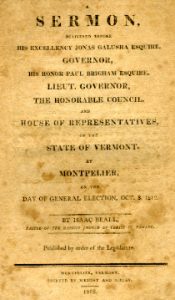
sermon-election-1812-vermontIsaac Beall was born in 1751. In 1801, he rose to the pastorship of the First Baptist Church in Pawlet, Vermont, after serving for ten years as an elder. Beall pastored the church for thirty years until its dissolution in 1831 – he died in 1833. In this election sermon preached before the Governor, Lieutenant Governor, and Legislature, Pastor Beall uses Proverbs 29:2 as his principle text. He emphasizes the critical importance of selecting righteous rulers with which to entrust the power of civil government; and defines “righteous” in this context as men of natural ability, sound judgment, good hearts, well-instructed minds, integrity and prudence. He adds that laws must be righteous, mild, and few, and there must be a “sacred regard to the original principles” the government was founded upon. Beall also mentions that not only must rulers be virtuous but so must the great body of the people because “a virtuous people cannot be enslaved.” He concludes by directly addressing Vermont’s elected officials, challenging them to “make righteousness the basis” of their public service.


A
Sermon
Delivered Before
His Excellency Jonas Galusha, Esq.
Governor;
His Honor Paul Brigham, Esq.
Lieut. Governor,
The Honorable Council,
and
The House of Representatives,
of the
State of Vermont,
at
Montpelier,
on the
Day of General Election,
Oct. 8,1812

By Isaac Beall, Pastor of the Baptist Church of Christ in Pawlet.

Proverbs 29:2
When the righteous are in authority, the people rejoice: but when the wicked beareth rule, the people mourn.

Civil government is one of those blessing which a kind of God has seen fit to bestow upon the lapsed family of Adam. In this present imperfect state, a people could not long remain happy, without a civil government: to remain in such a state of anarchy would be to remain in a state of perpetual war. To prevent such a dire calamity, God instituted this ordinance. Rom. 13.

But as important as civil government is to the happiness of man; yet, like all other gifts of providence its blessing can never be enjoyed, but through a just and wise administration. God has ordained summer and winter, seedtime and harvest; but should we neglect our relative duties, we should neither be fed nor clothed.

Though God has ordained civil government for the good of man, he has not instituted any particular mode or form of government; but this he has left to human wisdom, according to the different circumstances, customs and habits of different nations.

A good and well-adapted constitution is to be preferred; nevertheless, a defective constitution, wisely administered, would be productive of greater good to the community, than a good constitution in the hands of unrighteous administrators.

There may be such ignorance, neglect of injustice in the rulers on the one hand; and such want of attention and submission (not to say opposition) among the ruled on the other hand, as to render civil government rather a curse than a blessing.

That civil power and authority might be vested in such men, under whose administration the people might be rendered happy, seems to be the leading idea in the passage read for consideration.

In adverting to this subject, I shall endeavor to give a short description of those rulers, under whose administration the people rejoice. Secondly, reverse the subject. Thirdly, a short improvement of the whole. Then close with customary addresses.

Agreeably to the proposed method, our attention is called,

I. To the character of those rulers, under whose administration will rejoice.

Righteousness is the only qualification of a civil ruler mentioned by the inspired penman in our text. There are some who strenuously contend that a person must be made righteous by the imputation of the righteousness of the Lord Jesus Christ; or which is the same thing, he must be possessed of Christianity, or he is not suitably qualified for civil office. Should this be granted, in order to be confident, another thing must be granted (viz.) that is the only necessary qualification: for when the righteous are in authority, the people rejoice. That religion would be of great utility to a civil ruler will be granted; but that this is the only, or even an essential qualification, cannot be so easily admitted. For according to this sentiment, any man giving good evidence that he is a Christian, however weak his intellect, might with safety be elected governor of the state or president of the nation. A sentiment so weak and glaringly inconsistent as to need no refutation.

It remains therefore, to be ascertained what that righteousness is which is a characteristic of a good ruler.

As civil government is alluded to in the text, it is just and reasonable to conclude that the righteousness there spoken of is a political righteousness, that is, a righteous administration of the government with which they are entrusted. To which several things are necessary. As

1. They must be men of good natural abilities, men of penetrating mind and sound judgment. For should there be a defect in their intellect (however otherwise qualified) they would never be able to look through the intricate affairs of state; or attain to a consistent scheme of administration, which the good and safety of the public calls for. Therefore, men of weak minds should never be chosen into office by the freemen; and in case of election, they ought not to accept: for though they may be men who possess honest dispositions of mind, yet the great affairs of state, exceeding their natural abilities, renders it utterly impossible for them to administer the government in righteousness. In such a case, it would be more honorable in a man to decline, than to accept of a place in civil government.

2. In order to a righteous administration of government, rulers must not only have good heads, but they must have good hearts. They should possess a large portion of philanthropy, an ardent love for their people. Love is the mainspring of every interchange of kind offices among men. In no case has this divine principle a more efficacious operation than when a ruler’s heart is inspired with a paternal affection towards his subjects. To be the father of his people is the magistrate’s dignity. This constitutes his nearest conformity to our universal Parent. This will stimulate rulers to pursue the common happiness under the greatest difficulties and most pressing trials. It was this that animated a Moses, inspired a David, and fortified a Nehemiah under the most alarming trials, perplexities, and dangers, while managing the great affairs of state. And this will give energy to the exertions of our rulers for the prosperity and happiness of their brethren; and make them esteem the most assiduous painful labors but reasonable and pleasant services for the public good. That they may administer in righteousness, civil rulers must possess a kind and benevolent affection for their people.

3. In order to a righteous administration, rulers must be men of knowledge. Ignorant and uninformed statesmen, however strong their heads or affectionate their hearts, can do but very little for the good and happiness of the community. Their limited views will create local prejudices and subject them to the artifices of interested politicians. While part of the community take undue advantages of their ignorant mismanagement of the affairs of state, the body languished and dwindles away for want of counsel and energy in their administration. It is a matter of great importance that rulers become acquainted with the tempers, capacities, views and interests of the citizens in every part of the government by confining their labors to a small circle; and by losing the services of the best qualified men in the state. What is more preposterous than for rulers to exert their authority and influence for the partial interest of the territory in their own vicinity and to make the interest of one party in the community give way to the avarice and ambition of another party. Rulers should have enlarged hearts and well instructed minds, capable of comprehending the characters and interests of the citizens; and with a generous impartiality to seek the good of the whole.

But this is not all the knowledge which is necessary and essential to a righteous and faithful ruler.

But, 4thly they must be well instructed in the political maxims and laws of the state in which they are to govern. The safety of a republic depends much upon a sacred regard to the original principles of their government. When those principles are disregarded, every right and privilege is endangered; and the administration degenerates into tyranny and oppression. It was a peculiar qualification in Solomon for civil government that God gave him a wise and understanding heart. Rulers should understand the system of laws and those forms of administration to which the people are accustomed; and conform themselves to the original principles of their government: this will form such a line of conduct in their administration, that the people may know what to expect from them. Thus, by wisdom and understanding the government is established, the expectations of this community answered, and their hearts made to rejoice.

5thly in order to a good administration of government, rulers must be controlled in all their measures, by truth and integrity. For wisdom without integrity will soon degenerate into cunning and artifice; by which the interest of the community will fall to prey to those who should be their protectors. A magistrate devoid of truth and sincerity is the snare and perdition of his subjects. All power, therefore, should be founded in truth, both in the attainment and exercise of it. The lip of truth shall be established forever: but a lying tongue is but for a moment. Excellent speech becometh not a fool, much less do lying lips a prince.

An administration founded in truth and righteousness will bear the test of scrutiny and prove advantageous in the end: while the duplicity of deceitful politicians will involve both rulers and ruled in perplexity and general ruin. All leading men ought to adopt righteous measures and prosecute them with simple uniformity and honest sincerity. It should be the first object of them who rule over men, to be just, to be true in their administration; not having a mysterious system of delusion, to deceive others into their fraudulent intentions.

In order to gain the confidence of the people and cause them to rejoice in their administration, rulers must be men upon whom they may safely depend. Without this confidence, subjects can derive very little happiness or advantage from civil government.

6thly Prudence is another trait in the character of a righteous ruler: necessary at all times; but of infinite importance in our present circumstances. Knowing that a kingdom divided against itself cannot stand, their councils will be pacific and their measures conciliatory, being the most likely way to preserve and cement the general union. The advice of Joseph to his brethren, is very suitable at this time, and claims the particular attention of those who are at the head of our public affairs: see that ye fall not out by the way. Happy would it be for the community should their rulers, supreme and subordinate, be directed by the maxims of prudence and discretion in the things of our political peace.

The light of nature and scripture condemn such a confidence in God, and hinders the prudent and industrious use of means for safety. At the same time, the success of the most opposite means and best-concerted measures always supposes the divine concurrence. Jehovah has all times and all hearts in his hand, and can so influence our public councils as to strengthen and perpetuate the union, even as he bowed the hearts of all the men of Judah to David, as the heart of one man.

As in a good constitution of government there is no absolute power but that of the laws, a reverential regard to the divine approbation will have a mighty influence in making and execution such as are prudent and salutary. The great ruler of the universe has not imposed his laws upon men, merely as a test of their obedience; but as lessons to prevent their ruin and teach them how to be happy. A model which eternalizes the benignity of those human laws which are suggested by preventive prudence: a standard of benevolence from which subordinate legislators should never deviate. Acting in character as the ministers of God, for good to the people, they will esteem it more eligible to prevent crimes than to punish them.

It being the great end of government to secure the civil happiness of the community, it is necessary and proper that the laws by which they consent to be governed should be as few, clear, and easy in their application as possible. For laws when needlessly multiplied become a vexatious and intolerable burden.

The laws of Jehovah being a transcript of perfect rectitude, there can be no reasonable objection raised against their being executed. In like manner, human laws ought to be as righteous and mild as to interest the community in their punctual execution, and in no instance fail of being enforced. It is necessary to civil happiness that government be supported and respected. But this will not be the case if good laws are evaded with impunity. What has a greater tendency to weaken the authority of a state than to continue laws in existence, which the powers that be cannot or care not to execute? The scripture character of rulers is that they are not a terror to good works, but to the evil. Power is grossly abused and perverted when wicked citizens are fostered and protected by authority. God has ordained rulers to avenge the wrongs of injustice and oppression, and the violation of sedition and rebellion. No favor or friendship, no relation or connection with men in power, should secure the wicked from punishment. Righteous magistrates will, by the sword of justice, suppress immorality and every transgression of relative justice. God commands it, and faithful subjects have a claim upon their rulers to be protected from fraud and oppression: to have the laws executed, their persons their liberty, and their property protected from the depredations of lawless and unprincipled men.

Such an administration as this would afford abundant matter of rejoicing among the citizens, as it would protect their persons and property, secure their rights and privileges; and would render them formidable to the nations of the earth.

Having thus described those righteous rulers, both as it respects their qualifications and administrations, which are calculated to lead the community to happiness; I proceed

II. To contrast the subject.

If people have reason to rejoice when they receive a just, righteous, and prudent administration from the hands of their rulers, by which their independence, rights, persons, property and character and secured; they cannot forbear to mourn and weep when they observe in their rulers a reverse of this excellent character.

Nothing occasions more grief to a people than to find their rulers so devoid of all sense of justice, equity and prudence, as to frame the most pernicious laws, which in their operation have been productive of infinite mischiefs and the people enjoined under severe penalties to enforce them; and which, with tolerable discernment, might have been easily foreseen. Should, therefore, a people have the extreme misfortune to have rulers of such a description, they could expect nothing from them but such an administration as would be the occasion of perpetual sorrow and mourning as long as it should continue.

And hence originates that dishonor and contempt in which the rulers of a people are sometimes holden by their subjects. When a people despise their magistrates, contemn their government, profane the ordinance of God, and insult the ministers of state, we are ready to consider that sometimes such conduct may be the effect ignorance or unrighteousness in the administrators. That rulers should frame laws notoriously unjust, deprive good citizens of their just rights, and subject them to severe penalties, for no cause but to gratify their own evil passions, is such a direct violation of the law of God and rights of men as must fill every sensible heart with grief and horror.

The people have equal cause to mourn when ignorant and unrighteous men are preferred by their rulers and distinguished by their special favors. In times of such degeneracy, wicked and designing men obtain promotion; and sometimes such persons are entrusted with the more important concerns of the public who never possessed ability and economy enough to manage their own. Hence the public are deprived of the abilities of such who are persons of the best understanding and judgment. When the wicked are exalted, the righteous are hidden. Flatterers and parasites are the men who find favor with a wicked administration; but such as are just and honest, are slighted and rejected. Those who are lost to all sense of virtue, duty or moral obligation, will use their power to the worst of purposes, and thereby debase their characters in the estimation of the people who feel themselves truly miserable under their oppressive administration. They cannot but mourn when they anticipate the event of such unrighteous measures, and the sad consequences which must be produced.

But why need I consume time in attempting to prove that which is self-evident?

I have finished my doctrinal observations: and hasten to some practical reflection. As I have in the former, so in this part of the discourse, I wish to speak with that unfettered freedom, which becomes a servant of God.

From our subject collectively, we learn first that the rights and privileges, the liberty and happiness; yea, and the lives also, of the great body of the people, are, under God, entrusted in the hands of their rulers. A weighty charge!

As a stimulus to the important, I had almost said, infinite trust reposed in them, rulers should constantly call to mind their own mortality and accountability to that God whose ministers they are.

I have said ye are gods; and all of you are children of the Most High. But ye shall die like men. Like all other men, they shall descend to the grave, the house appointed for all the living. To death, succeeds their solemn account at the tribunal of Jesus Christ, who is appointed the decisive judge of all men: before his impartial judgment seat, the rulers and judges of the earth will stand upon a level with their meanest subjects. In that solemn moment, when the opinions of men will be lighter than vanity, the flattering tongue shall be put to everlasting silence, when judgment shall be administered without respect of persons, the inquiry will not be whether they have been rulers and judges in the earth and exercised authority over the sons of the dust; but whether they have filled their stations, kept in view their last account, and prepared matters for their acquittal in that solemn trial: in order to this, it will not be sufficient merely to plead that they have been righteous in their administration of civil government; but that they also, by faith, have become interested in the justifying righteousness of the Son of God.

Were this day of retribution, which will soon commence, duly considered by magistrates, how could they fail to discharge with diligence and care, their sacred trust; and to be in earnest to become ministers of God, for good to the people? And how could they be willing to remain ignorant of the religion of Jesus Christ; which could afford them so much assistance in the faithful discharging the duties of their office; and the only thing by which they can be acquitted when they stand before their final judge?

2. That as a faithful discharge of that trust which is reposed in civil rulers is the just due of the citizens; even so all good fidelity and reasonable subjection is due from the people to their rulers. This is the requirement of God, let every soul be subject unto the higher powers: for the powers that be are ordained of God. Whoever, therefore, resisteth the power, resisteth the ordinance of God: and they that resist shall receive to themselves damnation. Put them in mind to be subject to principalities and powers, to obey magistrates. Submit yourselves to every ordinance of man for the Lord’s sake; whether it be to the king as supreme; or unto governors, as unto them who are sent by him for the punishment of evil doers, and for the praise of them who do well. For so is the will of God, that with well doing, ye may put to silence the ignorance of foolish men. If such submission is required to a kingly government, how much to a republican government?

The obedience we owe to magistrates essentially differs from the obedience we owe to God. Our obedience to God ought to be free and implicit; resulting from a sense of the rectitude of his precepts. But such obedience to human laws is not always required; for sometimes we may doubt of the fitness, yea, of the equity of them. For considering civil rulers as imperfect, and liable to err, though it be highly proper and necessary, considering ourselves members of society, that we conform our actions to their laws; yet it is not always our duty to believe that their laws are most salutary, because human laws may sometimes be otherwise. But our social obligations require us to be subject to laws, which we think very inconvenient, provided they are not sinful in themselves. It were happy if subjects would not employ themselves too much in disputing the policy and prudence of their rulers and the propriety of their laws: He who is ever ready on all occasions to impeach the conduct of rulers, and reproach their administration, and dispute the wisdom and propriety of their laws, obstructs their usefulness, weakens their influence, and doeth all in his power to bring government into contempt and to plunge the state into confusion and disorder: and thereby expose himself to the just resentment of that God, whose ministers they are.

Civil government is of divine institution: and our minds are impressed at first view with the necessity of it. Every one must feel and acknowledge the propriety and utility of that subordination in society which is required in the divine constitution.

Subjection to laws being the first duty of every citizen, it ought and will be cheerfully yielded by every good subject, though in some cases it may be thought that the laws are not the best calculated for the interest of the community. Every individual cannot be thought to be able to determine with certainty on a subject of such importance. But it must be his duty to preserve in his obedience till either the rulers are convinced that their measures ought to be changed; or the citizens in a constitutional way shall change the administrators. May I be indulged here just to observe that it is possible for the people to have such an undue influence even upon righteous rulers as to procure such measures as would prove very mischievous in their operation. But this ought not to be palmed upon our rulers; but we ought in such cases to act the part of honest men, reprobate our own conduct, and in future keep within our own province. There is not a greater evil which can befall a community than to be divided into sects and parties respecting their civil policy. The consequences (if continued in) are fatal to our civil rights and privileges, our peace and independence; and it is this which causes our present situation to wear such a gloomy and threatening aspect!

May I be indulged in intruding on your patience just to add that virtue and integrity in the great body of the people are as necessary to our political happiness and prosperity as it is in those in authority. Whenever we are tempted to complain and to entertain jealousies, lest our rulers should enslave us, destroy our liberties and happiness, let us console ourselves with this idea that a virtuous people cannot be enslaved; and that it would be utterly impossible for rulers to involve the community in any great difficulty should there not be a large portion on unrighteous and evil men to aid them in their base and evil designs: and should a people be so lost to all sense of virtue and interest, and so regardless of their obligations to God, and each other, as to willfully expose themselves to such fatal evils, the folly would be their own.

That our rulers may be ministers of God to us for good, it is our duty to implore the presence of God with them, his spirit to aid and assist them; and his blessing to crown their administration with success: and on our part to demean ourselves as good subjects; and remove all the embarrassments which may render it very difficult, it not totally impossible, for them to manage the great affairs of government in equal justice.

Happy America. If those who govern are inspired with wisdom and benevolence, prudence and integrity for the public safety: and the governed, with worthy and good affections, for the civil and religious institutions of their country: we shall then unite in pursuing the things of our peace: society will be improved, our understandings will be enlarged, our morals refined, and the interests of time, will not interfere with those of eternity. Happy is that people that is in such a case: yea, happy is that people, whose God is the Lord.

It is time that I hasten to a conclusion in suitable addresses. Our first attention is due to our worthy chief magistrate, called of God and the people to the chair of government.

May it please your Excellency, — God in his wise providence hath conferred a signal honor upon you, in repeatedly placing you in the highest seat of government, and entrusting you with so important a part of the management of our public concerns. It cannot, honored sir, but excite in your breast the most pleasing emotion of mind to find your character thus revered and your person holden in such a high estimation by so numerous and respectable a people as compose this state; and to see the evidence which it exhibits that your former administration has been, in some measure, agreeable to that mentioned on our text, which is a source of general joy.

With pleasing anticipation, we behold your excellency, God’s minister for good, bearing the sword of the state, not as a terror to good works, but to the evil. Our eye with delight marks your path, while you lead us your children into the duties of relative and Christian life: and by your example teach us that self-denial, frugality and industry so essential to the happiness of a free people. And however gloomy and difficult the day in which you preside, your administration, being of the description above, you may look for and expect all needed aid from him by whom kings reign and princes decree justice. An uncommon degree of knowledge, prudence and wisdom in a governor is necessary in such an important critical day as the present; to steer the helm of government with discretion, reconcile contending parties, and protecting the rights and privileges of the people, and giving satisfaction to the citizens. Our expectations from your excellency are that liberty shall be maintained by law and all citizens be secure in their possessions: that public faith and dignity be preserved. May the institutions of literature flourish under your friendly patronage; especially may the illustrious university of Vermont be the object of your peculiar care and by your salutary influence be protected in all it’s important rights and immunities.

As your excellency’s character stands high in the estimation of this people, it gives you a great advantage and should be no less a motive with you to study and invariably pursue their best interest. In seeking the common good and welfare of your people, you will secure your interest in their affections and live in their hearts: which must afford the highest satisfaction to a righteous magistrate. We hope in the goodness of the universal Parent, that by affording you his presence and grace, he will show that because he loved this people He hath therefore appointed you to rule over them.

May the angel of divine presence enlighten and beautify the paths of your administration. In your days, religion, truth and peace dwell on the earth: and when filled with days, and replete with grace, you shall be discharged from further services here, that you may share the glories of the heavenly world will be the unceasing prayers of the righteous and the good.

Our respects are now due to his honor the lieutenant governor, the honorable council and house of representatives.

Fathers of our state and elders of our tribes, –The sovereign powers of this state vested in you by the united voice of the freemen, give high importance to your character and entitle you to their respect and confidence. And that you may not disappoint their most sanguine expectations, you will make righteousness the basis of your administration and rule of all your proceedings.

We do not ask you to assign us articles of Christian faith, to establish religion by law, enact statutes for the collection of our salaries, or to become the bulwark of the religion we profess; but that you maintain the laws of the state and the sacred principles of our excellent constitution: a constitution which will prove a bulwark of our independence and sovereignty, a sure protection of all good citizens; the security of freedom, property and life; and a defense against the rude encroachments of anarchy and despotism. May a kind God influence you in to a system of administration which shall defend our constitution, render venerable our laws, protect from violence the seats of justice, and the thrones of judgment.

Our national concerns as a confederated republic are serious concerns. Unless some speedy and effectual measures are invented and pursued, ICHABOD will be written upon our nation. Be entreated, venerable fathers, to lay aside limited views and local prejudices and encompass the Union in the exertions of your patriotism. A considerable advantage may be obtained toward answering the end of you appointment,by electing such men into office (which comes within your province) as are men fearing God, men of virtuous minds, superior to intrigues, whose circumstances are not embarrassed, and who love the people and will perseveringly seek their happiness.

A legislature thus constituted, and what a large number of such worthy characters do I now behold! Such a legislature will rejoice the hearts of their citizens, and shall, in the issue, enjoy the blessings of their country while wicked politicians shall sink into their deserved ignominy.

However, respected fathers, it is not my province to dictate to you any measure of a civil or political nature; your wisdom and good sense do not require this of me. We being sensible that your work is difficult, and that you have an arduous task, to cure all the disorders of the political body, restore harmony and peace, and to unite the jarring interests of parties, and fix them to one common center, do heartily commend you to God who is able to furnish you with all needed wisdom and prudence.

Respected rulers, you cannot be insensible that He who has dignified you above your brethren, has limited your powers by his holy word. You are not authorized to obey the dictates of an arbitrary will; but to act agreeably to the revealed will of God. Look then on the copy which is before you: and as God’s vicegerents on earth, take you directions from his work and imbibe his spirit: acknowledge him in all your ways, and he will direct your paths. And as a reward for your services, may you be honored as the political saviors of this people, and meet their cordial approbation; And from the faithful discharge of an earthly trust, may you in due time be received into the joy of your Lord, with a well done good and faithful servants. Such is the reward, which we pray, every member of our public administration may now deserve and in future obtain from the Judge of all.

Will this grave and venerable audience indulge me a few words in a general address,–

Respected brethren and fellow citizens, — Distinguishing have been the favors of Divine Providence, by which we have become a great and established nation: but little inferior to those by which Israel of old were brought from bondage in Egypt and planted in the fat land of Palestine. Surprising, I had almost said miraculous, has been the chain of events which has marked our emancipation from the iron yoke of bondage and oppression, and raised us to the important rank of power and independence among the nations of the earth: established us under a federal constitution and republican form of government: we sit in the assemblies of our rulers; rulers of our own election, and judges appointed from among our brethren. Under such a government, we enjoy all necessary freedom and liberty, rights and privileges, both civil and religious.

But though civil liberty and freedom are so desirable blessings; and though it is our duty in all lawful ways to strive to support and maintain them, yet it is of infinitely greater importance that we should be delivered, by God’s special grace, from the bondage of guilt and the slavery of sin and satan, and called effectually to the spiritual freedom of the children of God. Little reason shall we have to boast of liberty and freedom, or to bless ourselves on the account of our external privileges, if we are the ignominious servants of corruption. This spiritual liberty Christ hath obtained for all his true disciples; and it can no otherwise be enjoyed by any of us, than by taking his yoke upon us, and learning of him; and continuing in his word. Then shall we know the truth, and the truth shall make us free indeed. It is the true Christian alone who is the Lord’s freeman and a citizen of the New-Jerusalem. An honor and privilege to which we cannot maintain our claim unless we realize our profession of Christianity by serving the Lord Christ with all good fidelity and serve one another in love. Be this the object of our greatest care and attention: we may then with hope and earnest expectation wait for the day of our complete redemption. At length the grand jubilee will be proclaimed by the archangel’s trumpet, which will call the heirs of God to the perfect liberty of his everlasting kingdom and glory, and to that inheritance which is incorruptible and that fadeth not away.

To this exalted felicity, God grant, that we may all be brought in due time, through Jesus Christ our Lord. AMEN.

Sermon – Fasting – 1812


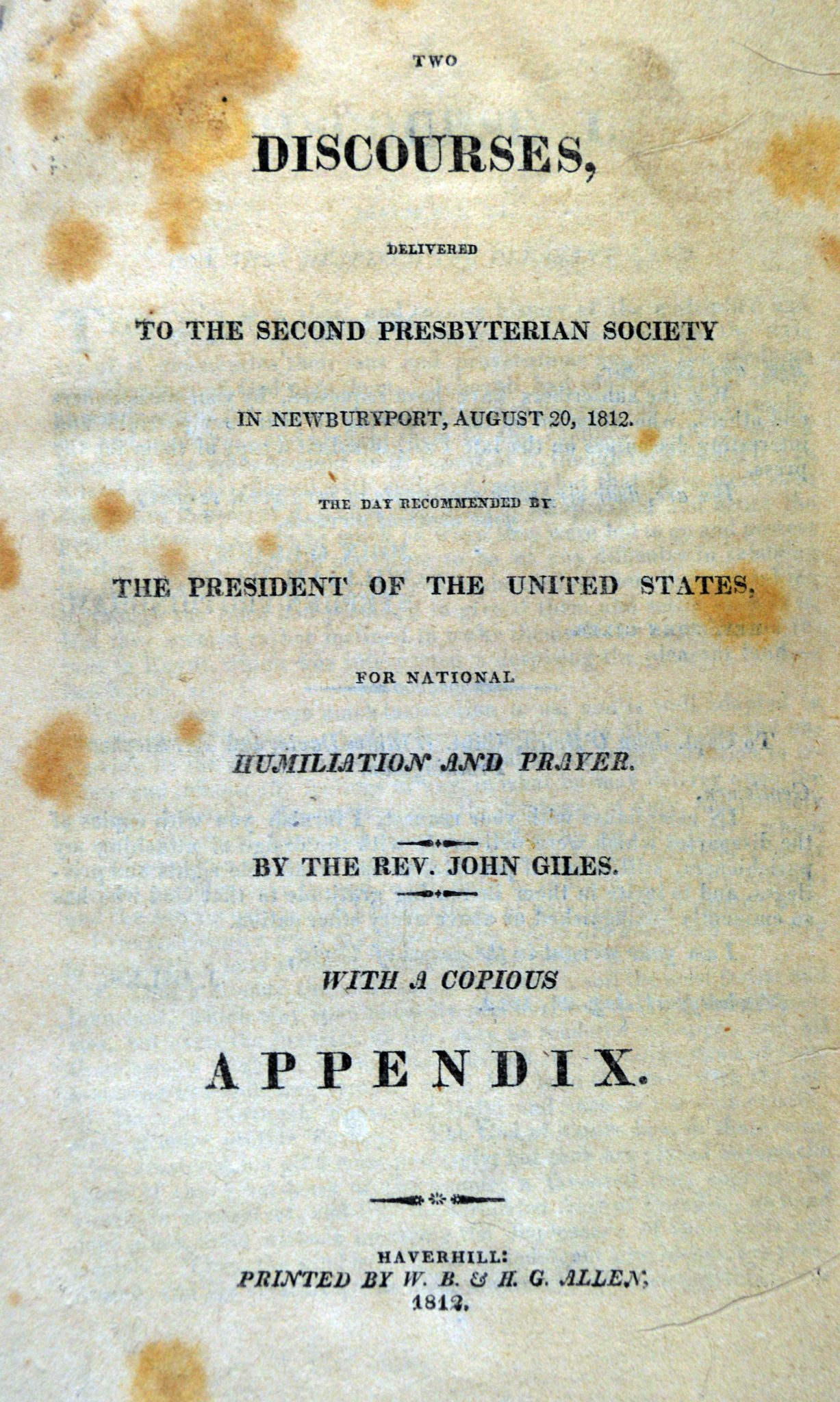
The following two discourses were given by Rev. John Giles on the occasion of a national day of fasting. This fast day had been proclaimed by President James Madison. Following these two discourses are “reviews” of them.

sermon-fasting-1812

TWO

DISCOURSES,

DELIVERED

TO THE SECOND PRESBYTERIAN SOCIETY

IN NEWBURYPORT, AUGUST 20, 1812.

THE DAY RECOMMENDED BY

THE PRESIDENT OF THE UNITED STATES,

FOR NATIONAL

HUMILIATION AND PRAYER.

BY THE REV. JON GILES.

Newburyport, Aug. 24, 1812.

Rev. and Dear Sir,

WE the subscribers have been requested, by your parishioners and others, who attended on the delivering of your very patriotic and interesting discourses on the late Fast, to solicit a copy of them for the press.

We are, dear sir, with sentiments of very great respect,

Your obedient servants,
JOHN O’BRIEN,
WILLIAM DAVIS,
STEPHEN FROTHINGHAM.
REV. JOHN GILES.

To Capt. John O’Brien, Capt. William Davis, and Mr. Stephen Frothingham.

Gentlemen,

IN compliance with your request, I furnish you with copies of the discourses which were delivered, with the design of attaching my parishioners, still more, if possible, to our invaluable rights and privileges, and to incite in them increasing gratitude to that God who has so eminently distinguished us above every other nation.

I am your servant in the gospel of Christ,
J. GILES.
Newburyport, Aug. 26, 1812.


DISCOURSE I.

PSALM evi. 24.
YEA, THEY DESPISED THE PLEASANT LAND.

THIS Psalm is a short and concise history of the multiplied and unprovoked rebellions of the ungrateful Israelites; and the writer of it enumerates their sins and provocations against the goodness and blessings of God unto them. Jehovah had conducted them safely through scenes the most trying, and through dangers the most formidable and imminent, and brought them to the confines of the promised land; but the spies brought an ill report of it, though they owned it was a land which overflowed with milk and honey; but that there were such difficulties to possess it, which they thought insuperable; and hence the people despised it—in as much as when they were bid to go and possess it, they refused; and did not chuse to be at any difficulty in subduing the inhabitants of it, or run any risk or hazard of their lives in taking it, though the Lord had promised to give it them and settle them in it. But they seemed rather inclined to make themselves a captain, and return to Egypt, which was interpreted a despising the pleasant land.—See Numb. Xiv. 1.

This history conveys much instruction to us, and is well adapted to the designs of the day. And, before we proceed in illustrating and improving it; the speaker must premise, that it is not his intention to irritate and inflame the feelings of any, in what he may deliver upon the present occasion. His motives are, the discharge of duty, and publicly to avow his warm, firm, and decided attachment, to the country which has adopted him as its citizen, and to the illustrious character who at present presides over it; and to this duty he is urged by lively gratitude, and the solemn oath which he has taken, of undeviating allegiance to it.

First…Enquire what are those things which are absolutely necessary to constitute a land pleasant. And we observe,

1. That a climate the most salubrious, and a soil the most fertile and luxuriant, which may spontaneously produce, not only all the necessaries, but even the luxuries of life, may be rendered unhappy, and all these sweets blighted, and marred, through the intruding hand of some assuming and unfeeling tyrant. Such has been the state with the fertile lands of Portugal, Spain and Italy; and such is the still existing state of more prolific Turkey. The God of nature has, in those countries, scattered his gifts most profusely; but they are placed beyond the reach of the great mass of the people; a favoured few, engross the sweets to themselves, and like the forbidden fruit of Paradise, no hand dare pluck them without incurring the displeasure of their lords and masters. Thus, the kind bounties of an indulgent providence, are prostituted, and his creatures, who have a natural right to enjoy them, are tantalized with having them in continual view, but never are filled with the sweetness of them. This must turn the most pleasant and fruitful land into a sterile and painful wilderness; a land, which none of us, my hearers, would chuse as his home to dwell in, or as his place of sojourneying.

2. To render a land pleasant, its inhabitants must enjoy equal rights and privileges, otherwise it can be only to a favoured few, while the great majority are rendered objects of misery, through penury and distress; and thus, the comforts and blessings of civilized society, be abused and subverted, and even prostituted to the most ignoble and basest of purposes. We will demonstrate and illustrate this, not only from ancient, but modern governments. And here we observe, that society in every state is a blessing; but government in its best state is but a necessary evil,—in its worst state, an intolerable one. For when we might expect in a country without government, our calamity is heightened, by reflecting that we furnish the means by which we suffer.—Government, like dress, is the badge of lost innocence. The palaces of kings, are built on the ruins of the bowers of Paradise. In ancient Greece, monarchy was the government which they first formed; but this they soon found degenerate into tyranny. Hence the term tyrant, was justly applied to them. And, indeed, the word originally signified no more than king, and was anciently the title of lawful princes. But monarchy gave way to a republican government, which, however, was diversified into almost as many various forms as there were different cities, according to the different genius and peculiar character of each people. But still there was a tincture, or leaven, of the ancient monarchical government, which frequently inflamed the ambition of private citizens, and made them desire to become masters of the country. In almost every state of Greece, some private persons advanced themselves, by cabal, treachery and violence, and exercised a sovereign authority, with a despotic empire; and in order to support their unjust usurpations, in the midst of distrusts and alarms, they thought themselves obliged to prevent imaginary or suppress real conspirators, by the most cruel proscriptions, and to sacrifice to their own security, all those whom rank, merit, wealth, zeal for liberty, or love of their country, rendered obnoxious to a suspicious and unsettled government, and which found itself hated by all, and was sensible it deserved to be so. What we have remarked of Greece, will, with a few shades of difference, apply to ancient Rome.

Let us now take a view of the modern governments of Europe, and examine how far they are calculated to add to the peace, comfort and happiness of mankind; and in the attempt our souls must overflow with gratitude to God, if sensible of the superior blessings and privileges we enjoy in this our favoured land. For,

3. A land to be pleasant, must have governors and magistrates, qualified and suited to the dignity and high stations they fill; nor can they command the respect and affection of those they rule over, unless they are the men of their choice. For the truth of this, I appeal to your judgment. Should we feel happy, were a man to be forced upon us, as governor of this state, or as president of the United States? And, granting the man, even qualified, in every point of view, would not our feelings revolt? But should such an one act the part of a tyrant, by oppressing your persons, taking from you your property, and reducing you and your posterity, from affluence to extreme want and beggary, the case would be still more afflicting. This representation is not ideal; it exists in all the aggravating circumstances here stated, and that in the fast-anchored isle of Great-Britain. The chief magistrate, or what they call king, is hereditary. How degrading this to an enlightened people! It is a system of mental leveling. It indiscriminately admits every species of character to the same authority. Vice and virtue, ignorance and wisdom, in short, every quality, good or bad, is put on the same level. Kings succeed each other, not as rationals; it signifies not what their mental or moral characters are. Such a government appears under all the various characters of childhood, decrepitude, and dotage; a thing at nurse, in leading-strings, or in crutches. It reverses the wholesome order of nature; it occasionally puts children over men, and maniacs to rule the wise. It requires some talents to be a common mechanic; but to be a king requires only the animal figure of a man, a sort of breathing automation. But I must observe, that I am not the personal enemy of kings. No man more heartily wishes, than myself, to see them all in the happy and honorable state of private individuals. But I am the avowed and open enemy of what is called monarchy; and I am such, by principles which nothing can either alter or corrupt—that is, by my attachment to humanity—by the anxiety, which I feel within myself, for the ease and honor of the human race—by the disgust which I experienced, when I observed men, directed by children, and governed by brutes—by the horrors, which all the evils that monarchy has spread over the earth, excite within my breast—and by those sentiments, which make me shudder at the calamities, the exactions, the wars, and the massacres with which monarchy has crushed mankind. Would not you, my hearers, consider such a land, however salubrious the clime, however fertile the soil, however embellished with the progress of the arts and sciences, deprived of its birth-right and groaning under special marks of divine displeasure? Let us rejoice, that we are in the full possession and free exercise of the privilege of selecting from ourselves men to be our rulers; and while we give them a compensation for the services which they render the public, in their several stations, which is but just and reasonable; for the labourer is worthy of his hire. Yet government in America is what it ought to be, a matter of honour and trust, and not made a trade of, as in England, for the purpose of lucre.

4. That which constitutes a land pleasant, is the state of society. To see every member of it in the enjoyment of all the essential necessaries of life; we do not mean, that one and all should possess equal property, for this never was designed by the God of nature; for there will be some who are comparatively poor, for the exercise of the benevolence of the rich. But that none should suffer through want or hunger, all who are in the enjoyment of health, and are industrious, should be able by moderate labour, to procure the comforts of life. We bless God that such a pleasant land is our inheritance. Here is a sufficiency of bread for all. Let the people here be but diligent, and a few years will place them in a state of independence. O how different is this, from what we see on the other side of the Atlantic! Should the enquiry be, what makes the difference, has not providence favored them with a fruitful land? We reply, providence has not been to them sparing in its gifts: but through the cunning craft of men, these gifts are engrossed by a few choice spirits, who riot in luxury, at the expense of the labourer, the mechanic and the husbandman. We will explain our meaning—The chief magistrate of England receives a million sterling every year; the other branches of his family, nearly the same sum, and a long list of placemen and pensioners, swell the burden to an enormous size. And all this is wrung from the hard earnings of the laboring poor. It is this wretched system which causes the land to mourn, which crowds the streets with beggars, and which drives men to the desperate act of invading the property of others; for what will not hunger impel men to! This picture is not overcharged; some present have seen with their eyes, these things, and can bear witness to the facts. But let us turn our view from these sickening scenes, and contemplate our own condition on these happy shores, and we see an extent of territory, twelve times larger than England, and the expense of the several departments of the general representative government not amounting to what is allowed even to the king alone.

5. To render a land pleasant, it is essential that the means of grace should be enjoyed. It is these which add to the glory of any land, and render a people truly great. This it was, which made the Israelites so much greater than other nations. Thus Moses describes them: “What nation is there so great, that hath statutes and judgments so righteous, as all this Law which I set before you this day?” Without the Gospel, the most enlightened people, are no better than refined savages. The Gospel is a pearl of great price; it is the glory and honour of a church, a people, or a person. This only instructs us in the way of salvation. Trade and commerce, may gain and preserve an estate, bread may support the body, but this only can nourish and prop up the soul. When the Gospel is removed, the light is removed which is able to direct us, the pearl is removed which can only enrich us. In the want of this, is introduced a spiritual darkness, which terminates in an eternal darkness. As the Gospel is compared to Heaven, and so called the kingdom of heaven; and a people in the enjoyment of it are said to be lifted up to heaven; so in the want of it, they are said to be cast down to hell. See Matt. 10, 23. So that what resemblance there is between heaven and the means of grace; that there is between the want of them and hell. Both are a separation from God; so that when the Gospel departs, all other blessings depart with it, and judgments succeed. When the glory of God was gone up from the first cherub to the threshold of the house, see Ezek. 9, 3. The angels are commanded to execute the destructive sentence against the city. Ver. 4, 5. When the word of God is removed, the strength of a nation departs. The ordinances of God are the towers of Sion. The temple was not only a place of worship, but a bulwark too. The ark was often carried by the Israelites into the camp, because there their strength lay. And when David was chased away by his son Absalom, he takes the ark of the tabernacle, as his greatest strength against the defection of his son and subjects. This blessing, my hearers, we enjoy in a peculiar manner. The heavenly manna profusely descends around our tents, and every one may worship God in that form and manner which he thinks accords best with the volume of inspiration.

6. That which renders our land the glory of all lands, is to be free from all religious establishments, the bane of society, and curse of human nature. Let us enlarge a little on this sentiment. All religions are in their nature mild and benign, and united with principles of morality. They could not have made proselites at first, by professing anything which was vicious and persecuting or immoral. How is it then, that they lose their native mildness, and become morose and intolerant? It proceeds from an alliance between church and state. The inquisition in Spain and Portugal, does not proceed from the religion originally professed, but from this mule animal, as one calls it, engendered between church and state. The burnings in Smithfield, proceeded from the same heterogeneous production; and it was the regeneration of this strange animal, afterwards, in the nation now called the bulwark of our religion, which revived rancor and irreligion among the inhabitants there, and which drove the people called dissenters and Quakers to this country. Persecution is not an original feature in any religion; but it is always the strongly-marked feature of all law-religions, or religions established by law. Take away the law-establishment, and every religion reassumes its original benignity. Here in America, a catholic priest is a good citizen, a good character, and a good neighbor; the same may be said of ministers of other denominations, and this proceeds, independent of men, from their being no law-establishment in America.

The constitution of the United States hath abolished or renounced toleration, and intoleration also; and hath established universal right of conscience. Toleration is not the opposite of intoleration, but is the counterfeit of it; both are despotisms. The one assumes to itself the right of withholding the liberty of conscience, and the other of granting it. The one is the pope armed with fire and faggot, and the other is the pope selling or granting indulgences. The former is church and state; the latter is church and traffic. This is the perverted state of things in that kingdom, called the world’s last hope. And though the gospel is there preached, yet it is the misfortune of many who love it, to have a minister imposed upon them, who is an enemy to it; and which minister they must support, with the tenth of their tithes; even though dissenters from the established church; and what adds to the turpitude of all this, no man can hold any place of trust or employ under the government, who is not an Episcopalian, without first receiving the sacrament of the Lord’s Supper, on his bended knees, to qualify him for office. Must it not be duplicity, nay, the very essence of hypocrisy, in any man, to call such a kingdom, “the bulwark of our religion.”

Use I. Let us to-day, deplore, and lament over our manifold sins which have tempted God to let loose upon us one of his sore judgments. The sword is drawn, and more than probable, while I am addressing you, it is bathed in the blood of some of our fellow-citizens. It is true that at present, through mercy, it is placed at the distance from us; but some on our frontiers, and on the sea, have already fallen sacrifices, and we know not how soon it may be permitted to approximate our habitations. The fate of war is always precarious and uncertain. Let not him who putteth on his armour, boast like him who putteth it off. Remember it is God alone who giveth us the victory. Let our eyes then be directed to him, and all our expectations from him. This by no means supersedes the necessity of our warmest exertions. No, it is the sword of the Lord and Gideon. Let us then assist the brave, generous defenders of our country, who are vindicating our rights, and redressing our wrongs. Let us, I say, assist them by prayer and fervent cries, for prayer has ever proved a powerful weapon. If it overcomes God, it certainly will overcome men. Thus, while the hand of Moses was upheld by the prayer of Aaron and Hurr, he prevailed in the battle against Amalek. And it is promised, that one such, shall chance a thousand, and two, put ten thousand to flight. Thus Jehoshaphat, after he had proclaimed a fast, when a great multitude came against him, addresses God in prayer: O, our God, wilt thou not judge them, for we neither know we what to do , but our eyes are upon thee. And when they began to sing, and to praise, the Lord routed their enemies, with a great slaughter.

2. Let us encourage ourselves in the Lord, from the nature of the enemy we are now engaged with. In our infancy, we humbled their most celebrated generals; one of which boasted on the floor of Parliament, that with 3000 men, he would march in triumph, from one end of our continent to the other. Part of his assertion seemed to be prophetic, for he passed through a section of our continent, not as a conqueror, but a crest-fallen prisoner. If we achieved such exploits in our infant state, what shall we net, through provident, be able to do now in our manhood? Add to this the multiplied crimes of the government we are opposed to; a government founded and cemented in blood, and its tottering state, still upheld by blood; a government with which, it is evident, the Lord has a controversy. How different the state of this, our happy land. Never had a country so many openings to happiness as this; her setting out into life, like the rising of a fair morning, was unclouded and promising; her cause was good; her principles just and liberal; her conduct regulated by the nicest steps, and every thing about her wore the mark of honour. Here I will give you the language of Mr. Rush, the orator of the day, at the seat of our government, the 4th of July last. When, let us ask with exultation, when have ambassadors from other countries been sent to our shores, to complain of injuries done by the American States? What nation have the American States plundered? What nation have the American States plundered? What nation have the American States outraged? Upon what rights have the American States trampled? In the pride of justice and true honour, we say, none. But we have sent forth from ourselves the messengers of peace and conciliation, again and again, across seas, and to distant countries—To ask, earnestly justice to sue, for a cessation of the injuries done to us. They have gone to protest, under the sensibility of real suffering, against that course which made the persons and the property of our countrymen, the subjects of indiscriminate and rapacious spoliations. These have been the ends they were sent to obtain. Ends too fair for protracted refusal, too intelligible to have been entangled in evasive subtitles, too legitimate to have been neglected hostile silence. When their ministers have been sent to us, what has been the aim of their missions? To urge redress for wrongs done to them, shall we ask again? No, the melancholy reverse. For in too many instances, they have come to excuse, to palliate, or even to endeavour, in some shape, to rivet, those inflicted by their sovereigns upon us.

We, my hearers, have nothing to fear eventually, in our contest with a government so depraved and corrupt, as that of the British. Her fictitious wealth is depreciating; her most wise and virtuous statesmen cannot be prevailed upon to join, and unite in her councils; her prince regent has, by his intemperance and debaucheries, reduced himself to the state of an idiot; and the multitudes of her poor, rendered desperate by hunger, are already threatening to overwhelm it with their vengeance. In short, every sign of the times, indicates her speedy dissolution. Certainly the righteous God will not suffer her wicked and horrid ravages to go unavenged, even here upon earth. Let us wait awhile, and we may live to see the time, wherein it shall not be said by the voice of faith, but by the voice of sense itself, Babylon, the great, is fallen, is fallen!


DISCOURSE II.

PSALM 106. 24.
YEA, THEY DESPISED THE PLEASANT LAND.

The speaker, in the forenoon, called your attention, to the distinguishing goodness of God, which has exempted us as a people, from the burdens, oppressions, and calamities, under which the nations of Europe groan, and which wring from the inhabitants, the most piercing cries. Our lines are fallen in pleasant places: yea, we have a goodly heritage: but some among us, like Jeshurun of old, have waxed fat and are kicking against the rock of salvation. This leads us,

Second…To exhibit the characters who despise the pleasant land.

We charge no party, solely, as implicated in this crime; but shall attempt to demonstrate that there are such men among us. And we will, as we proceed in our description, adhere to the criterion laid down by our Saviour—you shall know them by their fruit.

1. Men may be said to despise it, when they make light of their privileges, either in a natural, moral, or political view.

First, in a natural view. The Mercies, which we call natural, are those which are necessary for our nourishment and support; and that we, as a people, abound in these, is evident to all. We live in a land ever-flowing with a rich variety of God’s providential goodness Here is no leanness of teeth; our streets are not crowded with our fellow-creatures, soliciting the aid of our benevolence—nor our ears assailed with the melancholy tales of indigence and distress. The parent, with pallid cheeks, hollow eyes, and trembling limbs, arrest not our steps with importunate cries for relief to their helpless infants, pining in want, and the lamp of life ready to expire, because destitute of means to nourish it. We are placed far from these sickening scenes. But, alas! Do we not make light of these mercies? We enjoy the mercies, and forget the donor. We take what he gives; but pay not the tribute he deserves. The Israelites forgot God their Saviour, which had done great things in Egypt. We send God’s mercies, where we would have him send our sins, into a land of forgetfulness; and write his benefits, where he himself will write the names of the wicked; in the dust, which every wind effaces. We forget his goodness in the sun, while it warms us—in the showers, while they enrich us—and in the corn, while it nourishes us. It is an injustice to forget the benefits we receive from man, but a crime, of a higher nature, to forget those dispensed to us by the hand of God, who gives us those things which all the world cannot furnish us without him. It is, in God’s judgment, a brutishness beyond that of a stupid ox, or a duller ass. The ox knoweth his owner, and the ass his master’s crib, but Israel doth not know, my people do not consider. How horrible, that God should lose more by his bounty, than he would by his parsimony. If we had blessings more sparingly, we should remember him more gratefully. If he had sent us a bit of bread in distress, by a miracle, as he did to Elijah, by the ravens, we should retain it in our memories. But the sense of daily favours, soonest wear out of our minds, which are as great miracles, as any in their own nature, and the products of the same power.

Secondly. We despise our moral and spiritual privileges, when we reject the truths of revealed religion. This is one of the crying sins of our land. Errors which were almost obsolete, are reviving, and the professors of those pernicious doctrines, are daily multiplying and increasing, by which the glories of Christ are laid prostrate in the dust; and the object of the Christian’s dearest hope is degraded, and brought down to a level with a creature, so that we had need to tremble at the prospects before us; for these sentiments, like the explosion of a subterraneous fire, may ere long burst forth and spread fain, slaughter, and death, all around, should they become the creed of an established religion. Let no one say, we live in an age too enlightened, for religious persecution to gain head. But stop; let us for a moment examine the force of this reasoning; and one remark shall suffice. Could any of you, venerable patriots, who joyfully took the spoiling of your goods, and waded your way through blood to gain the pinnacle of liberty, could you suppose, at the close of our national struggle, that in the year 1812, your fellow-citizens should become objects of persecution, for an attachment to those very sentiments, for which so many of our fathers bled and died? And who are the characters who foment and the very ringleaders of this intolerant spirit? Are they not those who profess the aforesaid sentiments?

Men despise the pleasant land, who make light of the gospel, and will not attend to the preaching of it; or if they give it a hearing, refuse to comply with its just nd reasonable requisitions. It is not enough, to be within the visible ark; so was a cursed Ham. Let us not receive the grace of God in vain; but adorn the gospel, by a gospel spirit, and a gospel practice, and walk as children of light. Let us not trample it under our feet, but put our souls under the efficacy of it, and get from it the foretastes of a heavenly and everlasting light. Let us not loiter while the sun shines, lest we be benighted, and bewildered, and misled, and finally miscarry.

Those may, with the strictest propriety, be ranked among the despisers, who dragoon religion into their service, and make it the trumpet of sedition and rebellion. The gospel, is the gospel of peace. It was introduced by angels with Glory to God in the highest, and on earth good will to man. Christ, the author of it, is called the Prince of peace; and it inculcates peace on all its followers. How malignant, then, must that soul be, which would convert it into an engine to irritate, goad, and inflame the passions of men, to strife, blood, and slaughter? When the sacred desk, is converted into a vehicle of scandal, and calumny, and charges predicated on misrepresentation and the most glaring falsehood; this is a prostitution, not only of place, but office, and sinking the ministerial character into that of a public informer. It is a melancholy consideration, that such occurrences should have taken place, as to force from the speaker such observations; but when the poison is openly and widely diffused, it is the duty of every good man to administer an antidote, to counteract the effects of it. Such conduct strikes at the root, and is subversive of a free government, and has a tendency to introduce anarchy and confusion. It likewise flies in the face of divine authority, and sub serves the cause of infidelity; for no truth is more explicitly revealed, than due subordination to government. We will quote a few to corroborate our assertion. Exod. 22. 28. Thou shalt not revile the Gods, nor curse the rulers of thy people. And Rom. 13. 1, 2. Let every soul be subject unto the higher powers. For there is no power but of God: the powers that be are ordained of God. Whosoever resisteth the power, resisteth the ordinance of God; and they that resist shall receive to themselves damnation. Jude calls these disorganizers, v. 8. Filthy dreamers, who defile the flesh, despise dominion, and speak evil of dignities. Can there be a greater prop to infidelity? Did Thomas Paine, with all his frantic ravings against the Christian religion, give it so fatal a stab as these pretended advocates of it, who, in direct opposition to its express commands, defame and pour a torrent of abuse upon our worthy President; a man who, when first inducted into the presidency, was represented, by these his now defamers, as a converted man, and an experimental Christian. But all these puny attempts to sink, will but elevate him the higher, in the esteem of every genuine American; and with dignified composure, and silent contempt, he hears all these unfounded accusations, as the ebullitions of ignorance or of a maniac; and he who has so long withstood the roaring of lions, has nothing to fear from the braying of an ass.

3. Men despise our political privileges, when they use every stratagem to render our government contemptible, and to alienate the affections of their fellow citizens from it. This is to imitate Satan, who would rather reign in hell, than be subordinate in heaven. Never did human wisdom devise so fair a fabric as our Federal Government. Each state united to the other, like the several members of the human body, co-operating for the good of the whole; so that one cannot say, I have no need of you. All are bound by solemn compact, to adhere to each other; for the good of the whole, is the good of each. How malicious! How cruel! How savage! To attempt to mutilate so fair a fabric, and to loose the bond of union, and destroy a system, which, with its increasing years, hath produced increasing prosperity. We grant that our apparent prosperity, has partially been interrupted; but this arose not from any defect in our government, nor in those at the head of it; but from the existing state of the European world, which for a few years past, has been in an uncommon fermentation. Nor could Solomon, had he presided over us, have guarded us against the collisions of the belligerent powers. French ambition, and British cupidity have committed spoliations on our commerce to a vast amount. But must not every impartial person admit, that, to promote a spirit of discord and disunion among ourselves, is not the way to redress, but the sure method to incite them to greater aggressions. Let us frown, indignant, at every attempt to dissolve our federal constitution, however sacred may be their functions; let us regard them as missionaries of him who is the father of lies, and a murderer from the beginning.

When men counteract the means which the wisdom of our Executive devise to assert our rights, redress our wrongs, and maintain our national dignity and honour—or even when they be cold and lukewarm in promoting them, they come within the charge of our text. Such characters may use plausible pleas, to extenuate their conduct—such as the temper of the public mind, the persecutions they shall be exposed to, and the losses they shall sustain; but if these pleas are valid now, they were valid during our revolutionary war; and had the patriots of that day, displayed the same spirit, we should be groaning now in Egyptian bondage. Let such tremble; let them arise from their torpor, lest they subject themselves to the anathema pronounced against some in days of old. See Judges 5. 23. Curse ye Meroz, said the angel of the Lord; curse ye bitterly the inhabitants thereof, because they came not to the help of the Lord, to the help of the Lord against the mighty.

When men turn liberty into licentiousness, and take shelter under the lenity of our law, to degrade and abuse the majesty of the law; this has a tendency to destroy the liberty we enjoy, and lay prostrate in ruin, the fair edifice, which has for thirty years withstood all the rude shocks to which it has been exposed; either by exciting our legislators to lay some restrictions on the press, which at the present teems with so many inflamitory, virulent, and infamous publications, or else reducing us to a state of anarchy. Let me, on this occasion, advise you my hearers, to adhere, inflexibly adhere, to the principles of Republicanism. But at the same time, bear and forbear, with the insults which your principles may expose you to. Remember, our constitution is founded on the right of private judgment, and that principles cannot be destroyed by the force of arms. No; let reason and argument be the only weapons which you will use; and if violence be heard in our land, wasting and destruction within our borders, let them not originate from those who call themselves republicans, and friends of our government; but from those who assume to themselves, the exclusive privilege of being the friends of good order.

Use 1. Let us, to-day, lament over the ruin of lapsed nature, and over the jarring discordant, and destructive effects, which sin has introduced in all our national calamities, under all the pressure of the times, and in the midst of personal sufferings. Let us hear the answer of God to all our murmurings: Thy way, and thy doings, have procured these things unto thee: This is thy wickedness, because it is bitter, because it reacheth unto thy heart. Let us humble ourselves under the mighty hand of God, and by faith in the Redeemer, and genuine repentance, disarm a frowning God of that vengeance which we have demerited at his hands.

2. Let us, like so many Moseses, stand in the gap, and plead with God, that he would spare us, a guilty people, and still indulge us with a continuance of those privileges for which our fathers fought, bled, and died. O, let us not barter them away for present enjoyments, but patiently submit to, and bear a few privations whilst the present contest continues; and though much of our property may be exhausted in the struggle, yet it is better to leave our families the possession of our present privileges, without the possession of a cent, than to leave them millions of dollars, with the entailment of slavery.

3. Let those, who openly express their disaffection to our government, pause, and reflect upon the criminality of their conduct; for God himself bears witness against those sins which disturb society. In these cases, he is pleased to interest himself in a most signal manner, to cool those, who make it their business to overturn the order he hath established for the good of the earth. He doth not so often in this world punish those faults committed immediately against his own honour, as those which put a state into a hurry, and confusion. It is observed, that the most turbulent, seditious persons in a state, come to most violent ends: As Corah, Adonijah, Zimri, Ahitophel draws Absalom’s sword against David and Israel, and the next he twists a halter for himself. Absalom heads a party against his father, and God, by a goodness to Israel, hangs him up, and prevents not its safety, by David’s indulgence, and a future rebellion, had life been spared by the fondness of his father. His providence is more evident in discovering disturbers, and the causes which move them, and in digging the contrivers out of their caverns, and lurking holes. He doth more severely in this world, correct those actions, which unlink the mutual assistance between man and man, and the charitable and kind correspondence he would have kept up.

4. How lost to gratitude, and love of country, must be such of our deluded citizens, who can rejoice in the disasters of those, who are engaged in warfare, against our proud, insulting foe; and are ready to weep at any success which attends our arms. Even the brute beast is attached to the spot which affords it pasture; but they, more brutish, would tear to pieces the foliage of the tree which screens them from the storm, and, unlike the beast, maliciously invite others to join them in blasting our fairest prospects, and laying all in wide ruin and destruction! Is not this too evidently the wish of those among us, who make use of every artifice, and twist and turn all the patriotic measures of our Executive, as being under the control of French influence? Which their own conscience cannot subscribe to, neither do they themselves believe so. But the evil object they have in view, they studiously conceal; and this outcry against French influence, is raised as a mist to blind the eyes of the public, and to sub serve the design of pulling down our present rulers, and to raise themselves on their ruin. Should they succeed in their nefarious plan, what would be the destructive consequence? Why, we soon should see these very same people, who are so clamorous against foreign influence, forming an alliance with Great-Britain, offensive and defensive, which would involve us in the same ruin with herself. Let us, for the truth of this, appeal to stubborn facts. Who is it that justify, and, if they cannot justify, palliate all the insults which we have for ten years past received from that government? If they outrage all laws, moral and divine, by impressing thousands of our gallant seamen; and if, either by bribes, or cruel whippings and floggings, they are forced to enter the service, their advocates extenuate their conduct, by observing, that it is impossible for them to discriminate between our people and their own, as our features and language are so similar. With such reasons and arguments, they justify the cruel wrongs, inflicted on our unhappy countrymen, who are forced to join and assist the common enemy, in their murderous work, and who are perhaps this moment, imbruing their hands in the blood of their nearest friends and dearest relative. These predilections for a government, which is sowing among us the seed of discord, sedition, and treason, and which wishes to tear from us our dearest rights, demonstrates where the bias of their minds tends to. Nor can a word be uttered in their hearing against the British, but what they resent more than they would blasphemy; this speaks volumes, and evidently points to us the object which they have in view. But let them tremble for their conduct. The great mass of our citizens, have too long tasted the sweets of liberty, to exchange it for the gewgaws of monarchy. It is enough for us to will to be free, and maugre all the attempts of anarchists and monarchists, we are free. And let them not suppose, that their misdeeds shall go unpunished. The day of reckoning is fast approaching, when the strong arm of law and justice, will overtake them, and make them sensible that even in a republican government, there is energy enough to crush the guilty.

5. Let not the exertions of the religious inhabitants of England, influence your attachment to the British government, as if the large donations contributed for the support of Missionaries, the distribution of Bibles, and other religious purposes, were the acts of government. These are the generous efforts of its subjects, of individuals, groaning under the pressure of taxes. And how much more would these individuals contribute toward these benevolent purposes, were the demands of government not so numerous! So far is it from true, that the British government is friendly, that it is opposed to the spread of the gospel among the millions in Asia. For, within eight years past, the government of England rejected the application of the Missionary Society to send missionaries to India, to preach the gospel; and which subjected that society to the expense of sending them to New-York, from whence they embarked to the place of their destination. To conclude,

Men brethren, and Fathers,

Let us, today, take a fresh survey of our National, our State, and our personal Blessings, and let us entertain them with a godly jealousy. Let no man under a pretext of liberty, cajole us out of our privileges. With all our calamities, we are comparatively, a happy people. We can boast of what no other people can. The sovereignty is in our own hands. We are not bound, as in France and England, to crouch like beasts of burden to those who goad, and add to the weight of their chains. Our rulers, are our servants, and not our masters. It is by our free suffrages, they have been elevated to their exalted stations; and if they swerve from the principles of liberty, we can destroy their official dignity, and reduce them to the ranks of private citizens, without having recourse to acts of violence. The miseries attending the French revolution, must be yet fresh in your memories; and we hope, and pray, that no aspiring demagogues may be permitted to rise up among us, whereby the proscriptions, assassinations, and murders, of a ferocious Marat, and an ensanguined Robespierre, may pollute and stain our hallowed land of liberty and equality.

And you, my young hearers, read, frequently read, the history of your country. Emulate the deeds of your sires, whose patriotic arms, put to flight the ruffian hordes, which Britain vomited on our shores. O, prove yourselves to be the descendants of those, whose names will shine with luster on the historic page; and should you, like them, be called to avenge your country’s wrongs, prove, that you not only inherit their names, but likewise their courage; that you will not detract from their glory, but maintain with your blood, undiminished, the fair inheritance which they have bequeathed you. And, O, that a double portion of their spirit may rest on you. AMEN, and AMEN.


APPENDIX.

To the above discourses we subjorn the following reviews, which have been communicated; in the first of which they are considered merely as literary, and in the second, as political productions:– -to which we add a parallel, exhibiting to the reader not only the pure source from which this reverend gentleman draws the instruction with which he feeds his flock; but the honourable manner in which he does it, by refusing to give the tribute of acknowledgment to whom that tribute is due.

REVIEW I.

THE present is an age of pamphlets. The light which beams from the press, in these days of darkness and blood, seems to overwhelm us with “One tide of glory, one unbounded blaze.” Nor is this light copious only,—it is remarkably intense. The human mind, in the uninterrupted enjoyment of peace, becomes inactive, and fancy ceases to spread her wings, and reposes in torpid slumbers. But, blow the blast of war, and all is life, ardour and strength:—the pen of the erudite is pointed for the combat, and the lips of the eloquent are open to persuade;—genius, by collision with genius, is dazzled with its own scintillations, and reason turns with astonishment from the subject she is pursuing, to admire the profundity of her own researches. The press is the vehicle by which this mental light is communicated from mind to mind; and in the present age, that light appears not only with all the intensity of the solar rays, when condensed by the lens, but with all their variety of colour, when refracted by the prismatic glass, or by the rain drops of the east. Thus we find in the news papers and pamphlets of the present moment, religious light, moral light, political light and various degrees of scientific light.

In a pamphlet now before us, entitled “Two discourses delivered to the Second Presbyterian Society in Newburyport, Aug. 20, 1812, the day recommended by the President of the United States for national humiliation and prayer;—by the Rev. John Giles”—we are pleased to see not only the several kinds of light which we have mentioned, of all which, we presume, there is quantum sufficit, but also a very animating gleam of rhetorical, and a particularly splendid blaze of grammatical light. In the observations we shall make upon these discourses, our object will be principally, to illustrate these unusual traits in productions of this kind, by holding up, to the attention of the reader, passages in which they are more particularly conspicuous,—and that not in the order of their relative merit, but in that of their succession in the book. These beauties meet us on the very threshold:—in the second sentence, the writer, speaking of the Israelites and the Land of promise—says;—“but the spies brought an ill report of it, though they owned it was a land which flowed with milk and honey; but there were such difficulties to possess it which they thought insuperable.”—&c.—

P. 4. “To render a land pleasant its inhabitants must enjoy equal rights and privileges, otherwise it can be pleasant only to a favored few, while the great majority are rendered only objects of misery, through penury and distress; and thus the comforts and blessings of civilized society, he abused, subverted and even prostituted to the most ignoble and basest of purposes.”

Till now we did not know that such and which were correspondent or correlative terms as used in the former of these passages.—And we were at a loss to determine how be abused” was governed either in the infinitive or subjunctive mood, till in the next sentence the clue is given by the luminous proposition that “government in its best state is but a necessary evil.” Here no one can but observe what a flood of light bursts at once upon us.—The reverend republican, since leaving England has contracted such an antipathy to government, of every description, that, not satisfied with emancipating man he generously undertakes to disenthrall even his language from these odious restraints of government.

Again p. 5. “Let us rejoice that we are in the full possession and free exercise of the privilege of selecting from ourselves, men, to be our rulers; and while we give them a compensation for the services which they render the public in their several stations, which is but just and reasonable; for the labourer is worthy of his hire.”

Now some, who do not see things, would suppose there was here a kind of hiatus, as the hearer must be expecting to be told something proper to be done, while, &c. but here the delicate hand of the master is seen, in suffering the imagination of the hearer to have a little play, and fall, by its own efforts, upon the rest of the sentence.

But to proceed: page 10, “The parent, with pallid cheeks, hollow eyes and trembling limbs, arrest not our steps with importunate cries for relief to their helpless infants, &c.—Again “The Israelites forgot God their Saviour, which had done great things in Egypt..”

In old times, when Addison, Johnson and Blair, were at the grammar school, they contracted a habit of making a verb agree with its nominative case, in a number and person, and of making the relative who refer to persons, which to things: and this habit was so fixed upon them that they carried it with them to the last. Even Pope felt himself constrained, by the same illiberal rule, when addressing the same Infinite Being of whom the sacred politician is here speaking, to say

“Thou Great First Cause, least understood,
Who all my sense” &c.

But in these days, of superior light and liberty, all ideas of concord in a sentence appear as useless and absurd as do those of government. We presume that when this learned gentleman was in England, alias “Babylon,” (vide p. 9,) the Babylonians, being tired of these old fashioned rules, were beginning to get things up in a little better style; and being conversant with the heads of department, or perhaps, more properly with the department of heads, he was the first to receive from authors and orators of the first grade, those emanations of light which he here sheds abroad from himself, as from the radiant point. Not being up to these splendid novelties ourselves, we can but admire in him, the ease with which he declares that “the parent arrest not our “steps” respecting “their helpless infants,” and the dignity with which he invests the Divinity when he makes the Israelites forget God their Saviour which had done great things”—

The specimens heretofore exhibited go, principally, to illustrate the beautiful: but our author occasionally soars to the sublime. The very page from which the two last examples were taken furnishes us with an instance. “But the sense of daily favors, soonest wear out of our minds, which are as great miracles, as any in their own nature, and the products of the same power.”—Here, if our author does not shed his usual light, it is, we presume, not without design. Sublimity is so great an excellence in style, that it is cheaply purchased at the expense of every other. We must not expect, particularly, to have a clear and definite view of the object, nor a full conception of the sentiment that fills our minds with sublime emotions. We must not therefore inquire whether “the sense of daily favors”—the “favours” themselves or “our minds” are the “miracles;”—for the moment we determine, that moment the sublimity vanishes. We could not possibly suppose that sense could be the miracles, because “sense” is singular and “miracles” plural,—were it not that by the magic power of “Liberty and equality” introduced on the last page of the book, our writer has made the singular “sense” equal to the plural “wear” by making them agree as nominative and verb,—of course we do not know how far he may think proper to advance it in dignity: nor do we see any objection, upon principle, to its becoming not only a miracle, but many “miracles.” Between “favours” and “minds,” we think the chance is nearly equal; for as much as is gained by “favours” in relation to the antecedent sentences, so much is gained by “minds,” from its proximity to the relative. This we think is a brilliant instance of the “void obscure”—a bright display of “palpable darkness.”

We pass over the eloquent and gentlemanlike compliments which on pages 11 and 12 he lavishes upon his fellow-labourers in the vineyard of the Lord. But while we admire the generous flow of civility and respect which must be so gratifying to his brethren, the clergy, we must not lose sight of that meek and modest spirit of Christian charity which breathes in every sentence and animates the whole current of his remarks upon them. Our attention however is arrested by the closing sentence of this clerical eulogy, which runs thus—“Let us frown indignant at every attempt to dissolve our federal-constitution, however sacred may be their functions; let us regard them as missionaries of him who is the father of lies and a murderer from the beginning.”—Let those who can, pass this sentence without admiration,—as well as the one next following. “When men counteract the means which the wisdom of our Executive devise to assert our rights”—&c.—These two sentences, must, we presume, be politically correct, and theologically orthodox,—for he who is able to predicate “their functions” of “every attempt”—and then convert “every attempt” into “missionaries” and to make “wisdom” harmonize with “devise” must surely be able to make the rough things of divinity smooth, and the crooked things of the policy straight.

Again, p. 14. “Ahitophel draws Absalom’s sword against David and Israel, and the next he twists an halter for himself.”—The next what? Here again he compliments the reader by suffering the deficiency to be supplied ad libitum by his own imagination.

If we may be indulged yet a little longer, we will endeavour to confine our specimens within as narrow limits as we can, in justice to the subject upon which we have entered. We cannot but dwell a moment upon a very chaste and nervous sentence (p. 15,) which flows in manner and form following, to wit,” “These predilections for a government, which is sowing among us the seed of discord, sedition and treason, and which wishes to tear from us our dearest rights, demonstrates where the bias of their minds tends to.” Here again is displayed that republican hatred of government, which seduces from its nominative the allegiance of the verb—If however the eye is weary with too long contemplating these polished samples of grammatical elegance, each of which might be considered as unique, the ear will undoubtedly be ravished with the rhetorical harmony, and the force of numbers with which this sentence closes.

There are many minor beauties to which we cannot descend, without occupying more space than can be devoted to lucubration’s [intensive study] of this nature: the reader cannot but observe them, on even a hasty perusal—they all go, like those who have brought into notice, to shew a genius improved by science, a taste formed upon the most approved models, a style chastened and elevated, and a fancy whose vagaries have been restrained by the cool dictates of reason. Both the religious and political sentiments we intended to pass over, they are above our humble reach, and must be left to those who are better capable of judging of such “high matters.” If the matter however be equal to the manner, too much cannot be said of it.

There are yet three things which we cannot in justice to the reverend gentleman, neglect to notice. These are his consistency, his modesty and the love he displays towards his native country.

First, his consistency: Our readers must undoubtedly recollect that His Excellency Caleb Strong, who has been raised to the dignity of ruling the free, sovereign and independent people of Massachusetts, in his late proclamation for a State Fast, speaks of Great-Britain, among other things, as the bulwark of the religion we profess. Our republican divine, (may we not say our divine republican) on page 7, speaking also of England, closes his notice of that nation, with these words—“Must it not be duplicity, nay, the very essence of hypocrisy, in any man, to call such a kingdom the bulwark of our religion”—and then goes on (page 12,) to prove from scripture that they who “speak evil of dignities, and curse the rulers of the people, stand at least a chance of “receiving to themselves damnation.”

Of his modesty we have room to say but little; nothing, indeed compared with the subject. It shall however be illustrated in a degree, and faintly shadowed forth, by first recalling to the minds of our readers the recollection of the fact, that during our revolutionary struggle, he was a native inhabitant of the country that strove to strangle America in her cradle, and a subject of the “government with which it is evident the Lord has a controversy;”—and then, while this recollection is fresh in the mind, presenting them one passage from page 8.—

“In our infancy we humbled their pride, and chained to the chariot wheels of our triumph, two of their most celebrated generals; one of which (generals which again) “boasted on the floor of Parliament that with 3000 men he would march in triumph from one end of our Continent to the other. Part of this assertion seemed to be prophetic, for he passed through a section of our Continent to the other. Part of this assertion seemed to be prophetic, for he passed through a section of our Continent, not as a conqueror, but as a crest-fallen prisoner. If we achieved such exploits in our infant state, what shall we not, through providence, be able to do in our manhood.”

Reader, dost thou recollect the story of “we apples”? If thou dost, the modesty of this passage, which is but a small portion of what is exhibited in the whole, cannot be illustrated by more appropriate types and figures.

But we cannot take leave of this very accomplished author, without adverting to the deep and feeling sense, he seems to entertain, of the obligations he owes to his native country: that holy devotion to the land that gave him birth, and infused into his mind, by the liberal education it afforded him, those exalted sentiments, those generous recollections which are poured forth through his whole book.—That profound veneration for the religious establishments, that ardent enthusiasm towards the laws, and that respectful and affectionate zeal for the chief magistrate of England, which form the Alpha and Omega of his discourses cannot but convince every reader that he who is thus filial in his attachments to his mother country, must be unshaken in the grand purpose of ennobling and exalting the character of that which has adopted him.

We cannot, perhaps, close this article better than with the following lines from Churchill,—a man who once dressed in the gown and surplice; which however he left off, after disgracing them and the holy profession to which they were dedicated, by the most wanton practices of debauchery and intemperance; but who at times felt and expressed in his writings, sentiments worthy at least of a layman, tho’ they may not be fully equal, in point of patriotism and elegance, to what now flow from those among us who minister in holy things.

“—–Be England what she will,
With all her faults, she is my country still.—
The love we bear our Country is a root
Which never fails to bring forth golden fruit
‘Tis in the mind an everlasting spring
Of glorious actions, which become a king,
Nor less become a subject; ‘tis a debt,
Which bad men tho’ they pay not, can’t forget;
A duty which the good delight to pay,
And every man can practice every day—-
That spring of love which, in the human mind,
Founded on self, flows narrow and confin’d,
Enlarges as it rolls, and comprehends
The social charities of blood and friends,
Till, smaller streams included, not o’er past,
It rises to our country’s love at last,
And he, with lib’ral and enlarged mind,
Who loves his country, cannot hate mankind.—-
Howe’er our pride may tempt us to conceal
Those passions which we cannot chuse but feel,
There’s a strange, something, which without a brain
Fools feel, and which e’en wise men can’t explain,
Planted in man, to bind him to that earth,
In dearest ties, from whence he drew his birth.
If Honor calls, where’er she points the way
The sons of Honour follow and obey;
If need compels, wherever we are sent
‘Tis want of courage not to be contnt;
But if we have the liberty of choice,
And all depends on our own single voice,
To deem of ev’ry country as the same
Is rank rebellion gainst the lawful claim
Of Nature; and such dull indifference
May be philosophy, but can’t be sense.


REVIEW II.

“What manner o’ thing is your Crocodile?”

THE press has lately teemed with a brace of Sermons from the pen of the Rev. John Giles. These performances are somewhat curious, but they might go down to oblivion quietly, did we not think them a fair specimen of democratic reasoning and declamation; which is a tissue of contradictions, absurdities, vituperations and nonsense.—In a short review of these productions, the writer will not stop to notice the bad grammar with which this work abounds, nor point out the false logic conspicuous in every page; for whoever views these twin born graces of democracy, will see that the Rev. John Giles is as much unacquainted with Isis and Cam, as he is with the constitution of his native country, and abuses the King’s English as freely as he does the Court of St. James, or the Prince Regent.

The text for these Sermons is a pointed and biting sarcasm on the stiff-necked and rebellious Israelites—“Yea they despised the pleasant land,” —and this, by a side-way allusion is meant for those who are not idolaters to his Dagon of power.—From a perusal of this scanty, and distorted picture of national happiness, we do not hesitate to say, that the writer is infested with the political poison drawn from the sewers of Godwin and Paine. There is a peculiar driveling in the pupils of this School, by which we always know them; for they struggle to gain attention by bold assertions,—course, and vulgar epithets; and by quaintness and eccentricity strive to make popular flimsy reasoning, and false sentiments, which are subversive of all order the government.—“Government like dress, is the badge of lost innocence,” says Parson Giles, (and I believe Parson Paine1 said it before him.) This is dazzling and fine, but it is neither witty nor illustrative.

Let us pursue this thought, for a moment, for whether the preacher begot it or purloined it, is all the same. If “Government, like dress, is the badge of lost innocence”—the savage, who wears but a rag to cover his nakedness, is nearer primitive purity than President Madison dressed for his levee; and the gentleman himself is more a saint in his every day dress, than when adorned with his flowing canonicals.—The nations of Europe pass in review before the preacher, and all are filled with the abominations of government; and even the shades of departed Greece and Rome are called up, that he might “lay them” with a curse.—But England, poor old England, bears the burden of its blows, here he collects his manly wrath and raves most heroically against Kings and courtly trains. Had the good man been made a Bishop in his native land, never, oh! Never, should we have heard this elegant invective; it would have been lost, we fear in the soft accents of his loyalty to his gracious master.—There are sufferings in all countries, and no doubt many in England, but the difference between this country and that is not so great as he represents it, and if this War continues it will be worse here than in G. Britain.—Is the Gentleman ignorant? This I cannot believe—or did he intend to mislead, when he stated without any explanation, that the King of England receives a million a year for his salary from the people?—Why did he not tell them, that from this sum the whole civil list were paid, and that but a small proportion of it is retained for his own private use? This would have been true, but truth seems not to have been his object.

What Parson Giles has suffered in his native country, that should make him curse his mother so bitterly, is not known with us; but surely he must have suffered some terrible oppression, to justify in any measure, this infuriated resentment.—If common report is not a liar he has, in former times, praised his own country, and spoken with contumely and reproach of the common rabble of these United States, and despised the dear people he now so ardently loves.

When a writer animadverts with manliness, if he is severe, no one has a right to complain; but when malignity calls falsehood and ribaldry to her assistance, we have an unquestionable privilege to despise and condemn.—His attack on the Prince Regent, is mean and false. (“The Prince Regent has by his intemperance and debaucheries, reduced himself to the state of an Idiot.”) That the Regent has been a gay man, is not to be disputed—but, for years past, he has attended the affections of his subjects. Such pitiful slander, such absolute falsehood, such miserable abuse, comes most ungraciously from a preacher of the Gospel of Christ.—All this could be forgiven, but his covert and indirect attack on a man—“in whom there is no guile,” a man whose memory will be fresh, among the virtuous, when the parson, and his sermons are forgotten, cannot and will not be forgiven. It is the attempt, not his success, that we mention, for the Egis of Minerva would sooner have been shattered from the puny strength of an infant arm, than the shaft from the parson’s bow,—however deeply dipped in gall,—have reached one “armed so Strong in honesty.”

The second Sermon commences as follows,,—

“The speaker, in the forenoon, called your attention, to the distinguishing goodness of God, which has exempted us as a people, from the burdens, oppressions, and calamities, under which the nations of Europe groan, and which wring from the inhabitants, the most piercing cries. Our lines are fallen in pleasant places; yea, we have a goodly heritage: but some among us, like Jeshurun of old, have waxed fat and are kicking against the rock of salvation. This leads us, “Second…To exhibit the characters who despise the pleasant land.

“We charge no party, solely, as implicated in this crime; but shall attempt to demonstrate that there are such men among us. And we will, as we proceed in our description, adhere to the criterion laid down by our Saviour—you shall know them by their fruit.

“1. Men may be said to despise it, when they make light of their privileges, either in a natural, moral, or political view.”

The preacher is here extremely confused, at which we are not a little surprised, for nothing is more simple and easy than the lines between natural, moral, and political privileges.—Under the division of natural, he has given us moral, religious and political advantages, and drawn a picture of national prosperity,—even such an one, as meager as it is, we wish to Heaven were accurate; but a prevalence of the principles he professes, has shorn our country of her beams and robbed her of her luster,—dimed the sun of our prosperity, evaporated “the showers,” and blasted “the corn.”—His moral head is a mere farrago [jumble] upon religion, and, in the beginning, discovers a want of liberality that ought not to be found in so great a stickler for religious freedom, who execrates so vehemently the hierarchy of England. He more than intimates that persecution is to be feared from the opponents to his politics, if they should be in power—rest easy, Rev. Sir, your opponents, possessed of power, would forget “your venom and your froth.”

It is extremely amusing to observe some of the inconsistencies in this work.—In one page the preacher appears the most strenuous advocate for the divine rights of Kings; for the doctrine of passive obedience and non-resistance, and calls in the aid of Omnipotence to prove his belief; not remembering that in a few pages before he breathed blasphemy on the ruler of his native land.—This is republicanism fresh from the Schools of France.

How bitterly the gentleman denounces his brothers of the cloth, who venture to lisp a word against the immaculate rulers of our land. No, the clergy must not talk politics,—it is infamous,—it is seditious—according to his creed, while he, forsooth, is belching slander and calumny.

Amidst the descriptions of those who despise the pleasant land, the preacher has contrived to introduce the “Worthy President” of the United States by way of contrast.—A Jupiter on Olympus, surrounded by clouds, and darkness, and attacked by evil spirits—yet firm, and godlike he stands as unmoved at “the roaring of lions,” as at “the braying of an ass,” consulting the good of mortals, notwithstanding their rebellion. He is equal to the war waged against him,—“and with dignified composure and silent contempt, he hears all these unfounded accusations as the ebullitions of ignorance or of a maniac.” This epic flight may not go unrewarded—the “worthy President” has offices and honours to bestow, and money to distribute, and how sweet must this fine strain of panegyric [praise] sound in the ears of the President, who has been so long accustomed to solemn but unpleasant truths from New-England Divines.

The sentiments in these Sermons are so nicely involved, and so charmingly jumbled, that one might as well follow the flight of the raven in the mist, and note all his croaking’s, as to follow the parson in his democratic ramblings through Time and Eternity, over Matter and Mind, War & Peace, Democracy and Federalism—but it is clearly understood that this Minister of Peace is a Friend to War, and calls loudly on his followers to maintain it stoutly.

Patriots, ye who were born on the Atlantic shores, who have once buffeted the storm, and braved the tempest of war, how must you blush to be taught your duty by a foreigner, whose love for you, and your country, surpasses everything, but his hatred for your enemies? How kind it is in him to te4ach you your duty! That lovely and sincere Frenchman Genet was once as kind and courtly, but this ungrateful nation have forgotten him and his services. Genet, it is true, had more talents and ability, but he was not more earnestly devoted to your welfare than the parson,—who will toil in his little sphere with the same holy zeal for his great master, but probably with less success.

It is time to be serious—our all is in jeopardy.—We could continue, at any other time, to treat with playful severity this performance laugh at the author’s folly, and pity his weakness. Our homes, our comforts, our privileges, our rights are all at stake. A weak, false-hearted and pusillanimous government have led us into a miserable war.—A war which has swept Commerce from the Ocean, changed honesty to corruption, and industry to pilfering enterprise. The great sources of wealth are stopped;—the little currents of competency are dried, and scantiness has become absolute want. The voice of complaint is every where heard. The sufferings of the people, must, and will produce a spasm in the body politic, serious and awful to the authors of these evils.—At such a time as this, “every offence should bear its comment,” and folly, virulence, and falsehood, which in prosperous days, might pass with only a sneer, should now be noted with indignation; and wherever found, be pointed at with scorn and derision. It is, and long has been the curse of this country, that we have been taught our rudiments of government from imported patriots, and taken the dregs of Europe for our Masters and Teachers. This country should be an asylum for all nations; but no foreigner should ever have a voice in our Councils.—There are many good men who have come from foreign countries to this, but these men are still, and quietly enjoy the protection of our laws, while a thousand vipers swarm around us, and the moment they are revived by the generous warmth of our breast, sting us to the very soul.

We cannot leave this Rev. Gentleman, without expressing our abhorrence of the following sentiment from his Sermons:—

“Let us wait awhile, and we may live to see the time, wherein it shall not be said by the voice of faith, but by the voice of sense itself, Babylon, (England,) the great is fallen, is fallen!”

This is the most diabolical wish that ever rankled in the heart, or was ever breathed from the lips of a human being. But coming from a minister of the Gospel, in a civilized country, in these New-England States; preached in a place hallowed for religious purposes,—it wears the marks of the beast about it.—Surely the spirit of Napoleon is here; no fiend less than he could have inspired such a thought.

We will now take leave of the Rev. John Giles, and assure him that we should not have noticed these illiterate labours, if such works had not been rare, among our Clergy. The thistle, in Paradise,—if such noxious plants ever grew there, was more noticed—(for the purpose of being avoided,)—than any flower of the valley, or cedar of the hills.

This pleasure we have felt, constantly, near our hearts, in the darkest hour of our political despondency, that men of intellectual wealth, of probity, and principle, in our country were found mostly in the ranks of Federalism. The pulpits (with a few wretched exceptions) have been kept from the tainted air of democracy. The preachers of the everlasting Gospel have seldom failed to oppose the torrent of corruption.

If Federalism be extinguished, the Priest will perish at the Altar, and the Altar be razed to the ground; and the sad fate which the enemies of England wish for her, will be realized in the history of our downfall.—Suffer it not, O God! Stretch thy protecting arm to save us.

Mr. Editor,

For the general conviction of the public respecting the literary character of the Rev. John Giles, I send you a few extracts from the writings of the notorious Thomas Paine, with correspondent ones from the Reverend Divine above mentioned which, to say nothing more, have the appearance of being copied verbatim from Mr. Paine, and palmed upon the world as original.

GILES—published in 1812.

And here we observe that society in every state is a blessing; but government in its best state is but a necessary evil, in its worst state an intolerable one. For when we suffer or are exposed to the same miseries by a government, which we might expect in a country without government, our calamity is heightened by reflecting that we furnish the means by which we suffer. Government, like dress, is the badge of lost innocence. The palaces of Kings are built on the ruins of the bowers of Paradise.”
Discourse 1st, p. 4.

PAINE—published in 1776.

“Society in every state is a blessing; but Government even in its best state is but a necessary evil, in its worst state an intolerable one. For when we suffer or are exposed to the same miseries by a government which we might expect in a country without government, our calamity is heightened by reflecting that we furnish the means by which we suffer. Government like dress is the badge of lost innocence. The palaces of Kings are built on the ruins of the bowers of Paradise.” Common Sense, p. 1.

“It is a system of mental leveling; It indiscriminately admits every species of character to the same authority. Vice and virtue, ignorance and wisdom, in short every quality good or bad is put on the same level. Kings succeed each other not as rationals; it signifies not what their mental or moral characters are. Such a government appears under all the various characters of childhood, decrepitude and dotage; a thing at nurse, in leading strings or in crutches. It reverses the wholesome order of nature, it occasionally puts children over men, and maniacs to rule the wise.—It requires some talents to be a common mechanic, but to be a king requires only the animal figure of a man, a sort of breathing automation.” Discourse 1st, p. 5.

“It is a system of mental leveling; it indiscriminately admits every species of character to the same authority. Vice and virtue, ignorance and wisdom, in short every quality good or bad is put on the same level. Kings succeed each other not as rationals but as animals. It signifies not what their mental or moral characters are.”

Rights of Man, 2d part, p. 14, published 1792.

It appears under all the various characters of childhood, decrepitude, dotage; a thing at nurse, in leading strings or in crutches. It reverses the wholesome order of nature. It occasionally puts children over men and the conceits of nonage over wisdom and experience.” p. 15

“It requires some talents to be a common mechanic, but to be a king requires only the animal figure of a man, sort of breathing automaton.” p. 16.

But I must observe that I am not the personal enemy of kings. No man more heartily wishes than myself to see them all in the happy and honourable state of private individuals. But I am the avowed and open enemy of what is called monarchy, and I am such by principles, which nothing can either alter or corrupt—that is by my attachment to humanity—by the anxiety which I feel within myself for the ease and honour of the human race, by the disgust which I experienced when I observed men directed by children, and governed by brutes—by the horrours, which all the evils that monarchy has spread over the earth excite within my breast—and by those sentiments, which make me shudder at the calamities, the exactions, the wars, and the massacres with which monarchy has crushed mankind.”
p. 5.

“I must also add that that I am not the personal enemy of Kings. Quite the contrary. No man more heartily wishes than myself to see them all in the happy and honorable state of private individuals. But I am the avowed, open and intrepid enemy of what is called monarchy; and I am such, by principles which nothing can either alter or corrupt—by my attachment to humanity—by the anxiety, which I feel within myself, for the dignity and honor of the human race—by the disgust which I experience, when I observed men, directed by children, and governed by brutes—by the horror, which all the evils that monarchy has spread over the earth, excite within my breast—and by those sentiments, which make me shudder at the calamities, the exactions, the wars, and the massacres with which monarchy has crushed mankind.”

Paine’s Letter to Abbe Seyeys, 1791.

“Let us enlarge a little on this sentiment. All religions are in their nature mild and benign, and united with principles of morality. They could not have proselytes at first, by professing any thing which was vicious and persecuting or immoral. How is it then that they lose their native mildness and become morose and intolerant? It proceeds from an alliance between church and state. The inquisition in Spain and Portugal does not proceed from the religion originally professed, but from this mule animal [as one calls it] engendered between church and state. The burnings in Smithfield proceeded from the same heterogenous production; and it was the regeneration of this strange animal afterwards [in the Nation now called the Bulwark of our Religion] which revived rancor and irreligion among the inhabitants there, and which drove the people called dissenters and quakers to this country. Persecution is not an original feature in any religion; but it is the strongly marked picture of all law religions, or religions established by law. Take away the law-establishment, and every religion re-assumes its original benignity: Here in America, a catholic priest is a good citizen, a good character, and a good neighbor; the same may be said of ministers of other denominations, and this proceeds, independent of men, from there being no law-establishment in America.”
Discourse 1st, p. 8.

“Let us bestow a few thoughts on this subject. All religions are in their nature mild and benign, and united with principles of morality. They could not have made proselites at first by professing any thing that was vicious and persecuting, or immoral. How then, is it that they lose their native mildness, and become morose and intolerant? It proceeds from the connexion which Mr. Burke recommends. The inquisition in Spain does not proceed from the religion originally professed, but from this mule animal engendered between the church and state. The burnings in Smithfield, proceeded from the same heterogeneous production; and it was the regeneration of this strange animal in England afterwards, that renewed rancor and irreligion among the inhabitants and which drove the people called quakers and dissenters to America. Persecution is not an original feature in any religion; but it is always the strongly-marked feature of all law religions, or religions established by law. Take away the law-establishment, and every religion re-assumes its original benignity. In America, a catholic priest is a good citizen, a good character, and a good neighbor; an Episcopalian is of the same description and this proceeds, independent of men, from there being no law-establishment in America”—Paine’s Rights of Man, 1st part, p. 60.

“Toleration is not the opposite of intoleration but is the counterfeit of it; both are despotisms. The one assumes to itself the right of withholding liberty of conscience and the other of granting it. The one is the Pope armed with fire and faggot, and the other is the Pope selling or granting indulgencies. The former is church and state, the latter is church and traffic.” p. 7.

“Never had a country so many openings to happiness as this; her setting out into life, like the rising of a fair morning, was unclouded and promising; her cause was good: her principles just and liberal; her conduct regulated by the nicest steps, and every thing about her wore the mark of honor.” p. 8.

“Toleration is not the opposite of intoleration, but is the counterfeit of it. Both are despotisms. The one assumes to itself the right of withholding liberty of conscience and the other of granting it. The one is the Pope, armed with fire and faggot, and the other is the Pope, selling or granting indulgencies. The former is church and state, and the latter is church and traffic. 1st part, p. 58.

“Never I say had a country so many openings to happiness as this; her setting out in life, like the rising of a fair morning, was unclouded and promising; her cause was good; her principles just and liberal; her temper serene and firm; her conduct regulated by the nicest steps, and everything about her wore the mark of honor.”
Paine’s Crisis, No. 13, p. 18.

These are some of the sentences, which Mr. Giles has pillaged from the writings of a man, deservedly consigned to infamy, and incorporated with his discourse, without even the form of an acknowledgment. He was probably not insensible to the disgrace of being so richly indebted to a man, whose works, he had termed “frantic ravings against the Christian Religion;” although he atoned for his severity by pronouncing these works innocent, compared with the writings of his Federal brethren in the Gospel.


Endnotes

1 We observed in reading this work that almost every page is disgraced by plagiarisms.—Very copious extracts are made from the books of Tom Paine, without any acknowledgment—probably a slight sense of shame is still left.—The hearers of this minister are highly favored Christians! Who have all the benefit of the Age of Reason, Rights of Man, and other works of this infidel Paine, from the pulpit.

Sermon – Fasting – 1812


This sermon was preached by Henry Colman in Massachusetts on the day of the national fast: August 20, 1812. This national fast day was proclaimed by President James Madison in response to the war with England – the War of 1812. The transcript of the sermon has been updated to reflect modern spelling and grammar.


sermon-fasting-1812-3


A

SERMON.

Preached in Higham and Quincy,

20th, August 1812,

the Day of

THE NATIONAL FAST,

on account of

THE WAR WITH GREAT BRITAIN.

By Henry Colman, Minister of the Third Church in Hingham.

The
DIVINE PROVIDENCE;

ROMANS, viii. 28.
WE KNOW THAT ALL THINGS WORK TOGETHER FOR GOOD TO THEM THAT LOVE GOD.

I think, my brethren, I may venture to assert that a more interesting passage than the text cannot be found in the whole compass of the Scriptures. The inferences to be made from it are clear, satisfactory, and delightful. It teaches us that every object and event is under the particular providence of God; that whatever happens will be subservient to a wise and benevolent purpose; and that, in every change of circumstance, the good man will be safe and happy.

These truths are highly practical. I doubt not, my brethren, that many of you feel and daily act under their influence. Infinitely happy would it be if this were the case with all of us. These truths are exceedingly useful in seasons of difficulty, distress, and trial. I know now, therefore, how I can better discharge the duty which, on this occasion, devolves upon me than my making them the subject of your reflections. They are indeed among the most familiar truths of religion: and this is one of the distinguishing blessings of revelation, that it has diffused the knowledge of them among every class in society; so that the humble and illiterate Christian knows more of the Divine character and providence, and possesses far higher principles of conduct than the heathen philosopher. But, however familiar they may be by serious and virtuous minds, they will ever be contemplated with fresh interest; and they cannot be too frequently contemplated to yield that peace to our hears which they are capable of affording and that direction to our conduct to which they are entitled by their importance.

I. We infer from the text the universal providence of God. This is one of the plainest truths of natural religion; and it is inscribed in the brightest characters on the page of divine revelation. I will suggest a few of the arguments upon which the belief of this doctrine is grounded, with a view of furnishing topics for your private meditation rather than of entering upon the discussion of so comprehensive a subject.

1. The least reflection must convince us that this earth and the celestial system moved around us, whose appearances and revolutions we have reduced to minute calculation, are not the production of what we call chance or accident; or what the ancients denominated fate. From the nature of matter we know that it could not have produced itself; from many facts and observations we learn that it has not existed forever. It must therefore have had a creator. We have only then, in the next place, to think a moment of the extent and construction of the universe, as far as it appears to our naked observation, much more as viewed with the eye of philosophy, to be satisfied that the Creator is possessed of wisdom and power greater than we can possibly conceive and to us, consequently, in every respect infinite.

From a similar survey of the works of nature we may deduce an inference in favor of the goodness of the Creator. The world in which we live is certainly not the production of a malevolent being; for, as we have seen, the power of the Creator was adequate to any effect; misery, in such case, would have undeniable predominated over the earth. There would have been neither fragrance nor harmony nor beauty in nature. Every sky had been dark; every field had been barren; the ocean had exhibited nothing but the fury and horrors of the storm; the wind had borne nothing but disease and death in its course; every exertion of the intellect had been agony; every sense had but a channel of torture to the mind; above all, the bow of the divine mercy had never been seen in the heavens and religion had never shed its peace and its hope upon the soul.

But the most that has been done, even by those persons who think the worst of the world, is not to prove, hardly to assert, that there is an excess of misery; but only to question whether happiness actually predominate in the earth. With me, however, there is not, with no one, should I think, there could be a question on this subject. When I consider the few instances of sickness, deformity, and misery, which appear in the world compared with those of health, soundness, and enjoyment and the compensation which is provided in many of these cases; when I consider the innumerable sources of felicity with which man is furnished, his sensual, intellectual, moral, and religious capacities; when I consider the myriads, in number and variety of living existences which the people the earth, the air, the sea; which inhabit every particle of our blood, which feast on every leaf, which riot on every breeze; all, as far as we can learn from observation and analogy, possessing the capacity and the means of happiness, full of pleasure as they are full of activity; I cannot for a moment doubt that felicity predominates in nature; and I cannot but acknowledge the unutterable and unbounded goodness of the Deity.

We have then, my brethren, discovered an author of nature who is finitely powerful, wise, and good. We have learnt that this world is the production of his power, wisdom, and benevolence; and consequently, we must believe that His designs in the creation were worthy of His sublime and venerable attributes. Can we then suppose that he has relinquished all concern for the work of His hands? – that He remains an indifferent spectator of its condition and progress? Such inferences would be irrational and impious. We must then conclude that the world ever has been, that it still is, and that it ever will remain, an object of His affectionate care.

2. Another argument for the Providence of God, equally conclusive with that which has been offered, may be drawn from the moral character of the Deity. From the moral powers of man we infer the moral character of the Creator. He that planted the ear, shall He not hear? He that formed the eye, shall He not see? 1 The clear and immutable distinction between truth and falsehood, the faculty of conscience, the unalienable and great rewards of virtue and the same, ruin, and the miseries of vice which are almost invariable consequent upon the practice of the one and the other, ever in the present life, are circumstances which, together with many others, show that man is under a moral government; and, taken in connection with the probably presumption of a future state from the light of nature, hardly afford room for doubt that, under this constitution, virtue will terminate in the happiness and vice in the degradation and misery of such as practice it. But every notion of the moral government of God implies His constant superintendence; implies that He is ever present to observe the characters and actions of men; to adjust the circumstances of their condition; to secure to those who perform His will the rewards which, under such a government, were to be expected; and to bring upon the wicked those evils which they have deserved and the infliction of which, the purpose of such a government seems indispensably to demand.

Many other arguments might be adduced but I think that these two, drawn form the nature and moral attributes of the Deity, as they are discoverable by the light of nature, are sufficient to show that the doctrine of a Divine Providence is reasonable and entitled to our belief. “Nothing,” says his biographer, “seemed to Sir Isaac Newton, the prince of philosophers, more unaccountable than to exclude the Deity only out of the universe.” “The philosopher,” says the same writer, “who overlooks the traces of an all-governing Deity in nature, contenting himself with the appearances of the material universe only and the mechanical laws of motion, neglects what is most excellent and prefers what is imperfect to what is supremely perfect, finitude to infinity, what is narrow and weak to what is unlimited and almighty, and what is perishing to what endures forever.” 2

3. But in whatever difficulties or obscurity to the natural philosopher the doctrine of a particular providence may seem involved; to the Christian philosopher there is no deficiency of light and no room for doubt. To him the very fact of a revolution is sufficient proof of it; still more the successive interpositions of Heaven in the concerns of mankind, of which the Scriptures exhibit an affecting account. To his view are unfolded the different steps in a most interesting and intimate intercourse between God and man. To him, God is represented as to over all, in all, and through all things. 3 No part of creation is uninhabited by His presence; no event is concealed form His knowledge; no object is remote from His care. The minute and the vast, the weak and powerful, the peasant and the monarch, the infant and philosopher, the little insect of the day sporting on the summer’s sun beam and the seraph who wings his way through an enteral year in the effulgence of God’s presence, every earthly and every celestial existence are equally the productions of His power and the objects of His constant and paternal care. The thunder is His voice, the winds His chariot, and the terrific lightning but the “shining of his glittering spear.” 4 He is present as much in the fall of a sparrow as in the destruction of an empire, in the rolling of a pebble as in the revolutions of a planet. As in the army of Heaven so He rules among the inhabitants of the earth; 5 as in the natural so in the moral world are His presence and providence felt. Every nation, every family, every individual is the object of his attention. Moral beings must be so in a peculiar sense, for vice is His abhorrence and virtue is His delight. The circumstances then of our situation and the moral influences to which we are exposed, are ever observed by Him; the trials, the changes, the blessings and the calamities which befall us, befall us by His permission and are ever under His direction. Such appear to be the explicit representations of the Scriptures. They are interesting and, like everything which relates to the Deity, they are vast and sublime. I do not cite the numerous passages which express them because I am persuaded they are familiar to your minds. Such then is the great Being under whose government we live; under whose superintendency all things on earth, in Heaven, and throughout the universe, proceed.

II. That we are not able to comprehend the manner in which this providence is exercised, cannot be an objection to the reception of a doctrine so plainly revealed and which, from its very nature, must be infinitely beyond the grasp of the human understanding. Things are great or small by comparison. When we consider the arts, inventions, and acquisitions which are in possession of the human mind, we dwell with fond admiration upon the extent of our powers; but when, on the other hand, we reflect how little we know in comparison of what is to be known, we shall see sufficient reason to be humble and perceive that the wisdom of man is folly in the sight of God. 6 When we attempt to penetrate the secrets of matter, or the complex operations of intellect, we are baffled at every step by the imbecility and deficiency of our powers. It is utterly beyond our capacity to comprehend the manner in which an ear of corn, a blade of grass, or a leaf is produced; in which the growth of any part of our bodies is carried on; to understand the production and arrangement of our thoughts; the mysterious connection of spirit and matter; or that invisible energy by which the motions of the body are excited and controlled at the pleasure of the mind. How much less are we able to comprehend that all-prevailing spirit, which first gave form to matter and intelligence and activity to mind; which established and controls the laws and operations of universal nature. But, in whatever obscurity the manner in which a divine providence is carried on, may be involved, yet the doctrine is sufficiently explained for every practical purpose; – first, to guard us against an abuse to which it is otherwise liable; secondly, to give all that assistance and encouragement to the practice of virtue which it is capable of yielding.

1. The abuse to which this doctrine is liable and that, from which it has actually suffered, is that we should suppose that it deprives us of our moral agency; that, under such a providence we are no longer free, consequently are no longer accountable and therefore, that there is neither vice nor virtue in the world, men become mere machines and morality is not predicable of any of their actions. But we have a sufficient security against so hurtful an inference.

It is not indeed possible for us, with the foreknowledge of God, which His providence implies, to reconcile the freedom of man or the contingency of human actions. This is a problem too difficult for us to solve. The authority of the great Locke should in this case be considered as decisive. “I freely own,” says hi, “the weakness of my understanding; that though it be unquestionable that there is omnipotence and omniscience in God our Maker, and I cannot have a clearer perception of any thing than that I am free; yet I cannot make freedom in man consistent with omnipotence and omniscience in God, though I am as fully persuaded of both as of any truths I most firmly assent to. And therefore I have long since given off the consideration of that question, resolving all into this short conclusion, that if it be possible for God to make a free agent then men is free, though I see not the way of it.” 7 But it is sufficient for us to know that the doctrine of the foreknowledge and providence of God and of freedom in man stand upon the same authority; that they are both explicitly taught and recognized in the Scriptures; are consequently both to be received; and we are no more at liberty to give up the one than the other. It is sufficient for us to be conscious that we are free; to be unable, whatever we think of ourselves, to regard the conduct of others as wholly unsusceptible of praise or blame; that we are not willing, when they have injured us, to take necessity as a satisfactory apology for their behavior: – but, above all, it is sufficient for us to reflect that those dispensations of providence whose history is taught us, are all addressed to us as free beings; and that throughout the Scriptures we are instructed, urged, entreated, and threatened in regard to our duty which would be nothing short of insult and mockery to those who were altogether necessary and involuntary agents. Particular and intimate then as the providence of God over the world may be, it must be perfectly compatible with the moral freedom of man. God is not, therefore, the author sin: men are accountable for every sentiment which they nourish and every action which they perform and shall be rewarded according to the deeds done in the body, whether they be good or evil.

2. In the next place, the doctrine of a divine providence, though it be not free form difficulties, is yet sufficiently explained to afford every possible motive and aid to the practice of virtue.

Under such a providence we cannot account for the existence or the permission of moral evil, which scatters desolation and wretchedness among the family of God; but, under such a providence, we cannot doubt of the final security, felicity, and triumphs of virtue. The doctrine of the text is entirely satisfactory on this momentous subject. “We know that all things work together for good to them that love God.” What else does this teach us, but that health and sickness, prosperity and adversity are the beneficent messengers of a gracious parent to his obedient children? What else does it teach us but that even the moral evils of which we complain, the folly, the corruption, and the vices of mankind from which arise so much misery and distress in the earth, will, under the perfect government of the Deity, be rendered subservient to His benevolent purposes; and contribute with events of a different description to the improvement and felicity of His virtuous offspring? Through it be impossible for us to conceive how these effects may be produced yet we know that the wisdom of the Deity is adequate to contrive and His power to apply the mans of their accomplishment. He can bring light out of darkness and good out of evil. Surely the wrath of man shall praise him; 8 and, let it touch the pious heart with ecstasy, all things shall work together for good to them that love God.

Shall we then, my brethren, do evil that good may come? God forbid. Be not deceived; evil communications corrupt good principles. 9 We must all stand before the judgment seat of Christ to receive the just recompense of our conduct, 10 in that solemn hour when the heart and character shall be stripped of every disguise; when no pleas of repentance; not claim shall be allowed to the divine favor but the claim of virtue. The miseries and evils form which the wicked suffer in this life and which, through their neglect, contribute in no respect to their amendment or reformation, will only aggravate their guilt and increase the tribulation, the horror, and the anguish of their future destiny. But it is not so with the righteous for it shall be well with him. 11 Every evil and trial in which he is here involved is but a step in his progress towards Heaven and shall contribute to augment his future felicity. He who has God for his friend must be safe. He who has God for his friend must be happy.

III. Let us be persuaded then, my brethren, by everything that is dear and valuable in our existence, to flee form the wrath which hangs over the vicious and impenitent and seize, with trembling eagerness, the blessed assurance of Divine protection and favor which is held out to the righteous.

Our whole duty is comprehended in two directions; to forsake our sins and to practice virtue. Let us search and try our ways and turn unto the Lord. 12 Let this day which we devote to an awful and interesting service of religion, witness the ardor and sincerity of our repentance. We have come up hither to humble ourselves before God, because of the judgments with which He is pleased to visit us; let us truly repent of those sins which have contributed to bring them upon us. Let us rigidly examine and resolutely renounce the sins of our tempers, our heats, and our conduct. While we stand here praying before God, let us look forward to the hour when we shall stand in the immediate presence of our judge; when every guilty action or sentiment or though which is un-repented of, shall be exhibited to us and to the world in all its deformity and rend with agony the hardest heart. Let this day constitute a new era in our lives; ad ay from which we date the subjugation of our evil passion to the dominion of reason and religion, and the anxious consecration of ourselves to the service of our Maker. Let us, in a word, become good men and good Christians.

In these days of peculiar distress and trial our country and world, liberty, virtue, and religion have most powerful demands on us. Subduing therefore with anxious solicitude those lusts and passions from whence vice and misery spring, and rising superior to all sordid and base sentiments and to all the paltry interests of place or of party, let us consecrate with undeviating firmness and incessant activity, our time and talents to the prosperity and happiness of our country; constantly exerting ourselves to meet the crisis with the magnanimity which it demands; remembering the example and copying the sublime virtues of that galaxy of Christian patriots, whose names shall ever be music to the ear of the philanthropist; who led our country from oppression to independence and glory; who, amidst the tempest and uproar of war, stood unmoved with hearts fixed upon God; and, while darkness covered the political heavens and the thunders were bursting on every side, seized the vivid shafts, aimed at the liberties of their country and conducted them harmless to the ground.

But while we are not unmindful of the claims of our native country, let us not forget that paramount to all others are the claims of God upon our service. Much as we may love the land which gave us birth, yet patriotism is in some degree a selfish passion. Though born for our country, we must not forget that we were born likewise for the world; though designed to be the benefactors of our nation we were designed, likewise in a still higher sense, to be the servants of God. Nor are these interests incompatible with each other. They perfectly coalesce and he who is most devoted to God is the most the most effectual benefactor to mankind. Much then as we may desire the happiness and prosperity of our native land, let this desire and the efforts which spring from it be regulated by reason, justice, and piety.

Whatever accidental distinctions may take place among men, arising from situation, language, habits, or character they are equally our brethren, the children of the same parent, the heirs of the same immortality. Though in case of favor or aid, our efforts must have a definite object and a choice must be made of those to whom our influence may be most effectually extended, yet we cannot be justified for the slightest violation towards any of the great law of Christian equity and love. Let our conduct therefore be always governed by the laws of God. Let us not indeed expel from our hearts the tender and interesting sentiments of natural affection, friendships and patriotism; but let us cherish and increase them and let them animate and invigorate our exertions. At the same time, let them ever be subordinate to the great duty of general benevolence; and let us act with a supreme reference to the advancement of truth, righteousness, and peace, of rational liberty, of sound virtue, and of genuine religion.

Every individual, whatever be his situation in life, has talents which may contribute in some degree to these ends. Let him call them into exercise and let them be discreetly and constantly applied. Let a man first reform and improve himself; let him apply his efforts next to the reformation and virtue of his children, his family, and his neighborhood; let him encourage and strengthen the patriotic, benevolent, and pious efforts of others by every means in his power; and exerting himself thus, in the sphere in which his influence is felt, his labors will not be without success nor without reward.

Individual repentance, reformation, and virtue are thus necessary to constitute national repentance, reformation, and virtue. It is absurd to talk of the latter without the former. Let the former be effected and the latter will follow of course. This, under the blessing of a divine providence, will contribute to deliver us from the calamities and distresses which we suffer and to avert the still greater evils which threaten us. But, if we are not able to accomplish their removal, if we must drain this better cup, yet if we become good men and good Christians, we have nothing to fear; our record is on high and our interests are safe. Virtue will give a new complexion to the dark scenes of human life; it will convert vice and misery into the instruments of improvement and felicity.

The good man while he looks abroad into society, behold wickedness triumphant. He hears the noise of the trumpet and the clangor of arms. He sees angry and guilty nations, rising in their might and rushing into violent and awful collision. He witnesses all the fury and horrors of vice, bursting forth like a torrent, overwhelming the abodes of domestic peace, the monuments of art, the cottage, the palace, and the temple, and burying in undistinguished ruin the supports of human grandeur, glory, and happiness.

For with a frown
Revenge impatient rose:
He threw his blood-stained sword in thunder down
And, with a withering look,
The war-denouncing trumpet took,
And blew a blast so loud and dread,
Were ne’er prophetic sounds so full of woe;
And ever and anon he beat
The doubling drum, with furious heat,
And though sometimes, each dreary pause between,
Dejected pity at his side,
Her soul subduing voice applied,
Yet still he kept his wile unaltered mien,
While such strained ball of sign seem’d bursting from his head. 13 [From a poem titled “The Passions” by William Collins (1721-1759).]

But let no the good man be dismayed He shall stand, like some mighty cliff which lifts its head above the sea; the angry waves may lash its base and tempest roll down its sides, but “an eternal sunshine settles on its head.” 14 He has nothing to fear; he beholds an almighty arm moving and directing the vast and complicated operations of universal nature; and when the final storm rushes on, when the earth shall burst asunder, when in the figurative and prophetic language of the apostle, the Heavens shall pass away with a great noise, the elements melt with fervent heat, 15 and the world is sinking beneath him, the hand of Providence shall seize him, and convey him to the realms of peace, of light, and of glory.

Let us cling therefore, my brethren, to this transporting doctrine. By lives of virtue and piety, for nothing else can effect it, let us assure ourselves in every condition of the protection and favor of that infinite and adorable Being with whom there is not the shadow of change, 16 at whose disposal are empires and worlds, 17 who inhabits eternity, 18 and who is over all, in all, and through all things, blessed forever. 19


Endnotes

1. Ps. xciv. 9.

2. Maclaurin, quoted by Price. Diss. p. 52.

3. Rom. xi. 36. Eph. iv. 6.

4. Habak. iii. 11.

5. Dan. iv. 35.

6. I Cor. iii. 19.

7. Works, fol. vol. iii. p. 509.

8. Ps. lxxvi. 10.

9. I. Cor. xv. 33.

10. 2 Cor. v. 10.

11. Isa. iii. 10.

12. Lam. iii. 40.

13. Collins.

14. At some tall cliff that lifts its awful form, & c. – Goldsmith.

15. 2 Pet. iii. 10.

16. Jas. i. 17.

17. Job xii. 23.

18. Isaiah lvii. 15.

19. Rom. ix. 5.

Sermon – Election – 1812, New Hampshire


This election sermon was preached by Rev. Moses Bradford in New Hampshire on June 4, 1812.


sermon-election-1812-new-hampshire

A

SERMON,

DELIVERED AT CONCORD,

BEFORE

HIS EXCELLENCY THE GOVERNOR,

THE HONORABLE COUNCIL,

AND BOTH

BRANCHES OF THE LEGISLATURE

OF THE

STATE OF NEW HAMPSHIRE,

JUNE 4TH, A. D. 1812.

BY MOSES BRADFORD, A. M.
PASTOR OF THE CHURCH IN FRANCESTOWN.

STATE OF NEW HAMPSHIRE.

IN THE HOUSE OF REPRESENTATIVES,
JUNE 4, 1812.

VOTED, That Messrs, Folsom, Pickering, and Johnson, with such as the Senate may appoint, be a Committee to wait on the Rev. Mr. BRADFORD, and present him with the thanks of the Legislature for his ingenious Discourse delivered before His Excellency the Governor, the Honorable Council, and both branches of the Legislature, and request a copy for the press.

Sent up for concurrence.
CLEMENT STORER, Speaker.

IN SENATE….the same day.
READ and concurred. Mr. Ham joined.
H. B. CHASE, Clerk.


ELECTION SERMON.

1 TIMOTHY i, 15.

This is a faithful saying, and worthy of all acceptation, that Christ
Jesus came into the world to save sinners; of whom I am chief.

THE soul of man is immortal. It is a candidate for eternal happiness, or endless misery. The loss of final happiness must be the greatest evil man can sustain. The attainment of perpetual felicity must be the greatest good man can enjoy. Holiness leads to the latter, and sin to the former. The sinner may ruin, but cannot save himself. Human invention has devised various plans to avoid final evil, and to obtain final good. But these plans have not been more amusing, than delusive. Paganism early possessed a considerable portion of mankind, has had its devotees in all ages, and still holds its empire over the minds of the largest part of the inhabitants of our globe. The Jews, as a nation, have long since rejected Christ, and still persevere in their rejection of Christianity. The Mohammedan and papal delusions, (those horrid defections from pure Christianity) the one in the East, the other in the West, have attracted the attention and engaged the affections of an immense number of mankind, for a long series of ages; and their influence still continues to affect a large mass of the race of man. Ancient Deism and more modern Catholicism, and even Atheism, have, in their turn, suggested their several expedients, to quiet the consciences and to sooth the minds of men respecting their final state. But, of these things, we may say, (to use the language of Job,) “Miserable comforters are ye all.” The Pagan knows not Christ. The Jew denies that Jesus is the Christ. The Mohammedan prefers his prophet to Him. The papist mixes his religion with numberless superstitions of human origin. The Deist laughs at all Revelation, Old or New, and substitutes his reason in its place. The admirer of modern Catholicism proclaims his indifference to all theory in religion, and rests his hopes on a few scraps of fashionable morality. And the Atheist gravely tells you, “There is no GOD.” “So they wrap it up.”

In the midst of this diversity of opinion, which at once displays the folly and subtlety of human beings, our text speaks a sentiment highly pleasing to the humble penitent. The writer of this inspired passage, once felt as great inveteracy to the truth expressed in it, as any we have referred to in the preceding remarks. He esteemed Christ an imposter. He verily thought he ought to do many things against the name of Christ, which things he did. He breathed out threatnings. He hurled men and women to prison, and compelled them to blaspheme. He persecuted the Church of GOD. He thought he could not do too much to suppress the religion of Jesus. His zeal was great. He willingly became the agent and assistant of the high priest of the Jews, in attempting the extirpation of Christianity. Having obtained a commission, and being furnished with suitable aid for this purpose, he pursued his intentions in persecuting it even unto strange cities. And while approaching his object, and just ready to grasp his prey, he was arrested by an invisible and irresistible power. Listen to his words in his address to king Agrippa, on this subject…”At mid-day, O King, I saw in the way a light from heaven, above the brightness of the sun, shining round about me, and them which journeyed with me. And when we were all fallen to the earth, I heard a voice speaking unto me, and saying in the Hebrew tongue, Saul, Saul, why persecutes thou me! It is hard for thee to kick against the pricks. And I said, Who art thou, Lord? And he said I am Jesus, whom thou persecutes. But rise, and stand upon thy feet: for I have appeared unto thee for this purpose, to make thee a minister and a witness, both of these things which thou hast seen, and of those things in which I will appear unto thee; delivering thee from the people, and from the Gentiles, unto whom now I send thee, to open their eyes, and to turn them from darkness to light, and from the power of Satan unto GOD, that they may receive forgiveness of sins and inheritance among them which are sanctified by faith that is in me.

“Whereupon, O King Agrippa, I was not disobedient unto the heavenly vision: but shewed, first unto them of Damascus and at Jerusalem, and throughout all the coasts of Judea, and then to the Gentiles, that they should repent and turn to GOD, and do works meet for repentance.—Witnessing both to small and great, saying none other things, than those which the prophets and Moses did say should come; that Christ should suffer and that he should be the first that should rise from the dead, and should shew light unto the people and to the Gentiles.”

Thus we have a brief account of Saul’s arrest, conviction, conversion, and appointment to the apostleship; also a short summary of his doctrine.

These things afford an irrefutable argument in favor of the truth of Christianity. This is the “glorious Gospel of the blessed GOD,” “that Christ Jesus came into the world to save sinners, even the chief.” “This is a faithful saying, and worthy of all acceptation.” Thousands of Jews and millions of Gentiles have already felt its power, and submitted to its laws. And countless millions of both Jews and Gentiles will hereafter reap its golden harvests in the eternal state. Then let us spend a few moments in surveying its truths.

I. The first truth in this doctrine, which we notice is, That man is a sinner. However humbling this doctrine may be to the natural pride of the human heart, its truth is confirmed by the universal history of man. The sacred and profane historian, each in his way, equally establishes this solemn truth. Every nation, in every age, has exhibited indubitable evidence of the depravity of man. “His sin is written as with the point of a diamond; it is engraved as with a pen of iron in a rock.” It is impressed in indelible characters on the tablets of the human heart; and like the laws of Draco, drawn in human blood, in the scenery of this world. Sin is the transgression of law. Law implies a legislator. The great law, violated by man, is the law of GOD. This law is the moral law, therefore of perpetual obligation. It is holy, just, and good. Its legislator is GOD:–A being of infinite perfection, of boundless attribute, of the most exalted dignity, and consummate glory. To violate his law must be the most aggravated crime. It is insulting the Majesty of heaven and earth. It is trampling on the highest authority. Hence the exceeding sinfulness of sin may be seen; and hence its infinite ill desert may be inferred. And as sin consists radically, in the moral temper of the human heart, and not in the mere external action of human life: and as all men of every description, in their natural state, have hearts similar, in their moral temper; and as the moral temper of the human heart constitutes the moral character of man in the sight of him, who looketh on the heart; we may see the reason, why GOD declares, that all men are sinners. “For the heart is deceitful above all things, and desperately wicked. Who can know it?” And if all men are sinners, then all men need a Savior. For no future obedience can make atonement for past sins. And as the amount of human guilt is infinite; and the law demands perfect obedience and its obligation is perpetual, so nothing short of infinite merit can atone for man’s sin. For nothing short of perfect righteousness can satisfy the demands of the perfect law of GOD; and the law must be satisfied, both in its penalty and requisition; and sinful man is incapable of performing either, and having opportunity to be happy; therefore he needs a Savior who is able to fulfill all the demands of the law.

II. These reflections naturally lead us, in the next place, to consider the character of Christ Jesus, who is represented in our text as having come into the world to save sinners. He is, undoubtedly, equal to the arduous undertaking; otherwise he would prove himself to be an imposter. But to effect the salvation of sinners, he must be able to magnify the law of Jehovah, and make it honorable. He must perfectly obey its precepts, and satisfy its penalty—He must have a righteousness, which may be the end of the law to everyone who believeth; and an atonement, which will satisfy for the sins which are past; so, that God may be just, and the justifier of the ungodly, who believeth in Jesus. But no finite being, man or angel, or super-angelic being, who is a mere creature, (and all are such but the Eternal) has such a righteousness and atonement as are necessary for the salvation of sinners; for such beings can perform nothing more than their duty, or they can only fulfill the law for themselves, consequently can do nothing for others. The Savior, then, must be more than man, more than angel, more than any super-angelic creature. He must be Divine. He must be real GOD, as well as perfect man. He must be God and man united. Two natures, but one person. He must be man, that he may obey and suffer. He must be GOD, that his obedience and suffering may have infinite worth and merit. He must be man, to exhibit a perfect example of all human virtues. He must be GOD, to hold the reins of universal government, and be able to subdue all things unto himself, to execute his will in heaven, and accomplish his pleasure on earth. And such is Christ Jesus, the anointed Savior. He was typified in his official character by the anointed prophet, by the anointed priest, and by the anointed king, in the ancient church. A prophet to teach, a priest to atone, and a king to rule, is he. Though he is the seed of the woman, the seed of Abraham, the Shiloh of Jacob, the prophet of Moses, the angel of the covenant, the captain of the Lord’s host, the child given, and son born to the church, a man of sorrows and acquainted with grief; yet he is the Creator of the world, the Governor of the universe, the Wonderful Counselor, the mighty GOD, the everlasting Father, the Prince of peace, the Holy One of Israel, whose goings were of old even from everlasting. The names of GOD are his, the attributes of GOD are his, the works of GOD are his, and the worship of GOD is his. He is GOD over all blessed forever. Man adores him as GOD. Angels worship him as GOD. The cherubim and seraphim proclaim his holiness as GOD. The Holy Spirit beareth witness of him as GOD, and the Father addresses him as GOD. Hear his awful and impressive address—“For unto which of the angels said he at any time, Thou art my Son, this day have I begotten thee? And again, I will be to him a Father, and he shall be to me a Son? And again, When he bringeth the first begotten into the world, he saith, And let all the angels of GOD worship him. And of the angels he saith, Who maketh his angels spirits, and his ministers a flame of fire. But unto the Son he saith, Thy throne, O GOD, is forever and ever; a scepter of righteousness is the sceptre of thy kingdom: Thou hast loved righteousness and hated iniquity, therefore, O GOD, thy GOD hath anointed thee with the oil of gladness above thy fellows. And thou, Lord, in the beginning hast laid the foundation of the earth; and the heavens are the works of thy hands: They shall perish, but Thou remainest; and they shall wax old as doth a garment; and as a vesture shalt Thou fold them up, and they shall be changed! But Thou art the same, and thy years shall not fail. But to which of the angels said He at any time, Sit on my right hand, until I make thine enemies thy footstool.”

Thus, we see, he is mighty to save, even to the uttermost, all who come unto him. “He hath all power in heaven, and on earth. All the treasures of wisdom and knowledge are hidden in him. In him dwelleth all the fullness of the God-head bodily. He that hath seen me, said he, hath seen the Father; for I am in the Father, and the Father in me. I and my Father are One.”

III. We now proceed to consider what he hath done to save sinners, even the chief. And

1. He has contracted with the Father to make an atonement for the sin of mankind. This stipulation was among the transactions of eternity. Foreseeing, in the counsels of GOD, the apostacy of man, he saw an opening for a gracious interposition. He readily offers himself, and his offer is as readily accepted. Hear what he says on this subject: “Wherefore, when he cometh into the world, he saith, Sacrifice and offering thou wouldest not, but a body hast thou prepared me: In burnt offerings and sacrifices for sin thou hast had no pleasure: Then said I, Lo, I come (in the volume of the book it is written of me) to do thy will, O GOD.”

2. In the fullness of time he came into the world, by becoming incarnate. He took not on him the nature of angels, but he took on him the seed of Abraham. He assumes the office of a Mediator between the Father and sinners. In this character he fulfills the office of a prophet, of a priest, and of a king.

3. As a prophet, he gives men a Revelation of his will, to cure him of his errors, and teach him the knowledge of his duty. “The spirit of prophecy is the testimony of Jesus.” “All scripture is given by inspiration of GOD, and is profitable for doctrine, for reproof, for correction, for instruction in righteousness; that the man of GOD may be perfect, thoroughly furnished unto all good works.” Again, the Apostle saith, “The grace of GOD, that bringeth salvation, hath appeared to all men, teaching us, that denying ungodliness and worldly lusts, we should lie soberly, righteously, and godlily in this present world; looking for that blessed hope, and the glorious appearing of the great GOD and our Savior Jesus Christ: Who gave himself for us, that he might redeem us from all iniquity, and purify unto himself a peculiar people, zealous of good works.”

4. Christ Jesus has set his followers a perfect example of all moral and humane virtues. He was pious and devout towards his heavenly Father; he was benevolent to mankind. He was tender and compassionate to his friends; though his righteous indignation was moved at the hardness of his enemies’ hearts, yet he prayed that their sins might be forgiven. “Father forgive them, for they know not what they do.” He lamented the obstinacy of the wicked, and sympathized with the afflicted mourners. He rejoiced at the accomplishments of his Father’s good pleasure, and wept at the tomb of Lazarus.

5. Christ Jesus, in his mediatorial character, has exhibited a perfect righteousness, perfect in thought, feeling, word, and action. He was a Lamb without spot or blemish. On his character there was no blot nor stain. He was humble, meek, and lowly in heart. He was just, holy, and good; longsuffering, patient, and kind. His character was complete and perfect. He was the “end of the law for righteousness to everyone who believeth.”

6. Christ Jesus has made a complete atonement for the sin of man. This was his chief work, for which all others were preparatory. He hath magnified the law and made it honorable; he has vindicated the character of his Father, and supported the divine government; so that “GOD can be just and the justifier of him who believeth in Jesus.” “Whom GOD hath set forth to be a propitiation through faith in his blood, to declare his righteousness for the remission of sins, that are past, through the forbearance of GOD.” “By him,” saith the Apostle, “we have received the atonement; in due time Christ died for the ungodly; while we were sinners Christ died for us; when we were enemies, we were reconciled to GOD by the death of his Son.” Who by the grace of GOD hath tasted death for every man; who gave himself a ransom for all, to be testified in due time. “If one died for all, then were all dead, and he died for all.” “And if any man sin, we have an advocate with the Father, Jesus Christ the righteous: And he is the propitiation for our sins; and not for ours only, but also for the sins of the whole world.” These passages, and many others of the same import, plainly and fully declare the complete atonement of Christ for man’s sin. “Behold the Lamb of GOD, who taketh away the sin of the world!” “Is not this the Christ, the Savior, who should come into the world?”

7. Christ has made intercession for all, whom his Father hath given him in the covenant of redemption. He still intercedes. For these he prays, that they may be kept from the evil of the world, through the name of the Father; that they might be sanctified through the truth; and that they may be with him, where he is, and behold his glory, which the Father had given him. For the Father loved the Son before the foundation of the world.

IV. We may now proceed to consider from what Christ Jesus saves sinners.

1. He saves sinners from their errors, delusions, superstitions, follies, and irreligion. These things he effects by a declaration of divine truth, by the exhibition of correct examples, by the institution of true religion, by the display of real wisdom, and by the force of the most powerful motives.

2. He saves sinners from the dominion of sin. This he accomplishes by the powerful agency of the Holy Spirit, in his gracious operations, by restraining, awakening, and convincing sinners; by regenerating, sanctifying, and justifying those, who are subjects of his gracious influence. “Quench not the Spirit, resist not the Holy Ghost, and grieve not the Spirit of GOD,” lest he leave thee to “hardness of heart, and blindness of mind, to treasure up wrath against the day of wrath and the revelation of the righteous judgment of GOD.”

3. He saves sinners from future and eternal punishment. This he does by delivering them from the sentence of the divine law. “There is no condemnation to those who are in Christ Jesus;” by pardoning their sins, through the redemption which is in Jesus; by completing the work of grace in them; by openly acknowledging them in the day of Judgment, and by giving them eternal life. “He,” saith Paul, “will render to every man according to his deeds. To them who, by patient continuance in well doing, seek for glory, and honor, and immortality, eternal life: But unto them that are contentious, and do not obey the truth, but obey unrighteousness, indignation and wrath, tribulation and anguish upon every soul of man that doth evil: of the Jew First, and also of the Gentile: but glory, honor, and peace to every man that worketh good; to the Jew first, and also to the Gentile: For there is no respect of persons with GOD. In the day when GOD shall judge the secrets of men by Jesus Christ according to my Gospel.”

4. He saves sinners by confirming them in perpetual holiness in the future state. They shall sin no more. They shall be pure, perfect, and complete in holiness. They shall be entirely conformed to the moral image of Christ. Who is the image of the invisible GOD. No temptation shall ever draw them aside from duty. The fire of love will never be extinguished; but kindle and glow and burn forever.

5. He saves sinners by establishing them in a state of perfect and continual happiness. The people of GOD, in this life, suffer many evils, as other men; but in the future life, all tears shall be wiped from their eyes. There shall be no more crying, nor pain, nor death. All these shall have passed from the people of GOD. And joy, and peace, and honor, and glory, and immortality, and endless felicity, shall be their happy portion from the hand of their glorious Redeemer.

V. Having expounded at some length the leading doctrine of our text, we shall now shew on what conditions, on the part of sinners, Christ Jesus saves them.

1. He saves sinners from final ruin on the condition of genuine and evangelical repentance. The prophets preached repentance; Christ Jesus preached repentance; and he sent his apostles and ministers “to preach, that men should repent and turn to GOD, and do works meet for repentance, that they might receive the forgiveness of sins and an inheritance among those who are sanctified by faith in Christ.” GOD commands all men everywhere to repent, wherever the Gospel is preached. Christ says, notwithstanding all which he has done to save sinners, “Except ye repent, ye shall all perish.”So that without repentance no adult can be saved.

2. He requires of sinners, that they should heartily believe, or cordially accept the Gospel. “He that believeth shall be saved,” says Christ Jesus. Paul preached faith in the Lord Jesus Christ. When the trembling and convinced jailor said to the imprisoned Apostles, “What shall I do to be saved?” their answer was, “Believe on the Lord Jesus Christ and thou shall be saved and thy house.” “For without faith, it is impossible to please God.” For He requires all who come unto Him to believe, that “He is, and that He is the rewarder of those who diligently seek Him.” On the contrary, the unbeliever is “condemned already, and the wrath of GOD abideth of him.” And continuing in this condition, “he shall not see life; but hall be damned.”

VI. We not proceed to consider the Apostle’s declaration concerning the Gospel, that “It is a faithful saying, and worthy of all acceptation.”

1. We are not required to believe that which is not true, nor to believe the truth without evidence. We may therefore presume, that the Gospel rests on the most convincing and satisfactory evidence of its truth and credibility.

No writer of note, ancient or modern, has pretended to deny the authenticity and genuineness of the books of the sacred Scriptures; or that the books of the Old and New Testament were, in general, written by the persons whose names they bear. Admitting those facts, and that they were honest men, we see not but they were as competent to write the history of their own times, and to testify to the transactions of which they were eye witnesses, as other historians, either ancient or modern. That there were such writings as the Old Testament, the Hebrew nation will testify, who still possess it in its original purity and language. Christians of all ages and nations, since the era of Christ, as well as those of the present period, have had possession of the New Testament.

2. Numerous miraculous interpositions of Divine Providence, in attestation of the truths and doctrines of the sacred Scriptures, and especially of the Gospel, are recorded by these holy penmen. These were of a salutary or stupendous nature, indicative of divine goodness, as well as declarative of omnipotence. And, in the whole, they constitute an impressive and awful confirmation of divine truth. They are the broad seal of Heaven set to revelation, obvious to the senses and consciences of all men, who saw or experienced their effects, whether beneficial or destructive. These miracles were not beyond the power of the Deity to perform. They were appropriate to the exigencies in which they were accomplished, and were more forcible than a thousand arguments, to evince the truth, and enforce conviction on the consciences of men. Even the most bitter enemies of Moses and Christ did not pretend to deny the reality of their miracles, which are attributed to them in the Scriptures, but only attempted to invalidate their force, and prevent their effects on the minds of men. Jannes and Jambres withstood Moses for awhile, but at length they yielded to superior and irresistible power, and acknowledged the finger of GOD. So the Jews, at first, imputed the miracles of Christ to Belzebub; but when they saw Lazarus alive, whom, after being four days in the grave, Jesus raised from the dead, they said, “What do we, for this man doeth many miracles,” and felt the importance of exerting themselves to prevent all men going after him. So neither Celsus nor Julian dared to deny the reality of Christ’s miracles, but attempted to evade their influence, and to account for them on other principles, besides the omnipotence of the Deity. But what honest mind does not perceive the fallacy of the reasoning of these ancient and modern deists and infidels. Admitting their mode of argument to be correct; to be consistent, they must refuse their assent to all history, and deny the testimony of their own senses. But granting that miracles were wrought by the Divine power, then GOD has spoken, and the Gospel is a faithful saying, and worthy of all acceptation.

3. Again, the Scriptures contain a vast series of prophecies, some of which have already been fulfilled, others are now accomplishing, and all will be accomplished in due time. As miracles afforded a convincing and satisfactory evidence of the truth of the Gospel to the candid, in ancient days, so the fulfillment of prophecy presents an irrefragable proof of the divinity of the sacred Scriptures to every honest inquirer after truth. And would every men of science exercise the same candor and dispassion in his investigation of evangelical truth, as he does in his inquiries after scientific truth and historic fact, he would find the history of Christ better attested than that of Socrates, the history of Moses better supported than that of Solon or Lycurgus, which none pretend to doubt. He would find, in the sacred Scriptures, independent of its divine origin, says a late celebrated writer, “more sublimity and beauty, more pure morality, more important history, and finer strains of poetry, and eloquence, than can be collected from all other books, in whatever age or language they may have been composed.”

4. But what further recommends the Gospel peculiarly to mankind is, its adaptation to human necessity. It is just such a method of salvation as man wants. It amply provides for all his necessities. Is he poor? The Gospel enriches him. Is he thirsty? It gives him to drink the water of life. Is he hungry? It offers him the bread of eternal life. Is he naked? It clothes him with the garment of righteousness and salvation. Is he wounded? It heals him with the balm of Gilead. Is he sick? It restores him to health. Is he dead? It raises him to eternal felicity. “Christ Jesus is made” unto all, who believe in him, “wisdom, righteousness, sanctification, and redemption.”

Omitting the complimental addresses, usual on similar occasions, not from any disrespect to our rulers, but from a disapprobation of the practice, we advance to make a few inferences from the preceding discourse; and these must be short.

1. Our subject teaches us the immense value of the souls of men. Among all the objects of this lower creation nothing has the impress of immortality, but the soul of man. “Man,” says an elegant divine, “a creature of yesterday, frail as the tender grass, is made for immortality. The lamp which the Lord hath lighted up in his breast, will burn forever. The mind will be ever vigorous and active. No labor can exhaust it. No length of ages can waste its energy. No accumulation of guilt, or pressure of suffering, can destroy its activity. Such a mind, destined to exist and act forever, destined to the bliss of heaven or the pains of hell, lives in every human being; in the savage as in the citizen; in the Heathen as in the Christian; in the Hindoo, the Chinese and the Hottentot as in the polished European or independent American.” Its salvation has been the subject of divine contemplation from eternity. The plan was settled before the creation of the Universe. To accomplish it, the worlds were made. For the same important end, they are upheld and governed. All things are subordinated to this grand purpose. For this end, Christ Jesus came into the world, taught, labored and suffered, died on the cross, and rose again from the dead. For this the scriptures were given, and the Spirit sent.

2. We infer, that it is the duty of all men to seek their own salvation and that of others. “What shall it profit a man, to gain the whole world and lose his own soul? Or what shall a man give in exchange for his soul?” Christ has set an immense price on the souls of men, and has displayed infinite benevolence in providing for their salvation. “Can any Christian be a stranger to the enlarged views, the benevolent desires and pleasing designs of the glorious Redeemer?” “Does not every pious man resemble Christian love to the souls of men? And can he be satisfied with anything short of all that infinite love designs? The Christian feels for his fellow men. He considers their temporal interests, and promotes them; their temporal wants and sufferings, and relieves them. “But when their spiritual interest is before him; (declares an eloquent and pious writer)—when the value of their souls, and the prospect, which the gospel opens, of immortal happiness in the world to come; his bowels of compassion are moved; his tenderest affections are kindled; pure and heavenly love warms his soul. He longs for the eternal felicity of kindred and friends, of his country and the world. His heart’s desire and prayer to God is, that all men,” in the reach of mercy, “may be saved; that all human beings may forsake their evil ways and turn to the Lord; that his kingdom may come, and his will be done on the earth as it is done in heaven, “that his way may be known on the earth and his saving health among all nations.” With this holy affection reigning in his heart, the fervent devoted Christian presents himself a living sacrifice unto God; and counts it a privilege to do and suffer anything for the advancement of His cause. He is ready to endure all things for the elect’s sake, that they also may obtain the salvation which is in Christ Jesus, with eternal glory.” “In this state of mind no difficulty discourages; no danger alarms. He is steady to his purpose, as resolute, active and patient in pursuit as the restless miser or ambitious conqueror. And as their desire of wealth and of conquest is insatiable and unbounded; so is his desire for the diffusion of Christian knowledge and happiness. Every degree of success attending the dispensation of the Gospel, even a single instance of conversion among the weakest and meanest of mankind, yields him the purest pleasure. But this pleasure only increases desire. His enjoyment of the good already attained urges him on to the pursuit of more. The progressive enlargement of the kingdom of Christ will constantly enlarge the benevolence of his heart. While there is a nation or tribe under heaven not subdued to Christ, the enlightened, fervent Christian cannot rest. His unalterable object is, that the knowledge of the Lord may fill the earth. His heart beats high for the conversion of the world. This, my dear brethren, is the true spirit of our holy religion. This is the affection which glows in every new-born soul. This is the principle which governs and animates the Church of Christ.” “In the name of him,” therefore, “who died on Calvary, we call upon you, O Christian, to labor for the salvation of beings who will never die. Of what consideration is their nation, climate, color, language, government, education and manners? Here all distinctions vanish. Learned and ignorant, refined and rude, honorable and base, are all on a level in point of accountableness to God, and immortality of soul. Rise, then, above all the distinctions which misguide our judgments and our hearts, and seek the salvation of this great family of immortals.”

3. Our subject teaches the abundant fullness, which God has provided for the salvation of immortal and precious souls. What could infinite wisdom devise, infinite goodness prompt, or infinite power do more, than they have done, or will do, to effectuate the salvation of man? The treasure of heaven is given; the bowels of divine mercy are displayed; the foundation is strong and broad, such as infinite wisdom and goodness would have it. There are the best means of instruction, a perfect righteousness, a complete atonement; all things are ready. The conditions are moderate and reasonable; the offer is generous and free; the motives are powerful and animating. This great salvation is sufficient for all men; for Asiatics and Africans; for Europeans and Americans; for men of every grade and rank; for Magistrates, Legislators and People. It is sufficient for the poor and the rich, bond and free; and for teachers and those who are taught. And all stand in need, perishing need, of it. Millions unnumbered have accepted, and yet there is no room.

4. Our subject teaches that there is safety in no other but Christ Jesus. Has he come into the world to save sinners? Then no other can save them; all others are thieves and robbers, who have been before or since Christ, who have pretended to be saviors; and those, who have trusted in them, have perished. Is there any other name given under heaven, or among men, by which men can be saved? Is it not time for us to look out for safety; and cursed is he, that trusts in an arm of flesh. Where shall we go but to God, to the Savior? He fainteth not, nor doth he grow weary; he has everlasting strength. He is able to save to the uttermost all that come to God by him. “When the poor and needy seek water, and there is none, and their tongue faileth for thirst; I the Lord will hear them; I, the GOD of Israel, will not forsake them.”

5. If there is safety in no other but Christ, how important is it, that the Gospel be published to all the world. This was the command of Christ, to “preach the Gospel to every creature,” to “disciple all nations.” This command expresses the benevolence of Jesus, and displays the infinitude of his love. It is not confined to the apostles and primitive ministers; it is limited to no age nor nation. Its obligation binds Christians “always, even to the end of the world.” The motives, which excited the Apostles to preach the Gospel to all nations, have not lost their energy; they remain in full force. Their salvation is as necessary, as important, and as easily effected.” It is the duty of ministers to preach; of others to help. The Messiah is given to be a light to the Gentiles. They must hear the glad tidings. “But how can they hear without a preacher? And how can they preach except they be sent?” Ministers must preach, and other Christians must encourage, send and support them in this great and benevolent work.

6. Finally, if there is salvation in no other but Christ Jesus; how important is it, that all of every rank, high and low, should comply with the terms of the Gospel, while they have the offer? Now is the accepted time, now is the day of salvation, for the present generation; but the opportunity may soon be past. We live in an age of revolutions and wonders. Sudden changes are passing on the nations and kingdoms of the world. Nation has risen against nation, and kingdom against kingdom. Every crown, almost, has been overturned; every scepter broken; every throne shaken or demolished; every government revolutionized. God has arisen to punish the nations, and to pour out the cup of his indignation on the inhabitants of the earth. What wars, and rumors of wars! What desolations and devastations by land and sea! What unusual tempests and seasons! What earthquakes and pestilential diseases in divers places! What fearful apprehensions and forebodings of evil! What jeopardy of life, liberty and property! Is it not important, then, that we secure the best interests of our immortal souls? But this can be done only by our becoming Christians. Let our hearts, then, be Christian; let our lives be Christian; let our sentiments be Christian: let our rulers of every grade be Christians; let our teachers be Christians; let all the people be Christians. Let our laws promote Christianity, and our influence encourage it, and our interest support it. And may the Almighty and Eternal GOD Christianize the whole world.

AMEN.

Sermon – Election – 1812, Connecticut


Moses Welch (1754-1824) graduated from Yale in 1772. He made saltpeter with Samuel Nott for the American army’s powder supply during the Revolution. Welch was pastor of a church in Mansfield, CT (1784-1824). This election sermon was preached by him in Hartford, CT on May 14, 1812.


sermon-election-1812-connecticut

AN EXCELLENT SPIRIT FORMS THE CHARACTER OF A GOOD RULER:

ILLUSTRATED

IN A

SERMON

PREACHED BEFORE THE

HONOURABLE GENERAL ASSEMBLY

OF THE

STATE OF CONNECTICUT,

AT THE

ANNIVERSARY ELECTION,

IN THE CITY OF HARTFORD, MAY 14, 1812.

BY MOSES C. WELCH, D. D.
PASTOR OF THE CHURCH IN NORTH-MANSFIELD

At a General Assembly of the State of Connecticut, holden at Hartford in said State, on the second Thursday of May, in the year of our Lord one thousand eight hundred and twelve.

ORDERED, That the Honourable Calvin Goddard, and Mr. Roger Waldo, present the thanks of this Assembly to the Rev. Moses C. Welch, D. D. for his sermon, preached at the Anniversary Election on the 14th day of May instant, and request a copy thereof that it may be printed.

A true copy of record,
Examined by
THOMAS DAY, Secretary.

ELECTION SERMON.

DANIEL vi. 3.

Then this Daniel was preferred above the presidents and princes, because an excellent spirit was in him; and the King thought to set him over the whole realm.

DURING the Babylonish captivity, Belshazzar, a descendant and successor of Nebuchadnezzar, commanded that Daniel should be clothed in scarlet, with a chain of gold about his neck, and be proclaimed the third ruler in the kingdom. This honor was conferred on him because he interpreted the hand writing upon the wall of the palace, which pointed out the king’s overthrow, and that the kingdom should be transferred to the Medes and Persians.

When Darius the Median came to the throne, he appointed over the kingdom an hundred and twenty princes to superintend the public concerns. Three presidents were appointed over this number of princes; one of whom was considered as possessing supereminent talents, and was clothed with superior authority. This honor was conferred on Daniel. Though one of the children of the captivity, and a despised Jew, he was honored as prime minister of state, and chief magistrate under the grand monarch of the Medo-Persian empire. He was thus honored because an excellent spirit was in him.

Daniel in his natural state was like other men. Aside from special grace, and the supernatural agency of the divine Spirit, he was, like other men, “far from righteousness,” a stranger to God, and totally destitute of moral goodness. But as God prepares men for the post he designs they shall occupy, so Daniel was eminently qualified for his dignified station. He was furnished with natural and acquired talents, well suited to the elevated rank to which the providence of God raised him. Possessing an excellent spirit, he was appointed to the highest office within the king’s power to bestow upon him.

It will not, it is presumed, on this very interesting occasion, appear either improper or untimely, to consider, and bring into view, some things implied in the excellent spirit of Daniel; and then to offer a few reasons why this rendered his promotion to office highly suitable.

I. I am to consider some things implied in the excellent spirit that was in Daniel.

It is obvious, in the first place, that he was a man of great natural wisdom and understanding.

From the history of Daniel it is exceedingly evident that he had a strong, discerning mind, and an uncommonly sound judgment. The God of nature formed him for public life, and designed he should fill important stations, in a civil capacity, as well as in the church. He furnished him, therefore, with such a cast of mind, and all that natural discernment, and strength of judgment, suited to the station to which he was appointed in the divine plan.

Men are sometimes put into office who have not the requisite talents. Such men are an injury to the public interest, and their administration brings a blot upon themselves. The hand and providence of God, however, must be acknowledged in the exaltation of such men. The Lord has the same right to punish a people by a bad ruler, as by a tempest, an earthquake, or a pestilence. And this is often done in the course of his righteous government over the nations. He dealeth in this manner, “that the living may know that the most High ruleth in the kingdom of men, and giveth it to whomsoever he will, and setteth up over it the basest of men.” 1 But when God designs a man shall act well in a high station he always gives him the necessary qualifications. Hence Daniel was liberally furnished with talents well suited to the dignified station he was to fill, in the empire under Darius. The Lord gave him strong powers of mind, equal, or superior, to any in that age of the world. No man among the captive Jews, nor among all the subjects of the Medo-Persian monarch, could be found, in the estimation of Darius, equal to Daniel.

We may further observe, that, with a strong mind, and sound judgment, Daniel possessed extensive information.

He probably enjoyed the means of cultivating and improving his natural talents, in early life, to a degree superior to his cotemporaries in general. We may rationally conclude he went into Babylon with a greater stock of information than was common to the youth of that age and nation. Hence we find his name first on the list of those who were noticed by the officer of Nebuchadnezzar, when seeking for the most able and promising young men to stand before the king. And he was designated, with three others, as the most suitable to learn the Chaldean language, and be instructed in all the science of that country. 2 Devoted to study, and instructed by the most able teachers, at the end of three years they were presented to the king, and were found, in all matters of wisdom and understanding, ten times better than all the magicians and astrologers in the realm. 3

God can, if he please, give men, in an extraordinary manner, as much knowledge as the human mind is capable of receiving. But it is usual to obtain it by a regular course of study. Though Daniel had the extraordinary teachings of the holy Spirit, yet he gained a fund of knowledge by those means which he enjoyed, under the ablest instructors. In this way he was possessed of uncommon, extensive, and most useful information. He had an excellent spirit of wisdom and knowledge.

He possessed, moreover, in a true sense, the fear of God. Persons are said to fear God who are totally destitute of religion. Even the fallen spirits of darkness, who are doomed to everlasting woe “believe and tremble.” 4 Wicked men often tremble in view of that ceaseless torment which will be the portion of the ungodly. Believing that such characters must “drink of the wine of the wrath of God,” 5 they fear and tremble. They fear the justice of God while they hate his character. But the excellent spirit of Daniel produced a fear different both in its nature and effects. As a friend of God, and having an heart warmed with divine love, he feared to dishonor his name, wound his cause, or, in any sense, offend him. He feared God as a dutiful and affectionate child fears a kind, indulgent father. The honor of Jehovah lay near his heart, and a sincere affection for his amiable and most excellent character, influenced him in the various actions of life. The divine law was beautiful in his view, and it was the desire of his whole soul to obey it in all its demands. He had an excellent spirit of the love and fear of God.

This excellent spirit consisted, also, in a sacred regard to the public institutions of religion.

We may conclude, without any doubt, that a man so completely under the influence of love to God, will pay a sacred regard to those public religious institutions which are established by divine authority. Such a man, whether in public or private life, will, unquestionably, regard the Sabbath as a divine institution. He will not, on the Sabbath, pursue any secular business, nor indulge himself in the pleasures and common amusements of life. As the Sabbath is holy by the authority of God, and consecrated to spiritual concerns, so he will lay aside all his secular business, and observe the day with that decent attention and solemn reverence which the nature of the institution requires. From a view of the character of Daniel we conclude, without any doubt, that he observed the Sabbath as a day to be devoted to God, and consecrated to the concerns of the soul.

The excellent spirit of this public officer would induce him, also, to attend the social worship of God on the Sabbath. From the remotest ages, to which our information extends, God’s people have, universally practiced religious worship, in a social manner, on the Sabbath. This practice has been sanctioned as well by Jesus the founder of Christianity, as by the most worthy part of mankind from the earliest ages of time. And may we suppose it was neglected by Daniel? Did he think it beneath his dignity to meet with God’s people for worship? Did he view the social duties of religion unworthy of the notice of rulers, and beneath the dignity of men in high life? Alas! “great men are not always wise!” But this great man was wise both for time and eternity. He never looked down upon the social worship of Jehovah, nor treated the public institutions of religion with a sarcastic sneer. He was, indeed, greatly delighted in the worship of God, and thought himself highly honored when admitted to intimate communion with the most High. He never, in his own view, appeared in a more dignified attitude than when bowing, with fellow saints, before the sacred altar, and offering a solemn sacrifice to God.

Again: The excellent spirit of Daniel induced him to perform, statedly, the duties of private devotion. Such is human depravity that men often observe the public institutions of religion from bad motives. And they as often swim with the tide. When the current of public opinion is in favor of divine institutions, they will treat religion with decency, externally regard the Sabbath, and attend the social worship of God; especially when abroad on public business, though total strangers to piety of heart. Such men, for the most part, entirely neglect the exercises of private devotion. The religious duties of the family and closet, by men of the world, are not considered of any great importance. Strangers to piety have no intercourse with heaven. Though in peculiar distress, or under the pressure of some alarming providence, they may for a season maintain a form of private devotion, they do not hold out. It soon becomes a burdensome business, and the language of the heart is, “What profit shall we have if we pray unto him?” God has no share in their affections, and is not, with any sense of obligation, in all their thoughts.

Daniel was a different character. He was, eminently, a man of prayer. A friend to God, and enraptured by intercourse with heaven, he performed the duties of private devotion from a principle of real affection for the object of worship, and a cordial delight in duty. His enemies knew his character. They agreed, with one voice, that no accusation could be supported against him except in things “concerning the law of his God.” With this view of Daniel they persuaded the king to pass a royal statute that whosoever should ask a petition of any God, or man, save of the king, for thirty days, should be case into the den of lions. But did Daniel regard the prohibition? Did the awful penalty appal him? He feared the Lord. He knew his God, and not man was to be worshipped and obeyed. He could not be deterred from the service of God by the most powerful opposition; even by these awfully terrific threats. He persevered in a religious course, and statedly performed his devotional duties, in the very face of this regal mandate, and the enmity of those numerous and watchful sycophants of the Persian court. An excellent spirit was in him.

Further: He was a man of a courageous, intrepid spirit.

True courage consists in feeling a sense of danger, and at the same time possessing a steady, unshaken mind. The man of true courage is cool and collected in the midst of danger. When compassed with the most pressing difficulties, with liberty, and even life at hazard, he keeps his eye on the duties of his post, and steadily follows the calls of providence.

This courage may be constitutional, the offspring of a natural fortitude of mind; or it may spring from a firm reliance on God, and a religious confidence in his divine protection. Daniel, unquestionably, had both. Can we doubt this when we see him, with the full prospect of being cast into the den of the most terrible of all beasts, opposing the king’s decree, and upon his knees before God in prayer, three times a day? The natural and religions fortitude of Daniel prepared him to meet, with a steady mind, all the clamors of his enemies, with their malicious attacks upon his reputation and life. He was thus enabled to prosecute the duties of his post, and render honor to his God, even at the risk of life itself. What an excellent trait this in the character of a public officer? How peculiarly needed in the evil day of turmoil and confusion? When the reputation of the faithful servant of the public is maliciously assailed, and his character stabbed by the venomous tongue of slander, what so necessary and useful as the fortitude, the wisdom, the piety of Daniel?

I may not forget to observe that “an excellent spirit was in him,” as he had an ardent desire to promote the general good. He did not seek the good of a single friend, or a few favored individuals, to the exclusion of all the rest of the community. Nor did he aim at the interest of one particular nation, to the injury of others. A man of Daniel’s natural talents and religious attainments would not, so far, deviate from the rules of benevolence and good policy.

Iniquity will never be transformed to righteousness by royal authority; nor the nature of benevolence and selfishness assimilated by the power of rulers. Crowned heads and dignified officers, who are, often, no better than royal cut-throats, and exalted robbers, get to themselves great renown by those deeds which would send a private individual to the state prison for life, or consign him to the hand of the executioner.

What some consider as true patriotism is the very essence of selfishness. Individuals have rights which may never be infringed for the benefit of other individuals. Towns and states have rights peculiar to them as such, and these may not be invaded. There are, also, national as well as individual rights, which are to be sacredly regarded. It is wrong in the nature of things, and therefore a moral evil, to invade the rights of one nation for the benefit of another. A nation of untutored savages are no more to be molested in their natural rights, than a people in the highest state of civilization.

True patriotism is consistent with perfect benevolence. It, therefore, supposes desiring the good of our own country consistently, and in connection, with the interests of other nations. This is true patriotism. And this grows out of that piety which consists in supreme affection for God, and a cordial regard for our fellow sinners; which aims at the glory of Jehovah, and the increase of happiness in the rational system. This is the spirit which rulers ought to possess, however diverse from many exalted characters in this fallen world. And this, it is presumed, is the “excellent spirit” that was in Daniel. Sincerely aiming at the general good, he endeavoured to form his principles of government, and to calculate the rules of his administration, upon the perfect scale of, what we now call, Christian benevolence.

To do to others as we would that they should do to us is a perfect rule, and it is as binding on nations as individuals. This is that righteousness which dignifies and exalteth a nation; while the contrary is a part of that debasing sin which is a reproach to any people. Such as make war and shed blood either to gratify human passions, or to extend empire, imitate the Alexanders, the Neroes, the Napoleons of this ungodly world, more than those benevolent rulers who possess the “excellent spirit” of Daniel.

I am now.

II. To offer some reasons why this excellent spirit of Daniel rendered his promotion to office highly suitable.

Of the many reasons which might be offered we will notice the following.

In the first place, a man of such a spirit would be likely to honor his post.

A public station is honorable; and it is important for the good of men that it be held in high repute. The character and conduct of public officers either raise or sink the post, in point of respectability, in the public estimation. Should judges and counselors of state mix with the common herd of low characters; or the representatives of a free people join indiscriminately with the vicious and profane, how it would disgrace their station! Should the chief magistrate of the state, or the first ruler of the nation, take abandoned sinners to his bosom, deride the gospel of Jesus, speak contemptuously of the son of God, and revel in a black catalogue of crimes, how debasing to the office!

But a different course does honor to a public post. When men in office act with a dignified deportment, manifesting a disposition to honor God, and promote the religion of the Bible, it does honor to them as rulers, and adds dignity and respectability to the office. When to this they join such a line of conduct as promotes the good of men, and increases the happiness of those over whom they rule; they appear well in view of the virtuous part of the community, and command the respect, even of the disorderly and profane. It is said of Epaminondas, the Grecial philosopher and general, that he had scarcely any vice, and almost every virtue to distinguish him from the rest of mankind. And that he so behaved himself in exalted stations, as did more honor to dignities than dignities to him. 6

Such a ruler was Daniel. His enemies hated him, and sought his destruction, not because there was anything bad in his administration or character, but because they possessed the rancorous feelings of disappointed ambition. Daniel was raised above them. He possessed the highest confidence of the king, who placed him first among all his officers. And he so discharged the duties of his elevated station as to answer the raised expectations of Darius. He was so wise, just and good in his administration, that his bitter enemies could support no accusation against him. His conduct, both in a civil and religious view, was so upright, noble and dignified, as to do great honor to the station in which he was placed.

His appointment to office was highly suitable, also, because his character insured fidelity to the public interest.

Men are influenced by various motives to act well in office. A man may aim at the public interest merely on selfish principles. So long as it will secure his own popularity, and promote his private interest he will act well for the public. But in this case there is no bond by which he is holden to perseverance in the path of righteousness. The moment the tables are turned his course is changed. Let him only feel safe as to public opinion, or have an opportunity of making his own private fortune, and the public interest is sacrificed at a blow. Such a man will, to-day, be a warm republican, blazon with zeal for universal freedom and the rights of man, swearing eternal enmity to kings and crowned heads. Tomorrow, he will throw off the mask, grasp at power, become an emperor, reign as a despot, and struggle to bring all nations to his feet.

The man of an excellent spirit is possessed of more noble views, and influenced by vastly different motives. He is, continually, under the influence by vastly different motives. He is, continually, under the influence of a solemn view of accountability. Sensible of the divine omniscience, he believes that all his secret designs, as well as public actions, are open to the view of God. He knows the day is fast approaching when God will bring every work into judgment, with every secret thing. He looks to the solemn period when rulers and subjects will stand on a level at the bar of Jehovah, and receive the reward of their deeds. In view of that solemn day, and awful process, he acts in public and private life; and, as a friend to God and man, performs faithfully, the duties of his station. To secure fidelity to the public interest, faithful men who fear God and hate covetousness, are to be appointed to office. As Daniel was eminently such a character, so his promotion was highly proper.

Further. It was so because it would promote the public good.

When men of an excellent spirit hold the reins of government, the people are generally prosperous and happy. The sacred and profane history of the world will confirm this position. What nation has not prospered under the government of wise and godly men? This was the case with Israel, most evidently, for a number of centuries. Whenever God designed their prosperity, he gave them wise and good men to rule over them. And he often punished them by the administration of some abandoned wretch; some vicious, unfeeling, impious tyrant. How happy were God’s ancient covenant people under the administration of Solomon, Josiah, Hezekiah, Asa, and Nehemiah, with a long catalogue of excellent characters? And how different the picture with the dark shades drawn from the reign of Ahab, Manasseh, Jeroboam, and a group of wretches that brought misery and distress on the land and people of God!—If we come nearer home we cannot avoid calling to mind the unexampled prosperity of our own country, under the administration of the most able statesman, and wise ruler that has lived for ages. Future generations, from the page of history, will contrast the happy state of united America, under the guidance of the immortal Washington, with our present deranged, distracted, disgraced condition. Yea, what man, with the facts before him, will not, by irresistible conviction, be compelled to acknowledge the beneficial effects of electing able and wise men to the first offices, in this state?

Connecticut has moved on regularly for more than a century and an half, 7 and been, in a singular manner, prosperous and happy. We have had a succession of rulers, first in office, who by profession and external deportment, have feared God, and reverenced his institutions. Under their wise administration the state has prospered. No nation of men, nor can any state in the union, boast of so great prosperity and happiness for such a course of years. And we, equally, out-vie all other people in the number and extent of our privileges, both of a civil and religious nature. In the means of education, and the general diffusion of information, with the equal enjoyment of liberty among all ranks of people, we exceed what falls to the share of any spot on the globe. In these respects we stand unrivalled in the annals of time. And to what can this be ascribed but the blessing of God upon the labors, and faithful services, of a long list of able, wise, godly men that have ruled over this state? From the venerable and pious Haynes 8 down to the late excellent, beloved and much lamented Trumbull, the powers of government have been exercised to general satisfaction, and, almost, without a stain. Yea, delicacy will forbid me to name, on this occasion, one of later date, who for wisdom, piety, firmness and integrity, is not exceeded by his predecessors. 9 Strangers to the delusive arts of intrigue and duplicity, which under a cloud of mystery envelope public measures in total darkness; they have neither needed the aid of “secret service money,” nor lavished thousands of the public treasure upon worthless tools to accomplish arty designs, or bring about selfish ends. Open sincerity and honorable frankness, the striking characteristics of an “excellent spirit,” like the resplendent gens in the breast-plate of the Jewish high priest, have given a sparkling lustre to the counsels of Connecticut.

When we call to mind the worthies who have guided the public affairs of this state, we may, confidently and affectionately, recognize their administration to have been “as the light of the morning when the sun riseth, even a morning without clouds.”

Once more. It was highly suitable Daniel should be appointed to office because it would promote the moral interest of the community.

The moral good of a person, or people, is as much more important than their civil or political interest, as eternity exceeds time. Time is short. The period for enjoying good, or suffering evil here, is but momentary. In this life we are fitted for a never ending existence; and men are greatly influenced in their feelings about moral things by the conduct of others. The influence of example is exceedingly great; especially the example of men high in office. Rulers may do much to encourage morality and religion in society. If the public officer be virtuous, fear God, and sacredly regard divine institutions;–if he be a man of prayer, and eminent for practical godliness, he does not bear the sword in vain. He is a terror to evil doers, and encourages men to do well. The benefit of his administration, in a moral view, is incalculable.

The religious feelings and conduct of Daniel had a surprising and extensive influence. He persisted in worshipping the true God in the face of a most powerful opposition; and this opened the door to a train of wonderful events.

He was cast into the den of lions, and miraculously preserved. The king was greatly affected with his wonderful deliverance, and made a decree that, throughout all his empire, men should everywhere fear and tremble before the God of Daniel. How amazing was the influence of one godly ruler! It extended through the vast dominions of the Persian monarch. Was it not then highly suitable such a man should be exalted?

In the improvement of the subject we are led to remark, in the first place, that the rulers of states and nations ought to be governed, in their administration, by Christian benevolence.

Would rulers and potentates of the earth calculate their principles of government upon this perfect scale, making “righteousness the girdle of their loins, and faithfulness the girdle of their reins,” war and shedding blood would universally come to an end. In this way we are to expect the introduction of that happy state of the world, so much the subject of prophecy. We are looking for the reign of righteousness and peace on earth. The scriptures point out an approaching period when, in the figurative language of prophecy, “The wolf shall dwell with the lamb, and the leopard shall lie down with the kid; and the calf, and the young lion, and the fatling together, and a little child shall lead them.” When the “root of Jesse shall stand as an ensign of the people, and his rest shall be glorious,” wars will come to an end, the world be filled with the knowledge and love of God, and the peaceful reign of Christ extend over the whole earth.

This happy state of the world will not supersede the necessity of rulers. There is subordination among the glorious inhabitants of heaven; and this will exist in the most perfect state of society on earth. God will, probably, introduce this happy state of the world by inclining the people, universally, to promote godly men to office. Such characters will make Christian benevolence the rule of their administration, and so peace will prevail through the world. In this way kings will become nursing fathers, and queens nursing mothers. At that period demagogues and tyrants will either be converted to the feelings of the humble followers of Jesus, or be sent to that place where there will be full scope for their selfish, turbulent, aspiring dispositions, under their prime leader, the first apostate, to all eternity.

2. The subject leads to remark that the public interest is greatly endangered by the promotion of bad men. It is an aphorism of eternal truth that “The wicked walk on every side, when the vilest men are exalted. 10 Under the administration of unprincipled, vicious men, the enemies of God will hold up their heads, and become bold in sin. Having the countenance of great names they feel easy in crimes that debase human nature, and expose them to the wrath of God forever. Man has a natural inclination to sin, and is, in many instances, deterred from it only by the dread of public odium. Let this dread be removed by the example of great men in office, and iniquity is committed with greediness. It is almost as fatal to the morals of a country as to establish iniquity by law. There have been attempts to persuade the good citizens of this country that incorrect moral sentiments, or vicious characters, are no bar to the first offices. It has been said with great assurance, and as much impudence, that sentiment and moral character form no part of the qualities of a civil ruler;–that a man may be a wise statesman, and a good ruler, who worships any God, or no God. This idea, the child of Satan, by the infamous prostitute impiety, has too far obtained credit, and the evil is now visible. Infidelity is countenanced, iniquity hath increased, the accursed demon of discord stalks, in triumph, through the land, and our country is driven to her wits end. The morals of a country cannot be endangered by anything more than the promotion of unprincipled and vicious men. A nation of infidels, never did, never can, prosper.

It is of incalculable importance to guard the principles, and secure the morals of our youth. Were the system of education suited to the feelings of such as wish to encourage infidelity and licentiousness, a few revolving seasons would produce a total change in the moral complexion of this state. Too much caution cannot be used to guard the rising hope of our land against those demoralizing principles that have buried in ruins the liberties of other countries. The fairest portion of Europe is now held up, as a beacon, to warn us of our danger. If we are ever caught, completely in the vortex, we shall be hurried down into the great deep of political and moral wretchedness; for we shall then have men to rule over us who have the “teeth of a lion, and the cheek-teeth of a great lion!”

When the sentiment becomes general that infidels and debauchees are as good characters to rule over men as virtuous believers in Jesus, we may bid farewell to liberty, and our highly valued privileges. We may then cry, with tears of lamentation, O Connecticut, hadst thou known, even thou, in this thy day, the things that belong unto thy prosperity! But now they are hid from thine eyes! For an Ichabod will, certainly, be inscribed upon the fair inheritance transmitted by our worthy, departed ancestors. Of such rulers every good and well informed citizen will say, O my soul, come not thou into their secrets; unto their assembly, mine honor, be not thou united!

3. The subject presents a serious idea respecting the subordinate civil officers of the state. Is it not vastly important that men of an excellent spirit should fill those offices? Much depends, let the speaker modestly observe, upon the execution of the salutary laws of the state. If no notice be taken of the open violation of law it sinks the dignity of authority, detracts from the importance and solemnity of an oath, and paralyzes the arm of government. We depend on the ministers of justice not only to protect us in the quiet enjoyment of our civil rights, but to encourage the moral interest of the state. And how can this be done while the penal statutes are not put in force? Solomon pertinently observes, “Because sentence against an evil work is not executed speedily; therefore the heart of the sons of men is fully set in them to do evil. 11

As a mark of public indignation, and a terror to men, certain crimes are to be corrected by force of law. By this criminals may be reformed, and their families saved from wretchedness and woe. Were the laws against tipling houses and drunkenness rigidly executed, how many miserable wretches might be saved from perdition; how many wives from unspeakable distress; and what great numbers of miserable children from hunger and rags?—Was every instance of open profanity punished to the extent of law, our ears would not, so often, be offended by the sacrilegious abuse of the awful name of Jehovah.—Were exertions made by the united force of the civil powers to suppress the growing violation of God’s holy day, we should not, every Sabbath, be disturbed by the noise of travelling, on common business, or for the purpose of amusement. Yea, we should not, as is common, see men laboring in the field, on the Lord’s day. Let the speaker unite his feeble voice, with the loud cry of many, from various parts of our land, for some vigorous exertions to check the growing evil. Let not practical godliness, by consent of authority, be driven from our country. Oh, let not our children be taught to forget the Sabbath, when we are in the dust! The correction of these evils depends much on the fidelity of the ministers of justice.

Let me, furthermore, observe with great deference to the constituted authorities of the State, that legislators have, in our subject, a noble pattern for imitation.

Daniel was elevated to office “because an excellent spirit was in him.” The character of that man of God affords to the chief magistrate, and legislative authority of every grade, a most excellent example. They are to seek the public good by enacting salutary laws, and appointing faithful men to execute them. While they guard and support our literary institutions, encourage the means of education for children, and take effectual measures to suppress vice, and secure the morals of the rising generation; they are eminently promoting the political and moral interest of the state. By a cordial affection for the founder of Christianity, with an open defence, and practical support of his holy religion, they become the “ministers of God for good unto the people.” Like Daniel they love the true God, and like him will risk everything for his honor.—This may excite the opposition of turbulent spirits, and produce vollies of slander from them that have “not known the way of peace.” If the whole force of a numerous herd of evil counselors was brought into action against such an “excellent spirit” as Daniel, can faithful men escape? The loud “hosanna to the son of David,” sounding from the multitude, when Jesus entered Jerusalem, was soon changed to the cry of “away with him from the earth—let him be crucified.” The shafts of malice have ever been thrown at the faithful. But they rarely make a deep wound. The great mind looks down with a dignified indifference, and says with an Apostle, None of these things move me. Under the trials of this kind there is nothing will so animate and support the faithful servants of the public as a consciousness of integrity towards God, and fidelity to the public interest. Neither cast down by the obloquy of invidious tongues, nor elated by the praises of flattering sycophants, they may enjoy the sweets of a peaceful conscience, and joyfully expect the final approbation of a merciful God. While such a course will render them eminently useful, it will give them peace in the hour of serious reflection, console them at the approach of dissolution, insure them acquittance at the final judgment, and exalt them to the state of “kings and priests unto God and the Lamb.”

Relying on the candor and patience of this respectable assembly, I observe further, that the ministers of religion are seriously reminded of the obligation to fidelity in the duties of their office. Influenced by the “excellent spirit” of Daniel we are to aim at the honor of God, and the good of our fellow men. To answer these important ends we are to enforce the doctrines of the cross, and persuade men to become reconciled to God. It is a high commendation of the religion we preach, that such as cordially embrace it become good members of society. The best citizens in every country, where the banner of the cross has been displayed, are those who cordially embrace the religion of Jesus. This holy religion transforms the prowling wolf to an inoffensive lamb, and changes the ravening leopard to a gentle kid.—Wherever Christianity has prevailed it has always ameliorated the state of society. The most barbarous and savage customs have been exchanged for the peaceful habits of piety and love. Instead of the barbarity of the untutored savage we find the kind hospitality of the good Samaritan. While this wipes away the scandal of the cross, it highly commends the religion of the lowly Jesus. And it shows the excellency and importance of those institutions for spreading the knowledge of Christianity, and the dissemination of the word of God, which the faithful ministers of the gospel in all Christian countries encourage and support. How benevolent, how godlike, to put the word of life into the hands of the poor, and extend the religion of Christ even to foreign climes! And how animating the idea that the “sun of righteousness” is about to arise upon the heathen world, “with healing in his wings,” and with divine light overspread the dark regions of the globe! The morning star has actually risen. Light springs up in the east, and the long expected day is ushering in. Many of our fellow-servants begin to “run to and fro” to carry the glad tidings of salvation to the perishing heathen. Christian knowledge is overspreading the pagan world, and multitudes are bowing to Jesus in those places that have been eminently “the habitations of cruelty.”

Instead of disturbers of the public peace, then, and “those that have turned the world upside down,” 12 as the enemies of the cross invidiously represent us, we are the highly favored instruments of great good to our fellow sinners. The sum of our teaching is that men must fear God, love Jesus and one another, obey rulers, and seek the good of civil society. While, therefore, we are teaching men to be good citizens, we are leading them to comfort and peace on earth, and eternal blessedness in heaven. This may support us under all the burdens of the way. We shall reap in due time if we faint not.

This anniversary points us to the close of our ministry. How short the period since we were assembled in this house on a similar occasion! We are borne, imperceptibly, down the stream of life. How many of our fellow-citizens who were here one year ago will be here no more! The end of our labors approaches with unabating—yea, I had almost said, with increased rapidity. The death of five of our fellow-servants the year past, calls us to keep in mind the account we must render of our stewardship. 13 They have finished their course, and are gone, we hope, from long and eminent usefulness, to the rewards of the faithful. A loud call this to increased fidelity in the service of our master. And to this there are many and powerful motives. The honor of the glorious Redeemer—the good of civil society—the salvation of immortal souls, and a bright crown of glory to ourselves:–These are motives to diligence and fidelity in the work assigned us. Though briars and thorns may be in our path, yet if we run well we shall obtain the prize. The devil may possibly cast some of us into prison, and we may have tribulation ten days, yet “He that holdeth the seven stars in his right hand, who walketh in the midst of the seven golden candlesticks,” hath said, “Be thou faithful unto death, and I will give thee a crown of life.” 14

Finally. The citizens, at large, may draw instruction from our subject. If such be the character of a good ruler, and so important the benefits of his administration, then a wise people will feel their dependence upon God for good rulers. And in electing to office they will be influenced by the fear of God, and a regard to the public interest. By a wise election of good and faithful men to the first offices, we have been, hitherto, preserved. We hold an elevated rank in point of privileges, and have abundant cause of gratitude that we have our judges as at the first, and our counselors as at the beginning. That Connecticut may never be destitute of men of ‘an excellent spirit,’ to fill the first offices, will be the devout wish and the earnest prayer of every wise and virtuous citizen.

While the good people of the state are sensible of their invaluable privileges, may they have wisdom and firmness to defend them. May they, above all, and first of all, choose the fear of God, cordially embracing the gospel of his Son. While such a course will afford them the best security for the continuance of their civil rights, it will present a safe barrier against the terrors of death, and prepare them for the beatific joys of saints and angels above.

Ere long, my fellow-citizens, we shall be, either suffering those horrors which are the certain consequences of immoral sentiments and corrupt manners; or, joyfully, reaping the rewards of a life devoted to God, and the good of men. Such as view these things in the light of revelation, seriously anticipate the awful solemnities of the period when God our Saviour will come down to judge the world. In the grand assembly that will stand before the son of man we, of this congregation, shall not be indifferent spectators. We shall feel an interest in the transactions of that day vast as the infinite value of the soul; solemn as eternity! The once despised man of Nazareth, arrayed in the awful glory of the supreme God, will address those who have received the atonement by faith, and humbly served him here, with a “Come ye blessed of my Father, inherit the kingdom prepared for you from the foundation of the world.” But such as have despised his truth, and rejected the offers of life, he will doom to the regions of darkness and interminable despair.

Let us then, my fellow sinners, feel the force of these interesting realities, knowing that Now is the accepted time; behold now is the day of salvation! And when the Lord Jesus shall give to every man according as his work hath been, may we, through his abounding grace, have a seat among the shining ranks in glory, and celebrate the praises of God our Saviour, forever and ever.

Amen.


Endnotes

1. Dan. iv.17.

2. Dan. i. 3, 4, 5, 6.

3. Dan. i. 20.

4. James ii. 19.

5. Rev. xiv. 10.

6. Goldsmith’s history of Greece, Vol. 2. P. 10.

7. The first constitution of government for Connecticut, was agreed on, and adopted, by all the free planters, convened at Hartford, Jan. 14, 1639. Trumbull’s Hist. of Con. P. 95.

8. Governor Haynes was elected on the second Thursday in April, A.D. 1639. Trumbull’s Hist. of Con.

9. When this discourse was penned, the writer could not foresee that the worthy character alluded to in this paragraph would be present, otherwise his delicacy might not have been put to the severe test which the delivery of it may have occasioned. It was also confidently expected that the present excellent chief magistrate, for whom the writer has a high respect, would be at the head of the assembly, which is the only reason for not particularly naming governor Griswold in the list of the first political luminaries of Connecticut.

10. Psalm xii 8.

11. Ecclesiastes viii. 11.

12. Acts xvii. 6.

13. Rev. Noah Williston, of West-Haven, AEtat. 85.; Rev. Joel Bordwell, of Kent, AEtat. 80.; Rev. Cyprian Strong, D. D. of Chatham, AEtat. 67; Rev. John Gurley, of Exeter, in Lebanon, AEtat. 64.; Rev. David Huntington, of Lyme, AEtat 70.

14. Rev. ii. 10.

Sermon – Old Age Improved – 1811

Joseph Lathrop (1731-1820) Biography:

Lathrop was born in Norwich, Connecticut. After graduating from Yale, he took a teaching position at a grammar school in Springfield, Massachusetts, where he also began studying theology. Two years after leaving Yale, he was ordained as the pastor of the Congregational Church in West Springfield, Massachusetts. He remained there until his death in 1820, in the 65th year of his ministry. During his career, he was awarded a Doctor of Divinity from both Yale and Harvard. He was even offered the Professorship of Divinity at Yale, but he declined the offer. Many of his sermons were published in a seven-volume set over the course of twenty-five years.

Lathorp, himself now 80, uses the example of the 80 year-old Barzillai (2 Samuel 19:35) to discuss the nature of old age This message, however, was not the first time he had preached on this topic. Six years earlier, in 1805, he delivered a message to the older members of his congregation entitled The Infirmaries and Comforts of Old Age. (Read this 1805 sermon here.)


sermon-old-age-improved-1811

OLD AGE IMPROVED.

A

SERMON,

DELIVERED TO THE PEOPLE OF THE FIRST PARISH IN

WEST-SPRINGFIELD,

By Joseph Lathrop, D.D.
THEIR PASTOR,

OCTOBER 31, 1811,

THE DAY WHICH COMPLETED THE 80TH. YEAR OF HIS AGE.

SERMON.

Old Age Improved.
2 SAMUEL xix 35.

I am this day fourscore years old.

Barzillai the Gileadite, on a particular occasion, says to king David, in the second book of Samuel, xix chap. 35 ver. I am this day fourscore years old.

In a preceding verse he is called “a very aged man.” He assigns his great age as an excuse for not accepting the king’s invitation to go and spend the rest of his days in Jerusalem.

David, by the rebellion of his son Absalom, was compelled to flee from Jerusalem and pass over Jordan. He and his faithful followers encamped at Mahanaim, not far from the seat of Barzillai, who, being a wealthy man, and well affected to the king, contributed liberally to his support, while he continued there, waiting the event of the rebellion. After the rebellion was suppressed, David, at the request of his loyal subjects, decamped from Mahaniam, and commenced his march for Jerusalem. Barzillai accompanied him to conduct him over Jordan. The king, gratefully remembering the faithful services of this good subject, and desiring to render his old age as easy and pleasant as possible, said to him, “Com thou over with me, and I will feed thee with me in Jerusalem.” Barzillai answered, “How long have I to live, that I should go up with the king to Jerusalem? I am this day fourscore years old. Can I discern between good and evil? Can thy servant taste what I eat, or what I drink? Can I any more hear the voice of singing men and singing women? Why hen should thy servant be yet a burden to my lord the king? Thy servant will go a little way with the king, and turn back again, that I may die in my own city, and be buried by the grave of my father and my mother. Behold thy servant Chimham,” who was one of Barzillai’s sons, “let him go over with thee, and do to him what shall seem good to thee.” David accepted the aged man’s excuse, and complied with his request in behalf of this son; and afterward gave Solomon a charge to shew kindness to his other sons. He respected the family of a man who had served him faithfully to so great an age.

The example of the aged Barzillai will afford some useful instructions to other aged men.

1. He kept an account of his time. He remembered, to a day, how old he was. “I am this day fourscore years old.” The greater part of those, who had commenced the journey of life with him, had fallen by the way. He was almost a solitary traveller; and he must soon finish his course.

We find the aged saints, who are named in scripture, often reviewing their past years, and anticipating their approaching dissolution. Thus did the patriarchs—thus did the apostles—thus ought we, who have arrived to that period, which nature, experience and scripture pronounce to be a great age. For such transient mortals as we are, to live thoughtless of the progress of time, is great folly; for the aged thus to live, is folly in the extreme. Nothing shocks a serious mind more than to see an old man, who is tottering on the brink of the grave, still retaining that levity and vanity, which we should condemn in a youth; and still discovering that worldly anxiety, which we could not excuse even in the vigor of maturity. Yet some there are to whom the Poet’s description may be applied;

Tho’ grey their heads, their thoughts and aims are green.
Like damaged clocks, whose hand and bell dissent,
Folly strikes six, while nature points at twelve.

2. It becomes the aged to review the changes, which they have seen in their long life.

Barzillai lived in an eventful period. In the course of 80 years there had been revolutions in the government; national wars; intestine convulsions; general prosperity; public adversity; generations passing away; and others coming in their place. We, who have arrived to his age, have witnessed equal changes. The political state of Europe, and of our own country is vastly different from what it was when we were young. In early life we could have no anticipation of the events which have occurred. Many of them are grand and interesting; and they stand in connection with other events, which are to come in their proper time, but which we cannot now foresee, nor shall we live to realize. Our successors, however, will see them; and we may behold them from a superior station. They will probably be greater, and, I fear, more distressing than the past.

Let us look around among our neighbours. Where are they who lived here 60 or 70 years ago? They are generally gone from us, and will return no more. They who are now our neighbours and the acting members of society, had not an existence, when we were young. They have come forward in the place of the departed mortals whom we first knew, and like them are soon to depart.

Who now occupy the lands, and dwell in the houses, which we see?—A new race; some the descendants of former occupants, and some strangers. Our fathers, where are they?—Gone to their long home. Even of our brethren few remain; and some of our children and younger descendants are numbered with the dead.

We feel great changes in ourselves. We are not the men we were once. Our corporeal powers, and our mental faculties have sensibly decayed. Grey hairs are upon us; our limbs are feeble; our eyes dim; our ears dull of hearing. Our memory deceives us; our judgment fails. Our early pleasures have fled. We may say with Barzillai; “Can I taste what I eat or drink? Can I hear the voice of singing men and singing women? We experience the justness of Solomon’s description of this evil day. “The keepers of the house tremble; the strong men bow themselves; those that look out at the windows are darkened; the daughters of music are low; fear is in the way; we are going to our long home.”

3. The man who has lived 80 years must have known many afflictions.

There is a difference in the condition of different persons; but none pass through this probationary state without a share in its adversities. They who live to the greatest age usually have the greatest share; not only as they have longer time to experience them, but as in the latter part of a long life, “woes cluster;” afflictions are multiplied. Besides their increased infirmities, there are additional family sorrows. Many of their dear friends and relatives have gone to the grave before them. There is scarcely one in twelve, who reaches their age; consequently most of their early friends must have left them. 1 When they take a retrospect of life, they recollect many sorrows of mind and pains of body; many disappointments in business and losses in substance; many dangers which threatened life, and many critical escapes from death; many mournful visits to the house of silence there to deposite, and there to leave the dear relatives, who had been the comfort of former days, and who, they had hoped, would be the joy of days to come.

In this review let them examine whether their long experience of the vanity of the world has disengaged their hearts from it—whether they have grown more spiritual in their views and more heavenly in their affections—whether they can meet disappointment with more serenity and bear trouble with more patience. If after all their experience, the same worldly temper continues, there is cause for deep humiliation and serious concern.

4. As God daily loads us with benefits, in a long life great is their sum. They are more than can be numbered.

It becomes us frequently to look back and remember the years of the right hand of the most high; to remember his wonders of old; to talk of his works—his works of providence and his works of grace. When we were young, it was our desire to live many years. Our desire has been granted. We have lived many years and have seen much good. We have been distinguished from the greater part of our fellow mortals. What numbers of our juniors have gone down to the grave before us? What supports, supplies, protections and deliverances have we received? What a mercy, that we have all along enjoyed he gospel, and lived near to God’s house? May we not add? I hope some of us can add, we have felt the transforming power of the gospel on our hearts, and have brighter prospects and firmer hopes, than we had when we were young. How precious have been God’s thoughts to us—how great the sum of them! If we would count them, they are more in number than the sand.

Impressed with a thankful sense of such numerous benefits, let us devote ourselves ore zealously to God’s service, abstract our hearts more entirely from the world, bear our infirmities more patiently, and trust more confidently in the divine care. The spirit and language of pious old age, we may learn from the example of David. “By thee have I been holden up from my birth; my praise shall be continually of thee. I am as a wonder to many. Thou art my refuge. Let my mouth be filled with thy praise, and with thine honor all the day. Cast me not off in the time of old age; forsake me not when my strength faileth.”

5. Let the aged man enquire, how his days have past; what use he has made of them; what he has been doing; whether he is prepared to render an account of so long a life.

If God will bring every work into judgment, how solemn must be the reckoning to which such a man will soon be called? He has had more time to serve God and his generation—more time to increase in holiness and prepare for glory, than most others. If he has misspent it, he is more guilty than they, and exposed to a more awful condemnation. Let him reflect, how many opportunities to do, or to get good he has neglected—how many Sabbaths he has lost—how many instructions he has heard in vain, or refused to hear at all—how unprofitably to himself and others a great part of his life has stolen away. In the reflection let him be excited to a more diligent improvement of the little which remains. Let him pray in the humble and penitent language of David; remember not against me the sins of my youth, nor my transgressions; according to thy mercy remember me for thy goodness sake, O Lord.

6. The aged man should seriously consider the shortness of his remaining time.

When king David invited Barzillai to reside at his court in Jerusalem, he returned a very proper and pertinent answer. “How long have I to live? I am this day fourscore years old. Can I enjoy the pleasures of a royal table? What are they to a man of my years? I have other things to mind.” Moses observes, “The days of our years are threescore years and ten; and if by reason of strength they be fourscore years, yet is their strength labor and sorrow, for it is soon cut off, and we fly away.” He therefore prays, “So teach us to number our days, that we may apply our hearts to wisdom.”

If to the man of 80 years, the time past appears to be soon cut off, what will he say of the remaining time? He finds, on recollection, that the years seem shorter, than they did in early life. What are two or three years to come? They can hardly be called an addition to life. He may say in the language of ancient saints, “The time of my departure is at hand.” “I must shortly put off my tabernacle”—“my breath is spent, my days are extinct, the graves are ready for me.” Let us, my aged friends, converse much with death and eternity, and converse with ourselves on our preparation for the solemn scenes before us. Let us not reckon our lives dear to us, that, having accomplished the work assigned us, we may finish our course with joy. If death is near, as we know it must be to us, it is high time to awake and enquire, whether we are ready to meet it. It is too late to remain at uncertainty on the decision of so momentous a question. Ours is an evil day, in which there are few earthly pleasures. We need pleasures of a better kind. To one filled with the joy of heavenly hope, old age cannot be very unpleasant, for “now is his salvation nearer than when he believed.” Every infirmity reminds him, how near he is to heaven, and how soon he will be in that world, where is no more sin and temptation; no more sorrow and death. Let us never entangle ourselves in those earthly cares, nor indulge those earthly affections, which will obstruct a preparation for our change, or obscure our title to that glorious state, where purity, peace and love, the enjoyment of God, communion with the Redeemer and the society of saints and angels will be all the happiness. Barzillai, invited to a king’s court, considered how old he was, and how short was his remaining time. He would not suffer his mind to be diverted, by such a new situation, from the business, which at his time of life more immediately concerned him. He chose to remain in his own mansion—in his own city—among his old neighbors and friends, and near the graves of his father and mother, where he would be under favorable circumstances to meditate upon, and prepare for the solemn scene which was just before him. “Let me turn back, that I may die in my own city, and be buried by the grave of my father and my mother.” Meditation on death and the grave was more proper for him, than to seek the pleasures of a royal table.

7. A review of life should excite the aged to promote religion among the succeeding generation.

They know how short and unsatisfying is human life. They lament their past follies and neglects. They from experience can tell the young what views they will one day have of life and of the world. They can address the young to better advantage and with more authority, than they could in former years. Their days can speak, and the multitude of their years can teach wisdom. It was David’s concern, in the prospect of death, to leave a savior of religion in the minds of those who were coming after him. “O God, thou hast taught me from my youth, and hitherto have I declared thy wondrous works. Now also, when I am old and grey headed forsake me not, until I have shewed thy strength to this generation, and thy power to every one that is to come.” Moses, contemplating the mortality of man, the shortness of life, and the infirmities of age, prays that all, and particularly the young, might apply their hearts to wisdom. “O satisfy us early with thy mercy, that we may be glad and rejoice all our days. Let thy work appear to thy servants, and thy glory to their children. Let the beauty of the Lord be upon us, and establish thou the work of our hands.”

The apostle “exhorts the aged to be sober, grave, temperate, and sound in faith, charity and patience, that they may teach the young to be soberminded.”

The words of our text, and the reflections which have arisen from them, apply to us who are advanced in years, and particularly to the Speaker, who may adopt the same words. “I am this day fourscore years old.” Much the greater part of this time has been spent among you and your fathers. My ministry, which has been more than 55 years, has equaled, in length, that of both my predecessors. 2 There are now, in this parish, but three persons, whose age exceeds mine. I have accompanied to the grave a greater number, than lived within the present territorial limits of this society at the time, when my relation to it commenced. I have buried more than my whole parish. But the society still lives in a new race of mortals.

I have seen many mercies. Among these I reckon the friendship which I have enjoyed with you and your fathers, and the harmony which has subsisted among you from the beginning of my ministry to the present time. I pray that nothing may occur on your part or mine which shall interrupt the peace, for which this church and society have from the beginning been distinguished. 3 I recollect many favors which I have received from you and your fathers, from the society and from individuals. Injuries, I remember none.

I have seen afflictions. But among the causes of sorrow and humiliation, the fear of an unprofitable ministry has not been the smallest. I hope, however, it has not been wholly unprofitable. How far the want of success is to be imputed to my unfaithfulness, or to your negligence, is an enquiry which concerns us both. Let us try ourselves at the tribunal of conscience, knowing, that there is a higher tribunal before which we must all stand, and some of us soon. “If our heart condemn us, God is greater than our heart and knoweth all things. If our heart condemn us not, then have we confidence toward God; and may hope to appear before the presence of his glory with exceeding joy.”

My aged brethren and friends, the time of our departure is at hand. The duties incumbent on us I have stated in this discourse. Let us seriously and prayerfully attend to them. Let us review our lives, examine our hearts, renew our repentance and self-dedication, and give diligence to the full assurance of hope to the end.

There are some of my aged brethren, who, though they have long since professed the religion of Christ, have not taken a seat at his table. Why do they delay? Why will they not now exhibit this testimony of their faith in Christ and love to his gospel for their own consolation, and for the benefit of those who are coming after them? The door is open. If there is any hindrance, it must be within themselves.

Let the aged maintain religion in their houses. The time may soon come, when they will be unable to lead in the family devotions. Let them perform this duty while they are able; and thus encourage the sons, on whom they must soon lean for support, to succeed them in the sacred service.

May all heads of families, not only the aged, but those in earlier life, attend to this duty. The preservation and transmission of religion depend on no one thing more than on this. Let all your houses become churches. Let them all become little sanctuaries of God. You will soon stand on the list of the aged, unless death should strike off your names. In your advanced age you will have no greater joy, than to see your children walking in the truth, and to reflect that you early lent your hand to guide them in the way.

There is, I believe, an increased attention to religion among our young people. Encourage hopeful beginnings; strengthen tender minds. “Break not the bruised reed, nor quench the smoking flax,” lest to you the bruised reed should become a rod of iron; and the smoking flax, a consuming fire. Beware lest you incur the denunciation of our Lord against those, who enter not into the kingdom of God themselves, nor suffer those who are entering, to go in. The young, when they are beginning the religious life, need assistance, and they expect it from those who are older than they; especially from their parents. If they can find none to assist them, they are disappointed—they are discouraged, and perhaps turned back. Cast no stumbling blocks in their way. “Whoso shall offend one of Christ’s little ones, it were better for him, that a millstone were hanged about his neck, and he were cast into the depth of the sea.”

In regard to yourselves, your families, the young in general, the society at large, I request your diligent attendance on the ministrations of the sanctuary. These you know to be divine institutions, which cannot be neglected without guilt and danger.

Whenever there shall be a vacancy in the ministry, let it be soon supplied. A long continued vacancy will be attended with many evils. On so delicate and important an occasion, as the resettlement of the ministry, you will need to exercise a condescending and accommodating spirit. Seek not merely to please yourselves, but each one to please his neighbor for his good to edification. Regard not a tinsel glitter, but solid worth. Choose a man of learned education, competent abilities, evangelical sentiments, a pious character, a candid spirit and a discreet behavior. That you may proceed with safety take good advice, and be at peace among yourselves. And may the man, whom who shall choose, be more useful in his place, and more worthy of your esteem, than your present minister has been.

I shall probably leave among you a considerable part of my family. I hope they will continue to be attached to your best interest; and I doubt not that they will share in your friendship. And if the person, who has been my worthy companion, and your cordial friend for more than 52 years, should survive me, I trust she will receive from you all that attention, which a state of solitude and infirmity may require.

The day is approaching which will dissolve the relation between you and me. Let it be our joint concern and prayer, that we may meet in a better world, and in a more pure and exalted connection.

And now I beseech you, brethren, by the coming of our Lord Jesus Christ, and by our fathering together unto him, that ye be not shaken in mind from the faith and profession of the gospel; but that ye work out your salvation with fear and trembling in humble reliance on the power of divine grace—that ye do all things without murmurings and disputing—that ye be blameless and harmless, the sons of God without rebuke, striving together in your prayers for yourselves, for the church of Christ, and particularly for your pastor, that, while he is continued among you, he may labor with faithfulness, and may not labor in vain, and that after he has long preached to others, he may not himself be a cast-away; but that we may all met in the presence of Christ, and he may joy and rejoice with you, and ye also may rejoice with him.

I have often of late, as well as in former years, spoken to the young. And I know not how to close this discourse without addressing a few words to this important and beloved class of my hearers.

My dear friends; you think the man of 80 years, and particularly your minister, “who is this day fourscore years old,” should consider how old he is, and how soon he must leave you. The thought is much in his mind; and now under its serious impression he advises you to admit the same reflection.

You choose, perhaps, rather to think how young you are. You are impatient to push forward to a more advanced stage. Time seems to move too slowly. You anticipate distant pleasures, and wish to possess them. But believe what they say of life, who have already tried it. It is probable, you will not find it more pleasurable, than they have found it. Meditate on its vanity and uncertainty. Apply it to its proper end.

Life is a pilgrimage. You are not at home, but bound for another country. Much depends on your setting out right. One false step may lead to another till you are bewildered and lost. There re many devious tracts and seducing objects. Hear not the instructions, which cause to err; but enquire what is the good way; take and pursue it. Keep your eyes on the heavenly country; observe the way-marks; press on toward it in the strait and narrow path. If you turn aside at the beginning, perhaps you will never regain your ground; or if you do, you must tread back the false path by the wearisome steps of repentance.

When you reflect how young you are, you imagine there is such time before you. Be it so; yet all is not too much for the great work which lies on your hands. But it may be otherwise. Few arrive to old age. It may be your lot to die in youth. What your hands find to do, do it with your might.

When you are pleasing yourselves with the prospect of years to come, stop and consider; “If a man live many years and rejoice in them all, the days of darkness will come;” and many years spent in vanity and vice will render the days of darkness more dismal. A short life devoted to God in piety and virtue will be followed with glory. A long life lost in sensuality and wickedness will terminate in misery. “Though a sinner will do evil an hundred times, and his days be prolonged, yet surely I know, it shall be well with them who fear God; but it shall not be well with the wicked.”

You think how young you are. But have you attained to that knowledge of religion—to that love of God—to that acquaintance with the Saviour—to that constancy in duty—to that fortitude in resisting temptations, which for the time might have been expected? Have you not wasted a great proportion of the little time you have had? If God should mark your iniquities, could you answer him for one of a thousand? But there is forgiveness with him. Under a conviction of your sins, resort to his mercy through the great Redeemer—fall down before him in deep repentance—seek his grace for your present renovation and future direction.

You are aspiring after maturity in age and strength. Forget not to stretch upward to the stature of perfect men in Christ Jesus. Be ambitious rather to grow in wisdom and in favor with God, than to increase in corporeal stature and strength. For the latter you must wait the process of nature. To the former you may contribute by your own application and diligence.

How beautiful it is to see a child outgrow himself in wisdom, virtue and goodness. There is no danger of such a disproportionate growth in these members, as to look monstrous and deformed. Virtue is comely in itself; and it never appears with more captivating charms, than in youth. May the beauty of the Lord be on you. Satisfied early with his mercy, you will be glad and rejoice all your days; and in the future life you will rejoice with joy unspeakable and full of glory.

To conclude; let us all of every age learn wisely to improve this transient life. Let us employ our remaining days in the service of God, in the care of our souls and in preparation for death and eternity; not spend them in such a poor and trifling manner, as will give us cause, at the close of life, rather to wish that we had never been born, than to rejoice that we shall live forever. Let our time be all devoted to God, that in the end we may have peace in the review of life, and may rejoice in hope of the glory of God.


Endnotes

1. Of 740, who have died in the parish in 85 years, about 60 had passed their 80th year.

2. Rev. John Woodbridge, was ordained June 1698. Died June 1718. Rev. Samuel Hopkins was ordained June 1720. Died October 1755.

3. The present minister was ordained August 25, 1756. In this church there have been 11 deacons, of whom nine have deceased. Their longevity is remarkable. John Barber was chosen 1700, and died 1712, Aged 70. Ebenezer Parsons was chosen 1700, and died 1752. Aged 84. Joseph Ely Died 1755. Aged 92. John Ely Died 1758. Aged 80. Samuel Day, Died 1773. Aged 75. Joseph Merrick, Died 1792. Aged 88. Nathaniel Atchinson, chosen 1759. Died 1801. Aged 92. Jonathan White, chosen 1759. Died 1805. Aged 95. John Bagg, chosen 1782. Died 1809. Aged 79.
Such has been the harmony in this church from the time of its incorporation to the present day i.e. for the space 113 years, that there never has been occasion for an ecclesiastical council, except for the purpose of ordination.

The Sermon on the Mount Carl Bloch, 1890

Sermon – Election – 1811, New Hampshire


This election sermon was preached by Rev. Thomas Beede in New Hampshire on June 6, 1811.


sermon-election-1811-new-hampshire

A

SERMON,

PREACHED AT CONCORD,

BEFORE

HIS EXCELLENCY THE GOVERNOR,

THE HONORABLE COUNCIL,

SENATE, AND

HOUSE OF REPRESENTATIVES

OF THE

STATE OF NEW HAMPSHIRE,

JUNE 6, 1811.

BY THOMAS BEEDE, A. M.
PASTOR OF THE CHURCH IN WILTON.

STATE OF NEW HAMPSHIRE.

IN THE HOUSE OF REPRESENTATIVES,
JUNE 6. 1811.

VOTED, That Messrs. MORRIL, WILSON and HARRIS, with such as the Senate may join, be a Committee to wait upon the Rev. THOMAS BEEDE, and present him with the thanks of the Legislature for the ingenious and patriotic discourse this day delivered before His Excellency the Governor, the Honorable the Council, and both branches of the Legislature, and request a copy for the press; and make report.

Sent up for concurrence.
CLEMENT STORER, Speaker

IN SENATE – SAME DAY
READ and concurred. Mr. HAM joined.
P. C. FARNUM, Assistant Clerk.

SERMON.

JOHN VII. 48.

HAVE ANY OF THE RULERS OR OF THE PHARISEES BELIEVED ON HIM?

The manner of this question evidently implies a negative answer, and is expressive of that pride and prejudice which marked the characters of distinguished men in the days of our Saviour. At this time the rulers, Pharisees and scribes arrogated to themselves the sole right of judgment and conscience. Their opinion must be held up as the standard of truth, and if the lower class of people differed from them in construing the law, they were deemed accursed.

When the words of the text were uttered, the Jewish nation had just been engaged in the solemnities of the feast of tabernacles. In the great and last day of that feast, as their custom was, they had been praying with increased earnestness for the coming of the promised Messiah. The priests had poured out their wonted libations upon the altar, and the people had chanted the cheering lay of the prophet, “with joy shall ye draw water out of the wells of salvation.” 1 Isa. xii. 3. While these things were doing midst, and opened declared himself to be the Messiah, for whom they prayed, and with a loud voice stood and cried, “If any man thirst, let him come unto me and drink.” At these words there was a division among the people. Some, from the extraordinary things they saw and heard, believed him to be the prophet, the forerunner of Christ. Others, from a consideration of the miracles he wrought, were ready to conclude, that he was the Christ himself. A third party objected on account of the place of his birth. As he came from the town of Galilee, they, without making due inquiry, supposed this was the place of his nativity : whereas they knew according to the prophecy of Micah, (v. 2) that the true Messiah was to proceed from Bethlehem Ephratah, where David dwelt; so there were diverse opinions among the people concerning him. In the mean time the chief priests and Pharisees, remaining obstinately fixed in unbelief, dispatched officers to take him by force, and bring him before them. But the officers, when they came to him, where so melted at the gracious words which proceeded out of his mouth, that they had not courage enough to lay upon him the hands of violence; so they returned without him; and, when interrogated in regard to their conduct by those who sent them, they made no vain excuses to justify themselves, but frankly confessed the truth; “Never man spake like this man.” “Then answered them the Pharisees, are ye also deceived? Have any of the rulers, or the Pharisees believed on him? But his people who knoweth not the law are cursed.”

How pitifully were these vain mortals puffed up with the pride of earthly distinction! Because they were Pharisees, i. e. separated as the word imports; because they fasted often, and made long ostentatious prayers, their persons must be had in admiration, as men of superior wisdom and sanctity. Because they made broad their phylacteries, or parchments (on which were written several passages of the law) and enlarged the borders of their garments as badges of distinction, they must be hailed as the only true judges of religion, and the sovereign dictators of faith and worship.

A further consideration of Christ’s principal opposers the reasons of their opposition, together with a few of some of the most prominent features of the religion he taught, will now follow.

The miracles of Jesus had been wrought openly in testimony of his divine authority; the scripture prophecies were fulfilled in him; he was born in Bethlehem of Judea, the very place designated by the prophet; and those who candidly listened to his instructions were “astonished at his doctrine, for he taught as one that had authority and not as the scribes.” But these circumstances had no weight on the minds of the Jewish leaders.

The benevolent Jesus preached the gospel to the poor, and the common people heard him gladly; but the chief priests, Pharisees and rulers, on most occasions, used all their authority and influence to destroy both him and his religion; and whenever they failed to put their malicious intentions into effect, it was because they “feared the people.” – If, toward the close of the Saviour’s sufferings, the common people took a leading part and appeared foremost in the persecution – if they cried out “Away with him, away with him, crucify him, crucify him,” it was because their minds were infatuated by the evil insinuations of a corrupt authority.

The same observation will hold true in regard to other nations as well as Jews. It may be seen in the history of the church, that for centuries after the Jewish polity was overthrown, the religion of Jesus found its most violent and successful opposers among characters of distinction – among the priests, rulers, and philosophers of pagan nations. These were the principalities and powers, which the holy confessors and martyrs of old had to encounter and from whose cruel hands they received the most rigorous and painful punishments.

In modern times the rage of religious persecution has abated. The ferocious passions in this respect are in some degree softened. Men do not trouble themselves now a days so much about religion, as they do about riches and honor. But still Christianity has its opposers, though the mode of opposition is altered. It is now opposed by sophistry, wit, ridicule, and by the sarcastic sneers of men who value themselves for learning, rank and influence in the world; and sometimes also by a tactic denial of the world; and sometimes also by a tactic denial of the faith where men brand the doctrine and institutions of Christ with infamy, by passing them over in silent contempt.

Will any ask a reason for such conduct? It is easily given. Men are naturally proud and selfish, and while the heart remains unsanctified, human promotion serves to nourish and strengthen these roots of bitterness. This being the case, the meek and lowly appearance of the “Son of man” disappoints their expectations, and the purity of his doctrine but ill accords with their feelings. They find nothing in the Christian system, calculated to flatter their pride, or gratify their avaricious desires; but “the axe is laid at the root of the tree;” everything that exalteth itself with vain glory is cut down; every sordid affection is designated for destruction. Another reason is, their “deeds are evil,” and Christianity brings them to light and demands repentance. They therefore hate that light which “maketh manifest,” which discovers the hidden things of darkness, and obliges them to acknowledge they have been in the wrong.

It is no wonder that such a proud and wicked ruler, as Herod should be exasperated, when a holy man preached a doctrine, which pointed particularly at him, and exposed the vileness of his incestuous connection. It is no wonder that the self righteous Pharisees should be provoked, when, contrary to all their preconceived opinions, a man of no worldly rank or distinction preached a doctrine, which unfolded their price, hypocrisy, and oppression, and tended to destroy that influence among the people, which they had unjustly gained. It is no wonder that men of worldly wisdom everywhere, especially those who are vainly puffed up on account of their abilities acquirements or stations, should be opposed to that religion, which, morally speaking, reduces them to a level with other men; which requires them to “forsake all and follow Christ;” which requires “faith that works by love,” and expressly declares, “Except a man be born again he cannot see the kingdom of God.” Such doctrine is killing to human pride, and the exalted heart, which is ever blinded with prejudice and grown to the world will resist it and avoid the evidence, which may be brought in its support.

These are the true reasons, we believe for the opposition, which has been maintained against the Christian religion ever since it was first preached. That it has been treated and rejected as “a cunningly devised fable,” is not owing to any deficiency of evidence to prove its divine original; but it is because men, whose “hearts are waxed gross, whose ears are dull of hearing, and whose eyes are closed against the truth,” have refused to give the offered evidence a diligent and careful examination. – Those who believe not, therefore, “in the name of the only begotten Son of god are condemned already; and this is the condemnation, that light is come into the world, and men loved darkness rather than light, because their deeds were evil. For every one that doeth evil hateth the light, neither cometh to the light left his deeds should be reproved. But he that doeth truth cometh to the light, that his deeds may be made manifest that they are wrought in God.” John iii. 18, 21.

Let us now proceed to a view of Christianity with regard to the doctrine it inculcates; and in this view what shall we find to condemn? It is not contradictory to reason, however it may rise above it. In a revealed religion there may be some things beyond our weak comprehension; things which we cannot account for in this imperfect state. And this is no more strange in the volume of revelation, than in the volume of nature. If a philosopher cannot tell why one body attracts another; if he cannot tell why the magnetic fluid circulates, or why the needle of a compass proves true to its pole; he will not say that his reason is contradicted, because it is out-done. He will have no cause to deny the proposition, because he is obliged to resolve it into the mighty power of God.

So the Christian believer, if he cannot investigate the cause of moral evil, or let why it was infused into this world; if he cannot fully explain the doctrine of the Trinity, or tell why God should have sinners through the sufferings of his Son, will not say that these doctrines are contradictory to reason, though every faculty of our reason, when employed upon them, be confounded. Our not being able, therefore, to comprehend what, in its own nature is mysterious, is the thing and the contradiction of reason is another, entirely different.

But, in regard to the practical doctrine of the gospel, it is not enveloped in mystery. It is reduced to a level with the meanest capacity, so that he who “runs may read,” and know his duty and perceive the reasonable ness of it.

Will not reason itself allow, that creatures, who are dependent on their Creator for existence and happiness, do rightfully owe him their supreme affection, and most cheerful service? Will it not allow, that the “royal law,” “Thou shalt love thy neighbor as thyself,” is fit and right that it is every way adapted to our social capacity, and as such ought to be regarded? And these two things contain a summary of Christ’s moral precepts.

But it will be asked, if reason teaches such good doctrine, what need of revelation? Why did the Son of God humble himself to visit the world, and introduce a system of religion, when the world by the wisdom of its own reason could have done just as well without it? In answer to such questions, it should be observed, that unassisted reason, however perfect, should be observed, that unassisted reason however perfect, never invented such doctrine; it came by revelation, and all that reason has to do in the case is to approve of it, when brought from heaven to men and its purity and fitness are rendered visible by divine teaching.

Reason is the gift of God. It elevates man above the brute, and when rightly direction, constitutes the glory of his nature. It is, therefore, not to be despised, nor in the smallest degree depreciated. But by reason alone, though mankind are naturally prone to some kind of religion, they have never been able to invent or compose a religious system either consistent in itself, or adapted to the circumstances of fallen human nature. Among the wisest of the heathen nations, where reason had all the assistance of the arts and sciences it is notorious, that their religion was filled with the grossest superstition, impurity and folly. It was not calculated to make them wiser or better, but rather to debase the noblest faculties of the soul, and increase the depravity of the heart. Systems of religion, which absurdly acknowledge a multiplicity of deities, admitted human victims for sacrifice, ascribed the vilest lusts, as attributes of some of their principal gods; which required worship to birds, beasts and creeping thing, as well as to silver and gold and wood, the molten and carved works of men’s hands, were among the miserable establishments of the heathens, who by their wisdom knew not God, and had nothing but reason and philosophy, or the light of nature for their light.

It is true indeed that some individuals among the heathens were more correct in their notions about virtue and religion; they were more correct in their ideas of God and the great duty of man; and, could they have reduced their principles to general practice, they might have done good in reforming the world. But it was the misfortune of these wise moralists to be unable to carry anything into general effect. If they had any thing in their systems, which favored of pure divinity or morality we have substantial reason to believe that they were indebted to revelation for it, through the medium of tradition. 2 But unaccompanied with the powerful influences of the Holy Spirit, with all their wisdom, philosophy and tradition, they were unable to convert a single town or village, much less to reform the whole world. If the writings of the heathens were correct in some things; yet they were ever found deficient in matters of the greatest importance. With all the light they had, they were in darkness in regard to the forgiveness of sin, the resurrection of the dead, and the life everlasting. Some of them hoped for these things, but they had nothing to make them certain.

It was reserved for the religion of Christ, accompanied with the outpouring of God’s spirit to convince the world of sin, of righteousness and of judgment;” – to proclaim “liberty to captives, the recovering of sight to the blind,” and to give substantial “rest to the weary and heavy laden.” I t was reserved for the religion of Christ to open “a fountain for the guilty and unclean to wash in,” and to make it certain that the dead shall be raised from their slumber; that this “mortal shall put on immortality;” that “this corruptible shall put on incorruption;” that “death shall be swallowed up of victory;” that “the wicked shall depart accursed into everlasting punishment;” and that “the righteous with songs and joy shall go away into life eternal.”

When the Lord Jesus came to our world, he found the nations in darkness. Even the house of Israel, to whom were committed the oracles of God, had erred and strayed like lost sheep. Through the unfaithfulness of their teachers and rulers they had received the “commandments of men” for the doctrine of heaven; and the law of God was “made of none effect through their traditions.” The gentiles also, “who did not like to retain God in their knowledge,” were in still greater darkness, being given up to “a reprobate mind and filled with all unrighteousness.” Verily darkness had covered the earth and thick darkness the people, but the sun of righteousness arose with healing in his beams” to give light and joy and peace, to the whole earth. And nothing but an “evil heart of unbelief” has prevented the complete accomplishment of his glorious design.

The gospel of Jesus Christ, wherever preached in its purity, is as “a light shining in a dark place.” It is calculated to inform the understanding and amend the heart; to give us r5ight views of the character of Deity, and of our duty to him, and one another. It proclaims “glory to god in the highest peace on earth, and good will toward men.” It is not unfriendly to right reason, or found philosophy, but encourages both. It gives to reason direction and to philosophy an object. It reproaches only that knowledge, which “puffeth up;” but the knowledge, which is tempered with the edifying grace of charity, it always cultivates and cherishes. Whatever increases true wisdom, or aids the cause of justice and philanthropy; whatever renders men industrious, honest and amiable; whatever produces “love, joy, peace, longsuffering, gentleness, goodness, faith, meekness, temperance;” whatever promotes the true dignity of human nature and fortifies the heart for every trial in this life, and directs the immortal soul to abodes of eternal rest in heaven, belongs to the province of Christianity.

It now remains to make some observat6ions and address suited to the subject and the occasion.

1. We may observe, that true believers in Christ have advantage every way. They have a perfect system of moral government, and a sure foundation of their hope; and in every condition of life, whether prosperous or adverse, their faith affords them direction and comfort. If in this world they are poor; yet they have a confident hope that they are “right toward God;” that they have “treasure in heaven,” “a good foundation against the time to come;” that they shall soon be in possession of “an inheritance, incorruptible, undefiled, and that fadeth not away.” If they are blest with riches, they know how to use and distribute them to the glory of God, and the benefit of society. The gospel of Christ, which they have adopted by faith as a rule of life, instructs them how to “make friends of the mammon of unrighteousness, who will receive them into everlasting habitations.” If they are promoted to the splendor of earthly dignity they know the hand of providence is in it; and in this condition, that it becomes their duty to cause “their light to shine before others, so that others seeing their good works may glorify their Father in heaven,” by imitating a pious and virtuous example. And, when the glare of earthly grandeur is about to be lost in the obscurity of the grave, they have a well grounded expectation that they shall be made “kings and priests to God;” that they shall receive “a crown of righteousness,” and shine, as stars, forever in the kingdom of glory. If they are oppressed with affliction, they are not forsaken. They have then a reconciled Father, an Almighty Friend, to whom they may safely and successfully open their hearts. He hears the afflicted when they pray. His grace is ever sufficient for all those who put their trust in him, and call on him in the day of troubled. Even if they be deprived of all earthly distinction and comfort, and obliged to drag out their lives in servitude and wretchedness, yet they have this for their consolation, that the great and faithful shepherd, in whom they believe and trust, “knows his sheep, calls them by name;” that “none is able to pluck them out of his hand;” that he will “raise them up at the last day,” and present them with all the liberties and privileges of the sons of God. And in the mean time they comfort themselves with the belief that the angels of God, as ministering spirits, do attend them by day and by night, as they do all the heirs of salvation. Though they be servants of the lowest grade, yet they are consoled with the assurance, that they are more royally attended than the mightiest of ungodly men.” Whereas, on the other hand, those, who oppose “an evil heart of unbelief” to the doctrine of the gospel, do evidently deprive themselves of the best directions and solaces in this world; and, by renouncing the name of Jesus, the only name given under heaven among men, whereby they can be saved, they cut themselves off from all hope, except a presumptive hope, of happiness in a future state.

2. In adopting the gospel of Christ, as a rule of life, there is safety. It can do no man any injury to “live soberly, righteously and godly” according to gospel rules, even if what we deem “the grace of God in Christ Jesus,” should eventually prove all delusion. To “render honor to whom honor is due;” to “follow peace with all men and holiness;” to “deal justly, love mercy and walk humbly with the Lord our God;” to “lead quiet and peaceable lives in all godliness and honesty;” to “love the Lord our God with all our heart” and to “love our neighbor as ourselves,” can never abridge our happiness in this world, but will greatly promote it.

3. It is the part of good policy to encourage the Christian faith. Human laws, let them be ever so perfect, can be executed only on conviction of actual transgression, but cannot reach the heart; they cannot alter the dispositions of men, or sanctify their affections. Such is the subtlety of worldly wisdom, that the lawless and disobedient will find frequent opportunities to elude the vigilance of the magistrate, and practice according to the corrupt “desires of the flesh and of the mind” with impunity. But the principles of Christianity, implanted in the heart, bow the will, change the desires, and purify the dispositions of men. The true believer in Christ knows, that he is religiously about to respect human authority, because it is of divine appointment; that he must “submit to every (reasonable and consistent) ordinance of man, for the Lord’s sake; whether it be to the king as supreme, or unto governors, as unto them that are sent by him for the punishment of evil doers, and for the praise of them that do well.” He knows also that he must not “speak evil of dignities;” that he must “bridle the tongue,” and “keep the whole body in subjection.” He knows that the gospel renders him accountable to the Judge of all the earth, for the opinions he forms and the thoughts he cherishes as well as for the practice he exhibits. He is sensible that there is One, who seeth in secret, who will reward openly; that he is answerable to God for what can not be punished by human laws – for pride, self conceit, envy, malice, covetousness, and the like. These mischievous passions affections, before they are made visible by overt acts, are not punishable by human laws; but the law of Christ takes notice of them. He, who has “all power in heaven and earth,” knows the hearts of men and will deal with them according to their prevailing desires and intentions. The believer, belong convinced of this, uses all diligence to govern himself accordingly.

In order, therefore, to make men virtuous citizens; to render them peaceable and obedient subjects, they should be encouraged, by all suitable means, to become the subjects of that regenerating faith, which produces “a new creature;” which molds and fashions the whole soul according to “that good and acceptable and perfect will of God.”

4. We observe, that it is eminently the duty of civil rulers and distinguished characters to encourage the Christian faith; because they have the most influence. They are placed in a situation, where they can do more good, or more injury to the community than any others; and their rank and influence should be engaged on the side of virtue; should ever be employed in consulting and promoting the public welfare.

The history of the Jews renders it certain, that the prosperity and adversity, which that nation alternately experienced, were in proportion to the virtue and vice of its rulers and leading men. When these “feared God and wrought righteousness,” they influenced the generality of the people, at least, to do well, and prepared them for a blessing; and, on the contrary when these distinguished persons cast off all religious restraints, they influenced the people to do wickedly, and thereby fitted them for desolating judgments. We are particularly assured that the last dreadful calamities, which befell that devoted nation, happened in consequence of willfully rejecting the Christian religion, and murdering its founder. When “by wicked hands they crucified the Lord of glory,” they sealed their own destruction. They nailed their exalted privileges to the same accursed tree, on which their Messiah was executed, and thus prepared themselves for utter dispersion and alienation.

By such examples the “ministers of God for good” should be instructed, and admonished of their duty. They should remember, that the Christian faith is the best support of their own authority, and the only sure foundation of the public virtue and welfare. If it be said that he work of religion is the Lord’s that “he works in men both to will and to do of his own good pleasure;” yet it should be remembered, though he work in them, he never the less works by them, as his instruments; and “to whom much is given much will be required.” Blessed are they, therefore, who, under a sense of duty, cheerfully cooperate with the “Lord of lords and King of kings” in promoting the great and benevolent designs of his providence.

But, it will be asked, by what methods civil rulers shall encourage the religion of Christ? Shall they officiously interfere in matters of conscience, and in their zeal for the faith, become the persecutors of their subjects? Or shall they bring forward measures for the benefit of a particular sect, which will prove oppressive to other peaceable worshippers, who have an equal right to their religious opinions? By no means. We contend not for intolerance, persecution, or oppression. But we would have all in authority express a practical regard for the Christian faith and worship. In their public deliberations, let them piously “ask wisdom of God, who giveth to all liberally, and upbraideth none.” In the laws they enact for the government of the people, let them not only manifest a sacred regard to justice, but let justice itself be tempered with gospel benevolence. In their appointments to subordinate offices, let them lay aside all party views and party feelings, and, “with conscience toward God,” consider their favors on men of undoubted piety, ability, and integrity. And, in their more private walks, let them demonstrate to those about them, that they have a sincere attachments to the Christian faith, by “walking in all the commandments and ordinances of the Lord blameless.” By such methods they will act in character, as magistrates, and discharge their duty, as Christians. And while they are a “terror to evil doers,” by the influence of a holy example, they will become “a praise, and encouragement to them, who do well.”

The occasion on which we have assembled, suggests the propriety of a more particular application of our discourse to the respective branches of the Legislature, and the people present.

His Excellency the Governor, after receiving our affectionate salutations, will please to indulge us in a few words expressive of our solicitous concern for his usefulness and happiness.

While you continue in office, Sir, (and, if Providence should smile upon the choice of the people, we trust you will continue in office, at least, during the present year) you are placed in situation of distinguished importance. Many thousands of people fix their eyes on you, as their political father. It is in your power to do them much good, or much injury, according to the measures you may take. We hope, therefore, that the considerations, which have been suggested, relative to the advantage, safety, policy and duty of a practical faith in the religion of Christ, will make a suitable impression on your mind.

A due regard to the principles of the gospel will not only guide you in judgment, but add stability and firmness to your labors and exertions for the public good. And, while it renders you a rich blessing to the people, it will afford peace and satisfaction to your own mind, such peace and satisfaction as you will frequently need. As long as there is evil in the world, the very best of rulers will sometimes meet with ingratitude and abuse; but if you have “faith in a good conscience,” you have inward comfort, which none can take away. The high and mighty Ruler of the universe, from whom you have derive authority to govern, is “the rewarder of them that diligently seek him.” If you aim at fidelity in his service, he will approve the purity of you motives. Though the world condemn, he will justify; and, for your sake, will grant a blessing on the community. We presume not to dictate you in regard to the particular measures you may see fit to adopt, but we steadfastly hope and pray, that you will maintain the faith, you have embraced, “without wavering;” that in all your official conduct you will “hold fast your integrity,” as a Christian ruler; and, by the energy of your own example, you will promote and encourage the gospel of peace among all those, who are subject to your authority.

The members of the honorable Council Senate and House of Representatives will, it is hoped, feel interested in being the subjects of that faith, which hath subdued kingdoms, wrought righteousness, and turned to slight the armies of aliens. We hail you, legislators, as the guardians of your rights and privileges. And, if guided by those principles of rectitude, which our holy religion establishes, you undertake the management of our public concerns, we shall have no apprehensions of disappointment in the issue.

In regard to the qualifications of civil rulers, good natural and acquired abilities are undoubtedly requisite; they should have penetration and judgment, should have skill to discern and ability to execute. But these qualifications alone are not sufficient to make good rulers. A tyrant may have the best of natural ability improved by all that art can contrive, and still be unfit to be entrusted with the affairs of government; because his object is not to promote the happiness of his subjects, but his own pleasure and aggrandizement. The principles of the religion of Christ, which are embraced by faith in his name, added to knowledge, skill and judgment, are indispensably necessary to the characters of those, who bear rule.

The most civilized nations of the world have nominally declared in favor of the Christian religion. And, no doubt, there are some good Christians among them, who like the “salt of the earth,” scattered through the great mass, keep the rest from putrefying. But where do we find a vein of pure Christianity running throughout the whole political conduct of the same civilized and powerful nations?

When nations trample on the rights of others or lay unjust burdens upon any part of their subjects; when they tax them without representation, or consent, and assume the right to “control them in all cases whatever” contrary to their will, can it be said, that such administration, though carried on by those who have professed the faith corresponds to the justice and benevolence of the gospel?

Or, when an ambitious conqueror usurps a throne, puts a crown upon his own head, establishes a military despotism, and hurls firebrands, arrows and death into all nations, who oppose his universal sway, or who will not tamely become his co-adjustors at his imperial command; can it be said that such a sovereign, let his profession be what it will, has learned the principles, which govern his conduct in the school of Christ?

We hope, gentlemen, by the evil examples of other rulers, both ancient and modern, you will receive lessons of admonition; and, as the representatives of an important section of this Christian republic, you will do honor to the Christian faith by conscienciously consulting the precious interests of your constituents. Beware of pride, beware of covetousness. Let the glory you seek, be the glory of God, and the riches you most anxiously desire, be the riches of his grace. Ever study to please Him, by whom “actions are weighed;” and bear it in your minds, that the religion of Christ, which has been despised by Jewish and pagan pride; which for many ages has borne the sarcastic sneers of mocking infidels, is to be the rule of your public, as well as private conduct; and by your example, is to be recommended to the people of this State, as the only sure guide to virtue and happiness here, and glory, honor and immortality in heaven.

May we now ask this assembly at large, Have ye believed on the Son of God? If so, then “add to your faith virtue, knowledge, temperance, patience, godliness, brotherly kindness and charity. Render honor to whom honor is due. Be of one mind; live in peace, and the God of peace will bless you.” But, if you willfully reject the only appointed methods of grace and salvation, forever and ever” and “hath all power in heaven and in earth.” “If ye believe not that I am he, ye shall die in your sins.”


Endnotes

1. See an Introduction to the reading of the Holy Scriptures, by Messrs. Beausobre and L’Enfant. Camb. 1779.

2. “Those few pagan philosophers, who believed in one Infinite Mind, borrowed this sentiment, by their own acknowledgment, from eastern tradition. Indeed they could not derive it from artumentation; for whenever they reason from visible effects they always infer a plurality of causes. Whenever they speak of providence, or of religious worship, they refer the one and the other to a multiplicity of gods. If their own wisdom could not fully direct and establish them in the first principle of natural religions; much less could it assure divine pardon and succor, and future everlasting happiness, to conscious guilt and depravity, or even to sincere but defective virtue.”
See Dr. Tappan’s two Sermons on the Beauty and Benefits of the Christian Church, delivered at Plymouth, 1800.

Sermon – Election – 1815, Connecticut


This election sermon was preached by Rev. Brockway on May 11, 1815.


sermon-election-1815-connecticut

A

SERMON,

PREACHED AT HARTFORD,

BEFORE THE

HONORABLE GENERAL ASSEMBLY,

OF THE

STATE OF CONNECTICUT,

ON THE

ANNIVERSARY ELECTION,

MAY 11, 1815.

BY DIODATE BROCKWAY, A. M.
PASTOR OF THE CHURCH IN ELLINGTON.

HARTFORD:
PRINTED BY HUDSON AND GOODWIN
1815.


At a General Assembly of the State of Connecticut, holden at Hartford in said State, on the second Thursday of May, A. D. 1815.

ORDERED, That the Hon. Jonathan Brace, and Peleg Martin, Esq. present the thanks of this Assembly to the Reverend DIODATE BROCKWAY, for his Sermon preached before this Assembly on the 11th instant, and request a copy of the same, that it may be printed.

A true copy of record,
Examined by
THOMAS DAY, Secretary.
 

ELECTION SERMON.
ZECHARIAH, iv. 6.

Not by might, nor by power, but by my Spirit, saith the Lord of hosts.


The first temple, the most splendid edifice that was ever reared by men, continued in its glory but a few years. It was successively robbed of its treasures by Shishak, Joash, Ahaz, and others, and at last utterly destroyed by Nebuchadnezzar. At the head of a powerful army this wicked monarch overran a large part of Asia, and plundered, as well as conquered, the provinces through which he passed. He did not spare even the temple of the Lord: but after sacrilegiously enriching himself with its costly furniture, he demolished it to its foundation. In about half a century it began to be rebuilt by order of Cyrus, who had previously invaded the Assyrian empire, and succeeded in the reduction of its magnificent capital. The benevolent Cyrus liberated the enslaved captives of Judah, and ordered them to return to their own country. Over these redeemed captives he appointed Zerubbabel Governor, to whom he delivered the sacred vessels of the temple which Nebuchadnezzar had carried to Babylon.

In the rebuilding of the temple, there were difficulties, to human view, insurmountable. The Jews had just returned from a seventy years captivity, and were but poorly furnished with the requisite means, for accomplishing such an undertaking. The opposers of the work, also, were numerous and powerful. Under such discouraging circumstances, how could it proceed? Our text is the answer. Not by might, (or as is rendered in the margin, by army,) nor by power, but by my Spirit, saith the Lord of hosts. These words clearly express the divine efficiency in the work. They show that no human power was adequate to the successful prosecution of it, encumbered as it was with so many difficulties, and embarrassed with so much opposition.

Though the text primarily referred to the rebuilding of the temple, it admits of a more general and extensive application. It is literally true, when applied to all the labors and enterprises of men. Considered in this more general, and extensive sense, I derive from it the following sentiment:

The success of all human efforts depends entirely, and exclusively, upon the providential and all-powerful influence of God.

This sentiment necessarily results from the perfection of God’s character; and is exemplified in such of his works as are accomplished by the instrumentality of men.

I. The sentiment derived from the text necessarily results from the perfection of God’s character.

Isaiah, whose conceptions of the Most High were enlarged by the inspiration of the Holy Spirit, and whose lips were touched with a live coal from the heavenly altar, thus speaks of the glorious supremacy of God: “Who hath measured the waters in the hollow of his hand, and meted out heaven with the span, and comprehended the dust of the earth in a measure, and weighed the mountains in scales, and the hills in a balance? Behold, the nations are as a drop of the bucket, and are counted as the small dust of the balance: behold, he taketh up the isles as a very little thing. It is he that sitteth upon the circle of the earth, and the inhabitants thereof are as grasshoppers; that stretcheth out the heavens as a curtain, and spreadeth them out as a tent to dwell in; that bringeth the princes to nothing; he maketh the judges of the earth as vanity. There is no searching of his understanding. He giveth power to the faint; and to them that have no might he increaseth strength.”

Infinite power, wisdom, intelligence, goodness and purity, are but different names to express the character of him, who is the source of being, and the fountain of blessedness. In God is concentrated every possible perfection that can ennoble and exalt him. He is, in himself, incomparably great, glorious and incomprehensible: the source and centre of all power and efficiency. By the breath of his Spirit we are quickened into life; by the strength of his power we move and are sustained; and by his unerring wisdom we have our place and sphere of action assigned us. He has an intuitive knowledge of the conceptions of every mind in the universe, and with a power which nothing can resist, he controls the passions and purposes of the myriads of creatures which he has made. His influential and governing providence is co-extensive with his works; it is concerned in those events which appear to be the most trifling and casual; in the fall of a sparrow, in the trembling of a leaf, and in the motion of an insect. So entirely dependent are we upon his influence, that, it is not in man that walketh to direct his steps. God is the only independent agent in the universe. He governs with underived, and uncontrolled authority, and he alone has the right and power to do what seemeth him good. It is evident, then, from the character, and from the dominion of the Lord, hat the success of human efforts depends upon his aid and blessing. “Behold he taketh away who can hinder him? There is no wisdom, nor understanding, nor counsel against the Lord.”

II. The sentiment derived from the text is exemplified in those works of God, which are accomplished by the instrumentality of men.

Under his head of discourse, will be considered the instruments which God employs in building his spiritual temple, the Church; which he uses in building up and governing states and empires; and also those which he employs to conquer and destroy them.

1. Let us consider the instruments which God employs in building his spiritual temple, the Church.

The manner in which Christianity was first propagated, and the dispensation of redeeming mercy established, through a crucified Saviour, was a practical exposition of these words of the apostle Paul: “But God hath chosen the foolish things of the world to confound the wise: and God hath chosen the weak things of the world to confound the things which are mighty; and base things of the world, and things which are despised, hath God chosen, yea, and things which are not, to bring to nought things that are: that no flesh should glory in his presence.” The success which attended the labors of the apostles, the first preachers of the gospel, could not be attributed to human wisdom, learning, nor power. They were in general poor, humble and illiterate men, selected, not from the lists of the wise, mighty and noble, but from the lower walks of life. Such were the first propagators of the gospel, the founders of that kingdom which is established in mercy, truth and justice, and the conquests of which are eventually to extend from sea to sea, and from the river unto the ends of the earth. The work upon which they entered, calculating according to the wisdom of this world, was at once the most difficult, hazardous and hopeless, of any ever undertaken by men. Their preparation for this work, so far as it respected human acquirements or aid, was comparatively nothing. They went forth declaring the testimony of God concerning his Son, not with excellency of speech or wisdom; yet their speech and preaching were in demonstration of the Spirit, and of power.

In laying the foundation of that spiritual temple, of which that of Solomon was a type, the apostles were not only destitute of earthly support and aid; but they had to encounter the powerful opposition of men high in office and authority; in short they had to encounter all the opposition, which wealth, talents, and authority united, could give. In the name of their Master, and girded with His strength, they embarked in their holy warfare, successfully using the sword of the Spirit, which is the word of God. With a bold and persevering, but well tempered zeal, a zeal which was not to be terrified by menace, nor discouraged by opposition, they broke through the hatred and unbelief of their own countrymen, the Jews; and the deep rooted and long established prejudices of the gentiles. The doctrines and precepts which the apostles taught, though opposite in their nature and sanctions to the dispositions of unholy minds, yet proved in the hands of the Spirit, quick and powerful, and sharper than any two edged sword. With the seventy disciples, their coadjutors, they went into almost every part of the then known world, gathering and establishing churches. By their preaching an amazing change was effected in the religious state of mankind. Contemplating the success which attended their mission, they might without boasting exclaim in the language of Paul, “The weapons of our warfare are not carnal, but mighty through God to the pulling down of strongholds; casting down imaginations, and every high thing that exalteth itself against the knowledge of God, and bringing into captivity every thought to the obedience of Christ.”

The history of the reformation in the sixteenth century, shows what can be accomplished by the labors of men, when those labors are accompanied with the blessed influence of God’s Spirit. Under the most discouraging circumstances, this work was commenced by a few individuals, and was carried on against the combined opposition of earth and hell. The success which attended the labors of Luther, Calvin, Zulinglius, Melancthon, Cranmer and their colleagues, in exposing the heresies of Popery, in disseminating the pure doctrines of the gospel, and in reviving its discipline, can be attributed to nothing less than the special blessing of God upon their exertions. In defiance of the decisions of courts and councils, and raised above the fear of inquisitions, banishments and burnings, they faithfully preached the doctrines of the cross; protestant converts were multiplied; and so great and extensive were the blessings connected with the reformation, of which, under God, they were the authors, that it is justly considered as furnishing a new and important era in the history of the church.

No class of men so eminently need assistance from above, in the discharge of their official duties, as the ministers of Jesus Christ. Their work is great, their responsibility awful, and their strength weakness. They are to guide the blind in paths that they have not known, and like their divine Saviour to go about seeking that which was lost. Though they are said to be laborers together with God; yet such is the disproportion between the instruments employed, and the object to be accomplished by their ministry, as makes it demonstrably certain, that neither is he that planteth anything, neither he that watereth; but God that giveth the increase. The Great Head of the church has ordained, that the kingdom of holiness on the earth, shall be built up, by the instrumentality of men, who have no sufficiency of their own; that it may be acknowledged to the glory of his grace, that the work is accomplished, not by might, nor by power, but by the Spirit of the Lord of hosts.

2. The instruments which God employs in building up and governing states and empires, furnish a practical illustration of the sentiment derived from the text.

All ranks among men, from the highest to the lowest, (though they may not be conscious of any divine influence,) have their place and work assigned them, by Him who is wonderful in counsel, and excellent in working; whose providence it is to make the conduct both of the virtuous and vicious, subserve the designs of his mysterious and perfect government. The holy decrees of the Omnipotent God cannot be frustrated, nor the scheme of his providence broken, by the wicked counsels, and feeble efforts of creatures who inhabit his footstool. “There are many devices in a man’s heart; nevertheless the counsel of the Lord standeth forever, the thoughts of his heart to all generations,” He that sitteth upon the circle of the earth, controlling the elements, whose will the wind and the waves obey, and by whose decree the destiny of all nations is fixed, has a commanding influence over those who are employed in forming codes of laws, and into whose hands are committed the rights, liberties and lives of his people. Legislators and Statesmen, whether Christian or pagan, derive their wisdom and power from the great Governor and Legislator of the world. His secret, but powerful, agency is concerned in raising them up, moulding their minds, forming their characters, and fitting them for the stations which they occupy. They are God’s ministers, by whom he dispenses civil blessings, or executes national judgments. If they enact righteous laws, pursue an upright policy, and maintain a wise and just administration; it is because the Most High has given them a spirit of wisdom, and of love, and of a sound mind: for he hath said, Counsel is mine, and sound wisdom: I am understanding. If rulers pursue a destructive policy, by reason of which, vice and licentiousness are encouraged and systematized, peace, order the prosperity banished from society, and the choicest blessings of life swept away by their ruthless hands, it is because the Lord hath mingled a perverse spirit in the midst of them, and given them up to infatuated counsels. He who is infinitely wise and powerful can never want instruments to accomplish his purposes, as all creatures are subject to his dominion, and controlled by his will. If he designs to chastise a people for their wickedness he can give them Legislators, whose laws, like those of Draco, shall be written in letters of blood. If Athens filled with dissensions is to be quieted, he can raise up and qualify Solon for the work. If the Spartan government, rent by faction, and enervated by luxury, is to undergo a reform; if industry and useful arts are to be encouraged, and peace and order restored to a distracted people, a wise Providence can accomplish all this by the instrumentality of a Lycurgus. The wisdom and power of the Universal Governor, are exercised in fashioning the minds, as well as the bodies of men. With a skillful hand, unnoticed, indeed, by the gross vision of infidels, and with a touch too delicate for them to perceive, he sets in motion and guides those secret springs of the mind, which produce great characters, and splendid actions.

We have the testimony of God in his word, that his Providence is intimately concerned in the elevation of men to seats of magistracy and power. By me, saith Divine Wisdom, “kings reign, and princes decree justice. By me princes rule, and nobles, even all the judges of the earth.” There is no power, saith the apostle Paul, but of God, the powers that be are ordained of God. The Providence of God is not less concerned in influencing the policy of civil magistrates, than it is in raising them to office, and clothing them with authority and power. “The king’s heart is in the hand of the Lord; as the rivers of water he turneth it whithersoever he will.” By civil rulers, who are the ministers of God’s mercy or wrath, he carries on his designs, and executes his eternal purposes in the kingdoms of men. When he gives them in mercy they bear the names of their subjects in the breastplate of judgment, upon their heart, for a memorial before the Lord continually. When he gives them in anger, he hardens their spirit, and makes their heart obstinate, yea, firm as a stone, and hard as a piece of the nether millstone. It becomes a people then to rejoice when the righteous are in authority, for they are ministers of God for good, and to mourn when the wicked bear rule, for they are the rod and staff of the divine indignation. For this reason, weak, unprincipled and tyrannical rulers are to be viewed with terror. They are awful tokens of God’s displeasure, and as really the executioners of his merited vengeance as the pestilence, famine and tempest. Sinful nations are often punished, by having rulers set over them, who, like the princes of Zoan, are fools; or brutish like the counselors of Pharaoh.

Weak and wicked Magistrates, rendered vain and giddy by their elevation, may flatter themselves that they are independent of Him who girds them with power. They may say in the blasphemous language of the king of Babylon, “I will exalt my throne above the stars of God; I will ascend above the heights of the clouds; I will be like the Most High.” He who breaks the sceptre of rulers, and cuts off the spirit of princes, and is terrible to the kings of the earth has them in derision; he lets loose or restrains their rage at his pleasure, making their wrath praise him, and restraining the remainder of wrath. When they have performed the Lord’s work, his strange work of judgment, and accomplished the purpose for which they were raised up, they shall eat of the fruit of their own forward way, and be filled with their own mischievous devices. The sovereign disposer of events, can bring good out of their evil designs and wicked policy. He can disappoint their devices, or take them in their own craftiness. To use the language of another, “he can execute his decrees, by a pious Joshua, or an impious Nebuchadnezzar; by a holy David, or a haughty, insolent, blaspheming Sennacherib.”

When a people forget that God is their only safe refuge, and the rock of their salvation, and look to their rulers for protection and prosperity, as if they were the only guardians of their lives and fortunes, they are prepared to be covered with shame and confusion, like the people of Israel, when they strengthened themselves in the strength of Pharaoh, and trusted in the shadow of Egypt. Lamentable was the state of Jerusalem, when the Most High, to punish its devoted inhabitants for their insensibility and self-confidence, poured out upon them the spirit of deep sleep, and made the vision of all as the words of a book that is sealed. This awful prediction of the prophet concerning them was then accomplished, “The wisdom of their wise men shall perish, and the understanding of their prudent men shall be hid.” Civil rulers, by a wise and righteous policy, may do much to promote the happiness, and secure the liberties and prosperity of their subjects; but are not to be considered as the independent authors of national happiness, or ruin. To God, and to him exclusively, doth it appertain to speak the word, concerning a nation, and concerning a kingdom, to build and to plant it; or to pluck up, and to pull down, and to destroy it. His throne is the seat of power, and his own infinite mind the fountain of all wisdom, counsel and understanding. He will be known and acknowledged as the hope, the strength, and the salvation of Israel. Vain then is the confidence of rulers and subjects who place their safety and defence entirely in their own resources, in their fleets and armies, fortifications and arsenals. After all human means of security are used, the protection of the Almighty is the only effectual safe-guard of a nation. “Except the Lord keep the city, the watchman waketh but in vain.” When we render, therefore, to Caesar the honor which is his due as the minister of the Lord, the glory of all national blessings must be ascribed, not to Caesar, but to Caesar’s God.

3. The sentiment derived from the text, may be exemplified by the achievements of Generals and their armies.

When the Lord mustereth the host of the battle, when he girdeth his armies with strength, and giveth them the weapons of his indignation; they fight but to conquer. When this is not the case, they cannot prevail. Before their enemies, they become as small dust, and the multitude of the terrible ones as chaff that passeth away. “The race is not to the swift, nor the battle to the strong. There is no king saved by the multitude of an host; a mighty man is not delivered by much strength.” Those military chieftains who, impelled by the lust of ambition, avarice, and dominion, have waded to conquest through rivers of blood, and filled whole kingdoms with desolation and mourning, are to be considered as the sword of divine justice. To men who look only at the instruments, and regard not the operations of the invisible God who employs them, they may appear to go forward in the work of destruction in their own strength: yet their power is derived from above, and when they have accomplished the work for which they were commissioned; 1 when God has performed by them his work of vengeance as in mount Perazim, as in the valley of Gibeon, he will speak unto them in his wrath, and vex them in his sore displeasure. By a divine decree their bounds like those of the sea are fixed, over which they cannot pass—“Hitherto shalt thou come, but no further; and here shall thy proud waves be stayed.”

Sennacherib king of Assyria, with his army of which he boasted, in the pride of military glory, that it was invincible, besieged the fortified cities of Judah, and compelled them to surrender to his arms. The inhabitants of these cities, (as the sacred historian informs us) “were of small power, they were dismayed and confounded; they were as the grass of the field; and as the green herb, as the grass on the house tops, and as corn blasted before it be grown up.” God had given their insolent invader a charge, to take the prey, and to take the spoil, and to lay waste these cities into ruinous heaps. His strength and the weakness of those whom he besieged, cease to be mysterious, when both are viewed, as they ought to be, in their connection with the decree of heaven. The extent of his commission, was the extent of his power. Before the walls of Jerusalem he ceases to be formidable and is easily vanquished; for so had the Lord ordained. “He shall not come into this city, nor shoot an arrow there, nor come before it with shields, nor cast a bank against it. By the way that he came, by the same shall he return, and shall not come into this city, saith the Lord. For I will defend this city to save it, for mine own sake, and for my servant David’s sake.” This decree was not accomplished by might, nor army, nor by human power; the destroying angel commissioned from on high, “went forth and smote in the Assyrian camp, an hundred and four score and five thousand: and when they arose in the morning, behold they were all dead corpses. So Sennacherib king of Assyria departed, and went and returned, and dwelt at Nineveh.”

The victories obtained by Nebuchadnezzar were foretold in prophecy. Egypt, Phenicia, Canaan, Judea, Persia, Media, and many other nations were subdued and ravaged by his armies. A stranger to disasters and to defeat, meeting with nothing to check his impious career, nor to discourage his exertions, he sweeps away, like an overwhelming deluge, everything that opposes his progress. Such was the vast extent of his conquests, and the greatness of his tyrannical power, that the prophet Jeremiah styles him, the hammer of the whole earth. The same prophet represents him as flying with eagles’ wings, from victory to victory. But what is this military tyrant before the power of the Highest, when he cometh forth to make inquisition for blood, and to show himself the avenger of crimes? By a memorable act of divine justice, in which the hand of God is distinctly seen, he is driven from his throne, and from the society of men: “To the intent,” (saith the prophet) “that the living may know that the most High ruleth in the kingdom of men, and giveth it to whomsoever he will, and setteth up over it the basest of men.” What then are mighty conquerors, that they should glory, as if by the strength of their own arm they had gotten the victory? They are only the ax and the saw in the hand of God; and shall the ax boast itself against him that heweth therewith? Or shall the saw magnify itself against him that shaketh it?

The late triumphant tyrant of France, who watered whole kingdoms with tears and blood, and peopled them with widows and orphans; who filled the world with terror by his military achievements, and increased human misery, it is believed, beyond what was ever before accomplished by any one individual of our race; though he meant not so, neither did his heart think so, was executing upon guilty nations the just and long threatened judgments of God. In tracing the progress of his arms, a progress everywhere marked with blood and carnage, and rendered awfully solemn by the sound of death groans, we discover the footsteps of a mysterious and righteous Providence. The wars in which he was so successfully engaged, were the Lord’s, in which he was pouring out the vials of his wrath upon those nations which had received the mark of the Beast, and shed the blood of saints and prophets. Notwithstanding the success which long attended the tyrant’s arms, he who rides upon the wind, and directs the storm of battle, had fixed the bounds over which he could not pass. Having undertaken with an immense army, 2 and with vast military preparations, to penetrate into the interior of Russia, he confidently expected to overturn its government, and subjugate its inhabitants, in the same manner as he had overturned and subjugated those of other countries. Little did he imagine that he should be obliged, like the impious Sennacherib, to return in disgrace to his Capital, with only a fragment of that mighty army with which he commenced his expedition. The angel of the Lord smote his forces, and they became dead corpses. They were destroyed by the sword, and by famine; and their carcases became meat for the fowls of heaven, and for the beasts of the earth. The face of the spoiler was turned back and the oppressors consumed out of the land which they had invaded. How applicable are the words, which God addressed to the blasphemous invader of Jerusalem, to the merciless invader of Russia: “Therefore will I put my hook in thy nose, and my bridle in thy lips, and I will turn thee back by the way, by which thou camest.” He could not stand before the power of Him, who maketh the elements ministers of destruction, who giveth snow like wool; who scattereth the hoar frost like ashes; and at whose rebuke, both the chariot and horse are cast into a dead sleep, and the arrows of the bow, the shield, and the sword, and the battle are broken.

What, then, are the armies of confederated nations before the wrath of Him, who maketh the pillars of the earth tremble, and removeth it like a cottage? We have seen the tyrant and oppressor of Europe, who overturned the thrones of powerful Princes, and drove nations before him like a flock to the slaughter, cut down to the ground, and cast out like an abominable branch. We have seen his tents in affliction, and the curtains of his land tremble. We have seen his territory invaded, his capital besieged and taken, by the same armies that had fled before him in the heart of their own countries. We have seen him compelled to resign his command in the cabinet and in the field; to abdicate his throne, and to retire into obscurity, from the presence of those who could not forget his intrigues and bloody crimes. In view of such events we are led to exclaim; “Is this the man that did shake kingdoms; that made the world as a wilderness, and destroyed the cities thereof?” Success does not always and necessarily follow the best concerted plans, and cool command of the greatest generals, and the undaunted bravery of the best of soldiers. If men go not forth to battle in the strength of the God of armies, their hope shall be as the giving up of the ghost; a stripling shall slay their champion; five shall chase an hundred, and an hundred shall put ten thousand to flight.

That the success of human efforts, then, depends entirely and exclusively upon the providential and all powerful influence of God, appears from the instruments which he employs to accomplish his designs in the moral and political world.

From the truths which have been exhibited, we derive the following consequences.

I. God, alone, is worthy of our supreme confidence.

Our subject places God on the throne, and all created intelligences at his footstool. It teaches us that men are but instruments in his hands, and that he directs all their purposes and efforts, to the unfolding of his counsels, the display of his character, and the accomplishment of his will.

The ministers of the cross, are frail dying men and can accomplish nothing, without the aid of God’s Spirit. In vain do they lift up their voice like a trumpet, to shew the people their transgressions, and the house of Jacob their sins, unless God bless his word and make it fruitful. But they prophesy with success, even to dry bones, when he saith, Come, O breath, and breathe upon these slain that they may live. That they may habitually remember that their sufficiency is of the Lord, the words of our text ought to be indelibly imprinted on their hearts, and on the altars at which they minister.

Legislators and Magistrates, as our subject teaches, have no sufficiency of their own. They may exalt themselves, and be exalted by others, yet they shall die like men; for the Holy one standeth in the congregation of the mighty; and judgeth among the Gods. Ineffectual would be the labors of the wisest Magistrates, and the restraints of the best laws, if God, by his providence, did not succeed the former, and sanction with his own authority the latter. It becomes civil rulers, then, humbly to acknowledge their dependence upon the Universal Ruler; and to seek his blessing, without which they bear the sword in vain.

The great Disposer of events, as we have seen, directs the movement of armies, and in awful majesty presides over the field of battle, enthroned on a cloud of fire and smoke, giving victory or defeat as seemeth him good. Who then is worthy of our supreme confidence, and on whom can we safely place it, but Him, whose is the kingdom, and the power, and the glory? Who else can destroy effectually and forever; and where is any other that can save us in all our cities? Cease ye from men, who swell in houses of clay, whose foundation is in the dust, who are crushed before the moth. Put not your trust in princes, nor in the son of man, in whom there is no help. Trust ye in the Lord forever: for in the Lord JEHOVAH is everlasting strength.

2. It follows as a consequence from what has been said, that good men have abundant encouragement to persevere in their exertions, to promote human happiness.

From the immutable purposes and powerful influence of God, means derive all their importance and efficacy. Though it is not by might, nor by power, that the temporal and spiritual interests of men are advanced, and important reformations effected in Church and in State; yet the merciful character of God, the testimony of his word, and the history of his providence, furnish indubitable evidence that he will prosper the labors of the Wise and the Good. On these the divine blessing may be importunately sought, and confidently expected. It is impious to imagine that a benevolent God will not as readily lend his influence to succeed the endeavors of his friends, in promoting virtue, order, and happiness, as to uphold and strengthen tyrants and conquerors, while they are filling the earth with crimes, misery, and woe.

In laboring to reform the public sentiment and practice, whether religious, moral, or political, there are motives enough to inspire hope, to invigorate exertion, and to encourage perseverance. In such a work virtuous magistrates and subjects ought to unite their efforts. In the worst of times, and when the prospect of success is the most unflattering, it is highly criminal in them to sit down in despair and give up all for lost. Who has told them that God will not bless their efforts, and say to them as he did to Jacob, I will help thee saith the Lord, and thy Redeemer. When dissolute principles and practices are spreading in the community like an epidemical disease, much might be done to counteract their influence, to stay their progress, and to change the character of society for the better, if all who love their God and their country, exercising that confidence in him which he allows, would rid themselves of the disheartening suggestions of sloth and unbelief, and engage as one man in the glorious work of reformation. The time is coming, when all the friends of order and virtue will be thus unitedly engaged; and when, strengthened by the Spirit of the Lord of hosts, they will labor with becoming zeal and astonishing success. Then it will be acknowledged from fair experiment, that authority, example, and persevering exertion are as powerful, in the cause of virtue, as in the cause of sin. Iniquity will stop her mouth; the drunkard will not be seen reeling through the streets; the Sabbath will not be profaned by bringing in sheaves and lading asses, and carrying all manner of burdens to market on that holy day.

Those who are laboring to evangelize he heathen, may derive encouragement from our subject. When we can assure ourselves that our efforts accord with God’s purposes, we may be certain of their success. His decree has said, that the gospel shall be preached to every creature; that all nations, barbarous as well as civilized, shall be converted to the Christian faith; and that the earth shall be filled with the knowledge of the Lord, as the waters cover the sea. The Spirit of the Lord of hosts will accomplish all this by the instrumentality of men. What encouragement, then, have those who are engaged in the Missionary cause to increase their exertions, until the banner of the cross shall wave in every land, and the kingdoms of this world become the kingdoms of our Lord and of his Christ!

Finally, as all national blessings depend on the providential and all powerful influence of God, the only sure way to national exaltation and glory, is for rulers and people, by upright conduct, to conciliate his blessing.

It is not to be expected, that God, in his treatment of communities, will now depart from that line of conduct which he has uniformly pursued from the beginning. He prospers or punishes them in this world, according to their national character; for it is only in this world, that they are capable of being rewarded or punished in their public capacity. The history of nations in all ages, has been a practical comment on that sententious saying of Solomon, “Righteousness exalteth a nation: but sin is a reproach to any people.” When rulers pursue an upright policy, and their subjects lead quiet and peaceable lives, God will approve and bless. “The work of righteousness shall be peace; and the effect of righteousness quietness and assurance forever.” This will be literally the state of all nations in the Millennium, for the earth will then be filled with just rulers and virtuous subjects. Kings shall be thy nursing fathers and their queens thy nursing mothers. I will make thy officers peace, saith the Most High, and thine exactors righteousness. Violence shall no more be heard in thy land, wasting nor destruction within thy borders; but thou shalt call thy walls Salvation and thy gates Praise.

The highly privileged State, in which it is our happiness to live, has been blessed with a succession of wise and virtuous rulers, who have acknowledged their dependence upon God, and sought his blessing. That revolutionary storm which has swept away the liberties and happiness of states and nations, has beat in vain against the happy constitution and government of this State. These have remained entire in their principles, and uniform in their operations. Let not this be improved as a subject of unhallowed rejoicing, and of party triumph; but of devout gratitude, and humble thanksgiving. May a merciful God, still vouchsafe his protection and blessing to us, and continue our Judges as at the first, and Counselors as at the beginning.

Meeting our beloved Chief Magistrates and assembled rulers on this joyful Anniversary, we would unite with them, and our fellow citizens at large, in mutual congratulations for the return of peace. Let us not forget to ascribe this blessing to the goodness of Him, who stilleth the noise of the seas, and the tumult of the people, and maketh wars to cease unto the end of the earth. It becomes us to rejoice with trembling, and cease not to pray that the great disposer of events, would make our peace as a river, and our righteousness as the waves of the sea. We are not to imagine that all our dangers have vanished, and that the return of peace has left us nothing to fear. Our individual and national sins expose us to the judgments of heaven; and God calls upon us to repent and reform, so that iniquity shall not be our ruin. Our liberties and sovereignty need still to be guarded with a watchful and jealous eye. The preservation of our rights and privileges still requires the attention, and unwearied exertions of the wisest and best men. To you, Respected Magistrates, as the ministers of God, we have committed them for safe keeping. We confide in you because we believe you will take counsel of the Lord, and seek his influence on which depends everything dear and valuable to us as men, as citizens, and as Christians. Go then to the business for which you have convened, accompanied by our prayers for your personal happiness, and public usefulness. O! Thou, who givest wisdom unto the wise, give wisdom and knowledge to thy servants, that they may go out and come in before this people, as those that are sent for the punishment of evil doers, and for the praise of them that do well.

All in this assembly, whether ministers of religion, or ministers of state, all of every rank, office, and condition in life, are taught by our subject, where to look, and on whom to depend, for civil and religious blessings. “Every good gift, and every perfect gift, is from above, and cometh down from the Father of lights.” The temporal prosperity or ruin of every nation on the face of the earth; yea, more, the temporal and everlasting happiness or ruin of every individual, in every nation, is connected with the favor or frown of God. Who then that loves his country, or values his soul, can neglect to pray for the smiles of Providence on the former, and the blessings of grace on the latter? From a full conviction that our help must come from God, let us with one heart address to him the prayer of David, “O God, thou hast cast us off, thou hast scattered us, thou hast been displeased; O turn thyself to us again. Thou hast made the earth to tremble; thou hast broken it: heal the breaches thereof, for it shaketh.”

AMEN.


1.Some have thought it an illiberal reflection upon the character of a just and merciful God, to assert that such cruel monsters are commissioned by him, for their bloody and destructive work. Such persons seem to forget that God has a perfect right to use such instruments in accomplishing his designs, as he pleases; and that it is no more unjust, or cruel in him, to make wicked men the instruments of his vengeance in destroying their fellow men, who have filled up the measure of their sins, than it is to accomplish the same work, by a volcano, or an earthquake, by pestilence, or famine. No one thinks of calling God, unjust or cruel, when he depopulates whole cities by the plague, or destroys whole provinces by an earthquake.

2.The following, is said to be a list of the army with which Bonaparte commenced his Russian Campaign. Poles, 60,000; Saxons, 20,000; Austrians, 30,000; Bavarians, 30,000; Prussians, 22,000; Westphalians, 20,000; Wertemburghers, 8,000; Badeners, 3,000; Darmstadters, 4,000; Gotha and Weimers, 2,000; Wurtzburgh and Franconia, 5,000; Mecklenburg, Nassau, and small Princes, 5,000; Italians and Neapolitans, 20,000; Spain and Portugal 4,000; Swiss, 10,000; French, 250,000. Including 60,000 cavalry, besides 40,000horses for artillery and other military purposes.

Sermon – Fasting – 1815


This sermon was preached by John Latta on the national fast day proclaimed by President James Madison for January 12, 1815.


sermon-fasting-1815

A

SERMON

PREACHED ON THE

TWELFTH OF JANUARY, 1815.

A DAY

RECOMMENDED

BY THE

PRESIDENT

OF THE

UNITED STATES,

TO BE OBSERVED AS A DAY OF

HUMILIATION, FASTING, AND PRAYER.

By the Rev. JOHN E. LATTA, A. M.

A SERMON,
&c.

II CHRON. XXXII. 7, 8.

“BE STRONG and courageous, be not afraid nor dismayed for the king of Assyria, nor for all the multitude that is with him: for there is more with us, than with him. With him is an arm of flesh, but with us is the Lord our God, to help us, and to fight our battles. And the people rested themselves upon the words of Hezekiah, king of Judah.”

Sennacherib, king of Assyria, had invaded Judea. After he had taken several fortified cities, he threatened also to besiege Jerusalem, the metropolis of the kingdom. “And when Hezekiah saw, that Sennacherib was come, and that he was purposed to fight against Jerusalem,” he made preparations to sustain a siege and to defend the city. “He set captains of war over the people, and gathered them together to him in the street of the gate of the city, and spake comfortably to them, saying, in the language of our text: Be strong and courageous, be not afraid nor dismayed for the king of Assyria, nor for all the multitude that is with him,” &c.

Our design, in this discourse, is to speak—

I. Of the grounds of Hezekiah’s confidence in the divine protection.

II. Of the PROPRIETY of his confidence.

I. We are to speak of the grounds of Hezekiah’s confidence in divine protection:—And we would mention,

1st. That his having greatly reformed the nation, was a proper ground of his confidence.

When Hezekiah ascended the throne of Judah, the nation was grossly devoted to almost every species of idolatry. He therefore immediately made vigorous exertions to abolish all idolatrous rites and institutions, and to restore the worship of the true God. “In the first year of his reign, in the first month, he opened the doors of the house of the Lord and repaired them. And he brought in the Priests and the Levites, and said unto them, hear me ye Levites; sanctify now yourselves, and sanctify the house of the Lord God of your fathers, and carry forth the filthiness out of the holy place. For our fathers have trespassed, and have done that, which was evil in the eyes of the Lord our God, and have forsaken him, and have turned away their faces from the habitation of the Lord, and turned their backs.” After the house of the Lord, and the Priests and the Levites, agreeably to the directions of Hezekiah, were sanctified, he directed the offering of the different sacrifices, prescribed by the law of Moses: and his direction was obeyed. Next he issued a proclamation, requiring all Israel and Judah, to come to the house of the Lord at Jerusalem, to keep the Passover unto the Lord God of Israel. A great number assembled at Jerusalem, and kept the feast, not only seven days, the time prescribed by Moses; but “the whole assembly took counsel to keep other seven days: and they kept other seven days with gladness. So there was great joy in Jerusalem: for since the time of Solomon, the son of David, king of Israel, there was not the like in Jerusalem.”

Next, Hezekiah demolished all the objects of idolatrous worship which were in the land. “All Israel went out to the cities of Judah, and brake the images in pieces, and cut down the roes, and threw down the high places and the altars out of all Judah and Benjamin, in Ephraim also and Menasseh, until they had utterly destroyed them all.” He also commanded, that the tithes prescribed by Moses, should be given to the Priests. “Moreover Hezekiah commanded the people, that dwelt in Jerusalem to give the portion of the Priests and Levites, that they might be encouraged in the law of the Lord.” As Hezekiah was convinced, that the wrath of God was upon Judah, because they had forsaken his worship and devoted themselves to idolatry, and wickedness of various kinds, he justly considered their reformation as a proper ground for his confidence, tht the Lord would again bless and protect them.

2dly. Another ground of Hezekiah’s confidence was, that Sennacherib had blasphemed the God of the Jews—had set at defiance his power to save them—and ridiculed their confidence in the divine protection.

“Who was there (saith he) among all the Gods of those nations, that my fathers utterly destroyed, that could deliver his people out of mine hand, that your God should be able to deliver you out of mine hand? He wrote also letters to rail on the Lord God of Israel and to speak against him saying, as the Gods of the nations of other lands have not delivered their people out of mine hand, so shall not the God of Hezekiah deliver his people out of mine hand.” Here Sennacherib not only defies the divine power and blasphemes the Lord God of Israel, the only true God; but sets in competition with him and his power, the idols of the heathen and their power. Hezekiah therefore entertained a confidence, that God would for the sake of his glory, interpose for the deliverance of Judah from their enemies. He confidently expected, that God, by an extraordinary exertion of his power, would shew the Assyrians, that Israel’s God was not like the Gods of Hamath and Arpad, of Sepharvaim, Hena and Ivah, which were not able to deliver their worshippers; but that he was omnipotent to deliver all, who put their confidence in him. Thus God would vindicate his character against the reviling’s and blasphemies of Sennacherib, exalt himself above all Gods and display his glory to all nations. That this was one ground of Hezekiah’s confidence is evident from part of his prayer on this occasion. Thus he concludes his prayer; “Now therefore, O Lord our God, I beseech thee, save thou us out of his hand, that all the kingdoms of the earth may know that thou art the Lord God, even thou only.”

3dly. Another ground of Hezekiah’s confidence was, that Sennacherib relied entirely upon his own prowess and the greatness of his armies; but he himself placed all his dependence upon God.

“With him (saith Hezekiah) is an arm of flesh, but with us is the Lord our God to help us, and to fight our battles.” Sennacherib vaunted much of the power, which he had manifested in the destruction of other nations and cities; and he boasted, that he had the same power to destroy Jerusalem. But God abhorreth the proud and self-confident. He humbleth those that exalt themselves. “Pride goeth before destruction, and a haughty spirit before a fall. The day of the Lord of hosts shall be upon every one, that is proud and lofty, and upon every one, that is lifted up, and he shall be brought low. Thus saith the Lord, cursed be the man, that trusteth in man, and maketh flesh his arm. But blessed is the man that trusteth in the Lord, and whose hope the Lord is.” This naturally introduces to the

II. Head, viz. to illustrate and prove the propriety of Hezekiah’s confidence in the divine protection, and of his animating exhortation to his captains.

From the grounds which we have just stated, Hezekiah was confident, that the Lord would be with him and his people. This being the case, there was the utmost propriety in his confidence of protection. If the omnipotent Jehovah was for him, nothing could be against him. Who an have any strength against Omnipotence. “All nations before God are as nothing, and they are counted to him as les than nothing, and vanity. It is he that sitteth upon the circle of the earth, and the inhabitants thereof are as grasshoppers; that stretcheth out the heavens as a curtain, and spreadeth them out as a tent to dwell in; that bringeth the princes to nothing; he maketh the judges of the earth as vanity.” What is man then that he should defy the power of God? How insignificant are whole armies of men, when opposed to the Lord of Hosts, the God of armies? God at first spake them into existence, and whenever he gives the command, they crumble into dust. How absurd was it for Sennacherib, even with the multitude that was with him to presume that he should prevail against the King of Judah and his people, when Hezekiah could confidently say, that “there was more with them than with him.” In this expression Hezekiah doubtless had reference to the myriads of Angels, which God can at any moment send forth, either for the protection of his people, or for the destruction of his enemies. This expression of Hezekiah may be well illustrated by referring to the case of Elisha, recorded in the 6th chap. of the 2d book of Kings. A Syrian host compassed the city, where the prophet was, both with horses and chariots: “and Elisha’s servant said unto him, alas! My master, how shall we do? And he answered, fear not, for they that be with us are more than they that be with them. And Elisha prayed and said, Lord I pray thee open his eyes, that he may see. And the Lord opened the eyes of the young man; and he saw: and behold, the mountain was full of horses and chariots of fire round about Elisha.” The Psalmist says; “The chariots of God are twenty thousand even thousands of Angels.” What earthly potentate then, even with all his armies, can successfully oppose the King of Kings? Who can in a moment marshal an innumerable host of Angels, “that excel in strength.” And who shall not be safe under the banner of the Almighty? With great propriety then did Hezekiah confidently expect protection for himself and his people, when he knew, that “the Lord their God was with them to help them, and to fight their battles.”

Again, the covenant, which God made with the nation of Israel, proves the propriety of Hezekiah’s confident hope of protection. In this covenant the Lord engaged to the children of Israel saying; “If ye walk in my statutes, and keep my commandments, and do them, ye shall chase your enemies, and they shall fall before you by the sword. And five of you shall chase an hundred, and an hundred of you shall put ten thousand to flight, and your enemies shall fall before you by the sword. And I will establish my covenant with you. And I will walk among you and will be your God, and ye shall be my people.” Now God is faithful to his covenant. “He is not man that he should change, or the son of man that he should lye.” Since then Hezekiah had reformed the nation, and caused them to keep the statutes and commandments of the Lord, he with the utmost propriety entertained a confidence, that God would, on his part, fulfill his covenant. He had noticed too, that God had always hitherto been faithful to his promises. Without a single exception whenever the Israelites were observant of the divine ordinances, and institutions, they still triumphed over their enemies. This leads me to observe,

Farther, that the numerous instances of God’s special interference in behalf of his people, when beset by their enemies, evince the propriety of Hezekiah’s confidence in the divine protection. Of the many instances of this description, which are recorded in the scriptures we shall quote only one or two. In the reign of Jehoram, king of Israel, Benhadad the king of Syria, besieged Samaria, the capital city of the ten tribes so long and so closely that the women eat their own infants. But “the Lord made the host of the Syrians to hear a noise of chariots and a noise of horses, even the noise of a great host; and they said one to another, Lo, the King of Israel hath hired against us the Kings of the Hittites, and the Kings of the Egyptians, to come upon us. Wherefore they arose and fled in the twilight, and left their tents and their horses, and their asses, even the camp as it was, and fled for their life. And messengers of the King of Israel went after them unto Jordan; and lo, all the way was full of garments and vessels, which the Syrians had cast away in their haste.” In the reign of Ahab, the King of Syria with an immense army besieged Samaria. “And behold, there came a Prophet unto Ahab King of Israel saying; Thus saith the Lord, hast thou seen all this great multitude? Behold I will deliver it into thine hand this day: and thou shalt know that I am the Lord. And Ahab numbered the young men of the princes of the provinces, and they were 232: and after them he numbered all the people, even all the children of Israel, being 7,000. So these young men of the princes of the provinces came out of the city and the army, which followed them. And they slew every one his man: and the Syrians fled and Israel pursued them; and Benhadad the King of Syria escaped on a horse with the horsemen.” The Syrians having conjectured, that the Gods of Israel were Gods of the hills, and therefore Israel were Gods of the hills, and therefore Israel had defeated them, came up again to fight against them in the plain. “And Benhadad numbered the Syrians and went up to Aphek to fight against Israel. And the children of Israel were numbered, and were all present, and went against them; and the children of Israel pitched before them, like two little flocks of kids; but the Syrians filled the country. And they pitched one over against the other seven days; and so it was, that in the seventh day the battle was joined and the children of Israel slew of the Syrians 100,000 footmen in one day. But the rest fled to Aphek into the city, and there a wall fell upon 27,000 of the men that were left. And Benhadad fled and came into the city into an inner chamber.” Such was the excess of numbers in both these instances in favor of the Syrians, that, agreeably to the promise of God, it might, with respect to the Israelites be literally said that one man chased a thousand.

Lastly, the result in the case before us shewed also the propriety of Hezekiah’s confidence of protection. And this was the happy result: “The Lord sent an Angel, who cut off all the mighty men of valor and the leaders and captains in the camp of the King of Assyria: so he returned with shame of face to his own land. And when he was come into the house of his God, his own sons slew him there with the sword. Thus the Lord saved Hezekiah and the inhabitants of Jerusalem, from the hand of Sennacherib the king of Assyria, and from the hand of all other, and guided them on every side. And many brought gifts unto the Lord to Jerusalem and presents to Hezekiah king of Judah; so that he was magnified in the sight of all nations from thenceforth.” Hence the propriety of Hezekiah’s confident expectations of protection and deliverance appears abundantly evident. Therefore very properly addressed his captains in the animating words of our text; saying, “Be strong and courageous, be not afraid nor dismayed for the king of Assyria, nor for all the multitude that is with him; for there be more with us, than with him. With him is an arm of flesh; but with us is the Lord our God, to help us and to fight our battles.”

Let us now, my hearers, inquire whether we, as a nation, have any just grounds to entertain the same confidence of protection and deliverance, which Hezekiah entertained. Gloomy and discouraging as our situation may appear, we presume we have some grounds for the same confidence. And

1st. The difference between the nature and character of the two governments (I mean our own government and that of our enemies) is one ground for confident hope of protection, and of a termination of the war favorable to our nation. Here I shall consider myself as speaking to those, who believe, that the Gospel, in its purity and with its native influence, shall, at some period, and a period too perhaps not far distant, prevail throughout the world.

The government of our enemies is in structure or theory, as well as practice, antichristian . 1 It opposes many obstacles to the propagation of the Gospel in its purity. It unites the kingdom of Christ with the kingdom of the world. It makes the king of the nation the head of the church. 2 It requires, that every civil officer shall, by taking the holy sacrament of the Lord’s supper, declare himself, though an infidel, to be a believer—though evidently, by wicked works a member of Satan’s Kingdom, to be a visible member of the Kingdom of Christ. It constitutes ministers of the Gospel lords temporal, as well as spiritual lords, and endows them, whether worthy or unworthy, with exorbitant revenues. Many who hold this sacred office, having been appointed to it, without even the smallest claim to morality or piety, “lord it over God’s heritage.” The gross and abominable abuses, which have resulted from this system, are well known, to all, who are acquainted with that government. The prince, who is declared to be the head of the church of Christ, which, like its founder, ought to be pure and holy, is often at the head, is often the leader, in every thing, that is unholy, licentious, and profane. Many of the Bishops, who are appointed to serve at the holy altar of the Lord, are infamous for their irreligious principles and dissolute morals. Whilst they too enjoy large revenues, though they live in idleness, the curates, who perform the chief labour of parochial duty, have scarcely the means of subsistence. The test of civil office is frequently an instance of the grossest perjury, and has the greatest tendency to bring reproach upon the Christian religion; nay to exhibit it as a mere name, destitute of any reality, a mere technical form without substance. If then the Gospel is to prevail in its purity, every such government must be totally overturned. The gospel church knows no head but Christ. It, everywhere in the New Testament, is represented, as perfectly distinct from the kingdoms of this world. The gospel contemplates all men as brethren, as born equal. None of its laws or institutions give authority to oppress the diligent; nor to bestow rich livings upon the indolent. Its ordinances, being spiritual, were never intended to be a test for temporal preferment.

Besides, the land of our enemies is stained with the blood of the saints. Not only, whilst it was under Papal jurisdiction, did its rulers immure in prisons, put to the torture and burn at the stake thousands of martyrs, but even, since it became a protestant land, it has been stained with the blood of the persecuted. The blood therefore of all these saints cries to heaven for vengeance; and its cry will be heard. And though under the present administration of that government, there has been no direct religious persecution, political intolerance has raged to a degree without a parallel, and has shed the blood of thousands. I say direct; for the test of civil office is a species of persecution. It is true the people of England have of late done more, and are still doing more for the propagation of the gospel, than any other nation in the world. But we must make a distinction between the acts of individuals, and those of the government. This zeal too originated with the dissenters, and still prevails principally amongst them.

But our government, however it fails in doing any thing positively for the propagation of the gospel, places no impediments in its way. Here are no political nor artificial obstacles to the spread of the gospel, in all its purity and native influence. Our constitution in no instance connects civil and religious matters. It recognizes the concerns of the church, as too pure and spiritual to be connected with the affairs of the state. Here then the gospel “may have free course, may run (untrammeled by political interference) and may be glorified.” Our country too is free from the guilt of the blood of the saints. Our government has in no instance unsheathed the sword of persecution, nor kindled the flames of martyrdom. The awful judgments therefore threatened in the scriptures are not to be executed upon this country. They are in the opinion of commentators denounced only against those countries, which have been subjected to the reign of the beast and have persecuted the saints. Not only has our country been free from the guilt of persecution, but it has been the asylum of the persecuted. As in the days of popish persecution the saints fled to the wilderness of Piedmont, so, in the time of English persecution, they fled to the wilderness of America. Since then in this country there are no political barriers in the way of the spread of the gospel in its purity, and since it is not stained with the guilt of persecution, may we not suppose that, whilst other governments shall be overturned, this shall stand; and that here shall begin the dawn of that millennial day, which is to enlighten the world.

2dly. The warlike character of the government of our enemies, the nature and result of the wars, in which they have for many years been engaged, are reasons for supposing, that they will not long prosper, and consequently furnish grounds for hoping, that we shall be protected, and delivered from their hostile designs against us.

War is interwoven in the present system of political things in England. If war had not been originally congenial to her government, she has been so long engaged in it, that it has become part of the system, and necessary to its existence. It has become as necessary as breathing is to animal life; as robbing is to the system of robbery. As it is with systems of nature, so it is with political systems. That, which at first is not at all necessary, in process of time becomes necessary by use or change of situation. To human life intemperance is so far from being necessary, that it is injurious, yet long indulgence in excess, makes some degree of intemperance necessary, in certain cases, to the continuance of life. To the existence of the limpid stream gently purling along the mountain’s brow, impetuosity and overwhelming depth are not necessary, but they constitute its nature, when it becomes the deep, impetuous river, hastening to the ocean. Our enemies therefore in the present system of their conduct toward other countries, do not even pretend that their claims are founded in justice, or are consistent with the law of nations. Their only plea is that their situation renders such conduct necessary. And when remonstrance is made, they answer by shewing the arm of power. Necessity then of their own creating, and power are their ethics and their political justice. Our enemies therefore are not only devoted to war; but their wars, necessarily and systematically, are unjust and oppressive.

The result of their wars for twenty years, too, has been the supporting and reinstating of the popish antichristian power. Antecedently to the late revolution in France, that kingdom was the strong hold of Popery. All other kingdoms and states, which were then devoted to its interest, had dwindled into comparative insignificance. Did you then see our enemies unfurl their banners and marshal their forces to restore the former state of things in France? It was to restore popery in its strong hold. Did you see them aiding Austria? There also they fought the battles of antichrist. Did they erect their standard too in Italy? There they went to replenish at their fountain, the corrupt streams of popish ignorance, superstition, delusion, abominations and soul-destroying mummeries, to establish the man of sin, the son of perdition on his accursed throne, whence he may again thunder through the earth his anathemas upon princes and upon subjects-immure the saints in prison—cause their blood to flow in streams—fill Christendom with gibbets, racks and crosses—and enkindle again in every land, the infernal flames of martyrdom. When too the corrupt streams appears to be running out in Spain, thither you see the British fly with their wonted zeal to stop the ebbing current. They succeeded. The bloody inquisition, 3 the invention of Satan, the engine of hell is restored. Verily, they are the strong bulwark of that unholy religion: Hence it is evident, not only that the government of England is antichristian, but also that it has done every thing in its power to support him, who is emphatically called Antichrist. That too, which makes such conduct more strange and wicked, is, that the coronation oath requires the king of England to exert his power and influence for the suppression of popery. 4 Shall such a government stand! So assuredly as God has spoken it. Babylon the great, the mystery of iniquity shall fall, and all kingdoms, which have aided and supported her cause. Is the gospel of peace to overspread the earth? Then every warlike kingdom must be overturned. But we have proved, that the government of England has war interwoven in its very nature, therefore it must fall before the gospel of peace. How soon, or what nation shall be the instrument of its destruction, we cannot foresee. Perhaps it may fall in the present contest. Perhaps America may be the instrument. All things are possible with God. When he pleases, a David slays a Goliath. When he pleases, at the sound of horns, walls and towers fall down. “When the Lord their God is with them, he children of Israel, who are like two little flocks of kids, put to flight and totally defeat the Syrians, though they filled the country.” The weaker the instrument, and more improbable the event, the greater glory redounds to God, and the greater is the humiliation of the vanquished. This leads me to observe,

3dly. That the similarity of the character and conduct of Sennacherib, with the disposition and deportment of our enemies, forms another ground of confidence.

They like him, considered themselves invincible. They spoke and acted as if they thought no God was able to deliver out of their hand. Especially they vaunted beyond measure of their maritime force. Having so long devoted their principal attention to this species of armament, having augmented their naval forces beyond those of any other nation, or even of all other nations combined; and having been generally victorious by sea, they conceived themselves as lords uncontrolled of the watery element. Particularly they looked with disdain upon our infant navy. Like Sennacherib, having conquered other nations far superior to us, they as it were, said, what are you, that your God should deliver you out of our hands? In a word, the pride and haughtiness of Britain, have become proverbial, If “Pride then go before destruction, and a haughty spirit before a fall,” may we not expect, that she must soon fall?

4thly. The result in the present war, has already shewn, that we have some ground of confidence that the Lord our God is with us, to help us and to fight our battles.

The naval armaments of our enemy, in every instance of equal contest, have been defeated. Their proud flag has been struck and borne off in triumph. Not only have we been victorious, but our victories have been crowned with peculiar glory. In the different sea-engagements, our loss has been comparatively nothing. Our superiority over our enemies in naval contest, has become greater than theirs, over any other nation. Such too has been the celerity of conquest, that our naval heroes may adopt the very expressive language of Caesar, and say, I came, I saw, I conquered. Not only have they been victorious, when they attacked single ships; but also, when they engaged fleets. Every thing considered, the hero of the Nile, will but little exceed in celebrity, our heroes of the Lakes. That too, which adds splendor to their victories, is, that in both they give the glory to God. The hero of Erie, says: It has pleased the Almighty to give us the victory. The hero of Champlain, before the engagement, in imitation of Hezekiah, prayed fervently for divine protection; and after the battle, he pointed to heaven, and said, There is the power that protects man.

By land too, there have been several instances, in which, the Lord our God appeared to be with us, to help us and to fight our battles. In several engagements on the Niagara frontier, though the force of the enemy was nearly double that of our people, we were victorious. How wonderful also the result of the battle at Plattsburgh! Eight thousand regulars, 5 a number of them the invincible of Europe, composed the enemy’s forces. Our force consisted of fifteen hundred regulars (a considerable part of whom were the invalid remains of another army) and of about the same number of untrained militia. Yet, strange to relate! As if their commander in chief had, like the king of Syria, and his host, “heard a noise of chariots and a noise of horses,” the enemy fled in the utmost consternation, and, like the Syrians, in their precipitate flight, they left their implements of war, and an abundance of very valuable stores. On our own Peninsula too the interposition of heaven was equally evident. The enemy, headed by a daring desperado, made a night-attack upon a little band of our people, not more than half their number. Soon did their commander, who was proud and boastful as Sennacherib, fall. And, remarkable providence! Just as the means of their defense failed our men, the enemy precipitately fled. Surely here, with propriety, we may erect our Ebenezer, and say, “hitherto hath the Lord helped us.” The result of the attack upon Baltimore, too, is not without its evidence of divine interposition, as well for our protection as for the confounding of our proud and boastful enemy. The general, who commanded there, had boastingly set at defiance all our forces. He vauntingly said, he would rather meet fifty thousand, than ten thousand such troops in the field. But even before a general engagement took place, he received his death wound, by the hand of one of those, whom he had so contemptuously despised. Soon was the vaunting tongue silenced in death; and the hero weltered in his own blood, in the very spot, where he confidently expected to be crowned with victory and glory. Does not this case appear somewhat similar to the case, to which our text refers? The Syrians most confidently expected to take Jerusalem; but they returned home with shame. I might mention several other instances of success attending our arms; but time will not permit. I shall only add, that by the blessing of God, our north-western and south-western frontiers have been delivered from the merciless savagism, which pillages and plunders every thing in its way, and murders promiscuously, men, women and children. But methinks, I hear some ask; “what do you say of several defeats, which our armies have experienced, and especially of the capture of Washington?” I answer, that these were necessary to humble our pride, and to convince us of our dependence upon God. The destruction at Washington was peculiarly well calculated to humble our nation. There was the acme, the concentration of the pride and extravagance of the nation. The public buildings there exhibited a pride, which ill become our government, and especially in its infantile years. That disaster too was by providence overruled for our advantage. Rulers and people were asleep. But this awaked us from our lethargy: It roused the nation to see their danger, and to prepare for the defense of their property and their lives.

Lastly, that the ground of our confidence may be complete, let us, like Hezekiah reform the nation.

We, as well as the Jews, have much need of reformation. Though like them we have not erected altars to idols, and worshipped them in high places; yet we have done that which was equally wicked. No nation ever increased as rapidly, as we have done, in wealth and respectability. Equally fast too did we increase in irreligion, pride, luxury and extravagance, and vice of every description. We abandoned the altars of Jehovah, and erected altars to riches, sensuality and vain ambition. In the high places of gaiety and vanity, grandeur and pomp we zealously worshipped the God of this world; instead of righteousness and judgment running down our streets in streams, riot, excess and dissipation, gaming and gambling, injustice, fraud and extortion, slander and calumny, lewdness and debauchery, profane swearing, blasphemy and Sabbath breaking, swept through our country, like torrents. Let us then break off all our sins by repentance. “Let the wicked forsake his way, and the unrighteous man his thoughts. Let us do justly, love mercy, and walk humbly with God” Let us like Hezekiah, be zealous for the worship, service and glory of the Lord. Be exhorted, my dear hearers, to reverence the name and attributes of Jehovah, to keep holy his Sabbaths, to observe his ordinances, to talk in his statutes and to keep his commandments. Let the whole nation, rulers and people, return unto the Lord by repentance and reformation: and then we may entertain the same confidence with Hezekiah, that “the Lord our God will be with us, to help us and to fight for us,” and to deliver us from our enemies.

To conclude, I exhort the defenders of our beloved country, not to be afraid nor dismayed for all the multitude that is against them. Quit yourselves like men. You fight against a proud, oppressive, unjust and antichristian government, a kingdom devoted to destruction. You fight for your independence, for civil and religious liberty, for rights purchased by the blood of your fathers. “You fight for your brethren, your sons and your daughters, your wives and your houses.” You defend the only land, where manly freedom is enjoyed, and where the gospel of peace and salvation, may, unshackled by political interference, “have free course, run and be glorified.” Should such men as you flee! Heaven forbid it. Your beloved country calls. Bravely rally round its standard. Gird on your harness, and put it not off, till you have put to flight your proud enemies—till you have retrieved the honor of your country, re-established your glorious independence, and have obtained an honorable peace. And trusting that our nation, will this day, humble themselves before God, repent of their national and individual sins, and hereafter turn from their evil ways. I would not close this discourse in the animating language of my text. Be strong and courageous, be not dismayed for all the multitude of your enemies, for there be more with us, than with them. With them is an arm of flesh, but with us is the Lord our God, to help us and to fight our battles. And to him will we ascribe all the glory. Amen.

If it be objected to this discourse, that it has a greater tendency to exalt than to humble the pride of the nation, and is therefore unsuitable to the occasion: The author replies, that if declaring to an individual, that his salvation depends upon God’s “working in him to will and to do,” has a tendency to increase his pride; then teaching a nation that their safety depends upon the help of the Lord, will tend to exalt their pride. To an attentive reader it will plainly appear, that the discourse is calculated to shew the importance of having just grounds for confidence in divine protection and assistance, and that whenever this nation has been successful in the present war, they should give the glory to the Lord of hosts.


Endnotes

1. Antichristian means opposed to Christ, or to the propagation of the Christian religion in its simplicity and purity. To constitute a government then antichristian, it is not necessary that it be subject to the Pope, who is emphatically called antichrist. The reformation of England, therefore, from popery, does not free her from the charge of being antichristian. It only frees her from the charge of antichristian papacy. It is doubted however, by some, whether her reformation has been great enough to free her even from this charge. The union of church and state, it is supposed, bears some resemblance to a mark of the beast. When, therefore, the author of this discourse calls the government of England antichristian, he does not mean that it is in no degree reformed from popery, or that its prince, who is the head of the church, is emphatically the antichrist. He is please too, to find, that the Episcopal church in this country, tho’ they trace their origin to the church of England, do not contemplate her as the origin of their church in her established form, as connected with the civil government, and supported by it. The following is an extract from a sermon delivered by Bishop Hobart at the opening of the General Convention, May 18, 1814. “In boasting of our origin from the church of England, the preacher does not contemplate her as enriched with secular wealth, adorned with secular honors, or defended by the secular arm. Of the policy of this union of the civil and ecclesiastical authority, so that the latter in exchange for the wealth and patronage of the former, relinquishes a portion of her legitimate spiritual powers, and is in danger of being viewed as the mere creature of human institution, and of being made the engine of state policy, there have been sound churchmen, even of her own communion, who have entertained serious doubts.
Nor is the church of England contemplated in connection with the character or conduct of the government or nation where she is established, concerning which, wise and good men (and within the knowledge of him, who addresses you,) correct and exemplary churchmen entertain very different opinions; and your preacher would deprecate as unsound in principle and most impolitic in its results, any connection of our church, as a religious communion, with the principles and views of political parties.
Nor does he contemplate the church of England in that particular organization of her government, and those local ecclesiastical appendages, which involve no essential principle of church order. But in boasting our origin from the church of England, he views her merely as a spiritual society, possessing the faith, the order, and the worship, which were the characteristics and the glory of the primitive ages of the church.”
The author of this discourse will not therefore in his strictures on the British government, be considered as even insinuating any reflections against the Episcopal church in this country. His strictures refer only to the establishment. And if the intimation, just quoted, (viz. that the church in consequence of the establishment “relinquishes a portion of her legitimate spiritual power”) be correct, the establishment must be antichristian; for it is certainly contrary to the authority given by Christ to his church. To her and her officers, and to them alone, without any civil connection, “the keys of the kingdom are given.” But Bishop Hobart declares that his church does not trace its origin to the established church of England, or which is the same thing to her “enriched with secular wealth, adorned with secular honors, or defended by the secular arm, or in that particular organization of her government and local ecclesiastical appendages.” Of a church of England without these the author of this discourse has never heard. Divest the church in England of these and it is no longer (appellatively) the church of England. It has lost its primary essential mode. Why is it called the church of England? Certainly not as “merely a spiritual society,” but because it is established by the government of England. Since then the Bishop has chosen for their origin, a church, of which the author of this discourse has never heard, he cannot be considered as reflecting even against the origin of the Episcopal church in this country.

2. See Blackstone, vol. I. page 279.

3. This diabolical tribunal, says a late writer, takes cognizance of heresy, Judaism, Mahometanism, sodomy, and polygamy: and the people stand in so much fear of it, that parents deliver up their children, husbands their wives, and masters their servants to its officers, without daring in the least to murmur. The prisoners are kept for a long time, till they themselves turn their own accusers, and declare the cause of their imprisonment; for they are neither told their crime, nor confronted with witnesses. As soon as they are imprisoned, their friends go into mourning and speak of them as dead, not daring to solicit their pardon, lest they should be brought in as accomplices. When there is no shadow of proof against the pretended criminal, he is discharged after suffering the most cruel tortures, a tedious and dreadful imprisonment and the loss of the greatest part of his property. Those, that are condemned suffer the most excruciating death. They are placed at the top of a post twelve feet high. Their faces are first severely scorched and burned by the application of ignited combustibles. A fire is then kindled under them and they are rather roasted, than burned to death. There cannot be a more lamentable spectacle. The sufferers continually cry out, while they are able; pity for the love of God; pity for the love of God.
Since preaching the sermon the author has ascertained from good authority, that the society of Jesuits is also revived. The plan of this society is as effectual, as any invention of infernal wisdom can be, for the support of popish antichrist, and the destruction of the peace, safety and happiness of all who refuse to do homage to the beast. Every member of it takes a vow of implicit obedience to the Pope. They associate with all ranks, and assume all characters, that they may ascertain the intentions and views of all. They oppose every thing, that favors toleration in religion, and consequently Protestantism; and encourage and support, with the utmost zeal, every thing, that favors ecclesiastical and civil persecution. Of all societies, that ever was formed, this excels in intrigue, multiplicity of schemes, indefatigable zeal and unwearied diligence. In consequence of the baleful effects, which were discovered to result from this order, the different powers in Europe, one after another, expelled its members from their several kingdoms, and at length the Pope himself totally suppressed and abolished it.

4. Or which is the same thing; he swears “that he will to the utmost of his power, maintain the protestant reformed religion established by the law.” See, form of the oath, Blackstone’s Com. Vol. I, page 235. Protestant religion is so called because it protests against popery. The one therefore cannot exist, except to the demolition of the other.

5. Several accounts from Canada state the forces of the enemy to have been fourteen or fifteen thousand.

Sermon – Century Church Anniversary – 1814


Manasseh Cutler (1742-1823) graduated from Yale (1765), and worked as a schoolteacher, store clerk, and an attorney. He was minister to the Congregational Church in Ispwich, Massachusetts (1771-1823). Cutler served as military chaplain for multiple American units during the Revolutionary War. This sermon was preached by Cutler in 1814 in Massachusetts, using Ephesians 3:20-21 as the basis.


sermon-century-church-anniversary-1814

A

CENTURY DISCOURSE,

DELIVERED IN

HAMILTON,

ON

THURSDAY, OCTOBER 27, 1814.

BY MANASSEH CUTLER, LL.D.
PASTOR OF THE CHURCH.


The publication of the following discourse needs apology. After service, on the preceding Sabbath, the congregation were reminded that the next Thursday would close a century from the establishment of the church and society; and it was proposed to notice the day by a religious exercise in the afternoon. A discourse was prepared, merely for the purpose of bringing into view local concerns during that period, which would be interesting only to the people to whom it was delivered, and without the least thought of publication. Afterwards, very unexpectedly, an application was made, represented to be the unanimous desire of the people, that it might be printed. Under existing circumstances, a compliance could not be refused.

It is therefore devoutly inscribed to the CHURCH and RELIGIOUS SOCIETY in Hamilton, by their sincere and affectionate servant in the gospel.

THE PASTOR.


A

SERMON.


Ephesians iii. 20, 21.
Now unto him that is able to do exceeding abundantly above all that we ask or think, according to the power that worketh in us; unto him be glory in the church, by Jesus Christ, throughout all ages, world without end. Amen.

With this ascription of glory to God the Apostle concludes a most devout and fervent prayer for the church. This epistle was probably written with a view to other churches besides the one at Ephesus, to whom it was addressed. Through the whole of it is a flow of holy affection to his Christian brethren, and ardent solicitude for the establishment and prosperity of the church. Being a prisoner at Rome, he could not go, as formerly, to establish churches by his personal preaching and exertions; but his affectionate desire for their prosperity was not abated. Whilst suffering imprisonment in defence of the Gentile churches, he encourages them to be steadfast in their Christian profession, with an assurance of his constant supplications for them at the throne of grace. I bow my knees unto the Father of our Lord Jesus Christ, of whom the whole family in heaven and earth is named; that he would grant you, according to the riches of his glory, to be strengthened with might, by his spirit in the inner man; that Christ may dwell in your hearts by faith; that ye, being rooted and grounded in love, may be able to comprehend, with all saints, what is the breadth, and length, and depth, and height; and to know the love of Christ, which passeth knowledge, that ye might be filled with all the fullness of God.

These servant petitions he closes with an expressive and emphatical ascription of glory to God: Now unto him that is able to do exceeding abundantly above all that we ask or think, according to the power that worketh in us; unto him be glory in the church, by Jesus Christ, throughout all ages, world without end. Amen. What enlarged and exalted expectations may this ascription of adoration and glory to God excite in our minds! What inducement to render praise and glory to him for what he has done for the church! And what encouragement to supplicate his blessing in future time! For he is able to do, not only all that had been asked, but above all—exceedingly abundantly above all that could be asked, were we to enlarge our desires and multiply our petitions to the utmost. To this God of power and grace unspeakable, the Apostle most earnestly desired that glory, adoration and praise should be continually rendered in the church, by Jesus Christ, throughout all the ages of time, even to the end of the world; and closes this rapturous act of devotion by affixing his solemn. Amen.

If we attend to the history of the Christian church, we shall find it replete with signal instances of divine power and goodness, for its protection and preservation. It is founded on a rock, and the gates of hell shall never prevail against it. In every age, under the government of Him who never eases to watch over its interests, events are taking place which well deserve religious notice; and merciful interpositions to be recognized, which claim the highest ascriptions of praise and glory to God. There are particular periods of time, when it may be highly proper to take a retrospective view, and trace back the footsteps of Providence in years past. It may not only gratify an inquisitive and contemplative mind, but excite thankful acknowledgments of distinguished blessings, and lead to serious reflection and useful improvement.

Such, it appears to me, is the present time with regard to the Church and Religious Society in this town. It is, this day, an hundred years since this church was embodied, and a minister ordained to be the pastor.

That we may suitably notice and improve this period of time, it is my intention to make a few general observations with respect to the state of the Christian church within a century past; and then to call your attention, particularly, to a retrospective view of passing events and the state of this church and society, during the hundred years that terminate on this day.

Within a century past, the church of Christ has not been assailed by open and bloody persecutions, as it had been in preceding ages. It has had, however, to contend with most inveterate enemies—enemies who, by secret artifices, by subtle machinations, and unwearied labours, have attempted to suppress the Christian religion, and banish from the world the Christian name. In no age of the church, since the promulgation of the gospel, has infidelity made such secret progress, and, at length, raised its brazen front with so much boldness and expectation of success. The abettors of atheism, deism and infidelity had made such progress, that they reduced their schemes to system, and gained an alarming influence over the minds of men, especially in the higher ranks of life. Secret infidel societies, holding correspondence with each other, were formed; and to poison the minds, and induce people of all grades and conditions to reject the Bible, immense numbers of infidel books, pamphlets, small tracts, and even ballads and songs, were printed. These were industriously spread among all classes of people in many parts of Christendom. From among these infidels were the principal actors in the late French revolution—a scene highly favourable for propagating their principles. The standard of infidelity, undisguised, was now triumphantly erected. The Convention decreed that there was no God, and declared the nation to be a nation of infidels. They held that there was no future state of existence—no account to be rendered after this life—and death was only an eternal sleep. All forms of religion were suppressed, and houses of public worship shut up, or appropriated to other uses. The church of St. Genevieve was changed into a pagan temple. In this temple, with supercilious parade, they performed their heathen orgies. A common prostitute, personating the Goddess of Reason, received the worship of both the Convention and the infatuated multitude. So inveterate was the enmity against the very name of Jesus Christ, that he was styled the WRETCH; and these are said to have been watch words—Crush the wretch! Strike, but conceal your hand.

In the most gloomy seasons, the church has often experienced the most signal interpositions. The great Head of the Church has been pleased to look down upon the languishing vine which his own right hand had planted, and to save it from the ravages of inveterate foes. While the faith of many was shaken, and believers were trembling for the ark, the friends of Zion were awakened to a fervent zeal in vindicating the religion of Jesus. An unusual spirit of inquiry into the divine authority and inspiration of the scriptures was excited. Of that large class of people who take the Bible on trust, without attending either to the external or internal evidences of its authenticity, great numbers became bewildered by the books and company of infidels; but, by candid, unprejudiced examination, found their doubts removed, and faith established.

Still, whatever may have been the happy effect of these researches (which has been believed by some to have been very great and extensive) the efficient means of counteracting infidel philosophy has been the extensive spread of the holy scriptures. The bible carries its own evidence with it. Infidelity has been met, not merely with clear reasoning and strength of argument, which sophistry can always evade; but with the formidable weapon of the bible itself—the Bible without note or comment. One of the most distinguishing interpositions of Providence in favour of the church, which, perhaps, the world has ever witnessed, has been the establishment of Bible Societies. These invaluable, benevolent institutions, designed for the purpose of distributing the scriptures, gratis, among the poor and destitute everywhere, have been encouraged and supported with a zeal which excites astonishment. Emperors, kings and princes have become their patrons; Christians of all denominations, people of all grades and conditions in life, have cheerfully contributed to this noble purpose. As infidels had formed societies, collected funds, printed and distributed books, they have been met in the same way, by the establishment of societies, and collecting immense sums for printing the scriptures in different languages, for the accommodation of Christian and Heathen nations. The parent of these institutions, the British and Foreign Bible Society, embraces in its extensive plan every nation upon earth. Already, by its influence and operations, thousands and hundreds of thousands have had the bible put into their hands. It has astonished, rejoiced and animated the Christian world. While Bible Societies, on a more limited scale, have been multiplying in Europe, the flame has caught in our own country. One, or more, has been established, with the same benevolent views, in every State in the Union.

These societies intermeddle with no wars, but the Christian warfare-contend with no enemies, but the enemies of Christ and his church. Amidst the angry conflicts of contending nations, their exertions and their charities are extended, without partiality, to all the human family. Let the potsherds strive with the potsherds of the earth, but let the friends of Zion, in faith and hope, look forward, by the light of prophetic scripture, to the approaching reign of the Prince of Peace. Though the earth be removed, and though the mountains be carried into the midst of the sea; there is a river, the streams whereof shall make glad the city of God. The word of the Lord shall have free course, and shall be glorified.

The happy effects of these exertions must extend to future ages. That the Christian religion will be universally known, and its blessings felt in every part of the habitable world, we believe from the bible; but the way and means by which it is to be accomplished, is beyond our comprehension. Yet the pleasing hope presses into our minds, that this glorious day begins to dawn—that the day when all nations shall enjoy the holy scriptures in their own language—and of the ingathering of the Jews, with the fullness of the Gentile world, is drawing near.

While infidelity was so rapidly spreading in Europe, its baneful influence was sensibly felt in our own country. In some parts of the United States, its champions were bold and open. A small number of infidel societies were established. Its spread was much apprehended by many pious people, and their fears greatly excited. Yet, without any very apparent means, it pleased God to check its progress. Infidels there still are, and infidels there will be, in the ordinary ages of the church. But whilst we have it to lament that so much irreligion and so many vices have prevailed during the past century, we have likewise cause for gratitude and thankfulness to God, that there has been generally in our churches a respectful and serious attention to religion. In many places there have been hopeful revivals and reformations; and in some, large in-gatherings into the church of Christ. In all our churches there have been some of the wandering sheep of Christ’s flock, one after another, gathered into his fold.

Within a century from this time, new churches have been greatly multiplied in the United States. Since the establishment of this church, there have been about six hundred new churches formed within this Commonwealth; and some of them consist of a very large number of communicants.

But I will detain you no longer with general remarks. The principle purpose of our present meeting was to take a concise review of the most material concerns of this religious society, from its establishment to the present time.

So remarkably uniform have been the state and general concerns of this church and society, as far as has come to my knowledge, that there have been few very interesting occurrences for an hundred years. Yet there has been much, in the course of providence, that may be brought into view, well worthy our attention and religious improvement.

The town of Ipswich, on the 22d of May, 1812, voted their consent, that “when their brethren in the Hamlet, so called, should have erected a meeting house, and called an orthodox minister to preach the gospel to them, they should be freed from further charge in the maintenance of their ministers, and be accounted a precinct.”

On the 14th of October, 1713, an act of incorporation from the General Court was obtained, allowing them to be a distinct and separate precinct. In the course of this year the first meeting house was built; the dimensions of which were, 50 feet in length, 28 in breadth, and 20 feet post. What the number of inhabitants were at this time cannot be accurately ascertained, but most probably between seven and eight hundred.

In January, 1714, Mr. Samuel Wigglesworth was invited to preach as a candidate, and on the 12th of October following, a church covenant was agreed to and privately signed. At the same time Mr. Wigglesworth was elected their Pastor. On the 27th of the same month an ecclesiastical council was convened, consisting of the Re. Elders and delegates of the first and second churches in Ipswich, and of the churches in Wenham, Rowley and Topsfield. The church having been regularly embodied by the council, it was styled the third church of Christ in Ipswich. After reading the church covenant publicly to the assembly, the council proceeded to ordain their Pastor elect. The greater part of this newly gathered church were members dismissed and recommended from the first and second churches in Ipswich, and the church in Wenham. When formed, the number was 58; of whom 26 were males, and 32 females.

Their Pastor, the Rev. Samuel Wigglesworth, was possessed of very respectable talents—in his sentiments calvinistical—in the strain of his preaching, evangelical, instructive and practical. Solemn and unaffected in his manner, he commanded attention, and supported the character of an able and sound divine. Amiable and exemplary—respected and beloved, he filled up a long, peaceable and useful ministry. He departed this life on the 3d of September, 1768, in the 80th year of his age, having almost completed the 54th year of his ministry. His public and parochial labours were continued nearly to the close of his life.

Under his ministration many made public profession of their religion, and received admission into the church. Considerable numbers of communicants were added, at different times. Very remarkable awakenings and hopeful conversions succeeded the great earthquake in 1727. This memorable earthquake occurred on the 29th of October, (being the Sabbath) a little before eleven in the evening. 1 Several small shocks were felt for some months after. The next Wednesday was observed as a day of humiliation and prayer; and a solemn, well adapted sermon was preached by Mr. Wigglesworth, and, at the request of the people, was published. In his dedication, dated January 29, he observes, that “the awful occasion of this discourse is not yet entirely removed.” And he adds, “Since the earthquake, there has been a large addition to the church, which I question not but many of them shall be saved. The spirit of reformation seems to be poured out, in plentiful measure, upon all sorts of persons among us; and especially a considerable number of our young persons seem disposed to flee from youthful lusts and vanities, and to flee to Christ and his ordinances as a cloud, and as doves to their windows.”

On my first coming to this town, I recollect to have heard aged people relate, from their own knowledge, many interesting particulars, respecting this reformation. They mentioned the solemn and deep impression made generally upon the minds of the people, especially on the youth and those in early life—a surprising engagedness in all to attend public worship, and occasional religious meetings. Considering the large additions to the church in a short time after, we cannot doubt that God was pleased to accompany this awakening and alarming providence with special influences of his spirit and grace. By the church records, it appears, that, from the last of November to about the middle of February, there were admissions on every Sabbath, except on one day. On some Sabbaths, the number was exceedingly large, for so small a society. On Dec. 10th, seven were admitted; on the 24th, seventeen; on the next Sabbath, eleven; on the following Sabbath there was only one; but on the two next there were four, each day; on the next there were eight; and on the next (4th Feb.) there were fifteen. In four months there were eighty-seven, and in somewhat more than a year, one hundred, added to the church.

It is to be much regretted, that my worthy predecessor kept no record (or none to be found) after the year 1742, or beginning of 1743. To serious, reflecting people it will be desirable to know the number of communicants, baptisms and deaths for an hundred years, but it cannot be accurately ascertained. Were the number of inhabitants, at the time of the incorporation, known, a tolerable calculation could be made by taking average numbers. It has been supposed that the number of people has been nearly stationary. Being mostly farmers, the emigrations (consisting principally of young people) and the deaths have equaled the number of births. This appears probable, as the number of inhabitants by the last census (1810) was only 780, and as the number of baptisms seems to have varied very little for sixty or seventy years.

From the time the church was formed to the year 1742 (28 years) there were 326 members admitted, and 631 baptisms. Taking the average numbers for the following 26 years, there were, during the 54 years of my predecessor’s ministry, 560 admitted to communion, and 1203 baptisms. No record of deaths was found in the church book; but taking the average of deaths for the 43 years of my ministry for data, being nearly 12 annually, the number of deaths in 54 years would be 648. In the interval between Mr. Wigglesworth’s death and my ordination (three years), there were 2 communicants admitted, 75 baptized, and it is presumed, 36 deaths. In the last 43 years there have been 122 admitted into the church, 988 baptisms and 512 deaths. Agreeably to this computation, which can only give a probable idea of the numbers for the 54 years, there have been, by adding the number which first composed the church, 736 communicants, 2266 baptisms, and 1196 deaths in the hundred years.

Since the forming of the church, there have been seven officiating deacons. Of the two first elected, one lived to a great age, the other only a few years, but his successor died in old age. The two next in succession lived to an advanced period of life. They were succeeded the two deacons who still survive. 2

Agreeably to the preceding computations, one third more people, in this period of time, have gone down to the silent grave, than are now living. Your grand parents, your fathers, your mothers, our brothers, sisters, friends and neighbours, where are they? Do they live forever? No; they are gone the way from which they will not return. What an assembly are now sleeping in yonder grave yard! In a less period of time, every one of us—let it be remembered—every one of us must be added to this assembly.

Attention to these enumerations will convince us, that there was more of a sense of religion among the people in the former, than in the latter part of this century. Greater additions were made to the church from year to year. In looking over these records, I was surprised at the frequent instances of men and their wives joining the church at the same time. Many young people were admitted, but it seems to have been rare that one of the heads of a family came forward and made a profession of religion, without the other. It has not been so in latter time. Few instances have occurred for a number of years past. Was it not, that the importance of gospel ordinances were more sensibly felt; that heads of families were more deeply convinced that they could not live religious lives without a profession of religion;–a more impressive conviction of the duty of uniting in a public dedication of themselves to God in covenant, and setting before their children so desirable an example? Was it not that there was more family religion—family prayer—family instruction? And was there not more of union and joint resolution, that as for them and their houses they would serve the Lord?

During the time my predecessor kept a record, there were large numbers who recognized he baptismal covenant, and gave up their children to God in baptism. In the first ten years of his ministry, the number of baptisms were from twenty to thirty annually; and continued with little variation to the year 1742; so that there could not have been many children that were not baptized. In the ten first years of my ministry, the annual baptisms were from twenty-four to thirty-five; and so continued, though with more variation in different years, until a few years past. It was considered by pious people forty years ago to be exceedingly wrong for parents to withhold their children from this ordinance; and often they expressly enjoined it on their children, on their entering into the family state, not to neglect this duty. But, alas! my friends, how is it now? How greatly has this ordinance been disregarded for some years past! In the two last years, the number was only five, in each year. How great the number of unbaptized persons now, compared with former years!

Is this to be imputed to our great declination in religion? Is our moral state so much worse than in years past? Are the people become so much more indifferent to gospel ordinances? It is not, I am persuaded, because the right of infant baptism is doubted; but from the want of a proper understanding, and just sense of this duty. If infants are the proper subjects, and may be brought within the privileges, of the covenant, then it is the indispensable duty of parents, intelligently and uprightly, to devote them to God in baptism. Our Saviour expressly required that children should be suffered to be brought to him. Suffer little children to come unto me, and forbid them not; for of such is the kingdom of God. He was much displeased with his disciples for rebuking those who brought them. Christian baptism was not then instituted; yet the right and the duty of devoting children to God, after it was instituted, maybe clearly inferred from these words of our Lord, and he might have intended a reference to it. Those who then brought them to Christ, must have done it with desire and expectation of spiritual blessings. And is he not able to do as much for them now, as he was then? Were he now on earth, where are the parents that would refuse to carry their children to him? And why not carry them to him, now he is in heaven, by a solemn dedication, in the ordinance of baptism?

You believe children are the subjects of salvation, and you would tremble at the thought of excluding them from it; and can you exclude them from the right of baptism? When they are sick, do you not pray, and desire the prayers of others, for them, that they may recover; or, if removed by death, that their souls may be saved? And yet can you refuse to give them up to God in this ordinance? If you doubt your own right to give them up in this solemn manner, how an you think of living in such a state of impiety and irreligion? Can you refuse your consent to the terms of the gospel covenant? Have you no regard to the due regulation of your families? Family education and order are important means of grace, and, if suitably maintained, other means will be more likely to be successful. Can you then feel unwilling to lay yourselves under (voluntary) obligations to give your children a religious education, and to bring them up in the nurture and admonition of the Lord?

Not long before the decease of the Rev. Mr. Wigglesworth (in August, 1768) the present Dr. Hopkins, of Salem, was invited to settle as his colleague, but declined the invitation. After his decease, the church continued destitute for three years. The candidates employed appear not to have been many. On the 6th of March, 1769, Mr. Daniel Johnson was invited to settle, who gave a negative answer. On the 8th of January, 1770, Mr. Benjamin Brigham received a call, but did not accept it. On the 16th of October following, Mr. Jonathan Searle was invited to settle, who likewise declined the offer. The last was your present unworthy pastor, who received ordination on the eleventh day of September, 1771; and whom God has been pleased to continue in the ministerial office 43 years.

At that time, the communicants of the church were 68, of whom 27 were males, and 47 females. Of these communicants, only two, a male member and his wife, are now living. Additions in following years were gradual, and less frequent than in the earlier periods of the church. In some yea there were a considerable number, and in some there were none. But in the latter part of 1799 and beginning of 1800, we were favoured, as we trust, with manifestations of the powerful influences of the Holy Spirit, in calling up the attention of very considerable numbers. Many were awakened to enquire, with solicitude, what they should do to be saved? And numbers to make a public profession of their faith and hope. It seemed to be a time of refreshing from the presence of the Lord. The greater part were young people, but some in the middle, and in advanced periods of life. Admissions into the church were, on several days, in considerable numbers. Before the communion service (24th of Nov.) fifteen were admitted—at the next communion there were three, the next nine—and the next there were six—at others there were smaller numbers. But at four communions in succession, thirty-three were added to the church. Since about that time, we have relapsed into the former state of coldness and indifference. The ways of Zion have mourned because so few travel therein. At the present time the church consists of 73 members, of whom 28 are males and 45 females. Of the females, several have removed into other towns, whose relation to the church has not been transferred.

The house, which was at first erected for public worship, having become inconvenient and much decayed, in the year 1762 this commodious house, in which we this day present ourselves before the Lord, was built on nearly the same spot. It is constructed on somewhat larger dimensions, being 60 feet in length, 44 in. width, and 26 feet stud; and has been admired for its just proportions and pleasing appearance. Having been lately well repaired, it affords a hopeful prospect of remaining a convenient temple for the worship of the MOST HIGH for many years. Thus God, in his great goodness, has been pleased to continue to us the visible tokens of his presence for an hundred years. May He mercifully grant, that in this house his spiritual presence may delight to dwell.

For the greater convenience and advantage in managing their municipal concerns, the people made application to the Legislature, and on the 20th of June, 1793, obtained an act of incorporation, forming them into a town, by the name of Hamilton. This separation from the ancient and highly respecteable town of Ipswich was a transaction, in which the inhabitants of both felt themselves deeply interested. In accompanying this desirable object, every proceeding of the people was conducted with entire unanimity. Altho’ the pecuniary condition appeared to be large, it was promptly and cheerfully paid. And let it also be noticed, with peculiar satisfaction, that the unpleasant feelings excited in the minds of any of our brethren in Ipswich appear to have very happily subsided.

In taking this review of the century which closes with this day, it has been my intention to confine myself principally to the ecclesiastical concerns of this church and religious society. On this cursory retrospection of passing events, many reflections rush upon the mind, which time will not permit me to notice. I must, however, beg your patience while some of them are suggested.

The preservation of this church and society in uninterrupted peace and harmony for an hundred years, claims our sincere praise and thanksgiving to God. May our hearts, warmed with gratitude and love, unitedly offer up ascriptions of glory to Him, whose watchful care and tender mercy have been extended to this church and people during this period of time.

While many religious societies have been rent by divisions among themselves, and divided and separated by intermeddling sectaries of various descriptions and denominations, this society has been happily preserved from any disturbances of this kind. Under the ministration of my worthy predecessor the people discovered no disposition to contend on the ground of religious speculations and opinions. His uniform strain of instructive, evangelical and useful preaching united them in sentiment, and guarded them against an itching fondness for novelties. Steady habits were then established, and have happily been transmitted down to the present time.

In the management of civil and municipal concerns, great unanimity has very uniformly prevailed. In few, perhaps in no society, has there been less of suits at law—unnecessary litigations—or bitter party contentions. While human nature remains as it is, there will be occasional difference of opinions and temporary disagreements; but neighbourly kindness, candour and friendship have undoubtedly been strong traits in the character of this society from the beginning.

In confirmation of the prevailing candid and peaceable disposition of the people, I must mention an event which rarely happens. Two ministers have supplied the pulpit for an hundred years, except a short interval between the death of one, and the invitation of the other. That their lives should be continued so long is to be wholly ascribed to the sustaining power and mercy of God. But separations too often occur from other causes, besides a removal by death. In few societies, I believe, have two ministers lived, and in succession continued their ministerial labours, for a century. It certainly reflects credit on the friendly disposition of the society.

For myself—I cheerfully embrace this occasion to tender to this Church and Society my sincere thanks for the candour and forbearance you have exercised towards me; and for the many instances and tokens of affection, I have received during my ministry.

Since our union in this sacred relation, we have seen troublesome times. We have been subjected to many privations and difficulties. I have found myself, at times, in perplexed and trying circumstances. But in no situation has your friendly attention been withdrawn. Marks of kindness and respect, by the donations of a number of individuals, have relieved present wants, and claim my grateful acknowledgments.

In frequent reviews of my ministerial labours, I find deficiencies enough to humble me to the dust. I have no lament that no more success has attended my feeble exertions. Sure I am that your best, your eternal interests have lain with weight upon my mind. My conscience bears me witness, that it has been my earnest prayer, and all my desire, to bring to your view and impress upon your hearts, the most essential truths and doctrines of the gospel salvation: To preach to you a crucified Saviour—to persuade you to rest on that sure foundation which God has laid in Zion—to exercise that faith by which the just do live—and to follow after that holiness of heart and life, without which no man shall see the Lord. Whatever success may have attended these humble endeavours to promote the glory of God, to advance the interests of the Redeemer’s kingdom, and your own best good, let it all be ascribed to the riches of free grace and mercy.

The time is at hand, when your kindness to me, and my labours with you, must cease forever. My period of life, having arrived to threescore years and ten, is enough to teach me, that my days upon earth must very shortly be numbered. But I have another monitor, placed hourly before me:–the distressing disorder with which I have been long exercised, 3 and which I find increasing upon me, admonishes me that a few hours may close the scene. Many times, I have had reason to apprehend only a few breaths more remained. Often, under the pressure of this complaint, I have been sustained in the services of the sanctuary to my own astonishment. I think I can say, it is good for me that I have been afflicted. Called so constantly to familiarize my mind with the near views of eternity, it has had a tendency, I trust, to strengthen a faith and hope which removes the fear of the last enemy.

Thus far it has pleased God to lengthen out the span—but nature must fail—the time is near. Although life may be protracted a little longer, I feel, that on this occasion I am taking a parting leave of you, my respected and beloved people,–that I may, with propriety, on this day—bid you a long—a most endearing and affectionate Farewell.—The tongue that now speaks, shortly will cease to move—the heart that now throbs with affectionate concern for your eternal well-being, will be cold in death and this worthless body you will deposit in the dust.

I commend you to God and the word of his grace, unto him who is able to do exceeding abundantly above all you can ask or think. When you find yourselves destitute of a minister, may the great Shepherd take you under his gracious protection, and provide for you an able and faithful pastor, who shall feed you with the bread of life, and give to every soul his portion in due season. In all your concerns, seek light and direction from above-cultivate the true spirit of the gospel—and may the God of peace be with you, and bless you.

May this church see far more glorious days in the century now begun, than in that which is just closed; may great additions be made of those that shall be saved—and may it be savoured with the presence of Him who will be glorified in the church throughout all ages, world without end.

I had wished to have been more particular in this part of my address, but the time, so long protracted, forbids.—I will only add—that though we must part, we shall all meet again—meet, on that great day of the Lord, when I must render an account how I have preached, and you must give account how you have heard—when the righteous Judge will pass sentence, and award our destiny, in the ages of eternity. Solemn meeting! Awful day! O that we may then meet with joy, and be permitted to inherit the kingdom prepared from the foundation of the world—and to unite with the redeemed in all ages of the church, in ascriptions of blessing, and honour, and glory, and power, unto Him that sitteth upon the throne, and unto the Lamb forever and ever. Amen.


Endnotes

1 It is said to have happened about 40 minutes after 10, P.M.—the air clear—sky serene, and perfectly calm. It approached with a heavy rumbling—at first, compared to the roar of a blazing chimney—at last, to the rattling of carriages driven fiercely on pavements. It was observed, by those that were abroad, that as the shock passed under them, the surface of the earth sensibly rose up, and then sunk down. The violence of the shock was such as to cause the houses to shake and rock, as if they were falling to pieces; doors, windows and movables made a fearful clattering; the pewter and china were thrown from the shelves; stone walls, and the tops of some chimneys, were shaken down; in some places, the doors were unlatched and burst open, and the people in great danger of falling. Its duration was supposed to be about two minutes, and its course from N. W. to S. E. It was known to extend to the river Delaware S. W. and to the Kennebeck N. E. but its greatest violence seems to have been at Newbury, where the earth opened, and threw up several loads of a fine sand and ashes. Great changes took place in some wells, springs and streams of water. Vide Memoirs Amer. Acad. Vol. i. p. 265.

2 The two first Deacons were Deacon Matthew Whipple and Deacon John Gilbert, chosen Nov. 9, 1714. Deacon Matthew Whipple officiated 50 years, and was succeeded by Deacon Nathaniel Whipple, who officiated 45 years, and deceased at the age of 89. His successor is the present Deacon Benjamin Appleton, who has been in office 4 years. Deacon Gilbert lived only 9 years, and was succeeded by Deacon John Thorn, who continued in office 35 years. His successor was Deacon John Patch, who sustained the office 31 years, and died at 90 years of age. He was succeeded by the present Deacon Matthew Whipple, who has been in office 20 years.

3 The asthma, for fourteen years.