Sermon – Election – 1798, Massachusetts


Nathanael Emmons (1745-1840) graduated from Yale in 1767. He was pastor of a church in Franklin, Mass. from 1773 until his retirement in 1827. He received his D.D. from Dartmouth in 1798. He helped found and served as the first president of the Massachusetts Missionary Society. This election sermon was preached by Dr. Bassett in Boston on May 30, 1798.


sermon-election-1798-massachusetts

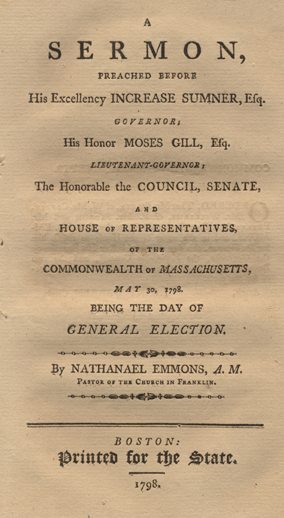
A

SERMON,

PREACHED BEFORE

His Excellency INCREASE SUMNER, Esq.

Governor;

His Honor MOSES GILL, Esq.

LIEUTENANT-GOVERNOR;

The Honorable the COUNCIL, SENATE,

AND

HOUSE OF REPRESENTTIVES,

OF THE

COMMONWEALTH OF MASSACHUSETTS,

MAY 30, 1798.

BEING THE DAY OF

GENERAL ELECTION.

By NATHANAEL EMMONS, A. M.

Pastor of the Church in Franklin.

BOSTON;

Printed for the State.

1798.


COMMONWEALTH OF MASSACHUSETTS.

In the House of Representatives, May 30, 1798.
 

ORDERED, That Mr. Fisher, of W. Mr. Coffin, Mr. Williams, of P. Mr. Slocum and Mr. Phelps, be a Committee to wait on the Rev. Mr. EMMONS, and in the name of the House to thank him for his Sermon, this day delivered before His Excellency the Governor, the Honorable Council, and the two Branches of the Legislature, and to request a copy thereof for the press.

Attest, HENRY WARREN, Clerk.


AN
ELECTION SERMON.

Daniel vi. 28.
SO THIS DANIEL PROSPERED IN THE REIGN OF DARIUS, AND IN THE REIGN OF CYRUS THE PERSIAN.
 

The prosperity of this noble ruler, clearly appears from the whole history of his life. Though, in his youth, he was carried away captive from Judea to Babylon; yet that dark and distressing scene soon opened the way to a brighter prospect. His high descent, his graceful appearance, and his shining talents, secured the royal favor, and the peculiar privilege of a public education. Having finished his academical course, he was presented, in usual form, before the reigning monarch; who, strictly inquiring into his proficiency in learning, found him not only superior to all his companions, but ten times better than all the magicians and astrologers in all his realm. Pleased with this promising youth, he took him into his own presence, and employed him in his own service. This was only a short and easy step to higher preferment. Being called to tell, and to interpret the king’s dream, which no other man was able to do, he was immediately advanced above all the governors in the province of Babylon. Though he had now scarcely reached the years of manhood, yet he faithfully and honorably discharged the duties of his office, during the reign of Nebuchadnezzar, during the reign of Evil-Merodach, and until the close of the reign of Belshazzar. At that portentous period, he was sent for, to read, and to explain the hand-writing on the wall, which contained the awful doom of that vile and impious prince; for which he was raised to higher dignity, and made the third ruler in the kingdom. The following night, Babylon was taken, Belshazzar was slain, and all his dominions thrown into the hands of Darius the Mede, by the victorious arms of Cyrus the Persian. Upon this large accession to his empire, Darius found it necessary to make a new arrangement in the departments of state. And in this new arrangement, he took particular notice of the celebrated Daniel, and placed him at the head of an hundred and twenty princes. Here, in spite of all his enemies, he continued to prosper, until Cyrus took the full possession of the Persian monarchy. That auspicious event gave him a free and easy access to Cyrus, and a happy opportunity of gaining a just and honorable influence over that great and amiable prince. In a word, it was the peculiar lot of Daniel to enjoy the favor and confidence of four of the greatest monarchs of the East; and to sustain, with dignity and success, some of the highest offices of state, for more than sixty years, in a constant, uninterrupted succession. Such another instance of long and increasing prosperity, in public life, we presume to say, cannot be found in the whole history of man.

Successful men have always been revered as well as admired. The Greeks and Romans held those in high estimation, who appeared to enjoy the peculiar smiles of the invisible powers. The same sentiment universally prevails in the minds of men. They spontaneously conclude, that those possess some extraordinary excellence, who are uncommonly successful in any important station of life. And if the Supreme Being governs the natural and moral world, according to a previous connexion between causes and effects; there seems to be a just foundation to suppose, that peculiar prosperity is a mark of peculiar merit. Under the impression of this sentiment, it is very natural to inquire what extraordinary qualities Daniel possessed, which mutually conspired to promote his prosperity, in the management of public affairs. Here it may be proper to observe,

First, That this excellent and prosperous ruler possessed superior powers of mind. The Father of Spirits has been pleased to display the same sovereignty in the bestowment of intellectual faculties, as in the bestowment of inferior favors. To some he has given ten talents; to some five; and to some fewer. The minds of different men are differently constructed. In one man, the memory is the superior power; in another, the imagination is the most brilliant talent; in a third, a clear and penetrating judgment is the most prominent faculty; but in Daniel, all these natural powers were equally strong and well proportioned. His quick apprehension and retentive memory were happily united with a strong and penetrating judgment, which formed him a great and noble genius. This appears from the account which we have of his mental improvements. He acquired knowledge with the greatest ease and rapidity; which discovered a sprightly and retentive mind. And he was able to excel in every branch of science, to which he turned his attention; which equally displayed the strength and symmetry of all his intellectual powers. These, perhaps, some may choose to ascribe to the plastic power of education: but taking education in the most extensive latitude, in which Helvetius, or any other author uses the term, it will not account for every mental distinction. It is readily admitted, that all the objects with which a man is surrounded, and all the connexions and circumstances in which he is placed, will either strengthen, or weaken his original powers. But to ascribe these powers to anything exterior to the mind itself, is no less absurd, than to ascribe the attractive power of the magnet to the needle, which only serves to discover that peculiar property. Daniel, like every other man in the morning of life, was unacquainted with the native strength of his own mind; but by repeated mental exertions, in the course of his education, he discovered those superior talents, which qualified him to manage the affairs of government, with great reputation and success. A party spirit, or the favor of friends, or a peculiar concurrence of circumstances, may chance to raise a man to a public station; but if his natural abilities are unequal to his office, he will most certainly fall, to rise no more. But Daniel began to rise, by the dint of merit, and therefore, he continued to rise from office to office, until he reached the next step to imperial power. Like Julius Cesar, he was born to govern, whether he lived in Judea, in Babylon, in Persia, or in any other quarter of the globe.

Secondly. Daniel possessed a large share of general information, which contributed to form him a great and successful politician. Civil government is extremely complicated and extensive, both in theory and in practice. It embraces all the objects in this world, and all the interests and concerns of men, in this life. No species of human knowledge is foreign to the business of a statesman, who needs to be universally acquainted with men and things. This idea was early and deeply impressed on the mind of Daniel. He was born a prince, and received a princely education. Providence directed his first and supreme view to the affairs of state. To be an able and successful politician, was the single object, which engrossed his whole attention, and which guided all his exertions. And no person, perhaps, ever enjoyed more ample means and opportunities of attaining this object. His great capacity; his refined taste; his studious habit; his early acquaintance with the solid branches of learning; and more especially his peculiar situation, prepared him to acquire the largest stock of general knowledge.

Babylon stood on the plains of Shinar, which was the most venerable and most enlightened spot on the face of the earth. There the residue of men first settled after the flood; and there they continued and increased, until their absurd and impious attempt to build the tower of Babel, proved the occasion of a general dispersion. Though this gave a universal shock to human affairs, and naturally checked the progress of knowledge; yet the feeds of science were happily preserved by the children of Ham, who still remained on the plains of Babylon. That city, therefore, was the fountain-head of information. There all the knowledge of both the old and of the new world concentred. There the arts and sciences were first cultivated. And there a literary society was first formed. The Chaldeans, who composed that society, devoted themselves wholly to the improvements of the mind, and made it their whole business to acquire and disseminate every species of rare and useful knowledge. And for this purpose, we may presume, they not only made deep researches into the works of nature, but also collected from every quarter, the most ancient and most valuable discoveries on every important subject. In such a circle of learned men, and in possession of so many means of information, such a man as Daniel, who had a peculiar capacity and taste for learning, must have amassed as large a stock of human literature, as could be derived from all the labors and researches of antiquity.

But I must further observe, that Daniel had the best sources of information in his own hands; I mean the sacred books of divine Inspiration. These acquainted him with the creation and fall of man, and the universal corruption of human nature. These exhibited the Church of God, as the great object, to which all human governments ought to be subservient. These placed before him a form of government, which was absolutely perfect. These presented him with the lives and characters of the greatest and best statesmen, for his constant imitation and encouragement. These reminded him of the awful fate of wicked nations and of wicked rulers. And these inculcated upon his own conscience his solemn obligations to live and act, like a dying and accountable creature. By reading and devoutly studying these sacred volumes, he obtained the best political as well as religious knowledge. Such a variety of books, however, would have been more injurious than beneficial to him, had he read without reflection, or thought without decision. But his strong, capacious, discerning mind could not be overloaded with learning. Like Pericles, he was able “to turn and wind everything to his own purpose,” and to apply every species of knowledge to a political use. The state physician needs an immense fund of political information, in order to prescribe on all occasions, a proper remedy for every political disorder. Such a source of political information Daniel possessed. He carried in his mind the history of the world, and the experience of ages. This enabled him to act with propriety, in every situation, and always to succeed in all his public measures. But,

Thirdly. Daniel’s extraordinary wisdom was no less beneficial, than his great information. Nebuchadnezzar pronounced him, even in his youth, to be ten times better “in all matters of wisdom,” than all the wise men in Babylon. And before he was thirty, his eminent wisdom was universally known and celebrated, not only through the empire, but through all the neighboring nations.

The haughty king of Tyrus had heard of the fame of his wisdom, otherwise he could not have felt the force of that severe reproof of the inspired prophet: “Thou art wiser than Daniel.”

Wisdom is a term of various and extensive meaning. It includes not only invention, but foresight and sagacity. Wisdom certainly implies the power of invention. It enables a man to take a clear and comprehensive view of things; and, under that view, to form the noblest designs, and to adopt the best means to accomplish the best purposes. But after a man has devised a great and complicated scheme, and made choice of the proper measures to carry it into execution, there is still occasion for what is commonly called foresight. This is that part of wisdom, which looks forward to, and provides against, unforeseen contingencies, which may possibly defeat a great and good design. But foresight is founded in sagacity, which is the power of discerning the near and remote connexion of things; of discovering the peculiar dispositions of mankind; and of penetrating their most dark and deep designs.

A large measure of wisdom, in all its branches, is indispensably necessary to form a great and good politician. Civil rulers are obliged, by the nature of their office, to be intimately concerned with every description of men. And unless they are “as wise as serpents and as harmless as doves,” they are in the utmost danger of being betrayed into measures, which will be injurious to themselves as well as to the public. Rehoboam lost the greatest part of his kingdom, by hearkening to the evil advice of young and conceited counselors. Political storms and tempests often rise, in which the ablest statesmen find occasion to exert all their wisdom, to devise the best measures, to prevent the political ship from foundering. Daniel frequently employed his wisdom to great advantage. By his wise and prudent conduct, he secured the favor and assistance of Cyrus, in restoring the Jews to their native land. By his great sagacity, he obtained the liberty of living according to the laws of his own religion. When he preferred his request to the superintendant of the captives, he replied, that he could not grant it, without endangering his head to the king. But Daniel was so perfectly acquainted with every avenue to the human heart, that he brought his benefactor to a cheerful compliance, even at the risk of his life. So, when the king had signed a rash and cruel decree, to destroy all the wise men of Babylon, he had the “wisdom and counsel” to stop the executioner in the discharge of his office, to appease the wrath of the king, and to preserve the lives of many of his most valuable subjects. By virtue of such extraordinary wisdom, he was able to promote his own and the public good; and to succeed in the administration of the most despotic government, that ever existed.

Fourthly. Daniel was a man of invincible firmness. This was but the natural effect of his wisdom. He was able to think for himself; to form his own opinions; and to comprehend the nature and tendency of his own designs. Having, therefore, once deliberately and wisely concerted a measure, he expected to succeed, and eventually to gain the approbation of the public. This well-founded confidence inspired him, with irresistible vigor and fortitude, in the prosecution of all his public measures. If he met with difficulty, or opposition, he steadily pursued his object, and appealed to the end, to justify the propriety of the means. He entreated Melzar to try his proposed expedient, and promised to renounce it, if it did not eventually answer a wise and valuable purpose. So, he besought the king to suspend the execution of his hasty decree, only upon the condition, that his dream should be interpreted, and his wishes completely gratified. Being ever fully persuaded of the wisdom and rectitude of his public conduct, he was always willing to suffer the opposition and clamor of the multitude, until his wisdom and rectitude should have a fair opportunity to triumph over all their prejudice and folly. Such a firmness of mind is the reverse of a vain and foolish obstinancy, which consists in a wilful opposition to the dictates of wisdom. This was the fault of Pharaoh, who ruined himself and his kingdom, by rejecting the advice of Moses. This was the fault of Saul, who disobeyed the voice of Samuel, and forfeited his title to the throne of Israel. And this was the fault of Ahab, who despised the admonition of the prophet, and died as a fool dieth, at Ramoth-Gilead. But Moses, Joshua, and Caleb, displayed a wise and noble firmness, in conducting the children of Israel to the land of promise, notwithstanding all their unreasonable opposition and complaints. If we consult the history of rulers, we shall find firmness of mind to be one of the distinguishing features of every great and prosperous statesman. And how often did God enjoin it upon the rulers of Israel, “to be strong and of a good courage,” in the discharge of their difficult and dangerous duties? There is no one thing, perhaps, more conducive to success in any important and difficult undertaking, than a firm, steady, unremitting spirit. And we have abundant reason to conclude, that this noble spirit had a large share of influence, in promoting the success and prosperity of Daniel, in some of the most critical and hazardous situations of his public life.

Fifthly. This same Daniel, who prospered so much under the most arbitrary princes, was a perfect pattern of inviolable integrity. By this is meant, that he always aimed to do justice, and to treat every man according to the eternal rule of right. As a ruler, he acted upon principle, in guarding the lives, the properties, and the characters of his subjects. Of this, we have incontestable evidence, even the united testimony of his most malicious enemies. “Then the presidents and princes fought to find occasion against Daniel concerning the kingdom; but they could find none occasion nor fault; forasmuch as he was faithful.” It is very remarkable, that the most critical and malignant eyes could discover no blemish in the integrity of Daniel, through the whole course of his public conduct. But we are to remember, that he had derived his moral sentiments from the pure source of divine Inspiration. He had read, with serious attention, the solemn charge, which Moses delivered to the judges of Israel. “Hear the causes between every man and his brother, and the stranger that is with him. Ye shall not respect persons in judgment, but ye shall hear the small as well as the great: ye shall not be afraid of the face of man; the judgment is God’s.” He had felt the force of that divine admonition to every civil officer in every civil department: “That which is altogether just shalt thou follow.” But, perhaps, no text in the Bible had a more steady, powerful, and practical influence upon his mind, than the last words which God put into the mouth of a dying statesman. “The God of Israel said, the rock of Israel spoke to me, He that ruleth over men must be just.”

The promotion of justice is the ultimate object of every branch of civil government. This is clearly and forcibly expressed, by an eminent British writer. “We are,” says he, “to look upon all the vast apparatus of our government, as having ultimately no other object or purpose but the distribution of justice, or in other words, the support of the twelve judges. Kings and parliaments, fleets and armies, officers of the court and revenue, ambassadors, ministers, and privy-counselors, are all subordinate in their end to this part of administration.” If the support of justice be the ultimate design of all civil governments, then the exercise of justice must be the indispensable duty of all civil rulers. They are appointed, not so much to promote, as to defend the public interest. Though they have the power of enacting laws; yet they have no right to dissolve the solemn obligation of mutual contracts, nor to require any man to do a single act, which is repugnant to that immutable justice, which is founded in the nature of things. And though they do, in a sense, hold the purse-strings of the people; yet they have no right to dispose of the public property for any other purpose, than the promotion of public justice. If they grant donations to particular corporations, or to particular persons, they ought to do it, not for the sake of those particular corporations, or particular persons, but simply to promote the public good. Indeed, their whole public conduct ought to be regulated, by the infallible standard of immutable justice. It is required of all stewards, whether sacred or civil, that a man be found faithful. Fidelity in civil rulers is, of all other virtues, the most acceptable to the people, who universally feel its happy influence, in every condition of life. Hence mankind have always manifested an uncommon attachment to, and veneration for, those eminent rulers who have given uniform and unequivocal proofs of their moral rectitude. Aristides among the Greeks, Cato among the Romans, and Daniel among the Jews, will be forever celebrated for their incorruptible integrity. This is that sterling excellence in a statesman, which needs no inscription, nor crowned head, to give it a universal currency among all nations of the earth. It was this rare, shining, captivating virtue of integrity, that recommended Daniel to Jews and Babylonians; to Medes and Persians; to Darius and Cyrus; and to every other prince, who employed him in public affairs. But,

Finally, The prosperity of Daniel, amidst all the burdens and dangers of public life, must be principally ascribed to his eminent piety and devotion. Like other men, who stood upon the pinnacle of power, he was continually exposed to the severest strokes of adversity. He came into administration in troublous times; and had a clear prophetic view of the dreadful convulsions, which were just ready to seize an expiring empire. And whilst he sat in the king’s gate, he was a spectator of many of those awful scenes, which were a fulfillment of his own predictions. He saw the haughty king of Babylon shook from his throne, driven from men, and degraded below the beasts that perish. He attended monarch after monarch to the silent mansions of the dead; and felt those heavy shocks, which falling princes never fail to give. And he was personally involved in the horrors of that memorable night, which sunk a mighty empire in perpetual ruin. But none of these things moved him, because his heart was fixed, trusting in the Lord. Those national convulsions and revolutions, which proved so fatal to others, all conspired to promote his personal prosperity and success. He secured the favor and protection of Heaven, by his sincere and exemplary piety. He carried conviction to all around him, that he possessed a truly “divine and excellent spirit.” His religion was neither a glowing enthusiasm, nor a gloomy superstition; but a pure and steady principle of universal benevolence. He gave God the supreme affection of his heart; and was neither afraid nor ashamed to profess the true religion, in the midst of a country and a court, that were involved in the grossest idolatry. He extended his benevolent regards to all the children of men, whether Jews, or Gentiles. He zealously promoted the cause of religion; and spent days and weeks, in humble, fervent, effectual prayers for the prosperity of Zion. He walked within his house with a perfect heart, and every day called upon God, at the head of his family. This he did; not because it was a common and reputable practice; but because it was a plain and important duty, which he owed to God, and to those whom God had committed to his care and instruction. His family devotion was known to his enemies as well as to his friends; and because there was nothing else to take hold of, his enemies took hold of this, as the only possible engine to work his ruin. Accordingly, they conspired together and obtained a royal decree, that “if any person should ask a petition of any God or man for thirty days, except of the king, he should be case into the den of lions.” As soon as he knew the writing was signed, he went to his house, opened his windows, fell upon his knees, and three times a day prayed and gave thanks to God. This threw him into the hands of his enemies, and out of the protection of his prince, who was constrained to expose him to the furious beasts of prey. But his heroic faith and fervent prayers stopped the mouths of lions, defeated the designs of his enemies, and smoothed the path of declining life with signal prosperity. For it is in immediate reference to this astonishing event, that it is emphatically said in the words of our text—“So this Daniel prospered in the reign of Darius, and in the reign of Cyrus the Persian.”

I have now delineated the most prominent features of this great and amiable statesman. His life is a bright assemblage of all the human virtues. And it is a just and beautiful remark, that “the collected virtues of one man, strike the mind much more forcibly and advantageously, that the scattered virtues of many.” Permit me then to hold up the character of Daniel as a mirror, in which all persons, and especially those in places of power and trust, may clearly and sensibly discover both what they are and what they ought to be.

The first thing suggested by this excellent character is, that great and good rulers are worthy of the highest respect. Who can contemplate the pious, virtuous, and useful life of Daniel, without paying him the sincere homage of the heart? Whilst he was acting his noble part on the stage of life, the happy influence of his public and private virtues commanded universal admiration and esteem. The greatest men in his day, honored him beyond the bounds of duty, or even propriety. Nebuchadnezzar prostrated himself at his feet, and payed him the excess of Eastern compliance. Darius gave him the strongest marks of sincere and ardent affection. Nor was he less esteemed in the court of heaven. The supreme Ruler dispatched an envoy extraordinary to assure him, “he was greatly beloved” by his Maker, and by all the principalities and powers above. This was no unmeaning compliment, but a divine testimony to his just desert of universal love and respect. All civil rulers of the same character, are equally objects of the highest veneration and regard. They are ministers of God for good to the people, and the principal instruments of all their temporal prosperity. Though the inventors of arts and sciences, and the promoters of agriculture and commerce, deserve the public esteem; yet wise and faithful rulers have a better claim to universal gratitude and respect. For it is ultimately owing to their exertions, that mankind derive any real benefit from their labors, their studies, or any of their natural advantages. A people may flourish in all the arts of Italy, or abound in all the wealth of the Indies; and yet drag out a poor, miserable life, under the power and oppression of a cruel and rapacious tyrant. But just men, ruling in the fear of God, give a people the full enjoyment of all the blessings of Providence. Those rulers, therefore, who direct all their views to the public good, and exert all their power and influence to promote it, are great benefactors to the world, and de4serve to be universally respected and revered. For this cause, therefore, God expressly commands every soul to be subject to the higher powers, not only for wrath, but also for conscience sake; rendering to all in authority their dues; tribute to whom tribute is due; custom to whom custom; fear to whom fear; honor to whom honor.

The pious and devout life of Daniel, in the next place, loudly admonishes civil rulers how much they are capable of doing, to promote the religious as well as civil interests of the people. The children of Israel were extremely addicted to the worship of idols, from the time they made the golden calf, to the time of their captivity in Babylon. But in that land of idols, the parent of idolatry, they were effectually and finally cured of their national sin. This great and extraordinary reformation, we must conclude, was brought about by the instrumentality of Daniel. The captive tribes were struck with his pious and exemplary conduct, in the midst of the worshippers of idols. They saw him pay a strict and sacred regard to those divine rites and ceremonies, which were designed to separate them, from all the idolatrous nations. They saw him daily and devoutly worship the true God, in his own family. They saw his faith and piety stop the lions’ mouths. They heard, with deep conviction, proclamation after proclamation, published by the great monarchs of Babylon, giving honor to the God of Daniel, and pouring contempt upon every false and inferior deity. They were acquainted with his days of mourning, fasting, and prayer, for the revival of religion, and the prosperity of the Church. In a word, they saw the purest piety constantly displayed in the life of a man, who was seated in the king’s gate, and universally loved and revered. And is it a thing incredible, that the pious example and influence of such a great and renowned ruler should awe the minds of a whole nation, and constrain them to cast all their idols to the moles and to the bats forever? The living example of other religious rulers has had the same transforming influence upon the minds of their subjects. We read, “The people served the Lord all the days of Joshua, and all the days of the Elders that outlived Joshua.”

Among the pious kings of Judah, do we find one, who ever failed to bring about a visible reformation in piety and virtue? And is it not equally true, that pious rulers, by their personal example and influence, have actually formed the moral and religions character of the people in this land? We know, that so long as all the governors, senators, and representatives of this Commonwealth, were public professors and zealous promoters of religion, the Sabbaths were sanctified; the houses of God were filled; divine institutions were attended; family religion and parental authority were maintained; cards, and balls, and theatres were unknown, and all open vice and infidelity were treated with general and just contempt. Whether this was pure superstition, or pure religion, it was certainly owing, in a great measure, to the example of civil rulers, who meant to form the people to virtue and piety. It is to be expected, that rulers should form the character of the people, and not that the people should form the character of rulers. It was never known, that the house of Israel reformed one of their loose, irreligious kings; but it was often known, that one pious, exemplary king reformed the whole nation. If Daniel had fallen into the corruptions of Babylon, there is not the least probability, that his people could have prevented his ruin. But when they had forsaken the paths of virtue and piety, he was able, by his personal example and influence, to bring them back to the worship and service of the God of their fathers. Civil rulers would find no occasion of promoting religion, by their laws, if they would only heartily and unitedly promote it, by their lives. Let them only live religion, and they will do enough to discharge their duty; and I will venture to add, they will do enough to form this people to a virtuous and religious character. For if this effect should not flow from the example of their virtue and piety, it would be a singular instance, and such an one as cannot be found in the history of any nation, from the beginning of the world to this day. If civil rulers carry the power of reformation in their own hands, then their obligation to reform the people, must be equal to that power. Let me, therefore, entreat the man of office, the man of honor, the man of influence, seriously to consider, that “to him that knoweth to do good, and doeth it not, to him it is sin.”

It further appears from the character and conduct of Daniel, that those who sit in the highest seats of government, have no excuse to neglect the profession and practice of vital piety. Real religion is necessary on their own account, as well as on account of those, who live under the influence of their powerful example. It is hard to say, whether the most dignified characters deserve our veneration, more than our tender compassion. They are certainly surrounded with peculiar temptations to forget their Creator, and to neglect the one thing needful. But Daniel has told them by his example, that they are under a great delusion, if they once imagine, their high stations and public employments, will afford them the least excuse for neglecting the duties of piety and devotion. They cannot seriously believe, that they have greater temptations to resist, than Daniel resisted; nor greater difficulties and embarrassments to surmount, than Daniel surmounted. He was born a prince, and spent his whole life in the presence of princes. But whilst he lived with the princes of Judah; whilst he marched with the army of the Chaldeans; and whilst he resided with the gay and dissolute youth, in Babylon, he remembered and obeyed his Creator. When his office seated him in the king’s gate, surrounded by profligate and infidel courtiers, he supported and adorned his religious profession. When an hundred and twenty princes sat at his feet, and the affairs of an hundred and twenty princes lay upon his hands, he found time and opportunity for the performance of every religious duty. And when propriety required him to submit to the most public and pompous parade; to be clothed in the silks of Persia, and adorned with the gold of Ophir; and to receive the incense of public honors; he could silently retire in the close of the day, and humbly prostrate himself, as a poor, guilty worm, before the supreme Majesty of heaven and earth, and devoutly implore his mercy. He very well knew, that though ornaments and honors might dazzle the eyes of unthinking multitudes, and conceal his imperfections from the view of men; yet they could by no means hide his heart, or conceal his criminal defects from the omniscient eye of God, to whom he stood accountable for all his internal feelings and external conduct. If young politicians, if aged statesmen, if the most dignified characters on earth, would seriously survey the pious and devout life of Daniel, they would be fully convinced, that neither the cares, nor honors, nor temptations of public life, can dissolve their obligations to call upon God; to read his word to reverence his sanctuary; and to attend all his holy and sacred institutions. Dignity and devotion have been, and may be united. Rulers over men have been, and may be, the most humble and faithful servants of God. “Be wise now therefore, O ye kings: be instructed, ye judges of the earth. Serve the Lord with fear, and rejoice with trembling.” Moreover,

The faith and piety of Daniel reprove the ignorance and presumption of those politicians, who profess and propagate the principles of infidelity. The infidels, in our Savior’s day, were men of superior rank and figure. And it is well known, that infidelity has commonly been first imbibed and propagated, by professed philosophers and politicians. Men of this exalted character have lately spread atheism and infidelity through a great nation; and attempted to diffuse the poison of their irreligious and disorganizing sentiments among the people of America. Such champions of infidelity endeavor to shake our faith in natural and revealed religion, by carrying us back into the dark regions of antiquity. Hume, Voltaire, and Condorcet, represent mankind as being originally involved in ignorance and barbarism. And they pretend to trace the progress of the human mind, in emerging from that primitive savage state, and gradually rising to a nobler state of civilization, learning, and infidelity. But were they better acquainted with the dark regions of antiquity, and with the rise and progress of human improvements, than the pious and learned Daniel? Did they ever live with him on the plains of Shinar? Did they ever search the same records and traditions of antiquity, which he searched? Did they ever converse with the Chaldeans, with whom he conversed? Were they ever personally acquainted, as he was, with the learned Amonians, who, as an incomparable writer has clearly proved, 1 spread every species of civil, political, and religious knowledge, through Egypt, through Greece, and through every part of the inhabited world? The most learned infidels of the present age, who have ransacked the bowels of the earth, and the dark corners of the globe, to pick up arguments against revealed religion, are but minute philosophers, in comparison with Daniel. Whilst he stood on the plains of Babylon, with the Bible in one hand, and all antiquity in the other, he saw, as clearly as the sun at noonday, the truth and divinity of that holy religion, which came down from heaven, through the medium of divine Inspiration. All his knowledge of the natural, moral, and political world, instead of weakening, confirmed his faith in the scriptures of truth. His strong and cordial belief of divine revelation, therefore, completely demonstrates, what has often been justly asserted, that infidelity is not seated in the head, but in the heart; and flows not from profound knowledge, but from a meaner and more criminal cause. Is it not sufficient to strike any modern infidel entirely dumb, to ask him this plain, pertinent, pointed question, “Art thou wiser than Daniel?”

Another important reflection, naturally suggested by the conduct of this able statesman, is, that civil rulers have no occasion for the use of art or intrigue, in any of their public measures. Those who conduct the intricate affairs of government ought to be wise and prudent; but yet they should never be artful, or designing. There are, however, professed politicians, who recommend this mode of conduct, by precept as well as example. They insinuate, that no man can succeed in political affairs without taking advantage of the weakness, folly, and caprice of human nature, and making use of measures, which are diametrically opposite to every idea of integrity. Some grave writers on moral and political philosophy, plainly inculcate the first principles of injustice and duplicity. They lay it down as a maxim, that politicians may and ought to make utility, or what they conceive to be the general good, the supreme rule of their conduct. But a great and good ruler will adopt and act upon a far more honest and noble principle: “Let justice be done, though the universe should sink.” Daniel found wisdom and integrity abundantly sufficient to answer all his political purposes, without ever stooping to the low arts of intrigue. These he was able to describe, and these he was able to defeat. In drawing the characters of the king of the North and of the king of the South, he gave a lively and striking picture of two profoundly artful and intriguing politicians. “And both these kings’ hearts shall be to do mischief, and they shall speak lies at one table; but it shall not prosper.” Whilst he presided over an hundred and twenty princes, he clearly and sensibly perceived the nature and tendency of that diabolical policy, which they employed to take away his life. But he opposed honesty to dishonesty; justice to injustice; wisdom to cunning; and open integrity to all their dark and deep designs. Nor did he fail of confounding their counsels; and of turning their own artful and malicious devices to their own destruction. Truly wise and upright politicians will never find occasion to employ any other weapon than perfect integrity, in order to defeat the pernicious purposes of their most subtile and malignant enemies, whether at home or abroad. Be it so, that our present connexion with distant nations may expose us to the arts and intrigues of foreign courts; yet those, who have the direction of our national concerns, may rely upon it, that a fair, open, upright conduct will be the best method, to frustrate the art, the duplicity, and unjust policy of five, or of five hundred unprincipled politicians.

This naturally leads me to observe, in the last place, that civil rulers have sufficient encouragement to be faithful, in the discharge of all their public duties. These, I shall not go out of my province to prescribe, nor even to suggest. If public men are but only faithful; there is no ground of anxiety about the wisdom or propriety of their public measures. Faithfulness, however, cannot be too often nor too forcibly inculcated upon those who have many opportunities, and of course many temptations to betray their trusts. But it is happy to reflect, that their encouragement to fidelity, is abundantly sufficient to balance all their unfavorable circumstances. The favor of God, and the esteem of men, are the most animating motives to duty. These had a commanding influence over the views and conduct of one of the most able and upright rulers. Daniel found by happy experience, that honesty was the best policy. For, his faithfulness to the Deity, secured his favor and assistance; and his fidelity to men, secured their sincere and warm attachment to his person and interest. As he constantly persevered and increased in integrity; so he constantly increased in wealth, in honor and outward prosperity. Let who would fall, Daniel stood. Let who would sink, Daniel rose. Let who would be in power, Daniel was their favorite. Let who would combine against him, Daniel always succeeded and prospered.

Is not this example worthy of the notice and imitation of all who sit in the seats of government? And may I not, with great propriety, take 0ccasion from it, to press the duty of fidelity upon the Honorable Legislature of this Commonwealth, which holds the first rank in the United States, for piety and virtue, as well as political importance? This large and religious community, are devoutly wishing and praying for a faithful administration of government. They would shudder at the thought, that their rulers should lift their hands to Heaven, and solemnly engage to administer a government, which they meant to undermine; and to protect a people, whom they meant to destroy. Their minds are alarmed at threatening dangers; and nothing can give them ease, but an unshaken confidence in the fidelity of their rulers. They do not distrust their abilities; but they may entertain some apprehensions respecting their integrity, since their enemies boast of corrupting it. But if those who direct our public affairs, would only display the piety, the integrity, and firmness of Daniel, they would undoubtedly possess the entire affection and confidence of this great and intelligent people. Indeed, some of the first characters in this Legislature, have already merited and secured the esteem and attachment of an enlightened part, and were it not invidious, I would add, of the most enlightened part of this Commonwealth. Notwithstanding the weakness and prejudice of some, we esteem it a favorable circumstance, that his Excellency has heretofore filled a dignified station; in which he had a peculiar opportunity of discovering his uprightness, and at the same time of forgetting the subtilties, and of imbibing the genuine spirit of the laws. This, and all the States in the Union, are much indebted to many eminent civilians, for the knowledge, the wisdom, and the integrity, which they displayed, in framing the Federal Constitution; which is not, and perhaps never will be, inferior to any one of mere human invention. This excellent constitution is the basis of all our national safety and happiness. And it is extremely difficult to conceive, that a single American, who is friendly to any good government, should be unfriendly to his own; and wish to alienate the affections of the people from it. But it is very natural to conclude, that the framers of the Constitution and those who were personally concerned in adopting it, should cherish an uncommon attachment to it, and labor to support it, with distinguished ardor and zeal. Upon this ground, the people have a just right to expect, that His Excellency will never mar the production of his own hands; nor renounce those political principles, which he has publickly and solemnly sanctioned, and which have had their proper influence in raising him to the head of this Commonwealth.

His Honor the Lieutenant-Governor, and the principal members of the Council, of the Senate, and of the House of Representatives, have not only gained the suffrages, but what is far more honorable and desirable, the confidence of the people, who sincerely esteem them for their able and faithful services. May this operate as a powerful and endearing motive to future fidelity and zeal, in the discharge of their important trusts. The greatest of all the men of the East, was highly gratified and animated, by the sincere affection of his grateful and dutiful subjects. “When I went out to the gate through the city, when I prepared my seat in the street, the young men saw me, and hid themselves; and the aged arose, and stood up. When the ear heard me, then it blessed me; and when the eye saw me, it gave witness to me: Because I delivered the poor that cried, and the fatherless, and him that had none to help him. I put on righteousness, and it clothed me: My judgment was as a robe and diadem. I broke the jaws of the wicked, and plucked the spoil out of his teeth.”

Such, sincerely respected rulers, are the consoling reflections, which naturally flow from fidelity in public life. If, therefore, you have begun to be faithful in your various departments, be not weary in well-doing; but be stedfast, unmoveable, always abounding in the service of God, and of your generation. Cherish a warm attachment to the government, which you are called to administer, and do all the public good, which both the State and Federal Constitutions require and enable you to do. Guide this people in the integrity of your hearts, and by the skillfulness of your hands. Exhibit before them a shining example of piety and virtue; and employ all your honor and influence to promote their spiritual as well as temporal good. This wise and faithful discharge of your public trusts, will finally put you into the full possession of that transporting promise, which is emphatically yours—“They that be wise shall shine as the brightness of the firmament; and they that turn many to righteousness, as the stars forever and ever.” But, if any of you should be conscious to yourselves, that you have been unfaithful, unjust, and unholy; let Daniel’s counsel be acceptable to you, and break off your sins by righteousness, and your iniquities by shewing mercy to the poor, that it may be a lengthening out of your tranquility. For, it is most certainly true, that, if you cast off fear, and restrain prayer before God, and despise all his warnings and admonitions, the day is coming, when that invisible hand, which is now recording all your deeds, will write on the table of your hearts, in a language which will need no interpreter, this final and fearful sentence: “You are weighed in the balances, and are found WANTING.”

END.


1.Bryant on Ancient Mythology.

Sermon – Election – 1798, Connecticut


Azel Backus (1765-1817) became a Christian after graduating from Yale (1787) and entered the ministry. He was pastor a church in Bethlehem, Connecticut (1791-1812) where he also ran a school. Backus was the first president of Hamilton College in New York in 1812. This sermon was preached in Connecticut on May 10, 1798.


sermon-election-1798-connecticut

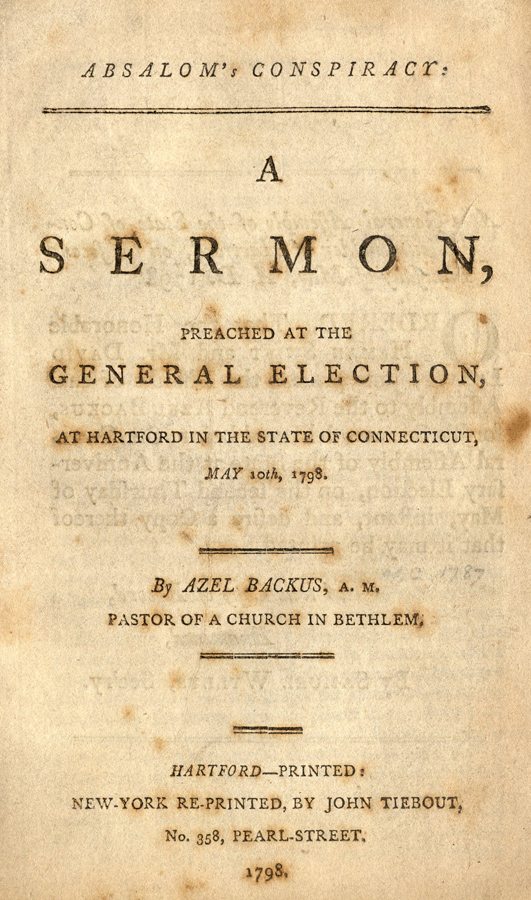
ABSALOM’s CONSPIRACY.

A

S E R M O N,

PREACHED AT THE

GENERAL ELECTION,

AT HARTFORD IN THE STATE OF CONNECTICUT,

May 10th, 1798.

By AZEL BACKUS, A. M.
PASTOR OF A CHURCH IN BETHLEM.

At a General Assembly of the State of Connecticut, holden at Hartford, on the second Thursday of May, A. D. 1798.

ORDERED, That the Honorable Heman Swift and Mr. David Leavit, jun. present the Thanks of this Assembly to the Reverend Azel Backus, for his Sermon delivered before the General Assembly of the State at the Anniversary Election, on the second Thursday of May, instant, and desire a Copy thereof that it may be printed.

A true Copy of Record,
Examined,

By Samuel Wyllys, Sec’ry.


ELECTION SERMON.
 

II SAMUEL XV. 4.

–Oh that I were made judge in the land, that every man which hath any suit or cause might come unto me, and I would do him justice!

THE perfection of a government will not save it from the evils of faction and party spirit. The divine government itself has long had its opposers. Immediately after its introduction on earth, as we learn from the book of Genesis, the chief of those rebellious spirits, who by a restless ambition had raised a war in heaven, visited the new creation, to sow sedition, and divide its happy inhabitants from their allegiance. He chose the serpent for his craftiness and subtlety, as the fittest instrument to scatter the poison of seduction, and to thwart the designs of wisdom. A temptation, most dangerous and alluring to man in his exalted and happy state, was propounded to the most susceptible of the family of paradise. To artful intimations that they were unreasonably abridged in happiness, and held in ignorance by the tyranny of their Creator, were added the enticing promises of increased freedom, the enlargement of knowledge, and sensitive pleasure. The temptation was fatally successful, and a rebellion hence arose against God on earth, that has raged with awful virulence for almost six thousand years. It called forth the strong arm of power in the flood; on Sodom and its neighbouring cities; in Egypt and at the Red Sea, on a leader that arrogantly questioned, “Who is the Lord that I should obey his voice;” and against Korah and his accomplices, who dared to say to Moses and Aaron, the accredited ministers of a polity ordained by God himself. “Ye take too much upon yourselves, and wherefore lift ye up yourselves above the congregation of the Lord.” The same restless and ungovernable spirit, raised the Jews against the prophets, to put them to death; it brought the Saviour of men to the cross, and persecuted his followers, until the divine government, in justice to itself, sent an army to sack Jerusalem, and to disperse a wicked, a stiff-necked, and a gainsaying people to all the winds of heaven. What it has done in later ages, may be learned from the encrimsoned page of history, and seen in every apartment of the mighty Bedlam, the great Lazar-house of man: Of man naturally anarchical, disorganized, and seduced by the promise of the father of lies, “Ye shall be as gods.”

As one object will be kept in viewing the following discourse, it will not be necessary to descant on the excellency of one form of government above another; it is enough for our present purpose, that this truth be acknowledged, that faction is, and has been, the lot of every government. The government of kings and nobles has its evils and dangers, which I need not repeat, as they have been the theme of the friends and foes of real liberty. And enthusiastic theorists alone will assert, that elective governments can be so pure in their principles, and so perfect in their administration, as to be perfectly secure from turbulence and insurrection. “As heaven’s blest beams turn vinegar more sour,” we must acknowledge, however degrading it may be to the human character, that faction has thriven most in the mildest governments; and that republics in particular, have been proverbially stormy and tempestuous.

If it is asserted by respectable authority, that, “It is yet in experiment whether human nature can bear so free a government as our own;” he is not the enemy of liberty and of the people who would meet its difficulties, but he who would sedulously conceal and keep them out of sight.

This is my apology for selecting a passage of holy writ, that may lead to matter so unusual on this anniversary occasion. It is a religious duty that we owe to our good government, to be armed against these wiles of faction, these “depths of Satan;” wiles, grown common by frequent repetition; but so slow of heart are men to understand, that they are until this day little considered by the great body of mankind.

Divine inspiration informs us, that the Jewish nation, during the reign of David, were prosperous and happy. When he died it is recorded of him, “that he died in a good old age, full of days, riches, and honors.” The same truth is also apparent from many passages of the Psalms, in which the glories of Christ’s future kingdom are undoubtedly shadowed forth, in the real prosperity of Israel, under the wise administration of the son of Jesse: “Out of Zion the perfection of beauty hath shone.” It pleased God, however, for a particular sin of David, to send into his family the scourge of domestic discord. An unhappy event took place that awoke, and called into action, the worst of passions, in Absalom the king’s son, the passion of revenge. With a temper soured by an incident, well known to all who read the word of God, he was soon the cause of serious trouble to his father, and the people he governed. When the viler passions are once roused in the human heart, it is with difficulty they are laid. Chagrin, and disappointment, easily agree to acts of desperation. Possessed of personal accomplishments, and the arts of address, young Absalom aspired at no less than dethroning his father, and usurping the government. To obtain these, he went through the usual process of every demagogue, and insinuated himself into the favour of the people. As parade and novelty are pleasing to the great body of mankind, “he prepared him chariots and horses, and fifty men to run before him:” An essay at show, borrowed from the wicked heathen nations, as unusual as it was unlawful in Israel. But a custom being unusual and unlawful, is often alone sufficient to recommend it to a race of creatures, whose “hearts are continually set in them to do evil.” To administer justice between man and man, in a great nation, is an Herculean task. It seems at this time that the judiciary department of his father’s government, was unusually crowded with business, and as it is easier to fault, than to mend the measures of our rulers, this furnished a favorable opportunity to an unprincipled and aspiring young man.—“He rose up early and stood beside the way of the gate, and it was so, that when any man had a controversy, came to the king for judgment, then Absalom called unto him and said, of what city art thou? And he said thy servant is one of the tribes of Israel. And Absalom said unto him, See, thy matters are good and right, but there is no man deputed of the king to hear thee. Absalom said moreover, Oh that I were made judge in the land, that every man which hath any suit or cause might come unto me, and I would do him justice! And it was so, that when any man came nigh to him to do him obeisance, he put forth his hand and took him and kissed him. And on this manner did Absalom to all Israel that came to the king for judgment. So Absalom stole the hearts of the men of Israel.” The avenues to the human heart are numerous, with which designing men most commonly are pretty thoroughly acquainted. As men have refined in manners, they have refined in villainy. The state of manners with the Jews in this age, was comparatively rude; such open solicitation might now give offence. So bare a hook might now be unsuccessful in the popular stream. But the essentials of matter and manner in this business have ever been similar, and have rarely failed, when adapted to the taste and biases of a people. By “the way of the gate,” we are to understand, either the entrance of the city, or the door of the court where justice was wont to be administered: Here he harangued the litigious, the choicest materials of a demagogue. Told them that his father had become a child and incapable of managing his kingdom; that the judges whom he had appointed were either negligent of their duty or corrupt, and that bribery, and not justice, ruled in their decisions. And, that he might cover his ambition under apparent humanity, he was indiscriminately familiar with all his father’s subjects. If any man had a controversy, let it be just or unjust, he showed himself his patron and friend. On condition they would raise him to office, he not only promised them more liberty, with a regular and impartial administration of justice, and decried the neglects, wickedness, and tyranny of their lawful prince; he could descend farther, when any of the multitude did him obeisance as the king’s son, he proclaimed his equality, and gave them the fraternal kiss. Thus he stole the hearts of the men of Israel, and a more proper metaphor than theft, cannot be applied to those who seek to weaken public confidence in legitimate government, to answer their own vile purposes. For the people were bound to David his father by the constitution, by oaths of allegiance, and by his divine election and anointing as king.—When God in his providence is about to scourge a nation with such characters as Absalom, a train of incidents seems to be laid, to ensure the accomplishment of their purposes. It appears astonishing that a youth should stir up so great a portion of the people, against a king distinguished for religion, the love of his subjects, and the well earned fame of many victories. But it must be considered, that many of the partisans and favorites of Saul his predecessor, were still living, and out of place at court, who had been in the interests of Ish-bosheth, Saul’s son, and who either were fearful of their personal safety, or certainly despaired of being benefited by the present administration.

The haughtiness of Joab, the captain of the king’s hosts, his impunity in atrocious wickedness, and his being suffered to march against his fellow citizens, had lessened the character of David in the eyes of the people. Other public officers probably did not excel in prudence, as a long continuance of power and prosperity, is rarely supported with dignity by the greatest characters. And what was more than all the rest; the sin of the king in the matter of Uriah, was fresh in the minds of his subjects, and had a tendency to make them anxious for their dearest possessions, and their lies. The name and infamy of Bath-sheba, was the topic of her sex, and her power was dreaded.

As an avenging God had laid all these circumstances in a train, the way was prepared for an explosion of the same passions, as were awoke by the conduct of Pisistratus in Athens, and Tarquinius in Rome.

The seeds of rebellion being thus sown in Jerusalem, Absalom, to conceal his designs from his father, could appear religious if occasion required. With apparent filial submission he requested the liberty of going to Hebron, a place about sixteen miles distant from the seat of government, to pay a vow. Meanwhile, his creatures were dispatched to every part of the kingdom, who, upon an agreed signal, were to proclaim him king.

The conspiracy soon grew so strong, that even Ahithophel, the king’s counselor, made “precious confessions” and joined it. When the intelligence arrived, that “the hearts of the men of Israel were after Absalom,” the court and family of the king were filled with consternation. It was resolved to leave the city of Jerusalem, and take refuge in the wilderness. An aged monarch flying with a remnant of his tried friends, before an unprincipled parricide [killer of parents] must have afforded a moving spectacle. As they passed the brook Kidron, it is recorded, “that all the country wept with a loud voice. David went up by the ascent of mount Olivet, and wept as he went up, and had his head covered, and he went up barefoot, and all the people that were with him covered every man his head, and they went up, weeping as they went up.” The good king in his troubles did not give vent to passionate language, or attempt suicide, like an unsuccessful philosopher in modern revolutions. Feeling that this scourge was soft and penitent. He pitied and forgave his enemies, and with the enlarged views of a Christian, looked up through second causes, to God the first cause. When the priests, from attachment to their aged prince, were bearing the Ark of God in his fugitive train, that it might prove his defense, he bid them carry it back into the city, with these dignified sentiments. “If I shall find favor in the eyes of the Lord, he will bring me again and shew me both it, and his habitation. But if he thus say, I have no delight in thee: behold here am I, let him do to me a seemeth good unto him.” On being informed that his friend Ahithophel had joined the conspirators, no terms of reproach escaped from his mouth, but a modest and humble ejaculation, that “the Lord would turn the counsel of Athithophel into foolishness.” The same amiable temper also marked the character of the suffering and afflicted king on his arrival at Bahurim, a village in the tribe of Benjamin. Shimei a descendant of Saul, David’s predecessor, took this occasion to express his family antipathy, by publicly cursing the king, and casting stones and dirt. Those who stood round his royal person, felt as all natural men would feel on such an occasion: they begged the liberty to go and take off his head; “no,” replied the king, “let him curse. Behold my son which came forth of my bowels seeketh my life: how much more now may this Benjamite do it? Let him alone, and let him curse, for the Lord hath bidden him.” During these transactions, Absalom and his accomplices had entered Jerusalem, with the shouts of his accomplices had entered Jerusalem, with the shouts of “God save the King.” But an unprincipled man who is base enough to pay obsequious address to the people, that he may in this way raise himself to places of power and trust, rarely fails either to betray them, or to become licentious in his prosperity. With Ahithophel as his oracle, he immediately did an act, that rendered him despicable in the eyes of all those whose favorite he had been. This counselor, whose wisdom was literally turned into foolishness, told the young usurper, that it was important to establish it in the minds of the people, that the ancient regimen was never to return, and that he and his father were never to be reconciled, and that to accomplish this end, it was politic to maintain a public incestuous intercourse with his father’s wives, and choose a select number of assassins, who might pursue, overtake, and dispatch his father and associates. The first part of the counsel pleased, and was put into execution in the sight of all Israel; and although the latter met his approbation, Absalom was over-persuaded by another designing counselor not to adopt it, but to gather the people, en masse, and pursue his opposers, and wipe them from the face of the earth.

Ahithophel, seeing that his counsel was not taken, with all the factitious dignity of a modern philosopher, who cannot brook contradiction, “arose, saddled his ass, got home to his house, and hanged himself.” As the crisis approached, in which the fate of the kingdom was to be decided in battle, we find our young demagogue rash, precipitate, and parricidal. But on the other hand, the king was cool, deliberate, and affectionate. With all the father in his eye and voice, he bid the commanders of his forces, to “deal gently for his sake with the young man, even with Absalom.” The armies encountered in the wood of Ephraim, and twenty thousand men fell by the sword on the spot, and a still greater number was slaughtered in the retreat of the insurgents. While Absalom on a mule was fleeing from his pursuers, the hair of his head, of which he had a remarkable quantity, caught in the thick boughs of an oak, “And he was taken up between the heavens and the earth, and the mule that was under him went away.”

Intelligence of his situation was brought to Joab, the king’s commander in chief, who took three spears and thrust them through his heart, “while he was yet alive in the midst of the oak.” The trumpet was blown, and the people ceased pursuing. Absolom’s body was taken down from the tree and thrown into a pit, and covered with an huge pile of stones. “And all Israel fled everyone to his tent.” Thus ended the life of an unprincipled and aspiring young man, who stole the hearts of a great people. Similar causes ever have, and ever will, produce similar effects.

The doctrine of human depravity can be proved by the history of every nation, without the aid of the holy scriptures. “A dispassionate view of human events, affords demonstration, that the fiery and destructive passions of enmity and contention, are more congenial to the natural human heart, than the mild and benevolent sentiments of peace and love.” 1 All are by nature greater lovers of their own dear selves, than of their neighbors, and the public good. And as with this temper, there cannot fail to be different interests, and different tastes and faculties, the latent causes of faction, are the hereditary, and perpetual inheritance of mankind. That a human government should ever be so constructed, as to obtain universal support and suffrage, until God has radically and universally changed the human heart, may be a pleasant dream to a philosopher, but it cannot be a reality. I hope, therefore, that I shall not be severely censured, as trespassing on ground which does not belong to my profession, while I attempt to throw in my mite, to check a spirit of disorder and indiscipline, that like a giant, seems to be bestriding the nations, and laying prostrate their government, religion, and happiness. In doing this, I wish not to be thought an enemy of necessary reform, or as unfriendly to the principles of rational liberty. “There is a time to break down, and a time to build up.” As the former, as it relates to government and religion, is more pleasing to human nature, and the latter more applicable to this country; I have, on mature deliberation, determined to risk the popularity of the following sentiments.

The sacred story to which we have been attending, may naturally lead us to consider the materials, of which factions and conspiracies have usually been composed in free governments—By what methods these materials have been brought into action—And what has been the general issue; With the practical inferences thence arising.

I. The materials of all conspiracies against good government, have always been composed of ignorant, or wicked, subjects or citizens. “It is easy and natural for weak, and uninformed minds, to construe zeal for an efficient government; as evidential of a heart fond of despotic power and hostile to the principles of civil liberty.” 2—Hence, much opposition has made its appearance from the honest errors of minds led astray by preconceiving jealousies and fears. But there would be little danger from the ignorant, were they not spurred to action by the ambitious, aspiring, and abandoned. An ignorant man can only be pitied, who is the mere puppet of a fly intriguer, that, like a mountebank, fits behind the screen, and manages him before the spectators for his own emolument.—The wicked, and unprincipled, are much the most formidable class of citizens, which all good governments are in danger of having arrayed against them. While the ignorant may be enlightened and reformed, the unprincipled rarely yield to the force of truth, but are obstinate in error, and will not be persuaded “although one rose from the dead.” The desperate characters, always increase in proportion to the ease with which the means of wealth and luxury, can be obtained, and are the same in all ages and countries. Perhaps a more perfect description cannot be given of them, than that of the Roman Orator, when informing the Roman Senate, what characters had joined Cataline’s conspiracy. Although the description is familiar to the school-boy, it may not be improper to repeat it.

“The first class, consists of those, who having great debts, but still greater possessions, are so passionately fond of the latter, that they cannot bear the thoughts of infringing them. This, in appearance is the most honorable class, for they are rich: but their intention and aim are infamous. The next consists of those, who though oppressed with debt, yet hope for power, and aspire at the chief management of public affairs; imagining they shall obtain those honors by throwing the state into convulsions which they despair of during its tranquility. The third; those who coming to the sudden and unexpected possession of great wealth, have run into all the excesses of luxury and profusion. These, by building find houses, by affluent living, splendid equipages, numerous attendants, and sumptuous entertainments, have plunged themselves so deeply in debt, hat in order to retrieve their affairs, they must recall Sylla from his tomb. The fourth; a mixed, motley, mutinous tribe, who have been long ruined beyond hopes of recovery, and partly through ill management, and extravagance, are persecuted with arrests, judgments, and confiscations. The fifth are parricides, assassins, and ruffians. The last are debauched with city extravagance, such as you see with curled locks, neatly dressed, whose whole labor of life, and industry in watching, are exhausted upon midnight entertainments. Under this class we rank all gamesters, and the lewd and lustful of every denomination. These slim delicate youths, practiced in all the arts of hollow-hearted politeness, not only know to sing and dance, but on occasion can aim the murderous dagger, and administer the poisonous draught.” 3 Such characters, with few exceptions, are the natural enemies of all governments, and readily embrace revolutionary principles. In short—every government that has for its object, “the punishment of evil doers, and the praise of those that do well;” to parody the sentiments of the same author, is a contest of integrity with treachery, of piety with profaneness, of honor with baseness, of moderation with unbridled licentiousness, of sound reason with depraved understanding and frenzy. In a word, it is a struggle of equity, temperance, prudence, and magnanimity, with iniquity, luxury, idleness, and rashness. In a wicked world, the materials are always at hand, to revolutionize for the worse, and with a few frantic or theoretic philosophers, as pioneers, are easily brought to attack the fortresses of public tranquility, of national happiness and security.

II. In the second place as proposed, let us spend a moment in showing how the materials of faction and conspiracy, are, and have been marshaled, against order, and the empire of the laws. And here I would premise, that where the great body of a people are vicious, and there is a weak executive, it is no great achievement to overturn, or check the progress of the best civil constitution. A foolish Greek could burn a spacious temple, in which the highest skill of architecture was displayed, and the wealth and labor of many nations was collected. A very weak hand may throw down that which it requires wisdom and strength to rear, and a very boy, by casting a stick or stone, can stop a piece of mechanism, which it required ages to invent and mature. A French writer boasted that one Voltaire was sufficient to overthrow a system, which it required twelve apostles, and a host of martyrs to establish. To wish bishop Horne replies in the following striking similitude. “When a candle burns, and gives light to a house, many wonderful things contribute to the phenomenon. The fat of an animal is the work of the Creator, or the wax of a bee is made by his teaching, the wick is from the vegetable wool of a singular exotic tree, much labor of man is concerned in the composition, and the elements that inflame it are those by which the world is governed. But after all this apparatus, a child or a fool may put it out, and then boast that the family are left in darkness, and are running one against another. Such is the mighty achievement of Mr. Voltaire; but with this difference that what is real darkness, he would call illumination.” 4 The same may be applied to government. In the history of republics in particular, how often have conceit, the ambition, and obstinacy of individuals, who have had credit enough to make their passions and caprices, interesting to mankind. While we peruse their annals, we are ready to exclaim with the Apostle, “behold how great a matter a little fire kindleth!”

The materials of faction and conspiracy, have usually been marshaled against order and the empire of the laws, in one or all of these three ways. By addressing men’s passions, and flattering their prejudices—By misstating and discoloring facts—And by humoring the taste of the age.

1. Ambitious and designing men commonly address men’s passions and flatter their prejudices. This was abundantly the case with the aspiring young man, to whose history we have been attending. In his exile with the king of Geshur, he had learned the stile of a vicious court, and the pomp of royal magnificence. And as the Jews passionately desired a king, like other nations, his first appearance, as heir apparent, was with profusion of chariots and footmen, and his first addresses to the prejudices of the soured, discontented, and litigious. Error always addresses the passions and prejudices; truth scorns such mean intrigue, and only addresses the understanding and the heart. The worst enemies of free governments are scarce discernable, they dip in the same dish, and like a distinguished member of an ancient and innocent family, talk much of the poor, but have their own vile purposes to serve, by this shew of benevolence and humanity. So long as the world exists, there will be an inequality in personal talents, and property, which will be a source of continual envy and jealousy to those who do not possess them. He who on every occasion, seeks to increase this envy, and spread this natural jealousy of the great body of mankind, against talents and wealth, will rarely fail to meet with success. To defend, on every occasion, the supposed privileges of such characters, as were marked by the Roman Orator, to embrace, not only their interests, but adopt their capricious passions, cherish their presumption, indulge their rapacity, gratify their taste for pleasure without expense, and feed their antipathy to all governmental restraints, is one of the grand secrets of revolutionizing. The specious mask of zeal for the rights of the people, is a favorite dress of lurking and dangerous ambition, and the turbulent, and aspiring, always reproach their government. “Such as walk after the flesh,” faith the Apostle, “despise government, presumptuous are they, self-willed, they are not afraid to speak evil of dignities.” “With a shew of humility,” faith the Psalmist, “they lie in wait secretly as a lion in his den; they lie in wait to catch the poor; they crouch and humble themselves, that the poor may fall by their strong ones.”

There are but few recorded in the annals of mankind, who have destroyed liberty, and prostrated free governments, who did not begin their career, in these obsequious arts of demagogy [gaining power by arousing emotions and prejudices], and end in tyranny. The exact point between power and liberty, never was, and perhaps never will be found, in this imperfect state; this is a precious circumstance to the unprincipled, as it affords a plausible pretence for perpetual change.

From the disorders hence arising, that have disgraced republics, the advocates of despotic power, have drawn arguments, not only against republicanism itself, but against the very principles of civil liberty. As instability, injustice, confusion, and foreign influence, introduced into public councils, have been the mortal diseases, under which popular governments have everywhere perished: tyrants have taken heart; and nations, to be more safe, have often been willing to be less free. Such general joy, perhaps, never pervaded Great-Britain, as at the restoration. Charles II. with all his vices, was esteemed a blessing, compared to the tyranny of an unstable parliament, and the lordliness of the Protector.

But, says a writer whose words I have already used, “If liberty is to faction, what air is to fire, an ailment, without which it expires, it would be as foolish to wish to destroy liberty, because it nourishes faction, as it would be to wish the annihilation of air, which is necessary to animal life, because it imparts to fire its destructive agency.” 5 Although that liberty, which at present is contended for in Europe, would be better resembled by a tiger, than a goddess, there is yet such a thing as rational liberty, which it is hoped the nations will not be discouraged from attempting, by the madness of the present times; and, that oceans of blood will not be shed in vain. It is one of the curses of the apostasy, that men can never rest satisfied with the mean of all extremes. The most popular writers on government, in this age, have taken almost the directly opposite ground, from those in former ages. Instead of attempting to define the portion of power, necessary for the very existence of government, their whole genius is spent, in inquiring into the possible consequences of power. It is easier to discolor, and disfigure, and by the dexterous arts of political legerdemain, to transform real existences, into hydras and gorgons, than to traverse the wide field of experiment. And, as obscurity, is much oftener in the passions and prejudices of the reasoned, than in the subject, many, through their untoward biases, have become so entangled by words, and names, that, “while they promise liberty, they themselves are the servants of corruption.”

2. Ambitious and designing men, accomplish many of their purposes, by misstating, and discoloring facts. As the government of Israel, was established by God himself, there is little reason to suppose, that the vile suggestions of Absalom, had any more foundation, than those of the first great disorganizer, “the liar from the beginning.” Aspiring men, of all sinners, have the greatest antipathy to light. Their counsels, like those of pandemonium, must be held in that light, which in scripture is called great darkness, to be successful. In the terrible convulsions, that have happened in ancient republics, and kingdoms, the true causes were rarely apparent to the great mass of the people, till after their effects were produced. As a harpooner more easily draws the heart’s blood of the monarch of the deep, by setting him a flouncing at a cork, or buoy, than by an open and direct attack; there have been few instances of successful demagogy, where some cork, or buoy, has not been thrown out, on which the populace might flounce, and spend their rage and strength until they might be taken at pleasure. When Pausanias, of Lacedemon, thought himself too great to remain a subject to his government, he flattered the Helots and the Missinians—slaves that were ever ready to rebel against their masters—and secretly corresponded with the enemies of his country. While he was inviting the assistance of the Persian monarch, to help him enslave his fellow citizens, he was visibly the poor man’s friend, and wept over the evils of aristocracy. The same methods of self-aggrandizement, with little variation, were pursued by Pericles and Alcibiades of Athens; by the Gracchi, Sylla, Marius, Cataline, and Caesar, in Rome; by Oliver Cromwell, in England; by Marat, and that succession of decapitated villains, who, of late, rode on the whirlwind, and directed the storm of a national mob. Some cunningly devised pretence of public good, or some imaginary monster of despotic power, has always been the standard, to rally men from their ordinary occupations, to butcher one another, and wallow in blood.

Taught to view with awe, or admiration, those in public stations; the merit or odium of measures, to which numerous unforeseen causes may have contributed, has ever been imputed to men, and not to circumstances.—“Party spirit,” says an anonymous writer, “rarely rushes to the front of the stage, brandishing his bloody arm over the affrighted crowd, but he wanders behind the scenes, presents his dark lantern, aims the assassinating dagger, cuts the sinews of public confidence, and poisons the fountain of social life.” Under this head may be ranged the forging of private correspondences, the fabricating of offensive anecdotes, and obnoxious innuendoes, mutilating and distorting the measures of the men in authority. Like the cry of Fire! Or, Stop thief! Set up by felons in populous cities, private plunder and emolument, has been the object of those who found an alarm, “that your liberty is menaced,” in countries constitutionally free and happy.

3. Demagogues always humor the taste of the age. The love of pre-eminence is one of the strongest principles in man. And it is curious to trace this love in all its effects. Though the tastes and pursuits of different ages, may be different, we shall always find the original principles in man, the same, and designing men, like bubbles, ever riding on the top of the popular stream. In the ruder ages of the world, the darling pursuit of mankind, was war, military glory, and conquest, and the most successful madman was the idol of the people. When heathenism was swept away by the power of the Christian religion, even the innocent, and meek religion of Jesus, became the instrument to obtain popular applause. The love of pre-eminence, led some to climb mountains, and build towers, on which they might stand, and show their extraordinary devotion. Others shut themselves up in monasteries, and nunneries, to evince their deadness to the world, and the nighness [nearness], in which they lived to God, or went to drive infidels from the holy land. In another age, the same spirit sought a reform, and really altered many abuses, but hastened into the opposite extreme, until even reformation itself wanted reforming. The singular revival of religion, in this country, half a century since, in which, no doubt, the spirit of God was remarkably poured out, and much good accomplished, is also illustrative of the same idea. Men, for pre-eminence sake, were effected in their bodies, as well as their minds, saw extraordinary appearances, cried out in high transports, preached, prayed, and exhorted loud and earnestly, sang through the streets, and were indiscreetly and hastily zealous. But, because the taste and manners of the times, are altered, we are not to suppose, that the spirit, which led in the extravagances of those days, is now asleep. The same love of pre-eminence, that once made zealots, and crusaders, now makes skeptics. Decent irreligion, now assumes to itself, the same airs, and indulges the same rancorous censure. When Absalom would go to Hebron, to pay a vow, religion was made the stalking horse, and sacrifice, the shouting horn, of sedition and usurpation.

But, demagogues are not now to be looked for, in the seats of religion; for this has not now the chief seat in the synagogue. The tide of the world, is not setting this way; and, men whom the sin of Diotrephes, easily besets, always follow the tide. It is not in fashion to kneel before crucifixes, but to worship, and adore human reason, falsely so called; and, the age of relics, is now spending itself on testacia [shelled invertebrate animals], in search of Mammoth bones, making experiments on air, or casting the age of the world from the lava of burning mountains. “Where the carcass is, the eagles will be gathered together.” The paraphernalia of the naturalist and chemist, is now substituted for the cowl, by the modern disciples of Ignatus Loyola. Were the scales of prejudice taken from our eyes, we should see, that this reading of human nature, is just; and that he who once believed in legends, and he who now doubts of self-evident propositions, are the same characters. The taste, and favorite pursuits of every age, have had their uses, but their extremes have been highly vicious. The desire to have our thoughts our own, and to be independent in sentiment, is commendable. But when we carry this desire of independence too far, it is as salacious, as it is dangerous and criminal. There is no such commanding dignity of mind, in a man’s trying to differ from his progenitors, as to government and religion, as some suspect. The unnatural productions of a hard and stupid heart, often lead a man to mistake his own restlessness for activity of genius, and his own capriciousness for sagacity of understanding. The world probably progresses in knowledge; but the analogy between the natural and intellectual systems, evinces that new thoughts are as rare as comets, and other new appearances in nature. A little acquaintance with antiquity may convince us, “that there is no new thing under the sun.” From the days of the school-men, to the present time, a great portion of enthusiasm has mixed itself with science, as well as with religion. Every age has been overstocked with imagined original geniuses, who have scourged mankind with their theories, and blinded them with new discovered light. Had the philosophers amused themselves with their categories, and predicaments, they might have been innocent and harmless lunatics. But now, unfortunately for mankind, they have turned their whole attention to the fabricating of new theories in government, and religion. Being unwilling to learn wisdom from what is past, and like anatomists make experiments on the dead, they seem to demand the world for a museum, and the living for dissection, and like “the restless iron tongue of death, to call for millions at a meal.” Nay more, they seem to be waging the war of the Titan’s, and piling the earth in heaps, to climb to heaven. They will undoubtedly meet with the same success as their fabled predecessors, and be buried by the mountains they have set in motion. In these monstrous efforts, the world has already found that “the little finger” of philosophy, “is thicker than the loins” of superstition; and that the “tender mercies” of modern liberality in religion “are cruelty”.

If Cromwell had to affect experimental religion to accomplish the toils of his ambition, by the imperious taste and manners of his day; from the prevailing taste of this age, we must expect similar characters to boast of their philosophic Christianity, of their deism and atheism; as these are the most prevalent sentiments of the once Christian world. It is not said now, “Stand by thyself and come not near to me, for I am holier than thou;’ but “stand by thyself and come not near to me,” for I know more “than thou.” The infallibility of the Pope, and the divine right of Kings, seems to have translated themselves from the conclave of superstition, to the stoa [Greek covered walkways for public use] of philosophy—From the courts of intriguing despots, to the secret, seif-created societies of modern illuminati.

Having considered the materials of which factions and conspiracies have usually been composed, and the methods by which they have been brought into action: we are guided by the passage of sacred history, to which we have been attending, to inquire the general issue.

III. When Absalom, to human appearance, had nigh accomplished his purpose, a nation afflicted with his daring ambition, and unnatural crimes, roused to oppose him. He was defeated in battle, and in the confusion of his retreat, his hair caught in the branches of an oak, and his mule went from under him, leaving him between the heavens and the earth. He died by the hand of violence, was thrown into pit, and covered with a pile of stones, and his followers, in the true stile of a mob, noisy and turbulent when successful, but mean-spirited and cowardly in defeat, “fled everyone to his tent.” In like manner the great deceiver and disorganizer, who, “from the beginning, abode not in the truth, is to be cast into the bottomless pit, that he may deceive the nations no more.” Although “he hath now great wrath, because he knoweth that his time is short,” blessed be God, his chain hath an end. Those whom he now “leads captive at his will,” shall turn against him, and aggravate his future condemnation. The pride of Korah, and his accomplices, set up the holiness of the congregation of Israel, against its priesthood, and the power of the people against the civil magistrate, although supported by a well authenticated divine commission. The earth opened her mouth and swallowed them up. The Jews refusing to submit to legitimate government, and wasted of the partisans of faction, have ceased to be a nation, are dispersed through the world, and are hated and despised of all men. The history of the Grecian, Roman, and French republics, those Vesuviuses of impassioned man, to which allusions have already been made, might here be read. It is distressing to a benevolent mind, to survey the struggles of parties, the proscriptions, the massacres, and assassinations, that have been guided by popular villains, ever issuing in their own, and their country’s ruin. Not an instance can be found, of one, who flattered and misled the people, but either he perished in the storm he had raised, or ended in the salacious glory of a Caesar. Indeed,

“’Tis in common proof,
That lowliness is young ambition’s ladder,
Whereto the climber upward turns his face:
But when he once attains the upmost round,
He then unto the ladder turns his back,
Looks into the clouds, scorning the base degrees
By which he did ascend.” 6

When Absalom got into precarious power, we find him no more the fawning sycophant of the majesty of the people. We hear no more of his kissing and bowing, or tender wishes to redress the wrongs of his injured fellow citizens. He forgot his ladder, grew giddy with its height, and fell. And an instance is challenged, where the leaders of factions and conspiracies, under mild governments, or those simple ones that are led by the magic sounds of visionary liberty, have ever gained anything by change. Both have always lost. Even where a nation has been considerably oppressed, when they have attempted to break their shackles at the instance of popular courtiers, they have ever resembled the man, who took “seven other spirits more wicked than himself;” their last state, has ever been worse than their first. In a word—of demagogues it may be said universally, with Mr. Pope, as of man whose self-love has lost reason’s comparing balance,

They’ve “meteor like,” flam’d “lawless thro’ the void,
“Destroying others; by” themselves “destroy’d.”

Having considered the materials, of which factions and conspiracies have usually been composed, in free governments; by what methods they have been brought to act; and what has been the general issue. Your patience is craved, while a few practical inferences are made from the subject.

1. Personal accomplishments, ad brilliant talents, are no infallible evidences, that a man will make a good ruler. We read nothing of Absalom’s wisdom, virtue, or learning, in the laws of his country, or of any distinguished, disinterested, and patriotic achievement. His first introduction in the sacred memoirs is on this wise; “In all Israel there was none to be so much praised as Absalom for his beauty: from the sole of his foot, even to the crown of his head, there was no blemish in him.” Personal accomplishments, and brilliant talents, have in a few solitary instances, made an happy assemblage with distinguished virtues. But more generally, they have been the scourge of their possessors, and of the world. The moment a man is conscious of them, he is undone; for he immediately thinks himself born to command; walks with fastidious contempt over the ashes of his ancestors; and growing delirious with his own supposed originality, he sees “luminous periods,” and the “splendors of a bright and glorious day,” marching before him.

But, after all, brilliant talents have imposing charms, and will command respect, and this is not one of the lesser evils of elective governments. In giving our suffrages, we insensibly forget, that a sound mind stored by industry and fortified by religious principles, is always the most useful in church and state.

It does not occur that belles-lettres and legislation have little connection, and that popular assemblies have ever suffered more for the want of candid, and dispassionate hearers, than dashing, and imposing speakers. The former, commonly bear the heat and burden of the day, while the latter are rarely seen in their seats, but on subjects, in which they can pronounce their own eulogiums to the gallery, or flatter the prejudices, and humor the taste of the age.

2. And, with equal certainty, we may infer, that those who are most ambitious of preferment, are the least fitted for it; as the best qualified, are the most modest, and self-dissident. The love of honor and preferment, when kept within due bounds, may animate the patriot, and fire the hero. Still, however, more sacred and venerable principles, than the praise of men, claim the chief direction of human conduct. When the respect we pay to the opinions of men, encroaches on that reverence, which we owe to the Deity, to the voice of conscience, and the sense of duty, it becomes criminal, and highly dangerous. The Jewish rulers were charged, not with loving the praise of men; but, that they loved it “more than the praise of God.” When vain glory, usurps the throne of a man’s heart, the eye of his mind is turned from the ends, which it ought, chiefly, to keep in view, and there is no crime which he will not commit, to ensure his own aggrandizement. While such a character, will set himself up for sale, to do evil, virtue and worth will never cry themselves, like courtesans, in market; they blush at the thought of soliciting notice. If the splendor of office, dazzles the unthinking and unprincipled, it has, in itself, few charms to the upright and contemplative. The freedom of retirement, was long sighed for by that faithful servant of the public, who has justly been denominated, “the father of his country.” The pious, and humble, are more anxious to improve the talents they have, than to be credited with more; they connect the retributions of eternity, with the use or abuse of a post of honor. Hence they are ever modest, and dissident, and go into place from a sense of duty, rather than from the thirst of distinction. And, while aspiring thistles are trode down of every wild beast, those choice cedars, cleave to their native soil, and either gloriously keep their station in the storm, or fall with all the leafy honors of the forest at their side.

3. Those who speak of great reforms in governments, already free and happy, are dangerous characters. “While we set under the shade of our own laws,” says a nervous writer,” 7 “and feel all the cherishing benignity of our own government, it is fair almost to look with distrust and prejudice, on all prospects of change whatever.” When the caprice of innovation, and the indefinite love of political novelty, gets broad, it always ends in blood. The mildest professions and projects of reform, are, at this time, only the first steps of the scale of destruction, the initiative forms of that towering fabric of mischief, of which they meditate in their hearts. That liberty, which has been the stale pretence of change in free governments, has been subversive of all freedom: as it affords to factious leaders, a language unintelligibly imposing, and rich in the un-ideal terms of raving philosophy. In ties of seditious machinations, let us cleave to our religion, and our constitution, as the refuge of our hopes, as the haven and anchorage of freedom. The present moment calls rather restraints on licentiousness, than control of power. If we are virtuous and firm, little is to be feared from those knots of speculating politicians, who would open the flood-gates of foreign intrigue, and whelm us in the billows of tempestuous liberty.

4. From the striking resemblance between the first author of faction, and his subordinates, among men; we learn that the objections against good human governments and the divine government, are the same, of course, that the interests of pure Christianity, and real civil liberty are intimately blended. The grand object of the seducer is to weaker the confidence of creatures, in the Divine Executive. To make them believe, that “he is an hard and austere master, reaping where he has not sowed, and gathering where he has not strawed.” That he has no right, to do so absolutely, “as he will with his own.”

That, his governing by plan or “fore-ordaining whatsoever comes to pass,” his taking the praise to himself, of their formation to good subjects, and citizens, and not leaving it to the strength of their own natural principles, abridges human liberty. They think they cannot be free, while the head of government, by an exertion of power gives complexion to their habits, and keeps them through confidence in his rectitude unto salvation.

That he errs as to what ought to be supremely loved and worshipped. God declares that as he is the sum of public good, he has the sole and unalienable right to the supreme affection of his creatures, and that it is highly sinful in them to bestow it on themselves. But creatures, mistaking the habits of rebellion, for nature and reason, lay claim to an equal prerogative, and affirm, that “the potter hath” not “power over the lay, to make a vessel” to anything but “honor.” And that they have a natural right, to say “What dost thou? And, Why dost thou thus?” It seems a stretch of power in God, to “give none account of any of his matters.” And it is the united decree of all his discontented subjects; “We will not have” God “to rule over us,” in this imperious and sovereign manner. 8 Nay, it is carried without a dissenting voice, by all the partisans of the father of lies, that there shall be “No God:’ 9 No supremely perfect, and unalterable law; no penalties of perpetual imprisonment for men’s dong as they please; Hell, like a Bastile of despotism, has public consent to be demolished, or be converted into a penitentiary, and all the lusts are to be manumitted by the majesty of the people. I should not dare treat these grave truths in this manner, did I not feel it to be of importance, to impress this audience with the striking resemblance there is between the objections that are made, against that system of divine government revealed in the scriptures, and good human governments. The popular notions of opposing human governments, although in many instances just, need not pass for anything new, or originally pure in the heart of man. However, I hope none will construe this, as evidencing a heart unfriendly to civil liberty. No, let every tyrant, whatever name or garb he may assume, be brought to the dust, and the oppressed of every nation, hew the chains unnecessarily imposed, “link from link.” But let them take heed how they strike at the prerogative of the Most High. Contending with the Almighty will not “instruct him.” And he that reproveth God, must answer it. That which has been done by wicked men, ever since the apostasy, against the king of heaven, is now doing against good government. Satan, in every shape, still appears “an angel of light,” and would, if it were possible, deceive the very elect. The grand object of that fungous growth of mock patriotism, which is generated and nourished by the sunshine of real liberty, has been to destroy systems of human good, and to arm vice against virtue, confusion against order, and licentiousness against law. To cut the nerves of wholesome restraint, to bring into contempt those, who are “ministers of God for good,” to the righteous, and lead “all the world a wondering after some beast” of human imagination. The materials of opposition, the manner in which they have been brought to act, and the general issue in both instances, as it respects God, and the good ruler, always have, and always will be the same—And although “order will eventually spring out of confusion, and light out of darkness;” these addresses to men’s passions, this flattery of their prejudices, this misstating and discoloring of fact, this humoring the taste of the age, are exclusively those engines of Appollyon, which “brought death into the world and all our woe.” These have made the earth, an Aceldema, and a Golgatha, and portend the torments of the factious and seditious, in a world, where mad, ferocious, and unchecked democracy, will forever reign in all its fiery horrors.

5. If the divine government, and free, benevolent, human institutions, are so connected in principle and practice, if they have the same objects, and the same enemies, infidels in religion, to be consistent with themselves, should they become the enemies of good government; and those who profess Christianity, and oppose such government, ought justly to be numbered with infidels. For, “What concord hath Christ with Belial? Or, What part hath he that believeth, with an infidel?” and vice versa. Those who oppose governments of energy, ground their theories on the innocence, and perfectability of human nature, on the sufficiency of man’s natural light, for the purposes of attaining virtue and happiness, without external aid; and attribute all the ills, that have befallen men, to government and religion. If this be true, government, that has power, is an evil, and religion, that aids such power, is a scourge.

To uphold government, while infidels at heart, and revere religion, only as an engine of civil policy, is a severer censure of human nature, than is given in the scriptures. Although men, in the sacred canon, are called fools in a moral sense, they are never called so in a natural sense. But the infidel, upholding energetic government, and praising religion, only, as its convenient beast of burden, brands the whole race as idiots, of course, saps his own favorite dignity of human nature, and the sufficiency of human light. Indeed, whatever way we turn, there will be a palpable absurdity, between the love of strength in government, and the hatred of religion; and the love of religion, and the hatred of religion; and the love of religion, and the hatred of strength in government. As a sense of moral obligation, must be greatly impaired before men are fitted to oppose such a government of their own making, we hence find all zealous disorganizers, somewhere on that climax of error, that begins, in what is called, modern liberality in religious sentiment, and ends in atheism. And, with very few exceptions, we find all those who understand, and embrace the religion of the fathers, or what have been called the leading doctrines of the Christian church, “obedient to the powers that are,” reverencing good magistrates, loving, and cleaving to their country, “for conscience sake.” Why every infidel does not oppose a government of restraints, must be, that he either does not know its tendency, or is ignorant of his own heart, and what manner of spirit it is that actuates him. He is bewildered, and has lost the company congenial to his soul; or he is a living argument in favor of the worth, and truth of Christianity, by wishing to live under the mild influence of its habits, and principles.

I am called to speak, on this occasion, at an eventful period, and at an eventful crisis, with this country. Although I glory in the character of the state which gave me birth, admire the diffusion of her knowledge, her habits of order, and her blessed institutions, I dare not defy the fascinating charms of innovation. Vice, and irreligion, have earth and hell on their side, and are the mortal foes of that symmetrical edifice, which was reared by the painful labors, and has continued, hitherto, by the prayers of our ancestors. Infidelity, with a zeal that would become a better cause, and with the rigor of St. Dominic, is encompassing sea, and land, to make its proselytes; of whom when made, it may be truly said, as of those converted to a proud and haughty Jewish sect, they are “two fold more the children of hell.”

If the mountains, and uninviting soil of Switzerland, have not been sufficient “walls and bulwarks,” to save her from the rapacity of marauding strangers, let us not boast of safety from an intervening ocean. Satan, intent on mischief, could spread a bridge on chaos, to mar the happiness of paradise, and sow sedition. Were we virtuous, and united, we should, under providence, have nothing to fear. But the shameful secret, that our country has its parricides, is out, and our enemies cast it in our teeth.—A military despotism, under the vile pretence of giving freedom to mankind, has once plundered the world, and may again. If our most intelligent divines, have understood the prophecies, little is to be expected for a century, or more, than “the distress of nations, with perplexity, the sea, and the waves roaring; men’s hearts failing them for fear; as the Lord, in his glory, and majesty, has arisen to shake terribly the earth.” After looking to God, the eyes of good men are next turned to virtuous rulers, the genuine, tried, and approved friends of the government, religion, and happiness of their country.

No lover of his country’s true glory, can turn his eye to yonder empty feat, without exclaiming, “Help Lord, for the godly man ceaseth: for the faithful fail from among the children of men.” While every breeze from Atlantic, bears on its wings the increased rumor of war, and trouble, this state have had to lament, in quick succession, the death of a worthy Governor, an able Chief Justice, and a venerable Father in the gospel ministry.

“Those suns are set; O! rise some other such,
Or all that we have left, is empty talk
Of old achievements, and despair of new.”

But, I trust in God, that he has still left us some faithful helmsmen, who, for a time at least, will steer us from the shores, whitened with human bones, and guide us through the rocks of Syren liberty. Of modern Liberty; that harpy, who, like the fabled daughters of Oceanus and Terra, has hooked claws, and looks pale for plunder; that prophetess of evil, who takes her seat on desolation, tints the viands of social life with her defiling touch; than which, no monster is more fell, no plague, or scourge of gods more cruel, ever issued from the Stygian waves. 10 But hold! “Michael disputing with the devil, durst not bring against him a railing accusation, but said, the Lord rebuke thee.” While all the horrors of faction and conspiracy, are developed by the sacred story to which we have been attending, we have a counterpart in the conduct of David and his friends. They submitted to the hand, which, in such an awful manner, chastised a nation’s, and its ruler’s sins. They wept aloud, not for fear of man, but through reverence and fear of that God who was visibly punishing them. Their hearts were soft and penitent. They pitied and forgave their enemies, and, with the enlarged views of Christians, looked up to God, “who makes the wrath of man to praise him,” and will suffer it to proceed no farther, than is compatible with his wise and holy counsels. Instead of humoring the thirst of innovation, they clung to their ancient institutions, for political order, and safety.

Submitting to the stones, and dirt, the railing, and slanderous curses of apostate and discontented Shimeis, it behoves both rulers, and ruled, with all modesty, to inquire, wherefore it is, that “the Lord hath bidden” them. Have we not reason to fear, that these are the fruits of secret infidelity, in the desk? And of secret, and open infidelity in the senate? Is it now owing to breaches, plausibly made in our ancient habits, and customs, those walls of our sheepfold, that these wolves are entering? Have we no Joabs, grown haughty, and negligent, by long continuance in office, no negligent, subordinate ministers of justice? I pray God, that the proposed day of fasting, humiliation, and prayer, may be devoutly kept. And that all good citizens, for once, with godly sorrow for sin, will bend their knees around the altar of prayer, for their country. If “God is for us who can be against us?”—And if he is against us who can be for us? His protection alone, is a nation’s strength. He is “the God of wisdom,” and the God of battles. Let our honorable Legislators remember, that it is emphatically true of men in high stations, that “one sinner destroyeth much good,” and much depends on them, whether dignity, and influence, are to be given to vice, and irreligion. Although the mouth of discontented ambition can never be stopped and the querulous tongue of licentiousness will never rest, until the grandeur of government shall be unveiled, which will impose silence on all lips, it is important, that you “let not your good be evil spoken of,” and give none “occasion to the enemies of the Lord, to blaspheme.” The cause of Christianity has been more ably argued by recent events in Europe, than it can be by the pen, or tongue of man. While infidelity has been writing its inferences in blood, we must view it as an happy omen, to this and the neighboring States, that so many young rising characters, have been driven from the open and exposed fields of skepticism, to the fastnesses of moral institutions. May their speculative conversion, be followed by a change of heart, and they experience those consolations in the religion of Jesus, which have ever proved a support, a light and a shield to pious rulers, under the honor and dignity, as well as the sufferings and reproaches of office. As the Christian religion is the genius, the life, and spirit of real liberty, and the true foundation of national happiness and greatness, let its ministers glory in their profession. If many of us are straightened in temporalities, and yet reproached as hirelings by the licentious, let us not be discouraged. Patriotism, as well as love to God and men, call us to fidelity in our noble employment. Liberty, exiled from Europe, crossed the Atlantic with our predecessors in office, and under their tutelage, she here erected her standard. Our rulers can frame free constitutions, and enact mild and wholesome laws, but they must apply to us, as instruments in the hands of providence, to make wholesome inhabitants, and form a free people. Sin stains the glory, darkens the luster, and degrades the rank of rational creatures. All men, who know not the glorious “liberty of the sons of God,” are by nature slavish, and will have a master. A knight-errant may strike from the hands and feet of our body, the shackles of despotic power, or the conqueror of Italy can say a nation is free; and yet, they may be bound in chains, which defy the steel of valor to fever, and the united “wisdom of this world” to unloose. The chains of the soul, the fetters of the mind and heart, do not melt at human touch; the Lord hath anointed us alone, to proclaim liberty to such captives, and the opening of the doors to these vassals imprisoned of their sins. “Seeing that many glory after the flesh,” I trust that good men will “bear with us a little in our folly, if we glory also.” 11

Finally, and to close—The whole subject may with propriety be addressed to those who “despise government, and are not afraid to speak evil of dignities.” And of these, I hope, there are few in this numerous assembly. It is to be acknowledged that many plausible things can be said in favor of error, and that man is, by nature, fonder of darkness than light. Still, can you suppose, granting that you can inflate the world with the temporary frenzy of infidel fanaticism, that it will be lasting; or that human nature, will of itself, lay aside a character it has uniformly maintained for six thousand years, of finally “turning and rending,” those who impose on its credulity. There may be countries where nothing would be lost, and everything gained by subverting and palsying the government. But no man whose conscience is not “feared as with a hot iron,” can apply this to our own. If the first great enemy of government, and all who have followed his steps, have lost themselves, and all who have followed his steps, have lost themselves in the mists of enchantment they have raised, it is worthwhile to count the cost, before that, with industrious malignancy, you attempt to raise one in this enlightened State. Should you, as Vreede and Hooffe, those exclusive Dutch patriots, fawn like spaniels at the feet of our oppressors, for troops to strangle your country with liberty: 12 we are neither a nation vitiated by long continued commerce, nor effeminate Italians. It would be attended with not a little difficulty, to make us, like wretched Venice, the mere cents and Milles of partitioning powers. If you have any possessions that are dear to you, can you expect them to be inviolate, amidst the jarring elements of universal uproar? As you may yet fail, to spring up Tetrarchs and Proconsuls, from the ashes of your humbled and divided country, and the blood of her citizens, leave that low and base thirst of fame, that craves those honors from foreigners, which you are too vicious and too indolent to merit from your own fellow-citizens. Pray be as honorable as ambitious Caesar, who had rather be first in a village, than second in the city of Rome—cast away the bitter leaven of party spirit. “Repent of this thy wickedness” towards thy mother country, on whose lap thou hast been dandled, and from whose breasts thou hast drawn the stamina of lite; “and pray God if perhaps the thought of thine heart may be forgiven thee.”—“Now to the God of peace;”—“to the God of order, and not of confusion”—Be glory forever.

A M E N.

The Sermon on the Mount Carl Bloch, 1890

Sermon – Fasting – 1798

Ashbel Green (1762-1848) served as a sergeant in the Revolutionary War from 1778 to 1782. After the war he enrolled in Princeton and graduated in 1784. He was licensed to preach in 1786 and installed as the pastor of the 2nd Presbyterian Church of Philadelphia in 1787. In 1792 he was appointed chaplain to congress. Green became the president of Princeton from 1812 until 1822.


sermon-fasting-1798-1

Obedience to the
Laws of God,
Delivered in the
Second Presbyterian Church,
In the City of Philadelphia, May 9th, 1798.
By Ashbel Green, D.D.


The following discourse, when delivered from the pulpit, was divided, so as to form two addresses; one of which was made in the morning, and the other in the afternoon. Even with this division, it was found necessary to omit several paragraphs, which seemed proper to be introduced, on reviewing it for the press.

Discourse
I Chron: xv. Ch. 2nd. Verse.


—“Hear ye me, Asa, and all Judah and Benjamin, the Lord is with you while ye be with him. And if ye seek him he will be found of you; but if ye forsake him, he will forsake you.”


The proclamation of the Chief Magistrate of the nation which calls us to the service of this day, states, as the special reason of the call, that it is “a season of difficulty and danger” to our common country. That such is the fact, no one in this assembly will pretend to deny. Not an individual who seriously contemplates our national situation, can forbear to confess, that, on every hand, dangers threaten and difficulties beset us. To anyone who should suggest a sure, practicable and easy plan, for maintaining our honor and preserving our civil and religious rights, it would be acknowledged that every ear should listen with attention, and every heart offer a tribute of thanks. My brethren,—a prophet of Jehovah offers you this very plan in the words of my text. The sacred herald proclaims it to you this hour, as really as he did to the favorite people of heaven in ancient times:—As really as he then said—“Hear ye me Asa, and all Judah and Benjamin,” he now says—“Hear ye me, rulers and people of America!—the Lord is with you while ye be with him—If ye seek him he will be found of you.” This, I affirm, is a sure plan for national defense and prosperity: “For if God be for us who can stand against us!”—What wisdom can contend with omniscience? What power can resist omnipotence? “Associate yourselves O ye people, and ye shall be broken in pieces; and give ear all ye of far countries; gird yourselves and ye shall be broken in pieces: gird yourselves and ye shall be broken in pieces. Take counsel together and it shall come to naught; speak the word and it shall not stand; for God is with us.” Nay, more—the plan of the prophet is not only effectual, but it is the only one that can be effectual. The same veracity which gives the comfortable assurance, on one condition, connects with it an awful alternative on another. “If ye forsake God he will forsake you.”—If, forgetful of your dependence on Jehovah, ye violate his laws and condemn his ordinances, his protection and favor will be taken from you, and then cometh confusion and every evil work. Left to yourselves, you will speedily become the prey of your enemies or work out your own destruction. Vain will be all your exertions. “For there is no wisdom, nor understanding, nor counsel against the Lord.”—His hand will find you out, and with just displeasure will seal your final ruin.

Thus have I given what I take to be the true import of the text, and with that direct application to our own circumstances, which I hope may engage our serious attention to it—That the statement you have heard is just, I shall endeavor to prove, in establishing the following proposition, in which it is comprised,—namely, —The nation that adheres to the laws of God shall be protected and prospered by him, but the nation that forsakes and disregards those laws he will destroy.

In discussing this doctrine, it will not be necessary to give a separate treatment to its contrasted parts. More advantage may be derived from considering, in connection, the nature, both of that obedience and disobedience which is contemplated, and of that benefit or injury, which severally results from them.

First, the, let us consider what is that adherence or obedience to the divine laws, which will insure to a nation the protection and blessing of heaven; and from which we may also, see, that deficiency or disobedience, on which the threatening is pronounced.

The obedience contemplated is described in the text by being or remaining with God, and by seeking him. In this, I think, all must allow there is implied, that a nation pay some general and sincere regard to those laws and obligations of duty, which the light it possesses, manifests to be of divine institution and sanctioned by the divine authority. Reason and scripture evince, in the clearest manner, the justice of this demand. If reason remonstrates against the iniquity of requiring men to obey laws, of which they have had no knowledge, and to walk by light which they have never seen, she equally enforces their obligation to obey every equitable law with which they are acquainted, and to act agreeably to the best information which they have received. In other words, it is one of the plainest dictates of reason, that men should be answerable for their improvement of the advantages they possess, and for nothing more. Accordingly we find that inspiration, which is reason purified from all error, expresses this principle, thus,—–“That servant which knew his Lord’s will, and prepared not himself, neither did according to his will, shall be beaten with many stripes. But he that knew not, and did commit things worthy of stripes, shall be beaten with few stripes. For unto whomsoever much is given, of him shall much be required; and to whom men have committed much, of him they will ask the more.—Therefore, to him that knoweth to do good, and doeth not, to him it is sin.” This rule must be as applicable to nations as to individuals, for of individuals, nations are composed. Let us apply it, then, to the case before us, and see what will be its result, as it relates to Heathens, Jews, and Christians.

Of the Heathen nations the account given by unerring truth, is as follows—“The wrath of God is revealed from heaven against all ungodliness and unrighteousness of men, who hold the truth in unrighteousness. Because that which may be known of God is manifest in them, for God hath showed it unto them. For the invisible things of him, from the creation of the world, are clearly seen, being understood by the things that are made, even his eternal power and Godhead; so that they are without excuse.” And again—“When the Gentiles which  have not the law, do by nature the things contained in the law, these, having not the law, are a law unto themselves; which show the work of the law written upon their hearts, their conscience, also, bearing witness, and their thoughts, the mean while, accusing or else excusing one another.” From this it appears that the Heathen nations, though destitute of a revelation, had still so many advantages from the light of nature itself, as to render them inexcusable when they violated the great principles of duty either to God or man. To acknowledge the existence, the providence, and many of the perfections of the Supreme Being, to be sensible of their dependence on him in all their concerns, to realize their indebtedness to him for all their guilt and unworthiness, to implore his favor, and to deprecate his displeasure, was a service which, even in their circumstances, might reasonably be demanded of them. The law, also, which was written on their hearts, or discoverable from natural reason, was sufficient to teach them the duties of justice, truth, humanity and benevolence, toward each other. How little of all this was actually found among those nations, is well known to those who are acquainted with the melancholy history of their moral and religious state. But the rule of their duty was such as has been stated, and as far as they manifested any color or degree of conformity to it in their external conduct or national character, the divine mercy and condescension, as well shall see hereafter, treated them as coming within the condition on which protection and prosperity in this world, are promised and bestowed. But when all regard to the moral and religious principles that have been recited, became extinct among them as a people, then they subjected themselves to the threatened penalty.

To the Hebrew nation, the knowledge of the true God was clearly revealed. The unity and spirituality  of his offense; the infirmity, eternity, purity and holiness of his nature and attributes; his creation, and his absolute and immediate government of the world; his moral laws; and his purposes of grace and mercy toward penitent sinners; were manifested to this people, in the fullest, most unequivocal, and most impressive manner. Their national polity itself was a theocracy, or mode of government in which the Deity sustained to them, not only the common relation of supreme governor of the world, but also that of a civil chief. He dictated all their political institutions; he presided over the administration of them; and with a view to secure them against falling into that ignorance of himself, that idolatry, superstition and immorality, which, at this time, characterized and degraded all the other nations of the world, as well as to be a shadow of good things to come, he instituted a complicated ritual of ceremonial observances and temporary regulations. These advantages laid the Jews under higher and more numerous obligations to moral and religious purity than any other nation then existing. It was, also, manifestly incumbent on them to regard, with sacred exactness, even those ceremonial rites, which had been enjoined by divine authority with the most wise and benevolent intention. Here, then, we have their rule of duty. While they walked agreeably to these advantages and institutions they might be said to abide with God and to seek him. When they departed from these they were said to forsake him. The observance of these things is precisely the ground of the promise in the text,—the promise of the divine presence and protection, with all its happy consequences. On the contrary, their departure from the rule of duty which has been specified, subjected them to the threatened dereliction and displeasure of God, with all its ruinous effects.

Under the Christian dispensation we have still a new accession of light. In addition to the knowledge of the Deity, and of his laws and designs, which the ancient Hebrews possessed, we have a bright display of the very method in which his purposes of mercy toward our fallen race are fully carried into effect. “He who spake unto us by the prophets hath, in these last days, spoken unto us by his son, whom he hath appointed heir of all things, by whom also he made the world”—who is “Immanuel, God with us.” By him “we have received the atonement.” We are distinctly informed, that “he was made sin for us, who knew no sin, that we might be made the righteousness of God in him.” We are assured that by faith in him “we are justified without the deeds of the law.” To us it has been declared by divine authority, that “all men should honor the Son, even as they honor the Father,” and that “he that honoreth not the Son, honoreth not the Father who hath sent him.” We have received information, more distinct than was given under the Mosaic economy, of the million and work of the blessed Spirit of God, emphatically styled “the Comforter”—We are told that man, “dead by nature in trespasses and sins,” can be saved only by “the washing of regeneration and the renewing of the Holy Ghost.” The spirituality and extent of the divine law is more completely unfolded to us than to the Jews, and the doctrine more powerfully inculcated that “without holiness no man shall see the Lord.” The obligations to justice, benevolence, charity, meekness, kindness, forgiveness, and every good work, are most powerfully enforced. “Life and immortality is brought to light by the gospel.” A future judgment is plainly revealed, and the states of eternal happiness and misery, which await the righteous and the wicked, are clearly and strikingly set before us.

It must immediately be perceived that this system of information originates many peculiar obligations and duties, which could not be binding or incumbent on those who were destitute of it:—And therefore the nation which is blest with the knowledge of this system, will then, and then only, come up to the condition on which the promise of protection and prosperity is founded in the text, when it pays some suitable regard to the leading principles which it contains. When those principles are generally and notoriously violated, the solemn declaration that God will forsake such a people, immediately becomes applicable.

Let me request that the statement which has now been of the rule of moral and religious duty to communities, in dissimilar circumstances or under different dispensations, may be carefully kept in mind through the remainder of the discourse, that repetition may be spared without producing mistake. Let it be understood and remembered that in speaking of the virtues or vices of nations as the cause of prosperity or adversity, I always consider the distributive justice of God as deciding the destiny of each by its relative advantages,—its relative knowledge of moral and religious truth, and that practice which is consonant or contrary to it.

This statement, however, has not been made, merely to furnish a basis of illustration to the following part of the subject; but also to show how totally void of force is a favorite remark in infidel writers on this topic. With much apparent triumph, they reproach the advocates of Christianity for representing national prosperity as any way connected with a regard to the Christian religion, and the adduce the prosperous condition of some pagan countries, both in ancient and modern times, as proof positive of the justice of the reproach. But we may here see that the fact alleged (allowing it to be a fact) is, in truth, no proof at all. Those nations never were under obligation to conform to the same standard which we are bound to regard. It will presently be seen that when they actually and generally departed from what was their rule of duty they were uniformly destroyed. But to say that a Christian nation, may with impunity become Pagan, while a Pagan nation (it is allowed on all hands) could not with justice be required to regard Christianity, is an assertion which does no honor to the sagacity or candor of its authors. It is to say that they who possess the most advantages may safely act like those who have enjoyed the least. The Heathen posses one degree of information, we another. They are dealt with by their own measure, we by ours. This is strictly the principle of justice; and the objection in question is annihilated by the obvious remark.

Here, however, it may be observed, without cavil, that no nation ever fully conforms to the rule which has been specified as marking the line of duty; and it may be asked—what is that measure of conformity, which will secure the benefits of the promise? To answer this enquiry with precision and as it relates to particular cases God alone is competent. “He giveth not account of any of his matters.” In some instances his mercy may forbear with nations after considerable defection, and in others his justice may take speedy vengeance. While the guilty are never punished till they deserve it, equity is not violated in waiting longer for the reformation of some than of others. This exercise of sovereignty, this limited variety in his dispensation, is seen in all the administrations of the Deity. The most wise and important purposes answered by it. Presumptuous is restrained, on the one hand, and despondence or despair is prevented, on the other. The entire freedom of human action is, also, preserved by this order. The mind of man is left to that full exercise of judgment and choice, and that natural operation of desire and prosperity, which render him most completely accountable for his actions. From this cause it will come to pass that the method in which nations are treated will appear somewhat irregular. The virtuous, in some cases, will appear to suffer, and the vicious to be triumphant. A semblance of contradiction will hence arise to the doctrine I inculcate. Yet, as will be shown more fully in its place, it is only the semblance, and not the substance of opposition, that will thus be produced. A criterion of judging sufficiently exact, and most highly important, will still be left us. It will still remain a perspicuous and interesting truth, that when a nation is characteristically pious it will be ultimately protected, and that when it becomes characteristically impious it will be fast hastening to destruction; and that in proportion as it approaches to the one or the other of these extremes it has reason to hope or to fear. To explain my meaning, here, with reference to a Christian nation, I would say, that—When the rulers of a Christian country recommend Christianity by their practice and example: when they discover a reverence for it by faithfully enacting and executing laws for the suppression of vice and immortality: When, without infringing on the rights of conscience, they encourage true piety, by countenancing those who profess, practice and teach it: When, on suitable occasions, and in public acts, the Being and Providence of God, and our accountableness to him, are recognized, and the honor which is due to his Son is rendered: When the moral laws of God, relative to man, as well as to himself, are truly regarded, by those whose station gives influence and fashion to their conduct, and renders it in a sort the representation and expression of national sentiment on the subject of morals: And when, in addition to this, the great principles of piety and morality already recited, are so generally and effectually taught and inculcated on the people at large, as really to influence the public mind, and in some good degree to form the popular opinions and habits:—this I would say was a performance of duty,—this would secure to a Christian nation the benefits of the divine promise. But when, among those who preside over the people, the very being, attributes, and providence of God are denied, or when there is a studied omission of every idea that refers to his government, or to our dependence on him: When, through a hatred of Christianity, it is disavowed, despised, laughed at, and in the most contemptuous manner trampled underfoot; or when through pusillanimity or impious policy, a country conceals its attachment to the religion of Jesus; or when the profession of attachment is only a thin veil of hypocrisy: When the leading men of a nation flagrantly and shamelessly violate every moral law: And when the people at large love to have it so, and are rapidly assimilating to the same corrupt standard; then they subject themselves to the divine denunciation, and are treading on the brink of destruction.

Let us now

II. Attend to the proof of this assertion; or to the proof, rather, of the general position—That righteous nations will be protected and prospered, and that impious nations will be destroyed.

The remark scarcely needs to be made, that I am not here to maintain that God will either protect a righteous, or destroy a wicked nation, by any miraculous exertion of his power, or in any other way than by the use of those means, and the operation of those causes, which under the guidance of his providence are naturally calculated, and best adapted to produce such an effect. No, my brethren—When nations, in the early stages of the world, could not be fully instructed by experience in the principles of the divine government, because time for this experience had not yet been afforded; and that the most impressive proofs of the very truth which the text asserts might be furnished to all future time, God did, indeed, work miracles of salvation for the people who feared and served him, and miracles of destruction on those who departed from his laws. But as these examples are now furnished, and held up to our view as sure indications of what we are to expect from the same source of justice from which they flowed, and as abundant experience has shown what is the settled order of the divine dispensation, miracle is not to be expected, because it is not necessary. There have been some instances, indeed, in every age, both of the deliverance and destruction of nations, in which the divine interference has appeared but little short of miraculous. Such events, however, are not to be reckoned on, though they may sometimes occur. In general, if God intend to preserve a nation, he will either dispose others to be at peace with it, or he will stir up its inhabitants to a rational, vigorous and united exertion of their strength and means, to defend themselves; and these he will bless and crown with success. If he forsake a nation he will leave it to infatuated measures, to divided counsels, to supineness, to discord, treachery, and treason; or he will counteract its efforts, and thus effectually accomplish his designs of vengeance. Peace, health, and plenty, will be blessings flowing from his favor; sword, pestilence, and famine, will be the messengers of his wrath. Sometimes his hand will be invisible, and sometimes conspicuously displayed; but in either case its operations will be sure and irresistible whether to defend or to destroy.

In establishing the point before us, the proof on which I propose principally to rely is of the historical kind. The principles of human nature and of society do indeed offer strong and conclusive evidence of the same truth, and these will be occasionally taken to our aid in the answering objections to our doctrine. But these principles have been so often and so clearly explained and applied to this subject, that nothing seems capable of being added to what must already be familiar to you; and as the conclusions deduced from them have, notwithstanding, been lately denied by a daring spirit of innovation and infidelity, I think it most proper, in every view, to treat the subject historically and to show that the theory we maintain is incontrovertibly supported by fact. In pursuing this design we assume it as a principle that the plan of Providence, or the divine government, is uniform in its execution, so that what hath happened in all time past, may be expected to happen in all time to come. Atheists and infidels may, indeed, deny that the course of human affairs is under the direction or providence of God; but even they cannot, with a shadow of truth or candor, deny the fact, that nations have actually stood or fallen by the test in question, nor can they easily resist the belief that the future will resemble the past.

To the faithful page of history then let the impartial appeal be made. Let the Heathen, the Jewish, and the Christian nations pass in review before you, and you will find their prosperity or their adversity, meted to them by the measure we have examine. What was it that produced the most ancient and the most awful desolation and extinction of nations that the history of the world records? The sacred volume will inform you—“God saw that the wickedness of man was great in the earth, and that every imagination of the thoughts of his heart was only evil continually—And the Lord said I will destroy man whom I have created, from the face of the earth, both man and beast—for the earth was filled with violence: And God looked upon the earth and behold it was corrupt; for all flesh had corrupted his way upon the earth: And God said unto Noah—The end of all flesh is come before me; for the earth is filled with violence through them, and behold I will destroy them with the earth.” Let every believer in revelation mark the cause which inspiration here assigns, for bringing the waters of a flood on the world of the ungodly: —Let him mark and remember that it was for general corruption and impiety; and let this be in his mind, the attestation of unerring truth, that, at least in one, and that the most conspicuous of all instances, the Deity forsook and destroyed the nations—even all the nations of the earth—because they had forsaken him. Let it also be remembered, that this happened in the infancy of the world, for the express purpose that it might be a warning to every succeeding generation of men; and that no reason can be assigned why the Deity should not be as much displeased with impiety now as then, nor why he should not punish the people who are guilty of it; though, for wise reasons, he may not use a miraculous but an ordinary method of chastisement.

But examples of the same import multiply upon us in perusing the sacred records. Why was it that “the Lord rained upon Sodom and upon Gomorrah brimstone and fire from the Lord out of heaven, and overthrew those cities and all the plain, and all the inhabitants of the cities, and that which grew up on the ground.”? It was “because the cry of Sodom and Gomorrah was great, and because their sin was grievous”—Because nameless deeds of wickedness were perpetrated there, and ten righteous persons could not be found, as “the salt of the earth” to qualify its corruption, and to extinguish the fire of heaven. What was the cause of the destruction of the Canaanitish nations, whom the Lord drove out before the children of Israel? Was it mere arbitrary pleasure of Jehovah to destroy them, that he might make room for the settlement of his chosen people? Such is the favorite but false representation of infidels. Hear the account of Scripture, and observe, that it is held up as a warning to the Israelites themselves; “Defile not yourselves in any of these things; for in all these the nations are defiled that I cast out before. And the land is defiled; therefore I do visit the iniquity thereof upon it, and the land itself vomiteth out her inhabitants. Ye shall, therefore, keep my statutes and my judgments, and shall not commit any of these abominations; neither any of your own nation, nor any stranger that sojourneth with you: For all these abominations have the men of the land done which were before you, and the land is defiled.” Why was it, that the awful “voice from heaven: said to the proud King of Babylon, “O King Nebuchadnezzar to thee it is spoken—drive thee from men and thy dwelling shall be with the beasts of the field!” It was that he might “know that the Most High ruleth in the kingdoms of men, and giveth it to whomsoever he will:—And all the inhabitants of the earth are reputed as nothing and he doth according to his will in the army of heaven and among the inhabitants of the earth; and none can stay his hand, or say unto him—what dost thou?” Why was it that, to the son and successor of this haughty monarch, the appalling, unconnected, self moved hand, came forth, and wrote on the wall of his palace—-“Mene, Mene, Tekel, Upharsin—God hath numbered thy kingdom and finished it; thou art weighed in the balance and found wanting: Thy kingdom is divided and given to the Medes and Persians”? It was because he had not “humbled his heart” in the contemplation of his father’s doom. “But had lifted up himself against the Lord of Heaven”—-had profaned the vessels of his sanctuary—-“and the God in whose hand his breath was and whose were all his ways he had not glorified”—-Therefore “in that night was Belshazzar the King of the Chaldeans slain, and Darius the Median took his kingdom.”

These instances—so pointed and powerful that the aid of enforcement would but encumber them—demonstrating the truth on which I insist, are found in holy scripture;  but observe that they all relate to Heathen nations, to nations that had no special revelation—had nothing but those great principles of religion and morality which the light of nature or the report of tradition taught, to guide them in the path of duty: And for the violation of these you have heard their destiny.

But if leaving the testimony of sacred, we resort to that of profane history itself, we shall find the same account. We shall find that when a nation of the heathen world regarded, in any tolerable degree, (for not one regarded in a high degree), the principles of religious and moral duty which I specified at the entrance, then they were most prosperous, and that when they wholly departed from these, then they were speedily destroyed. If the limits to which I am confined did not forbid it, the talk would not be difficult to evince, beyond all contradiction, from the most authentic accounts of these nations, that religion and morality, mistaken and imperfect as they were among pagans, were still their strength and security, and that a disregard to these always preceded their dissolution. The truth of this representation is recognized (it may be, some hundreds of times) by their own writers. The fact was so evident and notorious that it forced itself on observation, precluded denial, passed at length into one of those settled maxims of which there is neither doubt nor controversy, mingled itself with all their public instructions, and was regarded as essential in all their political institutions. The most learned and eloquent of the Roman philosophers and orators accounts for the superiority of the Roman state in language such as this, “We exceed not the Spaniards in number, nor Gauls in strength, nor the Carthaginians in subtly, nor the Greeks in arts, nor the Italians and Latins, who were the original inhabitants of this country, in natural strength of mind; but it is in piety and religion, in discerning that all things are directed and governed by the immortal Gods, that we have excelled all the nations and people of the earth.” Even a father of the Christian church has this remark, “That God would not give heaven to the Romans, because they were heathen, but he gave them the empire of the world, because were virtuous.” A writer of a far different character makes an extravagant assertion “That for several ages together never was the fear of God more eminently conspicuous than in the Roman republic.” But he is strictly correct, when he says, “That religion produced good laws, good laws good fortune, and good fortune a good end in whatever they undertook.” Nor are these observations less applicable to other nations of heathen antiquity. Consult the rise and fall of the Assyrian, the Persian, and the Macedonian empires, or of the free states of Greece, and you will find that their political prosperity waxed or waned very much by the measure of their religious and moral character. Their religion—I know and repeat it—was absurd, and their morals comparatively impure, but the degree of rectitude and purity which they possessed was their safety, and the contrary was their bane. I do not hold them up as objects to be envied or as examples to be imitated in the gross. They became eventually the curses and scourges of the world; but they became so by their degeneracy, which proved in the end their own destruction and—this is the point for which I contend.

In regard to the Hebrew nation, no man that has read his bible can be ignorant, that it stood or fell by the rule that has been given. Its whole history, indeed, is, and was intended to be, little else than the history of the truth of the doctrine which I now maintain. When the people “served the Lord God of their Fathers, with a perfect heart and with a willing mind:”—When they “did justly, loved mercy, and walked humbly with their God.” Then they had rest; or if their enemies attempted to injure them, “one man chased a thousand, and two put ten thousand to flight.” On the contrary, when they forgot the Lord and walked after the imagination of their own evil heart, then they experienced every sore and destructive calamity; till at length they were completely removed out of their own land, subjected to a most humiliating captivity and bondage, while their country was ravaged and rendered desolate for the space of seventy years. The text is but a single instance, among passages innumerable, in which the general truths here stated were brought in the most striking manner to their remembrance. Read with attention the 26th chap. Of the book of Leviticus, and you will there, find specified at large, the promises and the threatening which the whole of their subsequent history demonstrates to have been strictly fulfilled. But the most awful example which the Jews offer to the world, is in the punishment which they received after their rejection and crucifixion of the Messiah, and the persecution of his apostles and disciples. An historian of their own nation, who was an eye witness of what he records, gives such an account of the overthrow of their temple, city and nation, as has not its parallel in the annals of the world. It was accompanied by the most awful and manifest displays of the divine indignation, insomuch that Titus the Roman emperor confessed that it was the hand of God, rather than his own military prowess, that effected their destruction. From that time to the present hour, the Jews have been vagabonds over all the earth, furnishing a monument and miracle of the divine displeasure, against a nation that no mercies or judgments could reclaim.

If, turning form the Heathen and the Jews, we fix on the history of Christian countries, we shall find it still confirming the fact asserted, that when they have conformed to those principles of religious and moral duty which constitute the rule of their obedience to God, they have been protected and prospered, and when they have thrown aside a regard to these, they have been blasted and cut off.

It was not till more than three centuries after the birth of our blessed Lord, that any state professed a national attachment to the religion which he taught. During this whole period, however, the light of that religion in all its purity, was diffused over many countries, and rendered them, in a degree, responsible for a conformity to it. The consequences of refusing to be guided and influences by it have been awful indeed. The whole region of Asia Minor & of ancient Greece, where the most flourishing Christian churches were planted by St. Paul, have long since experienced the fulfillment of the threatening which the beloved apostle  was commissioned to denounce. Not only have the inhabitants of that region been deprived of the gospel which they abused, but, under the Mahomedan power, they have sunk into the most gloomy political bondage;—slavery and wretchedness have been brooding over them for more than a thousand years.

A similar fate was reserved for the Roman Empire. Long had its impieties and prostrate morals been portending its fall. But when the bloody and relentless persecution, of the followers of Jesus were added to its other crimes, the vengeance of heaven could no longer be delayed. A celebrated historian of this period, whose prejudice would not suffer him to learn from it the truth of the Christian system, intimates that there is reason to believe, that in one space of about fifteen years, “war, pestilence, and famine, consumed the moiety of the human species.” Under Constantine the Great the Roman Empire became Christian; and then again her political power and internal happiness had a short revival.  But in the revolution of a few years the corruptions of Christianity debased and degraded the worship of God, rent and divided and dishonored his church, and admitted of licentiousness in principle, and immorality in practice. Then desolation entered as a flood. And inundation of barbarians broke in upon the empire, razed it to the foundations, massacred its inhabitants, swept away every monument of grandeur, every achievement of art, every comfort of life; so that this period has obtained, descriptively, the appellation of the dark ages, and furnishes but scanty documents for its own history. To such a length, indeed, did barbarism and ignorance proceed, that for several centuries there was scarcely a term in the languages of Europe by which literature or learning could be expressed. This was the period in which all the abominations of Anti-Christ reigned without controul. It was the period too in which human misery was at its height. During its continuance, several of the plagues and phials of wrath, predicted in the apocalypse, were emphatically poured out. The imposter Mahomet arose, and with sword and rapine extended his power and established his superstition over a fourth part of the then discovered globe. The crusades, which the spiritual infatuation of the princes and nations of Europe carried on for a series of years to dispossess the infidel Mussel men  of the holy land, beggared and depopulated the countries whence they proceeded, while oppression, rapacity and violence at home filled the cup of sorrow to the full.  To recount the sufferings of those who bore the Christian name, and subjected it to reproach by their follies, hypocrites, impieties and vices, during this period, would carry me far beyond the proper bounds of this discourse. At length a glorious reformation began to dawn on the benighted and miserable nations. And then—let it be distinctly observed—then began, also, and amelioration of their political state. To this reformation, beyond all question, as the fundamental and most efficient cause, has been owing the literary improvement, the civil happiness, and the general superiority of Europe over all the other people of the earth. Its influence, was by no means confined to those nations that were active in promoting it, but was greatly extended to those that contended against it. Power, tyranny and superstition, were obliged to relax their demands, and to assume a milder tone, to prevent the extension of that which they equally hated and feared.

We see, then, that the general aspect of the Christian history confirms our position in the fullest manner. To descend to particulars, is forbidden by the limits to which I am confined. Let me, only, call your attention, for a moment, to the origin of that Happy state of society which our own country has experienced, even since our forefathers formed political establishments in it. Can anyone deny that those establishments owe their excellence to the fervent piety and pure morals of their original founders? It is impossible to deny it. To Christianity, in its genuine spirit, we have rendered our country the envy of the world, which we cannot change but to an infinite disadvantage, and which, if we are careful to maintain them, will be our everlasting glory and defense.[*] Our defense they have certainly been in time past.  From the fist settlement of these States till the present hour, the signal care of heaven, in preserving us from all machinations of our enemies, has been such as to confound unbelief itself, and to furnish a most comfortable illustration of the truth I inculcate. Often, very often, both in early and latter times, has the safety and salvation of our country been dependent on circumstances which no human means could manage or control, and on discoveries which no human wisdom could make. In all these cases, when standing on the brink of destruction, the good providence of God has interposed and saved us; so that it would seem as if it were only necessary that we should be in imminent danger, in order to see a wonderful interposition of the divine hand to deliver us from destruction—God of his mercy grant that the impieties which now prevail, may not change his dispensations toward us!

If it be demanded, after all, whether history will not demonstrate that some nations distinguished for religion, have not suffered by the attacks of others, and whether some that have been distinguished for irreligion, have not been prospered?—the demand may be met without the least disadvantage to my argument. As a reply to the whole it would, I think, be sufficient to remind you of the remark already made, that, as in all the other divine dispensations, so in this, it is to be expected that there will be some appearances which seem to be exceptions to a general rule, which we must resolve into the sovereignty of God—or into our imperfect views and knowledge of his designs; and that such appearances ought by no means to weaken the influence of the general rule, or to diminish  our care to walk agreeably to it. But though this might be a sufficient answer to the inquiry, and though there may be some real need for it, in a few cases that might possibly be specified in regard to this subject; yet I am persuaded that there is much less occasion for such remarks on this subject, than on almost any other, where the ways of God are concerned. In answer to the first part of the demand, let it be observed that the conformity of nations to the standard which ensures protection is often very imperfect, while yet the fear of God and obedience to his laws are considerably regarded. In these circumstances the Deity may, and commonly does, afflict to a certain degree, with a view to reform and not to destroy. If reformation take place, the correction is withdrawn, and his favor returns. This is precisely the statement of the text, where we are assured that if a nation seeks the Lord he will be found of them. But if reformation do not take place, chastisement will continue and crease, till, at length, the people who prove incorrigible will be finally destroyed. This accounts for the appearance –. It shows that the divine blessing is not only conferred on obedience but is proportioned to it. But my recollection does not serve me for a single instance, in which a nation, however small, that could make any plausible pretension to religious and moral purity, was ever totally destroyed. On the contrary, a number of the small states of Europe have been almost miraculously preserved, when contending for real liberty and religion, against the most powerful and impetuous nations of the earth. Different, I know, has been the effect of the struggles of some of those nations, lately, to preserve their very existence. They have been carried away like dust before the whirlwind. But what has been the cause? Examine it well, and you will find the doctrine I inculcate very powerfully supported by the result. You will find that the punishment inflicted on these nations, has been most wonderfully proportioned to the measure of their and notorious hypocrites, impieties and immoralities.

But it is time to turn to the opposite part of this enquiry, and attempt to answer what many will esteem a more formidable objection, namely—that impious and immoral nations have sometimes been blest and prospered. It may even be supposed, that this point has already been yielded in a measure, when it was suggested, that the conquerors of the earth have frequently been distinguished by a disregard to everything sacred. Such a conclusion however, does not follow with justice, from the premises whence it is drawn. Why may not God, for the purposes of chastising those whom ultimately he intends to save, confer success on the unlawful enterprises of wicked nations as he does on those of wicked individuals, and yet, in both cases, be only preparing the way for the final and more awful ruin of the transgressors? That he may do this is not only possible but in some instances certain. There cannot be two grosser errors than to believe, that military success is always a mark of the divine approbation, and that conquest or extended dominion always secures happiness and prosperity to a conquering nation. As to the first, which is a favorite idea with some, that military success is a proof of the divine approbation, I would beg of those who cherish the delusion, to consider where it will lead them. It will lead them unavoidably to maintain, that Alexander  and Caesar, that Goths and Vandals, that Turks and Tartars, have been the most distinguished favorites of Heaven, for in military success none have been equal to these. No, my brethren, military success is, by itself, no proof of the divine patronage. God may, as already intimated, use a nation as the rod of his anger to chastise the guilty, and then he may break and burn it, and make its destruction a useful warning to every beholder. We are assured by scripture, that de did so with the Assyrian empire of old—Nay, he hath done it in every age, and it is his usual method of procedure. Military success, in war merely defensive, May be evidence of the divine favor; but in every other case, if we judge from experience, the presumption is against the victor. Neither is conquest and dominion a proof that the conquering nation is truly prosperous. A few of its distinguished chiefs may acquire fame and wealth, while the mass of its inhabitants are wretched in the extreme. The fact commonly happens thus—It happens thus remarkably, at present, with that nation of Europe, that is subduing others, and threatening us. Is it really prosperous? Are its citizens happy? Have they, while they have been ravaging and subduing other kingdoms, possessed true national felicity among themselves? No, assuredly—Fear and anxiety, convulsion and terror, massacre and blood, the destruction of arts, of property, of all domestic enjoyment, of all religious, moral, and social principles, of all that renders existence not a curse, has reigned in the midst of them, with infernal triumph. It is even true, that among all the nations that they have conquered, rendered tributary, pillaged, partitioned, bartered and trafficked away, not one has suffered more than themselves. The volcano which has poured desolation in burning torrents on every circumjacent region has still glowed most intensely at the centre of its force, and there, in its own bowels and crater, with the most rapid and energetic fury, it has tortured, and transmuted  and consumed, every useful material, which heaven, nature, art or accident, has offered to its touch. The scene with this nation is yet unclosed; and I grant the conclusion, that its fate will subvert the doctrine of my text completely, if its catastrophe be not an illustrious display of the divine indignation: For in the most shocking and avowed atheism, in the most marked contempt of all the dictates of religion, both natural and revealed, it has exhibited a specimen, which, as far as my knowledge extends, has never been witnessed before since the creation of the world. But that it is ultimately doomed to peculiar judgments, I have, for myself, no more doubt than of the truth of God—no more question than of my own existence. And I should feel that I acted as a traitor to my sacred trust, if, when the success of this nation are held up (and thus they have been) as a contradiction to the word of life, and when they stand particularly opposed to the truth which, from that word, I am, this day, called to maintain, I should hesitate to make this avowal, and to make it publicly.

Perhaps some will now be ready to remark, that the prosperity which it must be confessed, accompanies a national observance of the divine laws is owing  to the natural influence which religious and moral observances have to produce this desirable effect. Be it so; this influence I do not deny, but maintain. But remember, that this natural connection between piety and prosperity, vice and ruin, is still the appointment of God, and even, on this plan, is as much his order as if it had been made for every particular case, in which its effects are felt. Scripture and experience, however, do, I think, concur in teaching, that beside this natural connection, God does often and especially interfere by his providence, both to preserve and bless those who obey him, and to destroy those who reject and despise his laws.

It may be objected, finally, that the representation given, goes to unsettle an important principle which has generally been understood to belong to the Christian system, namely, that the present is a state of probation, and not of retribution. A short answer to this would be, that whatever doctrine is established by facts, is not responsible to theory for its consequences, and that all that has been said, is but an appeal to undeniable experience. But I will never answer thus where Christianity is even supposed to be implicated by it—its dictates are eternal truth. I grant that the doctrine I advocate requires some explanation in regard to this point, and I am confident it may be given in a manner that shall be perfectly satisfactory to every candid mind, and even illustrative and confirmatory of the doctrine itself.

It will be remembered, then, that the concession has already been made and repeated, that righteous nations may experience partial and temporary sufferings, and that those of an opposite character may obtain some temporary, or rather apparent advantages. This will be a call for the faith and patience of pious men, who may suffer in the general calamity, and may teach them to look forward to that better world “where the wicked cease from troubling, and where the weary are at rest.”

But in reality, the doctrine which teaches that men are not to look for rewards or punishments in this life, though true and important when judiciously applied to individuals, is often mistaken even in its relation to them, and when applied to nations and considered as a general principle, is not true at all. It is only in this world that communities as such have an existence or character. In the world to come the whole of our race will appear as individuals, and not as communities. If any, retribution, then, be awarded to nations as nations, it must be in the present state, and not in that which is to come. But it appears to be of the highest importance in the moral government of God, that national character should be the subject both of his favor and of his frowns; and this, consequently must be experienced in the present state. It accordingly does take place in fact, and is generally to be expected.

It should also be considered, that the established connection between virtue and prosperity, vice and ruin, which has already been noticed, is much closer, and more powerful, in relation to communities than to individuals; and draws after it a present retribution as an unavoidable consequence. It is, indeed, the general tendency of virtue to produce happiness, and of vice, to beget misery, in every individual who practices the one or the other. But in a vicious society, a virtuous man will suffer in many ways from his unavoidable connection with wicked associates. In a virtuous society, on the contrary, a vicious man has many enjoyments, and derives many advantages, merely from the circumstance, that the mass of the community are not like himself. They form, as it were, a barrier around him, and their goodness is the food on which his vices live and prey. But when the greater part of the individuals of a community come to posses this character, that is, when a nation as such becomes abandoned to vice, there is no longer any suitable tie by which it can be holden together and every salutary source from which safety and happiness can proceed is dried up. Without religion there can be no obligation of an oath, no sufficient sanction to a promise, and consequently no rational and solid ground of confidence—no operative and universal motive to truth, fidelity, and integrity, either in the intercourse and transactions of individuals with each other, or in their engagements to the public. Without morality all regard to the happiness and claims of others, to public and private justice, to parental authority, to filial duty, to conjugal fidelity, to temperance, chastity, sympathy, charity and humanity, is wholly destroyed, or left to rest on the airy principle of honor, or the dangerous foundation of personal inclination. Man becomes a selfish sensual brute. And when the component parts of a nation of this description it is impossible that they should remain united, except by the most powerful compulsion. Civil liberty cannot exist at all in such a community. Society must either be dissolved entirely, or it must assume a state and form which is a greater evil than dissolution itself.

On the other hand, where religious and moral principles, in their vigor and purity, pervade the great body of individuals in a state, every social tie is strengthened, every part of the community draws toward the good of the whole, society is easily governed, because it requires but little governing, civil liberty may be extensively enjoyed, and all the happiness of the social state will be fully realized. So intimately is religion and morality connected by a natural bond, or rather by the divine constitution, with the safety and prosperity of nations. So just is the remark that any kind of religion in a state is better than none: And it will be manifest to ever one who pursues the clue here given, that just in proportion as the religious and moral system of a nation is pure in that proportion will it naturally tend to promote the public safety and happiness; and consequently that the Christian system, as the purest of all, is the best of al—the best of all, for  communities, as well as for individuals—“having the promise of the life which now is, as well as of that which is to come.”

But the conclusion which I am here particularly to form, and I think it may now be formed with advantage, is—That nations do receive a retribution in the present world according to their several characters: —That this cannot be otherwise if they are every treated as nations, and that the divine constitution unavoidably produces this effect.

On the whole, then, the doctrine which I proposed to demonstrate has been shown to be supported by facts, and to be sanctioned by the soundest principles of reason—It has been proved to be true; and how, and why, it is true, has been explained.

A few important deductions from what your heart will now conclude the discourse.

1. We may learn from what has been said, how totally devoid of truth it that darling principle of modern unbelievers, that a nation may be as happy without religion as with it.

This a mere Atheistic  hypothesis and speculation, not only unsupported by any experience, but in direct hostility, as we have seen, with the experience of all nations, in all ages of the world. It is one of the most daring, extravagant, and unaccountable chimeras, that every entered the head even of a metaphysical infidel; and nothing but the most inveterate hatred to God and his laws could never have given it birth. Yet it has been and with many who are not destitute of influence, I fear it still is, a tenet for which they have a peculiar fondness. They endeavor to give it currency by professing separate religion form morality, and to be advocates for disarming the former, and warm contenders retaining the latter. But that morals can exist without religion, is as destitute of proof and probability, as the whole position is without this qualification. No nation has ever yet existed where this phenomenon of morals without religion has made its appearance; and there is no reason to believe that it is even possible from the very nature and structure of the human mind. Our late venerable President therefore, in his farewell address—well knowing how earnestly some were laboring to inculcate this horrid doctrine—did with great propriety warn us not to admit the idea that “morals can be separated from religion.” The very truth is, infidels first endeavor to exclude religion from the state, that they may give the name of morality to any set of principles they may choose to adopt, and that thus, in the end, they may fully accomplish their wishes by getting rid of both. Be warned, my brethren, by what you have this day heard, be warned, that without religion and morality, harmoniously united, we are an undone people; without these our civil liberty and social happiness cannon possibly be preserved. Let us esteem these our principal and most essential defense at the present hour and let us be thankful to God that he has given us a chief magistrate who, in looking to the defense of the country, has seen this important truth in its just light—has seen that we must implore and obtain the favor of God, or all other means will be ineffectual. Let each of us be deeply convinced of this as a practical truth: And therefore I add—sadly, that viewing the religious and moral state of our country in connection with this subject, we may see how urgent is the call for humiliation, fasting and prayer, for which this day has been expressly set apart.

If God deals with nations according to their relative light and advantages, and where he has given much, will always require the more—and such we have seen really to be the case—verily, my brethren, this is a truth of most solemn import to the people of America at this time. Our advantages, in point of religious and moral information, have been second to those of no people upon earth; and our circumstances for carrying this information into practice are, I believe, superior to those which any other nation now enjoys. Has our improvement then, been, in any measure answerable to our privileges? Is our moral and religious state at present, such, in any degree, as our circumstances demand? Every serious and candid mind, penetrated with grief, will answer, no! It is a most melancholy fact, that we have greatly forgotten, and departed from the Lord God of our fathers. Of the arm that has so often and remarkably defended us in the hour of distress,—that so lately and marvelously prospered us when we contended for our independence—we have been unmindful. We have returned base ingratitude for the favors of heaven, which we have experienced as a nation. Those civil and religious privileges which God from the first bestowed upon us, and which he has all along continued to us, we, have abused in the service of sin. There has certainly been a loss, and not an increase of piety and morality, in our country, since our late revolution. Infidelity does most awfully abound among all descriptions of people from the highest to the lowest. Profaneness of every description, most lamentably prevails. The ordinances of God’s day and house are neglected, deserted, and despised. His word is openly ridiculed and his Son treated as an imposter. A dissoluteness of manners and morals, like a deadly leprosy, is fast spreading itself among the people at large, and far beyond any former example.

In these circumstances we are threatened with a war from the most powerful, the most active, and the most insidious nation upon earth. A nation which has already proved a scourge to many others and which appears to be permitted by God to affect its designs for the express purpose of chastising this guilty age—this age of infidel reason. What is the language of this situation? It undoubtedly is—“God hath come forth against you for your iniquities—your conduct toward him is changed for the worse, tremble left is toward you should change likewise. Turn unto him speedily, left his anger consume you.” Yes, my brethren, let our opinion be what it may of second causes, manifest it is, that the Deity hath a controversy with us.—For some time past he hath given us intimation of his displeasure, but now he hath, as it were, set himself in array against us. Let us then truly humble ourselves before him. Let us “repent in dust and ashes” in his presence this day. Let us mourn our land defiling iniquities. Let this be to us a day of humiliation, not merely in name, but in deed and in truth. Let us “rent our heart and not our garment:”—let us, in very truth, plead with him, in secret and in public, “to turn us from our sins and to turn his anger from us.” Let us entreat for this, as sensible that we are pleading for our very existence. Let us pray that God would pour out his holy and blessed spirit upon the people, to convince them effectually of sin; and to turn them effectually to himself. Let us pray that he would bless the rulers of our land, and make them examples of real religion and found morals:—That he would dispose them all, instead of countenancing and encouraging vice and infidelity by their practice and profession, to set themselves against it, as that which will destroy both them and those they govern, if it proceed much farther. Let us resolve in God’s name and strength, to act as well as to pray. Let those who have power be conjured to use it for him from whom all power is derived and to whom they must solemnly account for the manner in which they employ it. Let each of us, in our proper places and stations, be earnest, resolute and persevering, in promoting the work of reformation. Let us each reform himself, and endeavor to set an example, purer than heretofore, of true religion, and of the discharge of every moral, social, and relative duty. Believe it, my hearers, the serious hour is come. Reformation or severe chastisement is just before us. But if we will turn unto the Lord in the manner recommended, and will, at the same time, “play the man for the people and cities of our God,” by unanimity and strenuous exertion in the cause of our country, we have nothing to fear. God will be “found of us” if we “shall seek him”—This is the assurance of the text—It encourages repentance and reformation, by the kindest and most gracious promise. If we, in very deed, put our trust in him, and act, as those who do so, let the world rise in arms against us, still we shall be safe. As therefore we love our country, our souls or our God—as we regard the happiness of time or of eternity—let us be on the Lord’s side that he may be on ours.

3rdly, Finally—Let us be thankful for the past experience we have had of the divine mercies. Hitherto we have been preserved in peace, while most other nations have been at war; and though we have not been without correction, yet light, indeed, hath been its strokes in comparison with our sins. Countless and peculiar favors are still continued to us—domestic happiness and enjoyment, health and comparative plenty— the means of knowledge and information—a spirit of growing concord, and above all, the precious gospel of the Redeemer, and the sweet and heavenly hope that it inspires. These mercies, preserved to us when we have so little deserved them, should swell our hearts with the humblest and liveliest gratitude. And let this gratitude be expressed, in leading us truly to our heavenly Father; and again I repeat it, we shall be safe in this world and happy in that which is to come. ——-Amen.


[*] It requires the exercise of pity and of patience to hear an ignorant self-conceited infidel – as is often the case – endeavouring to cast contempt on the original establishments of this country because they were not free from some imperfections, which were rather the errors and absurdities of the age, than of the particular men or society, where they appeared. How might we crimson with blushes, if our pious ancestors had exhibited such scenes in their political institutions, as infidelity is now unfolding?

Sermon – Fasting – 1798


Jeremy Belknap (1744-1798) was born in Boston but spent many years in New Hampshire. He graduated from Harvard in 1762 and became a teacher. Belknap was ordained in 1767; in 1775 he was chosen to be chaplain to New Hampshire troops at Cambridge but was unable to take that position. He supported abolishing slavery and the slave trade. Belknap is best known for his History of New Hampshire, a series that was published in three volumes in 1784, 1791 and 1792.

The sermon below was preached shortly before his June 20, 1798 death. This fast sermon was preached in Boston and was given on the “”Day of the National Fast” declared by President John Adams. (The text of Adams’ 1798 fast proclamation is available here.) The text of the sermon was been updated to reflect modern spelling and grammar.


sermon-fasting-1798-2


A

SERMON,

Delivered on the 9th of May, 1798,

THE DAY

of the

NATIONAL FAST,

Recommended

By The President

Of The

United States.

By Jeremy Belknap, D. D.
Minister of the Church in Federal-Street, Boston.


PREFACE.

A proclamation of the President of the United States, appointing a day of prayer or thanksgiving, is not to be considered as an act of legislative or executive authority; because no power is delegated, by the Constitution, to any person to direct us in matters of religion; neither is it an assumption of power or an act of imperfect authority, which needs the interposition of another power to give it effect. But it is a letter of advice, or a friendly call, form a man, whom the people have placed at their head, inviting us to join with him and with one another, in an act of national piety and devotion.

The propriety of such a call, from such a person is so evident, that nothing can be said to make it more evident. Every man who has a sense of his duty to God as our preserver, benefactor and Supreme Governor, must, at once, approve it, and be pleased with it. Had this friendly notice been given in any other way; had it been communicated by a private letter to each religious society or minister, it would have had the same effect as when it comes in the form of a public proclamation.

In the same light, I have always viewed the public calls of the Chief Magistrate of any particular state, to keep days of fasting and thanksgiving. The proclamation is not an act of authority; but of friendship, of piety and gratitude; and derives all its efficacy from the reasonableness of the duty recommended, and from our own consent. Our Chief Magistrates are so convinced of this, that, though in some instances, formerly, the words enjoin, require and forbid, may have been used; yet now we hear nothing but the language of recommendation and advice. The voice of authority in matters of religion is not assumed by American rulers; and if assumed, would not be approved, by American people.

If there be any instances of opposition to a compliance with so rational a duty, as is thus recommended, it is not a subject to wonder. We are assured, that in the most happy times, there will be a disappointed party who, though silenced and incapable of doing mischief, will secretly blaspheme. The old serpent when bound and cast into the bottomless well, will retain his serpentine disposition and take the first opportunity, when permitted, again to deceive the nations. So it must be expected that his emissaries will rebel in their hearts, and gnaw their tongues for pain; for evil men and seducers will grow worse and worse, deceiving and being deceived.


DANIEL II. 42, 43.
And as the toes of the feet were part of iron and part of clay; so the kingdom shall be partly strong and partly broken. And whereas thou sawest iron mixed with miry clay, they shall mingle themselves with the seed of men, but they shall not cleave one to another, even as iron is not mixed with clay.One great use and intention of prophecy is to keep alive the faith and hope of god’s people in times of calamity and distress. When the city and temple of Jerusalem had been destroyed, and the Jews were carried to Babylon, they had the comfort of the prophecies which had been delivered by Isaiah and Jeremiah that the captivity would continue no more than seventy years; and that at the expiration of that period, a prince should arise, by the name of Cyrus, who would cause the people to be restored to their own hand, and their city and temple to be rebuilt. During this period of the seventy years captivity, there was a series of revelations made to Daniel, and by him recorded for the instruction and comfort of God’s people, in every age of the church; these revelations were made to him in visionary and figurative representations, and the subjects of them were the remarkable events which should befall those nations with whom the church of God should be connected till the second coming of Jesus Christ.

The words now read are part of one of these revelations Nebuchadnezzar, king of Babylon, had a dream which made an uneasy impression on his mind, but he had forgotten the particulars, and could by no means recollect it, nor could any of the wise men of Babylon assist him in recovering it. They could indeed, by certain rules, interpret a dream when it was related o them; but it was beyond their art and skill to tell a person what he had dreamed when he himself had forgotten it. None could do this but the God “whose dwelling was not with flesh.” [Daniel 2:11] For this incapacity, the monarch, in a fit of tyrannic passion, commanded all the wise men in Babylon to be slain; and among them, Daniel and his companions were to be put to death; but upon his promise to show the king him dream, a suspension of the decree was obtained; and after solemn prayer to God, the secret was revealed to Daniel who declared it to the king in these words.

“Thou, O king, sawest, and behold a great image. This great image, whose brightness was excellent, stood before thee; and the form thereof was terrible.
This image’s head was of fine gold, his breast and his arms of silver, his belly and his thighs of brass,
His legs of iron, his feet part of iron and part of clay.
Thou sawest till that a stone was cut out without hands, which smote the image upon his feet that were of iron and clay, and brake them to pieces.
Then was the iron, the clay, the brass, the silver, and the gold, broken to pieces together, and became like the chaff of the summer threshingfloors; and the wind carried them away, that no place was found for them: and the stone that smote the image became a great mountain, and filled the whole earth.
This is the dream; and we will tell the interpretation thereof before the king.
Thou, O king, art a king of kings: for the God of heaven hath given thee a kingdom, power, and strength, and glory.
And wheresoever the children of men dwell, the beasts of the field and the fowls of the heaven hath he given into thine hand, and hath made thee ruler over them all. Thou art this head of gold.
And after thee shall arise another kingdom inferior to thee, and another third kingdom of brass, which shall bear rule over all the earth.
And the fourth kingdom shall be strong as iron: forasmuch as iron breaketh in pieces and subdueth all things: and as iron that breaketh all these, shall it break in pieces and bruise.
And whereas thou sawest the feet and toes, part of potters’ clay, and part of iron, the kingdom shall be divided; but there shall be in it of the strength of the iron, forasmuch as thou sawest the iron mixed with miry clay.
And as the toes of the feet were part of iron, and part of clay, so the kingdom shall be partly strong, and partly broken.
And whereas thou sawest iron mixed with miry clay, they shall mingle themselves with the seed of men: but they shall not cleave one to another, even as iron is not mixed with clay.
And in the days of these kings shall the God of heaven set up a kingdom, which shall never be destroyed: and the kingdom shall not be left to other people, but it shall break in pieces and consume all these kingdoms, and it shall stand for ever.
Forasmuch as thou sawest that the stone was cut out of the mountain without hands, and that it brake in pieces the iron, the brass, the clay, the silver, and the gold; the great God hath made known to the king what shall come to pass hereafter: and the dream is certain, and the interpretation thereof sure.” [Daniel 2: 31-45]

The same series of events was afterward represented to Daniel himself, in a vision of four beasts, answering to the four parts of the image, and signifying the same four kingdoms, with some farther particulars relating to the church of God. This vision is recorded in the 7th chapter; and there is another vision representing the same events, by the figures of a ram and a goat, in the 8th chapter. These visions were intended to conduct the mind of devout inquirers, through all the grand events, to the establishment of the universal kingdom of the Son of God, which will break in pieces and destroy all these kingdoms and stand forever.

If it be asked, in what part of the times, signified by this vision, do we live? Or, what events here set down, are to us past, present, and future? To give an answer to this question, we must consider how far divine Providence has explained the vision in its several parts. The golden heard of the image, as Daniel himself said, was the Babylonian empire, of which Nebuchadnezzar was the reigning prince; “thou art this head of gold.” It was then in the height of its splendor and glory; and the imperial city was emphatically called the “golden city.” The same empire was signified by the lion with eagle’s wings, in the 7th chapter. It was overthrown before Daniel’s death, by Cyrus, then general and afterward king of the Medes and Persians.

The silver breast and arms of the image represented the kingdom of the Medes and Persians; which succeeded by the Babylonian monarchy. This was signified by Daniel under the figure of a bear with three ribs in his mouth, in the 7th chapter, and afterwards of a ram with two horns, in the 8th chapter.

The brazen belly and thighs signified the Macedonian empire, conducted by Alexander, and continued by his four successors. This answered to the leopard with four heads and four wings, in the 7th chapter, and to the goat, first with one horn and afterward with four horns, in the 8th chapter.

These three empires, the Babylonian, the Medo-Persian, and the Macedonian, have long since given place to the fourth, the Roman empire; which is meant by the iron legs and feet of the image, and by its ten toes, which were partly of iron and partly of clay. The same power is figured by the beast with great iron teeth, in the 7th chapter, and the little horn of the goat, which waxed great, in the 8th chapter. It is also represented in the Revelation of John by a beast with seven heads and ten horns. It is observable, that this empire is described in the victim of a Nebuchadnezzar in a three-fold state, 1. by the thighs and legs, which were entirely of iron; 2. by the feet, which were of iron and clay; and 3. by the toes, which were of the same materials; and this three-fold view corresponds exactly with the events which have taken place. For the Roman empire was at first strong and terrible. Whilst the spirit of true liberty animated their constitution: Whilst public virtue and genuine patriotism were the ruling principles, their councils were firm, and their arms were victorious. They conquered the neighboring countries and diffused the spirit of their constitution wherever they made a conquest. This was the first and best state of the Romans. But after a while, they grew intoxicated with success, and degenerated from their manly fortitude into luxury and pleasure. Then the spirit of corruption crept into the body politic, and it became, as the prophet represents it in its second stage, like a mixture of iron and clay. It was divided into two parts, viz. the Eastern and Western empire; the seat of the former was Constantinople, and of the later, Rome. There was, however, something of the strength of iron. They were still a powerful and formidable people. The northern nations who invaded and incorporated themselves with the Romans, in the second stage of the empire, brought with them a spirit of liberty, which the Romans had lost; but so distracted where they with intestine quarrels and religious controversies, that, like iron and clay, they never could be thoroughly blended; and these causes operate dot produce the third stage of the empire, its division into ten kingdoms; answering to the ten toes of the image and the ten horns of John’s beast.

This separation of the empire took place between eight and nine hundred years ago; and though some of the kingdoms have in some degree been changed, and mixed, ye there has been ever since such a distinction kept up, that there has generally been about the number of ten.

In the days of these kings (as Daniel foretold), i.e., the Roman empire, the God of Heaven did set up a fifth kingdom, prefigured by a stone, cut out of a mountain without hands. This was the kingdom of Jesus Christ; and as long as the divided remains of the Roman empire shall subsist, this kingdom will be, as it has hitherto been, in the state represented by the prophets, as “a stone of stumbling and rock of offense” ; but in due time it will smite the image on its feet and break it to pieces; and will itself become a great mountain and fill the whole earth. This grand event was signified to Daniel in other visions, recorded in the 7th and 12th chapters; and it is more particularly described in the three last chapters of the book of John’s revelation.

If it be enquired, why were these four empires made the subject of divine prophecy in preference to all the other kingdoms of this world? The answer is, that all of them were instruments, in the hands of God, to carry on the designs of His providence toward the Jewish people first, and ultimately the kingdom of His Son. The vision is a kind of prophetic chronology, to point out the time when the kingdom of God should come, or be visibly and permanently established. The reason why these four empires only are distinguished by the spirit of prophecy, was not because they were greater or more remarkable than some others; but, because the course of their history is connected with that of the Jewish church, and led in a regular and direct succession to the time and reign of Jesus Christ.1 An answer of the same kind may be given, if it be asked why was this revelation made to a Gentile king? This Gentile king was connected with the Jews, and was obliged to a Jewish prophet for recovering and interpreting his dream; and the only record of it is preserved in the library of the Jewish church, to whom were committed the oracles of god. It is therefore a prophecy which comes to us in the same channel with all the other inspired prophecies, and has the same end in view, to testify of Jesus Christ; for the testimony of or concerning him is the spirit of prophecy and to Him give all the prophets witness. If the facts records correspond with the things foretold; if the prophecy coincide with the whole series of prophecy, having the same object in view, and this object be, what none but God could know, before the event; then it will follow, that eh inspiration is real, and there is a further evidence of the divinity of the revelations contained in the Old and New Testaments.

From the explication which has now been given of this sacred prophetic vision, we may see, that the present period of time, pointed out by it, is that which was signified by the ten toes of the image. The ten kingdoms, into which the Roman empire was divided, are still substituting, through under different forms of government; and though the division be different from what it was at first; and they are all, more or less, in the state in which the vision represents them, a mixture of iron and clay, of strength and weakness; they are partly strong and partly broken, they do not cleave to one another even as iron is not mixed with clay. None of them ever have been able, though some of them have attempted, to render themselves equally strong and terrible as the ancient Roman empire was in its first stage.

You will please to take notice, that these ten kingdoms comprehend the western part of the continent of Europe, once the western empire of Rome; among these, the countries subject to the dominion of Britain and France hold a distinguished rank; and as these are the principal ones, with which we ever had, or now have any political connection; so I shall confine my observations chiefly to them; though the same prophetic characters are equally applicable to Spain, Italy, Germany, and the other divisions of the western empire. These are the toes of the image; in which may be clearly discerned the materials of which they are composed, iron and clay, strength and weakness, wisdom and folly; sometimes the one prevailed, and sometimes the other; but there has been on union among them; all the attempts to unite them, so as to make a grand, formidable empire, resembling that of ancient Rome, have hitherto failed of success; and from the sure word of prophecy we have the strongest reason to conclude, that they will always remain in the same divided state, till the kingdom of Jesus Christ shall break them all to pieces and shall rise upon their ruins.

The iron part of these toes, or the strength and power of these divisions of the Roman empire, may be considered as consisting in the numbers of their people, the vigor, activity, and discipline of their land and naval forces; their wealth, arising from the husbandry, manufactures, commerce, and the management of their finances; the great fertility and high cultivation of their lands, their progress in arts and sciences, their maritime and insular situations, and the great natural advantages which they enjoy, of which their sagacity and their interest lead them to make the most rapid and successful improvement; to which they are farther urged by the spirit of jealousy and rivalship, always attending commercial nations. When these powers are put into action by fierce passions and by skillful leaders, they make a formidable appearance, and threaten one another, or the neighboring nations, with conquest; and it is not surprising if they are in some measure successful.

But if we view the clay part of their character, we shall find that they are not quite so terrible as some are apt to imagine. The great abilities and resources which they posses are counterbalanced by the prevalence of corruption, venality and profusion; by the luxury and effeminacy which commerce generally produces, and the unbounded appetite for pleasure which pervades all ranks and orders of the people. We shall find in some of them a spirit of faction, a want of firmness and consistency, a thirst for power and wealth, a revolutionary frenzy, operations to produce assassinations, robbery, and plunder. Under a pretense of republican liberty, we have seen some of them exercising the most boundless licentiousness and wanton despotism, in defiance of justice, humanity, policy, morality, and religion. The same crimes have stained their character when professing liberty and equality as when sounding the praises of their kings. The same tyranny, the same proscriptions, imprisonments, banishments, and waste of human life have disgrace the annals of republicanism as of monarchy; and their national character, instead of being meliorated, is, if possible, degenerated by their revolutions; for slaves, when made free, are the worst of tyrants.

Thank not, my brethren, that what I say is dictation by passion or party-spirit. I speak the words of true and soberness. This subject has been familiar to me above twenty years. It was in the beginning of the third year of our revolutionary war,2 when we had no friend nor ally by Heaven to shield us form the vengeance of Britain and when she was making her greatest efforts to subdue us, that my thoughts were directed to this prophecy; and upon an attentive contemplation of it, with the best helps3 that I could obtain, I found in it sufficient encouragement to rest my hope, that the formidable power then at war with us would not prevail. The confidence which I had did not prove to be vain; but as I though there was sufficient ground for consolation in the height of our distress, and when no human help was engaged on our side; so the conclusion of the war justified the expectation.“In things of moment, on thyself depend;
Trust not too far they servant nor thy friend.”

And this very sentiment, though expressed in better language, was the advice of our great and good Washington, when he retired from office.

“The great rule of conduct (said he) for us, in regard to foreign nations, is to have as little political connection with them as possible. Europe has a set of interests, which to us have none, or a very remote relation; it must therefore be unwise in us to implicate ourselves in the vicissitudes of her politics, or the combinations of collisions of their friendships or enmities. It is our true policy to steer clear of permanent alliances with any portion of the foreign world. As far as we have already formed engagements, let them be fulfilled with good faith. But it is unnecessary and would be unwise to extend them.” 7

This is the advice of a man who thoroughly understood, and wisely pursued, the true interest of his country. Of his successor we ought to have the same opinion; for from above thirty years experience he has been known and prove dot be one of our most enlightened and steady friends.

From the foregoing observations we clearly see what are the prophetic characters of these European nations, which are represented by the ten toes of Nebuchadnezzar’s image and the ten horns of the apocalyptic beast. It is both surprising and edifying to all studious Christians to see how plainly and exactly the picture is drawn by the inspired pen and how rapidly events are coming on, which bear so near a resemblance to the accomplishment of the prophecies. It was foretold that an antichristian power would arise and rule over the nations. This we have been used to interpret of the papal sovereignty; the combination of wealth and power with a corrupt form of Christianity, to enslave the bodies and souls of men; and doubtless the interpretation is just. But as the Scripture assures us “there are many antichrists,” [1 John 2:18] so we should extend our idea of this power to comprehend all that opposeth and exalteth itself against the pure religion of Jesus Christ. It is very evident that the French nation was one of the firmest supporters of the papal usurpation, and that its former government answered to the prophetic character of one of those “kings which gave their power and strength to the beast.” 8 But it was also foretold that these very kings, the same antichristian powers, should “hate the whore and make her desolate and naked, and ear her flesh and burn her with fire;” 9 and do we not see this remarkable prediction in a fair way of being fulfilled? The French power is not the less antichristian for the revolution. It is in another shape, directly opposed to Christianity, as well to the corrupt forms of it as to its purity. The kingdom of Satan, at present, appears to be divided against itself; how then shall his kingdom stand?

When the spirit of God foretells future events, He does not prescribe what ought to be done but related before hand what will be done. His foreseeing and foretelling these events does not justify the means which are to be made use of to bring them into effect. Wicked men may do many bad things, which may serve to bring on what is foretold in the divine inspire wrings; and yet these very men may be proper subjects of punishment for these actions. An instance of this we have in the king of Assyria, to whom the prophet Isaiah makes this memorable address: “O Assyrian, the rod of mind anger and the staff in their hand is mine indignation. I will send him against an hypocritical nation, and will give him a charge to take the spoil and pretty and to trend them down as the mire of the streets. Howbeit, he meaneth not so, neither doth his heart think so; but it is in his heart to destroy and cut off nations not a few. Wherefore it shall come to pass, when the Lord hath performed his whole work on Mount Zion, and on Jerusalem, I will punish the stout heart of the king of Assyria, and the glory of his high looks.” 10

We must not then think it strange or unaccountable that those very men, who are instrumental of brining on revolutions, predicted in the word of God, should themselves be guilty of the most atrocious crimes, and influenced by no motives but those of violence, rapine, and destruction; that they should cast o fall fear of God and even deny His existence; for bad as they are, they may be proper instruments in the hand of God to punish other bad men; to pull down thrones of iniquity; to overturn monarchies which have been supported by ambition and bloodshed; to destroy hierarchies which have been founded in pride and priest craft and maintained by superstition and persecution. From what other sort of persons could such revolutions be expected? People of sober and rational principles would not be guilty of a violent attach on the established religions of any nation; they would content themselves with enjoying the liberty of their own consciences in peace. But such convulsions are to be expected only from those who are inflamed by the most malignant passion, and influenced by the zeal of fanaticism, either in religion or politics, who have a rage for conquest and plunder and who set no bounds to their ambition and fury.

When the great designs which God has determined to accomplish, by the instrumentality of such agents, shall be fulfilled; when things shall be prepared in the course of Providence, for the final destruction of all that rule, authority, and power, which, under whatever name or appearance, hath opposed itself against the kingdom of Christ; then shall be brought to pass that great event which is represented in the vision by the stone, smiting the image on its feet and reducing it to dust. Then all these kingdoms, these powers, which have so disturbed and stressed the world, will vanish like chaff before the wind and the gentle, peaceful kingdom of the Son of David will be gradually, but universally established.

This kingdom, my brethren, is set up among us and we profess to be the subjects of it. For its increase and enlargement, it is our duty to pray; and one of the petitions in our Lord’s admirable form of prayer is, “Thy kingdom come.” [Matthew 6:10] If we are sincere in uttering this prayer, we should accompany it with our endeavors to promote it. This will be the best way of expressing our gratitude to God for so distinguishing a favor.

If it be asked, how shall we do anything toward promoting the kingdom of God in the world? I would answer, there are many ways in which we may do it, and some persons may be able to do more than others; but there is one way in which we may all do something, and perhaps this is the best way in which any of us can promote it; I mean by our example. “Let your light so shine before men that they may see your good works, and glorify your Father in Heaven.” [Matthew 5:16] There is nothing more forcible than example; like the magnet, it draws with a secret and silent, yet powerful influence. It is often more effectual than positive percepts and penal laws. Multitudes are swayed by it who are not to be governed by any other means. It is in every man’s power to do good in this way; and therefore it is every man’s duty to set a good example, to let every person with whom he is conversant, see that he is under the influence of Christian principles and prospects; that he is sincerely serving God and committing the keeping of his soul to Him in well-doing. It is impossible to conceive how much good may be done by our example. It may do good after we are dead. The remembrance of what we have been, and what we have done, may long outlive us, and unborn posterity may be the better for it. Ion this respect, then, every person has a degree of importance annexed to his character and every person ought to use that importance and that influence for the noblest purpose.

And what nobler purpose can we serve than that for which Christ died? This purpose is accomplishing, though by slow degrees; and Christianity, in its whole progress, is marked with peace on earth and good will to men. Wherever it is known and practiced mankind are the better for it; but wherever it is denied and rejected, they are the worse. Christianity, when rightly known and regarded, has made men ashamed of many enormities which they before practiced. It has abated the horrors of war, and introduced a spirit of philanthropy into that destructive science. It has reformed the legal and judicial systems, and taught less severity and milder methods of reclaiming offenders than were before known; it has, in some cases mitigated and in others extinguished, the evil of servitude, and taught men a sense of equal freedom. It has shed its genial influence on government, and taught us, in this highly favored land, how to crush rebellions and establish constitutions without violence or bloodshed.

Happy influence, blessed spirit of true religion! This is the way in which the kingdoms of this world will be so subdued, as to become the kingdoms of our Lord and Savior Jesus Christ. The conquests of the Son of God are effected not by force of the sword, but the secret energy of truth; not my might nor power, but the divine spirit. By such means, and by none else, will true religion prevail, till the kingdom of Christ shall become universal.

May we ever be governed by the mild and peaceful dictates of the Gospel! May it go on from conquering to conquer, till it shall have eradicated war, slavery, oppression, tyranny, superstition, and vice; till antichristian power and influence shall be abolished; till false religion, false philosophy, and despotic government shall be destroyed; till love and peace shall reign, and truth and righteousness shall be established in the earth.

If we believe the Scriptures, we must expect that these blessings will be bestowed on the world, before the plan of Divine Providence shall be completed; and therefore we may pray in faith, grounded on the divine promises, of the accomplished of these predictions. The prospect is in the highest degree pleasant to all the sincere lovers of God and man. Whilst, therefore, we are looking, praying, and waiting for these glorious times, let us learn to anticipate them, as far as we are able, by cultivating in our own minds and conduct, those heavenly graces and virtues which shall prove us the true subjects of Christ and prepare us for the universal reign of the Prince of peace.

AMEN.


Endnotes

1. Hurd’s Introduction to the study of prophecy, p. 80.

2. May, 1777.

3. The works of Joseph Mede, Sir Isaac Newton, and Dr. Thomas Newton.

4. 1763.

5. 1778.

6. 1795.

7. See his Address to the people, p. 35.

8. Rev. xvii. 13.

9. Verse 16.

10. Isaiah x. 5-7, 12.

Sermon – Fasting – 1798


Thaddeus Mason Harris (1768-1842) fled Charlestown with his family at the beginning at the Revolutionary War – he was 7 years old at the time. Harris graduated from Harvard (1787) with a class that included John Quincy Adams. He was a librarian at Harvard beginning in 1791 and became pastor of a church in Dorchester in 1793.

The following sermon was preached by Harris on the national fast day of May 9, 1798. This fasting day was proclaimed by President John Adams.


sermon-fasting-1798-3

A

SERMON

PREACHED IN

MILTON

ON THE MORNING, AND AT

DORCHESTER

IN THE AFTERNOON OF THE 9TH OF MAY, 1798;

BEING THE DAY

Recommended by the President of

THE UNITED STATES FOR

SOLEMN HUMILIATION FASTING AND PRAYER

THROUGHOUT THE UNION,

BY THADDEUS MASON HARRIS,
Minister of the Religious Society in Dorchester

FOR
THE HONEST AVOWAL
OF
SENTIMENTS
ARDENT IN THE CAUSE
OF
HIS COUNTRY
WHICH THIS SERMON DISPLASY,
THE AUTHOR
SOLICITS
THE RENEWED INDULGENCE AND CANDOR
OF THOSE
WHO SOLICITED THE PUBLICATION.
 

“Remember, O my Friends! the laws, the rights,
The generous plan of power delivered down
From age to age, by your renown forefathers;
So dearly bought, the price of so much blood!
O let it never perish in your hands!
But piously transmit it to your children.
Do thou, great liberty, inspire our souls,
And make our lives in thy possession happy;
Or our deaths glorious in thy just defence!”
ADDISON

—“He who contends for freedom
Can ne’er be justly deem’d his Country’s foe:
No, ‘tis the wretch that tempts him to subvert it, –
The soothing slave, the traitor in the bosom,
Who best deserves that name: he is a worm
That eats out all the happiness of nations.”
THOMPSON


II KINGS, XIX. 14.
“AND HEZEKIAH RECEIVED THE LETTER BY THE HAND OF THE MESSENGERS, AND READ IT; AND HEZEKIAH WENT UP TO THE HOUSE OF THE LORD AND SPREAD IT BEFORE THE LORD.”
The reading of these words must at once refer you to the pious conduct of our excellent PRESIDENT, whose proclamation assigns the solemn exercises of this day. Devoutly impressed with this truth that “the safety and prosperity of nations ultimately and essentially depend on the protection and blessing of Almighty God.” Assured that “the national acknowledgement of this truth is not only a duty which the people owe to him, but a duty whose natural influence is favorable to the promotion of that morality and piety, without which, social happiness cannot subsist, nor the blessings of a free government be enjoyed; and that this duty, at all times incumbent, is so especially in seasons of difficulty or danger, when existing or threatening calamities, the just judgments of GOD against prevalent iniquity, are a loud call to repentance and reformation” – he recommends to us under the present critical and alarming situation of the United States, humbly and earnestly to implore the Divine mercy and benediction, council and assistance. Every pious heart will accord with his proposal; every true lover of his country will engage in its fulfillment. For this, my fellow Christians and citizens we now assemble in the house of God – for this we have just united in zealous and humble application to the throne of grace; and to strengthen these religious and patriotic sentiments is my design in the few remarks I propose to make on the passage of Scripture just read to you.

I shall first briefly narrate the history with which it is connected; 1 and then make them with freedom for I am an AMERICAN; with sincerity, for I am a CHRISTIAN. I have no interest to serve, and no party to advocate but that of my country and of my religion.

I. The person, whose pious conduct attracts our observation in the passage selected for our text, was Hezekiah king of Judah. He began the administration of his government by the most commendable zeal for the true religion. Truly religious and devout, he was not satisfied with the mere reformation of prevailing corruptions, the abolition of idolatry, and the regulation of the ceremonials of public worship; but he enjoined the entire submission of the affections and conduct to that Supreme Being who is the moral governor of the universe, and under whose favorable providence alone, nations and individuals are prosperous and happy. He appointed a public celebration of the Passover. This solemn anniversary feat was kept in grateful acknowledgment of their recovered freedom from the bondage of Egypt. It was calculated to cherish a perpetual sense of their obligations to their divine deliverer, and to excite a perpetual detestation of slavery. For several years its observance had been neglected. Hezekiah issued a proclamation recommending its renewal; and solicited the concurrence of all the tribes. Though infidelity was prevalent in the land, and some even ridiculed the proclamation,2yet there was still a great majority who obeyed the summons, and assisted at the solemnity. Their religious services were accepted; their humiliation and repentance met the divine mercy. “The priests and Levites arose and blessed the people: and their voice was heard, and their prayer came up to his holy dwelling place, even unto heaven.”3 Hezekiah proceeded to renew the service of the temple, according to the original institution; and to provide for the honorable maintenance of the priesthood; both of which have an immediate reference to national virtue, respectability, and happiness. Judah was once more in an honorable and prosperous condition. Recovering and cherishing the sense of their national freedom, and spurning the influence of any foreign domination, the people began to cherish a sentiment of liberty, and to enjoy advantages of prosperity and peace which they had not experienced for many years. “So there was great joy in Jerusalem; for since the time of Solomon the son of David king of Israel, there was not the like in Jerusalem” 4

Hezekiah seemed sensible that RELIGION is the glory of RULERS, and the strength of their GOVERNMENT. His zeal and piety furnish a lesson to ALL magistrates, that their first care should be to stem the torrent of profaneness and impiety, and to propagate true religion, to which they ought to contribute both by authority and example. This will be a certain way to secure the blessing of God both to their selves and the people.

“Thus did Hezekiah throughout all Judah, and wrought that which was good and right and truth before the Lord. And in every work that he began, (for religion and for the state) he did it with all his heart and prospered.” 5

Such was the king whom Sennacherib proposed to dispossess. Elated with the success of his arms against Samaria and other kingdoms, vain of his power and aiming at universal conquest, he thought with the same ease to subdue the tribes of Israel and their God, as he had other countries and their idols.

Unjust rulers always seek for some specious pretext to colour their proceedings. Sennacherib took for his, the neglect of Hezekiah to pay the tribute which had been exacted of Ahaz his predecessor. 6 This conduct was reproached as a violation of a public and just treaty; 7 but that it was justifiable, is evident. Hezekiah, who had so distinguished his self by a regard to morality and religion would not dishonor that character by a flagrant act of injustice. He would fear, too, the disaffection of his people, the reproaches of the prophets, and the chastisements of Heaven. It does not appear that Isaiah condemns this procedure; and sacred history mentions it, immediately after, as a trait of his patriotism and piety. And, as the original exaction was by compulsion, and the present demand unreasonable, we infer the fairness of his conduct in refusing submission, and the injustice of Sennacherib in threatening an invasion. 8

Hezekiah, fearing the worst, put his self in in a posture of defense. He made all prudent preparations for the security of the nation. He forfeited Jerusalem; laid in a great store of arms and provisions for the siege; “Caused all the people to be enrolled and marshaled for the war that were fit and able for it, placing over them captains of experience to instruct them in all military exercises, and to conduct and lead them forth against the enemy whenever there should be occasion for it;” 9 and he took care also to cut off as much as possible, all supply of water from the enemy. But still, wishing to escape the horrors of an open and disadvantageous war, and solicitous to preserve the prosperity to which the nation had advanced, he sent envoys to propose terms of accommodation with the Assyrians; to remove, if possible all misunderstanding; to settle all existing difficulties; and to restore harmony and peace. Sennacherib required of them, as the conditions of present negociation, the sum of three hundred talents of silver and thirty talents of gold;10 amounting to about one million five hundred and sixty dollars of our money: 11 and promise of farther tributary aid as he should need or require. Hezekiah conceded to the unreasonable requisition: but, to pay the enormous sum demanded. He was obliged to exhaust his treasuries, to take away the gold and silver vessels of the temple, and even to strip that sacred house of the very ornaments which his own piety had consecrated. We may presume that he took this measure inconsiderately and unadvisedly; and not presumptuously as Ahaz had done before him: 12 but certainly it was a very wrong one, for “the captain of the Lord’s inheritance” to have recourse to; 13 nor did it go long unchastised. The respite he had so dearly bought lasted but a little time. For the the treacherous Assyrian, having received the money, the loss of which, he saw, disqualified Hezekiah for war, in total disregard of the compact they had just made, and in direct violation of the law of nature and nations, (after an unsuccessful descent upon Egypt, sent three of his principal officers – Tartan, Rabsaris and Rabshakeh,14 from Lachish to demand of him the immediate surrender of his capital. Hezekiah appointed three special ambassadors, (Eliakim, Shebna and Joah 15) to hold a conference with them without the city. Rabshakeh, more expert in haranguing than his con-deputies, made a speech, insulting and reviling the government and religion of Judea, and bloated with the pride, false politics and impiety of his own nation.16

As he spoke very loud and in the Hebrew tongue, the commissioners (apprehending that the people, who had collected on the wall to observe what passed, might hear and be intimidated by the discourse) demanded that he would speak in the Syrian language which they understood very well, 17 and not in the Jew’s language, which the people would overhear. But to influence and intimidate the common people, and to impair their confidence in their rulers, 18 appeared to be his object; and he replied more vehemently and loudly: “Hath my master sent me to thy master and to thee to speak these words? Hath he not sent me to the men that sit on the wall?” that is, “our business is with the people, and not with the government.” Upon which he expressly addressed the people; endeavoured to excite in them a dislike to the person, and a distrust in the administration of their chief magistrate, telling them that he had deceived them, 19 that the hope he encouraged of divine help would avail them nothing; that, instead of hearkening to him, they had better discard him; and, (repeating his demand for more money 20) advises them to join them in a common cause, encouraged by the promise or enjoying greater liberty and prosperity: though (as Dr. Gill shrewdly remarks) “he does not tell them how long they should enjoy them.” Nay he even betrays the intended purposes of this proposed alliance. “Ye shall eat every one of his own vine and drink ever one the waters of his own cistern.” Happy liberty and equality! But mark what follows; “until I come and take you to a land like your own.” So they must be expatriated, and their own country, perhaps divided or sold amongst their conquerors! Lastly he proposes to them to make an agreement with him by a present, 21 and he concludes by bidding them beware lest Hezekiah should persuade them to trust in the Lord, to stand up in their own defense, or not to listen to his proposals.

As Rabshakeh was a very eloquent man, the envoys of Hezekiah had great reason to dread the effect of his plausible arguments on the people of Judah, especially as they had on several occasions shewn but too little confidence in their own leaders or respect for their own government, and had been repeatedly seduced by foreign power. But the good conduct of their excellent sovereign, in whose wisdom and prudence they fully confided, and the retrieved influence of religious principles, had produced such happy effects upon their minds, that they listened to these vain boastings with silent indignation. So far from disaffecting them with the government under which they were happily placed, or creating the least disunion, they served rather to increase their love to their country, their ruler, and their religion.

The Jewish envoys following the instructions of the embassy 22 made no rejoinder to the remonstrance of the Assyrians: but returned to Hezekiah to acquaint him with the disappointment of their mission. He sent to the prophet Isaiah to ask that counsel of the Lord which so critical and alarming a juncture demanded : and received in return that encouragement which his attachment to religion and the welfare of his country merited.

In the mean while Sennacherib raised the siege of Lachish and invested Libnah. Here it was that he received intelligence that his country was invaded by a new and formidable foe; Tirhakah, king of Ethiopia : to attach whom, he quitted his project against Hezekiah : but first sent him a letter in which hs threats and invectives were repeated against the nation and the religion of the Jews. Menace, by the way, of which his own death, by the hands of his sons, and a consequent revolution in the government, prevented the execution.

Hezekiah, having read the letter, went into the temple; and , spreading it before the Lord, prayed for his counsel assistance and support; and humbly and devoutly referred the cause to him. This behavior was very befitting the occasion, and displays his piety in a most pleasing point of view. His prayer was perfectly agreeable to the divine will : and Isaiah was commissioned to comfort him immediately with an assurance of the Lord’s approbation and protection.

This, my hearers, is the simple narrative of facts which stand connected with our text. It is a mirror in which we behold our own country, its present circumstances, and foreign relations. Throughout we see the manly firmness, the patriotism, and the piety of Hezekiah. The sequel shews the wonderful interposition of the DEITY in defense of his injured people and character against those who disregarded them. And the whole serves to recommend to us an imitation of the example of the good king of Judah recorded in our text: that of looking to God in every emergency which threatens our national peace, or endangers directly or indirectly our civil or religious privileges.

We acknowledge that as God is the creator, so he is the governor of the world; that his providence extends to all things and persons in it; and that all events are under his direction and subject to his control. Hence the propriety of seeking to him, on this critical juncture of our public affairs, for “that wisdom which is profitable to direct” our councils, and for that assistance which is effectual to secure our peace.

Every thing, indeed, wears an unpromising, but I trust in God, not a desperate aspect. If we are but united and firm, wise and virtuous, we may still be invincible and secure, free and happy. Fortunately independent on every nation on earth, it becomes to be wholly superior to foreign predilection and influence. Laying aside all party spirit, personal animosities, and groundless jealousies, we ought to yield to the conciliating influences of a generous confidence in our government; and seriously consider the important subject of our common welfare. Warmly attached to our own country, let its interests, its glory, its prosperity and its peace, be the objects of our prime concern; and to advance and perpetuate them, in the exertion of our best endeavours. In its fate is involved that of every citizen. We must stand or fall with the constitution.

Shall the duration of our liberty be measured by the lives of those who procured it? Shall they even survive it? Twenty two years have not yet elapsed since we claimed INDEPENDENCE, and now we see its spirit declining. Alas! Must the heroes, the patriots, who purchased the boon with the expense of their fortune and at the hazard of their lives, see us negligent of the prize, or weakly surrender the privilege! No. Let us pledge ourselves as true Americans to cherish and maintain, next to our religion, the genuine spirit of republican freedom. Nothing shall weaken our concern for the public weal. We will never give up our invaluable rights and privileges. We will never betray a timidity a meaness, or a humiliation unworthy the character of a brave, a spirited, and a free people. On the present alarming crisis, which calls for the entire unanimity of all ranks and orders of the people to give weight, strength, and efficiency to our government, we will discover our full confidence in the wisdom and integrity of tour rulers, our warm and unequivocal approbation of the wise and temperate system which they have hitherto pursued with regard to foreign nations, and our readiness to concur and co-operate with every measure they may find it necessary to adopt for preserving the CONSTITUTIONS, FREEDOM, and INDEPENDENCE of the UNITED STATES.

Veneration for the memory of our pious ancestors, gratitude for the struggles of our brave soldiers in the late successful consent for liberty, our duty to posterity, zeal for the public good, the great principles of self preservation, al justify decent and prudent measures for security and self defense : and all forbid us to become tributaries or dependents on any foreign power. If nothing but prostration of our national character or relinquishment of our national independence will suffices; – if these be the terms of negotiation or the price or peace; and if our reluctance or denial be resented by a declaration of war, our last resource must be with a solemn appeal to God for the justice of our cause to vindicate the honor of our country and Religion, at every hazard; confidently trusting in Heaven for assistance and success.

Let us firs devoutly int5reat the almighty being who was the God of our fathers, and has been signally our deliverer and friend, still eminently to bless us in the continued enjoyment of our civil and religious privileges, our national prosperity and peace: and to give the much desired issue, the most happy success to the conciliatory and pacific measures proposed by our government in the present negotiation in Europe.

And oh may he look down in mercy on his frail and degenerate creature man! Put an end to those delusions which dishonor his character and debate our’s; subdue that spirit of pride and contention which lays waste his works and distresses his children; and speedily extend the blessings of PEACE, FREEDOM, and PURE RELIGION, to all the nations of the earth! And let all the people say, Amen.


Endnotes

1. See 2 Kings xviii, and xix chapters: 2 Chron, xxix, xxx, xxxi and xxxii; and Isaiah xxxvi and xxxvii.

2. 2 Chron. xxx. 10.

3. 2 Chron xxx. 26.

4. 5 Chron. xxx. 27.

5. 2 Chron. xxxi. 20, 21. Compare 2 Kings, xviii. 3-8.

6. 2 Kings, xviii, 7.

7. “Sennacherib – lui reprochit d’avoir violé une Traité public et ligitime.” SAURIN, disc. histor. xiii. vol. 6.

8. “Pour decider cette question d’une maniere precise, il faudroit favoir au juste comment Achaz f’etoit engage a Tiglah-Pilezer; f’il n’avoit pas abuse des circonstances facheuses ou Achaz se trouvoit alors pour lui imposer un tribute exorbitant; et f’il avoit observe toutes les conditions requires dans le traite – Mais il semble qu’il y avoit eu de la violence de la part du roi d’Assyrie, et qu’il avoit soumis Achaz et son royaume a un joug rude parce qu’il voioit qu’on avoit besoin de son secours. Car, ensin, le service qu’il rendit a Achaz n’ etoit pas assex considerable pour vouloir Pengager a etre son vassal a perpetuite.” SAURIN, disc. historiques, xiii. vol. 6.
[TRANSLATED] Precisely to decide this question, one should know justly upon what principles Achaz had made the engagement with Tiglah Pilezer; whether he had not taken advantage of the straitened circumstances in which he found the Israelites, with a design afterwards to render them tributary; and whether he had observed all the conditions of the treaty? But it seems that there had been some instances of violence on the part of the king of Asyria, and that he had brought the Israelites under a severe yoke because he saw they had need of his succours. Yet, really, the service which he had rendered them was not so considerable as to make it their duty to become his perpetual vassals. (It will be remembered that this treaty was made4 in consequence of the assistance afforded Ahaz, against the Syrians by whom he was invaded. Tiglah Pilezer sent him forces, and enabled him to subdue them.) 2 Kings, xvi. 7-10.

9. Shuckford, vol. I, p. 22, and 2Chron. xxxi. 6,7.

10. 2 Kings, xviii. 14, 31. Compare Isa. xxxvi. 16.

11. Brerewood de ponder. et pret. vet. num. c. 5.

12. 2 Chron. xviii. 21.

13. Grotius, in loc.

14. These are not the proper names of men, but denote their employments and offices. Tartan signifies the president of the council; Rabfaris the chief eunuch; and Rabshakeh, the principal cup bearer, or chamberlain. See CALMET’S dictionary.

15. Eliakim, was high steward; Shebna, secretary of state; and Joah, master or requests. See VATABLUS.

16. “Rab-sake, plus expert a haranguer que fes con-deputex, et plus habile a parler la langue des Hebreux, fit un discours a haute voix, ou l’on appercevoit des traits de l’orguiel, de la sause politique, et de l’impiete de son monarque Sennacherib.”
JEROM, PROCOPIUS, VITRINGA, and others, have produced reasons to prove that this chief spokesman had been formerly a Jewish Priest; but had apostatized from his religion in order to get a place in the administration under the Assyrian antitheocracy.

17. “The Syrian language was then, says Dr. Gill, [on Isaiah xxxvi. 11.] common in all courts as the French is now; and was learned for the sake of negotiation or commerce.”

18. 2 Chron. xxxii. 18.

19. Isai. xxxvi. 14.

20. “O Cives, Cives, quærenda pecunia primum est! Fadera, leges, libertas, virtus, post nummos.”

21. Isai. xxxvi. 16. – “A most insolent and unrighteous demand this, (says Dr. Gill) when he had already received three hundred talents of silver and thirty of gold to withdraw his army.”

22. Isai. xxxvi. 21.

Sermon – Fasting – 1798


David Osgood (1747-1822) preached the following sermon at a national fast day on May 9, 1798. This fast day was proclaimed by President John Adams.


sermon-fasting-1798-4

Some Facts evincive of the atheistical, anarchical, and in other respects, immoral Principles of the French Republicans,

STATED IN A

S E R M O N

Delivered on the 9th of May, 1798,

THE DAY

RECOMMENDED

BY THE PRESIDENT

OF THE

UNITED STATES

FOR

SOLEMN HUMILIATION, FASTING, AND PRAYER

By DAVID OSGOOD, D.D.

Minister of the CHURCH in Medford.

2 Kings, xix. 14, 15, & 16.

And Hezekiah received the letter of the hand of the messengers, and read it: and Hezekiah went up into the house of the Lord, and spread it before the LORD.
And Hezekiah prayed before the LORD, and said, O LORD GOD of Israel, which dwellest between the Cherubims, thou art the God, even thou alone, of all the kingdoms of the earth; thou hast made heaven and earth.
LORD, bow down thine ear and hear: open, Lord, thine eyes, and see: and hear the words of Sennacherib, which hath sent him to reproach the living GOD.

It is among the excellencies of the sacred scriptures that they furnish instruction adapted to all the exigencies of human condition. Whatever calamities befall us, or whatever dangers threaten us, either as individuals, families, or as a community; in the word of God we find our sufferings and fears to be the same, which his servants in former ages experienced; and while we are tried and tempted as they were, their example serves for our guide and support. The people of these United States are this day assembled in the house of God, under circumstances bearing a striking resemblance to those of Hezekiah and his people at the time referred to in the text. Sennacherib, the king of Assyria, was a triumphant conqueror. His armies had over-run several of the adjacent countries, and subjected various nations to his despotism. Among the rest, the ten tribes of Israel had fallen under his yoke, and Samaria, their capital city, after a siege of three years, had been taken. Flushed with a series of success, the victors looked out for new conquests. The kingdom of Judah bordered upon that which they had already subjugated. They had received no injury from Hezekiah, and had no just pretence for making war upon him. But among the heathen, it was held lawful to engage in war for the sake of plunder and conquest, and for extending the bounds of empire. By an ambition of this kind, all the great conquerors of antiquity seem to have been actuated.

Through the knowledge of revealed religion, the nations of Christendom have been taught better principles. Modern writers upon the law of nations universally agree in reprobating all wars undertaken by avarice, pride, or ambition. They prove, beyond a doubt, that no war can be just which is not, in its principle, defensive, undertaken solely with a view to repel an aggressor, or to prevent probably aggression. They set before us a shocking catalogue of miseries and crimes resulting from wanton hostility—a dreadful account hereafter to be settled by those who engage in offensive war. This kind of war, in itself unjust, is yet undertaken under some pretence susceptible of the colour of right. I do not, says Vattel, in his treatise on the law of nations, place among the objects of offensive war, conquests, or the desire of invading the property of another: such a latitude, destitute even of pretence, is not the object of a formal war, but that of a robbery. He adds, “A nation attacked by such fort of enemies is not under any obligation to observe towards them the rules of war in a form. It may treat them as robbers.” Is not this, my hearers, the real character of those enemies by whom our country is now threatened? They have no pretence, susceptible of the colour of right, to justify their demands. They are evidently influenced by the same spirit and views which incited Rabshakeh and his master against Hezekiah. The old pagan principle of going to war for plunder and conquest, after being exploded in Europe for more than a thousand years, is revived afresh by the present rulers of France since their abolition of Christianity.

Some perhaps may be startled at hearing me affirm, that the legislators of France have abolished the Christian religion. There are indeed persons among us who entertain a very different opinion, who consider them as stripping the whore of Babylon, pulling down the man of sin, destroying popery, and making way for the introduction of the millennium. In their view, the French revolution is a great step towards the glorious times predicted in the gospel, when the whole earth shall be filled with the knowledge of the Lord. How astonishing is the force of prejudice in warping the judgments of men! I will set before you, my hearers, some notorious facts, which have been, for years past, circulated in the public papers, and never contradicted by the most zealous advocates for the French. – I will set these facts before you that you may judge for yourselves. “On the fourteenth 1 of December, 1792, in a debate on the establishment of public schools for the education of youth; M. Dupont, a member of the national convention, and who, if I mistake not, is now a member of one of the councils, began his speech with the following exclamation; – “What, thrones are overturned! Scepters broken! Kings expire! And yet the altars of God remain!” – He proceeded to propose the abolition of those altars, and proclaimed himself an atheist, amidst the reiterated plaudits of the assembly, and of the persons in the galleries.” This sentence, Death is an everlasting sleep, written in capitals over the entrance into their grave-yards, was sanctioned by the authority of the legislature. “By the same power was proclaimed the abolition of the Christian era, and the Saviour of the world impiously made to yield precedence to the republic of France.” Instead of saying in their dates, as all Christian nations say, in the year of the Republic, &c. the French say, in the year of the Republic, &c. for since they have become republicans, they disdain the idea of having any Lord over them; they acknowledge neither Christ, nor his Father, nor any other Being as their master. Review their state papers, their laws, the decrees of their councils, and of their executive officers, the orders and dispatches of their generals, and their diplomatic intercourse—I challenge you to produce a single instance, in all these, of their acknowledging any Being above them, or of their making any mention of God or his providence. That Christ and his religion might cease to be remembered, and sink into utter oblivion, they did not content themselves with setting aside the Christian era, they proceeded to abolish the Christian Sabbath. Their new calendar, in which decades are substituted in the room of weeks, was obviously contrived to make the people lose the idea of the former division of time, and forget the weekly Sabbath. It seems, that notwithstanding all these attempts of the government, there were some people so obstinate in their adherence to religion that they persisted in assembling themselves on the Lord’s-day. We have, therefore, been lately told in the public papers, that their rulers, in order to embarrass these fanatics, as they call them, have forbidden the ringing of bells for calling them together to divine service.

On the seventh of November, 1793, the existence of a God and the immortality of the soul – the two first and fundamental principles of all religion – were formally disavowed in the convention; and the resurrection of the dead declared to have been only preached by superstition for the torment of the living! Two days after, in the same place, all the religions in the world were asserted to be the daughters of ignorance and pride. It was decided to be the duty of the convention to assume the honourable office of diffusing truth over the whole earth; – and as a part of this duty, that assembly decreed, that its express renunciation of all religious worship should be translated into all foreign languages. It was stated and received in the convention as an acknowledged truth, that the adversaries of religion have deserved well of their country.

In conformity to the spirit of these decrees, the convention, attended by myriads of the populace, proceeded to desecrate the churches of Christ. “The temple of the Almighty was profaned by the worship of a prostitute, personating the goddess of reason.” The cathedral of Paris exhibited the monstrous spectacle of a pagan sacrifice, by a people who had recently abolished Christianity.—I have another fact to relate, which must thrill with horror every bosom impressed with the least fear of the Almighty. “On the thirtieth of November, 1793, the pupils of a new republican school appeared at the bar of the convention, when their leader declared, that he and his school-fellows detested God! That instead of learning the scriptures, they learned the declaration of rights, and made the constitution their catechism.” After this speech, the representatives of a great nation, by the mouth of their President, “expressed the satisfaction of the convention at the declaration of these young demons. These hopeful scholars were admitted to the honours of the fitting, and received the kiss of fraternity amidst the loudest applause!”

With these facts in view, is there a person in this assembly who can hesitate a moment to conclude, that not only Christianity, but all other religions, are abolished in France, so far as they can be abolished by the authority of the magistrate? Nay, when we consider the facts now stated, are we not constrained to view the French republicans as so many infernals, broken loose from their chains in the pit below, and now appearing in this upper world under the shape of men, but still thinking and acting as demons. They are certainly a new set of characters under the sun. Such decrees and such doings as are recorded in the registers of the French republic, are not to be found in the annals of any other nation from the days of Adam down to this day.

As they are the first body of men, who ever united in disclaiming all religion, and by formal decrees publishing atheism in every language, as a discovery adapted to the general illumination of mankind; so they are the first set of legislators, who ever formed the infernal design of subverting all the regular governments in the world, and encouraging insurrection, disorganization and anarchy throughout every nation. After dethroning their king, one of the first acts of the convention is said to have been, in these explicit words, to declare itself a committee of insurrection of the whole human race for the purpose of overturning all existing governments. The famous decrees of the nineteenth of November and fifteenth of December, 1792, were modifications of the same spirit. “The first was a general signal to insurrection and revolt—an invitation to the seditious of every country, to conspire, under the patronage of France, against the established government, however free. The last of the two decrees is not merely in spirit—it is in terms equivalent to a manifesto of war against every nation having a prince or nobility. It declares explicitly, that the French nation will treat as enemies, every people, who may desire to preserve or restore a government of that character.” These decrees were accompanied by various speeches from influential and leading characters in the convention, to this purport, “that it was necessary to set fire to the four corners of Europe”—that “to disorganize Europe was one of the sublime vocations of the convention”—that “the way to effect it, was by exiting the governed against the governors, and letting the people see the facility and advantage of such insurrections.”

In times past, we have, through ignorance, censured the combined powers as the aggressors in the war; but better information, and the further development of the character of the French rulers, are doing away our error. As the decrees now mentioned, together with the known principles of those who made them, menaced nearly all the regular governments in the world, and portended speedy war against those in the countries adjacent; those neighbouring governments were undoubtedly justifiable; and, indeed, it was their duty immediately to arm, to form alliances, and to adopt every lawful measure in providing for their defense. They had but begun to make these just and necessary preparations, when the French themselves declared war and commenced hostilities. Are they not then chargeable with all the indescribable evils of this most dreadful war? Are not all its horrors, its rivers of blood, its desolation of families, its rapines, its violences, its ravages, its burnings—are they not all the works and the crimes of French republicans?

In the decrees, which I have related, you see their principles; and such as their principles are, such have been, and still are, their actions. They set out with renouncing, in the most explicit terms, all ideas of conquest, or of making the least addition to their territories. In a manner the most alluring, they professed principles of liberty and philanthropy; and invited all nations to fraternize with them in schemes of universal benevolence. By these arts they imposed upon the ignorant mass of their own nation, and upon the ignorant of all other nations, a deception similar to that of the arch fiend, when, under the delusion of making them gods, he seduced our first parents into apostacy. At the very time when they were making these great professions of liberty and equality, they were sending their emissaries into every country, furnished with instructions worthy only of the great enemy of God and man to have dictated. The object of their mission was, by all the arts of intrigue and corruption to prepare the way for carrying into effect the decrees just mentioned—decrees subversive of the civil and religious interests of all mankind. They had it in charge to stir up factions, seditions, and rebellions—to disorganize all established governments, and throw every nation and people into discord and confusion; that being thus divided and weakened, they might be the more easily conquered.

While their agents were thus employed abroad, by systems of terror at home, they put the lives and properties of the whole nation in a state of requisition; and actually disposed of them in a manner more arbitrary, despotic and cruel, than was ever before heard of in any country. Their success in the horrible work of destruction has been astonishing. In their own country, they have pillaged, burnt and destroyed more than eighteen hundred cities and villages. Mr. Harper mentions a work published at Paris three years ago, in which it is computed, that during the revolution, exclusive of those who had been killed in arms, “two millions of persons had been massacred—of whom twenty-four thousand were ministers of the Gospel, two hundred and fifty thousand were women, and two hundred and thirty thousand were children.” Many of these murders were perpetuated in ways studiously contrived to add insult to agony, and torture to the utmost all the feelings of human nature. “Infants were carried to be drowned, stuck on the points of spears; and the hands of mothers stretched out for mercy to their tender babes, were chopped off.”

In their attacks upon other nations, they have been infinitely prodigal of human blood. Besides the carnage daily renewed in every field of battle over the widely extended regions, which have been the scenes of war; through their baneful influence in all the countries subjugated by their arms, or revolutionized by their intrigues, scaffolds have been erected, on which the blood of the worthiest citizens and truest patriots has been profusely shed. Every people, over whom they have gained an ascendancy, has been brought, in a greater or less degree, to fraternize with them in their crimes: the union has been cemented with blood. Guilt the most horrible, and misery the most extreme, have uniformly followed the footsteps of their revolutionary progress in other countries as well as in their own. These evils, extended alike by their victories and their intrigues, are now blasting many of the richest and finest portions of the globe. Nearly half Europe groans under French domination. Since the invasion of the Goths and Vandals, a similar scourge, so dreadful and so extensive, hath not befallen the civilized world.

When we think of the misery and mischief, the havoc and desolation which they have produced, are we not tempted to suspect whether divine Providence hath not withdrawn its superintendency from human affairs, and given the world up a prey to these execrable monsters? They have unhinged human society, and broken all the ties on which its security and happiness depended. Amidst the loudest professions of regard for the rights of man, they have audaciously violated all rights, human and divine, prostrated the law of nations in all its branches, and insolently trampled upon all the rules of morality. Innumerable are the decrees, by which they establish iniquity by law; by which they support schemes of murder and robbery, set men free from all restraint, and encourage them in giving loose to all the worst passions of their nature. Among every people, pretending to any degree of civilization, the marriage covenant has been generally deemed sacred and permanent; but the enlightened republicans of France spurn, as a mark of slavery, such confinement. These wise legislators have rendered the dissolution of this relation so easy, that a month’s warning “from either of the parties, is all that is required. In consequence of this law, it is said, that in the city of Paris alone, five hundred and sixty-two divorces took place in three months.” In a word, having renounced Christianity and returned to a state of heathenism, they have become, as might reasonably be expected of apostates, the very worst of heathen in their practice. Like those described by St. Paul in his first chapter to the Romans, they are given up to vile affections – full of envy; murder, debate, deceit, malignity, haters of God, despiteful, proud, boasters, inventers of evil things – covenant-breakers, implacable, unmerciful. – From unquestionable documents, this appears to be the true character of the people with whom a miserably deluded faction among ourselves wish to fraternize. For the honour of human nature, I would not have depicted such licentiousness of principle and such atrocity of conduct—I would not have drawn such an odious character even of our enemies, were it not necessary to be known, in order to our taking proper measures for our own defense and safety.

In their conduct towards us, I have said, that they are influenced by the same spirit and views, which incited Rabshakeh and his master against Hezekiah; but in reality they are incomparably more criminal, than were the Assyrian plunderers. Though Hezekiah had given Sennacherib no just provocation, yet it is not probable that he had been particularly friendly to him, and his kingdom had the guilt of bordering upon the conquests of the Assyrian. But we are a thousand leagues distant from France, and have been enthusiasts in her favour—her only sincere friends and allies. [We are, and ought to be, ashamed to remember our demonstrations of joy at her victories. May God forgive the inconsiderate folly of his erring, though well meaning creatures!] Our government afforded her yet more substantial proofs of friendship, and in no instance ever offended. But, as our envoys expostulate, “to this distant, unoffending, friendly republic, what is the conduct and the language of France? Wherever our property can be found, she seizes and takes it from us; unprovoked, she determines to treat us as enemies; and our making no resistance, produces no diminution of hostility against us; she abuses and insults our government, endeavors to weaken it in the estimation of the people, recalls her own minister, refuses to receive ours; and when extraordinary means are taken to make such explanations, and such alterations in the existing relations of the two countries as may be mutually satisfactory, and may tend to produce harmony, the envoys who bear these powers are not received; they are not permitted to utter the amicable wishes of their country; but in the haughty style of a master, they are told, that unless they will pay a sum to which their resources scarcely extend, they may expect the vengeance of France, and like Venice, be erased from the list of nations; that France will annihilate the only free republic upon earth, and the only nation in the universe, which has voluntarily manifested for her a cordial and real friendship.”

We are told, that whilst hearing these things, the agent on the part of France manifested the most excessive impatience. He admitted the whole to be true; but in the genuine spirit of his government, contemning all the principles of justice and moral obligation, he went on to urge the power of the terrible republic, and to repeat the denunciation of its vengeance against us, unless, after suffering it to seize our property on the sea, we would not also surrender to it what we possess on the land.

Such was the first demand of the Assyrian conqueror upon Hezekiah. America will deserve to suffer, if she takes not warning from the ill consequences of his mean submission. The panic-struck king of Judah answered, Return from me, and that which thou layest upon me, I will bear. Three hundred talents of silver and thirty talents of gold were the first requisition. To collect this sum, the king was compelled to empty all his treasures, to strip the house of God to the very doors; and after thus parting with his money to the perfidious tyrant, saw himself attacked and his dominions invaded by those very armies, for the withdrawment of which his money had been paid.

Why did he suffer himself to be thus duped and gulled? “Where,” says the pious Henry, “was Hezekiah’s courage? Where his confidence in God? Alas! May we not suppose that the very difficulties and embarrassments with which the operations of the American government have been encumbered for some years past, were experienced by Hezekiah? Among his own subjects, a numerous party were, in all probability, in favour of the enemy. Hezekiah had lately begun a great reformation; he had removed the high places, broken the images, cut down the groves, and exerted his whole authority in bringing back his people from idolatry to the worship of Jehovah. These measures of reformation must have given mortal offence to all the lovers of idolatry throughout the kingdom. Hezekiah had taken from them their gods, and what had they more? Being thus disgusted and exasperated against their own government, they were probably willing to exchange it for that of a foreign prince, under whom they knew that they would be encouraged and supported in their idolatry. Instead therefore of defending, they stood ready to betray their country, to surrender its strong holds and defenced cities to the enemy, and to facilitate his conquest. They were constantly magnifying the power of the great king, weakening the hands of the men of war, spreading terror and alarm among the people, and reproaching Hezekiah for his obstinacy in exposing the country to pillage and massacre, by not complying with the terms of the enemy. Sennacherib had great dependence upon this party in his favour. By them he was probably incited and encouraged to undertake the expedition. To strengthen and support this party, was his constant study. His object in every conference and negotiation, during the war, was to separate the people from the government, to excite mutiny among the soldiery, and insurrection among the citizens. When Hezekiah’s commissioners proposed that the conference should not be in the hearing of the people on the wall, their adversaries were the more earnest for making it as public as possible. Disregarding all the rules of decorum, they addressed themselves directly to the people, and made their communications, not to the government, but to the populace;–urging every motive, both of terror and allurement, to draw them off from their allegiance.

How far the same mean arts have been acted over again by the French rulers towards us, I need not say: their own agents acknowledge it, and vaunt of their success. They boast, that their party among us is so numerous, and their means of influence so powerful, that, in every event, they shall be able to throw the blame on the side of injured innocence. In what history can you find such unblushing impudence on the brow of guilt? It exceeds all the insulting language of the foul-mouthed, Rabshakeh.

But to every man who has the interest of his country at heart, how very alarming is this intelligence! Do we indeed thus totter on the brink of ruin?—At this eventful period, therefore, when, according to the statement of our worthy President, “all the old republics of Europe are crumbling into dust, when the monarchies of the old world are some of them fallen, and others trembling to their foundations; when our own infant republic has scarcely had time to cement its strength, or decide its own practical form; when these agitations of the human species have affected our people, and produced a spirit of party, which scruples not to go all lengths of profligacy, falsehood and malignity in defaming our government,”—in heaping the vilest slanders upon the First Magistrate of the Union, on all the enlightened and faithful men employed under him, the secretaries at home, the envoys abroad, the federal and patriotic members in the two houses of Congress; on the governors, judges, and other officers throughout the several states, who have distinguished themselves in supporting the wise and just measures of the general government—and lastly, on the ministers of religion, because they are considered as a bulwark against the spirit of faction, and for the preservation of order the union—at a time, when these violent efforts are made to render us a divided people, and facilitate the designs of our oppressors against us—at this alarming crisis, my hearers, you will permit me to call upon you by all that you hold dear in this world, to open your eyes to the gulf before you, the revolution which has been planned for you—a revolution which will infallibly destroy all your social blessings, your affection, esteem and confidence in one another; which will sweep away all your liberties, gradually wrest from you your possessions, strip you of your virtue and of your religion; and after transforming you into French demons, will give you up to be tormented through successive generations under the yoke of a foreign despotism. This is not unfounded declamation. The agents of the French Directory have avowed their design to our envoys; and their design comprehends every particular which I have now mentioned. The old republics of Europe, which they have already revolutionized, are at this moment suffering all the evils which I have described.

Having no other prey at present at hand, the arms of the French Republic are now stretched forth towards us; and the Chronicle of Boston, the Argus of New-York, the Aurora of Philadelphia, and some other ignes fatui [will-o’-the-wisp], are so many decoys to draw us within reach of her fraternal embrace. If you would not be ravished by the monster, drive her panders from among you. The editors, patrons and abettors of those vehicles of slander upon our government—those wet nurses of a French faction in the bowels of our country, have no longer any cloak for their guilt. The late intelligence from our envoys has unmasked the traitorous views of the whole party, and has recovered all honest citizens from the delusion which had been imposed upon them. They, who still persist in pleading the cause of France against our own government, in spreading jealousies and evil surmises of our constituted authorities, and in discouraging the means of defense, ought to be considered and treated as enemies to their country. They deserve to feel the righteous indignation of an injured and insulted nation. Brethren, mark them who cause such dangerous divisions among us, and let them wear the stigma of reproach due to the perfidious betrayers of their country.

Under almost every other government, the people have some real grievances of which to complain; but in this good land, there are no such grounds for complaint or disquietude. The inhabitants are the freest and happiest in the world: their government has resulted from their own matured wisdom and choice, and is liberty itself; their rulers are all created and raised to the stations which they fill, by the suffrages of the people; and for enlightened patriotism, wisdom, integrity and zeal for the public good, are unrivalled by any other set of rulers in any other nation under the sun. And are there those among us, all whose abilities are exerted in abusing and slandering these rulers, in undermining this government, in deceiving and misleading this people, and sowing divisions among them, in order to bring about their subjection to a foreign power? Of all traitors, they are the most aggravatedly criminal; of all villains, they are the most infamous and detestable.

If we have a spark of patriotism in our bosoms, my hearers, we shall reverence in the persons of our rulers, he majesty and sovereignty of our nation; and stand ready to repel, with a just indignation, every unworthy imputation upon them. Specially at this momentous crisis, we shall gather around the standard of our general government, show a marked disapprobation of those men and measures, which breathe a partiality for a foreign nation, and sternly discountenance whatever tends to impede o render suspected the administration of our executive. And as the danger approaches, and becomes more threatening, we shall form a phalanx about him, formidable and terrifying to all his enemies. At every hazard, we shall resolve, with our lives and fortunes, to support the independence of our country, and defend its honour. These things are the duties of all our citizens, of every man who has the happiness of being a member of our free and most excellent constitution. Our lives should be held no longer dear, when the dangers of our country call us to expose them in its defense. Whatever may befall us in the contest, we shall not be losers in the end. That Being who has made it our duty to die for our country, will also make it for our interest. Whilst obeying the calls of his word or providence, we shall be safe under his protection. What can harm us, if we be followers of that which is good? Numerous and powerful as our enemies are, we ought not to despond. Our situation is apparently far less hazardous, than was that of Hezekiah; yet he survived the threatened vengeance of the great king.

Towards the close of his dispute with Sennacherib, he received the letter mentioned in the text. Its contents were but the repetition of the things which Hezekiah had often heard before. They consisted of railings and invectives, of boasts and menaces. The writer vapours and blusters in all the turgidity of a French Jacobin: He vaunts of the countries which he had over-run, of the cities which he had taken, of the kings which he had conquered, and of the gods which he had captivated. Presuming the God of Hezekiah to be similar to the tutelary deities of those other nations, with blaspheming insolence he infers, that Jehovah himself could not prevent the capture of Jerusalem. “And Hezekiah received the letter of the hand of the messengers, and read it: And Hezekiah went up into the house of the Lord, and spread it before the Lord. And Hezekiah prayed before the Lord, and said, O Lord God of Israel, who dwellest between the cherubims, thou art the God, even thou alone, of all the kingdoms of the earth; thou hast made heaven and earth. Lord, bow down thine ear, and hear: Open, Lord, thine eyes, and see: And hear the words of Sennacherib, which hath sent him to reproach the living God.” I know not whether, in the whole inspired volume, there be recorded another act of devotion which, taken in all its circumstances, is more solemn, striking and affecting than this. Here we behold the good man and the pious king making God his refuge and strong hold in the day of trouble. Menaced with the vengeance of his enemies, he hastens into the divine presence; he refers his cause to the common Father of men; he states his wrongs before the Judge of the whole earth; he implores aid from that Being in whose fight all nations are as the drop of the bucket, or the small dust of the balance. He pleads not his own merit or that of his people towards God; but he insinuates how much the honour of Jehovah himself was concerned in consequence of the reproaches and blasphemies of the enemy against him. Lord, bow down thine ear, and hear; open, Lord, thine eyes and see; and hear the words of Sennacherib, which hath sent him to reproach the living God.

With what unspeakable thankfulness, my brethren, should we reflect, that Hezekiah’s God is the professed object of our devotions—that we have been taught the good knowledge of this true and living God, and are allowed and encouraged to make him our resource and refuge under all our fears and dangers! How thankful too should we be, that instead of a French atheist or deist, the President of the United States is an exemplary Christian, who, like Hezekiah, hath called us into the house of God this day, that we may bring the cause of our injured and oppressed country before the great Ruler of the world, and by earnest, fervent supplication implore the interposition of his universal providence between us and our haughty and violent oppressors! They, like the Assyrian of old, are but the rod of his anger, and the staff in their hand is his indignation. It is He who hath sent them against an hypocritical nation and the people of his wrath. Through his permission they have been suffered to take the spoil and to take the prey, and to tread down many nations like the mire of the streets. In all this, they have been but the executors of the divine vengeance upon a guilty world. Howbeit they mean not so, neither doth their heart think so; but it is in their heart to cut off and destroy nations not a few—and with their hand to find as a nest the riches of the people; and as one gathereth eggs that are left, so they boast of having gathered all the earth, and having spread so general a terror, that there was none that moved the wing, or opened the mouth, or peeped.

Wherefore it shall come to pass, that when the Lord shall have performed his whole work of chastisement upon the nations, he will punish the fruit of the stout heart of the French republicans, and the glory of their high looks. He will make them to feel, that all their boasts are like that of the ax against him that heweth therewith, or of the saw against him that shaketh it, or of the rod against him that lifeth it up.

Hezekiah’s success at the throne of grace, should encourage and animate our devotions this day. God heard the prayer of his servant, noticed the letter which had been brought before him, and took upon himself the charge of thus answering the Assyrian tyrant: “I know thy abode, and thy going out, and thy coming in, and thy rage against me. Because thy rage against me, and thy tumult is come up into mine ears; therefore will I put my hook in thy nose, and my bridle in thy lips, and I will turn thee back by the way by which thou camest.” So, O Lord God of Israel, let our enemies be turned back, disappointed and ashamed; and to thee shall be the glory!

AMEN.


Endnotes

1 See Gifford’s answer to Erskine.

Sermon – Fasting – 1798


John Prince was the pastor of the First Church in Salem (1779-1836), and a witness to the Boston Tea Party. He preached the following sermon on May 9, 1798, the national day of fasting proclaimed by President John Adams.


sermon-fasting-1798-5

A

DISCOURSE,

DELIVERED AT

Salem,

ON THE DAY OF THE

NATIONAL FAST,

MAY 9, 1798;

APPOINTED BY

PRESIDENT ADAMS,

On account of the difficulties subsisting between the United States and France

BY JOHN PRINCE, L.L.D
Minister of the First Congregational Society in Salem

1 Timothy, ii. 1, 2, 3.

I exhort therefore that, first of all, supplications, prayers, intercessions, and giving of thanks, be made for all men for kings, and for all that are in authority; that we may lead a quiet and peaceable life, in all godliness and honesty. For this is good and acceptable in the sight of God our Saviour.

St. Paul, in these words, addressed to Timothy, a Christian minister, points out the duty of praying for civil magistrates; exhorts him to teach it to his hearers, and set an example of it in his own public performances. By the words “first of all,” he seems to consider it as an essential duty of Christians to pray “for all men;” and by “giving of thanks,” that Christians should feel interested in the happiness of their fellow men, and bear on their hearts and tongues a thankful remembrance and acknowledgment of God’s favours to them. They should consider mankind in the extensive view of brethren, deriving their existence from one common Parent, enjoying his common blessings, and living under his providential government. Having spoken of the duty generally, he proceeds to a particular description of characters to be prayed for: they should pray “for kings and all that are in authority;” that is for the supreme magistrate, and all inferior and subordinate officers who hole the power and authority of government under him. The whole civil government is to be the subject of prayers, supplications, and intercessions; that it may be justly and wisely administered so that all the people, who live under it, may “lead quiet and peaceable lives, in all godliness and honesty.” Such effects of the administration of government will naturally make it the subject of thanksgiving : for the peaceable enjoyment of life and property, under the protection of good laws, is the greatest temporal blessing mankind can have.

As the gospel is designed to promote the happiness of man, both in this life and that which is to come, it furnishes him with such sentiments, and enjoins such duties on him, as are adapted to his present and future condition. While it teaches a spiritual obedience to Christ, with an ultimate view to his future, glorious kingdom, it also enjoins a temporal obedience to the civil magistrate, and the laws of society, as necessary to the present happiness of mankind.

CHRISTIANITY is friendly to all those social and civil institutions of men, which are calculated to promote their improvement and happiness, notwithstanding all that has been said by its enemies to bring it into disrepute and discredit, by representing it as a system of superstition, inimical to the true enjoyments of life: and I may add, notwithstanding all that has been done, by its mistaken friends, to force it upon unbelievers, by such cruel means as have betrayed the want of that humanity it so strongly recommends. This divine religion breathes the spirit of pure philanthropy, and inculcates the precepts of social life. It forbids no pleasure which can be innocently and safely pursued: it lays no restrictions but what are beneficial to men : and it cultivates to the highest degree that virtuous temper and conduct which are essential to the well being of society. 1

But however excellent this system appears in itself, when examined apart from those absurd dogmas, which have at times been incorporated with its pure and benevolent doctrines, when separated from the erroneous and wicked conduct of some of its professors, it has never the less met with opposition. However well adapted its principles are to the real wants and condition of men, it has always had its enemies, who have opposed its progress in the world. These enemies have either been men who were “too wise in their own conceits” to relish the plainness and simplicity of the gospel; or too ignorant and weak to break over the pale of prejudice, and venture upon a new ground of faith; or such as were too corrupt and vicious to be pleased with the purity of its doctrines and precepts, and to submit to its restriction. Though this light has come into the world, some men love their own darkness rather than this light, because their deeds are evil. And as long as the eyes and actions of men are evil, they will neither look upon Christianity with pleasure, nor love its pure and holy precepts; but they will rather slander this religion, which condemns their principles and conduct.

When the Gospel was first preached by Christ and His apostles, mankind were sunk in the grossest corruption of error and wickedness; as St. Paul informs us in the beginning of his epistle to the Romans. Addressed to such men, it is not surprising that it meant with violent opposition from the prejudices of some and the wickedness of others, that it was early exposed to persecution; ant that attempts were made to crush it in its infancy. The enemies of Christianity have attempted this, by calumniating its doctrines, and charging it with false principles; and by ascribing other views and aims to its teachers than what they avowed. It was declared to be unfriendly to the civil institutions. The zealots of other religions endeavoured to prejudice the civil rulers against it, that they might use their power to destroy it. They insinuated, that its doctrines tended to subvert civil government to weaken the respect of men for their rulers, and sap the foundation of their authority. This art was early practiced by the insidious enemies of the gospel, to create alarms in the government against it, and excite opposition to it, and it has often been used since.

If we look back in the history of Christianity to the life of its blessed founder, the peaceable an pious Jesus, we shall see an artful snare laid by His enemies to betray Him into a treasonable conversation, in order to expose him to the jealousy and power of the Roman government. By the wisdom of his teaching, and the manner of his life, he had attracted the notice of the learned and unlearned of his own nation. The Jewish rulers saw that he was setting himself up as a leader of a new sect; that he supported his doctrines with irresistible arguments; exposed and condemned their errors and vices with boldness, and great plainness of speech. They were alarmed by his discourses, which unveiled to the multitude their corruption, wickedness and hypocrisy; and they sought to ruin him. When he delivered some parables, which the Pharasees supposed to be aimed at them, as a censure upon their profession and conduct they “went and took counsel together how they might entangle him in his talk.” They sent some of their disciples, with the Herodians, to propose such questions to him as might draw something from him that would expose him to the Roman government. These disciples began their attack in an insidious manner. They first paid him some flattering compliments upon his integrity and independence; observing, that he was not afraid to speak the truth, and declare his sentiments boldly. Then they put his question to him : “Tell us, what thinkest thou? Is it lawful to give tribute to Cesar, or not? But Jesus perceived their wickedness, and said, Why tempt ye me, ye hypocrites?” He requested to see the tribute money, and finding upon it the stamp of Cesars image, he said to them, “Render unto Cesar the things which are Cesar’s, and unto God the things that are God’s.” By this answer he avoided the snare that was laid for him’ shewed to the people he had no intention of opposing the civil government himself under which he live, or of exciting them to rebellion. On the contrary, he taught them submission in the payment of their taxes; that they ought to do such things as were necessary for the support of government, as well as those which related immediately to God. His enemies were confounded by his answer, and left him. But it shews, that he did not mean to intermeddle with the political affairs of the world at that time, or make any change in them by the exercise of his power, or encourage a spirit of revolt in the Jews. When they would have made him a king, he avoided the intended honour by retiring from them; and when he was requested by one to use his influence to procure the division of an estate, he answered, “Man, who made me a judge or a divider over you?” How false then was the accusation brought against him by his enemies before Pilate! “We found this fellow perverting the nation and forbidding to give tribute to Cesar; saying, that he himself is Christ, a king.” and how can it be said that Christianity is inimical to government, and seeks to establish and exalt itself upon its ruins? An abominable superstition, under its borrowed name may have aimed at this; but not the religion of Jesus Christ. His own preaching and example give the lie to the calumny.

If from the Gospel we turn to the writings of the apostles , we shall find the same disposition manifested with respect to civil government; the same exhortations to a compliance with the duties we owe to it. “let every soul be subject to the higher powers,” says the apostle Paul; “for rulers are not a terror to good works, but to the evil. For he (the ruler) is the minister of God to thee for good.” The apostle seems evidently to speak here of that government which is so constituted and administer as to promote the good of the governed; which is for the praise and encouragement of its good subjects, and the punishment of the bad. “Do that which is good,” says he, “and thou shalt have praise of the power; but if thou do that which is evil, be afraid.” Such “powers are ordained of God.” They are constituted for the happiness of mankind : and to such, Christianity teaches us a dutiful submission. “Render therefore to all their dues: tribute to whom tribute is due; custom to whom custom; fear to whom fear; honour to whom honour.”

The Gospel was set forth to the Jewish converts to Christianity as a “law of liberty,” because it freed them from the observance of the mosaical institutions, which were burdensome. These converts, or some mistaken men among them, might conclude, that by becoming Christians they were likewise exempt from obedience to the civil magistrate and were bound only by the institutions of Christ. This might occasion the apostles writing so explicitly on the subject of civil obedience. But whatever right they had as men to remonstrate against unjust and oppressive measures of government, or oppose tyranny, Christianity gave them no particular command to refuse obedience in matters merely civil. It forbad a compliance with the institutions respecting idol-worship, because this was incompatible with the worship of the true God: and no civil magistrate had a right to impose on any man the performance of an act so contrary to that religious service he owes to God, as his first duty. But in civil matters the apostles, after the example of their divine Master, often enjoined obedience to the ruling power; and taught Christians, that their coming under the authority of Christ, as their spiritual prince, did not destroy their allegiance to their temporal sovereign, nor cancel their obligations to obey his commands, in anything not contrary to the laws of God, which indeed had a prior claim upon them.

Thus we see that the Gospel of Christ is not the enemy of civil government; neither is it to any of those social institutions which are beneficial to man. It also enjoins the observance of all the social duties of life, which arise out to the relation of husband and wife, parent and child, master and servant, friend and neighbor; extending good will and good offices to all mankind.

I have been led to make these observations to you, my hearers, on Christianity, as it relates to social and civil life; because much has been said to vilify it, and represent it as unfriendly to it. I have noticed the conduct and arts of its enemies in former times, that you may compare them with the conduct of its present virulent opposers, and see their views. Do they tell you it is hostile to the rights of mankind; that it binds them in servitude, and denies them the real enjoyments of life; this is only to apologize for their own libertinism and licentiousness, and to make you as corrupt as themselves. Look to their conduct, and see what that liberty is they propose you should enjoy by its destruction. Look to the liberty which the gospel warrants you to exercise, and see if any thing beyond it can be indulged with safety to the common interest of society, to the virtue and happiness of mankind. Do these opposers of the Christian religion declare that it is inimical to a free and good government; and that it is the aid and engine of tyranny – if they mean by it a system of superstition which has adopted the name of Christianity, but discarded or violated its principles, it is not answerable for the abuse or the wickedness of that superstition. These have arisen from the corrupted heart of man, and not from Christianity, which is designed to correct that corruption – And it may be asked what do the enemies of Christianity propose in its stead, better, or so well, adapted to oppose that corruption, or guard mankind against its effects? Has the experiment, as far as it has been tried hitherto, by those who have discarded it, produced any more virtue, social order, and happiness, than the pure and unadulterated religion of Jesus Christ has, where this has been the rule of sincere faith and practice? I leave its enemies to answer. But whenever they decry this religion as set forth in the new testament by Christ and his apostles, declaring in to be inimical to good government, and the social enjoyments of life, you have, in your own experience, the confutation of the calumny, and just ground to mistrust their apparently good intentions towards you. Do they not mean by such insinuations to delude you with respect to their own political views and conduct – to lessen the energies of religion in support of a free and upright government, that you may not be “subject for conscience sake;” but that you may be more easily brought to submit to their domination; to that system of arbitrary power and universal dominion they are aiming to establish upon the ruins of religion and virtue? For who are the open and avowed opposers of Christianity? Are they not those men who are endeavouring to put down all rule and all authority in every nation, that their will and power alone may govern the world?

Upon this day then of humiliation and prayer let us pray for the preservation and continuance of our religious privileges; that the gospel may remain to us, and its sacred truths be our guide. It may be asked, are we in any danger of losing it? I answer, it has been attacked by men of the above description: And although the gospel has not been put down by absolute authority in the revolutionized countries, the same insidious arts have been used to prejudice mankind against it, as against the ancient government, to work the same ruin. The abuses of Christianity have been brought to criminate the gospel itself; and the sacred scriptures have been treated, not only with contempt, but with the vilest insult. The enemies of Christianity have succeeded too far elsewhere, by their insidious arts, not to create cautionary alarms in us. The means they use, though apparently weak, are powerful when aided by the corruption of the human heart, and the tempting pleasures of sensuality. If any means appear contemptible in a previous view, yet if they prove successful in the experiment, they become important if, the object be important they are used to effect. Ridicule may sometimes effect as much as argument. The habit of seeing any person or thing treated with contempt may reconcile us to more serious operations against it. It is thus the enemies of our government endeavor first to lessen our respect and esteem for our rulers, that they may ultimately, attack the government itself, and by a bolder hand destroy it; and thus they would by artful means weaken our attachments to religion that they may finally succeed in completely overthrowing it. We might be more alarmed if we saw the arm of power stretched forth to prevent the exercise of it: but if it be destroyed by any other means, the consequences may be as injurious to society in a religious view. And he that attempts to undermine the foundation of a beautiful building, and bring it to the ground in ruins, without touching it with his hands, is as much to be feared and guarded against, as he who would pull it to pieces by violence.

From these workers of underplot we are in danger, and we ought seriously to guard against them. We ought earnestly to pray to God, that the designs formed against our religion may not in any degree prevail; but that it may be preserved against insidious attacks, as well as open violence. And let us at the same time give thanks to God, that the light of the gospel still sheds its mild influence on us; that the word of God has free course among us to run and be glorified; that our bibles have not yet been sacrificed on the altars of infidelity nor our religious liberty overawed and restrained by the reign of licentiousness; 2 but that the light of the gospel is still the light of our country to guide our feet in then way of peace and righteousness.

By what has been said, you may see how, as Christians, you are in duty bound to submit to the institution of government, and obey your civil rulers, when that government is so constituted and administered that you may lead quiet and peaceable lives, in all godliness and honesty under it; and that you ought to pray for the continuance and exercise of it. This is the duty of every man who would cherish the hope in himself of entering into the glorious kingdom of Christ. For he that is restless, quarrelsome, and contentious, is not fit for that more perfect state of society, where love is the prevailing motive of action: he has not that peaceable and quiet spirit, which is necessary to make the kingdom of heaven a place of enjoyment an happiness to him.

I shall now endeavor to lay before you some observations, to shew that this duty of obedience to government is founded in the present constitution of things, and the nature of man, as well as in the word of God; that his command of civil obedience is to be read in the book of nature, as well as in that of revelation I shall take some notice of that condition of government which seems best adapted to promote the improvement and happiness of man, as arising out of his condition; and offer some observations on our present political circumstances, and the duty we are called to under them.

Man, though a rational being, in the rude state in which he is sometimes found, discovers but very little of the exercise of reason. His faculties lie dormant, undeveloped, and unimproved. From the local situation, or low state of society in which he lives, he reaps but a small portion of the advantages of social life. Compare the human being, whom we find in this situation, with one who has enjoyed, and well improved the highest advantages of society; but whose natural powers of mind are not stronger than the others; and how different shall we find them! They scarcely resemble each other except in form. The difference of mind, portrayed in their countenances, and discovered in their conduct, almost marks them as different orders of beings. Such a comparison will shew us the advantages of society, in a refined and improved state, in expanding the human mind, giving dignity to man, and opening the sources of enjoyment and happiness to him. By living in well regulated society, man finds personal protection from the base and selfish principles and passions which are sometimes predominate in the human breast: he finds a stronger stimulus for genius in the greater rewards for his exertions and labour: he finds he may be more happy in himself, by the indulgence of his social affections, and more extensively useful to his fellow men; enjoy more of the bounties of his Creator, and glorify him by more refined sentiments and obedience, than in an uncultivated state of solitude. It is evident from these considerations that man was intended by his Maker to live in a state of society; that it is a duty enjoined on him by the nature of his constitution to associate with his fellow men, and live with them under such laws and regulations as appear best adapted to answer the purposes of his being. He is bound to cultivate the social life, by which his own dignity, usefulness and happiness are increased, and that of his fellow men. It is a duty enjoined upon him by the Author of his being, who requires of him the cultivation of his talents in that manner which will best promote his own interest and happiness, in connection with that of other men. He is not left to his own choice: he cannot follow the bent of his inclinations uncontrolled by reason, uninfluenced by the common good of others, and live by prey and rapine, if he would. The laws of society will bind him to order; and they are the laws of God, who has ordained this order for the benefit of this creature man. We ought to suppose every institution to come from God, either immediately or mediately, which promotes the improvement of man as a rational being, and best increases and secures his happiness.

For the due regulation of social life, and that men may reap the greater advantages from associating together, it is necessary that rules and laws should be formed for the government of the several members of the society; and that they should be such as will best promote the common interest of those who have associated together. This social compact is founded upon the natural right which every man has to preserve his life and property from violence4 and depredation. As all men are not wise, just and benevolent; as all men are not equal in bodily strength, and no individual is capable of resisting the united efforts of many against his life and property, they must associate for mutual protection that the weak, as well as the strong may be secured against the injustice, cruelty, arbitrary will and power of any individual, or any banditti combined to prey upon others, for these purposes of defense and protection, the great body of the people unite themselves in a large society, and create a power, to be exercised for their benefit, which shall be superior to any power that may arise within the society to injure any of its members. A constitution is first formed, the principles of which are founded on the natural rights of man; that is, the right of personal liberty and protection; the rights of conscience in matters of religion; and the right of peaceably enjoying all the temporal blessings of this life, which he can acquire in a state of society without injuring the right of personal liberty and protection; the rights of conscience in matters of religion; and the right of peaceably enjoying all the temporal blessings of this life, which he can acquire in a state of society without injuring the rights of others. To ensure these blessings of a free constitution founded on the condition and necessities of human nature, persons of wisdom and integrity are chosen from among the body of the people to frame such laws and regulations, upon the principles of the constitution, as shall best answer the purposes expressed in it. Persons thus elected are the representative s of the people at large. They are clothed with authority by them, to act in their stead in making laws for the government of the community’ and the people bind themselves to the observance of their institutions. That there may be no abuse of the powers committed to the legislative body, in a wise and well-constructed constitution, this body is divided, and so invested with separate powers as to make each part a check upon the other. Both are chosen by the people, and derive their powers from them. That there may be no coalition between the two branches, to usurp an un-delegated power, and deprive the people of their rights and liberties, it is required then that these legislators should hold a certain property in the community, and be interested in the public welfare; that their power should not be of long duration; that they should be chosen for a short period of time, and then return to the mass of the people again, that they may be equally affected with their constituents by their own laws. As it is impossible that the great body of the people should assemble to make their own laws, so it is that they should see them executed. Other persons are therefore chosen and invested with executive powers to see them faithfully observed and put into execution. Experience has taught mankind, that this executive power is exercised much better, and with more safety to the people, when placed in the hands of an individual, than when committed to several persons. For the man will always feel himself more responsible for the duties of any office committed solely to him, than if others are concerned with him in the exercise of it. That this officer, high in power, may not be tempted to abuse his trust, he is not only subject to the laws himself while he governs the community, but he is appointed for a short period of time only. He then returns and mixes with the mass again, either to enjoy the good, or suffer the evil, consequences of his administration.

Such a system of government cannot be capable of much abuse, or great danger to the liberties of the people. It appears to the most free and perfect system that can be devised for man in this state of his existence; best adapted to the security of his rights, and the enjoyment of the blessings of society. It gives every latitude to man, which he can and ought to possess, considering the rights of others. It secures to him every object he might acquire, even if the disregarded the rights of others, which can contribute to the improvement and happiness of his life, taking the whole of his existence into view. For no man can advance his own happiness, by deviating from that line of conduct God has marked out for him. And as God has so constituted man as to make the greatest improvement in a state of society, he cannot advance his own happiness ultimately, without respecting the rights of others, as well as his own; without living in the observance of those laws which are appointed for the protection and benefit of all. We often see many inconveniences, and much unhappiness, arising to those who violate the trust reposed in them in the offices of government. And it is certain, that usurpers lose more in the end than they can gain by usurpation and the abuse of power.

A good and righteous government, founded in equity and administered with justice and impartiality, is one of the greatest blessings of human life, and without it few of them can be enjoyed by the community at large.

From what has been said on the nature and condition of man and his improvement, it is evident he was made for social life; and that state of society will best advance his improvement and happiness, which affords the best security to life and property, the best means of expanding his faculties, and the best encouragement is to industry, by securing to him the fruits of his labour. To such a government every man, who is so fortunate as to live under it, is indispensably bound to yield obedience; to respect the sovereign power of it, and submit to its lawful authority and commands.

“As society, by the dispensation of God’s providence is necessary to mankind, and government is necessary for the preservation of society; so is sovereign power necessary to support government; and therefore sovereign power is established by the general providence of God; consequently submission to it is enjoined by the same providence. Obedience then to sovereign human civil or temporal power or authority, is commanded by God, and becomes of course a conscientious duty of man. There is no express command or precept of god to vest it in any particular person or persons; but the existence of civil authority, and consequently the conscientious obligation of submitting to it, when lawfully exercised, is substantially, and in effect enjoined by those general laws, which God has instituted for the preservation of the moral order of mankind, and which are therefore indispensably and uniformly binding upon every human individual, whatever be his station in the community of which he is a member.

“It was but in the special instance of the Jewish nation, that God selected a particular or chosen people or community, to whom he gave particular laws and particular rules. This formed a theocracy, or a form of government immediately appointed by God; and it lasted for a limited period. All the rest of mankind were left to their free liberty, to form themselves into whatever communities or societies they chose, and to delegate the sovereignty of human or temporal power and authority to whomsoever, and in whatever manner, they should find it reasonable and agreeable. Hence has arisen the endless variety of forms and modes of government through the succession of all ages to the present.” 3 Some nations have chosen that of monarchy, in which the sovereign power is made hereditary; and others, that of republicanism, in which the sovereignty is often changed, and passes into different hands at short periods of time.

Without going into the merits or demerits of the former, let it be observed, that the government under which we live is of the latter kind. It is republicanism. It is a government we have chosen ourselves and is that above describe. It is formed upon the broad basis of civil and religious liberty, in which a man may enjoy all those blessings which a state of society can give; all that freedom of action which is consistent with the laws of God and the rights of others. The laws by which we are governed may be said to have originated from ourselves; for we choose the makers of them. The sovereign power for their execution is delegated to the chief magistrate by ourselves. He is chosen from among the people, and we declare in the constitution how we will be governed by him. Can anything be more free than such a government as this? Can any better protect the rights and liberty of the subject? Or could one more democratic have any energy at all? The people at large have chosen this government after deliberate consideration, it has become binding upon them, and their duty and interest go together. In a comparative view with other governments, we are a fortunate, a happy people. For no government on earth is so free, and well calculated to make wise and virtuous men happy; and no people ever enjoyed so much freedom, prosperity and happiness, in so short a period of time, as we have since its establishment. But let it be remembered, that knowledge and virtue in the people are absolutely necessary to the existence of a government so free as our own.

As it was originally founded upon the theory of human nature and civil society, and the experience drawn from other nations and governments, so the practice of it has justified the choice, and shewn it to be a wise and valuable institution. Having been adopted by us, and put into exercise, it has become, in one sense, the law and institution of God; and every individual of the community is conscientiously bound to obey it. Every wise and virtuous man will prize it as one of the most valuable gifts of God, and offer up his supplications, prayers and intercessions, with thanksgiving, for it; for its chief magistrate, and all who are in authority in this government; “that we may lead quiet and peaceable lives in all godliness and honesty.” Under their administration of it. the great end and object of government is, that men may lead quiet and peaceable lives in all godliness; that is in the exercise of religious and pious duties, undisturbed by the persecutions of wicked men: and in all honesty; that is in the exercise of integrity and justice, reciprocally performed towards each other. For such a government every man should pray; and, in the possession and enjoyment of it give thanks.

From the several recommendations in scripture, by our Saviour and his apostles, of submission to temporal government, the doctrine of passive obedience and nonresistance to any government, however corrupt, iniquitous and oppressive, however established by usurpation and tyrannical means, has been held up and taught by some Christians to its fullest extent.

We cannot go into the full consideration of this doctrine at present. Suffice to say, that god ordained government for the good of mankind, to prevent the evils of anarchy, the evils of uncontrolled passions; to protect the live and prosperity of mankind, and promote their rational improvement and happiness. But when, through the corruption of rulers, and their abuse of constitutional powers, the government is changed, and these benefits cease to result from their administration; the people at large are debased and rendered miserable; their lives insecure, their religious rights of conscience invaded, their property torn from them till they are reduced to poverty, to pamper corruption, and promote and extend vice, can it be said that this the ordinance of God? – the government to which he commands his rational creatures to submit? – in which neither godliness or honesty is seen among the rulers? – and in which there is no such ting as enjoying a quiet and peaceable life? Can it be a question, whether in this case the body of the people have a right to say to such corrupt, unfaithful men, “We will not have you any longer to rule over us?” They undoubtedly have a right to say it. The only difficulty lies in exercising that right in such a cool, deliberate and wise manner as shall remove the evils they suffer; with that wisdom and discretion which shall regain the blessings they have lost, or have a right to enjoy; which shall guard against the evils of anarchy, and a mere change of matters without any relief from suffering; and shall establish them in freedom, and the enjoyment of the privileges and blessings of social life.

The revolutions in government which have recently taken place, and are now in motion, in the European world, hitherto afford melancholy proofs, that the great body of the people who do not always gain the end at which they aim by them. We have hitherto seen little more than a change of men, without any change of measures beneficial to the people at large. They still groan under burdens and oppressions; and are not allowed to complain under their present rulers, any more than when they were under the power of those who were formerly denominated their tyrants. The rights of conscience are not better respected; their lives and property are not more secure. If they suffered before under military despotism, they do not appear to suffer less under the new-formed governments, which are evidently controlled by military force. If the former constitutions were arbitrary and tyrannical, what benefits of freedom have hitherto resulted from exercise of those set up in their stead? If their former rulers abused their powers, and, being armed with military strength, committed acts of despotism on their subjects; if they seized, imprisoned and banished with trial, not merely the private citizen, but the public officers when in the exercise of their constitutional duty, have not the present rulers done as much, in some nations, which have been revolutionized, in violation of the freedom of the subject, and the new constitutions? And if the revolutionary rulers of the great nation in Europe, which began the reform of government, have shewn no more respect for the rights of their own people, could it be supposed they would respect the rights of foreign nations where they have sent their armies to carry on the work of political reformation? Have they done it, even to nations at peace with them? But supposing they had given freedom to their own nation, and that the people of France were now in the full exercise of those privileges named in the constitution they have adopted, where is the spirit of universal philanthropy with which they set out to meliorate the condition of other nations? Has it evaporated in experiment! Or is it smothered by success, and stifled by the lust of power, ambition and avarice? Or did it never exist! Was it the mere art of delusion which spoke to the oppressed nations this language of philanthropy and freedom? – “People of Italy, the French army comes to break your chains; the French people are the friends of all people: come with confidence to them; your property, religion, and customs, shall be respected. We make war as generous enemies and wish only to make war against the tyrants who oppress you.”4 This was the language held out to the oppressed by these deliverers of mankind! Compare this language with their conduct when conquerors; and look at the situation of the people they had addressed with so much comparison, after their old chains were broken, and their masters subdued. Has not the whole mass of the people been included in the fruits of the conquest? – severe requisitions and contributions levied upon them at large, and collected at the point of the bayonet? Have their “property, religion, and customs been respected: by the “generous enemy?” How have the conquerors then their friendship? What has been done to beget “confidence in them?” What is their language to the same people they pitied so much before, when they had conquered “the tyrants who oppressed” them? “Remember,” says the “generous enemy,” you are altogether a conquered country; I am here the legislative power, and your heads shall fall at the least trouble or disorder of which you shall be the authors.” 5 And have they not been as vindictive in punishing any provoked offences, or oppression that has been made to their arbitrary mandates, as any despot against whom they so loudly exclaim? Have they not made as many exactions from the people whom they came to deliver, as their former masters ever did? Have they in any instance, after crushing the former government, generously withdrawn their military force, and left the people at liberty to establish a free constitution by themselves? Have they not dictated in every government, and controlled the wishes of every people, where the ancient order of things has been destroyed? Have not the rulers of the “friendly nation” sold a whole people whom they first delivered from their ancient tyrants, to a despot, against whose arbitrary power they have said so much; whose arms they have so long opposed in the “cause of freedom,” as they term their own? Yet, to accommodate their own convenience (not from necessity) have not they, who style themselves “the friends of all people,” sacrificed the rights of a neutral nation, and delivered this people over, without their consent, into the hands of a despot, to use them as he pleases? I s it thus they give liberty and free government to other nations? If this has been the conduct of the “friendly nation,” what does it in fact differ from the former despotism? How is the condition of the people meliorated by the change? How have the conquerors proved the truth of this friendly declaration, with infatuated and lulled the people as a charm? – “We war not against you, but against the tyrants who oppress you!” And is it not a fact, that while this republic has expressed such pointed disapprobation of kings and despots, she has overturned the governments of most of the republics where she came; but has allowed the hereditary sovereigns (tyrants, as she styles kings and princes) to remain – permitted them to purchase a continuance of their power, and a license to oppress, if she may share in the profits of the oppression? For the price of toleration for all the thrones which remain in the conquered countries must ultimately be paid by the people. Consequently the people are not only burdened to support their former masters, but to pay for their masters’ privilege of keeping them in subjection. And as it was under the ancient conquerors, when the sovereigns of the countries they subdued were obliged to oppress their subjects more heavily to pay the exactions of their conquerors, so it is now; and the new republic seems to be expressing her friendship to the nations she has conquered by the largeness of her requisitions. Are then the supreme rulers of this republic so inimical to kings as to their people? Do they not assume as much haughtiness as any despot? Do they not use as high-swelling language in speaking of their own power, and dictating the submission of all others to it, as any monarch? 6 And do not the rulers of this republic already claim homage from other independent nations – insult and treat with contempt their sovereignty – trample upon their rights, and evidently aim at universal power and dominion? Where then is the difference between the ancient and former state of things, as it respects the liberty and enjoyments of mankind, in any government they have changed? Is there any difference, except in name, between the power which now oppresses the people, and did then? The only discernible difference is, the greater extension of this power in its oppressive effects; in calling tyranny by another name, and decoying mankind within its grasp by the specious pretension to philanthropy. But where the government is tyrannical, whether it be monarchical or republican, it is never worthwhile to quarrel about names. Mankind cannot always be deceived by them, and put up with the imposition of tyranny under the name of liberty. Their eyes begin to be opened. And where this subtle serpent has entwined itself, the people feel the baneful influence of its poison, and lament its depredations. But unhappily they at first allowed its charm to prevail, and lull them in security, till it got them within its folds; and now it has inserted its fangs so deeply, they cannot escape from its fatal embrace.

Let their fate be a warning to others, and their sufferings a stimulus to guard those, who are not yet in its power, against the danger of its fascination, which prepares the way for inevitable destruction.

I have been led to make the foregoing observations on the necessity, nature and end of government, and upon the principles of our own, that seeing it is calculated to promote our improvement and happiness, and is therefore become the ordinance of God to us, we may, from a sense of duty to him, and benefit to ourselves, feel our obligations to obey it; that upon this day, set apart by civil authority to humble ourselves before God, and implore his blessing upon our government, we may recollect our situation, and our duty, as good subjects; recognize the blessings we enjoy under our happy constitution with thankful hearts, and offer up our prayers to God for their continuance.

Let us contrast our misconduct with the blessings we have enjoyed, that the sense of our unworthiness and ingratitude may impress deeper humiliation. May a sense of the dangers which hang over us lead us to repentance, and fervent prayer, that God may turn from us these tokens of his anger, and cause us more highly to esteem and improve, in future, his spiritual and temporal blessings.

And let us pray, that God will continue to us our freedom and our constitutions of government; as well that of the state as that of the union; preserve them in purity, both in their principles and administration; and that all who are called into public office may be men of religion and virtue, of true patriotism and inflexible integrity.

Let us comply with the exhortation in the text, to pray for all that are in authority, and for the prosperity of our government. A sense of our obligations to do this, as Christians, will make the duty of obedience more binding upon us. Our sincere and earnest prayers, “that we may lead quiet and peaceable lives in all godliness and honesty,” under it, will lead us to attend to those things, which will preserve peace and quietness among ourselves: the greatest requisites to which are, reverence for God, and love for our fellow men; the exercise of pious duties, and the practice of that “righteousness which exalteth a nation.”

By praying for our rulers, we shall cultivate a due reverence and regard for them. They are called to the arduous task of conducting the affairs of our government : and while they are found faithfully in the administration, in governing according to the principles of the constitution, and the laws enacted under it, they highly merit our esteem, our approbation and praise. In such a government as this, where the power primarily resides in the people, and is delegated to the officers of government only for a short time, a cheerful assent to the measures which their wisdom shall direct, confidence in their integrity, a unity of sentiment among ourselves, and co-operation with them, are absolutely necessary to give strength and energy to the government, force to its laws, and respect to its administration. This countenance and support we must give to it, if we expect it to answer the design of its institution, in protecting our lives, liberty and property, and securing to us the blessings of civil society.

In this discourse I have also been led to the painful task of calling your attention, my hearers, to the great and important revolutions in governments which have recently taken place in other nations, and which are now in operation in the European world; because from our connection with some of those nations we are in danger of suffering by the violence of their agitations. Painful indeed has the task been to me to call up to your view the errors, or misconduct, of that nation which began so well the work of political reformation, and which set out with such philanthropic principles to benefit mankind. While those principles appeared to govern, and those virtuous and patriotic men conducted the business, who first undertook it, every true patriot, every lover of mankind, might wish them Godspeed; and the inhabitants of this country rejoiced in their success. But when we see those men driven from the stage of action, or destroyed by the violence of others, who have abandoned those first principles, and assumed a different conduct; when we see that the benefits expected do not result from the revolution; the liberties of other nations attacked, and our own menaced, is it not the duty which every man owes to his country, to point out the danger arising from such conduct, and call the attention of his fellow citizens to it? The warning voice has reached our ears from the seat of government. OUR CHIEF MAGISTRATE has called us to consider our danger and our duty; declaring that we are “placed in a hazardous and afflictive situation, by the unfriendly disposition, conduct and demands of a foreign power, evinced by repeated refusals to receive our messengers of reconciliation and peace, by depredations on our commerce, and infliction of injuries on very many of our fellow citizens.” We have seen the ground on which this danger is stated to us by the Executive. We see, in part, the evil designs which that foreign power has formed against us, in the dispatches from our Envoys, and on what it builds its prospect of success. It is on its “diplomatic skill” in sowing the seeds of discord among us, and dividing the people from their rulers; by creating jealousies and mistrust in our minds, and thereby weakening the energies of our government, and rendering us defenseless against their bolder attacks. Thus they would prepare us for the same impositions they have laid on other neutral nations. They wish to conquer us by their arts, as they have others by their arms; that our government may be under their control, and our property under their requisition. This they have done to others, and thus they threaten us. It is only as a warning against their evil designs I have called up their conduct towards other nations to your view, that their example may be a beacon to us. We must be on the watch against this evil, to prevent its nearer approaches: for it has already come too nigh to us for our quietude and safety. We must be firmly united among ourselves, to prevent its stealing further upon us: for it comes in an insidious way; and, if we are not well guarded, it will seize us before we are aware of it. It has not, till lately, approached us with the bold menace of an enemy; but has been stealing upon our hearts with the kisses of an Absalom, who weaned the affections of his father’s subjects from him and excited them to rebellion against him, by making unjust representations of his government, and pretending to be their better friend.

But while we have the privilege of choosing our own rulers, and changing them at short periods, we cannot be in danger of tyranny from them, if we adhere to the rules of our constitution. While we choose them from among the most wise and virtuous of our citizens, we ought to believe them capable of conducting our political affairs aright; and not be jealous of them, and mistrust their wisdom and integrity, without any good evidence of their folly and unfaithfulness in the administration of government. While they govern according to the rules of our constitution, they merit our confidence, and are entitled to our obedience and support; and it is the duty of every man to give it to them.

We ought also to consider how great the task of government is, to those men who are placed in the first offices of it; that the pecuniary rewards in our government are small, compared with the labour and anxiety they undergo; and that they deserve our commendation, and not our censure, when they do well. And we ought to consider them as doing well, when they adhere to the rules of the constitution; and when we prosper under their administration, unless our prosperity be in interrupted by others, over whom they have no control; which can be no fault of our rulers. It is discouraging to able and virtuous men, to undertake the administration of our government – men who could live more at their ease, or gain greater pecuniary rewards for their labour, in private life, without the hazard of reputation, if they must be exposed to unjust censure an calumny; be traduced in their characters, as guilty of hypocrisy; of entertaining the vilest views of ambition, and sacrificing the honour and interest of the community to personal emolument, without foundation. When they have had repeated and continual, slander thrown upon them, in some public papers, but have been able to vindicate their administration by the rules of the constitution, and justify their measures by circumstances existing at the time, notwithstanding which there is no relaxation of abuse, and some of it of the meanest and vilest kind; should we not mistrust the purity of the fountain from whence it flows, and the patriotic intentions of those who make such free use of it Some men, through ignorance, or mistaken zeal, may be honest in their intentions, and think they are doing “God service” by it. But those political intriguers, who have long since discarded a belief of His agency in the affairs of this world, well know how to make use of that zeal and political ignorance to carry on their views against the government. They know, that the power of republican governments resides in the people. To destroy that government, they must weaken the power by dividing the people. And they have spared no pains, and left no measures untried, to do it. But when such men as a WASHINGTON and an ADAMS cannot be trusted with the limited powers of our constitution, and escape censure and calumny – men, who had been so long and faithfully tried in the cause of our country, previous to their appointment to the office of chief magistrate, who had given such evidence of their wisdom, integrity and patriotism, where shall we find men whom we can trust, and who will not be slandered? – where shall we look among all our citizens for characters of more integrity and wisdom? – who can have higher pretensions to our confidence, can give better security for a faithful administration of government, or whose real merit can better turn aside the shafts of calumny, and prevent its malignity on the government? If such men be not worthy of your confidence, we are hopeless indeed. And when we become so corrupt, or so much the dupes of artifice, as to discard and change these for their opposers, we may expect our constitution will be changed also. Or, one which we have as an example before our eyes, it may exist in name, but will not protect us from confiscations and banishment without trial by Jury – that boasted of right freemen, that palladium of liberty. Then we may expect to see in the administration, a chief magistrate who will address us in such language as this: “I leave you the liberty of your republic,” but “I will compose for you a legislative body of wise and honest men!!” 7

To such a construction of liberty, who of us will consent? And if the same be meant by wise and honest men, under such a free government who of us would choose to live, while we can enjoy our own? That we may continue to enjoy it, let us guard against every art and design formed against it; adhere to its principles, and live in the practice of all social and political virtue, and in the exercise of all pious and moral duties. Then may we put our trust in God, and look to him for deliverance in all times of danger. And we have reason, from our past experience, to put our trust in him. How often has he delivered us when in imminent danger? In the early stage of our struggle for liberty, when the enemy bore down all opposition, and spread himself like a torrent through the country; when despair was in almost every countenance, how did he inspire the illustrious WASHINGTON to attempt the scene at Trenton, and turn the scale of victory in our favour, with a few men; – like Jonathan, who, with his armor bearer, smote the host of the Philistines, because the hand of the Lord was with him! When an army from the north poured in upon us, and threatened our destruction, and we saw no adequate means of stopping its progress, how did he put his hook into the nose of this enemy, and deliver him into our hands, in a very unexpected manner! When the treachery of an Arnold endangered our country, and the capture of our military chief, in what a remarkable manner was that conspiracy detected and defeated! The atheist may look to natural causes for these events, and rest in them. I do not presume to say, they were effected by miracles. We saw the natural means which were used to produce them. But who could foresee, or did, that such means were adequate to such effects? The wisest atheist, and the profoundest politician, could not have conjectured that some of these events could have been brought about by such means. They were like the arrow from the bow drawn at a venture; which was directed by the HAND OF PROVIDENCE through the joints of the harness, to effect the death of the king of Israel, according to prophesy. God often effected great things for us by small mean in the course of our revolution. He has done much to shew us (if we had not been convicted before) that an INTELLIGENT BEING governs the world; – “that the MOST HIGH rules in the kingdoms of men.” And what he has done for us is sufficient to confirm our trust in him, and lead us still to hope in his goodness. Let us be humble, repent, and be virtuous, and we may rely on his protection; that he will preserve us as an Independent people. As we see how he formerly rescued us when in imminent danger, so we may consider the discoveries made at this critical period, of the “unfriendly disposition” of the rulers of that nation with whom we have been so intimately connected, in some measure, as the act of His Providence; and that he means to save us.

But we must still work by the means he has given us. We must have confidence in our own rulers, and use our own strength for defense. By trusting to their wisdom and information, and putting confidence in them, we shall have nothing to fear from the foreign influence of the rulers of any nation who may wish to convert us to their own use. By unanimity among ourselves, in the determination to support our own government, we need not fear the success of any foreign power against us. Let us avoid all party spirit and contention; treat each other with mildness in the discussion; and be of one mind with regard to our government, THAT WE WILL OPPOSE ALL FOREIGN INFLUENCE AND INNOVATION IN IT. Let us not be actuated by the spirit of jealousy. In whatever instances our own public interest coincides with that of any other nation, let us not think that our rulers are governed by an undue partiality to that nation, to the prejudice of any other, because they pursue those measures which will promote our own. But rather let us think they are faithful to the4 trust reposed in them, and act wisely; that they act upon better information than we have, are the best judges of what ought to be done, and what will best secure our rights and privileges, and promote our national prosperity and happiness. With this confidence in them, and unanimity among ourselves, let us earnestly pray for the government of our own nation, and of all others, that they may be so formed and administered, that all men “may lead quiet and peaceable lives” under their administration, “in all godliness and honesty: for” such effusions of the heart, accompanied with corresponding actions, are “good and acceptable in the sight of God our savior.”

AMEN


Endnotes

1 This and a few other paragraphs were not delivered from the pulpit; but it has been desired the whole might be printed.

2 We have an account, in the relation of the siege of Lyons, that a large concourse of people on the Lord’s day suspended the old and new testament to the tail of an ass; and forming a mock procession, led him through the streets to a square, where they threw the bible into the fire prepared for the purpose, and made the ass drink out of the sacramental cup, in derision of Christianity.

3 Plowden’s Church and State, p. 24.

4 See Buonaparte’s speech to his army before Milan, April 26, 1796.

5 Buonaparte’s answer to the deputation of Milan.

6 The monarch may gather his pride or haughtiness from the greatness of the nation over which he reigns; but perhaps it may be said, that the rulers of this republic only assume a tone of language, which becomes the dignity of the great people over whom they preside. But republicans should not find fault with the haughtiness of monarchs, and assume as much themselves. If it be improper in the former, it does not better become the republican character. If haughtiness be the evidence of a little mind in an individual, it never can add to the dignity of the rulers of a great nation. Such language is too often the effusion of the heart; and, where it is indulged, is very apt to cherish and encourage impositions in arbitrary and tyrannical actions.

7 See Buonaparte’s speech to the deputation of the city of Milan.

Sermon – Execution – 1797

sermon-execution-1797The Rev. Nathan Strong (1748-1816) was born in Connecticut. He attended Yale, graduating in 1769 (he went on to receive a D.D. degree from Princeton in 1801). Rev. Strong was set in as pastor of the First Church of Hartford in 1774. Interestingly, both his father, also named Nathan, and brother, Joseph, were clergymen as well. Strong became a chaplain in the patriot army during the American Revolution, and was a strong supporter of the American cause. He later was a chief founder and a manager of the Connecticut Missionary Society (founded in 1798), and was involved in the ” Connecticut Evangelical Magazine,” which lasted fifteen years. In this “execution sermon,” preached before Richard Doane was executed for the murder of Daniel M’Iver, Rev. Strong reminds his listeners (including Doane) of the terrible consequences of a sinful life apart from God, and urges them to be reconciled to God through Christ.


A Sermon Preached in Hartford
June 10th, 1797

At the Execution of Richard Doane

by Nathan Strong, minister of the North Presbyterian Church in Hartford

Hosea 11:6
For I desire mercy and not sacrifice, and the knowledge of God more than burnt offerings. 1

I have chosen these words for the subject of my discourse by the particular desire of the unhappy man, who is to be executed this day. He considers himself held up before mankind, as a warning of the bitter consequences of sin and the danger of living immorally and thoughtless of God. He has desired me to employ the present short opportunity, which we have for religious worship, both in advising him for his solemn appearance before the tribunal of his Judge, and in reminding those who are spectators, that unless we repent we shall all likewise perish and that those who forget God, and disobey his commandments, though they may escape an ignominious end in this world, must in eternity expect to meet evils more dreadful than the pain or shame of execution by the hands of men.

The occasion is very solemn and affecting. I hope we may improve the hour in receiving instruction from his spectacle, and in earnest prayer that the man who is soon to die, may find mercy and salvation in God before whom he is soon to come.

The scripture of which my text is a part, describes the sin of men, the reason of God’s displeasure with them, and the necessity and wisdom of his judgments.

I shall, first, paraphrase the text in connection with the context.

Secondly, make such an improvement as naturally arises from the passage and from the occasion of our meeting.

In the verses before the text God says,

O Ephraim what shall I do unto thee? O Judah what shall I do unto thee? For your goodness is as a morning cloud, and as the early dew it passeth away – Therefore have I hewed them by my prophets; I have slain them by the words of my mouth; and thy judgments are as the light that goeth forth. They like men have transgressed the covenant, there have they dealt treacherously against me.

This is a description of their conduct as it was seen by the eye of Omniscience. Our text also describes the temper and practice to which forgiveness is encouraged. For I desire mercy more than sacrifice; and the knowledge of God more than burnt offerings. Mercy and a knowledge of God, in this passage, mean true holiness and a conformity of heart to the moral character of God, and spiritual obedience to his commandments. The men, whom our text reproved, had the means of religion and a doctrinal acquaintance with their duty. They had knowledge, instruction, and warning, as we have at the present day. They sometimes resolved and promised a religious life, and from these transient resolutions of an awakened hour, they hoped God would be merciful; but God says, their goodness or consideration was as the morning cloud, and as the early dew that passeth away. They resolved to serve God, only when they feared his judgments, and were forced to consideration, by some melancholy spectacle of the danger of sin, as we are at the present moment. God hewed them by his prophets, He warned them by the ministers of religion, of the end to which they must come without repentance. He slew them by the words of his mouth, by his law and threatenings, denounced the certain consequences of forgetting him and his commandments. Because judgment against their evil works was not instantly executed, they determined God to be like themselves, and hoped there was no evil to come. To teach them there was an evil to come, his judgments were as a light that shineth. The judgments of God in this world are most wonderfully appointed. The state of probation in which men are placed, forbids the full execution of justice upon them. This would be inconsistent with such use of means as are appointed unto repentance; still if there were no judgments they would wholly forget God. He therefore appoints his judgments in wonderful wisdom, so as not to prevent a state of trial, and at the same time remind us that the wages of sin are death. There are so many of God’s judgments on sin, that if our hearts are set to do evil because the full punishment is not speedily executed, the conduct is most unreasonable. His judgments are as a light that goeth forth, confirming the sentence of his law, that the wages of sin are death. They have been so from the beginning, and are before our eyes on this solemn occasion.

In further describing those whom God reproved, he says, they like men transgressed the covenant, in the greatest part of those who indulge, themselves, may fitly be called treachery. In some general sense, they profess to believe he is God, and promise to obey him; but where the heart is disobedient, and his character and law are not reverenced and loved, the whole is a treacherous profession; and if those who make it, are ever brought to see God and themselves truly, they will be sensible it is the case.

The character drawn in the context applies to a great variety of persons. To those who against knowledge live in the vicious indulgence of their passions and appetites; who having sufficient evidence there is a God, go through days and years in forgetfulness of him, in impiety, profaneness, thinking only of time, the world and present amusements: To those who do not realize their obligation to live for the glory of their maker: to those, whose minds are so much taken up with the present things, as to forget they are soon to die and come into judgment: To those who live without prayer and in neglect of the institution of religion; and to all who have not a supreme love of God, his law, and government. The great defects of all such persons are that they have not that holiness, mercy, and knowledge of God in their hearts and practice in which true obedience consists. Being destitute of a true love of God, and carnal and selfish in their whole disposition, and unfeeling of moral obligation, it is strange they do not commit more of those crimes that must be punished by the hand of civil justice.

A want of love and obedience to God implies a heart capable of any other crime. He who fails in love, and is unjust and treacherous to his God is certainly, by the same disposition, capable of enmity and treachery to his fellow-creatures. And when we see very many, who give no evidence of a delight in God; it must be imputed to special divine respect and care, that we are not much oftener called to such solemn scenes as are before us this day. When we look on an unhappy man whom God hath left to expose himself to this death, we may fitly realize a distinguishing goodness of God, that we are not in his place. Though not under the sentence of human laws, we are condemned by the divine law. The goodness of the best hath been too much like a morning cloud. It is God’s providence and not our own natural dispositions, which hath preserved us from punishable crimes. There is no safety in that evil heart, which deals treacherously towards God, by not loving him; and which is destitute of an experimental knowledge of his sanctifying grace. If we are sanctified by his Holy Spirit, sovereign grace hath done the work; and if not sanctified, the only cause which preserves, is that Almighty power, in the world. The best preservative is mercy and a knowledge of God. These in our text, stand opposed to sacrifice and burnt offering. The first means a holy conformity to the divine goodness, and a sanctifying knowledge of God and his commandments. This is a divine temper of the soul, which resists temptation – makes sin appear hateful – and delights in glorifying God, and in doing good to men. The last sacrifice and burnt offering, as they stand opposed in the text to mercy and a knowledge of the Lord, mean that general or formal unaffecting belief of God, his law, and our own duty; and that inconstant attention to the institution of religion, which are consistent with a greater love of the world and its interests, of ourselves and our own lusts, than we have of God himself. In this, there is little efficacy for preservation. And all of his character ought to feel that it is God’s care of the world and not their own principles, which keep them from sudden ruin in time and eternity. In those principles of sin, which deny God his right, men can find no safety to themselves; nor can there be any safety to the word. Public safety in the midst of such principles must be ascribed to the controlling power of the Almighty; and when the time comes, either in this or the next world, that the shining of his judgments is necessary for the general good, he will leave the sinner to show himself and meet deserved punishment.

Secondly, I am to make such an improvement on the subject as naturally arises from the passage that hath been paraphrased, and from the occasion of our meeting. And I shall do this, first, with reference to the congregation at large. Secondly in special application to the unhappy man, who is to go from hence to the place of his execution?

1. Both to the subject and the occasion teach how much God is displeased with us, if we are not holy sanctified in our temper and practice. If we have not that true knowledge of God, which implies pure affections of the heart, our state is full of danger, both for time and eternity. The common mercies and bounties of providence are no evidence God is pleased with us, for these he bestows both on the good and the evil, the just and the unjust. How many ungrateful men he feeds and clothes. To how many vicious men doth he grant the common preservation of life, even preserving them for a season, from the destruction that naturally follows their criminal appetites and passions? God doth not this to encourage sin; but by an exhibition of his forbearance, to draw them to repentance, and to preserve the world in such a state of peace, as is the best probation for eternity. All who have not a true knowledge of God are under his displeasure. He doth not preserve because he is pleased with them. Their doctrinal knowledge will not avert the final judgment. Their general profession of Christianity will not save them. Unless their hearts be changed the time will soon come, either in this or another world, when the judgment of God will go forth against them, to show his own holiness, and to make his own kingdom very glorious.

2. We ought to consider the danger to ourselves that is inbred with the principles of sin and a departure from God. Sin cannot be made a safe thing. The ingredients of a hell, both present and future, are in its very nature. Why are not the sinners of this world perfectly miserable beings at this moment? Not because their principles do not lead to it; but God to answer his infinitely wise purposes, holds them from it. Sin admits no happiness in the enjoyment of God, nor in a view of his law and government. It destroys peace of conscience and that inward harmony, which makes existence blessed. It counteracts all social felicity, turning men’s hands and hearts against one another. While a sinful creature dreads God as his judge, he ought to dread himself as the immediate instrument of his own wretchedness. He carries in his own bosom the cause and means of his unhappiness, and there can be no safety to him in his own principles. Instead of thinking hard of God, for those evils, which his sins bring upon him, he ought to adore that preserving goodness which hath hitherto kept him from utter ruin.

3. This occasion is a solemn instruction, not only in the dangerous nature of sinful principles in general, but of several particular kinds of sin, which are very prevalent among mankind. Intemperance is a sinful habit, which ruins a great number of mankind, and leads them to such high crimes as are capitally punished by the laws of men. I am charged by my own conscience, and desired by the unhappy man who suffers this day, on the present occasion to speak freely of the dangers of this sin. Though this man has hitherto denied any [preconceived], malicious intention of murder, he speaks in most feeling terms of the danger of sin of forgetting God, and of an unchaste, intemperate life. He traces back most of his unhappiness in life, and especially this awful scene, to impure connections and to intemperance. The sin of drunkenness hath been a principal means of bringing him to this case. And he is only one of many thousands of mankind, who have come to the same end by the same means. A mind intoxicated with liquor is prepared to mingle with the most impure and abandoned companions, and to commit any violence. Almost every violence that takes place in civilized society, and family unhappiness may be traced to intemperance as their cause. How many rational creatures it turns into beasts of prey! How many families it clothes with rags and deprives of bread! How often it disturbs the otherwise peaceful neighborhood! How many it brings to death by the hand of public justice! How many souls it ruins for both worlds! Those who give themselves up to this sin, rashly defy all possible misery. This prevailing vice, is greatly promoted by tippling houses and dram shops, where the incautious gradually acquire a habit which proves their ruin. Every such place is a deep evil in society, and a nursery for murder and eternal ruin. I do not know any way in which the civil authority can make themselves more worthy of respect, or do greater good to the public, who are placed under their care, than by a faithful execution of our good laws, against such places and against those persons who give themselves up to intemperance. If any think I speak too freely on this subject, as my vindication, I beg them to look to that spectacle now in our eyes. Look to yonder place of execution, around which we shall soon be gathered, to behold the most awful of all sights. And let us remember that this event is as a light, which shineth, teaching us the present nature of sin, and the more awful judgments of God on such as live and die unreformed.

I am in the last place to apply myself to the man who is soon to die.

My unhappy fellow creature, I call you unhappy in the sight of men, as one whom the holy providence of God appoints to an ignominious death. There is, nevertheless, room for you to be eternally happy in the world to which you are soon going. It is the glory of the gospel, that it proclaims salvation to the chief of repenting sinners, through Jesus Christ. If you have repented of all your sins, you may go by this death to which you are appointed, to a heaven of glorious and eternal happiness. If you have truly repented, the riches of divine grace in Jesus Christ and the sovereignty of divine love will be glorified in plucking you as a brand out of the burning, from that vicious, inconsiderate and prayerless life, in which you acknowledge you have generally lived. If you have truly repented, you will thank God forever, even for these severe means of saving you from your sin. But remember that it is a hard question for men to determine, whether they have repented, and you have only an hour or tow more to examine. I am sensible that you profess to believe most of those doctrines, which Christians generally receive and also to hope that you have been forgiven by God, through a true repentance and faith. But as your eternal happiness is depending, you cannot review this matter too closely in the few moments you have left. Pray, pray earnestly to God, that he would enlighten, while I make some remarks for your assistance. The infinite goodness of God is an acknowledged truth; but this is no certain evidence you are going to happiness, for his goodness may require him to punish you in another world as he doth in this. Your doctrinal knowledge will not save; for the heart is often very bad, where the understanding is well indoctrinated. Your own righteousness will not save you; for certainly, you have nothing of your own, but a life of sin to present before your judge, visible sins, and a heart full of sin and forgetfulness of your Maker. It must be pure gospel – pure sovereign grace – pure sanctifying grace, that saves you if you be saved. If you feel as though there ever has been, or now is, anything in you deserving of God’s favor; if you think your cries and prayers form any kind of challenge on God; this would prove you destitute of true Christian humility and still unforgiven. Christ’s promises in the gospel are many and glorious; but you have no right to place any dependence on these, of being ever happy; unless your heart hath complied with the conditions on which they are made. They are made only to a holy repentance, and other gracious affections of the same moral nature. Every man will in some sense repent, when he meets the bitter fruits of sinning; but this is more property called mourning for the punishment than for the sin. Hating misery is no evidence of hating sin. Flying from punishment, is no evidence of flying from transgression.

If your repentance be holy and sincere, you will mourn for your sin, more on account of the dishonor done to God, and his kingdom, than for the shame and condemnation it brings on yourself. You will hate it as unreasonable – as contrary to the most solemn moral obligation – and base in its very nature.

A holy love doth not arise form an apprehension, that God will bestow great benefits on you personally. To love God, only because we think he loves us, is what every unforgiven, unholy sinner may do. The infinite perfection of God’s nature, law and government, is the reason for which a true penitent loves him; and if he supposed that he should never be forgiven himself, he would still say the Lord’s character is lovely.

A saving faith is a receiving of Christ, as glorious in his nature, whole character and offices. To rely on him as a deliverer from punishment and not from sin, is not a gracious exercise. To the true believer, Christ’s power to sanctify appears like a most excellent part of his mediatorial character. If you are a gospel penitent, you will feel a sensible love of God’s law, and choose it as the rule of your affections, though you now it condemns you. You will say his providence is right – you will rejoice that he reigns, and have no desire to take the government from his hands.

I have plainly expressed to you some principal Christian exercises, by which you are in this solemn moment to try yourself. A consciousness that you possess these exercises, is the only certain evidence of God’s mercy to you, and that you are prepared to die. If you have become a penitent man; though conscious of your own total unworthiness, it will be a pleasure to you to pray to God, and to humble yourself before him in the deepest expressions of self abasement. Prayer to God is the most useful manner in which you can spend the short remainder of your life. Prayer will bring God into your view and the more truly you see God, the more truly also you will see yourself and feel your guilt. Look to him to forgive a sinner, who deserves nothing but to be eternally cut off. Ask mercy and the forgiveness of your sins, for the sake of Jesus Christ. If you have any thing in your heart against any man, now forgive and pray for him; for he who doth not forgive, shall not be forgiven. Feel as though you had no enemies but your own sins; and realize that none but God can sanctify you.

May the Lord go with you from this place, and give you a humble fortitude in the event you are to meet; and when your eyes are closed in death, may God have mercy on your soul. AMEN.


NOTES

[1] The preacher is sensible that many will suppose the text improper for the occasion. It was chosen by the prisoner, and he could not be so well pleased with another. It appeared that what he supposed Divine light, and an astonishing view of God’s character, broke in upon his mind in reading this passage.

Sermon – Election – 1797, Massachusetts


John Mellen (1752-1828) graduated from Harvard in 1770. He was a tutor at Harvard (1780-1783) and pastor of a church in Barnstable, Massachusetts. The follow election sermon was preached by Mellen in Massachusetts on May 31, 1797.


sermon-election-1797-massachusetts

COMMONWEALTH OF MASSACHUSETTS.

In Senate, May 31st, 1797.

ORDERED, That Peleg Coffin, Thomas Dawes and Isaac Thompson, Esq’rs. be a Committee to wait upon the Rev. Mr. Mellen, and, in the name of the Senate, to thank him for the Sermon delivered by him, this day, before His Excellency the Governor, His Honor the Lieutenant Governor, the Honorable Council, and the two Branches of the General Court, and request a copy for the press.

True copy of Record,

EDWARD McLANE, Clerk of the Senate.
A

SERMON,

DELIVERED BEFORE

His Excellency the GOVERNOR,

AND

The Honourable LEGISLATURE,

OF THE

COMMONWEALTH OF MASSACHUSETTS,

ON THE

ANNUAL ELECTION.

May 31, 1797.

By JOHN MELLEN, JUN.
ONE OF THE MINISTERS OF Barnstable.

AN

ELECTION SERMON.

1st PETER, 2d.—xv.
“FOR SO IS THE WILL OF GOD, THAT WITH WELL DOING YE MAY PUT TO SILENCE THE IGNORANCE OF FOOLISH MEN.”


This declaration of the apostle, directed to Christians, and designed, to instruct and caution them, while under the government of heathen rulers, may, it is presumed, without impropriety, be recommended to the consideration both of rulers and ruled, now that Christianity is their common religion. As the circumstance no longer exists, which directed the observations and counsels of the apostles, relative to civil government, principally to subjects and their duties; and as being misrepresented by ignorance, and slandered by folly are evils to which subjects are by no means exposed alone, may I not well be justified in giving to the text such a latitude of application, as has been suggested?

A view of the words in their connexion, may lead to some previous observations on the ORIGIN and DESIGN OF CIVIL GOVERNMENT, and the aspect of CHRISTIANITY upon it.

“Submit yourselves, saith the apostle, to every ordinance of man, for the Lord’s sake: whether it be to the king as supreme; or unto governours, as unto them that are sent by him, for the punishment of evil doers, and for the praise of them that do well. For so is the will of God, that with well doing ye may put to silence the ignorance of foolish men.”

It is of little importance whether we allow, to the first quoted words, the construction which our translation gives them, or, with some learned divines, instead of every ordinance of man, read every human creature; that is, every person in authority; civil rulers of every rank and description. If civil government be considered by this apostle, as an ordinance of man, he does not in thus representing it, contradict another apostle, who says, “the powers that be are ordained of God.” He has ordained them, because they are agreeable to the constitution of the world, which he has established. It is evidently his will that civil government should exist, because he is a God of order and not of confusion; because the nature of mankind, their social disposition, their wants, their passions, their irregularities and their vices clearly indicate its expediency and importance. We are by no means obliged to conclude, from a command, to be in subjection to the existing powers, because they are ordained of God: or to submit to every person in civil authority, of whatever name, rank or degree of power, for the Lord’s sake, that all rulers derive their authority immediately from God. We may not infer that he has so pointed out the particular manner in which we should be governed, or the degree of power which every ruler ought to possess, that civil government, as to its form, and mode of administration, may not be properly styled an ordinance of man.

Government has its remote origin in the nature of mankind: Or, the ruler’s power is indirectly derived from HIM who is the author of that nature. Its immediate origin, as relative to particular nations and communities of men, has been far from uniform. The only proper source of the ruler’s power, at least, when extended farther than that of a parent over his family, is, under God, the people or community, who are the subjects of his government. We believe that the people only have the right to determine the nature and form of their political constitution. But we readily allow that facts are, in many instances, at variance with right; and that the theory which supposes the obligation to civil obedience derived from an original social compact, is not universally, or in general, supported by the history of nations. Many, if not most of the governments now existing in the world, probably originated in conquest. Or, however their foundations were at first laid, they have, through various changes, been matured to what they now are. And it is far from true, that their present forms are the result of a general compact among the people, or are a just expression of their will, unless their submission to them be considered as implicit consent. The instance of a numerous people, unawed by any foreign power, uncontrolled by any internal oppressor, calmly collecting the wisdom and the will of the whole community; coolly examining first principles; freely discussing and declaring their natural rights, and on such a firm and rational basis, deliberately erecting a constitution of government for themselves, is a spectacle not less singular than august, even in modern, more enlightened times. Nor will it, I trust, be considered as favouring of national pride, rather than as expressive of just gratitude to heaven, if I add, that to no instance among the few which modern times have exhibited, claiming any title to the above description, is it so fully applicable, as to that of our own highly favoured country.

As to the design or final cause of government, we feel no more doubt than with regard to its legitimate origin, or the proper source of the ruler’s power. That is the general good of the people, as this is their general will. I should blush for my country, or for myself, did I hesitate to say, that we are agreed in exploding the absurd idea of the many being made for the few; and of rulers, as such, not living for the people, rather than the people for them: or did I suppose that it could be felt as any disparagement by the latter, to be styled the servants of the public. Their usefulness is their honour; and they are great in proportion as they minister to the general good. This, however, does by no means suggest that a consciousness of their being benefactors, ought to be their only reward.—While acting in character, they merit not only the esteem and respect of the people, but have a right to find their own interests promoted by their exertions for the benefit of others. If they are servants, they are by no means slaves. They are not bound to give their labors to the public, without an honourable compensation; though in common with others, they ought to be under the influence of those sublime principles of patriotism and religion, which may induce them, when peculiar occasion calls, to make such sacrifices for their country’s welfare, as nothing but the gratitude and affection of their country can repay.

This representation of the design of government and the ruler’s power is not less agreeable to scripture, than it is to enlightened reason; and is indeed, suggested by the apostle in the words preceding the text. He speaks of governors as sent “for the punishment of evil-doers, and for the praise of them that do well.” The office of the ruler or magistrate is not less honorable or necessary because a part, and no small part, of the good which it produces is of the negative kind, or consists in preventing evil. And if the punishing or preventing of evil seem, according to the apostle’s representation, to be the object of government and its laws, rather than recompencing such as do well: or we be ready to ask why praise is the only recompense allotted to well-doing, while punishment is the portion of those who do evil; we shall nevertheless find his manner of expression sufficiently accurate, if we consider that well-doing, in the sense here made use of, is its own reward. He who carefully observes the laws of society; who is just, faithful, sober and temperate, and wisely pursues the path of honest industry, finds his advantage in so doing, without any direct reward from the government under which he lives. Virtue tends to happiness. Such is the constitution of heaven. This tendency, indeed, is often counteracted by the follies and vices of men. A virtuous individual might be happy in the state of nature; at least he might be free from those evils and injuries against which government is calculated to protect him, if all around were as innocent and virtuous as he. The primary design of government, therefore is, not so much to render the subjects of it positively happy, as to prevent their being rendered miserable by the violence, injustice, fraud or negligence of their fellow men. This appears to be in perfect conformity to the apostle Paul’s ideas, when he exhorts that “supplications, prayers, intercessions and giving of thanks be made for all men; for kings, and for all that are in authority, that we may lead a quiet and peaceable life, in all godliness and honesty.”

It is to be observed, however, that all laws are not of the penal kind, or designed to deter from the commission of crimes. Some propose rewards. Their immediate object is to encourage exertions, in a particular line, calculated to promote the general good. And many others, though neither directly penal, nor of the kind last mentioned, are professedly designed to increase the public emolument, strength and prosperity, while they secure the peace and liberty of virtuous individuals. In a word, civil government, when wisely and faithfully administered, is as really calculated as it is designed to improve the condition of mankind, and to widen the sphere of their enjoyments, as well as to regulate and protect them. A very extensive sense may, therefore, be justly given to the Apostle’s expression, when speaking of the civil ruler: “He is the minister of God to thee for good.”

No man who impartially reads the exhortations of St. Peter in the context, with those of St. Paul in his epistle to the Romans, and in his charge to Titus, relative to civil obedience and subjection; and recollects the language of our Saviour, on which his conduct was so just a comment, with reference to the same subject, can refuse to acknowledge that the Christian religion sufficiently inculcates submission to government, and looks with a very friendly aspect on civil order and subordination.

Indeed, so strongly and with so little limitation has Christianity enjoined submission to the ruling powers, as to give some degree of plausibility to the charge of its being unfriendly to the liberty of the subject, and the unalienable rights of men. The doctrine of passive obedience and non-resistance, so favourable to the selfish views and ambition of tyrants, and so degrading to the human character in general, has presumed to derive its origin from this religion, or at least, with confidence appealed to it for support. It is presumed, however, that the expressions in the New Testament, which seem most to favour the beloved doctrine of tyrants, may be fairly explained and accounted for, in such a manner that they will appear to give no real countenance to such a doctrine; and further, that upon an impartial view of the Christian religion, we shall find abundant reason to acknowledge that it is most friendly to rational liberty, and that the spirit of it is most congenial to that of free governments.

There is good reason for supposing that the exhortations of the Apostles, recommending quiet submission to the ruling powers, were occasioned, especially by, and had a particular reference to a prejudice which then existed in the minds of the Gentiles, and was taken advantage of by the Jews, against the Christians, as though they were enemies to all government, and thought themselves on account of their relation to Christ, freed from all subjection to any earthly power. This prejudice probably arose from confounding Christians with Jews; and knowing that principles of a very seditious nature, criminal to the Romans, and indeed to all civil government, were really held by a sect among the latter, originated by Judas of Galilee, and on that account, called, Galileans, a name which, by the Heathens, was indiscriminately given to the Christians, in the early days of our religion.

As the principle attributed, though unjustly, to the Christians, or at least to Christianity, was so subversive of all order and government, it was of great importance that they should carefully guard against everything in their language and conduct, which might tend, in the least to justify their enemies in fixing it upon them. This may well account for the Apostle’s urging obedience to the ruling powers, in terms so strong and absolute; and explains their giving the following or a similar reason for their thus pressing it upon their Christian brethren,–“That the word of God be not blasphemed.” It shews also, that their object was not to define the limits of submission, but to evince the obligation to submission in general. Can it then be fairly inferred from anything which they have written, that our religion may be justly charged with being unfriendly to liberty, or giving any countenance to oppressive and tyrannical government? Would the charge be just, though we should allow that it was the design of the Apostles to recommend to their Christian brethren, in existing circumstances, an unreserved obedience to the ruling powers; not merely to such as were good and just, but to all without exception, to the rulers of that day, who, it is well known, were sufficiently despotic and oppressive? Certain it is, that had they undertaken to qualify the obedience of the subject, the end of their exhortations would have been frustrated; for they would by no means have vindicated themselves, in the eyes of the government, from the scandal to which they were exposed.

I am sensible that our religion has been thought sufficiently defensible against the imputation of teaching the slavish doctrine of unlimited obedience and passive submission, upon the idea that the sacred writers, when they inculcate subjection, in the strongest and most unqualified terms, still discover, by the arguments which they make use of to enforce it, that they consider government and ruling powers as what they ought to be, not regarding what they really were: That they urge obedience upon the principle that the civil magistrate is the minister of God for good, unto the people, and therefore that their obligation to obedience cannot be inferred, when he ceases to maintain this character, and becomes their scourge and oppressor. But if this construction of the apostolic writings, and particularly of St. Paul’s reasoning in the 13th chapter of Romans, be just, which, however, is not undisputed, there appears to be no occasion for having recourse to it.

Nevertheless, though it is allowed that Christianity does not profess to define the respective powers and rights of rulers and subjects, it is still contended that the spirit of it is most congenial to that of free governments, and evidently favourable to rational liberty.

We readily assent to our Saviour’s declaration, when he said, “my kingdom is not of this world.” His immediate object was to improve the hearts, and mend the morals of mankind: To reconcile them to the Deity, and thus train them up as subjects of a spiritual and eternal kingdom. This object however, is in perfect consistency with that of rendering them wiser, better and happier, in every earthly relation, and of promoting the present welfare, both of individuals and societies. It is manifestly, the tendency, and we need not hesitate to consider it as the design, of his religion, to render men better citizens of the world as well as to make them meet for an heavenly inheritance; to give them more just ideas of, and dispose them more faithfully to discharge, their respective duties, whatever their rank, station or condition in life. It is, doubtless, agreeable to his will, and in perfect conformity to the design of his spiritual kingdom, that mankind should avail themselves of every instruction which may be deduced from his religion, for securing liberty, peace and prosperity, and enhancing those advantages which are derived from civil government, and the laws of society.

The spirit of Christianity ought to be carried into the administration of every kind of government, and to regulate the conduct of all classes of men, from the highest to the lowest, but it does not thence follow that genius and principles of some kinds of government are not more nearly allied to the spirit of this religion than others; or that it does not point to the election of one form, rather than another. And if there be any one form on which it looks with peculiar approbation, can we hesitate to say, it is the Republican.

When our Saviour said to his disciples, “All ye are brethren,” did he not recognize or clearly countenance that fundamental principle of republicanism, the natural equality of men. I mean an equality with regard to certain natural and inherent rights; the only one which reason can successfully undertake to defend, and which is in perfect consistency with that difference and almost endless variety which is found among them, with respect to original capacity, aptitude to govern, education, riches, and influence derived from any of these sources, or from all combined.

It was not necessary that the author of our religion should more fully avow that important maxim of all free government, that rulers are invested with power not principally, for their own sakes, but for the good of the community; or that he should more clearly discountenance the idea of hereditary power, and greatness derived from titles and distinctions, not founded on merit, than he did, when he said to his followers, “Ye know that the princes of the Gentiles exercise dominion over them, and they that are great exercise authority upon them; but so it shall not be among you: But whosoever would be great among you, let him be your minister, and whosoever will be chief among you, let him be your servant.”

He did not say, reject those kinds of government which cherish sentiments tending to depress, and hold in vassalage the great mass of the people; in which numbers of the community live in idleness and luxury, upon the labours of the rest, and enjoy privileges and exemptions, greatly oppressive to the degraded multitude: But he said by his Apostles, “Be ye, all of you subject one to another—Bear ye one another’s burdens—And, serve one another in love.” And he discovered in a striking manner, an impartial concern for all his brethren, when represented as saying, “Inasmuch as ye did it to the least of these, ye did it unto me.”

He has not said that governments, in order to their being free, must be elective; that all the members of the community are entitled to a voice, mediately or immediately, in choosing their rulers, and making the laws by which they are governed; or to a degree of weight in the general scale. But he has, by his Apostle, commanded us to honour all men; and has compared the Christian society to the human body; representing all the members of it as connected with, and mutually dependent on each other; so that “the eye cannot say to the hand, I have no need of thee; nor, again, the head to the feet, I have no need of you.” We are taught that “God hath tempered the body together, so that there should be no schism therein, but that the members should have the same care one of another; and whether one member suffer, all the members suffer with it; or one member be honoured, all the members rejoice with it.”

The apostle enjoins obedience and fidelity to their own masters, on all in a state of servitude; but adds, “if thou mayest be free, choose it rather,” that we might not be left in doubt, which of those two states had the preference in his mind.

If it be thought of peculiar importance, in order to determine what kind of government is most agreeable to the spirit and principles of Christianity, to enquire what form the Author of it instituted in his church; may I be permitted, without seeming to wander too far from the present occasion, or to enter too deeply into a disputed question, to observe, concisely—that if we except what may be called Theocratic in this government, particularly the appointment of its first officers, by Christ himself, and the extraordinary powers with which these officers were invested, for the purpose of successfully propagating a religion, so strongly opposed by the lusts, passions and prejudices of the world: If we attend to the direct evidence which we have from the New Testament, that one species of officers was elected by the brethren: If we consider that the Apostles do not appear to have had any proper successors, the end of their office being answered in the witness which they gave to the resurrection of Christ, and the foundation which they laid for transmitting his religion to future generations: If we recollect that, by Apostolic direction, censure was to be inflicted on an offending brother, in an assembly of the whole church; that no brother was forbidden to speak and exhort in their religious assemblies; and, to mention no more, that there was, for a time, a community of goods, among the early Christians—the conclusion appears to be just and obvious, that, so far as Christ has instituted any particular kind of lasting government for his church; and so far as this is pointed out to us, by the authority or example of the New Testament writers, it partakes largely and most strongly of the Republican and Elective form.

I only add, that the friendly aspect of our religion on the cause of liberty in general, and of consequence, on the most free governments, is clearly visible in the whole tenor and tendency of its precepts, which is to promote, not only the divine, but all the benevolent and social virtues; to cherish that charity which worketh no ill to his neighbour, and to deter men from every act of injustice, treachery or unkindness, whereby the rights and liberties of any of their brethren might be violated; in the exhortations which are given to Christians, to stand fast in the liberty wherewith they are made free; not to be the servants of men; not to call any man master on earth; not to affect being called Rabbi, and not to exercise lordly dominion over each other.

Perhaps I ought to apologize for dwelling so long upon a point, on which this respectable audience may be supposed to have felt themselves previously agreed. It is hoped, however, that an attempt to illustrate the indirect testimony which the best of religions furnishes, in favour of our own constitutions of government, will not be deemed an improper one, by the friends, either of republicanism or Christianity.

What has been already said, is I trust, more than sufficient to explain the occasion of the apostles words, in the text, and their meaning as they relate to that occasion. This appears to be, that it was the will of God, with respect to the Christians to whom he wrote, that they should with due subjection to the civil powers, silence the ignorance of foolish men; or the objections and complaints of all, who, through prejudice, or want of acquaintance with them, and their religion, accused them of principles or practices unfriendly to government. Such subjection, we have reason to conclude, was the well doing especially intended. But taking the words in a more general sense, though still as relating to government, and the duties connected with it, may they not, with propriety, be recommended to the attention both of rulers and subjects, especially at a time when party spirit is so prevalent, that not a few of both find themselves exposed to censures which they ought not to deserve, and which they must naturally wish to silence?

But it may be asked, will not ignorance and folly be forever clamorous? Must not he who attempts to silence them, undertake an helpless task? Can it be the will of God that we should perform impossibilities? Is it not enough that we should be required to prevent or silence the complaints of the candid and judicious? To the following construction, which is presumed to be the true one, there can be no difficulty in assenting: That it is the duty of all to endeavour, by well doing, in their respective stations and relations, to prevent every just ground of complaint against them; and to conduct in such a manner as will have the most probable tendency to put to silence even the ignorant and foolish.

Permit me now to suggest, that if rulers would conform to the will of God, and the spirit of what is recommended in the text, they will feel themselves obliged, practically to remember the origin of government, and the source of their authority and power. If they duly consider that civil government is the ordinance of God, they will view themselves as his ministers, and charged with an important commission from him who “standeth in the congregation of the mighty, and judgeth among the Gods.” They will feel an elevation calculated, not to foster pride, but to inspire noble sentiments, and the most generous and laudable kind of ambition; and cherish that self respect which will render them cautious and circumspect in their deportment, and fearful of sinking the dignity of the ruler in the vices or follies of the man. They will remember the character of him whose ministers and representatives they are; they will take heed that they do not, by unfaithfulness, negligence, selfishness, or any baseness of behavior, misrepresent and dishonor HIM who has put such honor upon them; and carefully endeavour to manifest unto all who witness their administration, that they know him who exerciseth loving kindness, and judgment and righteousness, in the earth. They will not forget that being raised above their brethren, in authority, does not render them less accountable to HIM who is the judge of all the earth; but rather, will be seriously impressed with the interesting importance of that divine maxim, unto whom much is given, of him will much be required.

Remembering also that their power is not derived immediately from God, but through the intervention of those, over whom their power is extended, they will feel the propriety and importance of respecting the people, as well as themselves. This caution is usually applicable to rulers, in all kinds of government, even the most despotic: For, in all “the physical strength resides in the governed; and this strength wants only to be felt and roused, to lay prostrate the most ancient and confirmed dominion.” But especially may it be recommended to republican rulers, whose authority, while in common with that of others it derives its support from public opinion, is more sensibly and immediately dependent on the suffrages and general will of the governed. We reprobate the inconsistent idea of power, delegated to the rulers, remaining, at the same time, in the hands of the people: Yet, in governments like ours, where all delegated power may be said, by means of frequent elections, to return, after short intervals, to those who gave it; and their right to change even the constitution, when the public good may require, is clearly acknowledged, there appears to be a peculiar propriety in rulers treating the general opinion, and feelings of the people, with delicacy and respect. And this, not merely for their own advantage, and with a view to the more certain enjoyment of the public confidence and affection, but also from a patriotic regard to the general welfare and tranquility; that the people may not be furnished with a plea for attempting, or wishing, frequently, to shake foundations, and make injudicious or dangerous changes in the constitution.

It is a dictate of sound policy, as well as of Christian morality, that we should, not only endeavor to do that which is right and good, but, if possible, to do it in such a manner that our good may not be evil spoken of. It is, by no means, inconsistent with that firmness, and resolute adherence to what appears to be right, which characterizes a good ruler, to aim, habitually, at providing things honest in the sight of men; and to strive by manifestation of the truth, to commend himself to every man’s conscience, in the sight of God.

Again, if rulers do what is in their power to put to silence the ignorance of foolish men, they will practically remember the DESIGN OF GOVERNMENT, or the end for which they are invested with authority. In the whole of their administration, they will direct their aim, and point their endeavours to the general good. Whatever sphere they move in the system of government, this will be the centre towards which their views and actions will tend. They will divest themselves, as much as possible of selfish, of local, and of party prejudices. If they are legislators, they will, in making laws, every consult the good of the whole community. And though it may be often proper to make such, as are designed to benefit, more immediately, a part, yet they will consent to none, which, in their view, will operate injuriously with respect to the whole. And if their office be to execute the laws, they will be guided by the same principle. They will view all classes and conditions of men with an equal eye. They will not employ their power and influence to oppress the poor, in judgment; or screen the guilty from deserved punishment, on account of their riches or honors. They will not bear the sword in vain, by neglecting the duties required of them; or from sinister motives, overlooking crimes which they ought to punish; but in such a manner as to be a terror to evil doers, while they are a praise to them who do well.

Further, if rulers would, as much as possible, secure themselves from censure, by conforming to the will of God, it highly concerns them to consider the influence of religion upon the present happiness of mankind. Upon the acknowledged principle, that religion, if not absolutely necessary to the existence, is greatly conducive to the order, peace and welfare of civil society, they will feel themselves bound to make all that provision for disseminating the knowledge, and enforcing the practice of it, among the people, which is consistent with the rights of conscience; rights which they will ever hold sacred, and never presume to violate, even with a view to promoting what they may esteem the greatest good of the community; sensible that they, equally with others, are bound by the prohibition, not to do evil that good may come. They will, upon the same principle, and under the conviction, that it does not appertain to them to decree articles of faith or modes of worship, protect all denominations in the peaceable exercise of their religion, and in worshipping God according to the dictates of their consciences. Consistently, however, with the above mentioned conviction; and that such protection may be effectually granted, they will, not only feel themselves at liberty, but under obligation to restrain the licentiousness of those, who, regardless of all religious institutions, would throw down the barriers, designed to separate from others, that day which is peculiarly devoted to the public worship of God.

The ruler’s respect for religion may, and ought to be discovered also by distinguishing those who appear to reverence its laws, in the distribution of public offices; so far, at least, as a due regard to other qualifications will permit. If they would silence the ignorance of the foolish, or give no occasion to the judicious and well disposed to censure their conduct, they will follow the direction given to the Israelites, respecting the choice of their rulers and judges—provide such as fear God, as well as able men, and haters of covetousness. Their eyes will be upon the faithful of the land, to honor and promote them; nor will they suffer considerations of friendship, affinity, or self interest to outweigh those of personal character.

But there is yet another way in which their regard for religion may be most effectually expressed, and this is, exhibiting in their own characters, that which it is their duty to honour in others. It is possible that men may respect religion in others, who do not habitually feel its influence themselves; at least, they may occasionally distinguish and honor it, when their own authority, interest, or favorite schemes may be promoted by so doing. It would, however, be with faint hopes of success, should we recommend to men destitute of religious principle, the making of such principle an object in the appointment of others to places of power and trust. And indeed, with respect to their own fidelity, and uniform attention to the duties of their office, we cannot feel that confidence in men, who profess not to be governed by higher motives than those of honour, civil virtue or regard to reputation, which we cheerfully repose in such as give us the additional security, which is derived from those sublime principles by which religion, and especially the Christian religion, awes, controls, directs and animates its votaries.

In connexion with what has been now said, it is natural to observe, that if rulers would hope to avoid, not merely the clamours of ignorance and folly, but the frowns of knowledge and virtue, they must be exemplary in their own respect for, and obedience to those laws by which they are instrumental in binding their brethren. If they treat their own institutions with practical contempt, they will be justly chargeable with the absurdity of pulling down with one hand, what they build with the other. It is of as real importance that they should govern, as that the ministers of religion should instruct and persuade, by example.

The inquiry, how the subjects of government ought to conduct, that they may comply with the spirit of the instruction given in the text, now demands our attention. The sum of the answer we may find in the words immediately following. “As free, and not using your liberty as a cloke of maliciousness, but as the servants of God.”

As HIS servants, it becometh them to remember that submission to government is a duty, than which scarcely anyone appears to be more clearly enjoined by HIM. Reason teaches us that whatever tends to promote the happiness of mankind, is agreeable to the benevolent author of our beings. For the necessity, importance and salutary tendency of government, of laws and magistrates, to be a terror to evil doers, and a protection, as well as praise to them that do well, we need not appeal merely to the feelings of those who have suffered in their persons, their property or their connexions, by the audacious wickedness of the high-way robber, or the insidious, and even more alarming villainy of the midnight thief, incendiary and assassin. On this point general experience abundantly confirms the decision of reason. The conclusion is obvious. The voice of revelation, also, is clear and decisive upon our obligation to civil obedience: So clear, that we may safely pronounce real enemies to government, to civil order and subordination, practical enemies, at least, to our holy religion. Whatever they may be in name, they are not Christians in spirit and in truth. To declare anyone, an enemy to government in general, is therefore a high and grievous charge. It may be, and, no doubt, often is misapplied. This may be the language of ignorance, of folly, of prejudice or malice, as well as the complaints which are too often uttered against those by whom government is administered. Nothing which sober reason dictates, or which Christ, or his apostles have taught, on this subject, furnishes any just ground for the pretence, that resistance to the ruling powers is, in all cases, contrary to the will of God, and the spirit of our religion: Much less, that all disapprobation of, or speaking against the measures of those in authority, is criminal. We have not so learned Christ, nor the principles of civil subjection. In this respect we may, and ought to conduct as free. But if we would do what we ought to prevent or silence complaints, with regard to the use which we make of our liberty, we must consider the ill consequences of a groundless diminution of the public confidence, in our civil rulers. We must remember that although they may not introduce more of mystery into their administration, than particular circumstances, or the general nature of government may require, yet we are not capable of knowing, in all cases, at least, immediately, the motives which influence their conduct. Their means of information are more perfect, and their field of vision more extensive than those of private individuals. These considerations will dictate candour and tenderness, in the judgments which we form of their public conduct, in those instances which appear most doubtful, or liable to suspicion; and are calculated to produce a habit of manly and generous, though not of blind and implicit confidence, in the uprightness of their views, and the wisdom of their measures. The same considerations, should also inspire us with the truly patriotic resolution, of standing forth in the defence of our rulers, when we conceive them to have done well, and their measures to be unjustly attacked; and induce us, by enlightening, according to our ability, the ignorant, to silence, if possible, their groundless complaints. Permit me to observe, that such a kind of confidence, as has been recommended, may, with peculiar justice, be expected of the subjects of such a government as our own, in which all the rulers are, either directly or indirectly, appointed by the people: Since, in censuring them we do, in some measure, cast a reflection on our own, or at least, the public wisdom or integrity.

While we hold fast the liberty of private judgment, and assert our right to investigate and discuss the measures of government, if we would give no just occasion of offence, we shall exercise this right with prudence and decency. We shall appeal to dispassionate reason and argument; and not have recourse to reviling, scurrility and abuse. Those do but injure a good cause, while they render a doubtful one, still more suspicious. Need I add, that falsehood and deception, however they may be viewed by the optics of corrupt policy, or violent party zeal, are a kind of weapons which will be rejected with abhorrence, by every true friend of liberty, of government, and his country.

The man to whom this character belongs, whatever his sentiments may be on disputed political questions, will, we may expect, quietly yield up private opinion to that of the public, as expressed by the constituted organs of the general voice; so far at least, as to submit, without difficulty or opposition, to its established effects. He will rejoice in the prosperity of his country, whether it were produced by the means which he preferred, or not. And with respect to measures which involve only the question of expediency, not that of justice and right, will feel willing that events should determine their wisdom or impropriety.

I only observe further, that a due regard to the will of God, and the peace, order and welfare of society, will deter him from imputing to those who differ from him, in some of their sentiments, on public measures, worse motives and intentions than their conduct clearly indicates; and from exasperating the spirit of party, when already too violent for the health of the political body.

From what has been said of the friendly aspect of the Christian religion on civil liberty, and the congeniality of its spirit to that of the most free governments, we may infer, that as conformity to its principles and obedience to its precepts prevail, the rights of men will be more thoroughly understood, and more sacredly regarded.

And may we not view it, at least, as probable, that the extension of republican principles and forms of government will accompany that spreading of the gospel, in its power and purity, which the scripture prophecies represent as constituting the glory of the latter days? The surprising changes and revolutions which have taken, and are taking place in Europe, loudly pronounce the present an eventful period. Whether they be not the wheels, in the grand machinery of providence, which are to have a distinguished efficiency in hastening the fulfillment of ancient predictions, relative to the downfall of anti-christian and tyrannical power, and thus introducing the reign of truth, of peace, and equal liberty, is an inquiry which may well arrest the attention of every serious and enlightened believer in revelation.

Nor am I deterred from offering the above suggestion, by reflecting that the great and formidable Republic, which makes so conspicuous a figure on the bloody theatre, has, in the midst of revolutionary violence, and their zeal for destroying the corrupt appendages of the Christian religion, made war upon Christianity itself: Nor by a review of those attendant enormities, from which humanity ever must, and, as we have reason to hope, that nation among whom they were perpetrated now generally does, turn away with abhorrence: Nor by anything which may be justly thought equivocal, or alarming in their present designs or conduct, relative to us, or to surrounding nations.

To the prevalence of infidelity, and an unparalleled prostration of Christian principles and institutions, may be justly attributed, in no small degree, those shocking evils which tarnished the glory of their wonderful revolution. Nor let us hastily conclude that the strange and impious attempts to banish Christianity, in the days of anarchy and confusion, will prove effectual to hold it in lasting exile;–or prevent its return, in an improved and more rational form, to bless the reign of order, peace and settled government. Besides, we acknowledge that the power and wisdom of the Deity are often exercised in bringing good out of evil. He disappointeth the devices of the crafty, carrieth headlong the counsel of the forward, and bringeth about the most important events, by the means which they make use of to defeat them. We remember how the enemies of Christ flattered themselves that they had effectually crushed his power and cause, when they accomplished his death, though that very event was the corner stone on which his kingdom was erected. We recollect that the Assyrian monarch is called the rod of God’s anger; and that the righteous designs of the Almighty Ruler were carried into effect through his instrumentality, though he meant no so, neither did his heart think so; but it was in his heart to destroy and cut off nations, not a few. And we assent to the scripture declaration: “Surely the wrath of man shall praise thee; the remainder of wrath shalt thou restrain.”

Reflecting on the legitimate origin, and design of civil government, what abundant reason have we to felicitate ourselves on being the inhabitants of a country, in which the former is so clearly, and practically recognized, and the latter so rationally and happily pursued! It is our happy lot to live under civil constitutions “which unite, and by their union establish, liberty with order;” the latter of which is not less essential to our permanent welfare, than liberty itself. We are citizens not merely of a single Commonwealth, but also, of a Federal Republic, which unites, for general defence, and many important purposes, under one common head, a number of distinct States, possessed of qualified sovereignty, spread over an extensive country; and thus, without endangering freedom, or giving up anything essential to the republican form of government, in a great measure, if not entirely, obviates the often repeated objection against this form, as being compatible only to a small extent of territory.

Nor are our religious rights less firmly secured to us than our civil. Not by legal establishments. Not by any other alliance between the church and state, than what consists in that rational respect which each entertains for the other, founded on a conviction of the importance, both of religion and government, to the happiness of society. While religion, and the Christian religion is countenanced, if not directly patronized by the ruling powers, every man is at liberty to worship God in the manner which his conscience dictates to be right. The citizens of the United States are highly favoured, in as much as they are not shackled in their inquiries, by the baneful influence of a powerful and bigoted hierarchy, on the one hand; nor, with pleasing confidence, I add, taught by general infidelity and irreligion, in their civil rulers, to flight the institutions of Christianity, or to neglect the support, or despise the instructions of their spiritual teachers, on the other.

That the great body of the people are possessed of an uncommon degree of valuable knowledge, compared with most, if not all other nations, with whom we are acquainted; that the arts and sciences are flourishing; that the means of education are improving, as well as increasing, and that religion is generally respected, amongst us, are considerations which tend to confirm the pleasing hope, that the Temple of Liberty which has been erected in this Western world, will be as renowned for its duration, as it is for the harmony of its proportions, and the simple elegance of its structure.

Were we to take a review, (which however, the time will not permit,) of the various scenes through which we have passed, in our progress from a state of dependence on a distant power, whose impolitic measures for securing, more firmly, our subjection, were the means of losing it entirely, to our present state of independence, prosperity, wealth and respectability, the recollection might well excite a throng of emotions in our breasts, among which, gratitude to heaven would justly claim the preeminence. For it was not our own arm that saved us; but the right hand of the Lord, and his arm, and the light of his countenance. This pious affection, however by no means forbids, and, I trust, will not exclude the gratitude so justly due to those patriotic warriors and statesmen, whom heaven has honoured, in making them important instruments of our political salvation and national prosperity. Among this band of worthies, it would be unnatural and unjust, not to distinguish the late illustrious President of the United States. Viewing him both in his military and civil character, and tracing him through the whole course of his patriotic and benevolent labours, who will deny that he has well done, and deserved most highly of his country? May that retirement, to which he has been followed by an unparalleled share of the public applause, esteem and gratitude, be as happy as it is dignified; and the evening of his life as peaceful and serene, as its day has been active and useful! 1

While we cheerfully pay this tribute of respect to the distinguished merits of the retired President, we disclaim the idea, of our political salvation or prosperity depending on the name or the virtues of a single citizen, however illustrious. Let the well known abilities, the extensive political knowledge, the integrity and patriotism of that highly respectable character, who now fills the first seat in our national government, be our justification in so doing. And let the general satisfaction with which the result of a late interesting election was received; and the confidence, and spirit of conciliation with which both the first and second in command, appear to be viewed by the people at large, suffice to falsify the gloomy predictions, and disappoint the fears and hopes of such as have, either kindly trembled for our safety, or viewed with a jealous eye, our rising greatness and respectability.

Among the public causes of joy and gratitude, it is far from the least, that we have been enabled to realize the invaluable blessing of peace, while other nations, with whom we are connected, have so severely experienced the calamities of war. Our joy has, however, lately felt a check, and a cloud has, in a degree, obscured the face of our national prosperity, in consequence of the misunderstanding which has taken place, between our government and the Republic of France. Nevertheless, we trust that those ties which bind the two nations to each other, will not be lightly broken by either; and that both understand their honour and interest too well, to widen, rather than attempt healing the unhappy breach. With respect to our own government, we feel full confidence that, from a conviction of the undiminished value of peace, and a due regard to the dictates of general benevolence, they will be induced, before an appeal is made to the sword, to pursue the expedient of negotiation, as far as national dignity will permit: Farther than this, it is presumed, no citizen of independent America will wish them to go; or patiently bear the humiliating idea of being controuled, or dictated to, by any foreign nation whatever.

The aged and venerable chief Magistrate of this Commonwealth, now that he is retiring from the chair of government, to which he has been repeatedly raised by his fellow-citizens, who have thus clearly expressed their grateful sense of his past exertions, in the cause of freedom and his country, will be pleased to accept our warmest wishes for his health and happiness; That peace my crown his latter days; that he may live to see, and rejoice in the increasing prosperity of his country, and finally realize the blessedness promised to the faithful disciples of Christ.

When we extend our views forward, to a successor, in this high and honorable office, it is with much satisfaction that we observe the prevailing suffrages of the people pointing us to a Character,2 in whom we can feel so strong confidence, that he will faithfully and uniformly endeavour to promote the true interest of this Commonwealth, in connexion, and consistency with that of the United States.

His Honor, the Lieutenant Governor, 3 will accept our congratulations, on the renewed testimony which he has received of the esteem and confidence of his fellow citizens. By still exerting himself to serve them, in that honorable station, to which their so general suffrages have called him, may he enhance their esteem and approbation, as well as the final rewards of fidelity.

May the Honourable Senate, and House of Representatives, in the elections of this day, and all their future deliberations and decisions, be actuated by the purest of motives; a regard to the honour of God, and the happiness of those who have placed confidence in their wisdom and integrity. We trust they will not forget the salutary influence of religion, on the welfare of civil society, nor the peculiar importance of the general diffusion of knowledge, in a Republic. We therefore anticipate their solicitous, and unremitted concern, not only for our University, and Academies, but for those smaller and more common seminaries of learning, on which our dependence, for the general dissemination of the most useful knowledge, and a great part of the benefit of public religious instruction, must ultimately rest. Happy will it be for the people, and healthier still, in the end, for themselves, if they conscientiously pursue the way of well-doing: If, by their laws, their influence and example, they endeavour to discourage vice, and honour and promote that righteousness which exalteth a nation, while it lays the only sure foundation of happiness to individuals, both temporal and eternal. For, if to the character of good rulers, they join that of good men, though they should not be able, at all times, to silence the ignorant and foolish, they will secure the approbation of the wise and candid; and above all, they will be glorious in the eyes of the Lord.

This whole assembly is reminded of the obligation which lies upon them to do well, not merely by subjection to government, and giving honour, to all among their fellow-men, to whom honour is due, but by uniform submission to the will, and impartial respect to all the commandments of the SUPREME RULER of the world. Let us rejoice that we are called unto liberty, and that our submission to government is so rational a service. But let us take heed that we do not use our liberty either civil or religious, as a cloke of maliciousness. Let us not show ourselves unworthy of the former, either by unreasonable and groundless complaints of our rulers on the one hand, or blind and servile confidence in them on the other: By neglecting or abusing the important privilege of election, which we so freely enjoy; nor by losing sight of the principles and spirit of those excellent constitutions of government, under which we live. And let us not abuse the latter, by injustice, fraud and falsehood; by luxury, intemperance and corrupting dissipation; nor by infidelity, profaneness, and contemptuous disregard of religious institutions. But duly appreciating the merits, both of the government and the religion with which we are blessed, let it be our great concern, to crown the virtues of the citizen with those of the Christian: Thus firmly laying the foundation of a joyful hope, that when the solemn period shall arrive, which will level all distinctions, but those of the moral kind, we may find a place among the just made perfect; and with all those, who, by patient continuance in well doing, have fought glory, honour, immortality, enter on the enjoyment of eternal life.

END.


1. His Excellency Samuel Adams, Esq.

2. His Excellency Increase Sumner, Esq.

3. His Honor Moses Gill, Esq.

Sermon – Fasting – 1799, Massachusetts


Leonard Woods (1774-1854) graduated from Harvard in 1796. He was a pastor in Newbury, Massachusetts (1798-1808), and a professor of Christian theology at the Andover theological seminary (1808-1846). Woods was active in establishing the American tract society, the Temperance society, and the board of commissioners of foreign missions.


sermon-fasting-1799-massachusetts

TWO

S E R M O N S

ON PROFANE SWEARING,

DELIVERED

APRIL 4, 1799;

THE DAY APPOINTED BY

The GOVERNOR of Massachusetts

For Humiliation, Fasting and Prayer.

By LEONARD WOODS, A. M.
Pastor of the third Church in Newbury.

DISCOURSE I.

Exodus, xx. 7.

Thou shalt not take the name of the Lord thy God in vain; for the Lord will not hold him guiltless, that taketh his name in vain.

The sin here forbidden is obviously unreasonable. The mere dictate of an intelligent nature we should suppose would prove an effectual barrier against the commission of it. It is directly opposed to the deep reverence, the sincere piety, the grateful love, which the divine majesty and goodness naturally tend to inspire. But we have an express command. God descended in awful dignity on Mount Sinai, and with a voice infinitely more solemn and terrible, than the loud thundering and lightnings, and sound of the trumpet, proclaimed in the audience of the Israelitish nation, Thou shalt not take the name of the Lord thy God in vain; for the Lord will not hold him guiltless, that taketh his name in vain. Now should we not imagine, if left to judge from the nature of the thing, that the command of God delivered in terms of such dreadful authority, and enforced by a sanction infinitely momentous, would fill the hearts of men with reverence and awe, and prevent the most distant approaches to the crime forbidden. But history and experience teach us a truth far less probable, and far less delightful. If we trace the history of the Israelites, to whom the law was first announced, we shall soon observe in them a total want of reverence for the character and name of God. And if we have lived only a few years, and had opportunity to make but very limited observations on mankind at the present day, we have already learnt that the third commandment, which has lost none of its original authority, is by most men in some degree disregarded, and by innumerable multitudes held in hearty contempt, and grossly violated. This deplorable fact is not an unfit subject of serious contemplation and penitent regret for a day of fasting and prayer. It may well lead us to humiliation and sorrow, and excite our most fervent intercessions, to think that any of our highly favored race should be guilty of profaning the name of Almighty God. But when we consider that such an aggravated crime is chargeable upon a great majority of mankind, and that most, if not all of us are implied in that number; how deep should be our abasement; how melting our grief; how penitent and lowly our confessions; how earnest, and yet how submissive our supplications.

That we may more clearly apprehend the extent and importance of the command in the text; that we may be roused and assisted to yield due obedience to it, and be more humble and penitent under the consideration, that ourselves and others are guilty of so repeated a violation of it; let the following things engage our serious and devout attention.

I. Several ways, in which the third commandment is transgressed.

II. The unreasonableness and futility of several arguments, which are sometimes urged as excuses for the use of profane language.

III. Some of the reasons that may be offered against it.

IV. A few directions how to avoid it.

V. Some reflections arising from the subject and the present occasion united.

Before I enter on particulars, permit me, my beloved hearers, to bespeak your patience and candor. As you have chosen me for your minister, you ought to feel willing, that I should be faithful to God and to you. I could not be so, should I omit the mention of a sin, because I fear some of you are chargeable with it. If any of you are guilty of the sin prohibited in the text, you must expect to have your consciences disturbed and wounded by the following discourses. You ought, however, to remember that it is not an object of the preacher ‘to torment you before the time;’ but by setting before you the nature and consequences of sin, to bring you to repentance, and thus to promote your present and future happiness. This desirable object I cannot expect to obtain, unless I adopt the wise resolution of Micaiah, as the Lord liveth, what the Lord saith unto me, that will I speak.

First. We are to consider several ways, in which the third commandment is transgressed.

I. By perjury; which is the making use of the name of God in confirmation of a falsehood, or the non-performance of the religious oaths we have made. For the security of reputation and property, and the good of society in many other respects, civil government has ever deemed it necessary, in certain cases, to bind the consciences of men by solemn religious oaths. The reason why this measure is adopted seems to be this; that a direct appeal to omniscient God, as the witness of what is said and the judge and avenger of a lie, will to men in general be an additional inducement to speak the truth. It is doubtless so. Many persons, who can utter falsehood in common conversation without trembling, and without a blush, dare not do it, when they have lifted up their hand towards heaven, with a solemn appeal to Almighty God for the truth of what they say. Indeed one would think that no man could be so regardless of that infinite wisdom, which cannot be deceived, and of that infinite power, which will not be mocked, as to call expressly upon God to attest a falsehood. But alas, this is no uncommon crime. Many men, through the original and superinduced blindness of their hearts, have so little sense of the majesty and holiness of God, that they are not afraid to go into his sacred presence, call him by name, and then lie to his face.

Men are guilty of perjury, not only when they swear to a thing, which they know to be false, but also when they swear to a thing, while uncertain of its truth. Nor does their guilt appear small when they give testimony to a falsehood, though they suppose it to be a truth. For we must conclude they are not necessarily deceived, but might, by using the means in their power, have gained proper information. At least, we may safely say, they cannot know that to be a truth, which is in fact a falsehood, and are criminal for positively asserting it, while any doubt remains.

Further, a man is guilty of that, which bears a near resemblance to perjury, and seems to partake of its nature, when he positively engages upon oath to do what he knows not to be in his power. But when some unforeseen providence renders it impossible for him to perform his vow, we cannot see that he is criminal for not performing it. Yet even here it may with propriety to said, that he ought to have entered into his engagement or vow in dependence on divine providence; which would have rendered the necessary omission altogether harmless.

Perjury, in every shape and degree, arises from irreverence and contempt of God; and thus appears to have a near connection with what we shall consider as

The second way of violating the command under consideration, which is, taking an oath without that deep reverence and awe, which are due to the character of the Supreme Being. This is plainly intended in the prohibition. In vain, as it is used in the text, signifies lightly, inconsiderately, and irreverently, as well as falsely. Now although a person is, by some selfish consideration, secured from false swearing; yet, if he make use of the name of God, as a mere form, or civil engine, without being penetrated with a solemn sense of the divine presence and majesty, he is most evidently guilty of transgressing the command before us. The name of God is great and venerable, and ought at all times to be pronounced and contemplated with humble fear as well, as with ardent love; especially when it is formally introduced in confirmation of what we declare. To mention and swear by his name with as little reverence, as we feel in speaking of a fellow creature, is a gross violation of the dictates of reason, an extensive injury to society, and a daring insult to the Sovereign of the world.

3. If it be taking the name of God in vain to introduce it without seriousness and reverence even in confirmation of a truth, when called upon by civil authority; what shall we say to the light and frequent mention of it in order to confirm what is said in common conversation. This, I apprehend, is one of the chief things forbidden in the text. This is surely taking God’s name in vain, in every sense of the word. It is in vain, as it is not necessary; in vain, as it answers no good purpose; in vain, as it is done in a light and inconsiderate manner; in vain, as it is often done in confirmation of a lie.

Altho a person do not often expressly mention the name of God; yet he is a transgressor of the divine law, if he allow himself to swear by any of the works or creatures of God. That the command is of such an extent is plainly declared by Christ. The Jews had perversely limited its meaning, and confined it to false swearing, or perjury. ‘Ye have heard it said by them of old time, thou shalt not forswear thyself, but shalt perform unto the Lord thine oath;’ and ye arrogantly suppose that this is all the law forbids or requires. “But I say unto you, swear not at all; neither by heaven, nor by the earth, nor by thy head. But let your conversation be yea yea; nay, nay;’ simple affirmations, and simple negations. ‘For whatsoever is more than these, cometh of evil;’ or, as it may be rendered, ‘from the evil one.’ ‘It comes from the Devil,’ says Mr. Henry. “It comes from the corruption of men’s nature, from passion and vehemence, from the reigning vanity of the mind, and a contempt of sacred things.”

Are any of my hearers guilty of thus trifling with sacred things? Do you allow yourselves in it? ‘Tis high time you should have your sins brought from under the screen of retirement and darkness, and viewed in the light of God’s house and word. Consider then, how odious, now horrid it is for persons profanely to introduce the name of the eternal God or of the holy Jesus in order to add confirmation or emphasis to their assertions! Their wickedness appears so great, that I feel impelled to say here, what I shall largely insist upon under another head; if they persevere in such a daring violation of God’s holy law, they shall assuredly perish forever, unless they can overturn the throne of omnipotent Jehovah. Let all, who hear, remember this solemn warning against the great day.

Some men, scrupling to make use of the name of God directly, swear by some of his works or creatures; as by heavens, by the foul, &c. And when a person simply says, I swear, it is necessarily implied, that he swears by something; which is a direct transgression of Christ’s command, ‘swear not at all.’

4. Persons are guilty of taking God’s name in vain, who introduce it by way of exclamation, saying, on some striking occurrence, good God, – oh Lord, &c. not from a religious sense of God, but to give utterance to the unhallowed emotions of profane mirth and levity; or at best, to express sudden joy or surprise. Nothing need be said to prove, that this is taking the name of God in vain.

5. Persons violate the third command, when they make use of imprecations, or call upon God to inflict some evil upon themselves or others. To pray for blessings upon all mankind, even our enemies, is an indispensable duty. But, from anger or malice, to imprecate damnation, or any temporal evil upon our fellow men is, in such creatures as we are, a crime peculiarly heinous and detestable.—Shall we, guilty rebels, presumptuously attempt to direct God in the distribution of punishments?—Dare we ask him, who is infinitely wise and good, to conform his dispensations to our partial views and malicious desires? Shall we, who must perish, unless we are saved by an act of sovereign forgiveness, call upon God to take vengeance on those, who happen to offend us? To use the name of God for such purposes is to use it worse than in vain. There is nothing which shows greater impiety, more towering pride and arrogance, or more hellish spite, than to call upon God to inflict damnation upon a fellow creature. It is to forget that we are sinners. It is to forget that we are men.—It is an expression of malice and revenge, which ought never to be heard, except from the mouth of Devils. Still more unnatural, more unaccountably wicked does it appear, to call down divine vengeance upon one’s self. But so it is, that if none should be lost, but those, who have expressly asked, or challenged God to damn them, the infernal regions would not want inhabitants. Let me tell you, my hearers, when you thus profanely invite the vengeance of God, there is a dreadful probability that he will take you at your word.

Another kind of wickedness, which may fall under this head, and by which men break the commandment in the text, is the venting of their unreasonable resentment against their beasts in profane and impious curses. The mention of this vice is enough to make human nature blush. That a man should feel such anger and malice against his poor laborious beast, that is destitute of reason, and therefore, incapable of having a bad meaning or design, as to imprecate divine vengeance upon it, is amazingly stupid as well as sinful. When you hear a man damn his beast, you may tell him, if his madness will admit, – it may be, my friend, it may be, that you will know what damnation is long before your beast. – That stroke of vengeance, which you call down upon him, may fall upon one, who deserves it.

A man’s profanity grows still more inconsistent and wanton, when in cool blood, perhaps with emotions of kindness at heart, he mingles curses and oaths in his addresses to his friends. ‘Tis true, he means not as he says; and this proves him guilty of falsehood and profanity at the same time.

We must observe, in the sixth place, that there are many little expressions, sometimes thought to be harmless, which approach so near the boundaries of profanity, that they may, in the sight of God, amount to a violation of the third command, and are evident transgressions of some precepts in the Gospel. I shall not enter into particulars; but only request you to bear in mind, that all idle words and all little profanities, whether polite or vulgar, are recorded in the book of God, and must be answered for at his tribunal.

Should I stop here, there would, perhaps, be some present, who might thank God, that they were not like other men; that they had, to a considerable degree, kept this commandment. But I must add, in the seventh place, that God’s name is taken in vain by insincere and formal devotions. Instead of requiring arguments to prove this, all those who make conscience of family or secret devotion, are ready to own and lament, that they have often, very often taken the name of God into their mouths, and addressed him in words of solemn import, while their hearts were destitute of homage, gratitude, and love. How many times, in the course of one prayer, do some persons take the name of God in vain! How few are free from this charge, when they ask God’s blessing upon their daily food? How few are entirely guiltless in their public religious transactions! How great a part of those, who pretend to pray, do it without humility, without sincerity; without any real desire of the favors they ask, or any love to the character and laws of God. Oh solemn mockery! Oh vain attempt to impose deception upon God! Is this such prayer, as the Almighty requires of us, and will accept? To those, who offer him such hypocritical devotion, God puts the alarming question, ‘who hath required this at your hands?’

We proceed to the second thing proposed; which was, to point out the unreasonableness and futility of several arguments, which are sometimes urged as excuses for the violation of the third commandment. The principal thing I shall keep in view is what we commonly call profane swearing; yet not excluding any of the methods, by which the command in the text is violated.

1. An argument, which many bring to justify profane swearing, at least to palliate the criminality of it, is, that they mean no harm.—-If a man should cast firebrands and arrows at those about him; none surely would think he had offered a reason sufficient to justify his conduct, by his saying, I am in sport; or, I mean no harm. That which was sport to him might be death to them. How strange it is, for a man to break the law, to despise the threatenings, and to pour contempt upon the name of God; to do that, which draws after it consequences pernicious to the interests and to the souls of men; and after all this to say, he meant no harm. There is scarcely a crime committed, which does not admit the same justification. In whatever wickedness a man allows himself, you will not find it easy to make him own, that he really means any hurt by it. The man, who neglects his family and secret prayer, who feels quite regardless of the honor of God, and ungrateful for his infinite favors, will tell you, at least he himself thinks, that he means no harm. The man who disbelieves the sacred scriptures, or rejects any of the doctrines therein contained, pacifies his conscience by pretending, that he means no harm. Whatever duty a man neglects, whatever sin he habitually commits, this is still the plea he makes, that he has no bad meaning—What a striking instance of the deceitfulness of sin, and the almost total ignorance of men in respect to their own hearts! When the Holy Spirit gives men a just and reasonable view of divine things, he makes them feel and acknowledge, that they never committed any sin without a bad intention. God, who looketh on the heart, on the designs and motives of our conduct, will never judge that to be sin, or a violation of his law, which is done without any bad intent. It is absurd then for the profane swearer to endeavor to justify himself by the argument above-mentioned. For however ignorant he may be of it, no command of God can be transgressed without implying a sinful design in the transgressor. And if his saying, he means no harm, will justify his profanity; there is scarcely any crime, for which upon the same principles, a justifying reason may not be assigned. Let it always be remembered, that voluntary self ignorance, or willful self delusion is so far from being an excuse or palliation of a crime committed, that it is a great crime itself. Christ forewarns his disciples of a time, when whosoever killed them should think he did God service. By this, however, he did not mean to exculpate those, who should murder his followers; but to exhibit the united guilt of their superstition, self-delusion, unhallowed zeal, and impious rage.

2. Let us consider another argument, by which men attempt to justify themselves, in part at least, for profanity; that they have a habit of swearing so deeply rooted and inveterate, that they cannot break off from it. They are fully persuaded it is a folly, and dishonor, and sin. But their habit of swearing has become so interwoven with their nature, that when temptation presses them to it, they cannot refrain.

In reply to this, it is by no means difficult to show, that a habit of sinning is so far from being a justification of the crimes committed, that it is a circumstance, which greatly enhances guilt; and that a person’s ill desert is aggravated in some proportion to the strength and fixedness of his vicious habits. What is a bad habit, but an inclination to commit sin strengthened & confirmed by frequent indulgence? Is this a thing that palliates guilt? Is a crime less heinous, because it has been committed many times before? Does guilt decrease, as the number of crimes increases? The repetition of a crime is, by civil law, often condemned by a penalty much more severe, than the first offence. Who ever doubted the justice of this? Who ever thought that a thief deserved less punishment for stealing the tenth time, than the first? Let reason and common sense decide.—The man, whose offence arises from inadvertence or sudden surprisal, is accounted far less guilty, than he who offends from fixed principle. The stronger, the more irresistible a man’s inclination is to commit sin, the more depraved do we think him, and the more deserving of punishment. A long practiced thief or highwayman has an unconquerable propensity to rob and steal. His dishonest, unrighteous principles are so powerful, as to sway all the active energies of his foul. No reason or argument, which can be proposed, has the least effect to turn him from his steady purpose. It is as natural for his thoughts, desires, and actions to be dishonest and wicked, as it is for water to descend. Now will any one say, that the strength of his wicked inclination and habit is a circumstance, which renders him less guilty, less worthy of punishment? Is not the contrary position evidently true, that the resistless source of his depraved disposition and habit raises his guilt to the highest pitch of aggravation? An old miser, whose heart is glued fast to his treasure, who is incapable of entertaining a liberal design or doing a generous action, is looked upon by all, as a depraved wretch, that deserves nothing but mingled pity and contempt from man, nothing but misery from God. The cruel tyrants of the Roman empire, who could no more abstain from oppression and murder, than from their daily food, are justly tho’t to be more guilty, than those, whose temper was less confirmed in cruelty, whose iniquities were less rare. All these instances, which are perhaps unnecessarily multiplied, are introduced to evince, that the strength of a depraved disposition and the invincible firmness of a vicious habit are so far from being a sufficient apology for sin, that they render it much more inexcusable and aggravated.

Let this reasoning, which I think you will allow to be just, be applied to the subject in hand. A man offers it as a plea to justify himself for profane swearing, that he has such a strong and confirmed habit of indulging himself in it, that he cannot leave it off. In other words, you have such a strong and habitual inclination to profane the name of God and to break his righteous law, that you cannot leave it off. Be not offended, if I tell you, according to the tenor of the preceding discussion, that such a disposition and habit are, both in the sight of God and man, awful aggravations of your guilt; and, unless reformed, will add dreadful weight to your future misery. Consider how this plea from the inveteracy of habit would appear at the bar of God. Shall you be able to lift up your head there, and say to Almighty God, —I had such a strong inclination to disobey thee, and my custom of doing it was of so long standing, that I could not leave it off: I therefore hope to be excused?

But I would observe, as a further answer to this plea, that it is possible for your habit of swearing, inveterate as it is, to be subdued. In the presence of great and good men, whom you respect and fear to offend, is not your language decent and pure? Does not this prove that you have power to govern your tongue; and consequently that your profanity is without excuse? Does it not likewise appear from this consideration, that a becoming sense of the presence and the perfections of God would effectually preserve you from the guilt of profaneness? Realizing that the Supreme Being observes all your conduct, loving and adoring his character, desiring to please and honor him, should you dare to profane his sacred name? Your profanity then does not arise from want of power to avoid it, but from want of consideration and sobriety. —Further, the numberless instances of reformation in the most profane, most hardened sinners prove the possibility of yours; and point you to that almighty and compassionate Redeemer, whose peculiar office it is to save his people from their sins. By submitting to the grace of Christ you will become entitled to that most important promise, that no sin shall have dominion over you. When such help is provided and offered, how can you plead, as an excuse for profane swearing, the impossibility, or even the difficulty of reformation?

3. Another reason, by which some men attempt to apologize for swearing, is, that they were in a passion. —Does God, who certainly knows our frame, feels all possible compassion towards us, and makes all reasonable allowances, anywhere excuse men for breaking his commandments, because they are blinded and overcome by passion? It is a sin, my hearers, to be in a passion; that is, to suffer our angry emotions to cloud the eye of reason, or to throw the mind into disorder. Precepts in rich abundance are found in the Bible, which enjoin a meek, placid calm, forgiving temper, and prohibit the indulgence of anger, high spirit, malice, and revenge. Now can one sin excuse another, which is occasioned by it? Can your being in a passion, which is itself a sin, excuse profane swearing, which is a still greater sin?

Some perhaps begin to think that the preacher is too strict, too severe; that he ought to be a little more candid and charitable, and allow that something may be said in excuse for profaneness, as well as many things against it. But my hearers, I must enter into some other school, besides the school of reason, or the school of Christ, before I can learn, that sin, that rebellion against God admits any excuse whatsoever. There is a day not far distant, when every mouth shall be stopped, and all impenitent sinners, in particular profane swearers shall feel and acknowledge themselves to be inexcusably guilty before God.


DISCOURSE II.
We now proceed to the third thing proposed, which was, to offer some reasons against profane swearing.

1. It essentially injures a person in the present life. Depraved as the world is, virtue, those branches of it in particular, which have an immediate and evident connection with the good of society, are generally rewarded with the esteem, at least the veneration of mankind at large, and with that which is much more to be desired, the approbation and love of the good; while vice of every kind, much ore a barefaced iniquity eventually robs a man of his dearest goodly treasure, his reputation. This is emphatically faced in regard to the sin, which we are opposing. —earth not take any pains to prove, that the profane swearer, whether old or young, is on the whole loved much more coldly, and held in much lower estimation, that he would be, were his language at all times pure. Even his wicked associates, though they may for the present applaud him for the countenance he gives to their beloved vices, yet retaining some remainder of common sense, must consider him, as unworthy of their sincere love, esteem, and confidence. But the approbation and friendship of the wise and good are of much higher importance. Of these a man infallibly deprives himself by profane swearing. There is not a sober and sensible man of your acquaintance, who does not esteem and love you less, for every instance of your profanity. It is a disgrace, my hearers, a horrid disgrace. It is a black stigma upon a man’s character, as a rational being, as a citizen, as a friend, and above all as a Christian. Can any be so thoughtless as to suppose it an honor? Will you glory in that, of which you ought to be ashamed? Will you be ambitious to imitate the most low, vulgar, vile creatures, that our country affords, who are often as notorious for their profaneness, as for their ignorance and vulgarity? Will you follow the example of those who are far beneath the common level of human nature? Will you leave your own rank in life to herd with those, who are, in knowledge, only one grade above, in character many grades below the brutal creation?

It may be added, that a custom of using profane oaths for confirmation will be so far from answering your design, that it will in fact render your veracity suspected. The man is indeed an object of pity, who has not reputation enough to be believed, without having recourse to swearing. But, my friend, this will not help the case. No man of sense will have any higher opinion of your honesty and fidelity on account of your profane oaths. If you were conscious of possessing an upright principle at heart, and had proved yourself an honest man, you might justly think yourself insulted and injured, if any one should refuse to credit your assertions. —May we not fear that no profane swearer has a principle of truth and honesty at heart? Do not a man’s impious oaths often spring from the base consciousness, that he has forfeited his character? Is not his readiness to establish in this way what he has said, an implicit confession, that his naked word may be doubted; that his veracity may be justly called in question? So unhappily does he counteract his own intentions. Seeking honor and applause, he meets disgrace and contempt. Seeking to gain credit to his word, h renders it more suspected. What unnatural folly and cruelty it is thus to injure himself! But the injury stops not here. I add

In the second place, profane swearing is, in its consequences, very detrimental to society. The security of our dearest rights depends in a great measure upon the reverence which men have for an oath. Almost all the decisions in our courts of justice are formed on the supposition, that men under oath will strictly adhere to the truth. If therefore men have not proper respect for an oath, nor feel the solemn obligation under which it lays them, one mighty instrument of justice is wrested from the hands of civil magistrates, and our property and reputation left exposed to the assault of dishonest and villainous men.

Now there is nothing which tends so much to wear away all religious reverence of God and all suitable respect for an oath, as the prevalence of profane swearing. To hear those around us lightly mention the name of God, and intermix impious asseverations with their common discourse is apt to inspire us with the same low & dishonorable conceptions of God, the same disregard and insensibility to the solemn obligation of an oath, as appear in them. If to hear profane swearing in others have this tendency, much more does the indulgence of it in ourselves. It is impossible that the man, who is guilty of profaneness, whenever temptation urges him to it, should feel a religious regard for the oath, which he takes before a civil magistrate. —Thus you see that the sin prohibited in the text has a most pernicious influence on the interests of society, by diminishing in ourselves and others that religious reverence, which is due to an oath; thereby freeing men from a most weighty motive to speak the truth, and opening a door for mistaken and injurious decisions in our courts of justice. Its baneful influence extends likewise to all those officers, who are by oath bound to fidelity in the trusts committed to their hands.

As the third reason against profane swearing, we urge the laws of the Commonwealth. The evil has become so extensive and alarming, that our rulers deem it necessary to super add the authority of civil law to that of reason and scripture, hoping thereby to check the spread and influence of so dire a calamity. (Here the ACT against profane swearing was read.) Suffer me now to call upon every one, who lories in being an American, and professes a loyal regard to our Government, to listen obediently to its wise decisions, and not to allow himself in any instance to be guilty of profane swearing. How false is a man’s pretence, that he is a friend to the prosperity of his country, when he lives in the habitual violation of its prudent and salutary laws! Who deserves to be considered, as an enemy to society, if not he who tramples upon the equitable commands of Government? If, my hearers, you have a spark of patriotism in your breasts, any regard to the laws of the land, any desire, or even a cold willingness, that the good of the present and succeeding generations be promoted, be persuaded to revere the name of Almighty God, and to maintain a deep and solemn sense of the obligation of an oath.

4. Profane swearing has a baneful effect upon the minds of men in a religious view. By habituating them to use the name of God without any right conceptions of his character, without religious fear or pious gratitude, their hearts become more and more estranged from the worship of their Maker. —In faithfulness to your souls, I must tell you, that the man, who is in the habit of swearing profanely, is an utter stranger to religion. From the same mouth there cannot proceed blessing and cursing. —A man cannot offer up an acceptable prayer to God, while he allows himself to take his name in vain. —Should a sincere Christian through inadvertence, or the sudden impulse of temptation, be guilty of cursing and swearing, as Peter was; he could enjoy no peace or communion with God, before he went and wept bitterly; before his heart was melted and reformed by deep sorrow and thorough repentance.

Profane swearing tends likewise to injure the minds of others in respect to religion. Its influence is contagious. The contempt of God, the alienation from his service, which you exhibit, others will be apt to catch from you. Thus impiety and irreligion will from you diffuse its deadly poison through the souls of all around.

The fifth reason I shall bring against profaneness is a consideration of the great and holy name of God. —This argument is implied in the text, and more explicitly in what God saith by Moses, ‘Thou shalt no profane the name of thy God; I am the LORD.’ —Permit me to tell you, my hearers, that the word, GOD, which is soften in your mouths, is a word of solemn, of awful import. By the life of your souls, I warn you not to trifle with that momentous word. It points us to the King eternal, immortal, invisible. GOD, —oh weigh the vast meaning of that word, —GOD is an almighty, an all wise, all gracious Spirit. —He is absolutely without beginning, without end. He has created, he supports, he moves the universe. God is everywhere present. Ascend into heaven. He is there. Make your bed in hell. He is there. Fly to the uttermost parts of the earth. He is there. Pass through the starry heavens. Speed your way into the abyss of infinite space. Continue your course swifter than a ray of light, for millions of ages; continue it, while eternity endures; and God is there. And while he is there, while he is everywhere throughout immensity, he is here. He looks on us with as constant attention, as perfect knowledge, as if there were no other creatures in existence, and all his notice were directed to us alone. He is able to save, and to destroy. All nature is at his command, under his control. Before him Angels bow, and Devils tremble. He is our final Judge. His favor is life; his frown eternal death. —Is this a Being to be rifled with, to be mocked, to be insulted? Is the name of this glorious GOD to be profaned?

There is another cogent and moving reason against taking the name of God in vain couched in these words, ‘thy God.’ ‘Thou shalt not take the name of the Lord thy God in vain.’ Although we have renounced our allegiance to God, and exposed ourselves to his eternal wrath; he is pleased, in the dispensation of grace to propose and offer himself, as our reconciled Father and God, and to give us an opportunity of becoming his redeemed people. To use lightly and profanely the name of the Supreme Being, who condescends to stand in such an endearing relation to us, argues an amazing insensibility to infinite obligation. It is a most unnatural wickedness for children to speak lightly of their parents. Whatever be their conduct towards others, if they have a spark of virtue remaining in their breasts, they will feel and manifest great reverence for the name of those, whom they call their parents; especially if those parents be truly wise and good. —The same principle operates in other relations. This even nature teaches. And shall we not revere the name of him, whom we call our God? Is not this a dear and important relation? Whatever we think or say of the Gods of others; let our God be tho’t of and mentioned with grateful respect and filial awe. When God proposes himself, as our God, there is great condescension and goodness implied. Should a man, far above you in rank and merit, condescend to notice you, to confer favors upon you, and to seek to notice you, to confer favors upon you, and to seek your affection, would it not be natural for you to mention him with great respect? Still more, if you lived upon his bounty; if you daily asked of him, and expected daily to receive undeserved protection and support, and in addition to all this were persuaded, that he acted from the purest and noblest principles; should you frequently introduce the name of so worthy a benefactor and friend in a slight and canting way, or as a trivial proverb? And when God, who dwells in the high and holy place, stoops down to notice us and to bless us, to offer us his friendship, and to solicit ours; shall we mention him with contempt? When he has given his Son to die for us, and thereby put himself in the relation of a reconcilable Father and God; shall we not be filled with wonder and love? And is it the way to show our love to the best of beings and the best of benefactors, lightly and irreverently to pronounce his sacred name? Is profane swearing the language of gratitude for infinite blessings, – the language of praise to infinite goodness?

Our last reason, and that of great moment, against profane swearing is suggested in the text. It is the awful sanction, by which the command is enforced. “The Lord will not hold him guiltless, that taketh his name in vain.” If a regard neither to your own interest and reputation, nor to the good of society, nor to the laws of the land, nor to the religious concerns of yourselves and others, nor to the great and venerable name of God, —if none of these, nor any other consideration will keep you from profaning the name of the Lord; know assuredly, that He will not suffer you to pass with impunity. He will remember you in the day of his wrath. —My office, my conscience, and the word of God require me to lift up my voice, to cry aloud and spare not; to tell the people their sins, and to hold up the terrors as well, as the mercies of the Lord. —I must therefore declare to profane swearers, however exalted in wealth, in honor, or in pride; however useful to society; however amiable in other respects, —except you repent, you shall all perish. The Lord will not hold you guiltless for taking his name in vain. Whatever becomes of others, it is certain you shall not escape. All the plagues that are written in the book of God shall come upon you. Even in this life your hell may begin. Your conscience will at times be awakened and tormented. The black face of a tempestuous cloud, the flames that dart through the sky, or the assault of a dangerous disease may set the worm of guilt to gnawing, and kindle a devouring fire in your soul. God will by and by come with the sword of death in his hand. You must tremble then, if you never trembled before. At that solemn time, when you will most sensibly need the friendship of God, his face will appear with a killing frown. You will probably think, —alas, it is too late. Prayers are in vain. I have times without number profaned the great name of God. Now he is my enemy, my eternal enemy; and I dare not go into his presence. He once offered himself to me, as my God. But in that character I slighted and rejected him. Now he is my offended Judge. Shortly must I know what it is to stand guilty at his bar, and be condemned and rejected by him. Or if your conscience remain asleep to the last, or if your sickness deprive you of reason, it is but a momentary respite. At death your soul will go into the presence of an angry God. At the resurrection your body will be dragged from its peaceful lodging in the grave. ‘Legions of Angels can’t retain you there.’ You must come, however reluctantly, to the bar of your Judge. Rocks and mountains, deaf to your prayer, will not cover you from the face of him that sitteth on the throne. The time is short. It is but as tomorrow, before you will stand at the judgment seat of Christ. There you must remember, however unwelcome the remembrance, how many times you took the name of God in vain; how many ‘hard speeches’ you spoke against him. What, oh profane swearer, will be your plea? Will you justify yourself to your omniscient Judge by telling him, when you broke his command, you meant no harm, or you had formed an unconquerable habit of doing it, or you were in a passion? No. Your mouth will be stopped. —You will see justice enthroned; and that will speak indignation and wrath to you. Depart from me, ye cursed, will be the sentence of God to those, who have cursed and sworn by his name. There can be no pardon, no appeal. You must be immediately consumed by the breath of his mouth; be driven away from his presence and from the glory of his power. Miserable and in eternal despair, you must dwell with those infernal spirits, whose accomplices in cursing and blasphemy you had been even in this life. Now you will imitate them to greater perfection, forever cursing and blaspheming that glorious Being, whom you might have enjoyed in heaven; that almighty Being, whom you cannot hurt nor molest. Vain will be your rage. The fire you kindle against him, will burn yourself. The sword, which you maliciously draw, will pierce your own soul. That tongue, which has been so often employed in profaneness, will be parched up with unquenchable fire. That damnation, which you have so often wished upon others, perhaps upon yourself, you shall now suffer. —Oh hearers, people of my charge, will any of you rush headlong to this place of torment? Will you, for the sordid pleasure of profane swearing, fall into the hands of Almighty God, whose wrath is a consuming fire? If any of you have heretofore indulged yourselves in profaneness, I hope you are fully convinced of your folly, wickedness, and danger; and are ready to enquire how you shall escape the dominion and punishment of so great a sin? This brings us to what was proposed in the

IV. Division of the subject, —to give some directions to those, who wish to avoid profanity for time to come. The first directions are to those, who have to this day allowed themselves in it.

1. Be persuaded, that your reformation is possible. ‘It is one of the great artifices of the Devil, to persuade the sinner, that it is lost labor to attempt to amend his life; that his recovery is impossible; that his evil has become too deeply rooted to be conquered. Never give heed to this lying spirit.’ 1 The grace of God is all sufficient. Although your sins are like scarlet, he can make them white as snow; though they are red like crimson, he can make them like wool.—If you set about reformation in your own strength, you can expect but little success. But you cannot too firmly believe, that God is able to reform you; able to subdue your evil habits, and implant the seeds of grace in your hearts; and that he will give his Holy Spirit to those, who ask it in sincerity and faith.

2. Labor to impress your mind with an awful sense of sin, in particular the sin of profane swearing. Consider it in all its aggravations. Some, who once had as slight and superficial thoughts of this sin as you have, are now so deeply convinced of the evil and danger of it, that they would not for the world repeat the offence. Let your heart be impressed with a solemn reverence for the Supreme Being, and with a grateful sense of his unnumbered favors. Then think how heinous a crime it is to profane his holy name. Consider further that this vice cannot plead any of those powerful allurements, which delude and destroy the slaves of intemperance and debauchery; and is therefore peculiarly inexcusable. View it in the glass of the divine holiness and the divine law. Ask yourself what profit it was; what reason you had for it, and whether, for the sordid pleasure it afforded, you would be willing the blessed Jesus should suffer to atone for it. Then

3. Go and humble yourself before God. This is a day of pious mourning and humiliation. You would do well to let alone the sins of others, and to mourn and be humble first for your own. Confess to God your aggravated guilt, and your desert of eternal misery. You must be in earnest; for it is an infinite God you have to deal with, and a matter of everlasting consequence, that is at stake. Entreat God for his name’s sake to grant you the pardon of your sins, and the sanctifying influence of his Spirit. Entreat him to give you a gospel view of his holy and merciful character, that you may abhor yourself, and yet hope in him. Pray earnestly for his renewing, purifying, strengthening grace. Cast yourself on the power and mercy of the Redeemer; and humbly beg of him, that this hateful sin may no longer have dominion over you.

4. Let your resolution be firm and universal, though humble and dependant. Resolve never again to profane that holy name, which you have now solemnly addressed in prayer; that merciful name, on which all your hopes depend. Let your mind be kept in a trembling fear, left after all that has been said, after all your resolutions and prayers, you return again to the practice of profane swearing. Alas, my friends, we tremble for you; and did you know the deceitfulness of your own hearts, you would tremble for yourselves. Without the almighty grace of God, how weak are your resolutions? How ineffectual will be your endeavors? How many there are, who mourn for sin, and, in some sense, wish to be delivered from its power; who yet find themselves more than overmatched by the tyrant? Only make the experiment, and you will feel that sin hath not bound you with cords and withs, from which you can, as Samson did, extricate yourself by a single effort. Your strength is weakness, your wisdom folly, when brought into competition with the power and subtilty of your enemy. But let me observe, that however mighty and skillful your foe, you must conquer, or die. You must vanquish sin, or God will destroy you. Let not a sense of your weakness lead you tamely to submit; but make you more humble, watchful and prayerful. Receive Jesus Christ as your friend and Savior, and then his Grace will be sufficient for you.

5. I must add one more direction which may be a little unexpected; that is, break off from all your sins. The surest way to conquer any one vice is to renounce the whole. There is a kind of alliance or near relation between all sins. A common chain so closely unites them, that he, who from right principles rejects one, must reject all; and he, who is habitually guilty of one, is, in the e of the law, guilty of all. While you secretly love or allowedly practice any one sin, your endeavors to avoid or subdue another will be interrupted and enfeebled, and probably rendered ineffectual. When you pray for grace to conquer that one sin, and at the same time fondly cling to another; you cannot expect that God will answer your prayer. Remember & deeply ponder that all important declaration of the Psalmist, if I regard iniquity in my heart, the Lord will not hear me. Let me further observe, that selfish, interested motives may prevail upon you to discontinue the practice of profane swearing, although your heart be not reformed. And even this partial amendment would be matter of joy to all who love you, or regard the good of their fellow men. But there is nothing, except the grace of the gospel, rooted in your heart, and operating in your life, that can save you from eternal ruin.

Suffer me to add a few directions equally applicable to all.

If you would keep yourselves from profanity, avoid all approaches towards it. Allow yourselves in none of the little, half made, vulgar oaths, so common in almost every place. Be careful not to mention the name of God at any time with lightness or vanity. It is recorded of a great Philosopher, that he never pronounced the name of God, without making a solemn pause, as if struck and overcome with the vast idea. There is enough to entertain our cheerful hours, enough to raise our spirits and make us smile, without using the name of God, or any passage of holy writ in a sportive, jesting, or trifling manner.

Another necessary caution is, watchfully guard against intemperance, or excess in drinking. Here is the source of a world of profaneness. A man who, in his sober hours, would carefully shun cursing and swearing, is often known, when partially intoxicated, to break out into the most horrid oaths. A few glasses of spirits often turn a man of decent carriage into a profane swearer, and fill his mouth with such abominable imprecations, as would greatly offend his conscience, if he were sober. Now if you wish to avoid profanity, you must diligently watch against all temptations to it. For the same purpose, keep a constant guard over your passions. If you do not rule your spirit, you will not rule your tongue. Let nothing, therefore, be suffered to raise a commotion in your soul; as this would give great power and advantage to sin. When once you subject reason to the control of passion, you are like a ship without a rudder, or an untamed horse without a bridle. Does not your sad experience prove that you often do things in anger, of which, when your mind was calm, you thought yourself incapable? In particular, that you have no power over your tongue, when your animal spirits are highly raised? Guard then against the first rising of passion; and against those common excitements of anger, warm disputes and contentions upon any subject whatever.

I beg leave most affectionately and earnestly to exhort those, who are young, to shun, with watchful and pious care, every thing that favors of profanity. You have heard others complain, how difficult it is to conquer bad habits; or, if they are beginning to form, to secure a deliverance from them, before it is too late.

Let children hear the same friendly warning. —Dare you speak the name, the awful name of God, while you are sporting and playing? Dare you swear when you are a little angry? Many of you, my young friends, oh that I could say, all of you, have been baptized in the name of the Father, and of the Son, and of the Holy Ghost? Will you profane that holy name, into which you have been baptized; or into which you must be baptized, if ever you would obey Jesus Christ? Dear children, if you have any regard to your blessed Savior, any affection for your parents, any love to your own souls, don’t allow yourselves to use profane words. God, the great God is your Maker. Dare you flight and affront him? Jesus is your Redeemer. If ever you are happy, you will owe it all to him, and dwell with him forever. And will you disobey Jesus, who has said, swear not at all? I hope you will attend to these things; and that you will keep out of the way of all those bad and wicked people, who allow themselves to swear.

Let us now, agreeably to the subject and the present occasion, take a short survey of our country in respect to the sin of profane swearing. The prophet says, because of swearing the land mourneth. –Have not we reason to adopt the same plaintive strain? Is not this one of the prevailing iniquities of the present day? Does not our land lie, as it seems, pressed down with the ponderous load and groaning to be delivered from it? Let us just move our eye charitably over the several ranks and orders of men, and see if enough is not presented to view, to make our heart faint and our eyes dim; and to draw from us the doleful cry, the crown is fallen from our head; woe unto us, as a nation, for we have sinned.

We will just hint at the state of our Colleges and Universities. They ought to be pure fountains of morality and religion, as well as of human science and refinement. They ought to be as distinguished for virtue and piety, as they are for literary advantages. What cause of grief would it be, to hear the name of God lightly and contemptuously mentioned by those, who have the best opportunity to know his adorable perfections; who are exalted above their fellow creatures by the bounties of nature and providence, and under proportionably greater obligations to love and serve their Maker! How deplorable would it be, should any of the sons of science early enlist into the service of iniquity, and employ their superior natural and acquired abilities in corrupting the minds and the language of others! How baneful would be the effects of profanity and irreligion, should they be found in those, who are regarded by many of their friends and relations, as possessed of superior wisdom and judgment; whose sentiments are, therefore, almost implicitly received, and whose example attracts a ready imitation!

Let us now turn our thoughts upon our seaports and populous places, where the standard of manners and politeness is taken. Here the scene is melancholy and alarming. While passing moderately along the streets, you must stop your ears, if you would not hear the name of God taken in vain; if you would not have your feelings shocked with the most horrid oaths and execrations. The throats of multitudes are an open sepulcher; their tongues blaspheme the name of the Lord. Nor is the charge to be confined to those, who are uncultivated and vulgar. In profane swearing, if in nothing else, the merchant and gentleman often unite with the truckman and sailor. Even the parlor is not untainted with this shameful vice. In many friendly circles of those, who call themselves the polite and tasty, an evening cannot be passed without loading the fleeting moments with impure and impious expressions. To these the card table is by no means a stranger. In the dialect of many, who follow this diversion, profanity is a chief ingredient. And the fair ladies, who condescend to be present, will, by their smiles, smooth over the guilty consciences of their admirers, and almost thankfully receive applause and flattery from those very lips, which is a minute before were defiled with cursing and bitterness. And what is the conduct of females themselves? We are backward to say the truth. We wish we could call them purity and perfection. We wish no female ever polluted her lips and her conscience by profane swearing. If any must be chargeable with this vice, we should desire it might be only the unpolished, ignorant, and obscure. If the well bred, the beautiful, and the gay are ever guilty of this detestable crime, I must, in shame, pass it over in silence.

We have not finished our tragical survey. We fear there are some among our rulers themselves, who, strange as it may seem, at times disregard and transgress the very laws, which their lifted hands have publicly confirmed. And we have reason to think that the want of sobriety and religion apparent in many civil officers, in particular, the irreverent and trifling manner, in which civil oaths are spoken of and administered, is one cause of the growing prevalence of profaneness and perjury.

Farmers and mechanics, who are in general most removed from temptation, and whose employment is very favorable to honesty and sobriety, are not all exempt from the guilt of profane swearing. —Their instruments of labor, their shops, fields, orchards, meadows, and dumb beasts are witnesses against them. Nor can the advanced stages of human life be altogether cleared. Old men, greyheaded and feeblehanded, are sometimes heard rolling forth with their trembling tongues hoarse and solemn oaths; as if their load of guilt were not yet so great as they could bear; or as if they could not curse and blaspheme enough in hell, and so would do a little more before they die.

The prospect blackens as we proceed. Heads of families cannot be excepted. Here, if any where, the effects of profanity are awfully pernicious. –We need not go out of the state, nor out of the vicinity to find multitudes, vast multitudes of fathers, who allow themselves to curse and swear in the hearing of their children. In these cases we must expect that all moral and religious instruction will be laid aside, or, if attended to, that it will generally prove vain and useless; while the poor children, horrible to relate, learn to swear, before they learn to pray. Where parents are less blameworthy, their children often have bad examples near, which they too eagerly follow, to the neglect of those that are good. Alas, do we not often hear little children lisping out profane words, before they know their dreadful meaning?

Shall I stop here? Is not the picture already dismal enough to make us mourn and pray? But I must add tears to sighs, and blackness to shade. –There are professors of our holy religion, who have covenanted with God, and attend the sacramental supper, that are not pure from this crying sin. –Some are known to come to the table of the Lord, to eat his broken body, and drink his atoning blood, and then go away and profane his name, and the name of his Father. Here iniquity is full. Here guilt has arisen to its highest pitch. We confidently trust there are none such in this place. But is there not a more refined kind of profaneness chargeable upon professing Christians in general? Do not many take the name of God in vain, by entering into covenant, & renewing it at the table of the Lord, without the exercises of repentance, faith and love? And is there not room to exhort all professors to guard more diligently against idle words, and to pray, as David did, set a watch, Oh Lord, before my mouth, and keep the door of my lips.

Is not the survey we have taken sorrowful and humbling? Passing in silence over most other sins, we have considered only the sins of the tongue. –Is not the vast amount of these sufficient to make us tremble, and to clothe the whole land in sackcloth and ashes? How strikingly is James’ de4scription of the tongue verified among us! The tongue, that noble organ, which distinguishes man from all other creatures on earth, is by its abuse become a fire, a world if iniquity. It defileth the whole body, and setteth a fire on the course of nature, and is itself set on fire of hell. How alarming are these things? It seems as though a great part of our fellow citizens had presumptuously risen up against our Father and our God, and were resolved at all adventures to kindle his almighty vengeance. See them, with self exalting pride and arrogance, trampling upon his sacred ordinances and holy name; causing their threats and impious curses towards his throne, and making one more desperate effort to dethrone and destroy JEHOVAH. Will his anger sleep? Can we expect uninterrupted public prosperity, while this is our national character? Will his patience last forever? Will not God visit for these things? Will not his soul be avenged on such a nation as this? Yes, my brethren; goodness, long neglected and abused, becomes indignation and wrath. But as God delighteth in mercy, let us, adapting the words of Daniel, when he fasted and prayed, to our own circumstances, fall down before him with this humble confession, and this earnest, interceding prayer. Oh Lord, the great and dreadful God, keeping the covenant and mercy to them that love him and keep his commandments; we, as a people, have sinned, and committed iniquity, and done wickedly. Oh Lord, righteousness belongeth unto thee, but unto us confusion of face, as at this day; to the inhabitants of this Commonwealth, and to all America. All our nation have transgressed thy law and profaned thy holy name. Therefore hath the Lord brought evil upon us, and made our cities desolate, and raised up enemies against us. To the Lord belong mercy and forgiveness, although we have sinned against him. Oh Lord, according to thy righteousness, we beseech thee, let thine anger and thy fury be turned away from our land. Oh our God, incline thine ear, and hear; open thine eyes, and behold our danger. For we do not present our supplication before thee for our righteousness, but for thy great mercy. Oh Lord, hear. Oh Lord, forgive. Oh Lord hearken and do. Defer not for thine own sake. Turn us from our sins, and save us; for we are a people called by thy name, and by the name of thy Son. Amen.


Endnotes

1. Nelions Devotions.