How Does Jeremiah 17:9 Relate to the Constitutional Separation of Powers?

In their public presentations, our WallBuilders speakers frequently provide historical examples of how specific Bible verses impacted particular aspects of American culture. For example, the story of Matthew Maury and his geographical discoveries involves Psalm 8 and Ecclesiastes 1:6; James Kent (“A Father of American Jurisprudence”) cites 1 Samuel 7:15-16 with the formation of circuit courts; Isaiah 33:22 is associated with the three branches of government; and other such examples. 1

Many audience members, intrigued by how specific Bible verses directly shaped American practices, look up the Bible references that we routinely mention and are immediately impressed with their specificity and obvious applicability. But almost universally when they check John Adams’ mention of Jeremiah 17:92 as the basis of the constitutional separation of powers, they are perplexed and often conclude that our speaker must have used the wrong reference. It doesn’t seem that Jeremiah 17:9 relates to constitutional separation of powers, but it actually does. Allow us to explain, but first let’s lay some groundwork.

When Progressives grasped the reins of common education in the early 1900s, they introduced profound systemic changes, including age-graded education (previously, students were grouped according to knowledge level rather than age level), compulsory education (school attendance had been generally voluntary), extended school years (school was often three months a year, but Progressives made it most of the year), and twelve years of government education (prior to the Progressives, virtually no one went past eight-grade learning levels, after which they would enter college or some trade or profession). 3

These changes were not because previous educational practices had been unsuccessful, for it had been just the opposite. In fact, few college graduates today can master the eighth-grade exit exam given in the early 1900s by most states, 4 when school only lasted for a few months a year and for only eight years.

Perhaps the most significant transformation imposed by Progressives was that students were no longer taught how to think, but rather how to learn. Instead of being trained to reason sequentially and study and confirm independent sources, students were now required to listen to what the teacher said and then repeat it back. Thus, true/false, multiple choice, and fill-in-the-blank tests were introduced, 5 for they did not require a mastery of subject-matter knowledge but rather only a mastery of whatever the teacher had said.

By this change, the teacher became the small end of the funnel of knowledge – everything flowed through the teacher to the student. To invoke an old proverb, no longer did the student learn how to fish, but rather the teacher now gave them the fish. Because students were no longer trained in critical thinking, widespread indoctrination became the result – whatever the teacher believed was what was communicated to students, which they also came to believe. The warning by Jesus in Luke 6:40 had become reality: “Every student, when he is fully trained, will be like his teacher.”

Progressivism, liberalism, secularism, relativism, socialism, and other isms were now freely communicated to students by academia, and these beliefs have now thoroughly permeated the culture as those students become adults and filled various professions.

One teaching common among Progressives (and now widely believed even by many Christians) is that man is innately good but sometimes does bad things.6 But the Bible teaches just the opposite – that man is innately bad but sometimes does good things; and that is only when man’s wicked heart is remade by God.

Under the Progressive belief, if man shoots someone, the problem is with the gun; since man is instinctively good, it can’t be his fault that something bad happened, so we need to regulate the gun, not the man. Or if someone gets drunk and abuses his spouse, it is because man has a medical disease beyond his control – it’s not his fault, for he is inherently good. Or if someone fathers a dozen children out of wedlock, it is because he was not given enough condoms in school. In short, under Progressivism, if man does something bad, there was some outside cause for it, for man is inherently good.

But the Bible says just the opposite. Notice a few verses on this:

  • Mark 7:21-23 – For from within, out of the heart of man, come evil thoughts, sexual immorality, theft, murder, adultery, coveting, wickedness, deceit, sensuality, envy, slander, pride, foolishness. All these evil things come from within. (Matthew 5:19)
  • Genesis 6:5 & 8:21 – The Lord saw that the wickedness of man was great in the earth, and that every intention of the thoughts of his heart was only evil continually.
  • Romans 3:9 – It is written: “None is righteous, no, not one.” (c.f. Psalm 14:1-3, 53:1-3)
  • Ecclesiastes 9:3 – The hearts of the children of man are full of evil, and madness is in their hearts.
  • Galatians 5:19-21 – Now the works of the flesh are manifest, which are these; adultery, fornication, uncleanness, lasciviousness, idolatry, witchcraft, hatred, variance, emulations, wrath, strife, seditions, heresies, envyings, murders, drunkenness, revellings, and such like.
  • Psalm 5:9 – For there is no truth in their mouth; their inmost self is destruction; their throat is an open grave; they flatter with their tongue.

According to the Bible, man will only begin to do what is good when God changes his heart (see, for example Romans 6:6,16-17,19-20, 2 Corinthians 5:17, etc.). Without a life changed by God, mankind is naturally inclined to do what is wrong.

The Founders firmly held this Biblical view. They therefore constructed government fully expecting the worst – expecting that the people leading all three branches would become corrupt. Fifty-five hundred years of recorded history prior to the Founding Fathers had demonstrated that as the pattern of every human government that had ever existed. Understanding this, the Founders made specific plans to help limit the inherent corruption of man and they sought ways to prevent all three branches from becoming wicked at the same time. They wanted a fail-safe so that if one did, then perhaps the other branches could restrain it or drag it back to its limited function. The result was the various clauses providing and enforcing Separation of Powers.

The following excerpt is from the Founders’ Bible and it explains how the truth inherent in Jeremiah 17:9 helped produce the constitutional separation of powers.

Jeremiah 17:9 – The Constitutional Separation of Powers

“The heart is deceitful above all things and desperately wicked; who can know it?”

The separation of powers and reciprocal checks and balances incorporated throughout the Constitution has been heralded as one of the most important features of American government, enabling it not only to survive but to thrive for over two centuries. History was filled with examples showing that when government power was centralized in one body or leader, that government always became a danger to the rights of individuals and brought that nation to ruin. But the Founding Fathers had not only the examples of history to guide them but especially the teachings of the Bible.

A well-known verse addressing this subject was Jeremiah 17:9: “The heart is deceitful above all things and desperately wicked; who can know it?” This verse encapsulated what Calvinistic ministers and theologians termed the “depravity of man” or “total depravity” 7 (that the natural heart of man easily embraced moral and civil degradation), and it was a frequent topic for sermons in the Founding Era. The Founding Fathers understood the import of this verse and openly cited it – as when John Adams reminded Americans:

Let me conclude by advising all men to look into their own hearts, which they will find to be ‘deceitful above all things and desperately wicked’ [Jeremiah 17:9].8

The Biblically illiterate believe in the innate goodness of man – that man will naturally do what is right, but experience regularly affirms the opposite: without a heart regenerated by the power of God, man will routinely do what is wrong. Adams specifically rejected any notion of the innate goodness of man, especially when it came to government:

To expect self-denial from men when they have a majority in their favor, and consequently power to gratify themselves, is to disbelieve all history and universal experience – it is to disbelieve revelation and the Word of God, which informs us ‘the heart is deceitful above all things and desperately wicked’ [Jeremiah 17:9]. . . . There is no man so blind as not to see that to talk of founding a government upon a supposition that nations and great bodies of men left to themselves will practice a course of self-denial is either to babble like a newborn infant or to deceive like an unprincipled impostor.9

And even those who had experienced a regenerated heart through the power of God in Christ and who did not embrace Calvinism nevertheless knew enough about the truth of this verse and the tendencies of the heart to not even fully trust themselves to be above its corrupting influence. As John Quincy Adams explained:

I believe myself sincere; but the heart is deceitful above all things and desperately wicked [Jeremiah 17:9]. I do not believe the total depravity of man, but I am deeply conscious of the frailty of my own nature.10

Understanding this principle from Jeremiah 17 – a principle that was accepted by all sides of the theological spectrum – the Founders knew that government would be much safer if all power did not repose in the same authority. Making practical application of this Biblical truth, they therefore divided and checked power between branches so that if one leader or branch went wicked, the other two might still check and stop it. As George Washington explained:

A just estimate of that love of power and proneness to abuse it which predominates in the human heart is sufficient to satisfy us of the truth of this position. The necessity of reciprocal checks in the exercise of political power by dividing and distributing it into different depositories . . . has been evinced [demonstrated] by experiments ancient and modern, some of them in our country and under our own eyes.11

This remarkable feature of American government – the separation of powers and reciprocal checks and balances – can be attributed to the Founders’ understanding of Jeremiah 17:9.


Endnotes

1 For more information, see The Founders’ Bible (Shiloh Road Publishers, 2012).

2 John Adams, The Works of John Adams, Charles Francis Adams, editor (Boston: Charles C. Little and James Brown, 1851), Vol. III, p. 443, “On Private Revenge III,” published in the Boston Gazette, September 5, 1763; John Adams, A Defense of the Constitutions of Government of the United States of America (London: John Stockdale, 1794), Vol. III, p. 289, “Letter VI. The Right Constitution of a Commonwealth, examined.”

3 For more information, see “A Short History of United States’ Education 1900 to 2006,” historyliteracy.org (accessed on September 7, 2016); “10 Things You Should Know About the American Founding,” The Catholic World Report, July 3, 2012; “A campus shared by the College, the Academy and the Charity School,” Penn University Archives & Records Center (accessed on September 7, 2016); “John Dewey,” Biography (accessed on September 7, 2016).

4 See some examples of 8th grade exit exams in: B. A. Hathaway, 1001 Test Examples in Arithmetic with Answers (Cleveland, OH: Burrows Brothers Company, 1890); Warp’s Review Books (Minden, NE: Warp Publishing Company, 1928), on various subjects; Colorado State Eighth Grade Examination Question Book (Lincoln, NE: Lincoln Supply Co., 1927).

5 See, for example, Colorado State Eighth Grade Examination Question Book (Nebraska: 1927), pp. 4, 10, 12, questions from a 1927 Agriculture, Arithmetic, and Civics test; “true-false test,” Merriam-Webster (accessed on September 7, 2016); “multiple-choice,” Merriam-Webster (accessed on September 7, 2016).

6 See an example of this philosophy in Theodore Roosevelt, “Who is a Progressive?Teaching American History, April 1912.

7 See, for example, “total depravity,” Merriam-Webster (accessed on September 6, 2016); Herman Hanko, The Five Points of Calvinism (1976), “Chapter 1: Total Depravity.”

8 John Adams, The Works of John Adams, Charles Francis Adams, editor (Boston: Charles C. Little and James Brown, 1851), Vol. III, p. 443, “On Private Revenge III,” published in the Boston Gazette, September 5, 1763.

9 John Adams, A Defense of the Constitutions of Government of the United States of America (London: John Stockdale, 1794), Vol. III, p. 289, “Letter VI. The Right Constitution of a Commonwealth, examined.”

10 John Quincy Adams, Memoirs of John Quincy Adams, Charles Francis Adams, editor (Philadelphia: J.B. Lippincott & Co, 1876), Vol. XI, p. 270, November 16, 1842.

11 George Washington, Address of George Washington, President of the United States, and Late Commander in Chief of the American Army, to the People of the United States, Preparatory to His Declination (Baltimore: Christopher Jackson, 1796), p. 22.

No Professor Fea, The Founders Did Not Want Ministers to Stay out of Politics

by Dr. David Barton

Dr. John Fea is a professor of history at Messiah College in Pennsylvania. He has been an outspoken critic of those who believe that America had a Christian founding or think ministers should be active in politics.1 In addition to being an historian, he writes political columns praising those on the political left. For example, he called President Barack Obama “the most explicitly Christian president in American history,” and asserted that his “piety, use of the Bible, and references to Christian faith and theology put most other American presidents to shame.”2 Given Professor Fea’s political disposition, it is perhaps not surprising that his blog posts and opinion pieces on political issues are regularly critical of religious conservatives.

For instance, Dr. Fea strongly objected when 700 pastors gathered to hear from Republican presidential nominee Donald Trump. The candidate addressed issues of immediate concern to some pastors, notably the Johnson Amendment – a 1954 law that many believe unconstitutionally prohibits churches from addressing or speaking about political issues or candidates. (In my view, whether or not churches should address issues of public policy or endorse candidates is a question that should be decided solely by individual churches, not the federal government.)

Fea seems particularly upset by the idea that these 700 ministers might exercise their rights as American citizens to be involved in politics. Misusing historical arguments to bolster his own personal views, he writes:

The founders who crafted the original state governments – those governments celebrated by today’s conservative politicians as the most important source of democratic life – thought it was a good idea for ministers to stay out of politics [emphasis added]. The state constitutions of North Carolina (1776), New York (1777), Georgia (1777), South Carolina (1778), Delaware (1792), Tennessee (1796), Maryland (1799), and Kentucky (1799) all banned clergymen from running for office. The 1776 North Carolina Constitution states “that no clergyman, or preacher of the gospel of any denomination, shall be capable of being a member of either the Senate, House of Commons, or Council of State, while he continues in the exercise of the pastoral function.” The 1777 New York Constitution uses similar language: “And whereas the ministers of the gospels are, by their profession, dedicated to the service of God and the care of souls, and ought not to be diverted from the great duties of their function; therefore, no minister of the gospel, or priest of any denomination whatsoever, shall, at any time hereafter, under any pretense of description whatever, be eligible to, or capable of holding, any civil or military office or place within this State.”3

It is true that some state constitutions prohibited clergy from holding office. It is important to note that one reason they did so was because their framers had such a high view of the ministry that they did not want clergy to be distracted by “worldly” concerns. Yet only a small minority of states4 ever attempted to exclude ministers from public office, and most states that did eventually decided these restrictions were inappropriate and voluntarily removed them. In 1978, the United States Supreme Court declared the few remaining disqualifications to be unconstitutional.5

But it is not just states that changed their minds. Consider the views of Thomas Jefferson, often presented as one of the least religious of the Founding Fathers. The 1776 Virginia constitution contained a clergy-exclusion clause6 that Jefferson originally supported, explaining:

The clergy are excluded because if admitted into the legislature at all, the probability is that they would form its majority, for they are dispersed through every county in the state; they have influence with the people and great opportunities of persuading them to elect them into the legislature. This body, though shattered, is still formidable, still forms a corps, and is still actuated by the esprit de corps. The nature of that spirit has been severely felt by mankind, and has filled the history of ten or twelve centuries with too many atrocities not to merit a proscription from meddling with government.7

This was the early constitution of a state that, like many of the other states that excluded clergy from holding public office, had formally established the Church of England (that is, Anglicanism) as the colony’s official religion. Under these establishments the free exercise of religion was severely restricted for Quakers, Presbyterians, Methodists, Baptists, and other non-Anglicans, who were sometimes beaten, imprisoned, or fined by civic authorities joined to the state-established church.8 Moreover, clergy from these established churches were far more likely to be Loyalists (that is supportive of Great Britain and opposed to American independence) than clergy from other denominations. Clergy-exclusion clauses generally were not enacted in states with a history of republican or patriotic ministers, such as Massachusetts, Connecticut, New Hampshire, New Jersey, and Pennsylvania.

Jefferson, being from Anglican Virginia, feared that the religious persecution that had occurred earlier in his state might return in the newly independent Virginia. He wanted that possibility precluded and thus supported the constitutional provision. He may have also been concerned about the loyalty of these Anglican clergy. But later, when the power of the state-established church in Virginia had been fully broken and a proven record of all Christian denominations being treated equally under the law had been thoroughly demonstrated, Jefferson no longer supported that clause, explaining in 1800 to the Rev. Jeremiah Moore:

I observe . . . an abridgment of the right of being elected, which after 17 years more of experience and reflection, I do not approve: it is the incapacitation of a clergyman from being elected. . . . Even in 1783, we doubted the stability of our recent measures for reducing them [the clergy] to the footing of other useful callings [but i]t now appears that our means were effectual. The clergy here seem to have relinquished all pretension to privilege and to stand on a footing with lawyers, physicians &c. They ought therefore to possess the same rights.9

Not only did Jefferson think clergy should be able to run for office, there are even times when he encouraged them to do so. For instance, when he learned that his friend the Rev. Charles Clay was a candidate for Congress, he wrote him a letter wherein he wished him “every prosperity in this and in all your other undertakings.”10 And he personally recruited the Rev. William Woods, a local Baptist pastor, to run for a seat in the state legislature.11

As in Virginia, Georgia’s first state constitution contained a clause declaring: “No clergyman of any denomination shall be allowed a seat in the legislature.”12 When Presbyterian minister and signer of the Declaration John Witherspoon learned of this provision, he was livid. He had invested much of his adult life in securing not only civil but also religious liberties for every individual, including ministers, and he was not about to see a reduction of those liberties. He therefore sent off a fiery public letter, pointedly asking Georgia’s lawmakers:

Now suffer me to ask this question: Before any man among us was ordained a minister, was he not a citizen of the United States, and if being in Georgia, a citizen of the state of Georgia? Had he not then a right to be elected a member of the assembly, if qualified in point of property? How then has he lost, or why is he deprived of this right? Is it by offence or disqualification? Is it a sin against the public to become a minister? Does it merit that the person who is guilty of it should be immediately deprived of one of his most important rights as a citizen? Is not this inflicting a penalty, which always supposes an offence? Is a minister then disqualified for the office of a senator or representative? Does this calling and profession render him stupid or ignorant?13

Witherspoon then raised additional questions Georgia legislators apparently had not considered when drafting this clause. For example, what is it that makes a man a minister? Does he have to be ordained by the Pope? Or is it because his denomination or even local church considers him a minister? Or what if he simply declares himself a minister, with no confirmation by anyone else? Furthermore, how long is a person a minister? If he is retired, is he still disqualified from running? And what if he is bi-vocational – what if he also runs a business, or also teaches science and math? Is he a mathematician or a minister? Ironically, there was no disqualification against a corrupt individual running for office, or a known criminal, but there was a disqualification against a preacher? Having pointed out absurdities in their policy, Witherspoon sarcastically concluded:

I cannot help thinking that these difficulties are very considerable, and may occasion much litigation if the article of the constitution stands in the loose, ambiguous form in which it now appears; and therefore I would recommend the following alterations, which I think will make everything definite and unexceptionable:

“No clergyman of any denomination shall be capable of being elected a member of the Senate or House of Representatives because {here insert the grounds of offensive disqualification, which I have not been able to discover}. Provided always – and it is the true intent and meaning of this part of the constitution – that if at any time he shall be completely deprived of the clerical character by those by whom he was invested with it [that is, he is defrocked], as by deposition for cursing and swearing, drunkenness or uncleanness, he shall then be fully restored to all the privileges of a free citizen; his offence [of being a minister] shall no more be remembered against him; but he may be chosen either to the Senate or House of Representatives, and shall be treated with all the respect due to his brethren, the other members of Assembly.”14

Witherspoon’s critique must have struck a chord. When Georgia re-wrote its constitution in 1798, the clause prohibiting ministers from state office was deleted and a strong declaration of the rights of religious persons was inserted15 – a vast reversal from its first constitution.

It is not clear if Fea, in opposition to Jefferson, Witherspoon, and the United States Supreme Court, thinks it is appropriate to exclude clergy from holding public office. But he indisputably states that America’s Founders “thought it was a good idea for ministers to stay out of politics,”16 a position he endorses. He couldn’t be more mistaken.

Throughout American history clergy have played a key role in American politics, some while holding office and others without doing so. Consider, for instance, those brave ministers who led the fight against slavery, opposed Indian removal, and advocated for civil rights. One strongly suspects that Fea would support the political activities of these ministers.

Fea, like many on the political left, is guilty of embracing a double standard. If a member of the clergy supports a policy he favors, that is a good thing. But if a minister takes a political stand of which he does not approve, that cannot be tolerated. In this case, it is noteworthy that he is opposing clergy listening to a speech by Donald Trump, a candidate whom Fea has publicly criticized.17

This sort of hypocrisy is nothing new. John Adams observed this same behavior toward the patriotic preachers of his day, noting that:

It is curious to observe the conduct of the Tories [those who opposed the patriots] towards this sacred body. If a clergyman preaches against the principles of the Revolution and tells the people that upon pain of damnation they must submit to an established government of whatever character, the Tories cry him up as an excellent man and a wonderful preacher, invite him to their tables, procure him missions from the society and chaplainships to the navy, and flatter him with the hopes of lawn sleeves [i.e., a special church appointment]. But if a clergyman preaches Christianity, and tells the magistrates that they were not distinguished from their brethren for their private emolument [personal economic benefit] but for the good of the people – that the people are bound in conscience to obey a good government but are not bound to submit to one that aims at destroying all the ends of government – Oh, sedition! Treason!18

Significantly, Adams goes on to specifically reject Fea’s position, declaring:

It is the duty of the clergy to accommodate their discourses to the times – to preach against such sins as are most prevalent and recommend such virtues as are most wanted [lacking]. For example, if exorbitant ambition and venality [public corruption and bribery] are predominant, ought they not to warn their hearers against these vices? If public spirit is much wanted [lacking], should they not inculcate this great virtue? If the rights and duties of Christian magistrates [public officials] and subjects are disputed, should they not explain them, show their nature, ends, limitations, and restrictions, how much soever it may move the gall [anger the critics] . . .19

Adams rejoiced that concerning civil issues, “the pulpits have thundered”;20 but today Fea would apparently have the pulpits (or at least those pulpits promoting views to which he is opposed) be silent.

As Fea must know, there are a host of books by historians that attest to the important role both office-holding and non-office holding clergy played in the War for Independence and the creation of the new national government.21 Consider a few additional historical facts that Fea ignores:

  • Numerous individuals who served in formal ministry at some point in their lives also served in the Continental and Confederation Congresses, including John Witherspoon, Frederick Augustus Muhlenberg, Benjamin Contee, Abiel Foster, James Manning, Joseph Montgomery, Jesse Root, Hugh Williamson, Robert Treat Paine, Lyman Hall, Paine Wingate, and John Zubly.22
  • The Rev. Jacob Green of New Jersey was chairman of the committee that drafted the state’s original constitution in 1776;23 the Rev. Frederick Augustus Muhlenberg helped draft Pennsylvania’s 1776 constitution;42 the Revs. Samuel Stillman, Robert Treat Paine, and Gad Hitchcock helped write Massachusetts’ 1780 constitution;25 the Revs. John Bailey, David Rice, George Stovall Smith, Benedict Swope, Caleb Wallace, and James Crawford helped draft Kentucky’s original constitution of 1792;26 the Rev. John Smith helped frame Ohio’s original constitution of 1802;27 and the Rev. Amasa Learned helped write Connecticut’s first constitution following the Revolution.28
  • Christian ministers were also at the forefront of the movement for a federal constitution. The Revs. Jeremy Belknap and Samuel Stanhope Smith became leaders in pointing out the defects of the Articles of Confederation,29 joining their voices with those of the Rev. Dr. Witherspoon and the Rev. James Manning, both of whom had personally experienced its shortcomings while operating under it as members of Congress.30
  • Several delegates at the Constitutional Convention were trained in ministry or theology, including Abraham Baldwin, James Wilson, Hugh Williamson, and Oliver Ellsworth.31
  • When the federal Constitution was submitted to the states for ratification, nearly four dozen clergymen were elected as ratifying delegates,32 and many of them played key roles in securing its adoption. For example, in Massachusetts, it appeared that the Constitution would be rejected until the efforts of the Rev. Samuel West33 and the Rev. Samuel Stillman helped carry the day in support of the Constitution.34 Benjamin Lincoln (one of George Washington’s most trusted generals during the final campaigns of the War for Independence) reported to his former Commander-in-Chief: “It is very fortunate for us that the clergy are pretty generally with us . . .”35
  • In addition to ministers holding office, active Christian leaders and laymen also played a key role. According to the historian Stephen Marini, “Literally hundreds of [delegates to the U. S. Constitution ratification conventions] were Anglican vestrymen, Congregational deacons, and Presbyterian ruling elders. These were the highest offices available to laymen, empowering them to maintain the financial health of the parish, to enforce the moral norms of the church, and often to choose the minister of the congregation. Many hundreds more of the delegates were loyal parishioners who held lesser church offices: trustees, wardens, tithingmen, assessors, teachers, moderators, commissioners, and committeemen.”36

So ministers were not only vital in helping secure America’s independence and its form of government but they were also at the forefront of celebrating the new federal Constitution. During the ratification parade in Philadelphia, signer of the Declaration Benjamin Rush happily reported:

The clergy formed a very agreeable part of the procession. They manifested by their attendance their sense of the connection between religion and good government. They amounted to seventeen in number. Four and five of them marched arm in arm with each other to exemplify the Union. Pains were taken to connect ministers of the most dissimilar religious principles together, thereby to show the influence of a free government in promoting Christian charity. The rabbi of the Jews locked in the arms of two ministers of the Gospel was a most delightful sight. There could not have been a more happy emblem.37

When the first federal Congress convened, its members numbered several ministers, both active and inactive, including the Revs. Frederick Augustus Muhlenberg, John Peter Gabriel Muhlenberg, Abiel Foster, Benjamin Contee, Abraham Baldwin, Hugh Williamson, and Paine Wingate. In fact, the first Speaker of the U. S. House of Representatives was the Rev. Frederick Muhlenberg; and his is one of only two signatures appearing at the bottom of the Bill of Rights – which was intended to secure the right of every citizen – including ministers – to participate in the political process. This includes the First Amendment rights that protect the ability of ministers to publicly criticize the government, to speak freely about what is occurring in the civil arena, to join with other ministers and Christians to do the same, to express their personal religious convictions about any public policy issue, and to serve in public office!

And just as history does not demand the exclusion of ministers, neither does the Bible. Consider how often God sent His ministers to publicly confront civil leaders or expose their wicked policies:

  • Elijah confronted civil leaders Ahab and Queen Jezebel over issues such as their unjust use of eminent domain, religious persecution, and subornation of perjury (1 Kings 21:1-24, 1 Kings 18:18).
  • Isaiah confronted civil ruler Hezekiah over national security failures and issues related to the treasury (1 Chronicles 32:27-31, 2 Kings 20:12-19)
  • Nathan confronted civil leader David over his wicked moral policies and practices (2 Samuel 12),
  • Eliezer and Jehu confronted King Jehoshaphat over his blunders in foreign relations and ill-advised foreign alliances (2 Chronicles 19:1-2, 2 Chronicles 20:35-37)
  • John the Baptist confronted civil leaders for their hypocrisy (Matthew 3:7)
  • Jeremiah confronted King Zedekiah over numerous of his wicked public policies (Jeremiah 34)
  • John the Baptist confronted King Herod over his divorce and marriage practices (Luke 13:32. Matthew 12:23, 23:33, 23:27)
  • Samuel confronted King Saul over not fulfilling his assigned responsibilities (1 Samuel 13:1-14, I Samuel 15)
  • Micaiah regularly confronted King Ahab over his wicked public policies (1 Kings 22:7-18)
  • Gad confronted King David over wrong-headed public policies stemming from his own pride and arrogance (2 Samuel 24)
  • Jesus refused to be intimidated by Herod (Luke 13:31-32) and confronted the teachers of the law (Matthew 23)
  • Daniel confronted Nebuchadnezzar over his pride and arrogance (Daniel 4:1-27), and Belshazzar over his moral debauchery (Daniel 5:17-28)
  • Azariah (along with eighty other priests) confronted King Uzziah for usurping religious practices through an improper expansion of government powers (2 Chronicles 26:16-21)

And God’s ministers not only called out bad civil leaders and pointed out unBiblical public policies, they also frequently partnered with civil leaders in constructing good public policies and offering sound guidance. For example:

  • Elisha provided the King of Israel counsel and advice regarding military intelligence and policy (2 Kings 6)
  • Nathan provided guidance to David on architectural issues (2 Samuel 7:1-13)
  • Ezra gave strong counsel on marriage policy (Ezra 9-10), and Governor Nehemiah implemented that counsel into public policy (Nehemiah 8:1-6, 13:23-27
  • Paul provided civil leaders with guidance during times of impending disaster and natural calamity (Acts 27:9-12)
  • Jeremiah provided military guidance to King Zedekiah (Jeremiah 21:1-10)
  • King Joash pursued good policies as long as the priest Jehoiada provided him counsel, but when Joash lost that Godly input, his policies became wicked (2 Chronicles 24:1-2, 15-19)
  • Isaiah provided guidance on national security issues and foreign policy to King Hezekiah (Isaiah 37)

The Bible is loaded – and almost overflowing – with such examples. But Dr. Fea holds an opposite view. In fact, in lamenting how unhistorical it was that 700 ministers should hear from a presidential candidate and consider becoming involved in politics in different ways, he condescendingly quipped:

There’s an old Baptist saying that goes something like this: “If you mix horse manure and ice cream it doesn’t do much to the manure, but it sure does ruin the ice cream. ” . . . For all those concerned about the witness of the Christian church in the world, let’s remember that the founders thought it was a bad idea to mix horse manure and ice cream.38

The real horse manure is Dr. Fea’s claim that either the Founders or the Bible opposed the active participation of ministers in the civil arena.


Endnotes

1 See various of his articles criticizing those who hold such beliefs, including David Lane (“Why the Founding Fathers wanted to keep ministers from public office,” Religion News Service, August 15, 2016; David Barton; Mike Huckabee (“Why Huckabee May Have a Shot at the GOP Nomination,” philipvickersfithian.com, January 23, 2015; Focus on the Family (“Is America a Christian Nation? What Focus on the Family Gets Wrong,” philipvickersfithian.com, November 4, 2012; Eric Metaxas (“Burkholder on Metaxas,” philvickersfithian.com, September 26, 2012; and Peter Marshall (“Houston Chronicle Op-Ed,” philipvickersfithian.com, August 15, 2009.

2Would you vote for this man?Patheos, February 15, 2012.

3Why the Founding Fathers wanted to keep ministers from public office,” Religion News Service, August 15, 2016.

4 According to Francis Thorpe’s 1909 collection of state constitutions (The Federal and State Constitutions, Colonial Charters, and the Organic Laws of the State, Territories, and Colonies; Now or Heretofore Forming the United States of America, ed. Francis Newton Thorpe (Washington, D.C. 1909), of the 46 states in the United States at that time, only 14 ever had a clergy-exclusion clause, and most of those were voluntarily repealed. Those 14 states: Delaware (1776, 1792, 1831), Florida (1838), Georgia (1777, 1789), Kentucky (1792, 1799, 1850), Louisiana (1812, 1845, 1864), Maryland (1776, 1851, 1867), Missouri (1820, 1865), Mississippi (1817), New York (1777, 1821), North Carolina (1776), South Carolina (1778,1790, 1865), Tennessee (1834, 1870), Texas (1836, 1845, 1866), and Virginia (1850, 1864).

5 McDaniel v. Paty, 435 U.S. 618 (1978).

6 The Constitution of the Sixteen States (Boston: Manning and Loring, 1797), 212, “The Constitution of Virginia” July 5, 1776, “…all ministers of the gospel, of every denomination, be incapable of being elected members…”

7 Thomas Jefferson to Chelier de Chastellux, September 2, 1785, The Papers of Thomas Jefferson, ed. Julian P. Boyd (Princeton: Princeton University Press, 1953), 8:470.

8 This type of Virginia persecution occurred from Anglicans against non-Anglicans. For an example of what Baptists suffered in Virginia, see: William Cathcart, Baptist Patriots in the American Revolution (Philadelphia: S. A. George & Co., 1876), 12-18; Isaac Backus, A History of New England, With Particular Reference to the Denomination of Christians Called Baptists (Newton, MA: Backus Historical Society, 1871), II:97-98; George Bancroft, A History of the United States of America (Boston: Little, Brown, and Company, 1858), 1:449-450; Sanford Hoadley Cobb, The Rise of Religious Liberty in America Republicanism in Jefferson’s Virginia (New York: MacMillan, 1902), 112; Bruce Gourley, “An outline of Baptist Persecution in America,” The Baptist Index (accessed August 17, 2016); Lewis Peyton Little, Imprisoned Preachers and Religious Liberty in Virginia (Lynchburg, VA: J. P. Bell Co., Inc., 1938), xiii; etc.

9 Thomas Jefferson to Jeremiah Moore on August 14, 1800, The Works of Thomas Jefferson, ed. Paul Leicester Ford (New York: G. P. Putnam’s Sons, 1905), IX:143.

10 Thomas Jefferson to Rev. Charles Clay, January 27, 1790, The Writings of Thomas Jefferson, ed. Andrew A. Lipscomb (Washington, D. C.: The Thomas Jefferson Memorial Association, 1903), VIII:3-4.

11 Rev. John B. Turpin, A Brief History of the Albemarle Baptist Association (Richmond, VA: The Virginia Baptist Historical Society, 1891), 30-31.

12 The Federal and State Constitutions, Colonial Charter, and Other Organic Laws, ed. Francis Newton Thorpe (Washington: Government Printing Office, 1909), II:785, “Constitution of Georgia – 1777,” Art. LXII.

13 John Witherspoon, The Works of John Witherspoon (Edinburgh: J. Ogle, Parliament-Square, 1815), IX:220-223, “On the Georgia Constitution.”

14 Witherspoon, Works of Witherspoon (1815), IX:220-223, “On the Georgia Constitution.”

15 Federal and State Constitutions, ed. Thorpe (1909), II:800-801, “Constitution of Georgia – 1798,” Art. IV, Sec. 10.

16Why the Founding Fathers wanted to keep ministers from public office,” Religion News Service, August 15, 2016.

17Historians Against Trump,” The Way of Improvements Leads Home, July 12, 2016.

18 John Adams, The Works of John Adams, ed. Charles Francis Adams (Boston: Charles C. Little and James Brown, 1851), IV:55, “Novanglus: No. IV.”

19 Adams, Works of Adams, ed. Adams (1851), IV:56, “Novanglus: No. IV.”

20 Adams, Works of Adams, ed. Adams (1851), III:476, “The Earl of Clarendon to William Pym,” January 20, 1766.

21 For example, Alice M. Baldwin, The New England Clergy and the American Revolution (1928; reprint, New York: Frederick Ungar, 1958); Keith L. Griffin, Revolution and Religion: American Revolutionary War and the Reformed Clergy (New York: Paragon House, 1994). See also the excellent collection of political sermons from this era edited by Ellis Sandoz, Political Sermons of the American Founding Era 1730-1805 (Indianapolis: Liberty Fund Press, 1991).

22 See, John Sanderson, Biography of the Signers to the Declaration of Independence (Philadelphia: R. W. Pomeroy, 1823), V:102-104; Charles A. Goodrich, Lives of the Signers to the Declaration of Independence (New York: Thomas Mather, 1837), 113; Hubert Bruce Fuller, The Speakers of the House (Boston: Little, Brown, and Company, 1909), 22-23; William B. Sprague, Annals of the American Pulpit (New York: Robert Carter & Brothers, 1850), V:488; The National Cyclopedia of American Biography (New York: James T. White & Company, 1897)), VII:148; Memoir of the Rev. James Manning (Boston: Perkins & Marvin, 1839), 4-5; James H. Marshall, The United States Manual of Biography and History (Philadelphia: Leary & Getz, 1857), 182; Biographical Directory of the United States Congress: 177-Present for Lyman Hall, Joseph Montgomery, Jesse Root, Paine Wingate, and John Zubly.

23 B.F. Morris, Christian Life and Character of the Civil Institutions of the United States, Developed in the Official and Historical Annals of the Republic (Philadelphia: George W. Childs, 1864), 366.

24 William Warren Sweet, The Story of Religion in America (New York: Harper & Brothers Publishers, 1950), 182.

25 Frank Moore, The Patriot Preachers of the American Revolution (New York: Charles T. Evans, 1862), 260; Appletons’ Cyclopedia of American Biography (New York: D. Appleton and Company, 1888), IV, s.v. “Robert Treat Paine”; Sprague, Annals of the American Pulpit (1865), Unitarian Congregational: VIII:29.

26 Mrs. William Preston Drake, Samuel M. Wilson, Mrs. William Breckenridge Ardery, Kentucky in Retrospect: Noteworthy Personages and Events in Kentucky History: 1792-1942 (Commonwealth of Kentucky: Sesquicentennial Commission, 1942), 141-142, 151, 153, 179-180.

27John Smith,” Ohio History Central, accessed August 17, 2016.

28Learned, Amasa (1750-1825),” Biographical Directory of the United States Congress, accessed August 17, 2016.

29 James Hutchinson Smylie, American Clergymen and the Constitution of the United States of America (New Jersey: Princeton Theological Seminary, doctoral dissertation, 1958), 127-129.

30 Smylie, American Clergymen and the Constitution (1958), 139, 143.

31 Biographical Directory of the United States Congress: 177-Present for Abraham Baldwin and Hugh Williamson; “James Wilson,” University of St. Andrews, accessed on August 24, 2016); William Garrott Brown, The Life of Oliver Ellsworth (New York: The Macmillan Company, 1905), 20-21.

32 John Eidsmoe, Christianity and the Constitution (Grand Rapids, MI: Baker Books, 1987), 352, n.15.

33 Smylie, American Clergymen and the Constitution (1958), 185-186; Baldwin, New England Clergy (New York: Frederick Ungar, 1958), 145.

34 Frank Moore, The Patriot Preachers of the American Revolution (New York: Charles T. Evans, 1862), 260.

35 Benjamin Lincoln to George Washington, February 9, 1788, The Papers of George Washington, ed. Dorothy Twohig (Charlottesville: University Press of Virginia, 1997), 6:104-105.

36 Stephen A. Marini, “Religion, Politics, and Ratification,” in Religion in a Revolutionary Age, ed. Ronald Hoffman and Peter Albert (Charlottesville: University Press of Virginia, 1994), 189.

37 Benjamin Rush to Elias Boudinot, July 9, 1788, Letters of Benjamin Rush, ed. L. H. Butterfield (Princeton: American Philosophical Society, 1951), I:474.

38Why the Founding Fathers wanted to keep ministers from public office,” Religion News Service, August 15, 2016.

How to Respond to “Separation of Church and State”

We’ve all heard the phrase “separation of Church and State.” It is one of the best-known but least understood phrases in America today. It expresses the belief that there should be a wall of separation between one’s personal faith and any display of that faith in public. In America we advocate freedom of religion, yet if a teacher places a Bible on her desk,1 if a student bows his head to pray in school,2 or cheerleaders display Bible verses on their posters,3 they are accused of violating separation of church and state – of “subjecting” those around them to their faith.

As Christians, we must know how to respond. Do we know the history behind the phrase? Do we know our rights? Do we know our Founding Fathers’ intentions with the phrase?

Here are some simple ways we can respond so that we do not fall prey to the silencing of freedom of religion in the public square.

1. Where does the phrase “Separation of Church and State” originate?4

The concept of separation of Church and state actually originates in the Bible, where God created three institutions. In Genesis, God established the institution of family by creating male and female and placing them together in a lifelong union. Next came the institution of civil government to address our relationship with our fellow man. The final institution addressed our relationship with God, and was the creation of the temple, or the Church.

When God’s people left Egypt, God had them establish their own nation. At that time, God placed Moses over government and civil affairs and Aaron over spiritual ones, thus separating those two roles and jurisdictions. Neither excluded God from its operation, but each was to be headed and run by a different individual and not the same person. Later in the Bible when King Uzziah tried to combine the two institutions and serve as both a King and a Priest, God sovereignly weighed in and made clear that He did not want the same individual running both institutions together.

But in 391 AD, Emperor Theodosius combined both Church and State, and for the next twelve centuries, the State was in charge of the Church. The government decided what the official Church doctrines would be, and it punished violators who disagreed with those positions, not allowing them to practice their faith. There was a state-established Church, with the Church becoming an official arm of the State and with it being run by church officials appointed by the government. In the 1500s during the Reformation, those who followed the Bible began to call for a return to a Biblical separation of Church and State so that the government would no longer control or prohibit religious activities.

The early colonists who came to America brought this view with them, and in America they made sure that the government, or the State, could not control or limit religious beliefs or activities. This was their understanding of the separation of Church and State.

The phrase “separation of Church and State” cannot be found in the Constitution or the Declaration of Independence. In fact, it is not found in any of our nation’s founding documents. Related to government, the phrase first appeared in a letter written by Thomas Jefferson to the Danbury Baptist Association of Connecticut in 1801.5

Thomas Jefferson had worked very hard to separate the Anglican Church from the government in his home state of Virginia so that all other denominations could practice their faith without government penalty or persecution. Jefferson contributed to ending government-run religion in his state, so when he became president of the United States, the Baptists and those from other denominations were his strong supporters because he had fought for their freedom of religion – for their right to be free from state control in matters of faith.

The Danbury Baptists wrote Thomas Jefferson expressing their concern that the government might try to regulate their religious expression. In response, Jefferson wrote his now famous letter, using the phrase “Separation of Church and State” to reassure the Danbury Baptists that the First Amendment prohibited the government from trying to control religious expression. In short, the First Amendment was intended to keep government out of regulating religion, but it did not keep religion out of government or the public square.

2. What Does the Constitution Actually Say?

Today, people believe that “separation of Church and State” is in the First Amendment of the Constitution. But in the First Amendment the Constitution says, “Congress shall make no law…”


First Amendment:
“Congress shall make no law respecting an establishment of religion, or prohibiting the free exercise thereof; or abridging the freedom of speech, or of the press; or the right of the people peaceably to assemble, and to petition the government for a redress of grievances.”

The famous separation phrase appears nowhere in that Amendment, or in the Constitution.

So we must ask the question: How does a student praying over his lunch mean the same thing as Congress making a law? The answer: it doesn’t. The First Amendment meant Congress is limited from setting up a national denomination and Congress is limited from prohibiting the free exercise of religion. The First Amendment does not limit faith or the people, only the government.

The First Amendment was created by America’s Founders because of their desire to avoid something like the government-run Church of England. In fact, it was not just the government of England they longed to be different from, but they were also striving to be different from the way that churches and government had operated across most of Europe for the previous thousand years, for most nations at that time had state-established and state-controlled churches.

The Pilgrims, Puritans, and others who settled America wanted to return to God’s original plan of separating the church from government control. That long-standing American desire and practice of freedom of religion was specifically written in the First Amendment.


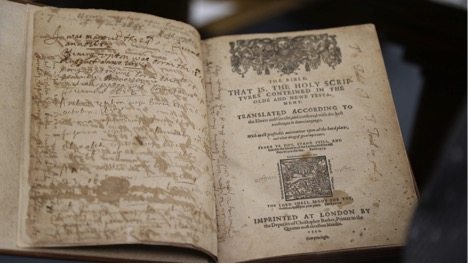
Here is one of the Bibles (dated 1590) that the Pilgrims and Puritan brought to America with them.6

how-to-respond-to-separation-of-church-and-state
The notes in this Bible actually discuss having a separation between government and the church. The Pilgrims therefore set up a system where they would have separate elections for both state leaders and church leaders so that the leaders would be different, rather than the same, as was the practice in England.


3. Faith has been part of American public Society for over 180 years.

Students had been praying over their lunches for over 180 years under the Constitution with no problem, as well as doing other religious activities that were always constitutional.

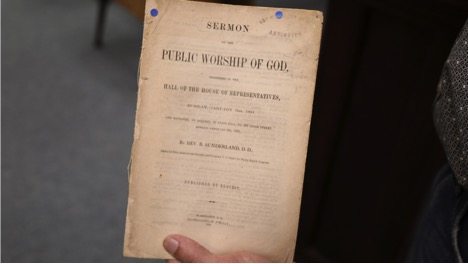
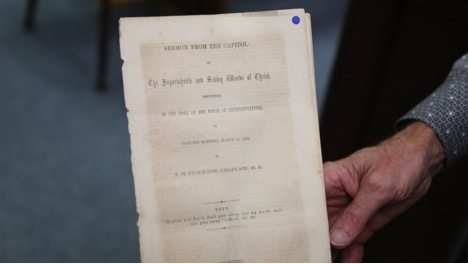
In fact, we actually have several original sermons from a church that Thomas Jefferson helped facilitate. It was a church that met inside the U.S. Capitol,7 where services were held in the House Chamber every Sunday. Both as Vice President and as President of the United States, Jefferson faithfully attended those church services inside the US Capitol and saw no constitutional problem with them, for Congress was not controlling religion for the entire nation but rather was only allowing religious expressions to occur, which was their constitutional role.


how-to-respond-to-separation-of-church-and-state-2
These are sermons preached at the Church that met inside the U.S. Capitol. The first one is on “The Public Worship of God,” and the second is on “The Imperishable and Saving Words of Christ.” Both sermons were preached in the Chamber of the U. S. House of Representatives.

how-to-respond-to-separation-of-church-and-state-3


It has only been in recent years that faith has been excluded from public schools, governmental venues, and the public square. Did we just invent separation of church and state? No, the phrase has existed since centuries before Jefferson, but today its meaning has been taken out of context and twisted to mean something entirely different.

This first happened in 1947 when the Supreme Court quoted only one phrase from Jefferson’s short 1801 letter to the Danbury Baptists. The Court claimed that there was to be “a wall of separation between Church and State” and that religious activities could no longer occur in the public square.8 They took the intent and clear purpose of Jefferson’s letter completely out of context. They did not show his short letter of only three paragraphs and 233 words which contained all the context and explanation but rather lifted a 8-word phrase out of it and remained silent on the rest.

Next time you hear someone claim religion has no place in public because of the “wall of separation,” I hope you’ll remember a few of the key pieces of history that many today have forgotten.


Endnotes

1 See, for example Roberts v. Madigan, 702 F. Supp. 1505 (D. Colo. 1989), aff’d, 921 F.2d 1047 (10th Cir. 1990).

2 See, for example, Broadus v. Saratoga Springs City School District, 02-cv-0136 (N.D.N.Y. 2002).

3 See, for example, Kountze Indep. Sch. Dist. v. Matthews, No. 09-13- 00251 (Tex. App.— Beaumont 2014).

4 See an article on the history of the phrase “Separation of Church and State” here.

5 See the text of the Danbury Baptists 1801 letter to Thomas Jefferson, and Jefferson’s 1802 reply here.

6 A Geneva Bible from the WallBuilders library, belonging to the Arthur Upton family.

7 See David Barton’s article “Church in the U.S. Capitol” for more information.

8 Everson v. Board of Education, 330 U.S. 1 (1947).

Who are the Racists and when did they Switch Political Parties?

By Tim Barton
who-are-the-racists-and-when-did-they-switch-political-parties

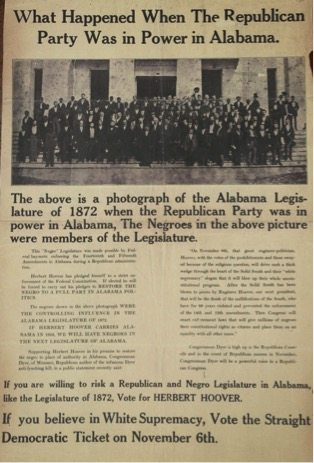
We posted a video showing a document from the presidential election of 1928 demonstrating that the Democrats at that time were hard core racists.

Watch the short video here: “Who’s The Real Racist?”

Democratic apologists instantly posted comments dismissing that claim, arguing that everybody knows that in the 1960s and 1970s, the racists within the Democrat Party left and became Republicans.1 Is the claim true? Did the racist Democrats become the Republicans in the 1960s and 1970s who took over the south?

According to liberal Wikipedia, throughout the decades of Democratic racism, the South was known as The Solid Democratic South, composed of 16 states plus Washington, D.C., including Delaware, Florida, Georgia, Maryland, North Carolina, South Carolina, Virginia, West Virginia, Alabama, Kentucky, Mississippi, Tennessee, Arkansas, Louisiana, Oklahoma, and Texas.2 So did the racist Democrats switch in the 1960s and 1970s to become the Republicans who took over those states? Definitely not.

How Do We Know?

During the time of Reconstruction, as noted above with the Alabama poster, Republicans controlled the legislatures and were the Party of black Americans. But when Reconstruction ended in 1876, so, too, did Republican control of the South. The Democrats regained the control of those states that they held before the Civil War. So from the time of Reconstruction until the current time, did Republicans control the south in the 1960s and 1970s as critics claim?

Let’s start with Arkansas. It was not until 2012 that Arkansas state government again became Republican controlled.3 Imagine that! From 1874 until 2012 the Arkansas Legislature was Democrat!4 The Democrats controlled the state legislature for nearly half-a-century after the so-called shift supposed occurred in the 60s and 70s?

In Louisiana, it was not until 2011 that the state legislature again became Republican.5 For decades after the 60s and 70s, it, too, remained Democrat.

Alabama did not become Republican again until 2010.6 In Oklahoma, it was 2008.7 For Texas, it was 2002;8 1996 for Florida;9 1995 for Virginia;10 also the 2004 for Georgia; 11 and for North Carolina it was not until 2010 that Republicans controlled the legislature,12 and for West Virginia it was 2014.13

And Maryland, Delaware, and Washington DC continue to remain Democrat legislatures to this day – no alleged Democrat switch in the 1960s and 1970s ever put the Republicans in charge.14

Who Made The Switch?

If racists made a grand switch in parties from Democrat to Republicans we would certainly have many political leaders we could point to who made the change.

But bottom line is that there is not a big list of individuals in the 60’s and 70’s who switched parties – certainly not enough to shift control from racist Democrats to Republicans.

What is The Cause of the So Called Switch?

Many people who claim racist Democrats switched parties to become racist Republicans believe the change happened during the Civil Rights act under President Lyndon B Johnson.15 But this is simply not the case. We see no change in the parties during this time.

Martin Luther King Jr., for example, was fighting in the civil rights movement AFTER the laws under LBJ, and he encouraged blacks to support the Republican Party because it was the party of equality. And significantly it was Republicans in Congress, not Democrats, who authored and managed to pass the civil rights laws that LBJ signed.16

The Bottom-Line

The point of the video was not to indicate that there are no racists in the Republican Party. We can easily acknowledge that racism is part of a sinful human nature and not limited to political parties. However, the Republican Party was not and is not the “Party” of racism.

Actual facts disprove the often repeated and ridiculous defense of Democrat apologists. The Republicans certainly have their own baggage, but these claims are not part of it.


Endnotes

1 Julian Drury, “Debunking the myth that Republicans love to repeat,” Quiet Mike, December 8, 2013; Lucinda, “How Dixiecrats Became Republicans,” CJOnline, February 5, 2013; Ian Haney-Lopez, “How the GOP became the ‘White Man’s Party’,” Salon, December 22, 2013; among others.

2Solid South,” Wikipedia (accessed on May 18, 2016).

3 Jim Hoft, “Arkansas Senate & House Goes Republican for the First Time Since Reconstruction,” The Gateway Pundit, November 6, 2012.

4Arkansas Senate Flips; First Time Since Reconstruction,” The Courier, November 7, 2012.

5Louisiana State Senate,” Wikipedia (accessed on May 18, 2016).

6Republicans claim majority in Alabama House and Senate for 1st time in 136 years,” al.com, November 2, 2010.

7 Michael McNutt, “Oklahoma’s legislative leaders pledge to work with Democrats,” NewsOK, November 7, 2010.

8Politics of Texas,” Wikipedia (accessed on May 18, 2016).

9Florida goes Republican,” The Free Library (accessed on May 18, 2016).

10 Frank B. Atkinson, “Republican Party of Virginia,” Encyclopedia Virginia (accessed on May 18, 2016).

11 Pema Levy, “Georgia Democrats are Seeing a Glimmer of a Blue Future,” Newsweek, November 4, 2014.

12Republican Party Takes Control Over NC General Assembly,” WECT, November 2, 2010.

13 Allan Taylor, “GOP Makes Historic Gains in State Legislature,” MetroNews, November 4, 2014.

14.“List of United States State Legislatures,” Wikipedia (accessed on May 18, 2016).

15 Patrick Louis Cooney, Ph. D., “A Racist Party with a Racist Strategy: The Republicans,” The Vernon Johns Society (accessed May 18, 2016); Allen Clifton, “No Longer the Party of Lincoln: Here’s Proof That the Modern Day GOP Built Itself on Racism,” Forward Progressives, June 27, 2015.

16 Congressional Quarterly (Washington, DC: Congressional Quarterly Service, 1965), Vol. 20, pp. 606, 696, 88th Congress, 2nd Session, vote on the Civil Rights Bill of 1964, February 10, 1964.

Is America a Christian Nation?

Modern claims that America is not a Christian nation are rarely noticed or refuted today because of the nation’s widespread lack of knowledge about America’s history and foundation. To help provide the missing historical knowledge necessary to combat today’s post-modern revisionism, presented below will be some statements by previous presidents, legislatures, and courts (as well as by current national Jewish spokesmen) about America being a Christian nation. These declarations from all three branches of government are representative of scores of others and therefore comprise only the proverbial “tip of the iceberg.”

Defining a Christian Nation

Contemporary critics who assert that America is not a Christian nation always refrain from offering any definition of what the term “Christian nation” means. So what is an accurate definition of that term as demonstrated by the American experience?

Contrary to what critics imply, a Christian nation is not one in which all citizens are Christians, or the laws require everyone to adhere to Christian theology, or all leaders are Christians, or any other such superficial measurement. As Supreme Court Justice David Brewer (1837-1910) explained:

is-america-a-christian-nation-2

[I]n what sense can [America] be called a Christian nation? Not in the sense that Christianity is the established religion or that the people are in any manner compelled to support it. On the contrary, the Constitution specifically provides that “Congress shall make no law respecting an establishment of religion, or prohibiting the free exercise thereof.” Neither is it Christian in the sense that all its citizens are either in fact or name Christians. On the contrary, all religions have free scope within our borders. Numbers of our people profess other religions, and many reject all. Nor is it Christian in the sense that a profession of Christianity is a condition of holding office or otherwise engaging in public service, or essential to recognition either politically or socially. In fact, the government as a legal organization is independent of all religions. Nevertheless, we constantly speak of this republic as a Christian nation – in fact, as the leading Christian nation of the world.1

So, if being a Christian nation is not based on any of the above criterion, then what makes America a Christian nation? According to Justice Brewer, America was “of all the nations in the world . . . most justly called a Christian nation” because Christianity “has so largely shaped and molded it.”2

Constitutional law professor Edward Mansfield (1801-1880) similarly acknowledged:

In every country, the morals of a people – whatever they may be – take their form and spirit from their religion. For example, the marriage of brothers and sisters was permitted among the Egyptians because such had been the precedent set by their gods, Isis and Osiris. So, too, the classic nations celebrated the drunken rites of Bacchus. Thus, too, the Turk has become lazy and inert because dependent upon Fate, as taught by the Koran. And when in recent times there arose a nation [i.e., France] whose philosophers [e.g. Voltaire, Rousseau, Diderot, Helvetius, etc.] discovered there was no God and no religion, the nation was thrown into that dismal case in which there was no law and no morals. . . . In the United States, Christianity is the original, spontaneous, and national religion.3

Founding Father and U. S. Supreme Court Chief Justice John Marshall agreed:

is-america-a-christian-nation-3

[W]ith us, Christianity and religion are identified. It would be strange, indeed, if with such a people our institutions did not presuppose Christianity and did not often refer to it and exhibit relations with it.4

Christianity is the religion that shaped America and made her what she is today. In fact, historically speaking, it can be irrefutably demonstrated that Biblical Christianity in America produced many of the cherished traditions still enjoyed today, including:

  • A republican rather than a theocratic form of government;
  • The institutional separation of church and state (as opposed to today’s enforced institutional secularization of church and state);
  • Protection for religious toleration and the rights of conscience;
  • A distinction between theology and behavior, thus allowing the incorporation into public policy of religious principles that promote good behavior but which do not enforce theological tenets (examples of this would include religious teachings such as the Good Samaritan, The Golden Rule, the Ten Commandments, the Sermon on the Mount, etc., all of which promote positive civil behavior but do not impose ecclesiastical rites); and
  • A free-market approach to religion, thus ensuring religious diversity and security for the rights of religious conscience.

Consequently, a Christian nation as demonstrated by the American experience is a nation founded upon Christian and Biblical principles, whose values, society, and institutions have largely been shaped by those principles. This definition was reaffirmed by American legal scholars and historians for generations5 but is widely ignored by today’s revisionists.

American Presidents Affirm that America is a Christian Nation

President Barack Obama is the first American president to deny that America is a Christian nation.6 Notice a few representative statements on this subject by some of the forty-three previous presidents:

The general principles on which the fathers achieved independence were. . . . the general principles of Christianity.7 JOHN ADAMS

[T]he teachings of the Bible are so interwoven and entwined with our whole civic and social life that it would be literally….impossible for us to figure to ourselves what that life would be if these teaching were removed.8 TEDDY ROOSEVELT

America was born a Christian nation – America was born to exemplify that devotion to the elements of righteousness which are derived from the revelations of Holy Scripture.9 WOODROW WILSON

American life is builded, and can alone survive, upon . . . [the] fundamental philosophy announced by the Savior nineteen centuries ago.10 HERBERT HOOVER

This is a Christian Nation.11 HARRY TRUMAN

Let us remember that as a Christian nation . . . we have a charge and a destiny.12 RICHARD NIXON

There are many additional examples, including even that of Thomas Jefferson.13

Significantly, Jefferson was instrumental in establishing weekly Sunday worship services at the U. S. Capitol (a practice that continued through the 19th century) and was himself a regular and faithful attendant at those church services,14 not even allowing inclement weather to dissuade his weekly horseback travel to the Capitol church.15

(The fact that the U. S. Capitol building was available for church on Sundays was due to the Art. I, Sec. 7 constitutional requirement that forbade federal lawmaking on Sundays; and this recognition of a Christian Sabbath in the U. S. Constitution was cited by federal courts as proof of the Christian nature of America.16 While not every Christian observes a Sunday Sabbath, no other religion in the world honors Sunday except Christianity. As one court noted, the various Sabbaths were “the Friday of the Mohammedan, the Saturday of the Israelite, or the Sunday of the Christian.”17)
is-america-a-christian-nation-4Why was Jefferson a faithful attendant at the Sunday church at the Capitol? He once explained to a friend while they were walking to church together:

No nation has ever existed or been governed without religion. Nor can be. The Christian religion is the best religion that has been given to man and I, as Chief Magistrate of this nation, am bound to give it the sanction of my example.18

The U. S. Congress Affirms that America is a Christian Nation

Declarations from the Legislative Branch affirming America as a Christian nation are abundant. For example, in 1852-1853 when some citizens sought a complete secularization of the public square and a cessation of all religious activities by the government, Congress responded with unambiguous declarations about America as a Christian nation:

is-america-a-christian-nation-5

HOUSE JUDICIARY COMMITTEE: Had the people, during the Revolution, had a suspicion of any attempt to war against Christianity, that Revolution would have been strangled in its cradle. At the time of the adoption of the Constitution and the amendments, the universal sentiment was that Christianity should be encouraged, not any one sect [denomination]. Any attempt to level and discard all religion would have been viewed with universal indignation. . . . In this age there can be no substitute for Christianity; that, in its general principles, is the great conservative element on which we must rely for the purity and permanence of free institutions.19

SENATE JUDICIARY COMMITTEE: We are Christians, not because the law demands it, not to gain exclusive benefits or to avoid legal disabilities, but from choice and education; and in a land thus universally Christian, what is to be expected, what desired, but that we shall pay a due regard to Christianity?20

In 1856, the House of Representatives also declared:

[T]he great vital and conservative element in our system is the belief of our people in the pure doctrines and divine truths of the Gospel of Jesus Christ.21

On March 3, 1863 while in the midst of the Civil War, the U. S. Senate requested President Abraham Lincoln to “designate and set apart a day for national prayer and humiliation”22 because:

is-america-a-christian-nation

[S]incerely believing that no people, however great in numbers and resources or however strong in the justice of their cause, can prosper without His favor; and at the same time deploring the national offences which have provoked His righteous judgment, yet encouraged in this day of trouble by the assurances of His word to seek Him for succor according to His appointed way through Jesus Christ, the Senate of the United States do hereby request the President of the United States, by his proclamation, to designate and set apart a day for national prayer and humiliation.23 (emphasis added)

President Lincoln quickly complied with that request,24 and issued what today has become one of the most famous and quoted proclamations in America’s history.25

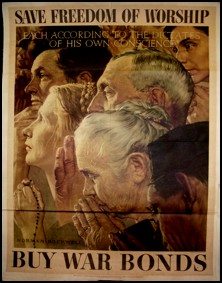
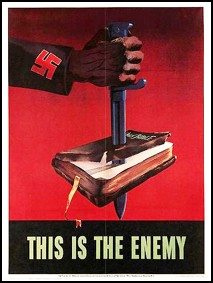
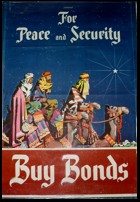
Across the generations, our national reliance on God, the Bible, and Christianity has been repeatedly reaffirmed. In fact, consider five representative images produced by the U. S. Government. The first three are from World War II: one shows the Nazis as the enemy because they want to attack the Bible, and the other two encourage Americans to buy War Bonds by pointing to Christian images. The fourth and fifth images are from the Department of Agriculture in the 1960s, using the Bible and even Smokey Bear in prayer as symbols to encourage Americans to be conscious of fire safety and to help preserve and conserve nature.

is-america-a-christian-nation-6 is-america-a-christian-nation-7is-america-a-christian-nation-8 is-america-a-christian-nation-9 is-america-a-christian-nation-10

There are scores of other official actions by the U. S. Congress over the past two centuries affirming that America is a Christian nation.

The Judicial Branch Affirms that America is a Christian Nation

From the Judicial Branch, consider first some declarations of prominent U. S. Supreme Court Justices regarding America as a Christian nation.

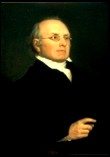
Justice Joseph Story (1779-1845) was appointed to the Court by President James Madison. Story is considered the founder of Harvard Law School and authored the three-volume classic Commentaries on the Constitution of the United States (1833). In his 34 years on the Court, Story authored opinions in 286 cases, of which 269 were reported as the majority opinion or the opinion of the Court26 and his many contributions to American law have caused him to be called a “Father of American Jurisprudence.” Justice Story openly declared:

is-america-a-christian-nation-11

One of the beautiful boasts of our municipal jurisprudence is that Christianity is a part of the Common Law. . . . There never has been a period in which the Common Law did not recognize Christianity as lying at its foundations. . . . I verily believe Christianity necessary to the support of civil society.27

His conclusion about America and Christianity was straightforward:

In [our] republic, there would seem to be a peculiar propriety in viewing the Christian religion as the great basis on which it must rest for its support and permanence.28

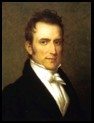
Justice John McLean (1785-1861) was appointed to the Court by President Andrew Jackson. McLean served in the U. S. Congress, as a judge on the Ohio Supreme Court, and then held cabinet positions under two U. S. Presidents. His view on the importance of Christianity to American government and its institutions was unambiguous:

is-america-a-christian-nation-12

For many years, my hope for the perpetuity of our institutions has rested upon Bible morality and the general dissemination of Christian principles. This is an element which did not exist in the ancient republics. It is a basis on which free governments may be maintained through all time. . . . Free government is not a self-moving machine. . . . Our mission of freedom is not carried out by brute force, by canon law, or any other law except the moral law and those Christian principles which are found in the Scriptures.29

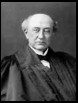
Already mentioned at the beginning was Justice David Brewer (1837-1910), appointed to the Court by President Benjamin Harrison. Brewer held several judgeships in Kansas and served on a federal circuit court before his appointment to the Supreme Court. In addition to his already noted statements, Justice Brewer also declared:

We constantly speak of this republic as a Christian nation – in fact, as the leading Christian nation of the world.30

Brewer then chronicled the types of descriptions applied to nations:

is-america-a-christian-nation-13

We classify nations in various ways: as, for instance, by their form of government. One is a kingdom, another an empire, and still another a republic. Also by race. Great Britain is an Anglo-Saxon nation, France a Gallio, Germany a Teutonic, Russia a Slav. And still again by religion. One is a Mohammedan nation, others are heathen, and still others are Christian nations. This republic is classified among the Christian nations of the world. It was so formally declared by the Supreme Court of the United States. In the case of Holy Trinity Church vs. United States, 143 U.S. 471, that Court, after mentioning various circumstances, added, “these and many other matters which might be noticed, add a volume of unofficial declarations to the mass of organic utterances that this is a Christian nation.”31

Brewer did not believe that calling America a Christian nation was a hollow appellation; in fact, he penned an entire book setting forth the evidence that America was a Christian nation.32 He concluded:

[I] have said enough to show that Christianity came to this country with the first colonists; has been powerfully identified with its rapid development, colonial and national, and today exists as a mighty factor in the life of the republic. This is a Christian nation. . . . [T]he calling of this republic a Christian nation is not a mere pretence, but a recognition of an historical, legal, and social truth.33

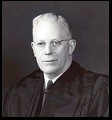
Justice Earl Warren (1891-1974) agreed with his predecessors. Before being appointed as Chief Justice of the U. S. Supreme Court by President Dwight D. Eisenhower, Warren had been the Attorney General of California. Warren declared:

is-america-a-christian-nation-14

I believe the entire Bill of Rights came into being because of the knowledge our forefathers had of the Bible and their belief in it: freedom of belief, of expression, of assembly, of petition, the dignity of the individual, the sanctity of the home, equal justice under law, and the reservation of powers to the people. . . . I like to believe we are living today in the spirit of the Christian religion. I like also to believe that as long as we do so, no great harm can come to our country.34

There are many similar declarations by other Supreme Court Justices, but in addition to the declarations of individual judges, the federal courts have repeatedly affirmed America to be a Christian nation – including the U. S. Supreme Court, which declared that America was “a Christian country,”35 filled with “Christian people,”36 and was indeed “a Christian nation.”37 Dozens of other courts past and present have repeated these pronouncements38 but so,
is-america-a-christian-nation-15too, have American Presidents – as in 1947 when President Harry Truman quoted the Supreme Court, declaring:

This is a Christian Nation. More than a half century ago that declaration was written into the decrees of the highest court in this land [in an 1892 decision].39

American Jewish Leaders Agree with History

Jewish leaders, although firmly committed to their own faith, understand that by defending Christianity they are defending what has provided them their own religious liberty in America. For example, Jeff Jacoby, a Jewish columnist at the Boston Globe explains:

This is a Christian country – it was founded by Christians and built on broad Christian principles. Threatening? Far from it. It is in precisely this Christian country that Jews have known the most peaceful, prosperous, and successful existence in their long history.40

Aaron Zelman (a Jewish author and head of a civil rights organization) similarly declares:

[C]hristian America is the best home our people have found in 2,000 years. . . . [T]his remains the most tolerant, prosperous, and safest home we could be blessed with.41

Dennis Prager, a Jewish national columnist and popular talkshow host, warns:

If America abandons its Judeo-Christian values basis and the central role of the Jewish and Christian Bibles (its Founders’ guiding text), we are all in big trouble, including, most especially, America’s non-Christians. Just ask the Jews of secular Europe.42

Prager further explained:

I believe that it is good that America is a Christian nation. . . . I have had the privilege of speaking in nearly every Jewish community in America over the last 30 years, and I have frequently argued in favor of this view. Recently, I spoke to the Jewish community of a small North Carolina city. When some in the audience mentioned their fear of rising religiosity among Christians, I asked these audience-members if they loved living in their city. All of them said they did. Is it a coincidence, I then asked, that the city you so love (for its wonderful people, its safety for your children, its fine schools, and its values that enable you to raise your children with confidence) is a highly Christian city? Too many Americans do not appreciate the connection between American greatness and American Christianity.43

Don Feder, a Jewish columnist and long time writer for the Boston Herald, similarly acknowledges:

Clearly this nation was established by Christians. . . . As a Jew, I’m entirely comfortable with the concept of the Christian America.44 The choice isn’t Christian America or nothing, but Christian America or a neo-pagan, hedonistic, rights-without-responsibilities, anti-family, culture-of-death America. As an American Jew. . . . [I] feel very much at home here.45

In fact, Feder calls on Jews to defend the truth that America is a Christian Nation:

Jews – as Jews – must oppose revisionist efforts to deny our nation’s Christian heritage, must stand against the drive to decouple our laws from Judeo-Christian ethics, and must counter attacks on public expressions of the religion of most Americans – Christianity. Jews are safer in a Christian America than in a secular America.46

Michael Medved, a Jewish national talkshow host and columnist, agrees that America is indeed a Christian nation:

The framers may not have mentioned Christianity in the Constitution but they clearly intended that charter of liberty to govern a society of fervent faith, freely encouraged by government for the benefit of all. Their noble and unprecedented experiment never involved a religion-free or faithless state but did indeed presuppose America’s unequivocal identity as a Christian nation.47

Burt Prelutsky, a Jewish columnist for the Los Angeles Times (and a freelance writer for the New York Times, Washington Times, Sports Illustrated, and other national publications) and a patriotic Jewish American, gladly embraces America as a Christian nation and even resents the secularist post-modern attack on national Christian celebrations such as Christmas:

I never thought I’d live to see the day that Christmas would become a dirty word. . . .How is it, one well might ask, that in a Christian nation this is happening? And in case you find that designation objectionable, would you deny that India is a Hindu country, that Turkey is Muslim, that Poland is Catholic? That doesn’t mean those nations are theocracies. But when the overwhelming majority of a country’s population is of one religion, and most Americans happen to be one sort of Christian or another, only a darn fool would deny the obvious. . . . This is a Christian nation, my friends. And all of us are fortunate it is one, and that so many millions of Americans have seen fit to live up to the highest precepts of their religion. It should never be forgotten that, in the main, it was Christian soldiers who fought and died to defeat Nazi Germany and who liberated the concentration camps. Speaking as a member of a minority group – and one of the smaller ones at that – I say it behooves those of us who don’t accept Jesus Christ as our savior to show some gratitude to those who do, and to start respecting the values and traditions of the overwhelming majority of our fellow citizens, just as we keep insisting that they respect ours. Merry Christmas, my friends.48

Orthodox Rabbi Daniel Lapin of the Jewish Policy Center unequivocally declares

[I] understand that I live . . . in a Christian nation, albeit one where I can follow my faith as long as it doesn’t conflict with the nation’s principles. The same option is open to all Americans and will be available only as long as this nation’s Christian roots are acknowledged and honored.49

In fact, with foreboding he warns:

Without a vibrant and vital Christianity, America is doomed, and without America, the west is doomed. Which is why I, an Orthodox Jewish rabbi, devoted to Jewish survival, the Torah, and Israel am so terrified of American Christianity caving in.50 God help Jews if America ever becomes a post-Christian society! Just think of Europe!51

— — — ◊ ◊ ◊ — — —
There is much additional evidence, and it unequivocally demonstrates that any claim that America was not a Christian nation is an unabashed attempt at historical revisionism. Of such efforts, former Chief Justice William Rehnquist wisely observed, “no amount of repetition of historical errors . . . can make the errors true.”52


Endnotes

1 David J. Brewer, The United States: A Christian Nation (Philadelphia: John C. Winston Company, 1905), 12.

2 Brewer, A Christian Nation (1905), 57.

3 Edward Mansfield, American Education, Its Principle and Elements (New York: A. S. Barnes & Co., 1851), 43.

4 John Marshall to Rev. Jasper Adams, May 9, 1833, The Papers of John Marshall, ed. Charles Hobson (Chapel Hill: University of North Carolina Press, 2006), XII:278.

5 Stephen Cowell, The Position of Christianity in the United States in its Relations with our Political Institutions (Philadelphia: Lippincott, Grambio & Co., 1854), 11-12; Joseph Story, A Familiar Exposition of the Constitution of the United States (Boston: Marsh, Capen, Lyon, and Webb, 1840), 260.

6 See, for example, “Obama says U.S., Turkey can be model for world,” CNN, April 6, 2009; David Brody, The Brody File, “Exclusive: Barack Obama E-mails the Brody File,” CBN News, July 29, 2007; Aaron Klein, “Obama: America is ‘no longer Christian’,” WorldNetDaily, June 22, 2008; and so forth.

7 John Adams to Thomas Jefferson, June 28, 1813, The Works of John Adams, ed. Charles Francis Adams (Boston: Little, Brown and Company, 1856), X:45-46.

8 Ferdinand Cowle Iglehart, D.D., Theodore Roosevelt, The Man As I Knew Him (New York: The Christian Herald, 1919), 307.

9 Paul M. Pearson and Philip M. Hicks, Extemporaneous Speaking (New York: Hinds, Noble & Eldredge, 1912), 177, printing Woodrow Wilson, “The Bible and Progress;” The Homiletic Review: An International Monthly Magazine of Current Religious Thought, Sermonic Literature and Discussion of Practical Issues (New York: Funk and Wagnalls Company, 1911), LXII:238, printing Woodrow Wilson, “The Bible and Progress,” May 7, 1911.

10 Herbert Hoover, “Radio Address to the Nation on Unemployment Relief,” American Presidency Project, October 18, 1931.

11 Harry S. Truman, “Exchange of Messages With Pope Pius XII,” American Presidency Project, August 28, 1947.

12 Richard Nixon, “Remarks at the National Prayer Breakfast,” American Presidency Project, February 1st, 1972.

13 Thomas Jefferson to Gouverneur Morris, November 1, 1801, The Papers of Thomas Jefferson, ed. Barbara Oberg (Princeton: Princeton University Press, 2008), 30:545.

14 See, for example, Bishop Claggett’s (Episcopal Bishop of Maryland) letter of February 18, 1801, available in the Maryland Diocesan Archives; The First Forty Years of Washington Society, ed. Galliard Hunt (New York: Charles Scribner’s Sons, 1906), 13; William Parker Cutler and Julia Perkins Cutler, Life, Journal, and Correspondence of Rev. Manasseh Cutler (Cincinnati: Colin Robert Clarke & Co., 1888), II:119, to Joseph Torrey, January 3, 1803 & 113, entry of December 12, 1802; James Hutson, Religion and the Founding of the American Republic (Washington, D. C.: Library of Congress, 1998), 84.

15 Cutler and Cutler, Life, Journal, and Correspondence (1888), II:119, to Dr. Joseph Torrey, January 3, 1803; entry of December 26, 1802 (II:114).

16 See, for example, Church of the Holy Trinity v. U. S., 143 U.S. 457, 465, 470-471 (1892); City Council of Charleston v. S.A. Benjamin, 2 Strob. 508, 518-520 (S.C. 1846); State v. Ambs, 20 Mo. 214, 1854 WL 4543 (Mo. 1854); Neal v. Crew, 12 Ga. 93, 1852 WL 1390 (1852); Doremus v. Bd. of Educ., 71 A.2d 732, 7 N.J. Super. 442 (1950); State v. Chicago, B. & Q. R. Co., 143 S.W. 785, 803 (Mo. 1912); and many others.

17 Ex parte Newman, 9 Cal. 502, 509 (1858).

18 Hutson, Religion, 96, quoting from a handwritten history in possession of the Library of Congress, “Washington Parish, Washington City,” by Rev. Ethan Allen.

19 “Rep. No. 24: Chaplains in Congress and in the Army and Navy,” March 27, 1854, Reports of Committees of the House of Representatives Made During the First Session of the Thirty-Third Congress (Washington: A. O. P. Nicholson, 1854), 6, 8.

20 “Rep. Com. No. 36: Report,” January 19, 1853, The Reports of Committees of the Senate of the United States for the Second Session of the Thirty-Second Congress, 1852-53 (Washington: Robert Armstrong, 1853), 3.

21 January 23, 1856, Journal of the House of Representatives of the United States: Being the First Session of the Thirty-Fourth Congress (Washington: Cornelius Wendell, 1855), 354.

22 March 2, 1863, Journal of the Senate of the United States of America Being the Third Session of the Thirty-Seventh Congress (Washington, D.C.: Government Printing Office, 1863), 379.

23 March 2, 1863, Journal of the Senate…Third Session of the Thirty-Seventh Congress (1863), 378-379.

24 Abraham Lincoln, Proclamation Appointing a National Fast Day (March 30, 1863), WallBuilders.

25 A May 2016 Bing search for this proclamation resulted in 400,000+ hits.

26 “Story, Joseph,” Dictionary of American Biography, ed. Dumas Malone (New York: Charles Scribner’s Sons, 1936), 18:106.

27 Joseph Story, Life and Letters of Joseph Story, ed. William W. Story (Boston: Charles C. Little and James Brown, 1851), II:8, 92.

28 Joseph Story, Commentaries on the Constitution of the United States (Boston: Hillard, Gray, and Company, 1833), III:724.

29 B. F. Morris, Christian Life and Character of the Civil Institutions of the United States (Philadelphia: George W. Childs, 1864), 639.

30 Brewer, A Christian Nation (1905), 12.

31 Brewer, A Christian Nation (1905), 11.

32 Brewer, A Christian Nation (1905).

33 Brewer, A Christian Nation (1905), 40, 46.

34 “Breakfast in Washington,” Time, February 15, 1954.

35 Vidal v. Girard’s Executors, 43 U. S. 126, 198 (1844).

36 U.S. v. Macintosh, 283 U.S. 605, 625 (1931).

37 Church of the Holy Trinity v. U. S., 143 U. S. 457, 465, 470-471 (1892).

38 See for example, Warren v. U.S., 177 F.2d 596 (10th Cir. 1949); U.S. v. Girouard, 149 F.2d 760 (1st Cir.1945); Steiner v. Darby, Parker v. Los Angeles County, 199 P.2d 429 (Cal. App. 2d Dist 1948); Vogel v. County of Los Angeles, 434 P.2d 961 (1967).

39 Harry S. Truman, “Exchange of Messages with Pope Pius XII,” American Presidency Project, August 6, 1947.

40 Jeff Jacoby, “The freedom not to say ‘amen’,” Jewish World Review, February 1, 2001.

41 Aaron Zelman, “An open letter to my Christian friends,” Jews for the Preservation of Firearms Ownership.

42 Dennis Prager, “America founded to be free, not secular,” Townhall.com, January 3, 2007.

43 Dennis Prager, “Books, Arts & Manners: God & His Enemies – Review,” BNet, March 22, 1999.

44 Don Feder, A Jewish Conservative Looks at Pagan America (Lafayette: Huntington House Publishers, 1993), 59-60.

45 Don Feder, “Yes – Once and For All – American is a Christian Nation,” DonFeder.com, February 16, 2005.

46 Don Feder, “The Jewish Case for Merry Christmas,” Front Page Magazine, December 7, 2006.

47 Michael Medved, “The Founders Intended a Christian, not Secular, Society,” Townhall.com, October 3, 2007.

48 Burt Prelutsky, “The Jewish grinch who stole Christmas,” Townhall.com, December 11, 2006.

49 Daniel Lapin, America’s Real War (Oregon: Multnomah Publishers, 1999), p. 116.

50 Rabbi Daniel Lapin, “A Rabbi’s Call to American Christians – Wake Up! You’re Under Attack,” End Time Prophetic Division, January 19, 2007.

51 Rabbi Daniel Lapin, “Which Jews does the ADL really represent?” WorldNetDaily, August 25, 2006.

52 Wallace v. Jaffree, 472 U. S. 38, 106-107 (1984), Rehnquist, J. (dissenting).

Sermon – Stamp Act Repeal – 1766


Charles Chauncy (1705-1787) was a minister from Boston. He attended Harvard, graduating in 1721. Chauncy preached at the First Church in Boston for sixty years (1727-1787).

Below is Chauncy’s 1766 sermon on the day of Thanksgiving proclaimed in Massachusetts on occasion of the repeal of the Stamp Act.
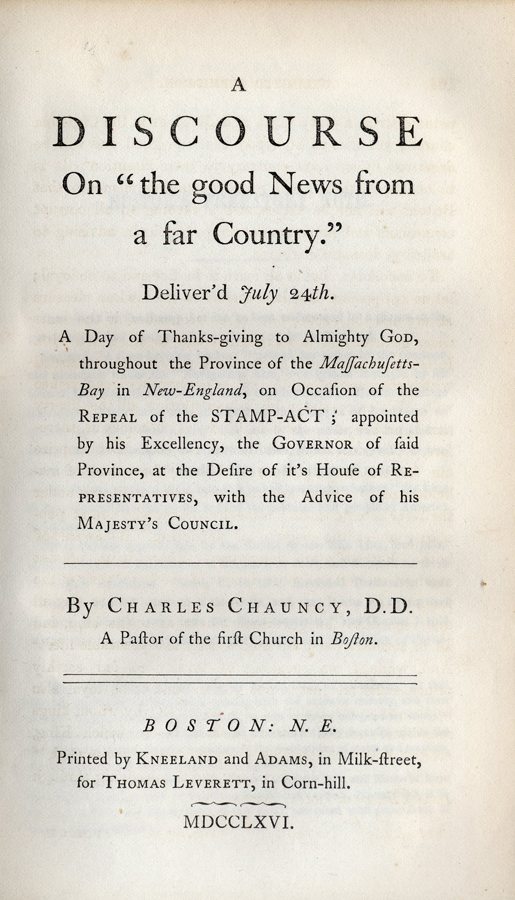

sermon-stamp-act-repeal-1766

A

DISCOURSE

On “the good News from a far Country.”

Deliver’d July 24th.

A Day of Thanks-giving to Almighty God, throughout the Province of the Massachusetts-Bay in New-England, on Occasion of the Repeal of the STAMP-ACT; appointed by his Excellency, the Governor of said Province, at the Desire of it’s House of Representatives, with the Advice of his Majesty’s Council.

By Charles Chauncy, D.D.
A Pastor of the first Church in Boston.


EDITOR’S PREFATORY NOTE.
The origin of the Stamp Act can be best understood by a glance at the previous political relations of the colonies to the mother land.

England, “a shop-keeping nation,” 1 gained her riches by the commercial monopoly under the “Navigation Acts,”—a system invented by Sir George Downing, the one whose name stands second on Harvard College catalogue. These acts were modified as the changes of commerce required, and the “Stamp Act,” but one of the series, was intended to retain the old monopoly of American trade, which was greatly endangered by the conquest of Canada. This was its origin and motive.

The dispute resolved itself into this naked question, whether “the king in Parliament 2 had full power to bind the colonies and people of America in all cases whatsoever,” or in none.

The colonists argued that, by the feudal system, the king, lord paramount of lands in America, as in England, as such, had disposed of them on certain conditions. James I., in 1621, informed Parliament that “America was not annexed to the realm, and that it was not fitting that Parliament should make laws for those countries;” and Charles I. told them “that the colonies were without the realm and jurisdiction of Parliament.” The colonists showed that the American charters were compacts between the king and his subjects who “transported themselves out of this kingdom of England into America,” by which they owed allegiance to him personally as sovereign, but were to make their own laws and taxes: for instance, a revenue was raised in Virginia by a law “enacted by the King’s most excellent Majesty, by and with the consent of the General Assembly of the Colony of Virginia.” They denied the authority of the legislature of Great Britain over them, but acknowledged his Majesty as a part of the several colonial legislatures.

But the colonies, while jealous of their internal self-control, had permitted the British Parliament to “regulate” their foreign trade, and, upon precedent, the latter now claimed authority to bind the colonies “in all cases whatsoever.” Relying upon the royal compact in their chargers, the spirit of the British constitution, and “their rights as Englishmen,” the Americans denied the jurisdiction of their “brethren” in England.

“Nil Desperandum, Christo Duce,” was the motto on the flag of New England in 1745, when her Puritan sons conquered Louisburg, the stronghold of Papal France in the New World, and thus gave peace to Europe. This enterprise, in its spirit, was little less a crusade than was that to redeem Palestine from the thraldom of the Mussulman, and the sepulcher of Jesus from the infidels. One of the chaplains carried upon his shoulder a hatchet to destroy the images in the Romish churches. “O,” exclaimed a good old deacon, to Pepperell, “O that I could be with you and dear Parson Moody in that church, to destroy the images there set up, and hear the true gospel of our Lord and Saviour there preached! My wife, who is ill and confined to her bed, yet is so spirited in the affair . . . . . that she is very willing all her sons should wait on you, though it is outwardly greatly to our damage. One of them has already enlisted, and I know not but there will be more.” 3 “Christo Duce!” The extinction of French dominion was quickly completed by the conquest of Canada in 1759-60, and at the same moment ceased the colonial need of the red-cross flag of St. George, whose nationality had been their protection against the aggressions of the French. The French being driven from Canada, New England could stand alone. This was the point “in the course of human events” when the sovereignty of England over the colonies was ended, though their formal “Declaration of American Independence,” and of the dissolution of “the political bands” with the mother country, was not issued till several years later. The conquest of Canada was the emancipation of the colonies, as the opponents of the war predicted. British parliaments, though backed by British guns, and all the canons of the English church, were powerless against “the laws of nature and nature’s God;” and the Stamp Act was merely a touchstone for certain “self-evident truths”—not mere “sounding and glittering generalities”—enunciated on the Fourth of July, 1776. This attempt at despotism resulted in the alienation of the colonists from their brethren in England, the Union, the War of the Revolution, and the birth of a Nation. By it England lost her American dominion, won defeat and dishonor, and added to the national debt one hundred and four million pounds sterling, on which she is now paying interest,–the work of George III. And his servile ministers, his “domestics,” as they were called. But America saved not only her own liberty, but the liberty of England; the policy of George III. And his government, which the colonies defeated, if attempted at this day, would not only sever every colony, but overthrow the throne itself. In January, 1766, Mr. Pitt himself declared the American controversy to be “a great common cause,” and that “America, if she fell, would fall like a strong man. She would embrace the pillars of the state, and pull down the constitution along with her.” Hear Lord Camden, also: “I will say, not only as a statesman, politician, and philosopher, but as a common lawyer, you have no right to tax America. The natural rights of man and the immutable laws of nature are all with that people.” And General Burgoyne declared in Parliament, in 1781, that he “was now convinced the principle of the American war was wrong,. . . only one part of a system leveled against the constitution and the general rights of mankind.” It was equally for the sake of England as of America that Mr. Pitt and the high-minded men of that day “rejoiced” in our resistance to tyranny. “Passive obedience” then became an obsolete gospel.

One of the most efficient causes of the Revolution in the minds and hearts of the people—an accomplished fact before the war commenced—was the controversy begun in 1763 by the Rev. Dr. Mayhew in his attack on the conduct of the “society for Propagating the Gospel in Foreign Parts.” The most insidious scheme for reducing the colonies to slavery was that of this society, which was known to be only an association for propagating “lords spiritual” in America, 4 who should inculcate, in the name of religion, the Church of England principles of “submission and obedience, clear, absolute, and without exception.” Dr. Mayhew exposed this pious fraud. The Bishop of Landaff, in his sermon of 1766, before this society, ingenuously declared, that when Episcopacy should be established in America, “then this society will be brought to the happy issue intended”!

This excited general alarm. The hierarchy could be established only by Parliament; and if, they reasoned, Parliament can authorize bishops, tithes, ceremonies, and tests in America, they can tax us; and what can they not do? The question was, really, Does the British Parliament, three thousand miles off, in which we have neither voice nor vote, own us, three million people, souls and bodies? The people considered the matter, and gradually got ready to fight about it, seeing no more “divine right” of parliaments than of kings, which last had been “unriddled” [solved] by Dr. Mayhew in 1750.

The plot was to annul the charters, reduce the popular assemblies to a manageable size, and increase the royal appointments; revise all the colonial acts, in order to set aside those which provided for the support of the ministers. “But, if the temper of the people makes it necessary, let a new bill for the purpose of supporting them pass the House, and the Council refuse their concurrence; if that will be improper, then the governor to negative it. If that cannot be done in good policy, then the bill to go home,”—that is, to England,–“and let the king disallow it. Let bishops be introduced, and provision be made for the support of the Episcopal clergy. Let the Congregational and Presbyterian clergy who will receive ordination be supported, and the leading ministers among them be bought off by large salaries. Let the liturgy be revised and altered. Let Episcopacy be accommodated as much as possible to the cast of the people. Let places of power, trust, and honor be conferred only upon Episcopalians, or those that will conform. When Episcopacy is once established, increase its resemblance to the English hierarchy at pleasure”! 5

The wealth of England had been created by the “commercial servitude” 6 of her American colonies; and not only this monopoly of the colonial trade, but the commerce itself, was endangered by the aggressions of France, which had surrounded the English colonies by a chain of forts and settlements which reached from the mouth of the St. Lawrence to the mouth of the Mississippi. To save her commerce, her wealth, and her revenue, England drove “the haughty and insolent Gallic” out of Canada; not without ruinous drafts of men and money, especially from the northern colonies, which thereby contracted enormous debts and oppressive taxes. But England represented her own debt as a bill incurred for the benefit of the colonies, and so “the Commons of Great Britain in Parliament, . . . for the purpose of raising a further REVENUE within his Majesty’s dominions of America,” assumed “to give and grant” to his Majesty “a stamp duty” of pounds, shillings, and pence, upon all sorts of documents used by merchants, lawyers, in courts and custom-houses, or in any of the transactions of daily life. No farmer or tradesman could hang an “almanac” in the chimney-corner without paying the “stamp duty of twopence” or “fourpence” if this hated act was enforced. But, long before the “first day of November, one thousand seven hundred and sixty-five,”—the day when it was to take effect,–there burst forth in the colonies such a universal storm of wrath, that it was suddenly manifest that the Church of England gospel of implicit obedience did not prevail in America.

“Your Majesty’s Commons in Britain,” said Mr. Burke, “undertake absolutely to dispose of the property of their fellow-subjects in America, without their consent. . . . for they are not represented in Parliament; and indeed we think it impracticable; it is not reconcilable to any ideas of liberty . . . . I only say, that a great people, who have their property, without any reserve, in all cases, disposed of by another people at an immense distance from them, will not think themselves in the enjoyment of freedom. It will be hard to show to those who are in such a state which of the usual parts of the definition or description of a free people are applicable to them . . . . Tell me what one character of liberty the Americans have, and what one brand of slavery they are free from, if they are bound in their property and industry by all the restraints you can imagine on commerce, and at the same time are made pack-horses of every tax you choose to impose, without the least share in granting them? When they bear the burdens of unlimited monopoly, will you bring them to bear the burdens of unlimited revenue too? The Englishmen in America will feel that this is slavery; that it is legal slavery, will be no compensation either to his feelings or understanding . . . . The feelings of the colonies were formerly the feelings of Great Britain; theirs were formerly the feelings of Mr. Hampden when called upon for the payment of twenty shillings. Would twenty shillings have ruined Mr. Hampden’s fortune? No; but the payment of half twenty shillings, on the principle upon which it was demanded, would have made him a SLAVE.”

Among the “Navigation Acts” was one of 6th George II., “An Act for the better securing and encouraging the Trade of his Majesty’s Colonies in America,” which was commonly called the “Molasses Act.” The articles of molasses and sugar, it was demonstrated by Mr. Otis, entered into every branch of our commerce, fisheries, manufactures, and agriculture. The duty of sixpence on molasses was full one-half of its value, and its enforcement would have ruined commerce. Mr. Otis roundly declared that if the King of Great Britain in person were encamped on Boston Common, at the head of twenty thousand men, with all his navy on our coast, he would not be able to execute these laws; for “taxation without representation was tyranny.” This was in 1762, when the tyrannical writs of assistance 7 were applied for, to search for and seize smuggled goods, and under which the sanctuary of no home, no dwelling, no treasure would be sacred from the pollution and violence of any catchpole ready for the odious service, backed by the forms of law.

John Adams said: “Wits may laugh at our fondness for molasses, and we ought all to join in the laugh with as much good humor as General Lincoln did. General Washington, however, always asserted and proved that Virginians loved molasses as well as New England men did. I know not why we should blush to confess that molasses was an essential ingredient in American independence. Many great events have proceeded from much smaller causes.”

These acts were repealed while America was in open resistance. “See what firmness and resolution will do,” said the Sons of Liberty, when a copy of the act of repeal was received in Boston. With this act of repeal was another, simply declaratory of the authority of Parliament to bind the colonies “in all cases whatsoever.” “But,” said Junius, “it is truly astonishing that . . . they should have conceived that a compliance which acknowledged the rod to be in the hands of the Americans, could ever induce them to surrender it.” Mr. Greenville desired Mr. Knox’s opinion of the effects which the repeal would produce in America. The answer was, “Addresses of thanks and measures of rebellion.”

The contemporary accounts from every part of the colonies show that never before had there been such rejoicings in America. It is a source of supreme satisfaction to reflect that Dr. Mayhew lived to share in this triumph of liberty.

We naturally feel a certain curiosity as to the places which are associated with great names and memorable scenes. Fortunately we have a lively description of the Council Chamber as it was when James Otis so eloquently opposed the writs of assistance, written by one who then heard the great patriot lawyer, and was familiar with its aspect, adornment, and fittings. “Whenever,” said the venerable Adams, “you shall find a painter, male or female, I pray you to suggest a scene and subject: The scene is the Council Chamber of the Old Town House in Boston; the date is the month of February, 1761. That Council Chamber was as respectable an apartment, and more so too, in proportion, than the House of Lords of House of Commons in Great Britain, or that in Philadelphia in which the Declaration of Independence was signed in 1776. In this chamber, near the fire, were seated five judges, with Lieutenant-Governor Hutchinson at their head as Chief Justice, all in their new, fresh robes of scarlet English cloth, in their broad bands, and immense judicial wigs. In this chamber was seated, at a long table, all the barristers of Boston and its neighboring county of Middlesex, in their gowns, bands, and tye-wigs. They were not seated on ivory chairs, but their dress was more solemn and more pompous than that of the Roman senate when the Gauls broke in upon them. In a corner of the room must be placed wit, sense, imagination, genius, pathos, reason, prudence, eloquence, learning, science, and immense reading, hung by the shoulders on two crutches, covered with a cloth great-coat, in the person of Mr. Pratt, who had been solicited on both sides, but would engage on neither, being about to leave Boston forever, as Chief Justice of New York. Two portraits, at more than full length, of King Charles the Second and King James the Second, in splendid golden frames, were hung up on the most conspicuous side of the apartment. If my young eyes or old memory have not deceived me, these were the finest pictures I have seen. The colors of their long flowing robes and their royal ermines were the most glowing, the figures the most noble and graceful, the features the most distinct and characteristic: far superior to those of the King and Queen of France in the Senate Chamber of Congress. I believe they were Vandyke’s. Sure I am there was no painter in England capable of them at that time. They had been sent over, without frames, in Governor Pownall’s time; but, as he was no admirer of Charleses or Jameses, they were stowed away in a garret among rubbish till Governor Bernard came, had them leaned, superbly framed, and placed in council for the admiration and imitation of all men, no doubt with the concurrence of Hutchinson and all the junto.” . . .

“Now for the actors and performers. Mr. Gridley argued with his characteristic learning, ingenuity, and dignity, and said everything that could be said in favor of Cockle’s petition; all depending, however, on the—‘If the Parliament of Great Britain is the sovereign legislator of all the British empire.’ Mr. Thatcher followed him, on the other side, and argued with the softness of manners, the ingenuity, the cool reasoning which were peculiar to his amiable character. But Otis was a flame of fire. With a promptitude of classical allusions, a depth of research, a rapid summary of historical events and dates, a profusion of legal authorities, a prophetic glare of his eyes into futurity, and a rapid torrent of impetuous eloquence, he hurried away all before him. American Independence was then and there born. The seeds of patriots and heroes, to defend the Non Sine Diis Animosus Infans, to defend the vigorous youth, were then and there sown. Every man of an immense crowded audience appeared to me to go away, as I did, ready to take arms against writs of assistance. Then and there was the first scene of the first act of opposition to the arbitrary claims of Great Britain. Then and there the child Independence was born. In fifteen years—that is, in 1776—he grew up to manhood, and declared himself free.”

Dr. Chauncy, the preacher, was one of the greatest divines in New England, and no one except President Edwards and Dr. Jonathan Mayhew had been so much known among the literati of Europe. He was zealous for liberty, and, on the death of Dr. Mayhew, continued the war against its most specious enemy with great power and learning. He was born January 1, 1705, graduated at Harvard College in 1721, and was pastor of the first church in Boston from 1727 till his death in 1787.

This sermon—an admirable historical picture, drawn by a master, himself a leader of the hosts—abounds in facts, discusses the great principles involved with energy and power, and with the calmness and precision of the statesman.

The following witty lines, from the London “Craftsman” newspaper of March 29th, 1766, give a lively and just idea of the effect of the Stamp Act on British industry, temper, and politics.

CHAPTER IV. OF THE BOOK OF AMERICA.
1. The men of the cities assemble. 3. Their discourse to each other. 11. They petition the Grand Sanhedrim. 14. The lamentation of George the Treasurer. 19. Newspapers. 22. And hireling Scribes. 25. These Scribes write against taking off the tribute. 26. The subject of their letters. 32. They prevail not. 34. But are answered. 38. The tribute taken off. 39. Great rejoicings thereat. 41. The song of the people.

1. After these things the men of London, and the men of Birmingham, and the men of the great cities and strong towns; even all who made cloth, and worked in iron and in steel, and in sundry metals, communed together.

2. And they met in the gates of their cities, and of their towns;

3. And they said unto each other, Behold now the children of America are waxed strong; and they have not only opposed he men who were sent by George the Treasurer to collect the tribute on the marks which are called stamps;

4. But they make unto themselves the wares wherewith we were wont to furnish them;

5. And they will buy no more of us unless this tribute is taken off:

6. And, moreover, they cannot pay unto us the monies which they owe; and the loss is great unto us, and the burthen thereof exceeding grievous:

7. Neither can we give bread unto those who labored for us; and behold! They, and their wives, and their little ones, have not bread to eat.

8. What then shall we do? and wherewithal shall we be comforted?

9. Shall we not petition our Lord the King, and his Princes, and the wise men of the nation, even the Grand Sanhedrim [Jewish high court convened in Europe by Napoleon] of the nation?

10. For we know that they are good and gracious, and will hearken to the voice of the people, who open their mouths and cry unto them for bread.

11. Then the men of London, and the men of the great cities, sat them down and wrote petitions.

12. And they sent men from amongst them, that were goodly men to look at; and they stood before the Grand Sanhedrim: [Jewish high court convened in Europe by Napoleon]

13. And they presented their petitions, and they were read, and days were appointed to consider them.

14. Now it came to pass, that while these things were doing, that George the late Treasurer, and those who had joined in laying the tribute on the stamps, were wroth, and their countenances fell;

15. And they said in themselves, If this tribute is taken off, then William the late Scribe, and those who are now in authority, and who have taken our places, will be had in remembrance of men.

16. And we also shall be had in remembrance, but it will be with evil remembrance indeed.

17. For behold the people will say, It is we that have cursed the land; and it is they who have blessed it.

18. Therefore we must bestir ourselves like men, to oppose the taking off the tribute, let whatsoever hap besides.

19. And in those days there were papers sold daily among the men of Britain, which declared those which were joined in marriage, those which were gathered unto their fathers, and those who had found favour in the eyes of the King and his rulers, and were exalted above their brethren,

20. And also of whatsoever was done in the land.

21. And these papers were called newspapers; and all men read them.

22. And there were certain also Scribes who let themselves out unto hire.

23. And one of the chief of these was a Levite, and his name was Anti Sejanus.

24. And these Scribes were hired to poison the minds of the people, and to cause them to set their faces against the men of America their brethren.

25. Then came Anti Sejanue, and Pacificus, and Pro Patria, and sundry other children of Belial, and they wrote letters which were put into the newspapers.

26. And they said in those letters, Men and brethren! Behold, the men of America are rich, and they are grown insolent, being full of bread;

27. And they are not mindful of the days of old when they were poor, but they would withdraw themselves from under the wings of their mother Britain.

28. And they would establish themselves as a people, and suffer us to have no power over them.

29. Behold, they have opposed the edict, and they are become as rebels.

30. Wherefore then go we not forth with a strong hand, and force them unto obedience to us?

31. And if they are still murmuring, and shall still oppose our authority, why do we not send fire and sword into their land, and cut them off from the face of the earth?

32. And these children of Belial who dipped their pens for hire, and would scatter plagues in wantonness, and say, This is sport;

33. Even these men wrote still more. Yet they prevailed not.

34. For they were answered, So the men of America are our brethren; they are the children of our forefathers; and shall we seek their blood? If they are mistaken shall we not pity them, and keep them obedient unto us through love?

35. For behold, it is a wise saying of old, That many files may be caught with a little honey; but with much vinegar ye can catch not one.

36. Neither are they inclined to be a people of themselves, but wish yet to be under our wing.

37. And the counsel of these men prevailed; for the counsel of the hireling Scribes was defeated; even as was the counsel of Achitophel in the days of David, King of Israel.

38. For behold, the Grand Sanhedrim took off the tribute from the people; and George THE GRACIOUS King of Britain assented thereto.

39. Then were great rejoicings made throughout the land; and fires were lighted up in the streets, and the people eat, drank, and were merry.

40. And they sang a new song, saying,

41. Long live the King; let his name be glorious, and may his rule over us be happy.

42. And may the princes and the rulers of the land, and the wise men of the Lord the King, and all those who joined to take off this tribute, be blessed.

43. For they have listened unto the cries of the people, and have given ear unto the voice of calamity; they have procured the payment of the debts of the merchants of this land, ease to the children of America, and labor and bread to the poor.

44. And the women shall sing their praises; and the little children shall lisp out, Bless the King and his Sanhedrim.

45. For we were desolate and distressed; our hammers and our shuttles were useless; for we got no work; neither had we bread to eat for ourselves, nor our little ones.

46. But now can we work, rejoice, and be exceeding glad.

47. And there was peace in the land.

48. But to Anti Sejanus and the rest of the hirelings there was shame, and the scorn of all good men fell upon them, and their employers, so that their names were had in abomination.


BY HIS EXCELLENCY
FRANCIS BERNARD, ESQ.,
Captain-General and Governor-in-Chief in and over His Majesty’s Province of Massachusetts Bay in New England, and Vice-Admiral of the same.
A PROCLAMATION
FOR A DAY OF PUBLIC THANKSGIVING.
Whereas the House of Representatives of this Province having in the last session taken into their consideration the kind interposition of Providence in disposing our most gracious Sovereign and both Houses of Parliament to hearken to the united supplications of his dutiful and loyal Subjects in America, and to remove the great difficulties which the Colonies in general, and this Province in particular, labored under, occasioned by the Stamp Act, did resolve that the Governor be desired to appoint a Day of General Thanksgiving to be observed throughout this Province, that the good People thereof may have an opportunity in a public manner to express their Gratitude to Almighty GOD for his great Goodness in thus delivering them from their Anxiety and Distress and restoring the Province to its former Peace and Tranquility: which Resolution was concurred in by the Council, and has since been laid before me:

In pursuance of such Desire, so signified unto me, I have thought fit to appoint, and I do, by and with the advice of his Majesty’s Council, appoint Thursday, the twenty-fourth day of this instant July, to be a Day of Prayer and Thanksgiving; that the ministers of God’s holy word may thereupon assemble to return Thanks to Almighty God for his Mercies aforesaid, and to desire that he would be pleased to give his People Grace to make a right improvement of them, by observing and promoting a dutiful Submission to the Sovereign Power to which they are subordinate, and a brotherly Love and Affection to that People from whom they are derived, and to whom they are nearly related by civil Policy and mutual interests.

And I command and enjoin all Magistrates and Civil Officers to see that said Day be observed as a Day set apart for Religious Worship, and that no servile Labor be permitted therein.

Given at the Council Chamber in Boston, the fourth day of July, 1766, in the Sixth year of the Reign of our Sovereign Lord GEORGE the Third, by the Grace of God, of Great Britain, France, and Ireland, KING, Defender of the Faith, etc.

FRA. BERNARD.


By His Excellency’s Command.
John Cotton, Dept. Sec’y.

God save the king.
 

DISCOURSE II.

A THANKSGIVING SERMON.

AS COLD WATERS TO A THIRSTY SOUL, SO IS GOOD NEWS FROM A FAR
COUNTRY.—Proverbs xxv. 25.

We are so formed by the God of nature, doubtless for wise and good ends, that the uneasy sensation to which we give the name of thirst is an inseparable attendant on the want of some proper liquid; and as this want is increased, such proportionably will be the increase of uneasiness; and the uneasiness may gradually heighten, till it throws one into a state that is truly tormenting. The application of cooling drink is fitted, by an established law of heaven, not only to remove away this uneasiness, but to give pleasure in the doing of it, by its manner of acting upon the organs of taste. There is scarce a keener perception of pleasure than that which is felt by one that is athirst upon being satisfied with agreeable drink. Hence the desire of spiritual good things, in those who have had excited in them a serious sense of God and religion, is represented, in the sacred books, by the “cravings of a thirsty man after drink.” Hence the devout David, when he would express the longing of his soul to “appear before God in his sanctuary,” resembles it to the “panting of a hart after the water-brooks.” In like manner, “cold water to a thirsty soul” is the image under which the wise man would signify, in my text, the gratefulness of “good news.” ‘T is refreshing to the soul, as cold waters to the tongue when parched with thirst. Especially is good news adapted to affect the heart with pleasure when it comes “from a far country,” and is big with important blessings, not to a few individuals only, but to communities, and numbers of them scattered over a largely extended continent.

Such is the “good news” lately brought us 8 from the other side the great waters. No news handed to us from Great Britain ever gave us a quicker sense, or higher degree, of pleasure. It rapidly spread through the colonies, and, as it passed along, opened in all hearts the springs of joy. The emotion of a soul just famished with thirst upon taking down a full draught of cold water is but a faint emblem of the superior gladness with which we were universally filled upon this great occasion. That was the language of our mouths, signifying the pleasurable state of our minds, “As cold waters to a thirsty soul, so is this good news from a far country.”

What I have in view is, to take occasion, from these words, to call your attention to some of the important articles contained in the good news we have heard, which so powerfully fit it to excite a pungent sense of pleasure in the breasts of all that inhabit these American lands. They way will then be prepared to point out to you the wisest and best use we can make of these glad tidings “from a far country.”

The first article in this “good news,” obviously presenting itself to consideration, is the kind and righteous regard the supreme authority 9 in England, to which we inviolably owe submission, has paid to the “commercial good” of the nation at home, and its dependent provinces and islands. One of the expressly assigned reasons for the repeal of the Stamp Act is declared in these words: “Whereas the continuance of said act may be productive of consequences greatly detrimental to the commercial interests of these kingdoms, may it therefore please”—The English colonies and islands are certainly included in the words “these kingdoms,” 10 for they are as truly parts of them as either Scotland, Ireland, or even England itself. It was therefore with a professed view to the commercial good, not only of the nation at home, but of the plantations also abroad, that the authority of the British King and Parliament interposed to render null and void that act, which, had it been continued in force, might in its consequences have tended to the hurt of this grand interest, inseparably connected with the welfare of both. From what more noble source could a repeal of this act have proceeded? Not merely the repeal, but that benevolent, righteous regard to the public good which gave it birth, is an important ingredient in the news that has made us glad. And wherein could this “good news” have been better adapted to soften our hearts, soothe our passions, and excite in us the sensations of unmingled joy? What that is conducive to our real happiness may we not expect from a King and Parliament whose regard to “the commercial interest” 11 of the British kingdoms has over powered all opposition from resentment, the display of sovereign pleasure, or whatever other cause, and influenced them to give up even a crown revenue for the sake of a greater national good! With what confidence may we rely upon such a supreme legislature for the redress of all grievances, especially in the article of trade, and the devising every wise and fit method to put and keep it in a flourishing state! Should anything, in time to come, unhappily be brought into event detrimental in its operation to the commerce between the mother country and these colonies, through misrepresentations from “lovers of themselves more than lovers” of their king and country, may we not encourage ourselves to hope that the like generous public spirit that has relieved us now will again interpose itself on our behalf? Happy are we in being under the government of a King and Parliament who can repeal as well as enact a law, upon a view of it as tending to the public happiness. How preferable is our condition to theirs who have nothing to expect but from the arbitrary will of those to whom they are slaves 12 rather than subjects!

Another thing, giving us singular pleasure, contained in this “good news,” is, the total removal of a grievous burden we must have sunk under had it been continued. Had the real state of the colonies been as well known at home as it is here, it is not easily supposable any there would have thought the tax imposed on us by the Stamp Act was suitably adjusted to our circumstances and abilities. There is scarce a man 13 in any of the colonies, certainly there is not in the New England ones, that would be deemed worthy of the name of a rich man in Great Britain. There may be here and there a rare instance of one that may have acquired twenty, thirty, forty, or fifty thousand pounds sterling,–and this is the most that an be made of what they may be thought worth,–but for the rest, they are, generally speaking, in a low condition, or, at best, not greatly rising above it; though in different degrees, variously placing them in the enjoyment of the necessities and comforts of life. And such it might naturally be expected would be the true state of the colonists; as the lands they possess in this new country could not have been subdued and fitted for profitable use but by labor too expensive to allow of their being, at present, much increased in wealth. This labor, indeed, may properly be considered as a natural tax, which, though it has made way for an astonishing increase of subjects to the British empire, greatly adding to its dignity and strength, has yet been the occasion of keeping us poor and low. It ought also to be remembered the occasions, in a new country, for the grant or purchase of property, with the obligations arising therefrom, and in instances of comparatively small value, are unavoidably more numerous than in those that have been long settled. The occasions, also, for recourse to the law are in like manner vastly multiplied; for which reason the same tax by stamped paper would take vastly more, in proportion, from the people here than in England. And what would have rendered this duty the more hard and severe is, that it must have been paid in addition to the government tax here, 14 which was, I have good reason to think, more heavy on us in the late war, and is so still, on account of the great debt then contracted, at least in this province, in proportion to our numbers and abilities, than that which, in every way, was laid on the people either of Scotland, Ireland, or England. 15 This, if mentioned cursorily, was never, that I remember, enlarged upon and set in a striking light in any of the papers written in the late times, as it might easily have been done, and to good purpose. Besides all which, it is undoubtedly true that the circulating money in all the colonies would not have been sufficient to have paid the stamp duty only for two years; 16 and an effectual bar was put in the way of the introduction of more 17 by the restraints that were laid upon our trade in those instances wherein it might in some measure have been procured.

It was this grievance that occasioned the bitter complaint all over these lands: “We are denied straw, and yet the full tale of bricks is required of us!” Or, as it was otherwise uttered, We must soon be obliged “to borrow money for the king’s tribute, and that upon our lands. Yet now our flesh is as the flesh of our brethren, our children as their children: and lo! We must bring into bondage our sons and our daughters to be servants.” We should have been stupid had not a spirit been excited in us to apply, in all reasonable ways, for the removal of so insupportable a burden. And such a union in spirit was never before seen in the colonies, nor was there ever such universal joy, as upon the news of our deliverance from that which might have proved a yoke the most grievous that was ever laid upon our necks. It affected in all hearts the lively perceptions of pleasure, filling our mouths with laughter. No man appeared without a smile in his countenance. No one met his friend but he bid him joy. That was our united song of praise, “Thou hast turned for us our mourning into dancing; thou hast put off our sackcloth, and girded us with gladness. Our glory (our tongue) shall sing praise to thee, and not be silent: O Lord our God! we will give thanks to thee forever.”

Another thing in this “news,” making it “good,” is, the hopeful prospect it gives us of being continued in the enjoyment of certain liberties and privileges, valued by us next to life itself. Such are those of being “tried by our equals,” and of “making grants for the support of government of that which is our own, either in person or by representatives we have chosen for the purpose.” Whether the colonists were invested with a right to these liberties and privileges which ought not to be wrested from them, or whether they were not, ‘tis the truth of fact that they really thought they were; all of them, as natural heirs to it by being born subjects to the British crown, and some of them by additional charter-grants, the legality of which, instead of being contested, have all along, from the days of our fathers, been assented to and allowed of by the supreme authority at home. And they imagined, whether justly or not I dispute not, that their right to the full and free enjoyment of these privileges was their righteous due, in consequence of what they and their forefathers had done and suffered in subduing and defending these American lands, not only for their own support, but to add extent, strength, and glory to the British crown. And as it had been early and deeply impressed on their minds that their charter privileges were rights that had been dearly paid for by a vast expense of blood, treasure, and labor, 18 without which this continent must have still remained in a wilderness state and the property of savages only, it could not but strongly put in motion their passion of grief when they were laid under a parliamentary restraint as to the exercise of that liberty they esteemed their greatest glory. It was eminently this that filled their minds with jealousy, and at length a settled fear, lest they should gradually be brought into a state of the most abject slavery. This it was that gave rise to the cry, which became general throughout the colonies, “We shall be made to serve as bond-servants; our lives will be bitter with hard bondage.” Nor were the Jews more pleased with the royal provision in their day, which, under God, delivered them from their bondage in Egypt, than were the colonists with the repeal of that act which had so greatly alarmed their fears and troubled their hearts. It was to them as “life from the dead.” They “rejoiced and were glad.” And it gave strength and vigor to their joy, while they looked upon this repeal not merely as taking off the grievous restraint that had been laid upon their liberties and privileges, but as containing in it an intention of continued indulgence 19 in the free exercise of them. ‘Tis in this view of it that they exult as those who are “glad in heart,” esteeming themselves happy beyond almost any people now living on the face of the earth. May they ever be this happy people, and ever have “God for their Lord”!

This news is yet further welcome to us, as it has made way for the return of our love, in all its genuine exercises, towards those on the other side of the Atlantic who, in common with ourselves, profess subjection to the same most gracious sovereign. The affectionate regard of the American inhabitants for their mother country 20 was never exceeded by any colonists in any part or age of the world. We esteemed ourselves parts of one whole, members of the same collective body. What affected the people of England, affected us. We partook of their joys and sorrows—“rejoicing when they rejoiced, and weeping when they wept.” Adverse things in the conduct of Providence towards them alarmed our fears and gave us pain, while prosperous events dilated our hearts, and in proportion to their number and greatness. This tender sympathy with our brethren at home, it is acknowledged, began to languish from the commencement of a late parliamentary act. There arose hereupon a general suspicion whether they esteemed us brethren and treated us with that kindness we might justly expect from them. This jealousy, working in our breasts, cooled the fervor of our love; and had that act been continued in force, it might have gradually brought on an alienation of heart that would have been greatly detrimental to them, as it would also have been to ourselves. But the repeal, of which we have had authentic accounts, has opened the channels for a full flow of our former affection towards our brethren in Great Britain. Unhappy jealousies, uncomfortable surmising and heart-burnings, are now removed; and we perceive the motion of an affection for the country from whence our forefathers came, which would influence us to the most vigorous exertions, as we might be called, to promote their welfare, looking upon it, in a sense, our own. We again feel with them and for them, and are happy or unhappy as they are either in prosperous or adverse circumstances. We can, and do, with all sincerity, “pray for the peace of Great Britain, and that they may prosper that love her;” adopting those words of the devout Psalmist, “Peace be within thy walls, and prosperity within thy palaces. For our brethren’s sake we will say, peace be within thee.”

In fine, this news is refreshing to us “as cold waters to a thirsty soul,” as it has effected an alteration in the state of things among us unspeakably to our advantage. There is no way in which we can so strikingly be made sensible of this as by contrasting the state we were lately in, and the much worse one we should soon have been in had the Stamp Act been enforced, with that happy one we are put into by its repeal.

Upon its being made certain to the colonies that the Stamp Act had passed both Houses of Parliament, and received the king’s fiat, a general spirit of uneasiness at once took place, which, gradually increasing, soon discovered itself, by the wiser sons of liberty, 21 in a laudable endeavors to obtain relief; though by others, in murmurings and complaints, in anger and clamor, in bitterness, wrath, and strife; and by some evil-minded persons, taking occasion herefor from the general ferment 22 of men’s minds, in those violent outrages upon the property of others, which by being represented in an undue light, may have reflected dishonor upon a country which has an abhorrence of such injurious conduct. The colonies were never before in a state of such discontent, anxiety, and perplexing solicitude; some despairing of a redress, some hoping for it, and all fearing what would be the event. And, had it been the determination of the King and Parliament to have carried the Stamp Act into effect by ships of war and an embarkation of troops, their condition, however unhappy before, would have been inconceivably more so. They must either have submitted to what they thought an insupportable burden, and have parted with their property without any will of their own, or have stood upon their defence; in either of which cases their situation must have been deplorably sad. So far as I am able to judge from that firmness of mind and resolution of spirit which appeared among all sorts of persons, as grounded upon this principle, deeply rooted in their minds, that they had a constitutional right 23 to grant their own moneys and to be tried by their peers, ‘t is more than probable they would not have submitted 24 unless they had been obliged to it by superior power. Not that they had a thought in their hearts, as may have been represented, of being an independent people. 25 They esteemed it both their happiness and their glory to be, in common with the inhabitants of England, Scotland, and Ireland, the subjects of King George the Third, whom they heartily love and honor, and in defence of whose person and crown they would cheerfully expend their treasure, and lose even their blood. But it was a sentiment they had imbibed, that they should be wanting neither in loyalty to their king, or a due regard to the British Parliament, if they should defend those rights which they imagined were inalienable, upon the foot of justice, by any power on earth. 26 And had they, upon this principle, whether ill or well founded, stood upon their defence, what must have been the effect? There would have been opened on this American continent a most doleful scene of outrage, violence, desolation, slaughter, and, in a word, all those terrible evils that may be expected as the attendants on a state of civil war. No language can describe the distresses, in all their various kinds and degrees, which would have made us miserable. God only knows how long they might have continued, and whether they would have ended in anything short of our total ruin. Nor would the mother country, whatever some might imagine, have been untouched with what was doing in the colonies. Those millions that were due from this continent to Great Britain could not have been paid; a stop, a total stop, would have been put to the importation of those manufactures which are the support of thousands at home, often repeated. And would the British merchants and manufacturers have sat easy in such a state of things? There would, it may be, have been as much clamor, wrath, and strife in the very bowels of the nation as in these distant lands; nor could our destruction have been unconnected with consequences at home infinitely to be dreaded. 27

But the longed-for repeal has scattered our fears, removed our difficulties, enlivened our hearts, and laid the foundation for future prosperity, equal to the adverse state we should have been in had the act been continued and enforced.

We may now be easy in our minds—contented with our condition. We may be at peace and quiet among ourselves, every one minding his own business. All ground of complaint that we are “sold for bond-men and bond-women” is removed away, and, instead of being slaves to those who treat us with rigor, we are indulged the full exercise of those liberties which have been transmitted to us as the richest inheritance from our forefathers. We have now greater reason than ever to love, honor, and obey our gracious king, and pay all becoming reverence and respect to his two Houses of Parliament; and may with entire confidence rely on their wisdom, lenity, kindness, and power to promote our welfare. We have now, in a word, nothing to “make us afraid,” but may “sit every man under his vine and under his fig-tree,” in the full enjoyment of the many good things we are favored with in the providence of God.

Upon such a change in the state of our circumstances, we should be lost to all sense of duty and gratitude, and act as though we had no understanding, if our hearts did not expand with joy. And, in truth, the danger is lest we should exceed in the expressions of it. It may be said of these colonies, as of the Jewish people upon the repeal of the decree of Ahasuerus [Esther’s husband], which devoted them to destruction, they “had light and gladness, joy and honor; and in every province, and in every city, whithersoever the king’s commandment and his decree came, they had joy and gladness, a feast day, and a good day;” saying within themselves, “the Lord hath done great things for us, whereof we are glad.” May the remembrance of this memorable repeal be preserved and handed down to future generations, in every province, in every city, and in every family, so as never to be forgotten.

We now proceed—the way being thus prepared for it—to point out the proper use we should make of this “good news from a far country,” which is grateful to us “as cold waters to a thirsty soul.”

We have already had our rejoicings, in the civil sense, upon the “glad tidings” from our mother country; and ‘tis to our honor that they were carried on so universally within the bounds of a decent, warrantable regularity. There was never, among us, such a collection of all sorts of people upon any public occasion. Nor were the methods in which they signified their joy ever so beautifully varied and multiplied; and yet, none had reason to complain of disorderly conduct. The show was seasonably ended, and we had afterwards a perfectly quiet night. 28 There has indeed been no public disturbance since the outrage at Lieut. Governor Hutchinson’s house. That was so detested by town and country, and such a spirit at once so generally stirred up, particularly among the people, to oppose such villainous conduct, as has preserved us ever since in a state of as great freedom from mobbish actions as has been known in the country. Our friends at home, it should seem, have entertained fears lest upon the lenity and condescension of the King and Parliament we should prove ourselves a factious, turbulent people; and our enemies hope we shall. But ‘t is not easy to conceive on what the fears of the one or the hopes of the other should be grounded, unless they have received injurious representations of the spirit that lately prevailed in this as well as the other colonies, which was not a spirit to raise needless disturbances, or to commit outrages upon the persons or property of any, though some of those sons of wickedness which are to be found in all places 29 might take occasion, from the stand that was made for liberty, to commit violence with a high hand. There has not been, since the repeal, the appearance of a spirit tending to public disorder, nor is there any danger such a spirit should be encouraged or discovered, unless the people should be needlessly and unreasonably irritated by those who, to serve themselves, might be willing we should gratify such as are our enemies, and make those so who have been our good friends. But, to leave this digression:

Though our civil joy has been expressed in a decent, orderly way, it would be but a poor, pitiful thing should we rest here, and not make our religious, grateful acknowledgments to the Supreme Ruler 30 of the world, to whose superintending providence it is principally to be ascribed that we have had “given us so great deliverance.” Whatever were the means or instruments in order to this, that glorious Being, whose throne is in the heavens, and whose kingdom ruleth over all, had the chief hand herein. He sat at the helm, and so governed all things relative to it as to bring it to this happy issue. It was under his all-wise, overruling influence that a spirit was raised in all the colonies nobly to assert their freedom as men and English-born subjects—a spirit which, in the course of its operation, was highly serviceable, not by any irregularities it might be the occasion of (in this imperfect state they will, more or less, mix themselves with everything great and good), but by its manly efforts, setting forth the reasons they had for complaint in a fair, just, and strongly convincing light, hereby awakening the attention of Great Britain, opening the eyes of the merchants and manufacturers there, and engaging them, for their own interest as well as that of America, to exert themselves in all reasonable ways to help us. It was under the same all-governing influence that the late ministry, full of projections 31 tending to the hurt of these colonies, was so seasonably changed into the present patriotic one, 32 which is happily disposed, in all the methods of wisdom, to promote our welfare. It was under the same influence still that so many friends of eminent character were raised up and spirited to appear advocates on our behalf, and plead our cause with irresistible force. It was under this same influence, also, that the heart of our king and the British Parliament were so turned in favor to us as to reverse that decree which, had it been established, would have thrown this whole continent, if not the nation itself, into a state of the utmost confusion. In short, it was ultimately owing to this influence of the God of Heaven that the thoughts, the views, the purposes, the speeches, the writings, and the whole conduct of all who were engaged in this great affair were so overruled to bring into effect the desired happy event. 33

And shall we not make all due acknowledgments to the great Sovereign of the world on this joyful occasion? Let us, my brethren, take care that our hearts be suitably touched with a sense of the bonds we are under to the Lord of the universe; and let us express the joy and gratitude of our hearts by greatly praising him for the greatness of his goodness in thus scattering our fears, removing away our burdens, and continuing us in the enjoyment of our most highly valued liberties and privileges. And let us not only praise him with our lips, rendering thanks to his holy name, but let us honor him by a well-ordered conversation. “Behold, to obey is better than sacrifice;” and “to love the Lord our God with all our heart, and mind, and strength, and to love our neighbor as ourselves,” is better than whole burnt-offerings and sacrifices.” Actions speak much louder than words. In vain shall we pretend that we are joyful in God, or thankful to him, if it is not our endeavor, as we have been taught by the grace of God, which has appeared to us by Jesus Christ, to “deny all ungodliness and worldly lusts, and to live soberly, righteously, and godly in the world;” doing all things whatsoever it has pleased God to command us.

And as he has particularly enjoined it on us to be “subject to the higher powers, ordained by him to be his ministers for good,” we cannot, upon this occasion, more properly express our gratitude to him than by approving ourselves dutiful and loyal to the gracious king whom he has placed over us. Not that we can be justly taxed with the want of love or subjection to the British throne. We may have been abused by false and injurious representations upon this head; but King George the Third has no subjects—not within the realm of England itself—that are more strongly attached to his person and family, that bear a more sincere and ardent affection towards him, or that would exert themselves with more life and spirit in defence of his crown and dignity. But it may, notwithstanding, at this time, 34 be seasonable to stir up your minds by putting you in remembrance of your duty to “pray for kings, and all that are in subordinate authority under them,” and to “honor and obey them in the Lord.” And if we should take occasion, from the great lenity and condescending goodness of those who are supreme in authority over us, not to “despise government,” not to “speak evil of dignities,” not to go into any method of unseemly, disorderly conduct, but to “lead quiet and peaceable lives in all godliness and honesty,”—every man moving in his own proper sphere, and taking due care to “render unto Caesar the things that are Caesar’s, and to God the things that are God’s,”—we should honor ourselves, answer the expectations of those who have dealt thus favorably with us, and, what is more, we should express a becoming regard to the governing pleasure of Almighty God.

It would also be a suitable return of gratitude to God if we entertained in our minds, and were ready to express in all proper ways, a just sense of the obligations we are under to those patrons of liberty and righteousness who were the instruments employed by him, and whose wise and powerful endeavors, under his blessing, were effectual to promote at once the interest of the nation at home, and of these distant colonies. Their names will, I hope, be ever dear to us, and handed down as such to the latest posterity. That illustrious name in special, Pitt, 35 will, I trust, be never mentioned but with honor, as the savior, under God, and the two kings who made him their prime minister, both of the nation and these colonies, not only from the power of France, but from that which is much worse, a state of slavery, under the appellation of Englishmen. May his memory be blessed! May his great services for his king, the nation, and these colonies, be had in everlasting remembrance!

To conclude: Let us be ambitious to make it evident, by the manner of our conduct, that we are good subjects and good Christians. So shall we in the best way express the grateful sense we have of our obligations to that glorious Being, to the wisdom and goodness of whose presidency over all human affairs it is principally owing that the great object of our fear and anxious concern has been so happily removed. And may it ever be our care to behave towards him so as that he may appear on our behalf in every time of danger and difficulty, guard us against evil, and continue to us all our enjoyments, both civil and religious. And may they be transmitted from us to our children, and to children’s children, as long as the sun and the moon shall endure. AMEN.


Endnotes

1 This phrase is from a tract, 1766, by Tucker, Dean of Gloucester. At that date he advocated “a separation, parting with the colonies entirely, and then making leagues of friendship with them, as with so many independent states;” but, said he, “it was too enlarged an idea for a mind wholly occupied within the narrow circle of trade,” and a “stranger to the revolutions of states and empires, thoroughly to comprehend, much less to digest.”

2 The answers of the Massachusetts Council, January 25th, and House of Representatives, January 26th, to Governor Hutchinson’s speech, January 6th, 1775, are rich in historical illustrations of this point, presented with great force of reason, and are decisive.

3 Life of Pepperell, by Usher Parsons, M.D. 3d ed. 1856, p. 52.

4 Mr. Arthus Lee, of Virginia, wrote from London, Sept. 22, 1771: “The Commissary of Virginia is now here, with a view of prosecuting the scheme of an American Episcopate. He is an artful, though not an able man. You will consider, sir, in your wisdom, whether any measures on your side may contribute to counteract this dangerous innovation. Regarding it as threatening the subversion of both our civil and religious liberties, it shall meet with all the opposition in my power.” To the Speaker of the House of Representatives, Massachusetts.

5 Dr. Stiles, in Gordon’s History of the American Revolution, i. 102, 103. Ed. 1794.

6 Burke.

7 Just as the above is going to press, there is brought to light, by Mr. David Roberts, an original volume of the Salem custom-house records, May 22, 1761-1775, which fills an important gap in the documentary history of the writs of assistance.—Hist. Collect. Essex Inst., August, 1860. 169.

8 The Massachusetts Gazette Extraordinary, Thursday, April 3, 1766, contains an account of the earliest rumor in Boston of the repeal, and of the public enthusiasm:–“Upon a Report from Philadelphia of the Repeal of the Stamp Act, on Tuesday last, a great Number of Persons assembled under Liberty Tree,”—near the corner of Essex and Washington streets,–“where two Field Pieces were carried, a Royal Salute fired, and three Huzzas given on such a joyful Piece of Intelligence. A considerable Number of the Inhabitants of this Town assembled at Faneuil-Hall on Tuesday last, when they made choice of the Hon. James Otis, Esq., as Moderator of the Meeting. The Moderator then acquainted the Assembly that the Probability of very soon receiving authentic Accounts of the absolute Repeal of the Stamp Act had occasioned the present Meeting; and as this would be an Event in which the Inhabitants of this Metropolis, as well as North America, would have the greatest Occasion of Joy, it was thought expedient by many that this Meeting should come into Measures for fixing the Time when those Rejoicings should be made, and the Manner in which they should be conducted; – whereupon it was
Voted, That the Selectmen be desired, when they shall hear the certain News of the Repeal of the STAMP ACT, to fix upon a time for general Rejoicings; and that they give the Inhabitants seasonable Notice in such Manner as they shall think best.” The expressions of joy were as extravagant throughout England as they were in the colonies. “There were upwards of twenty men, booted and spurred, in the lobby of the Hon. House of Commons, ready to be dispatched express, by the merchants, to the different parts of Great Britain and Ireland, upon this important affair.”—Ed.

9 This doctrine was expressed by Mr. James Otis, early in 1764, that we “ought to yield obedience to an Act of Parliament, though erroneous, till repealed.” And by the Council and House of Representatives, Nov. 3d, 1764: “We acknowledge it to be our duty to yield obedience to it while it continues unrepealed.” But want of representation, and, next, that the colonies were not within the realm, soon led to a denial of the authority of Parliament, for a submission to a tax of a farthing would have abandoned the great principle. It was not the amount of the tax, but the right to tax, that was in issue. “In for a penny, in for a pound.”—Ed.

10 That “the colonies were without the realm and jurisdiction of Parliament,” was demonstrated in the learned and able answers of the Council and House of Representatives to Governor Hutchinson’s speech of January 6, 1773: “Your Excellency tells us, ‘you know of no line that can be drawn between the supreme authority of Parliament and the total independence of the colonies.’ If there be no such line, the consequence is, either that the colonies are the vassals of the Parliament, or that they are totally independent.” In his gratitude, Dr. Chauncy took quite too generous a view of the “repeal.” The interests of the colonies were always subordinate. The Navigation Act, 12th Chas. II. ch. 19, and the colonial policy of England, as of all nations, considered only the interests of the realm.—Ed.

11 Mr. Burke, in his speech on “American taxation,” years afterward, 1774, said the laws were repealed “because they raised a flame in America, for reasons political, not commercial: as Lord Hillsborough’s letter well expresses it, to regain ‘the confidence and affection of the colonies, on which the glory and safety of the British empire depend.’”—Ed.

12 “If we are not represented, we are slaves.”—Letter to Massachusetts agent, June 13, 1764.—Ed.

13 Mr. Burke, in 1763, showing the difficulties of American representation in Parliament, said: “Some of the most considerable provinces of America—such, for instance, as Connecticut and Massachusetts Bay—have not in each of them two men who can afford, at a distance from their estates, to spend a thousand pounds a year. How can these provinces be represented at Westminster?” Governor Pownall, at Boston, Sept. 6th, 1757, wrote to Admiral Holbourn: “I am here at the head and lead of what is called a rich, flourishing, powerful, enterprising country. ‘Tis all puff, ‘tis all false; they are ruined and undone in their circumstances. The first act I passed was an Act for the Relief of Bankrupts.”—Ed.

14 Massachusetts, of about two hundred and forty thousand inhabitants, expended in the war eight hundred and eighteen thousand pounds sterling, for four hundred and ninety thousand pounds of which she had no compensation. Connecticut, with only one hundred and forty-six thousand inhabitants, expended, exclusive of Parliament grants, upwards of four hundred thousand pounds sterling. Dr. Belknap’s pertinent inquiry, in view of he parliamentary pretence for their revenue acts “to defray the expenses of protecting, defending, and securing” the colonies, was, “If we had not done our part toward the protection and defence of our country, why were our expenditures reimbursed by Parliament,” even in part? Dr. Trumbull says that Massachusetts annually sent into the field five thousand five hundred men, and one year seven thousand. Connecticut had about three thousand men, in the field, and for some time six thousand, and for some years these two colonies alone furnished ten thousand men in actual service. Pennsylvania disbursed about five hundred thousand pounds, and was reimbursed only about sixty thousand pounds. New Hampshire, New York, and especially Rhode Island in her naval enterprise, displayed like zeal. Probably twenty thousand of these men were lost,–“the most firm and hardy young men, the flower of their country.” Many others were maimed and enervated. The population and settlement of the country was retarded, husbandry and commerce were injured. “At the same time, the war was unfriendly to literature, destructive of domestic happiness, and injurious to piety and the social virtues.”
In 1762 Mr. Otis said: “This province”—Massachusetts—“has, since the year 1754, levied for his Majesty’s service, as soldiers and seamen, near thirty thousand men, besides what have been otherwise employed. One year in particular it was said that every fifth man was engaged, in one shape or another. We have raised sums for the support of this war that the last generation could have hardly formed any idea of. We are now deeply in debt.”
Mr. Burke, in 1775, cited from their records “the repeated acknowledgment of Parliament that the colonies not only gave, but gave to satiety. This nation has formally acknowledged two things: first, that the colonies had gone beyond their abilities—Parliament having thought it necessary to reimburse them; secondly, that they had acted legally and laudably in their grants of money and their maintenance of troops, since the compensation is expressly given as a reward and encouragement.” Indeed, the “Albany Plan of Union,” a scheme by which America could protect herself against France, had been sent “home” for government approbation; but it was not sanctioned.—Ed.

15 I have been assured, by a gentleman of reputation and fortune in this town, that in the late time of war he sent one of his rate-bills to a correspondent of note in London for his judgment upon it, and had this answer in return from his friend: “That he did not believe there was a man in all England who paid so much, in proportion, towards the support of the government.” It will render the above account the more easily credible if I inform the reader that I have lately and purposely conversed with one of the assessors of this town, who has been annually chosen by them into this office for a great number of years, for which reason he may be thought a person of integrity, and one that may be depended on, and he declares to me that the assessment upon this town, particularly in one of the years when the tax on account of the war was great, was as follows: On personal estate, thirteen shillings and fourpence on the pound; that is to say, if a man’s income from money at interest, or in any other way, was sixty pounds per annum, he was assessed sixty times thirteen shillings and fourpence, and in this proportion, whether the sum was more or less. On real estate the assessment was at the rate of six years’ income; that is to say, if a man’s house or land was valued at two hundred pounds per annum income, this two hundred pounds was multiplied by six, amounting to twelve hundred pounds, and the interest of this twelve hundred pounds—that is, seventy-two pounds—was the sum he was obliged to pay. Besides this, the rate upon every man’s poll, and the polls of all the males in his house upwards of sixteen years of age, was about nineteen shillings lawful money, which is only one quarter part short of sterling. Over and above all this, they paid their part of an excise that was laid upon tea, coffee, rum, and wine, amounting to a very considerable sum.
How it was in the other provinces, or in the other towns of this, I know not; but it may be relied on as fact, that this was the tax levied upon the town of Boston; and it has been great ever since, though not so enormously so as at that time. Every one may now judge whether we had not abundant reason for mournful complaint when, in addition to the vast sums—considering our numbers and abilities—we were obliged to pay, we were loaded with the stamp duty, which would in a few years have taken away all our money, and rendered us absolutely incapable either of supporting the government here or of carrying on any sort of commerce, unless by an exchange of commodities.

16 Dr. Franklin testified, in 1766: “In my opinion there is not gold and silver enough in the colonies to pay the stamp duty for one year.”—Ed.

17 “Most of our silver and gold, . . . great part of the revenue of these kingdoms, . . . great part of the wealth we see,” says an English statistical writer of 1755, we “have from the northern colonies.” This silver and gold was obtained by the colonial trade with the West Indies, and other markets, where fish, rice, and other colonial products and British manufactures were sold or bartered. This coin, or bullion, was remitted to English merchants, monopolists, who always held a balance against the colonists. “The northern provinces import from Great Britain ten times more than they send in return to us.”—Burke. This left very little “circulating money” in their hands, and much of their trade had to be done by barter. The act of April 5, 1764, for raising a revenue in America, exacted the duties in specie, and at the same time the “regulations” for restricting their trade with the West Indies, enforced by armed vessels and custom officers, cruising on our coasts, suddenly destroyed this best portion of their commerce, and the flow of gold and silver through New England hands as quickly ceased. This spread a universal consternation throughout the colonies, and they likened the threatened slavery under George III. And the Parliament to the Hebrew bondage to Pharaoh.—Ed.

18 These various considerations were set forth at length in statements of the services and expenses of the colonies, which were sent to England to furnish the colonial agents with arguments why the colonies should not be taxed.—Ed.

19 The colonists claimed the repeal as matter of right, and not of favor. The English merchants urged it s a commercial necessity, and the politicians dared not do less. Hutchinson says: “The act which accompanied it, with the title of ‘Securing the Dependency of the Colonies,’ caused no alloy of the joy, and was considered as mere naked form.”—Ed.

20 This sentiment was ever appealed to in all our difficulties. Burke and Pitt made frequent use of it.—Ed.

21 This name, “SONS OF LIBERTY,” was used by Colonel Isaac Barre, in his off-hand reply to Charles Townshend, Wednesday, February 6, 1765, when George Grenville proposed the Stamp Act in Parliament. Jared Ingersoll heard Colonel Barre, and sent a sketch of his remarks to Governor Fitch, of Connecticut, who published it in the New London papers; and, says Bancroft, “May had not shed its blossoms before the words of Barre were as household words in every New England town. Midsummer saw it distributed through Canada, in French; and the continent rung from end to end with the cheering name Sons of Liberty.” Mr. Ingersoll, in a note to his pamphlet (New Haven, 1766), p. 16, says: “I believe I may claim the honor of having been the author of this title (Sons of Liberty), however little personal good I may have got by it, having been the only person, by what I can discover, who transmitted Mr. Barre’s speech to America.”
Boston voted that pictures of Colonel Barre and General Conway “be placed in Faneuil Hall, as a standing monument to all posterity of the virtue and justice of our benefactors, and a lasting proof of our gratitude.” But the pictures are not there; and Mr. Drake (History of Boston, p. 705) aptly suggests that the city “would lose none of its honor by replacing them.” The town of Barre, in Massachusetts, perpetuates the memory of this statesman, and of the public indignation toward Hutchinson, whose name it had borne from 1774 to 1777. Towns in Vermont, New York, and Wilkesbarre in Pennsylvania, also bear the honored name.—Ed.

22 In August, 1765, when Lieut. Governor Hutchinson’s house, Andrew Oliver’s, William Storey’s, and the stamp-office in Kilby Street, were ransacked or demolished. A minute account of places and names, and details in these riots, fill several interesting pages in Drake’s History of Boston, chap. lxix.; Bancroft’s United States, chap. xvi., 1765.
President Adams said, “None were indicted for pulling down the stamp-office, because this was thought n honorable and glorious action, not a riot.” And in 1775 he said: “I will take upon me to say, there is not another province on this continent, nor in his majesty’s dominions, where the people, under the same indignities, would not have gone to greater lengths.”
“I pardon something to the spirit of liberty,” said Burke.
The Bishop of St. Asaph said: “I consider these violence’s as the natural effects of such measures as ours on the minds of freemen.”—Ed.

23 The colonists may reasonably be excused for their mistake (if it was one) in thinking that they were vested with this constitutional right, as it was the opinion of Lord Camden, declared in the House of Lords, and of Mr. Pitt, signified in the House of Commons, that the Stamp Act was unconstitutional. This is said upon the authority of the public prints.
Lord Camden said: “The British Parliament have no right to tax the Americans . . . . Taxation and representation are coeval with and essential to this constitution.” Mr. Pitt said: “The Commons of America, represented in their several assemblies, have ever been in possession of the exercise of this, their constitutional right, of giving and granting their own money. They would have been slaves if they had not enjoyed it.”—Ed.

24 An examination of the newspapers and legislative proceedings of the period admits of no doubt of this. From the passage of the Stamp Act till certain news of its repeal, April, 1766, the newspaper, “The Boston Post Boy,” displayed for its heading, in large letters, these words: “The united voice of all His Majesty’s free and loyal subjects in America,–Liberty and Property, and no Stamps.”
Dr. Gordon says the Stamp Act was treated with the most indignant contempt, by being printed and cried about the streets under the title of The folly of ENGLAND and ruin of AMERICA.
It was now—May, 1765—that Patrick Henry, in bringing forward his resolutions against the act, exclaimed, “Caesar had his Brutus; Charles the First had his Cromwell; and George the Third”—“Treason!” cried the Speaker; “Treason!” cried many of the members—“may profit by their example,” was the conclusion of the sentence. “If this be treason,” said Henry, “make the most of it!”
President John Adams, referring to this sermon in 1815, said: “It has been a question, whether, if the ministry had persevered in support of the Stamp Act, and sent a military force of ships and troops to force its execution, the people of the colonies would then have resisted. Dr. Chauncy and Dr. Mayhew, in sermons which they preached and printed after the repeal of the Stamp Act, have left to posterity their opinions upon this question. If my more extensive familiarity with the sentiments and feelings of the people in the Eastern, Western, and Southern counties of Massachusetts may apologize for my presumption, I subscribe without a doubt to the opinions of Chauncy and Mayhew. What would have been the consequence of resistance in arms?” (See note to page 136.) Dr. Franklin, before the House of Commons in 1766, said: “Suppose a military force sent into America, they will find nobody in arms; what are they then to do? They cannot force a man to take stamps who chooses to do without them. They will not find a rebellion, but they can make one.”—Ed.

25 Not one of the English colonies, or provinces, would now submit for a moment to the control which the American colonies would then have cheerfully accepted. The royal governors are accepted as pageants on which to hang the local governments, which are essentially independent, but enjoy a nationality by this nominal connection with the crown; and it may be doubted if any of them have that degree of loyalty which once animated the “rebellious” colonies of 1776. Happily time has destroyed the animosities engendered by a vicious policy, and there is now that nobler unity (for we be brethren) which is cultivated by commerce and the amenities of literature and science. In this view, the cordial reception, at this time, of England’s royal representative in our chief cities, and by our National Executive, is an event of great interest. See p. 143 and note.—Ed.

26 The great Mr. Pitt would not have said, in a certain august assembly, speaking of the Americans, “I rejoice that they have resisted,” if, in his judgment, they might not, in consistency with their duty to government, have made a stand against the Stamp Act. ‘Tis certainly true there may be such exercise of power, and in instances of such a nature, as to render non-submission warrantable upon the foot of reason and righteousness; otherwise it will be difficult, if possible, to justify the Revolution, and that establishment in consequence of it upon which his present Majesty sits upon the British throne. That non-submission would have been justifiable, had it been determined that the Stamp Act should be enforced, I presume not to say: though none, I believe, who are the friends of liberty, will deny that it would have been justifiable should it be first supposed that this act essentially broke in upon our constitutional rights as Englishmen. Whether it did or not, is a question it would be impertinent in me to meddle with. It is the truth of the fact that the colonists generally and really thought it did, and that it might be opposed without their incurring the guilt of disloyalty or rebellion; and they were led into this way of thinking upon what they imagined were the principles which, in their operation, gave King William and Queen Mary, of blessed memory, the crown of England. (See Dr. Mayhew’s Sermon of 1750, p. 39.—Ed.)

27 Dr. Chauncy’s speculations upon the probable consequences of the enforcement of the Stamp Act, both in the colonies and “at home,” as the colonists affectionately called England, the mother country, are singularly coincident with Edmund Burke’s “Observations”—published three years later, 1769—on Grenville’s “Present State of the Nation.” He said: “We might, I think, without much difficulty, have destroyed our colonies; . . . . but four millions of debt due to our merchants, the total cessation of a trade worth four millions more, a large foreign traffic, much home manufacture, a very capital immediate revenue arising from colony imports,–indeed the produce of every one of our revenues greatly depending on this trade,–all these were very weighty, accumulated considerations; at least well to be weighed before that sword was drawn which, even by its victories, must produce all the evil effects of the greatest national defeat.” Really it was a question of life or death, not only to the colonies, but to the commerce of England,–whose dealings with European nations had increased very little since 1700,–which had risen from colony intercourse; “a new world of commerce, in a manner created,” says Burke, “grown up to this magnitude and importance within the memory of man; nothing in history is parallel to it.” The repeal of the Stamp Act was a commercial necessity; to enforce it would have been like killing the goose that laid the golden egg.—Ed.

28 The repeal was celebrated throughout the colonies by all possible expressions of joy,–by ringing of bells, firing of guns, processions, bonfires, illuminations, thanksgivings. Prisoners for debt were released; Pitt, Camden, and Barre were eulogized; and in Boston “Liberty Tree itself was decorated with lanterns till its bougs could hold no more . . . . .Never was there a more rapid transition of a people from gloom to joy.”—Bancroft. The Sons of Liberty triumphed.
“It has at once,” said Mayhew, in his Thanksgiving Sermon, May 23, “in a good measure restored things to order, and composed our minds. Commerce lifts up her head, adorned with golden tresses, pearls, and precious stones; almost every person you meet wears the smile of contentment and joy; and even our slaves rejoice, as though they had received their manumission.” See Drake’s History of Boston, ch. lxxi., for an account of the celebration in Boston.—Ed.

29 It has been said, and in the public prints, that there have been mobbish, riotous doings in London, and other parts of England, at one time and another, and that great men at such times—men far superior to any among us in dignity and power—suffered in their persons by insulting, threatening words and actions, and in their property by the injurious violence that destroyed their substance. Would it be just to characterize London, much more England itself, from the conduct of these disturbers of its peace? It would as reasonably, as certainly, be esteemed a vile reproach, should they on this account be represented as, in general, a turbulent, seditious people, disposed to throw off their subjection to government, and bring things into a state of anarchy and confusion. If this has been the representation that has been made of the colonists, on account of what any may have suffered in their persons or effects by the ungoverned, disorderly behavior of some mobbishly disposed persons, it is really nothing better than a base slander, and no more applicable to them than to the people of England. The colonists in general, the inhabitants of this province in particular, are as great enemies to all irregular, turbulent proceedings, and as good friends to government, and as peaceable, loyal subjects, as any that call King George the Third their rightful and lawful sovereign.
The sacking of Lord Mansfield’s house, the destruction of his library and manuscripts in 1780, and of Dr. Priestley’s mansion, books, manuscripts, and philosophical apparatus, in 1791, greatly exceeded the outrages in Boston.—Ed.

30 If there be in our early historical literature any one feature more strongly marked than the rest, it is this universal recognition of God in all our affairs; and Washington was not more true to himself than to the spirit of his country, which, of all men, he best understood, when, in his inaugural address as President of the United States, April 30, 1789, he said:
“It would be peculiarly improper to omit, in this first official act, my fervent supplications to that Almighty Being who rules over the universe, who presides in the councils of nations, and whose providential aids can supply every human defect, that his benediction may consecrate to the liberties and happiness of the people of the United States a government instituted by themselves for these essential purposes, and may enable every instrument employed in its administration to execute with success the functions allotted to his charge. In tendering this homage to the Great Author of every public and private good, I assure myself that it expresses your sentiments not less than my own, nor those of my fellow-citizens at large less than either. No people can be bound to acknowledge and adore the Invisible Hand which conducts the affairs of man more than the people of the United States. Every step by which they have been advanced to the character of an independent nation seems to have been distinguished by some token of providential agency; and in the important revolution just accomplished in the system of their united government, the tranquil deliberations and voluntary consent of so many distinct communities, from which the event has resulted, cannot be compared with the means by which most governments have been established, without some return of pious gratitude, along with a humble anticipation of the blessings which the past seems to presage. These reflections, arising out of the present crisis, have forced themselves too strongly on my mind to be suppressed. You will join with me, I trust, in thinking that there are none under the influence of which the proceedings of a new and free government can more auspiciously commence.”—Ed.

31 Ecclesiastical and civil.—Ed.

32 “The Rockingham Administration” (July 10, 1765-July 30, 1766), in October, had had “letters from all parts of America that a conflagration blazed out at once in North America—a universal disobedience and open resistance to the Stamp Act;” and because it “raised a flame in America,” says Burke, “for reasons political, not commercial,” it was repealed. Thus the Grenville policy was abandoned for the time.—Ed.

33 “I remember, sir,” said Mr. Burke, in 1774, “with a melancholy pleasure, the situation of the honorable gentleman”—General Conway—“who made the motion for the repeal; in that crisis, when the whole trading interest of this empire, crammed into your lobbies, with a trembling and anxious expectation, waited almost to a winter’s return of light their fate from your resolution. When, at length, you had determined in their favor, and your doors, thrown open, showed them the figure of their deliverer in the well-earned triumphs of his important victory, from the whole of that grave multitude there arose an involuntary burst of gratitude and transport. They jumped upon him, like children on a long-absent father. They clung about him, as captives about their redeemer. All England, all America joined to his applause . . . . . . . . .I stood near him; and his face—to use the expression of the Scriptures of the first martyr—‘his face was as if it had been the face of an angel.’ I do not know how others feel; but if I had stood in that situation, I never would have exchanged it for all that kings, in their profusion, could bestow.”—Ed.

34 In his examination before the House of Commons, in 1766, Dr. Franklin answered to the question, “What was the temper of America towards Great Britain before the year 1763?—“The best in the world. They submitted willingly to the government of the crown, and paid, in all their courts, obedience to acts of Parliament. Numerous as the people are in the several old provinces, they cost you nothing in forts, citadels, garrisons, or armies, to keep them in subjection. They were governed by this country at the expense of only a little pen, ink, and paper. They were led by a thread. They had not only a respect, but an affection for Great Britain,–for its laws, its customs, and manners,–and even a fondness for its fashions, that greatly increased the commerce. Natives of Britain were always treated with particular regard; to be an Old England man was of itself a character of some respect, and gave a kind of rank among us.”
Q. “And what is their temper now?”
A. “O, very much altered.”—See note 1, p. 134.—Ed.

35 No name was more venerated in America than that of William Pitt. He was born in London, in 1708, grandson of Thomas Pitt, Governor of Madras, and made his first speech in Parliament in 1736. In December, 1756, when “our armies were beaten, our navy inactive, our trade exposed to the enemy, our credit—as if we expected to become bankrupts—sunk to the lowest pitch, so that there was nothing to be found but despondency at home and contempt abroad” (Address of City of London), the great Whig statesman graciously accepted the seals of government, and his administration was the most glorious period of English history since the days of the Commonwealth and of the Revolution of 1688. America rejoiced, and her blood and her treasure flowed freely. She saw the French navy annihilated, and the British flag wave at Louisburg, Niagara, Ticonderoga, Crown Point, Quebec, and all Canada. “Mr. Pitt left the thirteen British colonies in North America in perfect security and happiness, every inhabitant there glowing with the warmest affection to the parent country. At home all was animation and industry. Riches and glory flowed in from every quarter.”—Almon. George II. died, in extreme age, October 25, 1760; succeeded by his grandson, George III., with not a drop of English blood in his veins; a very Stuart in principle. He was a youth of twenty-two years, and the crown was placed on his head by the primate Secker, who aspired to be his counselor as well as his spiritual director. Secker was the very one who suffered at the hands of Dr. Mayhew in the controversy about the society for propagating the hierarchy “in foreign parts;” “and,” said the pious Dean Swift, “whoever has a true value for church and state, should avoid” Whigism. Pitt resigned the seals of Secretary of State on the 5th of October, 1761. He opposed with his might the proceedings against America. The peculiarly impressive circumstances of his death, May 11th, 1778, hastened, if not caused, by his zeal and energy in our behalf, are familiar to all by the celebrated picture of the “Death of Chatham,”—the piece which established the fame of the eminent Bostonian, Copley, whose son, Lord Lyndhurst, yet lives, one of the most venerable and eloquent members of the House of Peers. Pittsburg in Pennsylvania, Pittsfield in Massachusetts, and many other towns, perpetuate the memory of the national gratitude, which was expressed by legislative addresses, by monuments, and by every mode of public and private regard. He died poor—“stained by no vice, sullied by no meanness.”—Ed.
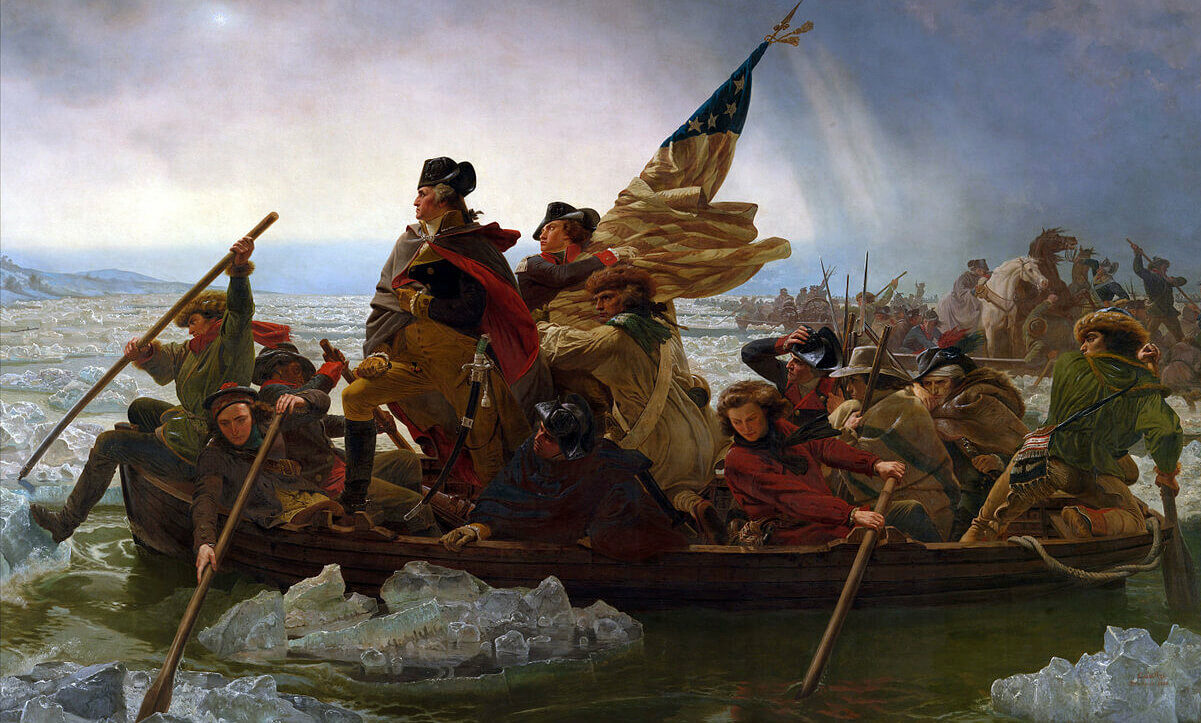
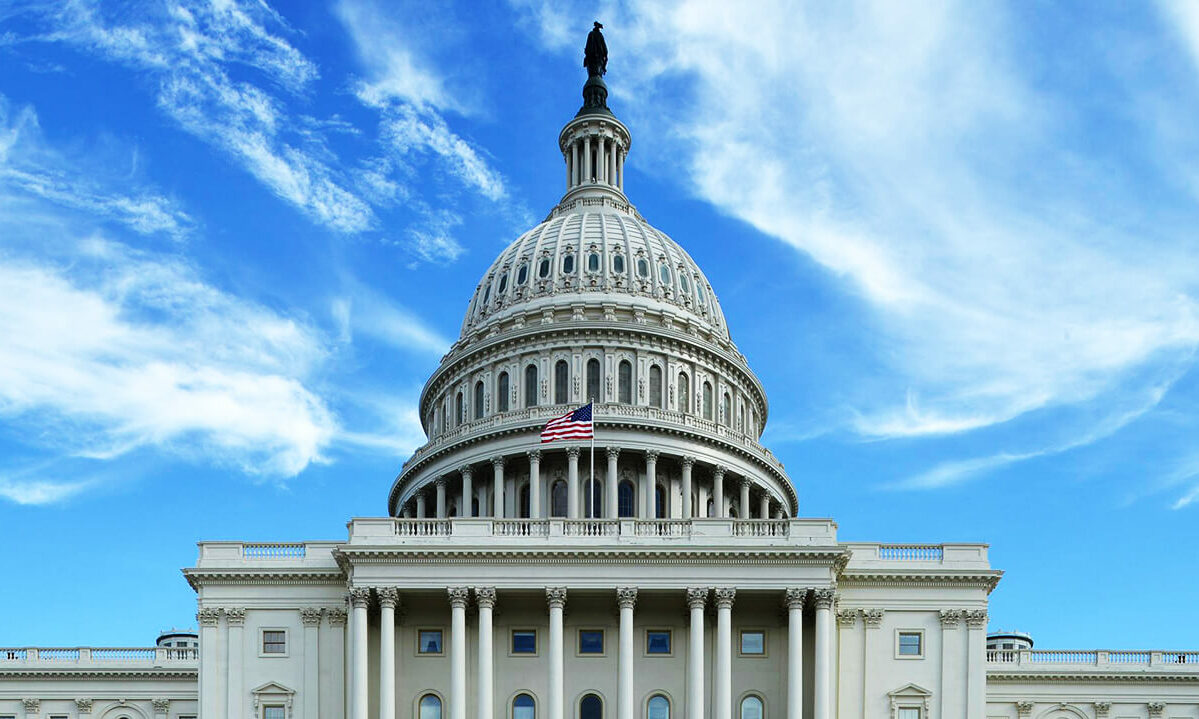
Sermon – Before Judges – 1681


Edward Fowler (1632-1714) was an English clergyman. He served as rectory at Norhill, Bedfordshire (1656-1673), rector at All Hallows, Bread Street (1673-1677), vicar at St. Giles, Cripplegate (1677-1691), and bishop of Gloucester (1691-1714). This sermon was preached by Fowler in 1681 in Gloucester.


sermon-before-judges-1681

A

SERMON

Preached before the

JUDGES, &C.

In the time of the ASSIZES

IN THE

CATHEDRAL CHURCH

AT

GLOUCESTER,

On Sunday Aug. 7, 1681.


Published to put a Stop to False and Injurious Representations.

By Edward Fowler, D.D.


A
PREFACE
TO THE
READER.

The desire of many Worthy Gentlemen, who were pleased to think this Sermon seasonable, could not have prevailed with me to make it thus publick, were it not for the Entertainment it hath met with from another sort of Auditors, who have represented it as Fanatical, and almost all that’s naught.

Abut, as I have not (I thank God) so little of a Christian in me, as to return Cursing for Cursing, or Reviling for Reviling; but, on the contrary, do most heartily pray for these men, who express the greatest enmity against me: so will I no longer trouble the Reader with complaints of their most injurious and provoking behavior upon the account of the following Discourse, but only intreat him to be Impartial in the perusal of it; and then to judge between them and me, whether I have given them any other cause to be so inraged, than what the blessed Apostle gave the Galatians, viz. Telling them the truth.

And I appeal to the most Censorious and Captious of those that heard me, whether I have been guilty of the least Unfaithfulness in this Publication.

God is my Witness, that I had the best of Designs in Penning and Preaching this Sermon, viz. A sincere and earnest desire to do some service to the Protestant Religion, His Majesty, and the Church of England, as by Law establish: Nor am I conscious to myself of any crime in the pursuing of this Design, unless honest impartiality in exposing the Doings, which are apparently most highly prejudicial to the interest of all these (than which nothing in this world should be dearer to us) ought to render me blameworthy.

But I am not in the least solicitous about what defects may be found in the Discourse, that are not of a moral nature; for, as the ingenuous will easily overlook them (especially in a Discourse not design’d for the Press) so ‘twould be a great piece of weakness to be at all concerned at the Censures of those that lye at the catch, and who if they find no faults will be sure to make them.

But the main thing I intended this Preface for is yet behind, viz. A faithful Narrative of a matter of Fact, which hath had the ill fortune to be as falsly and injuriously represented as this Sermon. It is this, There lately stood in the West-window of the Quire of Gloucester Cathedral, a most scandalous Picture, viz. of the Blessed Trinity: Which, had it been much observed, could never have outstood the first year of the Reformation; and much less continued till about two years since. I was first shewed it by one of my Brother Prebendaries about four years since: After which time, the sight of it, when I read at the Communion Table, did often discompose me. And, thinking my self obliged to do my endeavour to have it taken down, though no great notice, that I knew, was taken of it, I made no haste for that reason; but some time after my return from my Residence, I advised with one who is a most learned and eminent Prelate of our Church about it; and he, expressing high offence at it, told me we were all bound in Conscience not to suffer such a thing, now we had observed it, to stand longer. Hereupon I resolved to complain of it in Chapter at my next Residence, but there being not above two, or at the most three of us upon the place all that time, I put off the doing it till my Residence the following year. And then having a good opportunity (there being about the Conclusion of that Residence, our whole number except one, present) at a Chapter that was called about other business, the very last day of my stay (which was Mid-Summer Eve 1679.) having all of us viewed it before, I moved by Brethren in Chapter (the officers that were present being first desired to withdraw, because I would have the matter carried as privately as might be) that it might be taken down: Representing the hatefulness of such a Picture, and what scandal it would give, should it happen to become more publick (as it quickly might, it being known to more than ourselves, and that not by my means) and the great seasonableness of doing it at this nick of time, seeing through oversight it had been omitted thus long: it being not long after the discovery of the Plot, and many Factious people then at work in vilifying the Church of England as advancing apace towards Popery. This motion of mine was readily entertained by the Chapter, and the Idol most cheerfully voted down, and the Act of Chapter afterwards Recorded in the Register Book by some of the Prebendaries, where it now stands. I moved, as I said, that it should be taken down, that is, by a Glasier; but for a great reason, which I think fit to conceal, till provoked to publish it, it was as readily consented to, that it should be immediately broken, as ‘twas before, that it should be taken down, and new glass set up in the room of it. Whereupon the greater number of the Chapter went together to the place to countenance the action, and it was done by my hand. We could not in the least doubt, but that this was done very regularly, it being a hard case if the Governours of a Cathedral should not be invested with as much Authority as this comes to. But when it came to be known abroad, there was a hideous noise and clamour made by some few people; who are I dare say, the first Protestants that ever so concern’d themselves about such a vile Relique of Popish Superstition. The Clamour continues to this very day; and, after I had Preached this Sermon, complaint was made of the high misdemeanor to the Judges, and some, further to vent their spleen against me for my Sermon, did what lay in them to have it presented by the Grand Jury of the City, though a thing of above two years standing; Which doughty attempt (as well it might) made sport enough.

But that which necessitates my publishing this Narrative, is the several shameful Untruths they have made to pass for current, far and near, among those who have little knowledge of them and me; for those that know either of us cannot easily believe them. Particularly,

First, they represent this Action, as done by me upon my own head. They say not one word of a Chapters being concerned in the case, and so expose me for a Rash and furious Zealot.

Secondly, To lay still greater load upon me, they have given it out by themselves, and their Agents (particularly a 1 little Agent they have in London, a most disingenuous Creature, of whom I have deserved, as he can’t forget much better things) that it was only the Picture of a Saint or Angel, or at worst of our Saviour, when the contrary was visible to us all, and to others also, as I have intimated already. It was the old Popish Picture of the Trinity; God the Father represented by an Old man with a very long Grey Beard, and a huge beam of Light about his head: God the Son, by a Crucifix between his knees: And God the Holy Ghost, by a Dove with spread wings, under his Beard: which was patcht with a piece or two (as I remember) of plain glass. I have the Copy of the Picture by me as it stood in the Window, drawn by one who lives in that City, that had (as he told me) viewed it at times for twenty years together.

Thirdly, They represent it as done in compliance with the Scotch Rebels, who, they say, were then in Arms. But as this is most false, (these wretches being routed before this time, and the news of it come to Gloucester in the Publick intelligence) so every body must needs see the woeful silliness and Ridiculousness, as well as Malice of this suggestion.

There are some I confess, who are of better Tempers than the Furious people who have made such a loud clamour, that express their dislike of Breaking this Picture, which they call a great indecency. But I would fain know of them, why must it be done so decently? Is it because it was a gross abuse of the Holy Trinity? But if it was not an indecency to break in pieces the Brazen Serpent, when it came to be abused, though of God’s own institution, much less can it be so, to break that the making of which God hath 2 forbidden in so strict a manner. But I have said already that it had been done after these mens decent fashion, that is, taken down by a Glasier, might I have had my will, and had there not been a great probability, if not certainty, of our making our Order to no purpose, if it were not done this way; as my Worthy Brethren will bear me witness: who are all living, and can testify the truth of my Narrative of this so Scandalous a thing, viz. The Destroying of an Idol, that even Moderate Papists have condemned, and some of the better sort of Heathens also; that is, a Corporeal Representation of the Great God, and which one would wonder should have any Patrons, besides the monstrous Sect of Anthropomorphites.

I persuaded myself with great difficulty, to publish this Account to the world, and could not resolve upon it till I considered, how well it becomes me to disabuse abundance of people, who have been imposed upon by false stories, as well as to vindicate my own Reputation. And besides, this I have now done, will not make the thing much more publick than it was before: no nor at all more publick than the late Doings at the Gloucester Assizes, will perhaps make it. I have only taken a course to make the truth about this matter as publick, as some men have made gross falsehoods. And indeed I am now sensible, I should have done this long ago, and that I have been much too patient.

I am prepared to say much more of the Unworthy Treatment I have had from some upon this account, and of what Methods were used to raise clamour, but I have done enough at present; my Design being only to suppress lying Reports, and to disabuse (as I said) those who have received them, not the exposing of particular persons, which I am not like to do, till any of themselves shall make it necessary.

I will Conclude with this Address to my Adversaries (in allusion to our Blessed Saviours reply to the Wretch that smote him) viz. If I have spoken, or done, evil, and transgrest the Law, bear witness of the evil, the Law is open: But if well why smite you after so unchristian a manner him with your Tongues, for want of sharper weapons, who never had any quarrel or controversie with any of you, and who is resolved to requite your malice, with never ceasing to Pray for you?

E R R A T U M.
Page 24 Line 12, for his Generation, read, this Generation.


A
SERMON
Preached in the CATHEDRAL of
GLOUCESTER,
On Sunday Aug. 7, 1681.

I Tim. 1. 19.

Holding Faith and a good Conscience, which some having put away, concerning Faith have made Shipwrack.

Notwithstanding that the whole intendment of the Christian Faith be the promoting of Righteousness, True Holiness and Universal Goodness in the Hearts first, and then in the Lives of Men; and that it is most admirably fitted for that End: yet there arose even in the earliest and purest days of Christianity a Generation of People, who labored to reconcile Light and Darkness, the Christian Religion and a Wicked Life: And although they pretended to adhere to the Faith of the Gospel, denied the necessity of Good Works, and let open the Flood-gates to all Ungodliness. They made the Holy Jesus, who was manifested that he might destroy the works of the Devil, the great Patron of sin, and turned the grace of God into Lasciviousness; did not only receive this Grace in vain, and rendered it, as much as lay in them, ineffectual to the bettering mens lives and natures, but also made it the greatest Promoter and Encourager of that, for the utter destruction and extirpation of which it was designed.

This they did by corrupting the Christian Doctrine, and bringing into it a company of wicked and Licentious Principles, and by endeavouring to make that pass for the Doctrine of Christ, which was no better than the Doctrine of Devils.

Of these Wretched People S. Paul saith that, They professed that they knew God, but in Works they denied him, being abominable and disobedient, and to every good work reprobate, Tit. 1. 16. And in diverse other places he discourseth of these men, calling them false Apostles, deceitful workers, and the like; and warns the Christians he wrote to, to beware of them: As do other of the Apostles also, particularly S. Peter, S. John and S. Jude. Now would we know how it should come to pass, that the Christian Religion should be so strangely perverted, and made use of for the building of that which it was designed to destroy. We are assured that it proceeds not from the Obscurity of the Writings of the New Testament; for they as plainly, as ‘tis possible for words to do it, do everywhere condemn all Unrighteousness and Sin. But it was caused by Wresting the Scriptures and putting them upon the rack to force them to speak quite contrary to their intention. Thus S. Peter tells us the Epistles of his Brother Paul were abused, that those that were unlearned and unstable wrested them to their own destruction.

But how came it to pass that any should dare to make thus bold with the Scriptures? My Text Answers this question: The Apostle in these words tells us that, their making Shipwrack of the Faith was occasioned by their having first put away a good Conscience.

He here exhorts his Son Timothy to take care of holding both Faith and a good Conscience; and the Motive he useth to quicken his care is, that those who are not careful to hold both, will be in danger of losing both. So much is implied in his saying, that some having put away a good Conscience have made shipwrack concerning Faith.

Holding Faith, or the Faith, and a good Conscience, which some having put away, concerning Faith, or the Faith, have made shipwrack.

First, We will explain the terms, or endeavour to shew what it is to hold the Faith, and what to make shipwrack of it; as also what it is to hold a good Conscience, and what to put it away.

Secondly, That holding the Faith will nothing avail us, except we also hold a good Conscience.

Thirdly, That men’s making shipwrack concerning the Faith is occasioned by their having first put away a good Conscience.

First, For Explication of the terms; we will enquire,

1. What it is to hold the Faith, and what to make shipwrack of it. To hold the Faith is to adhere to the belief and profession of the Doctrine of the Gospel. Holding or keeping the Faith sometimes implyeth also a life answerable to the Christian doctrine; as where S. Paul saith, I have kept the Faith: And where the Author to the Hebrews exhorts the Christians, to hold fast the profession of their Faith without wavering. But here it can signify no more than the belief and profession of that Doctrine, because it is distinguished from holding a good Conscience.

Again, to make shipwrack of the Faith is to do either of these two things. Either, First, expressly to Renounce the Articles of the Christian Belief, the main fundamental Articles; all or any of those on which the whole Frame of Christianity is erected, and which are the Essential materials of it. As that Jesus is the Son of God: that he died for our sins, and rose again for our justification: that he ascended into Heaven, and will come again at the end of the world to judge the quick and the dead: that men shall be rewarded or punished according to their works: that Faith, Repentance and New Obedience are of absolute necessity to our obtaining the Divine Favour, and everlasting life. These and the like Articles which either are declared necessary to Salvation by our Saviour or his Apostles, or which from their own nature appear so to be, as containing necessary motives, encouragements or helps to a holy life, these are such as the renouncing any of which is making shipwrack concerning the Faith.

But the misunderstanding such Doctrines as have no such weight and stress laid upon them, or which considered in themselves appear to be of such a nature, as that the misunderstanding of them is consistent with true Goodness, cannot be called a making Shipwrack of the Faith: For if so, it will be impossible to know who holds the Faith, and who makes shipwrack of it: There being many points so disputably expressed in the Scriptures, and which there is such a diversity of Opinions about, even among Good as well as Learned men, that it may be an argument of too great confidence and presumption in any, to conclude peremptorily that theirs is the true notion of them. Or, Secondly, The introducing such Principles and Practices into the Christian Religion as do manifestly strike at any of its Fundamentals; and particularly such as directly, or in their evident consequences, enervate the Promises, Threatening’s, or Precepts of the Gospel, and contradict the great design of Christianity, viz. that of making men Sober, Righteous and Godly, this may also very properly be called making shipwrack of the Faith. It is truly so notwithstanding it may be joined with a profession of all the Articles of our Religion: For who seeth not that those who corrupt it with such Doctrines or Practices, are as injurious to the Faith, as the down-right opposers of its main Principles; or rather the more injurious of the two, there being much more danger of a false Friend, than of a professed and open enemy.

2. Would we know what it is to hold a good Conscience; this is, in short, sincerely to endeavour to walk in all the Commandments of the Lord blameless: To endeavour impartially to acquaint our selves with the Divine Will, and when we understand it, to comply therewith, although it be never so cross to our own wills and natural inclinations. And therefore, on the contrary, to put away a good Conscience is to be bent upon the pleasing our own wills, and gratifying our sensual Appetites: to give up our selves to be acted and governed by fleshly and impure Lusts: To be devoted to the Service of corrupt, carnal and worldly affections and interests. Where the lust of the flesh, the lust of the eye, or the pride of life, the love of Pleasures, Riches or Honours, are predominant in the Soul, there a good Conscience is put away.

Secondly, We next come to shew that holding the Faith will nothing avail us, if withal it be not our care to hold a good Conscience. This is apparent in that the Renewing of men’s natures, and Bettering their Lives is the only end both of Natural and Revealed Religion; and were not this the end thereof, Religion would be the vainest and most insignificant thing in the world. The Heathens themselves were well aware of this, and therefore the professed intendment of their Philosophy was, ζωῆς ἀνϑρωπίνης ϰάϑαρσις ϗ πελϵιότης. The purgation and perfection of the humane life. They well knew that nobody is the better for the best principles, where they are only believed and not lived.

And as for the Principles of the Christian Religion, which the Ancients used to call the Christian Philosophy, I shall not need to prove that our belief of these is required wholly upon the account of the great efficacy they have for the transforming of us into the Divine likeness, the subjecting our Wills to the Will of God, and the making us holy in all manner of Conversation. And therefore we find our Blessed Saviour and his Apostles making the whole of a Christian to consist in keeping his sayings, in doing the things he commands them, in Faith that worketh by love, and in the new Creature. And therefore we see the greatest contempt cast upon Knowledge and Profession and Faith, unaccompanied with an answerable life and practice. Therefore we read, that Faith without works is dead, that Faith is dead being alone, as being utterly unable to stand us in the least stead, and as being so unable to save us, as greatly to aggravate our Condemnation.

The Papists lay mighty weight upon their Orthodoxy, their believing as the Church believes, and flatter themselves with a fond conceit, that the goodness of their Faith will make great amends for the badness of their lives. But suppose it true, that they are the Orthodox believers, and all the Christian World Heretics besides themselves, as they would have us believe, yet the Devils are as Orthodox as they can be for their hearts, but their Orthodoxy makes them but the more miserable; if they did not believe so truly, they would not tremble as they do. The Devils also believe and tremble, James 2:19. In short, we are not more assured from the Holy Scriptures that God made the Heavens and the Earth, than we are of the truth of this Proposition, that the most sound belief will not do us the least service while it is accompanied with a naughty life: That the most Orthodox Sentiments will nothing avail us while joined with an Heretical Conversation.

Thirdly, We proceed to shew, that mens making shipwrack concerning the Faith, is occasioned by their having first put away a good Conscience. Which (good Conscience) some having put away, concerning Faith have made shipwrack. The Apostle, speaking of some that resisted the truth, calls them men of corrupt minds, reprobate concerning the Faith, 2 Tim. 3:8. Thereby intimating, that their being reprobate concerning the Faith, proceeded from the corruption of their minds, or naughtiness of their hearts, and the prevalence of evil and corrupt Affections. And the same Apostle, speaking of certain Hereticks, attributes their erring from the Faith to their gratifying particularly that last of Covetousness, 1 Tim. 6:10. The love of money is the root of all evil, which while some coveted after, they have erred from the Faith. And S. Peter, speaking of wicked Seducers, faith, that they had eyes full of Adultery, and hearts exercised with covetous practices: And intimateth that this is the cause of their forsaking the right way, and their beguiling unstable Souls, 2 Ep. 2:14, 15.

Now would we be satisfied how this putting away a good Conscience occasioneth men’s, making Shipwrack of the Faith: It is evident that it doth thus these three ways.

First, As men’s addicting themselves to the satisfying of some lust or other, puts them upon devising shifts and tricks to still the disquieting clamours of their Consciences. The wrath of God being revealed from Heaven against all unrighteousness and ungodliness of men, ‘tis no easy thing for any one willingly to transgress the Rules of Righteousness, without being frequently tormented with fearful expectations, and the Horrors of an Accusing and condemning Conscience. Now the most effectual way to be rid of these (next to sincere Repentance and Reformation) is either for a wicked man to persuade himself, if he be able, that there is no God, or nothing after this Life; and consequently, that the Bible is a cheat, and all its threatening’s mere scare-crows. Or if this he cannot do, in regard of the abundant evidence of the Being of a God, and the Authority of the Holy Scriptures, the course must be so to wrest and pervert the Scriptures, as to make them give liberty to certain evil practices, or to promise forgiveness of sin to certain performances that are short of forsaking it.

Thus those Heretics in the Primitive times wrested the places wherein the Gospel is call the Law of Liberty, and wherein we are said to be delivered from the Law, so as to take off the Obligation of the Moral as well as the Ceremonial Law; and to give liberty to sin, and to oppose Faith to Obedience in the business of Justification and acceptance with God.

Many other instances may be given both of Ancient and Modern Heretics perverting of passages of Scripture, so as to make them great encouragements to sin, and discouragements to a Holy life; perfectly contrary to the whole strain and tenor of the Gospel.

But I must not enlarge farther upon this Argument, because the main thing I intended in the choice of this Subject is yet behind.

Secondly, The putting away of a good Conscience occasions making shipwrack of the Faith, through the just judgment of God. The former particular gave us an account of wicked men’s being strongly inclined to make shipwrack of the Faith, and of their endeavouring it, this of their putting their inclinations into practice, and succeeding in their endeavours.

Men that are wedded to any lust are very forward, for their own ease, to endeavour either the embracing of Atheistical Principles, or so to abuse the Scriptures as to take encouragement from them to live in sin; but they could hardly so extinguish the light of their own minds, as to succeed in their endeavours, were it not for the judgment of God upon them, in giving them up into the Deceivers hands. To this purpose observe what the Apostle saith, 2 Thess. 2:10, 11. Because they received not the love of the truth, that they might be saved (or they did not so receive it as to suffer it to have any good effect upon their hearts and lives) for this cause God shall send them strong delusions (or give them up to be deluded by the tricks of the Devil, the signs and lying wonders before mentioned) that they should believe a lie, that they all might be damned who believed not the truth, but had pleasure in unrighteousness.

Thirdly, The putting away of a good Conscience occasions making shipwrack of the Faith, as wicked Professors of Christianity do find it a most successful course to promote their corrupt and naughty designs, by foisting into the Christian Religion such Doctrines and Practices, as favour and encourage such designs. I have shewed that those who corrupt the Christian Religion with such Doctrines or Practices as contradict the Design of it, do truly make shipwrack of the Faith; and whereas there may be given too many instances of such Hypocrites as have so done, I shall make it the whole business of what remains of the Doctrinal part of this Discourse, to shew that the Church of Rome as she is now Constituted, is most shamefully guilty in this particular.

It is to be acknowledged, that she retains the Profession of all the Fundamental and Essential Articles of the Christian Faith; a summary of which is that Creed which we call the Apostles, and she professeth a Reverence for the whole New Testament. If she in express terms rejected any Doctrine that is of the Essence, and a vital part of Christianity, her members may not be called Christians in any sense, and we then do very ill to say the Church of Rome.

We do not stick at calling them a Church, though a most corrupt and degenerate Church; as (to use the similitude of Bishop Hall) a thief is truly a man, though not a true man. A woman may retain the name of a wife till she’s formally divorced, though she be an adulteress.

The Church of Rome may as truly be called a Church, as the Jewish Nation the People of God, after their soul Revolt from him, and Lapse into Idolatry and other wicked and impious practices.

But this hath been abundantly made good against this Church, that, though she holds the Foundation yet, she builds Wood, Hay and Stubble upon the Foundation: that is, she mixeth many impure Doctrines of her own, with the most holy and undefiled Doctrines of the Gospel. Of which I will present you with some instances, but must be very brief upon most of them.

What say you, in the first place, to her Doctrine of Infallibility? Which speaks her uncapable of erring in any of her Decrees and Determinations: Which Infallibility the Jesuits will have seated in the Popes Chair; others in the Pope in conjunction with a General Council; that is, a Number of Bishops and Priests packt together of his own Faction: For there is nothing he hates more than a Council truly General.

I call this not only a false but a wicked Doctrine, because of the infinite mischief that it doth in the world: For the Romish Church’s pretence to Infallibility, is that which enables her to Lord it at that intolerable rate, over the minds and Consciences of her Subjects, and to make them the greatest of Slaves and Vassals. And ‘tis this also that makes her utterly incurable of her gross corruptions, her other notorious Heresies, and the ungodly and horrid practices founded upon them. So that, so long as she continues to assume to herself the Title of Infallible, there is no hope to be conceived of her being ever in the least Reformed, either in her Principles or Practices.

But never was a Doctrine more shamefully baffled than this hath been; as easily it may, there being nothing but Interest to uphold it, nor one syllable in all the Bible to befriend it. As for that promise of our Saviour, that the gates of hell shall never previl against his Church, the most that can be concluded from thence is, that he will ever have a Church upon earth in spite of all the endeavours of Hell to destroy it. But thanks be to God, this Promise would be no whit the further from being performed, although the Devil should be permitted totally to extinguish the Church of Rome; though to be sure he understands his own interest better than once to attempt it.

But if the meaning of this Promise be (as the Romanists would have it) that the gates of Hell shall never so prevail against the Church, as to occasion her falling into errors of Judgment, why may we not as well extend it so far as to secure her also from errors of Practice? these being no less dangerous or destructive than those of Judgment. But I retain so much Charity for the Romish Church still, as not to think her so forsaken of all Modesty, as to deny that in this sense, the Gates of Hell have prevailed against her with a vengeance.

And as for the other Promises which they lay any stress on, they are either such as ‘tis manifest the Apostles only, and first planters of the Gospel were concerned in, or else such as belong to all Christians without exception thus far, as that while it is their sincere endeavour to know the truth, and to live up to their knowledge, they shall be secured from pernicious and damnable errors.

Again, What say you to the Doctrine of the Popes Supremacy over all other Churches and Kingdoms too, and his having a Grant of as vast Dominions upon Earth, next and immediately under Christ, as Christ himself hath under God the Father, his being King of all Kings, and Lord of all Lords, and that both in Spirituals and Temporals? I might easily tire you upon this head of Discourse, but all I will say to it shall be this, that the Charter pretended for so mighty an Empire is much too obscurely exprest to be ever understood, by any other people than the Pope and his Vassals. There is not a tittle in the Holy Scriptures for it, though we know what a noise and fluster they make with two Texts, Pasce Oves meas, and Dabo tibi Claves, &c. as if this Supremacy were as plainly legible in each of them, as the Doctrine of the Creation in the first verse of Genesis.

But, which is worst of all, how many thousands of honest people have been barbarously butcher’d, merely because their eyes would not serve them to read this Doctrine of theirs in those two Texts!

And this is that Doctrine which gives them a pretence for their restless and unwearied endeavours to get these Kingdoms again within their Clutches, and for all their desperate and hellish designs against us.

What say you to their Doctrine of Image-Worship? with which I will join that other of Praying to Saints and Angels. In their Adored Council of Trent it is decreed, that The images of Christ, the Virgin mother of God, and other Saints, be especially kept in Churches; and that due Honor and Veneration be given unto them. And afterward this Council expresseth its allowance of Picturing the Divinity it self; and accordingly Pictures of the Blessed Trinity, (Oh hateful sight!) are ordinarily to be beheld in the Popish Churches.

Now would we know what the Council means by Debitus honor & veneration, the due honour and veneration that is to be given to Images; this appears by these following words, We decree doing honour to them, because the honour which is done to them, is referred to the Prototypes which they represent. So that in the Images which we kiss, and before which we uncover our heads, and fall down, we adore Christ, and Worship the Saints which they represent, &c. So that the Honour and Veneration which they determine should be given to Images, do imply all external Acts of Adoration; and that the Image of our Saviour is to have the self same Adoration paid to it, that would be due unto himself were he personally present.

And the Universal Practice of the Romish Church (wholly to pass over the Vile stuff of their Doctors, Schoolmen and Casuists) will tell you the meaning of their debitus honor & veneratio.

The consent of Nations (saith the Learned Grotius) have made Sacrifices, Oblations and Incense, proper signs of Divine Worship; but, though I had time, I need not stand to shew, that the Images of Christ, Angels and Saints, especially that of the Blessed Virgin, are every where Worshipped with these signs, and with all the Rites of the most solemn Invocation in Sacred Offices, and in places set apart for Divine Worship. And they do all the external honour to the Saints and Angels in the Addresses they make unto them, whether immediately or as represented by Images, that ‘tis imaginable they should do our Saviour himself, or the Blessed Trinity.

Nay, They pray unto them, not only for Temporal or Ordinary Blessings, but for Spiritual and Supernatural: such as the Pardon of their sins, and the Holy Spirit, and eternal life, as might be shewn at large.

Now what is Idolatry, if such doings are now? Why, they tell us, and we cannot blame them, that the true Notion of Idolatry is only the Worshipping some Creature for the most High God, supposing it to be the most High God. But if so, the Worshippers of the Golden Calf, to be sure, were no Idolaters; for they can be little better than made themselves, who are able to imagine that the Israelites we so mad, as to believe that the Calf which they saw made, and that of their own Ear-rings too, was that very God which brought them out of the Land of Egypt. But the Gentlemen of Rome would have us think that they were so forsaken of their Intellectuals, as so to believe; and we cannot blame them for that neither. For if they did not impudently bear us down, that the Children of Israel believed that this Moulten Calf was that God that divided the Sea, wrought so many Miracles for them, and the maker of Heaven and Earth, they would, they are sensible, be necessitated to excuse them from Idolatry, expressly contrary to the words of Scripture. And if this their Notion of Idolatry be the only true one, we are certain that it will be extremely difficult, if not impossible, to find out Idolaters among the very Pagans.

What think you of their Doctrine of Transubstantiation, of which take this account from the Council of Trent. By the Consecration the whole substance of the Bread is changed into the substance of the Body of Christ our Lord, and the whole substance of the Wine, into the substance of the blood of Christ. So that as like as it still looks to Bread and Wine: Though it hath the perfect Taste, the perfect Feeling and Smell of Bread and Wine, yet it is nothing less; ‘tis that very Body that hung upon the Cross at Jerusalem, and that very blood that was there shed.

This is the most prodigiously contradictious Doctrine, that I will not say the Wit but the Madness of men can possibly invent: ‘tis a most wonderful complication of most horrid contradictions, and absolute impossibilities. But this is not the worst of it, it is also the foundation of so gross and foul Idolatry as is scarcely to be named among the Gentiles, or to be found paralel’d in Peruvia itself, or the most barbarous parts of India. The aforementioned Holy Council declares, nullus itaque dubitandi locus relinquitur, &c. There is therefore no place left for doubt, but that all good Christians do give the Worship of Latria, quae Vero Deo debetur, which is due to the true God, to this most Holy Sacrament; according to the always received custom of the Catholick Church. They should have said, according to the late and upstart custom of the Romish Faction. Here you see that the Bread and Wine are Worshipped by them, not as Representations of God, but as God himself.

But what if those words of our Saviour, This is my Body, should prove to be a Figure? Like those other of his, I am the Vine, I am a Door, &c. or what if This is my body should be as much a Figure, as they will confess the words presently following are, viz. This Cup is the New Testament in my Blood? Where we have a double Figure, both the Cup put for the Wine in it, and the Wine said to be the New Testament or Covenant, when, supposing it were the very Blood of Christ, it could not be the New Covenant itself, but the Seal of that Covenant; I say, what if these words be to be understood figuratively? (as why they should not the Papists can shew nothing like a reason, but we have shewn them the greatest absurdities imaginable in otherwise understanding them) why then they themselves will and do acknowledge that they should be guilty of the most gross Idolatry in their Worship of the Host.

What say you to the Popish Doctrine of the Sacrifice of the Mass, which is of near kin to the foregoing? The Doctrine of the Roman Church is, as you shall find it in the Council of Trent, That in this Sacrifice which is performed in the Mass, that very Christ is contained, and in a bloodless manner offered, which, upon the Altar of the Cross, did once offer up himself in a bloody manner. So that, according to this Doctrine, our Blessed Saviour must still to the end of the world be laid hold of by Sinners, be ground with their teeth, and sent down into their impure paunches as often as the Priest shall pronounce the charm, hoc est enim corpus meum. And it seems that he was a false Prophet, when he said upon the Cross it is finished, seeing there was such an infinite deal of loathsome Drudgery still to be undergone by him. And it seems the Author to the Hebrews is found to be a false Apostle, in asserting so expressly, as more than once he doth, that such is the Dignity of Christ’s Priesthood, and its excellency above the Levitical, that by one offering he hath made perfect satisfaction, and expiation for sin. 3

So that this their Doctrine of the Sacrifice of the Mass, is not only False, but very Corrupt and impious Doctrine.

What say you to their Doctrine of Purgatory? Which, in short, is this: That no souls, except such as are perfectly purified in this life (which they’ll surely acknowledge are extremely few) shall go at their departure hence into a place of happiness or ease, but all, the forementioned excepted, into a place of torment; where they may abide for an exceeding long time, even many hundreds of years, except some effectual care be taken for their deliverance.

By this Doctrine the poor people are brought into a most slavish state; by the means hereof their merciless Tyrants the Priests hale them into worse than Egyptian Bondage: who, instead of enjoining them the most reasonable duties to which the Precepts of their Saviour oblige them, and which are most admirably adapted to the cleansing of their natures, and mortifying their corrupt affections, impose upon them a great number of ridiculous Services of their own invention.

But though they cannot pretend the least warrant from Scripture for such doings as those, yet they have a most express Text. They tell you, for their Doctrine of Purgatory, viz. those words of S. Paul, I Cor. 3:15. But he shall be saved, yet so as by fire. But he who considers these two things will see nothing like Purgatory in this Text, namely, First, that it is Ώς διὰ πυϱϧς, not he shall be saved by fire, but as it were by fire, or rather through fire. Secondly, that Σώζεσϑαιὡς διὰ πυϱϧς, to be saved as through fire, is a Proverbial Speech (as those great Criticks, Grotius and Scaliger, with others, have shewed) signifying to be saved from most eminent danger.

And as this Doctrine of theirs is groundless, so is it as wicked, it being a most vile affront to the Merits and Satisfaction of our Blessed Saviour: For in order to the establishing of this Doctrine they reach, that, The Passion of Christ takes away only the guilt of Mortal sins, not their eternal Punishment, which is as non-sensical as false and impious.

‘Tis an impious Doctrine also, both as it is devised to enslave the Consciences of the Poor People, and to bring them into absolute subjection to their Priests; and likewise to gratify their greedy Appetites, and to bring their Purses no less under their power than their Consciences.

What say you to their Doctrine of the Non-necessity of the Laity’s partaking of the Cup in the Lords Supper, and their being Rob’d accordingly of their share therein? Expressly contrary to our Saviours institution, and the Practice of the first Ages of the Church, and of all other Churches in the world.

What say you to their well known Doctrine, Of the Non-necessity of Repentance before the imminent point of death? And to this other that goes beyond that, viz. that mere Attrition (or sorrow for sin for fear of hell) if accompanied with the Sacrament of Penance is sufficient to a sinners justification and acceptance with God? This the Council of Trent doth plainly take for granted, in the fourth Chapter of their fourteenth Session.

What say you to the Doctrine of Opus operatum? Which makes the mere work done in all acts of Devotion, sufficient to the Divine Acceptance: particularly the bare saying of Prayers, without either minding what they say, or understanding it. And agreeably hereunto the Romish Church enjoyns the saying of them in a Language unknown to the generality of her children; notwithstanding the perfectly contrary Doctrine delivered by S. Paul in the 14th Chap. of the first to the Corinthians.

What say you to the Doctrine of the Insufficiency of the Holy Scriptures for mens Salvation, and her denying them to be a complete Rule of Faith, and Practice in things necessary, without her Traditions? Wherein she gives the Lye to the same great Apostle, who tells his son Timothy that, the Scriptures are able to make wise to Salvation: and that by them the man of God may be perfected, and thoroughly furnished to every good work.

What say you to her Doctrine of the Gospels obscurity even in things of absolute necessity to be believed and practiced? Devised on purpose to persuade the people to an implicit belief in her self, and to receive without examining whatsoever doctrines she shall please to call Articles of Faith.

This is a wicked Doctrine in itself also, as well as upon the account of the Design of it: It being most unworthy of God to require all under pain of damnation, rightly to understand those Points which are obscurely revealed.

What say you to her Doctrine of the dangerousness of the vulgars reading the Holy Scriptures; and her practice answerable thereunto, of denying them the Bible in their own language?

What say you to her Doctrine that, Faith is not to be kept with Hereticks? 4

What say you to this Doctrine that, the most horrid villainies are then lawful, when necessary to the promoting of the interest of the Catholic cause? I do not say that this is decreed in any Council; or that it is in express terms taught by any of them: But however, if it be lawful to judge of men’s opinions by their constant practices, we may without a Calumny call this also a Doctrine of the Church of Rome. Particularly, the world hath for a long time been well acquainted with her most horrible Cruelties, upon the account of Religion.

To mind you of a few famous instances: in the persecution of the Albigenses and Waldenses, were miserably murdered no fewer than a thousand thousand: 5 In the Massacre of France, in the space of three months, an hundred thousand: In the Low-Countries, in a few years, were cut off by the hand of the common hangman thirty and six thousand Protestants: And by the holy Inquisition (as Vergerius witnesseth, who was well acquainted therewith) were destroyed in less than thirty years space, one hundred and fifty thousand, with all manner of the most exquisite cruelties.

I need not mind you what a vast number were Burnt at the stake in our own Country, in the Reign of Queen Mary: Nor what additions have been made since to Rome’s Butcheries, in Piedmont and Ireland. 6

And what a horrible slaughter had there been in England, by the Gun powder Treason, if it had not been prevented by a Wonderful Providence! And also what work the Romanists would have been at here again before this time, if God in his infinite mercy had not defeated the Councils of those bloody Achitophels, all who do not willfully shut their eyes, and are not Papists at least in Masquerade, 7 should, one would think, acknowledge themselves satisfied, after so great evidence.

So that we need no further proof that the Woman hath Rome Christian for her principal Seat, upon whose head S. John tells us, was a name written, Mystery Babylon the great, the mother of Harlots and Abominations of the earth: and whom he saw drunk with the blood of the Saints, and with the blood of the Martyrs of Jesus. But we have farther proof that the now mentioned wicked doctrine, may truly be charged upon the Church of Rome: For her abominable Practices do not only justify this charge, but several of the Doctrines of her darling sons, those precious youths the Jesuits, and which (as they tell you) are much elder than their order, viz. That of the lawfulness of Equivocations and Mental Reservations, even before Courts of Judicature, at least, if they consist of Heretics; of the putting which vile principle into practice we have had of late diverse marvelous and most astonishing instances.

That of the Popes power of Dispensing with the most solemn Oaths, and of Absolving Subjects from their Allegiance to Heretical Princes.

That of the Lawfulness, nay Meritoriousness of taking Arms against them, of Stabbing and Poisoning them. And we of this Kingdom too well know that the Romish Church make no bones of practicing upon these Principles.

I might still farther proceed in instancing in her most corrupt and wicked Principles, but you have had enough in all Conscience: And but that, now especially, we are obliged to take all opportunities for the exposing of the vileness of the Romish Religion, I would e’en be as soon engag’d in stirring Jakes’s, and raking dunghills, as in such work as this.

God be thanked for that mighty Spirit that hath been stirred up throughout the Nation against Popery: Oh that it more generally proceeded from our sense of the hatefulness thereof, and the extreme dishonor it brings to Christianity, and its infinite injuriousness to the Souls of men, as well as from the concern we have for our Temporal interest; which is but a mean and pitiful consideration in comparison of those other. And the better the Principles of Popery and the Practices of the Papists are understood, the greater and more lasting must their zeal against them needs be, who have any hearty kindness either for Christianity or for Natural Religion; either for Christianity or for good Morality and common honesty, or even mere good nature.

I will so far imitate the horrible uncharitableness of the Romish Church, as to say that ‘tis impossible to find any sincere Christians in her Communion; and much less, that no honest or good natur’d people are among them: But this we are very certain may safely be said that, whosoever is thoroughly instructed in the Popish Principles and acts accordingly, is so much a stranger to Christianity, that he hath totally cast off all Humanity.

Whosoever is a thorough Papist hath no Conscience in his own keeping; his Conscience is perfectly at the dispose of his Holy Father and his Confessor: Nor is there any villainy, be it never so great, but he is prepared for it, whensoever a Priest or Jesuit by commission from the Pope shall oblige him to it.

That Protestant doth but slightly understand Popery, who dares trust his throat with a thorough Papist, although he be seemingly a man of never so good a nature, or of never so good Morals: and the more conscientious he is in his way, by so much the more dangerous a person is he. That’s a rare Religion in the mean time, the more true to which any man is, the greater Villain he must necessarily be. And those are a precious sort of Christians, of which one cannot adventure to give a true and impartial Character, and to paint them in their own colours, but he must be in danger to be Censured as a scurrilous person, as a man of a foul mouth, and a down-right Railer.

Let us all therefore take up those words of Jacob, in reference to his Generation, which he uttered concerning his two wicked sons, Simeon and Levi, O my soul come not thou into their secret, unto their assembly mine honour be not thou united.

To make some Application of what hath been discoursed.

First, Is the putting away a good Conscience the true cause to which making shipwrack of the Faith is to be imputed? Is this the account into which it is to be resolved? Then, as we would be out of danger of falling into Heresy, and particularly of turning Papists, and making shipwrack of the Faith as they have done, let us have a great are to hold fast a good Conscience: To exercise ourselves in keeping Consciences void of offence both towards God and towards men: To lead lives answerable to the holy Doctrine which we profess to believe.

If any man will do the will of God (or be sincerely willing to do it) he shall know of the Doctrine whether it be of God, saith our Blessed Saviour, John 7:17. He shall be able to discern between truth and falsehood, and shall be guided into and kept in the truth.

The truth hath no fast hold of any, but those who receive it in the love of it, and make it the measure and rule of their lives and actions.

It is not at all strange that Learned and Knowing men should make shipwrack of the Faith, for Learning and Knowledge is no security while separated from Honesty and a Good Conscience. There is no error so absurd or dangerous, but we ought to expect an insincere person will embrace it, when once it becomes serviceable to that Interest he is most concerned for the promoting of.

Even those of us who do now shew the most forward zeal against Popery, if we be wedded to any corrupt Affection, and have only the Form, but are void of the Power of Godliness, will be in never the less danger, notwithstanding our present zeal, of Apostatizing, if ever it should become our temporal interest (which God forbid) to turn Papists.

Secondly, Is it so apparent that the Church of Rome hath made so woeful a shipwrack of the Faith? Then what an infinite obligation lyeth upon us to the greatest Thankfulness to our good God, for rescuing these Nations from under her yoke; and for those Miracles of mercy which he hath wrought for us, in blasting so many of their deep laid designs, their late great Conspiracy, and late Sham-plots, for the reducing of us to our old Captivity.

If it had not been the Lord who was on our side, now may England say, if it had not been the Lord who was on our side, when these men rose up against us; then they had swallowed us up quick, when their wrath was kindled against us: then the waters had overwhelmed us, and the streams had gone over our soul. Let us therefore Bless the Lord, who hath not given us a prey unto their teeth.

Lastly, As we would still be secured from Popish Conspiracies, from the unwearied attempts of our old Adversaries against us, take we great heed of provoking the Almighty to withdraw at length his Protection, and abandon us to their Malice, by walking unworthy of that glorious Light and Liberty we now enjoy in the Church of England. And while we have the light let us walk in the light, lest God, in his just judgment, suffer us to be again involved in Egyptian darkness.

Oh happy Children of the Church of England, if we could be persuaded to prize our present Vast Priviledges, before our having lost them doth force us to set a high value on them.

And, Oh that we were capable of so much Wisdom, as no longer to strengthen the hands of our common enemy, by our as unreasonable as Unchristian Animosities against one another. That we had once as great a zeal against the Anti-Christ’s within our own breasts, Pride, Anger, Malice and Bitterness, as we seem to have against the Anti-Christ in the Roman Chair: Those Anti-Christ’s being the greatest friends this Anti-Christ hath, and more our enemies than he is capable of being.

Oh that at length we could be convinced of this great truth, that the Christian Religion consisteth not in meats or drinks, mere external things, but in righteousness, peace and joy in the Holy Ghost. In Humility, Meekness, Self-denial, Obedience to Authority in all lawful things, love to God, and love to men, &c.

Oh that we had vigorous powerful sense of this, that neither the most admired Gifts nor appearances of Grace, which are not joined with a Benign and Charitable temper, can at all recommend us to the Divine favour: That he hath no Participation of the God-like Life and Nature, who is of a Quarrelsome, Contentious, Uncharitable Spirit, be he in a many other respects never so Saint-like. And that Christian love is a thousand times better argument of a renewed state, than most of those marks and characters which are ordinarily given of a godly man.

If we were once brought to this happy pass, to have a lively sense of these things: to make great Conscience of preserving the unity of the Spirit in the bond of peace; and to abandon all Separating, Dividing, Sowre and ill-natur’d Principles and Practices, we shall not then need to fear the malice of the Papists, were their power greater than, God be thanked, it is; but till then, all our other endeavours to secure ourselves may fail of success.

But alas, I fear, that never had a People sadder Omens of miserable days than we now have: And nothing bodes worse than this that, we are so far from Uniting among ourselves, notwithstanding we seem so sensible of extraordinary danger from our common Enemy, that our breaches daily grow wider and wider.

We seem no less infatuated, no less madly bent upon our own destruction, than were the miserable Jews in the Siege of Jerusalem; among whom there were never such desperate Feuds, as when they were all surrounded with the Roman Armies.

Those who, by their causeless forsaking of our Communion, have greatly strengthened the hands of our Enemies, are so far from being yet made sensible of the mischief of Separation, and the most pernicious consequences of Dividing, that many of them are now grown fiercer than ever (as appears by their late Books and Pamphlets, &c.) against that Church, which Rome hath always found to her cost, the most impregnable Bulwark in all Christendom against Popery.

And on the other hand (for I will not be taxed with Partiality) there are too too many among ourselves, that do little consult our Churches interest, nor consequently the interest of the Protestant Religion, but greatly disserve both, by their intemperate heats, and branding all with the names of Fanatics and Presbyterians who are not come up to their pitch, and in all things just of their complexion; although they be as obedient to both their Civil and Ecclesiastical Superiors as themselves, are no less truly Regular and Conformable.

We ought by Love and Sweetness to encourage men all we can, this is to act like the Disciples of the mild and most lovely temper’d Jesus; and not by Sowreness and Censoriousness tempt those to depart from us, who would gladly still hold Communion with us. 8

And where we find an inclination towards returning in any that have departed from us, we should be glad to meet them half-way in order to the bringing them over to us. 9

And it becomes us likewise to make a difference between Peaceable and Modest Dissenters from us, and those who are Turbulent, Seditious and Factious, and not wind up all together in the same bottom.

I may add also, that there are, God knows, too too many Debauchees in the Nation, who would be thought great Champions for the King and the Church, but do infinite prejudice to both, by the mad and frantic expressions of their zeal. Who do mighty honour to Fanaticism by charging all with it, that run not with them to the same excess of Riot.

One would suspect that these, whatsoever they pretend, do really design nothing more, than to make both the King and the Church as friendless as they are able.

Heaven help them both, should they ever be so unfortunate, (which God forbid) as to stand in need of this sort of people.

If indeed Huffing and Healthing, Cursing and Damning, and giving vile names would do the business, then let them alone to protect and defend the King and Church: but former experience hath assured us, that those are the best weapons that most of them can boast of their being good at.

A Neighbouring King, and the Church of Rome, may with God’s blessing on the hearts of these Gentlemen: but our own King (whom God preserve) and the Church of England have little reason to Con them thanks, for any service they are like to do them. 10

King Charles the First of Glorious Memory was very sensible of the Consequence of such mens assistance, which proved fatal to him: The goodness of whose Cause did sink under the burden of their sins, according to the sad Presage of our excellent Chillingworth, in a Sermon Preached to the Court at Oxford.

And if ever his Majesty and the Church should be again set upon by Scribes & Pharisees, God grant us better assistance than that of Publicans & Sinners.

But I wonder in my heart, what should make any Debauched and Profane people pretend the least zeal for the Church of England; there being no Church in the world that more condemns all unrighteousness and sin; or which would be more severe against wicked livers, were she in circumstances to put in execution her own Discipline. Which she is not like to be, so long s the Civil Magistrate is so remiss in executing, according to their Oaths, those excellent Laws that are Enacted against Drunkenness, Swearing, Uncleanness, Profanation of the Lord’s day, and other wicked Practices.

And I add that Popery and Fanaticism will both undoubtedly still grow upon us, be we never so zealous against both, whilst that Debauchery and Prophaneness, which have so miserably overspread the Nation, do still escape scot-free and go unpunish’d.

I cannot but observe one thing more that, ‘tis an uncouth and ridiculous Spectacle, to behold wild Fanatics, and profane 11 people, that call themselves Church of England men, (who are far from deserving that Title, whether they be Clergy or Laity) contesting together, and falling foul upon one another: One would be tempted upon this occasion, to take up the Grand Vizier Kuperlees blunt reply to the French Ambassador (upon his Accosting him with the news of Ricaut, the Spanish Armies being routed by the French,) viz. What matter is it to me whether the hog worries the dog, or the dog the hog, so my Masters head be but safe.

To Conclude.
Till I see on the one hand a far greater sense of the hatefulness of Schism, and of breaking the Peace and Unity of the Church: of which all good people did heretofore express the greatest Abhorrence and Detestation.

And till I see on all hands more sincere endeavours to put away Anger, Wrath, Malice and Bitterness.

Till I see that the several divided Parties among us, are more inclinable to unite heartily with us of the Church of England, and We again with them, so far forth as unanimously to oppose Popery, that designs the destruction of us all. Which all but hot-spurs, that never allow themselves leisure to think a wise, or sedate thought, must needs know to be absolutely necessary to our mutual preservation at this time. And it would be well, would we herein learn of the Papists, who notwithstanding the great differences that are among them also, can joyn together against Protestants.

Till I see again that our Zeal against Popery is generally so well tempered, as not to endanger our running headlong into the other extreme, that of Confusion: which will, no question, end in Popery.

Till I see that we hate Popery for its Disloyalty, as well as for its Idolatrous and Cruel Principles and Practices.

Till I see also that our opposition to Popery ariseth more generally from a sense of the infinite scandal it brings upon the Holy Religion of our Blessed Saviour, and its woefully depraving the Souls of men, as well as from our concern for our Temporal interest.

Till I moreover see that Zeal in any sort of people whatsoever, is not accounted sufficient to give them the Reputation of Good Protestants or Good Church-men, so long as they are bad Christians, and their Conversations declare them no hearty Friends to any Religion.

And (in a word) till I see that our Excellent Reformed Religion, that the pure and undefiled Religion of the Church of England, hath a more powerful influence upon the Lives and Spirits, of those who profess themselves Anti-papists and Anti-sectarians: I say, till I see these things, I shall, for my part, be far from concluding with Agag, that the bitterness of death is past, that the worst is not still behind; which God in his infinite mercy, give us wisdom to prevent, by our timely Reformation in the forementioned instances, for Christ Jesus his sake: To whom with the Father and the Holy Ghost, be rendred by us, and by all the world, all Honour, Glory and Praise. Amen.

F I N I S.


Endnotes

1. See Prov. 26: 24, 25, 26. See Prov. 25:18.

2. Deut. 4: 15, &c.

3. See Dr. More’s Mystery of iniquity, Book 2, Chap. 5.

4. Most plainly to be learned from the Council of Constancesess. 19.

5. P. Perionius.

6. The excellent Mr. Joseph Mede declares it as his Opinion, that the Papal Persecution doth equalize, if not exceed, the destruction of men made upon the Church by the Ten famous persecutions under the Pagan Emperors. And this be wrote before the horrible slaughters in Piedmont and Ireland.

7. That is, upon supposition that the Evidence be fully known to them.

8. We think it high time to shew our dislike of those against whom we have been ever enough offended, though we could not in this manner declare it, who under pretence of Affection to Us and Our Service, assume to themselves the liberty of Reviling, Threatning and Reproaching others; and as much as in them lies, endeavour to stifle and divert their good inclinations to Our Service; and so to prevent that Reconciliation and Union of Hearts and Affections, which can only, with Gods Blessing, make Us rejoice in each other, and keep our Enemies from rejoicing. King Charles II. in His Proclamation against Vicious and Debauched people.

9. Tis evident I meant nothing by this passage but that we ought to imitate the Fathers behavior in the Parable towards his Prodigal Son.

10. There are likewise another sort of men, of whom we have heard much, and are sufficiently ashamed, who spend their time in Taverns, Tipling-houses, and Debauches, giving no other Evidence of their Affection to us, but in Drinking our Health, and inveiging against all others, who are not of their own dissolute temper; and who in truth, have more discredited our cause, by the licence of their manners and lives, than they could ever advance it by their Affection or Courage, &c. In the same Proclamation.

11. This Paragraph is a little enlarged.

Daniel Webster

Qualifications for Public Office

Daniel Webster, known as the “Defender of the Constitution,” was a famous orator and statesman who argued cases before the US Supreme Court, served as a US Congressman, a US Senator, and US Secretary of State. In testimony before the Massachusetts Constitutional Convention (transcribed below), Mr. Webster persuasively reasons for the peoples’ right to establish qualifications for their elected officials and acknowledges the importance of Massachusetts’ “respect and attachment to Christianity” through the retention of a constitutional provision requiring a profession of belief in the Christian religion as a qualification for holding public office.


Historical Introduction

In consequence of the separation of what is now the State of Maine from Massachusetts in the year 1820, it became necessary to make some change in the constitution of the Commonwealth. The opportunity was thought a favorable one for a general revision of that instrument, which had undergone no amendment since its adoption in 1780. Delegates were accordingly chosen by the people to meet in convention for this purpose. . . .Mr. Webster was among the delegates chosen by the town of Boston, and took an active and distinguished part in the business of the convention, both in committee-room and in debate.  As soon as the body was organized. . . [t]he subject of the official oaths and subscriptions required by the [current] constitution was referred to a committee . . . of which Mr. Webster was chairman. A report was made by this committee recommending that . . . a simple oath of allegiance to the Commonwealth, together with the oath of office, should be taken by all persons chosen or appointed to office. . . . and that a profession of belief in the Christian religion no longer be required as a qualification for office.

Daniel Webster’s remarks regarding the committee’s report provides compelling reasoning which should be considered by every American voter today. Webster’s comments emphasize the importance of Christian leaders and Christian principles in civil government. In the report, delivered on December 4th, 1820, Webster explained:

The Speech

It is obvious that the principal alteration proposed by the first resolution is the omission of the declaration of belief in the Christian religion as a qualification for office in the cases of the governor, lieutenant-governor, councillors, and members of the legislature. I shall content myself on this occasion with stating, shortly and generally, the sentiments of the select committee, as I understand them, on the subject of this resolution.

Two questions naturally present themselves. In the first place, Have the people a right, if in their judgment the security of their government and its due administration demand it, to require a declaration of belief in the Christian religion as a qualification or condition of office? On this question, a majority of the committee held a decided opinion. They thought the people had such a right. By the fundamental principle of popular and elective governments, all office is in the free gift of the people. They may grant or they may withhold it at pleasure; and if it be for them, and them only, to decide whether they will grant office, it is for them to decide, also, on what terms and what conditions they will grant it. Nothing is more unfounded than the notion that any man has a right to an office. This must depend on the choice of others, and consequently upon the opinions of others, in relation to his fitness and qualification for office. No man can be said to have a right to that which others may withhold from him at pleasure.

There are certain rights, no doubt, which the whole people, or the government as representing the whole people, owe to each individual in return for that obedience and personal service, and those proportionate contributions to the public burdens which each individual owes to the government. These rights are stated with sufficient accuracy, in the tenth article of the Bill of Rights, in this constitution. ” Each individual in society has a right to be protected by it in the enjoyment of his life, liberty, and property, according to the standing laws.” Here is no right of office enumerated; no right of governing others, or of bearing rule in the State. All bestowment of office remaining in the discretion of the people, they have of course a right to regulate it by any rules which they may deem expedient. Hence the people, by their constitution, prescribe certain qualifications for office respecting age, property, residence, and taxation. But if office, merely as such, were a right which each individual under the social compact was entitled to claim, all these qualifications would be excluded. Acknowledged rights are not subject, and ought not to be subject to any such limitation. The right of being protected in life, liberty, and estate is due to all and cannot be justly denied to any, whatever be their age, property, or residence in the State.

These qualifications, then, can only be made requisite as conditions for office on the ground that office is not what any man can demand as matter of right but rests in the confidence and good-will of those who are to bestow it. In short, it seems to me too plain to be questioned that the right of office is a matter of discretion and option, and can never be claimed by any man on the ground of obligation. It would seem to follow, then, that those who confer office may annex any such conditions to it as they think proper. If they prefer one man to another, they may act on that preference. If they regard certain personal qualifications, they may act accordingly, and ground of complaint is given to nobody. Between two candidates otherwise equally qualified, the people at an election may decide in favor of one because he is a Christian and against the other because he is not. They may repeat this preference at the next election on the same ground and may continue it from year to year.

Now, if the people may, without injustice, act upon this preference, and from a sole regard to this qualification, and refuse in any instance to depart from it, they have an equally clear right to prescribe this qualification beforehand as a rule for their future government. If they may do it, they may agree to do it. If they deem it necessary, they may so say beforehand. If the public will may require this qualification at every election as it occurs, the public will may declare itself beforehand and make such qualification a standing requisite. That cannot be an unjust rule, the compliance with which, in every case, would be right. This qualification has nothing to do with any man’s conscience. If he dislike the condition, he may decline the office in like manner as if he dislike the salary, the rank, or any thing else which the law attaches to it.

But however clear the right may be (and I can hardly suppose any gentleman will dispute it), the expediency of retaining the declaration is a more difficult question. It is said not to be necessary, because in this Commonwealth ninety-nine out of every hundred of the inhabitants profess to believe in the Christian religion. It is sufficiently certain, therefore, that persons of this description, and none others, will ordinarily be chosen to places of public trust. There is as much security, it is said, on this subject, as the necessity of the case requires. And as there is a sort of opprobrium incident to this qualification – a marking out, for observation and censorious remark, of a single individual, or a very few individuals, who may not be able to make the declaration – it is an act if not of injustice, yet of unkindness and of unnecessary rigor, to call on such individuals to make the declaration and to exclude them from office if they refuse to do so.

There is also another class of objections which have been stated. It has been said that there are many very devout and serious persons, persons who esteem the Christian religion to be above all price, to whom, nevertheless, the terms of this declaration seem somewhat too strong and intense. They seem, to these persons, to require the declaration of that faith which is deemed essential to personal salvation; and therefore not at all fit to be adopted as a declaration of belief in Christianity in a more popular and general sense. It certainly appears to me that this is a mistaken interpretation of the terms; that they imply only a general assent to the truth of the Christian revelation and, at most, to the supernatural occurrences which establish its authenticity. There may, however, and there appears to be, conscience in this objection; and all conscience ought to be respected. I was not aware, before I attended the discussions in the committee, of the extent to which this objection prevailed.

There is one other consideration to which I will allude, although it was not urged in committee. It is this. This qualification is made applicable only to the executive and the members of the legislature. It would not be easy, perhaps, to say why it should not be extended to the judiciary if it were thought necessary for any office. There can be no office in which the sense of religious responsibility is more necessary than in that of a judge; especially of those judges who pass, in the last resort, on the lives, liberty, and property of every man. There may be among legislators strong passions and bad passions. There may be party heats and personal bitterness. But legislation is in its nature general: laws usually affect the whole society; and if mischievous or unjust, the whole society is alarmed and seeks their repeal. The judiciary power, on the other hand, acts directly on individuals. The injured may suffer without sympathy or the hope of redress. The last hope of the innocent, under accusation and in distress, is in the integrity of his judges. If this fail, all fails; and there is no remedy on this side the bar of Heaven. Of all places, therefore, there is none which so imperatively demands that he who occupies it should be under the fear of God, and above all other fear, as the situation of a judge. For these reasons, perhaps, it might be thought that the constitution has not gone far enough if the provisions already in it were deemed necessary to the public security.

I believe I have stated the substance of the reasons which appeared to have weight with the committee. For my own part, finding this declaration in the constitution and hearing of no practical evil resulting from it, I should have been willing to retain it unless considerable objection had been expressed to it. If others were satisfied with it, I should be. I do not consider it, however, essential to retain it as there is another part of the constitution which recognizes, in the fullest manner, the benefits which civil society derives from those Christian institutions which cherish piety, morality, and religion. I am clearly of opinion that we should not strike out of the constitution all recognition of the Christian religion. I am desirous, in so solemn a transaction as the establishment of a constitution, that we should keep in it an expression of our respect and attachment to Christianity – not, indeed, to any of its peculiar forms but to its general principles.

(Source: Daniel Webster, The Writings and Speeches of Daniel Webster, (Boston: Little, Brown, & Company, 1903), III:3-7.)

George Washington’s Farewell Address

(There is an outline and a select dictionary at the end of this Address.)

Friends and Fellow-Citizens:

The period for a new election of a citizen, to administer the Executive Government of the United States being not far distant, and the time actually arrived, when your thoughts must be employed in designating the person, who is to be clothed with that important trust, it appears to me proper, especially as it may conduce to a more distinct expression of the public voice, that I should now apprise you of the resolution I have formed to decline being considered among the number of those out of whom a choice is to be made.

I beg you at the same time to do me the justice to be assured, that this resolution has not been taken, without a strict regard to all the considerations appertaining to the relation which binds a dutiful citizen to his country; and that in withdrawing the tender of service, which silence in my situation might imply, I am influenced by no diminution of zeal for your future interest, no deficiency of grateful respect for your past kindness, but am supported by a full conviction that the step is compatible with both.

The acceptance of, and continuance hitherto in the office to which your suffrages have twice called me have been a uniform sacrifice of inclination to the opinion of duty and to a deference for what appeared to be your desire. I constantly hoped that it would have been much earlier in my power, consistently with motives which I was not at liberty to disregard, to return to that retirement from which I had been reluctantly drawn. The strength of my inclination to do this previous to the last election had even led to the preparation of an address to declare it to you; but mature reflection on the then perplexed and critical posture of our affairs with foreign nations, and the unanimous advice of persons entitled to my confidence impelled me to abandon the idea. I rejoice, that the state of your concerns, external as well
as internal, no longer renders the pursuit of inclination incompatible with the sentiment of duty, or propriety, and am persuaded, whatever partiality may be
retained for my services, that in the present circumstances of our country, you will not disapprove my determination to retire.

The impressions with which I first undertook the arduous trust were explained on the proper occasion. In the discharge of this trust, I will only say that I have, with good intentions, contributed towards the organization and administration of the government the best exertions of which a very fallible judgment was capable. Not unconscious in the outset of the inferiority of my qualifications, experience in my own eyes, perhaps still more in the eyes of others, has strengthened the motives to diffidence of myself; and every day the increasing weight of years admonishes me more and more that the shade of retirement is as necessary to me as it will be welcome. Satisfied that if any circumstances have given peculiar value to my services they were temporary, I have the consolation to believe that, while choice and prudence invite me to quit the political scene, patriotism does not forbid it.

In looking forward to the moment which is intended to terminate the career of my public life my feelings do not permit me to suspend the deep acknowledgment of that debt of gratitude, which I owe to my beloved country for the many honors it has conferred upon me; still more for the steadfast confidence with which it has supported me, and for the opportunities I have thence enjoyed of manifesting my inviolable attachment by services faithful and persevering, though in usefulness unequal to my zeal. If benefits have resulted to our country from these services, let it always be remembered to your praise and as an instructive example in our annals, that under circumstances in which the passions, agitated in every direction, were liable to mislead; amidst appearances sometimes dubious; vicissitudes of fortune often discouraging; in situations in which not unfrequently want of success has countenanced the spirit of criticism, the constancy of your support was the essential prop of the efforts and a guarantee of the plans by which they were effected. Profoundly penetrated with this idea, I shall carry it with me to my grave as a
strong incitement to unceasing vows that Heaven may continue to you the choicest tokens of its beneficence that your union and brotherly affection may be perpetual; that the free Constitution which is the work of your hands may be sacredly maintained; that its administration in every department may be stamped with wisdom and virtue; that, in fine, the happiness of the people of these States, under the auspices of liberty, may be made complete by so careful a preservation and so prudent a use of this blessing as will acquire to them the glory of recommending it to the applause, the affection, and adoption of every nation which is yet a stranger to it.

Here, perhaps, I ought to stop. But a solicitude for your welfare which cannot end but with my life, and the apprehension of danger natural to that solicitude, urge me on an occasion like the present to offer to your solemn contemplation and to recommend to your frequent review some sentiments which are the result of much reflection, of no inconsiderable observation, and which appear to me all important to the permanency of your felicity as a people. These will be offered to you with the more freedom as you can only see in them the disinterested warnings of a parting friend, who can possibly have no personal motive to bias his counsel. Nor can I forget as an encouragement to it your indulgent reception of my sentiments on a former and not dissimilar occasion.

Interwoven as is the love of liberty with every ligament of your hearts, no recommendation of mine is necessary to fortify or confirm the attachment.

The unity of government which constitutes you one people is also now dear to you. It is justly so, for it is a main pillar in the edifice of your real independence, the support of your tranquillity at home, your peace abroad, of your safety, of your prosperity, of that very liberty which you so highly prize. But as it is easy to foresee that from different causes and from different quarters much pains will be taken, many artifices employed, to weaken in your minds the conviction of this truth, as this is the point in your political fortress against which the batteries of internal and external enemies will be most constantly and actively (though often covertly and insidiously) directed, it is of infinite moment, that you should properly estimate the immense value of your national union to your collective and individual
happiness; that you should cherish a cordial, habitual, and immovable attachment to it; accustoming yourselves to think and speak of it as of the palladium of your political safety and prosperity; watching for its preservation with jealous anxiety; discountenancing whatever may suggest even a suspicion that it can in any event be abandoned, and indignantly frowning upon the first dawning of every attempt to alienate any portion of our country from the rest, or to enfeeble the sacred ties which now link together the various parts.

For this you have every inducement of sympathy and interest. Citizens by birth or choice of a common country, that country has a right to concentrate your affections. The name of American, which belongs to you in your national capacity, must always exalt the just pride of patriotism more than any appellation derived from local discriminations. With slight shades of difference, you have the same religion, manners, habits, and political principles. You have in a common cause fought and triumphed together. The independence and liberty you possess are the work of joint counsels, and joint efforts, of common dangers, sufferings, and successes.

But these considerations, however powerfully they address themselves to your sensibility, are greatly outweighed by those which apply more immediately to your interest. Here every portion of our country finds the most commanding motives for carefully guarding and preserving the union of the whole.

The North, in an unrestrained intercourse with the South, protected by the equal laws of a common government, finds in the productions of the latter great additional resources of maritime and commercial enterprise and precious materials of manufacturing industry. The South, in the same intercourse, benefiting by the same agency of the North, sees its agriculture grow and its commerce expand. Turning partly into its own channels the seamen of the North, it finds its particular navigation invigorated; and while it contributes in different ways to nourish and increase the general mass of the national navigation, it looks forward to the protection of a maritime strength to which itself is unequally adapted. The East, in a like intercourse with the West, already finds, and in the progressive improvement of interior communications by land and water will more and more find, a valuable vent for the commodities which it brings from abroad or manufactures at home. The West derives from the East supplies requisite to its growth and comfort, and what is perhaps of still greater consequence, it must of necessity owe the secure enjoyment of indispensable outlets for its own productions to the weight, influence, and the future maritime strength of the Atlantic side of the Union, directed by an indissoluble community of interest as one nation. Any other tenure by which the West can hold this essential advantage, whether derived from its own separate strength, or from an apostate and unnatural connection with any foreign power, must be intrinsically precarious.

While, then, every part of our country thus feels an immediate and particular interest in union, all the parts combined in the united mass of means and efforts cannot fail to find greater strength, greater resource, proportionately greater security from external danger, a less frequent interruption of their peace by foreign nations, and what is of inestimable value, they must derive from Union an exemption from those broils and wars between themselves which so frequently afflict neighboring countries not tied together by the same governments, which their own rivalries alone would be sufficient to produce, but which opposite foreign alliances, attachments, and intrigues would stimulate and embitter. Hence, likewise, they will avoid the necessity of those overgrown military establishments which, under any form of government, are inauspicious to liberty, and which are to be regarded as particularly hostile to republican liberty. In this sense it is, that your union ought to be considered as a main prop of your liberty, and that the love of the one ought to endear to you the preservation of the other.

These considerations speak a persuasive language to every reflecting and virtuous mind, and exhibit the continuance of the union as a primary object of patriotic desire. Is there a doubt whether a common government can embrace so large a sphere? Let experience solve it. To listen to mere speculation in such a case were criminal. We are authorized to hope that a proper organization of the whole, with the auxiliary agency of governments for the respective subdivisions, will afford a happy issue to the experiment. It is well worth a fair and full experiment. With such powerful and obvious motives to union affecting all parts of our country, while experience shall not have demonstrated its impracticability, there will always be reason to distrust the patriotism of those who in any quarter may endeavour to weaken its bands.

In contemplating the causes which may disturb our union it occurs as matter of serious concern that any ground should have been furnished for characterizing parties by geographical discriminations Northern and Southern, Atlantic and Western whence designing men may endeavor to excite a belief that there is a real difference of local interests and views. One of the expedients of party to acquire influence within particular districts is to misrepresent the opinions and aims of other districts. You cannot shield yourselves too much against the jealousies and heart burnings which spring from these misrepresentations; they tend to render alien to each other those who ought to be bound together by fraternal affection. The inhabitants of our Western country have lately had a useful lesson on this head. They have seen in the negotiation by the Executive and in the unanimous ratification by the Senate of the treaty with Spain, and in the universal satisfaction at that event
throughout the United States, a decisive proof how unfounded were the suspicions propagated among them of a policy in the General Government and in the Atlantic States unfriendly to their interests in regard to the Mississippi. They have been witnesses to the formation of two treaties – that with Great Britain and that with Spain – which secure to them everything they could desire in respect to our foreign relations towards confirming their prosperity. Will it not be their wisdom to rely for the preservation of these advantages on the union by which they were procured? Will they not henceforth be deaf to those advisers, if such there are, who would sever them from their brethren and connect them with aliens?

To the efficacy and permanency of your union a government for the whole is indispensable. No alliances, however strict, between the parts can be an adequate substitute. They must inevitably experience the infractions and interruptions which all alliances in all times have experienced. Sensible of this momentous truth, you have improved upon your first essay by the adoption of a Constitution of Government better calculated than your former for an intimate union and for the efficacious management of your common concerns. This Government, the offspring of our own choice, uninfluenced and unawed, adopted upon full investigation and mature deliberation, completely free in its principles, in the distribution of its powers, uniting security with energy, and containing within itself a provision for its own amendment, has a just claim to your confidence and your support. Respect for its authority, compliance with its laws, acquiescence in its measures, are duties enjoined by the fundamental maxims of true liberty. The basis of our political systems is the right of the people to make and to alter their constitutions of government. But the constitution which at any time exists till changed by an explicit and authentic act of the whole people is sacredly obligatory upon all. The very
idea of the power and the right of the people to establish government presupposes the duty of every individual to obey the established government.

All obstructions to the execution of the laws, all combinations and associations, under whatever plausible character, with the real design to direct, control, counteract, or awe the regular deliberation and action of the constituted authorities, are destructive of this fundamental principle and of fatal tendency. They serve to organize faction; to give it an artificial and extraordinary force; to put in the place of the delegated will of the nation the will of a party, often a small but artful and enterprising minority of the community, and, according to the alternate triumphs of different parties, to make the public administration the mirror of the ill-concerted and incongruous projects of faction rather than the organ of consistent and wholesome plans, digested by common councils and modified by mutual interests.

However combinations or associations of the above description may now and then answer popular ends, they are likely in the course of time and things to become potent engines by which cunning, ambitious, and unprincipled men will be enabled to subvert the power of the people, and to usurp for themselves the reins of government, destroying afterwards the very engines which have lifted them to unjust dominion.

Toward the preservation of your Government and the permanency of your present happy state, it is requisite not only that you steadily discountenance irregular oppositions to its acknowledged authority, but also that you resist with care the spirit of innovation upon its principles, however specious the pretexts. One method of assault may be to effect in the forms of the Constitution alterations which will impair the energy of the system, and thus to undermine what cannot be directly overthrown. In all the changes to which you may be invited remember that time and habit are at least as necessary to fix the true character of governments as of other human institutions; that experience is the surest standard by which to test the real tendency of the existing constitution of a country; that facility in changes upon the credit of mere hypothesis and opinion exposes to perpetual change, from the endless variety of hypothesis and opinion; and remember especially that for the efficient
management of your common interests in a country so extensive as ours a Government of as much vigor as is consistent with the perfect security of liberty is indispensable. Liberty itself will find in such a government, with powers properly distributed and adjusted, its surest Guardian. It is, indeed, little else than a name where the Government is too feeble to withstand the enterprises of faction, to confine each member of the society within the limits prescribed by the laws, and to maintain all in the secure and tranquil enjoyment of the rights of person and property.

I have already intimated to you the danger of parties in the State, with particular reference to the founding of them on geographical discriminations. Let me now take a more comprehensive view, and warn you in the most solemn manner against the baneful effects of the spirit of party generally.

This Spirit, unfortunately, is inseparable from our nature, having its root in the strongest passions of the human mind. It exists under different shapes in all governments, more or less stifled, controlled, or repressed; but in those of the popular form it is seen in its greatest rankness and is truly their worst enemy.

The alternate domination of one faction over another, sharpened by the spirit of revenge natural to party dissension, which in different ages and countries has perpetrated the most horrid enormities, is itself a frightful despotism. But this leads at length to a more formal and permanent despotism. The disorders and miseries which result gradually incline the minds of men to seek security and repose in the absolute power of an individual, and sooner or later the chief of some prevailing faction, more able or more fortunate than his competitors, turns this disposition to the purposes of his own elevation on the ruins of public liberty.

Without looking forward to an extremity of this kind (which nevertheless ought not to be entirely out of sight), the common and continual mischiefs of the spirit of party are sufficient to make it the interest and duty of a wise people to discourage and restrain it.

It serves always to distract the public councils, and enfeeble the public administration. It agitates the community with ill-founded jealousies and false alarms; kindles the animosity of one part against another; foments occasionally riot and insurrection. It opens the door to foreign influence and corruption, which find a facilitated access to the government itself through the channels of party passion. Thus the policy and the will of one country are subjected to the policy and will of another.

There is an opinion that parties in free countries are useful checks upon the administration of the government, and serve to keep alive the spirit of liberty. This within certain limits is probably true and in governments of a monarchical cast patriotism may look with indulgence, if not with favor, upon the spirit of party. But in those of the popular character, in governments purely elective, it is a spirit not to be encouraged. From their natural tendency it is certain there will always be enough of that spirit for every salutary purpose; and there being constant danger of excess, the effort ought to be by force of public opinion to mitigate and assuage it. A fire not to be quenched, it demands a uniform vigilance to prevent its bursting into a flame, lest, instead of warming, it should consume.

It is important, likewise, that the habits of thinking in a free country should inspire caution in those entrusted with its administration to confine themselves within their respective constitutional spheres, avoiding in the exercise of the powers of one department to encroach upon another. The spirit of encroachment tends to consolidate the powers of all the departments in one, and thus to create, whatever the form of government, a real despotism. A just estimate of that love of power and proneness to abuse it which predominates in the human heart is sufficient to satisfy us of the truth of this position. The necessity of reciprocal checks in the exercise of political power, by dividing and distributing it into different depositories, and constituting each the guardian of the public weal against invasions by the others, has been evinced by experiments ancient and modern, some of them in our country and under our own eyes. To preserve them must be as necessary as to institute them. If, in the opinion of the people, the distribution or modification of the constitutional powers be in any particular wrong, let it be corrected by an amendment in the way which the Constitution designates. But let there be no change by usurpation; for though this in one instance may be the instrument of good, it is the customary weapon by which free governments are destroyed. The precedent must always greatly overbalance in permanent evil any partial or transient benefit which the use can at any time yield.

Of all the dispositions and habits which lead to political prosperity, religion and morality are indispensable supports. In vain would that man claim the tribute of patriotism who should labor to subvert these great pillars of human happiness – these firmest props of the duties of men and citizens. The mere politician, equally with the pious man, ought to respect and to cherish them. A volume could not trace all their connections with private and public felicity. Let it simply be asked, “where is the security for property, for reputation, for life, if the sense of religious obligation desert the oaths which are the instruments of investigation in courts of justice?” And let us with caution indulge the supposition that morality can be maintained without religion. Whatever may be conceded to the influence of refined education on minds of peculiar structure, reason and experience both forbid us to expect that national morality can prevail in exclusion of religious principle.

It is substantially true that virtue or morality is a necessary spring of popular government. The rule indeed extends with more or less force to every species of free government. Who that is a sincere friend to it can look with indifference upon attempts to shake the foundation of the fabric?

Promote, then, as an object of primary importance, institutions for the general diffusion of knowledge. In proportion as the structure of a government gives force to public opinion, it is essential that public opinion should be enlightened.

As a very important source of strength and security, cherish public credit. One method of preserving it is to use it as sparingly as possible, avoiding occasions of expense by cultivating peace, but remembering also that timely disbursements to prepare for danger frequently prevent much greater disbursements to repel it; avoiding likewise the accumulation of debt, not only by shunning occasions of expense, but by vigorous exertions in times of peace to discharge the debts which unavoidable wars have occasioned, not ungenerously throwing upon posterity the burden which we ourselves ought to bear. The execution of these maxims belongs to your representatives; but it is necessary that public opinion should cooperate. To facilitate to them the performance of their duty it is essential that you should practically bear in mind that towards the payment of debts there must be revenue; that to have revenue there must be taxes; that no taxes can be devised which are not more or less inconvenient and unpleasant; that the intrinsic embarrassment inseparable from the selection of the proper objects (which is always a choice of difficulties), ought to be a decisive motive for a candid construction of the conduct of the Government in making it, and for a spirit of acquiescence in the measures for obtaining revenue which the public exigencies may at any time dictate.

Observe good faith and justice towards all nations. Cultivate peace and harmony with all. Religion and morality enjoin this conduct. And can it be that good policy does not equally enjoin it? It will be worthy of a free, enlightened, and at no distant period a great nation to give to mankind the magnanimous and too novel example of a people always guided by an exalted justice and benevolence. Who can doubt that in the course of time and things the fruits of such a plan would richly repay any temporary advantages which might be lost by a steady adherence to it? Can it be that Providence has not connected the permanent felicity of a nation with its virtue? The experiment, at least, is recommended by every sentiment which ennobles human nature. Alas! is it rendered impossible by its vices?

In the execution of such a plan nothing is more essential than that permanent, inveterate antipathies against particular nations and passionate attachments for others should be excluded, and that in place of them just and amicable feelings towards all should be cultivated. The nation which indulges towards another an habitual hatred or an habitual fondness is in some degree a slave. It is a slave to its animosity or to its affection, either of which is sufficient to lead it astray from its duty and its interest. Antipathy in one nation against another disposes each more readily to offer insult and injury, to lay hold of slight causes of umbrage, and to be haughty and intractable when accidental or trifling occasions of dispute occur. Hence frequent collisions, obstinate, envenomed, and bloody contests. The nation prompted by ill-will and resentment sometimes impels to war the government contrary to the best calculations of policy. The government sometimes participates in the national propensity, and adopts through passion what reason would reject. At other times it makes the animosity of the nation subservient to projects of hostility,
instigated by pride, ambition, and other sinister and pernicious motives. The peace often, sometimes perhaps the liberty, of nations has been the victim.

So, likewise, a passionate attachment of one nation for another produces a variety of evils. Sympathy for the favorite nation, facilitating the illusion of an imaginary common interest in cases where no real common interest exists, and infusing into one the enmities of the other, betrays the former into a participation in the quarrels and wars of the latter without adequate inducement or justification. It leads also to concessions to the favorite nation of privileges denied to others, which is apt doubly to injure the nation making the concessions by unnecessarily parting with what ought to have been retained, and by exciting jealousy, ill-will, and a disposition to retaliate in the parties from whom equal privileges are withheld; and it gives to ambitious, corrupted, or deluded citizens (who devote themselves to the favorite nation) facility to betray or sacrifice the interests of their own country without odium, sometimes even with popularity, gilding with the appearances of a virtuous sense of obligation, a commendable deference for public opinion, or a laudable zeal for public good the base or foolish compliances of ambition, corruption, or infatuation.

As avenues to foreign influence in innumerable ways, such attachments are particularly alarming to the truly enlightened and independent patriot. How many opportunities do they afford to tamper with domestic factions, to practise the arts of seduction, to mislead public opinion, to influence or awe the public councils! Such an attachment of a small or weak toward a great and powerful nation dooms the former to be the satellite of the latter. Against the insidious wiles of foreign influence (I conjure you to believe me, fellow-citizens), the jealousy of a free people ought to be constantly awake, since history and experience prove that foreign influence is one of the most baneful foes of republican government. But that jealousy, to be useful, must be impartial, else it becomes the instrument of the very influence to be avoided, instead of a defense against it. Excessive partiality for one foreign nation and excessive dislike of another cause those whom they actuate to see danger only on one side, and serve to veil and even second the arts of influence on the other. Real patriots who may resist the intrigues of the favorite are
liable to become suspected and odious, while its tools and dupes usurp the applause and confidence of the people to surrender their interests.

The great rule of conduct for us, in regard to foreign nations, is, in extending our commercial relations to have with them as little political connection as possible. So far as we have already formed engagements, let them be fulfilled with perfect good faith. Here let us stop.

Europe has a set of primary interests which to us have none or a very remote relation. Hence she must be engaged in frequent controversies, the causes of which are essentially foreign to our concerns. Hence, therefore, it must be unwise in us to implicate ourselves by artificial ties in the ordinary vicissitudes of her politics or the ordinary combinations and collisions of her friendships or enmities.

Our detached and distant situation invites and enables us to pursue a different course. If we remain one people, under an efficient government, the period is not far off when we may defy material injury from external annoyance; when we may take such an attitude as will cause the neutrality we may at any time resolve upon to be scrupulously respected; when belligerent nations, under the impossibility of making acquisitions upon us, will not lightly hazard the giving us provocation; when we may choose peace or war, as our interest, guided by our justice, shall counsel.

Why forgo the advantages of so peculiar a situation? Why quit our own to stand upon foreign ground? Why, by interweaving our destiny with that of any part of Europe, entangle our peace and prosperity in the toils of European ambition, rivalship, interest, humor, or caprice?

It is our true policy to steer clear of permanent alliances with any portion of the foreign world, so far, I mean, as we are now at liberty to do it; for let me not be understood as capable of patronizing infidelity to existing engagements. I hold the maxim no less applicable to public than to private affairs that honesty is always the best policy. I repeat, therefore, let those engagements be observed in their genuine sense. But in my opinion it is unnecessary and would be unwise to extend them.

Taking care always to keep ourselves by suitable establishments on a respectable defensive posture, we may safely trust to temporary alliances for extraordinary emergencies.

Harmony, liberal intercourse with all nations are recommended by policy, humanity, and interest. But even our commercial policy should hold an equal and impartial hand, neither seeking nor granting exclusive favors or preferences; consulting the natural course of things; diffusing and diversifying by gentle means the streams of commerce, but forcing nothing; establishing with powers so disposed, in order to give trade a stable course, to define the rights of our merchants, and to enable the Government to support them, conventional rules of intercourse, the best that present circumstances and mutual opinion will permit, but temporary and liable to be from time to time abandoned or varied as experience and circumstances shall dictate; constantly keeping in view that it is folly in one nation to look for disinterested favors from another; that it must pay with a portion of its independence for whatever it may accept under that character; that by such acceptance it may place itself in the condition of having given equivalents for nominal favors, and yet of being reproached with ingratitude for not giving more. There can be no greater error than to expect or calculate upon real favors from nation to nation. It is an illusion which experience must cure, which a just pride ought to discard.

In offering to you, my countrymen, these counsels of an old and affectionate friend I dare not hope they will make the strong and lasting impression I could wish – that they will control the usual current of the passions or prevent our nation from running the course which has hitherto marked the destiny of nations. But if I may even flatter myself that they may be productive of some partial benefit, some occasional good – that they may now and then recur to moderate the fury of party spirit, to warn against the mischiefs of foreign intrigue, to guard against the impostures of pretended patriotism – this hope will be a full recompense for the solicitude for your welfare by which they have been dictated.

How far in the discharge of my official duties I have been guided by the principles which have been delineated the public records and other evidences of my conduct must witness to you and to the world. To myself, the assurance of my own conscience is that I have at least believed myself to be guided by them.

In relation to the still subsisting war in Europe my proclamation of the 22d of April, 1793, is the index to my plan. Sanctioned by your approving voice and by that of your representatives in both Houses of Congress, the spirit of that measure has continually governed me, uninfluenced by any attempts to deter or divert me from it.

After deliberate examination, with the aid of the best lights I could obtain, I was well satisfied that our country, under all the circumstances of the case, had a right to take, and was bound in duty and interest to take, a neutral position. Having taken it, I determined as far as should depend upon me to maintain it with moderation, perseverance, and firmness.

The considerations which respect the right to hold this conduct it is not necessary on this occasion to detail. I will only observe, that, according to my understanding of the matter, that right, so far from being denied by any of the belligerent powers, has been virtually admitted by all.

The duty of holding a neutral conduct may be inferred, without any thing more, from the obligation which justice and humanity impose on every nation, in cases in which it is free to act, to maintain inviolate the relations of peace and amity towards other nations.

The inducements of interest for observing that conduct will best be referred to your own reflections and experience. With me a predominant motive has been to endeavor to gain time to our country to settle and mature its yet recent institutions, and to progress without interruption to that degree of strength and consistency which is necessary to give it, humanly speaking, the command of its own fortunes.

Though, in reviewing the incidents of my Administration, I am unconscious of intentional error, I am nevertheless too sensible of my defects not to think it probable that I may have committed many errors. Whatever they may be, I fervently beseech the Almighty to avert or mitigate the evils to which they may tend. I shall also carry with me the hope that my country will never cease to view them with indulgence, and that, after forty-five years of my life dedicated to its service with an upright zeal, the faults of incompetent abilities will be consigned to oblivion, as myself must soon be to the mansions of rest.

Relying on its kindness in this as in other things, and actuated by that fervent love toward it which is so natural to a man who views in it the native soil of himself and his progenitors for several generations, I anticipate with pleasing expectation that retreat in which I promise myself to realize without alloy the sweet enjoyment of partaking in the midst of my fellow citizens the benign influence of good laws under a free government – the ever-favorite object of my heart, and the happy reward, as I trust, of our mutual cares, labors, and dangers.

George Washington

OUTLINE

  1. Retirement from office.
    1. He realizes people must be thinking about his replacement, therefore he declines re-election.
    2. He has thought it through, and feels like it is in everyone’s best interest.
    3. He wanted to retire earlier, but foreign affairs and advice from those he respected caused him to “abandon the idea.”
    4. Now that everything is calm, he is persuaded that the people will not disapprove of this “determination to retire.”
    5. He is convinced his age forces retirement, and he welcomes the opportunity.
    6. He offers gratitude for the people’s support.
    7. He offers a blessing “that Heaven may continue to you the choicest tokens of its beneficence. . .”
  2. Scope of the Address.
    1. His sentiments are for the people’s “frequent review,” he wanted us to read and re-read the Address.
    2. His only motive was as a friend.
    3. He felt no need to recommend a love of liberty – it was already there.
  3. Unity of Government.
    1. Unity is a “main pillar” of “real independence”:
      1. for the support of “tranquility at home”
      2. for “your peace abroad”
      3. for “your safety”
      4. for “your prosperity”
      5. for “that very liberty which you so highly prize.”
    2. Common attributes of unity:
      1. same religion
      2. manners
      3. habits
      4. political principles.
    3. The most commanding motive is to preserve the “union of the whole.”
    4. The North, South, East, and West all depend on each other.
    5. Unity leads to greater strength, resources, and security.
    6. Unity will help “avoid the necessity of . . . overgrown military establishments” and will be the main “prop of your liberty.”
    7. He questions the patriotism of anyone who tries to “weaken its bands.”
    8. It was unity that brought two valuable treaties:
      1. with Great Britain
      2. with Spain.
    9. Government for the whole – via the Constitution – is indispensable; not just alliances between sections.
      1. the adoption of the Constitution was an improvement on the former “essay.”
      2. respect for its authority, compliance with its laws, and acquiescence in its measures are fundamental maxims of true liberty.
      3. the people’s right to alter constitutions is the basis of our political system.
  4. Spirit of Party.
    1. Parties are “potent engines” that men will use to take over the “reins of government.”
    2. Washington warns against parties’ “baneful effects”:
      1. leads to the absolute power of an individual
      2. “discourage and restrain” the spirit of party
      3. leads to “jealousies and false alarms”
      4. “animosity of one part against another”
      5. can lead to “riot and insurrection”
      6. opens “door to foreign influence and corruption”
      7. “it is a spirit not to be encouraged.”
  5. Spirit of Encroachment.
    1. Leads to “a real despotism.”
    2. There is a necessity of “reciprocal checks in the exercise of political power.”
    3. If a problem arises, correct it by an amendment, not by “usurpation.”
  6. Religion and Morality.
    1. Are “indispensable supports” for “political prosperity.”
    2. Are the “firmest props of the duties of Men and Country.”
    3. The oaths in our courts would be useless without “the sense of religious obligation.”
    4. “And let us with caution indulge the supposition, that morality can be maintained without religion.”
    5. “Reason and experience both forbid us to expect, that national morality can prevail in exclusion of religious principle.”
    6. “Promote, then, as an object of primary importance, institutions for the general diffusion of knowledge.”
  7. Debt.
    1. “Avoid occasions of expense by cultivating peace . . . .”
    2. “Timely disbursements to prepare for danger” are better than “greater disbursements to repel it.”
    3. Avoid debt: in time of peace, pay off debts..
    4. Public opinion should “cooperate” with their representatives to pay off debt.
    5. Some taxes are necessary even though “inconvenient and unpleasant.”
  8. Foreign Policy.
    1. We should exercise “good faith and justice towards all nations.”
      1. “religion and morality enjoin this conduct”
      2. we should be guided by “an exalted justice and benevolence.”
    2. Replace “inveterate antipathies” (hatred) and passionate attachments with “just and amicable feelings.”
      1. “passionate attachments” produce a variety of evils
      2. these attachments will lead you into “quarrels and wars”
      3. they will also lead to favoritism, conceding “privileges denied to others.”
    3. Foreign “attachments” are “alarming” because they open the door to foreigners who might:
      1. “tamper with domestic factions”
      2. “practise the arts of seduction”
      3. “mislead public opinion”
      4. influence “Public Councils.”
    4. “Foreign influence is one of the most baneful foes of Republican Government.”
    5. “The great rule of conduct for us”: “as little political connection as possible.”
      1. we should fulfill obligations, then stop
      2. we should not get involved in Europe’s affairs.
    6. Our “detached and distant situation . . . enables . . . a different course.”
    7. “Steer clear of permanent alliances with any portion of the foreign world.”
    8. However, we may have “temporary alliances, for extraordinary emergencies.”
    9. Maintain “a liberal intercourse with all nations.”
  9. Conclusion.
    1. Washington hopes his counsel will:
      1. “help moderate the fury of party spirit”
      2. “warn against the mischiefs of foreign intrigue”
      3. “guard against the impostures of pretended patriotism.”
    2. He believes himself to be guided by the “principles which have been delineated” above.
    3. A “neutral position” is the best course to take regarding the “subsisting war in Europe.”
      1. that neutrality is the right course has been “admitted by all.”
      2. our “motive has been to endeavor to gain time for our country to settle and mature” until America has “command of its own fortunes.”
    4. Washington asks “the Almighty” to correct any unintentional errors or defects from his administration.
    5. He looks forward to retiring and enjoying “good laws under a free government.”
    6. Closing words.

VOCABULARYacquiescence – agreement without protest. Consent.

actuate – put into motion. Motivate.

admonish – to counsel against. Caution.

alienate – to cause to become unfriendly. Exclude.

alliance – a formal pact between nations. Partnership.

animosity – bitter hostility. Hatred.

antipathies – strong feelings of hatred or opposition. Aversions.

apostate – abandoning one’s principles. Defective or Traitorous.

appellation – a name or title.

appertaining – relating to.

apprise – to give notice; to inform. Notify.

arduous – demanding great care, effort, or labor. Difficult.

artifices – subtle but base deceptions. Tricks.

assuage – make less burdensome or painful. Relieve.

auspice – protection or support. Authority.

auxiliary – giving assistance or support. Supplementary.

avert – to turn away. Prevent.

baneful – causing death, destruction, or ruin. Harmful.

belligerent – inclined or eager to fight. Hostile.

beneficence – a charitable act or gift. Kindness.

benevolence – an inclination to do kind or charitable acts. Goodness.

benign – tending to promote well-being. Beneficial.

beseech – to call upon earnestly. Request.

bias – to cause to have a prejudice view. Distort.

conceded – acknowledged as true, just, or proper. Given.

conjure – to call upon or entreat solemnly. Call upon.

consigned – turned over to another’s charge. Delivered.

consolation – the comforting in time of grief, defeat, or trouble. Comfort.

contemplation – thoughtful observation. Meditation.

countenanced – to give or express approval to. Approved.

covertly – concealed, hidden, or secret.

cultivate – promote the growth of. Develop.

deference – yielding to the wishes of another. Consideration.

deliberate – planned in advance. Intentional.

delineated – depicted in words or gestures. Outlined.

despotisms – political system with one man in absolute power. Oppression.

diffidence – the quality of lacking self-confidence. Humility.

diffusing – causing to spread freely. Spreading.

diffusion – the process of diffusing. Spreading.

diminution – reduction. Decrease.

disbursements – money paid out. Expenditures.

discriminations – acts based on prejudice. Prejudices.

dispositions – an habitual tendency or inclination. Tendencies.

diversifying – giving variety to. Varying.

dubious – causing doubt or uncertainty. Uncertain.

edifice – a building of imposing appearance or size. Structure.

efficacy – power to produce a desired effect. Effectiveness.

encroach – to advance beyond proper limits. Intrude.

enmities – deep-seated mutual hatred. Hostilities.

ennobles – raises in rank. Elevates.

envenomed – poisoned or embittered. Poisoned.

evinced – to show clearly or convincingly. Demonstrated.

exemption – a freedom from obligation or duty. Freedom.

exigencies – situations needing immediate attention. Necessities.

expedients – something adopted to meet an urgent need. Schemes.

facilitating – making something easier. Assisting.

fallible – capable of making an error. Imperfect.

felicity – great happiness or bliss. Happiness.

fervently – having great emotion or warmth. Earnestly.

hypothesis – something considered to be true. Assumption.

impostures – deceptions through false identities. Deceptions.

inauspicious – unfavorable.

incongruous – not consistent with what is logical, customary, or correct.
Disagreeable.

indispensable – not able to be done away with. Essential.

indissoluble – impossible to break or undo. Indestructible.

inducement – something that leads to action. Influence.

indulgent – granted as a favor or privilege. Agreeable.

inferred – figured out from evidence. Understood.

infidelity – lack of loyalty. disloyalty.

insidiously – spreading harm in a subtle way. Dishonestly.

instigated – stirred up or urged on. Aroused.

intercourse – communication between persons or groups. Business.

intimated – to announce or proclaim. Spoken.

intractable – hard to manage or govern. Stubborn.

intrigue – secret schemes or plots. Affairs.

intrinsic – having to do with the very nature of a thing. Natural.

inveterate – firmly established and deeply rooted. Established.

inviolate – not violated or changed. Unchanged.

invigorated – given strength and vitality. Energized.

inviolable – not able to be violated. Unchanging.

laudable – deserving approval. Praiseworthy.

magnanimous – noble of mind and heart. Idealistic.

maxim – fundamental principle or rule of conduct. Principle.

mitigate – to make less severe or intense. Weaken.

monarchy – a state ruled by an absolute ruler, such as a king or emperor.

obligatory – legally or morally binding. Required.

oblivion – the condition of being completely forgotten. Nonexistence.

obstinate – hard to manage, control, or subdue. Uncontrollable.

odium – a strong dislike for something. Disfavor.

pernicious – causing great harm and destruction. Destructive.

perpetrated – to be guilty of bringing something about. Committed.

perpetual – lasting for eternity. Unending.

plausible – appearing to be valid, likely, or acceptable. Believable.

posterity – future generations.

precarious – lacking in security and stability. Uncertain.

precedent – an act used as an example in future situations.

predominant – having great importance, influence, or authority. Important.

procured – obtained or acquired.

progenitors – a direct ancestor. Ancestors.

propensity – a tendency to do something. Tendency.

propagated – cause to multiply. Spread.

provocation – a reason to take action.

prudence – good judgment and common sense. Wisdom.

recompense – payment for something done. Repayment.

requisite – essential or required.

scrupulously – to do something with ethical considerations. Conscientiously.

seduction – the act of leading away from proper conduct. Misleading.

solicitude – the state of being concerned or eager. Concern.

specious – appearing to be true, but being false. Deceptive.

subservient – under the control of something. Subject.

subvert – to undermine the character, morals, or allegiance of. Overthrow.

suffrages – votes.

supposition – the idea that something is true. Idea.

tenure – the terms under which something is held. Terms.

tranquility – the state of being free from disturbance. Peace.

transient – passing away with time. Temporary.

umbrage – offense. Resentment.

usurpation – the seizing of power by force and without legal right. Overthrow.

vicissitudes – changes or variations. Changes.

vigilance – alert watchfulness. Watchfulness.

virtuous – morally excellent and righteous. Pure.

weal – the welfare of the community. Welfare.

Importance of Morality and Religion in Government

John Adams
Signer of the Declaration of Independence and Second President of the United States

[I]t is religion and morality alone which can establish the principles upon which freedom can securely stand. The only foundation of a free constitution is pure virtue.1

[W]e have no government armed with power capable of contending with human passions unbridled by morality and religion. . . . Our constitution was made only for a moral and religious people. It is wholly inadequate to the government of any other.2

The moment the idea is admitted into society, that property is not as sacred as the laws of God, and that there is not a force of law and public justice to protect it, anarchy and tyranny commence. If “Thou shalt not covet,” and “Thou shalt not steal,” were not commandments of Heaven, they must be made inviolable precepts in every society, before it can be civilized or made free.3

John Quincy Adams
Sixth President of the United States

The law given from Sinai was a civil and municipal as well as a moral and religious code; it contained many statutes . . . of universal application-laws essential to the existence of men in society, and most of which have been enacted by every nation which ever professed any code of laws.4

There are three points of doctrine the belief of which forms the foundation of all morality. The first is the existence of God; the second is the immortality of the human soul; and the third is a future state of rewards and punishments. Suppose it possible for a man to disbelieve either of these three articles of faith and that man will have no conscience, he will have no other law than that of the tiger or the shark. The laws of man may bind him in chains or may put him to death, but they never can make him wise, virtuous, or happy.5

Samuel Adams
Signer of the Declaration of Independence

[N]either the wisest constitution nor the wisest laws will secure the liberty and happiness of a people whose manners are universally corrupt.6

Fisher Ames
Framer of the First Amendment

Our liberty depends on our education, our laws, and habits . . . it is founded on morals and religion, whose authority reigns in the heart, and on the influence all these produce on public opinion before that opinion governs rulers.7

Charles Carroll of Carrollton
Signer of the Declaration of Independence

Without morals a republic cannot subsist any length of time; they therefore who are decrying the Christian religion, whose morality is so sublime & pure, [and] which denounces against the wicked eternal misery, and [which] insured to the good eternal happiness, are undermining the solid foundation of morals, the best security for the duration of free governments.8

Oliver Ellsworth
Chief-Justice of the Supreme Court

[T]he primary objects of government are the peace, order, and prosperity of society. . . . To the promotion of these objects, particularly in a republican government, good morals are essential. Institutions for the promotion of good morals are therefore objects of legislative provision and support: and among these . . . religious institutions are eminently useful and important. . . . [T]he legislature, charged with the great interests of the community, may, and ought to countenance, aid and protect religious institutions—institutions wisely calculated to direct men to the performance of all the duties arising from their connection with each other, and to prevent or repress those evils which flow from unrestrained passion.9

Benjamin Franklin
Signer of the Constitution and Declaration of Independence

[O]nly a virtuous people are capable of freedom. As nations become corrupt and vicious, they have more need of masters.10

I have lived, Sir, a long time, and the longer I live, the more convincing proofs I see of this truth, that God governs in the affairs of men. And if a sparrow cannot fall to the ground without His notice, is it probable that an empire can rise without his aid? We have been assured, Sir, in the Sacred Writings, that “except the Lord build the House, they labor in vain that build it.” I firmly believe this; and I also believe that without His concurring aid we shall succeed in this political building no better, than the Builders of Babel: We shall be divided by our partial local interests; our projects will be confounded, and we ourselves shall become a reproach and bye word down to future ages. And what is worse, mankind may hereafter from this unfortunate instance, despair of establishing governments by human wisdom and leave it to chance, war and conquest. I therefore beg leave to move that henceforth prayers imploring the assistance of Heaven, and its blessings on our deliberations be held in this Assembly every morning before we proceed to business, and that one or more of the clergy of this city be requested to officiate in that service.11

* For more details on this quote, click here.

Thomas Jefferson
Signer of the Declaration of Independence and Third President of the United States

Give up money, give up fame, give up science, give the earth itself and all it contains rather than do an immoral act. And never suppose that in any possible situation, or under any circumstances, it is best for you to do a dishonorable thing, however slightly so it may appear to you. Whenever you are to do a thing, though it can never be known but to yourself, ask yourself how you would act were all the world looking at you, and act accordingly. Encourage all your virtuous dispositions, and exercise them whenever an opportunity arises, being assured that they will gain strength by exercise, as a limb of the body does, and that exercise will make them habitual. From the practice of the purest virtue, you may be assured you will derive the most sublime comforts in every moment of life, and in the moment of death.12

The doctrines of Jesus are simple, and tend all to the happiness of mankind.13

I concur with the author in considering the moral precepts of Jesus as more pure, correct, and sublime than those of ancient philosophers.14

Richard Henry Lee
Signer of the Declaration of Independence

It is certainly true that a popular government cannot flourish without virtue in the people.15

James McHenry
Signer of the Constitution

[P]ublic utility pleads most forcibly for the general distribution of the Holy Scriptures. The doctrine they preach, the obligations they impose, the punishment they threaten, the rewards they promise, the stamp and image of divinity they bear, which produces a conviction of their truths, can alone secure to society, order and peace, and to our courts of justice and constitutions of government, purity, stability and usefulness. In vain, without the Bible, we increase penal laws and draw entrenchments around our institutions. Bibles are strong entrenchments. Where they abound, men cannot pursue wicked courses, and at the same time enjoy quiet conscience.16

Jedediah Morse
Patriot and “Father of American Geography”

To the kindly influence of Christianity we owe that degree of civil freedom, and political and social happiness which mankind now enjoys. . . . Whenever the pillars of Christianity shall be overthrown, our present republican forms of government, and all blessings which flow from them, must fall with them.17

William Penn
Founder of Pennsylvania

[I]t is impossible that any people of government should ever prosper, where men render not unto God, that which is God’s, as well as to Caesar, that which is Caesar’s.18

Pennsylvania Supreme Court

No free government now exists in the world, unless where Christianity is acknowledged, and is the religion of the country.19

Benjamin Rush
Signer of the Declaration of Independence

The only foundation for a useful education in a republic is to be laid in religion. Without this there can be no virtue, and without virtue there can be no liberty, and liberty is the object and life of all republican governments.20

We profess to be republicans, and yet we neglect the only means of establishing and perpetuating our republican forms of government, that is, the universal education of our youth in the principles of Christianity by the means of the Bible. For this Divine Book, above all others, favors that equality among mankind, that respect for just laws, and those sober and frugal virtues, which constitute the soul of republicanism.21

By renouncing the Bible, philosophers swing from their moorings upon all moral subjects. . . . It is the only correct map of the human heart that ever has been published. . . . All systems of religion, morals, and government not founded upon it [the Bible] must perish, and how consoling the thought, it will not only survive the wreck of these systems but the world itself. “The Gates of Hell shall not prevail against it.” [Matthew 1:18]22

Remember that national crimes require national punishments, and without declaring what punishment awaits this evil, you may venture to assure them that it cannot pass with impunity, unless God shall cease to be just or merciful.23

Joseph Story
Supreme Court Justice

Indeed, the right of a society or government to [participate] in matters of religion will hardly be contested by any persons who believe that piety, religion, and morality are intimately connected with the well being of the state and indispensable to the administrations of civil justice. The promulgation of the great doctrines of religion—the being, and attributes, and providence of one Almighty God; the responsibility to Him for all our actions, founded upon moral accountability; a future state of rewards and punishments; the cultivation of all the personal, social, and benevolent virtues—these never can be a matter of indifference in any well-ordered community. It is, indeed, difficult to conceive how any civilized society can well exist without them.24

George Washington
“Father of Our Country”

While just government protects all in their religious rights, true religion affords to government its surest support.25

Of all the dispositions and habits which lead to political prosperity, religion and morality are indispensable supports. In vain would that man claim the tribute of patriotism who should labor to subvert these great pillars of human happiness, these firmest props of the duties of man and citizens. The mere politician, equally with the pious man, ought to respect and to cherish them. A volume could not trace all their connexions with private and public felicity. Let it simply be asked, Where is the security for property, for reputation, for life, if the sense of religious obligation desert the oaths, which are the instruments of investigation in Courts of Justice?
And let us with caution indulge the supposition that morality can be maintained without religion. Whatever may be conceded to the influence of refined education on minds of peculiar structure, reason and experience both forbid us to expect that national morality can prevail in exclusion of religious principle. It is substantially true, that virtue or morality is a necessary spring of popular government. The rule, indeed, extends with more or less force to every species of free government. Who, that is a sincere friend to it, can look with indifference upon attempts to shake the foundation of the fabric?26

[T]he [federal] government . . . can never be in danger of degenerating into a monarchy, and oligarchy, an aristocracy, or any other despotic or oppressive form so long as there shall remain any virtue in the body of the people.27

* For the full text of Geo. Washington’s Farewell Address, click here.

Daniel Webster
Early American Jurist and Senator

[I]f we and our posterity reject religious instruction and authority, violate the rules of eternal justice, trifle with the injunctions of morality, and recklessly destroy the political constitution which holds us together, no man can tell how sudden a catastrophe may overwhelm us that shall bury all our glory in profound obscurity.28

Noah Webster
Founding Educator

The most perfect maxims and examples for regulating your social conduct and domestic economy, as well as the best rules of morality and religion, are to be found in the Bible. . . . The moral principles and precepts found in the scriptures ought to form the basis of all our civil constitutions and laws. These principles and precepts have truth, immutable truth, for their foundation. . . . All the evils which men suffer from vice, crime, ambition, injustice, oppression, slavery and war, proceed from their despising or neglecting the precepts contained in the Bible. . . . For instruction then in social, religious and civil duties resort to the scriptures for the best precepts.29

James Wilson
Signer of the Constitution

Far from being rivals or enemies, religion and law are twin sisters, friends, and mutual assistants. Indeed, these two sciences run into each other. The divine law, as discovered by reason and the moral sense, forms an essential part of both.30

Robert Winthrop
Former Speaker of the US House of Representatives

Men, in a word, must necessarily be controlled either by a power within them or by a power without them; either by the Word of God or by the strong arm of man; either by the Bible or by the bayonet.31


Endnotes

1 John Adams, The Works of John Adams, Second President of the United States, ed. Charles Francis Adams (Boston: Little, Brown, 1854), IX:401, to Zabdiel Adams on June 21, 1776.
2 John Adams, October 11, 1798, Works of Adams, ed. Adams (1854), IX:229.
3 John Adams, Works of Adams, ed. Adams (1851), VI:9.
4 John Quincy Adams, Letters of John Quincy Adams, to His Son, on the Bible and Its Teachings (Auburn: James M. Alden, 1850), 61.
5 John Quincy Adams, Letters of John Quincy (1850), 22-23.
6 Samuel Adams, The Public Advertiser, 1749, William V. Wells, The Life and Public Service of Samuel Adams (Boston: Little, Brown, & Co., 1865), I:22.
7 Fisher Ames, An Oration on the Sublime Virtues of General George Washington (Boston: Young & Minns, 1800), 23.
8 Charles Carroll to James McHenry, November 4, 1800, Bernard C. Steiner, The Life and Correspondence of James McHenry (Cleveland: The Burrows Brothers, 1907), p. 475.
9 Connecticut Courant (June 7, 1802), 3, Oliver Ellsworth, to the General Assembly of the State of Connecticut
10 Benjamin Franklin, The Writings of Benjamin Franklin, ed. Jared Sparks (Boston: Tappan, Whittemore and Mason, 1840), X:297, April 17, 1787.
11 James Madison, The Records of the Federal Convention of 1787, ed. Max Farrand (New Haven: Yale University Press, 1911), I:450-452, June 28, 1787.
12 Thomas Jefferson to his nephew Peter Carr, August 19, 1785, The Writings of Thomas Jefferson, ed. Albert Bergh (Washington, DC: Thomas Jefferson Memorial Assoc., 1903), V:82-83.
13 Thomas Jefferson, Writings of Jefferson, ed. Bergh (1904), XV:383.
14 Thomas Jefferson to Edward Dowse, April 19, 1803, Writings of Jefferson, ed. Bergh (1904), X:376-377.
15 Richard Henry Lee to Colonel Mortin Pickett, March 5, 1786, The Letters of Richard Henry Lee, ed. James Curtis Ballagh (New York: The MacMillan Company, 1914), II:411.
16 Bernard C. Steiner, One Hundred and Ten Years of Bible Society Work in Maryland, 1810-1920 (Maryland Bible Society, 1921), 14.
17 Jedidiah Morse, A Sermon, Exhibiting the Present Dangers and Consequent Duties of the Citizens of the United States of America (Hartford: Hudson and Goodwin, 1799), 9.
18 Fundamental Constitutions of Pennsylvania, 1682. Written by William Penn, founder of the colony of Pennsylvania.
19 Pennsylvania Supreme Court, 1824, Updegraph v. Commonwealth, 11 Serg. & R. 393, 406 (Sup.Ct. Penn. 1824).
20 Benjamin Rush, Essays, Literary, Moral and Philosophical (Philadelphia: Thomas and William Bradford, 1806), 8.
21 Benjamin Rush, Essays (1806), 93-94.
22 Benjamin Rush to John Adams, January 23, 1807, Letters of Benjamin Rush, ed. L. H. Butterfield (Princeton, NJ: Princeton University Press, 1951), 936.
23 Benjamin Rush, An Address to the Inhabitants of the British Settlements in America Upon Slave-Keeping (Boston: John Boyles, 1773), 30.
24 Joseph Story, A Familiar Exposition of the Constitution of the United States (New York: Harper & Brothers, 1847), 260, §442.
25 George Washington, address to the Synod of the Dutch Reformed Church in North America, October 9, 1789, The Writings of George Washington, ed. John C. Fitzpatrick (Washington, D.C.: U.S. Government Printing Office, 1932), XXX:432n.
26 George Washington, Address of George Washington, President of the United States . . . Preparatory to His Declination (Baltimore: George and Henry S. Keatinge, 1796), 22-23.
27 George Washington to Marquis De Lafayette, February 7, 1788, Writings of Washington, ed. Fitzpatrick (1939), XXIX:410.
28 Daniel Webster, “The Dignity and Importance of History,” February 23, 1852, The Writings and Speeches of Daniel Webster (Boston: Little, Brown, & Company, 1903), XIII:492.
29 Noah Webster, History of the United States, “Advice to the Young” (New Haven: Durrie & Peck, 1832), 338-340.
30 James Wilson, The Works of the Honourable James Wilson (Philadelphia: Bronson and Chauncey, 1804), I:106.
31 Robert Winthrop, “Either by the Bible or the Bayonet,” Addresses and Speeches on Various Occasions (Boston: Little, Brown & Co., 1852), 172.