Jasper Adams (1793-1841) graduated from Brown University (1815) and was an ordained minister in the Protestant Episcopal Church.
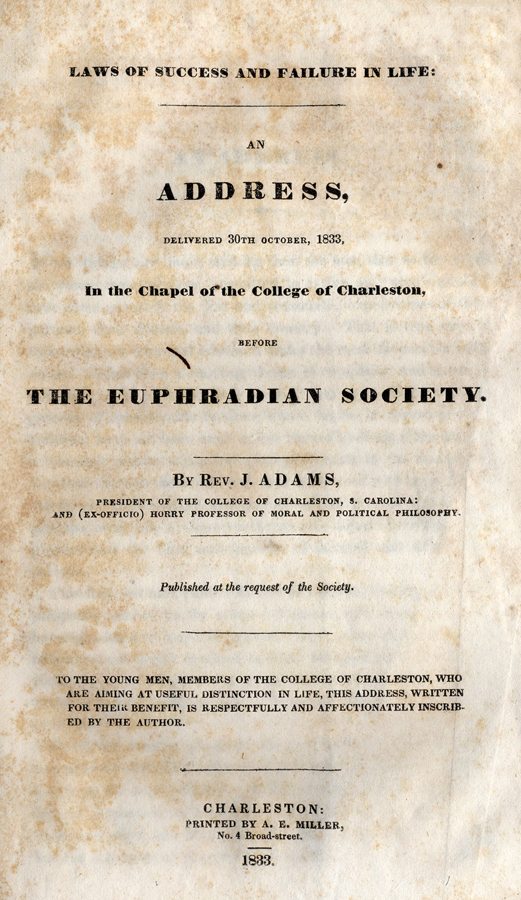
Few things are more striking than the fact, that so few of all the young men, who are permitted to arrive at “man’s estate,” ever come to satisfy the just and reasonable expectations of their parents, their friends, and their country. This is true even of those who are born and educated under the most favourable influences. It has been a standing theme of complaint, and source of unhappiness in all ages and in every country. There are few parents of considerable families whose hopes in regard to their children, have not been more or less blasted by disappointment. Of a thousand youths who grow up to participate in the business of life, how few are there whose lives are crowned with honour, with virtue, and with distinguished private or public usefulness? Yet, perhaps, every one of these youths was the object of the hopes, the prayers and the fond anticipations of devoted and affectionate parents.
This frequent and painful failure of parental anticipations and prospects, cannot be the result of chance, and must, therefore, have an adequate cause or causes. And as the highest interests of society are deeply involved in everything which pertains to its young men, it seems useful to attempt an investigation of the cause or causes to which this so frequent failure may be justly ascribed.
Of all the laws by which events are linked together, the relation of cause and effect is the most permanent, the most extensive, and to us the most valuable. And it is worthy of special remark, that in proportion as knowledge has advanced, the dominion of cause and effect has been extended, and in the same proportion has the dominion of chance been diminished. It is to the imperfection of the human mind, and not to any irregularity in the nature of things, that our ideas of chance and probability are to be referred. Events which to one man seem accidental and precarious, to another who is better informed, or who has a more comprehensive grasp of intellect, appear regular and certain. Contingency and verisimilitude, are, therefore, the offspring of human ignorance, and with an intellect of the highest order, cannot be supposed to have any existence. The laws of the material world have the same infallible operation on the minute and on the great bodies of the universe, and the motions of the former are as determinate as those of the latter. There is not a particle of water or of air, of which the condition is not defined by rules as certain as those which govern the sun or the planets, and which has not from the beginning, described a line determined by mechanical principles, and capable of being mathematically defined. This line is, therefore, in itself, a thing capable of being known, and would be an object of science to a mind informed of all the original conditions, and possessing an analysis that could follow them through their various combinations. The same is true of every atom of the material world;–so that nothing but information sufficiently extensive, and an analysis sufficiently powerful is wanting, to reduce all physical events to certainty, and from the condition of the world at any one instant, to deduce its condition at the next,–nay, to obtain an analytical expression representing at a single view, all the phenomena that have ever happened, or ever will happen in our system. 1
In truth, the discoveries which we have made in the material world, and the triumphs which we have achieved over physical difficulties, confer imperishable honour on human nature, and have contributed beyond measure to the welfare of mankind. And is it certain, or even probable, that while physical nature is thus subjected to invariable laws, capable of the most definite measurement and calculation, the powers of the understanding, and the results of moral conduct, should be governed by laws not admitting of careful statement and exact knowledge? There is much reason for the opinion, that the material world was originally created, and that the present physical order of things and events is regulated with a view to subserve the intellectual, moral and religious interests of the universe. 2 Are we, then, to believe that while the beauty of order, of regularity and of symmetry pervade the one, these same elements may not impart their beauty, their interest and their value to the other? Reason, analogy and common sense equally unite against such a conclusion. It is true, that moral principles and the results of moral conduct, are not capable of being presented in the imposing array of mathematical calculations; but we must not conclude that nothing is certain which cannot be clothed with mathematical formulas, or illustrated by mathematical diagrams. Law is a science scarcely less definite than geometry; and the moral principles and conduct which destroy the expectations of parents, and ruin such numbers of our most promising young men, may be expressed as definitely, and their influence and results may be estimated as exactly in regard to the ultimate issue, as in either of these sciences. It is a great mistake to suppose, that nothing can be certainly known or anticipated, out of the range of the mathematical and physical sciences.
This train of reflections has often presented itself to my mind, and the truths contained in it are entitled, I am persuaded, to a careful and respectful consideration. And in this view, I have thought, I could not select a more suitable subject for discussion, than what may be termed the “Laws of success and failure in Life,” when called by appointment to address such an audience as is now before me; especially one standing in a relation to me of so interesting and confidential a nature. 3 Unless you, young gentlemen, shall become respectable in private life, useful citizens of your country, qualified to participate honourably in private business and in public transactions, examples of integrity, of industry, of enterprise, of virtue, and of piety, my labours will have been expended in vain, and my life will have accomplished no useful purpose.
Permit me, then, to suppose the case of a thousand youths not yet beyond the period of life, at which the plastic hand of education is accustomed to exercise the full measure of its strength and influence. In truth, the case is much more matter of plain fact than of supposition; since in every community, there are not a thousand, but many thousands of youths in the precise situation which I am contemplating. I may well presume, that such youths are still ingenuous and pure in their minds, upright in their dispositions, uncontaminated in their habits, noble and generous in their impulses, and anxious to satisfy the anticipations of their parents, and the expectations of their friends and country, by lives of distinguished virtue, usefulness and honour.
How, then, are our young men of such qualities and such aspirations to attain the advantages and distinctions, in which success in life is supposed to consist; and to avoid the disastrous wreck of mortification and ruin, of blasted hopes and disappointed expectations, which constitute failure in life? I do not expect to exhaust the subject, but I am convinced that young men will attain the one of these results, and avoid the other, in strict proportion as they shall be governed by the principles and maxims which I proceed to state and illustrate.
1. No one can expect to ensure success and avoid failure in life, without a careful, persevering, and extensive preparation for the duties of life in his youth. 4
Youth has often been called the seed-time of life. The resemblance, though it has become trite by the frequency of its use, is still strikingly illustrative of the influence which a due improvement of youth never fails to have upon the success of mature life. It has always been true, and it must always remain true, that as we sow in youth we shall gather in manhood. Not more surely will he be disappointed, who expects figs to grow upon thorns, or grapes upon a bramble-bush, 5 than he, who expects an honourable and successful manhood will follow a slothful, neglectful or profligate youth. Such is the established order of Providence in the government of this world. This order of Providence, is, in other terms, the decree of the Most High;–we may render obedience to its requirements and secure respect, esteem and happiness; or we may neglect or refuse obedience, and seal our insignificance, shame and ruin.
That the education of young men must be made to correspond with the acquirement and other circumstances of the age in which they are to live and act, is one of those positions which cannot be made more plain by argument. Nor has the world varied more in any respect, than in the kind and standard of qualifications which have been esteemed most necessary and valuable. Milton says, “I call a complete and generous education, that which fits a man to perform justly, skillfully and magnanimously, all the offices both private and public, of peace and war.” 6 And many ages before Milton’s time, Juvenal had expressed the same sentiment:
“Gratum est, quod patriae civem propuloque dedisti,
“Si facis, ut patriae sit idoneus, utilis agris,
“Utilis et bellorum, et pacis rebus agendis.”—Sat. 14th, 70-72.
In the age of Homer, swiftness in the race, personal strength, and physical courage, were the chief requisites by which honour and esteem were secured. These were qualities, on which, the fame of Ajax and Achilles, of Hector and Diomedes, was founded. In the later ages of Grecian history, skill in the arts of painting and sculpture, of architecture and the drama, in philosophy, and above all, in oratory, was the chief ground of eminence. Military prowess has always been considered a conspicuous source of individual and national distinction. This was remarkably the case at Rome; yet even in that military republic, moral and civil qualifications seem to have come at length to be held in higher estimation, than military. 7 The same will be true in all countries, as civilization and refinement advance in their growth. At Rome, the civil and moral eminence by which Cicero, Cato and Laelius were adorned, was not less honourable than the military renown of Lucullus, Pompey and Caesar; and at the court of Augustus, Virgil and Horace enjoyed as much distinction as the successful generals by whom that Emperor was surrounded. As the Roman Empire declined, the military again triumphed over the civic virtues; and during the middle ages, personal prowess again became the principal qualification supposed to be entitled to confer rank and honour. This continues to be the case, in a considerable measure, in most parts of Europe;-and in Russia, military rank is still the highest, and almost the exclusive source of honour. Colonized as the United States were from Europe, it is not strange, that the European standard of honour was introduced into this country; and while the colonies were surrounded by numerous and warlike nations of Indians, the cultivation of the military spirit was certainly excusable, probably necessary, perhaps even indispensable. The war of the Revolution, moreover, made it necessary, that military talents should be a principal ground of distinction, as they were of usefulness, during the perilous crisis in which the country was then situated.
But our Indian enemies have disappeared, our national independence has long since been fully established; and however indispensable may have been military talents during the preceding part of our national history, circumstances warrant the full belief, that in our future progress, they will be unnecessary;-perhaps they may be injurious to our country. Everything indicates, that the arts of peace will be the great concern, as they have always been the great interest of mankind, during the age for which you are to be educated. It is constantly becoming more probable, that the plan of governing men chiefly by oral influences; by producing a practical and unequivocal conviction, that it is for the general interest of mankind to cultivate peace and tranquility, and by resorting to force only as an aid supplementary to moral causes, will be ultimately successful. Our own experiment has been thus far highly satisfactory and encouraging.
It may well be presumed, therefore, that the sentiments of Juvenal and Milton, so far as they relate to war, will have less application to the age to which you will belong, than to any which has gone before it in the history of mankind. To be respectable, useful, and successful, then, in life, you must be qualified to take a part in an age and in a state of society distinguished for general freedom of opinion and action, unusual diffusion of intelligence among all ranks of people, and an unexampled spirit of enterprise. It is an age, moreover, as much distinguished for profound and various learning, as for the extension of freedom, intelligence and enterprise. “Knowledge” has always been “power,” but never in such a sense and in such a degree, as at the present time. Such an age and such a state of society, therefore, imperatively demand extensive acquirements in knowledge. You must be acquainted with the poets, critics, orators, and historians of ancient Greece and Rome, 8 both for their intrinsic excellence; and because an acquaintance with them is necessary to a full and complete acquaintance with our own literature. Some acquaintance with the annals and institutions of other ancient nations, usually enters into a comprehensive course of education. Modern literature and institutions have received a tincture from some of the usages and institutions of the middle ages; and therefore, though they are a barren period in the history of mankind, yet as something may be learned from every situation in which man has lived and acted, they may not be entirely neglected. The French and German languages, are among the most valuable acquisitions with which your industry and enterprise can be rewarded. Every well educated gentleman must feel it to be required of him, to have some acquaintance with the history and institutions of modern Europe. From Great-Britain, much the greatest part of our customs, usages, literature, and institutions were derived, and no man can dispense with a full and even minute knowledge of the history of that Empire. Inventions and discoveries in the exact and experimental sciences, and our triumphs over the physical difficulties of nature, are one of the best defined characteristics of the times in which we live; and to this source we are indebted for the immense improvements which have been made in the comforts, conveniences, and elegancies of life. A full acquaintance with these, must be the result of professional study and the devotion of a life to them; but anyone who is contented to live and die in total ignorance of them, fails of seeing human enterprise and perseverance crowned with their most splendid wreaths.
The branches of knowledge comprised in this enumeration are highly valuable;-they are necessary, even indispensable to success in the highest walks of literature and philosophy, of usefulness and eminence. There are, however, two other departments of learning, which to us, as Christians, as Americans, are of still higher and more permanent value. First, as Christians, the careful study of our religion, merits our supreme regard. It is the standard of our morals both theoretical and practical, the chief source of the moral influences which alone can meliorate the condition of mankind, and the foundation of our ultimate hopes and prospects. We are most sacredly bound by every consideration of duty and interest to study in its history, in its literature, in its evidences, in its morals, and in its doctrines. Again, after our religion, nothing is so valuable as a complete and familiar acquaintance with the history, literature and institutions of our own country. If we remain in ignorance of our own, it is comparatively of small importance, that we are acquainted with the history, the literature, the institutions, and the languages of ancient times and foreign nations. Nor has there been a country, perhaps, from the beginning of time, whose history and institutions have been more worthy of careful and attentive study. 9 Our aboriginal history presents a field, which, as yet, has been but partially explored. There is nothing in the history of the world, which can be compared with our colonial growth. Our Revolution has as yet only begun to exert the influence which it must be destined to extend over the other quarters of the globe. The rise and progress of our National and State governments may justly excite our self-respect, and our confidence in our ability to maintain, perfect and perpetuate them. If we have been too much engaged by active employments to distinguish ourselves in speculative philosophy and the more abstract sciences, we have signalized ourselves by some of the noblest inventions in the more practical and useful departments of the arts and sciences. Government is the most practical, the most useful, and the most difficult of all human sciences; and in this great department, we have long since reached a point, which some of the European nations have attempted to reach in vain; and towards which, all of them are but gradually advancing. In a sense and in degree in which it was never attained before, we have consummated the beau-ideal of good government which presented itself to the mind of the philosophic Cicero when he said, “Statuo esse optime constitutam rempublicam, quae ex tribus generibus illis, regali, optimo et populari, modice confusa.” Finally, the people of the United States, in retaining Christianity as the basis of all their great institutions, social, civil, and political, have discontinued the abuses of all religious establishments, and while placing all denominations of Christians on an equal footing, they have granted universal toleration to all other religions.
2. No elements are more indispensable to ensure success in life, than industry, perseverance and enterprise. They will be equally necessary, in your case, to the accomplishment of the plan of education which has just been sketched, and to the successful pursuit of any profession of life, in which you may hope to be useful and honourable. If the Creator has made an original difference among men, by dispensing talents to them with an unequal hand, men have made an infinitely wider difference among themselves, by the unequal improvement which they have made of these precious endowments. In this, as well as in all other countries, men frequently become rich by inheritance, and by other ways in which personal merit has no concern, but substantial usefulness and honour must ever, among us, be the fruit of personal industry, enterprise and perseverance. The noble sentiment of Juvenal has its full force in respect to us, and our institutions:-
“Panlus, vel Cossus, vel Drusus moribus esto;
“Hos ante effigies majorum pone tuorum;
“Praecedant ipsas illi, te consule, virgas.
“Prima mihi debes animi bona. Sanctus haberi,
“Justitiaeque tenax factis dictisque mereris?
“Agnosco procerem. Salve, Getulice, sent u
“Silanus, quocunque alio de sanguine rarus
“Civis et egregious patriae contingis ovanti.”—Sat. 8. 1. 21-28.
The love of labour and the ability to bear long continued, exhausting, and perplexing labour, can only be acquired by a patient and severe course of discipline; but it is a qualification equally indispensable for attaining to stations of distinguished usefulness, and for discharging the duties of such stations when attained. The men who have fulfilled the duties of the more useful and difficult situations in life, with credit to themselves and advantage to their country, have been prepared for them by a careful preliminary training. It cannot be necessary to do more than refer to the story of Demosthenes, when addressing a literary society. Cicero says, that he acquired the immense treasures of literature and philosophy by which he adorned the annals of his country, and conferred immortality on himself, while his associates were occupied at entertainments, in celebrating festival days, in gaming, in athletic sports, or in other amusements and relaxations. 10 King Alfred, without an example to imitate, without the advantage of early education even the most scanty, in an unlearned age, and a still more unlearned country, after his best years had been consumed, and his youthful strength exhausted by the hardships of a military life, in the course of which he is said to have fought fifty battles; amidst the seductions of a throne, seductions of all others the most difficult to be resisted, became the first scholar and the most useful man, as he had before been the greatest soldier of his age. Hence, he ranks the greatest among kings, and almost the greatest among men. Sir Isaac Newton ascribed his success in the sciences to his superior patience and willingness to labour. If patience and resolution are not, as some have asserted, the only elements of genius, they are at least its firmest auxiliaries, its most powerful instruments;-and they are qualities so important, as to lead not unfrequently, in search of truth, to the same results as genius itself. But of all others, the example of Franklin is the most instructive to those whose circumstances require them to be the architects of their own fortunes. His father was accustomed to quote this verse of the Proverbs of Solomon:–“Seest thou a man diligent in his business? He shall stand before kings; 11–and the memoirs of the son warrant us in believing, that it had a decisive influence on his aspiring genius. 12 Born in the lowest obscurity, his industry and enterprise raised him to be the companion and the adviser of kings. Lord Chatham said, he was “one, whom all Europe held in estimation for his knowledge and wisdom, and ranked with Boyle and Newton; who was an honour, not to the English nation only, but to human nature.” 13 How great must have been the industry of Washington? How great must be the industry of every President of the United States? 14 How great must be the industry of all men who fill situations of distinguished usefulness and honour? Lord Chancellor Brougham said in the House of Lords in 1831, that during more than twelve months preceding, he had been employed, with the exception of five days, and those spent chiefly in travelling, from six or seven in the morning, until twelve or one at night; and he seemed to intimate on the same occasion, that two other members of the government had been engaged in still more exhausting labours. 15 No branch of reading is more instructive than the biography of those, who, born in the humbler walks of life, have risen by their talents and virtues, to the highest grades of useful distinction. The examples of Kepler, Hardwicke, Kenyon, Thurlow, La Grange, Day, Canova, Eldon, Stowell, West, Franklin and Sherman, are fitted to refresh the spirits and give an impulse to the energies of men the most industrious, and the most enterprising. When we look into the lives of such men, the cause of their success is no longer a secret to us; we cease to be surprised at the distinctions which they won. When we observe the series of struggles which they endured amidst poverty, obscurity, and neglect, their disciplined passions, their love of knowledge, their firmness of purpose, and their unconquerable zeal, we perceive that their success has followed in the rain of their exertions by the ordinary law of cause and effect.
It is a great mistake, however, to suppose, that the “res augusta domi” is the only obstruction to young men in the way to acquirement of knowledge and the attainment of eminence. In such a state of society as ours, where our peculiar institutions free most of our young men from the necessities of personal labour, the love of ease, the appetite for frivolous amusements, the seductions of pleasure, and the impulses of false honour, constitute obstacles still more formidable. It will require all your resolution and energy, to withstand these fatal enemies to your future prospects and welfare. Men have, sometimes, overcome the obstacles of obscure birth and narrow circumstances, who have afterwards fallen victims to sloth, intemperance and sensual gratifications of every kind.
Most intimately connected with a habit of industry, is a judicious employment of our time. How have those men, who have accomplished most in life, found time for all their variety of occupations? The answer is not difficult. They found time by never losing it. Time is the only gift of heaven, of which every man living has precisely the same share. The passing day is exactly of the same dimensions to each of us, and by no contrivance can anyone extend its duration by so much as a single minute. It is not like a sum of money, which we can employ in trade, or put out at interest, and thereby add to, or multiply its amount. Its amount is unalterable. We cannot make it increase; we cannot even keep it by us. Whether we will or not, we must spend it; all our power over it, therefore, consists in the manner in which it is spent. Part with it we must; but we may give it either for something or for nothing. Its mode of escaping from us, however, is so silent and subtle, that we are exceedingly apt, because we do not feel it passing out of our hands, to forget that we are parting with it at all, and thus from mere heedlessness, the precious possession is allowed to flow away as if it were a thing of no value. The chief rule, therefore, in regard to the economizing and right employment of time, is to accustom ourselves to watch it as it passes away. Of all the talents entrusted to our care, our time is the most valuable. 16
As long since as the time of Cicero, the intimate connexion which subsists between different branches of learning, and the light which they reflect on each other, was well understood. Etenim omnes artes, says he, quae ad humanitatem pertinent, habent quoddam commune inculum, et quasi cognatione quadam inter se continentur. 17 This fine observation is not less true now than in the time of Cicero, while its application is continually becoming more extensive as new sciences are invented, new departments of literature are cultivated, new arts are discovered, and new branches of business are opened or extended. Without the aid of the instruments which the science of optics has conferred on astronomy, this most noble of all the natural sciences, could not have been successfully cultivated. In like manner, astronomy has greatly contributed to the advancement of geography, navigation and commerce. Chemistry has the most intimate connexion with manufactures, with the mechanic arts, and with agriculture. An elaborate comparison of the various languages of the earth, has shed much light on the history of the nations which have inhabited its surface. No man can be an accomplished physician, without making himself acquainted with the laws of the intellectual powers. Chemistry and botany are the foundation of the medical profession. Law, Politics, and the Law of Nations are but branches of Ethics in the extensive use of that term. Christianity has a most intimate connexion with man in all his relations, social, civil, and political. There are few sciences that have not contributed to bring commerce to its present state; and commerce, in its turn, has greatly contributed to advance natural history, geography, physics, and astronomy. Moreover, from it has sprung, in a great measure, the system of European colonization, which is producing such mighty results in Asia, in Africa, and more especially in America. Finally, commerce has become instrumental in the diffusion of Christianity among “the nations that have long sat in darkness,” by furnishing facilities for the conveyance of missionaries, and for keeping up the intercourse with them which is necessary for their support, their comfort, and their usefulness. This part of my subject might be amplified to any extent; but the few facts adverted to, are sufficient to vindicate my views in regard to the comprehensiveness of the education which I have ventured to recommend. It will never cease to be true, that the various branches of science, of literature, of art, and of business, have, with each other, relations so intimate, that a man who has traversed a wide range of enquiry, will ever have an immense advantage over others, whose education has been less generous, comprehensive, and liberal.
3. But while an education thus extensive and liberal is recommended, we must remember that human powers and human efforts are limited, and that a judicious concentration of our exertions on the profession of our choice, is still more necessary to our success in life. No genius can correspond with the inscription on the pedestal of Buffon’s statue;-“majestati naturae par ingenium.” An acquaintance with many branches of learning is most highly useful; an acquaintance with our own profession is indispensable. In our profession, our learning must be full, minute, exact, and familiar; and it must comprise all the acquirements which our profession embraces. The field of scientific, literary and philosophical enquiry, has become so vast, that the most industrious may well be excused for being unacquainted with many things, even with entire departments of science; but any want of acquaintance with our own chosen profession, the little vineyard of science we have chosen with special care to cultivate, will always be disreputable, injurious to our interests, and to the trusts committed to us, and may not unfrequently cover us with mortification and disgrace.
Every professional man may be said to live by the public confidence; and confidence, as Mr. Pitt well remarked, “is a plant of slow growth.” The public will not give us its confidence, as Mr. Pitt well remarked, “is a plant of slow growth.” The public will not give us its confidence, unless we furnish some title by which we may justly claim it. Public confidence in us, cannot grow up healthy, strong, and vigorous, without the most careful and judicious cultivation. Men seldom gain it without knowledge, talents, and integrity; and if without these qualities, they, by the aid of propitious circumstances, succeed in its attainment, their hold on it will be temporary, it will soon elude their grasp, and leave them to the pain of blasted hopes, the victims of disappointment and failure. Industry, enterprise, devotion to business, knowledge, talents, worth, are the only qualities that can ensure permanent reputation and lasting usefulness.
4. We must avail ourselves of opportunities favourable to our success in life. History acquaints us, that even the destiny of nations has often been determined for evil or for good, by incidents slight in themselves. The Patriarch Moses, after having been “hid three months” in the house of his father, was exposed in an ark of bulrushes on the banks of the river of Egypt. How much has depended, in the history of mankind, on the preservation of this child by Pharoah’s daughter? Without any reference to his Divine inspiration, no other individual mentioned in the annals of the world, has exercised a more extensive and permanent influence over the destinies of mankind in general, than Moses. Christianity and Mahometanism alike respect, and in different degrees, derive their origin from the Mosaic institutes. Europe, with all its American descendants, the greater part of Asia, and the north of Africa, retain, in their opinions, their usages, their civil as well as their religious ordinances, deep and indelible traces of the Hebrew polity. 18 Rome was saved from being taken by the Gauls, by the cackling of the sacred geese kept in the Capitol. And when we consider, that the Roman Empire continued to comprise whatever was formidable in power, pure in morals, refined in manners, cultivated in art and science, and illustrious in genius, during the long period of a thousand years; that the Eastern Roman Empire continued to exist almost to our own times; (1453,) that the Western Imperial City was the metropolis of the unbroken Latin Church during more than another thousand years, and still continues the Metropolis of more than half of all Christendom;-when we recollect with Lord Holt, 19 that “the laws of all nations are raised out of the ruins of the civil (Roman) law, as all governments are sprung out of the ruins of the Roman Empire;” or with D’Aguesseau, (alluding to the Roman Law,) that “the grand destinies of Rome are not yet accomplished; (that) she reigns throughout the world by her reason, after having ceased to reign by her authority;” 20-I say, when we take into view all these consequences, we may well understand the influence exercised by the trivial circumstance referred to, on the destiny of the nations of the earth. How much is our situation affected at this day by the voyages of Columbus and Sebastian Cabot? How much are we affected personally, as well as nationally, by the wise moderation, the elevated wisdom, the consummate prudence and good judgment, the untiring industry, the inflexible patriotism, the exalted genius and high moral courage of one man;-Washington.
But if entire nations and successive ages are so much affected by circumstances in themselves trivial, this is still more strikingly true of individuals. In fact, almost every man, in reviewing his past life, must recollect occasions, when, in the order of Providence, his future welfare was made to be depending on the most trivial contingences. 21 Of men in similar circumstances, we habitually see one eminently successful, another successful in a measure, and a third failing entirely of the result which he had promised himself to attain. This remark is confined to no class or order of men. Of merchants who have commenced business under equal advantages, we every day see one prosperous and another ruined. Lawyers, physicians, clergymen; and planters of the same education, and of equal natural endowments, meet in life with the most unequal success. So marked a difference of results is not without an adequate cause. It cannot be true, that while “the condition of every particle of water and of air is defined by rules as certain as those which govern the sun or the planets,” 22 the results of human conduct and of human endeavours, are undefined by laws and uninfluenced by cause and effect;-the pervading principle by which all the parts of universal nature are bound to each other. We are accustomed to see almost uniform success accompanying the endeavours of some men, while failure scarcely less uniform, waits on all the plans of another. Where other circumstances are equal, (and this is the supposition upon which we are reasoning,) to what can this difference be ascribed? It cannot be ascribed to chance;-for, “it is to the imperfection of the human mind, and not to any irregularity in the nature of things, that our ideas of chance and probability are to be referred.” 23 Chance means a series of events not regulated by any law that we perceive; but because we do not perceive the existence of a law, we must not reason as if there were none, or were no principle by which a previous state of things determines that which is to follow. 24 Juvenal has admirably expressed the truth on this subject.
Nullum numen habes, si sit prudential; sed te
Nos facimus, Fortuna, Deam, coeloque locamus. 25
In the same situation, one man is attentive to the course of events, is watchful of favourable occasions as they arise, decides with promptitude, acts with intelligence and energy, and in this way controls events and turns them to his advantage; or if this is impossible, averts the ruinous consequences which might otherwise overwhelm him. Another is inactive, neglectful, without foresight to anticipate results; he acts with feebleness and irresolution, and instead of controlling events, becomes the victim of circumstances.
5. The cultivation of personal religion and moral qualities of a high order, is indispensable to our full and complete success in life. A sacred writer says, “trust in the Lord with all thine heart; and lean not unto thine own understanding. In all thy ways acknowledge him, and he shall direct thy paths. Be not wise in thine own eyes; fear the Lord, and depart from evil. Wisdom is the principal thing; therefore get wisdom; and with all thy getting, get understanding. Exalt her, and she shall promote thee; she shall bring thee to honour when thou dost embrace her. She shall give to thine head an ornament of grace; a crown of glory shall she deliver to thee.” 26 This language is as beautiful as the sentiments are persuasive, authoritative and valuable. In truth, it is only the inferior ends of life which can be attained without personal religion and the high moral qualities which flow from that perennial spring. But I can establish this position by authority so high and so decisive, that I may well omit all argument of my own. Lord Chatham, in advising his nephew while at the University of Cambridge, writes thus:-“I come now to the point of the advice I have to offer you, which most nearly concerns your welfare, and upon which every good and honourable purpose of your life will assuredly turn. I mean the keeping up in your heart, the true sentiments of religion. If you are not right towards God, you can never be so towards man; the noblest sentiment of the human breast, is here brought to the test.” Again he says, “Remember thy Creator in the days of thy youth, is big with the deepest wisdom; the fear of the Lord is the beginning of wisdom; and an upright heart, that is understanding. This is eternally true.” “Hold fast, therefore, by this sheet-anchor of happiness, religion; you will often want it in the times of most danger, the storms and tempests of life. Cherish true religion, continues he, as preciously as you will fly, with abhorrence and contempt, superstition and enthusiasm. The first is the perfection and glory of human nature; the two last the depravation and disgrace of it. Remember, the essence of religion is, a heart void of offence towards God and man; not subtle speculative opinions, but an active vital principle of faith.” 27 Again, another statesman says, “The individuals, the communities that are penetrated with a truly religious spirit, and exercise the moral qualities which flow from that source only, regularly prosper. They inherit the earth. Those that pursue a different course, as regularly dwindle into nothing and disappear.” 28 The most accomplished and successful chemist of the present century says, “I envy no quality of the mind or intellect in others; not genius, power, wit, or fancy; but if I could choose what would be most delightful, and I believe most useful to me, I should prefer a firm religious belief to ever other blessing; for it makes life a discipline of goodness, creates new hopes when all earthly hopes vanish, and throws over the decay, the destruction of existence, the most gorgeous of all lights; awakens life even in death, and from corruption and decay calls up beauty and divinity.” Again he says, “religion, whether natural or revealed, has always the same beneficial influence on the mind. In youth, in health, and prosperity, it awakens feelings of gratitude and sublime love, and purifies at the same time that it exalts; but it is in misfortune, in sickness, in age, that its effects are most truly and beneficially felt; when submission in faith and humble trust in the divine will, from duties become pleasures, undecaying sources of consolation; then it creates powers which were believed to be extinct, and gives a freshness to the mind, which was supposed to have passed away forever, but which is not renovated as an immortal hope. Its influence outlives all earthly enjoyments, and becomes stronger as the organs decay and the frame dissolves; it appears as that evening star of light in the horizon of life, which, we are sure, is to become in another season a morning star, and it throws its radiance through the gloom and shadow of death.” 29 Such are the sentiments, and such the result of the experience and reflection of men of the most cultivated understandings, and of the most enlarged acquaintance with human affairs. Many can comprehend the value and necessity of personal religion in reference to another life, who are not prepared to admit its value or its influence on the affairs of this life. The truth, however, the everlasting truth is, that without a clear sense of our relation to God, and of the duties, responsibilities and prospects thence resulting; man, in every period of his existence, is a desolate being, and cuts himself off from all the purest sources of happiness. The poet has well said;-
“But dreadful is their doom, whom doubt has driven To censure Fate, and pious hope forego; Like yonder blasted boughs by lightning riven, Perfection, beauty, life, they never know.”
30
It is probable, that the sentiment now under illustration, might be brought to the test of positive proof and actual experiment, by an extensive enquiry into the lives of individuals, especially into the lives of those whose biography we possess, minutely and accurately written. Such an inductive examination, my time and avocations have not permitted me to make; but two instances of testimony on this point have fallen in my way, which are so decisive and valuable, that I should do wrong to omit citing them. A gentleman, educated at one of our most distinguished colleges, has furnished this statement respecting the class to which he belonged, not more than thirty years since. “It was a class,” says he, “from which much was expected, as the instructors were often heard to declare, and was certainly not deficient, when compared with other classes, either as to numbers or talents. Unhappily a very low standard of morals was prevalent; only two of the class were free from the habit of profane swearing; and nearly all except these two, would occasionally get intoxicated. This class went out into the world as one of the hopes of the country. Comparatively a small number of them ever occupied respectable and conspicuous situations. In twenty-two years after leaving college, two-thirds of that class were known to have died; and of these full one half died the victims of intemperance. Of the survivors, some now living are known to be in the lowest state of degradation.” Another individual has given the character and history of another class which was graduated less than forty years since. “It was numerous;” says he, “the influence was decidedly in favour of morality. Before leaving college, a large proportion came under the power of religious principle, in consequence of a general revival of religion. Twenty-five years after the time of graduation, only one quarter of the class had died; and of the surviving three quarters, a large proportion were occupying stations of considerable usefulness.” 31 This is a highly instructive narrative, and it would be well, if others, in imitation of these gentlemen, would furnish direct testimony of the same kind, in regard to the connection between early moral and religious character, and subsequent success in the business of life. The entire subject of such a connection, is worth a careful investigation. No persons are so well qualified to furnish the requisite information, as the aged graduates of our colleges. The reason of this is plain. No persons are so well acquainted with the real characters of each other, as those who have been associated in the relation of classmates at our colleges, at the gay and fresh season of youth, when mankind are not accustomed to disguise their motives, feelings, intentions, and principles.
I can scarcely be mistaken, young gentlemen, when I suppose, that I have brought to your notice, on this occasion, a subject in which you will consider yourselves very deeply concerned. Next to your eternal salvation, and the welfare of your country, your success in life, must, of all subjects be the most interesting. An estate wasted by extravagance may often be repaired by subsequent industry and frugality; health injured by excesses may sometimes be restored by the renovating powers of nature or by the skill of physicians;-but who shall recall a wasted life to the guilty individual who has squandered the precious treasure? One life, and one life only is given you, and I am convinced from the reason of the case, from my own partial experience, and from the more ample experience of others, that your failure or success will chiefly depend on your neglect of, or adherence to, the principles and maxims which I have at this time attempted to establish and illustrate. To be successful, i.e. useful and honourable in life, you must laboriously prepare for discharging its great duties. You must be industrious; you must be enterprising. You must carefully cultivate your understandings, by making yourselves extensively acquainted with the most useful and valuable branches of literature, and science. Still one man cannot know everything, and to attempt this, would be not only unwise and visionary, but ruinous. Your attention, then, must be specially concentrated upon your chosen profession, and pursuit in life. You must watch the favourable occasions that may present themselves in your way, and skillfully turn them to your advantage. Nor must you consider the minor moralities and observances beneath your notice. You must cultivate all the qualities which make up good manners and good morals;-for good manners are part of the code of good morals. Above all, you must cultivate personal religion;-for as Lord Chatham says, “if you are not right towards God, you can never be so towards man.” It is a great mistake to suppose, that personal religion is valuable only in reference to the life to come;-it is the grand elevating and purifying element in character, the most precious of all precious possessions even in regard to the affairs of this life. All these various means of success, you must use carefully, perseveringly, resolutely;-and what young man ever failed in life, who used faithfully all these ways of ensuring success?-no one, I may assert with all confidence.
The reason why so many fail in life, is very obvious to all who will observe and reflect on the subject. They never use the means which are indispensable to success. Their preparatory and professional education has, through indolence, negligence, or impatience of restraint, 32 been totally inadequate to its end. There is a lion in their path, 33 whenever any object is to be accomplished requiring serious labour and adventurous enterprise. Their minds have not been enriched by various literature, nor their understandings disciplined by laborious study, precise method, and exact learning. Even within the narrow precincts of their own professions, their knowledge is too loose and indefinite to guide them in practice. All favourable occasions, and opportunities leading to success are seized by others, while they are beset by sloth, or the love of frivolous amusements; or they are destroyed by the withering blight of gross and degrading vices. Perhaps they neither fear God nor regard man. Perhaps they have small regard for the pious and moral influences which never fail to spring from the religious observance of Sunday, and an habitual attendance on the public worship of Almighty God. Perhaps the language of cursing and bitterness, and vulgar abuse, may be more familiar to them, than the accents of kindness and the law of love. Perhaps “God is not in all their thoughts,” nor his name upon their tongues, unless for the purpose of profaning it. Perhaps “they tarry long at the wine,” 34 and are “mighty at strong drink.” Perhaps they are more familiar with the theatre than with the church; and the evening may more often find them at the gaming table than at their own fire-sides. Perhaps they have been ensnared by “the strange woman, who forsaketh the guide of her youth and forgetteth the covenant of her God; whose house inclineth unto death, and whose guests are in the depths of Hell; who hath cast down many wounded; by whom many strong men have been slain; whose house is the way to Hell, going down to the chambers of death.” 35 They have neither said nor done anything to inspire public confidence. And yet these men are surprised at their want of success in life; and charge their failure upon their friends, upon want of discernment in the public to discover their merits, upon the government under which they live, upon fortune, upon fate, and sometimes upon Divine Providence. No one, however, is surprised at their failure, but themselves;-everyone else sees it to be the natural and inevitable consequence of their original deficiencies, and subsequent indifference, neglect, or misconduct. After some years, they abandon their professions for which they were never qualified, give themselves up to ruinous vices, if they have not done so before and become the victims of discouragement and despair, if not of premature death. In this way, thousands of ingenuous young men have been lost to themselves and to society, who under more favourable auspices, might have been useful, respectable, and happy.
Next to the blasting effects of vicious habits, nothing is more destructive to the ultimate prospects of young men, than an injudicious haste to enjoy the honours and emoluments of the learned professions, before they are qualified to discharge the duties which these professions impose. So sensible have the people of the United States been, to the danger of entrusting concerns of weighty import to very young men, that in our National, and in many of our State constitutions, a particular age is prescribed, previous to which, the public interests cannot be committed to their hands. 36 The law supposes that a man is not qualified to manage his own concerns until he is twenty-one years of age; and, therefore, does not permit him to become responsible for his own civil acts, before he has reached that time of life. Yet we constantly see youths in their minority, or if not, yet in the very first months of their majority, willing to assume the responsibilities of the Medical profession, of the Bar, and of the Christian Ministry. I must not be understood to say, that wisdom always accompanies length of days; still the position may be assumed as a general rule, with all confidence, that the term of twenty-five years does not usually bring with it more wisdom, discretion, and good judgment, than is sufficient to justify men in entrusting to the hands of others, their fortunes, their lies, and their eternal interests. It is the obvious dictate of reason and common sense, that the previous part of life should be occupied in a comprehensive course of study and discipline.
I cannot persuade myself to close; until I have presented this subject in still another light. I refer to the happiness of an active, energetic, and useful life, compared with a life of indulgence, sloth, and inglorious ease. Man was formed chiefly for action, and an active life is to him the highest sphere of duty and usefulness, of dignity and happiness. Study and contemplation are, in themselves, sources of high satisfaction and enjoyment, but they derive a still greater value from their relation to our future pursuits in an active course of duty and usefulness. Cicero commends some of his countrymen of distinguished rank, for their fondness for the study of geometry, dialectics, and the civil law, because those sciences are employed in the investigation of truth; but he affirms, that to permit ourselves to be drawn away, even by these attractive sciences, from active employments, is contrary to our duty. He says, “Virtutis enim laus omnis in action consistit.” 37 All wise and effectual action must spring from study and reflection. Eminent scholarship must be the fruit of industry, energy, and enterprise. You will not be learned men when you leave the walls of the college. You will not be learned men when you are admitted as members of the learned professions. Your success and happiness must consist, in your making continual advances, in the path of life which you have chosen to pursue. That class of learned men whose closets are the chief scene of their labours, or who are engaged in the instruction of youth, are supposed to be principally useful, inasmuch as their labours contribute to furnish others with materials and qualifications for active usefulness. The approbrious appellation of literary miser, is bestowed on him who is intent only on acquiring knowledge for its own sake, and without any view to convert it to the benefit of mankind.
Observe the distinctions around you in society, and reflect on the causes in which they originate. The choice of Hercules is substantially, if not formally presented to every young man in your situation. 38 Milton exhorts instructors “to inflame their scholars with the study of learning, and the admiration of virtue, to infuse into their young breasts such an incredible diligence and courage, (spirit of enterprise,) such an ingenuous and noble ardour, as will not fail to make many of them renowned and matchless men, and to stir them up with high hopes of living to be brave (excellent) men and worthy patriots, dear to God and famous to all ages.” “The end of learning,” continues he, “is to repair the ruins of our first parents, by regaining to know God aright, and out of that knowledge to love him, to imitate him, to be like him, as we may the nearest by possessing our souls of true virtue, which, being united to the heavenly grace of faith, makes up the highest perfection.” 39
The original standard of acquirements and of character in South-Carolina, was very high; and by this standard, the illustrious men were formed whose names adorn our annals. One of the most distinguished of our statesmen has said, “the only distinction to which South-Carolina can aspire, must be based on the moral and intellectual acquirements of her sons.” 40 The names of Rutledge, of Pinckney, of Laurens, of Drayton, of Heyward, of Lynch, of Middleton, of Moultrie, of Marion, of Gadsden, of Hayne, of Dehon, of Lowndes, and of Waties, are embalmed in our history, and their renown can never perish. You will inherit the country and the institutions which they loved and honoured by their talents, their acquirements, and their virtues. The same country will hereafter commit its interests and its honour to your keeping. It will also fall to you to sustain, perfect, and perpetuate the institutions which they founded, and to perform the duties which they so honourably performed. This is the time for you to decide, whether like them, you will be respectable, useful, and distinguished in life. The distinctions of talents, of acquirements, of virtue, of piety, are imperishable. By sloth, by impatience under restraint, by impiety, and by vice, you may consign yourselves to insignificance, blast the hopes of your parents, and refuse to render them those returns (pretia nascendi) for their expense, their labour, and anxiety, which will be inestimably precious in their eyes, their chief solace in advanced age, and which they may so rightfully require at your hands.
I am very sensible, that an address upon such a subject as that which I have chosen for this occasion, would have come with a much superior grace, from one who could have furnished in his own person, a case of signal success in life to be ascribed to an observance of the maxims and principles which I have attempted to illustrate and enforce. Such an one might have spoken with a degree of authority and a weight of argument to which I can lay no claim. “Feci ut potui.” Feeble as my attempt may have been, to point out to you the path to useful distinction, it is a sincere and disinterested endeavour to promote your welfare for time and eternity. Blessed will your lives be to yourselves, to your relatives, to your friends, and to your country, if you are habitually governed from the beginning to end of them, by high moral and religious principle, by the love of knowledge, of labour, of order, of truth, of your country, and of mankind.
NOTES.
A.
The author takes occasion to publish Cicero’s account of his professional education as an illustration of his views contained in this address. The greatest part of it was published in the Southern Review, vol. ii p. 515. He has used the translation of the Review, after carefully comparing it with the original, and has translated the remainder, so that it is now published entire.
Cicero says, “when I became acquainted with the Roman Forum. Hortensius was at the height of his reputation, Crassus was dead, Cotta had been banished, and judicial proceedings were suspended in consequence of the war. Hortensius was in the army, performing his term of service, according to the Roman discipline, one year as a common soldier, another as a military tribune. Sulpicious was absent, as was also M. Antony. Trials were conducted under the Varian law alone, as there was occasion for no other, by reason of the war. L. Memmius and Q. Pompey were habitually present, and spoke as their manner was. They were not distinguished in their profession; but still they are honoured with the title of orators by the eloquent Philip, according to whose testimony their speaking had the ehemence and fluency which belongs to the style of accusation.
The other most celebrated orators of the time, were in office, and I had almost daily opportunities of hearing them speak in public. For, C. Curio was then tribune of the people;-he, however, was not in the habit of speaking, since he had, on one occasion, been deserted by the whole assembly;-Q. Metellus Celer was not distinguished, but spoke occasionally. Q. Varius, C. Carbo, and Cn. Pomponius were distinguished orators, and may almost be said to have lived in the Forum. C. Julius, also, Curule Aedile, almost daily delivered speeches in a very accurate style. As I had been extremely desirous to hear Cotta, I regretted his banishment; still I attended on the speaking of the other orators with great zeal. In the mean time, I was not satisfied with hearing oratorical performances only, but passed no day without reading, writing, and meditation. The next year, Q. Varius was condemned to banishment under his own law. Moreover, I attended diligently to the study of the civil law under Q. Scaevola, who, though he did not give formal instruction on the subject, yet permitted such as were desirous of learning, to attend his consultations and learn what they could in that way. The year succeeding, Sylla and Pompey were elected consuls, and P. Sulpicius, tribune. With the oratorical style of the latter, I became intimately acquainted, as he spoke daily in some cause or other.
About the same time, Philo the head of the Academy and some of the principal men of Athens, left that city and came to Rome, being driven away by the Mithridatic war. To his instructions I devoted myself with the greatest ardour, not only because I was enthusiastically fond of philosophy itself, and delighted with the variety and importance of the subjects with which it made me acquainted, but because I was impressed with the belief, that the whole judicial system was abolished forever. During this year, Sulpicius died. The next, three of the most distinguished orators, Q. Catulus, M. Antony, and C. Julius, were most cruelly put to death. This same year, I also took lessons at Rome of Molo the Rhodian, who was both an eminent pleader at the bar and skillful teacher of rhetoric. Although this account of my studies may seem irrelevant to the object of this treatise, yet I have given it, that you, Brutus, (as it is already known to Atticus,) might have your wish gratified, of being made perfectly acquainted with the course I have pursued, and that you might likewise see how closely I have followed the footsteps of Hortensius throughout the whole of it. For almost three years after this, the city was free from any disturbance, but by reason either of the death, or departure, or banishment of the public speakers (for even M. Crassus, and the two Lentuli were not at Rome,)Hortensius took the lead in pleading causes;-the reputation, however of Antistius daily increased; Piso spoke frequently; Pomponius not so often; Carbo seldom; Philiponce or twice daily.
During this whole period, I was engaged night and day in the assiduous study of every branch of knowledge. I used to be with Diodotus the Stoic, who died lately at my house, where he had long resided. From him I learned, among other things, the principles of dialectics, which deserves to be considered as a more contracted and circumscribed eloquence, and, without which, you too, Brutus, have judged it impossible to attain to that higher kind of eloquence which is regarded as only a diffusive or expanded dialectics. To this teacher, and to the various branches of knowledge he professed, I devoted myself, but not so exclusively, as not to continue my oratorical exercises regularly every day. I studied and declaimed together, often with M. Piso and Q. Pompey, or with somebody else, sometimes in Latin, but more frequently in Greek, both because the Greek being riher in oratorical embellishments, naturally led to the same perfection in the use of the Latin language, and because I could not be instructed, nor have my errors corrected by Greek masters, unless I spoke Greek. In the meantime came the tumult about re-establishing the commonwealth, and the cruel deaths of Scaevola, Carbo, Antistius; the return of Cotta, Curio, Crassus,, the Lentuli, Pompey; law and judicature restored; the republic recovered; out of the number of orators, however, three perished. Pompoius, Censorinus, Murena. Then, for the first time, we began to be concerned in causes, both private and public, not to learn our business in the Forum, as many do, but that as far as possible, we might go into it ready prepared. At the same time, we studied once more under Molo, who had come s ambassador to the Senate, touching the rewards of the Rhodians. Thus it was, that our first speech in a public (or criminal) cause, that, namely, for Sextus Roscius, 41 was so highly commended, that no undertaking of the kind was thought beyond our talents; and from that time forward, we appeared in many others, in which we prepared ourselves elaborately, and even by midnight studies.
“And since it is your wish to know me, not by a few prominent marks, but by a full length portrait, I shall include some things in this account of myself, which may, perhaps, seems to be of minor importance. I was at that time remarkably spare, and feeble of body; with a long attenuated neck; and altogether, such a frame and constitution as is thought to make any extraordinary exertion of the lungs, imminently dangerous. The concern of those to whom I was dear, was so much the more increased, that I spoke always without the least remission or variety, with my voice stretched to the utmost pitch, and my whole body laboring and agitated. So that my friends and the physicians advised me to abandon all idea of the Forum, but I thought it better to encounter any peril, than renounce the pursuit of that glory which I believed to be within my reach. And thinking that by altering my manner of speaking, and modulating my voice with greater skill, I should at once avoid all danger, and improve my elocution, with a view of effecting such a change, I determined to go to Asia. 42 So after having been engaged in practice as an advocate for two years, and when my name was now become celebrated in the Forum, I left Rome. At Athens I staid six months, attending the praelections of Antiochus, the most renowned and able philosopher of the old Academy, and thus renewed, under the directions of a great master, the study philosophy, which I had cultivated from my earliest youth, and progressively improved myself in ever since. At the same time I used sedulously to practice speaking under Demetrius, the Syrian, an old and not undistinguished professor of the art. Afterwards, I travelled all over Asia, taking lessons of the greatest orators, with whom I exercised myself in the same way by their own invitation. Of these, the most distinguished was Menippus of Stratonice; in my opinion, the best speaker of that day in all Asia; and, if to be entirely free from affectation and impertinencies 43 of all sorts, (nihil habere molestiarum nec ineptiarum) is to be Attic, none was more so than this orator. Dionysius also was continually with me; as were Aeschylus the Cnidian, and Xenocles of Adramyttium. These were then reckoned the principal speakers of Asia. But not satisfied with their assistance, I went to Rhodes, and applied myself to the same Molo whom I had heard at Rome: who, whilst he was himself distinguished in the management of causes, and a writer of eminence, was the severest of critics in detecting and censuring any fault, and very able in the business of elementary instruction. He took particular pains (I will not say with what success) to prune away my style which was redundant, and rioted in a sort of youthful luxuriance and licentiousness, and to keep it, so to express myself, within its banks. So that I returned at the end of two years, not only better disciplined and practiced, but quite changed; for I had acquired a proper control of my voice, and what may be called the effervescence of my oratory had passed off, my lungs had gathered strength, and my whole constitution, some small degree of vigour and consistency.
“There were two orators at that time pre-eminent, to excite my emulation, Cotta and Hortensins: the former, pleasant and equable, expressing himself with great propriety, and with a careless ease and freedom; the other, ornate, animated, and not as you knew him, brutus, when he was on the wane, but much more vehement both in style and delivery. I, therefore, supposed that Hortensius was to be my principal rival, both as I resembled him more by the animation of my manner, and was nearer to him in age; and besides that, in the most important causes the leading part was always conceded to him by Cotta himself; for a concourse of people, and the tumult of the Forum, require impassioned and ardent speaker with a musical voice, and an impressive and rather dramatic manner. In the course of the first year after my return from Asia, I pleaded several important causes whilst I was suing for the Quaestorship, Cotta for the Consulship, and Hortensius for the place of AEdile. The next year I passed in Sicily; Cotta, after his Consulship, went to Gaul; Hortensius was and was reputed to be first at the bar. When I came back from Sicily, my talent (whatever it was) seemed to have attained to its full maturity and perfection. I fear I am dwelling too long upon these things, especially as they concern myself; but my object in all that I have said, is not to make a boast of any genius and eloquence, which I am far from pretending to, but to shew you what my labour and industry have been. After having been employed then for five years =, in the most important causes, and among the leading advocates, I was fairly matched with Hortensius in the impeachment of Verres, just after he had been elected Consul, and I AEdile. But as this conversation, besides a bare recital of facts calls for some ideas upon the art, I will briefly state what I think was most remarkable in Hortensius. After his consulship, (probably because he had no competitor among the Consulars, and he did not care about those who had not been Consuls) he relaxed from that application and study, which had been so intense in him from his childhood, and surrounded with the good things of life, he determined to live more happily, as he reckoned it, more at his ease certainly. The first, and second, and third year, the colouring of his eloquence, like that of an old picture, began gradually to fade, so gradually however, that an unpracticed eye could not detect the change, although connoisseurs might. As he grew older, he seemed to fall off every day, as in other respects, so particularly in the command of language. While on the other hand, I did not for a moment neglect, by every sort of exercise, but especially by writing a great deal, to increase the talent, whatever it was, that I possessed in that way. Meanwhile, (to omit other things) in the election of Praetors, I stood at the head of the college 44 by a very large majority; for not only by my industry and assiduity in the management of causes, but also by a more exquisite and an uncommon style of speaking, I had forcibly drawn the attention of men towards me. I will say nothing of myself. I shall confine myself to the rest of our public speakers, among whom there was none who seemed to have cultivated more thoroughly than other people, those literary studies, in which the fountains of eloquence are contained; none, who had made himself master of philosophy, mother both of good words and actions; none who was sufficiently versed in the civil law, a knowledge of which is so essential to an orator, especially in private causes; none who was so familiar with the Roman history, as to be able to call witnesses of high authority from the dead whenever need were; none who, when he had fairly caught his adversary in his toils, could relax the minds of the judges, and divert them for a while from the severity of their character and situation, to mirth and laughter; none who could expatiate at large, and introduce into the discussion of a particular case, general views and universal principles; none who, to amuse an audience, could digress from the subject in hand, who could inflame their minds with anger, or melt them to tears,–none, in short, who possessed that control over the human soul, which is the peculiar privilege of the orator.”—Cicero Liber de Claris Oratoribus, c. 89-93.
B.
The utility of classical studies has been much discussed within a few years. Most branches of the argument may be said to have been exhausted in the discussion, except perhaps the argument from experience. Some have supposed the moral influence of the classics to be unfavourable; the author, therefore, publishes a part of his introductory lecture on Moral Philosophy, in which he had occasion to defend the classics in this respect.
II. The claim of the Greek and Roman writers, to be made the basis of the higher education in our colleges, has been frequently and earnestly discussed; and it is believed, that there has been a vast preponderance of argument in their favour. To enter into the merits of the general question, is not consistent with my present object: but one exception has been taken to their claim, which it will be appropriate to my design to notice. It has been urged against the classic writers, by some excellent men, whose feelings and opinions are entitled to great respect, that their moral tendency is unfavourable to youth, however much they may contribute to improve their minds and cultivate their understandings. This objection, if true, would be insurmountable: for no cultivation of the intellect can compensate for the destruction of the moral principles. I shall, therefore, give it a careful consideration.
The tests which present themselves for determining this question, are;-(a) a review of the Greek and Roman classic writers, in respect to the moral sentiments which they contain, and the moral impression which they are calculated to produce: (b) an enquiry into the actual effect which has been produced by the study of these writers on classical scholars. My limits prescribe, that I should confine myself to the classic writers which are usually read at our best institutions.
(a) One of the earliest classics put into the hands of our youth, is Caesar’s Commentaries. This work is the personal narrative of the military achievements of that great commander, and is distinguished for its simple, perspicuous, and beautiful style. Its moral effect cannot be unfavourable, unless this is always the case with narratives of military adventures; a position that will scarcely be maintained. The histories of Sallust, in a neat and graphic style, convey a deep and lasting impression of the public injury and private ruin which never fail to follow in the train of private profligacy and unprincipled ambition. History has been said to be philosophy teaching by example; and what example can teach with more effect, the destructive consequences of civil dissensions, than that furnished by the History of Thucydides? Herodotus is various in his materials, mild and equitable in his observations, instructive in his details, and it is believed, has never been accused of being injurious to the morals of youth. The great Epics of Homer and Virgil, address themselves to the susceptibilities of taste, and not to the moral sense. The Idyls of Theocritus, and the Eclogues and Georgies of Virgil, were designated to recommend rural life, and to give instruction in husbandry, the most useful, the most healthful, the most moral, and the most dignified of all human employments. The Odes of Pindar and Horace contain some of the most brilliant and striking thoughts even on moral subjects, to be found in any language; and in the Satires and Epistles of Horace, a trace of the Stoic principles prevails, (Eichhorn’s Litterargeschichte, vol. i. p, 155.) and the inconsistences and less grave vices of men are chastised in a peculiar strain of pleasantry.
Omne vafer vitium ridenti Flaccus amico Tangit; et admissus circum praecordia, ludit.—Pers. Sat. 1. 116.
He attacks vices chiefly by the formidable instrument of ridicule. Perhaps no writer has chastised avarice with equal spirit and effect. Satire was the only branch of literature in which the Romans were original, and in a moral point of view, their satire is peculiarly rich. Few writers can be read with more profit in this respect, than Juvenal. He portrays the moral corruption of Rome with a spirit and depth of feeling inferior only to that of St. Paul (Romans i. 18-32.) Scaliger says of him, ardet, instat, jugulat;-and the character which he has given of Lucilius, is appropriate to himself.
Euse velut strict quoties Lucilius ardens
Infremuit, rubetauditor, cni frigid mens est
Criminibus, tacita sudant praecordia culpa.—Sat. 1. 165.
No writer is more fertile in valuable sentiments, suited as materials of thought and action, to all situations and circumstances of life. Where are the terrors of a guilty conscience depicted with such power as in his 13th Satire. No other human writing, perhaps, contains so many exalted sentiments, within the same compass, as his 8th Satire. Where can we obtain better instruction on the regulation of our desires than in the 10th Satire. What can be more beautiful or more valuable than the conclusion to which he comes, after having discussed the desire of riches, of power, of fame, of beauty, and of one life;-which make up the sum of human wishes;-
Orandum est, ut sit mens sana in corpora sano.
Fortem posce animum, et mortis terrore carentem,
Qui spatium vitae extremum inter munera ponat
Naturae, qui ferre queat quoscunque labors,
Nesciat irasci, cupiat nihil; et potiores,
Herculis aerumnas credit, saevosqne labors,
Et venere et caenis et plumis Sardanapali.—Sat x. 1. 356-362.
The 14th Satire on the influence of example, should be studied by parents, by instructors, and by magistrates, that they may be sensible of the influence which they wield and the responsibility which they incur. The style of Persius is harsh and obscure, but he had a richness of thought, and an energy of expression peculiar to himself. It has before been said, that he was a stoic in his doctrines, and his fine summary of moral doctrines has already been quoted. Among many impressive moral passages, I cannot refrain from citing his description of the power of conscience to punish the wicked.
Mague pater Divum, saevos punier tyrannos
Haud alia ratione elis, cum dira libido
Moverit ingenium fervent tineta veneno;
Virtutem videant, intabescantque relicta.
Anne magis Siculi gemuerunt aera juvenci;
Et magis auratis pendens laquearibus ensis
Purpureas subter ervices terruit; imus,
Imus praecipites, quam si sibi dicat; et intus
Palleat infelix quod proxima nesciat uxor?—Sat iii. 35-43.
The works of the critical writers, such as Aristotle, Dionysius of Halicarnassus, Quintilian, Louginus, and the rhetorical treatises of Cicero, are of a didactic nature, and have never been supposed to be unfriendly to morals. The same may be said of Lysias, Isocrates, Demosthenes, and Cicero, the principal classic orators which are studied in our colleges. History is a moral species of writing, and Tacitus and Livy are the Roman historians, which have been chiefly studied. Tacitus has ever been celebrated above all other historians, for the profound moral reflections which are found in his writings. It would be difficult to find in modern times a specimen of biography equally instructive with his life of Agricola. No where do we see the influence of high integrity, strict attention to duty, respect to superiors when in a subordinate station, and condescention to inferiors when in a superior:-in short, all those qualities which are accustomed to raise men to usefulness and distinction, more strikingly exemplified than in the conduct of Agricola. No writer, perhaps, ever possessed in an equal degree with Tacitus, the power of concentrating valuable thought. Describing the state of the times under Domitian, when the teachers of wisdom had been expelled, and their writings had been burnt in public, he says;-Scilicet illo igne vocem populi Romani et libertatem senates et conscientiam generis humani aboleri arbiratbantur, expulses insuper sapientiae professoribus, atque omni bona arte in exsilium acta, ne quid usquam honestum occurreret. (Agricola, c. 2.)
The original object of dramatic writing, was, by representation of such occurrences as might well be supposed to take place in actual life, to render deep the impression of the ultimate triumph of virtue, and the infallibly ruinous consequences of vice. Thus Horace says:
Ille bonis faveatque, et consilietur amicis,
Et regat iratos, et amet peccare timentes;
Ille dapes laudet mensae brevis: ille salubrem
Justitiam, legesque, et apertis otia portis:
Ille regat commissa; Deosque precetur et oret.,
Ut redeat miseris, abeat fortuna siperbis.—Ars Poet. 196-201.
An English poet has expressed the same views;-
To wake the soul by tender strokes of art,
To raise the genius and to mend the heart,
To make mankind in conscious virtue bold,
Live o’er each scene and be what they behold;
For this the tragic muse first trod the stage.—Pope’s Prologue to Addison’s Cato, 1-5.
And although this original design of the dramatic art has signally failed, and it is matter of history, that the use of dramatic representations is so connected with their abuse to licentiousness, that it seems impossible to have the one without the accompanying curse of the other; still, the ancient dramatists are never represented on the stage, and we may, in the perusal of such writers as Sophocles, Euripides, and Terence, obtain the benefit that was originally designed. St. Paul quotes (1 Cor. xv. 33 see Rosenmullur.) FROM Euripides or Menander, the moral maxim, “evil communications corrupt good manners.” The Tabula Cebetis, or Picture of human life by Cebes, who was a Theban and a Socratic writer, is an allegorical representation of life with its diversified trials, temptations, encouragements, and vicissitudes. The great and salutary moral doctrine is maintained and beautifully illustrated, tht riches, reputation, and even life itself, are neither blessings nor curses in their nature, but become such to their possessors according to the use which they make of them. The chief works of Plato and Xenophon, which are studied in an elementary course of classical learning, are the Crito, the Phaedo, and the Apology of Socrates of the former; and the Cyropaedia, the Anabasis, and the Memoirs of Socrates, of the latter. The dialogue of Phaedo, contains the conversations of Socrates concerning the immortality of the soul, held in his prison the very day on which he drank the fatal hemlock; and the conclusion contains a minute and moving notice of his behavior at that trying period. Rousseau had this passage in mind when he wrote his parallel, or rather contrast, between the life and death of Socrates and Jesus Christ, in which he said;-if the life and death of Socrates were those of a sage, the life and death of Jesus were those of a God. (Profession de Foi du Vicaire Savoyard, Rousseau’s Emile, vol. ii. p. 239.) The Cyropaedia of Xenophon is a historical romance, (Xenophontis quae extant, Edit. Schneider Tom i. p. 663.) founded upon fact, in which the author has given his views, in much detail, of the duties and qualifications of an accomplished prince or governor. If those maxims, and that line of conduct which tend to make a nation prosperous and happy, are embraced by the term moral, this beautiful work must be entitled to our approbation as justly forming part of the studies of youth. The Anabasis contains the author’s journal of the celebrated retreat of the ten thousand Greeks from Persia, which has given him the celebrated retreat of the ten thousand Greeks from Persia, which has given him the reputation of being the greatest military commander of his time. In his memoirs of Socrates, he gives a full narrative of his moral doctrines, often conveyed, there is reason to presume, in the very terms, and with the striking illustrations which he was accustomed to use. This most valuable of all Xenophon’s works, would well repay the labour of a careful perusal, if it contained nothing more than the beautiful allegory of Prodicus of Cos, respecting the celebrated choice of Hercules. Every youth, when he comes to act for himself, is in the situation of Hercules. (p. 27) On the one side, is the way of sloth and pleasure terminating in ruin; and on the other, the way of labour and virtue leading to happiness. Happy the youth, who with Hercules chooses the path of labour and of virtue. We may judge of the deep moral impression which this story makes on those who read it, from the circumstance that it has had so many imitators. Among the ancients, it was imitated by Lecian, and among the English, is illustrated by Lord Shaftesbury in his characteristics. It is imperfectly translated in the 97th No. of the Tatler. Shenstone rendered it into English verse; and Dr. Lowth, a scholar equally celebrated in the walks of classic and sacred literature, made it the subject of a poetical paraphrase.
The philosophical writings of Cicero, however, in which he has transferred all that was most valuable in the Greek Philosophy, to his native tongue, are probably the most valuable legacy of the kind, which we have received from antiquity. Cicero may be viewed in several characters, and we are at a loss in which to admire him most. As an orator, none but Demosthenes has been placed in comparison with him; and as a statesman, Juvenal may be presumed to have expressed the settled conclusion, at which his countryman had arrived, upon a full view of his conduct.
Tatum igitur muros intra toga contulit illi
Nominis et tituli. Quantum non Lencade, quantum
Thessaliae campis Octavius abstulit u do
Caedibus assiduis gladio S d Roma parentem,
Roma patrem patriae Ciceronem libera dixit.—Sat. viii. 240-244.
As a patriot, it is difficult to form a sufficiently high estimate of him, without a familiar acquaintance with his writings. The republic and its best interests were ever present to his mind. His reputation for scholarship is founded on nothing less than an acquaintance with every branch of literature which was known at the time when he lived. As a moralist, he produced the most valuable treatise of all antiquity. (De Officiis) and without the careful study of it, even at this time, a moral education must be acknowledged to be very imperfect. It is a remarkable fact, that some of the moral views contained in this treatise, (Lib. iii. c. 12-17.) have been judged too strict by such writers as Pothier, Puffendorf, and Grotius. (Kent’s Com. On Am. Law, vol. ii. p. 387.) amid all the light which Christianity has furnished. Among other merits, it contains all the striking thoughts which are to be found in the remarks of Dr. Channing on the career of Bonaparte, and on which no inconsiderable share of his reputation is founded. The work of Panaetius, a Grecian stoic, was taken as the basis of this treatise; but the several parts of the subject were so much amplified by Cicero, so many corrections were made by him, so many modifications of the ultra doctrines of the stoics were introduced and so many and such extensive deficiencies were supplied, (Lib. iii. c. 2.) that he may justly claim the substance as his own. It is in the form of letters to his son, who was studying philosophy at Athens at the time when it was written. It has been allotted to few sons to receive letters of this description from a father.
Two things appear to have led to the suggestion, that the tendency of the classics is unfriendly to morals; to wit, the circumstance, that there are some passages in the classic writers, of an immoral description;-and that the character of the heathen deities is such as no man can approve, and therefore, may have a pernicious influence.
1. The immoral passages to which objections have justly been made, are chiefly to be found in Ovid, Horace, and Juvenal. The reading of Ovid has generally been discontinued in our schools, and his writings are not so valuable, that it is desirable to retain them. The immoral passages of Horace and Juvenal, scarcely compose a thousandth part of those authors, and are always omitted by instructors in reading them. It is not perceived, that the study of the valuable parts of a classic writer in case objectionable passages are omitted, can injure the morals of a youth; any more than that travelling through a fine country and enjoying its best society, should injure him in the same respect, when he is careful to avoid every circumstance that could contaminate him. 2. The objection arising from the character of the heathen deities, admits of an equally clear and decisive answer. It may be said, that our youth who study the classics, are taught to have no respect for the heathen divinities, and even no belief in their existence; much less are they taught to regard them as models of character and conduct. It is not reasonable to believe, that a system of which our youth have no belief, and for which they have no respect, can have a moral influence upon them either favourable or unfavourable.
(b) Nor does it appear, if we examine the practical effect which the study of the Greek and Roman classic writers has had on classical scholars, that this influence, whatever it may have been, has been injurious in its tendency. It will not be said, that our classical scholars are the most immoral men in our community; which ought to be the fact, if the influence of the classical writers is unfriendly to the morals of youth. The clergy who adorn our pulpits and who have the chief influence in giving the tone to the public morals, are generally men well versed in ancient learning. It has not been understood, that the part of our clergy, who are without classical attainments, though some of them are highly respectable and useful, have been superior to their more learned brethren, in the all-important point of moral qualifications. Are our layers and statesmen who have drunk deep at the Pierian spring, less worthy of public trust or private confidence, than others? Are those physicians who have the best acquaintance with the classic writers, the men whom we are least willing to admit to the responsible and confidential relation which they sustain to ourselves and our families? The contrary in each of these cases is unquestionably true, and our eminent classical scholars are, as a class, examples of every great and shining virtue.
But the subject is not yet exhausted. The characters contained in the classics, are a most valuable part of them, and never fail to make a deep and salutary impression. Where is the sentiment, that the excellence of a mother is to be seen in the valuable traits of character exhibited by her children, so beautifully inculcated, as in the Roman Cornelia presenting her sons to her friend, as her most valuable jewels? Where has more delicate sensibility to the slightest touch of dishonor been displayed, than in the case of Lucretia, to whom life became an intolerable burthen, the moment her honour was tarnished. Where shall we find a scene of conjugal and parental tenderness so delicate and so touching, as the interview of Hector and Andromache? What country ever had patriots superior to Cincinnatus and the Decii? Nor was this exalted spirit of patriotism confined to individuals; it was a national characteristic. It was this trait which gave the Romans the empire of the world. Examples manifesting this spirit have been drawn from the Roman history, to encourage the efforts and strengthen the energies of every succeeding nation, and by none more often than by our own statesmen. When, during the year 1776, American affairs were in their most depressed state, when the country was invaded and apparently almost overwhelmed by a numerous and well disciplined army, John Jay, in an address to his countrymen, reminded them of the noble conduct of the citizens of Rome, when placed in circumstances somewhat similar. After the armies of Rome, said he, had been repeatedly defeated by Hannibal, that imperial city was besieged by this brave and experienced general, at the head of a numerous and victorious army. But so far were her glorious citizens from being discouraged by the loss of so many battles, and of all their country; so confident of their own virtue and the protection of heaven, that the very land on which the Carthagenians were encamped, was sold at public auction, for more than the usual price. (Pitkin’s Civ. And Po. History of U. States, vol, i. p. 380.) The Roman history has ever been the great storehouse of the heroic virtues.
The enquiry has frequently been made of the author, why a boy who is not designed for a learned profession, should be required to study the Latin and Greek classics. He has frequently replied to this question, and he embraces this occasion to publish an answer to the same enquiry, contained in an address delivered within a few months, before a literary society in the University of Pennsylvania, by Hon. Joseph Hopkinson, LL. D. District Judge of the U. States for the district of Pennsylvania.
“The American parent,” says he, “does an injustice to his child which he can never repair for which no inheritance can compensate, who refuses to give him a full education, because he is not intended for a learned profession;-whatever he may intend, he cannot know to what his son may come; and, if there should be no change in this respect, will a liberal education be lost upon him because he is not a lawyer, a doctor, or a divine? Nothing can be more untrue or pernicious than this opinion. It is impossible to imagine a citizen of this commonwealth to be in any situation, in which the discipline and acquirements of a collegiate education, however various and extended, will not have their value. They will give him consideration and usefulness, which will be seen and felt in his daily intercourse of business or pleasure, they will give him weight and worth as a member of society, and be a never failing source of honourable, virtuous, and lasting enjoyment, under all circumstances, and in every station of life. They will preserve him from the delusion of dangerous errors, and the seduction of degrading and destructive vices. The gambling table will not be resorted to, to hasten the slow and listless step of time, when the library offers a surer and more attractive resource. The bottle will not be applied to, to stir the languid spirit to action and delight, when the magic of the poet is at hand to rouse the imagination, and pour its fascinating wonders on the soul. Such gifts, such acquirements, will make their possessor a truer friend, a more cherished companion, a more interesting, beloved, and loving husband, a more valuable and respected parent.”
C.
The author has translated from the French, a letter from President John Adams to the Abbe De Mably, which contains the best summary view of the sources of American history with which he is acquainted within the same compass. Considerable search has been made for the English original, but without success. The author cannot say, whether the original is existing.
To M. the Abbe De Mably, 1782.
It is with pleasure that I have learned your design of writing upon the American Revolution, because your other writings, which are much admired by the Americans contain principles of legislation, of policy, and of negotiation, which are perfectly analogous to theirs; so that you will scarcely be able to write upon this subject without producing a work which will serve for the instruction of the public, and especially for that of my fellow-citizens. But I trust you will not accuse me of presumption, of affectation, or of singularity, if I venture to express to you the opinion, that it is yet too soon to undertake a complete history of this great event, and that there is no man either in Europe or America, who, at this time, is in a situation to do it, and who has the materials requisite or necessary for its accomplishment.
In undertaking such a work, a writer ought to divide the history of America into several periods. 1. From the first establishment of the Colonies in 1600, to the beginning of their difficulties with Great Britain in 1761. 2. From this beginning, (occasioned by an order of the Board of Trade and Plantations in Great Britain, given to the officers of the customs in America, to cause the acts of trade to be executed in a more rigorous manner, and to this end, to apply to the courts of justice for writs of assistance) to the commencement of hostilities, 19th April 1775. During this period of fourteen years, war was waged only with he pen. 3. From the battle of Lexington to the signing of the treaty with France, 6th of February 1778. During this period of three years, the war was waged only between Great Britain and the United States. 4. From the treaty with France to the breaking out of hostilities first between Great Britain and France, then with Spain, afterwards to the formation (development) of the Armed Neutrality and the war against Holland. Finally, all these scenes find their conclusion in the negotiations of the peace.
Without a clear knowledge of the history of the colonies during the first period, a writer will find himself constantly embarrassed, from the beginning of his work to the end, to give an account of the events and characters which will present themselves for description at each step, as he advances towards the second, third, and fourth periods. To acquire a sufficient knowledge of the first period, all the charter granted to the colonies, and the commissions and instructions given to the Governors must be read, all the Codes of Law of the different colonies, (and thirteen folio volumes of dry and repulsive statutes which are neither perused with pleasure nor in a small space of time,) all the records of the Legislatures of the different colonies, which will be found only in manuscript and by travelling in person from New-Hampshire to Georgia; the records of the Boards of Trade and of Plantations in Great Britain, from their institution to their dissolution, as also the office-papers of some of the offices of State.
There is another branch of reading which cannot be dispensed with, when the others shall have been completed. I speak of those writings which have appeared in America from time to time; I do not pretend, however, situated as I am, at a distance from all the books and writings, to make an exact enumeration of them;-the writings of the early Governors Winthrop and Winslow, of Dr. Mather, Mr. Prince,-Neal’s History of New-England, (2 vols. 8 vo. Tr.)—Douglas’ Summary of the first settlements, the progressive improvement of the lands, and present state of the British colonies, (Douglas, Wm., Summary Historical and Political of the British settlements in N. America, 2 vols. 8 vo. Tr.)-Hutchinson’s History of Massachusetts-Bay, (3 vols. 8 vo. Tr.)-Smith’s History of New-York,–Smith’s History of New-Jersey,–the works of William Penn,–Dummer’s Defence of the New-England Charters,–the History of Virginia, and several others. 45 All this was previous to the present dispute which began in 1761.
During the second period, the writings are more numerous and more difficult to be obtained:-works of great importance were then given to the public in the form of controversies between those who were actors in this scene, in quality of writers,–some of them deserve to be distinguished. We may reckon among them the writings of the Royal Governors Pownal, Bernard, and Hutchinson, of Lt. Gov. Oliver, of Mr. Sewall, Judge of Admiralty for Halifax,–of Dr. Jonathan Mayhew, James Otis, Oxenbridge Thatcher, Samuel Adams, Josiah Quincy, Joseph Warren;–and perhaps the following have not been less important than any of the others; to wit, the writings of Mr. Dickinson, of Mr. Wilson, and of Dr. Rush of Philadelphia, of Mr. Livingston, and Mr. Dougal of New-York, of Colonel Bland and Arthur Lee of Virginia, and of several others. The records of the city of Boston, and particularly of a Committee of Correspondence, of the Board of Commissioners of the Customs, of the House of Representatives, and of the Council, (Bureau du Conseil) of Massachusetts-Bay,–moreover, the Boston gazettes of late times, not to mention those of New-York and Philadelphia, ought to be collected and examined since the year 1760. All this is necessary to write with precision and in detail, the history of the controversies previous to the commencement of hostilities, comprising the period from the year 1761 to 19th April 1775.
During the third and fourth periods, the records, pamphlets and gazettes of the thirteen States ought to be collected, as well as the Journals of Congress, (a part of which, however, are still secret,) and the collection of New Constitutions of the different States,–the Remembrancer and the Annual Register, periodical papers published in England. The “Affaires de l’Angleterre and de l’Amerique,”—and the “Mercure de France” published at Paris, and the “Politique Hollandais” printed at Amsterdam,-the entire series of the correspondence of General Washington with the Congress from the month of July 1775, to this day, which has not been, and which will not be published until Congress shall order, or permit it to be published. And permit me to inform you, that unless this vast source be opened, it will be scarcely possible for a writer to undertake a history of the American war. There are besides, other writings of importance in the Archives of the Secret Committee, in those of the Committee of Commerce,–of the Committee of Foreign Affairs—of the Committee of the Treasury, of the naval Committee; in the War Office. (as long as it continued,)—and in the Archives of the Department of War, of Naval Affairs, of Finance, and of Foreign Affairs, since their institution. There is, also, the correspondence of the American Ministers in France, Spain, Holland, and other parts of Europe.
The greatest part of the documents and materials being still unpublished, it is a premature step to undertake a general history of the American Revolution; but too much activity and pains cannot be used in making a collection of the materials. In the meantime, there are, in fact, already two or three general histories of the American War and Revolution, published at London; and two or three others published at Paris. Those in the English language are only rude and confused materials without discrimination, and all these histories both in English and in French, are nothing more than monuments of the complete ignorance of their authors on this subject.
An entire and very long life, beginning at the age of twenty years, would be required, to collect from all nations and from all parts of the world, in which they exist, the documents requisite to form a complete history of the American War; because it is, in truth, the history of the human race during all this period. It is necessary to unite with it the history of France, of Spain, of Holland, of England, and of the Neutral Powers, as well as the history of America. The materials of it must be collected from all these nations; and the most important of all the documents, as well as the characters of the actors and the secret springs of the transactions, are still concealed in cabinets and in cipher.
Whether you, Sir, undertake to give a general history, or simply some remarks and observations similar to those which you have given upon the Greeks and Romans; you will produce a work highly interesting and instructive in regard to morals, politics and legislation, and I shall esteem it an honour and a pleasure to furnish you with all the small aid which shall be in my power, to facilitate your researches. It is impossible for me to inform you, whether the government of this country (France) would wish to see such a work profoundly written, and by an author of great celebrity, in the French language. It admits of a question, perhaps, whether such an enterprise of explaining principles of government so different from those which prevail in Europe, especially in France, would be viewed with an indifferent eye;–it is, however, a thing of which I do not consider myself a competent judge.
Permit me, Sir, to close this letter by giving you a key to all this history. There is a general analogy in the governments and characters of all the thirteen States;-but it was not until the discussions and the war began in Massachusetts, the leading Province of N. England, that the primitive institutions produced their first effect. Four of these institutions ought to be well studied and fully examined by everyone who may wish to write on this subject with a knowledge of causes; for they have produced a decisive effect, not only on the first determinations of the debates, on the public councils and the first resolutions to resist by arms, but also by the influence which they had upon the minds of the other colonies, in setting them an example, to adopt more or less the same institutions and similar measures.
The four institutions referred to, are, 1. The townships or districts. 2. The churches. 3. The schools. 4. The militia.
1. The townships are certain portions of country, or territorial districts, into which Massachusetts-Bay, Connecticut, New-Hampshire, and Rhode-Island were divided. Each township is usually six miles or two leagues square. The inhabitants who live within these limits, form by law, corporations or bodies politic, and are invested with certain powers and privileges;-as for example, with the power of repairing the highways, maintaining the poor, choosing the selectmen, constables, collectors of the taxes and other officers, and especially their representatives in the Legislature; as also with the right of assembling as often as they are notified by their selectmen, in town-meetings, in order to deliberate upon the public affairs of the township, or to give instructions to their representatives. The consequences of this institution have been, that all the inhabitants having acquired, from their infancy, a habit of discussing, deliberating and judging of public affairs, the sentiments of the people have in the first instance been formed, and their resolutions have been taken in these small townships or districts, from the commencement to the end of the discussions, and of the war.
2. The churches are religious societies which comprise the whole people. Each district contains a parish and a church. The greatest part have only one, but some have several of them. Each parish has a meeting house, and a minister supported at its own expense. The constitutions of the churches are extremely popular, and the clergy have little influence or authority, except what their piety, their virtue, and their knowledge naturally give them. They are chosen by the people of their parish, and receive their ordination from the neighbouring clergy. They are all married, have families, and live with their parishioners in perfect friendship and intimacy. They visit the sick, practice charity towards the poor, solemnize all marriages and burials, and preach twice each Sunday;-the least stain upon their moral character would cause them to lose their influence, and would injure them for life. They are wise, virtuous and pious men. Their sentiments are in general suited to those of the people, and they are jealous friends of liberty.
3. There are schools in each township; they are established by an express law of the colony; each township consisting of sixty families, is obliged, under the penalty of a fine, constantly to maintain a school and a master who teaches reading, writing, arithmetic, and the elements of the Latin and Greek languages. All the children of the inhabitants, those of the rich as well as of the poor, have the right of going to this public school. Students are prepared in them for Cambridge, N. Haven, Warwick, (Providence, Tr.) and Dartmouth Colleges; and in these colleges, masters are educated for the schools, ministers for the churches, lawyers and physicians, magistrates and officers for the government of the country.
4. The militia comprehends all the people. By the laws of the country, each male inhabitant between 16 and 60 years of age, is enrolled in a company and regiment of militia, completely furnished with all the officers. He is obliged always, to keep in his house and at his own expense, a musket in good order, a powder-horn, a pound of gunpowder, twelve flints, twenty-four leaden bullets, a cartouch-box, and a knapsack: so that the whole country is ready to march for its defense at the first signal. The companies and regiments are required to assemble at a certain time of the year, under the orders of their officers, for the inspection of their arms and ammunition, and to perform military exercises.
This, Sir, is a slight sketch of the four principal sources of that wisdom in council, of that skill and military courage, which produced the American Revolution, and which, I trust, will be sacredly preserved as the foundations of the liberty, the happiness and the prosperity of the people. If there are other particulars upon which I can give you information, you will do me a favour by letting me know it. I have the honour to be,
JOHN ADAMS.
D.
The author reprints from the columns of a newspaper, the best summary which he has seen, of the multifarious duties of the President of the United States.
“This (the Government of the United States) is a business government, and the chief magistrate, so far from being a parade officer, has much more business to do than any other officer in the Union. His business is of an arduous and complicated nature. He must be thoroughly acquainted with the laws of the country; for every question in the administration and execution of the laws, throughout the Union, which is referred to Washington, must be decided in the last resort, by him. Matters the most perplexed, are in this way constantly submitted to him, which he must personally investigate and settle. It is impossible to do this, without being familiar with the whole course of judicial decision in the Courts both of the States and the Union. All the intricacies of the public land system must be at his command. The entire series of the revenue laws, with their successive changes and present state, must be present at once to his mind; for millions of the public property depend upon his being able, in case of need, to direct their prompt application. All cases of disputed accounts, in every part of the service requiring executive sanction, are referred to and must be examined by him. The President must know the whole internal condition of the country, and the natural and economical connection of its various parts with each other, for he is daily called on to authorize expenditures of the public money, under the acts of Congress providing for surveys. Every act of Congress is presented to him for his signature. He must do what, if it were the sole business of the most industrious of our legislators, would be thought enough to occupy all their time; that is, he must read over every act of Congress, weight the reports on which it is founded and the debates of its friends and opposers, and make up his mind whether, under the solemnity of an oath, he can put his name to it. In the administration of so vast a country as this, and under a government so recent as ours, new cases, unprovided for by legislation, are of frequent occurrence in every department of the service. These must be anxiously examined and decided by the chief magistrate, according to the analogy of the constitution and laws of the country. Almost the whole province of the Indian affairs of the country, a subject difficult and embarrassing beyond belief, is left by law with the discretion of the President. A number of treaties, with different tribes of Indians, are annually to be made of the highest importance to the United States; difficulties of the most embarrassing character, in the execution of former treaties, frequently arise; and collisions between different States of the Union and the aborigines in their neighbourhood, of painful and alarming aspect, have taken place from time to time ever since the peace of 1783. All these are subjects on which the President must often come to an instant decision, involving vast amount of property, and affecting human life itself. The proceedings of court martials, naval and military, are referred to the President, and their record, often extremely voluminous, must be read by him with the greatest care, as he is to approve or disapprove the sentence. The same holds of criminal trials in the Courts of the United States. The President is obliged to administer, in the last resort, the discipline of the West-Point Academy; and in case of dismission, generally receives applications for the restoration of the cadet, requiring careful investigation of the circumstances. Then there is the entire foreign intercourse of the country, to which he must pay the closest attention. He must carefully read the voluminous correspondence of every foreign minister, charge d’affaires, and, in all cases of importance, that of the consuls and commercial agents; and he must direct the answers to be returned by the Secretary of State. With the principal powers of Europe we have negotiations pending, some of which relate to matters that have been in discussion twenty years; others to controversies as old as the constitution. The documents necessary to the understanding of these negotiations, fill a great number of printed volumes, and no doubt as many more lie unpublished in the archives of government. In addition to this, these negotiations often turn upon difficult points of foreign law, the law of nature and nations, and the import and construction of our own treaties. It will not do, when the time of decision arrives, for the President to be obliged to sit down, and begin to inquire into the subject. He cannot conscientiously leave to his Secretary of State, what his duty requires him to understand himself. All this profound and various knowledge must, therefore, be laid up in his mind, as in a vast storehouse, in orderly arrangement for immediate use. Besides the correspondence with our own ministers, the President must superintend the intercourse of the ministers of foreign powers with this government. We need only revert to the administration of Washington or the first of Madison, to understand the difficulty of this part of his duty. With all these labours pressing upon him, the President must, during one half of the year, stand ready to direct the answers to be made to the calls of the two Houses of Congress, on every imaginable subject, not merely of legislation, but of enquiry. He must find time to receive applications and recommendations for every office within his nomination; applications sometimes, it is believed, amounting to several hundreds for an office. He must receive the visits, and attend to the personal communications of every citizen of the United States, who repairs to Washington with business over which the chief magistrate has, or is supposed to have, a control. And he must go through his enormous amount of work, (more unquestionably, than devolves on any [other] officer in the world,) under the knowledge, that he is to be traversed at every step, by an active, and often unscrupulous and unprincipled opposition; that whichever way he decides or acts, some of the ablest men and most active presses in the country will be instantly in motion to prove that he ought to have done the precise contrary.” (Walsh’s National Gazette, Oct. 16th, 1828.)
E.
The celebrated letters of Lord Chatham to his nephew, Thomas Pitt, seem to the author to be much less known in this country, than they deserve to be. The great experience and distinction of Lord Chatham give them high authority. They are strongly illustrative of the views contained in this address, and the author avails himself of this occasion to place them in the hands of the ingenuous young men of the college, and to recommend them to their special notice.
The English Editor’s Preface.—The following letters were addressed by the late Lord Chatham to his nephew, Mr. Pitt, (afterwards Lord Camelford,) then at Cambridge. They are few in number, written for the private use of an individual during a short period of time, and containing only such detached observations on the extensive subjects to which they relate, as occasion might happen to suggest, in the course of familiar correspondence. Yet even these imperfect remains will undoubtedly be received by the public with no common interest, as well from their own intrinsic value, as from the picture which they display of the character of their author. The editor’s wish to do honor to the memory both of the person by whom they were written, and of him to whom they were addressed, would alone have rendered him desirous of making these papers public. But he feels a much higher motive, in the hope of promoting by such a publication the inseparable interests of learning, virtue, and religion. By the writers of that school, whose philosophy consists in the degradation of virtue, it has often been triumphantly declared, that no excellence of character can stand the test of close observation: that no man is a more amiable and dignified, is the opposite sentiment, delivered to us in the words of Plutarch, and illustrated throughout all his writings! ‘Real virtue,” says that inimitable moralist, ‘is most loved, where it is most nearly seen: and no respect which it commands from strangers, can equal the never ceasing admiration it excites in the daily intercourse of domestic life”—Plut. Vit. Periclis.
The following correspondence, imperfect as it is (and will not lament that many more such letters are not preserved?) exhibits a great orator, statesman and patriot, in one of the most interesting relations of private society. Not as in the cabinet or the senate, enforcing by a vigorous and commanding eloquence, those councils to which his country owed her pre-eminence and glory; but implanting with parental kindness into the mind of an ingenious youth, seeds of wisdom and virtue, which ripened into full maturity in the character of a most accomplished man: directing him to the acquisition of knowledge, as the best instrument of action; teaching him by the cultivation of his reason, to strengthen and establish in his heart those principles of moral rectitude which were congenial to it; and, above all, exhorting him to regulate the whole conduct of his life by the predominant influence of gratitude, and obedience to God, as the only sure groundwork of every human duty.
What parents, anxious for the character and success of a son, born to any liberal station in this great and free country, would not, in all that related to his education, gladly have resorted to the advice of such a man? What youthful spirit animated by any desire of future excellence, and looking for the gratification of that desire, in the pursuits of honourable ambition, or in the consciousness of an upright, active and useful life, would not embrace with transport any opportunity of listening on such a subject to the lessons of Lord Chatham? They are here before him. Not delivered with the authority of a preceptor, or a parent, but tempered by the affection of a friend towards a disposition and character well entitled to such regard.
On that disposition and character the editor forbears to enlarge. Their best panegyric will he found in the following pages. Lord Camelford is there described such as Lord Chatham judged him in the first dawn of his youth, and such as he continued to his latest hour. The same suavity of manners, and steadiness of principle, the same correctness of judgment, and integrity of heart, distinguished him through life; and the same affectionate attachment from those who knew him best, as followed him beyond the grave.
It will be obvious to every reader on the slightest perusal of the following letters, that they were never intended to comprise a perfect system of education, even for the short portion of time to which they relate. Many points in which they will be found deficient, were undoubtedly supplied by frequent opportunities of personal intercourse, and much was left to the general rules of study established at an English university. Still less, therefore, should the temporary advice addressed to an individual, whose previous education had labored under some disadvantage, be understood as a general dissuasive from the cultivation of Grecian literature. The sentiments of Lord Chatham were in direct opposition to any such opinion. The manner in which, even in these letters, he speaks of the first of poets, and the greatest of orators: and the stress which he lays on the benefits to be derived from their immortal works, could leave no doubt of his judgment on this important point. That judgment was afterwards most unequivocally manifested, when he was called upon to consider the question with a still higher interest, not only as a friend and guardian, but also as a father.
“I call that,” says Milton, “a complete and generous education, which fits a man to perform justly, skillfully, and magnanimously, all the offices, both public and private, of peace and war.”
This is the purpose to which all knowledge is subordinate; the test of all intellectual and moral excellence. It is the end to which the lessons of Lord Chatham are uniformly directed. May they contribute to promote and encourage its pursuit! Recommended, as they must be, to the heart of every reader, by their warmth of sentiment and eloquence of language; deriving additional weight from the affectionate interest by which they were dictated; and most of all enforced by the influence of his own great example, and by the authority of his venerable name.
LETTER I.—My dear child;–I am extremely pleased with your translation now it is written over fair. It is very close to the sense of the original, and done in many places, with much spirit, as well as the numbers not lame or rough. However, an attention to Mr. Pope’s numbers will make you avoid some ill sounds, and hobbling of the verse, by only transposing a word or two, in many instances. I have, upon reading the Eclogue over again, altered the third, fourth, and fifth lines, in order to bring them nearer to the Latin, as well as to render some beauty which is contained in the repetition of words in tender passages. You give me great pleasure, my dear child, in the progress you have made. I will recommend to Mr. Leech to carry you quite through Virgil’s AEneid, from beginning to ending. Pray show him this letter, with my service to him, and thanks for his care of you. For English poetry, I recommend Pope’s translation of Homer, and Dryden’s Fables in particular. I am not sure, if they are not called Tales instead of AEneid quite through, and much of Horace’s Epistles. Terence’s plays I would also desire Mr. Leech to make you perfect master of. Your cousin has read them all. Go on, my dear, and you will at least equal him. You are so good that I have nothing to wish but that you may be directed to proper books; and I trust to your spirit, and desire to be praised for things that deserve praise, for the figure you will hereafter make. God bless you my dear child.
Your most affectionate uncle.
LETTER II.—Bath, Oct. 12, 1751.—My dear nephew;–As I have been moving about from place to place, your letter reached me here, at Bath, but very lately, after making a considerable circuit to find me. I should have otherwise, my dear child, returned you thanks for the very great pleasure you have given me, long before now. The very good account you give me of your studies, and that delivered in very good Latin, for your time, has filled me with the highest expectation of your future improvements: I see the foundations so well laid, that I do not make the least doubt but you will become a perfect good scholar; and have the pleasure and applause that will attend the several advantages hereafter, in the future course of your life, that you can only acquire now by your emulation and noble labours in the pursuit of learning, and of every acquirement that is to make you superior to other gentlemen. I rejoice to hear that you have begun Homer’s Iliad; and have made so great a progress in Virgil. I hope you taste and love those authors particularly. You cannot read them too much: they are not only the two greatest poets, but they contain the finest lessons for your age to imbibe: lessons of honour, courage, disinterestedness, love of truth, command of temper, gentleness of behavior, humanity, and, in one word, virtue in its true signification. Go on, my dear nephew, and drink as deep as you can of these divine springs: the pleasure of the draught is equal at least, to the prodigious advantages of it to the heart and morals. I hope you will drink them as somebody does in Virgil, of another sort of cup: Ille impiger hausit spumantem pateram. Quickly he drained the foaming bowl.”
I shall be highly pleased to hear from you, and to know what authors give you most pleasure. I desire my service to Mr. Leech; pray tell him I will write to him soon about your studies. I am with the greatest affection, my dear child, your loving uncle.
LETTER III.—Bath, Jan. 12, 1754.—My dear nephew;–Your letter from Cambridge affords me many very sensible pleasures: first, that you are at last in a proper place for study and improvement, instead of losing any more of that most precious thing, time, in London. In the next place, that you seem pleased with the particular society you are placed in, and with the gentleman to whose care and instructions you are committed; and above all, I applaud the sound, right sense, and love of virtue, which appears through your whole letter. You are already possessed of the true clue to guide you through this dangerous and perplexing part of your life’s journey, the years of education; and upon which, the complexion of all the rest of your days will infallibly depend: I say you have the true clue to guide you, in the maxim you lay down in your letter to me, namely, that the use of learning is, to render a man more wise and virtuous; not merely to make him more learned. Macte tua virtute; ‘Go on, and prosper.’ Go on, my dear boy, by this golden rule, and you cannot fail to become everything your generous heart prompts you to wish to be, and that mine most affectionately wishes for you. There is but one danger in your way; and that is, perhaps, natural enough to your age, the love of pleasure, or the fear of close application and laborious diligence. With the last there is nothing you may not conquer: and the first is sure to conquer and enslave whoever does not strenuously and generously resist the first allurements of it, lest by small indulgences, he fall under the yoke of irresistible habit. Vitanda est improba siren, desidia, ‘Avoid that ugly siren, idleness,’ I desire may be affixed to the curtains of your bed, and to the walls of your chambers. If you do not rise early, you never can make any progress, worth talking of; and another rule is, if you do not set apart your hours of reading, and never suffer yourself or anyone else to break in upon them, your days will slip through your hands, unprofitably and frivolously; unpraised by all you wish to please, and really unenjoyable to yourself. Be assured, whatever you take from pleasure, amusements, or indolence, for these first few years of your life, will repay you a hundred fold, in the pleasures, honours; and advantages of all the remainder of your days. My heart is so full of the most earnest desire that you should do well, that I find my letter has run into some length, which you will, I know, be so good as to excuse. There remains now nothing to trouble you with, but a little plan for the beginning of your studies, which I desire, in a particular manner, may be exactly followed in every tittle. You are to qualify yourself for the part in society, to which your birth and estate call you. You are to be a gentleman of such learning and qualifications as may distinguish you in the service of your country hereafter; not a pedant, who reads only to be called learned, instead of considering learning as an instrument only for action. Give me leave, therefore, my dear nephew, who have gone before you, to point out to you the dangers in your road; to guard you against such things, as I experience my own defects to arise from; and at the same time, if I have had any little successes in the world, to guide you to what I have drawn many helps from. I have not the pleasure of knowing the gentleman who is your tutor, but I dare say he is every way equal to such a charge, which I think no small one. You will communicate this letter to him, and I hope he will be so good as to concur with me, as to the course of study I desire you may begin with; and that such books, and such only, as I have pointed out, may be read. They are as follows:–Euclid; a course of Logic; a course of experimental Philosophy; Locke’s Conduct of the Understanding; his Treatise also on the Understanding; his Treatise on Government, and Letters on Toleration. I desire, for the present, no books of poetry6, but Horace and Virgil; of Horace the Gdes, but above all, the Epistles, and Ars Poetica. These parts, Nocturna versate manu, versate diurnal. Tully de Officiis, de Amicitia. De Senectute. His Catilinarian Orations and Philippies. Sallust. At leisure hours, an abridgment of the history of England to be run through, in order to settle in the mind a general chronological order and series of principal events, and succession of kings: proper books of English history, on the true principles of our happy constitution, shall be pointed out afterwards. Burnet’s History of the Reformation, abridged by himself, to be read with great care. Father Paul on beneficiary matters, in English. A French master, and only Moliere’s Plays to be read with him, or by yourself, till you have gone through them all. Spectators, especially Mr. Addison’s papers, to be read very frequently at broken times in your room. I make it my request that you will forbear drawing, totally, while you are at Cambridge; and not meddle with Greek, (see p. 41 and letter xvi.) otherwise than to know a little the etymology of words in Latin, or English, or French: nor to meddle with Italian. I hope this little course will soon be run through; I intend it as a general foundation for many things, of infinite utility, to come as soon as this is finished.
Believe me, with the truest affection, my dear nephew, ever yours,
LETTER IV.—Bath, Jan. 14, 1754.—My dear nephew;–You will hardly have read over one very long letter from me before you are troubled with a second. I intended to have written soon, but I do it the sooner on account of your letter to your aunt, which she transmitted to me here. If anything, my dear boy, could have happened, to raise you higher in my esteem, and to endear you more to me, it is the amiable abhorrence you feel for the scene of vice and folly, (and of real misery and perdition, under the false notion of pleasure and spirit,) which has opened to you at your college, and at the same time, the manly, brave, generous, and wise resolution and true spirit, with which you resisted and repulsed the first attempts upon a mind and heart, I thank God, infinitely too firm and noble, as well as too elegant and enlightened, to be in any danger of yielding to such contemptible and wretched corruptions. You charm me with the description of Mr. Wheler, and while you say you could adore him, I could adore you for the natural, genuine love of virtue, which speaks in all you feel, say, or do. As to your companions, let this be your rule. Cultivate the acquaintance with Mr. Wheler which you have so fortunately begun: and, in general, be sure to associate with men much older than yourself: scholars whenever you can; but always with men of decent and honourable lives. As their age and learning, superior both to your own, must necessarily, in good sense, and in the view of acquiring knowledge from them, entitle them to all deference, and submission of your own lights to theirs, you will particularly practice that first and greatest rule for pleasing in conversation, as well as for drawing instruction and improvement from the company of one’s superior in age and knowledge, namely, to be a patient, attentive, and well bred hearer, and to answer with modesty; to deliver your own opinions sparingly and with proper diffidence; and if you are forced to desire farther information or explanation upon a point, to do it with proper apologies for the trouble you give: or if obliged to differ, to do it with all possible candour, and an unprejudiced desire to find and ascertain truth, with an entire indifference to the side on which that truth is to be found. There is likewise a particular attention required to contradict with good manners; such as, begging pardon, begging leave to doubt, and such like phrases. Pythagoras enjoined his scholars an absolute silence for a long noviciate. I am far from approving such a taciturnity; but I highly recommend the end and intent of Pythagoras’ injunction; which is to dedicate the first parts of life more to hear and learn, in order to collect materials, out of which to form opinions founded on proper lights, and well examined sound principles, than to be presuming, prompt, and flippant in hazarding one’s own slight crude notions of things; and thereby exposing the nakedness and emptiness of the mind, like a house opened to company before it is fitted either with necessaries, or any ornaments for temerity and presumption, but a more serious danger is sure to ensue, that is, the embracing errors for truths, prejudices for principles; and when that is once done, (no matter how vainly and weakly,) the adhering perhaps to false and dangerous notions, only because one has declared for them, and submitting, for life, the understanding and conscience to a yoke of base and servile prejudices, vainly taken up and obstinately retained. This will never be your danger; but I thought it no amiss to offer these reflections to your thoughts. As to your manner of behaving towards these unhappy young gentlemen you describe, let it e manly and easy; decline their parties with civility; retort their raillery with raillery, always tempered with good breeding; if they banter your regularity, order, decency, and love of study, banter in return their neglect of them; and venture to own frankly, that you came to Cambridge to learn what you can, not to follow what they are pleased to call pleasure. In short, let your external behavior to them be as full of politeness and ease as your inward estimation of them is full of pity, mixed with contempt. I come now to the part of the advice I have to offer to you, which most nearly concerns your welfare, and upon which every good and honourable purpose of your life will assuredly turn; I mean the keeping up in your heart the true sentiments of religion. If you are not right towards God, you can never be so towards man; the noblest sentiment of the human breast is here brought to the test. Is gratitude in the number of a man’s virtues? If it be, the highest benefactor demands the warmest returns of gratitude, love, and praise: Ingratum qui dixerit, omnia dixit. ‘When you have spoken ingratitude, you have spoken everything.’ If a man wants this virtue, where there are infinite obligations to excite and quicken it, he will be likely to want all others towards his fellow creatures, whose utmost gifts are poor compared to those he daily receives at the hands of his never failing Almighty friend. Remember thy Creator in the days of thy youth, is big with the deepest wisdom; the fear of the Lord is the beginning of wisdom; and, an upright heart, that is understanding. This is eternally true, whether the wits and rakes of Cambridge allow it or not: nay, I must add of this religious wisdom. Her ways are ways of pleasantness and all her paths are peace, whatever your young gentlemen of pleasure may think of a tainted health and battered constitution. Hold fast therefore by this sheet-anchor of happiness, religion; you will often want it in the times of most danger; the storms and tempests of life. Cherish true religion as precisely as you will fly with abhorrence and contempt superstition and enthusiasm. The first is the perfection and glory of the human nature; the two last, the depravation and disgrace of it. Remember the essence of religion is, a heart void of offence towards God and man; not subtle, speculative opinions, but an active vital principle of faith. The words of a heathen were so fine that I must give them to you: Compositum jus, fasque animi, sanctosque recessus mentis, et incoctum generoso pectus honesto. ‘What is just and right within the soul, and the sacred recesses of the mind, and a breast imbued with generous honesty.”
Go on, my dear child, in the admirable dispositions you have towards all that is right and good, and make yourself the love and admiration of the world! I have neither paper nor words to tell you how tenderly I am yours.
LETTER V.—Bath. Jan. 24, 1754.—I will lost not a moment before I return my most tender and warm thanks to the most amiable, valuable, and noble minded of youths, for the infinite pleasure his letter gives me. My dear nephew, what a beautiful thing is genuine goodness, and how lovely does the human mind appear, in its native purity, (in a nature as happy as yours,) before the taints of a corrupted world have touched it! To guard you from the fatal effects of all the dangers that surround and beset youth, (and many there are,) I thank God, is become my pleasing and very important charge; your own choice, and our nearness in blood, and still more, a dearer and nearer relation of hearts, which I feel between us, all concur to make it so. I shall seek then every occasion, my dear young friend, of being useful to you, by offering you those lights, which one must have lived some year in the world to see the full force and extent of, and which the best mind and clearest understanding will suggest imperfectly, in any case, and in the most difficult, delicate, and essential points perhaps not at all, till experience, that dear bought instructor, comes to our assistance. What I shall therefore make my task, (a happy, delightful task, if I prove a safeguard to so much opening virtue,) is to be for some years , what you cannot be to yourself, your experience; experience anticipated, and ready digested for your use. Thus we will endeavour, my dear child, to join the two best seasons of life, to establish your virtue and your happiness upon solid foundations. So much in general. I will now, my dear nephew, say a few things to you upon a matter where you have surprisingly little to learn, considering you have seen nothing but Bocounock; I mean behavior. Behaviour is of infinite advantage or prejudice to a man, as he happens to have formed it to a graceful, noble, engaging, and proper manner, or to a vulgar, coarse, ill-bred, or awkward, and ungenteel one. Behaviour, though an external thing which seems rather to belong to the body than to the mind, is certainly founded in considerable virtues: though I have known instances of good men, with something very revolting and offensive in their manner of behavior, especially when they have the misfortune to be naturally very awkward and ungenteel; and which their mistaken friends have helped to confirm them in, by telling them, they were above such trifles as being genteel, dancing, fencing, riding, and doing all manly exercises, with grace and vigour. As if the body, because inferior, were not a part of the composition of man; and the proper, easy, ready, and graceful use of himself, both in mind and limb, did not go to make up the character of an accomplished man. You are in no danger of falling into this preposterous error; and I had a great pleasure in finding you, when I first saw you in London, so well disposed by nature, and so properly attentive to make yourself genteel in person, and well bred in behavior. I am very glad you have taken a fencing master; that exercise will give you some manly, firm, and graceful attitudes: open your chest, place your head upright, and plant you well upon your legs. As to the use of the sword, it is well to know it; but remember, my dearest nephew, it is a science of defense; and that a sword can never be employed by the hand of a man of virtue, in any other cause. As to the carriage of your person, be particularly careful, as you are tall and thin, not to get a habit of stooping; nothing has so poor a look; above all things, avoid contracting any peculiar gesticulations of the body, or movements of the muscles of the face. It is rare to see in any one a graceful laughter; it is generally better to smile than to laugh out, especially to contract a habit of laughing at small or no jokes. Sometimes it would be affectation, or worse, mere moroseness, not to laugh heartily, when the truly ridiculous circumstances of an incident, or the true pleasantry and wit of a thing, call for and justify it; but the trick of laughing frivolously is by all means to be avoided: Risu inepto, res ineptior nulla est. ‘Nothing is so silly as a silly laugh.’ Now as to politeness; many have attempted definitions of it; I believe it is best to be known by description; definition not being able to comprise it. I would however, venture to call it, benevolence in trifles, or the preference of others to ourselves in little daily, hourly occurrences in the commerce of life. A better place, a more commodious seat, priority in being helped at table, &c. what is it but sacrificing ourselves in such trifles to the convenience and pleasure of others? And this constitutes true politeness. It is a perpetual attention, (by habit it grows easy and natural to us,) to the little wants of those we are with, by which we either prevent, or remove them. Bowing, ceremonious, formal compliments, stiff civilities, will never be politeness: that must be easy, natural, unstudied, manly, noble. And what will give this but a mind benevolent and perpetually attentive to exert that amiable disposition in trifles towards all you converse and live with? Benevolence in greater matters takes a higher name, and is the queen of virtues. Nothing is so incompatible with politeness as any trick of absence of mind. I would trouble you with a word or two more upon some branches of behavior, which have a more serious moral obligation in them, than those of mere politeness; which are equally important in the eye of the world. I mean a proper behavior, adapted to the respective relations we stand in towards the different ranks of superiors, equals, and inferiors. Let your behavior towards superiors, in dignity, age, learning, or any distinguished excellence, be full of respect, deference, and modesty. Towards equals, nothing becomes a man so well as well bred ease, polite freedom, generous frankness, manly spirit, always tempered with gentleness and sweetness of manner, noble sincerity, candour, and openness of heart, qualified and restrained within the bounds of discretion and prudence, and ever limited by a sacred regard to secrecy, in all things entrusted to it, and an inviolable attachment to your word. To inferiors, gentleness, condescension, and affability, is the only dignity. Towards servants, never accustom yourself to rough and passionate language. When they are good, we should consider them as humiles amici, as fellow Christians, ut conserve; and when they are bad, pity, admonish, and part with them if incorrigible. On all occasions beware, my dear child, of anger, that demon, that destroyer of our peace. Ira furor brevis est, animum rege qui nisi paret imperat, hunc fraenis, hune tu compesce catenis. ‘Anger is temporary madness,–unless it obey, it will rule the mind like a tyrant, restrain it with curbs and chains.’
Write soon and tell me of your studies. Your ever affectionate.
LETTER VI.—Bath, Feb. 3, 1754.—Nothing can or ought to give me a higher satisfaction, than the obliging manner in which my dear nephew receives my most sincere and affectionate endeavours to be of use to him. You much overrate the obligation, whatever it be, which youth has to those who have trod the paths of the world before them, for their friendly advice how to avoid the inconveniences, dangers, and evils, which they themselves may have run upon for want of such timely warnings, and to seize, cultivate, and carry forward towards perfection, those advantages, graces, virtues, and felicities, which they may have totally missed, or stopped short in the generous pursuit. To lend this helping hand to those who are beginning to tread the slippery way, seems, at best but an office of common humanity to all; but to withhold it from one we truly love, and whose heart and mind bear every genuine mark of the very soil proper for all the amiable, manly, and generous virtues to take root, and bear their heavenly fruit; inward, conscious peace, fame amongst men, public love, temporal and eternal happiness; to withhold it, I say, in such an instance, would deserve the worst of names. I am greatly pleased, my dear young friend, that you do me the justice to believe I do not mean to impose any yoke of authority upon your understanding and conviction. I wish to warn, admonish, instruct, enlighten, and convince your reason; and so determine your judgment to right things, when you shall be made to see that they are right; not to overbear and impel you to adopt anything before you perceive it to be right or wrong, by the force of authority. I hear with great pleasure, that Locke lay before you when you last wrote to me; and I like the observation that you make from him, that we must use our own reason, not that of another, if we would deal fairly by ourselves, and hope to enjoy a peaceful and contented conscience. This precept is truly worthy of the dignity of rational natures. But here, my dear child, let me offer one distinction to you, and it is of much moment: it is this: Mr. Locke’s precept is applicable only to such opinions as regard moral or religious obligations, and which as such, our own consciences alone can judge and determine for ourselves: matters of mere expediency, that affect neither honour, morality, or religion, were not in that great and wise man’s view: such are the usages, forms, manners, modes, proprieties, decorums, and all those numberless ornamental little acquirements, and genteel well-bred attentions, which constitute a proper, graceful, amiable, and noble behavior. In matter of this kind, I am sure, your own reason, to which I shall always refer you, will at once tell you, that you must, at first, make use of the experience of others; in effect, see with their eyes, or not be able to see at all; for the ways of the world, as to its usages and exterior manners, as well as to all things of expediency and prudential considerations, a moments reflection will convince a mind as right as yours, must necessarily be to inexperienced youth, with ever so fine natural parts, a terra incognita. As you would not, therefore, attempt to form notions of China or Persia, but from those who have travelled those countries, and the fidelity and sagacity of whose relations you can trust; so will you as little, I trust, prematurely form notions of your own concerning that usage of the world (as it is called) into which you have not yet travelled, and which must be long studied and practiced before it can be tolerably well known. I can repeat nothing to you of so infinite consequence to your future welfare, as to conjure you not to be hasty in taking up notions and opinions: guard your honest and ingenuous mind against this main danger of youth: with regard to all things that appear not to your reason, after due examination, evident duties of honour, morality, or religion, (and in all such as do, let your conscience and reason determine your notions and conduct) in all other matters, I say, be slow to form opinions, keep your mind in a candid state of suspense, and open to full conviction when you shall procure it, using in the mean time the experience of a friend you can trust, the sincerity of whose advice you will try and prove by your own experience hereafter, when more years shall have given it to you. I have been longer upon this head than I hope there was any occasion for: but the great importance of the matter, and my warm wishes for your welfare, figure, and happiness, have drawn it from me. I wish to know if you have a good French master: I must recommend the study of the French language, to speak and write it correctly, as to grammar and orthography, as a matter of the utmost and indispensable use to you, if you would make any figure in the great world. I need say no more to enforce this recommendation: when I get to London, I will send you the best French dictionary. Have you been taught geography and the use of the globes by Mr. Leech? If not, pray take a geography master and learn the use of the globes; it is soon known. I recommend to you to acquire a clear and thorough notion of what is called the solar system; together with the doctrine of comets. I wanted as much or more to hear of your private reading at home as of public lectures, which I hope, however, you will frequent for examples sake. Pardon this long letter, and keep it by you if you do not hate it. Believe me, my dear nephew, ever affectionately yours.
LETTER VII.—Bath, March 30, 1754.—My dear nephew;–I am much obliged to you for your kind remembrance and wishes for my health. It is much recovered by the regular fit of gout, of which I am still lame in both feet, and I may hope for better health hereafter in consequence. I have thought it long since we conversed: I waited to be able to give you a better account of my health, and in part to leave you time to make advances in your plan of study, of which I am very desirous to hear an account. I desire you will be so good as to let me know particularly, if you have gone through the abridgment of Burnet’s History of the Reformation, and the treatise of Father Paul on Benefices; also how much of Locke you have read. I beg you not to mix any other English reading with what I recommended to you. I propose to save you much time and trouble by pointing out to you such books, in succession, as will carry you the shortest way to the things you must know to fit yourself for the business of the world, and give you the clearer knowledge of them, by keeping them unmixed with superfluous, vain, empty trash. Let me hear, my dear child, of your French also; as well as of those studies which are more properly university studies. I cannot tell you better how truly and tenderly I love you, than by telling you I am most solicitously bent on your doing everything that is right, and laying the foundations of your future happiness and figure in the world, in such a course of improvement, as will not fail to make you a better man, while it makes you a more knowing one. Do you rise early? I hope you have already made to yourself the habit of doing it; if not, let me conjure you to acquire it. Remember your friend Horace. Etni posces ante diem librum cum lumine, si non intendes animum studiis, et rebus honesties, invidia vel amore miser torquebere. “If you do not go with a lamp before day light to your books,–if you do not bend your mind to study and virtuous employment, jealousy or love will soon make you miserable.” Adieu. Your ever affectionate uncle.
LETTER VIII.—Astrop Wells, Sept. 5, 1754.—My dear nephew;–I have been a long time without conversing with you, and thanking you for the pleasure of your last letter. You may possibly be about to return to the seat of learning on the banks of the Cam; but I will not defer discoursing to you on literary matters till you leave Cornwall, not doubting but you are mindful of the muses amidst the very savage rocks and moors, and yet more savage natives, of the ancient and respectable dutchy. First, with regard to the opinion you desire concerning a common-place book; in general, I much disapprove the use of it, it is chiefly intended for persons who mean to be authors, and tends to impair the memory, and to deprive you of a ready, extempore use of your reading, by accustoming the mind to discharge itself of its reading on paper, instead of relying on its natural power of retention, aided and fortified by frequent revisions of its ideas and materials. Some things must be common-placed in order to be of any use; dates, chronological order, and the like; for instance, Nathaniel Bacon 46 ought to be extracted in the best method you can: but in general my advice to you is, not to common-place upon paper, but, as an equivalent to it, to endeavour to range and methodize in your head what you read, and by so doing frequently and habitually to fix matter in the memory. If you have not read Burnet’s History of his own Times, I beg you will. I hope your father is well. My love to the girls. Your ever affectionate.
LETTER IX.—Pay Office, April 9, 1755.—My dear nephew;–I rejoice extremely to hear that your father and the girls are not unentertained in their travels. In the meantime your travels through the paths of literature, arts, and sciences, (a road sometimes set with flowers, and sometimes difficult, laborious, and arduous,) are not only infinitely more profitable in future, but at present, upon the whole, infinitely more delightful. My own travels at present are none of the pleasantest: I am going through a fit of the gout; with much proper pain and what proper patience I may. Avis au lecteur, my sweet boy; remember thy Creator in the days of thy youth. Let no excesses lay the foundations of gout and the rest of Pandora’s box; nor any immoralities, or vicious courses, sow the seeds of a too late and painful repentance. Here ends my sermon, which I rust, you are not fine gentleman enough, or in plain English silly fellow enough to laugh at. Lady Hester is much yours. Let me hear some account of your intercourse with the muses. And believe me ever, your truly most affectionate.
LETTER X.—Pay Office, April 15, 1755.—A thousand thanks to my dear boy for a very pretty letter. I like extremely the account you give of your literary life; the reflections you make upon some West Saxon actors in the times you are reading, are natural, manly, and sensible, and flow from a heart that will make you far superior to any of them. I am content you should be interrupted (provided the interruption be not long) in the course of your reading, by declaiming in defence of the thesis you have so wisely chosen to maintain. It is true indeed that the affirmative maxim, Omne solum forti patria est, “Every soil is his country to the brave,” has supported some great and good men under the persecutions of faction and party injustice, and taught them to prefer an hospitable retreat in a foreign land to an unnatural mother country. Some few such may be found in ancient times: in our own country also some; such was Algernon Sidney, Ludlow, and others. But how dangerous is it to trust frail, corrupt man, with such an aphorism! What fatal casuistry is it big with! How many a villain might, and has, masked himself in the sayings of ancient illustrious exiles, while he was, in fact, dissolving all the nearest and dearest ties that hold societies together, and spurning at all laws divine and aphorisms! If all soils are alike to the brave and virtuous, so may all churches and modes of worship; that is, all will be equally neglected and violated. Instead of every soil being his country, he will have no one for his country; he will be the forlorn outcast of mankind. Such was the late Bolingbroke of impious memory. Let me know when your declamation is over.
LETTER XI.—Pay Office, May 20, 1755.—My dear nephew;–I am extremely concerned to hear that you have been ill, especially as your account of an illness, you speak of as past, implies such remains of disorder as I beg you will give all proper attention to. By the medicine your physician has ordered, I conceive he considers your case in some degree nervous. If that be so, advise with him whether a little change of air and of the scene, together with some weeks’ course of steel waters, might not be highly proper for you, I am to go the day after to-morrow to Sunning Hill, in Windsor Forest, where I propose to drink those waters for about a month. Lady Hester and I shall be happy in your company, if your doctor shall be of opinion that such waters may be of service to you; which, I hope, will be his opinion. Besides health recovered, the muses shall not be quite forgot; we will ride, read, walk, and philosophise, extremely at our ease, and you may return to Cambridge with new ardour, or at least with strength repaired, when we leave Sunning Hill. If you come, the sooner the better on all accounts. We propose to go into Buckinghamshire in about a month. I rejoice that your declamation is over, and that you have begun, my dearest nephew, to open your mouth in public. I wish I had heard you perform: the only way I ever shall hear your praises from your own mouth. My gout prevented my so much intended and wished for journey to Cambridge: and now my plan of drinking waters renders it impossible. Come, then, my dear boy, to us; and so Mahomet and the mountain may meet, no matter which moves to the other. Adieu. Your ever affectionate.
LETTER XII.—July 13, 1755.—My dear nephew;–I have delayed writing to you in expectation of hearing farther from you upon the subject of your stay at college. No news is the best news, and I will hope now that all your difficulties upon that head are at an end. I represent you to myself deep in study, and drinking large draughts of intellectual nectar; a very delicious state to a mind happy enough, and elevated enough, to thirst after knowledge and true honest fame, even as the hart panteth after the water brooks. When I name knowledge, I ever intend learning as the weapon and instrument only of manly, honourable, and virtuous action, upon the stage of the world, both in private and public life; as a gentleman, and as a member of the commonwealth, who is to answer for all he does to the laws of his country, to his own breast and conscience, and at the tribunal of honour and good fame. You, my dear boy, will not only be acquitted, but applauded and dignified at all these respectable and awful bars. So, go on and prosper in your glorious and happy career; not forgetting to walk an hour briskly, every morning and evening, to fortify the nerves. I wish to hear, in some little time, of the progress you shall have made in the course of reading chalked out. Adieu. Your ever affectionate uncle. Lady Hester desires her best compliments to you.
LETTER XIII.—Stowe, July 24, 1755.—My dear nephew:–I am just leaving this place to go to Wotton; but I will not lose the post, though I have time but for one line. I am extremely happy that you can stay at your college, and pursue the prudent and glorious resolution of employing your present moments with a view to the future. May your noble and generous love of virtue pay you with the sweet rewards of a self-approving heart and an applauding country! And may I enjoy the true satisfaction of seeing your fame and happiness, and of thinking that I may have been fortunate enough to have contributed, in any small degree, to do common justice to kind nature by a suitable education! I am no very good judge of the question concerning the books; I believe they are your own in the same sense that your wearing apparel is. I would retain them and leave the candid and equitable Mr.—to plan with the honest Mr.—schemes of perpetual vexation. As to the persons just mentioned, I trust that you bear about you, a mind and heart much superior to such malice; and that you are as little capable of resenting it, with any sensations but those of cool, decent contempt, as you are of fearing the consequences of such low efforts. As to the caution money, I think you have done well. The case of the chambers, I conceive, you likewise apprehend rightly. Let me know in your next what these two articles require you to pay down, and how far your present cash is exhausted, and I will direct Mr. Campbell to give you credit accordingly. Believe me, my dear nephew, truly happy to be of use to you. Your ever affectionate.
LETTER XIV.—Bath, Sept. 25, 1755.—I have not conversed with my dear nephew a long time: I have been much in a post-chaise, living a wandering Scythian life, and he has been more usefully employed than in reading or writing letters; travelling through the various, instructing, and entertaining road of history. I have a particular pleasure in hearing now and then a word from you in your journey, just while you are changing horses, if I may so call it, and getting from one author to another. I suppose you are going through the biographers, from Edward the Fourth downwards, not intending to stop till you reach to the continuator of honest Rapin. * * * * I have met with a scheme of chronology by Blair, showing all cotemporary, historical characters, through all ages: it is of great use to consult frequently, in order to fix periods, and throw collateral light upon any particular branch you are reading. Let me know, when I have the pleasure of a letter from you, how far you are advanced in English history. You may probably not have heard authentically of Governor Lyttleton’s captivity and release. He is safe and well in England, after being taken and detained in France some days. Sir Richard and he met, unexpectedly enough, at Brussels, and came together to England. I propose returning to London in about a week, where I hope to find Lady Hester as well as I left her. We are both much indebted for your kind and affectionate wishes. In publica commode peccem si longo sermon morer, “I would sin against the public weal were I to detain with a long discourse,” one bent on so honourable and virtuous a journey as you are.
LETTER XV.—Pay Office, Dec. 6, 1755.—Of all the various satisfactions of mind I have felt upon some late events, none has affected me with more sensibility and delight than the reading my dear nephew’s letter. The matter of it is worthy of a better age than that we live in; worthy of your own noble, untainted mind; and the manner and expression of it is such, as, I trust, will one day make you a powerful instrument towards mending the present degeneracy. Examples are unnecessary to happy natures; and it is well for your future glory and happiness that this is the case; for to copy any now existing, might cramp genius and check the native spirit of the piece, rather than contribute to the perfection of it. I learn from Sir Richard Lyttleton, that we may have the pleasure of meeting soon, as he has already, or intends to offer you a bed at his house. It is on this, as on all occasions, little necessary to preach prudence, or to intimate a wish that your studies at Cambridge might not be broken by a long interruption of them. I know the rightness of your sound mind, and leave you to all the generous and animating motives you find there, for pursuing improvements in literature and useful knowledge, as much better counselors than your ever most affectionate uncle. Lady Hester desires her compliments. The little cousin is well.
LETTER XVI.—Horse Guards, Jan 31, 1756.—My dear nephew;–Let me thank you a thousand times for your remembering me, and giving me the pleasure of hearing that you was well, and had laid by the ideas of London and its dissipations, to resume the sober train of thoughts that downs, square caps, quadrangles, and matin-bells, naturally draw after them. I hope the air of Oambridge has brought no disorder upon you, and that you will compound with the muses so as to dedicate some hours, not less than two, of the day to exercise. The earlier you rise, the better your nerves will bear study.The earlier you rise, the better your nerves will bear study. When you next do me the pleasure to write to me, I beg a copy of your elegy on your mother’s picture: it is such admirable poetry, that I beg you to plunge deep into prose and severer studies, and not indulge your genius with verse for the present.Substitute Tully and Demosthenes in the place of Homer and Virgil; and arm yourself with all the variety of manner, copiousness, and beauty of diction, nobleness and magnificence of ideas of the Roman consul; and render the powers of eloquence complete by the irresistible torrent of vehement argumentation, the close and forcible reasoning, and the depth and fortitude of mind of the Grecian statesman. This I mean at leisure intervals, and to relieve the course of those studies, which you intend to make your principal object. The book relating to the empire of Germany, which I could not recollect, is Vitriaris’s Jus Publicum, an admirable book in its kind, and esteemed of the best authority in matters much controverted. We are all well: Sir Richard is upon his legs and abroad again. Your ever affectionate uncle.
LETTER XVII.—Hayes, near Bromley, May 11, 1756.—My dear nephew’s obliging letter was every way most pleasing, as I had more than begun to think it long since I had the satisfaction of hearing he was well. As the season of humidity and relaxation is now almost over, I trust that the muses are in no danger of nervous complaints, and that whatever pains they have to tell are out of the reach of Esculapius, and not dangerous, though epidemical to youth at this soft month—
“When lavish nature in her best attire,Clothes the gay spring, the season of desire.”
To be serious, I hope my dearest nephew is perfectly free from all returns of his former complaint, and enabled by an unailing body, and an ardent elevated mind, to follow, Quo te coelestis sapientia duceret, “Wherever divine wisdom shall lead thee.” My holidays are now arpproaching, and I long to hear something of your labours, which, I doubt not, will prove in their consequence more profitable to your country a few years hence than your uncle’s. Be so good as to let me know what progress you have made in our historical and constitutional journey, that I may suggest to you some farther reading. Yours most affectionately.
Endnotes
1 The basis of this paragraph is a noble passage contained in the Edinburgh Review, (vol. xxiii. P. 320) which, by abridging and otherwise altering, the author has converted the purpose of his argument.
2 See this opinion discussed and illustrated at great length in President Edwards’ “History of Redemption,” (Works, vol. iii. N. Y. edition, 1830.) a work in many respects profound and instructive.—See also London Quarterly Review for May 1830, p. 194. 195.
3 Nothing can be more accurate than the views of the ancients in regard to the relation subsisting between tutor and pupil. Quintilian says, “discipulos id unum monee ut praeceptores suos non minus, quam ipsa studia ament, et parentes esse, non quidem corporum, sed mentium credant.” Lib. ii. c. 9. Juvenal speaks of it thus:–Dii, majorum umbris tenuem et sine pondere terram, Spirantesque crocos, et in urna perpetuum ver,
Qui praeceptorem sancti voluere parentis
Esse loco.—Sat. vii. 1. 207-210.
4 See Note A.
5 St. Luke, vi. 44.
6 Letter to Master Samuel Hartlib on Education.
7 Juvenal. Sat. viii. 236-244. Cicero De Officiis, lib. e. c. 22. 24. Lib. ii. c. 13.
8 See Note B.
9 See Note C.
10 Oratio pro Archia, c. vi.
11 Chap. xxii. V. 29.
12 Franklin’s Works, vol. i. p. 85.
13 Franklin’s Works, voi. L. p. 323.
14 See Note. D.
15 The entire passage stands thus in the report:– ‘With respect to the question of the recess, he had no fears, whatever might be the impatience of one or two well-meaning but over-anxious individuals, that the people would do full justice to the motives of the government, in the time which they might propose. But, good God! when they talked of a prorogation for a week, did they know the state of exhaustion to which incessant labour had reduced some members of the Government? The two noble Lords (Althorp and Russell) could not, he was satisfied, go on without some repose; and as for himself, although he did not complain, it was exactly twelve months last Friday, since he had been at work, with the exception of three days at Christmas, and two days at Easter, (chiefly spent, by the by, in travelling) from six or seven in the morning till twelve or one at night. If any man was so unreasonable as to say they should go on, he was confident at least that the great body of the reasoning classes of his countrymen would think differently; and that if they threw themselves on them, they could have no fear of obtaining a verdict.”—Walsh’s National Gazette, for December 15th, 1831.
16 The greatest part of this paragraph is abridged from Lib. of Eut. Knowledge, vol. viii. Part 1, p. 12.
17 Oratio pro Archia, c. i.
18 1 Milman’s History of the Jews, 135.
19 Quoted by Sir J. Mackintosh, Discourse on the Law of Nature and Nations. p. 78.
20 Mercuriale, xiii.
21 As we are accustomed to call them.
22 See p. 4.
23 See p. 3.
24 See Edinburgh Review, vol. xxiii. P. 321.
25 Sat. x. 365.—Again Sat. xiv. 315.
26 Proverbs, Ch. Iii. 5-7.—Ch. iv. 7-9.
27 See Note E.
28 Speech of Mr. A. H. Everett, in the Senate of Massachusetts, 1833.
29 Consolations in travel, or the last days of a philosopher, by Sir H. Davy, pp. 23. 206.
30 Beattie’s Minstrel, B. 1.
31 Am. Quar. Register, vol. iv. p. 187. 188.
32 The author cannot hesitate to re-print in a note, some striking remarks on the necessity of restraint, made by Mr. Wirt in his speech on the trial of Judge Peck before the U.S. Senate;-see p. 481 of the report. This speech, in all the highest qualities of Forensic eloquence, does not appear to the author inferior to any one of the orations of Cicero or Demosthenes.
“There is no good,” says he, “that does exist or can exist, unless guarded by restraint. The best things that we enjoy, the noblest qualities that we possess, become vicious by excess. Mercy degenerates into weakness, generosity into waste, economy into penury’ justice into cruelty, ambition into crime. The principle of restraint has the sanction of Almighty wisdom itself, for it is impressed on every part of the physical as well as the moral world. The planets are kept in their orbits by the restraint of attraction;-but for this law, the whole system would rush into inextricable confusion and ruin. Does it detract from the simplicity, the beauty, the grandeur of this system, to say, that one of the laws which uphold it, is the law of restraint? Is it not to the restrained position of the earth, that we owe the revolution of the seasons with all their appropriate and successive enjoyments; and to its restrained revolution towards the sun, that we owe the relief of day and night, the seasons of labour and repose? What hinders the vine from wasting its juices in wild and fruitless luxuriance, but the restraint of the pruning-hook, and the discipline of the training hand? What hinders the produce of that vine from becoming a universal curse, but the restraint of temperance? What gives to civilized society its finest charm, but the restraints of decorum, of mutual respect, of honor, confidence, kindness, hospitality? Look where you will then, above you, around you, below you, you see that the great conservative principle is restraint;-tht same restraint which holds human society itself together.”
33 Proverbs, xxii. 13.—xxvi. 13.
34 Proverbs, xxiii. 30.
35 Proverbs, ii. 16-18.-ix. 18.—vii. 26. 27.
36 No person can be a member of the House of Representatives of the United States, until he has attained the age of twenty-five. A Senator must be thirty, and the President of the United States must be thirty-five years of age. A considerable number of the State constitutions have similar provisions, but the requisite age is usually not so high. A roman Senator was required to have attained the term of thirty years.
37 De Officiis, lib. i. c. 6.
38 See Note B.
39 Letter on Education, quoted p. 7.
40 Speech of John C. Calhoun in U. S. Senate, 15th Feb. 1833.
41 It appears from Aul. Gellius, that Cicero was twenty-seven years of age when he defended Roscius. Noct. Attic. 1 xv. c. 28. Nepos had erroneously made him less.
42 Why go to Asia, not to Athens? Cicero answers this question in another place. Athenis jam diu doctrina ipsorum Atheniensium interit; domicilium tantum in illa urbe remanet studiorum, quibus vacantcives, peregrine fruuntur et tamen eruditissimos bomines Asiaticos quivis Atheniensis indoctus, non verbis, sed sono vocis, nec tam bene quam suaviter loquendo, facile superabit.—De Orat. 1.iii.c.ii.
43 We use the term in its largest sense, in which it is precisely equivalent to ineptiae, quasi inaptiae.
44 Cic. De Officiis 1, iii. c. 26.
45 The enumeration in this paragraph is very imperfect for the reason assigned above; the translator, therefore, thinks it useful to add some further particulars and to subjoin the titles of some other historical works of the same class, including several of more modern date. Mather’s Magnalia Christi Americana, Winthrop’s History of New-England from 1630 to 1649, edited by James Savage, Priace’s Chron. Hist. of N. England, N. England’s Memorial by N. Morton, edited by John Davis, Minot’s History of Massachusetts-Bay from 1748 to 1765, Bradford’s History of Massachusetts from 1764 to 1820, Baylies’ History of Plymouth, Williams History of Vermont, Belknap’s History of New Hampshire, Williamson’s History of Maine, Trumbull’s History of Connecticut, Moulton’s History of New York, Gordon’s History of Pennsylvania, McMahon’s History of Maryland, Smith’s (John) History of Virginia, Stith’s History of Virginia, Beverly’s History of Virginia, Burk’s History of Virginia, Williamson’s History of North-Carolina, Hewatt’s History of South-Carolina and Georgia, Ramsay’s History of South-Carolina, M’Call’s History of Georgia, M. Marbois’ History of Louisiana, Martin’s History of Louisiana, Chalmer’s Political Annals, Marshall’s History of Kentucky, Peirce’s History of Harvard University to 1769, Massachusetts Historical Collections, New Hampshire Historical Collections, Maine Historical Collections, New-York Historical Collections, Hazard’s Historical Collections, Holmes’ American Anals. This catalogue is select and valuable, and might have been increased tenfold. Completeness has not been aimed at.
46 Author of a work on the History of England.

 (1731-1820) Biography:
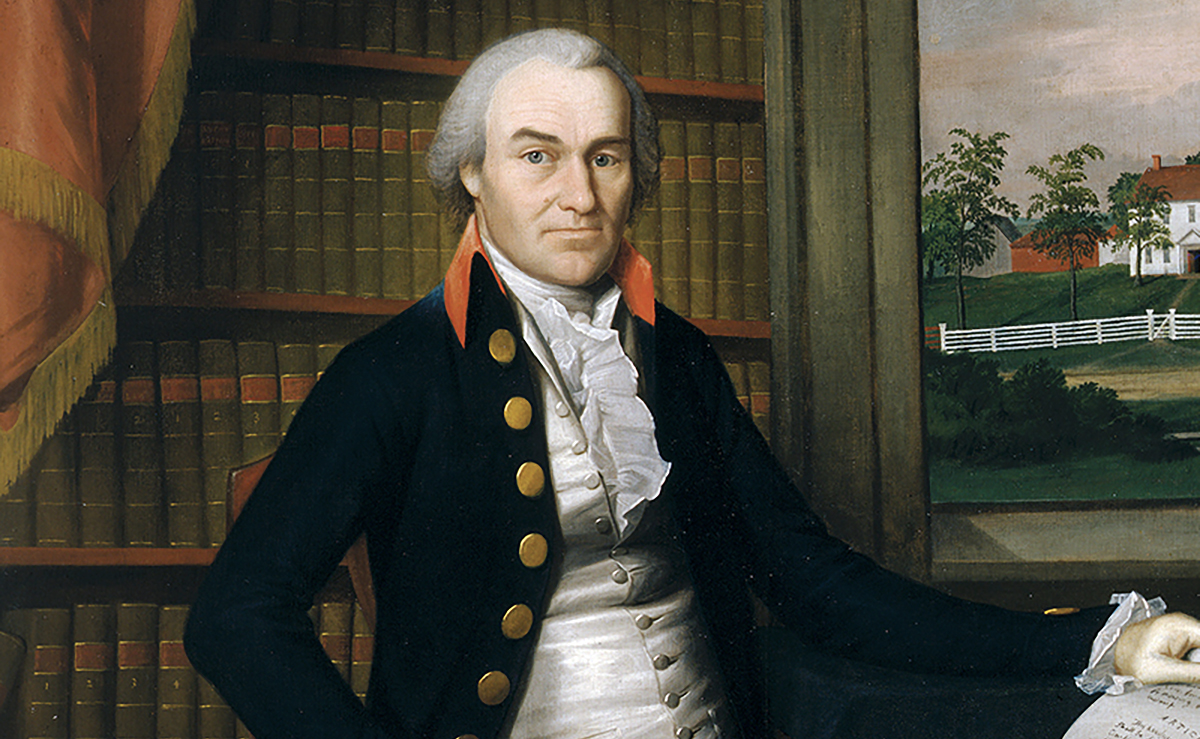
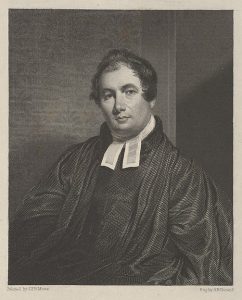 Born to farming parents, Sprague attended Colchester Academy and then attended Yale, where he graduated in 1815. He was invited to be the tutor for the children of Virginian Major Lawrence Lewis, nephew of George Washington. (Lewis’ wife was the granddaughter of Martha Washington.) He accepted, and traveled from Connecticut to Virginia. The Lewis’ home, Woodlawn, was part of the original Mount Vernon (George Washington’s home), and over the year Sprague stayed with the family, he received permission from Bushrod Washington (George Washington’s nephew who served on the US Supreme Court) to go through many of George Washington’s letters and papers. Sprague was allowed to take as many of those letters as he wanted, so long as he left copies of all letters he took, which was about 1,500. From these letters, Sprague was able to compile the very first complete set of autographs of all of the signers of the Declaration of Independence. In 1816, Sprague returned to school at the Theological Seminary at Princeton, where he studied for three years. In 1819, he became an associate pastor at First Congregational Church in West Springfield, Massachusetts, and remained there a decade before becoming pastor of Second Presbyterian in Albany, New York, where he remained until 1869. Sprague was a prolific writer, and penned sixteen major works, including biographies of important American Christian leaders as well as religious works such as Lectures on Revivals of Religion (1832), Contrast Between True and False Religion (1837), and Words to a Young Man’s Conscience (1848). He also wrote over 100 religious pamphlets and smaller works. Elected a member of the American Antiquarian Society, much of his writing and preaching was of a historical and biographical nature. In fact, one of his greatest accomplishments was his nine-volume Annals of the American Pulpit, which was particularly rich with biographies of those pastors who played important roles in the American War for Independence. By the time of Sprague’s death in 1876, he had collected over 100,000 historical autographs, including three complete sets of signatures of all the signers of the Declaration; one set of all the members of the Convention that framed the US Constitution; a complete set of the autographs of the first six Presidents of the United States and the officers of their administrations (including signatures of the Presidents, Vice Presidents, Cabinet members, US Supreme Court Justices, and all foreign ministers in those administrations); and the signatures of all military officers involved in the American War for Independence, regardless of the nation from which they came or the side of the war on which they fought. He also collected signatures of leaders of the Reformation as well as those of great skeptics and opponents of religious faith. His collection was considered the largest private collection in the world at the time of his death.