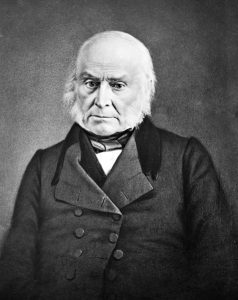
John Quincy Adams – Abolitionist, President, & Father

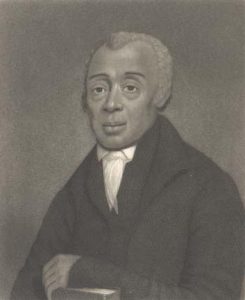
john-quincy-adams-abolitionist-president-father-1Black History Month is a special time to focus on black history, which interestingly often involves not just Black Americans but also those of other races. As famous Black American minister Richard Allen reminded his brethren during the Founding Era, “Many of the white people have been instruments in the hands of God for our good [and] are now pleading our cause with earnestness and zeal.” [1]

John Quincy Adams was one of the many Americans who had a direct hand in shaping black history for the good. (By the way, to learn about many of America’s remarkable untold black heroes, check out our website section on Black History.)

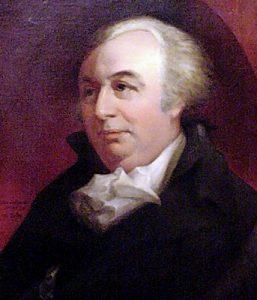
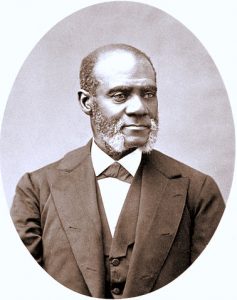
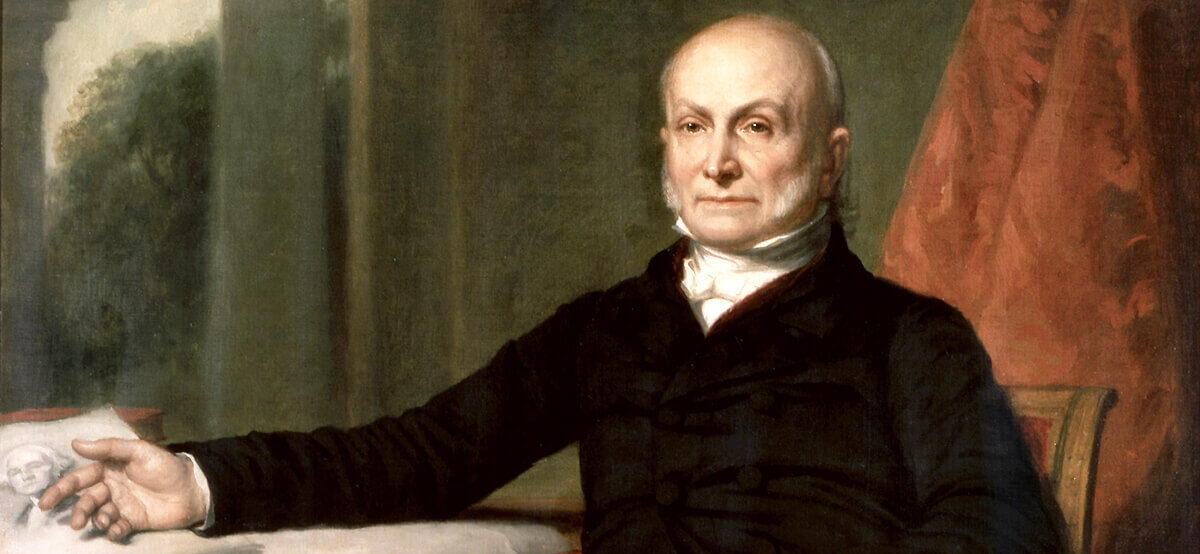
Adams spent nearly seven decades in public service for America, including as a foreign diplomat, Secretary of State, U. S. Senator, President of the United States, and then as the only President to serve as a US Congressman after his Presidency. [2] He became famous for introducing anti-slavey petitions into what was at that time a pro-slavery Congress. In fact, his fellow Congressmen were so disgusted with these petitions that they enacted a “gag-rule” banning the introduction of any petition addressing the abolition of slavery.  But Adams persisted and was so relentless in the pursuit of liberty and equality for Black Americans that he became known as “The Hellhound of Abolition.” [3]

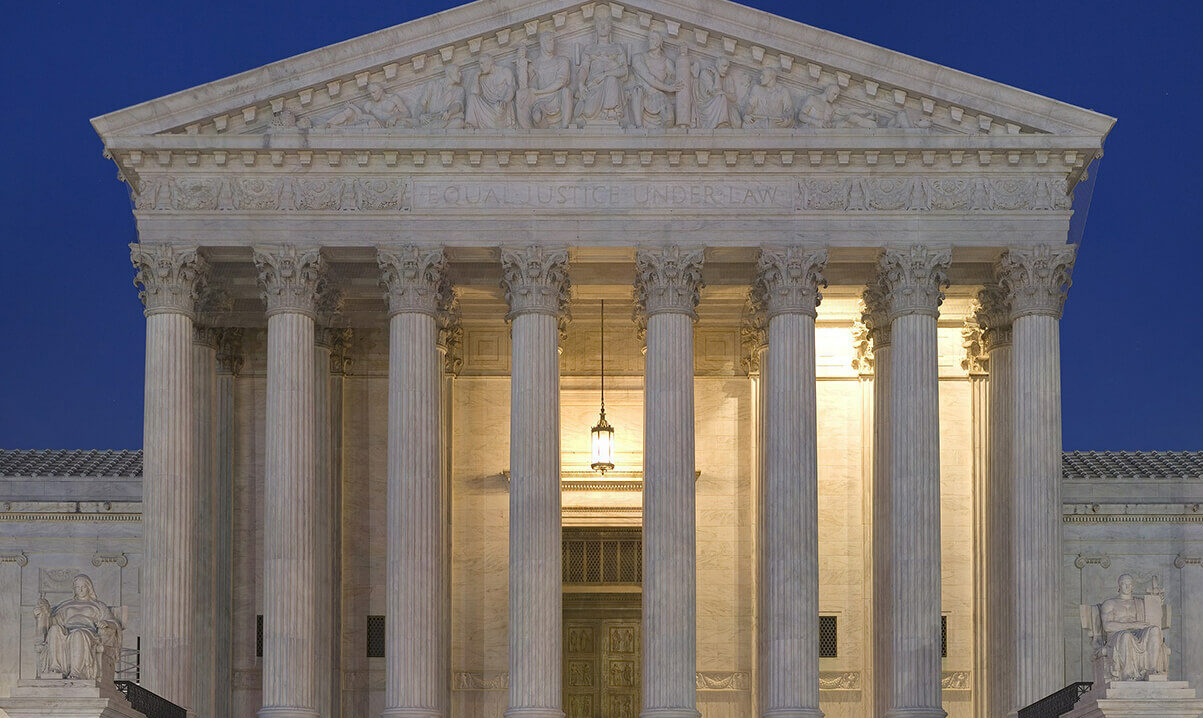
john-quincy-adams-abolitionist-president-father-3Adams also led the legal defense of the African slaves in the famous Amistad case [4] llater made a Hollywood movie starring Anthony Hopkins). The Amistad was a Spanish ship carrying newly enslaved Africans, who revolted during the voyage, killed the captain, and took over the boat. The ship was brought to port in the United States, where the Spanish survivors charged the Africans with mutiny and murder. John Quincy Adams successfully defended them before the U. S. Supreme Court, which declared the Africans free. These Africans were later transported safely back to the freedom of their homes in Africa. [5]

John Quincy Adams’ firm position in behalf of the equality of all men, regardless of color, was drawn especially from Bible teachings. In fact, he specifically cited Jesus’ teaching in Luke 4 as an authority for his position against slavery. Not surprisingly, Adams openly stressed the importance of reading the Bible.

In fact, when he had been a diplomat serving under President James Madison, Adams wrote a series of nine letters to his son instructing him on the importance of reading the Bible and how to get the most from his reading. A public demand for these letters led to their 1848 publication as a book for young Americans.


Endnotes

[1] Richard Allen, The Life Experience and Gospel Labors of the Right Rev. Richard Allen (New York: Abingdon Press, 1983), p. 73, from his “Address to the People of Color in the United States.
[2] Appletons’ Cyclopedia of American Biography (New York: D. Appleton & Co., 1889), Vol. I, s.v. “John Quincy Adams.” See also, American President, “John Quincy Adams,” The Miller Center (accessed: February 5, 2015), “John Quincy Adams,” National Historic Park, (accessed: February 5, 2015).
[3] History, Art & Archives, “The House ‘Gag Rule’,” United States House of Representatives (accessed: February 5, 2015). See also, Appletons’ Cyclopedia of American Biography (New York: D. Appleton & Co., 1889), Vol. I, s.v. “John Quincy Adams;” John Quincy Adams, The Diary of John Quincy Adams, Allan Nevins, editor (New York: Longmans, Green, and Co., 1929), p. 525, June 11, 1841; James Schouler, History of the United States of America Under the Constitution (New York: Dodd, Meade, and Company, 1889), Vol. IV, pp. 423-424.
[4]Teaching with Documents: The Amistad Case,” National Archives (accessed: February 5, 2015).
[5]Teaching with Documents: The Amistad Case,” National Archives (accessed: February 5, 2015). See also, Office of the Historian, “Milestones 1830-1860: The Amistad Case, 1839,” U.S. Department of State (accessed: February 5, 2015).

united states flag

The Battle of Baltimore

The Battle of Baltimore was fought in September 1814–during the War of 1812 as a part of the British’s attempt to reclaim America. Having just burned the U. S. Capitol and the White House, the British boldly advanced on Baltimore and Fort McHenry. The Americans there defended against two land attacks, only to have the British begin bombarding Fort McHenry from their ships at sea.

the-battle-of-baltimore-2 Fort McHenry had been named for Constitution signer James McHenry, who was Secretary of War under both President George Washington and President John Adams. [1]  Interestingly, McHenry’s own son John fought as a volunteer in that battle [2] — a battle best known for birthing America’s national anthem: “The Star Spangled Banner.”

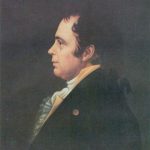
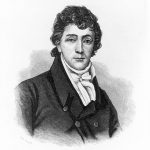
Before the battle began, Francis Scott Key, local attorney on a mission from President James Madison, boarded a British ship to secure the release of a prisoner taken by the British. Although successful in his mission, the British held Key aboard the ship until the attack was finished.

Anxiously watching as the fleet fired round after round into the fort, darkness fell, but the fierce bombardment continued throughout the night. When the guns finally fell silent, Key worried that the Fort had fallen. But when the sun arose, he spied the American flag still flying over the fort, unconquered!

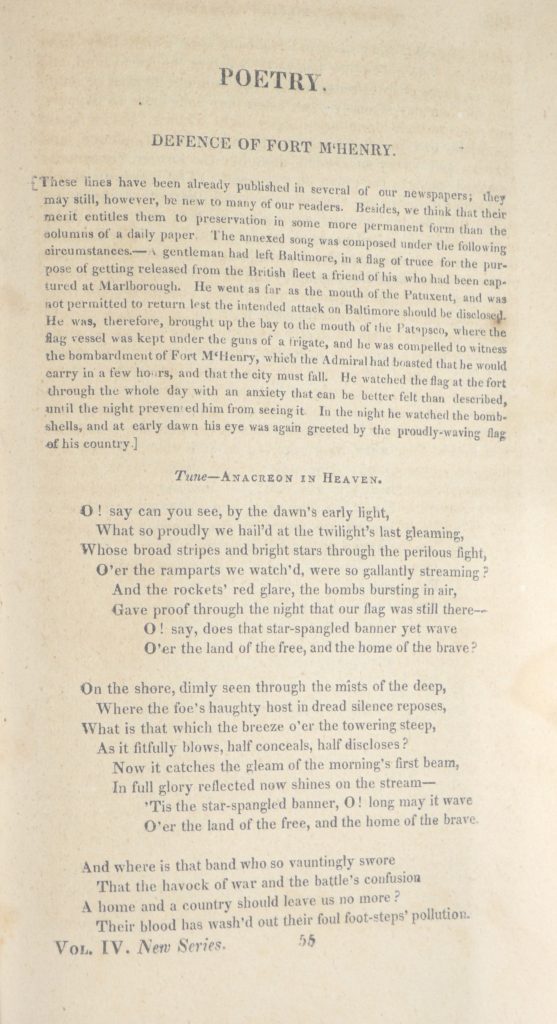
Still aboard the ship, on the back of an envelope he began jotting down lines recording what he saw and felt. Later that day after arriving ashore, he finished the poem. Originally called “The Defense of Ft. McHenry,” it would eventually become the national anthem, “The Star-Spangled Banner.” It was printed shortly after the battle in the 1814 Analectic Magazine (shown below from our WallBuilders Library).

the-battle-of-baltimore-4
Francis Scott Key, a committed Christian, contemplated giving up his profession to become a minister, [3] but decided to continue in law. He befriended John Randolph (a U.S. Congressman who openly expressed a preference for the Muslim faith and an opposition to Christianity) and persuaded him to embrace Christianity, after which Randolph became a strong advocate for his new-found faith. [4] Key wrote Randolph:
the-battle-of-baltimore-5

[M]ay I always hear that you are following the guidance of that blessed Spirit that will ‘lead you into all truth,’ leaning on that Almighty arm that has been extended to deliver you, trusting only in the only Savior, and ‘going on’ in your way to Him ‘rejoicing.’ [5]

Key served on the board of the American Bible Society and also the American School Union.

We have a short downloadable video on the origin of the Star Spangled Banner and its declaration of reliance on God. Play this for your friends, or at your church, to commemorate the 200th anniversary of our national anthem. We also have a wonderful biography of this great Christian statesman.


Endnotes

1 Robert K. Wright, Jr. and Morris J. MacGregor, Jr., Soldier-Statesmen of the Constitution, “James McHenry: Maryland,” (Center of Military History United States Army: Washington, D.C., 1987), 106-108; “James McHenry,” George Washington’s Mount Vernon, accessed March 20, 2025.
2 Bernard C. Steiner, The Life and Correspondence of James McHenry (Cleveland: Burrows Brothers Co., 1907), 610.
3 “Francis Scott Key,” Fort McHenry, September 3, 2014.
4 Hugh A. Garland, The Life of John Randolph of Roanoke (New York: D. Appleton & Company, 1850), II:87-88, from a letter to John Randolph, May, 22, 1816; 99-100, from a letter to Francis Scott Key, September 7, 1818; 100-103, from a letter to Dr. Brockenbrough, September 25, 1818; 103-104, from a letter to John Randolph; 106-107, Key’s reply to Randolph’s letter of May 3, 1819; 107-108, from a letter to Francis Scott Key, August 18, 1819;109, from a letter to Francis Scott Key, August 22, 1819; 373-374.
5 Garland, Life of John Randolph (1850), II:104, from Francis Scott Key to John Randolph.

Religious Freedom Day

Protect the Right of Conscience

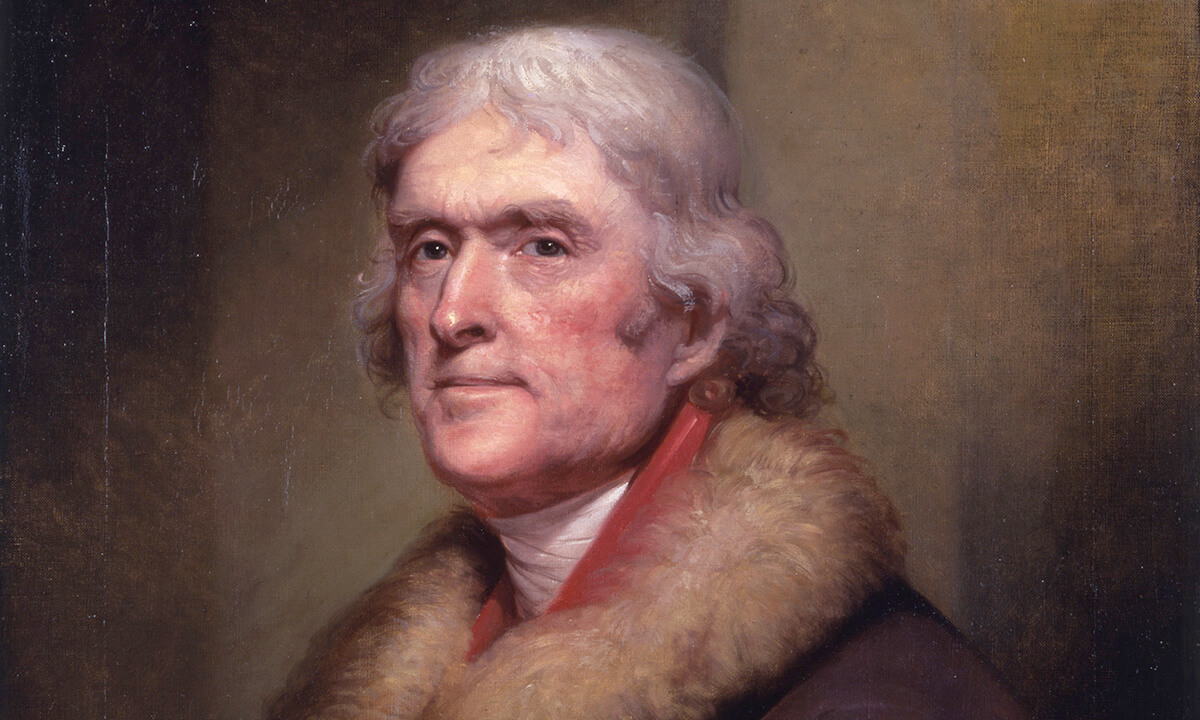
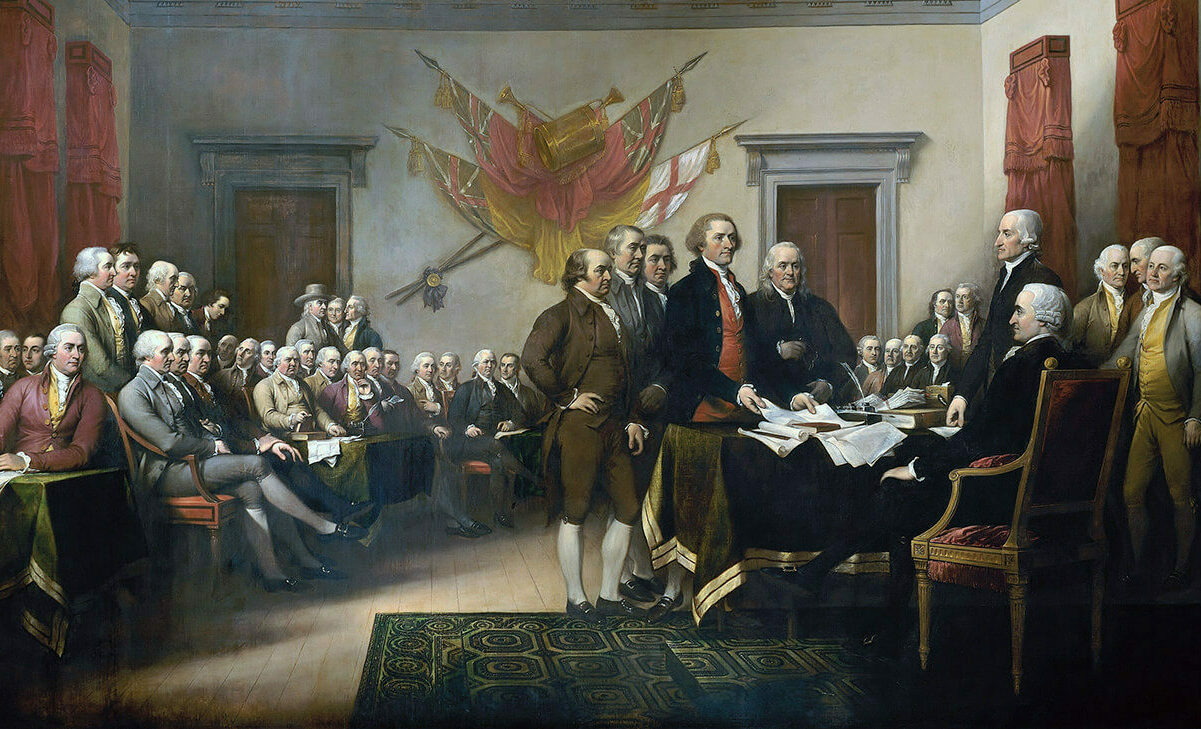
religious-freedom-day-1Religious Freedom Day is celebrated in America each year on January 16 — the date of the 1786 passage of Thomas Jefferson’s Virginia Statute of Religious Freedom. That Virginia statute, like similar ones passed in other states, was designed to give broad protections to religious freedoms, which were subsequently enshrined at the federal level in the First Amendment of the Constitution, which states:

Congress shall make no law respecting an establishment of religion or prohibiting the free exercise thereof.

The Founders viewed the First Amendment and the state measures as fully securing the inalienable rights of conscience — the right to hold specific religious beliefs and then act on and behave in accordance with those beliefs. Of all religious rights, they viewed the protection of religious conscience as the most important.

For example, Thomas Jefferson said:

religious-freedom-day-2No provision in our Constitution ought to be dearer to man than that which protects the rights of conscience against the enterprises of the civil authority.

And:

[O]ur rulers can have no authority over such natural rights, only as we have submitted to them. The rights of conscience we never submitted, we could not submit. We are answerable for them to our God.

James Madison similarly declared:

religious-freedom-day-3

Government is instituted to protect property of every sort . . . Conscience is the most sacred of all property.

Sadly, in the 20th century, the rights of conscience were reduced primarily to the right of religious expression — a significant narrowing of original intent. Thus, protection was accorded to certain religious actions but no longer the motivations behind them. The U. S. Supreme Court established what it called the “Lemon Test” which protected religious expressions as long as there was no religious motivations behind them — that is, religious expressions were permitted only if they served a secular purpose and motivation. Thus the rights of conscience became largely irrelevant.

But in the 21st century, the First Amendment was narrowed even further so that the rights of religious conscience are no longer protected. Thus, if your religious conscience says that you cannot participate in a homosexual wedding, or in the funding and promotion of abortions, or if you hold religious beliefs saying that there is a difference in genders, you can be prosecuted.

So on Religious Freedom Day, let’s remember that the foundation of all of our religious liberties is the right of religious conscience. Let’s vigorously defend this right to those around us so that they, too, can recognize and protect the full scope of our religious freedoms.

* This article concerns a historical issue and may not have updated information.

America’s Founders at College

Too many indisputable facts from American history are ignored today because they impede the direction many progressives want to move culture. For example, while they claim that the Founders were largely secularists, few today know that most of them were graduates of colleges or universities that specialized in training ministers of the Gospel.
americas-founders-at-college-1Princeton was founded in 1746, and John Witherspoon, a Gospel minister and signer of the Declaration of Independence, was the college’s president from 1768-1794. He trained scores of individuals who became national and state leaders. Princeton required that “every student shall attend worship in the college hall morning and evening.”

Yale University, founded in 1701, had Thomas Clap as its president from 1740-1766, when many of the Founders attended school there. Clap affirmed:

The original end and design of colleges was to instruct, educate, and train up persons for the work of the ministry.

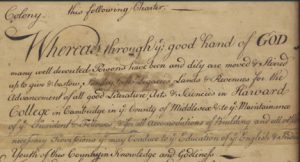
americas-founders-at-college-2Harvard University was founded in 1636. (Pictured on the right is the original 1650 Harvard incorporation charter from the WallBuilders library.) Josiah Quincy, Harvard’s president from 1829 to 1845, noted:

[T]he College was conducted as a theological institution. . . having religion for its basis and chief object.

Altogether, 29 signers of the Declaration graduated from religiously-founded universities. But to acknowledge this today would certainly contradict the common educational assertion that our Founders were largely atheists, agnostics, and deists who wanted a secular country. But those assertions are not true.

americas-founders-at-college-3Gouverneur Morris, a signer of the Constitution and the most active member of the Constitutional Convention, openly asserted:

Religion is the only solid basis of good morals; therefore, education should teach the precepts of religion and the duties of man towards God.

In fact, he warned:

There must be religion. What that ligament is torn, society is disjointed and its members perish. . . . The most important of all lessons is the denunciation of ruin to every state that rejects the precepts of religion.

Take note, America! This is a good warning to remember today.

In Four Centuries of American Education you can find out more about the deeply religious nature of education in early America and how Bible-based public education continued literally for centuries, ending only in recently years.

The Declaration Racist? Ha!

Louisiana Representative says The American Founding Is Bad

Study after study has demonstrated that rudimentary civic knowledge has plummeted in recent years. Many states have therefore taken specific steps to help ensure that students have a familiarity with our most basic governing documents. In Louisiana, Rep. Valerie Hodges introduced such a bill. Following the lead of states like Texas, Oklahoma, Kansas, Arkansas, Florida, Michigan, and others, her bill stipulated that Louisiana students recite the famous fifty-six words that form the heart of the Declaration of Independence:

“We hold these truths to be self-evident, that all men are created equal, that they are endowed by their Creator with certain unalienable rights, that among these are life, liberty and the pursuit of happiness. That to secure these rights, governments are instituted among men, deriving their just powers from the consent of the governed.”

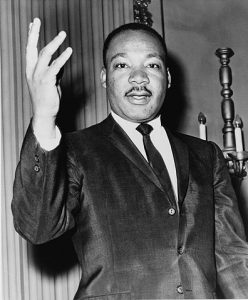
State Rep. Barbara Norton vehemently objected to this bill. She avowed that those words from the Declaration were not true, and relied heavily on Dr. Martin Luther King as the basis of her argument. She believed that equality did not exist until Dr. King, and that words from the Declaration should not be part of student studies.

Rep. Norton’s response is disappointing on many levels, and it certainly demonstrates that Rep. Norton knows little of American history and even less about black history as it relates to the Declaration of Independence.
the-declaration-racist-ha-3For example, she stressed the importance of Dr. King but apparently did not realize that in his famous “I Have A Dream” speech, as well as many of his sermons, he quoted extensively and favorably from the Declaration of Independence:

“When the architects of our republic wrote the magnificent words of the Constitution and the Declaration of Independence, they were signing a promissory note to which every American was to fall heir. This note was a promise that all men, yes, black men as well as white men, would be guaranteed the unalienable rights of life, liberty, and the pursuit of happiness.” – “I Have A Dream” speech, Washington, 1963

“It wouldn’t take us long to discover the substance of that dream. It is found in those majestic words of the Declaration of Independence – words lifted to cosmic proportions: ‘We hold these truths to be self-evident, that all men are created equal, that they are endowed by God, Creator, with certain inalienable Rights, that among these are Life, Liberty, and the pursuit of Happiness.’ This is a dream. It’s a great dream. The first saying we notice in this dream is an amazing universalism. It doesn’t say “some men,” it says “all men.” It doesn’t say “all white men,” it says “all men,” which includes black men. It does not say “all Gentiles,” it says “all men,” which includes Jews. It doesn’t say “all Protestants,” it says “all men,” which includes Catholics. It doesn’t even say “all theists and believers,” it says “all men,” which includes humanists and agnostics. . . I still have a dream this morning that truth will reign supreme and all of God’s children will respect the dignity and worth of human personality. And when this day comes, the morning stars will sing together and the sons of God will shout for joy. “We hold these truths to be self-evident that all men are created equal, that they are endowed by their Creator with certain inalienable rights, that among these are life, liberty, and the pursuit of happiness.” – July 4th, 1965, at Ebenezer Baptist Church, Atlanta, Georgia

By Rep. Norton denouncing the famous words from the Declaration, she might as well denounce Dr. King’s “I Have a Dream” speech, for it emphasized the same content she opposed.
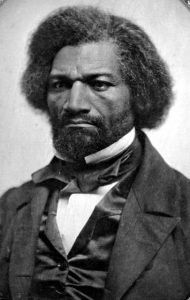
the-declaration-racist-ha-5But Dr. King wasn’t the first black civil rights activist to praise the Declaration of Independence. Frederick Douglass, who had himself been a slave, stated:

The principles contained in that instrument [the Declaration of Independence] are saving principles. Stand by those principles, be true to them on all occasions, in all places, against all foes, and at whatever cost.

the-declaration-racist-ha-6And Henry Highland Garnet, who like Douglass was born in slavery and also escaped, became the first black man to officially speak at the U. S. Capitol. Following the passage of the Thirteenth Amendment to abolish slavery in February 1865, the House asked Garnet to preach a sermon celebrating that momentous event. In his two-hour discourse, Garnet told listeners:

The Declaration [of Independence] was a glorious document. Sages admired it, and the patriotic of every nation reverenced the God-like sentiments which it contained.

Clearly, black civil rights advocates praised the sentiments contained in the Declaration of Independence. (Significantly, the Declaration was heavily relied upon by abolitionists to aid their cause, and the women’s rights movement based their documents directly on the Declaration of Independence.) It’s too bad that Rep. Norton wants to withhold from students a knowledge of the document that black leaders praised for almost two centuries.

Sermons by Chaplains

American War for Independence Chaplains
 

Thomas Allen (1743-1810)

Thomas Allen volunteered as a chaplain during the revolutionary war and took up arms in the Battle of Bennington.


Manasseh Cutler (1742-1823)

Manasseh Cutler served as military chaplain for multiple American units during the Revolutionary War.


Timothy Dwight (1752-1817)

Timothy Dwight served as a chaplain in a Connecticut brigade and later became the president of Yale College.


Samuel Spring (1746-1819)

Samuel Spring served as a chaplain during the Revolutionary War (1775-1776) and carried a wounded Aaron Burr from the field during the Battle of Quebec.


Nathan Strong (1748-1816)

Nathan Strong became a chaplain in the patriot army during the American Revolution, and was a strong supporter of the American cause. He later was a chief founder and a manager of the Connecticut Missionary Society and was involved in the “Connecticut Evangelical Magazine.”


Benjamin Trumbull (1735-1820)

Benjamin Trumbull was a chaplain during the Revolutionary War and served as a minster for almost 60 years.


Samuel West (1730-1807)

Samuel West served as a chaplain during the Revolutionary War, joining just after the Battle of Bunker Hill. He later was a member of the Massachusetts state constitutional convention and a member of the Massachusetts convention that adopted the U.S. Constitution.


Civil War
John W. Sayers
John W. Sayers served as the chaplain for Camp Geary at Gettysburg in 1883 and delivered sermons as the Pennsylvania “post” chaplain of the Grand Army of the Republic (an organization of Union veterans) from 1894-1899.

Miscellaneous


Judges: Should they be Elected or Appointed?

Some states have recently considered proposals that would abolish the election of State judges and replace it with a system of appointed judges who would face periodic retention elections. While supporters of this plan argue that retention elections will keep judges accountable to the voters, it is irrefutable that this plan will give judges a level of insulation from the public they have never before experienced and make them more unaccountable than ever before. The folly of this proposal is made clear both by history as well as the lessons of other States that have adopted such a plan.

From a historical perspective, the Founders of our country held succinct opinions on this issue. For example, two centuries ago when the colonists declared themselves independent from Great Britain and had opportunity to create their own governments, they promptly incorporated into America new and important judicial principles – of which the 1780 Massachusetts Constitution was typical in declaring:

All power residing originally in the people and being derived from them, the several magistrates and officers of government vested with authority – whether Legislative, Executive, or Judicial – are their substitutes and agents and are at all times accountable to them. [1] (emphasis added)

The Framers feared tyranny from the judiciary more than from the other two branches, so they placed deliberate limitations on the judiciary. As a result, the Federalist Papers reported that under their plan, “the Judiciary is beyond comparison the weakest of the three departments of power. . . . [and] the general liberty of the people can never be endangered from that quarter.” [2]

As part of that plan, the Framers took care to ensure that judges were accountable to the people at all times. Although federal judges were appointed and did not face election, the Founders made certain that federal judges would be easily removable from office through impeachment, a procedure that today is widely misunderstood and rarely used. While the current belief is that a judge may be removed only for the commission of a criminal offense or the violation of a statutory law, [3] it was not this way at the beginning. As Alexander Hamilton explained, “the practice of impeachments was a bridle” [4] — a way to keep judges accountable to the people. And what did the Framers believe were impeachable offenses? According to Justice Joseph Story, a “Father of American Jurisprudence”:

The offences to which the power of impeachment has been and is ordinarily applied. . . . are what are aptly termed political offences, growing out of personal misconduct, or gross neglect, or usurpation, or habitual disregard of the public interests. [5]

Under the Framers, impeachment occurred whenever a judge attempted to carry a personal agenda through the court; but today impeachment has become what Justice Story warned that it should never be: a power “so weak and torpid as to be capable of lulling offenders into a general security and indifference.” [6] The federal judiciary, because it now enjoys a level of insulation from the people that the Framers never intended and to which they today would vehemently object, is unafraid to reshape American culture and policy to mirror its own political whims and personal values.

Judges given increased levels of protection from the public feel freer to advance personal agendas, often manifesting the view expressed by Supreme Court Justice Benjamin Cardozo who declared that:

I take judge-made law as one of the existing realities of life. [7]

Americans should not have to fear “judge-made laws” as a reality of life. We elect our legislators to make our laws, and those states that elect judges elect them to apply those laws. If these states reject a system of accountable judges, they undoubtedly will face the same arrogance now so evident on the federal level – as when Supreme Court Chief-Justice Charles Evans Hughes declared:

We are under a Constitution, but the Constitution is what the judges say it is. [8]

Since the proclivity to reshape culture and values is so frequently displayed by unaccountable judges, why would a state want to adopt such a system? In fact, why would anyone even propose a system to give additional insulation to judges? Because – proponents answer – for judges to campaign to win the votes of citizens makes the judiciary a “political” branch and weakens the so-called “independence” of the judiciary. Yet, as Thomas Jefferson wisely observed:

It should be remembered as an axiom of eternal truth in politics that whatever power in any government is independent is absolute also. . . . Independence can be trusted nowhere but with the people in mass. [9]

And is anyone really so naivé as to believe that the current appointed “independent” federal judiciary has not become a political branch? As Jefferson had warned:

Our judges are as honest as other men and not more so. They have, with others, the same passions for party, for power, and the privilege of their corps. . . . [A]nd their power the more dangerous as they are in office for life and not responsible, as the other functionaries are, to the elective control. [10]

Contrary to what is asserted by the proponents of appointed judges and retention elections, for judges to campaign and win voter support actually prevents the judiciary from becoming a political branch because citizens can then insist that judges confine themselves to their constitutional roles rather than implement their own political agendas.

Another benefit of the direct elections of judges is the competition that occurs between candidates. In contested races, judicial candidates make public the beliefs of their opponents, thus allowing citizens the opportunity to make informed decisions about those whom they want to sit on the bench. On the other hand, if an individual is appointed rather than elected, his personal beliefs might remain unknown to the public until they manifest themselves in harmful judicial decisions. Furthermore, these appointed judges would have at least four uninterrupted, unrestrained years before they would face voters for the first time in a retention election – and even at that time, there would be no opponent to remind voters of egregious decisions.

Those proposing retention elections are not improving State government. Instead, they are violating one of its most sacred principles: they are removing power from the people — something to which Thomas Jefferson strenuously objected:

The exemption of the judges from that [from election] is quite dangerous enough. I know no safe depository of the ultimate powers of the society but the people themselves; and if we think them [the people] not enlightened enough to exercise their control with a wholesome discretion, the remedy is not to take it [control] from them, but to inform their discretion by education. [11]

Jefferson further declared:

[I]t is necessary to introduce the people into every department of government. . . . Were I called upon to decide whether the people had best be omitted in the legislative or judiciary department, I would say it is better to leave them out of the legislative. The execution of the laws is more important than the making of them. [12]

Understanding that “the execution of the laws is more important than the making of them,” many of our earliest statesmen supported the election of State judges. For example, Noah Webster, himself a judge and the man responsible for Article 1, Section 8, 8 of the U. S. Constitution, declared:

[M]en elected to office should be able men, men of talents equal to their stations, men of mature age, experience and judgment; men of firmness and impartiality. This is particularly true with regard to men who constitute tribunals of justice – the main bulwark of our rights. [13]

In addition to these historical lessons, recent experiences demonstrate that in States with an appointed judiciary, judges are quite comfortable in exerting political influence rather than simply upholding and applying State laws.

For example, in the 2002 election, the appointed New Jersey Supreme Court reviewed the State law declaring that a candidate’s name may be replaced on the ballot only if the “vacancy shall occur not later than the 51st day before the general election” and somehow decided that the 35th day before the election fulfilled the same legal requirements as the 51st day before the election. (Recall that the Democrat candidate was lagging far behind his Republican opponent in the polls; the Democrats convinced the unelected judges to place a more viable candidate on the ballot – in violation of the State law – and Democrats therefore won a U. S. Senate seat they were destined to lose.)

And who can forget the appointed Florida Supreme Court in the 2000 presidential election? Even though State law declared that all election vote tallies were to be submitted to the Secretary of State’s office by 5 PM on the 7th day following the election, and that results turned in past that time were to be ignored, those judges ruled that 5 PM on the 7th day really meant 5 PM on the 19th day, and that the word “ignored” really meant just the opposite – that the Secretary of State must accept all results, even those that did not comply with the law.

Judges facing regular elections would not have rendered decisions that ignored such clear legislative language (not to mention basic math or the common meaning of words). Elected judges know that if they make such agenda-driven decisions, they will face a plethora of opponents in their next race who will remind voters of their demonstrated contempt for State law.

Arrogant, elitist proposals that judges should be protected from citizens in this day of rampant judicial political agendas is unthinkable in our free society. History is too instructive on the necessity of direct judicial accountability for its lessons to be ignored today. And while judicial accountability through the use of impeachment on the federal level appears to be a thing of the past, judicial accountability through the direct election of State judges should not be.


Footnotes

[1] A Constitution or Frame of Government Agreed Upon by the Delegates of the People of the State of Massachusetts-Bay (Boston: Benjamin Edes & Sons, 1780), 9, Massachusetts, 1780, Part I, Article V.

[2] Alexander Hamilton, Federalist #78, Alexander Hamilton, John Jay, James Madison, The Federalist on the New Constitution (Philadelphia: Benjamin Warner, 1818), 419-420; Hamilton, Federalist #73, The Federalist (1818), 398.

[3] See, for example, Irving Brant, Impeachment: Trials & Errors (New York: Alfred Knopf, 1972); Warren S. Grimes, who argues that impeachment is a relic of the past and should be abandoned in his “Hundred-Ton-Gun Control: Preserving Impeachment as the Exclusive Removal Mechanism for Federal Judges,” UCLA Law Review (June 1991), 1254; U.S. v. Carol Bayless, 95 Cr. 533 (S.D. NY, 1996); the joint statement issued by current and former chief-judges of the United States Court of Appeals for the Second Circuit in response to widespread calls from several public officials for the impeachment of federal judge Frank Baer, Jr., March 28, 1996; Fort Worth Star Telegram, April 14, 1996, C-5, “Judicial Independence” by David Broder, writer for The Washington Post.

[4] Alexander Hamilton, Federalist #65, The Federalist (1818), 353.

[5] Joseph Story, Commentaries on the Constitution of the United States (Boston: Hilliard, Gray and Company, 1833), II:233-234, § 762.

[6] Story, Commentaries (1833) II:218, § 745.

[7] Benjamin Cardozo, The Nature of the Judicial Process (New Haven: Yale University Press, 1921), 10.

[8] Charles Evans Hughes, speech at Elmira on May 3, 1907, The Autobiographical Notes of Charles Evans Hughes, eds. David J. Danelski & Joseph S. Tulchin (Cambridge: Harvard University Press, 1973), 144.

[9] Thomas Jefferson to Judge Spencer Roane, September 6, 1819, Writings of Thomas Jefferson, ed. Albert Ellery Bergh (Washington, D. C.: The Thomas Jefferson Memorial Association, 1904), XV:213 214.

[10] Jefferson to William Charles Jarvis, September 28, 1820, Writings, ed. Bergh (1904), XV:277.

[11] Jefferson to William Charles Jarvis, September 28, 1820, Writings, ed. Bergh (1904), XV:278.

[12] Jefferson to M. L’Abbe Arnoud, July 19, 1789, Writings, ed. Bergh (1904), VII:422-423.

[13] Noah Webster, A Collection of Papers on Political, Literary, and Moral Subjects (New York: Webster & Clark, 1843), 303, Chapter XV.

A Review of A&E’s “The Crossing”

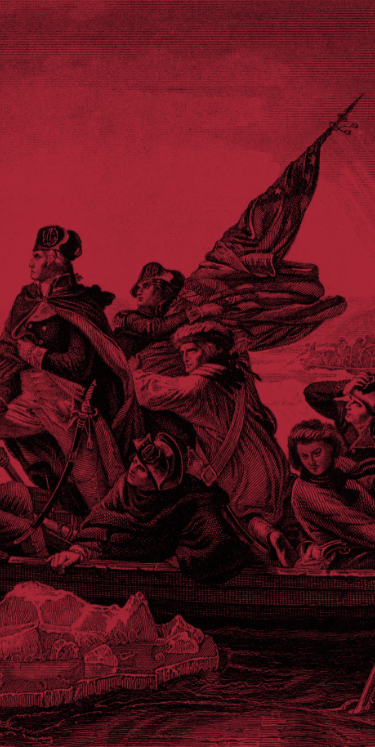
The recent showing on the A&E Network of “The Crossing” has resulted in a flurry of questions being raised about the character and personal habits of Commander-in-Chief George Washington. Specifically, was he as profane with his language as portrayed in the film?

“The Crossing” was A&E’s movie version of Howard Fast’s book by the same name. Howard Fast, who has authored over seventy novels, describes his work as “American historiography”; that is, it is a combination of history and biography written in a novel form.

It is Washington’s dialogue in this movie which has raised the most questions. Yet, it is the dialogue which is its least historical portion; that is, there is no exact record of the conversations which occurred prior to and during the crossing. While there are soldier’s and staff’s remembrances of the topics and tones of the discussions and even of a few occasional phrases, there simply exists no historical records documenting the full conversations themselves. This portion of the historiography of the “the Crossing” makes it a novel. Interestingly, however, the George Washington in the movie “the Crossing” is much more profane than the George Washington in the book “The Crossing.” In fact, some of the profane words used in the movie are actually words of recent origin, having had no previous historical usage.

Nonetheless, accepting that the dialogue is the least accurate element of “The Crossing,” the question still remains, was the portrayal of George Washington as a leader given to verbal profanity an accurate historical portrayal? Fortunately, there is much available primary-source historical information (from both military documents and eye-witnesses of that time) which provides a clear and indisputable answer to this question: No, the use of profanity was not a part of the leadership style of George Washington. In fact, the records are clear that the opposite was true.

George Washington’s own personal aversion to profanity was first documented nearly thirty years before “The Crossing” of 1776. In 1746, Washington wrote out his famous “Rules of Civility.” His Rule 22 declared:

Use no reproachful language against any one, neither curse, nor revile.1

A decade later, and still nearly twenty years before “The Crossing,” Washington first documented his personal aversion to profanity in the
military. In 1756, during the French and Indian War as a young colonel commanding Virginian forces during that conflict, Washington told his superior, Lt. Gov. Robert Dinwiddie:

[T]his I am certain of, and can call my conscience and what, I suppose, will still be a more demonstrable proof in the eyes of the world, my orders, to witness how much I have–both by threats and persuasive means–endeavored to discountenance gaming, drinking, swearing, and irregularities of every other kind; while I have, on the other hand, practiced every artifice to inspire a laudable emulation in the officers for the service of their country and to encourage the soldiers in the unerring exercise of their duty. 2

Several weeks later, Washington issued the following order to his troops:

Colonel Washington has observed that the men of his regiment are very profane and reprobate. He takes this opportunity to inform them of his great displeasure at such practices and assures them that if they do not leave them off, they shall be severely punished. The officers are desired, if they hear any man swear or make use of an oath or execration, to order the offender twenty-five lashes immediately, without court-martial. For the second offense, he will be more severely punished.3

Washington’s firm opposition to profanity in the military never wavered, as evidenced by military orders he issued on several occasions throughout the American Revolution. For example:

The General most earnestly requires and expects a due observance of those articles of war established for the government of the army which forbid profane cursing, swearing and drunkenness; and in the like manner requires and expects of all officers and soldiers not engaged on actual duty, a punctual attendance on Divine Service to implore the blessings of Heaven upon the means used for our safety and defense. 4 GENERAL ORDERS, CAMBRIDGE, JULY 4, 1775

The General is sorry to be informed that the foolish and wicked practice of profane cursing and swearing (a vice heretofore little known in an American Army) is growing into fashion; he hopes the officers will, by example as well as influence, endeavor to check it, and that both they and the men will reflect that we can have little hopes of the blessing of heaven on our arms if we insult it by our impiety and folly; added to this, it is a vice so mean and low, without any temptation, that every man of sense and character detests and despises it.5 GENERAL ORDERS, NEW YORK, AUGUST 3, 1776

It is much to be lamented that the foolish and scandalous practice of profane swearing is exceedingly prevalent in the American Army. Officers of every rank are bound to discourage it, first by their example, and then by punishing offenders. As a mean to abolish this and every other species of immorality, Brigadiers are enjoined to take effectual care to have Divine Service duly performed in their respective brigades. 6 GENERAL ORDERS, MIDDLEBROOK, MAY 31, 1777

Purity of morals being the only sure foundation of public happiness in any country, and highly conducive to order, subordination, and success in an army, it will be well worthy the emulation of officers of every rank and class to encourage it both by the influence of example and the penalties of authority. It is painful to see many shameful instances of riot and licentiousness
among us; the wanton practice of swearing has risen to a most disgusting height. A regard to decency should
conspire with a sense of morality to banish a vice productive of neither advantage of pleasure. 7 GENERAL ORDERS, FREDERICKSBURG, OCTOBER 21, 1778

There is a clear and consistent message throughout his orders: General Washington did not tolerate the practice of swearing in the military. It is therefore reasonable to assume that he would have been a leader in propagating that which he so sternly opposed? Hardly. “The Crossing” has mis-portrayed this element of the character and nature of General Washington.

In fact, on only one occasion during the lengthy forty-year military career of General Washington was he accused of cursing or profanity. That occasion allegedly occurred during during the Battle of Monmouth in 1778 when General Charles Lee displayed gross cowardice in the face of the British and ordered the American troops under his command to retreat. The retreat became a general rout until General Washington arrived, rallied the troops, reformed the scattered bands, and attacked.

Washington, irritated with General Lee for direct disobedience to his orders, removed Lee from the control of any troops following an angry exchange with him on the field of battle. Some charge that this heated argument Washington swore at Lee. Lee later demanded an apology from Washington for the way he had been humiliated on the battle field, but Washington refused. Lee was afterwards court-martialed, found guilty, and given a twelve-month suspended sentence for disobedience to direct orders, misbehavior before the enemy, and disrespect to the Commander-in-Chief.

Interestingly, even W. E. Woodward, an early twentieth-century revisionist historian very critical of Washington, found no basis for believing that general Washington used profanity even on this occasion. Woodward explained:

The question as to whether Washington swore on this occasion has stirred the American nation for five generations. . . . Washington may have sworn in his heated interview with Lee, but it does not appear in the evidence; and I think it a very doubtful legend. The story of his swearing at Monmouth rests on the unofficial testimony of people given years after the occurrence, and in the form of loose reminiscences. . . . In the whole mass of testimony produced at the Lee court-martial, there is not one word about swearing. Much of this testimony was given by friends of Lee, and Lee himself presented a defense in writing in which he said that he endeavored to reproduce Washington’s words literally. At the court-martial he was Washington’s mortal enemy, and it seems that if Washington had given him a good cursing–which would have been a breach of military courtesy–Lee would have set down something about it in his paper. . . . Evidently he [Washington] repented quickly his loss of temper at Monmouth, for shortly after his altercation with Lee he turned to that general, who was still hanging around swollen with injured pride, and mildly directed him to take command of the rallied troops.8

Even historians harshest in their criticism of George Washington find little basis for believing that Washington swore, Yet, even if this one occasion is accepted, there still is absolutely no substantiation for the type of loose and flowing profanity which characterized Washington during “The Crossing.”

In fact, those who knew and served with Washington during his military career described him in the opposite terms. For example, General Henry Lee said of Washington that:

To his equals he was condescending, to his inferiors kind . . . [V]ice shuddered in his presence, and virtue always felt his fostering hand. The purity of his private character gave effulgence to his public virtues. 9

Similarly, David Ramsay, military surgeon during the Revolution, said of Washington that:

His private character, as well as his public one, will bear the strictest scrutiny. He. . . . carried the spirit of piety with him, both in his private life and public administration. 10

And General Alexander Hamilton confirmed the general character of Washington when, upon Washington’s death in 1799, he declared:

If virtues can secure happiness in another world, he [Washington] is happy. 11

While many of the military and historical facts, dates, names, and places portrayed in A&E’s “The Crossing” may be accurate and correct, the portrayal of the flawed moral character of the Commander-in-Chief is historically inaccurate.

Footnotes

1 Jared Sparks, The Life of George Washington (Boston: Ferdinand Andrews, 1839), p. 514.

2 George Washington, The Writings of George Washington, John C. Fitzpatrick, editor (Washington: U. S. Printing Office, 1931), Vol. I, p. 317, to Robert Dinwiddie on April 18, 1756.

3 George Washington, The Writings of George Washington, Jared Sparks, editor (Boston: Ferdinand Andrews, 1836), Vol. II, p. 167, n, from his “Orderly Book,” an undated order issued between June 25 and August 4, 1756.

4 Washington, Writings, Vol. III, p. 309, General Orders, Head Quarters, Cambridge, July 4, 1775.

5 Washington, Writings, Vol. V, p. 367, General Orders, Head Quarters, New York, August 3, 1776.

6 Washington, Writings, Vol. VIII, p. 152-53, General Orders, Head Quarters, Middle-Brook, May 31, 1777.

7 Washington, Writings, Vol. XIII, p. 118-19, General Orders, Head Quarters, Fredericksburg, October 21, 1778.

8 W. E. Woodward, George Washington, The Image and The Man, W. E. Woodward (New York: Boni and Liveright, 1926), pp. 352-353.

9 A Memory of Washington: Compromising a Sketch of his Life and Character; and the National Testimonials of Respect–Also a Collection of Eulogies and Orations (Newport, RI: Oliver Farnsworth, 1800), p. 99, from the eulogy on Washington by General Henry Lee, December 26, 1799.

10 E. C. M’Guire, Religious Opinions and Character of Washington (New York: Harper & Brothers, 1836), p. 362, from the eulogy on Washington by David Ramsay, on January 15, 1800.

11 Alexander Hamilton, The Works of Alexander Hamilton, John C. Hamilton, editor (New York: John F. Trow, 1851), Vol. VI, p. 415, to M. Leer on January 2, 1800.
Houses of Worship Free Speech Restoration Act

Congressman Walter Jones from North Carolina’s 3rd District has introduced H.R. 235, the “Houses of Worship  Free Speech Restoration Act.” This bill would amend the IRS Code of 1986 to restore the ability of churches and other houses of worship to freely participate in political campaigns.

According to Congressman Jones:

“In 1954, then-Senator Lyndon B. Johnson offered an amendment to a revenue bill that would permanently extend the stranglehold of the Internal Revenue Service (IRS) into our nation’s churches, synagogues and mosques. Since that time, the IRS has turned the 501(c)(3) code-section on its head in an attempt to punish pastors, priests and rabbis for nothing more than communicating the principles of faith during an election period. If passed, the Houses of Worship Political Speech Protection Act would restore the rights of all religious organizations to determine for themselves what they can and cannot teach from their pulpits, or communicate to their congregation and the public without fear that their tax status may be in jeopardy. It is time to restore freedom to our Nation’s pulpits.”

houses-of-worship-free-speech-restoration-actTo contact your Representative or Senator: From a constitutional perspective, it is unconscionable that the current policy penalizing the free speech of religious institutions has remained intact and unchallenged for this long. The government has long recognized that institutions of faith and houses of worship have provided vital services to our communities and our nation. In fact, our public policy has been to honor the valuable contributions of these organizations with an exemption from taxes both for the organizations themselves and for the individuals and groups who support them. Regrettably, because of a simple appropriations rider in 1954, our public policy changed to recognizing the valuable contributions of houses of worship only if they gave up their constitutional right to free speech. (What an amazing exchange: we will honor your charitable contributions but only if you will give up your constitutional rights!) This obviously represents bad public policy and unjustly muzzles thousands of churches across America by preventing them from exercising their fundamental right to free speech. Free speech is most valuable when it is exercised during the elections of our government leaders.
  1. If you do not know your U. S. Congressman, go to https://www.house.gov/representatives/find-your-representative and type in yo ur zip code to learn the name of your Representative.
  2. Call the U.S. Capitol at (202) 224-3121. When the Capitol switchboard operator answers, ask for your Senator or Representative by name. When that office answers, ask to speak to your Congressman or Senator. If he is available, he will speak with you; if he is unavailable, simply tell his staff your thoughts on H.R. 235 and how you would like him to vote.
  3. If you wish to write and communicate the same message, the address is:

Name of your Representative

U.S. House of Representatives

Washington, DC, 20515


Name of your Senator

U.S. Senate

Washington, DC, 20510

(To access information (bill text, sponsors, status, etc.) and track the progress of the “Houses of Worship Free Speech Restoration Act,” go to https://clerk.house.gov/Votes and type in “HR 235” to see how your Congressman voted on a similar bill on October 2, 2002, click here. WallBuilders offers The Role of Pastors and Christians in Civil Government, which documents  the historic role people of faith played in our government.)

** This is historic information and not applicable to current pieces of legislation. **

John Locke: Deist or Theologian?

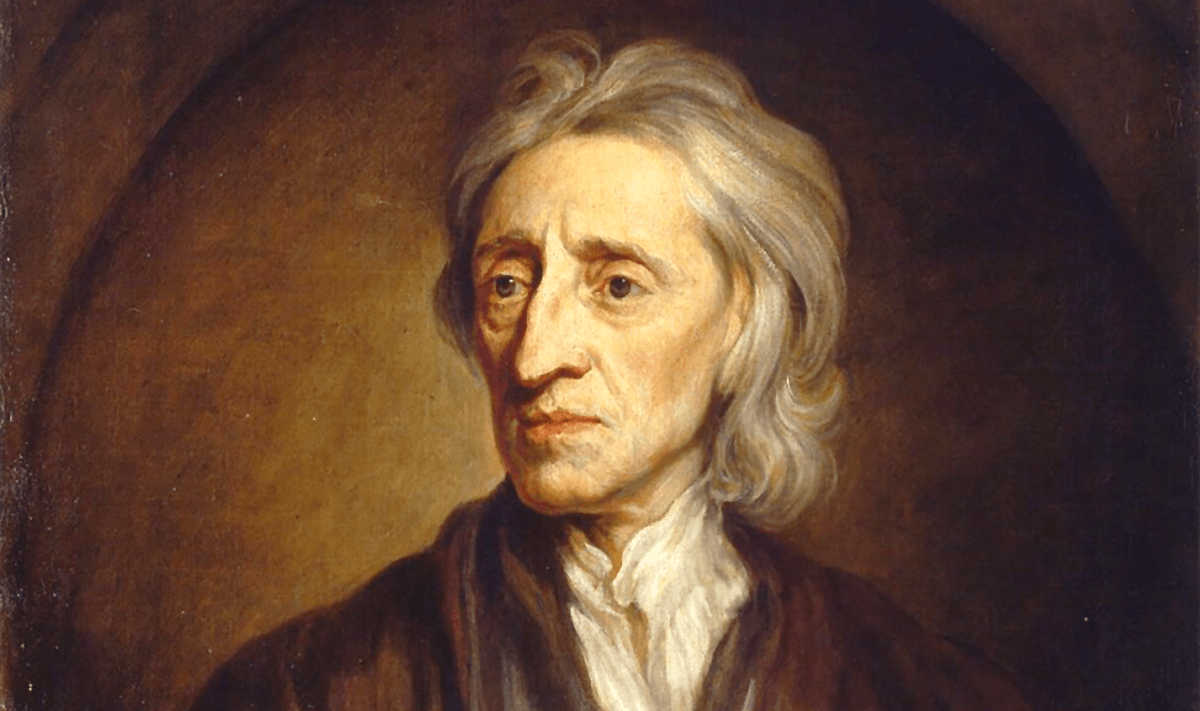
Many law and history professors and uninformed historical writers commonly assert that John Locke was a secular political writer or a deist. Often, these claims are made without the logical effort of studying Locke or his writings directly. (Rather, the views of other writers who wrote about Locke are studied!) If you have such a professor, or hear such assertions, here are a few helpful questions that you can use:

Questions About John Locke that Demand An Answer

  1. In 1669, John Locke assisted in the drafting of the Carolina constitution under which no man could be a citizen unless he acknowledged God, was a member of a church, and used no “reproachful, reviling, or abusive language” against any religion.1 How can the constitutional requirement that no one can become a citizen (1) unless he acknowledges God; (2) be a member of a church; and (3) not attack religion, be considered a secular political philosophy?
  2. Many of Locke’s political ideas were specifically drawn from British theologian Richard Hooker (1554-1600), whom Locke quotes heavily in approbation throughout his own political writings.2 If Locke draws so heavily from (and frequently cites) a theologian throughout his own political works, how can it be true that his political philosophies were totally secular?
  3. In his most famous political work, his Two Treatises of Government, Locke set forth the belief that successful governments could be built only upon the transcendent, unchanging principles of natural law that were a subset of God’s law. For example, he declared:

    [T]he Law of Nature stands as an eternal rule to all men, legislators as well as others. The rules that they make for other men’s actions must . . . be conformable to the Law of Nature, i.e., to the will of God.3

    [L]aws human must be made according to the general laws of Nature, and without contradiction to any positive law of Scripture, otherwise they are ill made.4

    How can Locke’s declaration that the laws of legislators must be conformable “to the will of God” and that human laws cannot contradict “any positive law of Scripture” be considered part of a secular political philosophy?

  4. Locke’s Two Treatises of Government were heavily relied upon by the American Founding Fathers. In fact, signer of the Declaration Richard Henry Lee declared that the Declaration itself was “copied from Locke’s Treatise on Government.”5 Yet so heavily did Locke draw from the Bible in developing his political theories that in his first treatise on government, he invoked the Bible in one thousand three hundred and forty nine references; in his second treatise, he cited it one hundred and fifty seven times. How can so many references to the Bible in Locke’s most famous political work be reconciled with the charge that his political philosophies were totally secular?
  5. While many today classify John Locke as a deist, secular thinker, or a forerunner of deism,6 previous generations classified John Locke as a theologian. 7 How can the charge that Locke’s political philosophies were totally secular be squared with the fact that he was long considered a theologian?
  6. John Locke’s many writings included a verse-by-verse commentary on Paul’s Epistles. He also compiled a topical Bible, which he called a Common Place-Book to the Holy Bible, that listed the verses in the Bible, subject by subject. Then when anti-religious enlightenment thinkers attacked Christianity, Locke defended it in his book, The Reasonableness of Christianity as Delivered in the Scriptures. And then when he was attacked for defending Christianity in that first work, he responded with the work, A Vindication of the Reasonableness of Christianity. Still being attacked two years later, Locke wrote, A Second Vindication of the Reasonableness of Christianity.8 No wonder he was considered a theologian by his peers and by subsequent generations! How can a theologian who wrote so many books on the writings and doctrines of the Bible and Christianity (and who frequently cited the Scriptures in his political writings) also be a writer whose political philosophies were totally secular?
  7. Significantly, when during the Founding Era it was charged that Locke was a secular writer, it drew a sharp response from law professor James Wilson, a signer of the Constitution and an original Justice on the U. S. Supreme Court. Wilson declared:

    I am equally far from believing that Mr. Locke was a friend to infidelity [a disbelief in the Bible and in Christianity 9]. . . . The high reputation which he deservedly acquired for his enlightened attachment to the mild and tolerating doctrines of Christianity secured to him the esteem and confidence of those who were its friends. The same high and deserved reputation inspired others of very different views and characters . . . to diffuse a fascinating kind of lustre over their own tenets of a dark and sable hue. The consequence has been that the writings of Mr. Locke, one of the most able, most sincere, and most amiable assertors of Christianity and true philosophy, have been perverted to purposes which he would have deprecated and prevented [disapproved and opposed] had he discovered or foreseen them. 10

    How can the charge that political philosophies were totally secular be explained with the claim by such a prominent legal authorities that Locke was “one of the most able, most sincere, and most amiable assertors of Christianity”?


Endnotes

1 John Locke, A Collection of Several Pieces of Mr. John Locke Never Before Printed or Not Extant in His Works (London: J. Bettenham for R. Francklin, 1720), 3, 41, 45-46.
2 John Locke, Two Treatises on Government (London: J. Whiston, etc., 1772), passim.
3 Locke, Two Treatises (1772), II:285, Ch. XI, §135.
4 Locke, Two Treatises (1772), II:285, Ch. XI, §135, n., quoting Hooker’s Eccl. Pol. 1. iii, sect. 9.
5 Thomas Jefferson to James Madison, August 30, 1823, The Writings of Thomas Jefferson (Washington, D. C.: The Thomas Jefferson Memorial Association, 1904), XV:462.
6 See, for example, Concise Oxford Dictionary of World Religions, ed. John Bowker (Oxford: Oxford University Press, 2000), 151; Franklin L. Baumer, Religion and the Use of Skepticism (New York: Harcourt, Brace, & Company), 57-59; James A. Herrick, The Radical Rhetoric of the English Deists: The Discourse of Skepticism, 1680 – 1750 (Columbia, SC: University of South Carolina Press, 1997), 15; Kerry S. Walters Rational Infidels: The American Deists (Durango, CO: Longwood Academic, 1992), 24, 210; Kerry S. Walters, The American Deists: Voices of Reason and Dissent in the Early Republic (Lawrence, KS: University Press of Kansas, 1992), 6-7; John W. Yolton, John Locke and the Way of Ideas (Oxford: Oxford University Press, 1956), 25, 115.
7 See Richard Watson, Theological Institutes: Or a View of the Evidences, Doctrines, Morals, and Institutions of Christianity (New York: Carlton and Porter, 1857), I:5, where Watson includes John Locke as a theologian.
8 Encyclopedia Britannica, Eleventh Edition, 1911, s.v. “John Locke.”
9Noah Webster, An American Dictionary of the English Language (New York: S. Converse, 1828), s.v. “infidel.”
10 James Wilson, The Works of the Honourable James Wilson, Bird Wilson, editor (Philadelphia: Lorenzo Press, 1804), I:67-68, “Of the General Principles of Law and Obligation.”