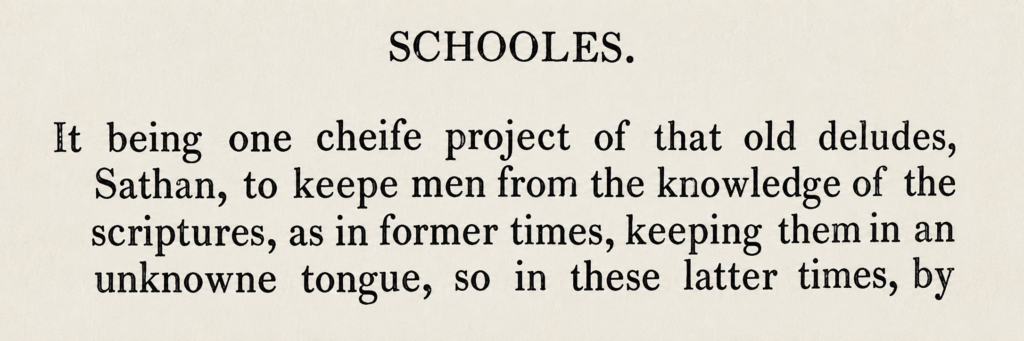
For example, the “Old Deluder Satan Act” from the Code of 1650 required towns with at least 50 households to establish a public school. According to the law, education was important because it helped ensure that the population could know the Bible rather than remain ignorant of God’s Word, like Europeans during the Dark Ages.
The Bible in Early American Classrooms
The influence of the Bible is evident in America’s earliest schoolbooks. The New England Primer, the first widely used textbook printed in the colonies, taught children to read through Bible passages, moral lessons, and shortened versions of Biblical catechisms.
Early schools often used other catechisms—a question-and-answer method of teaching. While many catechisms focused on Biblical instruction, others taught subjects such as entomology, music, ancient history, and the US Constitution.
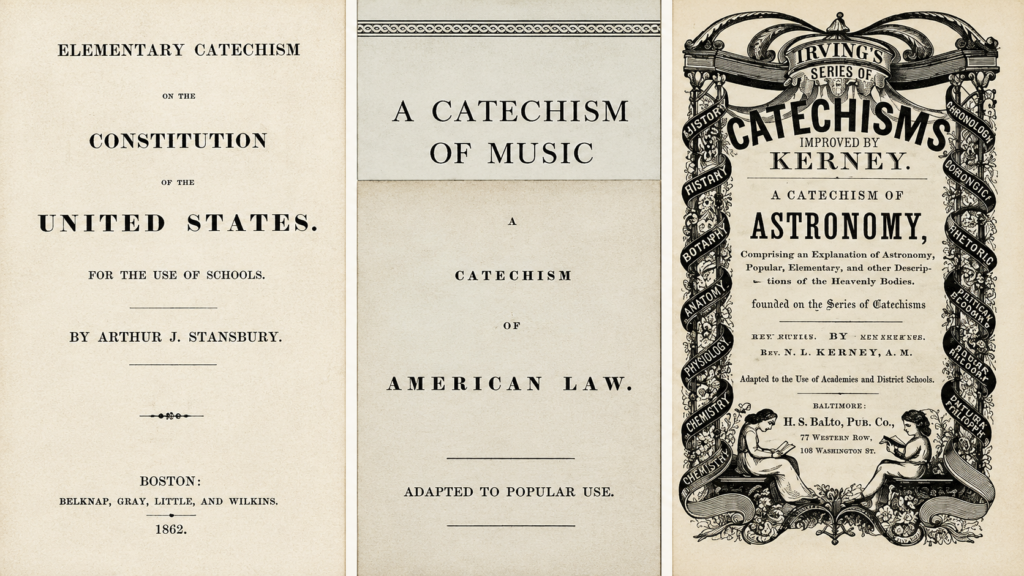
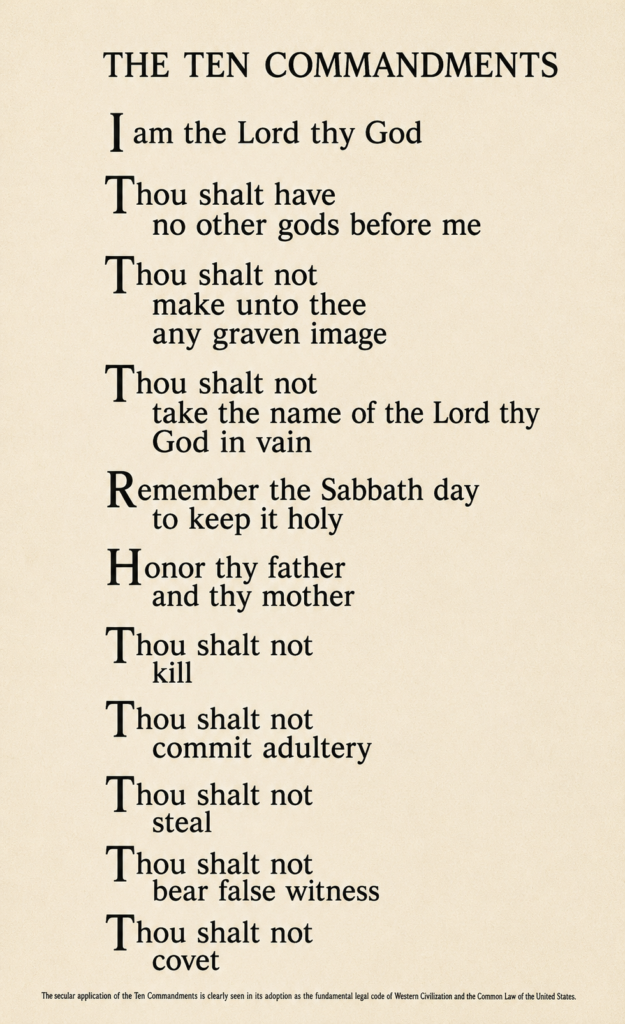
Other well-known textbooks also emphasized Biblical values. Noah Webster’s famous The American Spelling Book, often called the “Blue-Backed Speller,” included moral lessons that referenced the Ten Commandments. McGuffey’s readers, used by millions of students during the nineteenth century, combined reading instruction with the Ten Commandments and lessons on honesty, responsibility, respect, and other virtues rooted in biblical principles.
These examples illustrate the significant role that biblical instruction and moral education played in American classrooms for many generations.
Progressive Educational Changes
During the twentieth century, the relationship between religion and public education changed through progressive policies and a series of Supreme Court decisions.
In Everson v. Board of Education (1947), the US Supreme Court misapplied Thomas Jefferson’s “a wall of separation between church and state” metaphor to its interpretation of the First Amendment. The Court not only ignored the context of Jefferson’s statement, but also neglected the broader historical context of Jefferson’s views and actions.
The Court continued in this misdirection in Lemon v. Kurtzman (1971), creating a three-part “Lemon test” to evaluate government actions involving religion. Using that framework, the Court later ruled in Stone v. Graham (1980) that Kentucky’s law requiring the posting of the Ten Commandments in public school classrooms was unconstitutional.2
In recent years, the Supreme Court has shifted away from the Lemon test. In American Legion v. American Humanist Association (2019), the Court emphasized the importance of the nation’s history and traditions when considering the relationship between the state and religion. Then, in Kennedy v. Bremerton School District (2022), the Court officially abandoned the Lemon test, directing lower courts to consider the original understanding of the First Amendment and the nation’s historical practices when deciding similar cases.
Influence Today
Today, as we look to our history and traditions—state laws encouraging Biblical literacy and textbooks that included Scripture and moral lessons—we can restore the Bible as a guide for America’s youth, just as it was in early American education.
To learn more about Christian influence in early American education, see Four Centuries of American Education. Or, own your own copy of The New England Primer and the Catechism on the Constitution.
See also: American History: “The New England Primer,” Library of Congress, Rare Books and Special Collection Division.
1 For example: “The Christian religion is the most important and one of the first things in which all children under a free government ought to be instructed…. No truth is more evident to my mind than that the Christian religion must be the basis of any government intended to secure the rights and privileges of a free people.” Noah Webster, “Schoolmaster to America” (Reply to a Letter of David McClure on the Subject of the Proper Course of Study in the Girard College, October 25, 1836,” A Collection of Papers on Political, Literary, and Moral Subjects, New York: Webster and Clark, 1843, 291). “The Bible … should be read in our schools in preference to all other books.” Benjamin Rush, signer of the Declaration of Independence (“A Defense of the Use of the Bible as a School Book, Addressed to the Rev. Jeremy Belknap, of Boston,” on March 10, 1791, Essays, 94, 100). “The Bible…. [is] a necessary part of a polite education.” Henry Laurens, President of the Continental Congress (letter to James Lawrenson on August 19, 1772, Papers of Henry Laurens, George C. Rogers, Jr. and David R. Chesnutt, editors, University of South Carolina Press, 1980, VIII:426-427).
2 For a broader history of the “separation of church and state” phrase, see David Barton, Original Intent: The Courts, The Constitution, and Religion (Aledo, TX: WallBuilder Press, 2008).
Still looking for answers? Visit our FAQ page
More Resources
America’s Black Robe Regiment Part 3
Part 3 – Faith in the Marketplace In this final article on the historic role of American pastors, we look at the influence of the young nation’s ministers in furthering biblical principles in government and society. Political Preachers Christian clergy not only largely defined America’s unique political theory and even defended it in military combat, […]
America’s Black Robe Regiment Part 2
Part 2 – Patriot Preachers In this, the second in the series on America’s Black Robe Regiment, we will chronicle how Revolutionary American ministers earned this epithet, and why they would become a target of the enemy. The Black Robe Regiment (or “the black Regiment”) was the slur used by the British to refer to […]
America’s Black Robe Regiment Part 1
For our first two centuries, Americans recognized and appreciated the indispensable role of ministers of the Gospel in securing both our civil and religious liberties. But in recent years, American culture has sequestered and sidelined her pastors. The universal church and her leaders were pushed out of the public square and told to stay in […]
Know the Truth and Protect Your Freedoms.
Still looking for answers? Visit our FAQ page

Stay Informed with the Latest Resources
Enter your email address to receive our regular newsletter, with important information and updates right in your inbox!