 For our first two centuries, Americans recognized and appreciated the indispensable role of ministers of the Gospel in securing both our civil and religious liberties. But in recent years, American culture has sequestered and sidelined her pastors. The universal church and her leaders were pushed out of the public square and told to stay in their own lane.
America owes much to the fact that historically, the church has done just the opposite. The following articles examine some of the ways in which the people of God and the pulpits were instrumental in securing freedom for this country making America the standard for liberty around the World.
Part 1 Colonial Clergy
Clergy Establish American Colonies
The early settlers who arrived in Virginia beginning in 1606 included ministers such as Revs. Robert Hunt, Richard Buck, William Mease, Alexander Whitaker, and William Wickham. In 1619 these and others helped form America’s first representative government: the Virginia House of Burgesses, with its members elected from among the people.1 That legislature met in the Jamestown church and was opened with prayer by Rev. Bucke; the elected legislators then sat in the church choir loft to conduct legislative business.2 As Bishop Galloway later observed:
The first movement toward democracy in America was inaugurated in the house of God and with the blessing of the minister of God.3
In 1620, the Pilgrims began to establish their colony in Plymouth. Their pastor, John Robinson, charged them to elect civil leaders who would not only seek the “common good,” but who would also eliminate special privileges and status between governors and the governed,4 a radical departure from the practice in the rest of the world at that time. The Pilgrims eagerly took that message to heart, organizing a representative government and holding annual elections.5 By 1636, they had also enacted a citizens’ Bill of Rights—America’s first.6
In 1630, the Puritans founded the Massachusetts Bay Colony, and under the leadership of their ministers, they, too, established representative government with annual elections.7 By 1641, they also had established a Bill of Rights (the “Body of Liberties”), a document of individual rights drafted by Rev. Nathaniel Ward.8
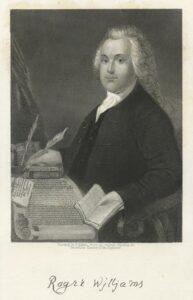
Seeking freedom of conscience, Rev. Roger Williams left the Massachusetts Bay Colony and established one farther south, the Rhode Island Colony. Its representative form of government9 ensured that “the sovereign power of all civil authority is founded in the consent of the people.”10
The same year, Rev. Thomas Hooker (along with Revs. Samuel Stone, John Davenport, and Theophilus Eaton) founded Connecticut. They not only established an elective form of government,11 but in a 1638 sermon based on Deuteronomy 1:13 and Exodus 18:21, Rev. Hooker explained the three Biblical principles that had guided the plan of government in Connecticut:
- The choice of public magistrates belongs unto the people by God’s own allowance.
- The privilege of election… belongs to the people…
- They who have power to appoint officers and magistrates [i.e., the people], it is in their power also to set the bounds and limitations of the power and place.12
Colonial Charters & Constitutions
From Rev. Hooker’s teachings and leadership sprang the “Fundamental Orders of Connecticut,” America’s first written constitution (and the direct antecedent of the federal Constitution).13 While it was America’s first written constitution, it was certainly not America’s first written document of governance. Such written documents had been the norm for every colony founded by biblically minded Christians. After all, that was the Scriptural model. God gave Moses a fixed written law to govern the nation of Israel (c.f., Deuteronomy 17:18-20, 31:24-26, II Chronicles 34:15-21, etc.). Renowned Cornell University professor Clinton Rossiter observed:
The Bible gave a healthy spur to the belief in a written constitution. The Mosaic Code, too, was a higher law that men could live by, and appeal to, against the decrees and whims of ordinary men.14
Written documents of governance placed direct limitations on government and gave citizens maximum protection against the rapacious whims of all-too-human leaders. This practice of providing written documents was the practice of American ministers before the Rev. Hooker’s constitution of 1638 and continued long after.
For example, New Jersey was chartered in 1676 and then divided into two religious sub-colonies: Puritan East Jersey and Quaker West Jersey. Each maintained a representative government with annual elections.15 Minister William Penn wrote the governing document for West Jersey. He explained:
We lay a foundation for after ages to understand their liberty… that they may not be brought in bondage but by their own consent, for we put the power in the people.16
Under Penn’s document:
Legislation was vested in a single assembly elected by all the inhabitants; the elections were to be by secret ballot; the principle of “No taxation without representation” was clearly asserted; freedom of conscience, trial by jury, and immunity from arrest without warrant were guaranteed.17
In 1681, Penn wrote the Frame of Government for Pennsylvania. It, too, established annual elections and provided numerous guarantees for citizen rights.18
Ministers Help Secure Liberties
There are many additional examples, but it is indisputable that ministers played a critical role in instituting and securing America’s most significant civil rights and freedoms. Founding Father Noah Webster explained:
The learned clergy . . . had great influence in founding the first genuine republican governments ever formed and which, with all the faults and defects of the men and their laws, were the best republican governments on earth. At this moment, the people of this country are indebted chiefly to their institutions for the rights and privileges which are enjoyed.19
Daniel Webster (the great “Defender of the Constitution”) agreed:
To the free and universal reading of the Bible in that age, men were much indebted for right views of civil liberty.20
Because Christian ministers established in America freedoms and opportunities not generally available even in the mother country of Great Britain, they were also at the forefront of resisting encroachments on the civil and religious liberties that they had helped secure.
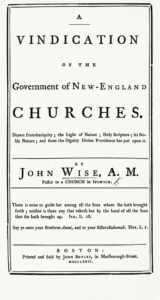
For example, when crown-appointed Governor Edmund Andros tried to seize the charters of Rhode Island, Connecticut, and Massachusetts, revoke their representative governments, and force the establishment of the British Anglican Church upon them, opposition to Andros’ plan was led by Revs. Samuel Willard, Increase Mather, and especially Rev. John Wise.21 Governor Andros even imprisoned Rev. Wise for his resistance. Nevertheless, he remained an unflinching voice for freedom, penning two works in 1710 and 1717 forcefully asserting that democracy was God’s ordained government in both Church and State.22 An historian has since titled him “The Founder of American Democracy.”23
And when Governor Berkley refused to recognize Virginia’s self-government, Quaker minister William Edmundson and Rev. Thomas Harrison led the opposition.24 When Governor Thomas Hutchinson ignored the elected Massachusetts legislature, Rev. Dr. Samuel Cooper led the opposition.25
Reverend Wise, Founder of American Democracy
In the future, Christian ministers would provide courageous leadership throughout the War for Independence, but not before they were largely responsible for laying its intellectual foundation. To understand more of their influence, consider Rev. John Wise.
As early as 1687, the Rev. Wise was already teaching that “taxation without representation is tyranny,”26 the “consent of the governed” was the foundation of government,27 and that “every man must be acknowledged equal to every man.”28 In 1772 with the Revolution on the horizon, the Sons of Liberty reprinted two of Wise’s works to refresh Americans’ understanding of the core Biblical principles of government.29 (The first printing sold so fast that a second reprint was quickly issued.30) Significantly, many of the specific points made by Wise in those works subsequently appeared four years later in the very language of the Declaration of Independence. Historian Benjamin Morris observed in 1864:
Some of the most glittering sentences in the immortal Declaration of Independence are almost literal quotations from this [1772 reprinted] essay of John Wise. . . . It was used as a political textbook in the great struggle for freedom.31
Twentieth century historian, Duke University’s Alice Baldwin concurred:
There is not a right asserted in the Declaration of Independence which had not been discussed by the New England clergy before 1763.32
And President Calvin Coolidge in a 1926 speech in Philadelphia on the 150th anniversary of the Declaration of Independence, similarly acknowledged:
The thoughts [in the Declaration] can very largely be traced back to what John Wise was writing in 1710.33
It was Christian ministers such as John Wise (and scores like him) who, through their writings, Election Sermons, and other sermons on the Biblical principles of government, laid the intellectual basis for American Independence.
Continue The Series
Discover how American ministers not only laid the foundation for American Independence, but also put their lives on the line to secure it. (Part 2)
Discover how American pastors invested in their communities and the nation through involvement in government and education. (Part 3)
Image credits: banner image: Rev. John Wise – Saul Levine, Ipswich Tax Resistance—1687 (1941), Ipswich, Massachusetts, post office; image used with the permission of the United States Postal Service®. All rights reserved. Roger Williams – From The New York Public Library, The Miriam and Ira D. Wallach Division of Art, Prints and Photographs: Print Collection, https://digitalcollections.nypl.org/items/9f8d7d60-c608-012f-972a-58d385a7bc34.
1 Charles E. Hatch, America’s Oldest Legislative Assembly and Its Jamestown Statehouses (Washington: National Park Service Interpretive Series History No. 2, 1956), 4.
2 Charles B. Galloway, Christianity and the American Commonwealth (Nashville: Publishing House Methodist Episcopal Church South, 1898), 112-114; John Fiske, Civil Government in the United States Considered with some Reference to Its Origins (Boston: Houghton, Mifflin & Co., 1890), 152.
3 Galloway, Christianity (1898), 114.
4 John Robinson’s Farewell Letter, July 1620, William Bradford, History of Plymouth Plantation, ed., Charles Deane (Boston: 1856), 64-67.
5 Records of the Colony of New Plymouth in New England, ed., David Pulsifer (Boston: William White, 1861), 10, Orders agreed on a several times of the General Good of the Colony and the Better Government and preservation of the same, Part 1; see also, Christopher Fennell, “Plymouth Colony Legal Structure,” Plymouth Colony Archive Project, 1998, http://www.histarch.illinois.edu/plymouth/ccflaw.html;
6 The Compact with the Charter and Laws of the Colony of New Plymouth, ed., William Brigham (Boston: Dutton and Wentworth, 1836), 36-42, November 15, 1636 “Code of 1636”; see also, George L. Haskins, “The Legal Heritage of Plymouth Colony,” University of Pennsylvania Law Review 110, No. 6 (1962), 849, 854-855.
7 Henry William Elson, History of the United States of America (New York: The MacMillan Company, 1904), 105-108.
8 William H. Whitmore, A Bibliographical Sketch of the Laws of the Massachusetts Colony from 1630-1686 (Boston: Rockwell and Churchill, 1890), 7-8, 32-61, A Copy of the Liberties of the Massachusetts Colony in New England.
9 Charter of Rhode Island and Providence Plantations, July 15, 1663, “Rhode Island’s Royal Charter, Rhode Island Department of State, accessed July 29, 2026, https://www.sos.ri.gov/divisions/civics-and-education/for-educators/themed-collections/rhode-island-charter.
10 Roger Williams, The Bloody Tenet of Persecution for Cause of the Conscience Discussed in a Conference between Truth and Peace (1644), Chapter LXXIX, 114.
11 The Federal and State Constitutions, Colonial Charters, and Other Organic Laws, ed. Francis Newton Thorpe (Washington: Government Printing Office, 1909), 1:534, Charter of Connecticut, 1662.
12 Collections of the Connecticut Historical Society (Hartford: Published for the Society, 1860), 1:20, sermon by Thomas Hooker, May 31, 1638, notes recorded by Henry Wolcott, Jr.
13 John Fiske, The Beginnings of New England (Boston: Houghton, Mifflin & Co., 1898), 127-128.
14 Clinton L. Rossiter, Seedtime of the Republic (New York: Harcourt, Brace and Company, 1953), 32; see also, J. M. Mathews, The Bible and Civil Government, in a Course of Lectures (New York: Robert Carter & Brothers, 1851), 67-68.
15 Aaron Leaming and Jacob Spicer, The Grants and Concessions and Original Constitutions of the Province of New Jersey (Philadelphia: William Bradford, Second Edition, 1881), 423, Province of West New Jersey in America, November 25, 1681, Art. I; and 154-155, The Fundamental Constitutions for the Province of East New Jersey in America, Anno Domini 1683, Art. II-III.
16 William Penn, The Papers of William Penn (University of Pennsylvania Press, 1981), 1:416, to Richard Hartshorne, August 26, 1676.
17 Ernest Sutherland Bates, American Faith (New York: W. W. Norton & Company, 1940), 187.
18 Pennsylvania Charter to William Penn – March 4, 1681, Pennsylvania Historical & Museum Commission, accessed July 29, 2026, https://www.phmc.state.pa.us/portal/communities/documents/1681-1776/pennsylvania-charter.html.
19 Noah Webster, Letters of Noah Webster, ed. Harry R. Warfel (New York: Library Publishers, 1953), 455, to David McClure, October 25, 1836.
20 Daniel Webster, Address Delivered at Bunker Hill, June 17, 1843, on the Completion of the Monument (Boston: T. R. Marvin, 1843), 31.
21 Fiske, Beginnings of New England (1898), 267-272.
22 John Wise, The Churches Quarrel Espoused (Boston: John Boyles, 1772), 9; and A Vindication of the Government of New- England Churches (Boston: John Boyles, 1772), 46.
23 J. M. MacKaye, “The Founder of American Democracy,” The New England Magazine (September 1903), XXIX:1:73-83.
24 John Fiske, Old Virginia and Her Neighbors (Boston: Houghton, Mifflin, and Company, 1901), I:306, 311 & II:57.
25 William H. Sumner, A History of East Boston (Boston: J. E. Tilton and Company, 1858), 267, 364-365.
26 David Otis Mears, Oberlin Lectures of 1829: The Pulpit and the Pews (Oberlin: Edward G. Goodrich, 1892), 87.
27 John Wise, A Vindication (Boston: J. Allen, 1717, reprinted: Gainesville, FL: Scholars’ Facsimiles & Reprints, 1958), 7.
28 Wise, A Vindication of the Government (1717), 39.
29 Wise, A Vindication of the Government (1772); John Wise, Churches Quarrel Espoused (Boston: John Boyles, 1772).
30 Claude H. Van Tyne, The Causes of the War of Independence (Boston: Houghton Mifflin Company, 1922), I:357.
31 Benjamin F. Morris, Christian Life and Character of the Civil Institutions of the United States: Developed in the Official and Historical Annals of the Republic (Philadelphia: G.W. Childs, 1864), 341.
32 Alice M. Baldwin, The New England Clergy and the American Revolution (Durham: Duke University Press, 1928), 170.
33 Calvin Coolidge: “Address at the Celebration of the 150th Anniversary of the Declaration of Independence in Philadelphia, Pennsylvania,” July 5, 1926, The American Presidency Project, accessed May 25, 2020.
Still looking for answers? Visit our FAQ page
More Resources
America’s Black Robe Regiment Part 3
Part 3 – Faith in the Marketplace In this final article on the historic role of American pastors, we look at the influence of the young nation’s ministers in furthering biblical principles in government and society. Political Preachers Christian clergy not only largely defined America’s unique political theory and even defended it in military combat, […]
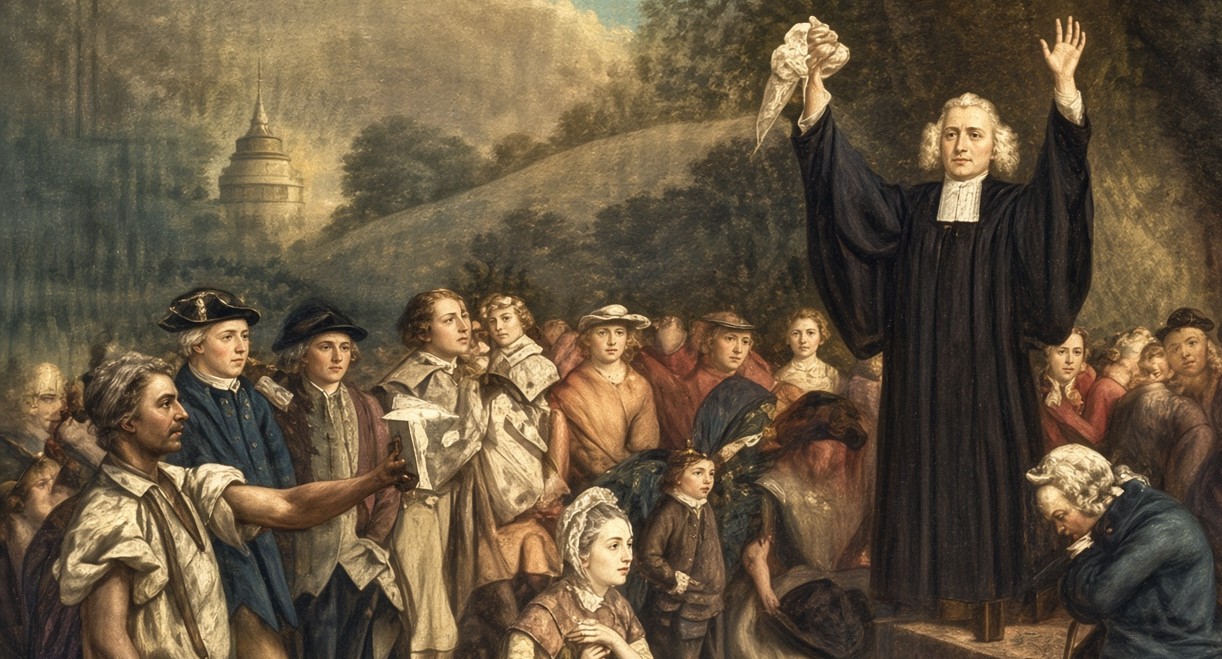
America’s Black Robe Regiment Part 2
Part 2 – Patriot Preachers In this, the second in the series on America’s Black Robe Regiment, we will chronicle how Revolutionary American ministers earned this epithet, and why they would become a target of the enemy. The Black Robe Regiment (or “the black Regiment”) was the slur used by the British to refer to […]
Georgia and Prayer
On February 5, 2026, David Barton was selected by the Georgia State Senate as Chaplain of the Day and opened its session with prayer. In his prayer, he thanked God for the blessings bestowed upon the state and its leaders, and asked that the prayers offered over Georgia across the previous three centuries would be […]
Know the Truth and Protect Your Freedoms.
Still looking for answers? Visit our FAQ page

Stay Informed with the Latest Resources
Enter your email address to receive our regular newsletter, with important information and updates right in your inbox!