On February 5, 2026, David Barton was selected by the Georgia State Senate as Chaplain of the Day and opened its session with prayer. In his prayer, he thanked God for the blessings bestowed upon the state and its leaders, and asked that the prayers offered over Georgia across the previous three centuries would be heard and answered.*
That prayer referenced events that stretched back to the colony’s earliest days.
Georgia’s Early History
Georgia was founded as an English colony in 1732. The Spanish had visited the region in the 1500s and 1600s, including Hernando de Soto’s 1540 expedition,1 but they established no permanent settlements.
British King George II approved the official measure that established the colony. He provided “the sum of ten thousand pounds to the trustees for establishing the Colony of Georgia in America.”2 The colony’s first town, Savannah, was laid out the following year in 1733.
The 1732 charter granted liberty of conscience in the worship of God as well as the free exercise of religion to all persons—except Roman Catholics. This was a limitation common in British colonies, especially as Georgia was facing an expanding Catholic Spanish presence in nearby Florida which occasionally affected Georgia, as in the Battle of Bloody Marsh.3
Also of significance, the charter did not require the formal establishment of the Anglican Church, which was the official Church of England at that time. The colony thus began with a broad acceptance of most other Christians,4 which was an unusual degree of religious liberty for that time.
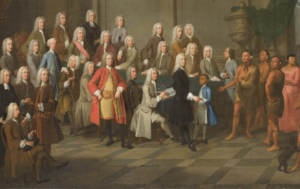
The colony of Georgia was founded as a Trustee Colony. This meant it was administered by a board of trustees that promised to work for the good of others instead of their own personal gain. The trustee board operated from London and relied on grants from Parliament to run the colony.
The original charter authorized the Georgia Trustees to govern for 21 years. However, a year early, in 1752, the Trustees transferred governance to the Crown along with their personal land claims in Georgia. This decision was made after Parliament refused further subsidies for the colony, rendering it’s trustee model functionally inoperable.
Georgia was then re-framed into a Royal Colony, which meant it was administered directly by the British government. The king himself would appoint the colony’s leaders and governors.
There were also several other types of English colonies in existence at that time. In addition to Trustee Colonies and Royal Colonies, there were:
- Proprietor Colonies, with a private owner (such as William Penn in Pennsylvania and Lord Baltimore in Maryland)
- Charter Colonies, which were founded under a separate and independent governing document (for example, Delaware, Rhode Island, and Connecticut).
- Converted Colonies. Oftentimes Charter or Trustee Colonies, for various reasons, were converted to government-administered Royal Colonies through acts of Parliament. For example, Virginia was founded as a Charter Colony in 1606, but when the sponsoring Virginia Company went bankrupt in 1624, it became a Royal Colony. Interestingly, by the time of the American Revolution, eight of the 13 colonies were Royal.
Colonial Chaplains
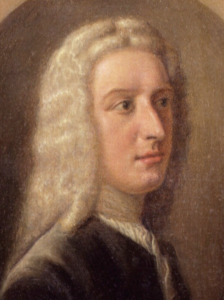
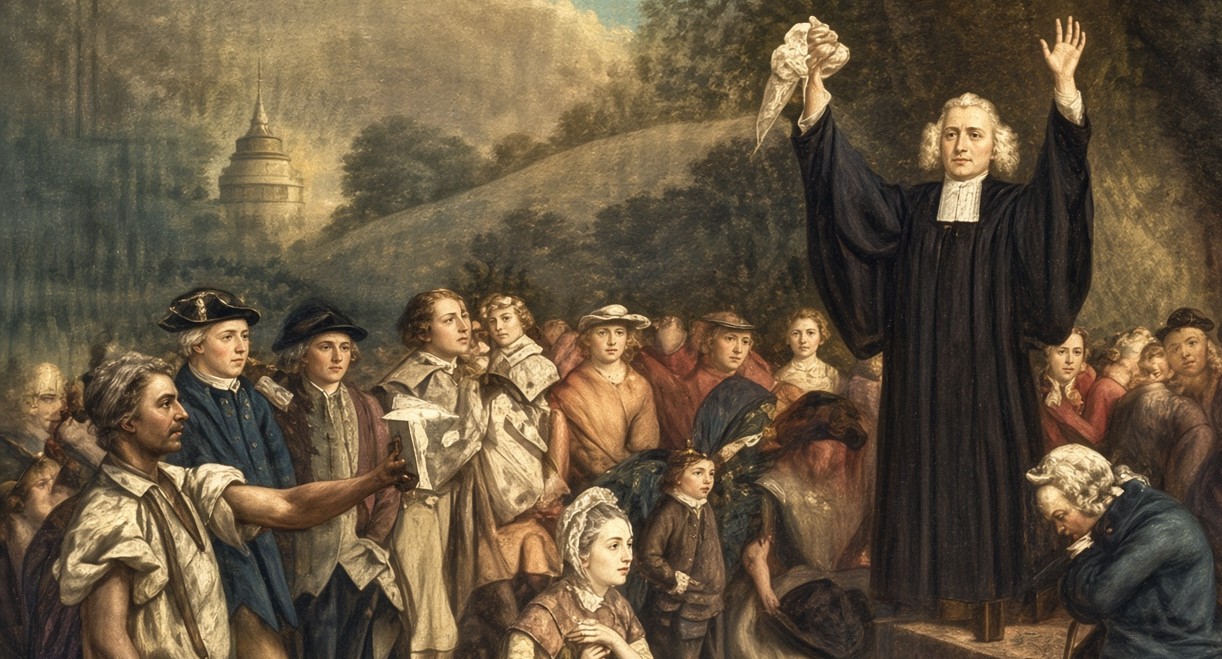
During Georgia’s two decades as a Trustee Colony, it had three remarkably famous ministers who served as early chaplains: the Revs. John Wesley, Charles Wesley, and George Whitefield. These three were Founders of the Methodist Church.
James Oglethorpe, the founder of Georgia, personally invited the Wesley brothers in 1735, and they arrived in early 1736.5 George Whitefield followed in 1738 at the invitation of the Wesleys, taking over for John.6
All three left a significant mark on the American colonies, but Whitefield’s influence was by far the greatest. During his 32-year ministry in the United States (1738-1770), Whitefield peached some 18,000 times, drawing huge crowds in churches, streets, and open fields.7 It is estimated that over 10 million people attended his meetings8—which means that many of America’s 3 million inhabitants at the time9 heard him speak multiple times.
Whitefield’s large numbers of sermons and attendees, combined with his messages transcending theological differences between denominations, made a lasting impact. According to Founding Fathers John Adams and Benjamin Franklin, America would not have come together as a nation had it not been for the lengthy influence and ministry of George Whitefield.10
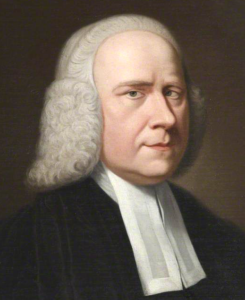
Whitefield founded Georgia’s Bethesda Orphanage (near Savannah) in 1740—one of the earliest and most ambitious charitable institutions in the southern colonies, still in operation today.11 (Three years earlier, in 1737, Lutheran refugees founded the Salzburger Orphanage in Ebenezer, Georgia, which inspired Whitefield’s efforts.) His orphanage combined practical care for orphans with a sound education and Gospel instruction.
Several original artifacts of these three early Georgia chaplains are preserved in the WallBuilders Collection. They were physically presented for the Senators’ inspection that morning after the prayer, including:
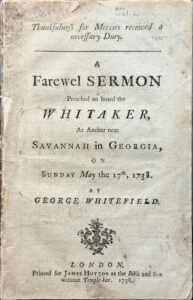
- George Whitefield’s first major message in America, given upon his arrival in Georgia,12 and another message upon his return to England after spending about a year in the colony.13
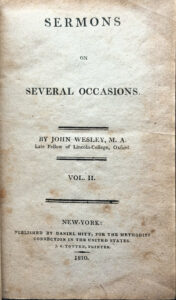
- A collection of early sermons by John Wesley.14
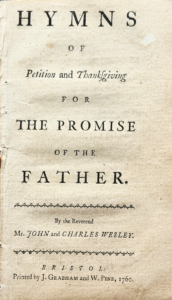
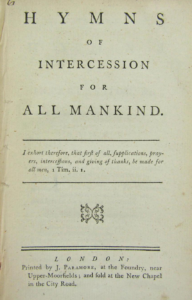
- Two early hymn books by Charles Wesley, one in 1758 and the other in 1767.15
Thoughts on Prayer
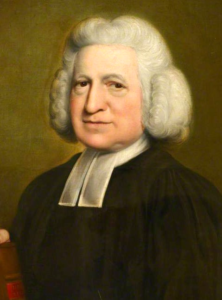
The Wesleys and Whitefield spoke often and earnestly about prayer. Some of the prayers they composed were shared specifically with the Senators that morning.
Among those Charles Wesley wrote in his hymns were these:
- Spirit of Heavenly counsel, come, teach our senators Thy will.16
- Father…let us that ask, receive; to us that ask in Jesus’s name, Thou shalt thy Spirit give….O send us now—the promised Comforter.17
- Father…everyone that asks receives—receives the gift and the Giver, too, and witnesses that Thou art true….So shall we pray, and never cease—so shall we thankfully confess Thy wisdom, truth, and power, and love.18
John Wesley, preaching on Jesus’ Sermon on the Mount, also addressed prayer, asking:
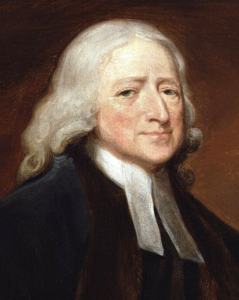
Does [God] command us…to pray without ceasing?19
He continued:
Prayer is the lifting up of the heart to God….Whenever therefore thou attemptest to pray, see that it be thy one design to commune with God—to lift up thy heart to Him—to pour out thy soul before Him….We pray that we may do the whole will of God as He willeth, in the manner that pleases Him. And…may [we] do it because it is His will—[Let this be] the whole and only motive of whatsoever we think, or whatsoever we speak, or do.20
George Whitefield addressed prayer on countless occasions, including in his sermon “Walking with God”:
A neglect of…prayer has been frequently an inlet to many spiritual diseases and has been attended with fatal consequences….“Praying always,” says the Apostle, “with all manner of supplication.” “Watch and pray,” says our Lord, “that ye enter not into temptation.”…He [intends] that our souls should be kept in a praying frame….[Prayer] brings and keeps God and man together….O believers…pray—pray without ceasing….When you are about the common business of life, be much in…prayer….[Prayers] will reach the very heart of God, and return to you again, loaded with spiritual blessings.21
Prayer was central to the spiritual vision of Georgia’s three early chaplains. That emphasis on prayer and faith remained a distinctive part of the state’s history,22 including with the still-ongoing daily opening of the State Senate with prayer.
Georgia & the American Republic
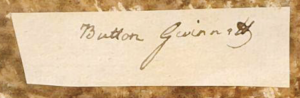
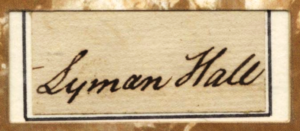
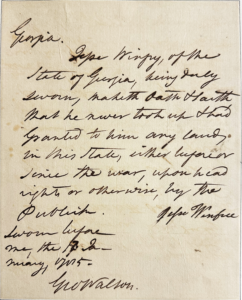
Four decades after Georgia’s founding, the Declaration of Independence established America as an independent nation. Georgia contributed three signers to that immortal document: Button Gwinnett, Lyman Hall, and George Walton. (Lyman Hall had studied theology and briefly served as a pastor before turning to medicine.) WallBuilders’ Collection and it sister organization, the American Journey Experience, hold original documents from all three men,23 which were shared with the Senators for their viewing and perusal.
Georgia officially transitioned from a British colony to an independent American state under its 1777 constitution.24 Button Gwinnett played a leading role in shaping that document. It included an important clause guaranteeing that “All persons whatever shall have the free exercise of their religion; provided it be not repugnant to the peace and safety of the State.”25 That constitution also established the state’s great seal, which carried the Latin motto “Deus nobis haec otia fecit,” meaning “God has bestowed these blessings on us.”26
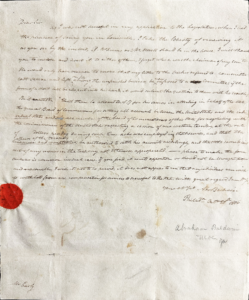
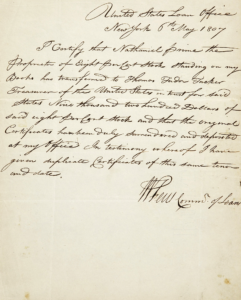
A decade later, when the US Constitution was written, Georgia’s signatories to that document were William Few and Abraham Baldwin. WallBuilders holds original documents from both men, which were shared with the Senators.27
From the prayers of the colony’s earliest chaplains to the faith expressed in the state’s first constitution, and on to the religious faith embraced by the state’s founders and early leaders, Georgia’s history has been marked by a consistent acknowledgment of dependence upon God.
The prayer and short public presentation offered in the Georgia State Senate by David Barton in 2026 stands as part of that long tradition.
* This is the full text of David’s prayer: “Lord, we thank You for all the blessings You have bestowed upon this state, and its leaders. May the prayers prayed over the past three centuries for this, Your people, be heard by You today, and answered by You. I ask this in Your name. Amen.”
Footnotes
1 “Hernando de Soto in Georgia,” January 3, 2019, New Georgia Encyclopedia, https://www.georgiaencyclopedia.org/articles/history-archaeology/hernando-de-soto-in-georgia/.
2 “An Act for enabling His Majesty…to pay…Ten Thousand Pounds to the Trustees for establishing the Colony of Georgia in America,” Anno Regini George II. Regis Magan Britannia, Francia & Hibernia, Sexto. At the Parliament Begun and Holden at Westminster, the Twenty third Day of January , Anno Dom 1727. In the First Year of the Reign of our Sovereign Lord George the Second (London: John Baskett, 1733), 448.
3 “Battle of Bloody Marsh,” October 31, 2018, New Georgia Encyclopedia, https://www.georgiaencyclopedia.org/articles/history-archaeology/battle-of-bloody-marsh/.
4 “Charter of Georgia: 1732,” The Avalon Project, https://avalon.law.yale.edu/18th_century/ga01.asp.
5 “John Wesley’s American parish,” General Commission on Archives & History, accessed August 11, 2026, https://gcah.org/landmarks/john-wesleys-american-parish/.
6 “Oglethorpe and Religion in Georgia,” Georgia Historical Society, accessed August 11, 2026, https://www.georgiahistory.com/resource/james-edward-oglethorpe/oglethorpe-and-religion-in-georgia/.
7 Appleton’s Cyclopaedia of American Biography, eds. James Grant Wilson and John Fiske (New York: D. Appleton and Company, 1889), 6:478, s.v. “Whitefield, George.”
8 Chambers’s Encyclopedia: A Dictionary of Universal Knowledge, eds. William & Robert Chambers (Philadelphia: J.B. Lippincott Company, 1901), 10:642, s.v. “Whitefield, George.”
9 See the numbers given by Patrick Henry in Sketches of the Life and Character of Patrick Henry, William Wirt (Philadelphia: James Webster, 1818), 123, speech on March 23, 1775; the same number is given by John Adams in his address “To the Inhabitants of the Colony of Massachusetts-Bay, 6 February 1775,” The John Adams Papers, ed. Robert J. Taylor (Cambridge: Harvard University Press, 1977), 2:246.
10 Benjamin Franklin, The Autobiography of Benjamin Franklin, ed. John Bigelow (Philadelphia: J.B. Lippincott & Company, 1868), 253, where Franklin acknowledged “It was wonderful to see the change soon made in the manners of our inhabitants. From being thoughtless or indifferent about religion, it seemed as if all the world were growing religious.” John Adams to Thomas Jefferson, December 3, 1813, The Writings of Thomas Jefferson, ed. Andrew A. Lipscomb (Washington DC: The Thomas Jefferson Memorial Association, 1904), 14:19-20, where Adams recounted the famous “Father Abraham” sermon by George Whitefield where he said denomination did not exist in Heaven and that all people had to do was fear God and work righteousness (Acts 10:35). See also David and Tim Barton, The American Story: The Beginnings, p. 105.
11 “Bethesda Orphan House,” National Gallery of Art, accessed August 11, 2026, https://heald.nga.gov/mediawiki/index.php/Bethesda_Orphan_House.
12 George Whitefield, Thankfulness for Mercies Received a Necessary Duty: A Farewell Sermon Preached on Board the Whitaker, at Anchor near Savannah in Georgia, on Sunday, May the 17th, 1738 (London: James Hutton, 1738).
13 George Whitefield, An Exhortation to Come and See Jesus: A Sermon Preached at Moorefield, May 20, 1739 (London: C. Whitefield, 1739).
14 John Wesley, Sermons on Several Occasions (New York: Daniel Hitt, 1810), II.
15 Charles Wesley, Hymns of Intercession for All Mankind (Bristol: E. Farley, 1758); Charles Wesley & John Wesley, Hymns of Petition and Thanksgiving for the Promise of the Father (Bristol: J. Grabham and W. Pine, 1767).
16 Charles Wesley, “A Prayer for the Parliament,” Hymns of Intercession (1758), 18.
17 Charles Wesley & John Wesley, Hymns of Petition and Thanksgiving (1767), 7.
18 Wesley & Wesley, Hymns of Petition and Thanksgiving (1767), 4.
19 John Wesley, “Upon Our Lord’s Sermon the Mount: Discourse V,” Sermons on Several Occasions (New York: Daniel Hitt, 1810), II:124.
20 Wesley, “Upon Our Lord’s Sermon the Mount: Discourse VI,” Sermons on Several Occasions (1810), II:149, 159-160
21 George Whitefield, “Walking with God,” Christian Classics Ethereal Library, https://www.ccel.org/ccel/whitefield/sermons.iv.html.
22 See, for example, “People in Georgia. Religious composition,” 2024, Pew Research Center, https://www.pewresearch.org/religious-landscape-study/state/georgia/?selectedYear=2024; “Georgia Ranks 9th Most Regions State in New 2025 Report,” August 19, 2025, Georgia Sun, https://thegeorgiasun.com/georgia-by-the-numbers/georgia-ranks-9th-most-religious-state-in-new-2025-report/.
23 Button Gwinnett Clipped Signature, undated, from WallBuilders Collection; Lyman Hall Clipped Signature, undated, from WallBuilders Collection; George Walton Signed Document as Chief Justice, September 1783, from American Journey Experience collection.
24 “The Constitution of the State of Georgia,” February 5, 1777, The Constitutions of the Several Independent States of America (Boston: Norman and Bowen, 1785), 155-166.
25 “The Constitution of the State of Georgia,” February 5, 1777, Constitutions (1785), 166.
26 “The Constitution of the State of Georgia,” February 5, 1777, Constitutions (1785), 166.
27 Abraham Baldwin handwritten letter to Eleazar Early, October 20, 1806, from WallBuilders Collection; William Few signed receipt, May 6, 1807, from WallBuilders Collection.
Still looking for answers? Visit our FAQ page
More Resources
America’s Black Robe Regiment Part 3
Part 3 – Faith in the Marketplace In this final article on the historic role of American pastors, we look at the influence of the young nation’s ministers in furthering biblical principles in government and society. Political Preachers Christian clergy not only largely defined America’s unique political theory and even defended it in military combat, […]
America’s Black Robe Regiment Part 2
Part 2 – Patriot Preachers In this, the second in the series on America’s Black Robe Regiment, we will chronicle how Revolutionary American ministers earned this epithet, and why they would become a target of the enemy. The Black Robe Regiment (or “the black Regiment”) was the slur used by the British to refer to […]
America’s Black Robe Regiment Part 1
For our first two centuries, Americans recognized and appreciated the indispensable role of ministers of the Gospel in securing both our civil and religious liberties. But in recent years, American culture has sequestered and sidelined her pastors. The universal church and her leaders were pushed out of the public square and told to stay in […]
Know the Truth and Protect Your Freedoms.
Still looking for answers? Visit our FAQ page

Stay Informed with the Latest Resources
Enter your email address to receive our regular newsletter, with important information and updates right in your inbox!