As a result of the increased attention that Americans are now paying to Freemasonry, there has been a growing number of claims about the relationship of Freemasonry to America’s Founding Fathers and the nation they created. From the outset, we must acknowledge: Freemasonry is a non-Christian organization that, especially after the early 1800s, became an explicitly anti-Christian one. Yet many of the claims made about Freemasonry and its influence in the Founding Era are greatly exaggerated and historically incorrect. Below are five important points to know when addressing the topic of Freemasonry and the Founding Fathers.
1. Relatively few of the Founding Fathers were Freemasons.
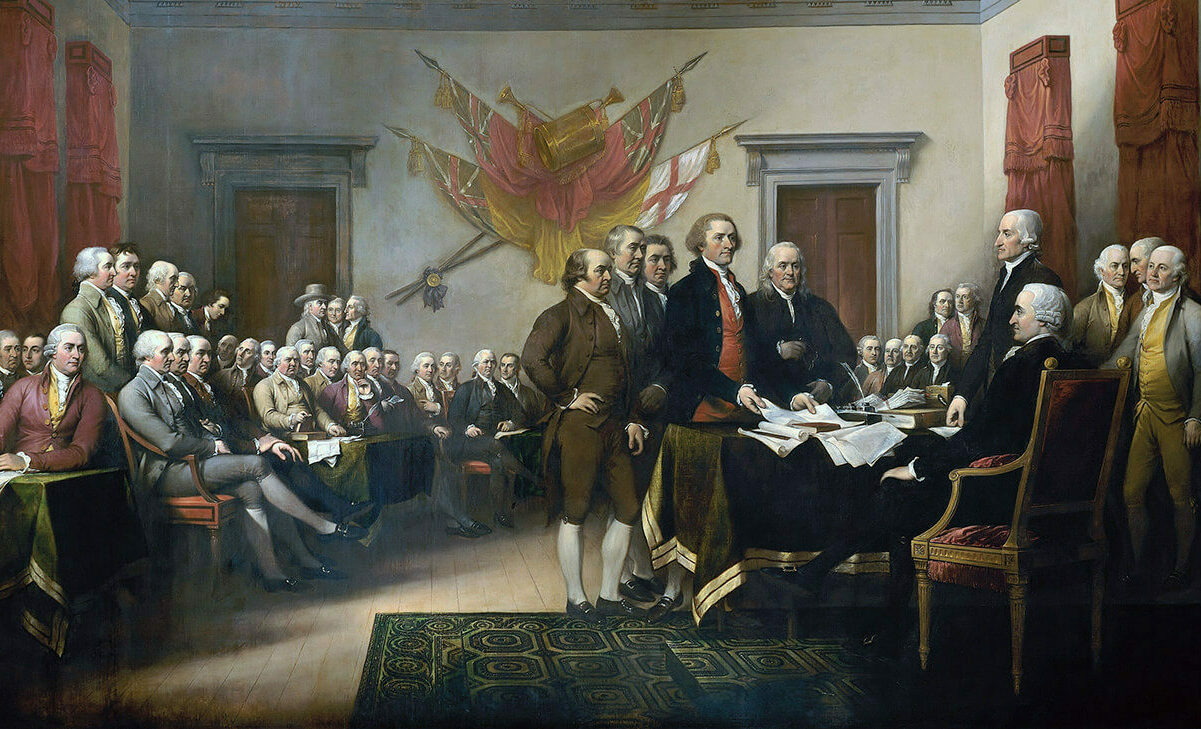
Of those who signed the Declaration of Independence, a maximum of one in six (16%) could be considered Freemasons;1 and of the delegates to the Constitutional Convention that formed the US Constitution, it was at most one in four (25%).2 These numbers represent the highest number possible based on even the scantest evidence and include not only the inactive Masonic Founders but also those with inconclusive evidence of alleged Masonic activity. Those with indisputable evidence of having been Freemasons actually represent a much lower percentage than the maximum number indicated.
Founders such as Thomas Jefferson, Alexander Hamilton, John Adams, James Madison, Charles Carroll, John Jay, Samuel Adams, and so many others who have been accused of being Freemasons were not. These modern claims cite no contemporary evidence from the lives of the signers and are flatly wrong.
2. Even among the few Founders who were Freemasons, Freemasonry did not exert significant influence on their thinking or behavior.
As an example, Constitution signer John Dickinson became a Mason on January 11, 1780, but his membership was followed by the notation in the Masonic records: “Never since appeared in Lodge.”3 Declaration signer William Hooper became a Freemason, but then the Lodge of which he was a member ceased to exist,4 and no records have been found of his attending any other Lodge. Constitution signer James McHenry became a Freemason on May 21, 1806; but his entry in the records is followed by the notation, “Struck off, 1809,”5 after only three years in the organization.
Given the small percentage of Founders who had any affiliation with Freemasonry and given the weakness of the influence that Masonry asserted on the small handful that did have a connection, Freemasonry’s influence on the American Founding is far less significant than what modern conspiracies claim.
3. George Washington was an inactive Freemason, and Freemasonry was not a formative influence in his life. Washington was first and foremost a Christian.
Washington’s Involvement
William Adrian Brown, former librarian at the George Washington Masonic Memorial in Alexandria, Virginia, compiled a chronological list of George Washington’s life activities.6 In his research, he identified Washington as an active participant in only 14 Masonic activities during his 47 years of being a Freemason. Moreover, according to Mark A. Tabbert, who most recently served as Director of Museum Collections at the George Washington Masonic National Memorial, only ten of those activities involved attendance at a Masonic lodge.7 For comparison, this means that an atheist who only attends church with their grandparents once a year on Christmas is attending church more frequently than George Washington attended lodge. In other words, the genuine Masonic activities in which Washington participated were few and far between.
In the late 1790s, the Rev. G. W. Snyder wrote George Washington with concerns about the influence of Freemasonry in Europe, wrongly believing him to be an active Mason. Learning this, Washington wrote him to “correct an error you have run into of my presiding over the English lodges in this country. The fact is I preside over none, nor have I been in one more than once or twice within the last thirty years.”8
Abundant historical evidence affirms that Freemasonry was not a defining influence in Washington’s life; instead, it was his Christianity which was central to his identity.
Washington’s Beliefs
Testimonies abounded from Washington’s contemporaries confirming his Christianity. For example:
A Christian, in faith and practice, he was habitually devout. His reverence for religion is seen in his example, his public communications, and his private writings.9 JARED SPARKS, HISTORIAN AND BIOGRAPHER
Without making ostentatious professions of religion, he was a sincere believer in the Christian faith, and a truly devout man.10 JOHN MARSHALL, CHIEF JUSTICE OF THE UNITED STATES, LIEUTENANT AND CAPTAIN IN THE WAR FOR INDEPENDENCE, BIOGRAPHER OF GEORGE WASHINGTON
George Washington. . . . respects God’s Word, believes in the atonement through Christ, and bears himself in humility and gentleness.11 THE REV. HENRY MELCHIOR MUHLENBERG, PASTOR; FOUNDER OF THE LUTHERAN CHURCH IN AMERICA, LIVED NEAR VALLEY FORGE
[I]f we cannot aspire at his talents as a General, a President, or a Statesman, we may imitate his virtues as a man, a citizen, and a Christian.12 ABIEL HOLMES, REVOLUTIONARY SURGEON; HISTORIAN
Christianity is the highest ornament of human nature. Washington practiced upon this belief. . . . He was neither ostentatious nor ashamed of his Christian profession.13 JEREMIAH SMITH, REVOLUTIONARY SOLDIER; U.S. CONGRESSMAN; GOVERNOR OF NEW HAMPSHIRE
As Commander-in-Chief of the Continental Army, Washington told his soldiers, “To the distinguished Character of Patriot, it should be our highest Glory to add the more distinguished Character of Christian.”14 As president, he issued multiple proclamations calling the nation to prayer before Almighty God.15 Over his lifetime, Washington personally acknowledged the direct intervention and Providence of God on more than 250 occasions.16
Perhaps the most concise testimony of George Washington’s overt Christian faith comes from Nelly Custis, Washington’s adopted daughter. In a letter she wrote to Jared Sparks, a chaplain of Congress, Nelly forcefully declared:
I should have thought it the greatest heresy to doubt his firm belief in Christianity. His life, his writings, prove that he was a Christian. . . . . As well may we question his patriotism—his heroic, disinterested devotion to his country.17
4. There is no evidence of Masonic influence in the design of Washington, DC.
Neither of the two men (Pierre Charles L’Enfant and Andrew Ellicot) who were responsible for the actual creation of Washington, DC’s original city layout in the 1790s were Freemasons. Nor are there any primary sources from this period suggesting any Freemasonic influence. In fact, the current claim that the street layout of Washington, DC, was designed to imitate a Freemasonic symbol did not even emerge until the 1980s.
The burden of proof lies with those claiming that Washington, DC was designed with Masonic symbolism, but the claim lacks any good evidence to which they can point. Significantly, any city with multiple diagonal avenues crossing a grid or converging on plazas will generate multi-pointed shapes if you selectively connect intersections. By this logic, the Freemasonic trope claimed to be unique to Washington DC could be identified in nearly any major city.
5. The Bible was the primary influence on the Founding Fathers
In his book The Origins of American Constitutionalism, Donald Lutz reports the findings of his team of political scientists who embarked on a project to analyze the political writings, compacts, constitutions, and charters from the Founding Era (1760-1805). Their goal was to isolate and identify the specific works quoted in those writings. If the sources of the specific quotes in those writings could be identified, then the origin of the Founders’ political ideas could be documented.
Beginning with some 15,000 representative writings, then finally reducing the focus to the most significant 916 that had explicit political content, the researchers isolated 3,154 direct quotations and then documented the origins of those quotations. Their research revealed the single most cited authority in the writings of the Founding Era was the Bible: thirty-four percent of the documented quotes were taken from the Bible.18 (For context, the three most-cited individuals were Baron de Montesquieu [8.3% of quotations], William Blackstone [7.9%], and John Locke [2.9%]—each of whom was a Christian thinker; but the most cited source was the Bible.).19
Summary:
As more claims arise about the influence of Freemasonry over America’s Founding Fathers, it is important to test these claims against historical evidence. While a minority of the Founders had some association with Freemasonry, the evidence shows that both the number of Founders who were Masons and the influence of Freemasonry on those Founders has been overstated. To the contrary, the historical evidence points to Christianity as a far stronger influence on the Founders. Those pushing the narrative that Freemasonry was centerstage in the American founding are either misled about their nation’s history or being intentionally dishonest to disparage the Founding Fathers.
_______________________
Endnotes
1 The Grand Lodge of Pennsylvania lists 5 signers of the Declaration as Freemasons (see Ronald E. Heaton, Masonic Membership of the Founding Fathers (Silver Spring: Masonic Service Association, 1974), p. 93, “Philip Livingston,” quoting GL Proc. Pennsylvania, 1909, p. 463 – Report on Correspondence; while the Masonic Service Association lists a possibility of 9 signers of the Declaration as possible Freemasons (see Ronald E. Heaton, Masonic Membership of the Founding Fathers (Silver Spring: Masonic Service Association, 1974), p. xvi). The maximum of nine Declaration signers who might have been Masons are John Hancock, Benjamin Franklin, William Hooper, William Whipple, Joseph Hewes, Robert Treat Paine, Richard Stockton, George Walton, William Ellery. See also Paul M. Bessel’s website, “Freemasons & the U.S. Declaration of Independence” (at http://bessel.org/declmas.htm).
2 Henry Wilson Coil, Conversations on Freemasonry, Lewis C. Wes Cook, editor (Chicago: Macok Publishing and Masonic Supply Co. Inc., 1976), pp. 265-266. Those delegates include George Washington, Benjamin Franklin, Edmund Randolph, John Blair, David Brearley, Gunning Bedford Jr., Oliver Ellsworth, Rufus King, John Dickinson, Jacob Broom, William Pierce, and Daniel Carroll. And According to Coil, six other delegates became Freemasons after the Convention: William Davie Jr., James McHenry, John Mercer, William Patterson, Jonathan Dayton, and Daniel of St. Thomas Jenifer.
3 Brother Ronald E. Heaton, Masonic Membership of the Founding Fathers (Silver Spring: Masonic Service Association, 1974), p. 16.
4 Brother Ronald E. Heaton, Masonic Membership of the Founding Fathers (Silver Spring: Masonic Service Association, 1974), pp. 74, 31.
5 Brother Ronald E. Heaton, Masonic Membership of the Founding Fathers (Silver Spring: Masonic Service Association, 1974), p. 43.
6 William A. Brown, When & Where: A Chronology of the Life of George Washington (United States: William A. Brown, 1984).
7 Mark A. Tabbert, A Deserving Brother: George Washington and Freemasonry (University of Virginia Press, 2022).
8 Washington to G. W. Snyder, September 25, 1798, Writings of George Washington from the Original Manuscript Sources, ed. John C. Fitzpatrick (Washington, DC: United States Government Printing Office, 1941), XXXVI:453.
9 Jared Sparks, The Life of George Washington (Boston: Little, Brown, and Co.), 492.
10 John Marshall, The life of George Washington, written for the use of schools (Philadelphia: James Crissy, 1844), 376.
11 Henry Melchoir Muhlenberg, The Journals of Henry Melchoir Muhlenberg, Theodore Tappert and John Dobestein, translators (Philadelphia: Evangelical Lutheran Ministerium of Pennsylvania and Adjacent States, 1958), Vol. III, p. 149.
12 Abiel Holmes, The Counsel of Washington, Recommended in a Discourse Delivered at Cambridge, February 22, 1800 (Boston: Samuel Hall, 1800), p. 20.
13 Eulogies, p. 190, from an oration delivered by Jeremiah Smith on February 22, 1800.
14 Washington, “General Orders,” May 2, 1778, Writings of Washington, ed. Fitzpatrick (1934), 11:343.
15 George Washington, Proclamation—Day of National Thanksgiving, October 03, 1789; George Washington, Proclamation 6—Day of Public Thanksgiving, January 01, 1795.
16 Peter A. Lillback with Jerry Newcombe, George Washington’s Sacred Fire (Bryn Mawr: Providence Forum Press, 2006), 576.
17 From Jared Sparks, The Writings of George Washington (Boston: Ferdinand Andrews, 1838), Vol. XII, pp. 406-407.
18 Donald Lutz, The Origins of American Constitutionalism (Baton Rouge: Louisiana State University Press, 1988), 140-1.
19 Donald Lutz, The Origins of American Constitutionalism (Baton Rouge: Louisiana State University Press, 1988), 142.