Following the adoption of the US Constitution, all naturalizations were performed according to federal law. But since the fledgling government was still establishing its systems, Congress authorized local courts to handle such matters. A 1790 Congressional act granted the administration of naturalization to any common law court of record. The states continued to play a role until the early twentieth century when the naturalization process moved to full federal control under the Basic Naturalization Act of 1906.
The 1790 Act provided that, “any alien, being a free white person, who shall have resided within the limits and under the jurisdiction of the United States for the term of two years, may be admitted to become a citizen thereof, on application to any common law court of record, in any one of the states wherein he shall have resided for the term of one year at least, and making proof to the satisfaction of such court, that he is a person of good character, and taking the oath or affirmation prescribed by law, to ‘support the constitution of the United States.’”1 Added to this, Maryland law required that any person wishing to become a citizen of the state must “repeat and subscribe a declaration of his belief in the Christian religion.”2
As chief justice of the Supreme Court of Maryland, Samuel Chase was responsible to certify the naturalization oaths by affixing his testimonium clause.
Chase (1741-1811) was a member of the Continental Congress from Maryland where he signed the Declaration of Independence. He served as the chief justice of the criminal court of Baltimore starting in 1788 and later became the chief justice of the state of Maryland. President Washington appointed him to the US Supreme Court in 1796.
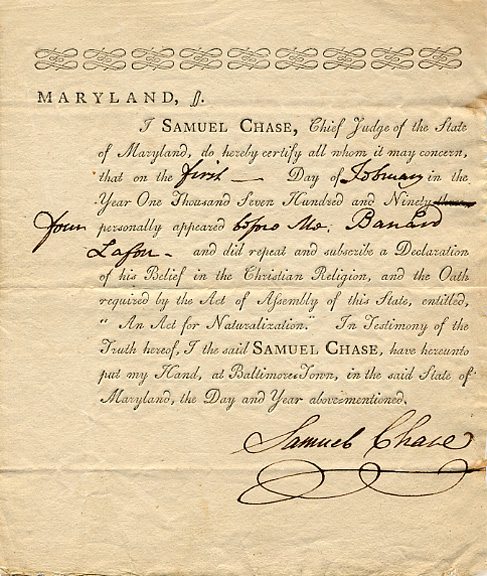 Document Signed, Samuel Chase, August 17, 1793, Baltimore, Maryland
[Transcript]
Maryland,
I Samuel Chase, Chief Judge of the State of Maryland, do hereby certify all whom it may concern, that on the Seventeenth Day of August in the Year One Thousand Seve Hundred and n\ Ninety-three, personally appeared before me, Leon Changeuv [uncertain] and did repeat and subscribe a Declaration of his Belief in the Christian Religion, and the Oath required by the Act of Assembly of this State, entitled, “An Act for Naturalization.” In Testimony of the Truth hereof, I the said SAMUEL CHASE, have hereunto put my Hand, at Baltimore Tonn, I the said State of Maryland, the Day and Year above mentioned.
Samuel Chase
[Reverse]
State of Maryland
Baltimore County, to wit
I George Pheeports, Notary Public by lawful authority commissioned and sworn, dwelling in Baltimore Town in the County and State aforesaid, Do hereby Certify Declare and make known, that the name, Samuel, subscribed to the within Certificate is the own proper Hand writing of the Honorable Samuel Chase, Esquire, and that the said Samuel Chase at the time he subscribed his name to the said Certificate was lawfully and duly appointed commissioned and qualified as Chief Judge of the said State of Maryland and that full Faith and Credit is and ought to be given to any acts by him done, as well in courts of Justice as thereout.
>In Faith and Testimony whereof I the said Notary have hereunto set my Hand and offered my Seal Notarial, on this Twenty-first Day of August in the Year of our Lord, one thousand seven hundred and ninety-three.
Geo Pheeports, Noty Pubc
Of Balt County
Endnotes
1 An Act to Establish an Uniform Rule of Neuralization, March 26, 1790, 103
2 An Act for Naturalization, July, 1779 printed in the Maryland Gazette, April 4, 1793.
Still looking for answers? Visit our FAQ page
More Resources
America’s Black Robe Regiment Part 3
Part 3 – Faith in the Marketplace In this final article on the historic role of American pastors, we look at the influence of the young nation’s ministers in furthering biblical principles in government and society. Political Preachers Christian clergy not only largely defined America’s unique political theory and even defended it in military combat, […]
America’s Black Robe Regiment Part 2
Part 2 – Patriot Preachers In this, the second in the series on America’s Black Robe Regiment, we will chronicle how Revolutionary American ministers earned this epithet, and why they would become a target of the enemy. The Black Robe Regiment (or “the black Regiment”) was the slur used by the British to refer to […]
America’s Black Robe Regiment Part 1
For our first two centuries, Americans recognized and appreciated the indispensable role of ministers of the Gospel in securing both our civil and religious liberties. But in recent years, American culture has sequestered and sidelined her pastors. The universal church and her leaders were pushed out of the public square and told to stay in […]
Know the Truth and Protect Your Freedoms.
Still looking for answers? Visit our FAQ page

Stay Informed with the Latest Resources
Enter your email address to receive our regular newsletter, with important information and updates right in your inbox!