Thoughts on Psalm 35
By September 1774, the tensions between America and Great Britain had been escalating for a decade and were reaching a boiling point. But despite that strain, Americans were largely still loyal to Great Britain. The colonies were vigorously pursuing reconciliation. The British, however, rejected their overtures and even responded with military force. British governors in America also disbanded legislative assemblies (i.e., Governors Dunsmore and Boutetout in Virginia and Wright in Georgia), attempting to impose hardfisted tyrannical rule.
The colonies decided that the time had come to act together rather than individually. In May 1774, Virginia called for a Continental Congress,1 as did New York2 and others. They hoped that by speaking with a unified voice, Britain would no longer ignor their grievances and they could reach an understanding. Specifically, they were seeking a repeal of the Intolerable or Coercive Acts, including those disbanding colonial juries, replacing elected American officials with unelected ones appointed by the Crown, and requiring British troops to be boarded in private homes
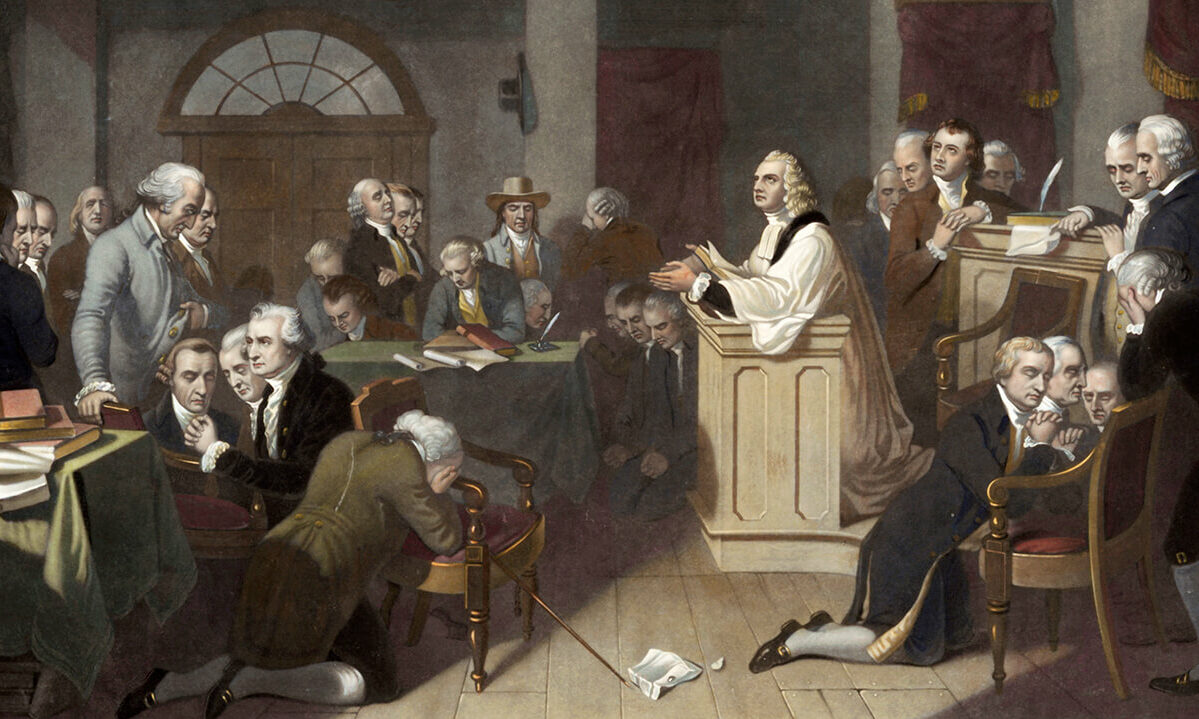
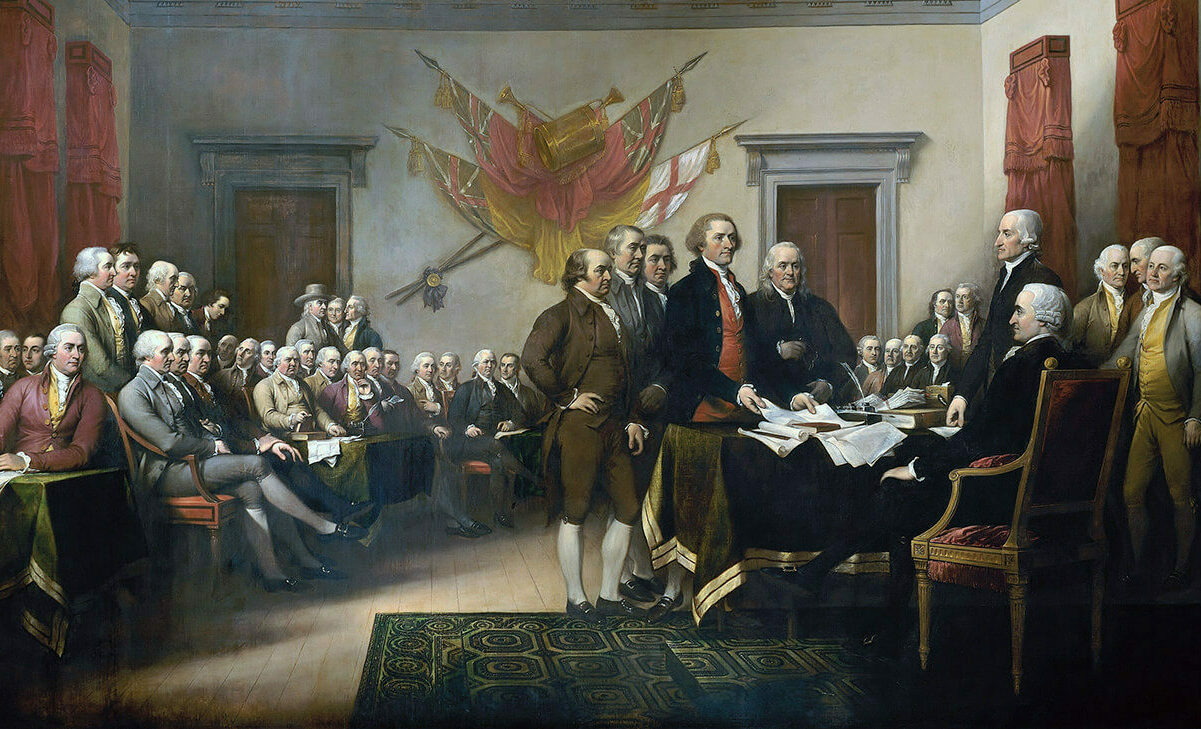
On September 5, 1774, forty-five delegates gathered in Philadelphia in what became known as the First Continental Congress. While each delegate was a significant figure in his own colony, most were unknown to the others. Incidentally, many went on to become nationally recognized political or military leaders, or even US Presidents.
Prayer Proposed
The delegates met one another and contemplated their course of action. John Adams reported their very first proposal after organizing themselves:
When the Congress first met, Mr. [Thomas] Cushing [of Massachusetts] made a motion that it should be opened with prayer.3
This apparently harmless suggestion met unexpected stiff resistance:
It was opposed by Mr. [John] Jay of New York and Mr. [John] Rutledge of South Carolina because we were so divided in religious sentiments—some Episcopalians, some Quakers, some Anabaptists, some Presbyterians, and some Congregationalists—that we could not join in the same act of worship.4
Strikingly, both of the opponents (Jay and Rutledge) were devoted Christians. In fact, John Jay (an author of the Federalist Papers and the original chief justice of the US Supreme Court) was a founder and president of the American Bible Society. He also wrote lengthy evangelical treatises on the Scriptures. These pious individuals opposed an opening prayer because the various delegates came from many different Christian denominations.
Today, it seems strange that a denominational difference might prevent one Christian from praying with another, but not then. Most of the colonies had official state-established denominations (i.e., Anglicans in Virginia, South Carolina, Maryland, North Carolina, and New York; Congregationalists in Connecticut, New Hampshire, and Massachusetts). The government-sanctioned denomination would sometimes persecute and even kill those from other denominations who preached or conducted religious services without authorization from the official church.5 But God had been preparing the colonists to overcome these abuses by helping Christians focus on the major Biblical teachings on which they all agreed rather than the nonessential denominational doctrines.
Whitefield’s “Faather Abraham” Sermon
This groundwork was laid by the national revival known as the Great Awakening (1730-1770) and was especially facilitated through the influence of English evangelist George Whitefield. Whitefield made seven missionary journeys to America, preaching across the country for thirty-four years on horseback, delivering 18,000 sermons.6 It is estimated that eighty percent of all Americans heard him preach,7 and his “Father Abraham” sermon was one of his more famous ones.
John Adams heard that sermon and recounted its message to Thomas Jefferson. In that sermon, Whitefield pretended to be at the gates of Heaven talking to Abraham:
He [Whitefield] began: “Father Abraham,” with his hands and eyes gracefully directed to the heavens (as I have more than once seen him): “Father Abraham, whom have you there with you? Have you Catholics?” “No.” “Have you Protestants?” “No.” “Have you Churchmen?” [Anglicans].“No.” “Have you Dissenters?” [Congregationalists]. “No.” “Have you Presbyterians?” “No.” “Quakers?” “No.” “Anabaptists?” [Baptists, Amish, Mennonites]. “No.” “Whom have you there? Are you alone?” “No.” “My brethren, you have the answer to all these questions in the words of my next text: “He who feareth God and worketh righteousness, shall be accepted of Him’’ [Acts 10:35].8 God help us all to forget having names and to become Christians in deed and in truth.9
Samuel Adams took the message of Whitefield’s popular “Father Abraham” sermon and practically applied it in that first gathering of Congress. After hearing Jay and Rutledge oppose the motion for prayer, he “arose and said he was no bigot, and could hear a prayer from a gentleman of piety and virtue, who was at the same time a friend to his country.”10 Adams added that because he was from Boston, he “was a stranger in Philadelphia, but had heard that [Rev.] Mr. [Jacob] Duché [pronounced Dooshay] deserved that character, and therefore he moved that Mr. Duché, an Episcopalian clergyman, might be desired to read prayers to the Congress tomorrow morning.”11
It is significant that Samuel Adams—an ardent Congregationalist (Puritan)—personally suggested having an Episcopal clergyman from the Church of England (a denomination greatly disliked by Congregationalists) deliver the original opening prayer in Congress. By this suggestion, Adams was implementing the Acts 10:35 message so long preached by Whitefield.
Interestingly, seventy years later in arguments before the US Supreme Court, the great Daniel Webster recalled this example, reminding the justices:
At the meeting of the first Congress, there was a doubt in the minds of many about the propriety of opening the session with prayer; and the reason assigned was, as here, the great diversity of opinion and religious belief. Until at last Mr. Samuel Adams, with his gray hairs hanging about his shoulders and with an impressive venerableness now seldom to be met with . . . rose in that assembly, and with the air of a perfect Puritan said it did not become men professing to be Christian men who had come together for solemn deliberation in the hour of their extremity to say that there was so wide a difference in their religious belief that they could not, as one man, bow the knee in prayer to the Almighty, Whose advice and assistance they hoped to obtain. . . . And depend upon it, that where there is a spirit of Christianity, there is a spirit which rises above form, above ceremonies, independent of sect or creed, and the controversies of clashing doctrines.12
When Two or More are Gathered
Adams’ Whitefield-like rebuke penetrated the hearts of the other delegates:
[Cushing’s] motion was seconded, and passed in the affirmative. Mr. [Peyton] Randolph [of Virginia], our President, waited on Mr. Duché. . . Accordingly, next morning he appeared with his clerk and in his pontificals.13
In the culture of that day, prayer was not nearly so casual as it is today; it was very formal. As Benjamin Franklin once noted, clergy “officiated” in prayer.14 And recall that when Samuel Adams moved for Jacob Duché to “read prayers in the established form,” Duché agreed and arrived “with his clerk and in his pontificals.” (He entered the assembly with an entourage and in his special ceremonial robes.) Prayers over public bodies at that time involved an orthodox ceremonial formality that deliberately conveyed a majestic reverence for Almighty God.
But Duché did much more than just “officiate” by “reading” prayers from the Book of Common Prayer. Surprising everyone present, he launched into an unforeseen but passionate and spontaneous prayer. According to John Adams:
Mr. Duché, unexpectedly to everybody, struck out into an extemporary prayer which filled the bosom of every man present.15
What was the effect?
I must confess I never heard a better prayer or one so well pronounced. . . .with such fervor, such ardor, such earnestness and pathos, and in language so elegant and sublime. . . .It has had an excellent effect upon everybody here.16
Several delegates including Samuel Adams,17 Joseph Reed,18 and Samuel Ward;19 commented on Duché’s remarkable prayer. Silas Deane reported that Duché’s prayer. . .
was worth riding one hundred mile to hear. He. . .prayed without book about ten minutes so pertinently, with such fervency, purity, and sublimity of style and sentiment, and with such an apparent sensibility of the scenes and business before us, that even Quakers shed tears.20
By the way, Deane’s comment that it was a prayer “worth riding one hundred mile to hear” is significant. In that day, riding one hundred miles meant three days in the saddle. Deane admitted that he would have willingly spent three days on horseback just to reach that gathering and hear that prayer. And the prayer was so powerful that it caused even the stern Quakers (the group most persecuted by Duché’s Anglican denomination) to “shed tears” as they listened.
While the exact wording of that first prayer is not known, we can ascertain the type of prayer from Duché’s continued service in the Second Continental Congress. Shortly after the Declaration of Independence was approved, Duché was appointed congressional chaplain21 and delivered this stirring prayer:
O Lord our heavenly Father, high and mighty King of kings and Lord of lords. . .over all the kingdoms, empires, and governments, look down in mercy, we beseech Thee, on these American States who have fled to Thee from the rod of the oppressor and thrown themselves on Thy gracious protection, desiring to be henceforth dependent only on Thee; to Thee have they appealed for the righteousness of their cause; to Thee do they now look up for that countenance and support which Thou alone canst give; take them, therefore, Heavenly Father, under Thy nurturing care; give them wisdom in council, and valor in the field; defeat the malicious designs of our cruel adversaries; convince them of the unrighteousness of their cause. . . .All this we ask in the name and through the merits of Jesus Christ, Thy Son and our Savior, Amen!22
Scripture Applied
A year later, it did not appear as if his prayer would be answered. The Americans had lost battle after battle, and British troops had invaded and seized his hometown of Philadelphia. During this gloomy outlook, Duché wrote George Washington, predicting American defeat and urging him to retract the Declaration of Independence. Washington refused, and Congress declared Duché a traitor, whereupon he fled to Great Britain. But late in life, after receiving permission from President Washington, Duché returned to America where he spent his remaining years.
But in that first gathering of Congress he did not just pray. According to John Adams, Duché also. . .
read the collect [Scriptures] for the seventh day of September, which was the thirty-fifth Psalm. You must remember this was the next morning after we heard the horrible rumor of the cannonade of Boston. I never saw a greater effect upon an audience. It seemed as if Heaven had ordained that Psalm to be read on that morning. . . .It has had an excellent effect upon everybody here. I must beg you to read that Psalm. . . .Read this letter and the 35th Psalm to [your friends]. Read it to your father [the Rev. William Smith, church pastor].23
Significantly, when the delegates gathered in Philadelphia, they heard a rumor that Boston was under attack. The Founders’ distress was palpable. They were still British citizens, and their own British army and navy was now besieging them. But Psalm 35 spoke directly to their growing fears.
Silas Deane noted that “the lessons [Scriptures] of the day, which were accidentally extremely applicable.”24 John Adams agreed that the reading of Psalm 35 on that day was not only “most admirably adapted” but also that was “Providential.”25
Significantly, when the Book of Common Prayer was written in 1662 under King Charles II, Psalm 35 was designated for reading on September 7 of each year. (Other assigned daily passages studied in Congress that morning included Amos 9, Matthew 8, and Psalm 36.) The fact that Psalm 35 was assigned to that day over a century earlier confirmed to the Founders that God knew what they would be facing and was watching over them. As one Founding Father expressed it, “the liberties of America are the object of Divine protection.”26
As you read Psalm 35, place yourself in the Founders’ circumstances. Imagine their mindset on that day, and consider the uncertainty that must have gripped their souls. Since this Psalm contains the prayers of a defenseless people attacked by a much stronger adversary, it is easy to understand why it so impacted the nation’s first Congress.
Endnotes
1 “An association, signed by 89 members of the late House of Bugesses,” May 27, 1774, Library of Congress, http://hdl.loc.gov/loc.rbc/rbpe.17801200.
2 “Letter from the New York Committee of Fifty-One to the Boston Committee of Correspondence; May 23, 1774,” The Avalon Project, http://avalon.law.yale.edu/18th_century/letter_ny_comm_1774.asp.
3John Adams to Abigail Adams, September 16, 1774, Familiar Letters of John Adams and His Wife Abigail Adams, During the Revolution, ed. Charles Francis Adams (Boston: Houghton, Mifflin and Company, 1875), 37.
4 John Adams to Abigail Adams, September 16, 1774, Familiar Letters, ed. Adams (1875), 37.
5 See, for example, James Madison to William Bradford, Jr., January 24, 1774, The Writings of James Madison (New York: G.P. Putnam’s Sons, 1900), 1:21; James Underwood and William Burke, The Dawn of Religious Freedom in South Carolina (Columbia: University of South Carolina Press, 2006), 167; Robert Semple, A History of the Rise and Progress of the Baptists in Virginia (Richmond: Robert Semple, 1810), 14, 29-30; A Companion to Thomas Jefferson, ed. Francis Cogliano, editor (Chichester: John Wiley & Sons, 2011), 78; Cyclopedia of Methodism, ed. Matthew Simpson (Philadelphia: Everts & Stewart, 1878), s.v. “Virginia.”
6 See, for example, John Gillies, Memoirs of Rev. George Whitefield (Middletown: Hunt & Noyes, 1838), 273; N. F. Bryant, The Household Monthly (Boston: N.F. Bryant, December 1859), III:3: 237, “Whitefield in America.”
7 See, for example, “George Whitefield: Did you Know,” April 1, 1993, Christian History; Dave Schleck, “CW to Recreate Visit of Famous Preacher,” December 15, 1995, Daily Press; Stephen Gorham, “The Divine Dramatist: George Whitefield and the Full Flowering of the Great Awakening,” February 26, 2012, American History, Suite 101.
8 John Adams to Thomas Jefferson, December 3, 1813, The Writings of Thomas Jefferson, ed. Andrew A. Lipscomb (Washington, DC: The Thomas Jefferson Memorial Association, 1904), XIV:19-20.
9 Stephen Mansfield, Forgotten Founding Father: The Heroic Legacy of George Whitefield (Nashville: Cumberland House, 2001), 86.
10 John Adams to Abigail Adams, September 16, 1774, Familiar Letters, ed. Adams (1875), 37.
11 John Adams to Abigail Adams, September 16, 1774, Familiar Letters, ed. Adams (1875), 37.
12 Daniel Webster, Mr. Webster’s Speech in Defence of the Christian Ministry, and In Favor of the Religious Instruction of the Young (Washington, DC: Gales and Seaton, 1844), 36-37.
13 John Adams to Abigail Adams, September 16, 1774, Familiar Letters, ed. Adams (1875), 37.
14 The Works of Benjamin Franklin, ed. John Bigelow (New York: G.P. Putnam’s Sons, 1904), XI:378, “Motion for Prayers in the [Constitutional] Convention.”
15 John Adams to Abigail Adams, September 16, 1774, Familiar Letters, ed. Adams (1875), 37.
16 John Adams to Abigail Adams, September 16, 1774, Familiar Letters, ed. Adams (1875), 37.
17 Samuel Adams to Joseph Warren, September 9, 1774, Letters of Delegates to Congress, ed. Paul H. Smith (Washington, DC: Library of Congress, 1976), I:55.
18 John Adams diary entry of September 10, 1774 The Works of John Adams, Second President of the United States, ed. Charles Francis Adams (Boston: Little, Brown and Company, 1850), II:377-378.
19 Samuel Ward’s diary entry of September 7, 1774, Letters of Delegates, ed. Smith (1976), I:45.
20 Silas Deane to Elizabeth Deane, September 7, 1774, The Silas Deane Papers (New York: New York Historical Society, 1887), I:20.
21 July 9, 1776, The Journals of the Continental Congress (Washington, DC: Government Printing Office, 1906), V:530.
22 James Thatcher, A Military Journal (Boston: Richardson and Lord, 1823), 145n.
23 John Adams to Abigail Adams, September 16, 1774, Familiar Letters, ed. Adams (1875), 37.
24 Silas Deane to Elizabeth Deane, September 7, 1774, Silas Deane Papers (1887), I:20.
25 John Adams diary entry of September 7, 1774, Works of John Adams, ed. Adams (1850), II:368.
26 George Washington, General Orders of September 26, 1780, The Writings of George Washington, ed. John C. Fitzpatrick (Washington: United States Government Printing Office, 1937), XX:95.
Still looking for answers? Visit our FAQ page
More Resources
America Reads the Bible!
Just as Ezra read the Word aloud to the people of Israel (Nehemiah 8:1–3), awakening revival and repentance, inspiring them to rebuild the temple, and working with Nehemiah to mobilize the people to rebuild Jerusalem’s walls, America Reads the Bible is a sacred opportunity to call our nation back to its spiritual foundations. Through a […]
His Desire to Answer Prayer
Thoughts on Matthew 6 Prayer has always been central to Biblical faith, highlighted in dozens of examples throughout the Scriptures. It was also deeply embedded in early American life. In fact, colonial, state, and federal governments issued over 1,400 official calls to prayer between 1620 and 1815.1 The Founding Fathers clearly were convinced of the […]
The Duty of Nations
Thoughts on Psalm 9:17 Proverbs 3:5–6 reminds us that in all our ways (public as well as private) we are to acknowledge Him. And while it is wisdom for individuals, it is also true of nations. In response to the idolatry of others or their failure to acknowledge God, Psalm 79:6 and Jeremiah 10:25 call […]
Know the Truth and Protect Your Freedoms.
Still looking for answers? Visit our FAQ page

Stay Informed with the Latest Resources
Enter your email address to receive our regular newsletter, with important information and updates right in your inbox!