Part 2 – Patriot Preachers
In this, the second in the series on America’s Black Robe Regiment, we will chronicle how Revolutionary American ministers earned this epithet, and why they would become a target of the enemy.
The Black Robe Regiment (or “the black Regiment”) was the slur used by the British to refer to the courageous and patriotic American clergy during the American War for Independence—a backhanded reference to their black clerical robes.1 Significantly, the British and their Loyalist allies blamed the Black Regiment for American Independence.2 For example, General William Howe’s secretary reported:
Among the causes of the present civil war, there is one, which . . . has operated as much as any to the general distraction . . . the circumstance of religion added to the very active and unbecoming part the preachers here of all denominations have taken in these controversies. . . . The war is . . . at the bottom very much a religious war.3
These complaints would often go on to name names and call out the “troublesome,” “rebellious,” and “seditious” outspoken ministers.
Leading To War for Independence
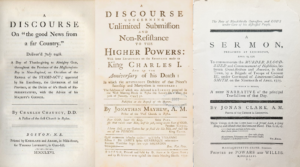
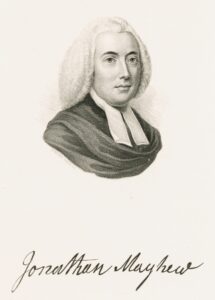 Because American preachers consistently opposed encroachments on civil and religious liberties, when the British imposed the 1765 Stamp Act (an early harbinger of the rupture between the two nations soon to follow), at the vanguard of the opposition to that act were Revs. Andrew Eliot, Charles Chauncey, Samuel Cooper, Jonathan Mayhew, and George Whitefield4 (Whitefield even accompanied Benjamin Franklin to Parliament to protest the Act and assert colonial rights5). In fact, one of the reasons American resistance to the Stamp Act became so widespread was the “clergy fanned the fire of resistance to the Stamp Act into a strong flame.”6
Five years later in 1770 when the British opened fire on their own citizens in the infamous “Boston Massacre,” ministers again stepped to the forefront, boldly denouncing Britain’s abuse of power. Revs. John Lathrop, Charles Chauncey, and Samuel Cooke specifically preached sermons on the subject.7 The Massachusetts House of Representatives even ordered that Rev. Cooke’s sermon be printed and distributed.8
As tensions with the British continued to grow, ministers such as Rev. George Whitefield and Rev. Timothy Dwight became some of the earliest leaders to defend America’s liberties and advocate separation from Great Britain.9
There are many additional examples, but the historical records respecting the leadership of the clergy were so clear that in 1851, distinguished historian Benson Lossing concluded:
The Puritan preachers also promulgated the doctrine of civil liberty, that the sovereign was amenable to the tribunal of public opinion and ought to conform in practice to the expressed will of the majority of the people. By degrees their pulpits became the tribunes of the common people; and. . . . on all occasions, the Puritan ministers were the bold asserters of that freedom which the American Revolution established.10
Preachers Take Up Arms
Christian minister’s involvement did not stop with rhetoric. They not only taught the principles that led to independence, but they also participated on the battlefield to secure it. One of the numerous examples is Rev. Jonas Clark.
When Paul Revere set off on his famous ride, it was to the home of Rev. Clark in Lexington, Massachusetts that he rode. Patriot leaders John Hancock and Samuel Adams were lodging (as they often did) with Rev. Clark. After learning of the approaching British forces, Hancock and Adams turned to Pastor Clark and inquired whether the local Patriots were ready to fight. Clark unhesitatingly replied, “I have trained them for this very hour!”11 When the original alarm sounded in Lexington to warn of the oncoming British menace, citizens gathered at the town green, and according to early historian Joel Headley:
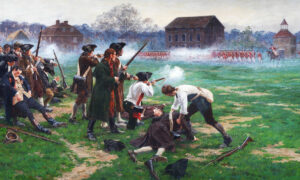
There they found their pastor the [Rev. Clark] who had arrived before them. The roll was called and a hundred and fifty answered to their names. . . . The church, the pastor, and his congregation thus standing together in the dim light [awaiting the Redcoats], while the stars looked tranquilly down from the sky above them.12
The British did not appear at that first alarm, and the people returned home. But following the subsequent alarm and ensuing battle, eighteen Americans lay on Lexington Green.
Eight were dead—seven of them from Rev. Clark’s church.13 Headley concluded, “The teachings of the pulpit of Lexington caused the first blow to be struck for American Independence,”14 and historian James Adams added that “the patriotic preaching of the Reverend Jonas Clark primed those guns.15
When the British troops left Lexington, they battled Patriots at Concord Bridge and then headed back to Boston, encountering increasing American resistance on their return. Significantly, many who awaited the British along the road were local pastors (such as Rev. Phillips Payson16 and Rev. Benjamin Balch17) who had heard of the unprovoked British attack, taken up their own arms, and rallied their congregations to meet the returning British. As word spread wider, pastors from other areas also responded.
When news reached Vermont, Rev. David Avery promptly gathered twenty men and marched toward Boston, recruiting additional troops along the way,18 and Rev. Stephen Farrar of New Hampshire led 97 of his parishioners to Boston.19 The ranks of resistance to the British swelled through the efforts of Christian ministers who “were far more effective than army recruiters in rounding up citizen-soldiers.”20
Weeks later when the Americans fought the British at Bunker Hill, American ministers again delved headlong into the fray. When Rev. David Grosvenor heard that the battle had commenced, he left from his pulpit, rifle in hand, and promptly marched to the scene of action,21 as did Rev. Jonathan French.22
This pattern was common through the Revolution, as when Rev. Thomas Reed marched to the defense of Philadelphia against British General Howe;23 Rev. John Steele of Pennsylvania led American forces in attacking the British;24 Rev. Isaac Lewis helped lead the resistance to the British landing at Norwalk, Connecticut;25 Rev. Joseph Willard raised two full companies and then marched with them to battle;26 when many of his parishioners were drafted, Rev. James Latta joined with them as a common soldier;27 and Rev. William Graham joined the military as a rifleman in order to encourage others in his parish to do the same.28
Furthermore:
Of Rev. John Craighead it is said that “he fought and preached alternately.” Rev. Dr. Cooper was captain of a military company. Rev. John Blair Smith, president of Hampden-Sidney College, was captain of a company that rallied to support the retreating Americans after the battle of Cowpens. Rev. James Hall commanded a company that armed against Cornwallis. Rev. William Graham rallied his own neighbors to dispute the passage of Rockfish Gap with Tarleton and his British dragoons.29
Clergy Targeted by British
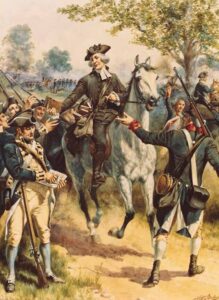 No wonder the British dubbed the patriotic American clergy the “Black Regiment.” And because of their strong leadership, the British often targeted ministers. Joel Headley related:
There was a class of clergymen and chaplains in the Revolution whom the British, when they once laid hands on them, treated with the most barbarous severity. Dreading them for the influence they wielded and hating them for the obstinacy, courage, and enthusiasm they infused into the rebels, they violated all the usages of war among civilized nations in order to inflict punishment upon them.30
Among those targeted was the Rev. Naphtali Daggett, President of Yale. When the British approached New Haven to take the town, Daggett offered stiff resistance to the invasion, operating alone on a hillside, where he fired down at the British troops below. Once captured, the British beat him with their musket butts and stabbed him multiple times with their bayonets. Local townspeople lobbied the British and eventually secured the release of the preacher, but Daggett never recovered from those wounds, which caused his death a little over a year later.31 When Rev. James Caldwell offered similar resistance in New Jersey, the British burned his church and he and his family were murdered.32
The British abused, killed, or imprisoned many other clergymen,33 who often suffered harsher treatment and more severe penalties than did ordinary imprisoned soldiers.34 The British not only targeted the ministers but also their churches. As a result, the British decimated ten of the nineteen church buildings in New York City,35 and most of the churches in Virginia suffered the same fate.36 This pattern was repeated throughout many other parts of the country.
Rev. Naphtali Daggett and Rev. James Caldwell were among the Patriots honored with a statue in Freedom Plaza in Washington, DC for the semiquincentennial celebration during the summer of 2026.
Continue The Series
Discover the many ways that colonial pastors shaped their communities and eventually American independence. (Part 1)
Discover how American pastors invested in their communities and the nation through involvement in government and education. (Part 3)
1 Boston Gazette, December 7, 1772, article by “Israelite,” and Boston Weekly Newsletter, January 11, 1776, article by Peter Oliver, British official; see also Peter Oliver, Peter Oliver’s Origin & Progress of the American Rebellion, eds. Douglas Adair and John A. Schutz (San Marino California: The Huntington Library, 1961), 29, 41-45; Alice M. Baldwin, The New England Clergy and the American Revolution (New York: Frederick Ungar, 1958), 98, 155.
2 See, for example, Ambrose Serle (Secretary to British General William Howe) to William Legge, the second earl of Dartmouth (British secretary of state for the colonies), November 8, 1776, B. F. Stevens, Facsimiles of Manuscripts in European Archives Relating to America 1773-1783 (London, 1895), Vol XXIV; Peter Oliver, Peter Oliver’s Origin & Progress of the American Rebellion, eds. Douglas Adair and John A. Schutz (San Marino California: The Huntington Library, 1961), 41; Simeon Baxter, Tyrannicide Proved Lawful, A Discourse Delivered in the Mines at Simsbury … September 19, 1781 (reprinted London: S. Bladon, 1782); letter of Governor Thomas Hutchinson, to John Pownell, June 8, 1770 reprinted in The Massachusetts Spy (Worcester), August 9, 1775, 4; Thomas Gage, The Correspondence of General Thomas Gage with the Secretaries of State 1763-1775, ed., Clarence E. Carter (New Haven: Yale University Press, 1931), 1:356, letter to Lord Dartmouth, May 30, 1774; 1:374, letter to Dartmouth, September 12, 1774.
3 Ambrose Serle (Secretary to British General William Howe) to William Legge, the second earl of Dartmouth (British secretary of state for the colonies), November 8, 1776, B. F. Stevens, Facsimiles of Manuscripts in European Archives Relating to America 1773-1783 (London, 1895), Vol XXIV;
4 Baldwin, New England Clergy (1958), 90; Stephen Mansfield, Forgotten Founding Father: The Heroic Legacy of George Whitefield (Cumberland House, 2001), 112.
5 Mansfield, Forgotten Founding Father (2001), 112.
6 Alice Baldwin, The Clergy of Connecticut in Revolutionary Days (Yale University Press, 1936), 30.
7 John Lathrop, Innocent Blood Crying to God from the Streets of Boston (London: E. and C. Dilly, 1770); Samuel Cooke, A Sermon Preached at Cambridge in the Audience of His Honor Thomas Hutchinson… May 30, 1770 (Boston: Edes and Gill, 1770); The Literary Diary of Ezra Stiles, ed., Franklin B. Dexter (New York: Charles Scribner’s Sons, 1901),1: 218, entry, March 18, 1772.
8 Journal of the Honorable House of Representatives of His Majesty’s Province of the Massachusetts-Bay (Botson: Edes and Gill, 1770), May 30, 1770.
9 William Gordon, The History of the Rise, Progress, and Establishment of the Independency of the United States of America (London: 1788), 1:143; Benjamin F. Morris, Christian Life and Character of the Civil Institutions of the United States (Philadelphia: George C. Childs, 1864), 368.
10 Benjamin Lossing, Pictorial Fieldbrook of the Revolution (New York: Harper & Brothers, 1851), I:440.
11 Franklin Cole, They Preached Liberty (New York: Fleming H. Revell, 1941), 34.
12 J. T. Headley, The Chaplains and Clergy of the Revolution (New York: Charles Scribner, 1864), 79.
13 Headley, Chaplains and Clergy (1864), 79-82.
14 Headley, Chaplains and Clergy (1864), 82.
15 James L. Adams, Yankee Doodle Went to Church: The Righteous Revolution of 1776 (Old Tappan, NJ: Fleming H. Revell Company, 1989), 22.
16 Headley, Chaplains and Clergy, 60.
17 G. W. Balch, Some Account of Reverend Benjamin Balch, read at a Metting of this Society, March 13, 1894, Historical Collections of the Danvers Historical Society (1919), VII:88.
18 Headley, Chaplains and Clergy, 289-292.
19 Charles H. Chandler, The History of New Ipswich, New Hampshire, 1735-1914 (Fitchburg, MA: Sentinel Printing Company, 1914), 74-76.
20 Adams, Yankee Doodle (1989), 153.
21 William Brigham, An Address Delivered Before the Inhabitants of Grafton on the First Centennial Anniversary of that Town, April 29, 1835 (Boston: Light & Horton, 1835), 29.
22 Sarah L. Bailey, Historical Sketches of Andover (Boston: Houghton, Mifflin and Company, 1880), 453-454.
23 Headley, Chaplains and Clergy (1864), 68.
24 Headley, Chaplains and Clergy (1864), 69.
25 Headley, Chaplains and Clergy (1864), 71-72.
26 Christopher Thayer, An Address Delivered in the First Parish, Beverly, October 2, 1867 (Boston: Nichols and Noyes, 1868), 54.
27 Headley, Chaplains and Clergy (1864), 72.
28 Headley, Chaplains and Clergy (1864), 69.
29 Daniel Dorchester, Christianity in the United States from the First Settlement Down to the Present Time (New York: Phillips & Hunt, 1888), 265.
30 Headley, Chaplains and Clergy (1864), 58.
31 William B. Sprague, Annals of the American Pulpit or Commemorative Notices of Distinguished American Clergymen of Various Denominations (New York: Robert Carter & Brothers, 1859), I:481-482, letter from Elizur Goodrich, October 16, 1849, as it was dictated to him by his father, Chauncey A. Goodrich, an eyewitness and participant.
32 B. F. Morris, Christian Life and Character of the Civil Institutions of the United States (Philadelphia: George W. Childs, 1864), 350.
33 Dorchester, Christianity in the United States (1888), 265.
34 Headley, Chaplains and Clergy (1864), 58.
35 Dorchester, Christianity in the United States (1888), 266.
36 Francis L. Hawks, Contributions to the Ecclesiastical History of the United States of America (New York: Harper & Brothers,1836), 1:153-154.
Still looking for answers? Visit our FAQ page
More Resources
America’s Black Robe Regiment Part 3
Part 3 – Faith in the Marketplace In this final article on the historic role of American pastors, we look at the influence of the young nation’s ministers in furthering biblical principles in government and society. Political Preachers Christian clergy not only largely defined America’s unique political theory and even defended it in military combat, […]
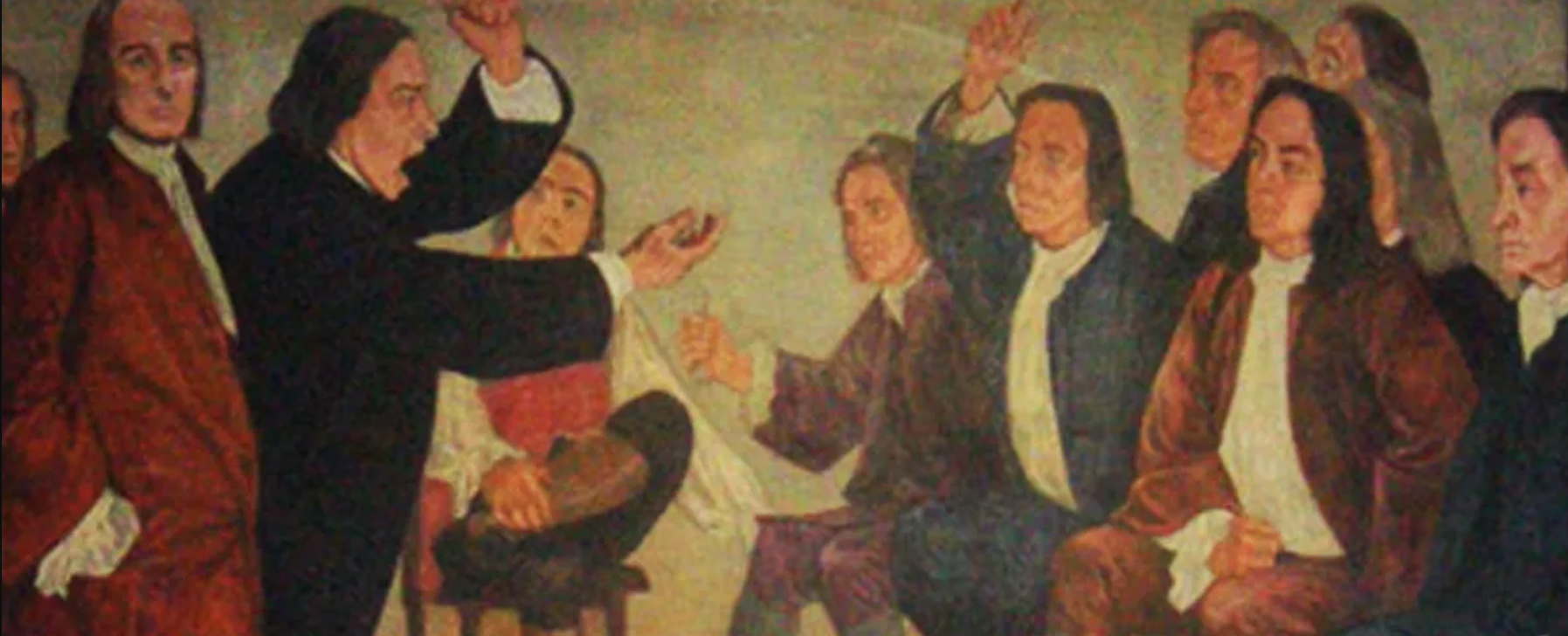
America’s Black Robe Regiment Part 1
For our first two centuries, Americans recognized and appreciated the indispensable role of ministers of the Gospel in securing both our civil and religious liberties. But in recent years, American culture has sequestered and sidelined her pastors. The universal church and her leaders were pushed out of the public square and told to stay in […]
Georgia and Prayer
On February 5, 2026, David Barton was selected by the Georgia State Senate as Chaplain of the Day and opened its session with prayer. In his prayer, he thanked God for the blessings bestowed upon the state and its leaders, and asked that the prayers offered over Georgia across the previous three centuries would be […]
Know the Truth and Protect Your Freedoms.
Still looking for answers? Visit our FAQ page

Stay Informed with the Latest Resources
Enter your email address to receive our regular newsletter, with important information and updates right in your inbox!