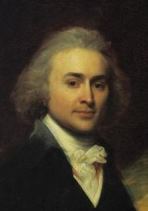
Which President earned the nickname “Old Man Eloquent”?

If you answered John Quincy Adams (the earliest serving President to have a photograph taken of him), then you were right!

Born on July 11, 1767, to John Adams and Abigail Adams, 1 by the age of eight he had not only trained with the famous Massachusetts Minutemen 2 and watched the British attack Boston,3 but by the age of 11, he was serving as a secretary to his father, who was the U.S. diplomat to France; 4 at the age of 14, he was sent to be secretary and translator for Francis Dana, American diplomat in the Court of Queen Catherine the Great in Russia;5 and at the age of 15, he was an official secretary for the American delegation negotiating the final peace treaty to end the American War for Independence.6

This amazing youngster became a diplomat under President George Washington 7 (whom Washington described as “the most valuable public character we have abroad”), 8 and served in the same position under several other presidents. 9

He was also a U. S. Senator, a Secretary of State,10 was appointed to the U. S. Supreme Court (but declined the position), 11 and became the sixth President of the United States. 12

In fact, he was the only president in American history who served in the U. S. House of Representatives after finishing his term as president (he served for 17 years in that position!).13

Throughout his time in the House, he was known as the “Hell Hound of Abolition” for his relentless pursuit of that object, as well as “Old Man Eloquent” for his mastery of the spoken language 14 — not surprising since he had previously been a professor of oratory and rhetoric at Harvard. 15

But before serving in the House, while Ambassador to Russia under President James Madison in 1811, he wrote nine letters to his ten-year-old son, George Washington Adams (whom he had named after his friend and mentor, George Washington), instructing him on how to read through the Bible once each year. As he explained to his young son, his purpose for those letters was “the inculcation of a love and reverence for the Holy Scriptures, and a delight in their perusal and study.”16

In his first letter, he told young George:

I have myself, for many years, made it a practice to read through the Bible once every year. I have always endeavored to read it with the same spirit and temper of mind, which I now recommend to you: that is, with the intention and desire that it may contribute to my advancement in wisdom and virtue. 17

Shortly after John Quincy’s death on the floor of the House of Representatives in 1848, those nine letters were quickly printed as a book for all of America’s youth, 18 so that they, too, could learn how to read through the Bible once each year, and understand it. That work was so popular that it went through a number of reprints, and is still in print today (and it is worthwhile for all Americans to read today, regardless of their age).

Not only was John Quincy’s faith evident throughout his family letters but also in his published works — such as his poetry. Interestingly, Adams was one of only a handful of poet presidents, and his strong Biblical faith is repeatedly demonstrated in his poems. In fact, his 1848 work, Poems of Religion and Society includes poems on the Sabbath, the Goodness of God, and many more Christian topics.

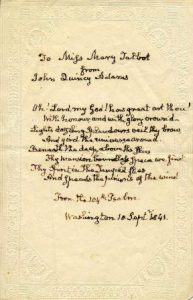
Interestingly, when admirers — particularly young ones — wrote this famous American asking for his autograph, he would often sent them a piece of original poetry he had composed for them based on one of the Psalms from the Bible. In fact, WallBuilders recently posted one such handwritten Psalm transcribed by John Quincy Adams.

Adams, who spent more than six decades of his life in public service, was known as a man “devoted to serving rather than pleasing his countrymen” 19 – that is, he was driven by principle, not by what others thought, understanding that his eternal destiny was more important than his momentary popularity. He maintained this principled position, even when it meant confronting his own family. For example, as his father, John Adams, was growing old, and late in life began to depart from the Christian orthodoxy that had characterized his earlier years, questioning even the Divinity of Christ and a belief in the Trinity, John Quincy pointedly told his father:

My hopes of a future life are all founded upon the Gospel of Christ and I cannot cavil or quibble away [evade or object to]. . . . the whole tenor of His conduct by which He sometimes positively asserted and at others countenances [permits] His disciples in asserting that He was God. 20

As we honor the birthday of one of America’s greatest statesmen, let us also rely on the same Hope in which he trusted and even model our life after John Quincy Adams’ personal life motto, described by nineteenth century historian Elbridge Brooks as:

Duty is ours, and the results are God’s 21


Endnotes

1 Francis S. Drake, Dictionary of American Biography (Boston: Houghton, Osgood & Company, 1879), p. 7, s.v. “John Quincy Adams.”See also,John Quincy Adams Biography,” National Park Service (accessed July 17, 2013).
2 John Quincy Adams, Memoirs of John Quincy Adams, Comprising Portions of His Diary From 1795 to 1848, Charles Francis Adams, editor (Philadelphia: J.B. Lippincott & Co., 1875), Vol. VII, p. 325.
3 John Quincy Adams, Memoirs of John Quincy Adams, Comprising Portions of His Diary From 1795 to 1848, Charles Francis Adams, editor (Philadelphia: J.B. Lippincott & Co., 1874), Vol. I, pp. 4-6.
4 William H. Seward, The Life and Public Services of John Quincy Adams, Sixth President of the United States, with the Eulogy Delivered Before the Legislature of New York (Auburn: Derby, Miller, and Company, 1849), pp. 30-32. See also, Sketch of the Life of John Quincy Adams; Taken from the Port Folio of April, 1819 (1824), p. 4.
5 John Quincy Adams, Memoirs of John Quincy Adams, Comprising Portions of His Diary From 1795 to 1848, Charles Francis Adams, editor (Philadelphia: J.B. Lippincott & Co., 1874), Vol. I, p. 12.
6 Memoirs of John Quincy Adams (Philadelphia: J.B. Lippincott & Co, 1874), Vol. I, p. 13. See also, Biographies of the Secretaries of State: John Quincy Adams,” U.S. Department of State: Office of the Historian (accessed on July 15, 2013).
7Adams, John Quincy,” Biographical Directory of the United States Congress (accessed on July 11, 2013).
8 George Washington, Correspondence Between the Honorable John Adams, Late President of the United States and the Late Wm. Cunningham, Esq. (Boston: E.Q. Cunningham, 1823), pp. 37-38, To John Adams February 20, 1797.
9Adams, John Quincy,” Biographical Directory of the United States Congress (accessed on July 11, 2013).
10Adams, John Quincy,” Biographical Directory of the United States Congress (accessed on July 11, 2013).
11 Dictionary of American Biography, Allen Johnson, editor (New York: Charles Scribner’s Sons, 1928), Vol. I, p. 85.
12Adams, John Quincy,” Biographical Directory of the United States Congress (accessed on July 11, 2013).
13The Election of John Quincy Adams of Massachusetts,” United States House of Representatives: History, Art, & Archives (accessed July 17, 2013). See also,Adams, John Quincy,” Biographical Directory of the United States Congress (accessed on July 11, 2013).
14 Francis S. Drake, Dictionary of American Biography (Boston: Houghton, Osgood & Company, 1879), p. 8, s.v. “John Quincy Adams.”
15 Sketch of the Life of John Quincy Adams; Taken from the Port Folio of April, 1819 (1824), p. 10.
16 John Quincy Adams, Letters of John Quincy Adams to His Son on the Bible and its Teachings (Auburn, N.Y: Derby, Miller, & Co., 1848), pp. 6-7.
17 John Quincy Adams, Letters of John Quincy Adams to His Son on the Bible and its Teachings (Auburn, N.Y: Derby, Miller, & Co., 1848), pp. 10-11.
18John Quincy Adams, Letters of John Quincy Adams to His Son on the Bible and its Teachings (Auburn, N.Y: Derby, Miller, & Co., 1848), pp. 5-8.
19 John Quincy Adams, Letters of John Quincy Adams to His Son on the Bible and its Teachings (Auburn, N.Y: Derby, Miller, & Co., 1848), p. 6.
20 John Quincy Adams, The Writings of John Quincy Adams, Worthington Chauncey Ford, editor (New York: The MacMillan Company, 1916), Vol. VI, p. 135, Letter to John Adams, January 3, 1817.
21 Elbridge S. Brooks, Historic American: Sketches of the Lives and Characters of Certain Famous Americans Held Most in Reverence by the Boys and Girls of America, For Whom Their Stories Here Are Told (New York: Thomas Y. Crowell & Co. Publishers, 1899), pp. 208-209.

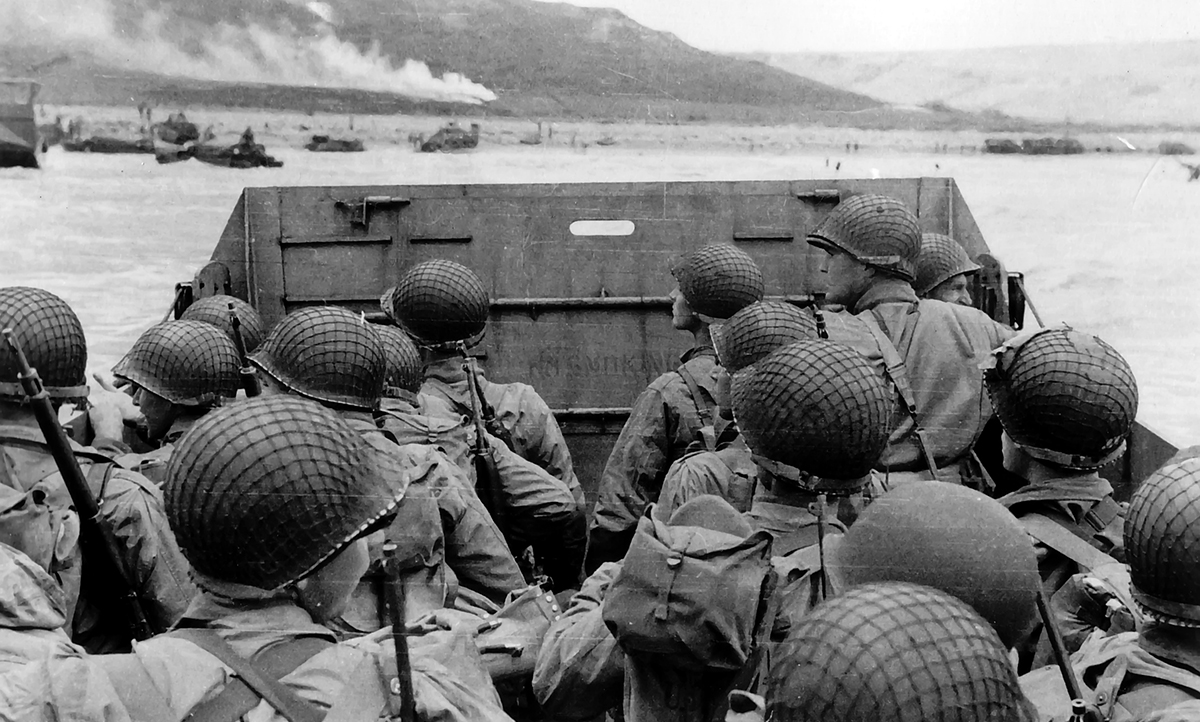
American troops land at Omaha Beach during the D-Day landings of 1944.

This Day in History: D-Day

In 1941, America, although striving to be uninvolved, was pulled into another world war.  Still recovering from the previous one, the attacks at Pearl Harbor on December 7th ensured America’s involvement in one of the bloodiest wars in history. 1

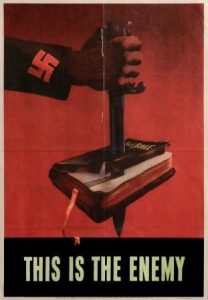
In response to the Pearl Harbor attacks, America declared war on Japan, Germany, and Italy. 2   In order to help fund the war effort, the government issued war bonds, and then printed posters to help encourage Americans to purchase the bonds. Interestingly, many posters were overtly Christian in their content (such as the one pictured on the left).
June 6th is a great time to pause and remember those brave men who so valiantly fought for freedom. It was on this date, 69 years ago, that the Allied troops stormed the beaches of Normandy  3 in an effort to turn the tide of the war. 4  This strategic landing enabled the Allies to push back the German troops. 5  As the Supreme Commander of the Allied Forces, Dwight D. Eisenhower told the troops:

The eyes of the world are upon you. The hopes and prayers of liberty-loving people everywhere march with you.

The prayers of America for her troops were also evident in President Franklin D. Roosevelt’s D-Day Prayer that he prayed in a national radio address given to the American people as the D-Day invasion was underway. 6  As we remember those brave men who sacrificed so much in World War II, let us also be grateful for the men and women who continue to preserve the freedoms that America holds dear today.

Be sure to tune check out WallBuilders Show radio program to hear several stories of WWII Veterans. To see what the Bible – and the Founders- said about war (Psalm 144 and Romans 13) and numerous other topics, be sure to check out The Founders’ Bible.


Endnotes

1 “World War II” Encyclopedia Britannica (accessed June5, 2013).  See also,  Wayne M. Dzwonchyk and John Ray Skates, “A Brief History of the U.S. Army in WWII,” U.S. Army Center of Military History (accessed June5, 2013).
2 “Declarations of a State of War with Japan, Germany, and Italy: Proceedings in the Senate, Monday, December 8, 1941,” Avalon Project (accessed June 5, 2013). See also, “Declarations of a State of War with Japan, Germany, and Italy: Proceedings in the House of Representatives, Monday, December 8, 1941,” Avalon Project (accessed June 5, 2013).
3 “D-Day: June 6, 1944,” U.S. Army (accessed June 5, 2013).
4 “D-Day, the Normandy Invasion, 6 – 25 June 1944,” Naval History and Heritage Command (accessed June 5, 2013). See also, William M. Hammond, “Normandy,” U.S. Army Center of Military History, October 3, 2003.
5 “Outline of Operation Overlord,” U.S. Army Center of Military History, February 4, 2012. See also, “D-Day, the Normandy Invasion, 6 – 25 June 1944,” Naval History and Heritage Command (accessed June 5, 2013). William M. Hammond, “Normandy,” U.S. Army Center of Military History, October 3, 2003.
6 “D-Day,” Franklin D. Roosevelt Presidential Library and Museum (accessed June 5, 2013).

Fall 1998

Thanksgiving in America

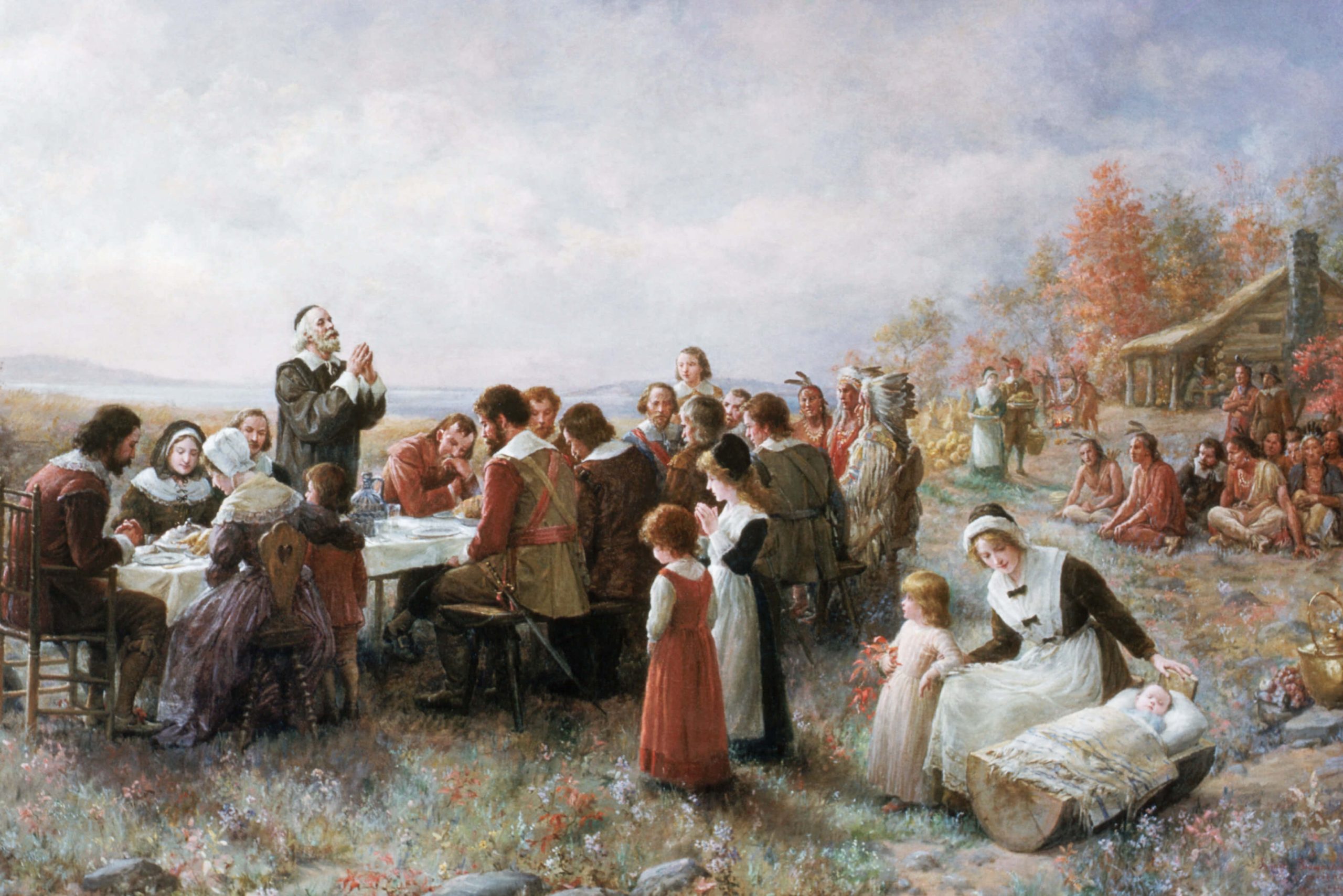
This month, America will continue a tradition begun centuries ago: the celebration of a Day of Thanksgiving. The origin of this tradition is commonly attributed to the Pilgrims in 1621, even though some Thanksgiving services did occur elsewhere in America as early as 1607. While Thanksgiving celebrations became common in New England, they did not begin to spread southward until the American Revolution, when Congress issued eight separate national Thanksgiving Proclamations.

Then in 1789, following a proclamation issued by President George Washington, America celebrated its first Day of Thanksgiving to God under its new Constitution. That same year, the Protestant Episcopal Church, of which President Washington was a member, announced that the first Thursday in November would become its regular day for giving thanks, “unless another day be appointed by the civil authorities.” Yet, despite these early national proclamations, official Thanksgiving observances usually occurred only at the State level.

Much of the credit for the adoption of an annual national Thanksgiving Day may be attributed to Mrs. Sarah Joseph Hale, the editor of Godey’s Lady’s Book. For thirty years, she promoted the idea of a national Thanksgiving Day, contacting President after President until President Abraham Lincoln responded in 1863 by setting aside the last Thursday of November as a national Day of Thanksgiving. Over the next seventy-five years, Presidents followed Lincoln’s precedent, annually declaring a national Thanksgiving Day. Then, in 1941, Congress permanently established the
fourth Thursday of each November as a national holiday.

Lincoln’s original 1863 Thanksgiving Proclamation came–spiritually speaking–at a pivotal point in his life. During the first week of July of that year, the Battle of Gettysburg occurred, resulting in the loss of some 60,000 American lives. Four months later in November, Lincoln delivered his famous “Gettysburg Address.” It was while Lincoln was walking among the thousands of graves there at Gettysburg that he committed his life to Christ. As he explained to a friend:

When I left Springfield [to assume the Presidency] I asked the people to pray for me. I was not a Christian. When I buried my son, the severest trial of my life, I was not a Christian. But when I went to Gettysburg and saw the graves of thousands of our soldiers, I then and there consecrated myself to Christ.

Following is the 1863 Lincoln Thanksgiving Proclamation–celebrated shortly after Lincoln committed his life to Christ and celebrated while America was still in the midst of its Civil War. It was this proclamation which eventually led to the establishment of our national Thanksgiving holiday.

Proclamation of Thanksgiving by the President of the United States of America

The year that is drawing toward its close has been filled with the blessings of fruitful years and healthful skies. To these bounties, which are so constantly enjoyed that we are prone to forget the Source from which they come, others have been added which are of so extraordinary a nature that they cannot fail to penetrate and soften even the heart which is habitually insensible to the ever-watchful providence of almighty God

In the midst of a civil war of unequaled magnitude and severity, which has sometimes seemed to foreign states to invite and to provoke their aggression, peace has been preserved with all nations, order has been maintained, the laws have been respected and obeyed, and harmony has prevailed everywhere, except in the theater of military conflict, while that theater has been greatly contracted by the advancing armies and navies of the Union.

Needful diversions of wealth and of strength from the fields of peaceful industry to the national defense have not arrested the plow, the shuttle, or the ship; the ax has enlarged the borders of our settlements, and the mines, as well of iron and coal as of the precious metals, have yielded even more abundantly than theretofore.

Population has steadily increased notwithstanding the waste that has been made in the camp, the siege, and the battlefield, and the country, rejoicing in the consciousness of augmented strength and vigor, is permitted to expect continuance of years with large increase of freedom.

No human counsel hath devised nor hath any mortal hand worked out these great things. They are the gracious gifts of the Most High God, who, while dealing with us in anger for our sins, hath nevertheless remembered mercy. It has seemed to me fit and proper that they should be solemnly, reverently, and gratefully acknowledged, as with one heart and one voice, by the whole American people. I do therefore invite my fellow-citizens in every part of the United States, and also those who are at sea and those who are sojourning in foreign lands, to set apart and observe the last Thursday of November next as a day of thanksgiving and praise to our beneficent Father who dwelleth in the heavens. And I recommend to them that while offering up the ascriptions justly due to Him for such singular deliverances and blessings they do also, with humble penitence for our national perverseness and disobedience, commend to His tender care all those who have become widows, orphans, mourners, or sufferers in the lamentable civil strife in which we are unavoidably engaged, and fervently implore the interposition of the Almighty Hand to heal the wounds of the nation and to restore it, as soon as may be consistent with the Divine purposes, to the full enjoyment of peace, harmony, tranquillity, and union.

In testimony whereof I have hereunto set my hand and caused the seal of the United States to be affixed.


Abraham Lincoln


A Biblical and Historical Perspective on the Clinton Scandal

The President, by his own admission, has violated several of the most basic laws undergirding both society and religion: the Ten Commandments. Specifically, the President willfully broke the 7th command (to maintain the sanctity of sex within marriage), the 10th command (forbidding coveting another person), and the 9th command (prohibiting perjury).

Such blatant violations of the Ten Commandments are no small matter. To reject the Ten Commandments is to disdain those laws which were described by John Quincy Adams as the “laws essential to the existence of men in society,” by John Adams as the “inviolable precepts in every society” that make it “civilized and free,” and by John Witherspoon as “the sum of the moral law.”

There can be nothing said in defense of the President. What he has done is wrong. Nevertheless, in an attempt to evade the consequences, the strategy pursued by the supporters and counselors of the President has been twofold: (1) to ask forgiveness and show public contrition, and (2) to degrade the culture by claiming that others also do what the President did–that it’s only sex–a private matter.

While seeking forgiveness is commendable, particularly if it is sincere, it never has, and never should, excuse someone from the consequences of his behavior. In fact, 1 Samuel 15:9-31 presents a striking parallel to the current situation. In that account, Saul, the national leader, committed a transgression. When Samuel uncovered and exposed the unrighteous act, Saul offered an apology, declaring, “I have sinned. . . . Now, I beg you, please forgive my sin.” Nevertheless, God had Samuel inform Saul that because of his behavior, “The Lord has rejected you as leader.” (See the account of a similar but separate incident in 1 Samuel 13:8-14.) Similar lessons may be learned through the stories of Esau, David, Hezekiah, Uzziah, Gehazi, and others. While each committed a wrong and later regretted his behavior, each still had to face the consequences of his own wrong behavior. In short, “I’m sorry” is insufficient to prevent the consequences of a leader’s willful, serious, and immoral misbehavior.

And the “everybody else is doing it” defense is wrong for at least two reasons. First, the Bible forcefully declares, on numerous occasions, that each person must face the consequences of and be responsible for his own actions—regardless of what “everybody” else does. (See, for example, Jeremiah 31:27-30). Second, to claim that such behavior is widespread and common undermines the mores of our society. In fact, the proper response should be to condemn the act rather than attempt excuse or justify the act. As explained by John Witherspoon, signer of the Declaration of Independence:

[H]e is the best friend to American liberty who . . . sets himself with the greatest firmness to bear down profanity and immorality of every kind.

Under this standard, if the President’s supporters truly cared about America, rather than excusing immoral behavior, even if done “privately,” they would be condemning it. Unfortunately, the President’s defenders have done just the opposite, conveying to the public a perception that those who practice marital fidelity are the minority. That Americans actually perceive this to be the moral condition of America is illustrated by a poll earlier released by Family Circle magazine. The results of that survey, questioning respondents on the Ten Commandments, confirmed an interesting image of misperceptions.

For example, while only fourteen percent of the respondents had actually engaged in extramarital relations, amazingly, forty-five percent reported their belief that extramarital relations were common. Why would respondents believe that extramarital relations among that group occurred at a rate nearly three times higher than it actually did? Because they have been consistently pummeled–as a defense by those who engage in extramarital affairs–with the charge that such affairs are commonplace.

Not only do the efforts of the President’s supporters weaken the moral standards, they actually perpetuate historical revisionism. That is, in an attempt to excuse the President’s immoral behavior, his defenders are asserting that President George Washington also engaged in immoral and illicit sexual relations–a charge that is historically false. (To see a full rebuttal of the accusation, refer to chapter 16 in my book, Original Intent.)

A further point of defense raised by the President’s supporters is that this was a private matter and would an average citizen want an investigator looking into his life as the President’s has been? The fact of the matter is that the President is not an average citizen, and both the Bible and American history set a more rigorous standard for a leader. For example, James 3:1 warns:

Not many of you should presume to be teachers, my brothers, because you know that we who teach will be judged more strictly.

Similarly high standards for leaders are set forth in passages like Titus 1:6-9, 1 Timothy 3:1-12, Exodus 18:21-22, etc. Those standards specifically address moral and private conduct and also direct that a leader’s life should be held forth as a positive example for others to follow (see, for example, 1 Cor. 11:1). It is understandable that a leader is held to a higher standard than others because he possesses more power and has more opportunity to influence–for good or for bad–many more millions of lives than does the average citizen.

Our Founding Fathers understood this need for a higher moral standard in our leaders, and they specifically advocated investigating the private moral life of a leader. The Biblical reason underlying their logic is found in Luke 6:43-44 and Matthew 7:16-20, in which Jesus reminds us:

Do people pick grapes from thorn bushes, or figs from thistles? Likewise, every good tree bears good fruit, but a bad tree bears bad fruit. A good tree cannot bear bad fruit, and a bad tree cannot bear good fruit. . . . Thus, by their fruit you will recognize them. Very simply, if a tree has bad roots, it will produce bad fruits. Consequently, the “roots” of a public officer are important, for one who produces bad fruit in private life cannot keep from eventually producing it in public life.

Understanding this, Founding Father Elias Boudinot, a President of the Continental Congress, reminded us to “be religiously careful in our choice of all public officers . . . and judge of the tree by its fruits.” Other American statesmen made equally succinct declarations. For example:

He who is void of attachments in private life is, or very soon will be, void of all regard of his country. There is seldom an instance of a man guilty of betraying his country who had not before lost the feeling of moral obligations in his private connections. . . . [P]rivate and public vices are in reality . . . connected. . . . Nothing is more essential to the establishment of manners in a State than that all persons employed in places of power and trust be men of unexceptionable characters. The public cannot be too curious concerning the characters of public men. Samuel Adams


Righteousness alone can exalt [America] as a nation. . . . [R]emember this! And in thy sphere practice virtue thyself, and encourage it in others. . . . [T]he great pillars of all government . . . [are] virtue, morality, and religion. This is the armor, my friend, and this alone, that renders us invincible. Patrick Henry


As governments are made and moved by men, so by them they are ruined too. . . . Let men be good and the governplainfs22 ment cannot be bad. . . . But if men be bad, the government be never good. William Penn


[I]f we . . . trifle with the injunctions of morality . . . no man can tell how sudden a catastrophe may overwhelm us. . . . [No] government [can] be secure which is not supported by moral habits. Daniel Webster


In selecting men for office . . . look to his character. . . . [I]f the citizens neglect their duty and place unprincipled men in office, the government will soon be corrupted; laws will be made not for the public good so much as for selfish or local purposes; corrupt or incompetent men will be appointed to execute the laws; the public revenues will be squandered on unworthy men; and the rights of the citizens will be violated or disregarded. . . . When a citizen gives his [vote] to a man of known immorality . . . he betrays the interest of his country. Noah Webster


Those who wish well to the State ought to choose to places of trust men of inward principle, justified by exemplary [lifestyle]. Is it reasonable to expect wisdom from the ignorant? fidelity from the profligate? assiduity and application to public business from men of a dissipated life? . . . Those, therefore, who pay no regard to religion and sobriety in the persons whom they [elect] are guilty of the greatest absurdity and will soon pay dear for their folly. John Witherspoon


While it is too late for us as voters to apply these lessons to our current President, it is not too late for us to apply these lessons to the present election. Remember to vote–and to vote for God-fearing and moral individuals. As the Bible reminds us in Proverbs 29:2: “When the righteous rule, the people rejoice; when the wicked rule, the people groan.”

High Crimes and Misdemeanors

In the midst of the debate surrounding a potential presidential impeachment, the phrase “high crimes and misdemeanors” has become a focal point. This phrase is found in Article II, Section 4, Par. 1, of the Constitution, and sets forth the reasons for the removal of a President:

The President, Vice-President, and all civil officers of the United States, shall be removed from office on impeachment for, and conviction of, treason, bribery, or other high crimes and misdemeanors.

Supporters of the President argue that what has been uncovered–thus far–does not amount to “high crimes and misdemeanors” like “treason [and] bribery.” While they admit the President’s actions to be disgusting and reprehensible, they claim that nevertheless they are not sufficiently serious felonies so as to constitute impeachable offenses.

Those who offer this argument are guilty of two errors: (1) they are ignorant of (or ignore) the clear declarations both of our Founding Fathers who authored this clause and of those who for a century-and-a-half afterwards enforced this clause, and (2) they group words together in the clause which should be kept separate that is, they talk of “high crimes and misdemeanors” as if they are they same thing; they are not.

The clause should be read “high crimes” and “misdemeanors”–two separate categories. No one can logically argue that a “high crime” is the same as a “misdemeanor.” What the Founding Fathers did in this clause was to offer a broad scope of impeachable offenses ranging from serious felonies (high crimes) to much lesser categories of misbehavior (misdemeanors).

This is further confirmed by the two specific examples the Founders included in the Constitution: treason and bribery. Treason was a serious capital offense, resulting in execution, while bribery–even though it was considered a moral wrong–was not yet a statutory crime when the Constitution was adopted! Clearly, then, what the Constitution specifies is a wide range of impeachable offenses, from high crimes (such as treason) to misdemeanors (such as bribery–not then illegal).

The definitions of “misdemeanor” confirmed this. For example, Alexander Hamilton and Justice Joseph Story (placed on the Supreme Court by President James Madison) defined a “misdemeanor” as political “malconduct,” and Noah Webster (responsible for the copyright and patent protection clause of Article I, Section 8 of the Constitution) defined “misdemeanor” as “ill behavior, evil conduct, fault, or mismanagement.” Professor John Randolph Tucker (a U.S. Congressman, constitutional law professor, and early president of the American Bar Association) explained in his 1891 Commentaries on the Constitution that “misdemeanor” was “a synonym for misbehavior” and that “[t]he words ‘high crimes and misdemeanors’ cannot be confined to crimes created and defined by a statute of the United States.”

Realizing, then, that the constitutional scope of impeachable offenses ranged from serious felonies down to misbehavior and evil conduct, Joseph Story, in his classic 1833 Commentaries on the Constitution, declared:

The offences to which the power of impeachment has been and is ordinarily applied as a remedy are. . . . what are aptly termed political offences, growing out of personal misconduct, or gross neglect, or usurpation, or habitual disregard of the public interest.

And Professor John Randolph Tucker, in the 1891 Commentaries mentioned earlier, declared:

The process of impeachment is a political proceeding, against the accused as an officer of the government, to protect the government from the present or future incumbency of a man whose conduct has proved him unworthy to fill it. . . . The impeachment power was intended to cleanse the government from the presence of worthless and faithless individuals.

That this had been the intent of the Founding Fathers was irrefutable. For example, James Iredell (an original Supreme Court Justice appointed by President George Washington) succinctly declared:

Every government requires [impeachment]. Every man ought to be amenable for his conduct. . . . It will be not only the means of punishing misconduct but it will prevent misconduct. A man in public office who knows that there is no tribunal to punish him may be ready to deviate from his duty; but if he knows there is a tribunal for that purpose, although he may be a man of no principle, the very terror of punishment will perhaps deter him.

Therefore, in the current raging debate over what constitutes an impeachable offense, do not be misled by those who would define “high crimes” and “misdemeanors” as being the same, and then who raise the bar for impeachment so high that it protects an individual from being accountable for his conduct.

Meet a Friend

Once again, it is a pleasure to highlight an organization that is having a profound impact on our society. The National Council on Bible Curriculum in Public Schools is getting the Bible back into public schools nationwide. Founded in 1994 by Elizabeth Ridenour, this organization helps public schools set up elective Bible courses by first educating them to the fact that the courses are completely constitutional and then by providing the curriculum for the courses, with the Bible itself being the primary textbook.

According to the NCBCPS, the ultimate goals of these courses, in part, are to “equip the student with
a fundamental understanding of the influence of the Bible on history, law, American community life, and culture; give insight into the world views of America’sfounding fathers and to understand the Biblical influences on their views on human rights; . . . [and] familiarize the student with the Bible so that he or she becomes skillful in its use, such as finding references easily.” Currently, fifty-seven districts in twenty-six States have started teaching the Bible as an elective in public schools.

Late Summer 1998

A “Do-Nothing Congress”? Says Who?

America is unquestionably engaged in a culture war. On one side are Christians and other devout people of faith who embrace traditional and Christian family values, and on the other side are the secularists, humanists, separationists, and others who want a society free from Christian influence or traditions. The battlegrounds for the culture war are the primary power centers of the pulpit, education, government, and media. How are we doing in each?

Generally, the pulpit is still strongly supportive of Christian values in public; while occasionally silent, only rarely is it antagonistic. Despite positive gains in recent years, by and large the education establishment remains generally hostile to Christian values. In government, the Executive and the Judicial branches demonstrate a clear hostility while the Legislative branch is becoming an ally. And although the media is beginning to improve (as evidenced by the explosion of conservative talk-radio), the major outlets continue to be hostile. Yet, despite the fact that three of the four power centers currently reject Christian values, the overwhelming majority of Americans embrace those values, as confirmed by polls on belief in God, church attendance, support for school prayer, opposition to sodomy, support of traditional marriage, etc.

Therefore, since those parties advancing anti-Christian values are actually in the minority, to gain public support, they must do everything they can to portray themselves as the majority, pursuing reasonable and rational goals. Thus, they publicize their own victories (which means highlighting our defeats) while minimizing word of their defeats (by suppressing the reports of our victories).

An excellent example of this tactic is the media’s current characterization that we have a “do-nothing Congress.” This charge means either that (1) Congress actually has done nothing (at least according to the media’s agenda) or (2) Congress has furthered the Christian values agenda, and thus every effort must be made to halt this progress. Both suppositions are correct, especially the second one. As proof, consider the following facts:

Protecting Human Life

  • Congress expanded the Hyde Amendment ban on taxpayer-financed abortions in federal health programs to also include managed-care arrangements, Medicaid, Title X family planning assistance, Title XX social services Block Grants to States, and the Children’s Health-Insurance Block-Grant Program (Public Law 105-33).
  • Congress restored the ban–which President Clinton had lifted–on taxpayer-financed abortions in U.S. military facilities (Public Law 104-106), on abortion coverage in the federal employees health benefits program (Public Law 104-52), on taxpayer-financed abortions in the District of Columbia (Public Law 104-134), and on taxpayer-financed abortions in federal prisons (Public Law 104-134).
  • Congress permanently prohibited the American Council of Graduate Medical Education from forcing medical schools to require the performance of abortions (Public Law 104-134).
  • Congress also banned abortion litigation by the Legal Services Corporation (a government funded legal service), federal funding for assisted suicide and euthanasia (Public Law 105-12), and taxpayer-funded human embryo research (Public Law 104-134).
  • Congress has twice banned the gruesome practice of partial-birth abortions, and has fallen short of the two-thirds vote necessary to override President Clinton’s veto by only three votes in the Senate.

Promoting Marriage and the Family

  • Congress passed the “Defense of Marriage Act” which (1) federally defines “marriage” as “the union of one man and one woman as man and wife” for purposes of all federal benefits, and (2) allows each State (rather than unelected judges) to define marriage according to their traditions and values (Public Law 104-199).
  • Congress enacted several strong pro-marriage provisions as part of welfare reform, including a bonus system to reward States which reduce out-of-wedlock birth rates without increasing abortions (Public Law 104-193).
  • Congress enacted a permanent $500 per-child tax credit (Public Law 105-34) and passed homemaker IRAs so that work-at-home spouses could set aside up to $2,000 a year in a tax-deferred retirement savings (Public Law 104-188).
  • Congress made major reforms in adoption policies, including enacting (1) a $5,000 tax credit for adoption expenses, (2) a $6,000 tax credit for hard-to-place special-needs children, (3) a ban on “race matching” by adoption agencies so minority children can be placed in any loving family (Public Law 104-188), and (4) an accelerated procedure for moving abused and neglected children from foster homes into adoptive homes (Public Law 105-89).

Religious Liberties

  • Congress has advanced a number of religious liberty bills, including the first ever vote on a School Prayer Amendment by both the Judiciary Committee and the whole House, a bill to penalize those countries who participate in or condone the persecution of Christians and other people of faith (e.g., China, Sudan, Pakistan, Laos, etc.), a bill to protect the public display of the Ten Commandments, and a number of other positive bills. While not all of these bills were signed into law by the President, nevertheless, this is the best session the Congress has had on the issue of religious liberty in recent memory.
  • Congress passed a bill to allow faith-based charities to participate in delivering welfare benefits (Public Law 104-193).

Education

  • Of the 260 federal education programs overseen by the House Education Committee, 105 of the programs have been eliminated.
  • Congress passed a permanent ban on funding for Clinton’s federal testing scheme (the foundation for his plan for a national curriculum).
  • Congress killed a proposed new tax on education benefits for the children of school faculty members–a tax specifically targeted at teachers in religious schools (this was a big win for private religious schools).
  • Congress enacted educational IRAs to cover expenses for public, private, and home schools, and passed a school-choice voucher bill for students in Washington, D. C., (both bills were vetoed by the President).

Morality

  • Congress banned the funding of obscene art (Public Law 104-134), the distribution of indecent or patently offensive material to minors over the Internet (Public Law 104-104), the sale of pornography at military facilities (Public Law 104-106), and taxpayer-funded needle-exchange programs.
  • Congress strengthened child pornography laws (Public Law 104-71).
  • Congress funded $50 million dollars for abstinence-education programs (Public Law 104-193).
  • Congress moved against the gambling industry, appointing pro-family hero Kay James as the Chairman of the National Gambling Impact Commission to investigate and report on the effects of gambling (Public Law 104-169).

Other Issues

Also, Congress has pursued a number of measures to reverse judicial activism and to limit judicial intrusiveness and micromanagement. Additionally, Congress prohibited the United Nations command of U. S. troops, but that bill–like so many other good bills–was vetoed by the President.

Upcoming Votes

There are still a number of important votes scheduled for the final weeks of this Congress, including:

  • A ban (for the third time) on partial-birth abortions.
  • A ban on transporting minors across State lines in order to evade parental-consent or parental-notification abortion restrictions.
  • A ban on discrimination against homeschoolers and Christian schoolers in college admissions.
  • A Constitutional Amendment to prohibit the desecration of the flag.

Obviously, Congress has done much to advance Christian and traditional family values, and just as obviously, most citizens have not heard of these victories. Instead, they have been told that we elected a “do-nothing Congress.”

To understand the reason for this fallacious charge, recall how this Congress came to be. Between 1988 and 1994, the numbers of evangelical Christian voters rapidly increased. Those Evangelical voters were largely responsible for the infamous “Voter Revolution” of 1994 followed by the 1996 Senate elections. Those two elections swept scores of conservative Christians into Congress and thus changed not only the composition but also the agenda of the Congress. The secularists understand that they are in serious trouble if Christians return to the polls in 1998. And what better way to keep Christians home in this year’s elections than by telling them that all their hard work of recent years was a complete waste of time–that all it produced was a “do-nothing Congress.”

Unfortunately, many Christians have believed this propaganda. But the truth is that we are making a difference–our efforts are having an effect! Don’t be talked out of your vote in November! Remember the advice of two ministers of the Gospel, James A. Garfield and Charles Finney. Finney–a leader in America’s Second Great Awakening–reminded the Christians of his day that:

The Church must take right ground in regard to politics. . . . The time has come that Christians must vote for honest men and take consistent ground in politics. . . . God cannot sustain this free and blessed country which we love and pray for unless the Church will take right ground. Politics are a part of a religion in such a country as this, and Christians must do their duty to the country as a part of their duty to God. . . . [God] will bless or curse this nation according to the course they [Christians] take [in politics].

Then, fifty years later, James A. Garfield, our 20th President, reminded the Christians in his day:

Now, more than ever before, the people are responsible for the character of their Congress. If that body be ignorant, reckless, and corrupt, it is because the people tolerate ignorance, recklessness, and corruption. If it be intelligent, brave, and pure, it is because the people demand these high qualities to represent them in the national legislature. . . . If the next centennial does not find us a great nation . . . it will be because those who represent the enterprise, the culture, and the morality of the nation do not aid in controlling the political forces.

The message of the last two centuries still resounds for us today. We must “take right ground in regard to politics” and “aid in controlling the political forces” by being active in this year’s elections.

One of the tools which can help motivate those around you to be involved is our award-winning video “Keys to Good Government.” I encourage you to get a copy of this video and show it to you family, friends, church, and others within your sphere of influence. Our duty is not only to vote, but to vote for the right type of leaders. As Proverbs 29:2 reminds us, “When the righteous rule, the people rejoice; when the wicked rule, the people groan.” This video will help motivate citizens to vote–and to vote according to Biblical principles.

Black History Issue 1998

Honoring Godly Heroes

America’s Godly heritage has been under assault in recent years. Secularist spokesmen claim that America was created as a secular nation by secular individuals who intended that it always remain secular. These individuals understand that by destroying the knowledge of America’s religious heritage, it is easier to persuade subsequent generations to embrace secularism. Interestingly, this religious cleansing has no racial boundaries. An examination of the individuals often honored during February’s “Black History Month” (celebrated nationally since 1976) shows that the secularization of America’s history

Is directed against all Godly heroes, no matter their skin color. Therefore, to introduce Americans to little-known heroes, this WallBuilder Report will honor three famous Godly Black Americans all but ignored by today’s secularists: Benjamin Banneker, Phillis Wheatley, and Richard Allen.

Benjamin Banneker

Benjamin Banneker was born a free Black on a tobacco plantation near Baltimore in 1731. Although he received little formal education (his grandmother taught him to read), this was no handicap to a man with his work ethic and his intense desire to learn. In fact, his life was characterized by his passion for knowledge.

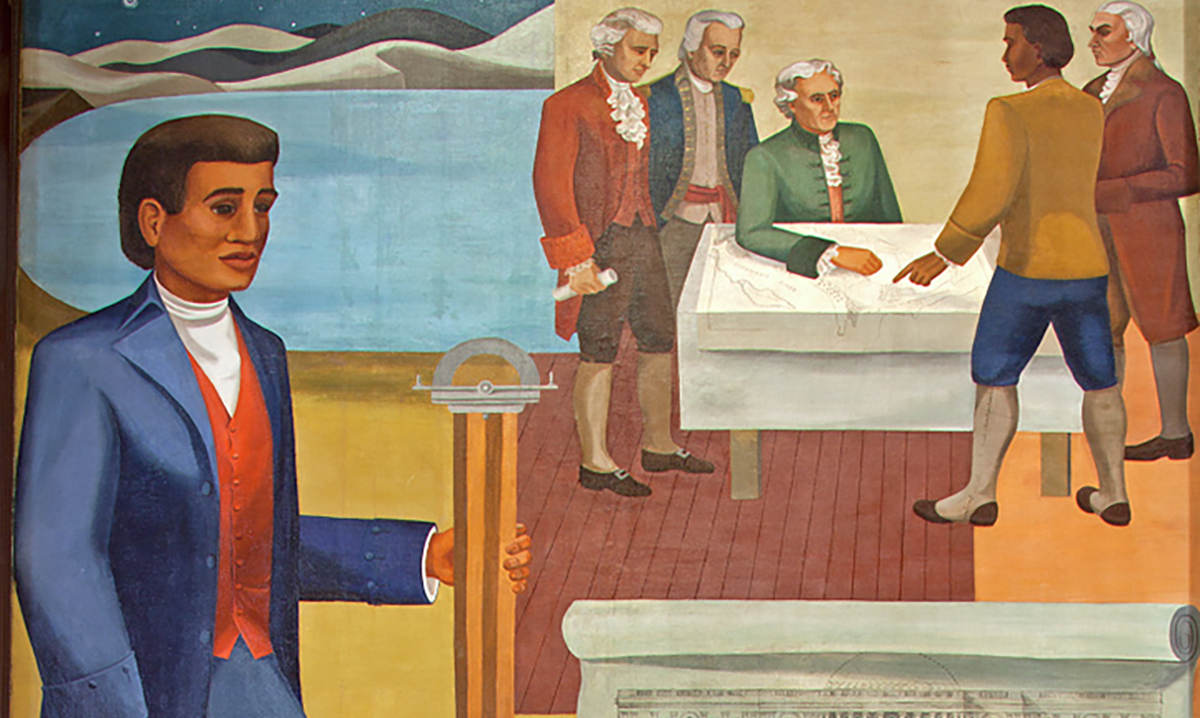
For example, in his early twenties, after studying the workings of a pocket watch, Banneker built a perfectly operating wooden clock that even struck on the hour! Although he loved to read, he was in his thirties before he was able to purchase his first book – a Bible (Banneker frequented the meetings of the Quakers throughout his life). By the time he was in his fifties, he had so completely mastered the science of astronomy through self-study that he was even able to point out errors in several noted scientific works of the day. And when he was in his sixties, because of his fame and reputation, he was picked as one of seven surveyors to lay out the District of Columbia – the new capitol city.

In the early 1790s, Banneker began to publish an almanac for Maryland and neighboring states. His work was in high demand because of his accurate predictions for sunsets, sunrises, eclipses, weather conditions, and even for his calculation of the recurrence of locust plagues in seventeen year cycles. At his death in 1806, he had actually lived eight years longer than he had calculated, and this is often referred to as the only time he made a mistake in his calculations! The knowledge he acquired by his study of the heavens earned him the title of “Star Gazer.”

Of all of Banneker’s writings, one of his most notable was a 1791 letter to Secretary-of-State Thomas Jefferson:

Sir, I am fully sensible of the greatness of the freedom I take with you on the present occasion; a liberty which seemed scarcely allowable when I reflect on that distinguished and dignifed station in which you stand, and the almost general prejudice which is so prevalent in the world against those of my complexion. . . .

I hope I may safely admit, in consequence of the report which has reached me, that you are a man far less inflexible in sentiments of this nature than many others; that you are measurably friendly and well-disposed towards us; and that you are willing to lend your aid and assistance for our relief. . . .

[Y]our sentiments are concurrent with mine, which are that one universal Father hath given being to us all; that He hath . . . made us all of one flesh . . . and that however variable we may be in society or religion, however diversified in situation or in color, we are all of the same family and stand in the same relation to Him. . . .

[I]t is the indispensable duty of those who . . . profess the obligations of Christianity, to extend their powers and influence to the relief of every part of the human race from whatever burden or oppression they may unjustly labor under. . . .

I freely and cheerfully acknowledge that I am of the African race, and in that color which is natural to them, of the deepest dye. . . .

[There] was a time when you clearly saw into the injustice of a state of slavery, and. . . . your abhorrence thereof was so excited that you publicly held forth this true and invaluable doctrine, which is worthy to be recorded and remembered in all succeeding ages: “We hold these truths to be self-evident, that all men are created equal; that they are endowed by their Creator with certain inalienable rights, and that among these are life, liberty and the pursuit of happiness.” . . .

I . . . recommend to you and all others to wean yourselves from those narrow prejudices which you have imbibed with respect to [my brethren], and as Job proposed to his friends, “put your soul in their soul’s stead” [Job 16:4]; thus shall your hearts be enlarged with kindness and benevolence towards them. . . .

Your most obedient humble servant, Benjamin Banneker

Jefferson responded to Banneker, telling him that “Nobody wishes more than I do to seek such proofs as you exhibit – that nature has given to our Black brethren talents equal to those of the other colors of men.”

This wish by Jefferson became reality, for Benjamin Banneker – both during his life and after his death – was held forth as a shining example of the intellectual capacity and the moral uprightness of Blacks, something which was long denied by the pro-slavery advocates of that day.

Phillis Wheatley

Phillis Wheatley was born in Senegal, Africa, in 1753. She was kidnapped at the age of eight and sent on a slave ship to Boston. Purchased by a prosperous Boston tailor, John Wheatley, she was trained as a personal servant for John’s wife, Susannah.

Phillis was quick and perceptive, and Susannah and her daughter Mary were drawn in a special manner to Phillis. Susannah considered Phillis a daughter, and Mary treated her like a sister. Both tutored her in the
Scriptures and in morals, and within sixteen months Phillis had so mastered English that she was able to read the most difficult parts of the Bible with ease. Mary then taught Phillis astronomy, geography, ancient history, the Latin classics, and the English poets, all of which Phillis conquered with equal ease. Because of her aptitude for difficult knowledge and her ability as a brilliant conversationalist, Phillis was considered by the Bostonian intellectuals to be a child prodigy.

When she was only thirteen years old, Phillis wrote her first poetic verses; and then three years later, being an admirer of the celebrated Rev. George Whitefield, she authored a special poem about his life. This early interest in poetry continued for the rest of her life, and today Phillis is known as America’s first Black female poet.

In 1771, Phillis became a member of the famous Old South Church. It was later said that “her membership in Old South was an exception to the rule that slaves were not baptized into the church.”

In 1773, her health began to fail. A sea-voyage was recommended, and Mrs. Wheatley promptly saw to it that Phillis was manumitted (freed). Phillis traveled to England, where she was received by British royalty. While abroad, she published her first collection of poems, Poems on Various Subjects, Religious and Moral.

In 1775, while still abroad, and while the siege of Boston was underway in America, Phillis wrote a letter to the new Commander-in-Chief, General Washington, containing a special poem she had written for him:

His Excellency George Washington . . . Thee, first in place and honors, – we demand
The grace and glory of thy martial band Fam’d for thy valor, for thy virtues more, Here every tongue thy guardian aid implore! . . . Proceed, great chief, with virtue on thy side, Thy every action let the goddess guide. A crown, a mansion, and a throne that shine, With gold unfading, Washington, be thine. . . .

Washington was touched by the poem; and when Phillis returned to America, Washington invited her to his military camp at Cambridge to honor her before his staff.

Phillis had returned to America when she had learned of the declining health of Mrs. Wheatley, who died shortly after her return. Phillis remained close to the family. She continued her writings and purposed to bring out a second volume of poems to be dedicated to Benjamin Franklin. Misfortune, however, intervened.

In 1778, Phillis married John Peters, a free Black. Although he appeared promising (he was a writer and had studied for the law), his character was deeply flawed: he was slothful, did not provide for his new wife, and failed to give her the care that her delicate health required. He also demanded that she isolate herself from her former friends and even required that she cut off all contact with the Wheatleys. Peters finally deserted Phillis.

Under these circumstances, and only five years after her marriage, Phillis died in obscurity at the age of 30, alone and in poverty, buried in an unmarked grave. Of her three children, two died in infancy, and the third was buried alongside her.

Despite the hardships in her life, Phillis never complained. In fact, she found a silver lining – or rather a Divine one – even in her tragic life of slavery. In her poem, “On Being Brought from Africa to America,” she wrote:

‘Twas mercy brought me from my Pagan land Taught my benighted soul to understand
That there’s a God, that there’s a Savior too: Once I redemption neither sought nor knew. Some view our fable race with scornful eye, “Their color is a diabolic dye.” Remember, Christians, Negroes black as Cain, May be refin’d, and join th’ angelic train.

Phillis’ poetry was popular for generations after her death, and she was considered a heroine by those who fought to end slavery. She remains a shining example of a devout Christian, an accomplished poet, and a gracious and kind woman.

Richard Allen

Richard Allen was born as a slave to Benjamin Chew​ in Philadelphia in 1760. While still a youngster, he was sold to a farmer in Delaware. Allen was converted to Christianity by the preaching of the Methodists. His owner (known in Allen’s autobiography as “Stokeley”) was so impressed with Richard’s Godly lifestyle that he permitted the young Allen to conduct services in his home. In fact, Stokeley himself was converted during one of these services, after which he made it possible for Allen to purchase his freedom.

Allen traveled throughout eastern Pennsylvania and neighboring states, using every opportunity to preach the Gospel to both Whites and Blacks. At the meeting of the first general conference of the Methodist Church in Baltimore in 1784, Allen was accepted as a minister.

Allen began to preach regularly at the St. George Methodist Church in Philadelphia. He suggested that Blacks should have a separate place of worship apart from Whites; and although his suggestion was at first resisted, his forceful preaching attracted such a vast number of Blacks to the church that when objections were raised, Allen’s idea of a separate congregation was finally accepted.

In 1787, Allen led in the establishment of an organization known as the “Free African Society,” composed of both Black Methodists and Black Episcopalians. Black churches in New York, New Jersey, Delaware, and Maryland began to separate from traditional denominations to join this loose-knit society. In 1816, these independent churches merged to become the “Africa Methodist Episcopal Church” (the A. M. E. Church); Allen was chosen as its First bishop.

Allen ministered not only to the spiritual needs of his fellow man, but to his temporal needs as well. For example, when the yellow-fever epidemic ravaged Philadelphia in 1793 (killing over four thousand of the forty-thousand inhabitants), nearly all medical doctors fled the city to save their own lives. One of the few who remained was Dr. Benjamin Rush (signer of the Declaration). Richard Allen worked shoulder to shoulder as a medic with Dr. Rush throughout the danger to aid countless victims in whatever way he could.

In 1794, the year following the epidemic, Allen wrote a compelling work documenting his service during that tragedy: A Narrative of the Proceedings of the Black People During the Late Awful Calamity in Philadelphia. Allen’s humanitarian service ranks with the most heroic deeds of America’s history.

Allen urged others to humanitarian service whenever possible and in whatever cause. On one occasion, he charged his audience:

Consider, my brethren, that all we have and are is entrusted to us by Almighty God. . . . and to Him we must give an account at the great day of reckoning. . . . Our blessed Lord has not committed His goods to us as a dead stock, to be hoarded up, or to lie unprofitably in our own hands. He expects that we shall put them out to proper and beneficial uses, and raise them to an advanced value by doing good with them as often as we have opportunity.

Allen’s faith shone through in all of his accomplishments, and he openly proclaimed his gratefulness to God:

I believe it is my greatest honor and happiness to be Thy disciple; how miserable and blind are those that live without God in the world, who despise the light of Thy holy faith. Make me to part with all the enjoyments of life; nay, even life itself, rather than forfeit this jewel of great price.

When Allen died in 1831, it was said that the crowd which gathered to honor him “exceeded anything of the kind ever before witnessed in the country.” Richard Allen was described as “a man of deep piety, the strictest integrity, and indomitable perseverance; and his moral influence was unbounded.”

Summary

America’s Godly heritage encompasses heroes from many races – a fact both we and our children, regardless of our ethnic roots, must understand. The book of Revelation affirms this fact when it declares:

There was a great multitude that no one could count, from every nation, tribe, people, and language, standing before the throne. . . . They cried out in a loud voice: “Salvation belongs to our God!” Revelation 7:9, 10

The universal truth of Psalm 144:15 has been proven by every historical age and should be remembered at all times – including Black History Month – that “Happy is that people whose God is the Lord!”

Summer 1998

Will We Go Forward or Go Back?

The primary purpose of The WallBuilder Report has been to educate and to inspire. Therefore, it is our practice to examine current issues through an historical lens, and to report from across the nation victories which typically do not receive much mainstream coverage.

We started this practice ten years ago when God providentially guided me into the series of research projects which eventually led to the formation of this ministry. During that start-up, I spent exhaustive time in the book of Nehemiah, seeing it as a Biblical plan for rebuilding a nation. Based on those studies, we not only chose the name “WallBuilders” from Nehemiah 2:17 but also discovered a principle in Nehemiah 2:18 which has since guided the content of this newsletter. In those two verses, Nehemiah pointed out areas where action was needed and called the people to rebuild; and he also reported to them “of the good hand of God.” This “good news” about what God was doing encouraged the people, and they rose to the challenge of rebuilding their nation. Based on what we saw in these verses, WallBuilders began to model Nehemiah’s practice.

The only trouble we have had with this policy of reporting what the “good hand of God” is doing across the country is that there have been far too many victories to be reported in each newsletter! The reports we receive from throughout the nation convince me that unquestionably we are winning far more battles than we are losing.

A Negative Trend

Despite this, I see a perplexing trend–an attitude, if you will–taking root among God’s people in America, and in many ways, it is a rerun of a story that occurred nearly four thousand years ago.

Throughout my Christian life, I have always been mystified by the attitudes and the behavior of those who were the beneficiaries of God’s amazing deliverance during the great Exodus. Recall? The Israelites were in slavery and bondage; God sent deliverance through Moses, Aaron, and a host of miracles; the people left their oppression behind and began new lives; their progress to the Promised Land was slower and more difficult then they expected; they turned on Moses and made him, rather than the Egyptians, the object of their wrath. You would think that being out from under bondage and oppression was something in which to rejoice; but no, they wanted to complain and quit.

It seems that this general scenario might now be occurring in America. Ten years ago, the pro-family Christian community, politically speaking, was in Egypt. Oppressed by a Congress whose policies were often hostile to the traditional family and to people of faith, we were losing battle after battle in the war to preserve our religious and moral principles. Then a dramatic change occurred.

In the 1994 election, Christian voter turnout reached its high point of recent years, and as a result, scores of aggressive pro-family and pro-faith Congressmen were added to Congress–leaders like Steve Largent (OK), Todd Tiahart (KS), David MacIntosh (IN), J.C. Watts (OK), Linda Smith (WA), Zach Wamp(TN), Dave Weldon (FL), Helen Chenoweth (ID), and numerous others.

Then, as a result of the 1996 elections, the number of “good guys” in the Senate began to climb through the addition of pro-faith and pro-family Senators like Sam Brownback (KS), Tim Hutchinson (AR), Jeff Sessions (AL), and others. In addition, more pro-family members were added to the House, including Jim Ryun (KS), Joe Pitts (PA), Bob Adderhold (AL), etc. The changes during these two election cycles did, in fact, deliver America from the oppressive stranglehold which the Congress had held over the family.

Good Progress

It is true that we are not yet in the “Promised Land” in the sense that many of the policies that pro-family Christians desire have not yet occurred. In fact, some of the Congressional leadership have promised measures and failed to deliver. Nevertheless, we apparently are out of “Egypt,” and notwithstanding the harsh criticism leveled against Congress by many within our own ranks, several major victories have occurred in the past four years.

Recall that six years ago, Congress did not have the pro-life numbers to confront the issue of partial-birth abortions (a practice occurring for years), yet in the past four years, Congress has debated and twice banned the procedure.

Although President Clinton vetoed each ban, the House overrode his veto on both occasions; the override fell short only in the Senate. Isn’t this a clear improvement over where we were six years ago when we could not even debate the issue?

Additionally, Congress has passed numerous other pro-life measures, including, for the first time during President Clinton’s tenure, a ban on all abortions on U.S. military bases.

On the educational front, even though federal programs like Goals 2000 and School-to-Work have not been eliminated (due in large part to President Clinton’s lobbying efforts),the funding for those programs has been dramatically cut. In fact, in the last four years the House Education Committee has successfully eliminated105 of the 260 federal programs it oversees. Six years ago, this, too, was impossible.

Similarly, six years ago, we could not successfully challenge many homosexual issues, yet today a ban on recognizing same-sex marriages has been passed at the federal level. Also, the House (although not the Senate) halted all funding for the National Endowment for the Arts–something else which was absolutely unthinkable six years ago. The list of our victories, while only modest in some areas, continues to grow.

Taking the Offensive

Notice, too, that our battles are now offensive rather than defensive. That is, six years ago virtually all of our time was spent repelling the attacks of terrible measures like HR 6 (which would have placed private and home schools under the same federal regulations as public schools) and the lifting of the ban on gays in the military. Similarly, we were fighting off the policies of Roberta Achtenberg (an assistant-secretary of the Equal Employment Opportunity Commission) which would have imposed civil penalties on those who might share their faith in the public workplace.

Today, however, the battles are no longer primarily over which policies we should fight but rather over which of our measures should go forward. For example, the House Judiciary Committee passed and the House voted on a Constitutional Amendment designed to restore school prayer and to protect religious liberties. Although it did not receive the necessary two-thirds vote for passage, nevertheless, it is the furthest that this religious liberty issue has advanced in the House in thirty-six years!

In fact, a genuine spiritual change has occurred in the Congress, evidenced by the fact that ten years ago only 20 Congressmen were involved in weekly prayer meetings and Bible studies. Today, there are over 120. And in recent weeks, I have personally stood in the halls of the U.S. Capitol with some of these Godly Congressmen, singing hymns and offering prayers.

Unquestionably, we are better off today than we were six years ago.

No Time to Quit

Although we are further along than we have been in decades, I cannot recall a period of time in which I have heard so much complaining by Christians, nor seen so many who are so frustrated and discouraged. They seem determined to quit and go back.

Perhaps the problem is that many are judging progress against the promises of some Congressional leaders rather than against where we were six years ago.

Or perhaps it is simply a matter of impatience–that they want to enter the Promised Land sooner. If that is the case, it is wise to recall God’s clear pronouncement:

I will not drive your enemies out in one year. . . . Little by little I will drive them out from before you, until you are increased and can inherit the land. Exodus [user_id]23:29-30

The Lord your God will drive your enemies out little by little; you may not consume them all at once. Deuteronomy 7:22

People always want change to happen faster than God seems to permit.

Returning to the Exodus analogy, recall that although Moses was the one chosen for the initial deliverance, he was not the one who led them into the Promised Land. Similarly, even though the current Congressional leaders were instrumental in the transition from generally hostile to generally family-friendly policies, they may not be the ones to complete the journey.

And just as the people forgot Moses’ accomplishments and began to attack and malign him, many Christians now consider the current Congress their enemy and, by the tens of thousands, are abandoning the difficult journey. Here we are on the verge of victory, within sight of the Promised Land, and–explain this–Christian voter turnout has begun to fall dramatically! That fall first evidenced itself in the 1996 elections (following eight consecutive years of increased Christian voter turnout) and has continued to plummet throughout this year’s primaries.

Who can seriously believe that abandonment will accelerate our journey? Instead of shaking our fists in frustration at the Congress in general, we should focus our energies on sending home Congressmen who oppose faith and family and replace them with pro-family, pro-faith leaders!

Are we really going to give back the last ten years of progress? I certainly hope not.

If you are one of those who is discouraged, don’t quit now. Place your faith in God, not in the Congress, or even in the American voters –and especially not in the current opinion polls. Galatians 6:9 promises that we will eventually win–if we don’t give up. So hang in there!

Don’t let future generations point to us as the American version of the Biblical story of the Exodus. As the Rev. Matthias Burnet warned nearly two hundred years ago, “Let not your children have reason to curse you for prostrating those institutions and giving up those rights which your fathers delivered unto you.”

Remembering the Fourth of July

This Fourth of July America celebrates its 222nd birthday! The Fourth of July is one of our most celebrated holidays, and has been for nearly two centuries–a fact confirmed by a very elderly John Quincy Adams in a speech he delivered on the 4th of July in 1837–America’s 61st birthday.

John Quincy Adams properly reminded the crowd that one of the most important elements of the American movement for independence had been its spiritual underpinnings. He asked:

Why is it that, next to the birthday of the Savior of the World, our most joyous and most venerated festival occurs on this day? And why is it that . . . thousands and tens of thousands among us . . . year after year . . . celebrat[e] the birthday of the nation? Is it not that . . . the birthday of the nation is indissolubly linked with the birthday of the Savior? That it forms a leading event in the progress of the Gospel dispensation? Is it not that the Declaration of Independence first organized the social compact on the foundation of the Redeemer’s mission upon earth? That it laid the cornerstone of human government upon the first precepts of Christianity?

The fact that there was a spiritual emphasis at the birth of the nation was confirmed by numerous others. For example, Benjamin Kent, in a letter to Samuel Adams, declared: “It is God’s doing!”

So clearly did John Adams see God’s hand in America’s independence, he even believed that to help America achieve her independence was the single reason God had created him. As he told his wife, Abigail: “The Colonies must be declared free and independent States. . . . When these things shall be once well finished, or in a way of being so, I shall think that I have answered the end of my creation.”

In a similar tone, John Page (later a Virginia Governor) told Thomas Jefferson, “I am highly pleased with your Declaration God preserve the United States! We know the race is not to the swift nor the battle to the strong [Ecclesiastes 9:11]. Do you not think an Angel rides in the whirlwind and directs this storm?”

Yet, declaring independence was only the beginning; much sacrifice, patience, and reliance on God would still be required. As signer of the Declaration Abraham Clark explained: “This seems now to be[gin] a trying season; but that indulgent Father who hath hitherto preserved us will, I trust, appear for our help, and prevent our being crushed; if otherwise, His will be done.”

Our Founders knew that without Gods help–or, as they announced in the Declaration itself–”a firm reliance on Divine Providence”–they would never achieve their objective.

While we celebrate our liberties this year, let us not forget that those liberties came only through great personal sacrifice: nine of the fifty-six signers of the Declaration died during the War; and five were captured by the British and tortured before their death; twelve had their homes destroyed by British troops; and three lost their sons to the enemy. Such sacrifices remind us that liberty is never free–every generation must defend it anew.

The possibility that we might forget the sacrifices necessary to preserve liberty was something which troubled our Founders. This was made clear in a letter from Dr. Benjamin Rush to John Adams after witnessing the celebration surrounding America’s 35th birthday in 1811. Dr. Rush told Adams:

The 4th of July has been celebrated in Philadelphia in the manner I expected. The military men, and particularly one of them, ran away with all the glory of the day. But scarcely a word was said of the solicitude and labors and fears and sorrows and sleepless nights of the men who projected, proposed, defended, and subscribed [signed] the Declaration of Independence. Do you recollect your memorable speech upon the day on which the vote was taken? Do you re collect the pensive and awful silence which pervaded the House when we were called up, one after another, to the table of the President of Congress [John Hancock] to subscribe what was believed by many at that time to be our own death warrants? The silence and the gloom of the morning were interrupted, I well recollect, only for a moment by Colonel Harrison of Virginia [a large and powerful man], who said to Mr. Gerry [a frail and tiny man] at the table [just before he signed the Declaration]: I shall have a great advantage over you, Mr. Gerry, when we are all hung for what we are now doing. From the size and weight of my body I shall die in a few minutes; but from the lightness of your body, you will dance in the air an hour or two before you are dead!” This speech procured a transient smile, but it was soon succeeded by the solemnity with which the whole business was conducted.

While we should remember the sacrifices, more importantly we should remember the proper manner to celebrate the 4th of July. What is the proper manner? The answer was given in a letter that John Adams wrote Abigail on the day they approved the Declaration. He forecast: “I am apt to believe that [this day] will be celebrated by succeeding generations as the ‘Day of Deliverance’ by solemn acts of devotion to God Almighty!”

Celebrate the Fourth of July with fireworks and festivities and parades–but also celebrate it by setting aside a time to thank God for His numerous blessings upon our country.

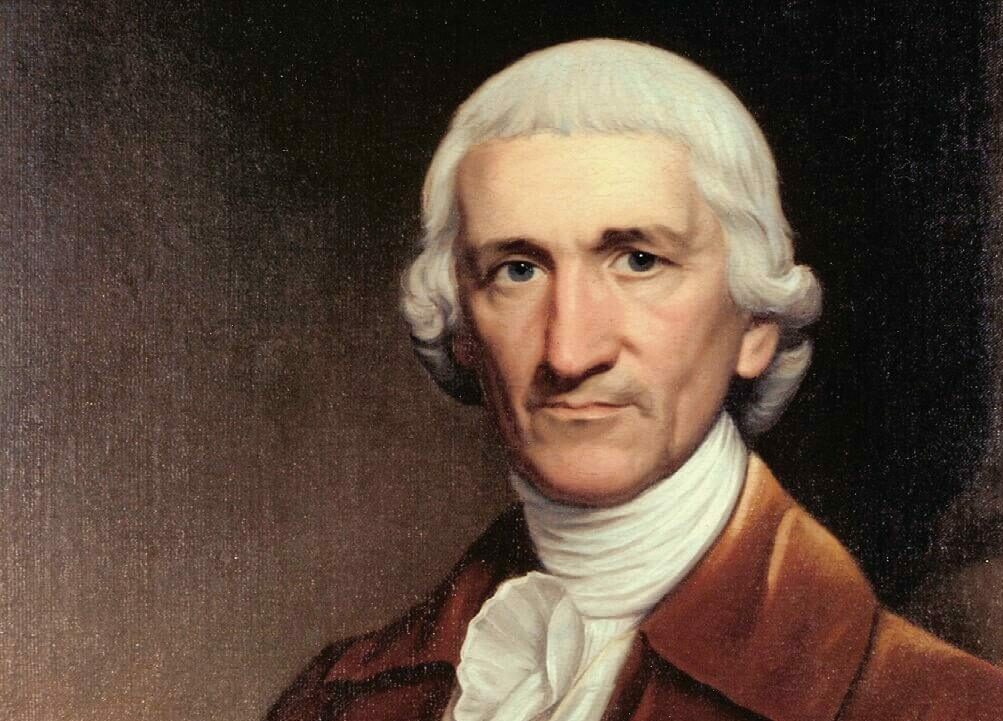
Charles Thomson – the Life of the Cause of Liberty

America’s founding was blessed by the contributions of many individuals who are little, or even completely unknown to us today. Charles Thomson is one such unsung patriot.

In 1774 he was beginning to make a name for himself as a patriotic leader in Philadelphia. John Adams noted, “This Charles Thompson is the Sam Adams of Philadelphia — the Life of the Cause of Liberty, they say.”1

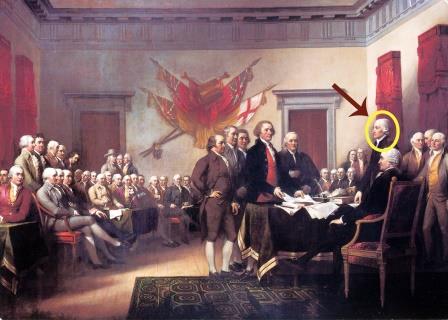
secretary-of-the-continental-congress-charles-thomson-2Though never a member of that august body, as Secretary of the Continental Congress for over fifteen years, Thomson had a front-row seat to the birth of the nation and his fingerprints are all over America’s establishing documents. For example, the copy of the Declaration of Independence included with the official Journals of Congress were in Thomson’s handwriting, and he was one of only two people who actually signed it on July 4th.2

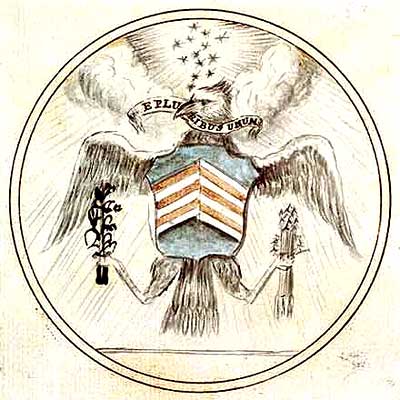
secretary-of-the-continental-congress-charles-thomson-3 Thomson is also responsible for the Great Seal of the United States, which he prepared and Congress approved in 1782.3

As the First Congress took its place under the new government created by the Constitution, Thomson retired from that long-term post. His last official act was personally notifying George Washington that he had been unanimously selected the President of the United States.4

But Thomson was not only a great patriot and supporter of the American cause, he was also a champion of the Word of God. In fact, his name is associated with some of America’s earliest Bible editions.

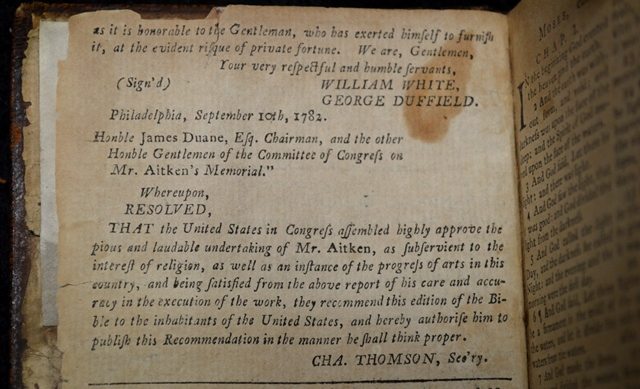
For example, his name, as Secretary of Congress, is found in the introduction to “The Bible of the Revolution,” which was the first Bible printed in English in America. That Bible was printed by Robert Aitken, the official printer of the Continental Congress. Aitken described his Bible as “a neat edition of the Holy Scriptures for the use of schools.”5 It was reviewed and approved by a committee of the Continental Congress, and published with the official congressional endorsement prominently in the front. (All of the original books pictured below that are associated with Charles Thomson are from our collection at WallBuilders.)

secretary-of-the-continental-congress-charles-thomson-5 Thomson was also responsible for the first American translation of the Greek Septuagint (the full Greek Bible) into English in 1808 – a labor of love that consumed nearly two decades of his life.6 Called Thomson’s Bible, it is a four volume-set that is considered one of the most scholarly of American Bible translations.

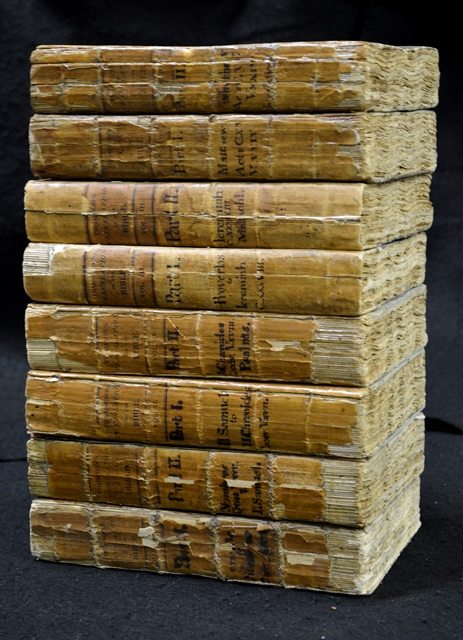
secretary-of-the-continental-congress-charles-thomson-7 Thomson also produced an eight-volume set in which every other page was blank, thus allowing readers space to write notes on the Scriptures as they studied them.
secretary-of-the-continental-congress-charles-thomson-6 In 1815, Thomson published his famous Synopsis of the Four Evangelists, in which he took all the passages from the four Gospels and arranged them chronologically, producing something like one super long Gospel, with all Jesus’ words and acts arranged sequentially. Today, we call such a work a synoptic Gospel.

George Washington praised Thomson’s dedication, “Your Services have been important, as your patriotism was distinguished” He added his belief that “Posterity will find your Name so honorably connected…”7 Sadly, today, Charles Thomson has become a forgotten Founding Father, but his influence, both politically and spiritually, permanently shaped the course of America and blessed American life.

February 14, 2024 This post has been updated to correct information regarding Thomson’s American translation of the Bible. 


Endnotes

1 John Adams, diary entry from August 30, 1774, Adams Family Papers, Massachusetts Historical Society, accessed November 1, 2023.
2 John Hancock was the second and the other delegates signed weeks later. Journals of the Continental Congress 1774-1779, edited from the original records in the Library of Congress by Worthington Chauncey Ford, Chief, Division of Manuscripts, Washington DC: Government Printing Office, 1905, The Avalon Project, Yale Law School, accessed November 1, 2023.
3  “Original Design of the Great Seal of the United States (1782),” Milestone Documents, National Archives, updated October 23, 2023.
4 Lewis R. Harley, Charles Thomson: Patriot and Scholar (Norristown, PA: Historical Society of Montgomery County, 1897), 28-29.
5 The Holy Bible as Printed by Robert Aitken and Approved & Recommended by the Congress of the United States of America in 1782, reprinted (New York: Arno Press, 1968), Introduction.
6 Harley, Charles Thomson: Patriot and Scholar (1897), 33-34.
7 George Washington to Charles Thomson, July 24, 1789, Founders Online, National Archives, accessed November 1, 2023.

Draftsman of the Declaration

Independence Day is the annual anniversary of the Continental Congress approving the Declaration of Independence on July 4th, 1776. That fateful day not only sealed the future for those brave men who approved that document but that paper also established the principles by which America became the most successful nation of the past three centuries.

Of the fifty-six men who signed this document, the final to pass away was Charles Carroll, who died at the age of 95. Before his passing, New York City asked him to inscribe his final thoughts on a copy of the Declaration. On it he wrote that he was “Grateful to Almighty God for the blessings which, through Jesus Christ Our Lord, He has conferred on my beloved country in her emancipation.” 1 Significantly, this Founding Father, in looking back over what had occurred as a result of the Declaration, wanted to specifically thank Jesus for what had happened with America.

The two signers of the Declaration to precede Charles Carroll in death were John Adams and Thomas Jefferson. Both had been on the committee to draft the Declaration, and both died on the 50th anniversary of that document – on July 4, 1826. 2

Of the two, Thomas Jefferson is considered the penman of the Declaration, and many today do not know much about his beliefs or actions. Significantly, he was not only a strong advocate for political and national freedom but also for spiritual freedom.

In fact, throughout his life, he freely gave numerous financial contributions to Gospel ministers and missionaries and supported their work and office. 3 Perhaps this is not surprising, for as Governor of Virginia and a member of the Board of the College of William and Mary, he stipulated that the professors “appoint from time to time a missionary of approved veracity to the several tribes of Indians.” 4 When he became President of the United States, he signed a treaty that included a provision of $300 to “assist the said Kaskaskia tribe in the erection of a church” and to provide “annually for seven years one hundred dollars towards the support of a [Catholic] priest.” 5

draftsman-of-the-declaration-2

He also signed three federal acts setting aside government lands for the sole use of religious groups so that Moravian missionaries might be assisted in “promoting Christianity.” 6 In 1804, he prepared a volume of the key teachings of Jesus to be distributed among the Indians. 7 Today’s secularist critics (and the uninformed) claim that Jefferson excluded the supernatural from this work, but that was definitely not the case, for it contained Jesus healing the sick, raising the dead, and casting out demons, as well as Jesus’ teachings about heaven, hell, and the resurrection. 8

There is much to celebrate about our Declaration and those who produced it. As we honor the birthday of our nation, let’s remember President Jefferson’s wise declaration that:

No nation has ever existed or been governed without religion – nor can be. The Christian religion is the best religion that has been given to man and I, as Chief Magistrate of this nation, am bound to give it the sanction of my example. 9

Articles from WallBuilders:

Thomas Jefferson and Religion at the University of Virginia
The Founders And Public Religious Expressions
4th of July Article


Endnotes

1  Charles Carroll, The Life of Charles Carroll of Carrollton (New York: G. P. Putnam’s Sons, 1898), II:title page, “Copy of Declaration of Independence, New York City Library,” August 2, 1826. See also, Lewis A. Leonard, Life of Charles Carroll of Carrollton (New York: Moffit, Yard and Co., 1918), 256-257.
2Declaration of Independence,” National ArchivesSee also, The Works of John Adams, Second President of the United States, ed. Charles Francis Adams (Boston: Little, Brown, and Co. 1850), I:222; Daniel Webster, Adams and Jefferson, ed. Albert F. Blaisdell (New York: Clark & Maynard Publishers, c. 1885), 8-9.
3 See for example, David Barton, The Jefferson Lies (Aledo, TX: WallBuilder Press, 2020), 193-200.
4 Thomas Jefferson, The Works of Thomas Jefferson, ed. Paul Leicester Ford (New York: G. P. Putnam’s Sons, 1904), II:434-435, “A Bill for Amending the Constitution of the College of William and Mary.”
5 The Public Statutes at Large of the United States of America, ed. Richard Peters (Boston: Charles C. Little and James Brown, 1846), VII:79, Article III, “A Treaty Between the United States and the Kaskaskia Tribe of Indians,” December 23, 1803. See also Wallace v. Jaffree, 472 U. S. 38, at 103 (1985), Rehnquist, J. (dissenting).
6 For additional information, see David Barton, The Jefferson Lies (Aledo, TX: WallBuilder Press, 2020), xx-xxviii.
7 For additional information, see David Barton, The Jefferson Lies (Aledo, TX: WallBuilder Press, 2020), xxxviii-xl, 103-110.
8 See for example, Jefferson’s “Bible”  The Life and Morals of Jesus of Nazareth, ed. Judd Patton (Grove City: American Book Distributors, 1996), xiv, summarizing the 1983 Dickinson W. Adams, Jefferson’s Extracts from the Gospels, which was a reconstruction of Jefferson’s Philosophy of Jesus; Charles B. Sanford, The Religious Life of Thomas Jefferson (Charlottesville: University Press of Virginia, 1984);  Mark Beliles, Thomas Jefferson’s Abridgement of the Words of Jesus of Nazareth (Charlottesville: Mark Beliles, 1993).
9 James Hutson, Religion and the Founding of the American Republic (Washington: Library of Congress, 1998), 96, quoting from a handwritten history in possession of the Library of Congress, “Washington Parish, Washington City,” by Rev. Ethan Allen.

The Finger of God on the Constitutional Convention

June 28th marks the annual anniversary of Founding Father Benjamin Franklin calling the Constitutional Convention to prayer after several weeks of difficult discussions and frequent impasses. The Founders well understood the need to seek God and the important part that God played both in establishing this nation and in the writing of the Constitution.

As Alexander Hamilton reported after its completion:

For my own part, I sincerely esteem it a system which without the finger of God [Luke 11:20] never could have been suggested and agreed upon by such a diversity of interests.1

James Madison agreed, and reported:

It is impossible for the man of pious reflection not to perceive in it the finger of that Almighty Hand which has been so frequently and signally extended to our relief in the critical stages of the Revolution.2

As far as these delegates were concerned, the finger of God – that is, His Divine power – had guided their writing of the Constitution. Benjamin Franklin also believed this to be the case, explaining:

[I] beg I may not be understood to infer that our general Convention was Divinely inspired when it formed the new federal Constitution . . . [yet] I can hardly conceive a transaction of such momentous importance to the welfare of millions now existing (and to exist in the posterity of a great nation) should be suffered to pass without being in some degree influenced, guided, and governed by that omnipotent, omnipresent, and beneficent Ruler in Whom all inferior spirits “live and move and have their being” [Acts 17:28].3

George Washington (president of the Convention) similarly attested:

As to my sentiments with respect to the merits of the new Constitution, I will disclose them without reserve. . . . It appears to me then little short of a miracle that the delegates from so many different states . . . should unite in forming a system of national government.4

Benjamin Rush, a signer of the Declaration from Philadelphia who closely monitored the proceedings, concurred, openly testifying:

I do not believe that the Constitution was the offspring of inspiration, but I am as perfectly satisfied that the Union of the States in its form and adoption is as much the work of a Divine Providence as any of the miracles recorded in the Old and New Testament were the effects of a Divine power.5

(For more about the Founders’ views of the “finger of God” and what that meant historically, see the article on this in the Founders’ Bible, from Luke 11:20).

Let us remember that God truly has had His hand involved in the formation of our government and let us take time out, as George Washington recommended, “to acknowledge the providence of Almighty God, to obey His will, to be grateful for His benefits, and humbly to implore His protection and favor”6 on America again.


Footnotes

1 Alexander Hamilton to Mr. Childs, Wednesday, October 17, 1787, Alexander Hamilton, John Jay, James Madison and Other Men of Their Time, The Federalist and Other Contemporary Papers on the Constitution of the United States, ed. E.H. Scott (New York: Scott, Foresman and Company, 1894), 646.
2 James Madison, Federalist #37, Alexander Hamilton, John Jay, & James Madison, The Federalist (Philadelphia: Benjamin Warner, 1818), 194.
3 Benjamin Franklin, “A Comparison of the Conduct of the Ancient Jews and of the Anti-Federalists in the United States of America,” no date, The Works of Benjamin Franklin, ed. Jared Sparks (Boston: Tappan, Whittemore, and Mason, 1837), V:162.
4 George Washington to Marquis de Lafayette, February 7, 1788, The Writings of George Washington, ed. Jared Sparks (Boston: Russell, Odiorne, and Metcalf, 1835), IX:317.
5 Benjamin Rush to Elias Boudinot on July 9, 1788, Letters of Benjamin Rush, ed. L. H. Butterfield (Princeton, New Jersey: American Philosophical Society, 1951), I:475.
6 Proclamation for a National Thanksgiving on October 3, 1789, Jared Sparks, The Life of George Washington (London: Henry Colburn, 1839), II:301.

Winter 2006

Introduction

On Thursday, January 4, 2007, Keith Ellison from the 5th Congressional District of Minnesota was sworn in as a Democrat Member of the 110th Congress amid the media fanfare of being the first Muslim elected to Congress. The following day, in a swirl of national controversy, Ellison had the usual private swearing-in ceremony, but this time on a 1764 Koran owned by Founding Father Thomas Jefferson

(Prior to his election to Congress, Ellison had been a Democrat state legislator in Minnesota, where he established a liberal voting record. Of his Muslim faith, Ellison explains: “I was raised Catholic and later became a Muslim while attending Wayne State University. I am inspired by the Quran’s message of an encompassing divine love, and a deep faith guides my life every day.” [1])

Muslims saw Ellison’s election and swearing-in as a great victory. For example, he recently spoke to a cheering crowd of 3,000 at a national convention of the Muslim American Society and the Islamic Circle of North America. At that event (described as being aimed “at revival and reform”), Ellison admonished his fellow Muslims: “You can’t back down. You can’t chicken out. You can’t be afraid. You got to have faith in Allah, and you’ve got to stand up and be a real Muslim! . . . On January 4, I will go swear an oath to uphold the Constitution of the United States. I’ll place my hand on the Quran!” The crowd responded with enthusiastic applause, cheering “Allahu akbar!” (Allah is great!). [2]

While Muslims at home and abroad were elated at Ellison’s victory, others had quite different reactions. In fact, two prominent critics, representing the feelings of many Americans, became the focus of national news stories following their outspoken denunciation of Ellison’s plans to use the Koran. One of those individuals was Jewish syndicated radio host and columnist Dennis Prager. Writing of Ellison’s intent to be sworn in on the Koran, Prager declared:

He should not be allowed to do so – not because of any American hostility to the Koran, but because the act undermines American civilization. . . . [I]t is an act of hubris that perfectly exemplifies multiculturalist activism – my culture trumps America’s culture. . . . Insofar as a member of Congress taking an oath to serve America and uphold its values is concerned, America is interested in only one book: the Bible. If you are incapable of taking an oath on that book, don’t serve in Congress. In your personal life, we will fight for your right to prefer any other book. We will even fight for your right to publish cartoons mocking our Bible. But, Mr. Ellison, America, not you, decides on what book its public servants take their oath. . . . Ellison’s [swearing on the Koran] will embolden Islamic extremists and make new ones, as Islamists, rightly or wrongly, see the first sign of the realization of their greatest goal – the Islamicization of America. When all elected officials take their oaths of office with their hands on the very same book, they all affirm that some unifying value system underlies American civilization. If Keith Ellison is allowed to change that, he will be doing more damage to the unity of America and to the value system that has formed this country than the terrorists of 9-11. [3]

A second individual who became a national news story was Congressman Virgil Goode of Virginia. Like most other Members of Congress, numerous constituents contacted him, expressing their opposition to Ellison’s plan to be sworn in on the Koran. Goode’s blunt candidness about the issue became the object of national news coverage. He told constituents:

Thank you for your recent communication. When I raise my hand to take the oath on Swearing-In Day, I will have the Bible in my other hand. I do not subscribe to using the Koran in any way. The Muslim Representative from Minnesota was elected by the voters of that district and if American citizens don’t wake up and adopt the Virgil Goode position on immigration there will likely be many more Muslims elected to office and demanding the use of the Koran. We need to stop illegal immigration totally and reduce legal immigration and end the diversity visas policy pushed hard by President Clinton and allowing many persons from the Middle East to come to this country.

I fear that in the next century we will have many more Muslims in the United States if we do not adopt the strict immigration policies that I believe are necessary to preserve the values and beliefs traditional to the United States of America and to prevent our resources from being swamped. The Ten Commandments and “In God We Trust” are on the wall in my office. A Muslim student came by the office and asked why I did not have anything on my wall about the Koran.

My response was clear, “As long as I have the honor of representing the citizens of the 5th District of Virginia in the United States House of Representatives, The Koran is not going to be on the wall of my office.” Thank you again for your email and thoughts.

Sincerely yours,
Virgil H. Goode, Jr.

The media reaction to these two leaders and their outspoken criticism of Ellison’s plan included epithets such as “racist,” “bigoted,” “homophobic,” “Islamophobic,” “sexist,” “xenophobic,” “fascist,” etc. [4]

There clearly has been no lack of emotive language surrounding the swearing in of Rep. Keith Ellison. Significantly, however, there is an historical backdrop to this controversy, with many salient elements in American history that are largely unknown today. This piece will present some of the forgotten history surrounding a Muslim serving in Congress.

Analysis

Is Keith Ellison actually the first Muslim to serve in the U. S. Congress? According to the national media, the answer is a resounding “Yes!” [5] That may well be true; however, John Randolph of Virginia, who served in Congress from 1799-1834, expressed that in his early years, he held a position “in favor of Mahomedanism” [6] and “rejoiced in all its triumphs over the cross [Christianity].” [7] Randolph was not a Muslim in the same sense as Ellison, but he certainly cultivated what he described as a position of “natural repugnance to Christianity.” [8] Francis Scott Key, author of the “Star Spangled Banner,” [9] befriended Randolph and faithfully shared Christ with him. Randolph eventually converted to Christianity [10] and became a strong personal advocate for his newfound faith. [11] (Interestingly, Key reached out to Muslims, sharing Christianity with them and even purchasing for them copies of the Christian Bible printed in Arabic. [12]

There were numerous Muslims living in America at the time of the American Founding. Islam had been introduced into America during the early 1600s with the entrance of slavery. It is estimated that ten percent of slaves were Muslim, [13] many of whom became free and lived in America but retained their Islamic faith. There were therefore early Muslim communities in South Carolina and Florida; [14] and there were enough Muslims that by 1806 the first Koran was published and sold in America. [15]

Significantly, during the Founding Era, like today, there was great concern over the possibility of a Muslim being elected to Congress. That concern was heightened by the fact that at that time, like now, America was involved in a war on terror against Islamic terrorists. That war, called the Barbary Powers War, lasted thirty-two years, involved six years of active overseas warfare against Muslim terrorists, and spanned four U. S. presidencies: those of George Washington, John Adams, Thomas Jefferson, and James Madison. [16]

Since few today have ever heard of that war, a brief review will provide useful background in addressing the issue of a Muslim being sworn into Congress.

Barbary Powers & Early America

The Barbary Powers conflict began during the American Revolution when Muslim terrorists from four different Islamic nations (Tunis, Morocco, Algiers, and Tripoli) began making indiscriminate attacks against the property and interests of what they claimed to be “Christian” nations (America, England, France, Spain, Portugal, Denmark, Sweden, etc.).

The Barbary Powers (called Barbary “pirates” by most Americans) attacked American civilian and commercial merchant ships (but not military ships) wherever they found them. Prior to the

Revolution, American shipping had been protected by the British navy, and during the Revolution by the French navy. After the Revolution, however, America lacked a navy of her own and was therefore left without protection for her shipping. The vulnerable American merchant ships, built for carrying cargoes rather than fighting, were therefore easy prey for the warships of the Barbary Powers, which seized the cargo of the ships as loot and took their seamen (of whom all were considered Christians by the attacking Muslims) and enslaved them. [17]

In 1784, Congress authorized American diplomats John Adams, Benjamin Franklin, and Thomas Jefferson to negotiate with the Muslim terrorists. [18] Negotiations proceeded, and in 1786, John Adams and Thomas Jefferson candidly asked the Ambassador from Tripoli the motivation behind their unprovoked attacks against Americans. What was the response?

The Ambassador answered us that it was founded on the laws of their Prophet [Mohammed] – that it was written in their Koran that all nations who should not have acknowledged their authority were sinners; that is was their right and duty to make war upon them wherever they could be found and to make slaves of all they could take as prisoners; and that every Musselman [Muslim] who should be slain in battle was sure to go to Paradise. [19]

Barbary Powers: America Under the Constitution

Given this “spiritual” incentive to enslave and make war, the Muslim attacks against American ships and seamen were frequent. In fact, in the span of just one month in 1793, Algiers alone seized ten American ships and enslaved more then one hundred sailors, holding them for sale or ransom.[20] Significantly, when Adams and Jefferson queried the Tripolian Ambassador about the seizure of sailors, he explained:

It was a law that the first who boarded an enemy’s vessel should have one slave more than his share with the rest, which operated as an incentive to the most desperate valor and enterprise – that it was the practice of their corsairs [fast ships] to bear down upon a ship, for each sailor to take a dagger in each hand and another in his mouth and leap on board, which so terrified their enemies that very few ever stood against them. [21]

The enslaving of Christians by Muslims was such a widespread problem that for centuries, French Catholics operated a ministry that raised funding to ransom enslaved seamen. As Jefferson explained:

There is here an order of priests called the Mathurins, the object of whose institutions is the begging of alms for the redemption of captives. About eighteen months ago, they redeemed three hundred, which cost them about fifteen hundred livres [$1,500] apiece. They have agents residing in the Barbary States, who are constantly employed in searching and contracting for the captives of their nation, and they redeem at a lower price than any other people can. [22]

Ransoming Americans was no less expensive, and therefore a very profitable trade for the Muslim terrorists. As John Adams explained:

Isaac Stephens at Algiers. . . . says the price is 6,000 for a master [captain], 4,000 for a mate [officer], and 1,500 for each sailor. The Dey [Muslim ruler] will not abate [drop the price] a sixpence, he says, and will not have anything to say about peace with America. He says the people (that is the sailors, I suppose) are carrying rocks and timber on their backs for nine miles out of the country, over sharp rocks and mountains; that he has an iron round his leg, &c. He begs that we would pay the money for their redemption without sending to Congress, but this is impossible. [23]

In an attempt to secure a release of the kidnapped seamen and a guarantee of unmolested shipping in the Mediterranean, President Washington dispatched diplomatic envoys to negotiate terms with the Muslim nations. [24] They secured several treaties of “Peace and Amity” with the Muslim Barbary Powers to ensure “protection” of American commercial ships sailing in the Mediterranean. [25] And because America had no threat of force against the Muslims, she was required to pay hundreds of thousands of dollars (tens of millions in today’s money) of “tribute” (i.e., official extortion) to the Muslim countries to secure the “guarantee” of no attacks. In fact, one Muslim Ambassador told American negotiators that “a perpetual peace could be made” with his nation for the price of 30,000 guineas [$2.3 million today], with an additional 3,000 guineas [$230,000] fee for himself. [26] Having no other recourse, America paid. Sometimes the Muslims even demanded additional “considerations” – such as building and providing a warship as a “gift” to Tripoli, [27] a “gift” frigate to Algiers, [28] paying $525,000 to ransom captured American seamen from Algiers, [29] etc.

These extortion payments became a significant expense for the American government. In fact, in 1795, payments to Algiers alone (including the ransom payment to free 115 American seamen), totaled nearly one million dollars [30] (and Algiers was just one of the four warring Barbary Powers). Significantly,
America had to obtain a loan from Holland to make the payment, [31] and the entire affair displeased Washington, who considered it a “disgrace” to remit funds for that purpose, preferring rather to inflict “chastisement” upon the terrorists. [32] Nevertheless, the best solution at that time was to continue paying the protection money, for America lacked a military, having neither navy nor army (the army was available only on an as-needed basis to be called up from among the people in case they needed to defend themselves; America had no standing army). Disgusted with the payments, Washington lamented:

Would to Heaven we had a navy able to reform those enemies to mankind – or crush them into non-existence. [33]

By the last year of Washington’s presidency, a full sixteen percent of the federal budget was spent on extortion payments. [34] Thomas Jefferson, who served as Secretary of State under President Washington, believed that a time would come when not only the economic effects of the extortion payments to the Muslim terrorists would be felt by every American but also that using force would be the only practicable way to end the terrorist attacks. He predicted:

You will probably find the tribute to all these powers make such a proportion of the federal taxes as that every man will feel them sensibly when he pays these taxes. The question is whether their peace or war will be cheapest? . . . If we wish our commerce to be free and uninsulted, we must let these nations see that we have an energy [willingness to use force] which at present they disbelieve. The low opinion they entertain of our powers cannot fail to involve us soon in a naval war. [35]

Eventually, Americans reached the point Jefferson had predicted: not only did they feel the economic effects but they also resented the unprovoked attacks and paying for rights already guaranteed by international law. Therefore, tiring of the largely unsuccessful diplomatic approach, military preparations were urged, thus embracing President George Washington’s wise axiom that:

To be prepared for war is one of the most effectual means of preserving peace. [36]

In the last year of Washington’s presidency, he urged Congress to find the revenues to undertake the construction of a U. S. Navy to defend American interests on the high seas. [37] When John Adams became President, he vigorously pursued those plans, earning the title “Father of the Navy.” [38] Yet Adams was reticent to resort to a military solution – not because he opposed the use of force but rather because he didn’t think the people would fully support that option. [39] Furthermore, he believed that even though the extortion payments were high, the increased revenue produced by American commerce in that region would more than cover the costs. [40] Nevertheless, he longed for the change in international attitude that would result if America used military forces to defend our citizens and our rights.

Because America had adopted a policy of appeasement in response to the terrorist depredations, the Barbary Powers viewed America as weak. In fact, William Eaton, whom Adams had dispatched as American diplomat to Tunis (one of the four terrorist powers), reported to Secretary of State Timothy Pickering that “an opinion long since conceived and never fairly controverted among the Tunisians [is] that the Americans are a feeble sect of Christians.” [41] Truly, with no fear of consequence, Muslims found American targets especially inviting, fueling even further attacks.

Adams truly understood the difference that a naval force would make, explaining:

It would be a good occasion to begin a navy. . . . The policy of Christendom [i.e., of the Christian nations not fighting back for their rights] has made cowards of all their [the Christian nations’] sailors before the standard of Mahomet. It would be heroical and glorious in us to restore courage to ours. I doubt not we could accomplish it if we should set about it in earnest. [42]

By the end of Adams’ administration, extortion payments to the Muslim terrorists accounted for twenty percent of the federal budget. [43]

When Thomas Jefferson became President in 1801, having personally dealt with the Muslim Barbary Powers for almost two decades, he had already concluded that there were only three solutions to the terrorist problem: (1) pay the extortion money, (2) keep all American ships out of international waters (which would destroy American commerce), or (3) use military force to put an end to the attacks. [44] Jefferson discarded the first two options, rejecting the second as a matter of bad policy, and the first because:

I was very unwilling that we should acquiesce in the . . . humiliation of paying a tribute to those lawless pirates. [45]

He supported the third option, acknowledging:

I very early thought it would be best to effect a peace through the medium of war. [46]

Jefferson offered several reasons he believed this would be the best policy, including:

Justice is in favor of this opinion; honor favors it; it will procure us respect in Europe, and respect is a safeguard to interest; . . . [and] I think it least expensive and equally effectual. [47]

Jefferson formed this position long before his presidency; so once inaugurated, he began refusing payments to the offending nations. In response, Tripoli declared war against the United States (and Algiers threatened to do so), [48] thus constituting America’s first official war as an established independent nation. Jefferson, determined to end the two-decades-old terrorist attacks, selected General William Eaton (Adams’ Consul to Tunis) and elevated him to the post of “U. S. Naval Agent to the Barbary States,” with the assignment to lead an American military expedition against the four terrorist nations. Using the new American Navy built under Adams, Eaton transported the U. S. Marines overseas; and when the offending nations found themselves confronted by imminent American military action, all but Tripoli backed down.[49]

General Eaton therefore led a successful military campaign against Tripoli that freed captured seaman and crushed the terrorist forces. After four years of fighting, in 1805 Tripoli signed a treaty on America’s terms, thus ending their terrorist aggressions. (It is from the Marine Corps’ role in that first conflict with Muslim terrorists from 1801-1805 that the opening line of the Marine Hymn is derived: “From the halls of Montezuma to the shores of Tripoli . . .”)

American troops returned home, and the region briefly remained quiet, but by 1807, Muslim Algiers had resumed attacks against American ships and sailors. [50] Jefferson, preoccupied with efforts to avoid war with both Great Britain and France, did not return military forces to the region.

Nevertheless, his actions had brought America its first respite to the decades old attacks; so when he left office, Congress congratulated him, noting:

These are points in your administration which the historian will . . . teach posterity to dwell upon with delight. Nor will he forget . . . the lesson taught the inhabitants of the coast of Barbary – that we have the means of chastising their piratical encroachments and awing them into justice. [51]

(Interestingly, Congressman Ellison took his ceremonial oath of office on the Koran owned by Thomas Jefferson. A pertinent question might be: Why did Jefferson own a Koran? A simple answer is: To learn the beliefs of the enemies he was fighting. Recall that Jefferson had been personally exposed to Islamic beliefs when attempting to secure peace between America and Muslim terrorists. Having been told by the Muslim Ambassador that the Koran promised Paradise as a reward for enslaving, killing, and war, Jefferson  inquired into the irrational beliefs that motivated the Muslim groups and individuals warring against America. Therefore, using Jefferson’s Koran was perhaps not as noble an image as Ellison tried to portray, despite his unfounded claim that the Koran is “definitely an important historical document in our national history and demonstrates that Jefferson was a broad visionary thinker. . . . It [the Koran] would have been something that contributed to his own thinking.” [52] The Koran did contribute to Jefferson’s thinking, but certainly not in the sense Ellison meant.)

Barbary Powers During the War of 1812

When President Madison took office, he was immediately engulfed with the issues that led to the War of 1812, and was unable to respond with military force against the renewed terrorist attacks. (Significantly, during that time, American Jewish Diplomat Mordecai Noah negotiated with the Muslims in an attempt to secure the release of captured American Christians. [53])

When the war with the British ended in 1815, Madison dispatched warships and the military against Algiers, Tunis, and Tripoli, placing the American forces under the command of Stephen

Decatur and William Bainbridge (two veteran military heroes of the war on terror under Jefferson). America quickly subdued Algiers and brought her to the peace table where in July 1815, Algiers ratified a treaty freeing all Christians and ending future slavery of Christians. [54] The American fleet then sailed for Tunis, but immediately after their departure, Algiers renounced the treaty. However, two of the other nations being harassed by Muslim terrorists (Great Britain and the Netherlands) brought their fleets against Algiers and promptly defeated her, convincing Algiers to sign a new peace treaty. [55]

Meanwhile, the American forces confronted Tunis, and later returned to Algiers, where in December 1816, another treaty was signed to replace the one Algiers had renounced. [56] Thus America’s first War on Terror against Muslim terrorists was finally ended. After thirty-two years of conflict and six years of armed warfare, the terrorist attacks against Americans finally subsided.

During that extended conflict, the American public learned much about the character of the Muslim terrorists through the official correspondence between the State Department and its diplomats. For example, in addition to the insights gained from diplomats such as Adams and Jefferson, General William Eaton informed the Secretary of State why the Muslims were such dedicated foes:

Taught by revelation that war with the Christians [i.e., America] will guarantee the salvation of their souls, . . . their [the Muslims’] inducements to desperate fighting are very powerful. [57]

Even further insight came from General Eaton’s writings after he commenced military action against Tripoli:

April 8th. We find it almost impossible to inspire these wild bigots with confidence in us or to persuade them that, being Christians, we can be otherwise than enemies to Musselmen [Muslims]. We have a difficult undertaking! [58]

May 23rd. Hassien Bey, the commander in chief of the enemy’s forces, has offered by private insinuation for my head six thousand dollars and double the sum for me a prisoner; and $30 per head for Christians. Why don’t he come and take it? [59]

Throughout the extended conflict, Muslims viewed their actions in terms of a holy war against Christians; America, however, engaged in no religious war. Therefore, in the numerous treaties with the Barbary Powers, America sought to convince the Muslims there was no holy war – that as Christians, America had no hatred of Muslims per se. (Language typical in the treaties was that America had no “enmity against the laws, religion, or tranquility” of the Muslims, and that our substantial differences of “religious opinions shall [n]ever produce an interruption of the harmony between the two nations.” [60]) America did not retaliate against Muslims because of their faith but rather to end their terrorism against Americans.

Faith in the Constitution

At the time the Constitution was written in 1787, and ratified from 1787-1790, Muslim attacks against Americas had been occurring for years. It therefore became an understandable concern of citizens as to whether a Muslim might ever be elected to federal office under the new Constitution. The question was raised because of Article VI in the Constitution, which declared:

The Senators and Representatives . . . shall be bound by oath or affirmation to support this Constitution; but no religious test shall ever be required as a qualification to any office or public trust under the United States.

Citizens wanted to know if the clause prohibiting a religious test (i.e., prohibiting the federal government from examining the religious beliefs of any candidate) meant that Muslims – then warring against America – might be elected to federal office. Not only was that question specifically raised but it was also succinctly answered in the process of debating and ratifying the U. S. Constitution. For example, in the North Carolina ratifying convention, Governor Samuel Johnston explained:

It is apprehended that Jews, Mahometans, Pagans, &c., may be elected to high offices under the government of the United States. Those who are Mahometans (or any others who are not professors of the Christian religion) can never be elected to the office of President or other high office but in one of two cases. First, if the people of America lay aside the Christian religion altogether, it may happen. Should this unfortunately take place, the people will choose such men as think as they do themselves. Another case is if any persons of such descriptions should, notwithstanding their religion, acquire the confidence and esteem of the people of America by their good conduct and practice of virtue, they may be chosen. [61]

Signer of the Constitution Richard Dobbs Spaight similarly explained:

As to the subject of religion. . . . [n]o power is given to the general [federal] government to interfere with it at all. . . . No sect is preferred to another. Every man has a right to worship the Supreme Being in the manner he thinks proper. No test is required. All men of equal capacity and integrity are equally eligible to offices. . . . I do not suppose an infidel, or any such person, will ever be chosen to any office unless the people themselves be of the same opinion. [62]

Supreme Court Justice James Iredell (nominated to the Court by President Washington) agreed:

But it is objected that the people of America may perhaps choose representatives who have no religion at all, and that pagans and Mahometans may be admitted into offices. . . . But it is never to be supposed that the people of America will trust their dearest rights to persons who have no religion at all, or a religion materially different from their own. [63]

Theophilus Parsons (Chief Justice of the Supreme Court of Massachusetts) also affirmed:

No man can wish more ardently than I do that all our public offices may be filled by men who fear God and hate wickedness; but it must remain with the electors to give the government this security. [64]

The scope of Article VI was made clear by the writers and ratifiers of the U. S. Constitution: Muslims could be elected to office – but only if the people of that district desired it. Justice Joseph Story, placed on the Court by James Madison, therefore explained in his famous Commentaries on the Constitution that because of Article VI, on the federal level it was possible that . . .

the Catholic and the Protestant, the Calvinist and the Armenian, the Jew and the Infidel [Muslim], may sit down at the common table of the national councils without any inquisition into their faith or mode of worship. [65]

Through the Constitution, the Framers had constrained the federal government; however, they had left the people completely free – that is, the federal government could not apply any religious test, but the voters could. As a court explained in 1837:

The distinction is a sound one between a religion preferred by law, and a religion preferred by the people without the coercion of law – between a legal establishment which the present constitution expressly forbids . . . and a religious creed freely chosen by the people for themselves. [66]

Keith Ellison

Keith Ellison was selected by the voters of the 5th Congressional District of Minnesota in the process specified by the U. S. Constitution. Perhaps Ellison was chosen because the voters there “laid aside the Christian religion,” or perhaps because Ellison “acquired the confidence and esteem of the people by his good conduct and practice of virtue,” or because “the people themselves are of the same opinion.” The reasons matter not, for Ellison was the legitimate choice of the voters of the 5th District, and neither the federal government nor citizens outside Minnesota’s 5th District may do anything about it. The rest of the nation may be offended by what Ellison did with the Koran, but that is irrelevant to the legitimacy of his office; he was not elected to represent the nation but rather the voters in his district – as the other 434 Members in the U. S. House of Representatives were elected to represent the voters in their respective districts.

Yet, that being said, is there still an understandable element of concern with Ellison’s election? Certainly. After all, America and Americans are currently the target of attacks by members of the same Islamic faith that Ellison professes; and while Ellison may not hold the same specific beliefs as America’s enemies, he nevertheless holds the same religion. That America might be concerned about Ellison because of the behavior of others in his religion may seem unfair, but it is reality. Consider the recent election results as an example.

Exit polls affirm that the top issue for voters in 2006 was “corruption and ethics.” [67] This was logical considering the highly-publicized indictments (and near indictments) of so many Republicans over the previous two years: Rep. Duke Cunningham, Rep. Tom Delay, Rep. Bob Ney, Scooter Libby (Chief of Staff for the Vice-President), Tony Rudy and Michael Scanlon (from the office of the House Majority Leader), Governor Bob Taft, Governor Ernie Fletcher, Karl Rove’s multiple visits to a Grand Jury, the Jack Abramoff scandal, the sex scandal of Rep. Mark Foley, etc. Clearly, Republicans appeared “dirty” (even though Democrat U. S. Rep. William Jefferson was tainted, there were far fewer Democrats in the news for corruption problems); and since “corruption and ethics” was a top issue for voters, Republicans paid the price. Consequently, voters threw several dozen Republicans out of federal office. Yet many Republicans who lost in that political tsunami were completely clean from any charge of corruption (e.g., Rep. Jim Ryun, Rep. John Hostettler, Sen. Jim Talent, etc.); nevertheless, they were the victims of their scandalized associates – that is, the perception accorded the guilty Republicans was projected onto the innocent ones simply by virtue of the fact that they, too, were Republicans. The same is true with Keith Ellison’s Muslim faith.

Ellison may not have the same beliefs as the Muslims who openly decry and even attack America; nevertheless, their behavior reflects on him. It is therefore understandable that citizens outside his district are highly concerned. This concern was heightened by the fact that Ellison himself publicly flaunted his abrogation of American precedent by making his swearing-in on the Koran a national issue. After all, the ceremonial swearing-in is always a private ceremony, and what he did there would not have been an issue; however, he chose to make that private ceremony a public demonstration in the face of all Americans. Did any of the other 434 Members make a national issue of what they would do in their private swearing-in? No, only Ellison; he therefore should not decry the national controversy that he created.

Islam

Furthermore, the religion of Islam, both past and present, has yet to demonstrate that it is friendly to a free government and a free people.

As a modern confirmation of this fact, the U. S. Commission on International Religious Freedom monitors nations for egregious violations of religious liberty, and the current list of the most religiously-intolerant nations in the world is loaded with Islamic nations, including Eritrea, Iran, Pakistan, Saudi Arabia, Sudan, Turkmenistan, and Uzbekistan (secularism and communism join Islam as the other two worst offenders). [68] On the watchlist for serious but slightly less egregious violations are numbers of other Islamic nations, including Bangladesh, Egypt, Indonesia, and Nigeria (secularism and communism again join Islam among the worst violators). [69] Significantly, the Judeo-Christian belief system protects freedom and religious liberty; yet, other belief systems – especially that of Islam – have not exhibited those protections.

That intolerance and tyranny are general traits of Islam was also evident to observers two centuries ago – including political philosopher Charles Montesquieu (a particular favorite of America’s Framers [70]). In what was perhaps his most famous work (Spirit of  Laws, 1748), Montesquieu undertook a perusal of a thousand years of world history to assess the impact of both Islam and Christianity upon government. Based on his investigation, Montesquieu concluded:

A moderate [non-violent, non-coercive] government is most agreeable to the Christian religion, and a despotic government to the Mahometan. [71]

He continued:

The Christian religion is a stranger to mere despotic power. . . . [Christian rulers] are more disposed to be directed by laws and more capable of perceiving that they cannot do whatever they please. While the Mahometan princes incessantly give or receive death, the religion of the Christians renders their princes . . . less cruel. [72]

To demonstrate the truth of this fact, Montesquieu noted:

It is the Christian religion that . . . has hindered despotic power from being established in Ethiopia. [73]

Montesquieu’s reference to Ethiopia is instructive. Ethiopia became a Christian nation shortly after the time of Christ. Islam made its first appearance there in 615 AD; and even though Mohammed described Ethiopia as “a land of righteousness where no one was wronged,” [74] Muslims nevertheless began attempting to conquer and subjugate Ethiopia to the Islamic faith.

While Muslims attacked and swept over the rest of Africa exacting forcible conversions to Islam in a jihad (holy war), they were unable to defeat Christian Ethiopia until 1528 AD. In 1535, Ethiopia’s leader appealed to Europe for help, and by 1543, Christians in Ethiopia had regained their nation. Significantly, both before and after that short period of Islamic rule, Ethiopia was characterized by democratic government and non-coercion in religion. Ironically, Muslim jihads have today been renewed against Christians in Ethiopia, [75] despite the fact that Muslims there are still being well treated by Christians.[76]

Montesquieu, having examined the visible influences of both Christianity and Islam upon governments, therefore recommended:

From the characters of the Christian and Mahometan religions, we ought without any further examination to embrace the one and reject the other; for it is much easier to prove that religion ought to humanize the manners of men than that any particular religion is true. It is misfortune to human nature when religion is given by a conqueror. The Mahometan religion, which speaks only by the sword, acts still upon men with that destructive spirit with which it was founded.[77]

Montesquieu was not the only student of history to reach the same conclusion. For example, president, statesman, international diplomat, and legal scholar John Quincy Adams similarly observed:

[The] law of nations as practiced among Christian nations . . . is founded upon the principle that the state of nature between men and between nations is a state of peace. But there was a Mohametan law of nations which considered the state of nature as a state of war. [78]

And in 1898, Charles Galloway, like so many historians before and after him, also noted:

The Koran puts a premium upon war, offering the highest rewards to those who slay the greatest number of infidels. Mohammed’s cardinal principle (that the end justifies the means) consecrated every form of deception and lying and encouraged every sort of persecution and violence. . . . The citizen is the slave of the state; he has no rights to be respected. Mohammedanism is an absolute despotism. [79]

At about the same time, historian John Fiske reported of Muslim leaders:

The things done daily by the [Muslim] sovereigns were such as to make a civilized imagination recoil with horror. One of these cheerful creatures who reigned in the middle of the eighteenth century, called Muley Abdallah, especially prided himself on his peculiar skill in mounting a horse. Resting his left hand upon the horse’s neck, as he sprang into the saddle he simultaneously swung the sharp scimitar [curved broad-blade sword] in his right hand so deftly as to cut off the head of the groom who held the bridle. From his behavior in these sportive moods one may judge what he was capable of on serious occasions. He was a fair sample of the [Muslim] monarchs. [80]

These examples may seem to be extreme – that only the worst possible claims about Islam have been selected, but such is not the case. As affirmed by the current Commission on International Religious Freedom (as well as many other governmental and non-governmental human rights organizations), these characteristics accurately portray the societal outworkings of Islam today. Keith Ellison may be the one to break this pattern and start something new with Islam, but in the meantime, he should not be surprised that there is widespread concern over his decision to publicly flaunt American tradition and values and replace them with Islamic ones.

Historical Lessons

Having addressed the historical perspective of placing a Muslim in Congress, consider now lessons from history pertinent to the issue of Islam in America today. American Christians (and religious Jews) concerned about the presence of Islam in America should: (1) Keep a Statistical Perspective; (2) Practice Free-Market Pluralism; and (3) Remember the Greater Danger.

1. Keep a Statistical Perspective

According to an ABC News’ Muslim affiliate in Great Britain:

Experts agree Islam is one of the fastest growing religions in America. As many as five million Muslims live in the United States and in the last five years, the number of mosques in this country has increased from 843 to about 1,300. Most of the growth has come from immigration, but much of it is home-grown. For many black Americans [such as Ellison], Islam has become the religion of choice and some one million – mostly men – have converted. [81]

Such news reports abound, and given the regularly demonstrated characteristics of Islam around the world, such reports concern many Americans. However, the claim that Islam is the fastest growing religion in America (and the world) stems primarily from Islamic propaganda rather than actual statistical data. In fact, search the web for the terms “Islam/fastest/growing/religion,” and over eighty percent of the hits link to Islamic websites.

As an example of the propagandist nature of these claims, Muslims proudly assert that Islam is growing at a rate of 235 percent. Yet, what is missing from that claim is the time factor in the rate of growth. If Islam is growing at the rate of 235 percent per year, that would be impressive; but it turns out that it is has grown by 235 percent over a fifty-year period – not nearly as impressive. In fact, the growth of Islam has been primarily from births, not conversions; [82] and numbers of the world’s religions – including Christianity – are growing at a statistically faster rate than Islam. [83]

Furthermore, according to dozens of polls over recent decades, an average of 84 percent of Americans profess Christianity as their personal religion. [84] The next largest religious affiliation is Jewish (about 2 percent [85]), and other groups are even smaller, with Islam ranking third (0.5%), and then Buddhist (0.5%), Hindu (0.4%), Universalist Unitarian (0.3%), [86] and then still smaller groups such as Native American, Scientologist, Baha’I, Taoist, New Age, Eckankar, Rastrafarian, Sikh, Wiccan, Deity, Druid, Santeria, Pagan, Spiritualist, Ethical Culture, etc. [87] The combined total of the different non-Christian religions in America (including both Islam and Judaism) is regularly under four percent. [88]

Significantly, only two religions in America have a following of larger than one percent: Christians (at 84 percent), and Jews (at 2 percent). Muslims rank third in size in America, well below one percent. Therefore, even if Muslims double in size, they still have only half the number of Jews, and will continue to remain third on the overall list. “Fastest-growing” sounds impressive, but it must be kept in perspective – Muslims have “soared” to only 0.5 percent of Americans.

This is not to say that the rise of Islam in America is something to be ignored; far from it. Public policy and immigration policy on this subject should be carefully examined. Nevertheless, the innuendo suggesting the eminent takeover of Islam in America is overblown and should not strike fear into the heart of any American.

2. Practice Free-Market Pluralism

Because of Biblical influences and Christian civil leadership in colonial America, Americans early adopted a Free-Market approach to religion, establishing that approach in law and policy. Significantly, Christian leaders did not advocate this approach because they were indifferent to Christianity or because they believed all religions were equal; they held an opposite position on both points. However, based on Biblical teachings, Christians believed that individuals must make their own voluntary choices about their own faith, and then live with the consequences, even if that choice meant (from a Christian’s viewpoint) the difference between Heaven and Hell.

God established this approach as His modus operandi from the very beginning. In fact, after creating Adam and Eve and placing them in the Garden of Eden, He allowed them a choice – a choice that meant the difference between continued fellowship with Him or separation from Him. There was neither force, nor pressure, nor coercion applied to their decision; it was completely their voluntary choice. They chose poorly, and then lived with the consequences of their choice. God could have prevented them from choosing wrongly, but He allowed them the choice.

Moses followed the same pattern (Deuteronomy 30:19), as did Joshua (Joshua 24:15), and Elijah. In fact, in Elijah’s contest against the prophets of Baal atop Mount Carmel (I Kings 18), he offered the people a choice to follow the God of Israel, or to follow the god Baal:

Elijah told the people, “How long will you waver between two views? If the Lord is God, follow Him; if Baal is god, follow him.” (v. 21)

And not only did Elijah offer the people their choice, but he also permitted the followers of Baal the opportunity to pursue their religion and even encouraged them to take additional time in expressing their religion (vv. 25-29). When they finished, Elijah would present his case for the God of Israel; the people would then make their choice. Elijah – though outnumbered 450 to one (v. 22) – nevertheless believed that when eternal truth was presented and the comparison made, the people would choose correctly.

The New Testament is filled with examples following the same pattern, demonstrated first by Jesus Himself, then by the Apostles Peter and Paul, then by ministers Philip and Timothy, etc. Christians, both then and now – like the prophet Elijah and the prophets before and after him – believed that when truth was presented to people, it would eventually triumph. Therefore, all that was necessary to prevail was to present eternal truth. Sometimes it was accepted (I Thessalonians 2:13); sometimes it was rejected (II Thessalonians 2:10-12); but the individual lived with the consequences either way. Throughout the Scriptures, the key was to present the unvarnished truth; God and the Holy Spirit (not man) would do the work of validating the truth.

Following this Biblical model, the Founders believed that the truth of Christianity would prevail on its own merits – that Christianity need fear no other religion. As Thomas Jefferson explained:

Truth can stand by itself. . . . [I]f there be but one right [religion], and [Christianity] that one, we should wish to see the nine hundred and ninety-nine wandering sects gathered into the fold of truth. But against such a majority we cannot effect this by force. Reason and persuasion are the only practicable instruments. To make way for these, free inquiry must be indulged; and how can we wish others to indulge it while we refuse it ourselves.[89]

Founder Noah Webster (a devout Christian and an early judge and legislator responsible for specific language in the U. S. Constitution) similarly reminded Americans:

Let us reject the spirit of making proselytes to particular creeds by any other means than persuasion. [90]

James Madison agreed:

If the public homage of a people can ever be worthy the favorable regard of the Holy and Omniscient Being to Whom it is addressed, it must be that in which those who join in it are guided only by their free choice – by the impulse of their hearts and the dictates of their consciences; and such a spectacle must be [exciting] to all Christian nations. [91]

Ezra Stiles (1727-1795), Christian theologian and President of Yale, specifically rejoiced in the Free-Market approach to religion produced by American Christianity:

Religious liberty is peculiarly friendly to fair and generous disquisition. Here, Deism will have its full chance; nor need Libertines more to complain of being overcome by any weapons but the gentle, the powerful ones of argument and truth. Revelation [the Bible] will be found to stand the test to the ten thousandth examination. [92]

Because of this Free-Market approach, American Christians openly received numerous religious groups to America, including Jews, Muslims, Buddhists, and many others.

A Christian should never be fearful of any other religion. After all, if an individual has chosen Christianity, it is because he believes it superior to all others; he therefore should never be threatened by a religion that he personally considers weaker than the one he practices. In fact, if Christians fear the power of other religions over the power of their own, then they are in the wrong religion. A Christian’s confidence in his own religion, and his conviction that God will cause the truth to prevail when presented, should cause him not to exclude religious competition but rather to embrace it through America’s historic (and Biblical) Free-Market approach to religion.

3. Remember the Greater Danger

From a societal standpoint, there should be more concern over elected officials who are secularists and will swear an oath on no religious book, than for Muslims who swear on the Koran. After all, secularism presents a greater threat to American traditions and values than does Islam. As Jewish radio host and columnist Michael Medved warns:

It’s secularists and leftists who seek to alter the long-term essence of this deeply religious, majority Christian country . . . rather than believing fanatics who want to remake the nation as an alien, unrecognizable theocracy.[93]

Rabbi Daniel Lapin of the Jewish Policy Center similarly warns:

God help Jews if America ever becomes a post-Christian [secular] society! Just think of Europe![94]

That secularism is more dangerous to a society than any specific religious faith is statistically verifiable. For example, even though tens of millions of lives have been lost at the hands of numerous religious faiths over the past two thousand years (and most of those have indisputably been lost at the hand of Islam), the number of lives lost at the hands of secular governments in just the twentieth century alone is many times greater. For example, there were the 62 million killed by Soviet Communists; the 35 million by Chinese Communists; the 1.7 million by the Vietnamese Communists; the 1.6 million in the Polish Ethnic Cleansing; the 1 million in Yugoslavia; the 1.7 million in North Korea,[95] etc.

Furthermore, the number of deaths perpetrated by individual secular leaders is enormous. For example, Joseph Stalin was responsible for the murder of 42.7 million; Mao Tse-tung, 37.8 million; Hitler, [96] 20.9 million; Vladimir Lenin, 4 million; Pol Pot of the Khmer Rouge, 2.4 million; Yahya Khan, 1.5 million; [97] and numerous others could be listed. Significantly, secularism killed more in one century than did all religions combined in the previous twenty.

This truth was also evident two centuries ago, causing Benjamin Franklin to wisely quip:

If men are so wicked with religion, what would they be if without it? [98]

Founding Father Benjamin Rush (an outspoken evangelical Christian), also understanding the dangers of secularism, likewise acknowledged:

Such is my veneration for every religion that reveals the attributes of the Deity or a future state of rewards and punishments that I had rather see the opinions of Confucius or Mohamed inculcated upon our youth than see them grow up wholly devoid of a system of religious principles. But the religion I mean to recommend in this place is that of the New Testament. . . . [A]ll its doctrines and precepts are calculated to promote the happiness of society and the safety and well being of civil government. [99]

Rush was strongly committed to Christianity and sought to incorporate its principles throughout society (he started the Sunday School movement in America, founded America’s first Bible Society, endorsed the Bible in public schools, started a number of religious schools and universities, etc.); yet, he preferred having any religion in a society rather than no religion. In fact, even Muslims (with the exception of Ellison – at least based on his state legislative voting record) are pro-life, pro-traditional marriage, pro-creation science and Intelligent Design, pro-inalienable rights, etc.; secularists are opposed to every one of these and other traditional moral and religious values.

Therefore, America, while concerned about Ellison and the potential dangers of Islam, should be more concerned about secularists. The reality is that Members of Congress who refuse to swear an oath on any religious book represent a greater threat to American faith and culture than do those who swear on the Koran. These three considerations should keep Americans of Judeo-Christian faith from becoming overly fixated with Ellison’s faith or his flaunting of American traditions and cultural values.

Action Steps

Finally, to ensure that the negative manifestations and characteristics of Islam do not become part of American life or culture, there are several actions that citizens – particularly Christians – can take.

First, pray. (Enough said on this point.)

Second, learn more about Islam, how it operates, and what it teaches. There are numerous excellent primers available on this topic, including the current New York Times bestseller by Robert Spencer: The Truth About Muhammad: Founder of the World’s Most Intolerant Religion, and also The Politically Incorrect Guide to Islam (also by Robert Spencer). The wise recommendation of Chinese General and international relations expert Sun Tzu (544-496 BC) remains applicable today:

If you know the enemy and know yourself, you need not fear the result of a hundred battles. If you know yourself but not the enemy, for every victory gained you will also suffer a defeat. If you know neither the enemy nor yourself, you will succumb in every battle. [100]

Third, Christians should exercise the opportunity to use America’s religious Free-Market system to befriend and evangelize Muslims. On the conviction that through God and the Holy Spirit eternal truth will prevail, share your faith and spiritual truth with Muslims. (The web is full of useful guides on sharing one’s faith with Muslims.)

Fourth, Christians should do all they can to get other Christians out to vote – and to vote their values. In 2004, 28.9 million Evangelicals voted in the elections; [101] in this election, however, only 20.5 million voted [102] (a drop of 8.4 million Evangelicals). If citizens desire to see someone different than Keith Ellison elected to office, they must show up at the polls.

Furthermore, since public policy does not address issues of theology but rather of common values and of one’s philosophy of government, voting Biblical values may result in voting for a candidate that is not of the voter’s particular religion, race, gender, or political party. As Jewish syndicated radio host and columnist Dennis Prager acknowledges:

I am a Jew (a non-denominational religious Jew, for the record), and I would vote for any Muslim, Christian, Buddhist, Mormon, atheist, Jew, Zoroastrian, Hindu, Wiccan, Confucian, Taoist or combination thereof whose social values I share. Conversely, I would not vote for a fellow Jew whose social values I did not share. I want people of every faith, and of no faith, who affirm the values I affirm to enter political life. [103]

Similarly, I am a Protestant Christian, but I will quickly vote for Jews, Mormons, Catholics or any others who embrace Judeo-Christian values in public policy before I would vote for many self-described Evangelicals who do not embrace those values. For example, I would unhesitatingly vote for Jewish Rabbi Daniel Lapin for any office for which he might run – and I would do so over many Evangelicals who might run for the same office, for I personally know the strength of Lapin’s Judeo-Christian worldview and his approach to public policy.

Therefore, determine that it matters not the race, gender, religion, or political party of the candidate, but rather his or her willingness to preserve America’s religious, moral, and constitutional heritage. If Christians are not willing to vote, and to vote their values, then they should not complain about the philosophy or practices of those who are elected to office.

Fifth, if Christians are specifically concerned about Ellison’s Muslim faith, perhaps they should follow the example set by Francis Scott Key in his dealings with John Randolph; get to know him, build a trusting friendship relationship with him, share your Christian faith with him, and see if he will convert to Christianity!

© David Barton, 2007


Endnotes

[1] CNN.com, “Minnesota voters send first Muslim to Capitol Hill” (at https://www.cnn.com/2006/POLITICS/11/08/muslim.elect/).

[2] Detroit Free Press, “1st Muslim congressman thrills crowd in Dearborn” (at https://www.freep.com/apps/pbcs.dll/article?AID=/20061226/NEWS05/612260367).

[3] Townhall.com, “Dennis Prager: America, Not Keith Ellison, decides what book a congressman takes his oath on” (at https://www.townhall.com/columnists/DennisPrager/2006/11/28/america,_not_
keith_ellison,_decides_what_book_a_congressman_takes_his_oath_on
).

[4] Townhall.com, “Dennis Prager: A response to my many critics – and a solution” (at https://www.townhall.com/columnists/DennisPrager/2006/1/05/a_response_to_my_many_critics_-_and_a_solution).

[5]See, for example, Washingtonpost.com, “But It’s Thomas Jefferson’s Koran!” (at https://www.washingtonpost.com/wp-dyn/content/article/2007/01/03/AR2007010300075_pf.html); MSNBC.com, “First Muslim elected to Congress; Minn. Democrat converted in college, was once with Nation of Islam” (at https://www.msnbc.msn.com/id/15613050/); CNN.com, “Minnesota voters send first Muslim to Capitol Hill” (at https://www.cnn.com/2006/POLITICS/11/08/muslim.elect/); and Associated Press of Pakistan, “Keith Ellison is first Muslim member of US Congress” (at https://www.app.com.pk/en/index.php?option=com_content&task=view&id=1547&Itemid=2)..

[6] Hugh A. Garland, The Life of John Randolph of Roanoke (New York: D. Appleton & Co., 1853), Vol. II, p. 102, to Dr. Brockenbrough, September 25, 1818.

[7] Garland, Life of John Randolph, Vol. II, p. 102, to Dr. Brockenbrough, September 25, 1818.

[8] Garland, Life of John Randolph, Vol. II, p. 100, to Dr. Brockenbrough, September 25, 1818.

[9] The Analectic Magazine (Philadelphia: Moses Thomas, 1814), Vol. IV, P. 433, “Defence of Fort M’Henry.”

[10] Garland, Life of John Randolph, Vol. II, pp. 87-88, in a letter from Francis Scott Key, May-June 1816; pp. 99-100, Randolph’s letter to Francis Scott Key, September 7, 1818; pp. 103-104, Key’s letter to Randolph; 106-107, Key’s reply to Randolph’s letter of May 3, 1819; and pp. 108-109, Key’s reply to Randolph’s letter of August 8, 1819.

[11] Garland, Life of John Randolph, Vol. II, pp. 99-100, from a letter to Francis Scott Key, September 7, 1818; pp. 100-102, from a letter to Dr. Brockenbrough, September 25, 1818; p. 106, from a letter to Francis Scott Key, May 3, 1819; pp. 107-109, from a letter to Francis Scott Key, August 22, 1819; pp. 373-374.

[12] National Humanities Center, “Islam in America: From African Slaves to Malcolm X” (at https://www.nhc.rtp.nc.us/tserve/twenty/tkeyinfo/islam.htm).

[13] National Humanities Center, “Islam in America: From African Slaves to Malcolm X” (at https://www.nhc.rtp.nc.us/tserve/twenty/tkeyinfo/islam.htm).

[14] DawaNet, “American Muslim History” (at https://www.dawanet.com/history/amermuslimhist.asp).

[15] The Koran, Commonly Called The Alcoran of Mahomet, Sieur De Ryer, translator (Springfield: Henry Brewer, 1806).

[16] Naval Documents Related to the United States Wars with the Barbary Powers, Claude A. Swanson, editor (Washington: Government Printing Office, 1939), Vol. I, p. v.

[17] A General View of the Rise, Progress, and Brilliant Achievements of the American Navy, Down to the Present Time (Brooklyn, 1828), pp. 70-71.

[18] Thomas Jefferson, The Writings of Thomas Jefferson, Andrew A. Lipscomb & Albert Ellery Bergh, editors (Washington, D. C.: The Thomas Jefferson Memorial Association, 1903), Vol. V, p. 195, to William Carmichael, November 4, 1785.

[19] Thomas Jefferson, The Papers of Thomas Jefferson, Julian P. Boyd, editor (Princeton: Princeton University Press, 1954), Vol. 9, p. 358, Report of Thomas Jefferson and John Adams to John Jay, March 28, 1786.

[20] Naval Documents Related to the United States Wars with the Barbary Powers, Claude A. Swanson, editor (Washington: Government Printing Office, 1939), Vol. I, p. 55.

[21] Jefferson, Papers, Vol. 9, p. 358, to John Jay, March 28, 1786.

[22] Jefferson, Writings, Vol. VI, pp. 47-48, to John Adams, January 11, 1787.

[23] John Adams, The Works of John Adams, Second President of the United States, Charles Francis Adams, editor (Boston: Little, Brown, and Company, 1853), Vol. VIII, p. 394, to Thomas Jefferson, May 23, 1786.

[24] President Washington selected Col. David Humphreys in 1793 as sole commissioner of Algerian affairs to negotiate treaties with Algeria, Tripoli and Tunis. He also appointed Joseph Donaldson, Jr., as Consul to Tunis and Tripoli. In February of 1796, Humphreys delegated power to Donaldson and/or Joel Barlow to form treaties. James Simpson, U. S. Consul to Gibraltar, was dispatched to renew the treaty with Morocco in 1795. On October 8, 1796, Barlow commissioned Richard O’Brien to negotiate the treaty of peace with Tripoli. See, for example, Ray W. Irwin, The Diplomatic Relations of the United States with the Barbary Powers (Chapel Hill: The University of North Carolina Press, 1931), p. 84.

[25] See, for example, the 1787 treaty with Morocco; the 1795, 1815, and 1816 treaties with Algiers; the 1796 and 1805 treaties with Tripoli; and the 1797 treaty with Tunis. The American Diplomatic Code, Embracing A Collection of Treaties and Conventions Between the United States and Foreign Powers from 1778 to 1834, Jonathan Elliot, editor (New York: Burt Franklin, 1970; originally printed 1834), Vol. I, pp. 473-514.

[26] Jefferson, Papers, Vol. 9, p. 358, to John Jay, March 28, 1786.

[27] Gardner W. Allen, Our Navy and the Barbary Corsairs (Boston: Houghton, Mifflin and Company, 1905), p. 66.

[28] Allen, Our Navy, p. 57.

[29] Allen, Our Navy, p. 56.

[30] George Washington, The Writings of George Washington, John C Fitzpatrick, editor (Washington: Government Printing Office, 1940), Vol. 33, p. 385, to the Secretary of the Treasury, May 29, 1794; see also Library of Congress, “American Memory: America and the Barbary Pirates: An International Battle Against an Unconventional Foe” (at https://memory.loc.gov/ammem/collections/jefferson_papers/mtjprece.html).

[31] Washington, Writings, Vol. 33, p. 397, to The Secretary Of The Treasury, June 7, 1794.

[32] Washington, Writings, Vol. 29, p. 185, to Marquis de Lafayette, March 7, 1787.

[33] Washington, Writings, Vol. 28, p. 521, to Marquis de Lafayette, August 15, 1786.

[34] The federal budget was $6,115,000 in 1795; a payment of nearly $1 million was given that year to Algiers alone, not including what was given to the other Barbary Powers. See U.S. Department of Commerce, Bureau of the Census, Historical Statistics of the United States (White Plains, NY: Kraus International Publications, 1989), p. 1106; and Library of Congress, “American Memory: America and the Barbary Pirates: An International Battle Against an Unconventional Foe” (at https://memory.loc.gov/ammem/collections/jefferson_papers/mtjprece.html)

[35] Jefferson, Writings, Vol. V, p. 91, to John Page, August 20, 1785.

[36] Writings of George Washington, John C. Fitzpatrick, editor (Washington: Government Printing Office, 1939), Vol. 30, p. 491. “First Annual Message to Congress,” January 8, 1790.

[37] J. Fenimore Cooper, The History of the Navy of the United States of America (Philadelphia: Thomas, Cowperthwait & Co., 1847), pp. 123-124; see also A Compilation of the Messages and Papers of the Presidents: 1789-1897, James D. Richardson, editor (Washington, D. C.: Published by Authority of Congress, 1897), Vol. I, p. 193, from Washington’s “Eighth Annual Address,” December 7, 1796.

[38] Dictionary of American Navel Fighting Ships, s.v. “John Adams”; see also Hazegrey.org, “Dictionary of American Naval Fighting Ships, Vol. III: John Adams” (at https://www.hazegray.org/danfs/frigates/j_adams.htm).

[39] John Adams, The Works of John Adams, Second President of the United States, Charles Francis Adams, editor (Boston: Little, Brown, and Company, 1853), Vol. VIII, p. 407, to Thomas Jefferson, July 3, 1786.

[40] Adams, Works, Vol. VIII, p. 379, to John Jay, February 22, 1786.

[41] Charles Prentiss, The Life of the Late Gen. William Eaton (Brookfield: Merriam & Company, 1813), p. 146, to Mr. Smith, June 27, 1800.

[42] Adams, Works, Vol. VIII, p. 407, to Thomas Jefferson, July 3, 1786.

[43] Wikipedia, “First Barbary War” (at https://en.wikipedia.org/wiki/First_Barbary_War).

[44] Jefferson, Writings, Vol. V, p. 327, to Colonel Monroe, May 10, 1786.

[45] Jefferson, Writings, Vol. I, p. 97, from Jefferson’s Autobiography.

[46] Jefferson, Writings, Vol. V, p. 364, to John Adams, July 11, 1786.

[47] Jefferson, Writings, Vol. V, p. 365, to John Adams, July 11, 1786.

[48] Naval Documents, Vol. I, pp. 451, 453-454; see also Glen Tucker, Dawn Like Thunder: The Barbary Wars and the Birth of the U. S. Navy (Indianapolis: Bobbs-Merrill Company, 1963), p. 127.

[49] Report of the Committee to Whom was Recommended on the Twenty-Sixth Ultimo A Resolution Respecting William Eaton(City of Washington: A&C Way, 1806), January 8, 1806; Documents Respecting the Application of Hamet Caramalli, Ex-Bashaw of Tripoli (Washington, D.C.: Dwane & Son), pp. 58-60, letter from John Rodgers to Robert Smith, Secretary of the Navy, June 8, 1805.

[50] Glenn Tucker, Dawn Like Thunder: The Barbary Wars and the Birth of the U. S. Navy (Indianapolis and New York: Bobbs-Merrill, 1963), p. 448.

[51] Jefferson, Writings, Vol. XVII, p. 399, from the Congress, “Farewell Address to Thomas Jefferson, President of the United States,” February 7, 1809.

[52] Detroit Free Press, “Ellison: Quran influenced America’s founding fathers” (at https://www.freep.com/apps/pbcs.dll/article?AID=/20070105/NEWS01/70105032/1004/NEWS02).

[53] Frederick C. Leiner, The End of Barbary Terror (Oxford: Oxford University Press, 2006), pp. 29-30; see also Jewish Virtual Library, “Judaic Treasures of the Library of Congress: Mordecai Manuel Noah” (at https://www.jewishvirtuallibrary.org/jsource/loc/noah.html). A description of Noah’s diplomatic service in his own words is found in: Mordecai M. Noah, Travels in England, France, Spain, and the Barbary States, In the Years 1813-14 and 1815 (New York: Kirk and Mercein, 1819).

[54] Treaties and Conventions Concluded Between the United States of America and Other Powers Since July 4, 1776 (Washington: Government Printing Office, 1889), pp. 6-10, “Treaty of Peace and Amity,” June 30 and July 6, 1815, Articles III and VI; see also Yale Law School, “The Avalon Project: Treaty of Peace, Signed Algiers June 30 and July 3, 1815” (at https://www.yale.edu/lawweb/avalon/diplomacy/barbary/bar1815t.htm).

[55] British State Papers (London: James Ridgway and Sons, London, 1977), Vol. 3, p. 516, “Declaration of the Dey of Algiers, relative to the Abolition of Christian Slavery,” August 28, 1816.

[56] Treaties and Conventions Concluded Between the United States of America and Other Powers Since July 4, 1776 (Washington: Government Printing Office, 1889), pp. 10-15, “Treaty of Peace and Amity,” December 22 and 23, 1816; see also Yale Law School, “The Avalon Project: Treaty of Peace and Amity, December 22 and 23, 1816” (at https://www.yale.edu/lawweb/avalon/diplomacy/barbary/bar1816t.htm).

[57] Prentiss, Life, pp. 92-93, to Timothy Pickering, June 15, 1799.

[58] Prentiss, Life, p. 325, from Eaton’s journal, April 8, 1805.

[59] Prentiss, Life, p. 334, from Eaton’s journal, May 23, 1805.

[60] The American Diplomatic Code, Embracing A Collection of Treaties and Conventions Between the United States and Foreign Powers from 1778 to 1834, Jonathan Elliot, editor (New York: Burt Franklin, 1970; originally printed 1834), Vol. I, p. 493, Article 15.

[61] The Debates in the Several State Conventions on the Adoption of the Federal Constitution, Jonathan Elliot, editor (Washington, D. C.: Jonathan Elliot, 1836), Vol. IV, pp. 198-199, Governor Samuel Johnston, July 30, 1788.

[62] Elliot’s Debates, Vol. IV, p. 208, Richard Dobbs Spaight, July 30, 1788.

[63] Elliot’s Debates, Vol. IV, p.194, James Iredell, July 30, 1788.

[64] Elliot’s Debates, Vol. II, p. 90, Mr. Parsons, January 23, 1788.

[65] Joseph Story, Commentaries on the Constitution of the United States (Boston: Hilliard, Gray, and Company, 1833), Vol. III, p. 731, §1873.

[66] State v. Chandler, 2 Harr. 553, 2 Del. 553, 1837 WL 154 (Del.Gen.Sess. 1837).

[67] CNN.com, “Corruption named as key issue by voters in exit polls” (at https://www.cnn.com/2006/POLITICS/11/07/election.exitpolls/index.html).

[68] U.S. Commission on International Religious Freedom, “Countries of Particular Concern” (at https://www.uscirf.gov/countries/countriesconcerns/index.html).

[69] U.S. Commission on International Religious Freedom, “USCRIF Watch List” (at https://www.uscirf.gov/countries/countriesconcerns/watchlist/2006watchList.html).

[70] Donald S. Lutz, The Origins of American Constitutionalism (Baton Rouge, LA: Louisiana State University Press, 1988), pp. 142-145.

[71] Charles Secondat de Montesquieu, Spirit of Laws (London: J. Nourse and P. Vaillant, 1752), Vol. II, p. 147.

[72] Montesquieu, Spirit, Vol. II, p. 147.

[73] Montesquieu, Spirit, Vol. II, p. 147.

[74] Food for the Hungry International, “Christian History: Christianity in Ethiopia” (at https://www.fhi.net/fhius/ethiopiafamine/christian.html).

[75] See Voice of Martyrs Canada, “Continuing Persecution in Rural Ethiopia” (at https://www.persecution.net/news/ethiopia7.html); “Ethiopian Missionary Beaten and Arrested” (at https://www.persecution.net/news/ethiopia8.html); “Ethiopian Evangelist Killed for Refusing to Deny Christ,” (at https://www.persecution.net/news/ethiopia9.html); “Evangelist Badly Beaten” (at https://www.persecution.net/news/ethiopia10.html); “Churches Burned and Christians Attacked” (at https://www.persecution.net/news/ethiopia12.html); “Christians Arrested Following Violence” (at https://www.persecution.net/news/ethiopia13.html); and many others.

[76] Somaliawatch.org, “Coping With Islamic Fundamentalism Before And After September 11” (at https://www.somaliawatch.org/archivemar02/020316601.htm), stating “According to tradition, a group of Arab followers of Islam in danger of persecution by local authorities in Arabia took refuge early in the seventh century in the Aksumite Kingdom of the Ethiopian Christian highlands. They were well treated and permitted to practice their religion as they wished. Consequently, the Prophet Muhammad concluded that Ethiopia should not be targeted for Jihad. Ethiopia’s Christian rulers left no doubt, however, that Islam would be subservient to Christianity. Christian-Islamic relations remained generally cordial until Islamic raids from the Somali port of Zeila plagued the highlands in the late fifteenth century.”

[77] Montesquieu, Spirit, Vol. II, pp. 148-149.

[78] John Quincy Adams, The Jubilee of the Constitution (New York: Samuel Colman, 1839), p. 73.

[79] Charles B. Galloway, Christianity and the American Commonwealth (Nashville, TN: Publishing House Methodist Episcopal Church, 1898), pp. 39-40.

[80] John Fiske, The Critical Period of American History: 1783-1789 (Cambridge: Riverside Press, 1896), p. 158.

[81] BICNews, “Fastest-Growing Religion Often Misunderstood” (at https://www.iol.ie/~afifi/BICNews/Islam/islam21.htm).

[82] FrontPageMag.com, “Don Feder: Oh, Those Mischievous Muslims!” (at https://www.frontpagemag.com/Articles/ReadArticle.asp?ID=25182).

[83] For a statistical analysis, see article The Interactive Bible, “Encyclopedia of Islam Myths” (at https://www.bible.ca/islam/islam-myths-fastest-growing.htm).

[84] Pew Research Center, “The 2004 Political Landscape” (at https://people-press.org/report/display.php3?PageID=757) and “The Diminishing Divide…American Churches, American Politics” (at https://people-press.org/reports/print.php3?PageID=451); The Barna Group, “Annual Study Reveals America Is Spiritually Stagnant” (at https://www.barna.org/FlexPage.aspx?Page=BarnaUpdate&BarnaUpdateID=84) and “American Faith is Diverse, as Shown Among Five Faith-Based Segments” (at https://www.barna.org/FlexPage.aspx?Page=BarnaUpdate&BarnaUpdateID=105); City University of New York, “Graduate Center: American Religious Identification Survey, 2001 (at https://www.gc.cuny.edu/faculty/research_studies/aris.pdf); Adherents.com, “Largest Religious Groups in the United States of America” (at https://www.adherents.com/rel_USA.html) and “Gallup Polling Data over Last Ten Years” (at https://www.adherents.com/rel_USA.html- gallup); Harris Interactive, “Large Majority of People Believe They Will Go to Heaven” (at https://www.harrisinteractive.com/harris_poll/index.asp?PID=167); ABCNews.com, “Poll: Most Americans Say They’re Christian; Varies Greatly From the World at Large” (at https://abcnews.go.com/print?id=90356); American Public Media, “A Look at Americans and Religion Today” (at https://speakingoffaith.publicradio.org/programs/godsofbusiness/galluppoll.shtml); The Gallup Poll, “Focus On Christmas” (at https://poll.gallup.com/content/default.aspx?ci=14410&pg=2); Baylor University, “American Piety in the 21st Century” (at https://www.baylor.edu/content/services/document.php/33304.pdf).

[85] City University of New York, “Graduate Center: American Religious Identification Survey, 2001” (at https://www.gc.cuny.edu/faculty/research_studies/aris.pdf); Adherents.com, “Gallup Polling Data over Last Ten Years” (at https://www.adherents.com/rel_USA.html- gallup); Pew Research Center, “The 2004 Political Landscape” (at https://people-press.org/reports/display.php3?PageID=757).

[86] City University of New York, “Graduate Center: American Religious Identification Survey, 2001” (at https://www.gc.cuny.edu/faculty/research_studies/aris.pdf).

[87] City University of New York, “Graduate Center: American Religious Identification Survey, 2001” (at https://www.gc.cuny.edu/faculty/research_studies/aris.pdf).

[88] City University of New York, “Graduate Center: American Religious Identification Survey, 2001” (at https://www.gc.cuny.edu/faculty/research_studies/aris.pdf).

[89] Thomas Jefferson, Notes on the State of Virginia (Philadelphia: Matthew Carey, 1794), pp. 233-234, “Query 17.”

[90] Noah Webster, An Oration Pronounced Before The Citizens of New-Haven On The Anniversary Of The Independence Of The United States, July 4, 1798 (New-Haven: T. and S. Green, 1798), p. 13.

[91] James Madison, A Proclamation, for September 9, 1813, from The Weekly Register, Saturday, July 31, 1813, p. X.

[92] Ezra Stiles, The United States Elevated To Glory And Honor A Sermon, At the Anniversary Election, May 8th, 1783 (New Haven, MA: Thomas & Samuel Green, 1783), p. 56.

[93] Townhall.com, “Michael Medved: Religion, madness and secular paranoia” (at https://www.townhall.com/columnists/MichaelMedved/2006/10/04/religion,_madness_and_secular_paranoia).

[94] WorldNetDaily, “Rabbi Daniel Lapin: Which Jews does the ADL really represent?” (at https://worldnetdaily.com/news/article.asp?ARTICLE_ID=51671).

[95] R. J. Rummel, Death By Government (New Brunswick: Transaction Publishers, 1994), p. 4.

[96] Despite the fact that some Holocaust survivors believe Hitler to have been a Christian, recent documentation made available from the OSS (the noted intelligence agency of World War II), proves that Hitler was anti-Christian and that the Nazis engaged in a systematic campaign to eradicate European Christianity. See Nuremberg Project, “July 6, 1945 – The Nazi Master Plan: The Persecution of the Christian Churches” (at https://org.law.rutgers.edu/publications/law-religion/nurinst1.shtml); see also Christianity Today, “Christian History Corner: Final Solution, Part II” (at https://www.christianitytoday.com/ct/2002/102/52.0.html), and BBC News, “Nazi trial documents made public” (at https://news.bbc.co.uk/1/hi/world/americas/1753469.stm). Furthermore, Hitler killed more than twice as many Gentiles as Jews (while Hitler had 6 million Jews murdered, he was responsible for the deaths of a total of 20.9 million people. See Rummel, Death, p. 8. And both he and the Nazi party were linked to anti-Biblical occultism (see, for example, The History Channel, “In Search of History: Hitler and the Occult” (at https://store.aetv.com/html/product/index.jhtml?id=72289&
browseCategoryId=&location=&parentcatid=&subcatid
), and the list of books at Brough’s Books, “Nazi Occultism” (at https://www.dropbears.com/b/broughsbooks/military/occult_nazism.htm).

[97] Rummel, Death, p. 8.

[98] Benjamin Franklin, The Works of Benjamin Franklin, Jared Sparks, editor (Boston: Tappan, Whittemore and Mason, 1840), Vol. X, p. 282, to Thomas Paine.

[99] Benjamin Rush, Essays, Literary, Moral and Philosophical (Philadelphia: Thomas & Samuel F. Bradford, 1798), p. 8, “Of the Mode of Education Proper in a Republic.”
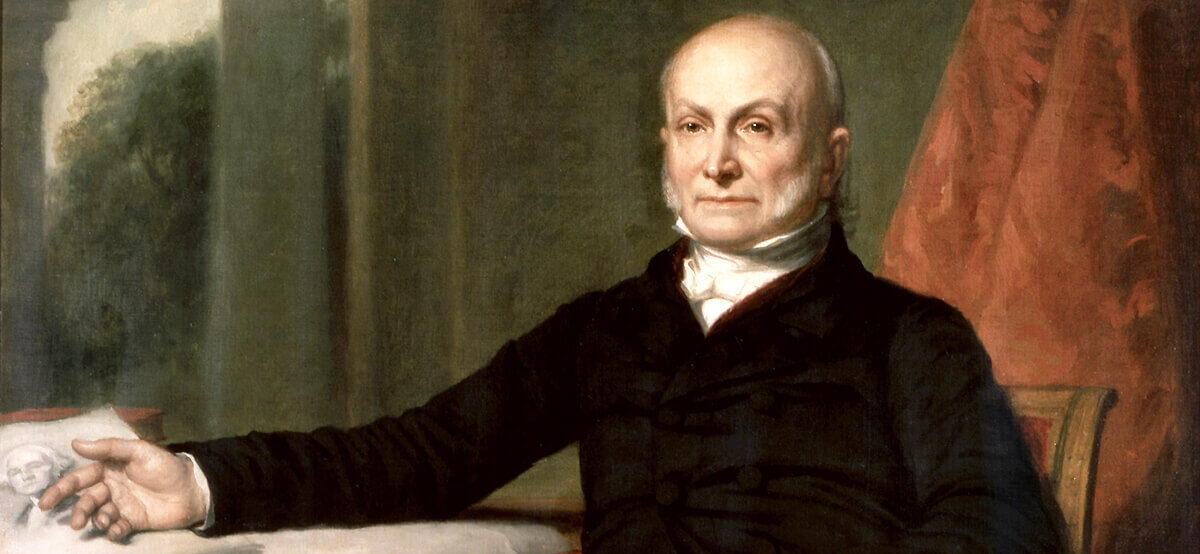
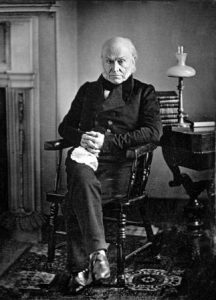
[100] Yuni Words of Wisdom, “Sun Tzu on The Art of War: An Intelligent Guide to Life Strategies and Wisdom” (at https://www.yuni.com/library/suntzu.htm).

[101] In the 2004 elections, a total of 125,736,000 votes were cast; twenty-three percent of voters were “Evangelicals,” thus translating into 28.9 million votes. See sources at New York Times, “Religious Voting Data Show Some Shift, Observers Say,” (at https://select.nytimes.com/gst/abstract.html?res=F50F17F7355B0C7A8CDDA80994DE404482
&n=Top%2fReference%2fTimes%20Topics%2fSubjects%2fE%2fEvangelical%20Movement
); and U. S. Census Bureau, “Voting and Registration in the Election of November 2004” (at https://www.census.gov/prod/2006pubs/p20-556.pdf).

[102] In the 2006 elections, a total of 85,251,089 votes were cast; twenty-four percent of voters were “Evangelicals,” thus translating into 20.5 million votes. See sources at George Mason University, “United States Elections Project: 2006 Voting-Age and Voting-Eligible Population Estimates” (at https://elections.gmu.edu/Voter_Turnout_2006.htm); New York Times, “Religious Voting Data Show Some Shift, Observers Say” (at https://select.nytimes.com/gst/abstract.html?res=F50F17F7355B0C7A8CDDA80994DE404482
&n=Top%2fReference%2fTimes%20Topics%2fSubjects%2fE%2fEvangelical%20Movement
).

[103] “A response to my many critics – and a solution,” Dennis Prager, Tuesday, December 5, 2006 (at https://www.townhall.com/columnists/DennisPrager/2006/12/05/a_response_to_my_many_critics_-_and_a_solution).

* This article concerns a historical issue and may not have updated information.