A Soldier and a President

November 11th, Veteran’s Day, is the day America has set aside to remember and honor those who have been part of our Armed Forces.

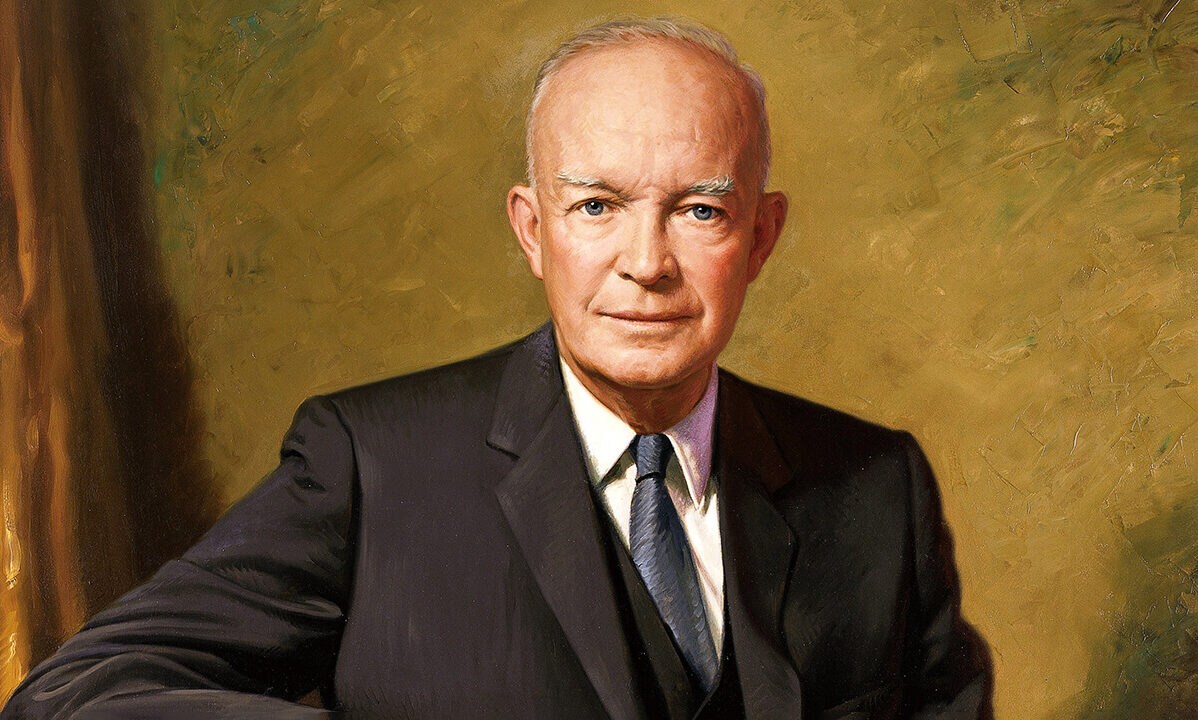
As the Supreme Commander of the Allied troops in Europe, Dwight D. Eisenhower’s bold leadership on the beaches of Normandy during the D-Day invasion of France gained the admiration of the nation. This popularity would later contribute to the slogan “I like Ike” and he was eventually elected and inaugurated as America’s 34th President.

While many Americans today are familiar with General Eisenhower, few know much about his strong faith. For example, the day before his presidential inauguration in 1953, he wrote his own inaugural prayer, which he personally delivered the next day, dedicating himself before God to the service of the people.

During his presidency, he signed into law the bill that added the words “under God” to the Pledge of Allegiance, established the National Prayer Breakfast, made “In God We Trust” the national motto, placed “In God We Trust” on paper currency and not just coinage, and a Congressional Prayer Room was added to the U. S. Capitol.

An inspirational account of God’s providential intervention in the life of a young Dwight Eisenhower was published and distributed nationally during his presidency, and was even circulated during his presidential campaign.

General Eisenhower is one of America’s better known veterans, but the others are no less important. So please take the time to find veterans around you and thank them for their service, and their willingness to sacrifice so much to preserve liberty for all of us.

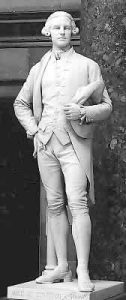
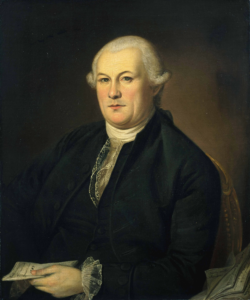
Their Lives, Fortunes and Sacred Honor: Richard Stockton

The signers of the Declaration of Independence pledged their “lives, fortunes, and sacred honor” so that they and their posterity (us!) could enjoy both spiritual and civil liberties to a degree unknown in the world at that time. That pledge literally cost many of them their lives and fortunes. Some of the 56 signers who sacrificed much include John Hancock, Robert Morris, and John Hart. Richard Stockton was another who paid a great price.
Born October 1, 1730, near Princeton, New Jersey, 1 he attended what we now know as Princeton College and became one of their trustees, having been trained as an attorney. His commitment to advance and strengthen the College brought him to the British Isles before the Revolution, where he was consulted by many British leaders as to the condition of affairs in America. 2 He was also presented to King George III, who was very impressed with Stockton. 3 Upon his return to America, he became a leader in state government and then a justice on the New Jersey Supreme Court. 4 When the king’s assault on American liberties increased, Stockton sided with the Americans and was chosen a delegate to the Continental Congress, 5 where he signed the Declaration of Independence as a representative for New Jersey. 6

Stockton was kidnapped from his home by neighbors who were Loyalists (Americans who supported the King of England). 7 He was “dragged from his bed by night, stripped and plundered of his property8 and “treated with the utmost rigor and indignity.” 9 He was placed in a notoriously brutal prison in the middle of winter and was denied even the basic necessities, subjected to the most cruel treatment. 10

When the Continental Congress learned of his plight, they interceded on his behalf. 11He was eventually released but never regained his health. 12 While imprisoned, Stockton’s library, papers and other property was burned or destroyed, and his farm left desolate and inoperable. 13 As a result of his cruel treatment, Stockton died on February 28, 1781, 14 never getting to experience the national freedom for which he had sacrificed so much.

Richard Stockton left us a legacy of patriotism, bravery, and of unwavering devotion to the Christian faith. 15 In fact, in his last will and testament, he pointedly set forth for his children, who at that point were being deprived of their father as a result of the cruel British treatment, the central tenets of Christianity, strongly encouraging them to embrace and follow them.

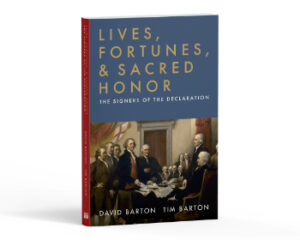
Richard Stockton is one of the forgotten heroes of American history. To learn more about him and other Founding Fathers, be sure to check out the WallBuilders store for Lives of the Signers of the Declaration of Independence.


Endnotes

1 Rev. Charles A. Goodrich, Lives of the Signers of the Declaration of Independence (Hartford: R.G.H. Huntington, 1842), 204-205. See also, Robert W. Lincoln, Lives of the Presidents of the United States; with Biographical Notices of the Signers of the Declaration of Independence (New York: William W. Reed, 1833), 393.
2 Alexander Leitch, “Stockton, Richard,” Princeton Companion (1978). See also, Carroll Judson, A Biography of the Signers of the Declaration of Independence, and of Washington and Patrick Henry (Philadelphia: J. Dobson, and Thomas, Cowperthwait & Co., 1839), 68; John C. Glynn, Jr. and Kathryn Glynn “Richard Stockton,The Society of the Descendents of the Signers of the Declaration of Independence (2008); Goodrich, Lives of the Signers (1842), 205.
3 John Sanderson, Sanderson’s Biography of the Signers to the Declaration of Independence, ed. Robert T. Conrad (Philadelphia: Thomas, Cowperthwait & Co., 1846), 220.
4 Judson, Biography of the Signers (1839), 68. See also, Lincoln, Lives of the Presidents (1833), 393.
5 Goodrich, Lives of the Signers (1842), 207.
6 Sanderson, Sanderson’s Biography of the Signers, ed. Conrad (1846), 219-220.
7 Sanderson, Sanderson’s Biography of the Signers, ed. Conrad (1846), 222.
8 Sanderson, Sanderson’s Biography of the Signers, ed. Conrad (1846), 222.
9 Lincoln, Lives of the Presidents (1833), 393.
10 Goodrich, Lives of the Signers (1842), 207. See also, Judson, Biography of the Signers (1839), 69.
11 Sanderson, Sanderson’s Biography of the Signers , ed. Conrad (1846), 222-223. See also Judson, Biography of the Signers (1839), 69-70.
12 Lincoln, Lives of the Presidents of the United States (1833), 393.  See also Goodrich, Lives of the Signers (1842), 208.
13 Judson, Biography of the Signers (1839), 70.
14 Judson,  Biography of the Signers (1839), 70. See also, Sanderson, Sanderson’s Biography of the Signers, ed.Conrad (1846), 223; Lincoln, Lives of the Presidents (1833), 393; Goodrich, Lives of the Signers (1842), 208.
15 Judson, Biography of the Signers (1839), 70.

Who was known as “First in war, First in peace, First in the hearts of his countrymen”?

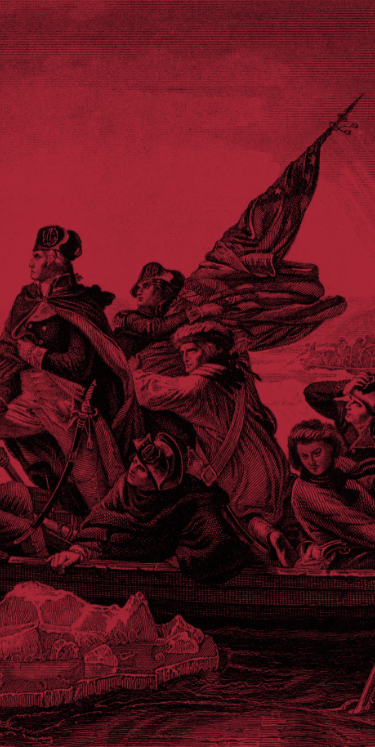
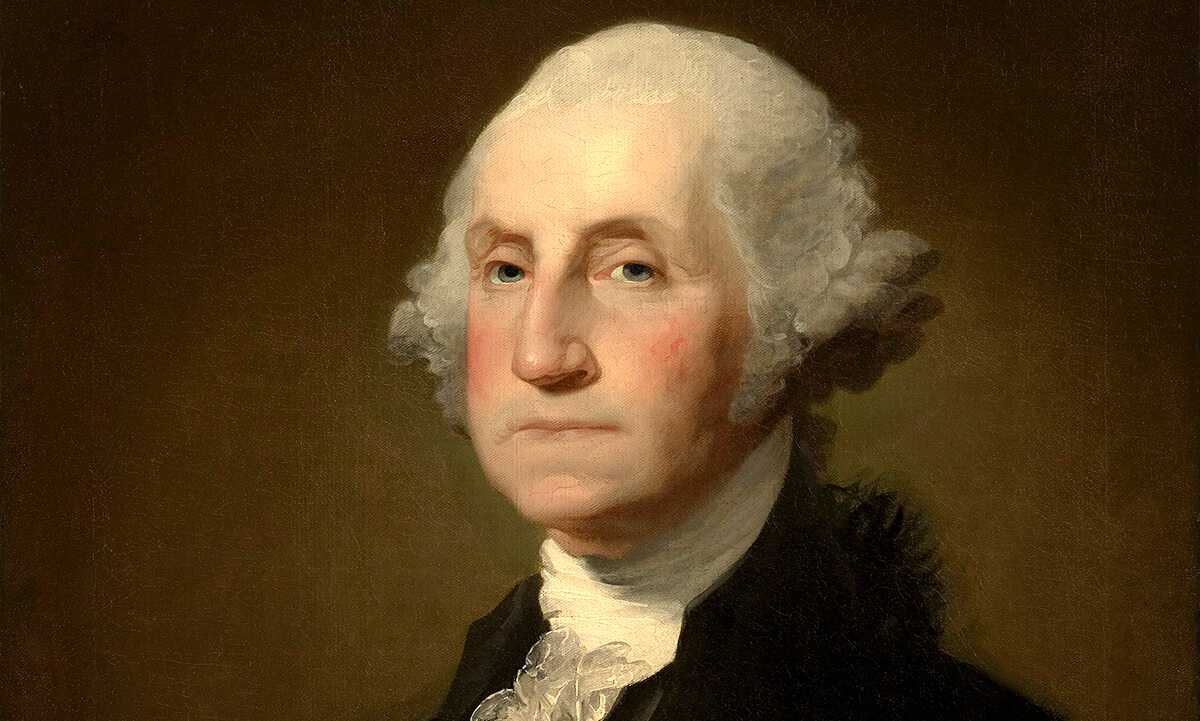
This month marks the 217th anniversary of George Washington’s famous Farewell Address ending his remarkable career of public service. To understand the impact of Washington’s unique leadership, it is worth reviewing a few incidents from his life.
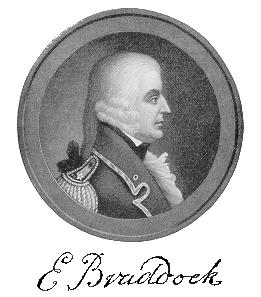
George Washington began his military career as an officer over the Virginia militia and then later as an aide-de-camp to British General Edward Braddock during the French and Indian War.1
Washington’s military advice in that War was very wise, but was rejected by the British.2 During the famous Battle of the Monongahela outside of Pittsburgh, Washington repeatedly escaped death through what he later described as miraculous intervention by God. In fact, an Indian chief who fought against him in that battle3 later traveled a long distance to meet Washington, whom he described as one who “cannot die in battle”4 because he clearly was “under the protection of the Great Spirit.”5 (For the full story of God’s Divine intervention in this battle, be sure to get the audiobook Bulletproof George Washington, read by famous Disney legend Dean Jones.)

Washington’s strong religious faith was evident on numerous occasions throughout the French and Indian War, and early artists later made lithographs capturing some of those reported incidents. One was a lithograph showing George reading the Bible to his troops, and another was Washington fulfilling the role of chaplain at the death of British commander Edward Braddock.

His firm reliance on God was evident throughout all of his endeavors, including in his General Orders to his troops during the American Revolution. And just as had occurred during the French and Indian War, God’s protection of Washington’s life was also evident during the American War for Independence.6

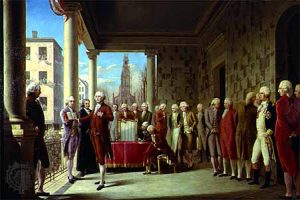
Following the end of the Revolution and the writing and adoption of the Constitution, Washington was unanimously chosen as the nation’s first President — the only president to receive a unanimous electoral college vote.7 From his inauguration (which included seven distinctly religious activities) to his retirement from public service, George Washington repeatedly demonstrated his firm reliance on God, openly acknowledging Him in public prayer proclamations (such as those of 1789 and 1795), speeches 8 and messages. 9 So well established was Washington’s Christian character, that decades after his death, sermons were still being preached to honor his life.

Washington affirmed his strong religious beliefs in his final public message to Americans: his “Farewell Address” of September 17, 1796. That message is considered to be among the most significant political speeches ever delivered by any president,10 and subsequent presidents recommended to Americans that they read and study that Address.11 (We have it available in Documents of Freedom.)

Because of his significant influence, it is no surprise that Washington was lovingly titled by his contemporaries as the man who was “First in war, First in peace, First in the hearts of his countrymen.”12


Endnotes

1 David Ramsay, The Life of George Washington (Baltimore: Joseph Jewett and Cushing & Sons, 1832), 13; John S.C. Abbott, American Pioneers and Patriots. George Washington, or Life in America One Hundred Years Ago (New York: Dodd & Mead Publishers, 1875), 82, James K. Paulding, A Life of Washington (Alberdeen: George Clark and Son, 1848), 41-42.
2 Ramsay, Life of Washington (1832), 13-14; Abbott, American Pioneers (1875), 85-86; Paulding, Life of Washington (1848), 43-44.
3 Ramsay,Life of Washington (1832), 14-15; Abbott, American Pioneers (1875), 91-93, Paulding, Life of Washington (1848), 44-45.
4 George Washington Parke Custis, Recollections and Private Memoirs of Washington by His Adopted Son (New York: Derby & Jackson, 1860), 375; Eugene Parsons, Great Americans of History George Washington: A Character Sketch (Milwaukee, WI: H.G. Campbell Publishing Company, 1898), 30-31, Washington Irving, Life of George Washington (New York: G. P. Putnam & Co., 1856), I:368.
5 Custis, Recollections (1860), 375; Irving, Life of Washington (1856), I:368; Parsons, Great Americans of History (1898), 31.
6 See for example, Jared Sparks, The Life of George Washington (Boston: Ferdinand Andrews, 1839) 205-217; Hon. J. T. Headley, The Illustrated Life of Washington (New York: G. & F. Bill, 1859) 214-216.
7 James Grant Wilson and John Fiske, Appletons’ Cyclopedia of American Biography (New York: D. Appleton and Company, 1889), 6, “Washington, George.”
8 See for example, George Washington, A Compilation of the Messages and Papers of the Presidents, ed. James D. Richardson (New York: Bureau of National Literature, Inc., 1897), I:179, Reply of the President to an Address of the Senate, December 12, 1795.
9 See for example, George Washington, Messages and Papers of the Presidents, ed. Richardson (1897), I:44., First Inaugural Address in the City of New York, April 30, 1789.
10Washington’s Farewell Address,” Library of Congress: Religion and the Founding of the American Republic, (July 23, 2012); “February 22, 1862: Washington’s Farewell Address,” United States Senate.
11 See for example, James Madison, The Writings of James Madison, Letter to Thomas Jefferson, February 8, 1825.
12 Eulogies and Orations on the Life and Death of General George Washington, First President of the United States of America (Boston: Manning & Loring, 1800), 17, “Funeral Oration on the Death of General Washington. Delivered at the Request of Congress, Dec. 26, 1799. By Major-General Henry Lee.”

The Lesser Known Boudinot

WallBuilders mission is “presenting America’s forgotten history and heroes, with an emphasis on our moral, religious, and constitutional heritage.” Two of our great heroes largely forgotten today include Dr. Benjamin Rush (signer of the Declaration, who John Adams considered as one of America’s three most notable Founders 1) and Elias Boudinot (pictured to the right; president of the Continental Congress and a framer of the Bill of Rights in the first federal Congress).

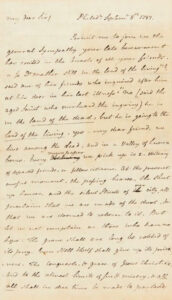
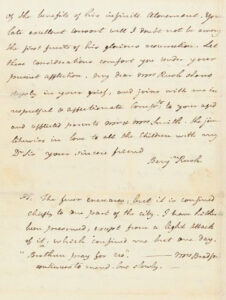
As an indication of the Christian connection between the two, we thought you might enjoy the content of a letter from Dr. Rush to Elisha Boudinot, brother of Elias. 2 This inspiring letter offers Elisha condolences on the loss of his wife, Catharine. It contains what can be considered as nothing less than strong evangelical and Biblical language from Dr. Rush.

Elisha was active in the patriot cause 3 and served as a Justice of the Supreme Court of New Jersey. 4 He was anti-slavery 5 and also worked to help prepare men for the Gospel ministry. 6 His wife was active in helping the poor and needy in their community. 7

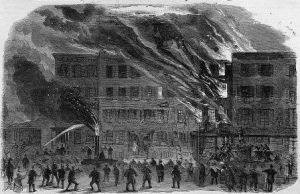
The couple was so beloved by their neighbors that when their house burned, the neighbors not only turned out en masse to rebuild it 8 but also established the city’s first fire department to prevent similar future losses. 9

Founding Fathers such as Benjamin Rush and the Boudinots help reaffirm that America was built on strong religious and moral foundations by leaders of committed Biblical faith.


Endnotes

1 John Sanderson, Biography of the Signers to the Declaration of Independence (Philadelphia: R. W. Pomeroy, 1823), IV:283; L. H. Butterfield, “The Reputation of Benjamin Rush,” Pennsylvania History, January 1950, XVII:1:9, John Adams to Richard Rush on May 5, 1813.
2 J.J. Boudinot, The Life Public Services, Addresses, and Letters of Elias Boudinot, LL.D., President of Continental Congress (Boston: Houghton, Mifflin, and Company, 1896), I:32; Frank John Urquhart, A History of the City of Newark, New Jersey (New York: Lewis Historical Publishing Company, 1913), 2:603.
3 Rev. W. Wallace Atterbury, Elias Boudinot: Reminiscences of the American Revolution (Read Before the Hugenot Society, February 15, 1894), 38; David Lawrence Pierson, Narratives of Newark, (Newark: N.J.: Pierson Publishing Co, 1917), 190;  Urquhart, History of the City of Newark (1913), 2:604.
4 Edward Hagaman Hall, The Sons of the American Revolution (New York: New York State Society, 1894), 57.
5 Urquhart, History of the City of Newark (1913), 2:606.
6 Minutes of the General Assembly of the Presbyterian Church of the United States (Philadelphia: William Bradford, 1822), 166-167.
7 Historic Newark: A Collection of Facts and Traditions (Newark, N.J.: Fidelity Union Trust Company, 1916), 24; Boudinot, Public Services…of Elias Boudinot (1896), I:39.
8 Historic Newark (1916), 24.
9 William H. Shaw, History of Essex and Hudson Counties, New Jersey (Philadelphia: Everts & Peck, 1884), 1:458.

The Barbary Powers Wars

What important American victory in the Barbary Powers Wars occurred on this date in 1801?

(*See below for the answer.)

The Barbary Powers Wars were the first wars officially declared against America following our victory in the War for Independence. 1 Muslim terrorists from five different Islamic nations (Turkey, Tunis, Morocco, Algiers, and Tripoli) were making indiscriminate attacks against the property and interests of what they claimed to be “Christian” nations (America, England, France, Spain, Portugal, Denmark, Sweden, etc.). 2 These Muslim terrorists (called Barbary, that is, barbaric “pirates” by most Americans) attacked American civilian and commercial merchant ships wherever they found them, seizing the cargo and enslaving the crew. 3

In 1784, Congress dispatched three diplomats – John Adams, Benjamin Franklin, and Thomas Jefferson – to negotiate with these Muslim nations and end the unprovoked attacks. 4 They found this to be a difficult task, for the attacking of ships and the taking of Christians by Muslims had been a widespread problem for centuries. 5

The Muslims found they could finance their wars and terror operations by enslaving and then selling captured seamen. (The Muslims took 1.25 million captive slaves in that period. 6) Because this was such a widespread and recurring problem, other Christian nations formed standing organizations to raise money to purchase enslaved seamen. As Jefferson explained:

There is here an order of priests called the Mathurins, the object of whose institutions is the begging of alms for the redemption of captives. About eighteen months ago, they redeemed three hundred, which cost them about fifteen hundred livres [$1,500] apiece. They have agents residing in the Barbary States, who are constantly employed in searching and contracting for the captives of their nation, and they redeem at a lower price than any other people can. 7
Ransoming Americans was no less expensive, and therefore was a very profitable trade for the Muslim terrorists. 8 Additionally, the Muslim nations would sign treaties with the attacked nations, including America, providing that for an annual “tribute” (perhaps $1 million a year, along with the “gift” of several frigates), that they would perhaps refrain from further attacks. By 1795, such “peace” payments to Muslim terrorists comprised a full sixteen percent of the entire federal budget!  9

Among the many treaties signed with Muslim nations during this period was the famous 1797 treaty with Tripoli. It was one of the many treaties in which each country officially recognized the religion of the other in an attempt to prevent further escalation into a “Holy War” 10 such as had existed between Christians and Muslims in the Middle Ages.

The Muslims considered that all Christian nations were like those of the Crusades, when Christians fought Muslims simply because they were Muslims. 11  However, America was definitely not like the European Christian nations from medieval times, for we did not kill Muslims, Jews, or any one else for their faith. In fact, many Founding Fathers talked about how different America as a Christian nation was from the European Christian nations; 12 and the American treaties, including the Treaty of Tripoli, made this very point.
Significantly, secularists regularly cite one clause from that treaty in devious attempts to make it appear that the Founding Fathers emphatically avowed that America was not a Christian nation. They thus quote from that treaty the line declaring “The government of the United States is in no sense founded on the Christian religion . . . ” This declaration certainly seems to be straightforward – until you discover that the critics only used part of the quote. Notice what the full, unedited clause states:

As the government of the United States of America is not in any sense founded on the Christian religion as it has in itself no character of enmity against the laws, religion or tranquility of Musselmen [Muslims]. and as the said States [America] have never entered into any war or act of hostility against any Mahometan nation, it is declared by the parties that no pretext arising from religious opinions shall ever produce an interruption of the harmony existing between the two countries. 13 (emphasis added)

This clause from the Treaty of Tripoli simply affirms that America was not one of the European Christian nations with an inherent hostility toward Muslims, and that America had never been part of arbitrary wars against Muslims such as had characterized the Crusades. This clause definitely does not deny or undermine America’s strong Christian heritage – unless you wrongly place a period in the middle of the sentence, as secularist critics do.
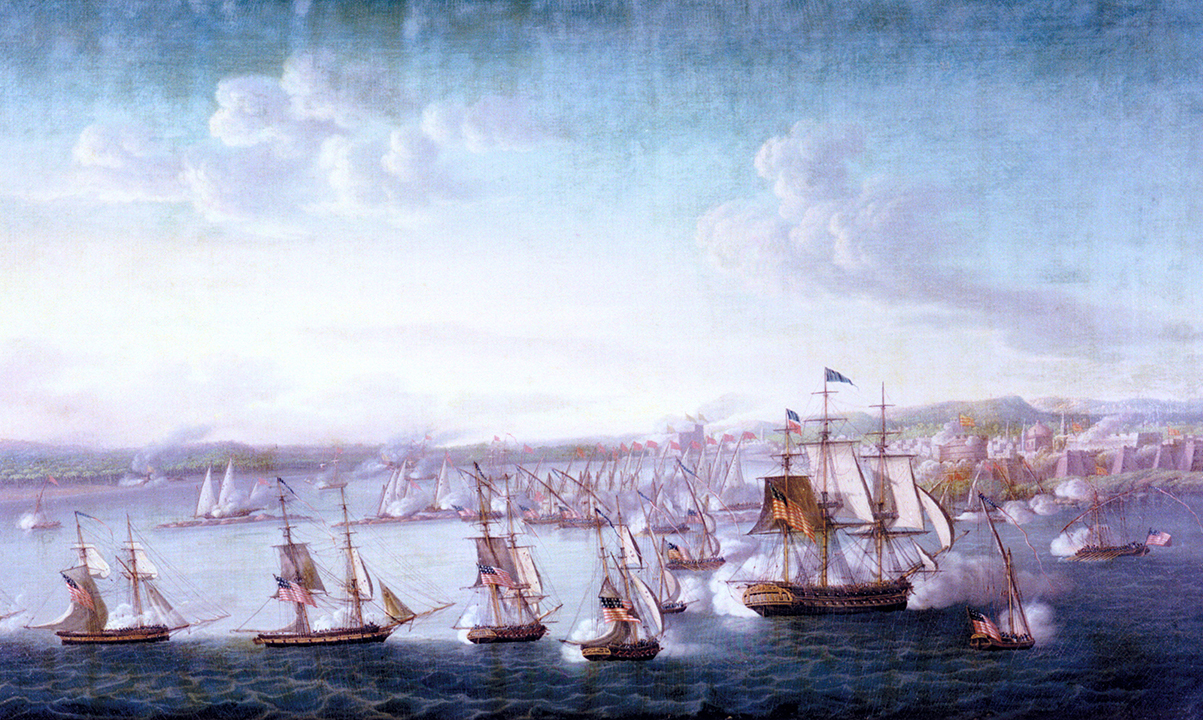
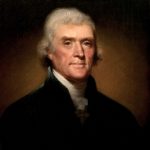
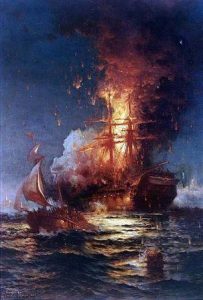
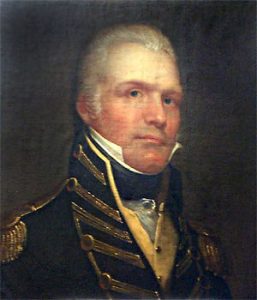
When Thomas Jefferson became president in 1801, he decided that it was time to take military action to end the two-decades-old unprovoked Muslim terrorist attacks against Americans. 14 Using the brand new American Navy to transport the U. S. Marines overseas (President George Washington had called for the construction of a navy in 1795, and President John Adams had overseen its construction 15), General William Eaton took the American military and proceeded to the same region of the world where Americans are still being attacked today. He then led a successful five-year campaign to free captured Americans and crush Muslim terrorist forces. 16 Tripoli (now called Libya) finally capitulated and signed a treaty on America’s terms in 1805, thus ending their aggressions – at least for a while. 17
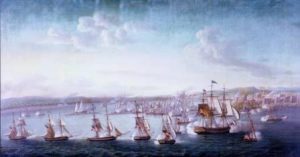
(By the way, it was from the Marine’s role in that first War on Terror from 1801-1805 that the U. S. Marines derive part of the opening line of their hymn: “From the halls of Montezuma to the shores of Tripoli . . .”)
Shortly after President James Madison took office, he became engulfed in the War of 1812. With America preoccupied in a second war against the British, Algerian Muslim terrorists again began attacking Americans. But upon concluding the war with the British, President James Madison dispatched the American military and warships against three Muslim nations: Algiers, Tunis, and Tripoli. 18 America (with the assistance of Great Britain and the Netherlands) subdued those Muslim nations and brought them to the peace table, where they freed all the enslaved Christians. 19
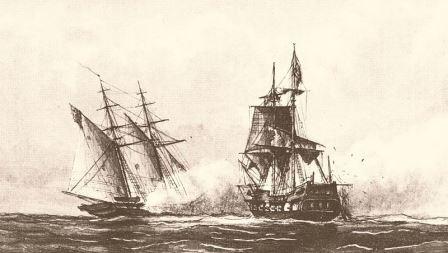
*On this date in history, the U.S.S. Enterprise captured the Trioplitan ship known as the Tripoli. While the terrorists sustained heavy losses, the Americans did not lose a single man in the battle. 20


Endnotes

1 Thomas Clark, Naval History of the United States, from the Commencement of the Revolutionary War to the Present Time (Philadelphia: M. Stiles, 1814), 1:140; James H. Morgan, Register of the Military Order of Foreign wars of the United States (New York: The National Commandery, 1900), 11-19.
2 Richard O’Brian to Thomas Jefferson, June 8, 1786, Naval Documents Related  to the United States Wars with the Barbary Powers, ed. Claude A. Swanson (Washington: United States Government Printing Office, 1939), 1:1-6; A General View of the Rise, Progress, and Brilliant Achievements of the American Navy Down to the Present Time (Brooklyn: 1828), 70-71; “Barbary Pirates,” The Encyclopedia Britannica, ed. Hugh Chisholm (New York: The Encyclopedia Britannica Company, 1910), 383.
3 Julian Hawthorne et. al., United States from the Discovery of the North American Continent up to the Present Time (New York: James Schouler, 1894), 3:17-20; Forward written by President Franklin D. Roosevelt, December 30, 1958, Naval Documents, ed. Swanson (1939), 1; Theodore Lyman, The Diplomacy of the United States (Boston: Wells and Lilly, 1828), 2:338-342.
4 Thomas Jefferson to William Carmichael, November 4, 1785, The Writings of Thomas Jefferson, ed. Andrew A. Lipscomb (Washington, D. C.: The Thomas Jefferson Memorial Association, 1903), V:195; Garner W. Allen, Our Navy and the Barbary Corsairs (Boston: Houghton, Mifflin, and Company, 1905) 28.
5 “Barbary Pirates,” The Encyclopedia Britannica, ed. Hugh Chisholm (New York: The Encyclopedia Britannica Company, 1910), 383.
6 Robert Davis, Christian Slaves, Muslim Masters: White Slavery in the Mediterranean, the Barbary Coast and Italy, 1500-1800 (Palgrave Macmillan, 2004).
7 Thomas Jefferson to John Adams, January 11, 1787, The Writings of Thomas Jefferson, ed. Andrew A. Lipscomb (Washington, D. C.: The Thomas Jefferson Memorial Association, 1903), VI:47-48.
8 No. 43: Prisoners at Algiers, American State Papers: Documents, Legislative and Executive, of the Congress of the United States (Washington: Gales and Seaton), 1:100-101.
9 The federal budget was $6,115,000 in 1795; a payment of nearly $1 million was given that year to Algiers alone, not including what was given to the other Barbary Powers.  See US Department of Commerce, Bureau of the Census, Historical Statistics of the United States (White Plains, NY: Kraus International Publications, 1989), 1106; George Washington to the Secretary of the Treasury, May 29, 1794, The Writings of George Washington, ed. John C Fitzpatrick (Washington: Government Printing Office, 1940), 33:385.
10 See, for example, the 1786 Treaty with Morocco: Articles 10, 11, 17 and 24; the 1795 Treaty with Algiers: Article 17; the 1815 Treaty with Algiers: Article 13; the 1816 Treaty with Algiers: Articles 14 and 15; the 1796 Treaty with Tripoli: Article 11; the 1805 Treaty with Tripoli: Article 14; and the 1797 Treaty with Tunis: Forward.
11 Thomas Edward Watson, The Life and Times of Thomas Jefferson (New York: D. Appleton and Company, 1903), 247-249.
12 See for example, John Jay, “Address to the Annual Meeting of the American Bible Society,” May 8, 1823, Correspondence and Public Papers of John Jay, ed. Henry Johnston (New York: G. P. Putnam’s Sons, 1893), IV:491; John Quincy Adams, An Oration Delivered Before the Inhabitants of the Town of Newburyport at Their Request on the Sixty-First Anniversary of the Declaration of Independence (Newburyport: Charles Whipple, 1837), 17; John Adams in a speech to both  houses of Congress, November 23, 1797, The Works of John Adams, ed. Charles Francis Adams (Boston: Little, Brown and Company, 1854), IX:121; Noah Webster, History of the United States (New Haven: Durrie & Peck, 1832), 339, “Advice to the Young”; Daniel Webster, Mr. Webster’s Speech in Defence of the Christian Ministry and In Favor of the Religious Instruction of the Young. Delivered in the Supreme Court of the United States, February 10, 1844, in the Case of Stephen Girard’s Will (Washington, DC: Gales and Seaton, 1844), 12-13.
13 Acts Passed at the First Session of the Fifth Congress of the United States of America (Philadelphia: William Ross, 1797), 43-44.
14 Thomas Jefferson, “Second Annual Message,” December 15, 1802, The Writings of Thomas Jefferson (Washington, D.C.: Taylor & Maury, 1854), 8:17; Thomas Jefferson, “Autobiography,” 1821, The Writings of Thomas Jefferson, ed. Paul Leicester Ford (New York: G.P. Putnam’s Sons, 1892), I:91-93; Elizabeth Huff, “The First Barbary War,” Monticello, accessed December 1, 2023.
15 “The Reestablishment of the Navy, 1787-1801,” Naval History Bibliography.
16  William Grimshaw, The History of the United States, From Their First Settlement as Colonies to the Cession of Florida, in Eighteen Hundred and Twenty-One, (Philadelphia: Benjamin Warner, 1821), 194-195; Charles Prentiss, The Life of the Late Gen. William Eaton; Several Years an Officer in the United States’ Army, Consul at the Regency of Tunis on the Coast of Barbary, and Commander of the Christian and Other Forces That Marched from Egypt Through the Desert of Barca, in 1805, and Conquered the City of Derne, Which Led to the Treaty of Peace Between the United States and the Regency of Tripoli; Principally Collected from His Correspondence and Other Manuscripts (Brookfield: E. Merriam & Co., 1813).
17 “The Barbary Wars, 1801-1805,” National Museum of the US Navy, accessed October 7, 2025.
18 John Quincy Adams, The Lives of James Madison and James Monroe (Buffalo: Geo. H. Derby and Co., 1850), 93; “Barbary Wars, 1801-1805 and 1815-1816,” US Department of State: Office of the Historian, accessed October 7, 2025.
19  James Madison, “Seventh Annual Message,” December 5, 1815, The Writings of James Madison, ed. Gaillard Hunt (United States: G.P. Putnam’s Sons, 1908), VIII:33; Perceval Barton Lord, Algiers, with Notices of the Neighbouring States of Barbary, (London: Whittaker & Co., 1835), 50-60.
20 Garner W. Allen, Our Navy and the Barbary Corsairs (Boston: Houghton, Mifflin, and Company, 1905), 96; Naval Documents, ed. Swanson (1939), 1:538-540.

Which President earned the nickname “Old Man Eloquent”?

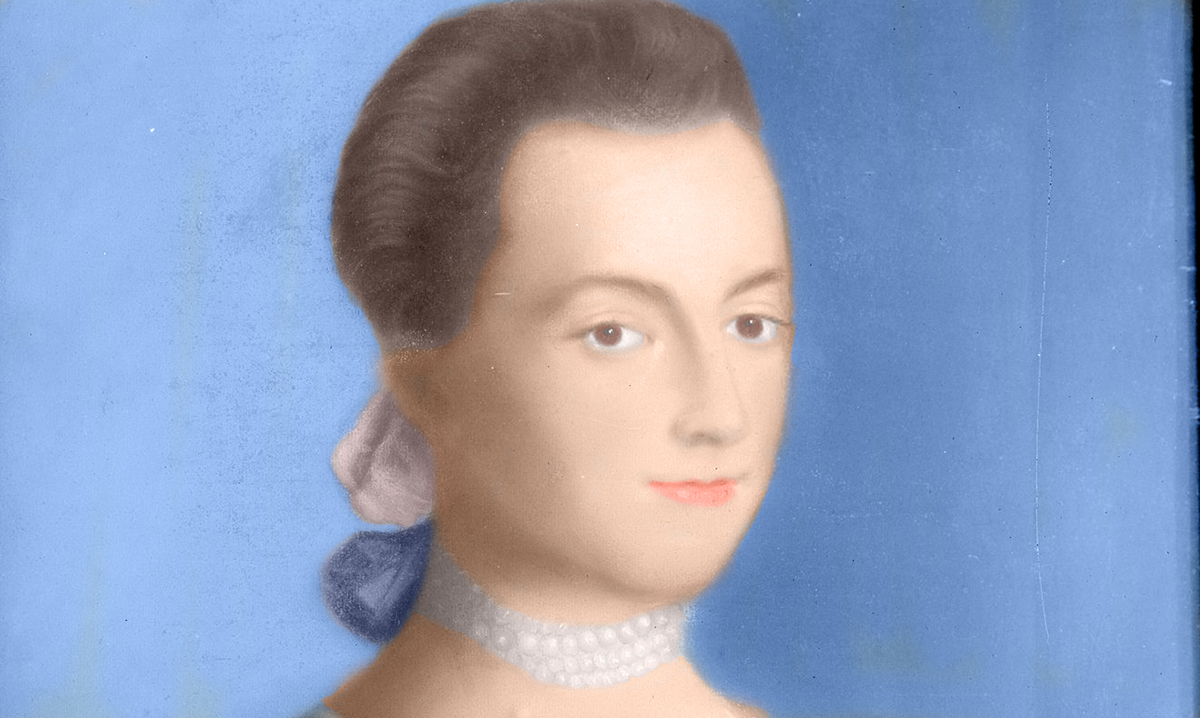
If you answered John Quincy Adams (the earliest serving President to have a photograph taken of him), then you were right!

Born on July 11, 1767, to John Adams and Abigail Adams, 1 by the age of eight he had not only trained with the famous Massachusetts Minutemen 2 and watched the British attack Boston,3 but by the age of 11, he was serving as a secretary to his father, who was the U.S. diplomat to France; 4 at the age of 14, he was sent to be secretary and translator for Francis Dana, American diplomat in the Court of Queen Catherine the Great in Russia;5 and at the age of 15, he was an official secretary for the American delegation negotiating the final peace treaty to end the American War for Independence.6

This amazing youngster became a diplomat under President George Washington 7 (whom Washington described as “the most valuable public character we have abroad”), 8 and served in the same position under several other presidents. 9

He was also a U. S. Senator, a Secretary of State,10 was appointed to the U. S. Supreme Court (but declined the position), 11 and became the sixth President of the United States. 12

In fact, he was the only president in American history who served in the U. S. House of Representatives after finishing his term as president (he served for 17 years in that position!).13

Throughout his time in the House, he was known as the “Hell Hound of Abolition” for his relentless pursuit of that object, as well as “Old Man Eloquent” for his mastery of the spoken language 14 — not surprising since he had previously been a professor of oratory and rhetoric at Harvard. 15

But before serving in the House, while Ambassador to Russia under President James Madison in 1811, he wrote nine letters to his ten-year-old son, George Washington Adams (whom he had named after his friend and mentor, George Washington), instructing him on how to read through the Bible once each year. As he explained to his young son, his purpose for those letters was “the inculcation of a love and reverence for the Holy Scriptures, and a delight in their perusal and study.”16

In his first letter, he told young George:

I have myself, for many years, made it a practice to read through the Bible once every year. I have always endeavored to read it with the same spirit and temper of mind, which I now recommend to you: that is, with the intention and desire that it may contribute to my advancement in wisdom and virtue. 17

Shortly after John Quincy’s death on the floor of the House of Representatives in 1848, those nine letters were quickly printed as a book for all of America’s youth, 18 so that they, too, could learn how to read through the Bible once each year, and understand it. That work was so popular that it went through a number of reprints, and is still in print today (and it is worthwhile for all Americans to read today, regardless of their age).

Not only was John Quincy’s faith evident throughout his family letters but also in his published works — such as his poetry. Interestingly, Adams was one of only a handful of poet presidents, and his strong Biblical faith is repeatedly demonstrated in his poems. In fact, his 1848 work, Poems of Religion and Society includes poems on the Sabbath, the Goodness of God, and many more Christian topics.

Interestingly, when admirers — particularly young ones — wrote this famous American asking for his autograph, he would often sent them a piece of original poetry he had composed for them based on one of the Psalms from the Bible. In fact, WallBuilders recently posted one such handwritten Psalm transcribed by John Quincy Adams.

Adams, who spent more than six decades of his life in public service, was known as a man “devoted to serving rather than pleasing his countrymen” 19 – that is, he was driven by principle, not by what others thought, understanding that his eternal destiny was more important than his momentary popularity. He maintained this principled position, even when it meant confronting his own family. For example, as his father, John Adams, was growing old, and late in life began to depart from the Christian orthodoxy that had characterized his earlier years, questioning even the Divinity of Christ and a belief in the Trinity, John Quincy pointedly told his father:

My hopes of a future life are all founded upon the Gospel of Christ and I cannot cavil or quibble away [evade or object to]. . . . the whole tenor of His conduct by which He sometimes positively asserted and at others countenances [permits] His disciples in asserting that He was God. 20

As we honor the birthday of one of America’s greatest statesmen, let us also rely on the same Hope in which he trusted and even model our life after John Quincy Adams’ personal life motto, described by nineteenth century historian Elbridge Brooks as:

Duty is ours, and the results are God’s 21


Endnotes

1 Francis S. Drake, Dictionary of American Biography (Boston: Houghton, Osgood & Company, 1879), p. 7, s.v. “John Quincy Adams.”See also,John Quincy Adams Biography,” National Park Service (accessed July 17, 2013).
2 John Quincy Adams, Memoirs of John Quincy Adams, Comprising Portions of His Diary From 1795 to 1848, Charles Francis Adams, editor (Philadelphia: J.B. Lippincott & Co., 1875), Vol. VII, p. 325.
3 John Quincy Adams, Memoirs of John Quincy Adams, Comprising Portions of His Diary From 1795 to 1848, Charles Francis Adams, editor (Philadelphia: J.B. Lippincott & Co., 1874), Vol. I, pp. 4-6.
4 William H. Seward, The Life and Public Services of John Quincy Adams, Sixth President of the United States, with the Eulogy Delivered Before the Legislature of New York (Auburn: Derby, Miller, and Company, 1849), pp. 30-32. See also, Sketch of the Life of John Quincy Adams; Taken from the Port Folio of April, 1819 (1824), p. 4.
5 John Quincy Adams, Memoirs of John Quincy Adams, Comprising Portions of His Diary From 1795 to 1848, Charles Francis Adams, editor (Philadelphia: J.B. Lippincott & Co., 1874), Vol. I, p. 12.
6 Memoirs of John Quincy Adams (Philadelphia: J.B. Lippincott & Co, 1874), Vol. I, p. 13. See also, Biographies of the Secretaries of State: John Quincy Adams,” U.S. Department of State: Office of the Historian (accessed on July 15, 2013).
7Adams, John Quincy,” Biographical Directory of the United States Congress (accessed on July 11, 2013).
8 George Washington, Correspondence Between the Honorable John Adams, Late President of the United States and the Late Wm. Cunningham, Esq. (Boston: E.Q. Cunningham, 1823), pp. 37-38, To John Adams February 20, 1797.
9Adams, John Quincy,” Biographical Directory of the United States Congress (accessed on July 11, 2013).
10Adams, John Quincy,” Biographical Directory of the United States Congress (accessed on July 11, 2013).
11 Dictionary of American Biography, Allen Johnson, editor (New York: Charles Scribner’s Sons, 1928), Vol. I, p. 85.
12Adams, John Quincy,” Biographical Directory of the United States Congress (accessed on July 11, 2013).
13The Election of John Quincy Adams of Massachusetts,” United States House of Representatives: History, Art, & Archives (accessed July 17, 2013). See also,Adams, John Quincy,” Biographical Directory of the United States Congress (accessed on July 11, 2013).
14 Francis S. Drake, Dictionary of American Biography (Boston: Houghton, Osgood & Company, 1879), p. 8, s.v. “John Quincy Adams.”
15 Sketch of the Life of John Quincy Adams; Taken from the Port Folio of April, 1819 (1824), p. 10.
16 John Quincy Adams, Letters of John Quincy Adams to His Son on the Bible and its Teachings (Auburn, N.Y: Derby, Miller, & Co., 1848), pp. 6-7.
17 John Quincy Adams, Letters of John Quincy Adams to His Son on the Bible and its Teachings (Auburn, N.Y: Derby, Miller, & Co., 1848), pp. 10-11.
18John Quincy Adams, Letters of John Quincy Adams to His Son on the Bible and its Teachings (Auburn, N.Y: Derby, Miller, & Co., 1848), pp. 5-8.
19 John Quincy Adams, Letters of John Quincy Adams to His Son on the Bible and its Teachings (Auburn, N.Y: Derby, Miller, & Co., 1848), p. 6.
20 John Quincy Adams, The Writings of John Quincy Adams, Worthington Chauncey Ford, editor (New York: The MacMillan Company, 1916), Vol. VI, p. 135, Letter to John Adams, January 3, 1817.
21 Elbridge S. Brooks, Historic American: Sketches of the Lives and Characters of Certain Famous Americans Held Most in Reverence by the Boys and Girls of America, For Whom Their Stories Here Are Told (New York: Thomas Y. Crowell & Co. Publishers, 1899), pp. 208-209.

American troops land at Omaha Beach during the D-Day landings of 1944.

This Day in History: D-Day

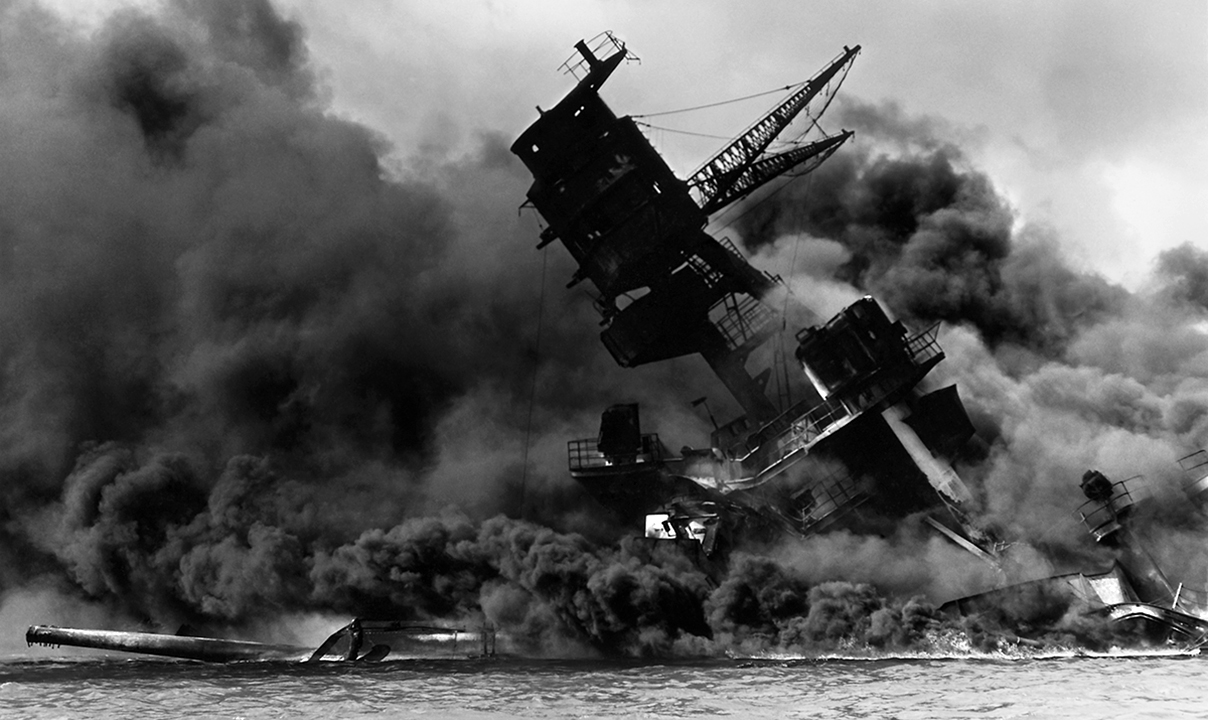
In 1941, America, although striving to be uninvolved, was pulled into another world war.  Still recovering from the previous one, the attacks at Pearl Harbor on December 7th ensured America’s involvement in one of the bloodiest wars in history. 1

In response to the Pearl Harbor attacks, America declared war on Japan, Germany, and Italy. 2   In order to help fund the war effort, the government issued war bonds, and then printed posters to help encourage Americans to purchase the bonds. Interestingly, many posters were overtly Christian in their content (such as the one pictured on the left).
June 6th is a great time to pause and remember those brave men who so valiantly fought for freedom. It was on this date, 69 years ago, that the Allied troops stormed the beaches of Normandy  3 in an effort to turn the tide of the war. 4  This strategic landing enabled the Allies to push back the German troops. 5  As the Supreme Commander of the Allied Forces, Dwight D. Eisenhower told the troops:

The eyes of the world are upon you. The hopes and prayers of liberty-loving people everywhere march with you.

The prayers of America for her troops were also evident in President Franklin D. Roosevelt’s D-Day Prayer that he prayed in a national radio address given to the American people as the D-Day invasion was underway. 6  As we remember those brave men who sacrificed so much in World War II, let us also be grateful for the men and women who continue to preserve the freedoms that America holds dear today.

Be sure to tune check out WallBuilders Show radio program to hear several stories of WWII Veterans. To see what the Bible – and the Founders- said about war (Psalm 144 and Romans 13) and numerous other topics, be sure to check out The Founders’ Bible.


Endnotes

1 “World War II” Encyclopedia Britannica (accessed June5, 2013).  See also,  Wayne M. Dzwonchyk and John Ray Skates, “A Brief History of the U.S. Army in WWII,” U.S. Army Center of Military History (accessed June5, 2013).
2 “Declarations of a State of War with Japan, Germany, and Italy: Proceedings in the Senate, Monday, December 8, 1941,” Avalon Project (accessed June 5, 2013). See also, “Declarations of a State of War with Japan, Germany, and Italy: Proceedings in the House of Representatives, Monday, December 8, 1941,” Avalon Project (accessed June 5, 2013).
3 “D-Day: June 6, 1944,” U.S. Army (accessed June 5, 2013).
4 “D-Day, the Normandy Invasion, 6 – 25 June 1944,” Naval History and Heritage Command (accessed June 5, 2013). See also, William M. Hammond, “Normandy,” U.S. Army Center of Military History, October 3, 2003.
5 “Outline of Operation Overlord,” U.S. Army Center of Military History, February 4, 2012. See also, “D-Day, the Normandy Invasion, 6 – 25 June 1944,” Naval History and Heritage Command (accessed June 5, 2013). William M. Hammond, “Normandy,” U.S. Army Center of Military History, October 3, 2003.
6 “D-Day,” Franklin D. Roosevelt Presidential Library and Museum (accessed June 5, 2013).

Fall 1998

Thanksgiving in America

This month, America will continue a tradition begun centuries ago: the celebration of a Day of Thanksgiving. The origin of this tradition is commonly attributed to the Pilgrims in 1621, even though some Thanksgiving services did occur elsewhere in America as early as 1607. While Thanksgiving celebrations became common in New England, they did not begin to spread southward until the American Revolution, when Congress issued eight separate national Thanksgiving Proclamations.

Then in 1789, following a proclamation issued by President George Washington, America celebrated its first Day of Thanksgiving to God under its new Constitution. That same year, the Protestant Episcopal Church, of which President Washington was a member, announced that the first Thursday in November would become its regular day for giving thanks, “unless another day be appointed by the civil authorities.” Yet, despite these early national proclamations, official Thanksgiving observances usually occurred only at the State level.

Much of the credit for the adoption of an annual national Thanksgiving Day may be attributed to Mrs. Sarah Joseph Hale, the editor of Godey’s Lady’s Book. For thirty years, she promoted the idea of a national Thanksgiving Day, contacting President after President until President Abraham Lincoln responded in 1863 by setting aside the last Thursday of November as a national Day of Thanksgiving. Over the next seventy-five years, Presidents followed Lincoln’s precedent, annually declaring a national Thanksgiving Day. Then, in 1941, Congress permanently established the
fourth Thursday of each November as a national holiday.

Lincoln’s original 1863 Thanksgiving Proclamation came–spiritually speaking–at a pivotal point in his life. During the first week of July of that year, the Battle of Gettysburg occurred, resulting in the loss of some 60,000 American lives. Four months later in November, Lincoln delivered his famous “Gettysburg Address.” It was while Lincoln was walking among the thousands of graves there at Gettysburg that he committed his life to Christ. As he explained to a friend:

When I left Springfield [to assume the Presidency] I asked the people to pray for me. I was not a Christian. When I buried my son, the severest trial of my life, I was not a Christian. But when I went to Gettysburg and saw the graves of thousands of our soldiers, I then and there consecrated myself to Christ.

Following is the 1863 Lincoln Thanksgiving Proclamation–celebrated shortly after Lincoln committed his life to Christ and celebrated while America was still in the midst of its Civil War. It was this proclamation which eventually led to the establishment of our national Thanksgiving holiday.

Proclamation of Thanksgiving by the President of the United States of America

The year that is drawing toward its close has been filled with the blessings of fruitful years and healthful skies. To these bounties, which are so constantly enjoyed that we are prone to forget the Source from which they come, others have been added which are of so extraordinary a nature that they cannot fail to penetrate and soften even the heart which is habitually insensible to the ever-watchful providence of almighty God

In the midst of a civil war of unequaled magnitude and severity, which has sometimes seemed to foreign states to invite and to provoke their aggression, peace has been preserved with all nations, order has been maintained, the laws have been respected and obeyed, and harmony has prevailed everywhere, except in the theater of military conflict, while that theater has been greatly contracted by the advancing armies and navies of the Union.

Needful diversions of wealth and of strength from the fields of peaceful industry to the national defense have not arrested the plow, the shuttle, or the ship; the ax has enlarged the borders of our settlements, and the mines, as well of iron and coal as of the precious metals, have yielded even more abundantly than theretofore.

Population has steadily increased notwithstanding the waste that has been made in the camp, the siege, and the battlefield, and the country, rejoicing in the consciousness of augmented strength and vigor, is permitted to expect continuance of years with large increase of freedom.

No human counsel hath devised nor hath any mortal hand worked out these great things. They are the gracious gifts of the Most High God, who, while dealing with us in anger for our sins, hath nevertheless remembered mercy. It has seemed to me fit and proper that they should be solemnly, reverently, and gratefully acknowledged, as with one heart and one voice, by the whole American people. I do therefore invite my fellow-citizens in every part of the United States, and also those who are at sea and those who are sojourning in foreign lands, to set apart and observe the last Thursday of November next as a day of thanksgiving and praise to our beneficent Father who dwelleth in the heavens. And I recommend to them that while offering up the ascriptions justly due to Him for such singular deliverances and blessings they do also, with humble penitence for our national perverseness and disobedience, commend to His tender care all those who have become widows, orphans, mourners, or sufferers in the lamentable civil strife in which we are unavoidably engaged, and fervently implore the interposition of the Almighty Hand to heal the wounds of the nation and to restore it, as soon as may be consistent with the Divine purposes, to the full enjoyment of peace, harmony, tranquillity, and union.

In testimony whereof I have hereunto set my hand and caused the seal of the United States to be affixed.


Abraham Lincoln


A Biblical and Historical Perspective on the Clinton Scandal

The President, by his own admission, has violated several of the most basic laws undergirding both society and religion: the Ten Commandments. Specifically, the President willfully broke the 7th command (to maintain the sanctity of sex within marriage), the 10th command (forbidding coveting another person), and the 9th command (prohibiting perjury).

Such blatant violations of the Ten Commandments are no small matter. To reject the Ten Commandments is to disdain those laws which were described by John Quincy Adams as the “laws essential to the existence of men in society,” by John Adams as the “inviolable precepts in every society” that make it “civilized and free,” and by John Witherspoon as “the sum of the moral law.”

There can be nothing said in defense of the President. What he has done is wrong. Nevertheless, in an attempt to evade the consequences, the strategy pursued by the supporters and counselors of the President has been twofold: (1) to ask forgiveness and show public contrition, and (2) to degrade the culture by claiming that others also do what the President did–that it’s only sex–a private matter.

While seeking forgiveness is commendable, particularly if it is sincere, it never has, and never should, excuse someone from the consequences of his behavior. In fact, 1 Samuel 15:9-31 presents a striking parallel to the current situation. In that account, Saul, the national leader, committed a transgression. When Samuel uncovered and exposed the unrighteous act, Saul offered an apology, declaring, “I have sinned. . . . Now, I beg you, please forgive my sin.” Nevertheless, God had Samuel inform Saul that because of his behavior, “The Lord has rejected you as leader.” (See the account of a similar but separate incident in 1 Samuel 13:8-14.) Similar lessons may be learned through the stories of Esau, David, Hezekiah, Uzziah, Gehazi, and others. While each committed a wrong and later regretted his behavior, each still had to face the consequences of his own wrong behavior. In short, “I’m sorry” is insufficient to prevent the consequences of a leader’s willful, serious, and immoral misbehavior.

And the “everybody else is doing it” defense is wrong for at least two reasons. First, the Bible forcefully declares, on numerous occasions, that each person must face the consequences of and be responsible for his own actions—regardless of what “everybody” else does. (See, for example, Jeremiah 31:27-30). Second, to claim that such behavior is widespread and common undermines the mores of our society. In fact, the proper response should be to condemn the act rather than attempt excuse or justify the act. As explained by John Witherspoon, signer of the Declaration of Independence:

[H]e is the best friend to American liberty who . . . sets himself with the greatest firmness to bear down profanity and immorality of every kind.

Under this standard, if the President’s supporters truly cared about America, rather than excusing immoral behavior, even if done “privately,” they would be condemning it. Unfortunately, the President’s defenders have done just the opposite, conveying to the public a perception that those who practice marital fidelity are the minority. That Americans actually perceive this to be the moral condition of America is illustrated by a poll earlier released by Family Circle magazine. The results of that survey, questioning respondents on the Ten Commandments, confirmed an interesting image of misperceptions.

For example, while only fourteen percent of the respondents had actually engaged in extramarital relations, amazingly, forty-five percent reported their belief that extramarital relations were common. Why would respondents believe that extramarital relations among that group occurred at a rate nearly three times higher than it actually did? Because they have been consistently pummeled–as a defense by those who engage in extramarital affairs–with the charge that such affairs are commonplace.

Not only do the efforts of the President’s supporters weaken the moral standards, they actually perpetuate historical revisionism. That is, in an attempt to excuse the President’s immoral behavior, his defenders are asserting that President George Washington also engaged in immoral and illicit sexual relations–a charge that is historically false. (To see a full rebuttal of the accusation, refer to chapter 16 in my book, Original Intent.)

A further point of defense raised by the President’s supporters is that this was a private matter and would an average citizen want an investigator looking into his life as the President’s has been? The fact of the matter is that the President is not an average citizen, and both the Bible and American history set a more rigorous standard for a leader. For example, James 3:1 warns:

Not many of you should presume to be teachers, my brothers, because you know that we who teach will be judged more strictly.

Similarly high standards for leaders are set forth in passages like Titus 1:6-9, 1 Timothy 3:1-12, Exodus 18:21-22, etc. Those standards specifically address moral and private conduct and also direct that a leader’s life should be held forth as a positive example for others to follow (see, for example, 1 Cor. 11:1). It is understandable that a leader is held to a higher standard than others because he possesses more power and has more opportunity to influence–for good or for bad–many more millions of lives than does the average citizen.

Our Founding Fathers understood this need for a higher moral standard in our leaders, and they specifically advocated investigating the private moral life of a leader. The Biblical reason underlying their logic is found in Luke 6:43-44 and Matthew 7:16-20, in which Jesus reminds us:

Do people pick grapes from thorn bushes, or figs from thistles? Likewise, every good tree bears good fruit, but a bad tree bears bad fruit. A good tree cannot bear bad fruit, and a bad tree cannot bear good fruit. . . . Thus, by their fruit you will recognize them. Very simply, if a tree has bad roots, it will produce bad fruits. Consequently, the “roots” of a public officer are important, for one who produces bad fruit in private life cannot keep from eventually producing it in public life.

Understanding this, Founding Father Elias Boudinot, a President of the Continental Congress, reminded us to “be religiously careful in our choice of all public officers . . . and judge of the tree by its fruits.” Other American statesmen made equally succinct declarations. For example:

He who is void of attachments in private life is, or very soon will be, void of all regard of his country. There is seldom an instance of a man guilty of betraying his country who had not before lost the feeling of moral obligations in his private connections. . . . [P]rivate and public vices are in reality . . . connected. . . . Nothing is more essential to the establishment of manners in a State than that all persons employed in places of power and trust be men of unexceptionable characters. The public cannot be too curious concerning the characters of public men. Samuel Adams


Righteousness alone can exalt [America] as a nation. . . . [R]emember this! And in thy sphere practice virtue thyself, and encourage it in others. . . . [T]he great pillars of all government . . . [are] virtue, morality, and religion. This is the armor, my friend, and this alone, that renders us invincible. Patrick Henry


As governments are made and moved by men, so by them they are ruined too. . . . Let men be good and the governplainfs22 ment cannot be bad. . . . But if men be bad, the government be never good. William Penn


[I]f we . . . trifle with the injunctions of morality . . . no man can tell how sudden a catastrophe may overwhelm us. . . . [No] government [can] be secure which is not supported by moral habits. Daniel Webster


In selecting men for office . . . look to his character. . . . [I]f the citizens neglect their duty and place unprincipled men in office, the government will soon be corrupted; laws will be made not for the public good so much as for selfish or local purposes; corrupt or incompetent men will be appointed to execute the laws; the public revenues will be squandered on unworthy men; and the rights of the citizens will be violated or disregarded. . . . When a citizen gives his [vote] to a man of known immorality . . . he betrays the interest of his country. Noah Webster


Those who wish well to the State ought to choose to places of trust men of inward principle, justified by exemplary [lifestyle]. Is it reasonable to expect wisdom from the ignorant? fidelity from the profligate? assiduity and application to public business from men of a dissipated life? . . . Those, therefore, who pay no regard to religion and sobriety in the persons whom they [elect] are guilty of the greatest absurdity and will soon pay dear for their folly. John Witherspoon


While it is too late for us as voters to apply these lessons to our current President, it is not too late for us to apply these lessons to the present election. Remember to vote–and to vote for God-fearing and moral individuals. As the Bible reminds us in Proverbs 29:2: “When the righteous rule, the people rejoice; when the wicked rule, the people groan.”

High Crimes and Misdemeanors

In the midst of the debate surrounding a potential presidential impeachment, the phrase “high crimes and misdemeanors” has become a focal point. This phrase is found in Article II, Section 4, Par. 1, of the Constitution, and sets forth the reasons for the removal of a President:

The President, Vice-President, and all civil officers of the United States, shall be removed from office on impeachment for, and conviction of, treason, bribery, or other high crimes and misdemeanors.

Supporters of the President argue that what has been uncovered–thus far–does not amount to “high crimes and misdemeanors” like “treason [and] bribery.” While they admit the President’s actions to be disgusting and reprehensible, they claim that nevertheless they are not sufficiently serious felonies so as to constitute impeachable offenses.

Those who offer this argument are guilty of two errors: (1) they are ignorant of (or ignore) the clear declarations both of our Founding Fathers who authored this clause and of those who for a century-and-a-half afterwards enforced this clause, and (2) they group words together in the clause which should be kept separate that is, they talk of “high crimes and misdemeanors” as if they are they same thing; they are not.

The clause should be read “high crimes” and “misdemeanors”–two separate categories. No one can logically argue that a “high crime” is the same as a “misdemeanor.” What the Founding Fathers did in this clause was to offer a broad scope of impeachable offenses ranging from serious felonies (high crimes) to much lesser categories of misbehavior (misdemeanors).

This is further confirmed by the two specific examples the Founders included in the Constitution: treason and bribery. Treason was a serious capital offense, resulting in execution, while bribery–even though it was considered a moral wrong–was not yet a statutory crime when the Constitution was adopted! Clearly, then, what the Constitution specifies is a wide range of impeachable offenses, from high crimes (such as treason) to misdemeanors (such as bribery–not then illegal).

The definitions of “misdemeanor” confirmed this. For example, Alexander Hamilton and Justice Joseph Story (placed on the Supreme Court by President James Madison) defined a “misdemeanor” as political “malconduct,” and Noah Webster (responsible for the copyright and patent protection clause of Article I, Section 8 of the Constitution) defined “misdemeanor” as “ill behavior, evil conduct, fault, or mismanagement.” Professor John Randolph Tucker (a U.S. Congressman, constitutional law professor, and early president of the American Bar Association) explained in his 1891 Commentaries on the Constitution that “misdemeanor” was “a synonym for misbehavior” and that “[t]he words ‘high crimes and misdemeanors’ cannot be confined to crimes created and defined by a statute of the United States.”

Realizing, then, that the constitutional scope of impeachable offenses ranged from serious felonies down to misbehavior and evil conduct, Joseph Story, in his classic 1833 Commentaries on the Constitution, declared:

The offences to which the power of impeachment has been and is ordinarily applied as a remedy are. . . . what are aptly termed political offences, growing out of personal misconduct, or gross neglect, or usurpation, or habitual disregard of the public interest.

And Professor John Randolph Tucker, in the 1891 Commentaries mentioned earlier, declared:

The process of impeachment is a political proceeding, against the accused as an officer of the government, to protect the government from the present or future incumbency of a man whose conduct has proved him unworthy to fill it. . . . The impeachment power was intended to cleanse the government from the presence of worthless and faithless individuals.

That this had been the intent of the Founding Fathers was irrefutable. For example, James Iredell (an original Supreme Court Justice appointed by President George Washington) succinctly declared:

Every government requires [impeachment]. Every man ought to be amenable for his conduct. . . . It will be not only the means of punishing misconduct but it will prevent misconduct. A man in public office who knows that there is no tribunal to punish him may be ready to deviate from his duty; but if he knows there is a tribunal for that purpose, although he may be a man of no principle, the very terror of punishment will perhaps deter him.

Therefore, in the current raging debate over what constitutes an impeachable offense, do not be misled by those who would define “high crimes” and “misdemeanors” as being the same, and then who raise the bar for impeachment so high that it protects an individual from being accountable for his conduct.

Meet a Friend

Once again, it is a pleasure to highlight an organization that is having a profound impact on our society. The National Council on Bible Curriculum in Public Schools is getting the Bible back into public schools nationwide. Founded in 1994 by Elizabeth Ridenour, this organization helps public schools set up elective Bible courses by first educating them to the fact that the courses are completely constitutional and then by providing the curriculum for the courses, with the Bible itself being the primary textbook.

According to the NCBCPS, the ultimate goals of these courses, in part, are to “equip the student with
a fundamental understanding of the influence of the Bible on history, law, American community life, and culture; give insight into the world views of America’sfounding fathers and to understand the Biblical influences on their views on human rights; . . . [and] familiarize the student with the Bible so that he or she becomes skillful in its use, such as finding references easily.” Currently, fifty-seven districts in twenty-six States have started teaching the Bible as an elective in public schools.

Late Summer 1998

A “Do-Nothing Congress”? Says Who?

America is unquestionably engaged in a culture war. On one side are Christians and other devout people of faith who embrace traditional and Christian family values, and on the other side are the secularists, humanists, separationists, and others who want a society free from Christian influence or traditions. The battlegrounds for the culture war are the primary power centers of the pulpit, education, government, and media. How are we doing in each?

Generally, the pulpit is still strongly supportive of Christian values in public; while occasionally silent, only rarely is it antagonistic. Despite positive gains in recent years, by and large the education establishment remains generally hostile to Christian values. In government, the Executive and the Judicial branches demonstrate a clear hostility while the Legislative branch is becoming an ally. And although the media is beginning to improve (as evidenced by the explosion of conservative talk-radio), the major outlets continue to be hostile. Yet, despite the fact that three of the four power centers currently reject Christian values, the overwhelming majority of Americans embrace those values, as confirmed by polls on belief in God, church attendance, support for school prayer, opposition to sodomy, support of traditional marriage, etc.

Therefore, since those parties advancing anti-Christian values are actually in the minority, to gain public support, they must do everything they can to portray themselves as the majority, pursuing reasonable and rational goals. Thus, they publicize their own victories (which means highlighting our defeats) while minimizing word of their defeats (by suppressing the reports of our victories).

An excellent example of this tactic is the media’s current characterization that we have a “do-nothing Congress.” This charge means either that (1) Congress actually has done nothing (at least according to the media’s agenda) or (2) Congress has furthered the Christian values agenda, and thus every effort must be made to halt this progress. Both suppositions are correct, especially the second one. As proof, consider the following facts:

Protecting Human Life

  • Congress expanded the Hyde Amendment ban on taxpayer-financed abortions in federal health programs to also include managed-care arrangements, Medicaid, Title X family planning assistance, Title XX social services Block Grants to States, and the Children’s Health-Insurance Block-Grant Program (Public Law 105-33).
  • Congress restored the ban–which President Clinton had lifted–on taxpayer-financed abortions in U.S. military facilities (Public Law 104-106), on abortion coverage in the federal employees health benefits program (Public Law 104-52), on taxpayer-financed abortions in the District of Columbia (Public Law 104-134), and on taxpayer-financed abortions in federal prisons (Public Law 104-134).
  • Congress permanently prohibited the American Council of Graduate Medical Education from forcing medical schools to require the performance of abortions (Public Law 104-134).
  • Congress also banned abortion litigation by the Legal Services Corporation (a government funded legal service), federal funding for assisted suicide and euthanasia (Public Law 105-12), and taxpayer-funded human embryo research (Public Law 104-134).
  • Congress has twice banned the gruesome practice of partial-birth abortions, and has fallen short of the two-thirds vote necessary to override President Clinton’s veto by only three votes in the Senate.

Promoting Marriage and the Family

  • Congress passed the “Defense of Marriage Act” which (1) federally defines “marriage” as “the union of one man and one woman as man and wife” for purposes of all federal benefits, and (2) allows each State (rather than unelected judges) to define marriage according to their traditions and values (Public Law 104-199).
  • Congress enacted several strong pro-marriage provisions as part of welfare reform, including a bonus system to reward States which reduce out-of-wedlock birth rates without increasing abortions (Public Law 104-193).
  • Congress enacted a permanent $500 per-child tax credit (Public Law 105-34) and passed homemaker IRAs so that work-at-home spouses could set aside up to $2,000 a year in a tax-deferred retirement savings (Public Law 104-188).
  • Congress made major reforms in adoption policies, including enacting (1) a $5,000 tax credit for adoption expenses, (2) a $6,000 tax credit for hard-to-place special-needs children, (3) a ban on “race matching” by adoption agencies so minority children can be placed in any loving family (Public Law 104-188), and (4) an accelerated procedure for moving abused and neglected children from foster homes into adoptive homes (Public Law 105-89).

Religious Liberties

  • Congress has advanced a number of religious liberty bills, including the first ever vote on a School Prayer Amendment by both the Judiciary Committee and the whole House, a bill to penalize those countries who participate in or condone the persecution of Christians and other people of faith (e.g., China, Sudan, Pakistan, Laos, etc.), a bill to protect the public display of the Ten Commandments, and a number of other positive bills. While not all of these bills were signed into law by the President, nevertheless, this is the best session the Congress has had on the issue of religious liberty in recent memory.
  • Congress passed a bill to allow faith-based charities to participate in delivering welfare benefits (Public Law 104-193).

Education

  • Of the 260 federal education programs overseen by the House Education Committee, 105 of the programs have been eliminated.
  • Congress passed a permanent ban on funding for Clinton’s federal testing scheme (the foundation for his plan for a national curriculum).
  • Congress killed a proposed new tax on education benefits for the children of school faculty members–a tax specifically targeted at teachers in religious schools (this was a big win for private religious schools).
  • Congress enacted educational IRAs to cover expenses for public, private, and home schools, and passed a school-choice voucher bill for students in Washington, D. C., (both bills were vetoed by the President).

Morality

  • Congress banned the funding of obscene art (Public Law 104-134), the distribution of indecent or patently offensive material to minors over the Internet (Public Law 104-104), the sale of pornography at military facilities (Public Law 104-106), and taxpayer-funded needle-exchange programs.
  • Congress strengthened child pornography laws (Public Law 104-71).
  • Congress funded $50 million dollars for abstinence-education programs (Public Law 104-193).
  • Congress moved against the gambling industry, appointing pro-family hero Kay James as the Chairman of the National Gambling Impact Commission to investigate and report on the effects of gambling (Public Law 104-169).

Other Issues

Also, Congress has pursued a number of measures to reverse judicial activism and to limit judicial intrusiveness and micromanagement. Additionally, Congress prohibited the United Nations command of U. S. troops, but that bill–like so many other good bills–was vetoed by the President.

Upcoming Votes

There are still a number of important votes scheduled for the final weeks of this Congress, including:

  • A ban (for the third time) on partial-birth abortions.
  • A ban on transporting minors across State lines in order to evade parental-consent or parental-notification abortion restrictions.
  • A ban on discrimination against homeschoolers and Christian schoolers in college admissions.
  • A Constitutional Amendment to prohibit the desecration of the flag.

Obviously, Congress has done much to advance Christian and traditional family values, and just as obviously, most citizens have not heard of these victories. Instead, they have been told that we elected a “do-nothing Congress.”

To understand the reason for this fallacious charge, recall how this Congress came to be. Between 1988 and 1994, the numbers of evangelical Christian voters rapidly increased. Those Evangelical voters were largely responsible for the infamous “Voter Revolution” of 1994 followed by the 1996 Senate elections. Those two elections swept scores of conservative Christians into Congress and thus changed not only the composition but also the agenda of the Congress. The secularists understand that they are in serious trouble if Christians return to the polls in 1998. And what better way to keep Christians home in this year’s elections than by telling them that all their hard work of recent years was a complete waste of time–that all it produced was a “do-nothing Congress.”

Unfortunately, many Christians have believed this propaganda. But the truth is that we are making a difference–our efforts are having an effect! Don’t be talked out of your vote in November! Remember the advice of two ministers of the Gospel, James A. Garfield and Charles Finney. Finney–a leader in America’s Second Great Awakening–reminded the Christians of his day that:

The Church must take right ground in regard to politics. . . . The time has come that Christians must vote for honest men and take consistent ground in politics. . . . God cannot sustain this free and blessed country which we love and pray for unless the Church will take right ground. Politics are a part of a religion in such a country as this, and Christians must do their duty to the country as a part of their duty to God. . . . [God] will bless or curse this nation according to the course they [Christians] take [in politics].

Then, fifty years later, James A. Garfield, our 20th President, reminded the Christians in his day:

Now, more than ever before, the people are responsible for the character of their Congress. If that body be ignorant, reckless, and corrupt, it is because the people tolerate ignorance, recklessness, and corruption. If it be intelligent, brave, and pure, it is because the people demand these high qualities to represent them in the national legislature. . . . If the next centennial does not find us a great nation . . . it will be because those who represent the enterprise, the culture, and the morality of the nation do not aid in controlling the political forces.

The message of the last two centuries still resounds for us today. We must “take right ground in regard to politics” and “aid in controlling the political forces” by being active in this year’s elections.

One of the tools which can help motivate those around you to be involved is our award-winning video “Keys to Good Government.” I encourage you to get a copy of this video and show it to you family, friends, church, and others within your sphere of influence. Our duty is not only to vote, but to vote for the right type of leaders. As Proverbs 29:2 reminds us, “When the righteous rule, the people rejoice; when the wicked rule, the people groan.” This video will help motivate citizens to vote–and to vote according to Biblical principles.

Black History Issue 1998

Honoring Godly Heroes

America’s Godly heritage has been under assault in recent years. Secularist spokesmen claim that America was created as a secular nation by secular individuals who intended that it always remain secular. These individuals understand that by destroying the knowledge of America’s religious heritage, it is easier to persuade subsequent generations to embrace secularism. Interestingly, this religious cleansing has no racial boundaries. An examination of the individuals often honored during February’s “Black History Month” (celebrated nationally since 1976) shows that the secularization of America’s history

Is directed against all Godly heroes, no matter their skin color. Therefore, to introduce Americans to little-known heroes, this WallBuilder Report will honor three famous Godly Black Americans all but ignored by today’s secularists: Benjamin Banneker, Phillis Wheatley, and Richard Allen.

Benjamin Banneker

Benjamin Banneker was born a free Black on a tobacco plantation near Baltimore in 1731. Although he received little formal education (his grandmother taught him to read), this was no handicap to a man with his work ethic and his intense desire to learn. In fact, his life was characterized by his passion for knowledge.

For example, in his early twenties, after studying the workings of a pocket watch, Banneker built a perfectly operating wooden clock that even struck on the hour! Although he loved to read, he was in his thirties before he was able to purchase his first book – a Bible (Banneker frequented the meetings of the Quakers throughout his life). By the time he was in his fifties, he had so completely mastered the science of astronomy through self-study that he was even able to point out errors in several noted scientific works of the day. And when he was in his sixties, because of his fame and reputation, he was picked as one of seven surveyors to lay out the District of Columbia – the new capitol city.

In the early 1790s, Banneker began to publish an almanac for Maryland and neighboring states. His work was in high demand because of his accurate predictions for sunsets, sunrises, eclipses, weather conditions, and even for his calculation of the recurrence of locust plagues in seventeen year cycles. At his death in 1806, he had actually lived eight years longer than he had calculated, and this is often referred to as the only time he made a mistake in his calculations! The knowledge he acquired by his study of the heavens earned him the title of “Star Gazer.”

Of all of Banneker’s writings, one of his most notable was a 1791 letter to Secretary-of-State Thomas Jefferson:

Sir, I am fully sensible of the greatness of the freedom I take with you on the present occasion; a liberty which seemed scarcely allowable when I reflect on that distinguished and dignifed station in which you stand, and the almost general prejudice which is so prevalent in the world against those of my complexion. . . .

I hope I may safely admit, in consequence of the report which has reached me, that you are a man far less inflexible in sentiments of this nature than many others; that you are measurably friendly and well-disposed towards us; and that you are willing to lend your aid and assistance for our relief. . . .

[Y]our sentiments are concurrent with mine, which are that one universal Father hath given being to us all; that He hath . . . made us all of one flesh . . . and that however variable we may be in society or religion, however diversified in situation or in color, we are all of the same family and stand in the same relation to Him. . . .

[I]t is the indispensable duty of those who . . . profess the obligations of Christianity, to extend their powers and influence to the relief of every part of the human race from whatever burden or oppression they may unjustly labor under. . . .

I freely and cheerfully acknowledge that I am of the African race, and in that color which is natural to them, of the deepest dye. . . .

[There] was a time when you clearly saw into the injustice of a state of slavery, and. . . . your abhorrence thereof was so excited that you publicly held forth this true and invaluable doctrine, which is worthy to be recorded and remembered in all succeeding ages: “We hold these truths to be self-evident, that all men are created equal; that they are endowed by their Creator with certain inalienable rights, and that among these are life, liberty and the pursuit of happiness.” . . .

I . . . recommend to you and all others to wean yourselves from those narrow prejudices which you have imbibed with respect to [my brethren], and as Job proposed to his friends, “put your soul in their soul’s stead” [Job 16:4]; thus shall your hearts be enlarged with kindness and benevolence towards them. . . .

Your most obedient humble servant, Benjamin Banneker

Jefferson responded to Banneker, telling him that “Nobody wishes more than I do to seek such proofs as you exhibit – that nature has given to our Black brethren talents equal to those of the other colors of men.”

This wish by Jefferson became reality, for Benjamin Banneker – both during his life and after his death – was held forth as a shining example of the intellectual capacity and the moral uprightness of Blacks, something which was long denied by the pro-slavery advocates of that day.

Phillis Wheatley

Phillis Wheatley was born in Senegal, Africa, in 1753. She was kidnapped at the age of eight and sent on a slave ship to Boston. Purchased by a prosperous Boston tailor, John Wheatley, she was trained as a personal servant for John’s wife, Susannah.

Phillis was quick and perceptive, and Susannah and her daughter Mary were drawn in a special manner to Phillis. Susannah considered Phillis a daughter, and Mary treated her like a sister. Both tutored her in the
Scriptures and in morals, and within sixteen months Phillis had so mastered English that she was able to read the most difficult parts of the Bible with ease. Mary then taught Phillis astronomy, geography, ancient history, the Latin classics, and the English poets, all of which Phillis conquered with equal ease. Because of her aptitude for difficult knowledge and her ability as a brilliant conversationalist, Phillis was considered by the Bostonian intellectuals to be a child prodigy.

When she was only thirteen years old, Phillis wrote her first poetic verses; and then three years later, being an admirer of the celebrated Rev. George Whitefield, she authored a special poem about his life. This early interest in poetry continued for the rest of her life, and today Phillis is known as America’s first Black female poet.

In 1771, Phillis became a member of the famous Old South Church. It was later said that “her membership in Old South was an exception to the rule that slaves were not baptized into the church.”

In 1773, her health began to fail. A sea-voyage was recommended, and Mrs. Wheatley promptly saw to it that Phillis was manumitted (freed). Phillis traveled to England, where she was received by British royalty. While abroad, she published her first collection of poems, Poems on Various Subjects, Religious and Moral.

In 1775, while still abroad, and while the siege of Boston was underway in America, Phillis wrote a letter to the new Commander-in-Chief, General Washington, containing a special poem she had written for him:

His Excellency George Washington . . . Thee, first in place and honors, – we demand
The grace and glory of thy martial band Fam’d for thy valor, for thy virtues more, Here every tongue thy guardian aid implore! . . . Proceed, great chief, with virtue on thy side, Thy every action let the goddess guide. A crown, a mansion, and a throne that shine, With gold unfading, Washington, be thine. . . .

Washington was touched by the poem; and when Phillis returned to America, Washington invited her to his military camp at Cambridge to honor her before his staff.

Phillis had returned to America when she had learned of the declining health of Mrs. Wheatley, who died shortly after her return. Phillis remained close to the family. She continued her writings and purposed to bring out a second volume of poems to be dedicated to Benjamin Franklin. Misfortune, however, intervened.

In 1778, Phillis married John Peters, a free Black. Although he appeared promising (he was a writer and had studied for the law), his character was deeply flawed: he was slothful, did not provide for his new wife, and failed to give her the care that her delicate health required. He also demanded that she isolate herself from her former friends and even required that she cut off all contact with the Wheatleys. Peters finally deserted Phillis.

Under these circumstances, and only five years after her marriage, Phillis died in obscurity at the age of 30, alone and in poverty, buried in an unmarked grave. Of her three children, two died in infancy, and the third was buried alongside her.

Despite the hardships in her life, Phillis never complained. In fact, she found a silver lining – or rather a Divine one – even in her tragic life of slavery. In her poem, “On Being Brought from Africa to America,” she wrote:

‘Twas mercy brought me from my Pagan land Taught my benighted soul to understand
That there’s a God, that there’s a Savior too: Once I redemption neither sought nor knew. Some view our fable race with scornful eye, “Their color is a diabolic dye.” Remember, Christians, Negroes black as Cain, May be refin’d, and join th’ angelic train.

Phillis’ poetry was popular for generations after her death, and she was considered a heroine by those who fought to end slavery. She remains a shining example of a devout Christian, an accomplished poet, and a gracious and kind woman.

Richard Allen

Richard Allen was born as a slave to Benjamin Chew​ in Philadelphia in 1760. While still a youngster, he was sold to a farmer in Delaware. Allen was converted to Christianity by the preaching of the Methodists. His owner (known in Allen’s autobiography as “Stokeley”) was so impressed with Richard’s Godly lifestyle that he permitted the young Allen to conduct services in his home. In fact, Stokeley himself was converted during one of these services, after which he made it possible for Allen to purchase his freedom.

Allen traveled throughout eastern Pennsylvania and neighboring states, using every opportunity to preach the Gospel to both Whites and Blacks. At the meeting of the first general conference of the Methodist Church in Baltimore in 1784, Allen was accepted as a minister.

Allen began to preach regularly at the St. George Methodist Church in Philadelphia. He suggested that Blacks should have a separate place of worship apart from Whites; and although his suggestion was at first resisted, his forceful preaching attracted such a vast number of Blacks to the church that when objections were raised, Allen’s idea of a separate congregation was finally accepted.

In 1787, Allen led in the establishment of an organization known as the “Free African Society,” composed of both Black Methodists and Black Episcopalians. Black churches in New York, New Jersey, Delaware, and Maryland began to separate from traditional denominations to join this loose-knit society. In 1816, these independent churches merged to become the “Africa Methodist Episcopal Church” (the A. M. E. Church); Allen was chosen as its First bishop.

Allen ministered not only to the spiritual needs of his fellow man, but to his temporal needs as well. For example, when the yellow-fever epidemic ravaged Philadelphia in 1793 (killing over four thousand of the forty-thousand inhabitants), nearly all medical doctors fled the city to save their own lives. One of the few who remained was Dr. Benjamin Rush (signer of the Declaration). Richard Allen worked shoulder to shoulder as a medic with Dr. Rush throughout the danger to aid countless victims in whatever way he could.

In 1794, the year following the epidemic, Allen wrote a compelling work documenting his service during that tragedy: A Narrative of the Proceedings of the Black People During the Late Awful Calamity in Philadelphia. Allen’s humanitarian service ranks with the most heroic deeds of America’s history.

Allen urged others to humanitarian service whenever possible and in whatever cause. On one occasion, he charged his audience:

Consider, my brethren, that all we have and are is entrusted to us by Almighty God. . . . and to Him we must give an account at the great day of reckoning. . . . Our blessed Lord has not committed His goods to us as a dead stock, to be hoarded up, or to lie unprofitably in our own hands. He expects that we shall put them out to proper and beneficial uses, and raise them to an advanced value by doing good with them as often as we have opportunity.

Allen’s faith shone through in all of his accomplishments, and he openly proclaimed his gratefulness to God:

I believe it is my greatest honor and happiness to be Thy disciple; how miserable and blind are those that live without God in the world, who despise the light of Thy holy faith. Make me to part with all the enjoyments of life; nay, even life itself, rather than forfeit this jewel of great price.

When Allen died in 1831, it was said that the crowd which gathered to honor him “exceeded anything of the kind ever before witnessed in the country.” Richard Allen was described as “a man of deep piety, the strictest integrity, and indomitable perseverance; and his moral influence was unbounded.”

Summary

America’s Godly heritage encompasses heroes from many races – a fact both we and our children, regardless of our ethnic roots, must understand. The book of Revelation affirms this fact when it declares:

There was a great multitude that no one could count, from every nation, tribe, people, and language, standing before the throne. . . . They cried out in a loud voice: “Salvation belongs to our God!” Revelation 7:9, 10

The universal truth of Psalm 144:15 has been proven by every historical age and should be remembered at all times – including Black History Month – that “Happy is that people whose God is the Lord!”