Affidavit in Support of the Ten Commandments

UNITED STATES DISTRICT COURT

EASTERN DISTRICT OF KENTUCKY

LONDON DIVISION


SARAH DOE and THOMAS DOE, on behalf of themselves and their minor child, JAN DOE Plaintiffs,

v

Civil Action No. 99-508 HARLAN COUNTY SCHOOL DISTRICT; DON MUSSELMAN, in his official capacity

as Superintendent of the Harlan Country School District, Defendents.


Upon being duly sworn by the undersigned officer empowered to administer and attest to oaths, the Affiant, David Barton, testifies as follows:

  1. I am a recognized authority in American history, particularly concerning the Colonial, Revolutionary, and Federal Eras.
  2. I personally own a vast collection of thousands of documents of American history predating 1812, including handwritten works of the signers of the Declaration and the Constitution.
  3. As a result of my expertise, I work as a consultant to national history textbook publishers and have been appointed by the State Boards of Education in States such as California and Texas to help write the American history and government standards for students in those States. Additionally, I consult with Governors and State Boards of Education in several other States and have testified in numerous State Legislatures on American history.
  4. I am the recipient of several national and international awards, including the George Washington Honor Medal, the Daughters of the American Revolution Medal of Honor, Who’s Who in America (1997, 1999), Who’s Who in the World (1996, 1999), Who’s Who in American Education (1996, 1997), International Who’s Who of Professionals (1996), Two Thousand Notable American Men Hall of Fame (1995), Who’s Who in the South and Southwest (1995, 1999), Who’s Who Among Outstanding Americans (1994), Outstanding Young Men in America (1990), and numerous other awards.
  5. I have also written and published numbers of books and articles on American history and its related issues. (Original Intent, 1996; Bulletproof George Washington, 1990; Ethics: An Early American Handbook, 1999; Lives of the Signers of the Declaration of Independence, 1995, and many others).
  6. I offer the following opinion regarding whether the Ten Commandments are a historical document in America’s civil and judicial history based upon my expertise and study in the areas of American history and the forces and ideas that formed the basis for our system of laws and government.

INTRODUCTION

  1. Opponents to the public display of the Ten Commandments offer several grounds for their objections, including that “there is no ‘standard version’ of the Ten Commandments”;1 that “there is not agreement on exactly what constitutes the Ten Commandments”;2 and that “the Ten Commandments are not a ‘secular’ moral code that everyone can agree on”3 and therefore are not appropriate to be included in a display of documents that have helped shape America’s history. In fact, these groups warn that “if the Decalog [sic] was publicly displayed” it “could create religious friction, leading to feelings of anger and of marginalization” and that “these emotions are precisely the root causes of the Columbine High School tragedy.”4
  2. The Decalogue addresses what were long considered to be man’s vertical and horizontal duties. Noah Webster, the man personally responsible for Art. I, Sec. 8, ¶ 8, of the U. S. Constitution, explained two centuries ago:

The duties of men are summarily comprised in the Ten Commandments, consisting of two tables; one comprehending the duties which we owe immediately to God— the other, the duties we owe to our fellow men.5

  1. Modern critics, while conceding “six or five Commandments are moral and ethical rules governing behavior,”6 also point out that because the remaining “four of the Ten Commandments are specifically religious in nature,”7 that this fact alone should disqualify their display. They assert that only one of the two “tablets” of the Ten Commandments is appropriate for public display.8
  2. In an effort to substantiate this position historically, critics often point to the Rhode Island Colony under Roger Williams and its lack of civil laws on the first four commandments to “prove” that American society was traditionally governed without the first “tablet.”9 However, they fail to mention that the Rhode Island Colony was the only one of the thirteen colonies that did not have civil laws derived from the first four divine laws10—the so-called first “tablet.” Significantly, every other early American colony incorporated the entire Decalogue into its own civil code of laws.
  3. This affidavit will demonstrate that, historically speaking, neither courts nor civil officers were confused or distracted by the so-called “various versions” of the Decalogue and that each of the Ten Commandments became deeply embedded in both American law and jurisprudence. This affidavit will establish that a contemporary display of the Ten Commandments is the display of a legal and historical document that dramatically impacted American law and culture with a force similar only to that of the Declaration of Independence, the Constitution, and the Bill of Rights.

THE INCORPORATION OF DIVINE LAW INTO AMERICAN COLONIAL LAW

  1. The Ten Commandments are a smaller part of the larger body of divine law recognized and early incorporated into America’s civil documents. For example, the Fundamental Orders of Connecticut—established in 1638-39 as the first written constitution in America and considered as the direct predecessor of the U. S. Constitution11—declared that the Governor and his council of six elected officials would “have power to administer justice according to the laws here established; and for want thereof according to the rule of the word of God.”12
  2. Also in 1638, the Rhode Island government adopted “all those perfect and most absolute laws of His, given us in His holy word of truth, to be guided and judged thereby. Exod. 24. 3, 4; 2 Chron. II. 3; 2 Kings. II. 17.”13
  3. The following year, 1639, the New Haven Colony adopted its “Fundamental Articles” for the governance of that Colony, and when the question was placed before the colonists:

Whether the Scriptures do hold forth a perfect rule for the direction and government of all men in all dut[ies] which they are to perform to God and men as well in the government of families and commonwealths as in matters of the church, this was assented unto by all, no man dissenting as was expressed by holding up of hands.14

  1. In 1672, Connecticut revised its laws and reaffirmed its civil adherence to the laws established in the Scriptures, declaring:

The serious consideration of the necessity of the establishment of wholesome laws for the regulating of each body politic hath inclined us mainly in obedience unto Jehovah the Great Lawgiver, Who hath been pleased to set down a Divine platform not only of the moral but also of judicial laws suitable for the people of Israel; as . .. laws and constitutions suiting our State.15

  1. Significantly, those same legal codes delineated their capital laws in a separate section, and following each capital law was given the Bible verse on which that law was based16 because:

No man’s life shall be taken away . . . unless it be by the virtue or equity of some express law of the country warranting the same, established by a general court and sufficiently published, or in case of the defect of a law, in any particular case, by the Word of God.17 (emphasis added)

  1. There are other similar examples, but it is a matter of historical fact that the early colonies adopted the greater body of divine laws as the overall basis of their civil laws. Subsequent to the adoption of that general standard, however, the specifics of the Decalogue were then incorporated into the civil statutes.

WHICH ARE THE TEN COMMANDMENTS?

  1. In order to avoid the alleged misunderstanding that critics claim accompanies the reading of the Decalogue, for the purposes of this affidavit, these Commandments as listed in the Bible in Exodus 20:3-17 and Deuteronomy 5:7-21 (and in a shortened version in Exodus 34:14-28) will be summarized as:

Have no other gods.

Have no idols.

Honor God’s name.

Honor the Sabbath day.

Honor your parents.

Do not murder.

Do not commit adultery.

Do not steal.

Do not perjure yourself.

Do not covet.

  1. The following sections will fully demonstrate that each of these commandments was individually encoded in the civil laws, and consequently became a part of the common law of the various colonies.

HOW THE TEN COMMANDMENTS ARE EXPRESSED IN CIVIL LAW IN AMERICAN HISTORY

Have no other gods.

  1. This first commandment of the Decalogue is incorporated into the very first written code of laws enacted in America, those of the Virginia Colony. In 1610, in a law enacted by the Colony leaders, it was declared:

[S]ince we owe our highest and supreme duty, our greatest and all our allegiance to Him from whom all power and authority is derived, and flows as from the first and only fountain, and being especially soldiers impressed in this sacred cause, we must alone expect our success from Him who is only the blesser of all good attempts, the King of kings, the Commander of commanders, and Lord of hosts, I do strictly command and charge all Captains and Officers of what quality or nature soever, whether commanders in the field, or in town or towns, forts or fortresses, to have a care that the Almighty God be duly and daily served, and that they call upon their people to hear sermons, as that also they diligently frequent morning and evening prayer themselves by their own example and daily life and duties herein, encouraging others thereunto.18

  1. A subsequent 1641 Massachusetts legal code also incorporated the thrust of this command of the Decalogue into its statutes. Significantly, the very first law in that State code was based on the very first command of the Decalogue, declaring:
  2. If any man after legal conviction shall have or worship any other god but the Lord God, he shall be put to death. Deut. 13.6, 10, Deut. 17.2, 6, Ex. 22.20.19
  3. The 1642 Connecticut law code also made this command of the Decalogue its first civil law, declaring:
  4. If any man after legal conviction shall have or worship any other god but the Lord God, he shall be put to death (Duet. 13.6 and 17.2, Ex. 22.20).20
  5. There are numerous other examples affirming that the first commandment of the Decalogue indeed formed an historical part of American civil law.

Have no idols.

  1. Typical of the civil laws prohibiting idolatry was a 1680 New Hampshire idolatry law that declared:

Idolatry. It is enacted by ye Assembly and ye authority thereof, yet if any person having had the knowledge of the true God openly and manifestly have or worship any other god but the Lord God, he shall be put to death. Ex. 22.20, Deut. 13.6 and 10.21

  1. Additional examples from colonial codes demonstrate that the second commandment also was historically a part of American civil law.

Honor God’s name.

  1. Civil laws enacted to observe this commandment were divided into two categories: laws prohibiting blasphemy and laws prohibiting swearing and profanity. Noah Webster, an American legislator and judge, affirms that both of these categories of laws were derived from the third commandment of the Decalogue:

When in obedience to the third commandment of the Decalogue you would avoid profane swearing, you are to remember that this alone is not a full compliance with the prohibition which [also] comprehends all irreverent words or actions and whatever tends to cast contempt on the Supreme Being or on His word and ordinances [i.e., blasphemy].22

  1. Reflecting the civil enactment of these two categories embodying the third commandment, a 1610 Virginia law declared:
  2. That no man speak impiously or maliciously against the holy and blessed Trinity or any of the three persons . . . upon pain of death. 3. That no man blaspheme God’s holy name upon the pain of death.23
  3. A 1639 law of Connecticut similarly declared:

If any person shall blaspheme the name of God the Father, Son, or Holy Ghost, with direct, express, presumptuous or high-handed blasphemy, or shall curse in the like manner, he shall be put to death. Lev. 24.15, 16.24

  1. Similar laws can be found in Massachusetts in 1641,25 Connecticut in 1642,26 New Hampshire in 1680,27 Pennsylvania in 1682,28 1700,29 and 1741,30 South Carolina in 1695,31 North Carolina in 1741,32 etc. Additionally, prominent Framers also enforced the Decalogue’s third command.
  2. For example, Commander-in-Chief George Washington issued numerous military orders during the American Revolution that first prohibited swearing and then ordered an attendance on Divine worship, thus relating the prohibition against profanity to a religious duty. Typical of these orders, on July 4, 1775, Washington declared:

The General most earnestly requires and expects a due observance of those articles of war established for the government of the army which forbid profane cursing, swearing, and drunkenness; and in like manner requires and expects of all officers and soldiers not engaged on actual duty, a punctual attendance on Divine Service to implore the blessings of Heaven upon the means used for our safety and defense.33

  1. Washington began issuing such orders to his troops as early as 1756 during the French and Indian War,34 and continued the practice throughout the American Revolution, issuing similar orders in 1776,35 1777,36 1778,37 etc.
  2. This civil prohibition against blasphemy and profanity drawn from the Decalogue continued well beyond the Founding Era. It subsequently appeared in the 1784 laws in Connecticut,38 the 1791 laws of New Hampshire,39 the 1791 laws of Vermont,40 the 1792 laws of Virginia,41 the 1794 laws of Pennsylvania,42 the 1821 laws of Maine,43 the 1834 laws of Tennessee,44 the 1835 laws of Massachusetts,45 the 1836 laws of New York,46 etc.
  3. Judge Zephaniah Swift, author in 1796 of the first legal text published in America, explained why civil authorities enforced the Decalogue prohibition against blasphemy and profane swearing:

Crimes of this description are not punishable by the civil arm merely because they are against religion. Bold and presumptuous must he be who would attempt to wrest the thunder of heaven from the hand of God and direct the bolts of vengeance where to fall. The Supreme Deity is capable of maintaining the dignity of His moral government and avenging the violations of His holy laws. His omniscient mind estimates every act by the standard of perfect truth and His impartial justice inflicts punishments that are accurately proportioned to the crimes. But shortsighted mortals cannot search the heart and punish according to the intent. They can only judge by overt acts and punish them as they respect the peace and happiness of civil society. This is the rule to estimate all crimes against civil law and is the standard of all human punishments. It is on this ground only that civil tribunals are authorized to punish offences against religion.47

  1. In 1824, the Supreme Court of Pennsylvania (in a decision subsequently invoked authoritatively and endorsed by the U. S. Supreme Court48) reaffirmed that the civil laws against blasphemy were derived from divine law:

The true principles of natural religion are part of the common law; the essential principles of revealed religion are part of the common law; so that a person vilifying, subverting or ridiculing them may be prosecuted at common law.49

The court then noted that its State’s laws against blasphemy had been drawn up by James Wilson, a signer of the Constitution and original Justice on the U. S. Supreme Court:

The late Judge Wilson, of the Supreme Court of the United States, Professor of Law in the College in Philadelphia, was appointed in 1791, unanimously by the House of Representatives of this State to “revise and digest the laws of this commonwealth. . . . ” He had just risen from his seat in the Convention which formed the Constitution of the United States, and of this State; and it is well known that for our present form of government we are greatly indebted to his exertions and influence. With his fresh recollection of both constitutions, in his course of Lectures (3d vol. of his works, 112), he states that profaneness and blasphemy are offences punishable by fine and imprisonment, and that Christianity is part of the common law. It is vain to object that the law is obsolete; this is not so; it has seldom been called into operation because this, like some other offences, has been rare. It has been retained in our recollection of laws now in force, made by the direction of the legislature, and it has not been a dead letter.50

  1. The Decalogue’s influence on profanity and blasphemy laws was reaffirmed by subsequent courts, such as the 1921 Supreme Court of Maine,51 the 1944 Supreme Court of Florida,52 and others.53
  2. Many additional sources may be cited, but it is clear that the civil laws against both profanity and blasphemy—many of which are still in force today—were originally derived from the divine law and the Ten Commandments. These examples unquestionably demonstrate that the third commandment of the Decalogue was an historical part of American civil law and jurisprudence.

Honor the Sabbath day.

  1. The civil laws enacted to uphold this injunction are legion and are far too numerous for any exhaustive listing to be included in this brief affidavit. While a representative sampling will be presented below, there are three points that clearly establish the effect of the fourth commandment of the Decalogue on American law.
  2. First is the inclusion in the U. S. Constitution of the recognition of the Sabbath in Art. I, Sec. 7, ¶ 2, stipulating that the President has 10 days to sign a law, “Sundays excepted.” The “Sundays excepted” clause had previously appeared in the individual State constitutions of that day, and therefore, when incorporated into the U. S. Constitution, carried the same meaning that had been established by traditional usage in the States. That meaning was then imparted into the constitutions of the various States admitted into the Union subsequent to the adoption of the federal Constitution. The historical understanding of this clause was summarized in 1912 by the Supreme Court of Missouri which, expounding on the meaning of this provision in its own State constitution and in the U. S. Constitution, declared:

It is provided that if the Governor does not return a bill within 10 days (Sundays excepted), it shall become a law without his signature. Although it may be said that this provision leaves it optional with the Governor whether he will consider bills or not on Sunday, yet, regard being had to the circumstances under which it was inserted, can any impartial mind deny that it contains a recognition of the Lord’s Day as a day exempted by law from all worldly pursuits? The framers of the Constitution, then, recognized Sunday as a day to be observed, acting themselves under a law which exacted a compulsive observance of it. If a compulsive observance of the Lord’s Day as a day of rest had been deemed inconsistent with the principles contained in the Constitution, can anything be clearer than, as the matter was so plainly and palpably before the Convention, a specific condemnation of the Sunday law would have been engrafted upon it? So far from it, Sunday was recognized as a day of rest.54

  1. The second point establishing the impact of the fourth commandment of the Decalogue on American law is seen in the civil process clauses of the early State legal codes which forbade legal action on the Sabbath. For example, an 1830 New York law declared:

Civil process cannot, by statute, be executed on Sunday, and a service of such process on Sunday is utterly void and subjects the officer to damages.55

  1. Similar laws may be found in Pennsylvania in 168256 and 1705,57 Vermont in 1787,58 Connecticut in 1796,59 New Jersey in 1798,60 etc.
  2. The third point establishing the long-standing effect of the fourth commandment on American law and jurisprudence is demonstrated by the fact that Sabbath laws remain constitutional today,61 and many communities still practice and enforce those laws.
  3. Examples of the early implementation of this fourth commandment into civil law are seen in the Virginia laws of 1610,62 the New Haven laws of 1653,63 the New Hampshire laws of 1680,64 the Pennsylvania laws of 168265 and 1705,66 the South Carolina laws of 1712,67 the North Carolina laws of 1741,68 the Connecticut laws of 1751,69 etc.
  4. In 1775, and throughout the American Revolution, Commander-in-Chief George Washington issued military orders directing that the Sabbath be observed. His order of May 2, 1778, at Valley Forge was typical:

The Commander in Chief directs that divine service be performed every Sunday at 11 o’clock in those brigades to which there are chaplains; those which have none to attend the places of worship nearest to them. It is expected that officers of all ranks will by their attendance set an example to their men.70

Washington issued numerous similar orders throughout the Revolution.71

  1. In the Federal Era and well beyond, states continued to enact and reenact Sabbath laws. In fact, the States went to impressive lengths to uphold the Sabbath. For example, in 1787, Vermont enacted a ten-part law to preserve the Sabbath;72 in 1791, Massachusetts enacted an eleven-part law;73 in 1792, Virginia enacted an extensive eight part law74—a law written by Thomas Jefferson and sponsored by James Madison;75 in 1798, New Jersey enacted a twenty-one-part law;76 in 1799, New Hampshire enacted a fourteen-part law;77 in 1821, Maine enacted a thirteen-part law;78 etc.79
  2. These Sabbath laws—and scores of others like them—were nothing less than the enactment of the fourth commandment in the Decalogue. In fact, in 1967, the Supreme Court of Pennsylvania provided a thorough historical exegesis of those laws and concluded:

“Remember the Sabbath day to keep it holy; six days shalt thou labor and do all thy work; but the seventh day is the Sabbath of the Lord thy God. In it thou shalt not do any work.” This divine pronouncement became part of the Common Law inherited by the thirteen American colonies and by the sovereign States of the American union.80

  1. In 1950, the Supreme Court of Mississippi had similarly declared:

The Sunday laws have a divine origin. Blackstone (Cooley’s) Par. 42, page 36. After the six days of creation, the Creator Himself rested on the Seventh. Genesis, Chapter 2, verses 2 and 3. Thus, the Sabbath was instituted, as a day of rest. The original example was later confirmed as a commandment when the law was handed down from Mt. Sinai: “Remember the Sabbath day, to keep it holy.”1

  1. Similar declarations may be found in the courts of numerous other States, including New York,82 Alabama,83 Florida, Oregon, and Kentucky,84 Georgia,85 Minnesota,86 etc.
  2. However, before any of these contemporary courts had acknowledged that the Sabbath laws were derived from the Decalogue, John Jay, the original Chief Justice of the U. S. Supreme Court, had confirmed that the source of civil Sabbath laws were the divine commands. As he explained:

There were several divine, positive ordinances . . . of universal obligation, as the Sabbath.87

  1. There are numerous other examples demonstrating that the fourth commandment of the Decalogue played an important historical role in American civil law.
  2. While contemporary critics argue that the first four commands of the Decalogue were inconsequential in our history or that they should not be publicly displayed today, the facts prove that they exerted a substantial influence on American law and jurisprudence. In fact, the 1922 Iowa Supreme Court rejected the assertion that only one side of the Decalogue was important to American law, declaring:

The observance of Sunday is one of our established customs. It has come down to us from the same Decalogue that prohibited murder, adultery, perjury, and theft. It is more ancient than our common law or our form of government. It is recognized by Constitutions and legislative enactments, both State and federal. On this day Legislatures adjourn, courts cease to function, business is suspended, and nationwide our citizens cease from labor.88

  1. Whether individuals today agree with those early laws based on the first four commandments in the Decalogue in no manner lessens their historical impact.

Honor your parents.

  1. This fifth command begins the so-called second “tablet” of the Decalogue—the section addressing “civil” behavior that even critics acknowledge to be appropriate for public display.89 This portion of the Decalogue formed the basis of many of our current criminal laws and modern courts are not reticent to acknowledge and enforce these commandments. As the Supreme Court of Indiana declared in 1974:

Virtually all criminal laws are in one way or another the progeny of Judeo-Christian ethics. We have no intention to overrule the Ten Commandments.90

  1. Yet the mandates of the Decalogue currently embodied in our criminal laws are no less religiously-based than were the first four commandments. For example, a 1642 Connecticut law addressing the fifth commandment specifically cited both the Decalogue and additional Bible verses as the basis for its civil laws related to honoring parents:

If any child or children above sixteen years old, and of sufficient understanding shall curse or smite their normal father or mother, he or they shall be put to death; unless it can be sufficiently testified that the parents have been very unchristianly negligent in the education of such children, or so provoke them by extreme and cruel correction that they have been forced thereunto to preserve themselves from death [or] maiming. Ex. 21:17, Lev. 20, Ex. 20:15.91

This law also appears in other State codes as well.92

  1. Even three centuries after these early legal codes, this commandment was still influencing civil laws—as confirmed in 1934 by a Louisiana appeals court that cited the fifth commandment of the Decalogue as the basis of civil policy between parents and children:

“ ‘Honor thy father and thy mother,’ is as much a command of the municipal law as it is a part of the Decalogue, regarded as holy by every Christian people. ‘A child,’ says the code, ‘whatever be his age, owes honor and respect to his father and mother.’ ”93

  1. Other courts have made similar declarations,94 all confirming that the fifth commandment of the Decalogue was an historical part of American civil law and jurisprudence.

Do not murder.

  1. The next several commands form much of the heart of our criminal laws, and, as noted by Noah Webster, one of the first founders to call for the Constitutional Convention, the divine law is the original source of several of those criminal laws:

The opinion that human reason left without the constant control of Divine laws and commands will . . . give duration to a popular government is as chimerical as the most extravagant ideas that enter the head of a maniac. . . . Where will you find any code of laws among civilized men in which the commands and prohibitions are not founded on Christian principles? I need not specify the prohibition of murder, robbery, theft, [and] trespass.95

  1. The early civil laws against murder substantiate the influence of the Decalogue and divine laws on American criminal laws. For example, a 1641 Massachusetts law declared:
  2. Ex. 21.12, Numb. 35.13, 14, 30, 31. If any person commit any willful murder, which is manslaughter committed upon premeditated malice, hatred, or cruelty, not in a man’s necessary and just defense nor by mere casualty against his will, he shall be put to death.
  3. Numb. 25.20, 21. Lev. 24.17. If any person slayeth another suddenly in his anger or cruelty of passion, he shall be put to death.
  4. Ex. 21.14. If any person shall slay another through guile, either by poisoning or other such devilish practice, he shall be put to death.96
  5. Perhaps the point is too obvious to belabor, but similar provisions can be found in the Connecticut laws of 1642,97 the New Hampshire laws of 1680,98 etc.
  6. Courts, too, have been very candid in tracing civil murder laws back to the Decalogue. For example, a 1932 Kentucky appeals court declared:

The rights of society as well as those of appellant are involved and are also to be protected, and to that end all forms of governments following the promulgation of Moses at Mt. Sinai has required of each and every one of its citizens that “Thou shalt not murder.” If that law is violated, the one guilty of it has no right to demand more than a fair trial, and if, as a result thereof, the severest punishment for the crime is visited upon him, he has no one to blame but himself.99

  1. Even the “severest punishment for the crime” is traced back to divine laws. As first Chief Justice John Jay explained:

There were several divine, positive ordinances . . . of universal obligation, as . . . the particular punishment for murder.100

  1. There certainly exist more than sufficient cases101 with declarations similar to that made by the Kentucky court above to demonstrate that the sixth commandment of the Decalogue exerted substantial force on American civil law and jurisprudence.

Do not commit adultery.

  1. Directly citing the Decalogue, a 1641 Massachusetts law declared:

If any person committeth adultery with a married or espoused wife, the adulterer and adulteresses shall surely be put to death. Ex. 20.14.102

  1. Other States had similar laws, such as Connecticut in 1642,103 Rhode Island in 1647,104 New Hampshire in 1680,105 Pennsylvania in 1705,106 etc. In fact, in 1787, nearly a century-and-a-half after the earliest colonial laws, Vermont enacted an adultery law, declaring that it was based on divine law:

Whereas the violation of the marriage covenant is contrary to the command of God and destructive to the peace of families: be it therefore enacted by the general assembly of the State of Vermont that if any man be found in bed with another man’s wife, or woman with another’s husband, . . . &c.107

  1. Subsequent civil laws on adultery passed in other States used the same basis for their own laws.108
  2. Two-and-a-half centuries later, courts were still using divine laws and the Decalogue as the basis for the enforcement of their own State statutes on the subject. For example, in 1898, the highest criminal court in Texas declared that its State laws on adultery were derived from the Decalogue:

The accused would insist upon the defense that the female consented. The state would reply that she could not consent. Why? Because the law prohibits, with a penalty, the completed act. “Thou shalt not commit adultery” is our law as well as the law of the Bible.109

  1. Half-a-century later in 1955, the Washington Supreme Court declared that the Decalogue was the basis of its State laws against adultery:

Adultery, whether promiscuous or not, violates one of the Ten Commandments and the statutes of this State.110

  1. Other courts made similar declarations.111 These and numerous additional examples demonstrate that the seventh commandment of the Decalogue was an historical part of American civil law and jurisprudence.

Do not steal.

  1. The laws regarding theft that indicate their reliance on divine law and the Decalogue are far too numerous even to begin listing. Perhaps the simplest summation is given by Chancellor James Kent, who is considered, along with Justice Joseph Story, as one of the two “Fathers of American Jurisprudence.” In his classic 1826 Commentaries on American Law, Kent confirmed that the prohibitions against theft were found in divine law:

To overturn justice by plundering others tended to destroy civil society, to violate the law of nature, and the institutions of Heaven.112

  1. Subsequent to James Kent, numerous other legal sources have reaffirmed the divine origin of the prohibition against theft. For example, in 1951, the Louisiana Supreme Court acknowledged the Decalogue as the basis for the unchanging civil laws against theft:

In the Ten Commandments, the basic law of all Christian countries, is found the admonition “Thou shalt not steal.”113

  1. In 1940, the Supreme Court of California had made a similar acknowledgment:

Defendant did not acknowledge the dominance of a fundamental precept of honesty and fair dealing enjoined by the Decalogue and supported by prevailing moral concepts. “Thou shalt not steal” applies with equal force and propriety to the industrialist of a complex civilization as to the simple herdsman of ancient Israel.114

  1. Significantly, other courts acknowledged the same, including the Utah Supreme Court,115 the Colorado Supreme Court,116 the Florida Supreme Court,117 the Missouri Supreme Court,118 etc.
  2. However, the eighth commandment of the Decalogue provided the foundation for civil laws other than just those against theft. For example, in 1904, an Appeals Court in West Virginia cited the eighth commandment of the Decalogue as the basis for laws protecting the integrity of elections:

[T]here are some people who at least profess to believe that elections, being human institutions, are governed solely by human inclinations, and are not subject to the supervision or control of that moral code of ethics promulgated by God through the greatest of all human law-givers from Sinai’s hoary summit. This, however, is a great and grievous error, for the eighth commandment, “Thou shalt not steal,” forbids not only larceny as defined in the Criminal Code, but also the unjust deprivation of every person’s civil, religious, political, and personal rights of life, liberty, reputation, and property—even though done under the sanction of legal procedure.119

  1. And in 1914, a federal court acknowledged that the Constitution’s “takings clause” was an embodiment of the Decalogue’s eighth commandment:

Bared to nakedness, the facts show that the Rochester Company simply coveted and desired its neighbor’s property, and to make this covetous purpose effective it seeks to violate, not only the act of congress, which says, “But this shall not be construed as requiring any such common carrier to give the use of its tracks or terminal facilities to another carrier engaged in like business,” but that constitutional provision which in effect but restates another of the Decalogue when it provides, “Nor shall private property be taken for public use without just compensation.”120

  1. There are numerous other examples demonstrating that the eighth commandment of the Decalogue was an historical part of American civil law and jurisprudence.

Do not perjure yourself.

  1. A 1642 Connecticut law against perjury acknowledged its basis to be in divine law, declaring:

If any man rise up by false witness, wittingly and of purpose, to take away any man’s life, he shall be put to death. Deut. 19:16, 18, 19.121

  1. Similar laws on perjury declaring their basis to be in divine law and the Decalogue may be found in Massachusetts in 1641,122 Rhode Island in 1647,123 New Hampshire in 1680,124 Connecticut in 1808,125 etc.
  2. Courts were also open in acknowledging their indebtedness to the Decalogue for the civil perjury laws. For example, 1924, the Oregon Supreme Court declared:

No official is above the law. “Thou shalt not bear false witness” is a command of the Decalogue, and that forbidden act is denounced by statute as a felony.126

  1. And in 1988, the Supreme Court of Mississippi, citing the Decalogue, reproached a prosecutor for introducing accusations during cross-examination of a defendant for which the prosecutor had no evidence:

When the State or any party states or suggests the existence of certain damaging facts and offers no proof whatever to substantiate the allegations, a golden opportunity is afforded the opposing counsel in closing argument to appeal to the Ninth Commandment. “Thou shalt not bear false witness . . . ” Exodus 20:16.127

  1. Numerous other courts have cited the Decalogue as the source of the laws on perjury, including courts in Missouri,128 California,129 Florida,130 etc. These and many other examples demonstrate that the ninth commandment of the Decalogue was incorporated into American civil law and jurisprudence.

Do not covet.

  1. This tenth commandment in the Decalogue actually forms the basis for many of the prohibitions found in the other commandments. That is, a violation of this commandment frequently precedes a violation of the other commandments. As William Penn, the framer of the original laws of Pennsylvania, declared:

[H]e that covets can no more be a moral man than he that steals since he does so in his mind. Nor can he be one that robs his neighbor of his credit, or that craftily undermines him of his trade or office.131

  1. John Adams, one of only two individuals who signed the Bill of Rights, also acknowledged the importance of this commandment, declaring:

The moment the idea is admitted into society that property is not as sacred as the laws of God, and that there is not a force of law and public justice to protect it, anarchy and tyranny commence. If “Thou shalt not covet” and “Thou shalt not steal” were not commandments of Heaven, they must be made inviolable precepts in every society before it can be civilized or made free.132

  1. Many courts have also acknowledged the importance of this provision of the Decalogue. For example, in 1895, the California Supreme Court cited this prohibition as the basis of civil laws against defamation.133 In 1904, the Court of Appeals in West Virginia cited it as the basis of laws preventing election fraud.134 In 1958, a Florida appeals court cited it as the basis of laws targeting white-collar crime.135 And in 1951, the Oregon Supreme Court cited this Decalogue prohibition as the basis of civil laws against modern forms of cattle rustling.136 There are numerous other examples that all affirm that the tenth commandment of the Decalogue did indeed form an historical part of American civil law and jurisprudence.

OPINIONS OF THE FRAMERS OF OUR GOVERNMENT

  1. The Colonial, Revolutionary, and Federalist Era laws, as well as contemporary court decisions,137 provide two authoritative voices establishing that the Decalogue formed the historical basis for civil laws and jurisprudence in America. As a third authoritative voice, the Framers themselves endorsed those commandments, both specifically and generally.
  2. In addition to the approbation already given throughout this affidavit by John Adams, John Jay, Noah Webster, et. al, there are many other specific declarations, including that of William Findley, a soldier in the Revolution and a U. S. Congressman, who declared:

[I]t pleased God to deliver on Mount Sinai a compendium of His holy law and to write it with His own hand on durable tables of stone. This law, which is commonly called the Ten  Commandments or Decalogue, . . . is immutable and universally obligatory. . . . [and] was incorporated in the judicial law.138

  1. Additionally, John Quincy Adams, who bore arms during the Revolution, served under four Presidents and became a President, and who was nominated (but declined) a position on the U. S. Supreme Court under President Madison, similarly declared:

The law given from Sinai was a civil and municipal as well as a moral and religious code; it contained many statutes . . . of universal application—laws essential to the existence of men in society, and most of which have been enacted by every nation which ever professed any code of laws. . . . Vain, indeed, would be the search among the writings of profane antiquity . . . to find so broad, so complete and so solid a basis for morality as this Decalogue lays down.139

  1. However, in addition to their specific references to the Decalogue, the Framers also used other terms to describe that code of laws—terms such as the “moral law.” For example, John Witherspoon, President of Princeton and signer of the Declaration, declared:

[T]he Ten Commandments . . . are the sum of the moral law.140

  1. Thomas Jefferson agreed, declaring that “the moral law” is that law “to which man has been subjected by his creator.”141
  2. The Framers also used a third descriptive term synonymous with the Decalogue and the moral law: the natural law. As Chief Justice John Jay, an author of the Federalist Papers, explained:

The moral, or natural law, was given by the sovereign of the universe to all mankind.142

  1. The Framers’ understanding of natural law must not be confused with the secular view of natural law embraced in Europe at that time. The American view of natural law was not secular—a fact made exceptionally clear by Justice James Wilson, a signer of the Constitution and the father of the first organized legal training in America. As Wilson explained:

As promulgated by reason and the moral sense, it has been called natural; as promulgated by the Holy Scriptures, it has been called revealed law. As addressed to men, it has been denominated the law of nature; as addressed to political societies, it has been denominated the law of nations. But it should always be remembered that this law, natural or revealed, made for men or for nations, flows from the same divine source; it is the law of God. . . . What we do, indeed, must be founded on what He has done; and the deficiencies of our laws must be supplied by the perfections of His. Human law must rest its authority ultimately upon the authority of that law which is divine. . . . Far from being rivals or enemies, religion and law are twin sisters, friends, and mutual assistants. Indeed, these two sciences run into each other. The divine law as discovered by reason and moral sense forms an essential part of both.143 The moral precepts delivered in the sacred oracles form part of the law of nature, are of the same origin and of the same obligation, operating universally and perpetually.144

  1. Notice additional evidence that the Framers considered “natural law” as a synonym for divine law:

In the supposed state of nature, all men are equally bound by the laws of nature, or to speak more properly, the laws of the Creator.145 Samuel Adams, Father of the American Revolution, Signer of the Declaration

[T]he laws of nature . . . of course presupposes the existence of a God, the moral ruler of the universe, and a rule of right and wrong, of just and unjust, binding upon man, preceding all institutions of human society and government.146 John Quincy Adams

The law of nature, “which, being coeval with mankind and dictated by God Himself, is, of course, superior in obligation to any other. It is binding over all the globe, in all countries, and at all times. No human laws are of any validity, if contrary to this.”147 Alexander Hamilton, Signer of the Constitution

The “law of nature” is a rule of conduct arising out of the natural relations of human beings established by the Creator and existing prior to any positive precept. . . . [These] have been established by the Creator, and are, with a peculiar felicity of expression, denominated in Scripture, “ordinances of heaven.”148 Noah Webster,Judge and Legislator

The law of nature being coeval with mankind, and dictated by God Himself, is of course superior to and the foundation of all other laws. . . . No human laws are of any validity if they are contrary to it; and such of them as are of any validity, derive all their force and all their authority, mediately or immediately, from their original.149 William Findley, Revolutionary Soldier, Member of Congress

[The] law established by the Creator, which has existed from the beginning, extends over the whole globe, is everywhere and at all times binding upon mankind. . . . [This] is the law of God by which He makes His way known to man and is paramount to all human control.150 Rufus King, Signer of the Constitution, Framer of the Bill of Rights

God . . . is the promulgator as well as the author of natural law.151 James Wilson, Signer of the Declaration and the Constitution, Original Justice on the U. Supreme Court

The transcendent excellence and boundless power of the Supreme Deity . . . [has] impressed upon them those general and immutable laws that will regulate their operation through the endless ages of eternity. . . . These general laws . . . are denominated the laws of nature.152 Zephaniah Swift, Author of America’s First Legal Text

  1. The Framers clearly considered that the natural law and the moral law, of which the Decalogue was a major component, provided the basis for our civil laws and jurisprudence.
  2. However, even if it should be argued that the Decalogue is nothing more than the embodiment of a religious rather than a secular code, even this, in the views of the Framers, would be insufficient grounds for its exclusion from the public arena. For example, Justice William Paterson, a signer of the Constitution placed on the Supreme Court by President George Washington, declared:

Religion and morality . . . [are] necessary to good government, good order, and good laws.153

  1. Justice Joseph Story, later appointed to the Supreme Court by President James Madison, similarly declared:

I verily believe Christianity necessary to the support of civil society.154 One of the beautiful boasts of our municipal jurisprudence is that Christianity is a part of the Common Law. . . . There never has been a period in which the Common Law did not recognize Christianity as lying its foundations.155 (emphasis added)

  1. John Adams, an accomplished attorney and an author of a commentary on the Constitution of the United States, similarly declared:

The study and practice of law . . . does not dissolve the obligations of morality or religion.156

  1. Dewitt Clinton, the Framer who introduced the 12th Amendment, also declared:

The laws which regulate our conduct are the laws of man and the laws of God. . . .The sanctions of the Divine law . . . cover the whole area of human action.157

  1. Perhaps the best reflection of the collective belief of the Framers that religion was not to be excluded from civil society is enactment of the Northwest Ordinance, one of the four organic laws of the United States.158 That law, passed in 1789 by the same Congress that framed the Bill of Rights, declared:

Religion, morality, and knowledge, being necessary to good government and the happiness of mankind, schools and the means of education shall forever be encouraged.159

  1. This federal law declares that “religion, morality, and knowledge” are necessary for “good government.” Expounding on the reasoning behind this belief, signer of the Declaration John Witherspoon, who served on over 100 committees while in Congress, declared:

[T]o promote true religion is the best and most effectual way of making a virtuous and regular people. Love to God and love to man is the substance of religion; when these prevail, civil laws will have little to do.160

  1. However, the Decalogue clearly is more than just a religious code. It—in its entirety—provides the base for much of America’s common law. As the Supreme Court of North Carolina declared in 1917:

Our laws are founded upon the Decalogue, not that every case can be exactly decided according to what is there enjoined, but we can never safely depart from this short, but great, declaration of moral principles, without founding the law upon the sand instead of upon the eternal rock of justice and equity.161

  1. In 1950, the Florida Supreme Court similarly declared:

A people unschooled about the sovereignty of God, the Ten Commandments, and the ethics of Jesus, could never have evolved the Bill of Rights, the Declaration of Independence, and the Constitution. There is not one solitary fundamental principle of our democratic policy that did not stem directly from the basic moral concepts as embodied in the Decalogue.162

CIVIL DISPLAYS

  1. Significantly, Americans seem to recognize the important contributions made to our society by the Decalogue. Consequently, there is a centuries old American propensity to honor both the Ten Commandments and Moses, the deliverer of the Decalogue.
  2. For example, in 1776 immediately following America’s separation from Great Britain, Thomas Jefferson and Benjamin Franklin were placed on a committee to design a seal for the new United States.163 Both of them separately proposed featuring Moses prominently in the symbol of the new nation. Franklin proposed “Moses lifting his wand and dividing the Red Sea”164 while Jefferson proposed “the children of Israel in the wilderness, led by a cloud by day and a pillar of fire by night.”165
  3. A further indication of this American proclivity to honor Moses, the deliverer of the Ten Commandments, is seen in the U. S. Capitol. Adorning the top of the walls around the House Chamber are the side-view profile reliefs of 23 great lawgivers, including Hammurabi, Justinian, John Locke, Thomas Jefferson, William Blackstone, Hugo Grotius, George Mason, and 16 others. Significantly, there is only one relief of the 23 that is full faced rather than in profile, and that one relief is placed where it looks directly down onto the House Speaker’s rostrum, symbolically overseeing the proceedings of the lawmakers. That relief is of Moses.
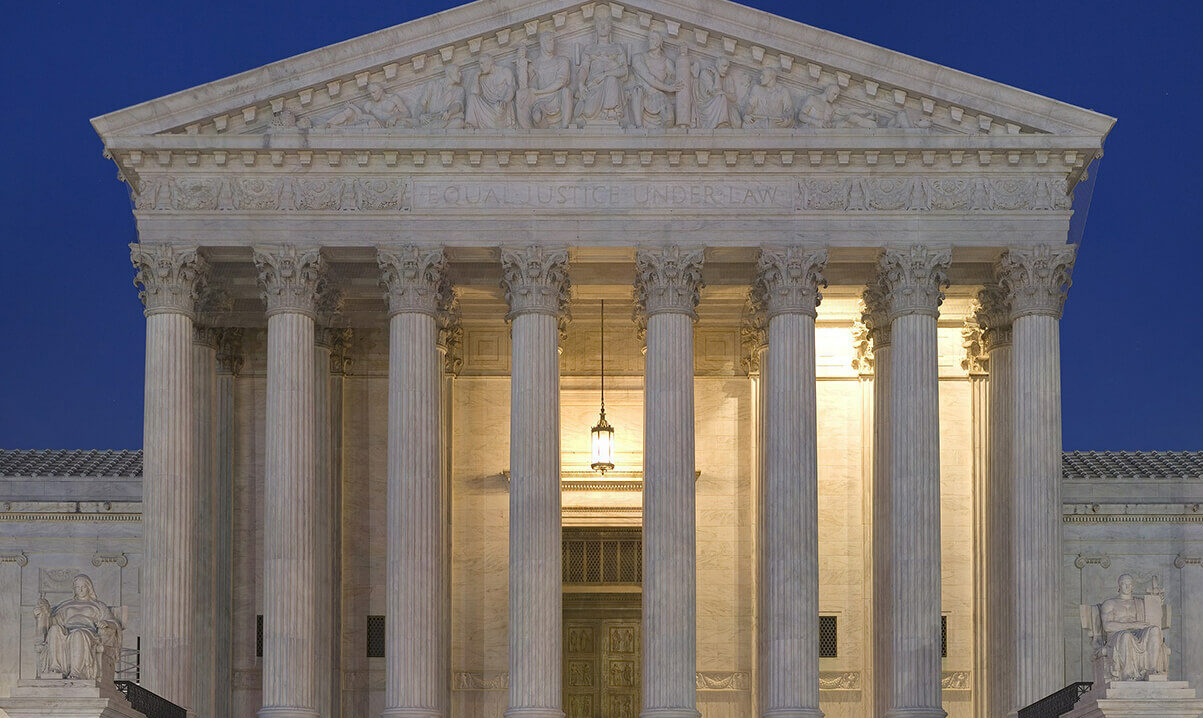
  4. Not only Moses but also depictions of the Ten Commandments adorn several of the more important government buildings in the nation’s capitol. For example, every visitor that enters the National Archives to view the original Constitution and Declaration of Independence (and other official documents of American government) must first pass by the Ten Commandments embedded in the entryway to the Archives. Additionally, in the U. S. Supreme Court are displayed two depictions of the Ten Commandments. One is on the entry into the Chamber, where, engraved on the lower half of the two large oak doors, are the Ten Commandments. The other display of the commandments is in the Chamber itself on a marble frieze carved above the Justices’ heads. As Chief Justice Warren Burger noted in Lynch v. Donnelly:

The very chamber in which oral arguments on this case were heard is decorated with a notable and permanent—not seasonal—symbol of religion: Moses with the Ten Commandments.166

  1. Other prominent buildings where large displays of the Ten Commandments may be viewed include the Texas State Capitol, the chambers of the Pennsylvania Supreme Court, and scores of other legislatures, courthouses, and public buildings across America. In fact, the Ten Commandments are more easily found in America’s government buildings than in her religious buildings, thus demonstrating the understanding by generations of Americans from coast to coast that the Ten Commandments formed the basis of America’s civil laws.

SUMMARY

  1. Historical evidence, drawn from civil law codes, judicial decisions, and declarations of great American lawgivers, affirms and reaffirms that the entire Decalogue has made a seminal contribution to the early common law and still continues today to make a significant contribution to the modern common law.
  2. The fact that some may not agree with all of the commandments of the Decalogue does not mean it should be prohibited from display any more than does the fact that not everyone agrees with all of the protections in the Bill of Rights requires that the Bill of Rights should not be displayed—or that because not everyone agrees with what the American flag represents requires the flag should not be displayed. Even though some may wish that the American ensign was the Stars & Bars rather than the Stars & Stripes, the reality is otherwise—and the reality is also that all ten of the commandments in the Decalogue had a unique, distinct, and significant impact on both American law and jurisprudence.
  3. To prohibit the display of the Decalogue simply because the first four commandments are more religious in nature than are the other six is like permitting the display of George Washington’s “Farewell Address” or Patrick Henry’s “Liberty or Death” speech or the “Mayflower Compact” only if each document is displayed without its religious portions. In a display of any of the aforementioned works, it is not the advocation of religion that is occurring but rather the recognition of a significant historical contribution made to America that also happens to include religion.
  4. Aside from the Declaration, the Constitution, and the Bill of Rights, it is difficult to argue that there is any single work that has had a greater or more far-reaching impact on four centuries of American life, law, and culture than the Decalogue. For this reason alone, the Decalogue merits display.

Footnotes

1 Americans United Statement in Response to the Family Research Council’s “Hang Ten” Campaign (November 4, 1999). Americans United for Separation of Church and State ; B. A. Robinson (July 1999). Posting of the Decalogue (Ten Commandments) in U. S. Courtrooms, Public Schools, Government Offices, etc. Religious Tolerance.org.

2 Marc D. Stern, The Ten Commandments: Innocent Display or Weapon in a Religious War? (January 1999). American Jewish Congress; the articles cited supra note 1.

3 Americans United, supra note 1.

4 B. A. Robinson, Religious Tolerance, supra note 1.

5 Noah Webster, Letters to a Young Gentleman Commencing His Education: To Which is Subjoined A Brief History of the United States (New Haven: S. Converse, 1823), 7; Noah Webster, A Collection of Papers on Political, Literary, and Moral Subjects (New York: Webster & Clark, 1843), 296.

6 B. A. Robinson, Religious Tolerance, supra note 1.

7 Americans United, supra note 1.

8 B. A. Robinson, Religious Tolerance, supra note 1.

9 Isaac Kramnick and Laurence Moore, The Godless Constitution (New York: W. W. Norton & Company, 1996), 58-60 and passim.

10 Alvin W. Johnson, Sunday Legislation, XXIII Ky.L.J. 131, n 1 (1934-1935).

11 John Fiske, The Beginnings of New England (Boston: Houghton, Mifflin and Company, 1898), 127-128.

12 Select Charters and Other Documents Illustrative of American History, 1606-1775, William MacDonald, editor (New York: The Macmillan Company, 1899), 61, “Fundamental Orders of Connecticut” (1638-1639).

13 Colonial Origins, 163, “Government of Pocasset” (Rhode Island, 1638).

14 Select Charters, 68, “Fundamental Articles of New Haven” (1639).

15 Colonial Origins of the American Constitution: A Documentary History, Donald S. Lutz, editor (Indianapolis: Liberty Fund, 1998),  250, “Preface to the General Laws and Liberties of Connecticut Colony” (1672).

16 The Code of 1650, Being a Compilation of the Earliest Laws and Orders of the General Court of Connecticut: Also, the Constitution, or Civil Compact, Entered into and Adopted by the Towns of Windsor, Hartford, and Wethersfield in 1638-9. To Which is Added Some Extracts from the Laws and Judicial Proceedings of New-Haven Colony Commonly Called Blue Laws (Hartford: Silas Andrus, 1825), pp. 28-29, “Capital Laws”; see also Select Charters, 87-88, “Massachusetts Body Of Liberties” (1641), “Capital Laws”; Colonial Origins, pp. 102-103, “The Laws and Liberties of Massachusetts” (1647), “Capital Laws.”

17 The Code of 1650, 19; Select Charters, 73-74, “Massachusetts Body Of Liberties” (1641); Colonial Origins, 71, “The Massachusetts Body of Liberties, 1641.”

18 Colonial Origins, 315-316, “Articles, Laws, and Orders, Divine, Politic and Martial for the Colony of Virginia” (1610-1611).

19 Colonial Origins, 83, “Massachusetts Body Of Liberties” (1641).

20 Colonial Origins, 229, “Capital Laws of Connecticut” (1642); The Code of 1650, 28.

21 Colonial Origins, 6, “General Laws and Liberties of New Hampshire” (1680).

22 Noah Webster, Letters to a Young Gentleman, 8; Noah Webster, A Collection of Papers, 296.

23 Colonial Origins, 316, “Articles, Laws, and Orders, Divine, Politic and Martial for the Colony of Virginia” (1610-1611).

24 The Code of 1650, 28-29.

25 Select Charters, 87, “Massachusetts Body Of Liberties” (1641).

26 Colonial Origins, 230, “Capital Laws of Connecticut” (1642).

27 Colonial Origins, 6, “General Laws and Liberties of New Hampshire” (1680).

28 Colonial Origins, 289, “An Act for Freedom of Conscience” (Pennsylvania, 1682).

29 An Abridgement of the Laws of Pennsylvania, Collinson Read, editor (Philadelphia: 1801), p. 32; see also Laws of the Commonwealth of Pennsylvania, from the Fourteenth Day of October, One Thousand Seven Hundred, to the Twentieth Day of March, One Thousand Eight Hundred and Ten (Philadelphia: John Bioren, 1810), 7, “An Act for the Prevention of Vice and Immorality, and of Unlawful Gaming, and to Restrain Disorderly Sports and Dissipation, Passed April 22, 1794.”

30 Laws of the Commonwealth of Pennsylvania (1810), I:7, “An Act to Prevent the Grievous Sins of Cursing and Swearing within this Province and Territories.”

31 Alphabetical Digest of the Public Statute of South Carolina, Joseph Brevard, editor (Charleston: John Hoff, 1814), I:87-88, “Blasphemy-Profaneness” (1695).

32 A Manual of The Laws of North Carolina, Arranged Under Distinct Heads, In Alphabetical Order, John Haywood, editor (Raleigh: J. Gales, 1814), 264, “Vice and Immorality” (1741).

33 George Washington, The Writings of George Washington, John C. Fitzpatrick, editor (Washington: U. S. Government Printing Office, 1931), Vol. III, 309, General Orders, Head-Quarters, Cambridge, July 4, 1775.

34 George Washington, The Writings of George Washington, Jared Sparks, editor (Boston: Ferdinand Andrews, 1836), II:167, n, from his “Orderly Book,” an undated order issued between June 25 and August 4, 1756.

35 Washington, Writings (1932), V:367, General Orders, Head-Quarters, New York, August 3, 1776.

36 Washington, Writings (1933), VIII:152-53, General Orders, Head-Quarters, Middle-Brook, May 31, 1777.

37 Washington, Writings (1936), XIII:118-19, General Orders, Head-Quarters, Fredericksburg, October 21, 1778.

38 The Public Statute Laws of the State of Connecticut, Book I (Hartford: Hudson and Goodwin, 1808), pp. 295-296, “An Act for the Punishment of divers Capital and other Felonies.”

39 The Laws of the State of New Hampshire, the Constitution of the State of New Hampshire, and the Constitution of the United States, with its Proposed Amendments (Portsmouth: John Melcher, 1797), pp. 280-281, “An Act for the Punishment of Profane Cursing and Swearing,” passed February 6, 1791, and pp. 286-287, a separate act passed February 10, 1791; see also Constitution and Laws of the State of New-Hampshire; Together with the Constitution of the United States (Dover: Samuel Bragg, 1805), p. 277, “An Act for the Punishment of Certain Crimes not Capital,” passed February 16, 1791.

40 Statutes of the State of Vermont (Bennington: Anthony Haswell, 1791), p. 51, “An Act for the Punishment of Drunkenness, Gaming, and Profane Swearing,” passed February 28, 1787, and p. 75, “An Act for the Punishment of Divers Capital and other Felonies,” passed March 8, 1787.

41 A Digest of the Laws of Virginia, which are of a Permanent Character and General Operation, Joseph Tate, editor (Richmond: Shepherd and Pollard, 1823) pp. 453-454; see also, The Revised Code of the Laws of Virginia: Being A Collection of all such Acts of the General Assembly, of a Public and Permanent Nature as are now in Force (Richmond: Thomas Ritchie, 1819), Vol. I, pp. 554-556, “An Act for the Effectual Suppression of Vice, and Punishing the Disturbers of Religious Worship and Sabbath Breakers.”

42 An Abridgment of the Laws of Pennsylvania (1801), p. 380, Act of April 22, 1794.

43 Jeremiah Perley, The Maine Justice; Containing the Laws Relative to the Powers and Duties of Justices of the Peace (Hallowell: Goodale, Glazier, & Co., 1823), pp. 7, 236; see also Laws of the State of Maine (Hallowell: Goodale, Glazier & Co., 1822), pp. 66-67, “An Act Against Blasphemy and Profane Cursing and Swearing,” passed February 24, 1821.

44 James Coffield Mitchell, The Tennessee Justice’s Manual and Civil Officer’s Guide (Nashville: J. C. Mitchell and C. C. Norvell, 1834), p. 428, “ Breaking the Sabbath.”

45 The Revised Statutes of the Commonwealth of Massachusetts, Passed November 4, 1835 (Boston: Dutton & Wentworth, 1836), p. 185, “Title VII: Of Towns and Town Officers,” Section 76.

46 George C. Edwards, Treatise of the Powers and Duties of the Justices of the Peace and the Town Officers in the State of New York (Ithaca: Mack, Andrus, & Woodruff, 1836), pp. 379-380, “Of Profane Cursing and Swearing,” Rev. Stat. 673, Art. 6.

47 Zephaniah Swift, A System of the Laws of the State of Connecticut (Windham: John Byrne, 1796), Vol. II, p. 320.

48 Church of the Holy Trinity v. U. S., 143 U. S. 457, 470-471 (1892).

49 Updegraph v. Commonwealth, 11 Serg. & Rawle 393, 401 (Penn. 1824).

50 Updegraph v. Commonwealth, 11 Serg. & Rawle 393, 403 (Penn. 1824).

51 State v. Mockus, 14 ALR 871, 874 (Maine Sup. Jud. Ct., 1921).

52 Cason v. Baskin, 20 So.2d 243, 247 (Fla. 1944) (en banc).

53 Jaqueth v. Town of Guilford School District, 189 A.2d 558, 563 (Vt. 1963), (Shangraw, J. dissenting).

54 State v. Chicago, B. & Q. R. Co., 143 S.W. 785, 803 (Mo. 1912).

55 Edwards, Justices of the Peace . . . in the State of New York, p. 38, “General Rules Applicable to a Summons, Warrant of Attachment,” Rev. Stat. 675.

56 Colonial Origins, p. 281, “Charter of Liberties and Frame of Government of the Province of Pennsylvania in America” (1682).

57 Laws of the Commonwealth of Pennsylvania (1810), Vol. I, p. 25, “An Act to Restrain People from Labor on the First Day of the Week,” passed October 14, 1705.

58 Statutes of the State of Vermont (1791), p. 157, “An Act for the Due Observation of the Sabbath,” passed March 9, 1787.

59 Swift, A System of the Laws, Vol. II, p. 326, “Of Crimes Against Religion.”

60 Laws of the State of New Jersey, Revised and Published Under the Authority of the Legislature, William Paterson, editor (New Brunswick: Abraham Blauvelt, 1800), pp. 329-330, “An Act for Suppressing Vice and Immorality,” passed March 16, 1798.

61 McGowan v. Maryland, 366 U.S. 420 (1961).

62 Colonial Origins, pp. 316-317, “Articles, Laws, and Orders, Divine, Politic and Martial for the Colony of Virginia” (1610-1611).

63 Charles J. Hoadly, Records of the Colony or Jurisdiction of New Haven, From May, 1653, to the Union, Together With the New Haven Code of 1656 (Lockwood and Company, 1858), p. 605.

64 Colonial Origins, pp. 10-11, “General Laws and Liberties of New Hampshire” (1680).

65 Colonial Origins, p. 288, “An Act for Freedom of Conscience” (Pennsylvania, 1682).

66 Laws of the Commonwealth of Pennsylvania, (1810), Vol. I, p. 25-26, “An Act to Restrain People from Labor on the First Day of the Week,” passed October 4,1705; see also Abridgement of the Laws of Pennsylvania (1801), p. 362.

67 Alphabetical Digest of the Public Statute Law of South Carolina (1814), Vol. II, pp. 272-275, “Title 160: Sunday.”

68 A Manual of The Laws of North Carolina (1814), p. 264, “Vice and Immorality” (1741).

69 The Public Statute Laws of the State of Connecticut (Hartford: Hudson and Goodwin, 1808), Vol. I, pp. 577-578, “An Act for the Due Observation of the Sabbath, or Lord’s Day”; see also Swift, A System of the Laws, Vol. II, pp. 325-326.

70 Washington, Writings (1934), Vol. XI, p. 342, General Orders, Head-Quarters, Valley Forge, Saturday, May 2, 1778.

71 Washington, Writings (1931), Vol. III, p. 402-403, General Orders, Cambridge, August 5, 1775; Vol. VII, p. 407, General Orders, Head-Quarters, Morristown, April 12, 1777; Vol. VIII, p. 77, General Orders, Head-Quarters, Morristown, May 17, 1777; Vol. VIII, p. 114, General Orders, Head-Quarters, Morristown, May 24, 1777; Vol. VIII, p. 153, General Orders, Head-Quarters, Middle Brook, May 31, 1777; Vol. VIII, p. 308, General Orders, Head-Quarters, Middle Brook, June 28, 1777; Vol. IX, p. 275, General Orders, Head-Quarters, Pennybecker’s Mills, September 27, 1777; Vol. IX, p. 329, General Orders, Head-Quarters, Perkiomy, October 7, 1777; etc.

72 Statutes of the State of Vermont (1791), pp. 155-157, “An Act for the Due Observation of the Sabbath,” passed March 9, 1787.

73 The Revised Statutes of the Commonwealth of Massachusetts, Passed November 4, 1835 (1836), pp. 385-386, “Of the Observance of the Lord’s Day and the Prevention and Punishment of Immorality.”

74 The Revised Code of the Laws of Virginia (1819), Vol. I, pp. 554-556, “An Act for the Effectual Suppression of Vice, and Punishing the Disturbers of Religious Worship, and Sabbath Breakers,” passed December 26, 1792; see also A Digest of the Laws of Virginia (1823), pp. 453-454.

75 James Madison, The Papers of James Madison, Robert A. Rutland, editor (Chicago: University of Chicago Press, 1973), Vol. VIII, pp. 391-396, “Bills for a Revised State Code of Laws,” and Thomas Jefferson, The Papers of Thomas Jefferson, Julian P. Boyd, editor (Princeton: Princeton University Press, 1950), Vol. II, p. 322, “The Revisal of the Laws, 1776-1786.”

76 Laws of the State of New Jersey (1800), pp. 329-333, “An Act for Suppressing Vice and Immorality,” passed March 16, 1798.

77 Constitution and Laws of the State of New Hampshire (1805), pp. 290-293, “An Act for the Better Observation of the Lord’s Day, and for Repealing All the Laws Heretofore Made for that Purpose,” passed December 24, 1799.

78 Laws of the State of Maine (1822), pp. 67-71, “An Act Providing for the Due Observation of the Lord’s Day.”

79 See, for example, William Waller Hening, The Virginia Justice, Comprising the Office and Authority of the Justice of the Peace in the Commonwealth of Virginia (Richmond: Shepherd & Pollard, 1825), p. 612, “Sabbath Breakers”; see also Coffield, The Tennessee Justices’ Manual (1834), pp. 427-428; see also Edwards, Justices of the Peace . . . in the State of New York (1836), pp. 386-387; etc.

80 Bertera’s Hopewell Foodland, Inc. v. Masters, 236 A.2d 197, 200-201 (Pa. 1967).

81 Paramount-Richards Theatres v. City of Hattiesburg, 49 So.2d 574, 577 (Miss. 1950).

82 People v. Rubenstein, 182 N.Y.S.2d 548, 550 (N.Y. Ct. Sp. Sess. 1959).

83 Stollenwerck v. State, 77 So. 52, 54 (Ala. Ct. App. 1917) (Brown, P. J. concurring).

84 Gillooley v. Vaughn, 110 So. 653, 655 (Fla. 1926), citing Theisen v. McDavid, 16 So. 321, 323 (Fla. 1894), citing cases in Oregon and Kentucky.

85 Rogers v. State, 4 S.E.2d 918, 919 (Ga. Ct. App. 1939).

86 Brimhall v. Van Campen, 8 Minn. 1 (1858), cited in Kentucky Law Journal, Vol. XXIII, 1934-1935, Alvin W. Johnson, “Sunday Legislation,” p. 140.

87 John Jay, The Correspondence and Public Papers of John Jay, Henry P. Johnston, editor (New York: G. P. Putnam’s Sons, 1893), Vol. IV, pp. 403, to John Murray Jr., on April 15, 1818.

88 City of Ames v. Gerbracht, 189 N.W. 729, 733 (Iowa 1922).

89 B. A. Robinson, Religious Tolerance, supra note 1.

90 Sumpter v. State, 261 Ind. 471, 306 N.E.2d 95, 101 (Ind. 1974); see also State v. Schultz, 582 N.W.2d 113, 117 (Wis. Ct. App. 1998).

91 The Code of 1650, p. 29; see also Colonial Origins, p. 230, “Capital Laws of Connecticut” (1642).

92 See, for example, Colonial Origins, p. 7, “General Laws and Liberties of New Hampshire” (1680); and p. 103, “The Laws and Liberties of Massachusetts” (1647); etc.

93 Ruiz v. Clancy, 157 So. 737, 738 (La. Ct. App. 1934), citing Caldwell v. Henmen, 5 Rob. 20.

94 See, for example, Pierce v. Yerkovich, 363 N.Y.S.2d 403, 414 (N.Y. Fam. Ct. 1974); see also Mileski v. Locker, 178 N.Y.S.2d 911, 916 (N.Y. Sup. Ct. 1958); see also Beaty v. McGoldrick, 121 N.Y.S.2d 431, 432 (N.Y. Sup. Ct. 1953).

95 Noah Webster, Letters of Noah Webster, Harry R. Warfel, editor (New York: Library Publishers, 1953), pp. 453-454, to David McClure on October 25, 1836.

96 Select Charters, pp. 87-88, “Massachusetts Body Of Liberties” (1641); see also Colonial Origins, pp. 83-84, “Massachusetts Body Of Liberties” (1641).

97 Colonial Origins, p. 230, “Capital Laws of Connecticut” (1642).

98 Constitution and Laws of the State of New-Hampshire; Together with the Constitution of the United States (Dover: Samuel Bragg, 1805), p. 267; see also Colonial Origins, p. 7, “General Laws and Liberties of New Hampshire” (1680).

99 Young v. Commonwealth, 53 S.W. 963, 966 (Ky. Ct. App. 1932).

100 John Jay, Correspondence, Vol. IV, pp. 403-404, to John Murray Jr., on April 15, 1818.

101 See, for example, Matter of Storar, 434 N.Y.S.2d 46, 48 (N.Y. App. Div. 1980) (Cardamone, J. dissenting); see also Ex parte Mei, 192 A. 80, 82 (N.J. 1937); etc.

102 Colonial Origins, p. 84, “Massachusetts Body Of Liberties” (1641).

103 The Code of 1650, pp. 28-29; see also Colonial Origins, p. 230, “Capital Laws of Connecticut” (1642).

104 Colonial Origins, pp. 189-190, “Acts and Orders of 1647” (Rhode Island).

105 Colonial Origins, pp. 8-9, “General Laws and Liberties of New Hampshire” (1680).

106 Laws of the Commonwealth of Pennsylvania (1810), Vol. I, pp. 25-27, “An Act Against Adultery and Fornication,” passed in 1705.

107 Statutes of the State of Vermont (1791), pp. 16-17, “An Act Against Adultery, Polygamy, and Fornication,” passed March 8, 1787.

108 See, for example, Swift, A System of the Laws, Vol. II, pp. 327-328; see also Constitution and Laws of the State of New Hampshire (1805), pp. 278-279, “An Act for the Punishment of Lewdness, Adultery, and Polygamy”; see also Perley, The Maine Justice (1823), p. 6; etc.

109 Hardin v. State, 46 S.W. 803, 808 (Tex. Crim. App. 1898).

110 Schreifels v. Schreifels, 287 P.2d 1001, 1005 (Wash. 1955).

111 See, for example, Barbour v. Barbour, 330 P.2d 1093, 1098 (Mont. 1958); see also Petition of Smith, 71 F.Supp. 968, 972 (D.N.J. 1947); see also S.B. v. S.J.B., 609 A.2d 124, 125 (N.J. Super. Ct. Ch. Div. 1992); etc.

112 James Kent, Commentaries on American Law (New York: O. Halsted, 1826), Vol. I, p. 7.

113 Succession of Onorato, 51 So.2d 804, 810 (La. 1951).

114 Hollywood Motion Picture Equipment Co. v. Furer, 105 P.2d 299, 301 (Cal. 1940).

115 State v. Donaldson, 99 P. 447, 449 (Utah 1909).

116 De Rinzie v. People, 138 P. 1009, 1010 (Colo. 1913).

117 Addison v. State, 116 So. 629 (Fla. 1928) and Anderson v. Maddox, 65 So.2d 299, 301-302 (Fla. 1953).

118  State v. Gould, 46 S.W.2d 886, 889-890 (Mo. 1932).

119 Doll v. Bender, 47 S.E. 293, 300 (W.Va. 1904) (Dent, J. concurring).

120 Pennsylvania Co. v. United States, 214 F. 445, 455 (W.D.Pa. 1914).

121 The Code of 1650, pp. 28-29; see also Colonial Origins, p. 230, “Capital Laws of Connecticut” (1642).

122 Colonial Origins, p. 84, “Massachusetts Body Of Liberties” (1641); see also, Select Charters, p. 88.

123 Colonial Origins, pp. 190-191, “Acts and Orders of 1647,” (Rhode Island).

124 Colonial Origins, p. 7, “General Laws and Liberties of New Hampshire” (1680).

125 The Public Statute Laws of the State of Connecticut (Hartford: Hudson and Goodwin, 1808), p. 295, “An Act for the Punishment of Divers Capital and Other Felonies.”

126 Watts v. Gerking, 228 P. 135, 141 (Or. 1924).

127 Hosford v. State, 525 So.2d 789, 799 (Miss. 1988).

128 L——— v. N———, 326 S.W.2d 751, 755-756 (Mo. Ct. App. 1959).

129 People v. Rosen, 20 Cal.App.2d 445, 448-449, 66 P.2d 1208 (1937).

130 Pullum v. Johnson, 647 So.2d 254, 256 (Fla. Dist. Ct. App. 1994).

131 William Penn, Fruits of Solitude, In Reflections and Maxims Relating To The Conduct of Human Life (London: James Phillips, 1790), p. 132.

132 John Adams, The Works of John Adams, Second President of the United States, Charles Francis Adams, editor (Boston: Charles C. Little and James Brown, 1851), Vol. VI, p. 9, “A Defense of the Constitutions of Government of the United States of America.”

133 Weinstock, Lubin & Co. v. Marks, 42 P. 142, 145 (Cal. 1895).

134 Doll v. Bender, 47 S.E. 293, 300-01 (W.Va. 1904) (Dent, J. concurring).

135 Chisman v. Moylan, 105 So.2d 186, 189 (Fla. Dist. Ct. App. 1958).

136 Swift & Co. v. Peterson, 233 P.2d 216, 231 (Or. 1951).

137 A search of court decisions just from 1880 to 1975 records that the Decalogue was cited authoritatively and approvingly in well over five hundred cases.

138 William Findley, Observations on “The Two Sons of Oil” (Pittsburgh: Patterson & Hopkins, 1812), pp. 22-23, 36.

139 John Quincy Adams, Letters of John Quincy Adams, to His Son, on the Bible and Its Teachings (Auburn: James M. Alden, 1850), pp. 61, 70-71.

140 John Witherspoon, The Works of John Witherspoon (Edinburgh: J. Ogle, 1815), Vol. IV, p. 95, “Seasonable Advice to Young Persons,” February 21, 1762.

141 Thomas Jefferson, The Writings of Thomas Jefferson, Albert Ellery Bergh, editor (Washington, D. C.: The Thomas Jefferson Memorial Association, 1903), Vol. III, p. 228, from his “Opinion on the Question whether the United States have a Right to Renounce their Treaties with France or to Hold them Suspended till the Government of that Country shall be Established,” on April 28, 1793.

142 John Jay, The Correspondence and Public Papers of John Jay, Henry P. Johnston, editor (New York: G. P. Putnam’s Sons, 1893), Vol. IV, p. 403, letter to John Murray Jr. on April 15, 1818.

143 James Wilson, The Works of the Honorable James Wilson, Bird Wilson, editor (Philadelphia: Lorenzo Press, 1804), Vol. I, pp. 104-106, “Of the General Principles of Law and Obligation.”

144 Wilson, Works, p. 138, “Of the Laws of Nature.”

145 Samuel Adams, The Writings of Samuel Adams, Harry Alonzo Cushing, editor (New York: G. P. Putnam’s Sons, 1908), Vol. IV, p. 356, To the Legislature of Massachusetts on January 17, 1794.

146 John Quincy Adams, The Jubilee of the Constitution (New York: Samuel Colman, 1839), pp. 13-14.

147 Alexander Hamilton, The Papers of Alexander Hamilton, 1768-1778, Harold C. Syrett, editor (New York: Columbia University Press, 1961), Vol. I, p. 87, from “The Farmer Refuted,” February 23, 1775, quoting from Blackstone.

148 Noah Webster, An American Dictionary of the English Language (New York: S. Converse, 1828), s.v. “law,” definitions #3 and #6.

149 Findley, Observations on “The Two Sons of Oil,” pp. 33-34.

150 Rufus King, The Life and Correspondence of Rufus King, Charles R. King, editor (New York: G. P. Putnam’s Sons, 1900), Vol. VI, p. 276, to C. Gore on February 17, 1820.

151 Wilson, Works, Vol. I, p. 64, “Of the General Principles of Law and Obligation.”

152 Swift, A System of the Laws, Vol. I, pp. 6-7.

153 William Paterson, United States Oracle (Portsmouth, NH), May 24, 1800; see also The Documentary History of the Supreme Court of the United States, 1789-1800, Maeva Marcus, editor (New York: Columbia University Press, 1990), Vol. III, p. 436.

154 Joseph Story, Life and Letters of Joseph Story, William W. Story, editor (Boston: Charles C. Little, and James Brown, 1851), Vol. I, p. 92, in a letter on March 24, 1801.

155 Story, Life and Letters, Vol. II, p. 8.

156 John Adams, The Works of John Adams, Second President of the United States, Charles Francis Adams, editor (Boston: Charles C. Little and James Brown, 1850), Vol. II, p. 31, from his diary entry for Sunday, August 22, 1756.

157 William W. Campbell, The Life and Writings of De Witt Clinton (New York: Baker and Scribner, 1849), pp. 305, 307.

158 United States Code Annotated (St. Paul: West Publishing Co., 1987), “The Organic Laws of the United States of America,” p. 1. This work lists America’s four fundamental laws as the Articles of Confederation, the Declaration of Independence, the Constitution, and the Northwest Ordinance.

159 The Constitutions of the United States of America With the Latest Amendments (New York: Evert Duyckinck, 1813), p. 375, “An Ordinance of the Territory of the United States Northwest of the River Ohio,” Article III.

160 John Witherspoon, The Works of John Witherspoon (Edinburgh: J. Ogle, 1815), Vol. VII, pp. 118-119, Lecture XIV, “Jurisprudence.”

161 Commissioners of Johnston County v. Lacy, 93 S.E. 482, 487 (N.C. 1917).

162 State v. City of Tampa, 48 So.2d 78, 79 (Fla. 1950).

163 B. J. Cigrand, Story of the Great Seal of the United States (Chicago: Cameron, Amberg & Co, 1892), pp. 103-147.

164 John Adams, Letters of John Adams Addressed to His Wife, Charles Francis Adams, editor (Boston: Charles C. Little and James Brown, 1841), Vol. I, p. 152, letter to Abigail Adams on August 14, 1776.

165 Adams, Letters, Vol. I, p. 152, letter to Abigail Adams on August 14, 1776.

166 166 Lynch v. Donnelly, 465 U. S. 668, 677 (1984).

* This article concerns a historical issue and may not have updated information.

John Locke: Deist or Theologian?

Many law and history professors and uninformed historical writers commonly assert that John Locke was a secular political writer or a deist. Often, these claims are made without the logical effort of studying Locke or his writings directly. (Rather, the views of other writers who wrote about Locke are studied!) If you have such a professor, or hear such assertions, here are a few helpful questions that you can use:

Questions About John Locke that Demand An Answer

  1. In 1669, John Locke assisted in the drafting of the Carolina constitution under which no man could be a citizen unless he acknowledged God, was a member of a church, and used no “reproachful, reviling, or abusive language” against any religion.1 How can the constitutional requirement that no one can become a citizen (1) unless he acknowledges God; (2) be a member of a church; and (3) not attack religion, be considered a secular political philosophy?
  2. Many of Locke’s political ideas were specifically drawn from British theologian Richard Hooker (1554-1600), whom Locke quotes heavily in approbation throughout his own political writings.2 If Locke draws so heavily from (and frequently cites) a theologian throughout his own political works, how can it be true that his political philosophies were totally secular?
  3. In his most famous political work, his Two Treatises of Government, Locke set forth the belief that successful governments could be built only upon the transcendent, unchanging principles of natural law that were a subset of God’s law. For example, he declared:

    [T]he Law of Nature stands as an eternal rule to all men, legislators as well as others. The rules that they make for other men’s actions must . . . be conformable to the Law of Nature, i.e., to the will of God.3

    [L]aws human must be made according to the general laws of Nature, and without contradiction to any positive law of Scripture, otherwise they are ill made.4

    How can Locke’s declaration that the laws of legislators must be conformable “to the will of God” and that human laws cannot contradict “any positive law of Scripture” be considered part of a secular political philosophy?

  4. Locke’s Two Treatises of Government were heavily relied upon by the American Founding Fathers. In fact, signer of the Declaration Richard Henry Lee declared that the Declaration itself was “copied from Locke’s Treatise on Government.”5 Yet so heavily did Locke draw from the Bible in developing his political theories that in his first treatise on government, he invoked the Bible in one thousand three hundred and forty nine references; in his second treatise, he cited it one hundred and fifty seven times. How can so many references to the Bible in Locke’s most famous political work be reconciled with the charge that his political philosophies were totally secular?
  5. While many today classify John Locke as a deist, secular thinker, or a forerunner of deism,6 previous generations classified John Locke as a theologian. 7 How can the charge that Locke’s political philosophies were totally secular be squared with the fact that he was long considered a theologian?
  6. John Locke’s many writings included a verse-by-verse commentary on Paul’s Epistles. He also compiled a topical Bible, which he called a Common Place-Book to the Holy Bible, that listed the verses in the Bible, subject by subject. Then when anti-religious enlightenment thinkers attacked Christianity, Locke defended it in his book, The Reasonableness of Christianity as Delivered in the Scriptures. And then when he was attacked for defending Christianity in that first work, he responded with the work, A Vindication of the Reasonableness of Christianity. Still being attacked two years later, Locke wrote, A Second Vindication of the Reasonableness of Christianity.8 No wonder he was considered a theologian by his peers and by subsequent generations! How can a theologian who wrote so many books on the writings and doctrines of the Bible and Christianity (and who frequently cited the Scriptures in his political writings) also be a writer whose political philosophies were totally secular?
  7. Significantly, when during the Founding Era it was charged that Locke was a secular writer, it drew a sharp response from law professor James Wilson, a signer of the Constitution and an original Justice on the U. S. Supreme Court. Wilson declared:

    I am equally far from believing that Mr. Locke was a friend to infidelity [a disbelief in the Bible and in Christianity 9]. . . . The high reputation which he deservedly acquired for his enlightened attachment to the mild and tolerating doctrines of Christianity secured to him the esteem and confidence of those who were its friends. The same high and deserved reputation inspired others of very different views and characters . . . to diffuse a fascinating kind of lustre over their own tenets of a dark and sable hue. The consequence has been that the writings of Mr. Locke, one of the most able, most sincere, and most amiable assertors of Christianity and true philosophy, have been perverted to purposes which he would have deprecated and prevented [disapproved and opposed] had he discovered or foreseen them. 10

    How can the charge that political philosophies were totally secular be explained with the claim by such a prominent legal authorities that Locke was “one of the most able, most sincere, and most amiable assertors of Christianity”?


Endnotes

1 John Locke, A Collection of Several Pieces of Mr. John Locke Never Before Printed or Not Extant in His Works (London: J. Bettenham for R. Francklin, 1720), 3, 41, 45-46.
2 John Locke, Two Treatises on Government (London: J. Whiston, etc., 1772), passim.
3 Locke, Two Treatises (1772), II:285, Ch. XI, §135.
4 Locke, Two Treatises (1772), II:285, Ch. XI, §135, n., quoting Hooker’s Eccl. Pol. 1. iii, sect. 9.
5 Thomas Jefferson to James Madison, August 30, 1823, The Writings of Thomas Jefferson (Washington, D. C.: The Thomas Jefferson Memorial Association, 1904), XV:462.
6 See, for example, Concise Oxford Dictionary of World Religions, ed. John Bowker (Oxford: Oxford University Press, 2000), 151; Franklin L. Baumer, Religion and the Use of Skepticism (New York: Harcourt, Brace, & Company), 57-59; James A. Herrick, The Radical Rhetoric of the English Deists: The Discourse of Skepticism, 1680 – 1750 (Columbia, SC: University of South Carolina Press, 1997), 15; Kerry S. Walters Rational Infidels: The American Deists (Durango, CO: Longwood Academic, 1992), 24, 210; Kerry S. Walters, The American Deists: Voices of Reason and Dissent in the Early Republic (Lawrence, KS: University Press of Kansas, 1992), 6-7; John W. Yolton, John Locke and the Way of Ideas (Oxford: Oxford University Press, 1956), 25, 115.
7 See Richard Watson, Theological Institutes: Or a View of the Evidences, Doctrines, Morals, and Institutions of Christianity (New York: Carlton and Porter, 1857), I:5, where Watson includes John Locke as a theologian.
8 Encyclopedia Britannica, Eleventh Edition, 1911, s.v. “John Locke.”
9Noah Webster, An American Dictionary of the English Language (New York: S. Converse, 1828), s.v. “infidel.”
10 James Wilson, The Works of the Honourable James Wilson, Bird Wilson, editor (Philadelphia: Lorenzo Press, 1804), I:67-68, “Of the General Principles of Law and Obligation.”

Electoral College: Preserve or Abolish?

The Call for Change

Although groups like the League of Women Voters have long supported the abolition of the electoral college,1 the protracted proceedings in Florida as well as the apparent disparity between the popular and the electoral college vote have further fueled calls to abolish the electoral college. Critics urge a replacement of the electoral college with a straightforward nationwide popular vote system; and if needed, a national run-off between the top two candidates so that the winner will always receive an absolute majority of the popular vote.2 An advocate of this plan, the Center for Voting and Democracy, explains:

[I]t’s time once again to consider replacing the electoral college with direct election. To assure a real majority winner, a much better solution than a simple plurality vote or keeping the electoral college would be to adopt instant runoff voting, a majority vote system.3

Another advocate for the abolition of the electoral college, Citizens for True Democracy, asserts:

  • The electoral college is outdated and anti-democratic. America deserves truly representative presidential elections, in which all votes have equivalent values. A constitutional amendment replacing the electoral college with a simple popular vote would be most effective.4
  • The electoral college is a disastrous institution. It. . . . is unfair, inaccurate, and unaccountable. Its abolition is the only path to a true American democracy.5

Others have joined this call,6 and, in sympathy with their view, Senator Hillary Clinton has promised to introduce in the Senate a constitutional amendment to abolish the electoral college — a movement already supported by Democrat Senator Dick Durbin and Republican Senators John Warner and Arlen Spector — and an action parallel to that already undertaken in the House of Representatives by Republicans Ray Lahood and Jim Leach and Democrats Robert Wise, Dick Gephardt, Rick Boucher, Virgil Goode, and Robert Underwood. Such an amendment would eliminate several extensive parts of the Constitution, including Article II, Section 1, ¶ 2, 4, and portions of the 12th, the 20th, and the 23rd Amendments.

The current rhetoric calling for an end to the electoral college frequently reveals a misunderstanding of the purpose of the college as well as the safeguards it provides and the interests it protects. Therefore, a brief review of the college is appropriate before any informed discussion about its abolition should proceed.

The Constitutional Basis for the Electoral College

The provisions originally established in the Constitution regarding the electoral college have been substantially altered three times in accordance with the provisions laid out in Article V of the Constitution providing for its own amendment. The first was in 1804 with the 12th Amendment, the second was in 1933 with the 20th Amendment, and the third was in 1961 with the 23th Amendment. Therefore, the current constitutional provisions on the electoral college stipulate:

Each State shall appoint, in such manner as the Legislature thereof may direct, a number of electors equal to the whole number of Senators and Representatives to which the State may be entitled in the Congress: but no Senator or Representative or person holding an office of trust or profit under the United States shall be appointed an elector. Article ii, Section 1, ¶ 2

The Congress may determine the time of choosing the electors and the day on which they shall give their votes; which day shall be the same throughout the United States. Article ii, Section 1, ¶ 4

The electors shall meet in their respective States and vote by ballot for President and Vice-President, one of whom, at least, shall not be an inhabitant of the same State with themselves; they shall name in their ballots the person voted for as President and in distinct ballots the person voted for a Vice-President, and they shall make distinct lists of all persons voted for as President and of all persons voted for as Vice-President and of the number of votes for each, which lists they shall sign and certify and transmit sealed to the seat of the government of the United States, directed to the President of the Senate; — The President of the Senate shall, in the presence of the Senate and House of Representatives, open all the certificates and the votes shall then be counted; — The person having the greatest number of votes for President shall be the President, if such number be a majority of the whole number of electors appointed; and if no person have such majority, then from the persons having the highest numbers not exceeding three on the list of those voted for as President, the House of Representatives shall choose immediately, by ballot, the President. But in choosing the President, the votes shall be taken by States, the representation from each State having one vote; a quorum for this purpose shall consist of a member or members from two-thirds of the States, and a majority of all the States shall be necessary to a choice. . . . [The section here deleted was superceded by provisions of the 20th Amendment]. . . . The person having the greatest number of votes as Vice-President shall be the Vice-President, if no such number be a majority of the whole number of electors appointed, and if no person have a majority, then from the two highest numbers on the list, the Senate shall choose the Vice-President; a quorum for the purpose shall consist of two-thirds of the whole number of Senators, and a majority of the whole number shall be necessary to a choice. But no person constitutionally ineligible to the office of President shall be eligible to that of Vice-President of the United States. Constitution, Amendment xii

If a President shall not have been chosen before the time fixed for the beginning of his term, or if the President-elect shall have failed to qualify, then the Vice-President-elect shall act as President until a President shall have qualified; and the Congress may by law provide for the case wherein neither a President-elect not a Vice-President-elect shall have qualified, declaring who shall then act as President, or the manner in which one who is to act shall be selected, and such person shall act according until a President or Vice-President shall have qualified. Constitution, Amendment xx

The District constituting the seat of government of the United States [Washington, D. C.] shall appoint in such manner as the Congress may direct: a number of electors of President and Vice-President equal to the whole number of Senators and Representatives in Congress to which the District would be entitled if it were a State, but in no event more than the least populous State; they shall be in addition to those appointed by the States, but they shall be considered, for the purposes of the election of President and Vice-President, to be electors appointed by a State; and they shall meet in the District and perform such duties as provided by the twelfth article of amendment. Constitution, Amendment xxiii

The Current Electoral College Procedure

With Article II directing that the number of electors correspond exactly with the numbers in the Congress (100 electors representing the Senate and 435 additional electors representing the House), and with the 23rd Amendment directing that the District of Columbia shall receive the same number of electors as the least populous State (3 electors), there are therefore a total of 538 presidential electors. These electors are distributed among the States according to the total number of U. S. Senators and U. S. Representatives in each State (e.g., California has 54 electors, Texas 32, Iowa 7, Wisconsin 11, etc.). A candidate for president must obtain an absolute majority of the electoral votes — 270 — in order to attain the presidency.

The popular vote in each State directs the electors of that State how to cast their vote for President. In most States, whichever candidate wins the popular vote in that State wins all of that State’s electors; but since the manner of choosing a State’s electors is left by the Constitution to each State, different States, not surprisingly, have different rules. For example, in Maine and Nebraska, the winner does not take all; rather, the candidate who wins the popular vote in each congressional district wins the electoral vote from that congressional district, and the candidate who wins the entire State receives the State’s two remaining electoral votes.

The presidential electors are usually selected in each State at the same time that each political party in that State determines its presidential candidate. That is, when a State party selects its presidential nominee it also designates a slate of electors. These electors, along with the party’s nominees for president and vice-president, are submitted to the chief election official in the State. Thus, in each State there is a slate of Republican electors, Democrat electors, Green Party electors, Reform Party electors, etc., and the candidate that wins the popular vote in that State will have the electors from his or her own political party cast the electoral votes for that State. As constitutional scholar William Rawle explained in his classic 1825 commentaries on the Constitution:

[T]he electors do not assemble in their several States for a free exercise of their own judgments, but for the purpose of electing the particular candidate who happens to be preferred by the predominant political party which has chosen those electors.7

Since the Constitution directs that Congress shall set the time that the electors shall meet to cast their votes, federal law currently stipulates that electors assemble following the presidential election on the first Monday after the second Wednesday in December. On that day, the electors for each State gather in their respective State capitols and each elector marks a ballot indicating his choice for president and his choice for vice-president. These ballots are certified by State authorities and are then transmitted to the President of the U. S. Senate (the Vice-President of the United States), who will open and tabulate the ballots before a joint session of Congress.

If a presidential candidate receives an absolute majority of electoral votes, that candidate becomes the President and will be sworn into office on noon, January 20th. If no candidate receives an absolute majority, as happened in the 1824 election when the electoral votes were split among four candidates, or if there should be a tie (if, for example, two candidates each received 269 votes), then the House of Representatives chooses the President from among the top three contenders, with each State being allotted only one vote on behalf of its State, regardless of the size of its congressional delegation. The Senate chooses the Vice-President in a similar manner.

What Led to the Formation of the Electoral College?

During the Constitutional Convention, three proposals were originally discussed by the framers on how the president could be elected. Interestingly, those three proposals were rejected. †

The first proposal was to allow Congress to select the president. This idea was rejected for three reasons: (1) rancorous partisanship would be encouraged in the Congress and the hard feelings residual for the losers of the contest would make any legislative progress following the election unlikely; (2) with Congress being such a relatively small body, and with it being assembled in one geographic location, the potential for foreign governments to affect the outcome of the election through bribery and corruption would be increased; and (3) if Congress selected the President, it would be virtually impossibility for the Executive branch to maintain its independence from the Legislative branch.

The second proposal was to allow the State legislatures to select the president. This idea was rejected for fear that the president might become so indebted to the States that he would permit the erosion of federal authority and thus undermine the federal republic.

The third proposal was that the president be elected by national popular vote. This idea was rejected not because the framers distrusted the people but rather because the larger populous States would have much greater influence than the smaller States and therefore the interests of those smaller States could be disregarded or trampled. Additionally, a nationwide election would encourage regionalism since the more populous areas of the country could form coalitions to elect president after president from their own region. With such regional preferentialism, lasting national unity would be nearly impossible.

The framers, dissatisfied with these three initial proposals, referred the issue of the selection of a president to the “Committee of Eleven” for further investigation. That Committee subsequently proposed an indirect election of the president on a State by State basis through a college of electors, a practice which had proved successful in ancient nations.

Why Was The Electoral College Method Chosen?

The electoral college synthesized two important philosophies established in the Constitution: (1) the maintenance of a republican, as opposed to a democratic, form of government (the explicit constitutional provisions on this issue, as well as the specific declarations of the Founders, will be examined later in this paper); and (2) the balancing of power between the smaller and the larger States and between the various diverse regions of the nation (this second point will be examined first).

When establishing our federal government, smaller States like Rhode Island had feared they would have no voice, and therefore no protection, against the more populous States like New York or Massachusetts. Similarly, the sparsely populated agricultural regions feared an inability to protect their interests against the fishing and shipping industries dominant in the more populous coastal States. These concerns on how to preserve individual State voices and diverse regional interests caused the framers to establish a bi-cameral rather than a uni-cameral legislative system.

In that wise plan, one body preserved the will of the majority as determined by population and the other preserved the will of the majority as determined by the States. As Constitution signer James Madison confirmed:

The Constitution is nicely balanced with the federative and popular principles; the Senate are the guardians of the former, and the House of Representatives of the latter; and any attempts to destroy this balance, under whatever specious names or pretences they may be presented, should be watched with a jealous eye.8

Consequently, in the Senate, Delaware has the same power as California with each State having two votes; but in the House, Delaware’s single vote often is completely negated by the fifty-two from California. Because of this different source of strength in each body, the votes in those two bodies on the same piece of legislation may be dramatically different. In such a case, before that legislation may become law there must be some compromise — some yielding of the Senate to the will of the population and some yielding of the House to the will of the States. As James Madison explained, the electoral college wisely synthesized both of these important interests:

As to the eventual voting by States, it has my approbation. The lesser States and some larger States will be generally pleased by that mode. The deputies from the small States argued, and there is some force in their reasoning, that, when the people voted, the large States evidently had the advantage over the rest, and, without varying the mode, the interests of the little States might be neglected or sacrificed. Here is a compromise.9

James Hillhouse (a soldier during the American Revolution and a U. S. Representative and Senator under Presidents George Washington, John Adams, Thomas Jefferson, and James Madison) also affirmed this principle, explaining:

The principle of the Constitution, of election by electors, is certainly preferable to all others. . . . [because] Pennsylvania, Virginia, Massachusetts, and New York, may combine; they may say to the other [smaller] States, we will not vote for your man. . . . [or] the agricultural will be arrayed against the mercantile; the South against the East; the seaboard against the inland. 10

Consequently, under the electoral college system, the smaller States receive a slightly greater voice, proportionally speaking. For example, California is the largest State and its 33 million inhabitants have 54 electors, each of whom represents 614,000 inhabitants. However, Wyoming is the smallest State and its less than one-half million inhabitants are represented by only 3 electors — one for every 160,000 inhabitants. This therefore gives Wyoming slightly more proportional strength. As Uriah Tracy (a Major-General during the Revolution and a U. S. Representative and Senator under Presidents George Washington, John Adams, and Thomas Jefferson) observed during debates on the electoral college:

He [the president] is to be chosen by electors appointed as the State legislatures shall direct, not according to numbers entirely, but adding two electors in each State as representatives of State sovereignty. Thus, Delaware obtains three votes for president, whereas she could have but one in right of numbers [population].11

So, on the one hand, the electoral college tends somewhat to overrepresent voters in smaller States; and no matter how small a State is, it is guaranteed at least 3 electors because, as explained by James Bayard (a U. S. Representative and U. S. Senator under Presidents John Adams, Thomas Jefferson, and James Madison), the electoral college supplied a “means of self protection” to “a small State without resources.” 12 In fact, the combined number of electors in the eight smallest States (Alaska, Delaware, North Dakota, South Dakota, Vermont, Wyoming, Montana, and Rhode Island) produce the same number of electors as the single State of Florida even though Florida has a population more than three times greater than those eight smaller States combined.

Yet, on the other hand, if a candidate wins California and its 54 electoral votes, then that candidate is one-fifth of the way to the 270 electoral votes needed to capture the presidency. Thus, while California accounts for only 11 percent of the nation’s population it can provide 20 percent of the electoral votes needed to obtain the presidency. The electoral college system therefore preserves a sound balance between population centers and between diverse State and regional interests, incorporating elements both of popular and of State representation in its operation.

Consider how this duality was demonstrated in the recent presidential election. If the national tally of the popular vote is transferred proportionally into a vote by the House of Representatives, the results would have been 210 Members voting for Gore, 209 for Bush, and 16 Members voting for others; Gore, therefore, would have narrowly won a vote in the House based on the will of the population. However, if the State by State votes are transferred to the Senate, since Bush won 30 States and Gore 20, the Senate vote would have been 60 for Bush and 40 for Gore; Bush, therefore, by a large margin, would have been the choice of the States. In short, Gore narrowly won the popular vote by winning heavily populated and narrowly concentrated urban parts of the nation (Gore carried only 676 counties, located primarily along both coasts and along the Mississippi River) while Bush was the overwhelming choice of the States and of the more geographically diverse regions of the country (Bush carried 2436 counties — nearly four times that of Gore — spreading virtually from coast to coast). The electoral college wisely weighs these competing interests in the selection for a President. In fact, John Taylor (an officer during the American Revolution and a U. S. Senator under Presidents George Washington and Thomas Jefferson) observed:

Two principles sustain our Constitution: one a majority of the people, the other a majority of the States; the first was necessary to preserve the liberty or sovereignty of the people; the last, to preserve the liberty or sovereignty of the States. But both are founded in the principle of majority; and the effort of the Constitution is to preserve this principle in relation both to the people and the States, so that neither species of sovereignty or independence should be able to destroy the other.13

James Madison agreed, affirming:

In our complex system of polity, the public will, as a source of authority, may be the will of the people as composing one nation, or the will of the States in their distinct and independent capacities; or the federal will as viewed, for example, through the presidential electors, representing in a certain proportion both the nation and the States.14

This blending of the will of the population and the will of the States is why it is possible — and has thrice occurred — that a President may win the popular vote but lose the electoral vote (on those previous occasions, the margin of victory in the popular vote was less than 1 percent). Usually, however, the electoral college tends to exaggerate the margin of victory of the popular vote rather than run counter to it.

The Benefits of the Electoral College System

There are three important benefits produced by the current electoral college system:

  • Because a candidate must win at least 270 electoral votes from across the nation, a candidate cannot become president without a significant widespread voter base. In fact, as has happened in three previous elections, the distribution of voter support may actually take precedence over the quantity of voter support. Therefore, the electoral college ensures a broad national consensus for a candidate that subsequently will allow him to govern once he takes office.
  • Since the electoral college operates on a State-by-State basis, this not only enhances the status of minorities by affording them a greater proportional influence within a smaller block of voters at the State level but it also ensures a geographically diverse population which makes regional domination, or domination of urban over suburban or rural areas, virtually impossible. In fact, since no one region of the country has 270 electoral votes, there is an incentive for a candidate to form coalitions of States and regions rather than to accentuate regional differences.
  • The electoral college system prioritizes the most important factors in selecting a president. If a candidate receives a substantial majority of the popular vote, then that candidate is almost certain to receive enough electoral votes to be president. However, if the popular vote is extremely close, then the candidate with the best distribution of popular votes will be elected. And if the country is so divided that no one candidate obtains an absolute majority of electoral votes, then the U. S. House of Representatives — the body closest to the people and which must face them in every election — will then choose the president.

Objections to the Electoral College System

A New System Would Prevent Recounts Like That Which Occurred in Florida

While pundits and opponents of the electoral college system assert that the prolonged recount in Florida would have been avoided if there had been a direct popular election of the president, the reality is that without the electoral college system, recounts likely would have increased.

Consider: the two major candidates were separated by a popular margin of less than one percent. Therefore, if a candidate needed to pick up an additional one percent in a national recount, there is no reason to confine the recount solely to the closely contested States; in fact, it would make sense to recount even the landslide States. Therefore, if Bush needed only 100,000 votes to take the popular lead, he could demand a recount in New York, Michigan, Pennsylvania, Washington, D. C., Massachusetts, etc. — States he lost by wide margins — not because he needed to win those States but because he might gain more votes to add to his national total. In fact, he could even demand a recount of the States that he won handily — States like Texas, Georgia, Virginia, Alabama, etc. — simply to accumulate additional voters.

Contrary, then, to what many currently assert, without the electoral college system, in a close election the possibility of recounts — and of recounts in numbers of States — would likely increase rather than decrease.

Abolishing the Current System Will Give the People a Better Voice and Better Representation

Various groups, claiming that the “electoral college system is fundamentally unfair to voters,” 15 urge “the abolition of the electoral college so that people’s votes count.” 16 They argue that “because many State constitutions award electoral votes on a winner-take-all basis, all individual votes become meaningless: each State gets a certain number of electoral votes; but for the Presidential election itself, individual votes are not even tallied.” 17

Interestingly, because of the electoral college, the opposite has been true. As the Florida situation has proved, individual votes are tallied — sometimes several times. Furthermore, without the electoral college, candidates would spend less time trying to win the votes of many individuals. As Curtis Gans, from the Committee for the Study of the American Electorate, points out:

The idea of getting rid of the electoral college . . . would be profoundly dangerous, particularly in the present way that we conduct our campaigns. Essentially what this would mean is that the totality of our campaigns would be a television advertising, tarmac kind of campaign. You would be handing the American presidential campaign to whatever media adviser could outslick the other. Different States in different regions have important interests to which the candidate should be subjected and to which the candidates should be required to speak. . . . [D]irect elections would insure that all monetary resources would be poured into [televised political] advertising. There would be virtually no incentive to try to mobilize constituencies, organize specific interests, or devote any resources to such things as voter registration and education. . . . What we would have is a political system that combines the worst of network television with the worst of the modern campaign.18

Indeed, without the electoral college system, candidates would logically spend their campaign courting voters in the most populous urban areas such as Chicago, San Francisco, New York City, Washington, D. C., Miami, Seattle, etc., rather than visiting cities in more rural areas — cities like Wichita, Birmingham, Amarillo, Cheyenne, Springfield, Tulsa, etc. Additionally, since larger urban areas tend to be more liberal than the rest of the nation, presidential campaigns would therefore cater predominately to liberal interests.

Under the electoral college system, it is possible that a candidate can win the presidency by carrying a majority of only the 11 most densely populated States (California, Texas, Florida, New York, Ohio, Pennsylvania, Illinois, Michigan, New Jersey, North Carolina and either Georgia or Virginia). However, under a system of direct elections, this number could be reduced to even fewer States, particularly if they happened to be the largest States and could deliver overwhelming margins of victory, such as Washington, D. C., did for Gore by the lopsided 86 to 9 percent margin. In fact, the margin of victory in a State would become more important than simply winning the State and thus could easily cause a candidate not to visit a close State but rather to spend time in a State in which he is already popular, simply to drive up the margin of the vote and add more to his national total.

Therefore, contrary to what is asserted, the electoral college system ensures, rather than prevents, the counting of each individual’s vote and actually enhances the opportunity for the votes of many more individuals to be courted.

The Current System Does Not Allow Third Parties an Opportunity to Participate

Opponents of the electoral college complain that a third-party president can never be elected so long as the present system remains in effect.19 They argue that, because of the electoral college system . . .

. . . none of these [third] parties have ever seriously contended with Republicans or Democrats in Presidential elections. In fact . . . . [i]n 1992, a Reform Party candidate, Texas billionaire Ross Perot, won nearly 12% of the popular vote. But the percentage of votes that he won in “official” tallies? Zero. For despite his significant victories in the popular vote, he failed to win a majority of a State and thus was not awarded a single electoral vote.20 Without the confines of the electoral college, a candidate could win 12% in a Presidential election without winning the majority of a single State, and could, quite fairly, still be credited with winning 12% of the vote.21

What these groups apparently fail to recognize is that even if a third party candidate should get 25 percent, or even an impressive 40 percent of the popular vote, such a percentage is still insufficient to attain the presidency. It is true that if there was no electoral college, then a third party candidate who received 12 percent of the popular vote would no longer show that he received zero electors; but is this a sufficient reason to abolish the electoral college — just so a candidate can perhaps feel better about himself and his effort, and because a 12 rather than a zero could appear by his name? A 12 still will not elect him to office since even the opponents of the electoral college system propose that no president should be elected with under 50 percent.

Furthermore, those who promote the cause of third parties are typically unwilling to invest the effort that it takes to actually build a third party, for the entirety of American political history shows that third parties must be built from the bottom up and not from the top down. In fact, not even a national hero as popular as two-time President Teddy Roosevelt with his Bull Moose Party was able to capture lasting support, and Founding Father Attorney General William Wirt of the Anti-Masonic Party, even in the wake of the anti-Masonic fervor that swept the nation in the mid 1820s, failed to achieve enduring popular support.

If a third party ever intends to have any lasting influence or widespread national support, it must invest time and resources in a 30 year plan that begins to build at the local level. That is, it must begin by running candidates for local races such as school boards and city councils, and after demonstrating that it has support at the local level, it can then run candidates for State Representative and for State Senator. If the public continues to support its ideas at the State level, it should then run candidates for U. S. Representatives and U. S. Senators, and then finally for President. But until an infrastructure is established with wide popular support, it is virtually impossible for any third party to break in at the top. And even if a third party candidate such as Ralph Nader, Ross Perot or Pat Buchanan were elected as president, could he govern without his supporters serving in the U. S. Congress and in State Houses across the nation? Abolishing the electoral college will not remove the other political hurdles that third parties must overcome if they ever expect to compete.

The Current System Discourages Minority Participation

While critics assert that the electoral college discourages minority participation. Curtis Gans, of the Committee for the Study of the American Electorate, explains why this assertion is inaccurate:

The success of American democracy has rested, in part, on achieving a balance between the will and desires of the majority of Americans and recognizing the rights and needs of various minorities. The electoral college serves to protect the latter in national politics. To take the most obvious example, the number of farmers in the Unites States has dwindled so precipitously that nationally they are no longer a serious numerical factor in electoral outcomes—despite the fact that most of the food we have on our tables is due to their individual and collective effort. In a system of direct elections, their concerns could easily be ignored. But because their votes are critical to winning electoral votes in several mid-western and western States, their needs must be addressed, their views must be solicited, and their allegiances must be competed for. The needs and aspirations of America’s African-American population could easily be ignored in a direct election. They comprise perhaps 12 percent of the eligible electorate. But in several southern States, they account for nearly a majority of eligible citizens and they comprise a significant and, perhaps on occasions, pivotal minorities in several northern States. The electoral college insures, in national elections, that their views must be taken into account. Union members, Christian fundamentalists, Latinos, rural denizens are but a few of the significant minorities whose views and needs might be ignored if campaigns were totally nationalized. 22

William C. Kimberling of the FEC concurs, explaining:

[F]ar from diminishing minority interests by depressing voter participation, the electoral college actually enhances the status of minority groups. This is so because the votes of even small minorities in a State may make the difference between winning all of that State’s electoral votes or none of that State’s electoral votes. And since ethnic minority groups in the United States happen to concentrate in those States with the most electoral votes, they assume an importance to presidential candidates well out of proportion to their number. The same principle applies to other special interest groups such as labor unions, farmers, environmentalists, and so forth. It is because of this “leverage effect” that the presidency, as an institution, tends to be more sensitive to ethnic minority and other special interest groups than does the Congress as an institution. Changing to a direct election of the president would therefore actually damage minority interests since their votes would be overwhelmed by a national popular majority.23

The Current System Creates Constitutional Crises

Opponents claim that the electoral college is “a constitutional accident waiting to happen,” 24 and often charge that, in close elections, the electoral college “warps national politics and could lead to a major constitutional crisis.” 25 Interestingly, the Florida controversy did not create a constitutional crisis based on the electoral college; rather, it demonstrated three other problems: (1) the ease with which voter fraud may occur, (2) the current tendency to resort to the judiciary for a solution when one disagrees either with the law or the outcome, and (3) the proclivity of the courts to rewrite the intent of the legislature and the explicit wording of State laws to reflect their own preferences. None of these problems so apparent in Florida will be solved by the abolition of the electoral college.

The Current System is Anti-Democratic

The charge is made that the electoral college is “blatantly distrustful and alarmingly paternalistic towards the American populace, not to mention being flat-out undemocratic. The electoral college . . . at least in part, was aimed at preventing the general public from having any direct power in Presidential or Senatorial elections, for fear of the ‘uneducated masses’ having any direct political power.” 26

Did the framers not trust the masses? Contrary to what is charged, they did — completely. This fact is easily demonstrable not only through a simple perusal of their writings but also by even a cursory examination of the numerous provisions in both the federal and State constitutions by which the framers repeatedly placed immense power into the hands of citizens.

Is the electoral college anti-democratic? Absolutely — as is the rest of the Constitution. In fact, the Constitution is so anti-democratic that it contains explicit provisions forbidding America from becoming a democracy, requiring instead that she maintain herself as a republic. To move toward democracy would therefore require not only an abolition of the electoral college but also a rewriting of several key provisions of the Constitution.

While many today errantly believe that there is no difference between a democracy and a republic, the framers knew that there was; and they specifically rejected a democracy and deliberately chose a republic. Notice some of their clear declarations on this subject:

[D]emocracies have ever been spectacles of turbulence and contention; have ever been found incompatible with personal security or the rights of property; and have, in general, been as short in their lives as they have been violent in their deaths.27 James Madison

Remember, democracy never lasts long. It soon wastes, exhausts, and murders itself. There never was a democracy yet that did not commit suicide.28 John Adams

A democracy is a volcano which conceals the fiery materials of its own destruction. These will produce an eruption and carry desolation in their way.29 The known propensity of a democracy is to licentiousness [excessive license] which the ambitious call, and ignorant believe to be, liberty.30 Fisher Ames, a framer of the bill of rights

We have seen the tumults of democracy terminate . . . as [it has] everywhere terminated, in despotism. . . . Democracy! savage and wild. Thou who wouldst bring down the virtuous and wise to thy level of folly and guilt.31 Gouverneur Morris, signer and penman of the constitution

[T]he experience of all former ages had shown that of all human governments, democracy was the most unstable, fluctuating, and short-lived.32 John Quincy Adams

A simple democracy . . . is one of the greatest of evils. 33 Benjamin Rush, signer of the declaration

In democracy . . . there are commonly tumults and disorders. . . . Therefore a pure democracy is generally a very bad government. It is often the most tyrannical government on earth.34 Noah Webster, responsible for article i, section i, ¶ 8 of the constitution

Pure democracy cannot subsist long nor be carried far into the departments of state — it is very subject to caprice and the madness of popular rage.35 John Witherspoon, signer of the declaration

It may generally be remarked that the more a government resembles a pure democracy the more they abound with disorder and confusion.36 Zephaniah Swift, author of America’s first legal text

Samuel White (a military general and a U. S. Senator under President Thomas Jefferson) summarized the framers convictions about the superiority of a republic over a democracy when he declared:

The people watch their servants with a jealous eye. If they err at all, it is on . . . the safe side. . . . [W]hat we have most to fear to our government and our liberties must come . . . from the licentiousness of democracy. This is what republican governments have forever to guard against; this is the vortex in which they are most likely to be swallowed up. God grant it may never be the case with ours; I fear nothing else.37

So convinced were the framers of the superiority of a republic over a democracy that Article IV of the Constitution requires that every State maintain a republican — as opposed to a democratic — form of government. The electoral college helps maintains a federal, republican system of government, for in the American federal structure, important political powers are reserved to the States as well as to the people. As William C. Kimberling of the FEC’s Office of Election Administration argues:

Indeed, if we become obsessed with government by popular majority as the only consideration, should we not then abolish the Senate which represents States regardless of population? Should we not correct the minor distortions in the House (caused by districting and by guaranteeing each State at least one Representative) by changing it to a system of proportional representation? This would accomplish “government by popular majority” and guarantee the representation of minority parties, but it would also demolish our federal system of government. If there are reasons to maintain State representation in the Senate and House as they exist today, then surely these same reasons apply to the choice of president.38

The direct election of a president would be a major rejection of and departure from the federal, republican character of our American republic.

The Current System is the Cause of Low Voter Turnout

Citizens for True Democracy, one of the more vocal groups in calling for the abolition of the electoral college, explains that it “was founded in the wake of the 1996 presidential elections, which boasted record-breaking low voter turnout.” They assert that abolishing the electoral college will cause “people [to] vote.” 39 Other opponents similarly complain about the role of the electoral college “in depressing voter turnout” arguing that, “since each State is entitled to the same number of electoral votes regardless of its voter turnout, there is no incentive in the States to encourage voter participation. Indeed, there may even be an incentive to discourage participation.” 40 However, William C. Kimberling of the FEC correctly points out:

While this argument has a certain surface plausibility, it fails to account for the fact that presidential elections do not occur in a vacuum. States also conduct other elections (for U. S. Senators, U. S. Representatives, State Governors, State legislators, and a host of local officials) in which these same incentives and disincentives are likely to operate, if at all, with an even greater force. It is hard to imagine what counter-incentive would be created by eliminating the electoral college.41

In fact, not only is evidence completely lacking that the electoral college suppresses voter turnout, but, to the contrary, the voter turnout this year — under the electoral college system — was impressively high with, for example, States like California and Florida reaching 70 percent in voter turnout, and Maryland attaining 75 percent, etc. Would abolishing the electoral college magically have raised the participation in these States to 100 percent? Hardly. Furthermore, previous generations of Americans — all under the electoral college system — consistently recorded high voter turnout in presidential elections. Only in the last half-century of this two-century old system has voter turnout begun to wane. The electoral college system, therefore, cannot properly be blamed since it has a demonstrated history of success.

Perhaps a more logical source for blame might be the current educational system. Consider, for example, the recent finding that, of the top 55 American colleges and universities as listed by U. S. News and World Report, not one requires a course in American history for graduation! 42 Indeed, other surveys over recent decades confirm that our education system now produces citizens who not only don’t know their own history43 but also who don’t even know the simplest facts about the most fundamental operations of their own government. For example:

  • Almost half of college students do not know the purpose of the Federalist Papers, and only 40 percent knew that the Constitution provides for a separation of powers;44
  • Over half wrongly thought that Thomas Jefferson was the “Father of the Constitution,” unaware that not only did Jefferson not sign the Constitution but that he was not even in America when it was written;45 and 93 percent of Americans did not even know that the Constitutional Convention was the group of individuals responsible for drafting the U. S. Constitution;46
  • In fact, 83 percent of Americans said that they did not know very much about the specifics of the Constitution; only 5 percent could correctly answer 10 rudimentary questions about the Constitution; more than half did not know the terms of office for U. S. Representatives or Senators; and 62 percent could not name the three branches of the federal government!47

When two out of three Americans cannot name the three branches of government, is it likely that they know what the electoral college is? And if they don’t know what it is, then how does it discourage them from voting? Our educational system, and not the electoral college, is arguably at fault for low voter turnout by producing citizens who have no understanding either of their own government or of their own civic duties and responsibilities.

The Current System Has Potential for Fraud Because of the “Faithless Elector”

It is argued that under the current system, an elector can change his vote and therefore a president might be elected whom the people did not choose. Professor Ellis Katz of Temple University’s Center for the Study of Federalism outlines this objection:

[T]he 1952 decision by the United States Supreme Court in Roy v. Blair [held] that a State cannot constitutionally require its electors to vote for the candidates to whom they are pledged. Consequently, critics of the electoral college suggest the possibility of some enormous mischief by which a significant number of electors would vote for some other candidate, thus frustrating the will of the voters.48

However, as Professor Katz properly notes, such instances are rare:

One occurred in 1820, when an elector pledged to James Monroe voted for John Quincy Adams instead. His rationale was that his vote would have made the election of Monroe unanimous and that no President other than George Washington was deserving of unanimous support. The other three instances — one in 1956, one in 1960 and one in 1968 — were equally peculiar to the individual elector. None affected an election’s outcome.49

The FEC’s William Kimberling provides further examples of the “faithless elector”:

There have been 7 such electors in this century and as recently as 1988 when a Democrat elector in the State of West Virginia cast his votes for Lloyd Bentsen for president and Michael Dukakkis for vice president instead of the other way around.50

Kimberling concludes, however:

Faithless electors have never changed the outcome of an election . . . because most often their purpose is to make a statement rather than make a difference. That is to say, when the electoral vote outcome is so obviously going to be for one candidate or the other, an occasional elector casts a vote for some personal favorite knowing full well that it will not make a difference in the result. Still, if the prospect of a faithless elector is so fearsome . . . then it is possible to solve the problem without abolishing the electoral college.51

Curtis Gans, of the Committee for the Study of the American Electorate, recommends a targeted solution for this problem rather than completely abolishing the entire electoral college. Gans explains:

[W]hile it has never happened and may never happen, there remains the possibility of a close electoral college vote in which one or a few electors casting ballots against the wishes of the electorate can vitiate the popular result in a State and nationally and undermine public faith in American democracy. An Amendment which would eliminate the human elector in favor of the counting of State electoral votes would be desirable.52

Conclusion: Is The Present System Outdated?

Some believe that it is. For example, Yale Law School constitutional law professor Akhil Amar argues that the electoral college is ill-suited for modern America, explaining:

I consider the so-called electoral college a brilliant 18th-century device that cleverly solved a cluster of 18th-century problems . . . [A]s we approach the 21st century, we confront a different cluster of problems, and our constitutional machinery of presidential selection does not look so brilliant.53

However, as Judy Cresanta, president of the Nevada Policy Research Institute, counters:

The electoral college has performed its function for over 200 years and in over 50 presidential elections by ensuring that the president has both sufficient popular support to govern and that his popular support is sufficiently distributed throughout the country to enable him to govern effectively. Although there were a few anomalies in its early history [i.e., the popular vote being different from the electoral vote, or the House selecting the President] none have occurred in the past century. Proposals to abolish the electoral college, although frequently put forward, have failed largely because alternatives appear more problematical than the college in its present form. The fact that the electoral college was originally designed to solve one set of problems is a tribute to the genius of the Founding Fathers.54

And Kimberling similarly observes:

For the past hundred years, the electoral college has functioned without incident in every presidential election, through two world wars, a major economic depression, and several periods of acute civil unrest. Only twice in this century (the States’ Rights Democrats in 1948 and George Wallace’s American Independents in 1968) have there been attempts to block an electoral college victory and thus either force a negotiation for the presidency or else force the decision into the Congress. Neither attempt came close to succeeding. Such stability, rare in human history, should not be lightly dismissed.55

Indeed, under our Constitution, America has become the longest on-going constitutional republic in the history of the world. In fact, the longer America continues successfully to operate under the principles established in the Constitution, the more there is to commend the preservation of those fundamental principles unaltered. As Senator Samuel White correctly observed in 1803:

[T]he older it [the Constitution] grows, the higher veneration will every American entertain for it; the man born to its blessings will respect it more than him who saw its birth; he will regard it not only as the great bulwark of his liberties but as the price of the blood of his ancestors — as a sacred legacy from his father, deposited with him for the benefit of himself and in trust for his posterity.56

One is hard pressed to show why a fundamental component forming the basis of our successful system of government should now suddenly be abolished. To the contrary, every argument currently raised against the electoral college can be shown not only to be fallacious but also to be more problematic than the alleged problems that it claims to solve. The electoral college should be preserved.


Endnotes

1. Subcommittee on the Constitution, Committee on the Judiciary, U. S. House of Representatives, Hearing on H. J. Res. 28 and H. J. Res. 43, Proposals for Electoral College Reform, September 4, 1997, Testimony of Becky Cain, President, League of Women Voters.

2. Groups like the League of Women Voters hold a modification of this view, urging that “if no candidate receives more than 40 percent of the popular vote, then a national run-off election should be held.” Subcommittee on the Constitution Hearings, supra note 1, Becky Cain, President, League of Women Voters.

3. Rob Richie (October 29, 1999). Electoral College. Center for Voting and Democracy.

4. David Enrich (October 23, 2000). 2000 Presidential Campaign Showcases Electoral College Problems.Citizens for True Democracy.

5. David Enrich.Citizens for True Democracy.

6. David Enrich. Support for Abolishing Electoral College Continues to Grow.Citizens for True Democracy.

7. William Rawle,A View of the Constitution of the United States of America (Philadelphia: Philip H. Nicklin, 1829), 57.

8.The Debates and Proceedings in the Congress of the United States, 1803-1805 (Boston: Gales and Seaton, 1852), 163, James Madison, December 1803.

9. The Debates in the Several State Conventions on the Adoption of the Federal Constitution, Jonathan Elliot, editor (Washington, D. C.: Jonathan Elliot, 1836), III:494-495, James Madison, June 18, 1788.

10. The Debates and Proceedings in Congress, supra note 8, 130, James Hillhouse, December, 1803.

11. The Debates and Proceedings in Congress, supra note 8, 162, Uriah Tracy, December, 1803.

12. Alexander Hamilton,The Papers of Alexander Hamilton, 1800-1802, ed. Harold C. Syrett (New York: Columbia University Press, 1977), XXV: 345, to Alexander Hamilton from James A. Bayard on March 8, 1801.

13.The Debates and Proceedings in Congress, supra note 8, 181, John Taylor, December, 1803.

14. James Madison,The Writings of James Madison, ed. Gaillard Hunt (New York: The Knickerbocker Press, 1910), IX:216-217, to Henry Lee on January 14, 1825.

15. Subcommittee on the Constitution Hearings, supra note 1, Becky Cain, President, League of Women Voters.

16. David Enrich. About Citizens for True Democracy. Supra note 8.

17. David Enrich. Electoral College Problems.Citizens for True Democracy.

18. Ellen Sung (July 27, 2000). Time to Reform the Electoral College? Policy.com. Quoting Curtis Gans of the Committee for the Study of the American Electorate.

19. Devvy Kidd (February 2, 2000). Why A Third Party Presidential Candidate Can’t Get Elected. Media Bypass Magazine, March 2000.

20. David Enrich. Electoral College Problems. Supra note 17.

21. David Enrich. Citizens for True Democracy. Supra note 5.

22. Subcommittee on the Constitution Hearings, supra note 1, Curtis Gans of the Committee for the Study of the American Electorate.

23. William C. Kimberling, (August 10, 2000). Origins and History of the Electoral College.Truth in Media.

24. Subcommittee on the Constitution Hearings,supra note 1, Professor Akhil Amar, Yale College Professor.

25. David Enrich (October 23, 2000). 2000 Presidential Campaign Showcases Electoral College Problems. Supra note 4.

26. David Enrich.Citizens for True Democracy. Supra note 5.

27. Alexander Hamilton, John Jay, James Madison,The Federalist on the New Constitution, #10, James Madison.

28. John Adams,The Works of John Adams, Second President of the United States, ed. Charles Francis Adams (Boston: Charles C. Little and James Brown, 1851), VI:484, to John Taylor on April 15, 1814.

29. Fisher Ames,Works of Fisher Ames (Boston: T. B. Wait & Co., 1809), 24, Speech on Biennial Elections, delivered January, 1788.

30. Ames,Works, 384, “The Dangers of American Liberty,” February 1805.

31. Gouverneur Morris,An Oration Delivered on Wednesday, June 29, 1814, at the Request of a Number of Citizens of New-York, in Celebration of the Recent Deliverance of Europe from the Yoke of Military Despotism (New York: Van Winkle and Wiley, 1814), 10, 22.

32. John Quincy Adams,The Jubilee of the Constitution. A Discourse Delivered at the Request of the New York Historical Society, in the City of New York, on Tuesday, the 30th of April, 1839; Being the Fiftieth Anniversary of the Inauguration of George Washington as President of the United States, on Thursday, the 30th of April, 1789 (New York: Samuel Colman, 1839), 53.

33. Benjamin Rush,The Letters of Benjamin Rush, L. H. Butterfield, editor (Princeton: Princeton University Press for the American Philosophical Society, 1951), I:523, to John Adams on July 21, 1789.

34. Noah Webster, The American Spelling Book: Containing an Easy Standard of Pronunciation: Being the First Part of a Grammatical Institute of the English Language, To Which is Added, an Appendix, Containing a Moral Catechism and a Federal Catechism (Boston: Isaiah Thomas and Ebenezer T. Andrews, 1801), 103-104.

35. John Witherspoon,The Works of John Witherspoon (Edinburgh: J. Ogle 1815), VII:101, Lecture 12 on Civil Society.

36. Zephaniah Swift,A System of the Laws of the State of Connecticut (Windham: John Byrne, 1795), I:19.

37. The Debates and Proceedings in Congress, supra note 8, 151, Samuel White, December 1803.

38. William C. Kimberling (August 10, 2000). Origins and History of the Electoral College. Supra note 23.

39. David Enrich. About Citizens for True Democracy.Supra note 5.

40. William C. Kimberling (August 10, 2000). Origins and History of the Electoral College. Supra note 23.

41. William C. Kimberling (August 10, 2000). Origins and History of the Electoral College.Supra note 23.

42. Elite College History Survey Conducted for The American Council of Trustees and Alumni by the Center for Survey Research & Analysis at the University of Connecticut, February 21, 2000, “Losing America’s Memory: Historical Illiteracy in the 21st Century,” Introduction, 2.

43. See, for example,American Education: Making It Work (Washington: U. S. Government Printing Office, 1998), 13, quoting Mark Krug, The Melting of Ethics: Education of the Immigrants, 1880-1914 (Bloomington, IN: Phi Delta Kappa Educational Foundation, 1976), 87; The Washington Times, October 9, 1989, Section A-1, “Reforms sought as college seniors stumble on history and literature,” by Joyce Price.

44. Elite College History Survey,supra note 42, Appendix A, 3.

45. Elite College History Survey,supra note 42, Appendix A, 2.

46. National Constitution Center. (1999) Constitution Poll.

47. National Constitution Center. (1999) Constitution Poll. Supra note 46.

48. Ellis Katz. The American Electoral College.

49. Ellis Katz. The American Electoral College.Supra note 48.

50. William C. Kimberling (August 10, 2000). Origins and History of the Electoral College.Supra note 23.

51. William C. Kimberling (August 10, 2000). Origins and History of the Electoral College.Supra note 23.

52. Subcommittee on the Constitution Hearings,supra note 1, Curtis Gans of the Committee for the Study of the American Electorate.

53. Subcommittee on the Constitution Hearings,supra note 1, Professor Akhil Amar, Yale Law School.

54. Judy Cresanta. The Electoral College: Crisis Avoided. Nevada Journal, Volume 4, Number 6, November/December 1996.

55. William C. Kimberling, (August 10, 2000). Origins and History of the Electoral College.Supra note 23.

56.The Debates and Proceedings in Congress, supra note 8, p. 141, Samuel White, December, 1803.

* This article concerns a historical issue and may not have updated information.

God: Missing in Action from American History

(First published in the June 2005 issue of The NRB Magazine magazine)

American history today has become a dreary academic subject. Yet, most who are bored by American history view Bible history quite differently: they love the stories of David and Goliath, Daniel and the lion’s den, and Peter walking on the water. So it’s not that people don’t enjoy history, it’s just that they don’t respond favorably to the way American history is currently being taught.

One reason Bible history is interesting and American history is not is that the Bible (as well as American education during its first three centuries) utilizes biographical history – that is, it presents history through the eyes and life experiences of those involved (i.e., the biographies) rather than through the recitation of a string of dates and places. It is the difference between reading the stories in Guideposts and the numbers in a phone book.

Looking at history the way God presents it is exciting and informative; and in numerous verses, God even commends its study: “Remember the former things of old: for I am God” (Isaiah 46:9); and “Call to remembrance the former days” (Hebrews 10:32); etc. But why would God want us to know history? The Apostle Paul answers that question in 1 Corinthians 10:1: “All these things happened unto them for example; and they are written for our admonition” (see also Romans 15:4: “Those things written aforetime were written for our learning”). In short, we learn from history; and what we learn affects our behavior.

American leaders long understood this Biblical truth. For example, Thomas Jefferson noted: “History, by apprizing them [students] of the past, will enable them to judge of the future.” And what can be learned by being “apprized of the past”? According to Benjamin Franklin: History will afford frequent opportunities of showing the necessity of a public religion from its usefulness to the public; the advantage of a religious character among private persons; the mischiefs of superstition; and the excellency of the Christian religion above all others, ancient or modern.

Franklin understood that history, when accurately presented, would demonstrate the need for Christianity because of both the societal and the individual benefits it produces. In fact, the presenting of an uncensored and unrevised history actually causes a recognition of the hand of God – for, in the words of the great statesman Daniel Webster: “History is God’s providence in human affairs.”

Today, however, history is presented in such an edited, revised, and politically-correct manner that God’s hand is rarely visible – and even the historic role of famous Godly leaders in education, business, politics, and the military is now virtually unacknowledged.

An obvious example of the secularization of history occurs each year around the Fourth of July. Americans are taught that “taxation without representation” was the reason America separated from Great Britain; yet “taxation without representation” was only reason number seventeen out of the twenty-seven reasons given in the Declaration of Independence – it was not even in the top half, yet it’s all that most ever hear. Never mentioned today are the numerous grievances condemning judicial activism – or those addressing moral or religious or other issues.

What religious issues? In 1762, the king vetoed the charter for America’s first missionary society; he also suppressed other religious freedoms and even prevented Americans from printing an English language Bible.

How did Americans respond? They took action; and almost unknown today is the fact that Declaration signers such as Samuel Adams and Charles Carroll cited religious freedom as the reason they became involved in the American Revolution. And significantly, even though Thomas Jefferson and Ben Franklin (two of the least religious signers) are typically the only signers studied today, almost half of the signers of the Declaration (24 of 56) held what today would be considered seminary or Bible school degrees. Clearly, for many Founders, religious issues were an important motivation behind their separation from Great Britain; but that motivation is largely ignored today.

Moral issues are accorded the same silence. The greatest moral issue of that day was slavery; and after several of the American colonies moved toward abolishing slavery in 1773, the King, in 1774, vetoed those anti-slavery laws and continued slavery in America. Soon-to-be signers of the Declaration Benjamin Franklin and Benjamin Rush promptly founded America’s first abolition society as a direct response against the king’s order. The desire to end slavery in America was a significant motivation not only for Franklin and Rush but also for a number of others; but the end of slavery in America could be achieved only if they separated from Great Britain – which they were willing to do (and six of the thirteen colonies began abolishing slavery following the separation).

There were many other significant issues that led to our original Fourth of July; so why aren’t Americans familiar with the rest? Because in the 1920s, 30s, and 40s, a group of secular-minded writers (including Charles and Mary Beard, W. E. Woodward, Fairfax Downey, and others) began penning works on American history that introduced a new paradigm. For this group, economics was the only issue of importance, so they began to write texts accordingly (their approach is now described as “the economic view of American history” and since the 1960s has been widely embraced throughout the education community). Consequently, since “taxation without representation” was the economic grievance in the Declaration, it became the sole clause that Americans studied.

As a result, God is no longer visible in American history; and His absence is now construed as a mandate for secularism. Texts now forcefully assert that the American founding produced the first intentionally secular government in history – even though the Declaration officially acknowledges God in four separate clauses. (But who still teaches the Declaration – or even reads it?) Similarly, leaders such as John Hancock and John Adams receive credit as being the source of our independence, even though John Adams himself declared that the Rev. Dr. Jonathan Mayhew and the Rev. Dr. Samuel Cooper were two of the individuals “most conspicuous, the most ardent, and influential” in the “awakening and revival of American principles and feelings” that led to American independence. Regrettably, God (and His servants) have largely disappeared from the presentation of American history in general and America’s founding in particular.

As a further example, consider the legendary Minutemen: even though they are still honored in many texts, their leader, the Rev. Jonas Clark, is no longer mentioned – nor the fact that many of the Minutemen were deacons in his church. And the Rev. James Caldwell is no longer acknowledged as a key leader of military forces in New Jersey – nor the Rev. John Peter Gabriel Muhlenberg (who led 300 men from his church against the British) as one of Washington’s most trusted generals.

Regrettably, we no longer know much about the indispensable role of pastors and Christian leaders in the founding of our civil government. Americans have been subjected to “revisionism” defined by the dictionary as “the revision of an accepted, usually long-standing view; especially a revision of historical events and movements.” Revisionism attempts to alter the way a people sees its history in order to cause a change in public policy.

Consider how successful this has been. Under the economic view of American history, Americans now believe that the early colonists came to America seeking land and gold rather than for the reason most cited by the colonists: evangelization. And most now accept that the colonies were founded for trade, fishing, and other economic enterprises, even though more than half were founded by Gospel ministers for religious purposes (e.g., Massachusetts, New Hampshire, Connecticut, Rhode Island, Georgia, etc.). And if religion is discussed in a text, it will be to present the 21 deaths during the Salem Witch Trials rather than the Great Awakenings, the Civil War revivals, or the turn-of-the-century revivals that led to widespread urban renewal and the end of child labor.

Having now come to believe that economics is what created and made America great, it is not surprising that few Americans commented on the fact that, during the 2004 presidential debates, “jobs” and “economy” were mentioned hundreds of times but “marriage” less than a dozen. Nor is it surprising that over the past decade, 45 percent of evangelical Christians say that economic issues are more important than moral issues when it comes to voting.

There is so much of our wholesome, God-centered American history that we no longer know today. This is especially true when it comes to the average American’s knowledge of African American history.

Consider, for example, African American achievements during the American Revolution. Few today know that almost 5,000 of the patriots in the fledgling Continental Army were African Americans – that, for example, a hero of the Battle of Bunker Hill was African American Peter Salem. His heroic actions saved the lives of scores of Americans, and he was honored before General Washington for his courage.

And Pastor Lemuel Haynes was involved in several major Revolutionary battles and became an ardent admirer of George Washington, regularly preaching sermons on Washington’s birthday. This patriot preacher was the first African American to be ordained by a mainstream Christian denomination (the Congregationalists, in 1785), to pastor a white congregation (a congregation in Connecticut), and to be awarded an honorary Master’s Degree (by Middlebury College, in 1804). Yet who today has heard of Lemuel Haynes?

Or who has heard of James Armistead, the courageous spy at Yorktown whose remarkable service considerably shortened the War? Or Oliver Cromwell and Prince Whipple (depicted in several famous Revolutionary War paintings) who served directly under General Washington and the general staff? Or Jordan Freeman, the gallant soldier to whom a monument was erected for his heroic service at the Battle of Groton Heights?

Then there is also African American church history – including the amazing story of the Rev. John Marrant, the first African American to evangelize successfully among American Indians; the Rev. Richard Allen, who gained his freedom from slavery, served in the American Revolution, became a preacher in a church of 2000 whites, and founded America’s first black denomination; and the Rev. Harry Hoosier, who delivered the first recorded Methodist sermon by an African American and drew crowds larger than the great Methodist Bishop Francis Asbury.

And consider African American political history. Who today knows the story of the Rev. Hiram Rhodes Revels, the African American missionary who became the first black U. S. Senator? Or the Rev. Henry Highland Garnet, the first African American to deliver a sermon in Congress? Or Joseph Hayne Rainey, who overcame slavery to become the first African American elected to the U. S. Congress, even presiding over the U. S. House? (In the picture of the first seven African Americans elected to the federal Congress – all as Republicans – the Rev. Revels is the first from the left, and Rainey is second from the right.) Or who today has learned that nearly every southern Republican Party was started by African Americans – or that the first 190 African Americans elected to office in South Carolina (and the first 112 in Mississippi, the first 42 in Texas, the first 127 in Louisiana, etc.) were all Republicans, and many were ministers?

I have spent years collecting thousands of original and priceless documents from American history in general and black history in particular; God’s fingerprints are evident throughout. I have been asked why I, as an Anglo, would spend so much time in the study of African American political history. The answer is simple: I am an American; and since the story of African American history is part of American history, it therefore is part of my own history. Furthermore, I am inspired by all stories of sacrifice, courage, and Godly character – regardless of skin color. The stories of African American heroes such as Phillis Wheatley, Francis Grimke, and John Roy Lynch are as thrilling to me as are the stories of Lewis & Clark, Helen Keller, and Alvin York.

The reintroduction of a truthful and complete telling of American history is long overdue. Daniel Webster was right: “History is God’s providence in human affairs,” and it is time for Americans once again to become aware of the remarkable hand of God throughout our history.

* This article concerns a historical issue and may not have updated information.

united states flag

How You Can Be Involved

The Book of Nehemiah is particularly pertinent to America because it is the only book in the Bible which shows how to take something once great, which since has been torn down, and then shows how to rebuild it,”the situation America finds itself in today. Therefore, what guidance for involvement does Nehemiah offer to the American Christian citizen?

Nehemiah sets forth three lessons to enhance our understanding of how to be involved in reforming society: (1) understanding the differing types of calling, (2) understanding the differing levels of involvement, and (3) understanding the differing spheres of involvement.

1. Differing types of calling: the book of Nehemiah, “to the surprise of many,”does not have a distinct hero; rather it has two co-heroes: Nehemiah and Ezra. These co-heroes have different ministries: Nehemiah is an activist involved in “cutting-edge” activities in the social/public arena; and Ezra is an intercessor, spending his time at the temple emphasizing spiritual activities; however, both are invaluable to the restoration effort. In recent years, these two types of Christians often confront each other, with the activists (the “Nehemiahs’) demanding that the intercessors (the “Ezras”) get involved in public arenas, or vice versa. Such demands are inappropriate, for both are needed: activists need intercessors and intercessors need to find activists for whom they can pray.

2. Differing levels of involvement: in Nehemiah, the men of Tekoa rebuilt two large sections of the wall, while others rebuilt only the section adjoining their own homes. In other words, not all will commit the same amount of energy to rebuilding. The standard of measurement should not be the quantity, but involvement; only then did the rebuilding effort succeed.

3. Differing spheres of involvement: in Nehemiah, there was much latitude for involvement. Individuals were assigned different locations to rebuild different sections. Today, some workers may labor on pro-family issues, pro-life issues, anti-porn issues, educational issues, or anti-sodomy issues, etc. It is improper for one to expect all others to join him at his location or “issue”; there is too much to rebuild for all to work on the same section or “issue.”

Understanding these principles will enhance cooperation among workers. The suggestions for involvement offered below are general because involvement will vary significantly depending upon the available time one has, and upon the particular arena into which he/she may feel “called.” However, before suggesting any activities, several correct attitudes should first be embraced.

Attitudes

All correct actions are proceeded by correct attitudes, and there are four correct attitudes which help prepare individuals for either as “Nehemiahs” or “Ezras.”

1. Learn to examine governmental actions in light of the Biblical principle of national accountability. (Deuteronomy 28; I Chronicles 21; I Kings 18) Our Founding Fathers recognized that not only does God cause nations to account for their actions, He causes them to account immediately, “not in the future:

As nations cannot be rewarded or punished in the next world, so they must be in this. By an inevitable chain of causes and effects, Providence punishes national sins by national calamities. GEORGE MASON

Indeed, I tremble for my country when I reflect that God is just and that His justice cannot sleep forever. THOMAS JEFFERSON

ABRAHAM LINCOLN once rebuffed a man who had expressed his hope that “the Lord was on our side” in the Civil War. As Lincoln correctly pointed out:

I am not at all concerned about that, for I know that the Lord is always on the side of the right. But it is my constant anxiety and prayer that I and this nation should be on the Lord’s side.

When we understand that not only does God hold America accountable for its leaders, but that His judgment on a nation affects everyone, “whether righteous or unrighteous,”we then find motivation to monitor the positions of our leaders and to become involved in national affairs.

2. We must learn about the values on which our nation was established, being convinced that this nation’s institutions must return to their Biblical foundations if we are to remain a world leader (see principles in Deuteronomy 28; Joshua 1:8; Psalm 1:1-3 for keeping God’s precepts as the foundation).

3. We must recognize that national reform occurs over a long-term period (see Deuteronomy 7:22 and Exodus 23:29-30). The current negative philosophies were introduced and strengthened across a period of decades; reversal of those changes may also require decades; and we must therefore remain faithful in our labors, not becoming impatient or discouraged. As nineteenth century historian, Elbridge Brooks stated, “Duty is ours; results are God’s.”

4. We must understand that any positive changes in national policies must be led by the church. 2 Chronicles 7:14 makes it clear that if healing comes to a nation, it comes only through the actions of God’s people. Charles Finney, “a famous American minister and revivalist of the Second Great Awakening,”stated:

The Church must take right ground in regard to politics. . . . The time has come that Christians must vote for honest men, and take consistent ground in politics or the Lord will curse them. . . . God cannot sustain this free and blessed country, which we love and pray for, unless the Church will take right ground. Politics are part of a religion in such a country as this, and Christians must do their duty to the country as a part of their duty to God. . . . [God] will bless or curse this nation, according to the course [Christians] take [in politics].

Actions for “Nehemiahs” and “Ezras”

Beyond the development of positive attitudes, here are some simple activities which can help facilitate change and should be engaged in by all Christian citizens:

Read the Constitution. Most Christian citizens are unaware and unfamiliar with the scope of the Constitution and need to see for themselves what it contains and what it doesn’t (e.g., the total lack of the phrase “separation of church and state,” the lack of any specific or implied “right of privacy” which “protects” abortions and homosexual activities, impeachment as a control on the judiciary, etc.). Develop the attitude the Bereans demonstrated in Acts 17:11: when you hear something the Constitution supposedly says or means, investigate for yourself to see if it is true.

Educate yourself on the intent of our Founders to maintain Biblical principles as the basis for public policy. Our WallBuilders website contains a wealth of information on this topic, specifically the “Resources” section. In addition, the book Original Intent, along with our DVDs are excellent tools for this purpose. For those who want to study primary sources, our Helpful Links page will assist you.

Once you begin to learn this information, share it with others. Song of Solomon 8:13 reminds us that our friends do hear our voice, and that we are therefore to speak. Educate others and pass on the information, either in one-on-one conversation or by using other methods like the letters-to-the-editor section in your local newspaper.

Stay informed about current issues of importance to Christians. Subscribe to one or more magazines/newsletters/email alerts which report on issues pertinent to Christians (e.g., Citizen Magazine, Education Reporter, American Family Journal, Washington Update, etc.). Many of these publications give in a step-by-step and timely manner what a citizen can do to make a difference on an issue or bill.

You may find it productive to recruit several of your friends or members of your Sunday School class, etc., to each sign up for a different newsletter in order to keep abreast of current issues (the abundance of legislation often makes it necessary to subscribe to more than one publication). If several individuals subscribe to different newsletters, each can glean the items of importance and report back to the group either for action or prayer.

*In addition to tithing to your local church, financially support a Christian action group, even if you are able to only give a small gift. Many Christian legal groups,”because of the financial support they receive from the Christian community-at-large,”provide their services free to Christians who stand and fight in the legal system for Christian values. Examples include: Alliance Defense Fund, American Center for Law and Justice, National Legal Foundation, Liberty Counsel, Pacific Justice Institute, First Liberty etc. These groups argue cases at the U. S. Supreme Court for the Christian community,”very expensive cases. This is why a financial gift is so important. When a Christian issue wins in the Courts, the entire American Christian community wins.

Become an active and informed voter.

An effective Christian citizen must investigate beyond the secular information which is generally broadcast to the public about an issue or a candidate. Many organizations provide voter’s guides with the candidates’ stands on issues (e.g., voter’s guides are provided by Christian Coalition, Concerned Women for America, Eagle Forum, etc.).

Sites like Project Vote Smart and iVoteValues provide a wealth of non-partisan information on voting and candidates,”including biographies, issue positions, voting records, campaign finances and interest group ratings. (Another way to access voter information for your state is to use a search engine like google or yahoo and type in “voter guide” or “voter information” along with key words like “pro-family” or “Christian” and the name of your state.)

When there are no Biblical candidates on the ballot for a specific position, determine which candidate would do the most damage, then vote against him/her. Additionally, being diligent in examining candidates will eventually improve the composition of the federal courts since federal representatives and senators first recommend and then confirm the appointment of federal judges.

Actions for “Nehemiahs”

Join one or more pro-family groups (e.g., American Family Association, Christian Coalition, Concerned Women for America, etc.) and become an active member, participating in their state and local activities.

Become active in helping good, quality candidates for public office. Although the candidate who stands for Godly values is often belittled, attacked, or ignored by the mainstream media, this is not an insurmountable problem. A candidate can overcome the media with a strong grass-roots effort. When you find a good candidate, get involved: offer whatever financial support you can, and call his/her office to volunteer some of your time, even if it is only an hour or two.

Become involved in political movements at the grass-roots level. However, recognize two things about a political party: (1) Although we may dislike them, they are necessary, for they are the mechanisms by which potential candidates are selected and offered to the public; (2) a political party is value-neutral,” it has no value of its own, but simply reflects the values of those who are involved in it and thus can change as its members change. Understanding this, choose a political party and become involved: attend the precinct meetings, become a worker, and advance in the party structure.

It is the active party workers who determine the party’s platform and who select, recruit, and provide funding for candidates. If Christians are not active at this level, then they only have the option of voting for those on the general ballot (often a case of the ungodly running against the more ungodly). By first helping recruit candidates for the party, and then by voting in the party primaries, Biblical candidates are able to advance to the general ballot, thus providing a clear choice.

However, when working for a political party, never develop a loyalty for the party itself; maintain a loyalty to proper principles, no matter in which party they appear. Benjamin Rush,” a signer of the Declaration of Independence and one of the most influential Founding Fathers,” worked for several different political parties, but held a loyalty to none. As he explained:

I have alternately been called an aristocrat and a democrat. I am neither. I am a Christocrat. I believe that all power will fail of producing order and happiness in the hands of man. He alone who created and redeemed man is qualified to govern him.

Become involved as an active worker within a party structure, but always labor for the proper principles.

Become a resource person for an elected official. Apply yourself to the study and mastery of information on an issue which an elected official may face (e.g., the effectiveness of abstinence based sex-education, the ineffectiveness of comprehensive sex-education and condom distribution, the positive benefits of obscenity enforcement, the health risks associated with homosexual behavior, etc.) and then develop a friendship with an elected official (whether on the city council, school board, state or federal legislature) so that you may become a resource for that official. This is a position of positive influence, much as Mordecai exercised with Esther.

Always be patient in such a relationship; just because you may have “seen the light” on an issue, don’t expect that official to always agree with you, even if you provided him/her with clear statistics. Always remember how much you studied, how many sermons you heard, and the number of tapes you listened to before arriving at your convictions. We often forget how long it took God to help us arrive at and form our own convictions and we unreasonably expect others to change their positions more rapidly than we ourselves changed.

Write your elected officials. Unfortunately, too few Christians communicate directly with those elected to represent them. A well-written letter can have more impact than you would imagine, and letter writing is easy and often takes much less time than imagined. Most elected officials indicate that they prefer a letter of three or so paragraphs: begin with a short, friendly greeting, then explain why you are writing and what you would like him/her to do, then offer a statement of appreciation (for his/her service, for his/her consideration of your request, etc.), and then close and ask for a response to your letter.

When writing a letter, don’t be long-winded or wordy, don’t get preachy, don’t threaten, and don’t be antagonistic, provoking, rude, or abusive. A personal letter has much more impact than a petition, form letter, or mass mailing (most Congressmen, “including those who embrace our views,”indicate that typically they discard petitions and form letters, but immediately open personal letters); for this reason, many are organizing letter writing groups (Sunday School classes, civic groups, friends, etc.).

Once you have become active as an individual, then become active in leading community change. Gather others who believe as you do and start a local group in your community. Effective change most often comes through well-organized and well-led groups representing a body of the electorate who show the ability to muster that collective strength for or against an issue or a candidate. As one Christian statesman in Washington explained, “If you want politicians to ‘see the light’ on an issue, let them feel the heat.” Well organized, reputable groups can produce a lot of heat and help many “see the light.”

Actions for “Ezras”

Pray! (see I Thessalonians 5:17, Proverbs 15:8, Colossians 4:2)

Become active in praying for leaders and officials at all levels as instructed in I Timothy 2:1-4. The first Friday of each month is a nationally designated day of prayer and fasting; on that day, groups meet together in churches across the country to intercede for the nation. Intercessors for America publishes a monthly newsletter listing specific prayer focuses involving the nation and its leaders, and this newsletter is used by many groups.

Become active in praying together as a family. In previous generations, children were exposed to prayer almost every day, not only at home, but at school. Today, students are exposed to much less prayer, and there is less impression upon them of the importance of prayer. Take time to reinforce its importance, both by example and by instruction on prayer from the Scriptures. Pray with them daily, or if you have no children or if they have already left home, develop the daily habit of praying together with the immediate family.

Pray regularly for issues, elected officials, potential candidates, court cases, the “Nehemiahs” in public arenas, pastors, spiritual leaders, other “Ezras,” etc. Much information for prayer may be gleaned from subscriptions to the newsletters/magazines suggested under “Actions for ‘Nehemiahs’ and ‘Ezras,'” and groups like Concerned Women for America even list specific prayer requests in their newsletter.

Become active in praying with others. Enlarge your sphere of influence by organizing small groups for prayer. For example, our former WallBuilders’ prayer coordinator organized and coordinated on-site prayer coverage during state legislative sessions,”prayer efforts involving scores of churches and intercessory prayer groups. She also coordinated on-site prayer at the Supreme Court during periods when significant cases involving Christian issues were being argued. While this may be more ambitious than many intercessors may desire to undertake, the same concept of prayer coordination can be applied on a local level: arrange for prayer with others to focus on or to occur during school board meetings, city council meetings, etc. The “Ezras” can be as creative in prayer as the “Nehemiahs” in action.

Further information on specific areas of action may be obtained from the article “Ten Steps To Change America” and Chapter 18 of the book Original Intent by David Barton.

Ensuring Judicial Accountability For State Judges

The Constitution originally organized the judiciary in a manner providing for appointed judges, serving for the duration of “good behavior” (Art. III, Sec. 1, Par. 1). That appointed system performed admirably while a common value system was embraced by the nation. (For example, even though Declaration signers Benjamin Franklin and the Rev. Dr. John Witherspoon held divergent religious views, there were few differences in their governmental philosophy or approach to common cultural values.) The success of the appointed system was further enhanced by the fact that the judiciary did not view itself as a super-legislature; policy-making was anathema to that branch, and it was extremely unusual for the judiciary to strike down any act of the legislature. As a supreme court explained in 1838:

The Court, therefore, from its respect for the Legislature – the immediate representation of that sovereign power [the people] whose will created and can at pleasure change the Constitution itself – will ever strive to sustain and not annul its [the Legislature’s] expressed determination. . . . [A]nd whenever the people become dissatisfied with its operation, they have only to will its abrogation or modification and let their voice be heard through the legitimate channel, and it will be done. But until they wish it, let no branch of the government – and least of all the Judiciary – undertake to interfere with it. [1] (emphasis added)

Most judges today no longer embrace this view. Consequently, State policies on issues from education to criminal justice, from religious expressions to moral legislation, from financing to health now stem more frequently from judicial decisions than legislative acts. In fact, in recent years, even the federal court has described itself as “a super board of education for every school district in the nation,” [2] “a national theology board,” [3] and amateur psychologists on a “psycho-journey.” [4] Judges now endorse the declaration of Supreme Court Justice Benjamin Cardozo that:

I take judge-made law as one of the existing realities of life. [5]

As a result, there are now two constitutions for most states: the ratified constitution with its explicitly written language, and the unratified living constitution that evolves from decision to decision (or, as explained by Supreme Court Chief-Justice Charles Evans Hughes: “We are under a Constitution – but the Constitution is what the judges say it is.” [6]) And unfortunately, just as there are now two constitutions, there are also now two public policy-making bodies: the elected legislature and the appointed judiciary.

With two such radically different constitutions and distinctively different public policy bodies, citizens should have the choice of the constitution and public policies under which they must live. Otherwise (as Samuel Adams wisely observed):

[I]f the public are bound to yield obedience to [policies] to which they cannot give their approbation, they are slaves to those who make such laws and enforce them. [7]

While defenders of an activist judiciary often assert that an independent appointed judiciary does not hold political views, such claims are specious and are not confirmed by contemporary experience. As Thomas Jefferson long ago observed, it is naive to assume that judges do not have political views on most issues before them:

Our judges are as honest as other men and not more so. They have, with others, the same passions for party, for power, and the privilege of their corps. . . . and their power the more dangerous as they are in office for life and
not responsible – as the other functionaries are – to the elective control.[8]

Recent months have provided numerous examples of the people expressing a clear will on an issue and the judiciary then abrogating that will.

Most recently, a state judge struck down California’s Prop 22 (enacted in 2000) declaring that marriage is only between a man and a woman. That judge unilaterally took the definition of marriage out of the hands of the people and substituted his own – as did judges in Hawaii, Vermont, and Massachusetts.

In Kansas, the legislature recently passed a death penalty statute at the behest of the people but the state supreme court struck it down, chiding both the legislature and the people. And despite the constitutional requirement that all spending originate and reside solely in the legislature, the court ordered additional spending on education lest the court take control of educational funding.

And in Nevada, even though the state constitution requires a 2/3rds majority of the legislature to increase taxes, its supreme court ordered that clause to be ignored and instead directed a tax increase to boost spending on education. Unbelievably, the state court ruled that part of the state constitution was unconstitutional!

Then in New Jersey, a 2002 candidate for U. S. Senate fell far behind in the polls; with 35 days left before the election, that candidate withdrew his name from the ballot. His party sought to place a new name on the ballot but State law stipulated that a candidate’s name could be replaced only if the “vacancy shall occur not later than the 51st day before the general election.” Despite the clear wording of the law, the appointed court ordered a new name to be placed on the ballot. That candidate surged in the polls and because the court ignored the law in order to advance a political agenda and gives one party two choices rather than one, his party won a U. S. Senate seat they were destined to lose.

And recall the Florida Supreme Court in the 2000 presidential election? State law explicitly declared that all election vote tallies were to be submitted to the Secretary of State’s office by 5 PM on the 7th day following the election, and that results turned in past that time were to be ignored; yet those judges ruled that 5 PM on the 7th day really meant 5 PM on the 19th day, and that the word “ignored” really meant just the opposite – that the Secretary of State must accept all results, even those that did not comply with the law.

There are many other similar examples demonstrating that in States with an appointed judiciary, judges are quite comfortable in exerting political influence rather than simply upholding and applying State laws.

Given the growing proclivities now evident throughout appointed judiciaries, it is time for States with appointed judges to move toward elected judges – as Texas, New York, Louisiana, Pennsylvania, Alabama and more than half the States already have. And any argument that what occurred in New Jersey, California, Nevada, et. al, will not occur in other States ignores the fact that the current trend is not the result of demographics; rather, it is the result of what has been taught in law schools in recent decades. Consequently, the instances of judges acting as super-legislators will continue to increase.

The election of judges can now help preserve America’s two fundamental government principles: government by “the consent of the governed,” as authorized and approved by “We the people.” Additionally, there are three fundamental historic principles that further buttress the current efforts to move toward elected judges.

Principle #1: Under American Government as Originally Established, the People are Ultimately in Charge of All Three Branches

The same Framers who established the three separate branches also established the principle that none of the branches was to be beyond the reach of the people. For example, the early State constitutions written by those who also framed the national government contain declarations such as:

All power residing originally in the people and being derived from them, the several magistrates and officers of government vested with authority – whether legislative, executive, or judicial – are their substitutes and agents and are at all times accountable to them [the people]. (emphasis added) [9]

Thomas Jefferson reiterated this important principle on numerous occasions. For example, when setting forth to the French the most important aspects of American government, he explained:

We think, in America, that it is necessary to introduce the people into every department of government. . . . Were I called upon to decide whether the people had best be omitted in the legislative or judiciary department, I would say it is better to leave them out of the legislative. The execution of the laws is more important than the making them. [10]

Since judges often have the final word, it is important that the people have a voice in that branch. In fact, if the “execution of the laws” by the judiciary regularly counters the will of the legislature (and thus uncorrectable by the people), then citizens will lose respect for government. As Luther Martin accurately warned at the Constitutional Convention:

It is necessary that the supreme judiciary should have the confidence of the people. This will soon be lost if they are employed in the task of remonstrating against [opposing and striking down] popular measures of the legislature. [11]

Supreme Court Justice Joseph Story (a “Father of American Jurisprudence,” appointed to the Court by James Madison) further warned that an unaccountable judiciary would create a general dislike and distrust of the judiciary by the citizenry:

[An] accumulation of power in the judicial department would not only furnish pretexts for [complaint] against it but might create a general dread of its influence. [12]

It is an established principle of American government that the judiciary is to be accountable to the people, and judicial elections safeguard this principle.

Principle #2: The Independence of the Judiciary is Not Violated by the Election of Judges

Today, the term “independent” as applied to the judiciary has largely become a euphemism for “unaccountable”; and not surprisingly, many judges, when given increased levels of protection from the public, feel freer to advance personal agendas. Thomas Jefferson wisely observed that no official was to be so “independent” as to be beyond the reach of the people:

It should be remembered as an axiom of eternal truth in politics that whatever power in any government is independent is absolute also; in theory only, at first, while the spirit of the people is up, but in practice as fast as that relaxes. Independence can be trusted nowhere but with the people in mass.[13]

Only the people – and not the judiciary – can be safely trusted with complete independence. The term “independent” as currently used in relation to the judiciary is incorrectly applied – as pointed out by William Giles (1762-1830), a member of the first federal Congress:

With respect to the word “independent” as applicable to the Judiciary, it is not correct nor justified by the Constitution. This term is borrowed from Great Britain – and by some incorrect apprehension of its meaning there – . . . is applied here. [14]

In fact, when some clamored that the judiciary should be “independent,” judge and U. S. Rep. Joseph Nicholson (1770-1817) forcefully reminded them:

By what authority are the judges to be raised above the law and above the Constitution? Where is the charter which places the sovereignty of this country in their hands? Give them the powers and the independence now contended for and they will require nothing more, for your government becomes a despotism and they become your rulers. They are to decide upon the lives, the liberties, and the property of your citizens; they have an absolute veto upon your laws by declaring them null and void at pleasure; they are to introduce at will the laws of a foreign country, differing essentially with us upon the great principles of government; and after being clothed with this arbitrary power, they are beyond the control of the nation, as they are not to be affected by any laws which the people by their representatives can pass. If all this be true – if this doctrine be established in the extent which is now contended for – the Constitution is not worth the time we are now spending on it. It is, as its enemies have called it, mere parchment. For these judges, thus rendered omnipotent, may overleap the Constitution and trample on your laws; they may laugh the legislature to scorn and set the nation at defiance. [15]

The notion of independence as now applied to the judiciary was repugnant to the Framers of American government – as confirmed by Constitution signer John Dickinson:

What innumerable acts of injustice may be committed, and how fatally may the principles of liberty be sapped, by a succession of judges utterly independent of the people? [16]

In short, the modern notions of judicial independence are glaringly absent from the constitutional organization of the branches. No branch is to be unaccountable to the people, and judicial elections ensure accountability.

Principle #3: The Judiciary is to be Accountable to the People, and Election of Judges Currently Accomplishes what Impeachment Did During the First Century of American Government

Originally, every appointed judge was made accountable to the people through impeachment; and literally dozens of impeachment proceedings were conducted during the first century of the nation. [17]

Judges were removed from the bench for everything from cursing in the courtroom to rudeness to witnesses, from drunkenness in private life to any other conduct or behavior that was unacceptable to the public at large. (Only in the past half century has the level for an impeachable offense been erroneously redefined to be the commission of a major felony; with this incorrect standard, the people’s ability to hold judges accountable has been greatly diminished.) The election of judges will now ensure a level of judicial accountability that impeachments once provided. It is instructive to examine the original grounds for removal of judges through impeachment and to note that these would be the very same grounds used today for removal of judges through elections.

What were the offenses that allowed for the removal of judges during America’s early years? According to Justice Joseph Story, those offenses included “political offenses growing out of personal misconduct, or gross neglect, or usurpation, or habitual disregard of the public interests.” [18]

And Alexander Hamilton explained that judges could be removed for “the abuse or violation of some public trust. . . . [or for] injuries done immediately to the society itself.” [19]

Constitutional Convention delegate Elbridge Gerry considered “mal-administration”[20] as grounds for a judge’s removal, and early constitutional scholar William Rawle also included “the inordinate extension of power, the influence of party and of prejudice” [21] as well as attempts to “infringe the rights of the people.” [22]

Very simply, judges could be removed whenever they disregarded public interests, affronted the will of the people, or introduced arbitrary power by seizing the role of policy-maker.

But would not a system of judicial elections be unfair to judges, or become a deterrent to good judges serving? Certainly not. As explained by Justice Story:

If he [a judge] should choose to accept office, he would voluntarily incur all the additional responsibility growing out of it. If [removed] for his conduct while in office, he could not justly complain since he was placed in that predicament by his own choice; and in accepting office he submitted to all the consequences. [23]

In fact, rather than keeping good judges from serving, the election of judges would do just the opposite: it would will help remove the most incompetent from office and – in the words of John Randolph Tucker (a constitutional law professor and early president of the American Bar Association) – it would “protect the government from the present or future incumbency of a man whose conduct has proved him unworthy to fill it.” [24]

Very simply, judicial elections guard the principle of judicial accountability set forth by Justice James Iredell (placed on the U. S. Supreme Court by George Washington), who asserted:

Every man ought to be amenable for his conduct. . . . It will be not only the means of punishing misconduct but it will prevent misconduct. A man in public office who knows that there is no tribunal to punish him may be ready to deviate from his duty; but if he knows there is a tribunal for that purpose, although he may be a man of no principle, the very terror of punishment will perhaps deter him. [25]

Election of judges is nothing more than a tool to protect the rights of the people collectively. It once again makes the judiciary an accountable branch (as was originally intended), holding individual judges responsible for their decisions and thus preventing their usurping, misusing, or abusing power.

Summary

In this day of rampant judicial agendas, proposals that judges should be protected from citizens are untenable. History is too instructive on the necessity of direct judicial accountability for its lessons to be ignored today; and while judicial accountability through the use of impeachment on the federal level appears to be a thing of the past, judicial accountability through the direct election of State judges should not be. Elected judges should know that if they make agenda-driven decisions, they not only may face a plethora of opponents in their next race who will remind voters of their demonstrated contempt for State law but they will also have to face the voters themselves. Election of judges restores the original vision that:

All power residing originally in the people and being derived from them, the several magistrates and officers of government vested with authority – whether legislative, executive, or judicial – are their substitutes and agents and are at all times accountable to them [the people]. [26]


Endnotes

[1]Commonwealth v. Abner Kneeland, 37 Mass. (20 Pick) 206, 227, 232 (Sup. Ct. Mass. 1838).

[2]McCollum v. Board of Education; 333 U. S. 203, 237 (1948).

[3]County of Allegheny v. ACLU; 106 L. Ed. 2d 472, 550 (1989), Kennedy, J., concurring in part and dissenting in part.

[4]Lee v. Weisman; 120 L. Ed. 2d 467, 516 (1992), Scalia, J., dissenting.

[5]Benjamin Cardozo, The Nature of the Judicial Process (New Haven: Yale University Press, 1921), p. 10.

[6]Charles Evans Hughes, The Autobiographical Notes of Charles Evans Hughes, David J. Danelski and Joseph S. Tulchin, editors (Cambridge: Harvard University Press, 1973), p. 144, speech at Elmira on May 3, 1907.

[7]Boston Gazette, January 20, 1772, Samuel Adams writing as “Candidus.”

[8]Thomas Jefferson, The Writings of Thomas Jefferson (Washington, D. C.: The Thomas Jefferson Memorial Association, 1904), Vol. XV, p. 277, to William Charles Jarvis on September 28, 1820.

[9]A Constitution or Frame of Government Agreed Upon by the Delegates of the People of the State of Massachusetts-Bay (Boston: Benjamin Edes & Sons, 1780), p. 9, Massachusetts, 1780, Part I, Article V.

[10]Jefferson, Writings, Vol. VII, pp. 422-423, to M. L’Abbe Arnoud on July 19, 1789.

[11]James Madison, The Papers of James Madison, Henry D. Gilpin, editor (Washington: Langtree & O’Sullivan, 1840), Vol. II, pp. 1161-1171, Luther Martin at the Constitutional Convention on July 21, 1787.

[12]Joseph Story, Commentaries on the Constitution of the United States (Boston: Hilliard, Gray, and Company, 1833), Vol. II, p. 233, § 760.

[13]Jefferson, Writings, Vol. XV, pp. 213-214, to Judge Spencer Roane on September 6, 1819.

[14]Charles S. Hyneman and George W. Carey, A Second Federalist (1967) supra note 91 at 183-84 (quoting Senator William Giles.

[15]Debates In the Congress of the United States on the Bill for Repealing The Law For the More Convenient Organization of the Courts of the United States; During the First Session of the Seventh Congress (Albany: Collier and Stockwell, 1802), pp. 658-659.

[16]Empire and Nation, Forrest McDonald, editor (Indianapolis, Liberty Fund, 1999), John Dickinson, Letters From a Farmer in Pennsylvania, Letter IX, p.53.

[17]David Barton, Restraining Judicial Activism (Aledo: WallBuilder Press, 2003), p. 10, n. 25, 26.

[18]Story, Commentaries, Vol. II, pp. 233-234, § 762.

[19]The Federalist Papers, #65 by Alexander Hamilton.

[20]Madison, Papers, Vol. III, p. 1528, Elbridge Gerry at the Constitutional Convention on Saturday, September 8, 1787.

[21]William Rawle, A View of the Constitution of the United States of America (Philadelphia: Philip H. Nicklin, 1829), p. 211.

[22]Rawle, View of the Constitution, p. 210.

[23]Story, Commentaries, Vol. II, pp. 256-257, § 788.

[24]John Randolph Tucker, The Constitution of the United States: A Critical Discussion of its Genesis, Development, and Interpretation, Henry St. George Tucker, editor (Chicago: Callaghan & Co., 1899), Vol. I, pp. 411-412, § 199 (f ), p. 415, § 199 (o).

[25]Debates in the Several State Conventions on the Adoption of the Federal Constitution, Jonathan Elliot, editor (Washington: Printed for the Editor, 1836), Vol. IV, p. 32, James Iredell at North Carolina’s Ratification Convention on July 24, 1788.

[26]A Constitution . . . of Massachusetts-Bay, p. 9, Massachusetts, 1780, Part I, Article V.

Echoes of 1860: Is “Life” a Question of State’s Rights?

Much like the election of 1860, the 2008 presidential election generated a spirited debate over the correct relationship between the state and federal governments. The 1860 election debated the relationship of “states’ rights” to the issue of liberty; the 2008 election resurrected the issue of “states’ rights” but instead in the areas of life and family. Several of the 2008 presidential candidates declared themselves to be pro-life and pro-marriage but, citing federalism and “states’ rights,” they oppose either a Human Life or Marriage Amendment to the federal Constitution, claiming that such issues are to be decided by the state rather than the federal government. Yet a candidate’s position on such issues actually identifies their understanding of inalienable rights rather than their commitment to federalism.

In the original governing principles set forth in the Declaration (and then subsequently incorporated into the Constitution through Article VII), the right to life is one of three specifically identified inalienable rights; additional inalienable rights were subsequently enumerated in the Bill of Rights. The original documents – both the Declaration and the Constitution – make clear that the primary purpose of government, at all times and in all situations, is to protect those few inalienable rights.

Some candidates believed that the right to life is inalienable only to the degree that a specific state agrees – that if a state does not believe that the right to life is inalienable, then the federal government should not force the state to protect that right. Yet protection for the few specifically enumerated inalienable rights must always surpass what any particular state wishes – and this is the proper constitutional position on all inalienable rights, whether of life, private property, the right to keep and bear arms, the right of religious expression, etc. It is the duty of all government – including state governments – to protect inalienable rights. In fact, if the philosophy originally set forth in the Declaration of Independence and subsequently secured in the Constitution is rejected – the belief that there is a God, that He gives inalienable rights to man, and that the purpose of government is to protect those rights at all times (even when the states refuse to do so) – then there is no longer a unique American philosophy of government that will distinguish us from the rest of the world.

Understanding this, voices across the nation therefore asserted that what the state of Connecticut did in weakening property rights vis a vi the Kelo decision was intolerable because our founding documents specifically protected the inalienable right of private property through the Fifth Amendment; and they likewise asserted that what Washington, D. C. was doing with gun bans was wrong because it similarly violated the inalienable right to keep and bear arms secured to the people through the Second Amendment. Why, then, do they now believe that it is improper for the federal government to tell states that they must observe the inalienable right to life and traditional family set forth with equal force in the very same documents?

Some candidates even declared that because they are strict constructionists, they oppose amendments to the Constitution (a strict constructionist is one who supports interpreting the Constitution according to its original intent). Yet, since the Founders specifically included Article V in the Constitution to specify how the Constitution might be amended, then a strict constructionist must also support the part of the Constitution providing for its own amendment. In fact, refusing to consider a constitutional amendment does not reflect strict constructionism but rather a rejection of Article V of the Constitution.

The Founders wisely raised the bar so high as to make it is extremely difficult to pass any amendment, requiring a two-thirds approval of Congress and three-fourths approval of the states before any change could occur. Consequently, while there have been over 10,000 amendments to the Constitution proposed since 1789, only twenty-seven have been able to meet the constitutional standard. Of those twenty-seven, twelve were passed by the Founders themselves (the original “strict constructionists”) in only twenty years; in the subsequent two-hundred years, the nation has made just fifteen changes.

Federal constitutional amendments should be rare, but that does not mean they should be non-existent. States cannot be allowed to pick and choose which inalienable rights they will protect (although under the Constitution they are completely competent to determine virtually all other issues). The Constitution was written to preserve American culture and society, not to cause citizens to stand idly by while the culture is destroyed – especially when they have in their hands the means to preserve it through a constitutional amendment in the manner prescribed by the Constitution itself.

Some voices naively assert that simply eradicating abortion at the federal level and returning the issue to the states will correct the problem, but they are completely wrong. When the federal courts get out of the abortion issue and return it to the states, 20 states (based on both pro-life and pro-abortion estimates) will continue their current abortion practices, and those states include many with the largest population (e.g., California, New York, Illinois, etc.). Citizens from the other 30 states will therefore travel to one of those 20 states to get an abortion; so while the number of abortions will undoubtedly go down when the issue is returned to the states, it will come nowhere close to ending. Additionally, stopping abortion at the federal level will do nothing to correct the legal rulings generated in the state courts over the past 35 years as those state courts infused federal court positions into their own state case law. State courts will remain hostile to state attempts to restrict abortion because state case law is now as infused with the broad “health” exceptions, etc., as were the federal decisions.

A parallel legal analogy to today’s life and marriage protection concerns is seen in the 1860 slavery issue. At that time, even though the right to liberty was an inalienable right guaranteed in the founding documents, slavery was so deeply imbedded in the nation that the mere federal removal of itself from that issue vis a vi several federal statutes passed from 1861-1865 did little or nothing to change the slave culture in any of the states, either North or South – and those federal statutes certainly did nothing to change the bad court rulings that had occurred at the state level over the previous century.

Historically, the only manner in which bad case law can be completely eradicated from the law books (and thus completely terminate a long-standing harmful national practice that has permeated the states) is through a constitutional amendment – and a number of constitutional amendments have been passed to do just that (13th, 14th, 15th, 16th, etc.). In fact, had there been no constitutional amendments to secure the inalienable right to liberty that had been so egregiously violated by so many states, then there likely would still be slavery in America today as one generation, or family, or judicial system transmitted its errant beliefs to the next. So, too, with abortion.

The federal government should never have intruded itself into the abortion issue through the multiple Supreme Court decisions that opened the proverbial Pandora’s Box; however, the federal government did intrude itself. As a result, the abortion culture is now deeply implanted in America, and there are those who are as committed to that practice today as there were those who were committed to slavery a century-and-a-half ago. And abortion (like slavery before it) has become one of the nation’s biggest economic businesses; it therefore will not be eradicated from the nation by mere statutory action at the state level (or vice versa).

The Founding Fathers established federalism to preserve states’ rights, but they also placed the protection of inalienable rights far above the level of states’ rights. Candidates who desire to lead the nation should follow the Framers’ example and conform to the principles set forth in the Declaration of Independence and the Constitution, protecting life and marriage through the constitutional process those early leaders wisely provided.

* This article concerns a historical issue and may not have updated information.

Five Judicial Myths

Talking Points About the Judiciary

Despite what we hear today . . .

1. THE JUDICIARY IS NOT A CO-EQUAL BRANCH OF GOVERNMENT

  • A. Federalist #51: “the legislative authority necessarily predominates.1
  • B. Federalist #78: “The judiciary, on the contrary, has no influence over either the sword or the purse; no direction either of the strength or of the wealth of the society; and can take no active resolution whatever. It may truly be said to have neither force nor will. . . . The judiciary, from the nature of its functions, will always be the least dangerous to the political rights of the Constitution. . . . [T]he judiciary is, beyond comparison, the weakest of the three departments of power. . . . [and] the general liberty of the people can never be endangered from that quarter.2
  • C. Congress determines the operation of the Judiciary, not vice versa (Congress sets the number of judges and courts; what issues may come before the courts; judges’ salary and compensation; how often the courts meet and the length of their sessions; and just as Congress can establish and set the number of lowers courts, so, too, can Congress also abolish them; etc.)
  • D. Robert Wright, officer in the Revolution, Maryland judge, early U. S. Senator: “[C]ongress can establish legislatively a court, and thereby create a judge; so they can legislatively abolish the court and eventually annihilate the officer…the inferior courts are creatures of the legislature, and that the creature must always be in the power of the creator – that he who createth can destroy.3
  • E. William Giles, member of the first federal Congress under the Constitution: “Is that [the Judiciary department] formed by the Constitution? It is not…It is only declared that there shall be such a department, and it is directed to be formed by the two other departments, who owe a responsibility to the people….The number of judges, the assignation of duties, the fixing of compensations, the fixing the times when, and the places where, the courts shall exercise the functions, &c., are left to the entire discretion of Congress. The spirit as well as the words of the Constitution are completely satisfied, provided one Supreme Court be established….Congress may postpone the sessions of the courts for eight or ten years, and establish others to whom they could transfer all the powers of the existing courts.4
  • F. As Rep. Steve King correctly explains, “Constitutionally, Congress can reduce the Supreme Court to nothing more than Chief Justice Roberts sitting at a card table with a candle” – a power that the Judiciary cannot reciprocally exercise over Congress.

2. THE JUDICIARY IS NOT TO BE AN INDEPENDENT BRANCH OF GOVERNMENT

  • A. John Dickinson, signer of the Constitution: “[W]hat innumerable acts of injustice may be committed – and how fatally may the principles of liberty be sapped – by a succession of judges utterly independent of the people?5
  • B. Thomas Jefferson: “It should be remembered as an axiom of eternal truth in politics that whatever power in any government is independent is absolute also; in theory only, at first, while the spirit of the people is up, but in practice as fast as that relaxes. Independence can be trusted nowhere but with the people in mass.6
  • C. Nathaniel Chipman, office in the Revolution, early Member of Congress, U. S. federal judge, Chief Justice of Vermont Supreme Court: “If the judges are made thus independent . . . they will become a dangerous body.7
  • D. Jonathan Mason, law student trained by John Adams and an early Member of Congress: “The independence of the judiciary so much desired will – if tolerated – soon become something like supremacy. They will, indeed, form the main pillar of this goodly fabric; they will soon become the only remaining pillar, and they will presently be so strong as to crush and absorb the others into their solid mass.8
  • E. Thomas Jefferson: “We think, in America, that it is necessary to introduce the people into every department of government. . . Were I called upon to decide whether the people had best be omitted in the legislative or judiciary department, I would say it is better to leave them out of the legislative. The execution of the laws is more important than the making them.9
  • F. Joseph Nicholson, early Member of Congress, successfully managed the impeachment of multiple early federal judges: “Give [judges] the powers and the independence now contended for and . . . your government becomes a despotism and they become your rulers. They are to decide upon the lives, the liberties, and the property of your citizens; they have an absolute veto upon your laws by declaring them null and void at pleasure; they are to introduce at will the laws of a foreign country…after being clothed with this arbitrary power, they are beyond the control of the nation. . . . If all this be true – if this doctrine be established in the extent which is now contended for – the Constitution is not worth the time we are now spending on it. It is – as it has been called by its enemies – mere parchment. For these judges, thus rendered omnipotent, may overleap the Constitution and trample on your laws.10

3. THE JUDICIARY IS NOT THE SOLE BRANCH CAPABLE OF DETERMINING CONSTITUTIONALITY

  • A. James Madison: “But the great objection . . . is that the Legislature itself has no right to expound the Constitution – that wherever its meaning is doubtful, you must leave it to take its course until the Judiciary is called upon the declare its meaning. . . . I beg to know upon what principle it can be contended that any one department draws from the Constitution greater powers than another in marking out the limits.11
  • B. Elbridge Gerry, signer of the Declaration and a framer of the Bill of Rights: “It was quite foreign from the nature of [the judiciary’s] office to make them judges of the policy of public measures.12
  • C. Luther Martin, framer of the Constitution and Attorney General of Maryland: “A knowledge of mankind and of legislative affairs cannot be presumed to belong in a higher degree to the Judges than to the Legislature.13
  • D. John Randolph of Roanoke: “[I]f you pass the law, the judges are to put their veto upon it by declaring it unconstitutional. Here is a new power of a dangerous and uncontrollable nature contended for…The power which has the right of passing – without appeal – on the validity of laws is your sovereign.14
  • E. Thomas Jefferson: “O]ur Constitution. . . . has given – according to this opinion – to one of [the three Branches] alone the right to prescribe rules for the government of the others – and to that one, too, which is unelected by and independent of the nation. . . . The Constitution, on this hypothesis, is a mere thing of wax in the hands of the Judiciary which they may twist and shape into any form they please.15
  • F. Rufus King, signer of the Constitution, framer of the Bill of Rights: “The judges must interpret the laws; they ought not to be legislators.16
  • G. John Randolph of Roanoke: “The decision of a constitutional question must rest somewhere. Shall it be confided to men immediately responsible to the people – the Congress, or to those who are irresponsible…the judges?….[a]re we [Congress] not as deeply interested in the true exposition of the Constitution as the judges can be? With all the deference to their talents, is not Congress as capable of forming a correct opinion as they are? Are not its members acting under a responsibility to public opinion which can, and will, check their aberrations from duty?17
  • H. Thomas Jefferson: “[T]he opinion which gives to the judges the right to decide what laws are constitutional and what not, not only for themselves in their own sphere of action, but for the Legislature and Executive also in their spheres, would make the Judiciary a despotic branch.18
  • I. James Madison: “[R]efusing or not refusing to execute a law, to stamp it with its final character. . . . makes the Judiciary department paramount in fact to the Legislature, which was never intended and can never be proper.19
  • J. Federalist #81: “[T]here is not a syllable in the plan [the Constitution] which directly empowers the national courts to construe the laws according to the spirit of the Constitution.20
  • K. Thomas Jefferson: “You seem . . . to consider the judges as the ultimate arbiters of all constitutional questions – a very dangerous doctrine indeed, and one which would place us under the despotism of an oligarchy. Our judges are as honest as other men and not more so. They have, with others, the same passions for party, for power, and the privilege of their corps. . . . [A]nd their power the more dangerous as they are in office for life and not responsible, as the other functionaries are, to the elective.21
  • L. President Andrew Jackson: “Each public officer who takes an oath to support the Constitution swears that he will support it as he understands it, and not as it is understood by others. . . . The authority of the Supreme Court must not, therefore, be permitted to control the Congress or the Executive.22
  • M. Abraham Lincoln: “I do not forget the position assumed by some that constitutional questions are to be decided by the Supreme Court. . . . At the same time, the candid citizen must confess that if the policy of the government upon vital questions affecting the whole people is to be irrevocably fixed by decisions of the Supreme Court, the instant they are made . . . the people will have ceased to be their own rulers, having . . . resigned their government into the hands of that eminent tribunal.23

4. FEDERAL JUDGES DO NOT HOLD LIFETIME APPOINTMENTS

  • A. The Constitution says that judges hold their office only during “good behavior” (Art. III, Sec. 1).
  • B. Federal judges may be removed by Congress for misbehavior, which, historically, did not include only criminal behavior but also other misbehavior.
  • C. Historically, federal judges have been removed from the bench by Congress for contradicting an order of Congress, for profanity, for rude treatment of witness in a courtroom, for drunkenness, for judicial high-handedness and a variety of other reasons.24
  • D. The Constitution provides six clauses on impeachment – the most often-mentioned subject in the Constitution.25
  • E. The Founding Fathers and early legal authorities were clear about the ground for impeachment:
    • 1. James Wilson, signer of the Constitution, original Justice on the U. S. Supreme Court: “[I]mpeachments are confined to political characters, to political crimes and misdemeanors, and to political punishments.26
    • 2. Justice Joseph Story, a “Father of American Jurisprudence” appointed to the Supreme Court by President James Madison: “The offenses to which the power of impeachment has been and is ordinarily applied as a remedy. . . . are aptly termed political offences, growing out of personal misconduct, or gross neglect, or usurpation, or habitual disregard of the public interests.27
    • 3. John Marshall, Chief Justice of the U. S. Supreme Court: “[T]he present doctrine seems to be that a Judge giving a legal opinion contrary to the opinion of the legislature is liable to impeachment.28
    • 4. George Mason, the “Father of the Bill of Rights”: “attempts to subvert the Constitution.29
    • 5. Alexander Hamilton: “the abuse or violation of some public trust. . . . [or for] injuries done immediately to the society itself.30
    • 6. George Mason, “Father of the Bill of Rights,” and Elbridge, signer of the Declaration and Framer of the Bill of Rights: “mal-administration.31
    • 7. William Rawle, legal authority and author of early constitutional commentary: “the inordinate extension of power, the influence of party and of prejudice32 as well as attempts to “infringe the rights of the people.33
    • 8. Justice Joseph Story, a “Father of American Jurisprudence” appointed to the Supreme Court by President James Madison: “unconstitutional opinions” and “attempts to subvert the fundamental laws and introduce arbitrary power.34
  • F. Federalist #65: “[T]he practice of impeachments [is] a bridle in the hands of the Legislative body.35
  • G. Justice James Iredell, a ratifier of the Constitution, placed on the Supreme Court by President Washington: “Every government requires it [impeachment]. Every man ought to be amenable for his conduct. . . . It will be not only the means of punishing misconduct but it will prevent misconduct. A man in public office who knows that there is no tribunal to punish him may be ready to deviate from his duty; but if he knows there is a tribunal for that purpose although he may be a man of no principle, the very terror of punishment will perhaps deter him.36

5. THE PURPOSE OF THE SUPREME COURT IS NOT TO PROTECT THE MINORITY FROM THE MAJORITY, AND CONGRESS IS A BETTER PROTECTOR OF MINORITY RIGHTS THAN IS THE JUDICIARY

  • A. George Washington: “[T]he fundamental principle of our Constitution… enjoins [requires] that the will of the majority shall prevail.37
  • B. Thomas Jefferson: “[T]he will of the majority [is] the natural law of every society [and] is the only sure guardian of the rights of man. Perhaps even this may sometimes err. But its errors are honest, solitary and short-lived.38
  • C. The Judiciary is now regularly anti-majoritarian.
  • D. The primary purpose of the Supreme Court is not to protect the minority from the majority.
  • E. The primary purpose of the Bill of Rights is not to protect the minority from the majority; the purpose of the Bill of Rights is to protect every citizen, whether in the minority or the majority, from the intrusion upon their rights by government.
  • F. Congress is a better guardian of the people and the minority than are the courts.
  • G. Federalist #51: “The members of the Legislative department . . . are numerous. They are distributed and dwell among the people at large. Their connections of blood, of friendship, and of acquaintance embrace a great proportion of the most influential part of the society. . . . they are more immediately the confidential guardians of their rights and liberties.39>
  • H. In 1875, Congress banned all segregation,40 but in 1882, the Supreme Court struck down that law.41 While the Court is often praised today for ending segregation in Brown v. Board of Education in 1954, what the Court actually did in that case was only to reverse its own position that had kept segregation alive 70 longer than Congress’ ban.
  • I. Thomas Jefferson: “When the Legislative or Executive functionaries act unconstitutionally, they are responsible to the people in their elective capacity. The exemption of the judges from that is quite dangerous enough. I know no safe depository of the ultimate powers of the society but the people themselves; and if we think them [the people] not enlightened enough to exercise their control with a wholesome discretion, the remedy is not to take it from them, but to inform their discretion by education. This is the true corrective of abuses of constitutional power.42

Endnotes

1 James Madison, John Jay & Alexander Hamilton, The Federalist (Philadelphia: Benjamin Warner, 1818), 281.

2 James Madison, John Jay & Alexander Hamilton, The Federalist (Philadelphia: Benjamin Warner, 1818), 419-420.

3 The Debates and Proceedings in the Congress of the United States (Washington: Gales & Seaton, 1851), 7th Cong., 1st Session, 114, January 15, 1802.

4 Debates and Proceedings (1851), 7th Cong., 1st Sess., 585-586, 593, February 18, 1802.

5 John Dickinsonn, Leters from a Farmer in Pennsylvania, to the Inhabitants of the British Colonies (New York: The Outlook Company, 1903), 92, Letter IX.

6 The Writings of Thomas Jefferson, ed. Andrew A. Lipscomb (Washington DC: The Thomas Jefferson Memorial Association, 1904), XV:137, to Spencer Roane, September 6, 1819.

7 Debates and Proceedings (1851), 7th Cong., 1st Sess., 131, January 19, 1802.

8 Debates and Proceedings (1851), 7th Cong., 1st Sess., 63, January 13, 1802.

9 The Papers of Thomas Jefferson, ed. Julian P. Boyd (Princeton: Princeton University Press, 1958), 15:283, to the Abbe Arnoux, July 19, 1789.

10 Debates and Proceedings (1851), 7th Cong., 1st Sess., 823-824, February 27, 1802.

11 Debates and Proceedings ( 1834), 1st Cong., 1st Sess., 520, June 17, 1789.

12 The Papers of James Madison, ed. Henry D. Gilpin (Washington: Langtree & O’Sullivan, 1840), II:783, “Debates in the Federal Convention,” June 4, 1787.

13 Papers of James Madison, ed. Gilpin (1840), II:1166, “Debates in the Federal Convention,” July 21, 1787.

14 Debates and Proceedings (1851), 7th Cong., 1st Sess., 661, February 20, 1802.

15 Writings of Thomas Jefferson, ed. Lipscomb (1904), XV:213, to Spencer Roane, September 6, 1819.

16 The Records of the Federal Convention of 1787, ed. Max Farrand (New Haven: Yale University Press, 1911), I:108, from Rufus King’s records of the Convention from Monday, June 4, 1787.

17 Debates and Proceedings (1851), 7th Cong., 1st Sess., 661, February 20, 1802.

18 Writings of Thomas Jefferson, ed. Lipscomb (1904), XI:51, to Mrs. John Adams, September 11, 1804.

19 James Madison, Letters and Other Writings of James Madison (New York: R. Worthington, 1884), 1:194, “Remarks on Mr. Jefferson’s Draught of a Constitution for Virginia,” October 1788.

20 James Madison, John Jay & Alexander Hamilton, The Federalist (Philadelphia: Benjamin Warner, 1818), 436.

21 Writings of Thomas Jefferson, ed. Andrew A. Lipscomb (Washington DC: The Thomas Jefferson Memorial Association, 1904), XV:277, to William Charles Jarvis, September 28, 1820.

22 James D. Richardson, A Compilation of the Messages and Papers of the Presidents (Published by Authority of Congress, 1899), III:1145, “Veto Message,” July 10, 1832.

23 The Works of Abraham Lincoln, ed. John H. Clifford (New York: The University Society Inc., 1908), V:142-143, “First Inaugural Address,” March 4, 1861.

24 Congressional Record (Washington: Government Printing Office, 1933), 76:4914-4916, Impeachment articles against Harold Louderback, district judge for northern California, February 24, 1933; Congressional Record ( 1905), XXXIX:1281-1283, Impeachment articles against Charles Swayne, district judge for northern Florida, Junary 24, 1905; Congressional Record (1912), XLVIII:9051-9053, Impeachment articles against Robert W. Archbald, third circuit judge, July 15, 1912; Congressional Record (Washington: Government Printing Office, 1926), LXVII:6585-6589, Impeachment articles against George W. English, district judge for eastern Illinois, March 30, 1926; Floyd Riddick, Procedure and Guidelines for Impeachment Trials in the United States Senate (Washington: Government Printing Office, 1974), 10-13.

25 See The Constitution of the United States of America, available online at https://www.archives.gov/national-archives-experience/charters/constitution.html; Impeachment is mentioned in the following clauses: Article I, Section 2 and Section 3, Article II, Section 2 and Section 4, Article III, Section 2.

26 The Works of the Honorable James Wilson, ed. Bird Wilson (Philadelphia: Bronson and Chauncey, 1804), II:166, “Of the Constitution of the United States and of Pennsylvania—of the Legislative Department.”

27 Joseph Story, Commentaries on the Constitution of the United States (Boston: Hilliard, Gray & Co, 1833), II:233-234, Sec. 762.

28 The Papers of John Marshall, ed. Charles F. Hobson (Chapel Hill, VA: The University of North Carolina Press, 1990), VI:347, to Samuel Chase, January 23, 1805.

29 The Papers of James Madison, ed. Henry D. Gilpin (Washington: Langtree & O’Sullivan, 1840), III:1528, “Debates in the Federal Convention, 1787.”

30 Madison, Jay & Hamilton, The Federalist (1818), 352.

31 Papers of James Madison, ed. Gilpin (1840), III:1528, “Debates in the Federal Convention, 1787.”

32 William Rawle, A View of the Constitution of the United States of America (Philadelphia: Philip H. Nicklin, 1829), 211.

33 Rawle, A View of the Constitution (1829), 210.

34 Joseph Story, Commentaries on the Constitution of the United States (Boston: Hilliard, Gray & Co, 1833), Vol. II, p. 268,

35 Madison, Jay & Hamilton, The Federalist (1818), p. 353,

36 The Debates in the Several State Conventions on the Adoption of the Federal Constitution, as Recommended by the General Convention at Philadelphia in 1787, Jonathan Elliot, editor (Washington: Printed for the Editor, 1836), IV:32, July 24, 1788.

37 Richardson, Messages and Papers of the Presidents (1899), I:156, from the “Sixth Annual Address” of November 19, 1794.

38 Papers of Thomas Jefferson, ed. Boyd (1961), XVI:179, “Response to the Citizens of Albermarle,” February 12, 1790.

39 Madison, Jay & Hamilton, The Federalist (1818), p. 275.

40 The Statutes at Large (Washington: Government Printing Office, 1875), XVIII:3:335-337, “An Act to protect all citizens in their civil and legal rights,” March 1, 1875.

41 The Civil Rights Cases, 109 U.S. 3 (1883).

42 Writings of Thomas Jefferson, ed.. Lipscomb (1904), XV:278, to William Charles Jarvis, September 28, 1820.

H.RES. 888

110th
CONGRESS

1st
Session

H.
RES. 888

Affirming the rich spiritual and religious history of our Nation’s founding and subsequent history and expressing support for designation of the first week in May as `American Religious History Week’ for the appreciation of and education on America’s history of religious faith.

IN
THE HOUSE OF REPRESENTATIVES

December 18, 2007

Mr. FORBES (for himself, Mr. MCINTYRE, Mr. AKIN, Mr. BARRETT of South Carolina, Mr. CULBERSON, Mr. DOOLITTLE, Mr. FEENEY, Mr. GINGREY, Mr. GOHMERT, Mr. HAYES, Mr. HENSARLING, Mr. HERGER, Mr. JONES of North Carolina, Mr. MCHENRY, Mrs. MUSGRAVE, Mr. PEARCE, Mr. PENCE, Mr. PITTS, Mr. RYAN of Wisconsin, Mrs. SCHMIDT, Mr. WALBERG, Mr. WILSON of South Carolina, Mr. WOLF, and Mr. YOUNG of Florida) submitted the following resolution; which was referred to the Committee on Oversight and Government Reform

RESOLUTION

Affirming the rich spiritual and religious history of our Nation’s founding and subsequent history and expressing support for designation of the first week in May as `American Religious History Week’ for the appreciation of and education on America’s history of religious faith.

Whereas religious faith was not only important in official American life during the periods of discovery, exploration, colonization, and growth but has also been acknowledged and incorporated into all 3 branches of American Federal government from their very
beginning;

Whereas the Supreme Court of the United States affirmed this self-evident fact in a unanimous ruling declaring `This is a religious people … From the discovery of this continent to the present hour, there is a single voice making this affirmation’;

Whereas political scientists have documented that the most frequently-cited source in the political period known as The Founding Era was the Bible;

Whereas the first act of America’s first Congress in 1774 was to ask a minister to open with prayer and to lead Congress in the reading of 4 chapters of the Bible;

Whereas Congress regularly attended church and Divine service together en masse;

Whereas throughout the American Founding, Congress frequently appropriated money for missionaries and for religious instruction, a practice that Congress repeated for decades after the passage of the Constitution and the First Amendment;

Whereas in 1776, Congress approved the Declaration of Independence with its 4 direct religious acknowledgments referring to God as the Creator (`All people are endowed by their Creator with certain unalienable rights, that among these are life, liberty and the pursuit of happiness’), the Lawgiver (`the laws of nature and nature’s God’), the Judge (`appealing to the Supreme Judge of the world’), and the Protector (`with a firm reliance on the protection of Divine Providence’);

Whereas upon approving the Declaration of Independence, John Adams declared that the Fourth of July `ought to be commemorated as the day of deliverance by solemn acts of devotion to God Almighty’;

Whereas 4 days after approving the Declaration, the Liberty Bell was rung;

Whereas the Liberty Bell was named for the Biblical inscription from Leviticus 25:10 emblazoned around it: `Proclaim liberty throughout the land, to all the inhabitants thereof’;

Whereas in 1777, Congress, facing a National shortage of `Bibles for our schools, and families, and for the public worship of God in our churches,’ announced that they `desired to have a Bible printed under their care & by their encouragement’ and therefore ordered 20,000 copies of the Bible to be imported `into the different ports of the States of the Union’;

Whereas in 1782, Congress pursued a plan to print a Bible that would be `a neat edition of the Holy Scriptures for the use of schools’ and therefore approved the production of the first English language Bible printed in America that contained the congressional endorsement that `the United States in Congress assembled … recommend this edition of the Bible to the inhabitants of the United States’;

Whereas in 1782, Congress adopted (and has reaffirmed on numerous subsequent occasions) the National Seal with its Latin motto `Annuit Coeptis,’ meaning `God has favored our undertakings,’ along with the eye of Providence in a triangle over a pyramid, the eye and the motto `allude to the many signal interpositions of Providence in favor of the American cause’;

Whereas the 1783 Treaty of Paris that officially ended the Revolution and established America as an independent begins with the appellation `In the name of the most holy and undivided Trinity’;

Whereas in 1787 at the Constitutional Convention in Philadelphia, Benjamin Franklin declared, `God governs in the affairs of men. And if a sparrow cannot fall to the ground without His notice, is it probable that an empire can rise without His aid? … Without His concurring aid, we shall succeed in this political building no better than the builders of Babel’;

Whereas the delegates to the Constitutional Convention concluded their work by in effect placing a religious punctuation mark at the end of the Constitution in the Attestation Clause, noting not only that they had completed the work with `the unanimous consent of the States present’ but they had done so `in the Year of our Lord one thousand seven hundred and eighty seven’;

Whereas James Madison declared that he saw the finished Constitution as a product of `the finger of that Almighty Hand which has been so frequently and signally extended to our relief in the critical stages of the Revolution,’ and George Washington viewed it as `little short of a miracle,’ and Benjamin Franklin believed that its writing had been `influenced, guided, and governed by that omnipotent, omnipresent, and beneficent Ruler, in Whom all inferior spirits live, and move, and have their being’;

Whereas from 1787 to 1788, State conventions to ratify the United States Constitution not only began with prayer but even met in church buildings;

Whereas in 1795 during construction of the Capitol, a practice was instituted whereby `public worship is now regularly administered at the Capitol, every Sunday morning, at 11 o’clock’;

Whereas in 1789, the first Federal Congress, the Congress that framed the Bill of Rights, including the First Amendment, appropriated Federal funds to pay chaplains to pray at the opening of all sessions, a practice that has continued to this day, with Congress not only funding its congressional chaplains but also the salaries and operations of more than 4,500 military chaplains;

Whereas in 1789, Congress, in the midst of framing the Bill of Rights and the First Amendment, passed the first Federal law touching education, declaring that `Religion, morality, and knowledge, being necessary to good government and the happiness of mankind, schools and the means of education shall forever be encouraged’;

Whereas in 1789, on the same day that Congress finished drafting the First Amendment, it requested President Washington to declare a National day of prayer and thanksgiving, resulting in the first Federal official Thanksgiving proclamation that declared `it is the duty of all nations to acknowledge the providence of Almighty God, to obey His will, to be grateful for His benefits, and humbly to implore His protection and favor’;

Whereas in 1800, Congress enacted naval regulations requiring that Divine service be performed twice every day aboard `all ships and vessels in the navy,’ with a sermon preached each Sunday;

Whereas in 1800, Congress approved the use of the just-completed Capitol structure as a church building, with Divine services to be held each Sunday in the Hall of the House, alternately administered by the House and Senate chaplains;

Whereas in 1853 Congress declared that congressional chaplains have a `duty … to conduct religious services weekly in the Hall of the House of Representatives’;

Whereas by 1867, the church at the Capitol was the largest church in Washington, DC, with up to 2,000 people a week attending Sunday service in the Hall of the House;

Whereas by 1815, over 2,000 official governmental calls to prayer had been issued at both the State and the Federal levels, with thousands more issued since 1815;

Whereas in 1853 the United States Senate declared that the Founding Fathers `had no fear or jealousy of religion itself, nor did they wish to see us an irreligious people … they did not intend to spread over all the public authorities and the whole public action of the nation the dead and revolting spectacle of atheistical apathy’;

Whereas in 1854 the United States House of Representatives declared `It [religion] must be considered as the foundation on which the whole structure rests … Christianity; in its general principles, is the great conservative element on which we must rely for the purity and permanence of free institutions’;

Whereas, in 1864, by law Congress added `In God We Trust’ to American coinage;

Whereas in 1864, Congress passed an act authorizing each State to display statues of 2 of its heroes in the United States Capitol, resulting in numerous statues of noted Christian clergymen and leaders at the Capitol, including Gospel ministers such as the Revs. James A. Garfield, John Peter Muhlenberg, Jonathan Trumbull, Roger Williams, Jason Lee, Marcus Whitman, and Martin Luther King Jr.; Gospel theologians such as Roger Sherman; Catholic priests such as Father Damien, Jacques Marquette, Eusebio Kino, and Junipero Serra; Catholic nuns such as Mother Joseph; and numerous other religious leaders;

Whereas in 1870, the Federal government made Christmas (a recognition of the birth of Christ, an event described by the U.S. Supreme Court as `acknowledged in the Western World for 20 centuries, and in this country by the people, the Executive Branch, Congress, and the courts for 2 centuries’) and Thanksgiving as official holidays;

Whereas beginning in 1904 and continuing for the next half-century, the Federal government printed and distributed The Life and Morals of Jesus of Nazareth for the use of Members of Congress because of the important teachings it contained;

Whereas in 1931, Congress by law adopted the Star-Spangled Banner as theofficial National Anthem, with its phrases such as `may the Heav’n-rescued land Praise the Power that hath made and preserved us a nation,’ and `this be our motto, `In God is our trust!’;

Whereas in 1954, Congress by law added the phrase `one nation under God’ to the Pledge of Allegiance;

Whereas in 1954 a special Congressional Prayer Room was added to the Capitol with a kneeling bench, an altar, an open Bible, an inspiring stained-glass window with George Washington kneeling in prayer, the declaration of Psalm 16:1: `Preserve me, O God, for in Thee do I put my trust,’ and the phrase `This Nation Under God’ displayed above the kneeling, prayerful Washington;

Whereas in 1956, Congress by law made `In God We Trust’ the National Motto, and added the phrase to American currency;

Whereas the constitutions of each of the 50 states, either in the preamble or body, explicitly recognize or express gratitude to God;

Whereas America’s first Presidential Inauguration incorporated 7 specific religious activities, including–

(1) the use of the Bible to administer the oath;

(2) affirming the religious nature of the oath by the adding the prayer `So help me God!’ to the oath;

(3) inaugural prayers offered by the President;

(4) religious content in the inaugural address;

(5) civil leaders calling the people to prayer or acknowledgement of God;

(6) inaugural worship services attended en masse by Congress as an official part of congressional activities; and

(7) clergy-led inaugural prayers, activities which have been replicated in whole or part by every subsequent President;

Whereas President George Washington declared `Of all the dispositions and habits which lead to political prosperity, religion and morality are indispensable supports’;

Whereas President John Adams, one of only 2 signers of the Bill of Rights and First Amendment, declared `As the safety and prosperity of nations ultimately and essentially depend on the protection and the blessing of Almighty God, and the national acknowledgment of this truth is not only an indispensable duty which the people owe to Him’;

Whereas President Jefferson not only attended Divine services at the Capitol throughout his presidency and had the Marine Band play at the services, but during his administration church services were also begun in the War Department and the Treasury Department, thus allowing worshippers on any given Sunday the choice to attend church at either the United States Capitol, the War Department, or the Treasury Department if they so desired;

Whereas Thomas Jefferson urged local governments to make land available specifically for Christian purposes, provided Federal funding for missionary work among Indian tribes, and declared that religious schools would receive `the patronage of the government’;

Whereas President Andrew Jackson declared that the Bible `is the rock on which our Republic rests’;

Whereas President Abraham Lincoln declared that the Bible `is the best gift God has given to men … But for it, we could not know right from wrong’

Whereas President William McKinley declared that `Our faith teaches us that there is no safer reliance than upon the God of our fathers, Who has so singularly favored the American people in every national trial and Who will not forsake us so long as we obey His commandments and walk humbly in His footsteps’;

Whereas President Teddy Roosevelt declared `The Decalogue and the Golden Rule must stand as the foundation of every successful effort to better either our social or our political life’;

Whereas President Woodrow Wilson declared that `America was born to exemplify that devotion to the elements of righteousness which are derived from the revelations of Holy Scripture’;

Whereas President Herbert Hoover declared that `American life is builded, and can alone survive, upon … [the] fundamental philosophy announced by the Savior nineteen centuries ago’;

Whereas President Franklin D. Roosevelt not only led the Nation in a 6 minute prayer during D-Day on June 6, 1944, but he also declared that `If we will not prepare to give all that we have and all that we are to preserve Christian civilization in our land, we shall go to destruction’;

Whereas President Harry S. Truman declared that `The fundamental basis of this Nation’s law was given to Moses on the Mount. The fundamental basis of our Bill of Rights comes from the teachings which we get from Exodus and St. Matthew, from Isaiah and St. Paul’;

Whereas President Harry S. Truman told a group touring Washington, DC, that `You will see, as you make your rounds, that this Nation was established by men who believed in God. … You will see the evidence of this deep religious faith on every hand’;

Whereas President Dwight D. Eisenhower declared that `Without God there could be no American form of government, nor an American way of life. Recognition of the Supreme Being is the first, the most basic, expression of Americanism. Thus, the founding fathers of America saw it, and thus with God’s help, it will continue to be’ in a declaration later repeated with approval by President Gerald Ford;

Whereas President John F. Kennedy declared that `The rights of man come not from the generosity of the state but from the hand of God’;

Whereas President Ronald Reagan, after noting `The Congress of the United States, in recognition of the unique contribution of the Bible in shaping the history and character of this Nation and so many of its citizens, has … requested the President to designate the year 1983 as the `Year of the Bible’,’ officially declared 1983 as `The Year of the Bible’;

Whereas every other President has similarly recognized the role of God and religious faith in the public life of America;

Whereas all sessions of the United States Supreme Court begin with the Court’s Marshal announcing, `God save the United States and this honorable court’;

Whereas a regular and integral part of official activities in the Federal courts, including the United States Supreme Court, was the inclusion of prayer by a minister of the Gospel;

Whereas the United States Supreme Court has declared throughout the course of our Nation’s history that the United States is `a Christian country’, `a Christian nation’, `a Christian people’, `a religious people whose institutions presuppose a Supreme Being’, and that `we cannot read into the Bill of Rights a philosophy of hostility to religion’;

Whereas Justice John Jay, an author of the Federalist Papers and original Justice of the United States Supreme Court, urged `The most effectual means of securing the continuance of our civil and religious liberties is always to remember with reverence and gratitude the Source from which they flow’;

Whereas Justice James Wilson, a signer of the Constitution, declared that `Human law must rest its authority ultimately upon the authority of that law which is Divine … Far from being rivals or enemies, religion and law are twin sisters, friends, and mutual assistants’;

Whereas Justice William Paterson, a signer of the Constitution, declared that `Religion and morality … [are] necessary to good government, good order, and good laws’;

Whereas President George Washington, who passed into law the first legal acts organizing the Federal judiciary, asked, `where is the security for property, for reputation, for life, if the sense of religious obligation desert the oaths in the courts of justice?’;

Whereas some of the most important monuments, buildings, and landmarks in Washington, DC, include religious words, symbols, and imagery;

Whereas in the United States Capitol the declaration `In God We Trust’ is prominently displayed in both the United States House and Senate Chambers;

Whereas around the top of the walls in the House Chamber appear images of 23 great lawgivers from across the centuries, but Moses (the lawgiver, who–according to the Bible–originally received the law from God,) is the only lawgiver honored with a full face view, looking down on the proceedings of the House;

Whereas religious artwork is found throughout the United States Capitol, including in the Rotunda where the prayer service of Christopher Columbus, the Baptism of Pocahontas, and the prayer and Bible study of the Pilgrims are all prominently displayed; in the Cox Corridor of the Capitol where the words `America! God shed His grace on thee’ are inscribed; at the east Senate entrance with the words `Annuit Coeptis’ which is Latin for `God has favored our undertakings’; and in numerous other locations;

Whereas images of the Ten Commandments are found in many Federal buildings across Washington, DC, including in bronze in the floor of the National Archives; in a bronze statue of Moses in the Main Reading Room of the Library of Congress; in numerous locations at the U.S. Supreme Court, including in the frieze above the Justices, the oak door at the rear of the Chamber, the gable apex, and in dozens of locations on the bronze latticework surrounding the Supreme Court Bar seating;

Whereas in the Washington Monument not only are numerous Bible verses and religious acknowledgements carved on memorial blocks in the walls, including the phrases: `Holiness to the Lord’ (Exodus 28:26, 30:30, Isaiah 23:18, Zechariah 14:20), `Search the Scriptures’ (John 5:39), `The memory of the just is blessed’ (Proverbs 10:7), `May Heaven to this Union continue its beneficence’, and `In God We Trust’, but the Latin inscription Laus Deo meaning `Praise be to God’ is engraved on the monument’s capstone;

Whereas of the 5 areas inside the Jefferson Memorial into which Jefferson’s words have been carved, 4 are God-centered, including Jefferson’s declaration that `God who gave us life gave us liberty. Can the liberties of a nation be secure when we have removed a conviction that these liberties are the gift of God? Indeed I tremble for my country when I reflect that God is just, that His justice cannot sleep forever’;

Whereas the Lincoln Memorial contains numerous acknowledgments of God and citations of Bible verses, including the declarations that `we here highly resolve that … this nation under God … shall not perish from the earth’; `The Almighty has His own purposes. `Woe unto the world because of offenses; for it must needs be that offenses come, but woe to that man by whom the offense cometh’ (Matthew 18:7); `as was said three thousand years ago, so still it must be said `the judgments of the Lord are true and righteous altogether’ (Psalms 19:9); `one day every valley shall be exalted and every hill and mountain shall be made low, the rough places will be made plain, and the crooked places will be made straight and the glory of the Lord shall be revealed and all flesh see it together (Dr. Martin Luther KingÌs speech, based on Isaiah 40:4-5);

Whereas in the Library of Congress, The Giant Bible of Mainz, and The Gutenberg Bible are on prominent permanent display and etched on the walls are Bible verses, including: `The light shineth in darkness, and the darkness comprehendeth it not’ (John 1:5); `Wisdom is the principal thing; therefore, get wisdom and with all thy getting, get understanding’ (Proverbs 4:7); `What doth the Lord require of thee, but to do justly, and to love mercy, and to walk humbly with thy God’ (Micah 6:8); and `The heavens declare the Glory of God, and the firmament showeth His handiwork’ (Psalm 19:1);

Whereas numerous other of the most important American government leaders, institutions, monuments, buildings, and landmarks both openly acknowledge and incorporate religious words, symbols, and imagery into official venues;

Whereas such acknowledgments are even more frequent at the State and local level than at the Federal level, where thousands of such acknowledgments exist; and

Whereas the first week in May each year would be an appropriate week to designate as `American Religious History Week’: Now, therefore, be it

Resolved, That
the United States House of Representatives—-

(1) affirms the rich spiritual and diverse religious history of our Nation’s founding and subsequent history, including up to the current day;

(2) recognizes that the religious foundations of faith on which America was built are critical underpinnings of our Nation’s most valuable institutions and form the inseparable foundation for America’s representative processes, legal systems, and societal structures;

(3) rejects, in the strongest possible terms, any effort to remove, obscure, or purposely omit such history from our Nation’s public buildings and educational resources; and

(4) expresses support for designation of a `American Religious History Week’ every year for the appreciation of and education on America’s history of religious faith.


* This article concerns a historical issue and may not have updated information.

American Voters and the Abortion Issue

Some may be surprised to learn that a 2008 Fox News poll found that abortion was an important issue to 45 percent of voters,1 yet, that number is consistent with what other polls have been documenting since 2002. And statistics further affirm that when voters not only identify abortion as an important issue but when those voters — especially Christian voters — actually vote accordingly, there is a direct impact on election results. (Although many pro-life voters are not Christians, and many Christians who are not pro-life, Christians nevertheless tend to be more pro-life in percentage than any other group, therefore, for the sake of simplifying the correlation and the statistics in the following summary, “Christian voters” will be considered likely pro-life voters.)

Significantly, in the four elections from 1992-2002, Christian voter turnout steadily declined. In 2002, however, that trend reversed and there was actually a 2 percent increase over the 2000 numbers (which is actually fairly sizable since 2002 was a non-presidential year, when voter turnout is traditionally much smaller). Exit polling in 2002 demonstrated that 41 percent of those who voted said that abortion was an important issue affecting their vote.2 The total effect was that 23 percent of all voters said they voted a pro-life ticket, and 16 percent said they voted a pro-abortion ticket,3 thus giving a 7 percent generic advantage to those running as a pro-life candidate. The result was evident: of the 54 freshmen elected to the U. S. House in 2002, 36 were pro-life4 (67 percent), and of the 10 freshmen elected to the U. S. Senate, 8 were pro-life5 (80 percent).

In 2004, Christian voter turnout increased 93 percent over the 2002 numbers6 (part of this surge was due to the fact that it was a presidential year, when turnout typically rises, and part to the fact that the percentage of Christian voters actually increased). In that election, 42 percent of voters identified abortion as an important issue,7 with the total effect being that 25 percent of voters said they voted pro-life, and 13 percent said they voted pro-abortion,8 resulting in a 12 percent generic advantage for pro-life candidates. The 2004 elections sent 40 new freshmen to the U. S. House, of whom 25 were pro-life9 (63 percent), and 9 new freshmen to the U. S. Senate, of whom 7 were pro-life10 (77 percent).

In those two elections in which Christian voter turnout rose, a total of 94 freshmen were sent to the House, of whom 61 were pro-life (65 percent), and 19 freshmen were sent to the Senate, of whom 15 were pro-life (79 percent). The result was the congressional enactment of the first four major stand-alone pro-life laws since Roe v. Wade: the Infants Born Alive Protection Act, the Unborn Victims of Violence Act, the Partial-Birth Abortion Ban, and the Fetal Farming Ban.11 (Prior pro-life congressional activity typically addressed funding measures, such as the Hyde, Kemp-Casten, Dickey, etc. amendments, and the Mexico City policy.12 Furthermore, the addition of so many new pro-life Senators resulted in the confirmation of two new pro-life Supreme Court Justices13 and dozens of pro-life court of appeals and federal district court judges.14

In 2006, however, the trend reversed: Christian voter turnout fell by 30 percent.15 Of the 54 new freshmen sent to the U. S. House in the last election, only 17 were pro-life16 (31 percent), and of the ten freshmen elected to the U. S. Senate,17 only 1 was pro-life (10 percent). The Baltimore Sun identified this as “the most pro-choice Congress in the history of the Republic.”18

Not surprisingly, given the 30 percent drop in Christian voter turnout, the exit polling indicating the percentage of voters who considered abortion as an important issue showed a commensurate drop, plummeting from 42 percent in 2004 to only about 30 percent in 2006. (In the last election, most exit polling did not separate out abortion as a single issue but instead combined it with marriage and other issues to call it “values”; in that exit polling, the “values” numbers ranged from 27 to 36 percent.19 For polls that did break abortion out as a single issue, it was the driving issue for only 6 to 12 percent of voters.20

Significantly, polling reveals that liberals are much more focused on abortion as a single issue than are Christians. A 2005 survey affirmed that among liberals, “no other issue rivals abortion in importance,” but that among Evangelicals, “three-quarters . . . view abortion as very important, [and] nearly as many place great importance on court rulings on the rights of detained terrorist suspects (69%) and whether to permit religious displays on government property (68%).”21 Therefore, while the 45 percent identified by a Fox News poll is a significant number, that high number really has no meaning unless those who hold pro-life values vote in high percentages .

By the way, for those who wonder why the 2008 Congress was so aggressively pro-homosexual, actually pushing through two stand-alone pro-homosexual bills,22> it might be instructive to note that at the same time that Christian voters experienced a 30 percent decline in the last election, 92.5 percent of homosexual men and 91 percent of lesbian women voted in that same election.23 As President James A. Garfield so accurately pointed out a century ago:

Now, more than ever before, the people are responsible for the character of their Congress. If that body be ignorant, reckless, and corrupt, it is because the people tolerate ignorance, recklessness, and corruption. If it be intelligent, brave, and pure, it is because the people demand these high qualities to represent them in the national legislature. . . . [I]f the next centennial does not find us a great nation . . . it will be because those who represent the enterprise, the culture, and the morality of the nation do not aid in controlling the political forces.24

In short, Congress never reflects the values of the nation; rather, it only reflects the values of those who voted in the last election.


Endnotes

1 FoxNews.com, “FOX News Poll: Half of Voters Eye Candidates Abortion Stance”, October 26, 2007.

2 National Right to Life, “The Pro-Life Advantage for Candidates”.

3 National Right to Life, “The Pro-Life Advantage for Candidates”.

4 Numbers provided by the House Pro-Life Caucus.

5 National Right to Life, “Senate Results Cause for Rejoicing,” November 2002.

6 In the 2004 elections, a total of 125,736,000 votes were cast; twenty-three percent of voters were “Evangelicals,” thus translating into 28.9 million votes. See sources at New York Times,“Religious Voting Data Show Some Shift, Observers Say,”; and U. S. Census Bureau, “Voting and Registration in the Election of November 2004”.

7 National Right to Life, “Statement by Carol Tobias: National Right to Life Political Director, November 4, 2004.”

8 National Right to Life, “Statement by Carol Tobias: National Right to Life Political Director, November 4, 2004.”

9 Numbers provided by the House Pro-Life Caucus.

10 National Right to Life, “Statement by Carol Tobias: National Right to Life Political Director, November 4, 2004;” Library of Congress, “CRS Report for
Congress: Freshmen in the House of Representatives and Senate by Political Party: 1913-2005”.

11 National Right to Life, “President Bush Signs Born Alive Infants Protection Act in Pittsburgh Ceremony Attended by NRLC Officials”; National Right to Life, “President Bush Signs Unborn Victims of Violence Act into Law, After Dramatic One-vote Win in Senate,” April 6, 2004; Office of the Press Secretary, “President Signs Partial-Birth Abortion Ban Act of 2003,” November 5, 2003; GovTrack.us, “S. 3504: Fetal Farming Prohibition Act of 2006” (at https://www.govtrack.us/congress/bill.xpd?bill=s109-3504).

12 American Family Association, “Loretta Sanchez of California Amendment; National Defense Authorization Act for Fiscal Year 2004”; University of Maryland, “CRS
Report for Congress: Abortion Services and Military Medical Facilities”, pp. 17-18; National Women’s Health Network, “The Women’s Health Activist: The Hyde Amendment’s Prohibition of Federal Funding for Abortion — 30 Years is Enough”; National Committee for a Human Life Amendment, “The Hyde Amendment: Fact Sheet”; Ontario Consultants on Religious Tolerance, “US ‘Mexico City’ Policy: Abortion funding in foreign countries,” last updated April 27, 2007 .

13 United States Senate, “U.S. Senate Roll Call Votes 109th Congress-2nd Session” (at https://www.senate.gov/legislative/LIS/roll_call_lists/roll_call_vote_cfm.cfm?congress=109&session=2&vote=00002); United States Senate, “U.S. Senate Roll Call Votes 109th Congress-1st Session” (at https://www.senate.gov/
legislative/LIS/roll_call_lists/roll_call_vote_cfm.cfm?congress=109&session=1&vote=00245
).

14 See for example: Christian Life Resources, “President Bush Will Nominate 20 Pro-Life Judges, Democrat Fight Looms”; Lifenews.com, “President Bush Renominates Pro-Life Judges, Senate Abortion Battle Begins”, etc.

15 In the 2006 elections, a total of 85,251,089 votes were cast; twenty-four percent of voters were “Evangelicals,” thus translating into 20.5 million votes. See sources at George Mason University, “United States Elections Project: 2006 Voting-Age and Voting- Eligible Population Estimates”; New York Times, “Religious Voting Data Show Some Shift, Observers Say”.

16 Numbers provided by the House Pro-Life Caucus.

17 See for example: Wikipedia.com, “List of Freshmen Class Members of the 110th United States Congress” (at https://en.wikipedia.org/wiki/List_
of_freshman_class_members_of_the_110th_United_States_Congress
).

18 Thomas F. Shaller, Baltimore Sun, February 28, 2007.

19 See for example: The Pew Forum, “Religion and the 2006 Elections: Exit Poll Results — The ‘God Gap’ Widens”; FoxNews.com, “National Exit Poll: Midterms Come Down to Iraq, Bush”, November 8, 2006.

20 See for example: Faith in Public Life, “Exit Poll Shows Shift in Religious Vote Driven By ‘Kitchen Table’ Moral Issues”, November 15, 2006; People for the American Way, “The American Values Survey”, August 2006.

21 The Pew Research Center, “Abortion and Rights of Terror Suspects Top Court Issues” (at https://people-press.org/reports/display.php3?ReportID=253), August 3, 2005.

22 GovTrack.us, “Local Law Enforcement Hate Crimes Prevention Act of 2007” (at https://www.govtrack.us/congress/bill.xpd?bill=h110-1592); Library of Congress, “S. 1284: Summary”.

23 Numbers from a study by San Francisco-based Community Marketing Inc. reported in the Los Angeles Times online blog on August 8, 2007 (at https://latimesblogs.latimes.com/washington/2007/08/
gay-power.html
).

24 John M. Taylor, Garfield of Ohio: The Available Man (New York: W. W. Norton and Company, Inc., 1970), 180, quoted from “A Century of Congress,” by James A. Garfield, July 1877.