Civil War Artillery Goggles

Civil War Artillery Goggles

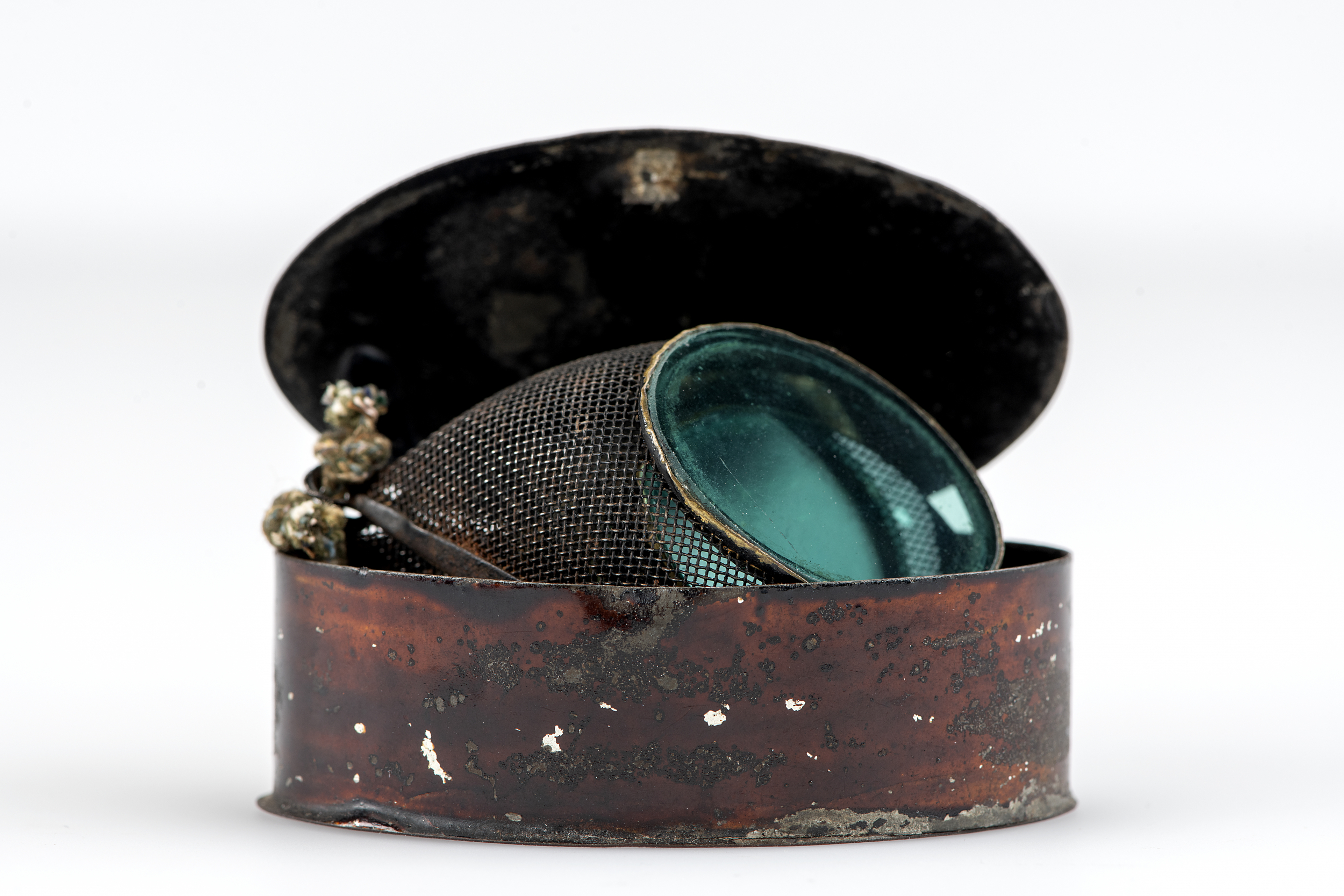
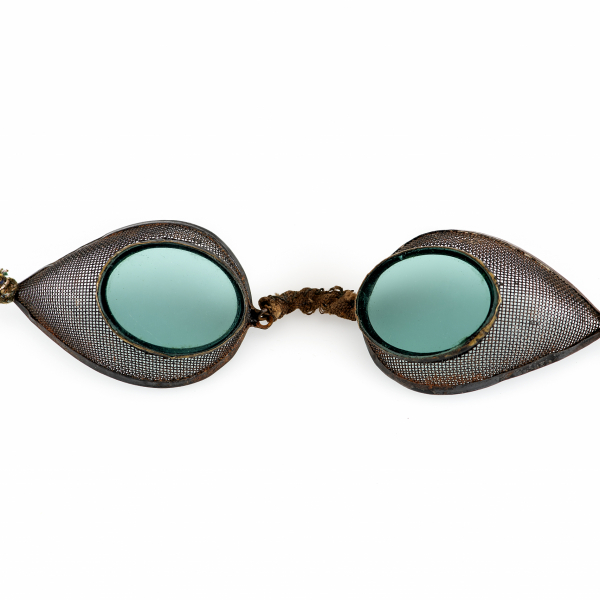
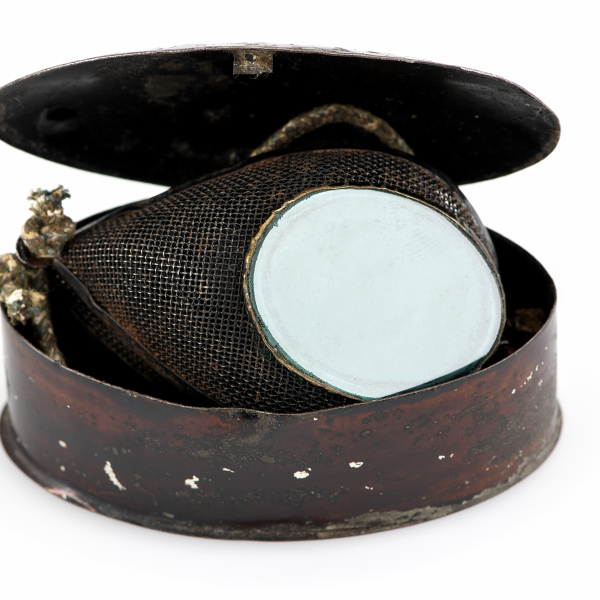
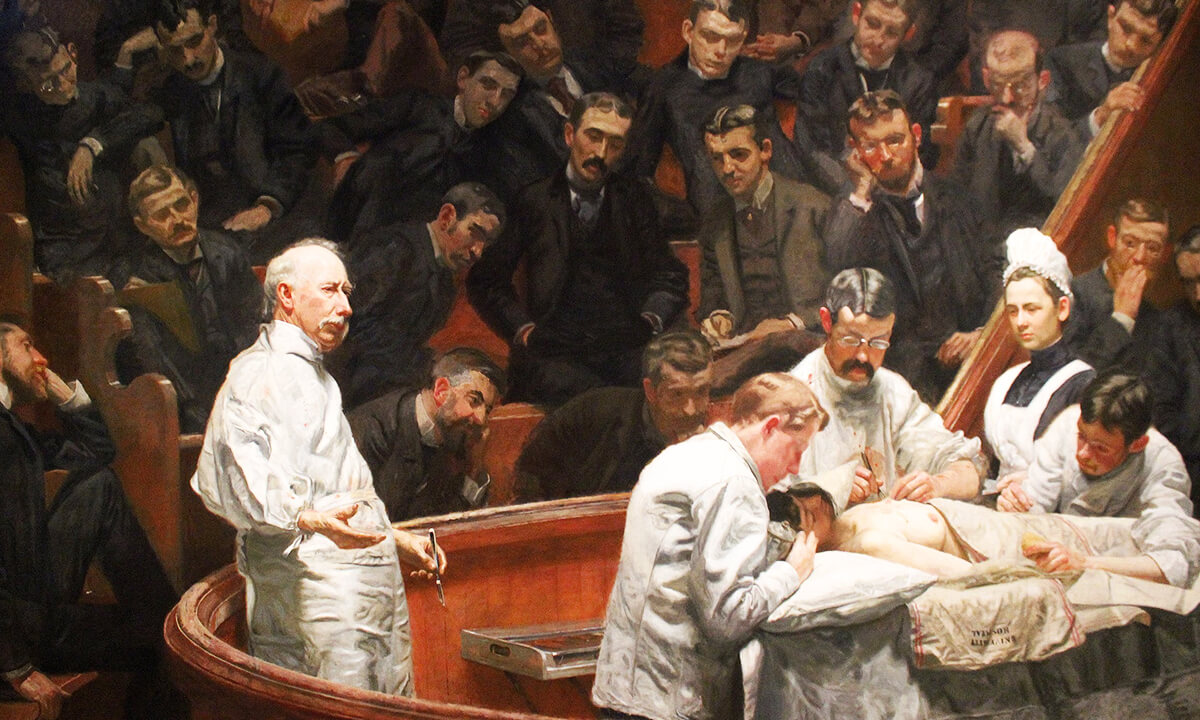
c. 1860s Civil War Era, Artillery Soldier’s Screen-Side Glasses with Case, Choice Very Fine.

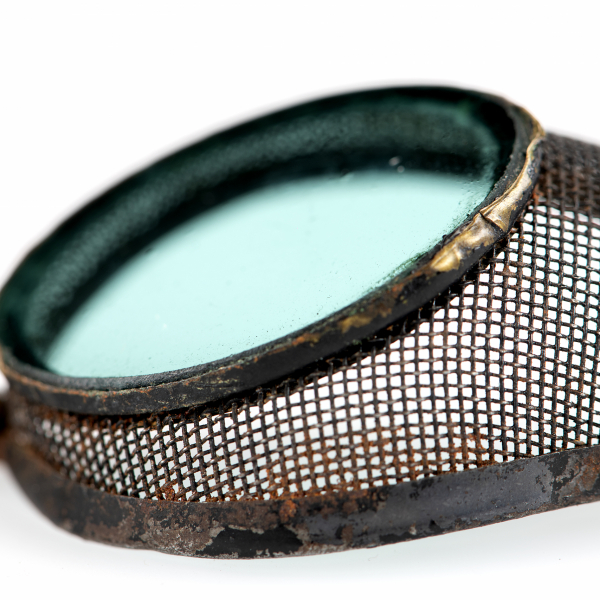
These goggles are made of colored lenses situated within wire mesh frames designed to protect the wearer’s eyes from any debris, fragments, or other foreign objects from flying into their eyes. Contained in a small metal case, this eyewear could prove to be invaluable on the battlefield or even in various types of civilian employment after the war itself.

Very scarce fully intact Civil War era Artillery Soldier’s screen-side glasses, about 5″ total width with 8″ cord straps. Complete with original Japanned tin case, 3.25″ x 1.5″. These were worn to protect the eyes from debris while firing a cannon. Blue glass lenses still intact and great condition. Rare and hard to find, especially in this condition. A useful, collectible Civil War display piece.

Pictures:


WallBuilders Artifacts

Related Artifacts:

Ketchum Grenade Civil War Hand Grenade Click Here

Amputation Saw Civil War Medical Implement Click Here

John Clem Collection12 Year Old Civil War Hero Click Here

Videos:

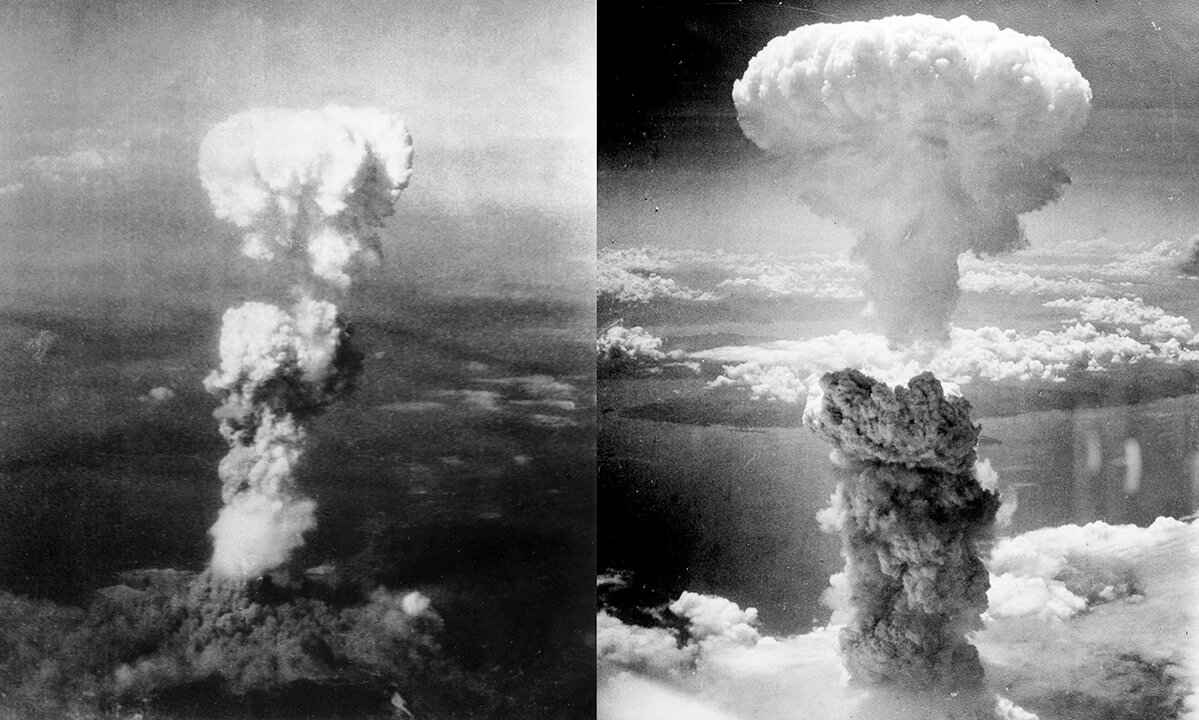
The mushroom clouds from the Hiroshima and Nagasaki atomic bombs.

Dutch Van Kirk Signed Photograph

Theodore “Dutch” Van Kirk (1924-2014) was the navigator on the Enola Gay when it dropped the atomic bomb “Little Boy” on Hiroshima, Japan, during World War II on August 6, 1945. As navigator, Van Kirk was responsible for guiding the plane to its target destination and confirming where exactly to drop the bomb. As the last surviving member of the crew, Dutch Van Kirk often spoke about the reasons behind employing the atomic bomb and how it led to the end of World War II. In the WallBuilders collection we have a picture of the destruction at Hiroshima inscribed by Dutch Van Kirk with the following statement:

Most people do not recall why we dropped the atomic bombs. It was forgotten after 64 years only remembering the large casualties they caused. We dropped the bombs to end the war and stop the killing by destroying military and military support facilities defending against an invasion. Earlier we dropped millions of leaflets which were largely ignored.

The leaflets Van Kirk refers to warned the Japanese citizens of the impending bombs and advised them to evacuate the cities targeted beforehand. (You can see some and read their translations at WallBuilders.)

Below is an picture of Van Kirk’s message:

Why I Will Not Vote the Democratic Ticket: Historical Document

Why I Will Not Vote the Democratic Ticket.
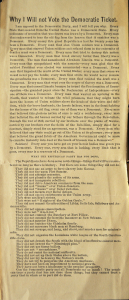
I am opposed to the Democratic Party, and I will tell you why. Every State that seceded from the United States was a Democratic State. Every ordinance of secession was drawn by a Democrat. Every man that endeavored to tear the old flag from the heaven that it enriches was a Democrat. Every enemy this great Republic has had for twenty years has been a Democrat. Every man that shot Union soldiers was a Democrat. Every man that starve union soldiers and refused them in the extremity of death a crust was Democrat. Every man that tried to destroy this nation was a Democrat. Every man that loved slavery better than liberty was a Democrat. That man that assassinated Abraham Lincoln as a Democrat. Every man that sympathized with the assassin — every man glad that the noblest President ever elected was assassinated — was a Democrat. Every man that impaired the credit fo the Union States; every man that swore we would never pay the bonds; every man that swore we would never redeem the greenbacks was a Democrat. Every man that resisted the draft was a Democrat. Every man that wept over the corpse fo slavery was a Democrat. Every man that cursed Lincoln because the issued the Proclamation of Emancipation — the grandest paper since the Declaration of Independence — every one fo them was a Democrat. Every man that wanted an uprising in the North, that wanted to released the rebel prisoners, that they might burn down the homes of Union soldiers above the heads of their wives and children, while the brave husbands, the heroic fathers, were in the front fighting for the honor of the old flag, every one of them was a Democrat. Every man that believed this glorious nation of ours is only a confederacy, every man that believed the old banner carried by our fathers through the Revolution, through the war of 1812, carried by our brothers over the plains of Mexico, carried by our brothers over the fields of the Rebellion, simply stood for a contract, simply stood for an agreement, was a Democrat. Every man who believed that any State could go out of the Union at its pleasure; every man that believed the grand fabric of the American Government could be made to crumble instantly into dust at the touch of treason was a Democrat.

Soldiers! Every scar you have got on your heroic bodies was given you by a Democrat. Every scar, every arm that is lacking, every limb that is gone, every scar is a souvenir of a Democrat.

What the Republican Party Has Not Done.

The Republicans have done some noble things–things that will be remembered as long as there is history. But there are some things they did not do.

They did not use an army to force slavery into Kansas.

They did not fire upon Fort Sumter.

They did not attempt secession.

They did not plunder the nation of its arms.

They did not inaugurate rebellion.

They did not drive American commerce from the seas.

They did not “huzza” over Union disasters.

They did not “huzza” over Rebel victories.

They did not mourn over Rebel defeats.

They did not oppose enlistments in the Union army.

They were not draft rioters.

They were not “Knights of the Golden Circle.”

They did not commit the atrocities of Libby, Belle Isle, Salisbury and Andersonville.

They did not oppose emancipation.

They were not “Ku-Klux.”

They did not commit the Butchers at Fort Pillow.

They did not commit the horrible massacre at New Orleans.

They did not murder Dixon.

They did not butcher the Chisholm family.

They did not massacre black men at Hamburg.

They did not scourge, and hang, and shoot, and murder men for opinion’s sake.

They did not organize the Louisiana white league of the South Caroline rifle clubs.

They did not drench the South with the blood of inoffensive colored men.

They did not invent the “Mississippi plan.”

They did not use tissue ballots.

They are not “moonshiners.”

They do not resist the national authority.

They did not set up their States above the nation.

They did not try to destroy the Nation’s credit.

They did not try to pauperize the American mechanic.

They have not been an impediment to national growth.

They have not been an impediment to the people’s prosperity.

Can the Democratic party and all Democrats say as much? The people can trust a party that has not done these things, but they cannot trust a party that in whole or in part did do them.


{Back}
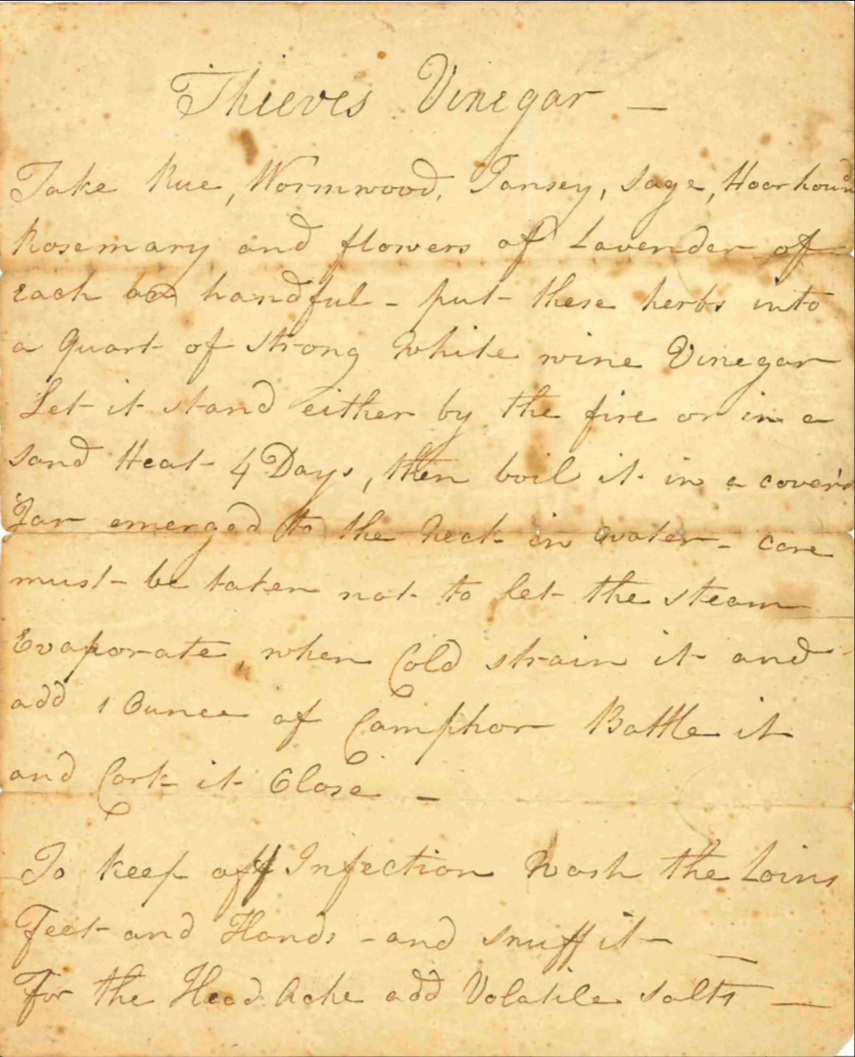
Thieves Vinegar Recipe from the 1700s

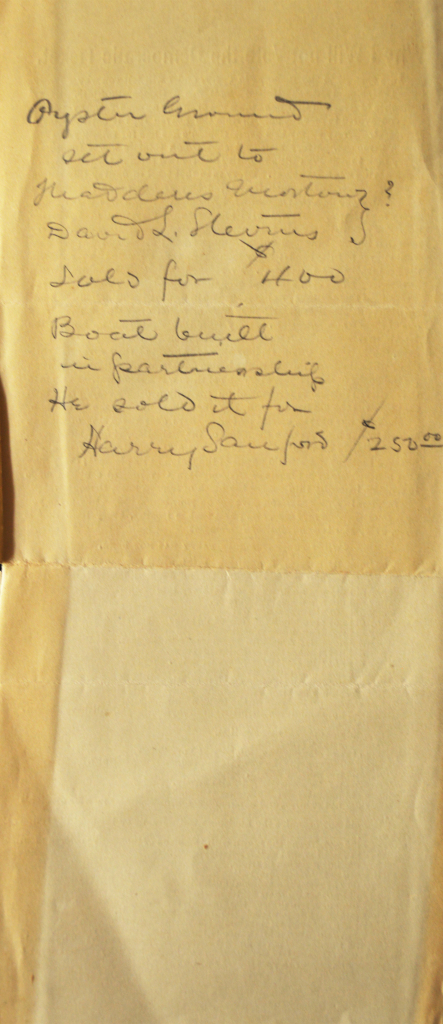
This document from the WallBuilders collection is a recipe for Thieves Vinegar from the late 1700s. Thieves was used in a number ways as a remedy to fight against several diseases which affected early America.

Transcript:

Thieves Vinegar

Take rue, wormwood, tansey [sic., tansy], sage, hoorhound [sic., horehound], rosemary and flowers of lavender—of each one handful—put these herbs into a quart of strong white wine vinegar.

Let it stand either by the fire or in a sand heat 4 days, then boil it in a covered jar emerged to the neck in water. Cone must be taken not to let the steam evaporate when cold. Strain it and add 1 ounce of camphor. Bottle it and cork it close.

To keep off infection wash the loins, feet and hands, and sniff it.

For the headache add volatile salts.

Astronaut Signatures

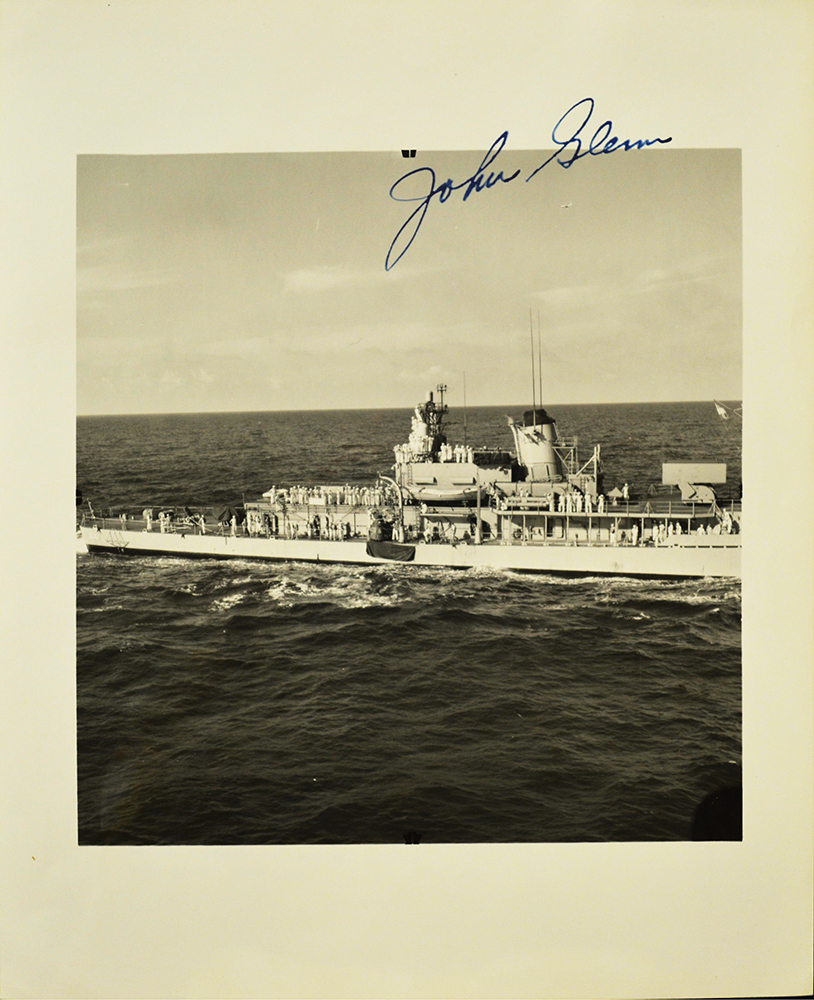
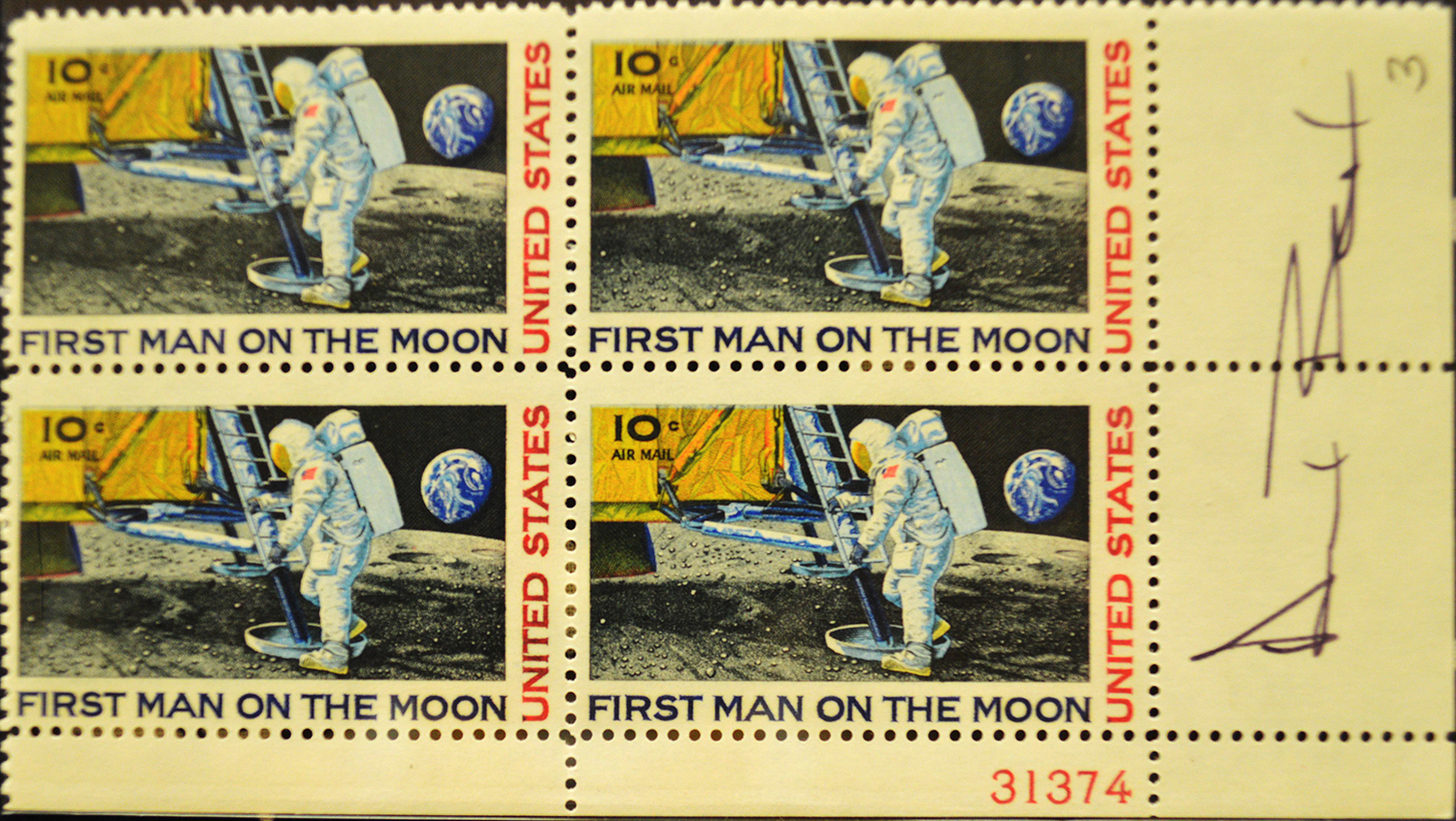
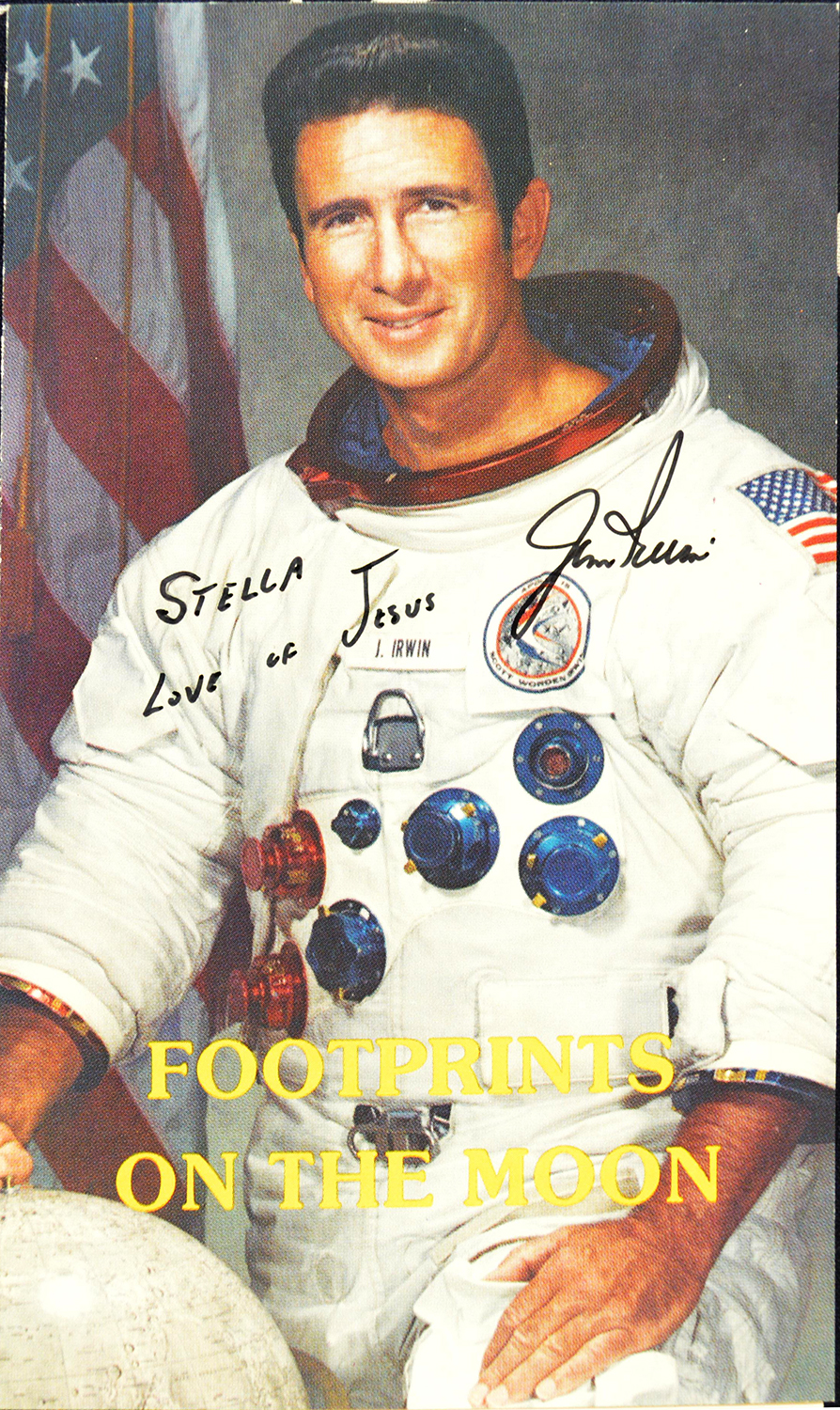
Below are signatures by three American astronauts, including the first American to orbit the Earth and two of the 12 people to walk on the moon!

1) Photograph of the Mercury capsule on the U.S.S. Noa (Prime) recovery ship following John Glenn’s return to Earth after his Friendship 7 mission. This photograph is signed by John Glenn (1921-2016). Glenn was the first American to orbit the earth in February 1962 and later served as US Senator from Ohio (1974-1999).

2) Unused block of 10 cent Postage Stamps depicting Neil Armstrong’s first step on the moon, titled ‘First Man On the Moon.’ This block of stamps was signed by Alan Bean (1932-2018), member of the Apollo 12 mission in November 1962 who walked on the moon.

3) Brochure titled “Footprints On The Moon” (c. 1970s-1980s) that was signed by James Irwin on the cover: “Stella/Love of Jesus/Jim Irwin.” Irwin (1930-1991), walked on the moon in the Apollo 15 mission in July/August 1971.

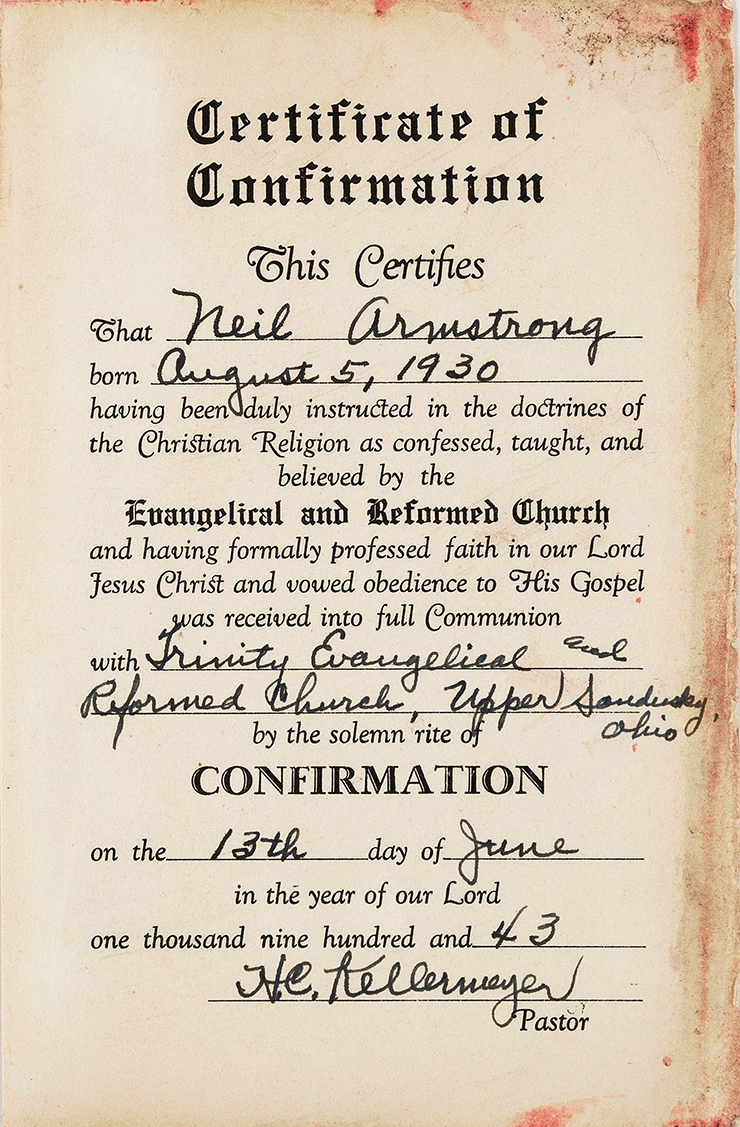
Neil Armstrong’s Certificate of Confirmation

Neil Armstrong (1930-2012) achieved international fame when he became the first person to set foot on the moon in July 1969 as part of the Apollo 11 mission. At the time this historic “giant leap for mankind” was shown on television, the viewing audience was estimated to be 650 million (see video of this first step on the moon).

Below, from WallBuilders’ collection is a Certificate of Confirmation (June 13, 1943) belonging to Neil Armstrong. At the time this certificate was issued, Neil was 13 years old.


Transcript:

Certificate of Confirmation

This Certifies That Neil Armstrong born August 5, 1930 having been duly instructed in the doctrines of the Christian Religion as confessed, taught, and believed by the Evangelical and Reformed Church and having formally professed faith in our Lord Jesus Christ and vowed obedience to His Gospel was received into full communion with Trinity Evangelical and Reformed Church, Upper Sandusky, Ohio by the solemn rite of CONFIRMATION on the 13th day of June in the year of our Lord one thousand nine hundred and 43.

H. C. Kellermeyer Pastor

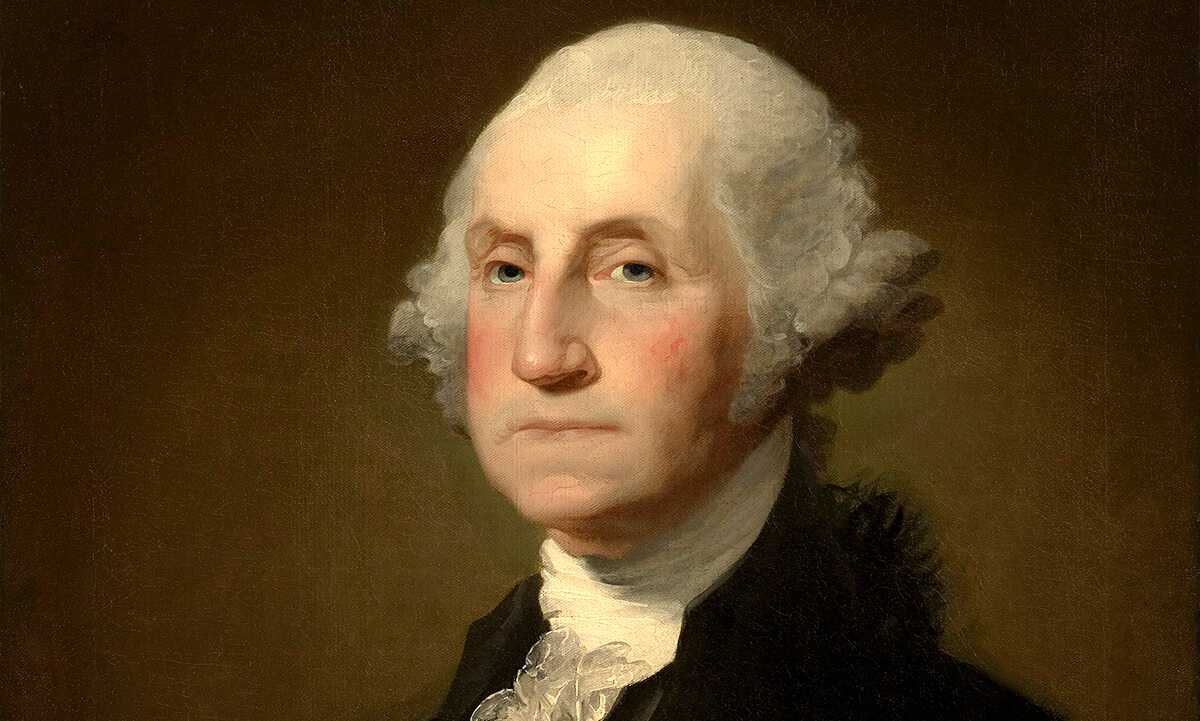
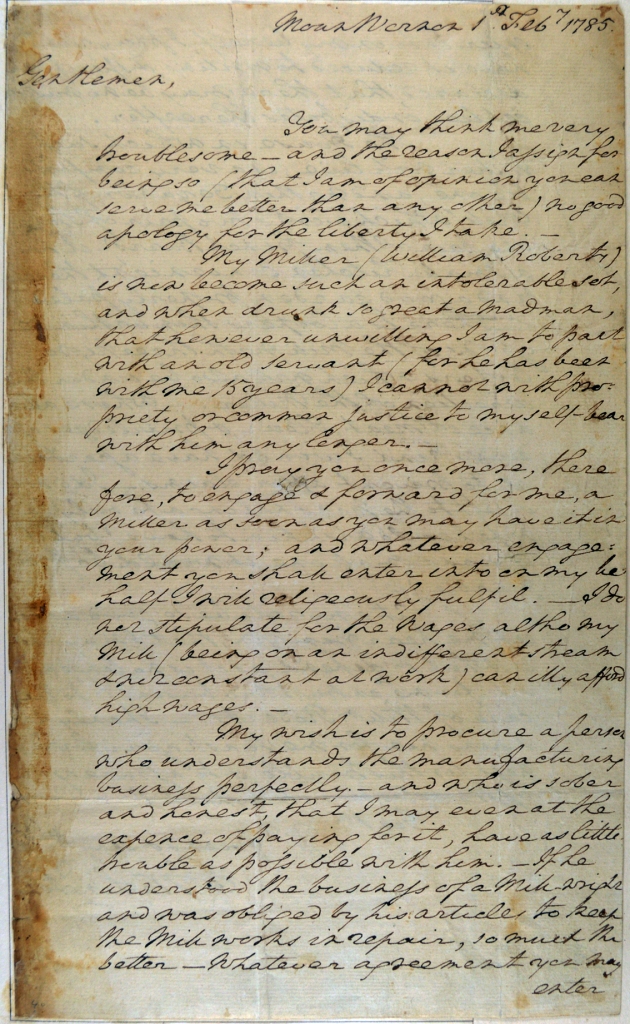
George Washington 1785 Letter

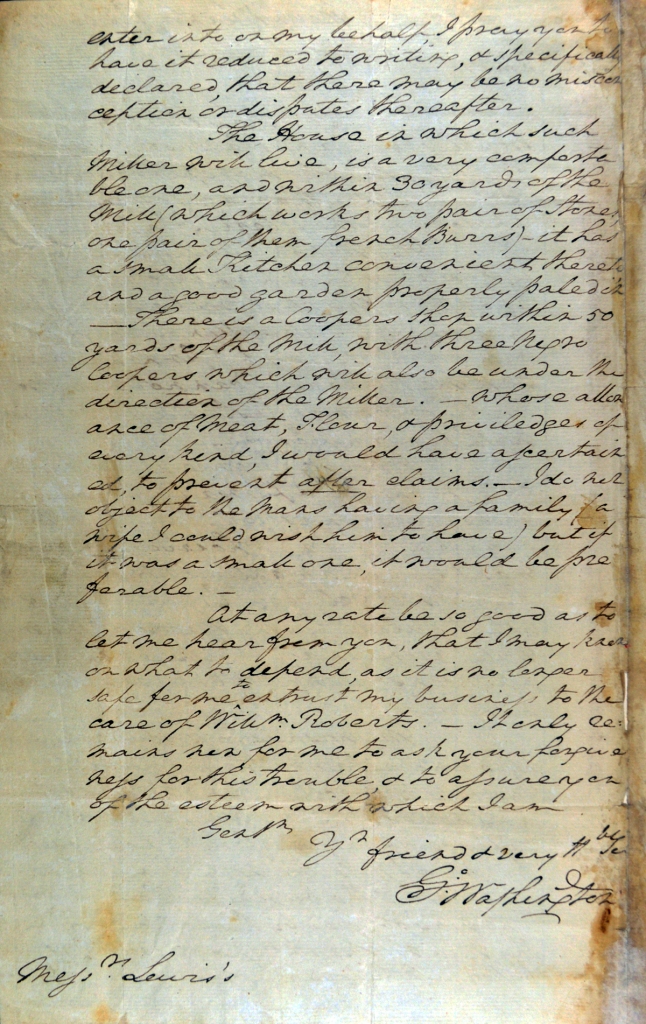
Below is an original letter in WallBuilders’ collection, from George Washington, dated February 1, 1785. This letter was written during a short period of retirement for Washington, following the War for Independence and before the Constitutional Convention. After resigning his military commission, he settled back in Mount Vernon following an almost continuance absence of eight years.


Mount Vernon 1st Feb. 1785

Gentleman,

You may think me very troublesome – and the reason I assign for being so (that I am of the opinion you can serve me better than any other) no good apology for the liberty I take.

My Miller (William Roberts) in now become such an intolerable serv, and when drunk so great a madman, that he never unwilling I am to part with an old servant (for he has been with me 15 years) I cannot with propriety on common justice to myself bear with him any longer.

I pray you once more, therefore, to engage & forward to me, a miller as seen as you may have it in your power; and whatever engagement you shall enter into on my behalf I will religiously fulfil. I do not stipulate for the wages at altho’ my Mill (being on an indifferent stream & not constant at work) can illy [sic] afford high wages.

My wishes to procure a servant who understands the manufacturing business perfectly – and who is sober and honest, that I may even at the expense of paying for it, have as little trouble as possible with him. If he understood the business of a Mill _____ and was obliged by his attitude to keep the Mill works in repair, so much the better. Whatever agreement you may enter into on my behalf, I pray you to have it reduced to writing, & specially declared, that there may be no misexception [sic] or disputes thereafter.

The House in which such Muller will live, is a very comfortable one, within 30 yards of the Mill (which works two pairs of stones one pair of them french Burns) – it has a small Kitchen convenient thereto and a good garden properly paled it. There is a Coopers shop within 50 yards of the Mill, with three Negro Coopers which will also be under the direction of the Miller. Whose allowance of meat, flour, & privileges of every kind, I would have ascertained, to prevent after claims. I do not object to the Mans having a family (a wife I could wish him to have) but if it was a small one, it would be preferable.

At any rate be so good as to let me hear from you, that I may know on what to depend, as it is no longer safe for me to entrust my business to the care of Willi’m Roberts. It only remains now for me to ask your sanguineness for this trouble & to assure you of the esteem with which I am

Gentm

Your friend & very Humble

G. Washington

Mess. Lewis’s

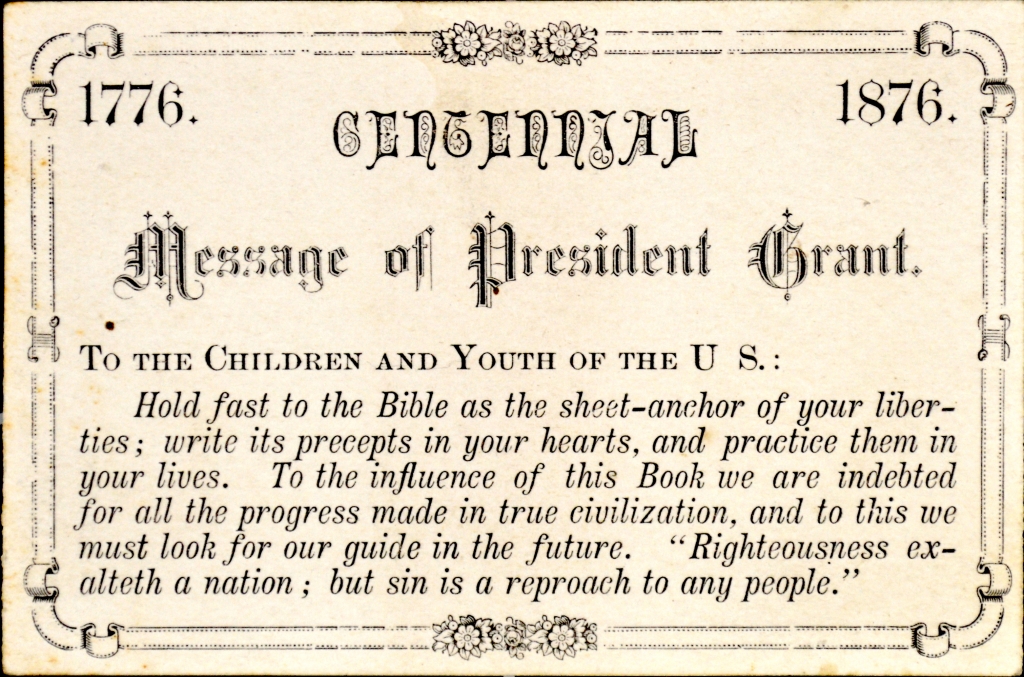
Message of President Grant to the Children and Youth of the U.S.

During the festivities celebrating the centennial of the creation of America through the Declaration of Independence, then president Ulysses S. Grant took time to speak to the younger generations of Americans. His message centered on the vital influence and role the Bible in American and the preservation of the liberties enjoyed by here citizens.

One of the ways Grant’s message got disseminated was through cards such as the example below from the WallBuilders’ Library. The body of the card reads:

Hold fast to the Bible as the sheet-anchor of your liberties; write its precepts in your heats, and practice them in your lives. To the influence of this Book we are indebted for all the progress made in true civilization, and to this we must look for our guide in the future. “Righteousness exalteth a nation; but sin is a reproach to any people.”

Listen to David Barton and Audrea Decker from the Pro-Family Legislative Network discuss this artifact:

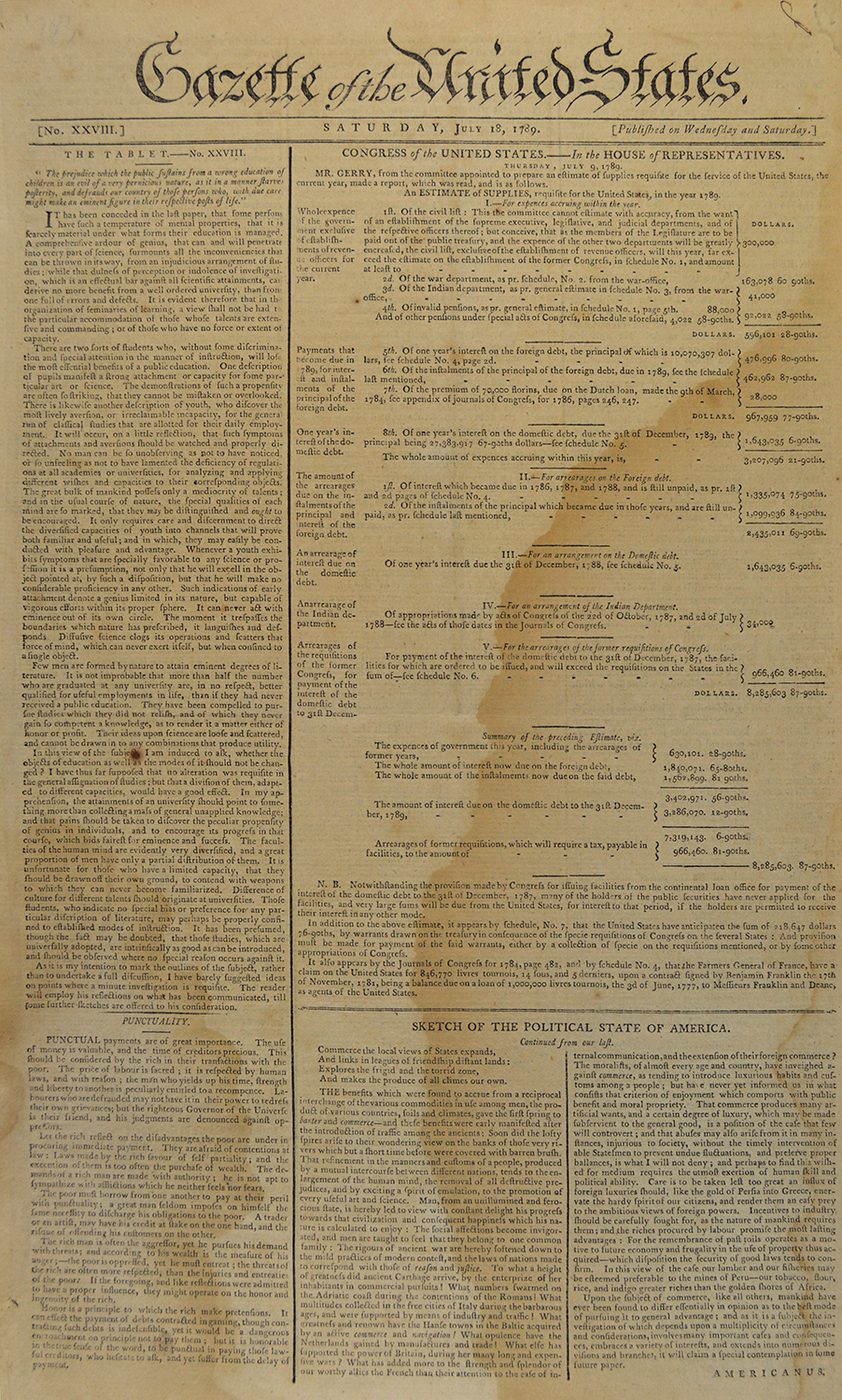
First Federal Budget: 1789

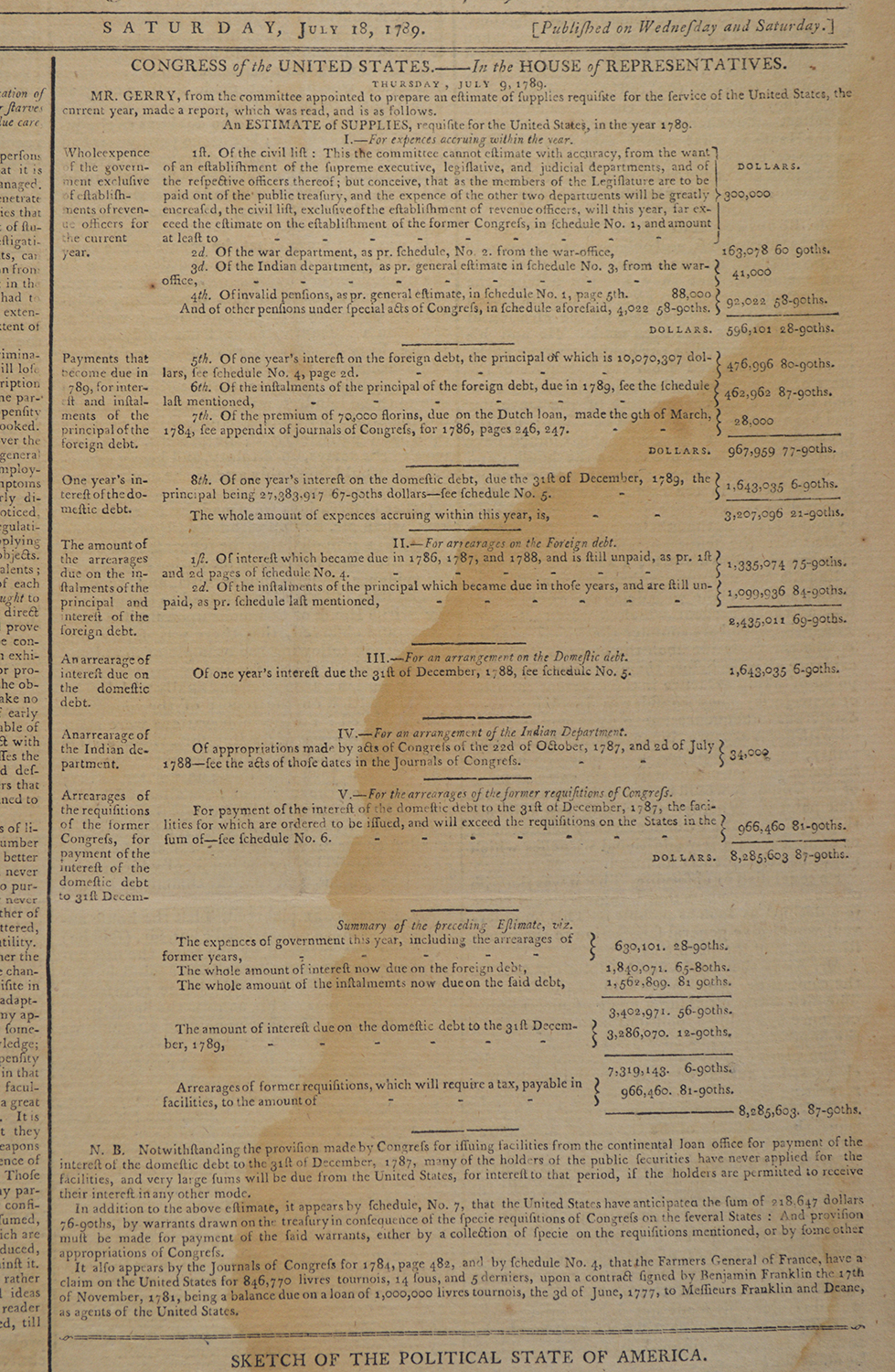
Below is an interesting item from WallBuilders’ collection — the first federal budget of the United States, dated July 9, 1789. This budget takes up only about 1/2 page of the newspaper it’s printed in, The Gazette of the United States (July 18, 1789).


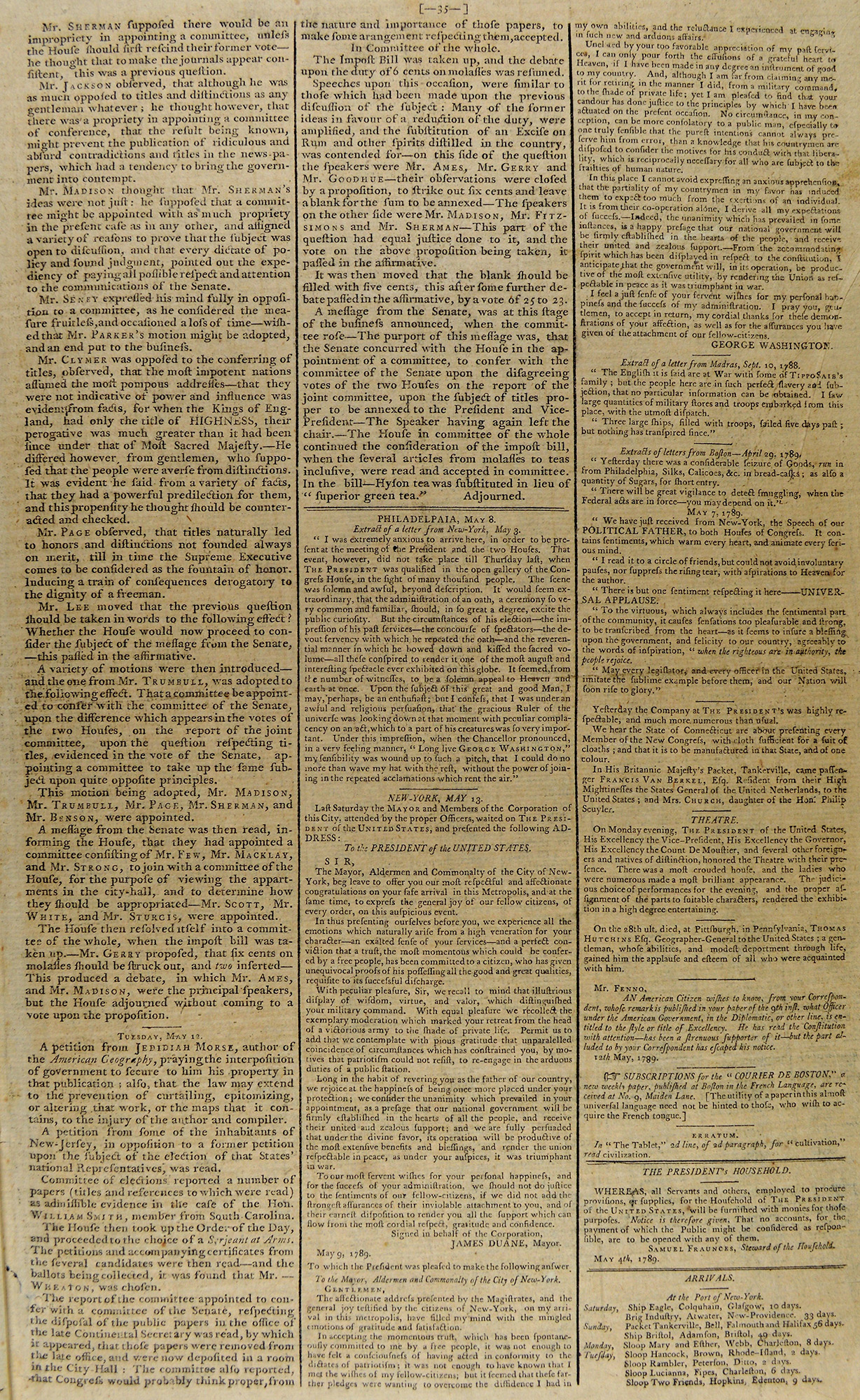
Here’s the complete front page, the budget is on the top right.


And here’s a close-up of the budget.

1789 Inauguration Eyewitness

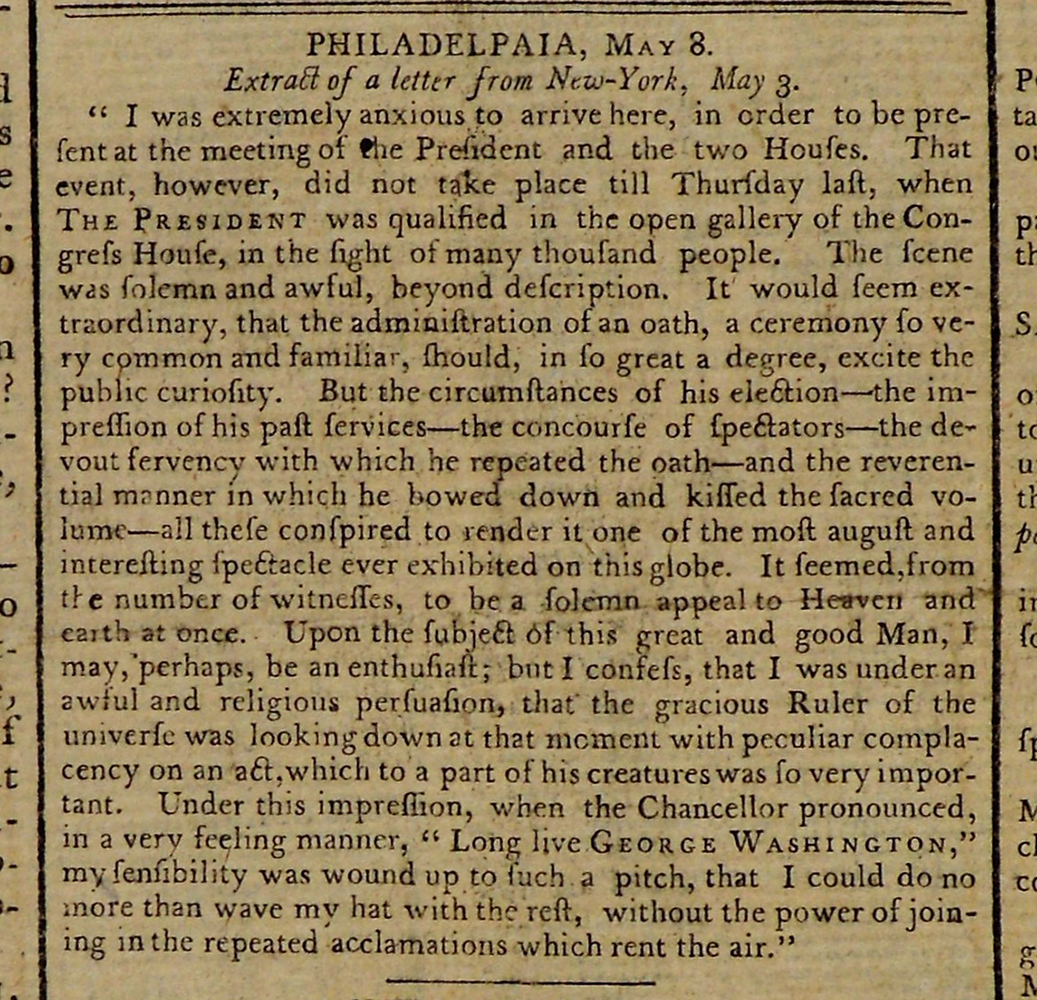
The 1789 inauguration of George Washington as the first President of the United States under the Constitution was a very important event. It established several precedents for inaugurations that have withstood the test of time, including many religious activities. Congress had set up a basic procedure for the inauguration but there were some of the details that Washington added in himself during this historic event — such as the phrase “so help me God” after the oath and the practice of giving an inauguration address. Below, from WallBuilders’ collection, is a May 3, 1789 excerpt of an eyewitness account of the inauguration that was printed in the newspaper, Gazette of the United States (May 9-May 13, 1789).


Philadelphia, May 8.

Extract of a letter from New-York, May 3.

“I was extremely anxious to arrive here, in order to be present at the meeting of the President and the two Houses. That event, however, did not take place til Thursday last, when The President was qualified was qualified in the open gallery of the Congress House, in the sight of many thousand people. The scene was solemn and awful, beyond description. It would seem extraordinary, that the administration of an oath, a ceremony so very common and familiar, should, in so great a degree excite the public curiosity. But the circumstances of his election—the impression of his past services—the concourse of spectators—the devout fervency with which he repeated the oath—and the reverential manner in which he bowed down and kissed the sacred volume—all these conspired to render it one of the most august and interesting spectacle ever exhibited on this globe. It seemed, from the number of witnesses, to be a solemn appeal to Heaven and earth at once, Upon the subject of this great and good Man, I may, ‘perhaps, be an enthusiast; but I confess, that I was under an awful and religious persuasion, that the gracious Ruler of the universe was looking down at that moment with peculiar complacency on an act, which to a part of his creatures was so very important. Under this impression, when the Chancellor pronounced, in a very feeble manner, “Long live George Washington,” my sensibility was wound up to such a pitch, that I could do no more than wave my hat with the rest, without the power of joining in the repeated acclamations which rent the air.”