James Buchanan

Proclamation – Humiliation Fasting and Prayer – 1860

proclamation-humiliation-fasting-and-prayer-1860-1

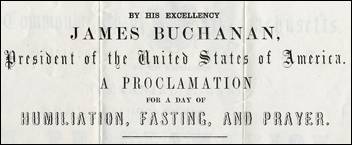
By His Excellency

James Buchanan,

President of the United States of America.

A Proclamation

For a Day of
Humiliation, Fasting, & Prayer.


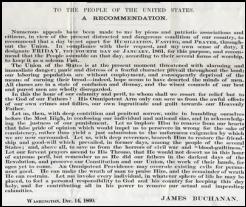
To the People of the United States.

A Recommendation.

Numerous appeals have been made to me by pious and patriotic associations and citizens, in view of the present distracted and dangerous condition of our country, to recommend that a day be set apart for Humiliation, Fasting and Prayer throughout the Union.
proclamation-humiliation-fasting-and-prayer-1860-2

In compliance with their request and my own sense of duty, I designate Friday, the 4th of January 1861, for this purpose, and recommend that the People assemble on that day, according to their several forms of worship, to keep it as a solemn Fast.

The Union of the States is at the present moment threatened with alarming and immediate danger; panic and distress of a fearful character prevails throughout the land; our laboring population are without employment, and consequently deprived of the mans of earning their bread. Indeed, hope seems to have deserted the minds of men. All classes are in a state of confusion and dismay, and the wisest counsels of our best and purest men are wholly disregarded.

In this the hour of our calamity and peril, to whom shall we resort for relief but to the God of our fathers? His omnipotent arm only can save us from the awful effects of our own crimes and follies — our own ingratitude and guilt towards our Heavenly Father.

Let us, then, with deep contrition and penitent sorrow, unite in humbling ourselves before the Most High, in confessing our individual and national sins, and in acknowledging the injustice of our punishment. Let us implore Him to remove from our hearts that false pride of opinion which would impel us to persevere in wrong for the sake of consistency, rather than yield a just submission to the unforeseen exigencies by which we are now surrounded. Let us with deep reverence beseech him to restore the friendship and good will which prevailed in former days among the people of the several States; and, above all, to save us from the horrors of civil war and “blood-guiltiness.” Let our fervent prayers ascend to His Throne that He would not desert us in this hour of extreme peril, but remember us as he did our fathers in the darkest days of the revolution; and preserve our Constitution and our Union, the work of their hands, for ages yet to come.

An Omnipotent Providence may overrule existing evils for permanent good. He can make the wrath of man to praise Him, and the remainder of wrath he can restrain. — Let me invoke every individual, in whatever sphere of like he may be placed, to feel a personal responsibility to God and his country for keeping this day holy, and for contributing all in his power to remove our actual and impending calamities.

James Buchanan.

Washington,
Dec. 14, 1860.

“Give Me Liberty Or Give Me Death”

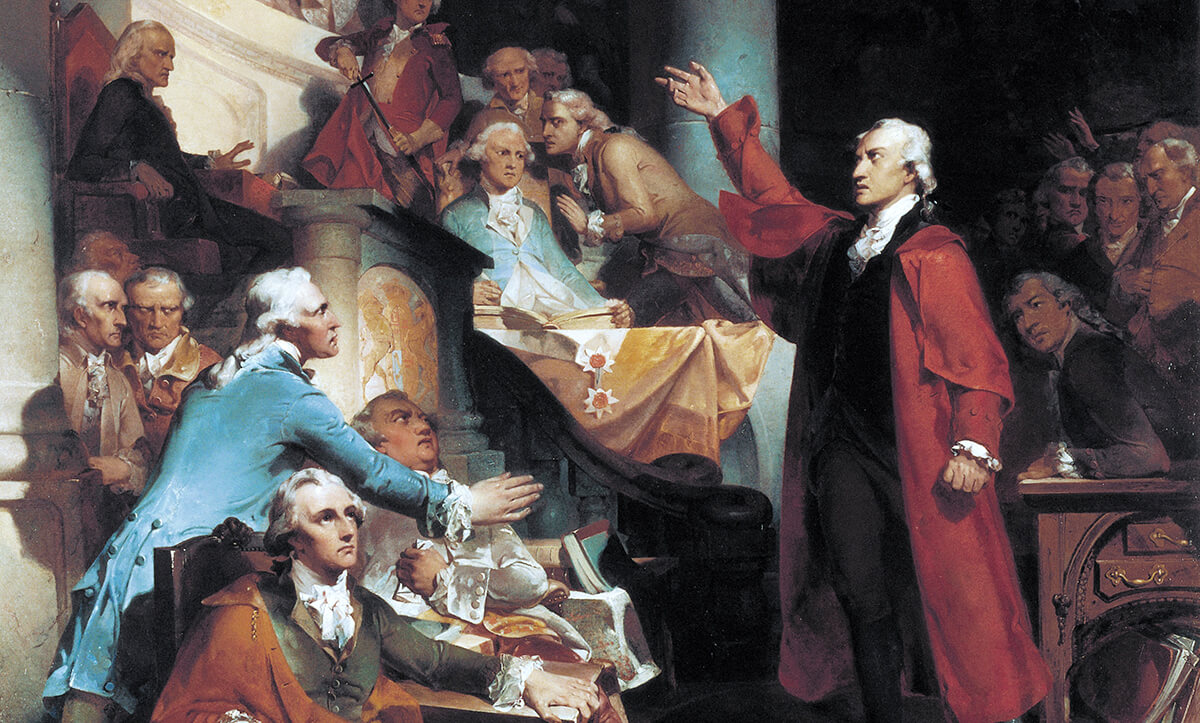
No man thinks more highly than I do of the patriotism, as well as abilities, of the very worthy gentlemen who have just addressed the House. But different men often see the same subject in different lights; and, therefore, I hope it will not be thought disrespectful to those gentlemen if, entertaining as I do opinions of a character very opposite to theirs, I shall speak forth my sentiments freely and without reserve. This is no time for ceremony. The questing before the House is one of awful moment to this country. For my own part, I consider it as nothing less than a question of freedom or slavery; and in proportion to the magnitude of the subject ought to be the freedom of the debate. It is only in this way that we can hope to arrive at truth, and fulfill the great responsibility which we hold to God and our country. Should I keep back my opinions at such a time, through fear of giving offense, I should consider myself as guilty of treason towards my country, and of an act of disloyalty toward the Majesty of Heaven, which I revere above all earthly kings.

Mr. President, it is natural to man to indulge in the illusions of hope. We are apt to shut our eyes against a painful truth, and listen to the song of that siren till she transforms us into beasts. Is this the part of wise men, engaged in a great and arduous struggle for liberty? Are we disposed to be of the number of those who, having eyes, see not, and, having ears, hear not [Jer. 5:21], the things which so nearly concern their temporal salvation? For my part, whatever anguish of spirit it may cost, I am willing to know the whole truth; to know the worst, and to provide for it. I have but one lamp by which my feet are guided, and that is the lamp of experience. I know of no way of judging of the future but by the past. And judging by the past, I wish to know what there has been in the conduct of the British ministry  for the last ten years to justify those hopes with which gentlemen have been pleased to solace themselves and the House. Is it that insidious smile with which our petition has been lately received? Trust it not, sir; it will prove a snare to your feet. Suffer not yourselves to be betrayed with a kiss [Matt. 26:48]. Ask yourselves how this gracious reception of our petition comports with those warlike preparations which cover our waters and darken our land. Are fleets and armies necessary to a work of love and reconciliation? Have we shown ourselves so unwilling to be reconciled that force must be called in to win back our love? Let us not deceive ourselves, sir. These are the implements of war and subjugation; the last arguments to which kings resort. I ask gentlemen, sir, what means this martial array, if its purpose be not to force us to submission? Can gentlemen assign any other possible motive for it? Has Great Britain any enemy, in this quarter of the world, to call for all this accumulation of navies and armies? No, sir, she has none. They are meant for us: they can be meant for no other. They are sent over to bind and rivet upon us those chains which the British ministry have been so long forging. And what have we to oppose to them? Shall we try argument? Sir, we have been trying that for the last ten years. Have we anything new to offer upon the subject? Nothing. We have held the subject up in every light of which it is capable; but it has been all in vain. Shall we resort to entreaty and humble supplication? What terms shall we find which have not been already exhausted? Let us not, I beseech you, sir, deceive ourselves. Sir, we have done everything that could be done to avert the storm which is now coming on. We have petitioned; we have remonstrated; we have supplicated; we have prostrated ourselves before the throne, and have implored its interposition to arrest the tyrannical hands of the ministry and Parliament. Our petitions have been slighted; our remonstrances have produced additional violence and insult; our supplications have been disregarded; and we have been spurned, with contempt, from the foot of the throne! In vain, after these things, may we indulge the fond hope of peace and reconciliation. There is no longer any room for hope. If we wish to be free– if we mean to preserve inviolate those inestimable privileges for which we have been so long contending–if we mean not basely to abandon the noble struggle in which we have been so long engaged, and which we have pledged ourselves never to abandon until the glorious object of our contest shall be obtained–we must fight! I repeat it, sir, we must fight! An appeal to arms and to the God of hosts is all that is left us!

They tell us, sir, that we are weak; unable to cope with so formidable an adversary. But when shall we be stronger? Will it be the next week, or the next year? Will it be when we are totally disarmed, and when a British guard shall be stationed in every house?  Shall we gather strength by irresolution and inaction? Shall we acquire the means of effectual resistance by lying supinely on our backs and hugging the delusive phantom of hope, until our enemies shall have bound us hand and foot?  Sir, we are not weak if we make a proper use of those means which the God of nature hath placed in our power. The millions of people, armed in the holy cause of liberty, and in such a country as that which we possess, are invincible by any force which our enemy can send against us. Besides, sir, we shall not fight our battles alone. There is a just God who presides over the destinies of nations, and who will raise up friends to fight our battles for us [2 Chron. 32:8]. The battle, sir, is not to the strong alone [Eccl. 9:11]; it is to the vigilant, the active, the brave. Besides, sir, we have no election. If we were base enough to desire it, it is now too late to retire from the contest. There is no retreat but in submission and slavery! Our chains are forged! Their clanking may be heard on the plains of Boston! The war is inevitable–and let it come! I repeat it, sir, let it come.

It is in vain, sir, to extenuate the matter. Gentlemen may cry, Peace, Peace– but there is no peace [Jer. 6:14].  The war is actually begun! The next gale that sweeps from the north will bring to our ears the clash of resounding arms! Our brethren are already in the field!  Why stand we here idle [Matt. 20:6]? What is it that gentlemen wish? What would they have? Is life so dear, or peace so sweet, as to be purchased at the price of chains and slavery? Forbid it, Almighty God! I know not what course others may take; but as for me, give me liberty or give me death!

Scripture references added. This speech can be found in William Wirt, Sketches of the Life and Character of
Patrick Henry
(James Webster: 1818), 119-123. WallBuilders offers a parchment copy of Patrick Henry’s speech on our online store.

Thomas Paine Criticizes the Current Public School Science Curriculum

Thomas Paine concerned about the content of our current science courses? Definitely!

In a speech he delivered in Paris on January 16, 1797, Thomas Paine harshly criticized what the French were then teaching in their science classes-especially the philosophy they were using. Interestingly, that same science philosophy of which Thomas Paine was so critical is identical to that used in our public schools today. Paine’s indictment of that philosophy is particularly significant in light of the fact that all historians today concede that Thomas Paine was one of the very least religious of our Founders. Yet, even Paine could not abide teaching science, which excluded God’s work and hand in the creation of the world and of all scientific phenomena. Below is an excerpt from that speech.

(While Benjamin Franklin was serving in London as diplomat from the Colonies to the King, Franklin met Englishman Thomas Paine (born 1737, died 1809). Franklin arranged for him to move to America in 1774 and helped set him up in the printing business.  In 1776, Paine wrote Common Sense, which helped fuel the separation of America from Great Britain. He then served as a soldier in the American Revolution. He returned to England in 1787, and then went to France in 1792 as a supporter of the French Revolution. In 1794, he published his Age of Reason, the deistic work, which brought him much criticism from his former American friends. Upon his return to America in 1802, he found no welcome and eventually died as an outcast.)

Thomas Paine on “The Study of God”

Delivered in Paris on January 16, 1797, in a

Discourse to the Society of Theophilanthropists

It has been the error of the schools to teach astronomy, and all the other sciences and subjects of natural philosophy, as accomplishments only; whereas they should be taught theologically, or with reference to the Being who is the author of them: for all the principles of science are of Divine origin. Man cannot make, or invent, or contrive principles. He can only discover them; and he ought to look through the discovery to the Author.

When we examine an extraordinary piece of machinery, an astonishing pile of architecture, a well executed statue or a highly finished painting where life and action are imitated, and habit only prevents our mistaking a surface of light and shade for cubical solidity, our ideas are naturally led to think of the extensive genius and talents of the artist. When we study the elements of geometry, we think of Euclid. When we speak of gravitation, we think of Newton. How then is it, that when we study the works of God in the creation, we stop short, and do not think of God? It is from the error of the schools in having taught those subjects as accomplishments only, and thereby separated the study of them form the Being who is the author of them. . . .

The evil that has resulted from the error of the schools in teaching natural philosophy as an accomplishment only has been that of generating in the pupils a species of atheism. Instead of looking through the works of the creation to the Creator himself, they stop short, and employ the knowledge they acquire to create doubts of His existence. They labor with studied ingenuity to ascribe everything they behold to innate properties of matter; and jump over all the rest, by saying that matter is eternal.

Proclamation – America Seeks God in a Time of War – 1777

In light of America’s current war in Iraq and ongoing war against terrorism, the actions of our Founding Fathers in times of war are instructive. This is the text of the first national day of thanksgiving in America (set for December 18, 1777), declared by the Continental Congress on November 1, 1777:

IN CONGRESS

November 1, 1777

FORASMUCH as it is the indispensable Duty of all Men to adore the superintending Providence of Almighty God; to acknowledge with Gratitude their Obligation to him for benefits received, and to implore such farther Blessings as they stand in Need of; And it having pleased him in his abundant Mercy not only to continue to us the innumerable Bounties of his common Providence, but also to smile upon us in the Prosecution of a just and necessary War, for the Defence and Establishment of our unalienable Rights and Liberties; particularly in that he hath been pleased in so great a Measure to prosper the Means used for the Support of our Troops and to crown our Arms with most signal success:

It is therefore recommended to the legislative or executive powers of these United States, to set apart THURSDAY, the eighteenth Day of December next, for Solemn Thanksgiving and Praise; That with one Heart and one Voice the good People may express the grateful Feelings of their Hearts, and consecrate themselves to the Service of their Divine Benefactor; and that together with their sincere Acknowledgments and Offerings, they may join the penitent Confession of their manifold Sins, whereby they had forfeited every Favour, and their humble and earnest Supplication that it may please GOD, through the Merits of Jesus Christ, mercifully to forgive and blot them out of Remembrance; That it may please him graciously to afford his Blessing on the Governments of these States respectively, and prosper the public Council of the whole; to inspire our Commanders both by Land and Sea, and all under them, with that Wisdom and Fortitude which may render them fit Instruments, under the Providence of Almighty GOD, to secure for these United States the greatest of all human blessings, INDEPENDENCE and PEACE; That it may please him to prosper the Trade and Manufactures of the People and the Labour of the Husbandman, that our Land may yet yield its Increase; To take Schools and Seminaries of Education, so necessary for cultivating the Principles of true Liberty, Virtue and Piety, under his nurturing Hand, and to prosper the Means of Religion for the promotion and enlargement of that Kingdom which consisteth “in Righteousness, Peace and Joy in the Holy Ghost.”

And it is further recommended, that servile Labour, and such Recreation as, though at other Times innocent, may be unbecoming the Purpose of this Appointment, be omitted on so solemn an Occasion.

Extract from the Minutes,

Charles Thomson, Secr.

[This proclamation can be found in: Journals of the American Congress From 1774 to 1788 (Washington: Way and Gideon, 1823), Vol. II, pp. 309-310]


This is text excerpted from a national fast declared by the Continental Congress on March 16, 1776:

IN CONGRESS

In times of impending calamity and distress; when the liberties of America are imminently endangered by the secret machinations and open assaults of an insidious and vindictive administration, it becomes the indispensable duty of these hitherto free and happy colonies, with true penitence of heart, and the most reverent devotion, publickly to acknowledge the over ruling providence of God; to confess and deplore our offences against him; and to supplicate his interposition for averting the threatened danger, and prospering our strenuous efforts in the cause of freedom, virtue, and posterity. . . .

Desirous, at the same time, to have people of all ranks and degrees duly impressed with a solemn sense of God’s superintending providence, and of their duty, devoutly to rely, in all their lawful enterprizes, on his aid and direction, Do earnestly recommend, that Friday, the Seventeenth day of May next, be observed by the said colonies as a day of humiliation, fasting, and prayer; that we may, with united hearts, confess and bewail our manifold sins and transgressions, and, by a sincere repentance and amendment of life, appease his righteous displeasure, and, through the merits and mediation of Jesus Christ, obtain his pardon and forgiveness; humbly imploring his assistance to frustrate the cruel purposes
of our unnatural enemies;

. . . that it may please the Lord of Hosts, the God of Armies, to animate our officers and soldiers with invincible fortitude, to guard and protect them in the day of battle, and to crown the continental arms, by sea and land, with victory and success: Earnestly beseeching him to bless our civil rulers, and the representatives of the people, in their several assemblies and conventions; to preserve and strengthen their union, to inspire them with an ardent, disinterested love of their country; to give wisdom and stability to their counsels; and direct them to the most efficacious measures for establishing the rights of America on the most honourable and permanent basis—That he would be graciously pleased to bless all his people in these colonies with health and plenty, and grant that a spirit of incorruptible patriotism, and of pure undefiled religion, may universally prevail; and this continent be speedily restored to the blessings of peace and liberty, and enabled to transmit them inviolate to the latest posterity. And it is recommended to Christians of all denominations, to assemble for public worship, and abstain from servile labour on the said day.

[Source: Journals of the American Congress From 1774 to 1788 (Washington: Way and Gideon, 1823), Vol. I, pp. 286-287]


Sermon – Stamp Act Repeal – 1766


Charles Chauncy (1705-1787) was a minister from Boston. He attended Harvard, graduating in 1721. Chauncy preached at the First Church in Boston for sixty years (1727-1787).

Below is Chauncy’s 1766 sermon on the day of Thanksgiving proclaimed in Massachusetts on occasion of the repeal of the Stamp Act.


sermon-stamp-act-repeal-1766

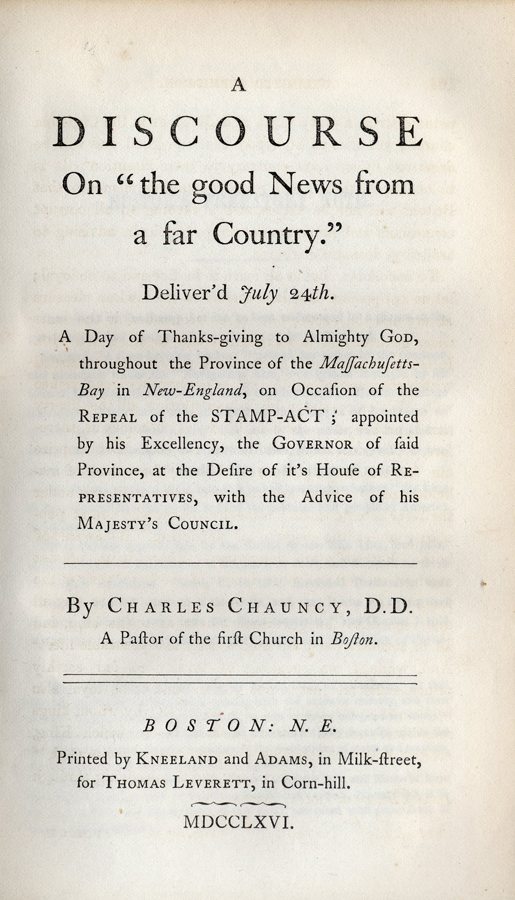
A

DISCOURSE

On “the good News from a far Country.”

Deliver’d July 24th.

A Day of Thanks-giving to Almighty God, throughout the Province of the Massachusetts-Bay in New-England, on Occasion of the Repeal of the STAMP-ACT; appointed by his Excellency, the Governor of said Province, at the Desire of it’s House of Representatives, with the Advice of his Majesty’s Council.

By Charles Chauncy, D.D.
A Pastor of the first Church in Boston.


EDITOR’S PREFATORY NOTE.
The origin of the Stamp Act can be best understood by a glance at the previous political relations of the colonies to the mother land.

England, “a shop-keeping nation,” 1 gained her riches by the commercial monopoly under the “Navigation Acts,”—a system invented by Sir George Downing, the one whose name stands second on Harvard College catalogue. These acts were modified as the changes of commerce required, and the “Stamp Act,” but one of the series, was intended to retain the old monopoly of American trade, which was greatly endangered by the conquest of Canada. This was its origin and motive.

The dispute resolved itself into this naked question, whether “the king in Parliament 2 had full power to bind the colonies and people of America in all cases whatsoever,” or in none.

The colonists argued that, by the feudal system, the king, lord paramount of lands in America, as in England, as such, had disposed of them on certain conditions. James I., in 1621, informed Parliament that “America was not annexed to the realm, and that it was not fitting that Parliament should make laws for those countries;” and Charles I. told them “that the colonies were without the realm and jurisdiction of Parliament.” The colonists showed that the American charters were compacts between the king and his subjects who “transported themselves out of this kingdom of England into America,” by which they owed allegiance to him personally as sovereign, but were to make their own laws and taxes: for instance, a revenue was raised in Virginia by a law “enacted by the King’s most excellent Majesty, by and with the consent of the General Assembly of the Colony of Virginia.” They denied the authority of the legislature of Great Britain over them, but acknowledged his Majesty as a part of the several colonial legislatures.

But the colonies, while jealous of their internal self-control, had permitted the British Parliament to “regulate” their foreign trade, and, upon precedent, the latter now claimed authority to bind the colonies “in all cases whatsoever.” Relying upon the royal compact in their chargers, the spirit of the British constitution, and “their rights as Englishmen,” the Americans denied the jurisdiction of their “brethren” in England.

“Nil Desperandum, Christo Duce,” was the motto on the flag of New England in 1745, when her Puritan sons conquered Louisburg, the stronghold of Papal France in the New World, and thus gave peace to Europe. This enterprise, in its spirit, was little less a crusade than was that to redeem Palestine from the thraldom of the Mussulman, and the sepulcher of Jesus from the infidels. One of the chaplains carried upon his shoulder a hatchet to destroy the images in the Romish churches. “O,” exclaimed a good old deacon, to Pepperell, “O that I could be with you and dear Parson Moody in that church, to destroy the images there set up, and hear the true gospel of our Lord and Saviour there preached! My wife, who is ill and confined to her bed, yet is so spirited in the affair . . . . . that she is very willing all her sons should wait on you, though it is outwardly greatly to our damage. One of them has already enlisted, and I know not but there will be more.” 3 “Christo Duce!” The extinction of French dominion was quickly completed by the conquest of Canada in 1759-60, and at the same moment ceased the colonial need of the red-cross flag of St. George, whose nationality had been their protection against the aggressions of the French. The French being driven from Canada, New England could stand alone. This was the point “in the course of human events” when the sovereignty of England over the colonies was ended, though their formal “Declaration of American Independence,” and of the dissolution of “the political bands” with the mother country, was not issued till several years later. The conquest of Canada was the emancipation of the colonies, as the opponents of the war predicted. British parliaments, though backed by British guns, and all the canons of the English church, were powerless against “the laws of nature and nature’s God;” and the Stamp Act was merely a touchstone for certain “self-evident truths”—not mere “sounding and glittering generalities”—enunciated on the Fourth of July, 1776. This attempt at despotism resulted in the alienation of the colonists from their brethren in England, the Union, the War of the Revolution, and the birth of a Nation. By it England lost her American dominion, won defeat and dishonor, and added to the national debt one hundred and four million pounds sterling, on which she is now paying interest,–the work of George III. And his servile ministers, his “domestics,” as they were called. But America saved not only her own liberty, but the liberty of England; the policy of George III. And his government, which the colonies defeated, if attempted at this day, would not only sever every colony, but overthrow the throne itself. In January, 1766, Mr. Pitt himself declared the American controversy to be “a great common cause,” and that “America, if she fell, would fall like a strong man. She would embrace the pillars of the state, and pull down the constitution along with her.” Hear Lord Camden, also: “I will say, not only as a statesman, politician, and philosopher, but as a common lawyer, you have no right to tax America. The natural rights of man and the immutable laws of nature are all with that people.” And General Burgoyne declared in Parliament, in 1781, that he “was now convinced the principle of the American war was wrong,. . . only one part of a system leveled against the constitution and the general rights of mankind.” It was equally for the sake of England as of America that Mr. Pitt and the high-minded men of that day “rejoiced” in our resistance to tyranny. “Passive obedience” then became an obsolete gospel.

One of the most efficient causes of the Revolution in the minds and hearts of the people—an accomplished fact before the war commenced—was the controversy begun in 1763 by the Rev. Dr. Mayhew in his attack on the conduct of the “society for Propagating the Gospel in Foreign Parts.” The most insidious scheme for reducing the colonies to slavery was that of this society, which was known to be only an association for propagating “lords spiritual” in America, 4 who should inculcate, in the name of religion, the Church of England principles of “submission and obedience, clear, absolute, and without exception.” Dr. Mayhew exposed this pious fraud. The Bishop of Landaff, in his sermon of 1766, before this society, ingenuously declared, that when Episcopacy should be established in America, “then this society will be brought to the happy issue intended”!

This excited general alarm. The hierarchy could be established only by Parliament; and if, they reasoned, Parliament can authorize bishops, tithes, ceremonies, and tests in America, they can tax us; and what can they not do? The question was, really, Does the British Parliament, three thousand miles off, in which we have neither voice nor vote, own us, three million people, souls and bodies? The people considered the matter, and gradually got ready to fight about it, seeing no more “divine right” of parliaments than of kings, which last had been “unriddled” [solved] by Dr. Mayhew in 1750.

The plot was to annul the charters, reduce the popular assemblies to a manageable size, and increase the royal appointments; revise all the colonial acts, in order to set aside those which provided for the support of the ministers. “But, if the temper of the people makes it necessary, let a new bill for the purpose of supporting them pass the House, and the Council refuse their concurrence; if that will be improper, then the governor to negative it. If that cannot be done in good policy, then the bill to go home,”—that is, to England,–“and let the king disallow it. Let bishops be introduced, and provision be made for the support of the Episcopal clergy. Let the Congregational and Presbyterian clergy who will receive ordination be supported, and the leading ministers among them be bought off by large salaries. Let the liturgy be revised and altered. Let Episcopacy be accommodated as much as possible to the cast of the people. Let places of power, trust, and honor be conferred only upon Episcopalians, or those that will conform. When Episcopacy is once established, increase its resemblance to the English hierarchy at pleasure”! 5

The wealth of England had been created by the “commercial servitude” 6 of her American colonies; and not only this monopoly of the colonial trade, but the commerce itself, was endangered by the aggressions of France, which had surrounded the English colonies by a chain of forts and settlements which reached from the mouth of the St. Lawrence to the mouth of the Mississippi. To save her commerce, her wealth, and her revenue, England drove “the haughty and insolent Gallic” out of Canada; not without ruinous drafts of men and money, especially from the northern colonies, which thereby contracted enormous debts and oppressive taxes. But England represented her own debt as a bill incurred for the benefit of the colonies, and so “the Commons of Great Britain in Parliament, . . . for the purpose of raising a further REVENUE within his Majesty’s dominions of America,” assumed “to give and grant” to his Majesty “a stamp duty” of pounds, shillings, and pence, upon all sorts of documents used by merchants, lawyers, in courts and custom-houses, or in any of the transactions of daily life. No farmer or tradesman could hang an “almanac” in the chimney-corner without paying the “stamp duty of twopence” or “fourpence” if this hated act was enforced. But, long before the “first day of November, one thousand seven hundred and sixty-five,”—the day when it was to take effect,–there burst forth in the colonies such a universal storm of wrath, that it was suddenly manifest that the Church of England gospel of implicit obedience did not prevail in America.

“Your Majesty’s Commons in Britain,” said Mr. Burke, “undertake absolutely to dispose of the property of their fellow-subjects in America, without their consent. . . . for they are not represented in Parliament; and indeed we think it impracticable; it is not reconcilable to any ideas of liberty . . . . I only say, that a great people, who have their property, without any reserve, in all cases, disposed of by another people at an immense distance from them, will not think themselves in the enjoyment of freedom. It will be hard to show to those who are in such a state which of the usual parts of the definition or description of a free people are applicable to them . . . . Tell me what one character of liberty the Americans have, and what one brand of slavery they are free from, if they are bound in their property and industry by all the restraints you can imagine on commerce, and at the same time are made pack-horses of every tax you choose to impose, without the least share in granting them? When they bear the burdens of unlimited monopoly, will you bring them to bear the burdens of unlimited revenue too? The Englishmen in America will feel that this is slavery; that it is legal slavery, will be no compensation either to his feelings or understanding . . . . The feelings of the colonies were formerly the feelings of Great Britain; theirs were formerly the feelings of Mr. Hampden when called upon for the payment of twenty shillings. Would twenty shillings have ruined Mr. Hampden’s fortune? No; but the payment of half twenty shillings, on the principle upon which it was demanded, would have made him a SLAVE.”

Among the “Navigation Acts” was one of 6th George II., “An Act for the better securing and encouraging the Trade of his Majesty’s Colonies in America,” which was commonly called the “Molasses Act.” The articles of molasses and sugar, it was demonstrated by Mr. Otis, entered into every branch of our commerce, fisheries, manufactures, and agriculture. The duty of sixpence on molasses was full one-half of its value, and its enforcement would have ruined commerce. Mr. Otis roundly declared that if the King of Great Britain in person were encamped on Boston Common, at the head of twenty thousand men, with all his navy on our coast, he would not be able to execute these laws; for “taxation without representation was tyranny.” This was in 1762, when the tyrannical writs of assistance 7 were applied for, to search for and seize smuggled goods, and under which the sanctuary of no home, no dwelling, no treasure would be sacred from the pollution and violence of any catchpole ready for the odious service, backed by the forms of law.

John Adams said: “Wits may laugh at our fondness for molasses, and we ought all to join in the laugh with as much good humor as General Lincoln did. General Washington, however, always asserted and proved that Virginians loved molasses as well as New England men did. I know not why we should blush to confess that molasses was an essential ingredient in American independence. Many great events have proceeded from much smaller causes.”

These acts were repealed while America was in open resistance. “See what firmness and resolution will do,” said the Sons of Liberty, when a copy of the act of repeal was received in Boston. With this act of repeal was another, simply declaratory of the authority of Parliament to bind the colonies “in all cases whatsoever.” “But,” said Junius, “it is truly astonishing that . . . they should have conceived that a compliance which acknowledged the rod to be in the hands of the Americans, could ever induce them to surrender it.” Mr. Greenville desired Mr. Knox’s opinion of the effects which the repeal would produce in America. The answer was, “Addresses of thanks and measures of rebellion.”

The contemporary accounts from every part of the colonies show that never before had there been such rejoicings in America. It is a source of supreme satisfaction to reflect that Dr. Mayhew lived to share in this triumph of liberty.

We naturally feel a certain curiosity as to the places which are associated with great names and memorable scenes. Fortunately we have a lively description of the Council Chamber as it was when James Otis so eloquently opposed the writs of assistance, written by one who then heard the great patriot lawyer, and was familiar with its aspect, adornment, and fittings. “Whenever,” said the venerable Adams, “you shall find a painter, male or female, I pray you to suggest a scene and subject: The scene is the Council Chamber of the Old Town House in Boston; the date is the month of February, 1761. That Council Chamber was as respectable an apartment, and more so too, in proportion, than the House of Lords of House of Commons in Great Britain, or that in Philadelphia in which the Declaration of Independence was signed in 1776. In this chamber, near the fire, were seated five judges, with Lieutenant-Governor Hutchinson at their head as Chief Justice, all in their new, fresh robes of scarlet English cloth, in their broad bands, and immense judicial wigs. In this chamber was seated, at a long table, all the barristers of Boston and its neighboring county of Middlesex, in their gowns, bands, and tye-wigs. They were not seated on ivory chairs, but their dress was more solemn and more pompous than that of the Roman senate when the Gauls broke in upon them. In a corner of the room must be placed wit, sense, imagination, genius, pathos, reason, prudence, eloquence, learning, science, and immense reading, hung by the shoulders on two crutches, covered with a cloth great-coat, in the person of Mr. Pratt, who had been solicited on both sides, but would engage on neither, being about to leave Boston forever, as Chief Justice of New York. Two portraits, at more than full length, of King Charles the Second and King James the Second, in splendid golden frames, were hung up on the most conspicuous side of the apartment. If my young eyes or old memory have not deceived me, these were the finest pictures I have seen. The colors of their long flowing robes and their royal ermines were the most glowing, the figures the most noble and graceful, the features the most distinct and characteristic: far superior to those of the King and Queen of France in the Senate Chamber of Congress. I believe they were Vandyke’s. Sure I am there was no painter in England capable of them at that time. They had been sent over, without frames, in Governor Pownall’s time; but, as he was no admirer of Charleses or Jameses, they were stowed away in a garret among rubbish till Governor Bernard came, had them leaned, superbly framed, and placed in council for the admiration and imitation of all men, no doubt with the concurrence of Hutchinson and all the junto.” . . .

“Now for the actors and performers. Mr. Gridley argued with his characteristic learning, ingenuity, and dignity, and said everything that could be said in favor of Cockle’s petition; all depending, however, on the—‘If the Parliament of Great Britain is the sovereign legislator of all the British empire.’ Mr. Thatcher followed him, on the other side, and argued with the softness of manners, the ingenuity, the cool reasoning which were peculiar to his amiable character. But Otis was a flame of fire. With a promptitude of classical allusions, a depth of research, a rapid summary of historical events and dates, a profusion of legal authorities, a prophetic glare of his eyes into futurity, and a rapid torrent of impetuous eloquence, he hurried away all before him. American Independence was then and there born. The seeds of patriots and heroes, to defend the Non Sine Diis Animosus Infans, to defend the vigorous youth, were then and there sown. Every man of an immense crowded audience appeared to me to go away, as I did, ready to take arms against writs of assistance. Then and there was the first scene of the first act of opposition to the arbitrary claims of Great Britain. Then and there the child Independence was born. In fifteen years—that is, in 1776—he grew up to manhood, and declared himself free.”

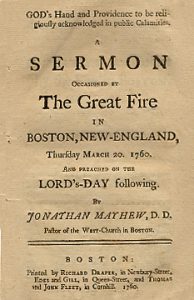
Dr. Chauncy, the preacher, was one of the greatest divines in New England, and no one except President Edwards and Dr. Jonathan Mayhew had been so much known among the literati of Europe. He was zealous for liberty, and, on the death of Dr. Mayhew, continued the war against its most specious enemy with great power and learning. He was born January 1, 1705, graduated at Harvard College in 1721, and was pastor of the first church in Boston from 1727 till his death in 1787.

This sermon—an admirable historical picture, drawn by a master, himself a leader of the hosts—abounds in facts, discusses the great principles involved with energy and power, and with the calmness and precision of the statesman.

The following witty lines, from the London “Craftsman” newspaper of March 29th, 1766, give a lively and just idea of the effect of the Stamp Act on British industry, temper, and politics.

CHAPTER IV. OF THE BOOK OF AMERICA.
1. The men of the cities assemble. 3. Their discourse to each other. 11. They petition the Grand Sanhedrim. 14. The lamentation of George the Treasurer. 19. Newspapers. 22. And hireling Scribes. 25. These Scribes write against taking off the tribute. 26. The subject of their letters. 32. They prevail not. 34. But are answered. 38. The tribute taken off. 39. Great rejoicings thereat. 41. The song of the people.

1. After these things the men of London, and the men of Birmingham, and the men of the great cities and strong towns; even all who made cloth, and worked in iron and in steel, and in sundry metals, communed together.

2. And they met in the gates of their cities, and of their towns;

3. And they said unto each other, Behold now the children of America are waxed strong; and they have not only opposed he men who were sent by George the Treasurer to collect the tribute on the marks which are called stamps;

4. But they make unto themselves the wares wherewith we were wont to furnish them;

5. And they will buy no more of us unless this tribute is taken off:

6. And, moreover, they cannot pay unto us the monies which they owe; and the loss is great unto us, and the burthen thereof exceeding grievous:

7. Neither can we give bread unto those who labored for us; and behold! They, and their wives, and their little ones, have not bread to eat.

8. What then shall we do? and wherewithal shall we be comforted?

9. Shall we not petition our Lord the King, and his Princes, and the wise men of the nation, even the Grand Sanhedrim [Jewish high court convened in Europe by Napoleon] of the nation?

10. For we know that they are good and gracious, and will hearken to the voice of the people, who open their mouths and cry unto them for bread.

11. Then the men of London, and the men of the great cities, sat them down and wrote petitions.

12. And they sent men from amongst them, that were goodly men to look at; and they stood before the Grand Sanhedrim: [Jewish high court convened in Europe by Napoleon]

13. And they presented their petitions, and they were read, and days were appointed to consider them.

14. Now it came to pass, that while these things were doing, that George the late Treasurer, and those who had joined in laying the tribute on the stamps, were wroth, and their countenances fell;

15. And they said in themselves, If this tribute is taken off, then William the late Scribe, and those who are now in authority, and who have taken our places, will be had in remembrance of men.

16. And we also shall be had in remembrance, but it will be with evil remembrance indeed.

17. For behold the people will say, It is we that have cursed the land; and it is they who have blessed it.

18. Therefore we must bestir ourselves like men, to oppose the taking off the tribute, let whatsoever hap besides.

19. And in those days there were papers sold daily among the men of Britain, which declared those which were joined in marriage, those which were gathered unto their fathers, and those who had found favour in the eyes of the King and his rulers, and were exalted above their brethren,

20. And also of whatsoever was done in the land.

21. And these papers were called newspapers; and all men read them.

22. And there were certain also Scribes who let themselves out unto hire.

23. And one of the chief of these was a Levite, and his name was Anti Sejanus.

24. And these Scribes were hired to poison the minds of the people, and to cause them to set their faces against the men of America their brethren.

25. Then came Anti Sejanue, and Pacificus, and Pro Patria, and sundry other children of Belial, and they wrote letters which were put into the newspapers.

26. And they said in those letters, Men and brethren! Behold, the men of America are rich, and they are grown insolent, being full of bread;

27. And they are not mindful of the days of old when they were poor, but they would withdraw themselves from under the wings of their mother Britain.

28. And they would establish themselves as a people, and suffer us to have no power over them.

29. Behold, they have opposed the edict, and they are become as rebels.

30. Wherefore then go we not forth with a strong hand, and force them unto obedience to us?

31. And if they are still murmuring, and shall still oppose our authority, why do we not send fire and sword into their land, and cut them off from the face of the earth?

32. And these children of Belial who dipped their pens for hire, and would scatter plagues in wantonness, and say, This is sport;

33. Even these men wrote still more. Yet they prevailed not.

34. For they were answered, So the men of America are our brethren; they are the children of our forefathers; and shall we seek their blood? If they are mistaken shall we not pity them, and keep them obedient unto us through love?

35. For behold, it is a wise saying of old, That many files may be caught with a little honey; but with much vinegar ye can catch not one.

36. Neither are they inclined to be a people of themselves, but wish yet to be under our wing.

37. And the counsel of these men prevailed; for the counsel of the hireling Scribes was defeated; even as was the counsel of Achitophel in the days of David, King of Israel.

38. For behold, the Grand Sanhedrim took off the tribute from the people; and George THE GRACIOUS King of Britain assented thereto.

39. Then were great rejoicings made throughout the land; and fires were lighted up in the streets, and the people eat, drank, and were merry.

40. And they sang a new song, saying,

41. Long live the King; let his name be glorious, and may his rule over us be happy.

42. And may the princes and the rulers of the land, and the wise men of the Lord the King, and all those who joined to take off this tribute, be blessed.

43. For they have listened unto the cries of the people, and have given ear unto the voice of calamity; they have procured the payment of the debts of the merchants of this land, ease to the children of America, and labor and bread to the poor.

44. And the women shall sing their praises; and the little children shall lisp out, Bless the King and his Sanhedrim.

45. For we were desolate and distressed; our hammers and our shuttles were useless; for we got no work; neither had we bread to eat for ourselves, nor our little ones.

46. But now can we work, rejoice, and be exceeding glad.

47. And there was peace in the land.

48. But to Anti Sejanus and the rest of the hirelings there was shame, and the scorn of all good men fell upon them, and their employers, so that their names were had in abomination.


BY HIS EXCELLENCY
FRANCIS BERNARD, ESQ.,
Captain-General and Governor-in-Chief in and over His Majesty’s Province of Massachusetts Bay in New England, and Vice-Admiral of the same.
A PROCLAMATION
FOR A DAY OF PUBLIC THANKSGIVING.
Whereas the House of Representatives of this Province having in the last session taken into their consideration the kind interposition of Providence in disposing our most gracious Sovereign and both Houses of Parliament to hearken to the united supplications of his dutiful and loyal Subjects in America, and to remove the great difficulties which the Colonies in general, and this Province in particular, labored under, occasioned by the Stamp Act, did resolve that the Governor be desired to appoint a Day of General Thanksgiving to be observed throughout this Province, that the good People thereof may have an opportunity in a public manner to express their Gratitude to Almighty GOD for his great Goodness in thus delivering them from their Anxiety and Distress and restoring the Province to its former Peace and Tranquility: which Resolution was concurred in by the Council, and has since been laid before me:

In pursuance of such Desire, so signified unto me, I have thought fit to appoint, and I do, by and with the advice of his Majesty’s Council, appoint Thursday, the twenty-fourth day of this instant July, to be a Day of Prayer and Thanksgiving; that the ministers of God’s holy word may thereupon assemble to return Thanks to Almighty God for his Mercies aforesaid, and to desire that he would be pleased to give his People Grace to make a right improvement of them, by observing and promoting a dutiful Submission to the Sovereign Power to which they are subordinate, and a brotherly Love and Affection to that People from whom they are derived, and to whom they are nearly related by civil Policy and mutual interests.

And I command and enjoin all Magistrates and Civil Officers to see that said Day be observed as a Day set apart for Religious Worship, and that no servile Labor be permitted therein.

Given at the Council Chamber in Boston, the fourth day of July, 1766, in the Sixth year of the Reign of our Sovereign Lord GEORGE the Third, by the Grace of God, of Great Britain, France, and Ireland, KING, Defender of the Faith, etc.

FRA. BERNARD.


By His Excellency’s Command.
John Cotton, Dept. Sec’y.

God save the king.
 

DISCOURSE II.

A THANKSGIVING SERMON.

AS COLD WATERS TO A THIRSTY SOUL, SO IS GOOD NEWS FROM A FAR
COUNTRY.—Proverbs xxv. 25.

We are so formed by the God of nature, doubtless for wise and good ends, that the uneasy sensation to which we give the name of thirst is an inseparable attendant on the want of some proper liquid; and as this want is increased, such proportionably will be the increase of uneasiness; and the uneasiness may gradually heighten, till it throws one into a state that is truly tormenting. The application of cooling drink is fitted, by an established law of heaven, not only to remove away this uneasiness, but to give pleasure in the doing of it, by its manner of acting upon the organs of taste. There is scarce a keener perception of pleasure than that which is felt by one that is athirst upon being satisfied with agreeable drink. Hence the desire of spiritual good things, in those who have had excited in them a serious sense of God and religion, is represented, in the sacred books, by the “cravings of a thirsty man after drink.” Hence the devout David, when he would express the longing of his soul to “appear before God in his sanctuary,” resembles it to the “panting of a hart after the water-brooks.” In like manner, “cold water to a thirsty soul” is the image under which the wise man would signify, in my text, the gratefulness of “good news.” ‘T is refreshing to the soul, as cold waters to the tongue when parched with thirst. Especially is good news adapted to affect the heart with pleasure when it comes “from a far country,” and is big with important blessings, not to a few individuals only, but to communities, and numbers of them scattered over a largely extended continent.

Such is the “good news” lately brought us 8 from the other side the great waters. No news handed to us from Great Britain ever gave us a quicker sense, or higher degree, of pleasure. It rapidly spread through the colonies, and, as it passed along, opened in all hearts the springs of joy. The emotion of a soul just famished with thirst upon taking down a full draught of cold water is but a faint emblem of the superior gladness with which we were universally filled upon this great occasion. That was the language of our mouths, signifying the pleasurable state of our minds, “As cold waters to a thirsty soul, so is this good news from a far country.”

What I have in view is, to take occasion, from these words, to call your attention to some of the important articles contained in the good news we have heard, which so powerfully fit it to excite a pungent sense of pleasure in the breasts of all that inhabit these American lands. They way will then be prepared to point out to you the wisest and best use we can make of these glad tidings “from a far country.”

The first article in this “good news,” obviously presenting itself to consideration, is the kind and righteous regard the supreme authority 9 in England, to which we inviolably owe submission, has paid to the “commercial good” of the nation at home, and its dependent provinces and islands. One of the expressly assigned reasons for the repeal of the Stamp Act is declared in these words: “Whereas the continuance of said act may be productive of consequences greatly detrimental to the commercial interests of these kingdoms, may it therefore please”—The English colonies and islands are certainly included in the words “these kingdoms,” 10 for they are as truly parts of them as either Scotland, Ireland, or even England itself. It was therefore with a professed view to the commercial good, not only of the nation at home, but of the plantations also abroad, that the authority of the British King and Parliament interposed to render null and void that act, which, had it been continued in force, might in its consequences have tended to the hurt of this grand interest, inseparably connected with the welfare of both. From what more noble source could a repeal of this act have proceeded? Not merely the repeal, but that benevolent, righteous regard to the public good which gave it birth, is an important ingredient in the news that has made us glad. And wherein could this “good news” have been better adapted to soften our hearts, soothe our passions, and excite in us the sensations of unmingled joy? What that is conducive to our real happiness may we not expect from a King and Parliament whose regard to “the commercial interest” 11 of the British kingdoms has over powered all opposition from resentment, the display of sovereign pleasure, or whatever other cause, and influenced them to give up even a crown revenue for the sake of a greater national good! With what confidence may we rely upon such a supreme legislature for the redress of all grievances, especially in the article of trade, and the devising every wise and fit method to put and keep it in a flourishing state! Should anything, in time to come, unhappily be brought into event detrimental in its operation to the commerce between the mother country and these colonies, through misrepresentations from “lovers of themselves more than lovers” of their king and country, may we not encourage ourselves to hope that the like generous public spirit that has relieved us now will again interpose itself on our behalf? Happy are we in being under the government of a King and Parliament who can repeal as well as enact a law, upon a view of it as tending to the public happiness. How preferable is our condition to theirs who have nothing to expect but from the arbitrary will of those to whom they are slaves 12 rather than subjects!

Another thing, giving us singular pleasure, contained in this “good news,” is, the total removal of a grievous burden we must have sunk under had it been continued. Had the real state of the colonies been as well known at home as it is here, it is not easily supposable any there would have thought the tax imposed on us by the Stamp Act was suitably adjusted to our circumstances and abilities. There is scarce a man 13 in any of the colonies, certainly there is not in the New England ones, that would be deemed worthy of the name of a rich man in Great Britain. There may be here and there a rare instance of one that may have acquired twenty, thirty, forty, or fifty thousand pounds sterling,–and this is the most that an be made of what they may be thought worth,–but for the rest, they are, generally speaking, in a low condition, or, at best, not greatly rising above it; though in different degrees, variously placing them in the enjoyment of the necessities and comforts of life. And such it might naturally be expected would be the true state of the colonists; as the lands they possess in this new country could not have been subdued and fitted for profitable use but by labor too expensive to allow of their being, at present, much increased in wealth. This labor, indeed, may properly be considered as a natural tax, which, though it has made way for an astonishing increase of subjects to the British empire, greatly adding to its dignity and strength, has yet been the occasion of keeping us poor and low. It ought also to be remembered the occasions, in a new country, for the grant or purchase of property, with the obligations arising therefrom, and in instances of comparatively small value, are unavoidably more numerous than in those that have been long settled. The occasions, also, for recourse to the law are in like manner vastly multiplied; for which reason the same tax by stamped paper would take vastly more, in proportion, from the people here than in England. And what would have rendered this duty the more hard and severe is, that it must have been paid in addition to the government tax here, 14 which was, I have good reason to think, more heavy on us in the late war, and is so still, on account of the great debt then contracted, at least in this province, in proportion to our numbers and abilities, than that which, in every way, was laid on the people either of Scotland, Ireland, or England. 15 This, if mentioned cursorily, was never, that I remember, enlarged upon and set in a striking light in any of the papers written in the late times, as it might easily have been done, and to good purpose. Besides all which, it is undoubtedly true that the circulating money in all the colonies would not have been sufficient to have paid the stamp duty only for two years; 16 and an effectual bar was put in the way of the introduction of more 17 by the restraints that were laid upon our trade in those instances wherein it might in some measure have been procured.

It was this grievance that occasioned the bitter complaint all over these lands: “We are denied straw, and yet the full tale of bricks is required of us!” Or, as it was otherwise uttered, We must soon be obliged “to borrow money for the king’s tribute, and that upon our lands. Yet now our flesh is as the flesh of our brethren, our children as their children: and lo! We must bring into bondage our sons and our daughters to be servants.” We should have been stupid had not a spirit been excited in us to apply, in all reasonable ways, for the removal of so insupportable a burden. And such a union in spirit was never before seen in the colonies, nor was there ever such universal joy, as upon the news of our deliverance from that which might have proved a yoke the most grievous that was ever laid upon our necks. It affected in all hearts the lively perceptions of pleasure, filling our mouths with laughter. No man appeared without a smile in his countenance. No one met his friend but he bid him joy. That was our united song of praise, “Thou hast turned for us our mourning into dancing; thou hast put off our sackcloth, and girded us with gladness. Our glory (our tongue) shall sing praise to thee, and not be silent: O Lord our God! we will give thanks to thee forever.”

Another thing in this “news,” making it “good,” is, the hopeful prospect it gives us of being continued in the enjoyment of certain liberties and privileges, valued by us next to life itself. Such are those of being “tried by our equals,” and of “making grants for the support of government of that which is our own, either in person or by representatives we have chosen for the purpose.” Whether the colonists were invested with a right to these liberties and privileges which ought not to be wrested from them, or whether they were not, ‘tis the truth of fact that they really thought they were; all of them, as natural heirs to it by being born subjects to the British crown, and some of them by additional charter-grants, the legality of which, instead of being contested, have all along, from the days of our fathers, been assented to and allowed of by the supreme authority at home. And they imagined, whether justly or not I dispute not, that their right to the full and free enjoyment of these privileges was their righteous due, in consequence of what they and their forefathers had done and suffered in subduing and defending these American lands, not only for their own support, but to add extent, strength, and glory to the British crown. And as it had been early and deeply impressed on their minds that their charter privileges were rights that had been dearly paid for by a vast expense of blood, treasure, and labor, 18 without which this continent must have still remained in a wilderness state and the property of savages only, it could not but strongly put in motion their passion of grief when they were laid under a parliamentary restraint as to the exercise of that liberty they esteemed their greatest glory. It was eminently this that filled their minds with jealousy, and at length a settled fear, lest they should gradually be brought into a state of the most abject slavery. This it was that gave rise to the cry, which became general throughout the colonies, “We shall be made to serve as bond-servants; our lives will be bitter with hard bondage.” Nor were the Jews more pleased with the royal provision in their day, which, under God, delivered them from their bondage in Egypt, than were the colonists with the repeal of that act which had so greatly alarmed their fears and troubled their hearts. It was to them as “life from the dead.” They “rejoiced and were glad.” And it gave strength and vigor to their joy, while they looked upon this repeal not merely as taking off the grievous restraint that had been laid upon their liberties and privileges, but as containing in it an intention of continued indulgence 19 in the free exercise of them. ‘Tis in this view of it that they exult as those who are “glad in heart,” esteeming themselves happy beyond almost any people now living on the face of the earth. May they ever be this happy people, and ever have “God for their Lord”!

This news is yet further welcome to us, as it has made way for the return of our love, in all its genuine exercises, towards those on the other side of the Atlantic who, in common with ourselves, profess subjection to the same most gracious sovereign. The affectionate regard of the American inhabitants for their mother country 20 was never exceeded by any colonists in any part or age of the world. We esteemed ourselves parts of one whole, members of the same collective body. What affected the people of England, affected us. We partook of their joys and sorrows—“rejoicing when they rejoiced, and weeping when they wept.” Adverse things in the conduct of Providence towards them alarmed our fears and gave us pain, while prosperous events dilated our hearts, and in proportion to their number and greatness. This tender sympathy with our brethren at home, it is acknowledged, began to languish from the commencement of a late parliamentary act. There arose hereupon a general suspicion whether they esteemed us brethren and treated us with that kindness we might justly expect from them. This jealousy, working in our breasts, cooled the fervor of our love; and had that act been continued in force, it might have gradually brought on an alienation of heart that would have been greatly detrimental to them, as it would also have been to ourselves. But the repeal, of which we have had authentic accounts, has opened the channels for a full flow of our former affection towards our brethren in Great Britain. Unhappy jealousies, uncomfortable surmising and heart-burnings, are now removed; and we perceive the motion of an affection for the country from whence our forefathers came, which would influence us to the most vigorous exertions, as we might be called, to promote their welfare, looking upon it, in a sense, our own. We again feel with them and for them, and are happy or unhappy as they are either in prosperous or adverse circumstances. We can, and do, with all sincerity, “pray for the peace of Great Britain, and that they may prosper that love her;” adopting those words of the devout Psalmist, “Peace be within thy walls, and prosperity within thy palaces. For our brethren’s sake we will say, peace be within thee.”

In fine, this news is refreshing to us “as cold waters to a thirsty soul,” as it has effected an alteration in the state of things among us unspeakably to our advantage. There is no way in which we can so strikingly be made sensible of this as by contrasting the state we were lately in, and the much worse one we should soon have been in had the Stamp Act been enforced, with that happy one we are put into by its repeal.

Upon its being made certain to the colonies that the Stamp Act had passed both Houses of Parliament, and received the king’s fiat, a general spirit of uneasiness at once took place, which, gradually increasing, soon discovered itself, by the wiser sons of liberty, 21 in a laudable endeavors to obtain relief; though by others, in murmurings and complaints, in anger and clamor, in bitterness, wrath, and strife; and by some evil-minded persons, taking occasion herefor from the general ferment 22 of men’s minds, in those violent outrages upon the property of others, which by being represented in an undue light, may have reflected dishonor upon a country which has an abhorrence of such injurious conduct. The colonies were never before in a state of such discontent, anxiety, and perplexing solicitude; some despairing of a redress, some hoping for it, and all fearing what would be the event. And, had it been the determination of the King and Parliament to have carried the Stamp Act into effect by ships of war and an embarkation of troops, their condition, however unhappy before, would have been inconceivably more so. They must either have submitted to what they thought an insupportable burden, and have parted with their property without any will of their own, or have stood upon their defence; in either of which cases their situation must have been deplorably sad. So far as I am able to judge from that firmness of mind and resolution of spirit which appeared among all sorts of persons, as grounded upon this principle, deeply rooted in their minds, that they had a constitutional right 23 to grant their own moneys and to be tried by their peers, ‘t is more than probable they would not have submitted 24 unless they had been obliged to it by superior power. Not that they had a thought in their hearts, as may have been represented, of being an independent people. 25 They esteemed it both their happiness and their glory to be, in common with the inhabitants of England, Scotland, and Ireland, the subjects of King George the Third, whom they heartily love and honor, and in defence of whose person and crown they would cheerfully expend their treasure, and lose even their blood. But it was a sentiment they had imbibed, that they should be wanting neither in loyalty to their king, or a due regard to the British Parliament, if they should defend those rights which they imagined were inalienable, upon the foot of justice, by any power on earth. 26 And had they, upon this principle, whether ill or well founded, stood upon their defence, what must have been the effect? There would have been opened on this American continent a most doleful scene of outrage, violence, desolation, slaughter, and, in a word, all those terrible evils that may be expected as the attendants on a state of civil war. No language can describe the distresses, in all their various kinds and degrees, which would have made us miserable. God only knows how long they might have continued, and whether they would have ended in anything short of our total ruin. Nor would the mother country, whatever some might imagine, have been untouched with what was doing in the colonies. Those millions that were due from this continent to Great Britain could not have been paid; a stop, a total stop, would have been put to the importation of those manufactures which are the support of thousands at home, often repeated. And would the British merchants and manufacturers have sat easy in such a state of things? There would, it may be, have been as much clamor, wrath, and strife in the very bowels of the nation as in these distant lands; nor could our destruction have been unconnected with consequences at home infinitely to be dreaded. 27

But the longed-for repeal has scattered our fears, removed our difficulties, enlivened our hearts, and laid the foundation for future prosperity, equal to the adverse state we should have been in had the act been continued and enforced.

We may now be easy in our minds—contented with our condition. We may be at peace and quiet among ourselves, every one minding his own business. All ground of complaint that we are “sold for bond-men and bond-women” is removed away, and, instead of being slaves to those who treat us with rigor, we are indulged the full exercise of those liberties which have been transmitted to us as the richest inheritance from our forefathers. We have now greater reason than ever to love, honor, and obey our gracious king, and pay all becoming reverence and respect to his two Houses of Parliament; and may with entire confidence rely on their wisdom, lenity, kindness, and power to promote our welfare. We have now, in a word, nothing to “make us afraid,” but may “sit every man under his vine and under his fig-tree,” in the full enjoyment of the many good things we are favored with in the providence of God.

Upon such a change in the state of our circumstances, we should be lost to all sense of duty and gratitude, and act as though we had no understanding, if our hearts did not expand with joy. And, in truth, the danger is lest we should exceed in the expressions of it. It may be said of these colonies, as of the Jewish people upon the repeal of the decree of Ahasuerus [Esther’s husband], which devoted them to destruction, they “had light and gladness, joy and honor; and in every province, and in every city, whithersoever the king’s commandment and his decree came, they had joy and gladness, a feast day, and a good day;” saying within themselves, “the Lord hath done great things for us, whereof we are glad.” May the remembrance of this memorable repeal be preserved and handed down to future generations, in every province, in every city, and in every family, so as never to be forgotten.

We now proceed—the way being thus prepared for it—to point out the proper use we should make of this “good news from a far country,” which is grateful to us “as cold waters to a thirsty soul.”

We have already had our rejoicings, in the civil sense, upon the “glad tidings” from our mother country; and ‘tis to our honor that they were carried on so universally within the bounds of a decent, warrantable regularity. There was never, among us, such a collection of all sorts of people upon any public occasion. Nor were the methods in which they signified their joy ever so beautifully varied and multiplied; and yet, none had reason to complain of disorderly conduct. The show was seasonably ended, and we had afterwards a perfectly quiet night. 28 There has indeed been no public disturbance since the outrage at Lieut. Governor Hutchinson’s house. That was so detested by town and country, and such a spirit at once so generally stirred up, particularly among the people, to oppose such villainous conduct, as has preserved us ever since in a state of as great freedom from mobbish actions as has been known in the country. Our friends at home, it should seem, have entertained fears lest upon the lenity and condescension of the King and Parliament we should prove ourselves a factious, turbulent people; and our enemies hope we shall. But ‘t is not easy to conceive on what the fears of the one or the hopes of the other should be grounded, unless they have received injurious representations of the spirit that lately prevailed in this as well as the other colonies, which was not a spirit to raise needless disturbances, or to commit outrages upon the persons or property of any, though some of those sons of wickedness which are to be found in all places 29 might take occasion, from the stand that was made for liberty, to commit violence with a high hand. There has not been, since the repeal, the appearance of a spirit tending to public disorder, nor is there any danger such a spirit should be encouraged or discovered, unless the people should be needlessly and unreasonably irritated by those who, to serve themselves, might be willing we should gratify such as are our enemies, and make those so who have been our good friends. But, to leave this digression:

Though our civil joy has been expressed in a decent, orderly way, it would be but a poor, pitiful thing should we rest here, and not make our religious, grateful acknowledgments to the Supreme Ruler 30 of the world, to whose superintending providence it is principally to be ascribed that we have had “given us so great deliverance.” Whatever were the means or instruments in order to this, that glorious Being, whose throne is in the heavens, and whose kingdom ruleth over all, had the chief hand herein. He sat at the helm, and so governed all things relative to it as to bring it to this happy issue. It was under his all-wise, overruling influence that a spirit was raised in all the colonies nobly to assert their freedom as men and English-born subjects—a spirit which, in the course of its operation, was highly serviceable, not by any irregularities it might be the occasion of (in this imperfect state they will, more or less, mix themselves with everything great and good), but by its manly efforts, setting forth the reasons they had for complaint in a fair, just, and strongly convincing light, hereby awakening the attention of Great Britain, opening the eyes of the merchants and manufacturers there, and engaging them, for their own interest as well as that of America, to exert themselves in all reasonable ways to help us. It was under the same all-governing influence that the late ministry, full of projections 31 tending to the hurt of these colonies, was so seasonably changed into the present patriotic one, 32 which is happily disposed, in all the methods of wisdom, to promote our welfare. It was under the same influence still that so many friends of eminent character were raised up and spirited to appear advocates on our behalf, and plead our cause with irresistible force. It was under this same influence, also, that the heart of our king and the British Parliament were so turned in favor to us as to reverse that decree which, had it been established, would have thrown this whole continent, if not the nation itself, into a state of the utmost confusion. In short, it was ultimately owing to this influence of the God of Heaven that the thoughts, the views, the purposes, the speeches, the writings, and the whole conduct of all who were engaged in this great affair were so overruled to bring into effect the desired happy event. 33

And shall we not make all due acknowledgments to the great Sovereign of the world on this joyful occasion? Let us, my brethren, take care that our hearts be suitably touched with a sense of the bonds we are under to the Lord of the universe; and let us express the joy and gratitude of our hearts by greatly praising him for the greatness of his goodness in thus scattering our fears, removing away our burdens, and continuing us in the enjoyment of our most highly valued liberties and privileges. And let us not only praise him with our lips, rendering thanks to his holy name, but let us honor him by a well-ordered conversation. “Behold, to obey is better than sacrifice;” and “to love the Lord our God with all our heart, and mind, and strength, and to love our neighbor as ourselves,” is better than whole burnt-offerings and sacrifices.” Actions speak much louder than words. In vain shall we pretend that we are joyful in God, or thankful to him, if it is not our endeavor, as we have been taught by the grace of God, which has appeared to us by Jesus Christ, to “deny all ungodliness and worldly lusts, and to live soberly, righteously, and godly in the world;” doing all things whatsoever it has pleased God to command us.

And as he has particularly enjoined it on us to be “subject to the higher powers, ordained by him to be his ministers for good,” we cannot, upon this occasion, more properly express our gratitude to him than by approving ourselves dutiful and loyal to the gracious king whom he has placed over us. Not that we can be justly taxed with the want of love or subjection to the British throne. We may have been abused by false and injurious representations upon this head; but King George the Third has no subjects—not within the realm of England itself—that are more strongly attached to his person and family, that bear a more sincere and ardent affection towards him, or that would exert themselves with more life and spirit in defence of his crown and dignity. But it may, notwithstanding, at this time, 34 be seasonable to stir up your minds by putting you in remembrance of your duty to “pray for kings, and all that are in subordinate authority under them,” and to “honor and obey them in the Lord.” And if we should take occasion, from the great lenity and condescending goodness of those who are supreme in authority over us, not to “despise government,” not to “speak evil of dignities,” not to go into any method of unseemly, disorderly conduct, but to “lead quiet and peaceable lives in all godliness and honesty,”—every man moving in his own proper sphere, and taking due care to “render unto Caesar the things that are Caesar’s, and to God the things that are God’s,”—we should honor ourselves, answer the expectations of those who have dealt thus favorably with us, and, what is more, we should express a becoming regard to the governing pleasure of Almighty God.

It would also be a suitable return of gratitude to God if we entertained in our minds, and were ready to express in all proper ways, a just sense of the obligations we are under to those patrons of liberty and righteousness who were the instruments employed by him, and whose wise and powerful endeavors, under his blessing, were effectual to promote at once the interest of the nation at home, and of these distant colonies. Their names will, I hope, be ever dear to us, and handed down as such to the latest posterity. That illustrious name in special, Pitt, 35 will, I trust, be never mentioned but with honor, as the savior, under God, and the two kings who made him their prime minister, both of the nation and these colonies, not only from the power of France, but from that which is much worse, a state of slavery, under the appellation of Englishmen. May his memory be blessed! May his great services for his king, the nation, and these colonies, be had in everlasting remembrance!

To conclude: Let us be ambitious to make it evident, by the manner of our conduct, that we are good subjects and good Christians. So shall we in the best way express the grateful sense we have of our obligations to that glorious Being, to the wisdom and goodness of whose presidency over all human affairs it is principally owing that the great object of our fear and anxious concern has been so happily removed. And may it ever be our care to behave towards him so as that he may appear on our behalf in every time of danger and difficulty, guard us against evil, and continue to us all our enjoyments, both civil and religious. And may they be transmitted from us to our children, and to children’s children, as long as the sun and the moon shall endure. AMEN.


Endnotes

1 This phrase is from a tract, 1766, by Tucker, Dean of Gloucester. At that date he advocated “a separation, parting with the colonies entirely, and then making leagues of friendship with them, as with so many independent states;” but, said he, “it was too enlarged an idea for a mind wholly occupied within the narrow circle of trade,” and a “stranger to the revolutions of states and empires, thoroughly to comprehend, much less to digest.”

2 The answers of the Massachusetts Council, January 25th, and House of Representatives, January 26th, to Governor Hutchinson’s speech, January 6th, 1775, are rich in historical illustrations of this point, presented with great force of reason, and are decisive.

3 Life of Pepperell, by Usher Parsons, M.D. 3d ed. 1856, p. 52.

4 Mr. Arthus Lee, of Virginia, wrote from London, Sept. 22, 1771: “The Commissary of Virginia is now here, with a view of prosecuting the scheme of an American Episcopate. He is an artful, though not an able man. You will consider, sir, in your wisdom, whether any measures on your side may contribute to counteract this dangerous innovation. Regarding it as threatening the subversion of both our civil and religious liberties, it shall meet with all the opposition in my power.” To the Speaker of the House of Representatives, Massachusetts.

5 Dr. Stiles, in Gordon’s History of the American Revolution, i. 102, 103. Ed. 1794.

6 Burke.

7 Just as the above is going to press, there is brought to light, by Mr. David Roberts, an original volume of the Salem custom-house records, May 22, 1761-1775, which fills an important gap in the documentary history of the writs of assistance.—Hist. Collect. Essex Inst., August, 1860. 169.

8 The Massachusetts Gazette Extraordinary, Thursday, April 3, 1766, contains an account of the earliest rumor in Boston of the repeal, and of the public enthusiasm:–“Upon a Report from Philadelphia of the Repeal of the Stamp Act, on Tuesday last, a great Number of Persons assembled under Liberty Tree,”—near the corner of Essex and Washington streets,–“where two Field Pieces were carried, a Royal Salute fired, and three Huzzas given on such a joyful Piece of Intelligence. A considerable Number of the Inhabitants of this Town assembled at Faneuil-Hall on Tuesday last, when they made choice of the Hon. James Otis, Esq., as Moderator of the Meeting. The Moderator then acquainted the Assembly that the Probability of very soon receiving authentic Accounts of the absolute Repeal of the Stamp Act had occasioned the present Meeting; and as this would be an Event in which the Inhabitants of this Metropolis, as well as North America, would have the greatest Occasion of Joy, it was thought expedient by many that this Meeting should come into Measures for fixing the Time when those Rejoicings should be made, and the Manner in which they should be conducted; – whereupon it was
Voted, That the Selectmen be desired, when they shall hear the certain News of the Repeal of the STAMP ACT, to fix upon a time for general Rejoicings; and that they give the Inhabitants seasonable Notice in such Manner as they shall think best.” The expressions of joy were as extravagant throughout England as they were in the colonies. “There were upwards of twenty men, booted and spurred, in the lobby of the Hon. House of Commons, ready to be dispatched express, by the merchants, to the different parts of Great Britain and Ireland, upon this important affair.”—Ed.

9 This doctrine was expressed by Mr. James Otis, early in 1764, that we “ought to yield obedience to an Act of Parliament, though erroneous, till repealed.” And by the Council and House of Representatives, Nov. 3d, 1764: “We acknowledge it to be our duty to yield obedience to it while it continues unrepealed.” But want of representation, and, next, that the colonies were not within the realm, soon led to a denial of the authority of Parliament, for a submission to a tax of a farthing would have abandoned the great principle. It was not the amount of the tax, but the right to tax, that was in issue. “In for a penny, in for a pound.”—Ed.

10 That “the colonies were without the realm and jurisdiction of Parliament,” was demonstrated in the learned and able answers of the Council and House of Representatives to Governor Hutchinson’s speech of January 6, 1773: “Your Excellency tells us, ‘you know of no line that can be drawn between the supreme authority of Parliament and the total independence of the colonies.’ If there be no such line, the consequence is, either that the colonies are the vassals of the Parliament, or that they are totally independent.” In his gratitude, Dr. Chauncy took quite too generous a view of the “repeal.” The interests of the colonies were always subordinate. The Navigation Act, 12th Chas. II. ch. 19, and the colonial policy of England, as of all nations, considered only the interests of the realm.—Ed.

11 Mr. Burke, in his speech on “American taxation,” years afterward, 1774, said the laws were repealed “because they raised a flame in America, for reasons political, not commercial: as Lord Hillsborough’s letter well expresses it, to regain ‘the confidence and affection of the colonies, on which the glory and safety of the British empire depend.’”—Ed.

12 “If we are not represented, we are slaves.”—Letter to Massachusetts agent, June 13, 1764.—Ed.

13 Mr. Burke, in 1763, showing the difficulties of American representation in Parliament, said: “Some of the most considerable provinces of America—such, for instance, as Connecticut and Massachusetts Bay—have not in each of them two men who can afford, at a distance from their estates, to spend a thousand pounds a year. How can these provinces be represented at Westminster?” Governor Pownall, at Boston, Sept. 6th, 1757, wrote to Admiral Holbourn: “I am here at the head and lead of what is called a rich, flourishing, powerful, enterprising country. ‘Tis all puff, ‘tis all false; they are ruined and undone in their circumstances. The first act I passed was an Act for the Relief of Bankrupts.”—Ed.

14 Massachusetts, of about two hundred and forty thousand inhabitants, expended in the war eight hundred and eighteen thousand pounds sterling, for four hundred and ninety thousand pounds of which she had no compensation. Connecticut, with only one hundred and forty-six thousand inhabitants, expended, exclusive of Parliament grants, upwards of four hundred thousand pounds sterling. Dr. Belknap’s pertinent inquiry, in view of he parliamentary pretence for their revenue acts “to defray the expenses of protecting, defending, and securing” the colonies, was, “If we had not done our part toward the protection and defence of our country, why were our expenditures reimbursed by Parliament,” even in part? Dr. Trumbull says that Massachusetts annually sent into the field five thousand five hundred men, and one year seven thousand. Connecticut had about three thousand men, in the field, and for some time six thousand, and for some years these two colonies alone furnished ten thousand men in actual service. Pennsylvania disbursed about five hundred thousand pounds, and was reimbursed only about sixty thousand pounds. New Hampshire, New York, and especially Rhode Island in her naval enterprise, displayed like zeal. Probably twenty thousand of these men were lost,–“the most firm and hardy young men, the flower of their country.” Many others were maimed and enervated. The population and settlement of the country was retarded, husbandry and commerce were injured. “At the same time, the war was unfriendly to literature, destructive of domestic happiness, and injurious to piety and the social virtues.”
In 1762 Mr. Otis said: “This province”—Massachusetts—“has, since the year 1754, levied for his Majesty’s service, as soldiers and seamen, near thirty thousand men, besides what have been otherwise employed. One year in particular it was said that every fifth man was engaged, in one shape or another. We have raised sums for the support of this war that the last generation could have hardly formed any idea of. We are now deeply in debt.”
Mr. Burke, in 1775, cited from their records “the repeated acknowledgment of Parliament that the colonies not only gave, but gave to satiety. This nation has formally acknowledged two things: first, that the colonies had gone beyond their abilities—Parliament having thought it necessary to reimburse them; secondly, that they had acted legally and laudably in their grants of money and their maintenance of troops, since the compensation is expressly given as a reward and encouragement.” Indeed, the “Albany Plan of Union,” a scheme by which America could protect herself against France, had been sent “home” for government approbation; but it was not sanctioned.—Ed.

15 I have been assured, by a gentleman of reputation and fortune in this town, that in the late time of war he sent one of his rate-bills to a correspondent of note in London for his judgment upon it, and had this answer in return from his friend: “That he did not believe there was a man in all England who paid so much, in proportion, towards the support of the government.” It will render the above account the more easily credible if I inform the reader that I have lately and purposely conversed with one of the assessors of this town, who has been annually chosen by them into this office for a great number of years, for which reason he may be thought a person of integrity, and one that may be depended on, and he declares to me that the assessment upon this town, particularly in one of the years when the tax on account of the war was great, was as follows: On personal estate, thirteen shillings and fourpence on the pound; that is to say, if a man’s income from money at interest, or in any other way, was sixty pounds per annum, he was assessed sixty times thirteen shillings and fourpence, and in this proportion, whether the sum was more or less. On real estate the assessment was at the rate of six years’ income; that is to say, if a man’s house or land was valued at two hundred pounds per annum income, this two hundred pounds was multiplied by six, amounting to twelve hundred pounds, and the interest of this twelve hundred pounds—that is, seventy-two pounds—was the sum he was obliged to pay. Besides this, the rate upon every man’s poll, and the polls of all the males in his house upwards of sixteen years of age, was about nineteen shillings lawful money, which is only one quarter part short of sterling. Over and above all this, they paid their part of an excise that was laid upon tea, coffee, rum, and wine, amounting to a very considerable sum.
How it was in the other provinces, or in the other towns of this, I know not; but it may be relied on as fact, that this was the tax levied upon the town of Boston; and it has been great ever since, though not so enormously so as at that time. Every one may now judge whether we had not abundant reason for mournful complaint when, in addition to the vast sums—considering our numbers and abilities—we were obliged to pay, we were loaded with the stamp duty, which would in a few years have taken away all our money, and rendered us absolutely incapable either of supporting the government here or of carrying on any sort of commerce, unless by an exchange of commodities.

16 Dr. Franklin testified, in 1766: “In my opinion there is not gold and silver enough in the colonies to pay the stamp duty for one year.”—Ed.

17 “Most of our silver and gold, . . . great part of the revenue of these kingdoms, . . . great part of the wealth we see,” says an English statistical writer of 1755, we “have from the northern colonies.” This silver and gold was obtained by the colonial trade with the West Indies, and other markets, where fish, rice, and other colonial products and British manufactures were sold or bartered. This coin, or bullion, was remitted to English merchants, monopolists, who always held a balance against the colonists. “The northern provinces import from Great Britain ten times more than they send in return to us.”—Burke. This left very little “circulating money” in their hands, and much of their trade had to be done by barter. The act of April 5, 1764, for raising a revenue in America, exacted the duties in specie, and at the same time the “regulations” for restricting their trade with the West Indies, enforced by armed vessels and custom officers, cruising on our coasts, suddenly destroyed this best portion of their commerce, and the flow of gold and silver through New England hands as quickly ceased. This spread a universal consternation throughout the colonies, and they likened the threatened slavery under George III. And the Parliament to the Hebrew bondage to Pharaoh.—Ed.

18 These various considerations were set forth at length in statements of the services and expenses of the colonies, which were sent to England to furnish the colonial agents with arguments why the colonies should not be taxed.—Ed.

19 The colonists claimed the repeal as matter of right, and not of favor. The English merchants urged it s a commercial necessity, and the politicians dared not do less. Hutchinson says: “The act which accompanied it, with the title of ‘Securing the Dependency of the Colonies,’ caused no alloy of the joy, and was considered as mere naked form.”—Ed.

20 This sentiment was ever appealed to in all our difficulties. Burke and Pitt made frequent use of it.—Ed.

21 This name, “SONS OF LIBERTY,” was used by Colonel Isaac Barre, in his off-hand reply to Charles Townshend, Wednesday, February 6, 1765, when George Grenville proposed the Stamp Act in Parliament. Jared Ingersoll heard Colonel Barre, and sent a sketch of his remarks to Governor Fitch, of Connecticut, who published it in the New London papers; and, says Bancroft, “May had not shed its blossoms before the words of Barre were as household words in every New England town. Midsummer saw it distributed through Canada, in French; and the continent rung from end to end with the cheering name Sons of Liberty.” Mr. Ingersoll, in a note to his pamphlet (New Haven, 1766), p. 16, says: “I believe I may claim the honor of having been the author of this title (Sons of Liberty), however little personal good I may have got by it, having been the only person, by what I can discover, who transmitted Mr. Barre’s speech to America.”
Boston voted that pictures of Colonel Barre and General Conway “be placed in Faneuil Hall, as a standing monument to all posterity of the virtue and justice of our benefactors, and a lasting proof of our gratitude.” But the pictures are not there; and Mr. Drake (History of Boston, p. 705) aptly suggests that the city “would lose none of its honor by replacing them.” The town of Barre, in Massachusetts, perpetuates the memory of this statesman, and of the public indignation toward Hutchinson, whose name it had borne from 1774 to 1777. Towns in Vermont, New York, and Wilkesbarre in Pennsylvania, also bear the honored name.—Ed.

22 In August, 1765, when Lieut. Governor Hutchinson’s house, Andrew Oliver’s, William Storey’s, and the stamp-office in Kilby Street, were ransacked or demolished. A minute account of places and names, and details in these riots, fill several interesting pages in Drake’s History of Boston, chap. lxix.; Bancroft’s United States, chap. xvi., 1765.
President Adams said, “None were indicted for pulling down the stamp-office, because this was thought n honorable and glorious action, not a riot.” And in 1775 he said: “I will take upon me to say, there is not another province on this continent, nor in his majesty’s dominions, where the people, under the same indignities, would not have gone to greater lengths.”
“I pardon something to the spirit of liberty,” said Burke.
The Bishop of St. Asaph said: “I consider these violence’s as the natural effects of such measures as ours on the minds of freemen.”—Ed.

23 The colonists may reasonably be excused for their mistake (if it was one) in thinking that they were vested with this constitutional right, as it was the opinion of Lord Camden, declared in the House of Lords, and of Mr. Pitt, signified in the House of Commons, that the Stamp Act was unconstitutional. This is said upon the authority of the public prints.
Lord Camden said: “The British Parliament have no right to tax the Americans . . . . Taxation and representation are coeval with and essential to this constitution.” Mr. Pitt said: “The Commons of America, represented in their several assemblies, have ever been in possession of the exercise of this, their constitutional right, of giving and granting their own money. They would have been slaves if they had not enjoyed it.”—Ed.

24 An examination of the newspapers and legislative proceedings of the period admits of no doubt of this. From the passage of the Stamp Act till certain news of its repeal, April, 1766, the newspaper, “The Boston Post Boy,” displayed for its heading, in large letters, these words: “The united voice of all His Majesty’s free and loyal subjects in America,–Liberty and Property, and no Stamps.”
Dr. Gordon says the Stamp Act was treated with the most indignant contempt, by being printed and cried about the streets under the title of The folly of ENGLAND and ruin of AMERICA.
It was now—May, 1765—that Patrick Henry, in bringing forward his resolutions against the act, exclaimed, “Caesar had his Brutus; Charles the First had his Cromwell; and George the Third”—“Treason!” cried the Speaker; “Treason!” cried many of the members—“may profit by their example,” was the conclusion of the sentence. “If this be treason,” said Henry, “make the most of it!”
President John Adams, referring to this sermon in 1815, said: “It has been a question, whether, if the ministry had persevered in support of the Stamp Act, and sent a military force of ships and troops to force its execution, the people of the colonies would then have resisted. Dr. Chauncy and Dr. Mayhew, in sermons which they preached and printed after the repeal of the Stamp Act, have left to posterity their opinions upon this question. If my more extensive familiarity with the sentiments and feelings of the people in the Eastern, Western, and Southern counties of Massachusetts may apologize for my presumption, I subscribe without a doubt to the opinions of Chauncy and Mayhew. What would have been the consequence of resistance in arms?” (See note to page 136.) Dr. Franklin, before the House of Commons in 1766, said: “Suppose a military force sent into America, they will find nobody in arms; what are they then to do? They cannot force a man to take stamps who chooses to do without them. They will not find a rebellion, but they can make one.”—Ed.

25 Not one of the English colonies, or provinces, would now submit for a moment to the control which the American colonies would then have cheerfully accepted. The royal governors are accepted as pageants on which to hang the local governments, which are essentially independent, but enjoy a nationality by this nominal connection with the crown; and it may be doubted if any of them have that degree of loyalty which once animated the “rebellious” colonies of 1776. Happily time has destroyed the animosities engendered by a vicious policy, and there is now that nobler unity (for we be brethren) which is cultivated by commerce and the amenities of literature and science. In this view, the cordial reception, at this time, of England’s royal representative in our chief cities, and by our National Executive, is an event of great interest. See p. 143 and note.—Ed.

26 The great Mr. Pitt would not have said, in a certain august assembly, speaking of the Americans, “I rejoice that they have resisted,” if, in his judgment, they might not, in consistency with their duty to government, have made a stand against the Stamp Act. ‘Tis certainly true there may be such exercise of power, and in instances of such a nature, as to render non-submission warrantable upon the foot of reason and righteousness; otherwise it will be difficult, if possible, to justify the Revolution, and that establishment in consequence of it upon which his present Majesty sits upon the British throne. That non-submission would have been justifiable, had it been determined that the Stamp Act should be enforced, I presume not to say: though none, I believe, who are the friends of liberty, will deny that it would have been justifiable should it be first supposed that this act essentially broke in upon our constitutional rights as Englishmen. Whether it did or not, is a question it would be impertinent in me to meddle with. It is the truth of the fact that the colonists generally and really thought it did, and that it might be opposed without their incurring the guilt of disloyalty or rebellion; and they were led into this way of thinking upon what they imagined were the principles which, in their operation, gave King William and Queen Mary, of blessed memory, the crown of England. (See Dr. Mayhew’s Sermon of 1750, p. 39.—Ed.)

27 Dr. Chauncy’s speculations upon the probable consequences of the enforcement of the Stamp Act, both in the colonies and “at home,” as the colonists affectionately called England, the mother country, are singularly coincident with Edmund Burke’s “Observations”—published three years later, 1769—on Grenville’s “Present State of the Nation.” He said: “We might, I think, without much difficulty, have destroyed our colonies; . . . . but four millions of debt due to our merchants, the total cessation of a trade worth four millions more, a large foreign traffic, much home manufacture, a very capital immediate revenue arising from colony imports,–indeed the produce of every one of our revenues greatly depending on this trade,–all these were very weighty, accumulated considerations; at least well to be weighed before that sword was drawn which, even by its victories, must produce all the evil effects of the greatest national defeat.” Really it was a question of life or death, not only to the colonies, but to the commerce of England,–whose dealings with European nations had increased very little since 1700,–which had risen from colony intercourse; “a new world of commerce, in a manner created,” says Burke, “grown up to this magnitude and importance within the memory of man; nothing in history is parallel to it.” The repeal of the Stamp Act was a commercial necessity; to enforce it would have been like killing the goose that laid the golden egg.—Ed.

28 The repeal was celebrated throughout the colonies by all possible expressions of joy,–by ringing of bells, firing of guns, processions, bonfires, illuminations, thanksgivings. Prisoners for debt were released; Pitt, Camden, and Barre were eulogized; and in Boston “Liberty Tree itself was decorated with lanterns till its bougs could hold no more . . . . .Never was there a more rapid transition of a people from gloom to joy.”—Bancroft. The Sons of Liberty triumphed.
“It has at once,” said Mayhew, in his Thanksgiving Sermon, May 23, “in a good measure restored things to order, and composed our minds. Commerce lifts up her head, adorned with golden tresses, pearls, and precious stones; almost every person you meet wears the smile of contentment and joy; and even our slaves rejoice, as though they had received their manumission.” See Drake’s History of Boston, ch. lxxi., for an account of the celebration in Boston.—Ed.

29 It has been said, and in the public prints, that there have been mobbish, riotous doings in London, and other parts of England, at one time and another, and that great men at such times—men far superior to any among us in dignity and power—suffered in their persons by insulting, threatening words and actions, and in their property by the injurious violence that destroyed their substance. Would it be just to characterize London, much more England itself, from the conduct of these disturbers of its peace? It would as reasonably, as certainly, be esteemed a vile reproach, should they on this account be represented as, in general, a turbulent, seditious people, disposed to throw off their subjection to government, and bring things into a state of anarchy and confusion. If this has been the representation that has been made of the colonists, on account of what any may have suffered in their persons or effects by the ungoverned, disorderly behavior of some mobbishly disposed persons, it is really nothing better than a base slander, and no more applicable to them than to the people of England. The colonists in general, the inhabitants of this province in particular, are as great enemies to all irregular, turbulent proceedings, and as good friends to government, and as peaceable, loyal subjects, as any that call King George the Third their rightful and lawful sovereign.
The sacking of Lord Mansfield’s house, the destruction of his library and manuscripts in 1780, and of Dr. Priestley’s mansion, books, manuscripts, and philosophical apparatus, in 1791, greatly exceeded the outrages in Boston.—Ed.

30 If there be in our early historical literature any one feature more strongly marked than the rest, it is this universal recognition of God in all our affairs; and Washington was not more true to himself than to the spirit of his country, which, of all men, he best understood, when, in his inaugural address as President of the United States, April 30, 1789, he said:
“It would be peculiarly improper to omit, in this first official act, my fervent supplications to that Almighty Being who rules over the universe, who presides in the councils of nations, and whose providential aids can supply every human defect, that his benediction may consecrate to the liberties and happiness of the people of the United States a government instituted by themselves for these essential purposes, and may enable every instrument employed in its administration to execute with success the functions allotted to his charge. In tendering this homage to the Great Author of every public and private good, I assure myself that it expresses your sentiments not less than my own, nor those of my fellow-citizens at large less than either. No people can be bound to acknowledge and adore the Invisible Hand which conducts the affairs of man more than the people of the United States. Every step by which they have been advanced to the character of an independent nation seems to have been distinguished by some token of providential agency; and in the important revolution just accomplished in the system of their united government, the tranquil deliberations and voluntary consent of so many distinct communities, from which the event has resulted, cannot be compared with the means by which most governments have been established, without some return of pious gratitude, along with a humble anticipation of the blessings which the past seems to presage. These reflections, arising out of the present crisis, have forced themselves too strongly on my mind to be suppressed. You will join with me, I trust, in thinking that there are none under the influence of which the proceedings of a new and free government can more auspiciously commence.”—Ed.

31 Ecclesiastical and civil.—Ed.

32 “The Rockingham Administration” (July 10, 1765-July 30, 1766), in October, had had “letters from all parts of America that a conflagration blazed out at once in North America—a universal disobedience and open resistance to the Stamp Act;” and because it “raised a flame in America,” says Burke, “for reasons political, not commercial,” it was repealed. Thus the Grenville policy was abandoned for the time.—Ed.

33 “I remember, sir,” said Mr. Burke, in 1774, “with a melancholy pleasure, the situation of the honorable gentleman”—General Conway—“who made the motion for the repeal; in that crisis, when the whole trading interest of this empire, crammed into your lobbies, with a trembling and anxious expectation, waited almost to a winter’s return of light their fate from your resolution. When, at length, you had determined in their favor, and your doors, thrown open, showed them the figure of their deliverer in the well-earned triumphs of his important victory, from the whole of that grave multitude there arose an involuntary burst of gratitude and transport. They jumped upon him, like children on a long-absent father. They clung about him, as captives about their redeemer. All England, all America joined to his applause . . . . . . . . .I stood near him; and his face—to use the expression of the Scriptures of the first martyr—‘his face was as if it had been the face of an angel.’ I do not know how others feel; but if I had stood in that situation, I never would have exchanged it for all that kings, in their profusion, could bestow.”—Ed.

34 In his examination before the House of Commons, in 1766, Dr. Franklin answered to the question, “What was the temper of America towards Great Britain before the year 1763?—“The best in the world. They submitted willingly to the government of the crown, and paid, in all their courts, obedience to acts of Parliament. Numerous as the people are in the several old provinces, they cost you nothing in forts, citadels, garrisons, or armies, to keep them in subjection. They were governed by this country at the expense of only a little pen, ink, and paper. They were led by a thread. They had not only a respect, but an affection for Great Britain,–for its laws, its customs, and manners,–and even a fondness for its fashions, that greatly increased the commerce. Natives of Britain were always treated with particular regard; to be an Old England man was of itself a character of some respect, and gave a kind of rank among us.”
Q. “And what is their temper now?”
A. “O, very much altered.”—See note 1, p. 134.—Ed.

35 No name was more venerated in America than that of William Pitt. He was born in London, in 1708, grandson of Thomas Pitt, Governor of Madras, and made his first speech in Parliament in 1736. In December, 1756, when “our armies were beaten, our navy inactive, our trade exposed to the enemy, our credit—as if we expected to become bankrupts—sunk to the lowest pitch, so that there was nothing to be found but despondency at home and contempt abroad” (Address of City of London), the great Whig statesman graciously accepted the seals of government, and his administration was the most glorious period of English history since the days of the Commonwealth and of the Revolution of 1688. America rejoiced, and her blood and her treasure flowed freely. She saw the French navy annihilated, and the British flag wave at Louisburg, Niagara, Ticonderoga, Crown Point, Quebec, and all Canada. “Mr. Pitt left the thirteen British colonies in North America in perfect security and happiness, every inhabitant there glowing with the warmest affection to the parent country. At home all was animation and industry. Riches and glory flowed in from every quarter.”—Almon. George II. died, in extreme age, October 25, 1760; succeeded by his grandson, George III., with not a drop of English blood in his veins; a very Stuart in principle. He was a youth of twenty-two years, and the crown was placed on his head by the primate Secker, who aspired to be his counselor as well as his spiritual director. Secker was the very one who suffered at the hands of Dr. Mayhew in the controversy about the society for propagating the hierarchy “in foreign parts;” “and,” said the pious Dean Swift, “whoever has a true value for church and state, should avoid” Whigism. Pitt resigned the seals of Secretary of State on the 5th of October, 1761. He opposed with his might the proceedings against America. The peculiarly impressive circumstances of his death, May 11th, 1778, hastened, if not caused, by his zeal and energy in our behalf, are familiar to all by the celebrated picture of the “Death of Chatham,”—the piece which established the fame of the eminent Bostonian, Copley, whose son, Lord Lyndhurst, yet lives, one of the most venerable and eloquent members of the House of Peers. Pittsburg in Pennsylvania, Pittsfield in Massachusetts, and many other towns, perpetuate the memory of the national gratitude, which was expressed by legislative addresses, by monuments, and by every mode of public and private regard. He died poor—“stained by no vice, sullied by no meanness.”—Ed.

Sermon – Great Fire in Boston – 1760


sermon-great-fire-in-boston-1760Rev. Jonathan Mayhew (1720-66) was a Massachusetts clergyman. He graduated with honors from Harvard in 1744 and began pastoring the West Church (Boston) in 1747. He preached what he considered to be a rational and practical Christianity based on the Scriptures. Mayhew was a true Puritan and staunchly defended civil liberty; he published many sermons related to the preservations of those liberties, including one immediately following the repeal of the Stamp Act entitled The Snare Broken (1766). Highly thought of by many patriots, including John Adams, who credited Rev. Mayhew with being one of the two most influential individuals in preparing Americans for their fight for independence. In this sermon, Mayhew exhorts his congregation after the Great Fire in Boston (March 20, 1760), providing them with a Biblical perspective of disasters and encouraging them to cultivate a humble and repentant heart before God. Rev. Mayhew’s sermon is an unambiguous example of how early American pastors used the events of their day to impart truth and promote the development of a Christian worldview within their flocks.


God’s Hand and Providence to be Religiously Acknowledged
in Public Calamities

A Sermon Occasioned by the Great Fire in Boston, New-England

Thursday March 20, 1760

And preached on the Lord’s Day following.

By Jonathan Mayhew, D.D. Pastor of the West-Church in Boston.

Amos 3:6 Shall there be evil in a city, and the Lord hath not done it?

What devastation have we lately seen made in a few hours! How many houses and other buildings suddenly consumed! How much wealth destroyed! How many unhappy families, rich and poor together, left destitute of any habitation, except those which either private friendship or public charity supplied! What distress in every face; some mourning their own unhappy lot, others tenderly sympathizing with them; and none knowing when or where the wide desolation would terminate!

“Affliction cometh not forth of the dust, neither doth trouble spring out of the ground;” to be sure, not such trouble and affliction as this, a calamity, so great and extensive! This is a visitation of providence, which demands a serious and religious consideration. And it is with a view to lead you into some proper reflections on this melancholy occasion that I have chosen the words read for the subject of my discourse at this time: “Shall there be evil in a city,” faith the prophet, “and the Lord hath not done it?”

It is to be observed, that although these words bear the form of a question, the design of them is strongly to assert, that there is no evil in a city, which the Lord hath not done. Interrogatory forms of expression are often to be thus understood; I mean, as the most peremptory, and animated kind of affirmations. Thus, for example, when it is demanded, “Can a man take fire in his bosom, and his clothes not be burnt?” [Prov. 6:27] everyone understands this, as equivalent to asserting the impossibility hereof in the strongest terms. So, when it is asked, “Can a man be profitable unto God? or is it gain to him, that thou maketh thy ways perfect? Will he reprove thee for fear of thee?” [Job 22:2-4] a peremptory denial of these several things is universally understood by those questions. As if it had been said, verily, a man cannot be profitable unto God! &c. and when, after a representation of the great wickedness and depravity of the Jewish nation, it is immediately subjoined, “Shall I not visit for these things?” saith the Lord: “Shall not my soul be avenged on such a nation as this?” [Jer. 5:29] It is equivalent to a positive denunciation of the divine vengeance against that sinful people: and even more expressive, than if it had been said directly “I will visit for these things: My soul shall be avenged on such a nation as this.” This would have been comparatively a cold, unanimated way of speaking; far less adapted to make an impression on the reader of hearer, than the other.

The manner of expression in the text is obviously the same with that, in the passages quoted above; being more forcible than a simple affirmation would have been, without some note of asseveration preceding. It is as if it had been said, verily, or, surely, there is no evil in a city, and the Lord hath not done it.

However, to prevent a dangerous error here, it must be particularly remembered that by “evil” in the text, is not meant moral evil, or sin; but only natural, viz, pain, affliction and calamity. It cannot be supposed, that the prophet intended to attribute any other evil to God, as the author of it, besides the latter. “Far be it from God, that he should do wickedly; and from the Almighty, that he should pervert judgment!” Nor can the sinful and evil actions of men, properly be attributed to him; or to any over-ruling providence of his, considered as their impulsive cause, or as making them become necessary. “Let no man say [therefore] when he is tempted, I am tempted of God: for God cannot be tempted with evil, neither tempteth he any man. But every man is tempted, when he is drawn away of his own lust, and enticed. Then when lust hath conceived, it bringeth forth sin.” [James 1:13-15] This is the account which the apostle gives of the origin of sin, or moral evil: beyond which, if we pretend to go, in the way of speculation and refinement; we shall probably, at best, only amuser ourselves, and perhaps not be innocent. If God is not properly said, even to “tempt” men to do evil; much less can it be truly said, that he compels them to do it, by any secret energy, or operation, of his. We are doubtless, therefore, to understand the prophet as speaking here, only of natural evil, in contradistinction from moral: so that it will amount to this, that God is the author of all those calamities and sufferings, which at any time befall a city, or community. They are not to be looked on as the effects of chance, or accident; which are but empty names; but as proceeding ultimately from him, the supreme governor of the world; and this, even though they are more immediately and visibly owing to the folly, or vice and wickedness, of men.

To say, in this sense, that there is no evil in a city, which the Lord hath not done, is indeed no more, in effect, than to assert the universal government and providence of God; which, I suppose, we all believe, whatever difficulties may attend our speculations on the subject. If God is the supreme ruler of the world, and exerciseth such a universal government over it, as the scriptures every where suppose and teach, and as nothing but folly or impiety can deny; he must, in some sense, either mediately or immediately, be the author of whatever events come to pass in it. We cannot suppose that there are any evils, or calamities, whether public or private, in the production whereof he has no concern, and which he did not design, with out a partial denial of his dominion and providence. For if any events come to pass, contrary to, or beside his design, or without, and independently of him; his dominion is not an universal dominion, nor does his kingdom rule over all, as the scriptures assert. These events, if any such there are, are plainly exceptions to the universality of his government; being according to the supposition itself, such as were neither done, nor ordered by him. But surely no man but an atheist, or at least one who disbelieves the Holy Scriptures, can think there are really any such events. It is not less a dictate of reason, than it is a doctrine of scripture, that as all things have one common Creator, they are all subject to one common Lord, and under one supreme administration; so that nothing does, or can come to pass, but in conformity to his will, either positive or permissive. The denial of which must terminate, not merely in the denial of a universal superintending providence, but of one or other of God’s attributes; either his omniscience, or his omnipotence, if not of both.

Some public calamities are indeed, as was intimated above, more immediately and visibly the Lord’s doings than others. He is, however, to be acknowledged as the author of them all in general; not excepting those which are brought upon us by the instrumentality of subordinate agents. These are all subject to his dominion and control, and dependent upon him in their various operations; at least so far that they can do us no harm, but by his will and consent.

It may be thought indeed by some, that God is more properly said only to permit, than to be himself the author of those evils, whether public or private, which are brought upon us immediately by inferior agents; or through the wicked devices and practices of men. It is not worthwhile to dispute this point, which is rather a question of words and names, than of things. For it must be observed, that when the word permission is used in this case, it implies in it a will and design, that the things permitted should actually come to pass. When God is said to permit any thing, the meaning hereof is not merely this, that he does not prevent it; for in this sense, we also might be said to permit whatever happens throughout the universe, though it were not in our power to prevent it: the impropriety of which way of speaking, would be obvious to all. When we speak of God’s permitting things, we mean that he does so, knowingly and voluntarily, having at the same time power to prevent them, if he pleased. He might doubtless, if he pleased, prevent them by an immediate interposition; or he might have originally predisposed and ordered things otherwise, and in such a manner, that these particular events should never have come to pass. For which reason, God’s permitting them seems to amount to a positive will, or determination, that they should come to pass; or at least, not differ very materially herefrom.

But not to enter any niceties upon a subject, so intricate in its nature; I shall content myself with observing here, that, in the language of scripture, God is not said to permit, but to do, those things in general, which come to pass under his government, evil as well as good. “I am the Lord, saith he, and there is none else: I form the light, and create darkness: I make peace, and create evil; I the Lord do all these things.” [Isai. 45:6-7] The scriptures do not speak of God as an unconcerned, or inactive spectator, of any events; but as the author of them; and particularly the author of all the calamities which befall mankind. Only we are to take heed, that we do not so conceive of his over-ruling providence, as to make him the author, or approver, of men’s sinful actions. We are to ascribe to him the most universal dominion and agency, consistent with this necessary caution, or limitation. I say, consistent with this; lest we should be chargeable with blaspheming God, under the show and appearance of doing honor to him. And some there are, who could not perhaps easily acquit themselves of this charge, in respect of the manner in which they express themselves on the subject of God’s providence and decrees.

But to wave everything of a controversial nature, for which this is not, to be sure, a proper occasion; let me here just mention a few of those many public calamities, which God brings upon mankind from age to age. For the ways are numerous, in which he manifests his righteous displeasure against sinful nations; and many the evils which he brings on wicked cities and communities, from one generation to another. He sitteth upon the circuit of the earth; and all nations are before him less than nothing and vanity. All things are subject to his control; and he makes use of them in various ways, to accomplish the designs of his providence. Fire and hail, snow and vapor, and stormy winds, fulfill his pleasure: and the stars in their courses, at his command, fight against his enemies.

God sometimes lays cities desolate by the sword of their enemies. Numberless instances hereof are particularly recorded in sacred story. And this is one of the ways, in which God has often threatened to chastise a wicked and rebellious people. This threatening was executed in a most terrible manner, even on his chosen people Israel, after they had filled up the measure of their iniquities: when Jerusalem was turned into an heap of ruins by the Romans, whom he armed and sent against it.

At other times God manifests his righteous displeasure against wicked cities and countries, by famine. Thus he reminds his people Israel, for their warning, of what he had formerly done against them in this way; and reproves them for their stubbornness under his afflicting hand. “I have given you cleanness of teeth in all your cities, and want of bread “I have witholden the rain from you, when there were yet three months to the harvest: and I caused it to rain on one city, and caused it not to rain on another city. I have smitten you with blasting and mildew. When your gardens and vineyards, and your fig-trees, and olive-trees increased, the palmer-worm devoured them: yet ye have not returned unto me, saith the Lord” [Amos 4].

The pestilence is another of those terrible judgments, by which God sometimes lays cities and countries desolate. The Israelites were often punished for their sins in this way, as they had been before threatned. “I have sent amongst you the pestilence, saith God to them,” after the manner of Egypt “and have made the stink of your camps to come up unto your nostrils: yet have ye not returned unto me.”

Many cities have been destroyed by terrible earthquakes; some entirely; and others so far, as to be lasting monuments of God’s righteous displeasure.

Omitting innumerable other calamities and judgments, by which God makes know his wrath against wicked cities; I shall here only subjoin that of desolating fire. Thus God threatened the king of Babylon of old. “Behold, I am against thee, O thou most proud, saith the Lord God of hosts: for thy day is come, and the time that I will visit the—and I will kindle a fire in his cities, and it shall devour round about him [Jer. 50:31-32].” How many cities have been thus laid in ruins? Some by fire from heaven, or mighty tempests of thunder and lightning, as Sodom and Gomorrah: Of which cities it is said, that they are “set forth for an example, suffering the vengeance of eternal fire; called eternal, because those cities were never rebuilt, but remained to all generations the monuments of God’s wrath. But those fires by which God destroys, or sorely chastises, proud and wicked cities, are not always thus kindled from heaven, as it were immediately by the breath of God. They are more frequently lighted up by other means; either by treacherous intestine enemies with design, or accidentally by other persons. But by whatever means it comes to pass, it is not done but by the will and appointment of God, who over-rules all these events, and has, doubtless, important ends to accomplish by them. 1

Alas! We need not go to distant countries for examples of calamities of this kind. This capital of the province has several times suffered severely by means of fire: particularly about fifty years ago, when a considerable part of the town was reduced to ruins. 2 Since which there have been divers destructive fires in the town, though all of them far less extensive and ruinous. All of them, I mean, excepting that of the last week, which was doubtless by far the most terrible visitation of the kind, that ever it experienced; whether we consider the number of the buildings, the value of the effects consumed, or the multitude of people reduced to want and misery hereby. Some persons of easy, comfortable fortunes, are brought at once into a state of dependence but little better than that of beggary: some, of large and affluent ones, have lost the greater part of what they possessed: whilst others of the poorer sort have lost all; and are, for the present, deprived of all means of getting a subsistence; so that they must either perish, or become a public charge.

Some circumstances preceding and attending this great disaster, are not unworthy of our particular notice. Fires have been more frequent in the town of late, than perhaps they have ever been in times past. It is but three or four months since a considerable fire happened, where by many persons were great sufferers.3 A few weeks after this, another fire broke out; by which, though not so many dwelling houses were consumed, yet perhaps as much damage was sustained. 4

And for three days successively before this last, and most terrible conflagration happened, the town was alarmed by fire. The first of these fires broke out at a very small distance from this place (on Monday, March 17th.); it got to a great head, and threatened to lay waste this part of the town, together with this house of prayer, the house of God, wherein we are now assembled; on which the fire had actually taken hold. But, through the good providence of God, this very dangerous flame was happily extinguished, without the entire consumption of any one dwelling house: and we are again permitted, contrary to the expectation of many, to assemble ourselves for the worship of God, as usual, in this place. So that we have, in this respect, cause to sing of mercy, while, in others, we sing of judgment.

The alarm on the next day, viz. on Tuesday, was very great, and not without sufficient reason: when, by some means, the Laboratory of the royal train of artillery here took fire, and was blown up; when the adjoining buildings took the fire also, which was in imminent danger of being communicated to the king’s stores, in which, it is said, a large quantity of powder, charged shells, &c. were deposited. The apprehension of the fire’s making its way to these stores, and of the fatal consequences that might thence ensue, put the town into a general consternation. It was some time before people thought it prudent, or advisable, to approach the fire, so as to use any methods to extinguish it. But on further information, and a more exact knowledge of the situation and circumstances of things, they applied themselves to the business with great alertness and resolution. And thus this fire was extinguished, when it had done only a small part of the damage that was apprehended from it; though in itself that was not inconsiderable.

The day following (Wednesday the 19th), different parts of the town, at different times, were alarmed with the cry of fire. It did not, however, then get to a considerable head any where, so as to become dangerous: only as there is always some danger from a fire, though but small, in such a town as this; especially in such a dry and windy time as it was then.

By these fires was ushered in, that far greater, and more fatal one, which has left so considerable a part of the town in desolation and ruin (It was discovered between one and two o’clock on Thursday morning, the 20th.). And there is one thing that deserves to be particularly mentioned with reference hereto; as it may tend to lead us into a proper consideration of the providence of God in this affair. When this fire broke out, and for some time before, it was almost calm. And had it continued so, the fire might probably have been extinguished in a short time, before it had done much damage; considering the remarkable resolution and dexterity of many people amongst us on such occasions. But it seems that God, who had spared us before beyond our hopes, was now determined to let loose his wrath upon us; to “rebuke us in his anger, and chasten us in his hot displeasure.” In order to the accomplishing of which design, soon after the fire broke out, he caused his wind to blow; and suddenly raised it to such a height, that all endeavors to put a stop to the raging flames, were ineffectual: though there seems to have been no want, either of any pains or prudence, which could be expected at such a time. The Lord had purposed, and who should disannul it? His hand was stretched out, and who should turn it back [Isai. 14:27]. “When he giveth quietness, who then can make trouble? And when he hideth his face, who then can behold him? Whether it be done against a nation, or against a man only [Job 34:29].” It had been a dry season for some time; unusually so for the time of the year. The houses, and other things were as fuel prepared for the fire to feed on: and the flames were suddenly spread, and propagated to distant places. So that, in the space of a few hours, the fire swept all before it in the direction of the wind; spreading wider and wider from the place where it began, till it reached the water. Nor did it stop even there, without the destruction of the wharfs, with several vessels lying at them, and the imminent danger of many others. 5 We may now, with sufficient propriety, adopt the words of the psalmist, and apply them to our own calamitous circumstances, “Come, behold the works of the Lord, what desolation he hath made in the earth.” So melancholy a scene, occasioned by fire, was, to be sure, never beheld before in America; at least not in the British dominions. And when I add, God grant that the like may never be beheld again, I am sure you will all say, Amen!

In short, this must needs be considered, not only as a very great, but public calamity. It will be many years before this town, long burdened with so great, not to say, disproportionate, a share of the public expenses, will recover itself from the terrible blow. Nor will this metropolis only be affected and prejudiced hereby. The whole province will feel it. For such are the dependencies and connections in civil society, regularly constituted. That one part of a community cannot be much hurt, without detriment to the rest: as in the human body, if one member suffer, all the other members suffer with it. Especially, if the HEAD be sick, or maimed, the whole body will soon feel the effects hereof, and partake of its sufferings And whatever some weak, or envious persons may imagine, the good of the province in general, is very closely connected with the welfare, and flourishing condition of this CAPITAL: so that if it should fall into decay and ruin, the most remote parts of the country would very soon feel the bad effects of it.

At whatever time this disaster had befallen us, it would have been a very great one: but it is particularly so at present, when both the town and country are so much exhausted by public taxes, especially the former: when we have such a load of debt lying upon us; a load still increasing, instead of lessening; and when the season of the year is just coming on, for prosecuting our military designs and operations. This calamity could not well have befallen us at any time, or conjuncture, wherein we should have been less able to bear up under it, and surmount the difficulties occasioned by it. But without any reference to these peculiar circumstances, which enhance the misfortune, the loss or damage, considered in so short a time as that since the calamity befell us. 6

It highly concerns us rightly to improve this visititation of providence, and to conduct ourselves properly under it. This will be, not only our wisdom, but our greatest security against public calamities and disasters for the future, whether of this, or any other kind. We should neither despise the chastening of the Lord, nor faint when we are rebuked of him.

Now, this being truly a public, as well as a great calamity, I shall, in the first place, make some reflections upon it, which concern us all in common. Secondly, I shall direct my discourse particularly to those amongst us, who have been more immediate sufferers therein. An thirdly, to those, whose dwellings and substance have been preserved; and who are not directly involved in this calamity.

First, it becomes us all in general, seriously to regard the hand and providence of God in this evil that has befallen us. This evil, this great evil, has not surely come upon us, but by his appointment, and according to his sovereign pleasure. Various conjectures have been made, and rumors spread abroad, concerning the particular means, by which this raging and destructive fire was first kindled up. Which of them is right, or whether either of them be so or not, I am not able to tell: nor is this very material to my present design. By whatever means this calamitous event has come to pass, we are to look still higher; to the great Author and disposer of all things: for the lord himself hath done it. We ought ultimately to regard him therein, if there be any such thing as a providence superintending human affairs. “Except the Lord keep the city, the watchman waketh in vain: it is vain for us to rise up early, or sit up late, to eat the bread of sorrows.” And the first thing requisite, in order to a due improvement of this visitation, is a fixed, firm persuasion, that God’s hand and counsel determined it to be done; or that it is really a visitation from him. We cannot proceed a step, in the way of religious reflection upon it, unless we lay this down first as a certain principle.

We ought, in the next place, to acknowledge the justice and righteousness of God, in bringing this sore calamity upon us: for the Lord is righteous in all his ways, and holy in all his works. Justice and judgment are the habitation of his throne, not only when the light of his countenance is lifted up, and shines upon us in our prosperity; but also when clouds and darkness are round about him, and we are overwhelmed with adversity. God does not afflict willingly, or grieve the children of men, even when thy have incurred his just displeasure: much less does he wantonly punish the innocent. We may assure ourselves, it is not without just and sufficient provocation, that he has appeared thus against us. It becomes us therefore to be humble and submissive under his chastening hand; under his great frown of his providence. For “wherefore should a living man complain, a man for the punishment of his sins!”

This is a season, wherein it doubtless becomes us all seriously to examine our ways, in order to discover, as far as may be, what are the special grounds and reasons of God’s displeasure against us, and of his contending with us in so terrible a manner. Indeed this general consideration, that we are sinful creatures in common with the rest of mankind, were plainly sufficient to justify God’s dealings with us, even though this calamity had been far greater than it is. However, the holy scriptures give us reason to think, that God seldom, or never, brings very great and public calamities upon a community, unless it is for sins of a very heinous and provoking nature. In which respect, there seems to be a wide and material difference between the conduct of providence towards nations, or communities, and towards particular persons. For with regard to the latter, this certainly will not hold true; the best men being often the greatest sufferers in this world. “All things come alike to all; and there is one event to the righteous and to the wicked,” if we speak with reference to individuals, in this present state: so that “no man knoweth either love or hatred from all that is before him;” either by the prosperity he enjoys, or the adversity which he suffers. Which seems not applicable to communities; at least, not easily reconcilable with the scripture account of God’s conduct towards them, to say nothing of what we are taught by experience.

I pretend not to penetrate so far into the views and designs of providence, as to be able particularly and positively to determine, for what reasons it is that God has thus sorely chastised us. “His judgments are a great deep.” We may, however, conclude in general, that whatever sins are most prevalent amongst us, these are sins which have contributed most to bring this great calamity upon us. In going thus far, there is no presumption. No particular sins, or sinners, are indeed to be excluded, as not contributing to bring calamities upon a people, whenever God sends them. However, I suppose we are to look for the primary, or chief cause of common calamities, not in a comparatively small number of particular person, however impious or profligate; but in the main body of a people. Common judgments must ordinarily be supposed to have some common cause.

And are there not some sins, with which we are very generally chargeable? If any one swears, whoremongers, drunkards, adulterers, thieves or liars, he would doubtless himself deserve no better a character than that of a false accuser, and shameless calumniator. There, are indeed, many such sinners amongst us; but it is to be hoped their number is small, in comparison of those who are guiltless of any of these crimes. But suppose any one should say, that pride was a sin very generally prevalent amongst us, would he merit the character of a false accuser? If another were to assert, that we were generally addicted to luxury, would he be a calumniator? If a third were to tax us with being generally selfish, and greedy of gain, without a due and proportionate regard to the welfare of the public, or of our neighbor; could we truly deny the charge? If a fourth were to accuse us of formality in our religion, of laying too great stress on some things of little or no importance, and comparatively neglecting the weightier matters of the law and gospel, could we justly deny this to be our character? I do not myself bring these general accusations; but it would not be amiss for us seriously to consider, how far they might be just. If there be a real and sufficient foundation for them, we need not be at any loss for such causes of God’s displeasure, as are common to us.

Nor would it be improper for us, on this occasion, to inquire, whether we have been duly thankful to God for the signal mercies and deliverances which he hath vouchsafed to us in times past. He has shown great favor and kindness to us at sundry times, and in divers manners. Though he has often contended with us by fire heretofore; yet how often have very threatening fires been seasonably extinguished; and not permitted to prevail against us. Have we generally been thankful, properly thankful, for these favorable appearances of providence for us, in the times of danger and fear? If not, our ingratitude in this respect, may be supposed one special reason of the late terrible calamity. God’s design may be, to make us more sensible of former mercies, by the greatness of the evil he has now brought upon us.

God has repeatedly visited us with earthquakes, the most alarming in their nature of any of his providential dispensations. However his goodness and compassion have still spared us in these times of our distress, when we had reason to apprehend the most awful and fatal effects of these visitations; particularly of one of them, a few years since: though about the same time, the most amazing desolations were wrought by earthquakes in some other parts of the world. Have we taken proper notice of his dealings with us in this respect? If not, this may be another reason of the great calamity now brought upon us.

Moreover: our enemies, during the late and present war, have been forming dangerous designs against us, even against this metropolis. But God has repeatedly blasted their designs; and has lately given us the most remarkable success against them: so that our once just apprehensions from them, are vanished away; and even turned into triumph over them. Have we been duly thankful for these deliverances and mercies? If not, this may be one cause, why he has destroyed by fire, what he would not permit the enemy to destroy.

Perhaps we have rejoiced with an unchristian, and inhuman joy, in the distresses and calamities lately brought upon our enemies; when great part of their country was ravaged, their villages burnt, their capital city besieged, and partly consumed by fire. If we have rejoiced in their misery with an unrelenting, savage temper of mind, God may have been hereby provoked to bring this great evil upon us; which, in its kind, bears some resemblance to what they have suffered. Or if we have not rejoiced in the misery of our enemies with an unchristian, barbarous joy, perhaps we have triumphed over them with unchristian pride; and been vainly elated with the successes God has given us, instead of being humbly thankful to him therefore. And if this be the case, God doubtless designed to check our pride by this visitation, and make us think more soberly of ourselves.

But if there are no particular sins, with which we are chargeable in common; yet are we not all in general chargeable with some? Some of us with one vice, or misdemeanor, and some with another? If so, this is a sufficient ground for our being thus chastised by a common calamity. And we were doubtless ripe for some signal punishment from the hand of providence, when this great evil came upon us. Many atrocious sins, and flagrant abominations, are found in the midst of us. To what an amazing pitch of wickedness and impudence, some persons amongst us were arrived, is evident even from some transactions at the time of the late terrible fire. For, instead of being affected with so melancholy a providence, and charitably assisting people in saving their effects, some there were, so hardened and shameless, as to take the opportunity of the general confusion, to steal and rife their neighbor’s goods! One would hardly have thought it possible for people to be so wicked, impious and abandoned. I hope, indeed, there were not many such; and that there were not born and educated amongst us, though I am not certain. But wherever they were born and bred, they are certainly a disgrace, not only to their own country, gut to the world itself, and to human nature.

It does not become us, even the best of us, on such an occasion as this, to justify or excuse ourselves; or to attribute this public calamity wholly to the sins of others. Probably none of us can entirely acquit ourselves of having contributed to it, by our own particular miscarriages. And it highly concerns us all, seriously to reflect upon the righteous hand of God.

We may all learn some very useful and important lessons from this visitation, if we duly attend to it. We are hereby more particularly reminded of the vanity of worldly riches, and the folly of depending on, or placing our chief happiness in them. How suddenly do they take to themselves wings, and fly away, as an eagle towards heaven, leaving the possessors of them destitute, not only of superfluous wealth, but even of those things which are needful for the body! This is one of those dispensations of providence, which give a particular force and energy to those words of the apostle. “Charge them that are rich, that they trust not in uncertain riches, but in the living God, who giveth us richly all things to enjoy”: and also to that more general admonition of our Savior himself. “Lay not up for yourselves treasures upon earth, where moth and rust do corrupt, and where thieves break through and steal; but lay up for yourselves treasure in heaven,” &c.

To finish these general reflections; we are all in common admonished by this visitation of providence, to consider and amend our ways. Doubtless the end of our being thus visited and chastised, is our reformation. Whatever serious reflections we may at present make upon this calamitous event; yet the great design of it will not be answered upon us, if we continue unreformed. This is often the case. Pharaoh and his people were in some measure humbled, at the time when the plagues were upon them. But they soon forgot the judgments of heaven; and became more hardened afterwards. This was sometimes the case also with the people of Israel. “Thou hast stricken them,” says the prophet, “but they have not grieved; thou hast consumed them, but they have refused to receive correction. They have made their faces harder than a rock, they have refused to return.” If we are not reclaimed from our sins and vices by this calamity, we have reason to apprehend greater and heavier ones. God’s anger will not be turned away; but his hand will still be stretched out against us. O let us not, by our impenitence and hardness of heart under this correction, provoke God to smite us with greater severity; lest, perhaps, we perish under his hand, while there is none to deliver! But, on the other hand, if we duly lay to heart this sore chastisement, and return to God, he will doubtless return unto the “Lord: for he hath torn, and he will heal us; he hath smitten, and he will bind us up.” Though he hath visited our transgressions with a rod, and our iniquities with stripes; yet his loving kindness will he not utterly take from us; nor suffer his faithfulness to fail.

But I was in next place, secondly, to direct my discourse particularly to those amongst us, who have been the more immediate sufferers in this common calamity. My brethren, I trust we all in general heartily sympathize with you, and bear a part in your affliction. But if it concerns us all in common, seriously to consider the hand of God in this visitation, allow me to remind you, that it more especially concerns you to do so, on whom this great calamity, by his appointment, has more immediately fallen. To us, this providence more than whispers; to you it speaks still louder, even in thunder. I would, however, be very far from insinuation, that the unhappy persons who are the immediate subjects of this calamity, are in general more guilty in the sight of God than other. This would be at once uncharitable in itself, and a plain violation of a rule, or maxim, which our Savior laid down on an occasion not altogether unlike to the present. But still you must acknowledge that although the call and admonition of providence in this visitation, be to all of us in common; yet to you it is more direct and immediate, as well as louder. You are especially admonished to examine your ways, in this day of visitation and trial. And if you should disregard this providence, you would doubtless be more inexcusable than others.

It becomes you to bear your losses, however great, with patience, and humble resignation to the will of God: for he it is, you will remember, that has brought this evil upon you. Nor has he taken any thing from you, which he did not first give to you. All that is in the heaven and in the earth, is his: both riches and honor are of him [I Chron. 29:11-12]. And you are sensible that all his worldly and temporal gifts, are gifts only during his good pleasure: not absolute, perpetual grants; but such as he has an indisputable right to recall, at whatever time, and in whatever manner, he sees fit. You have therefore no reasonable ground of complaint; but ought meekly to acquiesce in what he hath done. It were not amiss for you on this occasion, to reflect on the much greater losses and sufferings of Job; and on the manner in which he conducted himself under them. He “fell down upon the ground, and worshipped, and said, naked came I out of my mothers womb; and naked shall I return thither: the Lord gave, and the Lord hath taken away; blessed be the name of the Lord. In all which Job sinned not, nor charged God foolishly” [Job 1].

God has doubtless wise and holy, and even gracious ends, to answer by visiting you in this manner. The visitation is particularly calculated to wean your affections from this evil world; and excite you to seek, with greater diligence, the true spiritual riches. Perhaps your hearts have been heretofore too much set upon the world; and those riches which will not “profit in the day of wrath.” If this be the case, God hath shown you your error by this visitation of his providence; and calls upon you hereby, for the future to set your affections only on those things that are above, where Jesus Christ sitteth at his right hand. It will be happy for you, if you make so reasonable and wise improvement of your worldly losses; they will then be the greatest gain to you in the end. Any accession to, or increase of your virtues, is of far more benefit and importance to you, than thousands of silver or of gold would be, or all worldly riches. These are corruptible and transitory: but that is a treasure that fadeth not away, incorruptible and eternal. And a good man, in the language of the apostle, equally bold and beautiful, “having nothing, possesseth all things!”

Those whose habitations and wealth have been consumed by this desolating fire, have still great cause of thankfulness, that their lives have been preserved. “The life is more than meat, and the body than raiment.” Considering the time when this fire broke out, being the dead of the night, when people were in their beds, and some of them on beds of sickness; considering the violence of the wind, and the rapidity with which the flames spread, and caught from place to place; the wide extent of them, and the general confusion and consternation which they occasioned; considering these things, I say, it would not have been strange, if many persons had perished together with their substance, and mixed their own ashes with that of their dwellings. But no life was lost. In this respect, God remembered mercy in the midst of judgment; which demands our grateful acknowledgements; and particularly the thanks of those, who were in danger of being consumed in their dwellings, as many of the unhappy sufferers were.

Besides: I take it for granted, that few. Or none of you, my brethren and usual hearers, have lost all your worldly substance, as some others are said to have done. Let me therefore exhort you to be thankful to God for what he has left you still possessed of; especially if that be sufficient for you to subsist comfortably upon, in the way of honest industry. Though you ought not to despise the chastening of the Lord in the losses you have sustained; yet it becomes you to acknowledge his goodness in what is left you. It is not a great deal that is necessary to the ends of life: virtue, and moderate desires, are satisfied with little; and having food and raiment, you ought to be therewith content. We brought nothing into this world, and it is certain we can carry nothing out of it, how much forever we possess: though if we could, it would be of no advantage to us. In heaven we should not need, but despise and neglect it; and in hell it would not alleviate our torments.

But if any of you should have lost all your worldly substance by this calamity, you ought not, however, to despond under this trial, or to saint, being thus rebuked of the Lord; but still to place your hope and trust in him, who heareth the young ravens when they cry. “O fear the Lord, ye his saints; for there is no want to them that fear him. The young lions do lack, and suffer hunger; but they that seek the Lord shall not want any good thing [Psalm 34:9-10].” I reminded you above of the sufferings and patience of Job; let me now remind you of the “end of the Lord” with respect to him; “that the Lord is very pitiful, and of tender mercy [James 5:11].” That good man saw at length a happy issue of his troubles. For “the Lord blessed the latter end of Job more than the beginning [Job 42:12].” You may from hence take some encouragement: God is able to make all things abound to you. And it is a circumstance not unworthy to remind you of, for your consolation, that you live in a country, at least in a town, wherein there is a general disposition in the people to afford necessary relief to the poor and afflicted: so that you have no reason to be under any anxiety of mind respecting a livelihood; especially if you enjoy bodily health and strength, with ability to exercise some lawful calling. But whatever be your condition in this world, godliness with contentment will be, not only your duty, but your grateful gain. You should endeavor to be prepared for whatever circumstances God shall order for you; and to this end, beseech him to give you the temper of the holy apostle, who said, “I have learned in whatsoever state I am, therewith to be content: I know both how to be abased, and I know how to abound; every where, and in all things I am instructed, both to be full and to be hungry, both to abound and to suffer need [Phil. 4:11-12].” Even the Son of man had not where to lay his head, though the foxes have holes, and the birds of the air have nests. And if the same mind be in you, which was in Christ Jesus, you will bear the extremist poverty without repining. Lest therefore you should be weary or faint in your minds, consider him, how “though he were rich, yet for your sake became poor:” learn of him to be truly “meek and lowly in heart; and whatever be your outward condition, you will then find rest unto your souls;” such rest as the greatest worldly prosperity cannot give!

Thirdly: let me now turn my discourse to those, whose habitations and substance have been preserved in this time of desolation; especially to those, who have been in imminent danger of being shares with others therein. As this calamity is from God, so it is he who has directed it where to fall, and prescribed its bounds and limits. You should therefore be sensible, that he has been your preserver; and made this distinction between you and others If others ought to acknowledge his providence in the calamity which has befallen them, certainly it is not less incumbent on us to acknowledge it in our own preservation. Had God, who commandeth the wind when and where to blow, given a different direction to it, our habitations might have been consumed, while those of the present unhappy sufferers were preserved. I mention this circumstance particularly, because it is familiar and obvious; plainly showing, that it is God, and not man, who has made this difference; and important truth, which might be evinced by other considerations also, were there time and occasion for it.

Nor ought we to attribute our preservation to any supposed merit, or superior goodness in ourselves; or the sufferings of our neighbors, to any greater guilt or demerit in them. Our Savior seems to have designed a general caution against such imaginations, in a passage which was alluded to above. When certain persons told him of some Galileans, whose blood Pilate had mingled with their sacrifices, expecting, probably, that he would have attributed this to the great wickedness of those Galileans in comparison with other, his reply was – “Suppose ye that these Galileans were sinners above all the Galileans, because they suffered such things? I tell you, nay – or those eighteen, on whom the tower of Siloam fell, and slew them; think ye that they were sinners above all men that dwelt at Jerusalem? I tell you, nay: but except ye repent, ye shall all likewise perish.” Our Savior’s meaning here is not, that those Galileans, and those Jews, were not sinners; or that they did not justly suffer such things on account of their sins. Neither of these things can be supposed. But the obvious design of this remarkable passage is, to teach us that God, in his providential government of the world, does not always single out the greatest sinner, to make them the greatest sufferers in the sight of men; and, consequently, that we ought not to conclude ourselves more righteous than others, merely because we at present escape those judgments which befall others. God will finally give to every man according to his deeds, in weight and measure, and exact proportion. But at present he acts as a sovereign; I mean, in the outward dispensations of his providence towards particular person; agreeably to the observations of Solomon, mentioned in the former part of this discourse, that “all things come alike to all; that there is one event to the righteous and the wicked; and that no man knoweth either love or hatred from all that is before him.” A greater than Solomon has confirmed these remarks on the conduct of divine providence. We should therefore take heed, that we do not attribute to our own superior piety or virtue, what we ought to ascribe solely to the sovereign pleasure of God, and his distinguishing favor towards us. For to apply our Savior’s language and reasoning above, to the melancholy occasion before us: suppose ye that those who have lately suffered such things, were sinners above all that dwell in Boston? I tell you, nay! At least, we have no reason to think them so, on this account. Many who have escaped this disaster, and perhaps we ourselves, are as great, or greater sinners; and except we repent, some “worse thing may come unto us.”

What shall we render unto the Lord for his distinguishing goodness to us in this respect? It becomes us to render praise to him; for “whose offereth praise, saith the Lord, glorifieth me.” We should also show our gratitude to God, by devoting ourselves, and all we have, to his honor and service. His goodness and forbearance lead us to repentance, while his righteous severity is exercised towards others for the same general end. Us he draweth with the cords of love, while he scourgeth others, not more guilty, with the rod of affliction. And shall we despise his goodness, forbearance and long-suffering! If there be any peculiar audaciousness, or presumption, in despising the chastening of the Lord; there is certainly a peculiar baseness and disingenuity, in despising his goodness. We and our substance, have been as it were plucked out of that fire, by which other have suffered so much. Let us therefore take heed, lest we incur that heavy censure, Amos Chap. IV. “I have overthrown some of you as God overthrew Sodom and Gomorrha; and Ye were as a fire-brand plucked out of the burning  yet have ye not returned unto me, saith the Lord!”

Will it not particularly become us to show our gratitude to God for his distinguishing mercy to us, by cheerfully imparting of our substance for the relief of our indigent brethren? The government has already done something for their present relief. But there being so many of these unhappy sufferers, they will doubtless stand in need of farther succor and assistance, before they are in any method of supporting themselves. And God forbid. That any of us who have escaped this calamity, should be backward to distribute, or unwilling to communicate, as there may be occasion, and we have ability! One reason, we may well suppose, why God has spared our substance, is, that we might be in a capacity to relieve and assist those, whom his holy providence has rendered objects of our charity. It is partly for their sakes, not wholly for our own, that our substance has been preserved. Nor can I indeed doubt, but that the people of the town will be generally disposed to liberality on this occasion; especially when I reflect, how largely and cheerfully they contributed a few months since, on a similar occasion. 7

But it is time to draw a conclusion of this discourse. When God’s judgments are abroad in the earth, it is then more especially incumbent upon the inhabitants thereof to learn righteousness. If we do not regard the past, or present, there may probably be other, and heavier ones, in store for us. At least it is certain, that the wicked shall not finally escape the righteous judgment of God. “For behold the day cometh that shall burn as a oven, and all the proud, yea, and all that do wickedly, shall be as stubble; and the day that cometh shall burn them up, saith the Lord of Hosts, that it shall leave them neither root nor branch. [Mal.4:1]” Such a fire as we have lately seen, especially in the night, diffuses general terror and distress. What then will be the consternation, how great the amazement, of a guilty world, when the Son of man shall be revealed from heaven in flaming fire, taking vengeance on them that know not God, and that obey not his gospel! The old world perished by water: but the heavens and the earth that now are, are reserved unto fire, against the day of judgment, and perdition of ungodly men. And even these lesser fires and conflagrations, which strike us with so much awe, may naturally remind us of that general, and far more awful one, which the prophets and apostles have foretold: when the earth itself, with the works that are therein, shall be burnt up, and the elements shall melt with fervent heat. “Seeing then that all these things shall be dissolved, what manner of person ought we to be, in all holy conversation and godliness? Looking for, and hasting unto, the coming of the day of God!” To the wicked this will be a day of unutterable woe; but to them that fear his name, and serve him, a day of triumph and exultation. Happy are they who diligently prepare for it. But, alas! there are many, who will not be persuaded, that there is such a day approaching; “scoffers, walking after their own lusts, and saying, where is the promise of his coming? For since the fathers fell asleep, all things continue as they were from the beginning.” And many of those who profess to believe it, do not practically regard it, minding only earthly things: and such as these will accordingly be overwhelmed with a sudden and remediless destruction. For “As it was in the days of Noah, so shall it be also in the days of the son of man. They did eat, they drank, they married wives, they were given in marriage, untill the day that Noah entered into the ark: and the flood came, and [38] destroyed them all. Likewise also as it was in the days of Lot; they did eat, they drank, they bought, they sold, they planted, they builded: but they same day that Lot went out of Sodom, it rained fire and brimstone from heaven; and destroyed them all: even thus shall it be in the day when the Son of man is revealed! [Luke 17:26-30]”

The End.


NOTES

1 One of the greatest and most terrible fires known, was that of London in the reign of Charles II A. D. 1666. Of which the reader may please to take the following account, extracted from Dr. Smollett’s Complete History of England. “About this period, says he, London was exposed to a terrible disaster from a conflagration which broke out on the third day of September, in the house of a baker. The flames, augmented by a strongly easterly wind, raged with surprising violence. They destroyed six hundred streets, including eighty-nine churches, many hospitals and public edifices, and thirteen thousand two hundred private houses. The ruins comprehended four hundred and thirty-six acres of ground. The conflagration continued three days, notwithstanding all the endeavors that could be used to stop its progress, the king and duke assisting personally on horseback, from the first alarm to its total cessation. At length, when all hope had vanished, and the wretched inhabitants were overwhelmed with consternation and despair, it suddenly ceased, and was entirely extinguished, after having reduced many thousand families from affluence to misery, and the most flourishing city in Europe to a deplorable heap of rubbish. Nevertheless the spirit of the people did not sink under this calamity. London soon rose more beautiful from its ashes. The king —– regulated the plans of the new streets, so as to render them more spacious and convenient than those which had been burned. And he prohibited the use of lath and timber, as materials for the construction of the houses. The narrowness of the streets had not only subjected them to casualties of this nature, but also prevented a free circulation of air, which being impregnated with animal vapors, was apt to putrefy, and produce infectious distempers, insomuch that London was scarce ever free from a contagion; whereas no such distemper has appeared since the city was rebuilt.”
2 Upwards of a hundred buildings were then consumed.
3 At Oliver’s dock; about 12 or 15 families being then burnt out.
4 At the westerly part of the town; when two rope-walks, with their apparatus, were destroyed; and other effects to the value of some thousands of pounds.
5 One large ship, and eight or nine other vessels were burnt. One of which was loaded, or partially loaded, with the king’s ordnance-stores, ready to sail. The South-battery on the water’s side was also destroyed; when some barrels of powder taking fire, the explosion was heard, and even the shock felt at many miles distance.
6 In a vote which passed the Great and General Court on the Saturday after the late fire, it is said to, “appear on the best information that could in so short a time be obtained, that there were consumed one hundred seventy-four dwelling houses and tenements, and one hundred seventy-five warehouses, shops and other buildings, with a great part of the furniture, besides large quantities of merchandize, and stock and tools of many tradesmen; that the loss, upon a moderate computation, cannot be less than one hundred thousand pounds sterling; and that the number of families inhabiting the aforementioned houses, was at least two hundred and twenty; three quarters of whom are by this misfortune rendered incapable of subsisting themselves, and a great number of them reduced to extreme poverty, and require immediate relief.” For which charitable purpose three thousand pounds currency, being about two thousand two hundred and fifty pounds sterling, was voted to be drawn out of the public treasury; and his Excellency the Governor desired to send briefs throughout the province, recommending a general contribution for the unhappy sufferers.
7 About a thousand pounds lawful money was collected in the several religious assemblies in the town, for the relief of the sufferers by the late fire near Oliver’s dock: A large sum, considering the impoverished and declining state of the town, and the greatness of the public taxes. And though the disposition of the people be still the same, and the present occasion much greater, and more urgent than the former; yet it will naturally be remembered, that our ability is now less than it was then. The more the town then gave away, the less it now has to give: and may who, as we suppose, contributed largely on that occasion, are so far from being able to do the like now, that they need relief themselves. It is to be hoped therefore, that our friends and brethren who live in the country, where their situation secures them so effectually against calamities of this nature, will seriously consider the present distressed condition of the town; and show their Christian benevolence on this occasion, agreeably to the Brief which his Excellency the Governor has issued out. And we are the more encouraged to expect this, by reflecting how cheerfully some of them made collections for the poor amongst us, at the time of the last general small-pox in the town.-“With such sacrifices God is well pleased.”

Sermon – Earthquakes – 1755


Rev. Jonathan Mayhew (1720-66) was a Massachusetts clergyman. He graduated with honors from Harvard in 1744 and began pastoring the West Church (Boston) in 1747. He preached what he considered to be a rational and practical Christianity based on the Scriptures. Mayhew was a true Puritan and staunchly defended civil liberty; he published many sermons related to the preservations of those liberties, including one immediately following the repeal of the Stamp Act entitled The Snare Broken (1766). Highly thought of by many patriots, including John Adams, who credited Rev. Mayhew with being one of the two most influential individuals in preparing Americans for their fight for independence. This sermon was preached by Jonathan Mayhew in November, 1755 on earthquakes that occurred in that year.
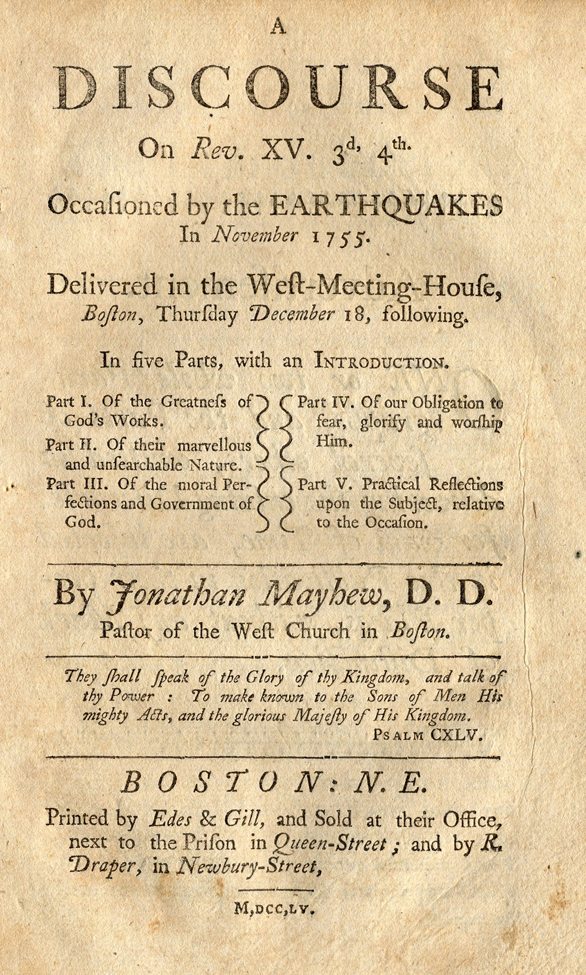

sermon-earthquakes-1755

A

DISCOURSE

On Rev. XV. 3d, 4th.

Occasioned by the EARTHQUAKES

In November 1755.

Delivered in the West-Meeting-House,

Boston, Thursday, December 18, following.

By Jonathan Mayhew, D. D.
Pastor of the West Church in Boston.

They Shall Speak of the Glory of thy Kingdom, and talk of thy Power:
To make known to the Sons of Men His mighty Acts, and the glorious
Majesty of His Kingdom.
Psalm CXLV.

The Introduction.My Brethren,

THAT part of God’s holy word, upon which my Discourse at this time will be grounded, is in the XVth Chapter of the Revelation of St. John, the 3d and 4th Verses.

GREAT and marvelous are thy works, Lord God Almighty; just and true are thy ways, thou King of Saints! WHO shall not fear thee, O Lord, and glorify thy name I for thou only art holy: For all nations shall come and worship before thee; for thy judgments are made manifest.

THE uncommon and alarming occurrences of divine providence, which we have experienced in the late EARTHQUAKES, seem to demand a very particular and uncommon notice. And altho’ I have not, till now, invited you into the house of God, for that purpose; yet you, My Brethren of this society, are my witnesses, that I have not let these providential visitations pass wholly unregarded hitherto; but, more than once, taken occasion to speak of them; and improved them as an argument to enforce that practical religion and holiness of life, which is doubtless the moral end and design of them. So that many things which might have properly been said upon the occasion, have already been said in this place: Which must be my apology with those who may not hear, in this discourse, some things which they might, perhaps, expect in it. For I am not fond of repetitions, especially upon a subject which suggests such a great variety of reflections, as renders it quite needless to use any; and in discoursing upon which, it is, indeed, much more difficult to contract and suppress, than it is to enlarge.

And now we are assembled together, out of the common, stated course, to contemplate, and religiously to improve, these mighty and wonderful works of God, I know of no passage of scripture, fitter for the basis of a discourse upon such an occasion, than that which was just now read to you. This will naturally lead us from particular instances and manifestations of God’s power, to a more enlarged contemplation of his mighty deeds; and the glory and majesty of that kingdom, which “ruleth over all.”

There is such an elevation and dignity, such a divine energy and pathos, in this passage of scripture, as can hardly fail to raise and fix the attention of everyone. However, if anything farther should be necessary to this end, it will be found in the great occasion upon which, the glorious place where, and the blessed Ones by whom, the words are supposed to have been originally uttered. I shall, therefore, just remind you of these things, before I proceed to a particular consideration of the passage itself.

St. John the Divine, being in the Spirit, and rapt in the visions of God into future times, had a representation made to him of the woes and plagues, and the final destruction, which were to come upon those of the grand apostacy from the pure faith and worship of the Gospel; upon that antichristian power which is emblematically described by “a woman arrayed in purple, and scarlet colour, and decked with gold, and previous stones and pearls;”—and having upon her forehead a name written, MYSTERY, BABYLON THE GREAT, THE MOTHER OF HARLOTS, AND ABOMINATIONS OF THE EARTH.” 1 The plagues which St. John in his vision, or rather visions, saw coming upon great Babylon, (whatever is intended hereby) were successive; and arising one above another in greatness and terror, till at length “there were voices, and thunders and lightnings,” as he expresses it; and “a great Earthquake, such a one as was not since men were upon the earth, so mighty an Earthquake and so great. And the great city was divided into three parts; and the cities of the nations fell;” [i.e. of the nations which had drank of the wine of the wrath of her fornication,” chap. XIV. Ver. 8.] “and great Babylon came in remembrance before God, to give unto her the cup of the wine of the fierceness of his wrath.” 2 It seems to have been at this dividing of the great city into three parts by an Earthquake, attended, or immediately followed by a mighty fire; and not at her final overthrow, that St. John saw the “kings of the earth who had committed fornication with her;” the “merchants who were made rich by her;” and “every ship-master, and all the company in ships,”— “standing afar off, for fear of her torment, weeping and wailing, and saying, Alas! Alas! That great city—for in one hour so great riches is come to naught”!—and “crying when they saw the smoke of her burning, saying, What city is like unto this great city! And they cast dust upon their heads, weeping and wailing, and saying, Alas! Alas! That great city, wherein were made rich all that had ships in the sea—Rejoice over her, thou heaven, and ye holy apostles and prophets; for God hath avenged you on her!” 3 I say, it seems not to be her final destruction, at which these lamentations of some, and exultations of others, are made; that being to be effected by another, and still greater earthquake. And this her utter ruin was accordingly represented to St. John immediately after, by the following expressive emblem. “And a mighty angel,” says he, “took a stone like a great mill-stone, and cast it into the sea, saying THUS, with violence, shall that great city Babylon be thrown down, and shall be FOUND NO MORE AT ALL. And the voice of harpers and musicians, and of pipers, and of trumpeters, shall be heard no more at all in thee—and the light of a candle shall shine no more at all in thee; and the voice of the bridegroom and of the bride shall be heard no more at all in thee: for thy merchants were the great men of the earth; for by thy sorceries were all nations deceived.” 4 This is plainly her final overthrow and destruction. But who, or what is meant by Babylon the great, the woman arrayed in purple and scarlet, and styled the mother of harlots and abominations of the earth; who or what, I say, is intended hereby, I shall leave every one to conjecture; only just observing, that St. John tells us, she sitteth on “seven hills;” that she “reigneth over the kings of the earth;” and that “in her was found the blood of prophets, and of saints, and of all that were slain upon the earth.”

Now it is to be observed, that when St. John saw the “seven angels having the seven last plagues” 5 to pour out upon the earth, and particularly upon Babylon, he had also a vision of that glorious region where those were, “that had gotten the victory over the beast, and over his image, and over his mark, and over the number of his name—having the harps of GOD.” 6 And those blessed and happy persons it was, that he heard “singing this song of Moses the servant of GOD, and the song of the Lamb, saying, Great and marvelous are thy works, Lord GOD Almighty!” &c.

This is the anthem of the blessed, in those glorious mansions, with reference to the great events of which St. John speaks; while they anticipate the final overthrow of that power which “exalts itself above all that is called God, and that is worshipped.” And these circumstances being taken into consideration, they cannot but give an additional solemnity and dignity to this passage of scripture, in which there is such a native sublimity and grandeur, as cannot but strike, warm, and elevate the minds of all, except the grosly abandoned, or naturally-stupid.

To imagine that we, poor sojourners on earth, and inhabitants of clay, can, with a proper ardor, and an equally elevated devotion, bear a part in this song of praise and triumph, were, indeed, great vanity and presumption: But yet, not so much as to listen to it, and try to join the chorus, were certainly unbecoming our profession and character as Christians: For by becoming truly such, we claim a kindred with the blessed above; and are, in a sort, of one society with them; being the adopted children of Him, of whom the “whole family in heaven and earth is named.” In the strong and emphatical language of scripture, we are not only “fellow-citizens with the saints, and of the household of God”, here on earth; but we are “come unto mount Zion, and unto the city of the living God, the heavenly Jerusalem”:—“and to the general assembly and church of the first-born which are written in heaven”; and not only “to the spirits of just men made perfect”, but “to an innumerable company of “angels”; and not only to an not only to Jesus the Mediator of the new covenant, but “to God the Judge of all”. 7 If we are truly the disciples of Christ, we are now united by faith, by love, temper and affection, not only with saints, angels, and arch-angels above, but with our glorified Redeemer; and God himself dwelleth in us, and we in God. 8

Let us, therefore, bearing in mind the honourable kindred, and glorious relation, which we boast to the inhabitants of Zion that is above, “draw near with a true heart, in full assurance of faith”; even as “seeing him who is invisible”; and in his immutable veracity beholding and anticipating the great events represented in these visions of St. John; Let us, I say, now draw near in full assurance of faith, saying “Great and marvelous are thy works, Lord God almighty! Just and true are thy ways, thou King of saints! Who shall not fear thee, and glorify thy name! for thou only art holy: For all nations shall come and worship before thee; for thy judgments are made manifest!”

However, it is not my design at present, to consider these words with a particular view to the original design of them, as they are found in the visions of St. John: Had this been my intention, I should have been more exact and critical in pointing out to you the order and series, and the distinct parts of these visions; which is now needless: Because I intend to consider the passage as if it were independent, having no connection with any thing preceding or following. And being taken in this light, it will, I suppose, naturally enough lead us to such contemplations upon God, his works and attributes; and to such practical reflections as will perfectly coincide with the present occasion, and our design in coming to worship and bow down before the Lord our Maker at this time. For it naturally leads us, in the

FIRST place, to consider the greatness of God’s works; which proclaim his omnipotence. And

SECONDLY, their wonderfulness, and inscrutability.—Which two particulars are obviously suggested by the former part of the passage: “Great and marvelous are thy works, Lord God Almighty!”

THIRDLY, the moral perfections of God, in the exercise of which he governs the universe—Just and true are thy ways, thou King of Saints—thou only art holy—thy judgments are made manifest”.

FOURTHLY, The obligations lying upon all men to fear, glorify, and worship him—“Who shall not fear thee, O Lord, and glorify thy name—all nations shall come and worship before thee.” And,

LASTLY, It will lead us to some practical reflections upon those great and marvelous works of God, to make a religious improvement of which, we are now assembled together.

I shall be the shorter in the speculative, doctrinal part of my discourse, that I may have the more time for what I imagine will be more useful; I mean, the practical. And as I would hope there are none present, but what are present with a good intention, I should be sorry if any of my hearers should go away without being the better for what they hear. Accordingly, tho’ I will endeavor to remember that men have heads, as well as hearts and consciences; yet I shall aim rather at speaking to the latter, than to the former.

PART I.

Of the Greatness of God’s Works.

Let us then, in the first place, consider the greatness of God’s works; which proclaim his omnipotence. “Great—are thy works, Lord God Almighty!”—It is to be observed, that there are no powers in what we commonly call natural, secondary causes, but what are, to say the least, originally derived from the first; and no real agency in any that are wholly material. Activity or agency, properly speaking, belongs only to mind or spirit; and all those powers and operations which in common language are ascribed to natural bodies, are really effects and operations of the supreme, original cause. So that all the works which we behold, are, strictly speaking, God’s works; excepting those which are wrought by men, and other finite, intelligent beings. And even these latter are, in one sense, God’s works; because, though human agency, and the agency of other subordinate intelligences, is not to be wholly excluded and set aside; yet the active powers of these beings are both derived from, and upheld by Him, to whom “power” emphatically “belongeth” : 9 And also because all these subordinate agents, in all their operations, are under the control and dominion of the Almighty; and employed by Him to fulfill his purposes and pleasure. So that all the works which we behold are, in a large sense, and in the language of scripture, the doings and works of God. And accordingly the works of God, in the scripture phraseology, comprehend those of creation, of nature and providence; and whatever God does as the Lord and Governor of the world, whose kingdom ruleth over all.

And now, how manifold, and how great are these works! Whether we turn our eyes to the great and wide sea, or to the dry land; to the earth beneath us, or to the heavens above us, still we behold the mighty works of God. The ocean, which is shut up within limits which it cannot transgress, but when God gives it a dispensation for so doing; and wherein are things “innumerable both small and great beasts;” this is, surely, a great and astonishing work. And how mighty and powerful is that Being who made, and who has fixed bounds to it, saying, “Hitherto shalt thou come, and no farther; and here shall thy proud waves be stayed?” that Being, who holds the waters of it in the “hollow of his hand;” and whom its winds and surges obey? That Being, upon whom all its numerous inhabitants wait, that he may “give them their meat in due season;” which are troubled when he only “hideth his face,” and die when he taketh their breath?”

The dry land is not less full of his great works and wonders. Consider the beasts of the forests, and the cattle upon a thousand hills: Consider the huge, bulky animals, and the places where they range; the wide extended plains, and the “everlasting mountains” with their summits above the clouds; the mighty volcanoes in different parts of the world, whence rivers of liquid fire flow for miles into the ocean, like those of water from other mountains, as though they were going to contend for that place which God “founded” for the other element: Consider the concussion of an Earthquake, when half a continent with its neighbouring islands, and their surrounding seas, are once shaken; as though the land and water which God once separated, were again to be mixed and confounded together: Consider these works of God, I say, and tell me if they are not great!

Consider next, the air and atmosphere with which the whole earth is surrounded, and in which it is infolded as in a garment: Consider the numerous people, the winged inhabitants thereof, the fowls of heaven, which God daily feeds; and heareth when they cry 10 unto him, though we understand not their language: Consider the whirlwind and the tempest, when God “bows the heavens, and comes down, and darkness is under his feet;” when he “rides upon a cherub and does fly,” yea when he “flies upon the wings of the wind;” when he “makes darkness his secret place, his pavilion round about him, where dark waters are, and thick clouds of the skies”; when again, “at the brightness that is before him, his thick clouds pass, hail-stones and coals of fire;” when the Lord also “thunders, and the Highest gives his voice:”—yea, when he sends out his arrows, and scatters the [guilty, affrighted] nations; and shoots out his lightnings and discomfits them:” 11 Consider the returns of day and night, when we are alternately enlivened and cheered by the light, and covered with gloom and darkness: Consider the annually-returning seasons, when God alternately reneweth the face of the earth, and binds the fields and rivers in icy bands: Consider these works of God, I say, and then pronounce, whether they are great or not! “But lo, these are [but] parts of his ways; and how little a portion is heard of him!” 12

And if these works of God, which have now been hinted at, are great, and proclaim an all-powerful Being; what do those innumerable worlds do, which we behold revolving about us in such an admirable order! Who made those two great lights, the one of which rules by day, and the other by night? Who made the stars also? Who, those numerous, immense globes, compared to some of which, our earth is but as an atom, and our ocean as a drop of the bucket? Whose breath gave them all being? Whose hand gives them their motions? Who directs their courses? Who makes them know their proper places and distances, so as not to jostle, and wrack world on world? Whose hand constantly maintains their order, and sustains them in being? When you consider these things, surely you cannot avoid exclaiming,—“Great—are thy works, Lord God Almighty!” “For [verily] the invisible things of him from the creation of the world are clearly seen, being understood by the things that are made, even his eternal power and Godhead.” 13

But the works of God may come under another, and a mixed consideration, if I may so express it; I mean, as they are the doings of Him who is the righteous. 14 Sovereign of the world, as well as the Creator of it, and the Lord of nature. In which respect they are also great and illustrious; and equally so, perhaps, whether we consider the works of God’s righteous severity, or his works of mercy and goodness.

God’s works of judgment, which have been abroad, and made manifest in the earth, from one generation to another, may justly be termed great. Was not that, one such work, for example, when God rained fire and brimstone out of heaven, and consumed those wicked cities, Sodom and Gomorrha; and when the ground on which they stood, was sunk, doubtless by n earthquake, to a standing nauseous pool, as at this day? Was not that another such work, when he sent his Angel, and by him, destroyed in one night, such a vast multitude in the Assyrian camp? Was not that another, when he destroyed Pharaoh and his mighty host in the red sea?—that same Pharaoh, whom he raised up, for to shew in him his power, and that his name might be declared throughout all the earth?” 15 How many mighty works, of a similar nature to these, has God wrought? And what desolation has he made in the earth, in a way of judgment, since the foundations thereof were laid by him! But how great, more especially, was that work of God, when the fountains of the great deep were broken up? When the waters arose above the tops of the tallest mountains, and the flood of his anger came “upon the world of the ungodly, and swept them all away!”

But God’s works of goodness and kindness are not less great and illustrious, from age to age, than those of his just severity. The preservation of Lot, whose righteous soul was grieved with the filthy conversation of the wicked; and the preservation of Noah, a preacher of righteousness, with his family, in the ark, from whom the depopulated world was re-peopled after the deluge; these, I say, were great works of kindness and mercy. And was not that another such, when he led his chosen people like a flock out of Egypt, directing their march by a cloud by day, and a pillar of fire by night; till, at this command, the sea retired, and rose as a wall on either side of them, to let them pass? Was not that another work of great kindness to his chosen people, though attended with terror to them, when he gave them his laws and statutes at Sinai? When the mountain trembled and quaked; “and all the people saw the thundering, and the lightnings, and the noise of the trumpet, and the mountain smoaking; and—removed, and stood afar off?” 16 But to arise still higher; if the giving of the law by Moses his servant, and by the ministration of angels, was a great work of God’s kindness; how much greater is that of his giving the gospel of peace to the world, by his Son Jesus Christ, who is “made so much better than the angels, as he hath by inheritance obtained a more excellent name than they”? Is not the redemption of this sinful, apostate world, the work of God? or is it not emphatically a great one? Without controversy, great is this work of God, this mystery of godliness, which angels desire to look into! And at which not only hell, but heaven itself, and all that is therein, stands astonished, excepting Him whose work it is; and whom “the heaven, and the heavens of heavens cannot contain”!

There are other great things, both in the way of judgment and of mercy to be accomplished upon this stage, before the scene is closed. We have, perhaps, not seen as yet half the acts of this mighty drama. But we know the principal contents, and chief heads of the whole, by reflecting upon what is actually past and looking into that “sure word of prophecy” which shines as a light in a dark place, until the several great days and periods dawn in succession, and the “day-star [at length] arises in our hearts”. The chief articles and circumstances of the plot, if I may so express it, and the winding up of the whole, are in general made known to us by revelation. Babylon the great shall be utterly destroyed; which, surely, will appear to be a great work, whenever it is accomplished. God hath not utterly and finally cast away his ancient people Israel; they shall be recalled from their several and wide dispersions: And this work, which God will surely effect by his power and providence, will be equally great. It was not said in vain, “I will give thee the heathen for thine inheritance; and the uttermost parts of the earth for thy possession”; but when all Israel shall be saved, the fullness of the gentiles shall also come in; and there shall be “one fold and one shepherd”; and “every tongue shall confess that Jesus Christ is Lord, to the glory of God, the Father.

But how great, beyond expression, beyond conception, will the conclusion of this drama of ages be! When all the numerous actors shall appear before the visible Representative and “Image of the invisible God ”, 17 to receive his life-giving plaudit, or to be hiss’d and frown’d into perdition! When those who have acted their part ill, shall mix their cries and wailings in horrid discord, with the triumphant songs 18 and Hosanna’s of the redeemed, who have acted well; with the voice of the arch-angel and with the trump of God! When the scenes, the stage, and the mighty theatre itself, shall all drop and fall together!—I leave it to you to judge, whether these works of God will be great, or little!

To me it appears, that whether we contemplate the works of God in the natural, or in the moral world; or at once view them in that twofold light, in which I have now been considering them; whether we reflect upon those of them which are already accomplished, or look forward to those which shall infallibly be accomplished hereafter; still we cannot but exclaim—“Great—are thy works Lord God Almighty!” Nor will I lessen and debase these works of God, even so much as to ask, What comparison there is betwixt them, and the most august of those which are done by men, by the kings and potentates of the earth; to which trifles we sometimes ascribe grandeur and dignity!

PART II.

Of the marvelous, unsearchable nature of God’s Works.

It is now time for us to consider the wonderful nature of God’s works: For they are not only great, but marvelous!—“Marvelous are thy works, Lord God almighty!”—They may, indeed, be said to be marvelous, only in respect of their greatness; since no contemplative man can avoid being astonished at them, considered merely in this view. But they are also marvelous in another respect; viz. as we cannot penetrate into, or fully comprehend them, by reason of the narrowness of our capacities. 19 We can form no adequate, I had almost said absolutely, no conception at all, of creation, the first and original work of God. And it is but a little way that we can see into the nature and causes and reasons of things; the means and methods and ends, by and for which, many events are bro’t about both in the natural and moral world. As none can by searching “find out the Almighty unto perfection”; so neither can any perfectly understand and comprehend his works, even the least of them; and much less the greatest. “My thoughts are not your thoughts, neither are your ways, my ways, saith the Lord. For as the heavens are higher than the earth, so are my ways higher than your ways, and my tho’ts than your thoughts”. 20 I know there are not wanting men, who pretend to have a thorough understanding of these matters; of almost all the works of nature and providence. But whether they are to be accounted wise men, or fools who know nothing as they ought to know it, we may learn in part from Solomon’s reflections upon this head: “I said I will be wise, but it was far from me,” says he. “That which is far off, and exceeding deep, who can find it out? I applied mine heart to know and to search, and to seek out wisdom, and the reason of things’ 21 —When I applied mine heart to know wisdom, and to see the business that is done upon the earth—then I beheld all the work of God, that a man cannot find out the work that is done under the sun: because though a man labour to seek it out, yet he shall not find it; yea farther, though a wise man think to know it, yet shall he not be able to find it.” 22 If a wise man cannot find out the work of God, it would be strange if fools could; nor, indeed, is there any greater evidence of folly, than the pretence of having done it. There is a reflection of much the same nature with this of Solomon, in the book of Job: “Which doeth great things, past finding out, yea, and wonders without number.” 23 “He is wise in heart, and mighty in strength—which removeth the mountains, and they know not which overturneth them in his anger: which shaketh the earth out of her place, and the pillars of heaven tremble: which commandeth the sun, and it riseth not; and sealeth up the stars: which alone spreadeth out the heavens, and treadeth upon the waves of the sea: which maketh Arcturus, Orion, and the Pleiades, and the chambers of the south.” 24

There is, indeed, such a thing as natural philosophy, which is of great use both to the purposes of life and godliness; and which, therefore, well deserves to be cultivated. However, the whole of what goes by that name, seems to be no more than the observing of facts, their succession and order; and reducing them to a general analogy; to certain established rules, and a settled course and series of events; called the laws of nature, from their steadiness and constancy. This, I say, seems to comprehend the whole of what we usually call natural philosophy. But after all the improvements that have been made herein, how many things are there in the natural world, which never have been, and perhaps never will be, reduced to any such general analogy, or to the common known laws of nature? How many phenomena are there, which we may call the irregulars, the anomalies, and heteroclites in the grammar, in the great book and language of nature, by which God speaks to us as really, as by his written oracles? Were the laws of comets, of inundations, of earthquakes, of meteors, of tempests, of the aurora borealis, of monstrous births? Were the particular laws and causes of these, and of a thousand other phenomena, I say, ever plainly discovered? I mean, so that they could be methodically calculated, foretold, and accounted for, as we calculate, foretell and account for common tides, eclipses, &c? No, surely; this has never been done by the greatest philosophers, with any tolerable degree of certainty and precision; tho’ there have been very ingenious, and even probable hypothesis concerning some of these phenomena. However, their causes and laws still remain very much in the dark: which may be owing, in part, to our not having critically observed a sufficient number of facts in each kind, from whence to draw general conclusions, and on which to form theories. For there is doubtless as regular an order and connection of these facts and effects, in nature, whether actually seen and known by us or not; and therefore as truly a course of nature with respect to them, as there is of, and with respect to, the most common and familiar. But this connection and order is, as yet, too recondite and hidden for human penetration, so that we can do but little more than form conjectures about these things. These works of God may, therefore, justly be called marvelous, past finding out; and these wonders of nature are also without number.

But upon supposition that all those works of God, which we call the works of nature, could be brought to a common analogy, and methodically arranged under certain known laws, as some of them are, so as to admit of a solution as plainly, and in the same sense, that eclipses, common tides, or any other natural phenomena do; even upon this supposition, I say, our knowledge would still be very imperfect; and the works of God, still marvelous to us. For it is to be remembered, that these general laws, by which we think to account for all other things, are themselves mysterious and inexplicable. Who, for example, can, without vanity and presumption, pretend to understand the great law of gravitation; the most general and extensive one, which we know of in nature? Who, I say, can, without the utmost vanity and presumption pretend to a thorough understanding of this law? Especially after a Newton has confessed his ignorance of it; and expressed his doubts, whether it were the effect of God’s immediate power, operating regularly upon every particle of matter throughout the universe; or whether it were the effect of some intermediate, natural cause, unknown to us? Some subtle medium pervading all natural bodies and substances? And though the latter were known to be the case, still the same, or rather a greater difficulty would recur, respecting that prior, and natural cause; and so on in infinitum; or, at least, ‘till we come to that great First Cause and Agent, who is the “least understood” of all things. For He must needs be more incomprehensible even than any of his marvelous works, since our first knowledge of Him, is learnt from them.

What is said above concerning the law of gravitation, is equally applicable to all others, which we call natural causes, or laws of nature: They are all really incomprehensible. We can no more penetrate into the true reason why a spark of fire, rather than a drop of water, should cause an explosion when dropped on powder; than we can tell why a stone, left to itself in the air, should fall, rather than ascend: i.e. we cannot do it at all. Thus it is as to all natural causes in general. So that, as was intimated above, our knowledge would be very imperfect, even though we could easily reduce all the phenomena in the natural world, to known, general laws; as it is certain we cannot. We should then know nothing but facts and effects, their regular succession and order. For though we speak of the natural, visible causes of many things; yet these causes seem to be plainly effects themselves; and the real cause of them, and of all things, is hidden, quite veiled from mortal fight; “though He be not far from every one of us.” 25 “Behold, we go forward, but He is not [visibly] there; and backward; but we cannot perceive Him: On the left hand, where He doth work, but we cannot behold Him: He hideth Himself on the right hand, that we cannot see Him. But He knoweth the way that we take!” 26

That cause which acts thus regularly, mightily, and marvelously, every-where; must needs be all-wise, all-powerful, and omnipresent: And into His incomprehensible agency, non-pluss’d philosophy itself must ultimately resolve all natural effects, together with their apparent, visible causes.

So that the whole natural world, is really nothing but one great wonder and mystery. It is not only those which we, in common language, call the great works of God, that are marvelous and inscrutable; but the least of them also. We are even an astonishment to ourselves. For we are “fearfully and wonderfully made: Marvelous are thy works, and that my soul knoweth right well! My substance was not hid from thee, when I was made in secret, and curiously wrought—Thine eye did see my substance yet being unperfect, and in thy book all my members were written, which in continuance were fashioned!”— 27 The most common, the least, and the most inconsiderable effects of God’s power, which we behold, baffle human wisdom and penetration. A flower of the field, which springs up in the morning, and at night is withered; the mite that is undiscernable to the naked eye; every atom or mote that flies in the sun-beams, or is wafted by the breeze, contains marvels and wonders enough to non-pluss the greatest sage. These are all the works of God; and all marvelous: And tho’ we do not call them great; yet the least of them proclaims the wisdom, the eternal power and god-head, of the Creator.

The works of God, as he is the moral 28 Governor of the world, are also marvelous and unsearchable; at least many of them are so. The second, or the new birth, which is of the Spirit, and which we are all so much concerned to experience, is not less mysterious than the first. For “as thou knowest not what is the way of the Spirit, nor how the bones do grow in the womb of her that is with child; even so thou knowest not the works of God who maketh all;” and by whom we are “created a-new in Christ Jesus”. And altho’ our Saviour cautioned Nichodemus not to “marvel” at his saying. “Ye must be born again”; yet he immediately compares this mysterious work of the Spirit, to one of the visible effects of God’s invisible power in the natural world; which tho’ one of the most common, is yet truly wonderful—“The wind bloweth where it listeth, says he, and thou hearest the sound thereof, but canst not tell whence it cometh, and whither it goeth: so is every one that is born of the Spirit”, 29 of that Spirit, which is ever operating both in the kingdom of nature, and of grace. For we may apply to all these operations and effects, however different they may seem, what the apostle says of the different kinds of miraculous gifts in that age of the church—“All these worketh that one and the self-same spirit”. 30

The dispensations of God’s providence towards mankind, have all some-what that is mysterious and incomprehensible in them. We cannot see into all the connections and dependences of things and events in the moral world; so as to give a clear account and solution of them. Difficulties and objections will remain, thro’ our ignorance and short-sightedness, against the scheme and methods of God’s dealing with the children of men, after puzzled theology has done its best. In which respect it is said, that “clouds and darkness are round about Him,” altho’ “righteousness and judgment are the habitation of his throne” 31 Amongst the marvelous, unsearchable dispensations of God to the world, considered as the moral Governor of it; we may particularly reckon our being subjected to sorrow, pain and death, “through the offence of one;” and our restoration to happiness and life eternal, by the obedience unto death of a far Greater, “the Lord from heaven:” God’s calling the Jews of old to be his peculiar people; their rejection, with the circumstances attending it; and their preservation in their present dispersed state: The sufferings to which good men are sometimes subjected, while the wicked are prospered, and “flourish like a green bay-tree:” The utter overthrow and ruin of some wicked nations, while some others, to appearance as wicked, if not more so, are preserved, and favoured with the smiles of providence. These and many other dispensations of providence, both past and future, we cannot penetrate to the bottom of, or clearly see into. So that whether we consider God’s natural works, or his moral; or consider his works at once in both these lights, they are not only great, but marvelous. “No heart can think of these things worthily: and who is able to conceive his ways? It is a tempest which no man can see; for the most part of his works are hid. Who can declare the works of his justice? Or who can endure them? For his covenant is afar off, and the trial of all things is in the end.” 32 Whether, therefore, you are a true philosopher, a true Christian, or both, as St. Paul was, still you must adopt his language?—“O the depth of the riches, both of the wisdom and knowledge of God! how unsearchable are his judgments, and his ways past finding out! For who hath known the mind of the Lord? Or who hath been his counselor? Or who hath first given unto him, and it shall be recompenced to him again? For of him, and through him, and to him are all things: To whom be glory for ever Amen!” 33

PART III.

Of the moral Perfections and Government of God.

But though human wisdom cannot scan or comprehend the great and marvelous works of God; yet we do, or may know so much, both of Him and them, as may serve the ends of practical religion; which is the end of man.—So that though we should guard against vanity on one hand, yet we should equally guard against false modesty, or skepticism on the other. We are not shut up in a vast, dark labyrinth, without any crevice or clue at all. We see at least some glimmerings of light; and if Theseus-like, we follow the club which is actually given us, it will lead us out of this darkness into open and endless day. But not to dwell upon metaphor and allusion: God gives us such notices of himself by his works, by the course of his providence, by our reason, and by his word, that though we must confess our ignorance of innumerable things, still we may say with confidence—“Just and true are thy ways, thou King of saints!”—“Thou only art holy!”—“Thy judgments are made manifest!”

Amidst all our darkness and ignorance, we see enough, unless we are willfully blind, to convince us, That God is a moral Governor; or that a moral government is actually established, and gradually carrying on in the world; and that we ourselves are the subjects of it. Had we only the light of nature to direct us, we might by properly following it, conclude with a good degree of certainty, That God is a beneficent, true, and righteous being; the patron of good men, and the enemy of the wicked; and one who will, sooner or later, give to every man according to his deeds. For is not the Creator, and Upholder, also the Lord and Judge, of all? Or “shall not the Judge of all the earth do right!”—“The work of a man shall he render unto him, and cause every man to find according to his ways. Yea, surely, God will not do wickedly, neither will the Almighty pervert judgment! Who hath given him a charge over the earth? Or who hath disposed the whole world!” Thou these words are found in one of the books of revelation, yet the passage is really the language of nature: Nor, indeed, do I remember that any have supposed that Elihu who utters them, was inspired. These are the sentiments which naturally arise in an improved, virtuous mind, upon contemplating the works of God; the great, independent Being, and source of all things.

The moral perfections which we usually ascribe to God, seem to have a connection with those natural ones, which must necessarily belong to the original cause of all things; particularly with independency, or self-sufficiency, infinite wisdom, and unbounded power. It is scarce, if at all possible, to conceive of that Being who has these natural perfections, to be false, cruel, or unjust; or to be otherwise than faithful and true, holy and righteous. So that these latter attributes are, in some sense, deducible from the former. But this argument, usually called by metaphysicians, the argument a priori; this argument, I say, in conjunction with some others, will appear conclusive to every thoughtful and honest man: I mean, particularly, those arguments which may be drawn from the moral nature which God has given us; from the consciousness we have of right and wrong; from the law written in our hearts; from our immediate sense of good and of ill desert; and from the vestiges and traces of goodness and righteousness, which we plainly see in the constitution, and in the course of nature; and the dispensations of God’s providence towards men. For although the judgments 34 of God are not now made manifest in so great a degree as they will be at that period, to which the passage my discourse is grounded upon, relates; yet they are discoverable in some degree at present, by what we daily see and experience. Although there may be room left for men of perverse and corrupt minds to cavil against, there is really none for men of fair, ingenuous minds to doubt of, much less to deny, the morality of the government we are now under, the things which have been just hinted at above, and for a particular discussion of which, there is not time, being duly considered.

However, I must just observe, That as the light of nature shows the world to be under a moral government and Governor, faithful, good, and righteous; so revelation, not only sometimes asserts this, but always supposes, and takes it for granted, as the foundation and ground-work of all; as the basis on which the whole fabric stands. The whole scheme of our redemption by Christ, from first to last, in all its parts, is grounded upon this supposition. For certainly the Christian revelation presupposes mankind to be antecedently under the righteous government of God, and accountable to him for their actions,; since it proposes a method for our escaping the punishment due to the transgressors of His laws. It supposes God to be good and merciful; since this very method of salvation for sinners, could originate in nothing but goodness and mercy—[“God so loved the world, that he gave his only begotten Son,” &c.—] It either asserts, or takes it for granted, that God does, in the course of his providence, even in all ages, reward and punish here, in some degree, the good and the wicked respectively, both individuals and whole communities. But the Christian revelation is more especially a confirmation of the morality of God’s government, as it so expressly teaches us, That there is a time of retribution approaching, wherein the righteous shall receive a glorious recompense of reward; and the wicked, the punishment which their sins deserve, though delayed for a season; and all men in general, receive the things done in the body, whether good or bad. This will be the completion and perfection of that moral scheme and plan, which is already established; which is carrying into execution from age to age; and which is plainly discernable to those who are not loth to see and acknowledge it; discernable, even from our own frame and constitution, and from every day’s experience. For we find a law of righteousness written on our hearts, though we may try to expunge and disannul it, by reason of the law of sin that is in our members, and which wars against it. We find ourselves entrusted in some sense, by the Author of our being, with our own happiness; we find that virtue is the road to felicity; and vice, to misery here. Nor is there the least presumption in reason, against the general doctrine of revelation, That our good and bad deeds, or at least the effects of them, shall follow us into another state, where this moral scheme shall appear in its perfection, both in the goodness, and in the righteous severity of God. For there may be certain grand periods in the moral, as well as in the natural world; both a seed-time, and a time of harvest; in the latter of which, he that has before “sowed to the flesh, shall of the flesh reap corruption;” and he that hath “sowed to the spirit, shall of the spirit reap everlasting life.” And you know who has said in this allegorical way,—“The harvest is the end of the world,” &c.

PART IV.

Of our Obligation to fear, glorify and worship God.

This passage of scripture leads us, in the next place, to consider the obligation which we are under to fear, glorify and worship God; which obligation results from his perfections, and the relation in which he stands towards us—“Who shall not fear thee, O Lord, and glorify thy name?—All nations shall come and worship before thee”. And who can doubt his obligation to do thus, if God is such a Being as he has been imperfectly represented to be, in the foregoing parts of this discourse? If he is indeed the “Lord God almighty”? If he is the “King of Saints”? if his ways are all “just and true” if he “only is holy”? if his “judgments” are, and will be, thus “made manifest”? What man? What nation, shall not fear, adore and worship a Being, so gloriously great, powerful, just and good!

There is One, and but One, to be feared. And certainly you can be in no doubt, Who that One is. There is a harmony and uniformity of design visible in the works of nature and providence, which shows that all originally proceeds from, and is governed by ONE: Which dictate of nature, or reason, is abundantly ratified and confirmed by revelation. For it is as clearly and expressly declared, That there is but “One God”, as it is that there is but “one Mediator between God and men”: 35 as plainly, That there is but One God, the Father, of whom are all things”, as that there is but “One Lord, Jesus Christ”. 36 And the most distinguishing title or characteristic of this One God, in the New Testament, is, “The God and Father of our Lord Jesus Christ”. 37 He, undoubtedly it is, that exclusively of all other beings, is here styled the “Lord God Almighty”, the “King of Saints”; and of whom it is said, that He “only is holy”, &c. And certainly it is equally our duty and our interest to fear, glorify and obey, this “One Lawgiver, who is able to save and to destroy”; 38 the “Father of all, who is above all, and thro’ all, and in us all”; 39 who is God omnipresent, even “from everlasting to everlasting”. Is it not altogether reasonable for us, weak, dependent, imperfect creatures, to reverence, worship, and obey Him that made us, and all things? Him, in whom “we live, and move, and have our being? Him, in whom all conceivable perfections, whether natural or moral, are united, even in an infinite degree; (if it be not a solecism to speak of degrees in infinity, and perfection) and who governs the universe in the exercise of these perfections? Men who do not thus fear and serve God, must counteract their own nature; I mean their rational, intellectual and moral nature, the light and dictates of their own consciences. For they cannot but see and feel, in some degree at least, that they ought to do thus; that they are under an indispensable obligation, in point of reason and fitness, as well as interest, to do it; so that, if they do it not, but the contrary, they must needs be “without excuse”, and “condemned of themselves”.

It is no sooner known that there is really such a glorious Being existing, than every man’s own heart, even antecedently to any formal, rational process, tells him in general what his duty is; what is the proper, practical inference; how he ought to stand affected towards God; and what part he has to act. And if men will but duly consider their own frame and make, their reason will, upon a little reflection, ratify these first dictates of their hearts and consciences. Are we not so constituted by the Author of our being, that great power excites a certain awe in us, unless we are, or at least imagine ourselves to be, more powerful than He, in whom we observe it? Does not a common man almost shudder at the thoughts of a giant; one of the sons of Anak, even tho’ he knows he is long since dead, and can do him no harm? Does not superior wisdom amongst men, naturally attract respect and reverence? I mean, from all who have themselves wisdom enough to discern it? Is not this our reverence of superior wisdom heightened, when that wisdom is in conjunction with veracity, and justice duly tempered with goodness and mercy? I mean, so as not to degenerate into cruelty on one hand, nor into any childish weaknesses on the other? Is not our reverence still heightened, when these qualities are found in age? In one, whose head was hoary, even before we saw the light? Is it not still increased, if this same person is our prince and lawgiver, and one on whose protection we depend? (a supposition which, God be praised! We may now make with some propriety—) Yea, would not our reverence of him be still greater, if we were in his presence, and under his eye, than while he is absent from us, or we from him? Yea, I will ask once more, whether our respect and reverence to such an earthly sovereign, would not be greater, if we actually saw him exerting his great and good qualities, in redressing the wrongs of his subjects; in punishing the evil and rebellious, and protecting and patronizing the good; than while we only believe or hear that he does thus, as occasion and opportunity are offered? If I were not almost tired with asking, and you, perhaps, with hearing questions, I would still ask, whether, all these qualities, being united in the same person, and all these circumstances concurring to heighten our esteem and reverence, we should not, of course, resign ourselves up to the will of their object, and cheerfully obey him; thinking ourselves happy in his favour, 40 and dreading the thoughts of his just displeasure as one of the greatest of evils? I presume there is no man, who understands these questions, which are not indeed difficult to be comprehended, but what would answer them all in the affirmative, if he sincerely spoke the dictates of his heart, without indulging to chicanery, and to the making of subtle evasions. It would evidently be fit and reasonable for us to be affected towards such a person as has been described, in the manner above expressed; and you would think that man very unreasonable, a kind of monster notwithstanding his human shape, who did not thus reverence, and thus demean himself towards, so great and good a personage, standing in such a relation towards him.

Here, then, you have the ground-work, and principles of religion in your own frame and constitution; so that the longer you reflect, the more reason you will see to fear, and adore God, and to keep his commandments. For is there any being so powerful as the “Lord God Almighty?” Is there any one so wise as the “only wise God?” anyone so righteous and faithful as He, all whose ways are “just and true?” any other so pure and spotless as He, who “only is holy?” Any one so venerable in respect of his years and age, as the “Ancient of days,” who “was, and is, and is to come?” Is there any one so properly our sovereign, and lawgiver, as the “King of saints,” whose “kingdom ruleth over all?” anyone who is “through all, and in us all?” In sine, is there any one, whose judgments, and effects of them, are and will be made so manifest before our eyes, as His, who is “the Judge of all the earth?” His, whose providence now governs the world, and who will hereafter judge it “in righteousness, by that man whom He hath ordained”?—Who then shall not fear and reverence? Who, not glorify and praise? Who, not obey, Him? Shall not all nations come and worship before him, before whom “all nations are as nothing;” and “Lebanon is not sufficient to burn, nor the beasts thereof sufficient for a burnt offering!” 41 Your obligation thus to fear, glorify and worship the great God, results so immediately and plainly from his nature, and your own, and the relation in which he stands towards you, that you must, I had almost said, uncreate your Creator or yourselves, and thereby destroy this relation, before your reason will absolve your from such obligation. But what I intend is, that while God is God, and men are men, they are bound by all the ties of reason religiously to fear, and worship, and obey Him.

There are some things, even at first view so plain and obvious to fair and honest minds, as almost to preclude any reasoning or augmentation concerning them. The obligations to practical religion in general, supposing there is really a God, seem to be of this kind. They can scarce be made plainer by reasoning, than they are without it; as the sun will not become the more visible to a man who opens his yes, by all the reasoning’s of philosophers about it. Accordingly, in the passage of scripture now under consideration, there is no formal ratiocination; but only a warm, devout and rapturous exclamation, the natural dictate of a good heart, and which will immediately find its way to the hearts and consciences of all men, who have not very grossly corrupted and debauched their own nature—“Who shall not fear thee, O Lord, and glorify thy name.”—“All nations shall come and worship before thee!”—However, there is, I suppose, somewhat of the prophetic kind in these last words: They do not only express what is right and fitting; but also suggest what shall eventually come to pass, after God’s judgments are made manifest in the original sense of the passage; that sense which was mentioned in the introductory part of this discourse. For all nations shall actually come and worship before God, when Babylon the great is destroyed.

The obligations we are under in general religiously to reverence, worship and obey God, being, as I suppose, sufficiently evident: it may be proper to subjoin here, hat God’s holy word ought to be the rule of the worship, service and obedience which we pay to him. How greatly the Christian religion has been, and still is corrupted, in most countries where it is professed, even to the introduction of the grossest superstitions and idolatries, there is neither time nor occasion now particularly to mention. It becomes us to take heed that we do not ourselves add to, or even countenance, in any degree, these corruptions. Especially if we have any well-grounded persuasion upon our minds, what is intended in the new testament by Babylon, that “mother of harlots and abominations,” we should keep at a distance from her; for God will, sooner or later, make her plagues wonderful, as well as manifest. “What concord hath Christ with Belial, says St. Paul: 42 —And what agreement hath the temple of God with idols?”—“Wherefore come out from among them, and be ye separate, saith the Lord; and touch not the unclean thing, and I will receive you; and will be a Father unto you, and ye shall be my sons and daughters saith the Lord Almighty.” A corrupt and idolatrous church is not the less to be separated from, because she dishonors Christ and his religion by calling herself after his worthy name: And it well deserves to be remarked, That St. John, in the midst of the visions which he had of the woes coming in succession upon Babylon, now “become the habitation of devils, and the hold of every foul spirit, and a cage of every unclean and hateful bird,” 43 tells us that he heard a “voice from heaven, saying, Come out of her, my people, that ye be not partakers of her sins, and that ye receive not of her plagues.” 44

I hope, I shall give no just ground of offence to any, (which I should be very loth to do) by adding here, That for the same general reason that we ought not to go wholly over to that apostate church which the scriptures sometimes intend by the name Babylon, we ought not to conform to, or symbolize with her, in any of her corruptions, and idolatrous usages: but to keep at as great a distance from them as possible, by strictly adhering to the holy scriptures in doctrine, discipline, worship and practice. Nor does this seem to me to be a needless caveat, even in any protestant country whatever: For I am verily persuaded that there is not now, nor has been for many generations past, any national church, wholly and absolutely free from these corruptions. Notwithstanding our boasted reformation, it is, alas! But too evident that we are not yet past that long, dark and corrupt period of the Christian world, to which St. John refers, when speaking of mystical Babylon he says, That “All Nations had drunk of the wine of the wrath of her fornication; and that the Kings of the earth had committed fornication 45 with her”. 46 We should therefore conform to our Bibles, whatever becomes of the decrees of councils, popes or kings; tho’ they should, like one of the ancient kings of literal Babylon, set up their golden images and idols, and command us to “fall down and worship, at what time we hear the sound of the cornet, flute, harp, sackbut, psaltery, dulcimer, and all kinds of music”; 47 yea, tho’ they should point us to their “furnaces, heated one seven times hotter than they were wont to be heat”. 48 We read of a still more terrible fire, into which the “beast” shall be cast, “and with him the false prophet that worketh miracles before hi, with which he deceiveth them that receive the mark of the beast, and them that worship his image”. 49 But blessed is he that feareth, and glorifieth, and patiently worshipeth the “Lord God almighty”, the “King of Saints”, according to his word and institutions; even he that doeth His commandments, “that he may have right to the tree of life, and may enter in thro’ the gates into the city. For without are dogs, and sorcerers, and whoremongers, and murders, and idolaters, and whosoever loveth and maketh a lie. 50

PART V.

Practical Reflections upon the Subject, relative to the Occasion.

But it is perhaps more than time for me to proceed to the practical part of my discourse; and to apply the subject to ourselves and the present occasion. We have lately had a very striking and awakening memento, or rather example, of the greatness, and the marvelous nature of God’s works; when this continent, for eight or nine hundred miles together, with the neighbouring islands, and the Atlantic ocean, were t once shaken, and thrown into convulsions. That this is truly the work of God, and that it is both a great and marvelous one, I suppose I need not go about to prove to you, after what has been said above. Indeed, if I mistake not, you all discover’d plainly enough, that this was your sense of it, at the time of this event, to say nothing of what you have done since, or do at present.

You think then, that an Earthquake is one of the mighty works of God; You think justly. And whenever you behold, or experience these his great and marvelous works, it may well excite your fear of him: for how gloriously terrible in majesty is that Being, who is able to produce such astonishing effects! But shall I tell you, that you every day behold greater works than these? Far more illustrious displays and manifestations of the power of God? This is really the truth. Did not God create the whole earth? Does he not daily uphold it in being, with all that it contains? And is not the creating and upholding the whole, a far greater work than shaking and removing a small part of it? Certainly it is. You can, therefore, never look upon the earth even when it does not quake, without being silently admonished to fear and obey him that made it; as truly admonished to do so, as when the “pillars of heaven tremble”, and the “highest gives his voice”; tho’ some may, perhaps, have never attended to this silent and constant admonition. But when you extend your views beyond this earth, to the numerous worlds around; when you look up in a serene night, and attentively behold this gloriously “dreadful All”; when you see “worlds on worlds,” and systems on systems “composing one universe;” when you seriously contemplate Him, whose hand once form’d, and still grasps, and moves, and directs this stupendous and amazing Whole; whenever you do thus, I say, you cannot but think even an earthquake, or the earth itself, comparatively speaking, a little work; a far less, than innumerable others. One principal reason why an earthquake appears to be such a great and stupendous work as it does to most people, is because instead of enlarging their minds by contemplating objects that are truly great, they narrow them by attending only to little things; such toys and trifles, I mean, as are found in this world, the riches and vanities of it; the pomps, the thrones, the scepters and diamems of kings. It is not strange that they who can think such little things great, and admire them as being so; they whose thoughts are ever groveling on the ground on which they tread, and never ascend above it, it is not strange, I say, that such persons should be astonished at the grandeur of an earthquake, even though they had nothing to fear from such an event. For it must be confessed that there is nothing, I mean no merely natural occurrence or event in this world, which cn more properly be called great, than such an one. Abut to a contemplative man, as was intimated before, there are many other works of God, which still more fully declare his power and glory; and which are therefore to such men, louder calls to reverence and obey him; tho’ less calculated to minister terror and amazement.

When we behold, or reflect upon, the great and marvelous works of God, all-powerful, wise, holy, just and good the effect hereof should not be the exciting in us a fruitless admiration of, and astonishment at them; but the exciting in us a due reverence and esteem of Him, whose works they are; till from admiring them, we come to admire, to fear, to love nothing besides Him, the Lord God almighty, the King of saints, who only is holy. For all his works are little, in comparison of Him; and can claim no regard or notice, any farther than they may help to lead us to the knowledge, and to worthy conceptions of Him. And unless our thoughts are thus led to God from his works, so as to inspire us with the reverence, love and admiration of him, we had almost as good stare at puppet-shows, as contemplate the heavens.

An earthquake is indeed very peculiarly adapted to rouse and awaken the minds of the inconsiderate, and of those who forget God; and to beget in them that fear of him, which is “the beginning of wisdom”; more adapted to this end, even than the greater and more constant manifestations of his eternal power and godhead. This is evident from the effect: for many who disregard these constant displays of God’s power, and other perfections, from year to year, are yet alarmed by an earthquake, and impressed with a serious sense of religion. How many, who were perhaps never excited to fear God, by beholding the heavens, which declare his glory, “the moon and the stars which he has ordained,” have been excited hereto, b these late occurrences of his providence? Where is that sinner, so tho’tless, so stupid and abandoned, whose “flesh did not tremble for fear of God, and who was not afraid of his judgments,” when the earth so lately shook and trembled? Nor were these fears excited in them without the highest reason, when we reflect that God has often declared in his holy word, that earthquakes are, sometimes at least, sent in his righteous displeasure; not merely for the warning and admonition of some sinners, but for the destruction of others: And when we reflect what amazing desolation he has often actually wrought by hem in the earth! Some recent examples and instances whereof, we have indeed, now within a day or two, heard of in Europe. The particulars of which are so awful and terrible, that I shall not now enumerate them; for I have no inclination, were it in my power, to throw you in a panic; but only to reason calmly with you “of righteousness, temperance and judgment to come”; of your obligation to fear and obey Him, whose works are thus great and marvelous, and his judgments thus made manifest in the earth. 51 It is not only natural, but just and proper for wicked men to tremble and to be afraid, when God thus ariseth to shake terribly the earth, and his judgments are abroad in it. And if their own lives are spared, they ought not only to tremble at, but to learn righteousness from, these alarming events. This, thro’ the tender mercies of our God, is the case of those wicked men who are here present before Him, if there are any persons present, to whom that character belongs. Would to God, there were not!—

But upon the presumption that there are at least some such; (not an unnatural or uncharitable presumption, I conceive, considering the largeness of the assembly, and the present state of religion in the world) Upon this presumption, I say, let me be allowed to address myself briefly and seriously to such unhappy men; not as their enemy, God forbid! But as their friendly monitor—Let your hearts and tongues be filled with the high praises of God, that your lives have been thus graciously preserved; and that the thing which you so greatly and justly feared, not to say deserved, is not come upon you. What distress and anxiety were you lately in! Where, alas! And what would you now have been, had the earth opened her mouth and swallowed you up? Or had your falling houses crushed you to death? Examples of both of which, there have been many in former times, and some very lately. Had either of these been your own case, I say, where, and what would you now have been!—Wretched, and accursed of God, in that region of darkness and despair, where the rich man lift up his eyes being in torment! But in the time of your apparent danger, when “the sorrows of death compassed you, and the pains of hell gat “hold upon you,” 52 God who is long-suffering and rich in mercy, as well as holy and all-powerful, “inclined his ear;” 53 and you are still among the living. What then will you “render unto the Lord for all his benefits towards you”? 54 and particularly for this? Will you not now praise and glorify his name? The mariner (at his “wits end” while the storm beats upon him, and when every sleeper “awakes and calls upon his God:” the mariner, I say,) when the storm is over, blesses Him whom winds and seas obey, that he has escaped foundering and ship-wrack. Thus it becomes you to do, whom God has mercifully preserved when in at least equal perils by land. Did you not make your vows to him in the time of your distress? And will you now pay them? 55 Will you not forever hereafter praise and reverence, worship and serve the Lord God Almighty, the King of saints, and the Preserver even of sinners, tho’ He who only is holy? Will you not now, at length, break off your sins by righteousness; and implore the forgiveness of them through him, in whom God is reconciling the world unto himself? Did you not resolve to do thus, in the late time of your terror and amazement? And will you not now perform these vows and engagements? Were there not some particular sins, that more especially then flew in your faces; & which you then more particularly resolved to forsake, if God should spare your lives? Were there not some particular duties, with the omission of which your consciences then especially accused you; and which you particularly resolved to practice for the future, if you should hae an opportunity for it? Your consciences, which are always the voice of God within you, were, I doubt not, then awake, and plainly told you the truth. It was no Delphic, ambiguous response, which they then gave; but one clear and distinct, convincing and infallible as the oracle of God. Remember, O man! What that great oracle, conscience, within thee, pronounced at that time; take the warning,, and obey the heavenly voice! Presume not to repeat those sins, with which it then charged you; nor to omit those duties, your former neglect of which then gave you disquietude.

It is not only melancholy, but astonishing, to observe how soon wicked men often get rid of their just fears and apprehensions of the divine displeasure, and break through their better resolutions, when they no longer see the rod of God held out, and shaken at them. They act as if they thought he then ceased to be that just, and holy, and almighty Being which they apprehended him to be, while they thought themselves in immediate danger of his judgments; as if they thought he was not “angry with the wicked every day”, but only when there are some alarming occurrences in the course of his providence; and so return to their former vices and impieties, almost as soon as the particular evils and dangers they apprehended, are removed. Suffer me therefore to warn you against this folly; and to beseech you, as you value the salvation of your souls, not to suffer that religious sense of things, which was lately awakened in you by these awful occurrences, to wear off; and so return to your old crimes. At the time of, or immediately after, the late earthquakes, did vicious men find in themselves any inclination to repeat their old sins; and to break the commandments of God? Did the drunkard then think of his bowl or bottle? Did the whoremonger and adulterer then find any disposition to perpetrate their horrid crimes? Did the thief at that time meditate future thefts and villainies? Did the man who was unjust in his commerce and dealings, then scheme and plan future fraud and injustice against his neighbor? Did the misers heart then repose itself on his god?—I mean his gold? Did he then “make gold his hope; and “say unto the fine gold, Thou art my confidence!” Did the profane swearer and blasphemer then ask God to damn either himself or his neighbor? I can hardly believe there was a man amongst us so intemperate, so lewd, so addicted to the hidden things of darkness and dishonesty, so devoted to his mammon, or so profane and impious, as to do thus at the mentioned time. No: how wicked soever some of you might possibly be; yet you all then feared God; or at least were afraid of him, and afraid to sin against him; because you then really believed him to be holy, just and almighty. The drunkard was then far from desiring to indulge to intemperance: The burning adulterer’s blood then ran cold in his veins: The thief would then have dropped the spoil from his hand; and he that stole, resolved to steal no more: The most zealous worshipper of mammon, then wished for a treasure in heaven: And the blasphemer’s oaths and curses, were turned into prayers and supplications. All, all then thought, that God was worthy to be feared, and glorified, to be worshipped and obeyed.

Well: Do you suppose that God is changed; and now become a different Being from what he so lately was, when he shook the earth, and caused the pillars of heaven to tremble? Do you imagine, because you do not now see these same manifestations of his power, justice and holiness, that of almighty he is now become weak! Of just, regardless of justice! Of holy, unholy! And consequently, that though he was lately so proper an object of your fear, yet he is no longer so; but that you may now safely contemn him? That you may trample upon his laws? That you may tread under foot his Son? That you may disregard his word, and profane his day? That you may neglect his worship, his institutions and ordinances, and despise his threatening’s? Can any man be so extravagantly foolish as to think thus! Verily, he is the Lord, and he “changeth not;” the “Father of lights, with whom there is no variableness, neither shadow of turning.” Tho’ the earth should never “tremble” again, he is always the same holy, righteous, powerful and jealous God, which you lately conceived him to be, when he “looked upon it”: He is the same when he dwells in the calm, and all nature smiles around, as when he “makes darkness his secret place,” and “flies upon the wings of the wind;” when he gives his voice in thunder, “a smoke going out of his nostrils, and fire out of his mouth, devouring!”

Take heed, therefore, that you do not suffer those just sentiments concerning the power and holiness of God, and your duty to him, which were lately awakened in you to be effaced; cherish and improve them; and let them be written on your hearts as with a pen of iron, and the point of a diamond; or as graven on the rock for ever. You ought certainly always to fear, always to glorify, always to worship and obey him, who is always almighty, always holy, always just, always present with you; even tho’ he should never manifest himself and his power to you in the same terrible manner. But you are to remember, that God may perhaps visit us with other, and far greater earthquakes, or with terrible and destructive inundations of the sea, as he has lately visited others, in divers places; or with other desolating judgments: For he never wants means and ways by which to punish the disobedient, even in this world. But, as was said before, tho’ his judgments should not now be made manifest in any of these ways; yet he is always the same glorious, righteous, almighty and terrible God; even “yesterday, to day and forever”. And he will most surely render to every man according as his work shall be, in the day that he has appointed for that end, whether it be near or remote. You should therefore have an habitual reverence of him upon your minds; such a one, as thro’ his grace and assistance, will always be productive of obedience and holiness in your lives. “As he which has called you is holy, so be ye holy in all manner of conversation; because it is written, Be ye holy, for I am holy. And if ye call on the Father, who without respect of persons, judgeth according to every mans work, pass the time of your sojourning here in fear. 56

“Happy is the man that feareth alway; but he that hardeneth his heart shall fall into mischief!” 57 Happy, thrice happy are they, who ever religiously reverence, and sincerely obey almighty God; and who are the objects of his peculiar love and favor, thro’ the glorious Mediator of the new covenant. Miserable, beyond expression miserable are they, who are the objects of his righteous displeasure, thro’ sin; thro’ obstinate impenitence and unbelief. What real harm or evil can come nigh he former, shielded by that hand that “garnished the heavens”, and formed “the crooked serpent!’ 58 What good can the latter expect, under his frown, whose “right hand shall teach him terrible things!” 59 What worm can resist omnipotence! What craft can evade the justice of the all-wise and holy One! Or who fly from him who is omnipresent! If you can fly to the most distant parts of the earth or sea, he is there: if you ascend to the highest heaven, behold he is there, if you descend to the lowest hell, he is equally there! And wherever he is, he is always the same glorious almighty, wise and holy Being; the friend, the hope, the salvation of the good; the enemy, the terror, the destruction of the wicked! “When he giveth quietness, who then can make trouble? And when he hideth his face, who then can behold him? Whether it be “done against a nation, or against a man only?” 60 Who then? what man? What nation shall not fear thee, O Lord, and glorify thy name! Shall not all nations come and worship before thee!—

I would willingly hope there may be some good effects of the late terrible earthquake, not only in this capital, where people have appeared to be so generally affected by it; but throughout the province; and indeed throughout these American plantations and colonies, as far at least as it extended. Without running into a common-place invective against the times, or pretending to give a detail of the sins and vices which are prevalent thro’out these British colonies, one may, I think, say with modesty, that there is ample room for, and therefore great need of, a general reformation of manners; even amongst persons of all orders and degrees, without any exception. This alarming occurrence of providence, is, in the nature of it, as a moral means, calculated to produce such an effect, such a reformation. And considering our lives are all thus mercifully preserved, one would willingly believe that God really meant it to us for good, that we might awake to righteousness and not sin; that we might be made partakers of his holiness hereby; and so become the suitable objects of, and in due time enjoy, his favour; that kind protection, and those smiles of his providence, which we at all times need, and, in some respects, more particularly at this.

To mention only one of these respects: We are, and have been for some time engaged in an unhappy, and hitherto, an unprosperous war with our French neighbours on the continent, and their Indian allies, supported and encouraged in their encroachments and depredations by the power of France: With which martial, though perfidious nation, a more general war seems to be now on the point of breaking out. Four 61 (that is, in short, all the late) expeditions made against them, for the securing of our territories, have proved unsuccessful; and not only unsuccessful, but some of them fatal to a considerable number of British subjects; and not only so, but some of them at least, very dishonourable to the British name and arms: Not to say anything of the great expense of these expeditions to the crown, and to these colonies.—How have these colonies lately bled! How are some of them still bleeding, by treacherous and savage hands! What scenes of violence! Of rapine! Of fire! Of murder! Especially on the frontiers of the southern colonies!

Now though we have not, that I know of, any reason to doubt of the justness of our cause, with reference to our enemies on the continent; yet from God’s fighting against us in his holy providence; from his thus defeating our attempts; from his thus giving our barbarian, and even worse than barbarian enemies, our blood to drink; from his making us appear, not only not formidable, but even contemptible and ridiculous in their eyes; so that they laugh, and “eat us up as they eat bread!”—From God’s thus fighting against us in his holy providence; from his thus defeating our attempts; from his thus giving our barbarian, and even worse than barbarian enemies, our blood to drink; from his making us appear, not only not formidable, but even contemptible and ridiculous in their eyes; so that they laugh, and “eat us up as they eat bread!”—From God’s thus fighting against us in his holy providence, I say, we have great reason to suspect that we do not stand right with him as a people that is called by his name; but that we have before made him our enemy, by fighting and rebelling against him. Who, indeed, can doubt but that this is the case, if he seriously reflects, how little there is of pure and undefiled religion amongst us? Or rather, how much there is of flagrant immorality, profaneness and irreligion, throughout these colonies? I say these things from my heart; and hope they will not be looked upon only as words of course: For I do not allow myself to trifle with my Maker, or to take his holy and venerable name in vain, even in a Sermon, which would not sanctify the deed. And there have been many other things of late years, in the course of divine providence towards us, besides those mentioned, which might justly make us fear, that God is greatly provoked at our sins.

The late visitation of his providence in the formidable earthquake, which extended almost throughout these British colonies, seems to me, if I can understand the language in which it speaks, to be a loud call to them all to consider of their ways; and to return to God by unfeigned repentance, and a general reformation. It is to be hoped, that none of them which have heard, will disregard the admonition; or so soon forget it as the same sort of warnings are forgotten in some of our West-India Islands, where they are more frequent; where there has been at least one, which should never be forgotten; and where, nevertheless, by what we hear, the wickedness of the people is increased to the very heavens, so that were not God’s mercies far above them, we might conclude that their utter ruin and destruction could not be long deferred! God forbid, that we on the continent should thus refuse to “hear the rod, and him that appointed it,” though we have been so gently chastised by it. It is to be hoped, that we shall be effectually taught by it, in conjunction with the other late corrective dispensations of divine providence, to fear the Lord God almighty, the King of Saints, who only is holy, whose works are great and marvelous, all whose ways are just and true, and whose judgments are at this time made so manifest in the earth; that so iniquity may not be our ruin, but that God, even our own God, may delight to bless and build us up; to prosper us against our enemies, instead of pulling us down, and destroying us by them. Who knows, but this may be one design of our good and gracious God, who is the governor among the nations, in visiting and admonishing us in this manner? If it is, we should surely concur and fall in with it, by turning every one of us from our transgressions; and this, even though our future and eternal interest were out of the question. For whatsoever is dear and valuable to us in this world, seems to be now at stake; and our ultimate dependence, you know, is upon God.

Should France throw over a considerable body of well disciplined and appointed troops into America, early in the spring, which seems not an improbable supposition, I almost tremble for the consequence, notwithstanding our numbers of raw men, however naturally-brave—Especially if our military operations on the continent, which God forbid! Instead of being conducted by wisdom and due caution, by zeal and patriotism, by integrity and a determined fortitude, should happen to be conducted by folly or rashness, by irresolution or party-spirit, by treachery or cowardice!—But perhaps any fears or suspicions of this sort, are perfectly chimerical and groundless; so that I shall say no more upon the point—

However, such is the present critical situation of our affairs, such the aspects of providence towards us, and so numerous our sins against heaven, that all who value their lives, liberties or estates, not to say their souls, had need to fear God, and thereby endeavour to secure his favour and protection. And had a voice that could be heard throughout these British governments, I would now lift it up like a trumpet; I would cry aloud and not spare—“Repent, repent;” fear God, and bring forth fruits meet for repentance!—“Then shall thy light break forth as the morning, and thine health shall spring forth speedily; and thy righteousness shall go before thee, and the glory of the Lord shall be thy reward. Then shalt thou call, and the Lord shall answer—Then shall thy light rise in obscurity, and thy darkness be as the noon-day. And the Lord shall guide thee continually” 62 —“But if we do not grieve, when God smiteth and chasteneth us; if we refuse to receive correction, and will not return to him; but “make our faces harder than a rock;” we may then justly fear that he will smite still harder; and chastise us, not with ships, but with scorpions. If we persevere in our disobedience, we may reasonably suppose, that he will repeat his stripes; and not only break the skin, and make us bleed a little; but that he will make us bleed in earnest; yea, that he will tread us in his anger, and trample us in his fury;” and (if I may go on with the scripture phraseology) that “our blood will be upon his garments,” till he has “stained all his raiment!” 63 When we consider our demerits, we must acknowledge that God has hitherto corrected us with a Father’s hand; and, if I may so express it, has first mollified and bathed the rod with a salutary balsam, to heal the stripes which itself gave. Let us not, by our repeated transgressions, provoke him to dip it next in poison, that it may cause our wounds to fester to our very heart and vitals; and in the end prove mortal!

I tremble not only for my dear native country, when I consider the sins of it; but also for a certain European nation, which I will not mention by name: A nation blest with some peculiar advantages, civil and religious: A nation not much “exalted by righteousness,” for a long time past: A nation often admonished by providence, and sorely scourged: A nation often threatened even with utter ruin and destruction: A nation often almost miraculously preserved from ruin and destruction by her enemies, both foreign and domestic: And yet a nation where infidelity, irreligion, corruption and venality, and almost every kind of vice, seems to have been increasing all the time!—Will not almighty God, who “only is holy,” sooner or later “visit for these things? And will not “his soul be avenged on such a nation as this!” 64

Let us, my Brethren, hearken to the word of admonition; I do not mean my own, but God’s. For his voice is loud and vocal, even in those dispensations of his providence, which are the occasion of our being assembled together in his house at this time: It is still sounding in our ears, unless we are like the deaf-adder that stoppeth her ear, and will not hear. The language of it is the same in general with that of God’s written word,—“Let the wicked forsake his way, and the unrighteous man his thoughts, and let him return unto the Lord!” And if we duly attend to, and obey this voice of God, both in his word and in these visitations of his providence, he will surely “have mercy on us, and abundantly pardon;” for he is as good as great; and delighteth not in the death of sinners: Nor are the works of his mercy and loving-kindness, either less, or less numerous than those of his righteous severity, when his judgments are made manifest. Incline your ear therefore, and hear, and your soul shall live; ye shall eat that which is good, and your soul shall delight itself in fatness. We may justly hope for the smiles of divine providence, in giving us temporal prosperity, if we turn at God’s reproof, and fear, and worship, and serve him, according to the gospel of his Son, “in spirit and in truth.” Let us not mistake the nature of Christianity so widely, as to imagine that an idle, inoperative faith, or observing the external forms of religion, and crying. “The temple of the Lord,” will avail us without repentance towards God, and “faith that worketh by “love” to Him, to our Redeemer, and fellowmen, and an universal obedience to his commandments. Much less should we imagine, that we can recommend ourselves to the divine favour, by furious party-zeal in religious matters; by indulging to a censorious spirit, and setting at nought our Christian protestant brethren, whose lives are blameless, on account of differences in opinion. The day which is coming, and which will reveal the secrets of all hearts, will show that this is not the religion of Christ, but a contradiction to it; and that men who do thus, “know not what spirit they are of.” But not to digress.

Whether we shall be generally amended and reformed, and, in consequence hereof, enjoy the protection and smiles of divine providence, and outward prosperity, God only knows; tho’ this is what all good men desire and pray for: And whether their desires and prayers are answered or not; yet they themselves are secure and happy, even in the worst and most “perilous times”. Being such, we shall enjoy what is infinitely more to be desired than all temporal and worldly blessings together, the favour of almighty God, the King of saints, and a peaceful conscience; an happiness which the world can neither give nor take away. That sense of security which good men commonly enjoy, is of more value, especially in times of terror and distress to the wicked, than this and ten thousand other worlds together: And no man, surely, who knows what this means, would make the exchange! Need I then caution good men against anxiety, even in these evil days? What tho’ you see that iniquity abound, which may perhaps bring sore calamities upon us? Your treasure and hope are not in this world. What tho’ treacherous and barbarous nations are now ravaging our borders, and laying waste our country? What tho’ you hear of wars and rumours of wars, of earthquakes and inundations in divers places, the sea and the waves roaring? What tho’ religion is generally at so low an ebb in the world, even in protestant countries? What tho’ the idolatrous corrupters of Christianity, or mystical Babylon, should long triumph? What tho’ the souls of them which have been “slain for the word of God, and for the testimony which they held”, (seen by St. John “under the altar”) should still for some ages cry, “How long, O Lord, holy and true, dost thou not judge and avenge our blood on them “that dwell on the earth”! What tho’ all things, should wear even a much more gloomy aspect than they do at present?—Still you know, that the Lord God almighty, the King of saints reigneth; that he only is holy, that all his ways are just and true; that his judgments will sooner or later be made manifest; and that in his loving-kindness you are secure against all real harm, tho’ the earth and heavens were mixed in one common chaos? The King of saints will never leave nor forsake those, who are truly such. Why then, O son of Zion, should thy soul be cast down, or disquieted within thee, if thy God reigneth! Hope thou in him; for thou shalt yet, and forever praise him: “Lift up the hands that hang down, and the feeble knees”: And glory in this, that thou understandest and knowest Him, “who exerciseth loving-kindness, judgment and righteousness in the earth.” 65 And

Let wicked men, if they regard their own happiness either in this world or another, turn their feet unto God’s testimonies, and be reconciled to Him thro’ him that died for us, the just for the unjust, that he might bring us unto God. Then shall you also taste and see that the Lord is indeed gracious; a very present help in trouble. For even when your flesh and heart shall fail you, he will be “the strength of your heart, and your portion forever!”

To conclude: Let those who truly fear God already, that King of saints who only is holy, daily endeavour, by his grace and assistance, to become more like him. Let the late visitations of his providence, awaken you to greater zeal and diligence in his service; that you may go on unto perfection. To which end, ever set before you, and aspire at a conformity to, the glorious example of your Redeemer; of him, “whom not having seen you love; and in whom ye greatly rejoice.” There are some virtues and graces, in which even many good men are very defective: Particularly those of meekness and patience under abuses and insults; charity and forbearance towards persons of a different persuasion in religious matters; and love to their personal enemies. Even many of those who ought surely to be “ensamples to the flock,” of these sublime and excellent virtues, sometimes seem to exhibit a very different example to it—However these are certainly Christian virtues, by whomsoever disregarded, or cultivated. And whatever difficulty may attend the exercise of them, we ought to learn them, and to improve in them, by contemplating the doctrine and example of the great “apostle and high priest of our profession”. These are some of his sublimest lessons of virtue and Christian perfection. Remember always, who and what you are; whose sons; whose disciples; to what world you stand related, with whom you are “joint heirs”, and what is the hope of your calling. Act with a greatness and dignity becoming your character, and glorious expectations. Be above little resentments, and even the provocations to great ones: Learn, sometimes at least, to silence calumny by silence: Return blessing for cursing, and good for evil, overcoming the latter by the former. If you are, or imagine your selves to be, wiser and stronger than the others, learn to “bear the infirmities of the weak”; to have “compassion upon the ignorant, and them that are out of the way”. Let your candor and good-will be extensive and conspicuous: Scorn all bigotry, party-spirit, and narrowness of mind in religious matters; and allow to all men that liberty herein, which you take yourselves, without hating or reviling them, merely because they differ from you in opinion. Yea, learn to love with a tender and unfeigned charity, your most malicious and abusive enemies—So shall you act up to your holy profession; so shall you be followers of them who thro’ faith and patience inherit the promises; so shall you act suitably to the relation in which you stand to Jesus Christ “the Son of the living God”, who “is not ashamed to call you brethren:” And so shall you be emphatically the children of your Father which is in heaven; “for he maketh his sun to rise on the evil and on the good; and sendeth rain on the just and on the unjust—Be ye therefore perfect, even as your Father which is in heaven is perfect.” 66

And thus, being not only by profession, but by practice, the children of light and of the day, you shall at length “shine forth as the sun in the kingdom of your Father:”—Not, indeed, in all respects like that national sun, which is just now withdrawing his friendly, benign beams, from our hemisphere: For in the ages to come, or rather when these momentary ages are no more; even long after that glorious luminary, that great and marvelous work of God, is become “black as sackcloth of hair”, and all his fires are extinct, your’s shall still burn and shine, not only with an undecaying, but an ever-increasing luster, united with that God who is both light and love, and in whom “there is no darkness at all!

F I N I S.

Advertisement.

The Author of the foregoing Discourse takes this opportunity to correct some mistakes in the Appendix to the two Discourses, which he lately published upon the same occasion.

The most considerable apertures and chasms made in the ground by the late earthquake, were not, as he then supposed, in the town of Pembroke, but in Scituate, near if not adjoining to it.

The accounts which he mentioned concerning the dividing of a great hill upon Cape-Cod, in halves, and of a prodigious chasm at Newington, of which accounts he then spoke doubtfully) now appear to have been without foundation.

The sentence which stands thus, p. 3. Of the Appendix, “This was as much more considerable than the last on Tuesday morning, as that was less considerable than the first”, ought to have run thus—This was almost as much more considerable than the last on Tuesday morning, as it was less, &c.

From what we have heard from Halifax since the publishing his Appendix, and from St. Martin’s respecting the inundation there, on the same day the earthquake happened here, it is at least probable that the extend of the earthquake was twice as great as he then conjectured.

And lastly: Whereas he incidentally gave it as his opinion, that the course of the earthquake was from S. W. to the N. E. he now thinks it much more probable, that it was nearly from N. W. to S. E. agreeable to what the very learned and worthy Professor of the Math. & Phil. at our College, has said in the notes to his Discourse on earthquakes, since published—A Discourse which (if one who was so lately his pupil, might presume to give his opinion) cannot fail to do great honor to its Author, to the learned society of which he is a member, and to his country: Even notwithstanding what Mr. L. Evans has, with sufficient assurance, assigned as “a sufficient reason for paying Philadelphia the particular distinction of making it the first Meridian of America”; viz. That it “far excels in the progress of letters, mechanic arts, and the public spirit of its inhabitants”, all other parts of the “British dominions on this continent!” 67

But I am not so rude as to make invidious comparisons betwixt these governments in point of literature; or to say, Who is, or is not, the best judge in America”, 68 of this gentleman’s late Map—

The most material Corrections.

Page Line Read
20 13 heaven of heavens
25 2 bottom hypotheses
36 14 his law.
38 13 just and true?
44 4 natural dictate
50 2 diadems
52 6 throw you into
54 11 bot. will you not now
55 1 bot. providence; and so
71 2 Even many of

N. B. The need of some of these Corrections was observed time enough to make them before the whole impression was finished.


Endnotes

1. Rev. 17. 4, 5.

2. Chap. XVI. Ver. 18, 19.

3. Chap. XVIII. Ver 3, 15-20.

4. Ver. 21, 22, 23.

5. Chap. XV, Ver. 1.

6. Ver. 2.

7. Heb. Xii. 22, 23, 24.

8. I Joh. 4. 15.

9. Psalm ixii. II.

10. Job xxxviii. 41 and Psalm cxlviii. 9.

11. Psalm xviii. 9-15. This passage of scripture seems plainly to refer to the plagues of Egypt, and to what happened at the Red Sea.

12. Job xxvi. 14.

13. Rom. i. 20.

14. The reader is desired to observe, that though God’s moral perfections and government, properly come under the THIRD head of discourse proposed; yet it is in this mixed, complex sense, that his works are spoken of as “great and marvelous,” in the text. The words have plainly respect to the acts and doings of God, considered in a twofold light; as he is the Lord of universal nature, and the just Ruler and Judge of Men. Upon which account it was thought proper to consider their greatness in this light, by way of anticipation, before the morality of the divine government comes, in course, to be distinctly spoken of.

15. Exod. ix. 16.

16. Exod. xx. 18.

17. Col. i. 15.

18. The Author thinks, abut is not certain, that there is some-where in Dr. Scott’s works a passage, to which this part of the sentence may seem to be at least an allusion.

19. A little reflection upon the operations of our own minds, will indeed make it evident, that all wonder, surprise, astonishment, at bottom proceed from, and connote ignorance; for nothing which we fully understand, ever excites our wonder or admiration. And it is certain that no such passion can have any place in a perfect, all comprehending mind. So that God’s works are marvelous, only with relation to his imperfect creatures: And the more imperfect and short-sighted creatures are, the more marvelous must these works appear to them; I mean, if they at all think of them.

20. Isai. Lv. 8, 9.

21. Eccles. Vii. 23, 24, 25.

22. Chap. viii. Ver. 16, 17.

23. Job ix. 10.

24. Ver. 4-9.

25. Acts xvii. 27.

26. Job xxiii. 8, 9, 10.

27. Psalm cxxxix. 14, 15, 16.

28. See the marginal note, P. 17.

29. John iii. 7, 8.

30. I Cor. Xii. II.

31. Psalm xcvii. 2.

32. Eccles. Xvi. 20, 21, 22.

33. Rom. Xi 33-36.

34. By the judgments of God, if I mistake not, people generally, indeed almost always, intend the manifestations of God’s displeasure in the afflictive dispensations of his providence. But in the language of scripture, by that phrase is often meant the statutes, ordinances and commandments of God; but more generally, I think, the judicial acts of God in the course of his providence, as he is the moral Governor of the world, in such a large sense as equally to comprehend the kind and favourable dispensations of providence, with those of his righteous severity; though sometimes with a more particular reference to one of them, than to the other. In the passage now under consideration, it seems to be used in this large, comprehensive sense; those judgments of God which are supposed to be “made manifest”, being not only acts and instances of his vindictive justice against Babylon; but also manifestations of his truth, goodness and faithfulness to the upright, as he is the “King of Saints.” Sometimes the phrase ought to be understood in a still more extensive sense; so as to include the laws of God, and the execution of them, both in rewarding the good, and in punishing the wicked: i.e. it comprehends whatever God does, considered in the character of the moral governor, the lawgiver, and the judge of the world. In this most comprehensive sense, God’s judgments are often said to be “right,” to be “righteous,” &c. &c. &c.

35. I Tim. Ii 5.

36. I Cor. Viii. 6.

37. I Peter i. 3.

38. Jam. Iv. 12.

39. Eph. Iv. 6.

40. Vid. Bp. Butler’s Serm. 4th Edit. P. 269-272.

41. Isa. Xl. 16, 17.

42. 2 Cor. Vi. 15,-18.

43. Rev. xviii. 2.

44. Ver. 4.

45. All know that under the Mosaic dispensation, departing from the worship of the only true God, and the worshipping of idols and false ones, was often expressed by “going a whoring after “other gods,” by “committing fornication” and “adultery”, &c. It is not therefore strange that the like abominations under the gospel dispensation, should be expressed by the like terms; that the head, or mother-church, during that grand and amazing apostacy which is plainly foretold, should be characterized as “the mother of harlots;” that all those kings and nations which follow her example, should be said to commit “fornication” with her, and to drink of the “wine of the wrath of her fornication.”

46. Rev. xviii. 3.

47. Dan. iii. 5.

48. Ver. 19.

49. Rev. xix. 20.

50. Chap. xxii. Ver. 14, 15.

51. Since th delivering of this discourse, we have had an account of the more awful and amazing destruction of the city of Lisbon, St. Eubes, &c. the events alluded to above, being the effects of the earthquake at Cadiz and Seville, of which we had heard at that time. And these events may not only very naturally bring to our minds what St. John says concerning the effect of that “great earthquake” of which he speaks, when “the cities of the nations fell, and great Babylon came in remembrance before God”; when he saw “the kings of the earth”, the “merchants which were made rich by her”, “every ship-master, and all the company in ships”, “and sailors, and as many as trade by sea, standing afar off, and crying when they saw the smoke of her burning”; I say these events may not only very naturally bring to our minds what St. John says concerning that “great earthquake”; but may also very justly, all circumstances being duly considered, confirm our belief, that these were really the visions of God, not the reveries of man; and consequently, that all those woes and plagues which he saw coming upon Babylon, (I mean those which are not already fulfilled) shall in due time be most punctually accomplished upon her—However, we should upon all this, and all similar occasions, remember the words of our Saviour when he speaks of those on whom “the tower of Siloam fell”, and those whose “blood Pilate mingled with their sacrifices”:—“Except ye repent, ye shall all likewise perish”. Luk. Xiii. 1-5.

52. Psalm cxvi. 3.

53. Ver. 2.

54. Ver. 12.

55. Ver. 14.

56. I Pet. i. 15, 16, 17.

57. Prov. Xxviii 14.

58. Job. xxvi 13.

59. Psalm xlv. 4.

60. Job. xxxiv. 29.

61. The expeditions here referred to, are two against Fort Du Quesne, that against Niagara, and that against Crown-Point: What has been attempted, and successfully executed, at Nova-Scotia, chiefly by New-England-men, enlisted by Lieut. Col. Winslow of the Massachusetts-Bay, (not being so properly an expedition against our open enemies, as a necessary precaution against treacherous, or at least justly suspected people, living in the British dominions) not being included here.

62. Isa. Lviii. 8, – 11.

63. Isa. Lxiii. 3.

64. Jer. v. 9.

65. Jer. ix 24.

66. Mat. V. 45-48.

67. Mr. Evan’s Analysis to a general Map &c. p. 1.

68 Dedication of Mr. Evan’s Map.


* Originally Posted: Dec. 27, 2016.
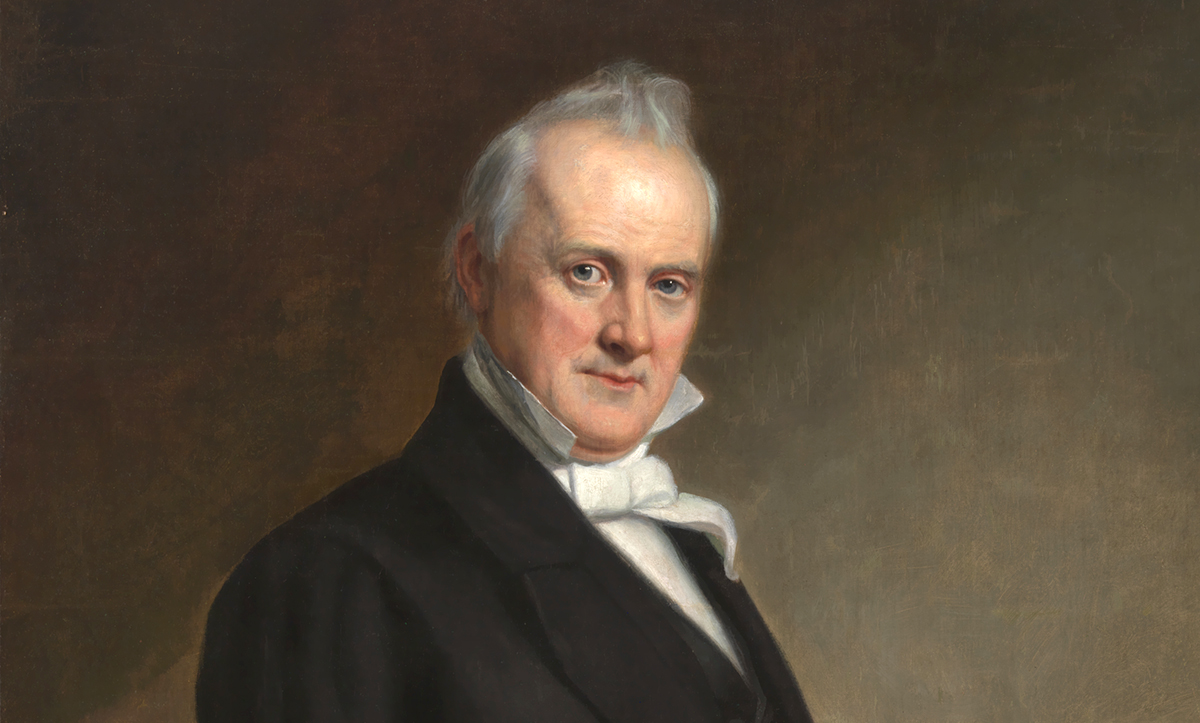
Sermon – Military – 1755


Samuel Davies (1724-1761) was licensed to preach in 1746. He moved to Hanover County, VA in 1747 where he became a circuit preacher for seven churches. Davies served as President of Princeton University for eighteen months before his death. (For more sermons by Samuel Davies, see here.)

This sermon was preached on August 17, 1755. In it, Rev. Davies makes brief mention of Col. George Washington who had been involved in the July 9th Battle of the Monongahela during the French & Indian War (1754-1763). Learn more about this battle (and about Washington’s actions specifically) in WallBuilders’ book The Bulletproof George Washington.


sermon-military-1755

RELIGION

AND

PATRIOTISM

The Constituents of a Good

SOLDIER.

A

SERMON

Preached to

Captain Overton’s Independent Company of Volunteers, raised in Hanover County, Virginia, August 17, 1755.

By Samuel Davies, A. M. Minister of
The Gospel there
.


2 Sam. x. 12.

Be of good Courage, and let us play the Men, for our People, and for the Cities of our God: And the Lord do that which seemeth him good.

An Hundred Years of Peace and Liberty in such a World as this, is a very unusual Thing; and yet our Country has been the happy Spot that has been distinguished with such a long Series of Blessings, with little or no Interruption. Our Situation in the middle of the British Colonies, and our Separation from the French, those eternal Enemies of Liberty and Britons, on the one Side by the vast Atlantic, and on the other by a long Ridge of Mountains, and a wide extended Wilderness, have for many Years been a Barrier to us; and while other Nations have been involved in War, we have not been alarmed with the Sound of the Trumpet, nor seen Garments rolled in Blood.

But now the Scene is changed: Now we begin to experience in our Turn the Fate of the Nations of the Earth. Our Territories are invaded by the Power, and Perfidy of France; our Frontiers ravaged by merciless Savages, and our Fellow-Subjects there murdered with all the horrid Arts of Indian and Popish Torture. Our General, unfortunately brave, is fallen, an Army of 1300 choice Men routed, our fine Train of Artillery taken, and all this (Oh mortifying Thought!) all this by 4 or 500 dastardly, insidious Barbarians.

These Calamities have not come upon us without Warnings. We were long ago apprized of the ambitious Schemes of our enemies, and their Motions to carry them into Execution: And had we taken timely Measures they might have been crushed, before they could have arrived at such a formidable Height. But how have we generally behaved in such a critical Time? Alas! our Country has been sunk in a deep Sleep: A stupid Security has unmanned the Inhabitants: They could not realize a Danger at the Distance of 2 or 300 Miles: They would not be persuaded, that even French Papists could seriously design us an Injury: And hence little, or nothing has been done for the Defence of our Country in Time, except by the Compulsion of Authority. And now, when the Cloud thickens over our Heads, and alarms every thoughtful Mind with its near Approach, Multitudes, I am afraid, are still dissolved in careless Security, or enervated with an effeminate, cowardly Spirit. When the melancholy News first reached us concerning the Fate of our Army, then we saw how natural it is for Presumptuous to fall into the opposite Extreme of unmanly Despondence, and Consternation; and how little Men could do in such a Pannic for their own Defence. We have also suffered our poor Fellow-Subjects in the Frontier Counties to fall a helpless Prey to Blood-thirsty Savages, without affording them proper Assistance, which as Members of the same Body Politic they had a Right to expect. They might as well have continued in a State of Nature, as be united in Society, if in such an Article of extreme Danger, they are left to shift for themselves. The bloody Barbarians have exercised on some of them the most unnatural and leisurely Tortures; and others they have butchered in their Beds, or in some unguarded Hour, Can human Nature bear the Horror of the Sight! See yonder? The hairy Scalps clotted with Gore! The mangled Limbs! Tomen ript up! the Heart and Bowels, still palpitating with Life, and smoking on the Ground! See the Savages swilling their Blood, and imbibing a more outrageous Fury with the inhuman Draught! Sure these are not Men; they are not Beasts of Prey; they are something worse; they must be infernal Furies in human Shape. And have we tamely looked on, and suffered them to exercise these hellish Barbarities upon our Fellow-Men, our Fellow-Subjects, our Brethren? Alas! with what Horror must we look upon ourselves, as being little better than Accessaries to their Blood?

And shall these Ravages go on uncheck’d? Shall Virginia incur the Guilt, and the everlasting Shame of tamely exchanging her Liberty, her Religion, and her All, for arbitrary Gallic Power, and for Popish Slavery, Tyranny, and Massacre? Alas! are there none of her Children, that enjoyed all the Blessings of her Peace, that will espouse her Cause, and befriend her now in the Time of her Danger? Are Britons utterly degenerated by so short a Remove from their Mother-Country? Is the Spirit of Patriotism entirely extinguished among us? And must I give thee up for lost, O my Country! And all that is included in that important Word? Must I look upon thee as a conquered, enslaved Province of France, and the Range of Indian Savages? My Heart breaks at the Thought. And must ye, our unhappy Brethren in our Frontiers, must ye stand the single Barriers of a ravaged Country, unassisted, unbefriended, unpitied? Alas! must I draw these shocking Conclusions?

No; I am agreeably checked by the happy, encouraging Prospect now before me. Is it a pleasing Dream? Or do I really see a Number of brave Men, without the Compulsion of Authority, without the Prospect of Gain, voluntarily associated in a Company, to march over trackless Mountains, the Haunts of wild Beasts, or fiercer Savages, Rocks and Mountains, into an hideous Wilderness, to succor their helpless Fellow-Subjects, and guard their Country? Yes, Gentlemen, I see you here upon this Design; and were you all united to my Heart by the most endearing Ties of Nature, or Friendship, I could not wish to see you engaged in a nobler Cause; and whatever the Fondness of Passion might carry me to, I am sure my Judgment would never suffer me to persuade you to desert it. You all generously put your Lives in your Hands; and sundry of you have nobly disengaged yourselves from the strong and tender Ties that twine about the Heart of a Father, or a Husband, to confine you at home in inglorious Ease, and sneaking Retirement from Danger, when your Country calls for your Assistance. While I have you before me, I have high Thoughts of a Virginian; and I entertain the pleasing Hope that my Country will yet emerge out of her Distress, and flourish with her usual Blessings. I am gratefully sensible of the unmerited Honour you have done me, in making Choice of me to address you upon so singular and important an Occasion: And I am sure I bring with me a Heart ardent to serve you and my Country, though I am afraid my Inability, and the Hurry of my Preparations, may give you Reason to repent your Choice. I cannot begin my Address to you with more proper Words than those of a great General, which I have read to you: Be of good Courage, and play the Men, for your People, and for the Cities of your God; and the Lord do what seemeth him good.

My present Design is, to illustrate and improve the sundry Parts of my Text, as They lie in order, which you will find rich in sundry important Instructions, adapted to this Occasion.

The Words were spoken just before a very threatening Engagement by Joab, who had long served under that pious Hero King David, as the General of his Forces, and had shewn himself an Officer of true Courage, conducted with Prudence. The Ammonites, a neighbouring Nation, at frequent Hostilities with the Jews, had ungratefully offered Indignities to some of David’s Courtiers whom he had sent to condole their King upon the Death of his Father, and congratulate his Accession to the Crown. Our holy Religion teaches us to bear personal Injuries without private Revenge: But national Insults, and Indignities ought to excite the public Resentment. Accordingly King David, when he heard that the Ammonites, with their Allies, were preparing to invade his Territories, and carry their Injuries still farther, sent Joab his General, with his Army, to repel them, and avenge the Affronts they had offered his Subjects. It seems the Army of the Enemy were much more numerous than David’s: Their Mercenaries from other Nations were no less than 31,000 Men; and no Doubt the Ammonites themselves were a still greater Number. These numerous Forces were disposed in the most advantageous Manner, and surrounded Joab’s Men, that they might attack them both in Flank and Front at once, and cut them all off, leaving no Way for them to escape. Prudence is of the utmost Importance in the Conduct of an Army: And Joab, in this critical Situation, gives a Proof how much he was Master of it, and discovers the steady Composure of his Mind, while thus surrounded with Danger. He divides his Army, and gives one Party to his Brother Abishai, who commanded next to him, and the other he kept the Command of himself, and resolves to attack the Syrian Mercenaries, who seemed the most formidable; he gives Orders to his Brother in the mean Time to Fall upon the Ammonites; and he animates him with this noble Advice: Be of good Courage, and let us play the Men, for our People and the Cities of our God, which are now at Stake: And the Lord do what seemeth him good.

Be of good Courage, and let us play the Men:–Courage is an essential Character of a good soldier:–Not a savage ferocious Violence:–Not a fool-hardy Insensibility of Danger, or headstrong Rashness to rush into it:–Not the Fury of enflamed Passions, broke loose from the Government of Reason: But calm, deliberate, rational Courage; a steady, judicious, thoughtful Fortitude; the Courage of a Man, and not of a Tyger: Such a Temper as Addison ascribes with so much Justice to the famous Marlborough and Eugene:

Whose Courage dwelt not in a troubled Flood
Of mounting Spirits, and fermenting Blood;–But
Lodg’d in the Soul, with Virtue over-rul’d,
Inflam’d by Reason, and by Reason cool’d
. 1
This is true Courage, and such as we ought all to cherish in the present dangerous Conjuncture. This will render Men vigilant and cautious against Surprizes, prudent and deliberate in concerting their Measures, and steady and resolute in executing them. But without this they will fall into unsuspected Dangers, which will strike them with wild Consternation: They will meanly shun Dangers that are surmountable, or precipitantly rush into those that are causeless, or evidently fatal, and throw away their Lives in vain.

There are some Men who naturally have this heroic Turn of Mind. The wise Creator has adapted the natural Genius of Mankind, with a surprising and beautiful Variety to the State in which they are placed in this World. To some he has given a Turn for intellectual Improvement, and the liberal Arts and Sciences; to others a Genius for Trade; to others a Dexterity in Mechanics, and the ruder Arts, necessary for the Support of human Life: The Generality of Mankind may be capable of tolerable Improvements in any of these: But it is only they whom the God of Nature has formed for them, that will shine in them, every Man in his own Province. And as God well knew what a World of degenerate, ambitious, and revengeful Creatures this is; as he knew that Innocence could not be protected, Property and Liberty secured, nor the Lives of Mankind preserved from the lawless Hands of Ambition, Avarice and Tyranny, without the Use of the Sword; as he knew this would be the only Method to preserve Mankind from universal Slavery; he has formed some Men for this dreadful Work, and fired them with a martial Spirit, and a glorious Love of Danger. Such a Spirit, though most pernicious when ungoverned by the Rules of Justice, and Benevolence to Mankind, is a public Blessing, when rightly directed: Such a Spirit, under God, has often mortified the Insolence of Tyrants, checked the Incroachments of arbitrary Power, and delivered enslaved and ruined Nations: It is as necessary in its Place, for our Subsistence in such a World as this, as any of the gentler Genius’s among Mankind; and it is derived from the same divine Original. He that winged the Imagination of an Homer or a Milton, he that gave Penetration to the Mind of Newton, he that made Tubal-Cain an Instructor or Artificers in Brass and Iron, 2 and gave Skill to Bezaleel and Aholiab in curious Works; 3 nay he that sent out Paul and his Brethren to conquer the Nations with the gentler Weapons of Plain Truth, Miracles, and the Love of a crucified Saviour; He, even that same gracious Power, has formed and raised up an Alexander, a Julius Caesar, a William, 4 and a Marlborough, and inspired them with this enterprising, intrepid Spirit, the Two first to scourge a guilty World, and the Two last to save Nations on the Brink of Ruin. There is something glorious and inviting in Danger, to such noble Minds; and their Breasts beat with a generous Ardour when it appears.

Our Continent is like to become the Seat of War; and we, for the future (till the sundry European Nations that have planted Colonies in it, have fixed their Boundaries by the Sword) have no other Way left to defend our Rights and Privileges. And has God been pleased to disuse some Sparks of this Martial Fire through our Country? I hope he has: And though it has been almost extinguished by so long a Peace, and a Deluge of Luxury and Pleasure, now I hope it begins to kindle: And may I not produce you my Brethren, who are engaged in this Expedition, as Instances of it? 5 Well, cherish it as a sacred Heaven-born Fire; and let the Injuries done to your Country administer Fewel to it; and kindle it in those Breasts where it has been hitherto smothered or inactive.

Though Nature be the rue Origin of military Courage, and it can never be kindled to a high Degree, where there is but a feeble Spark of it innate; yet there are sundry Things that may improve it even in Minds full of natural Bravery, and animate those who are naturally of an effeminate Spirit to behave with a tolerable Degree of Resolution and Fortitude, in the Defence of their Country.—-I need not tell you that it is of great Importance for this End that you should be at Peace with God, and your own Conscience, and prepared for your future State. Guilt is naturally timorous, and often struck into a Panic even with imaginary Dangers; and an infidel Courage, proceeding from Want of Thought, or a stupid Carelessness about our Welfare through an immortal Duration beyond the Grave, is very unbecoming a Man or a Christian. The most important Periods of our Existence, my Brethren, lie Beyond the Grave; and it is a Matter of much more Concern to us, what will be our Doom in the World to come, than what becomes of us in this. We are obliged to defend our Country; and that is a sneaking, sordid Soul indeed that can desert it at such a Time as this: But this is not all; we are also obliged to take Care of an immortal Soul; a Soul that must exist, and be happy or miserable, through the Revolutions of eternal Ages. This should be our first Care; and when this is secured, Death, in its most Chocking Forms, is but a Release from a World of Sin and Sorrows, and an Introduction into everlasting Life and Glory. But how can this be secured? Not by a Course of impenitent Sinning; not by a Course of stupid Carelessness and Inaction: But by vigorous and resolute striving; by serious and affectionate Thoughtfulness about our Condition, and by a conscientious and earnest Attendance upon the Means that God has graciously appointed for our Recovery. But “we are Sinners, heinous Sinners against a God of infinite Purity and inexorable Justice. Yes, we are so; and does not the Posture of Penitents then become us? Is not Repentance, deep, brokenhearted Repentance, a Duty suitable to Persons of our Character? Undoubtedly it is: And therefore, O my Countrymen, and particularly you brave Men that are the Occasion of this Meeting, Repent: Fall down upon your Knees before the provoked Sovereign of Heaven and Earth, against whom you have rebelled. Dissolve and melt in penitential Sorrows at his Feet; and he will tell you Arise, be of good Chear; your Sins are forgiven you. “But will Repentance make Atonement for our Sins? Will our Tears wash away their Guilt? Will our Sorrows merit Forgiveness?” No, my Brethren, after you have done all, you are but unprofitable Servants: After all your Sorrows, and Prayers and Tears, you deserve to be punished as obnoxious Criminals: That would be a sorry Government indeed, where Repentance, perhaps extorted by the servile Fear of Punishment, would make Atonement for every Offence. But I bring you glad Tidings of great Joy, To you is born a Saviour, a Saviour of no mean Character; he is Christ the Lord. And have you never heard that he has made Reconciliation for Iniquity, and brought in everlasting Righteousness; that he suffered, the Just for the Unjust; that God is well-pleased for his Righteousness-Sake, and declares himself willing to be reconciled to all that believe in him, and cheerfully accept him as their Saviour and Lord. Have you never heard these joyful Tidings, O guilty, self-condemned Sinners? Sure you have. Then away to Jesus, away to Jesus ye whose Consciences are loaden with Guilt, ye whose Hearts fail within you at the Thought of Death, and the Tribunal of Divine Justice; ye who are destitute of all personal Righteousness to procure your Pardon, and recommend you to the Divine Favour: Fly to Jesus on the Wings of Faith, all of you, of every Age and Character; for you all stand in the most absolute Need of him; and without him you must perish every Soul of You. But alas! we find ourselves utterly unable to repent and fly to Jesus: Our Hearts are hard and unbelieving, and if the Work depend upon us, it will forever remain undone. True, my Brethren, so the Case is; but do ye not know that this guilty Earth is under the Distillings of Divine Grace, that Jesus is intrusted with the Influences of the Spirit, which can work in you both to will and to do; and that he is willing to give his Holy Spirit to them that ask him? If you know this, you know here to go for Strength; therefore cry mightily to God for it. This I earnestly recommend to all my Hearers, and especially to you Gentlemen, and others, that are now about generously to risqué your Lives for your Country. Account this the best Preparative to encounter Danger and Death; the best Incentive to true, rational Courage. What can do you a lasting Injury, while you have a reconciled God smiling upon you from on high, a peaceful Conscience animating you within, and a happy Immortality just before you! Sure you may bid Defiance to Dangers and Death in their most shocking Forms. You have answered the End of this Life already by preparing for another; and how can you depart off this mortal Stage more honourably, than in the Cause of Liberty, of Religion, and your Country? But if any of you are perplexed with gloomy Fears about this important Affair, or conscious you are entirely unprepared for Eternity, what must you do? Must you seek to prolong your Life, and your Time for Preparation, by mean or unlawful Ways, by a cowardly Desertion of the Cause of your Country, and shifting for your little Selves, as though you had no Connection with Society? Alas! this would but aggravate your Guilt, and render your Condition still more perplexed and discouraging. Follow the Path of Duty wherever it leads you, for it will be always the safest in the Issue. Diligently improve the Time you have to make your Calling and Election sure, and you have Reason to hope for Mercy, and Grace to help in such a Time of Need.—-You will forgive me, if I have enlarged upon this Point, even to a Digression; for I thought it of great Consequence to you all. I shall now proceed with more Haste.

It is also of great Importance to excite and keep up our Courage in such an Expedition, that we should be fully satisfied we engage in a righteous Cause,—and in a Cause of great Moment; for we cannot prosecute a suspected, or a wicked Scheme, which our own Minds condemn, but with Hesitation, and timorous Apprehensions; and we cannot engage with Spirit and Resolution in a trifling Scheme, from which we can expect no Consequences worth our vigorous Pursuit. This Joab might have in View in his heroic Advice to his Brother; Be of good Courage, says he, and let us play the Men, for our People, and for the Cities of our God. q. d. We are engaged in a righteous Cause; we are not urged on by an unbounded Lust of Power or Riches, to encroach upon the Rights and Properties of others, and disturb our quiet Neighbours: We act entirely upon the defensive, repel unjust Violence, and avenge nation Injuries; we are fighting for our People, and for the Cities of our God. We are also engaged in a Cause of the utmost Importance. We fight for our People; and what Endearments are included in hat significant Word! Our Liberty, our Estates, our Lives! Our King, our Fellow-Subjects, our venerable Fathers, our tender Children, the Wives of our Bosom, our Friends the Sharers of our Souls, our Posterity to the latest Ages! And who would not use his Sword with an exerted Arm, when these lie at Stake? But even these are not all: We fight for the Cities of our God. God has distinguished us with a Religion from Heaven; and hitherto we have enjoyed the quiet and unrestrained Exercise of it: He has condescended to be a God to our Nation, and to hour our Cities with his gracious Presence, and the Institutions of his Worship, the Means to make us wise, good and happy: But now these most invaluable Blessings lie at Stake; these are the Prize for which we contend; and must it not excite all our active Powers to the highest Pitch of Exertion? Shall we tamely submit to Idolatry, and religious Tyranny? No, God forbid: Let us play the Men, since we take up Arms for our People, and the Cities of our God.

I need not tell you how applicable this Advice, thus paraphrased, is to the Design of the present associated Company. The Equity of our Cause is most evident. The Indian Savages have certainly no Right to murder our Fellow-Subjects, living quiet and inoffensive in their Habitations; nor have the French any Power to hound them out upon us, nor to invade the Territories belonging to the British Crown, and secured to it by the Faith of Treaties. This is a clear Case. And it is equally clear, that you are engaged in a Cause of the utmost Importance. To protect your Brethren from the most bloody Barbarities—to defend the Territories of the best of Kings against the Oppression and Tyranny of arbitrary Power, to secure the inestimable Blessings of Liberty, British Liberty, from the Chains of French Slavery—to preserve your Estates, for which you have sweat and toiled, from falling a Prey to greedy Vultures, Indians, Priests, Friers, and hungry Galic Slaves, or not-more-devouring Flames—to guard your Religion, the pure Religion of Jesus, streaming uncorrupted from the sacred Fountain of the Scriptures; the most excellent, rational and divine Religion that ever was made known to the Sons of Men; to guard so dear so precious a Religion (my Heart grows warm while I mention it) against Ignorance, Superstition, Idolatry, Tyranny over Conscience, Massacre, Fire and Sword, and all the Mischiefs beyond Expression, with which Popery is pregnant—to keep from the cruel Hands of Barbarians and Papists, your Wives, your Children, your Parents, your Friends—to secure the Liberties conveyed to you by your brave Fore-fathers, and bought with their Blood, that you may transmit them uncurtailed to your Posterity—these are the Blessings you contend for; all these will be torn from your eager Grasp, if this Colony should become a Province of France. And Virginians! Britons! Christians! Protestants! if these Names have any Import or Energy, will you not strike home in such a Cause? Yes, this View of the Matter must fire you into Men; methinks the cowardly Soul must tremble, left the Imprecation of the Prophet fall upon him, Cursed be the Man that keepeth back his Sword from Blood. To this shocking, but necessary Work, the Lord now calls you, and cursed is he that doth the Work of the Lord deceitfully; that will not put his Hand to it, when it is in his Power, or that will not perform it with all his Might. 6 The People of Meroz lay at home in Ease, while their Brethren were in the Field, delivering their Country from Slavery. And what was their Doom? Curse ye Meroz, said the Angel of the Lord, curse ye bitterly the Inhabitants thereof, because they came not to the Help of the Lord, to the Help of the Lord against the Mighty. 7 I count myself happy that I see so many of you generously engaged in such a Cause; but when I view it in this Light, I cannot but be concerned that there are so few to join you. Are there but 50 or 60 Persons in this large and populous County that can be spared from home for a few Weeks upon so necessary a Design, or that are able to bear the Fatigues of it? Where are the Friends of human Nature, where the Lovers of Liberty and Religion? Now is the Time for you to come forth, and shew yourselves. Nay, where is the Miser? Let him arise and defend his Mammon, or he may soon have Reason to cry out with Micah, They have taken away my Gods, and what have I more? Where is the tender Soul, on whom the Passions of a Husband, a Father, or a Son, have a peculiar Energy? Arise, and march away; you had better be absent from those you love for a little while, than see them butchered before your Eyes, or doomed to eternal Poverty and Slavery. The Association now forming is not yet compleat; and if it were, it would be a glorious Thing to form another. Therefore, as an Advocate for your King, your Fellow-Subjects, your Country, your Relatives, your earthly All: I do invite and intreat all of you, who have not some very sufficient Reason against it, voluntarily to enlist, and go out with those brave Souls, who have set you so noble an Example. It will be more advantageous to go out in Time, and more honourable to go out as Volunteers, than to be compelled to it by Authority, when perhaps it may be too late.

The Consideration of the Justice and Importance of the Cause may also encourage You to hope, that the Lord of Hosts will espouse it, and render its Guardians successful, and return them in Safety to the Arms of their longing Friends. The Event however is in his Hands; and it is much better there, than if it were in Yours. This Thought is suggested with beautiful Simplicity, in the remaining Part of my Text, The Lord do that which seemeth him good. This may be looked upon in various Views, as,

1. It may be understood as the Language of Uncertainty, and Modesty. Q. d. Let us do all we can; but after all, the Issue is uncertain; we know not, as yet, to what Side God will incline the Victory. Such Language as this, my Brethren, becomes us in all our Undertaking; it sounds Creature-like, and God approves of such self-diffident Humility. But to indulge sanguine and confident Expectations of Victory, to boast when we put on our Armour, as though we were putting it off, and to derive our high Hopes from our own Power and good Management, without any Regard to the Providence of God, this is too lordly and assuming for such feeble Mortals; such Insolence is generally mortified, and such a haughty Spirit, is the Fore-runner of a Fall. Therefore, though I do not apprehend Your Lives will be in any great Danger in Your present Expedition to range the Frontiers, and clear them of the skulking Indians; yet, I would not flatter You, my Brethren, with too high Hopes either of Victory or Safety. I cannot but entertain the pleasing Prospect of congratulating You with many of Your Friends, upon your successful Expedition, and safe Return: And yet it is very possible our next Interview may be in that strange untried World beyond the Grave. You are, however, in the Hands of God, and he will deal with you as it seemeth him good: And I am persuaded You would not wish it were otherwise; You would not now practically retract the Petition You have so often offered up, Thy Will be done on Earth, as it is in Heaven.

2. This Language; The Lord do as seemeth him good, may be looked upon as expressive of a firm Persuasion that the Event of War entirely depends upon the Providence of God. q. d. Let us do our best; but after all, let us be sensible that the Success does not depend on us; that is entirely in the Hands of an all-ruling God. That God governs the World, is a fundamental Article of natural, as well as revealed Religion: It is no great Exploit of Faith, to believe this: It is but a small Advance beyond Atheism, and downright Infidelity. I know no Country upon Earth, where I should be put to the Expence of Argument to prove this. The Heathens gave striking Proofs of their Belief of it, by their Prayers, their Sacrifices, their consulting Oracles, before they engaged in War; and by their costly Offerings and solemn Thanksgivings, after Victory. And shall such a plain Principle as this, be disputed in a Christian Land? No; we all speculatively believe it; but that is not enough; let our Spirits be deeply impressed with it, and our Lives influenced by it: Let us live in the World, as in a Territory of Jehovah’s Empire. Carry this Impression upon Your Hearts into the Wilderness, whither You are going. Often let such Thoughts as these recur to your Minds, I am the feeble Creature of God; and blessed be his Name, I am not cast off his Hand as a disregarded Orphan to shift for myself. My Life is under his Care; the Success of this Expedition is at his Disposal. Therefore, O thou all-ruling God, I implore thy Protection; I confide in thy Care; I cheerfully resign myself, and the Event of this Undertaking, to thee. Which leads me to observe,

3. That these Words, The Lord do what seemeth him good, may express a humble Submission to the Disposal of Providence, let the Event turn out as it would. Q. d. We have not the Disposal of the Event, nor do we know what will be: But Jehovah knows, and that is enough. We are sure he will do what is best, upon the whole; and it becomes us to acquiesce! Thus, my Friends, do You resign and submit yourselves to the Ruler of the World in the present Enterprize. He will order Matters as he pleases; Oh! let him do so by Your cheerful Consent. Let Success or Disappointment, let Life or Death be the Issue, still say, Good is the Will of the Lord; let him do what seemeth him good: Or if Nature biases Your Wishes and Desires to the favourable Side, as no Doubt it will, still keep them within Bounds, and restrain them in Time, saying after the Example of Christ, Not my Will, but thine be done. You may wish, you may pray, you may strive, you may hope for a happy issue: But you must submit; Be still, and know that he is God, and will not be prescribed to, or suffer a Rival in the Government of the World he has made. Such a Temper will be of unspeakable Service to You, and you may hope God will honour it with a remarkable Blessing: For Submission to his Will is the readiest Way to the Accomplishment of our own.

4. These Words, in their Connection, may intimate, that let the Event be what it will, it will afford us Satisfaction to think, that we have done the best we could. q. d. We cannot command Success; but let us do all in our Power to obtain it, and we have Reason to hope that in this Way we shall not be disappointed: But if it should please God to render all our Endeavours vain, still we shall have the generous Pleasure to reflect, that we have not been accessory to the Ruin of our Country, but have done all we could for its Deliverance. So You my Brethren have generously engaged in a disinterested Scheme for Your King, and Country: God does generally crown such noble Undertakings with Success, and You have Encouragement to hope for it: But the Cause You have espoused, is the Cause of a sinful impenitent Country; and if God, in righteous Displeasure, should on this Account blast your Attempt, still you will have the Pleasure of reflecting upon Your generous Views and vigorous Endeavours, and that You have done Your Part conscientiously.

Having thus made some cursory Remarks upon the sundry Parts of the Text, I shall now conclude with an Address, first to you all in general, and then to you Gentlemen and others, who have been pleased to invite me to this Service. I hope You will forgive my Prolixity: My Heart is full, the Text is copious, and the Occasion singular and important. I cannot therefore dismiss You with a short hurrying Discourse.

It concerns you all seriously to reflect upon your own Sins, and the Sins of your Land, which have brought all these Calamities upon us. If You believe that God governs the World, if You do not abjure him from being the Ruler of Your Country, You must acknowledge that all the Calamities of War, and the threatening Appearances of Famine, are ordered by his Providence; There is no Evil in a City or Country, but the Lord hath done it. And if You believe that he is a just and righteous Ruler, You must also believe, that he would not thus punish a righteous or a penitent People. We and our Countrymen are Sinners, aggravated Sinners: God proclaims that we are such by his Judgments now upon us, by withering Fields, and scanty Harvests, by the Sound of the Trumpet and the Alarm of War. Our Consciences must also bear witness to the same melancholy Truth. And if my Heart were properly affected, I would concur with these undoubted Witnesses: I would cry aloud, and not spare, I would lift up my Voice like a Trumpet, to shew you Your Transgressions and Your Sins. O my Country, is not thy Wickedness great, and thine Iniquities infinite? Where is there a more sinful Spot to be found upon our guilty Globe? Pass over the Land, take a Survey of the Inhabitants, inspect into their Conduct, and what do you see? What do you hear? You see gigantic Forms of Vice braving the Skies, and bidding Defiance to Heaven and Earth, while Religion and Virtue is obliged to retire, to avoid public Contempt and Insult.—You see Herds of Drunkards swilling down their Cups, and drowning all the Man within them. You hear the Swearer venting his Fury against God and Man, trifling with that Name which prostrate Angels adore, and imprecating that Damnation, under which the hardiest Devil in Hell trembles, and groans. You see Avarice hoarding up her useless Treasures, dishonest Craft planning her Schemes of unlawful Gain, and Oppression unmercifully grinding the Face of the Poor. You see Prodigality squandering her Stores, Luxury spreading her Table, and unmanning her Guests; Vanity laughing aloud, and dissolving in empty unthinking Mirth, regardless of God, and our Country, of Time and Eternity; Sensuality wallowing in brutal Pleasures, and aspiring with inverted Ambition, to sink as low as her four-footed Brethren of the Stall. You see Cards more in Use than the Bible, the Back-Gammon Table more frequented than the Table of the Lord, Plays and Romances more read than the History of the blessed Jesus. You see trifling and even criminal Diversions become a serious Business; the Issue of a Horse-race, or a Cock-fight, more anxiously attended to than the Fate of our Country. Or where these grosser Forms of Vice and Vanity do not shock your Senses, even there you often meet with the Appearances of more refined Impiety, which is equally dangerous. You hear the Conversation of reasonable Creatures, of Candidates for Eternity, engrossed by Trifles, or vainly wasted on the Affairs of Time: These are the eternal Subjects of Conversation, even at the Threshold of the House of God, and on the sacred Hours devoted to his Service. You see Swarms of Prayer-less Families all over our Land: Ignorant, vicious Children, unrestrained and untaught by those to whom God and Nature hath entrusted their Souls. You see Thousands of poor Slaves in a Christian Country, the Property of Christian Masters, as they will be called, almost as ignorant of Christianity, as when they left the Wilds of Africa. You see the best Religion in all the World, abused, neglected, disobeyed and dishonoured by its Professors: And you hear Infidelity scattering her ambiguous Hints and Suspicions, or openly attacking the Christian Cause with pretended Argument, with Insult and Ridicule. You see Crowds of professed Believers, that are practical Atheists; nominal Christians, that are real Heathens; many abandoned Slaves of Sin, that yet pretend to be the Servants of the Holy Jesus. You see the Ordinances of the Gospel neglected by some, profaned by others, and attended upon by the Generality with a trifling Irreverence, and stupid Unconcernedness. Alas! who would think that those thoughtless Assemblies we often see in our Places of Worship, are met for such solemn Purposes as to implore the Pardon of their Sins from an injured God, and to prepare for an awful all-important Eternity? Alas! is that Religion for the Propagation of which the Son of God labored, and bled, and died, for which his Apostles and Thousands of Martyrs have spent their Strength and shed their Blood, and on which our eternal Life depends, is that Religion become such a Trifle in our Days, that Men are hardly serious and in earnest when they attend upon its most solemn Institutions? What Multitudes lie in a dead Sleep in Sin all around us? You see them eager in the Pursuit of the Vanities of Time, but stupidly unconcerned about the important Realities of the eternal World just before them: Few solicitous what shall become of them when all their Connections with Earth and Flesh must be broken, and they must take their Flight into strange unknown Regions: Few lamenting their Sins: Few crying for Mercy and a new Heart: Few flying to Jesus, or justly sensible of the Importance of a Mediator in a Religion for Sinners. You may indeed see some Degree of Civility and Benevolence towards Men, and more than enough of cringing Complaisance of Worms to Worms, of Clay to Clay, of Guilt to Guilt: But Oh! how little sincere Homage, how little affectionate Veneration for the great Lord of Heaven and Earth? You may see something of Duty to Parents, of Gratitude to Benefactors, and Obedience to Superiors: But if God be a Father, where is his Honour? If he be a Master, where is his Fear? If he be our Benefactor, where is our Gratitude to him? You may see here and there some Instances of proud, self-righteous Virtue, some Appearances of Morality: But Oh! how rare is vital, evangelical Religion, and true Christian Morality, animated with the Love of God, proceeding from a new Heart, and a Regard to the divine Authority, full of Jesus, full of a Regard to him as a Mediator, on whose Account alone our Duties can find Acceptance? O blessed Redeemer! What little Necessity, what little Use do the Sinners of our Country find for thee in their Religion? How many Discourses are deliver’d, how many Prayers offer’d, how many good Works are performed, in which there is scarce any Thing of Christ? And this Defect renders them all but shining Sins, glittering Crimes. How few pant and languish for thee, Blessed Jesus! And can never be contented with their Reformation, with their Morality, with their good Works, till they obtain an Interest in thy Righteousness, to sanctify all, to render all acceptable!—You may see Children sensible of their Dependence on their Parents for their Subsistence, you see Multitudes sensible of their Dependence on Clouds and Sun and Earth for Provision for Man and Beast: But how few sensible of their Dependence upon God, as the great Original, the Primum Mobile of natural Causes, and the various Wheels of the Universe. You see even the dull Ox knows his Owner, and the stupid Ass his Master’s Crib: You see the Workings of Gratitude even in your Dog, who welcomes you home with a Thousand fondling Motions: But how is Jehovah’s Government, and Agency practically denied in his own Territories! How few receive the Blessings of Life as from his Hand, and make him proper Returns of Gratitude? You see a withering, ravaged Country around you, languishing under the Frowns of an angry God; but how few earnest Prayers, how few penitential Groans do you hear? Pass over the Land, and bring me Intelligence, is not this the general Character of our Country? I know there are some happy Exceptions; and I hope sundry such might be produced from among you: But is not this the prevailing Character of a great Majority? Does not one Part or other of it belong to the Generality? The most generous Charity cannot hope the Contrary, if under any scriptural or rational Limitations. May it not be said of the
Men of Virginia, as well as those of Sodom, They are wicked, and Sinners before the Lord exceedingly? And thus, alas! it has been for a long Time: Our Country has sinned on securely for above 150 Years, and one Age has improved upon the Vices of another. And can a Land always bear up under such a Load of accumulated Wickedness? Can God always suffer such a Race of Sinners to go on unpunished from Generation to Generation? May we not fear that our Iniquities are now just full, and that he is about to thunder out his awful Mandate to the Executioners of his Vengeance, Put ye in the Sickle; for the Harvest is ripe; come get ye down, for the Press is full, the Vats overflow; for their Wickedness is great.

And is there no Relief for a sinking Country? Or is it too late to administer it? Is our Wound incurable, that refuseth to be healed? No, blessed be God; if you now turn every one of you from your Evil Ways, if you mourn over your Sins, and turn to the Lord with your whole Hearts, then your Country will yet recover. God will appear for us, and give a prosperous Turn to our Affairs; he has assured us of this in his own Word, At what Instant, says he, I shall speak concerning a Nation, and concerning a Kingdom, to pluck up, and to pull down, and to destroy it; if that Nation, against whom I have pronounced, turn from their Evil, I will repent of the Evil that I thought to do unto them, Jer. xviii. 7, 8. Therefore, my Brethren, as we have all rebelled, let us all join in unanimous Repentance, and a thorough Reformation. Not only your eternal Salvation requires it, but also the Preservation of your Country, that is now bleeding with the Wounds you have given it by your Sins. The safety of these our Friends, who are now engaged in so generous a Design, requires it: For an Army of Saints or of Heroes, cannot defend a guilty, impenitent People, ripe for the Judgments of God. If you would be everlastingly happy, and escape the Vengeance of eternal Fire, or (to mention what may perhaps have more Weight with some of you) if you would preserve yourselves, your Families, your Posterity, from Poverty, from Slavery, Ignorance, Idolatry, Torture and Death; if you would save yourselves and them from all the infernal Horrors of Popery, and the savage Tyranny of a mongrel Race of French and Indian Conquerors; in short, if you would avoid all that is terrible, and enjoy every Thing that is dear and valuable, R E P E N T, and turn to the Lord. This is the only Cure for our wounded Country; and if you refuse to administer it in Time, prepare to perish in its Ruins. If you go on impenitent in Sin, you may expect not only to be damned forever, but (what is more terrible to some of you) to fall into the most extreme outward Distress. You will have Reason to fear not only the Loss of Heaven, which some of you perhaps think little of, but the Loss of your Estates, that lie so near your Hearts. And will you not repent, when you are pressed to it from so many Quarters at once?

And now, my Brethren, in the last Place, I have a few parting Words to offer to you who are more particularly concerned in this Occasion; and I am sure I shall address you with as much affectionate Benevolence as you could wish.

My first and leading Advice to you is, Labour to conduct this Expedition in a Religious Manner. Methinks this should not seem strange Counsel to Creatures, entirely dependent upon God, and at his Disposal. As you are an Independent Company of Volunteers under Officers of your own chusing, you may manage your Affairs more according to your own Inclinations, than if you had enlisted upon the ordinary Footing: And I hope you will improve this Advantage for the Purposes of Religion. Let Prayer to the God of your Life be your daily Exercise. When Retirement is safe, pour out your Hearts to him in secret; and when it is practicable, join in Prayer together Morning and Evening in your Camp. How acceptable to Heaven must such an unusal offering be, from that desart Wilderness! Maintain a Sense of divine Providence upon your Hearts, and resign yourselves and all your Affairs into the Hands of God. You are engaged in a good Cause, the Cause of your People, and the Cities of your God; and therefore you may the more boldly commit it to him, and pray and hope for his Blessing. I would fain hope, there is no Necessity to take Precautions against Vice among such a select Company: But lest there should, I would humbly recommend it to you to make this one of the Articles of your Association, before you set out, that every Form of Vice shall be severely discountenanced, and if you think proper, expose the Offender to some pecuniary or corporal Punishment. It would be shocking indeed, and I cannot bear the Thought, that a Company formed upon such generous Principles, should commit or tolerate open Wickedness among them; and I hope this Caution is needless to you all, as I am sure it is to sundry of you.

And now, my dear Friends, and the Friends of your neglected Country, In the Name of the Lord lift up your Banners: Be of good Courage, and play the Men for the People and the Cities of your God; and the Lord do what seemeth him good. Should I now give Vent to the Passions of my Heart, and become a Speaker for my Country, methinks I should even overwhelm you with a Torrent of good Wishes, and Prayers from the Hearts of Thousands. May the Lord of Hosts, the God of the Armies of Israel, go forth along with you! May he teach your Hands to War, and gird you with Strength to Battle! May he bless you with a safe Return, and long Life, or a glorious Death in the Bed of Honour, and a happy Immortality! May he guard and support your anxious Families and Friends at home, and return you victorious to their longing Arms! May all the Blessings your Hearts can wish attend you wherever you go! These are Wishes and Prayers of my Heart; and Thousands concur in them: And we cannot but cheerfully hope they will be granted, through Jesus Christ. Amen.


F I N I S.

E R R A T U M.
Page 5. Line 21. dele Rocks and Mountains.

Where may be had, Price 4d.

A SERMON preached by Mr. Davies, at Canongate, April 29, 1753.


1.The Campaign.

2.Gen. iv. 22.

3.Exod. xxxv. 30, 31, &c.

4.King William the Third, the Deliverer of Britain from Popery and Slavery, and the Scourge of France and her haughty Grand Monarque.

5.As a remarkable Instance of this, I may point out to the Public that heroic Youth Col. Washington, whom I cannot but hope Providence has hitherto preserved in so signal a Manner, for some important Service to his Country.

6.Jer. xlviii. 10.

7.Judges v. 23.

* Originally posted: December 27, 2016.

Sermon – Before Judges – 1681


Edward Fowler (1632-1714) was an English clergyman. He served as rectory at Norhill, Bedfordshire (1656-1673), rector at All Hallows, Bread Street (1673-1677), vicar at St. Giles, Cripplegate (1677-1691), and bishop of Gloucester (1691-1714). This sermon was preached by Fowler in 1681 in Gloucester.


sermon-before-judges-1681

A

SERMON

Preached before the

JUDGES, &C.

In the time of the ASSIZES

IN THE

CATHEDRAL CHURCH

AT

GLOUCESTER,

On Sunday Aug. 7, 1681.


Published to put a Stop to False and Injurious Representations.

By Edward Fowler, D.D.


A
PREFACE
TO THE
READER.

The desire of many Worthy Gentlemen, who were pleased to think this Sermon seasonable, could not have prevailed with me to make it thus publick, were it not for the Entertainment it hath met with from another sort of Auditors, who have represented it as Fanatical, and almost all that’s naught.

Abut, as I have not (I thank God) so little of a Christian in me, as to return Cursing for Cursing, or Reviling for Reviling; but, on the contrary, do most heartily pray for these men, who express the greatest enmity against me: so will I no longer trouble the Reader with complaints of their most injurious and provoking behavior upon the account of the following Discourse, but only intreat him to be Impartial in the perusal of it; and then to judge between them and me, whether I have given them any other cause to be so inraged, than what the blessed Apostle gave the Galatians, viz. Telling them the truth.

And I appeal to the most Censorious and Captious of those that heard me, whether I have been guilty of the least Unfaithfulness in this Publication.

God is my Witness, that I had the best of Designs in Penning and Preaching this Sermon, viz. A sincere and earnest desire to do some service to the Protestant Religion, His Majesty, and the Church of England, as by Law establish: Nor am I conscious to myself of any crime in the pursuing of this Design, unless honest impartiality in exposing the Doings, which are apparently most highly prejudicial to the interest of all these (than which nothing in this world should be dearer to us) ought to render me blameworthy.

But I am not in the least solicitous about what defects may be found in the Discourse, that are not of a moral nature; for, as the ingenuous will easily overlook them (especially in a Discourse not design’d for the Press) so ‘twould be a great piece of weakness to be at all concerned at the Censures of those that lye at the catch, and who if they find no faults will be sure to make them.

But the main thing I intended this Preface for is yet behind, viz. A faithful Narrative of a matter of Fact, which hath had the ill fortune to be as falsly and injuriously represented as this Sermon. It is this, There lately stood in the West-window of the Quire of Gloucester Cathedral, a most scandalous Picture, viz. of the Blessed Trinity: Which, had it been much observed, could never have outstood the first year of the Reformation; and much less continued till about two years since. I was first shewed it by one of my Brother Prebendaries about four years since: After which time, the sight of it, when I read at the Communion Table, did often discompose me. And, thinking my self obliged to do my endeavour to have it taken down, though no great notice, that I knew, was taken of it, I made no haste for that reason; but some time after my return from my Residence, I advised with one who is a most learned and eminent Prelate of our Church about it; and he, expressing high offence at it, told me we were all bound in Conscience not to suffer such a thing, now we had observed it, to stand longer. Hereupon I resolved to complain of it in Chapter at my next Residence, but there being not above two, or at the most three of us upon the place all that time, I put off the doing it till my Residence the following year. And then having a good opportunity (there being about the Conclusion of that Residence, our whole number except one, present) at a Chapter that was called about other business, the very last day of my stay (which was Mid-Summer Eve 1679.) having all of us viewed it before, I moved by Brethren in Chapter (the officers that were present being first desired to withdraw, because I would have the matter carried as privately as might be) that it might be taken down: Representing the hatefulness of such a Picture, and what scandal it would give, should it happen to become more publick (as it quickly might, it being known to more than ourselves, and that not by my means) and the great seasonableness of doing it at this nick of time, seeing through oversight it had been omitted thus long: it being not long after the discovery of the Plot, and many Factious people then at work in vilifying the Church of England as advancing apace towards Popery. This motion of mine was readily entertained by the Chapter, and the Idol most cheerfully voted down, and the Act of Chapter afterwards Recorded in the Register Book by some of the Prebendaries, where it now stands. I moved, as I said, that it should be taken down, that is, by a Glasier; but for a great reason, which I think fit to conceal, till provoked to publish it, it was as readily consented to, that it should be immediately broken, as ‘twas before, that it should be taken down, and new glass set up in the room of it. Whereupon the greater number of the Chapter went together to the place to countenance the action, and it was done by my hand. We could not in the least doubt, but that this was done very regularly, it being a hard case if the Governours of a Cathedral should not be invested with as much Authority as this comes to. But when it came to be known abroad, there was a hideous noise and clamour made by some few people; who are I dare say, the first Protestants that ever so concern’d themselves about such a vile Relique of Popish Superstition. The Clamour continues to this very day; and, after I had Preached this Sermon, complaint was made of the high misdemeanor to the Judges, and some, further to vent their spleen against me for my Sermon, did what lay in them to have it presented by the Grand Jury of the City, though a thing of above two years standing; Which doughty attempt (as well it might) made sport enough.

But that which necessitates my publishing this Narrative, is the several shameful Untruths they have made to pass for current, far and near, among those who have little knowledge of them and me; for those that know either of us cannot easily believe them. Particularly,

First, they represent this Action, as done by me upon my own head. They say not one word of a Chapters being concerned in the case, and so expose me for a Rash and furious Zealot.

Secondly, To lay still greater load upon me, they have given it out by themselves, and their Agents (particularly a 1 little Agent they have in London, a most disingenuous Creature, of whom I have deserved, as he can’t forget much better things) that it was only the Picture of a Saint or Angel, or at worst of our Saviour, when the contrary was visible to us all, and to others also, as I have intimated already. It was the old Popish Picture of the Trinity; God the Father represented by an Old man with a very long Grey Beard, and a huge beam of Light about his head: God the Son, by a Crucifix between his knees: And God the Holy Ghost, by a Dove with spread wings, under his Beard: which was patcht with a piece or two (as I remember) of plain glass. I have the Copy of the Picture by me as it stood in the Window, drawn by one who lives in that City, that had (as he told me) viewed it at times for twenty years together.

Thirdly, They represent it as done in compliance with the Scotch Rebels, who, they say, were then in Arms. But as this is most false, (these wretches being routed before this time, and the news of it come to Gloucester in the Publick intelligence) so every body must needs see the woeful silliness and Ridiculousness, as well as Malice of this suggestion.

There are some I confess, who are of better Tempers than the Furious people who have made such a loud clamour, that express their dislike of Breaking this Picture, which they call a great indecency. But I would fain know of them, why must it be done so decently? Is it because it was a gross abuse of the Holy Trinity? But if it was not an indecency to break in pieces the Brazen Serpent, when it came to be abused, though of God’s own institution, much less can it be so, to break that the making of which God hath 2 forbidden in so strict a manner. But I have said already that it had been done after these mens decent fashion, that is, taken down by a Glasier, might I have had my will, and had there not been a great probability, if not certainty, of our making our Order to no purpose, if it were not done this way; as my Worthy Brethren will bear me witness: who are all living, and can testify the truth of my Narrative of this so Scandalous a thing, viz. The Destroying of an Idol, that even Moderate Papists have condemned, and some of the better sort of Heathens also; that is, a Corporeal Representation of the Great God, and which one would wonder should have any Patrons, besides the monstrous Sect of Anthropomorphites.

I persuaded myself with great difficulty, to publish this Account to the world, and could not resolve upon it till I considered, how well it becomes me to disabuse abundance of people, who have been imposed upon by false stories, as well as to vindicate my own Reputation. And besides, this I have now done, will not make the thing much more publick than it was before: no nor at all more publick than the late Doings at the Gloucester Assizes, will perhaps make it. I have only taken a course to make the truth about this matter as publick, as some men have made gross falsehoods. And indeed I am now sensible, I should have done this long ago, and that I have been much too patient.

I am prepared to say much more of the Unworthy Treatment I have had from some upon this account, and of what Methods were used to raise clamour, but I have done enough at present; my Design being only to suppress lying Reports, and to disabuse (as I said) those who have received them, not the exposing of particular persons, which I am not like to do, till any of themselves shall make it necessary.

I will Conclude with this Address to my Adversaries (in allusion to our Blessed Saviours reply to the Wretch that smote him) viz. If I have spoken, or done, evil, and transgrest the Law, bear witness of the evil, the Law is open: But if well why smite you after so unchristian a manner him with your Tongues, for want of sharper weapons, who never had any quarrel or controversie with any of you, and who is resolved to requite your malice, with never ceasing to Pray for you?

E R R A T U M.
Page 24 Line 12, for his Generation, read, this Generation.


A
SERMON
Preached in the CATHEDRAL of
GLOUCESTER,
On Sunday Aug. 7, 1681.

I Tim. 1. 19.

Holding Faith and a good Conscience, which some having put away, concerning Faith have made Shipwrack.

Notwithstanding that the whole intendment of the Christian Faith be the promoting of Righteousness, True Holiness and Universal Goodness in the Hearts first, and then in the Lives of Men; and that it is most admirably fitted for that End: yet there arose even in the earliest and purest days of Christianity a Generation of People, who labored to reconcile Light and Darkness, the Christian Religion and a Wicked Life: And although they pretended to adhere to the Faith of the Gospel, denied the necessity of Good Works, and let open the Flood-gates to all Ungodliness. They made the Holy Jesus, who was manifested that he might destroy the works of the Devil, the great Patron of sin, and turned the grace of God into Lasciviousness; did not only receive this Grace in vain, and rendered it, as much as lay in them, ineffectual to the bettering mens lives and natures, but also made it the greatest Promoter and Encourager of that, for the utter destruction and extirpation of which it was designed.

This they did by corrupting the Christian Doctrine, and bringing into it a company of wicked and Licentious Principles, and by endeavouring to make that pass for the Doctrine of Christ, which was no better than the Doctrine of Devils.

Of these Wretched People S. Paul saith that, They professed that they knew God, but in Works they denied him, being abominable and disobedient, and to every good work reprobate, Tit. 1. 16. And in diverse other places he discourseth of these men, calling them false Apostles, deceitful workers, and the like; and warns the Christians he wrote to, to beware of them: As do other of the Apostles also, particularly S. Peter, S. John and S. Jude. Now would we know how it should come to pass, that the Christian Religion should be so strangely perverted, and made use of for the building of that which it was designed to destroy. We are assured that it proceeds not from the Obscurity of the Writings of the New Testament; for they as plainly, as ‘tis possible for words to do it, do everywhere condemn all Unrighteousness and Sin. But it was caused by Wresting the Scriptures and putting them upon the rack to force them to speak quite contrary to their intention. Thus S. Peter tells us the Epistles of his Brother Paul were abused, that those that were unlearned and unstable wrested them to their own destruction.

But how came it to pass that any should dare to make thus bold with the Scriptures? My Text Answers this question: The Apostle in these words tells us that, their making Shipwrack of the Faith was occasioned by their having first put away a good Conscience.

He here exhorts his Son Timothy to take care of holding both Faith and a good Conscience; and the Motive he useth to quicken his care is, that those who are not careful to hold both, will be in danger of losing both. So much is implied in his saying, that some having put away a good Conscience have made shipwrack concerning Faith.

Holding Faith, or the Faith, and a good Conscience, which some having put away, concerning Faith, or the Faith, have made shipwrack.

First, We will explain the terms, or endeavour to shew what it is to hold the Faith, and what to make shipwrack of it; as also what it is to hold a good Conscience, and what to put it away.

Secondly, That holding the Faith will nothing avail us, except we also hold a good Conscience.

Thirdly, That men’s making shipwrack concerning the Faith is occasioned by their having first put away a good Conscience.

First, For Explication of the terms; we will enquire,

1. What it is to hold the Faith, and what to make shipwrack of it. To hold the Faith is to adhere to the belief and profession of the Doctrine of the Gospel. Holding or keeping the Faith sometimes implyeth also a life answerable to the Christian doctrine; as where S. Paul saith, I have kept the Faith: And where the Author to the Hebrews exhorts the Christians, to hold fast the profession of their Faith without wavering. But here it can signify no more than the belief and profession of that Doctrine, because it is distinguished from holding a good Conscience.

Again, to make shipwrack of the Faith is to do either of these two things. Either, First, expressly to Renounce the Articles of the Christian Belief, the main fundamental Articles; all or any of those on which the whole Frame of Christianity is erected, and which are the Essential materials of it. As that Jesus is the Son of God: that he died for our sins, and rose again for our justification: that he ascended into Heaven, and will come again at the end of the world to judge the quick and the dead: that men shall be rewarded or punished according to their works: that Faith, Repentance and New Obedience are of absolute necessity to our obtaining the Divine Favour, and everlasting life. These and the like Articles which either are declared necessary to Salvation by our Saviour or his Apostles, or which from their own nature appear so to be, as containing necessary motives, encouragements or helps to a holy life, these are such as the renouncing any of which is making shipwrack concerning the Faith.

But the misunderstanding such Doctrines as have no such weight and stress laid upon them, or which considered in themselves appear to be of such a nature, as that the misunderstanding of them is consistent with true Goodness, cannot be called a making Shipwrack of the Faith: For if so, it will be impossible to know who holds the Faith, and who makes shipwrack of it: There being many points so disputably expressed in the Scriptures, and which there is such a diversity of Opinions about, even among Good as well as Learned men, that it may be an argument of too great confidence and presumption in any, to conclude peremptorily that theirs is the true notion of them. Or, Secondly, The introducing such Principles and Practices into the Christian Religion as do manifestly strike at any of its Fundamentals; and particularly such as directly, or in their evident consequences, enervate the Promises, Threatening’s, or Precepts of the Gospel, and contradict the great design of Christianity, viz. that of making men Sober, Righteous and Godly, this may also very properly be called making shipwrack of the Faith. It is truly so notwithstanding it may be joined with a profession of all the Articles of our Religion: For who seeth not that those who corrupt it with such Doctrines or Practices, are as injurious to the Faith, as the down-right opposers of its main Principles; or rather the more injurious of the two, there being much more danger of a false Friend, than of a professed and open enemy.

2. Would we know what it is to hold a good Conscience; this is, in short, sincerely to endeavour to walk in all the Commandments of the Lord blameless: To endeavour impartially to acquaint our selves with the Divine Will, and when we understand it, to comply therewith, although it be never so cross to our own wills and natural inclinations. And therefore, on the contrary, to put away a good Conscience is to be bent upon the pleasing our own wills, and gratifying our sensual Appetites: to give up our selves to be acted and governed by fleshly and impure Lusts: To be devoted to the Service of corrupt, carnal and worldly affections and interests. Where the lust of the flesh, the lust of the eye, or the pride of life, the love of Pleasures, Riches or Honours, are predominant in the Soul, there a good Conscience is put away.

Secondly, We next come to shew that holding the Faith will nothing avail us, if withal it be not our care to hold a good Conscience. This is apparent in that the Renewing of men’s natures, and Bettering their Lives is the only end both of Natural and Revealed Religion; and were not this the end thereof, Religion would be the vainest and most insignificant thing in the world. The Heathens themselves were well aware of this, and therefore the professed intendment of their Philosophy was, ζωῆς ἀνϑρωπίνης ϰάϑαρσις ϗ πελϵιότης. The purgation and perfection of the humane life. They well knew that nobody is the better for the best principles, where they are only believed and not lived.

And as for the Principles of the Christian Religion, which the Ancients used to call the Christian Philosophy, I shall not need to prove that our belief of these is required wholly upon the account of the great efficacy they have for the transforming of us into the Divine likeness, the subjecting our Wills to the Will of God, and the making us holy in all manner of Conversation. And therefore we find our Blessed Saviour and his Apostles making the whole of a Christian to consist in keeping his sayings, in doing the things he commands them, in Faith that worketh by love, and in the new Creature. And therefore we see the greatest contempt cast upon Knowledge and Profession and Faith, unaccompanied with an answerable life and practice. Therefore we read, that Faith without works is dead, that Faith is dead being alone, as being utterly unable to stand us in the least stead, and as being so unable to save us, as greatly to aggravate our Condemnation.

The Papists lay mighty weight upon their Orthodoxy, their believing as the Church believes, and flatter themselves with a fond conceit, that the goodness of their Faith will make great amends for the badness of their lives. But suppose it true, that they are the Orthodox believers, and all the Christian World Heretics besides themselves, as they would have us believe, yet the Devils are as Orthodox as they can be for their hearts, but their Orthodoxy makes them but the more miserable; if they did not believe so truly, they would not tremble as they do. The Devils also believe and tremble, James 2:19. In short, we are not more assured from the Holy Scriptures that God made the Heavens and the Earth, than we are of the truth of this Proposition, that the most sound belief will not do us the least service while it is accompanied with a naughty life: That the most Orthodox Sentiments will nothing avail us while joined with an Heretical Conversation.

Thirdly, We proceed to shew, that mens making shipwrack concerning the Faith, is occasioned by their having first put away a good Conscience. Which (good Conscience) some having put away, concerning Faith have made shipwrack. The Apostle, speaking of some that resisted the truth, calls them men of corrupt minds, reprobate concerning the Faith, 2 Tim. 3:8. Thereby intimating, that their being reprobate concerning the Faith, proceeded from the corruption of their minds, or naughtiness of their hearts, and the prevalence of evil and corrupt Affections. And the same Apostle, speaking of certain Hereticks, attributes their erring from the Faith to their gratifying particularly that last of Covetousness, 1 Tim. 6:10. The love of money is the root of all evil, which while some coveted after, they have erred from the Faith. And S. Peter, speaking of wicked Seducers, faith, that they had eyes full of Adultery, and hearts exercised with covetous practices: And intimateth that this is the cause of their forsaking the right way, and their beguiling unstable Souls, 2 Ep. 2:14, 15.

Now would we be satisfied how this putting away a good Conscience occasioneth men’s, making Shipwrack of the Faith: It is evident that it doth thus these three ways.

First, As men’s addicting themselves to the satisfying of some lust or other, puts them upon devising shifts and tricks to still the disquieting clamours of their Consciences. The wrath of God being revealed from Heaven against all unrighteousness and ungodliness of men, ‘tis no easy thing for any one willingly to transgress the Rules of Righteousness, without being frequently tormented with fearful expectations, and the Horrors of an Accusing and condemning Conscience. Now the most effectual way to be rid of these (next to sincere Repentance and Reformation) is either for a wicked man to persuade himself, if he be able, that there is no God, or nothing after this Life; and consequently, that the Bible is a cheat, and all its threatening’s mere scare-crows. Or if this he cannot do, in regard of the abundant evidence of the Being of a God, and the Authority of the Holy Scriptures, the course must be so to wrest and pervert the Scriptures, as to make them give liberty to certain evil practices, or to promise forgiveness of sin to certain performances that are short of forsaking it.

Thus those Heretics in the Primitive times wrested the places wherein the Gospel is call the Law of Liberty, and wherein we are said to be delivered from the Law, so as to take off the Obligation of the Moral as well as the Ceremonial Law; and to give liberty to sin, and to oppose Faith to Obedience in the business of Justification and acceptance with God.

Many other instances may be given both of Ancient and Modern Heretics perverting of passages of Scripture, so as to make them great encouragements to sin, and discouragements to a Holy life; perfectly contrary to the whole strain and tenor of the Gospel.

But I must not enlarge farther upon this Argument, because the main thing I intended in the choice of this Subject is yet behind.

Secondly, The putting away of a good Conscience occasions making shipwrack of the Faith, through the just judgment of God. The former particular gave us an account of wicked men’s being strongly inclined to make shipwrack of the Faith, and of their endeavouring it, this of their putting their inclinations into practice, and succeeding in their endeavours.

Men that are wedded to any lust are very forward, for their own ease, to endeavour either the embracing of Atheistical Principles, or so to abuse the Scriptures as to take encouragement from them to live in sin; but they could hardly so extinguish the light of their own minds, as to succeed in their endeavours, were it not for the judgment of God upon them, in giving them up into the Deceivers hands. To this purpose observe what the Apostle saith, 2 Thess. 2:10, 11. Because they received not the love of the truth, that they might be saved (or they did not so receive it as to suffer it to have any good effect upon their hearts and lives) for this cause God shall send them strong delusions (or give them up to be deluded by the tricks of the Devil, the signs and lying wonders before mentioned) that they should believe a lie, that they all might be damned who believed not the truth, but had pleasure in unrighteousness.

Thirdly, The putting away of a good Conscience occasions making shipwrack of the Faith, as wicked Professors of Christianity do find it a most successful course to promote their corrupt and naughty designs, by foisting into the Christian Religion such Doctrines and Practices, as favour and encourage such designs. I have shewed that those who corrupt the Christian Religion with such Doctrines or Practices as contradict the Design of it, do truly make shipwrack of the Faith; and whereas there may be given too many instances of such Hypocrites as have so done, I shall make it the whole business of what remains of the Doctrinal part of this Discourse, to shew that the Church of Rome as she is now Constituted, is most shamefully guilty in this particular.

It is to be acknowledged, that she retains the Profession of all the Fundamental and Essential Articles of the Christian Faith; a summary of which is that Creed which we call the Apostles, and she professeth a Reverence for the whole New Testament. If she in express terms rejected any Doctrine that is of the Essence, and a vital part of Christianity, her members may not be called Christians in any sense, and we then do very ill to say the Church of Rome.

We do not stick at calling them a Church, though a most corrupt and degenerate Church; as (to use the similitude of Bishop Hall) a thief is truly a man, though not a true man. A woman may retain the name of a wife till she’s formally divorced, though she be an adulteress.

The Church of Rome may as truly be called a Church, as the Jewish Nation the People of God, after their soul Revolt from him, and Lapse into Idolatry and other wicked and impious practices.

But this hath been abundantly made good against this Church, that, though she holds the Foundation yet, she builds Wood, Hay and Stubble upon the Foundation: that is, she mixeth many impure Doctrines of her own, with the most holy and undefiled Doctrines of the Gospel. Of which I will present you with some instances, but must be very brief upon most of them.

What say you, in the first place, to her Doctrine of Infallibility? Which speaks her uncapable of erring in any of her Decrees and Determinations: Which Infallibility the Jesuits will have seated in the Popes Chair; others in the Pope in conjunction with a General Council; that is, a Number of Bishops and Priests packt together of his own Faction: For there is nothing he hates more than a Council truly General.

I call this not only a false but a wicked Doctrine, because of the infinite mischief that it doth in the world: For the Romish Church’s pretence to Infallibility, is that which enables her to Lord it at that intolerable rate, over the minds and Consciences of her Subjects, and to make them the greatest of Slaves and Vassals. And ‘tis this also that makes her utterly incurable of her gross corruptions, her other notorious Heresies, and the ungodly and horrid practices founded upon them. So that, so long as she continues to assume to herself the Title of Infallible, there is no hope to be conceived of her being ever in the least Reformed, either in her Principles or Practices.

But never was a Doctrine more shamefully baffled than this hath been; as easily it may, there being nothing but Interest to uphold it, nor one syllable in all the Bible to befriend it. As for that promise of our Saviour, that the gates of hell shall never previl against his Church, the most that can be concluded from thence is, that he will ever have a Church upon earth in spite of all the endeavours of Hell to destroy it. But thanks be to God, this Promise would be no whit the further from being performed, although the Devil should be permitted totally to extinguish the Church of Rome; though to be sure he understands his own interest better than once to attempt it.

But if the meaning of this Promise be (as the Romanists would have it) that the gates of Hell shall never so prevail against the Church, as to occasion her falling into errors of Judgment, why may we not as well extend it so far as to secure her also from errors of Practice? these being no less dangerous or destructive than those of Judgment. But I retain so much Charity for the Romish Church still, as not to think her so forsaken of all Modesty, as to deny that in this sense, the Gates of Hell have prevailed against her with a vengeance.

And as for the other Promises which they lay any stress on, they are either such as ‘tis manifest the Apostles only, and first planters of the Gospel were concerned in, or else such as belong to all Christians without exception thus far, as that while it is their sincere endeavour to know the truth, and to live up to their knowledge, they shall be secured from pernicious and damnable errors.

Again, What say you to the Doctrine of the Popes Supremacy over all other Churches and Kingdoms too, and his having a Grant of as vast Dominions upon Earth, next and immediately under Christ, as Christ himself hath under God the Father, his being King of all Kings, and Lord of all Lords, and that both in Spirituals and Temporals? I might easily tire you upon this head of Discourse, but all I will say to it shall be this, that the Charter pretended for so mighty an Empire is much too obscurely exprest to be ever understood, by any other people than the Pope and his Vassals. There is not a tittle in the Holy Scriptures for it, though we know what a noise and fluster they make with two Texts, Pasce Oves meas, and Dabo tibi Claves, &c. as if this Supremacy were as plainly legible in each of them, as the Doctrine of the Creation in the first verse of Genesis.

But, which is worst of all, how many thousands of honest people have been barbarously butcher’d, merely because their eyes would not serve them to read this Doctrine of theirs in those two Texts!

And this is that Doctrine which gives them a pretence for their restless and unwearied endeavours to get these Kingdoms again within their Clutches, and for all their desperate and hellish designs against us.

What say you to their Doctrine of Image-Worship? with which I will join that other of Praying to Saints and Angels. In their Adored Council of Trent it is decreed, that The images of Christ, the Virgin mother of God, and other Saints, be especially kept in Churches; and that due Honor and Veneration be given unto them. And afterward this Council expresseth its allowance of Picturing the Divinity it self; and accordingly Pictures of the Blessed Trinity, (Oh hateful sight!) are ordinarily to be beheld in the Popish Churches.

Now would we know what the Council means by Debitus honor & veneration, the due honour and veneration that is to be given to Images; this appears by these following words, We decree doing honour to them, because the honour which is done to them, is referred to the Prototypes which they represent. So that in the Images which we kiss, and before which we uncover our heads, and fall down, we adore Christ, and Worship the Saints which they represent, &c. So that the Honour and Veneration which they determine should be given to Images, do imply all external Acts of Adoration; and that the Image of our Saviour is to have the self same Adoration paid to it, that would be due unto himself were he personally present.

And the Universal Practice of the Romish Church (wholly to pass over the Vile stuff of their Doctors, Schoolmen and Casuists) will tell you the meaning of their debitus honor & veneratio.

The consent of Nations (saith the Learned Grotius) have made Sacrifices, Oblations and Incense, proper signs of Divine Worship; but, though I had time, I need not stand to shew, that the Images of Christ, Angels and Saints, especially that of the Blessed Virgin, are every where Worshipped with these signs, and with all the Rites of the most solemn Invocation in Sacred Offices, and in places set apart for Divine Worship. And they do all the external honour to the Saints and Angels in the Addresses they make unto them, whether immediately or as represented by Images, that ‘tis imaginable they should do our Saviour himself, or the Blessed Trinity.

Nay, They pray unto them, not only for Temporal or Ordinary Blessings, but for Spiritual and Supernatural: such as the Pardon of their sins, and the Holy Spirit, and eternal life, as might be shewn at large.

Now what is Idolatry, if such doings are now? Why, they tell us, and we cannot blame them, that the true Notion of Idolatry is only the Worshipping some Creature for the most High God, supposing it to be the most High God. But if so, the Worshippers of the Golden Calf, to be sure, were no Idolaters; for they can be little better than made themselves, who are able to imagine that the Israelites we so mad, as to believe that the Calf which they saw made, and that of their own Ear-rings too, was that very God which brought them out of the Land of Egypt. But the Gentlemen of Rome would have us think that they were so forsaken of their Intellectuals, as so to believe; and we cannot blame them for that neither. For if they did not impudently bear us down, that the Children of Israel believed that this Moulten Calf was that God that divided the Sea, wrought so many Miracles for them, and the maker of Heaven and Earth, they would, they are sensible, be necessitated to excuse them from Idolatry, expressly contrary to the words of Scripture. And if this their Notion of Idolatry be the only true one, we are certain that it will be extremely difficult, if not impossible, to find out Idolaters among the very Pagans.

What think you of their Doctrine of Transubstantiation, of which take this account from the Council of Trent. By the Consecration the whole substance of the Bread is changed into the substance of the Body of Christ our Lord, and the whole substance of the Wine, into the substance of the blood of Christ. So that as like as it still looks to Bread and Wine: Though it hath the perfect Taste, the perfect Feeling and Smell of Bread and Wine, yet it is nothing less; ‘tis that very Body that hung upon the Cross at Jerusalem, and that very blood that was there shed.

This is the most prodigiously contradictious Doctrine, that I will not say the Wit but the Madness of men can possibly invent: ‘tis a most wonderful complication of most horrid contradictions, and absolute impossibilities. But this is not the worst of it, it is also the foundation of so gross and foul Idolatry as is scarcely to be named among the Gentiles, or to be found paralel’d in Peruvia itself, or the most barbarous parts of India. The aforementioned Holy Council declares, nullus itaque dubitandi locus relinquitur, &c. There is therefore no place left for doubt, but that all good Christians do give the Worship of Latria, quae Vero Deo debetur, which is due to the true God, to this most Holy Sacrament; according to the always received custom of the Catholick Church. They should have said, according to the late and upstart custom of the Romish Faction. Here you see that the Bread and Wine are Worshipped by them, not as Representations of God, but as God himself.

But what if those words of our Saviour, This is my Body, should prove to be a Figure? Like those other of his, I am the Vine, I am a Door, &c. or what if This is my body should be as much a Figure, as they will confess the words presently following are, viz. This Cup is the New Testament in my Blood? Where we have a double Figure, both the Cup put for the Wine in it, and the Wine said to be the New Testament or Covenant, when, supposing it were the very Blood of Christ, it could not be the New Covenant itself, but the Seal of that Covenant; I say, what if these words be to be understood figuratively? (as why they should not the Papists can shew nothing like a reason, but we have shewn them the greatest absurdities imaginable in otherwise understanding them) why then they themselves will and do acknowledge that they should be guilty of the most gross Idolatry in their Worship of the Host.

What say you to the Popish Doctrine of the Sacrifice of the Mass, which is of near kin to the foregoing? The Doctrine of the Roman Church is, as you shall find it in the Council of Trent, That in this Sacrifice which is performed in the Mass, that very Christ is contained, and in a bloodless manner offered, which, upon the Altar of the Cross, did once offer up himself in a bloody manner. So that, according to this Doctrine, our Blessed Saviour must still to the end of the world be laid hold of by Sinners, be ground with their teeth, and sent down into their impure paunches as often as the Priest shall pronounce the charm, hoc est enim corpus meum. And it seems that he was a false Prophet, when he said upon the Cross it is finished, seeing there was such an infinite deal of loathsome Drudgery still to be undergone by him. And it seems the Author to the Hebrews is found to be a false Apostle, in asserting so expressly, as more than once he doth, that such is the Dignity of Christ’s Priesthood, and its excellency above the Levitical, that by one offering he hath made perfect satisfaction, and expiation for sin. 3

So that this their Doctrine of the Sacrifice of the Mass, is not only False, but very Corrupt and impious Doctrine.

What say you to their Doctrine of Purgatory? Which, in short, is this: That no souls, except such as are perfectly purified in this life (which they’ll surely acknowledge are extremely few) shall go at their departure hence into a place of happiness or ease, but all, the forementioned excepted, into a place of torment; where they may abide for an exceeding long time, even many hundreds of years, except some effectual care be taken for their deliverance.

By this Doctrine the poor people are brought into a most slavish state; by the means hereof their merciless Tyrants the Priests hale them into worse than Egyptian Bondage: who, instead of enjoining them the most reasonable duties to which the Precepts of their Saviour oblige them, and which are most admirably adapted to the cleansing of their natures, and mortifying their corrupt affections, impose upon them a great number of ridiculous Services of their own invention.

But though they cannot pretend the least warrant from Scripture for such doings as those, yet they have a most express Text. They tell you, for their Doctrine of Purgatory, viz. those words of S. Paul, I Cor. 3:15. But he shall be saved, yet so as by fire. But he who considers these two things will see nothing like Purgatory in this Text, namely, First, that it is Ώς διὰ πυϱϧς, not he shall be saved by fire, but as it were by fire, or rather through fire. Secondly, that Σώζεσϑαιὡς διὰ πυϱϧς, to be saved as through fire, is a Proverbial Speech (as those great Criticks, Grotius and Scaliger, with others, have shewed) signifying to be saved from most eminent danger.

And as this Doctrine of theirs is groundless, so is it as wicked, it being a most vile affront to the Merits and Satisfaction of our Blessed Saviour: For in order to the establishing of this Doctrine they reach, that, The Passion of Christ takes away only the guilt of Mortal sins, not their eternal Punishment, which is as non-sensical as false and impious.

‘Tis an impious Doctrine also, both as it is devised to enslave the Consciences of the Poor People, and to bring them into absolute subjection to their Priests; and likewise to gratify their greedy Appetites, and to bring their Purses no less under their power than their Consciences.

What say you to their Doctrine of the Non-necessity of the Laity’s partaking of the Cup in the Lords Supper, and their being Rob’d accordingly of their share therein? Expressly contrary to our Saviours institution, and the Practice of the first Ages of the Church, and of all other Churches in the world.

What say you to their well known Doctrine, Of the Non-necessity of Repentance before the imminent point of death? And to this other that goes beyond that, viz. that mere Attrition (or sorrow for sin for fear of hell) if accompanied with the Sacrament of Penance is sufficient to a sinners justification and acceptance with God? This the Council of Trent doth plainly take for granted, in the fourth Chapter of their fourteenth Session.

What say you to the Doctrine of Opus operatum? Which makes the mere work done in all acts of Devotion, sufficient to the Divine Acceptance: particularly the bare saying of Prayers, without either minding what they say, or understanding it. And agreeably hereunto the Romish Church enjoyns the saying of them in a Language unknown to the generality of her children; notwithstanding the perfectly contrary Doctrine delivered by S. Paul in the 14th Chap. of the first to the Corinthians.

What say you to the Doctrine of the Insufficiency of the Holy Scriptures for mens Salvation, and her denying them to be a complete Rule of Faith, and Practice in things necessary, without her Traditions? Wherein she gives the Lye to the same great Apostle, who tells his son Timothy that, the Scriptures are able to make wise to Salvation: and that by them the man of God may be perfected, and thoroughly furnished to every good work.

What say you to her Doctrine of the Gospels obscurity even in things of absolute necessity to be believed and practiced? Devised on purpose to persuade the people to an implicit belief in her self, and to receive without examining whatsoever doctrines she shall please to call Articles of Faith.

This is a wicked Doctrine in itself also, as well as upon the account of the Design of it: It being most unworthy of God to require all under pain of damnation, rightly to understand those Points which are obscurely revealed.

What say you to her Doctrine of the dangerousness of the vulgars reading the Holy Scriptures; and her practice answerable thereunto, of denying them the Bible in their own language?

What say you to her Doctrine that, Faith is not to be kept with Hereticks? 4

What say you to this Doctrine that, the most horrid villainies are then lawful, when necessary to the promoting of the interest of the Catholic cause? I do not say that this is decreed in any Council; or that it is in express terms taught by any of them: But however, if it be lawful to judge of men’s opinions by their constant practices, we may without a Calumny call this also a Doctrine of the Church of Rome. Particularly, the world hath for a long time been well acquainted with her most horrible Cruelties, upon the account of Religion.

To mind you of a few famous instances: in the persecution of the Albigenses and Waldenses, were miserably murdered no fewer than a thousand thousand: 5 In the Massacre of France, in the space of three months, an hundred thousand: In the Low-Countries, in a few years, were cut off by the hand of the common hangman thirty and six thousand Protestants: And by the holy Inquisition (as Vergerius witnesseth, who was well acquainted therewith) were destroyed in less than thirty years space, one hundred and fifty thousand, with all manner of the most exquisite cruelties.

I need not mind you what a vast number were Burnt at the stake in our own Country, in the Reign of Queen Mary: Nor what additions have been made since to Rome’s Butcheries, in Piedmont and Ireland. 6

And what a horrible slaughter had there been in England, by the Gun powder Treason, if it had not been prevented by a Wonderful Providence! And also what work the Romanists would have been at here again before this time, if God in his infinite mercy had not defeated the Councils of those bloody Achitophels, all who do not willfully shut their eyes, and are not Papists at least in Masquerade, 7 should, one would think, acknowledge themselves satisfied, after so great evidence.

So that we need no further proof that the Woman hath Rome Christian for her principal Seat, upon whose head S. John tells us, was a name written, Mystery Babylon the great, the mother of Harlots and Abominations of the earth: and whom he saw drunk with the blood of the Saints, and with the blood of the Martyrs of Jesus. But we have farther proof that the now mentioned wicked doctrine, may truly be charged upon the Church of Rome: For her abominable Practices do not only justify this charge, but several of the Doctrines of her darling sons, those precious youths the Jesuits, and which (as they tell you) are much elder than their order, viz. That of the lawfulness of Equivocations and Mental Reservations, even before Courts of Judicature, at least, if they consist of Heretics; of the putting which vile principle into practice we have had of late diverse marvelous and most astonishing instances.

That of the Popes power of Dispensing with the most solemn Oaths, and of Absolving Subjects from their Allegiance to Heretical Princes.

That of the Lawfulness, nay Meritoriousness of taking Arms against them, of Stabbing and Poisoning them. And we of this Kingdom too well know that the Romish Church make no bones of practicing upon these Principles.

I might still farther proceed in instancing in her most corrupt and wicked Principles, but you have had enough in all Conscience: And but that, now especially, we are obliged to take all opportunities for the exposing of the vileness of the Romish Religion, I would e’en be as soon engag’d in stirring Jakes’s, and raking dunghills, as in such work as this.

God be thanked for that mighty Spirit that hath been stirred up throughout the Nation against Popery: Oh that it more generally proceeded from our sense of the hatefulness thereof, and the extreme dishonor it brings to Christianity, and its infinite injuriousness to the Souls of men, as well as from the concern we have for our Temporal interest; which is but a mean and pitiful consideration in comparison of those other. And the better the Principles of Popery and the Practices of the Papists are understood, the greater and more lasting must their zeal against them needs be, who have any hearty kindness either for Christianity or for Natural Religion; either for Christianity or for good Morality and common honesty, or even mere good nature.

I will so far imitate the horrible uncharitableness of the Romish Church, as to say that ‘tis impossible to find any sincere Christians in her Communion; and much less, that no honest or good natur’d people are among them: But this we are very certain may safely be said that, whosoever is thoroughly instructed in the Popish Principles and acts accordingly, is so much a stranger to Christianity, that he hath totally cast off all Humanity.

Whosoever is a thorough Papist hath no Conscience in his own keeping; his Conscience is perfectly at the dispose of his Holy Father and his Confessor: Nor is there any villainy, be it never so great, but he is prepared for it, whensoever a Priest or Jesuit by commission from the Pope shall oblige him to it.

That Protestant doth but slightly understand Popery, who dares trust his throat with a thorough Papist, although he be seemingly a man of never so good a nature, or of never so good Morals: and the more conscientious he is in his way, by so much the more dangerous a person is he. That’s a rare Religion in the mean time, the more true to which any man is, the greater Villain he must necessarily be. And those are a precious sort of Christians, of which one cannot adventure to give a true and impartial Character, and to paint them in their own colours, but he must be in danger to be Censured as a scurrilous person, as a man of a foul mouth, and a down-right Railer.

Let us all therefore take up those words of Jacob, in reference to his Generation, which he uttered concerning his two wicked sons, Simeon and Levi, O my soul come not thou into their secret, unto their assembly mine honour be not thou united.

To make some Application of what hath been discoursed.

First, Is the putting away a good Conscience the true cause to which making shipwrack of the Faith is to be imputed? Is this the account into which it is to be resolved? Then, as we would be out of danger of falling into Heresy, and particularly of turning Papists, and making shipwrack of the Faith as they have done, let us have a great are to hold fast a good Conscience: To exercise ourselves in keeping Consciences void of offence both towards God and towards men: To lead lives answerable to the holy Doctrine which we profess to believe.

If any man will do the will of God (or be sincerely willing to do it) he shall know of the Doctrine whether it be of God, saith our Blessed Saviour, John 7:17. He shall be able to discern between truth and falsehood, and shall be guided into and kept in the truth.

The truth hath no fast hold of any, but those who receive it in the love of it, and make it the measure and rule of their lives and actions.

It is not at all strange that Learned and Knowing men should make shipwrack of the Faith, for Learning and Knowledge is no security while separated from Honesty and a Good Conscience. There is no error so absurd or dangerous, but we ought to expect an insincere person will embrace it, when once it becomes serviceable to that Interest he is most concerned for the promoting of.

Even those of us who do now shew the most forward zeal against Popery, if we be wedded to any corrupt Affection, and have only the Form, but are void of the Power of Godliness, will be in never the less danger, notwithstanding our present zeal, of Apostatizing, if ever it should become our temporal interest (which God forbid) to turn Papists.

Secondly, Is it so apparent that the Church of Rome hath made so woeful a shipwrack of the Faith? Then what an infinite obligation lyeth upon us to the greatest Thankfulness to our good God, for rescuing these Nations from under her yoke; and for those Miracles of mercy which he hath wrought for us, in blasting so many of their deep laid designs, their late great Conspiracy, and late Sham-plots, for the reducing of us to our old Captivity.

If it had not been the Lord who was on our side, now may England say, if it had not been the Lord who was on our side, when these men rose up against us; then they had swallowed us up quick, when their wrath was kindled against us: then the waters had overwhelmed us, and the streams had gone over our soul. Let us therefore Bless the Lord, who hath not given us a prey unto their teeth.

Lastly, As we would still be secured from Popish Conspiracies, from the unwearied attempts of our old Adversaries against us, take we great heed of provoking the Almighty to withdraw at length his Protection, and abandon us to their Malice, by walking unworthy of that glorious Light and Liberty we now enjoy in the Church of England. And while we have the light let us walk in the light, lest God, in his just judgment, suffer us to be again involved in Egyptian darkness.

Oh happy Children of the Church of England, if we could be persuaded to prize our present Vast Priviledges, before our having lost them doth force us to set a high value on them.

And, Oh that we were capable of so much Wisdom, as no longer to strengthen the hands of our common enemy, by our as unreasonable as Unchristian Animosities against one another. That we had once as great a zeal against the Anti-Christ’s within our own breasts, Pride, Anger, Malice and Bitterness, as we seem to have against the Anti-Christ in the Roman Chair: Those Anti-Christ’s being the greatest friends this Anti-Christ hath, and more our enemies than he is capable of being.

Oh that at length we could be convinced of this great truth, that the Christian Religion consisteth not in meats or drinks, mere external things, but in righteousness, peace and joy in the Holy Ghost. In Humility, Meekness, Self-denial, Obedience to Authority in all lawful things, love to God, and love to men, &c.

Oh that we had vigorous powerful sense of this, that neither the most admired Gifts nor appearances of Grace, which are not joined with a Benign and Charitable temper, can at all recommend us to the Divine favour: That he hath no Participation of the God-like Life and Nature, who is of a Quarrelsome, Contentious, Uncharitable Spirit, be he in a many other respects never so Saint-like. And that Christian love is a thousand times better argument of a renewed state, than most of those marks and characters which are ordinarily given of a godly man.

If we were once brought to this happy pass, to have a lively sense of these things: to make great Conscience of preserving the unity of the Spirit in the bond of peace; and to abandon all Separating, Dividing, Sowre and ill-natur’d Principles and Practices, we shall not then need to fear the malice of the Papists, were their power greater than, God be thanked, it is; but till then, all our other endeavours to secure ourselves may fail of success.

But alas, I fear, that never had a People sadder Omens of miserable days than we now have: And nothing bodes worse than this that, we are so far from Uniting among ourselves, notwithstanding we seem so sensible of extraordinary danger from our common Enemy, that our breaches daily grow wider and wider.

We seem no less infatuated, no less madly bent upon our own destruction, than were the miserable Jews in the Siege of Jerusalem; among whom there were never such desperate Feuds, as when they were all surrounded with the Roman Armies.

Those who, by their causeless forsaking of our Communion, have greatly strengthened the hands of our Enemies, are so far from being yet made sensible of the mischief of Separation, and the most pernicious consequences of Dividing, that many of them are now grown fiercer than ever (as appears by their late Books and Pamphlets, &c.) against that Church, which Rome hath always found to her cost, the most impregnable Bulwark in all Christendom against Popery.

And on the other hand (for I will not be taxed with Partiality) there are too too many among ourselves, that do little consult our Churches interest, nor consequently the interest of the Protestant Religion, but greatly disserve both, by their intemperate heats, and branding all with the names of Fanatics and Presbyterians who are not come up to their pitch, and in all things just of their complexion; although they be as obedient to both their Civil and Ecclesiastical Superiors as themselves, are no less truly Regular and Conformable.

We ought by Love and Sweetness to encourage men all we can, this is to act like the Disciples of the mild and most lovely temper’d Jesus; and not by Sowreness and Censoriousness tempt those to depart from us, who would gladly still hold Communion with us. 8

And where we find an inclination towards returning in any that have departed from us, we should be glad to meet them half-way in order to the bringing them over to us. 9

And it becomes us likewise to make a difference between Peaceable and Modest Dissenters from us, and those who are Turbulent, Seditious and Factious, and not wind up all together in the same bottom.

I may add also, that there are, God knows, too too many Debauchees in the Nation, who would be thought great Champions for the King and the Church, but do infinite prejudice to both, by the mad and frantic expressions of their zeal. Who do mighty honour to Fanaticism by charging all with it, that run not with them to the same excess of Riot.

One would suspect that these, whatsoever they pretend, do really design nothing more, than to make both the King and the Church as friendless as they are able.

Heaven help them both, should they ever be so unfortunate, (which God forbid) as to stand in need of this sort of people.

If indeed Huffing and Healthing, Cursing and Damning, and giving vile names would do the business, then let them alone to protect and defend the King and Church: but former experience hath assured us, that those are the best weapons that most of them can boast of their being good at.

A Neighbouring King, and the Church of Rome, may with God’s blessing on the hearts of these Gentlemen: but our own King (whom God preserve) and the Church of England have little reason to Con them thanks, for any service they are like to do them. 10

King Charles the First of Glorious Memory was very sensible of the Consequence of such mens assistance, which proved fatal to him: The goodness of whose Cause did sink under the burden of their sins, according to the sad Presage of our excellent Chillingworth, in a Sermon Preached to the Court at Oxford.

And if ever his Majesty and the Church should be again set upon by Scribes & Pharisees, God grant us better assistance than that of Publicans & Sinners.

But I wonder in my heart, what should make any Debauched and Profane people pretend the least zeal for the Church of England; there being no Church in the world that more condemns all unrighteousness and sin; or which would be more severe against wicked livers, were she in circumstances to put in execution her own Discipline. Which she is not like to be, so long s the Civil Magistrate is so remiss in executing, according to their Oaths, those excellent Laws that are Enacted against Drunkenness, Swearing, Uncleanness, Profanation of the Lord’s day, and other wicked Practices.

And I add that Popery and Fanaticism will both undoubtedly still grow upon us, be we never so zealous against both, whilst that Debauchery and Prophaneness, which have so miserably overspread the Nation, do still escape scot-free and go unpunish’d.

I cannot but observe one thing more that, ‘tis an uncouth and ridiculous Spectacle, to behold wild Fanatics, and profane 11 people, that call themselves Church of England men, (who are far from deserving that Title, whether they be Clergy or Laity) contesting together, and falling foul upon one another: One would be tempted upon this occasion, to take up the Grand Vizier Kuperlees blunt reply to the French Ambassador (upon his Accosting him with the news of Ricaut, the Spanish Armies being routed by the French,) viz. What matter is it to me whether the hog worries the dog, or the dog the hog, so my Masters head be but safe.

To Conclude.
Till I see on the one hand a far greater sense of the hatefulness of Schism, and of breaking the Peace and Unity of the Church: of which all good people did heretofore express the greatest Abhorrence and Detestation.

And till I see on all hands more sincere endeavours to put away Anger, Wrath, Malice and Bitterness.

Till I see that the several divided Parties among us, are more inclinable to unite heartily with us of the Church of England, and We again with them, so far forth as unanimously to oppose Popery, that designs the destruction of us all. Which all but hot-spurs, that never allow themselves leisure to think a wise, or sedate thought, must needs know to be absolutely necessary to our mutual preservation at this time. And it would be well, would we herein learn of the Papists, who notwithstanding the great differences that are among them also, can joyn together against Protestants.

Till I see again that our Zeal against Popery is generally so well tempered, as not to endanger our running headlong into the other extreme, that of Confusion: which will, no question, end in Popery.

Till I see that we hate Popery for its Disloyalty, as well as for its Idolatrous and Cruel Principles and Practices.

Till I see also that our opposition to Popery ariseth more generally from a sense of the infinite scandal it brings upon the Holy Religion of our Blessed Saviour, and its woefully depraving the Souls of men, as well as from our concern for our Temporal interest.

Till I moreover see that Zeal in any sort of people whatsoever, is not accounted sufficient to give them the Reputation of Good Protestants or Good Church-men, so long as they are bad Christians, and their Conversations declare them no hearty Friends to any Religion.

And (in a word) till I see that our Excellent Reformed Religion, that the pure and undefiled Religion of the Church of England, hath a more powerful influence upon the Lives and Spirits, of those who profess themselves Anti-papists and Anti-sectarians: I say, till I see these things, I shall, for my part, be far from concluding with Agag, that the bitterness of death is past, that the worst is not still behind; which God in his infinite mercy, give us wisdom to prevent, by our timely Reformation in the forementioned instances, for Christ Jesus his sake: To whom with the Father and the Holy Ghost, be rendred by us, and by all the world, all Honour, Glory and Praise. Amen.

F I N I S.


Endnotes

1. See Prov. 26: 24, 25, 26. See Prov. 25:18.

2. Deut. 4: 15, &c.

3. See Dr. More’s Mystery of iniquity, Book 2, Chap. 5.

4. Most plainly to be learned from the Council of Constancesess. 19.

5. P. Perionius.

6. The excellent Mr. Joseph Mede declares it as his Opinion, that the Papal Persecution doth equalize, if not exceed, the destruction of men made upon the Church by the Ten famous persecutions under the Pagan Emperors. And this be wrote before the horrible slaughters in Piedmont and Ireland.

7. That is, upon supposition that the Evidence be fully known to them.

8. We think it high time to shew our dislike of those against whom we have been ever enough offended, though we could not in this manner declare it, who under pretence of Affection to Us and Our Service, assume to themselves the liberty of Reviling, Threatning and Reproaching others; and as much as in them lies, endeavour to stifle and divert their good inclinations to Our Service; and so to prevent that Reconciliation and Union of Hearts and Affections, which can only, with Gods Blessing, make Us rejoice in each other, and keep our Enemies from rejoicing. King Charles II. in His Proclamation against Vicious and Debauched people.

9. Tis evident I meant nothing by this passage but that we ought to imitate the Fathers behavior in the Parable towards his Prodigal Son.

10. There are likewise another sort of men, of whom we have heard much, and are sufficiently ashamed, who spend their time in Taverns, Tipling-houses, and Debauches, giving no other Evidence of their Affection to us, but in Drinking our Health, and inveiging against all others, who are not of their own dissolute temper; and who in truth, have more discredited our cause, by the licence of their manners and lives, than they could ever advance it by their Affection or Courage, &c. In the same Proclamation.

11. This Paragraph is a little enlarged.

Proclamation – Humiliation and Prayer – 1812

Resolution requesting the President of the United States
to recommend a day of public humiliation and prayer.

It being a duty peculiarly incumbent in a time of public calamity and war, humbly and devoutly to acknowledge our dependence on Almighty God, and to implore his aid and protection:

Therefore, Resolved by the Senate and House of Representatives of the United States of America in Congress assembled, That a joint committee of both Houses wait on the President of the United States, and request that he recommend a day of public humiliation and prayer to be observed by the people of the United States, with religious solemnity, and the offering of fervent supplications to the Almighty God for the safety and welfare of these States, His blessing on their arms, and the speedy restoration of peace.

June 30, 1812

[Source: The Public Statutes at Large of the United States of America (Boston: Charles C. Little and James Brown, 1845), Vol. II, p. 786]


A Proclamation.

By the President of the United States of America

Whereas the Congress of the United States, by a joint resolution of the two Houses have signified a request, that a day may be recommended, to be observed by the people of the United States, with religious solemnity, as a day of public humiliation and prayer: and

Whereas such a recommendation will enable the several religious denominations and societies so disposed, to offer, at one and the same time, their common vows and adorations to Almighty God, on the solemn occasion produced by the war, in which He has been pleased to permit the injustice of a foreign Power to involve these United States;

I do therefore recommend a convenient day to be set apart, for the devout purposes of rendering the Sovereign of the Universe, and the Benefactor of Mankind. The public homage due to His holy attributes; of acknowledging the transgressions which might justly provoke the manifestations of His divine displeasure; of seeking his merciful forgiveness, and His assistance in the great duties of repentance and amendment; and, especially, of offering fervent supplications, that, in the present season of calamity and war, He would take the American people under His peculiar care and protection; that He would guide their public councils, animate their patriotism, and bestow His blessing on their arms; that He would inspire all nations with a love of justice and of concord, and with a reverence for the unerring precept of our holy religion, to do to others as they would require that others should do to them; and, finally, that turning the hearts of our enemies from the violence and injustice which sway their councils against us, He would hasten a restoration of the blessings of peace.

Given at Washington, the 9th day of July, A. D. 1812

James Madison

[Source: James D. Richardson, A Compilation of the Messages and Papers of the Presidents (Washington: Bureau of National Literature, 1897), II:498]