Sermon – Artillery Election – 1792


Joseph Eckley (1750-1811) graduated from Princeton in 1772. He was the pastor of the Old South Church in Boston beginning in 1779. Eckley was an original member of the Society for Propagating the Gospel Among the Indians. (This Society is discussed in WallBuilders’ book The Jefferson Lies.)

The following sermon was preached by Eckley as an artillery election sermon in Boston on June 4, 1792.


sermon-artillery-election-1792


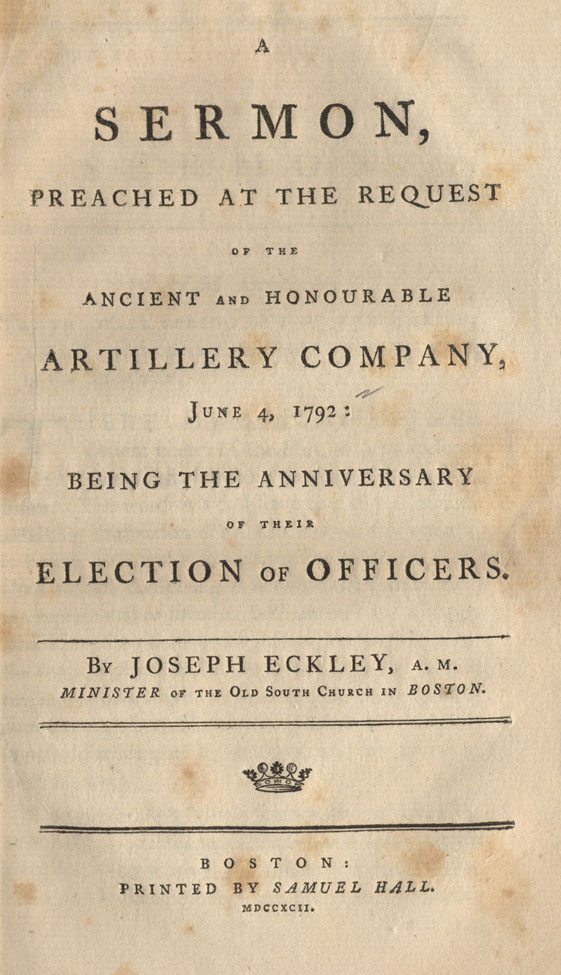
A

SERMON,

PREACHED AT THE REQUEST

OF THE

ANCIENT AND HONOURABLE

ARTILLERY COMPANY,

June 4, 1792:

BEING THE ANNIVERSARY

OF THEIR

ELECTION OF OFFICERS.

BY JOSEPH ECKLEY, A. M.
MINISTER  OF THE Old South Church in BOSTON.

BOSTON:
PRINTED BY SAMUEL HALL.
MDCCXCII.


A

SERMON.

PSALM LXXXV. II.

TRUTH SHALL SPRING OUT OF THE EARTH; AND RIGHTEOUSNESS SHALL LOOK DOWN FROM HEAVEN.

There is a grandeur and elegancy in the ancient poetry of the East, which, in some particulars, has been unequalled in modern times.  The words which I have read to you include a striking illustration of the propriety of this remark, in which truth and righteousness, two of the most exalted virtues conspiring to ennoble the human race, are represented as forming both an easy and a happy junction—the one ascending from the earth as when she bringeth forth her bud, or from the garden when it causeth the things that are sown in it to spring up—the other looking down like the benignant sun in his daily course, directing us by his rays, and refreshing us with his heat.

To a person of taste and science, the recital of the text will, on this account, communicate an elegant pleasure.  But when it is considered that, added to this circumstance, it contains a prophetic declaration applying to the state of man, we become interested in it as a public body.  On the present agreeable occasion, it solicits our attention, and will not fail, I hope, to afford us entertainment in our several stations and capacities as good soldiers or as statesmen, as philosophers and as Christians.

Will you permit me to add, I contemplate it with satisfaction, that at the request of this ancient and honourable Company, I have it in my power to address you at a time, when, judging of the state of improvement, and the revolutions in the world, the prophecy which it contains, seems to be fast verging to an accomplishment.—Scarcely will it be needful to observe that it has an evident relation to the Messiah’s reign on earth, embracing some prosperous condition of things, surpassing any which has yet appeared, when the knowledge and love of truth, which the Psalmist, by a bold and brilliant figure, describes as coming from the earth, shall really arise in the hearts of men, and the sun of righteousness look down and smile with blessings on them.

Indeed beautiful as the text is, it comprises little more than an epitome of the illustrious signatures of the times it so happily foretells; in which, relying on this and other gracious promises to the same effect, we find that knowledge, liberty, peace, holiness, and happiness will universally prevail.

In attempting to perform the duty annexed to the subject, it will be natural for me then, in the FIRST PLACE, to propose to you some of the evidences corroborating the text, on which the expectation of so glorious an era appears to be founded—offering some general remarks concerning the time in which it may be expected.  Having done this, I shall SECONDLY consider the means which will probably conspire to its introduction—subjoining a few observations on the methods of improving the present complexion of things in the world at large, and our country in particular.

Among the sacred references to this important era, the following, which are selected from many others,  appear to be sufficiently explicit.  The earth shall be full of the knowledge of the Lord, as the waters cover the sea.  Wisdom and knowledge shall be the stability of the times.  There shall be abundance of peace.  They shall beat their swords into ploughshares, and their spears into pruning hooks:  Nation shall not lift up sword against nation, neither shall they learn war any more; for they shall not hurt nor destroy.  All the ends of the earth shall remember, and turn unto the Lord.  In his days shall the righteous flourish.  And it shall come to pass, that in the place where it was said unto them, Ye are not my People, there it shall be said unto them, ye are the Sons of the living God.  And men shall be blessed in him:  All nations shall call him blessed.

Various sentiments have been held by commentators relating to the time, when these distinguishable prophecies will be fulfilled.  Whilst one class of writers has dated its existence at a season prior to the general resurrection or conflagration of the world—according to the theory of another class, it is not to be expected ‘till the second advent of our Saviour on the great day of judgment; after which, it is supposed that the righteous will reign with the Redeemer on the earth, new formed amidst the convulsion which is to pass upon the system, and properly prepared for their reception.

The present opportunity will not admit of a particular discussion of the subject.  As it is interesting in its nature, and intimately connected with the business of the discourse, I shall however briefly offer to you a few remarks, inclining me to give the preference to the former of these theories.

In the first place, it is to be preferred on account of the general complexion of the language used by the inspired writers in its numerous representations.  When we read of People and of Nations employed in converting their warlike weapons into instruments of husbandry—of the mountains bringing forth peace, and the little hills producing righteousness,[i] we find ourselves transported among beings of our own class and order—we mix in those scenes which have little or no affinity with the employments of the resurrection state—being vastly more allied to the circumstances of the earth in its present situation, than when it will have been melted and transformed by fire.  And whatever allowance may be made for the figurative manner in which the prophetic authors were accustomed to indite their thoughts, the application of every metaphor is excluded from this subject by what we learn in reference to the continuance of the season, which the Psalmist says will be as long as the sun and the moon shall endure.[ii]

Secondly, the doctrine, I think, is to be inferred, with some degree of propriety, from a consideration of the nature and perfection of the divine government and administration over all human affairs.

Judging from what appears to have been the design of the Creator, it is not so easy to suppose that a period will be put to the world by judgment and by conflagration, until a change has passed on it for the better.  Scarcely does it seem sufficient for the gratification of the good man to think that the clouds which have hovered round this terraqueous globe, should be succeeded by the brightness of some future state.  As more honorary, in his estimation, to the Almighty Architect, may it not be expected that the darkness, which, through divine permission, has been spread over the earth, by the great adversary of God and man, will be dissipated long before the setting of the sun—that he who crept by his wiles, into the habitations of men, will eventually be driven from them, having first been conquered on his own assumed ground—that where in consequence of his success, innumerable thorns and briars have risen up, the myrtle tree will put forth its fragrant leaves, and the little shrubs their aromatic fruit—and that in exchange for Eden, once the happy, but forfeited seat of the two progenitors of mankind, a new paradise will be formed, which instead of being circumscribed by the small bounds, capable of having been traversed by Adam or by Eve, will be from sea to sea, and extend from the river to the ends of the earth.

Indeed, of the rise and glory of such a distinguished time, we find there has been a general impression with many of the most refined and polished nations of the world.  It is the season particularly noticed by the ancients under the descriptions of the golden age—the mighty years—the baleyon days, prognosticated by their common bards, and celebrated by their more refined poets.  The Pollio of Virgil[iii] seems as if it had been composed with a pointed reference to the distinguished circumstances of the important era; in which the writer, no otherwise mistaken than in the name and title of his professed hero, boldly rises on the lofty strains rehearsed in the imitation of the celebrated Pope,—

The Saviour comes, by ancient bards foretold;
Hear him ye deaf, and all ye blind behold.
No more shall nation against nation rise,
Nor ardent warriors meet with hateful eyes.
The lambs with wolves shall graze the verdant mead,
And boys in flow’ry bands the tyger lead.
No sigh—no murmur, the wide world shall hear;
From ev’ry face, he wipes off ev’ry tear.
Fix’d is his word—his saving pow’r remains;
His realm for ever lasts—the great Messiah reigns.

Thus, as in the seventh day in the first sacred week, when the Supreme Architect made a pause, and contemplating what he had produced out of the preceding chaotic state, pronounced it very good, and sanctified it to man—as on the sabbatical year in the Jewish economy when the land had rest—so, in this promised time of jubilee, the world shall enjoy an uninterrupted series of happiness and composure—the beneficent and wise designs of heaven relating to the present state, assume the semblance of winding to a close; and the affirmation of the angel to the Evangelist be accomplished, when he said, that in the days of the voice of the seventh angel, when he shall begin to sound, the mystery of God should be finished, as he hath declared to his servants the prophets.[iv]

In the second division of the discourse, it was proposed to consider the means, leading to the introduction of this auspicious day.  Among these, I conceive that the progress of science in the world, holds a conspicuous rank.  Despotic governments, with their concomitant evils, always maintain their strength proportionate to the degrees of ignorance among the people.  The dominion of tyranny is properly speaking a dominion of darkness—supported by the imposition of falsehood under the pretended vestiges of truth—enervating the mental powers of human beings, and degrading them from the rank of men.  Terrible in its external form, but base within, it may be compared with the image in Nebuchadnezzar’s vision, the head of which was of gold, but the feet of iron, mixed with rotten clay.—Against this, the kingdom of the Messiah is professedly introduced, which, like the stone cut out of the mountain without hands, will eventually overthrow the usurping idol, and maintain its place for ever.  Indeed, unlike the kingdoms of this world, it is of a spiritual nature—designed to illuminate the understandings, and regulate the affections of its subjects.  By informing them for what purposes they were sent into the world—enjoining a supreme veneration to the great Author of their being, and next to this, an affectionate regard to one another, as children of the same eternal Father—partakers of the like wants, and brethren of one common family, it is eminently calculated to meliorate the events which may be expected by them in human life, until they are first prepared, and afterward translated to heaven.  It is the kingdom which God has given to his Son—the laws by which it is governed—the promises which give it life, and the sanctions administering to its support, being written by Prophets and Apostles inspired for the honourable work, and guided by a hand which is divine.

With much reason it might be expected, that principles thus pure in themselves, and friendly to the common benefit of mankind, would be disrelished by despots and their dependants, whose object is a monopoly of power, as it is of grandeur and wealth.  Either therefore by a direct denial of the authenticity of the sacred scriptures, or by the establishment of religious hierarchies, professedly assisting, but actually subverting their operation, a great part of the governments which have hitherto existed in the world, have united with meretricious zeal.  From such powerful causes, aided no doubt by the moral depravity annexed to human nature in general, throwing a veil before the intellectual vision, it has come to pass that the progress of religious science has, for many ages, been comparatively small.  But the interest of mankind is too deeply concerned, to allow such licentious impositions to remain perpetual.  The enlarged cultivation of the art of printing, by which the mild and equitable principles of our religion become more generally known—the great increase of commerce, introducing man to an acquaintance with his fellow man—the burdens incident to tyrannical governments, with the public bankruptcies which are threatened in consequence of the wanton wars concerted through the meer ambition of statesmen and of princes, will no doubt conspire in time, to produce alarms, where despotism now prevails, occasioning many revolutions, in which the people will judge it prudent to take the lead.

Forseeing these things, it has pleased the benevolent Creator of the world, plainly to foretell that the time will certainly come when mankind universally shall be free.  And he has foretold it, not only as a probable event, resulting from an application of the truths of reveled writ to the general benefit of society, but as that, which by his wise and holy providence, he is determined to bring to pass.  The language in which he has asserted it is, I the Lord will perform it.  In the government of the world, he no doubt, acts by means—making use of the reason and abilities of his creatures in the accomplishment of his wise designs.  Acquainted with these means, and reasoning from analogy, we may often judge of their operation with a great degree of probability and precision.

But there would be an uncertainty attending all human things, were they to be left unaided by the concurrent influence of a divine and overruling Mind.  By ways and methods which are often out of fight by us, but perfectly coincident with the well known and established doctrine of the moral liberty and free agency of man, the purposes of infinite Wisdom are brought to view.  In expectation of the joyful jubilee on which we are now contemplating, we may therefore rely not only on the probable conjunction of natural causes and effects, but more surely on the divine promise certifying the event, and making it the proper object of a rational and yet implicit faith.  Thus supported by the united aids of reason and revelation—to the pleasure, we add the triumph of our faith, in anticipating the happy era, when, in every nation under heaven, the eyes of the blind will be opened, to release the prisoners from their prison, and them that sit in darkness from the prison-house—when the broken-hearted shall be comforted, and liberty proclaimed to the captive—they that erred in spirit, being brought to understanding, and they that murmured to sound doctrine.

In the preceding observations, the view which we have taken, has been principally confined to the emancipation of mankind from the shackles of oppression, and the emporium of reason in every nation of the world.  A more important article included in this promised era, is that of the universal prevalency of religion; which, as it will be productive of the peaceful state so beautifully described by the prophetic writers, will operate, with like success, to complete the happiness and glory of the times.

Arguing from the maxims already proposed, it is easy to conceive that at least there may be a decided conviction of the value of political liberty, and a general struggle in its behalf, where the knowledge of religion in its spirituality and truth is by no means universal in its operation.  The idea of interest alone, resulting from the improvements made in society by experience and by time, may be sufficiently operative in the production of very astonishing changes in the political world.  Whilst we are at no loss therefore in accounting for the existence of such changes in the former of these articles, we seem to be under the necessity of examining still further for the cause of the latter.

And this I conceive to be no other than the animating influence of the Divine Spirit, which, when to answer the wise purposes for which the Deity gave permission, the mystery of iniquity will have sufficiently worked—the weakness of all error been detected, and the force of moral principles obtained at least a speculative triumph, he will then plentifully communicate to the world; and thus, by refining the minds of men, will confirm them in the belief of religious truth—by meliorating their dispositions, insure to them the enjoyment of liberty and peace—and by sanctifying their hearts, prepare them for the reception of every blessing they can enjoy both here, and forever hereafter.

Then shall the reign of virtue—the expected time of rest—the promised Sabbath—the Messiah’s kingdom on earth, be happily consummated; and the ancient prophecy of Daniel, comprehending many others of more recent date, advance to its complete fulfillment—I saw in the night visions, and behold one like the Son of Man, came with the clouds of heaven, and came to the Ancient of Days, and they brought him near before him.  And there was given him dominion, and glory, and a kingdom, that all people, nations and languages should serve him: his dominion is an everlasting dominion which shall not pass away, and his kingdom that which shall not be destroyed.

Proceeding now from general principles to their application, it may be proper in this place, to take a view of the present state of society in the world, and enquire in what progress it appears to be toward the enjoyment of the expected blessings—so far especially as relates to the articles of knowledge and liberty, which according to the account that has been given, will be progressive in their operation, preceding the universal prevalency of religion which will crown the whole.

And I must take occasion here to congratulate my respected hearers, not only on the present political state of their country, but on the circumstance of their having lived in an age, when, as among the heavenly bodies, a newly discovered planet, through the penetration of an Herschel, was added to the system of which the earth is part, so the United States of America, by a mighty movement in the great order of human things, were at the same time brought forward to the admiring gaze of all the sons of freedom, and amidst their acclamations, took rank among the nations of the world.

It will be needless to attempt the recital of the remarkable scenes accompanying the procession of this great event.  With those who now hear me, and have borne no inconsiderable part, as statesmen in projecting—as soldiers by confirming, and as philanthropists in contemplating them, their memory will be coequal with the duration of life.  The principal business before us is the consideration of their effects.  And important as these have been to the inhabitants of the United States, the circumstance which renders the revolution of the highest value is the influence which it appears to have on the sentiments of mankind in general, arising from the perception that it embraces no other than the common cause of the great majority of people in every clime and nation of the globe.—Where is the place in which the political doctrines which gave it birth—the actions by which it was sustained—the signal providences appearing in its behalf, with the unparalleled success by which it was finally crowned, have not been received with avidity, and contemplated with surprise?  From the general discussion it has introduced on the subject of national politicks, a degree of light has emanated, through which many ancient but false maxims have been highly exploded—the design of government, with the proper business of public magistrates been freely discussed;—and whilst the antiquated notion of the divine commission and authority of earthly sovereigns, true only as it related to the Jews, has been giving way to the more rational opinion that it is God makes men, and men make kings, MAN has come forward in his proper garb on the theatre of human life, where, instead of waiting like the silent mute for the single purpose of external ornament, he has had his opinion to make known, and his part to act in the important drama.

In the mean time, the objects of religious hierarchies have been closely inspected.  Exploded in the new world, they have sunk in estimation in the old.  It is perceived that the rights of conscience are too sacred to be regulated by mortals.  The language which has been held on the nature of religious liberty, has been sufficiently energetic to command an universal hearing; and what a few years past, would have brought the abettors to the dungeon or the stake, is now triumphant over the united influence of the Inquisitions in Spain and Portugal, or of the Vatican in Rome.

On the subject of political changes, it is impossible to reflect without advertence to the present state of France.  Important to the world in general, it is interesting to Americans, both as the professed friends of universal freedom, and the recipients of the assistance of this magnanimous people, in a time of trouble.

We love the French:  It is the debt of gratitude, for they loved us.  In France we have a brother.  When the fair standard of American liberty was erected, he heard the tidings.  As the friend of liberty, he crossed the Atlantic to behold and to protect it.  He put his soul into the act; and having returned with the affections of Columbia’s sons, Fayette is now conspicuous near the like standard in his native country, to join in dressing it with its proper trophies, and to behold it flourish.  The time is come when the like trophies are in general admiration, and the sons of freedom, in whatever place they dwell, are viewed as brethren.  We have lived to see the world in mighty motion—combinations forming to relieve the oppressed and set the sons of Afric free—the rights of man assumed—state prisons torn—political and moral principles examined with becoming freedom; and whilst many are running to and fro, knowledge is increasing.

In fine—if it might not be deemed too particular, I should propose it for enquiry, whether, judging from the past as well as present combination of events, there is not sufficient reason to conclude, that we have advanced to that important part of time delineated hieroglyphically in the vision of St. John, by the pouring out of the sixth vial on the Euphrates? In which time, as formerly by turning the waters of that river, and making the channel dry, a way was found for the admission of the Eastern kings Cyrus and Cyaxeres into Babylon, terminating in the deliverance of the Jews, then acknowledged to be the people of God, so now, the floods of error are gradually passing away before us, introductory to the complete establishment of the kingdom of righteousness and truth, when, after the yet expected succession of events, the seventh and last angel will pour his vial into the air, the seat of Satan’s sway—a voice out of the temple of heaven from the throne will say, It is done—the millennium state, or empire of holiness commence with the distinguished luster promised in the Messiah’s reign, and the whole earth be filled with his glory.

Having thus gone through with the principal ideas suggested by the text, and taken a view of the present moral and political state of man, a few observations shall be subjoined, arising from the particular situation of our country, and on the happy methods of its improvement.

Perhaps it may be thought a mistake, but I shall notwithstanding venture to observe, that, considering the degree of political knowledge prevailing in America, it appears to me to be next to impossible that tyranny should ever be established in the United States.  The sentiment, it is presumed, is founded on the reason and nature of things:  But if the preceding construction of the scripture promises be true, it is removed still further from the admission of dispute.

For myself therefore I must confess that I look forward, without the least anxiety on this article, and anticipate many succeeding generations, each of them illustrious for a happy race of freemen.  It does not follow however, that we are to expect a complete exemption from political evils.  In the present imperfect state of human nature, a revolution in the government may not only be productive of a necessary change of duties, but in some respects, of a change of dangers.  There will everywhere be sinister and sordid men, who, when desirous of places of emolument of honour, will be less anxious concerning the means, than the certainty of their attainment.  These are the time-servers and the sycophants, who, in monarchical governments, will surround the court, or be seen cringing within the vortex of the throne; and in the governments which are more popular, will be equally busy, fluttering and negotiating, on all sides, in the assemblies of the people.  The object of their attraction is the same in one as in the other situation:  It is the power of serving and promoting them, which, whether it be lodged in many or in a few, like the shrines of Demetrius, will be sure of commanding a great crowd  of adorers, crying, through in more modernized language, Great is Diana of the Ephesians.

Considering this subject with the attention it deserves, may it not then, with propriety, be concluded, that one of the most certain means productive of the safety and happiness of a people, consists in their ability to distinguish and find out disinterested and honest men to constitute the several departments by which the laws are enacted, and righteousness professedly maintained.  Let the king live forever, will invariably be the form of expression among suitors and dependants, where absolute monarchy prevails.  It is just as necessary in republicks, that the congratulatory address should be to liberty and the constitution.  Liberty is one of the noblest of all the birthrights, which a wise and rational man can wish.  But whilst the interested, as well as the disinterested, may equally profess to be within the number of its votaries, the inhabitants of these States will no doubt discover the necessity of committing the protection of their laws and privileges to approved patriots—judiciously guarding against the arts of those who merely address themselves to the popular feelings of a day, thereby enfeebling the social compact—and preserving a just respect for the political sentiments which are frank and undisguised, having been formed on an acquaintance with the history of government in the world, exhibiting the various occasions of the rise and fall of nations, testified by reason, and confirmed by indubitable experience.

I cannot help adding a remark or two, in this place, on the subject of religion.  The unjustifiable influence of the Church, with the unbounded power of its dignitaries and other priests, in various parts of Europe, has had the unhappy effect of occasioning much infidelity with great numbers of the laity, who, from their wealth and station in life, profess to think freely, or without subjection to exterior control; and as this influence is now continually diminishing, even with the other ranks and classes of the people, it is probable that, in a few years, the interests of religion will undergo a more material convulsion, the consequences of which will very generally be perceived and known.  Certainly there is much weakness in refusing to admit the evidence of truth owing to the errors and misconduct of a part of those who are its professed abettors.  The various enormities, both in the doctrines and practices of many churches, were really to be expected, because they were long ago foretold by the great Author of our Religion; and every argument of this kind, was thus completely wrested from the cause of infidelity.

But whatever may have been the bad effects of such religious impositions in several of the nations in Europe, it is hoped they will not extend to the citizens of America.  For the credit of religion, it is no more than reasonable to observe, that among the promoters of the Revolution in this country, there is no class of persons who have been more indefatigable in their stations than the body of the clergy—explicitly declaring their disapprobation of all religious establishments—thus committing their temporal interest to the governance of the people—assuming no influence but such as might arise from the general manner of their lives, and serious performance of the duties of their office—hereby removing every occasion of distrust and jealousy against their order, and offering themselves, on well-known principles, as the constant candidates for the friendship and esteem of those whom they profess to serve.  What the consequence has been, where the Church and State have been blended together, as in some countries, is already discovered.  What the consequence may be, in relation to the present system adopted in America, less than half a century now before us, will clearly determine.  In the establishment of the national system of government, it is a matter, I conceive, which is worthy of attention.

Whilst the clergy have no interest clashing with that of the laity’s, for the sacred offices of religion are engaged in by the former from a sincere apprehension of their importance, and suitably encouraged by the latter from the like faith and motives, it may be presumed that the most salutary effects will be experienced by the community.  In attempting to lay the foundation for the happiness of posterity, it is not only wise and virtuous, but absolutely requisite, to call in the united aids of morality and religion.  Never were the prospects of any people more promising and glorious than those of the inhabitants of these States, or the means and capacity greater for rendering them successful.  Consequential on the exertions productive of the Revolution in America, the mental abilities of her sons seem to have been brought forward at an earlier period than is usual, and to have expanded to a fuller growth.  From the contemplation of the vast scenes through which we passed during the war, and the great and important business which has been transacted since the peace, there is an energy of mind, and a genius characteristical of Americans, which, like the Eagle in the escutcheon of the National Arms, delights itself in soaring high, and beholding objects which are great as well as deep.  What tends still further to the growth of this mental invigoration, is the knowledge of the vast capaciousness of the territory belonging to the United States, already increasing in population with the most astonishing rapidity, and in like manner improving in the arts.

It is to be expected that the succeeding age will make progression both in agriculture and science, which, if it were possible for us to behold it, would inspire our minds with equal wonder and delight.  On the excursive pinions of imagination, we will now take the view.  Roving by the perennial fountains, or on the the verdant banks of the meandering streams, we perceive the busy husbandman employed in gathering the rich bounties of Ceres and Pomona—the hills around him vocal with the musick of his bleating flocks—the meads and vallies blooming like the rose.  Where the Wigwam stood, behold the Capitol erects its lofty dome, and the sacred Church its spire.  Cities after cities rise to court the admiration of the observant eye; whilst Patriotism and Philosophy find new Washingtons and Hancocks, Adamses and Franklins, to add to the resplendency and importance of the times.—Thus it is that Fancy assumes the privilege to indulge her sportive flights.  Guided, as she professes in the present case by the conductress Reason, her flights are not in vain.  Hail to the rising glory of this Western World!  Hail to the more happy days of universal peace and freedom!  Let thy ways, O Lord, be known on earth; and thy saving health among all nations.

As the subject on which we have contemplated, is highly interesting to every friend of liberty and his country, there is, I conceive, a particular application of it due on this occasion, to the ancient and honourable Company, at whose desire we are now assembled.

Worthy and respected Gentlemen,

With pleasure I address you as the members of an association, incorporated more than a century and half, as a military school and nursery for officers, the utility of which has been experienced from its commencement to the present time.  Were it now a season of Alarm and War, it might have been requisite to have discoursed to you on the immediate duties of the soldier, or on the proper use and design of Arms.  In the present tranquil situation of the United States, I have presumed there was no topick more naturally coinciding with your views, or better harmonizing with the spirit usually cherished on this day, than such as might lead me to the exhibition of some of the glorious fruits of the past efforts of this country in the cause of truth and freedom; which, as they were the objects with your Company, when it lately lent its generous aid in erecting the waving banners in the military field, would in a similar manner, awaken the same animation, if, in the course of human events, there should ever be the necessity of taking the field again.  You study tacticks from no delight in war, but from the laudable and benevolent principle of maintaining righteousness with peace.  Inspired by so rational and conciliating a motive, you are entitled to the thanks of your countrymen for the perseverance which you manifest in the duties of your institution.  From the respectable abilities of the Officers whom in time past you have chosen to command you, as well as from the military knowledge and attention of the Captain[v] who leads your corps this day, you no doubt derive very essential advantage.  Reflecting on the present glory of America, it is a satisfaction which you owe yourselves, to call to mind how many members of your association became distinguished in the late noble contest for our liberties, whose heroic actions, with their names, the page of history will faithfully transmit to the latest times.

The polite attentions, added to the presence of your commander in chief the Governour of this Commonwealth, with that of the principal gentlemen in the civil and other offices in the State on these public days of your anniversary election, must be convincing testimonies to you of their great esteem for your ancient corps, and their approbation of its honourable design.  Having performed the religious services of the Church, we shall cordially accompany you to the Hall, where the festive board will be surrounded by so many friends and defenders of the proper rights of man, and the hilarity during the regalement, as well as through the future pastimes and military evolutions of the day, be the result of those philanthropic sensations which extend from our country to every nation on the globe.

Receive from us our most hearty wishes for your future prosperity and honour.  Engaged in protecting the liberties of your countrymen, may you at the same time experience the efficacy of that sacred and religious freedom, which is proposed to us through the great Captain of our spiritual and everlasting salvation—that when you quit the ranks militant on earth, you may be admitted to the angelick companies in heaven—and putting off the sword and buckler which are worn by Combatants, may receive the crowns of Conquerors in the celestial state.

To this respectable assembly in general, let me now observe, that pleasing as our political and other prospects may be considered, the time allowed us in which to enjoy them is short and transient; after which, our conduct on the serious question of their improvement, will pass a most solemn and august review.  An apprehension of the brevity of human life, should instruct us to comprise in it as many duties as is possible.  Among these, I presume, we may rank the duties which we owe our country in particular, and the world at large.

Shall I be allowed to make the enquiry, whether to the other methods of improvement, and the numerous institutions among us, the establishment of a Revolution or Constitutional Society, might not be attended with important advantages—part of the business of which should consist in a regular correspondence with those of the same names in Europe, and the objects be the dissemination of the great principles of liberty and good government, and the introduction of some well-concerted plan among the nations, as the basis of an universal peace.[vi]

The happy influence of these Societies abroad has been confessedly experienced; and in speaking of them, I am led to pay a tribute of respect to the memory of a distinguished member, not long since deceased in Great-Britain, whose known attachment to the general cause of liberty, and affectionate writings in favour of the interest of America, have inscribed his name upon our hearts.  Could we pay a visit to the tomb of Doctor Price, we would shed a tear of friendship on his hallowed urn; or if the harmonious musick of the band this day, could reach the dead, we would bid it cease a while its martial notes, and softly strike the funeral dirge.

What a blessed revelation is the Gospel of the Son of God, in which we learn that after the body sinks, or goes to mingle with its native dust, the spirit still survives!  In the great world of spirits, the friends of liberty, in its moral and most extensive sense, shall meet in perfect and never-ending bliss.—And with this idea, I conclude.—Glorious as are the promises we have contemplated relating to the prosperous state of nations, and the happy days of universal jubilee, they are bounded by what may properly be called the events of time.  “The cloud-capt tow’rs—the gorgeous palaces—the solemn temples—the great globe itself, with all that it inherit, shall dissolve—and like the baseless fabric of a vision, leave not a wrack behind.’  Or, in more energetic, because inspired language—The heavens shall pass away with a great noise, and the elements shall melt with fervent heat; the earth also, and the works that are therein, shall be burnt up.

But there are other promises which reach forward to eternity.  If we are found among the friends of truth and virtue, we shall be able to stand unmoved amidst the convulsions of the present system; for there are prepared for us new heavens and a new earth, wherein dwelleth righteousness; and we shall live eternally with the Lord.—To him be everlasting praises.

A M E N.


[i] Psalm lxxii.3.
[ii] In the 20th chapter of Revelation we are informed indeed, that, at the close of this time, the tranquility will be interrupted a little season, by new enemies arising in various quarters of the earth.  But considering what is added concerning the inefficacy of the attempt, owing to the direct interposition of heaven in defence of the friends of righteousness, immediately preceeding the judgment and end of the world, the propriety of the observation still appears, when it is said of this happy era that it shall last as long as the sun and moon.
[iii] Said to be taken from a Sibylline prophecy, which, by whatever fraud obtained, corroborates the idea of the general expectation of the times of which it speaks.
[iv] Rev. x. 7.—It is well known that Seven is a kind of sacred number in the Scriptures, signifying in the several revolutions and divisions of time, a season of religion and rest.  For further particulars and their application to this subject , the reader is referred to Loman and other commentators on the prophecies.
[v] Colonel Josiah Waters.
[vi] An idea of this kind has frequently been proposed, within the percent age, in several large or national assemblies in Europe as well as in America.  From the state of things on the old Continent, and indeed from the complexion of the scripture prophecies, there is reason to think that very desperate measures will be adopted, and that there will be much war and bloodshed for some time to come, before the power, annexed to the various civil and ecclesiastical usurpations, will be destroyed, and the people maintain their rights.  But as these important objects may be expected in the issue, no small encouragement therefore is exhibited to each association on the afore-mentioned plan; for though the good effects might not very soon be universal, it is probable they would, in some particulars, be real; and in junction with other means, might at length be happily instrumental in producing the full establishment of the desired event.

Sermon – Thanksgiving – 1795 Massachusetts

The Rev. Thomas Baldwin
 

Thomas Baldwin (1753-1825), an influential pastor and well-known author, was born and raised in Connecticut until the age of 16 when he moved to New Hampshire, where he later became a member of the State Legislature. As a young man, he was many times called upon to read sermons before his church when the minister was absent. In 1783, he became an ordained evangelist and for 7 years traveled on horseback among the state’s towns, preaching the Gospel until 1790, when he became the pastor of the Second Baptist Church in Boston. (This is the church where he was pastoring when he preached this Thanksgiving Sermon in accordance with the national Thanksgiving Proclamation issued by President George Washington). In 1803, Baldwin began publication of the Massachusetts Baptist Missionary Magazine, later renamed the American Baptist Magazine (the only Baptist publication in America for years), of which he was the only editor until 1817 and the senior editor until his death in 1825. During his lifetime, Baldwin published 34 separate works, including several books and numerous sermons (published at the special request of his hearers). Baldwin died in Maine at the age of 72, having the day before his death preached two sermons in Massachusetts.

Second Baptist Church of Boston
 

July 27, 1743 – The church was established (formed from a church split from First Baptist Church)
March 15, 1746 – The church meets in its own building for the first time
1743-1790 – The church has four separate pastors
1790-1825 – Thomas Baldwin becomes its fifth pastor, leading the church for 35 years

Notable Events During the Tenure of Pastor Thomas Baldwin
 

1803-1805 – Baldwin was a noted revival preacher, and during this part of the Second Great Awakening, 212 members were added to his church
January 1, 1811 – A new church building is dedicated with an estimated 3,000 people present
July 27, 1816 – A Female Sabbath School (only for poor children) is begun, with 37 children present; they are taught the alphabet, reading, and spelling and memorized portions of the Bible, catechisms, etc.
1817 – A Male Sabbath School begins
1817- 1825 – The Sabbath School is expanded to include children of the rich as well as the poor


sermon-thanksgiving-1795-massachusetts
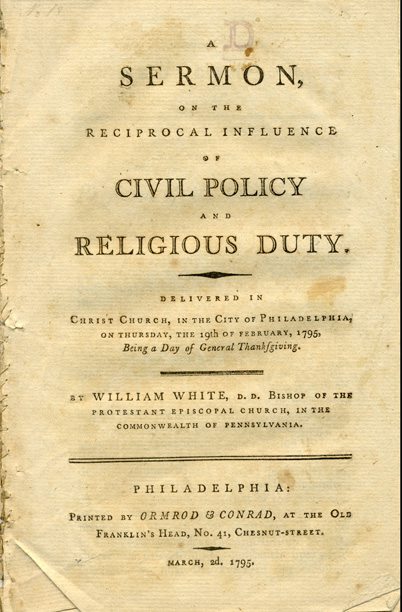
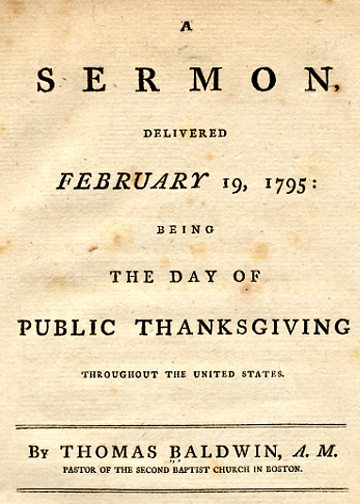
A

SERMON,

DELIVERED

FEBRUARY 19, 1795:

BEING

THE DAY OF

PUBLIC THANKSGIVING

Throughout the United States.

BY THOMAS BALDWIN.

P S A L M XXXIII 12

BLESSED IS THE NATION WHOSE GOD IS THE LORD, AND THE PEOPLE WHOM HE HATH CHOSEN FOR HIS OWN INHERITANCE.


In obedience to the call of the President of the United States, we are now, my brethren, assembled in the house of God to offer thanksgiving and prayer to the “great Ruler of nations, for the manifold and signal mercies which distinguish our lot as a nation” [a direct quote from the 1795 Thanksgiving Proclamation issued by President George Washington]. And as God is this day publicly to be praised in the assemblies of His people, I have thought the [Bible] passage now read might be a suitable foundation of our present meditations.

This beautiful psalm, whoever might be the penman of it, is evidently designed to set forth the power and goodness of God in such an amiable [agreeable] light as to excite our confidence, awaken our gratitude, and warm the devout passions of the soul with sacred joy.

If we contemplate God either in His word or works, we shall find abundant matter for joy and thankfulness: “For the word of the Lord is right, and all His works are done in truth. He loveth righteousness and judgment; the earth is full of goodness of the Lord” [Psalm 33:4-5].

From this view of the righteousness, equity, and benevolence of the Divine government, the pious psalmist was led to exclaim, as in the text; “Blessed is the nation whose God is the Lord, and the people whom He hath chosen for his own inheritance.” That we may more fully enter into the spirit of the text, we shall attempt:

I. To show when it may be said of a nation that “the Lord is their God” – to consider what evidence a people may have that the Lord has chosen.

II. To consider what evidence a people may have that the Lord hath chosen them for His inheritance.

III. That we may infer the duty and obligations of a people thus favored and blessed (in illustrating of which we shall attend to several particulars contained in the proclamation).

I. We are to show when it may be said of a nation that “the Lord is their God.”

As a nation, we form a particular character in distinction from that of individuals. As such, we may exhibit the amiable [likeable] features of virtue and religion, or the base picture of vice and infidelity. In this character we may receive temporal blessings as the fruits and reward of virtue, and also suffer national calamities as the punishment of our vice and impiety.

Therefore,

1. When as a nation we acknowledge the eternal God to be the Creator, Preserver, and Upholder of all things – when we acknowledge His universal dominion over all worlds, and all beings – and when we attribute those Divine perfections to Him which are necessary to form His exalted character and render Him the proper object of our love and esteem; and

2. When we acknowledge that system of truth contained in the Bible to be His word, and as such reverence and obey its doctrines and precepts – when we cordially subscribe to its Divine originality [inspiration] and rest all our hopes of futurity on its precious promises – when we endeavor to imbibe its genuine spirit and live agreeably to its dictates; and

3. When we acknowledge Him as the lone object of religious worship and adoration in distinction from all false gods and idols – when at stated seasons we attend upon His institutions and offer up our prayers and praises through that medium which He hath appointed; and

4. When we acknowledge Him as our rightful Sovereign and live in subjection to His laws (for it can never be supposed that a people have chosen the Lord for their God, while they refuse to have him reign over them. The very language of His enemies is, “Let us break His bands in sunder and cast His cords away” [Psalm 2:3], whilst those who approve of His government say, “The Lord is our Lawgiver, the Lord is our King, He will save us” [Isaiah 33:22]. And, said Jesus, “Then are ye My friends when ye do whatsoever I command you” [John 15:14]); and

5. When we acknowledge His universal Providence over all the works of His hands (if we rely upon His protecting care and Providence, we shall manifest it by appealing to His wisdom to direct us when involved in darkness and difficulty, and to His power to defend us when surrounded by threatening dangers; and finally, in leaving the issue of our most interesting concerns to the righteous disposal of Him who controls all human events);

6. And lastly, when we acknowledge the Lord to be the Giver of all mercies (nothing can be more calculated to keep us humble and thankful than to realize our dependence on God: “Every good and every perfect gift comes down for the Father of lights” [James 1:17]. A sense of our own unworthiness and of the Divine goodness in bestowing favors upon us will excite in us the most lively [strongest] sentiments of gratitude and undissembled [genuine] joy and will finally issue in thanksgiving and praise).

But we come

II. To show, what evidence a people may have that the Lord hath chosen them for his inheritance.

The terms very naturally imply each other; agreeably to the tenor of the new covenant, “I will be their God and they shall be My people” [Ezekiel 37:27]. And again, “I love them that love me” [Proverbs 8:17].

Although this part of our subject may not appear so capable of proof as the former (since neither love nor hatred can be certainly known by common course of Providence) as one event happeneth to all, yet undoubtedly there may be some rational evidence in favor of the people whom God hath chosen.

As

1. God’s disposing a people to choose Him to be their God is a clear evidence that He had previously chosen them for His inheritance: “Ye have not chosen Me (said the Savior to His disciples, that is first) but I have chosen you” [John 15:16]. They had indeed chosen Him with all their hearts; but this was consequent upon His choice and therefore could not be the cause, although it was the best evidence of their being His people. “We love Him because He first loved us” [1 John 4:19]. But we observe,

2. Special and remarkable instances of Divine interposition in behalf of a people naturally lead us to conclude that God hath chosen them for His own.

Of old, He chose the seed of Abraham for His people and Jacob for the lot of His inheritance; and although He suffered them for a season to be afflicted by their enemies, yet when the set time was come for their deliverance from Egyptian bondage, His arm was made quite bare in the fight of the nations.

The children of Israel at this time were sunk under the most abject slavery. They indeed groaned under their bondage but had no idea of deliverance; and by being so long accustomed to serve, they had quite lost the spirit of enterprise. Yea, they were so far inured [accustomed] to their wretched condition and so indifferent to the cause of freedom, that after Moses had exhibited his credentials and given the most unequivocal proof of his being sent of God to liberate them from their vile servitude, they were ready upon almost every appearance of difficulty or danger to raise their clamorous voices and say, “Let us alone that we may serve the Egyptians.” But their drooping spirits were finally cheered, and with one consent they rallied round the standard of freedom; and while the Egyptians for their cruelty were visited with various plagues and were now mourning the loss of their first-born, under cover of the night they made their escape. But the tyrant of Egypt soon determined to pursue them.

The ransomed tribes, not being furnished with weapons of defense in order to escape the Philistines, took their route by the way of the wilderness and were now encamped between Migdol and the Red Sea. Imagination itself could scarce conceive of a situation more disadvantageous and distressing than theirs. The sea spread itself in their front; on either side they were enclosed by inaccessible mountains. Hahiroth on one side and Baal-zephon on the other, forbade their flanking off, whilst in their rear they beheld their late imperious master with all their tyrant bands in crowded columns advancing towards them, glittering in armor and amply furnished with the whole apparatus of death!

At this critical moment when ruin appeared inevitable, Moses – who had the most perfect command of himself – endeavored to calm their fears and excite their confidence in God. “Stand still,” said he, “and see the salvation of the Lord” [Exodus 14:13]. The cloud which led their way instantly went back and stood as an impenetrable wall before the Egyptian host. Moses now took his awful rod and stretched his hand out over the sea and the waters divided. Then, “the waters saw thee, O God, the waters saw thee; they were afraid and the depths were troubled” [Psalm 77:16]. “He made the waters to stand as an heap; they were congealed in the heart of the sea” [Exodus 15:8], until the chosen tribes had marched safely through.

But when one dark scene has passed, another equally distressing instantly opened to their view. They were now traversing the barren sands of Arabia beneath a burning sun and their soul fainted within them. No fruitful fields supplied their hunger, nor cheering springs allayed their thirst. In vain they wished for the flesh-pots of Egypt or the waters of the Nile. No human exertions could save them. The Lord again interposed and the heavens supplied them with bread, and the rock followed them with streams of living water.

The interpositions of Heaven were so visible in behalf of this people that an eastern soothsayer, after using in vain all the arts of magic to curse them, was constrained to say, “The Lord his God is with him and the shout of a King is among them” [Numbers 23:21].

When David upon a particular occasion was celebrating the Divine goodness, it brought to remembrance those days of the right hand of the Most High when God so remarkably interposed in their behalf; even when they were strangers in the land. “And when (said he) they went from nation to nation and one kingdom to another people, He suffered no man to do them wrong. Yea, he reproved kings for their sakes; saying, Touch not Mine anointed and do My prophets no harm.” [I Chronicles 16: 20-22]. And thus He led them on to the possess the Promised Land.

But we are called upon by the man whom we delight to honor [President George Washington] thankfully to notice “the manifold and signal mercies with distinguish our lot as a nation.” But where shall we begin! The various streams of Divine goodness have constantly followed us through all this wilderness.

The interpositions of a kind Providence towards us from the first settlement of this country to the present day have been almost as conspicuous as those granted to Israel of old.

The groaning of our fathers under the persecuting yoke of oppression, although in their native land, was heard in heaven. Nor did they long groan in vain, for God was pleased to dispose their hearts to unite in forming the important design of attempting a passage across the pathless ocean in search of these western shores. Numerous were the trials and disappointments they experienced in leaving their native land, and many were the fears and discouragements with which they conflicted on the boisterous ocean until at length they discovered the Continent [America] and again trod on solid ground.

But how seemingly easy would it have been for the savages to have collected their numerous tribes and hurled such showers of darts and poisoned arrows upon them as to have obliged them to quit [leave] the shore; or at least to have harassed them in such a manner as to have prevented them from cultivating the soil and in that way forced them to re-embark.

Various indeed were the scenes of distress through which the first adventurers passed, and various were the deliverances which they experienced. Death early discovered their infant settlement and within less than five months after their first landing at Plymouth swept away nearly one half of their number. Sometimes painted savages with hideous yells disturbed their peaceful camp, and sometimes famine with meager visage [face] stared them in the face.

Three years after their arrival they were brought to such straits, their provisions being spent, when it was three or four months to harvest so that when they lay down at night they knew not where to get any for the morning; and for three or four months together they had neither bread nor corn. “Yet (said they) we bear our wants with cheerfulness and rest on Providence” [a quote from the Journal of the Pilgrims at Plymouth, compiled by George Cheever (New York: John Wiley, 1848), p. 283]. Nor did they rely in vain. God heard their cry and sent them relief.

Thus when death and savages and famine seemed all to combine against this feeble colony, God was pleased to give the high command, “Destroy it not, for a blessing is in it” [Isaiah 65:8].

Heaven had undoubtedly designed this beautiful part of the creation for nobler purposes than to lay an uncultivated waste for beasts and savages to roam over. It was evidently marked out by Divine Providence as the favored spot on which liberty (which had long been imprisoned in other parts of the globe) should erect her spacious temple.

But this high design was not then fully understood, and America – like a child in minority for a long season – was under “tutors and governors” [Galatians 4:1-2] of a foreign appointment until the fullness of time [Galatians 4:4] came for her to be free.

But time would fail to recount the various wonders of Divine goodness towards this land, or the numerous instances of oppression from a foreign power which led on to that memorable season which marked a new epoch in the history of the world – I mean the fourth of July 1776, which announced the freedom and independence of America.

That auspicious [fortunate] morn will long be remembered (perhaps as long celebrated) as the political birthday of this nation. Then our fathers in council assembled made their solemn appeal to the Great Judge of the Universe for the rectitude of their intentions and the justice of their cause.

And, my brethren, were not the interpositions of Divine Providence quite visible in our behalf in disposing the different states to lay aside their local prejudices and all unite in one great object? And did not Heaven remarkably smile upon our exertions? How surprising was the spirit of enterprise which then appeared in every class of citizens! Our legislators in Congress nobly opposed and effectually counteracted the subtle and perfidious [treacherous] politics of a nation long skilled in the intrigues of war. And our young sons, uninured [unaccustomed] to the dangers and hardships of a camp but animated with the noble sentiment of liberty, and led on by our immortal WASHINGTON, encountered an army of disciplined veterans with a courage and firmness which would have done honor to Roman bravery. Unsubdued [unconquered] by difficulties, and unappalled [not scared] by dangers, our troops were led on from conquering to conquer [Revelation 6:2], one army after another falling into their hands until our foes were obliged to subscribe [agree to] conditions of peace.

Shall we now, my brethren, ascribe all this glory to ourselves? No; we will say with the devout psalmist, “If it had not been the Lord Who was on our side – now may America say, if it had not been the Lord Who was on our side when men rose up against us, then they had swallowed us up quick” [Psalm 124:1-3]. It was the God of armies which led our troops to victory and glory, and His forever shall be the praise!

Happy indeed is the nation whose God is the Lord and the people whom He hath thus highly favored.

We come now, as was proposed,

III. To infer the duty and obligations of a people thus favored and blessed. The two following inferences very naturally arise from the subject;

1. If we have chosen the Lord to be our God, it is our indispensible duty to acknowledge with thanksgiving the numerous favors He confers upon us.

2. As we are dependent creatures, it is our duty to beseech the kind Author of these blessings to continue them to us and to extend those which we enjoy to all mankind.

In illustrating those observations, we shall attend particularly to the proclamation [of President Washington] upon which we are now convened.

  • 1. We are called upon to offer thanksgiving “for the possession of constitutions of government which unite and by their union establish liberty with order.” If ever a people were under obligations to the Great Ruler of the Universe for the full and free enjoyment of their natural rights and privileges, we certainly are. 1If we are not happy, we must blame ourselves for it, for our modes of government are not the dictates of a conquering tyrant but the deliberate choice of American freemen. No foreign lord has dominion over us, but our “rulers are of ourselves and our governors proceed from among us” [Jeremiah 30:21]. And as the most important offices, both Federal and State governments, are elective, no hereditary dunce can ever be imposed upon the people; but [only] the man whose tried wisdom, fidelity and patriotism shall commend him to their choice.But our constitutions are said to “unite and by their union to establish liberty with order.” But why do they unite? Undoubtedly because they secure the equal rights of all. We cannot reasonably expect that either “union or order” will long prevail where the essential rights of one part of the community are violated and government is instituted and administered for the benefit of a part only and not for the whole. May we ever consider our rights unalienable and in a constitutional way remonstrate [protest] against the smallest infringement.
  • 2. We are directed to offer public thanksgiving to God “for the preservation of our peace, foreign and domestic.”A moment’s reflection, my brethren, will convince you of the propriety of this remark. For notwithstanding the embarrassments which our trade hath suffered on the seas, and the many unprovoked insults offered to our flag; we have shown ourselves superior to those who have injured us by despising rather than retaliating their crimes. And although our western border has been partially distressed, yet the great body of the nation has been folded in the secure arms of peace. And by the blessing of God on the cause of liberty in Europe, and the wise and steady exertions of our supreme Executive [President Washington], aided by our Federal Council [the U. S. Congress], we have been preserved from the horrors and calamities of a foreign war.
  • 3. “The suppression of the late insurrection” is mentioned by our worthy President as a matter of public thanksgiving [in 1794 in western Pennsylvania, armed riots had broken out against the federal government to protest a federal tax on whiskey]. And let the cause of the unhappy insurrection be as it may, we will rejoice and praise God that the consequences were far less fatal than we feared and that it has been wisely overruled not only for the suppression of that rebellion but for the strengthening and cementing of the union. May it also be farther beneficial by deterring other from opposing lawful authority and prevent their making the desperate appeal to arms.
  • 4. “The prosperous course of our affairs, public and private” calls for our grateful acknowledgments. That our wealth and population have rapidly increased within these few years past much beyond any former calculations cannot be denied. And we have the satisfaction still to believe that the tide has not begun to ebb but is yet increasing. Our settlements are extending; the wilderness yields to the hand of cultivation and becomes a fruitful field; towns are built and cities enlarged. Citizens of every class find sufficient employ and ample encouragement to reward their industry. The liberal arts are nourished and useful knowledge discussed and surely there can be nothing wanting but real piety [holiness] to make us truly happy.

But from the uncertain tenure by which we hold these enjoyments, we are led to infer:

2. That it is our duty to beseech the kind Author of these blessings to continue them to us and extend those which we enjoy to all mankind.

And

  • 1. By the proclamation, we are directed “to beseech the kind Author of these blessings graciously to prolong them to us.” We shall be naturally led to this if we suitably realize that the same hand which bestows our blessings may take them away at any time without asking our leave [permission]. And such is the versatility of all earthly things that we know not what will be on the morrow or even what the present day will bring forth – we know not how soon the present scene may be revealed and the dark clouds of adversity overshadow our brightest prospects. Let us then humbly acknowledge our dependence on that Living Fountain and thankfully adore the Giver of All Our Mercies.
  • 2. We are exhorted to pray God “to imprint on our hearts a deep and solemn sense of obligations to Him for them.” Without this, we can never be thankful, for if we consider our enjoyments as the just reward of our own wisdom or industry, we shall feel thankful to none but ourselves. The Lord deliver us from the horrid sin of ingratitude! As our blessings are multiplied, may we consider our obligations increased to love and adore our Great Benefactor.
  • 3. We are to beech the kind Author of Our Blessings “to teach us rightly to estimate their immense value.” Our blessings, my brethren, are numberless and great. We are a people highly favored of the Lord. Our civil and religious privileges are none of the least; we “sit under our own vine and fig tree and none are permitted to disturb or make us afraid” [Micah 4:4]. We worship God according to the dictates of our own consciences without the dread of an Inquisition or fear of persecution. We are indeed exalted to heaven in point of privilege; let us not forget that “where much is given, there much will be required” [Luke 12:48].
  • 4. We are directed to pray that we may be kept from “abusing” the favor we enjoy. It is too often the case that those who have called upon God in the day of their trouble have forgotten Him in the time of prosperity. Happy would it be if we could learn that sacred lesson, “to use the world as not abusing it” [1 Corinthians 7:31]. Our blessings are given us to use but not to abuse. They are often bestowed in abundance so that we may disperse abroad and give to the poor, and thus lay up a treasure in the heavens which “fadeth not away” [1 Peter 1:4]. But should we become vain in our prosperity and “forget the God which made us and lightly esteem the Rock of our salvation” [Deuteronomy 32:15]; we must expect He will turn His hand against us and deprive us of the blessings we abuse. May the Lord “preserve us from the arrogance of prosperity” and enable us so to walk before Him as a nation that He may delight to prosper and bless us.But we are to conclude our supplications by praying,
  • 5. That God would “impart all the blessings we possess or ask for ourselves to the whole family of mankind.”

This beautiful sentiment, my brethren, breathes universal benevolence and good will to the whole human race. Much more is implied in it than what is expressed. I conceive that it fully authorizes and enjoins us to extend our views to other objects not so particularly mentioned in the proclamation. And

1. We will fervently pray that the blessings of the Gospel of our Lord Jesus Christ which we peculiarly enjoy may be extended to all mankind – that the altars and idols of Pagan superstition may fall before the light of truth and that the shades of Mahometan imposture [Islamic deception] may be dispelled by the bright beams of the “Sun of Righteousness” [Malachi 4:2]. And that the dragon and the beast and the false prophet; and all the anti-Christian powers which have in any way opposed and persecuted the religion of Jesus Christ may be subdued. May the Gospel with its benign [gentle] influences extend from land to land and from sea to sea until the knowledge of God shall cover the earth, from the rising to the setting sun [c.f., Isaiah 11:9].

2. As we enjoy the blessings of peace, we sincerely wish the same to all our fellow-men. Base indeed must be the heart which for any pecuniary [monetary] advantages would wish a war to continue, which makes such havoc of the human species. Hence, my brethren, let us offer up our prayers continually to the God of Peace that the present distressing war among the European nations may come to an end [the Second Hundred Years War between France and Britain and their respective allies were raging in Europe at this time], and that it may terminate in the overthrow of tyranny and despotism and the establishment of liberty and the equal rights of man. And particularly, that nation which came to our relief in the day of trouble [France] may speedily obtain and give such honorable conditions of peace as shall convince the world that they are friends to liberty, order, and humanity and are only to be dreaded by tyrants. May they soon realize all the advantages which a free and enlightened people can derive from a government framed by the unalterable principles of reason and founded upon the eternal basis of equal rights.

But

3. As we desire and enjoy liberty and freedom ourselves, we will not forget our brethren who are in captivity and slavery.

Our unhappy countrymen who have fallen into the hands of the Algerines [Muslim terrorists opposing America during our first War on Terror against Islamic terrorists which lasted from 1784-1816] whose “tender mercies are cruelties” [Proverbs 12:10], shall not be forgotten in our supplications. We will beseech the God of All Compassion to remember them in the land of their captivity and to give them favor in the eyes of those who have carried them captive. We will not only pray for them but whenever we shall be called upon by proper authority, we will cheerfully subscribe for their redemption [i.e., contribute to a fund to pay a ransom to free Americans; see the WallBuilders article on this at https://wallbuilders.com/LIBissuesArticles.asp?id=374 ] and restore them again to the embraces of their friends and the blessings of freedom.

But the benevolent sentiment we now dwell upon does not confine our wishes here; no, we wish the same blessings of liberty which we enjoy to all mankind. May the day soon arrive when not difference of climate or features nor the color of the skin – when nothing but crimes shall consign any of the human race to slavery.

Urged by my own feelings, I am persuaded, my brethren, you will indulge me to mention in particular one of our suffering friends. I mean the brave, but unfortunate Marquis de la Fayette! “At the age of nineteen he espoused the cause of America,” and early determined to embark for this country. But before he could accomplish his design, intelligence arrived at Paris “that the American insurgents reduced to two thousand, were flying [retreating] before a British force of thirty thousand regulars.” In short, things appeared so discouraging that our commissioners at Paris “thought it but honest to dissuade him from the present prosecution of his perilous enterprise.” But nobly triumphing over every discouragement, he said, “Hitherto I have only cherished your cause – I am now going to serve it.” 2 He at length procured a vessel at his own expense and came to America. Soon after his arrival, Congress conferred on him the rank of Major-General, which he accepted – but with the condition of serving at his own expense. 3

His services for several years together in the American army are too well known to require a particular detail upon this occasion. The later part of his command, however, was peculiarly distinguished by the difficulties he encountered and the important services he rendered this country – particularly in counteracting and harassing the movements of the British army in Virginia.

From his embarrassed [difficult] situation at a certain time, Lord Cornwallis thought himself so sure of taking him that he wrote to the British court that “the boy could not escape him.” But the fact proved just the reverse, for he found not long after that it was impossible for him to escape and was finally obliged to resign himself and army as prisoners of war [i.e., the British surrender at Yorktown in 1781].

Can we now, my brethren, who enjoy the fruit of his toils, forget this generous patron of American freedom who is now suffering the horrors of a wretched confinement and languishing in a dreary [French] prison? [Lafayette was imprisoned five years (1792-1797) because of his views of liberty, first in Germany and then in Austria. At the time of this oration, he was still in prison – a fact that greatly angered Americans since he was an American citizen – an honor awarded him by Congress at the end of the Revolution – as well as an American hero]. No; we will raise our supplicating voice to Heaven for him. And may that God who heareth the groans and sighs of the prisoner break the bars of Magdeburg Castle and let that oppressed patriot go free! And may the glorious Gospel of Peace which proclaims liberty to captives and opens the prison doors to them that are bound extend its heavenly influence throughout the world!

To conclude.

While we commiserate [empathize with] the cause of the unfortunate and sympathize in their distresses, let us endeavor wisely and thankfully to improve our privileges and blessings to the glory of God and the best good of our fellow-men. Let us diligently cultivate habits of “sobriety, order, morality and piety” and study to lead “quiet and peaceable lives in all godliness and honesty” [1 Timothy 2:2].

And may the God of Abraham, of Isaac and of Israel – the God in Whom our fathers trusted and found deliverance – continue to be our God and to bless us. “There is none like unto the God of Jeshurun, Who rideth upon the heaven in thy help and in His excellency upon the sky” [Deuteronomy 33:26]. “The eternal God is thy refuge and underneath are the everlasting arms” [Deuteronomy 33:27]. “Happy is that people that is in such a case; yea, happy is that people whose God is the Lord” [Psalms 33:12].

A M E N


Endnotes

The following footnotes appear in this form in the original sermon:

1. As a nation, we certainly enjoy every natural right; and if under any of the State Constitutions any class of citizens do not enjoy equal privileges, the matter will undoubtedly be attended to at a proper time and the grievance redressed.

2. Amer. Geog. pp. 136, 137.

3. Ibid.

Sermon – Election – 1792, Massachusetts


David Tappan (1752-1803) graduated from Harvard in 1772. He was a pastor of a church in Newbury (1774-1792) and later a professor of divinity at Harvard (1792-1803). The following election sermon was preached by Tappan in Massachusetts on May 30, 1792.


sermon-election-1792-massachusetts

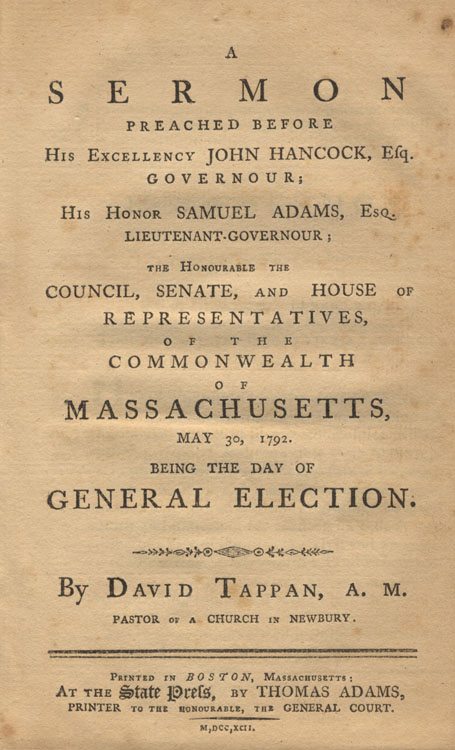
A

SERMON

PREACHED BEFORE

His Excellency JOHN HANCOCK, Esq.

GOVERNOUR;

His Honor SAMUEL ADAMS, Esq.

LIEUTENANT-GOVERNOUR;

The Honourable the

COUNCIL, SENATE, AND HOUSE OF

REPRESENTATIVES,

OF THE

COMMONWEALTH

OF

MASSACHUSETTS,

MAY 30, 1792.

BEING THE DAY OF

GENERAL ELECTION.

By David Tappan, A. M.
PASTOR OF A CHURCH IN NEWBURY.


Commonwealth of MASSACHUSETTS.

In the House of Representatives, May 30, 1792.

ORDERED, That Mr. Emery, Mr. Thorndike, and Mr. Howe, be a Committee, to wait on the Reverend David Tappan, and thank him in the name of the HOUSE, for the SERMON delivered by him this day, before His Excellency the Governor the Council, and the two Branches of the General Court; and also to request of him, a copy thereof for the Press.

Attest.
HENRY WARREN, Clerk.


AN
Election SERMON.

PSALM 77, VERSE 20,

THOU LEDDEST THY PEOPLE LIKE A FLOCK, BY THE HANDS OF MOSES AND AARON.

How various and transcendent are the excellencies of the sacred writings! They combine all the different species of literary composition in their highest perfection, and consecrate them to the moral improvement, the present and future happiness of man. They furnish the best summary precepts, models, and incentives, for producing the good citizen and statesman, for effecting an orderly and prosperous state of things in the civil and temporary combinations of this world: Whilst their primary object is, to prepare men for the nobler, the everlasting community of the blessed.

These observations are eminently illustrated by that part of the inspired volume, which relates to God’s ancient people. The words just recited, look back to the infancy of that favoured nation. They introduce the God of Israel under the beautiful signature of a Shepherd leading his flock; which expresses in a very lively and endearing manner, the singular tenderness and care, with which Heaven had conducted that people from the bondage of Egypt, to the promised Canaan. The latter part of the verse, presents the subordinate and united agency of Moses and Aaron, in accomplishing that memorable series of events. These two celebrated characters had been early and closely linked together, by the ties of nature, of religion, and of common sufferings. They were afterwards united by the more awful bond of a divine commission, which constituted them Plenipotentiaries from Jehovah, the King of Israel, to the Egyptian Court, which employed them as instrumental saviours of their oppressed countrymen, as their guides and protectors through the dangers of the wilderness, and the prime Ministers of their civil and ecclesiastical polity. Whilst the one was Chief Magistrate in the Commonwealth, the other was High Priest, or first officer in the Church. And the institution and combined influence of these two orders in that community, were a most wise and salutary provision both for its public and individual happiness.

The divine appointment, then, and concurrent agency of the civil and ecclesiastical ruler, in leading the ancient people of God, naturally invite our attention to the importance and utility of political and religious guides in a Christian state, and to that union of affection and of exertion for the common good, which ought to characterize and cement them. To explain and enforce this union, without confounding the Church and the Commonwealth, or blending the different provinces of their respective Ministers, is a truly delicate task. The Speaker hopes, however, that his well-meant endeavours to explore such a field, before an audience so respectable, will not be deemed either vain, or impertinent to the occasion. He flatters himself that the seasonable and momentous complexion of the subject, which cannot fail to strike every intelligent eye, will procure to the discussion and application of it a candid reception.

This joyful anniversary collects our civil and sacred leaders from various parts of the State, to one consecrated spot. It unites them, methinks, into one happy brotherhood. It brings them together to the altar of God, their common Founder, Master, and Judge. It makes them joint partakers in a kind of yearly festival, sacred to liberty and to religion—a festival, which seems to renew and to seal mutual friendship, and their harmonious ardent affection to the general interest. Is it not congenial then with the spirit of the day, as well as decent and useful on other accounts, that these two orders should sometimes be the united object of its public addresses from the word of God; that their reciprocal influence, and their conjunct operation to the common good, should be clearly defined, and forcibly urged?

Under the solemn impression of these ideas, we will endeavour to mark out the two different provinces of Moses and Aaron, or of the Ruler and the Priest; the beneficent influence of each upon the public welfare; and the several ways, in which they may and ought to befriend and assist each other in leading the people of God.

The discriminating genius of the two departments may be thus defined. The one has for its immediate object, the temporal interest of mankind; the other, their spiritual and everlasting. The one aims to regulate their outward behavior, so far as to restrain them from injuring one another or the public, and engage their contributions to the common welfare: The other contemplates the due regulation of the heart, as well as the overt-acts which issue from that source. The one enforces its addresses by sanctions merely civil and worldly; the other by motives which chiefly respect the soul and the life to come.

Let us now turn our attention to the important and happy influence of each department upon the public interest.

The importance of such an officer in society as the civil Magistrate, is immediately seen and felt by all. It grows out of the present weakness and corruption of mankind. It is suggested by the social feelings belonging to our frame, joined with a sense of mutual dependence and common danger. Accordingly, when such officer possesses the spirit of his station, and with intelligence and fidelity pursues its leading design, the effects on the community will be equally benign and diffusive. A ruler of this character, like the central orb of the planetary world, enlightens and animates, cements and beautifies the whole political system. With a skillful, steady, yet gentle hand, he moulds a confused mass of discordant materials into one regular and harmonious compound, and holds it together with a silken, yet invincible chain. By a strictly righteous, equal, and paternal administration, he spreads the blessings of justice, freedom, tranquility, public and private prosperity, through all classes of the people. The advantages of such a magistracy transcend description. To use the delicate and splendid figures of inspiration. It resembles “the light of the morning, when the sun riseth, even a morning without clouds; like the tender grass springing out of the earth by clear shining after rain.”

But it is needless to expatiate on this branch of our subject. The beneficent influence of good civil rule stands confessed to the eye of reason. It is inscribed, as with a sun-beam on the face of our happy country. It has been delineated with superior ability and address, on these anniversary solemnities.

Let us then direct our attention to the other object before us, namely, the importance and benefit to society, of the CHRISTIAN PRIESTHOOD, or of public religious instructors. To set this point in a just and easy light, let us consider at large, the necessity of religion to the well-being of a community, and then inquire, what are the best means of diffusing and maintaining it.

The necessity of religion to public order and happiness, has been generally acknowledged by discerning minds in all countries and ages, yea, by enlightened infidels and atheists. But a set of philosophers and free-thinkers, who boast of their superior reason and liberality, have appeared on the stage, in these days of modern refinement, who have employed all the powers of metaphysical sophistry and licentious ridicule to shake the foundations of religion: And some of them have even denied its political importance and utility, and have proposed in its stead a kind of philosophical or civil morality, as fully competent to the purposes of general order and security. A system of ideas, or at least of practical feelings, very similar to this, seems growing into fashion in various parts of the American Union; a system, which considers all religious principles, observances and instructors, as the remains of old monkish ignorance, superstition and bigotry, or the antiquated offspring of worldly policy, begotten in the early and ruder stages of society; but which are wholly unsuitable and useless, if not a heavy tax upon the public, in this more enlightened and mature period of human affairs! But let us meet these refined politicians upon their own ground; and ask them, what they have to substitute in the room of religion, as an adequate prop to their own favourite scheme of morality.

Will they say, that civil laws and institutions, planned with wisdom, and executed with vigour, will completely answer the purpose? But these human provisions can embrace only the visible actions of the subject. They can prevent or punish those offences only, which may be known and legally proved. They consequently, leave out of their jurisdiction all secret crimes; as well as those numberless immoralities, which human laws can never distinctly define, but which operate as the poison both of private and social felicity. Civil regulations proclaim their own incompetency, even in the judicial procedures submitted to their authority: For no general rule can accommodate itself to an infinite diversity of circumstances: And therefore the aid of religious principle seems absolutely necessary to supply the defect. This will teach the Legislator to construct, and the Judge to interpret and apply the laws, upon so just and liberal a plan, as will present the best advantages in every case, for discovering the truth, and so for protecting the innocent, as well as chastising the willful offender. This will induce a conscientious, a filial and generous obedience, on the part of the subject, to the reasonable authority of the Magistrate and the laws. At the same time it will prevent a cowardly, degrading submission to the claims and measures of imperious despots, or a fawning, idolatrous, prostration at the feet of a dignified fellow-worm. In short, whilst human laws punish criminal actions, it is the glory of religion to prevent them, to tear up the roots from which they grow. Whilst law is deaf and unrelenting to the cries of penitent guilt, religion pardons and comforts the suppliant, returning offender, and hereby encourages and fortifies his purposes and efforts of future obedience. Whilst the one enforces strict justice only, the other inculcates the whole train of gentle and beneficent virtues: It inspires an intercourse of humane, generous kindness, and grateful attachment and fidelity, between the higher and lower classes in society; an intercourse, which like the vital fluid diffuses cheerful health through the whole political body. Thus civil institutions and measures, even in their best state, require the succours of religion, to supply their deficiencies, to soften their rigour, to enforce and to sweeten their observance.

“But a sense of honour, the desire of esteem and praise, and fear of their opposites, joined to the efficacy of salutary laws, will certainly form a sufficient security of the general order and welfare.” We answer, the good influence of this principle will not bear a comparison with that of religion. For the praise or censure of the world, exerts its principal force within a very small circle, upon more splendid or public characters; whilst the great majority of the people, concealed under humble roofs, feel little of its efficacy. But religion applies its stimulating or withholding influence to the ignorant, the obscure, and the weak; as well as to the wise, the noble and the mighty. The world does not bestow its palm till men have almost reached the goal; but religion applauds and cherishes the first virtuous desire, intention, or effort. The world often mistakes in its judgment of characters and actions; but religion places an unerring witness and judge in our very bosoms. In a word, even the esteem of men in the case before us, ultimately derives its force from religion. For if the social or moral virtues of mankind, were once stripped of the lustre, the stability, and the majesty, which religious principles communicate, the respect paid to them, would suffer an immediate shock: The idea of honour and disgrace, connected with their performance or omission, would be greatly enfeebled: And the opinion of the world, left without a steady guide, would grow too fluctuating and capricious, to restrain or to actuate human conduct.

“But the connection between the interest of the public and of individuals, lays a sufficient bond upon the latter to contribute to the order and welfare of the former.” We reply, this connection is not always so immediate and striking, as to influence the unthinking, the poor and the wretched, to pay homage to the order and beauty of the social system, whilst there is nothing for them individually, but apparent deformity and misery; whilst those very principles and rules, which secure harmony to the public, wealth, power and magnificence to some of their fortunate neighbours, seem to bind them down to perpetual poverty and toil; and when a violation of these laws promises instant relief or benefit to themselves, and at the same time, perhaps threatens no direct injury to the community at large. There are some cases too, in which the more opulent ranks, or the governing powers of the State, may with reason consider the public interest and their own, as separate objects: And if their minds are not enlightened and regulated by religion, they will often view these two interests as distinct, when they really unite. The will also be supremely inclined to pursue private advantage, at the expense of every rival claim. In such instances, what is there effectually to restrain such elevated characters from sacrificing the public, at the shrine of their adored, though paltry idol? There is nothing which promises a sure and perpetual guard against these evils, but religious principles, the sentiment of a Deity, and of a future state of recompense, early planted in the minds, and deeply rooted in the hearts both of the high and low.

“But some infidel and irreligious characters have conducted well in a social and political view.” We answer, religious ideas early taught and imbibed, will secretly influence the conscience and practice, long after the understanding has begun to question, and even to reject the arguments, on which they are founded. Besides, a habit of order and propriety in conduct, once formed, is not easily subdued by after speculations; especially when an adherence to it is connected with the marks of public esteem and favour, or enforced by the commanding motive of private interest. Not to add, that there are some, who affect a superiority to the common mass of mankind, by talking like infidels, who yet feel themselves constrained to think and act, in many instances, like vulgar believers.

“But if religion be the main prop of social order, why does not the latter always relax and decline with the former?” The answer is, religion still keeps her hold of men, through the medium of natural conscience, of early habit, and some awful controlling impression of a future retribution, even when their hearts do not feel her transforming power, nor their lives display her peculiar and most attractive charms. If then religious principles have such salutary effects on society, even when their influence is feeble, and when they manage the human mind by the inferior and precarious handle of fear; what would be their fruits, if they reigned in full glory, and commanded the free and steady services of love? If love to God and men, which is the life of religion, pervaded all classes in the community, what a copious and excellent harvest would it quickly produce! This would ensure the universal practice of all those virtues, which nourish and exalt a nation; whilst it directly promoted the interest and comfort of all ages, conditions and stations; it would, as the great law of moral attraction, draw the affections and efforts of all to one common center, the good of the whole. Must not such a spirit and conduct immediately advance the respectability, the vigour, the temporal and spiritual prosperity of a people? Must they not draw down the approving smiles, the guardian care, the rewarding munificence of the Supreme Ruler of nations? On the other side, must not irreligion, and its natural offspring, vice, equally tend, both by a direct and a judicial operation, to disjoint, to enfeeble, to destroy a community? Does ot the universal experience of public bodies from the beginning to this day, seal the truth of these observations? Is it not one mighty practical demonstration of the salutary fruit of piety and virtue, or the baneful influence of their opposites, upon the order, the liberty, the general welfare of nations?

The necessity of religion to public happiness being sufficiently proved, an interesting question arises; what are the best means of diffusing and maintaining in a community this precious and fundamental blessing? This inquiry brings up to view the importance of public religious instructors. The political necessity of such an order of men, directly results from that of religion itself, when compared with the ignorance, dullness, and depravity of the human mind, the spiritual and sublime nature of religious truths, the want of leisure as well as ability in the bulk of mankind, for studying and familiarizing them, and the influence of surrounding objects of worldly cares and amusements to intercept their view, to efface or weaken their impression. In this dark and impure region, how apt are even the most contemplative and virtuous characters to lose sight of moral and spiritual objects, and to get out of the sphere of their attractive and regulating influence! How greatly then do we all need the friendly voice of STATED MONITORS, to recall our forgetful, wandering feet; and to enlighten and warm our hearts afresh with the divine principles and motives of religion! Those in high station need to be frequently reminded, that there is a Being above them, to whom they are accountable, equally with the lowest of the people. Persons of great genius and learning, require to be often admonished that their obligations to serve God and the public, are proportioned to their superior talents. The worthy and good in society, need a frequent and lively inculcation of those truths, which tend to nourish and fortify their virtues, to enliven and extend their efforts of usefulness. How much ore needful, then is public religious instruction to the inferior members of the community, to the numerous class of laborious poor, to the grossly ignorant, the careless, and the vicious! Without this, how shall they obtain a competent knowledge, or an abiding practical impression of their various relations and duties to God, to man, to civil society?

In this view, the public worship of the Deity, and stated instructions in religion and morality, appear as necessary and beneficial to the State, as they are to the souls of individuals: And the institution of a WEEKLY SABBATH, devoted to those purposes, is the offspring of profound and generous policy, if viewed merely in its aspect upon our present social condition. For the decent and united observation of it, by the Members of each Corporation, is, an eminent mean of promoting useful knowledge, civilization and good neighbourhood; of strengthening the cords both of political and Christian union; of bringing seasonable rest and refreshment to the body and mind, after the fatigues of worldly care and toil; and of keeping alive in the minds of all ranks, an awful commanding sense of Deity, of moral and religious obligation: Agreeably, the public benefits of this institution are distinctly visible on the face of those communities, which carefully support and observe it; whilst the contrary features equally distinguish those, which despise or neglect it.

The preacher cannot do full justice to this part of his theme, or to his own profession as a Gospel Minister without adding, that the CHRISTIAN RELIGION, properly stated and enforced by its teachers, has a peculiarly favourable influence upon the present social state of mankind: For, it is the volume of revelation only, that fully illustrates and confirms, and with due authority presses, those great religious principles, which we have shown to be the basis of virtue and of order. At the same time it superadds a new scheme of truth, suited to the lapsed state of mankind, which at once encourages, directs, assists and constrains to universal goodness; it presents the Deity, in the full orbed lustre of his perfections; it displays the matchless philanthropy, the generous expiation and intercession of his Son; it offers and conveys the needed succours of his spirit; it ascertains and describes the future joys and sorrows of immortality. Must not these discoveries, suitably realized, powerfully tend to check transgression—to kill the seeds of vice, and to produce, to enoble, and improve every branch of a virtuous character? The moral system too, which Christianity builds upon these principles, is an eminent friend to our present felicity. For it inculcates the most extended, the most active, the most self-denying benevolence; it links us to the great brotherhood of man; yea, it unites us to the universe, to eternity, and to God, the head and sum of both. It levels all the haughty feelings of superior rank or abilities, and places true greatness in humble, condescending, elevated goodness. By this, as well as by constantly pointing us to those two great levelers, death and an endless retribution, it introduces a kind of generous republican equality among the different orders and conditions in society. It equally regards and secures the interest of all the members of the community, by that great rule of equity, “whatever ye would that men should do unto you, do ye even so to them.” By presenting the same motives and rewards of virtue to the weak and the strong, and by urging both to secret acts of goodness, from a regard to the approving eye, and final recompense of the Supreme Judge; it provides a steady support, a constant opportunity, a universal engagement to the practice of virtue. We may add, it regulates and refines those important social connections and duties, the conjugal, parental and filial, in a manner highly favourable to the order and happiness of human society. In a word, the spirit of our religion, is uniting and peaceable: It is loyal, patriotic, and free: It is the life and support of good government and of rational liberty. Even the positive, ceremonial rites of Christianity, properly administered, are important out-works, which guard the public welfare: For by striking upon the senses and imaginations of men, they bring affecting truths with peculiar force to their hearts, and hereby operate to produce a decent and regular outward deportment.

What an engine of public usefulness, then, does the Christian institution put into the hands of its Ministers! And how important is it to the common good, that such an order of men should be spread out over the whole community! What unspeakable aid may they afford to, as well as receive from, the civil Magistrate! Whilst the people at large reap a plentiful harvest from the united labours of both! Which brings us more distinctly to point out the several ways in which the Ruler and Priest may and ought to combine their influence, or to assist each other, in leading the people of God.

We mean not to advocate such a union or cooperation of the two order, as involves a heterogeneous mixture of civil and spiritual objects; as places the Magistrate upon Christ’s throne, in the Church, and invests the Christian Minister with the honors and the powers of the State: Such motley alliances are the offspring of political and priestly ambition, aided by equal cunning; are the main pillar both of civil and religious tyranny; and the source of infinite mischiefs to the intellectual and moral character as well as the temporal condition of mankind. They infect the best religion under Heaven, its Professors and Ministers, with the spirit of this world, with a proud, cruel, persecuting and immoral disposition. As a celebrated writer observes, “persecution is not an original feature in any religion; but is always the strongly marked feature of all law, religion, or religious established by law. Take away the law-establishment, and religion re-assumes it original benignity. In America a Catholic Priest is a good citizen, a good character, and a good neighbour; an Episcopalian Minister is of the same description; and this proceeds from there being no law-establishment in America.”

But whilst we execrate such treasonable conspiracies between Rulers and Priests, against the dearest rights and interests of man, we may consistently recommend to the two orders, a liberal and patriotic combination for the general good. There is indeed, in many respects, a natural alliance between intelligent, virtuous Magistrates and Ministers, in a free and Christian State.

And first, the Magistrate may and ought to cooperate with the Christian instructor, by throwing the weight of his personal example and private influence into the scale of Christian piety and virtue. The efficacy of example, when arrayed in all the splendor of high office, is not to be described. As religion adds grace and dignity to the most exalted station, so she derives a superior charm and majesty from it.

When the great political characters in a community, give their uniform sanction to religion, by exhibiting her fairest features in their daily deportment; when they openly revere the name, the Sabbaths, the temple, and all the sacred institutions of the Most High; when they liberally and zealously contribute to the settlement and support, the reputation and success of a learned and virtuous Priesthood, to the extensive propagation of Christian knowledge, and to the pious education of the rising age; when they are eminent patterns of virtue themselves, and are careful to cherish and honour it in others; how unspeakably do such examples confirm and extend the credit and influence of religion! What animation and confidence, what superior respectability and success, do they give to its teachers! What authority and energy must the inward consciousness, and open lustre of such virtue impart to Rulers themselves, in their official proceedings; especially those which have for their object, the suppression of wickedness, and the encouragement of the opposite interest! Which leads us to observe, that Rulers efficaciously concur with Christian Ministers, when they carry the spirit of religion into their public conduct: When all their political measures are regulated by the everlasting maxims of natural justice, of Christian equity and benevolence: When they accordingly distribute the burdens, apply the resources, fulfill the engagements and discharge the debt of the public, with the scrupulous fairness, the exact economy, the assiduous attention required by those rules, in the similar transactions of private citizens: When they detest and scorn the idea of sanctioning by their public authority, any measure, which they would blush to avow or to practice in their individual capacity: In short, when the whole system of their public conduct appears to be prompted and guided by a SUPREME regard to the example and laws, the approbation and honour of the infinite Ruler and the good of his moral family: What a glorious attestation is here of the reality, the commanding force of religious obligation! Such a train of political measures is pregnant with various and almost inconceivable good. It inculcates various sentiments upon the public mind, with all the authority and force of the highest, the most conspicuous, and unequivocal example. It also directly and efficiently contributes to the general prosperity: For it proceeds upon principles, which are as essentially necessary and conducive to social union and happiness, as the laws which govern the material world, are to the harmony and welfare of nature.

Further, the Magistrate may greatly strengthen the Christian Teacher, by directing his public attention to the advancement of religion and virtue as an immediate and primary object; by so arranging his measures for the increase of temporal good, as to render them in the best manner subservient to that which is spiritual and eternal; by enacting and executing laws for the prevention or punishment of profaneness and immorality; by promoting virtuous characters to offices of honor and usefulness; by neglecting and despising the vicious; by lessening and removing the temptation to iniquity; by augmenting and multiplying the encouragements to goodness; by giving birth and efficacy to public and private means of learning, so essential to rational piety; by effectually providing for the support and decent observance of public religious worship and instruction so necessary, as we have seen, to the virtue, the civilization, and happiness, of the community. Such a legal provision for the maintenance of religious institutions, obviously falls within the province of the Magistrate, on account of their transcendent importance to civil government and society: Nor does such provision adjusted upon an equal and liberal plan, make the least approach to a political establishment of any particular religious profession, nor consequently involve any invasion of the prerogative of Christ, or the sacred rights of conscience. On the other hand, Secondly. The Christian Minister may and ought to strengthen the hands of the civil Ruler. If he possesses those qualities of head and heart, which suit his benevolent and comprehensive office, he must have the most tender and ardent feelings for the interest of the State, as well as the Church. He must perceive an important connection between them, as well as the friendly aspect of the Christian doctrine upon both. He must consequently feel a double stimulus to a prudent and faithful discharge of his trust. He therefore endeavours, both in his public ministrations, and in his private conversation and example, so to represent and enforce the Christian system, as that it may, under the divine blessing, have its full effect upon the character and condition of mankind, in reference to this world and the next. He takes particular care not to make this beneficent and peaceable religion, an engine of civil or spiritual tyranny, confusion, malignant strife, or in any respect, an instrument of increasing, instead of lessening human depravity and wretchedness. He feels himself peculiarly united to the worthy Magistrate, by the ties of personal esteem and public affection. He studies that his whole deportment respecting the Rulers and the laws, may express and promote a spirit of decent subjection and obedience, and he enforces such submission by all the authority and sanction of religion. His social intercourse with his family and flock, his daily prayers in private and in public, tend to kindle and to nourish the sentiments of loyalty and patriotism. He loves to mention in the ears of the rising race, the names and services of patriot Rulers, of eminent public benefactors; and hereby to charm the tender mind to the love of virtue, of country, of mankind, as well as to a due veneration for, and grateful submission to such Ministers of divine benevolence. His public discourses too, all tend either directly or remotely, to form his hearers into good citizens and subjects, as well as holy Christians. That such a reciprocation of services between the two orders, falls within the line of propriety and important duty, is too obvious to the eye of discernment, to require a formal illustration.

It is with great satisfaction, that we appeal to the historic page of our own country, for a striking comment upon the preceding discourse. Our fathers were led out of the house of bondage in Britain, into the wilderness of America, and planted here, as in the land of promise, by the same divine Shepherd, who led ancient Israel from deep oppression and misery, to the joys of freedom and plenty. The same good spirit, which inspired Moses and Aaron, to undertake and conduct so arduous an enterprise, evidently guided and animated the leaders in that great attempt, which gave birth to New-England. The same union of friendship, of counsel and exertion in the public cause, which characterized the Hebrew Lawgiver and High-Priest, distinguished the political and religious Fathers of Massachusetts. The rulers of the State, were at the same time Members and pillars of the Church. The religion which they thus solemnly professed, was the rule of their public and private conduct, and the advancement of its interests, a main object of both. For this purpose, they readily co-operated with the schemes and endeavours of worthy clergymen, and contributed their best efforts for their comfort, reputation and success.

The advice and influence of the priesthood were likewise ever at hand, to aid and succeed the operations of the Magistrate, and to promote the civil, as well as religious interests of the people. It is granted, indeed, that our ancestors carried this union of Church and State, to an unwarrantable length. But this was not their peculiar fault: It was the complexion of the age. And shall we, their children, who owe so much to their generous services and sufferings, shall we, like undutiful and cursed Ham, take pleasure in exposing their nakedness? No, my fellow-citizens; whilst we spread a veil of filial piety over their imperfections, let us with the most grateful emotions, celebrate that united agency of Moses and Aaron, which, under God, laid such early and noble foundations of freedom and order, of science and religion; which in the feeble infancy, and great poverty of the settlement gave birth to a public seminary of learning; a seminary, which from its foundation, to this day, has borne on its front the united inscription of the Ruler and the Priest, in the names of its Founders, and Benefactors, of its Governors and Sons! But passing over the intermediate stages of our history; you will permit me modestly to ask, does not the inscription just mentioned, appear very conspicuous on the face of our late glorious revolution? Did not these two orders remarkably unite their efforts to keep the public mind in a posture of vigilance, of information, of patriotic ardour? In those times which tried men’s souls, did not the public prayers and discourses, the private influence and example of the great body of the clergy, firmly and successfully co-operate with the civil and military measures of the country? Did not the same zealous concurrence of the two departments, procure the adoption of the excellent constitution of Massachusetts, and of the present federal system, which gives union, order, and happiness to America? Did not the same virtuous and unshaken combination eminently mark that perilous and alarming crisis, which a few years since passed over this Commonwealth? Do not these striking facts evince, that the spirit of the clerical office at least, in this enlightened and free country, is an important friend to the liberty, government and happiness of society? On the other hand, it becomes us gratefully to acknowledge the support which religion and its Ministers have received from the civil government of this State, from the authority and example of some of the first political characters in it; the additional reputation and success which they have instrumentally derived from that source; and the consequent face of superior union and order, civilization and virtue, which adorns a great part of our community. These advantages would strike us with much greater force, were we allowed to contrast our situation in these respects, with that of some other parts of the Union: But decency forbids the invidious comparison.

When we look over this numerous and respectable assembly, a cloud of witnesses rushes upon our senses and hearts, in support of the ideas now advanced.

Our eye is first caught by the Chief Magistrate of this Commonwealth, who has had a large share in the great political drama, that has been acted on the stage of the new world, and covered it with glory. The presence of his Excellency restrains the lips of delicacy from paying him a formal tribute of praise. But while his distinguished political services are engraven on every American bosom, justice to a different part of his character, constrains us to observe, that he has ever treated religion, its institutions and Ministers, with a respect becoming the enlightened, consistent patriot, and Ruler, in a Christian State. The clergy within his jurisdiction, feel the animating influence of his attention and patronage, and wish him in return, a large experience of the comforts of our divine religion, amidst that trying scene of bodily infirmity, with which he has so long been afflicted. It is also our united prayer to God that his Excellency may ever form his whole private and public conduct upon the divine model proposed in the life and precepts of the Christian lawgiver. That so his personal example and official measures may unite their influence to spread piety and virtue as well as every temporal blessing, through the community. To this, he will feel himself urged by every motive, which can operate upon a heart of sensibility; in particular, by the interesting prospect of death and endless retribution, to which the highest earthly god is equally bound with the lowest of his subjects. May conscious fidelity cheer the solemn hour of dissolution, inspire boldness before the decisive tribunal, and be crowned with superior glory in the kingdom of Heaven.

His Honour, the Lieutenant-Governour, merits our tribute of respect, on account of that distinguished union of political wisdom, patriotic virtue, and Christian piety, which has long dignified his reputation among the civilians of the age, he has not been ashamed of the cross of Christ, but has long been enlisted under that despised, but heavenly banner. May he still continue an ornament and pillar, both of the Church and Commonwealth, till his hoary head shall come down to the grave in peace.

The Honourable Council claim our regards, on account of their important share in the executive department, and worthy personal qualities, which pointed them out to the suffrages of their enlightened fellow-citizens. Whilst their elevation to this office reflects on them a ray of glory, it obliges them to a correspondent dignity of sentiment and conduct: It invites them to a noble imitation of the governing wisdom, justice and mercy of HIM, who is wonderful Counselor, the King of righteousness and of peace. It particularly calls them to advise and consent to the appointment of such characters only, to interpret and execute the laws, as are exemplary themselves for the observance of human and divine injunctions, and endowed with talents and dispositions suited to the important trust. In this way they may unspeakably promote the civil and moral interests of all parts of the Commonwealth.

The Gentlemen who compose the two Branches of the Honourable Legislature, will permit our congratulations on the fresh mark of esteem and confidence, with which their constituents have honoured them. They will likewise remember that the trust, with which they are charged, is very solemn and momentous; that it is rendered still more awful, by the declarations and oaths, with which they have recently entered on its execution. As we cannot doubt their sincerity in those professions and appeals to Heaven, we entertain a cheerful hope that all their transactions on this day and through the year, will be regulated by the excellent principles of that religion, and of those civil constitutions which they have publicly taken for their guide. We reasonably expect that all their laws and proceedings will be so many branches growing out of the stock of equal justice and comprehensive benevolence; that they will be strongly marked with the same integrity, virtue and honor, which suit and adorn the rational and Christian character in a private capacity. They will ever remember that the same practical principles, must form the basis both of public and individual happiness and glory; and that the policy of those who would rear the fabric of national prosperity upon a different foundation is equally unphilosophical and iniquitous. As human art, in order to produce certain useful effects must conform to the principles of nature, or the established laws of its great Architect; so the politician must build the order and welfare of society upon those moral principles and connections, which the same Almighty Ruler, has instituted in the rational system. If he act an opposite part, he virtually, attempts a new creation: Yea, like the man of sin, he exalts himself above all that is called God; for it is the glory of the Deity himself, though he be an absolute Almighty Sovereign, that he cannot govern upon any other plan than that of inviolable truth, justice, and goodness; that he cannot lie to any of his subjects, or trifle with their reasonable petitions, expectations or claims. It will be the glory of our Rulers, to copy after this divine original. No idea therefore of omnipotence or uncontrolled Sovereignty, will be permitted to infect their deliberations and decisions; but their whole conduct, as it respects particular citizens, the Commonwealth in general, and the great American Republic, will, we trust, exhibit a fair picture of honest, enlarged and Federal policy.

Honored Fathers: As you do not remove out of the sphere of religious obligation, by entering the circle of politicks; as you, have all this day professed the Christian belief, and many of you are complete visible members of the Redeemer’s family; you will feel under the most sacred ties, to devote the superior powers and advantages of your present stations, to the Christian interest. Whilst therefore you tenderly guard the rights of conscience, and afford equal protection to all peaceable citizens, you will make and enforce every needful provision for the general diffusion of religious and moral sentiments, and for the maintenance and observation of those Christian and literary institutions, which are requisite to that end. Among such institutions, the neighbouring University has a distinguished claim to your liberal patronage. It has been one of the grand nurseries of civilization, liberty, good government and religion. Our very existence, as a respectable community, is, under God, greatly derived from that source. Filial gratitude then, as well as every sentiment of public virtue, press our Rulers to nurse and cherish this their ancient parent, with a tender and generous care.

In a word, let me respectfully call upon all our civil officers, in every department, to consecrate their authority, influence and example to the greatest good of the community. You, Gentlemen, collectively considered, are the moving and regulating principle of the whole political machine. If you jointly and strenuously pursue a virtuous train of conduct, it will operate like a powerful charm upon all parts of the system, and call up a new creation of beauty, virtue and happiness. Let it then be your first ambition and endeavour, to make mankind wiser, better and happier; to raise up the drooping head of virtue; to tread down irreligion and vice; to enlarge the empire of knowledge and righteousness; to augment as much as possible, the sum of created good, and of creating and redeeming glory.

And since the advancement of these great interests lies very much between you and the standing teachers of religion, let gentlemen in these different orders cultivate a friendly and patriotic alliance, by all the methods which prudence and generous virtue suggest.

Ye venerable leaders of our civil and ecclesiastical tribes; how many and how forcible are the ties which bind you together! IN this land of political and religious freedom, you both derive your election to office from one source; you are fellow-labourers in one great and benevolent cause; you are important members of one civil body, and by visible profession and sacred obligation, of one Christian family; in the due performance of your several offices, you display the same leading excellent talents and virtues, and mutually give and receive the most important support. Certainly then, there can be no strife, no jealous distance between you; for ye are brethren. We congratulate the people of Massachusetts, on the liberal and virtuous union, which at this moment subsists between you, and which is particularly exemplified in those numerous laudable incorporations, which embrace many of your first characters; and which have for their object, the interests of science, of arts, of education, of humanity, of Christian knowledge and piety. To perpetuate this union and render it still more operative to the general good, and not the low selfishness or vanity of exalting and strengthening his own profession, considered as a separate interest, has been the preachers governing motive in this discourse; and with a view to the same grand object, he modestly submits to the candour of both departments, a few monitory hints, suggested by the present aspect of society and of religion.

In the first place: Our leading characters in the civil and the literary line, will feel the peculiar importance, at this degenerated period of animating their clerical brethren, in every method dictated by wisdom and virtue; and particular, by encouraging them to calculate their public ministrations upon principles of the most extensive usefulness. They will consider, that many of us are connected with societies, which are chiefly composed of the laboring and more illiterate class; that these peculiarly need the privileges of a weekly Sabbath and public religious instruction; and that many of them require very plain, and very pungent applications, in order to enlighten their ignorance, to rouse their stupidity, or to check their vicious career. Our Christian patriots, therefore far from despising, will generously aid those teachers, who frequently endeavour, by all the methods of familiar, pathetic, or alarming address, to reach and refine these rougher parts of the community. The enlarged knowledge and experience of our learned civilians will also inspire sentiments of candour towards the priesthood, in regard to that variety of speculation, of gifts, and address, by which it is diversified; they will view this diversity as naturally resulting in great measure from the spirit of free inquiry and improvement, which characterizes the present day. They will consider too, that it furnishes public teachers suited to the various capacities, tastes and prejudices, and all the grades of character and condition, which at this period mark the face of society. They will further consider, that the operation of republican equality and religious freedom, will sometimes introduce a Christian instructor not perfectly agreeable to the relish or the speculations of a few superior members of a corporation, but perhaps very acceptable and beneficial to the general mass of the people. In such cases, does not a regard to social order, to equal rights, to the greatest moral and political good, require a generous and peaceable acquiescence?

On the other hand it becomes the clergy at this day studiously to hold up their office, and the religion which they teach, in the most respectable and pleasing light. A special attention to this object, is rendered important, by the present improved state of society; by the learning and politeness, which adorn many of our religious assemblies; by the rapid progress of loose sentiments and manners, and the consequent disrelish or contempt of Christian doctrines, institutions, and teachers. To check these spreading evils it becomes the sacred order to pay great attention both to the private and public duties of their function; it becomes them, in the performance of the latter, to display a force of reasoning, a propriety of thought, of method and expression, a decency of style and address, which may at once bear down the scoffs and the sophistry of libertism, justly please the taste of literary refinement, and at the same time exhibit the plain, the affectionate, the evangelical preacher. It becomes them both in their ministrations and personal example, to represent the Christian institution and ministry, as friendly to human happiness in both worlds; as breathing a social and courteous, a candid and forbearing, a loyal, uniting, and public spirit; a spirit, which whilst it supremely attaches us to the service and rewards of the life to come, cherishes a proper sensibility of our rights, duties, and enjoyments as inhabitants of the earth. It becomes them in every consistent method, to support the civil interests of the community, the respectability of its Rulers, and the efficacy of its Laws. And whilst law speaks to the public ear, in one uniform, inflexible tone, it is ours, my Reverend Fathers and Brethren, to bring home the address of religion to the bosoms of individuals; and by a pertinent and forcible application of her peculiar truths and sanctions, to seize their consciences, their imaginations, their hearts; to possess and command their inmost feelings. By this process, under the influence of the all creating spirit; we are first to mould them into good men, and then by an easy transition into good citizens, rulers and subjects. Above all, let us ever keep in our own realizing view, and endeavour to enforce upon our people, the primary, the infinitely weighty object of our religion and ministry, viz. the spiritual, everlasting salvation of immortal beings, and the glory of God and his Son, shining forth in the wondrous contrivance, and accomplishment of it. Whilst our Rulers are pushing forward our temporal prosperity and glory, let us labour to establish and to complete that glory, by a corresponding advancement of this most important object. Into this channel let us endeavour to draw all the civil and literary, as well as religious advantages, which come within our reach. Let the united efforts of the clergy and laity, be especially employed in diffusing Christian knowledge and virtue, through those vast territories of our country, whose poverty, and remote situation have precluded the stated enjoyment of religious institutions; and in promoting a more general and effectual attention to the private means of education, in various parts of the Commonwealth. By such a union of public exertion, our leading characters in Church and State, will resemble the two olive-trees, which the Prophet saw in vision, emptying their golden oil into the candlestick of Zion.

Fellow-Citizens of this great Assembly,

I felicitate you and our common country, on the natural, civil and religious advantages, by which we are so eminently exalted; and especially on the prosperous train of our national affairs, under the auspices of indulgent Heaven, and its favourite Minister, the President of the United States. When we mention this beloved citizen and benefactor of America, every bosom present, feels the endearing and forcible illustration, which his example gives to the leading sentiment of this discourse. For the charm of his piety, of his public and private virtue, as well as political wisdom, has been a principal cement of our national union, and so a prime source of all its attendant blessings. What then is wanting to complete the glory and happiness of our country? Nothing but the general prevalence of the same excellent spirit; a spirit of sublime virtue, corresponding to the natural grandeur and extent of America, and to its noble constitutions of government and religion. Virtue enlightened and invigorated by political and Christian knowledge, is eminently the soul of a republic. It is necessary to direct, to enliven, to guard the election of its Rulers, and to secure to them, the generous confidence, submission and cooperation of the people. It is peculiarly requisite in a community like ours, spread out over such an immense continent, divided by so many local governments, prejudices and interests: A people so circumstanced, can never be firmly and durably united, under one free and popular government, without the strong bands of religious and moral principle, of intelligent and enlarged patriotism. Liberty planted in such a soil, will be perpetually tending to unbridled licentiousness, distracting jealousies, and popular confusion. Let us then set up a vigilant guard against these encroaching evils. Let us not imagine that the exercise of civil liberty, consists in ignorant or envious abuse of public characters and measures; nor that religious freedom will justify careless neglect or wanton contempt of the truths, the ordinances, and ministers of that religion, which was sent down from Heaven to guide us, to present and future happiness. Though we are not accountable to the civil Magistrate for our religious sentiments and worship; yet we certainly are to the Deity; and he has given us no liberty in this enlightened country, either to think with Deists and Skeptics, or to live like Atheists; nor will the prostitution of his Sabbaths, to idleness or amusements in human and divine laws, pass in his account for a mark of superior politeness or liberality. In opposition to these wicked, but too modish abuses of liberty, let us remember that energetic government, is the guardian of freedom, and that religion, especially the Christian, is the pillar of both. Let us then properly respect, support, and concur both with our civil and religious Ministers. Let us exercise the most scrupulous care in the election of both, and be rationally satisfied, that their heads and hearts, their principles and morals, comport with the spirit of their several offices. But having chosen them, let us treat their persons and administrations with that confidence and honour, which become a wise and magnanimous people, and which may, by the blessing of God, give the greatest effect to their benevolent labours.

Finally: As the crown of all, let us become pious towards God, humble and obedient believers in his Son, conscientiously submissive to the government and laws of our country, sober, frugal, and diligent in our several employments, just and kind to one another, unitedly and zealously attached to the great interests of America, and of the whole human fraternity. Then we shall hold out an inviting example to all the world, of the propitious operation of a free government; we shall encourage and accelerate the progress of reason, and of liberty, through the globe. Already has the new world diffused the light and warmth of freedom across the Atlantic, into the old; which has given birth to a surprising and glorious revolution. Let us be nobly ambitious, by our future conduct, to feed and extend the generous flame; and thus to realize the wishes and hopes of all benevolent spirits in Heaven and earth. Let us especially labour and pray, that these political struggles and changes, may, under the divine agency, introduce new and brighter scenes of Christian knowledge and piety, till the whole world shall be covered with divine glory and human bliss. And may we in particular, after having filled our departments in society here, with usefulness and honor, be united to the more glorious community of the righteous; where the official distinctions of Moses and Aaron, are known no more; where all the followers of the Lamb, shall form one royal priesthood, one mighty combination of perfect and happy immortals; and God the original source of being and blessedness, shall be ALL in ALL.

AMEN.

Sermon – Thanksgiving – 1795 Philadelphia


The following is the text of a sermon preached by Samuel Stanhope Smith on February 19, 1795 – the day of the national Thanksgiving proclaimed by President George Washington.

Samuel Stanhope Smith (1751-1819) graduated from Princeton in 1769 and began helping his father (a minister) with his school and studying theology. He became a tutor at Princeton in 1770 where he studied under John Witherspoon and was ordained in 1773. Smith played a role in the founding of August County College (later Washington and Lee Univeristy) and Hampden-Sydney College. He became president of Princeton upon Witherspoon’s death in 1794 and served until 1812.


sermon-thanksgiving-1795-philadelphia


The Divine Goodness
To the
United States of America.

A
DISCOURSE,
on the
Subjects of National Gratitude.
Delivered in the Third Presbyterian Church in Philadelphia,
On Thursday the19th of February, 1795,
Recommended by the President of the United States,
To be observed throughout the Union as a Day of
General Thanksgiving and Prayer.
Published at the Request of the Committee of that Church.

By Samuel Stanhope Smith, D.D.
Vice-President and Professor of Moral Philosophy and
Divinity, in the College of New-Jersey.

A
SERMON, & c.

PSALM cvii. 21.
Oh! That men would praise the Lord for his goodness, and for his wonderful works to the children of men!

This verse is the chorus1 of a psalm destined to offer to God the praise of a devout and grateful people for the goodness of his providence towards their nation, and individually towards themselves in various situations of life. It is therefore a proper introduction to our present duty. “Let us sacrifice the sacrifices of thanksgivings, and declare his works with rejoicing.”

Thanksgiving to God for public, or for private blessings is an act of worship as reasonable as it is pious—because, as the whole course of nature is arranged and moved by him, every good and perfect gift, which we enjoy, must flow to us from the immediate direction and beneficence of his providence. Surrounded continually with many proofs of the divine goodness, and partakers of many of its fruits, thanksgiving ought to form a part of our daily devotions. But singular instances of personal or national felicity require public and solemn acknowledgments. Connected by fraternal relations with the whole family of mankind it is our duty to rejoice in their happiness, as well as to sympathize with them in their misfortunes. But, united with our country by more intimate ties, it is especially our duty to bring our vows and offerings of praise for her prosperity before the throne of eternal mercy. To this pious office we are now invited by her voice speaking through that illustrious and excellent magistrate who adds to all his other virtues a sacred regard to religion, and who has ever shown an exemplary and humble acknowledgment of divine providence, even in those moments, so glorious to himself, when the human heart, elated by the splendor of success, is most apt to forget its dependence upon God.

Although it is the business of the philosopher to trace the relations of causes and effects, and though every event in society, as well as in nature, may be referred to some adequate cause incorporated into the system of the universe; yet does not this impair our obligations to God, the first mover of all, or diminish the reasonableness of our present duty. He who created the universe, who gave to all things their respective powers, and arranged their combinations, foresaw also their results, intended every end, and prepared, in the general system, the necessary means to accomplish it. Short-sighted indeed is the man who terminates his view on the means, and who does not discern in them the superior direction of that Infinite Being from whom they have derived their existence and their agency. When therefore I retrace our mercies, however a speculative mind may be able to refer them to political, or to natural causes, it is our duty to direct our gratitude ultimately to the Supreme Disposer of all events, who, in the plan of the universe, had prepared, and in the train of his providence has conducted these causes to a happy issue.

It will be impossible, in the time allotted for a single discourse, to go into a detail of all our public blessings; and I forbear, at present, to point out the chastisements or the threatening of Divine Providence which have been mingled with them, and which should awaken within us an humble and holy circumspection of conduct, and preserve us, in our prosperity, from an undue elation of mind. I shall confine my view to a few of the most obvious and important subjects of national gratitude, that are either peculiar to the time, or have been suggested by some striking circumstances in the conduct and opinions of the present age.

The subjects then to which I shall call your attention, at present, and on which I would awaken your gratitude are, the existence and success of the federal government—the continuance of peace with the powers of Europe, and the prospect of returning peace with our savage neighbors—our internal tranquility, and particularly the suppression of the late unhappy insurrection.—And lastly, that which, in the enumeration of national blessings, ought always to hold the chief rank, our enjoyment of the Christian religion I nits purity, unshackled by power, uncorrupted by fraud.

I. In the first place the existence and success of the federal government.

Altho’ this system was framed by men of acknowledged patriotism, and distinguished talents; yet, as it is so difficult in theory to embrace and reconcile the infinite diversity of interests and opinions that exist in an extensive country, to seize the proper springs of human action, and, by a single impulse, to move ten thousand wheels, the forces and tendencies of which are hardly subject to calculation, and as in operation every political theory is liable to be deranged by unforeseen accidents, government, at first is a measure merely of experiment. It requires time to verify, or to correct its principles. These observations justify me in going so far back as the establishment of the federal government, and calling it up at present as a subject of acknowledgement to heaven. The experience of six years entitles us now to call it a blessing. It has more than realized the expectations of every friend to public order who wished to see energy infused into the laws, of every real patriot who hoped to see public credit redeemed, and the prosperity of the nation established on a firm basis, and even of every enthusiast for his country who fondly gloried in the name of an American. Under the former system, the exertions of the states were divided, unequal, dilatory, and feeble. No common principle of union and energy pervaded them, and concentrated the efforts of the whole. The supreme council of the republic, divested of power, could only recommend their duty to the citizens, and supplicate from them their tardy, their jealous, their parsimonious, and reluctant aids. America resembled a giant paralyzed, and laid upon his back, who can move but one limb at a time, and that feebly and irregularly, and who, robbed of his strength, can use his hands only to beg a precarious assistance of his children.

Public credit was expiring—general industry languished—the resources of the nation were inactive and unexplored—the soldier was defrauded of the dear bought reward of his dangers, and his toils—the faithful patriot who had sacrificed his possessions to the liberty of his country was oppressed with want—and foreigners who, through admiration of our heroism, had been led to trust our in integrity, were beginning to turn their admiration into contempt. That proud and irritated nation whose setters we had broken, triumphed us in our extremity complained of our injustice—and the adherents of monarchy laughed at the imbecility and faithlessness of the people.

It has frequently been asked, whence it could arise that men who had acquired so high and just a reputation as those patriots had who conducted our revolution, should frame a system of government that on experience has been found so inefficient and injurious? Illustrious men! I venerate their memory—But they were deceived by that noble enthusiasm which they felt in their own souls, they were deceived by that elevated and sublime virtue which was displayed at that time by the whole mass of the people. Advice was law—the public will anticipated the resolutions of the legislature—every citizen contended who should serve his country best, and who should make to it the most illustrious sacrifices. Those great legislators forgot that this was only a revolutionary virtue—they forgot that it is the character of great and generous passions to draw every other principle to their service, and to elevate human nature to their own dignity. In the transport of liberty they fondly hoped that it was the virtue, not of the occasion, but of the people—that it was peculiar to their country—and that, when she should be emancipated it would be eternal. They framed therefore a system of government adapted only to patriots, and heroes,—a government, that did not contemplate those unjust, and selfish principles which take possession of the human heart in the ordinary state of society, and which cannot be made to bend to the public good but by the force of the laws, hence resulted the imbecility of our former federation, and the numerous evils that were growing upon us apace under a system that was chiefly advisory, and that had not within itself the efficient springs of action, nor the power of compulsion—But let us remark the change that has taken place, and with gratitude to heaven let us remark it, since the new system has been established.

The first benefit that has accrued, and that is, indeed, the foundation of almost all others, is the resurrection of public and individual credit. Confidence in the laws, and confidence among the citizens has been restored; millions that were lying dead in the hands of the possessors, were suddenly revivified, and brought into active, and extensive operation. What has been the consequence? A face of prosperity was instantly diffused over the whole continent. Instead of that torpor that benumbed the hands of industry, enterprise was reanimated—agriculture began to flourish—commerce was extended—the extremities of the globe were explored by our merchants—and India and China saw with astonishment in their ports the ensigns of a new nation which seemed to have suddenly sprung out of the earth. Improvements are rapidly extending themselves. Roads of communication are stretched in every direction—canals are opened—rivers are united—the forests are extirpated—the earth subdued under the active toils of the husbandman, yields a double increase to his vows. The arts have been reproduced—new ones have been created—the limit of cities have been enlarged—new ones have been built—labor and industry are everywhere renovating the face of nature. Were all the improvements of a few years within the United States collected together so that they could be contemplated under one view, how would they beggar the utmost efforts of despotism? Despots, like the Roman emperor, or the Russian czar, may drain their empire to raise by force one splendid capital encompassed by deserts, and by inactive and disconsolate vassals—liberty can rear a thousand flourishing cities, everywhere filled with happy and industrious citizens, surrounded by fertile and cultivated fields. She diffuses population and strength, improvement and wealth throughout the whole republic. The empire of the despots is like the monstrous image of Nebuchadnezzar, the head of which was of gold, but it was supported by legs and feet only of iron and clay. The republic resembles the Jupiter of Phidias, where you behold gold and ivory, majesty and beauty, proportion and symmetry in every part. What thankfulness do we owe to God, whose providence presides over all, for the liberty which we enjoy. And, when we compare our present situation and prospects, with the desolations of the late cruel war waged upon us by tyrants, or with that state of imbecility and languor which afterwards succeeded under a puny and paralytic government, what praise is due to him for the blessings of our present state? You now see the laws active and revered—the tribunals enlightened and impartial—the republic respected, her friendship courted, her wisdom admired by all nations, and her example copied by one of the most powerful upon earth—Would to heaven, that that great and heroic people had copied also a larger portion of her moderation!

This government contains an admirable balance of liberty, and of energy. Resting on the free election of the people in all it departments, and supported only by their attachment, there results the highest security that their happiness will be cherished, and their rights protected. But as a single republic is not calculated to act with promptness and vigor over an extensive territory, this defect is remedied by the union of many distinct and sovereign states in one political system. Each state is calculated to maintain and promote the interest and felicity of its own citizens—the general government protects and defends the whole. The general government protects and defends the whole. The general government, like the heart, diffuses the vital principle through every member. But if it acted alone, this current, would flow with a languid motion to the remoter parts, the respective states, like the vigorous muscles of an athletic body, assist to propel it, with warmth and force, to the most distant extremities.

Happy under this admired frame of policy, the principal evils against which we have to guard are those of consolidation, and those of division. Consolidation would end in tyranny—and division would expose to destructive and perpetual wars. To the former of these evils, we are perhaps less exposed than to the latter. The influence, the interests, the vigilance, and, I may say, the pride of the individual states, are our security against it. Division is a calamity which we have more reason to fear. And I see, with infinite regret, that obstinate factions are beginning to be formed. To what degree they may proceed in decomposing and dissolving the present harmonious system van be known only to God, and to posterity. But, next to slavery, I deprecate its dissolution as the worst of evils. If we would effectually guard against it, we ought to be no less cautious of weakening the federal government, than vigilant against the insidious approaches of tyranny. On this subject the Amphictyonic confederacy in Greece affords us an instructive example. The jealousy of the states which composed that league, gradually detracted from its authority, till at length it was deprived of the power necessary for the general interest. Ambitious demagogues, that they might acquire influence at home, impelled the people to resist its decrees. The council of Amphyctions was at length dissolved by the contempt into which its authority had fallen It was reunited only on particular emergencies by some common and imminent danger that threatened Greece. Then you might see it a theatre of rash and hasty treaties, made and observed with Macedonian faith. Cemented for a moment by fear or by interest, they were always broken by caprice or by intrigue. The states which composed it were engaged in perpetual wars; and, finally, it became the tool of a tyrant by whom they were successively enslaved. Such, also, are the unhappy consequences which I anticipate from dissolution of our union. We shall become the prey of one another, the sport of sovereign intrigue, and at last, perhaps, the victims of foreign ambition.

When we contemplate these dangers, with what ardent gratitude should we raise our hearts to the throne of the Eternal for our present tranquility and union? With what fervor ought we to address our prayers to him, to the control of whole providence all events are subject, that he would graciously preserve to us these inestimable blessings—that he would eradicate the seeds of faction wherever they are beginning to shoot—that he would endue our councils with wisdom, and with moderation—and that he would continue to a remote posterity that happy federation under the influence of which we have already begun to enjoy such an unusual series of public and private felicity?

When we recollect the difficulties that attended the organization of this government by the convention, and its reception by the states, we are led more particularly to recognize in it the direction and good providence of God. The jarring interests that were to be compromised—the jealousies that were to be allayed, or satisfied—the pride that was to be reconciled—the powers vested in the government—the right and extent of taxation—the establishment of the executive—the organization of the judiciary—the constitution of legislative so as to give an equal representation of the people, and yet secure the sovereignty of the states.—These, and innumerable other difficulties which cannot here be detailed, but which would necessarily arise in arranging such a vast and complicated system, long held the convention in balance.—They were ready to abandon their work in despair, when, suddenly, a luminous wisdom disembroiled their embarrassment, a spirit of conciliation compromised all interests and opinions. Shall I not justly ascribe this happy issue to the mercy and direction of heaven? For, although the philosopher and politician may be able to develop the causes that conspired to produce the event, yet, are not the springs of all causes in God? Does not he hold in his hand their eternal chain and guide, by an invisible energy and wisdom, their infinite relations and results? Among the favorable circumstances accompanying the establishment of the federal system, I cannot omit to mention the preservation of the life of the worthiest of our citizens, and his acceptance of the chief magistracy, to whom America had before owed so many obligations, and who has, in so uncommon a degree, united in his favor the public sentiment and suffrage. His acknowledged talents, his disinterested patriotism, and his eminent services to his country, gave weight to his opinion in the public councils, contributed, in no small degree, to the adoption of the constitution, and have greatly promoted the stability, the tranquility, and the energy of its operation.—The goodness of God in his providence over nations, often appears in the characters which he prepares for their safety and defense. David he raised up for the glory, Cyrus he anointed for the restoration of his ancient, and chosen people. I confess, I recognize in this illustrious citizen the immediate hand of heaven. Hardly can I imagine talents more fitted to our situation, both in war, and in peace, than those which distinguish and adorn his character. Do I depreciate, by this merited eulogy, the talents of his fellow-citizens?—No—but where have we seen such a fortunate assemblage of caution and intrepidity, of patience and enterprise, of modesty and firmness, of cool and penetrating judgment, and prompt decision, of love of the people, yet superiority to popular clamor, and finally of that felicity which the Romans so much valued in a general—a Christian will call it the smiles of divine providence that seems to render auspicious all his undertakings?—Will envy dash back these honest praises in our face, by saying that other citizens might have been found of equal talents? Be it so.—But they have not been found. What though Rome might have possessed other senators besides Fabius who could have vanquished Hannibal? Or besides Fabricius who could have disdained the bribes of Pyrrhus? Shall Fabius or Fabricius therefore be robbed of the glory with which they have been crowned by the consent of ages?—I esteem it one of our chief mercies, and I count it one of the noblest acts of patriotism in him to forsake his secure situation on the summit of fame, to accept the dubious helm of government, and, for the good of his country, to put to risk a reputation which history assured to him, untarnished and immortal.

II. Another cause for which we are this day called to render praise to almighty God is the continuance of peace with the powers of Europe, and the prospect of its speedy re-establishment with those savage tribes who have so long harassed us with their depredations.

Peace is an inestimable blessing to a young and growing country not yet enervated by luxury, nor sunk into effeminacy and sloth. These vices indeed sometimes require the purifying flame of war to purge them off; and the state emerges from its fires regenerated, as it were, and new-created. But we need tranquility in order to repair the losses which we incurred in effecting the revolution. We need it to relieve the people from that load of debt which was the price of our freedom. We need it to augment our population, to cultivate an immense scope of unimproved territory, to promote our commerce, to cherish the arts, and to hasten the progress of society and manners towards perfection.2 War, in our present situation, particularly with Europe, would be to us one of the most fatal calamities. Not to speak of the evil of an accumulated national debt that oppresses the people that overloads the springs of government, that cheeks public enterprise and improvement, and must necessarily long hold a young country in a state of infancy and depression. Our own remembrance of the miseries of the late war with Britain will teach us to estimate its evils in the desolation of our cities—in the conflagrations and rapine that spread distress throughout the United States—in the loss of our friends and fellow-citizens by battle, captivity, imprisonment, and contagion. O Britain! Thy prison-ships, those vaults of contagion, those dungeons of infernal cruelty and torture, the eternal reproach of thy humanity, still fill our souls with horror at the recollection. These cruelties that robbed us of our brothers, affect us infinitely less for their loss than for the manner of their death.—It is the manner of savage warfare likewise, which, though less pernicious to the republic at large, renders it peculiarly dreadful to individuals who lie exposed to their inroads. The continual uncertainty of death from an enemy who seeks his prey by stealth, the indiscriminate murder of each sex and of every age, the atrocious barbarity with which they sacrifice their victims, and the fiend-like cruelty with which they inflict and enjoy the torments of the sufferers, while they should make us at all times fervently deprecate an Indian war, ought now to increase the sincerity and ardor with which we return our thanks to Almighty God for our present prospects of peace.

He has humbled us before them in successive defeats. He has permitted them to spread devastation and blood over a frontier of a thousand miles. He has made them the rod by which he has chastised us. Yet may he say to us as to his ancient people, “For a small moment have I forsaken thee, but with great mercies will I gather thee.” Lately, he has turned our defeats into victory; and the humbled savage, abandoned by that unfriendly power which had inflamed his animosities, supplied his arms, and directed his operations, begins to turn his thoughts on peace.

But, as I have suggested, it is a still greater mercy, that we have been preserved from being sucked into the gulf of European politics and wars. We are so involved by commercial relations with the system of Europe, that we are necessarily affected by their quarrels, and are in no small danger of being sometimes obliged to take part in them. It is but lately that we have been reduced to a most delicate and hazardous crisis by the haughtiness and violence of one nation, and by the audacious attempts of the minister of another.3 Has not the former, affecting a tyranny, and dictating a new law of nations upon the ocean, committed the most injurious and insolent spoil upon our commerce? Has she not treated our citizens with every outrage that could flow from hatred and contempt? Has she not held fortifications? has she not known to have excited that ferocious war that has so long afflicted our frontier—to have kindled against us the rage, assisted the councils, and concentrated the force of the savage tribes? Is it not plain, that she meditated hostilities? That she had already conceived the purpose of attacking us, and only waited the opportunity to carry it into execution? What her violence could not do had been almost affected by the artifices of a bold and insolent minister. Contrary to the rights of our sovereignty and the obligations of our neutrality, he equipped hostile armaments in our ports—He arrayed our citizens under the banners of his nation—He endeavored to incite the people to rebellion against their own government.—In projects so daring and atrocious he was supported by a party in the republic, not inconsiderable in numbers and influence, who attempted, in the pursuit of their favorite design, to brave all the constituted authorities of their country, and who were clamorous for war. Different motives seem to have actuated this party. Some were, and others affected to be, influenced by mistaken gratitude to a nation struggling for its liberties which had rendered us the most necessary and efficient aids, while we were contending for the same glorious object.4 Some, I fear, were governed by a deplorable ambition which hoped to mount into notice and distinction only by the confusion and miseries of their country.—Others, fired by a generous indignation against that government from which we have received so many injuries, were willing to retaliate its insolence and crimes.—But, shall we, in pursuing either reparation or revenge, inflict tenfold injuries on our own country? It is lawful, say they, it is laudable to detest, and to nurse in the hearts of our children, a military rage against a nation that has been willing to destroy us, and that still harbors against us the most hostile resentments. This maxim, my brethren, is contrary to the spirit of our holy religion. But, religion apart—be it as they will—let every American have been led by his father, like Hannibal, to the altar, to swear eternal hatred against the enemy of his country—should he not, like Hannibal, wait the proper moment to avenge her wrongs? Should he not at least be compelled by necessity alone to wage a disadvantageous war?

The causes I have mentioned seemed to be impetuously urging us to a desperate crisis when the goodness of heaven interposed to arrest the danger. For shall I not ascribe to the secret inspiration and direction of the Most High, the wisdom and moderation of the councils of America? Shall I not ascribe it to a merciful providence over us that the hostile plans of Britain have been all blasted on the plains of Belgium? Do we not owe to the mercy of God the prudence and firmness displayed, in the most embarrassing circumstances, by that great magistrate who presides at the head of our government. I see him like a rock in the mist of the ocean, receive unshaken the fury of all its waves. Violence, intrigue, faction, dash themselves to pieces against him and fall in empty murmurs at his feet.

Let us render praise to the Eternal who, in the midst of these imminent dangers, hath hitherto preserved to us the precious blessing of peace with the nations of Europe—who hath lately subdued our savage enemies under the arms of a general who has deserved well of his country—and who, in his good providence, hath in every exigency, raised up for us the natural means of safety and defense. “Salvation belongeth unto the Lord! They blessing is upon thy people.” Psalm, 3, 8.

III. Another subject of thankfulness on this day, is the preservation of our domestic tranquility, and particularly the extinction of a dangerous insurrection that put in hazard the happiness and safety of the republic.

We cannot be sufficiently grateful to heaven for the blessings of internal harmony and order. We cannot be too careful to preserve them inviolate. When civil discord agitates a nation, all the ends for which men united in society are defeated. And in civil wars, a rage more ardent and destructive is commonly excited than that which takes place in hostilities between independent nations. We have reason to bless God that, amidst all the subjects of dissention and party that exist among us, our peace at home remains present so entire. That formidable insurrection, which threatened the existence of government, or the dismemberment of the republic, has been crushed under the powerful arm of the law. The energy of the measures that have been adopted, and the alacrity of the citizens in proffering their services to suppress rebellion, and to testify their attachment to the constitution which they had chosen, have, I hope, effectually repressed that spirit of anarchy and disorganization that was beginning to spread itself with alarming rapidity. The rebels relied for protection and support on the favor and concurrence of a large part of their fellow-citizens, and on the indifference and connivance of the rest. Good God! What would have been our deplorable condition if their ideas had been realized? Divided, discontented, powerless—the contempt and insult of foreigners—the sport of their intrigue—severed to pieces—attacked by piece-meal—distributed among them, we should have been without a name, without a country, without liberty. What is liberty but obedience to the laws? Where the laws are disobeyed, no man can be secure—no man can be free. In what light then are we to view the ringleaders of this insurrection? In what light are we to view those who assisted and fomented it? Are they not incendiaries? Are they not parricides? Do they not deserve the detestation of every good citizen?

Too many, I fear, have been indirectly accessory to this unhappy event who intended not to all the consequences that have resulted from their opposition to government. But the phantoms of tyranny that were perpetually conjured up—the violent and unwary appeals that were made through the channels of the press, and by subservient orators to the passions of an undiscerning multitude who were remote from the sources of real and authentic information—the advantage taken of these by artful and ambitious demagogues who hope to produce themselves to notice, and raise themselves to eminence by playing on the credulity and follies of the people, all contributed to urge the opposition of the insurgents to a crisis—at last their frenzy burst through every tie of duty and subordination, and they dared openly and triumphantly to trample on the laws. Ah! The passions of a people are dangerous engines of faction or ambition. Often you may rouse them to a destructive fury by the grimace of false patriotism, or the fanaticism of mistaken liberty. But you cannot mark the point beyond which they shall not rise. They are not to be allayed by the same arts of persuasion by which they were excited. When they have mounted to a certain pitch, if they are not subdued by the force of the state, they subside only after having spent themselves in acts of violence and horror—they come to be shocked at a review of their own works. Republics, though more calculated for the improvement and perfection of human nature than other forms of government, are peculiarly liable to be disturbed by the arts of demagogues—and demagogues are the greatest curse of republics. May Americans return to their own moderation and good sense. Let no combination of men attempt to resist the will of the majority constitutionally expressed. Abhor the factions that lead to embroil the public peace. Cherish internal order as being among the most precious gifts of Heaven. And let us return thanks to God who hath “stilled the tumults of the people,”—who “hath caused the crafty to be taken in their own snare”—who hath made the counsel of the forward to be carried headlong.”

IV. The last subject of national gratitude which I have mentioned, is our enjoyment of the Christian religion, freed from the setters both of civil and ecclesiastical power.

The Gospel of Christ is the most precious gift which God hath bestowed upon mankind. Without it, this world would be a gloomy vault in which we should wander blind, or only engaged in the pursuit of unreal phantoms—a miserable prison in which we should groan a few days and be no more. Human reason had for ages sought in vain for a clear and simple law of duty that should be intelligible to all, and by its certainty possess sufficient authority to impose its obligation on the conscience. In vain it endeavored to penetrate the veil with which God hath covered the mysteries of futurity—It met with nothing in its researches but eternal disappointment—a dismal uncertainty still rested upon death. And the miseries of life pressed the heavier upon mortals, that they had no solid hopes of a future and better existence. Christ hath revealed a law of duty so perfect, that reason though compelled to approve could never have reached it—so simple that the humblest understanding can conceive it—and possessing such evidence and authority as to give it the firmest hold upon the heart. Chasing from the human mind the frivolous, or the gloomy superstitions with which it had been filled, the gospel imparts to it the most sublime discoveries of the divine nature—Raising it to a pure and rational piety towards the Father of the universe, it becomes to it the source of the sincerest and the noblest pleasures. But it displays its excellence and power chiefly on two subjects on which reason has been always most embarrassed, and on which it has drawn its dubious conclusions with the greatest diffidence, the forgiveness of sins and an immortal existence. It offers to the penitent the only solid ground of peace of conscience by revealing the atonement, and by assuring him of the promises of divine mercy. To the pious, it confers on life its highest enjoyment, by the hope of living forever; and its calamities it alleviates by enabling them to look forward to the period, not far remote when “God shall wipe away all tears from their eyes; and there shall be no more death, neither sorrow nor crying; neither shall there be any more pain: for the former things are passed away.” Rev. xxi, 4.—Precious! Ineffable consolation under all the anxieties and sorrows that prey upon the human heart, and that, without this, would often make us weary of being!

The blessings which we enjoy from religion as individuals, deserve our recollection and acknowledgment on a day of national thanksgiving—because the nation is but the mass of individuals. But it has more direct political relations which require us to recognize it as the chief of our public mercies.

It is the surest basis of virtue and good morals, without which Free states soon cease to exist. Even the superstitious rites of paganism, by acknowledging a deity, were infinitely preferable to absolute infidelity. Enforcing the dictates of conscience by the dread of a divine power, they added an important sanction to the moral law.5 Much more is a religion of principle, like that of Christianity, calculated to regulate the manners of men, and to produce the most happy effects on society. Taught from their infancy to do justice, to love mercy, and to respect the laws of their country as the ordinance of God, they are prepared to become good citizens. Impressed with the fear of a holy and eternal power that takes cognizance of human actions—directed continually to that righteous tribunal where virtue will meet with the most illustrious rewards, and vice shall suffer its deserved punishments—instructed to believe that God regardeth the heart, the principle and fountain of conduct, can they enjoy stronger motives to purity of life? Or can human wisdom impose on immortality and disorder more effectual restraints?

This holy religion we enjoy, freed from the degenerating influence of civil, or of ecclesiastical domination. They corrupt in the church whatever they touch. Among us truth is left to propagate itself by its native evidence and beauty. Stripped of those meretricious charms that, under the splendor of an establishment, intoxicate the senses, it possesses only those modest and simple beauties that touch the heart. It recommends itself by the utility of its effects. Wealth and power are apt to inflame the pride, and softer the indolence of the priesthood, in whose hands religion then degenerates into a lifeless form, or into a frivolous system of foppery and superstition. But in America, a diligent and faithful clergy resting on the affections, and supported by the zeal of a free people, can secure their favor only in proportion to their useful services. A fair and generous competition among the different denominations of Christians, while it does not extinguish their mutual charity,6 promotes an emulation that will have a beneficial influence on the public morals.

The lawgivers of antiquity convinced that virtue is essential to the prosperity, and even to the existence of free governments, and finding in their religions only ceremonies instead of precepts, were often obliged, order to supply the defect, to have recourse to an austere and rigorous discipline of labor and obedience, that they might prepare their youth to become citizens. To these they added inspectors of the public manners,7 whose duty it should be to preserve them from degenerating, or to bring them back to their original standard. These advantages, sought so earnestly by the greatest efforts of legislative genius among the ancients, are all happily procured to us by the Christian religion. Her instructions take possession of the heart from our most tender years—She forms the morals of the citizens under the sacred authority and care of the church—She teaches the purest system of virtue that was ever taught on earth—She adds to virtue the most powerful sanctions that were ever known among men. And what those legislators with difficulty and but partially accomplished by their censors of the public manners, she more effectually attains by the moral discipline, and the useful emulation of the different sects.

Lately, there has sprung up a sect of political emperies who pretend to deny the necessity or utility of religion, and who would willingly discard it from the state, as they have eradicated it from their hearts. They system of infidelity which was once thought to be cold and gloomy, has at length shown itself to be furious and inflamed. In one nation, where it could act out its spirit, we have seen the apostles of atheism more fanatical than the disciples of Omar, who endeavored to destroy all the monuments of art and genius, and more bloody than the votaries of Moloch who worshipped their infernal idol in the blood of men. Blaspheming the living and eternal God, have they not consecrated to a false and misguided reason with hecatombs of human victims? I may now speak freely on this subject. Those of my humble and imitative countrymen who adopt their opinions implicitly from this nation, and who so flexibly bend after every revolution of party in its capital, will not now deem it profane to un-nitche Danton, Brissot, and Robertspierre, or to drag Marat form his pretended godship in the pantheon where madness and folly had placed him. These men disdaining the examples of other ages, and mad with rage against religion, endeavored to extirpate it from the republic. The more effectually to insult its worship, they instituted a farce in the temple of reason. Was it God, the eternal reason, who framed the universe, whom they meant to adore under a new title? No—God did not form a part of their system—The people were not able to comprehend so multiform and abstracted an idea. But, filled with admiration of their own wisdom, it was this which they canonized in their heated imaginations.8 Each man carried his ridiculous deity in his own brain. ‘Twas its visions and whimsies that he deified—O Egypt! The scorn of ages for the contemptible worship of reptiles and monsters! Did thy temples ever contain so many monsters, such fantastic and reproachful mockeries of divinity, as did these strange temples of reason!

Blessed Savior! Are these the substitutes which infidelity invents for the purity and glory of thy holy religion? Are these the works of those strong and superior minds who affect to despise thy humble birth; thy innocent and instructive life! The condescension of thy mercy! The sacrifice of thy cross! The hopes of immortality which thou hast revealed, and which thou hast verified by thy resurrection! The errors of the human imagination, when it departs from thee, are among the strongest proofs of the truth and excellence of thy gospel!—Ever, may we cherish it as the dearest, the most sacred treasure that heaven has conferred on mortals!

But, could these pretended philosophers, these novel politicians, succeed in their attempts to eradicate the principles of religion from the minds of men, what would be the consequence on the conduct of life, and the order and happiness of society? The general mass of mankind can never be made to embrace the principles of a sound and extensive morality by the evidence of reason alone.—Their minds are too limited—Their occupations are too numerous.—They must receive them from authority.—And no authority is so competent to this end as that or religion. Can their passions be restrained by the delicate force of taste, of sentiment, of honor? No—they must be subjected to the power and control of a supreme legislator who is able to punish and reward.9 —If then, you remove the precepts and sanctions of religion, what limit can you prescribe to the passions of the multitude? What will restrain them from hastening whithersoever pleasure invites, whithersoever want stimulates, or revenge impels? Lust, riot, debauchery; theft, robbery, oppression; treachery, poisoning, assassination would be the fruits of a general atheism. Do these politicians rely upon the power of conscience to control the vicious tendencies of human nature?—Conscience derives its force chiefly from a future state, and from presenting to the mind the power and justice of God. Remove these ideas, and feeble, indeed, in the mass of the people, would be its remonstrances against the temptations of interest, the influence of example, the force of the passions. Without religion the whole fabric of public morals, and of social order, would tumble to pieces. But, thanks be to God! He has implanted the religious principle so deeply in the human heart, that it is impossible for impious politicians ever to eradicate it. The storms of a revolution, or the violence of an atheistic and fanatical10 faction, may shake it for a moment, but afterwards, it will strike its roots deeper, and grow with more vigor and luxuriance. And, I doubt not, that nation is yet destined to be the theatre of a pure, and enlightened piety.

Let us render to God the sacrifices of thanksgiving because we enjoy the institutions and the gospel of Jesus Christ, and enjoy them in so much simplicity, and so much purity. We enjoy the law of truth and holiness revealed by him from heaven—the promise of the forgiveness of sins, and mercy from God to the guilty who are penitent—and the assured hope of life and immortality, which he alone hath brought to light. For a single theorem in geometry did an ancient philosopher, in the rapture of discovery, offer an hundred victims to the deity who had illuminated his mind—what sacrifice shall we pay to God for truths the most glorious and consolatory that have ever been made known to the world? Shall we bring him thousands of rams, or ten-thousands of rivers of oil? No—these would be a poor offering—and God, in pity to our poverty, condescends to accept our gratitude and praise in the room of all. “He that offereth praise, saith he, “glorifieth me.” Let us join in the song of the angels who announced the birth of the Savior.—“Glory to God in the highest! And on earth, peace and good will to men!” Let us re-echo in the church the ascriptions and the triumphs of heaven—Halleluiah!—Salvation, and glory, and honor, and power unto the Lord our God!

AMEN!


Endnotes

1 The whole psalm is constructed agreeably to the rules of that species of poetry by strophe and antistrophe of which we find so many examples, not only in this book, but in other parts of the ancient scripture, and which, from the manner of conducting their music in the public worship, became the prevalent character of the Hebrew poetry. Their musicians seem to have been generally divided into two bands. One band began with a strophe containing some devout sentiment—the other made its responses by an antistrophe which was constructed in different ways; but, most frequently, it contained some contrast or antithesis to the strophe, or introduced some similar and related sentiment, or even repeated the same sentiments with some variation in the expression—an example of which we have in the verse immediately following the text,—“Let them sacrifice the sacrifices of thanksgiving and declare his works with rejoicing.” The former part of this verse was probably played and sung by the first band,—the latter part seems to be the response of the second band. Frequently there was added a chorus, which was either done by introducing a separate band, or by both uniting in the music at the same time. The structure of this part seems to be different in different psalms. In general, perhaps, it was not constructed with that artificial antithesis or reduplication, that prevailed in the rest of the composition. The chorus of the psalm from which the text is taken, and of several others, is a sentiment that appears to contain the burden of the song, and is frequently repeated in the course of the psalm.

Nothing can be more contemptible than the criticism of Thomas Paine on the subject of Jewish poetry, in that book of his which he has chosen to entitle, the Age of Reason; a book more fraught with errors on the subject both of religion and of ancient literature than any of the same size with which I am acquainted in the English language. He has read somewhere, or some person has told him, that many parts of the Hebrew scriptures are written in verse; for of this he could know nothing from his own acquaintance with the original language, or even with the English translation, which he glories either to never have been read, or forgotten. Yet he attempts to prove from one passage in the translation, which he quotes wrong, that, because there are ten syllables together which fall into regular feet, according to the rules of English versification, therefore, the original must have been in Hebrew metre. This is a species of criticism which no man who was not consummate in impudence as well as in ignorance, could have attempted to palm on the public. Whoever thought before him, that a literal translation of verse in one language would fall into verse, of a totally different measure, in another? The ten syllables which he produces are from the first verse of the prophecy of Isaiah–,”Hear O ye heavens, and give ear O Earth”—If he had read his bible, he would have written it with nine syllables, “Hear O heavens, and give ear O Earth.” But to demonstrate that it will make a part of a good English complete, he adds a verse of his own, “Tis God himself who calls attention forth.” By the same rule of criticism, I can prove that Thomas wrote his book in verse. For, for if you take the next eight syllables of his prose, and add eight more, of at least as good poetry as his own, you will have the following lyric couplet.

“Another instance I shall quote,”
Religion’s odious to a sot.

Now this is a proof of the same kind with his, that Thomas Paine wrote in verse. It is probable, indeed as I have said, that a great part of the Hebrew scriptures is written in some kind of poetic measure or rhythm. Critics however are not able to determine whether their poetry consisted in certain combinations of long with short, or of accented with grave syllables, or not; because the pronunciation of the language is totally lost. The most judicious are inclined to think, that it consisted rather in certain contrasts or resemblances that took place between the ideas or objects in different lines, together with a similar structure of period in each. See Lowth de suc. Poes. Heb. Praelec. & prelim. Dissert. To translation of Isaiah.

2 I say hasten the progress of society and manners towards perfection – for, I am not one of those who think rudeness and ignorance essentially connected with virtue.

3 On this subject, when I freely censure the measures of two nations which are invidiously [in a manner arousing resentment] said to govern our political parties, if it be asked to which I attach myself, I say, to neither, but to the people of America.

4 But not to mention that those to whom we were most directly indebted have all been obliged to flee their country, or has passed under the guillotine, they seem to have forgotten that these aids were the result, not of national friendship, but of national interest, and that the claims of gratitude therefore, extend no farther than is equally consistent with our own interest.

5 The legislators of antiquity constantly incorporated religion into their political systems. Xenophon, who was equally an accomplished general, and able statesman, and an elegant writer, always joins the fear of the Gods with the prosperity of states, and makes it one of the chief virtues of his favorite hero.

6 Uncharitable contentious usually spring from the exclusive possession of emoluments and privileges by one party.

7 Such as the Areopagus [earliest aristocratic council which met at the “Ares’ Hill” near the Acropolis] at Athens, the senate and the old men of Sparta, and the censors at Rome.

8 These men rejecting revealed religion and substituting reason in its place, it must have been that reason which each votary possessed, that framed the character of the object of his worship. It must have partaken, therefore, of all the variety and extravagance which the ignorance or fanaticism of myriads of people could give it.

9 It is sometimes said to be improper to sound piety and virtue on the principles of hope and fear in man – – particularly on fear. It is true that virtue, in its perfection is the love of our duty. But its spirit and its habits, must in the beginning, and especially in gross minds, be cultivated by the motives that I have mentioned.

10 We have lately seen that these two characters are not inconsistent as was once supposed. – – And the fanaticism of an atheist is found to be more furious, cruel, and bloody than that of a false religionist.

Sermon – Election – 1792, Connecticut


Timothy Stone was born in 1742 and graduated from Yale College in 1763. He spent a year studying theology under the Rev. Brinsmade and began preaching in Connecticut in 1765. This is the text of his Election Day sermon from May 10, 1792.


sermon-election-1792-connecticut
A

Sermon,

Preached Before His Excellency

Samuel Huntington, Esq. L.L.D.

Governor,

And The Honorable The

General Assembly

Of The

State of Connecticut,

Convened At Hartford, on the Day of the

Anniversary Election.

May 10th,1792.

By Timothy Stone, A.M.

Pastor of a Church in Lebanon.

“At a General Assembly of the State of Connecticut, holden at Hartford, in said State, on the second Thursday of May, A.D. 1792.

Ordered, That the Hon. William Williams, and Mr. Elkanah Tisdale, return the Thanks of this Assembly to the Rev. Timothy Stone, for his Sermon delivered before this Assembly at the General Election on the 10th of May instant, and desire a Copy of the same that it may be printed.

A true Copy of Record.

Examined, by George Wyllys. Sec’y.”


Behold, I have taught you statutes and judgments even as
the Lord my God commanded me, that ye should do so
in the land whether ye go to possess it. Keep, therefore,
and do them; for this is your wisdom and your
understanding in the sight of the nations,
which shall hear all these statutes and say,
“Surely this great nation is a wise and understanding people.”

DEUTERONOMY IV.5, 6.


We are not left in doubt concerning the wisdom and salutary [useful] nature of that constitution under which the Hebrews were placed, as it proceeded immediately from God; and in reference to the particular circumstances of that people, was the result of unerring perfection. It was a free constitution in which all the valuable rights of the community were most happily secure. The public good was the great object in view, and the most effectual care was taken to preserve the rights of individuals. Proper rewards were promised to the obedient and righteous punishments allotted for the disobedient [Deuteronomy 28:l,15]. God designed for special reasons that [the] seed of Abraham should be distinguished in a peculiar manner from all other nations; He therefore undertook the government of them Himself in all matters respecting religion, civil policy, and that military establishment which he saw to be necessary for their happiness and defense. We find Moses — who received this constitution from God and delivered it to his people — frequently exhorting them to maintain a sacred regard for this Divine institution and to pay a conscientious obedience to all its laws, in doing of which they might secure to themselves national prosperity and enjoy the unfailing protection of Almighty God [Deuteronomy 28:1-14; Leviticus 26:3-12; Deuteronomy 4:5-8].

To deter them from disobedience, he called up their attention to that solemn scene which opened to their view when they stood before the Lord their God in Horeb — when there were thunders and lightnings and a thick cloud upon the mount and the voice of the trumpet exceeding loud so that all the people that was in the camp trembled [Exodus 19:16]. And the Lord commanded saying, “gather Me the people together and I will make them bear My words that they may learn to fear Me all the days that they shall live upon the earth, and that they may teach their children. For the Lord thy God is a consuming fire, even a jealous God” [Deuteronomy 4:10, 24].

The argument made use of in the text to excite in that people a spirit of obedience to their constitution and laws was this: that it would raise their character in the sight of the nations, who from thence would be led to entertain a veneration [respect and admiration] for them as a great nation, a wise and understanding people. This sacred passage, in connection with the important occasion which hath called us to the house of God this morning, may direct our attention to the following inquiry: in what doth the true wisdom of a people — a civil community — consist?

The general answer to this question may not be difficult; it will no doubt be readily admitted that the highest wisdom of a community of intelligent beings must consist in pursuing that line of conduct which shall have the most direct and sure tendency to promote the best good of the whole, both in time and eternity Whatever creatures may conceive to be a good, either through imperfection of understanding or degeneracy of heart, yet if that which they call good is inseparably connected with more pain than pleasure, taking in the whole of their existence, then it cannot with propriety be styled good — certainly not the best good; consequently wisdom will not choose it. The province of wisdom is to discover and elect the most valuable objects and to adopt the best means to obtain them. These observations apply with equal force to individuals and communities — to all classes of men, whether in the higher or lower walks of life. Communities, most certainly as well as individuals, under guidance of wisdom will pursue that conduct which shall have the desired tendency and will affect the highest good. This question as it respects mankind at large in their present state might admit a great variety of answers, some of which may demand particular notice on the present occasion. As,

1. Wisdom will direct a community to establish a good system of government. It may be a question whether the all-wise God ever designed that any of His intelligent creatures — even in a state of perfection — should exist without some kind of government and subordinating amongst themselves. All creatures have the same capacities; neither are they placed under equal advantages; and if those may be found whose capacities are equally extensive, still they are different and seem to be designed for different purposes and stations in the great system. We read of thrones, dominions, principalities, and powers amongst the angelic hosts [Colossians 1:16 & Ephesians 3:10], which titles denote various stations among those sinless beings, that they are differently employed in degrees of subordination to each other in the government of that holy family of which God is the father. But however this may be (as our acquaintance with that world of glory is very imperfect), yet it is beyond doubt that government was designed and is absolutely necessary for men on earth in their present state of degeneracy.

Creatures who have risen in rebellion against the holy and perfect government of Jehovah have partial connections [an attachment to their temporal life above their eternal life], selfish interests, passions, and lusts which often interfere with each other and which will not always be controlled by reason and the mild influence of moral motives however great: but these in their external expressions must be under the restraint of law or there can be no peace — no safety among men. Some kind of government is therefore indispensably necessary for the happiness of mankind that they may partake of the security and other important blessings resulting from society which cannot be enjoyed in a state of nature. Without any consideration of the various forms of government which have been adopted in different ages and countries, that may be the best for a particular people which in the view of all their circumstances affords the fairest prospect of promoting righteousness and of securing the most valuable privileges of the community in its administration.

Civil liberty is one of the most important blessings which men possess of a temporal nature — the most valuable inheritance on this side heaven. That constitution may therefore be esteemed on the best which doth most effectually secure this treasure to a community. That liberty consists in freedom from restraint, leaving each one to act as seemeth right to himself, is a most unwise mistaken apprehension [Proverbs 14:12 & 16:25]. Civil liberty consists in the being and administration of such a system of laws as doth bind all classes of men — rulers and subjects — to unite their exertions for the promotion of virtue and public happiness. That happy constitution enjoyed by the Hebrews of which the Supreme Lawgiver was the immediate [author], other than a system of good laws and righteous statutes which limited the powers and prerogatives of magistrates, designated the duties of subjects and obliged each to that obedience to law and exchange of services which tended to mutual benefit. (Deuteronomy 4:8): “And what nation is there so great that hath statutes and judgments so righteous as all this law which I set before you this day.” A state of society necessarily implies reciprocal dependence in all its members, and rational government is designed to realize and strengthen this dependence and to render it in such sense equal in all ranks — from the supreme magistrate to the meanest peasant — that each one may feel himself bound to seek the good of the whole. When individuals do this, whether rulers or subjects, they have a just right to expect the favor and protection of the whole body. The laws of a state should equally bind every member, whether his station be the most conspicuous or the most obscure. Rulers in a righteous government are as really under the control of law as the meanest [lowest] subject, and the one equally with the other should be subjected to punishment whenever he becomes criminal by a violation of the law. Rewards and punishments should be equally distributed to all, agreeably to real merit or demerit without respect of persons. A constitution founded upon the general and immutable laws of righteousness and benevolence, and corresponding to their particular circumstances, will therefore become a primary object with a wise and understanding people.

2. The wisdom of a people will appear in their united exertions to support such a system of government in its regular administration.

Enacting salutary laws discovers the wisdom and good design of legislators, but the liberty and happiness of the community essentially depend upon their regular execution. The best code of laws can answer no good purposes any further than it is executed. Every member in society is bound in duty to the community, himself, and posterity to use his endeavors that the laws of the state be carried into execution.

Laws point out the existing offices, relations, and dependencies of the community; they serve for the direction, support, and defense of all characters; but considered as restrainers, they more especially respect the unruly members. (I Timothy 1:9,10): “Knowing this, that the law is not made for a righteous man, but for the lawless and disobedient, for the ungodly and for sinners, for unholy and profane, for murderers of fathers and murderers of mothers, for manslayers, for whoremongers, for them that defile themselves with mankind, for liars, for perjured persons, and if there be any other thing that is contrary to sound doctrine.”

It is unreasonable to expect that the vices of man which are inimical [harmful] to society will be restrained by silent laws existing upon paper; they must be carried into execution and be known to have an active existence that such as contemn [disrespect and ignore] the law may not only read but feel the resentment of the community. It is not within the reach of human understanding to look with precision into futurity – to discover all the circumstances and contingencies which may take place among a people; neither is it certain that every person who may possess a fair character for ability and integrity, and who may be called into public life, will be governed in all his actions by public and disinterested motives. Through necessary imperfection or corrupt design, statutes may be enacted which may not prove salutary in their execution but greatly prejudicial to the common good; hence ariseth the necessity of alterations and amendments in all human systems.

Changes, however, should be few as possible, for the strength and reputation of government doth not a little depend upon the uniformity and stability observed in its administration. Laws, while they remain such, ought to be executed; when found to be useless or hurtful, they may be repealed. To have laws in force and not executed, or to obstruct the natural course of law in a free state, must be dangerous will have many hurtful tendencies, will greatly weaken government, and render all the interests of the community insecure. Liberty, property, and life are all precarious [insecure] in a state where laws cease in their execution. When known breachers of law pass with impunity [without penalty] and open transgressors go unpunished — when executive officers grow remiss in their duty, especially when they connive [wink] at disobedience — all distinctions betwixt virtue and vice will vanish, authority will sink into disrepute, and government will be trampled in the dust — for which reasons (with others that might be named), it must be the wisdom — the indispensable duty of all characters in society — to unite their exertions for the support of righteous laws in their regular administration.

As it would be exceedingly unreasonable to expect that any people can ever realize the benefits of good government under a weak or a wicked administration in which persons destitute of abilities or of stable principles of righteousness and goodness fill the various departments of the state, hence,

3. The wisdom of a people will appear in the election of good rulers.

The peace and happiness of communities have a necessary dependence, under God, upon the character and conduct of those who are called to the administration of government. A bad constitution, under the direction of wise and pious rulers who have capacity to discern [and the] disposition and resolution to pursue the public good, may become a blessing being made to subserve many valuable purposes. But the best constitution committed to rulers of a contrary description may be subverted or so abused as to become a curse and be rendered productive of the most mischievous consequences. The understanding or folly of a people in reference to their temporal interests is in nothing more conspicuous than in the choice of civil rulers. In free states the body of electors have it in their power to be governed well if faithful to themselves and the public in raising those to offices of trust and importance who are possessed of abilities and have merited their confidence by former good services.

Knowledge and fidelity are qualifications indispensably necessary to form the character of good magistrates. No man ever possessed natural or acquired abilities too great for the discharge of the duties constantly incumbent upon those who act as the representatives of the Most High God in the government of their fellow creatures: multitudes, however well disposed, are totally incapable of such trust. The interests of society are always important; they are many times involved in extreme difficulty through the weakness of some and the wickedness of others; and there is need of the most extensive knowledge, wisdom, and prudence to direct the various opposing interests of individuals into one channel and guide them all to a single object: the public good. Woe to that people to whom God by His providence [Divine sustenance, oversight, and intervention]in judgment shall say, “I will give children to be their princes, and babes shall rule over them. And the people shall be oppressed every one by another and every one by his neighbor: the child shall behave himself proudly against the ancient and the base against the honorable. And judgment is turned away backward and justice standeth afar off, for truth is fallen in the street and equity cannot enter; and he that departeth from evil maketh himself a prey” (Isaiah 3:4,5 and 59:14,15).

But knowledge alone will qualify no person to fill a public station with honor to himself or advantage to others. The greatest abilities — the most extensive knowledge — are capable of abuse; and when misapplied to selfish ambitious purposes, may be improved to the destruction of everything valuable in society.

Fidelity [integrity], therefore, is another essential characteristic in a good ruler. This is a qualification so absolutely essential that when known to be wanting, no conceivable abilities can atone for its absence. Fidelity hath no sure unshaken foundation but in the love and fear of the one true God — that love which extends its benign [gentle] influence to all the creatures of God. This is a branch of that benevolent religion which the Son of God came down from Heaven to establish in the hearts of men on earth; this, when seated in the soul of man, becomes a stable principle of action and will have a habitual influence in all his conduct, whether in public or private life; this will enable rulers to maintain the dignity of their elevated stations amidst the strong temptations with which they may be assaulted, feeling their just accountableness to those of their fellow men who have placed such confidence in them as to entrust them with all their valuable temporal interests — and what is infinitely more, feeling their accountableness to God, they will labor to discharge the important duties of their office, remembering that the day is fast approaching when notwithstanding “they are gods, and children of the Most High, yet they shall die like men, and fall like one of the princes” [Psalm 82:6-7]. Able pious magistrates who wish to answer the end of their appointment will not wish to hide their real characters from the public eye; they will come to the light that their deeds may be manifest [John 3:21].

It is the interest and privilege of an enlightened free people to be acquainted with the characters of their most worthy citizens who are candidates for public offices in the community; and it is equally their interest and privilege to make choice of those only to be rulers who are known among their tribes for wisdom and piety. Following the salutary counsel of the prince of Midian, they will provide out of all the people, able men, such as fear God, men of truth, hating covetousness [Exodus 18:21].

Free republicans, as observed above, have it in their power to be governed well, but they are in the utmost danger through a wanton abuse of this power. Actuated by noble public spirited motives and a primary regard to real merit in their elections, they will have the heads of their tribes as fathers to lead them in paths of safety and peace. Under the guidance of such rulers who consider their subjects as brethren and children, and all the interests of the community as their own, a people can hardly fail of all that happiness of which societies are capable in this degenerate state.

But when party spirit, local views, and interested motives direct their suffrages — when they lose sight of the great end of government the public good and give themselves up to the baneful influence of parasitical demagogues – they may well expect to reap the bitter fruits of their own folly in a partial unwavering administration. Through the neglect — or abuse — of their privileges, most states have lost their liberties and have fallen a prey to the avarice [greed] and ambition of designing and wicked men. “When the righteous are in authority, the people rejoice: but when the wicked beareth rule, the people mourn” [Proverbs 29:2]. This joy — or mourning — among a people greatly depends on their own conduct in elections. Bribery here is the bane of society; the man who will give or receive a reward in this case must be extremely ignorant not to deserve the stigma of an enemy to the state; and should he have address to avoid discovery, he must be destitute of sensibility not to feel himself to be despicable. All private dishonorable methods to raise persons to office convey a strong suspicion to the discerning mind that merit is wanting; real merit may dwell in obscurity, but it needeth not; neither will it ever solicit the aids of corruption to bring itself into view. When streams are polluted in their fountain they will not fail to run impure; offices in government obtained by purchase, will always be improved to regain the purchase money with large increase, and a venal administration [one that may be bought or sold for money or influence] will possess neither disposition nor strength to correct the vices of others but will lose sight of the public happiness in the eager pursuit of personal emolument [gain].

4. Wisdom will lead a people to maintain a sacred regard to righteousness in reference to the public and individuals.

Moral righteousness is one of those strong bonds by which all public societies are supported. Heathen nations ignorant of divine revelation and the particular duties and obligations which are enlightened and enforced by the word and authority of God, have nevertheless been sensible of the great importance of moral righteousness. Greece and Rome in the beginning of their greatness, before they sunk into effeminacy and corruption, were careful to encourage and maintain public and private justice — they labored to diffuse principles of righteousness among all ranks of their citizens. Many of their writings on this subject deserve attentions so far as the observance of moral duties respect civil communities and the well-being of mankind in the present world. As all civil communities have their foundation in compacts by which individuals immerge out of a state of nature and become one great whole — cemented together by voluntary engagements, covenanting with each other to observe such regulations and perform such duties as may tend to mutual advantage — hence ariseth the necessity of righteousness, this being the basis on which all must depend. When this fails, compacts [agreements and contracts] will be disregarded, men will lose a sense of their obligations to each other, instead of confidence and harmony will be a spirit of distrust and fear, every man will be afraid of his neighbor, jealousies will subsist between rulers and subjects, the strength of the community will be lost in animosity and division all ability for united exertion will be destroyed; and the bonds of society being broken, it must be dissolved. It was long since observed by one of the greatest and wisest of kings and will forever remain true: “That righteousness exalteth a nation: but sin is a reproach to any people” [Proverbs 14:34]. The truth of this divine maxim doth not depend upon any arbitrary contribution or positive system of government but flows from the reason and nature of things.

There is in the constitution of heaven an established connection between the practice of righteousness and the happiness of moral beings united in society. Public faith and private justice lay a foundation for public spirit and vigorous exertion to rest upon; in such a state, every one will realize such punishment as his offence or neglect of duty may deserve. In a fixed regular course of communicative and distributive justice, all may know before hand what the reward of their conduct will be. What the apostle hath said concerning the natural body (and applied to the church of Christ) may with equal propriety and little variation be applied to political societies. These bodies are composed of various members; the members have various offices; but all of them are necessary for the well being of the whole; there is something due from the body to every member and from every member to the body; every part is to be regarded and righteousness maintained throughout the whole [1 Corinthians 12:12-26].

The members of a well-organized civil community, under an equal and just administration, have no more reason to complain of the station allotted to them in Providence [Divine sustenance, oversight, and intervention] than the members of the natural body have of the place by God assigned them in that. “The eye cannot say unto the head, I have no need of thee; nor again the head to the feet, I have no need of you. But that the members should have the same care one for another. And whether one member suffer, all the members suffer with it; or one member be honored, all the members rejoice with it” [1 Corinthians 12:21,25,26]. No member of the natural body of a civil community or of God’s moral kingdom can be required to do more than observe the proper duty of its own station; when this is performed, all is done which can reasonably be demanded; it hath done well and may expect the approbation [praise] and protection of the whole body.

Men may indeed complain because they are not angels, and do it with as much propriety as to feel discontented because they are not all placed at the head of civil communities. The all-wise God hath given us our capacities and fixed our stations, and when righteousness is observed by us and the community of which we are members, we shall then do and receive what belongs to us, and this is all we can reasonably desire.

5. The wisdom of a people essentially consists in paying an unfeigned [unhypocritical and sincere] obedience to the institutions of that religion which the Supreme Lawgiver hath established in His church on earth.

That religion which God hath enjoined [commanded] upon rational beings is not only necessary for His glory but essential to their happiness. To establish a character as being truly religious under the light of divine revelation, it is by no means sufficient that men should barely acknowledge the existence and general providence of one supreme Deity. From this heavenly light, we obtain decided evidence that the Almighty Father hath set His well beloved Son, the blessed Immanuel, as King upon His holy hill of Zion. This Divine person, in His mediatorial character, “is exalted far above all principality, and power, and might, and dominion, and every name that is named, not only in this world but also in that which is to come. And all things are put under His feet” [Ephesians 1:21-22]. “That at the name of Jesus, every knee should bow, of things in heaven, and things in earth, and things under the earth; and that every tongue should confess that Jesus Christ is Lord, to the glory of God the Father” [Philippians 2:10-11].

In vain do guilty mortals worship the great Jehovah and present their services before Him but [except] in the name and for the sake of this glorious Mediator. For it is His will “that all men should honor the Son, even as they honor the Father.” [John 5:23]

Communities have their existence in and from this glorious Personage. The kingdom is His, and He ruleth among the nations [Psalm 22:28]. Through His bounty and special providence [Divine sustenance, oversight, and intervention] it is that a people enjoy the inestimable liberties and numerous advantages of a well-regulated civil society – through His influence they are inspired with understanding to adopt with strength, and public spirit to maintain, a righteous constitution. He gives able impartial rulers to guide in paths of virtue and peace or sets up over them the basest of men. By His invisible hand, states are preserved from internal convulsions [disturbances] and shielded by His Almighty arm from external violence; or through His providential displeasure they are given as a prey to their own vices — or to the lusts and passions of other states — to be destroyed. Thus absolutely dependant are temporal communities and all human things upon Him who reigneth King in Zion [Daniel 4:17,25,32]. “Be wise now therefore, O ye kings; be instructed, ye judges of the earth. Kiss the Son lest He be angry, and ye perish from the way, when His wrath is kindled but a little: blessed are all they that put their trust in Him” [Psalm 2:10,12].

The holy religion of the Son of God hath a most powerful and benign influence upon moral beings in society. It not only restrains malicious revengeful passions and curbs unruly lusts, but will in event eradicate them all from the human breast. It implants all the divine graces and social virtues in the heart; it sweetens the dispositions of men and fits them for all the pleasing satisfactions of rational friendship; teaches them self denial; inspires them with a generous public spirit; fills them with love to others — to righteousness and mercy — and makes them careful to discharge the duties of their stations; diligent and contented in their callings. This, beyond any other consideration, will increase the real dignity of rulers, will give quiet and submission to subjects; this is the only true and genuine sprit of liberty which can give abiding union and energy to states and will enable them to bear prosperity without pride and support them in adversity without dejection; this will afford all classes of men consolation in death and render them happy in God — their full eternal portion — in the coming the world.

Religion, therefore, is the glory of all intelligent beings from the highest angel to the meanest [lowliest] of the human race and will forever happily its possessors, considered either individually or as connected in society, for this assimilates the hearts of creatures to the great fountain of being in the exercise of general and disinterested affection and is the consummation of wisdom.

If the preceding observations have their foundation in reason and the Word of God, we see the happy connection between religion and good government. The idea that there is, and ought to be, no connection between religion and civil policy appears to rest upon this absurd supposition: that men, by entering into society for mutual advantage, become quite a different class of beings from what they were before — that they cease to be moral beings and consequently lose their relation and obligations to God as His creatures and subjects and also their relations to each other as rational social creatures. If these are the real consequences of civil connections, they are unhappy indeed as they must exceedingly debase and degrade human nature; and it is readily acknowledged these things being true, that religion can have no further demands upon them. But if none of the relations or obligations of men to their Creator and each other are lost by entering into society — if they still remain moral accountable beings and if religion is the glory and perfection of moral beings — then the connection between religion and good government is evident and all attempts to separate them are unfriendly to society and inimical [harmful] to good government and must originate in ignorance or bad design. Religion essentially consists in friendly affection to God and His rational offspring [i.e., mankind], and such affection can never injure that government which hath public happiness for its object.

Attempts have been made to distinguish between moral and political wisdom – moral and political righteousness — as though there were two kinds of wisdom and righteousness, distinct in their nature and applicable only to different subjects: that which is moral belonging to the government of men as subjects of God’s dominion, and that which is political to men as subjects of civil rule. But if wisdom and righteousness are the same in the fountain as in the streams — in God as in His creatures, differing not in the nature and kind but only in degree — then all such distinctions are manifestly without foundation. We read, it is true, of a particular kind of wisdom, the fruit of which is “bitter envying and strife and every evil work: and that this wisdom is earthly, sensual, and devilish” [James 3:14,15]. But until it is made to appear that this is more friendly to civil government than the wisdom “from above, which is pure and peaceable, full of mercy and good fruits, without partiality, and without hypocrisy” (James 3:17), the supposed distinction will not apply to human governments with advantage, nor destroy the connection between religion and good government.

Religion and civil government are not one and same thing; though both may — and are — designed to embrace some of the same objects, yet the former extends its obligations and designs immensely beyond what the latter can pretend to, and it hath rights and prerogatives [privileges] with which the latter may not intermeddle. Still, there are many ways in which civil government may give countenance [approval], encouragement, and even support to religion without invading the prerogatives of the Most High or touching the inferior, though sacred, rights of conscience and in doing of which it may not only shew its friendly regard to Christianity but derive important advantages to itself.

The friends of true happiness, whether ministers of state or ministers of religion, or in what ever character they may act, will therefore exert themselves to promote that cause which aims at no less an object than the glory of Jehovah and the highest felicity of his unlimited and eternal kingdom.

A civil community formed, organized, and administered agreeably to the principles which have been suggested will possess internal peace and energy; its strength and wealth may easily be collected for necessary defense; consequently will ever be prepared to repel foreign injuries: it will enjoy prosperity within itself and become respectable amongst the nations of the earth.

Could this — and the other states in the American Republic in their separate and united capacities — be established upon the principles of true wisdom — [upon] that righteousness and goodness which have their foundation in the nature of things and are essential parts of the Christian system — could we build upon this foundation, we might set forth a good example and become a blessing to mankind; in this way we might establish character as a wise and understanding people [and] become (Song of Solomon 6:4,10) “beautiful as Tirzah, comely as Jerusalem”; we should “look forth as the morning, fair as the moon, clear as the sun, and terrible as an army with banners.”

Those deserve well of their brethren who have devoted their time and superior abilities to the public in the establishment and administration of civil constitutions which are calculated to answer purposes importantly beneficial to mankind. These thoughts may call our grateful attention to the honorable and venerable characters collected this morning in the house of God. Some respectful, serious addresses to the different characters here present may conclude this discourse.

May it please YOUR EXCELLENCY (for more information see note #1), seats of dignity of free republics are truly honorable where merit and the voice of uncorrupted citizens are the only causes of elevation [placing in office]. The first Magistrate in such a state is more respectable than the most powerful monarch who obtains his throne either by arbitrary usurpation, the arts of venality [buying or selling office for money or influence], or even the fortunate circumstance of hereditary succession. In either of the instances supposed, the throne may be filled without personal worth, may be supported by the same means by which it was at first obtained, and may be improved for the purposes of idleness and dissipation — or what is worse, to consume the wealth, destroy the liberties, and even sport with the lives of subjects. By means of such abuse of power, a people will be rendered vastly more wretched than they would have been in a state of nature and yet find it extremely difficult to extricate themselves from these complicated evils. But such abuse of power cannot so easily take place or be continued in free republican governments where places of honor are inseparably connected with important duties — duties which must be performed, otherwise such places will not long be supported under the jealous inspection of a people possessed of the knowledge and love of liberty, together with the means of its preservation.

These considerations add to the merit and increase the luster of those worthy characters which have been repeatedly called by the united voice of their brethren to preside in this State. The understanding of this people and their knowledge of worth have been conspicuous in the attention generally paid to deserving personages in the election of their rulers — especially in the long succession of wise religious governors whose eminent talents and pious examples have been so extensively beneficial to this community. (For more information see note #2.)

May your Excellency’s name, in this honorable catalogue, remain a lasting memorial of the many services which you have rendered to this people as a public testimony of the respect of your enlightened fellow citizens, and may your unremitted exertions for their prosperity be continued and all your benevolent endeavors to promote their temporal and eternal interests meet the Divine blessing — may you never bear that sword in vain which the exalted Mediator, through the instrumentality of men, hath put into your hand [Romans 13:4]; let this be a shield to the innocent, the widow, and the orphan in their oppressions while it remains a terror to all such as do evil [Jeremiah 22:3 & Romans 13:3]. You will, if possible, scatter the wicked with your eyes [Proverbs 20:8]; but when coercion becomes necessary, you will bring the wheel over them [Proverbs 20:26].

Sensible of the weighty cares and strong temptations of your exalted station, may your dependence be increasingly fixed on that glorious and gracious Being Who hath called you to office, esteeming His approbation [approval and praise] infinitely superior to the applause of mortals. By the weight of your example and the influence of that authority with which you are clothed, may you, sir, do much for the honor of God the Redeemer — for the advancement of His holy religion among men — for the promotion of righteousness and peace in this and the United States of America — for the abolition of slavery and every species of oppression — for the increase of civil and religious liberty in the earth. And when by the Supreme Disposer of all events you may be called to relinquish the honors and cares of this mortal life, our prayer to Almighty God is that in that solemn hour you may enjoy the supports of conscious integrity, meet with the approbation of your Judge, and be graciously received to the society of the blessed.

The public address may now be respectfully presented to his Honor the LIEUTENANT-GOVERNOR (for more information see note #3), the COUNCIL, and HOUSE OF REPRESENTATIVES.

HONORED GENTLEMEN:

The trust which God and this respectable Csommonwealth have reposed in you is truly important. All the temporal interests of this people, in a sense, are put into your hands and committed to your management for the general good. Children place strong confidence in the wisdom and tender care of their natural parents; so do this people in you, gentlemen, as their civil fathers. This confidence is not only implied but expressed in the designation of your persons to those offices which you hold in the government of your fellow citizens. Civil liberty is an inheritance descending from the Father of Lights, a talent which individuals may not despise or misimprove [abuse] without guilt: how vastly important, then, must this — with its connected blessings in society — be to a large community? The extensive views and patriotic feelings of wise and virtuous magistrates cannot fail deeply to impress their minds with the weight and solemnity of the trust reposed in them. Great anxiety for preferment betrays a weak mind or a vicious heart. Those only deserve the honors of an elevated station who are willing to bear the burdens and perform the duties which belong to it, and to reap the rewards which righteousness and benevolence will bestow; and who, in the ways of well doing, can meet with calmness the temporary ingratitude of a misguided misjudging people. Not that the preacher would be understood to mean that great esteem with an ample pecuniary recompense are not due to those whose time and superior talents are employed in promoting the happiness of their fellow men.

You gentlemen are vested with an authority which men of wisdom and virtue will ever revere — which properly exercised, none can resist without resisting the ordinance of God [Romans 13:2], and persevering in their resistance “must receive to themselves damnation” [Romans 13:2]. May you ever exercise such authority in the meekness of wisdom for the best good of your brethren agreeably to those unchangeable laws of righteousness and goodness which the Supreme Lawgiver hath established in His moral kingdom. (Ecclesiastes 3:16, Psalms 101:6): “That no iniquity, be found in the place of righteousness, or wickedness in the place of judgment [Ecclesiastes 3:16]; Your eyes will be upon the faithful of the land that they may dwell with You — those who walk in the perfect way [Psalms 101:6],” will be designated by you for all important executive trusts.

Viewing yourselves in the light of truth as the ministers of God to this people for good [Romans 13:4], you will realize the important connection between the moral government of Jehovah and those inferior governments which He hath ordained to exist among men. In this light, you will esteem it your highest glory to manifest a personal, supreme regard to the benevolent institutions of the Son of God. By the weight of your example and the force of all that influence you possess, you will study to commend His holy religion to all men that you may be instrumental in promoting the temporal peace and eternal happiness of this people. Public sentiments have a vast influence upon the conduct of mankind; public sentiments receive their complexion from public men; the rulers of a people can do more than some may imagine, to promote real godliness. If this is recommended in their conversation and exemplified in their lives, it will attract the attention of multitudes; it may lead some to a happy imitation and will not fail to give strong support to all the friends of God. But men sufficiently disposed at all times to cast off the fear of God, need slender aid from public influential characters to become professed advocates, for infidelity and licentiousness. How exceedingly interesting, gentlemen, to yourselves and the community is the station assigned you in providence! May unerring wisdom guide all your steps and the God of Abraham be your shield and exceeding great reward [Genesis 15:1].

The MINISTERS OF GOD’S SANCTUARYS will accept some thoughts addressed to them, not indeed for their instruction but to “stir up their pure minds by way of remembrance” [2 Peter 3:1].

REVEREND FATHERS AND BRETHREN:

Our character as Christians obligeth us to be righteousness before God [Romans 6:13], walking in all the commandments and ordinances of the Lord blameless [Luke 1:6], not forgetting that of civil magistracy as one of the wise and gracious appointments of heaven which, rightly improved, will extend its happy influence beyond the present life. And our office as ministers calleth us to exhort all the disciples of Jesus that they “submit themselves to every ordinance of man for the Lord’s sake: unto kings and governors as unto them that are sent by him for the punishment of evil doers and for the praise of them that do well. For so is the will of God, that with well doing ye may yet put to silence the ignorance of foolish men” [1 Peter 2:13-15]. The ignorance and folly of that principle that there is no connection between religion and civil policy is most happily refuted when the followers of Jesus act in character and demonstrate to the world that real Christians are the best members of society in every station. We are not then acting out of character when pointing out the advantages of a righteous government and the necessity of subjection to magistrates. This, however, is not the principal object of our ministry: our wisdom and understanding will eminently appear in converting sinners from the error of their ways — in winning souls to Christ. To effect which, our speech and our preaching must not be with enticing words of man’s wisdom but in demonstration of the spirit and of power [1 Corinthians 2:4].

Confiding in the unerring wisdom and boundless goodness of God, we need not be ashamed nor afraid to declare all His counsel [Romans 1:16 & Acts 20:27], being well assured that no doctrine or duty can be found in His revealed will but such as are profitable for men to believe and practice. The great comprehensive design of the Christian ministry is the glory of God in the salvation of sinners through Jesus Christ. In pursuing this noble all important design, we shall labor to exhibit the divine excellency of the Christian religion in the holiness of our lives and conversation as well as in the simplicity and uncorruptedness of our doctrines – that our example and our preaching may unite in their tendency to persuade sinners to become reconciled to God. “How beautiful upon the mountains are the feet of him that bringeth good tidings: that publisheth peace, that saith unto Zion, thy God reigneth!” and how is this beauty increased when the spiritual watchmen upon the walls of Zion, “sing together with the voice, and see eye to eye.” (Isaiah 53:7, 8).

That this beauty may appear and shine in all the ministers and churches of Christ, let us become more fervent and united in supplications to our Father in Heaven that He may shed forth plentiful effusions [outpourings] of that spirit of love and of a sound mind [2 Timothy 1:7] which is the only abiding principle of union between moral beings. Under the influence of this Holy Spirit. Under the influence of this Holy Spirit, awakened to activity and renewed diligence by the repeated instances of mortality among the ministering servants of God in the past year, may we all pursue the sacred work assigned us with increasing joy and success until called from our labors to receive the free rewards of faithful servants in the kingdom of our Lord and Savior Jesus Christ.

A brief address to the numerous AUDIENCE present on this joyful anniversary will close this discourse.

BRETHREN & FELLOW CITIZENS:

Let us not vainly boast in our truly happy constitution nor in the number of wise and pious personages whom God hath called to preside in its administration. We have abundant occasion indeed to bless and praise the God of Heaven for all our distinguishing privileges, both civil and religious. Few of our lapsed race [ancestors] enjoy immunities [freedoms] equal to those which we possess, but we do well to remember that profaneness and irreligion, infidelity and ungodliness, when connected with such advantages will exceedingly enhance the guilt of men, and without repentance will awfully increase the pains of damnation. Would we become a wise understanding people, we must learn the statutes and judgments which the Lord our God hath commanded, and obey them – we must be a religious, holy people, “for without holiness, no man shall see the Lord” [Hebrews 12:14]. Let all be exhorted to become wise to salvation through faith, which is in Christ Jesus [2 Corinthians 3:15]. Amen!


Endnotes

1.Governor Samuel Huntington (1731-1796) was the son of a Puritan farmer, and early entered the study of law. After being admitted to the bar, Huntington married the daughter of a local minister, was elected to the State Assembly, and became a judge. He was sent by his State as a delegate to the Second Continental Congress where he signed the Declaration of Independence. He continued his service in the national Congress and in fact became the President of Congress. After the Revolution, Huntington served as a judge, Lt. Governor, and then ten terms as Governor.

2.Previous leaders of Connecticut who were “wise religious governors” of “eminent talents and pious examples” were numerous. For example, leaders of this description before Connecticut became an independent State included Puritan John Haynes, governor in 1639, followed by governors such as George Wyllys, William Leete, Robert Treat, Gurdon Staltonstall, and Roger Wolcott, all of whom were not only zealous in defending the liberties of the people but who also were often ministers of the Gospel or active in religious work. (Occasional governors during this period interspersed among this group were not religious and sometimes were even hostile to religion, but they were few compared to the rest.)

During the movement toward American independence, Connecticut’s governor was Jonathan Trumbull, Sr. (1710-1785). Trumbull was a minister of the Gospel, entered business, became an attorney, and was elected to the State assembly twenty-two times and became its Speaker. He later became a judge, and in 1765 resigned from office rather than take the British oath to uphold the odious Stamp In 1769, he was appointed by the Crown as Governor, but following the announcement of the separation of America from Great Britain, Trumbull threw all his influence to the patriot cause, becoming the only crown-appointed Governor to support American independence. Trumbull became the closest and perhaps most trusted confidant of General George Washington (who called him “Brother Jonathan”) and Trumbull did more to supply the Continental Army with food, supplies, munitions, and troops than any other Governor. In fact, as he initially rallied Connecticut citizens to defend their country, he addressed the assembled men, and implored them, “March on! This shall be your warrant: May the God of the armies of Israel be your leader!” Trumbull was reelected Governor fourteen times, presided over the State throughout the entirety of the Revolution, and at the close of the conflict, resigned the governorship to return to the study of theology.

Afterward the Revolution, Connecticut was again blessed with strong God-fearing governors, including Jonathan Trumbull, Jr., and the governor at the time of this sermon, Samuel Huntington.

3.The Lieutenant Governor at this time was Oliver Wolcott (1726-1797). Wolcott was commissioned as a British military officer in the 1740s to defend the frontier against attacks until a treaty was finally reached with the Indians. He then entered the study of medicine and was also elected county sheriff. In 1774, he became a part of the State governing council and served in this responsibility until after the American Revolution. In 1775, he renewed his military service of three decades earlier, only this time against Great Britain, and tore down a large statue of George III that had been erected in 1770, melting the material into bullets for the patriots. In 1776, he was elected to the Continental Congress where he signed the Declaration of Independence. He thereafter commanded several military regiments in the defense of New York and assisted in the first major American victory of the Revolution at Saratoga. Throughout the remainder of the Revolution he divided his time between Congress and military service, attaining the rank of Major General. Following the Revolution, in 1786 he was elected Lieutenant Governor of Connecticut and held that post until elected Governor in 1796. Interestingly, Oliver Wolcott’s father, Roger, had served as State governor, and then Oliver’s son later served as governor.

Sermon – Thanksgiving – 1795

Joseph Lathrop (1731-1820) Biography:

Lathrop was born in Norwich, Connecticut. After graduating from Yale, he took a teaching position at a grammar school in Springfield, Massachusetts, where he also began studying theology. Two years after leaving Yale, he was ordained as the pastor of the Congregational Church in West Springfield, Massachusetts. He remained there until his death in 1820, in the 65th year of his ministry. During his career, he was awarded a Doctor of Divinity from both Yale and Harvard. He was even offered the Professorship of Divinity at Yale, but he declined the offer. Many of his sermons were published in a seven-volume set over the course of twenty-five years.

This Thanksgiving sermon was preached by Lathrop on February 19, 1795.


sermon-thanksgiving-1795-1

NATIONAL HAPPINESS,

ILLUSTRATED IN A

SERMON,

DELIVERED AT

WEST-SPRINGFIELD,

ON THE NINETEENTH OF FEBRUARY, 1795.

BEING A DAY OF

GENERAL THANKSGIVING.

BY THE REV. JOSEPH LATHROP, D. D.

NATIONAL HAPPINESS, &c.

PSALM LXVII. 1, 2.

GOD BE MERCIFUL UNTO US AND BLESS US, AND CAUSE HIS FACE TO SHINE UPON US; THAT THY WAY MAY BE KNOWN ON EARTH, AND THY SAVING HEALTH AMONG ALL NATIONS.

It was after some happy change in the national state of the Jews, that this psalm was composed. The design of it was, to acknowledge God’s mercy in the deliverance granted them from late dangers and calamities, and to solicit the continuance of those gracious smiles under which they now rejoiced. A reason, why the Psalmist prayed for the prosperity of his own nation, was that God’s salvation might be known among all nations.

We will contemplate those circumstances, which are most essential to national prosperity and happiness: And then shew, that a regard to other nations should be a governing principle in our prayers for the happiness of our own.

I. We will, first, consider that national happiness, which is expressed by God’s blessing us, and causing his face to shine upon us.

When we speak of happiness in this world, we must understand it with its necessary qualifications.

There can be no complete happiness below the skies. The world does not admit of it, nor are mortals capable of enjoying it. Our natural weaknesses and passions as well as our vices and follies, render a state of society necessary to our tolerable subsistence; and, at the same time, render our happiness in this state very imperfect. There are evils which arise from the natural imperfection of society. To these we submit, that we may avoid the greater evils of solitude.

One half of the miseries of life result from our unreasonable expectations. We view the world in a false light, and demand from it better and greater things than it has to bestow. Hence, being deceived and mortified, we become discontented and envious. Let us bring down our views to the standard of nature, and, with these views, act well the part assigned us in life: Then will the world never deceive us; and never shall we feel the tortures of discontent in contemplating our own condition, or of envy in contemplating that of our neighbors.

The same moderate and rational views are necessary to the peace and happiness of a community. If men enter into society, with expectations of a state of public prosperity, which it is beyond the power of the world to give, or the capacity of mortals to receive, they will soon feel themselves disappointed; and, blind to the real cause, they will grow restless and impatient, imputing to the wickedness or misconduct of others the evils which naturally result from human imperfection, and which are artificially increased by their own delusive fancy. If we would enjoy the real benefits of society, we must consider it as consisting of men, like ourselves, weak, imperfect and mortal; and adjust our expectations to the nature and condition of things; mend where we can, and bare what cannot be altered.

1. The first thing necessary to national happiness is Freedom and Independence.

A people under the domination of a power out of themselves—of any power over which they have no check or control, are always liable to oppression, and never escape it long. No being, below the heavens, is worthy to be trusted with absolute, irresponsible authority. Such authority, in the hands of vain man, will soon be perverted to the misery of those unfortunate mortals over whom it is exercised. It is the interest of the tyrant to increase the burthen of his slaves, that he may enrich himself and his favorites; and it will be his policy to keep them low and uninformed, lest they should know their oppressions and seek redress. An attempt in government to obstruct the channels of public information, will always awaken the jealousy of a free and virtuous people.

2. That a people may be happy, their government must be good.

The ends of government are defense against foreign injury, and the prevention or redress of private wrongs.—That government only can be called good, which is adapted to accomplish these ends.—It must on the one hand, have so much energy, as to protect the individual in his personal rights, preserve internal tranquility, and collect the strength of all in the common defense: And it must, on the other hand, have so much liberality, as to reserve and secure to private citizens the full exercise of all that natural liberty which is consistent with those objects. A government framed and tempered in this manner, is calculated for general happiness.

The same boundary between the powers of government, and the liberties of the people cannot be fixed for all nations, nor for the same nation at all times. As a small and free people grow more numerous, wealthy, commercial and refined; their government will, of course, become more complex and will gradually assume a greater portion of the common liberties. To expect, in a state of civil refinement, all the freedom of native simplicity, is to combine, in imagination, things which are incompatible in nature. The savages of the wilderness have little property and less commerce. They are strangers to luxury and avarice, know but few wants, and feel but few temptations to injure one another. They live upon the chace, collect ornaments from the shells on the shore, stake their thirst at the stream, find a bed on the turf, and enjoy a shelter under the oak. Government with them is simple. Their natural liberty is liable to little restraint. They need but few laws to direct their conduct, and but few penalties to enforce their laws.

In civilized and refined nations the case is widely different. Separate interests awaken various passions, and urge to various pursuits. Industry and enterprise introduce wealth; this affords the means of luxury; and luxury creates new wants; these prompt to commerce, and to intercourse and connexion with different nations. Hence arises the necessity of numerous laws with penal sanctions to enforce them. Consequently men’s natural liberties are subjected to greater restraints for the more effectual security of their persons and properties. In this state of government there must exist a variety of offices. These raise expectation, and give play to ambition. Hence competitions among private citizens for places of power, and often bold strides toward despotism by those already in power.—Therefore that a people may be, and continue to be free, safe and happy, they must act well their parts in their private stations, and commit the administration of their public affairs to men, whose virtues and abilities entitle them to confidence. While they avoid a capricious jealousy, they must exercise a prudent vigilance, inspect the conduct of their servants, and transfer to better hands the trust which they find to be abused. They must disdain to become the dupes of party design and political intrigue; and spurn, with honest indignation, every attempt to corrupt their integrity and bias their freedom in the public elections.

3. A mild and prudent administration of government is necessary to national happiness.

The true object of legislation is, not the exclusive emolument of particular persons; but the general happiness of the community. Small inconveniencies had better remain, than the dignity of legislation be degraded for their removal. Frivolous laws bring government into contempt. Laws needlessly multiplied, and frequently changed, make duty uncertain and difficult to be known, and render government troublesome and hard to be obeyed. New laws create new obligations, generate new crimes, and increase the danger of punishment. Artificial crimes are easily committed, because conscience and habit have placed no guard against them. The frequent commission of such crimes facilitates the commission of real ones; and thus vitiates the public manners, and diminishes the energy and respectability of government.

Punishments are designed, not to take revenge for an offense, but to reclaim the offender and deter others from transgression. The efficacy of punishments to prevent crimes depends more on their certain execution, than on their extreme severity. The hope of impunity will usually be in some proportion to the severity of the punishment threatened: for this will interest humanity on the side of the offender, either to prevent a prosecution, or procure an acquittal. A moderate punishment is more certain in its execution; and it is certainty that carries terror.

Punishments, which, by stigmatizing or mutilating the body, consign the sufferer to perpetual infamy, should never be admitted. They are as contrary to true policy, as they are to humanity and religion. We should always aim to reclaim an offender: but if we would reclaim him, we must not make him desperate.

Whether capital punishments ought, in any case, to be inflicted on those, whom we have in our power, is a question, which, if the safety of the state will permit, humanity will choose to decide in the negative. To shorten the important term of human probation is, perhaps, too bold an assumption of God’s awful prerogative, except where he himself has expressly given the warrant. If a milder punishment is compatible with general security, it ought to be preferred. We look back, with horror, on some parts of the judicial system, which existed before the revolution; and we abominate the present sanguinary system in England. It is hoped that our experience will justify an increasing moderation.

There is, perhaps, nothing which so weakens government, as the severity, and so corrupts the manners, as the frequency of public punishments.

A people cannot be virtuous, while their conduct is embarrassed with numerous and uncertain laws, and their persons and properties endangered by a thousand wanton penalties.

4. Peace is an important circumstance in national felicity.

Internal Peace is the strength of a people, and their best security against foreign invasion. This is necessary to the improvement of arts, the culture of virtue, and the diffusion of knowledge, and the increase of national wealth.—A small people united are powerful and respectable. A great nation, divided into conflicting factions, soon become defenseless and contemptible. Divisions in government, and insurrections among the citizens, are ill boding symptoms. They indicate a distempered state of the body, and tend to dissolution.

Peace with neighboring nations is always to be desired. A people cannot be happy in a state of war. This is one of the greatest calamities incident to nations. It wastes their substance, consumes their youth, desolates their fields, corrupts their morals, and spreads distress wherever it marks its progress.

A wise people will study to avoid the occasions of war; they will be cautious, that they offer to their neighbors no real injuries, and that they resent not, in too high a tone, the injuries which they perceive. At the same time they will discover spirit to feel an unprovoked outrage, and firmness to support their national dignity.

No nation, perhaps, enjoys a situation more favorable to peace, than ours. We possess a fertile and extensive territory, productive of the various supplies of human want. Husbandry, and the arts subservient to it, are our principal object. The most useful manufactures are pursued to advantage. We have no distant colonies to defend; and no powerful enemy on our continent to fear. A wide ocean divides us from the proud and contentious nations of Europe. Our commerce, consisting chiefly in solid articles of human subsistence, is so important to most of those nations, that it will be an object of their attention. If we meet with injuries, too great to be borne, we may, without the danger attending hostile reprisals, probably obtain redress by a suspension of trade. This is always a just and inoffensive measure. It is the uncontroverted right of every independent people. No commercial regulation will be urged as a ground of war, unless a war was previously meditated, and a pretext insidiously fought.

5. Increasing population is among the circumstances of national prosperity.

The prophet, describing the happy state of the Jews, after their return from Babylon, says, “God will increase them with men, like a flock, and their waste cities shall be filled with flocks of men.” And, besides their natural increase, it was promised, that there should be large accessions from other nations, who, allured by the goodness of their land, the freedom of their government, and the excellency of their religion, should fondly seek a connexion with them. “Many people shall come and seek the Lord in Jerusalem, and from all languages shall men take hold of the skirts of him that is a Jew, saying, We will go with you, for we have heard, that God is with you.” 1

The happy increase of a people depends much on the healthfulness of their climate, the extent of their country, the fertility of their soil, their general industry, the facility of acquiring property, external peace, internal order, toleration in religion, a good civil constitution, and a wise administration of government. The singular concurrence of these circumstances strongly favors the population of our country.

A rapid increase, however, by the accession of foreigners, may be attended with some danger. It may introduce too great a diversity of interests, manners and habits, and may thus cause parties among the people, corruptions in government, and degeneracy of morals; and may eventually subject the country to a foreign influence. In prescribing the qualifications, on which foreigners shall be admitted to the privileges of natural citizens, the greatest care should be taken to guard against these evils.

6. General Plenty is an important circumstance in national happiness.

This is one of the blessings requested in this psalm—“Let the people praise thee, O God.—Then shall the earth yield her increase; and God, even our own God shall bless us.”

The wealth, which our Psalmist thought desirable, and which he considered as the fruit of God’s favor, was not the plunder and booty of war—not the ravages and spoils of conquest—not the influx of unbounded commerce—not the sudden accumulation of property in the hands of a few, effected by artful schemes of speculation, to the injury of many; but it was the rich produce of the earth, under the hands of honest industry, and the smiles of a bountiful sky.

Commerce is, indeed, useful, and in some degree necessary to civilized and refined nations. This brings many conveniences, which cannot otherwise be obtained. It contributes to the increase of knowledge and the improvement of arts. It humanizes the manners, gives spirit to industry, and a spring to enterprise. But when it becomes the principal object, it is dangerous to a people. Carried to excess, it supplants more necessary occupations. It raises some to opulence, but depresses the many. It introduces a disparity of condition inconsistent with general liberty. It tends to luxury and corruption of manners.

That kind of wealth, which arises from the culture of the earth, is the most valuable. This is immediately adapted to human use, affords necessary supplies for every member of society, prompts to general industry, yields the fewest temptations to vice, and is, in a competent degree, attainable by men of all conditions.

A people, who pursue their own happiness, will principally encourage this, the first employment of men, and those arts which are immediately connected with it. This gives them an independence of other nations, and brings others to a dependence on them. The Almighty promised to the Jews, that, when, for their obedience, he should bless them in their flocks and herds, in the fruit of their ground, and in all the work of their hands, then “they should lend to many nations, and should not borrow; should be above only, and not beneath.

7. Another privilege necessary to the felicity of a people is the gospel revelation; for this affords the means of religion; and on religion depends national, as well as personal, happiness.

We are not to expect the miraculous interpositions of heaven for individuals, or communities. God governs the world by such general and steady laws, as mark for all the several departments of their duty, and encourage their diligence in the parts respectively assigned them. There is an established connexion between virtue and happiness; and between vice and misery: and this connexion is as apparent in public bodies, as in private members.

The benevolent Ruler of the universe, delights in the happiness of his subjects. If he sends his judgments among them, it is in consequence of their iniquities, and in order to their amendment.

Without virtue, national liberty cannot be maintained. A corrupt and degenerate nation, by the force of an absolute tyranny, to which they have long been accustomed and under which their spirits are broken, may be held in a state of union. But a people possessing a free spirit, and enjoying a government of their own, cannot long continue in a state of internal peace and liberty, without a good degree of public virtue. In their case virtue must do that, which force does in the case of slaves.

All the social virtues are founded in piety to God; in a belief of his providence, a fear of is judgment, and confidence in his goodness and power.

RELIGION inspires men with love to one another, to their country, and to the world. It teaches them mutual justice, fidelity and condescention. It restrains them from oppression and fraud; curbs their ambition and avarice’ corrects their passions and sweetens their spirits. Influenced by religious principles, they will set those to be rulers over them, who are men of truth and integrity, fearing god, and hating covetousness; and rulers of this description, will be a terror to evil doers, and a praise to them who do well.

If piety and virtue generally prevail, a people will soon rise to dignity and importance; if they are extinguished, slavery and misery must ensue.

We are to consider the enjoyment of divine revelation, as our highest privilege. This, while it marks the way to eternal glory in the heavenly world, explains and inculcates the virtues, on which depend the happiness and safety of the nations on earth. It gives us exalted ideas of the Supreme Being, and enlarged conceptions of his government. It instructs us in the duties, which we owe to one another, and urges them by motives of the most solemn importance it has instituted those ordinances of social worship, which are wisely adapted to promote knowledge and virtue, to unite the members of society in sentiment and affection, to make every man useful in his station here, and prepare him for a higher and happier station hereafter.

The blessings, which have been enumerated, as necessary to national prosperity, are those which a gracious Providence has distinguished our happy lot.

We have a government of our own framing founded in principles of liberty – administered by men of our choice – and adapted to promote the happiness of all classes of citizens. Most other nations are under a government imposed by force, or palmed by artifice, continued by craft or power, and exercised with partiality and tyranny.

We are in a state of internal tranquility. This has, indeed, by the folly of some misguided citizens, suffered a momentary interruption, in an extreme part of the nation; but it is now happily restored. And doubtless, the well chosen terror, which soon compelled a submission, will be followed with a well timed lenity, which may conciliate lasting affection. If we look around, we see many nations in a state widely different from ours; either distracted with intestine divisions, or struggling for emancipation from slavery, or fainting in the arduous and unequal conflict, or suffering, or likely soon to suffer the convulsions of a general revolution.

We also – save that some savage tribes have molested our infant settlements, – now enjoy peace with all the nations of the world; while more than half of Europe are involved in the horrors of war, and are drawing forth their strength for mutual destruction. Our numbers, by internal population, and the accession of strangers, are rapidly increasing; while the nations of Europe are declining by the consumption of war, and the drain of continual emigrations.

Though, in the season past, the harvest in some parts suffered a sensible diminuition, yet we enjoy a competence of all the necessaries of life; and of many of them we have a surplus, from which we can, in a measure, answer the unusual foreign demand.

We are favored with the pure, uncorrupted revelation of the gospel, and with the free, uncontrolled exercise of religion; while a great part of our fellow men, are benighted in ignorance, blinded by superstition, or enslaved to a tyrannical hierarchy.

When we contemplate the difference between our own state, and that of other nations, our hearts should glow with gratitude to God who has made us to differ – should be filled with solicitude to ensure the continuance, by a wise improvement, of our privileges – should melt into comparison for the wretchedness of multitudes of our race – should be warmed with servant desires, that God, whose face has shone on us would cause his way to be known on earth, and his saving health among all nations.

This leads us,

II. To our second observation. That a regard to the happiness of other nations should be a strong motive to desire and pray for the happiness of our own.

Nations, however independent of each other, in the constitution of their own governments, are, in the divine establishment, nearly connected. Great and important events in one nation often extend their influence to many others. All history verifies this observation. Our own recollection confirms it.

The principles of liberty, which have been publicly defended in the writings of our country, and happily established in the revolution of our government, have passed the Atlantic, and called the attention of the nations in Europe. Some of them animated by our example, and emboldened by our success, have made spirited exertions to effect for themselves a change or reform. France has been hitherto successful; and her success will probably give the spirit and principles of liberty a more extensive spread. Much, however, may depend on our future wisdom and virtue. If we should disgrace our revolution, either by madly running into confusion on the one hand, or by supinely degenerating into despotism on the other, our example would damp the spirit, and obstruct the progress of liberty in the nations, which have begun to cherish it. But on the contrary, if we appear to be happy in the government, which we have adopted, many nations will partake with us in the felicity. Encouraged by our prosperity, they will amend their government in conformity to ours; and, in the mean time, the oppressed will find among us a safe retreat.

In order to our exhibiting such an example of national prosperity, as will attract the attention, and encourage the exertions of other nations we must preserve the true spirit of liberty, and the essential principles of our revolution. We must practice and promote the virtues on which the happiness of society depends; such as industry, frugality, justice and beneficence. As the foundation of all these, we must maintain piety to God, and support the means of piety which God has instituted.

“Righteousness exalts a nation.” Our national virtue considered only in regard to ourselves, will appear to be vastly important – as important as the liberty and happiness of increasing millions for an unknown succession of ages. But when we consider this virtue, as diffusing the same liberty, and the same happiness among other nations of the earth, its importance rises beyond the reach of imagination.

We are to love our country, and seek its peace. But true benevolence will not confine its regards to so small an object; it will extend its kind wishes and friendly embraces to the whole system of rational beings. We are to desire the happiness of our country, not merely for its own sake, but rather for the sake of mankind in general. We are to pray for God’s blessing and the smiles of his face upon us, not that we may have power to trample on the rights of others, but that others, by our means, may be free and happy. “God be merciful to us,” says the Psalmist, health among all nations. Let the people praise thee, O God. Let the nations be glad and sing for joy.”

While we rejoice in our national prosperity, let us not be high minded, but fear. Our situation is, in many respects, happy; but there are circumstances attending it, which may justly awaken apprehensions.

All governments tend to despotism. Without virtue and vigilance among ourselves, this will be the fate of our own.

While the war in Europe continues, our peace is precarious. Our commercial connexions with the belligerent powers, render our situation critical and delicate.

The war with the savages has been a national calamity; but most severely felt by those, who are immediately exposed to their incursions.

The conduct of the British government in detaining our posts contrary to the treaty of peace—in exciting the savages to make war upon us—in fending troops to aid them—in insulting our neutrality by capturing and condemning our vessels—and in compelling our seamen to serve on board their ships, is a full proof of their unfriendly disposition: And however the late Treaty may have issued, there is much ground to fear, that their professions will be delusive, and their friendship but temporary.

France, though hitherto remarkably successful, has not finished her conflict, nor established her government. Danger attends her still. The unhappy suppression of the revolution in Poland may, perhaps, give the Ruffians, who owe no good will to the French Republic, an opportunity to join the combination against her. The accession of so great a power to the general confederacy, will bring on France a great weight, which, after so long and violent exertions, may be too mighty for her alone to sustain. If she should ultimately fail in the conflict, we shall have cause to tremble for ourselves. To her successes, as the immediate cause, we are clearly to impute the continuance of our tranquility. That the British government have entertained hostile intentions toward us, there can be no doubt; and that their intentions have been diverted, rather by the French arms, than by any new and sudden impulse from their own justice and humanity, everyone must believe.

In the serious contemplation of our political state, not to mention our moral state, which surely is not the most promising, can we not discover much occasion to mingle prayers with our praises, and fear with our rejoicing?

The religion of the gospel influencing our hearts, and governing our lives, is our grand security. If this is treated with indifference, all our privileges are uncertain, and probably will be of short continuance; and the calamities, which distress other nations, will fall on us.

Let us then, in our respective places, contribute to the honor and influence of religion; obey it ourselves, and recommend it to others. Thus, while we secure our own souls, we shall, in the most effectual manner within our power, serve the interest of our families, our neighbors, and our country; and by promoting the interest of our country; we shall advance the general happiness of the human race.

Let us then adopt the prayer of the Psalmist;–“God be merciful to us and bless us, cause thy face to shine upon us; that thy way may be known on earth, and thy saving health among all nations. Let the people praise thee, O God; let all the people praise thee. Let the nations be glad and sing for joy; for thou shalt judge the people righteously, and govern the nations upon earth. Then shall the earth yield her increase; and God, even our God shall bless us. God shall bless us, and all the ends of the earth shall fear him.”

AMEN.


Endnotes

1. This passage, though literally descriptive of the State of the Jews, after their restoration to their own land; doubtless has a prophetic aspect on the state of the Christian church in some glorious period yet future.

Sermon – Protestant Episcopal Church Convention – 1792


Devereux Jarratt (1733-1801) worked as a schoolmaster and lay minister for a time. He was ordained in the Church of England in 1762. He took part in a revival that happened in America just before the American Revolution, often preaching with Methodist ministers. The following sermon was preached by Jarratt in Virginia in 1792.


sermon-protestant-episcopal-church-convention-1792

A

S E R M O N

PREACHED BEFORE THE

C O N V E N T I O N

Of The PROTESTANT EPISCOPAL CHURCH,

In V I R G I N I A.

At R I C H M O N D, May 3, 1792.

By DEVEREUX JARRATT,
Rector of Bath Parrish, Dinwiddie County.

A D D R E S S.

To the Right Reverend the Bishop, the Rev. the Clergy, and the Lay-Members of the Protestant Episcopal Church, in the State of Virginia.

My Brethren,

If we consider the Gospel of our LORD JESUS CHRIST, as a complete system of religion, devised by infinite wisdom and goodness, for the recovery of lost mankind to the favor and image of God, we shall discover a fitness therein, every way adapted to answer the end designed; and that, in this view, the gospel is consistent with the highest reason.

But if we consider it merely as a system of morals, the Gospel becomes a riddle of absurdities, and leaves us in the dark how to account for the thousandth part of its sacred contents.

Whoever adverts to the tenor of the holy scriptures, will find that they uniformly represent mankind, by nature, as fallen from God;–fallen into sin, and under guilt and condemnation;–as having lost the divine favor and their own innocency, and all that original rectitude and primitive purity, which they possessed, when they first came out of the plastic hand of their CREATOR. On this foundation the whole scheme of salvation, through the mediation of Jesus Christ, standeth. Accordingly the gospel takes into consideration the nature of God, as a Being, holy, just and pure, as well as good, merciful and compassionate; and the nature and circumstances of man, as fallen, guilty and depraved; and makes adequate provisions for reconciling God to man, by the propitiatory sacrifice of the Redeemer; and man to God, by renovating and refining degenerate nature, by divine grace. And thus it is, that sinners, guilty and defiled, are restored both to the favor and image of God; not only made fit subjects for GOD to take pleasure in. The glorious gospel, when viewed in this light, must certainly appear to accord with the eternal reason and nature of things, and most justly to challenge universal veneration and esteem.

It must also be observed, by every attentive reader, that the blessings or benefits of the gospel are held forth and offered to men, not in a jumbled or promiscuous manner, but in such certain order and connection, that one benefit precedes, or goes before another, with the utmost propriety and regularity. This, if duly observed, would naturally point out to a considerate mind the order and connection, in which the doctrines of Christianity ought to be preached.

But tho’ this is a matter of very great consequence to the proper discharge of the ministry, and the success of our labours, yet it is greatly to be feared, that it too seldom enters into the heads or hearts of many ministers. They may take care that their sermons shall be adorned with fine language, and contain nothing but what is true in itself; but whether the matter be truly evangelical, and suitable to the present stage of religion, in the congregation, to which they preach, perhaps, may make no part of the inquiry.

I may be told, that they preach up the purest morality, and bear their “testimony against all the reining vices of the times.” I acknowledge morality to be a lovely, precious and ornamental jewel; and hat vice is odious, abominable and destructive. But true morality can never spring forth from an unrenewed heart, whatever specious appearances there may be; nor can vice be rooted out, by inveighing against it, in the most severe and pointed terms; or by satirizing it, with the utmost keenness and asperity.

If my historical knowledge does not fail me, I can venture to affirm, that the vices of the Roman empire never grew faster, or more rank, than after Perseus, Juvenal and Horace adopted the satirical method of reformation. And he must have little knowledge of the human heart, who can suppose that its vices can be removed by such methods. They have struck their vile roots too deep to be eradicated by anything less, than the power and grace of God, which the gospel supplies. If we wish or expect to do anything less, than the power and grace of God, which the gospel supplies. If we wish or expect to do anything effectual to their extirpation, let us strike at the root of the disease; for all our labours will be to no purpose, while we direct our strokes merely at the branches.

But after all that can be said, I am fully convinced, that no man is likely to make an able and useful minister of the new testament, who has not had a proper introduction to the gospel ministry. I mean, that he, who would preach with order, propriety and success to others, must be experimentally acquainted with the order, in which he himself has actually received the blessings of the gospel to the saving conviction of his own soul.

Such an introduction to the ministry will let a man in at the right door, and the sheep will hear his voice. For that minister who has himself been truly awakened to a just sight and sense of his own lost and helpless state—has been deeply conscious of his absolute need of a savior—has been enabled, by divine aid, to come to God, as a poor miserable sinner; and has obtained pardon and peace with his offended Sovereign, by faith in the blood of Christ—that minister, I say, will be best qualified, caeteris paribus, to teach others, not only the right way, but the right order, in which the benefits of the new covenant are to be looked for and expected. He will also speak feelingly, because he himself has felt, and does feel: he will speak alarmingly, because he has been alarmed, and he will speak comfortably to such as stand in need, or are duly prepared for the reception of comfort, because he himself has been comforted, by the consolation of Jesus Christ.

O that it may please the eternal God to furnish our church with a rich supply of such experienced Pastors. Then may we expect to see the present gloomy aspect of our religious affairs wonderfully changed for the better: vital piety will then spring up and flourish among us, and our church become the glory of the land. But till this shall be the case I cannot entertain the least hope or expectation of ever seeing any other change, but from bad to worse.

In the following discourse I have endeavored to lay down some of the leading truths of the gospel, and to point out the order and connection in which they should be preached. At the request of the clerical and lay deputies, in Convention yesterday, I have sent it to the press, without any apology for its being destitute of the flowers of rhetoric and the ornaments of speech. “My one design was to speak plain truth,” in such terms as might be easily comprehended, by every class of my hearers, then present, and which, I trust, will be understood by all my readers.

That the Lord may accompany with his abundant blessing, what is here laid before the public, is the sincere prayer of,

GENTLEMEN,
Your real Friend and humble Servant,
In the pure Gospel of Christ,
DEVEREUX JARRATT.

Richmond, May 5, 1792.

1st Timothy 4th and 16th.

Take heed unto thyself, and unto thy doctrine; continue in them; for in doing this, thou shalt both save thyself and them that hear thee.

The office of a gospel Minister is, of all others, the most sacred, weighty, and important; and the condition on which it is held, very awful and tremendous. It is therefore the duty and interest of all those who are invested with it, seriously to reflect on, and frequently to revolve in their minds, the greatness of the trust, in them reposed; and also to consider, with the utmost solemnity and concern, in what manner they ought to conduct themselves in their vocation and ministry, so as to deliver their own souls from death, and be a Savor of life unto life, to as many of their hearers as possible. To effect these salutatory purposes, the Apostle Paul gave this solemn charge and pertinent advice contained in my text. Take heed unto thyself; have a particular regard to thine own temper and conduct; let this by thy first and greatest care; and to thy doctrine, not only to the matter, but also to the manner of thy preaching; and continue in them, give up thyself wholly to this business and persevere therein to the end of thy days: and to animate and support thee under all the fatigues, trials, and sufferings, which thou mayest meet with, in the faithful discharge of thy office, still keep the prize in view, the happy consequences of such a conduct; for in doing this thou shalt both save thyself and them that hear thee.

As these words are equally applicable to us, as they were to Timothy, I shall, without any farther exposition, proceed to consider the several particulars contained in them. These are the four following:

I. That it is the primary duty of gospel Ministers to take heed to themselves.

II. To their doctrine.

III. That they must continue in them, and persevere to the end: and

IV. The happy consequences resulting from so doing: for in doing this, thou shalt both save thyself and them that hear thee.

As the province of addressing you, on this occasion, was assigned me, by the last convention, I shall not take up any of your time in making the customary apologies, about slenderness of abilities for addressing such a respectable and learned audience, or unfitness to assume the province of your instructor. I consider myself as a debtor both to the wise, and to the unwise: and while I address myself, both to clergy and laity, in the name, and by the authority of my adorable Lord and Master, my one concern is, not to please the taste or tickle the fancy, but to speak plain truth, in such a manner, as may be most acceptable in his sight.—And may the eternal God enable me so to preach, and you to hear, that his name may be glorified, and you edified, for Christ’s sake.

I. Take heed to yourselves. This is the first particular in the text; and it is truly the first and most essential qualification in a gospel Minister. He that does not take good heed to himself, is not likely to take good heed to the souls of others; or indeed to do anything else, belonging to his sacred office, in a becoming manner.

Many things are supposed to be implied, in this injunction. But I am verily persuaded, that the main thing intended by the Apostle, is personal religion. Ministers are as intimately concerned, in the weighty truths, they deliver, as any of their hearers. And when their own hearts are duly impressed with them, it is reasonable to suppose, that this impression, as by a happy contagion, will, more or less, diffuse and spread itself from them to the people. By personal religion I mean not a blameless life and conversation only; but an experimental acquaintance with the transforming power of the gospel, on the inward man of the heart; whence all true religion takes its rise. This, I say, is the first, the most essential qualification of a gospel Minister; the want of which, all other acquisitions of Greek, Latin, Philosophy, Rhetoric, and such like, can never supply; though they are useful in their own places. 1

The study of pulpit eloquence has been warmly recommended to us; and to deny its utility, would argue both want of taste and judgment. But as art can never vie with nature, so all the cold rules laid down in books, though learned and conn’d by rote, and digested in the most perfect manner, can never, in reality, make a pulpit orator, without the saving, vivifying grace of God ruling and inspiring the heart and soul of the speaker. All would appear but as the bold strokes and nice touches of the pencil, on canvas, when compared to the active warmth and glowing features of the living man. Art can smooth our periods and add lustre to our sentiments: but all the art in the world can never reach that natural, spontaneous force and pathos, which is the genuine offspring of ital piety, and the love of God shed abroad in the heart, by the Holy Ghost. For my part, I see not how it is possible for any man to inculcate the great truths of the gospel, and distinguishing doctrine of Christianity, with any suitable degree of ardor and propriety, who has never known their saving power on his own soul. For instance, how can a preacher enforce, with spirit and confidence, the necessity of spiritual regeneration on others, who has no experimental knowledge of that great, that heaven born change on his own heart? My brethren, let us take heed to ourselves that we rest not in any outward form of godliness, without the inward power thereof; and that we never deal “in the false commerce of a truth unfelt.”

‘T is absolutely necessary to salvation, for the Laity, as well as for the Clergy, to be possessed of the life and power of religion, for without holiness no man shall see the Lord. But there is an additional obligation on us, who are Ministers, because the honor of God and the prosperity of the Church depend more on us than other men.—The rapid declension of the Church, to which we belong, and the decadence of religion among us, have been mentioned on former occasions. This indeed has been matter of grief and complaint to all her real friends. A number of things may have contributed towards it; but, as has been hinted before today, I am verily persuaded, nothing has been more prejudicial than the misconduct of some, and lukewarmness of others belonging to our own body. Can it be doubted, but the house of God may and will be deserted; and that men will abhor the offerings of the Lord, now, as well as in the days of Eli, if similar causes abound?—Tis not a secret sentiment, or a mere conjecture, but the avowed profession of multitudes, that the main reason why numbers have fallen away from our church, is not only the “cold, inanimated method of reading sermons” there, “and the want of preaching in a manner sufficiently evangelical,” but also the want of that gravity and sobriety, fervency of spirit and holiness of life and conversation in her ministers, which they know to be absolutely necessary, not only to distinguish the Clergyman, but every real Christian. I doubt not but our church is founded on principles as pure and apostolic as any church in Christendom. But the laity, in general, are not so capable of judging, in those points of controversy, which respect the different modes and constitutions of different churches, but they are very capable of judging and distinguishing between those Ministers who are grave in their deportment, strict and holy in their lives, warm and animated in their preaching, and diligent and laborious in their ocations; and those, who are cold and languid, slothful and vicious. And on this distinction they often decide, in favor of this or that community.

My brethren, tis in vain to dissemble the matter, the greatest share of that which has reduced our Church to her truly mortifying and humiliating state, is justly chargeable on our selves: and we may flatter ourselves as much as we please; yet, be assured of this, till the Altar be purged, the sacrifice will be contemptible.—I speak this, with the more assurance, from my long and extensive acquaintance, with the language and sentiments of the people, in many parts of the state.—And I must confess, with the aspiring youth mentioned by the Poet, I have often been put to silence by their observations and reflections; because, as he said,

______pudet haec opprobria nobis
Et dici potuisse, et non potuisse reselli.

But as this is a subject which may require to be touched with a more tender and delicate hand, than falls to my share, I shall not enlarge upon it, lest, by attempting to heal, I should exasperate the sore. However, I have said enough to show how absolutely necessary it is, that Ministers should take heed to themselves.—I pass on to the

II. Particular. Take heed doctrine.

This injunction comprehends these two things—

I. Take heed to the matter; and,
2. Take heed to the manner, of teaching.

I. The matter.

I am sensible that this subject is too comprehensive to have justice done it, within the limits of one Sermon. I shall therefore say, in a word, “the subject-matter and substance of all gospel doctrine is Christ.” This may be easily evinced from the writings of St. Paul. In his epistles to the Corinthians, he says, we preach not ourselves, but Christ Jesus the Lord. I determined not to know any thing among you, but Jesus Christ, and him crucified. And writing to the Colossians, concerning the glorious mystery, which had been hid from ages, but was then made known to the Gentiles; he informs them, that it is Christ in you, the hope of glory; whom we preach. This endearing object occupied his whole time, and drew all his attention and studies after it. This was his joy, his treasure, and his boast: God forbid, says he, that I should glory, save in the cross of our Lord Jesus Christ. No consideration could divert him from this favorite and important theme. When the Jews sought after signs and the Greeks for wisdom, he would gratify neither the one nor the other; who’ it might cost him his reputation for Philosophy and other arts and sciences. Instead of this, he persisted to preach a crucified Saviour, as being of more value than all the fine arts in the world. We preach Christ crucified, though a stumbling block to the Jews, and to the Greeks foolishness. To preach Christ crucified comprehends the whole credenda and agenda of Christianity; all things necessary to faith and practice.

Were we the disciples of some of the renowned sages of Pagan antiquity, we might think it sufficient to amuse our hearers with some spruce subjects of morality. But as we profess to be the disciples of a crucified Jesus, and to receive our lessons from him, and those Apostles who were immediately commissioned by him, What have we to do with your Plato’s Seneca’s, Socrates, and such like, who were utter strangers to that glorious gospel which we are commissioned to preach? At proper times, I grant, it is our indispensable duty to explain and enforce the great duties of morality. But to dwell on moral duties, before we have laid a proper foundation for the due and acceptable discharge of them, on evangelical principles, is not proper; because this is to begin at the wrong end of our work, and, of consequence, we are not likely to effect any good purpose.

Now, in preaching Christ crucified, we shall observe certain evangelical truths, which immediately break forth from him, in that capacity, as their source and centre, just as the rays of light break forth from the meridian Sun.—These truths are such as follow. To wit. The fallen and miserable state of man, on which the whole gospel scheme of Salvation is founded; the necessity of an atonement, thro’ a mediator; the sufferings of Christ, for that purpose; the dignity of his person and the infinite merit of his death and passion; the free forgiveness of sins, through his blood and righteousness; the necessity of regeneration, and the influence of the Holy Ghost, to enlighten our understanding, renew our will, sanctify our affections, shed abroad the love of God in our hearts, comfort our souls, and support us, in all our trials, temptations, and difficulties. These are the doctrines, which are most intimately connected with a dying Saviour, and the whole scheme of redemption thro’ him. They are of such importance, that we should never lose sight of them, let the subject of our discourse be what it will; and when we preach these, we preach Christ. And as these are the doctrines, which ever have been, so they ever will be, the most effectual and successful means of converting sinners from the error of their ways, and saving souls from death. They ought, therefore, to be clearly explained, frequently repeated, and strongly enforced.—I come,

2. To treat of the manner, in which the doctrines of the gospel ought to be preached.

And, I. They should be preached in their proper order and connection.

2. With ardor, zeal, and affection: and,

3. With a close application.

I. The doctrines of the gospel ought to be preached in their proper order and connection; and not in a jumbled and promiscuous manner.

Now, as the whole scheme of redemption, thro’ Christ, is founded on the fallen and ruined state of mankind, then the first thing necessary to effect their recovery from ruin, is to make our hearers sensible, deeply sensible, that this is their state, in particular. Till this is done, we may preach against this vice and that vice, to no purpose; and we may preach morality till we preach it all out of the world. I firmly believe there never was, and never will be, one soul brought to take one right step, in the way to heaven, by merely preaching Morality. 2 Christ is the way, and the only way pointed out in the Gospel. And if ever we bring sinners to Christ, as the way, and to clothe with him, on gospel terms, we must so preach as to make them feel extreme need of him. For, they that are whole, need not the Physician, but they that are sick.

We must, therefore, labor, by all means, to expose, in the most alarming colours, the entire depravity and universal corruption of human nature; and place before the eyes of our hearers their guilt, and danger of perishing, as being under the wrath and curse of God, and liable every moment, to the strokes of vindictive justice.

However unwelcome, or unpleasing such a conviction might be to any of you, my hearers, yet it cannot be dispensed with. Tis of the utmost necessity, that you should not only hear, but feel that you are wretched and miserable, and poor, and blind, and naked: and that there is indeed; “no health in you.” The very meaning of the Greek word, which is translated Gospel, signifies “good news, or glad tidings.”—But you will never be able to apprehend the propriety and significancy of this word, or rightly understand why it is so called, till you feel the deadly wounds which sin has given you, and are painfully sensible of the woeful destruction it hath wrought on your precious souls.

Should any of our hearers deny the doctrine of original sin, or that human nature is so degenerate and corrupt, we can easily prove that it is so, both from scripture, and matters of fact. The Scriptures assure us, That we are shapen in wickedness and conceived in sin: that we are dead in trespasses and sins; and are, by nature, children of wrath:–that in our flesh dwelleth no good thing; and that by the offence of one, judgment came upon all men to condemnation.—And if we look round us, and survey the conduct of the generality, evidences of this universal degeneracy and depravity of mankind, from matters of fact, will glare upon us from every quarter. See! Whole families! See thousands, of all ranks and degrees, living in the neglect of God and his reasonable service.—See every species of wickedness and profaneness abounding and overspreading the land, like a rapid torrent, or a sweeping inundation. And whence do all these foul streams originate, but from the polluted fountain of a corrupted heart?

But men should not only be convicted or original, but of their actual sins against God; and the imminent dangers to which they are exposed, on account of their multiplied transgressions of his holy law. And, as by the law is the knowledge of sin, this renders it necessary for Ministers to preach the law, in all its spirituality and broad extent: and that so pointedly, that the hearers may duly apprehend their own particular concern, in what is delivered. Impenitent sinners must be faithfully warned that the wrath of God is revealed from Heaven against all ungodliness and unrighteousness of men: that tribulation and wrath, indignation and anguish is the certain doom of the Christless and unconverted sinner; whether high or low, rich or poor.

These, and such like alarming declarations, when pronounced in their proper place, and pointed at the conscience, with a solemnity becoming their dread importance, and divine authority, will not fail, by the blessing of Heaven, of having their salutary effects, upon some of the most secure and careless. Sinners in Zion will be afraid, and fearfulness will surprise the hypocrites. They start alarmed from their carnal slumbers, and behold the gloomy clouds of divine vengeance, hanging over their guilty and defenseless heads, big with thunder, fire and storm; while, far beneath, the flaming gulf gapes wide to receive them at their coming.

By such just views of their guilt and danger, sinners begin, in good earnest, to strive to flee the wrath to come.—Now they quit their jovial companions: the ball room and the card table are no longer frequented: they break off every species of vice, and betake themselves to reading, hearing, and praying, with a solemnity unknown before.—They now plainly see that life, their eternal life, is at stake, and there is no time left for trifling and delay. Their anxious hearts, wounded by the pungent terrors of the divine law, and opprest with loads of guilt, vent themselves, in many a sigh and groan, in sorrowful retirement. In a word, as their duty is, so they now make use of all the means of grace, with constancy, vigor, and exertion.

By this time, a very great reformation and visible change have taken place in such, and they may begin to flatter themselves, that they are out of danger now, and all is well.—But this is a fatal mistake; for there is still greater danger, though of a different kind than before. Before, they were in danger of perishing, from their out-breaking sins and criminal neglect of religious duties: but now, they are in danger of resting in an outward reformation, and of making a Saviour of their duties. Thus like the Jews, in St. Paul’s day, being ignorant of God’s righteousness, and going about to establish their own righteousness, they may never submit themselves to the righteousness of Christ, by which alone they can be justified in the sight of God.

Therefore, when sinners are ready to sing a requiem to their souls, reposing themselves, on their external change, and resting in the works of their own hands, the ministers of Christ must alarm them, with fresh discoveries of their danger; chafe them out of all their safe hiding-places; dislodge them from all their refuges of lies; and make use of the heaviest artillery of law, to demolish the flattering entrenchment of their own self-righteousness. In short, they must be closely pursued, till, from a full conviction of their own inability to relieve themselves, by any thing they can either do, or suffer, they are made heartily willing to submit themselves to the righteousness of Christ, and, in humble self-despair, cheerfully accept of pardon and salvation, as they are freely offered in the gospel. Now, when we have so successfully convicted sinners of their guilt and danger, and reduced them to despair of any help in themselves, then, and not till then, is the way properly opened for the proclamation of deliverance, through the riches of free, gospel grace.

Here it is, that we are called forth to the most sweet and pleasing part of our work: I mean, that now is the time for us to exhibit the Lord Jesus, in all his mediatorial glories, and in all the offices which he, as the great Redeemer of a fallen race, sustains and executes. Now we must open and display the plan of salvation through him: how, as our substitute and surety, he fulfilled the precept of the law or covenant of works, and bore the curse for us, or in our stead. That having magnified the law and made it honourable, by his active obedience, and satisfied the rigid demands of justice by his passive obedience; God may now be just and the justifier of him, who believeth in Jesus. We may therefore invite the weary and heavy laden, with a burden of guilt, to come to him for rest.—We may give them the strongest assurance of his willingness to receive all repenting and returning prodigals, from his kind invitations, indefinite calls, and gracious promises.

We must also point out and explain the method by which sinners obtain a saving interest, in the justifying righteousness of Christ. And this, I apprehend, must be by imputation. This important truth we are taught, by St. Paul, in several places; but no where more clearly and explicitly than in his second epistle to the Corinthians, V. chap. 21st verse, For he was made sin for us, who knew no sin, that we might be made the righteousness of God in him. As if he had said—Christ Jesus, who had no sin, but by imputation, was made sin, or a sin offering for us; that we who have no righteousness of our own, might be made the righteousness of God in him. Or in other words; as our sins were so charged to his account, as our surety, that he suffered for them; so must his righteousness, consisting in his active and passive obedience, be imputed to us, or placed to our account, that by this righteousness, we may be justified in the sight of God, and saved from wrath through him. But the condition, on our part, whereby we become entitled to the benefits, procured by our Redeemer’s righteousness, is Faith. Faith is the grand condition of the gospel. This is exceedingly evident from the writings of the Apostle Paul, especially his epistles to the Romans and Galatians. And we also find, that when the trembling jailor asked that important question, Sirs, what must I do to be saved?—The answer is, Believe in the Lord Jesus Christ and thou shalt be saved. But we read so frequently of being justified by Faith in Christ, by believing in Christ, and by faith in his blood, that it is needless to enlarge. To mention only one instance; you will observe (in Acts 20) that St. Paul, in his solemn and affectionate farewell to the churches of Ephesus, reminds hem of his own fidelity, in declaring to them the whole counsel of God, and that he had kept back nothing that was profitable to them, or to their salvation; and, in the 21st verse, he sums up the substance of what he had taught them publicly, and from house to house; namely, Testifying to the Jews and also to the Greeks, repentance toward God, and faith toward our Lord Jesus Christ. This was the sum of his preaching; and, indeed, it is the sum and substance of all gospel doctrine. And how exactly this accords, with the order of preaching I have just now laid before you, must strike every attentive mind.—We are first to preach Repentance toward God. But this cannot so effectually be done, in any other way, as by exposing the degeneracy and corruption of mankind; and pointing out the horrid deformity, dangerous nature, and destructive consequences of sin. And when this has produced the designed effects, then we naturally proceed to exhibit the Lord Jesus, as the all-sufficient Saviour, and to preach faith, in him, as the only condition of justification through him. 3

From the same source, the corruption of human nature, we likewise proceed to evince the absolute necessity of regeneration, of the New-Birth. Marvel not, says our Lord, that I said unto thee, ye must be born again. If we only consider our Saviour’s reason, for this declaration, mentioned in the preceding verse, that which is born of the Flesh is Flesh, i.e. carnal and corrupt, there can be no cause to marvel at it. But on the other hand, there would be great cause for wonder and amazement, should any assert, that an internal change was unnecessary. If mankind be justly depicted, in Rom. iii. 10 verse and downward—if we are shapen in wickedness and conceived in sin—if, by nature, we are earthly, sensual, and devilish, and have no relish for the refined pleasures of devotion. Would it not shock all common sense, to affirm, that such creatures, without an entire change of heart and affections, are capable of the enjoyment of God, the company of Saints and Angels, and all that ecstatic bliss of Heaven, consisting in the worship and praises of God, and the perfection of Holiness?

The absolute necessity of regeneration, must be strenuously insisted on, and its nature and author held forth, in a clear light. By doing this, our hearers will be convinced, not only that they cannot be happy without it, but also, that no work, good and acceptable, in the sight of God, can be done, by them, till they are renewed in the spirit of their mind, and have put on the new man, which, after the image of God, is created in righteousness and true Holiness.

Should any object to this, as if it were a new fangled doctrine, we may readily prove to the contrary, by showing how consonant these sentiments are to the Liturgy and Articles of the old Church. The 13th article expressly declares, that “works done before the grace of Christ and “the inspiration of his Spirit are not pleasing to God, forasmuch as they spring not of faith in Jesus Christ, neither do they make men meet to receive grace.—Yea, rather for that they are not done, as God hath willed and required them to be done, we doubt not but they have the nature of sin.” And let all my hearers be assured, that no external reformation of life or manners, nor a submission to baptism, or any other outward rites of the Church, will amount to this change.—Nothing less than a renovation of the whole man is the change intended. The Apostle calls it a new creation. If any man be in Christ, savingly, he is a new creature; or, here is a new creation;” (as the Greek word ktisis might more properly be rendered).—And again, for in Christ Jesus, neither circumcision availeth anything, nor uncircumcision, but a new creation; kainee ktisis.

And be it known unto you all, that it is not enough to acknowledge the necessity of such a change, but you yourselves must be the subjects of it; you must be acquainted with the transforming power of it, on your own hearts; or where God is, there you can never come.

You must also be deeply conscious, that a change so great, so noble and divine, cannot be effected by any human power or ability. It is God alone, the fountain of divine influence, who is able to repair the ruins of degenerate nature. Hence it is said, that we must be born of the Spirit—born of God. To God, therefore, must you look¨ to him must you frequently and fervently pray, that, according to his great and precious promises, you may be made partakers of the divine nature.

Oh Sirs, were we all but truly sensible how excellent and indispensible this renovation is, and how insufficient we are of ourselves to effect it, we should discover a beauty and propriety, in our truly excellent and comprehensive Liturgy, we never saw before. And, O, with what fervor should we join in praying, that Almighty God “would cleanse the thoughts of our hearts, by the inspiration of his holy Spirit, that we may perfectly love him, and worthily magnify his holy name.” A subject of greater importance than this, never engaged the attention and concern of mankind; but, as time will not admit of enlargement at present, I shall conclude, with reminding the Laity, that it is the Spirit of God alone, that can work in you this spiritual and internal change, which is so absolutely necessary to prepare you for the mansions above, and inspire you with that Heaven-born religion which will grow and thrive and ripen for eternal glory: and with cautioning the Clergy to take heed, that you never intimate that any man can enter into the kingdom of Heaven without this change, or pass through it, and yet remain insensible of it. A mere hint of this nature, from a Minister, may be attended with very pernicious consequences to many souls.

And now, my brethren, on supposition that any of our dear hearers, in our respective congregations, have been brought to see and lament their lost and wretched state—have repented and fought the Lord, with all their hearts, and have obtained pardon for all their sins, by faith in the righteousness of Christ; and have been regenerated and made alive to God, by the cleansing and quickening powers of the eternal Spirit, the way is now opened for inculcating all moral duties; all the good works of piety and mercy, enjoined in the moral law of liberty.

In preaching morality, in this order and connection, we tread on safe ground; because herein we follow the best patterns and examples. Saint Paul, in his letter to Titus, having reminded him of the free grace of God, in the salvation of men: that they were saved, not by any works which they had done, but merely through the mercy of the Lord, by the washing of regeneration and renewing of the Holy Ghost: being justified by his grace, and made heirs of eternal life, through Jesus Christ—proceeds to admonish Titus of the necessity of inculcating the practice of good works, on believers. This is a faithful saying, and these things I will that thou affirm constantly, that they which have believed in God, may be careful to maintain good works.—The doctrine of justification, by faith only, is so far from discharging us from the necessity of good works, that, as it lays a proper foundation for the due and acceptable performance of them, so it strongly enforces them, from considerations and motives, the most cogent, weighty, and powerful. Indeed it is the only doctrine that is likely to produce the strictest morals and the holiest practice. The love of Christ, says the Apostle, constraineth us; while we thus judge, that if one died for all, then were all dead: and that he died for all, that they who live, in consequence of his death, should not henceforth live unto themselves, but to him, who died and rose again.

But though it be our duty to enforce the purest morals, yet, at the same time, let us take heed to do this, not as Heathen moralists, but as Ministers of the Gospel. As such, be our subject what it will, we must always place Jesus Christ in the centre of the plan, so that we may point our hearers continually to him, from whom all ability, both to will and to do, is derived; and through whom alone all our works, as well as our persons, can find acceptance with God. In vain do we attempt to make men active, lively, and uniform Christians, in any other way, than by teaching them, “to live a life of faith, in the Son of God, who has so loved them, as to give himself for them.” This consideration, that Christ hath loved me, and given himself for me, is the main spring of all Chritian virtues, and most powerful stimulus to obedience.

Talk they of morals! O thou bleeding love!
Thou maker of new morals to mankind:
The grand morality, is love to thee.

But the tree must be made good, before the fruit can be so, in reality. Good works, says the 12th article, are the fruits of faith, and follow after “justification.” Observe, they follow after justification, as the fruit of that faith by which we are justified. But notwithstanding it is impossible for our good works, at any time, to merit the pardon of sin, or a title to Heaven; yet such as do spring from a lively faith, are pleasing to God, and answer many valuable purposes.—They are a debt of gratitude to our Redeemer; the brightest evidence of the truth of our faith, and the reality of an inward change of heart: they perfect our faith, and through their instrumentality, we grow in grace and meekness for the celestial kingdom. In short, professing Christians not only ought to be holy, but they must be holy in heart and life. For let a man profess ever so great a regard for Christ, and faith in the Gospel, yet, if he live in the practice of any known sin, or in the omission of any known duty, his profession is vain, his faith is dead, and Christ will profit him nothing.

Having pointed out the order and connection in which the truths of the Gospel ought to be preached, I come,

II. To speak of that ardor, zeal, and affection, with which they should be preached.

It is neither commendable nor becoming, in a Minister, who is to speak the words of truth and soberness, to put on the wild airs of fanaticism, or the extravagant rage and fury of a frantic reveree.—And it is equally unbecoming to speak of the Lord Christ, and the weighty truths of the Bible, with coldness, langor, and air of unconcern. If Ministers are to be burning and shining lights, then it should be our endeavor, not only to speak truth with clearness and propriety of diction, but with such fervency of spirit, and ardent zeal, as may at once convey light and heat to the souls of our hearers. Thus shall we both inform the judgment, and engage the passions on the side of truth.

When we ascend the sacred desk, and cast our eyes round on the audience, we often behold multitudes of souls, on the very brink of everlasting ruin. Multitudes of impenitent and unconverted sinners, who must repent and fly to the arms of Jesus, and that soon, or be forever miserable. And yet perhaps, they are as full of pride, levity, and unconcern, as if they were in no danger; or as if they had no God to obey, no soul to save, no heaven to gain, no hell to shun. Now we know, or ought to know, the deplorable, dangerous state that such poor, thoughtless and wretched mortals are in. That there is but a step between them and death; and should they die in their present state, they must suffer the vengeance of eternal fire. In such circumstances, what a betraying of our own trust, and of the souls of men, would it be in us, if, instead of exerting ourselves to the utmost of our power, and using every motive to awaken them to an awful sense of their extreme danger, or rousing them with a voice of thunder to flee the wrath to come, we should entertain them with some languid harangue on the beauties of virtue; or amuse them with an affected display of our own abilities, to catch their applause?—Or, suppose the preacher should treat on a subject more evangelical, yet, if this be done in a spiritless manner, no good effects can reasonably be expected from it; because the speaker does not appear to be in earnest in what he says. Almost every body is so well acquainted with the constitution of human nature, as to know, that a man cannot but speak in earnest, when he is in earnest.

My brethren, if our hearts were suitably warmed with the generous love of God and the souls of men; if we feel the power of divine truth in our own breasts, we cannot but speak with some suitable degree of animation and pathos: devout passions will enliven and adorn our periods, and apparent indications of affectionate concern for the salvation of immortal souls, will command attention and solemnity, and bear home the truth, with mighty force and energy, on the minds and consciences of our hearers.—I have to add, on this head,

III. That we should close our discourses with a pointed application.

Many a good sermon has proved abortive, for want of a proper application. I have intimated already, that men must be brought to know themselves, or they will never suitably prize the Saviour. But we are not very likely to help them to this self-knowledge by merely dealing in generals, or speaking in a distant, abstract manner, as if we were talking of some third persons, and not speaking to those who are present. We must apply our doctrines to the particular cases and circumstances of the souls present. And then shall we be workmen, who need not be ashamed, when we separate the precious from the vile, rightly dividing the word of truth, and give to everyone, whether saint or sinner, his proper portion in due season. This interesting particular would admit of great enlargement—but I am hurried on to the

III. Particular, contained in the text.

Here I am lead to speak of ministerial assiduity and perseverance. Continue in them.

If there was any necessity for St. Paul, to charge his son Timothy, who, from a child had known the holy scriptures, to give attendance to reading and meditation; and to devote himself wholly to the work of the ministry, that his profiting, his increasing proficiency, might appear unto all his hearers; there is certainly as much necessity for this charge to be enforced upon and strictly observed by the Ministers in our age and time. If we duly consider the importance of our office, and the awful account we must render to the Lord of our stewardship, and the souls committed to our care, we shall easily discover that we have no time to waste in idle visits and trifling conversation; much less to encourage, by our presence, if not by example, those vain, time-wasting and soul-destroying pleasures and amusements, so much in vogue among the gay, the giddy, the thoughtless and irreligious majority of mankind. Might not a Minister, if seen in the ball-room, at the card-table, or in the race-field, justly meet with, at least, that mild, but pertinent rebuke, which the Lord gave the timorous Prophet, when out of his place of duty and usefulness—What dost thou here, Elijah? Let a Domitian descend from his imperial throne to the childish employment of catching flies—let a Nero drop the reins of government, and turn all his attention to a fiddle; but, as one immortal soul is of more value than the vast Roman Empire, in all its height of grandeur and extent of territory, let not those, who have the awful charge of souls, act a still more shocking and incongruous part, by giving themselves up to an over eager pursuit of this world; to trifling levities, or wasting their time in vanity, idleness, and unprofitable conversation. All the time we have to spare, from our public labors and those avocations, which are connected with our office, is little enough to spend in useful studies to furnish ourselves with divine knowledge, and wrestling with God, in prayer and supplication, for the growth of grace, in our own hearts, for a blessing on our labors, and for the salvation of the people.

But it is not enough to make a good beginning, or to flourish and blaze for a while: we must continue steadfast and unmovable, always abounding in the work of the Lord.—When we read, Say to Archippus, take heed to the ministry which thou hast received in the Lord, that thou fulfill it, we should make the application to ourselves. The dying charge of Paul the aged to his son Timothy, we should also frequently call to mind—Watch thou in all things; endure afflictions; do the work of an evangelist; make full proof of thy ministry.—Be instant in season, out of season; reprove, rebuke, exhort, with all long suffering and doctrine. Perseverance must crown our labors: Fidelity unto death ensures the crown of life. Difficulties and fore trials we may expect to meet with; but the happy consequences of fidelity and perseverance, if duly reflected on, may abundantly support us under all. For in doing this, thou shalt both save thyself and them that hear thee, and this leads me to the

IV. And last particular contained in the text.

Is it possible for us to conceive of, or wish for anything greater, and more desirable, than the salvation of our own souls, and the souls of others?—Blessed be God, his faithful servants are not doomed to drudge in this world forever. Death is fast approaching, as a friendly messenger, to put a period to all their toils and labors, in the Church militant here on earth. And, O what strong consolation must it afford a faithful Minister, in his last moments, to be conscious to himself that he is pure from the blood of all men. That, with zeal and unwearied diligence, he has declared the whole counsel of God; and approved himself as the Minister of Christ, in much patience, in necessities, in distress, in labors, in watchings, in fastings: by pureness, by knowledge, by love unfeigned, by the word of truth, and by the armor of righteousness on the right hand and on the left.—That he has spent his life and exhausted his strength, in striving to save immortal souls from death. See, how serene and placid he lies on the confines of the grave; and with what fortitude he faces the King of Terrors, with all his ghastly train.—How does he triumph in the prospect of a happy immortality, while he expires under the smiles of Heaven, and transporting expectations of being immediately admitted to the bosom of his beloved Lord and Saviour—And surely it must greatly augment his comfort and happiness, that he has not labored in vain, nor spent his strength for nought. That his condescending master has so honored him as to make him an instrument, in his hand, of turning many to righteousness, who will be his crown of rejoicing, in the day of the Lord: that God has made him the father of many spiritual children, dearer than sons and daughters; and who, as they have joined with him, in sweet communion and fellowship, in the humbler forms of worship here below, will shortly meet him again in the glorious realms of light, and join together, in the nobler services of the celestial temple above. O, transporting thought!—Enough to fire our souls, and inspire the most timorous breast to encounter difficulties, brave dangers, and break through all oppositions.

These, my brethren, are not matters of doubtful import: they are not merely ideal.—They are substantial realities, of which we have the most indubitable assurance. For what says my test—“Take heed unto thyself and unto thy doctrine; continue in them: for in doing this, thou shalt both save thyself and them that hear thee.”

Having dispatched the doctrine, I cannot conclude, consistently with my own plan, without some application.

APPLICATION.
As every application should naturally arise from the doctrine, so,

I. You will recollect, that I have mentioned something of the fall and ruin of mankind, and the great necessity that men should be sensible of this, that they may suitably prize the Saviour. The question then, which I solemnly put to your consciences, is—Have you ever been so deeply conscious that this case was your own, as to be alarmed with such a sense of your danger, by reason of sin, that you have betaken yourselves to constant and fervent prayer to God, for mercy and deliverance. You could not rest as you had done, because you saw your soul lying under the corruption and guilt of sin, and every moment exposed to the sentence of the broken law, and the strokes of incensed justice. My hearers, Clergy and Laity, do you know anything of these matters, by your own heart-felt experience? Do you—or do you not? If not, you are certainly strangers to vital religion; and have never taken one right step in the way to Heaven, in all your life, though you may have attended constantly, on all the outward forms of religion, ever since you can remember. To know ourselves, and to be feelingly sensible of our ruined, helpless state, is, undoubtedly, the first step towards our recovery by Christ, and consequently the first step heavenward. And if we have never taken this first step, it is not probable that we have taken a second. You have, therefore, great reason to conclude, that you are yet in your sins, and stand exposed to all the maledictions denounced against them. O that you would admit the conviction now, lest you see the truth of these things, when it is too late.

II. I observed, that when sinners are properly awakened to a sense of their danger, they reform their lives, and diligently attend on all the duties of religion and means of grace.—But yet there was danger, lest they should take up with the means instead of the end; and stop short of an interest in Christ’s righteousness, by making a Saviour of, or trusting in, their reformation, and performance of moral and religious duties. Then it was necessary to drive them out of all dependence in their own righteousness, and bring them to despair of meriting the pardon of one sin, or the favor of God, by anything they could either do or suffer. This is the second step toward closing with Christ on gospel terms. And have you, my dear hearers, ever been brought to this?—When—and where?—Let conscience answer. If you are ignorant of this, your cause is very unpromising indeed. You do not appear ever to have seen, as you ought, your need of the Physician, or of that Saviour, who came to seek and to save the lost, the helpless, and the desperate.

III. I observed further, that when souls are happily reduced to the state last mentioned, that is, to despair of all help in themselves, then was the time for displaying the free grace of the gospel, and pointing the guilty and the helpless to the Lord Jesus Christ as an all-sufficient and willing Saviour. Dying souls are called to look unto him, by faith, and live; and the weary and heavy laden are invited to come to him for rest, with a promise that they should find it.—And have you ever, in such circumstances, actually obeyed these calls and invitations?—Do you know what it is to find rest for your souls, in Jesus Christ?—Rest from a burden of sin and guilt?—Perhaps these close interrogatories may pinch some of my audience, and you might be ready to ask—“What sort of preaching is this?” I answer—this is preaching with an application, that every one of you may examine yourselves, and know what your present state is; whether a Saint or a sinner. But you might ask further—“Does not this talk about feeling the burthen of guilt, and feeling the need of a Saviour,” and such like, favor too much of enthusiasm, and the wild notions of Fanatics?—No, sirs; this the very language of our own mother Church. You can’t be unacquainted with the confession she puts into the mouths of all who come to her solemn feasts. “The remembrance of our sins is grievous unto us; the burthen of them is intolerable.” And she directs the Minister, when he visits the sick, to pray, that the sick person may not know, but “feel that there is no other name, through whom he may receive salvation, but only the name of our Lord Jesus Christ.”—Have you been made to feel this? And have you been enabled, by divine assistance, to cast your souls with all their load of guilt on the righteousness of the Redeemer? Have you, by faith, suspended your eternal all on his merits, expecting pardon of sin, the love and favor of God, and a title to Heaven, as the free gift of God, through Jesus Christ our Lord?—If so, then are ye true believers, and must know what it is to have joy and peace, in believing. Being justified by faith, we have peace with God, through Jesus Christ our Lord. But if you have not the happy experience of such a faith, and its blessed effects, you are not Believers, in a Gospel sense, but are still liable to all the miseries of a sinner out of Christ.

IV. I was led to mention the necessity of regeneration, and that this change was not merely external, but internal. Have you been the subjects of this change?—I do not ask you, Whether you believe this change to be necessary?—The necessity of it is demonstrable, both from reason and scripture. Nor do I ask the Clergy, Whether you sometimes preach up the necessity of it? This we may do, and yet know nothing of it by experience. We may preach a truth unfelt. But I ask you all, Whether you have indeed experienced this great, this radical, this universal change on your hearts, so as to be renewed in the spirit of your minds, in righteousness and true holiness?—If you have not good reason to conclude, that his change has been wrought in you, how can you enjoy any rest or peace till it be effected?—Do you not remember the solemn, the reiterated declaration of our blessed Lord, except a man be born again, he cannot see the Kingdom of God.

Finally. If those who have believed, must be careful to maintain good works: if good works are the fruits of a saving faith, and the brightest evidence of our being in a state of grace; then I ask, in the presence of God, Is your conversation such as becometh he Gospel of Christ? Do you live a life of self-denial, and take up the cross daily? Have you abandoned every known sin? Are there no swearers, drunkards, liars, and such like, within the sound of my voice? Do you conscientiously discharge the several duties you owe to God, your neighbor, and yourselves? Do you gladly attend all the ordinances of religion? Do you, at all opportunities, partake of the supper of the Lord? Do you pray in your families, morning and evening? Do you instruct your children in the principles of our holy religion, and endeavor to bring them up in the nurture and admonition of the Lord? Can you answer these questions, in a manner satisfactory to yourselves?—If not—what shall I say to you? To call you Christians, would be a cruel deception.—And can you hope you are in the favor of God, and that you should be happy, if you die in your present case? Alas! sirs, where is your warrant for such a hope? I beg and intreat you not to deceive yourselves: God is not mocked; for whatever a man soweth, that shall he also reap.

Let me then beseech you all to lay these solemn truths to heart.—Don’t let them flow out of your mind. You must have discovered, by this time, what your present condition is; and whether you belong to the class of Saints, or sinners. If to the former, then rejoice in your happy lot: let your mouths be full of the praises of God, and ever abound in the works of faith, and the labors of love.—But if to the latter, then for God’s sake, and your own souls sake, rest not in such an awfully dangerous condition. Be up and doing. Seek the Lord with your whole heart. Break off every sin, without delay. Quit the company of the vain, the giddy, and the profligate; and cease not to watch, and pray, and seek and strive, till you have experienced, in your own souls, what it is to be born of the Spirit: and have obtained pardon of sin and peace with God, by faith in Jesus Christ.

Now to God the Father, God the Son, and God the Holy Ghost, be ascribed, as is most due, all Praise, Power, Majesty and Dominion, both now and ever. AMEN.


Endnotes

1 It is far from my intention to depreciate human learning; or to insinuate that the knowledge of Greek and Latin, and of the arts and sciences, is of little or no account. I am fully persuaded that the knowledge of these is of great service to a preacher of the gospel; as it tends to adorn the mind, enlarge the faculties, improve the understanding, and habituate a man to close thinking and just reasoning. Nay, I may venture to say, that, when under proper direction, it may prepare the heart for higher attainments even in religion. But the knowledge of these, of themselves, would be very insufficient to qualify a man for the gospel ministry, “For (to use the words of a fine writer) a priest that is not cloathed with righteousness, tho’ otherwise richly adorned with all the ornaments of human and divine literature, and those gilded over with the rays of seraphic prudence and sagacity, is yet but a naked, despicable creature, of no authority, no interest, no use or services in the church of God.” Stackhouse’ body of divinity—Page 752.

2 I speak of such as are under the gospel. The Heathens I leave in the hands of their Creator: For what have I to do with those that are without? They that are without God judgeth.

3 How clearly do the articles of our old church point out to us this order and manner of preaching? After laying down what her sons are to believe respecting God, and the Three Persons, in Trinity and Unity, the canonical Scriptures, and the Creeds, she proceeds, in article the ninth, to speak of original sin and the depravity of human nature: in the tenth, she sets forth the helpless state of man; and in the eleventh, she teaches how we are to be justified, or made righteous and restored to the favor of God. Her words are, “We are accounted righteous before God, only for the merit of our Lord and Saviour Jesus Christ by Faith, and not for our own works or deservings. Wherefore that we are justified by faith only, is a most wholesome doctrine and very full of comfort.”

Sermon – Thanksgiving – 1795


Levi Frisbie (1748-1806) graduated from Dartmouth in 1771. After graduating, he served as a missionary to various Indian tribes – including the Delaware Indians and Canadian tribes. Frisbie was the pastor of the 1st Congregational Church at Ipswich, MA beginning in 1776. This Thanksgiving sermon was preached in Massachusetts on February 19, 1795.


sermon-thanksgiving-1795-2

A

Sermon

Delivered February 19, 1795,

THE DAY

OF

Public Thanksgiving

Through The

United States

Recommended By The

President.

By Levi Frisbie,
Pastor of the First Church in Ipswich.

PSALM c. 3,4.

Know ye, that the LORD He is GOD, it is He that hath made us and not we ourselves; we are his people and the sheep of his pasture. Enter into his hates with thanksgiving, and his courts with praise: Be thankful unto him and bless his name.

It is the indispensable duty of all the nations of the earth, to know that the LORD he is God, and to offer unto him sincere and devout thanksgiving and praise. But if there is any nation under heaven, which hath more peculiar and forcible reasons than others, for joining with one heart and voice in offering up to him these grateful sacrifices, the United States of America are that nation. And although some of them have, not many months ago, paid their thankful, and public acknowledgements to the great Author of their numerous favors, yet they will not be reluctant to comply with the recommendation of our chief Magistrate, for repeating a service so important and joyful; especially considering the great additional reasons they have for it, and the affecting and agreeable idea of uniting with all the States in its devout performance.

And among the various passages of scripture which presented to view, none appeared more suitable than that which has just been read, to excite and direct our sentiments and expressions of gratitude and praise upon this great occasion. In the beginning of this divine song, the Psalmist calls upon the inhabitants of every land to celebrate the praises of God in joyful strains. He then appears to address himself more immediately to the people of Israel, and exhorts them to know that the LORD he is God. That is, let your minds be impressed with a lively remembrance, a deep conviction, that JEHOVAH, the God of Israel, is the only true and living God. And he is our Creator, for it is he that hath made us and not we ourselves. He hath not only called us into existence, as individuals, by his providential energy, but by the wonderful and gracious operations of his mighty hand, he hath made us a nation, and taken us into a near and happy relation to himself. For we are his people and the sheep of his pasture. These figurative expressions allude to the conduct of the God of Israel, in making that people the object of his peculiar care and kindness, the redeeming them from cruel bondage, leading them into the land of promise, introducing them into his rich and plentiful pastures of invaluable privileges and enjoyments; that is, making ample provision for their civil and religious instruction, security, virtue and happiness. For all which they were bound to enter his gates with thanksgiving, and his courts with praise.

Now, although the conduct of God towards us as a nation has not been marked with wonders and miracles has not been marked with wonders and miracles, as it was towards the people of Israel, yet has it not been such as to warrant us to adopt, with a good degree of propriety, the language of the Psalmist and say, “The LORD he is God, ‘tis he who hath made us and not we ourselves; we are his people and the sheep of his pasture:” Let us therefore “enter his gates with thanksgiving, and his courts with praise. Let us be thankful unto him and bless his name.

Taking the text in this appropriate sense, it leads us to consider

I. The reasons and motives we have for offering to God thanksgiving and praise:

II. The nature and manner of this duty; or in what it consists, and how it is to be performed.

In the first place, we are seriously to consider the reasons and motives we have for offering to God thanksgiving and praise.

The first reason is, that he is indeed the only living and true God. Know that the LORD he is God. And do we not all profess to know and believe that JEHOVAH the God of Israel is the true God; the Author of al being and the Dispenser of all benefits? And that, consequently, it is our indispensible duty to honor him with a tribute of adoration and praise?

Secondly, As he is the true God, so he stands related to us as our most wise, powerful and benevolent Creator. For it is He who hath made us and not we ourselves. God is said to create things in several different sense—First, when he produces something where nothing before existed. Secondly, when by his immediate wisdom and power he forms or raises creatures out of pre-existent matter. Thus he formed Adam out of the dust of the earth, and caused the earth and waters to bring forth those various tribes of living creatures which inhabit them. Thirdly, when by the operation of the laws and principles of nature, he causes some beings to produce others of the same constitution and likeness with themselves. Thus when one generation of plants and animals perishes, “He sends forth his spirit” as the Psalmist declares “and they are again created, and he renews the face of the earth.” In this manner, we, and all other living creatures are now created. We are as really brought into existence by a divine power, as Adam was, though this power operates according to the laws, and through the medium of natural and secondary causes—If then, our being, in connection with the powers of life, action and enjoyment which belong to it, together with all the means of pleasure, safety and happiness with which we are furnished, is a great and fundamental blessing derived from God, surely we are bound to praise him for it, and to acknowledge the bestowment of it, as an expression of his infinite power, wisdom, and goodness.

Fourthly, God is said to make or create a people, when by the agency and direction of his providence they are formed into a nation, united by the bonds of civil society, and placed under the influence of civil government—In this sense, he is represented as having made or created the nation of thee?”* So the prophet Isaiah speaking to the same people declares, Thus saith the Lord who created thee, O Jacob, and he that formed thee O Israel.† Now, although it be true, that the operations of divine providence in forming the Jewish nation, were miraculous, and extraordinary , and are not so in forming any other nation, yet ‘tis equally true that his providence has, in a more ordinary manner, a directing, superintending influence in the formation of all other nations. This will be readily acknowledged by all who believe the doctrine of a general and particular providence; or that God orders, permits, directs and controls, the great affairs of the world, of nations and societies, and even the concerns of every individual of mankind. He hath formed them with rational and social natures, and inspired them with principles and instincts which excite them to seek their own safety and happiness; and hence they are drawn by inclination and impelled by necessity to form themselves into societies. But these societies cannot subsist, and attain the end of their formation without civil government, and such laws and regulations as are suited to promote and secure their order, safety and happiness. Therefore as the principles and circumstances which dispose and constrain a people to assume a national capacity, and form a civil government, originate from god, and operate under the superintendence of his Providence, their national state and character are the effect of his appointment and agency, and he may be said to be their former and Creator—And if their government and civil institutions are wise and righteous, and if the officers and magistrates who are to administer this government, to form and execute its laws and regulations, are wise, just and faithful in the discharge of their duty, then they are dignified and warranted by the sanction of the divine authority and approbation— And hence it is that St. Paul in his Epistle to the Romans assures us: “There is no power but of God: the powers that be are ordained of God. Whosoever therefore resisteth the power shall receive to themselves damnation. For rulers are not a terror to good works, but to the evil. Wilt thou not then be afraid of the power? Do that which is good and thou shalt have praise of the same: For he is a minster of God to thee for good; but if thou do that which is evil, be afraid, for he beareth not the sword in vain; for he is a minister of God, a revenger to execute wrath upon him that doth evil.”* Now, although several difficulties might occur in attempting a particular explanation of this passage, yet it evidently teaches us, that however civil government and its ministers may result from human wisdom, study and labor, and from the choice and appointment of the people, yet they are notwithstanding the ordinance and ministers of God. And hence St. Peter exhorts us “to submit to every ordinance of man for the Lord’s sake: whether to the King as supreme; or unto governors, as unto them that are sent by him, for the punishment of evil doers, and for the praise of them that do well.”† The reason of all this, is, that every wise and useful ordinance of man is confirmed by the approbation and authority of God. From the foregoing observations we see the propriety of asserting, that a people formed into a nation and placed under the influence of a wise and righteous government, is made or created of God—And if this be true with respect to well formed and regulated nations in general, ‘tis more especially true with regard to our own. For it will not be acknowledged that it was the kind and powerful hand of divine providence, which led our forefathers from their native country, and planted them in these far distant regions, the uncultivated abodes of savage beasts and men? Was it not the same providence which so ordered their education and circumstances as to impress their hearts with such an ardent and indelible love of liberty, as prompted them to seek the established and unmolested enjoyment of it, in a wild inhospitable desert, where they were exposed to numberless toils and hardships, dangers and deaths? And was it not the same parental favor that enabled them to cherish and cultivate the principles and blessings of civil and religious liberty with a wise and sedulous care and diligence; and to form and establish such civil, literary and religious institutions and regulations, as had the best tendency to defend and support all their sacred rights and privileges, and transmit them inviolable to posterity? And when these rights and privileges were threatened and attacked by the policy and power of a jealous, a mighty, and warlike nation, what but the special protection, agency and assistance of a gracious and powerful providence, inclined and enabled us to oppose and repel these attacks with united vigor and perseverance, and conduct us through the toils, dangers, calamities and disasters of a long and grievous war to the established enjoyment of Peace, Independence and Liberty? And when that form of federal government, which was devised and established with that extreme caution and sense of liberty and independence, which were natural to a people under the circumstances which then obtained, was found entirely inadequate and insufficient to answer the ends of its institution, what but the most powerful and gracious influence of divine providence led us to form, to adopt, and establish another Constitution with such a remarkable degree of unanimity, harmony and order! What though numbers were dissatisfied with it, yet the voice of the people in its favor was, in the opinion of able judges, much more general and universal that could have been expected. And its adoption and establishment with such extraordinary peace and harmony, are events which fill the patriots and politicians not only of America, but of Europe, with astonishment! And must not all wise and impartial judges admit that the nature, the organization and the execution of our constitution have been such, and the beneficial influences and effects of it have been so numerous and various, as to prove its wisdom, liberality, and excellency to be equal, if not superior to any other in the whole world? Allow that it has defects (though I know not what they are) yet is there, can there be any human institution that is free from them? And if this were abolished, would there be any rational prospect of a better? Especially amidst the jarring principles, interests and passions of the present day. And if those who have been chosen and appointed to administer the Government of these States in its various departments, have, in any instance, erred in opinion, judgment or practice, where is the man or the number of men who will venture to assure us, or undertake to convince us that they could have done better? That they could have produced and secured to our American nation a greater degree of peace, safety, wealth, honor, and happiness? If our federal legislators and magistrates have sometimes differed in sentiment, yet does not fact and experience prove that the measures of the majority have been in a great degree wise and salutary? And let candor and charity put the most favorable constructions which reason will permit, on the opinions and conduct of those in opposite sentiments—Now from the preceding train of observations, are we not warranted to appropriate the words of our text, and say, The Lord he is God, it is he that hath made us and not we ourselves—Our Nation was formed by his special providence—Our Government is his ordinance; the officers of it are his ministers for good, and that for all this we have the highest reason gratefully to adore and praise his name.

And may we not proceed a step farther and say, We are his people and the sheep of his pasture? For if his granting us such an extensive enjoyment of civil and religious liberty, affording us the sacred treasure of his word, the truths, promises, ordinances and blessings of his gospel; of his granting us the means of civil, moral and religious instruction and improvement, in such a constant and liberal abundance, as puts us under the best advantage for securing our temporal and eternal happiness; if all this brings God near to us, in such manner as to form that relation which denominates us the people of God; then certainly we are so far his people. And if to increase and establish this relation ‘tis necessary that we acknowledge him to be the only true God, and our God, and the divinity, excellency, and importance of the doctrines, ordinances and blessings of his religion, and attend upon and improve them with seriousness, constancy and sincerity, then so far as we do all this, we are his people. And if great numbers have been dedicated to God by baptism, if a large portion of the Nation have devoted themselves to him by covenant transactions and special ordinances, and if a godly number of them have done this with unfeigned piety and sincerity, will not all this go still farther towards constituting us the people of God; and laying us under a double obligation of rendering to him a grateful tribute of obedience and praise?

May we not add, that we are moreover the sheep of his pasture? He has acted towards us the part of a wise, powerful and compassionate Shepherd, in watching over us, defending us, and making provision for our natural, civil, moral and religious subsistence and happiness. For in the first place, he has defended, and still continues to defend us, in a happy measure from the insidious policy and hostile intentions of our enemies. He hath, as our illustrious President pertinently observes in his Proclamation, “granted us an exemption from foreign war, and an increasing prospect of the continuance of that exemption.” And this exemption is the more worthy of grateful acknowledgments, because, by our alliance with one of the belligerent nations, and by the depredations committed on our trade, and the hostile appearances presented to us by another, we were forcibly excited to war; moreover by gratitude, and by a friendly regard to the cause of the one nation, and by a resentment against the other, irritated by the misguided zeal, or the mistaken policy of men among ourselves, we were strongly solicited to arms. But it is not clearly evident by the courses and issue of events, and by the favorable prospects we are encouraged to entertain of the compensation of our losses and the redress of our wrongs, that the counsels and measures of the friends of peace were the most wise and salutary? And have we not great reason to acknowledge with gratitude the influence of that gracious providence, which led to such counsels and measures, and has so far crowned them with success? We must certainly acknowledge the magnitude of this favor, if we duly consider the horrors of war, and the blessings of peace. That the sword of war is a dreadful calamity we may learn from the late distress, disorder and misery which it has lately spread through France, and the share which surrounding nations have suffered in the same calamities. Alas poor Poland, what bosom does not bleed at thy melancholy fate! O inexorable War! What destruction of property, what devastation of cities, what slaughter of millions, what rapine and carnage, what groans and tears of anguish and distress, have marked thy sanguinary course! And whole heart does not recoil at the idea of realizing these tragic scenes on the plains, in the fields, towns and villages of America? Fields, towns and villages, which seem rather destined to be abodes of industry and plenty, regularity and peace. Who can contemplate the spectacle of towns and villages in flames, of fathers and children, husbands and brothers weltering in blood; of the sighs and groans of parents, the tears and lamentations of widows and orphans, without the deepest emotions of anguish and grief? And who then does not fervently deprecate the horrors of war; and adore the God of peace for granting us an exemption from them, and continuing to us the inestimable blessings of tranquility and safety? Besides what an overwhelming load of deep-died wickedness and guilt must hang upon the soul of that nation, of those individuals of it, who plunge it into war without the clearest justice, the most pressing necessity? Who is to answer at the tribunal of heaven for all the blood and carnage, the misery and distress which mark its course? Not only the first aggressors, but those also who attempt to repel these aggressors by the sword, before all pacific measures of accommodation are found ineffectual, and justice and necessity warrant a resort to arms. Happy then for our nation that it is not involved in the guilt of blood—And happy for us too, “That a seasonable control has been given to a spirit of disorder, in the suppression of the late insurrection.” If the daring prosecutors of that insurrection had prevailed; if the same spirit of sedition and rebellion had spread through all the states, a civil war, the most dreadful of all wars, must have been the consequence, Farewell then to our happy constitution, to our wife and liberal government, to all its salutary laws and regulations, and to all the order and safety, peace and prosperity, glory and happiness we have enjoyed under it. They must all have sunk, perhaps irrecoverably sunk, in the wide and wasteful gulf of anarchy and confusion, ruin and wretchedness. But thanks be to God, that under the influence and direction of his gracious providence, the wise and spirited exertions of the fathers and friends of our country have been effectual to suppress the insurrection, and more fully to confirm our precious tranquility. And among the various circumstances which attend this interesting event, the readiness with which our fellow citizens presented themselves to reduce their deluded brethren to order and subordination, the spirit of steadiness, harmony and benevolence with which they proceeded, and the accomplishment of this purpose with so little effusion of human blood, are such as ought to be regarded with the warmest gratitude and satisfaction.

We may here also recollect the happy success of our arms against our savage neighbors, who had so long and so frequently harassed our frontiers, and committed cruel ravages upon the lives and properties of our brethren; and the favorable prospect of a just and honorable peace with those hostile invaders. In all these gracious dispensations, God hath treated us as the sheep of his pasture, and like a kind, powerful and faithful Shepherd, has defended his American flock against the artful and the violent designs of its enemies. What though he permitted them for a season, to threaten and disturb our peace and prosperity in such a degree as to create us much anxiety and trouble, and to darken our animating prospects with a gloomy cloud of threatening evils, yet as he has restrained and averted these evils, dispelled the cloud which hung over us, and restored in a great degree our light and tranquility, this, instead of being a reason for depreciating his favors, is an argument for more fervent and joyful thankfulness and praise—And can anyone be under so strong an influence either of prejudice, ignorance or ingratitude, as to lay his hand on his heart and solemnly deny “The happy course of our public affairs in general—the unexampled prosperity of all classes of our citizens; and that these are circumstances which peculiarly mark our situation with indications of the divine beneficence towards us”?* Do not our Constitutions of State and federal Government unite, and by their union, establish Liberty with order? Can a more happy union and combination of Governments be devised by the wisdom of man? And if they can, where is the instance of it? And who are, or will undertake to be, the Authors of such a device? No human institutions, we acknowledge are, or can be perfect, either in their formation or execution. But ‘tis far easier to censure and complain, than to amend and improve, and if any are disposed to censure and complain, must not facts, must not experience silence and confuse them—For do not fact and experience unitedly manifest, that in these United States, justice is administered, order preserved, peace and safety secured, arts, manufactures, agriculture and commerce encouraged and protected, as fully as in any States, Kingdom or Community in the whole world? Or if all has not been done in these respects which was necessary to satisfy our warmest wishes, yet must not the deficiency be imputed either to the youthful state of our nation, or to want of power, or, in some instances, to want of experience in others to unforeseen and unavoidable occurrences, and to that inevitable imperfection which must attend all human plans, expedients, and operations? And what if it should be found that those who are most dissatisfied, have been themselves the instruments of preventing, in some instances, that more perfect success and prosperity in public affairs, the want of which they so loudly complained of? Now then; from the view which we have taken of the peace, the prosperity, the safety, honor, and happiness realized in our Nation, must we not feel ourselves under the strongest obligations to acknowledge with fervent gratitude, the infinite kindness and beneficence of the great and merciful Shepherd of his American flock, in defending, guiding and cherishing them with such a constant care, tenderness and diligence, and comforting them with numberless blessings of his grace and bounties of his providence? Having considered the reasons we have for thankfulness and praise, we proceed in the

2nd Place, to consider the nature and manner of this duty; or in what it consists, and how it ought to be performed.

And in the first place, let it be observed that thankfulness is a grateful homage of the heart; it consists primarily in the internal sentiments and affections of the soul; in the heart being deeply impressed with a sense of the infinite kindness and mercy of God, and disposed to acknowledge them with sentiments of gladness, humility reverence, and love—And this implies an affecting consciousness of our exceeding sinfulness and ill desert, and the consequent freedom, riches and glory of the divine goodness and grace–And the flame of thankfulness and praise which is enkindled in the heart, should in the

SECOND place, ascend up to God in offerings and ascriptions of social adoration, in songs of humble gratitude and joy. Every person, every society should engage in these devout and thankful acknowledgments, so that the whole people in their national and collective character and capacity, may offer up praise and thanksgiving to God. If it be sufficient reason for an individual to worship and praise God, because he made and reserves him, ‘tis equally a reason for a Nation to perform the same duty, for He also, as we have shown, is the maker and preserver of Nations.—A Nation is considered as a moral and political person; its rulers, therefore, who exercise its understanding and will, should observe and acknowledge the goodness of the God of Nations, recommend the same conduct, and study to diffuse the same spirit through all the members of the great political body: Sot that all the constituent parts of it, and consequently the whole, may adore the majesty and mercy of God; may enter his gats with thanksgiving and his courts with praise. And Thirdly, True thankfulness to God consists in paying a proper respect to his Institutions, and putting a suitable estimation upon his benefits. We should therefore highly value and respect the Ordinances of his Gospel, and the doctrines, precepts and blessings of his holy religion. Unless we exercise this love and reverence for them, and manifest these affections by a sincere faith, repentance and obedience, we neither possess nor discover a cordial thankfulness for them. The religion of the Gospel is the most excellent and comprehensive blessing which a nation can enjoy. It not only teaches us the way to pardon, holiness and eternal happiness; but also gives us excellent instructions upon the nature, the dignity and usefulness of civil Government and it Ministers; commanding us to honor and respect them as the ordinances and ministers of God. But is it not a melancholy truth, that in these days of boasted light and liberty, people seem to have too much forgotten that government has any connection with religion, or any dependence on the appointment or authority of God? They pride themselves in the idea that the people are the foundation of power, that the sovereignty resides in them, and is by them delegated to certain representatives, whom they call the servants of the people, but do not consider that they are at the same time servants of God. And hence they are too often guilty of the folly and arrogance of trusting them not merely as servants but as slaves. For who does not observe that the ministers of Government are treated by some, at this day, with a boldness, indecency and indignity, which a man would hardly use towards a servant in his family? And does not this arise, in part, from ignorance and inattention to the sacred nature of civil Government, and the sacred character of its ministers. ‘Tis readily acknowledged that the right of forming civil institutions and appointing civil officers is vested primarily in the people by their Supreme Governor; but when these are formed, and appointed, if they possess the character and qualities, which are essential to their nature and design, they are ratified by the sanction of divine authority and approbation: and therefore ought to be viewed and treated with honor and respect. To treat them in this manner, is an injunction of religion, a dictate of reason, a conduct necessary to our own interest and happiness, and a conduct without which we shall never be suitably thankful to God for the blessings of a wise and liberal Government.

‘Tis undoubtedly the duty and privilege of the people to watch over the conduct of their rulers, but no with a captious jealousy, or an extreme and rigid exactness. Candor and reason require that those errors, in the judgment or conduct of rulers which are not essential, and do not appear to rise from principles and institutions evidently evil, should not be made subjects of sever and indecent censures and reflections. And when ministers of Government forfeit the confidence of the people, and the dignity of their stations, they are to be deposed, or set aside, by the community according to the rules of the Constitution, and not by individuals or small combinations of the people—And this deposition or rejection ought to be managed with caution, candor, and an honest regard to the public good, and not with rashness and passion, or at the instance of ambitious men, who only wish for the places and emoluments of those whom they are zealous to depose.

The preceding observations have been made with design to show the necessity of respecting and honoring government and rulers, in order to our being thankful to God for them, and making a wise and grateful improvement of the advantages they afford us. For who will be thankful for that which he censures, reproaches and contemns? If then we would be thankful for the blessings of civil society and government, and for all the advantages we derive from the administration of political ministers and magistrates, let us view them as highly important, treat them with deference and respect, and rejoice in them as great and valuable enjoyments.

And we ought to put proper estimation upon the peace, prosperity, and numerous privileges and advantages with which our nation is distinguished—We have seen that they are great and numerous, superior, perhaps, to those of any other nation under heaven. And if we do not estimate them accordingly, what reason shall we see for ardent gratitude? Shall we be grateful for enjoyments which we are disposed to depreciate and despise? And yet is there not a perverse and ungrateful spirit in man, which leads him to undervalue his enjoyments, because they are not equal to his expectations? And are not we in danger of indulging this criminal, ungrateful spirit? Perhaps we have flattered ourselves that our government, our rulers, our laws and regulations, and the benefits we should derive from them, would rise almost to the summit of perfection. Our expectations have not perhaps been completely answered. And hence some are too ready to cavil and complain. And instead of condemning themselves for their extravagant expectations, they condemn men and measures for not being as perfect as they have vainly expected—and they will not thankfully receive and enjoy the benefits they have, because they have not all they desire—They will not acknowledge that degree of national safety, peace, and happiness which obtains, because ‘tis not, in their view, as perfect as it might be. But let us be sensible that ‘tis the folly, the sin, the destruction of nations and individuals, to despise, to lose what they do or might enjoy, by aiming at a perfection which is beyond their reach—Let us then avoid “hazarding the advantages we enjoy by delusive pursuits.” Let us consider how infinitely superior our enjoyments are in number and magnitude, to what we deserve; acknowledge them as the unmerited gifts of God; and feel our unbounded obligations to him for making us his people, and the sheep of his pasture.

FOURTHLY, Thankfulness consists in a wise, virtuous and pious improvement of the favors of heaven. The virtue, the homage, the gratitude expected from us by their gracious author, consist eminently in a prudent, joyful, and pious use and enjoyment of them. Virtue and reason are easily satisfied; but imagination, vanity and lust are insatiable; they devour rather than enjoy their objects, and are still mad for more. And perhaps one reason why we, in this country, are no more perfectly contented, is, that we are in pursuit of such boundless liberty, prosperity and plenty, as will gratify all our sensual desires, and make us a heaven upon earth.—But if we indulge these extravagant passions and pursuits, we shall never be satisfied, we shall be always disappointed. And perhaps ‘tis in mercy that God hath cut short our success and plenty, both by sea and land. Let us then learn the true nature, use and value of our numerous enjoyments; and that to improve them with piety, gratitude and temperance, is the only way to contentment and happiness. For in this way we may add the joys of an approving conscience, the happiness of divine approbation, and blessed hope of eternal life and glory to all our other enjoyments; which will give them a sweetness and solidity which nothing else can communicate. Duty and interest, as therefore unitedly urge us to a proper estimation, and Christian improvement of all the benefits of society, the bounties of providence and the blessings of religion.

LASTLY, we should manifest our esteem of divine favors, and our gratitude to the great Author of them, by sincere and earnest supplications not only discover a proper sense of the greatness of our enjoyments, and the infinite goodness of their Author; but are the best means to retain them, and to procure the bestowment of others. If we esteem the continuance and increase of our blessings and enjoyments, as objects not worthy of our prayers, we greatly and criminally depreciate and despise them. And can we expect that God will continue to bestow what we thus treat with neglect and indifference? Prayer is not only an appointed mean to procure the bestowment and continuance of favors; but it has a happy influence to prepare our minds for a thankful reception and virtuous improvement of them. O then let us all, under a grateful and admiring apprehension of the distinguishing mercy of God, adore his perfections, believe is truths, obey his precepts, attend his ordinances, implore, receive and improve his benefits, social, civil and religious, with such humility, piety, and diligence as may effectually promote our virtue and happiness as individuals, our peace, honor, and prosperity as a nation, and our everlasting joy and blessedness as children of god in the Kingdom of his Glory, AMEN.

Sermon – Thanksgiving – 1795


Samuel West (1730-1807) graduated from Harvard in 1754. He was pastor of a church in New Bedford, MA in 1761. He served as a chaplain during the Revolutionary War, joining just after the Battle of Bunker Hill. West was a member of the Massachusetts state constitutional convention, and a member of the Massachusetts convention that adopted the U.S. Constitution. This Thanksgiving sermon was preached in Boston on February 19, 1795.


sermon-thanksgiving-1795-3

A

SERMON

DELIVERED UPON THE LATE

NATIONAL THANKSGIVING,

FEBRUARY 19th, 1795.

By SAMUEL WEST, A.M.

Pastor of the South Church in Boston.

A Sermon.

I Congratulate you my hearers on the present joyful occasion.

Few Countries have experienced more or greater changes, especially for the last twenty years, than our own. Clouds and darkness have often overshadowed our political Hemisphere; they have been constantly dispersed by the Providence of Go, and what instance of this nature taken in connection with the general prosperity of our States at the present period, has induced our supreme executive Magistrate to invite us to assemble this day, and in our respective places of worship, unitedly to ascribe thanksgiving and praise to the great and gracious Ruler of the world.

As adapted to our purpose, we shall improve those words of the prophet Daniel.

Daniel 2d chapter, 20th & 21ft Verses.

“Daniel answered and said, blessed be the name of God forever and ever; for wisdom and might are his, and he changeth the times and the seasons; he removeth Kings and setteth up Kings; he giveth wisdom unto the wise and knowledge unto them that know understanding.”

God had been graciously pleased in answer to his earnest prayers to reveal to the Prophet the interpretation of that mysterious dream which had greatly perplexed the mind of the King of Babylon, and the meaning of which he had fought from hi wise men in vain. This vision presented to the view of the Prophet such admirable changes in the kingdoms of this lower world as filled him with grateful astonishment. He saw mighty Empires gradually rising and declining in succession; and the events of each intimately connected with, and bringing forward an illustrious kingdom, small indeed in its commencement, but eventually embracing the world; superseding every other dominion; producing the greatest glory to God and happiness to man.

Full of this grand and pleasing prospect the Prophet expresses the feelings of a truly pious and devout heart in the sublime language of the text. “Blessed be the name of God, forever and ever, &c.”

We are not indulged as Daniel was with the visions of God, but when we reflect on past events, when we attend to the present circumstances of our Country and mark the many strong symptoms of her future greatness, may we not feel in a degree the same pleasing gratitude to Almighty Providence. And from the anticipation of the increasing prosperity and happiness of our country, adopt with great propriety the language of the Prophet. “Blessed be the name of God forever and ever; for wisdom and might are his, and he changeth the times and the seasons.”

Without a very minute to every part of the text the words lead us to observe,

1st. That National changes are under the direction of an infinitely wise and gracious Providence, “who changeth the times and the seasons; who removeth Kings and setteth up Kings.” To which we shall add,

2d. That a good government, such as our country now enjoys, is an invaluable national blessing for which we owe the warmest gratitude to the Ruler of the world. We shall conclude with such remarks and exhortations as suit the occasion.

1st. Then we observe, that national changes are under the direction of an infinitely wise and gracious Providence. “He changeth the times, &c.”

If there is a God who ruleth and judgeth in the world he must respect those large portions of the human race which constitute the distinct nations of the earth. If individuals nay, even the falling sparrow is an object of his attention, much more will he attend to those great national changes with which the welfare and happiness of millions of his rational creatures are closely connected.

But however national changes may be ascribed to the providence of God, there are certain principles in nature, agreeably to which they are generally produced and regulated.–Thus different forms of Government may be traced to the natural character and passions of men, operating according to the circumstances in which they are placed, as the prosperity and decline of particular nations may with equal certainty be derived from their moral character.

To reverence old age; to respect a father, are dictates of nature. Hence arose the most ancient of all governments the Patriarchal; the only government, probably, which existed previously to the general deluge–when the long-lived father, many centuries before his death might find himself the natural ruler of a nation more numerous than any one now inhabiting the face of the earth.

This species of government continued after the deluge in the Hebrew Patriarchs. Abraham was distinguished in his character. It is indeed common to all mankind in their most simple and unimproved state, who generally unite in bestowing the honors and devolving the weight of government on those who are supposed to have derived wisdom from age and experience.

But this kind of government is incompatible with that insatiable desire of power and property, which is the certain consequence of an improved state of society, or of what is called civilization, which by extending our views and enlarging the sphere of our enjoyments, supplies fuel to the passions of the human heart.

Nimrod began the race of Monarchs. He founded the first great Empire recorded in history. From the concise character given in scripture of this founder of Monarchy, he appears to have been bold, enterprising, but turbulent man, who probably united artifice with strength in establishing his despotism. His empire lasted for many ages; but for many ages it has been so perfectly destroyed that the situation of its vast capitol Ninevah cannot be determined, even from its ruins. Thus transient is the glory of the world!

Monarchy always has been, and is to this day, the most prevalent form of government among mankind. Shall we infer from thence that it is best adapted to human nature, and most conducive to peace, order and the general good of society? The inference would be false, and might as well be applied to any other effect of the restless passions of men, which are not governed by a view to the general good, but aim at their own gratification.

Could we indeed be sure of wisdom and goodness in the Monarch, reason would prefer the uniformity of an individual ruler, after the example of the Government of the Universe. But when we consider the weakness and depravity of human nature, and the very critical situation of the man vested with sovereign rule, it appears to be folly in the extreme for a people to subject themselves to the caprice of a man, unless he is something more than we have a right to expect from humanity; will be dazzled with his exaltation; forget himself, give loose to his passions and become the scourge of those who have foolishly trusted themselves to his power.

It is surprising how abject the minds of men may be rendered by a long course of slavery. However, in some instances, oppression has produced proper resentment, injured nations have been roused; have felt their own weight; resolved to vindicate their natural rights; and to throw the yoke of oppression from their weary necks. But too often alas! They have been intercepted by the pride and artifice of their popular leaders, who have abused the confidence which the people have reposed in them, to accomplish their own wicked purpose, transferring the sovereignty from the Monarch to themselves. In consequence of which the people have only exchanged one tyrant for another, or for many. Multiplying their burdens in proportion as they have increased the number of their rulers. In the same proportion strengthening the chains of their slavery and lessening the probability of obtaining that freedom which was the object of their wishes.

But to the honor of human nature, this has not always been the case. People have in some instances found leaders to conduct them through such revolutions, who, to consummate wisdom, firmness, and perseverance, have added the greatest moderation; and who, like the Deity, have estimated their glory from the happiness which they have procured for others. Who, the conflict being over, have retired to enjoy in the bosom of peace, the affection of their fellow citizens, and the blessings with which they have been instrumental of enriching their country, by exposing themselves to the danger and toils of war.

Such to the praise of Almighty God be it mentioned, has been the case with United America; in consequence of which, she had the almost unexampled happiness of forming a constitution of government for herself; the production of the united wisdom of her chosen sons, and the most invaluable blessing, of a temporal nature Heaven could bestow on our favored country.

As particular forms of government result from the natural character and passions of men, so the prosperity and decline of states may with still greater certainty be traced to the moral character of nations. The state of morals and religion, which we would always connect, is the natural pulse of a nation; which will invariably rise or fall as public virtue prevails or declines; it being an immutable maxim, that “righteousness exalteth a nation, but sin is a reproach to any people.”

It has been said indeed, that as in nature there is regular progress, increase and decline, so nations have their helpless infancy, active youth, vigorously manhood and feeble old age, followed with inevitable dissolution. But the simile, however beautiful, is far from being just. Nature is governed by fixed laws; agreeable to which changes take place with inevitable necessity; such as no power or wisdom of man can control. Thus what power has man either to shun the enfeebling effects of old age, or that death to which it certainly leads him. Whereas the prosperity or decline of nations depend on moral causes, which are always capable of being varied. In consequence of a change of character, or reformation in morals, a nation may be rescued from ruin, when in the most critical situation; this is precisely the language of God himself by the mouth of the Prophet Jeremiah. “At what instant I shall speak concerning a nation, or concerning a kingdom, to pluck up and to pull down and to destroy it; if that nation against whom I have pronounced turn from their evil, I will repent of the evil that I thought to do unto them.”

The decline of states then appears to be no further connected with their duration than as pride, luxury, and immorality, are too often the consequence of such duration; there are the seeds of national ruin; the diseases, which unless corrected, must terminate in the dissolution of the state. How powerful a motive in the breast of every lover of his country to stem the torrent of vice, by making every exertion in his power to promote Christianity, that divine religion, the progress of which, equally tends to advance the prosperity of nations, and the happiness of individuals.

We proceed to observe,

2dly. That a good government, such as our country now enjoys, is an invaluable blessing, for which we owe the warmest gratitude to the Ruler of the world.

If the great God changeth the times and season, removeth Kings and setteth up Kings, then the nation which has eminently experienced the changes here referred to, must consider her present happy government as a blessing for which she is peculiarly indebted to the good providence of God.

That good Government is of the greatest importance to national prosperity and happiness, is abundantly evident. The effect may be strikingly illustrated from what takes place in particular families, which may be considered as states in miniature. How wretched is the family where vice and folly preside, how happy where wisdom dwells with prudence, and both conspire to promote domestic order, prosperity and peace. With equal certainty does the folly or wisdom of government determine the condition of nations. When the righteous are in authority the people rejoice, but when the wicked bear rule the people mourn.

But are the United States thus happy in a good form of government wisely administered? Yes, this is the language of the present solemnity; it is for this we are invited to offer unto God thanksgiving. But in order to satisfy ourselves and to warm our hearts with gratitude on the occasion, let us take a country, compared with the governments of other countries, and our own situation at some former periods.

One great advantage which we enjoy both as united, and individual states is fixed forms of governments, concise and definite, which are, or may be in the hands of every citizen, and are easily understood. History furnishes nothing equal to this previous to the America revolution, what has taken place in France since, engages our devout wishes and fervent prayers; but we wait until time shall unfold the sequel. What was called the constitution of the ancient Grecian Republics, was too indefinite to deserve the name; it served to unite them against a foreign enemy, but left them to perpetual broils among themselves. The Roman republic was such in name rather than reality. In modern times while the greater part of the world is subjected to arbitrary rule, those nations which lay claim to fixed and liberal forms of government have derived them from incidents taking place at distant periods; they are the work of different hands, and are essentially deficient in uniformity of design and harmony of parts; are too complex and unconnected to afford either pleasure to those who contemplate, or security to those who possess them, they are not therefore to be compared with the beautiful temple of Liberty which has been erected in America; of which every part discovers unity of design, and adds strength and beauty to the whole.

In most government there is a competition between the rulers and the ruled; they are considered as having separate interests, not always consistent with each other. In the American constitutions this is effectually destroyed; the rulers and the ruled are the same; the people govern themselves; and the poorest freeman (and I would to God there were none but freemen in the United States) feels a conscious dignity, while he holds in his hand, on the day of election, his proportion of the government of his country. Suitably to estimate and wisely to improve this privilege, is the best security of public freedom. In fact, our government happily unites the two grand objects of all political institutions, freedom with energy.

When we look back on the history of our country, we may collect from thence many circumstances to strengthen our gratitude one the present occasion. At an early period after the settlement of our fathers in this country, an unhappy jealousy, excited by their rapid growth, took place in the breasts of the British rulers, and the American Colonies were suspected of entertaining a disposition to independence long before any such disposition existed. This produced continual efforts on the side of the British government to restrain, and on our side to preserve our civil liberties, till finally, an attempt to violate our charter, essentially to change our government, render us more dependent on Great Britain, and to tax us without our consent, led to the late revolution. In the progress of which we could mention many circumstances in our favor which approached nearly to miracle, and marked in the most striking manner, the interposition of divine Providence. But we must content ourselves with observing what we believe will be readily admitted, that scarcely an event took place, which however threatening at the times, did not eventually lead to the furtherance of our great design Independence and Peace.

After a long and painful struggle our views were accomplished, our independence was established, and we flattered ourselves that we might now enjoy, peaceably, the hard-earned fruits of our toils. But alas! Danger is often nearest when least expected. Never were the American States in a more critical situation than at the period now referred to.

The comparatively lax compact which had served to hold us together while pressed by a foreign enemy, soon appeared to be insufficient for that purpose when the pressure was taken off and the States were at peace. Congress wanted power and their laws energy; they could recommend, but could not enforce. All were not disposed to comply. We had contracted a debt, a revenue must be had and there appeared no other expedient for obtaining it but a direct tax levied by individual States. The taxes were heavy; many parts of the country were distressed; discontents arose; designing men took advantage of popular complaints, an insurrection was the consequence. But how admirable are the ways of Providence; instead of essentially injuring us, it terminated in the adoption of that constitution of government, in the happy effects of which, we this day rejoice, and may say with peculiar propriety, “blessed be the name of God, for ever and ever; for wisdom and might are his, and he changed the times and the seasons.”

If the excellency of any government may be estimated by the prosperity of the people who are under it; the general prosperity of all orders of men in the United States, will give to our government the loudest encomiums. And this, let me observe, extends to the administration, as well as to the constitutions of our government. Indeed, the admirable wisdom and prudence by which we have been conducted through the threatening appearances of a foreign war, and the alarming circumstances of a domestic insurrection, demand our warmest gratitude to our National Rulers in general, but especially to that venerable Father of his country, who has been raised up, qualified and supported by the Father of the Universe, to be her glory and to promote her happiness. But here let our gratitude and our praises terminate on Him “who giveth wisdom to the wise and knowledge unto them that know understanding.”

An Indian war seems to have been entailed on our country; it commenced early and has continued with little intermission, it recedes from us as our frontier extends. But we flatter ourselves that the wise and liberal policy adopted by our National Rulers, as it has nearly extinguished that war for the present, will prevent its ever being equally distressing in future, as in former periods.

We are not intimately acquainted with the circumstances of the late insurrection in Pennsylvania; it is sufficient to observe, that every man appeared to feel proper indignation at the wanton opposition to laws of our own making, in which, if there is anything oppressive, the means of redress are in our own hands.

The alertness with which everyone listened to, and obeyed the call of the President for suppressing the late insurrection, affords a pleasing evidence of the energy of our government, and of what is equally pleasing, that the people, though they differ in political opinions with respect to what is of less importance, are united in affection to their country, her constitution and laws, and are equally ready to defend them.

We mention, in the last place what is much to the honor of our government, that it does not invade the rights of conscience, nor profane Christianity, by undertaking to legislate for the kingdom of Christ, but allows every man to think and act for himself, with respect to that most interesting subject religion; for his errors in which, he can only be amenable at the bar of Jehovah. This is rendering to God the things that are God’s; and marks the progress of that light which the gospel was designed to diffuse on the world, and which, though it may be eclipsed in particular instances, will finally prevail to the production of universal knowledge, liberty, virtue, and happiness to man, and the greatest possible glory to its gracious Author.

We might here give a loose to our imaginations, and as Daniel did, anticipate the events of future ages. We may behold this extensive Continent filled with civilized inhabitants; vast cities adorned with the monuments of art and of industry, where now all is dreary wilderness; and what is still more pleasing, where now all is dreary wilderness; and what is still more pleasing, from the accomplishment of unfailing prophecies, a pure worship offered to the God of Heaven from countless millions of wise, virtuous, and happy people.

But what is more to our present purpose, is to inquire how we may secure to ourselves and transmit to our posterity, the public blessings which we now enjoy? Evidently by promoting the cause and interests of Christianity, which, in its progress, is equally productive of public and of personal happiness.

Particularly let me recommend a serious attention to domestic education. Families are the materials of which states are composed. The nurseries from which those must proceed, who are hereafter to adorn and enrich their country. As they are now formed, such will be their future growth. Let them be early taught to love their country, to respect her government and laws; to feel their obligations of gratitude to those who have been instrumental of procuring our public blessings. But above all to love and reverence the Author of their being, his word and worship. Thus will they be for a name and for a praise when we shall be numbered with the dead.

Cultivate a candid spirit where different political opinions are adopted. It is the spirit of party, and not party itself that injures society, and is therefore to be guarded against. Difference in political, as in religious opinions, is unavoidable, it can, indeed, hardly be considered as an evil in the present state of human nature; it only becomes such from the indulgence of a cruel, censorious spirit. When softened by candor, it answers valuable purposes, it affords exercise for the social affections; leads to inquiry and extends the field of knowledge. Candor does not imply instability; a man may be perfectly candid towards those who differ from him, and yet in his conduct steadily adhere to the dictates of his own mind. It is the bitterness and turbulence of party spirit which proves the bane of social peace, order and happiness. As we all need it in our turn, so should we be ready to the exercise of candor towards others. It gives dignity to our character as men, and is one good evidence in our favor as Christians. To be severe on ourselves, and candid towards others, is the perfection of the Christian character.

We are highly pleased to find that a candid spirit prevails at present in the French Republic. They already experience its happy effects, and we have no doubt of its being one means of conducting them to the accomplishment of their object, in the establishment of a wise, liberal and energetic government, under which, they and their posterity may be happy for ages to come.

Instead then of bigotry to our own opinions, as if we were the men, and wisdom must die with us; instead of indulging that party spirit which is indiscriminating as the tempest, relentless as death, and cruel as the grave, let us bear in mind that we are like those around us, weak and erring creatures, that confidence in our own opinions in disputable cases, is the result of pride and folly, the imputation of which, every man would wish to avoid; but which we cannot escape, except by cultivating that charity which thinketh no evil, is the cement of society, the best security of public peace, the bond of perfectness.

Before I conclude permit me to discharge the debt of gratitude which I owe to you. I thank you my dear people, for that liberality, candor and kindness which have marked your conduct towards me. Be assured that it is not in language to express the desire I feel, not of your approbation only, but of being instrumental of promoting your salvation and happiness.–Finally,

Let us rejoice, that “He who changeth the times and the seasons, removeth kings, and setteth up kings,” has established a kingdom which cannot be moved; which shall survive the extinction of every other dominion, and finally unite all nations in the knowledge of, and submission to the great Redeemer; to whom every knee shall bow. As subjects of this Universal Sovereign, we may anticipate the period when sin and death shall be abolished; righteousness and peace restored, and we ourselves may join with the redeemed world, in ascribing blessing, and honor, and glory, and power, to him that setteth on the throne, and to the Lamb, forever and ever,

AMEN

Sermon – Thanksgiving – 1794


Samuel Stillman (1738-1807) was the pastor of a Baptist church on James Island, South Carolina beginning in 1759. He preached in various congregations in New Jersey for a time and was the pastor of a Baptist church in Boston (1765-1805). Stillman was a Boston city convention member, a convention that ratified the U.S. Constitution. This Thanksgiving sermon was preached in Boston on November 20, 1794.


sermon-thanksgiving-1794

Thoughts on the French Revolution.

A

Sermon

Delivered

November 20, 1794:

Being

The Day Of

Annual Thanksgiving.

By Samuel Stillman, D. D.
Pastor of the First Baptist Church in Boston.

A Sermon

Matthew XXXIV. 6, 7, 8.

And ye shall bear of wars and rumors of wars: see that ye be not troubled: for all these things must come to pass, but the end is not yet.

For nation shall rise against nation, and kingdom against kingdom: and there shall be famines, and pestilences, and earthquakes in divers places. All these are the beginning of sorrows.

It may be thought by some, that this passage is inapplicable to the present occasion. But, my brethren, we live in an age when it is strikingly exemplified. To endeavor to trace effects to their causes, and to account for the solemn state of things in the European world, its influence and issue, will be no improper employment for this day; because it will naturally bring into view abundant reasons of thanksgiving to God, who guides the affairs of empire.

The text is found in our blessed Lord’s conversation with his disciples, who struck with the magnificence of Solomon’s temple, invited his attention to it: to whom he said, See ye not all these things? Verily I say unto you, there shall not be left one stone upon another, that shall not be thrown down. This solemn declaration of an event so contrary to their expectations, excited to desire in them to be informed when it should happen. Tell us, say they, when shall these things be? And what shall be the sign of thy coming, and of the end of the world? And Jesus answered and said unto them, Take heed that no man deceive you. For many shall come in my name saying, I Am Christ; and shall deceive many. And ye shall hear of wars and rumors of wars: see that ye be not troubled: for all these things must come to pass, but the end is not yet. For nation shall rise against nation, and kingdom against kingdom: and there shall be famines, and pestilences: and earthquakes in divers places. All these are the beginnings of sorrows.

The text is a prediction of events, that were to befall the Jewish nation in the first instance; and may be divided into these two inquires:

I. On what does Christ found this declaration. Ye shall hear of wars and rumors of wars?

II. What does he mean by this saying, see that ye be not troubled?–

I. On what does Christ found this declaration, Ye shall hear of wars and rumors of wars?

It is founded on his foreknowledge. In him dwelt all the fullness of the Godhead bodily: hence he thought it no robbery to be equal with God. As such, at one glance he foresaw all those events, that would take place from the beginning to the end of time. In the concise but expressive language of inspiration it is said, He sees the end from the beginning.

Peter ascribes omniscience to Christ: Lord, said he, though knowest all things; thou knowest that I love thee. His heart, but this confession, lay open to the Son of God. If his, then the heart of every other man. To know the heart is a divine prerogative.

Jesus Christ, who was in the bosom of the Father from eternity, and possessed the same nature with him, perfectly understood the whole economy of Providence, consequently those event that would befall the Jewish people.

This prophecy was literally accomplished: for horrid wars preceded the destruction of the city Jerusalem; which are mentioned by Josephus. During the siege of the city by the Roman army, thousands were slain. Several times did they groan under the dreadful calamities of civil war. These, however, were but the beginning of sorrows, compared with the evils that have befallen them since their dispersion. In the prospect of which our blessed Lord thus laments; O Jerusalem, Jerusalem, though that killest the prophets, and stonest them that are sent unto thee, how often would I have gathered thy children together, even as a hen gathereth her chickens under her wings, and ye would not. Behold your house is left unto you desolate.

This declaration was also founded on our Lord’s knowledge of the depravity of the human heart. He knew what was in man, and needed not that any man should teach him. From within, said he, out of the heart of man, proceed evil thoughts, murders, adulteries, fornications, thefts, false witness, blasphemies. Matt. XV. 19.

He also perfectly knew how that depravity would operate, or what events would arise out of it. Depravity in man is the fruitful source of evils in the world. From whence come wars and fightings among you? Says James; come they not hence even of your lusts, which war in your members?

In the front of the degrading catalogue I place ambition as a principal; which involves pride and a spirit of revenge. An ambitious man is insatiable in his desires for honor and power; and generally artful and determined in his attempts to acquire them; and implacable in his resentments in case of disappointment. Ambition has slain its ten thousands. In the small, and in the great world, it hath done unspeakable mischiefs. Its influence is evident on individuals, in families, in religion and government.

Individuals in general are anxious to excel; hence the competition we see among persons of the same, as well as of different professions. From this source ariseth also a spirit of resentment against those, who treat them contrary to the opinion they have of their own merit. Hence come contentions and every evil work.

One person of this restless temper in a family, is capable of destroying all its happiness by a haughty and overbearing conduct; and a readiness to resent every supposed neglect.

Ambition is too frequently apparent among men who profess a friendship for religion; yet religion enforces the necessity of the deepest humility. Even the immediate disciples of Christ disputed who should be the greatest. From this spirit, so contrary to the gospel, have arisen persecutions and martyrdoms.

Had mankind in general, and Christians in particular, been willing to allow to others the liberty they take, of thinking for themselves, these horrid scenes would not have taken place. But they have strangely and unreasonably imagined, in many instances, that they only have this right. Hence the frequent attempts that have been made by the civil magistrate, in countries where Christianity is established by law, to check by force the growth of opinions contrary to his own.

In government it is perpetually at work, having full scope for its baneful influence. In this instance it has often appeared as a monster with a thousand heads.

Though a republican form of government, in the opinion of the preacher, is the best calculated to promote the freedom and happiness of the people, there always will be found men of boundless ambition, who become heads of parties, and spare no pains to get into place. One circumstance is sufficient to be mentioned here, which all men must acknowledge, and that is, the competition there continually is, between them who are in, and them who are out of office. They who are in wish to keep in, and they who are out to get in: hence the contest that often happens, and the ungenerous attacks that are frequently made on personal characters, with a design of injuring them in the public opinion.

The best of men and measures are often treated with the greatest severity, in order to promote the designs of certain ambitious men. But while human nature remains in its present state of imperfection, the great body of the people should act with caution: their political salvation, under God, depends on themselves. It has often happened, that the men who have made the highest pretensions to patriotism, have been the most ambitious in heart.

In a monarchical government, where the supreme power is vested in an individual under certain limitations, this vice will exert itself. The various expensive appendages of royalty are food for an ambitious mind. The prince feels his importance, and is tenacious of his prerogative; and there always will be men enough, who surround his person, to flatter his pride and to oppress the people. The number of these sycophants is easily increased by places and pensions; till finally the best form of government, in its principles or administration, becomes corrupt.

The people groan under the yoke, complain and remonstrate without effect; for a venal majority are always ready to support the measures of the prince. At length matters become desperate; government is opposed by force of arms, many lives are lost in the conflict, and a revolution takes place. Hence the revolution in England, headed by the Prince of Orange–Hence too the revolution in America, with an excellent band of patriots, and our immortal WASHINGTON at its head.

Permit me to declare, my brethren, that I bless God he ordered me into existence at a period, which gave me an opportunity of observing the origin, progress and glorious issue of my country’s contest with her oppressors. She is free, happy and independent. Let the people praise thee, O Lord; let all the people praise thee!–the snare is broken, and we are escaped.–This is the Lord’s doing, and is marvelous in our eyes.

To return. What man can look into the present state of Poland without a mixture of grief and indignation, while he beholds that unfortunate people deprived of their liberties, and their country divided between the Empress of Russia and the King of Prussia? But they bravely struggle: and every friend to the freedom of mankind will wish them success.

It we look into France, whose present condition engages the attention of the world, we shall learn awful lessons of pride, ambition and cruelty.

To investigate the dealings of Providence toward that great nation, may tend to throw light on their present state, and help us to ascertain the reason why God contendeth with them.

The events that have taken place in France are very different in their nature. Some of them are pleasing, others painful–Some we approve, others we condemn. We highly applaud the principles of the revolution, and the noble opposition of that nation to civil and ecclesiastical tyranny. But we are obliged to censure and lament their sanguinary measures, their numerous executions, their rejection of religion, and the fluctuating state of their politics.

Sensible and dispassionate men will distinguish the good from the bad, and neither approve nor condemn in the gross. Rather they will make up their judgment with that caution, which ariseth from a consideration of the distance at which they are from the scene of action, and the misrepresentations which commonly attend such times of confusion.

Persons in every country, who are opposed to the French revolution, perpetually hold up to view their cruelty, irreligion and instability; and on the account of these condemn the whole. But this conduct is very unreasonable, and creates a suspicion, that they are in heart unfriendly to the liberties of mankind. This is the counterpart of that conduct which we Americans experienced during the revolution in our own country.

In France, “the passions of men have been enraged,” says one, “and, in the paroxysm of resentment, fear and despair, the best of causes, the cause of liberty, has been stained by the commission of crimes which afflict a great majority of their own nation, and all the genuine friends of liberty and justice through the world. None can contemplate them but with the keenest anguish, except those who are watching for occasions to slander all who resist oppressors.”

“There is no nation existing which, first and last, has produced such a number of faithful witnesses against papal corruptions and tyrannies, as France. No people have so long a lift of martyrs and confessors to show, as the Protestants of that country; and there is no royal family in Europe which has shed, in the support of Popery, half the blood which the Capets have shed. They slew above a million of Waldenses and Albigenses, who bore testimony against the corruptions and usurpations of Rome.–Who set on foot, and headed the executioners of the massacre of Bartholomew, which lasted seven days, and in which, some say, near fifty thousand Protestants were murdered in Paris, and twenty thousand more in the provinces? The royal monsters of France. A massacre this, in which neither age nor sex, nor even women with child, were spared; for the butchers had received orders to slaughter all, even babes at the breast, if they belonged to Protestants. The king himself stood at the windows of his palace, endeavoring to shoot those who fled, and crying to their pursuers, Kill ‘em, kill ‘em. For this massacre public rejoicings were made at Rome, and in other Catholic countries. Unnumbered thousands of Protestants were slain in the civil wars of France, for their attachment to their principles.”

It is impossible, in the time allowed for the present service, to recount the horrid cruelties that were inflicted on the Protestants, upon the revocation of the edict of Nantz by Louis XIV.

“He it was,” says the same writer, “who gave the death-wound to the civil liberties of France, by taking from the parliaments all remaining power, and from France every shadow of freedom. Their ancient constitution had been long impairing. It was undermined by the long impairing. It was undermined by the crafty Lewis XI. and had been nearly swept away by the daring and sanguinary councils of Richelieu under Lewis XIII. The assembly of the states had been diffused ever since the beginning of this monarch’s reign. The last time of its meeting was in the year 1614. But all civil liberty did not then expire. Its complete extinction was left for this tyrant, Lewis XIV. From his days to the time of the revolution 1789, the people were strangers to both civil and religious liberty. The same system of oppression was pursued, though not always to the same length; the same tyrannic laws continued to force, and were exercised whenever the king or his courtiers conceived it necessary for the promotion of their measures. The late banishments and imprisonments of the members of the parliament of Paris, for refusing to register those loans (because they thought them oppressive to the people) which the court demanded, are in every one’s memory;” and may be though to have hastened the down fall of that unfortunate prince, Lewis XVI.

The Bastille, that engine of horrors and misery, which no language can fully describe, continued during this reign; in which numbers of unhappy victims to despotism had been confined for years, and some of them died in their chains.

In all these banishments and murders of the tens of thousands, who fell in the cause of civil and religious liberty in France, “what Protestant nation ever did anything worth calling an exertion in their favor? Not one! When an opportunity offered for doing something for them, at the peace of Ryswick in 1697, and again in 1741, at which time four hundred were still groaning on board the galleys, or perishing in dungeons, there was not one stipulation in their favor! But the fall of this tyranny which inflicted these enormities, produces a shock which is felt from one end of the earth to the other.” And European princes, in dreadful combination, fly to arms to restore the French monarchy, or punish the nation; and by interfering with their internal affairs, with which they had no right to meddle, have become accessary to many of the horrors that attend the revolution.

Whose heart does not bleed this day at the recollection of the miseries, which the Protestants and people of France have suffered, for many centuries, under despotic and cruel princes, nobles and priests!

But, my hearers, there is a God who judgeth in the earth. Though he bear long with such awful crimes, he will not bear always. He is now making inquisition for blood. The following words of john the divine are applicable in this case; Thou are righteous, O Lord–they have shed the blood of saints and prophets, and though hast given them blood to drink, for they are worthy. Rev. xvi. 5, 6. Amidst the distresses of the scene, let us not however forget the providence of God. Not a sparrow falls to the ground without his knowledge.

For many ages, Protestants have been praying for the downfall of Popery. Jehovah is now accomplishing that great event, but with circumstances that wound our feelings. Yet his language to us is, Be still and know that I am God–I will be exalted among the heathen: I will be exalted in the earth. He is doing terrible things in righteousness.

The kingdom of France hath been for many centuries, a very important pillar of Popery. And her kings, nobles and priests have been impiously combined against the civil and religious liberties of the people. But their judgment hath come upon them as in one day. On them have the calamities of the times fallen with peculiar weight, even to their utter extirpation.

In Rev. xi. 13. we read, And the same hour there was a great earthquake; meaning great changes and convulsions among the people–and the tenth part of the city fell. That is, I support of the Papacy was lost by her. And in the earthquake were slain of men seven thousand names of men. In the original it is, seven thousand names of men; meaning all their dignified titles and orders of nobility. This has been literally accomplished in the revolution in France, by the demolition of titles and privileged orders. Citizen is their universal appellation, and Liberty and Equality their national motto. They do not mean an equality of property, abilities or influence, but of rights: It is a political equality; and is well expressed in the bill of rights of this Commonwealth–“All men are born free and equal.”

Remarkable are the words of Peter Jurieu, as French Protestant minister, written by him above a hundred years ago. He says, “The tenth part of the city which here fell, will at some future time appear to be the kingdom of France, where a revolution will take place about the year 1785, and a separation from the Papacy follow; when the names of monks and nuns, of Carmelites, Augustines, Dominicans, &c. shall perish forever; and all these vain titles, and armorial bearings, which serve for ornament and pride, shall vanish; and brotherly love make all men equal. Not that there shall be no distinctions, for it is not a kingdom of anarchy, but government shall be without pride and insolence, without tyranny and violence, and subjects shall obey their governors with a humble spirit. And all this cannot be brought about without confusion and tumult. The popish empire cannot fall but it must cause blood and a mighty noise.”

The following extracts from Dr. Goodwin’s exposition of the Revelation, who wrote one hundred and fifty years ago, merit your attention–“The saints and churches of France, God has made a wonder to me in all his proceedings towards them, first and last; and there would seem some great and special honor reserved for them yet at the last; for it is certain that the first light of the gospel, by that first second angel’s preaching in chap. xiv. (which laid the foundation of antichrist’s ruin) was out from among them, and they bore and underwent the great heat of persecution, which was a great, if not greater than any since–And so as that kingdom had the first great stroke, so now it should have the honor of having the last great stroke in the ruin of Rome.”

In his 5th sect. on Rev. xi. he says, “By the earthquake here is meant a great concussion or shaking of states, politic or ecclesiastical. The effect of this earthquake and the fall of this tenth part of the city, is killing seven thousand names of men. Now by men of name in scripture are meant men of title, office and dignity. As in Corah’s conspiracy, so here, a civil punishment falls upon these. For having killed the witnesses, themselves are to be killed (haply) by being bereft of their names and titles, which are to be rooted out forever, and condemned to perpetual forgetfulness.”

Whether this prophecy in Rev. xi. 13. was designed by the Holy Ghost to set forth the present events in France or not, it appears from what precedes, to be capable of a very easy accommodation to them.

Several circumstances in the French revolution are really astonishing. That twenty-five millions of people, devout admirers of kings, and dupes to a crafty and avaricious priesthood, should suddenly reject both, was not to be expected according to the common course of things. That they should be able to maintain their ground against all their internal enemies, and a most formidable combination of the European powers, is surprising; and much more so that they should be victorious in almost every quarter. I pray God that they may know when and where to stop. That they should have passed at once from the greatest religious superstition, to a rejection of all religion, is a very strange and serious event. How far this is the case of the great body of the people of France, we cannot determine, not having the necessary information. We rejoice however to find, according to the latest intelligence, that their leading men are returning to the principles of justice and moderation, and a professed belief of natural religion. Every good man will most earnestly pray, that they may soon embrace the whole gospel of Christ.

Their new calendar has a natural tendency to abolish the Lord’s day; and most important institution of Christianity. Yet I humbly conceive that this strange circumstance, however dark it may appear to us, will be overruled for good. It is not reasonable to suppose, that it will tend to obliterate from the minds of the people, especially children and youth, every idea of saints days, feasts and fasts, &c. which make a great part of the superstition of the Romish church? Succeeding generations will be without any knowledge of these follies of their ancestors, unless their ancient calendar should be preserved. If so, it will help on the downfall of antichrist.

If it should be said, that with the destruction of the Romish superstition, the people will be in danger of losing the Lord’s day, and its religious institutions, I answer–The Bible, the source of a Christian’s knowledge, is carefully preserved in France; and religious worship kept up on that sacred day as usual, by a number of churches of different denominations of Christians. By whom Christianity and its important institutions will, no doubt, be preserved. This was the case in their hottest days of persecution, though in a private manner, and will doubtless be the case now, seeing every man has full liberty to worship God according to the dictates of his conscience.

II. Let us now inquire, what our Lord means by this saying, See that ye be not troubled: for all these things must come to pass, but the end it not yet. For nation shall rise against nation, and kingdom against kingdom: and there shall be famines, and pestilences, and earthquakes in divers places. All these are the beginning of sorrows.

Most certainly he who hath taught us, both by precept and example, to pity the distressed, and to lessen as much as possible the miseries of mankind, could not mean to teach his disciples to be unaffected with the calamities, that, in a short time, were to overwhelm the Jewish nation; nor us to be unconcerned at the distresses of our fellow-men.

Shall we hear of the horrors of war–of garments rolled in blood–of countries depopulated and laid waste–of the thousands who have been slaughtered during the present contest in Europe–of the miseries that accompany famines, pestilences and earthquakes–and not be troubled? It cannot be.

Perhaps the meanings of Christ is, Be not discouraged, or through fear, hindered from the faithful discharge of your duty, in preaching the gospel. Or, Be not troubled as though these dark and calamitous events were undirected. The government, as if he had said, is on my shoulders; I do my pleasure in the armies of heaven, and among the inhabitants of the earth. These things must come to pass, as punishments of nations for national crimes.

But the end is not yet–that is, the end of Jewish sufferings. For greater calamities did come upon that people for their unbelief, and rejection of the Messiah; calamities which bid defiance to description.

But the text is not to be confined to them; it has respect to the world in general, and emphatically describes its present state.

I pass now to the conclusion of the discourse.

We live, my brethren, in an interesting period of time. God is doing wonders among the nations of the earth. He rolls on, in quick succession, events that justly astonish us.

What the issue of these things will be, is the anxious inquiry of many worthy persons; concerning which give me leave to hazard a probable conjecture.

The present war in Europe is a war of kings against the people, of power against opinion. Power must be supported by fleets and armies; these cost immense sums of money. Should the war continue long, all the resources of the nations engaged in it will be exhausted, and necessity force them to terms of accommodation. But opinion is easily propagated, and can never be conquered by power. It has already passed from America to France, and pervaded the millions of its inhabitants; who have risen in a mass to oppose those powers, that are at war against their opinion of the rights of men. In Poland it prevails, and is, beyond doubt, secretly spreading among different and distant nations. If so, the probability is, that the great majority of the people, at a favorable moment, will join in the general cause against oppressors, and not only France, but all mankind finally be free.

Should this be the case, religious liberty will not be forgotten. We see in France, even in their present condition, that every man is at liberty to worship God according to his conscience. Hence we conclude, or are willing to believe, that when mankind cease to be agitated by wars and oppression, they will be convinced that they cannot live and be happy without religion. Hence will arise a spirit of inquiry, and at least a readiness to encourage it as good for the state. At the same time good men, who love the cause of Christ, will use all their influence to check, by example and instruction, the progress of vice and infidelity, and to convert mankind to the truth as it is in Jesus.–But most of all do we expect this glorious event, from the full persuasion that the cause is Christ’s; and that he will accompany the dispensation of the gospel with his special influence, as he did in the first ages of Christianity; when the difficulties it had to encounter, were greater than they will probably be at any future period.

Human nature is universally the same; men have consciences. And when religious truths are proposed to their consideration, said to be calculated to make them happy here, and hereafter, is it not probable they will listen to them, and numbers of them be turned from darkness to light? Man is a rational and inquisitive being; he wishes to be happy, but is taught by experience and facts, that this is not his rest. He knows he must die, and cannot help being concerned about his future well-being. The gospel then is excellently adapted to his condition is a sinner, and a dying man, because it brings life and immortality to light. This then is not conjecture, but a certain truth founded on the testimony of God, That the knowledge of the Lord shall ultimately cover the earth as the waters do the sea. Even so, Lord Jesus, come quickly.

Let us give glory to God, my brethren, that we enjoy this gospel, and its various important institutions; and study to improve them in a proper manner.

Let us bless the Lord this day for our happy condition as a people. While wars distract and depopulate Europe, and the wrath of man spreads desolations far and wide, we have peace. At the same time we sincerely lament those circumstances that damp the joy of the day. The Indian war creates extreme distresses to the inhabitants of our frontiers. Even here the prospect brightens, in the late success of our arms. It is the wish of every benevolent man, that this victory may issue in peace with these sons of the wilderness; and that they and we may here after dwell together as brethren, on terms of reciprocal advantage.

The western insurrection gives pain. How astonishing it is, that men should be so lost to all regard to themselves, to the government that protects them, and to the order and happiness of society, as to oppose, by an appeal to arms, a law which has been sanctioned by the majority of the people, or their representatives in Congress. This painful event hath, however, tended to display the energy of government and the excellency of our executive, in the methods that have been taken first to conciliate, and case of failure, to subdue the insurgents: also the determined spirit of our fellow-citizens to support the laws of the Union.

Let us unite in giving glory to God for our Federal Government, which hath already raised the United States to wealth and eminence. The experiment hath realized the expectations of its warmest friends, and is calculated to silence gainsayers. Our prosperity as a people cannot be denied, notwithstanding the depredations that have been committed on our commerce by the power at war, especially by the rapacity of Great-Britain.

We will bless the Lord that our land hath yielded her increase, and the people have enjoyed a remarkable share of health through the year; while fatal illness has swept off great numbers of our fellow-citizens in other parts of the Union, which we sincerely lament. But so many are the blessings conferred upon us by a kind Providence, that if we would attempt to speak of them, they are more than can be numbered

In fine.–Let love and friendship abound amidst our different political opinions. We should studiously guard against misrepresenting one another; which is too often done by men of warm passions. It ought not to be said, That the friends of the French revolution approve of all the circumstances attending it. they love the cause of liberty, and wish its universal triumph, but lament every event that checks its progress and injures its reputation.

On the other hand, let not the warm friends of the French nation, accuse their fellow-citizens of being enemies to liberty in general, who, in the warmth of their zeal for humane and moderate measures, have said some very severe and improper things against that people. If the citizens, thus opposed to each other, were to think coolly upon the subject, I flatter myself, they would unite in approving the principles of the French revolution, and in condemning every abuse of them.

Our beloved President does not hesitate to call the French republic, “The great and good friend and ally of the United States.: “It was some time (says he) before a character could be obtained, worthy of the high office of expressing the attachment of the United States to the happiness of our allies, and drawing closer the band of our friendship.–I beseech you therefore, to give full credence to whatever he shall say to you on the part of the United States, and most of all, when he shall assure you, THAT YOUR PROSPERITY IS AN OBJECT OF OUR AFFECTION.

I am confident, my brethren, you heartily approve of these expressions of attachment to that nation, who fought by your side, and assisted you in securing your freedom and independence; and who are at this moment engaged in a most important contest, in the issue of which all mankind are interested. May Almighty God make them glad according to the days wherein he hath afflicted them, and the years wherein they have seen evil; and cause these great events among the nations, to terminate in the universal establishment of the rights of man, and the peaceful kingdom of Jesus Christ. And let all the people say, AMEN.