Sermon – Election – 1797, Connecticut


This sermon was preached by Isaac Lewis in Hartford, Connecticut on May 11, 1797.


sermon-election-1797-connecticut

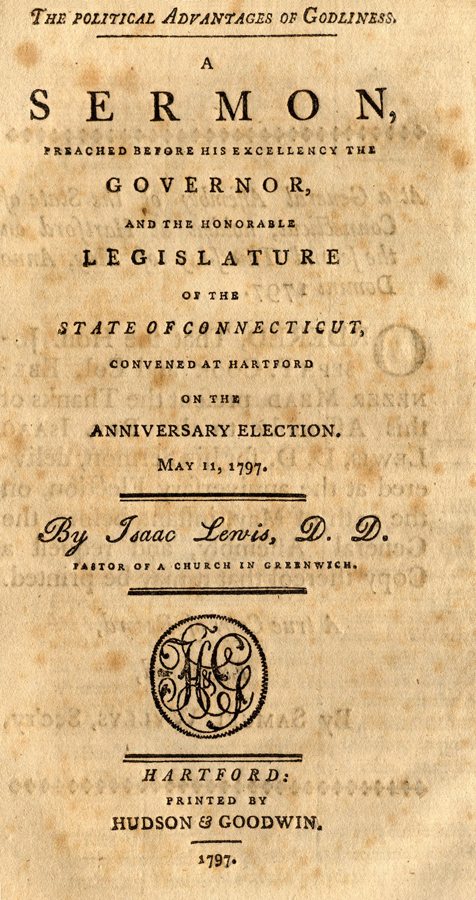
THE POLITICAL ADVANTAGES OF GODLINESS.

A

SERMON,

PREACHED BEFORE HIS EXCELLENCY THE

GOVERNOR,

AND THE HONORABLE

LEGISLATURE

OF THE

STATE OF CONNECTICUT,

CONVENED AT HARTFORD

ON THE

ANNIVERSARY ELECTION.

May 11, 1797.

By Isaac Lewis, D. D.
PASTOR OF A CHURCH IN GREENWICH.


At a General Assembly of the State of Connecticut, holden at Hartford on the second Thursday of May, Anno Domini 1797.

ORDERED, That the Hon. Joseph P. Cook and Col. Ebenezer Mead present the Thanks of this Assembly to the Rev. Isaac Lewis, D. D. for his Sermon, delivered at the anniversary Election, on the 11th of May, instant, before the General Assembly, and request a Copy thereof that it may be printed.

A true Copy of Record,
Examined,

By Samuel Wyllys, Sec’ry.


ELECTION SERMON. 

I TIMOTHY iv. 8.

Godliness is profitable unto all things, having promise of the life that now is, and of that which is to come.

In all situations and conditions of life, true religion is of the first importance. It is the solace of those, who are placed in the vale of poverty and affliction; the sweetener of all the unambitious enjoyments, of the middle walks of private life; and the highest ornament to the persons, and characters of the rich, the honorable, and the great. Without it, no man can be either truly, or lastingly happy. Were this divine guest to be banished from the society of men, this world would become but the abode of folly and wretchedness; and man, with all his boasted reason and superiority, inferior, in point of real enjoyment, to the herds who graze the fields.

The sentiments of St. Paul on this subject, are clearly expressed in our text and context. After cautioning Timothy to avoid perplexing himself and others, with the fabulous traditions of the Jews, and their endless genealogies, and exhorting him, like the athletics in the Grecian games, to exert his uttermost labor and diligence, in pursuing and promoting the doctrines and duties of true piety, as an argument to enforce the whole, he introduces the words of our text. Godliness is profitable unto all things, having promise of the life that now is, and of that which is to come.

These motives to godliness, though first addressed to Timothy, apply with equal force and propriety to all men, of every age and condition. The import of the text is briefly this, “Godliness is every way advantageous. Whoever shall experience the power of it, will thence derive a rich harvest of gain. Beside the crown of immortal glory, which it infallibly secures to its possessor, it will produce the highest satisfaction, of which the human mind is capable, in the present state of existence. Its advantages are eminent in all stations, and situations, and in the prosecution of every business, proper to engage the attention of mankind.”

If then godliness have promises of good to be enjoyed in this life, as well as in that which is to come, if it be profitable unto all things, we may doubtless with safety conclude, that effectual aid may be derived from it, in the administration of civil government; and that, if generally and faithfully practiced, it would most essentially contribute toward obtaining for, and securing to a community, all the important ends of its institution.

To illustrate this observation, is the proposed object of the present discourse. Preparatory to which a concise view of the nature of godliness, and of the ends of civil government will first be taken.

Godliness is a term used in two senses; the one limited, and the other more general. In its limited sense, it includes only the duties of piety toward God. In its general sense, it comprises all the duties prescribed by the Christian religion; those which we owe to our fellow-men, and to ourselves, as well as those which we owe to God. The apostle, in our text, uses the term in its most general sense, as appears from the extensive benefits, which, he assures us, will flow from a faithful practice of its various duties. These duties cannot now be minutely detailed. It may however be proper to observe in general, that they may be divided into four classes, the duties we owe to God, to Christ, to our fellow-men, and to ourselves.

In the first of these, are comprised supreme love to God, a fixed dependence on, and a humble trust in him, a cordial submission to his providential dispensations, together with conformity to his revealed will.

In the second, are included faith in the mediator, accompanied with a daily and sincere attention to him, considered as our teacher, our example and lawgiver, our advocate and intercessor with the father.

In the third, are contained universal love to mankind, mercy, justice, beneficence, truth and the forgiveness of injuries.

The fourth, comprehends the graces of humility, meekness, prudence, fortitude and self-government.

All the before mentioned virtues are briefly comprehended, by our divine master, in the following expressive words. “Thou shalt love the Lord thy God, with all thy heart, and thy neighbour as thyself.” These unitedly constitute that godliness, which is urged on us in our text, as being every way conducive to the advancement, of all the important interests of mankind.

But in order to determine, how far godliness contributes to the obtainment of the great ends of civil institutions, it will be necessary to enquire what those ends are? Or what are the great objects, all governments ought to pursue, and which all good governments actually do pursue, though with different degrees of success? These, it is supposed, may be all comprehended in the following particulars.

1. The primary objet of civil institutions is to prevent those evils, which, considering the depravity of mankind, would certainly result from a state of nature.

Selfishness is the predominant principle of fallen man. This, by being supreme, necessarily excludes the fear of God, and benevolence to our fellow-men. And among a number of individuals, un-united by any social compact, would produce a state of constant mutual hostility. In such a situation, jarring interests would at once enkindle the fire, and constantly fan the flame of discord; and of course banish peace and security. No protection, except what may be derived from personal prowess, can be obtained by individuals, in a state of nature. Life and property are equally insecure. Indeed without some kind of civil association, the last must be extremely limited. The power of an individual, unassisted by those arts, which flourish only under the protection of civil government, is wholly incompetent to the acquisition of more property, than a bare sufficiency for a scanty subsistence. But admitting the possibility of acquiring considerable property in a state of nature, still it would only serve to invite plunder, and lawless invasion. The more one possessed, the greater would be his danger. And if his strength should prove sufficient, to resist a single invader, it must unavoidably yield to the superior force of a combination of those, who would choose to live by rapine, rather than submit to the toils of daily labor.

The evils to which men would unavoidably be exposed, in a state of nature, we may learn from those, which have ever been attendant on revolutions. During such changes there is ever a period, in which laws lose their influence, and licentiousness prevails. This reign of anarchy is at its most alarming crisis, in that stage of a revolution which intervenes, between the destruction of the old, and the establishment of new principles and maxims of government. It is probable that no revolution was ever effected in any country, with less of these evils, than the recent one here in America. In our own State, very few disorders appeared; owing perhaps principally to the inconsiderable alterations, which the revolution produced. But in some parts of the union, the most fatal evils were experienced. Law was no longer a restraint, right no longer regarded, property was invaded, virtue insulted, chastity polluted, and life sacrificed, by abandoned ruffians, who, having broken over every restraint, rioted on the spoils of their innocent neighbours. Under an inexpressibly more dreadful experience of these, and many other similar evils, it is well known, one of the principal kingdoms of Europe, has for several years been groaning.

These things have been mentioned, solely with a view of exhibiting a specimen of what may be expected from a state of nature. To prevent their existence, as far as possible, to secure to individuals the peaceable possession of life, liberty and property, is a primary object of civil government. And its tendency to accomplish this purpose, undoubtedly wrought a conviction of its absolute necessity, in the minds of men, in the early ages of the world.

2. Another object worthy of the pursuit of government, is the promotion of the greatest good of the whole community, so far as that may be effected, without injury done to others.

Private interest, or the good of an individual, farther than it may be considered as involved in the good of the whole, ought not to be, and cannot consistently be the object of the social compact. As the whole is greater than its parts, so the good of a community is greater than the private interest of any individual. And to cause a greater interest to suffer, for the purpose of advancing a less, is a violation of the order of nature, and of the laws of equity and reason. A community is but one great family; in which, every member ought to consider his own interest, as involved in that of the whole; and this whole ought to swallow up every private or detached interest. As no private family can be happy, where each member is actuated solely by a principle of self-gratification; as such a line of conduct will produce a constant clashing of interests, which will unavoidably issue in contention and animosity; so no state can enjoy political happiness, where the public good is neglected, and an attachment to private, becomes the ruling passion. Hence cabals are always injurious, and ought to be opposed and even despised, as destructive of the great ends of civil society. They invariably have for their object, some party design. And the setting up of such an interest s the principal object of pursuit, is in the nature of it, hostile to public good. Private emolument cannot be set in competition with public, without endangering the latter. And to endanger the public good, for any private advantage, is always to sacrifice the greater interest to the less.

From these observations it appears, that the good which ought to be the object of government is the public good; and that in competition with it, no private or party interest ought ever to be placed.

But it is further to be observed, that although the greatest good of a community, ought to be the leading object of its government, yet even this is not to be pursued, by such measures as are injurious to other communities. Although the interest of an individual may be sacrificed, where it is absolutely necessary to promote the greatest good of the public, of which he is a member; yet it y no means follows, that a state or kingdom, in order to promote its own advantage, possesses a right to adopt such measures, as are injurious to a sister state. It is as inconsistent with every rule of moral obligation, for one state to commit injustice against another, as it is for an individual to rob or plunder this neighbour. All mankind are brethren, the children of the same common parent. Different states are correlatives of each other. The great Christian law which prescribes our duty toward our neighbours, considered in our individual capacity, will, if observed, regulate the conduct of states toward each other.

Although politicians have burdened the science of government, with many intricacies, which may, not improperly, be called the chicanery of courts; yet, if inexperience may be permitted to risk an opinion, we should say that it is reducible to a few plain principles. To love our neighbour as ourselves—To do to others as we would that they should do to us, are rules of moral conduct as applicable to communities, as to individuals. Nor can any reason be assigned in justification of fraud, in justice, oppression, or cruelty in a body of men more than in a single person. On the contrary, where a body of man practice injustice, the crime is far greater, than a similar act of injustice performed by an individual: because in the one case, the guilt is confined to a single subject, and in the other, it extends to a whole community; and because the evil consequences of public injustice, and the injuries done by it, are far more extensive, than those of private. When one nation is guilty of injustice towards another, thousands and millions may feel the injury. It is not in human power to calculate the evils, which will follow one deliberate act of such injustice. It will be readily granted, that the evils of private injustice are many. Among these may be enumerated expensive laws-suits, the disaffection of families to each other, and all the usual consequences of private hatred. Yet admitting the worst that can follow, the civil law is a barrier, which will always check and restrain these evils, and confine them within certain limits. But when one nation practices gross injustice against another, there is no common arbiter, either to decide the contention, or to control its destructive effects. War commonly bursts forth like a sweeping deluge, overwhelming and confounding the innocent with the guilty; and inflicting on whole countries greater, and more durable calamities, than any of the usual scourges, by which heaven corrects the madness of mankind.

The foregoing observations sufficiently prove, that national injustice is far more criminal in itself, and far more fatal in its consequences, than private. And of consequence, that the same moral rule of righteousness, which the scriptures have prescribed to individuals, and by which they are bound to regulate their conduct, ought to be adopted by nations, and faithfully adhered to, in all their treatment of each other. Hence will appear the justice of the remark before made, that although the greatest public good of a community, ought to be the end of its government, yet even that object, great and important as it is, ought never to be pursued, by means, which involve in them, a violation of the rights of other nations.

But notwithstanding the evident truth of this remark, it is to be lamented, that a policy directly repugnant to the rules of moral justice, has been too prevalent among all nations. The Roman love of their country, so much the boast of her citizens and so highly celebrated by her best writers, even in the purest days of that republic, was but a selfish contracted principle. Its objet was the aggrandizement of their commonwealth, not only without any regard to the happiness of other nations, but at the expense of their liberties, privileges and independence. Their love of their country, led them to destroy, or at least to subjugate every neighbouring state, which stood in the way of the enlargement of their empire, or whose interest was inconsistent with their own ambitious views. Justly were they characterized by the spirit of prophesy as a beast dreadful and terrible, and strong exceedingly; as devouring and breaking in pieces, and stamping the residue with their feet.

It is with the deepest regret, that truth obliges us to confess, that too similar to this detestable example, has been the policy of modern, as well as ancient nations. While the rulers of kingdoms have been careful to inculcate mutual justice among their subjects, by wise and salutary laws, they appear to have forgotten that national justice is a virtue; or not to be sensible, that there is anything criminal in injuring a neighbouring state, where the power of doing it is possessed, and an opportunity offered. While the private robber, who forces from an individual a small sum, must expiate his crime on a gibbet, it has been but too common for one nation to rob another of whole provinces, not only without censure, but with a tribute of praise for their martial achievements. To this fatal source, the injustice of nations toward each other, is to be attributed the awful scourge of war, with all its dreadful calamities. If the cause could once be suppressed, the effect would cease; and the prophecy of universal peace, so frequently repeated in the sacred writings, meet with an immediate accomplishment. The instruments of war would then be converted into implements of husbandry; nation would not lift up sword against nation, nor would they learn war anymore.

These few remarks on national injustice have been made, to call to the minds of this audience, the evils which must necessarily result from the prevalency of that unjust policy, which leads a nation to advance her own interest, by acts of injustice done to others. And likewise for the purpose of explaining in what sense, the public good ought to be the object of political institutions. To avoid the evils of a state of nature, and to promote the greatest national happiness, have been mentioned as the proper ends of government. These, are considered as including not only the particular objects, which have been brought up to view in what has been said, but whatever tends to the prosperity of a nation.

We will now proceed to enquire, what advantages, in the pursuit of these ends, may be derived from the practice of godliness.

1. Godliness will be productive of national felicity, by securing the fidelity of rulers.

That national happiness and misery, are closely connected with the character and conduct of those who hold the reins of government, approaches nigh to a self-evident proposition. At least it is a truth which a very little argumentation will support, and which has been fully confirmed by all history, both sacred and profane. The government of an Ahab, and a Manasseh, of a Nero and a Caligula, afford unequivocal proofs of misery of a people, destined to endure the scourge of wicked and tyrannical rulers. “When the righteous are in authority, the people rejoice, but when the wicked beareth rule, the people mourn.” An unprincipled magistrate is regardless of the public good, and wholly under the influence of selfish and mercenary views. In such hands neither the property, the liberty nor the life of the people are secure. These may, and most probably often will be sacrificed to the lust, the ambition, the avarice, and even the caprice of the tyrant. The public good is unspeakably too precious a deposit, to be betrusted to such men. He who disregards the obligations he is under to his God, cannot be supposed suitably to feel those which he is under to his fellow men. He will rather be led to consider his exaltation to office, as raising him above the restraints, laid upon his unofficed brethren, and as affording him an opportunity for indulging with impunity, the selfishness and wickedness of his heart. A ruler destitute of virtue, will without doubt in a greater or less degree be guilty of malpractice. And a government badly administered, will produce evils introductory, both to public and private infelicity. There is an inseparable connection between the moral character of rulers, and their administrations. If the former be vicious, corruption will appear in the latter, and a corrupted administration militates against the very ends of the social compact. And of course is inconsistent with the happiness of a community.—The liberties of a nation are always extremely unsafe, in the hands of vicious rulers; and the miseries which nations have suffered under the government of such characters, are to be ranked with the heaviest of divine judgments.

If then vice in authority be destructive of public felicity, it is but rational to conclude that virtue exalted to power, must be productive of directly contrary effects; and that a pious magistracy must afford the most encouraging prospect, of national happiness. The magistrate, who to the natural and acquired abilities necessary to prepare him for office, adds the fear of God, a reverence for the dictates of his own conscience, and that love to his fellow-men, implied in true godliness, will not fail to make the good of his constituents, the ultimate objet of his political pursuits. His example will uniformly be in favor of virtue, and his abilities steadily exerted to support and maintain that “righteousness which exalteth a nation, and to discountenance and suppress that vice which is a reproach to any people.” As a legislator, he will disregard local prejudices and party views, and ever give his voice in favor of such laws, as he believes to be founded in justice and public utility; and oppose with firmness, and uncorruptible integrity those of an opposite tendency. As a judge, his decisions will be guided by law and equity, without partiality for, or prejudice against any man. In whatever station he is called to serve his country, he will remember that he is accountable for his conduct not only to his fellow citizens, but to the supreme ruler of the universe; that he has a most important trust committed to him; that he is a minister of God, for good to his people; that the primary design to his honorary appointment, was to capacitate him to employ all his talents, in promoting and diffusing happiness through the community; and that he answers the great end of his being called into office, only so far as he steadfastly pursues this grand object. And that a greater proportion of happiness will be enjoyed by a people, where their rulers are actuated by such disinterested motives, than where they are influenced by selfishness, is too evident to need proof. It is as unnecessary to prove, that men of piety are not only the most likely to pursue the public good, but the only characters, from whom we have reason steadily to expect, such disinterested conduct. Nothing can afford so great a security for the fidelity of rulers, as godliness. Other motives may for a time produce unexceptionable conduct. But the influence of these other motives will be ever uncertain, and at best subservient to selfish views. The public good will always be abandoned by such a mind, whenever it is considered as directly opposed to private interest.

No men, in any situation or employment, are so sensible of the obligations they are under to fidelity as the truly religious. No others so fully perceive its importance, or are so deeply impressed with a conviction of its necessity. Religion is a crown of glory to all who possess it. It does not of itself prepare men for office, either in church or state. But where they are other ways prepared, the addition of true religion, above everything, contributes to their fidelity and usefulness. This observation applies with as much propriety, and force to the civil magistracy, as to any official characters. Fidelity in that office, is essential to national prosperity. So that godliness, when it lives and reigns in the hearts and lives of the magistrates of a country, contributes directly, and most essentially to the public happiness.

2. Godliness is no less salutary to a community, by the influence, which it has on the great body of the people.

As it secures the fidelity of rulers, so it makes good citizens. If its practice could once become universal in a nation, it would produce such a conduct in all ranks, as would issue in general prosperity. So far as national happiness depends, on the promotion of the social virtues—on the cultivation of benevolence, kindness, justice and charity—on the prevalence of harmony and tranquility, the practice of godliness has a direct tendency to its advancement. Godliness teaches us to do justly, to love mercy and to walk humbly with God. To owe no man anything, but to love one another. To render to all their dues, tribute to whom tribute, custom to whom custom, fear to whom fear, honor to whom honor is due. And, to comprehend the whole in few words, to love our neighbour as ourselves. So far as these virtues promote public happiness, or are any way conducive to the prosperity of a nation; so far the salutary influence of godliness is indisputable. As it respects the duties of the second table of law, it consists in the exercise of these very virtues. And how far the practice of them actually does contribute to national prosperity, we may learn from the evils which their opposite vices never fail to produce. Fraud, injustice, anger, wrath and hatred are most evidently the bane of social happiness; and in proportion to their prevalency, are invariably productive of misery. The practice of these virtues then, and consequently of true godliness, has a direct tendency to promote the public good.

Again, so far as national happiness depends on a suitable conduct in the members of a community, toward each other, it is directly promoted by godliness. The circumstance last mentioned, it is well known, has great influence on domestic happiness. It is essential to the prosperity of a private family, that the conduct of each member be regulated by the strictest rules of propriety—that the heads conduct with a dignity becoming their station; equally remote from unreasonable austerity on the one hand, and trifling familiarity on the other—that children and servants, constantly exhibit reverence and respect, by an unreserved and cheerful obedience. Imprudence and folly in the governors of a family, and obstinacy and disobedience in the inferior members, are utterly destructive of domestic felicity. And why should not the case be the same with larger communities? The happiness of a nation is composed of similar ingredients with that, of a private family. And as the conduct of the several members of the latter, toward each other, has so evident an influence on their happiness, why must not the prosperity of a nation be greatly affected, by the mutual conduct of its rulers and ruled? If so, godliness must certainly promote national felicity. For it influences rulers to rule in the fear of God, and unofficered citizens to reverence and respect the magistrates of their country, as ministers of the Most High, appointed for the good of his people. So far as it extends, it leads every man to conduct agreeable to his station; to abide in, and faithfully to discharge the duties of his particular calling, and thus to contribute to the advancement of the general felicity.

But I take the liberty of farther observing, that godliness promotes national prosperity, as it contributes to an increase of wealth. If any should call in question the truth of this observation, let me desire him to remember, that there are few vices but what are luxurious; that they are expensive, and even prodigal both of time and money; and that those which are most corrupting, which spread their contagion the most rapidly, which ever have and ever will prevail where godliness is neglected, are not only such as devour property, but such as introduce disease, debility, idleness, and even an aversion to every species of labor, and thus dry up the very sources of national wealth.

On the other hand, godliness leads to temperance, health, industry and frugality. It not only retrenches the expenses of extravagance, but it adds to the stock already possessed, the daily gains of diligence. From the command and example of her divine teacher, she gathers up the fragments, and suffers nothing to be lost.

If, after considering these particulars, any should still be disposed to doubt, whether a general diffusion of godliness through a nation, would contribute more to the increase of its wealth, than the unrestrained reign of vice, let him compare the expenses of the several virtues included in true godliness, with those of their opposite vices. Let him for instance compare the expenses of humility, temperance and frugality, with what would be necessary to support pride, luxury, intemperance and prodigality, and the comparison will convince him, that it is vice which drains a nation of her wealth. We venture further to offer it as a decided opinion, that if such a person should judge with impartiality, he would meet a conviction, that the fashionable vices of the present day, are far more expensive than the support of government, together with all the public and private means of literary, moral and religious instruction. The universal spread of godliness among us, would save this enormous expense, and thus increase the pecuniary advantages of our nation. So true is it that godliness is profitable unto all things, having promise of the life that now is, and of that which is to come.

But permit me to add, that godliness, above every other principle that can be named, gives efficacy to the laws of a nation. Among many other ingredients, necessary to the happiness of a people, a good code of laws will doubtless be included. But simply the existence of such a system of laws, will be but of little advantage, unless they are sacredly regarded—unless they possess a commanding influence on all ranks of citizens. Laws, that have lost their influence, neither afford protection to the virtuous, nor lay restraint on the excesses of the vicious. And laws disregarded and trampled on with impunity will ever lose their influence. Of consequence, the support of law, by giving it as extensive an obedience as possible, and by putting its penalty in execution on delinquents, must be of high importance to national prosperity. And yet no part of civil government is attended with more, or greater difficulties. Men of true piety will see, and feel the importance of giving efficacy to laws, and from the purest motives, throw their whole weight into that scale.—They will obey the ordinances of man for the Lord’s sake. But the vicious part of every community are always impatient under the restraints of law; and ready to violate it, whenever they can flatter themselves of doing it with impunity. Hence the well known fact, that laws are trampled upon, in proportion to the increase of vice. The more gross wickedness prevails, the more are all laws divine and human disregarded. The inheritance from this fact is plain, that no principle can give such an efficacious influence to the laws of a nation, as true godliness. There is a close connection between fidelity to God, and fidelity to man; he who possesses the former will not neglect the latter. Consequently the diffusion of true religion through a nation, would in this respect, be attended with a most happy influence.

But it is worthy of further remark, that godliness not only contributes to the maintenance and support of law, by its influence on the hearts and lives of its true friends; but the doctrine of revealed religion, have a happy political effect on all who believe them, even with a speculative faith. The corruptions of mankind, it is believed, are far more restrained, from an apprehension and dread of future punishment, than from all the penalties, which sanction the several codes of human laws. Revealed religion denounces future wrath, not only against persons guilty of impiety toward God; but against murderers, thieves, adulterers, perjured persons, and all who commit crimes against society. So far as divine revelation is believed—so far as it gains even an historical assent from mankind, the idea of this future punishment, must operate as a forcible check to human corruptions. These penalties, admitting the authenticity of the scriptures, are known by the impenitent to be unavoidable, and therefore affect the mind as realities. No concealment, no fraud, no flight, can protect the offender from the vengeance of the judge. If the sinner dies in impenitency, he must unavoidably suffer the dreadful consequences. But men can easily escape the penalties of human laws. Under the best executed government, the probability is that they are actually avoided in more instances, than suffered by transgressors. The means of escaping civil punishments are very numerous, and perfectly known to the most vicious part of every nation. So that human laws are always transgressed with a hope of impunity. If then all dread of future punishment were totally annihilated, the strongest support of civil law, would be removed, and very little be left to restrain the corruptions of the vicious. And the consequence might be an absolute impossibility of supporting civil government.

From the foregoing observations we may at least conclude, that godliness is not only highly advantageous, but that, a belief of its doctrines, and especially those which respect the divine character and future rewards and punishments, are essential to the well being, if not to the existence of civil society. And it is a well known fact that all antiquity were in favor of a similar sentiment. Not a single legislator has ever attempted to enforce obedience to his laws, solely on the foundation of civil sanctions. They universally perceived the insufficiency of these motives, unassisted by those derived from religion. And as they were strangers to divine revelation, they formed a substitute, and adapted it, as well as they could, to the circumstances, the genius, and the prejudices of their people. Lycurgus, Solon, Numa Pompilius, Capac, and every legislator, at all famed for the wisdom of his institutions, found it necessary to have recourse to religion; and, in fact, derived from that source, the principle motives to enforce obedience. This shows, that in the judgment of these eminent men, the belief of a supreme Being, and the practice of some religion, are of great importance to the support of civil government; and that it is in vain to expect that a system of laws can be maintained for any considerable period, independent of all assistance of this kind. An opinion, as is confidently supposed, founded in a very accurate, and extensive knowledge of human nature, and which, we cannot but presume, will be ever found true, as long as sinful passions and affections possess such an influence on mankind.

If then some religion has ever been found necessary to the existence of civil government; if where the true religion has been unknown, the ablest legislators have thought it necessary to invent a substitute; if even an historical belief of the doctrines of revealed religion, have so direct a tendency to support civil institutions; certainly the reality itself, the general spread of true piety among all ranks in a commonwealth, must be attended with the most salutary effects. Its influence on the order, the regularity, the peace, and the harmony of a community, cannot fail of augmenting its felicity.

We see then, that beside the spiritual and eternal advantages of true godliness, which the design of this discourse will not admit of our considering, there are important benefits to be derived from it in the administration of civil government; and if generally and faithfully practiced, it would most essentially contribute toward obtaining for, and securing to a community all the valuable ends of such an institution.

In the preceding observations be just, then to maintain, that godliness is of no importance in a civil point of view—that gentlemen may be every way as well qualified, to act in any official character, in the government of a nation without, as with religion—that it is a matter of no consequence to the political happiness of a people, what religious system, or whether any at all prevails among them,–to support these, and similar sentiments, not only tends to the encouragement of immorality, but to the propagation of political heresy. And in proportion to their prevalence, must be productive of the most dangerous consequences. Without religion, a sense of moral obligation can never be preserved. And once destroy a sense of moral obligation, and you strike a deadly blow at the root of all mutual confidence between the different members of the community, and invite the spread of those vices, which are most hostile to the political as well as eternal interest of mankind.

I feel a peculiar happiness on this occasion, in being able to confirm these sentiments, by the authority of that most excellent man, that best of patriots, whose distinguished talents and eminent abilities, faithfully consecrated to his country’s service, have not only in an unexampled manner endeared him to his fellow-citizens, but rendered him the object of the veneration of the world. From that valuable legacy of political experience and sentiment, which he bequeathed to his country, in his address accompanying his resignation, I gladly introduce the following passages.

“Of all the dispositions and habits, says he, which lead to political prosperity, religion and morality are indispensible supports. In vain would that man claim the tribute of patriotism, who should labor to subvert these great pillars of human happiness, these firmest props of the duties of men and citizens. The mere politician equally with the pious man ought to respect and to cherish them. A volume could not trace all their connections with private and public felicity. Let it simply be asked, where is the security for property, for reputation, for life, if the sense of religious obligation desert the oaths, which are the instruments of investigation in the courts of justice? And let us with caution indulge the supposition, that morality can be maintained without religion. Whatever may be conceded to the influence of refined education on minds of a peculiar structure; reason and experience both forbid us to expect, that national morality can prevail in exclusion of religious principle.

”It is substantially true, that virtue or morality is a necessary spring of popular government. The rule indeed extends with more or less force to every species of free government. Who that is a sincere friend to it, can look with indifferency on attempts to shake the foundation of the fabric?”

I cannot conclude this extract, without observing that the sentiments it contains, in the view of every wise and good man, must add a luster to a character, already enrolled on the records of deathless fame, and the subject of a more universal admiration, and more extensive esteem, that any which the world hath hitherto produced. May America preserve in everlasting remembrance his political counsels—may they continue, through all succeeding generations, the fundamental maxims of their government—may his successors be all animated by the same spirit of wisdom, patriotism, firmness, and uncorruptible integrity—may he in the shades of retirement be constantly blessed with the special tokens of the divine favor—may self-approving reflections on the part he has acted, and the spiritual joys of communion with God and Christ repay the ceaseless toils and anxieties of his public life—and when heaven shall call him from his earthly abode, may he be admitted to a distinguished seat in the paradise above.

Permit me to add, that if anything can console us under the painful idea that Washington, no longer directs the helm of our government, it is the pleasing reflection that we have for his successor, a gentleman, not only of the first character for literary and political merit, wisdom, firmness and independency of sentiment, but one, who in the very moment of his inauguration, and in the presence of both houses of our national legislature, and a most crowded assembly of all ranks of spectators, 1 had the fortitude to avow his attachment to the Christian religion, and his fixed determination to consider a decent respect for Christianity among the best recommendations for the public service.

But we suspend these pleasing reflections, and proceed to remark, that if the observations which have been made be just, the importance of supporting Christianity is undeniable. All the political benefits, which can be rationally expected from any religion ever taught in this world, may certainly be expected from the Christian, and in a much higher degree than from any other, in proportion to the superior excellency of its moral precepts. The candid enemies of our faith confess, that the morality taught in the gospel is the most pure, and the best adapted to the purposes of social happiness, of any moral system ever published to men. If then some religion be necessary to answer the purposes of civil government, Christianity even on political views ought to be preferred to all others, as it possesses far the greatest tendency to promote the important designs already mentioned. If its morals are the purest, its tendency to promote social happiness is the greatest, and therefore good policy requires its support.

It is not however our wish that anything similar to the religious establishments of Europe, should be introduced into our country. We hope never to see our magistrates employed, in prescribing articles of faith; nor in the exercise of the least coercive power to compel men to adopt this, or that creed, or submit to any one mode of worship in preference to another. May liberty of conscience, in this land, be never violated. But if there be important political advantages to be derived from Christianity, which cannot be so effectually secured by any other means, as appears evident from the preceding observations, then is it as much the duty of government to endeavour its preservation, as in any other way to seek the public good. If every individual be left to choose for himself both with respect to doctrines, and modes of worship, laws made for the support of public instruction, and the religious observation of the Sabbath, cannot in any proper sense infringe on liberty of conscience.

If religion then has a just claim to the protection of government, it must be peculiarly important to official characters. The more exalted gentlemen are in office, the more public and extensive their sphere of action, the more necessary is it, that their whole conduct should exhibit undeniable evidence of their attachment to religion. The great body of the people look up to them, not only for examples in every virtue, but for that legislative encouragement to the cause of religion, on which its general prosperity under God must in a great measure depend. If godliness be profitable unto all things, if its political advantages be as great as has been represented, good policy will certainly lead to a preservation of the laws for the support of morality, to a maintenance and if need be, to an enlargement of the statutes for the suppression of vice, and to the appointment of such men to fill the several offices under our government, as are known to be at least men of unblemished morals. A steady adherence to this rule would disappoint the hopes of the wicked, and proportionally encourage those of the virtuous. It would make our legislature a terror indeed to evil doers, and a praise to them who do well. Much depends on the conduct of rulers. To support religion, law and liberty, is theirs. We live in a day when each of these have many foes. When the advocates of infidelity are loudly boasting of the increase of their numbers—When licentiousness is alarmingly prevalent, and when the federal constitution, the great palladium of our liberties, has been violently attacked. That amidst all these internal evils, and the dangers which arise from foreign insults and depredations, our rulers may be directed by unerring wisdom—that they may ever possess that firmness and fidelity, which the arduous duties of their station, and the peculiar difficulties of the day require, is the ardent prayer of all their pious constituents. And supported by so important an encouragement, it is hoped, and expected that they will disregard the unfounded clamours, of the enemies of religion and our country.

But besides the support which Christianity has a right to expect from government, it is of the highest importance, that it receive all encouragement from every class of citizens. In this business all should be united, and extend as far, and as generally as possible the practice of true piety. If there were no futurity, if the race of men had been made only for this world, still the universal practice of godliness would be a most desirable object, and as such must meet the sincere approbation of every friend to his country. And if so, how inconceivably important indeed is it, when we are assured by a well authenticated revelation from heaven, that we are all acting not for time only, or principally, but for the rewards, or the punishments of an eternity. The motives to the choice and practice of godliness are immensely great. Both temporal and eternal benefit, the promise of this life and of that which is to come, are all presented to our view, and placed in a very conspicuous light before our eyes, and nothing but the grossest stupidity can prevent our feeling the force of them.

This subject leads me further to remark, that although the laws of our land have excused clergymen from the burdens of civil functions, and left them at liberty to devote their whole time to the business of their peculiar profession, yet no body of men are more deeply interested in the prosperity of their country, or under greater obligations to constant exertions for that purpose. And happily their duty as Christian ministers, and as members of civil society perfectly coincide. In the former, which is the principal capacity in which they are called to act, they are pointedly commanded by their divine Master, to become ensamples to the whole flock over which the Holy Ghost has made them overseers, and to teach, rebuke and exhort with all long suffering and doctrine. The first object of their labors is to prepare men for the kingdom of heaven. This they are to attempt by explaining to them the nature, and enforcing on them the importance of true godliness, and by persuading them, if possible, to a faithful practice of it in all its branches. If they can effect this great purpose, they will not only benefit the souls of men, and advance the kingdom of the Redeemer in the world, but do a most important service to civil society. If they can become the happy instruments of leading those among whom they labor, to forsake sin, to embrace the gospel, to love God and practice every branch of true piety; they will no doubt obey magistrates, and submit themselves to every ordinance of man, for the Lord’s sake. The more we promote the interest of religion, the more shall we advance that of civil society. The more spiritual good we do the souls of men, the more effectual aid shall we afford to the rulers of our land. Ministers have every argument set before them, to excite them to diligence and fidelity, drawn from the temporal, and the eternal interest of men. And in addition to all this, they are further animated, by a consideration of that future account which they must give of themselves, before an assembled universe. Though the stupidity of this infidel age, may often excite in them the complaint of the evangelical prophet “that they labor in vain and spend their strength for nought,” yet let them not be weary in well doing, but persevere with redoubled diligence, supported by the glorious hope that their labor will not be in vain in the Lord.

Lastly, the foregoing observations point out to us all, the sure means of promoting national happiness. Public virtue, and political prosperity are intimately connected. Righteousness will exalt, and vice bring ruin on a people. If then we are true patriots, if it is our glory really to be, as well as to be esteemed the friends of our country, we shall devote ourselves to the sincere practice of true godliness; and in our several stations faithfully endeavour its universal promotion. Enmity to religion is inconsistent with true patriotism. They who are either publicly or privately undermining the foundation of piety toward God, are weakening the force of moral obligation, and aiming a fatal blow against the dearest privileges resulting from the social compact. If we would wish to be a happy people, to enjoy in peace and tranquility the blessings of a most excellent constitution, and to transmit those fruits of such vast expense of blood and treasure unimpaired to posterity, it is of the highest importance, that we practice true godliness; as every other expedient, while that is neglected, will be found utterly insufficient.

In one word, the choice and practice of religion is urged on us, by every consideration which ought to affect a rational mind. Our duty to God, our country, and ourselves require it—our interest and happiness for time and eternity demand it of us. May God, of his infinite mercy grant us all, to experience it, in all its power, and in all its comforts and consolations, for the sake of the dear Redeemer. Amen.


Endnotes

1. See President Adams’s speech at his inauguration.

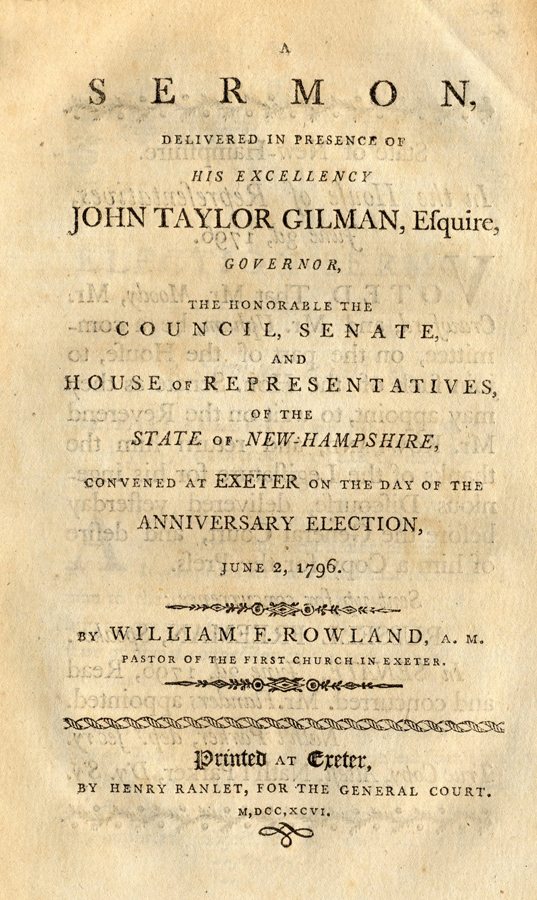
Sermon – Election – 1796, New Hampshire


William Frederick Rowland (d. 1843) graduated from Dartmouth in 1784. He was the pastor of the First Church in Exeter, NH beginning in 1790. This sermon was preached by Rowland in New Hampshire on June 2, 1796.


sermon-election-1796-new-hampshire

A

S E R M O N,

DELIVERED IN PRESENCE OF

HIS EXCELLENCY

JOHN TAYLOR GILMAN, Esquire

GOVERNOR,

THE HONORABLE THE

COUNCIL, SENATE,

AND

HOUSE OF REPRESENTATIVES,

OF THE

STATE OF NEW-HAMPSHIRE,

CONVENED AT EXETER ON THE DAY OF THE

ANNIVERSARY ELECTION,

JUNE 2, 1796.

BY WILLIAM F. ROWLAND, A. M.
PASTOR OF THE FIRST CHURCH IN EXETER.

State of New-Hampshire.

In the House of Representatives,
June 3d, 1796.

VOTED, That Mr. Moody, Mr. Crawford, and Mr. Upham, be a committee, on the part of the House, to join such of the Hon. Senate as they may appoint, to wait on the Reverend Mr. Rowland, and return him the thanks of the Legislature for his ingenious Discourse, delivered yesterday before the General Court, and desire of him a Copy for the Press.

Sent up for concurrence;
RUSSELL FREEMAN, Speaker.
In SENATE, June 3d, 1796, Read and concurred. Mr. Flanders appointed.
Nath’l Parker, dep. Sec’ry.
True Copy, Attest, Nath’l Parker, D’y. S’y.


ELECTION SERMON.
 

2 SAMUEL, xxiii. 3.

HE THAT RULETH OVER MEN MUST BE JUST, RULING IN THE FEAR OF GOD.

A CHARACTER formed upon the principles of religion is the most honorable and useful. It comprises all the virtues that recommend man to the peculiar notice of his Maker, render him an ornament to society, make him happy in a state of social connection in the present world, and glorious in immortality.

Such a character was David, The anointed of the God of Jacob: and he insists upon the indispensable necessity of it in those who rule over men. Nor does he offer merely his own private opinion respecting this important subject, for the Spirit of the Lord was with him—The God of Israel said, the Rock of Israel spake to me, He that ruleth over men must be just, ruling in the fear of God.

The royal Prophet here points out, in a very brief and comprehensive manner, the duty, and the necessary qualifications of a civil ruler. These words ought to be engraven in the heart of every ruler, and in the heart of every person in the choice of rulers; for while they direct the latter to whom they ought to give their suffrages, they point out to the former the character which they should possess.

It is both pertinent and laudable, and must be considered so, by all good men, to enter on the public business of legislation, by the presentment of the rulers and officers of Government before the Lord in his sacred courts, to hear the words of his law, and to supplicate his presence and aid. We are happy that our civil Fathers have consecrated the present time to these solemn duties of religion. The occasion on which we are assembled, and the theme which I have chosen, will naturally lead me to make some remarks on government; delineate the character of a good ruler; exhibit the necessity of religion in civil administrations, and its happy effects in society.

Mutual advantage, at first induced men to form into social compact, and produced towns, states and empires. To exist in this social capacity, and secure life, property and happiness, it was found necessary that they should have some form of civil government. It is the will of God, that government should exist among men. What particular form is nowhere designated, but every nation has a right to choose for itself, and adapt it to the views, feelings and circumstances of the people. One form may be best for one nation, and a different, for another. That form is best, which most effectually secures their rights and rational liberties.

To the due administration of justice it is necessary that some should be clothed with authority; without this, they will not be able to regulate the affairs of state, and secure the good and peaceable, from the wanton abuse of the wicked and licentious. Their power, it is true, they derive from the people, but when they have invested them with authority they should pay due submission to, and place confidence in them.

A race of rational beings, not connected by the parental or filial tie, not depraved, but perfectly innocent, it is probable would fall into some kind of polity or civil connection. By forming into society the collected gifts and graces of all would become the property and emolument of all; but without social connection, they would be the property and profit only of the person possessing them, and could not benefit the whole. Society cannot be formed, or subsist, without certain regulations, or constitutional establishments. Such a race of beings, as we before mentioned, could find no difficulty in forming into union, and constituting the social tie. If their powers and capacities were different, reason would plainly lead the superior to the head, and the inferior to their respective places of subordination in the body. Or, if in regard to powers and capacities, all were on a par, then all would equally govern, and be equally subject. The good Angels are represented as having a kind of connection and order among them. The sacred books speak of Principalities and Powers, Thrones and Dominions; and the superiority signified by this necessarily supposes connection and subordination. But be it as it may among good and holy beings, yet obviously among beings so deeply depraved and selfish as man, government is indispensably necessary. Without government, it would be impossible to live in such a world as ours. A state of anarchy, without law and government, would be a state of complete wretchedness.—Such are the fierce and savage lusts of men, that property and life would constantly hang on uncertainty. The Israelitish nation found themselves in a most calamitous state, when there was no Government authoritatively established among them, and everyone did without control what was right in his own eyes. The God of nature has pointed out the propriety of civil government, in the constitution of families, and given a specimen of it in parental authority and filial subjection; this only excepted, that all men are born free and stand on a par; so that all rightful governing must derive from the governed and have its foundation in common consent and agreement. Necessity early led men to form themselves into social bodies, and confirm the social tie by certain laws and regulations mutually agreed on and committed to some one or more of the body.

In order to government, rulers are necessary; and to a happy administration it is requisite that they answer the character in the text: Some delineation of which was the next thing we proposed.

He that ruleth over men must be just, ruling in the fear of God. He must be just in all his dealings, in the exercise of the powers with which he is invested, administering justice without partiality. The word of God teaches the necessary qualifications of a good ruler. To this he will look for instruction in his duty. Here he will find a model, on which his character should be formed; and rules relating to his whole conduct. It teaches him to reverence God as the Supreme Ruler of nations, his dependence on Him for light and direction, and his accountableness to Him for all his actions: and this will have a happy influence on his conduct and excite him to fidelity. It unfolds a glorious immortality, through Jesus Christ, to those who are faithful to God in the trust committed to them, and improve their talents aright: by which glorious hope the pious ruler is animated in his laborious undertaking.

It humbles the pride of the human heart, teaches that salvation is only through the grace that is in Jesus, and lays prostrate the hope of man from any distinguished merit in himself; which must tend to inspire the Christian ruler with an amiable humility, while raised to a seat of honor; prevent his exalting himself above his Brethren, and lording it over God’s heritage. It teaches the motives, by which they are to be influenced in all their deliberations and decrees. Influenced by such a religion, the Ruler will consult the good of the community, and will always live in the affections of a grateful people. He will have a humble dependence on God for wisdom to conduct him. He will see his need of divine assistance, and be modest and unassuming. He will not crowd himself into public notice by artifice, but wait until he is called by the voluntary suffrages of the people. Those, who are best qualified to rule, will be least solicitous to obtain an office. A sense of the importance of a public trust, and of having the weight of public affairs devolve on them, forbids their aspiring to rule. Persuaded that the most refined enjoyments are to be found in the walks of domestic retirement, they will quit them for an elevated station, only when called by the united voice of their brethren, and constrained by a sense of duty. There is no greater evidence of a person’s unfitness for public trust than his seeking it by promoting faction. True merit does not seek public notice, and it reluctantly enters the field of action. The good ruler will therefore engage in public life, not to gratify his own ambition, consult his own ease, or obtain the applause of men; but from a sense of duty.

When clothed with authority, he will be concerned that his administrations be consistent with the will of God, and promotive of the public good. He governs for the whole, and consults the advantage of society. No personal or partial considerations will influence him to turn aside from duty. Awed by the fear of God, and a sense of his accountableness, he pursues a steady course, nor is influenced by the adulations of friends or the clamours of pretended patriots. He will always make it his endeavour to enact wise and salutary laws, which are essential to preserve the peace and order of society. Much wisdom and integrity re necessary to direct the ruler in framing such laws, and to preserve him from the baleful influence of selfish and party motives. While the unjust aims to establish such laws as will best promote his own selfish ends, the just will consult the good of his constituents. The ruler of this character will look, not merely to the emolument of individuals, but he will seek the best good of the whole circle: like the parent of a numerous offspring, he has a tender regard for very member, feels interested in their united prosperity, and will not sacrifice the peace of the family, to gratify the capricious humours of a few.

A ruler of this description will not only enact laws which are founded on the principles of justice; but will take care that they be faithfully executed. The wisest and best code of laws will be of advantage to a community, only so far as they are accompanied with a faithful execution. He will not only obey the laws himself, and recommend such obedience to others, by his own example; but will use the power, with which he is vested, to enforce obedience from the unruly. He will be a terror to those who do evil, and while he punishes the guilty, he will praise and encourage those who do well. Firm in the cause of truth and righteousness, not over-awed by popular clamour, he will steadily pursue the dictates of conscience, knowing he has a Master in Heaven, to whom he must give an account. He will not sacrifice truth and justice, though it issue in popular odium, and dismission from public service. He will not pusillanimously shrink from duty, because it is attended with difficulty and opposition; but courageously stem the torrent, until, over-borne by its impetuosity, he is compelled to recede from danger. Influenced in all his proceedings, by the fear of God, he will be more powerfully prompted to a course of rectitude, than by all the adulations or censures of men.

How contemptible must be that ruler, who has no opinion of his own, but is blown about by every gale of temptation, and complies with the caprices of evil and designing men! Firmness and stability are very essential qualities in a good ruler. But, let his talents and abilities be ever so great, and his political acquirements ever so conspicuous, he will be but poorly qualified for a station of eminence, who has no reverence for God, and regard for his religion. His honesty and integrity must be doubted. It is to be feared he would neglect the interest of those, whose prosperity he should seek, and sport with the liberties of the people.

Men devoid of every principle of religion, unawed by the fear of God, and unrestrained by his commands, cannot reasonably expect to be entrusted with the lives and liberties of the people; nor that they will countenance their vices. They cannot put confidence in them; for there is, there indeed can be no reason to think, that they will regard men, who have no fear of God before their eyes. It is therefore necessary that the fear of God be fixed in the heart of him, who rules over men, and that he be influenced by it in all his conduct.

Rulers should not only be concerned that their administrations be good, but must themselves obey those laws, which they enjoin on others. If the makers of the law be the first to break them, they have every reason to expect that many will follow their example.

Rulers are set for an example to the people.—They are to reprove those who violate the laws, and encourage those who keep them, by exhibition a pattern for their imitation, not only in civil, but divine precepts; and, in this way, be nursing Fathers to the Church. The example of those, who are elevated to office, will always, in a greater or less degree, influence society. The people look to them, and form their manners, their dress and behavior; also their sentiments and practice, in a political and a religious view. The body of the people, generally, receive their moral and political complexion from those, who are in eminent stations. The rulers of Israel formed the manners of the nation. When they were wicked and corrupt, general wickedness and idolatry prevailed. Thus, in the time of our Saviour, when the prejudices of the people run high, they enquired, whether, Any of the Rulers of the people believed on him; intimating, that the conduct of their rulers, would influence their minds to receive, or reject the Messiah.

So it has been, in some sense, with other nations, and so it is with our own. It is natural to look to those of superior wisdom and eminence, for example. And though some, from perverseness of nature, being lost to all sense of honor and shame, may totally disregard their good example, and others, awed by the fear of God, may altogether avoid their corruptions; yet the general body of the people are more or less influenced by them to good or evil.

It is of high importance, therefore, that rulers be men of virtue; and that they reverence religion and its institutions. It is in their power to do much good, or evil: the present prosperity, and the everlasting welfare of multitudes may much depend on their conduct.

I proceed to the last thing proposed; which was to exhibit the necessity of religion in civil administrations, and its happy effects in society.

Religion is necessary to the happiness of society; and without it, civil government cannot subsist.—Man is endowed by his great author with social faculties; but so great is his depravity, that selfishness predominates in his heart, and he has lusts and passions, which, if under no control, would fill the world with vice, and its attendant misery. The faculties, by which he is raised in the scale of being, make him more subtle in planning, and assist him in effecting his wicked and destructive purposes. If the mind be impressed with no idea of a God, every object of pursuit may be contemplated with a supreme regard; and the selfish would gain a complete ascendency over the benevolent affections.

The aids of religious principles, in union with the powers and faculties natural to man, are insufficient to restrain his irregular and mischievous passions; and the latter without the former must be much more so.

The light of nature indeed teaches the existence of a God, and an all-wise and glorious providence, when her dictates are suitably attended to; and when they are not, and men boast themselves as men of reason, and through sophistry and ridicule attempt to subvert religion in the hearts of men, the “Age of reason” becomes an age of more than Egyptian darkness.

To guard men against the lusts and furious passions of each other, civil establishments, always known to be insufficient, have been connected with, or have had recourse to the aids of religion.

What could be the origin of society without this connecting bond? And in societies formed, nothing can so powerfully induce the ruler to a wise administration of government, and a faithful discharge of all the duties of his office, or so ensure the obedience of subjects.

A ruler cannot be supposed to lose the feelings of the man by an elevation to office; he has the same passions to govern, and lusts to conquer; and the government and victory of these, is rendered more difficult, by the temptations which are increased, and the opportunities for gratifying them, which are multiplied, by the situation in which he is placed. There are many, perhaps, whose conduct is inoffensive in the stations of private life, who, if they swayed a scepter, would become Neroes. But, how much soever warmed with true patriotism the hearts of civil rulers may be, they cannot calculate upon the interest of their subjects, in the righteous administration of their legal power. With respect to secret crimes, and crimes where numbers and power are enlisted on the side of the transgressors, coercion will be weak, and government of no avail. Set aside the influence of religious principle, and the members of the community could have no ground for rational trust and confidence in each other. No oath could be administered in such a society; they would live each moment in a state of alarm; government would lost all its energy; society would be full of disorder, confusion and every evil work; the voice of joy would not be heard; the name of happiness would not be known; and being itself would be a curse.

If the being and attributes of the Most High, an all-wise, powerful and holy providence, and the retributions of eternity are acknowledged, the state of things is surprisingly altered for the better. Rulers may exercise the powers with which they are invested, and the people, whom they govern, will obey their laws, and feel that their guardian care is a source of mutual happiness to the society of which they are members.

Those who are cordially disposed to lead quiet and holy lives, cannot fail to realize, that they, their interest and happiness, are rendered as safe, as this state, and the existing circumstances with which they are surrounded, can possibly make them. And, on the other hand, men of bad hearts and evil dispositions will not be able to run into those excesses, to which their unbridled lusts would lead them, without counteracting the dictates of conscience; bursting asunder the strongest bands of society, and hazarding, or giving up life, property, and all that is worth living for.

The sacred books teach us the being and attributes of God. They exhibit his Majesty, his Holiness, his Justice, his Goodness, his Mercy, and his Truth: His Omnipresence, his Spirituality, his Omniscience, his Supreme and unlimited Dominion; his readiness to pardon, and his determination to reward the righteous, and punish the wicked and impenitent.

They also bring us acquainted with our nature, state and circumstances; with our misery and the mode of our cure; they point out our duty in every situation, in every relation, and in all the circumstances of human life; they encourage our rational hopes, and animate us by the most sublime motives.

All other things, which are deemed necessary to our peace, in the connected and social state, will not avail without this. No natural principles, nor the best forms of government, will be sufficient without the conducting guidance, and powerful energy of religion. This clearly shews, that the civil ruler is to be considered as God’s minister, and, that the subject ought to yield obedience to good and salutary laws, not only for wrath, but for conscience sake.

The beauty of the Christian system is exhibited, and its advantages to connected minds, in many and various respects. It purifies the heart and amends the life. It refines, ennobles and exalts the affections. When the civil order is broken in upon by the licentious and disorderly part of society, when men of weak heads and dishonest hearts officiously attempt to guide the affairs of State, and to arraign, at their bar, the well tried and chosen patriots of the commonwealth, our religion commands them to study the things which make for peace, to submit to good government as the ordinance of God, and to obey magistrates as his ministers to them for good. It enjoins patriotism as a common duty; and whatsoever we would that others should do unto us that we do the same to them—and extend a generous benevolence to the whole race of man.

The malevolent passions and corrupt feelings of depraved nature, if unrestrained, would predominate over the better principles, the social and humane dispositions of man; and involve society, in calamities, too many to enumerate, and too horrible to think upon.

The religion of Jesus rectifies the foil of the heart; eradicates those evil dispositions which have been cultured there; plucks up every plant which his good hand hath not planted; restrains the passions, by bringing them under its happy dominion; and fills society with tranquility and order.

It cultivates in the minds of men, the purest and the sublimest principles of virtue. It reclaims them from all those paths of iniquity, in which, through the solicitations of the wicked, and the allurements of false honor and worldly pleasure, they may have wandered; and makes them good men, and useful members of the community. It secures and promotes the interests of government and the prosperity of its subjects. It directs rulers and people to the duties, which are peculiar to their respective places; and by setting before them the most glorious motives, sweetly constrains and allures to the discharge of them. It promotes peace; it breathes benevolence; it cherishes the kind and social affections, and rectifies the morals of mankind. It prohibits everything that is injurious to our happiness, or the interests of those who are about us. When all the members of a community are under its influence, and conduct agreeably to its requirements, they form the most beautiful and happy society: the voice of profaneness, fraud and licentiousness will not be heard in the streets; iniquity will stop its mouth and virtue triumph. Society is happy in proportion as religion flourishes. But religion has something nobler in its view and tendency than the civil governments of the world; it looks forward into eternity; yet it is as friendly to the happiness of men, in the present state, as if it embraced no other object. It is a dishonorable idea of religion, and degrading to its author, that some entertain—an idea that religion is a substitute to civil government, and looks no farther than the present state.

We have no reason to think, from anything we can find in the sacred books, that our blessed Lord designed to intermeddle with, or, in any respects, change the civil establishments of mankind. His kingdom, he expressly tells us, is not of this world. He suffered Princes and Potentates to remain where they were; and left men to decide all matters of controversy with respect to them, by the principles of reason and their civil laws or forms of government. He inculcated lessons of obedience to them; and wrought a miracle to pay tribute, when he knew that he should have been excused.

The religion of Jesus is replete with the wisest maxims of civil polity, and inculcates them by the most inviting rewards, and the most dreadful punishments. To secure the favor of the Most High is to render to society the most essential advantage. They who rule for God, who protect his Church, who are animated by his religion, and exemplify in their public administrations, and in the private walks of domestic retirement, all the virtues of the Christian, and they only, can govern with safety to themselves, and advantage to their constituents. They will mutually share with the people the blessings which they diffuse. Under their wise councils and determinations religion will flourish. This will make them honorable and respectable to themselves: It will encircle them with a glory, which the breath of mortals will not be able to take away; and raise them to seats of immortal honor.

Civil rulers are the guardians of the people; they will not separate the public weal from their own private happiness, nor feel satisfied with their labors, unless they are directed to the advantage of the community. They will derive the highest pleasure in the administrations, which secure to those under their charge their rights and liberties, civil and sacred.

Rulers, who use their influence to set aside the maxims of gospel morality and piety, forego the important and numerous advantages, which might accrue to themselves from the happy disposition of subjects, governed by the purest motives, and trained to the most virtuous conduct. If society were formed upon the laws of religion, its members would faithfully render to all their dues; cheerfully obey their governors in the proper and rightful exercise of their authority; and in this way strenuously and constantly endeavour to promote the happiness of each other, and of the body politic. But if rulers are so impolitic and wicked, as, by their example or influence, to banish religion, they may reasonably expect that the people to whom they give laws will treat them with no more respect than they treat the Sovereign Ruler; and that they will endeavour, as far as they are able, to disregard their authority, and evade or violate their commands.

The social interest is a vain and wild fancy without religion. Let religion, and the virtues which it inculcates be banished, and the bases of public order and private tranquility are at once subverted; the human character loses its dignity; and has nothing to recommend it above the herd of the forest.

Nothing can lessen the beauty, obscure the brightness, or tarnish the glory of that morality, which the gospel inculcates. To conform to this, he who is called to the arduous duty of ruling OVER MEN MUST BE JUST, RULING IN THE FEAR OF GOD. Parents must be wisely tender and indulgent towards their children, and children must be obedient to their parents. Masters must be gentle, and servants diligent. Ministers must be watchful, and the people to whom they minister must take heed how they receive and hear, and hold fast and repent. It teaches all, in whatsoever state we are, to be content, to be grateful for every enjoyment, and submissive under all the sorrows of human life; to give our hearts to him who hath made, sustained, and redeemed us; and keep ourselves unspotted from the world.

If the laws of religion be viewed in their spirituality, extent, and tendency, reason and equity will be found their basis. And, if he, who is raised to the seat of power, pays no regard to this morality, he has acquired only a fancied elevation, a sorry pre-eminence above his brethren. But he, who is sincere and diligent in his endeavours faithfully to discharge the duties of his station, hath an honor, which enmity and malevolence, with all their poison, will not be able to blacken.

In the social and public, as well as in private life, there is an inseparable connection between holiness and happiness; between sin and misery. From the attributes of the Most High and merciful Ruler, the common dealings of his Providence, and the declarations of his holy word, we may conclude, that he will bless, defend and increase a virtuous nation, and will leave those, who are wicked to suffer the fatal consequences of their own wickedness. The history of the world is full of examples, that in proportion as public virtue, and an attention to the duties of religion have increased or diminished; so the wealth, credit and powers of all states and empires have flourished or decayed. Righteousness exalteth a nation, but sin is a reproach to any people. Rulers, therefore, who are the ministers of God, are in duty bound to lend their aid to promote religion.

If such as we have described be the character of the good Ruler, and such the happy consequences of his administrations; it is highly important that none but men of this description be invested with authority.

The duty, the interest and happiness of a free people require, that they examine the characters of those, who are proposed as candidates for places of public trust. It is important that they revere the laws of religion; that its sublime principles influence their hearts, and its pure morals be exhibited in their lives. The wicked and profligate, who ridicule or disbelieve the religion of the Bible, who speak disrespectfully of its sacred truths, cannot safely be entrusted with the liberties of the people: they may greatly oppress them, wantonly sport with the lives of their subjects, unjustly wrest from them the property, which they have earned by their honest and industrious labors, and riot upon the spoils of their happiness.

Our subject teaches not only the importance of good rulers, but the duty and necessity of treating them with respect and submission. They steadily pursue the peace and prosperity of their country; encourage a regard for the precepts of religion, which have the best influence on its happiness, and enforce them by a corresponding example. Such rulers are entitled to respect from the people.

All unauthorized societies, formed to prevent the execution of the laws and subvert government, are not only injurious to the interests of the community, but contrary to the laws of religion.

There ever have been unprincipled men, who were impatient under the restraints of government, who have fought their own private emolument at the expence of the happiness of their country. When such men have the address to procure an election to office, they never fail to excite a factious and turbulent spirit. When the wicked bear rule the people mourn. The suspicions and jealousies of restless and uneasy spirits always endanger the peace and welfare of a people. Rulers should be allowed to exercise their own judgments, in the regulation of all affairs, which come under their cognizance. People are not to be unreasonable in their expectations from them. They cannot in all matters please all. They must consult the good of the whole, not their own private interests, or the interests of a few.

The happiness of a people, under whatever form of government, depends on a wise administration.—Under a government in many respects defective, if it be well administered, they may be happy. And the best and most perfect system, with weak or wicked rulers, cannot fail to make them miserable: but a good government and administration will ensure the most important and lasting benefits.

Those, who rule in the fear of God, will make it their study, to promote the happiness of the people, and approve themselves to God their Judge. They act under the notice of his all-seeing eye, remembering that to Him they must render a strict and impartial account of all their conduct. Happy is the people, who have such rulers, yea; Happy is that people whose God is the Lord.

I am happy in addressing those who, I trust, feel the importance of the observations which have been made. I feel a pleasing confidence while, I hope, I am representing those truths which are agreeable to this honorable body, and that they will strive to have them generally practiced.

Our civil Fathers, assembled this day before the Lord, have deserved much of their country, for their decided and firm conduct in the support of order.

His Excellency the Governor, the Honorable the Council, Senate, and House of Representatives have proved themselves lovers of their country, its peace and prosperity: and, we doubt not, will continue their laudable exertions, and, with unremitting diligence and fidelity, pursue the public good.

Religion and learning are necessary to promote and ensure our best interests. They will, therefore, we trust, do all they can to encourage religion, and be an example to the people, by attending on its institutions, and exhibiting its virtues.

Literature and religion ever go hand in hand, and are the best friends to order, liberty and republican government. The civil Fathers of this State will, therefore, consider it as their duty, to reach out the fostering hand, and be nursing fathers to our important and flourishing University, and to our Academies and Schools of learning; that the rising generation may be trained in the moral and divine precepts of our religion, to be pillars and blessings in the Church, and fill the various seats of government, when this honorable legislature shall sleep in the dust.

My Fathers and Brethren in the Ministry can do much to strengthen the hands of the civil rulers, by teaching and enforcing the holy religion of Jesus, which inculcates peace, order, and a due submission to the constituted authorities of government. Our profession excludes us from an active part in the civil and political concerns of state. Nor do we wish to intermeddle with them, any farther than the interests of religion require. But the religion we preach teaches men to Render to all their dues; tribute, to whom tribute; custom, to whom custom; fear, to whom fear; and honor, to whom honor.

We are united with the Rulers of this State in conducting this people, as Aaron was with Moses, the Jewish lawgiver, in leading the tribes of Israel as a flock. Called to the arduous and important duty of publishing and enforcing a religion of the sublimest morality, and most glorious tendency; a religion on which our personal, social, and political happiness so essentially depends; let us look to the seat of mercy, and, with fervent importunity, supplicate a double portion of God’s Holy Spirit to animate us to a suitable zeal for his divine honor; to enable us to follow the example of the chief Shepherd; to affect our hearts with the religion of which we are the messengers to others, that we may suitably announce the declarations of his sacred word; to bless our ministrations with a glorious success, that when we have preached to others we may not be cast away; but, having turned many to righteousness, shine as stars forever in the kingdom of our Redeemer.

We are happy, my fellow-citizens, that we have a constitution of our own choice, excellently calculated to secure to us our invaluable liberties. Under its operation we have enjoyed much civil happiness and prosperity. Our rulers are from ourselves, and accountable for all their public measures. Let the best men for capacity, approved virtue, and attachment to the liberties of their country be appointed to rule: Let us keep a reasonable eye on the public measures: But let a spirit of jealousy, discontent and murmuring against government be banished from among us, as unchristian and unmanly, dangerous to our peace, and provoking to Heaven.

While many of the European nations are involved in all the desolating calamities of war; their substance wasted, or wrested from them by the hand of violence; their houses plundered, and their fields drenched in human blood; the peaceful olive spreads its branches over our favored land, and we sit quietly under our own vines.

We have lately seen the clouds gathering over our heads, threatening to subvert our excellent constitution, and deluge our infant and highly favored Republic. And we dreaded the violence of the impending storm. But these clouds are dissipated; our atmosphere has, at length, almost regained its serenity; and we have reason to rejoice, that the abilities of those, who raised it, were not able to effect their designs.

What language is sufficient to express the regret, which the wise and good have felt at the virulent abuse, which has been poured forth from ambitious, but disappointed demagogues, against our beloved Washington, the Christian hero and statesman! A grateful people will remember his deeds of valour, his wise and prudent counsels; rehearse them to their children, who will early learn to lisp his praises; and impartial history will hand them down to posterity; while those, who have attempted to wound his reputation, will be remembered to their reproach, or buried in everlasting oblivion. Long will Washington live in our hearts. Long may he continue to bless his country; and may God think upon him for good, according to all that he hath done for this people.

Finally: Let us all remember that this transitory world is subject to constant vicissitude, and was never designed for our continuing abode. There is another and better country, where the blessed Jesus determines to bring his chosen and peculiar friends. There order and peace forever reign, in the city of our God.

Let us all aspire after this heavenly inheritance, by a conformity of temper and conduct to the great pattern of holiness. Magistrates, Judges, and people, fear the Lord, and serve him with fidelity, remembering that you will ere long meet with the assembled universe before the judgment seat of Christ, to give an account how you have ruled, and obeyed.

In that solemn day, may we all hear from the Supreme Ruler and Judge of the Universe, WELL DONE, GOOD AND FAITHFUL SERVANTS; ENTER INTO THE JOY OF YOUR LORD.

A M E N.

Sermon – Election – 1796, Massachusetts


Jonathan French (1740-1809) preached this sermon in Massachusetts on May 25, 1796.


sermon-election-1796-massachusetts

A

S E R M O N

PREACHED BEFORE

His Excellency SAMUEL ADAMS, Esq.

GOVERNOUR;

His Honor MOSES GILL, Esq.

LIEUTENANT-GOVERNOUR;

THE HONOURABLE THE

COUNCIL, SENATE, AND HOUSE OF

REPRESENTATIVES,

OF THE

COMMONWEALTH OF MASSACHUSETTS,

May 25, 1796.

BEING THE DAY OF

GENERAL ELECTION.

By Jonathan French, A. M.
Pastor of a CHURCH in ANDOVER.

COMMONWEALTH of MASSACHUSETTS.
In the HOUSE of REPRESENTATIVES, May 25, 1796.
ORDERED, That Samuel Cooper, Joshua Holt, Thomas G. Thornton, Edmund Raymond, Esquires, and Col. Josiah Little, of Newbury, be a Committee to wait on the Reverend Mr. French, and in the Name of the HOUSE, to thank him for the Discourse, this Day delivered, before His Excellency the Governour, His Honor the Lieutenant Governour, the Honourable the Council, and the two Branches of the Legislature; and to request of him a Copy for the Press.

Extract from the Journal.
Attest.

HENRY WARREN, C. H. R.


AN
Election SERMON.
ROMANS, 13. VERSE 5.

WHEREFORE YE MUST NEEDS BE SUBJECT,
NOT ONLY FOR WRATH, BUT FOR CONSCIENCE SAKE


The Apostle Paul appears to have been an adept in philosophy, ethics and politics. In his acquaintance with human nature he was equaled by few. Knowing the will of his divine Teacher, and having imbibed his spirit, with irresistible arguments, enforced by a captivating address, and all the power of rhetoric, he inculcated the interesting doctrines and sacred maxims of Christianity. Well versed in the principles of civil government, and knowing the importance of the influence of Christianity upon the minds and conduct of men to the happiness of civil society, as well as to their preparation for another and more glorious state, with the authority of an Apostle inspired by the Holy Ghost; and commissioned from the King of Kings, he solemnly exhorts, “let every soul be subject to the higher powers that be, are ordained of God.” The meaning undoubtedly is, that civil government, through the instrumentality of men, was instituted by the providence of God, for the benefit of mankind, On this principle, civil magistrates are appointed, not for their own honor, emolument or aggrandizement, but to promote private and public peace and happiness, by discountenancing vice, and encouraging virtue and religion. To such a government, well administered, Christianity requires peaceable and quiet subjection; and enforces it with this solemn denunciation against those, who resist such a government; they resist the ordinance of God, and shall receive to themselves damnation.—Such subjection is required not from a principle of feat only, but for conscience sake. The Apostle means a conscience enlightened by the principles of Christianity, and sanctified by the spirit of grace. We must therefore be subject, not for wrath only, but from a still higher motive, a sense of obligation to Deity and the indissoluble bonds of conscience.

The words of the text may therefore properly stand as the head of the following discourse; in which a few thoughts may be suggested upon the necessity and importance of virtue and religion to the support and success of civil government.

The Apostle does not prescribe any particular form of government: This is left to the wisdom and discretion of men; with which Christianity never intermeddles. It is evident from the Apostle however; that government ought to be founded upon the just rights of mankind, and to be administered for the best interests of society. They greatly mistake the Apostle therefore, who suppose him to favor the horrid doctrine of passive obedience and non-resistance. Such language is fit only for a despot to an untaught, barbarous people. If this were the Apostle’s meaning, no opposition ought to be made to the greatest tyranny on earth. No revolution might then take place; but men, like brutes, must submit to still more brutish men; patiently wear the galling yoke, and drag out the burden of life in miserable servitude without resistance.

The Apostle teaches no such doctrine. Christianity is by no means adapted to encourage oppression and tyranny. No form of government yet constructed, ever was so congenial to Christianity, as a well regulated Republic. No religion, ever yet known, is so conformable to the genius of a free government, as Christianity.

Whoever critically attends to human nature, the design of civil government, and the influence of religious principles on the minds and conduct of men, will easily perceive how essential morality and religion are to the peace and happiness of civil society. There are in mankind a variety of desires and passions, whence all their actions proceed. In the present state of human depravity, unhappily for us, these desires and passions are frequently at variance with each other.—This circumstance, in spite of philosophy and natural religion, will create a clashing of interest, that will produce those different opinions and opposing actions, whence distressing evils may ensue. To prevent such mischiefs, the invention of civil government undoubtedly took its rise. If the desires and passions of men were duly regulated, civil government and penal laws would be unnecessary. Men would then never err, except through misapprehension, which information and the benevolent affections would always rectify.—But human nature is possessed of the passions of selfishness and ambition, envy and jealousy, which unrestrained would produce discord, strife, and every evil work.

Civil government is a kind of machine, which the necessities of mankind have compelled them to erect for the restraint of such desires and passions as, if let alone, would be ruinous to the public peace and happiness of society. These machines ought to be so constructed and managed, as in their operations to effect that public peace and happiness, which may be sensibly felt, and realized by the people. But these machines require something more, than the power and influence of penal laws, to preserve them in order, and promote their great and important uses. The great art of managing government well consists in laying the desires, the passions and lusts of men under proper restraint.—But how can this be done? The experience of ages decides that penal laws alone are inadequate to the purpose. Though in many instances they may be efficacious, yet in general they do not reform the depraved minds of the lawless, nor correct the vicious habits of the licentious. Fear of punishment may prevent many crimes; but, as it does not destroy the desires and passions which originate them, whenever this fear, through the hope or prospect of impunity, subsides, the same passions will again urge on to licentiousness and criminality. Human reason and philosophy are not of themselves sufficient to secure the permanent peace and happiness of society from the depredations of licentious desires and passions. Further aid beyond anything civil government abstractedly considered embraces, is necessary to support it, and to secure the liberties and happiness of the people. Religion proffers this aid. The very design of Christianity is to reform mankind, to meliorate their tempers, to bring them to discharge their duty to God, and one another, and through the merits of the Redeemer to fit them for happiness in the world to come. The spirit of the religion of Jesus, thoroughly imbibed, would check all dangerous aspiring ambition, and those restless jealousies, which so often disturb the peace of mankind. Christianity embraces the true principles of free governments, as founded, not in usurpation, tyranny, or oppression, but in the true freedom and happiness of mankind. Divine revelation describes the character of good rulers, as men of wisdom and understanding; and requires that they be able men, such as fear God, and hate covetousness. Thus said David, the spirit of the Lord spake by me, the God of Israel said, He, that ruleth over men, must be just, ruling in the fear of God. Such rulers are not a terror to good works, but to the evil. They are Ministers of God for the good of the people. The sacred Oracles teach us, that, though they live, as God upon the earth, they must die like men, and be accountable to him, by whom Kings reign and Princes decree justice; who taketh not bribes, and is no respecter of persons.

If a government usurp an authority, and claim the exercise of a power, with which they never were invested; or if one branch of government should leap its own prescribed limits, and invade the prerogative of another; or if the people should claim the exercise of that authority, which they have delegated to their rulers; in all such cases the order and harmony of government will be necessarily interrupted, the public felicity suffer, and the liberties of the people be endangered. Hence such contests may arise between peace and faction, government and anarchy, as will shake, if not destroy, the very foundation of public happiness. To prevent these fatal evils, Christianity requires that nothing be done through strife and vain glory. But that each in lowliness of mind esteem others better, than himself. That everyone study to be quiet, and to do his own business; not going beyond, nor defrauding others in any matter. Christianity teaches to render to all their dues; tribute, to whom tribute; custom to whom custom; fear, to whom fear; honor, to whom honor. We are not to speak evil of dignities; nor use our liberty for a cloak of maliciousness, but as the servants of God. We are to lead quiet and peaceable lives in all godliness and honesty; and in all things, whatsoever we would that men should do unto us, even so to do unto them. All this is to be done from love to God and our neighbor, and from a religious regard to duty.

No substitute was ever yet found equal to virtue and religion for the support of order and good government. They, who reject these, may boast of their constitutions, their laws and administration; but neither the wisest constitutions, most rigid laws, nor strong nerved officers, dreary prisons, nor severest punishments without aid of virtue and religion can secure the permanent felicity of civil society. The boasted powers of philosophy, of natural reason, and national honor are all too feeble or capricious to be depended on to effect that manly, that regular, and uniform mode of conduct, which is the natural offspring of virtue and religion. Natural religion is of high importance, and its inducements to righteousness and truth, peace and good order are numerous and weighty; but they fall far short of the motives of Christianity and give less security to the liberty and happiness of civil society. The influence of the former terminates with this life; but the latter embraces motives drawn from the consideration of a future state; that the actions of men as moral agents will be rewarded or punished in the world to come. These are motives the strongest and most influential, that can apply to the consciences of men. Without these the public, in many cases, can have no security. The conscientious man, in full belief of the existence of God, and the truth of Christianity, as an honest man and sincere Christian, acts as under the eye of the all seeing and heart searching Deity, who will bring every secret thing into judgment, punish the guilty, and beautify the meek with salvation.

But what has the infidel to do with conscience, whose mind is contaminated with unbelief? Whose principles are destructive both of religion and morality; and whose conscience is feared as with an hot iron by deeply rooted vicious habits? What dependence can society place on such characters? A foe to God is not a friend to man. Restraining laws, necessary as they are for the prevention of crimes can never reach the evil of abandoned principles and vicious habits, so as to effect a remedy. Such characters may sometimes act for the public good; but this is only, when such a line of conduct coincides with some favorite passion—They always change with the current of their passions and interests. Such men are unstable in all their ways.

In connection with the power of conscience, we may instance the importance of the influence of religion, in the use of lawful oaths. An oath is a solemn appeal to God, for the truth of what is affirmed or promised: It implies an imprecation of the just and righteous judgment of God, if what the person declares, be not true; or if, in what he promises, he should not be faithful. An oath is therefore a solemn religious act, implying the imprecation of the wrath of God upon a person, if he be guilty of perjury. Dreadful is the punishment threatened in such cases. A curse shall enter into the house of him that sweareth falsely by the name of the Lord!

The utility and necessity of oaths in cases of evidence and in laying a person under solemn obligation to fidelity, in the discharge of the duties of his office, have been known and acknowledged among most nations. An oath of confirmation, says the Apostle, is an end of strife. As a kind of sanction to the lawfulness and utility of oaths in important cases, the Deity himself, graciously an oath. Oaths of evidence and of office are of so much importance, that civil government would be unsafe without them. It would be difficult, if not impossible to invent a substitute, that would answer the purpose. “Because, as one observes, the obligation of an oath reacheth to the most secret and hidden practices of men, and takes hold of them in many cases, where the penalty of human laws can have no awe or force upon them.” But what is the oath of an infidel, or of a man void of religion? What security can the public have from the oath of a person, who does not believe there will e a future state of rewards and punishments? What obligations of conscience can such a person feel? His taking the form of an oath while he is regardless of that being, by whom he swears, is no better, than solemn mockery. The public, it may be repeated, have no security from such oaths. The utility and necessity of oaths therefore, to the public safety and happiness evince the necessity of religious principles and virtuous habits. IN the days of Polybius such, we are told, was the corruption of the principles and morals of the people of Athens, that, “no Greek could be trusted on the security of his oath.” But in the republic of Rome, antecedently to their abounding licentiousness, such was the impression of their religious principles and virtuous habits on young minds, “that no Roman was ever known to violate his oath.”

The passions of men, unawed by religion and conscience, are dangerous, and ruinous to the freedom and happiness of civil society.

When loose principles, ungovernable passions, and vicious habits take place of morality and religion; ambition and avarice, revenge and thirst for dominion in the disappointed, or envy against those, who rise above them in wealth and honor, united with dishonesty and intrigue, sow the seeds of discord among the people, excite jealousies, raise factions, and disturb the public tranquility; and, if unrestrained, would throw government, yea even the world itself into confusion.

The evil effects of irreligion and immorality may be exemplified from the universal history of mankind. A few instances may be sufficient to confirm the subject.

Whoever attends to the history of that ancient nation, the Jews, will find these observations verified. When Balaam found that every other expedient to bring destruction upon Israel failed, he laid a diabolical scheme to corrupt and debauch the morals of the people, and by this mean effected their ruin. To the same cause, the corruption of principles and morals, may be traced the final destruction of the Jewish policy, church, and state.

The ancient republic of Sparta through the extraordinary policy and rigid laws of Lycurgus, aided by principles and habits impressed upon the young mind by a singular mode of education, existed for almost seven hundred years. While it remained cemented by the force of principles and manners, it bore down all opposition, and bid defiance to the world. But it finally fell a sacrifice to dissolute manners and lawless faction.

To similar causes may be ascribed the ruin of the famous, though short lived republic of Athens. Solon lived to see the fabric of freedom, which he had erected, fall to destruction. He gave them laws, which he acknowledged were not the best that might have been given, but the best they could bear. On his departure from Athens political storms arose; aided by an unprincipled licentious populace, demagogues took the lead, deluded the people, seized the stronghold, and established a system of tyranny. The freedom of Athens was never recovered. That once famed republic, overrun with ignorance and barbarism, now groans under Turkish tyranny, and Mahometan imposture.

The feuds and factions, which eventually proved the overthrow of the freedom, and the republic of Rome, may be traced up to the same destructive fountain of bad principles and dissolute morals of the people. “They adopted the luxury, the immoralities, and irreligion of other nations.” These in coincidence with their own passions effected their complete ruin. Thus that renowned republic, which nothing else could conquer, was conquered by its own vices. “A corruption of manners and numerous crimes, says a distinguished writer, made greater havoc in the city, than the mightiest armies could have done; and in that manner avenged the conquered globe.”

As human nature in all ages of the world is the same, like causes, under similar circumstances, in whatever period or part of the globe, will produce like effects. Happy will it be for America, if we avoid the rocks, against which so many others have been dashed in pieces.

Many important inferences and reflections, apposite to the present occasion suggest themselves from the subject.

If the influence of virtue and religion are so essential in preserving the freedom and securing the permanent felicity of civil society; the cultivation of good principles and virtuous morals among the people may be considered, as an object highly meriting the regard of our Legislative, Judicial, and Executive branches of government. What encouragement then should be given by our civil Rulers, by all influential men, and every class of citizens, to morality, religion and piety; and to all Christian institutions, as calculated to promote such happy effects.

If civil government thus needs the aid of good principles and virtuous habits, to render its operations happy and permanent, it must be a hazardous experiment for any nation under Heaven to reject that aid, on supposition that constitutions and human laws are sufficient without it, to secure peace and good order, and the rights and privileges of the people. Men may form constitutions, enact laws, display their philosophy, and exert all their eloquence in conjunction with coercion, but all will be insufficient for the permanent security of freedom and good government, without the aid of religion.

Reasoning from human nature and past events, we might venture to predict, if any nation should have the temerity to cast off morality and religion, as unnecessary to the happiness of civil society, it would in the event pay dearly for the experiment; and find, perhaps too late, that their own folly was their ruin.

From the foregoing observations we may infer the high importance of a virtuous education.

In countries, where religion is only the tool of states and of tyrants, the more ignorant the people are, the more easily they may be imposed upon and enslaved. It is the interest of such governments therefore, to keep the great mass of the people in ignorance. But, as mankind were not made for slavery, an enlightened virtuous people will never suffer themselves to be long enslaved. If, through supiness and inattention, tyranny should slip on the galling yoke, and fasten upon them the chain of slavery, they would soon feel their misery, and with a manly, virtuous resentment raise the all conquering arm of liberty, and break the yoke, as a with of straw, and snap the chain, as a spiders web.

A virtuous education is essential to the permanent felicity of all free governments. “The infant mind, says a writer of note, left to its own untutored dictates, inevitably wanders into such follies and vices, as tend to the destruction of itself and others.” “The early and continued culture of the heart can alone produce such upright manners and principles, as are necessary to check and subdue the passions of the soul; and liberty can only arise from a general subordination of these to the public welfare.”

Education in general forms the characters of men. Principles instilled into the mind, and habits formed in early life, lay a foundation, for the happiness or misery of the world. They verify the sacred maxim, train up a child in the way, he should go; and, when he is old, he will not depart from it.

Impressed with these ideas, our pious ancestors made the earliest exertion for the diffusion of knowledge, and the promotion of morality and religion among the people. Their design has been happily aided by many Christian Patriots, whose numerous charitable donations for the promotion of knowledge and religion, while they have so greatly served to advance private and public happiness, have at the same time laid up for the pious and charitable donors a rich inheritance in heaven!

We are happy in living under a government, where the great object of promoting learning and religion has arrested the attention of our wise and patriotic Legislators, who from time to time have enacted such laws, as, if carried into execution, would prove the grand palladium of our republic. Our Legislators have declared that “a general dissemination of knowledge and virtue is necessary to the prosperity of every state, and to the very existence of a Commonwealth.”

To promote the great design of a virtuous education, a present existing law of this Commonwealth, makes it the “duty of the President, Professors, and Tutors of the University in Cambridge, Preceptors of Academies, and all other Instructors of youth, to take diligent care, and to exert their best endeavours, so impress on the minds of children and youth committed to their care and instruction, the principles of piety, justice, and a sacred regard to truth, love to their country, humanity and universal benevolence, sobriety, industry, and frugality, chastity, moderation, and temperance, and those other virtues, which are the ornament of human society, and the basis, upon which the republican constitution is structured; and it shall be the duty of such Instructors; to endeavor to lead those under their care (as their ages and capacities will admit) into a particular understanding of the tendency of the before mentioned virtues, to preserve, and perfect a republican constitution, and to secure the blessings of liberty as well, as to promote their future happiness; and the tendency of the opposite vices to slavery.”

May this monument of the wisdom and patriotism of the Legislature, who framed it, be as lasting, as the world.

This leads us to reflect upon the importance of entrusting the instruction of youth to those only, who are persons of religion and good morals; who will teach by example as well, as precept.

Happy will it be for these rising States, if our Legislative and Executive branches of government be impressed with the idea, that without close attention to the virtuous education of youth, republicanism, freedom, and public happiness can never be preserved.

From a regard to the happiness of the people, private and public, present and future, our civil fathers, we may hope, will give every encouragement to literary and religious institutions. Parsimony in the support of education and religion is a kind of sacrilege, in which we cheat ourselves and the rising generation, injure the public, and rob God of his due.

If morality and religion be thus essential to public happiness and the support of free governments, it must then be of high importance, that our rulers be virtuous and good men.

I believe it may be considered, as an unfailing maxim, that no man can in heart be a true republican, who is not a person of piety and good morals. An infidel, immoral true republican is a solecism in language. Consequently no man, who is unfriendly to religion in profession or practice, ought to be entrusted with any important concerns in government. If it be pleaded, that bad men in many instances have done great good to the public; it may be replied, this happens only, when the selfish principles and passions chance to coincide with the public good. Such cannot be confided in. Special caution ought to be used against all those, who treat Christianity with contempt. Whatever such men may pretend, I appeal to the serious part of the community, whether an enemy to the cross of Christ can be a friend to mankind? The liberties of the people can never be safe in the hands of unprincipled men. While the following maxim remains an eternal truth, “That can never be politically right, which is immorally wrong;” an unprincipled man can never be a good politician, and ought never to be confided in by the people.

The example of wise and religious rulers, if justly esteemed, will have great influence upon the people.—For, in a general way, we may say with the wise son of Sirach, “As is the judge of the people himself, so are his officers; and what manner of man the ruler of the city is, such are they, that dwell therein.” From the imitative nature of man, the power of example lays an indispensible obligation upon rulers, and upon all influential men, to exhibit an example of virtue and piety in all their words and actions.

Happy must it be for that people, whose rulers feel the weight of this obligation. Bad examples are always contagious. The higher men are called in life, the greater in general is the influence of their example. If legislators disregard the laws, they have framed, they practically declare such laws are of no consequence.—One of the most effectual methods, to induce men to obey the laws, is for those, who prescribe them, to set the example. Highly favored is that people, whose legislators may each, with an honest heart say, as a great and wise ruler in Israel said to the people, “look on me, as I do, so do ye.”

In every view it must be the highest wisdom in all elections to have an eye to the religious character of men as well, as to the other qualifications. What can have a greater influence upon the minds and consciences of Rulers, to excite them to fidelity in discharge of their duties of their office, than an habitual sense of the all seeing eye of Deity, joined to a firm persuasion, that the most exalted, who live, as Gods on earth, must die like men, and appear at the awful tribunal of God, who is no respecter of persons, and be adjuged and rewarded according to their works.

If the influence of religion be so essential to public happiness; then the encouraging of virtue and piety, and discountenancing of all profanity, intemperance, profanation of the Lord’s day; all public shows, and plays, and everything, which tends to dissipate the minds, and corrupt the morals of youth, or the people at large, claim the attention of our wise and virtuous Rulers, the guardians of our laws and liberties. On some of these vices, particularly on profanity, intemperance, and profanation of the holy Sabbath, with their baneful influence upon society, I might expatiate, were it not that I should intrude too much upon your patience. One vice however I cannot forbear to mention. I mean slander or detraction. This, whether it proceed from the tongue, the pen, or the press, is an evil of the meanest, blackest die, and of the most mischievous tendency. Its envenomed shafts often aim a deadly blow at the fairest and most important characters, to wound and destroy that good name, which is better, than great riches; yea, that is next to life itself. When long tried virtue, distinguished merit, and signal services are repaid with ingratitude and abuse, an it be expected, that men of integrity will be willing to continue in the service of their country? If men of this character be driven from office, and others succeed them, who prefer private emolument to the public welfare, we shall, when too late, rue the folly and wickedness of that conduct, which produced the change. Slander is an evil of such magnitude, that no bounds can be set to its mischievous consequence. Well might the wise preacher call the defamer a madman, who casteth fire-brands, arrows, and death. With infinite reason did the inspired Apostle represent the defaming tongue, as a fire, a world of iniquity, that setteth on fire the course of nature; and as set on fire of hell.

There is nothing however, to be feared from an open, manly, honest, and decent investigation of public men and measures. The right of free discussion and private judgment is the glory of every free American. But, when this degenerates into falsehood, sourility, and personal abuse; no indignation nor contempt can be too great to be expressed against it.—Happy, thrice happy will it be for America, when the principles of Christianity, and the energy of good morals shall influence every heart, dictate every tongue, and guide in every action. Then will harmony of opinion, peace, and truth pervade every part of the United States. Then will wrath and bitterness cease, faction hide its monstrous head, iniquity be done away, and, the kingdom of the Redeemer flourish.

We must pass over many other inferences and reflections, which naturally suggest themselves from this fruitful subject.

This day recalls to our grateful remembrance, what we have heard with our ears, and our Fathers have told us concerning the great things our all gracious God hath done for this land. Our pious ancestors, on account of the dissoluteness of manners and licentiousness of the youth, among whom they resided, “and fearing their posterity through these temptations and vicious examples would degenerate, and religion die among them; for the sake of purity of worship, and liberty of conscience, and from a hope of laying a foundation for the propagation of the kingdom of Christ,” left all that was dear in their native country, and planted themselves in this then barbarous land.—From small beginnings, by a series of almost miraculous events, the United States have arisen into an extensive, flourishing nation.

And now, with respect to our constitutions, laws, and administration, civil and religious privileges, and with respect to our commercial and agricultural interests, may it not be affirmed, without an hyperbole, that we are the happiest nation, that has existed, since the morning stars sang together, and the sons of God shouted for joy at the creation of the world.

What gratitude is due to Heaven on this occasion, for our State and Federal governments, and for the precious privileges and blessings, we enjoy under them? With what grateful sensations should we remember that wise and valiant band of statesmen, warriors, and other patriots, whose great exertions have been employed in pulling down the strong holds of tyranny and oppression, and in rearing up the pillars of liberty, peace, and public happiness? To do full justice to whose characters, would beggar the power of language. May their memories remain indelibly engraven on the heart of every American! But who, O who can render adequate thanks to God for WASHINGTON—whose wisdom and integrity, firmness and magnanimity, have excited the astonishment of the nations of the earth, and added a new wonder to the political world!

What is wanting, to render our national happiness as complete, as the present state of things will permit, but a just estimate of the numerous public blessings, whereby we are distinguished from other nations, due gratitude to Heaven, and an expression of this gratitude by a correspondent behavior. We ought however, to remember that a state of prosperity is a state of danger. It excites envy abroad, and lulls to security at home. It presents us a mark for the wiles of those, who are well versed in intrigue; while our youth and inexperience render us unsuspicious of their stratagems, and poorly qualify us to detect and defeat them. While we are just and faithful in the fulfillment of our engagements to all, as free and independent States, may we be proof against foreign arts, and foreign influence from every quarter.

On this auspicious anniversary, while many nations are sitting in darkness, others are involved in the horrors of war, struggling for the blessings we enjoy, and are groaning to be delivered from calamity, to behold our civil fathers, the heads of our tribes, here peaceably assembled to transact the great affairs of state, what heart does not swell with gratitude to Heaven? What tongue is not ready to break forth into a song of praise.

His Excellency the Governor, his Honor the Lieutenant Governor, the honorable the Council, and the honorable the Members of Legislature, will please to accept my warmest and most respectful congratulations on this important, joyful occasion. May Almighty God take your Excellency and Honors into his most holy protection! Influenced by the best of principles, the peaceable religion of the Prince of Peace, may wisdom and unanimity attend your counsels and decisions; that the people may rejoice and say, blessed be the Lord God of Israel, who hath set such wise and good men to rule over us. Wherefore let us be subject, not only for wrath, but for conscience sake.

May the various branches of the State and Federal governments, under the influence of the religion of Jesus, each in its proper sphere, like the various orbs above, keep their proper places and balances, the one never encroaching upon, or interfering with the other, move on in harmonious rounds till time shall be no more!

If such be the importance of morality and religion to the support of the freedom and happiness of society; my much respected fathers and brethren in the ministry will never be wanting in their exertions to promote religious principles, and the Christian virtues among the people. I am happy in believing the great body of the Clergy, with a very few exceptions, are firm friends to our State and Federal governments, to our constituted authorities, to virtue and religion, peace and good order among the people. And, if their united exertions and patient sufferings in effecting the American revolution are marks of patriotism, may they not justly lay claim to the title of Christian patriots? When the divine Saviour commands us to render to Cesar the things that are Cesar’s, and to God the things that are God’s—When the inspired Paul solemnly charges Titus to put his hearers in mind to obey magistrates, and to be ready to every good work—When the inspired Peter solemnly exhorts his hearers to submit themselves to every ordinance of man for the Lord’s sake—When we hear the inspired Jude denouncing his anathemas against those, who despise dominion, and speak evil of dignities; with such divine commands, and enforcing examples before us, on any great emergency, should the Clergy show indifference, and not exert their influence to save their country; might not our divine Lord and Master say, as in another case, I tell you, if these should hold their peace, the stones would immediately cry out.—In every serious danger, on every important crisis, for Zion’s sake they will not hold their peace, and for Jerusalem’s sake, they will not rest, until the righteousness thereof go forth, as brightness, and the salvation thereof, as a lamp that burneth. They will plead that God will spare his people, that none among the nations of the earth may say of America, where is now their God?

In a word, may the consideration of the great importance of virtue and religion to our public and private happiness, both present and future, engage every class of citizens to cultivate the Christian temper, and to promote sobriety, peace, and good order in every sphere of action; that our peace may be as a river, and our righteousness, as the waves of the sea! May the holy Spirit of the Lord be poured out upon all the nations of the earth; and that kingdom, which consisteth in righteousness, peace, and joy in the holy Ghost, universally prevail! That instead of wars and bloodshed, Kings may become nursing Fathers, and Queens nursing Mothers to the people of God. Then will that ancient prophecy be fulfilled, the kingdoms of this world are become the kingdoms of our Lord, and of his Christ, and he shall reign forever and ever.

FINIS.

Sermon – Thanksgiving – 1798

Jedidiah Morse (1761-1826) Biography:

Born in New Haven, Connecticut, Morse graduated from Yale in 1783. He began the study of theology, and in 1786 when he was ordained as a minister, he moved to Midway, Georgia, spending a year there. He then returned to New Haven, filling the pulpit in various churches. In 1789, he took the pastorate of a church in Charlestown, Massachusetts, where he served until 1820. Throughout his life, Morse worked tirelessly to fight Unitarianism in the church and to help keep Christian doctrine orthodox. To this end, he helped organize Andover Theological Seminary as well as the Park Street Church of Boston, and was an editor for the Panopolist (later renamed The Missionary Herald), which was created to defend orthodoxy in New England. In 1795, he was awarded a Doctor of Divinity by the University of Edinburgh. Over the course of his pastoral career, twenty-five of his sermons were printed and received wide distribution.
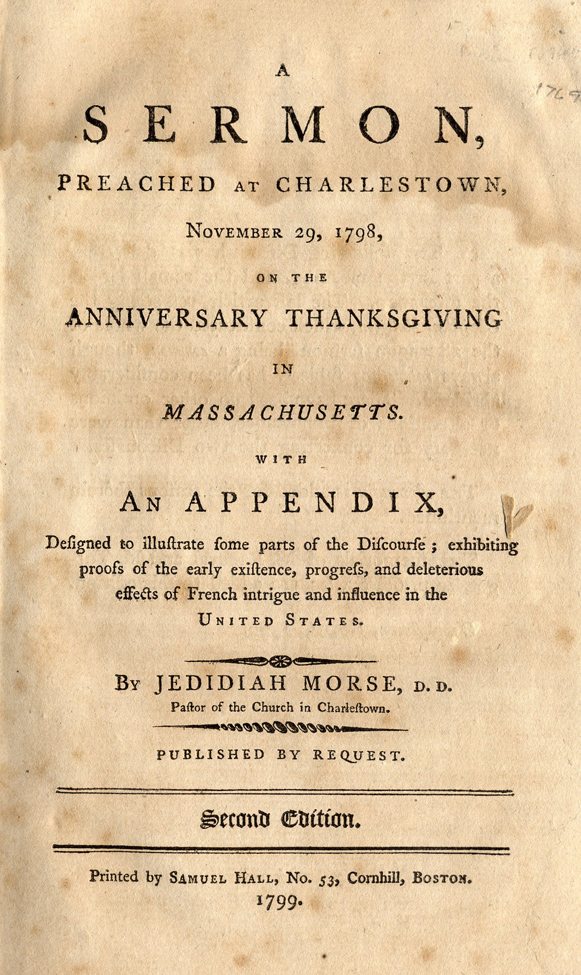
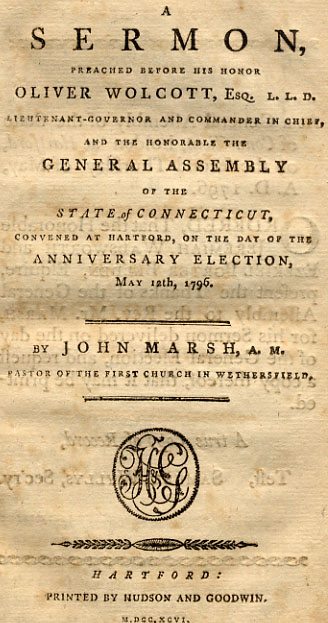
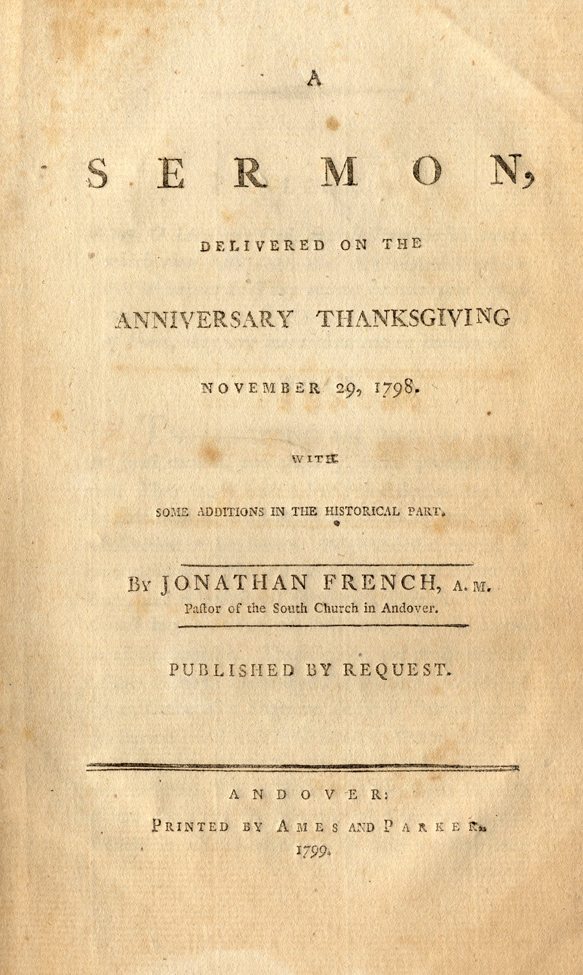
Morse also held a lifelong interest in education. In fact, shortly after his graduation in 1783, he started a school for young ladies. As an avid student of geography, he published America’s very first geography textbook, becoming known as the “Father of American Geography,” and he also published an historical work on the American Revolution. He was part of the Massachusetts Historical Society and a member in numerous other literary and scientific societies.

Morse also had a keen interest in the condition of Native Americans, and in 1820, US Secretary of War John C. Calhoun appointed him to investigate Native tribes in an effort to help improve their circumstances (his findings were published in 1822). His son was Samuel F. B. Morse, who invented the telegraph and developed the Morse Code.


sermon-thanksgiving-1798

A

Sermon

PREACHED AT CHARLESTOWN,

NOVEMBER 29, 1798,

ON THE

Anniversary Thanksgiving

IN

MASSACHUSETTS.

WITH

AN APPENDIX,

Designed to illustrate some parts of the Discourse; exhibiting
proofs of the early existence, progress, and deleterious
effects of French intrigue and influence in the
United States.

By Jedidiah Morse, D.D.
Pastor of the Church in Charlestown.

Exodus 18:8,9.

And Moses told his father-in-law, all that the Lord had done unto Pharaoh and to the Egyptians for Israel’s sake, and all the travail that had come upon them by the way, and how the Lord delivered them. And Jethro rejoiced for all the goodness which the Lord had done to Israel.

The history of the Hebrews, which was penned under the direction of the Holy Ghost, and makes a conspicuous part of the Old Testament Scripture, was intended for the instruction and admonition of mankind in all future ages. It is, indeed, a history of the dispensations of Divine Providence towards man, in almost all that diversity of circumstances in which nations have existed. Whatever be our situation as a nation, whether we be at peace or at war, in prosperity or adversity; in harmony or at variance among ourselves, serious and constant in our worship and service of the true God, or in a state of declension, idolatry, and general licentiousness of principles and manners, we may learn from some part of this history what it our duty, and what treatment we have to expect from the righteous Governor of the world. The history of Divine Providence proves its consistency and uniformity. What has been, will take place again in like circumstances. With God there is no variableness or partiality. Moses and Jethro, in the passage before us, have left us an example of our duty this day. By the special interposition of Heaven, and the instrumentality of Moses and Aaron, the Hebrews had been released from their Egyptian bondage, miraculously conducted over the Red Sea, and had triumphed over their enemies the Amalekites, who had declared war against them, and were now encamped at Rephidim. Here Jethro, from Midian, met Moses, his son-in-law, bringing with him his daughter, the wife of Moses, and her two sons. This, doubtless, must have been a joyful meeting, for Jethro was not only respectable as the Prince of Midian, but a wise and pious man, skilled in the science of government, as appears by the excellent judiciary system which he suggested to Moses, and a devout worshipper of the true God. Besides, Moses had lived in his family in great harmony and friendship, for forty years.

After mutual congratulations, Moses embraced the opportunity of rehearsing to “his father-in-law all that the Lord had done for Israel’s sake, and all the travail that had come upon them by the way, and how the Lord delivered them. And Jethro rejoiced for all the goodness which the Lord had done to Israel, whom he had delivered out of the hand of the Egyptians. And Jethro said, ‘Blessed be the Lord who hath delivered you out of the hand of the Egyptians, and out of the hand of Pharaoh, who hath delivered the people from under the hand of the Egyptians. Now I know that the Lord is greater than all gods; for in the thing wherein they dealt proudly, he was above them.’ And Jethro took burnt-offerings and sacrifices for God; and Aaron came, and all the elders of Israel, to eat bread with Moses’ father-in-law, before God.”

We have here an account of a regular Thanksgiving. Let it serve us for a model on the present occasion. A history of the divine goodness, of signal deliverances particularly, is given; corresponding joy, acknowledgements, and gratitude are expressed, and a convivial feasting before God crowns the whole. In this natural order let us proceed in the celebration of this anniversary Thanksgiving.

The principal business of the Preacher will be a rehearsal of those acts of Divine Goodness which, at this time, claim our particular notice and gratitude. And because the proclamation contains a comprehensive and well-arranged summary of these topics, and respect is due to the wisdom and judgment of our civil fathers, I shall pursue the order and train of reflection which they have suggested for our direction.

1. The earth, the past year, under the smiles of Providence, has yielded to industrious husbandmen a plentiful increase. A partial drought has indeed, in some instances, disappointed their expectations. In general, however, we have a competent supply of all, and an abundance of most, of the necessaries and comforts of life.

2. Our Fisheries, which furnish employment, subsistence, and wealth, to many of our fellow-citizens, and which are a fruitful nursery for seamen, so much needed for navel defense in the present posture of our public affairs, “have been prospered.”

3. Our Commerce, interrupted and embarrassed as it has been by those swarms of pirates, authorized and unauthorized, which have infested the ocean and captured our property to a large amount, to the ruin of many, the serious inconvenience of multitudes of others, and the incalculable injury of mercantile credit- our commerce, I say, notwithstanding all these very unpropitious circumstance, “has in many instance been attended with success.” When we consider what has been our defenseless situation, and the disposition and means of our enemies to ruin our trade, we shall find cause to be thankful for partial success, and shall admire the goodness of Providence in not suffering our enemies to cut off all our foreign commerce, and to depredate even our coasting trade. This was evidently within their plan, and must, in a little time, have been accomplished to the extent of their wishes, had not the defensive measures, under Providence, adopted and vigorously pursued by our government, arrested their progress and defeated their designs. In this view we have to be thankful to God this day, for our infant Navy. If commerce be a blessing to our country, a Navy, competent to its protection, in such times as these, must likewise be considered as a blessing. Already its utility appears, in the security which it gives to our trade, and its consequent revival within a few months past. From the prevalence of a Naval spirit in all our seaports, fair hopes are entertained that these means of national defense will be soon increased to such an extent as to put an effectual stop to the depredations of violent and unprincipled men on the sea, to protect our independence and liberties, and cause us to be duly respected by all foreign nations. This agreeable prospect, afforded us by the smiles of Divine Providence on the measures of our government, should cause our hearts to rejoice and praise God this day.

4. In such tumultuary times as the present, when so great a part of the world is in a state of war, insubordination, and anarchy, and torn by bloody intestine divisions, to be permitted to enjoy uninterrupted “order and tranquility,” is a blessing which ought most gratefully to be recognized. This is a blessing with which, under the Divine Protection, we have been favored. A difference in political and religious opinions, indeed, unhappily exists among us. Party zeal and animosities have in some instances, marred our happiness. Prejudices have too often blinded the eyes of the mind against the perception of truth. But, God be praised, these differences have not yet been suffered to rife so high as to burst the bonds of society, and rage in civil war and bloodshed. Hitherto it has been a war of words—of words however, , too often calculated to bring on a more ferocious contest. The heat of the battle, we would hope, is past; prospects of union brighten as the knowledge of facts is extended, and we confidently hope for increasing harmony and peace.

5. Health is a blessing at all times inestimable. Its value, if possible, is increased in our estimation in seasons when our neighbors and fellow-citizens are deprived of it, and by thousands fall victims to loathsome and contagious disease. The enjoyment of uncommon health, while mortal pestilence spreads havoc and distress all around and very near us, demands a tribute of special and unfeigned gratitude. Let us not this day forget, my brethren, that this has been our favored lot in this town; nor be unmindful of what, in consequence, we owe to Him, who has directed the destroying angel to pass by so many of our dwellings. While we humbly thank our God for his goodness and forbearance in withholding from us deserved chastisement, let us mourn with our fellow-citizens, who have felt the rod of correction, either in their own sickness, the death of relations, or in the loss of the means of subsistence; and rejoice with them, in that, through the goodness of God, they are now restored to health, to their houses, and various occupations. Let us always remember that to be sincerely grateful for, and duly to improve past blessings, are the best methods of securing their continuances.

6. “Through the goodness of God, we continue to enjoy Constitutions of Civil Government well calculated to secure and maintain our rights, civil and religious.”

In nothing are we, as a people, more highly distinguished among the nations of the earth, than by the enjoyment of the rare blessing of good government. With the advantage of the theories and experience of all past ages, a selection, by our free choice, of our wisest men, have formed for us, and we have deliberately and peaceably adopted a Constitution, which is deservedly the admiration of the most enlightened part of mankind. Never, probably, was a government framed by men, better adapted to the situation, opinions, and habits of a nation, or more perfect in theory, more excellent in practice; whose powers were better defined, and balanced; which guarded more effectually against the encroachments of despotism on the one hand, and of anarchy on the other, or which required of its subjects a smaller sacrifice of their liberty and property in order to secure the protection of the remainder, than the Federal Constitution. A trial of almost ten years, under singular disadvantages, has proved its excellence and strength; and procured for it the affections and the confidence of a large majority of the nation. Amidst convulsions and embarrassments, singular in their kind and extent, it has afforded us a great national prosperity, security, and respectability. This Constitution may be considered t as the great anchor, which under Providence, has hitherto saved us from shipwreck, amidst the political storm which now rages all over the world, which has overturned, in rapid succession, all the republics of Europe, and has caused us, not without reason, to tremble for our safety , freedom, and independence. Never had a government, in its infancy, to struggle with enemies so numerous, insidious, and formidable, as have assailed ours since its establishment. Never was the integrity and firmness of any administration put to the test by so many means, both fair and treacherous, as ours has been, for these six years past. Yet blessed be God, the machinations of our enemies have hitherto been defeated; the councils of our Ahithophels have been turned into foolishness; and among the blessings which we called upon gratefully to recognize this day, we may still reckon that of a free and independent government.

To enhance, in our estimation, the value of this blessing, and to increase our vigilance in preserving it, it may be proper, in this place, to point out some of the various ways in which it has been endangered, and the probable consequences of its subversion. I shall not indulge on these fruitful topics in that latitude which they would naturally admit.

I observe, in the first place, that our free Constitution has been endangered by our vices and demoralizing principles. Vice is hostile to freedom. A wicked people cannot long remain a free people. If, as a nation, we progress in impiety, demoralization, and licentiousness, for twenty years to come, ad rapidly as we have for twenty years past, this circumstance alone will be sufficient, without the aid of any other cause, to subvert our present form of government. In this case, the people would not bear, quietly, as much freedom as we now enjoy. We know that men yield to the restraints of good government with increased obstinacy as they advance in wickedness. With difficulty, even now, are the wholesome laws of our country executed on the guilty. Many of our laws indeed, against vice and immorality, those particularly against profane swearing, debauchery, gaming, and Sabbath-breaking, are but a dead letter. There are no attempts made by magistrates, in some places, to enforce them against offenders. If this be the case now, what are we to expect when the votaries of vice shall be multiplied, and become even more bold and lawless than at present?

Among the vices which have more particularly endangered our government, we may reckon a selfish spirit, an insatiable ardor to get rich. This spirit has engendered speculation, fraud, embarrassments, and bankruptcy. These are all unfriendly to freedom, patriotism, order and good government. An avaricious man will always sacrifice the public good to private interest. If we would preserve our freedom against the machinations of its enemies, we must all be vigilant and active in our respective spheres, and liberal in our contributions of labor and property, for its support. A man that prefers his own private ease and his money to the public good, in these critical times, is no patriot.

For the reason already mentioned, that is, because vice is hostile to freedom, our Constitution has been endangered by the spread of infidel and atheistical principles, in all parts of our country. Truly alarming has been the increase of such principles within a few years past. These are so many tares sown among us by an enemy, which threaten to overtop and root out the wheat. They form a sorrowful proof to us of the truth of that divine maxim, “Evil communications corrupt good manners.” Such principles are certain death to morals, freedom, and happiness. Where they flourish and predominate, there is despotism and slavery of the worst kind, and wickedness and misery in all their most hideous forms. It is to be lamented that the effects of these principles are growing more and more visible among us, in the corruption of morals, and the neglect and contempt of the sacred institutions of religion.

The increase of luxury, extravagance, and dissipation, among us has proved not a little detrimental to the interests of freedom and good government. These vices have often proved the bane of republics. The Romans, while they cherished the republican virtues of industry, frugality, and patriotism, prospered, and brought almost the whole world under their subjection. But immediately after their conquests, they suffered themselves to be corrupted by pride and luxury. The inhabitants of the rich Asiatic countries who had submitted to the Roman yoke, in turn conquered their conquerors, by their riches and voluptuousness. Let us remember that like causes produce like effects, and learn wisdom from the fatal experience of other nations.

A spirit of insubordination to civil authority is another vice which has endangered the existence of our government. Having a Constitution and rulers of our own choice and highly deserving our respect and confidence, and laws framed by our own representatives, there cannot be even a plausible reason alleged to justify disrespect and disobedience. Still, however, our ears have been filled with reproaches against our rulers; their characters have been libeled; every means have been used to bring them into disrepute, and to impair the public confidence in them. The laws of the land have despised and set at defiance. Faction has been bold and open-mouthed. The minority have refused to yield quietly to the voice and decisions of the majority, a circumstance indispensable to the existence of “liberty with order.” No community can attain the ends of society, which are peace, security, and happiness, unless government be respected and the laws obeyed. The effects of despotism and tyranny are extremely calamitous and distressing; but still more to be dreaded are those of anarchy.

The United States are now making the experiment of a free government under the fairest advantages. Remote from the quarrels of Europe; educated under forms of government, and institutions, civil, literary, and religious, highly favorable to virtue and freedom; our rulers all from among ourselves, and in general composed of our wisest and best men; with a country situated in the climate of freedom, between the extremes of heat and cold; exposed neither to the idleness and effeminacy of the South, nor to the severe hardships and scanty subsistence of the North, with a necessity laid upon us of so much labor as is necessary to the existence of freedom—If under all these peculiar advantages, we cannot support a free, republican form of government, the world must give up the highly-valued and long fought-for blessing as unattainable, as too precious a favor for Heaven to bestow on guilty men.

I would to God the people of the United States could all be impressed with the high importance of the experiment we are now making for the world, and would unite in a resolution to reform their vices, to stifle and bury their animosities, to conciliate their differences and learn to reverence and obey the Constitution, the rulers, and the laws of their own creation. Unless something like this shall soon take place, one or other of these consequences may be easily foreseen, either a voluntary increase of the powers of Government, sufficient to preserve order and respect for the laws, or revolution, anarchy, and military despotism. But,

2. The blessings of good government have been most imminently and immediately endangered by foreign intrigue. From this source have arisen our greatest perils. This bane of our independence, peace, and prosperity, has been operating in various ways, for more than twenty years past, in insidious efforts to diminish our national limits, importance and resources; in keeping alive national prejudices; in attempts to prevent our having an efficient government; in artful stratagems to diminish and weaken the powers vested in the Executive; to destroy the “checks and balance,” and to consolidate the distinct and well-defined powers of the three branches established in the Constitution; in frequent interferences in the management of our national concerns; in fomenting divisions among us, and in patronizing and circulating publications calculated to cherish and increase them; by calumniating our Rulers; misrepresenting their measures, and exciting murmurs, prejudices, and direct and open opposition against the laws. In all these, and many other ways too numerous to detail, had foreign intrigue discovered itself among us, and attempted to check our national growth, and to deprive us of the blessings of a free and independent government. It was by intrigues and artifices, like those we have mentioned, that all the Republics of Europe have been prostrated at the feet of France. It was in the same way that the free states of Greece were ruined, and their liberty lost. The French appear to have acted the some part towards their neighbors, and are now acting the same part towards us which the Persians formerly did towards the Greeks. Let it be remembered, that they are copying successful means- means which will prove as fatal to us as they have to others, if they are not resisted. The following passage, from Rollin’s Ancient History, is too remarkable not to be here recited as a solemn warning to us. If we will obstinately refuse to profit by the experience of past ages, or from recent examples, we may read our destiny in the history of the fourth age of Greece, and of the more recently ruined Republic of Europe.

“The principal cause of the declension of the Greeks, was the disunion which rose up among themselves. The Persians, who had found them invincible on the side of arms, as long as their union subsisted, applied their whole attention and policy, in sowing the seeds of discord amongst them. For that purpose, they employed their gold and silver, which succeeded much better than their steel and arms had done before. The Greeks, attacked invisibly, in this manner, by bribes secretly conveyed into the hands of those who had the greatest share in their governments, were divided by domestic jealousies, and turned their victorious arms against themselves, which had rendered them superior to their enemies.

“Their decline of power, from these causes, gave Phillip and Alexander opportunity to subject them. Those princes, to accustom them to servitude the more agreeably, covered their design with avenging them on their ancient enemies. The Greeks gave blindly into that gross snare, which gave the mortal blow to their liberty. Their avengers became more fatal to them than their enemies. The yoke, imposed on them by the hands which had conquered the universe, could never be removed; those little states were no longer in a condition to shake it off. Greece, from time to time, animated by the remembrance of its ancient glory, roused from its lethargy, and made some attempts to reinstate itself in its ancient condition; but those efforts were ill-concerted and as ill-sustained by its expiring liberty, and tended only to augment its slavery; because the protectors, whom it called in to its aid, soon made themselves its matters: so that all it did was to change its fetters, and to make them the heavier.” 1

The latter part of this picture strongly resembles the present condition of the once free and happy states of Holland, Switzerland, and Geneva. God be praised, this day, it does not resemble that of these American States. Our civil Constitutions, our Independence, and liberties, still remain to us entire and unimpaired, blessings of incalculable worth, in defiance of all their assailants. Our escape hitherto has been effected, under Providence, by means of a wise, firm, and dignified administration of our government, supported by the enlightened and ardent patriotism of the people, seasonably manifested, with great unanimity, from all quarters of the Union, in patriotic addresses, in a voluntary tender of military services, and liberal means for naval defense. These exhibitions of wisdom, energy, union, and patriotism, while they reflect glory on our country, and are pledges of our security, have raised our national character among foreign nations, and have caused America to be looked to, in these convulsive times, with inquietude, as the last resort of persecuted liberty and happiness.

When we reflect on the portentous and threatening aspect of European affairs, the hostile attitude of so many nations, and the storm that has been thickening over our heads, and ready to burst upon us; and when we consider what will be the probable salutary influence of the late unparalleled nave victory in the Mediterranean, on the affairs of our own country, of Europe, and of the world, we ought not, this day, to withhold our gratitude to God, for this event. 2 When a gigantic, colossal power, which is influenced and restrained by no principle of religion, justice or humanity, is diminished, and deprived of the means of robbing mankind of their liberty, their property, and their lives, it cannot but rejoice the heart of every good man.

7. Among the favors of divine Providence, which we are called upon, by our civil Fathers, gratefully to remember, is that “at a very interesting period of our public affairs, the important life and usefulness of the Chief Magistrate of the Union have been continued.” Concerning a man, who was born and brought up among you; who has grown old in his country’s service; who has risen, under your own eyes, through all the grades of office, to the highest in the gift of his fellow-citizens; whose moral, religious, and political character are well known, concerning such a character, it is needless for me to say much. Nothing that I can say, I apprehend, will heighten the esteem of his friends of diminish the prejudices of his enemies. For myself, I cannot forbear observing, that I consider it a one of the most prominent evidence of the Divine Goodness to our country, that the “life and usefulness” of this great and good man have been preserved. His talents, his long experience, his profound knowledge of the policy and intrigues of European nations, his unimpeached integrity and intrepid firmness, have been, under God, of infinite service to our country. That bold and decisive policy which he has adopted and pursued, and in which, happily, he has been supported by Congress and the People, has, I verily believe, been the means of favoring our constitution. In the present critical situation of affairs, a man and his office could not be better united, than Mr. Adams and the Presidency of the United States.

Like Israel, at the period described in our text, we are in wilderness. Our greatest dangers, we hope, are passed. Still, however, trials and dangers of magnitude await us. Insidious enemies lurk on every side. There are Balaams, who, if they are not permitted to “curse us” to our enemies, are artful and wicked enough to suggest expedients to corrupt our morals and our principles, and thus prepare the way for our ruin. Thus situated, and with such prospects before us, let us be thankful that God, in his great goodness, has raised up, and preserved to us, a Moses to preside in our councils, and a Joshua to lead our armies. Will God long preserve to us the benefit of their talents and influence, and continue to direct, support, and comfort them in the duties, and under the cares and anxieties of office, the hatred and malice of foreign enemies, and the ingratitude and murmurs of the discontented, and the reproached and calumnies of the wicked and abandoned part of our own citizens.

In the catalogue of our blessings, by far the most valuable remains to be mentioned, and that is,

8. And lastly, our holy religion. “Notwithstanding our past impenitence (says the Proclamation) we are still indulged with the Christian religion; a religion so conducive to the happiness of man in the present life, whilst it supports the hope of the believer in a happy and glorious state in the world to come.”

This blessing is annually recognized in the Proclamation, and always claims our highest notes of praise. But at a time when secret and systemic means have been adopted and pursued with zeal and activity, by wicked and artful men in foreign countries, 3 to undermine the foundations of this religion and to overthrow its altars and thus deprive the world of its benign influence on society, and believers of their solid consolations and animating hopes; when we know that these impious conspirators and philosophists have completely effected their purposes in a large portion of Europe, and boast of their means of accomplishing their plans in all parts of Christendom, glory in the certainty of their success , and set opposition at defiance; 4 when we can mark the progress of these enemies of human happiness among ourselves, in the corruption of the principles and morals of our youth; the contempt thrown on religion, its ordinances and ministers; in the increase and boldness of infidelity, and even of Atheism; 5 when we reflect, moreover, on our own “impenitence,” our ingratitude for, and abuse of this greatest of blessings; when we take into view all these things, our thankfulness today for the continuance of the Christian religion and tis ordinances among us, should be unusually ardent. The worth of valued blessings is realized and increased, when they have been undeservedly continued or endangered by the artifices of designing enemies.

That we may realize how great a blessing we possess in the Christian religion; how highly we ought to value this precious treasure; how vigilantly to guard it, and how resolutely to defend it against every attack, secret or open, indulge me in a few observations on its intrinsic excellence, and its benign effects in promoting human happiness. On a subject so extensive, so fruitful, so universally interesting, and which has been so often, so ably, and so eloquently handled, it is difficult to be concise, and impossible to be original.

The Christian religion is the gift of God to man, and is in all respects worthy of its glorious and perfect Author. It exhibits the divine character in a view calculated, at once, to command our highest reverence, love, and confidence. Is doctrines and precepts, the sentiments of devotion which it inspires and cherished, and the morality which it inculcates, its threatened punishments and promised rewards, are all consonant with the perfections of God, and adapted to the nature and condition of man. It “originated in the misery of mankind, which it is the intention of divine grace, by its means, to remove, and for which, as being the contrivance of infinite wisdom, it furnishes a complete and effectual remedy.” It is applicable only to sinners. For innocent beings, such a Gospel as ours would be neither necessary nor suitable. Sin, of whose origin, nature, effects, and final consequences, our Bible alone gives a satisfactory account, had involved the world in spiritual ignorance, darkness, and misery, and concealed from the sinner’s view the path to God and to happiness. Christianity “gives light to them that sit in darkness and the shadow of death, and guides our feet in the way of peace.” It reveals a divine and mighty Savior, Jesus Christ, the Son of God, who visited this world, to bless mankind with “the knowledge of salvation by the remission of sins”; who left us a perfect “example that we should follow his steps.” It makes known to us that crucified Jesus, who “came to give his life a ransom for many,” and by his death to make expiation for human guilt; in whom “God is reconciling the world unto himself, not imputing their trespasses unto them.” It asserts, explains, and substantiates the interesting doctrines of the resurrection of the dead, of future and everlasting rewards and punishment; of “life and immortality”; doctrines of incalculable importance to the purity of morals, and the well-being of society. These are some of those truths which are peculiar to Christianity, and which render it infinitely superior to every other system of religion, and a blessing of inestimable value to the human race. 6 All other systems leave mankind in the dark in respect to the true character of God, the nature of sin, the method of pardon, true morality, and a future state. The deduction of the wisest philosophers, unaided by revelation, can yield to the anxious inquirer only a glimmering light on these subjects, and “a tremulous hope founded on probability. The Sun of Righteousness alone illuminates the path to life and glory. A single ray from Christ, the great Fountain of spiritual light, is of more use to lead a sinner to God, than all the torches lighted up by reason or fancy of all the sages of ancient or modern times.”

Christianity sheds a most benign and salutary influence on society. It “teacheth us, that denying ungodliness and worldly lusts, we should live soberly, righteously, and godly in this present world.” It prohibits the indulgence of those appetites and desires only, which cannot be satisfied without injuring the rights and impairing the happiness of other. It is highly friendly to genuine liberty. The knowledge and practice of the “truth as it is in Jesus,” makes us free indeed. The sublime views which this Religion gives us of the perfections of God, his goodness, his hatred of injustice and tyranny; the knowledge it affords of the dignity of man, and of the magnitude and glory of his prospects, have a natural tendency to elevate his soul, and inspire him with a love of freedom. It eradicates narrow and selfish feelings and prejudices, and inspires with that “modest pride” and that “noble humility,” which lead us to expect, and even to demand, the possession of our own rights, and at the same time to be equally zealous in securing the rights of others.

All the true interests of mankind indeed, in regard to both worlds, are essentially promoted by Christianity. It is a “religion,” said the celebrated Montesquieu, “which, while it seems only to have in view the felicity of the other life, constitutes the happiness of this.” 7

To describe in detail all the various ways in which Christianity blesses mankind, would very far exceed the limits proper for a single discourse. I will only say, in the comprehensive and eloquent language of a modern divine, that “In proportion as Christianity, in its peculiar doctrines, is known and believed, it meliorates the condition of men in this world, and secures to them felicity in the next. It softens and humanizes mankind. It civilizes the barbarian, humbles the proud, meekens the resentful, expands the heart of the selfish, and sanctifies the impure. It smoothes the rugged path of life by the amiable tempers which it inspires, by the gentle influence of its precepts, and by the heavenly consolations which it pours into the soul; while it opens to view, those delightful prospects of the divine favor and felicity, which alone can mitigate the gloom of adversity, and cheer the “dark valley of the shadow of death.” – By the faith of the Gospel, the whole soul is subjected to Christ, who triumphs over men to bless them, whose gentles sway is true felicity; for the conquests which he makes are deliverances from guilt and misery, and the glorious career which he pursues in subduing men “to the obedience of faith,’ is everywhere marked, not like that of other conquerors, with blood and desolation, but with light life, with liberty and joy.” 8

These are fruits peculiar to genuine Christianity. If its professors have not always brought forth these fruits, it is either because they have held the truth in unrighteousness, or have had the form without the power of godliness, or denied and opposed its essential doctrines; or because they have degraded it by superstition, corrupted it by errors, or have employed it only for purposes of state. The truth, as it is in Jesus, is blameless. It would be absurd to charge it with the vices which it condemns, or with the miseries which it is its chief design to alleviate and remove.

Seeing them we are blessed with such a religion, a religion so well adapted to enlighten a dark world, possessing efficacy to sanctify and comfort the sinner’s heart, and every way suited to the wretched state of fallen man, how thankful should we be this day for its continuance among us; that we are permitted to enjoy its ordinances without any to molest of make us afraid! How diligently and zealously should we cherish its principles, defend its doctrines, and obey its precepts, exhibiting their fair fruits in our lives! How anxious should we be, in this age of bold infidelity, by all means in our power, to multiply the disciples of this excellent religion, and particularly to transmit it, pure and uncorrupt, to our posterity. Can he be a friend to his fellow-creatures who hates Christianity, who opposes its progress, who seeks its subversion, ridicules its ordinances, and vilifies its teachers? Will not every good man, who is acquainted with the nature, design, and effects of this religion, wish most ardently that it may be universal and perpetual? You will not fail, my brethren, this day, in concert with the multitude of our fellow-citizens, assembled for the same purpose, to offer unfeigned thanksgiving to God, for this chief of all his blessings, that the Christian Religion, so contemned and hated by some, so slighted and neglected by many, so often abused even by its professors and friends, is, notwithstanding, still continued among us; that its Sabbaths remain unstricken from our calendars, and its ordinances are upheld and attended by respectable numbers; that it still proffers to us its rich treasures of wisdom, strength, and comfort for this life, and opens to us the gates of New Jerusalem above, the city of the living God.

In view of the various goodness of God which has been set before us in the foregoing Discourse, let us offer to God corresponding gratitude and praise. For this purpose expressly was this day appointed. To celebrate it to this end is no less our privilege than our duty. To pervert it to licentious feasting, and vain and thoughtless mirth, is as injurious to our own souls, as it is affrontive of the authority of our civil Fathers, and displeasing to God. Let our joy be that of sober, reflecting, thankful Christians, and our feasting be “Before God” as in his presence, and with hearts lifted up to him in fervent praise for all his gifts.

The religion, whose excellencies we have attempted to display, abounds in precepts and encouragement to the duty of almsgiving. It holds up kindness and beneficence to the poor, as one of the brightest ornaments of the Christian. I know, my brethren, your laudable desire to be clothed with this ornament; and it is instead of a thousand arguments to prompt you to consider and relieve the poor among you. You need no persuasion to the performance of a duty, which, from long habit, seems to have become natural to you. 9 I have only to ask, that you take heed to give from suitable motive, and to be clothed with all other Christian virtues; and God will assuredly bless and prosper you in this life, and a last admit you to his kingdom, so will you ever be with the Lord.

AMEN

[Appendix not included.]


Endnotes

1. Rollin’s Anc. Hist. vol. ix. P. 178.

2. The official account of this victory arrived in Boston the evening before the day of Thanksgiving.

3. Professor Robison and the Abbe Barruel have given satisfactory proofs of a regular conspiracy against the Christian religion, of which Voltaire was at the head. The Monthly Reviewers, who are not disposed to give more credit than is due to these writers, admit that “the conspiracy of the philosophers (it should be philosophists) against the Altar,” or Christianity, “is satisfactorily established, in the first volume” of the Abbe Barruel’s work.
One method adopted by these antichristian conspirators to advance their designs, has been, to write and publish books, artfully calculated to discredit Christianity, and ascribe them to the deceased authors of reputation, and in this way to avail themselves of their influence. For instance, a book entitled, “Systema de la Nature,” or “The System of Nature,” an insidious and blasphemous work, was written by some one or more of these conspirators, and published under the name of M. Mirabaud, one of the forty members of, and perpetual secretary to, the French Academy. In the Life of this celebrated Academician, the authors of the Dictionarie Historique say, “After the death of this author, a course of Atheism was published in his name, under the title of Systema de la Nature. It is superfluous to remark, that this insolent philippic against God, (which has been also attributed, but perhaps rashly, to an academician of Berlin), is not the work of Mirabaud.” Concerning this book, the authors of the British Critic say, “Sincerely and deeply do we regret that views of gain, or designs of a still darker nature, should suggest an attempt to circulate in this country, those poisons, the operation of which has been so truly fatal in the place [France] where they originated. There is but too much reason to apprehend, that these are all but parts of one great plan, to attack, by all possible means, the principles of truth and religion.” – Let Americans be on their guard!

4. M. Volney, a French philosophist, who lately spent several years in America, I am credibly told, when in Boston, in the spring of 1797, expressed himself highly gratified at the progress of the principles, political and religious, of the French revolution. “England,” (said he) will be revolutionized; the same spirit will run through Italy and the German States, and all the enlightened parts of Europe, and then (he added, with the highest exultation), Christians will be put in the back ground. Already has it received its mortal blow. The revolution (meaning, no doubt, to include its religious and moral, as well as political effects) will go over the whole world. It does not depend on the continuance of power in the present hands at Paris. Its progress is irresistible; and it will proceed until it has changed to the face of every society on earth.” – These opinions were uttered in a manner which indicated, that he thought them neither new nor disputable. The gentlemen who heard this conversation, and gave me this information, are of the first respectability. One of them, much conversant with foreigners of distinction who have visited this country, adds, that he “had been accustomed to hear similar sentiments from almost every Frenchman he had conversed with since the summer of 1792;” and that he had “lately been told, that the Directory and their friends in Paris openly maintain these opinions, and say, particularly, that if they should be cut off, and a million others, by any irregular movement of the revolution, it will nevertheless and governed on any other principles than their own;” that is, they mean to wage war upon society in general, till every part is revolutionized, and conformed to their standard. Accordingly we find that France treats as enemies all who will not consent to be her dupes, and conform to her detestable revolutionary schemes. Whenever he profess friendship, it is only to gain the opportunity of administering her poisons, which are far more destructive than her sword. If we love our holy religion, and our country, and regard the welfare of our posterity, let us shun the philosophists of Europe, and their hosts of emissaries in America, and discard and detect there baneful principles.
“What,” says an intelligent American gentlemen, in a letter to his friend in Boston, dated at Havre, Nov. 24, 1793, “What do our good folks think of dethroning God, burning the Bible, and shutting up the churches? The decadi (the new Sabbath) before I came here, they burn the Bible in the public square, pulled down the images of Jesus and Mary in the churches, and filled the niches with those of Reason and Liberty. Marat is the god of the day. The most licentious writings daily issue from the press upon former religious objects.”

5. The probably existence of Illuminisin in this country was asserted in my Fast Discourse of May last. The following fact, related by a very respectable divine, while it confirms what is above asserted, shews that my apprehensions were not without foundation.
“In the northern parts of this state (Massachusetts0 as I am well informed, there has lately appeared, and still exists under a licentious leader, a company of beings who discard the principles of religion, and the obligations of morality, trample on the bonds of matrimony, the separate rights of property, and the laws of civil society, spend the Sabbath in labor and diversion, as fancy dictates; and the nights in riotous excess and promiscuous concubinage, as lust impress. Their number consists of about forty, some of whom are persons of a reputable abilities, and once, of decent characters. That a society of this description, which would disgrace the natives of Caffraria, should be formed in this land of civilization and Gospel light, is an evidence that the devil is at this time gone forth, having great influence, as well as great wrath.” [See a Sermon on “the Dangers of the times – especially from a lately discovered Conspiracy against Religion and Government. By Rev Joseph Lathrop, D.D. of West Springfield.”]
Here is certainly the fruit if not the root, the practice if not theory, the substance if not the form of Illuminisn.

6. To be convinced of the superior excellence of our religion, we need only look to those countries where the Gospel has never been preached, or where it has been contumeliously rejected, and its institutions abolished; and contrast their situation, in a moral and social view, with that of those nations who enjoy the light, receive the doctrines, and support the ordinances of the Gospel.

7. Spirit of Laws, book xxiv. Chap. iii.

8. See a Discourse before the Edinburgh Missionary Society, 1796.

9. There is annually, on the day of Thanksgiving, a collection for the poor; and the liberality of the inhabitants of this town, on these and other like occasions, is highly exemplary, and forms an amiable trait in their character.

Sermon – Election – 1796, Connecticut


sermon-election-1796-connecticut


A

Sermon

Preached
Before His Honor

Oliver Wolcott, Esq. L.L.D.

Lieutenant- Governor and Commander in Chief,

And  the Honorable the

General Assembly

of the

State of Connecticut,

Convened at Hartford, on the day of the

Anniversary Election,

May 12th, 1796.


By John Marsh, A.M.

Pastor of the First Church in Wethersfield.


At a General Assembly of the State of Connecticut, holden at Hartford, on the second Thursday of May, A.D. 1796.

Ordered, That the Honorable Jeremiah Wadsworth and Ezekiel Porter Belden, Esquire, present the Thanks of the General Assembly to the Rev. Mr. Marsh, for his Sermon delivered on the day of the General Election, and request a copy thereof, that it may be printed. A true copy of Record, Test, Samuel Wyllys, Sec’ry.

Nehemiah V. 19.

Think upon me, my God, for good, according to all that I have done for this people.

This is the language of a ruler, who was an ardent lover of his nation. He had done much for the people over whom he was placed, and had the satisfaction arising from a consciousness, that he had served them from the best principles and the purest motives. He could appeal to God, to whom he had respect in the discharge of the duties of his office, and with comfort hope in him for that reward in his favor, which he hath graciously encouraged all, who do well, to expect. Happy are those rulers, who, like Nehemiah, have the interest of their people at heart, and under the habitual influence of the fear of God, and with a prevailing regard to his approbation, exert themselves for the promotion of their welfare! Happy is that people that is distinguished with such rulers!

In the following discourse, I propose, in conformity to the occasion of the present meeting, and the ideas suggested by the passage just read, to consider the design of civil government, and the importance of religion in those, to whom the administration of it is committed.

First. Let us consider briefly, the design of the institution of civil government.

This is intimated in the text to be the benefit of the people: According to all that I have done for this people.

Could men have been as secure in their lives and properties, and enjoyed equal happiness in a state of nature, as in a state of society, civil polity would never have been erected among them. It is unreasonable to suppose that any number of men, inhabiting any portion of the earth, would ever have come into an agreement to relinquish some of their natural rights as individuals, and to submit to certain laws deriving their authority from such agreement, without a view to their greater advantage- to the more effectual security of their most valuable rights, liberties and privileges.

Man is formed for society. Such are his faculties- his natural desires, inclinations and capacities, that he would be uneasy without an intercourse with his fellow-creatures. Such his weakness and his wants, that without their aid, he could not exist comfortably, if he could exist at all. And such are the lusts of men, from whence come wars and fightings, that the weaker would always be in danger from the stronger, without the protection of laws, which numbers agree to adopt and support, for their mutual safety and advantage.

This being the case, nothing is more natural and reasonable, than that numbers should associate for the defense, assistance and improvement of one another. And though, by such association, they put themselves out of a state of natural freedom, they are richly compensated therefore, by the numerous important benefits to be enjoyed only in a state of civil society.

The end of the appointment of civil rulers cannot be their own personal honor and emolument, but the benefit of those over whom they are placed. Rulers are made for the nation, and not the nation for rulers.

As members of society, they are to enjoy in common with others, the advantages resulting from the social compact. As rulers, they are entitled to an honorable support, and to all that respect and esteem, which the dignity of their stations and the importance of their services render fit and proper. They are not, however, to seek their own separate interest, but the interest and welfare of the community.

These dictates of nature and reason, the dictates of revelation strengthen and confirm. In the book of inspiration it is expressly said of the civil ruler, “He is the minister of God to thee for good. Rulers are not a terror to good works but to the evil. They are God’s ministers, attending continually upon this very thing.”

The benevolent author of our existence- of our capacities and all the means of improvement and happiness, in the directions he has given in his word, respecting the qualifications and duties of rulers, as well as correspondent conduct of the people, has an evident view to the good of society- that the members in general, “may lead a quiet and peaceful life in all godliness and honesty.”

Various are the forms and constitutions of government, which the different genius, prejudices, circumstances, situations and customs of men, have led them to frame and adopt. That is justly accounted the most eligible for a particular people, which is best adapted, under their circumstances, to promote and secure the great end for which magistracy is appointed. But no form of government can ensure happiness to a people, unless it be well administered.

A Constitution, in many respects defective, in the hands of an able and upright administration, may be rendered subservient to the signal prosperity of a people. Whereas, a far more perfect form of government, in the hands of rulers of an opposite character, will fail of affording the citizens that protection and security, that peace and quietness, without which they cannot but be miserable.

If these observations be just, what a post of importance is that of the civil magistrate! His elevated station, as it is a station of honor, is also one of labor and high responsibility; and it will be no further honorable to him, than as he fills it with dignity, and usefulness to the public.

The care of those things which respect the welfare of a great people requires the close and unintermitted attention of the civil ruler. To attend to their situation with regard to other powers- to provide for their defense against foreign invasion and internal sedition- to secure those advantages that may justly be derived from an intercourse with other nations- to attend to the internal state of the commonwealth- to its finances- to its agriculture- commerce- manufactures- morals- learning and religion; to make such alteration in the laws, or such new ones, as the varying circumstances of the country, state, towns and corporations, may render expedient, and take effectual care to have them executed, is a most laborious and difficult employment. Such a variety of great, interesting and complicated business cannot be properly performed but by men of superior ability, knowledge and wisdom, firmness and integrity.

They who are called to sustain the weight of government, and to manage the great affairs of the state and nation, need the united influence of every argument and motive, adapted to strengthen and invigorate the human mind, and to encourage and animate them in their arduous work.

Secondly, I proceed to consider the importance of religion in the civil ruler. Think upon me, my God, for good.

This request, in connection with what it is grounded upon in the latter part of the text, implies, that Nehemiah had acted under the influence of religion, in his public character- that the great things he had done for the people over whom he ruled, were the fruit of a pious regard to God, and a firm belief in his promises.

Religion is of high importance in a ruler, as an incentive to fidelity, in the discharge of the duties of his station- as it will lead him to seek the direction and assistance of Heaven- as it will afford him the best support under the burdens of his office, and cause him, by his precepts and example, to do much for the promotion of piety and virtue among the people.

Great abilities, through indolence and a love of ease, may lie useless in a ruler. The community will derive little or no benefit from them, unless he is possessed of a principle sufficiently active to bring them into operation, and sufficiently virtuous to direct their operation for the public good.

As superior talents in an exalted station render a man capable of doing signal service for the community, so they render him capable of doing as signal mischief. Nothing, like a principle of religion deeply imbibed in the heart, can secure him from the one, or prompt him to the other.

Other and lower principles, it must be confessed, have influenced, and may influence, men to do many beneficial deeds for their nation, and greatly promote their quietness and prosperity.

But these principles- such as honor, ambition, a natural benevolence of temper, or a desire of the continued enjoyment of the emolument of a public office, are too contracted to reach many cases, with which the happiness of society is intimately and essentially connected, and have not that force requisite to produce an even, steady and consistent course of action.

The ruler, who is not under the prevailing influence of the fear and love of God, and that love of mankind which is an inseparable concomitant of the love of God, is always in danger of betraying his trust, and involving the community in misery and ruin. Temptations to do wrong, when they make a vigorous assault upon him (and none are more exposed to temptations, than those, who are in elevated stations) will be likely to meet with a feeble, if any resistance. He will not be deterred from a measure however injurious it may be to individuals, or destructive in its tendency to the interest of his country, when, by going into it, he call gratify his avarice, or save himself from present infamy, and preserve the favor of a majority of his constituents.

Such may frequently be the situation of things, that the civil ruler cannot, in conformity to the dictates of an enlightened understanding, and a benevolent heart, pursue such conduct, as will greatly conduce to the advantage of the community, without exposing himself to certain reproach, and hazarding the loss of his official existence.

But he, and he only, who, regarding the praise of God more than the praise of men, is solicitously concerned to approve himself to that glorious being, who standeth in the congregation of the mighty and judgeth among the Gods, is to be depended on in all seasons. In seasons the most trying nothing can warp him from his duty. Having accepted an important trust, he is deeply concerned to discharge it with all fidelity. He feels himself accountable to God, whose eye is continually upon him. The fear of man, which bringeth a snare, is swallowed up by the greater fear of that great and terrible being, with whom are all the possible causes, of life and death- of happiness and misery.

Charmed with the character of the Deity who is of purer eyes than to behold iniquity, and cannot look on sin, whose goodness is his glory, be has an ardent desire to imitate it. In his official, as well as private capacity, he will feel an aversion to every thing immoral- every thing impure, unjust, oppressive and cruel- every thing that tends to the hurt of the public, or individuals. He will feel a disposition to promote, to his utmost, the comfort, the peace and happiness of all men, with whom he has to do.

The civil ruler, who is under the united influence of this disposition and the various powerful arguments and motives of religion, arguments and motives that respect both the present and the eternal world, will be a benefactor indeed to his nation. He will not fail to attend to the duties of his station. He will take due pains to inform himself what is right and fit to be done, in every case that comes under consideration. He will not be backward to decide upon it, according to the dictates of his conscience, however such decision may expose him to infamy and reproach. His fortitude and independence of spirit will be in some good proportion to the strength and vigor of his faith, in the great objects of religion. With him it is a very small thing that he should be judged of man’s judgment. He that judgeth him is the Lord.

In seasons of darkness and perplexity, when it is not easy to know what ought to be done, the ruler, who is a man of religion, will be under superior advantages for forming a right judgment. In a humble sense of his dependence on God who is the father of lights, he will repair to him for all needed illumination. Encouraged by that direction and declaration in his word, “If any of you lack wisdom, let him ask of God, who giveth to all men liberally, and upbraideth not; and it shall be given him,” he waits upon him in hope of a gracious answer.

The most able men know by experience, that the human mind is not possessed of a principle of inerrability, but that it is liable to mistake and err- that in things which relate to goverment, they frequently want wisdom. The ruler, who seeks it of God, surely, is more likely to determine wisely in difficult cases, than he, who refuses to apply to him for direction and assistance. It is easy for that being, who formed the mind of man with all its powers and faculties, and has the most intimate access to it, secretly and imperceptibly to influence its operations, direct and assist its enquiries, and lead it into such views, as will essentially affect its determinations, without the least infringement of its moral liberty. Those, therefore, who trust so far in their own wisdom, as to neglect all application to Him for counsel and direction, act very irrationally, and are in danger, through the just resentment of Heaven, of having their boasted wisdom turned into foolishness.

Religion, in civil rulers, is of high importance, in respect to the influence they have, in forming the religious and moral character of the people. The character of the rulers of Israel marked the state of religion in that nation. A similar influence may be looked for, from the disposition and conduct of the rulers of every other people. It is an observation of Solomon, who was distinguished above all others for his wisdom, If a ruler hearken to lies, all his servants are wicked.

Experience evinces, that there is a peculiar propensity in persons in the lower walks of life, to imitate those, who are in places of eminence and dignity. When this propensity, by means of the corrupt practices of great men, is led to co- operate with another, which is natural to all, I mean an inclination to do evil, what an inundation of wickedness is to be expected?

The ruler, who allow himself in prophaning the name of God- in treating the institutions of religion with neglect, irreverence and contempt- in violating the laws of righteousness, sobriety, chastity and temperance, though he should be active in framing and enacting laws, for encouraging piety and virtue, and for discountenancing and suppressing vice and irreligion, takes the most effectual method to defeat the good tendency of such laws, and spread corruption far and wide.

He only who enforceth his precepts by his example, whether he be the head of a private family, or the ruler of a larger society, can rationally expect that his precepts will be much regarded. Religion will be likely to flourish, or decline, among a people, according as it is treated by men in conspicuous places. Their elevated station gives a luster to their example, which will not fail to produce a great and extensive effect. What regard then, ought to be had to the moral and religious character of persons, who are candidates for any important office, by those to whom it belongs to elect them!

The civil ruler, who is a man of piety and virtue, sensible that he cannot be a good ruler, any further than he is a benefactor to the people, will consult and pursue their true interest, by every just and reasonable method in his power. Knowing by experience, the salutary effect of religion upon his own temper and conduct, convinced of the necessity of it in order to the happiness of others, viewing in a strong point of light, the benign aspect of the Christian religion, on the liberty and order, the peace and prosperity of the community, he will ever be ready to recommend it, and use the whole of his influence to encourage its profession and practice. The good ruler will cheerfully give his assent to laws calculated to promote the education of youth in virtue and knowledge, and the training them up for public usefulness in the Church and State; and which will most effectually provide for the support of public worship and instruction, and are friendly to the general diffusion of knowledge and true religion. Nothing will discourage him from adopting and persevering in such measures as appear to him, on mature deliberation, necessary, and the best adapted to encourage and promote righteousness, which exalteth a nation, and discountenance sin which is a reproach to any people. What satisfaction must the ruler of this character, who has been instrumental of great good to his people, have in reflecting on his past conduct, and the happy fruit of his beneficent labors?

But, should his faithful services for the public, his tried patriotism, his inflexible regard to the interest of his country be forgotten- should he be neglected, and treated with infamy, by those of whom he has deserved well, what a source of comfort will he have in the testimony of his own conscience to his integrity? And, with what pleasure, may he look forward to that day, when the secret motives of his conduct shall be laid open and applauded, with all his worthy deeds, by the Judge of all, in the, presence of the whole world?

Though he is deeply sensible of his many imperfections, and that had he done all that was required of him, he would have been an unprofitable servant, having done no more than was his duty to do, yet, possessed of a character, formed thro’ the influence of the divine word and spirit, a character, to which the promise of eternal life thro’ Jesus Christ, is made by the infinitely glorious and faithful God, he may well rejoice in hope of all that glory and felicity, with which the righteous shall be remunerated in the world to come.

But, should the faithful ruler receive no disagreeable treatment from those whose peace and prosperity lie near his heart- should his services meet the approbation, and be rewarded with the grateful acknowledgements, of the multitude of his fellow citizens, yet there is a trying season approaching, from which none are exempted, even of those among men, who are stiled Gods. It is a declaration of scripture, which the experience of all past ages has verified, “I said ye are Gods; but ye shall die like men.” In the near prospect of his dissolution, what comfort must it afford the pious ruler to be able to say, “Remember, O Lord, how I have walked before thee in truth, and with a perfect heart, and have done that which is good in thy sight.”

This State, blessed be God, has been distinguished with rulers of this character, who in seasons that try souls, have exhibited the most undoubted evidence of their firm and unshaken attachment to the cause of truth and righteousness- of liberty, order and religion. They have exerted their great talents in the cause of their endangered country, and have not been afraid openly to assert the rights of man; and as openly to oppose that spirit of intrigue and levellism, which threatened all the evils of anarchy and confusion.

The present signal prosperity, with which we are distinguished from all other nations, is owing, under God, to the vigilance, the care, the exertions, of wise and faithful rulers.

May we never want a sufficient number of citizens worthy to be entrusted with the administration of government; and may the people never be so blind and inattentive to their own interest, as to be duped by the artifices of designing men, into the bestowment of their suffrages on persons of a bad, or suspicious character.

Through the smiles of divine providence, the people of this State have had another opportunity of giving their suffrages for those, who are to compose the two branches of the legislature, and the supreme executive. And the joyful anniversary is returned, when we behold most of the heads of the tribes of our Israel come together into this city of their solemnities, and assembled in the house of the Lord, to give thanks unto his name, and supplicate his presence and blessing.

But it is no small degree, in which the joy of the day is lessened, by the absence of the late Chief Magistrate. We have been wont, with pleasure and satisfaction, to behold him at the head of the legislature, on this anniversary solemnity: But we shall see his face no more.

The Sovereign Disposer of all things has seen fit, in his holy providence, to remove him from our world, and to put a final period to his services for this people, by whom he was deservedly held in high estimation.

By his public profession of religion, for may years, his steady attendance on the institutions of Christianity, and his exemplary good conversation, Governor Huntington made it manifest to all, that he was not ashamed of the Gospel of Christ.

The various important public stations into which he was successively chosen, he sustained with dignity, and displayed such ability, prudence and integrity in the discharge of them, as met with great acceptance from the multitude of his brethren.

The important services he rendered this State and country, during the scenes of danger and distress, through which we passed, whilst contending with a powerful nation for our just rights and liberties, ought not to be forgotten. His name will be transmitted with honor to posterity, enrolled among the names of those Illustrious Patriots, who dared to sign that instrument, which sealed the independence of United America.

The remarkable unanimity, with which his late Excellency was re-chosen, from year to year, to fill the chair, exhibits an evidence, not only of the general approbation, but of the wisdom and equity of his administration.

The satisfaction resulting from the continued approbation and acceptance of his services, by his fellow citizens, however great, must have been a small thing with him, in the near view of his departure, compared with the joy arising from the testimony of his conscience, that in simplicity and godly sincerity, not with fleshly wisdom, but by the grace of God, he had discharged the duties of the several relations in which he had been placed.

The voice of God in the death of the Governor, and in the more recent death of the Secretary of the State, a Gentleman respectable for his abilities- his usefulness in the long continued exercise of his office, and for his exemplary Christian faith and virtue, demands the attention of the Public.

When rulers, of such a character, are taken away, especially, in times of growing infidelity and corruption, the people have great reason to mourn, not for them, but for themselves and their children; and may well exclaim, “Help Lord, for the godly man ceaseth; for the faithful fail from among the children of men.”

May surviving rulers and officers of every grade, be deeply impressed with a sense of the high importance of approving themselves to God, in the whole of their conduct. May they lay it to heart, that though they are called gods, and are said to be children of the most High, yet the time is approaching with great celerity, when they shall die like men.

The Lieutenant Governor, on whom the chief command devolved in consequence of the demise of his late Excellency, we trust, is no stranger to the joy and satisfaction, arising from a consciousness of a prevailing and habitual regard to God, in the discharge of the duties of public, as well as private life.

May his Honor, whose great talents have been employed many years, in various important public stations, continue, under the invigorating influence of the great principles of religion, to exert all his abilities, as God shall give him opportunity, for the good of this State and Nation, and of mankind.

Should he be placed in the first chair of dignity and power in the State, may he be supported under the increased weight of government, and, with are enlarged sphere of usefulness, be happy in doing proportionably greater service for God and his people.

Through the remaining vicissitudes of life, may he have the protecting, cheering and supporting presence of God and his Savior- in the solemn hour of death, comfort and fortitude, and be crowned with superior glory in the world to come.

May the Honorable General Assembly be favored with the presence, guidance and blessing of the Sovereign Ruler of the world. To him they are accountable for their conduct in their public, as well as private capacity.

The power with which they are clothed, is given them, both by God and man, to be employed for the good of the community. This, therefore, they will ever keep in view in all their deliberations and decisions.

It is justly expected of them, that they as upon a large scale. While they take effectual care that no injustice be done to any citizen, they will be concerned not to sacrifice the good of the State, or Nation, to the honor, ease or emolument of individuals. They will take heed how they are influenced by local advantages, or personal attachments.

Laws that will do equal justice, afford equal protection, and secure equal advantages to all, and the bestowment of offices upon men the best qualified, the people have a right to expect from those, whom they entrust with the power of legislation, and of making civil and military appointments.

In all their proceedings, it is reasonably expected, that they act with the same integrity, virtue and honor, as becometh men and Christians in private life.

Deeply impressed with the importance of religion and virtue to the welfare of a community, you will suffer me, Honored Fathers, to beseech and exhort you, not to fail to do every thing in your power, to cause them to flourish among the people, whose greatest and best prosperity you are under every obligation to seek.

“Magistrates may probably do more by their example, than in any other way, and, perhaps, more than any other men,’ to promote the practice of piety and virtue among a people. Happy are those rulers, who, by the united influence of their authority and example, are instrumental of spreading religion and virtue through the community, over which they are placed:- happy, in rendering their government easy and pleasant to themselves, and to the people:- happy, in the reflection upon the great good they have been instrumental in doing for them:- happy, in an approving conscience, that gives them confidence towards God, the Judge of all:- And supremely happy will they be, who in the great day shall be found faithful; for they shall be rewarded with a crown of glory, that fadeth not away. While those, who, regardless of the true interest of the people, have “corrupted them by their example, shall be covered with shame and confusion, and sentenced to that place of blackness and darkness, where there is weeping and wailing and gnashing of teeth!”

The pastors of the churches, who have the spirit of their station, and feel the power of that benevolent religion, which they preach to others, will be deeply concerned for the welfare of the community, and ready to exert themselves, to their utmost, in their proper spheres, that the great end of civil government may be attained. Though not sharers in the administration, they have an important influence on the object of government. In laboring to promote the spiritual and eternal interest of mankind, which is the immediate object of the institution of the evangelical ministry, they co- operate with the civil Magistrate in promoting their temporal interest. The wise and benevolent Governor of the world, in the appointment of magistracy and the priesthood, has expressed a tender regard to the happiness of men, and is pleased to make use of both conjointly, for accomplishing the purposes of his good pleasure. He led his ancient people like a flock, by the hand of Moses and Aaron.

Christian pastors are workers together, not only with the civil Magistrate, but with the great God himself, for the good of their fellow men. How noble is their work! What inducements have they to be diligent, active and zealous in it! The honor of God and Christ, their dear Redeemer, the peace, comfort and happiness of their brethren of the human race, in this world, and their eternal welfare, in that which is to come, together with their own salvation, conspire to engage them to fidelity.

Let us, my respected Fathers and Brethren, be excited to take heed to the ministry, which we have received, that we fulfill it.

Sensible of the aid we derive from the civil ruler in our work, may we be ready to encourage him in his, by our prayers; and by inculcating on the people of our respective charges, both by our preaching and example, all that respect and obedience to magistracy, which our holy religion requires.

The citizens in general of every class, have abundant reason for thankfulness to God, for the blessings of a free, mild, and yet energetic government, with which the inhabitants of these United States are distinguished. May all be concerned to make such improvement of them as shall ensure their continuance.

We glory in the possession of constitutions of government of our own choosing, and in the privilege of electing our own rulers. Should we not continue to be a free and happy people, the fault will be our own.

Should we abuse our liberties, by voting into public office, men, who are enemies to the peace and prosperity of the country, or who might easily be bought by those who are so: Or should we refuse to support the constituted authorities, in well concerted measures for promoting and securing the public good, we should justly deserve all the evils of anarchy, confusion and war, which would be the natural consequence of our folly and wickedness.

It is our honor and happiness, that we have at the head of the general government, a Character, who is held in the highest veneration abroad, and from whom, it has not been in the power of faction, to withdraw the confidence of the citizens of United America.

The many and great things which, under God, he has done for this people, have deservedly endeared his name to his country.

As our General, he has fought our battles, and procured for us peace and independence, with all their train of numerous blessings.

As President of the United States, he has fought our wealth and prosperity, in the continuance of peace, and improvement of the great natural, civil and religious advantages with which our country is distinguished. He has delivered us, without effusion of blood, from a threatening insurrection- and saved us from foreign war, with all its expense and- horrors, with which we were menaced.- And of late, he has given us higher evidence, if possible,- than any he ever before had an opportunity to give, of his firm patriotism- unshaken attachment to the interest of the people, and worthiness to be entrusted with their most valuable deposit, by protecting, preserving and defending their constitution, against a most artful, daring, and alarming attempt to encroach upon, and subvert it. “The archers have shot at him and hated him: But his bow has abode in strength, and the arms of his hands were made strong by the hands of the mighty God of Jacob.”

Under the auspices of his presidency, “our country,” highly favored by Heaven, “has enjoyed general tranquility, while many of the nations of Europe, with their American dependencies, have been involved in a contest unusually bloody, exhausting and calamitous- Our agriculture, commerce and manufactures have prospered beyond former example:- and our population has advanced with a celerity exceeding the most sanguine calculations”- And by treaties with the several powers, “between whom and the United States controversies have subsisted”- treaties, for carrying which into effect the necessary provisions have been made (though not until the public mind was greatly agitated and offended by the delay) “a firm and precious foundation appears to be laid, for accelerating, maturing and establishing, the prosperity of our country- a country that exhibits a spectacle of national happiness never surpassed, if ever before equaled.

May all the enemies of the public peace and prosperity- and of this Benefactor of our nation, be clothed with shame. But may God think upon him for good, according to all that he hath done for this people.

Whilst we rejoice in the blessings of external peace and prosperity- and are ready to felicitate ourselves, and one another, on the fair prospect of their continuance, presented by the removal of the dark cloud that so lately menaced our tranquility.- May we remember that these blessings, however estimable in themselves, derive their principal value from the more favorable opportunity, they afford us, for attending to those things, which relate to our spiritual and everlasting peace and happiness.

This world is but the beginning of our existence. It bears no proportion to the eternal duration, for which we are formed. It is, however, an important part of our existence, as on our conduct here, our condition hereafter has a settled and unalterable dependence. He, who created us, and, therefore, has an indisputable right to be out judge, has declared in his word, that “he will render to every man according to his deeds:- to them, who, by patient continuance in well doing, seek for glory, and honor, and immortality; eternal life; But unto them that are contentious, and do not obey the truth, but obey unrighteousness; indignation and wrath; tribulation and anguish upon every man that doth evil.”

The time is fast approaching, when death will put a period to our state of trial, and seal up our accounts to the judgment of the great day; when, “we must all appear before the judgments seat of Christ; that every one may receive the things done in his body, according to that he hath done, whether it be good or bad.”

In all our affairs, civil, secular and religious, may we act with a wise reference to that day, when an end shall be put to all civil distinctions- when all earthly kingdoms, states and empires shall be no more:- when Christ who is King in Zion, after he has judged and passed sentence on all men, of every rank and denomination, according to their behavior in the body, shall deliver up the mediatorial kingdom to God, even the Father, that God may be all in all.

Sermon – Thanksgiving – 1798


This Thanksgiving sermon was preached by Jonathan French on November 29, 1798.


sermon-thanksgiving-1798-2

A

SERMON

DELIVERED ON THE

ANNIVERSARY THANKSGIVING

NOVEMBER 29, 1798.

WITH

SOME ADDITIONS IN THE HISTORICAL PART.

By Jonathan French

Pastor of the South Church in Andover.

Psalm xl, 5.

Many, O Lord my God, are thy wonderful works
which thou hast done, and thy thoughts which
are to us-ward: They cannot be reckoned up in
order unto thee: If I would declare and speak
of them, they are more than can be numbered.

Thanksgiving and praise are among the most natural, and pleasing duties prescribed to man. They imply such a lively and devout sense of the excellencies and perfections of God, and such a recollection of his favors, and wonderful works, as cannot fail to excite the most grateful sensations of heart, and a course of obedience, expressive of an earnest inquiry, what we shall render to the Lord for all his benefits. Thanksgiving and praise are the dictates of natural reason and conscience. A sense of the existence of a Supreme Being is stamped upon the human mind with such force, as that nothing less than extreme depravity, and abandoned wickedness can eradicate. The existence of Deity shines through all creation; and the footsteps of God may be discovered in all his works. In him we live, and move, have our being. Without the care of Deity, without the exercise of divine power and goodness, we could not subsist a moment. He giveth to all life, and breath, and all things. He is the Father of mercies, from whom cometh down every good gift, and every perfect gift. To the light of nature these truths are so clear, that the heathen are condemned by the apostle Paul; because when, by the things that were made, they knew God, and could not but know him, they glorified him not as God; neither were they thankful to him.

Another argument to enforce the duties of thanksgiving and praise, is derived from a consideration of our relation to God, and our absolute dependence upon him. We are his creatures. His Almighty power and goodness uphold us in being, feed and clothe us, and give us to drink of his springs; to taste of his mercy, and to breathe his air. But we have abused his goodness, have sinned against him, broken his law and incurred its awful penalty. Yet God in his infinite mercy hath provided a Savior, to redeem us from the power and punishment of sin; to bring us from under its bondage into the liberty of the sons of God. The store-houses of grace are set wide open to sinners; and, through faith repentance and obedience, he gives us a lively hope of a glorious immortality beyond the grave.

Thus the consideration of creating goodness, preserving mercy, redeeming love and grace, and the hope of everlasting happiness hereafter, lay us under the strongest possible obligations, to render to the Lord the most sincere sacrifices of thanksgiving and praise.

Almighty goodness hath been pleased so to construct our natures as to connect pleasure with duty. The pious and grateful soul takes pleasure, therefore, in acknowledging divine favors, and in making the most suitable expressions of gratitude for benefits received. With a mind inspired with such sentiments, we find the Psalmist frequently expressing himself in such language as this; I will remember the days of old, and mediate on all thy works, and talk of all thy doings. What shall I render to the Lord for all his benefits? Under such a lively sense of God’s goodness, divine mercies will appear too great, and too numerous to be expressed. His thoughts of mercy toward us, and the things he hath done for us, will appear truly wonderful! Who can recount the mercies of ages, or of years past, of a long life, of one year, or even of a single day? They are more than can be numbered.

Inspired with such sentiments, and influenced by such animated feelings of gratitude, from a reflection upon temporal and spiritual blessings, the Psalmist expresses himself in the language of the text; Many, O Lord my God, are thy wonderful works, which thou hast done, and thy thoughts which are to us ward: They cannot be reckoned up in order unto thee: If I would declare and speak of them, they are more than can be numbered. David, even with his great-inspired mind, could not possibly recollect, comprehend and express, the greatness, and the number of mercies, divine goodness had bestowed upon him and the people. If I would declare and speak of them, they are more than can be numbered. In the Hebrew text it is thus; I will declare and speak of them, &c. As if he had said; They are more than can be numbered; yet I will as far, as I am able, recollect and speak of some of them.

Taking example from David, and the ancient people of God, imitated by our pious Forefathers; agreeably to the present occasion, we may attempt to recollect, and speak of some of the innumerable favors, God hath bestowed on this land, and the wonderful works he hath done for us.

To fulfill the great designs to heaven in spreading the glorious gospel, and extending the Redeemer’s kingdom, God was pleased to take our Forefathers by the hand; and by a series of wonderful and mysterious providences, in 1620 landed them upon these shore. Here they erected the standard of Christ in the midst of a barbarous, idolatrous people; and under his banner triumphed gloriously! As Dagon fell before the Ark, so the powers of darkness, superstition and idolatry seem to have fallen, shrunk back, and fled before the Scepter of Jesus. “This is the Lords doing, and it is marvelous in our eyes.”

The trials and conflicts with which our first Settlers had to encounter with cruel enemies, artful and designing men, with pinching wants, distressing sickness, and almost countless dangers, surpass description.

A few years before our Ancestors came into this country, the tribes of Indians were almost innumerable. But Israel’s God, who sent a pestilence before his chosen people, to make room for them in the land of promise, sent his destroying Angel, a mortal pestilence, among the idolatrous natives of the country; and, from the best accounts that could be collected, reduced the Massachusetts Indians “from thirty thousand, to about three hundred fighting men.—Some tribes were in a manner extinct.” 1 Our Ancestors supposed an immediate interposition of providence in this great mortality among the Indians, to make room for the settlement of the English.” But notwithstanding the devastation by sickness was so great, yet in many places great numbers remained, and harassed the new settlers, and kept them in continual wars, and alarms. But God upheld them in their struggles, increased their numbers, and enlarged their borders. Wars however were their lot, and the Indians their scourge. But between the years 1670 and 1680, war became general, and all the New England Colonies were involved in its distresses. Before it ended “there was scarcely a man in the Colony who had not some friend, or relation killed.” “Dreadful were the sufferings and deaths of those who fell into their hands. No age, nor sex found mercy! The delicate Mother would be cut in pieces in the presence of her children, and the tender infant snatched from its mother’s breast, and dashed against the stones.”

In the year 1675, the Indians formed a general and extensive combination that filled the Colonies with the utmost concern. They began their assaults early in the season. In the month of February they fired the town of Lancaster, and killed and took about 40 persons. 2 They attacked the Towns of Marlborough, Sudbury, Chelmsford and Medfield. The latter of which, notwithstanding it was defended by several hundred soldiers, was about half burnt down, and a number of its inhabitants killed. Seven or eight houses were burnt in Weymouth. All these mischiefs were done in the same month; and many others were committed before the year closed. The year following they attacked Northampton, Springfield, Groton, Sudbury, Marlborough, and Plymouth, burnt many of their houses and barns, destroyed their cattle and killed many of the inhabitants. New Hampshire and the Eastern country suffered exceedingly. But the pious zeal, and unceasing exertions of this infant country in defense of religion and liberty, under the auspices of divine providence, avenged these cruelties, and quelled the Indians, at least for a time, in almost every quarter.

Wars, more or less, however continued to embitter the cup of this people. Haverhill, Rowley, and Andover, were among the sufferers. In the year 1703, in the dead of winter, when the ground was covered with a very deep snow, the Indians fell upon the town of Deerfield and destroyed it. They killed about 40 persons, and took about 100 prisoners. 3 In the year 1708, they burnt a part of Haverhill, and ransacked the rest; killed 30 or 40 person, and according to some accounts, took about 100 prisoners. 4 The French were concerned in both these expeditions as well, as in many other instances. The Indians continued their mischiefs for many years. They seemed so void of a sense of moral obligation, that no treaty would bind them; and no faith could be place in any of their promises.

The French, who had great foot hold in America, were not indifferent and inactive during these scenes. Artful and intriguing, as was always their character, in every possible way, they encouraged the Indians to annoy the English. They made great encroachments upon the Colonies. They greatly obstructed our trade and fishery, captured many of our vessels, and carried them into Louisburgh. “Roused with indignation at such continual insults and injuries, and expedition was formed against that nest of plunderers; and, after forty nine days siege, to the astonishment of all Europe, Louisburgh surrendered to the New England forces, June 17th, 1745. “An event, viewed in all its circumstances, scarce paralleled in modern or ancient history.”5 From the first step of that memorable expedition by our New England forces, aided by a final British squadron, to the complete reduction of that formidable fortress, was evinced the conducting hand of providence in a wonderful manner. What cannot a people do, when the Lord is on their side?

Filled with resentment on account of the loss of Louisburgh, France resolved to raise “a fleet and armament to recover that place, to make a conquest of Novascotia, and to lay waste the whole sea-coast from Novascotia to Georgia.”

Great preparations were accordingly made: “The whole fleet consisted of 14 capital ships, 20 smaller ones, together with fire ships, bombs, tenders, and transports for eight thousand troops; in the whole about seventy fail.”

This great fleet, under the command of Duke d’Anville, was to have failed the beginning of May, 1746. But the hand of that providence, which commands the winds and the seas, seemed to be visible in causing the opposing elements to retard the enterprise; for, notwithstanding they were so early ready for sea, contrary winds prevented their failing from France, till the 22nd of June.

M. Conflans, with four ships of the line from the West Indies was to join them. This squadron arrived upon the coast sometime before the grand fleet. After a while, being severely combatted by storms and fogs, and being strangers to the coast, and not finding the fleet, they grew discouraged, and returned to France.

The news of the fleet’s sailing from France excited great anxiety in the minds of the people. Their fears were in some measure, however, relieved by the news of the sailing of a British fleet after them.—These hopes, however proved abortive; for Admiral Lestock put out no less than seven times from England, it is said, 6 and was driven back by contrary winds. The French fleet having sailed, and steering too far southward fell into the hot climates in the very heat of the summer. This, with the length of their passage, which was about three months, caused a mortal sickness among them, of which about thirteen hundred died at sea. The rest were much weakened and dispirited.

When the news arrived that the fleet was seen approaching the coast, the country was filled with consternation; and every face seemed to gather paleness. The streets filled with men, marching for the defense of the sea ports, and the distresses of women and children, trembling for the event, made too deep impressions upon the minds of those who remember these scenes, ever to be erased. But never did that religion, for which this country was settled, appear more important, nor prayer more prevalent, than on this occasion. A God hearing prayer, stretched forth the arm of his power, and destroyed that mighty Armament, in a manner almost as extraordinary, as the drowning of Pharaoh and his host in the Red Sea.

Coming near the coast a tremendous storm threw the fleet into great distress. One vessel was cast away upon the isle of Sables, and four ships of the line, and one transport were seen in great distress but not heard of afterwards. After the storm, they were enveloped for several days, in an uncommon fog. At length, the Admirals ship and one more, on the 12th, of September got into the harbor. One got in before and three others in three days after. Finding his ships in a shattered condition, so many of his men dead, and so many sickly, the Admiral fell into discouragement and died on the sixteenth. 7 The Vice Admiral, soon after arrive, and finding himself in such an awful condition, and struck with chagrin and disappointment, put an end to his own life with his sword. What remained of the fleet landed to recruit. But the sickness swept off one thousand, one hundred and thirty more at Chibucto 8 before they left the place.

The news that Admiral Lestock with an English fleet was expected after them, hastened their determination to leave the place. They burnt on ship of the line, and several others not fit for sea; struck their tents, embarked, and on the 13th, of October, put to sea with all expedition. On the 15th, they were met by another violent storm near Cape Sables, by which they were scattered and very much damaged. On the next day, the storm abating, and the weather proving more favorable, they collected their scattered fleet as well, as they could, and attempted to press forward on their voyage.

On this great emergency, and day of darkness and doubtful expectation, the 16th, of October was observed as a day of Fasting and Prayer throughout the Province. And, wonderful to relate, that very night God sent upon them a more dreadful storm than either of the former, and completed their destruction. Some overset, some foundered, and a remnant only of this miserable fleet, returned to France to carry the news. Thus New England stood still, and saw the salvation of God.

Peace ensued in 1748. But France, ever restless and ambitious, forming new schemes, put her intriguing wheels in motion, and precipitated another war. Open hostilities, commences in 1754, and war was proclaimed the 17th of May, 1756. For the first year or two of this war, the English were unfortunate, and the French successful. In 1757, Fort William Henry fell into their hands. An excellent historian 9 gives us the following just account of the conduct of the French and Indians at that place, as they who were present, and eyewitnesses of the scenes, can testify. “The marquis de Montcalm laid siege to Fort William Henry which stood on lake George, on the 3rd of August 1757, with ten thousand men, and a train of artillery; and on the 9th, Colonel Monro, the Commander, was obliged to surrender, having expended all his ammunition. The garrison obtained, by their gallant defense, an honorable capitulation; but many of them were cruelly butchered by the French Indians, together with women and children. A scene of such savage cruelty, and horrid barbarity, was never acted as at the gates of this fort: The infants and children were seized by the heels, and their brains beat out against stones and trees; the throats of some of the women were cut; and the bodies of others were ripped open, and their bowels torn out and thrown in their faces: And other more shocking marks of rage, horror, and cruelty were committed, but which, for the sake of the humane reader we shall not mention. All these were done in the sight of the French regulars, and their inhuman commander, who, contrary to the articles of the capitulation, never ordered them to restrain the barbarity of the Indians. Part of the garrison, however, escaped to Fort Edward, in a miserable condition, after being pursued seven miles by the enemy’s savages.”10

Heaven resented their perfidy, pleaded our cause, and changed the events of war in our favor. The marquis de Montcalm fell in battle at the siege of Quebec; which important fortress surrendered to the English on the 18th of September, 1759. This victory was celebrated in Europe and America. The late Dr. Cooper, in a sermon preached before the General Court on the occasion, says, “The worth of this conquest will appear greatly enhanced if we reflect upon the character of the enemy which we have so far subdued—An inveterate and implacable enemy to our religion and liberties; inflamed with Romish bigotry; perfidious, restless, politic, and enterprising: An enemy that has ever made war against us in a manner shocking to humanity: That has so envied our superior advantages and growth, as to deem any methods just by which we could be distressed; and has accordingly long employed the barbarity of savages to drench our borders with the blood of the unarmed villages, and even of women and infants.”11 One conquest followed upon the back of another; and, on the 10th of September 1760, all that vast country of Canada surrendered to the arms of the English, who almost everywhere became victorious. In 1763, to the joy of America, peace was concluded between England, France, and Spain.

Thus the God of armies girded his sword upon his thigh: and rode upon the heavens for our help, and in his excellency upon the skies; and laid the enemies of our religion at his feet.

But, alas! What returns did we make for these inestimable favors? Our ingratitude and disobedience to God justly raised in righteous displeasure against us. Our joy was soon turned into mourning. A distressing war commenced between Great Britain and America. At length, humbling ourselves before God and appealing to heaven for the justness or our cause, we declared ourselves independent, and resolved to be free. To defend our rights and privileges, and to maintain our independence, by a solemn public act, we pledged to one another our lives, our property, and our sacred honor! Through a series of wonderful providences and events, not much short of miracles, under the guidance of heaven, and the ablest statesmen and warriors, through bloodshed, and numerous indescribable difficulties, we obtained a name among the nations of the earth; and our independence and sovereignty were either implicitly or explicitly acknowledged by every nation in Europe. The remarkable providence, by which we were defended against the wiles of the wicked, the numerous misrepresentations of perfidious enemies at home and abroad; and against the force of one of the most potent nations; the manner in which we obtained warlike stores and other supplies; and the detection of the vilest plots against us, all demand our grateful remembrance. We may particularly notice the treason of Arnold, who for silver and gold, bargained away on the strong fortresses of America,12 the day was fixed upon, and had arrived when it was to have been delivered into the hands of our enemies. Praise to the God our Fathers and our God, the plot was discovered, the British agent was taken and hung as a spy. Arnold, that Judas of America, escaped to be despised even by his employers; and to suffer the stings and torments of his own conscience, more dreadful than a thousand deaths. These, and numerous other instances of the signal interpositions or divine providence, during the war, ought to never to be forgotten. Was ever a people under greater obligations to acknowledge the guiding, protecting hand of God, than we are? But ingratitude and the misimprovement of divine goodness, we have reason to fear, have moved a righteous God to Suffer us to be involved in new troubles.

Settled down in peace, under the freest and best constitutions of government, ever framed by man; administered by men of our own choice, whose liberties and interest are inseparably blended with our own; under flourishing and rapidly increasing trade, agriculture, fishery, and manufactures, with a growing population; and the enjoyment of civil, religious and national happiness, surpassing the anticipations of the most sanguine; did we not too hastily, “resign ourselves into the arms of security;” saying, as it were, “the bitterness of death is past,” we shall see no more war in our day? And, like God’s ancient people, did we not forget the works of the Lord, and the wonderful things he had done for us? Almighty God, who always takes notice of the ingratitude of his people, and never suffers it long to go unpunished, was pleased to permit a terrible war to break out in Europe. As the only possible wise step for a people situated as we were, we took a neutral station. Every possible artifice was used to draw us into the vortex. Britain unjustly attacked our trade, and made great spoliations upon our commerce. We complained of their flagrant injustice, and proposed a negotiation. England listened to the proposal; and a commercial treaty of alliance ensued; which, though it was not in all points the best that could have been wished, yet was infinitely better than a war. France had formerly, for her own interest, acknowledging our independence was established, assisted us in the war against Britain; for which aid we made her full compensation, even before the times stipulated for had expired. But now, vexed at not being able with all her intrigues, to draw us into the war, contrary to the laws of nations, of justice and the faith of treaties, has committed the most grievous outrages upon our defenseless commerce; and unrighteously plundered us of our property by the lowest calculation, to the amount of more than fifty millions of dollars. A minister was sent to France to present our complaints, but was refused an audience. Our distresses and our forbearance continued. Three envoys extraordinary were then sent, with most ample powers and instructions, “to do justice to France and her citizens, if in anything we have injured them; to obtain justice for the multiplied injuries they have committed against us; and to preserve peace.” But all was in vain. They could not be accredited without stipulations for such vast sums of money, and such submissive terms, as would be tantamount to the resigning of our sovereignty and independence to their influence and dictation, as the price of entering upon a negotiation. Such degrading terms were spiritedly refused; and our envoys were recalled. The spirited and judicious measures of our government, our naval and military operations to defend our commerce and our dearest rights, it is said, have changed the language of the French government into a milder tone. Happy for us, if it should not prove to be the tear of the Crocodile over the pray he means to devour. Let us beware of the decoy. Satan often does more mischief when transformed into an angel of light, than when he attacks openly with his cloven foot. What reliance can be placed upon men who renounced Christianity and the Holy Sabbath; who deny the immortality of the soul, and event the existence of a God? What ties of obligation can be found in the faith and promises of such, to give them consideration in the minds of a wise, and religious people? Should fair and candid overtures of peace, upon just and righteous principles, accompanied with good evidence of their sincerity be made to our government, the offers would gladden every true American heart. But, till then, putting our trust in God, the great arbiter of nations, let us unite in the strongest bonds of peace among ourselves; and put forth every exertion even to the last extremity, in supporting our own government and defending our independence, and our precious rights and privileges, against all foreign influence, and every bold invader. Then may we hope, that no weapons formed against us will be suffered to prosper. The complete and most important victory, gained by the British over the French fleet in the Mediterranean sea, may also have influence, to induce the French government, ostensibly, to change their professions and conduct toward us; while their dispositions and views may be precisely the same. But O, let our country beware; let us be doubly guarded against that envenomed serpent in the grass, as a more dangerous enemy, than the most mischievous viper in open view. Snares have been laid for us and snares without dispute will be laid for us. — As the Psalmist expresses it; they may encourage themselves in an evil matter. They commune of laying snares privily. But hiterhto by the wisdom, the vigilance and firmness of our rulers, their snares have been discovered and broken, and we have escaped. May a protecting providence still keep us from the snares and the grins laid for us by the workers of iniquity; and may the evils designed against us, eventually, fall upon their own heads. Particularly, may we be defended against the men of treachery, slander and falsehood, of our own nation, who have been so busily employed in formenting difficulties and divisions among ourselves; who, by wicked artifice, falsehood and misrepresentation, have left no stone unturned, to bring us under foreign influence. As for those weak, but honest men, who have been the dupes and tools of the artful and the wicked, their ignorance may be some palliation of their faults; and is all that can be pleaded in their excuse. But as for those wicked tools of a foreign nation, whose pride and avarice would lead them to sell their country to gratify their passion; I am persuaded the time is hastening, when a tenfold vengeance will light upon their guilty heads. 13 May timely repentance, and their every exertion in making reparation for the evils such men have attempted against their injured country, save them, through the mercy of God, form final perdition. Praised by God, who hath hitherto disappointed the devices for the crafty, and prevented their hands form performing their enterprises.

What thankfulness is due to a protecting Providence, that we have not yet fallen a sacrifice to those dangerous secret societies, which are numerous in Europe, and some of which, it is said, and I believe with truth, exist in America. Their athestical, their blasphemous, immorralizing, disorganizing principles, their unremitting endeavors to overturn all existing government and religion, as set forth by Professor Robison and the Abbe Barruel, both writers of eminence and credit, are almost enough to child the blood in our veins; and ought to rouse the attention, awaken the vigilance, and excite the endeavors of every friend to religion, to develop the dark designs, and to guard against the baneful influence of all such dangerous secret machinations.

The seasons afford us further demonstrations of the many wonderful works of God toward us. Notwithstanding the distressing drought, and destructive storms of hail have in many instances cut short the expectations of the husbandman; yet in a general way God hath prospered the works of our hands. Beyond the influence of the drought and the hail, and, compared with the whole country, they were not very extensive, the seasons have been propitious, and the earth has yielded a plentiful increase.

Under the smiles of heaven our fisheries have been successful. Our commerce, notwithstanding all its embarrassments by lawless, cruel, and unjust robbers upon the high seas, has been much more prosperous, than our circumstances gave us reason to expect.

Notwithstanding the exertions that have been used to sow dissension among the people, to promote difficulties, and to divide us, the blessings of peace and good government are yet enjoyed into this commonwealth.

In the midst of mercy God hath been pleased, in his righteous displeasure, to visit our capital and many other towns and cities with the awful judgment of pestilence. Numerous victims have fallen a pretty to its malignity. The distresses which have accompanied this mortal sickness, are beyond description. But in the midst of judgment God hath remembered mercy; and caused the voice of returning health to gladden the hearts of the people.

Among the blessings of heaven we recite this day, the continuation of the life and health of our excellent Chief Magistrate, the President of the United States, demands a tribute of grateful praise.

For the preservation of the life of our beloved WASHINGTON, whose heart has again been inclined to step forth at the call of his country, at this critical period, to make the command of our armies, in defense or our independence and privileges; for which he sought, and through a series of unparalleled difficulties, jeopardized his life in the high places of the field; for these first characters in the world, and for other great and good men, lovers of their country, whose talents are employed in her defense, thankful acknowledgments are due to heaven from every American heart.

The present history of Europe is little else than a history of revolutions, wars, rapine, bloodshed, and distress of nations. The constitutions of peaceful republics have been overturned, their governments destroyed and the worst of tyranny substituted in their stead; and those republics have now become vassals, and tributaries to their more powerful and tyrannical invaders. Some of these instances have been pointed to us, through our Envoys, to awe us into measures, which in time might reduce us into a like humiliating situation. But through almighty goodness, the guardian Angel of America has hitherto protected us; and we yet enjoy our sovereignty and independence; the best constitutions of civil governments, and our rights and privileges both civil and sacred.

May our minds be deeply impressed with a high sense of the value of our constitutions, independence and privileges; that we may never provoke our Supreme Benefactor, by our ingratitude and disobedience to suffer them to be arrested from us.

But among all the blessings we this day celebrate, is there, can there be a greater, than the continuation of our holy, blessed, Christian religion? This religion is calculated to promote virtue, and piety toward God, and peace and good order in society; to support the afflicted, to comfort the sorrowful; to disarm death of its sting; to give the most sure and certain hope of a future state of blessedness for the righteousness, an da glorious resurrection from the grave.

How lost to a sense of the dignity of man; how lost to virtue, and to all ideas of true happiness, must that man, that society, or that nation be, who discards that religion? How then should every well wither to the happiness of mankind, in this, and a future would, bless God for Christ and his religion; and joining with the Apostle say; Thanks be to God for his unspeakable gift? How should we then, in every possible way, endeavor to strengthen and support religion? A greater injury cannot be done to a man, to a people, or nation, than to destroy religion. Who then upon serious reflection, who loves God and happiness of mankind, could with an intimate friendship with a government of atheists, whose avowed principles are to destroy the kingdom of the Redeemer? 14 That such a government exists, and fins so many friends to its cause, is must to be lamented. Among the leaders of that government, we have reason to believe, there are practiced some of the grossest immoralities, that ever disgraced human nature. Who can wish or court the friendship of such men? The caution of Solomon may not be untimely in this case. Make no friendship with an angry man, and with a furious man thou salt not go; lest thou learn his ways, and get a snare to thy soul.

But some may perhaps say, that these men, bad as they are, ought to be respected as the instruments, how have pulled down the Pope, the man of sin. And have not even the clergy been reflected upon, in a scandalously venal paper, a vilifier of our government, for not giving in public thanks for the downfall of the man of sin, for which they have long prayed Were we to follow the example of France, every such paper in the Untied States would be immediately suppressed, and their editors, even without a trial, would be banished their country. But blessed be God, who live under a government of laws, and not of tyrants. But let it be asked; if the Pope be displaced, and the devil incarnate hath himself taken the chair; if instead of peace and tranquility through guided by bigotry and blind superstition; if instead of these, atheism, bloodshed, rapine, and tyranny have succeeded, with a train of tenfold greater evils than the popish hierarchy itself, bas it was, does this look like the downfall of the man of sin? When the time shall come, that the kingdom of Satan shall be destroyed, and the man of sin shall fall, then, according to prophecy, the Lord will consume that wicked one with the spirit of his month, and destroy with the brightness of his coming. But previous to this, Satan is represented, as coming down upon the inhabitants of the earth, and the sea, with great wrath; because he knoweth he hath but a short time, i.e. to reign. Have we not some reason to apprehend, that now is the time of the fulfillment of this prophecy; when that great Dragon, that old Serpent, called the Devil and Satan, is come down upon the inhabitants of the earth, and of the sea, having great wrath; stalking among the nations, seeking whom he may devour? And if so, we may hope his reign will be short. O let us pray and look of the coming of that period, when Satan shall be bound and cast out, and nations learn war no more. Let us praise God for the joyful hope and expectation of that day, when the Lord God shall arise, and in the greatness of his strength, subdue all things to himself; when the church and people of God shall triumph gloriously over all their enemies though the Redeemer, and peace upon earth universally reign.

While we thus commemorate some of the unnumbered mercies of God; and endeavor to express the warmth of our gratitude, for the wonderful works of his goodness toward us; let us subjoin to our praises, a humble and sincere confession of our numerous sins. May a sense of divine goodness lead us to unfeigned repentance, and sincere obedience to the divine will. Let us fervently pray for the destruction of sin; for a revival of religion; and for the restoration of tranquility to the nations of the earth. Pray for the Peace of Jerusalem; and that all who love and seek her prosperity may prosper.

May the bands of our national union be strengthened, and all our enemies disappointed. Justly estimating the privileges we enjoy, let us support them to the last extremity. Let us love our country, and promote its felicity, by endeavoring to lead quiet and peaceable lives in all godliness and honesty.

May our University and all seminaries of learning be smiled upon, and the blessings of God rest upon instructors and instructed; and may all our children be taught of God.

May the Ministers of the everlasting Gospel be assiduous and successful, in teaching the great doctrines of Christ, and the various duties of his holy religion.

May wisdom be imparted to all our public councils. May civil magistrates and other officers, in the faithful discharge of their duty, be a terror to evil, doers, and a praise to them that do well.

May parents and heads of families, young people and children, and all consider this as a time of fear, as well as joy and thanksgiving; and every one endeavor to promote virtue, morality and religion; and the peace and happiness of society; that in all the ways of well-doing through the aids of the spirit of Christ, we may be prepared for the important crisis, that, may be formed before the return of his dear Son, satisfy us early with his mercy; that we may rejoice and be glad all our days. So may his work appear unto his servants, and his glory unto their children, that the beauty of the Lord our God may be upon us.

Now to him who hath existed form eternity, and in whom dwelleth every perfection; to him who created the worlds, upholds them by his power, and governs them by the wisest and best laws; to him who lead forth Joseph as a flock, and guided his ancient church with the skillfulness of his hand; to him who took our forefathers into his holy protection, planted them in this good land, and supported them under numerous and unparalleled sufferings; to him who0 hath ben our God, and hath done so many wonderful works for us, that they cannot be numbered; to him who, we trust, will continue to be our God, the God of our children, and children’s children to the latest generation; to him who hath hitherto delivered us, and we trust will still deliver us; to him, as is most due, through Jesus Christ, be gory and honor, thanksgiving and praise, forever and ever.

AMEN.


Endnotes

1. Different opinions have prevailed respecting the nature of the disease, which proved so fatal to the Indians. The small pox, according to Mr. Hutchinson, made terrible havoc among the Indians of Massachusetts in the year 1633. “This caused some to suppose that to have been the disorder; but the Indians themselves always gave a different account, and, by their description, it was a pestilential putrid fever. In one of the voyages collected by Purchas, it is said to have been the plague, and that some of the Indians who recovered showed the fears of the boil.” This seems to be corroborated by the account Mr. Prince gives of some, who, sailing to Massachusetts in the year 1622, “found a great sickness among the natives, not unlike the plague, if not the same.” Prince, Chron. p. 124.
Mr. Hutchinson gives us an account of an extraordinary mortality among the Indians of Nantucket in the year 1763, which he supposes “strengthens the probability of the account of the distemper and of the amazing effect o fit. There were about 0 families of Indians in the island of Nantucket containing about 320 persons, men, women and children. In the beginning of October, a fever began among them, and before the end of January, between 260, and 270 persons had been seized with it, of which number 6 men and 9 women only recovered, and but 15 families and about 85 souls remained, 15 of whom had wintered in the straits of Belleisle and escaped the distemper.” Some imagined this disorder was imported; but others though there was not room for such a supposition. “It is remarkable , that the English inhabitants were free from the distemper, and not one person died with it.” Hutch. Hist. vol. 1, p. 34. 35.
Some have conjectured that the distemper among the Indians was the same disorder that has made such awful devastation in the cities of New York, Philadelphia, and other places. Whether this fatal disease originated in this country or was imported form abroad, may be highly worthy investigation. It is a subject which merits the attention of the learned, and in which the health and happiness of this country may be deeply interested.

2. The Rev. Mr. Rowlandson, Minister of the place, was absent. Madam Rowlandson, his wife, and children were taken prisoners. Their house was burnt; and the old caller where it stood, and the bricks are still to be seen.

3. The Rev. Mr. Williams, his wife and five children were among the prisoners. Two others of their children were murdered. Mrs. Williams, having scarcely recovered from her lying in, was in a weak state, and being unable to travel as fast as the rest, the second day after they set out, her Indian master sunk his hatchet into her brains. Hutch. Hist.

4. The Rev. John Rolph, his wife an done child were among the killed. This mischief was done August 9th, 1798.

5. Foxcrafts Serm.

6. Hutch.

7. The French said he died of an apoplexy; but the English, that be poisoned himself. Hutch.

8. Now called Hallifax.

9. Hist. of the war from 1749, to the definitive treaty of peace in 1763.

10. The foregoing historical sketches were collected from the writings of Mr. Prince, Mr. Foxcraft, Mr. Hutchinson, and others.

11. Dr. Cooper’s Serm. Before the General court, Oct. 16, 1759. P. 47, 48.

12. Fort on West Point.

13. Among numerous other publications, how far a letter, said to be written by Mr. Jefferson to Mazzei, and a letter form Mr. Barlow in France to a member of congress, are a proof the such characters exist, let those who read them judge for themselves.

14. The following is contained in a discourse published by order of the National convention in France. “Man, when free, wants no other divinity than himself. Reason dethrones both the kings of earth, and the kings of heaven. No monarchy above, if we wish to preserve our republic below. Volumes have been written to determine whether or not a republic of atheists could exist. I maintain that every other republic I a chimera. If you admit the existence of a heavenly sovereign, you introduce the wooden horse within your walls! What you adore by day will be your destruction at night & c. we shall instantly see the monarchy of heaven condemned in its turn by the revolutionary tribunal of victorious reason.”
In Mr. Gifford’s letter to Mr. Erskin may be found the following horrid instance of the most daring blasphemy ever expressed. “On the 30th of November, 1793, the pupils of a new republican school, in France, appeared at the bar of the Convention; when their leader declared, that “he and his school fellows detested God! That instead of learning the Scriptures, they learned the Declaration of Rights, and made the Constitution their catechism.” The President expressed the satisfaction of the Convention at the declared they made. The young demons were admitted to the honor of the fasting, and received the kiss of fraternity amidst the loudest applauds.” Who, then, I again repeat, can wish for an intimate friendship with such men?

The Sermon on the Mount Carl Bloch, 1890

Sermon – Execution – 1796


sermon-execution-1796


A

SERMON:

DELIVERED
At Salem, January 14, 1796,

OCCASIONED BY THE

EXECUTION OF HENRY BLACKBURN,
ON THAT DAY,
FOR THE MURDER OF GEORGE WILKINSON.

BY
NATHANIEL FISHER, A.M.
Rector of Saint Peter’s Church, Salem.

PUBLISHED AT THE DESIRE OF THE WARDENS AND VESTRY.

Printed by S. Hall, in Boston, for J. Dabney, in Salem
1796.

For we must all appear before the Judgment Seat of CHRIST, that everyone may receive the things done in his body, according to that he hath done, whether it be good or bad.
2d. Corinthians, v. 10.

As the doctrine of a future state of retribution is the principal support of piety and virtue, the great and universal importance of it must be obvious.  And that this is a doctrine “worthy of all acceptation,” we have the concurrent testimonies of natural and revealed religion.

Our test leads us to consider – the certainty of a future judgment – some of the peculiarities of this judgment, as revealed in the gospel  – and the purposes for which God hath appointed it.

In regard to the certainty of a future state of retribution, let it be observed,
That the judgment we pass upon our own actions, or that faculty by which we discover the difference between good and evil, is the foundation of many of our most pleasing hopes, and of our most disquieting fears.  The satisfactions which accompany a life of innocence, are greatly increased by the expectation of a future recompense; and the terrors of a guilty conscience as greatly enhanced.

And we see, in many instances, that the dispensations of Providence in the present state, are promiscuous and unequal.  No certain conclusions can be drawn from them, in regard to the virtue or the vice of men.  The righteous often suffer, and for being righteous: and the wicked prosper, and prosper through their wickedness.

And although the wife and considerate in all ages, from a conviction that virtue was excellent in itself, and that vice was pernicious in its own nature, have endeavored to reward the former, and to punish the latter, according to their respective merits; yet no human laws have ever been able to effect these most desirable purposes.  No human tribunal can investigate the secret emotions of the heart, the source from which all our actions proceed; and in proportion to the relation which they bear to this fountain, they deserve either censure, or praise.  The specious hypocrite may come forward, and challenge the severest scrutiny, while the fear of a discovery has led him to commit his vile enormities in the dark.  But, that impartial justice may be dispensed, the motives and intentions of the agent must be known.  The rich, who, of their abundance cast much into the treasury, will undoubtedly receive their reward; and yet, the poor widow’s two mites may entitle her to a much greater recompense.

Should the internal satisfactions which accompany a virtuous life, and the miseries which commonly overtake the wicked, be urged, as an adequate reward to the former, and a sufficient punishment to the latter, it may be asked, whether any degree of external affluence, in addition to the pleasures which flow from a good conscience, separate from the views of eternity, would be deemed by a wise man, an adequate recompense for the exquisite sufferings with which the inflexibly virtuous are sometimes called to struggle?

As these inequalities have been from the beginning of the world, we have all reason to suppose, that they will continue unto the end of it.  And from this state of things, it is natural to conclude, that there will be a future state of retribution, in which all these inequalities will be rectified, and impartial justice dispensed to every man.

And this has been the prevailing opinion, in every age, and in every nation.  It is true, that one sect of philosophers among the heathen, and some among the Jews, denied the resurrection of the dead; but those characters were not very numerous; they bore scarce any kind of proportion to the body of the people, the great multitude, who received the doctrine of a future judgment.  On no other principle can we account for the worship of the dead; and for the animated descriptions which the poets have given of the Elysian fields: in which all the virtuous are represented in a state of happiness, and in the enjoyment of the fruits of their past labors: while the wicked are excluded those happy abodes, and consigned to the regions of woe and misery forever.  And although the rewards and punishments assigned to these characters, in the future world, are very different in their nature, from those which revelation has taught us to expect hereafter, and fall infinitely below them; yet they are strongly expressive of the general opinion concerning the doctrine before us.  The Apostle, in his address to the Gentiles, observes, that, “the invisible things of him,” (God) “from the creation of the world, are clearly seen, being understood by the things which are made, even his eternal power and Godhead.  So that they are without excuse,  because that, when they knew God, they glorified him not as God.”

But, although the religion of nature taught men to expect a future state of retribution, in which they would be rewarded and punished, according to their respective deserts; (and the evidences of this great doctrine have been confirmed by every revelation which God has given of himself), yet it gave no intimations of the circumstances which would attend it.  For these most solemn and interesting discoveries, we are indebted to the revelation of Jesus Christ; through whom, “life and immortality” are “brought to light:” i. c. more fully and clearly revealed.

The first of these peculiar and important discoveries which I shall mention, is this, – that there will be a DAY, on which all the generations of men, will be gathered together, in one great and general assembly, to receive the respective rewards of their past behavior.

“When the Son of man shall come in his glory, then shall be gathered before him all nations – God hath appointed a DAY, in which he will judge the world in righteousness – but of that day and hour, knows no man, not even the Son.”  This is one of those “secret things” which “belong to God.”  But we are informed, that this judgment will take place “at the end of the world,” an indefinite period; and which may be much nearer than we apprehend!  And when it shall commence, we are assured, that it will be accompanied by a universal resurrection – of all who in this world have ever tasted death.

“We must all appear before the judgment seat of Christ,” &c.  “Verily, verily, I say unto you, the hour is coming, and even now is, when the dead shall hear the voice of the Son of God, and they that hear him shall live.” – “Marvel not at this, for the hour is coming, in which all that are in the graves shall hear his voice, and shall come forth, they that have done good, unto the resurrection of life, and they that have done evil, unto the resurrection of damnation.”

And immediately after this general resurrection, we are informed, the world which we now inhabit will appear all in flames, and be utterly destroyed by fire.

“The Lord Jesus shall be revealed from heaven in flaming fire, taking vengeance on them who know not God, and who obey not the gospel of our Lord Jesus Christ.”  “The day of the Lord will come as a thief in the night, in which the heavens shall pass away in a great noise, and the elements shall melt with fervent heat.  The earth also, and all that therein is, shall be burned up.  Seeing then, that all these things are to be dissolved, what manner of persons ought we to be, in all holy conversation and godliness!”

Another circumstance concerning this future judgment, revealed in the gospel, respects the person to whom the judiciary powers of that great and solemn day are committed.  And this is the Lord Jesus Christ himself.  The person who once appeared in this world, in the form of a servant, and to save sinners, although “the Lord of life and glory” – “who went about doing good” – and after a life of the purest benevolence, and of unspotted innocence, “was taken, and by wicked hands, crucified and slain.  But God raised him up.”

“The Father judges no man, but hath committed all judgment to the Son.  It is Jesus that is ordained of God to be the judge of quick and dead – God will judge the world in righteousness, by that man Jesus Christ, whom he hath appointed.”

In some passages of scripture, God himself is said to be the judge of all the earth, and who will do right and that he will reward every man according to his deeds; “To them who by patient continuance in well doing, seek for glory, and honor, and immortality, eternal life; but unto them that are contentious, indignation and wrath, tribulation and anguish upon every soul of man that doeth evil.”  But these texts may be reconciled with the former, when we consider, that the future judgment will commence on the day appointed by God; and that all the transactions of it will be managed by his Son; to whom he has delegated his authority and power; and who will perform all the duties of that great and solemn office, in perfect obedience to the will of his Father.

Another peculiarity, and which deserves our most serious attention, is the manner in which he will appear upon that solemn occasion.
“He shall come in his own glory, in the glory of God, and in the glory of his holy angels – he shall sit upon the throne of his glory, and all nations shall be gathered before him.  And he shall separate them, one from the other, as a shepherd divides his sheep from the goats.  The Lord himself shall descend from heaven with a shout, with the voice of the archangel, and with the trump of God.  The dead in Christ shall rise first, and they that are alive shall be changed, and caught up to meet the Lord in the air.”

Further, the gospel of Jesus Christ discloses the purposes of God, in the appointment of this future judgment: namely, that his wisdom, justice, goodness and mercy, may be universally acknowledged and magnified – that all the ungodly may be convinced “of all their hard speeches spoken against him” – and that the glory of the great Judge may be most illustriously displayed – “That all men should honor the Son, even as they honor the Father” – Because “thou hast loved righteousness and hated iniquity, therefore God, even thy God, hath anointed him to the important office of Judge, both of quick and dead, “because he was the son of man” – To quiet our fears and apprehensions on that great day, when we shall behold, in the person of our Judge, the greatest benefactor and friend of the human race – one made like unto ourselves – acquainted with all the imperfections of our nature, and disposed to pity and compassionate our weakness.

“It behooved him to be made like unto his brethren, that he might be a merciful and faithful High Priest, which cannot be touched with the feeling of our infirmities.”

And here, it may be observed, that there is nothing in any of these peculiar discoveries of the gospel, concerning a future judgment, inconsistent with the principles of natural religion.  A Being possessed of almighty power can gather together all nations on that great day, as easily as dispose the individuals of which this numerous assembly is composed to meet together on the present very melancholy occasion.

And there can be no absurdity in believing, that the Being who first gave us life can reanimate the bodies which we now possess, and clothe them with fresh powers of life and sensibility, after they have laid ever so long a period in the graves.
And that the unexampled obedience and sufferings of our blessed Lord and Savior should be most openly acknowledged, and rewarded by the Deity, who has declared himself to be the   rewarder of all them that diligently seek him,” is most agreeable to all our notions of justice.

And does it not appear to be a merciful dispensation, that the human race should be judged by one in their own likeness?

And is it not proper and right, that the most public and expressive marks of approbation should be conferred upon the righteous; and that the wicked should be as openly exposed to disgrace and punishment?

Let us now attend to a few reflections, which arise from this most interesting and important of all subjects.
And First,
Allowing that we know not the nature, nor the proportion of the rewards and punishments to be dispensed in a future state; yet, this is certain, the gospel has represented them, and the solemnities of a future judgment, in the strongest light: and in such a manner, as to excite the most pleasing hopes in the virtuous; and the most awful apprehensions in the wicked.

“Then shall the King say unto them on his right hand, come ye blessed of my Father, inherit the kingdom prepared for you from the foundation of the world. – Then shall he say unto them on his left hand, depart from me, ye cursed, into everlasting fire prepared for the devil and his angels.”
Again.  From the certainty and circumstances of a future judgment, how great must be the absurdity of dissimulation!  On that day, “when the secrets of all hearts shall be disclosed,” the hope of the hypocrite will perish.  None of those arts and subtleties which he once practiced in the world, and with success, will then avail him. He will find no friend to cast the mantle of charity over his deceptions; nor any corner in which to hide his guilty face.  He will appear before his fellow creatures, and before the holy angels, in his true character, and be filled with shame and remorse.  The greater his duplicity may have been, the greater will be his confusion and distress.  He will then reflect on the value and importance of a good conscience: and be ready to acknowledge, that there are no pleasures comparable to those which flow from a faithful performance of our respective duties, and from a heart which cannot reproach us.

Again.  As the hopes given us in the gospel of Christ are most glorious, and its promises, respecting a future world, “exceeding great and precious,” not to extend our principal views towards futurity must be the greatest folly.  More especially, as our own feelings, and the circumstances of all things about us, are continually suggesting the infinite importance of it.  This is the “one thing needful,” and the greatest concern we can possibly attend to.  So great is the disproportion between things spiritual and things temporal, that we must see where our interest lies, and cannot be ignorant of the part we should prefer.  As we acknowledge, that the pleasures of this world are precarious, inadequate to our expectations, and only for a season, it becomes us to “set our affections on things above, not on things on the earth.”

Further.  Although the certainty and circumstances of a future judgment must strike the wicked, whenever they reflect upon them, with the utmost terror; they afford the greatest comfort and consolation to the righteous.  There are so many contending interests in the present world, and the passions and appetites of men are so strong and violent, that the virtuous are often reproached, and cruelly treated: and sometimes persecuted unto death.  This was the case with many of the primitive chieftains in particular; and who endured the greatest afflictions, and suffered the most grievous punishments, having “respect unto the recompense of the reward.”  They comforted and supported one another with the blessed hope of everlasting life – a future state of existence, in which their integrity would be completely rewarded.  “Our light affliction which is but for a moment, works for us a far more exceeding and eternal weight of glory.  For we must all appear before the Judgment seat of Christ, that everyone may receive the things done in his body, according to that he hath done, whether it be good or bad.”

The subject leads to many more very useful reflections; but they cannot be pursued at present: And I shall close this discourse, with an address to the audience, – and to the criminal.

My Brethren,
In the unhappy prisoner now before you, surrounded by the executive officers of justice, and fast bound in the chains of death, you behold a miserable sinner; covered with shame and stung with remorse: the usual and just effects of a wicked and profligate life!

One end of the law, in ordering him to suffer, in this public and ignominious manner, is to alarm and deter others – lest they should come into the same condemnation.  And if the solemn transactions of this day should not touch, and powerfully affect your hearts, they must be insensible indeed!

And here, permit me to caution you, in great seriousness, against those vices in particular which lead more immediately to the crime for which this unhappy man is now to suffer.

Among others, we may mention a barbarous and cruel temper.  It must be evident to those who are acquainted with the human heart, that every kind, and every degree of cruelty practiced upon man or beast, lessens the influence of those tender sensibilities implanted in our nature for the most benevolent purposes, and leaves impressions on the mind unfavorable to the interests of humanity.  The person who can wantonly wound and torture a brute, and take delight in his sufferings, will soon become callous to the feelings of his fellow creatures.  And society can never be too securely guarded against this brutal insensibility of temper.

Further.  All violent and head-strong passions lead to this monstrous crime: more especially when they have acquired, which is often the case, an irresistible authority.  A man thus enslaved is every moment liable to the most serious and affecting misfortunes.

And revenge, or a disposition to redress our own wrongs, leads onto the most fatal extremes.  Every emotion of this passion, is pregnant with danger: and victims without number have been sacrificed to its rash and precipitate purposes.
But, the most awful effects may be expected from a fixed rancor and malevolence of heart.  This is the most unsociable and wicked temper that can possibly possess a man.  It is the temper of that degraded being, “who was a murderer from the beginning.”  And “every man, who hateth his brother, is a murderer” also.
To these we may add avarice, gaming and dissipation; which excite contentions and quarrels; expose persons to the fevered temptations; and tend to destroy all sense of moral obligations.

There is another vice extremely prejudicial and dangerous, as it leads to the heinous crime of perjury; viz. rash and profane swearing; which has a tendency to lower the Divine Being in our minds, and to take off that reverential awe which is our natural duty to our Creator.

And if we may credit the concessions of many who have suffered for the crime of murder, a disregard to the Sabbath, and to the public worship of God, may be considered as ruinous to individuals, and highly injurious to the peace and welfare of society.  And this, I think, will hardly admit of a doubt, when we reflect, that the public exercises of our religion are calculated to keep up a lively and constant sense of God, and his providence, upon our minds; to impress our hearts with benevolent sentiments; and to establish the principles of self-government, by motives of present, and eternal happiness.

And now let me entreat you, in the most serious and affectionate manner, to guard yourselves not only against these great and most pernicious vices, but against every kind and degree of immorality.

If you believe in the existence of a God, who governs the world in wisdom and equity, and that you are accountable to him for your conduct, you have the strongest motives, great and powerful as they are, are often superseded by the solicitations of the tempter, attend to the first advances of vice, which approaches step by step: “First the blade, then the ear, after that the full corn in the ear.”  Look upon every deviation from the path of duty, however small, as unjustifiable and wrong.  Consider, that every irregular indulgence leaves an impression on the mind unfavorable to the interests of virtue.  It lessens the fear of shame, that innate modesty which is the natural guard of innocence, and weakens the power of conscience.  Be persuaded, that your duty and happiness are inseparably connected; and avoid even “the appearance of evil.”
And, may the inspiration of the Almighty govern your hearts!

You, HENRY BLACKBURN, are this day to suffer the pains and penalties of an ignominious death; for the unnatural and atrocious crime of MURDER: A crime of the highest nature; to which the law of God, and the laws of nations, have annexed this righteous, though awful  punishment, “he that sheds man’s blood, by man shall his blood be shed.”
You have repeatedly protested, and in the most solemn manner, by immediate appeals to heaven, that neither revenge, nor hatred, nor any other malignant passion, moved you to take away the life of the person who died in consequence of the wound you gave him.  But your country, after a most deliberate, solemn and impartial inquiry, has pronounced you guilty – and guilty of willful murder.  The matter rests with God and your own soul; that God who cannot be deceived, and “who will not be mocked.”

But, allowing that you had no design against the life of the unfortunate stranger, who fell a victim to your rashness and folly, this will not wipe away, although it may greatly extenuate your guilt.  Life is a gift too sacred to be sported with; and the weapons of death are not to be used lightly and wantonly.  And, although you may not have incurred the fearful guilt of willful murder, this is certain, you have shed the blood of a fellow creature; and in such a manner as cannot be justified in the sight of God, nor in the opinion of man.

During your confinement, which has been long and tedious, you have had time for the most serious and deliberate reflections: And you have been encouraged and assisted in the great duty of repentance.  You have been persuaded, “by the mercies of God, and by the terrors of the Lord,” to repent, to forsake your sins, and to turn most heartily unto God.  And from the solicitude which you early discovered for instruction, and from the apparently open and candid acknowledgments which you have made of the errors of your past life, we have reason to hope, that some good fruits have been produced in your heart: but, if you have imposed on your sincerest friends, and deceived yourself, let me exhort you, in the most serious and pathetic manner, by the mercies of God, and by the affection which you bear to your own soul, to renounce your hypocrisy this instant; to acknowledge your multiplied transgressions with your deepest humility; and to turn unto God with your whole heart.

Within a few moments, you will be taken from the house of God, carried to the place of execution, and “appear before the judgment-seat of Christ, to receive the deeds done in your body, whether they be good or bad.”  You have just heard the certainty, circumstances, and design of this judgment; and the passing interval before you must awaken all the powers of your soul!  It is enough to overpower your sensibility, unaccompanied and alone; and much more so, attended by the habiliments of death, and by thousands of surrounding spectators.

O, my brother! Thus encompassed with the sorrows of the grave, and the snares of death, you stand in need of every consolation.  And, to assist and support you in this most distressing hour, and to show the part which it becomes you to perform, “look unto Jesus, the author and finisher of our faith.”  It is true, the difference in point of character is infinite: For, although he died the death of a malefactor, he died perfectly innocent of every crime.  He died to support the cause of piety and virtue, and to save sinners: but you will die a malefactor indeed – for your atrocious crimes – because you have disregarded the principles of religion, and shed the blood of one, whom he died to redeem.

Our blessed Lord and Master endured the cross, despising the shame.  And he suffered that ignominious and painful death with the most perfect submission to the will of his Father, with the most heroic fortitude and equanimity of mind, and in the exercise of a most charitable and forgiving temper, even towards his enemies, and those who persecuted him unto death, and who insulted him in his last agonies.

And you have the example of one, who was a great sinner, and who suffered with him; and whose faith was not to be shaken by all the terrors of a lingering, shameful death.  Although he saw the Savior of the world nailed to the cross, and knew that he would expire within a few hours; yet he believed on him, and died entirely resigned to the will of God.  He died with Christian fortitude and submission; he died a sincere penitent; and he died in prayer – “Lord, remember me, when thou comes into thy kingdom.”  And as a reward of his faith, penitence and obedience, Christ answered him, and said, “Today shall thou be with me in paradise.”  And O that you, my brother, may discover this believing, resigned and heavenly temper, at the hour of your departure, and be admitted into the kingdom of the Great Redeemer!

Now, “unto God’s gracious mercy and protection we commit thee; the Lord bless thee, and keep thee; the Lord make his face to shine upon thee, and be gracious unto thee; the Lord lift up his countenance upon thee, and give thee peace, both now and evermore.”
Let us pray, &c.
END.

Sermon – Century – 1801


Benjamin Trumbull (1735-1820) was a historian and minister. He graduated from Yale in 1759 and received a theological education from Rev. Eleazer Wheelock. He served as a minster for almost 60 years. Trumbull also was a chaplain during the Revolutionary War.


sermon-century-1801-3

A
CENTURY SERMON,
Or
SKETCHES
Of
THE HISTORY OF THE EIGHTEENTH CENTURY.
Interspersed and Closed With
SERIOUS PRACTICAL REMARKS.
Delivered at Norh-Haven,
JANUARY 1, 1801

BY BENJAMIN Trumbull, D.D.
PASTOR
Of the Church of North-Haven.

I. CHRONICLES, XXIX. 29, 30, AND PSALM LXXVII. 11, 12.

Now the acts of David the king, first and last, behold they are written in the book of Samuel the seer, and in the book of Nathan the prophet, and in the book of Gad the seer, with all his reign and his might, and the times that went over him, and over Israel, and over all the kingdom of the countries.
I will remember the works of the Lord: surely I will remember thy wonders of old. I will mediate also of all thy work, and talk of thy doings.

THE works of the Lord are great, honorable and glorious. They are sought out of all those who have pleasure in them. His works of providence, in the redemption, preservation, government and final salvation of the church, especially, are great and marvelous. They have employed the thoughts, the tongues and pens of patriarchs and prophets, of apostles and good men, in the various ages of the world. They have been the wonder and joy of saints and angels; and will be celebrated in their united songs forever. They exhibit the glories of God to men, and teach them their duty to him. How important is it therefore, that they should be made known to us: That they may excite out reverence and fear of him; our gratitude and praise, our hope and trust!

For these ends, those excellent men, Samuel, Nathan, and Gad, who were prophets, and teachers in the church, recorded the great events of David’s reign, and the times that went over him, and over Israel, and over all the neighboring kingdoms. – This affords full evidence that it is a pious and honorable work, becoming the character of a teacher in the house of GOD.

In our text, David, the man after God’s own heart, determined piously to recollect and most certainly to keep in his remembrance, the wonders, which, in former generations, the LORD had wrought for his people. He formed a resolution, that they should be the subject of his pious and frequent meditations, and that he would converse upon them, for his own support and comfort, and for the instruction and comfort of others. In how many other psalms does he, in a most sublime and animating manner, celebrate the divine works? How does he wake up his glory, and summon everything which hath life and breath to praise the LORD, for his mighty acts, and for his excellent greatness? How does he teach all men to regard and contemplate the works of GOD, and to praise him, for the wondrous things he hath wrought in all the earth?

Another thing worthy of special notice in the words of the text, is the doctrine of the universal providence of God, superintending all the affairs of men – all the revolutions and events of ancient and modern times. Whatever influence creatures might have in them, the psalmist teaches us that they are the works and wonders of God. In numerous other psalms he gives us the same view. Saith he, the LORD hath prepared his throne in the heavens: and his kingdom ruleth over all.[1] He celebrates the dispensations of providence over the sick, over travelers, captives, mariners, the planters of new countries, princes and nations, as governing them in adversity and in prosperity, and in all the various conditions of life. In this view, he exhorts all men to praise the LORD for his goodness and wonderful works.[2] The Almighty claims it as his sole prerogative, to govern all events. I form the light, and create darkness: I make peace, and create evil: I the LORD do all these things.[3] It was the doctrine of our Savior that the divine providence extended to all events, and to all things: That the hapless sparrow falls not on the ground without the notice of our Father who is in heaven: That he gives to the grass of the field, to the tulip and the rose their verdure, fragrance and beauty. Saith the apostle, of him, and through him, and to him are all things: To whom be glory forever.[4]

Having made these general observations, showing the duty of bringing into view and devoutly contemplating the works of God and that we should view the mighty revolutions and events of ages as the operations of the divine hand, I shall now proceed to give you a sketch of the works of God, in the century past, in Europe and other parts of the old world; and especially of his dispensations towards America, the United States, New England and this town.

In this sketch I shall more especially notice those events which respect the church of God, in which prophecies have been fulfilled and the work of redemption advanced.

At the commencement of the last century William and Mary reigned on the throne of Great Britain, and Lewis the XIVth on the throne of France. Poland was a powerful Roman Catholic kingdom. At Rome the pope reigned with great power and magnificence. He was supported by the Lewises, those powerful kings of France, by the emperor of Germany, the kings of Spain, Portugal and Naples, and by numerous petty princes and states. Avignon, that large opulent and capital city of Provence, in France, where seven popes had successively reigned, with the whole province of the Venaissin, was subject to his dominion. – In America, the French and Roman Catholics were powerful. – The Jesuits, who constituted the most deceitful, intriguing and formidable branch of the Romish hierarchy, were in full power. These kings and priests with the whole papal hierarchy, in their respective kingdoms, according to the divine prediction, had one mind to give their power and strength unto this anti-christian beast.[5]

At this period the state of literature and civilization was advanced to a considerable degree of eminence; but its progress since is beyond calculation. The improvements of the last century, in philosophy, astronomy, mathematics, law, physics, the fine arts, navigation, commerce, and manufacturers have exceeded all former precedent.[6] The acquaintance of mankind, with the seas, continents and islands, with the various inhabitants of the earth, with their customs, manners, religion, commodities, manufactures and commerce has exceedingly increased.[7] The progress in history and geography in Europe and America has been very considerable.[8] In both countries there have been great improvements in almost every branch of agriculture. In both the progress of civilization has been rapid. Numerous new and humane establishments have been made, for the relief and assistance of the poor, the infirm, the unfortunate and miserable of the human kind. A vast number and variety o instruments have been invented of great convenience and utility in manufactures, husbandry, and the numerous branches of business which employ mankind.[9]

However it is remarkable that in the midst of all these improvements, light and civilization, the most illuminated and civilized nations upon the globe, have employed one half of the century in fierce and horrid warfare. Between eleven and twelve years, Queen Anne and her allies carried on a powerful and bloody war, to defend themselves against the encroachments, growing powers and influence of Lewis XIV, and to preserve the balance of Europe. The wars of her successors, with France, Spain and America, have employed them nearly forty years more. About forty years of the same period, these American colonies and United States, have been obliged to fight in their own defense, against France, Spain Great Britain, and the American Indians. Other nations in Europe and other parts of the earth, have exhibited the same hostile desolation and death. What a public and striking evidence have all men, that violence is yet in the earth! That their feet are swift to shed blood; and that destruction and misery are in their ways?

In these mighty wars and convulsions, Kingdoms, commonwealths, and cities have been despoiled, overthrown and erased; thrones and royalty have been annihilated; whole countries impoverished and enslaved, and debts contracted which are the astonishment of mankind.[10] In Europe and America great and wonderful revolutions have been effected: and while kingdoms and thrones and cities have disappeared in some places, new and independent states, republics, and cities have sprung up in others.

Another event worthy of special notice is the growth of error, infidelity, atheism, the most filthy and abominable doctrines, immoral obscene, unnatural and wicked practices. Deism, which made its first appearance in France and Italy, about two hundred and forty years ago, and in England little more than a hundred and seventy, in the last century, as might naturally be expected, degenerated into the grossest atheism. The false reasoning and dissolute lives to which infidelity led those who embraced it so blinded and hardened them that they boldly denied authority to be a mere usurpation: That family government which God has enjoined, to be the beginning of all tyranny; AND CIVIL GOVERNMENT A CURSE. They have declared chastity and natural affection to be mere prejudices: and that murder, adultery, the poisoning of their neighbors, and other crimes of the same diabolical nature, , are lawful, and, as circumstances may be, virtuous actions. Their writings and conversation are too obscene to be expressed among people of any modesty. There is no impiety, filthiness, villainy, nor cruelty which they do not vindicate. They have conspired against religion, society, government and God himself. In the latter part of the century they spread their infernal doctrines and manners far and wide, in France and Germany, in several of the principal courts of Europe, and among people in other countries. By this means they have effected the late surprising revolutions, in France, Germany and Italy: and have filled Europe and other parts of the world with such a scene of horror rapine, death and carnage, as has no parallel in modern ages.[11]

In these wars and revolutions, God in his province, has in a conspicuous manner accomplished the predictions of his word, and diminished the resources, wealth, power and influence of the Roman anti-christ. Within the last half century the order of Jesuits has been abolished[12], and other orders of the Romish clergy, in several papal countries, have been suppressed or greatly reduced.[13] In some, their permanent estates have been confiscated. The inquisition in some popish countries has been abolished,[14] and in others greatly ameliorated. Poland, as a distinct kingdom, is no more.[15] Venice, and Sardinian monarchy, and the popish part of Switzerland, as political bodies, have vanished in the late memorable revolutions. Austria and the whole German empire have been greatly impoverished, weakened and deeply wounded. Rome and Naples have been taken, plundered and exceedingly weakened. Italy has been conquered, impoverished and laid waste.

In France, the throne of the Louis’s, those firm and powerful supporters of popery has been overthrown, and royalty and annihilated. The Romish hierarchy has been persecuted and destroyed with the hatred and cruelty which have no example. Thousands of the clergy have been slain or banished, and their estates confiscated. Not only in France, but in Belgium, the influence of the clergy has been in a manner destroyed, and their immense wealth taken from them, and employed for secular purposes. In France, Spain Germany, Italy and Egypt, millions have perished in the revolutionary wars.

At the same time the personal revenues of the pope have been exceedingly diminished, and in a good measure annihilated. Avignon, that ancient and opulent city, and the whole province of which it was the capital, has been taken from him.[16] The late pope was seized, divested of all temporal dominion, restricted to a certain pension, and exiled from his royal city. For a certain time the beast ceased to reign on the seven mountains. A successor, it is true, has been chosen and crowned. But what dominion resources or influence has he? Is not the mystical Euphrates dried up? Is there not a drought upon all its waters?

Can we not in these great events clearly see the accomplishment of several of the divine predictions, especially under the sixth vial! What can more clearly answer to the description of the three unclean spirits, the spirits of devils, working miracles, and going forth unto the king of the earth, and of the whole world, to gather them to the battle of that day of GOD ALMIGHTY, than the teachers of those impious and filthy doctrines of which I have just been speaking? Have they not above all contended against GOD? Have they not, in a very extraordinary manner, gathered the kings, and a great proportion of the inhabitants of the earth to fight against GOD? Are they not still gathering them together? Is not the figurative Euphrates drying up; and the way preparing for the destruction of the mystical Babylon?

It is not remarkable indeed, that the ten kings, the same earthly powers, which for a time, had one mind to give their power and strength unto the beast, should now hate and destroy him? Is it not worthy of special notice, that France, the very power whose king, nearly ten centuries and a half since, raised the pope to temporal power and dominion, should be the first to implacably to hate him, and  with such power and success, to begin the work of his destruction? Is there not something in this rapid decline of popery in the shaking of all the Roman Catholic kingdoms, and the destruction of so many men of eminence and figure among them, which looks like the falling of the tenth part of the city, and the slaying of seven thousand men of name! At least, do we not see the commencement of them? How strongly do these great events witness, that, known unto God, are all his works from the foundation of the world? What new and increasing evidence do they exhibit that the scriptures are a divine word!

America, New England, and the United States, in the same period, have witnessed great events and salvations. At the commencement of the century, they were few in number, poor, and scattered over a vast tract of country, the principal part of which was a vast wilderness. Their wants, enemies, and dangers were great and many. Queen Anne’s long war impoverished, weakened and almost ruined the Northern, and greatly distressed some of the Southern colonies.

In 1707, the French invaded South Carolina, demanded the surrender of Charlestown, landed in several places, and burnt a number of buildings, they were nevertheless, through a variety of providential circumstances, remarkably defeated. Of about eight hundred of the enemy, nearly three hundred were killed and taken. Among the latter was Monsieur Arbuset, commander in chief by land, with a number of naval officers, who offered ten thousand pieces of eight for their ransom.

The massacre of the Palatines, and war with the Tuscaroras in 1712, and the general rising of the Indians in 1715, exceedingly distressed the colony, and threatened its total extirpation. But, in the mount of difficulty, god appeared for the distressed colony and granted a signal victory.

The New England colonies, during the war, made great exertions to defend themselves against the enemy. In 1710 they were successful in an expedition against Port Royal. The next year, they, with the Providence of New York, made extraordinary exertions for the reduction of Canada. But the design failed by reason of the shipwreck of the fleet in the river St. Lawrence.

In 1742, Georgia experienced a memorable deliverance. – About the last of June a Spanish fleet or thirty-two sail, with more than three thousand men on board, under the command of Don Manuel de Monteano, came to anchor near the fort. They soon passed it, and proceeding up the river, out of reach of its cannon, landed the troops erected a battery of twenty eighteen pounders. The enemy had a fine artillery, under a good commander. But General Oglethorpe, with seven hundred men and some friendly Indians, defended himself for a considerable time, and finally by a stratagem, caused them, after sustaining considerable loss, to raise the siege and quit the colony.

The capture of the Louisburg by the New Englanders, assisted by a few of the King’s ships in 1745m, was a truly memorable event. Its consequences to New England to Great Britain and France were prodigious. The prizes taken, during and after the siege, amounted to about a million sterling. The French fishery on the coast was destroyed, the trade of the colonies was preserved, the Newfoundland fishery restored, Nova Scotia and the Eastern Coast protected. What was still more important, it finally purchased a peace for the nation.

The next year New England experienced a deliverance never to be forgotten. The French, fired with resentment at the losses they has sustained in America determined on the recovery of Louisburg, the conquest of Nova Scotia, the destruction of Boston, and the ravaging of the American coasts from Nova Scotia to Georgia. The armament designed for this mighty work of destruction, consisted of eleven ships of the line, and thirty smaller ships of war, from thirty to ten guns. It was accompanied with transports carrying between three and four thousand regular troops. These were to form a junction with fifteen hundred French and Indians, at Nova Scotia. The Duke D’Anville, a nobleman of distinguished abilities, in whose courage and conduct the French had reposed the greatest confidence, was appointed to command the armament. Monsieur Pomeret commanded the land forces. As early as beginning of May, this formidable fleet was ready for sea; but it was so detained by contrary winds, that the Admiral could not leave the coasts of France until the 22d of June. Admiral Martin, with a fleet of observation, waited before the harbor to prevent his sailing, but he got out unnoticed and proceeded without molestation.  The Duke detached Mons. Conflans with three ships of the line and frigate, to convoy the trade to Cape Francois in Hispaniola, with directions to join him at Chebucto, the place of general rendezvous. This powerful fleet and army were now left, without the least molestation from any human being, to carry into execution all their mighty works of destruction against the colonies. It was now left wholly to Him who disappointeth the devices of the crafty, and taketh the prey from the mighty, to save the colonies, and especially New England, from ruin. Let us be bold with grateful astonishment, how he wrought for their salvation.

Beside laying an embargo on them, for more than six weeks before they failed, he caused their passage to be stormy and tedious. Like the chariots of Pharaoh, when the Lord looked upon them, they moved heavily. At more than three hundred leagues from the place of their destination one of their first rate ships became so disabled, that the mariners were obliged to burn her. Soon after, they were overtaken with a storm, which so injured the fleet, that three more ships of the line were obliged either to bear away for the West Indies or return to France. It was not until the 12th of September, that the Duke D’Anville arrived at Chebucto, accompanied with one ship of the line and four transports only. But one ship had got in before him. Conflans had arrived on the coast some time before; and not finding the fleet, returned to France. This long and disastrous passage had totally deranged his whole plan. He waited until the 16th, and not one of the ships of war arriving, and but three of his transports, he was so affected with disappointment and chagrin, that it brought on him an apoplectic fit, or he drank poison, and died suddenly the same morning. In the afternoon, after his death, the Vice Admiral, with four ships of the line and some transports, arrived in the port.

By reason of the long passage, the troops arrived in an extremely sick and miserable condition. The admiral was dead Conflans was gone for France, more than half the force designed for the expedition had not arrived, and the season for action was far spent; D’Estounelle was therefor for giving up the expedition, and returning to France. He proposed it in council to his officers; but Monsieur De la Jonquiere, governor of Canada who was the third in command, with a majority of his officers, for nearly eight hours violently opposed him. De la Jonquiere and his party insisted, that the sick, with fresh air and provisions, would soon recover, and that they were able, at least, to reduce Annapolis and Nova Scotia: After which they might safely winter in Casco Bay, or return to France as should best suit their inclinations. The issue of the debate was a rejection of D’Estounelle’s proposition. This threw him into such an extreme agitation that it brought on a fever, and threw him into a delirium. He seemed to be smitten with a divine terror, and put a period to his own life. Jonquiere, who was a man of skill and experience in war, and zealous for the honor and welfare of his country succeeded him, and greatly raised the expectations of the fleet and army.

On the 28th of September, certain intelligence came to Boston, of the arrival of the fleet at Chebucto. It was reported to be more numerous than it really was when it sailed from France, and there was not the least intimation of the damages it had received. England was not more alarmed with the Spanish Armada, in 1588, than Boston and New England were at the news of this armament of the Chebucto. Every possible measure of defense was immediately adopted. In a few days six thousand and four hundred of the inland militia marched into Boston. Six thousand more were on the march on the first notice, from Connecticut, to the assistance of their brethren. The rest of the militia was to be retained for the defense of the sea coasts. In the meantime, the good people were prostrate seeding the divine aid. The consequences were happy; the enemy never came against a city, a village or a single fortress, or shot an arrow there. Sickness and death, in such an extraordinary manner emptied their ships, thinned their ranks, and wasted all the adjacent country – such storms and disasters constantly attended them that they finally returned with great loss and shame to their own country.[17] Our fathers stood still and saw the salvation of the Lord.

In the French war, which was proclaimed in 1756, the colonies experience d a great salvation. The French for more than half a century had been planning their total extirpation. They had nearly encompassed them, on the land side with a line of fortifications; and their plans were just ripe for execution. But those memorable events, the capture of Louisburg and Quebec, and the conquest of all Canada, in the course of the war, broke up their bloody designs, and threw them into the pit, which they had digged for their neighbours. The cession of all that country to Great Britain at the close of the war, was of high consideration to the then American colonies, and to the churches of Christ it gave then a happy season to rest, populate, increases their settlements, resources, and importance. It exceedingly weakened the papal interest, in America, and enlarged and secured the protestant territories and churches. It was an important part of that great series of events, which prepared the way for the cession of such extensive territories to the United States, at the close of the revolutionary war. Who can but be filled with a reverential and grateful admiration, in view of the immense and gracious designs of providence, in causing that chain of fortresses which had been erected around them to be delivered into their power, and to be the means of their enlargement, convenience and defense.

The repeal of the stamp act was, doubtless, a very essential part of that scheme of providence, which led to the present independence and freedom of the United States. Hag Great Britain persisted in carrying it into execution; it is not improbable that she would have succeeded. America was not then able to resist. Has she submitted to that, it is very doubtful whether the revolution would have ever been effected.

The American Revolution in which these United States assumed the rank of free, sovereign and independent powers; and in consequence of which they have, in so short a period, risen to their present state of strength, opulence, prosperity and respectability, is one of the greatest and most memorable events of the last century. That a people who, at the commencement of the war, had not a regular regiment, nor a forfeited town, nor a ship of war; who had neither money, arms, nor military stores, should maintain a seven years’ war, with one of the most warlike and powerful nations upon earth; that they should capture two complete armies, and finally obtain their independence ought ever to be acknowledged as one of the wonderful works of God.

New England and the American States have not only been wonderfully protected, but increased. At the commencement of this century, the inhabitants of New England, I supposed did not amount to more than forty-five of fifty thousands, and now they probably exceed a million. The whole number of ministers in New England was about one hundred and twenty four within the providence of New Hampshire, one in the providence of Main, eighty-six in Massachusetts, and twenty-eight in Connecticut. Now there are in New England, I suppose, about seven hundred congregational and Presbyterian ministers; about thirty-seven Episcopalian, and nearly one hundred and sixty Baptist ministers. The churches are much more numerous. In Massachusetts there are more than eighty vacant churches exclusive of the countries of Hancock and Washington, in which are more than 40,000 inhabitants, with not more than three or four regular ministers. In New Hampshire there are about forty vacancies in the congregational churches. In Connecticut there are twelve. In the Episcopalian and Baptist churches there are many more vacancies in proportion to their numbers.

The population and settlement of the United States, the increase of their navigation, commerce and husbandry, especially since the revolution, have exceeded all parallel. From an hundred, or an hundred and fifty thousands, they have, in a century, increased, probably to nearly six millions. Their navigation, a century ago, nay, at the pacification with Great Britain, was next to nothing, and now the American flag is displayed in the ports of almost every commercial state and kingdom upon the globe. The United States have now more tons of shipping upon the seas than any other nation upon the earth, except Great Britain. Their fisheries have increased in some happy proportion to that of their numbers and settlements. The old colonies, not states, have exceedingly extended their settlements, and four or five new ones have been added to them.[18]

Connecticut, since the beginning of the last century has increased from about fourteen or fifteen thousands of inhabitants to two hundred and fifty or sixty thousands. Within its limits, at that t period, there were thirty-eight churches illuminated by the same number of ministers. Now there are more than two hundred of each.[19] At that period except just in the center of the towns, it was a wilderness. Now it is covered with beautiful villages, towns and cities, and appears like a well in closed and cultivated garden.

Just after the commencement of the century Yale College was founded, which, considering its small endowments, for many years at first, has prospered beyond all parallel. It has been a source of blessings to the church and commonwealth. More than two thousand and five hundred have received its public honors. Of these, two hundred and thirty-five have been exalted to the feat of magistracy. Nearly eight hundred have shone as luminaries in the American churches. Others have been eminent in the profession of law, physic, and natural philosophy, of ecclesiastical history and the learned languages. The State abounds with academies and schools, and with respect to the degree of natural and moral instruction, with respect to the degree of natural and moral instruction, with which it is everywhere illuminated, it has no rival. Connecticut has not only settled and cultivated its own territories, but has borne a large share in planting, peopling, and forming churches, in all other States. – Her inhabitants settled Minas in Nova Scotia, Wyoming in Pennsylvania, large and numerous tracts in Massachusetts, New Hampshire, Vermont, New York, New Jersey, and even at Muskingum. Her sons have been envoys to foreign kingdoms, governors members of congress chief judges and general in this and other states. They have been presidents in their colleges, heads of their academies, teachers in their schools, and ministers in their churches. The have been missionaries in the new settlements, and to the heathen.

Indeed, literature, civilization, and everything which can ameliorate the state of man, hath been rapidly increasing in the United States in general. At the commencement of the last century, there was built one college completely founded in New England. Now there are six.[20]  In all the colonies, now States, south of Connecticut, there was then but one, how there are fifteen or sixteen.[21]

God hath not only wonderfully enlarged and protected the American church, but granted her happy days of spiritual reviving and refreshment. Besides the ordinary blessing of God on the churches and colleges in this country, from the beginning, there have been extraordinary seasons of seriousness and attention to religion. In 1733, there was a very great awakening, in many towns in New England, which continued for several years. – Happy additions were made to the churches; and those who had been good people before, experienced the fresh anointing’s of the spirit and was filled with new zeal and joy.[22] The great revival in 1741 was much more general and powerful. It pervaded New England and New Jersey, especially Yale college, and the college at Princetown, have experienced, several times of refreshing. Dartmouth College, has once, experienced a most happy visitation. By these seasons of salvation, a number of young men, from time to time have been raised up, whom, in their day, have been experimental, powerful preachers, and signal blessings to the churches.

At the time of the general awakening in Dartmouth College, the towns in the vicinity participated in the heavenly shower. In 1783, a considerable number of towns in the county of Litchfield, and in the county of Berkshire, in Massachusetts, enjoyed a precious harvest, in which many souls appeared to be gathered unto Christ. Besides these more general revivals, particular in towns and parishes, in this State, and in the other States, have been graciously visited, when there has been nothing special in the churches round bout them. God hath dispensed his mercies in a sovereign manner. It hath rained upon one city, and upon another it hath not rained: One hath been taken and another left.

The late awakening and gathering, which so many churches and congregations have experienced, for two or three years past, and which some are still experiencing ought particularly and thankfully to be acknowledged. Christ hath appeared, walking in the midst of the golden candlesticks, with greater power and glory than the churches have, at any former period, experienced. The work has been more powerful and genuine, and the fruits of love, union, self-loathing, humility, prayerfulness, righteousness, and peace have been more abundant.

Within the last century, have been formed all the religious constitutions, which unite the American churches, one with another, and which harmonize and regulate their ecclesiastical proceedings. The churches of Connecticut, associated and consisted in the beginning of the century, and their religious constitution was approbated and established by the legislature.[23] The formation of presbyteries, synods, and the United States, is of a more modern date. The formation of the general assembly was not effected till sometime after the American Revolution.[24] – Within a few years, a general union hath been formed between the general assembly of the Presbyterian churches, in the United States, and a general association of the State of Connecticut. A similar union hath been effected, the last year, between the general association of the State of Connecticut, and the convention of ministers in the State of Vermont. By these unions, the pastors and churches are brought into a more general and intimate acquaintance with each other, and with the general state of the churches and of religion; are under better advantages to give advice, guard against vice and error, against erroneous and immoral ministers and mere impostors; to act with more united and harmonious exertion and influence in promoting divine knowledge, unity of sentiment, piety, righteousness, and genuine Christianity among themselves, and in their respective congregations; and also diffusing Christian knowledge in the numerous new and vacant settlements, and in communicating the blessings of the gospel to the heathen.

Since the American Revolution, the Episcopalian church in the United States has been completely organized. The churches of that denomination, in each State, have their own Bishop. Dr. Seabury was the first bishop in the United States. He was consecrated to his office in Scotland, November 14, 1794. The Episcopalian churches in Connecticut, were the first in the United States, who enjoyed the privilege of a bishop. The episcopal clergy and churches meet in a general convention, or in particular conventions in each State, as they judge most convenient and necessary. They have agreed on forms of prayer and mode of worship adapted to the United States, and given themselves the name of the Episcopal Protestant Church in America.

Perfect toleration and liberty of confidence is enjoyed in all the United States, and various denominations of Christians are forming, or have formed themselves into such associations, classes, synods and conventions, as they judge most subservient to the great interests of religion.[25]

The abolition of the slave trade in Great Britain, in New England, New York, New Jersey, Pennsylvania, and in other parts of the United States; and the total abolition of slavery in some of them, ought to be noticed as a happy event of the past century. The amelioration of the condition of the slaves in the southern States, and in some other parts of the world’ the Christianizing of great numbers of them, with the pleasing prospect of the total abolition of that horrid trade, in the human species is matter of inexpressible joy. May the Great Parent of all creatures hasten the day, when all human beings shall enjoy natural and moral freedom.

Another occurrence which strongly characterizes the close of the eighteenth century, and shall still a more happy aspect on mankind, and the church of God, is that uncommon exertion, and charity, exhibited in Europe and American, for the spreading of the gospel among the heathen. The formation of numerous societies for that truly apostolical and glorious purpose is a new and peculiarly auspicious event. That holy ardor and union in prayer, among pious people, in both countries, for the conversion of the Jews and calling of the gentiles; the uncommon exertions which have been made, and are still making, fir the promulgation of the gospel, to the continents in the four quarters of the earth, and to the most distant islands in the seas, portend great good to the church. They afforded the highest encouragement to pray for the prosperity of Jerusalem to exert ourselves, and spare no pains for the furtherance of the gospel. When the people of God take pleasure in the stones and favor of the dust of Zion, will he not arise and build her up? Is not the set time to favor her then commencing?

Having given this general view of the principal events of the last century, suffer me to present you with a sketch of the history of this society and town.

The lands in the town were purchased by the Rev. John Davenport and Theophilus Eaton, Esq. in behalf of the first planters of New Haven, of Momaugin sachem of Quinepiack, and Montowese, son of an Indian sachem at Mattabeseck, now Middletown. The agreement with the first of these, was made on the 24th of November, 1638; in which he concedes all his right to all the lands rivers, ponds, and trees within the utmost limits of the said Quinepiack, with all the liberties and appurtenances thereof, to the said Davenport and Eaton, and the other English planters of New Haven, their heirs and assigns, forever. The other agreement and purchase was made December 11, 1638, in which Montowese confirms, in the same ample manner, a tract, principally north of the other, thirteen miles in breadth, extending eight miles east, toward Connecticut River, from the river Quinnipiac, and five miles west, towards Hudson’s river, and ten miles in length, north and south. These two deeds conveyed a tract of country about eighteen miles in length, and thirteen in breadth, covering the whole tract within the towns of New Haven, Woodbridge, Hamden, East Haven and North Haven; the principal part of the towns of Wallingford and Cheshire, and of the parish of North ford. By the terms of the agreements and purchases, the Indians were to enjoy lands to plant on, upon the east side of the river, upon the tract since called East Haven, they had also the right of hunting, fowling and fishing upon the lands and rivers secured to them. On their part, they bound themselves not to injure nor affright the English, nor to enter into any combinations against them.

The lands having been thus purchased, and Governor Eaton owning a large tract on the west side of the river, it seems put one William Bradley, who had been an officer in Cromwell’s army, upon it, nearly an hundred and fifty years ago. He, I suppose, was the first person who came into the town. Next to him, were Thomas and Nathaniel Yale, who, it seems, came on to the land about the year 1660. In a deed of said land, given by Theophilus and Hannah Eaton, heirs of Governor Eaton, to Thomas Yale, executed March 9, 1659, it appears that Thomas was then upon the land. About the year 1670, a considerable number of inhabitants of New Haven moved to Wallingford, and began the settlement of that town, formerly called New Haven village. This encouraged the settlement of North Haven, and Jonathan Tuttle, about the same time, began a settlement near the river on the farm formerly owned by Deacon Isaiah Tuttle, who was his grandson. Nathaniel Thorpe, Ebenezer Blakslee, and John Humaston, soon after settled on the eastern bank of the river near the center of the town. Daniel and Thomas Barns, Thomas Jacobs, and Moses Brockett, made settlements near the river, on the east side of it, about a mile north of the fourth line of the town. These appear to have been some of the first settlers; and they began the settlement in this scattering manner. Next to these families, were Stephen and Moses Clarke, Michael Todd, Ebenezer and Thomas Ives, James Bishop, John Cooper, John Grannis, John Brockett, and Joseph Ives. The two last of these went from first from New Haven. Joseph Ives built on the road, about twenty rods north of the house erected, at the corner, by Isaac Thorpe. In this the people met for public worship, until they were able to build them a meeting house. These were generally descendants from the first planters of New Haven. The names of a considerable number of their ancestors are among the first freemen and church members, who entered into the remarkable agreement and subscribed in the fundamental articles of government, adopted at Quinnipiac, June 4, 1639.[26]

The settlement was very slow, and it seems, that for nearly forty years, come of the first planters attended public worship, and buried their dead at New Haven. The woman usually went on foot to New Haven, on the Lord’s Day, attended two long exercises, and returned. In some instances they did this with a child in their arms.[27] The inhabitants were not made a distinct ecclesiastical society, until the session of the general assembly, in October 1716, when they were vested with all the privileges of such a society. The honorable Nathan gold, Esq. Deputy governor, and the Rev. Samuel Andrews, then pastor of the church, at Milford, were appointed a committee to repair to North Haven, and to assist the parish in appointing a place in which to erect their meeting house, and to advise them with respect to the settlement of an orthodox and worthy minister. The Rev. Mr. James Pierpont had given them the plat of ground, on which the meeting house now stands, upon condition, that the people would erect their house of worship upon it. This was thankfully accepted. – A house for public worship was erected about 1718; 38 or 40 by 28. The posts were of a proper height for good galleries.

While the parish was transacting those affairs, they had invited Mr. James Wetmore to settle with them in the work of the gospel ministry. At the session of the general assembly in May 1718, the assembly gave the inhabitants liberty to form into a church. And the November following Mr. Wetmore was ordained.

At the time when the parish was formed, the limits of it extended considerably north and west of the ground on which the meeting house in Mount Carmel has since been erected, and comprehended twelve families, which before 1716, were settled upon that tract. The whole number of families, at the time when they were made a parish, was about forty. Mr. Wetmore was greatly esteemed and beloved by his people; but after he had labored with them for nearly four years he altered his sentiments, and in September 1722, declared for episcopacy.[28] The consequence was a dismission, soon after, from his pastoral relation. He went to England and took orders, in 1723. He was rector of the church at Rye, where he finished his course, May 14, 1760. He was educated at the collegiate school at Saybrook, where he received the degree of Bachelor of Arts, in September, 1714.

After a vacancy of a little more than two years, the Rev. Isaac Stiles succeeded him in the pastoral office. He was ordained on the 11th of November, 1724. He was graduated at Yale College, 1722, and died May 14, 1760, on the same day and nearly at the same hour, in which his predecessor, Mr. Wetmore, died. He was well versed in the scriptures, had a natural gift of elocution, and was a zealous, engaging preacher.

The bereaved congregation, after they had heard several gentlemen, by the advice of the association, made application to me. Upon their invitation, I paid them a visit and preached to them, the first time, on Lord’s Day, August 31, 1760. After preaching with them a little more than two months, the church and society, with great unanimity, gave me a call to settle with them in the work of the ministry. I appeared my duty to accept their invitation, and I was ordained to the pastoral office, by the consociation of the pastors and churches of the whole county, December 24, 1760. Through help obtained from God, I continue to this time. I am now just entering on the forty-first year of my ministry. My locks have whitened and my eyes grown dim in your service; but during this long period, through the wonderful patience and goodness of the Great Father of mercies, I have never been unable to perform the public worship, on both parts of the day, but in one single instance. I have been able to meet you at every lecture, at every funeral, and upon all occasions in which my ministerial service has been required. Within a little less than a century you have had three ministers, two of whom have served you about seventy-six years.

There have been in the church, ten deacons; David Yale and Samuel Ives, chosen 1718. Deacon Ives died November 25, 1726. Samuel Todd succeeded him, chosen about 1727. – Moses Blakslee, about 1728, succeeded Deacon Yale.[29] Deacon Blakslee removed to Northbury, now Plymouth, 1739, and Deacon Thomas Cooper succeeded him chosen 1740. Upon the decease of Deacon Todd, Isiah Tuttle was chosen Deacon, about the year 1741.[30] The Deacons by reason of their advanced age, desiring assistance, Jesse Todd was chosen Deacon, December 24, 1772, and James Humaston, November 24, 1773. Upon the resignation of Humaston, Solomon Tuttle was chosen November 2, 1780. Deacon Titus Todd was chosen, March 1, 1787, to supply the vacancy made by the removal of his brother Jesse Todd, to Springfield, in Massachusetts.

The first military officers chosen and commissioned in North Haven were Capt. Joseph Ives, Lieut. John Granis, and Ensign Samuel Ives. They received their commissions at the session of the general assembly, October, 1718.

Your ancestors were few in number, but you are now increased to about fourteen hundred souls. They were clothed and fed coarsely, and fared hardly; but you are generally dressed with elegance, and have not only the conveniences, but many of the delicacies of life. They were compassed with a wilderness, with wild beasts and savage men.[31] But you dwell amidst cultivated and pleasant fields, orchards and gardens, and have nothing to fear from either. In their times, the ways were unoccupied. A solitary path through a dreary swamp or wood led to their humble cottages. But your roads are broad and smooth, and your houses are large and elegant. They had everything to do, but their means were small. You have houses built, wells dug, gardens planted, orchards and trees of various fruit, prepared to your hands. They were under great disadvantages for schooling their children, not only on account of their low circumstances, but their distance from each other, and of the danger of children’s travelling so far through groves and swamps; but you have distinguishing advantages to get wisdom yourselves, and to school your children. Your advantages, I these respects, are much greater now, than they were at the time of my settlement with you. There was then but one school house within the limits of the parish: Now you have eight school districts and the same number of school houses, general commodious and well built. –Your progress in knowledge, civilization, agriculture, and manufactures, has been very considerable. You have experienced no such distressing season of general sickness and morality, as the inhabitants have been visited with in former years. Your population has been very great, though on the account of the numerous emigrations and the setting off of a large number of families, to the parish of Mount Carmel, you are not, perhaps more numerous than you were in 1759.[32] In October, 1786, you were made a distinct town, and vested with all the immunities of such a free corporation. You have a large and convenient house for the public worship[33], an elegant steeple, a large and excellent bell. You enjoy peace among yourselves, and the blessings of uncommon health pervade your habitations. Are not the lines fallen to us in pleasant places? Have we not a goodly heritage? What more is necessary to complete our happiness, than thankful and obedient hearts, rendering unto the Lord according to his benefits?

I have now only one great and solemn event more, of the last century and year, to lay before you; that is the progress of death. A view of this is necessary, that we may close the last and begin the new year with proper views and exercises, and that we may form just conceptions with respect to the century before us.

Ever year is productive of events, solemn, vast and wonderful. A century increaseth them an hundred fold. From the Most accurate bills of morality, it appears, that half the human race, even in this healthful climate, die under twenty years of age: And it is computed, that, taking the world at large, on half die under seventeen. Once in about twenty-seven years, it is supposed that a number dies equal to the whole number of inhabitants upon the globe. Some estimate this number at a thousand millions – and that there die annually, about thirty-seven millions – seven hundred and twelve thousands every week – one hundred and one thousand seven hundred and fifty daily – four thousand two hundred and thirty-nine every hour – and about seventy every minute. . Nine hundred and fifty thousand millions is the lowest computation of the inhabitants of the earth. According to this estimate, thirty-five millions one hundred and eight-five thousands one hundred and eight-five die every year – six hundred seventy-six thousands six hundred and thirty-eight each week – every day, ninety-six thousand six hundred and sixty two- every hour, four thousands and twenty-seven – and sixty seven each passing minute. Wonder tremendous morality!!! What an astonishing current of souls is rapidly borne on the tide of time, incessantly shooting into the ocean of eternity, and appearing before God, in judgment!

If this representation be just, the earth changes the whole number of its inhabitants, at least three times and half each century. Three thousand three hundred and twenty-five millions have exchanged worlds the last century. During this period four kings and one queen have reigned on the throne of Great Britain. William and Mary, queen Anne, George the first and second, with all their courtiers, admirals, generals, and mighty men, rest together in the dust. The Louis’s, their courts and mighty men are no more. Royalty has been abolished, constitutions and tyrants in quick succession, have followed each other, and vanished away. Kingdoms and republics have been shaken and demolished, in the face of Europe, and of the whole world hath been changed.

If we come nearer home and review America, New England, Connecticut, and our respective towns, will not the retrospect be solemn, instructive and affecting? All the venerable fathers, who, at the commencement of the last hundred years, conducted the affairs of church and state, with their children, and most of their grandchildren, are gone down to the sides of the pit. Their wisdom, beauty, influence, and lives, have all been lost in the ravages of time. In this State, which was so small at that period, there have died ten governors, with their councils and officers, nine presidents or chief instructors of college. The fellows who were their contemporaries, and the tutors who assisted them, generally are gone down to the congregation of the dead. About three hundred ministers, who shone as lights in this part of the firmament of the church, have been extinguished and new stars and constellations have arisen, to illuminate her children, and guide them in their successive generations, to virtue and glory. – The numerous hearers, who once assembled with those preachers of righteousness, and hung upon their lips, have closed their eyes with them in death, and spread their graves around them. The pastors and the flocks have gone to judgment, and are reaping in different worlds, according to what they have sown. Your former pastors, their churches and congregations rest together in the places of burial.

During the forty years of my ministry, there have died out of the town 570 persons; 484from among the people of my pastoral charge; about 75 out of the Episcopalian society[34], and ten or twelve from among the separates and Baptists. I suppose, that the inhabitants of the whole town, upon an average, during the term of forty years, have been about 1300, a little more than a thousand have been under my pastoral care. The deaths and ages, among these, have been accurately kept. The deaths, upon an average, have been about twelve and one tenth annually, a little more than one to an hundred. Of the 484, 79 have lived to 70 years and upwards. Thirty-seven lived to between 70 and 80; thirty-five to between 80 and 90; and seven of the 484 have lived to be 90; and between 90 and one hundred years of age. Of the seven last mentioned, one was 91, one 92, one 93, one 95, and the oldest 99 and 8 months. This is the greatest degree of health and longevity, which, in modern times, I have known for so long a period. Nevertheless, how has the face of this assembly been changed! The fathers where are they? And how are the heads of their children whitening with years! One generation passeth away and another generation cometh.

What profitable reflections shall we now make, on the view we have taken of our subject, and of the year and century past? – With what feelings and prospect should we begin the New Year, and the nineteenth century? The doctrine of divine providence, that the Lord governs universally, uncontrollably, perfectly, and forever, exhibits HIM as a proper and glorious object of our e tire trust, of our prayers and praises. What encouragement is there to trust in, and pray to Him, who governs all worlds, creatures and events, and performeth all things for his people? – What support and comfort must it give to Zion and to all who fear the Lord, when the earth is removed, and the mountains carried into the midst of the sea, when the waters of it roar, and the mountains tremble at the swelling of it, that he sits king forever, and presides in every storm? How calming and consolatory to hear him speaking, in the dark day, and amidst the raging tempest, as he did to the affrightened disciples upon the sea of Galilee. It is I, be not afraid.

This, at the same time, should beget in us entire acquiescence and submission, with respect to all present and future circumstances, relating to ourselves, the church of God, and all creatures and things. In view of the universal and perfect government of the Most High; this should be the language of our hearts, it is the Lord, let him do what seemeth him good.

The universal dominion of God, teacheth us to acknowledge him in all the judgments and fearful desolations which have been, or are made in the earth, and in all the riches of goodness and mercy with which it is filled. It leads us to communion with him in all his providences, as well as ordinances: To know him by the judgments which he 4executeth, and to learn righteousness, while they are in the earth: – To see him in all his goodness, and to be led by it to repentance and thanksgiving.

While we behold his mighty works, and consider the operation of his hands, how should we adore his greatness, wisdom, and power, and learn to fear him forever? While we behold how he bringeth the princes to nothing, and maketh the judges of the earth as vanity; how he maketh cities a ruinous heap, and plucketh up and planteth the nations at his pleasure; how should we tremble before him, and fly to his mercy in Christ Jesus?

While we see him, in his inflexible justice and veracity, in all places and generations, executing that awful sentence, DUST THOU ART, AND UNTO DUST SHALT THOU RETURN, how should we learn, in this tremendous testimony which he bears against sin, how his soul abhors it? How inexpressibly should we and all men loathe and fear it? How should God’s inflexibility in the execution of this sentence, establish us, in the persuasion, that he will execute all his threatnings; and, that though hand join in hand, the wicked shall not be unpunished.

As we see in him all past ages, and in the present age executing his threatnings and fulfilling the promises and predictions of his word, how should it confirm our faith in the scriptures our confidence in him, and assurance that he will accomplish all the good which he hath spoken concerning Zion.

How does our subject teach us to give all glory to God, for the signal deliverances which he hath granted to our fathers and to us their posterity? For his complicated and mighty works in giving us this great and good land, in protecting his church here in every emergency, and in the admirable increase of it, the century past? With what venerable and exalted ideas, should we adore his providence in the American Revolution, in the establishment of our independence, and in our present peace, distinguished privileges and growing prosperity? How gracious has he been to us, that this war hath hunt out its bloody flag, and raged beyond all former example, in almost every part of the world, we have enjoyed peace? While the cities, kingdoms, wealth, commerce and resources of other countries, are in a manner annihilated, their inhabitants slain, by millions, and their habitations, and pleasant tracts made desolate, we have not only rebuilt the towns and cities repeopled and fertilized the tracts which war had ruined and repopulated, but we have extended our settlements, increased our numbers, navigation, commerce fisheries, wealth, and resources beyond all parallel. The tracts where war raged, where the clashing and roar of arms, the thunder of cannon and noise of battle shook all the adjacent country, where the wounded groaned, and the mighty fell, are now covered with pleasant villages, walks, and gardens, and fields wave with plenteous harvests. There freemen lie down in quiet, and mothers hush their numerous babes to rest in safety. Extensive regions, which for ages past had been a dreary wilderness, filled with the hideous howling’s of savage beasts and men are not peopled with Christians, and prayers and praises are constantly addressed to the throne of heaven. Are there my brethren, the works of the Lord, and shall not all America awake to praise him? Can we contemplate, that according to the common rate of morality, three or four ministers, and three or four thousands of people, upon the lowest computation, die annually in this State[35], and yet, that not one governor nor magistrate, not one member of congress, nor judge of our courts, has died the year past, and but one minister of the gospel[36], and not be deeply affected with the divine patience and goodness? – Are we alive amidst all the ravages of time and death, to celebrate the commencement of a New Year, and Century; and is the voice of health and peace heard in our habitations, and shall we not serve the Lord with gladness? Shall we not enter into his gates with thanksgiving, and into his courts with praise? – Should not every heart expand with gratitude, and every tongue sing hallelujah? Shall we not, like the psalmist, remember God’s wonders of old, meditate of all his works, and talk of his doings? Shall not this be the universal study, what shall I render unto the Lord for all his benefits?

While we weep over the graves of our ancestors and contemplate the revolutions of time and ravages of death, shall we not seriously think of our own dissolution? How soon time may be with us no more? Shall we not learn how frail we are? How precious is every moment of time? And how necessary to prepare for death without delay? Dow we see kings, counselors and judges of the earth, the wise, the strong, the young and beautiful covered with dust and worms? Do we know that we shall soon be like them, and shall we not be clothed with humility?

Now we have closed another year and century with what seriousness should we reflect, that such an important portion of time, all its Sabbaths and opportunities are past never to be recalled? That time has borne us on so much nearer to death, judgment, and our final doom! How seriously should everyone enquire, am I prepared for these great events? Do my preparations bear any proportion to the rapid advances I am making towards them? What if this year should be my last? What would be my condition? What my company where should I make my everlasting abode?

We are now advanced to a New Year and century.  The events of it will be vast and momentous. Old kingdoms and states will sink, and new ones rise. Millions will die, and millions be born, and the whole earth be peopled with new inhabitants. – States which are now small, may, by the close of the present century, outnumber the greatest kingdoms in Europe. The inhabitants of the United States, at their usual rate of population, will in an hundred years, amount to ninety-six millions.[37] In the same period, more than twice the number of mankind now upon the face of the earth will be swept awa7y by the hand of death. – Solemn thought! All the intelligence, literature, wisdom, life and beauty, now upon the earth will be no more!!! If Xerxes, when he took a view of his army of seventeen hundred thousand men, from a lofty eminence, wept at the reflection, that in one age they would all be dead; how should our hearts melt and our ryes run down with tears at the prospect before us? In this we see our own funerals, the deaths of our children, and of all our friends.

From past and present appearances, and from a general view of the prophecies the present century will be one of the most eventful and interesting periods, in which God, in rapid succession, will be carrying into execution his judgments against his enemies, and effecting the great events preparatory to the commencement of a new, more pure, peaceful and glorious state of the church.

With respect to ourselves, we know that we shall never see another century; we may not see another year. We know not what a day, much less what a year may bring forth. From the prospect which has been exhibited, you perceive that thousands will die in this State, before another year, and numbers among ourselves. Some of us – who, and how many, God only knows, must exchange worlds and go to judgment. With respect to such as shall survive, they may be called to lay their dearest enjoyments in the grave, or wounds, sickness, or misfortunes, wearisome nights, and days and months of vanity may be appointed unto them. How highly therefore, does it concern us all to begin the year with God; with an immediate preparation for the events of it, whatever they may be? With what an entire submission to the divine will, with respect to all the occurrences of the year, and of time itself, should we enter upon such a period? While we behold the rage of the wicked, the tumult and confusion of the nations, how the floods have lifted up themselves, their voice and their waves, how should we rejoice, that the Lord on high, is mightier than the noise of many waters; yea than the mighty waves of the sea? That he reigneth and will reign forever? That all the vast concerns of the universe are in his hands, and that he will govern them for his own glory, and the good of his holy kingdom?

As our conduct may have great influence on the countless millions of those who shall be born, lie and die after us, and on the present and future happiness of our country, how piously, righteously, and circumspectly should we live? What great and united exertions should be made for the instruction, pious and good education of young people, and to make the generations to come, wise, useful and good? With what pains, prayerfulness and perseverance should all Christians exert themselves to diffuse Christian knowledge, and as far as possible, to spread the gospel to the ends of the earth? The honor of God, his love to men, the salvations he hath granted unto us and our fathers, the distinguishing privileges, and countless blessings we now enjoy, love to God, to our country, and to such an innumerable multitude of human beings, combine all their energies, and press us to those duties.

We are now, probably, under the pouring out of the last part of the sixth vial. The spirit of devils is, doubtless, gone forth, and is still going forth unto the kings of the earth, and to the whole world, to gather them unto the battle of the great day of God Almighty. The battle is probably began, and will still be fought with greater fury and wider destruction. The ten kings will destroy the Romish anti-Christ, burn her with fire, and then, according to the prophecies, go into perdition themselves. The Turkish Empire the other great oppose of God, and persecutor of the saints, will fall with the harlot of Babylon. The judgments of God in the century past, and at present, are remarkably upon it, and it is not less rapidly declining than the papal interest. Constantinople has been eighteen times on fire, the last century, in which, more than 120,000 thousand houses besides other buildings, were burnt, with 8000 inhabitants. In 1750, it was visited with the plague, in which it lost 7000 people. The next year it was almost destroyed by an earthquake, in which 3000 more perished. Other principal cities and extensive countries have been overthrown, and in a manner ruined, by earthquakes.[38] The plague at several times, in various parts of the empire, hath swept away vast numbers of the inhabitants. Russia has made important conquests within it, and greatly impoverished and weakened the Turks. The French, in their invasion and conquest of Egypt and the adjacent countries, have slain a prodigious number of people, and seduced many others to rebel and take arms against the empire. They are progressing in their conquests, and threaten with destruction. At the same time, the rebellion and victories of Passawan Oglou are of an aspect no less menacing. – In this tumult of the nations and wreck of empires, it is reasonable to expect that the church will experience days of perplexity and danger. Fortitude, circumspection, patience, zeal, prayerfulness and self-denial, will therefore, be of the highest necessity. The language of the Savior to his church, at this period is Behold I come as a thief: Blessed is he that watcheth and keepeth his garments, lest he walk naked, and they see his shame.

To conclude, while I ask your acceptance of my grateful acknowledgements, for all the respect, kindness, and support which I have received from you, in the course of my ministry, with great pastoral affection, and desire for your welfare, I wish you a happy New Year. May it indeed, be a year of the richest blessings to you and your families. Especially, may it be a year of spiritual quickening, peace and salvation to all his flock, to this town and State, to the United States, and the whole Israel of God. That we may enjoy the smiles, and abide under the shadow of the Almighty, let us remember his wonders of old. Let us meditate also of all his works, and talk of his doings. Let the end of years and centuries remind us of the end of time, and of all things; of the judgment of the great day, and of the ineffable scenes of eternity: and let us all be prepared for them. Whoso is wise, and will observe those things, even they shall understand the loving kindness of the Lord.

AMEN

ERRATA

Page 3, last line in the text, for work read works.

Page 7, marginal note, fourth line from the bottom, for 38 miles read 38th mile.
Page 16 marginal note, fifth line from the bottom, for 90 read 190.

APPENDIX

The reason that the churches of several denominations of Christians have not been more particularly noticed in the preceding discourse has been the want of accurate information respecting them. Some general account, however, may be of service to give the reader a fuller view of the American churches. As there happens to be a vacant page it shall be employed for that purpose. The Dutch reformed churches in America are ancient and respectable. There were in the State of New York and New Jersey, about ten or twelve years since, 90 congregations of this denomination, 66 in New York, and 24 in New Jersey. – These were divided into five classes, three in New York, and two in New Jersey, the three in the State of New York, are that of New York, containing 18 churches; that of Kingston, containing 23; that of Albany, containing 23; and there are four ministers and congregations in the State of New York which are annexed to the Hackensack class in New Jersey. In that State there are two classes, the classis of Hackensack comprising nine congregations, exclusive of the four in the State of New York; and the classis of New Brunswick, in which were fifteen congregations. These are, probably now increased to more than an hundred congregations. These churches were formed exactly upon the plan of the churches in North Holland, and were under the direction of the classis of Amsterdam, until after the American Revolution. There are Calvinistic, and differ in nothing essential from the Presbyterians.

Since about the middle of the last century, a considerable number of Germans, Lutherans and Calvinists, have made settlements in Pennsylvania. The number of their ministers and churches, probably, is nearly 80. There are twelve or more churches of German Lutherans in New York.

There are in New York and Pennsylvania, a number of churches denominated Seceders, who maintain a separate ecclesiastical jurisdiction, but they are Calvinists, and differ in nothing materially from the Presbyterians.

In New York, New Jersey and Pennsylvania, there are 80, or 92 Baptist churches. In the southern States there are many Baptists and Methodists, but their numbers cannot be ascertained. In Pennsylvania, the Friends, or Quakers, are the most numerous denominations. There are about 20 congregations of Friends in the State of New York; and between 40 and 50 in New Jersey.

In Rhode Island there are a number of congregations, but in other parts of New England there are few of this denomination.

FINIS.


[1] Psalm, eiii. 19.

[2] cvii.

[3] Isaiah, c. xlv. 7.

[4] Rom. xi. 36.

[5] Revelation xvii. 12, 13,

[6] The aurora borealis, or northern light is a new appearance in the heavens, to this country, peculiar to the eighteenth century. It has been seen in Great Britain, especially in the north of Scotland, for many centuries past, but even in that country it had not appeared for eighty or a hundred years, until March 6, 1716. Its first appearance in New England was on the 17th of December 1719. It appears to have been a great light, and began about eight o’clock in the evening. It filled the country with the greatest alarm imaginable. It was the general opinion that it was the sign of the coming of the son of man in the heavens, and that the judgment of the great day was about to commence. According to the accounts given by the ancient people, who were spectators of it, there was little sleep in New England that night.

The ingenious M. Herschel has made new and useful discoveries in the stellary regions. In 1782 he discovered a new planet, which has been called  Herschel, in honor to the discoverer. He has made new discoveries since of a new region of stars, beyond that which had been discovered in preceding ages, presenting to the mind a far more magnificent view of the works of God, than had been before conceived.

[7] Great Britain has furnished ten circumnavigators of the last century; Cooke 1708; Clipperton and Shelooek 1719; Anson 1740; Byron 1764; Wallis and Carteret 1766; Cook 1768; 1772, 1776; continued by king 1780; and since by Portlock 1788. The Dutch have had one, Roggewein 1721; and the French one, Bougainville 1766. Other navigators have explored particular parts of the earth, and made new discoveries. By them many new islands, and multitudes of human beings have been found, of whome the civilized world before had no knowledge. Among these are Fox island in the North pacific ocean, discovered 1760; Suffolk islands, 1774; Oraheite, June 18, 1765; New Caledonia, a large island in the Pacific ocean, 1774; Owhyhee island, the eastern most and largest of the Sandwich Islands, 1778. This island is about eighty four miles long and seventy two wide, and is supposed to containing 150,000 inhabitants. It was here on the 14th of February 1779, that the celebrated Captain Cook fell a sacrifice to the revenge of the natives.

[8] Geography, both in Europe and America was very imperfect. The geography of almost every part of the world, is now much better understood than the best writers in England knew that of the American colonies a century ago. The accounts which they gave of the American settlements were, in a high degree laughable. But by reason of the great increase of navigation, and the assistance of good writers on geography, mankind are become acquainted with each others countries, manners, interests, religion and commerce. By the assistance of the Reverend Dr. Morse’s Universal Geography, and that of Doctor Dwight’s for schools, school boys know more of geography now, than men did an hundred years ago; nay more than even the writers on geography knew at that period. Besides, several good histories of the colonies have been written during the last century, which have greatly increased their knowledge of each other, and acquainted the world more intimately with their affairs. Numerous histories of other countries were written during the same period, by which knowledge has been increased, and the acquaintance of mankind, in the various parts of the earth, with each other greatly advanced.

[9] Among the numerous discoveries and inventions of the Americans in the last century, the discovery of the philosophy of the electric fluid and of rods to preserve building from the tremendous effects of lightning is worthy of notice. That great genius and philosopher, Doctor Franklin, conceived the idea of electricity about the year 1745, and began to communicate his discoveries in various letters to men of learning in 1746 and 1747,. He was the first and sole inventor of rods for the preservation of buildings. Some discoveries of this were made in Germany, at an early period, but the doctor appears to have been the first man who so fully investigated this branch of philosophy. It was not so fully investigated and established in great Britain until about twenty years after in 1766.

[10] The debt of Great Britain is one of the modern wonders in the world. It began in 1697, and at that time was about 5,000,000l. At the death of King William in 1702, it was 14,000,000l. At the death of Queen Anne in 1713, it was 50,000,000l. In 1747, it was 64,793,797l. lbs. 91/2d. In 1757, when the interest was reduced to 3percent, it was 110,603,at that time was about 5,000,000l. At the death of King William in 1702, it was 14,000,000l. At the death of Queen Anne in 1713, it was 50,000,000l. In 1747, it was 64,793,797l. lbs. 9 ½ d. In 1757, when the interest was reduced to 3percent, it was 110,603,6l. 8s. 2 ½ d. – In 1780, it was upwards of 200,000,000l. and in 1790, it amounted nearly to 242,000,000l. besides an unfunded debt of 30,000,000l. The French war, which was proclaimed in 1756, cost the nation 90,000,000l. sterling. This debt, in one century, has increased nearly 300millions. A certain writer observes upon this debt, as it stood in 1790. “This sum in cash, if put into carts, each containing a thousand pounds, and two horses to draw, allowing 40 feet to each cart would load 5,000 carts, and cover 37 miles in length with a remainder of 116 in the 38 miles. Were it to be laid down in guineas in a line, it would extend 4,300 miles in length; if laid down in shilling, would extend three and a half times around the globe.” How should this warn the United States, and all people upon the earth against war and national debts.

[11] See numerous quotations at large, from these writers, in professor Robinson’s proof of a conspiracy against all religions and governments; and the Abbe Barruel’s History of Jacobinism. Read also Godwin, and know facts from his own pen. It is very remarkable how God in his providence is retaliating upon most of the courts and princes in Europe, their own wickedness. They have joined with infidels in acting against God, his word and the glorious Savior, and how he is suffering those very immoral and abominable doctrines and practices which they encouraged, to be a means of shaking them from their thrones and filling their kingdoms with rapine, violence and death. How terrible has God shown himself to the kings of the earth. Has he not brought the princes to nothing, and made the judges of the earth as vanity?

[12] The Jesuits were a famous order of priests in the Romish church, established under the name of the company of Jesus, A.D. 1540. Their founder was Ignatius Loyola, a Spanish gentleman of illustrious rank. They made a rapid and astonishing progress through all the Roman catholic countries, and had great influence until they were suppressed. In 1773.

[13] Friars and Nuns were suppressed in Germany, A.D., 1785. In France 1790.

[14] All torture was abolished, and a toleration of religious faith granted, in Austria, 1776. The inquisition, inquisition, in France, was abolished by edict, August 25, 1780; at Naples, 1781.

[15] Poland suffered a defalcation of several of its provinces, by Russia, Prussia, and the Emperor of Germany, in 1772. May 3, 1791, the crown was made hereditary, and its citizens admitted to civil, military, and ecclesiastical employments. Since that period it has been conquered the king deposed, and the kingdom divided principally between the tyrants of Russia and Prussia.

[16] Avignon was taken from the Pope by the King of France, 1769. But on the suppression of the Jesuits, for four years after, it was restored. In 1791, it was declared to belong to France, and he has no possession of it since that period.

[17] The Acadians and Indians flocking to the French camp, with fresh provisions, took the contagion; and it was supposed that nearly half of the inhabitants of the adjacent country died with the infection. Besides the loss of two Admirals and a great proportion of troops, marines and seamen, the French lost three capital ships. The Caribou they were obliged to burn at sea, the Mars was taken by the Nottingham, just as she arrived on the coasts of France, and the Alcide was driven on shore by the Exeter, and burnt.

[18] The settlement of Georgia commenced 1733. The first settlement is Vermont was at for Dummer on Connecticut river, in the year 1724. But the general settlement of the State did not begin until after the termination of the French war, in 1762. In January 1777, at a general convention of the representatives of the towns, it was declared a distinct, free and independent State. On the 18th of February 1791, it was unanimously admitted into the union of the American States. The purchase of Kentucky was made in 1775. The settlement began about 1778. The Western Territory was made a government under certain conditions, July 13, 1787. This is very extensive, containing 411,000 square miles, equal to 263,040,000 acres. By act of Congress it may be divided into five distinct States.

[19] There are in this state 178 congregational pastors, and about 90 churches. There are 20 episcopalian ministers, 16 pluralities, and 17 vacancies, comprising in the whole, 52 congregations. The Baptists have 25 ministers, and several vacancies. The pastors have formed themselves into two associations, by the names of two associations, by the names of Stonington Association, and the Danbury Association.

[20] Cambridge university, founded 1638, was the only college in New England before the last century. In 1700 a number of ministers met at New Haven, and gave about 40 volumes of books for the founding of a college in Connecticut. In 1701 the general assembly gave a charter, and gave legal establishment to the college, which has since been called Yale college. The college at Providence in the State of Rhode Island, was founded 1764. Dartmouth, in the State of New Hampshire in 1769. Williamstown college, in Massachusetts, was instituted 1793. The Rev. Ebenezer Fitch, for several years a tutor in Yale college is president. A college has been lately instituted in Burlington in the State of Vermont, and the Rev Jeremiah Atwater, who was also a tutor in Yale college, ahs been appointed to the presidency of it.

[21] William and Mary, in Virginia, founded 1692, was the only college in the colonies south of New England, until after the commencement of the last Century. King’s college, in New York, was founded in 1754, and Union College at Scdhenectady, in 1794. Nassau hall, at Princeton, was instituted 1738, and Queen’s college, Brunswick, 1775. In Pennsylvania, there are three colleges, the university at Philadelphia, founded during the war; Dickinson college, at Carlisle, established 1783, and Franklin at Lancaster, founded 1787. Maryland abounds in colleges: In it are Washington college, at Chestertown, in the county of Kent, founded 1782, and St. John’s at Annapolis, established 1784. These colleges, by an act of the legislature, constitute one university, by the name of the University of Maryland. In these colleges uniformity of law, instruction, manners, and customs are punctually maintained. The Roman catholics erected a college at Georgetown, Potowmac, about the year 1780; and the Methodists, about three years before, instituted one at Abington in the county of Hartford, named Cokesbury college, in honor to Thomas Coke, L.L.D. and Francis Asbury, bishops of the Methodist church. In Virginia a second college has been erected in Prince Edward county, named Hampden Sydney college. The legislature of North Carolina, in 1789, instituted an university, by the name of the University of North Carolina. About ten years since, the State loaned 5,000l. to the trustees to enable them immediately to proceed with their buildings. In South Carolina there have been three colleges instituted, one at Charleston, another at Winnborough, called Zion college, and a third at Cambridge, but I believe, that at Charleston, and the other at Cambridge, are little more than respectable academies.

In Georgia a college has been instituted, at Louisville, and amply endowed, denominated the University of Georgia. Josiah Meigs, Esq. late professor of mathematics and natural philosophy, in Yale college, has lately been chosen president of said university, and is preparing to remove and assume the presidency.

[22] See the Rev. Jonathan Edward’s narrative of the work, printed 1738.

[23] October, 1708.

[24] The synod of New York and Philadelphia, at their sessions 1788, divided into four synods: viz. the synod of New York and New Jersey, the synod of Philadelphia, the synod of Virginia, and the synod of the Carolinas. These four synods were to constitute a general assembly; the first meeting of which was appointed to be at Philadelphia, in May, 1789. At the time of division the four synods consisted of sixteen presbyteries, in which there were 182 presbyters, who had the care of about 320 churches; and besides these, there were about 210 vacant churches. In 1794, the number of presbyteries within the limits of the general assembly, amounted to 22; but the returns from them were so deficient, that the increase of presbyters and churches could not be ascertained. The plan of union between the general assembly of the Presbyterian churches, in the United States, and the general association of Connecticut, was agreed upon, by a committee of each, at New Haven, September 15, 1791, and adopted by the general assembly, May 1792, and by the general associations the June following.

[25] The first convention of the episcopal clergy was at Philadelphia, 1789. At this convention, they corrected  and ratified the book of common prayer. – The prayers for the king and royal family were left out, and prayers adapted to the Government of the United States inserted; and alteration was also made in the burial service, and various resolutions passed for the government and good order of the episcopal church in the United States. They have met twice, in general convention since; in September 1795, and in June 1799. It appears that there were, at that time, in the States south of New England, 164 ordained officiating, episcopal clergymen. In the State of New York 18; of the New Jersey 6; of Pennsylvania 14; of Delaware 4; of Maryland 39; of Virginia 68; and of South Carolina 13.

[26] William Tuttle, John cooper, William Thorpe, John brockett, William Ives, and James Clarke, are expressed by name.

[27] The tradition is that Mrs. Blakslee, the great grandmother of the present Captain Blakslee, would take her child in her arms, on Sabbath day morning, travel to New Haven and hear Mr. Pierpont preach, and return again after meeting. The same is reported concerning Mrs. Thorpe, the wife of Nathaniel Thorpe. The people who settled this town were brought up in the strict puritanic religion of those excellent men, Mr. Davenport and Mr. Pierpont, and were numbers of them, truly of the excellent of the earth.

[28] One or two families embraced episcopacy with Mr. Wetmore, which began the church in this town. In 1751, when Mr. Ichabod Campwent for orders for Wallingford and Middletown, there were two subscribers for him at North Haven. He came back and officiated at Wallingford, Middletown and North Haven, until 1760, when he removed to Virginia. The Rev. Mr. Punderson visited them frequently, the latter part of the same time, and for a year or two afterwards. In 1760 they built them a small house 40 by 30. From the year 1762, until about the year 1783, they were under the pastoral care of the Rev. Mr. Andrews, of Wallingford. The Rev. Mr. Hart preached to them for several years since, but they are now a plurality under the charge of Rev. Reuben Ives, of Cheshire, and have preaching once in three Sabbaths.

[29] Deacon Yale died 1730; and some years before his death resigned his office.

[30] Deacon Isaiah Tuttle died September 11m, 1776, aged 72. Deacon Thomas Cooper died March 11, 1784, aged 80.

[31] The Indians were sometimes very numerous in this place, and gave much alarm to the inhabitants, especially to the women and children. When the towns of New Haven and Guilford settled, the Indians from both towns collected, principally to Branford and East Haven. At East Haven was the grand Indian burying place to which the Indians, at times, had a king of general refort. The Indians at Mattabeseck, were connected with the Indian in this par of the state, and the extent of the river into the Southern part of Farmington, and the fine fishing and fowling upon it, formed a connexion with the Farmington Indians. The combination of these circumstances, sometimes filled the parish with Indians. At particular times they seemed to swarm upon the river, and the groves and swamps appeared alive with them. Once after the settlement commenced they made a grand pawaw, on the road between the corner of the Market place, and Mr. John Humaston’s; people were in great fear that their fields of corn would be ruined by them; but by the influence of the chief sachem, they were restrained from doing any damage.

[32] Some time before my ordination, Mount Carmel was made a distinct parish, and between twenty and thirty families were taken off from this society’ but they worshipped with us until about the close of the year 1760. The church in Mount Carmel, was embodied January 26, 1764, at which time about 18 members of the church in North Haven, by mutual consent, were embodied with that church. They communed with this church until that time, though they had been annexed to another society.

About 150 families have emigrated from this town within the 40 years of my ministry, besides a great number of young people; but few have moved into it. Almost all the inhabitants of the town are derived from the first planters.

[33] It is 60 feet by 45 and ½. It was erected in 1739m and finished in August 1741.

[34] This consists of 41 families. The firs man in the society of this profession, was Mr. Ebenezer Blakslee. He went off from the church in North Haven with Mr. Wetmore. The church increased considerably, in nearly 40 years, by the population of his own family; some families of the same persuasion moved into the parish, and some others joining them, from among the people in the society, towards the latter part of Mr. Stiles’s ministry, they, on the 24th of April, 1759, had attained to such numbers, that they, in a solemn manner, formed into church state, and for the first time, chose wardens. At the commencement of the last century there were no sectaries in Connecticut, and thee was but one Episcopalian church in New England, which was in Boston. In 1707, a small Episcopalian church was established in Stratford. At the same time, when Mr. Wetmore declared for episcopacy, Mr. Cutler, the rector of College, and Mr. Johnston, minister at West Haven, declared. They went to England and took orders, and rector Cutler was fixed at Boston, and Mr. Johnston at Stratford. These gentlemen, with one or two more, who declared for episcopacy, at or about the same time, were very much the fathers of the episcopal church in New England.

[35] Life in Connecticut, and New England in general, is one third, at least, nearly one half longer and better than it is in the world in general. Accordeing to the common estimate, one half of mankind die under 17 yars of age, and in populous cities and some parts of the world under 11 years of age; but in the bill of mortality for this town, but two more than half have died under 20. In every thousand people under 20, therefore, 3000 years of life are gained. – among 125,000, 375,000 years are gained. Were all the people throughout this State as healthy as the people in North Haven have been for forty years past, the bill of mortality for the whole State would be but about 3000. But the bills of mortality in the more populous towns and cities are greater; so that upon an average, is between four and five thousands. This is but about one half of the number which die through the world, in general, according to the common estimate. This is not owing wholly to the healthiness of the climate, but to the manners and comfortable living of the people. In Great Britain and in other parts of the world, where the climates are as healthy as in New England, the bills of mortality are much greater. The luxury of the great and opulent shortens their lives and renders their children less healthful and vigorous. The taking them off from the breasts of the mother and putting them unnaturally to others, to suckle and nurse, is doubtless, a further injury to life. The great poverty, low living, hardships, and vides of the people of the lower classes in life, shorten their days. But in New England, none are so poor, or necessarily subject to such hardships as to shorten their days. Their general temperance, regular and sober manner of living, their tender care and nursing of their children, are, under God, the great means of their extraordinary population, health, and longevity. The fear of the Lord prolongeth days. Temperance, chastity, a contended and quiet mind, and peaceful and righteous conduct, a cheerful confidence in God, and the reviving hope of his everlasting mercy, all unite their influence to secure and promote the natural life and happiness of man. Were there no world but this, the human race, would, no doubt, be most happy in the belief and practice of all things which God hath revealed or commanded.

[36] The Rev. Nathaniel Taylor, of New Milford, who died December 9, 1800, in the 79th year of his age.

[37] On supposition that the inhabitants of the United States now amount to six millions, and that they double once in 25 years, they will in 1825, be 12 millions, in 1850, 24 millions; in 1875, 48 millions, and at the close of the resent century, 25 millions.

[38] August 22, 1752, the city of Adrianople, the second in opulence and population in the empire, was, the greatest part of it, destroyed by an earthquake. September 2m, 1754, Grand Cairo had two thirds of its buildings shaken down, and 40,000 people swallowed up. In 1755, Fez, in Morocco, was half destroyed by an earthquake, and 12, 000 Arabs were buried in ruins. A few years since that part of the country was almost desolated by the plague. Tippoo Saib and his people, lately conquered by Great Britain were Mahometans. These judgments have been executed upon the people of that denomination.

*Originally published: Dec. 26, 2016.

Sermon – Election – 1800, Massachusetts

sermon-election-1800-massachusetts

A

SERMON

Preached
Before The

Honorable
The Council,

And The

Honorable The Senate,

And

House of Representatives

Of The

Commonwealth
of Massachusetts
,

May 18,
1800,

Being
The Day Of

GENERAL ELECTION.

By Joseph
McKeen, A.M.

Pastor of the
First Church in Beverly.


Ordered- That Moses Brown and James Burnham,
Esquires, and Mr. John Stephens, be a Committee to wait on the Rev. Mr. McKeen,
of Beverly, and in the name of the House, to thank him for his Discourse this
day delivered before the Hon. Council and the two Branches of the Legislature,
and to request a copy thereof for the Press.


Matthew 5- Latter part of the Verse.


A city that is
set on a hill, cannot be hid.

The divine author of our holy religion addressing his immediate disciples, suggested to them the distinguished part they should be called to act in erecting his kingdom of righteousness and truth in the world.

He well knew that many would estimate the character and worth of his religion by its visible influence on their conduct. If they imbibed its genuine spirit, and exhibited in their deportment a just specimen of its purity, they would recommend it to the consciences of men. But should they, on the contrary, practically disregard its doctrines and precepts, they would incur the suspicion of propagating a cunningly devised fable for selfish purposes, unfriendly to the general interest and happiness of mankind.

That they might act their part with dignity and fidelity, with honor to themselves, and advantage to their fellow men, it was necessary that their minds should be impressed with a deep sense of the importance of the work assigned them, and of their high responsibility. Their every word and action would acquire new importance from their office, and would invite the critical attention of friends and foes. The former would be likely to defend and imitate even their foibles, and the latter to exaggerate them into crimes of magnitude to the disadvantage of them and their cause. It behooved them therefore to remember that all eyes were upon them, and that, to
guard their own reputation, and promote the best interest of mankind, their whole conduct should be governed by wisdom and integrity. A City that is set on a hill cannot be hid.

The same observations are in a degree applicable to all men, who fill important offices in the Commonwealth.

Many will always form their opinion of a government from what they know of the characters of the men who administer it. They are better judges of the private characters of men, with whom they are conversant, than they are of the constitutionality, propriety, or tendency of their political measures. When a government is administered by men of acknowledged wisdom and rectitude, it will have the confidence, attachment and support of good men. When it is administered by men, whose characters are vile or contemptible, it will be abhorred or despised.

That rulers therefore may in the best manner answer the end of their elevation, it is desirable that their private as well their official conduct should command the respect of every beholder. To do this, brilliancy of talents is by no means the most essential requisite. It is far from being necessary, for instance, that every member of a deliberative assembly should be qualified to shine as a public speaker. A sound judgment, and a general knowledge of the public interest, are necessary to the discharge of the duties of their places with reputation to themselves, and advantage to the community; but these endowments and qualifications for usefulness will not ensure them the respect and confidence of an enlightened and free people, unless they are reputed men of virtue. The greater their abilities and knowledge are, if they are believed to be destitute of moral principle, the more they will be objects of fear and distrust. The servile and corrupt will seek their favor, and expect to gain it by their readiness to co-operate in the execution of base designs; but good men, alarmed and discouraged, will retire into the shade, accounting in such a state of things a private station the most honorable post. It is obviously, then, of great importance that men in places of public trust, authority and honor, should be not only truly virtuous, but unsuspected. It is conceived to be more necessary in a free, than to a despotic government. In the latter, force is the instrument that is principally relied on to preserve the public tranquility; but in the former, much is to be done by instruction, persuasion and example. The influence of these will be felt by the well-disposed, who will be gently drawn into a combination in favor of the order and happiness of society, which will extend its.benign influence over others less informed and less virtuous. In a design so laudable and patriotic, it may be reasonably expected that virtuous rulers will lead the way. The happiness of society is an object, which they will always keep in view. And it is
believed that in
many cases their example will contribute not less efficaciously than their statutes to the real respectability and permanent prosperity of the State.

It has pleased God in his gracious providence to grant us the singular privilege of deliberately framing, and freely adopting, constitutions of government, for the express purpose of securing our freedom, and promoting our welfare. Their importance and excellence are, and ought to be, gratefully acknowledged. But, if the real freedom of a country depends as much on the character and habits of the people as on a written constitution, our civil fathers will give us leave to solicit the weight of their example, authority and influence in opposition to the mistaken notions and vices which threaten our liberty, and in favor of the principles and virtues, which are indispensable to our freedom and happiness.

It is not thought necessary to attempt on this occasion a formal proof of the power of example. It has been seen and felt and acknowledged in every age. It is equally obvious that the example of men in places of authority and honor is more influential, and more likely to be imitated than that of persons in the lower walks of life, especially in an elective free republic, where there are no hereditary distinctions of rank to prevent a free intercourse between the people and their rulers. Their elevation renders them conspicuous, like a city on a hill, and naturally attracts the public attention. Besides there is a general disposition in people to imitate the conduct of their superiors: And, unfortunately, they learn more easily to imitate their vices than. their virtues. For this reason men, who are clothed with power, or raised by their wealth above their neighbors, ought to feel themselves in a degree responsible for the behavior of those around them. The happy tendency of good example deserves to be seriously considered by every virtuous ruler, and every real friend of his country. Blessed be God, we have had a Washington, whose unrivalled fame may silence the suggestions of a false shame, and dissipate the fears of timid virtue, which dreads the charge of singularity in goodness.

Good example acts with the greater effect, because it reproves without upbraiding, and teaches us to correct our faults without giving us the mortification of knowing that any but ourselves, have ever observed them. We feel the force of counsel or persuasion much more sensibly, when we see that one does what he advises or requires us to do. But the best counsel from one, who obeys not his own precepts, nor practices upon the principles of his own advice, will generally be little regarded. We do not believe a man to be in earnest, who advises one thing, and does the contrary.

To resist the progress of irreligion, injustice, luxury, selfishness, and an impatience of legal restraint, is a duty imposed by patriotism. And I hope my much respected hearers feel their obligation to recommend by their own example piety, justice, economy, public spirit, an attachment to our constitutions, and a cheerful submission to the laws, as essential to our political happiness. The influence of their ex ample is the more necessary at the present day, because an attachment to old opinions and old customs, which once exercised an almost boundless sway over the human mind, has lost great part of its power, and has given place to a passion for innovation, which rejects whatever is old fashioned, with as little reason and as little examination as prejudice formerly retained it. This passion indulged would prostrate the religious, moral and political principles, which are the bulwarks of our freedom.

It has been thought by many, and still is by some, that government is the only foe to liberty; that the people of any or every country might at once become free and happy, if such a spirit of opposition to their oppressors could be excited as would enable them to cast off their old chains. But experience is correcting this error.

When we cast off the British yoke, we generally apprehended the greatest danger to our liberties from the power which must be delegated to our rulers. Accordingly, our principal guards were placed on that side. Power was granted with great caution. Barriers were erected against its abuse. Its duration was made short. Its exercise has been watched with the eyes of jealousy, and the right of censure exercised with great freedom. But is there not equal or greater danger on the other side? The constitution of this Commonwealth has not indeed left us unguarded against our vices; but the importance of these guards has not in general been duly appreciated. We have been less afraid of our vices than our rulers.

The love of liberty we inherit from our fathers; it is so “interwoven with the ligaments of our hearts, that there can be little doubt of our enjoying it, and little danger of its being wrested from us so long as we are capable and worthy of it. But a capacity for enjoying it depends on a sound and healthful state of the body politic.

The more freedom we have, the more necessary is the aid of religious and moral principles to the maintenance of order and tranquility. When these are lost, or very much relaxed, severe restraints, which cannot always admit of those legal forms, that are essential to the security of liberty, become necessary; yet the people may retain a love of liberty, or rather an impatience of restraint, as the sensualist retains a passion for pleasure, after his constitution is so much impaired by excess, that indulgence would be fatal to him. Liberty, like the pleasures of sense, must be enjoyed with temperance and moderation, lest degenerating into licentiousness it prove destructive.

There are none, it may be presumed, who will openly avow that political liberty is, or ought to be, a license for every one to do what is right in his own eyes; yet where the love of liberty is strong, and its nature not distinctly understood, there is too often a disposition to look with an indulgent eye on licentiousness, as only the extreme of a good thing, and therefore pardonable. But the difference between them is greater than some imagine: They are indeed so different, as to be incompatible in society. When one has an excess of liberty, he invades the rights of his neighbor, who is thereby deprived of a portion of the liberty which a free constitution promises him. Liberty in that case becomes exclusively the possession of the strong, the unprincipled, the artful, who makes a prey of the innocent, weak and unsuspicious. A state of things like this is a real despotism, and of the worst kind. It is a poor consolation to the plundered, abused sufferer to be told, that he must not complain; for his oppressor is not an hereditary monarch, acting by a pretended divine right, but only a fellow citizen, acting in the name of “liberty and equality.”

He might answer, “If I must be deprived of my liberty or property at the will of another, let me have an hereditary master, who, secure in the possession of his power, will oppress according to certain rules, which long usage has sanctioned, and long experience has proved to be not incompatible with the existence of the community. But deliver me from the tyrant of a day, who knows no bounds to his rapacity: Deliver me from anarchy, which rages like a fire that cannot be quenched. Established despotism, dreadful as it is, is systematical, its operations are in some measure subjects of calculation; but anarchy, like the hurricane, spreads horror and devastation, and seems to rejoice in its triumph over every thing that wears the semblance of order or utility.

To some, who do not distinguish between social and personal freedom, it may still seem a paradox that restraint should be necessary to the being of liberty. In their view a free government and a weak government mean the same thing. But scarce any mathematical truth admits of a more conclusive demonstration than this, that laws wisely framed, impartially interpreted, and faithfully executed, are essential to the liberty of a community. Liberty cannot be long enjoyed under a government that has not sufficient energy to be a terror to evil doers. The law is not made for the righteous, it is not made to restrain the honest, peaceable, sober and industrious members of society, who are a law to themselves; but it is made for the lawless and disobedient, murderers, men- stealers, liars, perjured persons, and others, who can be restrained only by the strong arm of power. That love of liberty, therefore, which prompts men to resist the laws, and to overturn or weaken the government established for the common good, is a spurious passion, which every well informed friend to real liberty will feel himself in duty bound to discountenance. It is not less necessary that we should understand and practice our duties, than that we should understand and assert our rights. The prevalence of sound virtue therefore would afford the best security to our liberty. It is admitted, I believe, by all political writers, that morality is absolutely necessary to the happiness of a free State. And there is if I mistake not a growing conviction in reflecting minds that religion is the only sure support of morality. It is with peculiar pleasure, that we read in the valedictory address of the late illustrious president of the United States, the following sentiments, which can never be too deeply impressed on our minds. “Of all the dispositions and habits, which lead to political prosperity, religion and
morality are indispensable supports. In vain would that man claim the tribute of patriotism who would labor to subvert these great pillars of human happiness, these firmest props of the duties of men and citizens. The mere politician, equally with the pious man, ought to respect and cherish them. A volume could not trace all their connections with private and public felicity. Let it simply asked, where is the security for property, for reputation, for life, if the sense of religious obligation desert the oaths, which are the instruments of investigation in courts of justice. And let us with caution indulge the supposition that morality can be maintained without religion. Whatever may be conceded of the influence of refined education on minds of peculiar structure, reason and experience both forbid us to expect that national morality can prevail in exclusion of religious principles.”

The constitution of this Commonwealth recognizes the same important principle, and expressly declares that the happiness of a people, and the good order and preservation of civil government, essentially depend upon piety, religion, and morality. It requires that any person chosen Governor, Lieutenant- Governor, Counselor, Senator, or Representative, and accepting the trust, shall make a declaration that he believes the Christian religion, and has a firm persuasion of its truth. Charity therefore forbids us to believe, without strong evidence of the fact, that any of them will ever endeavor to destroy the foundation of our happiness and best hopes, and thus incur the reproach which justly belongs to the hypocrite.

And the same charity teaches us to indulge the pleasing expectation that our honored civil fathers will lend the influence of their example to support the institutions of Christianity, and to attract a general attention to “public instructions in piety, religion, and morality.” The excellence of Christianity, and the good effects of which it may be productive to society, must be acknowledged by all who seriously and impartially consider the purity of its precepts, the tendency of its doctrines, and the power of its motives. Yet no person, who is acquainted with the true genius of the gospel, will be likely to suspect that it is merely a political institution; or that its highest object is the preservation of civil order. Its great aim is to assimilate us to the moral image of our Maker, and to make us happy in eternity. But such is the constitution of things under the government of our benevolent Creator, that the same temper and conduct which lead to happiness in another world, have a tendency to make us happy in this. The spirit of genuine Christianity universally, or even generally, imbibed, would meliorate the condition of mankind in a higher degree, than can ever be expected from the wisest and best institutions of a merely civil nature. Its chief energy is leveled at the heart; its first aim is to purify the fountain of human actions, that the stream may be pure also. By its influence on private character it makes good rulers and good citizens, and disposes them to fulfill the obligations, that result from the various relations, in which they respectively stand. It is the vigorous root, which supports and nourishes all those virtues, that constitute the dignity of human nature, and the strength and glory of a state.

The gospel of Jesus Christ has not prescribed any particular form of civil government to be adopted by the nations of the world. And it is conceived that one very good reason may be given why it has not, which is, that the kind of government the most suitable for one, might be the most improper for another. But as it forbids all injustice and oppression, as it inculcates every personal, social, and divine virtue, and teaches us to respect the rights of others, as well as to stand fast in our own liberty; it has certainly a friendly aspect on the cause of freedom and of free governments. The nature of the religion of Christ, therefore, and its tendency to promote the happiness of society, and to make us meet for a heavenly inheritance, give it a just claim to our most cordial affection. And a recommendation of it by the example of our civil fathers will justly entitle them to double honor.

Justice is a virtue enjoined by every government, human and divine: And, being reputable in all countries and in all ages, every man would be thought to practice it, yet to enforce the practice of it, and to prevent injustice, may be considered as the chief end of government. It cannot confer rewards on all its quiet and obedient subjects. Its business is to protect them against the violence and injustice of others, that they may enjoy the fruits of their industry in security and peace. This being the end for which civil government was instituted, it is of vast importance that those, who administer it, should act in strict conformity to the rules of justice, both in their public and their private capacities. With how much dignity does a ruler appear, when he can say with Job, “I put on righteousness, and it clothed me: My judgment was as a robe and a diadem!” His character commands respect, overawes the wicked, and makes him a terror to evil doers. It adds authority to his office, and enables him to answer the end of his elevation much more effectually, than if he were of a different character. Even good men may sometimes find it difficult to pay due honor and respect to an office, when they must despise him who holds it.

A scrupulous adherence to the principles of justice is necessary to procure for a government that respect and confidence, without which it cannot in the best manner effect the design of its institution. When a government defrauds individuals, it may be naturally expected that they will retaliate when they have opportunity: And they will do it with the less compunction or remorse, because it may seem the only practicable mode of obtaining redress. The government in this way contributes to the corruption of the public morals, and strengthens a pernicious opinion entertained by too many, that there is a real opposition between the interest of the government and that of the people. Injustice on the part of government deprives it of its best support, the confidence of good men. It provokes a spirit of hostility, which is followed by a series of oppressions and frauds, producing and reproducing each other, that too plainly indicate a disease in the body politic, which must terminate in convulsion or dissolution.

The constitution of this Commonwealth declares that “industry, temperance and frugality, are absolutely necessary, to preserve the advantages of liberty, and to maintain a free government. The same doctrine is maintained by the most judicious historians, philosophers and politicians. Patriotism enjoins it therefore as a duty upon all men in public stations to make these virtues reputable by their example, and to resist the progress of the opposite vices, luxury, extravagance and an inordinate love of pleasure, which, as one justly observes, “enervate the soul, make fools of the wise, and cowards of the brave.”

The rapid increase of wealth in our country for a number of years is a subject of congratulation among the friends of our prosperity; but at the same time it has excited some painful apprehensions. Its usual concomitant luxury has kept pace with it.

Is there no reason to fear that our habits of patient industry and economy will be impaired, and that we shall feel little disposition to return to them, when they shall become as necessary, as they have been in any former period? It cannot be expected that our career of prosperity will be perpetual. It may meet a severe and sudden check. In any case the demands of luxury increase more rapidly than the means of satisfying them. She is one of the daughters of the horse- leech, which says not, It is enough. Luxury and extravagance have a certain and direct tendency to subject individuals to embarrassments, which are a dangerous snare to integrity, and a fruitful source of discontent and faction in the State. They have a tendency also to produce a speculating, adventurous spirit, which cannot contribute to the general prosperity. It is in the nature of things impossible that every man should make a fortune by games of chance; but it is possible that many by indulging such a spirit may involve themselves and a multitude of innocent persons with them in want and wretchedness.

Patient industry and economy are the only certain sources of private and, public prosperity, and they are indispensable to the preservation of good morals. They interest men in the support of order, law and government, without which they have no security for the possession and enjoyment of the fruits of their own labors. While the speaker solicits the example of men in public stations to recommend every virtue that leads to political prosperity, he does not presume to instruct them in their official duties. He would however in this connection beg leave to express a wish that, when money is to be procured for any useful purpose, recourse may be had as seldom as possible to lotteries. They not only operate as a heavy tax upon the poorer class of people; but they beget fantastic hopes and expectations, which cannot he realized, they foster a rage
for gaming which tends to the destruction of every virtuous and manly principle, and they undermine the basis of private and public prosperity.

The importance of economy in the public expenditures cannot have escaped the notice of any one. It begets a confidence in the government, it encourages the people to submit to heavy burdens when they are necessary, and it enables the State to meet the extraordinary demands, which providing for the public safety may at any time occasion. It saves the government from much embarrassment in case of war or invasion by means of its credit; and prevents a temptation to have recourse to such expedients as are at once dishonorable, and ruinous. It is however a very different thing from parsimony. It shrinks from no burden, which the independence, liberty, safety and honor of the community impose. It does not estimate the value of these things by a pecuniary scale. It does not require men to devote their time and talents to the public service without an adequate compensation. It does not withhold the encouragement that is necessary to the progress of science, and the improvement of useful arts. Parsimony, on the contrary, produces many of the same evils as profusion. It begets no confidence. It regards not the worth of objects, but inquires how much they will cost. It holds out a constant temptation to fraud. It not unfrequently defeats its own intentions, and by a solicitude to save trifles incurs the necessity of making large sacrifices.

A generous public spirit is indispensable to the happiness of a free people.

When a mercenary, selfish disposition pervades a community, the love of country becomes a pretence; a regard to the general welfare is professed for the purpose of deception, public employments are sought only as the means of accumulating wealth and a wide door is open for the practice of corruption, which in process of time may become so general, and be so well understood, that it shall cease to be offensive. When such is the character of a people, their degradation is far advanced, and ruin by rapid strides is hastening on them. It is important therefore that a generous regard to the public welfare be assiduously cultivated. In this, as in every other view, the spirit of Christianity is highly favorable to national respectability. This spirit imbibed by a people disposes them to be just and benevolent, to do to others as they would have others do to them, and to look not every man on his own things, but every man also on the things of others. It prevents their entertaining a mean wish that their representatives should so far forget the dignity of their office, as to govern their public conduct by local attachments and interests, or to as the part of mere attorneys for their respective districts, or to do in their public capacity, what a man of probity and honor would blush to do in private.

The same spirit actuating legislators gives a liberal complexion to their conduct. They feel and act as guardians of the Commonwealth, and invariably aim to do justice
to all, and to promote the general welfare. They do not confine their views to the short period of their political existence; but consider the tendency of every public measure to promote the future prosperity of their country.

Were the Commonwealth a company or partnership to be dissolved with the present legislative body, after which each individual, detached from every other, were to shift for himself, patriotism would not impose such, duties on our rulers, as it now does. It would not require them to project or mature plans for the benefit of posterity, nor even of this generation beyond the present year. They might act on the maxim of the epicure, “Let us eat and drink; for tomorrow we die.” Agriculture, commerce, manufactures, public credit, and institutions for the promotion of science, religion and morality, would have no claim to their support or patronage. But as the social compact is not formed for a year or an age, but to be of the same duration with humanity itself, the public- spirited and virtuous guardians of the Commonwealth will consult the interest of unborn generations. In this respect the wisdom, piety, and patriotism of the first planters of- New- England can never be too much admired. At a period, when an invincible fortitude was necessary to surmount the difficulties at tending a new settlement in a savage wilderness, and when their dangers and hardships might have been thought a sufficient apology for applying all their resources to the purpose of feeding, clothing, and defending themselves, they established schools, provided for the religious instruction of the people, and founded a college. Their aim was not merely to people a country: their more noble and sublime object was to make it a seat of piety, virtue and freedom. To their enlightened and patriotic exertions, under God, the present generation is indebted for many of its most precious blessings, and this Commonwealth for the very respectable rank she holds in the union. May their example in this respect belong imitated, and their descendants prove themselves worthy of such ancestors by cherishing their wise institutions, and inquiring, as they did, into the remote, as well as immediate, influence of public measures on the character and happiness of the community. Again,

An attachment to our constitutions of government in opposition to a spirit of innovation, is necessary to the permanency of our political prosperity. Any man, who will take the trouble to reflect, and every man in a public station ought to reflect, because he has to think for others as well as himself, will he convinced that innovation and reformation are not synonymous terms.

You will do the speaker the justice to believe that he is not the advocate of unreasonable and groundless prejudice; but he frankly confesses that it appears to him less dangerous than a blind, impetuous passion for changing. The evils produced by the former are capable of being estimated: the deleterious consequences of the latter bid defiance to calculation. It is justly remarked by a learned British writer, now in America, that “human nature, with the various interests and connections of men in a state of society, is so complex a subject, that nothing can be safely concluded a priori with respect to it. It is extremely hazardous, he adds, to introduce any material change into an established form of government. No human sagacity can foresee what inconvenience might arise from it.” If these observations are true, and their truth will hardly be controverted by any man of reflection, considerable changes should be the effect of necessity only. Forms of government, and modes of administration, that have been found to answer the end of their institution, should not be hastily changed because some imperfections are discoverable in their theory. When experience has shown the necessity of alterations, and they can be made without hazard to public peace and order, let them be made. A prudent man will not set fire to his house, and thereby endanger the lives of his family, because some parts are not so perfectly convenient, or some of its proportions not so agreeable to the eye, as they might be made in a new edifice.

Even necessary alterations should not be precipitated. It is not sufficient that the necessity be perceived by a few men of superior discernment, skilled in the science of government. Let them wait till the conviction becomes general: and. a general conviction must be  the effect of feeling, rather than the result of reasoning. If, previous to this, any material alteration be attempted, though it should be with good intentions, the example will have most of the bad consequences of innovation. It will tend to loosen the bands of society, excite a political tempest, and give opportunity to some unprincipled, ambitious, and as yet unknown adventurer to mount the storm, and direct its vengeance against our wisest and best men, whose very, wisdom and goodness will in his view be crimes, which nothing but their blood can expiate. Our honored fathers will join with all good men in earnest prayers to the supreme Arbiter of nations, that the day may be far distant, when so sad a catastrophe shall be realized, when the people, after being made the instruments of their own degradation, shall pass from the hands of one master to those of another, with as little ceremony, as if they were- beasts of burden. And we feel a confidence that the legislature of Massachusetts will set an example of attachment to her own and the federal constitutions worthy of the imitation of other legislatures; as well as her own citizens. Lastly, a cheerful submission to the laws is indispensable to our political happiness.

In a government like ours the rulers can make no law that does not affect themselves equally with their constituents. This affords a high degree of security that all our laws will be dictated by a regard to the general good, and that no restraint will be laid upon individuals, which does not conduce in a greater degree to the public happiness. Interest therefore as well as duty enjoins a prompt obedience.

But as there are many, and perhaps always will be, in a large community, who do not perceive that they gain more by the restraints laid on others, than they lose by those laid on themselves, it is of great importance that rulers set an example of cheerful obedience to the laws. If they do not, they will be suspected of having had improper views in enacting them: And the laws will be hated or despised. It is justly required of the ministers of religion that they teach by example: It is not less necessary in a free State that rulers should govern in the same way.

Their personal examples and influence may do more than their statutes to discountenance impiety and vice, to promote a religious observance of the Christian Sabbath, to check the progress of infidelity and licentiousness, and to make us a virtuous and a happy people.

Addresses of congratulation to the first and second Magistrates in the Commonwealth have been usual on this anniversary. But it has pleased the all- wise GOD, whose counsels and ways are incomprehensible by us, to remove both of them by death in the last political year.

Soon after its commencement we were called to mourn the loss of our amiable and worthy Governor Sumner, whose spirit of government, happily tempered with moderation, and guided by wisdom and integrity, eminently qualified him for the exalted station, to which for several successive years he was invited by the general suffrages of his fellow- citizens. We had indulged the pleasing hope of long tranquility under his government; but his death afforded an affecting illustration of the propriety of that scriptural admonition, “Put not your trust in princes, nor in the son of man, in whom there is no help. His breath goeth forth, he returneth to his earth; in that very day his thoughts perish.”

By a recent stroke his Honor Lieutenant- Governor Gill is also numbered with the dead, after having discharged for nearly a year the duties of the first Magistrate with zeal and fidelity, and after having received the approbation of his constituents, expressed by their almost unanimous reelection of him to fill the station, which he had holden for a number of years.

It would have been peculiarly pleasing to see the people of this large and respectable Commonwealth happily united in the choice of a first Magistrate to succeed his late Excellency Governor Sumner. But in a free elective government it cannot be thought strange that the eyes of the people should be turned towards different persons to fill so important an office. We indulge however the expectation that there will be a general and cordial acquiescence in the will of the majority; as we doubt not a great part of the majority have full confidence, that the Character, to whom the prevailing suffrages have been given, will ably and faithfully discharge the duties of his office.

Honored Fathers of the Council, Senate, and House of Representatives,

Many of you have had repeated assurances of the confidence of your fellow- citizens, who believe that you love your country, and that you will labor to promote its prosperity.

They have a right to expect that you will aim in all your acts and deliberations at the public welfare, and particularly that you will exert the powers, with which you are constitutionally vested, to preserve the union of the States, and to support the general government, which is indispensable to our liberty and happiness. We are happy in the confidence that these just and reasonable expectations of your constituents will not be disappointed.

You have many motives to fidelity; but none that ought so deeply to impress your minds as this, that you are accountable for all your conduct to the King of kings, and Lord of lords, who standeth in the congregation of the mighty, and judgeth among the gods. Your public and private conduct now will have an important influence on your future state. You will consider therefore, that, though you are rulers over men, you are God’s servants, and his approbation is of more importance than all other interests.

Though ye are all called gods on earth, ye shall die like men.

What painful demonstrations of this solemn truth have we had in the past year! Alas! Washington, whom we loved, and delighted to honor, is no more. The father of his country sleeps in dust. How long shall our tears continue to flow at the recollection of his dear name! But it is for ourselves, not for him we are to weep. Having finished the work, which has Master in heaven had assigned him, he has been called from the field of his labors to receive, as we trust, his reward, and to hear, “Well done, good and faithful servant, enter into the joy of thy Lord.”

Though removed from our world, his virtues live in our remembrance. And may the affection we had for him in his life, and the sorrow we felt at his death, engage us to honor his memory by an imitation of his pious and virtuous example! By this may he long continue to bless his country!

Imagine, honored fathers, that ye hear him, though dead, yet speaking to you. And is not his language to this effect? “Remember that you are not elevated to your present places for your personal emolument, but for the good of your fellow mortals, whose happiness in life depends much on your conduct.

“Rejoice in the honor conferred on you by your fellow- citizens, chiefly because you are thereby enabled to be more useful to them during the short period of your continuance on earth. Bear in mind that however eminent your talents and usefulness, or however great the affection of your country may be, you must soon fall by the hand of death, and your heads be laid low in the dust. Seek therefore the honor that cometh from God. Let his fear rule in your hearts; embrace and obey the gospel of his Son, fulfill the duties of your respective stations with fidelity, and then you will be prepared to resign your earthly honors without regret, and enter into possession of glory and immortality.”

Fellow- citizens of this assembly,

If, as has been said, the real freedom of a people depends very much on their character and habits, every member of the community by setting a good example may contribute to the preservation of our liberty and happiness. Every man, who lives under the influence of Christian principles, who leads a sober, righteous and godly life, is a benefactor to his country, and he shall not lose his reward. When all terrestrial kingdoms and states shall be dissolved, and the fashion of this world shall pass away, he shall be glorious in the eyes of the Lord his God, and shall shine as the firmament, and as a star forever and ever.

FINIS


Sermon – Election – 1800, Connecticut


John Smalley (1734-1820) graduated from Yale in 1756. He was the preacher for a church in New Britain, Connecticut (1758-1798). This sermon was preached by Smalley in Connecticut on May 8, 1800.


sermon-election-1800-connecticut

ON THE EVILS OF A WEAK GOVERNMENT.

A

SERMON,

PREACHED ON THE

GENERAL ELECTION

AT HARTFORD, IN CONNECTICUT,

MAY 8, 1800.

By JOHN SMALLEY, A. M.
PASTOR OF A CHURCH IN BERLIN.

At a General Assembly of the State of Connecticut, holden at Hartford, on the second Thursday of May, one thousand eight hundred—

ORDERED, That the Honorable Thomas Seymour and Selah Heart, Esquire, present the thanks of this Assembly, to the Reverend JOHN SMALLEY, for his Sermon, delivered on the Anniversary Election, on the eighth of May instant, and to request a copy thereof for publication.

A true copy of Record,
Examined by

SAMUEL WYLLYS, Secretary.


An Election Sermon, &c.
 

ISAIAH iii. 4, 5.

And I will give children to be their princes, and babes shall rule over them. And the people shall be oppressed, everyone by another, and everyone by his neighbour: the child shall behave himself proudly against the ancient, and the base against the honorable.


When we read and hear such threatening predictions as this; and see our judges as at the first, and our counselors and governors as at the beginning—equally wise and good; we are ready to bless ourselves, and to say in our hearts, These things shall come upon us. That the whole of what is here foretold, has not yet come upon us, we have certainly great reason to bless God, and to congratulate one another. But it should be remembered, that neither past mercies, nor present happy circumstances, are any security against evils to come. Surprising changes in this fallen world, have ever been frequent, and are still to be expected. Prosperity and adversity, like sunshine and storms, are wont to follow each other, almost in constant rotation. Communities, as well as individuals, that have been remarkably raised up, are often as wonderfully cast down, in the providence of God, when most exalted. “He blesseth them also,” it is said, 1 “so that they are multiplied greatly, and suffereth not their cattle to decrease. Again they are minished, and brought low, through oppression, affliction and sorrow.”

Of such vicissitudes, the chosen people threatened in our text, was a striking and an instructive example. This nation had long been favored, in regard to government, as well as religion, far beyond any other then on the earth. From its earliest infancy, it had been under the peculiar guardianship of heaven. “When Israel was a child,” says the most High in Hosea, 2“then I loved him, and called my son out of Egypt:–I taught Ephraim also to go, taking them by their arms: I drew them with cords of a man, with bands of love; and I was to them as they that take off the yoke.”

They had been liberated from powerful oppressors, and cruel task-masters, by the out-stretched arm of the Almighty. They had been led like a flock, through the Red Sea, and forty years in a most perilous, howling wilderness, by the hand of Moses and Aaron. Under Joshua, their great and beloved general, they had vanquished mighty armies; and had obtained a peaceful settlement as a free and an independent people, in a land flowing with milk and honey.

Here, when they forgot God their Saviour, who had done such great things for them, and so many wonderous works before their eyes, he sometimes left them to have no guide, overseer or ruler; and suffered the Heathen around them, to make terrible inroads on their borders. Nevertheless, as often as they cried unto the Lord in their distresses, he raised them up judges—valiant, righteous men, to deliver them out of the hand of their enemies, and to administer justice among them. Afterwards, because of their uneasiness, and the hardness of their hearts, God gave them kings; and these, several of them, were very eminent for wisdom and virtue. Nor was their happiness, in this respect, yet at an end; for Isaiah prophesied no later than the reign of Hezekiah; one of the most amiable and best of princes.

But, from the days of their fathers, they had gone away from God’s ordinances; and now, it seems, the measure of their iniquities was almost full. A very awful decree of the holy One of Israel against them is therefore here announced. See the preceding context. “For, behold, the Lord, the Lord of hosts, doth take away from Jerusalem, and from Judah, the stay and the staff; the whole stay of bread, and the whole stay of water; the mighty man, and the man of war; the judge, and the prophet, and the prudent, and the ancient; the captain of fifty, and the honorable man, and the counselor, and the cunning artificer, and the eloquent orator. And I will give children to be their princes,” &c.

From my text, thus connected, the doctrine deducible, which will be our present subject, is this:

That to be under a weak government, is one of the greatest calamities, ever sent upon a people.

This, you observe, is here threatened together with drought and famine in the extreme—a total want of bread and of water; as well as being bereaved of the most eminent men, in every necessary employment: and it is mentioned last, and most enlarged upon, as the consummation of misery.

But, after explaining the calamity designed, and some of the principal causes of it, I shall attend, more particularly, to the proof and illustration of this doctrine.

There are two senses, in which government is said to be weak: when it is unwise; and when it wants energy. The latter is the more extensive signification of the phrase; and it comprehends the former: this, therefore, is the sense now to be considered. By a weak government will be meant, one that wants energy; whether through the weakness of those by whom it is administered, or by any other means.

To mention, with a little enlargement, some of the most common causes of so great an evil, will not be foreign to the design of this anniversary.

1. That the government of a nation or state has not proper energy, may be the fault of its constitution. A form of government may be such, that, unless the administration of it be arbitrary, it will necessarily be weak.

To give rulers all that power, and reserve to the subjects all that liberty, which is best for the people, is a nice point; very difficult, I imagine, to be exactly hit, by the wisest of men, and men the most disinterested. There is a danger of erring, undoubtedly, on either hand; of abridging freedom, as well as of limiting authority, more than is for the greatest general good—of adopting a constitution too despotic, as well as one too feeble. But when it is left to the people at large, what government it is left to the people at large, what government they will be under, the error most to be apprehended, I believe, is on the side of inefficiency.

The love of liberty is natural to all mankind; and even to birds, and four-footed animals, and creeping things. Of this celebrated virtue, we lost nothing by the fall of our first parents. Everyone, however depraved in other respects, wishes to be free—unboundedly free; to have none above him; to be his own subject, his own governor, his own judge. And when, for obtaining the advantages of social union, individuals give up to the community, or to any constituted authorities, a power over their words and actions, their property and lives; they do it with great reluctance, and as sparingly as possible.

To observe the extreme reluctance of some, on such occasions—to see how strenuously they will dispute every inch of power, vested anywhere, which might possibly be abused, or turned against themselves; is apt to remind one of the cautious policy of certain ancient Pagans, described by Jeremiah, in regard to their gods. Not only would they have gods of their own making, and made of such materials that they must needs be born, because they could not go; but, as wooden gods could fall and might happen to fall upon the makers of them, or on their children, or valuable furniture; for full security, they fastened them with nails and with hammers. “Be not afraid of them,” says the prophet; “for they cannot do evil, neither also is it in them to do good.”

Checks, unquestionably, there ought to be, on every department of a free government: But if such checks be laid upon rulers, that the ruled are under no check at all, harmless, indeed, will such rulers be; but altogether insignificant. These servants of the people, must have more power than the child, and the base, who proudly so call them; unless we would have them miserable gods, or ministers of God to us for good—their scripture titles. They must have authority to punish treasonable lies against themselves, as well as slanders against the meanest of their subjects; otherwise, who will be afraid of them? Or what protection can they afford?

2. That the government of a people is too weak, may be the fault of those betrusted with its administration. It may be owing to their weakness; or to their indolence, or flowness in doing business; or to their excessive lenity; or to their not being of a virtuous character, or not paying a due attention to the strict regularity of their own lives. These particulars, suffer me cursorily to go over.

When the rulers of a land are children; whether in understanding, or in firmness and stability of mind, we are not certainly to expect that the reins of government will be guided with discretion, and held with sufficient force. To govern well, at least in the higher and more difficult offices, considerable theoretic knowledge, some experience, and more than common natural powers, are altogether necessary. And so is that degree of courage and inflexibility, which will enable a man to maintain his post, and to persevere in what appears to him the plain path of duty; unmoved by noisy opposition—undaunted by popular clamor—undismayed by imminent danger.

To support an efficient government, rulers must likewise be men of vigilance and activity. “He that ruleth,” says an Apostle,3with diligence.” And of Jeroboam it was said, 4 “Solomon, seeing the young man that he was industrious, he made him ruler over all the charge of the house of Joseph.” A commonwealth, under the superintendency of indolent men, will resemble the field of the slothful which we read of, that was “all grown over with thorns; the face of it covered with nettles, and the stone wall thereof broken down.” Or, though rulers be not “slothful in business;” they may be so slow in transacting it, and in bringing anything to a termination, as very much to lower the tone, and defeat the salutary designs, of civil government. When courts of justice are so dilatory in their decisions, and such endless evasions, and reviews, are admitted; that a man had better lose almost any debt or damage, than commence a legal process for a recovery, the protection of law must be lamentably weak.

Excessive lenity, will have a similar effect. Mercy, is indeed an amiable attribute; to pass over a transgression, is said to be the glory of a man; and being ready to forgive, is a duty much inculcated in the word of God: But in one who sustains any place of authority, whether that of a parent or master, or civil magistrate; lenity and indulgence may be carried farther than is the glory or duty of a man; unless it be his duty and glory to have no government. Should rulers remit crimes, or pass them over without condemnation, when the public good, or righting an injured individual, requires their punishment; merciful they might be, but not as our Father in Heaven is merciful.

Liberality to the poor, out of one’s own proper goods, is a capital Christian virtue; but of the property of other people, judges and law-givers, may possibly be over liberal. The persons even of the poor are not to be respected in judgment. Making provision by law, for supporting such as are unable to support themselves, is doubtless very commendable; but why those who happen to be the creditors of the poor; who have helped them much already, and suffered much by their slackness and breach of promise, should be still obliged to lose ten times more for their relief, or for the relief of their families, than others equally able, it is not easy to conceive. And should courts of law, or courts of equity, cancel the debts of men, whenever they please a present incapacity to pay them, whether such clemency might not too much weaken government, as a security to everyone in his rightful claims, may be a question. Indeed, in any case, to give an insolvent debtor a final discharge from all he owes, without the consent of his creditors, looks like giving him a license to be an unrighteous man. For can it ever be right, or can any court under heaven make it right, for a man not to pay his promised debts, for value received, when now he has money enough, because once, the payment of them was not in the power of his hands.

Thus to exonerate of a heavy load of old debts, one deeply insolvent, is necessary, it will be said; as without this he could have no courage to commence business anew. And, no doubt, such expected exoneration, will be a mighty encouragement to extravagant adventurers, who have nothing to lose, since, by running the greatest hazards, with the slenderest chance of immense gain, they risk only the property of others. If successful, the profit is their own; if unsuccessful, the loss is their neighbour’s. But if the tendency of being thus merciful, were much better than it is; or the urgency for it far greater; would it not be doing evil that good may come. “He that ruleth over men must be just” 5 The laws of truth and righteousness, are not noses of wax; to be bent anyway, as will suit present convenience. It is dangerous to break down, or break over, the fixed barrier of eternal justice, on any pretence of temporary necessity.

One way more was hinted, in which those who govern, may weaken government; and that is, by being men of a vicious character; or by not paying a due attention to the strict regularity of their own lives. Indeed, “a wicked ruler” is often strong, and fierce, and active, as “a roaring lion and a ranging bear;” but rarely for the benefit of “the poor people.” He will not be eager to pluck the spoil out of the mouth of the fraudulent villain, or the violent oppressor; unless that he may get it into his own. Nor will authority, in the hands of libertine men, however it may terrify, be much revered. When the makers or judges of laws, are themselves notorious breakers of them, or of the laws of heaven, government will necessarily fall into contempt. It is also to be observed, that advancing to posts of honor, men of loose principles and morals, gives reputation to licentiousness, and stamps it as the current fashion. Their example will encourage evil doers, more than all the punishments they are likely to inflict, will be a terror to them. “The wicked walk on every side when the vilest men are exalted.” 6

But rulers may be far from being the vilest men, they may be very good men; and yet, by an incautious conformity to common practices, supposed to be innocent, they may too much countenance some things which are of very hurtful tendency. Permit me to instance in one particular. “It is not for kings,” we read, “to drink wine, nor for princes strong drink.”7 And certainly, it is not for the lower classes to drink so much of these as many of them do, if they regard their health, or competence, or peace. I select this instance, because it is directly pertinent to the main subject in hand. Nothing is a greater weakener of government—nothing makes the multitude more heady and high minded—nothing raises oftener or louder, the cry of liberty and equality—nothing more emboldens and enflames that little member, which boasteth great things, and setteth on fire the whole course of nature—nothing, in a word, makes men more incapable of governing themselves, or of being governed, than strong drink. Now, if rulers drink, though not to drunkenness; no so as quite to “forget the law,” or greatly to “pervert the judgment of any;” if they only drink as much as is very universally customary, in polite circles, on great occasions; though they do not hurt themselves, they may too much sanction that which will hurt their inferiors. That divine injunction, “Thou shalt not follow a multitude to do evil,”8 lies with peculiar weight on civil rulers, as well as religious teachers. They, more than others, are under obligation to lead the multitude, in whatsoever things are sober, wise and good. They, of all men, are bound in duty to abstain from all appearance of anything, which, improved upon by bungling eager imitators, might grow into a practice pernicious to society. Nor should it be forgotten, that every deviation from rectitude of conduct, lessens the dignity, and lowers the authority of great men. “Dead flies cause the ointment of the apothecary to send forth a stinking favor: so doth a little folly, him that is in reputation for wisdom and honor.” 9 But,

3. That weakness of government which is a calamity to any people, is often principally the fault of the people themselves. It may be owing to their negligence, or to their caprice and folly, in the choice of their rulers; or it may be owing to their ill-treatment of them when chosen. A government most excellent in its constitution, and most wise, just and firm, in its administration, may be enervated, or rendered inadequate, by the ungovernableness of the people: By their revilings and slanders—their haughtiness and insolence—their factions and tumults. David once said, “I am this day weak, though anointed king; and these men, the sons of Zeruiah, are too hard for me.” 10

Nor must it be omitted, that, besides the immediate natural causes of a weak government, the irreligion, or general wickedness of a people, may be its procuring cause, as a judgment of heaven. “The most High ruleth in the” nations of men; “and giveth” the dominion over them, “to whomsoever he will.” 11 “For promotion cometh neither from the east, nor from the west, nor from the south; but God is the judge; he putteth down one, and setteth up another.” 12 When the ways of a people please the Lord—when they fear Him, and work righteousness; among other blessings, he gives them good governors, under whose able and equitable administration, they lead quiet and peaceable lives. On the contrary, when they forget Him, neglect his worship, and disregard his word; among other modes of punishment, he takes away their wise and faithful magistrates, and gives them weak or wicked ones in their stead; or leaves them to trample all authority under foot. This was the cause of the calamities threatened in our text and context. See the eighth verse, which concludes the paragraph. “For Jerusalem is ruined, and Judah is fallen; because their tongue and their doings are against the Lord, to provoke the eyes of his glory.”

Let us now attend, as was proposed, to the proof and illustration of the doctrine laid down: That, of all the calamities ever sent upon a people, being under a weak government, is one of the most deplorable.

It is said, 13 “Woe to thee, O land, when thy king is a child.” It is also asked, 14 “If the foundations be destroyed, what can the righteous do?” And if we consider the matter, it may easily be seen, that the people of all characters, and not merely the righteous among them, must be in a very wretched condition, should government be overturned, or have no coercive force.

First; an exposedness to all manner of mutual injuries, without redress, is one obvious evil thence arising. The people shall be oppressed, everyone by another, and every one by his neighbor.

“Surely oppression maketh a wise man mad,” is an observation of the royal preacher.15 And many are the accounts in history, of oppression’s having had this effect on a multitude of men, the wise among the foolish. How often have whole nations raved and raged, like the fiercest of animals, under the operation of the hydrophobia, at only a distant oppression of this terrible evil?

I am sensible, it is the dread of oppression from government, and not of being oppressed one by another, through the want or weakness of it, that usually occasions this rage, and these ravings. The people are ten times more apt to be afraid of having heavy burdens and grievous restraints laid upon them, by the best men in power, than of anything they might be in danger of suffering from their equals, however wicked, and however unrestrained. But what can be the reason of this? Is it because there is not really as much mischief to be feared, from individual, as from public oppression? From the oppressions of the many, as of the few? From the unrighteousness of millions, let loose, as from that of one man, or a small number of men?

This, certainly, is not the case; this cannot be the reason. When there is no law, and everyone does what he thinks fit, without fear of punishment, the people, I believe, have ever been and are ever likely to be, much more unhappy than even under a very despotic and oppressive government.

What then is the reason? Why are the people, whose voice is said to be the voice of God, so much more ready to sound and take an alarm, when threatened with the latter, than with the former of these evils? Why are they so loud and tumultuous, when their liberties are thought to be in any danger; and so quiet and easy, when government is rudely attacked, and ready to be overthrown? Why is the shock of terror so much greater and more universal, at the remotest prospect of tyranny, than at the nearest, and most evident approximation to total anarchy?—There may be several reasons.

One, probably, is; when the people are oppressed by each other, their sufferings are separately felt: Whereas, oppression from the higher powers falls upon all in a body. In the former case, everyone bears his own different burdens; and divided complaints, though bitter, make but a confused and feeble murmur: in the latter case, all feel or fear the same; all voices, therefore, are united in one tremendous cry.

Another reason may be; under oppression from government, often no other way of relief is seen, than popular combinations and insurrections; but when injuries are done us by individuals, because there is no government to restrain them, a remedy is always near and obvious. If everyone is oppressed, everyone can be an oppressor. If a man’s neighbours all bite and devour him, he can bite and devour all his neighbours. Hence, a dissolution of government, instead of being universally deprecated, appears to many, “A consummation devoutly to be wished.”

But there is another cause of the wonderful phenomenon I am accounting for, more influential perhaps with the most, than both the forementioned. It is owing to charity. A kind of charity, not the exclusive glory of modern times; but entirely peculiar to fallen creatures. A kind of charity, which covers a multitude of our own sins, from our own sight. A kind of charity which always begins, and ends, at home; though often extensive in its circuits. From this boasted charity, we are ever inclined to hope all things, and believe all things, in favour of any number, or class, or order of beings, in which we ourselves are included. Thus men, naturally think of mankind, more highly than they ought to think. Frenchmen, of the French: Britons, of the British: Americans, of the people of America: Those of every state and town, of their own state’s men and town’s men; and men of every calling, of their brethren of the same occupation, collectively considered. In like manner, the common people, think the common people exceedingly honest, harmless, and virtuous; while of those in power, though of their own choosing, and just chosen out of all the people, they have not near so favorable an opinion. That the people should have too much liberty, therefore, they are not at all afraid: that rulers will not have checks enough upon them, is all their fear.

This beam of selfish liberality of sentiment, it ay be impossible for us to cast wholly out of our eye: But that, round the edges of it, we may get some glimpse of real human nature; I know of no better way than to look upon mankind one by one; or in circles not including ourselves. Let us then think of other nations; other states; other towns, and neighbourhoods; or of particular persons among our nearest neighbours. In this separate view, let us search and look; let us impartially examine characters.—Where do we find a great predominance of the innocent inoffensive people? Where do we find a nation, or state, or town, or society, except our own, so very virtuous? Where do we find many individuals, besides ourselves, so just and true, temperate and chaste, meek and merciful; so free from covetousness, pride, envy, revenge, and every unfriendly passion, that we could live safely among them, were they at full liberty from all the restraints of law and government?

Indeed, how great an alteration this would make, in the apparent characters of most men, it is difficult to conceive, without the trial. A very partial trial of it, for a short time, some of us have once seen; when it was made lawful to discharge pecuniary obligations, at the rate of a tenth, a twentieth, and even a fiftieth, of the real value justly due. We then had a convincing evidence, that the external justice of our common honest people, is owing to the expected compulsion of civil law, much more than to uprightness of heart, or feelings of conscience, or any dread of a higher tribunal. From this specimen, and from the sacred story of the behavior of the men of Benjamin, relative to the Levite from mount Ephraim, when “there was no king in Israel; and everyone did that which was right in his own eyes;” we may have some faint idea of the horrid scenes of unrighteousness, lewdness and cruelty, that would everywhere be acted, were it not for the fear of temporal punishment. From all that we have read of the destruction of mankind by one another, whenever they are at liberty; and from recent indisputable information of the shocking state of things, where government has been overturned; we may well believe that the scripture accounts of the depravity of men, are no exaggeration. Not even the following: “Their throat is an open sepulcher; with their tongues they have used deceit; the poison of asps is under their lips; whose mouth is full of cursing and bitterness; their feet are swift to shed blood. Destruction and misery are in their ways, and the way of peace have they not known.” 16

But if this be a true portrait of fallen men, when left to themselves, how much are we indebted to the restraint laid upon them, for the little peace we enjoy? And may we not well be convinced, that all the terror of the civil sword, in the most faithful and skillful hands, will not be more than enough to restrain from iniquity, such a race of beings, so that they may dwell together, not in unity, as brethren, but with any tolerable safety? Especially if, as is added to finish the above picture, “There is no fear of God before their eyes?” And that this last trait, is still a part of the character of many, is abundantly evident, both from their avowed principles and open practices. Now this being the case, that while the hearts of men are fully set in them to do evil, they have no fear of the God of heaven to restrain them; were it not for the dread of gods on earth, our civil rulers, what security should we have, for our names, or property, or lives? If we had no other evil to apprehend, from weakness of government, than only this, of lying open to all manner of mutual oppressions, slander, frauds and violences; it would, even then, be evidently one of the greatest calamities that could befall a people.

But a second evil, somewhat distinct, and worthy of some notice, is suggested in our text: No one in a subordinate station would keep his proper place, or treat his superiors with suitable respect. The child shall behave himself proudly against the ancient, and the base against the honorable.

Solomon says, “There is an evil which I have seen under the sun, as an error that proceedeth from the ruler: Folly is set in great dignity, and the rich in low place. I have seen servants riding upon horses, and princes walking as servants upon the earth.” 17 When authority fails, or is obstructed, at the fountain head, its remotest streams must, in a little time, run low. If parents will not obey magistrates, children will be disobedient to parents; if masters refuse subjection to the higher powers, their servants and apprentices will soon pay as little regard to their injunctions. Thus this evil proceedeth from the ruler; or from his not being able to rule. And a serious evil it certainly is. By superiors, in every degree, it will soon be very sensibly felt. They will have none to fear them, none to honor them, none over whom they can have any command. Inferiors, of the very lowest grade, may exult, for awhile, in such areas of freedom; and think them glorious times. But even to these—to the child and the base, this turning of things upside down, generally proves fatal in the end. Being under no control, they spend their time in idleness; waste their substance, if they have any, in riotous living; have recourse to pilfering, gambling, and every hazardous expedient, to support their extravagances, and by various foolish and hurtful practices, soon plunge themselves into irrecoverable wretchedness and ruin.

There is yet a third capital evil, arising from too weak a government, which, though not mentioned in our text, should be briefly noticed, when treating of this subject at large. A community in such a situation, will be able to make little defense against a foreign enemy. Like the people of Laish, who had no magistrate in the land to put them to shame in anything; they will be an easy prey to any handful of enterprising invaders. No resources can be drawn forth—no navies furnished—no armies raised and supplied—no fortifications erected and garrisoned, without energy in government. What Solomon says of a man that has no rule over his own spirit, holds equally true of an ungoverned nation: it “is as a city that is broken down, and without walls.”

The doctrine, I conceive, needs no farther illustration or proof. It only remains, that I endeavor to point out some useful inferences from it, applicable to our own times, and to the present occasion.

1. The Holy Scriptures may hence be vindicated, in their being so much on the side of government; and no more favorable to the insurrection of inferiors.

On these topics, it must be acknowledged, the spirit of the gospel, as well as of the Old Testament, is somewhat different from the spirit that worketh in the children of disobedience, among whom we have all had our conversation. Our Saviour “went about doing good, and healing all that were oppressed of the devil;” but under the political oppressions of the Jews, his countrymen, he seemed not much to sympathize with them. When it hurt their consciences to pay tribute to a foreign power, and they asked him whether it were lawful; his answer was, “Render to Caesar, the things that are Caesar’s, and to God, the things that are God’s.” He constantly preached peace, meekness, humility and submission. His apostles in like manner, taught children to obey and honor their parents: and servants to be “subject to their own masters, with all fear; not only to the good and gentle, but also to the forward.” And, instead of animating their numerous proselytes, at Crete, at Rome, and all over the world, to rise in arms against these rulers of the earth who were their unrighteous and unmerciful persecutors; they would have them “put in mind to be subject to principalities and powers, to obey magistrates:” 18 they exhorted them to “submit themselves to every ordinance of man, for the Lord’s sake;” 19 and told them, “Whosoever resisteth the power, resisteth the ordinance of God; and they that resist shall receive to themselves damnation.” 20

At this distance of time, and after so many revolutions, such passages as these may seem hard sayings, to some good soldiers, even of Jesus Christ. No wonder that the inculcators of so much poverty of spirit, should be rejected with scorn, and treated with scurrility, in this “age of reason.” We are not to wonder, were there no other cause, that infidelity should exceedingly increase, in these times of “illumination.”

To the spiritually minded Christian, however, it will readily occur, in favour of the author and finisher of our faith, and his first ministers, that the great objet they had in view, was to save the souls of men; and that, teaching them to be meek and lowly in heart, poor in spirit, and contented in whatsoever state they were, was better adapted to this design; than filling the heads of inferiors with exalted notions of the equal “rights of man;” inflaming their hearts with pride and angry passions; and throwing families into envying and strife, and nations into the convulsions of civil war; till everyone can be as free as the freest, and as high as the highest.

But, leaving things eternal out of the question; according to the subject to which we have now been attending, if the preachers and penmen of the New-Testament had aimed only to promote the temporal happiness, of only the lower classes of mankind, they would have done wisely in writing and preaching, on the duties of subordination, exactly as they did. Never can there be peace on earth, or any safety among men, while children are allowed to rise up against their parents, servants against their masters, and subjects against their civil rulers, whenever they think differently from them, or dislike their government. Thus to make the child, the governor of his governors, and the base, the judge of his judges, is the certain way to endless confusion, in all human societies.

2. If the doctrine insisted on be true, it follows, that a ready submission to all those burdens which are necessary for the support of good government, and for national defence, is the wisdom, as well as duty of any people.

The apostle to the Romans, having said, “The powers that be are ordained of God;” having observed that the benevolent end of their ordination was the good of the people; and, on these grounds, having enjoined subjection to them, he adds; “For this cause pay ye tribute also: for they are God’s ministers, attending continually upon this very thing.”

Public expenses are apt to appear to many, excessively high: but, perhaps, they do not well consider the real occasion there is for great expenditures, in a nation or state of any magnitude.

In order to the support of good government, many rulers, of high and low degree, are absolutely necessary. And it is necessary that those who occupy the higher offices, should be men of superior knowledge, and uncommon natural abilities: such knowledge as is not easily acquired, and such abilities as might procure them a plentiful income in other occupations. If the bramble, or the shrub oak, were adequate to rule over the trees, a cheap government might be expected; but if the vine, the fig-tree, and the olive-tree, must be promoted; we are not to think that these will leave their rich fruits; their sweetness, and fatness, without a suitable compensation.—Besides, rulers of high rank, must be at no inconsiderable expense, to support the proper dignity of their stations. It is also to be taken into the account, that the duties of those who rule well, and attend continually upon this very thing, are not only exceedingly laborious, but that some parts of the essential services they have to render must be very disagreeable; if they have any compassionate sensibility. The execution of deserved vengeance, is said to be God’s strange work; as being, in itself, most opposite to One whose nature is love, and who delighteth in mercy. And, doubtless, that punishment of evil doers, for which earthly rulers re appointed, and which the public good requires, must be rally painful to the feelings of humanity; more painful, in many cases, than the amputation of limbs, and other high operations in surgery, for which, on that account, as well as because of the superior skill and great care requisite, an ample fee to the operator is thought reasonable. Moreover; those who stand in elevated stations, are the marks of obloquy, and exposed to many dangers, much more than men on the level ground of private life. All these things well weighed, the equitable reward of governors, and the necessary cost of supporting good government, must be no inconsiderable burden on the people.

In order to national defense, against hostilities from abroad, still heavier expenses are often indispensible. In perilous times, there must be armies and fleets, forts and garrisons. At the first outset, more especially, when all these things are to be new-created, to a people unused to such vast expenditures, they will naturally appear enormous; and very easily may a popular clamor be raised against them. It is possible, indeed, that more may be laid out in these ways, many times, than the public exigencies require; but of this, few of the complainers are competent to judge. A nation that has an extended coast, and an extensive commerce to defend, had better be at immense charges for the security of these, than lie open to those spoliations and invasions, to which, without arming, when all the world is at war, they might inevitably be exposed.

To provide both for the internal and external safety of a numerous people, the burdens laid upon them must often be heavy. These are evils to be lamented; but in the present state of mankind, they are necessary for the prevention of far greater evils; and should therefore be submitted to, without murmuring.

3. The preceding observations may suggest to us, some peculiar advantages of a republican form of government. 21

Under every form, there must be orders and degrees; some must bear rule, and others be subject to tribute. Under every form, there will be duties, imposts, excises, and perhaps direct taxation. All forms of government, however, are not equal. Much advantage hath the republican, many ways.

One advantage is, that the people may always have good rulers, unless it be their own fault. Under a monarchy, or an aristocracy, let the body of the people be ever so virtuous, and ever so vigilant, they may have children for their princes, and babes to rule over them. When power is hereditary, in kings or nobles, not only is there a risk of having the highest seats of government filled by minors; but, if this should not happen, the hazard is great, that those who inherit the first offices of government, will frequently be men of not much knowledge, or of not much virtue. But in elective governments, where the people at large are the electors, and especially where the elections are frequent, they may always have wise and faithful men in all places of authority; if such are to be found, and if such they choose.

It may next be observed; that in republican governments, there is the least occasion for illegal associations, or popular tumults, to obtain a redress of grievances. If there be any mal-administration, or any fault in the constitution, a remedy is provided, without disturbing the public pace.

Another advantage must not be forgotten, which is very great: under this free form of government, the interests of rulers and subjects are so blended—so the same, that the former cannot oppress the latter, without equally oppressing themselves. In an absolute monarchy, the king; and in an aristocracy, the nobles, may “bind heavy burdens, and lay them on men’s shoulders,” without being obliged to “touch them themselves with one of their fingers:” but in democracies, the highest magistrates are subject to the same laws, the same duties, the same taxes, which they impose upon others. At least, those who this year bear rule, the next election may be under law, under tribute. This is a great security against their decreeing unrighteous decrees, and writing grievous things.

Lastly; representative rulers feel themselves so dependent on the people, for their continuance in office, that they are not likely to grow haughty and unreasonably over-bearing, as those naturally will, who have no such dependence.

These are some of the peculiar advantages of a republican government. But then, it is to be well remembered, that the best things may become the worst for us, be being abused. To render democratic governments stable and happy, it is highly necessary that the people should be wise, virtuous, peaceable, and easily governed. For want of these requisites, republics have often been, like “man that is born of a woman, of few days, and full of trouble.”

4. In the more particular application of our subject, we are naturally led to a view and conviction, of our own mercies, and privileges, and prospects, and duties.

That the past mercies of Heaven towards this country, have been singularly great, every pious observer will be ready devoutly to acknowledge. I have reference, chiefly, to political mercies; or those which relate to civil liberty and government. Hardly another instance can be found, I believe, in all history, of a people’s enjoying both these blessings jointly, in so high a degree, for so great a length of time, as they have been enjoyed by several of these united states; and by this state, in particular. The people of Connecticut, from the beginning, have invariably chosen their chief magistrates, and general assembly; and they have had a succession of good governors far beyond the common lot of mankind. Our “officers have been peace, and our exactors righteousness,” with as few exceptions, perhaps, as ever were known in any part of the world.

Or, if we confine the retrospect, within the compass of the last five and twenty years; and extend it to the whole union, how wonderful have been the salvations granted us! In this period, we have passed through the Red Sea of a revolutionary war; in which our then friends and coadjutors, assaying to follow us, as most who ever attempted it before us, have been drowned. Here, quite contrary to what usually happens, on such occasions, we had guides eminent for prudence, stability, coolness, and unconquerable perseverance. And one, super-eminent for all those; by the integrity of whose heart, and the skillfulness of whose hands, we were led like a flock, in safety, far surpassing all rational expectation. We have also passed, afterwards, thro the howling wilderness of an almost national anarchy: where were pits, and scorpions, and fiery flying serpents. Here again, our great men, with the greatest of all at their head, in a general convention, formed and recommended our present admirable constitution. And our wisest counselors and most eloquent orators, in every state, straining every nerve, procured its adoption; whereby we were saved, when on the brink of dissolution. That such men were raised up, and put forward, in these times of need; and their way made prosperous; was certainly “the Lord’s doing, and ought to be marvelous in our eyes.” In either of these perils, “it was of the Lord’s mercies that we were not consumed.”

And as past mercies, so our present privileges, are singular, and such as deserve a very grateful acknowledgment. While many other nations are suffering the ravages of a most furious war, still likely to be carried on with redoubled rage; we enjoy the inestimable blessings of peace. While most other nations are under the dominion of hereditary kings and nobles, such as they happen to be born and educated, whether virtuous or vicious, wise men or fools; we have rulers from the highest to the lowest, of our own election. While one other nation, great and highly civilized, after swimming in seas of blood for eight years, and after nearly as many revolutions, in a violent contest for liberty and equality, has at last, nothing more of either than the empty name, we possess the reality of both, as far as is consistent with any order or safety.

Our national expenses are necessarily great: but the burden of them is laid, as much as possible, on those most able to bear it; among whom, the imposers, being of the richer class, has taken a large proportion on themselves. In the nation, and in this state, the policy of government, certainly, is not to “grind the face of the poor.” The mildness and gentleness of our administration, it appears to me, is generally very great; and, in regard to its wisdom and firmness, considering the times, I think it deserving of much applause. Respecting rulers, certainly our condition, hitherto, is far different from that described and threatened in our text.

Such have been our mercies; such are our privileges. What then are our prospects?—Not altogether fair and promising, after all. As in the blessings of heaven, and the abuse of these blessings, there is a striking resemblance between us, and the land of Judah and inhabitants of Jerusalem, at the time of this prophecy, to which we have been attending; so, in the sequel, it is possible there may be a similitude. Our mountain is not yet so strong, that we have reason, from any quarter, to say in our prosperity, we shall never be moved.

Some may flatter themselves, that, although other republics have frequently been tumultuous, and of short continuance; ours will be peaceful and permanent, because of the greater knowledge and virtue of the people.

It is true, in this part of the union at least, “We know that we all have knowledge.” But, I doubt, we have more of the “knowledge which puffeth up,” than of that knowledge which promises “stability of times.” It is true, we have the light of the gospel; and were we disposed to be guided by this light, we need not fear the fate of ancient republics, that were bewildered in Pagan darkness. But, in matters relative to government and subordination; too many choose to take their instructions from Heathen philosophy, rather than from the oracles of God. And as the knowledge, so the virtue, of even this happy country, exceedingly wants to be Christianized. It is true, our “charity aboundeth:” but I am afraid we have not much of that charity which is “the bond of perfectness, or the bond of peace.”

Perhaps some good people are ready to think, we may safely “trust in God; who hath delivered, and doth deliver, that he will yet deliver us.” And had we rendered according to the benefits done us, indeed, we might thus securely trust. But has this been the case? On the contrary, have we not sinned more and more, since the almost miraculous deliverances granted us? Has not the worship of God been neglected; his day and name been profaned, his laws transgressed, and his gospel despised and rejected, of late years, more than ever? Have not infidelity, and all manner of loose principles, and immoral practices, abounded in all parts of the land, since the revolution, and our happy independence, more than at any former period?—Shall we then “lean upon the Lord, and say, Is not the Lord among us? No evil can come upon us?” 22 Or shall we think, “Because we are innocent, surely his anger shall turn from us?” His ancient covenant people thus leaned, and thus said, in times of their greatest degeneracy; but what were the answers of God to them? 23 “You only have I known, of all the families of the earth; therefore will I punish you for all your iniquities.” And, “shall I not visit for these things? Shall not my soul be avenged on such a nation as this?”

When we read such solemn divine admonitions as these, and consider our own ways and doings, can we confidently expect the continued smiles and protection of the holy governor of the world? Instead of this, may not our flesh well tremble for fear of him? Have we not reason to be afraid of his avenging judgments?

And has he not already begun to testify his righteous displeasure against us, in some terrible instances? For several years past, our capital towns and cities have been sorely visited with a wasting pestilence; little, if at all known before, in these parts. And now, very lately, a most awful breach has been made upon us; and of the very same kind threatened in our context to Jerusalem and Judah. For, behold, the Lord, the Lord of hosts, hath taken away from America, the stay and the staff:–the mighty man, and the man of war. The judge, and the prudent, and the ancient: The captain of all our armies, and our most honorable man. All these, in one; by a sudden and surprising stroke, hath the Lord taken away. The man who “fought for us, and adventured his life for, and delivered us.” The man who gave system to our distracted affairs; united our broken confederacy; and long guided our difficult course, between the whirlpools of European wars. The man, but for whom, very possibly, we should now have been wretched, conquered, rebel colonies; instead of triumphant, free, independent states; and but for whom, afterwards, we might have been as a rope of sand, instead of a strong united nation:–The man to whom we are thus indebted—on whom we were thus dependent, is no more.

What farther public calamities the sudden decease of this great Saviour of his country may portend, God only knows. We have reason to apprehend, that as he was ever prosperous in life, so his death, for him, was favorably timed; that he was taken out of the way of evils to come; great evils coming on a land most dear to him; which he could only have seen, to his inexpressible sorrow of heart, without being able to prevent. This lesson, however, we are plainly and most impressively taught, by a Providence which has clothed a continent in mourning; that Gods on earth must die like men.24 That o man hath power over the spirit, to retain the spirit; neither hath he power in the day of death; and there is no discharge in that war.” We have many great and good men, yet spared to us; nor are we without one, at the head of our national government, who, I presume, has the high veneration of the best judges, and their cordial prayers that he may long live; and long fill the important station which he now possesses. But his breath is in his nostrils; and so is the breath of every other man, most accounted of; in the nation, or in the state. Nor is natural death, the only way whereby our remaining firm pillars, may be removed.

And if we consider the spirit that now worketh, well may we be apprehensive of unhappy changes; and of all the evils threatened in our text. Some of these, we already experience. Though God hath not given children to be our princes, nor many bad men, we hope, to rule over us; yet the people are oppressed one by another, in a degree, I believe, beyond what has been usual heretofore. And certainly it is a remarkable day, for the child’s behaving himself proudly against the ancient, and the base against the honorable. Nor is this to be wondered at. Of such scenes as we have lately passed through, it is the natural consequence. In revolutionary times, all expressions of respect are wont to be laid aside, or the application of them reversed. The great lessons inculcated on youth, instead of modesty, dutifulness and subordination; are boldness, self-sufficiency, and self-importance. Children, too young to read the Bible, or to be taught their catechism, are mounted on the stage, to act the orator, the patriot and politician: while the parents, the aged and the wise, fit or stand around in low place, wonder and applaud. Brutus and Cassius, (not Jesus nor Paul, Peter nor John,) are the great models and instructors, of the rising generation of Christians. Such things as these, we have seen; and the effects of them, we still sadly feel. Habits of subordination, always painful to human pride; when once effaced, or much weakened, are not easily restored. On the other hand, habits of haughtiness and disobedience, always congenial to the human heart; when once imbibed, naturally increase to more ungovernableness. One point of freedom gained, another is struggled for with the greater ardor. Licentiousness, like the rave, never says, “It is enough.”

In this state, though not near so free as some, great liberties are enjoyed. We have liberty to do everything that we ought; and a great many things that we ought not. In matters of religion, our liberties are almost unbounded. We may sell, buy and read, what books we please: the best, or the most atheistical and blasphemous. We may worship what god we choose: a just God, or one who has no justice for men to fear. Every creature, has equal liberty to preach the gospel: and to preach what gospel he thinks proper. Those who persuade men by the terrors of the Lord, to stand in awe, and not sin; and those who embolden men in all manner of iniquity, by assurances of no wrath to come, have equal encouragement. Any people may make the firmest legal contract for the support of what minister they will; and any number, or all of them, may break it when they will.—In civil matters, our liberty is a little more circumscribed; yet, in these, we have a good deal of elbow-room, to do wrong, as well as right. We may honor all men, or defame the most dignified and worthy characters. We may speak the truth, or assert and propagate falsehoods. Man may fulfill their promises, or not fulfill them; pay their debts, or never pay them, without any restraint, or much danger of compulsion. All these liberties, and a thousand others, if not explicitly by law allowed; are taken, very freely by many, in their worst latitude; and taken with impunity, in a multitude of instances.

Yet, with all this, numbers among ourselves, and much greater numbers in the freer states, it is said, are not satisfied; but are striving, by calumnies, and by intrigues, for new revolutions still further to weaken government. That some men might wish to have their own hands and tongues at greater liberty, provided their neighbours and enemies could be kept fast bound, may easily be conceived: but how any man, on the least sober reflection, should be willing that all others should be under less restraint than they now are, appears almost inconceivable. One would have thought, that the tragedy so long exhibited on the great European theatre of confusion, and especially the last scene; must have opened the eyes of the most blind; and obliged them to see, that overturning and overturning, with a view to break all bonds of society asunder, is not the way to public happiness, or personal safety. Nevertheless, this seems not to have been the case. A majority of the people, however, it may be presumed, are convinced, that our greatest immediate danger, is of having too little government, not too little liberty.

Nor are our duties, if we have this conviction, hard to be understood. Were we in earnest disposed, to stand in the ways, and see, and ask for the old paths, where is the good way? And would we walk therein, rest might be found; and the threatened evils now spoken of, be prevented.

If we would not have the child behave himself proudly against the ancient, and the base against the honorable, greater attention should be paid to the schooling and government of the rising generation. Some attempt towards a reform in this matter has already been made, under the auspices of the general assembly: and, as far as I have had opportunity to observe, it has been attended with encouraging effects. It is necessary that those just weaned from the breast, should have line upon line, and precept upon precept; and it is of importance what those lines and precepts are. Little ones should be learnt their letters, at least; if not a few lines of the New-Testament, before they are learnt to be Grecian and Roman orators and patriots. They should be learnt a little modesty, and a little manners, before they are learnt to govern the nation. They should be made good children, before we attempt to make them great men.

If our legislators would prevent our being oppressed every one by another, the old and good way is, to have a code of laws, as short and plain as possible, and suitably enforced. Obsolete laws; and laws the only tendency of which is to evade, or needlessly delay, the operation of justice; I should think, ought to be repealed. And certainly great care should be taken, by the appointment of capable and faithful judiciary and informing officers, that the laws unrepealed be duly executed.

If our judges of courts, would keep us from oppressing, or being oppressed, they should cause “judgment to run down as waters, and righteousness as a mighty stream.” They should see that the old complaint in Isaiah;25 “Judgment is turned away backward, and justice standeth afar off; truth is fallen in the street, and equity cannot enter,” be not applicable to ourselves. They should see, if possible, that their judgment seats be not environed with so high piles of voluminous fortifications, and such numerous garrisons, armed at all points, and able to defend anything, that right can hardly be obtained, in the plainest cause, without a siege, as long, and as costly, as the siege of Troy.

If the freemen—the fountain of power, would strengthen government, or guard against its being farther weakened; they should be very punctual in attending their legal meetings, and very careful for whom they give in their suffrages, as members of Assembly, or of Congress. They should see that they do not vote for weak men, however honest; nor for vicious men, however capable; nor for intriguing men, who are crowding themselves forward, by every popular artifice: who understand perfectly all the duties and faults of their superiors, but see no beam in their own eye, and never mind their own business. Men of real abilities, are generally unassuming and self-dissident. Men sensible of the difficulties and responsibility of important posts of trust, are generally backward to undertake them. Men restless where they are, and troublesome to those above them, are generally haughty and overbearing, if advanced to higher stations. Nor should the freemen be too much given to change; unless they mean to weaken government. Bad men, if in office, cannot be too soon turned out; but those who have ruled well, ought not to be dropped, merely that every man may have his turn; nor merely to show the great power of the people, and to keep their servants, who govern them, more in fear of them.

The ministers of the gospel, are thought to have no concern with the temporal happiness of mankind: doubtless, the good way for them, whether the old way or not, is to confine themselves very much to their spiritual vocation. Doubtless their principal business is, to save the souls of those who hear them. But in order to this, they must warn all, of that “wrath of God which is reveled from heaven, against all ungodliness and unrighteousness of men.” They must “convert sinners from the error of their ways,” or they cannot “save their souls from death.” They must teach their converts to “observe all things whatsoever Christ hath commanded,” by himself or his Apostles; or they cannot make them “meet to be partakers of the inheritance of the saints in light.” And among these instructions, teaching them to “obey those who have the rule over them, and to be cautious how they speak evil of dignities, must not be omitted. Ministers must not “shun to declare all the counsel of God,” both to rulers and subjects, if they would be “pure from the blood of all men.” In a word, they must do what in them lies to make all their hearers good Christians; for without this they can never get them to heaven; and they need do no more, to make them peaceable and orderly members of society on earth. Thus far, and in this manner, Aaron may still support the hand of Moses, in ministering to the temporal good of men, even in a consistency with the modern line of separation drawn between them.

Lastly; all of every order, if they would do their part to prevent all the evils threatened in our text and context, from coming upon us, as the righteous judgments of Heaven, must see that their tongues and their doings are not against the Lord. Never can we rationally hope that God will be at peace with us, unless we treat his laws and ordinances with greater attention and respect. Unless we cease to do evil, and learn to do well; unless some check be put to those loose principles, and licentious practices, which have over-flowed all our cities, and towns, and villages.

The old paths, then, and the good way, to which we must return, and in which we must walk, would we find rest, are plain before us.

But, it is to be feared, the voice of a majority may now be, as it was in the days of Jeremiah: We will not walk therein. Both from the signs of the times, and from several predictions of scripture, I think the probability is, that things are not about to alter for the better, but for the worse. Mankind seem yet combining, and “taking counsel together, against the Lord, and against his anointed, saying, Let us break their bands asunder, and cast away their cords from us;” and God seems remarkably leaving them to strong delusions, to believe strange lies. He seems determined to let them go on, and try the boasted experiment of liberty and revolutions, to the uttermost: designing, it may be supposed, to have a more convictive discovery exhibited, than has ever yet been given, of the madness in the heart of the sons of men, before the general regeneration of the world. The unclean spirits, predicted to come out of the mouth of the dragon, and out of the mouth of the beast, and out of the mouth of the false prophet, as represented in the vision of John; appear evidently to have gone forth over all the earth, and to have been exceedingly busy and successful, in raising and training up their forces for the battle of that great day of God Almighty; 26 which, according to the common calculation of expositors, is now only commencing. Whether we turn our eyes to the word of prophecy, or to the aspects of providence, we have reason to be very apprehensive, that “this darkness” is yet for a while, to “cover the earth, and gross darkness the people,” 27 in a greater and greater degree, before the expected reign of light and truth, righteousness and peace.

Nevertheless, let not good men despond: nor let them relax their exertions to repel, as long and as extensively as they can, the prevalence of error, irreligion and wretchedness. Mightier is He that is with them, than all that are against them. When it is asked in the eleventh Psalm: “If the foundations be destroyed, what can the righteous do?” the answer is short, but very emphatical and abundantly sufficient: “The Lord is in his holy temple; the Lord’s throne is in heaven. Elsewhere, the Psalmist, adoring the power and wisdom of the Most High, says, “Surely the wrath of man shall praise thee; the remainder of the wrath shalt thou restrain.” 28 It is often said, “Christ is able to support his own church and ministers, without the aid of human laws.” This is doubtless true, it is also true, that Christ is able to take care of his church, and to bring the many sons given him to glory, without any ministers at all. And equally true is it, that God is able to govern the nations, without the help of earthly rulers. But, from these premises, the consequence will not follow, without hard drawing, that men may innocently and safely neglect exerting the power they have, for the support, either of good government, or of uncorrupted Christianity. “Those that walk in pride, God is able to abase;” but is there therefore nothing hazardous, nor wrong, in thus walking? A curse was once denounced, on them who “came not to the help of the Lord, against the mighty; though the Lord helped himself, without their assistance. But the foregoing truths, however they may have been perverted to the countenancing of human negligence in the cause of God or Christ, are matter of just consolation to the pious and good, when they walk in darkness and have no light: when they see little probability that their utmost efforts for the support of order, or of undefiled religion, will have any effect.

There will always be some, and some that ought to be leaders and teachers, whose policy it is, to turn with the times; to swim with the tide, and swing with the vibrating pendulum of popular opinion. Who will trim their way to seek love; and “become all things to all men, if by all means they may save” themselves. But a steadfast adherence to truth and duty, however great the apparent danger, is the only way of real safety. He who thus “loses his life, shall save it;” and he shall lose his life who would save it,” by deserting his post, or hiding himself under refuges of falsehood, when evil is forseen. “The fearful and unbelieving, shall have their part” at last, in the same lake with bolder transgressors. “The fear of man bringeth a snare; but whoso putteth his trust in the Lord shall be safe.”29 For the encouragement of good men, in perilous times, and particularly of good rulers, it is written: “He that walketh righteously, and speaketh uprightly; he that despiseth the gain of oppressions, that shaketh his hands from holding of bribes, that stoppeth his ears from hearing of blood, and shutteth his eyes from seeing evil; he shall dwell on high; his place of defence shall be the munitions of rocks: bread shall be given him, his waters shall be sure.” 30 On these grounds is the exhortation in Isaiah, a few chapters after our text, 31 with which I shall conclude. “Say ye not, A confederacy, to all them to whom this people shall say, A confederacy: neither fear ye their fear, nor be afraid. Sanctify the Lord of hosts himself; and let him be your fear, and let Him be your dread.”


Endnotes

1. Psalm cvii. 38, 39.

2. Chap. xi. 1-4.

3. Rom xii. 8.

4. I Kings xi. 28.

5. 2 Sam. xxiii. 3.

6. Psalm xii. 8.

7. Prov. xxxi. 4.

8. Exod. xxiii. 2.

9. Eccl. x. 1.

10. 2 Sam. iii. 39.

11. Dan. iv. 32.

12. Psal. lxxv. 6, 7.

13. Eccl. x. 16.

14. Psal. xi. 3.

15. Eccl. vii. 7.

16. Rom. iii. 13-17.

17. Eccl. x. 5, 6, 7.

18. Tit. iii. 1.

19. 1 Pet. ii. 13.

20. Rom. xiii. 2.

21. This inference was passed over in the delivery.

22. Micah iii. 11. Jer. ii. 25.

23. Amos iii. 2. Jer. v. 9.

24. Psal. lxxxii. 6, 7. Eccl. viii. 8.

25. Chap. lix. 14.

26. Rev. xvi. 13, 14.

27. Isa. ix. 2.

28. Psal. lxxvi. 10.

29. Prov. xxix. 25.

30. Isa. xxxiii. 15, 16.

31. Chap. viii. 12, 13.