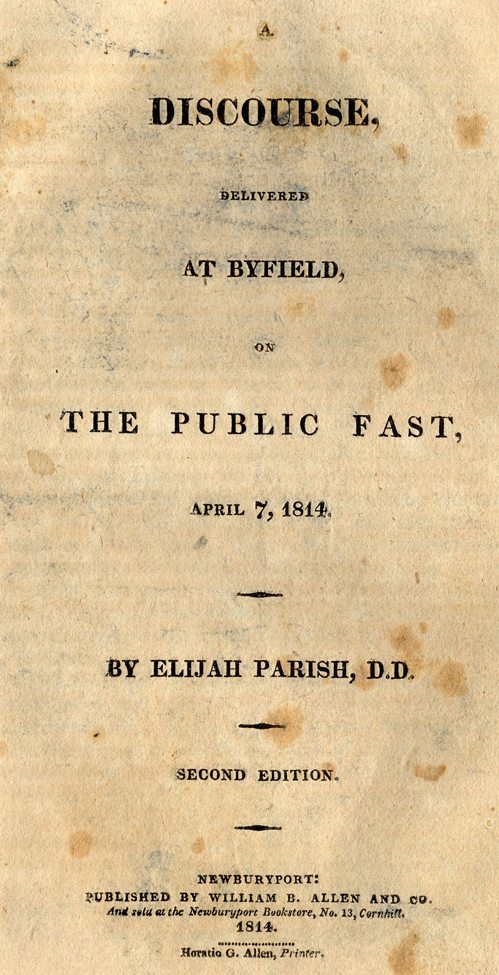
Sermon – Century Church Anniversary – 1814


Manasseh Cutler (1742-1823) graduated from Yale (1765), and worked as a schoolteacher, store clerk, and an attorney. He was minister to the Congregational Church in Ispwich, Massachusetts (1771-1823). Cutler served as military chaplain for multiple American units during the Revolutionary War. This sermon was preached by Cutler in 1814 in Massachusetts, using Ephesians 3:20-21 as the basis.


sermon-century-church-anniversary-1814

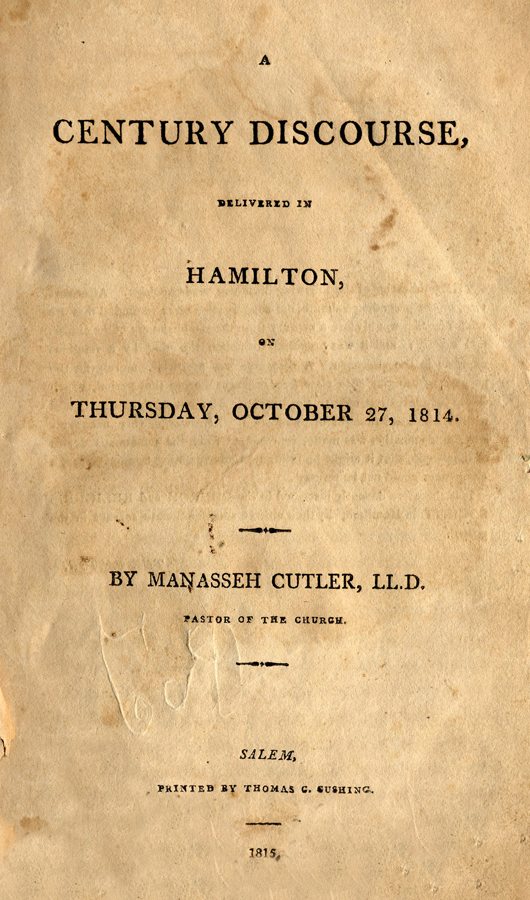
A

CENTURY DISCOURSE,

DELIVERED IN

HAMILTON,

ON

THURSDAY, OCTOBER 27, 1814.

BY MANASSEH CUTLER, LL.D.
PASTOR OF THE CHURCH.


The publication of the following discourse needs apology. After service, on the preceding Sabbath, the congregation were reminded that the next Thursday would close a century from the establishment of the church and society; and it was proposed to notice the day by a religious exercise in the afternoon. A discourse was prepared, merely for the purpose of bringing into view local concerns during that period, which would be interesting only to the people to whom it was delivered, and without the least thought of publication. Afterwards, very unexpectedly, an application was made, represented to be the unanimous desire of the people, that it might be printed. Under existing circumstances, a compliance could not be refused.

It is therefore devoutly inscribed to the CHURCH and RELIGIOUS SOCIETY in Hamilton, by their sincere and affectionate servant in the gospel.

THE PASTOR.


A

SERMON.


Ephesians iii. 20, 21.
Now unto him that is able to do exceeding abundantly above all that we ask or think, according to the power that worketh in us; unto him be glory in the church, by Jesus Christ, throughout all ages, world without end. Amen.

With this ascription of glory to God the Apostle concludes a most devout and fervent prayer for the church. This epistle was probably written with a view to other churches besides the one at Ephesus, to whom it was addressed. Through the whole of it is a flow of holy affection to his Christian brethren, and ardent solicitude for the establishment and prosperity of the church. Being a prisoner at Rome, he could not go, as formerly, to establish churches by his personal preaching and exertions; but his affectionate desire for their prosperity was not abated. Whilst suffering imprisonment in defence of the Gentile churches, he encourages them to be steadfast in their Christian profession, with an assurance of his constant supplications for them at the throne of grace. I bow my knees unto the Father of our Lord Jesus Christ, of whom the whole family in heaven and earth is named; that he would grant you, according to the riches of his glory, to be strengthened with might, by his spirit in the inner man; that Christ may dwell in your hearts by faith; that ye, being rooted and grounded in love, may be able to comprehend, with all saints, what is the breadth, and length, and depth, and height; and to know the love of Christ, which passeth knowledge, that ye might be filled with all the fullness of God.

These servant petitions he closes with an expressive and emphatical ascription of glory to God: Now unto him that is able to do exceeding abundantly above all that we ask or think, according to the power that worketh in us; unto him be glory in the church, by Jesus Christ, throughout all ages, world without end. Amen. What enlarged and exalted expectations may this ascription of adoration and glory to God excite in our minds! What inducement to render praise and glory to him for what he has done for the church! And what encouragement to supplicate his blessing in future time! For he is able to do, not only all that had been asked, but above all—exceedingly abundantly above all that could be asked, were we to enlarge our desires and multiply our petitions to the utmost. To this God of power and grace unspeakable, the Apostle most earnestly desired that glory, adoration and praise should be continually rendered in the church, by Jesus Christ, throughout all the ages of time, even to the end of the world; and closes this rapturous act of devotion by affixing his solemn. Amen.

If we attend to the history of the Christian church, we shall find it replete with signal instances of divine power and goodness, for its protection and preservation. It is founded on a rock, and the gates of hell shall never prevail against it. In every age, under the government of Him who never eases to watch over its interests, events are taking place which well deserve religious notice; and merciful interpositions to be recognized, which claim the highest ascriptions of praise and glory to God. There are particular periods of time, when it may be highly proper to take a retrospective view, and trace back the footsteps of Providence in years past. It may not only gratify an inquisitive and contemplative mind, but excite thankful acknowledgments of distinguished blessings, and lead to serious reflection and useful improvement.

Such, it appears to me, is the present time with regard to the Church and Religious Society in this town. It is, this day, an hundred years since this church was embodied, and a minister ordained to be the pastor.

That we may suitably notice and improve this period of time, it is my intention to make a few general observations with respect to the state of the Christian church within a century past; and then to call your attention, particularly, to a retrospective view of passing events and the state of this church and society, during the hundred years that terminate on this day.

Within a century past, the church of Christ has not been assailed by open and bloody persecutions, as it had been in preceding ages. It has had, however, to contend with most inveterate enemies—enemies who, by secret artifices, by subtle machinations, and unwearied labours, have attempted to suppress the Christian religion, and banish from the world the Christian name. In no age of the church, since the promulgation of the gospel, has infidelity made such secret progress, and, at length, raised its brazen front with so much boldness and expectation of success. The abettors of atheism, deism and infidelity had made such progress, that they reduced their schemes to system, and gained an alarming influence over the minds of men, especially in the higher ranks of life. Secret infidel societies, holding correspondence with each other, were formed; and to poison the minds, and induce people of all grades and conditions to reject the Bible, immense numbers of infidel books, pamphlets, small tracts, and even ballads and songs, were printed. These were industriously spread among all classes of people in many parts of Christendom. From among these infidels were the principal actors in the late French revolution—a scene highly favourable for propagating their principles. The standard of infidelity, undisguised, was now triumphantly erected. The Convention decreed that there was no God, and declared the nation to be a nation of infidels. They held that there was no future state of existence—no account to be rendered after this life—and death was only an eternal sleep. All forms of religion were suppressed, and houses of public worship shut up, or appropriated to other uses. The church of St. Genevieve was changed into a pagan temple. In this temple, with supercilious parade, they performed their heathen orgies. A common prostitute, personating the Goddess of Reason, received the worship of both the Convention and the infatuated multitude. So inveterate was the enmity against the very name of Jesus Christ, that he was styled the WRETCH; and these are said to have been watch words—Crush the wretch! Strike, but conceal your hand.

In the most gloomy seasons, the church has often experienced the most signal interpositions. The great Head of the Church has been pleased to look down upon the languishing vine which his own right hand had planted, and to save it from the ravages of inveterate foes. While the faith of many was shaken, and believers were trembling for the ark, the friends of Zion were awakened to a fervent zeal in vindicating the religion of Jesus. An unusual spirit of inquiry into the divine authority and inspiration of the scriptures was excited. Of that large class of people who take the Bible on trust, without attending either to the external or internal evidences of its authenticity, great numbers became bewildered by the books and company of infidels; but, by candid, unprejudiced examination, found their doubts removed, and faith established.

Still, whatever may have been the happy effect of these researches (which has been believed by some to have been very great and extensive) the efficient means of counteracting infidel philosophy has been the extensive spread of the holy scriptures. The bible carries its own evidence with it. Infidelity has been met, not merely with clear reasoning and strength of argument, which sophistry can always evade; but with the formidable weapon of the bible itself—the Bible without note or comment. One of the most distinguishing interpositions of Providence in favour of the church, which, perhaps, the world has ever witnessed, has been the establishment of Bible Societies. These invaluable, benevolent institutions, designed for the purpose of distributing the scriptures, gratis, among the poor and destitute everywhere, have been encouraged and supported with a zeal which excites astonishment. Emperors, kings and princes have become their patrons; Christians of all denominations, people of all grades and conditions in life, have cheerfully contributed to this noble purpose. As infidels had formed societies, collected funds, printed and distributed books, they have been met in the same way, by the establishment of societies, and collecting immense sums for printing the scriptures in different languages, for the accommodation of Christian and Heathen nations. The parent of these institutions, the British and Foreign Bible Society, embraces in its extensive plan every nation upon earth. Already, by its influence and operations, thousands and hundreds of thousands have had the bible put into their hands. It has astonished, rejoiced and animated the Christian world. While Bible Societies, on a more limited scale, have been multiplying in Europe, the flame has caught in our own country. One, or more, has been established, with the same benevolent views, in every State in the Union.

These societies intermeddle with no wars, but the Christian warfare-contend with no enemies, but the enemies of Christ and his church. Amidst the angry conflicts of contending nations, their exertions and their charities are extended, without partiality, to all the human family. Let the potsherds strive with the potsherds of the earth, but let the friends of Zion, in faith and hope, look forward, by the light of prophetic scripture, to the approaching reign of the Prince of Peace. Though the earth be removed, and though the mountains be carried into the midst of the sea; there is a river, the streams whereof shall make glad the city of God. The word of the Lord shall have free course, and shall be glorified.

The happy effects of these exertions must extend to future ages. That the Christian religion will be universally known, and its blessings felt in every part of the habitable world, we believe from the bible; but the way and means by which it is to be accomplished, is beyond our comprehension. Yet the pleasing hope presses into our minds, that this glorious day begins to dawn—that the day when all nations shall enjoy the holy scriptures in their own language—and of the ingathering of the Jews, with the fullness of the Gentile world, is drawing near.

While infidelity was so rapidly spreading in Europe, its baneful influence was sensibly felt in our own country. In some parts of the United States, its champions were bold and open. A small number of infidel societies were established. Its spread was much apprehended by many pious people, and their fears greatly excited. Yet, without any very apparent means, it pleased God to check its progress. Infidels there still are, and infidels there will be, in the ordinary ages of the church. But whilst we have it to lament that so much irreligion and so many vices have prevailed during the past century, we have likewise cause for gratitude and thankfulness to God, that there has been generally in our churches a respectful and serious attention to religion. In many places there have been hopeful revivals and reformations; and in some, large in-gatherings into the church of Christ. In all our churches there have been some of the wandering sheep of Christ’s flock, one after another, gathered into his fold.

Within a century from this time, new churches have been greatly multiplied in the United States. Since the establishment of this church, there have been about six hundred new churches formed within this Commonwealth; and some of them consist of a very large number of communicants.

But I will detain you no longer with general remarks. The principle purpose of our present meeting was to take a concise review of the most material concerns of this religious society, from its establishment to the present time.

So remarkably uniform have been the state and general concerns of this church and society, as far as has come to my knowledge, that there have been few very interesting occurrences for an hundred years. Yet there has been much, in the course of providence, that may be brought into view, well worthy our attention and religious improvement.

The town of Ipswich, on the 22d of May, 1812, voted their consent, that “when their brethren in the Hamlet, so called, should have erected a meeting house, and called an orthodox minister to preach the gospel to them, they should be freed from further charge in the maintenance of their ministers, and be accounted a precinct.”

On the 14th of October, 1713, an act of incorporation from the General Court was obtained, allowing them to be a distinct and separate precinct. In the course of this year the first meeting house was built; the dimensions of which were, 50 feet in length, 28 in breadth, and 20 feet post. What the number of inhabitants were at this time cannot be accurately ascertained, but most probably between seven and eight hundred.

In January, 1714, Mr. Samuel Wigglesworth was invited to preach as a candidate, and on the 12th of October following, a church covenant was agreed to and privately signed. At the same time Mr. Wigglesworth was elected their Pastor. On the 27th of the same month an ecclesiastical council was convened, consisting of the Re. Elders and delegates of the first and second churches in Ipswich, and of the churches in Wenham, Rowley and Topsfield. The church having been regularly embodied by the council, it was styled the third church of Christ in Ipswich. After reading the church covenant publicly to the assembly, the council proceeded to ordain their Pastor elect. The greater part of this newly gathered church were members dismissed and recommended from the first and second churches in Ipswich, and the church in Wenham. When formed, the number was 58; of whom 26 were males, and 32 females.

Their Pastor, the Rev. Samuel Wigglesworth, was possessed of very respectable talents—in his sentiments calvinistical—in the strain of his preaching, evangelical, instructive and practical. Solemn and unaffected in his manner, he commanded attention, and supported the character of an able and sound divine. Amiable and exemplary—respected and beloved, he filled up a long, peaceable and useful ministry. He departed this life on the 3d of September, 1768, in the 80th year of his age, having almost completed the 54th year of his ministry. His public and parochial labours were continued nearly to the close of his life.

Under his ministration many made public profession of their religion, and received admission into the church. Considerable numbers of communicants were added, at different times. Very remarkable awakenings and hopeful conversions succeeded the great earthquake in 1727. This memorable earthquake occurred on the 29th of October, (being the Sabbath) a little before eleven in the evening. 1 Several small shocks were felt for some months after. The next Wednesday was observed as a day of humiliation and prayer; and a solemn, well adapted sermon was preached by Mr. Wigglesworth, and, at the request of the people, was published. In his dedication, dated January 29, he observes, that “the awful occasion of this discourse is not yet entirely removed.” And he adds, “Since the earthquake, there has been a large addition to the church, which I question not but many of them shall be saved. The spirit of reformation seems to be poured out, in plentiful measure, upon all sorts of persons among us; and especially a considerable number of our young persons seem disposed to flee from youthful lusts and vanities, and to flee to Christ and his ordinances as a cloud, and as doves to their windows.”

On my first coming to this town, I recollect to have heard aged people relate, from their own knowledge, many interesting particulars, respecting this reformation. They mentioned the solemn and deep impression made generally upon the minds of the people, especially on the youth and those in early life—a surprising engagedness in all to attend public worship, and occasional religious meetings. Considering the large additions to the church in a short time after, we cannot doubt that God was pleased to accompany this awakening and alarming providence with special influences of his spirit and grace. By the church records, it appears, that, from the last of November to about the middle of February, there were admissions on every Sabbath, except on one day. On some Sabbaths, the number was exceedingly large, for so small a society. On Dec. 10th, seven were admitted; on the 24th, seventeen; on the next Sabbath, eleven; on the following Sabbath there was only one; but on the two next there were four, each day; on the next there were eight; and on the next (4th Feb.) there were fifteen. In four months there were eighty-seven, and in somewhat more than a year, one hundred, added to the church.

It is to be much regretted, that my worthy predecessor kept no record (or none to be found) after the year 1742, or beginning of 1743. To serious, reflecting people it will be desirable to know the number of communicants, baptisms and deaths for an hundred years, but it cannot be accurately ascertained. Were the number of inhabitants, at the time of the incorporation, known, a tolerable calculation could be made by taking average numbers. It has been supposed that the number of people has been nearly stationary. Being mostly farmers, the emigrations (consisting principally of young people) and the deaths have equaled the number of births. This appears probable, as the number of inhabitants by the last census (1810) was only 780, and as the number of baptisms seems to have varied very little for sixty or seventy years.

From the time the church was formed to the year 1742 (28 years) there were 326 members admitted, and 631 baptisms. Taking the average numbers for the following 26 years, there were, during the 54 years of my predecessor’s ministry, 560 admitted to communion, and 1203 baptisms. No record of deaths was found in the church book; but taking the average of deaths for the 43 years of my ministry for data, being nearly 12 annually, the number of deaths in 54 years would be 648. In the interval between Mr. Wigglesworth’s death and my ordination (three years), there were 2 communicants admitted, 75 baptized, and it is presumed, 36 deaths. In the last 43 years there have been 122 admitted into the church, 988 baptisms and 512 deaths. Agreeably to this computation, which can only give a probable idea of the numbers for the 54 years, there have been, by adding the number which first composed the church, 736 communicants, 2266 baptisms, and 1196 deaths in the hundred years.

Since the forming of the church, there have been seven officiating deacons. Of the two first elected, one lived to a great age, the other only a few years, but his successor died in old age. The two next in succession lived to an advanced period of life. They were succeeded the two deacons who still survive. 2

Agreeably to the preceding computations, one third more people, in this period of time, have gone down to the silent grave, than are now living. Your grand parents, your fathers, your mothers, our brothers, sisters, friends and neighbours, where are they? Do they live forever? No; they are gone the way from which they will not return. What an assembly are now sleeping in yonder grave yard! In a less period of time, every one of us—let it be remembered—every one of us must be added to this assembly.

Attention to these enumerations will convince us, that there was more of a sense of religion among the people in the former, than in the latter part of this century. Greater additions were made to the church from year to year. In looking over these records, I was surprised at the frequent instances of men and their wives joining the church at the same time. Many young people were admitted, but it seems to have been rare that one of the heads of a family came forward and made a profession of religion, without the other. It has not been so in latter time. Few instances have occurred for a number of years past. Was it not, that the importance of gospel ordinances were more sensibly felt; that heads of families were more deeply convinced that they could not live religious lives without a profession of religion;–a more impressive conviction of the duty of uniting in a public dedication of themselves to God in covenant, and setting before their children so desirable an example? Was it not that there was more family religion—family prayer—family instruction? And was there not more of union and joint resolution, that as for them and their houses they would serve the Lord?

During the time my predecessor kept a record, there were large numbers who recognized he baptismal covenant, and gave up their children to God in baptism. In the first ten years of his ministry, the number of baptisms were from twenty to thirty annually; and continued with little variation to the year 1742; so that there could not have been many children that were not baptized. In the ten first years of my ministry, the annual baptisms were from twenty-four to thirty-five; and so continued, though with more variation in different years, until a few years past. It was considered by pious people forty years ago to be exceedingly wrong for parents to withhold their children from this ordinance; and often they expressly enjoined it on their children, on their entering into the family state, not to neglect this duty. But, alas! my friends, how is it now? How greatly has this ordinance been disregarded for some years past! In the two last years, the number was only five, in each year. How great the number of unbaptized persons now, compared with former years!

Is this to be imputed to our great declination in religion? Is our moral state so much worse than in years past? Are the people become so much more indifferent to gospel ordinances? It is not, I am persuaded, because the right of infant baptism is doubted; but from the want of a proper understanding, and just sense of this duty. If infants are the proper subjects, and may be brought within the privileges, of the covenant, then it is the indispensable duty of parents, intelligently and uprightly, to devote them to God in baptism. Our Saviour expressly required that children should be suffered to be brought to him. Suffer little children to come unto me, and forbid them not; for of such is the kingdom of God. He was much displeased with his disciples for rebuking those who brought them. Christian baptism was not then instituted; yet the right and the duty of devoting children to God, after it was instituted, maybe clearly inferred from these words of our Lord, and he might have intended a reference to it. Those who then brought them to Christ, must have done it with desire and expectation of spiritual blessings. And is he not able to do as much for them now, as he was then? Were he now on earth, where are the parents that would refuse to carry their children to him? And why not carry them to him, now he is in heaven, by a solemn dedication, in the ordinance of baptism?

You believe children are the subjects of salvation, and you would tremble at the thought of excluding them from it; and can you exclude them from the right of baptism? When they are sick, do you not pray, and desire the prayers of others, for them, that they may recover; or, if removed by death, that their souls may be saved? And yet can you refuse to give them up to God in this ordinance? If you doubt your own right to give them up in this solemn manner, how an you think of living in such a state of impiety and irreligion? Can you refuse your consent to the terms of the gospel covenant? Have you no regard to the due regulation of your families? Family education and order are important means of grace, and, if suitably maintained, other means will be more likely to be successful. Can you then feel unwilling to lay yourselves under (voluntary) obligations to give your children a religious education, and to bring them up in the nurture and admonition of the Lord?

Not long before the decease of the Rev. Mr. Wigglesworth (in August, 1768) the present Dr. Hopkins, of Salem, was invited to settle as his colleague, but declined the invitation. After his decease, the church continued destitute for three years. The candidates employed appear not to have been many. On the 6th of March, 1769, Mr. Daniel Johnson was invited to settle, who gave a negative answer. On the 8th of January, 1770, Mr. Benjamin Brigham received a call, but did not accept it. On the 16th of October following, Mr. Jonathan Searle was invited to settle, who likewise declined the offer. The last was your present unworthy pastor, who received ordination on the eleventh day of September, 1771; and whom God has been pleased to continue in the ministerial office 43 years.

At that time, the communicants of the church were 68, of whom 27 were males, and 47 females. Of these communicants, only two, a male member and his wife, are now living. Additions in following years were gradual, and less frequent than in the earlier periods of the church. In some yea there were a considerable number, and in some there were none. But in the latter part of 1799 and beginning of 1800, we were favoured, as we trust, with manifestations of the powerful influences of the Holy Spirit, in calling up the attention of very considerable numbers. Many were awakened to enquire, with solicitude, what they should do to be saved? And numbers to make a public profession of their faith and hope. It seemed to be a time of refreshing from the presence of the Lord. The greater part were young people, but some in the middle, and in advanced periods of life. Admissions into the church were, on several days, in considerable numbers. Before the communion service (24th of Nov.) fifteen were admitted—at the next communion there were three, the next nine—and the next there were six—at others there were smaller numbers. But at four communions in succession, thirty-three were added to the church. Since about that time, we have relapsed into the former state of coldness and indifference. The ways of Zion have mourned because so few travel therein. At the present time the church consists of 73 members, of whom 28 are males and 45 females. Of the females, several have removed into other towns, whose relation to the church has not been transferred.

The house, which was at first erected for public worship, having become inconvenient and much decayed, in the year 1762 this commodious house, in which we this day present ourselves before the Lord, was built on nearly the same spot. It is constructed on somewhat larger dimensions, being 60 feet in length, 44 in. width, and 26 feet stud; and has been admired for its just proportions and pleasing appearance. Having been lately well repaired, it affords a hopeful prospect of remaining a convenient temple for the worship of the MOST HIGH for many years. Thus God, in his great goodness, has been pleased to continue to us the visible tokens of his presence for an hundred years. May He mercifully grant, that in this house his spiritual presence may delight to dwell.

For the greater convenience and advantage in managing their municipal concerns, the people made application to the Legislature, and on the 20th of June, 1793, obtained an act of incorporation, forming them into a town, by the name of Hamilton. This separation from the ancient and highly respecteable town of Ipswich was a transaction, in which the inhabitants of both felt themselves deeply interested. In accompanying this desirable object, every proceeding of the people was conducted with entire unanimity. Altho’ the pecuniary condition appeared to be large, it was promptly and cheerfully paid. And let it also be noticed, with peculiar satisfaction, that the unpleasant feelings excited in the minds of any of our brethren in Ipswich appear to have very happily subsided.

In taking this review of the century which closes with this day, it has been my intention to confine myself principally to the ecclesiastical concerns of this church and religious society. On this cursory retrospection of passing events, many reflections rush upon the mind, which time will not permit me to notice. I must, however, beg your patience while some of them are suggested.

The preservation of this church and society in uninterrupted peace and harmony for an hundred years, claims our sincere praise and thanksgiving to God. May our hearts, warmed with gratitude and love, unitedly offer up ascriptions of glory to Him, whose watchful care and tender mercy have been extended to this church and people during this period of time.

While many religious societies have been rent by divisions among themselves, and divided and separated by intermeddling sectaries of various descriptions and denominations, this society has been happily preserved from any disturbances of this kind. Under the ministration of my worthy predecessor the people discovered no disposition to contend on the ground of religious speculations and opinions. His uniform strain of instructive, evangelical and useful preaching united them in sentiment, and guarded them against an itching fondness for novelties. Steady habits were then established, and have happily been transmitted down to the present time.

In the management of civil and municipal concerns, great unanimity has very uniformly prevailed. In few, perhaps in no society, has there been less of suits at law—unnecessary litigations—or bitter party contentions. While human nature remains as it is, there will be occasional difference of opinions and temporary disagreements; but neighbourly kindness, candour and friendship have undoubtedly been strong traits in the character of this society from the beginning.

In confirmation of the prevailing candid and peaceable disposition of the people, I must mention an event which rarely happens. Two ministers have supplied the pulpit for an hundred years, except a short interval between the death of one, and the invitation of the other. That their lives should be continued so long is to be wholly ascribed to the sustaining power and mercy of God. But separations too often occur from other causes, besides a removal by death. In few societies, I believe, have two ministers lived, and in succession continued their ministerial labours, for a century. It certainly reflects credit on the friendly disposition of the society.

For myself—I cheerfully embrace this occasion to tender to this Church and Society my sincere thanks for the candour and forbearance you have exercised towards me; and for the many instances and tokens of affection, I have received during my ministry.

Since our union in this sacred relation, we have seen troublesome times. We have been subjected to many privations and difficulties. I have found myself, at times, in perplexed and trying circumstances. But in no situation has your friendly attention been withdrawn. Marks of kindness and respect, by the donations of a number of individuals, have relieved present wants, and claim my grateful acknowledgments.

In frequent reviews of my ministerial labours, I find deficiencies enough to humble me to the dust. I have no lament that no more success has attended my feeble exertions. Sure I am that your best, your eternal interests have lain with weight upon my mind. My conscience bears me witness, that it has been my earnest prayer, and all my desire, to bring to your view and impress upon your hearts, the most essential truths and doctrines of the gospel salvation: To preach to you a crucified Saviour—to persuade you to rest on that sure foundation which God has laid in Zion—to exercise that faith by which the just do live—and to follow after that holiness of heart and life, without which no man shall see the Lord. Whatever success may have attended these humble endeavours to promote the glory of God, to advance the interests of the Redeemer’s kingdom, and your own best good, let it all be ascribed to the riches of free grace and mercy.

The time is at hand, when your kindness to me, and my labours with you, must cease forever. My period of life, having arrived to threescore years and ten, is enough to teach me, that my days upon earth must very shortly be numbered. But I have another monitor, placed hourly before me:–the distressing disorder with which I have been long exercised, 3 and which I find increasing upon me, admonishes me that a few hours may close the scene. Many times, I have had reason to apprehend only a few breaths more remained. Often, under the pressure of this complaint, I have been sustained in the services of the sanctuary to my own astonishment. I think I can say, it is good for me that I have been afflicted. Called so constantly to familiarize my mind with the near views of eternity, it has had a tendency, I trust, to strengthen a faith and hope which removes the fear of the last enemy.

Thus far it has pleased God to lengthen out the span—but nature must fail—the time is near. Although life may be protracted a little longer, I feel, that on this occasion I am taking a parting leave of you, my respected and beloved people,–that I may, with propriety, on this day—bid you a long—a most endearing and affectionate Farewell.—The tongue that now speaks, shortly will cease to move—the heart that now throbs with affectionate concern for your eternal well-being, will be cold in death and this worthless body you will deposit in the dust.

I commend you to God and the word of his grace, unto him who is able to do exceeding abundantly above all you can ask or think. When you find yourselves destitute of a minister, may the great Shepherd take you under his gracious protection, and provide for you an able and faithful pastor, who shall feed you with the bread of life, and give to every soul his portion in due season. In all your concerns, seek light and direction from above-cultivate the true spirit of the gospel—and may the God of peace be with you, and bless you.

May this church see far more glorious days in the century now begun, than in that which is just closed; may great additions be made of those that shall be saved—and may it be savoured with the presence of Him who will be glorified in the church throughout all ages, world without end.

I had wished to have been more particular in this part of my address, but the time, so long protracted, forbids.—I will only add—that though we must part, we shall all meet again—meet, on that great day of the Lord, when I must render an account how I have preached, and you must give account how you have heard—when the righteous Judge will pass sentence, and award our destiny, in the ages of eternity. Solemn meeting! Awful day! O that we may then meet with joy, and be permitted to inherit the kingdom prepared from the foundation of the world—and to unite with the redeemed in all ages of the church, in ascriptions of blessing, and honour, and glory, and power, unto Him that sitteth upon the throne, and unto the Lamb forever and ever. Amen.


Endnotes

1 It is said to have happened about 40 minutes after 10, P.M.—the air clear—sky serene, and perfectly calm. It approached with a heavy rumbling—at first, compared to the roar of a blazing chimney—at last, to the rattling of carriages driven fiercely on pavements. It was observed, by those that were abroad, that as the shock passed under them, the surface of the earth sensibly rose up, and then sunk down. The violence of the shock was such as to cause the houses to shake and rock, as if they were falling to pieces; doors, windows and movables made a fearful clattering; the pewter and china were thrown from the shelves; stone walls, and the tops of some chimneys, were shaken down; in some places, the doors were unlatched and burst open, and the people in great danger of falling. Its duration was supposed to be about two minutes, and its course from N. W. to S. E. It was known to extend to the river Delaware S. W. and to the Kennebeck N. E. but its greatest violence seems to have been at Newbury, where the earth opened, and threw up several loads of a fine sand and ashes. Great changes took place in some wells, springs and streams of water. Vide Memoirs Amer. Acad. Vol. i. p. 265.

2 The two first Deacons were Deacon Matthew Whipple and Deacon John Gilbert, chosen Nov. 9, 1714. Deacon Matthew Whipple officiated 50 years, and was succeeded by Deacon Nathaniel Whipple, who officiated 45 years, and deceased at the age of 89. His successor is the present Deacon Benjamin Appleton, who has been in office 4 years. Deacon Gilbert lived only 9 years, and was succeeded by Deacon John Thorn, who continued in office 35 years. His successor was Deacon John Patch, who sustained the office 31 years, and died at 90 years of age. He was succeeded by the present Deacon Matthew Whipple, who has been in office 20 years.

3 The asthma, for fourteen years.

Sermon – In Boston – 1814


William Ellery Channing (1780-1842) was the grandson of one of the Newport Sons of Liberty, John Channing. William graduated from Harvard in 1798 and became regent at Harvard in 1801. He was ordained a preacher in 1802 and worked towards the 1816 establishment of the Harvard Divinity School. This sermon was preached by Channing in 1814 in Boston.


sermon-in-boston-1814

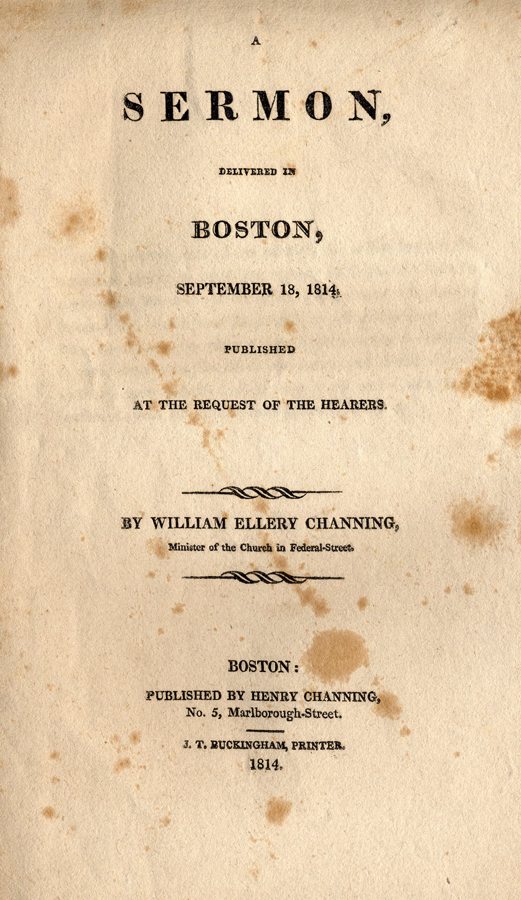
A

SERMON,

DELIVERED IN

BOSTON,

SEPTEMBER 18, 1814.

PUBLISHED

AT THE REQUEST OF THE HEARERS.

BY WILLIAM ELLERY CHANNING,
Minister of the Church in Federal-Street.


In the present state of our country, the author has not felt himself at Liberty to reject the urgency of those, who have requested this discourse for the press. It is always with great reluctance that he addresses the public on political subjects. But the moment has come, when private feelings are to be discarded. A good citizen owes himself to his country, and he will withhold no effort, however feeble, which may purify and elevate public sentiment, or in any manner contribute to public safety.


SERMON.
JEREMIAH vi. 8.
Be thou instructed, O Jerusalem, lest my soul depart from thee; lest I make thee desolate.

These words were addressed by God to his ancient people Israel, at a period of great national calamity, when destructive armies were ready to overwhelm Jerusalem, and the whole kingdom was threatened with slaughter and desolation. At this solemn moment God sent his prophets to warn the people of their danger, to call them to reflection and repentance, and to assure them that amendment would secure his favour. I have chosen these words as applicable to our present calamitous situation. “Be thou instructed,” is the language God addresses to this people, “lest I make thee desolate.”

At such a moment as this, when every mind is fixing a fearful attention on the state of the country, it is impossible that a religious instructor should escape participation in the common feeling. His sacred calling does not require him to separate himself from the community, to forget that he is a citizen, to put off the feelings of a man. The religion which he teaches inculcates public spirit, and a strong and tender concern for all by whom he is surrounded. He would be unworthy his sacred function, were he not to love his country, to sympathize with its prosperous and adverse fortunes, and to weep over its falling glory. The religion, which it is his duty to dispense, regards men in all their relations, and affords instructions and motives adapted to every condition whether of individuals or communities. You will not then consider me as leaving the province of a religious teacher, if I speak to you of the dangers, and claims of our country, if I address you as citizens, and attempt to point out your duties at the present solemn period.

The present is indeed a solemn period. The sad reverse which this country exhibits astonishes as well as depresses us. But a few years ago, we stood on the eminence of prosperity. Amidst the storms which desolated nations, we were at peace, and the very storms seemed freighted with blessings for our tranquil shores. Separated by an ocean from Europe, we hoped to escape the whirlpool of her conflicts. Who could have anticipated the change which a few years have made?—And is it indeed true, that from this height we have sunk so low, that our commerce is swept from the ocean, that industry has forsaken our cities, that the husbandman has resigned the ploughshare for the sword, that our confidence is changed into fear, that the tumult of business has given place to the din of arms, that some of our citizens are perishing in foreign prisons, and others shedding their blood on a foreign soil, that hostile fleets scatter terror through our coasts, and flames through our cities, that no man feels secure, that the thought of invasion and slaughter mingles with the labours of the day, and disturbs the slumbers of the night, and that our national government, impoverished, and inefficient, can afford us no protection from such imminent danger? Yes—this is true—we need no reasoning to convince us of its truth. We see it in the anxious countenance, in the departing family, in the care which removes our possessions, in the obstructions and perplexities of business, and in the events which every day brings o our ears. At such a moment, it becomes each man to ask himself what are his duties, what the times demand from him, in what manner he may contribute to the public safety. It is a time for seriousness, for consideration. With prosperity, we should dismiss our levity. The period of duty may to many of us be short indeed. Whilst it continues, let it be improved.

I. The first remark I will make is, that it becomes every man at this solemn moment, to reflect on his own character and life, to enquire what he has done to bring down the judgments of God on his country, to confess and lament his sins, and to resolve on a thorough amendment and sincere obedience of God’s commands. We ought to remember that God is a moral governor. He regards the character of communities as well as of individuals. A nation has reason for fear, in proportion to its guilt; and a virtuous nation, sensible of its dependence on God, and disposed to respect his laws, is assured of his protection. Every people must indeed be influenced in a measure by the general state of the world, by the changes and conflicts of other communities. When the ocean is in tumult, every shore will feel the agitation. But a people faithful to God will never be forsaken. All history and experience teach us, that there is a direct and necessary tendency in national piety and virtue to national safety and exaltation. But this is not all. A virtuous people may expect peculiar interpositions of providence for their defence and prosperity. They may expect that God will direct events with a peculiar reference to their welfare. They are not indeed to anticipate miracles. They are not to imagine, that invading hosts will be annihilated like Sennacherib’s by the arm of an angel. But God, we must remember, can effect his purposes, and preserve the just without a miracle. The hearts of men are in his hand. The elements of nature obey his word. He has winds to scatter the proudest fleet, diseases to prostrate the strongest army. Consider how many events must conspire, how many secret springs must act in concert, to accomplish the purposes of the statesman, or the plans of the warrior. How often have the best concerted schemes been thwarted, the most menacing preparations been defeated, the proud boast of anticipated victory been put to shame, by what we call casualty, by a slight and accidental want of concert, by the error of a chief, or by neglect in subordinate agents. Let God determine the defeat of an enemy and we need not fear that means will be wanting. He sends terror, or blindness, or mad presumption into the minds of leaders. Heaven, earth, and sea, are arrayed to oppose their progress. An unconquerable spirit is breathed into the invaded; and the dreaded foe seeks his safety in dishonourable flight.

My friends, if God be for us, no matter who is against us. Mere power ought not to intimidate us; HE can crush it in a moment. We live in a period when God’s supremacy has been remarkably evinced, when he has signally confounded the powerful and delivered the oppressed and endangered. At his word, the forged chain has been broken; mighty armies have been dispersed as chaff before the whirlwind; colossal thrones have been shivered like the brittle clay. God is still “wonderful in counsel and excellent in working;” and if HE wills to deliver us, we cannot be subdued. It is then most important that we seek God’s favour. And how is his favour to be obtained? I repeat it—God is a holy being, the friend of the righteous, the enemy of the wicked; and in proportion as piety, uprightness, temperance and Christian virtue prevail among us, in that proportion we are assured of his favour and protection. A virtuous people, fighting in defence of their altars and firesides, may look to God with confidence. An invisible, but almighty arm surrounds them, an impenetrable shield is their shadow and defence.

My friends, how far have we sustained the character of a pious and virtuous people? It may be true, that, compared with other nations our morals are in a measure pure. But other nations are not the standard by which we are to be judged. We are descended from ancestors of singular piety, who have transmitted to us principles of conduct, institutions and habits, peculiarly favourable to individual and national virtue. God has placed us at a distance from the corruptions of older countries, and has warned us by their woes. He has also signally prospered and enriched us, and crowned us with blessings. Never did a nation enjoy more abundant means of instruction, or more powerful motives to gratitude and obedience; and can we hope that we have exhibited that purity of manners, that regard to God’s word, that justice, that charity which our privileges and blessings demand? It is hoped that we have many righteous, many Christians. But have not our sins multiplied with our blessings? Does not every heart feel, that we deserve the judgments we suffer? Let us seek by repentance and amendment to avert the judgments we fear. To all of us, and especially to the profligate, the licentious, unjust, and irreligious, this day of rebuke calls loudly for consideration, for penitent confession, and for sincere purposes of future obedience to the divine commands.

II. Having recommended penitence in general assuited to the present moment, let me particularly recommend one branch of piety which the times demand of us. Let us each be instant and fervent in prayer. Let us pray to God, that he will not forsake us in this dark and menacing day; that he will remember the mercy shown to our fathers; that he will crown with success our efforts in defence of our possessions, our dwellings, and our temples; that he will breathe an invincible courage into our soldiers; that he will guard and guide our rulers; that he will turn the invader from our shores; or, if he shall otherwise appoint, that he will be our shield in battle, and will send us deliverance. For these blessings let us daily besiege the mercy seat of God, deeply convinced that he controls the destinies of armies and nations, that he gives or withholds success, and that without him all exertion is unavailing, and all hope will sink into despair. By this, it is not intended that we are to do nothing but pray; that we are to leave our shores without defence, or neglect any means of security. God gives us powers that we should exert them, weapons that we should wield them. We are to employ every resource which he grants us; but, having done this, we must remember that on God, not on ourselves, depends the result of our exertions. The race is not always to the swift, nor the battle to the strong. God gives victory, and to him let every eye and heart be directed. You who have no other weapons, contend with your prayers for your country. It will not be imagined from these remarks, that by importunity of prayer God can be bent to favour an unjust cause. But when our cause is just; when, instead of waging offensive war, we gather round our city and shores for defence, we may be assured that sincere prayer, united with sincere purposes of obedience, will not be lost. Prayer is a proper and appointed acknowledgement of our dependence, an essential means and branch of piety; and they who neglect it have no reason to hope the protection, which they will not implore. Let us then take heed, lest the tumult of military preparation make us forgetful of the Author of all good, lest in colleting armies and raising walls of defence we forsake the footstool of the Almighty, the only giver of victory.

III. This is a time when we should all bring clearly and strongly to our minds our duties to our country, and should cherish a strong and ardent attachment to the public good. The claims of country have been felt and obeyed even in the rudest ages of society. The community to which we belong is commended by our very nature to our affection and service. Christianity, in enjoining a disinterested and benevolent spirit, admits and sanctions this sentiment of nature, this attachment to the land of our fathers, the land of our nativity. It only demands, that our patriotism be purified from every mixture of injustice towards foreign nations. Within this limit we cannot too ardently attach ourselves to the welfare of our country. Especially in its perils, we should fly to its rescue with filial zeal and affection, resolved to partake its sufferings, and prepared to die in its defence. The present moment, my friends, calls on us for this fervor of patriotism. The question now is—not whether we will carry invasion, slaughter, and desolation into an unoffending province—not whether we will give our strength and wealth to the prosecution of unprincipled plans of conquest—but whether we will defend our firesides and altars—whether we will repel from our shores an hostile army. On this question our duty is clear. However unjustifiable may have been the measures by which we have been reduced to this mournful extremity, our right to our soil and our possessions remains unimpaired; the right of defence can never be wrested from us; and never, whilst God gives means of resistance, ought we to resign our country to the clemency of a foe. Our duties as patriots and Christians are clear. Whilst we disclaim all share in the guilt of that war which is bursting on our shores, we should resolve, that we will be true to ourselves, to our fathers, and to posterity—that we will maintain the inheritance we have received—that whilst God gives us power we will not receive law as a conquered people.

We should animate our patriotism at this moment of danger, by reflecting that we have a country to contend for which deserves every effort and sacrifice. As members of this Commonwealth in particular, we have every motive to invigorate our hearts and hands. We have the deeds of our fathers, their piety and virtues, and their solicitude for the rights and happiness of their posterity, to awaken our emulation. How invaluable the inheritance they have left us, earned by their toils and defended by their blood! Our populous cities and cultivated fields, our schools, colleges and churches, our equal laws, our corrupted tribunals of justice, our spirit of enterprise, and our habits of order and peace, all combine to form a commonwealth as rich in blessings and privileges as the history of the world records. We possess too the chief glory of a state, many virtuous and disinterested citizens, a chief magistrate who would adorn any country and any age, enlightened statesmen, and, I trust, a fearless soldiery. Such a community deserves our affection, our honour, our zeal, the vigour of our arms, and the devotion of our lives. If we look back to Sparta, Athens, and Rome, we shall find that in the institutions of this Commonwealth, we have sources of incomparably richer blessings, than those republics conferred on their citizens in their proudest days; and yet Sparta, and Rome, and Athens inspired a love stronger than death. In the day of their danger, every citizen offered his breast as a bulwark—every citizen felt himself the property of his country. This elevating sentiment seemed to communicate to them a more than human power, and the men who bled at Thermopylae hardly appear to possess the weaknesses of our nature. It is true, a base alloy mingled with the patriotism of ancient times, and God forbid that a sentiment so impure should burn in our breasts. God forbid, that like the Greek and the Roman, we should carry fire and slaughter into other countries, to build up a false fleeting glory at home. But whilst we take warning by their excesses, let us catch a portion of their fervor, and learn to live not for ourselves, but for that country, whose honour and interests God has entrusted to our care.

IV. The times especially demand of us that we cherish a spirit of fortitude, courage and resolution. The period of danger is the time to arm the mind with all the force and energy it can attain. In communities s in individuals there is a proneness to excessive fear. Especially when untried, inexperienced dangers approach, imagination is prone to enlarge them; a panic spreads like lightning from breast to breast; and before a blow is struck, a people are subdued by their fears. There is a rational fear, which we ought to cherish, a fear which views in all its dimensions approaching peril, and prepares with vigilance every means of defence. At the present moment we ought not to shut our eyes on our danger. Our enemy is formidable. A veteran army, trained to war, accustomed to success, fresh from conquest, and led by experienced commanders, is not to be despised, even if inferior in numbers, and even if it have received a temporary check. But such an army owes much of its formidableness to the fearless spirit which habit has fostered; and the best weapon under Providence which we can oppose to it is the same courage, nurtured by reflection, by sentiments of honour, and by the principles of religion. Courage indeed is not always invincible and when God destines a nation to bondage the valour of the hero is unavailing. But it is generally true, that a brae people, contending in a just cause, possess in their courage the pledge of success. The instrument by which God rescues nations is their own undaunted resolution. Let us then cherish in ourselves and others, a firm and heroic spirit, a superiority to fear, a settled purpose to front every danger in the cause of our country. Let us fortify our minds, by reflecting on the justice of our cause, that we are standing on our own shores, and defending invaded rights. Let us remember what we owe to ourselves and to the honour of this commonwealth. Let us show that our love of peace has not originated in timidity, and that the spirit of our fathers still lives in their sons. Let us call to the support of our resolution the principles of religion. Devoting ourselves to God, and engaging in this warfare from a sense of duty, let us feel that we are under HIS protection, that in the heat of battle he is near us, that life and death await his word, and that death in a service which he approves is never untimely and is never to be shunned. Let us consider that life at best is short, and its blessings transitory, that its great end is to train us to virtue and to prepare us for heaven, and that we had far better resign it at once than protract it by baseness of spirit or unmanly fear. Death awaits us all, and happy he who meets it in the discharge of duty. Most happy and most honoured of men is the martyr to religion, who seals with his blood those truths, on which human virtue, consolation and hope, depend—and next to him, happy is the martyr to the cause of his country, who, in obedience to God, opposes his breast to the sword of her invaders, and repays with life the protection she has afforded.

V. I have thus, my friends, set before you your duties to God and your country in this period of danger. Let me close with offering a few remarks on your duties to your enemies. You will remember that we profess a religion, which enjoins benevolence towards all mankind, even towards our personal and national foes. Let not our patriotism be sullied with malignant passions. Whilst we defend our shores with courage, let us not cherish hatred towards our invaders. We should not open our ear to every idle tale of their outrages, nor heap calumnies on their heads because they are enemies. The brave are generous. True courage needs not malignity to feed and inflame it. Especially when our foe is an illustrious nation, which for ages has defended and nurtured the interests of religion, science, and humanity; a nation to which grateful Europe is now offering acknowledgements for the protection she has extended over the oppressed, and for the vigor with which she has cooperated in prostrating the bloody and appalling power of the usurper; when such a nation is our foe, we should feel it unworthy and debasing to encourage a rancorous and vindictive spirit. True, she is sending her armies to our shores; but let us not forget, that our own government first sent slaughter and conflagration into her unoffending provinces. True, she is not in haste to give us peace; but let us remember, that our own government rejected her offer to suspend the havoc of war, at the very moment when we knew that the principal ground of hostilities was removed. Let not approaching danger disturb our recollections, or unsettle our principles. If we are to meet her armies in battle, which God in his mercy forbid, let us meet them with that magnanimity, which is candid and just even to its foes. Let us fight, not like beasts of prey to glut revenge, but to maintain our rights, to obtain an honourable peace, and to obtain a victory which shall be signalized by our clemency as well as by our valour. God forbid, that our conflicts should add fury to those bad passions and national antipathies, which have helped to bring this country to its present degraded and endangered condition.

My friends, I have placed before you your duties. God give you grace to perform them. In this day of danger, we know not what is before us; but this we know, that the path of piety, of virtue, of patriotism, and of manly courage, will lead us to glory and to immortality. No enemy can finally injure us, if we are faithful to God, to our country, to mankind. In such a cause as ours, I trust, prosperity and victory will be granted us by the almighty Disposer. But whether success or disaster await us, we know that the world is passing away, and that all of us will soon be placed beyond the reach of its changes. Let us not then be elated or depressed; but with a firm and equal mind, let us acquit ourselves as men and Christians in our several spheres, looking upward to heaven as our rest and reward.

Sermon – Thanksgiving – 1814


William Ellery Channing (1780-1842) was the grandson of one of the Newport Sons of Liberty, John Channing. William graduated from Harvard in 1798 and became regent at Harvard in 1801. He was ordained a preacher in 1802 and worked towards the 1816 establishment of the Harvard Divinity School. This sermon was preached by William Ellery Channing in Boston on June 15, 1814.


sermon-thanksgiving-1814

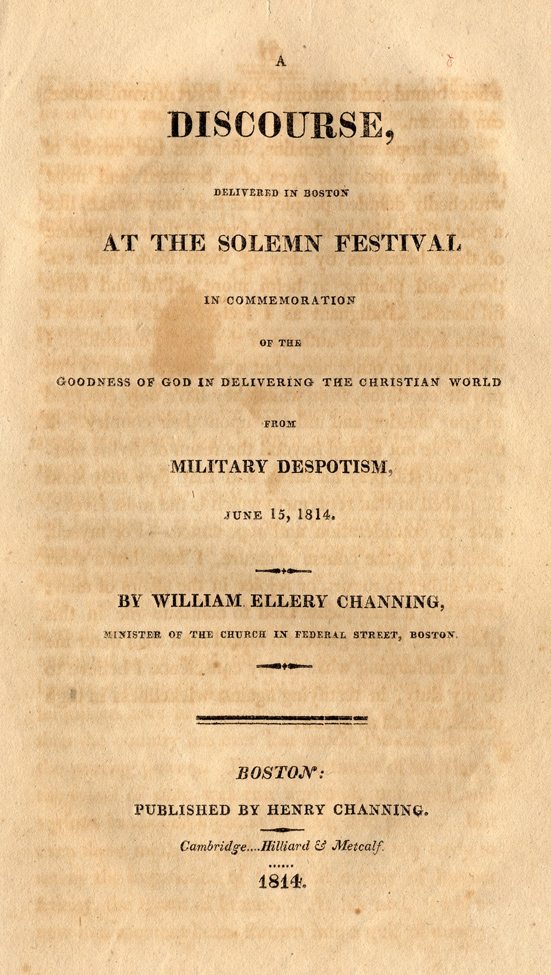
A

DISCOURSE,

DELIVERED IN BOSTON

AT THE SOLEMN FESTIVAL

IN COMMEMORATION

OF THE

GOODNESS OF GOD IN DELIVERING THE CHRISTIAN WORLD

FROM

MILITARY DESPOTISM,

JUNE 15, 1814.

BY WILLIAM ELLERY CHANNING,
MINISTER OF THE CHURCH IN FEDERAL STREET, BOSTON

DISCOURSE.

REV. xix. 6.

HALLELUJAH: FOR THE LORD GOD OMNIPOTENT REIGNETH.

It is the dictate of reason and revelation, that God is to be acknowledged in all the events of life, and changes of society. In adversity, his hand is to be adored with uncomplaining resignation; and in prosperity, his goodness is to be celebrated with joy and thanksgiving. Through inferior agents our thoughts should always rise to God, in whom all other beings live and move, and without whom not a sparrow falls.

In conformity to these just and exalted views of God, we are now assembled to offer him our tribute of praise and gratitude for the deliverance he has vouchsafed to the civilized world. We are assembled to bear our part in the joyful thanksgivings which are now ascending to him from liberated nations. Let us bring to his throne the sentiments which this solemnity demands. Let our exultation be purified from all narrow and unworthy feelings. As members of the great human family, and in the spirit of universal charity, let us offer sincere praise to our common God and Father, who has sent this great salvation to his suffering children.

Do any doubt the propriety of our expressions of joy on the deliverance of Europe, because the influence of this event on ourselves in not precisely ascertained? To such doubts I might reply, that the cause of this country is necessarily united with the cause of the world. I might say, that every free and enlightened people has an interest in the freedom and improvement of other nations; that there is a sympathy, a contagion of spirit and feeling, among communities as well as individuals; and that the slavery of Europe would have fastened chains on us. I might say, that the fallen despot of Europe had not forgotten this country in his scheme of universal conquest, that his disastrous influence has already blighted our prosperity, and that if peace and honour are to revisit our shores, we shall owe these blessings to the fall of the oppressor. But obvious reasons forbid me to enlarge on topics like these. Let it be granted, that other nations are to participate more largely than we in the blessings of this happy revolution. And shall we therefore be dumb, amidst the shouts and thanksgivings of the world? Is it nothing to us, that other nations are blest? Does the ocean which rolls between us, sever all the charities, extinguish all the sympathies, which should bind us to our kind? Can we hear with indifference that the rod of the oppressor is broken, because other nations were crushed with its weight? Away this cold and barbarous selfishness! Nature and religion abhor it. Nature and religion teach us, that we and all men are brethren, made of one blood, related to one father. They call us to feel for misery, wherever it meets our view; to lift up our voices against injustice and tyranny, wherever they are exercised; and to exult in the liberation of the oppressed, and the triumphs of freedom and virtue through every region under heaven. We are not indeed to forget our homes in our sympathy with distant joy and sorrow; and neither are we to suffer the ties of family and country to contract our hearts, to separate us from our race, to repress that diffusive philanthropy, which is the brightest image man can bear of the universal Father. God intends that our sympathies should be wide and generous. We read with emotion the records of nations buried in the sepulcher of distant ages – the records of ancient virtue wresting from the tyrant his abused power; and shall the deliverance of contemporary nations, from which we sprung, and with which all our interests are blended, awaken no ardor, no gratitude no joy?

It is an animating thought, that we, my friends, have a peculiar right to rejoice in the prosperity of Europe, because we mourned with her in the day of her adversity. Our hearts bled with her, when she lay a mangled victim at the foot of her oppressor; and who will forbid us to hail her with delight, now that she rises from the dust in renovated life and glory. As a nation indeed, we have no right to participate in the general joy. As a nation, we cannot gather round the ruins of the fallen despotism, and say, We shared in the peril and glory of its destruction. But it is the honour of this part of the country, that in heart if not in act, with our prayers if not our arms, we have partaken the struggles of Europe. In this day of our country’s disgrace we can say, and the world should know it, that we never sung the praises of the tyrant, never joined the throng which offered him incense and bent before him the servile knee. We have had no communion of interest or feeling with the enemy of mankind. We abhorred the prosperous, as much as we contemn the fallen tyrant. Let history, when she records the connection of this republic with the usurper, bear witness, that we were not all involved in this disgrace, that there were some among us true to the cause of human nature, whose hearts sunk under the depression of Europe, and whose hearts leaped for joy, when Europe was free.

Europe then is free! Most transporting most astonishing deliverance! How lately did we see her sitting in sackcloth and ashes; and now she is arrayed in the garments of praise and salvation. Instead of the deep and stifled groans of oppression, on general acclamation now bursts on us from all her tribes and tongues. It ascends from the Alps, the Pyrenees, the Appenines. It issues from the forests of the north. It is wafted to us on the milder winds of the south. In every language, the joy inspiring acclamation reaches our ears, THE OPPRESSOR IS FALLEN, AND THE WORLD IS FREE.

Will you say, that this joy is excessive? It cannot rise to the height of the deliverance by which it is inspired. What despotism was ever so degrading so appalling, so fatal to the best interests of mankind, as that whose subversion we this day celebrate. The fairest portion of the world was its prey, and the most flourishing regions were laid waste by its fury. From Moscow to the shores of the Mediterranean, you may discern in the ruins of cities, and in desolated and deserted plains, the track of this relentless despotism. It was a despotism founded in crime, cemented in blood, and all its splendor was derived from the spoils of an oppressed world. Its ambition knew no bound, and submitted to no restraint. It had no pity for the weak, no justice for the innocent, no regard to plighted faith, no settled end but universal empire. It was sustained by armies disciplined to victory, hardened to cruelty, exulting in success, inflamed with the hope of rapine, and led by generals whose names were a host. Before it went menace, terror, corruption, fraud, and every profligate art, to prepare its way; and behind it were desolation, famine, and slavery. At its presence the old and revered institutions of Europe fell; thrones and governments, which had endured for ages, were overturned. If indeed the former sovereign was permitted to hold his power, he held it as a fief and dependence on the usurper, and was bound to pay for this poor relic of departed greatness, by contributing the treasures and blood of his kingdom to adorn and sustain the despotism by which he was crushed. Wherever this dreadful power was establish4ed, virtue, patriotism, and honour were driven into obscurity, and spies and traitors exalted. This vicious despotism linked with itself the vice of every country. It infused life, energy, and hope into the profligate, mercenary, restless, and desperate, and rewarded them with the plunder of the country they betrayed. Wherever this despotism spread, the press was in chains, and fear chained every tongue. The ordinary pursuits of industry were interrupted. On the once busy and peopled shore, a host of guards watched every sail, and the peasant with a fainting heart tilled the fields, which might be trodden down by armies, or pillaged by lawless rapacity. Every where commerce, the golden chain of nations, the spring of enlarged philanthropy, the disperser of art, science, and improvement, was discouraged by bloody edicts. The old connections of Europe were systematically broken up, and hardly any connection seemed to remain but union to the central despotism.

The moral influence of this despotism, more than all things else, gave it a character of peculiar horror, and should excite our most fervent gratitude for its destruction. It was despotism of low and vulgar minds. It had nothing of greatness and elevated sentiment. It not only destroyed like a beast of prey; but it polluted, like a harpy, what ever it touched. Its breath was poison, tainting the atmosphere, and changing its victim into a loathsome mass of corruption. It left not merely a wilderness in the natural world – it desolated the mind, and robbed human nature of all its honourable attributes. We could have forgiven it, had it only robbed and impoverished, but it degraded Europe. It systematically corrupted, that it might enslave. By its undisguised and unblushing crimes, and its open and successful contempt of the principles of justice, it shook the moral sentiments of mankind, and taught them to look with the indifference of familiarity on deeds, which would once have struck them with horour. Nothing can be imagined more hostile to the authority of conscience and virtue, than the triumphs of a power, which defies God, and honours and recompenses crime. These triumphs every where offered themselves to the eyes of Europe and in the world was a despot, black with crimes, the dark features of whose character were not brightened by a gleam of virtue. His throne was sustained by tributary princes and besieged with flatterers and servile dependents. O that this page were torn from the history of Europe! Never did Europe know so dark and dishonourable a day, as when her princes and nobles, her genius, learning, and eloquence gathered round a base adventurer to do him homage, – to do homage to treachery and murder.

My friends, with what aching eyes did we look on this scene of degradation! The light of the world seemed to us expiring. Europe, the land of our fathers, the land of Christians, the abode of civilization and refinement, crowned with splendid cities and cultivated fields, with venerable temples, ancient seats of science, asylums for human misery, and unnumbered institutions, which embellish, console and refine the social state, Europe, so flourishing, so interesting, the best hope of the world, seemed to us given into the hand of the destroyer.

Such, my hearers, was the despotism, which God in his holy providence permitted to arise in the center his holy providence permitted to arise in the center of the civilized world – so ferocious, so appalling – and IT IS FALLEN, IT IS FALLEN! At the moment of its greatest glory, when its foundations seemed to the gloomy eye of fear firm as the hills, and its proud towers had pierced the skies, – the lightning of heaven smote it, and IT FELL! Most holy, most merciful God thine was the work; thine be the glory! Who will not rejoice? Who will not catch and repeat the acclamation, which flies through so many regions, – THE OPPRESSOR IS FALLEN, AND THE WORLD IS FREE!

What a delightful change meets our view in the face of Europe! The flag of Orange and independence again waives on the spires of Holland. The song of cheerfulness and freedom again ascends the cliffs of Switzerland. Spain and Portugal, deluged as they are with blood, tell us they have not bled in vain, for perfidy has met its’ reward, and no hostile foot now pollutes their fields. Prussia, lately trampled in the dust, now lifts her head in exultation, and points us to her veteran hero and valiant hosts, who have wiped away her dishonour and fought with glorious success the battles of the world. Russia shows us her fields, whitened with the bones of invading armies, which never before knew defeat; and tells us, that she first rolled back the tide of oppression, and gave hope to subjugated nations. Even France calls us to participate her joy, for her sceptre is wrested from the tyrant, and wielded again by a benignant sovereign, who will heal her wounds, and grant her the repose she has so long denied to the world. How changed the face of Europe! The universal tumult of war is now hushed. The patriot now pronounces the name of his country without a blush, for it no longer stoops to the oppressor. The deserted shores begin to resound with busy multitudes, and to whiten with the sails of commerce. The exile returns to his ravaged fields with cheerfulness and hope. The fettered tongue is loosened, and exults without fear in the fall of the tyrant. That power which encouraged crime is now prostrate and its wrecks strew the nations; and if its prosperity emboldened guilt, its ruin speaks in a deeper tone the wretchedness of unprincipled greatness. Who will not rejoice? Who will not participate in the triumphs and gratitude of liberated nations?

I have hitherto called you to rejoice in the fall of the despotism, which has threatened the world. I would now direct you to that most auspicious instructive event, the fall of the despot. My hearers, where is the man, at whose nod nations lately trembled, at whose pleasure kings held their thrones, and whose voice, more desolating than the whirlwind directed the progress of ravaging armies? Behold and adore the righteous judgments of God! A little island now holds this conqueror of the world. No crowd is there to do him homage. His ear is no longer soothed with praise. The glare which power threw around him is vanished. The terror of his name is past. His abject gall has even robbed him of that admiration, which is sometimes forced from us by the stern, proud spirit, which adversity cannot subdue. Contempt and pity are all the tribute he now receives from the world he subdued. If we can suppose, that his life of guilt has left him any moral feeling, what anguish must he carry into the silence and solitude, to which he is doomed. From the fields of battle which he has strewed with wounded and slain, from kingdoms and families which he has desolated, the groans of the dying, the curses of the injured, the wailing of the bereaved, must pierce his retreat, and overwhelm him with remorse and agony.

Here let us learn my friends, never to be dazzled by triumphant guilt, never to forget the crimes of a usurper in his success. Let us learn, that virtue alone deserves our veneration, and that virtue alone will endure. The adulation of the courtier and the homage of the blinded crowd cannot sustain that greatness, which is reared on guilt. The most dreaded and flattered despot is after all but a man, exalted to his bad eminence for the chastisement of a guilty world, and destined to magnify, by his own destruction, the Almighty justice he has defiled. Let not the bloody conqueror boast of his poers. The blood which he sheds, the regions which he wastes, the widows and fatherless whom he bereaves, the poor whom he drives from their homes to perish by cold, famine, and sickness, all cry to God, and draw down on his head deserved destruction.

My hearers, from the events which we this day celebrate, we are especially taught that most important lesson, to hold fast our confidence in God and never to despair of the cause of human nature, however gloomy and threatening be the prospect which spread before us. How many of us have yielded to criminal despondence! How many of us saw, in imagination, the last blow given to national independence, when the usurper poured his hosts into the north! The shouts of new victories already seemed to reach our ears. We now see, that what we dreaded wrought our safety; that the appalling greatness of the usurper, by inspiring presumption, hastened his ruin; that the very rapidity of his progress brought him more surely and more suddenly to the precipice. Slower conquests might have quenched the spirit of nations, and induced new habits in the vanquished. But the impatient usurper, in grasping new dominions, neglected to secure his former acquisitions. In the vanquished there burned a smothered indignation, ready to break forth at the first moment of hope. That moment came – it was hastened by the mad temerity, which success had inspired. Europe rose in her strength, burst her chains with one convulsive effort, and suddenly prostrated the throne which the toils of years had erected. We are here taught, as men, perhaps, were never taught before, to place an unwavering trust in providence, to hope well for the world, to hold fast our principles, to cling to the cause of justice, truth, and humanity, and to frown on guilt and oppression, however dark be the scenes which surround us, and however dangerous or deserted be the path of duty.

Let me close this discourse, with dwelling for a moment on the cheering prospects opened on the world by the fall of the usurper. We are at length permitted to anticipate the long lost and long desired blessing of general and permanent peace. Peace, whilst that usurper held the throne, would never have revisited Europe; or at least no peach but that of silent, motionless, unresisting slavery. War was his element. He was bred to scenes of tumult and blood. He knew no excellence, but that of wielding weapons of destruction, and had no ambition but to erect arches and monument of victory. But the weapons are now wrested from his hands. That perturbed spirit no longer controls the nations. Europe, bleeding under so many wounds, sighs for peace; and we may hope that, taught by tremendous experience, she will shrink, at least for a season, from the renewal of war. In France a most solemn and monitory example has been given of the ruinous effect of the passion for conquest. The woes, which that aspiring people have inflicted on other nations, have rolled back on themselves. A military despotism has ground them in the dust, wrung from them their substance, torn from them their children, and made every family a mourner. The blood of Frenchmen has flowed in streams over the fields of almost every nation in Europe. And not only have they bled at a distance : invasion and conquest have rushed on their own plains, and penetrated to the very heart of their empire – and will the nations of Europe, with his solemn example before their eyes, still pant with undiminished ardor for ware and universal conquest? May we not also hope, that the spirit of peace will be cherished and diffused by the late generous successful struggle, in which all Europe, with one heart and one hand, has beaten down unprincipled ambition and military despotism?

But still greater blessings may be anticipated. I consider the fall of the usurper, and of his power, as the death blow to that system of Atheism and infidelity, which has been the chief source of the miseries of Europe. The French revolution was cradled in Atheism. Its authors hated God, and scoffed at futurity, and boasted that the throne of heaven was to sink in the same ruing with earthly monarchies. Since that period, a most solemn experiment has been making on society. The nations of Europe, which had in all measure been corrupted by infidel principles, have been called to witness the effects of these principles on the character and happiness of nations and individuals. The experiment is now completed; and, I trust, Europe and the world are satisfied. Never, I believe, was there a deeper conviction than at the present moment, that Christianity is most friendly to the peace, order, liberty, and prosperity of mankind, and that its subversion would be the ruin of whatever secures, adorns, and blesses social life. Europe, mangled, desolated Europe, now exclaims with one voice against the rule of atheism and infidelity, and flies for shelter and peace to the pure and mild principles of Christianity. Already the marks of an improved state of public sentiment may be discerned. Amidst the sufferings and privations of war, a generous spirit for the diffusion of the scriptures has broken forth; and at this moment that sacred volume, which infidelity hoped to bury in forgetfulness with the mouldering records of ancient superstition, is more widely opened than in any former age, to the nations of the earth. This reaction in favor of religion and virtue will, we trust, continue to increase. The fall of the usurper, as we have already observed, is the fall of a government, which depressed the good, and gave confidence and strength to the unprincipled of every region. That terrible example of successful guilt will no longer corrupt. That moral pestilence is stayed; and the remembrance of it, we trust, will carry solemn warning to the most distant generations.

To conclude – a new era seems opening on Europe and the world. We have an auspicious omen in the magnanimity of the victorious allies. We have another, still more auspicious in the new constitution of France, in which the great principles of civil and religious liberty are distinctly recognized before the assembled sovereigns of Europe. It is our hope, that the storm, which has shaken so many thrones, will teach wisdom to rulers, will correct the arrogance of power, will awaken the great from selfish and sensual indolence, and give stability to government, by giving elevation of sentiment to those who administer it. It is our hope, that calamities so awful, deliverance so stupendous, will direct the minds of men to an almighty and righteous providence and inspire seriousness, and gratitude, and a deeper attachment to the religion of Christ, that only refuge in calamity, that only sure pledge of future and unchanging felicity. Am I told, that these anticipations are to ardent? My hearers, I am not forgetful of the solemn uncertainty of futurity. I am aware, that the Unsubdued passions of the human heart still threaten sore and multiplied calamities to the world, Perhaps I have indulged the hopes of philanthropy, where experienced wisdom would have dictated melancholy prediction. But amidst all the uncertainties which surround us, one thing we know, that God governs, and that his most holy and benevolent purposes will be accomplished. One thing we know, that God has mercifully interposed for a suffering world and broken the power of the oppressor. For this most gracious and wonderful deliverance, let every heart thank, and every tongue praise him. Let the heavens rejoice, and the earth be glad. Let the sea roar and the fullness thereof. Break forth into singing ye mountains, and be joyful, ye fields! Kings of the earth, and all people, princes and all judges of the earth, both young men and maidens, old men and children, praise ye the Lord! Praise him with the sound of the trumpet, with the psaltery and harp, with stringed instruments and organs; for his name alone is excellent; for he hath visited and redeemed his people, and his mercy endureth forever.

Sermon – Election – 1814, Massachusetts

sermon-election-1814-massachusetts

A

Sermon

Preached at Boston,

At the

Annual Election,

May 25, 1814.

Before

His Excellency Caleb
Strong
, Esq.

Governor,

His Honor William
Phillips
, Esq.

Lieutenant Governor,

The Honorable Council,

And the

Legislature of Massachusetts.

By Jesse Appleton, D.D.

President of Bowdoin College


Commonwealth of
Massachusetts.

House of
Representatives, May 26th, 1814.

Ordered,
That Benjamin Green, of Berwick, R.D. Dunning, of Brunswick, and Rev. Aaron Kenne, of Alford, be a committee to wait upon the Rev. Dr. Appleton, and present him the thanks of the House, for the ingenious, learned and appropriate Discourse, pronounced by him, before His Excellency the Governor, and the two branches of the Legislature of Massachusetts, on the 25th inst. And to request of him a copy for publication.

Timothy
Bigelow, Speaker.

Isaiah, XXXIII: 6.

Wisdom and knowledge shall be the stability of thy times, and strength of salvation; the fear of the Lord is his treasure.

This chapter begins with an elegant apostrophe to Sennacherib, King of Assyria, reproaching him, as the ambitious and unprovoked disturber of the peace of nations. The prophet next makes a devout address to Jehovah, expressing confidence in the divine government, and hope of the delivery and security of his people, notwithstanding the menaces of an insolent and imperious adversary.

The text is thought to be directed to Hezekiah, then the monarch of Judah, and is thus rendered by Bishop Lowth.

Wisdom and knowledge shall be the stability of thy times;

The possession of continued salvation;

The fear of Jehovah, this shall be thy treasure.

The terms, wisdom and fear of God, as frequently used in scripture, are synonymous. The fear of the Lord, that is wisdom. But, as both occur in our text, it is rational to conclude, that, by the latter, is signified an ability to accomplish desirable ends, by a judicious choice and arrangement of means. This ability, though often found in connection with knowledge and piety, is not to be confounded with either. The fear of God directs men to aim at the purest and noblest ends. For the accomplishment of these, wisdom makes a selection from those various means, which knowledge has provided.

The doctrine, inculcated by our text is, therefore, that the permanent prosperity of a nation is best secured by a union of knowledge, wisdom, and the, fear of God.

After having endeavored to illustrate this proposition, we shall consider, in what way these qualities can be most effectually promoted.

To elucidate the proposition, we observe, first, that, by science, a nation is enabled to profit by the advantages of its natural situation. It avails little, that the soil of a country is rich, if the art of cultivation is unknown to the inhabitants. It avails nothing, that her shores are capable of being connected with every climate, through the medium of intervening seas or oceans, while science has never taught the construction of vessels, nor the art of directing them. Without this knowledge, there is comparatively little use in the rivers, by which a country is intersected; nor can the advantages of these be fully realized, till all vincible obstacles to navigation are actually overcome, and neighboring streams are made to unite their waters.

That fearful train of disorders, which makes such extensive and perpetual devastation on the happiness and life of man, is found capable of being arrested or enfeebled by the use of those mineral or vegetable substances, which the liberality of nature produces; but of which it is the province of science to discover the virtues, and the just application. It is in vain, that remedies are provided for human sufferings, or sustenance for human life, while the plants or minerals, which contain them, are permitted to remain undistinguished in the bosom of the forest, or buried beneath the surface of the earth. How inexpressibly might the sum of human misery have been lessened, had the science of medicine, among all the nations of antiquity, been advanced to its present state! What enormous waste of life has been annually made for many centuries, by a disorder, the easy prevention of which is matter of recent discovery! The sciences of chemistry and mineralogy, lately introduced into our country, and now cultivated with so much ardor and success, cannot fail, by their influence on medicine, agriculture and the arts, to produce consequences of great national importance. The nature of man on the one side, and of soils and climates on the other, remains the same in every age. It is knowledge it is cultivation, that produces the change. To this are we to ascribe it, that in our own country, where, two centuries ago, wild beasts and savages were contending for the empire of an unmeasured desert, there are now civil institutions, commerce, cities, arts, letters, religion, and all the charities of social and domestic life.

Secondly in wisdom and knowledge is implied a right understanding of the nature and design of civil society. A community possessing these qualities, will consider government as a benevolent institution, resulting from the social nature of man, and conducive not less to his liberty, than to his security. They will adopt a form of government, not only good in itself, but adapted to the local and relative situation of their country, and to their own genius and character. Whatever constitution be preferred, they will never accede to the doctrine, that the people were made for their rulers; but will rather consider the latter as the honored depositaries of power, originally inherent in the people, and voluntarily relinquished by then, on condition of its being used for their benefit. They will, by consequence, believe themselves in possession of a right, either to resume the power, or else to demand the accomplishment of the conditions, on which it was conferred.

Thirdly whatever civil compact they may see fit to adopt, an enlightened people will not trust themselves to calculate, with minuteness and confidence, the greatest degree of political prosperity, that may be enjoyed, nor the least degree of restraint, that may be necessary. It will not escape them, that no human foresight can extend to all emergencies, which a series of years may produce; and that time may develop, in any political constitution, traits, either more or less valuable, than were apparent to its original authors. It is a well known truth in mechanics, that the actual and theoretical powers of a machine will never coincide. Through the flexibility of one part, the rigidity of another, and the roughness of a third, the result may disappoint those fond hopes, which seemed to rest on the firm ground of mathematical calculation. The judicious artist, will not however, on this account, be willing to reject, as worthless, a structure of splendid and complicated mechanism, of solid materials, in the formation of which much labor, experience and ingenuity have been employed.

It is a remark, not less important because frequently made, that an indifferent constitution may be so administered, as to render a nation happy, and that, without a good administration, the best political institutions will fail of accomplishing that purpose. Now, as the manner, in which government will be administered in any nation, can never be foreseen, a discerning people will not confidently anticipate, as their perpetual portion, the highest degree of prosperity which their form of government seems calculated to secure. Nor will they fix their eyes so intensely on the evils, which may be felt at any period, as to forget the imperfection of all human establishments, and that, under a new form of government, may be concealed important disadvantages, which experience alone can bring to light. Rejecting alike the character of inconstancy, turbulence, and despondency, they will neither tamely yield to abuses, nor subvert their political institutions on account of them.

Fourthly as an enlightened people will know how to value their rights, they will place those in office, who, by their ability, knowledge, and integrity, are entitled to such distinction. To obtain their suffrages, it will not be enough, that a man professes his attachment to order, religion, or liberty. He must have more solid ground, on which to establish his claims to public favor. In knowledge and wisdom is doubtless implied a spirit of discernment. To enjoy the confidence of a wise people, there must therefore, be a consistency of character, a uniform regard to moral principle and the public good. They will clearly perceive, that the civil interests of millions cannot be secure in the hands of men, who, in the more confined circle of common intercourse, are selfish, rapacious, or aspiring.

An enlightened regard to self interest and a religious sense of responsibility, will in this case, lead to the same practical result. In exercising the right of freemen, the man of religion experiences no conflict between his duty and his inclination. Towards the dishonest, profane, ambitious and profligate, he feels

       “The strong antipathy of good to bad.”

He has no wish to behold, arrayed in the robes of office, men, whose largest views do not extend beyond the limits of mortal life, and whose deportment and conversation indicate neither love nor reverence for the Author of their being.

In very popular governments, where the elective franchise is widely extended, it is, doubtless, impossible, that candidates for public office should be personally known to all, whose suffrages they receive. How generally so ever knowledge is diffused, all the members of a large state cannot be brought within the sphere of mutual observation. In this case, resort must be had to the best sources of information. But it should not be forgotten, that a portion of the same intelligence and virtue, required in rulers, is necessary in giving information concerning candidates. An honest and well-informed freeman will rely on none but honest and well-informed witnesses.

Fifthly a nation, distinguished by a union of wisdom, knowledge, and the fear of God, is morally certain of having its government well administered, not only for the reason just assigned, but because the tone of morals, existing in such a nation, will operate as a powerful restraint, if, by any casualty or deep dissimulation, persons of yielding virtue should be placed in office.

Public  opinion constitutes a tribunal, which few men, and, least of all, those, who are in pursuit of popular favor, will dare to set at defiance. It is scarcely possible, that a people, truly wise and virtuous, should have a government badly administered. Whenever the majority of a community complain of their rulers, they implicitly utter reproaches against themselves, for having placed their destiny in the hands of men, with whom it is insecure. If their reproaches are long continued, it is good proof that their own morals exhibit no very striking contrast with the morals of those, whose profligacy they condemn. In popular governments, the virtues and vices of rulers must flourish or wither with those of the people.

Again. A union of wisdom, knowledge, and the fear of God, will contribute to the prosperity of a nation by increasing its power.

That a nation, degenerate in its morals, may, however, be formidable by its policy and physical strength, is not to be questioned. But, if ignorance is joined to the want of virtue, we cannot doubt, that its imbecility will be equal to its wretchedness. Let the same nation become both well-informed and virtuous, and the augmentation of power will be incredible. In a wise and virtuous state, the citizens will cherish mutual confidence. This confidence will be a bond of union, not only between the people and their government, but between the different between the different orders and members of the community. In such a state, rulers will act, not for themselves, but for the nation; nor will the people indulge a spirit of restless innovation, murmuring, or faction.

“Virtue, in a society,” says a profound writer, “has a tendency to procure superiority and additional power, whether this power be considered as the means of security from opposite power, or of obtaining other advantages. And it has this tendency by rendering pubic good both an object and an end to every member of the society; by putting every one upon consideration and diligence, recollection and self government, both in order to see what is the most effectual method, and also in order to perform their proper part for obtaining and preserving it; by uniting a society within itself, and so increasing its strength; and what is particularly to be mentioned, uniting it by means of veracity and justice. Power in society, by being under the direction of virtue, naturally increases, and has a necessary tendency to prevail over opposite power, not under the direction of it, in like manner, as power, by being under the direction of reason, increases, and has a tendency to prevail over brute force.”

A state of things is here supposed, it may be objected, which is wholly ideal; since the world, from its commencement, has produced nothing resembling it. This is, indeed, true. But, if it is true, that a state would be extremely powerful, were it entirely virtuous, its power must, by consequence, be proportionate to its virtue.

A nation, but faintly resembling that, which has been imagined, would, indeed, be far less than others likely to experience civil discord and foreign wars. Without cool deliberation, and a solemn conviction of responsibility, it would not gird on the harness. But, proceeding with reluctance, and under the impulse of duty, it would, if circumstances should not only justify, but require the measure, act with the more determined valor. Like the judgments of heaven, its displeasure would be slow and righteous, but irresistible. The people, that do know their God, shall be strong and do exploits.

Further. Wisdom and virtue tend directly to the stability of a government, as they will prevent both the necessity and the general desire of a revolution. The necessity of such an event, in any nation, implies a high degree of corruption in its rulers. The desire without the necessity indicates, with no less certainty, a depraved, restless, and turbulent people. It is evident, that a moral and enlightened people will not be factious: nor will an administration of this character be oppressive. It is a melancholy and mortifying truth, that all human things tend to degeneracy. To check this tendency, in any political establishment, knowledge, generally diffused and actively employed, in connection with a religious regard to the public welfare, may be effectual. Moderate evils, not easily remedied, will be patiently endured. Tranquility and prosperity may thus be the growth of ages and centuries. But, where there is not enough either of knowledge or moral principle to discover or correct abuses, as they occur, the mass, by constant accretions, will become enormous, and produce eventually the atrocities and sufferings of a revolution.

A well informed people know the advantages of the civil, compared with the savage state. They know, that where there is civil society, there must be law, and that law implies restraint. They will consider partial restraint, as a moderate price, at which to purchase the rich blessings of order and safety. From a religious people, civil government, so far as it is of a moral nature, can never incur opposition. The restraints of morality they are bound to observe by stronger obligations than those, which arise from any human authority. On their hearts the words of a divine law are deeply inscribed. They abstain from moral disorder, out of regard to this law, which extends equally to the savage and the social state; to every condition indeed, and to every part of the universe, where there are human, or even intelligent beings.

Knowledge and wisdom tend no less to the stability of a government, by opposing despotism, than by avoiding anarchy. Where the minds of a nation are left free, an arbitrary government can never be established. While the spirit of a people is unsubdued, by which I mean, when it is under no confinement but that, which arises from reason and religion, obstacles, numerous and powerful, will be planted in the road of an aspiring despot. There is no communion there is no congeniality between that intellectual and moral elevation, implied in the character of a people, distinguished for knowledge and the fear of God, and that ignorance, corruption, and debasement, involved in quietly surrendering to human caprice, those rights which our creator designed, as the unalienable accompaniments of a rational nature.

To illustrate and exemplify these remarks, we need only refer to the early history of our own country. Those illustrious men, who, under God, directed the earlier destinies of New England, were distinguished for the character, of which we have been speaking. They were equally remarkable for their love of liberty, and their hatred of anarchy and misrule. They could, without complaint, forego the indulgences and elegancies of life; they could look unappalled on a vast, stormy, unfrequented ocean; they could plant themselves and families, in a wilderness rendered hideous by every danger; they could submit, with invincible fortitude, to toils and privations; but their noble minds could not endure the spirit of civil and religious bondage. How well they understood both the rights of the people, and the rights of government, appears from the following words of one of their chief magistrates. “There is a liberty of corrupt nature, which is inconsistent with authority, impatient of restraint, and the grand enemy of truth and peace; and all the ordinances of God are bent against it. But there is a civil, moral, federal liberty, which consists in every one’s enjoying his property, and having the benefit of the laws of his country, a liberty for that only, which is just and good; for this liberty you are to stand for your lives.”

The fear of God tends to the stability of a nation, by ensuring the divine protection. If no human being either enters the world or leaves it; if no plant of the field either vegetates or decays; if no sparrow falls to the ground without our heavenly Father, can all the parts of that vast and complicated machine, denominated a nation, continue their relative positions, and discharge their various functions without the same counsel and agency? All nations are before him as nothing; they are accounted as less than nothing and vanity. At what time I shall speak, saith Jehovah, concerning a nation, and concerning a kingdom, to pluck up and to pull down and destroy it, if that nation, against whom I have pronounced, turn from their evil, I will repent of the evil, which I thought to do unto them. And at what time I shall speak concerning a nation and concerning a kingdom, to build and to plant it, if it do evil in my sight, I will repent of the good, wherewith I said I would benefit them.

This language expresses not merely the manner, in which God dealt with the Jewish nation, over which he maintained a government peculiarly retributive; but the course of his providence in general. There are two ways, in which these declarations are rendered effectual. In the first place, such is the divine constitution, that vice brings immediate punishment to a state, by rendering it discordant and feeble. Such is the essential and immutable nature of vice, as to blast the best hopes of society, and to weaken the bonds, by which it is held together. Virtue, we have seen, tends to union, strength, and harmony. It is obvious, therefore, that God protects an upright nation by its uprightness, and demolishes and ruins an immoral nation by its profligacy.

In the second place, it should be considered, that the prayers of the righteous come up, as a memorial before God. This sentiment is not peculiar to revelation, but may be considered, as universal among those, who believe in a superintending providence. God hath never said to the seed of Jacob, seek ye me in vain. But, that the prayers of a nation may be heard and graciously answered, it is necessary that they be offered with uprightness of character. If the Lord will not hear an individual, who regards iniquity in his heart, neither will he accept the sacrifices of a vicious community. Agreeably to this, when the kingdom of Judah had become inattentive to the moral requirements of God, they were not encouraged to expect any favorable answer to their prayers. When ye spread forth your hands, saith Jehovah, I will hide mine eyes from you. When ye make many prayers, I will not hear; your hands are full of blood.

If national prosperity is the sum of happiness enjoyed in a nation, it evidently depends on something more, than either the constitution of government, or what is strictly comprehended in the administration of it. Where both of these are good, there is, indeed, a strong presumption, that the people will be happy. Still it is not certain. No inconsiderable part of the real world of our earthly existence consists in the safety and purity of domestic intercourse. Were all the happiness, hence resulting, destroyed, it is, at least, questionable, whether the remaining would be the better part. Now, though a bad government is likely to contaminate the mass of a nation, and infuse a kind of pestilence into the intercourse of neighbors, and even of individuals belonging to the same family; yet that state of happiness, which is the opposite of this, will not necessarily result even from a union of good laws and good rulers. In order to this, there must be general knowledge, but especially a high sense of moral obligation. While the ties of morality cannot be made to fasten on the conscience, social intercourse will be rendered precarious by falsehood and selfishness; friends will be perfidious; neighbors will be unkind and contentious; and all the joys of domestic life will be embittered. Knowledge, however salutary in conjunction with correct moral feelings, is, without them, wholly inadequate to diffuse either happiness or safety through the more private departments of life. In the time of Pericles, Greece was not happy, because there was nothing in her religion, which could operate, as a principle of moral life. And Rome became dissolute, because she received from Athens, at the same time, both her literature and her manners. In the age of Julius and of Augustus, both public and private vices had become enormous, and extensively propagated. Such likewise was the state of the Jews, when, in the midst of good instruction, they rejected the fear of Jehovah. The want of religious feeling was apparent in all the business and intercourse of life. Every thing was gloomy and full of danger. Take heed, every one of his neighbor, and trust not to any brother; for every brother will utterly supplant, and every neighbor will walk with slanders. They have taught their tongues to speak lies, and weary themselves to commit iniquity.

From all, which precedes, it has become sufficiently obvious that, in order to experience the full effects of the best political institutions, a previous foundation must be laid in the minds of those, who compose the state; and that wisdom, knowledge, and the fear of God, are the precious materials, of which this foundation is to be formed. The promotion of these will, therefore, demand the attention of all the enlightened members of the state, but especially of those, concerned in its government. If it is important to enact laws for the suppression of vice, it is undeniably more important to prevent or exterminate, if possible, those corrupt propensions, which lead to it. The police officers of a distempered city are but ill employed in directing men to fumigate the streets and markets, if no care be taken to clear the ground and purify the atmosphere, from which the contagion is communicated.

These intellectual and moral qualities, so essential to the permanent prosperity of a state, can be promoted extensively in no other way, than by education, early begun and judiciously prosecuted. The youth in a community have, long since, been compared to the spring. The loss of these would be like striking out from the year the vernal months. If there be no vegetation in the opening year, what shall support life during the time of autumn and winter? Or what if there be a luxuriant vegetation, but no salutary or nourishing plant? What if thistles grow instead of wheat, and cockles instead of barley?

That education may do much, both for the intellectual and moral improvement of a nation, cannot be, called in question. If the Spartan discipline was fund adequate to its object, during many centuries, though it counteracted some of the strongest affections of our natures; if parental, filial, and even conjugal tenderness could be extinguished or smothered under a political constitution, which formed but one family of a whole state, what might not be done by pursuing, with perseverance, a plan of education, concerted with just views of the human character, and under the influence of that glorious light, which Christianity has shed on the destiny of man!

The active powers of the soul must either be suppressed or directed. If they are suppressed, their possessor loses, in a considerable degree, his rank in the moral world. If they are not suppressed, they must he directed by knowledge and moral principle.

The importance of early instruction was felt by the wisest nations of antiquity. “What,” says an author, speaking in the name of the Grecian sages, and profoundly versed in their writings, “What are the solid foundations of the tranquility and happiness of states? Not the laws, which dispense the rewards and punishments; but the public voice, when it makes an exact retribution of contempt and esteem. The laws, in themselves impotent, borrow their power solely from manners. Hence results, in every government, the indispensable necessity of attending to the education of children, as an essential object, of training them up in the spirit and love of the constitution, in the simplicity of ancient times; in a word, in the principles, which ought ever after to regulate their virtues, their opinions, their sentiments, and their behavior. All, who have meditated on the art of government, have been convinced that the fate of empires depended on the education, given to youth.”

This subject did not escape the notice of the Athenian legislator. Solon enacted a number of laws, relating particularly to education. In them he specified both the time, at which youth should receive public lessons, and the character and talents of the masters, who should instruct them. One of the Courts of Justice was to superintend the observance of these regulations.

At Sparta, it is well known that education was every thing. Children were scarcely introduced into the world, when they were subject to a course of discipline, applied equally to the mind and the body. Lycurgus would have his laws engraved on the hearts of the citizens; and, to effect this, he endeavored so to direct the education of youth, that his institutions might be to them, as a law of nature.

“In the rising ages of Rome,” says the learned Kennet, “while their primitive integrity and virtue flourished, the training up of youth was a most sacred duty. But, in the looser times of the empire, the shameful negligence of parents and instructors, with its necessary consequence, the corruption and decay of morality and good letters, struck a great blow towards dissolving that glorious fabric.”

The same general principle is distinctly recognized in that constitution, which was divinely bestowed on the Jewish nation. These words, which I command thee this day, saith Moses, shall be in thine heart; and thou shalt teach them diligently unto thy children; and shall talk of them, when thou sittest in thine house, and when thou walkest by the way; when thou liest down, and when thou risest up.

If such be the importance of education, may I not be indulged for a few moments, in considering the most obvious ways, in which it may be promoted?

At the head of these, we cannot hesitate to place parental or domestic instruction. In his children, the parent beholds those, who are to become members of the state, and to act, in a sphere of greater or less extent, on its political and moral interests. He is forming their character at an age, when their dispendance is absolute, and resistance impossible. The first development of the mind is made under the domestic roof, and in the presence of those, who are most interested to observe it. It depends on the knowledge and fidelity of parents, whether their children shall be seasonably taught the being, perfections, and government of God, or be permitted to spend the earlier part of their existence in ignorance or contempt of him, from whom they received it. On the same knowledge and fidelity in parents will it depend, whether the first notions, which children form of the Supreme Being, shall coincide with reason and scripture, or be the monstrous birth of a distempered imagination; whether the more gentle affections shall be cultivated, or the wilder passions be permitted to rage and mingle in defiance of restraint, either from prudence or religion.

Every family is a nation in embryo. Civil society originally consisted of families; and so it does still. By forming habits of obedience, intercourse, and beneficence, while under parental government, young persons become qualified to move in a more enlarged sphere, and to discharge duties of more extensive importance. In this manner are now forming throughout this commonwealth, a set of mechanics, a yeomanry, military characters, merchants, divines, legislators, and judges; all those, in fine, who shall compose the body politic, when we, who are now living, shall be covered with the clods of the valley.

In view of this subject, I am irresistibly led to contemplate the primitive character of New England. In relation to those, who, by planting civilization and religion on those shores, transmitted to us this fair inheritance, the language of inspiration may be well used; when thou wentest after me in the wilderness, in a land, that was not sown, Israel was holiness to the Lord, and the first fruits of has increase. In almost every dwelling was there both an altar and a church. Then began men to call on the name of the Lord. The child was early engaged in the worship of Jehovah, to whom he had been consecrated by a Christian ordinance. From the lips of maternal piety and love, he imbibed the lessons of heavenly wisdom. By a father’s authority, guided and softened by the spirit of religion, his aberrations were reclaimed, and virtuous habits were aided and confirmed. It was a scene, which angels delighted to witness! The Bible, the Sabbath, and the sanctuary, were objects not only of veneration, but of affection. Together with the love of truth and probity, they formed a strong attachment to rational freedom; a character, remarkable for solidity, decision, and independence. They knew both how to appreciate their rights and to defend them. They knew what was expected from children, of whose parents it could be emphatically said, that they “feared God, and feared nothing else.”

2. Next in importance to family instruction, is that of common schools. No friend to his country can ever be indifferent to this source of information. Large rivers may be of great utility in fertilizing, within certain limits, the adjacent fields. But the country in general is to be enriched and moistened by smaller streams. By the institution of schools, knowledge is diffused over a whole nation. Its streams are carried to every house and to every cottage. They may be tasted alike by children of wealthy, and by those of indigent parents. Nothing can be more consistent with republican principles, nothing more essential to such a government, than this equal and universal extension of knowledge. To a benevolent mind it is highly gratifying to reflect, that, in a large community, there should be scarcely a child under the hard necessity of passing through life in profound ignorance. No man is in a situation so elevated, as to justify an inattention to such an object.

The advantages, resulting to the public from school education, will obviously depend much, not only on the knowledge, but also on the morals of those, who are employed to give instruction. Parents can scarcely do their children a more material injury, than to place them under the care of a profane, intemperate, or licentious teacher.

3. Academies, or schools of a public nature, are useful, just in proportion to the fidelity and accuracy, with which they teach the principles of morality, science, and classical literature. And perhaps it may deserve the attention of an enlightened legislature, to determine, whether a moderate number of these establishments, with endowments competent steadily to maintain able instructors, would not as effectually sub ˙ serve the interests of knowledge, as to give to a great number, an existence, painful, precarious, and intermitting.

4. In the next particular, we have doubtless been anticipated. The happy consequences resulting to society from more extensive literary establishments, such as colleges and universities, have been so generally observed, as to render it unnecessary to offer either detail or proof. It has been a thousand times mentioned, and ought never to be forgotten, that our ancestors were the friends of learning, as well as of liberty and religion. The university in this vicinity, originally dedicated “to Christ and the church,” stands as a durable monument of the enlarged views entertained by the fathers of New England. How well they judged as to the influence of knowledge, in giving stability both to the church and the commonwealth, will appear doubtful to no one, who examines the long list of civilians, military commanders, or religious instructors, who, in different periods of our country, have defended its liberties, formed its political constitutions, or corrected its sentiments and morals. Of these illustrious names, he will find a large proportion in the catalogues of our older seminaries.

These views, I well know, are familiar to the audience, which I have the honor to address; to a legislature especially, which, recently by an act of noble munificence, gave public evidence of the interest, which it feels in the “advancement of literature, piety, morality, and the useful arts and sciences.”

But, of all kinds of knowledge, none is so important to human beings, as that, which relates to God, to their own present duty, and future prospects. No instructions are like his, who spake from heaven. Wherever the gospel is preached with clearness, and with a becoming mixture of zeal and knowledge, the eternal difference between virtue and vice is openly displayed; sensibility of conscience is preserved, and its decisions respected; the general tone of morals is raised; and vice, if not suppressed, is constrained to avoid observation and seek retirement.

In Christianity, the mind is assailed by motives, such as could not be drawn either from the stores of philosophy or from any other system of religion. A world is here opened on the imagination, absolutely without bounds or limits. The rewards of virtue and the punishments of vice are declared, by the Son of God, to be of such duration, as accumulated ages and millions of ages cannot diminish. The objects of this retribution are human actions in connection with motives and dispositions. Now, can it be, for a moment, doubted, that the public preaching of such a religion throughout a nation, is calculated to arrest the progress of vice, to enliven moral feelings, to diffuse a general spirit of sobriety, and to create habits of deliberation, and religious forecast? But, if the advancement of good morals, by which the execution of laws is infinitely facilitated, be a fit subject of legislation, so must be every institution or practice, which most powerfully tends to such an issue. If ancient legislators were so thoroughly convinced of the value of religion in civil government, as to originate or countenance false pretences to revelation, how much does prudence, as well as duty, require a Christian state to support a religion, which in truth descended from heaven!

It has now, we hope, been sufficiently shown, not only that the permanent prosperity of a nation is best secured by a union of knowledge, wisdom, and the fear of God; but that the education of youth is, under divine providence, the most powerful means of effecting this union.

In view of this subject, shall I be permitted briefly to address His Excellency, the chief magistrate of this Commonwealth?

At a crisis, when acknowledged talents, long experience in public affairs, unshaken integrity, conciliating and cautious manners, joined with decision of character, were qualities, infinitely important in one, who should be selected to preside in our government, we recognize, with devout thankfulness, the gracious hand of Almighty God, in again directing the public attention to your Excellency, and in directing your Excellency to consider the voice of the public, as the indication or duty. We rejoice to witness, in the supreme executive of our state government, a rich assemblage of those republican and Christian virtues, which shone with so benign a luster, in the purer ages of our country.

In the midst of those scenes and duties, which are connected with an office so highly responsible; while there are a thousand interests to regard, and a thousand temptations to resist; while, on the one hand, there are solicitations to repel, and, on the other, provocations to pass by and forgive, your Excellency, perhaps, needs not to be reminded, that there is scarcely a poor man among your constituents, whose situation, in regard to spiritual improvement, is less favorable, than your own. We implore for your Excellency a large supply of the spirit of Jesus Christ, that, when all human beings shall appear, as trembling suppliants, before the Divine Tribunal, it may be your glory, not that you have been frequently called to preside over a free state, but that, by divine grace, you have been enabled to do justly, love mercy, and walk humbly with God.

His honor, the Lieutenant Governor, will please to accept our respectful congratulations, that the second office in the gift of the people, has been again bestowed on him, in testimony of their high regard for the virtues of integrity, public spirit, and patriotism.

Notwithstanding the length of this discourse, I do entreat the attention of the Council, the Senate, and the House of Representatives, to a subject, intimately connected with the welfare of this state, and of our common country. War is one of the severest calamities, by which the Sovereign of the universe dispenses punishment to guilty nations. The evils of our present condition are too sensibly felt by men of all descriptions and sentiments, to render a minute delineation of them, either expedient or necessary. As to their origin, it is attributed, by a portion of our citizens, to partial, feeble, and ill judged policy in our national administration; by the rest, to an absolute necessity, resulting from the aggressions of a powerful and imperious nation. On this subject, it is not my present design to offer any opinion. I have no wish to add fuel to the flames of party zeal, which already rage with a heat so intense, as threatens o dissolve our political establishments. Wherever may exist the immediate occasion of our unhappy condition, the ultimate cause is to be sought in our national character. The spirit of vice has diffused a deadly contagion throughout every state in the union. The infection is not unknown in this northern extremity, once so pre≠eminently the abode both of private and of public virtue. The holy Sabbaths of God are extensively violated by men of all conditions in life, and of all political creeds. As temptations to this sin have been recently multiplied, the evil has become enormous and intolerable. The habitual profanation of sacred things, but especially of the divine name and attributes, is as general as it is impious and demoralizing. The daemon of intemperance is stalking through our country, wasting our property, consuming our health, and destroying our best hopes, both from objects of earth, and from those beyond the skies. The morals of men hang loosely about them, and are too frequently thrown off whenever an assault is made by individual or party interest.

On this subject, I make a respectful, but solemn appeal to the honored legislators of the Commonwealth. Do you believe, that any state, community, or nation can be powerful, tranquil, and permanently happy, if their morals are extensively depraved? Would not the most alarming depravation of morals result from a general disbelief of the Christian religion? Would the happiness of families, would property or life be secure in a nation of Deists? If Christianity is the most powerful guardian of morals, are you not, as Civilians, bound to give it your support and patronage? Do you, in the least, question whether the institution of the Sabbath has an extensive influence in bringing to the view of men their dependence on God, the extent and purity of his law, the soul’s immortality, and a day of judgment? Is it doubtful, whether that reverent regard, with which this day was treated by our ancestors, was nearly connected with those habits of integrity, industry, sobriety, and moderation, for which they were so remarkable? Have not the general profanation of God’s name, and the inconsiderate use of that language, in which he has been pleased to express the sanctions of his law, a direct tendency to impair the influence of those sanctions, and to dissipate the fears of profligate men?

Probably there was never a time, since we became a nation, when the crime of perjury had become so frequent, as at present. This is the legitimate off spring of other sins, to which we have been long accustomed; and to those, who are acquainted with the human character, it can produce but little surprise. When the witness, the complainant, or the accused adds to his promise of uttering nothing but the truth, these words, so help me God, he does, indeed, imprecate on himself the divine anger, if his testimony should be designedly false. But imprecations of a similar import, he has used, perhaps, a thousand times without feeling his responsibility, or realizing the solemnity of an oath. That individual, therefore, especially if placed in a commanding station, who swears profanely, or violates the Sabbath, does much towards demolishing the foundations, on which civil society is supported. He breaks up the fountains of the great deep; the waters will rush out from their caverns, and overflow the earth. Whoever may be the immediate authors of our present sufferings, certain it is, that in order to our obtaining the blessings of permanent and solid prosperity, a reformation mast be effected in our national character.

The Greeks, with good reason, inveighed against the ambition of Philip. Nor with less reason were the patriots of Rome alarmed at the daring measures of Caesar. But neither did Philip nor Caesar impose a yoke on the necks of a free people. In both cases, the people were enslaved by their passions, and by the unrestrained depravity of the heart. Liberty was not immolated either at Chaeronea or Philippi. She had been long declining; and those places only witnessed her dying struggles. It is the immutable purpose of God, that a people, destitute of moral principle, shall be neither free nor happy. We may, therefore, consider Jehovah, speaking to us, as he once spake to Israel. Put away the evil of your doings from before mine eyes. Cease to do evil and learn to do well. Them, that honor me, I will honor: and they, that despise me, shall be lightly esteemed.

In making this appeal to the venerable guardians of the state, I do not suggest the idea of multiplying laws for the suppression of those vices, which have been mentioned. If the laws, now existing, were executed, the evil would soon be suppressed. If they can be executed, and are not, it is evident, where rest the responsibility and the guilt. But, if our national character has so degenerated, that magistrates would not be supported in executing the laws; if the torrent is so heavy and rapid, as to overwhelm the civil authority then is immediate reformation our only hope. Considering the numbers, which compose this legislative body, the talents, wealth, and character, which it embraces, its influence, if concentrated on a particular object, would be incredibly powerful. There is scarcely a town or plantation in the Commonwealth, which is not here represented. That you have popularity and influence in your respective towns and districts, is evident from the places of honor, which you now hold. You are, therefore, the persons to engage in this work of reform. You may unquestionably do much. And, permit me to say, that when God gives means and ability, there is something, which he will require us to give in return; I mean an account of the manner, in which we use them. Nothing, at present, is better understood, than systematical operation. Our political contentions have taught us to carry this art to high perfection. Let there be the same union of zeal and system to suppress vice, and to revive the habits, the spirit, and piety of our forefathers, which is discovered in bearing down a rival interest, and your names will be forever recorded, as the honored instruments of perpetuating the union, and of achieving the salvation and glory of your country.

THE END

Sermon – Election – 1814, Connecticut


This election sermon was preached by Rev. Dan Huntington on May 12, 1814.


sermon-election-1814-connecticut

THE LOVE OF JERUSALEM, THE PROSPERITY OF
A PEOPLE

A

SERMON,

PREACHED AT THE

ANNIVERSARY ELECTION,

HARTFORD,

MAY 12, 1814.

BY DAN HUNTINGTON,
PASTOR OF A CHURCH IN MIDDLETOWN.

HARTFORD:
PRINTED BY HUDSON AND GOODWIN
1814.


At a General Assembly of the State of Connecticut, holden at Hartford in said State, on the second Thursday of May, A. D. 1814.

ORDERED, That the Hon. Asher Miller, and Elijah Hubbard, Esq. return the thanks of this Assembly to the Reverend DAN HUNTINGTON, for his Sermon preached before this Assembly on the 12th day of May instant; and request a copy thereof that it may be printed.

A true copy of record,
Examined by
THOMAS DAY, Secretary.
 

ELECTION SERMON.

PSALM cxxii. 6.
They shall prosper that love thee.

THE object placed before us in this promise is prosperity. The affection connected with, and leading to it, is love. The context shows us that it is the love of Jerusalem. “They shall prosper that love thee.”

The Psalm which contains these words was written by David, to be publicly sung by his countrymen assembled in that capital, to celebrate some public festival. “Our feet” they said, “shall stand within thy gates, O Jerusalem. Jerusalem is builded as a city that is compact together: whither the tribes go up, the tribes of the Lord; to the testimony of Israel; to give thanks unto the name of the Lord: for there are set thrones of judgment; the thrones of the house of David. Pray for the peace of Jerusalem. They shall prosper that love thee.”

WHAT IS INTENDED BY PROSPERITY? And

WHY MAY IT BE EXPECTED IN THE WAY HERE MENTIONED?—These are the two leading inquiries which will now direct our meditations.

By prosperity, we commonly understand success in our exertions, or the attainment of our wishes. If favoured in our enterprises, be they what they may, we think ourselves prosperous. In this general sense, the term is often used in the scriptures; and is there applied to the enemies of God, as well as his friends. The wicked are there represented, in many instances, as gratified to the extent of their most sanguine hopes. “They have more than heart could wish. They increase in riches. Their eyes stand out with fatness. Their strength is firm. They are not in trouble as other men; neither are they plagued like other men.”

Affluence, popularity, talents, health, long life, and an easy death, are often granted to the very basest of men. The unprincipled libertine, the sordid worldling, the wretch who would rise to influence upon the ruin of his country, the unbelieving and abominable of every description,–“who set their mouth against the heavens, and say—how doth God know, and is there knowledge with the Most High?—Behold these are the ungodly that prosper in the world.” They, as often as others, perhaps, have the attainment of their wishes and exertions, in whatever they set their hearts upon for happiness. Such prosperity, however, is undesirable. It is “the prosperity of fools,” which “shall destroy them.” “I was envious at the foolish,” says the Psalmist, “when I saw the prosperity of the wicked: until I went into the sanctuary of God: “Then understood I their end.”—When they have done the work, for which they were raised up; accomplished the period of their trial; and their characters are sufficiently developed, “they are brought into desolation in a moment;” and the advantages, with which they have been favoured, but have abused, all turn against them.

On the other hand, desirable prosperity is the attainment of our wishes, in whatever is conducive to real, permanent happiness. This is the prosperity, promised in the text; and is applicable, both to individuals and communities. The promise, you notice, is without limitation. It is as much as to say, all shall prosper, in whatever connexion, or under whatever circumstances, we contemplate them, who have the qualification mentioned.

As applied to individuals, it imports, that their souls shall be in health: it applies, peace of mind: reputation: property, so far as it is a blessing:–all, in short, that contributes to substantial enjoyment in life; consolation in death; and blessedness in immortality. Strictly speaking, it implies advancement in all these things: or the means of happiness, in a progressive state. This prosperity, being peculiar to the friends of God, is what we find spoken of in his word, as enjoyed by his servants, eminent for piety. Thus, it is said of Joseph, that “the Lord was with him, “and he was a prosperous man.” So it is said of Solomon, that “he prospered:” of Hezekiah, also: of Daniel: and of others.

As applied to communities, everything is included in the promise, which is conducive to national glory and happiness. That people may be said to prosper, who, elevated as to their national character, and happily exempted from national judgments, are, under the divine smiles, making improvement in their laudable pursuits; and who, aiming to regulate themselves by the great and leading principles of revealed religion, feel, in every grade and department of life, the benign influence of those principles.

Unmingled happiness, indeed, derived from these sources, to people have ever yet found, nor may ever expect to find in a world of sin. The promise of the text includes as large a portion of happiness, both private and social; political and religious; as may be expected to fall to the lot of mortals, in the present state. And who does not desire such prosperity? Who, that has the feelings of a man, does not wish it, for himself? Who, that justly claims the character of a patriot, does not wish it for his country? How readily are they, that have been the instruments of procuring it for us, whether in public, or in private stations, requited with our gratitude, our esteem, and our confidence!—And not without reason: for prosperity, we see, in the best sense of it, is increasing happiness. Our next enquiry is,

WHY MAY IT BE EXPECTED IN THE WAY MENTIONED IN THE TEXT?

But what is that way? Whence are we encouraged to hope for this prosperity? Is it a thing of chance? Is it to be derived from human means? Is it the effect of good calculations merely? May it be expected, from common endowments and efforts? Shall we look for it, from armies, and from navies? Shall we look for it, from splendid achievements in the field, or from brilliant talents in the cabinet? Good is the word of the Lord, “Let not the wise man glory in his wisdom; neither let the mighty man glory in his might. Put not your trust in princes, nor “in the son of man, in whom there is no help.” The promise is to none of these. It is, as has been observed, to those, that love Jerusalem.

The literal Jerusalem, it will be remembered, was redeemed by David, the captain of the hosts of Israel, out of the hands of the Jebusites, to be God’s city; the holy place of his rest; where he would dwell forever. It was the place of the royal residence, and the city of the Jewish solemnities. There was the throne of the house of David. There was the temple. There the Most High established his worship. Thither the tribes resorted. There was statedly heard the voice of praise and thanksgiving. It was a place, for the protection of which, God repeatedly, and in a wonderful manner, interposed by his providence. The extraordinary regard, which he was pleased to testify toward it, ennobled this metropolis, above all other cities, however populous or magnificent. It was a city which, however contemptible, at times, it might appear, in the eyes of the world, was favoured with the special presence of her God. Here, by pouring out his soul a sacrifice, the beloved Saviour made atonement for the sins of the world. Here, was first heard the glad news of reconciliation with God, for penitent sinners in the name of Jesus. It was the city, which God had appointed to be the place for the first gathering of the converts to Christianity, after the ascension of the Saviour: the place of that remarkable effusion of the Holy Spirit, on the Apostles and primitive Christians, which took place, on the day of Pentecost: the place, also, whence the Gospel was to sound forth, into all the world. What it was, however, is but of little importance to us, since it has lain, now, for many centuries, in ruins, excepting that it was a lively emblem of the Spiritual Jerusalem. It was, doubtless, in all these respects, the most eminent type of the Christian Church, with which the people of God were formerly favoured. Accordingly, when speaking of the Church of God, how often do the sacred writers call it by the names Jerusalem; and “the city of the living God!” Unclothed of metaphor, then, the promise is to those, who have at heart the great interests of the Redeemer’s kingdom. That people will be truly prosperous, where the Gospel, and its institutions, are suitably regarded; and where the religion of Christ, in its several branches, is treated, as being what it is, “The one thing needful.” These, as will be more fully seen, in other parts of the discourse, are the things included in that love of Jerusalem, which is the condition of the promise.

It is evident, then, whence we are to look for prosperity. The enquiry now returns with force—Why are we to look for it, in the way here mentioned? Principally, I think for two reasons. Because it is the way, in which it always has been obtained: and because in the temper of heart, implied in the affection here specified, and in that tenour of life, which is the natural fruit of it, are found the only ingredients of true prosperity. It is the way, in which it always has been obtained.

That communities, as well as individuals, have ever enjoyed prosperity, in proportion to their attachment to the cause of God, in the world, and to their zeal in promoting its interests, is a fact which, from investigation, will be found incontrovertible. The experience of all past ages, in concurrence with the declarations and promises of Jehovah, evinces it. “The fear of the Lord is the beginning of wisdom” equally to nations, as to individuals. “Them that honour me” saith the Most High, “I will honour.” “If ye be willing and obedient, ye shall eat the good of the land,” is a promise, by no means limited to Israel. Look the history, however, is more replete with instruction upon this point, than that of the Jews. Contrast their condition, then, with that of the nations around them, and you see the subject strikingly illustrated. “To them, pertained the adoption; and the glory; and the covenants; and the giving of the law; and the promises.” They were exalted to heaven, by their privileges, which they, often, shamefully abused. They, sometimes, fell into unbelief and idolatry. But as a people their attachment to Jerusalem was habitually ardent; and their prosperity, in conformity to the promises of God, was answerable to their piety.They, sometimes, fell into unbelief and idolatry. But as a people their attachment to Jerusalem was habitually ardent; and their prosperity, in conformity to the promises of God, was answerable to their piety.

The promises made them, were such as the following: “If ye walk in my statutes, and keep my commandments and do them; then will I give you rain in due season, and the land shall yield her increase, and the trees of the field shall yield their fruit: and your threshing shall reach unto the vintage, and the vintage shall reach unto the sowing time; and ye shall eat your bread to the full, and dwell in your land safely. And I will give peace in the land, and ye shall lie down, and none shall make you afraid. And ye shall chase your enemies, and they shall fall before you by the sword. And five of you shall chase an hundred, and an hundred of you shall put ten thousand to flight. And I will walk among you; and will be your God, and ye shall be my people.” These, and promises similar to them, were renewed, and often repeated to this people. What can be more explicit? But so exactly were they accomplished, that what is contained in them may be considered a king of prophetical abstract of their future history. So apparent was it, that the Lord was with them, to protect and bless them, that surrounding nations stood in awe of them. The remarkable prosperity, that attended them, in everything, convinced those, who beheld it, that they were under the immediate care of the God, whom they worshipped, and whose covenant people they professed to be.

We find an illustration of the same fact, from comparing particular periods, in the history of this people, when religion pervaded the different ranks in society, with other periods, when religion was generally neglected. What prosperity attended them, for instance when they came up, a handful comparatively, but came up in the strength of the God of armies, to take possession of Canaan! “The hearts of their enemies,” whither they went, “the kings of the Amorites, and the kings of the Canaanites, even melted,” when they heard what the Lord had done, and was doing for them. “The very stars, in their courses, fought for them,” till having completed their victories, and overcome innumerable difficulties and dangers, they obtained quiet possession of the goodly land, an inheritance for themselves, and their children. Their pious leader at the close of life, having assembled the elders of Israel, their heads, their judges, and their officers, is careful to remind them of the covenant faithfulness of God, in all this, and to impress it upon them, that their future prosperity would depend upon the continuance of their obedience. “Behold,” says Joshua, “this day, I am going the way of all the earth, and ye know, in all your hearts, and in all your souls, that not one thing hath failed of all the good things, which the Lord your God spake concerning you: all are come to pass unto you, and not one thing hath failed thereof. Be ye therefore very courageous, to keep, and to do, all that is written in the book of the law of Moses, that ye turn not aside therefrom, to the right hand, or to the left. But cleave unto the Lord your God, as ye have done, unto this day.” As their success, in every laudable undertaking, had hitherto been according to their reverence for God, and his institutions, so should it be, in all future periods. And so it proved. How exactly was it, according to the word of the Lord, by his prophet! “The Lord is with you, while ye be with him: and if ye seek him, he will be found of you, while ye be with him: and “if ye seek him, he will be found of you, but if ye forsake him, he will forsake you.” While they manifested a holy zeal for God, and for the honour of his house, they were, eminently, that happy people, whose God is the Lord.” When they sought him, he was found of them, and delighted to own, to bless, and to build them up. On the other hand, when they generally violated their covenant obligations, became unmindful of the God of their mercies, and forsook him, then did he forsake them. Forsaken have they now seen, for ages, and, in their different dispersions, stand as an awful beacon, to warn men everywhere of the danger of disobedience and unbelief.

From what has taken place, since the Messiah’s advent, we gain still further proof of the point in question. Why have nations, professedly Christian, been preserved, like God’s chosen people of old, through a series of ages; and though comparatively feeble, and unprotected by any human arm, been highly elevated; while the great pagan empires of the East, by an influence unseen, have been successively crumbling into atoms? Any why, in civilization, in refinement, in liberty, in religion, and in everything, that stamps dignity upon the character of a people, and renders existence a blessing, have the reformed nations of Europe been distinguished from those, that have been led away, by the delusions of Mohammed and the abominations of Antichrist? Are we at loss for an answer? We have it, in the text. “They shall prosper that love Jerusalem.”

The nations, that have enjoyed this prosperity, were the lovers of the Lord, and of his interest. They were careful to maintain a reverence for divine institutions. “The Sabbath was their delight, and the holy of the Lord, honorable.” Their children were brought up in “the nurture and admonition of the Lord.” Unwearied pains were taken, to render them pious. Seminaries were extensively established, and liberally patronized to educate them for the service of the church. Faithful ministers, devoted to the business of their calling, and honourably supported in it, proclaimed the gospel message, with success. The love of Jerusalem warmed the hearts of the Legislators and Magistrates, and animated their exertions, in everything, that was laudable. Indeed, we need not go abroad, for illustration of the fact. We see its truth, in our own country. So obvious, and so striking is it, that the traveler, as he passes, can almost mark with his eye those districts, where the institutions of religion have been for any length of time regularly observed: and those, where the degraded inhabitants, in a Christian land have chosen to live like heathen. Thus, events, as they have hitherto taken place, in the world, are so many monuments, erected by the hand of heaven, for the benefit of succeeding ages. They lay open and help us profitably to explore the sources, both of prosperity and adversity. They solemnly admonish us, to avail ourselves of the means by which the latter may be avoided, and the former secured.

I am aware, that it will be said by some, prosperity is by no means confined to nations, enjoying the blessings, and regulating themselves by the principles of revealed religion. Others have enjoyed it. What others? Is it true, of the great pagan empires of antiquity? The last, and most flourishing of these, was the Roman. This was an extensive, and a wealthy dominion. The people were far advanced in many of the arts of civilized life. But were they, what is denominated by the Spirit of God, prosperous? Were they happy? Could that people be happy where lust and cruelty were not only practiced, but licensed; where human sacrifices loaded their altars; where deformed children were murdered; and where the shows of gladiators cost them more lives, than the most bloody wars? These, and the like enormities, in that day, were common.

Among modern nations, as examples of prosperity, without Christianity, China and India, are sometimes mentioned. They, also, are great, I allow. They are powerful and politic. They are ingenious. Their soil is fruitful, and they are favoured with the commerce of all civilized nations. They have been, particularly the former of these empires has been happily exempt from bloody wars. It has existed for ages, unsubdued. After all, what is the condition of China? As to moral and social character, they are, as a people, singularly debased. With respect to many of their customs, decency must blush, and humanity shudder to behold them. Nor is the eye relieved, at all, by being turned to the neighbouring country, that has been mentioned; where delusion holds, if possible, a more extensive sway; where infanticide is common; where a family of children, when by the providence of God, they have lost one parent, are left doubly orphans, deprived by a barbarous superstition of the other: where to avoid the scorn and resentment of nearest relatives, tens of thousands, of wretched females, are yearly compelled to ascend the funeral pile of their husbands, there to be burned alive, their own children kindling the fire, whilst their agonizing shrieks are drowned by the noise of drums, and the savage shouts of surrounding multitudes. 1

But we need not examine, too closely, the dark shades of the picture; we need not go far, into “the chambers of their imagery,” to understand the state of society, among this people. Their delusions, their horrid rites and ceremonies, are familiar to our ears. With all the advantages indulged them, prosperity is not theirs. When these examples are mentioned, to invalidate the doctrine contended for, it seems to be forgotten, that the happiness of nations depends more upon their moral habits, than upon any natural endowments, or political greatness.

From what we have yet seen, then, of the dealings of God with communities, in times past, we resume the ground that was taken, under this head of argument, and say, that he will continue to prosper those, that love Jerusalem, and in direct proportion to their love, because he always has done it. That he will do this, we may believe, also, Because in the temper of heart, implied in the affection, here specified, and in that tenour of life, which is the natural fruit of it, are found the only ingredients of true prosperity. THEY SHALL PROSPER THAT LOVE THEE. The affection here specified is LOVE. In this affection abstractly considered, is implied every quality, that assimilates the creature to the Creator, who, when described, in the whole assemblage of his perfections by a single term, is called LOVE. It is an affection, which, as it “is the fulfilling of the law,” embraces all the essential principles and duties of real religion. It imports a sound faith, and a life of obedience: purity of heart, and unspotted manners: godliness and honesty: the bridling of the tongue, and the government of the passions: a sincere profession of religion, in short, and a correspondent practice. Inspired with this affection, the glory of God, the honour of the Redeemer, and the good of souls, rise superior to every other consideration. Beholding the transcendent beauty, reflected from such objects, they who are thus favoured, look down with disgust, upon the pursuits of sin. Captivated with the scenes, continually unfolding themselves, and with the objects passing in review before them, under the government of the Most High God, they not only rest satisfied that all things are in good hands, but their hearts are lifted up in joy, admiration, gratitude, and praise. “They rejoice in hope of the glory of God.” Animated by the “hope, which entereth into that within the vail,” they set a just estimate upon the world and the things of it. Having in them, “the same mind that was also in Christ Jesus,” their ardent desire, above everything, is to be found faithful to their Master by doing good to all men, as they have opportunity. Feeling, in their own souls, the blessings of the great salvation, they long to have all men, partaking with them. Their hearts burn, with the most ardent desires; their fervent prayers are poured forth; their hands are opened to contribute; their services are offered; that the Redeemer’s name, and salvation through him, may be known as far as the earth is inhabited. Under the impulse of such a principle of action, they cannot fail to be useful. If called to fill stations of power and trust, their influence is “as the light of the morning, when the sun ariseth, even a morning without clouds: as the tender grass springing out of the earth, by clear shining, after rain.” “How beautiful, upon the mountains, are the feet of him so,” cloathed with such a spirit, “bringeth good tidings of good,” to the perishing; “that publisheth peace and salvation; that saith unto Zion, thy God reigneth!” And in every condition, whether humble or exalted, “Whatsoever things are hones; whatsoever things are just; whatsoever things are pure; whatsoever things are lovely; whatsoever things are of good report,” they all grow, as natural fruit, from this spirit of Love. We need not enquire, therefore, why communities, made up of such characters, and where such an affection predominates, are prosperous. All the necessary ingredients are inherent in the very constitution of such bodies, which can promote prosperity. To such communities, as well as to such characters, the Apostle Paul says, “All things are yours.” “The righteous Lord loveth righteousness,” and will never fail to be “the rewarder of them, that diligently seek him.” Where “pure and undefiled religion” is maintained among a people; where the true God is known and adored; where his law is acknowledged as the proper standard of morality; where guilty mortals, feeling themselves condemned by it, fly to the gospel of his Son, as “a faithful saying, and worthy of all acceptation;” where the ordinances of the gospel are generally observed, with implicit faith in their adorable Author; and where, as the natural effect of the gospel spirit, thus prevalent, the rising generation are trained up for God; where human laws are good, and faithfully executed; where qualifications for office are properly attended to; and the duties of office are properly discharged; that people are the secure of all that can rationally be desired.

The argument gains strength, too, I think, from considering, a little more minutely, the precise object, to which the affection here specified is to be directed. It is Jerusalem; by which, as we have seen, is intended the church of God. To his redeemed church, and covenant people, the ever blessed God has always sustained a peculiar relation. It is a relation, which will never be dissolved. Accordingly, we uniformly find him expressing the most tender regard for them. “They shall prosper,” therefore, “that love Jerusalem,” because, in loving her, they love what God loves. Their affections meet and centre in the same object. Jerusalem, the church of God, is, emphatically, the beloved city. The plan of it was in the divine mind, from eternity. All that is passing before us, in the kingdoms of nature, of providence, and of grace, are but parts, included in this plan. Before the world was, God determined to make a display of his rich grace, in Christ Jesus, by erecting and completing such a city. It was in view in creation; it was, all along, in view, in the great work of redemption; and all events have hitherto rolled on, with reference to it, in the government of the world. It is, not only altogether the most important of the works of God, other things are important, only as they bear relation to it, and help it forward. The materials for it, gathered from the ruins of the fall, God has been preparing, and bringing together, in different ages, with reference to the final consummation, which shall be, “to the praise of the glory of his grace.” “God saw that the wickedness of man was great in the earth,” but determined that his own glory should not, on this account, be the less conspicuous. His purposes must be accomplished. “From Zion was to go forth the law, and the word of the Lord from Jerusalem,” that the ravages of sin might be counteracted; that those lusts and passions, which would otherwise, keep the world in confusion, might be restrained; that many sons and daughters might be brought home to glory; that finally the world might be regenerated; and thus the machinations of the Devil be defeated; and that, thus, also, “unto principalities and powers in heavenly places, unto angels, as well as unto men,” might be known by the church “the manifold wisdom of God.”

This city is peculiarly the residence of the living God: and hence, in answer to her supplications, he makes all the most glorious displays of himself, that are ever made, in the world. It is a city which, in answer to the prayer of faith, has been “enlarging the place of her tent,” and “stretching forth the curtains of her habitations,” in defiance of all opposition. “The kings of the earth have set themselves, and the rulers have taken counsel together, against the Lord, and against his anointed, saying let us break their bands asunder, and cast away their cords from us.” The cry of the pagan idolater of the unbelieving Jew, of the beast, and of the false prophet, concerning this feeble, and apparently contemptible city, has been “raze it; raze it; even to the foundations thereof:” but always, hitherto, have they found themselves disappointed. “Having, for its foundation, the apostles and prophets;” having “Jesus Christ, as the chief head and corner stone;” it still lives, and rises into “an holy temple of the Lord:” a temple, in which every believer is a “lively stone;” a temple which grows, with every revival of religion; and with the conversion of every redeemed soul; and which finally, embracing every child of God, of every age and nation, will become, in a peculiar sense, “an habitation of God through the Spirit,” where he will be worshipped, in a pure and perfect manner forever. Never will he forsake the city of his love. Never will he abandon those, who have an attachment to her. Never will he forsake the dear people, for whom the Redeemer bled, and on whose behalf, the Holy Ghost was sent down. As God is faithful to his promises, “They shall prosper.” “Behold! Saith the Lord,” to Jerusalem, “I have graven thee, upon the palms of my hands, thy walls are continually before me.” “No weapon, that is formed against thee, shall prosper, and every tongue, that shall rise against thee, in judgment, thou shalt condemn.” “Glorious are the things, spoken of thee, O thou city of God!” Happy are all they who, enrolled as thy citizens, have for their friend and father, the God who is in the midst of thee! With Balaam, therefore, may we not take up our parable and say, “Surely there is no enchantment against Jacob, neither is there any divination against Israel! How shall we curse, whom God hath not cursed; or how shall we defy, whom God hath not defied? Behold! We have received commandment to bless: He hath blessed and we cannot reverse it.”

A direct inference from the whole is, that Where there is not a love for Jerusalem, that people cannot prosper. If there be a God, and if not, “let us eat and drink, for to-morrow we die”—if there be a God, “who loveth righteousness, and who hateth iniquity,” they cannot prosper. As his declarations are true, they cannot. As the promise, in the text, together with others, that speak the same language, have any meaning in them, they cannot. They cannot prosper in the nature of things. Communities, made up of irreligious characters, “who regard not the work of the Lord, neither consider the operation of his hands,” contain within themselves all the materials of wretchedness and dissolution. For wise reasons, they may be permitted to exist, and for a time to flourish, as we often see, but they cannot prosper. They cannot be happy. Nothing gives permanent peace, real happiness, or that which deserves the name of prosperity to a state, but the influence, derived from the purposes of God’s redeeming love in Jesus Christ, extensively diffused and felt, through its different departments.

By the mere politician, whose views are limited to the present condition of man; who sees, in the great events, that are taking place, in the world, only the workings of human passions; and who looks for the destinies of Empires, no higher, than to the fellow-worm, who fills the chair of state, such a sentiment, I know will be spurned, as weak and visionary. I do not, however, retract the suggestion. Let the luke-warm professor start at it, and let infidel sneer, if he will; but let them know from God, that accursed is everything, which is not in subserviency to the interests of the Redeemer’s kingdom. That “sin is a reproach to any people”; that obedience to the divine institutes shall e rewarded; and that disobedience shall be punished; is the general tenor of the word of God. “Hath he said, and shall he not do it? Hath he spoken, and shall he not make it good.” “Thus saith the Lord of hosts, I am jealous for Jerusalem, with a great jealousy.” He is jealous for her honour, as he is for that of his own name. He watches over her continually. He notices what is done, both for and against her. His love, and endeared relation to her, will not permit him to overlook any circumstance, either of injury or neglect. Under his government, therefore, communities, where the interests of his church are, for the most part, excluded; where her sacred institutions, to say the least, are treated with cold indifference by the multitude; where his very being is not acknowledged; where his perpetual and universal providence is not regarded; where his authority is not felt; and where, as the natural effect of all this, gross immorality is rampant, cannot long flourish. They may have the appearance of prosperity, for a time, but “Their root is as rottenness, and their blossom shall go up, as the dust, because “they have cast away the law of the Lord of hosts, and despised the word of the Holy One of Israel.”

The covenant with Israel was, indeed, in some respects, peculiar, and no other people is governed, exactly, according to the same rule. God, however, deals with nations everywhere, as collective bodies: and to all who believe in his existence, and are favoured with his revealed will, as their guide, he says, as to his people of old, “If thou wilt not hearken to the voice of the Lord thy God, to do all his commandments, and his statutes, which I command thee, this day; cursed shalt thou be in the city, and cursed shalt thou be in the field. Cursed shall be thy basket and thy store. Cursed shalt thou be, when thou comest in, and cursed shalt thou be, when thou goest out.” Individuals will exist, and be judged, and be recompensed, in a future state: but collective bodies, having no future existence, will, therefore, be recompensed in this world. And as a tender regard to the cause of God, in the world, ensures national prosperity; so impiety, especially, where churches are established, and the ordinances of the gospel are enjoyed, will inevitably end, in the ruin of a people. In that government, which is to stand, and for any length of time to be happy, in the enjoyment of the divine smiles, there must be “pure religion”; there must be a careful attention to the soul; there must be a love for Jerusalem; and a sincere attachment to her interests, interwoven in its very contexture.

The world stands, as a theatre, on which the mighty work of redemption is carried on, until that work shall be accomplished. Civil government is an ordinance of God, instituted with express reference to this kingdom, and is to be administered, in subserviency to its interests. If it be not administered for Jehovah, it is against him, and will certainly incur his malediction. The potentates of the earth, be they good or bad men, wise or foolish, are raised up, with reference to this kingdom, and are employed in carrying on the dispensations of the Most High, towards his people, either of mercy, or of judgment, as their obedience, from time to time, pleads for the one, or their transgressions call for the other.

Two grand and leading interests divide the whole order of intelligent creatures, that of Him, “who hath on his vesture, and on his thigh, a name written, King of Kings, and Lord of Lords”; and that of him who is styled “The God of this world: the prince of the power of the air, who worketh in the children of disobedience.” The former, with all that appertains to it, will endure when this earth and these heavens are no more; it will flourish, in immortal youth and beauty. The latter, and everything leagued with it, shall be utterly consumed.

We, therefore, further learn from our subject, the importance of having for rulers, men who are decidedly religious. And, here, I am happy to avail myself of an observation of the pious and learned Scott; who says, “Magistracy is an ordinance of God; they therefore, who are employed, even in the most subordinate offices of government, should be chosen persons, able men, of clear heads, and sound judgments; such as fear God, and from a principle of genuine piety, are steadily men of truth, of integrity and fidelity; and have learned to hate covetousness; that they may shake their hands, from holding of bribes, and administer justice impartially. What then,” he enquires, “ought law-givers, and supreme magistrates, to be? Happy, indeed, are the people, that are blessed with such rulers, yea blessed are the people who have the Lord for their God.” 2

In a free government, the example of rulers must necessarily be commanding and influential. If they have not a love for Jerusalem, it can hardly be expected that this affection will very extensively diffuse itself in society. To have the streams salubrious, the fountain must be pure. Thus, then, as it respects the prosperity of a state, the character of those, to whom the management of its public concerns is entrusted, is a thing of vast importance. Their influence, in fixing the standard of public sentiment, upon all political and religious concerns, renders it desirable, that they should have the qualifications, pointed out by unerring wisdom. How desirable, that they should have personal piety! That virtue is necessary, all allow. All the changes of her praises have been repeatedly rung in our ears, ‘till the desired effect is lost.

Men and brethren, bear with me, while I freely plead before you, the cause of vital godliness.—I am always ready, to testify my regard to what is commonly called morality. It is entitled to commendation. It has its reward. But, there is not a single consideration, in favour of morality, as a qualification for office, which is not as much more in favour of undissembled piety, as the motives for action, drawn from eternity, outweigh those of time. Indeed, nothing but piety gives proper security for morality.

“Talk they of morals? O thou bleeding Love,
The grand morality, is love of thee.”
Nothing but piety in rulers gives proper security, for fidelity to the interests of human society; much less to those of the church. It is an observation which has been often repeated, but repeated from the best authority, and which from repetition can never lose its force, that, “When the righteous are in authority, the people rejoice, but when the wicked beareth rule, the people mourn.” It is an observation, abundantly verified, by the experience of many generations. When Israel was favoured with rulers, that were righteous, how was their influence felt, through the body of the nation! How prosperous their circumstances under Moses, and Joshua, and Samuel! When, under the former dispensation, was the church ever more flourishing; when were the lovers of the Lord, and of his Jerusalem, more numerous; when were divine ordinances better attended; and religion, as to all its dearest interests, more suitably regarded, than in the days of David, and of Solomon, and of Asa, and of Jehosaphat, and of Hezekiah, and of Josiah, and when did the nation ever enjoy equal prosperity?

On the other hand, when men were exalted to places of distinction, who manifested no proper regard to the authority of God, like a deadly plague, the infection ran through the vitals of the body politic, polluting the whole frame. The same is visible, in a degree, in every other nation. How desirable, then, to see men in office, decidedly religious. Those, therefore, entrusted with the right of suffrage, cannot be too careful in exercising it. Be it impressed upon the people, that in exercising that right, it is unsafe to place the concerns of civil society, in the hands of men destitute of religion.

An awful responsibility, also, methinks, rests upon those who accept the trust reposed in them, of “ruling over men.” They are the “Ministers of God,” and how amazing the consequences, both to themselves and to society, if they be not found “Ministers of God, for good!” How amazing the consequences, if found unfaithful to the interests of that cause, for which they were raised up, and brought forward to the places, which they fill! “He that ruleth over men”—with what solemnity and force, does the sacred penman preface the precept! “Now these be the last words of David: David the son of Jesse said: and the man, “who was raised up on high, the anointed of the God of Jacob, and the sweet Psalmist of Israel, said: the Spirit of the Lord spake by me, and the word was in my tongue; the God of Israel said; the rock of Israel spake to me.”—What? What is it thus ushered into special notice? “He that ruleth over men must be just, ruling in the fear of God.” He must be just. Now justice demands that we render to all their due; not only “to Cesar the things that are Cesar’s, but to God, also, the things that are God’s.” To be just toward God, is to render him his due: it is to render him the honour and glory, which are his due, by listening to his instructions; by walking in his statutes; and by obeying his commandments. It is nothing less, than by a voluntary act of self-dedication, to acknowledge ourselves as his, in the New Covenant. It is to be truly religious. He that ruleth over men, then, to be what he ought to be, must have an attachment to the Redeemer’s kingdom, with “the love, that is strong as death, which many waters cannot quench, neither can the floods drown it.”

It is not morality, which the inspired writers speak of, as the leading qualification in rulers. Laying the axe at the root of the tree, they, everywhere, insist upon Justice: The fear of the Lord; Righteousness; which imply real piety. How, as is required of them, can they be “nursing fathers and nursing mothers” to the church, if they have not a real, sincere friendship to her interests? What, in short, have they to do, with the kingdom of the Redeemer, who belong to another kingdom?

Let us enquire then, are we, as a community, enjoying the prosperity, promised in the text? Are we seeking it, in the way here mentioned? If not, how may we expect to find it? We profess to reverence our forefathers. We speak of them, as wise, religious and happy. But are we walking in their footsteps? How did they seek and find prosperity? They did not forget Jerusalem. The interests of the church lay near their hearts. To enjoy civil and religious liberty unmolested, they sacrificed the endearments of life, in their native country. For these, they encountered innumerable dangers and difficulties, on the land, and on the ocean. Under the divine smiles, they planted the fair vine, which we now behold: under the shadow of which we so comfortably repose ourselves, and the fruits of which we so richly enjoy. But in what they did, let us remember, they kept the ark of God before them. The Bible was their guide. Their trust was in Zion’s God. In all their ways, they acknowledged him. Religion was incorporated, in their civil code. Our historian remarks, “all government was in the church. They early resolved, as a fundamental principle,” he further observes, “that the scriptures hold forth a perfect rule, for the direction and government of all men, in all the duties, which they perform to God and man; in families, in the commonwealth, and in the church; 3

That the work of the ministry might not be left undone, every religious society supported a pastor and a teacher. Magistrates and ministers of the gospel, like Moses and Aaron, and like Zerubbabel and Joshua, went hand in hand together, in building up the interests both of the church and the state. The religious instruction of the rising generation was provided for, and particular attention paid to establish them, in the great truths of the Bible. The happy effect was, that they grew up, favourably impressed with their importance, and were zealous to communicate the same blessings to their offspring. Thus was transmitted to us the fair inheritance, which we now behold. And shall ICHABOD be written upon it, under our guardianship? We felicitate ourselves, upon belonging to a section of the country, that has enjoyed almost unexampled prosperity. But are we secure of its continuance? Stands our mountain so strong, that it cannot be moved? Far otherwise. Have we not, already, reason to tremble at our departure, from the great principles, which regulated our illustrious forefathers? Does not our love for Jerusalem sensibly wax cold? What irreverence for God and his institutions, is there, in many places! What disregard to the Sabbath! What coldness in the things of religion! “How do the ways of Zion mourn, because so few come to her solemn feasts!” In how small a proportion of the families of Connecticut, is there the morning and evening sacrifice! What an inordinate attachment to property is there observable, as if it were the chief good! What a rage for speculations in trade, without regard to means or consequences; and as naturally connected with it, what a spirit of extravagance and dissipation is creeping in! How many silent laws, and how many inefficient magistrates! What an unnecessary multiplication of oaths administered, seemingly, but to be trifled with, and egregiously violated! Yes, Brethren, “Because of swearing the land mourneth.”

Permit me to add, as what I believe to be, at present, one of the darkest traits, in our public character, that in promoting men to places of distinction, and in filling those places, so little regard is shown to the great Head of the church; to his just and reasonable claims upon us; and to the general interests of his kingdom. Swerving from the simplicity and purity of the pilgrims of New-England, are there not those, brought forward to minister for God, in his temples of justice, and in the respective departments of our government, who scarcely believe in a Holy Ghost, who are “aliens from the commonwealth of Israel;” who are “strangers from the covenants of promise,” and who, in accepting the sacred trust committed to them, have regard to little else, than the honours, or the emoluments of office? “Because of these things, cometh the wrath of “God upon the children of disobedience.” Things being thus with us, to expect the continuance of prosperity, that prosperity, which is derived from the approbation and smiles of our God, is preposterous. “And knowing the time, is it not now high time to awake out of sleep?”

In speaking of the happiness of our forefathers, in comparison with our own, and the causes of it, I pretend not that “the former days were better than these,” in all respects. It would be attributing to them something more than human, to say that they had left no ground for improvement, to those who should come after them; and it would be, but justifiable self-respect, to say that this ground has been, in some measure, occupied. At the same time, be we careful to remember, that wherein we depart from “the faith” and practice “once delivered to “the saints,” we make no improvement. If the system pursued by our ancestors was not entirely unexceptionable; if it would not, in all its forms, adapt itself to the present state of society, where I ask, do we find one which, for so great a length of time, has secured to any people so large a portion of happiness?

I am, by no means, an advocate for laws which shall favour any one description of men to the injury of another. I have no desire to see, an empty profession of religion, the test for office. The unnatural and meretricious connexion of church and state, such as we observe in some of the corrupt governments of the east, are the abhorrence of my soul. What is desirable, is to see the minds of the people raised to a proper standard on the subject; aiming at the glory of God, and the honour of his Son; to see those who enjoy the elective franchise, voluntarily promoting men to places of power and trust, who are “not ashamed of the gospel of Christ.” If we have men who, by “a walk of faith,” “patience of hope,” and “labour of love,” give evidence of piety, by all means, other things being equal, let them have the preference.

Shall we here be met with the objections, that such sentiments, put in practice, are calculated to make hypocrites: that real characters of men cannot be known: and the like? But “who art thou, that judgest another man’s servant? Why dost thou judge, and why dost thou set at nought thy brother? To his own master, he standeth or falleth.” To denominate this or that man a hypocrite, is not our province, any further than we are evidently authorized by the rules of our Saviour. When we feel ourselves thus authorized; when we see men, in practice, deviating from their profession, it is easy, at any time, in a free government, like ours, to rank them with the openly immoral and irreligious. And though men cannot be known by their professions; yet our Lord has told us, how they may be known. “By their fruits,” says he, “shall ye know them.” And one of the first fruits of the Spirit of God, dwelling in the heart by faith, is obedience. “If ye love me, keep my commandments.” Where love and obedience are visible in the characters of men, they may be sufficiently known to be trusted.

Although, as has been publicly said, “it is not by profession, only, that men become the disciples of Christ;” although it is to be lamented, that the most detestable characters are sometimes found in the visible family of the Redeemer; although profession is nothing, without the Christian spirit, yet with the Christian spirit, is is a duty of an imperious character. It is what our master Jesus enjoins upon those that love him. No sincere follower of Christ will think lightly of it. Either Christ is our prince and lawgiver, or he is not. If not let us be consistent, and renounce the Christian name. If he be, let us obey him, in all his requirements.

Real religion so raises the disciple above the fear of men, and the shame of the cross; that he is not unwilling to stand forward, and own himself the friend of that Emmanuel, on whose atoning merits, he reposes himself for the salvation of his soul.

Like a good, and faithful, and obedient soldier, he wishes to be seen fighting under the banner of his Captain. “The child of Abraham,” who is “an heir according to promise,” esteems it an honour to “subscribe with his hand to the Lord, and to sirname himself by the name of Israel.” The citizen of the spiritual Jerusalem will be careful to have his name enrolled as a citizen, and will feel his obligations to do duty accordingly. He will not be deterred from what he believes to be his duty, through fear of incurring the odious appellation of hypocrite; nor from popular motives; nor by any selfish consideration.

The objections, therefore, to the “old way” of our fathers, and of the God of our fathers, are groundless. A departure from the “good paths,” in which they have walked, “and found rest to their souls,” I must think an ill-boding omen. So wide a departure as we witness at present, is peculiarly alarming. Unrepented of, what have we to expect, but that a holy God, “jealous for the honour of his name” and “jealous for his Jerusalem,” will leave us as his revolted heritage? What remains, then, but in “this our day to know the things that belong to our peace.”

The subject claims the special attention of the constituted authorities of the state, here present; and of the servants of Christ in the work of the gospel ministry. It has been, till of late, equally the honor and the happiness of this state, that from its first settlement, our principal offices have been filled by men, not backward to acknowledge themselves the friends of the great Redeemer. I mention it with peculiar pleasure, that to the present time, the chair of state has been filled, almost without exception, by men, not merely professors of religion, but men, whose characters have adorned their profession. The natural effect has been that religion and its institutions have ever been held in reverence, by the great body of the people. And where, on the whole, have we known greater prosperity? Our eyes, then, upon this occasion, are turned toward our civil fathers, while with some anxiety we ask, What are our prospects for the future?

You have now assembled, gentlemen, professedly to consult for the prosperity of the community, in which we live. You have seen, whence it is derived. You have seen, that as we have enjoyed, so we may expect prosperity, in proportion to our love for Jerusalem. For an example in this, as in every other thing which is laudable, we are looking to those who have, from their station, a leading influence. Have you then, sirs, that generous affection of heart; are you governed by that love, which is the condition of the blessing? Sustaining the relation which you do, to the community in which you live, you in justice owe to them the prosperity with which you are, in a sense, entrusted on their behalf. You owe to the present, and to future generations, the making of them virtuous and happy. It is with you to say, under the great Head of the church, whether the wise institutions of our venerable ancestors, which have secured to us so many blessings, shall be cherished; whether the gospel shall be preached to dying sinners; whether faithful men shall be supported in devoting themselves to the good work; whether the rising generation shall have the advantages which they need, to qualify them for the learned professions; whether seminaries of learning shall be well endowed, where they may be trained up for extensive usefulness in church and state; whether good and wholesome laws shall be enacted, and steadily enforced, and in these ways God be glorified, and the desolate, waste places of our Jerusalem be built up; or whether, by relaxing yet more and more, we shall become a prey to the destroyer. “If the Lord” THEN “BE God, follow him.” “Follow the Lamb, whithersoever he goeth.” Taking the word of God as your guide, be directed by it implicitly; and let it be seen, that the religion which it inculcates has a decision of character that is unwavering.

However the sentiments advanced in this discourse may be now received, the period cannot be far distant, when the Redeemer’s kingdom will rise to view, in its importance and glory.

“Six thousand years of sorrow have well-nigh
“Fulfill’d their tardy and disastrous course,
“Over a sinful world.”
“Behold the measure of the promise fill’d!
“See Salem built the labour of a God?
“Bright as a Sun, the sacred city shines;
“All kingdoms, and all princes of the earth,
“Flock into her; unbounded is her joy,
“And endless her increase.”
A prosperity will then be realized, which the nations have never yet seen. The love of Jerusalem will pervade all hearts. Vital religion will take possession of palaces and thrones. “The kingdom and dominion, and the greatness of the kingdom under the whole heavens shall be given to the people of the saints of the Most High.” The world will then be looked upon as God’s world. The kingdoms of the world, and the glory of them, will be considered as his. Christ the Lord, will be regarded as the head of all principality and power, “the Prince of the kings of the earth.” The attainments of the scholar, the honours of the statesman, and the trappings of the warrior, will be laid at his feet. Civil government will then be administered with reference to his interests. Rulers will use their delegated authority for him; and employing their influence, their riches, and their power for the glory of his church, their motto will be, “If I forget thee, O Jerusalem, let my right hand forget her cunning. If I do not remember thee, let my tongue cleave to the roof of my mouth; if I prefer not Jerusalem above my chief joy.”

Whether we may see this day, in its brightness, or not, we may, if we will, begin to enjoy many of the blessings of it, as individuals, and as a people. From the commanding stations, which they hold, we are looking, with the mingled emotions of hope and fear, to those, who have the management of our public affairs to learn our destiny. “May the God of our Lord Jesus Christ, the Father of glory, give unto you” fathers, “the spirit of wisdom, that the eyes of your understanding being enlightened, ye may know what is the hope of his calling; and what the riches of the glory of his inheritance in the saints; and what is the exceeding greatness of his power, toward those who believe: according to the working of his mighty power; which he wrought in Christ Jesus, when he raised him from the dead, and set him at his own right hand in the heavenly places; far above all principality, and power, and might, and dominion, and every name, that is named, not only in this world, but, also, in that which is to come: and hath put all things under his feet, and gave him to be head over all things to the church, which is his body, the fullness of him that filleth all in all.”

The subject, also, claims the special attention of the servants of the Lord, in the work of the gospel ministry. As “watchmen upon the walls of Jerusalem,” brethren, we hold a station, under the great Head of the church, both honourable and useful. As “watchmen,” our duty may be comprised, perhaps, in vigilance and fidelity: vigilance to descry danger, and faithfulness, in time of danger, to give the alarm. “Son of man,” said the Spirit of God, to his servant of old “I have made thee a watchman unto the house of Israel: therefore hear the word, at my mouth, and give them warning from me.” The words are applicable to every minister of Christ. Let us remember, brethren, if we fail to give warning to the wicked, and they die in their iniquity, their blood will God require at our hand. But if they have the warning, and turn not from their wickedness, though they perish, we have delivered our souls. Awakened by all the animating motives, thus presenting themselves, in view of the station, which we hold, and the account we must give, at last, let us think of nothing but perseverance. Let each say with God’s servant of old, “For Zion’s sake will I not hold my peace, and for Jerusalem’s sake I will not rest, until the righteousness thereof go forth as brightness, and the salvation thereof as a lamp that burneth.” Our work is the noblest ever committed to mortals. If there are trials in it, they are the allotments of our Master. Whatever they may be, may we endure them with fortitude, and see to it, that we be found faithful to the interests of the beloved city. It is but a little time, in which we have either to do, or to suffer. Our fathers, where are they? Our brethren, also, where are they? In quick succession, they are passing away from the earth, and following each other to the retributions of eternity.

When last together, upon a similar occasion, the removal of eight ministers was mentioned, as “an unusual and awful mortality.” We have not to mourn the loss, of the same number, 4 who have left us, since the last anniversary election, some of whom were then our fellow-worshippers. Very soon, and we shall all be with them in the world of spirits. Let us so live and labour, that, through grace, our works may follow us to a blessed reward.

And who of this assembly can be named, that does not feel an interest in the truths, now suggested? Who, among us, does not wish prosperity to our common country? Who does not wish for private happiness? Behold them, here made over, and secured by promise, to all who love Jerusalem! How little, has either national or individual prosperity hitherto been sought, by an implicit reliance upon the divine promise! And shall the lively oracles of God, the only guide to happiness, lie by us thus neglected? Is there an object before us, so interesting, of such amazing magnitude—a city of which the blessed Redeemer is the head and law giver; which is the place of his peculiar residence; which he has principally regarded in all the administrations of his providence and grace; to the interests of which, all events are subservient; a city, which he never will forsake; holy in its character; immeasurable in its extent; and in its duration everlasting; all the inhabitants of which, he will make happy for time and eternity, and shall it not attract and ravish all hearts? Are we invited to become partakers together, in its immunities and shall acceptance be, with any, a thing of indifference? No longer, I beseech you, despise your mercies. We live in a day, in which, we peculiarly stand in need of these privileges. In such a day, precious to the believer are the promises of God’s word. Though “Heaven and earth pass,” yet what is here recorded will be remembered. When called to behold on the earth, “distress of nations with perplexity, the sea and the waves roaring, men’s hearts failing them for fear,” how comfortable to know that Zion’s God reigns, and that the Head of the church has mercifully provided for those that love him. “Though the earth be removed, and though the mountains be carried into the midst of the sea; though the waters thereof roar and be troubled, though the mountains shake with the swelling thereof: There is a river, the streams whereof shall make glad the city of God; the holy place of the tabernacles of the Most High. God is in the midst of her: she shall not be moved. God shall help her, and that right early.”

Whatever calamities there may be in the world, or persecutions in the church, before the end come, we are sure it shall be well with them, that love Jerusalem. They shall not only be preserved, they shall prosper. “All things shall work together, for good to them that love God.” Inconsiderable, and even contemptible, as this city may now appear to the eye of unbelief, yet Christ the Lord is in the midst of her in his glory, and she shall one day “become a praise in the earth.” That day cannot be far distant. We have striking, and constantly increasing evidence, of its near approach, in precious revivals of religion; in a mighty spirit stirred up, in many parts of Christendom, to make the name of Emmanuel known and glorified in the earth; in the removal of those barriers, which have hitherto obstructed the blessed work; and in the general fulfillment of prophecy. “The signs of the times” cannot be mistaken. The period in which we live forms an era, for Christian enterprise. Great projects, and great achievements, are daily coming into notice in the church, such as, from the days of the apostles, have been unknown. He who hath said, “Surely I come quickly,” is evidently on his way. Many “wise men have seen his star in” the east, and, attracted by his love, have “already presented unto him their gifts.” The holy scriptures, that testify of him, are now translated into almost every language. Millions, emerging from horrible darkness, begin to read in their own tongue the wonderful works of God. The princes and potentates of the earth are seen subscribing with their hands to the Lord, and lending their aid for the diffusion of his truth. Indeed, the train seems to be laid for an explosion, which will soon lay in ruins the infidelity and paganism of the old world. 5 The plot thickens, as the scene is drawing to a close. “The Sun of righteousness” is breaking from the cloud, that has long vailed his glory. There is a general movement of the church of God, upon earth. The servants of the Lord begin to “speak comfortably to Jerusalem,” and to cry to her, that her warfare is “well-nigh accomplished.” In a little time, and “the mystery of iniquity” will cease to work; neither the literal nor the mystical Jerusalem shall be longer “trodden down of the Gentiles,” but both Jews and Gentiles shall be “turned to the Lord.” “The vision is yet for an appointed time, but at the end it shall speak and not lie: though it tarry, wait for it, because it will surely come, it will not tarry.

Look, then, at the great events which are passing before you in the light of divine truth. Amidst the commotions and distractions, that agitate the world, keep your eye upon that kingdom, which cannot be moved. Let every revolution be contemplated, as connected with, and subservient to the Messiah’s reign upon earth. Enter into his views. Cast in your lot, with his people. Bind yourselves to the interests of his cause. Be obedient; be humble; be prayerful; be watchful. “Blessed are they that do his commandments, that they may have a right to the tree of life, and may enter in through the gates, into the city—the NEW JERUSALEM”—whose foundations are upon the holy and everlasting hills, which cannot be removed but standeth fast forever….AMEN.


Endnotes

1 See the splendid speech of Mr. Wilberforce, found in the parliamentary discussions on Christianity, in India.

2 Scott’s Family Bible—Practical observations on the xviii Chapter of Exodus.

3 Doct. Trumbull’s History of Connecticut. Chapters vi and xiii.

4 Reverend Joshua Belden, Wethersfield. Ozias Eells, Barkhamsted. John Foot, Cheshire. William Graves, Woodstock. Ammi R. Robbins, Norfolk. Lucas Hart, Wolcott. Simon Waterman, Plymouth. Samuel Mills, Chester.

5 As vouchers for the facts here stated, see the letter from Prince Galitzin, President of the Petersburgh Bible Society, to Lord Teignmouth, also that from Josiah Roberts, Esq. London, to Robert Ralston, Esq. of Philadelphia; also a very interesting communication from Dr. Naudi, relative to the spreading of Christianity, in the East, found in most of the religious magazines of the day.

Sermon – Fasting – 1818, Massachusetts


Heman Humphrey (1779-1861) graduated from Yale in 1805. He was minister of the Congregational church in Fairfield, CT (1807-1817) and a church in Pittsfield (1817-1823). Humphrey also was president of Amherst College from 1823-1845. This fast day sermon was preached by Humphrey in Massachusetts in 1818.
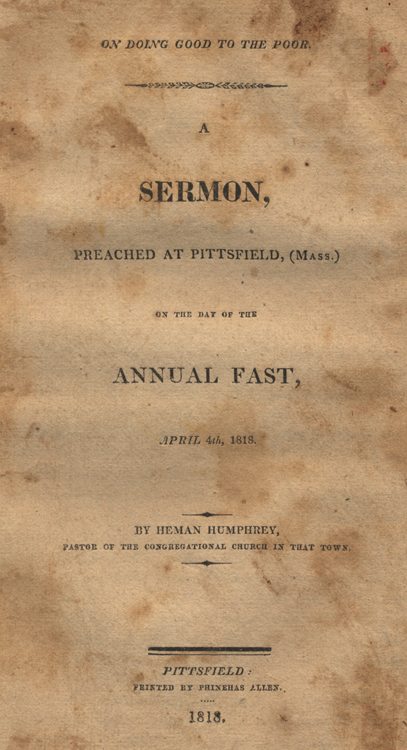

sermon-fasting-1818-massachusetts

ON DOING GOOD TO THE POOR.

A

SERMON,

PREACHED AT PITTSFIELD, (Mass.)

ON THE DAY OF THE

ANNUAL FAST,

APRIL 4TH, 1818.

BY HEMAN HUMPHREY,
PASTOR OF THE CONGREGATIONAL CHURCH IN THAT TOWN.


A SERMON.
Mark XIV. 7.

For ye have the poor with you always, and whensoever ye will ye may do them good: but me ye have not always.

The disciples of our blessed Lord drew upon themselves this sharp rebuke, by charging Mary with having wasted a very precious and costly box of ointment, which she had just poured upon his head. They regarded it as wantonly thrown away, whereas it might have been sold for a large sum, and distributed, to great advantage, among the poor. How many of the disciples united in this complaint, against the pious and afflicted Mary, we are not informed: but no one appears to have been so much disturbed as Judas. None of the company, he would fain have it believed, felt so much for the suffering of the indigent, as himself. Why was not this ointment sold for three hundred pence and given to the poor? This he said, not that he cared for the poor, but because he was a thief, and had the bag, and bare what was put therein. The motives of the rest were good, though their indignation was entirely out of place; but Judas was influenced by the basest of passions.

Far was it from the mind of Christ, to discourage liberality to the poor. They were the objects of his tender compassion. In his human nature, and as a poor man, he sympathized with them in their privations. He strongly enjoined upon his followers the giving of alms, as an essential evidence of love to himself; and this Christian duty is clearly implied, in the very reproof which we are now considering. The poor ye have with you always, and whensoever ye will ye may do them good: but me ye have not always. As if he said, Let the poor, by all means, share in your bounty. They are always with you, and may be relieved at any time; but I am about to be taken away from you. I must die for your sins upon the cross, and the time draweth near. Whatever is done for me, must be done speedily. This act of Mary is, therefore, a well timed testimony of her love and gratitude. She hath wrought a good work upon me. She is come aforehand to anoint my body to the burying.

This view of the text may serve to correct the mistakes of some, and to expose the covetousness of others, in regard to religious charities. It fully justifies those earnest and pressing calls, which are multiplying upon us, for aid, in evangelizing the world. The missionary cause is the cause of Christ, and he now regards every pious sacrifice, for the advancement of his kingdom, as a testimony of love to himself. As it was, however, when Mary anointed his head and washed his feet, so it is, even in this enlightened age of Christian benevolence. Some who stand by, are filled with indignation. They severely blame those, who cast their gifts into the treasury of the Lord. They regard all that is done for Christ, as no better than thrown away; and too many, there is reason to fear, like Judas, express the deepest concern for the poor, merely to hide their covetousness. The truth is, they care as little in their hearts for the poor, as for Christ; but they must invent some plausible excuse for withholding their offerings from the Lord; and not content with shutting their own hands, must complain of the prodigality of those pious women, who, like Mary, come forward, to testify their love for the Saviour. But, me thinks, I hear a voice from the excellent glory. Let them alone, they have wrought a good work upon me.

It is not my intention, however, to give you a missionary sermon on this occasion. I have another important object in view. Our text brings directly before us an interesting class of the community, whose wants and sufferings have, I am happy to find, recently excited strong public, as well as private commiseration. Nor, I hope, will the discussion, on which I am about to enter, be thought unappropriate to the present season of humiliation, fasting and prayer. “Is not this the fast, saith the Lord, that I have chosen, to loose the bands of wickedness, to undo the heavy burdens, and to let the oppressed go free, and that ye break every yoke? Is it not to deal thy bread to the hungry, and that thou bring the poor, that are cast out, to thy house? When thou seest the naked, that thou cover him: and that thou hide not thyself from thine own flesh?” If such are the duties which we owe to the oppressed and the indigent, when we fast and afflict our souls before God, no subject can be more appropriate this day, than the one which I have chosen. Ye have the poor with you always, and whensoever ye will ye may do them good.

In looking round upon these pitiable objects—visiting their cheerless abodes, listening to their complaints, and thinking of their privations, many anxious inquiries croud upon the benevolent mind. What can be done for their immediate relief? How were they reduced to this state of suffering and dependence? Is their poverty unavoidable and incurable? Might not some of them, at least, be put in a way to maintain themselves? What public provision ought to be made for their support? What should be the measure of my private benefactions? How much, how often, and to whom am I bound to give? Is there not some danger of increasing the evils of poverty, by the very means which are employed to relieve it? Does not the known liberality of a town, or a neighborhood, unhappily operate, in too many instances, as a premium upon idleness and profligacy? Is it not a fact, that some of the best meant efforts to cure the disease, serve only to spread the infection?

Such are the queries, which I doubt not, every week and every day, perplex the minds of thousands, whose ears are ever open to the cry of the poor and the forsaken; whose hearts devise, and whose hands execute liberal things.

If God should enable me, satisfactorily, to answer any of these questions; to throw but a little light upon the path of duty, and to excite proper dispositions towards the poor, in your minds and my own, I shall not have labored in vain.

In the further prosecution of my design, I shall

I. Consider the fact, specified by our Lord in the text. Ye have the poor with you always.

II. Point out some of the most common and alarming causes of poverty, in this country, particularly among ourselves.

III. Propose various methods of mitigating these evils, or of bettering the condition of the poor. And,

IV. Suggest motives and encouragements for a speedy, united and persevering course of measures, for the accomplishment of this great object.

I. Let us attend to the fact stated in our text, Ye have the poor with you always. This is a matter of universal experience and observation. It has been so from the beginning. History furnishes not a solitary exception, in any age or quarter of the world. Neither fertility of soil, nor healthfulness of climate, nor profusion of wealth, nor progress of science, nor encouragements to industry, nor legal provisions, nor penal statutes, nor charitable institutions, nor private munificence, have been found adequate to banish the evils and miseries of pauperism, from any country. On the contrary, poverty has sometimes made the most alarming progress, where the rewards of industry have been most liberal, and where the amplest provision has been made for its relief. The adventurous and enterprising spirit of modern voyagers and travelers has discovered new Islands and strange people, but which of them has found the Utopia, where poverty has no dwelling-place, where want claims no relief?

Look where you will, at the present moment, and you will find pauperism in many of its distressful and appalling forms. The great empires of the east, swarm with a degraded and beggarly population. Most of the large cities, on the continent of Europe, are filled with paupers, and besieged by squalid and clamorous hordes of mendicants. Ireland is overrun by the same unhappy description of human beings. And in England, it is estimated, that one million, five hundred forty-eight thousand four hundred, or more than one ninth of the whole population, are entirely, or partly supported by the poor rates. Nor can we, in this highly favoured land of liberty and plenty, boast of our exemption from the miseries and claims of poverty. Increasing multitudes, in our cities and large towns, are miserably dependent on the aids of charity, for their daily subsistence; and even in the country, we have the poor always with us. We meet them every where in our little excursions, and are almost every day besieged by their importunities.

Of the number and wants of the poor in this town, I can form no comparative estimate, between the present and former years: but it is agreed, on all hands, that the increase of pauperism, in our country at large, far out runs its increasing population; and I have reason to believe, that Pittsfield cannot be excepted from this remark. The expenses of supporting the poor in this place, are said to be steadily advancing.

Now what, my brethren, is the conclusion to which these alarming facts should lead us? Not surely to this, that the poor are to be utterly forsaken and forgotten. Nor to this, that every thing that is contributed for their relief, is worse than thrown away. Much less, are we to sit down in despair, concluding that poverty is a sort of malignant epidemic, which must and will continue to spread, in spite of every effort and precaution, till the great mass of our people shall become incurably diseased. Much may be done to alleviate present sufferings, and to mitigate, if we cannot wholly cure the distemper. With this hope and this purpose in view, it is our present business,

II. To ascertain, if we can, the causes of a calamity, at once so distressful and so threatening, that we may the better judge what remedies and preventives are necessary.

It might, on some accounts, be an interesting speculation, to go over the ground, with those English and Scotch writers, who have, within a few years past, discussed this subject with singular ability, in reference to their own country. But many of their wisest and profoundest speculations are irrelevant to our circumstances. The alarming increase of the evil in question, among ourselves, cannot, as in Great-Britain, be ascribed to the decay of manufactures; to the enormous burdens of taxation; nor to the want of sufficient territory, to afford scope for the enterprise of an increasing population. Leaving these points, therefore, to be settled by those foreign champions, who may choose to range themselves on the one side or the other, let us confine our attention to this rising western empire, the legitimate field of our present inquiries. In pursuing this course, however, let us not refuse to be instructed, by the operation of those general laws and principles, which have had time for a more ample development, on the other side of the Atlantic.

Were I called to address an audience, in one of our great cities, on the subject before us, I should not hesitate to number among the causes of this mighty drawback upon their prosperity, lewdness, in all its fearful and horrible resorts; and gambling, in all its forms, of cards, dice, billiards, wheels of fortune, lotteries and pawnbrokers. Nor should I think it right to pass unnoticed those packed cargoes of human flesh and blood, under the name of emigrants, which the cupidity of unprincipled men has lured from foreign countries, and disgorged upon our shores, without a shilling to support them in a strange land.

Happily, the wasting operation of these causes is chiefly confined within comparatively narrow limits. That they operate with some effect, more or less obviously, to a great extent, cannot indeed be questioned; but they are not the great and prominent causes of pauperism in New-England. It is our present business to inquire what these causes are. And,

1. In this highly favoured section of the United States of America, some are placed upon the list of paupers by unavoidable necessity. In this class we may reckon, from time to time, a considerable number of sober, prudent, temperate, industrious men, who, in the course of business; by the fluctuations of trade; by the failure or dishonesty of debtors; by the ravages of floods and fire, and by storms at sea, have been reduced, with large and helpless families, to extreme indigence.

Other persons, belonging to the same class are reduced by long continued and expensive sickness; by lameness, blindness, palsy, or other adverse providences.—While they had strength and ability to labour, they were industrious, frugal and comfortable. But every means of self-support is now cut off. What they had, in better days, laid up of their hard earnings, they have been obliged to expend, and now they must look to the opening hand of charity, as their only earthly resource.

Others again, who were barely able, by industry and good management, to keep themselves off from the town, while their strength lasted, unavoidably become chargeable in their old age. While some look to their children for support, in similar circumstances, alas! Nor sons nor daughters have they. These props have fallen one after another, and mingled with their native dust. The aged and desolate widow, struggled hard and struggled long, and suffered much, before a whisper of complaint escaped from her lips. But the decays of nature, the progress of infirmities, could not be hindered nor retarded. She was constrained to yield, and is now an interesting and helpless pensioner upon public or private bounty.

Now all those, who belong to the class which has been mentioned, I call the virtuous and respectable poor. To such, poverty is no disgrace. They have done what they could. They are still willing to do every thing in their power, for their own support. They have, therefore, the strongest claims upon the public, and upon our private charities. To let them suffer for want of necessaries, is cruel; and if this neglect should at any time be chargeable upon us, God will not hold us guiltless.

2. A partial want of capacity is, in some cases, the cause of extreme indigence. Men are not formed alike. While the calculations of some are always sagacious and profitable, others have not what is called the faculty of setting themselves to work, or of turning any thing to advantage. Every step they take is in a down-hill course. Their intentions are good, and they improve their talent as well, perhaps as their prosperous neighbours. But their talent is small. They are always in a state of dependence. Now, we may lament this. We may complain of these people. We may insist that they might do better. But it becomes us to pause a moment, and answer the Apostle’s question, “Who maketh thee to differ from another, and what hast thou which thou hast not received?” Surely those who are thus deficient in natural capacity, are objects of universal compassion, and are entitled to a comfortable maintenance, when from this cause alone, they are reduced to want.

3. Many, in the providence of God, are rendered incapable of labour, and even of self-preservation, by insanity. Of all human calamities, this is the most dreadful, the most appalling. Hunger, cold, watching; the distress of a fever; the pain of a broken bone; the loss of limbs, of sight, of hearing; the persecution of enemies; the treachery of friends; the walls and fetters of a prison: any, or all of these sufferings taken together, are not worthy to be compared with the loss of reason.—“The spirit of a man will sustain his infirmity; but a wounded spirit, and may it not be added, a distracted mind, who can bear?” Have you ever, my friends, heard the ravings of a maniac, and the clanking of his chains? Have you seen the distortions of his countenance; the hurried wildness of his eye; the frightful disorder of an immortal mind in ruins? What would you not rather be, than that object of terror and compassion, even if the wealth of the kingdoms was pledged for your support, and the humane efforts of thousands were constantly employed in your behalf?

What, then, think you, must be the condition of the distracted, who have no parents, or children, or brothers, or sisters, or friends, to watch over them, or even to supply them with food and raiment! O, what yearnings of compassion should we feel for such? How freely should we contribute for their support! What pains should we take to render their situation, in all respects, as comfortable as the nature of the case will permit. Let us, for a moment, if we can endure the thought, place our souls in their souls’ stead. What are the duties which we feel that our fellow-men would owe to us, if God should take away our reason, and cast us poor, friendless, distracted, upon their charity? “All things whatsoever ye would that men should do to you, do ye even so to them; for this is the law and the prophets.”

4. Some are reduced to extreme want, by their prodigality. They might have saved enough from their patrimony, or from their earnings, to have defrayed the expenses of sickness, and to have made them comfortable, if not independent, in old age. But having enough for the present, they were regardless of the future. They spent their substance in riotous living. They wasted the bounties of providence, fondly imagining, that “to-morrow should be as this day, and still more abundant.” But their resources were soon exhausted. While they were eating, and drinking, and making merry, and saying “soul, thou hast much goods laid up for many years,” poverty stood watching at the door. The sheriff was not far behind. Suddenly, houses, lands, goods, every thing passed into other hands; and the late prodigal possessors are now upon the town, supported in part, by those whose property they have wasted; by creditors, whom their prodigality has cruelly defrauded.

5. Pride sends its thousands to the alms-house every year. The foolish desire of imitating the wealthy, in their dress, in their entertainments, in their equipage, in their pleasures, proves the ruin of multitudes, who might always have enough and to spare, by living within their means. Their destruction is, that they cannot bear to be out-done. They must have as many parties, and as many dishes, and as costly apparel, as their more opulent neighbours. And to support all this, they are obliged to live beyond their income. They encroach upon their capital. They run themselves in debt. They mortgage their estates. Bankruptcy stares them in the face. Still, perhaps, they might retrieve their affairs. But their pride will not permit them to retrench their expences. Appearances must be kept up, as long as possible. At length the baseless fabric falls, or rather vanishes. There is nothing left of all this magnificence. Dreadful a the thought is, the poor-house must, in many cases, be their refuge, their only refuge.

Nor let it be supposed, that this destructive emulation is confined to the class immediately below the most wealthy. It prevails among all classes. Those who are sensible that they can never rival the first, are apt still to aim higher than they can afford; and in this way, not a few of the lower classes ar added to the list of paupers.

6. Idleness covers multitudes with rags, and reduces hem to extreme poverty. God has put the means of competency within their reach: he has given them health and strength. By the sweat of their brow they might eat their bread; but they set themselves to counteract the decree of heaven. They are the sluggards who will not plough by reason of the cold. What they possess is wasted for want of care. Every thing indicates neglect, and presages ruin.

“I went by the field of the slothful and by the vineyard of the man void of understanding; and lo! It was all grown over with thorns, and nettles had covered the face thereof, and the stone wall thereof was broken down. Then I saw and considered it well, I looked upon it and received instruction. Yet a little sleep, a little slumber, a little folding of the hands to sleep: So shall thy poverty come as one that travelleth, and thy want as an armed man.” But,

7. Intemperance is by far the greatest and the most horrible of all the causes of pauperism, in this country. If other vices slay their thousands, this slays its tens of thousands. It is the overflowing source of that mighty flood, or rather it is that fiery deluge itself, which threatens to sweep away all that is valuable to man. There can be no question, that it sends crowds to hell every year, while it also consigns an incredible multitude of bloated masses of pollution, and of broken-hearted wives and helpless children, to rags and beggary. The extent of its ravages would exceed all credence, were we not furnished with facts and estimates, which cannot be controverted. I have room only to exhibit the following.

In the fore part of 1816, it was stated in the report of the Moral Society of Portland, that out of 85 persons, supported at the work-house, in that town, 71 became paupers, in consequence of intemperance; being five-sixths of the whole number: and that out of 118, who were supplied at their own houses, more than half were of that character.

Again: In the winter of 1817, alarmed by the rapid increase of pauperism, the citizens of New-York appointed a very respectable committee, to inquire into the state of want and misery among the poor in that city, and to devise some plan to prevent, as far as possible, a recurrence and increase of these evils. A part of the report of this committee, is in the following words.

“If we recur to the state of the poor, from year to year, for ten years past, we find that they have yearly increased, greatly beyond the regular increase of population. At the present period, there is reason to believe, from information received from the visiting committees in the several wards, that 15,000 men, women and children, equal to one-seventh of the whole population of our city, have been supported by public or private bounty and munificence.

“In viewing this deplorable state of human misery, the committee have diligently attended to an examination of the causes which have produced such dire effects. And after the most mature and deliberate reflection, they are satisfied, that the most prominent and alarming cause, is the free and inordinate use of spirituous liquors. To this cause alone, may be fairly attributed seven eighths of the misery and distress among the poor the present winter; one sixteenth to the want of employment, owing to the present distressing state of trade and commerce; and the remaining portion, to circumstances difficult to enumerate, and which possibly could not be avoided.” Think of this!

But one sixteenth part of the poverty of a great commercial city, and that, too, during a period of peculiar embarrassment, owing to want of employment, and seven eighths to intemperate drinking! What a picture! And what would be the probable result, if similar inquiries were made in all our great cities and towns; if they were extended to every section of our country; prosecuted through all the wards of our alms-houses, and carried into all those abodes of poverty, whose tenants are partially dependant upon charity for their subsistence? Would not the result be calculated to fill the hardest heart with pity, and the stoutest heart with dismay? Let the inquiry, my brethren, be made among yourselves. I am a stranger to most of those, who are maintained at the public expense, or who depend on your private bounty. I am ignorant of their history, and of the causes by which they have been reduced. But I strongly suspect, that intemperance has contributed far more than any other single cause, to crowd your poor-house, and to multiply objects of suffering and compassion around you. I am now,

III. To propose remedies, to point out ways and means of bettering the condition of the poor. This is, by far, the most difficult part of our subject. It is incomparably easier to trace the calamities of human life back to their causes, than to cure them. Thus a neighbor is desperately sick, and we are at no loss, perhaps, to account for it; but the disease may baffle all the skill of the ablest physicians. Thus a man has kindled a slow fire in his own vitals, and we know when and where he did it; but how shall it be extinguished, and how shall others be most effectually guarded against this horrible species of self-murder? Thus, also, we see the poor; they are with us always; we hear their complaints; we know their wants; we can trace their downward progress from competency, perhaps from independence, to forsaken grey hairs and helpless infirmity.

But of all the problems which have exercised the ingenuity of great statesmen and distinguished philanthropists, in modern times, this appears to be the most intricate:—What are the best means of managing existing poverty, and what the surest preventives of pauperism? Human industry, and genius, and perseverance, have accomplished a thousand wonders. The circumference of this great globe has been measured. The phenomena of tides, and of winds also, to a great extend, have been explained. The great law of gravitation, which binds the Universe together, is now well understood. The distances, magnitudes and motions of the sun and his attendant worlds, have been ascertained, by the infallible rules of Geometry. Fire, and air, and water, and light, have been decomposed. A mild and certain preventive of the small pox, that terrible scourge of former ages, has been discovered. But who, after all the alarm that the increasing demands of poverty have recently produced, both in Great-Britain and our own country; who, after all the anxious thought which has been bestowed on the problem, and with the help of all that has been written up to this moment; who can pretend to be a perfect master of the subject? Who can point us, with a sure and steady aim, to the cheapest and most benevolent means of relieving present want, and of saving future generations from the burdens and sufferings of pauperism?

Have we then nothing further to do, in this great cause of humanity? Must we sit down in despair? Must all the fond desires and hopes of Christian philanthropy be given to the winds?

God forbid, that we should yield to this unchristian despondency. If we cannot accomplish all that is desirable , we may yet do something. If we should fail of satisfying our own minds, on every point, we may possibly gain more than we anticipate, and more than enough to pay for our trouble. Though we should not be able to strike out a single new path, who knows but we may improve some of the old ones? Let us do what we can, though much should be left for more enlightened minds to finish. Let us proceed as far as possible, and while we rest there, to gain new strength, let us “thank God and take courage.”

In theorizing on the subject before us, even wise and good men have often mistaken first principles; and hence the disappointment of their fondest hopes; hence the failure of their best endeavours to mitigate the evils of pauperism. They have not taken man as he is, a fallen depraved creature; naturally proud, indolent, evil and unthankful; but as he should be, holy, humble, industrious, conscientiously disposed to do every thing in his power to maintain himself, and thankful for the smallest favours.

It was once pretty generally supposed, and is still believed by many, that the existing ills of poverty might be cured, and the increase of it prevented, by generously and promptly feeding and clothing it. On this subject, men reason thus:—Here is a certain number of paupers and vagrant beggars, to be wholly maintained; and here are so many other poor people, to be supported, in part, out of the funds of charity. Now let us make our estimates accordingly, and then promptly follow them, with the necessary public and private appropriations. Let us generously feed and clothe the destitute, without discrimination. In this way we shall at once make up a given deficiency. We shall excite the gratitude of all whom we relieve. Our bounty will doubtless operate as a stimulus to future industry, by which many, who are now dependant, will hereafter maintain themselves; or, upon the most unfavourable calculation, should a burden equal to the present still remain, it will not, in the ordinary course of things, be augmented.

Such is the theory: but what is the testimony of facts? This seemingly benevolent plan has been tried, for a long course of years, and upon a great scale, in one of the most enlightened portions of the globe. It has also been tried, effectually, in many other places. But it has utterly disappointed the hopes and doings of charity. Many a well-fed beggar has, by proclaiming his success in the ears of the idle and unprincipled, induced ten men to embark in the same nefarious speculation. Many a charitable fund has operated as a premium upon improvidence and vice.

Many a soup-house has, to the sore disappointment of benevolence, proved a most efficient recruiting post for pauperism. The demands of poverty, in the city and in the country, have steadily increased. To meet these demands, charity has opened her hand wider, and still wider; and thus has she gone on, giving and hoping, till the poor rates in England, alone, amount to the enormous sum of seven millions of pounds, besides all her immense public and private charities: and till, within the space of eleven years, no less than 5000,000 of her citizens were added to the list of paupers!

The same result, though not so alarming in extent, has been experienced in many parts of our own country. It is now pretty well agreed, both at home and abroad, that benevolence has been all this while employed in a feeding a consumption; in throwing oil upon the fire which she would fain extinguish; and that if other means of cure cannot be found out, the case is hopeless.

Now, in this lamentable failure, there is nothing but what may be accounted for upon obvious principles.—Man, by the fall, lost the image of his Maker. He is totally depraved. Reason and conscience are dethroned and enslaved by passion and appetite. Restless as he is, labour and business are extremely irksome. Indolence and vice are his favourite elements. If he can gain a subsistence, however scanty and precarious, without the sweat of his brow, he will not work. It requires strong motives, and even pressing necessities, to rouse him to action; to make him industrious and frugal. I lay it down as a well established maxim, that no part of human industry is spontaneous. It is all the effect of habit, principle and necessity. Take any number of human beings you please, in a state of nature, and not one of them will betake himself to any regular and laborious employment, so long as he an subsist without it. Who ever heard of an industrious savage?

If you would raise up a generation of sots, and beggars, and banditti, try the experiment in your own families. Leave them to the impulse of their inclinations. Let them do as much and as little as they please. Ply them with no motives; employ m=no means to make them industrious. Let them never feel the stimulus of necessity; and where, a few years hence, would be your enterprising young men; your highly cultivated and productive fields; your trade, your domestic peace, you schools and your religion? Alas! How soon would idleness, profligacy, ignorance and barbarism demolish and sweep away all the memorials of virtue, intelligence and general prosperity. Take, then, but this single view of human nature along with you in the present investigation. Apply the remarks which have just been made, to the case in hand. First, make every allowance for the power of habit, the sense of shame and the influence of principle upon the minds of men, and how many still, if they find they can be maintained, or but half maintained, in idleness and tippling, will deliberately throw themselves and families upon your hands. Nor will the evil stop here. Make the poverty of such people honourable, or even tolerable, by your benefactions, and multitudes, who have hitherto supported themselves, will follow an example so congenial to human depravity.

Increase your charities, augment your gifts, and you add fuel to the fire. The calls of real distress will multiply faster around you, than you can possibly furnish means to relieve them. Establish a permanent charitable fund, to any amount; put half the property of the town into that fund to-morrow, and you will soon find more than enough, of an intemperate, starving and ragged population, to swallow up the income.

Such, my brethren, is human nature; and in all our plans for ameliorating the condition of the poor, we must take men as they are, and try to make them what they should be. A raging fever is not to be cured by stimulants. Poverty is not to be bribed away by costly and repeated presents. If you would cure the disease, you must have recourse to other means. You must purge out the morbid humors, and impart a new tone to the system. If you would prevent the further spread of pauperism, you must remove the causes of contagion.

With these things in view, let your attention be directed first, to the adult poor; secondly, to their children; and thirdly, to those great religious and moral preventives of needless poverty, which alone can stay the plague.

1. Let your humane attention be diverted to the adult poor. They are with you always, and whensoever ye will ye may do them good. Study to fulfill this duty in the largest sense. Endeavour to lay the foundation for their future comfort and usefulness, as well as to supply their present necessities; to make them respect themselves; to do good to their souls, as well as to their bodies.

The adult poor may be divided into three classes, viz. vagrant beggars, resident paupers, or persons who have formally thrown themselves upon the public, and a large class, who depend much on the occasional aids of charity.

It is a subject of general complaint in most of our towns, that they are exceedingly infested with vagrant beggars; most of whom are excessively filthy, clamorous, impudent and unthankful; and the question is, How ought these miserable objects to be treated? My answer is, generally, with frowns and a flat denial. This may sound harsh; but it is deliberately, and I hope kindly spoken. Experience has proved, over and over, a thousand times, that most of these disgusting fragments of humanity are arrant impostors. It is their trade to deceive the credulous, and to subsist upon the earnings of industry. They “will not work,” and therefore, “neither should they eat.” By feeding and clothing, and occasionally giving them money, you not only encourage them to continue their depredations upon society; but you inflict a lasting injury upon themselves. Where a beggar happens to have some shame and conscience still lingering about him, at the commencement of his career, these uncomfortable companions will soon be wholly discarded. And when all self-respect, when all regard for character is gone, what can you look for, from a depraved creature like man? What, but that he will “wax worse and worse,” will soon become the vilest of the vile?

Taking human nature as it is, we might safely pronounce vagrant beggary to be one of the most effective schools of immorality that ever was encouraged, even if experience and observation had not taught mankind a syllable on the subject. But a thousand facts, drawn from the history of mendacity, in various countries, might be adduced, to prove more than it could otherwise have entered into the heart of man to conceive. A few only will be given, as specimens, chiefly from Count Rumford’s interesting view of street-beggary, as it existed, about thirty years ago, in the principality of Bavaria.

“The number of itinerant beggars,” he says, “of both sexes, and all ages, as well foreigners as natives, who strolled about the country in all directions, levying contributions from the industrious inhabitants; stealing and robbing, and leading a life of indolence and the most shameless debauchery, was quite incredible. So numerous were the swarms of beggars in all the great towns, and particularly in the capital; so great their impudence, and so persevering their importunity, that it was almost impossible to cross the streets, without being attacked and absolutely forced to satisfy their clamorous demands.—These beggars not only infested all the streets, public walks and public places; but they even made a practice of going into private houses, where they never failed to steal whatever fell in their way.

“In short, these detestable vermin swarmed every where; and not only their impudence and clamorous importunity were without any bounds; but they had recourse to the most diabolical arts, and the most horrid crimes, in the prosecution of their infamous trade. Young children were stolen from their parents by these wretches, and their eyes put out, or their tender limbs broken and distorted, in order, by exposing them thus maimed, to excite the pity and commiseration of the public.

“Some of these monsters were so void of all feeling, as to expose even their own children, naked and almost starved, in the streets, in order that by their cries and unaffected expressions of distress, they might move those who passed by to pity and relieve them; and in order to make them act their part more naturally, they were unmercifully beaten when they came home, by their inhuman parents, if they did not bring with them a certain sum, which they were ordered to collect.”

Similar impositions and cruelties, we may well suppose, have elsewhere marked the ravages of this “overflowing scourge,” on the continent of Europe. To a most astonishing length has the predatory system of which I am now complaining, been carried in England, especially in and about the metropolis. To an amazing height has the audacity of the vilest miscreants proceeded, under the cloak of extreme poverty. It appears, from the report of a select Committee of the House of Commons, appointed to investigate the causes and extent of pauperism, that hundreds of hale and sturdy beggars, infest the streets of the capital, and occupy all the approaches to it by day; and that they have places of rendezvous in the environs, to which they repair at night, to make their report, and to riot and fatten on their ill-gotten spoils. Can the demoralizing tendency of practices like these, admit of a single doubt? If the grand object were to furnish victims for the gallows and tenants for the state-prisons; to train men to theft, robbery, murder, rape and blasphemy, could any more promising school of violence, pollution and blood be countenanced and patronized in any community?

I trust, brethren, that scourging and maiming helpless children, have not, as yet, attended the progress of mendacity in this enlightened and highly favoured country. But who can pronounce, with confidence, that these horrible enormities have not been practiced even here? Human nature is every where the same; and there is no philosophical truth more firmly established than this, that like causes produce like effects. If the system has not yet had time to develop all its haggard and diabolical features, in the United States, it is surely and steadily tending to the fullest maturity of sin and suffering.

Who does not know, that most of those loathsome, strolling wretches who infest our towns, are addicted to lying, swearing, drunkenness and theft. How many of them seem to take it for granted, that whatever you possess is theirs, and most outrageously abuse you, in your own houses, if you venture to deny them. How many of these insufferable drones and impostors have you found intoxicated, with the very money which you had given them to procure a night’s lodging at the public house. How often have they profanely assailed you with quotations from scripture, and dreadful imprecations of divine vengeance, when you have thought it your duty to send them away empty. Which of you would trust one of them alone, for a moment, in a room where you have any thing valuable that can be taken away? And are such impositions and abuses as these to be tolerated? Can we justify ourselves before God, in squandering upon these impious vagabonds what ought to be given away in real charity? No; let the harpies find, that what they get costs much more than it is worth. Make their nefarious trade as disgraceful and unprofitable as possible, and you will soon be freed from their impertinence. Let the same course be pursued every where, and I hesitate not to say, that it must produce a great blessing to the vagrants themselves. It will drive most of them to labour for their own support; and thus, while their best good is promoted, the public will be relieved from a most unreasonable burden. In the mean time, the few who are really incapable of self-support, will find their way to almshouses and other asylums, where they will, in general, be made far more comfortable than they are, or can be, in their present vagrant course of life.

Upon the whole, I am constrained, brethren, to give it as my deliberate opinion, that more than nine tenths of all that is bestowed upon itinerant beggars, in the shape of charity, is far worse than thrown away. It goes to feed a nest of vipers. It fearfully increases the evil which it is intended to relieve.

But here, benevolence may ask, what then ought to be done? Shall all these miserable beings be spurned from every door, and left to starve in the streets? No, my brethren, far from it. Your laws have made ample provision for their support; and under some of the best regulations, I believe, that human wisdom has ever devised. They have, in the first place, ordered to be built, in every county, “a house of correction, to be used and employed for the keeping, correcting and setting to work of rogues, vagabonds, common beggars, and other idle, disorderly and lewd persons.” To carry the provisions of the statute into effect, every justice of the peace is expressly authorized “to commit to the said houses of correction, all rogues, vagabonds and idle persons, going about in any town, or place, begging; also, common drunkards, and such as neglect their calling or employment; misspend what they earn, and do not provide for themselves and for the support of their families.”

Let every vagrant beggar, then, be reported to the nearest justice of the peace, and sent away immediately to the house of correction, where, if able, he may be compelled to labour for his own support. This course might be attended with some little inconvenience at first; but it would, I am persuaded, be the most effectual, and, in its operation, the most benevolent course that can be taken with common beggars. If any doubt, however, should arise in your minds, whether the stranger applying for charitable aid, ought to be ranked with such, direct him to the Selectmen of the town; and if, upon inquiry, they find him a proper object of their attention, let him be provided for as a state pauper. This would have a surprising effect. Not one in twenty would ever apply to the fathers of the town; for vagrants, of all men, hate the trouble of substantiating their claims, by any higher evidence, than their own declarations. Few of them are deficient in natural sagacity; and many are gifted with extraordinary shrewdness. They soon learn where they can prosecute their trade to the best advantage, and with the fewest embarrassments. Let half a dozen of them find that nothing can be obtained with an application to the Selectmen, and nearly the whole tribe will soon abandon any town, as a theatre wholly unfit for their operations.

2. The claims and wants of that class of the adult poor which I call resident paupers, next demand your attention. These, it is agreed on all hands, must be taken care of. They must be sheltered, and fed, and clothed. But how, where and under what regulations, are questions of considerable moment. The laws of this Commonwealth hold all the rateable property of each town solemnly pledged for the support of its own poor. Whether this is the best mode of providing the necessary funds, I shall not stop to inquire. It has, I am aware, recently been questioned by some very able writers. But we must take the law as it is; and perhaps it could not be altered for the better. It certainly manifests a very benevolent concern for those who cannot maintain themselves.

In providing for adult paupers, you should endeavour, as far as practicable, to make a distinction between the virtuous poor, and those of a contrary character; and to unite comfort, economy, reformation and prevention in your system.

There is no where, perhaps, a greater difference of character, than among paupers. The dependence of some, or rather the cause of it, is their deepest guilt and shame. They are self-destroyed. They have, in a sense, cut off their own hands. They have thrown their property into the fire, or what is far worse, have cast it into the bottomless gulf of intemperance. Now reason and religion seem alike to require, that a difference should be made between the precious and the vile. I think, my brethren, you will feel no hesitation in saying, that the sober and the virtuous are entitled to more aid, and deeper commiseration, than the victims of prodigality, idleness and still more shameful vices.

It may be difficult, perhaps, to hit upon the best mode of making those discriminations, at which I have just hinted; and it may be found more difficult to unite comfort, economy, reformation and prevention, in the management of pauperism. But I shall venture to suggest a few thoughts, for your serious consideration. And here my views accord so entirely with the provisions of admirable statute of this Commonwealth, passed in January, 1789, that I shall offer no apology, for making it the basis of my present remarks.

The act, in question, begins by empowering towns, either separately or conjointly, as may be most convenient, to erect work-houses within their respective limits, and to appoint overseers, whose duty it shall be, to order and manage these establishments, by making all reasonable and necessary by-laws, appointing masters, and committing all such persons as the law contemplates. The persons so liable, are thus described in the seventh section of the act. “All poor and indigent persons, that are maintained by, or receive alms from the town; also all persons, able of body to work, and not having estate, or means, otherwise to maintain themselves, who refuse, or neglect so to do, live a dissolute and vagrant life, and exercise no ordinary calling, or lawful business, sufficient to gain an honest livelihood, and such as spend their time and property in public houses, to the neglect of their proper business, or by otherwise misspending what they earn, to the impoverishment of themselves and their families.”

The statute then proceeds to enjoin the providing of all the requisite materials, tools and implements, for the use of those who may be sent to these work-houses; and explicitly requires, that all who are able to work, shall be kept diligently employed in labour, during their continuance there.

Here then, brethren, is a system prepared to your hands, and can you frame a better? If not, let a convenient house, with a small farm attached to the premises, be built, or purchased, at the expence of the town. Let every thing about the establishment be neat and comfortable. Let economy be studied, in the construction of rooms, stoves and fire-places. Let materials and implements be provided, so that all who have strength to do any thing, may be employed, either within doors or out. Let the establishment be placed under the immediate care of a discreet, humane, and if possible, religious man, with a liberal and definite compensation. Let him be instructed to take particular care of the sick, the aged and the infirm; and to require every person to do what he can for his own support. This is an essential part of the system. It is no kindness to the poor, to maintain them in idleness. It is injustice to the public; and is, moreover, a toleration which will inevitably increase your burdens, by inviting idlers to your alms-house, as a refuge from the sweat of industry.

In order to save all unnecessary expence, let the strictest economy reign through the whole establishment.—Let it be practiced in the purchase of provisions and fuel; in various experiments, to ascertain how the greatest quantity of nutritious and palatable food can be furnished, at the lowest price, and how it can be prepared at the smallest expence of fuel. This, you must be sensible, is not the place for more particular details. Let those who wish to pursue these hints, consult Count Rumford’s admirable economical essays, which are replete with entertainment and instruction.

Let the industrious and well disposed in your alms-house, receive every encouragement that the institution will permit: let all means of intoxication be religiously withheld from the intemperate. Let your establishment be a house of correction and restraint for the bad, while it affords a comfortable asylum for the deserving. Let it, also, as far as practicable, be made a school of moral and religious improvement. Fail not to furnish every apartment with bibles and tracts. Require all who are able, regularly to attend public worship. Let your clergyman consider them as a part of his charge; let him visit them often, and give them such religious instructions and advice as may be suited to their characters and circumstances. Let private Christians, also, as they have opportunity, labour for the spiritual good of these their indigent neighbours and acquaintance.

Perhaps the expences of such an establishment, including purchase money, might, for a few of the first years, be greater, than if the poor were annually and publicly cheapened under the hammer; though even this is questionable. But sure I am, that within a moderate period, the system would commend itself to the public, as the cheapest, and in all respects the best, that has yet been tried. It has been adopted, in all its essential parts, by many towns in this and a neighbouring State, and has been productive of the best effects. Let the example be followed here; let this admirable system have time to display its happy results, and I am persuaded it would effect a clear annual saving to this town of more than one thousand dollars.

The third class of adult poor, is made up of such as are not nominally upon the list of paupers; but still depend, more or less, upon charity for subsistence. With respect to these, the question of duty is oftentimes exceedingly perplexing. That some of them are real objects of charity, cannot be doubted. But why you, my brethren, should be required, or expected, to maintain the idle and the intemperate out of your sober earnings, is more than I can comprehend. It is true, that many of these wretches, (I cannot employ a milder term,) have families, which must not be left to starve. Of their children, I shall speak more particularly under the next head. But how shall we get over the present necessity? Shall we give, or shall we not give, to these next door neighbours to the poor-house? What are the duties which we owe them? An outline of my views, on this part of our subject, is contained in the following brief observations. It is a fundamental principle with me, that nothing should be done, which has a known tendency to encourage indolence or improvidence. It is of the first importance, that you should acquaint yourselves fully with the habits, character and circumstances of those whom you are called upon to relieve. In this way, you will find, that some evidently prefer charity to the rewards of industry. A strong, healthy person, well known in the town where I once resided, used unblushingly to give this reason for spending her time in begging, that she could get more by it, than by her labour. Many, I doubt not, secretly act upon the same principle; and from such persons every thing ought to be withheld, till stern necessity drives them to some honest calling for a living. The rule of the Apostle, already quoted, is plain and peremptory. “If any man will not work, neither should he eat.” Now if the idle have no right to eat, I have no right to feed them; for in so doing, I shall become, in some degree at least, accessory to their guilt.

Your aid, my brethren, to the necessitous around you, should, as far as possible, be afforded in the shape of encouragement to industry. This is the true way of doing good to the poor, who have any ability left of helping themselves. He that encourages and assists them to earn five dollars, is a greater benefactor, than if he had given them fifty out of his own pocket. By turning your attention to the subject, you will easily find various expedients for the encouragement of industry among that class of the poor of whom I am now speaking.

Sometimes employ them, even when you could do without their labour. Pay them generously and promptly for every thing they do, and frequently add some small gratuity. If they cannot go abroad, furnish them with the materials of industry at their own houses. If you find them faithful and honest, make interest for them with your friends. Strive to gain their confidence. Enter into their feelings. Assist them in laying out their money to the best advantage. Teach them how to make the most of a little. Inculcate the importance of cleanliness, economy and sobriety. Fail not to check the first symptoms of pride, or unnecessary expence in their own or their children’s dress. Hold up this before them continually, that if they expect help from you, they must help themselves; that they must not look to you for succor in sickness, unless they are diligent and saving in time of health. When the feeble try to walk, and cannot support themselves, reach them a helping hand. When their contrivance fails, contrive for them. Labour to inspire them with confidence in their own resources and efforts. Teach them to rely, under Providence, as much as possible upon themselves. Employ that ascendency, which their dependence upon your bounty and friendship can hardly fail to give you, for promoting their moral and religious improvement. Earnestly inculcate the duties of temperance, frugality, honesty, thankfulness to God for all his benefits, contentment under the allotments of Providence, and universal holiness of heart and life.

Let this course be judiciously and perseveringly pursued, and great good might certainly be done, with small means. By the blessing of God, not a few of the vicious might be reclaimed. To the hopes and exertions of the desponding, a new spring might be given, which would soon release them from dependence on their neighbours; and thus, instead of multiplying, this class of the poor would be diminished from year to year.

There may be some, indeed, on whom no salutary impressions can be made; men, with whom the abuse of your beneficence is a matter of calculation; men, who either earn nothing, or squander what they earn, under the impression, that when their families come to want, they will be supported by the hand of charity, and that they themselves shall enjoy a large share of their neighbour’s bounty. In the meantime, others of the same character, standing by and witnessing the success of this diabolical experiment, are induced to embark in the same speculation upon your sympathies, and in this way, the indiscreet bestowment of charity upon one undeserving object, may prove the indirect cause of impoverishing many families.

In cases like these, where human shapes are utterly lost to honour, and shame, and gratitude, and conscience, I can think of no remedy, but the strong arm of the law. Let not that corrective, then, sleep an hour in your statute-book. Let those worse than infidel husbands and fathers, who will not provide for their own households, be visited with the heaviest legal penalties, which the wisdom of your ancestors has provided, as a just retribution upon their heads, and a solemn warning to others.

From the preceding sketch of what is due to the adult poor, we pass,

2. To consider what can be done for their children.—Here, I think, the general course which ought to be pursued is plain. The children of the poor should be regarded equally with others, as rational, accountable and immortal beings; as equally with others, as rational, accountable and immortal beings; as equally capable of improvement in knowledge, in virtue, in holiness; as no unlikely candidates, under wise management, for wealth, and power, and influence. If your first object, therefore, should be to clothe their nakedness and satisfy the cravings of hunger, your ultimate views should be directed to more important and durable benefits. Upon your wisdom, union and perseverance, in regard to their education, using the term in its largest sense, almost every thing must depend. By proper management, they may become useful members of society, and even ornaments of the next generation. But should their education be neglected, what can you expect from them hereafter, but ignorance, vice and poverty? Let them all, then, be sent early to school. Let them be faithfully instructed in common learning, at the public expence. Let them, as early as possible, be placed in good families, where they may be well fed and clothed; where they may be trained up in habits of industry and sobriety, and where their minds may be early imbued with the principles of sound morality and true religion. Your laws have very wisely devolved this duty upon the selectmen, as overseers of the poor, and have constituted them the guardians and protectors of such children. But these overseers ought to be assisted in finding suitable places, by all who wish well to the poor, and who have a desire to promote the best interests of society. In order to give full effect to this benevolent provision, the pious and charitable must sometimes make a trifling sacrifice of present interest, by receiving poor children into their families, before they are old enough to earn their living.

I have no time, brethren, to fill up the outline of this plan. You will easily do it at your leisure. It has no claim to originality. Time was, when it was extensively pursued in New-England, and was productive of the best effects. O may that bright sun of better days speedily shine again upon the sons of the pilgrims!

It now only remains,

3. Under this head, that we direct our inquiries to those great moral and religious preventives of poverty, which alone can stay the plague. Without derogating, in the smallest degree, from the importance of foregoing topics, this must confessedly stand pre-eminent. It is always better, and generally much easier, to prevent evils, than to cure them. He who visits the sick, and administers consolation to the dying, when the yellow-fever is spreading desolation over a great city, does well; but he who effectually guards against the introduction of this terrible disease, or prevents it, by a timely removal of the causes of contagion, does better. If we have not been unprofitably employed, in contriving how to check the growth, and lop off the branches of a baleful stock, it is not, after all, like “laying the axe unto the root of the tree. It is not enough to show how needless pauperism may be kept within its present limits, or even very much contracted; we must, if possible, dry up the sources of this turbid and turbulent stream. Happily, all the requisite means are placed, by a kind Providence, within our reach. If we ultimately fail, it will be our own fault, and the fault of those who ought to co-operate with us, in this benevolent enterprise. The causes of poverty have been enumerated, and to these we must direct our earnest attention. We must raise a warning voice against prodigality, which, like a pitiless whirlpool, has ingulfed thousands of our countrymen, ere they saw or suspected the danger. We must do every thing in our power, both by precept and example, to discountenance pride and extravagance of every kind, as prominent causes of numberless attachments and sales at auction, followed by a long and melancholy train of houseless, supperless, broken-hearted families. It is especially incumbent on the wealthy, not to be extravagant in their dress, or their entertainments; as every thing of this sort has an extremely mischievous influence upon society. What though you may be able, without seriously feeling the expence, to entertain large parties, and feast them upon all the delicacies that can be purchased with money; your guests, your intimate friends, perhaps, can ill afford to return the civility. And must it not be unkind in you, (I have selected the mildest term) to raise the style of this kind of social intercourse so much above their reach, that they must either impoverish their families, to emulate your profusion, or receive you with a mortifying consciousness of the striking contrast between their tables and yours? What a mighty influence would plainness and frugality, in the higher walks of life, have, to check the growth of extravagance among all classes of men, and in this way, by removing the cause, to prevent much of the shame and many of the sufferings of poverty.

Again: As idleness is known to clothe such multitudes with rags, we must use every proper argument, and employ all suitable measures, to promote industry. As intemperance is seen to be the great cause of causes, by which humanity is disgraced and our poor-houses are crowded, we must direct our most strenuous efforts against this crying sin, this sweeping curse, this raging pestilence, this devouring conflagration, this horrible reproach of our land! We must consider whence we are fallen; must revert to first principles; must begin at the foundation. If all men were honest, sober, industrious, frugal and virtuous; if none were addicted to expensive and ruinous vices, it is certain there would be no unnecessary poverty. Whatever, then, has a tendency to prevent vice and immorality; to form good habits and good principles, must be a preventive of pauperism.

Education, (especially that part of it which is denominated moral and religious;) education is the great instrument by which, with a divine blessing, the next generation may be freed from most of the burdens and miseries which we now feel and witness. Yes, my brethren, God has put into our hands a more potent lever than Archimedes ever dreamed of; and the bible has discovered to us that other world, which he could never find, where we may place our machinery for moving this!

We must, then, unite our exertions, our prayers, and our influence, in the grand business of education. The infant mind is wonderfully susceptible. Moral impressions, either good or bad, will it receive, much earlier than is generally supposed; and it is our business, while we guard against wrong impressions, to sow the seeds of virtue and religion.

Childhood is the prime of spring. It is a short and critical period. It is the true golden age, which never returns. Government and subordination, moral and religious instruction, must commence in families. Parents must teach their children diligently, and must enforce their precepts by a corresponding example. Schools must be cheerfully and liberally patronized. Great care must be exercised in the choice of instructers; and they must be encouraged and supported in all their measures. Every teacher must be required to inculcate good principles upon the minds of his pupils, to make his school, if possible, a nursery of piety, as well as literature. The bible and the catechism must be restored to their place and use, both in the school-room and family. Children must be taught, from their infancy, to abhor falsehood, profaneness, drinking, gaming and every other evil habit. They must be faithfully trained up in habits of industry and economy. Idleness, at any age, is vice, and vice is ruin. Children must be taught to despise every mean and sordid action. They must be warned against associating with wicked companions; must be kept as far as possible from all the haunts of vice, and must be accustomed to seek enjoyment in that kind of society, where their minds may be improved, and every virtuous habit strengthened. Above all, they must be brought up in the fear of God. They must be taught to look up to him as their Creator, Preserver and Judge; to humble themselves before him as sinners; to believe on the name of his Son Jesus Christ; to take his word for their rule; to love their neighbours as themselves, and to lay up their treasures in heaven.

Let this course be pursued, my brethren, with the rising generation; let the preceding outline be filled up by parents, guardians, school-masters and ministers, and you will hereafter have very few candidates for the poor-house. Take this plain course, and by God’s blessing, your children will be sober, industrious and comfortable, in their worldly circumstances. Your sons will walk with the wise men and will be wise, and not with fools, whose “end is destruction, whose God is their belly, who glory in their shame.”

They will shun and abhor the dram-shop, as they would the mouth of the lion, or the embraces of a serpent. They will be the “crown of your gray hairs,” instead of “bringing them down with sorrow to the grave.” They will be “eyes, and feet, and hands to you, when those that look out of the windows are darkened, and the strong men bow themselves.” In the time of sickness, they will watch over you with filial affection; will support your heads and close your eyes in the hour of death; will bedew your clay with no ambiguous tears, and will bless your memory.

Think not, my brethren, that this is the baseless fabric of a vision. It is but a plain, unvarnished sketch of the blessed effects of a virtuous and pious education. “Train up a child in the way he should go, and when he is old, he will not depart from it.”

But chiefly owing to former neglects, one thing further is necessary, to remove the existing causes of pauperism, and save our children from the contamination to which they are now exposed. The laws against vice and immorality must be executed upon such, if any such there are, as will not be reformed by milder means. There are evil habits which must be corrected; bad examples which must not be tolerated; inroads upon our moral and religious institutions which must no longer be winked at. The laws against tippling, swearing, gaming and Sabbath breaking, must be executed, with a prudent, but steady and determined hand. Against intemperance especially, every friend of God and man must boldly lift up his voice, and exert all his influence.

The cries of starving and shivering families against dram-shops, and other similar resorts, in every part of our land, have long since gone up to heaven; and they must no longer die away unheeded, upon human ears. These gates of hell must be closed, locked, bolted, barred and covered with death’s heads, flames and furies!

I say, my brethren, there must be one grand and united effort, for the support of all that is dear in society, and to prevent the increase of those intolerable burdens, which idleness and profligacy have everywhere, almost, imposed upon virtue and industry. Let the excellent laws of this Commonwealth be awaked, if they have been left to fall asleep: Let them rise in their majesty and their might, and your poor rates will soon be diminished more than one half; and in the place of rags, and dirt, and hunger, and cold, you will find cleanliness, sobriety and competence. Yes, my brethren, every moral, religious and legal preventive of poverty, which has been named, or omitted, must be employed, with a humble reliance on the blessing of God, and the work will soon be done.

It is no new system, which I have proposed for the prevention of pauperism. I plead for no dubious experiments. I only request that you will “stand in the way, and ask for the old paths.” It is not left for us to digest a system of education, adapted to the genius of a free government, and calculated to diffuse the blessings of science, virtue and religion through the whole community. Such a system was matured and in successful operation, long before we were born.

Our ancestors have not devolved upon us the difficult task of framing, in a degenerate age, all the necessary laws for the punishment of evil doers, the prevention of crimes, the encouragement of sobriety and industry; and whatever else is essential to the well-being of society. Almost every thing is prepared to our hands, and has come down to us from our ancestors, the pious fathers of New-England. I need not say, how much those illustrious founders of our happy republic have been ridiculed and vilified, as weak, and bigoted, and fanatical, by some of their puny and degenerate offspring. But I will say, without fear of contradiction, that they were higher from their shoulders and upward, than their tallest revilers: that there were men among them, who, for rectitude of principle, soundness of judgment, largeness of views, and piety of heart, would not suffer in comparison with the wisest and best legislators of any age or country. The whole world may be challenged to produce a code of laws, which, for the government of a free and enlightened people, can be compared, for one moment, with those which they bequeathed to posterity.

It is wonderful to observe, in their early statutes and institutions, with what prospective, I had almost said prophetic sagacity, they guarded against almost every danger, civil, political, moral and religious, which might menace the security and prosperity of their descendants. Had the laws which they framed been faithfully executed; had their noble spirit proved hereditary; had their “mantle” fallen upon their children, and then upon their children’s children, vice would never have gained its present alarming ascendency. The evils and sufferings of poverty would have been comparatively few and light. It is by degeneracy that we have brought upon ourselves these heavy burdens, and that we stand exposed to still greater evils. We have stood by, with our arms folded, and permitted the enemy to make wide breaches in our walls; to drive our sentinels before them, and to overawe the whole garrison. Let us now, at length, arise, expel these “armies of the aliens;” build up these breaches; adhere steadily to the principles and measures of our forefathers, and we shall reap a rich harvest of public and private blessings.

We have only to repair the machinery which our ancestors have bequeathed us; to brush away the cobwebs and rub off the rust, which have accumulated through disuse; to put and keep the wheels and springs in motion, and the reformation, which every good man prays for, will follow almost of course. It now only remains,

IV. To suggest motives and encouragements for a speedy, united and persevering course of measures, for accomplishing so important and benevolent a design. But what shall I say? I have scarcely room left for a bare enumeration of these interesting topics. They present themselves in every view which can be taken of the subject, and press upon the considerate mind, with an urgency, which admits of no delay. They appeal to your interest, to your philanthropy, to your “bowels and mercies,” to your consciences, to your affections, and indeed, to every feeling, to every principle, which ought to govern a rational and benevolent mind.

If the means which have been pointed out for bettering the condition of the poor; for stimulating them to exertion, by the honours and substantial rewards of industry; for affording prompt and adequate relief to the helpless; for clearing our streets of profligate beggars; for compelling the idle and intemperate to maintain themselves; for educating poor children and placing them in good families: if these means are all brought, by a kind Providence, within your reach, then you cannot neglect them,, without incurring the guilt of outraging both humanity and benevolence. If you have it in your power to dry up so many sorrows, to remove so many causes of pauperism, by your exertions and example; if the moral and religious preventives of this wasting and spreading disease are placed, by a merciful God, in your hands, will you not hold yourselves solemnly bound to unite in every proper measure for warding off evils so many and so terrible, and for the attainment of blessings so desirable to the present generation, and so important in their future consequences.

Think of the difference between a sober, industrious, moral, religious, well-educated and prosperous people, and an ignorant, unprincipled, unpolished, drinking, quarrelsome, stupid, idle and beggarly population. Consider what it is that makes this immense difference, and surely you cannot fail of being impressed with the overwhelming importance of our subject. Do you, then, my brethren, pity the poor? Have you any compassion for those who are past feeling for themselves; who are eagerly sacrificing their food and raiment, their reputation, their health, their consciences, their bodies and their souls on the altars of Bacchus? Have you any feeling for their broken-hearted wives and suffering children? Are your hearts affected with what your eyes see and your ears hear? Does the love of Christ constrain you? Has the bible any influence upon your minds? Then you will not be “forgetful hearers, but doers of the word.” You will unite heart and hand, in persevering exertions to better the condition of those who are now dependent upon the aids of charity, and to bring into full operation those moral and religious preventives, which have been pointed out in this discourse. “Blessed is he that considereth the poor: the Lord will deliver him in time of trouble. The Lord will preserve him and keep him alive, and he shall be blessed upon the earth: and thou wilt not deliver him unto the will of his enemies. The Lord will strengthen him upon the bed of languishing; thou wilt make all his bed in his sickness.”

What shall I say more? Look a moment, brethren, at the heavy bearing of this subject upon taxation. This is one of the smallest evils attendant upon the alarming prevalence and rapid increase of needless pauperism. But even this, I think you will say, is no trifle. See how it affects your property. Fifteen hundred, or two thousand dollars annually, is no small sum for a town, containing 2600 inhabitants, to pay for the support of its poor. Possibly one third of this sum is necessary, to maintain such as have been reduced to want by sickness, derangement, unavoidable losses, and other adverse circumstances. What becomes of the other two thirds; of one thousand dollars, at least, paid every year out of your hard earnings? I need not stop to answer so plain a question. Go to the poor-house, and ask from the beginning to the end of the alphabet, How came you here? Go to the grog-shop, and if you can hold your breath long enough, count up the mysterious marks upon the walls and the shelves.

And will you continue to pay this enormous tax? If you suffer things to go on in their present course, you must pay it, with ten or fifteen per cent. In addition, every twelve months. You may remonstrate and put off, but there is no relief. The day of settlement will come, and the collector must be satisfied.

Have you seriously thought of the subject in this light? Do you consider, that almost every idler and drunkard in the community, is a public pensioner? Are you sensible, when you see men reducing their families to want, by tippling and its attendant vices, that you have got to be four-folded, for all this waste of health, and time, and property? Do you know, that while a man is drinking up his own estate, he is every day lessening the value of yours? That while you stand by and calmly look on, he is actually laying a mortgage upon every foot of your lands, which neither you nor your children can ever pay off? This whether you realize it or not, is capable of mathematical demonstration. Dram-shops are kept up at your expence. The revenue of those who subsist by dealing out ardent spirits to hard drinkers, is indirectly drawn from your pockets. You will find it charged to you, with heavy interest, in the rote-book. The intemperate are constantly running you in debt without your consent. They are doing it from day to day, when you are at work, and from night to night, while you are asleep. And are you willing to be taxed in this way, for that which does you no good; and to have these accumulating burdens entailed upon your posterity? I know you are not, and I have pointed out the means of relief.

“Choose ye this day” what you will do; whether you will endeavour to “make the tree good, that its fruit may be good;” whether you will go to work in earnest, to lessen the evils and expences of existing poverty; whether you will faithfully test the efficacy of those preventives on which I have insisted, or whether, “despairing of the Commonwealth,” you will flee before increasing swarms of foreign beggars and resident paupers; and thus exchange the blessings of industry, competence, education, social enjoyment and religious order, for hunger and nakedness, ignorance and profligacy, idleness and ruin.

I do not say, that you can banish poverty from your borders, or that you ought to attempt it. “Ye have the poor with you always;” and this is wisely ordered, no doubt, that you may have opportunity to show your gratitude to God, and your compassion for suffering humanity, by giving to him that needeth. Sickness, and other adversities, will bring their well substantiated claims to your doors; but these, presented in behalf of the virtuous and deserving poor, will be few, in comparison with those which are now arrogantly preferred, by lying vagrancy and resident improvidence.

Thus, brethren, have I deliberately given you my sentiments, “without partiality and without hypocrisy,” on a subject which I conscientiously regard, as immensely important to this community. You will judge how far the views which I have expressed, and the arguments which I have adduced, are worthy of your consideration. I am aware, that ingenuity, stimulated by jealousy, and sharpened by privations, may easily misconstrue some parts of this discourse. Idleness and intemperance will most certainly complain of the preacher, as unfriendly to Christian liberality. But I am sure no just occasion has been given for such a charge. God forbid, that I should utter a syllable, to discourage real charity; to close a single hand against the deserving poor. I have, on the contrary, appeared, in the integrity of my heart, as their friend and advocate, upon the broadest principles of justice, humanity and religion. I have pointed out a course of measures, the adoption of which, I firmly believe, would at once prove signal blessings to the poor, and relieve the community from a heavy and most unreasonable burden.

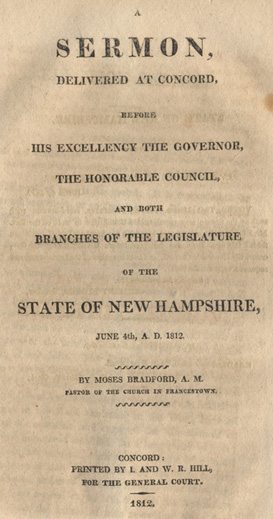
Sermon – Fasting – 1814, Massachusetts


Elijah Parish (1762-1825) graduated from Dartmouth in 1785. He was the pastor of a church in Byfield, MA (1787-1825). This sermon was preached by Parish on the fast day of April 7, 1814.


sermon-fasting-1814-massachusetts

A

DISCOURSE,

DELIVERED

AT BYFIELD,

ON

THE PUBLIC FAST,

APRIL 7, 1814

BY ELIJAH PARISH, D.D.

A DISCOURSE, &c.

EXODUS 5. 17, 18.

BUT HE SAID, YE ARE IDLE YE ARE IDLE; THEREFORE YE SAY, LET US GO AND
DO SACRIFICE TO THE LORD.
GO THEREFORE NOW, AND WORK: FOR THERE SHALL NO STRAW BE GIVEN
YOU, YET SHALL YE DELIVER THE TALE OF BRICKS.

That evil exists in the world, requires no proof. That tyranny and despotism are not among the smallest evils, which afflict the family of man, will be generally allowed; yet from the days of Nimrod to Napoleon, the earth has trembled under the iron foot of her tyrants. Their swords devour more than the pestilence; streams of blood follow their course; the sighs of the nations, and the tears of the world, are extorted chiefly by their oppression. The greater part of the windows, and the orphans, and the poor, and the miserable, and the dying, execrate them as the authors of their woes. Nor is this ferocious despotism peculiar to one form of government; whatever government is worst administered is worst. The Republics of Rome and Venice, and perhaps another, which alone exists, have been as oppressive as the despotism of Turkey, of Persia, or Japan.

Nor is it the least among the proofs of a divine superintendency, that great “good is often educed” from these political evils. Had not the barbarous despotism of Egypt extorted tears of blood and sighs of desperation, from the posterity of Jacob, they might possibly, till this day, have been the slaves of her servile princes, the vassals of her imported Mamelukes, repairing the cities, which their fathers built, plowing the fields, manured with their fathers’ bones. The sons of Israel were passionately attached to their union with this ancient Dominion. They and their fathers had been in the country about two hundred years. 1 They no longer had any predilection for the country of their forefathers nativity; they preferred the turbid Nile, to all the waters of Canaan; the plains of Egypt, to all the hills of Judea. So rooted were their attachments to their present connection, notwithstanding their oppressions, that Moses, who knew them well, so despaired of rousing them to demand their independence, that he said, “They will not hearken to my voice.” So it happened. After he had called on them, to redress their grievances themselves, instead of writing petitions; to act, instead of making melancholy faces; they met him, and said, “Ye have made our name to be abhorred;” “ye have put a sword in their hands to slay us.” You frighten us, and you will ruin us, by your bold preachments. “So they hearkened not unto Moses, for anguish of spirit and for cruel bondage. The political measures, which Moses urged, appeared rash and violent. Moderation was the popular doctrine; it therefore, became necessary that God in His providence should afflict, and distress, and ruin them, by the abominable measures of their government, to render them willing to adopt suitable measures for their own advantage.

To mention some of Israel’s oppressions, noticing any points of resemblance in our own country, which may happen to occur, and suggesting some happy results of those oppressions, is the present design.

I. I am to mention some of Israel’s woes.

1. The exactions and hard services of the government were among the evils endured by Israel. They were compelled to build the cities of Pithom and Raamses, to which it is thought, have succeeded Damietta and Cairo; They were probably compelled to raise the pyramids, those stupendous wonders of the world. These grievous hardships wore out their strength, exhausted their patience, and blasted their hopes. Exod. 5. 11. 13, 14. Their labours were, as various, as they were oppressive. The object of their tyrants was, not merely to enrich or aggrandize themselves; but to discourage and break down the spirits of Israel, to change the state of society, to bend their sturdy minds, to new modes of employment. Therefore, they made them serve in mortar, and brick, and in the field. New manufactures were, probably, established; or old ones extended. In the fields they might dig canals from the river, or carry out manure, while the pyramids demanded the greater part of their time. These, though externally, coated with stone, are partly of brick, just such brick, as the Israelites made, having straw or stubble, incorporated with the clay. Accordingly history informs us, that Sesostris, whom a learned writer 2 supposes to be the Pharaoh of scripture, caused it to be inscribed on all his great works. “No native Egyptian labored on this.” If strangers performed these labours, who so probably as the enslaved Israelites? Taskmasters were set over them; princes of burdens, it may be rendered. The laws were unjust; the manner of executing them was barbarous. Josephus says that his countrymen were forced to dig canals, to raise walls, to build the pyramids, and finally, that they were forced to learn all sorts of mechanic arts. It is therefore, an old scheme of cunning Tyrants, to drive their people from commerce and agriculture, to engage them in manufactures. This enfeebles their powers of body and mind, and makes them fit for slaves, and tools of despots. Therefore, the daring sons of Abram were no longer permitted to sail on the “Great Sea” to “the mart of nations, whose merchants were princes.” They were not allowed to navigate the Red Sea; nor to bring spices and all precious things from the East.

I do not pretend to discover any likeness between the Pharaohs of Egypt, and the Presidents of America. If all intelligent hearers perceive a surprising resemblance, between their laws and measures, I pray you to remember that Pharaoh was raised up to afflict, to punish, and ruin his wicked country; our rulers are chosen, and approved by the people. They are, therefore, pronounced honorable men. Would any people choose Pharaohs to crush and ruin their best hopes?

2. Another grievance of Israel was, their hopes of domestic felicity were blasted; their sons were torn from them. This order of the Egyptian government argues, that they had lost all the sentiments of humanity, that they sported with the rights of their subjects, that they must have been the terror of the people and the scourges of God.

“But why is this introduced? Has anything resembling this taken place in this Christian country, of chosen Rulers? Has any little Moses been heard weeping on the river?”—Ye, who make these enquiries are abundantly able to return the answer. Concerning two unprincipled and profligate laws, judge ye, which is the most infamous and abominable. With the balance of truth and candor in your hands, say then, which is the most horrible law, that which consigns an infant offspring to the tomb; or that which declares an offensive war, against a whole nation, which involves all the people of your own country in the guilt and calamities of war; which drafts your sons by thousands and hundreds of thousands, to march against a friendly province, commanding them to murder and destroy, and probably to be slain or perish themselves? Which law is most terrible, that which puts in jeopardy a part of the infants in one nation; or that, which puts in jeopardy all the people of two nations, which lets loose the sword and conflagration, with their attendant evils, famine, terror and pestilence in two countries?

It is conjectured by the learned 3 that the law of Pharaoh, against the male infants of Israel, did not take place, till after the birth of Aaron, and was repealed soon after the birth of Moses; or else 80 years after, the males could not have amounted to 600,000 able men. It is also the united opinion of Commentators and of the learned in general, that this edict was repealed at the death of the king, who first published it, which they suppose happened 4 years after the birth of Moses, and that it never was executed to any great extent. This is made certain by the scripture history; the agents appointed to execute the law were rebuked for their neglect, and God rewarded them for disobeying the wicked law. The law perhaps was originally restricted to the vicinity of the court; and therefore, only two midwives were sufficient to execute the law. This demonstrates, that the law extended only to a very small district. But our Rulers have given commission, not to two women, two feeble women, but to the whole veteran armies of Britain, with their navy of a thousand ships, to murder, burn and destroy New England. A thousand times as many sons of America have probably fallen victims of this ungodly war, as perished in Israel by the edict of Pharaoh. Still the war is only beginning; if ten thousand have fallen, ten thousand times ten thousand may fall. Say then ye, who are wise; ye, who are considerate, whose calamities have been the most terrible, the sons of Jacob, or the sons of America? Whose Rulers have been most greedy of blood? Which people have had most cause to adopt measures of relief?

3. The petitions of Israel, and their manly remonstrances, were treated with neglect; they produced no effect, but to multiply their vexations and burdens.

“Then the officers of Israel cried to Pharaoh; Wherefore dealest thou thus with thy servants; ye say to us, make brick; behold thy servants are beaten; but the fault is in thine own people. (But he said,) ye are idle, ye are idle, Go, therefore now and work; for no straw shall be given you; yet ye shall deliver the tale of brick;” and the officers of Israel did see, that they were in an evil case; after it was said, “ye shall not minish aught from your bricks of your daily tasks.” “They did see that they were in an evil case.” This required no wizard eyes, long before; yet they could reproach Moses, for attempting their emancipation.

Unhappy Israel, had thy father Jacob anticipated such a result; had he forseen these miseries of his posterity, had he seen your ignominious, servile endurance, would he have left his native country? Would he have united his interest with Egypt? Would he not rather have starved in Canaan? The petitions had been respectful and pathetic; yet they provoke increasing vengeance; they pull down increasing calamities. At first they only excluded them from their usual occupations, requiring them to build one or two cities for the NATION, for the public good. Then they made them serve with rigor, in mortar and brick rearing those lofty tombs of their kings, or temples of their gods. Then they sent them into their fields to dig ditches. Then they made war upon their sons; and last of all, deprived them of straw, with-held their means; yet would not lessen the demands of government. Such is the process of despotism; she begins with little; like the grave, she takes all. Was ever a savage yell more terrible, than a tyrant’s voice? “Let the people gather straw where they can find it;” so the people were scattered through the land. Those who had been shepherds, learned to burn brick; the sailors joined the army; the merchants went to build cities; others dug clay. These were the fruits of their petitions. Such is always the fruit of petitions to a mercenary, venal government. They are a society organized for mischief. “To abandon usurped power, to renounce lucrative error, are sacrifices, which the virtue of individuals has on some occasions, offered to truth; but from any society of men no such effect can be expected. The corruptions of a society, recommended by common utility and justified by universal practice, are viewed by its members without shame or horror; and reformation never proceeds from themselves; but is always forced upon them by some foreign hand.” 4 You may as well expect the cataract of Niagara to turn its current to the head of Superior, and rush over the western mountains, as a wicked Congress to make a pause in the work of destroying their country, while the people will furnish the means. Not their petitions; but their march to Canaan, relieved the woes of Israel, and instantly stopped the work on the last pyramid, which has not been finished to this day.

With what puerile simplicity, then is it asked. “Will not the peace in Europe, or the dastardly conduct of our armies, give us peace?” No. Our disasters are a part of the original scheme. It was never intended, nor wished, that the Canadas should be subdued. Look at your officers; look at your soldiers, the clippings and parings, and refuse of humanity. Was it ever expected that these miserable beings would make conquests? Ye would as soon expect an army of caterpillars to mow down your forests. What is the peace of Europe to your Rulers? Should the English now be at liberty to send all her armies, and all her ships to America, and in one day burn every city from Maine to Georgia, your condescending Rulers would play on their harps, while they gazed at the tremendous conflagration. They would make this a new argument to carry on the war with new alacrity.

No peace will ever be made, till the people say, “There shall be no war.” If the rich men continue to furnish money, the miseries of war will continue till the mountains are melted with blood; till every field of America is white with the bones of the people. 5 Equally childish are your hopes from the effect of your petitions. Let the towns and the Counties and the States, continue to petition and petition, till all the paper in the land is consumed, it will not alter one vote in Congress. For years the wagons of government have groaned with your petitions, and remonstrance’s, and supplications. The tables of Congress have shuddered , under the woes of New England. Thousands and thousands, and tens of thousands of the independent merchants, and farmers, and other people, who had never before asked petition of any man, have humbly bowed before the national government, have humbly recounted their miseries, have humbly suggested the easy mode of relief, have anxiously implored relief, with a pathos, which might have moved the cold ear of Death. What has been the effect? Precisely the same, as at the court of Pharaoh. Tyrants are the same on the banks of the Nile and the Potomac, at Memphis and at Washington, in a monarchy and a republic. Petitions are the means, and the hope of children. As well may the solitary pilgrim in the desert of Sahara petition a horde of wild Arabs, not to plunder his bread and his water, as the sons of the pilgrims petition their masters of the South. As well may the shrieking vessel petition the howling winds not to drive her on the rock of the billows; as well may the terrified inhabitants of the Canadas implore the Christian barbarians of the South, not to burn their fair villages, their pleasant homes, and their temples. Happily the day of petitions has passed away.

A principal effect of all your petitions has been to convince you, that your first sufferings were light. They were a serpentine rivulet; they now are a mighty river. If ye were then vexed to madness, what will ye do in these swellings of Jordan? Non-importations, and restrictions have been added to non-importations and restrictions; open war has been added to secret machinations, and ye have approached the highest point in the tremendous climax of human despotism. Without a license, the boat of the fisherman, the more humble canoe of the hermit, may not leave the cavern of his rock, to seek his daily support.

But these restrictions are, or will be repealed.”—Undoubtedly. Who does not know this, as certainly as that your oppressors have cunning and treachery? Were they to persevere, they, and their laws, and restrictions, would be cast to the moles and the bats. They will, therefore, suspend, and they will alter, and they will change the mode of despotism; yet all is despotism still. The very relief shows the barbarism of their system. They now tell the farmer, he may drive his team, and not be assaulted; the fisherman, that he may row his boat, and not be sunk by their artillery; the traveller, that his trunk is now free from search; the bride, that she may convey her choicest furniture to her home, it shall not be broken by the axe of their strolling officers; that all may sleep, and not be alarmed, by the midnight ghosts of administration.” What is this, but saying, “We claim the RIGHT of taking away these comforts; we justify our late barbarous laws, which subjugated you to these vexations. These shall overwhelm you again, like the tide of the ocean, when it shall be our sovereign pleasure.” 6

The government have opened their Pandora’s box, and every plague, which comes forth, is more terrible than his fellow. What may next appear, from their lake of miseries, scares the imagination to conjecture. Will martial law be proclaimed through the land? Will a conscription like that of France take place, as has been threatened? Will gangs of hired assassins, called soldiers, patrol your streets, rouse you from your midnight slumbers, burst open your doors, abuse, and wound, and scourge, and terrify your families? These things have already been done without law.

Deliver us, oh ye Rulers, of a submissive and dispirited people; deliver us from this dreadful uncertainty. Give us a law, though written in blood, though written by the finger of despotism, that we may know when to open our houses to midnight prowlers of the government, when to be silent under the point of their bayonets, when to open our bosoms to the daggers of a ferocious soldiery, that we may hear the cheering voice of tyranny, saying, “Hitherto I will come, and no further.” Though this law should command us to submit to grossest indignities, to fall down before the petty tyrants, who are the golden images of the administration, or to admit them to enter our bed chambers, like the frogs of Egypt, we shall submit; we have submitted. That we can endure despotism with as much meekness and silence, as the slaves of the grand Seignior, has been demonstrated by a long course of experiments. His subjects believe, that insult and death from his hand, is a privilege, is martyrdom. They covet the favor, as a title to immortal felicity. How many of our country now glory in the infamy and misery of aiding the government, in those very measures, which are not only destroying the country, but depriving themselves, and their families of employment, of property, and of bread! Some have thus demolished large estates. Like Sampson they have willfully pulled destruction on their own heads. We have seen an opulent merchant persevere in this mad infatuation, till he has petitioned the town; yes, till he has petitioned the town for the base privilege of a pauper. The base privilege has been granted him. Thus, like the worshippers of Moloch, the supporters of a vile administration, sacrifice their children and families on the altar of democracy. Like the widows of Hindoostan, they consume themselves; like the frantic votaries of Juggernaut, they throw themselves under the car of their political idol; they are crushed by its bloody wheels.

Vexation upon vexation, misery upon misery, infamy upon infamy, have resulted from your petitions to the government. At first they interdicted certain articles of commerce, from certain countries; then they interdicted all foreign commerce. Your petitions were like clouds wafted to Washington by every wind; like clouds they produced nothing, but a more dismal storm, a more frightful prospect. An offensive war was openly declared. Again petitions persecuted the palace; all commerce was interdicted, or every boat, and wagon, and trunk of a solitary traveller, was subjected to search and plunder. This law is now executed by brutal soldiers, sword in hand. Not only your ships, but your boats, your teams, and yourselves, as to any object of traffic, unless you will expose yourselves, to the artillery of government, are chained, as fast as the slaves of Algiers. The full viols of despotism are poured on your heads; and yet you may challenge the plodding Israelite, the stupid African, the feeble Chinese, the drowsy Turk, or the frozen exile of Siberia, to equal you in tame submission to the powers, which be.

Forgive me, forgive me, my friends, though I thus speak, it is not the language of reproach. Your obedience to law is your merit, your glory. Your patience is not the patience of fear; your gentleness is not the torpor of insensibility; your silence is not weakness; it is not cowardice, NO. Your patience is magnanimity; your silence is conscious strength; your obedience is moral habit, is religious principle, supported by religious ordinances. These principles and ordinances, though they are the scorn of your oppressors, have saved their laws from contempt, their officers from deserved violence; their whole system from insult and outrage. They, with their imported Secretaries and patriots, raised an insurrection, rather than pay a tax on their intemperance; the sons of the pilgrims pay a tax for their bread; yes, thousands and thousands yield up their bread, and their common means of support with manly silence; but there is a point; there is an hour, beyond which,——you will not bear——

II. We were to suggest some of the advantages, which resulted to Israel from these immense oppressions of their government.

Their separation from the Ancient Dominion, who had oppressed them, was the great, the grand result of their political miseries. In this event were involved blessings, too great to be described, blessings too numerous to be named. By this, they were freed from their former bondage. They bid farewell to the brick kilns and ditches of Egypt. Their merchants never again raised the walls of her cities, nor grew dizzy on the top of their towering pyramids. But here for once the parallel fails. The people of New England cannot separate themselves from the country of their oppressors. The Atlantic will not open us a passage; no Canaan flows with milk and honey for us. If we leave our fields, and towns, and temples, looking to the west, though no Anakims appear on the mountains, nor are their cities walled up to heave, nor have we heard the fame of their valor; yet do we not behold the sons of violence and rapine? In their neighborly quarrels, are not “their hair and beard clotted stiff with gore,” Do you not hear their dismal howlings for blood, more blood? Will the sons of New-England give up their traffic, and their homes, to dwell with the ferocious hordes of Kentucky and the West. NO. Here we must trample on the mandates of despotism; or here we must remain slaves forever. But, I may specify a few happy effects of Israel’s sufferings. Possibly some future Columbus, on a voyage of political discovery, may devise some means of making our miseries produce permanent blessings. Some political galvanism, yet to be discovered, may heal the infectious pestilence, which is wasting the vitals of the Commonwealth.

1. The oppressions of Israel introduced a better government, better adapted to their character.

They had endured a perpetual conflict with their superiors in power. Their collision of interests had become intolerable to the sons of Jacob. What gave wealth and ease to their oppressors, ruined them. These sections of the community had been like two dark and furious clouds, ascending the hemisphere. In their union, they disgorge their thunders, and shake the world; but Israel was the sufferer, the tributary, a mere attendant, bearing the burdens of the government, while denied the blessings. Her sons no longer sailed on the great sea, nor on the Red Sea; but were deafened by the eternal rattle of her dismal manufactures. These measures of government were as fatal to the prosperity of Israel, as were the ten plagues to Egypt. Israel had submitted to the unlimited control of Pharaoh, a proud infidel, a despiser of religion, a profane scoffer at divine things. He neither knew, nor cared whether there were one God, or twenty Gods; but when Israel separated, Jehovah became their Legislator and King. They had been vexed and scourged by petty tyrants, tools of government; now they were under the pious guidance of Moses and Aaron. “Their nobles were from themselves, and their governors proceeded from the midst of them.” They had been the creatures, and tools, and engines of a government, in confederacy against God and his cause; they now combined all their power and resources to exalt their Savior; They persevered in the great design, till they had passed the wilderness of Arabia; till they had crossed the channel of the Jordan; till they had subdued their enemies; till they had reared the temple on mount Zion; till their millions had covered the hills of Canaan; till their laws, their customs, and their religion, were established from the banks of Euphrates to the river of Egypt. Such were the fruits of their miseries and vexations in Egypt. It was necessary, that they should sigh under the rod of oppression, to wake them from their political lethargy, to dispel their prejudices in favor of the union, under which their fathers had enjoyed repose and prosperity, to provoke them to seek a better government; to inflame them to noble darings, in bursting the bonds of oppression; in dissolving their connection with the merciless slave holders of the country. Well might they sing; “Partial evil is universal good.” But alas, we have no Moses to stretch his rod over the sea.****No Lebanon, nor Carmel, nor Zion, invites us across the deep.***

2. Another immense advantage, to Israel from dissolving their union with Egypt, was an escape from the fatal contagion of infidel examples.

Though the body of the Israelites might have but little connection with the body of the Egyptians, still there must have been a constant intercourse, dangerous to all, and fatal to many. The nature of the case, and subsequent events, in their zeal for Egyptian idolatry, demonstrate all this. Though, not as judges, and legislators, and advocates, many persons must have been at the court of Pharaoh, if it were only to bear the sighs and tears of the people, before the throne of their tyrant. Here they must witness a thousand instances of impiety; they must see the first man in the nation neglect all the forms of religion. They must be tempted with bribes, and a thousand nameless enchantments of an opulent court. Returning home, these men would bring pestilence and death to the tribes of Israel. Some of the most unprincipled and profligate supporters of the administration would be appointed collectors of the revenue. These would poison the country with the spirit and vices of infidelity.—–Many of the laws breathed oppression, and provoked to crimes. By these and other means, wicked examples were greatly multiplied. Roused by the vexations, they endured, their chains fell off, and they escaped this danger of irreligious examples; they separated themselves from this land of mischief and crimes.

Though it is a law of your nature, that the general spirit of the community be transmitted to the distant members; though distinguished individuals, diffuse their spirit, however base, in the community around them, I certainly do not present the fact as matter of information, that a black cloud of infidelity hangs over the south. It cannot be criminal in one to mention what is publicly known to all. If the late President, the sage of Monticello, proud of his infidelity, has employed Printers to publish his contempt for the writings of Moses; if he has pronounced the universal deluge an impossibility; if his successor has given the whole nation every possible reason, except his public avowal, to believe that his deism is, as fixed as the ice of the poles; if his profanations of the Sabbath, if his common, his habitual, his notorious neglect of public worship, are, as complete evidence, as the most candid confessions, that he has no part nor lot in Him, who was crucified on Calvary, and rose from the tomb of Joseph, is it strange, that a swarm of scoffing infidels should darken the country, where these exalted personages reside? The approach of that region to paganism may be inferred from the riot of their Sabbaths, from their falling temples, the small numbers of their churches, and the smaller number of their Pastors. Do you not fear that this virulent impiety will by degrees be extended to all sections of the country, which are under the same government, and swayed by the fatal policy of the same men?

Those, who are in the least acquainted with history, sacred or profane, well know, that the irreligious character of Rulers, like the atmosphere of Java, carries poison and death through the land.

Here again you may envy the privilege of Israel, and mourn that no land of Canaan has been promised to your ancestors. You cannot separate from that mass of corruption, which would poison the atmosphere of Paradise; you must in obstinate despair bow your necks to the yoke, and with your African brethren drag the chains of Virginia despotism, unless you discover some other mode of escape.

3. Israel’s woes in Egypt terminated in giving them the fruit of their own labors. This was a powerful motive for them to dissolve their connection with the Ancient Dominion. Though their fathers had found their union with Egypt pleasant and profitable; though they had been the most opulent section in Egypt; yet since the change of the administration, their schemes had been reversed; their employments changed; their prosperity destroyed; their vexations increased, beyond all sufferance. They were tortured to madness, in seeing the fruit of their labors torn from them, to support a profligate administration. Instead of laying up corn, and silver, and gold, as once they did, they were no longer their own masters. With the money, which they earned, they were not permitted to pay their own debts; but the debts of the ancient dominion. After they had paid the debts of others, they were still in debt themselves. If they paid money, sufficient to build navies, and construct roads, and other great works, these were not for themselves; but for their lordly tyrants, or the money was wasted by bankrupt officers, before it reached the treasury, and often devoted to projects of folly and mischief. If they were compelled to pay taxes, to build forts and support armies, neither the forts, nor the armies were for their defense. They became discouraged; they were perplexed. Moses and others exhorted them not to despair, and assured them that one mode of relief would prove effectual. Timid, trembling, alarmed, they hardly dared to make the experiment. Finally; they dissolved the union; they marched; the Sea opened; Jordan stopped his current; Canaan received their triumphant banners; the trees of the field clapped their hands; the hills broke forth into songs of joy; they feasted on the fruit of their own labors. Such success awaits a resolute and pious people.

Is there any thing? Whereof it may be said “See, this is new? It hath been already of old time. Say then, ye who are best acquainted with the state of the country, is a course of abominable oppression, not unlike that of Egypt, bearing down New-England, and tearing from her mouth the fruits of her own labors? In the Southern States, are costly roads made? Are post offices supported? Are fortifications erected? Are armies paid? Are princely salaries enjoyed? Are palaces reared in royal splendor, from monies, chiefly paid in these commercial States?

Enquire, examine whether of the national expenditure for twenty years, the proportion of Virginia, according to her population and representation in Congress, be not more than thirty one millions, while she actually paid only thirteen millions, exonerating herself at once of eighteen millions. On the other hand, the proportion of this Commonwealth was twenty millions; but such were the taxes on your laborious industry, that instead of 20, you actually paid more than forty millions. 7 Again in the year 1791, the proportion of the public debt, belonging to Virginia was nearly eleven millions. The income of her revenue since that time, so far from paying any part of the principal would have fallen short of discharging the interest, by almost thirteen millions; but by sharing the revenue from your labors and dangers, all this interest has been paid for her, with nearly half her principal, making a profit to her of eighteen millions. Massachusetts has sacrificed these immense portions of her labors, for the privilege of belonging to the UNION; for the privilege of embargoes, and war, and all the privations and miseries, which she has endured. Had Massachusetts only received the fruit of her own toils, her fortifications and other means of defense might have been rendered formidable; and she might have built from twenty to thirty ships of the line. What a glorious union for Virginia! You have saved her from bankruptcy; you have built her fortifications, maintained her armies, paid her expences of government. Have you learned to sympathize with her imported slaves? Your labors go into the same purse; you virtually support the same masters; you generously lend your help to those miserable beings, who blacken their fields; you help them in paying for those luxuries, those costly mansions; those splendid equipages, and those prancing chariots, which you never saw. Is not all this right? You are healthy and vigorous; they are feeble and delicate. You are poor, or in moderate circumstances; they are rich in lands and slaves. You are compelled to labor hard, to submit to frugality, and endure a thousand privations; they move in splendor, and riot in voluptuous pleasures. You toil in a cold, and barren country; they enjoy a delicious climate, and a richer soil. Is it not pleasant to obey such lords, to minister to the pleasures of such a happy race? What a blessing is a Union with such delightful masters! No wonder, if every man in New-England preaches in favor of the Union! Resume your labors then; to pay their expences, hew down your forests; drag your masts from the snowy mountains; launch into the ocean; buffet the storms……………. “Is the preacher distracted? If a spy of government be present, we may all be accused of treason.” If you pass yonder Cape, you may probably never return; the boats of government are more fatal than all the cruisers of the ocean.

The Israelites were compelled not only to labor; but to labor, as their masters commanded, in mortar and manufactures; so must you. Go not then to the water’s edge; go not to the East; go not to the West; go not to the North; this is “towards the enemy.” Hasten, hasten, home; purchase you a wheel, a distaff, and a spindle, and wool, and flax, and spin with thy maidens. If death be more desirable; then follow the banner of the tremendous Dearborn; force your way through the forest to the Canadas; AND THERE DIE, as ten thousands have before thee, to feed the wolves of the north. Whether your vexations, are more or less intolerable, than those of Israel, ye are able to judge.

They became weary of yielding the fruit of their labors to pamper their splendid Tyrants. They left their political woes; they separated. Where is our Moses; Where is the rod of his miracles? Where is Aaron? Alas! No voice from the burning bush has directed them here. Bow then to the publicans of government, and say to the humble African, “Thou art my brother.”

4. The woes of Israel, and her subsequent separation from Egypt, relieved them from being involved in her judgments.

To escape the judgments, which are decidedly coming on a wicked nation is a mighty deliverance. Individuals may escape their demerits; communities cannot; communities do not exist in a future state. Accordingly those communities, which are peculiarly wicked, are punished as such; the members of such a body politic, though relatively innocent, are at least partially involved in their punishment.

Lot suffered the loss of his house, his goods, his cattle, and a part of his family in the fire of Sodom. Noah and his family, merely from living in the same world, with a wicked generation, though not included in the most dreadful part of the sentence, endured undescribable distresses. Giving up his former pursuits, laboriously engaging in the building of the ark, anticipating the destruction of his house, his fields, and the world, what must have been the anguish of his spirit. Collecting his household, at the door of the ark; seeing the dark clouds arise; the hemisphere wrapped in darkness; the lightening blazing; the thunders rolling, how dreadful the scene. As the waters rise, the ark floats along the vale. As the waters rise, his neighbors ascend the higher ground; they hail the lordly ark; they implore relief; they entreat; they beseech the patriarch to receive them on board; they plead and weep; they stretch forth their hands, when their voices are lost in the howlings of the storm. The door is shut, and there is no room. Who can imagine the distress of the Preacher, in his last words to his perishing neighbors. Confined a whole year in the dismal mansion with fowls and beasts, driven at the mercy of the winds, over the towering billows of the world; no friendly port in view, no friendly sail to be spoken, totally uncertain on what mountains top he might strike, on what rock he might dash, must it not require all his faith in God, to calm his own fears, to soothe the terrors of his afflicted family? Such were the evils of being connected with an impious people. Israel had by a series of miracles escaped the judgments of Egypt; but they could not expect miracles always to be performed for their security. They, therefore, separated; they burst their chains, and escaped the judgments, which were filling the land with horror.

What is the moral aspect of our nation? Has not New-England, as much to apprehend, as the sons of Jacob had? But no child has been taken from the river to lead us through the sea: yet are not a million slaves, a million “souls of men” bought and sold in the markets of the south? Are not the tears and miseries of a million souls daily crying to the God of justice to hasten the day of retribution? Will they cry in vain? Are the same people unitedly supporting the Antichristian power of Europe? Are they fighting her battles, and must they receive her plagues? Must not those States, which remain united with them, whatever may be their individual character, share in their punishments? When the day of retribution comes, and come it will, the whole community, however extensive, just bend before its terrors. If God shall send the sword, her crimson terrors will not be arrested on thy borders; but echo from thy hills, and reverberate across thy valleys. Should the angel of pestilence be commissioned, he would not only visit the south, but the North; lover and friend would be put far from thee. Should Famine say, “Here am I; send me;” the pale messenger would blast the fruits of thy grounds, snatch the bread from thy mouth: the morsel from the little hands of thy sons, thy daughters. If judgments are coming on the nation; if the sea does not open thee a path, where, how, in what manner will you seek relief? No Moses—no Canaan—no separation. Finally:

To conclude the subject, we discover the malignant nature of American democracy. Democracy, is the Author of all the Egyptian misery and mischief, endured in the land. Our political sufferings are entirely different from those of other nations. In other quarters of the globe, tyrants entrench themselves, behind the shields of their standing armies. But here the people themselves produce their own calamities, defend their own tyrants. They intrigue, they vote, they petition, for the continuance of their embarrassments, and their poverty, and their distresses. Yes, when their clamors and their votes are not sufficient, and when the sober part of the country send their petitions, and spread their grievances, before the thrones of their Masters, the men of democracy come forward with counter petitions, and beseech, and implore the government not to relieve the sufferings of the country, not to restore the nation to its former affluence and prosperity. They pledge ‘their sacred honor’ and lives to support the most baleful measures. These are the men, who forge the chains for themselves and their country. Were a fair statement of these facts made in a distant country, it would be considered an irony, a satire, a burlesque on humanity. But when a thousand Gazettes, and a million votes have confirmed all this, what must be the astonishment. The relation is believed, merely, because it is impossible to disbelieve. When Israel were sighing under their hard bondage, and Moses and his adherents were constantly making application for relief, what would have been thought, had an unprincipled, savage party been plying Pharaoh with counter petitions, beseeching him not to furnish straw, entreating him not to lessen the tax of brick, and pledging their infamous honors to support his abominable measures? Precisely such is the temper of American “republicans,” so called. A new language must be invented, before we attempt to express the baseness of their conduct, or describe the rottenness of their hearts. Has such a barbarous infatuation ever prevailed before? Divines had described a dreadful depravity among the sons of Adam; but divines had not described, nor conceived such a depravity. Where could they have found facts to support such a theory? Robbers and banditti have not destroyed themselves, to crush their associates; tigers do not mangle their own flesh; nor do fallen spirits with all their malice towards their companions petition for the increase, or continuance of their torments. Where is the man, forging chains for himself and posterity? Him have I offended.

2. God governs the nations for great and good designs. He controlled the affairs of Egypt, the affairs of Israel. Egypt was infatuated by her power and prosperity to crush the Israelites, and to drive them to a separation. The Israelites by those oppressions were roused to independence, and prepared for the highest prosperity: the best country, and the best civil polity in the world. The fame of their wisdom, their skill in the sciences, and their immense traffic, travelled through the world. Awed by the valor of their legions, and the impetuosity of their cavalry, distant tribes sued for peace, and the noise of battle ceased. Their merchants caught the gales of remotest seas, and silver was abundant in Jerusalem, as the stones of the hills. Princes came from the ends of the earth to admire the splendor of the court, and the felicity of the subjects. God continues to raise up other Pharaohs; their hearts are hardened against reason, and persuasion, and sound policy; and though it is not in their heart, neither do they think so; yet we know that the morn of light and glory will burst from this political darkness. Therefore,

3. Let us bear our public calamities with submission to the will of heaven.

God will bring good from every evil. The furnaces of Egypt lighted Israel to the land of Canaan.

Though a terrific cloud hangs over our land; though it may drown your fields in blood; God may be about to accomplish a glorious purpose. The book of providence is a sealed volume; nor may the wisest angel open the mysterious leaves. When the days of Israel were bitterness, and their nights terror, did they believe that those evils would result in their emancipation from an abandoned government? Yet, so it was; and perhaps these were the only means, that could have roused that people, to assume their independence. What dismal reflections must have torn the bosom of Pharaoh, surveying the miseries, which he had occasioned. “I have ruined my kingdom; I have destroyed myself.” What must be the reflections of our exalted President, in the silence of retirement? “While I have made myself great, I have ruined my country. Her morals, her affluence, her cheerfulness, are gone. To feed my friends, I have kindled the fires of war. Burning villages, and dying soldiers, are the monuments of my glory. Ten thousand wretches in the agonies of death have poured their curses on my name. I am steeped in blood. History will hold me up to the execration of the world; not a triumphant murderer, like Pizarro or Attila, but like Pharaoh or Absalom, a mere blunderer in the science of blood. Had I loved my country, as I love my office, I should not have been the scorn of the universe.”

We live, my brethren, in a most eventful period. The whole Christian world are standing with their swords drawn. Our country, hungry for blood, is ambitious of making a figure in this boundless scene of destruction; she is trying, and striving, and panting, to lift a sword; but as the Hebrews, waging an offensive war against the Amalekites, when the Lord was not with them, were vanquished and driven back with shame; so are our armies led into captivity, and vanquished, and driven back.

Should the navies and armies of Britain invade New-England, could the general Government defend you one day? Would not your beautiful towns vanish in a blaze? Could the standing army prevent an invading foe from marching where they please? The armies of government are “as a thread of tow, when it toucheth the fire;” New-England, if invaded, would be compelled to defend herself. Do you not then owe it to yourselves, owe it to your children, and owe it to your God, to make peace for yourselves? Will you rush to the combat, when you dare not ask the blessing of heaven? Will you crimson your fields with the blood of your sons, merely because your Rulers have commenced the contest, merely because they find their advantage in your miseries? Will you perish to please your oppressors? Where then are you ministers of peace? Although the sword of the foe has not drunk the blood of the valiant; nor have the sons of the mighty been led into captivity; although the legions, who move to this iniquitous war, will find no bard to make them renowned in their day, to raise the song of mourning; nor to relate their deeds to other times; although for the perpetual disasters of the camp, “no sighs arise with the beams of the east; no tears descend with the drops of the night;” yet is this war most calamitous. It calls for shame and pious sorrow; it calls for supplication and grief of soul, that Heaven in anger should punish us with such men of blood, to rule the nation. Passing events seem to indicate that God intends to purify the earth, not with a flood of water; but a deluge of blood. Blessed are they, who understand the signs of the times. He that taketh the sword shall perish with the sword. He that leadeth into captivity shall go into captivity. He that killeth with the sword, must be killed by the sword. Those, who engage in a murderous, offensive war, shall have blood to drink, for they are worthy. They have had blood to drink. Woe to the inhabitants of the earth, and of the sea, for the devil is come down to you, having great wrath; because he knoweth, that he hath, but a short time.

The Lord cometh out of his place to punish the inhabitants of the earth. The earth shall no more cover her slain. The stars are falling; the moon is blood; He taketh the sun in his wrath, and hideth him in his clouds. The great day of his wrath is come, and who will be able to stand?


Endnotes

1. For an explanation, see the comment in Henry, Scott, or Clark, &c. on Exod. 12, 40.

2. Mr. Whiston.

3. Dr. A. Clark.

4. Dr. Robertson.

5. Probably the country has distinctly pronounced. “Peace shall be made;” i.e. the rich have refused to trust the government. This class of men may have peace when they please. An army cannot breathe a week without their aid.

6. Accordingly Mr. Madison’s paper already boasts of “the rigor” with which the law has been executed, “as an assurance” “of complete effect” should there “be a resuscitation of this system.” Thus our lords talk concerning the resurrection of the goblin, before she is buried or even dead. A more puerile spirit was never manifested than the exultations, because the late afflictive system is suspended. A measure of dire necessity, which tortures every nerve of the rulers. As well might the martyrs of the Inquisition sing hosanna to their tormentors in the moments of respite from the rack or burning stake.

7. See Learned Essays of Calculator in the Columbian Centinel.

Sermon – Ordination – 1817


Lyman Beecher (1775-1863) graduated from Yale in 1797, having studied theology with Timothy Dwight (the president of Yale). He was ordained in 1798. He preached at: the Presbyterian Church in East Hampton (1799-1810), the Congregational Church in Litchfield, CN (1810-1826), the Hanover Street Church in Boston (1826-1832), and the Second Presbyterian Church in Cincinnati (1832-1842). Beecher also served as president of Lane Seminary in Cincinnati (1832-1852).

This sermon was preached by Lyman Beecher in 1817 in Boston on the Bible as a law book.


sermon-ordination-1817

The Bible a code of Laws;

A

SERMON,

DELIVERED IN PARK STREET CHURCH, BOSTON,

SEPT. 3, 1817,

AT THE ORDINATION OF

MR. SERENO EDWARDS DWIGHT,

AS PASTOR OF THAT CHURCH;

AND OF

MESSRS. ELISHA P. SWIFT, ALLEN GRAVES, JOHN NICHOLS, LEVI PRSONS, & DANIEL BUTTRICK,

As Missionaries to the Heathen.

BY LYMAN BEECHER, A.M.
Pastor of a Church of Christ in Litchfield, Conn.


“There are many of the prevailing errors of the present day, which I cannot with any patience see maintained to the utter subversion of the Gospel of Christ, with so high a hand, and so long continued a triumph, when it appears so evident to me that there is no foundation for any of this glorying and insult.” Edwards.


SERMON.
 

PSALM XIX. 7, 8, 9, 10.—“THE LAW OF THE LORD IS PERFECT, CONVERTING THE SOUL: THE TESTIMONY OF THE LORD IS SURE, MAKING WISE THE SIMPLE: THE STATUTES OF THE LORD ARE RIGHT, REJOICING THE HEART: THE COMMANDMENT OF THE LORD IS PURE, ENLIGHTENING THE EYES: THE FEAR OF THE LORD IS CLEAN, ENDURING FOREVER: THE JUDGMENTS OF THE LORD ARE TRUE, AND RIGHTEOUS, ALTOGETHER. MORE TO BE DESIRED ARE THEY THAN GOLD, YEA, THAN MUCH FINE GOLD; SWEETER, ALSO, THAN HONEY, AND THE HONEY-COMB.”

We have, in this Psalm, a concise account of the discovery made of the glory of God, by his works and by his word. “The heavens declare his glory, and the firmament sheweth his handy work.” But these disclosures of the heavens, “whose line is gone out through all the earth, and their words to the ends of the world,” though they illustrate the glory of Jehovah, and create obligation, and discover guilt; are not sufficient to restrain the depravity of man, nor to disclose an atonement for him, nor to announce terms of pardon, nor to sanctify the soul.

But the Law of the Lord is perfect. Adapted to the exigencies of the lost world, it speaks on all those subjects, on which no speech is heard from the heavens, and is attended with glorious efficacy. It converts the soul; it makes wise the simple; it rejoices the heart; it produces a fear of the Lord, which endures forever; and to all who have felt its sanctifying power, it is more precious than gold, and sweeter than honey.

The text, then, teaches us to regard the word of God as containing the laws of a moral government revealed for the illustration of his glory in the salvation of man.

In discoursing upon this subject, it is proposed

I. To illustrate the nature of moral government; and,

II. To show that the Scriptures are to be regarded as containing a system of moral Laws, revealed to illustrate the glory of God, in the salvation of man.

A moral government is the influence of law upon accountable creatures. It includes a law-giver: accountable subjects: and laws intelligibly revealed, and administered with reference to reward and punishment. To accountability in the subjects are requisite, understanding to perceive the rule of action; conscience to feel moral obligation; and the faculty of choice in the view of motives. Understanding to perceive the rule of action does not constitute accountable agency. Choice without the capacity of feeling obligation, does not constitute accountable agency.—But the faculty of understanding, and conscience, and choice, united, do constitute an accountable agent. The laws of God and man recognize these properties of mind, as the foundation of accountability.—A statue is not accountable; for it has no faculty of perception or choice: an idiot is not; for, thou he may have the faculty of choice, he has no competent understanding to perceive a moral rule, nor conscience to feel moral obligation; and a lunatic is not; because, though he may have choice and conscience he has not the unperverted exercise of his understanding.

The faculties, then, of understanding, conscience, and choice, constitute an accountable agent. Their existence is as decisive evidence of free agency, as the five senses are of the existence of the body; and nothing is inconsistent with free agency, or annihilates the evidence of its existence, which does not destroy one or more of these faculties of mind.

Law, as the medium of moral government, includes precepts and sanctions intelligibly revealed. The precept is directory; it discloses what is to be done.—The sanctions are influential; they present the motives to obedience included in the comprehensive terms of reward, and punishment. But, to have influence, the precepts and the motives must be presented to the mind. The law in all its parts must be intelligible; otherwise it is not a law. A law may be unknown, and yet be obligatory, when the ignorance is voluntary; but never, when it is unavoidable. The influence of law, as the medium of moral government, is the influence of motives upon accountable creatures; and the effect of this influence is always the actual exercise of free-agency in choice or action. The influence of motives cannot destroy free-agency; for it is always the influence only of persuasion, and results only in choice, which in the presence of understanding and conscience, is free-agency. If there were no objects of preference or aversion exhibited to the mind; there could no more be choice or free-agency, than there could be vision without external objects of sight. Direct irresistible impulse, moving the mind to action, would not be moral government; and if motives, in the view of which the mind chooses and acts, were incompatible with free agency, accountability and moral government would be impossible.

The administration of a moral government includes whatever may be necessary to give efficacy to its laws. Its chief influence is felt in the cognizance it takes of the conduct of subjects, and the evidence it affords of certain retribution according to their deeds. I some points, there is a coincidence between natural and moral government; and in others, a difference. They agree in this fact, that the subjects of each are influenced to act, as they would not without government. To suppose complete exemption from any kind or degree of influence from without, to be indispensable to free-agency, is at war with common sense, and daily observation, and every man’s own consciousness. What is family government; what is civil government; what is temptation, exhortation or persuasion; and what are the influences of the Holy Spirit; but the means, and the effectual means, of influencing the exercises of the human heart, and the conduct of human life? To deny the possibility of control by motives, without destroying free-agency, annihilates the moral government of God, and is atheism. It shuts him out of the world, and out of the universe, as moral governor. It blots out his laws as nugatory; emancipates every subject from his moral influence; and leaves him not an inch of territory on earth or in heaven, over which to sway the scepter of legislation. He must sit upon his throne as an idle spectator of all moral exercise and action; receiving no praise for what he has done for saint or angel. “By the grace of God I am what I am,” was a falsehood upon earth, and a lie that can never be repeated in heaven.

Natural and moral government may agree, also, as to the certainty of their influence. It may be as certain that an honest man will not steal, as if he was loaded with chains and could not move a finger; and it may be as certain that an intemperate man will drink to excess, when he has opportunity, as if the liquid were poured down his throat by irresistible power. But they differ entirely as to their subjects, and the manner of producing their results. Natural government is direct, irresistible impulse. Moral government is persuasion, and the result of it is voluntary action in the view of motives.

Free-agency cannot be conceived to exist, and probably cannot exist, in any other manner, than by the exhibition of motives to voluntary agents, the result of which shall be choice and action. The precise idea of moral government, then, is the influence of law upon the affections and conduct of intelligent accountable creatures.

II. I am to show that the scriptures are to be regarded as containing the laws of a moral government, revealed to illustrate the glory of God, in the salvation of man.

The glory of God is his whole character. The illustration of his glory, is the exhibition of that character to intelligent beings, as the object of supreme complacency and enjoyment. The plan of Redemption is the particular system of action, which the most high has chosen as the medium of illustration; and this plan is the system of moral laws contained in the Bible. That the Bible is to be regarded as revealing a system of moral laws, is evident from many considerations. The Most High has there revealed himself as a law-giver. His power, wisdom, and goodness, his justice, mercy, and truth, are exhibited not as abstract qualities, but as attributes illustrated by the laws and administration of a moral government. Man, the subject of these laws, possesses indisputably all the properties of an accountable agent, understanding, conscience, and the faculty of choice; and in the Scriptures, is recognized as accountable. Did the Most High create all things to illustrate his glory? It is a glory, which can be displayed only in the administration of a moral government. How can justice be manifested where there are no laws, and no accountable subjects? How can mercy be displayed where there is no transgression; or truth be illustrated where there is no intelligent mind to witness the accordance of declaration with fact, or of conduct with promises? The Most High is expressly denominated king, law-giver, and judge. The legislative, judicial, and executive power are in the same hands; and the Scriptures are denominated the law of the Lord, his statutes, his commandments.

The contents of the Bible illustrate its character as a revealed system of precepts and motives. There is the moral law in ten commandments; and its summary import comprised in two; and there is the gospel, no less than the law, composed of precepts enforced by sanctions. As a rule of life, it adopts the moral law; but as a system of salvation, it prescribes its own specific duties of repentance and faith, enforced by its own most glorious and fearful sanctions. Whatever instruction is contained in the Scriptures, historical or biographical, it is all directory, as a precept, or influential, as a motive to obedience. All the institutions of the Bible have for their object the preservation of truth in the mind, or the impression of it upon the heart as the means of restoring men from sin to holiness. The day of Judgment, as described by our Saviour, consummates the evidence that the Bible is to be regarded as embodying the laws of the divine moral government below. On that day, the graves open, and the dead, small and great, stand before God, and are judged according to the rule of action disclosed in the Bible, and the deeds done in the body.

INFERENCES.
I. If the Scriptures are to be regarded as containing the laws of a moral government, revealed to illustrate the glory of God in the salvation of man; then undoubtedly they have, on all subjects on which they speak, a determinate meaning. It is the peculiar property of laws to be precise in their requirements and sanctions. A law, which requires nothing specific, is not a law. If it may mean, and does mean many things, and yet no one thing in particular, it has no being.

If the Bible does not contain, in its precepts and doctrines, a distinct and precise meaning; it contains no meaning; it gives no illustration of the glory of God, no account of his will, of the state of man, of the character of the Saviour, or of the terms of life. A blank book of as many pages might as well have been sent down from heaven, for reason to scrawl its varied conjectures upon, as a bible whose pages are occupied with unmeaning or equivocal declarations.

II. If the Bible contain the laws of a moral government in the manner explained; then it is possible to ascertain, and to know that we have ascertained, its real meaning. It not only contains a precise meaning, but one, which being understood, carries with it the evidence of its own correctness. It is often alleged, that there are so many opinions concerning the doctrines of the Bible, that no man can know that his own belief is the true belief; and, on the ground of this supposed inevitable uncertainty, is founded the plea of universal charity and liberality:–sweet sounding words for universal indifference or universal skepticism! For who can be ardently attached to uncertainty; or who can believe any revealed truth with confidence, when his cardinal maxim is, that the doctrines of the Bible are obscure and uncertain?

But who is this, that libels his Maker as the author of an obscure and useless system of legislation, which no subject can understand, or, if he does, can have competent evidence of the fact?—so obscure, that they who discard it wholly are little incommoded by the loss, and entitled to little less complacency than those who grope in vain after its bewildered dictates;–so obscure, that those who err, are more entitled to pity than to condemnation, and afford as indubitable evidence of fidelity in examination, and sincerity, in believing wrong; as those do, who by mere accident have stumbled on the truth without the possibility of knowing it.

This is indeed a kind hearted system in its aspect upon man; but how tremendous its reaction upon the character of God. Why are his revealed Statutes with their sanctions so obscure? Because he could not make them intelligible? You impeach his wisdom. Why then are they so obscure? Because he would not make them plain? You impeach his justice; for he commands his truth to be loved and obeyed;–an unjust demand, if its obscurity prevent the possibility of understanding it.

But it is demanded; How can you know that your opinion, among various conflicting opinions, is exclusively correct? You may believe that you are right, but your neighbour believes that he is right; and you are both equally confident and both appeal to the Bible. If the question were, how can I cause my neighbour to know that his opinion is incorrect and mine true; I should admit, that the difficulty, in given cases, may be utterly insurmountable. But to suppose, because I cannot make others perceive evidence which I perceive, that, therefore, my perception brings with it to me, no evidence of truth, implies, that there is no such thing as moral certainty derived from evidence; and that the man, who believes a fact upon evidence, has in himself no better ground of certainty than the man, who believes a fact without evidence, or even against evidence: that a reality, actually seen and felt to be such, affords to him who either sees or feels, no higher evidence of its existence, than a fiction, supposed to be a reality, affords of its actual existence. That is, a non-existence, without any evidence of being, may possess as high claims to be recognized as a reality, as a real existence, supported by evidence: for error in competition with truth is in fact a non-existence opposed to a reality.

Now the man, who holds an erroneous opinion, may be as confident of its truth, as the man who believes the truth; but is there, in the nature of things, the same foundation for his confidence? Has not the man, who sees the truth and its evidence, knowledge, which the deceived man has not? If you deny it, you deny first principles; you annihilate the efficacy of evidence as the basis of knowledge, and introduce universal skepticism. Every vagary of the imagination and every prejudice of the heart are as likely to be true without evidence, as points most clearly proved.

But if the confidence in truth and falsehood be the same, how can you be sure that you do see what you think you do; and that what you think you do; and that your opinion is not the mental deception? It is the same question repeated, and I return the same answer—I can know, if my opinion be correct, that it is so; because evidence seen and felt creates a moral certainty; because reality affords evidence above fiction, and existence affords evidence above non-existence. What has fiction to do to annihilate realities; and what has deception to do to cancel the perceived evidence of truth?

If you would witness the folly of the maxim, that truth and evidence afford no certainty amid conflicting opinions, reduce it to practice. The man who dreams is as confident that he is awake, as I who in reality am awake. Is it then doubtful which is awake; and utterly impossible for me to decide whether I dream, or my neighbour? The lunatic feels as confident that he is a king, as the occupant of the throne. The royal personage then must hold his thoughts in equilibrio; for here is belief opposed to belief, and confidence opposed to confidence. Do you say that the man is insane; but he believes all except himself to be insane; and who can tell that any man is in his right mind, so long as there is a lunatic upon earth to question it?

Godwin taught, and many a robber has professed to believe, that private property is an encroachment upon the rights of man. If your purse, then, should be demanded upon the highway, you may not refuse; for the robber believes his opinion about liberty and equality to be true, and you believe yours to be true, and both are equally confident. It is also a speculative opinion about which you differ, and one concerning which great men have differed, and perhaps always will differ. You need not reason with him; for, since you cannot be sure that you are right, how an you expect to make him know what you cannot know yourself? And, as to the law of the land, it would be persecution for a mere matter of opinion to appeal to that, even if you could. Besides, how could a court and jury decide what is true amid conflicting opinions on the subject? And what right have they authoritatively to decide, and bind others by their decisions, upon matters of mere speculation?

But how shall a man help himself, who really and confidently believes falsehood to be truth? Just as other men in other cases help themselves, who by folly or crime have brought calamities upon themselves. How shall a man help himself, who has wasted his property?—Perhaps he never will, but will die a beggar. How shall a man help himself, who through negligence or crime has taken poison and fallen into a lethargy? He may never awake. Believing falsehood to be truth may be a calamity irretrievable. The man must perish, if the error be a fundamental one, unless he renounce it and embrace the truth; and his case, in many instances, may be nearly hopeless. Instead of its being a trivial matter what our opinions are;–it is easy by the belief of error to place ourselves almost beyond the hope of heaven, in the very region of the shadow of death. What a man may do and ought to do, is one thing; and what he will do may be fatally a different thing. “Their eyes have they closed, lest at any time they should see and be converted, and I should heal them.”

III. If the Bible contain a system of Divine Laws, it is easy to perceive the high importance of revealed truth. It exhibits the divine character as the great object of religious affection. It embodies the precepts of the divine moral government; prescribes the affections to be exercised, their nature, object, and degree, and the actions by which they are to be expressed. It embodies all the motives by which God restrains his subjects from transgression, and excites them to obedience. It exhibits the character of man as depraved and lost; and discloses by whom, and by what means, an atonement has been made, and upon what terms pardon may be obtained. It is the means employed by the Spirit of God to awaken the sinner to a sense of his danger, and to bring home to his heart a deep conviction of his guilt and just condemnation. It is by the Truth, that the Spirit of God converts the soul, and sanctifies the heart, and sheds abroad the love of God, and awakens hope, and diffuses peace and joy.

The truths of revelation are as important as the illustration of the glory of God, and as the happiness of the holy universe, caused and perpetuated by their instrumentality through all his dominions, and through eternity. In the view of this subject, how irreverent the maxim. “No matter what a man believes, provided his life be correct:” a maxim, which abrogates the law of God in its claims upon the heart; annihilates the doctrine that intention decides the moral nature of actions, and the doctrine that motives are the means of moral government; and reduces all obedience to the mere mechanical movements of the body. No matter whether a man believe or disbelieve in the divine existence; whether he love or hate the Lord; whether he trust in or despise the Saviour; whether he repent of his sins or remain incorrigible; whether his motives to action be good or bad. If the mere motion of his lip, hand, and foot, be according to rule, all is well. Is not this breaking the bands of Christ, and casting away his cords? Is it not saying to Jehovah, “Depart from us, for we desire not the knowledge of thy ways?” With equal irreverence, it is alleged to be of little consequence what a man believes, provided he be sincere. But what is sincerity? It is simply believing as we profess to believe; and the unblushing avowal is, that the Bible is a worthless book, no better than the Alcoran, or the fictions of Paganism, or the superstitions of Popery. “No matter what a man believes, provided he does believe it!” Falsehood, then, believed to be true is just as pleasing to God, and just as salutary in its influence upon man, as the combined wisdom and goodness of God, disclosed in his own most holy code of revealed laws.

The merest fictions of the brain, or the most malignant suggestions of a depraved heart, are as salutary as the laws of God. What authority have you for this opinion? Where have you learned that Jehovah is regardless of his honour, and the manifestation of his glory; is regardless of his laws, and their sanctions; is regardless of man, and the object of his affections, and the means of his salvation? You have not learned this from the Bible. You are an infidel, if you believe the maxim that it is no matter what a man believes provided he be sincere; and if you believe in no God but such an one as this maxim supposes, you are an atheist. The great end of all the works of Jehovah, according to the Bible, is the manifestation of his true character to created intelligences as the source of everlasting love, and confidence, and joy, and praise. But this glory is not an object of direct vision: It is manifested glory; and the system of manifestation is the plan of Redemption disclosed in the Bible, and carried into effect by the Spirit of God in giving efficacy to revealed truth in the sanctification and salvation of man. It is by the church, that he makes known to principalities and powers, in heavenly places, the manifold wisdom of God. Without just conceptions, then, of revealed truth, the true character of God is not manifested, and cannot of course become an object of affection, or source of joy. Erroneous conceptions of revealed truth, eclipse the glory of God, in its progress to enlighten and enrapture the universe. They propagate falsehood concerning God through all parts of his dominions where they prevail, undermine confidence, annihilate affection, and extinguish joy. They arrest the work of redemption; for moral influence is the influence by which God redeems from sin, and revealed truth embodies that influence. When that light has been wantonly extinguished, God will not sanctify men by the sparks of their own kindling; or hold those guiltless who have perpetrated the deed. The most High is not regardless of the opinions his subjects form concerning Him. He has given them the means of forming just conceptions of his character; and if they wantonly libel their Maker to their own minds, or to others, He will punish them. He is not indifferent what objects we regard with supreme affection, and as our supreme good. He has exhibited his true character, and commanded us to love Him; and, if we pervert his character and worship other gods, He will punish the idolatry. He is not regardless of his own laws, nor of the moral influence by which He restrains and sanctifies. He has made them plain; and it is at our peril, if we falsify them, and break their force upon our own minds, or the minds of others. “Woe unto them that call evil good, and good evil, that put darkness for light, and light for darkness, that put bitter for sweet, and sweet for bitter.” “As they did not like to retain God in their knowledge, God gave them over to a reprobate mind.”—“Whose coming is after the working of Satan, with all deceivableness of unrighteousness in them that perish, because they received not the love of the truth, that they might be saved:–And for this cause, God shall send them strong delusions, that they should believe a lie, that they all might be damned who believe not the truth, but have pleasure in unrighteousness.” Do these passages teach, that it is of no consequence what a man believes, provided he is sincere?

IV. If the Scriptures contain a system of Divine Laws; then, in expounding their meaning, their supposed reasonableness or unreasonableness is not the rule of interpretation.

It is the opinion of some, that the Scriptures were not infallibly revealed in the beginning; and that they have since been modified by art and man’s device, until what is divine can be decided, only by an appeal to reason. What is reasonable on each page is to be received, and what is unreasonable is to be rejected. The obvious meaning of the text, according to the established rules of expounding other books, is not to be regarded; but what is reasonable, what the text ought to say, is the rule of interpretation. Every passage must be tortured into a supposed conformity with reason; or, if too incorrigible to be thus accommodated, must be expunged as an interpolation.

It is admitted that without the aid of reason the Bible could not be known to be the will of God, and could not be understood. Reason is the faculty by which we perceive and weigh the evidence of its inspiration, and by which we perceive and expound its meaning. Reason is the judge of evidence, whether the Bible be the word of God; but that point decided, it is the judge of its meaning only according to the common rules of exposition.

Deciding whether a law be reasonable or not, and deciding what the law is, are things entirely distinct; and the process of mind in each case is equally distinct;–The one is the business of the legislator, the other is the business of the judge.

In making laws, their adaptation to public utility, their expediency, and equity, are the subjects of inquiry; and here the reasonableness or unreasonableness of a rule must decide whether it shall become a law or not. But when the Judge on the bench is to expound this law, he has nothing to do with its policy, or utility, or justice. He may not look abroad to ascertain its adaptation to the public good, or admit evidence as to its effects. He is bound down rigidly to the duty of exposition. His eye is confined to the letter, and the obvious meaning of the terms, according to the usages of language.

But what is meant by the terms reasonable, and unreasonable, as the criterion of truth and falsehood? It cannot be what we should naturally expect God would do; for who, beforehand, would have expected, under the reign of infinite power, wisdom, and goodness, a world like this; a world full of sin and misery. It cannot be what is agreeable to our feelings or coincident with our wishes; for we are depraved; and the feelings of traitors may as well be the criterion of rectitude concerning human governments, as the feelings of the human heart respecting the divine.

The appropriate meaning of the term reasonable, in its application to the Laws of God, is the accordance of his laws and administration with what is proper for God to do, in order to display his glory to created minds, and secure from everlasting to everlasting the greatest amount of created good.

But who is competent, with finite mind and depraved heart, to test the revealed Laws and Administration of Jehovah by this rule? To decide upon this vast scale whether the doctrines and duties of the Bible, and the facts it discloses of divine administration are reasonable or not, the premises must be comprehended. God must be comprehended; the treasures of his power, the depths of his wisdom, the infinity of his benevolence, his dominions must be comprehended; the greatest good must be known, and the most appropriate means for its attainment. All his plans must be open and naked to the inspection of reason, the whole chain of causes and effects throughout the universe and through eternity, with the effect of each alone, and of all combined. Reason must ascend the throne of God; and, from that high eminence, dart its vision through eternity, and pervade with steadfast view immensity, to decide whether the precepts, and doctrines, revealed in the Bible come in their proper place, and are wise and good in their connection with the whole; whether they will best illustrate the glory of God and secure the greatest amount of created good in a Government which is to endure forever. But is man competent to analyze such premises, to make such comparisons, to draw such conclusions?

If God has not revealed intelligibly and infallibly the laws of his government below; man cannot supply the defect. If holy men of old spake not as the Holy Ghost gave them utterance, but as their own fallible understandings dictated; and if, since that time, the sacred page has been so corrupted, that exposition according to the ordinary import of language fails to give the sense, then it cannot be disclosed; and the infidel is correct in his opinion that the light of nature is man’s only guide. The laws of God are lost, the Bible is gone irrecoverably until God himself shall give us a new edition, purified by his own scrutiny, and stamped by his own infallibility.

Apply these maxims concerning the fallibility of revelation, and the rule of interpretation to the laws of this commonwealth. The wisdom of your ablest men has been concentrated in a code of laws: But these laws, though perfect in the conception of those who made them, were committed to writing by scribes incompetent to the duty of making an exact record, and the publication was entrusted without superintendence to incompetent workmen, who by their blunders, honest indeed, but many and great, defaced and marred the volume: to which add, that at each new edition every criminal in the state had access at each new edition every criminal in the state had access to the press and modified the types unwatched, to suit his sinister designs. What now is your civil code?—You have none.—The law is so blended with defect and corruption, that no principles of legal exposition will extricate the truth. What then shall be done? Your wise men consult, and come to the profound conclusion, that such parts only of the statute book as are reasonable, shall be received as law; that what is reasonable, each subject of the commonwealth, being a reasonable creature, must decide for himself; that the judges, in the dispensation of justice, shall first decide what the law ought to be, and thence what it is; and that such parts of the statute book, as by critical torture, cannot be conformed to these decisions, shall be expunged as the errata of the press, or the interpolation of fraud. And thus the book is purified, and every subject, and every judge is invested with complete legislative power. Every man makes the law for himself, and regulates the statute book by his own enactments.

But is this the state of God’s government below? Is the statute book of Jehovah annihilated, and every man constituted his own lawgiver? The man who is competent to decide, in this extended view, what is reasonable, and how, in relation to the interests of the universe, the Bible ought to be understood, is competent without help from God to make a Bible. His intelligence is commensurate with that of Jehovah; and, but for deficiency of power, he might sit on the throne of the universe, and legislate and administer as well as He.

The mariner who can rectify his disordered compass by his intuitive knowledge of the polar direction, need not first rectify his compass, and then obey its direction; he may throw it overboard, and without a luminary of heaven, amid storms, and waves, and darkness, may plough the ocean, guided only by the light within.

V. From the account given of the scriptures, as containing a system of moral laws, it appears that a mystery may be an object of faith, and a motive to obedience. The idea of a mystery in legislation has been treated with contempt, and the belief of a mystery has been treated with contempt, and the belief of a mystery has been pronounced impossible. No man, it is alleged, can be truly said to believe a proposition, the terms of which he cannot comprehend. Hence has emanated the proud determination to subject every doctrine of Revelation to the scrutiny of reason, and to believe nothing which exceeds the limits of individual comprehension. Now it is conceded, that in the precept of a law, mystery can have no place; it must be definite and plain. It is also conceded, that no man can believe a proposition, the terms of which he does not comprehend. But the mysteries of revelation are not found among its precepts; and the proposition which is the precise object of faith is never unintelligible, but is always definite and plain.

A mystery is a fact, whose general nature is in some respects declared intelligibly; but whose particular manner of existence is not declared, and cannot be comprehended. The proposition which declares the mystery has respect always to the general intelligible fact, and never to the unrevealed, incomprehensible mode of its existence. A mystery, then, is an intelligible fact, always involving unintelligible circumstances, which cannot of course be objects of faith, in any definite form.

Allow me to illustrate the subject by a few examples. God is omnipresent. This proposition announces a mystery. The general intelligible fact declared is, that there is no place where God is not. The mystery is, how can a spirit pervade immensity.

That the dead are raised, is an intelligible proposition; but “how are the dead raised up, and with what bodies do they come” are the attendant mysteries; “It is raised a spiritual body.” The intelligible proposition here is, that the materials of the natural body are reorganized at the resurrection, in a manner wholly new, and better adapted to the exigencies of mind; but in what manner the spiritual body is organized, and how it differs from the natural body, are the attendant unexplained circumstances.

Take one more example; the doctrine of the Trinity. The Scriptures revel that there is but one God. They also reveal a distinction in the manner of the divine existence, which lays a foundation for mutual stipulations and distinct agencies in the work of redemption: which distinction is expressed by the names Father, Son, and Holy Ghost.

Now the proposition that there is but one God is intelligible. The proposition, that there is a deviation in the manner of the divine existence from the exact unity of created minds, is as intelligible as if the nature of this deviation were subjected to the analysis of reason, and brought within the limits of human comprehension. That this deviation from the exact pattern of unity, as exhibited in the human mind, is such as lays a foundation for ascribing distinct names, attributes, exercises and actions to the Father, to the Son, and to the Holy Ghost, according to the obvious language of the Bible, is as intelligible a proposition, as if the precise nature of this distinction was unveiled to the scrutiny of the human understanding.

Will it be alleged, that, where distinction approaches so nearly to absolute distinctness and independency of mind, there can be no union that shall constitute them one God? To know this, you must be Omniscient, and comprehend the mode of the divine existence, and all possible modes of the existence of spirit. You must ascertain that there is but one possible mode of intelligent existence, and that, the precise mode of unity which appertains to the mind of man.

You must not only be unable to see how any other mode can be, but you must be able to prove that it cannot be. But are you competent to do this? How then do you know that the divine Spirit does not exist; and why undertake to decide that he cannot exist, in such a manner as illustrates all that is declared of his unity, as one God and all that is implied in the distinction of names, and in the intellectual and social intercourse, stipulations, and distinct agencies recognized in the plan of redemption.

The whole force of the objection against the resurrection of the body was, how decomposed matter could be reorganized in a different manner, and yet be the same body. The Apostle’s answer is, “thou fool,” cannot he who organized the body at first, organize it again? And after all that heaven and earth and sea have disclosed of his skill in the diversified organization of matter, do you presume to say that the materials cannot be reorganized, in a manner wholly new, and better adapted to the exigencies of spirit? And to every one who demands how the Supreme Intellect can be One, and in any sense Three, according to plain scriptural declaration, the same answer may be given. “Thou fool,” art thou Omniscient? Dost thou comprehend all possible and all actual modes of spiritual existence? Can there be no mind but after the exact pattern of human intellect, and dost thou see it, and canst thou prove it? Why then dost thou array thine ignorance against Omniscience, and exalt thy pride of reason above all that is called God?—There is no alternative but to claim the infallibility of Omniscience, and deny the possibility of any distinction in the manner of the divine existence, which shall lay a foundation for the language employed in the Scriptures: or to take the ground that no fact can be conceived to exist, or be proved to be a fact, whose mode of existence is incomprehensible, a position which destroys the use of testimony, and the possibility of faith. For the use of testimony is to establish the existence of facts, without reference to their mode of existence. But, according to this maxim, the fact itself cannot be conceived to exist in any form, unless the specific mode of existence be also comprehended. The evidence of its existence, therefore, is not testimony, but some intuitive comprehension of the manner how the fact exists; and the assent of the mind, that the fact does exist, is not faith, but intuition. Apply the maxim, and it will blot out the universe; for who can comprehend the fact of eternal uncaused existence. The fact then is not to be admitted, and thus we set aside the divine existence. Or if we admit a single mystery, and recognize the being of God; still we cannot take another step; for how can spirit create or move matter, or govern mind, and not destroy free-agency? It is a mystery; therefore there is no created world and no moral government. The sun formed by chance, placed himself in the centre, and the surrounding orbs, self-moved, began their ceaseless course. But how can this be? It is a mystery:–and therefore there is no sun and no revolving system. A mystery then may be an objet of faith; for the proposition which is the precise object of faith is always intelligible, though always implying the existence of unintelligible circumstances.

Nor are mysteries useless in legislation as motives to obedience. The Divine Omnipresence, though a mystery, is among the most powerful motives to circumspect conduct. And the resurrection of the body, and its mysterious change are urged by the Apostles as motives always to abound in the work of the Lord.

The doctrine of the Trinity pours upon the world a flood of light. The peculiar mode of the divine existence lies at the foundation of the plan of redemption, as unfolded in the Bible, and brings to view, as a motive to obedience, an activity of benevolence on the part of God, a strength of compassion, a depth of condescension, and a profusion of mercy and grace, in alliance with justice and truth, which no other exhibition of the mode of the divine existence can give. It illustrates the riches of the goodness of God, and awakens that love which is the fulfilling of the law, and that repentance, and gratitude, and active obedience, which the goodness of God, thus manifested, could alone inspire.

VI. If the Bible contain a system of divine laws, revealed and administered with reference to the salvation of man; then it is practicable to decide what are fundamental doctrines.

Those doctrines are fundamental which are essential to the influence of law as the means of moral government, and without which God does not ordinarily renew and sanctify the soul.

The following have been usually denominated fundamental doctrines.

The being of God; the accountability of man; a future state of reward and punishment without end; and a particular providence taking cognizance of human conduct in reference to a future retribution. Are not these fundamental? Could the laws of God have any proper influence without them? Take away the lawgiver, or the accountability of the subject, or the cognizance of crimes by the Judge, or future eternal punishment, and what influence would the Scriptures have as a Code of Laws?

To allege that the remorse and natural evil attendant upon sinning are the adequate and only punishment of transgression, is most absurd. Do the natural evil and remorse attendant upon the transgression of human laws supersede the necessity of any other penalty? Is the impure desire suppressed, or intemperate thirst allayed, or covetousness dismayed, or the hand of violence arrested, by the appalling influence of remorse? It is always a sanction inadequate, which the frequency of crime diminishes, and the consummation of guilt annihilates.

The idea that gratitude will restrain without fear of punishment, where the confidence of pardon precedes sanctification, is at war with common sense. Try the experiment. Open your prison doors, and turn out your convicts to illustrate the reforming influence of gratitude, without coercion or fear of punishment. The idea that future discipline, for the good of the offender, constitutes the only future suffering, regards sin as a disease, instead of a crime, and hell as a merciful hospital, instead of a place of punishment. But how suffering in a prison with convicts old in sin shall work a reformation, no past analogy seems to show. Prisons have never been famed in human governments for their reforming influence.

The eternity of future punishment, considering the invisibility and imagined distance of the retribution, and the stupidity and madness of man, is indispensable. If the certain fearful looking-for of fiery indignation without end, exert an influence so feeble, to restrain from sin; the prospect of a limited, salutary discipline will have comparatively no influence. Nor is eternal punishment unjust or disproportionate to the crime. If the violation of the law in time, deserves punishment; it will no less deserve it, though the crime be perpetrated in another world; for probation and hope are not essential to free-agency or accountability, and the incorrigible obstinacy of the rebel will not cancel the obligation of the law. Endless wickedness will deserve, and will experience endless punishment. The deeds done in the body will determine the character, and shut out the hope of sanctification. But the rebellion will hold on its course unsubdued by suffering, and will be the meritorious cause of eternal punishment.

The above truths are essential to the moral influence of legislation generally. There are others which are no less essential to the Gospel, as a system of moral influence, for the restoration of man from sin to holiness. These are indicated by the peculiar ends to be obtained by the Gospel. If overt action and continuance in well-doing were all; simple reward and punishment might suffice. But man is a sinner; his heart is unholy; and new affections are demanded. Those truths, then, are fundamental, without which the specific, evangelical affections can have no being. To fear, the exhibition of danger is necessary: to repentance, the disclosure of guilt: to humility, of unworthiness: to faith, of guilt and helplessness, on the part of man, and divine sufficiency and excellence, on the part of the Saviour. There is a uniformity of action in the natural and moral world, from which the Most High does not depart, and which is the foundation of experimental knowledge, and teaches the adaptation of means to ends. Fire does not drown; and water does not burn; and fear is not excited by sentiments which exclude danger; nor repentance, by those which preclude guilt; nor affectionate confidence, by those which preclude guilt; nor affectionate confidence, by those which exclude dependence or the reality of excellence in the object.

To secure evangelical affections, the following truths are as essential, according to the nature of the human mind, as fire is essential to heat, or any natural cause to its appropriate effect; the doctrines of the Trinity, and the atonement, the entire unholiness of the human heart, the necessity of a moral change by the special agency of the Holy Spirit, and justification by the merits of Christ, through faith. The entire unholiness of the heart is necessary to beget just conceptions of guilt and danger; the necessity of a moral change to extinguish self-righteous hopes, and occasion a sense of helplessness which shall render an Almighty Saviour necessary; the doctrine of the Trinity, as disclosing a Saviour, able to save, and altogether lovely; the doctrine of the atonement, to reconcile pardon with the moral influence of legislation; and justification by faith instead of works, because justification by works cancels the penalty of law, blotting out past crimes by subsequent good deeds, giving the transgressor a license to sin with impunity to day, if he will obey tomorrow, provided his acts of obedience shall equal his acts of disobedience.

That these doctrines are fundamental, is evident from the violence with which they have always been assailed. The enemies of God know what most annoys them in his government; and the points assailed clearly indicate what is most essential. The whole diversified assault has always been directed against one or another of the doctrines, which have been named in this discourse as fundamental; and has had for its object to set aside either the precept or the sanction of Law, and reconcile transgression with impunity.

One denies the being of the Lawgiver: another discards the Statute Book as a forgery: a third subjects the Laws of Jehovah to the censorship of reason, and adds and expunges till he can believe without humility, obey without self-denial, and disobey without fear of punishment: a fourth saves himself the trouble of criticism, by a catholic belief of all the Bible contains, without the presumption or fatigue of deciding what the precise meaning is: a fifth pleads the coercion of the decrees of God, and denies accountability, and hopes for impunity in sin. Some however deem it most expedient to explain away the precept of the law. To love the Lord our God does not imply any sensible affection, any complacency or emotion of the heart, but the rational religion of perception and intellectual admiration; and by the heart is intended not the heart, but the head. Others assail, with critical acumen, the penalty of the law. Punishment does not mean punishment, but the greatest possible blessing which Almighty God in the riches of his grace can bestow, considering the omnipotence and perverseness of man’s free-agency: and eternal punishment means a number of years, more or less, of most merciful torment, as the disease shall prove more or less obstinate.

In like manner, the attributes of God are regarded in the abstract, dissociated from every idea of legislation and administration, by reward or punishment. Goodness is good nature even to weakness; justice is bestowing on men all the good they deserve, without inflicting any punishment; and mercy is the indiscriminate pardon of those, whom it would be malignant and unjust to condemn. The goodness of God as a lawgiver, promoting the happiness of his subjects by holy laws and an efficient administration of rewards and punishments, is kept out of view. His character of Lawgiver is annihilated, and his glory as Moral Governor is shut out from the world, that man may sin without fear.

All representations of the character of man, at variance with the scripture account of his entire depravity, have for their object the evasion, in some way, of the precept or penalty of law. One does it by pleading his inability to obey the law of God; and takes his refuge from punishment in the justice of God while he continues in sin. Another pleads not guilty in manner and form as the scriptures allege. He denies the necessary coincidence of holiness in the heart with overt deeds, to constitute obedience, and pleads his good actions in arrest of God’s decision that “there is none that doeth good, no one one.” He denies that the heart is desperately wicked. If it were true of Adam a short space; the promise of a Saviour made his heart better, and has made all hearts better: and, if not yet very good, they are so good as not to need a special change; so good, that attention to the constituted forms of religion duly administered will, by God’s blessing, make them good enough, without farther care or perception of change, as sun and rain cause vegetation and harvest, when the seed is sown while the husbandman sleeps.

No supreme and perceptible love to God is recognized as obligatory, no deep sense of guilt, no painful solicitude about futurity, no immediate repentance or faith including holiness, and no sin as being committed; while repentance and faith are deferred for the slow operation of forms, in making the sinner better, by the unperceived grace of God. The Law with its high claims upon the heart, and the Gospel with its holy requisitions, are made to stand aloof; while the sinner, without holiness, by dilatory effort, prepares himself to repent, or by lip service and hypocrisy, prevails on the Most High to give him repentance unto life. The whole law and Gospel are thrown aside, and the whole duty of man is epitomized in the short sentence. Thou shalt sincerely use the means of grace as faithfully as thou art willing to use them; and, by the grace of God through the merits of Christ and thine own well-doing, thou shalt be saved.

In the same manner, are the terms of pardon divested of holiness to accommodate unholy hearts, reluctant to obey, and fearful of punishment.

Faith is intellectual assent to revealed truth, without holiness, and too often without good works; or it is believing that one is pardoned when he is not, and knows he is not, in order that he may be pardoned. It is anything but the affectionate confidence of the heart in the Saviour, and the unconditional surrendry of the soul to Him. The rapid river in its haste to the sea, is not more violent to sweep away obstructions or evade them, than the heart of man to remove or evade the humbling demand of immediate love, repentance and faith, as the terms of pardon.

But who are those who most bitterly inveigh against these doctrines which we regard as fundamental? Is it the most serious, the most devout, temperate, chaste, and circumspect class of men. Is it, judging from their lives, according to the Bible, the righteous, or the wicked, the church of God, or the world. For the righteous, according to the Scriptures, love the truth, and the wicked are opposed to it.

Now, if we find the most holy men, the most sedate, prayerful, and exemplary people, leaguing against these fundamental doctrines, grieving at their prevalence, and trembling at their effect in revivals of religion, and praying to God with tears to check their prevalence; we must abandon our confidence in these doctrines as the true system.

But if the Atheist, the Deist, the profligate, the votary of pleasure, and the sons of violence and lies, regard them with a common and almost instinctive aversion; then we must cleave to them as receiving from the world the distinctive evidence of their truth. They have always been charged with embodying blasphemy, and leading to licentiousness; and, if the charge be well founded, doubtless the blasphemer and impure have always been their advocates. But what is the fact? Are the irreligious and profane, the licentious, the worldly, and the vain, the advocates for the doctrines of total depravity, regeneration by special grace, justification by faith, and eternal punishment? With scarce an exception, they have been open-mouthed and bitter in their opposition, reviling both these doctrines and those who preach them. From age to age, they have been the song of the drunkard, and the standing topic of profane cavil and vulgar abuse. If good men, through misapprehension, have sometimes seemed to be opposed to them, they have given evidence that the opposition was only a seeming one; while in reality their hearts were in sweet accordance with them. But there are, it must be confessed, some, whose moral conduct may not have been profligate, who have given unquestionable evidence that the feelings of their hearts, as to these doctrines, were in exact accordance with those of the blasphemer and the profligate. These conclusions concerning the doctrines which are fundamental, are however controverted; we therefore appeal to a tribunal more infallible than our own judgment.

Those doctrines are fundamental, then, without whose instrumentality God does not renew and sanctify the hearts of men.

That man is unholy and unfit for heaven, without sanctification, is certain. That God is the agent, and truth the means of sanctification, is equally manifest; and the fact that some men do experience a change in the affections, both as to their moral nature and object, is as certain as any fact can be made by testimony. The witness testify to their own consciousness of such a change. Of this, they are as competent judges as of anything appertaining to their own experience. The fact alleged is, that once they loved the world more than God, and that from a given aera, more or less determinate, they have regarded the Lord their God with an interest and affection, wholly new in kind, and superior in degree, to their love for any other object. That they regard him with a good will, and complacency, and confidence, and gratitude, and joy, entirely unknown to them, until they became the subjects of this special change.

The number of the witnesses is overwhelming. To the testimony of the three thousand, renewed on the day of Pentecost, may be added the accumulated testimony of every intervening age, to this day; for there never was a time, even in the dark ages, when the doctrine of regeneration by the special agency of the Spirit was not confirmed, by the testimony of those who professed to have experienced this change.

The capacity of the witnesses for judging correctly allows nothing to be subtracted from the weight of their testimony, for it has not been the feebler sex only, and children, nor the poor and the ignorant; but men, aged, middle aged and young; men of affluence, of refined manners, of strong powers of intellect, of cool judgment, of firm fibre and undaunted courage, of extended knowledge and cultivated taste, of antecedent moral and immoral habits, who have united their testimony, with multitudes of every other class of society, and with the poor Hottentot and Esquimaux, and have declared that with them, old things had passed away, and all things become new.

The credibility of the witnesses as persons of veracity, would not be questioned on any other subject. To this we may add, that most of them conducted, before the alleged change, as if they did not love supremely the Lord their God; and afterwards, to their dying day, and in the hour of death, conducted in many respects, in a manner inexplicable upon any other supposition than the reality of the alleged change. It is surprising, that men as philosophers do not believe in the doctrine of regeneration, even though they had no confidence in the testimony of the Bible; for no fact in natural philosophy, no phenomenon of mind is established by evidence more satisfactory in its nature, than that which establishes the reality of a change of heart. No fact was ever proved in a court of justice, by a thousandth part of the evidence, which concentrates the testimony of millions to the fact of the actual renovation of the heart.

But do not the professed subjects of this change oftentimes apostatize? Sometimes they do; but more than ninety in one hundred do not apostatize. If the apostacy of ten be allowed in evidence against the reality of the change, the perseverance of ten balances the unfavorable evidence, and leaves the unimpeached testimony of eighty competent witnesses in favour of the blessed reality of the change. Upon testimony thus circumstanced, what would be the decision in a court of justice?

But it is alleged by some, that they have experienced all that appertains to this change of heart, and know it to be vain. That they may have experienced fear and trembling, such as the faith of devils inspires; and that these fears may have been succeeded by composure and joy, such as the hope of the hypocrite affords; may be admitted. But “what is the chaff to the wheat, saith the Lord?” What is the blade without root that withereth, to that which beareth fruit; the plant, which our heavenly Father has planted, to that which he taketh away because it is unfruitful; the lamp without oil that goeth out, to that, which is replenished and shines with growing light to the perfect day? It is incredible, that a heart, “deceitful above all things,” should be deceived; or that a heart, “desperately wicked,” should find no abiding pleasure in a religion, which it professed, but did not feel? “They went out from us, but they were not of us; for, if they had been of us, doubtless they would have continued with us.” It is not a new thing to resist the Holy Ghost; nor an impossible, nor (we fear) a rare event, by stigmatizing the work of the Spirit, to commit a sin, which shall never be forgiven. May God grant that the lightness, with which some men treat their past convictions of sin, and fears of punishment, do not prove at last the too sure indications of that hardness of heart and blindness of mind, to which, in his most tremendous displeasure, the blasphemed Spirit gives up the incorrigible sinner.

This moral change then, an indubitable fact, and indispensable to salvation, is, according to the Scriptures, accomplished by the power of God giving efficacy to truth.” Men are begotten again by the Gospel, born of incorruptible seed, which is the word of God, and sanctified by the truth. These blessed operations of the Spirit are experienced sometimes in solitary instances, like single drops of rain in a land of drought; and sometimes multitudes, almost contemporaneously, become the subject, first, of solicitude and conscious guilt, and afterwards of love, joy, and peace.

But it is also a matter of fact, and a tremendous fact it is, that, so far as these glorious displays of the renovating grace of God are accomplished by the instrumentality of preaching, they are exclusively confined to the exhibitions of these doctrines, which we have enumerated as fundamental. Where these are faithfully preached, the arm of the Lord is not always revealed in revivals of religion; though few ministers, in that case, spend their days without cheering interpositions of divine grace giving seals to their ministry. But where the doctrines of the Trinity, the entire unholiness of man, the necessity of regeneration by special grace, of the atonement, justification by faith, and future eternal punishment are not preached, or are denounced and ridiculed, there the phenomena of revivals of religion never exist, and solitary instances of regeneration are comparatively unknown; and where they do exist, they are regarded as the effect of delusion, or as proofs of a disordered intellect, rather than as indications of a merciful, divine interposition. The fact is unquestionable; and the statement of it is not invidious, because it is a subject of exultation on the part of those unhappy ministers, who discard the above doctrines, and whose people are the subjects of this melancholy exemption from the convincing and renewing operations of the Holy Spirit. In such places, the light does not even shine into darkness; but all is as the valley of the shadow of death. No jubilee trumpet is heard announcing a release from the bondage of corruption, and calling the slaves of sin into the glorious liberty of the sons of God. Such places are not the hill of Zion, upon which descend the rain and the dew of heaven; but they are the mountains of Gilboa, upon which there is no rain, neither any dew. They are the valley of vision, in which the bones are very many and very dry, and no voice is heard proclaiming, “O ye dry bones, hear the word of the Lord;” and no prayer is made, “Come, O breath, and breathe upon these slain, that they may live.” No voice announces a spiritual resurrection; and no influence from above begins it. All is silent as the grave, and motionless as death.

VII. If the Scriptures contain a system of divine Laws, then the doctrine of the entire depravity of man is not inconsistent with free-agency and accountability; for depravity is the voluntary transgression of the law; and the law is, “Thou shalt love the Lord thy God with all thy heart;” and entire depravity is the constant refusal to love, in this manner, the Lord our God. It implies, not that men’s hearts have no kind sympathies, no social affections, or that these are sinful, or that their actions are all contrary to rule; but only, that they have no holiness, no supreme love to God, and therefore, do not with the heart obey, but do, with the heart, voluntarily and constantly, disobey the law. The principle assumed in the objection is, that if men will with the heart obey the law of God in part, then they are free-agents, and blameable for not obeying perfectly. But if they violate the law willfully and wholly, so as not to love at all, then they are not to blame. If a man regulates his temper according to the gospel one day, and the next indulges malignant dispositions, he is a free-agent, and liable to punishment; but if he exercise no right affections, and every imagination of his heart be only evil, then the wrath of heaven must sleep, for the man has become too wicked to be the subject of blame. If a subject violate one half the laws of the land, he may be justly punished; but if he should press on and tread them all under foot, his accountability expires, and he may bid defiance to retribution.

VIII. The view we have taken of the Scriptures as containing a system of divine Laws, illustrates the obligation to believe correctly and cordially, the fundamental doctrines of the Bible, and the criminality of error on these subjects.

It is a favorite maxim of some, that men are not accountable for their opinions, with respect to the doctrines of revelation:–Because there is no specific command that this or that doctrine shall be believed:–Because they are so obscurely revealed that no blame can attach to misunderstanding them:–Because no one doctrine is absolutely indispensable to salvation:–Because the doctrines of the Bible are subjects of mere theoretical speculation, of no practical influence:–and, Because belief and disbelief are not voluntary, but the mechanical and unavoidable result of evidence, or want of evidence.

It is admitted, that there is no specific and formal command, that the doctrine by the Trinity, or total depravity, or regeneration of special grace, or justification by faith, or eternal future punishment, shall be believed; for these come under the head of motives or sanctions; and who ever heard of a special enactment requiring subjects to believe the declarations of a lawgiver, with respect to the sanctions of law? The obligation to understand and believe the doctrines of the Bible, is involved in the nature of the Bible as a book of law. The subjects of Jehovah are bound to understand the laws of his government, under which they live, and to believe his declarations, without a special enactment, and a subjoined penalty. They are bound to understand the character of God, the great Object of religious affection, and Foundation of moral obligation, and to act with such a temper, and under the influence of such motives, as God has required. But a law is never understood, whose precepts only are recognized, and whose sanctions are unknown. The character of God is not correctly and adequately disclosed by the precepts only of his Law; and the motives to obedience, and the principles of holy action are found no where but in the doctrines of revelation. If men, as accountable creatures, are bound to act as God commands; they are bound to understand those doctrines, which disclose the principles and motives of action; and this the Scriptures, in general terms, do command expressly and often. The command is reiterated in various forms to know the truth, a term comprehending the whole revealed system: to love the truth, not a part, but the whole truth, which is the Word of God: and to obey the truth, which is to believe what God has revealed, and to do what God has commanded, with the temper, and under the influence of the motives, which He has disclosed as principles of holy action.

To say, that the doctrines of the Bible are so obscurely revealed, as to supersede the possibility and the obligation of understanding them, is blasphemy. It is ascribing to Jehovah folly, or injustice, or both. It is annihilating the Bible, as a system of moral law; for precepts, without intelligible sanctions, are not moral government. Government lies in the motives revealed; and, if these cannot be understood, they are not revealed, and God does not administer a moral government except by the feeble impulse of the light of nature. And thus we land in infidelity.

The maxim, that no one doctrine of the Bible is absolutely indispensable to salvation, and the inference, thence drawn, that truth is useless and error innocent, is a sophism. It is drawing general conclusions, from particular premises. For suppose, that no one doctrine subtracted from the system, all the rest remaining and being cordially believed, would exile the soul from heaven. What then? Does it follow, that the disbelief and rejection of the whole system would not be fatal? What if it be true, that no one kind of nutriment is absolutely indispensable to human life; does it thence follow, that all nutrition may be safely dispensed with? What if no one poison be so active, but that a very little may be received into the system consistently with life? Does it thence follow, that poisons are harmless, are nutritious, and may be safely employed as a substitute for bread? The fact is, that those, who discard the doctrine of the Trinity, discard usually every other fundamental doctrine. Their system is not merely different from, but opposite to that denominated orthodox; so that if one be true, the other is false; if one be sincere milk, the other is poison. Nor does it follow that, provided a real Christian might, without believing some particular doctrine, possibly attain to heaven, he could therefore dispense with it without injury. Much less does it follow, that because a Christian may not be absolutely destroyed, by some erroneous opinion, that therefore an impenitent sinner may safely adopt it. An error which may not suffice to destroy spiritual life in a believer, may be decisive to prevent the commencement of it, in the heart of an impenitent sinner. Thousands may die a death eternal, by the influence of an error, under the operation of which, a Christian may possibly drag out a meager spiritual existence.

The opinion, that the doctrines of revelation are matters of mere speculation, of trivial practical influence, is a position at variance with the principles of law, with the constitution of the human mind, and with universal fact. It is not true of the principles of natural science, that they are mere matters of speculation, and of no practical influence on man. It is the practical influence of the sciences, which constitutes their utility. They exert a powerful influence, in the formation of the human character, and the regulation of human conduct. The whole course of the daily business of the world moves on by the illumination and potent energy of the sciences.

Much less is it a fact, that truth, contained in moral laws, has no influence. It is here, that the kind of truth is precisely that, which is most adapted to move free agents, and comes to the understanding, and conscience, and heart, with a designed concentration of influence, surpassing all other influence but that of direct physical impulse. The whole motive in legislation lies in the sanctions of law; and these have their influence through the medium of opinion. The motive to obedience is, as the opinion concerning it is. If that be correct, the true motive is presented to the mind; if incorrect, the intended motive is thrust aside, and another substituted. To say, that the doctrines of the Bible embodying and presenting to the mind of man that moral influence, by which God governs him as a free agent, and an accountable creature, are mere abstract speculations, of no moral influence or practical effect; is charging God with incompetency, in legislation; and disrobing him of his character of Moral Governor; and destroying the accountability of man; and blotting out the light of the glory of God, as it would otherwise be displayed in his works of providence and grace. But upon what authority is it alleged, that the doctrines of the Bible have no practical influence? Does opinion in human governments, concerning the lawgiver and the sanctions of law, exert no influence upon the character and conduct of man? Why then should the laws and sanctions of the government of Jehovah exert no influence, so that believing or not believing its fundamental truths shall have no effect? Doctrines in religion do exert a powerful influence. Have the doctrines of the Alcoran proved themselves idle theories, of no practical influence; or the doctrines of Paganism; or the doctrines of Popery? Have the doctrines of Calvin and Arminius no effect, or precisely the same effect? Why then oppose the one and eulogize the other, when both are equally good, or equally useless?

No truth in legislation, human or divine, is merely speculative; however it may appear such. What can be apparently more exclusively speculative than the opinion of the Gnostics, that all moral impurity lies in matter? But from this opinion, as a fountain, flowed the denial of the human nature and death of Christ, of the resurrection of the body, the celibacy of the clergy, the doctrine of penance and purgatory, and the host of cruelties and fooleries, which have taxed and tormented the world. Travel over benighted Asia, and witness the operation of the same opinion in the ablutions of the Ganges, and the self-inflicted torture of devotees to subdue the sin, which is in matter, and render the spirit pure and acceptable to the gods.

That Mahomet is the true prophet is a speculative opinion; but it has carried fire and sword in its course, and ruled the nations with a rod of iron, and dashed them in pieces as a potter’s vessel.

That the Pope is the successor of Peter, and universal and infallible bishop, is a matter of mere opinion; but it is an opinion, which has immured the nations of Europe in a dungeon, and bound them in chains, and almost extinguished the human intellect.

They are mere opinions, that there is no God; that the end sanctions the means; and that death is an eternal sleep: but fire, and blood, and wailing, and gnashing of teeth, have attended their march over desolated Europe. Considering man as an animal, the atheists of the French revolution destroyed his life with as little ceremony, as they would crush an insect. The fact is, that among moral agents, opinions respecting law and the sanctions of law, are principles of action; and no great aberration from rectitude in practice can be named, with respect to public bodies or individuals, which is not caused or justified by some false opinion. The opinion, that belief and disbelief are mechanical, to the exclusion of all influence of the heart, of interest, passion, and prejudice, is the consummation of folly.—Evidence may be so powerful, as to render incredulity impossible; and so feeble, as to render belief impossible. But an entire temperate zone lies between these two extremes, in which inclination and aversion, passion and prejudice, exert as decisive an influence upon the understanding, as evidence itself. If not, whence the maxim, that no man may judge in his own cause? Is it because all men are dishonest? Or is it because interest is known to pervert the judgment even of honest men? Whence all the unmeaning talk about sincerity, and prejudice, and candour? Who ever heard of a sincere, unprejudiced, candid pair of balances? If the mind decides by scruples and grains of evidence, as the scales are balanced by weights; why may not the honest judge decide in his own cause? Can interest vary the weights in the balance? How can he help himself without perjury, though the weight of evidence should be against his interest? The fact is notorious, that inclination possesses a powerful influence over the judgment. Examination may be neglected on one side, and pushed on the other. The evidence in favour of our choice may be dwelt upon, and the eye be turned away from that which would prove an unpleasant fact.

It is practicable to suspend a decision; to resist conviction; to pervert arguments, which prove unwelcome truths; and even to forget them; and to treasure up for use those, which favour conclusions which we love.

The demonstrations of Euclid, if their result had been the doctrine of the Trinity, the total depravity of man, the necessity of regeneration, and future eternal punishments, would have produced as much diversity of opinion, and brought upon his positions as much contempt, and upon his book as much critical violence, as has been experienced by the Bible.

Erroneous opinions are criminal, because they falsify the divine character, and destroy the moral influence of the divine law; because they are always voluntary, the result of criminal negligence to obtain correct knowledge, or of a criminal resistance of evidence, or perversion of the understanding through the depravity of the heart; and because the belief of error is always associated with moral and criminal affections. It is never a mere act of the understanding; the heart decides, and is never neutral. If a truth be rejected, it is also hated; if an error be embraced, it is also loved. It is because men have no pleasure in the truth, but have pleasure in righteousness, that they are given over to believe a lie, and are punished for believing it, with everlasting destruction. The propagation of error is criminal, of course, because it is destructive to the souls of men, annihilating the influence of the divine moral government, and the means by which God is accustomed to renew the soul, and without which he does not ordinarily exert his sanctifying power.

IX. In the view of what has been said, how momentous is the responsibility of ministers of the gospel; and how aggravated the destruction of those, who keep back the truth, or inculcate falsehood. It is, as if a man, not content with his own destruction by famine, should extend the desolation, by withholding nutrition from all around him; or not content with poisoning himself, should cast poison into all the fountains, putting in motion around him the waters of death. If there be a place in the world of despair, of tenfold darkness, where the wrath of the Almighty glows with augmented fury, and whence, through eternity, are heard the loudest wailings, ascending with the smoke of their torment:–in that place I shall expect to dwell, and there, my brethren, to lift up my cry with yours, should we believe lies, and propagate deceits, and avert from our people the sanctifying influence of the Holy Spirit.—And if there be a class of men, upon whom the fiercest malignity of the damned will be turned, and upon whose heads universal imprecations will mingle with the wrath of the Lamb, it will doubtless, my brethren, be ourselves; if, blind guides, we lead to perdition our deluded hearers.

The present occasion requires that a more particular application of this discourse be made to the Pastor Elect, and to the Missionaries, who are about to be ordained to preach the unsearchable riches of Christ among the Gentiles.

Sermon – Perjury – 1813


Noah Porter (1781-1866) graduated from Yale in 1803. He was pastor of the Congregational Church in his native town, Farmington, CT (1803-1866). The following sermon was preached by Porter in 1813 on perjury.


sermon-perjury-1813

PERJURY PREVALENT AND DANGEROUS

A

SERMON,

DELIVERED IN FARMINGTON,

AT THE

FREEMEN’S MEETING,

SEPTEMBER, 1813.

BY NOAH PORTER, A.M.
PASTOR OF THE FIRST CHURCH OF CHRIST IN FARMINGTON.

A SERMON.

EXODUS XX. 7.

Thou shalt not take the name of the Lord thy God in vain; for the Lord will not hold him guiltless, that taketh his name in vain.

Innumerable are the ways in which sinful men take the name of the Lord their God in vain; but in no way can they do this more heinously, than by committing the sin of perjury, or swearing by that name falsely.

Assembled, as we are at this time, to perform an important duty, under the obligation of the oath; and liable to be called, on other occasions, to act under this obligation; it is important that we consider its nature, and the guilt and danger of violating it:—the more especially important, because its influence is moral, and depends on its being understood and felt.

Introductory to what will be suggested concerning the sin of perjury, a few observations will be made concerning the oath; particularly concerning the necessity, the lawfulness, and the import of the oath.

In civil society the oath is necessary. The necessity of it results from the selfishness and deceitfulness of man. Mutual dependence is indispensable. Reputation, property, and life itself, must often be suspended on the veracity of a witness in court. The peace, security, and liberties of a nation, necessarily depend much on the fidelity of men in public office; and, in a free government, on the purity of elections. Obliged thus to commit our dearest earthly interests into the hands of men, and conscious that men are selfish and depraved, we reasonably demand of them every security which the nature of the case allows. Hence we require the most sacred bond that can be laid on a dependent and accountable being, an appeal to the Omniscient and Ever-living GOD, by solemn oath. Such being the necessity of the oath, it has been common to all ages and nations.

The use of the oath in such cases is lawful. Under the ancient dispensation, it would seem that God not only permitted, but required, his people, on important and needful occasions, to adopt it. “Thou shalt fear the Lord thy God,” was his direction by Moses, “and shalt serve him, and shalt swear by his name.” Swearing by the name of Jehovah appears to have been an instituted mode of worshipping him; one of the methods in which his people were to acknowledge him as their God, in distinction from the gods of the heathen.

Nothing appears as a reason why the oath should not be thus regarded still. Not only is the ancient use of it not prohibited in the New Testament, but it is directly warranted there. Our Great Example, when adjured by the living God to declare whether he were the Christ or not, answered the high-priest, without making any objection to the oath. The Apostle Paul, on several important occasions, “called God to witness,” and “for a record on his soul,” to confirm his declarations. And the writer to the Hebrews speaks of the custom of swearing, not only with no mark of disapprobation, but with mention of God himself as condescending to confirm the truth of his promise in the same manner. “For men,” he says, “verily swear by the greater, and an oath for confirmation is to them an end of all strife. Wherein God, willing more abundantly to shew unto the heirs of promise the immutability of his counsel, confirmed it by an oath.”

As to the prohibition of our Saviour, “Swear not at all,” which has occasioned the scruples of some religious sects about the lawfulness of the oath, it is evident from the whole tenor of his discourse, and especially from the words which both introduce and follow the prohibition, that it was designed, not to abrogate the law of Moses, which, to say the least, permitted the use of the civil oath, but to remove the corrupt glosses on that law, which were introduced by the Jewish teachers, and were sanctioned by their traditions: in other words, that it has no respect to the civil oath, but only to profane swearing in ordinary conversation. No other instance throughout the discourse is ever adduced, in which it is pretended that the Divine teacher discountenances any thing required or permitted in the law of Moses. His direction on this subject, as on others, he contrasts not with that law, but with what had been “said by them of old time”; and our whole duty, in this particular, he sums up in the words “Let your communication, your ordinary conversation, by yea, yea; nay, nay;—a simple affirmation or denial, or at most, a repetition of the one or the other.

The oath has commonly been accompanied with some significant bodily action, expressive of its solemnity. The most ancient, and among the Jews at least, the prevalent custom seems to have been the same as we have adopted—lifting up the right hand towards heaven. Thus Abraham said to the king of Sodom, “I have lifted up mine hand unto the Lord, the Most High God, the possessor of heaven and earth.” Thus also David speaks of those, “whose mouth spake falsely” and “whose right hand was a right hand of falsehood.” And in the New Testament, the angel whom John saw in vision, “lifted up his hand, to heaven, and swear by him that liveth forever and ever that the time should not be yet.”

But whatever custom in this respect be adopted, the import of the oath is always the same; and that import, well deserves the consideration of all who thus take the name of the Lord their God, lest they take it in vain. As a moralist observes, “it is invoking Him as a witness of what we say, and it is imprecating his vengeance on ourselves, or which is the same thing, it is renouncing his aid if we are not true in what we affirm, and sincere in what we engage.” This is the meaning of the concluding sentence in our common form, “So help me God.” So, that is, on condition of my speaking the truth or performing what I engage, and not otherwise, may God help me.”

It might be supposed that no rational creature could be found so hardened in impiety, so lost to all sense of obligation and of fear, as deliberately to renounce help from that Almighty Being in whose hand his breath is, by swearing falsely; but in this enormous guilt, our country in common with every other country where God is known, is deeply involved. Perjury, is not an uncommon crime; but, in some forms, is so common, that it excites little public sensibility. In our courts of justice, indeed, while we cannot but see that even here the oath is very commonly treated with but a small measure of the reverence it demands, we are yet glad to acknowledge, that if a man be known to have willfully testified a falsehood in evidence, his crime is regarded with general abhorrence. This, however, we must ascribe in great measure to the penalties ordained in such cases by the laws, and to the conviction which every reflecting person must feel of his own exposure, were the crime to meet with public toleration. For if we view the same crime in forms, where self-interest is less directly concerned, and where punishment from men is not to be expected, we find it frequent beyond calculation, and notorious without disgrace.

What little credit is due to custom-house oaths, and how slightly a isolation of them is generally regarded, is proverbial. That multitudes habitually defraud the public of a part or the whole of the revenue required of them by the laws, and of the penalties which become due in certain cases by transgression, and then cover that fraud with perjury, is not to be questioned. Especially when a law, whether from real or merely pretended injustice or inexpedience, is unpopular, it soon becomes, a matter of system and dark intrigue with many to evade it; and if needful in order to the success of the evasion, to cover it with perjury. All this is done by multitudes with as little apparent compunction, as though no sin were committed;—as though rebellion against the delegated authority of God were nothing; systematized deceit in such a cause, hallowed; and false-swearing an unmeaning sound.

Nor is this the full extent of the crime. Oaths of office are multiplied;—and when we look at the manner in which they are generally regarded, we fear that the violation of them, is even more common than any other form of perjury. Clear it is that when a person swears that he will perform certain specified duties, which, at the time of the oath, he does not fully intend to perform in the manner required, or which afterwards he voluntarily neglects, he is false to his oath.—And when we consider the terms of the oath taken by the freemen of the State, and then look at the spirit and the conduct of partisans in it, or the apparent inconsideration of multitudes in the use of their elective franchise, how can the most enlarged charity repress the apprehension, that many, both when they swear by the name of the Ever-living GOD, and when they enter on the transactions to which their oath has respect, are, in the sight of Him who looketh on the heart, guilty of this shocking crime. Or, if we look at our laws for the preservation of good morals, and at the oaths taken by the various informing and executive officers in the State, and then see how openly, constantly, and fearlessly many of those laws are violated; how can we avoid the most painful reflection, that not a small number in the community, who are honoured with its confidence, as guardians of its vital interests, do themselves lie before God, under the guilt of habitual perjury. To say that those laws are obsolete; that it would not be prudent or salutary to execute them, or that, in this day of declension, the juror must not be understood according to the letter of the oath, will satisfy no enlightened conscience. Will it be seriously maintained, that we have no laws prohibiting gross Sabbath-breaking, profaneness, drunkenness, gaming, lewdness, with other breaches of the essential principles of morality? Or that it has ever been found, by experiment, imprudent or hurtful for the constituted guardians of the public peace, according to their oaths, to subject offenders to the penalties ordained? Or, that their oaths are to be interpreted according to their secret reservations, or discretionary views?—Nothing can be more manifest, than that oaths are binding according to the terms of them—and that the freeman, or he officer who voluntarily neglects the duties, which he is sworn to perform, violates his oath, no less than the witness, who willfully misstates or withholds facts which he is sworn truly and fully to declare. The perjury, in the former case, is not usually capable of being as certainly proved, is not as dishonourable among men; and does not aim so direct a blow at the foundations of individual security, as in the latter: but it is as really perjury; it strikes at the essential interests of society; and it is commonly more deliberately committed, is longer persisted in, and is more habitually contracted, in this, than any other manner.

But in whatever manner perjury be committed, it is one of the most aggravated crimes that can be named. Lying and profane swearing are justly considered, as expressions of a heart nearly assimilated to the prince of darkness. But perjury, excepting only some cases of official perjury, involves both these; nay, without an exception, it violates a greater confidence than a simple lie, and is more deliberately committed than common profaneness. It generally involves the guilt of calling on the High and Holy One to witness a falsehood—of making his glorious and fearful name a sanctuary for crimes—of tempting Him to attest and to countenance deceit by withholding that vengeance which the perjurer imprecates; and always proceeds, either from an atheistical disbelief, or an impious contempt of the divine majesty, holiness, justice and truth. It is an affront, which, were it offered only to a pure created mind, could not fail to awaken extreme abhorrence. When offered to the Eternal Uncreated Mind, before whom the seraphim bow with the most profound reverence and awe, it must excite the severest indignation. In terrible instances has he already shown that he will be sanctified of them that come before him, and in the sight of all the people will be glorified; and in the day of future recompence he will assert his Majesty and glory, and will fully clear himself from the stain which would otherwise appear to rest on his character and administration, as an abettor of deceit, by executing on the impenitent perjurer, the vengeance he had imprecated.

Again; perjury tends, more directly than almost any thing else to dissolve the bonds of civil society. The oath is a principal pledge of that confidence which is indispensable to moral union. Remove this, or which is the same thing, make it nugatory, as every person who openly violates it, does, so far as his influence goes, and you have nothing left for the security of any interest below the sun. That such is the destructive tendency of perjury in legal adjudications is generally felt and acknowledged. Every one, sensible that his property, character, liberty and life may be at issue on trial, and be suspended on testimony, feels that perjury, in this form, strikes directly at the security of every thing dear on earth. And if the liberty, order, security, and general prosperity, of every people under a free government, depend on the purity of elections, and on the fidelity of men in public trust, it is not less manifest that official perjury strikes at the welfare of the State. How pure, how peaceful, how happy, I had almost said how heavenly would be society, protected by the wise and salutary laws under which we live were they properly executed!…and executed they would be, were the oaths of office by which they are guarded, sacredly fulfilled. It is justly remarked by a writer on this subject, that, “if our country is corrupted and destroyed, to the neglect of official duties must the guilt be charged.” If in official duties, we include those which are incumbent on us as freemen, we trace the evil to its real source. And these duties cannot be neglected, without incurring the guilt of perjury. Whether therefore, we consider the nature of perjury as it respects God, or as it respects society, it is one of the most heinous sins that can possibly be committed, and cannot fail to expose the author of it, to an aggravated punishment at the hand of the righteous Judge of all.

The occasion, I am sensible, requires me to be brief; but I shall presume on your patience while I subjoin a few reflections:

First. Profane swearing and cursing, besides the contempt they cast on God, are mischievous to society. They make that a common and insignificant thing, which God has ordained, and the public good requires, should be held sacred. They remove the fear of an oath, and thus strike at the last resort of human confidence. The man who makes Jehovah’s name a common expletive, and is every day invoking the wrath of heaven on himself and his neighbours, will make little, of profaning that name and exposing himself to that wrath, by perjury—will be likely to treat the civil oath as a mere ceremony, without meaning or obligation.—He is too unbelieving and too hardened to be powerfully influenced by that bond; and he removes himself and all over whom his example has influence, every day, farther and farther from a sensibility to its obligation. In vain then, does he pretend that he injures no man’s person, property or character. He removes from his own mind, and the minds of others, that fear of an oath which is often the only security to every temporal interest.

Secondly. We infer from our subject that gross impieties and immoralities, are proper subjects of legislative prohibition. If profane swearing, Sabbath-breaking, and intemperance, with other breaches of the first principles of religion and morality, tend to extinguish the fear of God in the heart, and blunt the moral sense; if in this way they dissolve the bonds of social union in general, and, “the adamantine chain of civil liberty,” the fear of an oath, in particular, it is most obviously the province and the duty of the civil state, for its own preservation, to watch them with a vigilant eye, and suppress them with a strong hand. In this, every real friend of his country, not to say every faithful servant of God, will lend a cheerful concurrence.

Thirdly. No atheist, deist, or universalist, who denies a future punishment should be permitted to take the oath. For, what avails the oath of such a man? He denies what is most essential to its efficacy. The oath is designed as a restraint on the selfish propensities of men….a barrier against the violence of human corruption….a security for the faithful conduct of those, in the inflexibility of whose integrity of heart, amidst strong temptations we cannot place implicit confidence. It has this efficacy chiefly by appealing in the most solemn manner to their dread of forfeiting the favour and incurring the wrath of Almighty God. But those who renounce the doctrine of future punishment, in proportion to their sincerity, are strangers to this dread. The oath in their lips, is therefore nugatory. They can regard it only as an insignificant ceremony, or a superstitious device. They have emancipated themselves from this bond of civil society, by denying the punitive justice of God. It should therefore, never be laid upon them. And if, as the practice of all nations in all ages suggests, it is indispensable in places of high public trust, they ought not to be elected to those places. It is manifestly unsafe to admit them to places, where it would be unsafe to admit men without the oath, for the oath in their lips is nugatory. They ought, therefore, to be excluded, on the same principle as minors and persons destitute of estate, are excluded; that is, on the principle that, as a general thing it is unsafe for the community to admit them. Nor does this principle infringe any right in its application to them, more than to others. Let them think for themselves; let them enjoy the protection of the laws, except when they forfeit that protection by disturbing the peace of society; but, let them neither be admitted to the oath, which if sincere, they cannot conscientiously take, nor expect the favor of public confidence to which they have no claim.

Fourthly. Those persons should not be re-elected to office, who have given satisfactory evidence that they have voluntarily and habitually neglected the official duties which they were sworn to perform. If a perjured witness ought not gain to be admitted to give his testimony in court, why should the public officer, who lives in the manifest and habitual violation of his oath, be again entrusted with the public confidence; at least, till he gives satisfactory proof of repentance? Beside the plain inconsistency of this, does it not tend to multiply instances of perjury? Does it not give a public sanction to the crime? Does not a community as such, by these means become chargeable with the high offence? Can a community in any other way provoke God more fearfully, or break down the laws, and encourage licentiousness more effectually?

Here it may not be impertinent to notice the common sentiment, that no conscientious man can take the oaths required of our informing officers…that a faithful discharge of the duties imposed on them by the laws, is impracticable….that in attempting to do it, they would be overwhelmed with a tide of popular resentment.

It cannot indeed be too much lamented, that good men, lovers of good government, have been so generally unwilling to appear in open support of its constituted guardians. Too many of them are lukewarm and timid, while the supporters of vice are zealous and daring. But we as a people reduced to such a state of moral degradation, that a man, clothed with the authority of office, when he appears in the performance of a bounden duty, in obedience to his solemn oath, and to execute laws which long and uniform experience has proved to be essential to social happiness, would be overwhelmed with a tide of popular resentment? Are we, my brethren and friends, for ourselves, willing to bear such an imputation? Are not the majority of the people in this, and almost every other town in the State, desirous of seeing every vice that is forbidden by the laws suppressed, and prepared to thank and revere the officer who faithfully engages in so self-denying a duty? Do not transgressors themselves, in many instances, after perhaps a momentary impulse of resentment, venerate him in their hearts? If at any time a cry is raised against him, is it not commonly begun and supported exclusively by a few noisy opposers whose esteem it would be no honour to possess? And have not informing and executive officers been themselves too generally the cause of the evil of which they complain? Have they not been too unmindful of the dignity of office, when properly supported, and of the timidity of vice, when boldly and prudently assailed? Have they not, without real necessity, shrunk from the high ground they might maintain in the authority of the laws, and in the conscience of every sober citizen? If there be doubts on the subject, how easy is it for you, brethren and friends, at once to remove them! How easy as it respects this town, to make it as necessary to public confidence and esteem, that your officers be faithful to their oaths, as any have ever conceived it to be necessary to these, that they be compliant and neglectful! Whatever may have been the scruples of some conscientious persons on this subject, allow me to hope that the time is not far distant, when they will be done away; that the friends of religion and good order, in our favoured section of the country, are awaking to a sense of the destructive tendency of our growing licentiousness, and are beginning to use the influence they possess, to remove the evils which they have long been fruitlessly lamenting.

We are now assembled for he discharge of a most important duty, and at a most interesting period. We no longer meet under the smiles of national peace, but amidst the calamities and dangers of war; of a war, which, viewed as under the superintending Providence of God, must be considered as a visitation for our crimes; a visitation, as righteous as it is tremendous; and which, at the same time, by reason of our hardness of heart, is an occasion of multiplying our crimes beyond measure. The God we worship has the destinies of this, and every other nation in his hand, and though, “to him belongeth mercy,” yet manifestly he is not an indifferent spectator of our sins; but, “has come out of his place to punish us for our iniquity.” Surely, then, if we claim a place among his worshippers and servants, it behoves us, like Phinehas, each in his proper station, to exert our influence to remove the causes of his displeasure, and turn away the fierceness of his anger. The influence we possess as freemen, is great. Under Him from whom all power is originally derived, we in connection with our fellow free-men, are the fountain of authority and power in the State. On the manner in which we use this influence our own dearest earthly interests, and those of our children, depend. It may be so used as to afford a confident hope of our transmitting to posterity, the fairest inheritance on which the sun has ever shone; or, it may be perverted to our speedy and irretrievable ruin. Let our minds be deeply impressed with a sense of the sacred obligation, under which we act in every view, and especially, in regard to the oath of God. Let us bear it in mind, not only at this time, but, whenever we give in our vote, touching any matter in which the welfare of the State is concerned;….in the appointment of executive, as well as legislative rulers;….and of those who are to act in subordinate, as well as the higher stations.—Let us remember that the man who gives in his suffrage, with a view to excite a smile in the assembly, when it shall be declared, as we have sometimes been shocked to perceive, or from any selfish or party view, contrary to his sober judgment of the best interests of the State, as we have reason to fear is more common, purchases that poor gratification at the hazard of losing the favour, and incurring the vengeance of Almighty God. Let it not be overlooked that the terms of the oath like the law of the most Holy God, respect our secret judgment and motives, as well as our visible actions; nor be forgotten that He to whom we have lifted our hands, is a witness of our hearts, and “will bring every work into judgment, with every secret thing, whether it be good or evil.” In expectation of that all-decisive trial, “let us think on our ways:” and if by inconsideration or of deliberate purpose, any of us have sworn falsely by the Lord, or in other methods, have taken his name in vain, let us make haste to clear ourselves of the guilt, by penitential and believing application to the blood of atonement, and to prove the sincerity of our application by renouncing the wages of iniquity, and walking before God in holiness and obedience all the days of our lives. “God is not mocked.” That solemn invocation, “So help me God,” is not an insignificant word. However heedlessly it may be uttered or assented to, it will be found to have entered into the ear of the Lord of Hosts, and to be frought with an important meaning. If we renounce his favour and do not repent, it will be to us as we shall have said. Unless the sin be washed away in the Redeemer’s blood, through faith in his name, it will seal to all eternity, our miserable doom. “For the Lord our God will not hold him guiltless that taketh his name in vain.”

Sermon – Election – 1817, Massachusetts


Thomas Snell (1774-1862) graduated from Dartmouth in 1795. He briefly taught in Haverhill (1795). Snell was pastor of the 2nd Congregational Church in North Brookfield, MA (1798-1862). This election sermon was preached by Snell in Massachusetts on May 28, 1817.


sermon-election-1817-massachusetts

A

Sermon,

Preached Before

His Excellency JOHN BROOKS, Esq.
Governor;

His Honor WILLIAM PHILLIPS, Esq.
Lieutenant Governor,

The Honorable Council,

And The

Two Houses Composing The Legislature

Of The

Commonwealth Of Massachusetts,

May 28, 1817

Being The Anniversary Election.

By Thomas Snell
Pastor Of The Church In North-Brookfield

Commonwealth of Massachusetts.

IN SENATE, May 28, 1817.

Ordered, that the HONORABLE OLIVER CROSBY, SAMUEL PORTER, and WILLIAM D. WILLIAMSON, Esquires, be a Committee to wait upon the REVEREND THOMAS SNELL, and in the name of the Senate, to thank him, for the Sermon, delivered this day, before his Excellency The Governor, His Honor the Lieutenant Governor, the Honorable Council, and the two branches of the Legislature; and to request a copy thereof, for the press.

Attest,
Samuel F. McCleary, Clerk.


ELECTION SERMON.
ISAIAH, IV. 5.

For upon all the Glory shall be a Defense.

ISRAEL, though a favored nation, was subject to many reverses of fortune. Their prosperity, depending upon the pleasure of God, ebbed and flowed much according to their national character, which received a completion from their kings and priests. When a deceived heart had turned them aside from the safe and pleasant paths of wisdom, they found by sad experience, that it was an evil and bitter thing to forsake the God of their fathers. Withdrawing the protecting wing of his Providence and removing the hedge he had built around them and all they had, God left them weak and defenseless as other nations, and delivered them into the hand of their enemies, whose tender mercies were cruelty. Of such unwelcome events were they seasonably apprized to make their escape by repentance. While seeing the storm, which had long been gathering, actually bursting upon the nation; or viewing its awful desolations around them, their hearts were often cheered with a gracious message from Heaven, inspiring the hope that a brighter day would arise, even a morning without clouds. An instance of the kind is to be seen in the Prophet Isaiah’s address to his nation: “Thy men shall fall by the sword, and thy mighty in the war. Jerusalem is ruined and Judah is fallen; because their tongue and their doings are against the Lord, to provoke the eyes of his glory.” [Isaiah 3:25, Isaiah 3:8] But a happy day is to succeed this scene of national distress and desolation. “The branch of the Lord shall be beautiful and glorious and the fruit of the earth shall be excellent and comely for them that are escaped of Israel. He that is left in Zion, and he that remaineth in Jerusalem shall be called holy, even every one that is written among the living in Jerusalem: when the Lord shall have washed away the filth of the daughters of Zion, and shall have purged the blood of Jerusalem from the midst thereof, by the spirit of judgment, and by the spirit of burning. – And the Lord will create upon every dwelling place of Mount Zion, and upon her assemblies, a cloud and smoke by day, and he shining of a flaming fire by night; FOR UPON ALL THE GLORY SHALL BE A DEFENSE.” [Isaiah 4]

The truth suggested by these words for our consideration is this: The glory of a nation ensures their safety.

We may inquire in what the glory of a nation consists, and how this glory ensures their safety.

FIRST. In what does the glory of a nation essentially consist? As many are the streams which serve to swell the majestic river in its way to the ocean, so, many are the circumstances that may sub serve the glory of a state in which, however, it does not principally consist. That which forms the essential glory of one rational being, would be the glory of every other. The essential glory of God is his holiness. With his infinite majesty, God would have no glory, if he were not holy. “God is love.” [1 John 4:8] All his moral attributes are but different branches of this holy affection, denominated according to existing circumstances, and the different objects toward which it is exercised. The Lord is good, and his tender mercies are over all his works. When he would show Moses his glory, he made all his goodness pass before him. The blessed throng that surrounded the throne of Jehovah, are ever crying in transports of joy and praise, “Holy, holy, holy, Lord God Almighty,” [Revelation 4:8] as though his holiness formed his chief glory and laid the foundation of all their ascriptions of praise. To ascribe perfect moral purity to the living God with corresponding feelings and practice, is to do him the highest honor. Because the sovereign of the universe is glorious in holiness. HE is fearful in praises, and worthy the undivided affection and unlimited confidence of angels and men. Contemplate God as no longer dwelling in that light not to be approached unto and full of glory; and you strip him of every perfection that challenges the first love of his creatures. Having inculcated indiscriminate love to men, and enforced it by the divine example in the dispensations of a kind Providence, our Savior exhorted his followers, “Be ye perfect as your Father which is in Heaven is perfect.” [Matthew 5:48] Inculcating the same duty, God said to Israel, “Be ye holy, for I the Lord your God am holy.” [Leviticus 19:2] By holy love, men become the children of their Father who is I Heaven.

If the glory of the ever living God, consist in the moral purity of his nature, which is displayed in his works, then holiness forms the highest glory of man. What can be so honorable for a rational creature as to bear the moral likeness of his Creator, in which the resplendent glories of his character are alone to be found! Does holiness form the excellence of God? And must it not also form the excellence of man? Can that be no glory in the creature, which renders God infinitely amiable, demands the adoring love of his rational offspring, and secures the affectionate homage of all the good? The nearer man approximates to God in his moral feelings, and the more perfectly he bears his image of love, the greater his excellence and the brighter do his glories shine.

Man was made after the image of God that created him, in righteousness and true holiness. In this consisted the excellence of his character. This crown of righteousness constantly emitted beams of glory. But when he offended by sin, all this glory departed, and shame covered the fallen, debased creature. The revolted angles, while remaining in their primitive state of moral purity, united to God by holy love and satisfied with the place assigned them by divine wisdom, possessed a true glory of character. But when they rebelled against the Lord their King, all their glory was lost, in which they had shone with so much splendor as morning stars and as the sons of God.

The adorable Messiah is ‘the brightness of the Father’s glory and the express image of his person.’ [Hebrews 1:3] His whole life was but on bright display of a benevolent and holy heart. To the pollutions of the world he was ever a stranger, and the unhallowed passions which war in the human breast, and, like conflicting winds upon the great deep, cast up mire and dirt, found no place in his bosom. Clad in the robes of spotless innocence and love, how resplendent were the glories that beamed through the veil of his flesh! Christ is both our pattern and example to conduct us to true glory.

IF the spotless purity and love of Jesus – if the perfect holiness of the eternal God, form the highest glory of his nature, nothing can give so much excellence to man, as that moral goodness which assimilates him to his God and Savior. What is the glory of man individually considered, must be the glory of men in their national character. If man has no true glory without Christian virtue, how can a nation have? The mass partakes of the nature of its component parts. If these be precious, the body they compose will possess a proportionable excellence and value. If one gem glitter in a crown, how glorious must be the crown filled with gems? If Christian virtue give worth to man as an individual, how great is the sum of glory in a nation of righteous men! This is the glory to which the prophet alludes in the text. “He that is left in Zion, and he that remaineth in Jerusalem, shall be called holy, even every one that is written among the living in Jerusalem: When the Lord shall have washed away the filth of the daughters of Zion, and shall have purged the blood of Jerusalem from the midst thereof, by the spirit of judgment and by the spirit of burning.” [Isaiah 4:3-4]

Sin is a reproach to any people. The moral pollution of Israel was a stigma upon their national character; and their unprovoked abuse of God’s messengers and groundless disaffection to his truth were to their lasting disgrace. But here is a period foretold in which they are convinced of their sin, with godly sorrow look upon the Lord of glory whom they have pierced, their moral pollution is purged away by the Spirit of God, their dross consumed as by fire, they are a holy nation, and the Lord remembers their sin and iniquity no more. All the people becoming righteous, the nation is glorious in the eyes of the Lord, and God himself is their glory. When he led them out of the house of their bondage, the token of his presence was with them in the pillar of cloud by day and in the pillar of fire by night. So when they should again be purged from their sin and turn to God, from whom they had deeply revolted, the tokens of his gracious presence would be equally conspicuous, as if he should again appear in the pillar of cloud and of fire. Upon this pillar, the symbol of God’s presence, is it written as in capital of gold, ye are my people, and I am you God. A righteous nation is to him a peculiar people. They have not only the glory of national righteousness; but the honor of Jehovah’s presence. The throne of God and the Lamb is among them; as his servants, they serve him; they see his face and behold his glory, while his name is inscribed on their foreheads. In the midst of a holy nation God sheds forth the mild glories of his love, and renders them a praise and an excellency in the earth.

A righteous nation has the glory of just rulers. If the government be hereditary, God in His all controlling providence, will prepare good men for the throne, in mercy to a willing people. But if it be elective, where power immediately emanates from the will of the people, a righteous nation will delight to honor righteous men, while they are securing their best interest and adding luster to their crown of glory. Under a republican government, the people are responsible for the character of their rulers; and with them the error begins, which often terminates in their misery.

But when all our children are taught of God, our sons grow up as plants of righteousness in their youth, and become as polished pillars in the state. Instead of the fathers are the children, who become princes in all the land. The reflected glory of good rulers and a good people is reciprocal. The God of Israel said,He that ruleth over men must be just, ruling in the fear of God. And he shall be as the light of the morning, when the sun ariseth, even a morning without clouds.[2 Samuel 23:3-4] With what majestic glory does the rising sun beam upon the earth in a cloudless morning! With no less glory does the wise and good man sway the scepter over a virtuous people. When civil rulers magnify their office by a display of righteousness, truth, and mercy, how much glory is reflected upon the state they govern. Their administration is as refreshing as the vernal showers, and as pleasant as the sun after the rain. A ruler of this description, raised to a place of eminence, is as a city set upon a hill, whose glory is seen from afar – he is to the nation, what the sun is to our system, when shining in his strength. While it was a glory to Israel to have the symbol of God’s presence in their camp, it was an honor to have Moses, the just, the meek, the prayerful, for their guide. It was a glory to that nation to be conducted into the land of promise, by one who was not ashamed to say to Israel and the world, As for me and my house, we will serve the Lord. [Joshua 24:15] How much glory accrued to the kingdom from having a man after God’s own heart to fill the throne, who fed them according to the integrity of his heart, and guided them by the skillfulness of his hands! Had ever Athens greater glory, than that derived from Aristides the just? And how much luster was reflected upon the American name, when Washington, the wise and good, presided over the destinies of our country! And would it be more than a just tribute of respect, while the feelings of a grateful community would accord with the sentiment, to say, that glory has been reflected upon this Commonwealth from that venerable patriot, of tried virtue and a long course of eminent services, who has lately withdrawn from public life to enjoy the sweets of retirement!

A righteous nation has the glory of a pious and faithful ministry, well instructed into the things of the kingdom. A course of degeneracy is natural to fallen men. They quicken their pace in the downward road, when corrupt and false teachers guide their faith and form their manners. “My people are destroyed for lack of knowledge. Because thou hast rejected knowledge, I will reject the, that thou shalt be no priest to me: – As they were increased, so they sinned against me: therefore will I change their glory into shame. – And there shall be like people like priest.” [Hosea 4:6-7,9] Would you know the state of the people, you must look to the state of the temple: – From the sons of a righteous people, God will raise up men to minister at the altar, who will be burning and shining lights in the church. Trembling for the ark of God, they will not, like Hophni and Phinehas [sons of Eli], convey it to the camp and expose it to the uncircumcised Philistines; but labor to protect this glory of their Israel. While Moses was in the cabinet dispensing righteousness to his people, Aaron was a glory to his nation by ministered in the temple. When the ark of God was taken, it was said that the glory had departed from Israel. – But while the ark was still amongst them, their glory was awfully tarnished by the profaneness of the priesthood. Equal to the disgrace of an unholy ministry is the glory of pious an faithful teachers. Contemplate the dishonor upon Israel, when Jereboam took the lowest of the people, the ignorant and immoral, and made them the ministers of the sanctuary. Their character well corresponded with the stupid nature of the gods they worshipped. But the holy God of Israel, the Eternal Spirit, must have a holy ministry before the altar, to present spiritual sacrifices. And the people who have the Lord for their God – who are washed from their moral defilement by the spirit of judgment – who put a difference between the holy and profane, will be satisfied with no other ministry to present their spiritual offerings. The sin and scandal of an unholy priesthood will be attached to the state; while the glory of an Elijah, and of an Elisha upon whom his mantle fell, is reflected upon the people to whom they statedly minister. The adorable Savior Himself is an high priest, a minister of the sanctuary, and of the true tabernacle which the Lord pitched, and not man. Being holy, harmless, undefiled, and separate from sinners, he is an everlasting glory to the church which he has redeemed by his blood, instructed by his truth, and guided by his example. All his ambassadors who have imbibed his spirit and embraced his truth – who tread in his steps and faithfully deliver his message, are a crown of glory to the people whom they serve in the Lord.

A righteous nation has the glory of active usefulness and of being a blessing to the world. The views and efforts of real goodness are not circumscribed within the narrow sphere of self-interest or personal connections. Christian love is not an inert, but a living and active principle, which finds a pleasure in communicating happiness and is never satisfied while any good remains to be done. Nor are her views of usefulness bounded by the narrow limits of one generation, or even of time; but embrace an endless hereafter – not confined to the alleviation of man’s outward miseries, but extended to his emancipation from sin and death, that he may reign in life by one, Jesus Christ. Benevolence in good men is of the same diffusive nature with the love of God in extending his tender mercies over all his works; and the same with that of the glorious Emmanuel in dying for the redemption of the guilty.

A righteous people then, animated with holy love, while they regard the happiness of those that are near, will not be forgetful of those that are afar off they will be diving plans for doing good both at home and abroad. The state of their own country and the necessities of their own citizens will demand and engage their first attention. They pity the unfortunate and relieve them, solace the afflicted who have no comforter in their sorrows, and deliver those who have no helper in their distress.

Vice and impiety being the principal source and immediate occasion of human woes, will be vigorously assailed by a virtuous people, in their individual and associated capacity, countenanced by legislative influence and authority. Under the impression that those who have grown old in vice are rarely reformed, the greatest exertions are made with the young, and with the greatest encouragement. Barriers are formed to secure their virtuous habits and the sacred institutions of the gospel from the insidious influence and unhallowed violence of the profane and dissolute. – Inspired with benevolent affections, a people combine their efforts to disseminate the word of life and give moral and religious instruction to the neglected portion of the rising generation training up for mischief and ruin in ignorance of God and their duty. These efforts are extended to the suppression of profaneness and impiety which are followed with a train of evils; and intemperance, that monster, which has been stalking through the earth scattering misery and death around him; together with those haunts of men of the baser sort, where vice is taught with alarming success. Good men unite their influence to render virtue honorable and predominant and to brand vice and impiety with lasting disgrace; while their individual and associated strength opposes the spread of their desolating floods.

While fired with patriotism, righteous men extend their sympathy beyond the limits of their country to the distressed and perishing objects abroad in the earth, and with corresponding efforts commiserate the suffering nations groping in darkness and enslaved by sin. Touched with the feeling of their miseries whose ears were never saluted with the calls of grace and whose minds were never illumed by the gospel of peace, they will cherish every institution that looks to the mitigation of human sorrows for its object and promises lasting good to the world. While the blessing of many ready to perish will come upon them, they will attach a glory to their national character that will never fade. Such a land is more glorious than the mountains of prey. The triumphs of love vastly transcend the triumphs of power: The first is attended with peace and salvation, the last with violence and misery. The glory of Alexander in his bloody career of ambition and conquest, the military achievements of Caesar in crushing his foes and conquering the world, and the brilliant feats of the modern tyrants of Europe are unworthy to be named with the glory of attempting to conquer the world by truth and love. How is the luster of these military characters absorbed in the superior glory of the Christian prince in the north of Europe, who has adopted the principles of our holy religion for the basis of his administration, and is lending his personal influence and wealth to extend the blessings of the gospel through his empire? Were the benevolent spirit of a Swartz and a Howard to inspire a whole nation, would any wretched portion of the human family be forgotten? Would any measure of zeal be thought enthusiasm, or any schemes for their relief, too expensive? Would not the millions now wasted in dissipation and extravagance, or expended in war, be cheerfully devoted to relieve the miserable and make a happy world! Would the light and blessings of the gospel be long confined to the smaller portion of the human family? Would such a nation relax their exertions until the clouds of ignorance and sin were dispelled and the sun of righteousness had arisen upon every land?

Having Shown what constitutes national glory, viz. a virtuous people, with just rulers, a pious ministry, and active benevolence; let us enquire.

SECONDLY, how this glory ensures a nation’s safety. By a nation’s safety, we are to understand its security against anarchy, oppression, and violence within; the designs of enemies without, and the distressing judgments of Heaven. This safety involves the permanent union, order, and tranquility of a State.

The enquiry before us is this, How does the glory of a nation, as now described, ensure their safety?

First, By its natural influence upon the state of society, and secondly, by securing the favor of God.

By its natural influence upon the state of society. The benevolence of God is impressively exhibited in connecting the duty of man with his happiness. The religion taught us in his word calls man from the ways of sorrow and ruin to those of peace and life. It demands no service unconnected with reward, no duty without a promise, no sacrifice without a greater gain. While righteousness leads to ineffable glory in another world, it carries its own reward with it in this, by its happy influence upon society.

(1) A righteous nation enjoys internal tranquility.

The prophet observes, when speaking of a time, in which the spirit should be poured from on high to turn away ungodliness from men, Then judgment shall dwell in the wilderness, and righteousness remain in the fruitful field. And the work of righteousness shall be peace; and the effect of righteousness quietness and assurance forever. And my people shall dwell in a peaceable habitation, and in sure dwellings, and in quiet resting places.[Isaiah 32:16-18] In the reign and triumphs of Emmanuel, The mountains shall bring peace to the people, and the little hills by righteousness. In his days shall the righteous flourish; [Psalms 72:3, 7] and abundance of peace so long as the moon endureth. Civil dissentions ripening into enmity and open violence, have a most threatening aspect upon the existence of a State, while they destroy the sweetest pleasures of social life, and fill the minds of the virtuous with fear and trembling, as they await the issue. Such unhappy dissentions usually result from men of corrupt minds, or from those nominal patriots who hold themselves in readiness to immolate everything sacred and precious, even their country itself, upon the polluted altar of their ambition. One active and insidious enemy in the bosom of a State, who has access to the feelings of his fellow citizens, and knows how to strengthen their prejudices and inflame their passions, can do more to sap the foundations of the government, disturb the tranquility and overturn the liberties of a nations, than a host of avowed enemies without. Aspiring men of talents and subtlety, but void of religious principle, are ever dangerous characters. But a virtuous nation – a nation made up of men whose hearts are warmed with charity that seeketh not her own – men who esteem others better than themselves; of retiring feelings, rather than aspiring views, will cherish no such dangerous foes in her bosom. Men of Christian benevolence, whose objects is usefulness, rather than gain, are unshaken friends of the Commonwealth. Nor will they attempt to cast able and just men of tried virtue and unsullied character into the back ground, to make room for themselves; nor to distract the State with dissentions, tarnish her glory, and endanger her liberties for the sake of personal advantage. A prevalent spirit of righteousness and love will never suffer the seeks of anarchy and revolt to sprout and mature under a wise and impartial administration. Christian virtue is not the soil in which unprincipled ambition will generate, and grow with dangerous luxuriance; nor will it be found congenial to the spirit of party. Where non are disposed to make the passions of the populace a stepping-stone to power, party spirit will die: the axe is laid at the root of the tree.

Mutual love produces mutual condescension and forbearance. If the fire of party begin its destructive work, it can make no serious progress, so long as this fountain is pouring in its water to extinguish it. Unhallowed affections subdued, reason and grace enthroned, man could not proceed in this work of national destruction, but would rather sacrifice individual interests and party feelings for the common safety. The following questions are from an inspire pen, Whence come wars and fightings among you? Come they not hence, even of you lusts that war in your members?[James 4:1] Subdue the unholy passions of malice, pride, envy and avarice, and a nation would exhibit no unhappy scenes of animosity, contention and violence; but its citizens dwell together in unity, as brethren.

Since a righteous nation has the happiness and glory of just rulers, there is no reasonable occasion of rebellion or complaint – no pretext for attempting a revolution to the hazard of their liberties. Wise and good men may unintentionally err; a good people will view such errors with lenity. When there are none to misrepresent and exaggerate through prejudice or envy, or to spread abroad an evil report to inflame the passions of the populace, or alarm their fears, good and able men will still enjoy the confidence of a grateful people – a confidence, neither misplaced nor unmerited, since the measures of their administration result from their united wisdom, rectitude and love.

(2) A virtuous nation will enjoy the blessings of good government. To many have rested their hopes of national happiness upon the distinctive form of government they have adopted, without a due regard to the character of their rulers. Every conceivable form has, in succession, been devised and established with the hope of avoiding the evils incident to all other anarchy and the want of energy on the one hand, and the abuse of power on the other. But where power is delegated in a degree sufficient to give energy to government, it is always liable to gross abuse. But good men at the head of state – men solemnly impressed with their trust and responsibility, will ensure the blessings of good government, even if the form be not so eligible. But a constitution the most wisely framed, dividing and balancing power with the greatest precaution, affords no security to our rights and liberties, when the vilest of men are exalted. But personal distinction and emolument are not the governing motive of those who rule in the fear of God. The happiness of the public is increased by the confidence that just men inspire, that the affairs of state will be well conducted. They are ministers of God for good to the people. Their first object is the general and permanent good of the Commonwealth. They are the rulers of the State, and not of a party. As an affectionate parent regards every branch of his numerous household, so in tenderness and love, they watch over the concerns of the whole community. Civil government under a wise administration, extends its protecting and fostering hand over the person, reputation, substance, and liberties of every peaceable citizen.

The sword of the Lord is committed to the hand of the civil magistrate to protect the innocent and punish the guilty: Nor does he wield it in vain. He is a terror to the wicked, and a praise to them that do well. He rules for God, as well as for man; suppressing iniquity, so baneful to national prosperity; and encouraging religion, peace, and truth. The path to justice is made as plain and easy as possible, that all may have their wrongs redressed, without consuming their life and sacrificing their fortune in a fruitless attempt. When the officers of a state are peace and her exacters righteousness, the virtuous are countenanced in their attempts to effect a reform, profaneness is checked, vice suppressed, and judgment runs down her streets as a stream and righteousness as an overflowing flood.

(3) A righteous nation enjoys a high degree of happiness through the influence of active benevolence. Much of our enjoyment is of a social nature, or results from a state of society, cemented by love and endeared by mutual kindness. Society without friendship, or any happy bond of union, and, especially, with feelings of disaffected and hostility expressed by acts of violence, is far more intolerable than the solitude of an hermitage. But when no man goeth beyond or defraudeth his brother, when the law of kindness is in his lips and governs his life, when all the members of the community are bound together by the cords of love, and vie with each other in promoting general and individual happiness, when all are regulated by the great law of love, ‘Do to others as ye would that other should do unto you,’ how manifold the blessings that flow in upon society, to improve its state and enhance its enjoyment! What miseries of the human family would not be mitigated? How many avenues of sin and woe would be closed! The hand of the extortioner would no more be felt, nor the cry of the oppressed reach our ears. Violence would no longer be heard in the land, nor wasting and destruction within her borders. The obstinacy of men would yield to their interest, and a sense of duty and a desire for usefulness control their headstrong passions, and excite them to becoming efforts for the common good.- Beneficence would flow in ten thousand streams for the comfort of the unfortunate, while every charitable institution directed to the best interests of man would find numerous and powerful patrons. When the holy affection exemplified by our Lord rules in the heart, the lion in human shape, loses his ferocity and love of carnage, becomes the helper of the helpless and a guardian of the common interests. When each on becomes the promoter of others joys, the tide of national happiness and prosperity swells and flows like a mighty stream. “Behold, how good and how pleasant it is for brethren to dwell together in unity! It is as the dew of Hermon, and as the dew that descended upon the mountains of Zion: For there the Lord commanded the blessing.”

(4) Christian virtue, the health of a state, is perpetuated in a righteous nation by means of a pious ministry. Ministers of the sanctuary inspired with the true spirit of their office, and drawing all their instruction from the sacred stores of revealed truth, teach for doctrine the will of God and not the commandments of men. This is the appointed means of making men good and happy – the sword which the Mighty Redeemer girds upon his thigh when riding forth to the victories his grace. A divine influence descends as the dew of Heaven to refresh the ground that receives the word. The grace of God sways the heart to obedience, and men being converted to the wisdom of the just, are a people prepared for the Lord. While the fathers are ripening for glory and congregating with the dead, the children are springing up as willows by the water courses, and become plants of renown.- The pure instructions and sacred precepts of the gospel, enforced by its commanding motives, and in prospect of an eternal state of rewards, curb the restive passions of men, while they yet remain unattempted with Christian love. A holy people and pious ministry surrounding the mercy-seat in humble supplications, have power with God and prevail. “Even before they call, God will answer: and while they are speaking he will hear.”

(5) A virtuous people will escape the dangers of needless contests. The misery and ruin of nations often result from their unwarrantable attacks upon others, and intermeddling with contentions in which they have no concern. Prompted by a thirst for conquest and renown, rather than by a sense of duty and regard to righteousness, they too often enlist in contests questionable in their nature and long doubtful in their issue, as well as destructive in their progress and fatal in their effects. Nations have long rued the day in which they publicly declared their purpose to unsheathe the sword. The desolating progress of war has reared around them lasting monuments of their folly, to warn succeeding generations of the troubled sea, in which they have foundered.

The treatment which all nations will receive from a righteous people, will rather conciliate their favor and secure their confidence, than excite their jealousy and arouse their passions. Virtuous men are the sons of peace – the master they service is the Prince of peace – the Gospel they embrace is a message of peace – the Heaven they expect is a world of peace – and as much as in them lieth, will they not live peaceably with all men? Their war is not with mankind, but with sin and misery; and in this war, Christ is the captain they follow. And is it not time that Christian nations adopt the mid principles of their holy religion and carry them into the administration of their government and their national intercourse – that by common consent they shut the temple of war and forever secure its gates with bars of iron?

A nation inspired with the peaceable spirit of the Gospel, while ready to defend their soil and liberties, will reluctantly stain their garments with blood. The equity, expedience, and necessity of war must be unquestionable before they will enter the field of death, and hurry thoughtless mortals of their last account. – The Lord of love, who came not to destroy men’s lives but to save them, has no where taught his disciples to thirst for blood, but to subdue those lusts whence come wars and fighting’s. And when a people has imbibed, his spirit, neither the prospect of conquest, no, nor all the glory of a splendid triumph, will induce them to unsheathe the sword. In respect to the controlling influence of the Gospel over the hearts of men and the reign of righteousness and love, it stands recorded in the oracle of truth, They shall not hurt nor destroy in all my holy mountain: for the earth shall be full of the knowledge of the Lord, as the waters cover the sea.

(6) It is further to be observed, that if a nation be compelled to draw the sword in self-defense, the Christina spirit will give them strength, by creating union. As to the success of war, nations have calculated upon their physical strength. But circumstances occasion a vast disparity between their physical and their real strength. The first is principally determined by numbers, the second by union. A nation of the greatest physical strength, agitated by party and torn by dissentions, may sink under its own weight, or become an easy prey to the first daring assailant; while a small state becomes formidable by union. This union is ensured by love and righteousness. These are a cement which binds together virtuous men and forms them into one solid mass in defense of their common rights. Pervading the whole community, it forbids ruinous dissentions and fatal treachery, while it renders abortive the influence of artful emissaries. A state, thus united and faithful to the vows of allegiance, abides the dreadful blast of war, like the deep-rooted mountain against which storms and tempests beat in vain. Enfeebled by luxury and rent by divisions, the Roman empire, with its vast extent, had no strength against the hardy tribes of the north: While the union of the small states of Greece enabled them to withstand the mighty kingdom of Persia. “A kingdom divided against itself cannot stand:” but by virtuous union, “a little one becomes a thousand, and a small one a strong nation.”

But still “the race is not the swift nor the battle to the strong.” If a people have not Israel’s God for their defense, they cannot dwell in safety. Which leads me to observe,

II. “Promotion cometh neither from the east, nor from the west, nor from the south: But God is the judge; he putteth down one and setteth up another.” The counsels of the wise he turns into foolishness and blasts the towering hopes they have built upon their mighty schemes of ambition. – He comes forth from his place arraying the elements for the defense of his people, against the mighty. – “He that stretcheth out the Heavens alone; that spreadeth abroad the earth by himself: – that turneth wise men backward and maketh their knowledge foolish; that confirmeth the word of his servant and performeth the counsel of his messengers,” can bless a people and they shall be blessed; “for there is no enchantment against Jacob.”

While the God of Heaven dispenses his blessings with a sovereign hand, they are pledged to a willing people by gracious promise. “Godliness is profitable unto all things, having promise of the life that now is, and of that which is to come.” A holy nation is God’s peculiar people, whom he places as a seal upon his heart, and keeps as the apple of the eye. Israel’s calamities are all traced up to their unrighteousness, while they were uniformly assured that it should be well with them and their children, if they would sanctify the Lord of Hosts and let him be their fear and their dread. “At what instant I shall speak concerning a nation – to pluck up, and pull down, and to destroy it: If that nation turn from his evil, I will repent of the evil that I thought to do unto them.” It is a general principle of the Divine government tot treat nations much according to their national character. A virtuous people may rely upon God’s safe and holy keeping. “As an eagle stirreth up her nest, fluttereth over her young, spreadeth abroad her wings, taketh them, beareth them on her wings;” so the Lord doth lead and protect the people serve him. He giveth peace in their borders, plenty in their streets, and health in their habitations. His work appears unto his servants and his glory unto their children, whilst his everlasting arms of mercy are around them. Happy is that people that is in such a case, yea, happy is that people whose God is the Lord.

In the light of this subject it appears, that many, both in public and private life, have formed incorrect ideas of national glory. Objects may have an external splendor which dazzles the eye and excites the admiration of the multitude, while they possess no real excellence. And in circumstances of minor importance has the glory of nations been thought to consist: indeed, some have even gloried in their shame. Vast extent of territory, whether by purchase or conquest – an immense population, whether by natural increase or an influx of foreigners escaping from justice – exhaustless stores of wealth, whether gained by honest industry or lawless plunder – mighty armies crimsoned with blood and crowned with victory, whether in self defense or in destroying the innocent – and triumphant navies scouring the ocean and scattering death and ruin around the earth, have been considered separately and unitedly, as forming the true glory of nations, while they have been the servants of corruption. Such was the glory of Babylon when Nebuchadnezzar was filling her with spoil and treading down the nations as the mire of the streets. Alexander thought it the glory of Greece that he should conquer the world, and Hannibal the glory of Carthage, that he should vanquish the armies and carry war to the gates of Rome. The Romans made it their glory to conquer the surrounding provinces and widely extend their dominion; and no greater glory did the modern usurper seek for France, than to crush and plunder the nations and give laws to the world. But things of this nature remain to be told at another day, before the impartial tribunal of Jesus, where a different, but just estimate will be formed of the deeds of men, and of what constitutes their true glory. The considerations before names are insufficient of themselves to render a nation either happy or glorious. At best, they are fading laurels, unproductive of peace and enjoyment. How lamentably have the great men of the earth, with all their wisdom, mistaken their own, and their country’s glory. May the Lord by whom kings reign and princes decree judgment, give wisdom to our wise men, and knowledge to our men of understanding, that they may discern and pursue what pertains to the true glory of the State and our common country.

This subject addresses itself to civil rulers. The great object of government is to render the community safe and happy. This object tis not to be secured without national glory, which essentially consists in that moral goodness which assimilated man to his God. It then becomes the imperious duty of those who rule over men, to adopt every wise and judicious measure for the promotion and predominant influence of righteousness and truth. This they may do both by their authority and example.

Corresponding with the general principles of the constitution, the charter of our rights, legislators are to establish laws promotive of the best interest of society – laws, to deter evil-doers from crimes against piety – laws, that will hedge up the path of the wicked and make the way of transgressors hard. Vie and profaneness are not only a reproach to men, but lead to disorder, violence, and misery as their natural fruits; while they awaken the displeasure of a holy God, and arm against themselves, their posterity, and their precious interests, the judgments of his Providence. While civil statutes should never aim to control man’s faith and conscience, they should stand as a sacred enclosure around every religious institution of divine appointment, and secure the friends of order, religion, and their country, in the quiet enjoyment of the precious gifts of Heaven.

Protecting the Christian Sabbath by civil statutes from open violation, is not to be considered an infringement on the rights of any man’s conscience; but only a wholesome restraint upon lawless men who neither fear God, nor regard the peace and safety of their country. Do we encroach upon any man’s rights by restraining him from crimes injurious to individuals or to the commonwealth? How then are the rights of men infringed when they are restrained form treading down an institution most precious to fathers, most conducive to civilization and Christian virtue, necessary to maintain a sense of God, of moral obligation, and personal responsibility, and on whose support and sacred observance, essentially depend the safety to glory of the state? Be entreated, ye guardians of our rights, to consider the sacredness of the Sabbath, its gracious design, its public utility, its solemn bearing upon the best interests of man for time and eternity, and leave no the hopes of the virtuous to be disappointed; nor their exertions for its support to be paralyzed by any defect of law.

But what are laws if unsupported? What better than a dead weight to sink the majesty of civil authority and bring it into contempt? When laws are suffered to sleep transgressors are awake; and collecting new courage and strength, become daringly bold. Having long since silenced the voice of conscience and put the enteral judgment out of sight, they now imagine their triumph complete, when the sword of justice no longer awakes against them. In times of degeneracy, laws can have no force, if magistrates have no conscience.

Ye ministers of justice, has not the public, and the generation ye to be born, a solemn claim to your fidelity? Is not the oath, the oath of God upon you? We look to our Legislators as the guardians of our rights, to you, as the life and guardians of our laws. Bear not the sword of the Lord in vain. But remembering that you judge for God and stand amenable at his bar, rise superior to the controlling influence of popular motives, exercise your authority with wisdom and moderation, and still with firmness. You love your country, you wish her safe and happy. Then labor to advance her glory by suppressing vice and supporting the sacred institutions of Christianity, those pillars on which this glory must rise. See the many thousands of our Israel, who have confided their important concerns to your hands, feel the awful responsibility of your station, and betray not your trust.

But what will laws avail if ruler be the first to break them? How can Christian virtue appear so honorable, if not practiced by those who move in the higher spheres of life? If our civil fathers themselves respect not the institutions of religion and the laws designed for their support, will not others take encouragement to treat them with sovereign contempt? The example of those who enjoy the honorable and confidence of the public, has a secret, but powerful influence in forming the characters o four young men who are looking forward for promotion? When they see virtue and piety in places of honor, vice and irreligion excluded, it will be a powerful inducement to maintain an unsullied reputation, and respect the sacred institutions of our holy religion. In the conspicuous stations you fill, your example cannot be hidden, and its influence will be commanding. Then let it shine with all the glory it can derive form Christian piety, inspiring our youth with an awe of God and winning them to the practice of every virtue.

And ye ministers of the sanctuary, set for the defense of the truth and for the light of the land, he not forgetful that you may detract from the honor of the state and expose it to the frowns of Heaven. Let not he light that is in you be darkness. A pious ministry is a glory to a people, but a faithless priesthood a disgrace. By the purity of your morals, the fervency of your piety, the humble sincerity of your prayers, your unshaken attachment to the truth, and your fidelity in delivering the message of God, add a luster to the glory of the State, while you are training up a people for the glories of Heaven.

We would congratulate his Excellency the Governor on his re-election to the first magistracy of the Commonwealth with such evident tokens of the increasing confidence of the pubic in his administration. It is fondly hoped that the will continue to give unequivocal evidence that his mind is solemnly impressed with the sentiments, that a state has neither safety nor glory without religion. May he long live both to enjoy, and, by his personal services, to perpetuate the independence and liberties which he labored to achieve.

His Honor the Lieutenant Governor, will accept a tribute of grateful respect for his past services to the Commonwealth in the honorable station to which, with pleasure, we once more see him called by the unsolicited suffrages of a free people. We would remember the example of munificence which he has set to others in public life, and in which we see a practical illustration of the sentiment, that active benevolence, while its ministers to individual enjoyment, contributes to national glory.

The Honorable Legislature, to whom we tender our respects, will never forget that he State can be neither happy nor glorious without virtue and piety – that these can live and flourish only by the aid Christian institutions. These, they will ever feel it the imperious duty to support and foster with sacred and paternal care, and faithfully defend against the unhallowed violence of the profane.

And now, ye men of state, whom the people have delighted to honor, and whom it is no less my pleasure than my duty to respect, allow the preacher to express this one fervent desire, that you may, individually and conjointly, both in your public and private stations, be a glory and defense of the state; and having been faithful in promoting the righteousness that exalteth a nation, with the blessing of a grateful people upon your memory in the favor of your God, may you shine in glory as the stars forever.

Thou land of our birth! Once the asylum of our Fathers from oppression, now the land of their sepulchers, and dear to us their children, washed from thy pollutions and purged from thy blood, may the Lord create upon all thy dwelling places and upon thy civil and sacred assemblies, a pillar of cloud by day and the shining of a flaming fire by night; and upon all this glory may there be an everlasting defense.