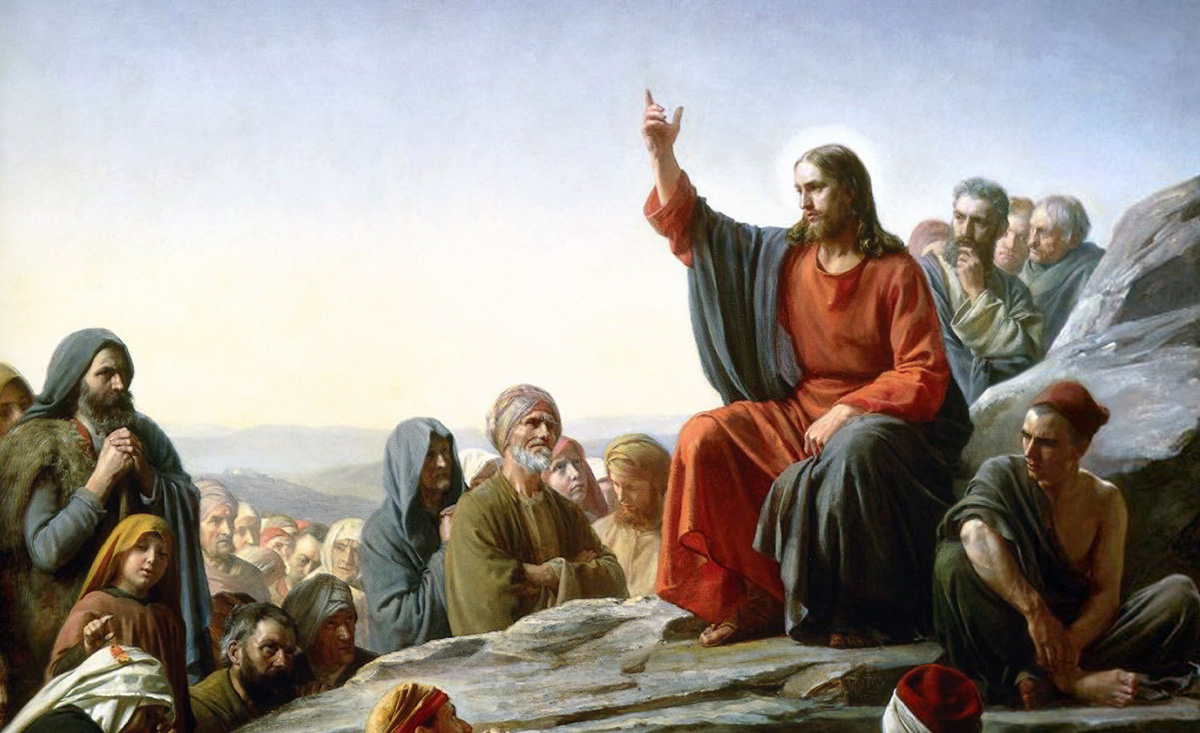
The Sermon on the Mount Carl Bloch, 1890

Sermon – Election – 1813, Connecticut


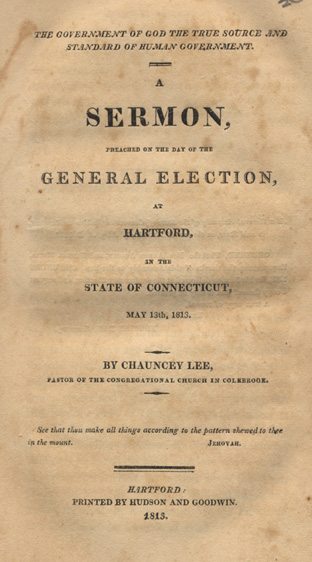
Chauncey Lee (1763-1842) graduated from Yale in 1784. He was pastor of a church in Sunderland, VT; Colebrook, NY; and Marlborough, CT (1790-1835). This election sermon was preached by Lee in Hartford, CT on May 13, 1813.


sermon-election-1813-connecticut

THE GOVERNMENT OF GOD THE TRUE SOURCE AND
STANDARD OF HUMAN GOVERNMENT

A

SERMON,

PREACHED ON THE DAY OF THE

GENERAL ELECTION,

AT

HARTFORD,

IN THE

STATE OF CONNECTICUT,

MAY 13TH, 1813.

BY CHAUNCEY LEE,
PASTOR OF THE CONGREGATIONAL CHURCH IN COLEBROOK.

See that thou make all things according to the pattern shewed to thee in the mount.
JEHOVAH.


At a General Assembly of the State of Connecticut, holden at Hartford, in said State, on the second Thursday of May, A. D. 1813.

ORDERED, That the Hon. Aaron Austin, and Samuel Mills, Esq. present the thanks of this Assembly to the Rev. CHAUNCEY LEE, for his Sermon delivered at the anniversary Election, and request a copy thereof that it may be printed.

A true copy of record,
Examined by
THOMAS DAY, Secretary.


ELECTION SERMON.

MATTHEW vi. 13.

For thine the kingdom, and the power, and the glory forever. Amen.

These words are the conclusion of that short and memorable form of prayer, which our Saviour taught his disciples. They are also the ground of all the preceding petitions, and the weighty argument, by which they are jointly and severally enforced. These, from lisping infancy, we have been accustomed to repeat. They have been the language of devotion in the nursery, in the closet, in the family, and in the sanctuary, through every age of the gospel church; and to the true worshipper will ever be the most expressive words of prayer and praise. They are the common centre, source and argument of all his requests; for, with him, the glory of God is the supreme object of desire. To the saints on earth, and in heaven, they are the standing medium of divine communion. While they expand the heart with love and devotion, they pour the richest instruction upon the mind, present the sublimest objects of faith and hope, and lead up the soul, in holy rapture, to the Father of mercies, the infinite fountain of good.

The character of God being the foundation of all religion, the spirit of devotion is also that of obedience; and for the same reason, why we should love and worship God, we are bound to acknowledge and serve him, in all the various duties and relations of human life.

The text, therefore, not only presents the important objects of faith, but has an immediate respect to moral practice. It opens the source of all religious knowledge. It evidences truth, and enforces duty. It is the foundation of the good man’s hope and joy, and the sword of avenging justice to alarm and punish the wicked. It is interesting to every individual, and applies to all human occasions. Let us, then, with reverence attend to it; and may the Spirit of God assist and bless our inquiries.

The great subject before us, is this discourse, is the GOVERNMENT of God. No subject is more interesting. In none other, is presented such an engaging and extensive field for devout contemplation, and religious improvement. The theme, indeed, is boundless and inexhaustible. To glance at a few of its most prominent parts, is all that we can or dare assume. But where reason faints and nature fails, faith may flourish, and devotion say, “O the depth of the riches, both of the wisdom and knowledge of God; how unsearchable are his judgments, and his ways past finding out.” 1

In this exalted view, is the subject presented in the text. Every word is emphatical—in orderly succession, regularly advancing, enlarging, rising, and brightening at every step; till we are conducted, in the vast field of God’s holy purposes, from the commencement of created existence, to the grand consummation of all things, in the highest happiness and glory of his eternal kingdom.

1. The first point of instruction held up in the text shews the government of God to be original and supreme. “Thine is the kingdom,” expresses a high and incommunicable attribute—a peculiar and distinguishing glory of the King Eternal, totally inapplicable to any created potentate. It is thine in the most absolute sense—thine emphatically and exclusively.

As God is the creator, he is the proprietor and Lord of all things. The kingdom is his, by right of creation. He singly fills the throne of underived and supreme dominion. “For who hath known the mind of the Lord, or who hath been his counselor? Or who hath first given to him, and it shall be recompensed unto him again. For of him, and through him, and to him are all things.” 2 Who, then, shall dare dispute God’s property in the works of his hands—his right to govern the creatures he hath made—to establish the ordinances of earth and heaven—to give laws to universal nature; and to decree and effect the various conditions of angels and men? Having an absolute property in all his works, he hath good right to do what he will with his own. This is a dictate of human reason, no less than of divine revelation. Men themselves assert this prerogative. In the fruits of our own labour and skill, we claim, in relation to our fellow-men, an absolute and exclusive property. The principle applies with infinite force to the government of God. Because he is the maker, he is the Lord of all things.

This truth is uniformly taught in the sacred volume. It is there celebrated as the ground of the divine authority and government—of the rightful and supreme dominion of Jehovah. There his character is displayed, as the great author of existence, and clothed in all the majesty and glory of creating power. “The Lord hath made all things for himself.” 3 And the church triumphant sing, “Thou art worthy, O Lord, to receive glory and honour and power; for thou hast created all things, and for thy pleasure they are and were created.” 4

2. The government of God is unlimited in extent. “Thine is the kingdom,” teaches us not only that the kingdom is the Lord’s by right of creation, and that as proprietor and Lord, he possesses supreme dominion, but that his government is universal. There is no other kingdom but his. The Lord hath prepared his throne in the heavens, and his kingdom ruleth over all. 5 He is above all, and through all, and in all. 6

The Most High is not like the false gods of the heathen, a local and tutelary deity; limited to a particular place—presiding over the interests of a certain people, or country, and confining his attention to some favourite objects of human concern. Nor are there, according to the Magian heresy, two independent, co-existing and co-eternal beings, as the originating cause, and separate authors, the one of good, and the other of evil. No. There is ONE Lord; and his kingdom is neither limited, nor divided. He alone is the great first cause of all things, declaring, in the solemn majesty of his word, “I form the light and create darkness, I make peace and create evil, I the Lord do all these things.” 7

God is an infinite spirit, and pervades all space. His government respects all creatures, and directs all events. His providential agency is universal. The hairs of our heads are all numbered, and, without him, not even a sparrow falls to the ground. Every object or occurrence forms a part of this one immeasurable whole, and is a little stream issuing from this infinite fountain. This truth gives importance to the smallest things; and, without it, the greatest would lose their magnitude. Inexpressive of order, beauty or design, the moral world would be involved in chaotic darkness and confusion.

Vain, my brethren, is that religion which ascribes to casualty the direction of events; or, arrogating to creatures the rightful honours of the Creator, yields not to Jehovah the absolute possession of his throne, and the universal influence of his power. Absurd is that philosophy, opposition of science falsely so called, which, by ascribing any independent efficacy to means and second causes, opposes the sovereign and universal agency of God—shuts out the immediate presence and action of the divine Maker from any part of his system; and denies to the King Eternal, that dominion, which he exercises over all the works of his hands.

3. The government of God is absolutely perfect. “Thine is the kingdom and the power and the glory.” A very interesting advance is here made in the text. By this it appears, that the Most High God not only exercises a rightful, supreme and universal dominion, but that he is perfectly well qualified to reign. He possesses, in the fullest manner, all the requisite qualifications to ensure the highest and most important end of government, the greatest possible good and happiness of his subjects. Thine is the power and the glory; that is, all power, and all glory are thine.

The glory of God, as defined in his word, and especially as declared in his name published to Moses, is, essentially, his goodness. God is glorious in all his works; all his works praise him, because they manifest his infinite benevolence. They conspire to the full and final accomplishment of the purposes of infinite goodness—that high and important end for which he made, and for which he governs the world. In this, his wisdom is necessarily implied. It is immediately and inseparably connected. Therefore, by glory in the text, the wisdom and goodness of God are primarily and specially intended.

Here, then, are presented, in a collective view, the three great requisites of a perfect government—goodness, wisdom and power. Goodness to act with a benevolent regard to the happiness of the subject—wisdom to devise and adopt the best means, for effecting the best ends; and power sufficient to put in execution the plans thus devised.—Can a doubt be entertained, whether these requisites of supreme magistracy belong to that great and infinite being, whose is the kingdom, and the power and the glory? That God is able to do whatever he pleases, is a first principle in natural religion. All power is his. “With God all things are possible.” His wisdom is unsearchable. “He is the only wise God.” His goodness is his glory. “There is none good but one, and that is God.” 8

4. The government of God is everlasting. “Thine is the kingdom, and the power, and the glory forever.” The government of God is not only rightful in its origin—supreme in its authority—universal in extent; and administered with infinite perfection; but it is unlimited in duration. There never can be any revolution, nor changes in Jehovah’s empire. No insurrections among his subjects, the most numerous or mighty, and with the utmost malice, power and subtlety combined, can shake the stable pillars of his throne; or, for a moment interrupt, divert, retard, or weaken the steady advancement of his high and holy purpose. God lives and reigns forever. He is “the King immortal, invisible and eternal. His dominion endureth throughout all generations, and his kingdom is an everlasting kingdom.” 9

After the whole race of mortals, in their successive generations, shall have trodden and passed off the stage—after the empires of men shall have all sunk in oblivion—this scene of human butchery, bloodshed and tears, be closed, and the bustling energies of this rolling ball, be over and gone forever;–after all the systems of the natural world shall be dissolved, time be lost in eternity, and ages of ages have rolled away, the GOVERNMENT of God will still remain—his wisdom, power and goodness be still shining, with increased and increasing effulgence; and the glory and happiness of his kingdom will still be advancing, rising, and brightening forever, without the least approximation to their utmost height.

But in these sublime elevations of faith, we have not yet reached the crowning excellency of the subject, nor laid our hand upon the key stone of the glorious arch. Under the reign of the great Messiah, the God of heaven hath set up in our ruined world a KINGDOM of GRACE, as the only vestibule connected with, and leading to the kingdom of glory. The God-man, Christ Jesus, is the anointed king of Zion, and sways the scepter of universal empire. Great, without controversy, is the mystery of godliness—God manifest in the flesh—suffering the death of the cross—rising and ascending to heaven—living and reigning forever, the head of all authority, and of all vital influences to his redeemed church.

Abstracted from the mediatorial economy, and the hope set before us in the gospel, of what advantage or avail could it be to the sinful children of men—what source of happiness, or of hope, to know that a God of infinite perfection governs the world, and will reign forever; a God who is of purer eyes than to behold iniquity, and who will, by no means, clear the guilty? With the devils, we might believe and tremble, but never could have any warrant to hope and rejoice. What has a rebel, under the best government, to expect from the hand of his offended sovereign, whose goodness, no less than his justice, seals his condemnation, but the certain execution of the penalty of the law? And what, to the unpardoned sinner, is his prospect of immortality? An interminable scene of darkness, suffering and horror, as dreadful as eternity and the wrath of God can make it. But, blessed be God for Jesus Christ, and that pardon, salvation and eternal life, which he hath purchased with his blood, and freely bestows on all who the God of heaven hath set up in our ruined world a KINGDOM of GRACE, as only vestibule connected with, and leading to the kingdom of glory. The God-man, Christ Jesus, is the anointed king of Zion, and sways the scepter of universal empire. Great, without controversy, is the mystery of godliness—God manifest in the flesh—suffering the death of the cross—rising and ascending to heaven—living and reigning forever, the head of all authority, and of all vital influences to his redeemed church.

Abstracted from the mediatorial economy, and the hope set before us in the gospel, of what advantage or avail could it be to the sinful children of men—what source of happiness, or of hope, to know that a God of infinite perfection governs the world, and will reign forever; a God who is of purer eyes than to behold iniquity, and who will, by no means, clear the guilty? With the devils, we might believe and tremble, but never could have any warrant to hope and rejoice. What has a rebel, under the best government, to expect from the hand of his offended sovereign, whose goodness, no less than his justice, seals his condemnation, but the certain execution of the penalty of the law? And what, to the unpardoned sinner, is his prospect of immortality? An interminable scene of darkness, suffering and horror, as dreadful as eternity and the wrath of God can make it. But, blessed be God for Jesus Christ, and that pardon, salvation and eternal life, which he hath purchased with his blood, and freely bestows on all who believe in his name.—Here is the foundation of christians’ hope and joy; here, of the faith and patience of the saints; here, with heart and voice, and uplifted hands, they cry, “thine is the kingdom, and the power, and the glory forever;” and unitedly shout their joyful Amen.

Let us now attend to some useful reflections on this subject, in the way of application and improvement.

1. It is evidently the great design of God’s government to display his character. This is the language of his word and providence, and the important instruction of his wisdom, in all his administrations. He gives us no misrepresentations of himself. His judgments are ever according to truth. He “is wonderful in counsel, and excellent in working.” 10 —The various circumstances of men, the many and constant changes taking place in the world, which human sagacity can neither foresee, nor prevent, display the sovereign, all-disposing hand of Him, who doth according to his will, in the army of heaven, and among the inhabitants of the earth. 11

The government of God is as benevolent as his nature, unchangeable as his being, and unlimited as his works. It is the united display of all his perfections, in the production of their proper fruits. It is that sensible medium, by which the divine character is diffused and acted out. In a word, it is the visible portraiture of the invisible God, drawn by his own hand, and corresponding in all its parts with the most perfect exactness, to its infinite original.

Of the mysteries of divine providence, in the prosecution of the great, eternal plan of God, in which every creature, of every character, angels, saints, wicked men and devils have all some part to act, and as instruments, are accomplishing his purposes; of these, we have but a very imperfect view. It is “a wheel within a wheel.” Infinite regularity, order and design, in apparent disorder and confusion. We see but a small part of the great whole—but here and here a link in the infinitely extended chain. Yet surely we see enough to believe the rest. We see wisdom, order and design in the works of creation; and shall we hastily conclude that his agency and divine skill are less concerned in his kingdom of providence—his oral government of the world? Certainly not. Our views of this subject are narrowed by ignorance, and darkened by pride. These blind our mental sight to the wisdom and beauty of the divine government.

Present to the eye of an ignorant man the mere outlines of a piece of portrait, or landscape painting, before the finer touches of the pencil have given them any expression or likeness—he will see only lines and sketches—he cannot enter into the spirit of the artist; and he recognizes neither beauty, order, nor design in the plan. It is thus, though in a much higher degree, with men, short sighted creatures, in judging of the government of God. The scale is so large, the objects so numerous and multiform, and the plan so complicate, diffuse and wonderful; and alas! such is there disinclination of heart, such their stupid inattention to the works and ways of God, that though they have eyes, they see not; though they have understandings, they perceive not the glorious perfection of his government. Not discerning the connection, design and tendency of its parts, they question its wisdom. They look at the shades in the painting, and call them blemishes. But take away the shades, and the beauty is gone. Remove these blemishes, and the plan itself is destroyed.

It is moral beauty, however, which forms the distinguishing excellency of the divine government. This must, in some measure, be seen, loved and imitated by us, or we have no true knowledge of God. This constitutes the happiness of his children. This fills all heaven with joy, and calls forth the adoring hallelujahs of saints and angels above; who cry, “Holy, holy, holy is the Lord of hosts; the whole earth is full of his glory.” 12

2. Redemption is the end of all God’s other works both of creation and providence. To this great object, as their central point, all the mighty displays of divine wisdom, power and goodness are directed. The eternal Father hath invested his Son, our God-Man Mediator, with supreme and universal dominion, in fulfillment of his eternal covenant promise; and in reward of Christ’s obedience unto death. He is given to be head over all things to the church; and must reign till he hath put all enemies under his feet. Of the increase of his government and peace there shall be no end. God hath set his king upon his holy hill of Zion, and glorious things are spoken of the city of our God, 13 respecting the enlargement, peace and prosperity of the Redeemer’s kingdom in the latter day. The benign influence of Christianity shall pervade and actuate every heart, and the glory of the Lord overspread and fill the earth.—Here is the consummation of God’s precious promises to his militant church—the blessed fruits of her hard struggles and conflicts, through all preceding ages—her glorious victory, obtained by a warfare of six thousand years.

The promises of God to his church are interesting, they are animating, they are glorious. Listen to the voice of prophecy, beyond conception, elegant, sublime and heavenly. Oh, it is sweet as the music of an angel’s lyre—transporting as the songs of the New Jerusalem. “Arise, shine, for thy light is come, and the glory of the Lord is risen upon thee; and the Gentiles shall come to thy light, and kings to the brightness of thy rising.” 14

Of all subjects, this is the nearest to the heart of the Christian. It must enkindle the flame of devotion and zeal, in every friend of Zion. It has supported the hopes, excited the longing desires, and called forth the fervent prayers of God’s afflicted people, in all ages of the world. At the same time, the success of the gospel has ever been confronted, by the most determined opposition of its enemies. This has employed their tongues, their pens, and their words. It has called into action all the subtlety and false philosophy of the human heart. It has enkindled and pointed the thunderbolts of war—caused the convulsion and distress of nations, and immolated millions upon its altar.

But they are waging a desperate war. They are setting themselves as briars and thorns, in battle array against the devouring flame. By all their rage and malice, God is fulfilling his purposes; and amidst all the confusion and distress of the nations, he is strengthening and rearing the walls of Zion. And the glorious work of grace he will carry on and accomplish; for the kingdom, power and glory are his forever. His truth and faithfulness are pledged that he “will make Jerusalem a praise in the earth;” and that “the kingdom, and the dominion, and the greatness of the kingdom under the whole heaven, shall be given to the people of the saints of the Most High.” 15

3. This subject should inspire us with adoring views of God’s glorious majesty, and a fixed trust in his wise and perfect government.

How is the greatness and glorious supremacy of God exalted in this view! How absolutely independent! What wisdom in all his moral government! How infinitely exalted above all creatures! He makes his enemies fulfill his purposes, even in their acts of rebellion; and everything conduce to the greatest possible good of his system.

Do we reverence the majesty of princes, and court the favour of those raised but a little above us in wealth or power? Do we fear the frowns of the great—admire the wisdom of the learned—applaud the deeds of the mighty; and contemplate, with wonder, the history of powerful nations, or the achievements of worthy and renowned men? But what are all these? Nothing, and less than nothing. In the light of divine perfection, all created excellency utterly vanishes.

What a privilege is it, my brethren, to live under the government of such a great and good being, whose is the kingdom, and the power, and the glory forever! We but quarrel with our own happiness in not choosing to be wholly and always dependent upon him, and cheerfully submissive to his will, in all the duties and sufferings he appoints us. A clearer view of the great plan of infinite wisdom would overwhelm us with shame, for having ever exercised the least opposition to his government, or indulged the slightest murmur under any of his dealings. “Man was not made to censure, but adore.” Humility, submission and obedience are the great points of human wisdom. To fear God and keep his commandments, is the whole duty of man. 16 Let us then be humble and believing; and amidst all our national alarms and fears, let us still rejoice in the security of the church. This is a great comfort to the pious mind. Let us, then, resign ourselves, unreservedly, to a power so munificently employed; and trust, with implicit confidence, in a wisdom and goodness so watchful, so active, so unwearied in our behalf.

4. By this subject, we are taught the true spirit of government—its foundation, principle and end. These, in all legitimate governments, are uniform, through all the grades of moral beings; from human authorities, up to the throne of uncreated majesty. “Be ye perfect, as your Father who is in heaven is perfect,” 17 is the authoritative language of Emmanuel. The character of God being the standard of moral virtue, and of human perfection, his government, the medium by which it is displayed, is therefore the perfect pattern, and unerring standard of all HUMAN GOVERNMENTS. Though subordinate and limited in their powers, yet, in relation to the proper objects of their institution, they must be the same in kind with the great original, from which they emanate. They must move and act by the same benevolent principle, and be directed to the same ultimate end.

For the preservation of order, peace and happiness in human society, God, in his great goodness, hath instituted civil government, and seen fit to depute a small portion of his authority to civil rulers; empowering them, by the force of salutary laws, to protect and avenge the innocent—to enforce commutative justice—to defend the weak—to restrain the licentious, and to punish crimes against the interests of society. Human governments, hen, form so many several parts of the divine government. They are distinguished from it, but as they are administered through the instrumentality of men. ALL IS THE GOERNMENT OF GOD—for the kingdom, power and glory are his forever. By him kings reign, and princes decree justice. 18

With what reason or propriety, then, is the principle professed, and even by some contended for, that between religion and government there exists no connection?—yea, that they are severally contaminated by a mutual touch; and the influence of each is hostile and baneful to the interests of the other? Can a man believe his Bible, and subscribe to a doctrine so absurd? The reverse of it is truth, and the deeper our researches in this subject, the deeper will be our conviction. It is separating what God hath joined together, and bidding defiance to reason and experience, as well as to scripture. It is separating man from his Maker—dismembering the government of God, and exalting the “little, brief authority” of an aspiring worm, paramount to the throne of the King Eternal.

In the holy scriptures, we find princes and civil magistrates actually called gods; 19 and it is for this reason, because human authority is a shadow of the divine; and civil rulers are the vicegerents of God, commissioned to rule for him, and execute his will. With this argument, Paul enforces the duty of obedience to civil magistrates; on the ground, that human government is a divine ordinance, and earthly rulers are commissioned and empowered by the King of heaven. The instruction of inspired truth upon this subject is very express. Thus runs the charter of human governments—establishing their high authority—defining their legitimate powers—pointing out the true policy of their administration, and declaring the benevolent end of their institution:–

THE POWERS THAT BE ARE ORDAINED OF GOD. RULERS ARE NOT A TERROR TO GOOD WORKS, BUT TO THE EVIL. HE IS THE MINISTER OF GOD TO THEE FOR GOOD. HE BEARETH NOT THE SWORD IN VAIN, FOR HE IS THE MINISTER OF GOD, A REVENGER TO EXECUTE WRATH UPON HIM THAT DOETH EVIL. 20

Three important points are here established. First, That civil rulers are commissioned of God, and act by an authority delegated from him. Secondly, That impartial justice, truth and equity must form the spirit of their laws, and the policy of their administration. Thirdly, that the highest good of community, the general happiness, peace and prosperity of the state or nation, must be the great object and end of all human governments.

In perfect accordance with these principles was the solemn charge, which Moses, and after him Jehoshaphat, gave to the constituted authorities of Israel: “Hear the causes between your brethren, and judge righteously between every man and his brother, and the stranger that is with him. Ye shall not respect persons in judgment—ye shall hear the small as well as the great—ye shall not be afraid of the face of man; for the judgment is God’s.” Deut. i. 15. 16. “And he said to the judges, take heed what ye do, for ye judge not for man, but for the Lord, who is with you in the judgment.” 2 Chron. xix. 6.

Wisdom, power and goodness, the great principles of perfect sovereignty, so transcendently displayed in the government of Him who ruleth over all, are absolutely necessary to the perfection and proper ends of human governments, in all their constitutional forms, and in all their varied modes of administration. It is only through the deficiency of one, or some, or all of these, that any government ever fails of answering the highest and best end—the promotion and security of the general good.

If wisdom be wanting, the measures of government, however well intended, and however faithfully executed, yet being laid in ignorance and folly, must prove abortive, and fail of their end.—If goodness were wanting, wisdom would be but craft and cunning, and power degenerate into furious and arbitrary might. If wisdom and goodness both were extinct, government would be dreadful in proportion to its power. It would be the most frightful despotism; and directed to no other end than the misery and ruin of its subjects.

Without power, government would be but a name. The best laws would be unexecuted. Wisdom and goodness would be exercised in vain, and operate to no end. In the absence of them all, government has no existence. But these three united constitute the perfection of government, and exclude the possibility of tyranny and oppression.

The object of the divine government, as we have seen, is the greatest general good. This must be the object of human governments. Real philanthropy, enlarged, disinterested, diffusive benevolence, is the only genuine patriotism. Thou shalt love thy neighbour as thyself, is the true spirit of all free and happy governments among men; whether administered by one, by few, or by many;–by an hereditary monarch—by a diet of nobles—by a representative assembly chosen by the people; or, by a mixed government of either two or all of these combined. Wisdom, public spirit, uprightness and integrity are the indispensible qualifications of civil rulers. This we know from the highest authority. It is not a dictate of human philosophy only, but the injunction of divine revelation: “Take ye wise men and understanding, and known among your tribes, and I will make them rulers over you.” Deut. i. 13. “Moreover, thou shalt provide, out of all the people, able men, such as fear God; men of truth, hating covetousness; and place such over them, to be rulers of thousands, rulers of hundreds, rulers of fifties, and rulers of tens.” Exodus xviii. 21.

These plain passages, to every believer in divine revelation, must place the matter out of all doubt; and set the following points of political wisdom in the clearest light:

First, That legislators, rulers and civil magistrates must be men of sound heads and clear understandings—of known characters as men of talents, political wisdom and integrity: known among your tribes; thou shalt provide able men,” &c. Let them be native, free born citizens, nursed in the lap of their parent country—bred in the principles, habits and feelings of freemen, and well able to distinguish liberty from licentiousness, and the government of laws from the reign of tyranny and terror.—Again, “Take ye wise men, and understanding—provide out of all the people able men,”&c.; men well versed in the science of government, and understanding the true interests of the publick; not upstart pretenders, visionary theorists and projectors, strutting upon the stilts of philosophy, and swelling with the wisdom of Solon, while ignorant of the alphabet of legislation and government.

Secondly. From the same authority we learn, that civil rulers must be men who fear God—men who are the servants of the Most High—obedient subjects of the divine government, and devoted to the interests of the Redeemer’s kingdom.

The fear of God is the principle of religion in the heart; and “he that ruleth over men must be just, ruling in the fear of God.” 21 Civil rulers, therefore, no less than the people over whom they rule, must feel themselves subjects of the universal government of God. They must recognize their allegiance and accountability to Him, under whom they hold their commissions, and take all their directions in duty from his word. In fine, they must be men of pure morals—men of virtuous character—men of real religion. Such only are qualified, in the several offices of civil authority, to co-operate with the infinite benevolence of their Creator, to the great and important ends of his government. Such only are fit instruments to be the ministers of God for good to his people. They who fear not God will not regard man. They will hold the divine authority and human happiness in equal contempt: and as vainly may we expect, from such rulers, the fruits of benevolence in the publick good, as to gather figs from thistles, or grapes from the noxious bramble. Human experience has ever verified that maxim of divine wisdom, “When the righteous are in authority the people rejoice; but when the wicked beareth rule the people mourn.” 22

Thirdly. Civil rulers must be “men of truth.” They must not only walk humbly with God, but deal justly with men. They must possess that noble elevation of sentiment, that incorruptible integrity of soul, which is incapable of descending to the vile electioneering arts of intrigue and slander, misrepresentation and falsehood, to effect the objects of their own or others’ ambition. Let them be no fawning Absaloms—no cringing, time-serving office seekers, nor brawling professors of their exclusive love for the people.

Truth is the basis of every real excellence. It is the criterion of all moral and political worth. Civil rulers, therefore, must be sincere, and not pretended patriots—honest men, and not deceivers of the public; disguising their real views and motives, veiling their weak or wicked measures under false and specious pretexts—thus prostituting their talents, and sacrificing their integrity, their conscience and their country at the shrine of popularity. The administrators of government should never fear the truth—never fear to avow, in a plain and open manner, the real objects of their legislation and administration; but manfully meet their full share of responsibility; and not, by evading arts, meanly seek to cast off the odium of their own errors upon men more righteous than themselves.

Fourthly. Civil rulers must be men “hating covetousness.” Though the character is here delineated indirectly, and as it were, in a negative form; yet it is expressive of distinguishing and positive traits; and men of enlarged views, liberal sentiments and publick spirit, may be seen sitting for the picture.

The cupidity of hungry demagogues, scrambling for the loaves and fishes of office, is in nothing more distinctively marked, than in their flattering or censuring the conduct of men in power, according as they may apprehend the one or the other the more favourable to their views. Selfishness, not patriotism, is the concealed spirit which moves them;–their own honour and emolument are the real and sole objects of their aim. But those, possessing the qualifications of good rulers, are of a more excellent spirit. They are men of a disinterested character—men hating covetousness—men who will subordinate their own personal honour, wealth and aggrandizement to the publick good, and point, with undeviating aim, all their counsels, exertions and official duties to this one great end.

We have now delineated, by a comparison of opposites, the scriptural character of good civil rulers, who fill their office with duty and usefulness, and are publick blessings to their people. The character is drawn by divine wisdom, in the shortest terms, and yet it is full and complete. They must be provided or selected out of all the people—men of known wisdom and understanding—such as fear God—men of truth, and hating covetousness. These are the essential characteristics of good civil rulers. These, blessed be God, we and our fathers, the favoured sons of Connecticut, have known and realized by the happy experience of almost two centuries. To the divine goodness our warmest thanks are due. God hath never given us babes to be our princes, nor children, nor wicked men to rule over us; but hath ever given us our “judges, as at the first, and our counselors, as at the beginning;” 23 men, who have been his ministers for good to the people. This, from the infancy of our highly favoured republic, has been the distinguished character of our political fathers, who have successively filled, adorned and dignified the chair of state. They have been the chariots of our Israel, and the horsemen thereof. In this venerable catalogue, those men of God, the fathers and founders of our Commonwealth, Haynes, Winthrop and Saltonstal, and in later days, our illustrious Trumbulls, hold an eminent rank, and will ever occupy distinguished pages in the history of our country.

To the list of our departed worthies, we have now to subjoin the name of our late excellent and much lamented chief magistrate, Roger Griswold. The incurable malady, which, at our last anniversary, deprived us of his presence, and the legislature of his aid, has since, alas! terminated his useful life, and he now sleeps with his fathers.

After the striking testimony of respect to his memory, already borne by this honourable legislature, 24 and his correct and able funeral eulogium, now in the hands of the publick, it becomes me, I am sensible, on this subject, to be concise. Yet duty forbids me to be wholly silent. Justice to my own feelings—to the feelings of a bereaved publick, and to the memory of distinguished merit, demands, at least, the tribute of a—tear. The career of his publick services will furnish an interesting theme to future biographers, and to them it is left. His general character, however, by which he justly stood so highly respected and endeared, may be briefly drawn, in a few well known and distinctive traits.

In private life he was the accomplished gentleman, the man of science, the amiable friend, the kind and courteous neighbour, the affectionate parent, the tender husband, and the agreeable companion in every relation. In his publick walks, he was the thorough investigator of truth, the able statesman, the luminous speaker, the patriotic legislator, the discerning and upright judge, and the faithful, firm and independent magistrate.

While, with sentiments of affection and gratitude, we weep over his grave, and the tears for our beloved Trumbull, scarcely dried, are now caused to flow afresh for his worthy successor—let us bow, in humble submission, to the holy will of the supreme disposer, whose awful hand, in the short period of three years, 25 hath twice bereaved us of our chief magistrate. Let us penitently acknowledge his righteous chastisement, and bless him for his goodness, in raising up and qualifying, with such eminent talents for public usefulness, this distinguished fellow citizen, the faithful and able defender of our constitutional rights. With a peculiar sensibility, let us recognize his firm and distinguished conduct, in a late crisis of our national affairs, the most trying, interesting and eventful. 26 Thanks to heaven, that, at the first bursting of the storm, a Griswold stood at the helm; and undaunted at the shock which tried men’s souls, calmly guided, with his dying hands, our little bark, steady, straight and safe from all rocks and shallows, in its true constitutional course. His talents and firmness were tried and found equal to the emergence. Thus, like the clear, unclouded sun, he shone the brightest in his setting rays; and by the last act of his public life, he crowned the lofty climax of his well earned fame.

May the mantle of our departed Griswold, and his illustrious predecessors, descend to their successors; and their spirit be transmitted down to the latest posterity, through the venerable legislators, judges, and ruling fathers of our state.

5. Our subject leads us to reflect, that a good civil government is one of the greatest earthly blessings. It is to be enjoyed, with thankfulness to the great giver; and carefully preserved and transmitted, as the richest bequest to posterity.

The government, under which a people live, is so interwoven with their happiness, that it is inconceivable, how they can be prosperous, or happy, if this be evil. It would, therefore, be an unpardonable breach of duty, on this day, not to recognize so great a blessing.

Our form of national government originated from men of tried integrity and experience; having a full knowledge of the situation and peculiar wants of every portion of the country; and all the various forms of civil government on earth, with their evils and benefits, excellencies and defects; together with the experience of all preceding ages, fully before them. Possessing these advantages, they were enabled to construct an exceedingly wise and happy form of civil government. And no nation, it may be affirmed, ever experienced greater prosperity, than what we have enjoyed, under its operation and influence.

But this blessing is to be guarded with assiduous care, and preserved by every requisite means. Experience enforces this duty upon us. Public, as well as private, blessings are liable to be taken from us, and lost. The best human governments are imperfect. They are subject to abuse. They are formed, and they are administered, by frail, selfish and fallible agents. Under the wisest form of government, we have suffered various and grievous oppressions. In the obstinate pursuit of a strange and infatuated policy, our country has, for years, groaned under a series of privations and distresses; till, at length, we are plunged into an offensive war, with one of the most powerful nations of Europe, and under circumstances, in which national ruin is staring us in the face. We have, therefore, abundant reason to be alarmed with our danger—to be active in applying the means of safety; and to mingle fervent supplications of thanksgiving and praise.

6. We have, all of us, my fellow citizens, individually, and as a people, a special interest in this subject. It points its instruction to everyone, and speaks in loud and commanding accents. Let us hear the voice of wisdom, and attend to the things of our peace.

Is religion so necessary to the character of good civil rulers?—such a high and important qualification, for men in public authority, and called to administer the government of the state? Is it less so, to those who are the subjects of civil government, and in the walks of private life? No—but, if possible, the more necessary and important; as it is the proximate cause, and the necessary means of the other. For, in a free and elective government, where the people are the source of power, and have, either directly or indirectly, all the gifts o civil office, in their hands, the character of rulers will ever be formed by that of their constituents. They will be of the same moral stamp,–the very “image and superscription” of the people by whom they are elected. Unless, therefore, we are a religious people, it is vain to hope for the blessing of religious rulers. A corrupt spring will never send forth sweet waters; nor can the stream rise higher than its source. Let the great body of the people, or the majority of them, become wicked and unprincipled, and “the post of honour is”, at once, “a private station.” The excellent of the earth, if such may be found, men who fear God, and hate covetousness, will not be the public favourites, nor even candidates for office. They will be thrust into the background, and wholly overlooked. From the mutual relation between rulers and subjects, this truth results, as an invariable maxim, that a government will be wise and prosperous, according to the purity of the fountain from which it emanates. The connection is indissoluble, between a united and virtuous people, and the government of wise and faithful rulers. Both are great public blessings, but they cannot exist apart. The former is a necessary means of the other. The character of an elective government will ever be derived from that of its constituents; and its operation and success will be accordingly. Indeed, it is not within the reach of the wisest laws—it is utterly beyond the power and skill of the best civil rulers, to make a wicked people, a happy people; or to do them good, any further, than they may have influence to change the public character: for they are morally incapable of the blessings of any government, either human or divine. In the same proportion, therefore, in which, as a people, we relax in virtue, and the public character becomes vicious, is our government endangered.

The diffusion of general knowledge—the improvement of those means calculated to promote religious order and peace—the encouragement of schools, the due observation of the Sabbath, the support of the gospel ministry, and the public worship of God: and the counteracting of those corrupt principles, which weaken the sense of moral obligation, break the dearest ties of human life, and destroy the faith of an eternal retribution: these must be considered as things the most interesting to the public welfare. They essentially affect the main spring of our government. These are at the root. They form the character of the people, on whose shoulders the government rests.

While on this branch of the subject, I must beg the indulgence of a more particular attention to a certain moral duty of incalculable moment; I mean, the strict and religious observance of the day of holy rest. The idea has already been suggested, but I know not how to pass it with only a cursory hint; though a volume would scarce suffice to set forth its connection with the best interests of society; and trace all its important bearings upon the temporal and eternal welfare of men. No command in the Decalogue is enforced with more alluring, or more awful sanctions: there is not a duty inscribed upon the pages of inspiration, to which the promise of national blessings, and the threatening of national evils are so frequently, and so solemnly annexed, as to that divine precept, Remember the Sabbath day to keep it holy. Among the multiplied proofs of this truth, I would only point you to that memorable passage, in the 17th chapter of Jeremiah’s prophecy: “Thus saith the Lord, take heed to yourselves, and bear no burden on the Sabbath day, nor bring it in by the gates of Jerusalem. Neither carry forth a burden out of your houses on the Sabbath day, neither do ye any work, but hallow ye the Sabbath day, as I commanded your fathers. And it shall come to pass, if ye diligently hearken unto me, saith the Lord, to bring in no burden through the gates of this city on the Sabbath day, but hallow the Sabbath day, to do no work therein, then shall there enter into the gates of this city, kings and princes, sitting upon the throne of David, riding in chariots, and on horses, they, and their princes, the men of Judah, and the inhabitants of Jerusalem, and this city shall remain forever.” That is, the court, the city, and the country shall flourish; enjoying all the rich and valuable blessings of national peace and prosperity. “But, if ye will not hearken unto me, to hallow the Sabbath day, and not to bear a burden, even entering in at the gates of Jerusalem, on the Sabbath day, then will I kindle a fire in the gates thereof, and it shall devour the palaces of Jerusalem, and it shall not be quenched.” A threatening which was literally fulfilled, and which this very prophet lived to see and lament.

Observe, therefore, how necessary it is to sanctify the Sabbath, if we desire the favour of God, and the prosperity of our country. This duty is equally required of all classes of men. No burdens are to be borne, no common work to be done, no laboring, travelling, carrying out, or fetching in, except, in case of absolute necessity. We see what stress God lays upon this duty. He charges the neglect of it, as a crime which will bring ruin upon the state.—The religious observation of the Sabbath will support all the other branches of religion. It will strengthen and invigorate the principle of holy obedience. It will water every moral, and every Christian virtue at the root, and render them flourishing and fruitful. Indeed, there can be neither religion, nor morality without it. Therefore, let us take heed to ourselves. Great caution is needful, in a degenerate day, amidst so many bad examples, and when actually suffering, by war and pestilence, the awful judgments of heaven for this very sin. They, who merely to save time, on working days, contrive to take journeys, to visit their friends, or follow their business, on the Sabbath; and by so doing, deprive themselves of religious advantages; do, at least (however their thoughts may be employed) set a bad example to others and encourage them to profane the Sabbath. All, who indulge in such practices, should seriously attend to this awful admonition of heaven. And how they can imagine such a conduct consistent with the divine authority and law, with the design of the Sabbath—the solemnity of a Christian profession, or even with seeking the true interests of their country, is very astonishing. How they can vindicate it, before him, who will give to every man according to his ways, and according to the fruit of his doings, they would do well to consider.

When we reflect on the degenerated state of our national morals, and consider the fickle and fluctuating disposition of people, with regard to the necessary means of public strength and happiness, the long continued existence of our government is rather an object of trembling hope, than of confident expectation. We have, indeed, the means of perpetuating the government of our choice; but the danger is in our abusing these means—in our losing sight of that virtue and religion, the influence of which is absolutely necessary to the long, or real existence of any free government.

Besides, a government like ours, more than many others not so free and good, opens a wider door for the exercise of unprincipled ambition, and for the rage of party animosities. By the frequent elections 27 to the great national offices, rivalries will be excited, and party spirit, once in action, has no sufficient time to die. The flame is increased, and the difference of opinion widened. It is diffused through every vein, and effects every limb and joint of the great body politick. This has been our great political disease; and too true it is, that the most proper, and only efficacious remedy has been overlooked and unapplied. A spirit of conciliation, of mutual charity and condescension has been greatly wanting, among even the honest and well meaning of both parties. “Man is man;”—a composition of ignorance, weakness and vanity. Human conduct is ever marked with imperfection and error; and the best cause is often injured by improper motives, means and management.—These things, in their nature and tendency, are great evils. In their progress, they threaten, and in their issue, will destroy a republican government.

Every person, acquainted with the history of nations, knows that factions have always been the bane of free governments. And when we consider the unhappy divisions in our country, and the unyielding spirit which accompanies them, what is the ground of our hope? What, the pleasing prospect of transmitting the blessings of freedom and good government to our children?—Alas! all earthly enjoyments are empoisoned with sin. All human affairs are mutable and transitory. The constitution of bodies politic, no less than that of the human frame, is liable to infirmity, disease and death. Kingdoms and States embosom the seeds of dissolution, implanted in the moral nature of man. They rise and fall, in succession, like day and night. They have their morning, their rise, their meridian, their decline, and their setting sun. But, the GOVERNMENT OF GOD shall stand. The kingdom, power and glory are his forever, and all his blessed purposes shall be accomplished. Here is the only stable ground of hope, of comfort, and of confidence, in all the darksome scenes and prospects of human woe. This is the key note in the gospel harmony; this, the chord which ever vibrates in unison with good man’s heart.

Public virtue, then, I resume, is the foundation, and the very corner stone of every free government. It cannot exist without it. Let the religious principle become extinct, in the minds of the commonalty; so that the influence of public good, and the restraints of conscience shall cease to operate; and the republican institution is sapped at the foundation; the best laws will be totally inefficient, republican government will be but a name, and that too, of short continuance. As a natural consequence, it will tumble, like a rock from the precipice; and with it drag down, in one common ruin, the last remains of liberty, and every privilege and comfort, which render life a blessing. It will, it must end in despotism. In such a state, or nation, nothing but a system of terror, propelled by the strong arm of physical power, can impose the necessary restraints, and keep the heavy, iron bound wheels of government in motion. These, grating harsh thunder, as they roll, like those of the horrid car of Juggernaut, 28 will be smeared with the blood of wretched victims, crushed beneath their ponderous pressure. Injustice, oppression and cruelty are the mild, kindred virtues associated in the throne of despotic power. These are the garlands which deck the grisly brow of the Moloch of Tyranny.

Let it, then, be received, as an axiom in politics; let it be engraven upon our hearts, as with the point of a diamond; that Religion is the only sure foundation of a free and happy government. It is the great palladium of all our natural and social rights. Indeed, the connection between time and eternity is not more near and certain, than that between a wicked, demoralized state of community, and the government of tyranny.

With this truth blazing before us, can we pause, and reflect for a moment, without the mingled emotions of wonder and regret; that that public instrument, which guarantees our political rights of freedom and independence—our Constitution of national government, framed by such an august, learned and able body of men; formally adopted by the solemn resolution of each state; and justly admired and celebrated for its consummate political wisdom; has not the impress of religion upon it, not the smallest recognition of the government, or the being of God, or of the dependence and accountability of man. Be astonished, O earth!—Nothing, by which a foreigner might with certainty decide, whether we believe in the one true God, or in any God; whether we are a nation of Christians, or—But, I forbear. The subject is too delicate, to say more; and it is too interesting, to have said less. I leave it, with this single reflection, whether, if God be not in the camp, we have not reason to tremble for the ark?

I return from the digression, and repeat the sentiment, Religion is the only sure foundation of human government. Religious people are the good members of society. They who, in heart and life, acknowledge their allegiance to the King of heaven, are the best subjects, and the best supporters of civil authority; and they only are qualified to enjoy the permanent blessings of a free and equal government. Benevolence is the bond of social union, and the source of public peace and happiness. This holy principle cements all the natural and social relations. It makes good men, and good citizens. It strengthens, endears and sweetens all the tender charities of life. It unites the man to his neighbour, the Christian to his brother, and the creature to his God. Where there is this unity of sentiment and affection, there is ever unity of sentiment and affection, there is ever unity of interest and enjoyment. But a house divided against itself cannot stand. A building, composed of jarring and heterogeneous materials, like the visionary image of Nebuchadnezzar, tends to dissolution. The iron and the clay will never cement—never form a solid and lasting union; but, sooner or later, will tumble into ruin. That member of society, who is void of social and benevolent affection, is both a troublesome and disgraceful member. Like a round stone, in the composition of a great building, he can fit no place, in the whole wall. He touches his neighbours, but at points, and every touch is a wound. He mars the beauty, destroys the uniformity, and weakens the strength of the whole building. In a society, in a state, or nation, composed of such member, adieu to order, to friendship, and to peace.

Be cautioned then, my fellow citizens against the demon of party spirit; that spirit which casts the publick good into the background; and without any regard to the national interest, seeks, exclusively, the interests and the triumphs of a party. This is destructive to all free governments. It is the spirit of disunion, and tends to all evil. It violates the social compact, beats down the restraints of vice and immorality, tramples upon the most sacred obligations, sports with the dearest rights of society; and is rebellion against all governments, human and divine. Alas! The bright morning of our national glory, so calm, cool, peaceful and prosperous; while our GREAT AND GOOD FATHER lived, to protect and bless his country; this evil spirit has, thus quickly, overcast with clouds of darkness, greeted with the thunder of war, and encrimsoned with a deluge of blood.

The necessity of union cannot be too frequently impressed, nor its importance too highly appreciated. Bankruptcies incurred have often been retrieved;–ships lost can be replaced; Moscow, burnt to ashes may be rebuilt; but “union lost is seldom regained; and freedom once flown is gone forever.”

Our present situation imperiously requires unanimity, wisdom, firmness and energy among the people. In this day of darkness, distress and danger, in which our liberty, our independence, our national existence, our everything dear and valuable, on this side heaven, are at stake—there should be but one public sentiment—but one pulse should beat—one voice be heard; and one soul animate and inspire the whole body politic. If united and firm, we may still hope. If divided, we shall fall by our own hands, and incur the guilt of national suicide.

Pardon my warmth on this subject—it is impossible for me to be cold. It is the language of my heart, and I cannot suppress it. It is, however, by no means, intended to give offence to anyone; unless the truth shall offend; and the short lived and honourable reproach of such offences, I am willing to bear. They, whose views, either of religion, or government, do not exactly coincide with my own, will do me the justice to believe, that I mean not to wound their feelings, and that I am as honest in maintaining my opinions, as they can be in theirs; and that a sense of duty only, in the public station I hold under God, impels me, on this occasion, thus freely to declare them. I do declare myself feelingly alive to the public danger. I tremble in every nerve for the honour and safety of my country; and the awful fate which awaits our divided situation and our weak and distracted counsels. The title of United States, applied to a disunited people, is a burlesque and reproach. It is high time for the rage of political controversy to cease, or soon—I shudder at the thought—the sword may be drawn, which will be sheathed in brother’s bosoms. Let union at home and peace with the world, be the countersign with every class of citizens; the rallying watch-word among all the sons of freedom, the friends of their country and of mankind. Away, then, with all spirit of party dissension; its paltry objects and pernicious views; and away with that tame, temporizing spirit of dastardly union, which yields, and yields, and yields to be trodden and crushed to death, under the proud foot, which is elevated but to destroy. Let our union, like the wisdom from above, be first PURE, then PEACEABLE, gentle and easy to be entreated, full of mercy and good fruits, without partiality and without hypocrisy. 29 Our interests, fellow-citizens, are one, and why should not our hearts and our exertions be united? Let us join hands in the common cause, to promote the interests and achieve the salvation of our dear and suffering country.

Respected Legislators. In these principles and duties, you will readily recognize your own immediate and individual concernment. To you, they are especially interesting. Called by the suffrages of your country, to the high duties of legislation, under God, the administrators of our free and happy government; to you, we look up, as the guardians and protectors of our dearest rights. The duties of your station, ever the most important to the public, the present unhappy situation of our country renders the most difficult and arduous to yourselves. To “stem the torrent of a downward age”—to preserve the invaluable institutions of our pious ancestors—to ward off the threatening evils of a misguided policy, and to renew the happy scene of national peace and prosperity, which once we enjoyed, require the combined exertion of all your talents, wisdom, prudence and patriotism. On those halcyon days, we now look back with regret, and sighing exclaim. Oh, that we were s in months past, as in the days when God preserved us, when his candle shined upon our head; as we were in the days of our youth, when the Almighty was yet with us. 30

At no time, has our sovereignty, as a state, been more endangered, nor appeared more interesting to our own and our country’s happiness. You are called, therefore, fellow-citizens, to act your part, in a trying and difficult day. Our lot is cast in a perilous period. We have indeed fallen upon the worst of times, and therefore need the best of men at the helm; for without skillful and faithful pilots, on such a stormy sea, our national shipwreck is near and certain. But amidst all the existing evils and impending dangers, which assail our present peace, and darken our national prospects, faint not, nor be discouraged; be firm and undaunted, and never despair of the commonwealth. Truth is powerful and will prevail. The scales of imposition are falling from the eyes of ignorance. The light is beginning to penetrate the dark recesses of obstinate blindness and error—and after our long and dreary night, the rising sun will again appear, and pour the reviving beams of prosperity and peace. Remember that the Lord reigns, and the Most High is the governor among the nations. 31 The kingdom, power and glory are his forever. Be strong in the Lord, and trust in the God of your fathers. His counsel shall stand. His government is his own, it is perfect, it is supreme, it is universal, it is everlasting. Look to that as the grand source and perfect standard of all human authority. Thence derive all your directions in duty, all your wisdom and fortitude, all your support and encouragement. Then shall you be the ministers of God, for good to his people; and generations, yet unborn, shall arise and call you blessed.

Reverend Fathers and Brethren. May our hearts be warmed with renewed zeal, in the great duties of the holy ministry, and our motto be, that of our divine Master, “I must work while it is day.” The time is short—our departure is at hand. Soon will the night of death overtake us, and close our working season for ever. Soon must we be individually called, to give an account of our stewardship, and to meet our people at the bar of God. Let us be fired with a noble emulation to finish well this short life of labour and trial. Let nothing weaken our resolutions, nor paralyze our exertions; neither let us count our lives dear to ourselves, so that we may finish our course with joy, and the ministry which we have received of the Lord Jesus, to testify the gospel of the grace of God. Since the last anniversary election, no less than eight 32 of our dear brethren, our respected fathers and fellow labourers, in this state, have closed their earthly course, and given their final account. An unusual and awful mortality! Great is the publick loss in the removal of so many faithful ministers of Jesus. Our Zion mourns. Her watchmen weep. They vent their grief and their consolation too, in the feeling language of the Psalmist,

“Spare us, O Lord, aloud we pray,
Nor let our sun go down at noon;
Thy years are one eternal day,
And must thy children die so soon?

Yet, in the midst of death and grief,
This thought our sorrow shall assuage;
Our Father and our Saviour live,
Christ is the same in every age.”

For the kingdom, and the power and the glory are his forever. Under the influence of such and so many solemn warnings, Oh, let us be faithful to the interests of souls—faithful to the church of the Redeemer, which he hath bought with his blood—faithful to our country and to our God.

Men, brethren and fathers, rulers and citizens, ministers and people of every class, let me beseech you to reflect seriously upon this interesting subject—to divest yourselves of all party feelings and prejudices; and candidly inquire into the real situation, and the true interests of our country.

Our present happy form of government may survive these decaying limbs of ours; for we must soon sleep with our fathers: yet, the most of us have children whom we love, to leave behind us; and who is there, in all this numerous assembly, so base, as to be willing to leave them exposed to the dreadful effects of party rage and oppression? Who is there, sunk so far below the insensibility of a savage, as to feel indifferent towards the fate of posterity; and not earnestly wish to leave, to them, the same blessings, of civil and religious liberty, which, through the mercy of God, we have received from our ancestors, as the fruit of their patriotism, their piety, their prayers, and their blood?

Remember that “righteousness exalteth a nation, but sin is the reproach of any people;”—that it is equally the duty of rulers and citizens, to do justly, love mercy and walk humbly with God. This is the sum of all religion. This is the true spirit of a free government. This is a duty incumbent on every citizen. If, therefore, we desire the prosperity of our country; if the salvation of our immortal souls, we must live soberly, righteously and godly in this present world.

Under a deep impression of this solemn truth, of our dependence on God, our awful accountability, and our high and immortal destination—let us unitedly pray, Our Father, who art in heaven, of thine infinite mercy, through Jesus Christ, vouchsafe to us and our dear posterity, all the blessings of life, liberty, peace, religion and government; the comforts of time and the happiness of eternity; for thine is the kingdom, and the power and the glory forever.

Amen.


Endnotes

1. Rom. xi. 33.

2. Rom. xi. 34, 35.

3. Prov. xvi. 4.

4. Rev. iv. 11.

5. Psalm ciii. 19.

6. Eph. iv. 6.

7. Isaiah xlv. 7.

8. Matthew xix. 26., 1 Tim. i. 17. Matthew xix. 17.

9. Psalm cxlv. 13.

10. Isaiah xxviii. 29.

11. Daniel iv. 35.

12. Isaiah vi. 3.

13. Psalms ii. 6. And lxxxvii. 3.

14. Isaiah lx. 1, 3.

15. Dan. vii. 27.

16. Eccl.

17. Matthew v. 48.

18. Prov. viii. 15.

19. Exodus xxii. 28., Psalms lxxxii 1. 6. And cxxxviii. 1., John x. 34.

20. Rom. 13.

21. 2 Samuel xxiii. 3.

22. Prov. xxix. 2.

23. Isaiah i. 25.

24. Governor Griswold died at Norwich, while the legislature were in session at New-Haven. Upon the news of his death, a committee of both houses was appointed, to attend his interment. A solemn funeral service was also attended by the General Assembly, in which, by their appointment, the Hon. David Daggett, Esq. pronounced an eulogium upon his character. The assembly also resolved to wear badges of mourning for thirty days.

25. Governor Trumbull died August 7th, 1809—and Gov. Griswold October 25th, 1812.

26. See the printed documents of the legislature, published at their special session in New-Haven, in August last; detailing the correspondence of our state executive with Gen. Dearborn, and the Secretary of War, relating to the subject of calling into actual service, in the present war, at the command of the President of the Union, a certain portion of the militia of this state.

27. What precise term of civil office is the most wise and beneficial, is a desideratum in politics, and a point in which the most enlightened republican statesmen are far from being agreed. Witness the great diversity of practice adopted by the constitutions of the several state governments, respecting the period of their elections. Frequent elections are unquestionably6, most congenial with the republican spirit, and most favourable to the liberties of the people: and yet it must be acknowledged, that there are mischiefs connected with either extreme. In the above observations, therefore, I pretend not to act the part of a Censor, nor even to hazard an opinion; but simply to state facts, and trace effects to their true cause. Perhaps, the evil complained of, party spirit, is an unavoidable appendage of a free government: arising from the weakness and imperfection of human nature: and may always be expected to exist, and be, more or less operative, under every republican institution; until the religious principle has a more general, and powerful influence; or, in other words, until men are more disposed to conduct like rational creatures, and become fitter subjects for the enjoyment of rational liberty.

28. See Dr. Buchanan’s Christian researches in Asia.

29. James iii. 17.

30. Job xxix. 2, 3, 4, 5.

31. Psalm xxii. 28.

32. Rev. Messrs. Timothy Pitkin, of Farmington; George Colton, Bolton; Benjamin Wildman, Southbury; James Dana, D. D., New-Haven; Joseph W. Crossman, Salisbury; Asahel Hooker, Norwich; Noah Benedict, Woodbury; Samuel Camp, Ridgefield.

Sermon – Election – 1817, Connecticut


The following sermon was preached by Rev. Abel McEwen on May 8, 1817.


A

SERMON

PREACHED AT THE

ANNIVERSARY ELECTION,

HARTFORD,

MAY 8, 1817.

BY

ABEL McEWEN,

PASTOR OF A CHURCH IN NEW-LONDON

HARTFORD:

GEORGE GOODWIN & SONS…PRINTERS.

1817.


At a General Assembly of the State of Connecticut, holden at Hartford, in said State, on the second Thursday of May, Anno Domini 1817.

ORDERED, That the Honourable Henry Champion and Christopher Manwaring, Esq. present the thanks of this Assembly to the Rev. Abel McEwen, for his Sermon delivered before this Assembly on the 8th instant, and request a copy thereof, that it may be printed.

A true copy of record,
Examined by
THOMAS DAY, Secretary.
 

ELECTION SERMON.
ROMANS XIII. 1.

LET EVERY SOUL BE SUBJECT UNTO THE HIGHER POWERS: FOR THERE IS NO POWER BUT OF GOD: THE POWERS THAT BE ARE ORDAINED OF GOD.


The strength of civil government, and the good order and happiness of civil communities result much, from a knowledge of duty and a sense of responsibility in the people. Christians ought to be examples to the world. In discretion, and meekness, and subordination, they should surpass all other men. Actuated by the fear of the Lord; taught his will on the subject of civil obedience; protected in their dearest interests, by authorities of his appointment; they owe to human rulers a signal tribute of reverence and fidelity. Their profession should be the pledge of a quiet and peaceable life. Before them are the precepts and example of their Lord Jesus Christ. As God he was the lawgiver of the universe: nevertheless, having become man; and having taken upon him the form of a servant he obeyed; and he taught his followers to obey, the injunctions of civil rulers.

As a man, and as a teacher of Christianity, Paul had powerful reasons for walking in the footsteps of his Lord. The evils which Christ foresaw, in an abuse of Christian liberty, became more threatening in the day of the apostle.

The Jews, after their subjection to a foreign scepter, had many scruples about obeying heathen magistrates. Instructed and directed by prophets of the Lord, they were prone to plead the authority of these guides; as an excuse from a conscientious submission to the injunctions of the Roman government. If in this spirit of revolt and independence they embraced Christianity; they would be in danger of pleading the authority of Christ as paramount to that of their human conquerors. An expectation of deliverance from temporal bondage, by the Messiah, was their national delusion.

If Jews and proselytes to Christianity from the Jewish nation were beset with this factious spirit, it might be contagious. Rebellion is as the sin of witchcraft. All Christians; even Roman and those of other nations; under, either the pretence, or apprehension of allegiance to a distinct kingdom, of more than earthly importance, might be disposed to rebel against their civil rulers. Over the Jews God had, in fact, reigned King on earth. Christ Jesus, according to his own profession, supported by miracles of divine power; and, agreeably, to the faith of his people; was King, and Lord Supreme, in that kingdom which is over all, and above all. No titled mortal on the mighty throne of the Caesars could boast of authority and power which could vie with that, which had calmed the raging of the sea, had raised the dead, and had cast out devils. A mistaking zeal for God, and a contempt of human greatness, might very naturally have degenerated into a licentious disregard of legitimate and salutary civil government. Christ had appointed religious rulers over his church; to whom all its members were commanded to be strictly and affectionately subordinate. Human nature is inclined to pervert the best institutions. It would have been but the natural result of human pride, for these rulers; after having been clothed, by Christ, with ecclesiastical authority; to seat themselves in the chair of state: and it would have been grateful to the selfishness of Christians to limit their responsibility to rulers of their own profession. It should not be forgotten that the Roman government was at this time tyrannical and oppressive; nor, that Nero, who was upon the throne, was a monster of malice, caprice and cruelty.

Most seasonably then did the apostle, impressed with the attitude of existing circumstances, and with the prospect of future scenes open to his prophetic eye, say; “Let every soul be subject unto the higher powers: for there is no power but of God; for the powers that be are ordained of God.” A universal application of this injunction is made to mankind, under the gospel, by the emphatic expression; “let every soul be subject.” Rulers and ruled in the church; and all, in every Christian community, of whatever office or dignity, must yield due reverence and prompt obedience to the constituted authorities of civil government. An exemption would prostrate the authority of the gospel.

This duty is not only inculcated; and the extent of it fixed; but the propriety of it is explained. “The powers that be are ordained of God.” Invert the order in which these things are presented in the text; and it may be said that civil government is of divine institution—and consequently, that obedience to its existing authorities, is a duty, which every man owes to God.

I. Civil government is of divine institution.

On this subject a diversity of opinions has prevailed amongst mankind. Atheists have conceived and have endeavoured to prosecute a design of rendering a citizen amenable, only to his fellow men. Many of better religious creed, have inadvertently fallen in with this impious and demoralizing project. Much ingenuity, and more zeal have been displayed in defence of the scheme. Still it is easy to be understood that the authority which civil rulers possess is derived, from God alone; that to him, and not to men, they are primarily accountable; and consequently, that the transgressor of civil law is guilty, in the most affecting sense, before God.

Those who deny that civil government is of divine institution, pretend to find its origin, in what they term a social compact; whence they would derive all the authority which may be exercised by civil rulers. By a social compact, they understand, an agreement, into which the people of a country enter; and in which, they convey away the control of their personal liberties and privileges to men restricted, or not restricted, in the exercise of their civil functions, according to the provisions of the compact. Such an original act of the people is said to be what alone, in any age or place, clothes men with authority to rule.

Such covenants, it is conceded, have been made, in many ages and countries; many still exist and are known, as constitutions of civil government. They are also acknowledged to be useful, and requisite to a proper exercise of that right of government which God hath given to men. Nevertheless, it is contended, that no people, of any age, or country, would have a warrant to form such a compact, were it not given them by God; and that rulers would have no authority over their fellow men, after such an act of the people, had it not been given them by the Sovereign of the universe.

To perceive that civil government, derived solely from a social compact, is unwarrantable, we are to look at the nature of this source of authority. The consent of the governed is said to invest governors with a right to rule—a consent which must be obtained; but which, when obtained, is an ample warrant for governmental transactions. Contemplate then a nation without any government, where the people enter into an agreement, by virtue of which, they give to a man, or to a number of men, authority to dispose of the lives, and property, and liberties of their community. The questions now are; have these people a right to convey away the disposal, for instance, of their lives? And have these rulers a right to dispose of these lives, without an express warrant from God? It will not be denied that the great Author of human life hath revealed a prohibition on this subject, which is to be regarded. “Thou shalt not kill,” is the high and unlimited command. Were not provision made by the Judge of all the earth, for the exercise of civil authority, in taking away the lives of transgressors, this prohibition would restrain civil rulers, as much as murderers, from putting men to death; and it would as clearly forbid all mankind to put their lives into the hands of civil rulers, as it does from putting them into the hands of murderers; or from committing suicide. The right which civil government has to kill malefactors is derived, not from the consent of the governed; but from the decree of God; “Whosoever sheddeth man’s blood; by man shall his blood be shed.” God alone has a right to qualify and limit his own prohibitions. But for any man, or any combination of men, to assume this prerogative, is stern rebellion. Life is to men an unalienable blessing from the hand of their Maker: to commit it to the disposal of their fellow-men, without a warrant from the giver, would be a license for murder, given to rulers, in contempt of the express prohibition of God. To maintain civil authority, derived from a social compact, would be as impracticable, as it would have been unwarrantable to originate it from this source. The right of government would not outlive the preservation of the compact. How long this could be preserved, may from the nature of it be satisfactorily calculated. The people of a nation consent to be ruled, agreeably to principles, or grand regulations, specified in the covenant, made between themselves and the constituted authorities. What preserves inviolate this covenant, and prolongs its binding force? Obviously, an exact compliance of the rulers, with those fundamental principles of government, which are specified in the compact. Should they swerve in the least degree from these principles, they would fail to fulfill their engagements; the other party in the contract could not be holden; the compact would be null and void: the people would be absolved from all obligation to submit to the authority of their rulers. Such are the ignorance, the inadvertency, and the imperfect integrity incident to all men; that it is impossible, for the ablest, and most honest rulers, strictly to comply with the provisions of any civil constitution. So frail, therefore, is that civil government, whose authority is sustained on the tenor of a social compact, that an error of administration would be a national failure; the mistake of a ruler would be the loss of an empire. The wisdom of the world could not construct a government on these principles which could sustain a legitimate right to rule, for a year, or a month.

The practicability of maintaining it, is not to be contemplated, simply, in the fallibility of publick men. A government, of such an origin, is carried to hasty destruction, by an intrinsic fatality. It has, in its nature, the seeds of death. The generation which makes a compact soon goes off the stage. A youth succeeds to the place of his father; enters into his possessions and business; affirms that he does not approve of the compact, into which his father entered; that he will not consent to have his life, family and property under the control of the existing government. Upon such an inconvenient character, no principle of coercion can be brought to operate. From the nature of the compact, all the authority of the government rests upon the consent of the governed. This youth has not consented; and he never will consent, that this government shall have any authority. He, therefore, must be permitted to exist in his native country, as an independent power; or by force, must be driven into exile. If the whole of a rising generation be actuated by the same spirit; if none consent to be governed; all authority constitutionally terminates.

Upon such a government, refractory foreigners might bring a fatal embarrassment. They enter the country; proclaim their dislike of the government; their determination, never to consent to the compact. But one measure can be adopted. These intruders may be driven from the land; and all foreign emigration may, by law, be prohibited. Even the raveling of foreigners through the country could not be safely tolerated; for without their consent to the authority of the government, even the debts, which they might contract, could not be collected; nor could redress he had for the abuses which they might practice.

Let it not be said, that people who come by birth or immigration into a country, where such a government is in operation, do, by tacit consent, bind themselves to submit to all the conditions of the compact, and to all the civil authority derived from it. This argument supposes, that this rising generation, and these foreigners, enter, by tacit consent, into the original agreement, to all intents and purposes, as completely, as the original framers of it did. But we cannot bind ourselves, by a bargain, without knowledge and design in what we do. Certain it is, that the great mass of people who are born and grow up under civil governments, never are conscious; never have a thought of bequeathing to the constituted authorities, the control of their property, lives and other privileges. How then do they make a compact? Should they, beginning to feel the weight of civil power, complain of its violence and burdens; and object to its authority; could rulers say, we rule by your consent; we dispose of you by your consent. If the subjects of civil government are responsible “to the powers that be,” in consequence of what they themselves have done; of that voluntary act, by which they are bound, they must have been conscious. But no voluntary act is requisite; no consciousness of a consent given, or of a compact made, is necessary to render man responsible to a divine institution. The very law of his existence peremptorily dictates accountability to authority which is from a commission of his Maker.

On this point, a question of moment is; at what age does this tacit consent become of binding force? If no objection have been urged against the existing government, at the age of ten, or fifteen, or twenty, shall the youth have committed himself to subjection? No advantage ought to be taken of incapacity, ignorance, or inexperience. To make the obligation derived from consent, reasonable, and valid, this consent should be given under a full knowledge of what the government is, of what it may demand, and of what it will probably do. The Chinese, Persian and Hindoo sovereigns rule according to their own will. To be at their control is to be exposed to all the caprice of men, whose pride, and pleasure, and convenience, and malice may give law to their empires. If the youth within their dominions might; until a given age; by a solemn declaration, save themselves from allegiance and submission to those despots; and were they conscious of their privilege; who has the credulity to believe, that by a known, tacit consent, they would commit themselves, their fortunes, their prospects and their hopes, to the mercy of arbitrary power? Indeed, were this liberty given to youth who live under governments of the mildest form, and of the most happy influence; such is the licentiousness of the human mind, that almost all would be cautious, how they gave their consent to irrevocable obligations. If all civil authority rest on the consent of the governed; in every social compact made for a civil constitution; provision ought to be made for successive generations to give, or to withhold their consent. To say that a future generation is bound to yield either tacit or express consent, is no less than to say that it shall have no opportunity to consent or refuse. The inevitable conclusion is, that if all legitimate authority rest upon a social compact; every government, which survives the original contractors, must maintain its right and prerogatives, by the ignorance of their posterity, who know not, that they bind themselves, by tacit consent, to lasting subjection.

“There is no power but of God: the powers that be are ordained of God.” Here every honest mind finds relief: Here every peaceful citizen finds a rule of action: Here civil government finds a foundation. The design of the Apostle was, to teach subjects of civil government, the duty of submission; and to show the origin of the obligation, which bound them to this duty. Before they obeyed an established government, he would not have them go into an enquiry, whether the government were a usurpation; because, the learned often cannot settle this question; much less, the common people. Neither need they, previous to subjection, be assured that governmental measures were not oppressive; for, if they were, resistance would be rebellion, and by rebellion, they would commit themselves to the horrors of anarchy. How a government came into existence; whence it sprang; how it obtained its power; are not the questions. The simple consideration that it exists, and is in actual operation, is a warrant for obedience; an obligation to submission. If it exist, God gave it existence; if it operate, God gives it power, means, and opportunity. To resist the ordinance, would be, to resist his providence.

When a revolution in any country has taken place, and a new government is once established; though the people at large may be incompetent to decide, whether the scepter were rightly gained; this is a question, with which those who have come into power are usually better acquainted; and it is one, in which their responsibility is intimately involved. Had Paul, instead of inculcating the duty of subjects, been consulted by Nero concerning his duty; he would, perhaps, have reasoned upon righteousness, as he did with Felix; or have administered reproof, as John did to Herod.

If God have given no warrant for men, in any circumstances to exercise authority over nations; he hath manifested an indifference, whether the people of this world live in anarchy, or enjoy the blessing of civil order. Whatever may be the conclusion of atheists; we who believe the Bible, have not so learned the will of God. For the Jewish nation; the people whom he chose; he framed a constitution of civil government; in which he revealed to the world, the grand principles of jurisprudence. In the revelation of his will, he hath bound mankind to the discharge of many duties; which can be performed only by a civil government. Murderers, for instance, are to be put to death; still to execute the divine decree, would be a crime, in any one, not clothed with public authority. Having, in his word, instituted many and important duties for civil rulers; in his minute and constant providence, he brings rulers, in every nation into existence and authority, to do his will. Hence, in language which should fill the world with reverence, he says, “by me kings reign, and princes decree justice; by me, princes rule; and nobles; even all the judges of the earth.”

Much, on this subject, has been said, by theorists, about a state of nature, in which no civil government existed. Of such a state we find no account in history; nor even in the legends of romance. On the flights of a distempered imagination men may go back in vain for such an opportunity; for the origin of civil blessings, from a social compact. But with the Bible in our hand, we will go back to Adam, made, not by a compact with his family, but by God, a ruler over his household. Down the current of time we may come; noticing the progress of government in the hands of Noah, and Nimrod, and Abraham, and various patriarchs, ruling either by a use or an abuse of those instructions which God originally gave mankind. Such was the tenure of civil power; until Moses the great lawgiver was sent by God to the Hebrews. From the creation, until that event; and from that, until this hour, we may perceive that men have been set in authority by the hand of Divine Providence. “God standeth in the congregation of the mighty; he judgeth among the gods.”

II. Obedience to the existing authorities of civil government is a duty which every man owes to God.

It is the pride and policy of men, who cast off the fear of God, to make everything depend upon their will. An elective government is one of a very happy form. But it is one thing for a nation to elect rulers to rule over them, by the authority of a warrant from God; and according to revealed principles of righteousness; and another to choose men into office, who are to be responsible and subservient to the lusts and caprice of the community which they nominally rule. The Bible teaches men to regard their rulers as ministers of God; a maxim of later currency makes them servants of the people. Were they such; their first accountability would be to God. Servants of the public communities surely ought not to be holden in a more degrading servility to their employers; than the servants of individuals and families are to their masters. Even menials of this description are primarily to regard God: They are to serve their masters; “not with eye service as men-pleasers; but as the servants of Christ, doing the will of God from the heart.” Until people hail their rulers as dignified servants of God, authorized, and bound by the most solemn obligations to execute righteousness in the earth; they will be restless and querulous; licentious and violent. While they look at a civil office merely as a place of emolument or distinction, which many for their private advantage are to share; it will be the perpetual sport of some of the vilest passions of human nature. Let them in their estimation exalt a civil office to the dignity of a divine ordinance; then their conclusion will be that “whosoever resisteth the power, resisteth the ordinance of God; and they that resist shall receive to themselves condemnation.”

From legislators, judges, and executive magistrates who sustain the honour and responsibility of acting under a warrant from God; much will be expected which shall directly fulfill his revealed pleasure. They will not be approved, nor even excused, by the public sentiment; unless they effectually protect the sacred name and day of God from profanity; unless by laws scrupulously framed and faithfully administered, they suppress, as much as is practicable, the sins of drunkenness and impurity; of fraud and violence; and give every possible accommodation to the progress of that salvation which God, for his principal glory, executes upon earth.

When such a public demand is made of rulers; subjects will be prompt and conscientious in their obedience. Every law emanating from the laws of God; every one coincident with his requirements; will be reverenced as a delineation of his will. Transgression of it will be regarded as rebellion against him.

Conscientious subjects will go farther. Every civil injunction, which is not a violation of some divine rule or doctrine, they will honour, by a scrupulous compliance. Their opinions concerning the expediency of some governmental acts may vary from the opinion of their rulers. On questions of policy, the judgment of rulers is, by divine appointment, to prevail. For the consequences of their decisions they are responsible. No consideration of expediency can be a warrant for a violation of the commands; “let every soul be subject to the higher powers—Submit yourselves to every ordinance of man; expediency justify an act of rebellion; for the consequences of obedience to an injunction, which is simply impolitic, cannot be so deplorable as anarchy, the legitimate offspring of rebellion.

There is a limit, however, beyond which, subjection to civil magistrates becomes a crime. When it is forbidden, not by expediency; but by the express will of God. The Author of the Holy Scriptures never intended that obedience, of one of his precepts, should be a violation of another. To every ordinance of man, we are to submit; to the higher powers we are to be subject; but not when we are commanded to violate a revealed law of God. Before we refuse to obey “the powers that be,” we must not merely suspect; but must be convinced that their commands are subversive of those of God; for his injunction to civil obedience is clear and positive.

To mankind at large, God has given reason, conscience, and revelation; that as individuals; as moral agents; they may give up a final account of their deeds, done here in the body, at his bar. They are not to risk the momentous interests which depend on their doing right, or wrong, on the infallibility of public men. To say that the responsibility of a ruler, in every case, supersedes the responsibility of his subjects; is no less than to assert, the will of the civil magistrate, to be the origin of all moral obligation. This is one of the grossest impositions of infidelity. It sunders the moral relation between the great mass of mankind and their God; supposes divine revelation to be made exclusively for rulers; gives them power to bind and to unbind the conscience; and to convert whatever God hath called a crime, into a virtue. If, in one instance, a law is to be obeyed, simply because it has become a law of the government established over us; then in every instance, obedience, though it be an horrid impiety, must be rendered. This doctrine, fraught with the deadliest poison of infidelity, conveying death to the vitals of religious liberty, should be watched, by every man, with a trembling jealousy, for his own soul, and for God. Let it have free course among us; let it control our conduct; let it be publicly conceded, that in all things rulers must be obeyed; whatever may be the incompatible requirements and prohibitions of God; and there is an end of conscience toward him; and an end of civil privilege.

Revive the law of Egypt, requiring the slaughter of the first born: then, if responsibility belong only to rulers, fathers and mothers, without scruple or remorse, are to give up their children to the executioner. Dissolve, by law, every marriage covenant: then, every endearment and every duty of domestic life would be justly disregarded. There is nothing sacred to humanity, nothing sacred to religion, which a nation might not only be doomed to give up; there is nothing but what, with violent hands, they might be commanded to destroy. The Bible, the Sabbath, the church, it might become their duty to annihilate.

Men and brethren; it is our happiness, that we have no such lengths to go. The same Bible, which inculcates civil obedience, bounds the exercise of public authority: It presents to the eyes of rulers and ruled a common God and Judge, before whom every individual is, for himself, to stand or fall. It gives to the man whose well instructed mind and tender conscience forbid him to act, a precedent for saying, to rulers who demand known sin, “whether it be right, in the sight of God, to hearken unto you, more than unto God, judge ye.”

To this lamentable alternative the people of this state have not been driven. From it, past experience declares, they may still be saved. Let counsel still be taken of God; and the laws of the state, and the laws of God will continue to coincide. “Provide out of all the people, able men; such as fear God; men of truth; hating covetousness; and place such over them;” and the people will have a common path of civil obedience and of piety.

If civil offices be of divine appointment; if God have ordained the powers that be; if knowing this the people of this state, under the indulgence of heaven be permitted to fill these places with men of their choice; a most affecting forfeiture will be made of all the kindness of God; if men, after his own heart, be not elevated to that power, by which his purposes are to be accomplished.

The assembled magistrates and rulers of this commonwealth will, from our subject, at once, perceive the honour, and feel the delicacy of their stations.

Respected leaders: the hand of our God has placed you over us. His will you are to perform. What we should be in morals; what we should be in religion; whatever of public and relative duty we should do; whatever of liberty we should enjoy; whatever of restraint we need; think, we pray you, on these things; and let your influence be our glory and defence. We see you blessed, we trust, that you may be blessings to us and to our children. May that mind which God so kindly gave to Moses, to Joshua, and to David be given to you; that the world, seeing us under your authority, may say “happy is that people whose God is the Lord.”

Fathers and brethren in the ministry; our primary sphere of action is in a kingdom which is not of this world; yet we have something to do in the kingdoms of men. It is our business and our glory to preach a crucified Saviour to perishing sinners; but we have the example of Paul, the aged, the learned, the pious, the chosen of Christ, for inculcating the duty of a quiet and peaceable life, under the government of our country. It is not our task, to plead for reverence to a Nero and his menial court: to teach submission and patience under a public scourge. Had God given us a king, in his wrath, our lot would have been to teach righteousness under the severe rebuke. If we have turned the public eye to powers ordained over us; we have not pointed out “a terror to good works; but to the evil.” With boldness we have been able to say, “do that which is good; and thou shalt have praise of the same.”

To the God of our forefathers let us come, confiding in him to preserve the foundations, in which the righteous trust.

While we labour for the quietude, and order of the state, let us “pray for the peace of Jerusalem.” After all the prosperity of our churches; after all which the government, and people of the state have done, in works of benevolence; after times of refreshing from the presence of the Lord, which should be rehearsed, in our most public praise; much remains to be accomplished for the salvation of men; and for the edification of the churches. The time is short. Events of the past year have left us to prosecute the great work, of our calling, with diminished numbers. Our fathers; the distinguished among our fathers! Where are they? How much of talents; how much of learning; how much of piety; how much of usefulness has the grave swallowed up. We trust that heaven has had its share of the vast loss which we have sustained; and that grave has found a triumph, in those faithful men, in whom it found its most conspicuous instruments. The gloom of this house, the bereavement of our seminary of science, and other remembrances of death tell us, that what is ripe for heaven God takes to himself. To prayer, to watchfulness, to fidelity, to labours, let us be quickened; that we may severally say “I have fought a good fight, I have finished my course, I have kept the faith: henceforth, there is laid up for me a crown of righteousness, which the Lord, the righteous Judge, shall give me, at that day; and not to me only, but unto all them also that love his appearing.

Sermon – State Prison – 1812


sermon-state-prison-1812

A

SERMON,

PREACHED AT THE

STATE PRISON,

IN

MASSACHUSETTS,

November 29th, 1812.

BY CHARLES LOWELL,
Minister of the West Church in Boston

This Sermon was necessarily composed in much haste. In committing it to the press, the author has yielded to the wishes of friends, whose judgment he respects, and who thought the publication of it might be useful. The intelligent reader, recollecting the occasion and circumstances, will not be surprised at its plainness and simplicity.

SERMON.

Romans, ii. 4.
The goodness of God leadeth thee to repentance.

In addressing an audience like the one which is now before me, it may, at first view, appear extraordinary that, of all the attributes of God, I should select his goodness for the theme of my discourse. Deprived of that liberty, which is usually considered as the most precious birthright of man; prohibited, in a great measure, that social intercourse, to which the instincts of our nature forcibly impel us; and destitute of those domestic enjoyments which, next to religion, give the sweetest relish to human life, it may seem as if you, my friends, have but little reason to meditate on the goodness of God. His justice, indeed, has appeared to overtake you, and, in exhorting you to repentance, you might think it proper for me to dwell on the further infliction of that justice, if you continue impenitent. But where have been the proofs of his goodness, and what motives can be drawn from thence for penitential sorrow?

Listen to me, my hearers, with serious attention, and I will endeavour, in plain and simple language, to shew you that God has indeed been good to you, and that the recollection of this goodness ought to lead you to repentance.

In common with those of your fellow creatures whose situation is apparently more favourable than yours, you have received the gift of life. Life is in itself a blessing, and if rightly improved, is a source of much happiness. If you have not improved the blessing as you ought, if you have rendered life a source of unhappiness and misery, it is your own fault, and not the fault of God. It was good in him to bestow life, and in bestowing it, it was his design to confer happiness.

In common with others of your fellow creatures, you have received the gift of reason. This raised you above the brutes of the field, rendered you capable of acquiring knowledge and virtue, of holding intercourse with your fellow creatures, and of enjoying felicity both here and hereafter. If you have abused and perverted this gift, it is your own fault, and not the fault of God. It was good in him to bestow reason, and in bestowing it, it was his design to promote your happiness.

In common with other, you have received the gift of conscience, to deter you from sin, or to admonish you of guilt. If this faithful monitor has been disregarded, and its reproaches stifled, it is your own fault, and not the fault of God. It was good in him to bestow this gift, and it was his design that it should prompt you to virtue and happiness.

In common with others of your fellow creatures, you have been possessed of parents and friends. Your parents watched over you, and, under God, provided a supply for your wants, when you were unable to take care of yourselves; and many other of the friends whom God had given, have probably added to your comfort and enjoyment. Some of you have undoubtedly had parents and friends, who were anxious to bring you up in the fear of God, and thus to make you a blessing to yourselves and to society. If you have not been sensible of the value of these blessings, or heeded the advice or admonition you may have received, it is your own fault, and not the fault of God. It was good in him to bestow these blessings, and it was his design that they should promote your benefit and increase your happiness.

In common with some of your fellow creatures, you have been offered the gift of religion, of that religion which points out to you the path of duty and happiness here, and which promises you, if you accept of it, through the merits and mediation of Christ, the possession of perfect and everlasting enjoyment hereafter. If you have despised and rejected this gift, if you have turned a deaf ear to the voice of those who urged you to accept of the terms of salvation, it is your own fault, and not the fault of God. He was good, infinitely good, in offering you so great a blessing; and it was his design, that you should accept of it and be happy.

In thus enumerating the instances of God’s goodness towards you, my friends, I have necessarily confined myself to a general view of it. The particular circumstances of your past lives are best known to yourselves. You can, each of you, call up to mind numerous and essential benefits with which you have been favoured. The enjoyment of health, relief in seasons of distress, escape in times of danger, the favourable opportunities you may have possessed, however misimproved, for gaining knowledge and piety, or for success in the world by honest industry. All these things, and many more of which each of you must be conscious, are proofs, strong and affecting proofs, of the goodness of God.

And now let me ask you, let each one ask himself, what return he has made to God for so much goodness? Alas, my friends! The situation in which you are now placed, is a most sad and impressive reply. But, even here, even in your present circumstances, confined within the walls of this prison, you have reason to acknowledge and adore the goodness of God. Why were you not arrested in your career of iniquity by the hand of death, and hurried, with all your sins unrepented of, into the presence of an offended God? It was, because he would give you a longer space for repentance, not willing that you should perish, but that you should turn unto him and live.

Reflect, for a moment, how dreadful, how unspeakably dreadful would have been your condition, if, at the instant you were perpetrating the crime for which you were condemned to this place, you had been called, not to an earthly tribunal, but to the tribunal of the Almighty; of that Being who is of purer eyes than to behold evil, and who cannot look upon iniquity, but with the utmost abhorrence; of that Being, who is not only able to destroy the body, but can destroy both body and soul in hell.

Why, I may further ask, are you placed in a situation comparatively so comfortable, where you have the means of religious instruction and improvement, and where those who superintend the institution, are so anxious to lessen the evils of your lot, instead of being secluded in a dark and gloomy cell, or confined to a place where you would be destitute of the advantages you here enjoy? It is, because God is good to you.

Let me ask you again, what return have you made for all this goodness?

God gave you life, that you might glorify him, and promote your own welfare, and that of others. How unmindful have you been of the important ends for which life was bestowed upon you! Instead of devoting it to the service of God, have you not devoted it to the service of the enemy of God and man? Instead of promoting your own welfare, and that of others, have you not been pursuing a course destructive of your own welfare, and highly injurious to the welfare of your neighbor? Instead of a blessing, have you not been a pest to society?

God gave you reason, that you might know and love and adore him, that you might fulfill your duty in this world, and make preparation for a better world. How much have you abused and perverted this precious gift! It raised you above the level of the brute creation; have not many of you, by drowning it in intemperance and debauchery, often sunk yourselves far below their level? Instead of seeking to acquire a knowledge of God, have you not shewn by your conduct that you desired not the knowledge of his ways? Instead of glorifying God with the speech which he had given you, have you not often blasphemed his holy name and imprecated his vengeance upon yourselves and others? Instead of fulfilling your duty in the world, and devoting your powers and faculties to an useful purpose, have you not neglected your duty, and employed your powers and faculties in devising and executing plans of mischief and wickedness? Instead of preparing for heaven, have you not been pursuing the broad way that leadeth to destruction?

God gave you conscience to deter you from sin, or to excite you to repentance for it. Instead of heeding this faithful monitor, have you not stifled its reproaches, and some of you even seared it “as with a hot iron?”

God gave you parents to take care of you when you were unable to take care of yourselves, and friends to promote your comfort and happiness in life. How dreadfully have you requited those parents for their care of you, and how poorly have you fulfilled the claims of friendship!

Perhaps some of you have even abused the parents who gave you birth, have reviled them, have lifted up your unhallowed hands against them, or by your misconduct have brought down their heads in sorrow to the grave. This may have been the case with some of you whose parents not only gave you birth, and took care of your infancy and childhood, but endeavoured to teach you your duty to your God and your neighbor, that you might be respectable, useful and happy; who wept and prayed and labored for you. Oh, unfeeling, ungrateful men! Where was the vengeance of the Almighty that it did not forever silence the tongue that was uttering reproachful words of a father or a mother, that it did not wither the hand that was raised to smite a parent, that it did not at once arrest the guilty wretch in his mad career, and consign him to endless woe? How long-suffering, how compassionate is God!

Perhaps some of you have wronged the friends who trusted to your friendship and confided in your honour; or have corrupted and ruined them.

God offered you the gift of religion. He provided a way of salvation for you by Jesus Christ. He sent his son into the world to die that you might live; the just for the unjust that he might bring sinners to God. Have you not despised the gift? Have you not been unmindful of the sufferings and death of Christ on your behalf? Have you not turned a deaf ear to the invitations and warnings and threatening’s of God’s word? Have you not neglected the means and opportunities of religious instruction? Have you not followed the devices and desires of your own evil hearts, and been careless about the one thing needful, even the salvation of your immortal souls?

God has spared your lives, and given you a space for repentance in this place. How well you have requited this great and unmerited goodness, I cannot tell. But in the review of the goodness of God, and of your own ingratitude, disobedience and guilt, let me exhort you, let me earnestly exhort you, to deep and sincere repentance. I would fain hope that there are many of you who can be touched with a sense of the goodness of God, and with sorrow for having sinned against so much light, and so much love. This is the foundation on which repentance should be built. This is the repentance that will be most acceptable to God.

But if any of you are so hardened as to be unmoved by the recollection of the goodness of God, perhaps you may be affected by the view of his justice, which will assuredly be exercised upon you to the utmost, if you do not repent. An awful judgment day is at hand; it may come upon you unawares, and dreadful indeed will it be, if it find you unprepared for its arrival. Your portion will be weeping and wailing and gnashing of teeth.

Be persuaded then, be excited to repentance and prayer, to seek earnestly for the forgiveness of your sins, for an interest in your Saviour, for peace with God. Let the sincerity of your repentance be manifested by a meek and quiet spirit, by respectful obedience to those who have the rule over you, by an obliging and affectionate conduct towards each other, and by a diligent performance of the work assigned you.

Many of you are here but for a limited period, and some of you are perhaps soon to return again to that world, which was the scene of your temptations and your guilt. Let me beseech you to endeavour to carry with you such principles and habits, as will enable you to redeem the time you have lost, and to compensate to society the injury you have done it. Perhaps you have parents still living, prepare to be a comfort to them in their old age, to sustain their feeble hands, to support their faltering footsteps, and to smooth their passage to the grave. Perhaps you have a wife, tender and affectionate, prepare to make her happy by a life of sobriety and virtue. Perhaps you have children, whom by your example, if not by your precepts, you may have been training up to vice and misery. Prepare to be yet a blessing to them, and to teach them by your future conduct, that having tasted the fruits of sin, you have found them indeed bitter. Thus you will be respectable and happy. You will regain the affection and esteem you may have forfeited, and retrieve the character you have lost.

Let those of you who are destined to finish their earthly course within these walls, endeavour to acquiesce in their lot, as the appointment of a wise and righteous Providence. Be thankful, my friends, that you have so many comforts, and especially, that you have the means of spiritual improvement. Use these means with diligence, I entreat you. Be earnest in your prayers, and sincere in your repentance, and you may then hope, through divine mercy, when the term of your probation is ended, to exchange a state of bondage and imprisonment, for the glorious liberty of the sons of God.

The most painful and arduous task I have yet to fulfill, in addressing you, my unhappy brethren, who by the sentence of the law are condemned to die. 1

How awful, how exceedingly awful is the situation in which you are placed. But a few short days will pass away, before you, who are now in health and in the vigour of life, will suffer an ignominious death, and appear at the judgment seat of God. How shall I address you? What words shall I use to impress you with a true sense of your condition, and of the importance of devoting the few remaining days of your life to diligent, to unwearied preparation for eternity?

You have heard me discourse of the goodness of God, and you have a witness in yourselves, that he has been good to you; that you are allowed this space for repentance, and that the officer, 2 to whose charge you have been committed, is so attentive to your spiritual, as well as temporal welfare, is a strong, but unmerited, proof of divine goodness. Do not, I conjure you, do not cast away from you the privileges you now enjoy!

How great, how aggravated have been your offences, against the clearest light; against the dictates of your reason; against the admonitions of your consciences; against the warnings of your parents; against the laws of society of which you could not be ignorant; against the suggestions of the Spirit, and the invitations and threatening’s of the word of God; against love unparalleled, mercy unbounded;

Let the goodness of God lead you to repentance. You have a little space left to you; fill it up with duty. Does any thing burden your consciences? Relieve yourselves from the burden. Can you repair any injury you have done to a fellow-creature by confession and acknowledgment? Do it. You are bound by all your hopes of happiness hereafter to do it. Have you kept back anything, that you have been exhorted to reveal? Do so no longer; you cannot deceive God, and in his presence you will soon appear.

My friends, this is the last time that I shall address you in this public manner. Soon, very soon, the curtain of eternity will hide you from my view; and the execution of the awful sentence of the law will deprive you, forever, of the means of instruction, will place you beyond the reach of any warning voice. I feel the solemn, the unspeakable importance of my situation. Oh, that I could be instrumental in exciting or encouraging repentance! Oh, that I could be instrumental in bringing you to your Saviour and your God! Turn ye to the strong hold, ye prisoners of hope! The blood of Christ cleanseth from all sin. Pray, earnestly pray, that you may be cleansed in that blood, and that you may secure an inheritance above, before it is forever too late. Let me again and again, entreat you, by the goodness of God, by the tender mercies of your Saviour, by the convictions of your own consciences, and by the prospect of a judgment to come, to seize this moment, which is given you for repentance.

Farewell—a long farewell.—Go to your cells again, and in that solemn retirement, where God only is present with you, meditate on what has now been said.

May God of his infinite mercy, carry it home to your hearts, and to the hearts of each one of us. And at last, when our course of duty and of discipline on earth is ended, may we all meet again in heaven, to celebrate, forever, the goodness of God, and the wonders of redeeming love!—Amen.


Endnotes

1 Samuel Tulley an American, and John Dalton an Englishman, then under sentence of death for piracy. They were convicted at the Circuit Court in Boston, October twenty-first.

2 The Marshal of the Massachusetts District, who has been unwearied in his humane attentions to these miserable men, and anxious that they should have, to the utmost, the benefit of religious instruction.

Sermon – Election – 1816, Vermont


Samuel Austin (1760-1830) graduate from Yale in 1783. He was President of the University of Vermont (1815-1821). The following sermon was preached by Rev. Austin on October 10, 1816.


In General Assembly of Vermont, Oct. 11, 1816.
Resolved that at the thanks of this House be presented to the Rev. Samuel Austin, for his Election Sermon, and that he be requested to furnish a copy for publication.

W. D. SMITH, Clerk.
RELIGION THE GLORY OF A COMMUNITY.

A

SERMON,

PREACHED ON THE DAY OF GENERAL

ELECTION,

AT MONTPELIER, OCTOBER 10, 1816,

BEFORE THE HONORABLE

LEGISLATURE OF VERMONT.

BY SAMUEL AUSTIN, D. D.
PRESIDENT OF THE UNIVERSITY OF VERMONT.

MONTPELIER, Vt.
PRINTED BY WALTON AND GOSS, OCTOBER,
1816.

An

ELECTION SERMON.


ISAIAH lx. 19.

“THY GOD, THY GLORY.”


These words are a part of a discourse in which the prophet presents a predictive description of the future prosperity of Israel, as a community. The foundation of this prosperity was to be laid in the universal influence of religion. The cause and the effect are concurrently displayed in the animated address which introduces, and is continued quite through the chapter. The closing passages are these; “Thy sun shall no more go down, neither shall thy moon withdraw itself; for the Lord shall be thy everlasting light, and the days of thy mourning shall be ended. Thy people also shall be all righteous, they shall inherit the land forever, the branch of my planting, the work of my hands, that I may be glorified. A little one shall become a thousand, and a small one a strong nation; I, the Lord, will hasten it in his time.”

It is true, in distinction from every false religion, whose diffusion and effects are here described. A sincere subjection to religion in the individual secures the unfailing covenant favor of God. And his favor is life. God is the portion of the religious man. It is his glory to know, love, and serve him; to be like him in his views and affections, and to be under his protection. What is true of the religious individual must be true of a community, yielding itself to be governed in all things by the counsel of God; and the words relate more especially to a common religious character.—And the effects of religion, when it becomes a general character, as presented in the context, are common, and respect principally the present world.

The words then warrant and invite our attention to this position,

Religion, embraced in its principles, and obeyed in its precepts, is the proper glory of a community.

To illustrate and establish this position, it will seem requisite for me,

I. To shew, by a brief statement, what religion is.

II. That a real subjection to religion, comprehending the adoption of its principles and obedience to its precepts, is absolutely necessary to its producing its legitimate effect. And,

III. To point out the leading particulars, which constitute the true glory of a community, and which must be secured upon a universal subjection to religion.

I. We are to shew, by a brief statement, what religion is. Religion may be considered as a personal character. In that view it is moral rectitude. The man who should be entirely actuated by religion, as sinless spirits are in heaven, would be perfect as God is perfect. “Whatsoever thing are true, whatsoever things are honest, whatsoever things are just, whatsoever things are lovely, whatsoever things are of good report, if there be any virtue, and if there e any praise,” they are all comprehended in religion.

We have a perfect exemplification of religion, as a personal character, in Him, and in Him only, who is the light and the life of the world. In Him were hid all the treasures of wisdom and knowledge; and, in temper and conversation, he was “holy, harmless, undefiled, and separate from sinners.” In him we see all conceivable moral excellence, without being obscured by weakness or enthusiasm, and unpolluted by policy and an over-weening attachment to ceremonies and forms.

Religion may be considered as a system, and it is in this light especially that we now speak of it. In this view it comprehends all truth and all righteousness. It is a dispensation of light, of law, and of grace. Religion regards the duty and the highest felicity of man. It respects all beings between whom and us there are moral relations, and everything which we can employ to a useful end. It relates to the understanding, the heart, and the practice. It relates to the understanding, as it enriches it with knowledge, particularly the knowledge of God, his government and salvation, and our duty and highest interest. It relates to the heart, as it enjoins and produces right affections towards all objects of good will, of esteem, and of displeasure. It relates to practice, as it not only purifies the spring, but sanctifies the powers and the instruments of action; and extends its control over the affections, and over the whole of a man’s behavior. It prescribes a uniform course, according to that perfect law, which requires us to love God with all our heart, and our neighbors as ourselves. The love, which is its great practical principle, is not such in its nature as depraved men are actuated by, terminating in self; but is disinterested or impartial. It is an authoritative law, giving to conscience its proper efficacy, effectually guarding against the commission of moral wrong, and impelling to the worship of God, and all works of charity towards men.

To estimate religion rightly, we must consider it in its simplicity; not in the fantastic attire with which many persons have thought they could adorn it; not spoiled with inter-mixtures; not as the Shibboleth of a sect; not as a mere subject of speculation and controversy; or an instrument which crafty statesmen can employ to accomplish their designs.—Many objections made to it would vanish in a moment, if the distinction were candidly made between what it is, and what it is injuriously made to be, by those who wish to shape it to their own humours.

Let us now consider,

II. The necessity that religion be embraced in its principles, and obeyed in its precepts, in order to its producing its legitimate effect. By principles I mean those truths, which, as they come to us by the testimony of God, are objects of faith. They may be other ways called doctrines, to a specification of which I have not time to descend. By precepts is meant the entire sacred code of the Bible; all the requirements, and all the prohibitions affecting us, which it contains. The principles and the precepts are inseparable. They mutually illustrate and establish each other. They have the same origin, advance their claims with the same authority, and are equally at agreement with goodness of heart. We are not excused from embracing the principles on the pretence that they are involved in mystery, and are subjects of altercation. There would be no dispute respecting them if all men were duly humble and teachable. They are distinctly set before us, “and the meek will he guide in his way.” We are not excused from obeying the precepts on the pretence of their strictness or our depravity. For “the commandment is holy, and just, and good.” The principles must be embraced cordially; and it is impossible to obey the precepts, but in this way. If we embrace them, we accord with them in our belief, feelings, and practice. We possess the holiness they require. If we receive them not, they fail in their spiritual design, and their salutary influence is lost. “For if any be a hearer of the word, and not a doer, he is like unto a man beholding his natural face in a glass; for he beholdeth himself, and goeth his way, and straightway forgetteth what manner of man he was. But whoso looketh into the perfect law of liberty, and continueth therein, he being not a forgetful hearer, but a doer of the work, this man shall be blessed in his deed.”

Religion cannot have its proper effect, if it merely float in our imagination, or hang upon us as a dead profession; if we substitute opinion for faith, and an imperfect exterior morality for strict obedience.

We will now turn our attention,

III. To the leading things in which the true glory of a community consists, and which, it is evident, must be effected, supposing religion to have a universal influence.

1. The universal influence of religion must extirpate and preclude all idolatry, and all utopian systems of philosophy, tending directly to the subversion of social order.

It is no small part of the glory of a community to be exempt from whatever is the debasement of nations, and contributes, by an irresistible fatality, to their overthrow. Mankind have been, in all ages, addicted to idolatry, and it has sunk them into an extreme moral degradation. It has made them ignorant, ferocious, and cruel. Even the favored people of God were perpetually and strongly inclined to it. The greatest of their abominations were the idols they imported from the nations around them: and their frequent apostacies to idolatrous worship were the causes of the wasting judgments, which, in succession, fell upon them. Idolatry is a base usurpation of the rights and honors of Jehovah, and leads to the remorseless and unblushing perpetration of all manner of sin. It ever assimilates its votaries, in temper and practice, to the objects of its worship. Some of these are creatures of mere sentient and instinctive powers. Some of them the product of mechanical art, and presented to the eye of the beholder, in shapes, and by associations, directly adapted to excite vicious inclinations. Some of them, as the Moloch of ancient times, and the ghastly god of Jugernaut, in modern, are honored chiefly by human sacrifices. Some of them are patrons of fraud, lust, and rapine. In their number we find a God of war, a God of drunkenness, and a Goddess of licentious love. Even the Jupiter optimus maximus of the Greeks and Romans, was addicted to flagitious crimes. Hence the horrid scenes of sensuality and cruelty which are presented in the pages of history, and in nearly all countries. Idolatry is forbidden in the two first laws of the Decalogue, and is reprobated throughout the scripture, as singularly offensive to God. True religion, consisting essentially in the knowledge, love, and worship of Jehovah, cannot have any agreement with this false worship, or with the crimes it generates. There is an eternal repugnance between them. It is the avowed object of the former to extirpate the latter; and the latter is ever hostile and rigorous towards the former. They do not admit of society, at any time, or under any circumstance. “What fellowship hath righteousness with unrighteousness? And what communion hath light with darkness? And what concord hath Christ with Belial? And what agreement hath the temple of God with idols?” If the former universally triumphs, the latter, with its train of evils, must be banished.

A philosophy, falsely so called, and but another name for that wisdom which is from beneath, which is earthly, sensual, and devilish, has coexisted with idolatry. It is wholly deceptive and ruinous. It has appeared recently in a combined and formidable effort to overturn Christianity, and to substitute in its place, the worship of Reason, or rather, to support an unqualified atheism. In this effort it has made an imposing display of talent, and learning. It has professed a strong attachment to civil liberty, and an universal philanthropy. But has produced just the opposite of its promises. It has spread usurpation and blood. Experiment has torn off its vizard, and exposed its malignity. Religion rescues and preserves from this philosophy, which, the more a man has of it, the more a victim of delusion he is. Instead of raising expectations but to disappoint them, religion begets a blessed hope, which is an anchor to the soul, sure and stedfast, entering to that within the vail. Instead of training up men to a singular adroitness in works of mischief, it makes them wise unto salvation. It would be a great point indeed, gained by a community, to be completely rid of this false philosophy, and to have those insurmountable barriers raised against its reentrance, which the universal prevalence of religion must form.

2. Religion, embraced by a community, as has been stated, would produce a very thorough, and most salutary reformation of morals. Moral disorders, may, and do often, prevail, extensively, to the exposure of property, chastity and life, where infidelity is not acknowledged, and where a false philosophy is not known. Comparatively pure as we are, they are prevalent in our own country. They agitate neighborhoods, and sometimes convulse family society. They mislead, betray, impoverish, and destroy. Laws are enacted, courts are instituted, and moral societies are organized, to restrain these disorders. But they refuse to be checked.—The end is only partially gained. The Sabbath will continue to be broken; the name of God will be profaned; perjuries will find their way into tribunals of justice; chastity will be assaulted and sacrificed; frauds will be practiced; intemperance will be indulged. Health and property will be wasted upon vicious enjoyment. Religion is the effectually reforming principle. It lays the axe at the root of the tree. The individual who embraces it, becomes at once, and finally, more than moral. He puts on the new man, which after God is created in righteousness and true holiness. “And such were some of you, but ye are washed, but ye are sanctified, but ye are justified, in the name of the Lord Jesus, and by the spirit of our God.” As a visible reformation is ever co-extensive with the prevalence of religion, a universal spread of it, will certainly be accompanied with a universal and thorough reformation of the public morals. “Violence shall no more be heard in thee, wasting nor destruction within thy borders; but thou shalt call thy walls salvation, and thy gates praise.”

3. Religion, universally embraced in its principles, and obeyed in its precepts, would exclude party collisions, and extend a grateful reciprocity of affection and kindness among all classes of the people.

Divide and conquer, was the maxim of Caesar; and it has been the practical maxim of all the Caesars of the world. If party animosity can be spread among a people, they are easily dissipated and wasted. Their own hands will probably be employed in the work of self-destruction. Recollect the extinction of the Grecian States, following, by a terrible and inevitable consequence, their divisions. See Jerusalem sacked by the troops of Titus, and laid in ashes, as the effect of the intestine feuds of its inhabitants. Look at that mass of embodied war, the Roman Republic, and mark how it is perpetually convulsed, and at last subverted, by the contests of opposing parties and rival chiefs. Nor is it to be forgotten how a late revolution on the Continent of Europe, which promised much, at the outset, in behalf of humanity, has had an abortive issue, through the divisions which rent asunder its most forward promoters.

Party animosity is a Pandora’s box. It scatters plagues of every description, and of fearful malignity. Is there no cure for this disease? In my opinion there is but one; and, blessed be God! This is sovereign. In no case can recourse be had to it in vain. It is the balm of Gilead. And religion is this balm. Religion is the cement of minds. It converts embittered enemies into cordial friends. It retreats from the scene where injuries are done, and blood is shed, to the kinder office of binding up the wounds, which wrong has made. It is the principle of a true equality, not ambitious of distinction, nor envious of the honors which others receive; holding office, and discharging its duties, merely for the public welfare. It inspires the magistrate with the feelings of an affectionate father, and the subject with a disposition to yield a prompt obedience to law. It forgets sinister ends, and heeds not the buzz of party murmur, in the grand effort of doing right and promoting good. It sweetens the intercourse of neighborhoods, and in everything is conciliating. Such was the affection which warmed thy heart, O Howard, philanthropist indeed, friend and benefactor of man, in whatever country he was found, or under whatever due he appeared. Religion was the holy fire which expanded thy mind till it embraced all thy fellows, and stimulated thee to deeds of self-denial, which have made thee the admiration of all the wise and the good!

What is the Jerusalem of our God? It is a city which is compact together. What is it that brings it into this compact state? It is the attractive power of that love which is the fulfilling of the law. Let religion then be spread among all the members of a community, party collision will perish. The governors and the governed, will make one affectionate family; their union will be more and more perfected by the goodness they practice, and they will be perpetually cheered with the prospect of dwelling together forever in heaven.

4. Religion, embraced as has been stated, would banish ignorance, and facilitate the progress of useful knowledge. Knowledge is the proper aliment of mind. It is essential to moral action and felicity. It sets before men the end they should pursue, and the means; the objects which ought to attract their hearts, and the principles which ought to rule their conduct. It is to degradation that ignorance is destined. Respectability, usefulness and enjoyment are connected with knowledge. Religion has hardly received the honors that are due to it, for the influence it has had in banishing ignorance from the world, and increasing its stock of valuable information. Christianity presents the only correct system of theology. And if we will trace the progress of science in its several branches, we shall find that it has flourished incomparably most, in Christian countries and in Christian schools.

Religion is friendly to the increase of knowledge, because it brings the possessor of it into the midst of its objects. It teaches him its value. It makes him give to mind its due superiority to matter. It makes him impartial in his enquiries, and industrious in his pursuits. It spurns indolence, and refuses to yield up the precious moments of life to self-indulgence. Was not the revival of letters cotemporaneous with that memorable event, which is commonly termed the Reformation? Do not the most valuable literary establishments of Europe owe their existence to the influence of Religion? And are not the most liberal and efficient promoters of true knowledge, now acting their parts on the theatre of life, to be found among the friends of Christianity? Then let religion pervade a community, ignorance will retire from it; facilities for the attainment of knowledge will be multiplied; and “knowledge and wisdom will be the stability of its times, and strength of salvation.”

No country in the world has felt the benign influence of religion in this respect more than our own. The first fathers of New-England, were distinguished for their piety. And, to preserve, to spread, and to perpetuate, through succeeding generations, useful knowledge, was, with them, a primary object. In pursuit of this object, they founded and endowed colleges and schools. In consequence of which, knowledge is more diffused through this section of the country, than through any other portion of the globe. We do not pretend to vie with Europe in philosophic and classical learning. Our opportunities and means, and indeed the excitements which most powerfully operate upon the human mind, as they exist with us, are not equal to theirs. But our progress has been honorable to us; and every year adds something to our elevation. Religion has certainly had a primary influence in raising us to that measure of literary eminence to which we have arrived. Nor has this influence been inconsiderable upon this State. Its legislative fathers have not forgotten the interests of letters. Besides the provision they have made for instruction in schools and academies, they have consulted the progress of education in its higher walks. We assure ourselves that this most important interest will not be suffered to languish, since the conviction must remain, and be strengthened by daily proofs, that, as religion excites to the pursuit of knowledge, the advancement of knowledge is friendly, and even essential to the interests of civil liberty.

5. Religion, universally embraced, would avert the judgments of God, and secure, in the ordinary course of things, and by a particular blessing, an abundance of all the comforts of life. “The earth mourneth and fadeth away, the haughty people of the earth do languish, the earth also is defiled under the inhabitants thereof, because they have transgressed the laws, changed the ordinances, broken the everlasting covenant.” God is known, in every age, by the judgments he executeth. He is governor among the nations, and asserts his authority and rights, as such, by rebuking those who despise him. He commissions the sword to devour. He denies the requisite heat of the sun, and the vivifying rain of heaven. “Who can stand before his cold?” The expectations of the husbandman are disappointed. “The children ask for bread, and their soul is poured out into their mother’s bosom.” By such dispensations God stretcheth out his hand, and smiteth a rebellious people. Over us his indignation has passed. New-England has not probably seen a more gloomy appearance on the face of nature for a century, than that which has excited alarm since this year commenced. The partial prevalence of religion in a measure reverses these melancholy scenes. What they would the universal prevalence of it produce? “Bring ye all the tithes into the storehouse, that there may be meat in mind house, and prove me now herewith, saith the Lord of Hosts, if I will not open you the windows of heaven and pour you out a blessing, that there shall not be room enough to receive it.” It would produce peace, health, and plenty. It would give a propitious course to the seasons. It would spread fertility and beauty over the face of nature. These temporal blessings are confessedly great. Their value may be enhanced in our esteem, by the most cogent kind of instruction, distressing experience.

6. The universal acceptation and practice of religion would secure the wisest form and administration of civil government. “For forms of government,” said Pope, “let fools contest! That which is best administered is best.” This is partly wise, and partly foolish. Unquestionably very much indeed depends on the administration of government. But can there be no guards against male administration, in the constitution or fundamental laws of a government? Be it so, that a government in theory despotic, as by a singularly merciful disposal of Providence, it may fall into the hands of a very benevolent and upright man, one of a thousand, is so managed as in the best manner to promote the happiness of the people; can we warrantably act upon the expectation of the frequent recurrence of such a disposal? Is anything more common in this world than the abuse of confidence and authority? Then, should not, must not, a wise people, (and a religious, will be a wise people,) set up every possible guard, in the very texture of their government, against abuse in the administration of it? But if the members of a community were universally religious, would they need such a guard? In some measure they would. For virtuous men are preserved in their virtue by means.

Supposing a community, unawed by foreign power, deliberately to institute a constitution of government, as has been the fact in this country, a fact almost singular in the history of the world, arising partially, I dare not say wholly, from a religious influence, what would religion, acting universally, effect in regard to the administration of it? We may safely say, that its administration would be very kind. It would certainly manifest economy in the public expenditures, equity in the apportionment of taxes, a careful management of revenue, a satisfaction with moderate salaries, impartiality in the decisions of courts, promptitude and fidelity in the discharge of every official duty, and liberal plans for secular improvement.

7. Religion thus embraced, would unite a community to God, by covenant bonds, and place it under his paternal and infallible protection. Such is the relation which the church actually sustains, and such is the protection which it enjoys. In this view, God is emphatically its glory. Allied by grace and promise on the one part, and love and subjection on the other, the Church is in the bosom of God, as his peculiar treasure. He keeps it as the apple of his eye. It cannot sink, for underneath are the everlasting arms. It cannot be diminished, it cannot fail of a perpetual increase, for the engagement is, “A little one shall become a thousand, and a small one a strong nation.” It cannot want either light or security. For God is both a sun and shield. While the nations who know not God are wasted by their follies and their crimes, as the effect of the wars they wage, and the indignation from above which they provoke, the Church proceeds, lengthening her cords and strengthening her stakes. Let religion, then, pervade throughout a civil community, and it will become at once an integral portion of the church, united to God by covenant bonds, and enjoying his protection. This protection would be the munition of rocks. It would be a better defence than the greatest number of ships of war, or veteran armies. It would banish all the solicitudes which commonly grow out of the insecurity attached to human affairs.

Finally, such a universal influence of religion would make a civil state most useful in its influence upon the whole human family; especially, as it would act in subserviency to that kingdom, which is not meat and drink, but righteousness, and peace, and joy in the Holy Ghost. All its proceedings would be useful upon the broadest scale. Its power and its means would be employed, not to ravage and destroy, but to diffuse the knowledge of the Redeemer, to propagate the word of life, to send heralds of salvation to the ends of the earth. It would act on this benevolent scale with great effect. For effects are commonly proportionate to their causes. In the grand struggle for the universal emancipation of mankind from sin and the curse, it would move indeed, like an army with banners. A new phenomenon would appear in the moral world, admirably indicating the near approach of that eventful period, when a nation shall be born in a day.

Let us now collect into one general view what has been said upon this last, and leading part of my subject. Religion as taught and enjoyed in our Bibles, believed in its principles, and obeyed in its precepts, would constitute the proper glory of a community, as it would extirpate and preclude all idolatry and false philosophy—it would produce a very thorough and most salutary reformation of morals—it would exclude party collisions, and extend a grateful reciprocity of affection and kindness among all classes of the people—it would banish ignorance and facilitate the progress of useful knowledge—it would avert the judgments of God, and secure, in the course of things, and by a particular blessing, an abundance of all the comforts of life—it would secure the wisest form, and the most beneficial administration of civil government—it would place the state under God’s infallible protection; God would be in the midst of it, so that it could not be moved—and it would make the state most useful in its influence upon the whole human family, especially as it would act, by one impulse and a powerful concert, in the promotion of that kingdom, which is to survive all other kingdoms, and last forever.

These remarks will lead to a few useful conclusions.

1. To cherish the religion of the Bible, by a wise direction of legislative influence, is not only a sacred duty, but a dictate of the soundest policy. What is the end of legislation? Is it the aggrandizement of a few, or the highest benefit of the whole? The latter certainly. What is the end of a sound and vigorous policy? Is it to wheedle other nations into a coincidence with our plans, and to wrest from them their rights, or to advance a substantial, internal good? The latter surely. But ordinary expedients have hitherto failed.—Government, law, civilization, and science, however necessary, are found to be, in their best state, but partially productive of this end. In some cases they seem rather to minister to infidelity. After the labors and sufferings of a long series of years, the dismal story still is “So I returned, and considered all the oppressions that are done under the sun, and beheld the tears of such as are oppressed, and they had no comforter, and on the side of their oppressors there was power, but they had no comforter.” Religion is the effectual relief. It is a remedy of easy application, and always at our command. It solicits our acceptance, and ever exceeds our largest interpretation of its promises. It is infallibly productive of the effect even upon the foolish hypothesis that the Bible originated in imposture. The most intelligent deists have been constrained to acknowledge its salutary efficacy, and have been forced to it to supply the great lack of other expedients. Our rock is better than theirs, our enemies themselves being judges. Let religion, then, be honored according to its most evident claims; and let not the suggestions of those misguided adversaries, those monstrously miscalculating politicians, who imagine that religion is a mere load upon the human intellect and upon civil society, be regarded a moment.

2. If religion, universally embraced, and holding its due authority over the hearts and lives of men, is the proper glory of a community, irreligion, which is its opposite, must be its deep dishonor and its bane. Thus we are told in the scripture, that while righteousness exalteth a nation, sin is the reproach of any people; and that when the wicked bear rule the people mourn. Facts, in the whole history of the world, and as they are perpetually presenting themselves to our view, are in perfect agreement with this testimony. Whether then those who are impious in their principles and vicious in their practice, are to be considered as faithfully attached to the community, and seeking its best prosperity, by a pure patriotism, judge ye.

3. If religion, embraced universally in its principles, and obeyed in its precepts, is the glory of a community, legislators and magistrates ought to be amiable examples of it.—This obligation devolves upon them, not only as men, as creatures of God, and pensioners on his bounty, under his law, and necessarily accountable to him; but by virtue of the rank they hold. “The God of Israel said, the Rock of Israel spake to me, He that ruleth over men must be just, ruling in the fear of God; and he shall be as the light of the morning when the sun riseth, even a morning without clouds, as the tender grass, springing out of the earth, by clear shining, after rain.” The name of one king of Israel is transmitted to us under the dishonor of having employed his authority and example to make Israel to sin. And under this infamy he must forever lie. The name of another is transmitted to us under the singular honor of being an efficient reformer in a time of extreme degeneracy. “Moreover the workers with familiar spirits, and the wizards, and the images, and the idols, and all the abominations that were spied in the land of Judah, and in Jerusalem, did Josiah put away, that he might perform the words of the law. And like unto him was there no king before him that turned to the Lord with all his heart, and with all his soul, and with all his might, according to the law of Moses, neither after him arose there any like him.” Indeed there cannot be too much of so excellent a thing. It was therefore peculiarly honorable to Josiah that he turned to the Lord with all his heart, and with all his soul, and with all his might. The memory of the magistrate, who possesses his spirit, and imitates his examples, shall be blessed.

4. The subject is adapted to correct some prevalent, and very pernicious errors respecting glory, as an object of pursuit. Glory, that glory which the scripture properly denominates vain glory, and of which it admonishes us not to be desirous; consisting, in personal elevation and fame; in national aggrandizement; in an extensive territory gained by conquests; in a successful commerce, through it be prosecuted in a disregard of the principles of equality and justice; in fleets and armies; in martial triumphs by sea and by land; in a dictating preeminence and celebrity; is a leading object with mankind. It is unhappily made estimable by opinions and maxims, which a correct understanding cannot justify. In dereliction of the wholesome instructions of God’s word, which our forefathers respected with conscientious reverence, there has been a systematic effort, in our own country, to put the love of this glory into action as the grand stimulus to heroism. This glory is most expensively acquired, and, when possessed, is an unsubstantial enjoyment. It is destructive in proportion as it is fascinating. It is indeed a demon, under whose iron dominion, humanity sighs, and before whose altars, thousands of victims continually bleed. It is high time to denounce this image of jealousy, grind it to powder, and scatter its dust to the four winds. Let us see the detestable nature of vain glory, and prefer that more excellent way which is shown to us in the oracles of God.

5. The subject calls the benevolent to high congratulations, that the Christian religion, is at this moment spreading in the world with unparalleled success, and that we have a sure word of prophecy, certifying us of its speedy universal triumph. It is a fact that the religion of the Gospel never had, since the days of the Apostles, so commanding an attitude as it now has. It is embraced by millions of sincere professors. Revivals, remarkably free from error and enthusiasm, are multiplied. Numerous societies have been formed, since the memorable epoch of the rise of the London missionary society—for the extension of the missionary interest—for the circulation of the scriptures—for the reformation of morals—for the spread of religious instruction by tracts—for the abolition of slavery—to give language to the dumb and hearing to the deaf—to relieve the needy, and to wipe the tear from the eye of sorrow. Recently powerful monarchs have united, in the form of a treaty, and by mutual pledges of fidelity, to promote, by a special care, Christianity, in their respective dominions, and to make its holy precepts the rule of their policy. Thus, by a course of events entirely beyond expectation, and perpetually exciting surprise, the schemes of infidelity are defeated, and the Church advances, with speed, to her destined elevation.

Undoubtedly this work will go on. As it proceeds, great and glorious effects will be realized. The idols will be utterly abolished. Crimes will cease. Discord will yield to vows of amity. Knowledge will be extensively diffused.—Government will be mild and friendly to human happiness. Equal, and a chastened liberty, will succeed oppression. Peace, with her full horn, will force the bloody, ghastly, insatiate demon of war to the place where hell and horror reign. The tabernacle of God will be with men; he will dwell among them and be their God, and wipe away all tears from their eyes. In these assured prospects let us felicitate ourselves, and join the chorus of all benevolent dependent intelligents, and say, “Alleluia, for the Lord God omnipotent reigneth.”

We meet this day upon a joyous occasion. It is a pleasing spectacle to behold the representatives of a free people, unawed by power, assembling to legislate for the public benefit. But the occasion is the more joyful, as it is, in the devotional forms of it, a recognition of the truth and claims of our religion. We are in the presence of the Majesty of heaven and earth. We owe our being and powers, our liberties and hopes, to his goodness. Every passage of our lives adds to the aggregate of motives to persuade us to devote ourselves most promptly and faithfully to his service. His service is a great reward. There is none like the God of Jeshurun, who rideth in the heavens for our help, and in his excellency on the sky. Let us then come into his presence with thanksgiving, and into his courts with praise. Let us be thankful unto him and bless his name.

HIS EXCELLENCY

Will be pleased to permit the preacher, as an organ of the community, on this occasion, to present a tribute of respect to him, and a cordial felicitation, in view of passing events. A pure conscience, and the unconstrained suffrage of an enlightened people, preclude the necessity of individual attestation to personal merit. The former is the best source of consolation. The latter is all the homage that a true patriot can covet. Your Excellency has the pleasure of possessing the executive authority of the state in a time of national repose. Enjoying, you cannot but duly appreciate, the blessings of tranquility. All the means of perpetuating them will undoubtedly be cherished by you with paternal care. Deeply must your mind be impressed with the truth, that civil magistrates are on a level with their constituents, as creatures of God, as under the obligations of his law, as dependent on his grace, as responsible to his bar. It is a maxim of infallible authority that, “He who walketh uprightly walketh surely.” Your Excellency’s official course will be precisely this. May the duties which it involves, as they cannot be neglected, be made easy, by the consolations of religion, and the prompt co-operation of all your coadjutors in government. May your advancing years be full of piety and honor. And when it shall please the Sovereign of the world to terminate your labors here below, may you be admitted into the mansions of the blessed.

HIS HONOR

The Lieutenant Governor, the Members of the Honorable Council, and the Legislative Body, will allow us to express our congratulations on the occasions of this day, and our devout wishes, that their proceedings, in their legislative capacity, may be honorable to themselves, and contribute to raise the State to an eminence, worthy of it, as an integral part of the nation. It cannot be expected that one who has so recently become an inhabitant of the State, should enter minutely into its local and relative concerns. But it is obvious to say, that you are legislators of a Republic, Gentlemen, advancing in agricultural improvements, in population, in knowledge, and in regard to the infinitely superior interests of religion, and this is our common joy. Legislation, in such a community, must have nearly a uniform character. It can hardly fail to be directed by public spirit, and to consult the general weal.

I have insisted on a subject, Gentlemen, not new, but ever claiming the most serious regards. Multitudes there have been, of late years, and legislators have been found in their ranks, who have thought religion to be an imposition, and that it was time to discard it. But they rebel against evidence. Their wisdom is foolishness. Their doctrine leads directly to political suicide. Religion is as far as possible from being an imposition. Instead of enchaining the human mind, by mystical dogmas, and a vain superstition, it vindicates it into a spiritual liberty. It enriches the mind with sublime conceptions, and fills it with celestial joys. I flatter myself that the remarks that have been made, have gone to strengthen a conviction, which you already possessed, on this subject. Let me ask you then, citizen legislators, to rise, in all the majesty of Christian virtue, and, by such means as are at your command, give to religion its best possible effect. Unite with its ministers in this labor of wisdom, and give to its children your blessing. May your measures and your lives be such as reflection can approve; and as those who are relatively and officially gods, must die like men; may your exit from these abodes of infirmity and sin, be such as angels can behold with pleasure.

And let every individual of this assembly immediately, and cordially submit to Him, in whom the beauties of religion, have a full display, and who is exalted at the head of principalities and powers, that in all things, he might have the preeminence. To Him be glory and dominion forever….

AMEN.

Sermon – Election – 1816, New Hampshire

sermon-election-1816-new-hampshire

A

Sermon,

Preached
at Concord, Before His
Excellency the Governor,

The Honorable Council, The
Honorable Senate, and House of

Representatives, of the State
of New Hampshire,

June 6
1816.

Being
the Anniversary Election.

By
Pliny Dickinson,

Pastor
of the Church in Walpole.

State of New Hampshire, In the
House of Representatives, June 6th, 1816.

Voted, that Messrs. Appleton,
Healey and Brown, of Alstead, with such as the Senate may appoint, be a Committee to wait on the Rev. Mr. Dickinson and present him with the thanks of the Legislature for his ingenious, elegant and interesting discourse delivered this day before his Excellency the Governor, the Honorable Council and both branches of the Legislature, and request a copy for the press. Sent up for concurrence. D.L. Morril, Speaker.

II
Chron. XXIV. 2.

And
Joash did that which was right in the sight of the Lord all the days of Jehoida
the priest.

This Joash was the son of Ahaziah , king of Judah, who was slain by Jehu. After his death, the mother Atheliah, usurped the throne; and to perpetuate her possession of it, she destroyed all the seed royal of the house of Judah, except Joash; who, being then an infant, was secretly conveyed away by his aunt, the wife of Jehoida the priest, and was hidden in the house of God, and there preserved under the care of the priest, six years. It now being difficult to conceal him longer, Jehoida determined to place him on the throne; and he concerted his measures with such prudence and caution, that he effected his design without opposition: The usurper was at once deserted and given up to justice; and the young king was universally acknowledged, and the revolution diffused a general joy. Joash, at this time, was about seven years old: The times were exceedingly difficult; there had within a few years, been frequent changes in the government, and such as were not for the better: some partook of political oppression, and some tended to the extermination of true religion. Idolatry had been established in its grossest forms; the house of God had been broken up, and the sacred utensils had been carried away, and bestowed on the temple of Baal; so that the young king had much to do, and a difficult part to perform in a critical time:But it is remarked much to his honor, that he did that which was right in the sight of the Lord, all the days wherein Jehoida the priest instructed him; he chose him for his counselor, and acted by his advice. Educated in the temple of God, and under the care of this aged and godly priest, he seems to have entertained just sentiments of the divine character, and of the nature and importance of religion; especially as connected with a mild administration of government, and the prosperity of a nation. When he was raised to the throne, far from being intoxicated with his elevation, or inflated with pride, with a modesty becoming his youth, he sought the counsel of the wise; listened to the speech of the trusty, and leaned to the understanding of the aged. He did not, like Rehoboam, choose the young for his counselors; he prudently retained near his person the man whose wisdom and fidelity had been proved in his personal preservation and political promotion. He early discovered a zeal for the pure worship of God, while witnessing the deplorable declension of it. He had seen the ruinous state to which the house of God had been reduced by his idolatrous predecessors, and he was desirous to repair it. He called together the priests and Levites, and gave them orders to make that collection of money from the people which the law of Moses required, and to apply it when collected to this sacred purpose. When he saw them apparently slack in executing his orders. He expostulated even with Jehoida, and endeavored to animate him in the work. The zeal for religion which glowed in the young king soon spread through all ranks, civil and ecclesiastical. Both priests and princes, and all the people united and vied with each other in the great design. A collection was soon made more than sufficient to repair the house. With the surplus they restored its utensils and provided for its daily services. It is said, they set the house of God in its state and strengthened it; and of the rest of the money were made vessels for the house of the Lord, to minister and to offer withal, and spoons and vessels of gold and silver; and they offered burnt offerings in the house of the Lord continually all the days of Jehoida: And this undoubtedly was for a considerable length of time; for Jehoida lived till he was an hundred and thirty years old; and Joash continued on the throne forty years.

From a man, and especially from a ruler, who had so early discovered a zeal for true religion; had done so much to promote it, and had all along paid so much regard to the advice of the wise and good, we should have expected a constancy in a religious course, a perseverance in it to the end of life. If, when he was but a youth, he used his influence and authority so wisely, what might not be hoped from him, when arrived to maturity. But alas! we now find him quite another man. Though the worship of the true God was maintained in the nation, yet there were many, even among the leading men, who were friends to idolatry and infidelity: These, as soon as Jehoida was dead, and his restraining influence had ceased, came to the king, and by their insinuating address gained such an ascendancy over him, that he entirely renounced the good principles which he had received in his youth; and at the suggestion of his new counselors, established the worship of idols: And the people soon left the house of the Lord God of their fathers, and served groves and idols, till the divine displeasure kindled into wrath and consumed them.

In this time of alarming degeneracy and threatening calamity, there were some faithful prophets who testified against the apostasy of the people and labored to bring them back to the Lord; but, were unsuccessful: Among others, Zechariah, a son of the late priest, publicly expostulated, warned and entreated: Why transgress ye the commandments of the Lord that ye cannot prosper? because ye have forsaken him, he hath forsaken you: And they conspired against him, at the commandment of the king, and stoned him to death in the court of the Lord’s house. Thus Joash the king, the historian subjoins, remembered not the kindness, which Jehoida had done him, but slew his son, who, when he was dying, foretold that the Lord would look upon it and require it; which was fulfilled in a most memorable, melancholy manner.

This in substance is the history of Joash; and it may lead us to some profitable reflections.

1. We are reminded of the beneficial effects of a religious education. Although, it does not always prove as successful as might be hoped, yet there is always some benefit resulting from it; if not to those who are the immediate subjects of it, yet to others around them; and it is usually beneficial to the subjects. It operates, at least, as a restraint from vice and an aid to virtue, if it does not permanently improve the heart.

2. We see, in connection with the case before us, the fatal effects of listening to the advice of the wicked. Good beginnings are often defeated by corrupt counsel. Few youth ever enjoyed greater advantages, or seemed to make a better use of them, for a time, than king Joash. But as soon as his late instructor was laid in the grave, all his promising beginnings were blasted at once by the advice of wicked men.

3. Another thing observable, in view of the character before us, is the happy influence of religion in a ruler. As our observations upon this head will be predicated upon the character of Joash, we may here premise, that our deductions or references will respect him as he appeared in the days of Jehoida; not as he in heart may have been: We shall not stop to enquire, whether he acted solely under the influence of this pious priest; or whether his own feelings then cordially acquiesced; or in what sense, or to what degree, he, destitute as he was of a permanent principle of holiness, is said to have done that which was right in the sight of the Lord: It is sufficient for our present purpose to consider the religious part of his reign, and recommend it to others in authority.

Great good was done and much evil prevented under this part of administration. The nation, from the grossest idolatry, was raised to the rank of revealed rational religion. The king’s zeal provoked many; he led the way to this general reformation; his subjects fell in and followed of course. A ruler, who possesses the confidence of the people, and administers under influence of religion, as every one ought to, becomes a minister of God to the people for good, and may do wonders; may not only preserve the civil privileges, and promote the temporal prosperity of his subjects, but also enhance their spiritual happiness. Not that he can renew or sanctify a sinful heart, which is God’s prerogative; but he may honor, advocate and support the institutions by which God usually effects these ends. He may enact laws for promoting the observance, and for preventing the profanation of the Sabbath; for the encouragement of virtue and for the suppression of vice; for the distribution of justice, and for staying oppression; and having made, he will urge a prompt obedience to them. The former is useless without the latter. What is there, terrific, or restraining in a law which shrinks at the touch of the transgressor, or approaches him with a sluggish pace? While judgment is turned away backward, and justice standeth afar off, the wicked walk on every side, the enemy rush in like a flood, and perilous times appear: Shall I not visit for these things, shall I not be avenged on such a people, saith the Lord? But let a magistrate, as he would avoid perjury, act agreeably to his oath, put on judgment as a robe, clothe himself with righteousness as he is clothed with authority; gird on his armor, and become a terror to evil doers: Let him mingle mildness and mercy with justice; but while slow to condemn, be ready to protect; let him confirm the maxim, that the certainty rather than the frequency of punishments prevents crimes. Ah, rather let the transgressor pity the magistrate, and not challenge him to extremities; or have compassion upon himself, regard his own interest, refrain from his violations, reform, and consign the law to oblivion.

Is it not a little surprising, that men should lay violent hands upon any, and especially upon the principal pillar of civil, social and religious order, and tear down the edifice upon their own heads? And yet nothing less than this is the tendency of every breach of the Sabbath. Strike off from your calendar, this sacred day, or profane it which is the same thing, and you drive away with it the appalling presence of God; the sense of man’s accountability; the solemnity of an oath; the thought of a judgment to come, and all the influence of morality and virtue; and where is your safety for your persons, or your property, to say nothing of your spiritual prospects?

In renewing our remarks upon the influence of religion in rulers, we may observe, that many will always form their opinion of a government from what they know of the characters of the men who administer it. They are better judges of the private characters of men, with whom they are conversant, than they are of the constitutionality, tendency or propriety of their political measures. When a government is administered by men of acknowledged wisdom and rectitude, it will have the confidence, attachment and support of good men. When it is administered by the irreligious and vile, it will be dreaded and despised.

A sound judgment and a general knowledge of the public interest are necessary qualifications in rulers; but these, useful as they are, will not ensure them the respect and confidence of an enlightened and virtuous people, unless they themselves are so. The greater their abilities and acquirements, if they are believed to be destitute of moral principle, the more they will be objects of fear and distrust. The servile and corrupt will seek and secure their favor, by co- operating with them in their nefarious designs; but good men, alarmed and discouraged at the degeneracy of the times, will, like Aristides the just, give way to the ambitious; submit to the Ostracism; retire into the shade, accounting, in such a state of things, a private station the most honorable post. It is expected of the ministers of the gospel, that they be fearers of God and haters of covetousness, patriotic and pious, not seekers of their own emolument and promotion, but of the welfare of their people. And why may not the same be reasonably expected of the ministers of state; and if essential to the former, why not to the latter? And alike endowed, and united in their exertions, how much may they strengthen each others hands; how much promote the public weal; purify the morals, correct the principles, perpetuate the peace and enhance the happiness of community?

The examples and exertions of men in places of public trust, are generally more influential and effectual, and more likely to be imitated, than those of other classes, who move in the lower walks of life. Their elevation renders them conspicuous, and attracts the public attention. Besides, there is a general disposition in people to pattern after their superiors; but unfortunately, they more easily learn to imitate their vices than their virtues. For this reason, men who are clothed with power, or raised by their wealth above their neighbors, ought to feel themselves in a degree responsible for the behavior of those around them.

While speaking upon the influence of example, we may observe, that good example acts with the greater effect, because it reproves without upbraiding; and teaches us to correct our faults, without giving us the mortification of knowing, that any but ourselves have observed them. We feel the force of counsel or authority, in proportion to the degree in which it is exemplified by the one from whom it proceeds. The best counsel from one who obeys not his own precepts, nor practices upon the principles of his own statute or creed, will generally be but little regarded.

“Would you, your public laws should sacred stand,

Lead first the way, and act what you command:

The crowd grow mild and tractable, to see

The author governed by his own decree:

The world turns round, as its great matter draws,

And princes’ lives bind stronger than their laws.”

4. The subject naturally leads us to consider more particularly the connection and mutual dependence of civil and religious institutions. They are the principal pillars of the same edifice; the protection, the temporal and spiritual happiness of man. Impairing this connection is exposing the whole superstructure; is putting asunder what God has joined together; joined and connected, we say, not blended. They are distinct establishments, but mutually dependant, and may be mutual assistants. The connection between them we can trace back to the civil administration of Moses and to the priesthood of Aaron. Though they were appointed to different offices, and in some respects officiated separately; yet in their mission to the children of Israel, they were sent forth together; to walk hand in hand; to speak alternately; to co- operate; to receive and enforce both the civil and sacred law. Under all the primitive dispensations, we find this connection recognized; particularly in the law that required the people to contribute a certain part of their annual income to the support of the services in the temple. Indeed, this connection is explicitly acknowledged in our own State constitution; particularly in the article, which, after specifying that morality and piety give the best and greatest security to government, empowers the legislature to authorize towns and societies to make provision, at their own expense, for the support of public Protestant teachers of religion.

And again: What less than a sense of this connection, is expressed by the oaths of initiation into office? Nay, what less is the intention of our present assembling, but to implore a blessing upon the several branches of our government; thus acknowledging the necessity of religion to a wise administration; and, of course, a readiness to reciprocate the influence it may receive; a readiness to observe and uphold those religious institutions which are the life of rational liberty; the foundation of a free government; and which, in their full, restraining, pacific influence, would be a complete substitute for it. The great use an design of civil government is to enforce the same duties; to restrain men within the same bounds; and to keep them from the same danger; and, in a measure to accomplish the same ends, to which the gospel and its ordinances are directed. The latter, therefore, are a mighty aid to the former; and might supersede the necessity of it; leaving nothing for the ruler to do, but simply to regulate the prudentials of society.

And even the present partial influence of religion, where it is acknowledged and maintained, greatly facilitates and strengthens civil government, and befriends and meliorates the conditions of man. But let it once decline; let its authenticity be doubted and its institutions neglected; imagine, if you can, the fatal effects that would follow! Look at those places, both ancient and modern, where the experiment has been tried; at Jerusalem, after Joash’s apostasy from the worship of the true God, and his establishing idolatry; witness the outpourings of the wrath of God upon him and his subjects. Consider the unparalleled prosperity of Israel, during the administration of King David and that of his son Solomon: and again, the melancholy contrast, the national calamities that followed, as soon as Jeroboam and Rehoboam, in turn, took the reins of government, adopted new political measures, and especially, forsook, and drave their subjects from following the Lord. Oppression, embarrassments and war immediately ensued. But were these special judgments of heaven? Consider, then, the natural political effect.

Let a nation assume the purest republicanism, and work into their constitution the most refined principles of liberty, and then discard the doctrines and crush the institutions of religion, and their fine wrought threads will be wiped away, like a cobweb, and chains will supply the place.

Where there is no influence of religion, of course no inherent principle to govern men, they must be held under restraint and kept in order and awe by the fear of punishment. Republicanism, divested of the influence of religion, sinks into despotism. Not aware of all this, but charmed at the name of the one, and frightened at the sound of the other, nations, not a few, have felt the iron rod and the scorpion’s sting, before they were even apprehensive of danger. The Romans were not only amused, but really made vain, by the boast of their liberty, while they sweated and trembled under the despotism of emperors, the most odious monsters that ever infested the earth. We have heard a more modern people prattle about their rights, shouting liberty and equality, even while tyranny was loading them with chains, dragging them to the scaffold, and deluging their streets with blood. Men frequently start at the name, and at the same moment, greedily grasp the nature of the some thing: frequently in fleeing from the shadow, rush upon the substance.

The soil and atmosphere of Turkey are probably no more adapted to the spontaneous production of despotism, than those of America: Let the latter be divested of the influence of religion, equally with the former, and you probably would see a despotic sway, equally prevalent in both. To improve upon the various systems of government, much has been written upon the balance of power; particularly as to the point where it should be placed. Some have fixed it in an individual; some in a few; and some in a popular government. But after all, unless the scales of legislation and jurisprudence are held by hands sanctified, and steadied by wisdom that cometh from above, they will tremble and waver and give you fraudulent weight. Every government, of whatever form, without the influence of the one thing needful, degenerates into oppression and anarchy: Every ruler, of whatever name, whether king, emperor, governor, legislator, judge or magistrate, without the fear of God before his eyes, without a sense of his accountability, without feeling an interest and a responsibility for the persons and privileges of his fellow men, all which is among the first requisitions of religion, he will become an oppressor to all within his power. As the tyranny of a single despot is more tolerable than that of many, the oppression of a popular government, unchecked, uninfluenced by virtue, may be the greatest of all. The rage of one man, even that of a Tiberius, a Nero, or a Caligula, may be eluded by art or flight; or like a gust, may soon be expended, after having uprooted the trees that overtop the forest; but the frenzy, the fire of the people, once excited to action, by the friction of licentiousness, is universal, unavoidable and irresistible; it sweeps, deadens and demolishes every thing before it. It is a Briareus, with an hundred hands, each bearing a dagger: It is a Cerberus, a Hydra with ten thousand throats, all parched and thirsting for blood. The power of a single despot, like the scorching summer’s sun, dries up the grass, but the roots remain in the soil. But a popular despotism, if I may use the expression, like an Indian tornado, instantly strews the fruitful earth with promiscuous ruins, and turns the sky yellow with pestilence. To approach its atmosphere, is to perish in the attempt. Men inhale a vapor like the Sirocco, or like the effluvia of the Upas, and die in the open air for want of respiration: “It is a winged curse that envelopes the obscure as well as the distinguished, and is wafted into the lurking places of the fugitives.” Indeed the revolutions and consequences of a licentious popular government, are as dangerous and destructive as the irruptions of Vesuvius. They are an earthquake that loosens its foundations, lifts them to the skies, and buries, in an hour, the accumulated wealth and wisdom of ages. Those, who after the calamity, would reconstruct the edifice of the public liberty, will scarcely be able to collect enough of the scattered fragments; to rake out enough from the ruins, to make even a model of the former magnificence. “Mountains have split and filled the fertile vallies; rivers have changed their beds; populous towns have sunk, leaving only frightful chasms, out of which are creeping the remnant of living wretches, the monuments and victims of despair.”

This is no exaggerated description. A review of the history of nations, presents a cloud of witnesses to the melancholy facts. It shows us rulers and governments of every description, when unrestrained by virtue and led on by licentiousness, trampling on the necks, rioting on the spoils, and sporting with the miseries of their subjects. Subjects, falling before them with impious homage, or rescuing themselves from oppression, to run mad with the frenzy of anarchy, and to wanton in plunder and blood. Nations, of this character, as if in love with misery, and unsatisfied to see their sufferings so small, have reached out an eager hand to grasp at woe. Hence war has become a profession for man, and dexterously to wield the weapons of death an honorable achievement. Of course, conquest, like a roaring lion, has stalked around the desolated globe, seeking whom might devour. In his train, ambition has smoked with slaughter; avarice has ground the poor into dust; and pollution, like the messenger of death to the army of Sennacherib, has changed the host of men into putrid corpses: fiends have looked on and triumphed; angels have wondered and wept; and heaven, as if discouraged from efforts, has given up its work to waste & destruction.

God forbid that we should ever see this dismal group, but upon yonder heights of history; yet, let it not be doubted, that every step of degeneracy lessens the distance between us; and tends to bring the whole train to our doors; to lay waste our heritage, and to subject us to all the calamities incident to national apostasy. As it is easier preventing than remedying an evil, let the state, the nation, that thinketh it standeth, take heed lest it fall. Let her know, and attend to the things that belong to her peace and prosperity, before they are hidden from her eyes. Strong as our mountain appears, it may be moved. Those, as strong, and perhaps stronger, have been shaken to the centre. Witness the republics of ancient Greece, and modern Europe; particularly those of Italy, which sickened and died as it were in a day: while virtue was their basis, they stood; when infidelity touched and contaminated them, they fell. “The turnpike road of history is white with the tombstones of such republics.”

Hence we are cautiously to adopt the opinion, that our political probation is ended; that a republican constitution, when “once fairly engrossed in parchment, is prepared for perpetual practice, is a bridge over chaos that defies the discord of all its elements.”

Believe not, my brethren, that these remarks are made to excite false alarm; to weaken your confidence in the state or national constitution, or in those who administer agreeably to their true intent, and the sure standard of righteousness; God forbid, nothing can be further from my heart; but they are designed the more indelibly to impress the doctrine before us, that virtue and religion are essential to the establishment, administration and continuance of a good governmentI would therefore that these suggestions stand as beacons to point out the rocks and whirlpools to which you are exposed, and by which you may, as others have been, be dashed in pieces and swallowed up. I would that they correct, or qualify the prevalent impression, that true republicanism is commensurate with, and inseparable from the American soil; that the genius of genuine liberty has here erected a permanent asylum for oppressed humanity.

Do we open our arms and extend our embrace to every wayfaring foreigner? No matter in what land or language his birth was announced; no matter of what country or complexion incompatible with freedom; whether an Indian, or an African sun may have burnt upon him; whether the sands of Arabia or the snows of Switzerland may have beaten upon him; whether he be from Ceylon or England, from Bombay or France; from the barbarous and impoverished, or from the civilized and improved parts of the world; from heathen or Christian climes; whether he have been consecrated at the pagan altar, or at the baptismal font; “The first moment he touches the soil of America he breathes a new air; he rises in the ranks of rational beings; he stands redeemed, regenerated and disenthralled by the irresistible genius of universal emancipation.”

Do we hold out such alluring encouragements to emigration; let us not deceive, or be deceived; present is not perpetual possession. If we have privileges, let us take care to preserve them. And in respect to the present, particularly, remember, that righteousness exalteth a nation; that it is the life, the substance of a good government; detach it, and you leave nothing but the caput mortuum. They who imagine, says an eminent divine, that if religion and government, in the present state of things, were wholly separated, both would be more perfect; may as well go a little farther, and say, If in such a world as this, body and soul were separated, both would live much betterthe soul would labor better without a body, and the body would reason better without a soul. If a separation be made, the soul indeed will live; but it will pass away, and carry with it all that is rational; and the body will be left a mass of corruption, the food of worms. If from government, you banish religion, the latter will live; but it will take with it all that is amiable and excellent; and government will be like that putrid carcass. It may breed and nourish some odious vermin, but to those who have their senses, it will be an object of disgust and horror. Religion is connected with government by the principles of morality, as the soul is connected with the body by the principles of animation; and in both cases, a separation, though it will not extinguish the former, yet will be death to the latter.

As in point, I will here introduce the familiar remarks of another illustrious Sage, who, though dead, yet speaketh:

“Of all the dispositions and habits which lead to political prosperity, religion and morality are indispensable supports. In vain would that man claim the tribute of patriotism, who should labor to subvert these great pillars of human happiness; these firmest props of men and citizens.The mere politician, equally with the pious man, ought to respect and cherish them: A volume could not trace all their connections with private and public felicity. Let it be simply asked, where is the security for property, for reputation, for life, if the sense of religious obligation desert the oaths which are the instruments of investigation in the courts of justice? And let us with caution indulge the supposition, that morality can be maintained without religion. Whatever may be conceded to the influence of refined education on minds of peculiar structure, reason and experience both forbid us to expect that national morality can prevail in exclusion of religious principle.” Thus spake the man, whose maxims we delight to repeat, whose memory we delight to honor; thus declared he, the inseparable connection between religious influence and political prosperity.

5. We may next observe, in connection with the character and subject before us, the intoxicating influence of popular favor; and the not less fatal effects of the fear of man that bringeth a snare. Joash, while under the influence of Jehoida and the principles of piety, did that which was right in the sight of the Lord. But after good Jehoida was dead and gone, the subtle princes went and made obeisance to him, and flattered him to renounce Jehoida’s system of religion and government, and try experiments; strike out a new course. He complied; but woeful was the effect. As soon as he forsook the Lord, the Lord forsook him; suffered his servants to assassinate him; and sent an enemy and slew all the princes of the people. Saint John speaks of the rulers of his day, who did not confess Christ, because they were afraid of the Pharisees; loved the praise of men more than the praise of God. Aaron was overawed by the clamors of the Israelites, when he consented to make them an image to worship. Pilate condemned our Savior and sentenced him to be crucified, not because he found him guilty of any crime, but to please the people. Herod, the king, stretched forth his hands to vex certain of the church; killed James, and because he saw it pleased the Jews, proceeded further to take Peter also. Felix, Festus and Agrippa conducted in the same manner, and were actuated by the same motives in the arrest and trial of Paul. And even Peter, if I may mention him in this connection denied his Lord, through the fear of man that bringeth a snare. But the sequel is very different from the other cases: “The blush of dishonest shame had hardly time to tinge his cheek, ere the tears of contrition washed away the stain. The tempter dropt his prey as soon as he had grasped it; the moment of his fall coincided with the moment of his repentance.”

6. We further infer the importance of firmness and stability, particularly to a man in a public station. To these, among other directions, he will do well to take heed: Be not carried about with every wind of doctrine, and cunning craftiness of men, whereby they lie in wait to deceive; but be steadfast and unmovable, always abounding in the work of the Lord. The man in whom I see these exemplified; who, unmoved by the seducing charms of promised promotion on the one hand, or by threatening deposition on the other, conscientiously and self- collected, proceeds to the independent and faithful discharge of his duty; who, like the magnanimous Mansfield, chooses rather to merit and precede, than to run after popularity; who can say, with Paul, “None of these things move me:” such a character, whether in the principal chair of State, in the Senate, at the altar, the bar, or the bench, I venerate; I view him as a minister of God sent to the people for good. Dazzled with his angelic appearance, I almost forget that he is a mortal. Like the polar star, he remains fixed, while the inflated, self- promoted patriots, chase each other, like meteors across the galaxy; they appear, blaze, dash and dissolve.

In connection with the subject, I may, in the next place, respectfully remind His Excellency the Governor, the Hon. Council, the Senate and House of Representatives, of the high responsibility attached to their respective offices.


Gentlemen-

Your appearance here is a proof that you possess the confidence of your constituents, and warrants a belief that you will not disappoint their reasonable expectations. For them you are to legislate; not only so, but for posterity also; future generations, long after you are in the grave, will feel the effect of what you do: were we to predicate your legislative proceedings upon the past, or upon wisdom and prudence, we should predict favorably. Notwithstanding the conflict of political parties, and the several changes of administration incident to popular governments, we are happy to believe that a sacred regard has ever been had to ancient establishments, both civil and religious; and particularly a readiness uniformly shown, to recognize and cherish, rather than to deny and exterminate, their mutual connection and reciprocal influence. And we confidently hope that the same respect will continue to be conspicuous; to be a prominent feature in the government of New- Hampshire.

Any particulars wherein your predecessors may have erred, you will avoid; wherein they have done well, you will go and do likewise. It is presumed that a pacific, tranquilizing spirit will pervade all your measures. You have many motives to moderation and fidelity; but none that ought so deeply to impress you as thisthat you are accountable for all your conduct to the King of kings and Lord of lords; who standeth in the congregation of the mighty, and judgeth among the nations. Your public and private conduct now will have a permanent influence on your future state. You will consider, therefore, that though you are rulers over men, you are God’s servants; and his approbation is of more importance than all other interests. May you have his benediction here, and be thus addressed by him hereafter: “Well done, good and faithful servant; enter into the joy of your Lord.”

As to our late Chief- Magistrate, who for several years held a conspicuous office under the old Constitution, and that of Governor fourteen years under the present, eleven in succession; few have had stronger and more repeated expressions of public confidence; but, as he has done; has closed his political course, and is retiring to private life. we wish him a calm retreat; hoping that the evening of his days will be passed in as much pleasantness, as the meridian has in usefulness; that the gloomy thought of his leaving none in office whom he found there, the most of them having gone to the grave, and that he must soon draw after them, may be cheered by an assurance, that he has not forsaken the faith of his fathers, but has fought a good fight and kept the faith; and that there is laid up for him a crown of glory which fadeth not away.

Men and brethren, rulers and subjects!

Though ye be gods on earth, know that ye must die as men. You have an affecting proof of this, in the recent removal of the amiable and eminent Judge Ellis. While you lament his loss, embalm his memory upon your hearts.

Finally; one thought more, and I have done. My friends and fellow- mortals!

The impression that I shall see your faces, collectively, no more; that this solemn assembly will, identically, meet no more, till they meet at the bar of God, chills my heart, and checks the current in my veins. In taking leave of you, permit me to urge the importance of living in reference to you accountability, and to the consummation of all things. Look forward to your dying day; to the awful era, when time shall be no longer; when these visible heavens shall depart as a scroll; when the elements shall melt with fervent heat; when the earth, and the works that are therein, shall be burnt up; when the Judge shall descend and every eye shall see him; when the last trumpet shall sound, and the dead in Christ shall rise first; then they who are alive and remain, shall be caught up with them to meet the Lord in the air, and so shall they be forever with the Lord. Wherefore comfort one another with these words.

Sermon – Election – 1816, Massachusetts


John Thornton Kirkland (1770-1840) graduated from Harvard in 1789. He was ordained and installed as the pastor of the New South Church in Boston in 1794 and continued there until he was elected president of Harvard University in 1810. He served as president of the University for seventeen years during which time the schools of Divinity and Law were established.


A

Discourse,
Pronounced Before
His Excellency Caleb Strong, Esq.
Governor,
His Honor William Phillips, Esq.
Lieutenant Governor,
The Honorable Council,
And the
Two Houses Composing the Legislature
Of the
Commonwealth of Massachusetts.
May 29, 1816,
Being the Anniversary Election.

By John Thornton Kirkland, D.D.
President of Harvard University.

Boston:
Printed by Russell, Cutler and Co. for Benjamin Russell,
Printer to the State.
1816.

A Sermon

Psalm CVI. 45.

O visit me with thy salvation, that I may see the good of thy chosen, that I may rejoice in the gladness of thy nation, that I may glory with thine inheritance.

YOU enter this temple, civil Fathers, to offer prayers to the Supreme Governor of Nations for your country, as the object of your cares and labors; and for yourselves, as the appointed guardians of that country’s welfare.

You engage in this solemnity as an act, expressing the obligations and sentiments, at once of patriotism and piety. Impressed with the belief of the presence and agency of the Most High, the source of all life and happiness, the witness and judge of character and conduct, you are led by duty and feeling to his throne. Affected with solicitude for the course of public affairs, and the direction they may receive from your deliberations and measures, you commit to God the commonwealth, and the country for his blessing; and yourselves for his guidance and aid. It pertains to each of you to adopt the prayer of the psalmist, – “O visit me with thy salvation, that I may see the good of thy chosen, that I may rejoice in the gladness of thy nation, that I may glory with thine inheritance. – The nation, with all the separate portions of it is thine, O, God, thy chosen, thy inheritance. It has been enriched by thy bounty, guarded by thy providence, instructed by thy word, corrected by thy visitations of mercy and judgment. Accept the expression of my concern, for what thou hast shewn to be dear to thee. Give me the joy of seeing its prosperity – grant me the privilege of being permitted to co-operate with thee in advancing its felicity and glory.”

It belongs to the man, the citizen, and the Christian, in whatever station, and especially in public office, to have a heart to offer such a prayer as this – to cherish and maintain that affection for the public good, which is implied in his prayer, and carefully and habitually to consider in what that good consists.

I. Let me then speak of the obligation and value of a public spirit – and

II. Offer some remarks on a few of the most important objects of our patriotic solicitude.

We estimate the duty and worth of a public spirit. – The love of our country, rightly interpreted, is a disposition approved by reason and religion, as well as dictated by nature. The feeling of citizenship, and of political duty, is an essential expression of that charity, which the gospel enjoins. It is a branch of the love of our neighbour, operating according to occasions, and extending from the parts to the whole. It is the affection, which is due to human nature, to man as man, directed to those members of the great family, who are near us, and to whom we have most opportunity to be useful. If we are to love all that good and excellence which we can produce or affect, or only imagine, we are undoubtedly to express our benevolent regards towards the country or district which is the seat of our personal enjoyments, the proper sphere of our activity, and the station assigned us by Providence for the exercise of every social duty. Self love is in alliance with principle to endear a home, a native land to every human heart; to give us an interest in a society with which we must rise or fall; to engage our attachment to the spot where we first draw our breath, and where our tender infancy was reared; with which are associated all the soothing remembrances of early years, and all our hopes of quiet and serenity in the evening of our days.

The sympathies and affections that grow out of the near relations of private life, constitute elements of the love of country. It presents itself to our thoughts with the recollection of a mother’s smile, a father’s revered image, with the loved idea of a spouse and child, a brother and a sister, a benefactor and friend, and from this connexion has a power over our feelings that makes patriotism an instinct. A common interest in ancestral worth promotes this affection. We love our country for the sake of those who have loved and served it in former and later periods; honored worthies, whose labours have subdued her fields and wisdom guided her councils, and eloquence swayed her assemblies – whose learning and talents have exalted her name – whose piety has sustained her churches, and valour defended her borders.

Religious sentiments and emotions hallow the feeling that unites us to our own land, and to one another. Here is the church of the Most High, and here the houses of our solemnities in which we are accustomed to seek the favour, and celebrate the praises of the God of our fathers, the God of our salvation.

The marks of divine favour shown to our nation, the striking interpositions of Divine Providence, in our behalf, cannot fail to enliven the patriotic sentiments of a pious mind.

There is no want of arguments and motives to cultivate in ourselves and others a public spirit. Truly the maker of our frame and the disposer of our lot, requires us to regard the advantage and honor, to feel for the dangers and sufferings – to wish well to the inhabitants of the country, which we call our own. All should care for all, bound together as they are by strong and tender ties, with interests blended, and though various, not opposite. Geographical divisions must not be suffered to limit the walk of our benevolence; nor shades of difference in religion, manners, state of society, to make us aliens; nor should the passions produced by competition for influence, nor even the sense of unfriendly conduct in one section towards another countervail, though they cannot but impair the force of incentives to sympathy and expanded patriotism. It is right to feel a peculiar and intimate concern for the smaller divisions and communities to which we immediately belong. For members of a great confederacy to have no country but their State, of a State to be indifferent to all but their own town or district, is miserable narrowness or overweening self love. To be destitute of local attachment, on the other hand, and to have proximity and distance, alike to our feelings, is against nature, and truth and reason.

I have hinted at a few of the ties which bind us to the place of our nativity, or to the collective body on which we are members.

II. I proceed to point out the objects of patriotic affection. What is in the operation of a real public spirit – and what are a few of the most important interests included in an enlightened and regulated attachment to country? I select a few topics for general remarks. I do not think to speak of all the effects and appearances of this principle, or represent all the great things, good and bad, which it has proved itself able to achieve; still less to describe the consequences of its irregular, eccentric and criminal action. When the love of our State, association, country is not merely principal, but exclusive, or when it is uninformed, or misguided, when it is only another name for selfishness, cupidity, resentment, or party feeling, it must generate sins and follies. It may prompt us to justify and encourage the community, or those who direct its affairs, in wrong; to serve the views of our country at the expense of justice or humanity; to flatter her passions at the sacrifice of her interest, or to help her to accomplish a present purpose at the price of her permanent good; to be not only tender, but blind to her faults. It may require us to partake her guilt, or meet her frown – to lend countenance to the excesses of her pride, and the pretensions of her vanity, or be considered doubtful friends, or perhaps real enemies.

Whilst I turn from this dark side of the subject, and abstain from dilating on the sinister effects of mistaken, or spurious patriotism, I shall also decline topics relating to the intricacies of government, that most complicate of sciences, and difficult of arts. I shall not attempt to find out new doctrines, or to throw new light upon those, which are old; but invite you, honoured auditors, to contemplate received but important truths respecting the duty and welfare of rulers and people.

I shall make observations on several of those general interests of a community which claim and occupy the solicitude of the enlightened patriot, which all persons, according to their abilities and means are bound to regard, and particularly those who are charged with public functions, and which a good citizen and a serious Christian can ask a righteous God to favor.

1. The thoughts, wishes and prayers of a good man are directed to the civil government of his country. – Without government there can be no society.

The government of every collective body of men is its blessing or its scourge; sometimes both by turns, or both with deductions and mitigations. Who shall be the depositaries of power, and how they shall discharge their trust, are questions which may involve every social benefit and external religious privilege. Whether the possessor of authority, the monarch, elective chief magistrate, or popular leader, be wise or weak, devoted to a part or considerate of the whole, guided by principle or swayed by passion, decides much of the good or evil of a state or nation. Thanks be to God, who though he tries and visits, does not any where wholly forsake the children of men, nor leave them without check or remedy, entirely to the passions of one another, that the worst government is better than anarchy; that amidst all the flagrant defects and abuses of civil institutions, arising from the excess of resistance or restraint, from faction or despotism, so many of the sources of human subsistence to accommodate themselves with greater or less contentment to evils resulting from established modes, and that so much of the happiness of every individual is derived rather from his feelings and character than the precise circumstances in which he is placed.

The specific form of the government is commonly determined for us by the order of Providence; authority being variously distributed, in hereditary or elective rulers, in a few or in many, by the operation or permanent and uncontrollable causes. Our business in this respect is seldom to change or abolish, but only to preserve, amend or improve the existing arrangement. The fortunes of our country are, under Heaven, staked on the issue of popular constitutions. The Supreme Disposer has assigned us these American States the solemn, the interesting destination of being the subjects of an experiment, on an extensive scale, on the capacity of men in society for self government.

Happy for the result, if those who are to feel the restraint of laws have integrity and wisdom for their enaction and administration; – happy if the sovereign, the popular majority, have the magnanimity and uprightness to bind himself to his duty, and refrain from all oppression of the minor part, overcoming the temptation to “feel power and forget right.” It is included in our love of country to be attached to this republican form of civil polity, for its intrinsic advantages, and its adaptation to our character and habits and state of society, not because we think it absolutely best for every people under all circumstances; and that those who are not governed upon our model, are, of course, objects of our pity. Events of late years have brought just discredit upon political doctrines derived from metaphysical abstractions, in contempt of simple matters of fact. The project of applying a form of polity to a nation, without regard to circumstances, has been tried; and for a series of years, it produced scenes which surpassed description, at which humanity recoiled; till at length, after dreadful agitations, it subsided in a government so essentially military and despotic, that neither the actors in it nor the world could bear it. We are attached to our republican constitutions, because they are the best for us; because, after all deductions, they have accomplished much good, and proved better than the fears of some of their truest friends; because they have cost the painful consultations of our wisest and best men to frame, and their strenuous exertions in successive periods to maintain. – We prize them for the dangers they have passed, and the storms they have had strength to outride. – Who will not wish and labor to preserve us a republic as long as possible, knowing that we cannot cease to be so without fearful convulsions, and the hazard of evils of immeasurable extent and indefinite duration? – Shall we not pray to the God of our fathers to secure to us the benefit of their councils and toils, and for this end to direct us in the proper methods of making our forms of government adequate to their purposes; to establish in the hearts of all a sacred respect for those fundamental laws and compacts, the constitutions, designed to restrain the majority in the exercise of their power; and a disposition to amend and improve them in the spirit, which presided in their formation? May he vouchsafe to incline us always to “seek of Him a right way for us, for our little ones, and for all our substance.”

2. Not only government, but liberty is comprised in the wishes and prayers of a good man for his country. National independence, civil and religious freedom, are precious gifts of the Author of good. The love of liberty is the impulse of nature; and the love of regulated liberty, the effect of love to mankind. We of this country may surely hold independence dear, whose fathers preferred a wilderness to bondage, and afterwards breasted the hazards of revolution, and met the perils and toils of a long and doubtful war, to bequeath the blessing to their children. We of this age may well prize the possession, who have seen the fate of nations, bowing to a haughty and inexorable master, bound to a foreign will, their spirit crushed under the yoke of a relentless conqueror, their treasures exhausted to satiate the rapacity of invading armies, and their sons compelled to fight the battles of a stranger. – Patriotism exalts the blessing of freedom as friendly to the exercise and improvement of all respectable faculties of man, and auspicious to the discovery and communication of truth. It gives dignity to character, and interest to existence.

Whilst the lover of his country and his race covets their rights for his fellow men and fellow countrymen, he intends real not spurious freedom, the substance, and not merely the form. He wishes that civil liberty may be understood; that it may be known to consist not so much in the power as in the security of every citizen; and in his power so far only as requisite or useful for his security. He prays that it may be esteemed the fruit of civil establishments and laws, and the cause, not of the poor against the rich, and of the humble against the eminent, but the protection of the weak from the strong, of the simple from the cunning, and the innocent from the guilty. – It is “equal rights, but not to equal things.” It secures to every one his honestly acquired condition, however peculiar and distinguished, and is the guardian alike of the riches of the opulent, and the pittance of the necessitous.

The desire of the end implied regard to the means. The friend of his country wishes and prays that the virtues on which liberty depends may mark the character of the people; that the constitutional barriers, designed for its safeguard, may remain inviolate; that in the State and in the Nation it may be always under the patronage of a legislature, actuated by a regard to the public welfare, and if not exempt from attachment to party, not blinded or corrupted by it – sacrificing private views and passions to justice, and integrity; of a judiciary, skilled in jurisprudence, with an equal concern for the rights of all parties, unawed by the fear of encroachment from the other departments of the government; of an executive, employing its authority and influence, not with an anxious view to the prolongation of its power, or for the indulgence of its resentments, but to promote justice and union at home – safety and respectability abroad.

He must desire that the benefit of the religious liberty, provided by the constitution and laws, may not be defeated by the prevalence of a spirit of exclusion and monopoly among the members of the same body of Christ. – He prays that the God of truth and love will direct each one to such views of his duty, as will reconcile his adherence to the dictates of his own conscience, with a reasonable respect for the conscience of his neighbour.

Finally, it is worth of a wise and good man to avoid being too much disturbed by the collisions and contests that are incident to liberty, and are the price of it; convinced that “liberty with all its parties and agitations is more desirable than slavery” – that we are placed in this world for exercise and discipline, to find our chief good in disposition and character; that the relation of living active natures to each other is not merely that of juxta position and place, “like that of stones in a wall or an arch, but of activity and co-operation in different functions, of balance, counterpoise, and mutual correction, where the operation of any single power may be partial and wrong, and yet the general result, salutary and just.”

3. The means of subsistence and the degree of plenty and wealth in a country, enter into an estimate of the general good. While the protection and encouragement of the diversified industry of a people constitute one of the stated cares of the public functionaries, they have a peculiar and often arduous charge in the duty of providing and managing the revenues of the state.

There are many important truths and maxims, relating to the value and use of wealth, not always sufficiently regarded and felt, which the limits of the occasion do not allow me to offer to your attention.

The common good requires that men in the advancement of society should be influenced by the desire of gain, beyond the supply of the mere necessaries of life. It has its appointed place among the inferior aims and immediate motives designed to act upon human nature, in subordination to higher principles; and to be regulated, not suppressed. “It is the office of reason and religion to give the appetites and passions their task – not to do it for them.” This desire has a claim to be encouraged within proper limits, as a stimulant to enterprize, and to the prosecution of beneficial arts and employments; as a motive to attach men to their private concerns, and to annex pleasure to success in their pursuits. A busy life is a school to call forth the faculties, and form the virtues. Whilst we acknowledge the uses of a measured love of gain, we have a reason to deprecate the evils of its excessive and irregular operation. It is liable to become a restless passion, a diseased not a healthy action – the source of inquietude, injustice, envy. The philanthropist and the patriot does not desire nor expect to have wealth divested of attraction; but he wishes and prays that men may feel enough of its excitement to be worthily and diligently occupied, without that greedy appetite for accumulation, which corrupts and debases the character, and opposes the nature of things and the institutions of society. For after all that the most paternal and most prosperous government can do, to place riches within the reach of all, it is only a small number in any community who can possibly be opulent, whilst the great body of persons can go no further that obtain a healthy subsistence by the constant application of their skill and labor to some vocation. – Shall we all be unhappy at wanting the superfluity which the order of things makes attainable only by a few? It is peculiar to our country to have resources to feed the “mouth of labour,” however multiplied its wants. We have cause to acknowledge our distinction in the circumstances that enable the least favoured part of the society to subsist by moderate exertions, exempt from the necessity of that excessive toil, which wastes the health, exhausts the spirits, discourages virtue, and surrounds life with cheerlessness and discomfort. Where the wealth that is diffused in a nation is the consequence of good habits, of diligence, skill in arts and frugality, where it indicates the security of property and a good administration of the laws, it is a subject of felicitation. If it be the fruit of injustice or rapine, and the source of licentiousness and prodigality, it cannot be regarded as a public blessing.

4. The social felicity of a country is involved in its condition of peace or war. Shall not a good man pray and strive that his country may never incur the guilt of unjust and unnecessary war; that she may not bring on herself and others, the moral and physical calamities attending a conflict of arms, by insisting on doubtful rights and minor interests; that she may have the virtue and wisdom to grapple with the prejudices and aversions, that tend to pervert the judgment on difficult questions, and to widen breaches, that a disposition to amicable compromise might find a way to heal? While the man with public affections, covets peace and deprecates war, and most of all, war which good and honest counsels in the rulers and a reasonable temper among the people might prevent; he knows that he is not allowed to think his country exempt from the danger of this calamity – War may be required to be chosen, as the least evil. It may be necessary to decide the question of existence, or of security – War or subjugation may be the only alternatives. It will be no strange thing, if those, who have the power of peace and war in a country, though with no more of moral infirmity than may belong to minds generally upright, shall fail to escape the hazard of a deceived conscience; and in cases which make a strong appeal to  the feelings, shall have their judgment of right and wrong disturbed, and mistake the illusions of prejudice and passion for the indications of duty and honor; brandishing a sword, which should never have been drawn from its scabbard. Not to supply a forethought excuse for taking arms without necessity, but to show our nature and circumstances, it is proper to observe, that the lover of peace is compelled to admit, that there is sometimes and inveteracy in the disease of the collective body, that will yield to none but an extreme remedy; a misapprehension and intractableness upon certain subjects and relations, the long continued effects of which may be worse than the consequences of open rupture. The event may prove, that war is in some cases a method of teaching lessons, which will not be learned in any other school; and serves to dispel mists and calm agitations, which have never ceased to endanger and harass the vessel of state. Whether a patriot shall have reason to pity or congratulate his country in such a season depends on her cause and her conduct.

Does she contend for safety and true honor, and manifest the virtues that answer to her condition, he does not consider her state as necessarily a state of misery. In a pacific and in a hostile position, the happiness of a people is to be measured by their observance of disregard of the maxims comporting with their advantages and their trials.

Whoever values peace, will be obliged to desire for his country the military and naval preparation necessary to maintain it; – believing that till the world shall greatly mend, the ability and disposition to repel aggression, will afford one important security against encroachment, and hoping, at the same time, that the union of moderation and energy in the public councils will save the occasion of applying the public force.

Internal peace is a vital blessing and a religious as well as a social duty. “If it be possible, as much as lieth in you live peaceably with all men.” – It may indeed be difficult or impossible. Where the tranquility of a country proceeds from the impotence of forbearance of those who suffer wrongs which they seek in vain to have redressed, wrongs inflicted by the many on the few, or the few on the many, it is real war, though all on one side; and is a condition of the citizens aggrieved, which breeds in the mind animosities of the most rancorous kind.

It pertains to the character of a good citizen to prevent the causes not less than to control the effects of contention; to endeavor to correct the false views, to rebuke the eager desires, the fierce jealousies, the keen resentments that are incident to a popular government; to check the fermentation of discordant elements; and obviate the consequences of rival pursuits, and the contests of proud and ardent minds for the distinctions of life and places of authority and renown.

5. The happiness of a people is connected with their character, intellectual and social, their manners, improvements, and accommodations, the quality and directions of their tastes and desires. Here is a wide field foe the enquiry, the observation and influence of a person interested in the public welfare – in whatever tends to make power safe and salutary, and obedience liberal and cheerful – in whatever contributes to multiply the sources of innocent enjoyment, and to strengthen the foundations of order and virtue.

I confine my remarks under this head to the importance of the diffusion of knowledge, and the cause of education.

Sciences and arts belong to the unrestrained progress of society. Knowledge may be abused. Yet light should be better than darkness. In an enlightened and inquisitive period, undoubtedly some will be found, with half learned twilight views, that serve rather to minister to presumption than to render the possessors of them more useful; and seem to justify a wish that they knew less or more. They may be prone to misapply their smatterings of science and shreds of learning, and set up for teachers and reformers of the world without qualifications. Yet the diffused cultivation of the mind and the taste should seem to be attended with a great over balance of good. It exalts the character of the individual; it strengthens and multiplies the social ties, and adds value to intercourse; it gives a higher enjoyment of the gifts of nature, and what is beautiful and orderly in the frame and course of the world. Inquiry should be friendly to true religion; morals should be promoted by the study of the nature and the relations of man. Public opinion has a subtle and mighty influence. Must we not desire and endeavor to have it intelligent – What will be the consequence in the political body, of the wide diffusion of the right of political deliberation and function among a people very imperfectly instructed, or extremely ignorant. It is true that private persons are not called on to prescribe remedies for the public disorders; – but they are obliged to exercise a choice about the physician; and in judging of men, have occasion for a degree of light on the utility of measures. Will not a knowledge of the mechanism of society and of the principles and preservatives of social order, fit and dispose men for their civil duties? In a country and form of society in which, by the exertion of talents and industry, any individual, born in the obscure walks of life, may raise himself above his present condition, it is a duty of patriotism and benevolence to provide for every one so much education, as, in the event of an advantageous change in his circumstances, may enable him to make his advancement a good, and avoid the inconvenience and mortification of gross illiterateness.

The interests of education awaken the solicitude of every considerate and benevolent man. Education was a chosen care of our fathers. It has engaged the frequent and earnest attention of their descendants, both in private and public capacity. It lies with you, guardians of the State, charged with the patronage of good institutions, it lies with all the teachers and guides of the young, and with us, especially, who are intrusted with public seminaries, to feel the greatness of this concern. It is indeed a solemn and affecting inquiry, what man can do, by early culture, to assist the powers, to model, to control the thoughts, principles, affections, actions, habits, character of man. By what methods shall we seek to preserve the succession of young and helpless generations from the waste of talents, the perversion of feelings and the ruin of hopes, to which they are exposed; how insure the progress of their minds and the development of their virtues; how make their existence a blessing to society, to themselves and to those from whom they sprung; in what manner shall we best do, what can be done but once; and seize the fugitive moments of uncertainty and contest, on which their character and destinies are suspended?

The solution of these interesting problems is under God’s blessing, to be sought in the influences of the family society and of religious institutions, of the school and academy; and of the seminaries for enlarged education.

These seminaries have ever been considered with us a public not less an individual interest. They are approved methods of preserving and extending the knowledge of the various departments of literature and science. They are designed to train a portion of each succeeding race who may be qualified for responsible situations in the community, for the learned professions and for public stations. A limited number of persons, formed in a course of rigorous mental discipline, answer to the exigencies of the social body, and fill a place, which cannot be left vacant.

While the University and Colleges in this Commonwealth have found their objects espoused by generous individuals, and have received from private munificence large endowments for various branches of instruction; and means for enabling them to give the public the benefit of distinguished powers drawn from every class of citizens–the Government of the State have thought it their duty to encourage and partake of these good services rendered to the cause of knowledge and education, by stated and occasional aids for these purposes, in former times, and recently, by a liberal benefaction. Thus have they evinced their participation in the spirit and principles of our ancestors in relation to the concern of the republic in our seats of learning. We trust the fruits will appear; that our University and Colleges will be enabled and excited more and more to promote the diffusion and to extend the boundaries of knowledge, and to send forth continually, learned, pious and virtuous youth to support and adorn the church and the state.

6. The morals and religion of a people are primary objects of solicitude to a lover of his country, and of mankind.

The other interests of individuals, or of the public, which I have considered, are subservient to these; and of little or no value without them. Every plan of escaping evil, or obtaining good, that depends on external things, is either inpracticable in its nature, or of temporary duration. We rely in vain on peace and freedom, riches and territory, letters and arts, without virtuous principles and habits to direct their use and secure their continuance. Could a corrupt nation be prosperous they would not be happy. Happiness is suspended on disposition and character; and refuses to dwell in disordered hearts, or be the portion of those who are slaves to their evil passions. Virtue is more than well conducted selfishness, more than prudence; it is a principle, sentiment, affection, operating in actions; it is the love and practice of what is right. Yet individuals and a people have abundant reason to look for the greatest aggregate of good in adherence to rectitude. Virtue is wisdom, and includes prudence and discretion. Vice is a canker, a poison, tainting the sources of enjoyment. A curse hangs upon the steps of wickedness; and criminal passions, in one form or another, react, in bitter consequences, upon those who indulge them, while good intentions, integrity, and beneficent conduct, have a sure reward. Instructors and monitors, with more or less light and power to engage us to the practice of virtue, present themselves in our frame and situation, in reason, and the sentiment of order and fitness, in natural conscience, in the desire of personal well being, in the social affections, and the sense of reputation, in positive laws, in the lessons derived from the experience of life, and from the observation of a moral Providence. Here are some valuable sources of morals. So many inducements and restraints must have some effect. But after all that they can do, more is wanting to withstand the powerful tendencies to evil. Dwarfish virtues, gigantic vices, dissatisfied hearts, furnish melancholly proof that more is necessary to resist the tyranny of appetites and passions – to overcome the moral lethargy to which we are liable – and produce a genuine rectitude of temper and conduct. Human tribunals have but a limited jurisdiction. The law of honor fails to include some of the most essential virtues, is capricious, and in some things hostile to reason and humanity. How often is natural consequence overborne or mis-guided – Natural affections are vague and uncertain guides. Motives drawn from enlarged self interest are subject to many defects. The profitable and the right appear here and there disjoined, and we are compelled to witness prosperous crimes and defeated virtues — the discomfiture of a good cause, and sufferings and losses incurred by integrity. We are tempted to sacrifice a principle to an end, and pursue the expedient in violation of the right.

In the exigencies of our moral relations, our was is obscured, our strength insufficient, shall we not look beyond this narrow world, this limited sphere; – and hear the call, invoke the aid of heaven-born religion? Let us ally ourselves to the power that made us. Virtue is God’s law. It is under the patronage and protection of a rewarding and avenging Deity.– By his unalterable will, virtue and happiness are, in the ultimate result, bound together in an indissoluble chain. Think not, short-sighted presumptuous mortal, to make a computation about the possible advantage of doing wrong in a single instance. Never imagine that you have an inducement to attempt to serve or deliver yourself by departure from right – or any reason to be discouraged from duty by a doubt of final support and reward. Say you that natural religion leaves these truths open to question? We have the articulate voice of God, an extraordinary light from heaven to dispel every doubt, to make them clear and certain.

The christian revelation establishes the doctrine of the universal and absolute safety and final benefit of virtue – of the inevitable ruin of vice. It also corrects our misapprehensions of the nature of goodness. It contains discoveries, facts and influences, to make virtue not only a principle, but an affection. It is designed indeed to qualify us for a higher happiness than the world can give. We are acting and suffering for eternity. But it forms a character adapted to the best use of the present life. The christian is to live soberly, righteously and godly in the present world. – The principles and motives of his conduct are chiefly drawn from distant objects; but he is taught that his business lies near at hand. His religion blends itself in one system with the common rules of behaviour, and makes his duties to men duties to God. He is not taken out of society to live in inactive seclusion, but enjoined to be diligent in business, as well as fervent in spirit, serving the Lord. No useful principle or propensity of his nature is eradicated or suspended by religion – but all are controlled and chastised. In whatsoever state he is, he is instructed to be content, whilst he uses opportunities to improve his condition. The gospel is a well-spring of charity. Kind affections, disinterestedness, mutual deference, respect to the rights and feelings of our fellow men in great and in small concerns, mark the temper and demeanor or every disciple of Christ.

Do we desire the good of our native country, the order and peace of the whole community, we shall concern ourselves in every proper way about the means and safeguards of morals and religion. Have we abilities, station, authority, fortune? We can be eminent instruments for advancing the interests of truth, piety and virtue. Are we destined to a smaller compass of action? We may do the little in our power with fidelity. Christians are exhorted to remember, that there is one way of pleading for our principles, faith and worship, a way which is likely to be the most effectual of any, and is liable to none of the objections, which are, with much reason, alleged against many other methods of making proselytes. It is such a method of converting and reforming others as will at least have a good effect on ourselves – it is the practise of virtue, the conscientious discharge of those duties, and the cultivation of those graces which are enjoined by the acknowledged principles of morality, and which, by the confession of all, pertain to the essence of our holy religion.

When we speak of the value of religion to society, we mean the spirit and substance, not merely the form. If it come to be generally viewed as only an engine of state, it must soon cease to be even so much as that. Whilst we must approve decency in all, and wish sacred seasons and rites to be observed, we pray that religion may appear to be the sincere conviction and governing principle of those, who pay it the homage of exterior respect. Do any recommend that as necessary to others, which their conduct shows they do not think necessary to themselves, they are liable to be thought to overrate the importance of their principles, or not to be in earnest in recommending them.

I have represented some of the objects, which the friend of the community and the man of generous spirit, in his private character, and in a public station, considers with affection, which he remembers in his prayers and promotes by his talents and influence: the order, freedom, plenty, tranquility and improvement, the manners, the morals, the religion of his country.

Let us give thanks to the Author of good counsels and just desires, for all the spirit of patriotism which, amidst the influence of selfishness and party, is alive in our state and nation. Let us hold in honor all those in former and later periods, who have sought the welfare of the republic–and particularly, who have maintained the conflicts, incident to the conduct of her political affairs, with unshaken resolution and unwearied patience.

We are this day to take leave of one of this number, for many years at the head of this Commonwealth – who, having declined our suffrages, claims the privilege of a long course of services to authorise his retirement from public cares. Permit me, I ask your Excellency, in the name of those to whom you have devoted your talents and  influence, to express our sense of the value and the importance of your agency in the high and responsible stations, which your respect to the wishes of your fellow citizens and your interpretation of your duty in the aspects of Providence have led you to accept. Permit me to acknowledge in their behalf the benefits of your wisdom, moderation, activity and firmness, displayed in framing the constitutions of the Commonwealth and of the Union, in taking a conspicuous part in administering the government under them, and in maintaining the interests of republican liberty; – your countenance of the cause of learning and education, and your exemplary respect to the religion we profess.

However reluctant to resume the load of public duties, when last called from your retirement, you cannot fail to account it a privilege, to have been the character desired in a period of difficulty and agitation; and to have be resorted to as a shield from the dangers, that seemed to be gathering round us – to have been able, under the favor of Heaven, to guide us safely in a dark and troubled season, and now to resign the chair of the Commonwealth to an honorable man, high in your esteem, with auspices so benign, and prospects so cheering; – the world at peace, and a career of public improvement and happiness opening before us. Your principles and example will continue our valued possession, though your immediate services be withdrawn. The recollection of your public course will enliven our feelings of complacency and confidence towards our republican institutions, which placed authority in your hands, and made it so effectual for the conservation of the public interests.

The affectionate wishes and prayers of your fellow citizens attend your Excellency to the shade of honorable privacy. May the best comforts and hopes gild the evening of your life; and after prolonged years of tranquil enjoyment, in the scenes of your affection and peace to which you repair, may the God you have served receive you from earthly distinctions, duties and trials, to the rest and reward of eternity.

We congratulate our Commonwealth on the election of a Chief Magistrate, acknowledged and honored as a “patriot from his youth,” a laurelled hero of the revolution which made us a nation, a son of liberty, who shared the dangers and councils which were the purchase of our independence; – an able and faithful guardian of our rights and interests in the important offices which he has since sustained, and the object of heartfelt respect and attachment in private life for the virtues of the man and the christian. – May we be worthy of that patriotic solicitude with which he will watch over us, and appreciate the discernment and disinterestedness, which we have the fullest reason to believe will mark his administration. May his feelings be gratified by finding in all who share authority with him, a conciliatory disposition, which he will not be the last to exemplify, and which the circumstances of the times encourage; a disposition to unite moderation with consistency; to embrace openings for concert and co-operation; to remove dissentions, and allay animosities, and soften the acrimony of party.

We bid his Honor, the second Magistrate, a respectful and cordial welcome to a renewed participation in the councils of the State. May he have the joy of seeing the objects of his affection secured; – the interests of order, of freedom, of learning and religion, which have ever derived support from his influence, countenance from his example, and encouragement from his liberality.

We tender respects and felicitations to the Honorable Council, to whom, entrusted with delicate and important functions, we have been accustomed to look for enlightened views of the public welfare; for equity and candor joined to a steady adherence to the sentiments of duty – may they have the gratification of “seeing things go well in our American Israel.”

I respectfully salute the Honorable members of each branch of the Legislature. We rejoice in the pledges of the love of the public, and the eminent ability to serve it, in your respective bodies.

The study of the public happiness is your peculiar care – “the greatest good of the greatest number,” pursued by means adapted to our forms of political association, and consistent with the eternal laws of righteousness. In regard to a great part of our moral conduct, and especially to those cases which arise in legislating for a community, there is scope for deliberation and choice. The general rules are supplied, and ends proposed; but we are left to discover the windings and turnings of the way by the exercise of our judgment and skill. In performing the work of patriotism, our duties are not meted out in weight and measure, but we are subjected to the necessity of the continual interpretation of conscience. To guard against the opposite attractions of private and public interest, and to detect the illusions of prejudice and self love, is the point of solicitude which is surrounded with danger. But upright minds are not left, without remedy, to be perplexed with interminable scruples. They are assured that a good conscience is a safe and sufficient guide; and that an honest intention – with care to enlighten the judgment, constitutes all their concern For the obligation of moral precepts lies only upon our purposes and endeavors, and not upon the events and issues of conduct. Only let us see to it, that because the line between right and wrong is not exactly defined, we do not proceed under the cover of doubts, perhaps even under the pretext of duty, to the gratification of unlawful desires; – nor forget how much it belongs to the human passions to justify themselves, and be blind to all objects but their own. May the “Father and God of mercy send wisdom from his holy heavens, that she may be present with you and labor with you,” and make you the honored instruments of advancing the purposes of divine goodness in favor of your beloved country.

Whilst we rejoice in the pleasing circumstances and recollections of this day, we would take a serious and becoming notice of solemn events, which this occasion brings to our thoughts. Affecting instances of  mortality have occurred, fitted to show us the precarious tenure of our lives, to renew our convictions of truth and duty, and to lead our meditations to that invisible state, where the secrets of all hearts shall be revealed, and the spirits and actions of men be weighed in an unerring balance. The distinguished citizen,[*] to whom the wishes of many would have appropriated the first honors of the Commonwealth, has suddenly fallen beneath the stroke of death, teaching us, in an impressive manner, “what shadows we are, and what shadows we pursue.” Instruct us, O God, Sovereign Arbiter of life and death, so to number our days, at to apply our hearts unto wisdom.

When we think of the condition and prospects of our country, and present our desires in its behalf to the Supreme Ruler of nations, we would not be unmindful of our fellow men in other regions. As men, and as Americans, we contemplate with great sensibility the interesting circumstances of the European world. What extraordinary scenes have passed on that theatre in our days. The spirit of improvement, of reform, and change, became a spirit of innovation and turbulence, till in one country it exploded in a revolution, which tore the fabric of society in pieces. From the ruins, a military power sprung up, whose portentous bulk and formidable strength seemed for a long time to be increased by the efforts made against it. Bu the day of recompenses came; the great disturber of the world was compelled to descend from his elevation. Again, however, he seemed to be resuming his sceptre; – he arose and stood upon his feet, as if his deadly wound was healed, and the spirit of conquest and desolation was again to extend itself over prostrate nations. – But he had gone beyond the permitted line, and was baffled in his purpose. By united councils and efforts, by an emulation in generous sentiments, in willing self devotion, and determined valor, the new danger which threatened the world, was turned away.

Let us pray and hope that the inhabitants of the earth may learn righteousness from the experience of adversity; that the root of the evils, which have afflicted the nations may be cut up; that liberty, with order may be established; that the restored sovereigns, and governments of Europe may be preserved from hurtful extremes, not reviving obnoxious institutions which should be suffered to perish; and that a long period of quiet and improvement may be allotted to that fair portion of the earth.

In a view of the events of Providence, so instructive and monitory, are we not prepared to join in the ascription, “Great and marvellous are the works, Lord, God, Almighty, just and true are thy ways, thou King of Saints. Who shall not fear thee, O Lord, and glorify thy name? for thou only art holy, for thy judgments are made manifest, Amen.


[*] The Hon. Samuel Dexter, after a short illness, died at Athens, in the state of New York, on the 4th of the present month, in the 54th  year of his age.

Sermon – Property Tax – 1816


This sermon was preached by George Glover in 1816.


sermon-property-tax-1816

THOUGHTS

ON THE

CHARACTER AND TENDENCY

OF THE

PROPERTY TAX,

AS ADAPTED TO A

PERMANENT SYSTEM OF TAXATION.

BY THE

REV. GEORGE GLOVER, A.M.
RECTOR OF SOUTHREPPS, VICAR OF CROMER, AND CHAPLAIN TO THE MOST NOBLE THE MARQUIS OF BUCKINGHAM.


THOUGHTS
ON THE
PROPERTY TAX.
There is no feature of a Free Government more strikingly valuable and important, both to those who govern, and to those who are governed, than that it not only allows, but encourages, in every individual, however humble, the liberty of discussing its measures, and publicly declaring his opinion upon the character and tendency of the laws it promulgates, and the line of policy it pursues, provided he exercise this privilege in a way free from factious and seditious objects. It is under this impression, and with a clear conviction of the purity and innocence of my motives, that I now presume to avail myself of the birth-right of an Englishman, and to state my sentiments upon a measure of domestic policy, in which I conceive both the future liberty and prosperity of my country deeply involved. I allude to the establishment of a Property Tax as a permanent system of taxation.

But before I enter directly into the line or argument I purpose to pursue, let me be distinctly understood as viewing this question perfectly apart from the justice or injustice, the policy or impolicy, of those public measures which have swelled to so enormous an amount the national expenditure, and ended in the accumulation of an unparalleled load of public debt. No opinions on the past need at all influence in this point any man’s opinions of the future, and he who has most zealously supported every part of our persevering contest with its public enemies abroad, may yet join with perfect consistency in an endeavour to save that country which he loves, from measures hostile to its freedom and prosperity at home. Nay, he can have no claims to unsullied loyalty, and genuine patriotism, if he refuse to do so. All men, of every party, equally admit the difficulties in which we are involved to be great and palpable; that the debt which has been contracted must be paid, that the faith, the land, and the industry of the country are all pledged for its redemption; and the only subject of enquiry now is, whether these difficulties may not yet be met without violating the Constitution itself; whether, notwithstanding the dreadful impression made upon its outworks, the citadel itself may not yet be saved from ruin.

Again, if it on one hand be demanded that extraordinary emergencies may arise, which may fully justify a Government in deviating from the ordinary course of legislation; in which speculations in political science must be tried, like speculations in trade and commerce, and in which, as in flights of poetic fancy, “something must be ventured, or nothing can be won,” we may readily concede it. And we may likewise concede further, that on the part of the subject also, it may in every such crisis be perfectly consistent with the greatest love of freedom, and the purest patriotism, willingly to sacrifice a large portion of his rights, his liberties, or his property, as the price of securing the remainder. But then on the other hand, it must equally be conceded, that all such occasions are strictly limited to the duration of the circumstances from which they arise, and that the expediency of all measures emanating from them entirely ceases with the danger they were intended to meet and to repel. If in times of great public calamity and alarm, when the very existence of the state was endangered, Rome wisely had recourse to a dictator, and more than once owed her safety or her victories to a measure which necessity dictated, we never can forget also that not only were all the benefits, which heretofore resulted from such a measure, lost and forfeited, but exchanged for the heaviest calamities and oppressions, from the very moment that the delegation of this high and despotic authority ceased to be carefully measured in continuance by the same necessity that prescribed it. If the temporary power of Cincinnatus ensured the safety and added to the glories of his country, the perpetual exercise of the same authority by Sylla and by Caesar, mark the very period of the commencement of the decline and fall of the greatest empire of the ancient world.

It is unfortunately the natural inclination of all power and authority, however acquired, to endeavour to perpetuate themselves. Their universal maxims are to advance whenever they can, to recede only when the post can no longer be maintained; to consider even a momentary acquiescence as a tacit admission of their claim, and the uninterrupted possession of a somewhat longer period, as directly confirming their title, and sanctioning even the principle itself upon which they are established. To this invariable propensity it is owing that the wisest and purest institutions become gradually corrupted and undermined, and abuses, like evil habits, gathering strength by connivance, or fattened by indulgence, grow till they either entirely destroy the fabric, or render some desperate measures needful to correct and restore them to their original character and use. It is in this sense that states and empires have been justly compared to bodies, as equally distinguished by youth, by manhood, and by old age. It is on this ground that in politics, as well as in morals, the ancient axiom of “Principiis obsta” is for ever applicable and useful; an axiom peculiarly recognized in the British Constitution, and upon the strict observance of which its very existence must depend. To check innovation by a mutual watchfulness over the proceedings of each other, and to sound the alarm on every attempt at encroachment upon each other’s hallowed ground, and thus to preserve unimpaired that nice balance of power which forms the very essence of the Constitution itself, is the express scope and object for which the several estates of the realm are invested with the trusts and privileges they hold.

Whichever therefore, whether it be King, or Lords, or Commons, either remits or relaxes this vigilance, that branch of the Constitution not only forfeits and abandons its own rights and privileges, but betrays the sacred duty it is pledged to perform, and is guilty of a direct injury against the community at large. There is this further reason also for guarding against political innovations, particularly such as I now allude to, that they commonly produce many effects besides those that are directly seen or intended by them. Paley 1 has justly observed, that “the direct consequence is often the least important; that it is from the silent and unobserved operation, from the obscure progress of causes set at work for different purposes, that the greatest revolutions take their rise;” and has illustrated by several striking instances, drawn from our own history, the truth of his remark. De Lolme 2 has also, with no less accuracy, told us, that “governments are often found to have adopted unawares measures entirely calculated to change the very character of their constitution, and to go on without perceiving their error till it be too late to correct it.”

That the measure to which I mean these prefatory observations to apply, is of that insidious tendency above described, is, alas! too obvious, from the present attempt to impose it on us as a permanent burthen, when compared with the arguments and professions held out at its original enactment; and that it partakes also very strongly of the nature of those measures alluded to by Paley and De Lolme will, I fear, be likewise too clearly proved when we come to consider it in that point of view.

But let me previously crave the indulgence of a few words only on its rise and origin. The circumstances attending it are indeed too notorious to need much illustration, but yet it seems necessary just to advert to them in order to clear and make good my way as I go on, and to establish the point of its being not only a novel and extraordinary system of finance, but to have arisen from a very extraordinary crisis of public affairs; to have been originally proposed as a temporary measure of unqualified necessity, and on these grounds alone submitted to by the country. We all remember how the ministry of that day, as well as a great majority of Parliament, impressed with the most violent apprehensions of the spread of that revolutionary frenzy which had deluged France with the blood of her subjects, which had led her monarch to the block, and overturned or profaned her altars, had judged that the only means of safety and honour to this country was to be found in an appeal to arms. Even those who had hailed the first heavings of this great volcano as symptoms of regenerating health, and greeted them as the struggles of an oppressed people in the sacred cause of freedom and of independence, as the auspicious pangs of liberty just dawning upon a land of darkness, spiritual as well as civil, now terrified at the magnitude of the explosion, joined in the general forebodings of an universal wreck and desolation, unless every effort was exerted to ward off the impending storm, and the sword and the purse, and the pulpit and the press, were all summoned to answer what was termed the calls of religious and social order. A small but resolute phalanx did indeed still remain unawed by the fears which staggered others, and widely differing as to the best means of stilling the impetuous impulse; who still clung to pacific measures, still viewed the thunder that rolled and the lightning that flashed around us as the natural attendants of a hurricane which might yet settle into a tranquil calm, and perhaps even purify and improve the atmosphere in which it had spent its rage; who still thought that other nations should be left to their own discretion as to what form of government they might judge it expedient to adopt, and that policy, no less than justice, demanded from us to forbear interfering with the internal affairs of France. But the warnings and admonitions of these men were unheeded in the general panic, or unheard in the general outcry; and the war-whoop of government was re-echoed from an immense majority. An immediate and determined course of hostilities was agreed on; the ocean was soon covered with our fleets and transports, and our blood and our treasures were equally lavished with unsparing energy. The powers of the continent were pressed into the hallowed cause, and entreated to accept the aid and subsidies of Britain in defraying the expenses of the contest. Coalitions were formed and crumbled away, fresh ones again tried and proved faithless to their object, and our bleeding country still persevered undaunted or uninstructed by the lessons she received.

The enemy, instead of being prostrate at our feet, as had been so confidently anticipated, seemed only to gather fresh vigour from every attack, to imbibe fresh means of resistance from every blow, and to acquire union and consistency, and strength and wisdom, from the very means of experience we afforded her. She even threatened in her turn to become the invader. “Delenda est Carthago,” was her motto. The sacking of London was held out as the recompense of their toils and dangers to her exasperated soldiery, and her chieftains threatened that the waters of the Thames should be reddened with British blood. It was at such a crisis, after six years of unparalleled exhaustion of blood and treasure, when voluntary contributions had been dried up; when the old taxes on luxury and consumption had been doubled and trebled in vain; when new ones had been imposed and proved ineffectual; when the monied interest had been drained of its funds, and loans were hardly made, even at the most exorbitant rate of interest; it was at such a crisis, I say, that the measure of the Income Tax was pressed upon the adoption of the British Parliament, and submitted to by the British people.

In the discussions which took place concerning it, it was never attempted to be argued but upon the ground of extreme necessity alone, nor do I believe that either Pitt himself, to the latest moment of his life, or those who acted with him, ever entertained a thought of saddling such a burthen as a permanent load upon the country, nor that even in the zenith of his popularity, he would have ventured to propose it. When the Lord Chancellor supported it in the House of Lords, he was glad, in the scantiness of better matter, to avail himself of this anecdote, as the best illustration of his subject. “A noble person, a friend of mine,” said his lordship, “had a conversation with a tradesman on the subject of this bill, who said his income might amount to about L300 a year, and declared that he thought it hard to pay L30 out of it for this tax. The tradesman, however, was a barber, and on a little reflection said, ‘But perhaps if I did not pay the L30, so many of my customers would not long have their heads upon their shoulders to be dressed and shaved.’ And this,” added his lordship, “is the true and proper defence of a bill like this.” And further also, when Lord Sidmouth, at the head of an administration composed of those very men, who are now endeavouring to perpetuate this despotic and intolerable measure, brought down to Parliament the treaty of the peace of Amiens, he embraced also the same opportunity of instantly moving the repeal of the Income Tax, and emphatically declared that he wished to record his sentiments upon it, “that he had ever viewed it as a measure which extreme necessity alone could justify, and as totally inapplicable to a state of peace.” Surely, then, a measure thus introduced, thus supported by its ablest advocates, and thus described by ministers themselves, bore in its very character, independent of the terms of the act itself, the pledge of its being discontinued the very moment the crisis passed away which had called for its enactment, and surely the people who have so long patiently submitted to its operation under such circumstances, have now an unquestionable right to look for its repeal.

If any man be disposed to think such arguments of but little weight, and the principle for which I am contending of but little value, I would beg him to reflect only upon the paramount consequences they involve, and to examine with me, by a short reference to the history of taxation in this country, how they were estimated by our ancestors, how firmly, how constantly, how successfully, (except in one solitary instance, which I shall shortly notice, viz. land-tax,) they were acted on by those illustrious men to whom we owe every political blessing and pre-eminence we enjoy; to whom we owe a debt of gratitude, which can only be discharged by faithfully transmitting to posterity, unsullied and unimpaired, the legacy they bequeathed to us.

The revenue of the crown is divided into two great branches, namely, the ordinary and extraordinary. By the former is meant the real actual property of which it is possessed, and a few sources of income which do not come under the denomination of contributions levied on the people. These were in the early periods of our history so large as almost, if not entirely, to meet the ordinary expenses of the state, and might, by the laws of forfeiture and escheat, have been augmented to an extent truly formidable. But, fortunately for the liberty of the subject, this hereditary landed revenue has been, by the extravagance or neglect of the crown itself, dilapidated and sunk almost to nothing, and the casual profits, arising from the other branches of the census regalis, have been almost all of them alienated likewise. These deficiencies as they gradually occurred, were necessarily to be supplied by those who had succeeded to these new sources of wealth, or by those who, being protected by the government and constitution, were bound both by duty and interest to contribute to its support and maintenance. The first contributions demanded and paid were those of personal military service at their proper charge, and sometimes small temporary aids of money or merchandize, for the equipment of ships, or defraying the extraordinary expenses attendant on particular expeditious.—Henry the Second availed himself of the fashionable zeal of the times for crusades, to induce the people to submit to a new species of taxation, denominated Tenths and Fifteenths, but these were never levied except for extraordinary emergencies, and though the basis of a regular assessment was afterwards laid in the eighth year of Edward III. yet it still both originated from a war, till that period, unmatched either in exertions or expence, and, what is more to our present purpose, was never acted on but in times of necessary and absolute emergence. In short, in whatever shape, or under whatever denomination, whether of tenths, scutages [Medieval tax paid to avoid military service], talliages [Medieval tax paid by peasants to the manor lord], or subsidies, supplies were levied on the people, this principle was up to the period of the Revolution never violated, that a tax imposed upon an emergency ceased with it; it was never suffered to become a permanent engine of supply, and Blackstone is in this important point inaccurate when he asserts that those ancient levies were in the nature of a modern land-tax. Rude as we are apt to consider the notions of political economy in those times, and limited as were the advances of civil liberty, yet our fathers were not so rude, and, fortunately for us, neither so profligate nor abject as to go the strongest constitutional check a subject can possess against the encroachments of despotic power. And it is obvious to remark, that whilst to their determined courage and perseverance in maintaining it, we owe all the freedom and political advantages we enjoy, to a deviation from it, in later times, we owe the numerous evils and corruptions with which we are now weighed down, the purity of our Constitution sullied, and its beauty tarnished and impaired.

The period of the Revolution is often looked back to as an era glorious to the cause of freedom civil and religious, as an immortal triumph of rational liberty over oppression and arbitrary power. In very many instances it really was so. But human blessings seldom come unalloyed; and if it was distinguished by acts calculated to promote the happiness, and exalt the dignity of our nature, it was instantly followed by acts as unfriendly to them both, and as directly subversive of the character of the Constitution it had contributed to form. Amidst the violent collision of parties alternately in power, and each consenting to purchase that power by a servile compliance with the unconstitutional demands of the crown; amidst the shameless scenes of bribery and corruption, and consequent prostitution of public principle which pervaded the national Councils and polluted the morals of the whole kingdom, aided by the opportunities for giving them full exercise, which arose from the unsettled state of the times, and the obstinate wars which were waged in order to support the change that had been effected, and in which the people were assured, not only that every right and privilege they had just established, but also the very lives and fortunes of all who had shared in contending for them were at stake: in short, in times not very dissimilar in some points to those we have lately witnessed, was laid the ground work of almost all those great political errors which have since been committed and pursued amongst us. It was then that the first sanction was given to a standing army; it was then began the prevalence of those foreign connections which involve us in every quarrel of every Power of Europe; it was then sprung up the pernicious practice of borrowing upon remote funds, and leaving to posterity to pay the amount of our extravagance and folly: it was then was laid the foundation of our national debt, and, to crown all, it was then that first appeared that great prototype of the odious measure we are now discussing, the establishment of an Income Tax a measure from which the struggle of 120 years has not been able to redeem us. For though the tax on personal property, on trade, and on individuals was soon found too oppressive to be borne, yet the Lane Tax, which formed a part of it, was not only most unjustly and inequitably continued, but established as a perpetual charge, its produce mortgaged as a freehold estate vested in the crown for ever, and like a freehold we have seen it held up to sale, and become a fit object of purchase to whoever maybe inclined to buy it.

With such a precedent as this before him, standing like the warning beacon on the hill, and distinctly pointing out the shoals and eddies with which it is surrounded, that man must be infatuated indeed who will not use his utmost effort to avoid them. For such in all human probability is the destined progress of the present Income Tax, if allowed to proceed one step further than the point at which it has now arrived. 3 As a war tax its duration is now expired. As a part of a system for the peace establishment, it assumes a character new and formidable in the extreme, and I trust no man can be so blind as not to be sensible, that, in submitting to it longer, he is not only giving up for ever for himself, his heirs, and successors, under every possible situation of public affairs, 1/10th or 1/5th, or whatever may be the ratio at which it is now proposed to continue it, but that he is giving his sanction to the principle itself upon which this tax is founded; namely, that the Government of this country is entitled to demand a certain part, absolutely unlimited, of the income of every individual, and is also entitled to enforce that compulsive requisition by the strictest and harshest regulations; a principle fitted perhaps for the meridian of Constantinople, but surely unfitted for the tempered atmosphere of Britain.

I have thus far argued the question upon the general abstract principles of legislation, and confined myself to simply illustrating those principles by a few opposite examples, drawn from our own or other countries. Let us now proceed to a more distinct and minute examination of this financial monster, and see whether there be not enough even in its peculiar features and character to induce us to reject it with abhorrence and disdain.

All taxes which can be imposed in a country like this, without tending to destroy the character of the Constitution under which we live, must necessarily have these three essential properties:–

1. They must not infringe that nice balance between the revenue of the state, and the wealth of the individuals who compose it, without which neither national liberty nor prosperity can exist.

2. They must not tend to obstruct that salutary control over the raising or the expenditure of the public money which belongs to the Legislative, over the Executive, Branches of the State.

3. They must, in common justice, bear, as far as possible, with an equal and impartial weight upon the various classes of the community. By these plain rules, of which the most zealous supporters of administration can neither question the propriety nor the truth, let us try the tax in question.

First—As it affects the balance between the revenue of the state, and the individuals who compose it.

Montesquieu lays it down as an established maxim, that “the public revenues are not to be measured by what the people are able, but by what they ought to pay;” 4 and the reason is plain and obvious. Because, unless the demands of the state have some definite limit or control, they may proceed to swallow up the whole wealth and property of the country. The revenue may thus fatten upon the poverty of those who supply it; and the state may outwardly make a brilliant and imposing figure, while it is inwardly groaning under the pressure of the heaviest misery and want: and we accordingly find this to be more or less the case in every despotic state, in which the principle I have mentioned is usually but little regarded.—Whether our own country has not of late years been fast approximating to such a situation, may perhaps be questioned or denied; but it must at all events be admitted, that no measure, which human ingenuity could devise, can be more calculated to produce such an effect, than that which we are now discussing. So long as our taxes were imposed on articles of luxury or consumption, they found their natural limit, and their progressive or diminished amount could always supply to the government that invaluable criterion of the country’s ability or wealth, without which every speculation in finance becomes vain and arbitrary, and even the most able and patriotic minister can no more justly regulate his expenditure by his means, than the mariner can steer his prescribed course through the trackless ocean, without either compass or star to guide him.

Whilst, therefore, on one hand, a timid and cautious administration might be led by an ignorant and groundless apprehension of the magnitude of our resources, to compromise the national interests or honor, a lavish and ambitious government might be led, with equal ignorance of what they were about, to plunge headlong into the wildest and most extravagant schemes, and to persevere till they ended in irremediable ruin. For there is in fact no other safe rule whatsoever, of what a people ought to pay, and consequently of what a free government has a right to expect or to demand, than what it is willing to pay. The general habits of a whole country are never so marked by parsimony and self-denial as not fairly and fully to spend as much as their means and situations of life will justify; the danger is, lest they should run into the contrary extreme. And though, perhaps, a few individuals should be found whose love of accumulating wealth was carried to an improper length, and whose circumscribed way of life led them to avoid many contributions in which they might justly be expected to share; yet these solitary instances can never affect a great general rule, and still less when we observe these niggard propensities hardly ever to extend beyond a single generation, and that accumulation itself always eventually turns out to the direct advantage of the state. The above mentioned great authority has therefore, with his accustomed penetration and truth, observed, that “if some subjects do not pay enough, the mischief is not great, but if any individual whatsoever pay too much, his ruin must redound to the public detriment.” Whenever, then, a country finds the ordinary course of indirect taxation ineffectual, and is driven to the extremity of a tax on Property and Income, it may rest assured it is passing the limit of regular supply; that it is deducting the full amount of whatever is raised in that way, from the actual wealth and capital of its subjects; that it is withdrawing just so much from the useful and profitable employment of agriculture, trade, or commerce; that it is cutting up by the roots the very means and sources of future prosperity, both public and private, and, like the man in the fable, killing the goose to arrive at the golden egg.

Let any man but apply the same process to the management of his affairs in domestic life, and the consequence is too direct and inevitable to require even to be stated. Remember that nations are but private families on an extended scale. If even as a temporary measure then such be its operation and effect, how can it ever be suited to become any part of a permanent system?

And whilst considering it in this point of view, reflect upon the complete extinguisher it applies to every spark of patriotism and of public spirit. Is it possible that the subjects of any government can feel a proper degree of attachment to it, or support with any feelings of national interest the measures of policy it pursues, when they find not only that portion of income exacted from them which they can really and prudently afford to pay or to expend, but their very capital itself systematically encroached upon, without any regard whatever paid either to the exigencies of their situation, their family, or their means? Must they not necessarily have constantly before their eyes both national and individual bankruptcy, and who can then wish to support the national honor, or even to defend a country when it has been bereft of everything in it worth defending? No—the natural progress of human feeling will be this: industry, no more encouraged and rewarded, will sink into apathy and disgust; indolence and indifference will usurp their place, and the only resources left will be despair and exile, or perhaps a burst of manly indignation, or a paroxysm of revolutionary frenzy.

If this picture be suspected of being overcharged, show me but in what point my premises are wrong and I will readily acknowledge the error of my conclusions. Let me not, however, be told, as the country often has been, that the Income Tax has gone on for years gradually increasing wealth and property of the country. Let me not be told that numbers of individuals may be found whose capital has gone on increasing under its operation, and that this also is a proof that it is not incompatible with private prosperity any more than with public welfare. Alas! the former of these effects may unhappily be traced to a very different source and origin; to the augmented energies of tax gatherers and inspectors, excited like officers of police by extravagant premiums allowed them upon the detection of frauds, to a more exact and rigorous assessment, to the exemptions originally conceded being gradually withdrawn, to the deductions at first allowed being narrowed or excluded, and, above all, to the rapid and accelerated depreciation of the circulating medium. Whoever will but minutely examine these several heads, will not only find a direct and easy clue to the solution of such a financial problem, but he will arrive, as I have done, at a directly opposite conclusion: he will find from these operative causes, when combined together, an aggregate infinitely greater than will be met by the increased produce of the tax in question, and instead of being led away by an argument so specious and so plausible, he will find himself irresistibly compelled to admit that the progress of compulsive taxation can never be established as a safe criterion of the progress of public wealth, and that in the point in question it is directly the reverse. He will find a balance which nothing but the diminished wealth and prosperity of the country can be made to account for. Until this position therefore be controverted, it is almost needless to go into any refutal of the other; it is nonsense to talk of public prosperity which is purchased at the price of private misery and oppression. Nor can the instance of a few individuals, who have even grown rich under its operation, be ever correctly pleaded against the sweeping general effect unquestionably produced by it; an effect, the force of which has never until now been left to its natural impulse, but has been fenced off by the increasing and exorbitant price of corn and provisions, which has enabled both the land owner and occupier to struggle with its burthens, and by a thousand other causes connected with a state of war, which will suggest themselves without enumeration. But these stimulants act but for a season, and any permanent system, attempted to be bolstered up by such expedients, carries with it the seeds of speedy dissolution.

But there is another point connected with its influence on capital, which seems entirely to have escaped those who can rest satisfied with arguments such as I have been just now combating. They forget that exactly as an estate loaded with a private mortgage is diminished in value to the proprietor by the full amount of the encumbrance, just so does every shilling added to the public debt lessen the capital pledged for its redemption, and every direct tax levied to defray the interest, or raised to discharge the principal, constitute an outgoing, detracting in its full proportion from the worth of every acre of land in the country; and if any one should require to have this fact still more fully illustrated, let him but ask himself whether a property, producing a clear rental of one thousand pounds a year be not of more actual value than one subject to a deduction of one hundred.

2. We will not proceed to examine it as affecting that control over the levying and expenditure of the public money, which is so wisely entrusted to the legislative, over the executive, branches of the state.

When the historian of the “Decline and Fall of the Roman Empire” is enumerating the measures adopted by Augustus, to destroy the liberties of his country, he reckons these as the most prominent and effectual: “The establishment of the customs was followed by the establishment of an excise, and the artful scheme of taxation was completed by an assessment upon the real and personal property of every individual.” Alas! how little did Gibbon think, at the time he penned this sentence, that not thirty years would have revolved before his own native country would furnish an exact parallel, as to its finances, of the melancholy picture which he drew. It is from the warnings of history that the statesman should imbibe instruction; for he is there neither exposed to the bias of prejudice, nor left to the perilous hazard of probabilities and conjecture; he has before him the sure test of experience for his guidance, and as Lucian beautifully observes, is “οντι ώδε η τωδε δοξει λογιζομενος, αλλα τι πεπρακται λεγων.” De Hist. Scribend. To the strength and power of this political engine, in extorting money from the people, which can be extorted in no other way, we are undoubtedly to attribute the fondness with which it is adhered to as a measure of finance; added to the clear prospect it affords to any government, if once firmly established, of setting at defiance all defalcations of revenue which might arise from the extraordinary pressure of other taxes, or from the unpopularity of its own conduct. Nay, give but to an unprincipled and profligate administration, such an instrument as this, and it never can want the means of securing a majority to uphold its measures; and let us but remember the high authority which has told us, “whenever that day shall arrive, that the legislative branches of the state shall be more corrupt than the executive, the death warrant of the British constitution will be signed and sealed for ever.” Again, the facility which it affords, by its unlimited character, of raising the most exorbitant supplies, will for ever operate as a direct incentive to extravagance at home, and a temptation to wars and all their attendant train of evils abroad. The best security of peace has ever been found to consist in the difficulty of supporting war. The friend of humanity and religion surely then will pause before he gives his sanction to such a source of bloodshed and of crimes, to the establishment of a system which no good government should ever wish for, and with which no bad one should ever e entrusted.

Let me but again and again implore the attention of my country to the few topics I have suggested on this head. They are pregnant with matter and reflections, upon which I could write whole volumes.

3. The third criterion by which I proposed to try how far the Income Tax was consistent with the character of our constitution, was its pretensions to equality and justice.

That every individual, possessed of an income beyond a very limited amount, should indiscriminately contribute to the state the same percentage upon the income he so enjoys, may appear, at first sight, a fair and equitable allotment of the public burthen. But this illusion soon vanishes, and fresh proofs of inequality and oppression strike us in every possible view in which it can be contemplated. In the first place, the difference between a real and personal estate, between the positive value of one hundred pounds a-year arising from land, and the same sum derived from the interest of a mortgage, or the funds, is too palpable to be disputed. In most instances, the one is nearly double, and in many treble the value of the other. Now as a tax can only be considered as a price paid for the protection and security enjoyed, it is clear that any equitable principle would demand, that the amount of the insurance, if I may so term it, should be proportioned to the amount of the property insured.—The Income Tax, however, not only acknowledges no such distinction, in the instance now before us, but it is perfectly notorious, that whilst the tax upon personal property is rigorously and exactly levied, the assessment on real property is, in nine instances out of ten, very considerably below the actual income derived from it. On the other hand, in cases where no evasion is practiced by the landowner, the pressure falls upon him with an excessive and disproportioned weight. It is true that as landlord, he is demanded to pay but his ten per cent; but it is perfectly clear, that whatever is levied upon his tenant, must be ultimately borne by him; and that in every contract made for his land, the amount of Income tax will, and must, form as necessary and regular an item in calculating the amount of outgoings, as compared with the amount of produce, as either his rent, his poor’s rate, or his tithes; and thus the nominal assessment of ten per cent is in fact seventeen and a half. And to this again may fairly be added also, the amount he pays for land tax, where it has not been redeemed, (and in that case his exemption has been dearly purchased) for the land tax I have already shown to be neither more nor less than the remnant of an old income tax, established soon after the revolution, and which is the only part that most inequitably has not been repealed; thus making aggregate of thirty-seven and a half direct taxation.

Again also, with respect to land, how does this apply to those who occupy their own? They are subjected to its operation in the double capacity of landlord and of tenant; and in any depression of agriculture, are called on to pay a tax upon that occupation, which is not only productive of no profit or income whatsoever, but of direct loss. This melancholy fact needs no illustration from supposed circumstances, nor any ingenuity of argument to support it. A simple appeal to the present situation of things in this country, will speak with more energy than any powers of language—A situation which has driven even ministers themselves, either impressed with the manifest hardships and oppression of such a demand, or with the total impracticability of enforcing it, to burst through one of the strongest barriers of the constitution, and without any sanction of an assembled Parliament, to remit a portion of its claims. Will any man then pretend to imagine, that a system of taxation, liable to such circumstances, and to such fluctuations, can be a fit permanent system of supply, in a free country, and under a government which is intended to afford an equal and effectual protection to all those who live under it?

But if these instances of inequality be sufficient to render it objectionable, what shall we say of its boasted impartiality and equity when applied to the poor annuitant, whose income, already burthened by a variety of other taxes, is again rigorously and sternly decimated by its operation, by an assessment which acknowledges no distinction between a precarious supply, constituting in thousands of cases, all the present means of subsistence for a numerous family, and the savings from which are the only hope to which they cling for a provision in the future? Could those who enacted, and still more those who are yet inclined to support such a measure of taxation, but place themselves in the situation of the humble individual who is now penning these remarks, they could not fail to be actuated by his feelings.—Every notion of party spirit, every distinctive sensation of Whig and Tory, as well as all those false ideas of national splendor by which mankind are so apt to be dazzled and led away, would be at once absorbed in the more tender, and I will add, more amiable sensations of a husband’s or a father’s duty. They would feel that the private scenes of life demand attention as well as the public; and that it is too much to require from human nature, to witness calmly the wide waste of a lavish expenditure, in maintaining standing armies abroad, in providing sinecures or in building palaces at home, and to feel at the same time the total inability of either supporting the charities demanded from one’s situation, or laying up a single sixpence for future exigencies, or even of fighting against the imperious demands of the present moment; and still more to submit with silent resignation to have such a scheme of finance established as a perpetual burthen; and to be told at the same time; that it is pursued because it is fair in principle and equitable in operation and effect.

Again, the varied situations and professions of life render the unavoidable expenses attending them equally varied; and whilst one man may be enabled to fulfill the duties, and support the decencies of his station, upon 500l a year, another is necessarily exposed to the demands of at least 1000l. No direct tax whatsoever can meet these varied exigencies, and much less the tax in question, which passes over the whole, and leaves them unnoticed or unknown; which sweeps, with indiscriminating severity, its equal demands from all, and contemplates a numerous family, or an expensive profession, as not less subject to its claims than the unexpensive bachelor or the retired maiden. I am not begging for charity; I am not urging my own case, as one of peculiar hardship, but I feel it necessary to give it in defence of the argument I maintain. I have a wife and seven children looking up to me for protection and support: my means of affording these are chiefly derived from the tithes of not an extensive parish; the income tax upon those tithes has been exacted and paid, and yet one half of the income at which they are so assessed neither has yet been discharged, nor is likely to be soon, if ever recovered; some of it unquestionably lost. Thus much for its mild and equitable operation, as applied to annuitants and life interests.

When I go on to consider the income tax as applied to trade, I am totally at a loss which I should most wonder at, the boldness of him who proposed it, or the patience of those who have so long submitted to this oppressive burden. Credit and mutual confidence are the great bases of commercial intercourse. Secrecy both as to gains and losses, is always deemed not less essential to its prosperity. But with unceremonious intrusion, the income tax violates and invades every one of these stamina, and while it tempts on one hand the ruined bankrupt to make a show of profits and of income which he does not possess, and affords him a friendly screen for his frauds and his imposture, it pries with inquisitorial eye into the concerns of the honest and substantial trader, and exposes the channels of his trade; and if the commissioners, vested with an authority greater than the dictators of ancient Rome, happen only to suspect him of making too limited a return, an oath is immediately demanded, in direct violation of that sacred maxim of British jurisprudence, which compels no man to criminate himself.

We have hitherto supported the character of a great commercial nation, and, like Tyre and Carthage of old, have made the whole world our tributaries, and induced them to pour, with a lavish hand, their wealth into our lap. Arts and sciences have felt the inestimable value of such an extended intercourse; and even the great truths of divine revelation have been illustrated and confirmed by its means. When that distinguished author, Mr. Roscoe, portrays to us, in the family of the Medici, the characters of a few Florentine merchants, becoming at once the patrons of whatever of science and of literature then existed, and the restorers of whatever could be redeemed from the wrecks of time, the lesson, which such examples hold out to us, rises in value and importance every step we advance in its perusal, and we cannot help feeling a pride and exultation in reflecting that we have ourselves gone far to emulate their virtues; that characters not to be surpassed in any age or any country may be found in the annals of British commerce. But Florence was a free republic, and I remember no traces of an income tax like ours, being there established. We also have a constitution virtually and essentially free: a splendid monument of the accumulated wisdom of past ages. Let us endeavour to keep it, if possible, from being tarnished. Let us not give such a death-blow as this to commercial integrity and independence. It has been thus far borne up against by the fond and constant expectation of soon seeing it at an end; but, if it is now to be continued, farewell hope, and farewell commerce!!!

There is one point more which I feel myself peculiarly bound, as a minister of religion, as well as a subject of my king and country, not to pass by unnoticed, which is the dreadful influence upon public morals which has already been produced by it, and will continue to spread with accelerated progress, so long as this odious tax shall continue to be saddled upon us. The best ground of national prosperity has always been admitted to consist in national virtue. But the income tax, by placing men’s interests in a regular and systematic opposition to their duties, holds out so direct a premium to fraud and perjury, that no man who has attended to the duties of a commissioner, can have failed to remark the bare-faced prostitution of principle, the gradual and increasing disregard of the solemn obligation of an oath, and the various temptations to subterfuge and deceit, which are perpetually held out and yielded to, under its wicked and abominable operation. For instance, the capitals employed in trade and in agriculture have been ascertained to be very nearly equal, and there can need no further illustration of the sum of fraud and evasion which have been practiced under this tax, than the simple fact, that out of the fourteen millions a year to which it has been pushed, two millions and a half is the very greatest sum that could ever be extorted from trade. In fact, even the commissioners themselves have shrunk back from the scenes of iniquity arising out of it, and acquiesced in correcting or softening the hardships of the legislature by admitting a mitigated claim. If, then, no other argument can influence, at least let this have some weight with us. If we are careless and indifferent to encroachments on public freedom, let us at least not add to that havoc the devastation of public morals. We have no superfluity of virtue, whether public or private, to be idly sported with. It is a stake which should never be hazarded, and especially when the odds are so fearfully against us.

I have now done with my reflections on the character and tendency of the income tax, and have, I trust, distinctly shown it to be inconsistent with all our best notions of those principles of legislation which are applicable to a country like this, and deficient in every essential property of a tax suited to a free government; that it is arbitrary and unlimited in principle, partial and unjust in operation, destructive of agriculture, and ruinous to commerce; that it saps the foundation of public virtue, and commits the most horrible havoc upon public morals.

To the principle of this tax, I would finally most earnestly implore the attention of my country; because by keeping our eye steadily fixed upon it, we shall be best put upon our guard against being lulled by pretended modifications and flattering amendments. No, the principle itself is so wrong, so hostile to the character of our constitution, so directly opposed to our future welfare and prosperity, that nothing can make it right. You might as well reconcile truth with falsehood or light with darkness. However sweetened or seasoned to make it palatable, it will still be a sop of deadly poison; however covered and concealed, it will still contain a hook within it, which will not fail to fasten upon the vitals of the constitution of this country, if the people should ever be unfortunately prevailed upon to gorge it.

I am aware that the general and sweeping objection to all I have here urged will be this: “You have admitted the difficulties of the state, and you have admitted that they must be met; but whilst you have confined yourself to exposing the tendency, the character, the errors, and the defects of one system, you have scrupulously abstained from suggesting any other. It is easy to find fault, but he that presumes to do this, should be prepared to show a remedy.”

I must, however, totally disclaim the correctness of such a conclusion, and I must distinctly maintain that the onus of extricating us from our dilemma rests entirely with those who brought us into it. The country has a right to demand from those, in whom it reposes its confidence, that they shall, in the first place, adopt no measures calculated to infringe the liberties, or obstruct the happiness and prosperity of its subjects; and if, unfortunately, any emergency should arise, which may call for extraordinary means to meet it, that they shall take care that the means so adopted shall not be more than commensurate with the exigence; and that they affect as little as possible the public interests; and the very moment the exigence has past away, they are answerable for restoring us to our former state.

Still, I will not avail myself of such an apology, but shall proceed with unfeigned diffidence though without reserve, to state what I conceive to be the best and shortest path out of the miserable labyrinth in which we are involved. 5

There appear to be three ways of effecting this desirable object.

The first is that of continuing the Property Tax as a permanent burthen. This, I think, I have fairly proved ought not, cannot for one single moment be entertained by any one that knows what the constitution of his country is, and would willingly preserve it.

The next is by laying our hands upon the Sinking Fund, and appropriating a considerable part of its produce to the present wants of the country, a scheme but very little less objectionable than the former, because, instead of being calculated to remove, it must directly operate towards rendering the public burthen permanent. You can never get rid of debt by cutting up the means of discharging it. The Sinking Fund has always been looked to as our great palladium and shield by all parties; and when Fox pronounced his funeral oration over his deceased rival, he said, “widely as I have differed from him through life, in public measures in general, I will not withhold my praise from one, viz. the Sinking Fund; a measure which will go down to posterity as a monument of his talents as a financier, and if honestly maintained and adhered to, may one day save the country from ruin.” The too rapid extinction of the National Debt, and the prevailing dread of its influence upon the money market, are bugbears which I should be very glad to see assuming a more distinct and substantial form. At present they are but barely visible, even with a powerful microscope. If, however, we must believe such dangers to exist, they are at least so remote as not to press for any immediate attention, and abundant expedients are always at hand to anticipate or draw off a superfluity of wealth.

The third, and only remaining expedient, then is a plain and manly avowal of our insolvency, and a composition with the public creditor; a measure which appears to me to be infinitely the best, and, in fact, the sole means of future prosperity. I have before observed that nations are but private families on an extended scale, and, after every effort of political casuistry, must at last be contented to be guided by the same rules. You have accumulated an amount of debt more than the sum of what the whole fee simple of the real property of the country would fetch at public auction, if put up to sale to-morrow. You have tried in vain every method of legitimate taxation, every means, vested in your power by the constitution, to discharge its interest. The only alternative then remaining is, either to violate the constitution, in order to keep your faith, or to compromise your faith, and preserve the constitution. There can be no scruple in such a choice, no hesitation in asserting that the latter is infinitely less criminal, and incalculably more politic and wise. And with respect to the question of public faith, it involves not one atom more of violation than has already been committed by the establishment of the tax we are now discussing; and will again be committed by making it a part of your permanent supply. A clear ten per cent has been annually withheld from the payment of the interest originally promised, and though it has been disguised under another name, yet it has been, in effect, a bona fide diminution of interest, and, if now perpetuated, will amount to the very same thing in principle with the measure I propose. Again, also, the public faith has not been less violated by your interference with the Sinking Fund, which stood directly pledged to the public creditor, as security for his debt.

The mode in which I conceive this compromise might be made, is nearly similar to that which was acted on by Mr. Pelham, in the year 1749, with a degree of success which astonished Europe, and the plan of which, when submitted to parliament, appeared so necessary and so eligible at that time, that it was carried through both Houses without a single division; not a shilling was withdrawn from the public debt, and the funds suffered not the slightest depression whatsoever. It will easily be remembered that the measure was simply a reduction of one per cent upon the whole National Debt, with the option of being paid off at par if required; and that it was adopted at a period not unlike the present, except that the exigency that led to it was infinitely less urgent, and that the interest which may now be made by money vested in the funds is almost doubled. 6

The difference in the value of stock is indeed very important, but then the different rate at which that stock must have been originally purchased is sufficient to meet the inequality. Out of the eleven hundred millions, now constituting our public debt, eight hundred millions have been borrowed since 1795, and probably three-fourths of the remainder bought and sold; during which period, I believe, the average price of the three per cents will be found to be considerably below 60, and of course the other kinds of stock in the same proportion. What then I should now propose would be to offer to the fund-holder, either to pay off the principal at the present market price, which is peculiarly favorable to both parties, or that he should submit to a reduction of ½ per cent interest; which I trust would be found a relief fully adequate to the public wants of the state. I am aware that, as the description of funded property is various, the same per centage cannot be equitably applied to the whole eleven hundred millions of which it is composed, but the modification is so obvious and easy, that I feel it unnecessary to go into details.

The reduction above alleged I should suppose would, when modified and equalized, still produce four millions, and the relief from the Income Tax would be naturally succeeded by an increased productiveness in other departments of taxation. Windows would again be opened that are now closed; the tax-cart without a cushion would then aspire to an accommodation so valuable and important; and that which already had one, would probably be still improved by the elastic motion of a spring; and the great aphorism of finance be exemplified, that the Treasury was rich because the taxation was not oppressive.

Nor with respect to the fund-holder, can I see how such a measure need be attended with alarm, nor complained of as one of peculiar hardship. He has chosen to advance his money, with his eyes perfectly open to the kind of security given him in return; he knows and feels that every means has been exhausted of paying the whole of his demand, which is at all compatible with the character of that constitution, under the protection indeed of which his property is vested, but yet amenable to its laws; and that, by insisting further on his claims, he is himself contributing to throw down an edifice, which it is an incalculably greater objet for him to preserve, than any consideration he can lose by the sacrifice required.

I have already shown that the present price at which he might resume his principal, is probably more than it originally cost him, and that his capital is therefore unimpaired. And if, on the other hand, he chose to allow it to remain, his security is improved by the improving solvency of the state, and the value of his principal increased by the certain prospect of increased prosperity to the country. In the reduction of the public burthens he will further find an additional compensation, which he will share in full proportion with the community at large; and if he receive less from government, he will have less to pay to it. He will free himself, his heirs, and successors, I hope, for ever, from a direct outgoing absolutely unlimited, and which, though now assessed at no more than ten or perhaps but five per cent nothing forbids hereafter to be augmented even to fifty. Again also by turning his view only to the depressed state of agriculture, and the depreciated value of land, together with the almost unprecedented stagnation of commerce and of trade, he will feel satisfied that he is, even then, in a much better relative situation than any other class of the community, and that he still hardly bears an equitable portion of the common suffering. All jealousy on that score will soon be dissipated; and in short, if he impartially reflects upon the limited sacrifices required, he will not fail readily to acquiesce in a measure which the public welfare seem so imperiously to call for.

On the part of government, again, I should conceive but little uneasiness need be apprehended. The superior confidence reposed in our stability over that of any other country, and on which the present measure can make but little impression; the situation of public affairs, the prospect of a long peace, and consequently that enormous loans are not to be contemplated, but, on the contrary, that the monied market will be more and more abundantly supplied, together with many other minor circumstances that might be mentioned, all most powerfully contribute to recommend it. But even supposing all these hopes to be salacious, and that some few individuals did conspire to obstruct its peaceful operation, or were really alarmed at such a step, what forbids the government to meet such a difficulty by a corresponding loan? Or, by some other of those financial arrangements which have often been applied to measures much less justifying their adoption? Perhaps even a gradual reduction would be found sufficiently effectual. In fact the variation of its interest, which has already been so repeatedly acted on, of late, in the case of its Exchequer Bills, must have gradually habituated the public mind to see such expedients resorted to; and when we add to this the impossibility of finding a better channel of employment for the capital withdrawn, and the conviction, that by shaking the ability of government they would be endangering whatever stake they themselves have in it, I cannot see any cause whatever for looking on such a scheme with serious alarm. I cannot help viewing it as infinitely preferable to any other, as less detrimental to the public welfare, and ultimately but little, if at all, injurious to the public creditor; as calculated to restore us to something like our former state, to rid us of unconstitutional, as well as oppressive, burthens, and by so doing, to promote commerce, to favor agriculture, to aid the extinction of our debt, and in short, to give us back Old England. With these impressions I cannot help clinging to such a scheme with fondness, until I am convinced of greater difficulties and dangers attending it than any with which I am yet acquainted. Let me now, however, be understood as speaking slightly of its character, or as insensible to the dangers of acting upon such precedents as these. I contemplate it as a measure of most dire but yet salutary necessity. As a choice of evils between the continuance of a tax, of which I have already shown the character and tendency to be destructive of the constitution itself, and the adoption of a scheme which involves, I readily admit, a violation of faith; but such a violation as has already been committed, and must again be committed, by the very adoption of the measure proposed in order to avoid it.

Lastly, let me not be censured, if unskilled in the intricacies of finance, I have rashly presumed to tread so dangerous a ground. Nor let me be thought inclined, by disposition or habit, to dabble in political discussions. This is the first upon which I ever ventured, and will probably be the last. But though merged in the depths of obscurity and retirement, and employed in duties still more solemn and important, yet I could not rest an unconcerned spectator of the passing scene; I could not, in a crisis such as this, forget that wise and salutary law of Athens, which decreed that man infamous and dishonoured, who remained neuter and indifferent when the liberties of his country were endangered.


Endnotes

1 Moral and Political Philosophy.

2 On the British Constitution.

3 This prophecy has already, since the first publication of these remarks, received, as far as relates to the intention of his majesty’s present ministers, its exact fulfillment. The Chancellor of the Exchequer has distinctly avowed his purpose of continuing the tax on its present footing at 5 per. Cent, for two or three years, and then to leave it to parliament to decide what part of it shall be made permanent.

4 Esprit des Lois.

5 I beg leave here to obviate an error which might possibly occur, viz. that I admitted a substitute for the Property Tax to be absolutely needful. Nothing is farther from my intention than to encourage such an idea. Supposing the net permanent revenue to be only adequate to discharge the interest of our public debt, yet the war taxes alone amount to 24 millions, and upon no principle of equity or justice, or policy, or prudence, can the peace establishment be admitted to require more than 10 millions. You might then have the whole military and naval establishment which Mr. Pitt thought needful in 1792, a period of infinitely greater external danger than the present; and besides this, you might have also the whole civil establishment as it now stands. The former branches then cost but four millions and a half, including ordnance, and cannot now, with the increase of pay and pensions added to it, demand more than six millions, and the latter, by the last returns, was but four millions more. You have, therefore, a relief of 14 remaining millions, the whole amount of the Property Tax, which the people of this country have an unquestionable right to look for and demand. But when I considered the depressed and suffering state of agriculture, and when I further considered how deeply every part of the laboring classes of the community were interested in the relief it would afford, I ventured to suggest the following scheme of reducing the interest of the debt, in the hope of its enabling us to dispense with the war-duty upon malt, upon horses used in husbandry, and some few other of those taxes which press most heavily upon us.

6 Mr. Malthus, in considering the comparative ratio of wealth, has justly remarked, that the fund-holder who vests his property so as to produce five per cent when corn is 100 shillings a quarter, receives an equivalent to 7, 8, or 9 per cent whenever the price of corn shall fall to 50 shillings. That day has now arrived.

Sermon – Election – 1815, Massachusetts


Rev. James Flint preached the following election sermon in Massachusetts on May 31, 1815.


sermon-election-1815-massachusetts

A

DISCOURSE,

DELIVERED IN THE AUDIENCE OF

HIS EXCELLENCY CALEB STRONG, ESQ.

GOVERNOR,

HIS HONOR WILLIAM PHILLIPS, ESQ.

LIEUTENANT GOVERNOR,

THE HONRABLE COUNCIL,

AND THE TWO BRANCHES OF THE

COMMONWEALTH OF MASSACHUSETTS.

ON THE

ANNIVERSARY ELECTION,

MAY 31, 1815.

BY JAMES FLINT,
Minister of the Church in the East parish of Bridgewater.

DISCOURSE.
DEUTERONOMY iv. 9.

Only take heed to thyself, and keep thy soul diligently, lest thou forget the things, which thine eyes have seen, and lest they depart from thy heart all the days of thy life; but teach them thy sons and thy sons’ sons.

Since the last return of this anniversary, the public mind has been agitated by the most affecting alternations of joy and gloom, of awful apprehension and unmingled gladness. We have witnessed, what at the time we deemed the winding up of the great drama, which, for so man years, had been exhibiting in Europe, in which might nations were the actors, and which awakened the most profound commiseration and terror in the bosoms of all, who beheld the novel and stupendous scenes, which marked its progress. We have seen, also – all thanks to the God of our fathers, who in judgment hath remembered mercy – we have seen the conclusion of the less sublime but to us not less interesting under plot, which our own government, in conjunction with the sanguinary hero of the piece, contrived to weave into that drama. Events so astonishing, so important in their consequences, and so pregnant with solemn and instructive lessons to our country, merit to the indelibly engraven upon our memory by frequent recollection, and that we should teach them, “with lessons they have taught us, to our sons and our sons’ sons.”

I would, therefore, ask the attention of my respected auditors to a brief review of these events, of “the things, which our eyes have seen,” – to a cursory notice of some of the important lessons moral and political, which people and rulers, electors and legislators have alike been taught by these things, and are bound to remember; and lastly, to the mention of certain objects, in the promotion of which every patient and philanthropist, and certainly the appointed guardians of a Christian commonwealth, will feel themselves urgently called upon to exert their influence, from the extraordinary character of the times and state of the world, in which we live.

I. A year has not yet elapsed since the friends of liberty, of religion and human happiness in this country, spontaneously and publicly testified their devout and joyous sympathy with the exulting nations of Europe when they heard the tidings of their emancipation from the galling yoke of tyranny, of their delivered from the desolating demon of war, of their restoration to mild and equitable rule, to the quiet cultivation of the arts and enjoyment of the blessings of peace. We had long taken a humane and anxious interest in the great events, that were passing upon the tragic theatre of the old world. We saw, with dismay and deep concern for the liberty, the religion and all the salutary institutions for the improvement and happiness of civilized man, a stern and unrelenting despot, a contemnor of God and man, at the head of a mighty empire, a leader of unnumbered legions trained to the work of destruction in the midst of atheism, carnage and crimes, accustomed to victory, athirst for conquest and plunder, going forth conquering and to conquer. We saw immense armies scattered before him. We saw ancient thrones, principalities and powers fall prostrate at this approach. We saw kings and emperors casting their crowns at his feet. We saw the iron yoke fastened upon the necks of his victims, while terror stifled their groans. We saw him wringing from them, with insatiable cupidity and unsparing cruelty, tribute upon tribute, sacrifice upon sacrifice of their best blood and few remaining comforts; and all this to rivet more firmly the chains, which bound them to the chariot wheels of their conqueror – to satiate his lust of boundless conquest, and to spread the portentous glare, the blasting splendors of his name and despotic communion over the whole civilized world.

We saw, indeed, one people, and one only, who kept the tyrant at bay, who never bowed the knee to this great Baal, who never trembled at “this goals, who then bestrode the” continental “world.” And this people – shall we not exalt in this claim? – this people are our kindred by blood, the descendants of the brethren of our fathers. Their St. George’s channel, their wooden walls and hearts of oak, and more than all, perhaps, the prayers and slams of their “noble army” of Christian philanthropists formed a barrier, which the myrmidons of the tyrant could never pass. England stood unmoved within view of his shores, queen of isles, mistress of the ocean, vanquisher of his fleet and colonies, the asylum of the proscribed objects of his jealousy or revenge, mocking at his important rage, engrossing the commerce of the world, and carrying, in exchange for the perishable products of their soil, the bread of life, the glad tidings of salvation to farthest Indian, and the remotest islands of the Gentiles.

We saw, in the mean time, the despot inflicting upon his passive subjects and allies unheard of hardships and privations by that barbarous engine of tyranny, the continental system, the only weapon with which he could hope to reach that object of his hate and terror, the maritime supremacy of unshaken, undaunted England. The oppression of this system added to others, stamped with the character of the blackest treachery and most outrageous insult, rouse, at length, the slumbering energies of Spain, stirred the proud spirit of Spaniards, and inflamed with a sudden fever of resentment and revenge the blood, which till then they had seems to have forgotten, that they had derived from a brave and warlike ancestry. We saw and admired their desperate daring, their noble struggle. But we rather wished and prayed, than hoped it would be crowned with success, although backed, as it was, with the generous and powerful aid of England. The then little known, but now illustrious Emperor of Russia, finding his empire degraded and burdened by the conditions, which is an unfortunate moment, he had entered into with the mighty oppressor of the continent – convinced, by the fate of neighboring princes, that to be in league with him in any form was to enter into compact for his own destruction, and that his only alternative in order to save anything from the illimitable claims of his imperial friendship, was to hazard every thing in determined hostility against him – warmed also with a generous glow of indignation at oppression, and animated by the heroic example of England and Spain united – above all, elevated and sustained by a pious confidence in God and the justice of his cause – he prepares and calmly waits for the assault, which he was aware had been long mediated by the modern Sennacherib against this crown and empire. We saw that “scourge of God” go forth in his wrath with his hundreds of thousands madly confident of an easy victory over the only remaining empire of the continent, that had courage and strongly to resist his desolating progress to universal dominion.

The prayers of all who cherished in their bosom a spark of interest for the liberty and happiness of mankind, were earnestly preferred dot the righteous Father of the world, that he would interpose. Neighboring and distant nations seemed alike interested, and alike waited the issue of the contest in trembling suspense. Nor were they left long to doubt of the result. For, behold, “the Lord of hosts, mighty in battle, what his glittering sword, and his hand took hold on judgment.” He not only inspired the hardy men of the north, with unconquerable energy and intrepidity in defense of their homes and temples, and of a severing, whom they loved, because they had found in him, not an oppressor, but a father of his people; but he brought, also, to their aid the irresistible might of his ministering servants, the elements, flaming fire and frost, “stormy wind and tempest fulfilling his word.” He scattered by thousands the carcasses of the invaders in the wilderness. He emphatically spoiled the spoilers. And, by a rapid descent from his dizzy eminence, before the close of a second year from his proud entrance into Russia, at the had of perhaps the most powerful and best appointed army the world has yet seen, we saw this disturber and terror of the world reduced to the condition of a despised, and therefore, alas, unguarded exile – the man, whose plans of empire were bounded only by the limits of the earth, restricted to the diminutive island of Elba, –

“The desolator desolate,
“The victor overthrown,
“The arbiter of others’ fate,
“A suppliant for his own,” –

the nations, that he had subdued, restored to their independence, and the calm of peace succeeding to the tempest of war throughout all Europe. This we saw, and as became men we rejoiced; as became Christians we gave glory to God.

But there was much at that time to damp our joy. We had to blush for our country, that it had taken no part in the triumphant cause of God and man. Had taken no part do I say? O blot of infamy, dark eclipse of American glory! Our country did take part in this cause, but it was against it. The only remaining republic upon earth, a nation descended from freemen, whose proudest boast was their hereditary love of liberty, and hatred of tyranny, harnessed themselves to the war chariot of the tyrant, in which he was riding over the necks of prostrate millions. Yes, the exclusive republicans of America voluntarily added themselves to the long list of degraded nations, who were by force leagued with the infidel power of France, against England; and lent, with cordial good will, their utmost aid to beat down that last remaining bulwark in the old world, of rational liberty, and “of the religion which we profess.”

It was soon seen that we must fare, as men, soon or late, must ever fare, who take side with those, who are at strife with God and right and humanity. When the pitying Father of the world opened his ear to the cries of the oppressed nations, when the measure of their chastisement seemed to be full, and he arose to lay aside, with signal dishonor and contempt, though not, as we hoped, forever, the blood steeped instrument of their correction – when the great instigator and patriot of our wicked war thus became, in the view of all, “a thing of naught,” we were left singly exposed to the merited resentment of our enemy, to the pity or derision of the whole world, and probably, if England had insisted, to united hostility of her allies.

Europe rejoiced, and all good men in this country rejoiced to see, in the fallen fortunes of the tyrant, the removal of that example of successful guilt, which had so long emboldened the wicked in every country, and in none, perhaps, more than in this. The central throne of iniquity, infidelity, perfidy and crime seemed to us to be thus overthrown to its base; and we regarded its wide spread ruins, like the traces of the deluge, as a monument to the world of God’s eternal abhorrence of oppressions, violence and blood – as a lesion of awful admonition to all those, who have been abettors or admirers of the French league of atheistic philosophy and hostility against the most sacred principles and institutions, against the most consoling hopes, against, in short, the virtue and happiness of mankind. We considered this league as effectually broken in the overthrow of the despot. In his fall, we saw the head of this serpent bruised. And we rejoiced to see the death wound, as it then appeared, thus inflicted upon the head of the venomous best in Europe extending downwards, till the tail of it, as we may say, which had twined itself about the Genius of America, felt the unexpected stroke, and writhed in sympathetic agony. Divided as it now was, from its head, and but a fragment of the original monster, although like a monster of the polypus species, it continued to retain feebly the power of life and motion, yet it must ere long have perished of itself, had not the imprudent Hercules, that came to our shores to destroy it, in attempting to tear its poisonous folds from the Genius of our republic, unhappily wounded that Genius in the attempt. 1

This touched our pride of country, and awakened in all a determined spirit of resistance, an united zeal to defend our soil and our cities against every attempt of the enemy, to repeat the humiliating scenes which had been exhibited at Washington and Alexandria. Those, who from principle, abhorred the war in its origin, its entire character and conduct hitherto, now, that it had assume da new character, stood ready to repel the foe that should have the temerity to invade the soil, which they had inherited from their fathers, and which had been consecrated by their blood to liberty and independence.

Dreading and preparing for the worst, the people assumed, as one man, a determined attitude of self-defense. While we had nothing to hope from our own government, except that the necessity of making peace must soon grow out of their inability to prosecute the war, we had every thing to apprehend in the approach of the enemy with his whole force, from the natural disposition of man to avenge, when he becomes strong, an injury inflicted on him when he was weak. At the same time, we had something to hope from the moderation, magnanimity, and desire of peace, previously manifested by the nation, with which we were contending, notwithstanding our government had been the assailants in the unrighteous contest.

Such, for some time, had been the state of things, and of men’s minds, in regard to the unnatural and hopeless war in which, while all Europe had rest, we found ourselves involved. And when we recollect the gloomy aspect of affairs in our country, at that time, and the appalling prospects, which were opening before us – the nation without revenue, the treasury empty, public credit gone, the people shrinking from the oppressive burden of taxes, that was lain and coming upon them, many states beginning reluctantly to contemplate temporary separation of their fortunes from those of the general government, as their only security from ruin – all eyes in the mean time, turned with anxious waiting to receive intelligence from our commissioners at Ghent – the thoughts of all recoiling from the distress, the devastation and bloodshed, which must be the result of another season of hostilities, should England determine to prosecute the war with her undivided strength, and with that spirit of resentment and animosity, which the time and circumstances, in which it had been declared by our government, might seem to justify; – already many thousands reduced from competence to poverty, and other thousands with the same disheartening prospects before them; – when we recollect all this, we cannot wonder at the unexampled rejoicings, and the fervor of thanksgiving to Heaven, which the people manifested at the conclusion of a war, which had been waged at incalculable expense without the attainment of a single object, a single claim, for which it was professedly declared. What stronger evidence could we have that the war was no war of the people’s choosing, that in its whole character and in all its aspects, it was odious and had become insupportable to the great mass of the nation, that the almost frantic joy with which the return of peace, of bare peace, without brining with it the shadow of an equivalent for its absence was universally welcomed.

True it is, we saw nothing of this joy – I speak not here of those brave men, who have fronted danger and fought the battles of our defense “by flood or field” and how have covered themselves and their country with all the glory that can be derived from arms; but we saw nothing of this joy, I say, in those sauntering “dogs of war,” who have been distinguished only by wearing about them the badge which showed to what master they belonged, and who heard the tidings of peace, so grateful to the people, with selfish and sullen regret, that they could no longer fee din idleness at the public charge. We saw, indeed, nothing of this joy in the servile pimps an spies of government, who had been thriving upon the distresses of their fellow citizens, and whose occupation and gains were now at an end. We saw nothing of this joy in the many thousand occupants of new offices, which the war had created, those patriotic pensioners upon cabinet patronage, and who, like so many devouring locusts, had overspread the country, and consumed tis resources. But we saw this joy in all its fullness and sincerity, in those private and peaceable citizens, who could gain nothing by the war, who beheld in the peace a limit to those wasteful expenses, of which they must pay their full proportion out of the hard earned fruits of the sweat of their brow; and who, had the war continued, must have presented their own breasts to an invading foe, in place of that defense, which they had a right to demand of the national government, but which had been to the last denied them. We behold this joy in parents, who in another season of hostilities, were anticipating the dreadful spectacle of their sons lying mangled and breathless courses upon the field of battle – in wives, who were foreboding a final adieu from the husband of their youth – in children, who, catching the contagion of their mothers’ fears, beheld the demon of war robbing them of their fathers.

These rejoiced and still rejoice in the event which bade them dismiss their melancholy anticipations, and welcome the heart cheering prospects of quietness in our borders, of returning propriety, of domestic tranquility, and of fathers, husbands, and sons waiting the gentle summons of nature, instead of the abrupt and appalling signal of battle, to resign their spirits to God, who gave them. And in unison with this joy were all the better feelings and sympathies of the human heart. If some dark and perturbed spirits, “who delight in war,” refused to join in the loud chorus of gratulation and gladness, which rang from one extremity of the union to the other, the bright and lovely train of the civil and domestic virtues, the smiling attendants upon peace, were heard mingling their mild voice in the common joy at the return of their long banished patroness and queen. Humanity rejoiced that the earth ceased to be crimsoned with the blood of man, spilt by the hand of his brother; and that the sword was stayed from adding to the number of windows and orphans. Religion, peaceful daughter of heaven, was glad and hymned new anthems of praise to the God of peace, that her voice, which speaks good will toward all men, was no longer to be drowned in the horrid din of battle, in the groans of expiring nature mingling with the savage shouts of victory. Patriotism exulted that our rapid progress to national ruin was arrested and that happier prospects were once more beginning to open upon our suffering country. Justice triumphed in the vanishing of those unholy visions of conquest, which had so long haunted the disordered imagination of our rulers, which had carried fire and sword into so many peaceful villages of Canada, and which have rendered that province the scene of such boundless waste of treasure, of so many signal defeats and disasters, and of one of two splendid and dear bought, but useless victories. In abort, truth, reason, and common sense, so long exiled from the counsels of the nation, hail with gladness this auspicious pause in the reign of delusion, absurdity, restrictive energy, and mad experiment. And who, that loves his country, will not devoutly pray that the pause may be perpetual?

II. From our hasty retrospect of “the things, which our eyes have seen,” we return to notice, as we proposed, some of the important lessons, which we ought to learn form them, and to “teach our sons and our sons’ sons.”

Let the first be lesson of gratitude to the God of our fathers. However ardent, and strong and lasting this gratitude may be, it can hardly equal what we ought to feel for our deliverance from the confusion and ruin, which but recently seemed inevitable, and that we have escaped, with no heavier loss and suffering, great as these have been, from the rash plunge of the nation into the awful perils of war, at a period when the unexampled terrors and miseries of war in Europe solemnly admonished our favored country to remain at peace, and to mitigate, if possible, instead of adding to the woes of an afflicted and bleeding world.

2. We ought, in the next place, to derive new and deeper convictions, from the things we have seen, of the superintending and controlling providence of the Sovereign of the universe, in the direction of human affairs.

In the astonishing change and revolutions, which have marked the age of wonders, in which it is our lot to live, especially in those which have occurred in Europe within the few last years, the supremacy of God, and the agency of his Providence in the government of the world have been so visibly and remarkable manifested, a that even the blind, one would think must see, the hardened feel and be constrained to acknowledge, “that verily there is a God who judgeth in the earth, who enlargeth of straiteneth the nations, who setteth up on end putteth down another, and who doeth all his pleasure among the inhabitants of the earth, as well as among the hosts of heaven.” When we saw the remorseless oppressor of nations ready to take the last step in his march to universal empire, and we were in read lest the whole Christian world must been beneath the sway of an infidel and ferocious despot, with what ease, how speedily, and in a manner how unexpected did God abase to the dust the pride and the might of “the terrible one,” and exalt the weak to the throne of the mighty.

Fear not, then, ye who tremble because the head of the dragon2 is again lifted up. Let him and his angles renew their impious war. The arm of the Almighty hath not waxed feeble. He hath still his Michael and his angles, by whom he hath once given response to the world, and who, when he commissions them, shall again prevail against he dragon; and in the appointed hour, the monster shall be consigned to a safer prison than the islands of Elba.

3. A third lesson, which we have been impressively taught by “the things we have seen,” – and this is another reason for banishing our fears for the result of the renewed contest in Europe – is, that “the triumphing of the wicked is short.” Never, perhaps, since the generation, which God in his wrath swept from the earth with a flood, – never certainly, in any age, or portion of the world that has been shone upon by the blessed lights of Christianity, has there been such a general and open contempt of all religious and moral obligation, such insolent defiance or denial of the divine government and authority, as has been seen in those parts of the old world, which adopted the principles, and afterwards felt the power of revolutionary France. When we saw this colossal power wielded by an individual, “at whose name the world grew pale,” when we saw him successful in all his enterprises of unparalleled daring and guilt, when we saw his humble admirers and obedient followers sitting in the high places of power in our own country, the entire world, to our desponding fears, seems destined by its incensed Creator to fall under the empire of the wicked.

But when they were rearing the last battlements of their Babel, whose impious height had long insulted the Heavens, and from which they began proudly to dictate their laws to the whole earth, we saw their chief in company with numbers of his satellites suddenly hurled from its summit by the hand of retributive justice. We saw him, for a time, and as we hoped forever, left in miserable banishment to “the vultures of his mind,” his own reflections; and like the wretch in the hell of the poet, to admonish by his doom guilty rulers and their adherents in every country to learn righteousness and to fear God. 3 And notwithstanding his unexpected and, wet rust, short reprieve from this doom, it has given us condoling assurance, in which we will rest, that although men without religion, without virtue, without pity or remorse, “join hand in hand,” abuse power, and “frame mischief by a law,” yet shall not the wicked go unpunished. “As a dream, when one awaketh, so, O God, when thou awakest, shalt thou despise their image. And the righteous shall rejoice, when he seeth the vengeance.”

4. We have, again, been taught, what indeed was foreseen by the considerate and has now been made manifest to all by our ill-fated war, that our form of government, our institutions and habits, disqualify us for engaging in wars of conquest. Events have shown that the attack made upon Canada was as impolitic, as it was cruel and wicked. The crying sin of blood-guiltiness was strictly chargeable, in the view of all men of Christian feelings, upon the authors of that measure; to the honor of New England, it will be remembered that by a large majority of its inhabitants, the measure was regarded in the light of an unprovoked and murderous assault upon peaceable and unoffending neighbors. Nor ought it ever to be forgotten by us, or “our sons, or sons’ sons,” that while the war was thus entirely offensive, a war for conquest, and consequently unjust, God was against us; and we accordingly met only with defeat, disaster, and disgrace. But the moment the character of the war was changed, and become a war of defense, and therefore just, God was with us; and, in every instance of importance, except in the attack of the enemy upon the immediate seat and citadel of improvidence and imbecility, the head quarters of the redoubtable heroes of Bladensburg, we were successful in repelling invasion.

5. This nation, moreover, in addition to the innumerable lessons that have gone before in past ages, have received another, and a very serious one, from the things they have recently seen and suffered, upon that inherent vice and ultimate destruction of all republics, party spirit – a blind devotion of the people to the men, who, to obtain office and power, inflame their passion, and flatter their prejudices and pride of opinion. The people of this country have been taught by bitter and costly experiment, to what evils the indulgence of these passion, these prejudices and this pride of opinion may lead. They have seen for what purposes their antipathies to one nation, and attachment to another have been so industriously cherished by incessantly proclaiming and exaggerating the injuries of the one, and anxiously concealing or excusing those of the other. They have seen that their flatters, and the fermenters of strife and war, have achieved nothing for their country, which they promised – have obtained no security against the violation of “trade and sailors’ rights” and while they have been enjoying the emoluments and honors of office, the people have deprived from their counsels no other fruits than general embarrassment and distress, loss of public and private property, and an entail of taxes, which neither they nor “their sons, nor sons’ sons” will probably see cancelled. The people must, we think, have been feelingly persuaded of the truth of the remark long since made, that “party is the madness of many, for the gain of a few.” We trust that the lessons upon this point, so dearly purchased, will not be lost upon the citizens, who have to pay for it; and that they will learn from it to judge of political as they do of religious profession, by its fruits – to distinguish the true friends and able guides of their country from the smooth and fawning pretender to patriotism and disinterested love for the dear people; and, in future, to trust with office those men only, whose known principles and tried virtues entitle them to the public confidence. To have been once deceived by men who promised fair, proves only that we charitable believed them honest and were mistaken. “But when men,” says an eminent statesman, 4 “whom we know to be wicked, impose upon us, we are something worse than dupes. When we know them, then their fair pretenses become new motives for distrust.”

Tempests, engendered in the natural world, by a foul and heated atmosphere, if they sometimes destroy the fruits of the field and the labors of man, are usually succeeded by a purer air, and a brighter day. Noxious insects, pestilent vapors, and obscuring mists, are dispersed. Objects are seen through a clearer medium, and in a new light; and more distinct and correct impressions of them are conveyed to the mind. We will hope that, in like manner, the tempest and fury of the passion, that have been excited among us, and the storms of war produced by them, now that they are spent and gone by, will be followed by moral and political consequences equally salutary and beneficial to our country. And, great as have been the gloom, and distress, and ruin, which have marked their course, we might pronounce the evil incurred small, compared with the good obtained, should we find that they have also swept away, and that forever, “the refuges of lies,” by which an abused people heave been made the victims of series of oppressive and calamitous measures, the effects of which will be felt long after the present generation shall have passed away.

As it is from experience and by sober reflection upon event, that nations as well as individuals learn wisdom, it is, therefore, the bounded duty of the citizens of our republic not only that they retain in remembrance and meditate much and often upon the things they have witnessed and endured for the last few eventful years, that, soberly viewing the causes and pondering the consequences of these things, they may gather from them the instructive lessons we have noticed and others equally obvious and important; but they are bound also to teach them to their children and to warn them of the dangers to which their prosperity and liberties will ever be exposed, from the arts of ambitious and corrupt men and from their own passions and prejudices.

God, by his servant Moses, enjoined it upon the Israelites, as in our text, to be ever mindful of the astonishing events which they had witnessed alike in their deliverances and their chastisements. They were commanded to teach them to their children, “to their sons’ sons,” that the salutary lessons which they inculcated might be transmitted and perpetuated among them. And it is from what others or themselves have experienced, from recollection of their errors and miscarriages, and reflection upon their causes and consequences that men are admonished, instructed and disciplined into prudence and virtue. This is the great end of God’s various dealings with individuals and nations. For this, history unrolls her faithful records. For this, the faculties of memory and reflection hold so distinguished a place in the endowments of the mind. To consign to oblivion, therefore, when they are past, evens, which deeply affected us while passing – to forget our calamities when they are removed and to avert the attention form the true causes and immediate authors of them or to attribute them to false causes or imaginary instruments, is “to despise reproof and to hate instruction;” is not only, like obstinate children, to suffer the infliction of the rod without deriving from it any equivalent for the smart, but is also to invite a repetition of its strokes.

Surely then, it is not expecting too much from the good sense and calculating character of our fellow citizens that they will divest themselves of the unreasonable prejudices, and attachments of party, the immediate or remote cause of most of the evils they have suffered – that they will turn from their political idols whom they have found to be “vanity and a lie,” to the men under whose auspices they were once prosperous and happy; and that they will yet furnish a refutation of that severe maxim of the statesman before cited, that “the credulity of dupes is as inexhaustible as the invention of knaves.”

III. I hasten in the last place to name to my indulgent auditors – for time will hardly permit me to do more – certain objects, in the promotion of which every patriot and philanthropist, and certainly the appointed guardians of a Christian commonwealth, will feel themselves urgently called upon to exert their influence from the extraordinary character of the times and state of the world in which we live.

1. The passing age has been remarkable for its wild speculations, extravagant theories and daring experiments in government, in morals and religion. The people in our own country, as well as in others, have been taught new doctrines upon these subjects – doctrines sanctioned no more by the sober conclusions of reason than by the voice of experience. Their tendency has been to inflate the minds of the uninformed with an overweening sense of their own lights, of their own important – to weaken their respect for the sound maxims, the salutary principles and usages of our fathers – to loosen and in to many instances, to sever the sacred bonds which bind man in allegiance to his God, in equity and in love to his neighbor, his country and his kind. The effects have been answerable – such as we have witnessed have felt and deplored. The order, virtue, happiness, and stability of our republic have been sensibly impaired – its very existence endangered. To remedy these evils if possible, to repair these breaches will be regarded by every good citizen and magistrate as an object of the first importance. And, if this is ever to be affected in any good degree, it must be brought to pass by the same means by which our fathers founded and built up the social edifice which they left to us strong and beautiful, and taught us by their example how to preserve and enjoy.

They were well aware that no free government could be long supported but by the united influence of knowledge, and virtue and the fear of the Lord generally diffused throughout the great body of the citizens. To promote, maintain, and extend the influence of these qualities they bent all the energies of their powerful minds. To this end looked all their public institutions and laws, all their instructions in the pulpit, the college, the school, and in families – those natural seminaries which under Christian parents are of all others foremost in importance as they are in order, in forming the human mind in imbuing it with pious sentiment and virtuous principle.

In order, then, that our free and equal forms of government, our invaluable institutions and usages may recover of the shocks and long survive the changes which they have recited from the licentious and innovating spirit of the age, the united and persevering exertions of the wise and good in every station, aided as far as may be, by the influence of legislative authority, must be strenuously employed to bring back the people to “the old paths and good ways,” in which our fathers walked – to re-establish the authority of the plain and sure maxims, and to put in more general and vigorous operation those tried and effectual means of diffusing knowledge, virtue, and piety, by which the sons of the Pilgrims that have preceded us, formed of New England “a mountain of holiness, a habitation of whatsoever things are true, honest, just pure, lovely, and of good report.”

Knowing therefore the conditions upon which alone the prosperity and permanency of our republican institutions can be insured, the genuine patriot, whether acting in a private or official capacity, will feel himself bound as he would secure, and transmit to his children the rich privileges which he has inherited from his fathers, to exert his utmost ability and influence to enlighten public opinion, to correct and elevate the public morals, to foster the interests and extend the influence of useful learning and pure religion.

2. I would name another object, which is beginning to excite much attention among the reflecting and benevolent in our own country, which is of universal interest to mankind, and in the prominent of which legislators and rulers might, if disposed, do a great deal. The object is no other than to do something, if possible, to bring into discredit and disuse the barbarous and horrible practice of determining national differences by the sword. I know that a proposition of an attempt to abolish wars will be though by many a proof of little else than of a good natured madness in the proposer. But by Christians it ought to be heard with respect and a readiness to cooperate in any measure that may tend to a “consummation so devoutly to be wished” by all the friends of humanity. Surely, our religion gives no countenance to wars, scarcely of defense, and in no case to offensive wars. If wars, as we know from the sure word of prophecy they will, are one day to “cease to the ends of the earth,” how is this great change in the world to be accomplished? Not, we have all reason to think, by miracle, and at once, but gradually, by the combined influence and agency of Christian principles and Christian societies formed for this very end. Traffic in slaves, not long since, was as universally tolerated, as war. But Christian philanthropy and Christian perseverance have already done much and are still going on prosperously to complete the extermination of this infamous practice from out of the limits of Christendom. Were a combination formed in this country, in this state, of the friends of human happiness, aided by legislative concurrence and authority, and let them make their appeals to Christians everywhere, to cooperate in their attempts to impress all hearts which they can influence with abhorrence of the savage customs of war; and perhaps, in tie, by the blessing of God upon their benevolent exertions, the Christian world may owe as much to a New England Association for the abolition of wars, as Africa does to the bond of British philanthropists who led the way in the abolition of the inhuman traffic in slaves. There never was a time more favorable than the present for an attempt of this kind. Should the peace of Europe be speedily re-established by the fall of the outlaw, who hath broken it, as we devoutly hope, government and people, exhausted with the waste and smarting with the wounds of war, will be universally in a condition to listen to an appeal made to their interests and feelings upon this subject. 5 We may at least calculate with assurance, that the legislature of this, and we trust of the other states of the union, will persevere in their endeavors to obtain the constitutional security recommended by the late New England convention, against a repetition of an offensive war, like that from which we have recently escaped.

3. Indulge me in the mention of one object more which merits even more than all the extraordinary interest and exertions which it has so generally produced in the Christian world, and which of all others will, perhaps, be eventually found the most efficient means of accomplishing the object last mentioned, I mean the diffusion of the Holy Scriptures.

Although we doubt not the glorious work will proceed effectually in the hands of the societies and individuals engaged in it, et I would respectfully ask whether it be not an object deserving the liberal patronage of legislative bodies. While this patronage would ensure to these bodies the augmented respect and confidence of their pious constituents, would it not contribute to awaken a more general attention throughout the community to that Sacred volume, which should appear as thus it would, to be an object of peculiar esteem and reverence to the highest order of men in the state? Every friend of Zion, every Christian philanthropist, whose heart glows with the benevolent desire and daily breathes to Heaven the fervent prayer that the kingdom of Christ that blessed empire of light and love, of righteousness and peace, may be extend and established throughout the world and built up in all hearts, must have witnessed with holy joy and exultation the wide spread and still extending triumphs of British charity in the distribution of “the words of eternal life” in all ands and in all languages. What fountains of consolation have thus been opened to the poor and afflicted in those countries which have been swept with the desolating tempests of war? While a night of double darkness, of infidelity and gloomy despotism was brooding over the fairest portion of continental Europe, form the Bible societies in England, the sun of righteousness seemed to arise with new brightness and healing in his beams. In that fortunate isle, while the upas of atheism, rooted and nurtured in France, was spreading wide its baleful shade, dripping with poison to the souls and destruction to the bodies of men, we have seen the tree of life flourishing with unexampled luxuriance, reaching forth its branches and expanding its leaves for shelter and for medicine to the weary and bruised nations. We have shown that we can vie with the men of that illustrious land of our ancestors in wielding the weapons of death and in managing the engines of destruction. Let us emulate them in their more noble and Godlike efforts to save, to enlighten, to console mankind. When appointed to this service it was my pleasing hope that I might be permitted to congratulate my fellow citizens upon the established repose of Europe, as well as of our own country. But the unsearchable counsels of God have appointed otherwise. While we almost imagine that we heard resounding through the world the echoes of the angelic song, which once announced from Heaven peace on earth and good will to men, the terrific genius of destruction again welcomed into fickle and perfidious France, startled us with new alarms of war. Again,

“Red battle stamps his foot and nations feel the shock.”

It is not for us to penetrate or arraign the purpose of God in suffering this. He governs the world; the wrath and crimes of no created being can pass the bounds which he assigns. Confiding in his goodness, it becomes us to submit with silent reverence to what we cannot comprehend. While we sympathize with Europe again convulsed and bleeding, let it renew our gratitude to that kind Providence which hath made us to differ. And God, of his mercy, make us wise to preserve and worthy to enjoy, this distinction, till it is lost in the universal and permanent repose of the world.

Your Excellency, during “the troublesome times” we have seen has given your constituents a decisive and endearing proof that your heart corresponds to this wish in the spirit of a sincere disciple of the Prince of Peace, with the feelings of a lover of his country and of his kind. So long as we remember “the things which our eyes have seen” will not forget but will teach it to “our sons and our sons’ sons” what we owe to this guide who, under God, hath conducted the people and guarded their rights with a wise and paternal vigilance through all the perils that have encompassed them. If Your Excellency has had no part nor lot in the glory of those magistrates who have sent their citizens to gather laurels and to find the cypress in the wilds of Canada, Your Excellency has that which will be far more soothing in the silent and solitary house of life and its close that which is far more illustrious in the esteem of the wise and good, the glory of having sanctioned no measures that have carried mourning and distress into the dwelling of a single family in the state.

In ancient Rome, he that in battle had saved the life of a citizen was rewarded with a civic crown and was honored as a father by the person preserved. The citizens of this Commonwealth between whom and the deadly contagion of a camp and the weapons of an invaded people, Your Excellency has effectually interposed the shield of the Constitution have no civic crowns to give. But they have repeatedly given the highest mark they have to give of their gratitude and respect; and the same time they acknowledge, in each repeated acceptance of it, a new obligation conferred by Your Excellency upon themselves.

The Christian patriot derives his first best earthly reward from the consciousness of upright intention in the discharge of every trust reposed in him by his fellow citizens; the next, from seeing them manifestly benefited by his services; and next to this, form the uniform and often repeated proofs of their cordial attachment and confidence. His last exceeding great reward, to which he steadily but humbly looks is that transporting eulogium form his final Judge, “well done, good and faithful servant; enter thou into the joy of the Lord.”

Your Honor will accept our respectful congratulants upon being again called to fill the office of Second Magistrate in the Commonwealth; and upon which is far more grateful to your Honor, the reviving prosperity of our country which promises to the benevolent increased means of experiencing what your Honor so well knows, “how much more blessed it is to give, than to receive.”

Counsellors, Senators, and Representatives of the Commonwealth; we rejoice with you that the new political year is ushered in with so much happier auspices than the last. You will not need that I should remind you of the high and solemn responsibility which rests upon you in your official character. No one, surely, of your honorable body, can have received the trust reposed in him by his constituents, without feeling the importance, not of the honor, but of the duties attached to it. Least of all should we suppose it possible for a man to take this trust lightly upon him, when an impression of the calamities, which an abuse of it may bring upon his country is so fresh and deep in his mind, as it must be in the mind of every man who remembers what he has recently seen and felt.

Bringing with you, to the counsels of the state, this impression, you will give your sanction to not measures affecting the common interests of your constituents, till looking as far into all their bearings and issues, as the ken of human foresight, assisted by the lights of experience and reason is permitted to penetrate, you conscientiously believe them to be good and salutary. When entered upon the exercise of your legislative functions, you will feel yourselves to be standing upon holy ground. You will, therefore, as becomes the place and your character put off and remove far from your minds, the narrow prejudices and blinding passions of party, the sordid considerations of private interest or personal ambition, as most unworthy to enter into those solemn deliberations and decrees on which depend, in no small degree, the order, security, and prosperity of the Commonwealth.

We may confidently expect from the civil fathers and guardians of the state, all that can be done by legislative authority alone, or in concurrence with the exertions of societies or individuals, to aid the great interests of humanity, to enlighten public sentiment, to improve the public morals, to preserve and increase, in the public mind, a reverence for the name, the word, the Sabbaths, and worship of God, to invigorate and extend the influence of our inestimable civil, literary, and religious institutions.

In all your labors for the promotion of these most important objects, we, the ministering servants of God, are by our office, and form the nature of our charge when faithful to it, “fellow-workers together with you.” We have, therefore, a claim upon your countenance and support, so long as we quit not our sphere. And, if you sometimes find a brother among you, and concern for his flock prompt the question, once put by Eliab to the shepherd, son of Jesse, “Why hast thou come down hither? And with whom hast thou left those few sheep in the wilderness?” Add not, we beseech you, the uncharitable charge laid by the churlish Eliab to his brother, “I know thy pride, and the naughtiness of thy heart; for thou art come down that thou mightiest see,” and mingle in “the battle of contentious partisans.” Your honorable body will rather impute to him a generous zeal to aid you in promoting the great interests of our common Christianity. At least, let the presence of our brethren serve to remind you, that these interests are intimately connected with the great interests of all the state and of our country – that however excellent our constitution and laws, there can be no permanent order, security, or happiness in our republic, unless the citizens composing it are, generally, influenced by the awful sanctions of religion, the hopes and fears of eternity.

Confiding in the wisdom of your counsels in the integrity and patriotism of your intentions, in your zeal for the common welfare not doubting that you will act under a just sense of your accountability to your constituents, and, we trust, to the Searcher of Hearts, we bid you God, speed in the duties before you. May you honorable acquit yourselves, respected Rulers, of your allotted parts in the accomplishment of those high destinies, to which, we trust, it was in the counsels of God to raise this nation, when we planted our fathers in this good land. And while we hail it, as an omen of better days to our country, that so many of our brethren in various parts of the union misled by the false lights of the age, are retuning to the sound maxims of policy and of morals, exemplified and bequeathed to them by the Father of our Republic, we will hope that its glory, emerging like the sun from the clouds that have transiently obscured the brightness of its morning’s rise will hold on its way, like that luminary, with increasing splendor, till it reaches the western ocean, emitting its wildest blaze of effulgence, the moment it touches the waves.


Endnotes

1. The destruction by the British cruisers of our fishing-craft, and o four dismantled coasting the merchant vessels, in our small harbors, laying defenseless towns, and even salt works under contributions, especially the burning of the public buildings at Washington, excited a very general indignation in all parties. And Mr. Randolph has asserted, and probably with reason, that, but for these glaring acts of indiscretion in the enemy, “nothing could have sustained Mr. Madison after the disgraceful affair at Washington. The public indignation would have overwhelmed, in one common ruin, himself and his hireling newspapers.”
Mr. Randolph’s Letter to Mr. Lloyd.

2. Rev. 12 ch. 7 ver. & c.

3. “Phlegyas que misserimus omnes
Admonet, et magna testator voce per umbras:
Discite justiniam moniti, et non temnere Divos.”
Virg. Aen. Lib. 6, ver. 618, & c.

4. Mr. Burke.

5. See an excellent pamphlet upon this subject, entitled “A Solemn Review of the Custom of War,” & c.

Sermon – Election – 1815, Connecticut


This election sermon was preached by Rev. Brockway on May 11, 1815.


sermon-election-1815-connecticut

A

SERMON,

PREACHED AT HARTFORD,

BEFORE THE

HONORABLE GENERAL ASSEMBLY,

OF THE

STATE OF CONNECTICUT,

ON THE

ANNIVERSARY ELECTION,

MAY 11, 1815.

BY DIODATE BROCKWAY, A. M.
PASTOR OF THE CHURCH IN ELLINGTON.

HARTFORD:
PRINTED BY HUDSON AND GOODWIN
1815.


At a General Assembly of the State of Connecticut, holden at Hartford in said State, on the second Thursday of May, A. D. 1815.

ORDERED, That the Hon. Jonathan Brace, and Peleg Martin, Esq. present the thanks of this Assembly to the Reverend DIODATE BROCKWAY, for his Sermon preached before this Assembly on the 11th instant, and request a copy of the same, that it may be printed.

A true copy of record,
Examined by
THOMAS DAY, Secretary.
 

ELECTION SERMON.
ZECHARIAH, iv. 6.

Not by might, nor by power, but by my Spirit, saith the Lord of hosts.


The first temple, the most splendid edifice that was ever reared by men, continued in its glory but a few years. It was successively robbed of its treasures by Shishak, Joash, Ahaz, and others, and at last utterly destroyed by Nebuchadnezzar. At the head of a powerful army this wicked monarch overran a large part of Asia, and plundered, as well as conquered, the provinces through which he passed. He did not spare even the temple of the Lord: but after sacrilegiously enriching himself with its costly furniture, he demolished it to its foundation. In about half a century it began to be rebuilt by order of Cyrus, who had previously invaded the Assyrian empire, and succeeded in the reduction of its magnificent capital. The benevolent Cyrus liberated the enslaved captives of Judah, and ordered them to return to their own country. Over these redeemed captives he appointed Zerubbabel Governor, to whom he delivered the sacred vessels of the temple which Nebuchadnezzar had carried to Babylon.

In the rebuilding of the temple, there were difficulties, to human view, insurmountable. The Jews had just returned from a seventy years captivity, and were but poorly furnished with the requisite means, for accomplishing such an undertaking. The opposers of the work, also, were numerous and powerful. Under such discouraging circumstances, how could it proceed? Our text is the answer. Not by might, (or as is rendered in the margin, by army,) nor by power, but by my Spirit, saith the Lord of hosts. These words clearly express the divine efficiency in the work. They show that no human power was adequate to the successful prosecution of it, encumbered as it was with so many difficulties, and embarrassed with so much opposition.

Though the text primarily referred to the rebuilding of the temple, it admits of a more general and extensive application. It is literally true, when applied to all the labors and enterprises of men. Considered in this more general, and extensive sense, I derive from it the following sentiment:

The success of all human efforts depends entirely, and exclusively, upon the providential and all-powerful influence of God.

This sentiment necessarily results from the perfection of God’s character; and is exemplified in such of his works as are accomplished by the instrumentality of men.

I. The sentiment derived from the text necessarily results from the perfection of God’s character.

Isaiah, whose conceptions of the Most High were enlarged by the inspiration of the Holy Spirit, and whose lips were touched with a live coal from the heavenly altar, thus speaks of the glorious supremacy of God: “Who hath measured the waters in the hollow of his hand, and meted out heaven with the span, and comprehended the dust of the earth in a measure, and weighed the mountains in scales, and the hills in a balance? Behold, the nations are as a drop of the bucket, and are counted as the small dust of the balance: behold, he taketh up the isles as a very little thing. It is he that sitteth upon the circle of the earth, and the inhabitants thereof are as grasshoppers; that stretcheth out the heavens as a curtain, and spreadeth them out as a tent to dwell in; that bringeth the princes to nothing; he maketh the judges of the earth as vanity. There is no searching of his understanding. He giveth power to the faint; and to them that have no might he increaseth strength.”

Infinite power, wisdom, intelligence, goodness and purity, are but different names to express the character of him, who is the source of being, and the fountain of blessedness. In God is concentrated every possible perfection that can ennoble and exalt him. He is, in himself, incomparably great, glorious and incomprehensible: the source and centre of all power and efficiency. By the breath of his Spirit we are quickened into life; by the strength of his power we move and are sustained; and by his unerring wisdom we have our place and sphere of action assigned us. He has an intuitive knowledge of the conceptions of every mind in the universe, and with a power which nothing can resist, he controls the passions and purposes of the myriads of creatures which he has made. His influential and governing providence is co-extensive with his works; it is concerned in those events which appear to be the most trifling and casual; in the fall of a sparrow, in the trembling of a leaf, and in the motion of an insect. So entirely dependent are we upon his influence, that, it is not in man that walketh to direct his steps. God is the only independent agent in the universe. He governs with underived, and uncontrolled authority, and he alone has the right and power to do what seemeth him good. It is evident, then, from the character, and from the dominion of the Lord, hat the success of human efforts depends upon his aid and blessing. “Behold he taketh away who can hinder him? There is no wisdom, nor understanding, nor counsel against the Lord.”

II. The sentiment derived from the text is exemplified in those works of God, which are accomplished by the instrumentality of men.

Under his head of discourse, will be considered the instruments which God employs in building his spiritual temple, the Church; which he uses in building up and governing states and empires; and also those which he employs to conquer and destroy them.

1. Let us consider the instruments which God employs in building his spiritual temple, the Church.

The manner in which Christianity was first propagated, and the dispensation of redeeming mercy established, through a crucified Saviour, was a practical exposition of these words of the apostle Paul: “But God hath chosen the foolish things of the world to confound the wise: and God hath chosen the weak things of the world to confound the things which are mighty; and base things of the world, and things which are despised, hath God chosen, yea, and things which are not, to bring to nought things that are: that no flesh should glory in his presence.” The success which attended the labors of the apostles, the first preachers of the gospel, could not be attributed to human wisdom, learning, nor power. They were in general poor, humble and illiterate men, selected, not from the lists of the wise, mighty and noble, but from the lower walks of life. Such were the first propagators of the gospel, the founders of that kingdom which is established in mercy, truth and justice, and the conquests of which are eventually to extend from sea to sea, and from the river unto the ends of the earth. The work upon which they entered, calculating according to the wisdom of this world, was at once the most difficult, hazardous and hopeless, of any ever undertaken by men. Their preparation for this work, so far as it respected human acquirements or aid, was comparatively nothing. They went forth declaring the testimony of God concerning his Son, not with excellency of speech or wisdom; yet their speech and preaching were in demonstration of the Spirit, and of power.

In laying the foundation of that spiritual temple, of which that of Solomon was a type, the apostles were not only destitute of earthly support and aid; but they had to encounter the powerful opposition of men high in office and authority; in short they had to encounter all the opposition, which wealth, talents, and authority united, could give. In the name of their Master, and girded with His strength, they embarked in their holy warfare, successfully using the sword of the Spirit, which is the word of God. With a bold and persevering, but well tempered zeal, a zeal which was not to be terrified by menace, nor discouraged by opposition, they broke through the hatred and unbelief of their own countrymen, the Jews; and the deep rooted and long established prejudices of the gentiles. The doctrines and precepts which the apostles taught, though opposite in their nature and sanctions to the dispositions of unholy minds, yet proved in the hands of the Spirit, quick and powerful, and sharper than any two edged sword. With the seventy disciples, their coadjutors, they went into almost every part of the then known world, gathering and establishing churches. By their preaching an amazing change was effected in the religious state of mankind. Contemplating the success which attended their mission, they might without boasting exclaim in the language of Paul, “The weapons of our warfare are not carnal, but mighty through God to the pulling down of strongholds; casting down imaginations, and every high thing that exalteth itself against the knowledge of God, and bringing into captivity every thought to the obedience of Christ.”

The history of the reformation in the sixteenth century, shows what can be accomplished by the labors of men, when those labors are accompanied with the blessed influence of God’s Spirit. Under the most discouraging circumstances, this work was commenced by a few individuals, and was carried on against the combined opposition of earth and hell. The success which attended the labors of Luther, Calvin, Zulinglius, Melancthon, Cranmer and their colleagues, in exposing the heresies of Popery, in disseminating the pure doctrines of the gospel, and in reviving its discipline, can be attributed to nothing less than the special blessing of God upon their exertions. In defiance of the decisions of courts and councils, and raised above the fear of inquisitions, banishments and burnings, they faithfully preached the doctrines of the cross; protestant converts were multiplied; and so great and extensive were the blessings connected with the reformation, of which, under God, they were the authors, that it is justly considered as furnishing a new and important era in the history of the church.

No class of men so eminently need assistance from above, in the discharge of their official duties, as the ministers of Jesus Christ. Their work is great, their responsibility awful, and their strength weakness. They are to guide the blind in paths that they have not known, and like their divine Saviour to go about seeking that which was lost. Though they are said to be laborers together with God; yet such is the disproportion between the instruments employed, and the object to be accomplished by their ministry, as makes it demonstrably certain, that neither is he that planteth anything, neither he that watereth; but God that giveth the increase. The Great Head of the church has ordained, that the kingdom of holiness on the earth, shall be built up, by the instrumentality of men, who have no sufficiency of their own; that it may be acknowledged to the glory of his grace, that the work is accomplished, not by might, nor by power, but by the Spirit of the Lord of hosts.

2. The instruments which God employs in building up and governing states and empires, furnish a practical illustration of the sentiment derived from the text.

All ranks among men, from the highest to the lowest, (though they may not be conscious of any divine influence,) have their place and work assigned them, by Him who is wonderful in counsel, and excellent in working; whose providence it is to make the conduct both of the virtuous and vicious, subserve the designs of his mysterious and perfect government. The holy decrees of the Omnipotent God cannot be frustrated, nor the scheme of his providence broken, by the wicked counsels, and feeble efforts of creatures who inhabit his footstool. “There are many devices in a man’s heart; nevertheless the counsel of the Lord standeth forever, the thoughts of his heart to all generations,” He that sitteth upon the circle of the earth, controlling the elements, whose will the wind and the waves obey, and by whose decree the destiny of all nations is fixed, has a commanding influence over those who are employed in forming codes of laws, and into whose hands are committed the rights, liberties and lives of his people. Legislators and Statesmen, whether Christian or pagan, derive their wisdom and power from the great Governor and Legislator of the world. His secret, but powerful, agency is concerned in raising them up, moulding their minds, forming their characters, and fitting them for the stations which they occupy. They are God’s ministers, by whom he dispenses civil blessings, or executes national judgments. If they enact righteous laws, pursue an upright policy, and maintain a wise and just administration; it is because the Most High has given them a spirit of wisdom, and of love, and of a sound mind: for he hath said, Counsel is mine, and sound wisdom: I am understanding. If rulers pursue a destructive policy, by reason of which, vice and licentiousness are encouraged and systematized, peace, order the prosperity banished from society, and the choicest blessings of life swept away by their ruthless hands, it is because the Lord hath mingled a perverse spirit in the midst of them, and given them up to infatuated counsels. He who is infinitely wise and powerful can never want instruments to accomplish his purposes, as all creatures are subject to his dominion, and controlled by his will. If he designs to chastise a people for their wickedness he can give them Legislators, whose laws, like those of Draco, shall be written in letters of blood. If Athens filled with dissensions is to be quieted, he can raise up and qualify Solon for the work. If the Spartan government, rent by faction, and enervated by luxury, is to undergo a reform; if industry and useful arts are to be encouraged, and peace and order restored to a distracted people, a wise Providence can accomplish all this by the instrumentality of a Lycurgus. The wisdom and power of the Universal Governor, are exercised in fashioning the minds, as well as the bodies of men. With a skillful hand, unnoticed, indeed, by the gross vision of infidels, and with a touch too delicate for them to perceive, he sets in motion and guides those secret springs of the mind, which produce great characters, and splendid actions.

We have the testimony of God in his word, that his Providence is intimately concerned in the elevation of men to seats of magistracy and power. By me, saith Divine Wisdom, “kings reign, and princes decree justice. By me princes rule, and nobles, even all the judges of the earth.” There is no power, saith the apostle Paul, but of God, the powers that be are ordained of God. The Providence of God is not less concerned in influencing the policy of civil magistrates, than it is in raising them to office, and clothing them with authority and power. “The king’s heart is in the hand of the Lord; as the rivers of water he turneth it whithersoever he will.” By civil rulers, who are the ministers of God’s mercy or wrath, he carries on his designs, and executes his eternal purposes in the kingdoms of men. When he gives them in mercy they bear the names of their subjects in the breastplate of judgment, upon their heart, for a memorial before the Lord continually. When he gives them in anger, he hardens their spirit, and makes their heart obstinate, yea, firm as a stone, and hard as a piece of the nether millstone. It becomes a people then to rejoice when the righteous are in authority, for they are ministers of God for good, and to mourn when the wicked bear rule, for they are the rod and staff of the divine indignation. For this reason, weak, unprincipled and tyrannical rulers are to be viewed with terror. They are awful tokens of God’s displeasure, and as really the executioners of his merited vengeance as the pestilence, famine and tempest. Sinful nations are often punished, by having rulers set over them, who, like the princes of Zoan, are fools; or brutish like the counselors of Pharaoh.

Weak and wicked Magistrates, rendered vain and giddy by their elevation, may flatter themselves that they are independent of Him who girds them with power. They may say in the blasphemous language of the king of Babylon, “I will exalt my throne above the stars of God; I will ascend above the heights of the clouds; I will be like the Most High.” He who breaks the sceptre of rulers, and cuts off the spirit of princes, and is terrible to the kings of the earth has them in derision; he lets loose or restrains their rage at his pleasure, making their wrath praise him, and restraining the remainder of wrath. When they have performed the Lord’s work, his strange work of judgment, and accomplished the purpose for which they were raised up, they shall eat of the fruit of their own forward way, and be filled with their own mischievous devices. The sovereign disposer of events, can bring good out of their evil designs and wicked policy. He can disappoint their devices, or take them in their own craftiness. To use the language of another, “he can execute his decrees, by a pious Joshua, or an impious Nebuchadnezzar; by a holy David, or a haughty, insolent, blaspheming Sennacherib.”

When a people forget that God is their only safe refuge, and the rock of their salvation, and look to their rulers for protection and prosperity, as if they were the only guardians of their lives and fortunes, they are prepared to be covered with shame and confusion, like the people of Israel, when they strengthened themselves in the strength of Pharaoh, and trusted in the shadow of Egypt. Lamentable was the state of Jerusalem, when the Most High, to punish its devoted inhabitants for their insensibility and self-confidence, poured out upon them the spirit of deep sleep, and made the vision of all as the words of a book that is sealed. This awful prediction of the prophet concerning them was then accomplished, “The wisdom of their wise men shall perish, and the understanding of their prudent men shall be hid.” Civil rulers, by a wise and righteous policy, may do much to promote the happiness, and secure the liberties and prosperity of their subjects; but are not to be considered as the independent authors of national happiness, or ruin. To God, and to him exclusively, doth it appertain to speak the word, concerning a nation, and concerning a kingdom, to build and to plant it; or to pluck up, and to pull down, and to destroy it. His throne is the seat of power, and his own infinite mind the fountain of all wisdom, counsel and understanding. He will be known and acknowledged as the hope, the strength, and the salvation of Israel. Vain then is the confidence of rulers and subjects who place their safety and defence entirely in their own resources, in their fleets and armies, fortifications and arsenals. After all human means of security are used, the protection of the Almighty is the only effectual safe-guard of a nation. “Except the Lord keep the city, the watchman waketh but in vain.” When we render, therefore, to Caesar the honor which is his due as the minister of the Lord, the glory of all national blessings must be ascribed, not to Caesar, but to Caesar’s God.

3. The sentiment derived from the text, may be exemplified by the achievements of Generals and their armies.

When the Lord mustereth the host of the battle, when he girdeth his armies with strength, and giveth them the weapons of his indignation; they fight but to conquer. When this is not the case, they cannot prevail. Before their enemies, they become as small dust, and the multitude of the terrible ones as chaff that passeth away. “The race is not to the swift, nor the battle to the strong. There is no king saved by the multitude of an host; a mighty man is not delivered by much strength.” Those military chieftains who, impelled by the lust of ambition, avarice, and dominion, have waded to conquest through rivers of blood, and filled whole kingdoms with desolation and mourning, are to be considered as the sword of divine justice. To men who look only at the instruments, and regard not the operations of the invisible God who employs them, they may appear to go forward in the work of destruction in their own strength: yet their power is derived from above, and when they have accomplished the work for which they were commissioned; 1 when God has performed by them his work of vengeance as in mount Perazim, as in the valley of Gibeon, he will speak unto them in his wrath, and vex them in his sore displeasure. By a divine decree their bounds like those of the sea are fixed, over which they cannot pass—“Hitherto shalt thou come, but no further; and here shall thy proud waves be stayed.”

Sennacherib king of Assyria, with his army of which he boasted, in the pride of military glory, that it was invincible, besieged the fortified cities of Judah, and compelled them to surrender to his arms. The inhabitants of these cities, (as the sacred historian informs us) “were of small power, they were dismayed and confounded; they were as the grass of the field; and as the green herb, as the grass on the house tops, and as corn blasted before it be grown up.” God had given their insolent invader a charge, to take the prey, and to take the spoil, and to lay waste these cities into ruinous heaps. His strength and the weakness of those whom he besieged, cease to be mysterious, when both are viewed, as they ought to be, in their connection with the decree of heaven. The extent of his commission, was the extent of his power. Before the walls of Jerusalem he ceases to be formidable and is easily vanquished; for so had the Lord ordained. “He shall not come into this city, nor shoot an arrow there, nor come before it with shields, nor cast a bank against it. By the way that he came, by the same shall he return, and shall not come into this city, saith the Lord. For I will defend this city to save it, for mine own sake, and for my servant David’s sake.” This decree was not accomplished by might, nor army, nor by human power; the destroying angel commissioned from on high, “went forth and smote in the Assyrian camp, an hundred and four score and five thousand: and when they arose in the morning, behold they were all dead corpses. So Sennacherib king of Assyria departed, and went and returned, and dwelt at Nineveh.”

The victories obtained by Nebuchadnezzar were foretold in prophecy. Egypt, Phenicia, Canaan, Judea, Persia, Media, and many other nations were subdued and ravaged by his armies. A stranger to disasters and to defeat, meeting with nothing to check his impious career, nor to discourage his exertions, he sweeps away, like an overwhelming deluge, everything that opposes his progress. Such was the vast extent of his conquests, and the greatness of his tyrannical power, that the prophet Jeremiah styles him, the hammer of the whole earth. The same prophet represents him as flying with eagles’ wings, from victory to victory. But what is this military tyrant before the power of the Highest, when he cometh forth to make inquisition for blood, and to show himself the avenger of crimes? By a memorable act of divine justice, in which the hand of God is distinctly seen, he is driven from his throne, and from the society of men: “To the intent,” (saith the prophet) “that the living may know that the most High ruleth in the kingdom of men, and giveth it to whomsoever he will, and setteth up over it the basest of men.” What then are mighty conquerors, that they should glory, as if by the strength of their own arm they had gotten the victory? They are only the ax and the saw in the hand of God; and shall the ax boast itself against him that heweth therewith? Or shall the saw magnify itself against him that shaketh it?

The late triumphant tyrant of France, who watered whole kingdoms with tears and blood, and peopled them with widows and orphans; who filled the world with terror by his military achievements, and increased human misery, it is believed, beyond what was ever before accomplished by any one individual of our race; though he meant not so, neither did his heart think so, was executing upon guilty nations the just and long threatened judgments of God. In tracing the progress of his arms, a progress everywhere marked with blood and carnage, and rendered awfully solemn by the sound of death groans, we discover the footsteps of a mysterious and righteous Providence. The wars in which he was so successfully engaged, were the Lord’s, in which he was pouring out the vials of his wrath upon those nations which had received the mark of the Beast, and shed the blood of saints and prophets. Notwithstanding the success which long attended the tyrant’s arms, he who rides upon the wind, and directs the storm of battle, had fixed the bounds over which he could not pass. Having undertaken with an immense army, 2 and with vast military preparations, to penetrate into the interior of Russia, he confidently expected to overturn its government, and subjugate its inhabitants, in the same manner as he had overturned and subjugated those of other countries. Little did he imagine that he should be obliged, like the impious Sennacherib, to return in disgrace to his Capital, with only a fragment of that mighty army with which he commenced his expedition. The angel of the Lord smote his forces, and they became dead corpses. They were destroyed by the sword, and by famine; and their carcases became meat for the fowls of heaven, and for the beasts of the earth. The face of the spoiler was turned back and the oppressors consumed out of the land which they had invaded. How applicable are the words, which God addressed to the blasphemous invader of Jerusalem, to the merciless invader of Russia: “Therefore will I put my hook in thy nose, and my bridle in thy lips, and I will turn thee back by the way, by which thou camest.” He could not stand before the power of Him, who maketh the elements ministers of destruction, who giveth snow like wool; who scattereth the hoar frost like ashes; and at whose rebuke, both the chariot and horse are cast into a dead sleep, and the arrows of the bow, the shield, and the sword, and the battle are broken.

What, then, are the armies of confederated nations before the wrath of Him, who maketh the pillars of the earth tremble, and removeth it like a cottage? We have seen the tyrant and oppressor of Europe, who overturned the thrones of powerful Princes, and drove nations before him like a flock to the slaughter, cut down to the ground, and cast out like an abominable branch. We have seen his tents in affliction, and the curtains of his land tremble. We have seen his territory invaded, his capital besieged and taken, by the same armies that had fled before him in the heart of their own countries. We have seen him compelled to resign his command in the cabinet and in the field; to abdicate his throne, and to retire into obscurity, from the presence of those who could not forget his intrigues and bloody crimes. In view of such events we are led to exclaim; “Is this the man that did shake kingdoms; that made the world as a wilderness, and destroyed the cities thereof?” Success does not always and necessarily follow the best concerted plans, and cool command of the greatest generals, and the undaunted bravery of the best of soldiers. If men go not forth to battle in the strength of the God of armies, their hope shall be as the giving up of the ghost; a stripling shall slay their champion; five shall chase an hundred, and an hundred shall put ten thousand to flight.

That the success of human efforts, then, depends entirely and exclusively upon the providential and all powerful influence of God, appears from the instruments which he employs to accomplish his designs in the moral and political world.

From the truths which have been exhibited, we derive the following consequences.

I. God, alone, is worthy of our supreme confidence.

Our subject places God on the throne, and all created intelligences at his footstool. It teaches us that men are but instruments in his hands, and that he directs all their purposes and efforts, to the unfolding of his counsels, the display of his character, and the accomplishment of his will.

The ministers of the cross, are frail dying men and can accomplish nothing, without the aid of God’s Spirit. In vain do they lift up their voice like a trumpet, to shew the people their transgressions, and the house of Jacob their sins, unless God bless his word and make it fruitful. But they prophesy with success, even to dry bones, when he saith, Come, O breath, and breathe upon these slain that they may live. That they may habitually remember that their sufficiency is of the Lord, the words of our text ought to be indelibly imprinted on their hearts, and on the altars at which they minister.

Legislators and Magistrates, as our subject teaches, have no sufficiency of their own. They may exalt themselves, and be exalted by others, yet they shall die like men; for the Holy one standeth in the congregation of the mighty; and judgeth among the Gods. Ineffectual would be the labors of the wisest Magistrates, and the restraints of the best laws, if God, by his providence, did not succeed the former, and sanction with his own authority the latter. It becomes civil rulers, then, humbly to acknowledge their dependence upon the Universal Ruler; and to seek his blessing, without which they bear the sword in vain.

The great Disposer of events, as we have seen, directs the movement of armies, and in awful majesty presides over the field of battle, enthroned on a cloud of fire and smoke, giving victory or defeat as seemeth him good. Who then is worthy of our supreme confidence, and on whom can we safely place it, but Him, whose is the kingdom, and the power, and the glory? Who else can destroy effectually and forever; and where is any other that can save us in all our cities? Cease ye from men, who swell in houses of clay, whose foundation is in the dust, who are crushed before the moth. Put not your trust in princes, nor in the son of man, in whom there is no help. Trust ye in the Lord forever: for in the Lord JEHOVAH is everlasting strength.

2. It follows as a consequence from what has been said, that good men have abundant encouragement to persevere in their exertions, to promote human happiness.

From the immutable purposes and powerful influence of God, means derive all their importance and efficacy. Though it is not by might, nor by power, that the temporal and spiritual interests of men are advanced, and important reformations effected in Church and in State; yet the merciful character of God, the testimony of his word, and the history of his providence, furnish indubitable evidence that he will prosper the labors of the Wise and the Good. On these the divine blessing may be importunately sought, and confidently expected. It is impious to imagine that a benevolent God will not as readily lend his influence to succeed the endeavors of his friends, in promoting virtue, order, and happiness, as to uphold and strengthen tyrants and conquerors, while they are filling the earth with crimes, misery, and woe.

In laboring to reform the public sentiment and practice, whether religious, moral, or political, there are motives enough to inspire hope, to invigorate exertion, and to encourage perseverance. In such a work virtuous magistrates and subjects ought to unite their efforts. In the worst of times, and when the prospect of success is the most unflattering, it is highly criminal in them to sit down in despair and give up all for lost. Who has told them that God will not bless their efforts, and say to them as he did to Jacob, I will help thee saith the Lord, and thy Redeemer. When dissolute principles and practices are spreading in the community like an epidemical disease, much might be done to counteract their influence, to stay their progress, and to change the character of society for the better, if all who love their God and their country, exercising that confidence in him which he allows, would rid themselves of the disheartening suggestions of sloth and unbelief, and engage as one man in the glorious work of reformation. The time is coming, when all the friends of order and virtue will be thus unitedly engaged; and when, strengthened by the Spirit of the Lord of hosts, they will labor with becoming zeal and astonishing success. Then it will be acknowledged from fair experiment, that authority, example, and persevering exertion are as powerful, in the cause of virtue, as in the cause of sin. Iniquity will stop her mouth; the drunkard will not be seen reeling through the streets; the Sabbath will not be profaned by bringing in sheaves and lading asses, and carrying all manner of burdens to market on that holy day.

Those who are laboring to evangelize he heathen, may derive encouragement from our subject. When we can assure ourselves that our efforts accord with God’s purposes, we may be certain of their success. His decree has said, that the gospel shall be preached to every creature; that all nations, barbarous as well as civilized, shall be converted to the Christian faith; and that the earth shall be filled with the knowledge of the Lord, as the waters cover the sea. The Spirit of the Lord of hosts will accomplish all this by the instrumentality of men. What encouragement, then, have those who are engaged in the Missionary cause to increase their exertions, until the banner of the cross shall wave in every land, and the kingdoms of this world become the kingdoms of our Lord and of his Christ!

Finally, as all national blessings depend on the providential and all powerful influence of God, the only sure way to national exaltation and glory, is for rulers and people, by upright conduct, to conciliate his blessing.

It is not to be expected, that God, in his treatment of communities, will now depart from that line of conduct which he has uniformly pursued from the beginning. He prospers or punishes them in this world, according to their national character; for it is only in this world, that they are capable of being rewarded or punished in their public capacity. The history of nations in all ages, has been a practical comment on that sententious saying of Solomon, “Righteousness exalteth a nation: but sin is a reproach to any people.” When rulers pursue an upright policy, and their subjects lead quiet and peaceable lives, God will approve and bless. “The work of righteousness shall be peace; and the effect of righteousness quietness and assurance forever.” This will be literally the state of all nations in the Millennium, for the earth will then be filled with just rulers and virtuous subjects. Kings shall be thy nursing fathers and their queens thy nursing mothers. I will make thy officers peace, saith the Most High, and thine exactors righteousness. Violence shall no more be heard in thy land, wasting nor destruction within thy borders; but thou shalt call thy walls Salvation and thy gates Praise.

The highly privileged State, in which it is our happiness to live, has been blessed with a succession of wise and virtuous rulers, who have acknowledged their dependence upon God, and sought his blessing. That revolutionary storm which has swept away the liberties and happiness of states and nations, has beat in vain against the happy constitution and government of this State. These have remained entire in their principles, and uniform in their operations. Let not this be improved as a subject of unhallowed rejoicing, and of party triumph; but of devout gratitude, and humble thanksgiving. May a merciful God, still vouchsafe his protection and blessing to us, and continue our Judges as at the first, and Counselors as at the beginning.

Meeting our beloved Chief Magistrates and assembled rulers on this joyful Anniversary, we would unite with them, and our fellow citizens at large, in mutual congratulations for the return of peace. Let us not forget to ascribe this blessing to the goodness of Him, who stilleth the noise of the seas, and the tumult of the people, and maketh wars to cease unto the end of the earth. It becomes us to rejoice with trembling, and cease not to pray that the great disposer of events, would make our peace as a river, and our righteousness as the waves of the sea. We are not to imagine that all our dangers have vanished, and that the return of peace has left us nothing to fear. Our individual and national sins expose us to the judgments of heaven; and God calls upon us to repent and reform, so that iniquity shall not be our ruin. Our liberties and sovereignty need still to be guarded with a watchful and jealous eye. The preservation of our rights and privileges still requires the attention, and unwearied exertions of the wisest and best men. To you, Respected Magistrates, as the ministers of God, we have committed them for safe keeping. We confide in you because we believe you will take counsel of the Lord, and seek his influence on which depends everything dear and valuable to us as men, as citizens, and as Christians. Go then to the business for which you have convened, accompanied by our prayers for your personal happiness, and public usefulness. O! Thou, who givest wisdom unto the wise, give wisdom and knowledge to thy servants, that they may go out and come in before this people, as those that are sent for the punishment of evil doers, and for the praise of them that do well.

All in this assembly, whether ministers of religion, or ministers of state, all of every rank, office, and condition in life, are taught by our subject, where to look, and on whom to depend, for civil and religious blessings. “Every good gift, and every perfect gift, is from above, and cometh down from the Father of lights.” The temporal prosperity or ruin of every nation on the face of the earth; yea, more, the temporal and everlasting happiness or ruin of every individual, in every nation, is connected with the favor or frown of God. Who then that loves his country, or values his soul, can neglect to pray for the smiles of Providence on the former, and the blessings of grace on the latter? From a full conviction that our help must come from God, let us with one heart address to him the prayer of David, “O God, thou hast cast us off, thou hast scattered us, thou hast been displeased; O turn thyself to us again. Thou hast made the earth to tremble; thou hast broken it: heal the breaches thereof, for it shaketh.”

AMEN.


1.Some have thought it an illiberal reflection upon the character of a just and merciful God, to assert that such cruel monsters are commissioned by him, for their bloody and destructive work. Such persons seem to forget that God has a perfect right to use such instruments in accomplishing his designs, as he pleases; and that it is no more unjust, or cruel in him, to make wicked men the instruments of his vengeance in destroying their fellow men, who have filled up the measure of their sins, than it is to accomplish the same work, by a volcano, or an earthquake, by pestilence, or famine. No one thinks of calling God, unjust or cruel, when he depopulates whole cities by the plague, or destroys whole provinces by an earthquake.

2.The following, is said to be a list of the army with which Bonaparte commenced his Russian Campaign. Poles, 60,000; Saxons, 20,000; Austrians, 30,000; Bavarians, 30,000; Prussians, 22,000; Westphalians, 20,000; Wertemburghers, 8,000; Badeners, 3,000; Darmstadters, 4,000; Gotha and Weimers, 2,000; Wurtzburgh and Franconia, 5,000; Mecklenburg, Nassau, and small Princes, 5,000; Italians and Neapolitans, 20,000; Spain and Portugal 4,000; Swiss, 10,000; French, 250,000. Including 60,000 cavalry, besides 40,000horses for artillery and other military purposes.

Sermon – Fasting – 1815


This sermon was preached by John Latta on the national fast day proclaimed by President James Madison for January 12, 1815.


sermon-fasting-1815

A

SERMON

PREACHED ON THE

TWELFTH OF JANUARY, 1815.

A DAY

RECOMMENDED

BY THE

PRESIDENT

OF THE

UNITED STATES,

TO BE OBSERVED AS A DAY OF

HUMILIATION, FASTING, AND PRAYER.

By the Rev. JOHN E. LATTA, A. M.

A SERMON,
&c.

II CHRON. XXXII. 7, 8.

“BE STRONG and courageous, be not afraid nor dismayed for the king of Assyria, nor for all the multitude that is with him: for there is more with us, than with him. With him is an arm of flesh, but with us is the Lord our God, to help us, and to fight our battles. And the people rested themselves upon the words of Hezekiah, king of Judah.”

Sennacherib, king of Assyria, had invaded Judea. After he had taken several fortified cities, he threatened also to besiege Jerusalem, the metropolis of the kingdom. “And when Hezekiah saw, that Sennacherib was come, and that he was purposed to fight against Jerusalem,” he made preparations to sustain a siege and to defend the city. “He set captains of war over the people, and gathered them together to him in the street of the gate of the city, and spake comfortably to them, saying, in the language of our text: Be strong and courageous, be not afraid nor dismayed for the king of Assyria, nor for all the multitude that is with him,” &c.

Our design, in this discourse, is to speak—

I. Of the grounds of Hezekiah’s confidence in the divine protection.

II. Of the PROPRIETY of his confidence.

I. We are to speak of the grounds of Hezekiah’s confidence in divine protection:—And we would mention,

1st. That his having greatly reformed the nation, was a proper ground of his confidence.

When Hezekiah ascended the throne of Judah, the nation was grossly devoted to almost every species of idolatry. He therefore immediately made vigorous exertions to abolish all idolatrous rites and institutions, and to restore the worship of the true God. “In the first year of his reign, in the first month, he opened the doors of the house of the Lord and repaired them. And he brought in the Priests and the Levites, and said unto them, hear me ye Levites; sanctify now yourselves, and sanctify the house of the Lord God of your fathers, and carry forth the filthiness out of the holy place. For our fathers have trespassed, and have done that, which was evil in the eyes of the Lord our God, and have forsaken him, and have turned away their faces from the habitation of the Lord, and turned their backs.” After the house of the Lord, and the Priests and the Levites, agreeably to the directions of Hezekiah, were sanctified, he directed the offering of the different sacrifices, prescribed by the law of Moses: and his direction was obeyed. Next he issued a proclamation, requiring all Israel and Judah, to come to the house of the Lord at Jerusalem, to keep the Passover unto the Lord God of Israel. A great number assembled at Jerusalem, and kept the feast, not only seven days, the time prescribed by Moses; but “the whole assembly took counsel to keep other seven days: and they kept other seven days with gladness. So there was great joy in Jerusalem: for since the time of Solomon, the son of David, king of Israel, there was not the like in Jerusalem.”

Next, Hezekiah demolished all the objects of idolatrous worship which were in the land. “All Israel went out to the cities of Judah, and brake the images in pieces, and cut down the roes, and threw down the high places and the altars out of all Judah and Benjamin, in Ephraim also and Menasseh, until they had utterly destroyed them all.” He also commanded, that the tithes prescribed by Moses, should be given to the Priests. “Moreover Hezekiah commanded the people, that dwelt in Jerusalem to give the portion of the Priests and Levites, that they might be encouraged in the law of the Lord.” As Hezekiah was convinced, that the wrath of God was upon Judah, because they had forsaken his worship and devoted themselves to idolatry, and wickedness of various kinds, he justly considered their reformation as a proper ground for his confidence, tht the Lord would again bless and protect them.

2dly. Another ground of Hezekiah’s confidence was, that Sennacherib had blasphemed the God of the Jews—had set at defiance his power to save them—and ridiculed their confidence in the divine protection.

“Who was there (saith he) among all the Gods of those nations, that my fathers utterly destroyed, that could deliver his people out of mine hand, that your God should be able to deliver you out of mine hand? He wrote also letters to rail on the Lord God of Israel and to speak against him saying, as the Gods of the nations of other lands have not delivered their people out of mine hand, so shall not the God of Hezekiah deliver his people out of mine hand.” Here Sennacherib not only defies the divine power and blasphemes the Lord God of Israel, the only true God; but sets in competition with him and his power, the idols of the heathen and their power. Hezekiah therefore entertained a confidence, that God would for the sake of his glory, interpose for the deliverance of Judah from their enemies. He confidently expected, that God, by an extraordinary exertion of his power, would shew the Assyrians, that Israel’s God was not like the Gods of Hamath and Arpad, of Sepharvaim, Hena and Ivah, which were not able to deliver their worshippers; but that he was omnipotent to deliver all, who put their confidence in him. Thus God would vindicate his character against the reviling’s and blasphemies of Sennacherib, exalt himself above all Gods and display his glory to all nations. That this was one ground of Hezekiah’s confidence is evident from part of his prayer on this occasion. Thus he concludes his prayer; “Now therefore, O Lord our God, I beseech thee, save thou us out of his hand, that all the kingdoms of the earth may know that thou art the Lord God, even thou only.”

3dly. Another ground of Hezekiah’s confidence was, that Sennacherib relied entirely upon his own prowess and the greatness of his armies; but he himself placed all his dependence upon God.

“With him (saith Hezekiah) is an arm of flesh, but with us is the Lord our God to help us, and to fight our battles.” Sennacherib vaunted much of the power, which he had manifested in the destruction of other nations and cities; and he boasted, that he had the same power to destroy Jerusalem. But God abhorreth the proud and self-confident. He humbleth those that exalt themselves. “Pride goeth before destruction, and a haughty spirit before a fall. The day of the Lord of hosts shall be upon every one, that is proud and lofty, and upon every one, that is lifted up, and he shall be brought low. Thus saith the Lord, cursed be the man, that trusteth in man, and maketh flesh his arm. But blessed is the man that trusteth in the Lord, and whose hope the Lord is.” This naturally introduces to the

II. Head, viz. to illustrate and prove the propriety of Hezekiah’s confidence in the divine protection, and of his animating exhortation to his captains.

From the grounds which we have just stated, Hezekiah was confident, that the Lord would be with him and his people. This being the case, there was the utmost propriety in his confidence of protection. If the omnipotent Jehovah was for him, nothing could be against him. Who an have any strength against Omnipotence. “All nations before God are as nothing, and they are counted to him as les than nothing, and vanity. It is he that sitteth upon the circle of the earth, and the inhabitants thereof are as grasshoppers; that stretcheth out the heavens as a curtain, and spreadeth them out as a tent to dwell in; that bringeth the princes to nothing; he maketh the judges of the earth as vanity.” What is man then that he should defy the power of God? How insignificant are whole armies of men, when opposed to the Lord of Hosts, the God of armies? God at first spake them into existence, and whenever he gives the command, they crumble into dust. How absurd was it for Sennacherib, even with the multitude that was with him to presume that he should prevail against the King of Judah and his people, when Hezekiah could confidently say, that “there was more with them than with him.” In this expression Hezekiah doubtless had reference to the myriads of Angels, which God can at any moment send forth, either for the protection of his people, or for the destruction of his enemies. This expression of Hezekiah may be well illustrated by referring to the case of Elisha, recorded in the 6th chap. of the 2d book of Kings. A Syrian host compassed the city, where the prophet was, both with horses and chariots: “and Elisha’s servant said unto him, alas! My master, how shall we do? And he answered, fear not, for they that be with us are more than they that be with them. And Elisha prayed and said, Lord I pray thee open his eyes, that he may see. And the Lord opened the eyes of the young man; and he saw: and behold, the mountain was full of horses and chariots of fire round about Elisha.” The Psalmist says; “The chariots of God are twenty thousand even thousands of Angels.” What earthly potentate then, even with all his armies, can successfully oppose the King of Kings? Who can in a moment marshal an innumerable host of Angels, “that excel in strength.” And who shall not be safe under the banner of the Almighty? With great propriety then did Hezekiah confidently expect protection for himself and his people, when he knew, that “the Lord their God was with them to help them, and to fight their battles.”

Again, the covenant, which God made with the nation of Israel, proves the propriety of Hezekiah’s confident hope of protection. In this covenant the Lord engaged to the children of Israel saying; “If ye walk in my statutes, and keep my commandments, and do them, ye shall chase your enemies, and they shall fall before you by the sword. And five of you shall chase an hundred, and an hundred of you shall put ten thousand to flight, and your enemies shall fall before you by the sword. And I will establish my covenant with you. And I will walk among you and will be your God, and ye shall be my people.” Now God is faithful to his covenant. “He is not man that he should change, or the son of man that he should lye.” Since then Hezekiah had reformed the nation, and caused them to keep the statutes and commandments of the Lord, he with the utmost propriety entertained a confidence, that God would, on his part, fulfill his covenant. He had noticed too, that God had always hitherto been faithful to his promises. Without a single exception whenever the Israelites were observant of the divine ordinances, and institutions, they still triumphed over their enemies. This leads me to observe,

Farther, that the numerous instances of God’s special interference in behalf of his people, when beset by their enemies, evince the propriety of Hezekiah’s confidence in the divine protection. Of the many instances of this description, which are recorded in the scriptures we shall quote only one or two. In the reign of Jehoram, king of Israel, Benhadad the king of Syria, besieged Samaria, the capital city of the ten tribes so long and so closely that the women eat their own infants. But “the Lord made the host of the Syrians to hear a noise of chariots and a noise of horses, even the noise of a great host; and they said one to another, Lo, the King of Israel hath hired against us the Kings of the Hittites, and the Kings of the Egyptians, to come upon us. Wherefore they arose and fled in the twilight, and left their tents and their horses, and their asses, even the camp as it was, and fled for their life. And messengers of the King of Israel went after them unto Jordan; and lo, all the way was full of garments and vessels, which the Syrians had cast away in their haste.” In the reign of Ahab, the King of Syria with an immense army besieged Samaria. “And behold, there came a Prophet unto Ahab King of Israel saying; Thus saith the Lord, hast thou seen all this great multitude? Behold I will deliver it into thine hand this day: and thou shalt know that I am the Lord. And Ahab numbered the young men of the princes of the provinces, and they were 232: and after them he numbered all the people, even all the children of Israel, being 7,000. So these young men of the princes of the provinces came out of the city and the army, which followed them. And they slew every one his man: and the Syrians fled and Israel pursued them; and Benhadad the King of Syria escaped on a horse with the horsemen.” The Syrians having conjectured, that the Gods of Israel were Gods of the hills, and therefore Israel were Gods of the hills, and therefore Israel had defeated them, came up again to fight against them in the plain. “And Benhadad numbered the Syrians and went up to Aphek to fight against Israel. And the children of Israel were numbered, and were all present, and went against them; and the children of Israel pitched before them, like two little flocks of kids; but the Syrians filled the country. And they pitched one over against the other seven days; and so it was, that in the seventh day the battle was joined and the children of Israel slew of the Syrians 100,000 footmen in one day. But the rest fled to Aphek into the city, and there a wall fell upon 27,000 of the men that were left. And Benhadad fled and came into the city into an inner chamber.” Such was the excess of numbers in both these instances in favor of the Syrians, that, agreeably to the promise of God, it might, with respect to the Israelites be literally said that one man chased a thousand.

Lastly, the result in the case before us shewed also the propriety of Hezekiah’s confidence of protection. And this was the happy result: “The Lord sent an Angel, who cut off all the mighty men of valor and the leaders and captains in the camp of the King of Assyria: so he returned with shame of face to his own land. And when he was come into the house of his God, his own sons slew him there with the sword. Thus the Lord saved Hezekiah and the inhabitants of Jerusalem, from the hand of Sennacherib the king of Assyria, and from the hand of all other, and guided them on every side. And many brought gifts unto the Lord to Jerusalem and presents to Hezekiah king of Judah; so that he was magnified in the sight of all nations from thenceforth.” Hence the propriety of Hezekiah’s confident expectations of protection and deliverance appears abundantly evident. Therefore very properly addressed his captains in the animating words of our text; saying, “Be strong and courageous, be not afraid nor dismayed for the king of Assyria, nor for all the multitude that is with him; for there be more with us, than with him. With him is an arm of flesh; but with us is the Lord our God, to help us and to fight our battles.”

Let us now, my hearers, inquire whether we, as a nation, have any just grounds to entertain the same confidence of protection and deliverance, which Hezekiah entertained. Gloomy and discouraging as our situation may appear, we presume we have some grounds for the same confidence. And

1st. The difference between the nature and character of the two governments (I mean our own government and that of our enemies) is one ground for confident hope of protection, and of a termination of the war favorable to our nation. Here I shall consider myself as speaking to those, who believe, that the Gospel, in its purity and with its native influence, shall, at some period, and a period too perhaps not far distant, prevail throughout the world.

The government of our enemies is in structure or theory, as well as practice, antichristian . 1 It opposes many obstacles to the propagation of the Gospel in its purity. It unites the kingdom of Christ with the kingdom of the world. It makes the king of the nation the head of the church. 2 It requires, that every civil officer shall, by taking the holy sacrament of the Lord’s supper, declare himself, though an infidel, to be a believer—though evidently, by wicked works a member of Satan’s Kingdom, to be a visible member of the Kingdom of Christ. It constitutes ministers of the Gospel lords temporal, as well as spiritual lords, and endows them, whether worthy or unworthy, with exorbitant revenues. Many who hold this sacred office, having been appointed to it, without even the smallest claim to morality or piety, “lord it over God’s heritage.” The gross and abominable abuses, which have resulted from this system, are well known, to all, who are acquainted with that government. The prince, who is declared to be the head of the church of Christ, which, like its founder, ought to be pure and holy, is often at the head, is often the leader, in every thing, that is unholy, licentious, and profane. Many of the Bishops, who are appointed to serve at the holy altar of the Lord, are infamous for their irreligious principles and dissolute morals. Whilst they too enjoy large revenues, though they live in idleness, the curates, who perform the chief labour of parochial duty, have scarcely the means of subsistence. The test of civil office is frequently an instance of the grossest perjury, and has the greatest tendency to bring reproach upon the Christian religion; nay to exhibit it as a mere name, destitute of any reality, a mere technical form without substance. If then the Gospel is to prevail in its purity, every such government must be totally overturned. The gospel church knows no head but Christ. It, everywhere in the New Testament, is represented, as perfectly distinct from the kingdoms of this world. The gospel contemplates all men as brethren, as born equal. None of its laws or institutions give authority to oppress the diligent; nor to bestow rich livings upon the indolent. Its ordinances, being spiritual, were never intended to be a test for temporal preferment.

Besides, the land of our enemies is stained with the blood of the saints. Not only, whilst it was under Papal jurisdiction, did its rulers immure in prisons, put to the torture and burn at the stake thousands of martyrs, but even, since it became a protestant land, it has been stained with the blood of the persecuted. The blood therefore of all these saints cries to heaven for vengeance; and its cry will be heard. And though under the present administration of that government, there has been no direct religious persecution, political intolerance has raged to a degree without a parallel, and has shed the blood of thousands. I say direct; for the test of civil office is a species of persecution. It is true the people of England have of late done more, and are still doing more for the propagation of the gospel, than any other nation in the world. But we must make a distinction between the acts of individuals, and those of the government. This zeal too originated with the dissenters, and still prevails principally amongst them.

But our government, however it fails in doing any thing positively for the propagation of the gospel, places no impediments in its way. Here are no political nor artificial obstacles to the spread of the gospel, in all its purity and native influence. Our constitution in no instance connects civil and religious matters. It recognizes the concerns of the church, as too pure and spiritual to be connected with the affairs of the state. Here then the gospel “may have free course, may run (untrammeled by political interference) and may be glorified.” Our country too is free from the guilt of the blood of the saints. Our government has in no instance unsheathed the sword of persecution, nor kindled the flames of martyrdom. The awful judgments therefore threatened in the scriptures are not to be executed upon this country. They are in the opinion of commentators denounced only against those countries, which have been subjected to the reign of the beast and have persecuted the saints. Not only has our country been free from the guilt of persecution, but it has been the asylum of the persecuted. As in the days of popish persecution the saints fled to the wilderness of Piedmont, so, in the time of English persecution, they fled to the wilderness of America. Since then in this country there are no political barriers in the way of the spread of the gospel in its purity, and since it is not stained with the guilt of persecution, may we not suppose that, whilst other governments shall be overturned, this shall stand; and that here shall begin the dawn of that millennial day, which is to enlighten the world.

2dly. The warlike character of the government of our enemies, the nature and result of the wars, in which they have for many years been engaged, are reasons for supposing, that they will not long prosper, and consequently furnish grounds for hoping, that we shall be protected, and delivered from their hostile designs against us.

War is interwoven in the present system of political things in England. If war had not been originally congenial to her government, she has been so long engaged in it, that it has become part of the system, and necessary to its existence. It has become as necessary as breathing is to animal life; as robbing is to the system of robbery. As it is with systems of nature, so it is with political systems. That, which at first is not at all necessary, in process of time becomes necessary by use or change of situation. To human life intemperance is so far from being necessary, that it is injurious, yet long indulgence in excess, makes some degree of intemperance necessary, in certain cases, to the continuance of life. To the existence of the limpid stream gently purling along the mountain’s brow, impetuosity and overwhelming depth are not necessary, but they constitute its nature, when it becomes the deep, impetuous river, hastening to the ocean. Our enemies therefore in the present system of their conduct toward other countries, do not even pretend that their claims are founded in justice, or are consistent with the law of nations. Their only plea is that their situation renders such conduct necessary. And when remonstrance is made, they answer by shewing the arm of power. Necessity then of their own creating, and power are their ethics and their political justice. Our enemies therefore are not only devoted to war; but their wars, necessarily and systematically, are unjust and oppressive.

The result of their wars for twenty years, too, has been the supporting and reinstating of the popish antichristian power. Antecedently to the late revolution in France, that kingdom was the strong hold of Popery. All other kingdoms and states, which were then devoted to its interest, had dwindled into comparative insignificance. Did you then see our enemies unfurl their banners and marshal their forces to restore the former state of things in France? It was to restore popery in its strong hold. Did you see them aiding Austria? There also they fought the battles of antichrist. Did they erect their standard too in Italy? There they went to replenish at their fountain, the corrupt streams of popish ignorance, superstition, delusion, abominations and soul-destroying mummeries, to establish the man of sin, the son of perdition on his accursed throne, whence he may again thunder through the earth his anathemas upon princes and upon subjects-immure the saints in prison—cause their blood to flow in streams—fill Christendom with gibbets, racks and crosses—and enkindle again in every land, the infernal flames of martyrdom. When too the corrupt streams appears to be running out in Spain, thither you see the British fly with their wonted zeal to stop the ebbing current. They succeeded. The bloody inquisition, 3 the invention of Satan, the engine of hell is restored. Verily, they are the strong bulwark of that unholy religion: Hence it is evident, not only that the government of England is antichristian, but also that it has done every thing in its power to support him, who is emphatically called Antichrist. That too, which makes such conduct more strange and wicked, is, that the coronation oath requires the king of England to exert his power and influence for the suppression of popery. 4 Shall such a government stand! So assuredly as God has spoken it. Babylon the great, the mystery of iniquity shall fall, and all kingdoms, which have aided and supported her cause. Is the gospel of peace to overspread the earth? Then every warlike kingdom must be overturned. But we have proved, that the government of England has war interwoven in its very nature, therefore it must fall before the gospel of peace. How soon, or what nation shall be the instrument of its destruction, we cannot foresee. Perhaps it may fall in the present contest. Perhaps America may be the instrument. All things are possible with God. When he pleases, a David slays a Goliath. When he pleases, at the sound of horns, walls and towers fall down. “When the Lord their God is with them, he children of Israel, who are like two little flocks of kids, put to flight and totally defeat the Syrians, though they filled the country.” The weaker the instrument, and more improbable the event, the greater glory redounds to God, and the greater is the humiliation of the vanquished. This leads me to observe,

3dly. That the similarity of the character and conduct of Sennacherib, with the disposition and deportment of our enemies, forms another ground of confidence.

They like him, considered themselves invincible. They spoke and acted as if they thought no God was able to deliver out of their hand. Especially they vaunted beyond measure of their maritime force. Having so long devoted their principal attention to this species of armament, having augmented their naval forces beyond those of any other nation, or even of all other nations combined; and having been generally victorious by sea, they conceived themselves as lords uncontrolled of the watery element. Particularly they looked with disdain upon our infant navy. Like Sennacherib, having conquered other nations far superior to us, they as it were, said, what are you, that your God should deliver you out of our hands? In a word, the pride and haughtiness of Britain, have become proverbial, If “Pride then go before destruction, and a haughty spirit before a fall,” may we not expect, that she must soon fall?

4thly. The result in the present war, has already shewn, that we have some ground of confidence that the Lord our God is with us, to help us and to fight our battles.

The naval armaments of our enemy, in every instance of equal contest, have been defeated. Their proud flag has been struck and borne off in triumph. Not only have we been victorious, but our victories have been crowned with peculiar glory. In the different sea-engagements, our loss has been comparatively nothing. Our superiority over our enemies in naval contest, has become greater than theirs, over any other nation. Such too has been the celerity of conquest, that our naval heroes may adopt the very expressive language of Caesar, and say, I came, I saw, I conquered. Not only have they been victorious, when they attacked single ships; but also, when they engaged fleets. Every thing considered, the hero of the Nile, will but little exceed in celebrity, our heroes of the Lakes. That too, which adds splendor to their victories, is, that in both they give the glory to God. The hero of Erie, says: It has pleased the Almighty to give us the victory. The hero of Champlain, before the engagement, in imitation of Hezekiah, prayed fervently for divine protection; and after the battle, he pointed to heaven, and said, There is the power that protects man.

By land too, there have been several instances, in which, the Lord our God appeared to be with us, to help us and to fight our battles. In several engagements on the Niagara frontier, though the force of the enemy was nearly double that of our people, we were victorious. How wonderful also the result of the battle at Plattsburgh! Eight thousand regulars, 5 a number of them the invincible of Europe, composed the enemy’s forces. Our force consisted of fifteen hundred regulars (a considerable part of whom were the invalid remains of another army) and of about the same number of untrained militia. Yet, strange to relate! As if their commander in chief had, like the king of Syria, and his host, “heard a noise of chariots and a noise of horses,” the enemy fled in the utmost consternation, and, like the Syrians, in their precipitate flight, they left their implements of war, and an abundance of very valuable stores. On our own Peninsula too the interposition of heaven was equally evident. The enemy, headed by a daring desperado, made a night-attack upon a little band of our people, not more than half their number. Soon did their commander, who was proud and boastful as Sennacherib, fall. And, remarkable providence! Just as the means of their defense failed our men, the enemy precipitately fled. Surely here, with propriety, we may erect our Ebenezer, and say, “hitherto hath the Lord helped us.” The result of the attack upon Baltimore, too, is not without its evidence of divine interposition, as well for our protection as for the confounding of our proud and boastful enemy. The general, who commanded there, had boastingly set at defiance all our forces. He vauntingly said, he would rather meet fifty thousand, than ten thousand such troops in the field. But even before a general engagement took place, he received his death wound, by the hand of one of those, whom he had so contemptuously despised. Soon was the vaunting tongue silenced in death; and the hero weltered in his own blood, in the very spot, where he confidently expected to be crowned with victory and glory. Does not this case appear somewhat similar to the case, to which our text refers? The Syrians most confidently expected to take Jerusalem; but they returned home with shame. I might mention several other instances of success attending our arms; but time will not permit. I shall only add, that by the blessing of God, our north-western and south-western frontiers have been delivered from the merciless savagism, which pillages and plunders every thing in its way, and murders promiscuously, men, women and children. But methinks, I hear some ask; “what do you say of several defeats, which our armies have experienced, and especially of the capture of Washington?” I answer, that these were necessary to humble our pride, and to convince us of our dependence upon God. The destruction at Washington was peculiarly well calculated to humble our nation. There was the acme, the concentration of the pride and extravagance of the nation. The public buildings there exhibited a pride, which ill become our government, and especially in its infantile years. That disaster too was by providence overruled for our advantage. Rulers and people were asleep. But this awaked us from our lethargy: It roused the nation to see their danger, and to prepare for the defense of their property and their lives.

Lastly, that the ground of our confidence may be complete, let us, like Hezekiah reform the nation.

We, as well as the Jews, have much need of reformation. Though like them we have not erected altars to idols, and worshipped them in high places; yet we have done that which was equally wicked. No nation ever increased as rapidly, as we have done, in wealth and respectability. Equally fast too did we increase in irreligion, pride, luxury and extravagance, and vice of every description. We abandoned the altars of Jehovah, and erected altars to riches, sensuality and vain ambition. In the high places of gaiety and vanity, grandeur and pomp we zealously worshipped the God of this world; instead of righteousness and judgment running down our streets in streams, riot, excess and dissipation, gaming and gambling, injustice, fraud and extortion, slander and calumny, lewdness and debauchery, profane swearing, blasphemy and Sabbath breaking, swept through our country, like torrents. Let us then break off all our sins by repentance. “Let the wicked forsake his way, and the unrighteous man his thoughts. Let us do justly, love mercy, and walk humbly with God” Let us like Hezekiah, be zealous for the worship, service and glory of the Lord. Be exhorted, my dear hearers, to reverence the name and attributes of Jehovah, to keep holy his Sabbaths, to observe his ordinances, to talk in his statutes and to keep his commandments. Let the whole nation, rulers and people, return unto the Lord by repentance and reformation: and then we may entertain the same confidence with Hezekiah, that “the Lord our God will be with us, to help us and to fight for us,” and to deliver us from our enemies.

To conclude, I exhort the defenders of our beloved country, not to be afraid nor dismayed for all the multitude that is against them. Quit yourselves like men. You fight against a proud, oppressive, unjust and antichristian government, a kingdom devoted to destruction. You fight for your independence, for civil and religious liberty, for rights purchased by the blood of your fathers. “You fight for your brethren, your sons and your daughters, your wives and your houses.” You defend the only land, where manly freedom is enjoyed, and where the gospel of peace and salvation, may, unshackled by political interference, “have free course, run and be glorified.” Should such men as you flee! Heaven forbid it. Your beloved country calls. Bravely rally round its standard. Gird on your harness, and put it not off, till you have put to flight your proud enemies—till you have retrieved the honor of your country, re-established your glorious independence, and have obtained an honorable peace. And trusting that our nation, will this day, humble themselves before God, repent of their national and individual sins, and hereafter turn from their evil ways. I would not close this discourse in the animating language of my text. Be strong and courageous, be not dismayed for all the multitude of your enemies, for there be more with us, than with them. With them is an arm of flesh, but with us is the Lord our God, to help us and to fight our battles. And to him will we ascribe all the glory. Amen.

If it be objected to this discourse, that it has a greater tendency to exalt than to humble the pride of the nation, and is therefore unsuitable to the occasion: The author replies, that if declaring to an individual, that his salvation depends upon God’s “working in him to will and to do,” has a tendency to increase his pride; then teaching a nation that their safety depends upon the help of the Lord, will tend to exalt their pride. To an attentive reader it will plainly appear, that the discourse is calculated to shew the importance of having just grounds for confidence in divine protection and assistance, and that whenever this nation has been successful in the present war, they should give the glory to the Lord of hosts.


Endnotes

1. Antichristian means opposed to Christ, or to the propagation of the Christian religion in its simplicity and purity. To constitute a government then antichristian, it is not necessary that it be subject to the Pope, who is emphatically called antichrist. The reformation of England, therefore, from popery, does not free her from the charge of being antichristian. It only frees her from the charge of antichristian papacy. It is doubted however, by some, whether her reformation has been great enough to free her even from this charge. The union of church and state, it is supposed, bears some resemblance to a mark of the beast. When, therefore, the author of this discourse calls the government of England antichristian, he does not mean that it is in no degree reformed from popery, or that its prince, who is the head of the church, is emphatically the antichrist. He is please too, to find, that the Episcopal church in this country, tho’ they trace their origin to the church of England, do not contemplate her as the origin of their church in her established form, as connected with the civil government, and supported by it. The following is an extract from a sermon delivered by Bishop Hobart at the opening of the General Convention, May 18, 1814. “In boasting of our origin from the church of England, the preacher does not contemplate her as enriched with secular wealth, adorned with secular honors, or defended by the secular arm. Of the policy of this union of the civil and ecclesiastical authority, so that the latter in exchange for the wealth and patronage of the former, relinquishes a portion of her legitimate spiritual powers, and is in danger of being viewed as the mere creature of human institution, and of being made the engine of state policy, there have been sound churchmen, even of her own communion, who have entertained serious doubts.
Nor is the church of England contemplated in connection with the character or conduct of the government or nation where she is established, concerning which, wise and good men (and within the knowledge of him, who addresses you,) correct and exemplary churchmen entertain very different opinions; and your preacher would deprecate as unsound in principle and most impolitic in its results, any connection of our church, as a religious communion, with the principles and views of political parties.
Nor does he contemplate the church of England in that particular organization of her government, and those local ecclesiastical appendages, which involve no essential principle of church order. But in boasting our origin from the church of England, he views her merely as a spiritual society, possessing the faith, the order, and the worship, which were the characteristics and the glory of the primitive ages of the church.”
The author of this discourse will not therefore in his strictures on the British government, be considered as even insinuating any reflections against the Episcopal church in this country. His strictures refer only to the establishment. And if the intimation, just quoted, (viz. that the church in consequence of the establishment “relinquishes a portion of her legitimate spiritual power”) be correct, the establishment must be antichristian; for it is certainly contrary to the authority given by Christ to his church. To her and her officers, and to them alone, without any civil connection, “the keys of the kingdom are given.” But Bishop Hobart declares that his church does not trace its origin to the established church of England, or which is the same thing to her “enriched with secular wealth, adorned with secular honors, or defended by the secular arm, or in that particular organization of her government and local ecclesiastical appendages.” Of a church of England without these the author of this discourse has never heard. Divest the church in England of these and it is no longer (appellatively) the church of England. It has lost its primary essential mode. Why is it called the church of England? Certainly not as “merely a spiritual society,” but because it is established by the government of England. Since then the Bishop has chosen for their origin, a church, of which the author of this discourse has never heard, he cannot be considered as reflecting even against the origin of the Episcopal church in this country.

2. See Blackstone, vol. I. page 279.

3. This diabolical tribunal, says a late writer, takes cognizance of heresy, Judaism, Mahometanism, sodomy, and polygamy: and the people stand in so much fear of it, that parents deliver up their children, husbands their wives, and masters their servants to its officers, without daring in the least to murmur. The prisoners are kept for a long time, till they themselves turn their own accusers, and declare the cause of their imprisonment; for they are neither told their crime, nor confronted with witnesses. As soon as they are imprisoned, their friends go into mourning and speak of them as dead, not daring to solicit their pardon, lest they should be brought in as accomplices. When there is no shadow of proof against the pretended criminal, he is discharged after suffering the most cruel tortures, a tedious and dreadful imprisonment and the loss of the greatest part of his property. Those, that are condemned suffer the most excruciating death. They are placed at the top of a post twelve feet high. Their faces are first severely scorched and burned by the application of ignited combustibles. A fire is then kindled under them and they are rather roasted, than burned to death. There cannot be a more lamentable spectacle. The sufferers continually cry out, while they are able; pity for the love of God; pity for the love of God.
Since preaching the sermon the author has ascertained from good authority, that the society of Jesuits is also revived. The plan of this society is as effectual, as any invention of infernal wisdom can be, for the support of popish antichrist, and the destruction of the peace, safety and happiness of all who refuse to do homage to the beast. Every member of it takes a vow of implicit obedience to the Pope. They associate with all ranks, and assume all characters, that they may ascertain the intentions and views of all. They oppose every thing, that favors toleration in religion, and consequently Protestantism; and encourage and support, with the utmost zeal, every thing, that favors ecclesiastical and civil persecution. Of all societies, that ever was formed, this excels in intrigue, multiplicity of schemes, indefatigable zeal and unwearied diligence. In consequence of the baleful effects, which were discovered to result from this order, the different powers in Europe, one after another, expelled its members from their several kingdoms, and at length the Pope himself totally suppressed and abolished it.

4. Or which is the same thing; he swears “that he will to the utmost of his power, maintain the protestant reformed religion established by the law.” See, form of the oath, Blackstone’s Com. Vol. I, page 235. Protestant religion is so called because it protests against popery. The one therefore cannot exist, except to the demolition of the other.

5. Several accounts from Canada state the forces of the enemy to have been fourteen or fifteen thousand.