Sermon – Election – 1815, Massachusetts


Rev. James Flint preached the following election sermon in Massachusetts on May 31, 1815.

sermon-election-1815-massachusetts

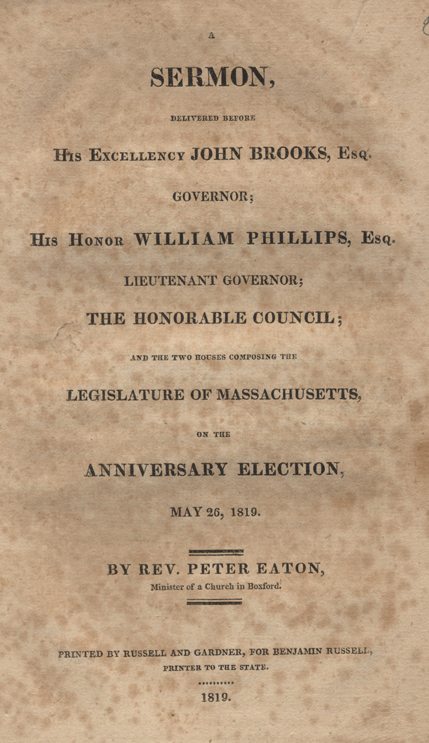
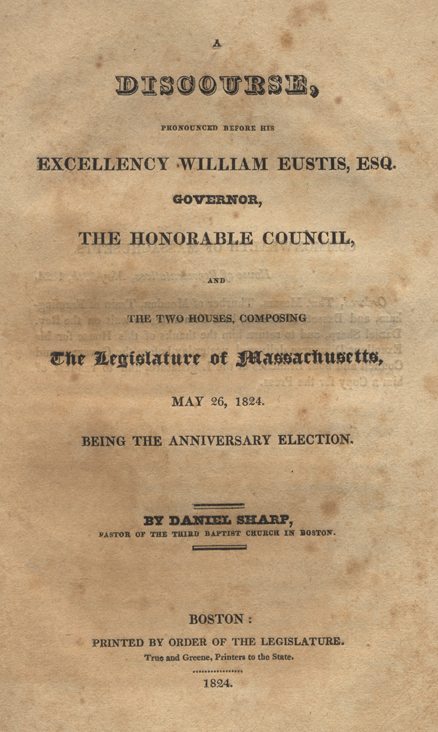
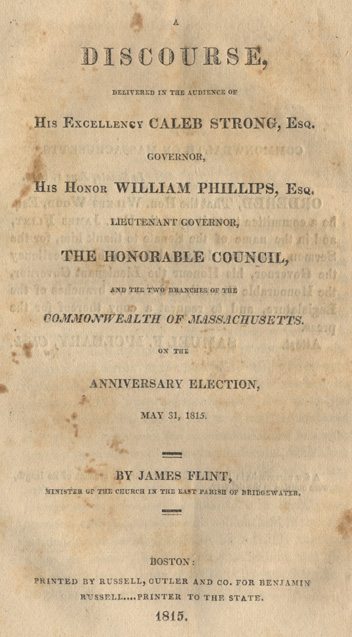
A

DISCOURSE,

DELIVERED IN THE AUDIENCE OF

HIS EXCELLENCY CALEB STRONG, ESQ.

GOVERNOR,

HIS HONOR WILLIAM PHILLIPS, ESQ.

LIEUTENANT GOVERNOR,

THE HONRABLE COUNCIL,

AND THE TWO BRANCHES OF THE

COMMONWEALTH OF MASSACHUSETTS.

ON THE

ANNIVERSARY ELECTION,

MAY 31, 1815.

BY JAMES FLINT,
Minister of the Church in the East parish of Bridgewater.

DISCOURSE.
DEUTERONOMY iv. 9.

Only take heed to thyself, and keep thy soul diligently, lest thou forget the things, which thine eyes have seen, and lest they depart from thy heart all the days of thy life; but teach them thy sons and thy sons’ sons.

Since the last return of this anniversary, the public mind has been agitated by the most affecting alternations of joy and gloom, of awful apprehension and unmingled gladness. We have witnessed, what at the time we deemed the winding up of the great drama, which, for so man years, had been exhibiting in Europe, in which might nations were the actors, and which awakened the most profound commiseration and terror in the bosoms of all, who beheld the novel and stupendous scenes, which marked its progress. We have seen, also – all thanks to the God of our fathers, who in judgment hath remembered mercy – we have seen the conclusion of the less sublime but to us not less interesting under plot, which our own government, in conjunction with the sanguinary hero of the piece, contrived to weave into that drama. Events so astonishing, so important in their consequences, and so pregnant with solemn and instructive lessons to our country, merit to the indelibly engraven upon our memory by frequent recollection, and that we should teach them, “with lessons they have taught us, to our sons and our sons’ sons.”

I would, therefore, ask the attention of my respected auditors to a brief review of these events, of “the things, which our eyes have seen,” – to a cursory notice of some of the important lessons moral and political, which people and rulers, electors and legislators have alike been taught by these things, and are bound to remember; and lastly, to the mention of certain objects, in the promotion of which every patient and philanthropist, and certainly the appointed guardians of a Christian commonwealth, will feel themselves urgently called upon to exert their influence, from the extraordinary character of the times and state of the world, in which we live.

I. A year has not yet elapsed since the friends of liberty, of religion and human happiness in this country, spontaneously and publicly testified their devout and joyous sympathy with the exulting nations of Europe when they heard the tidings of their emancipation from the galling yoke of tyranny, of their delivered from the desolating demon of war, of their restoration to mild and equitable rule, to the quiet cultivation of the arts and enjoyment of the blessings of peace. We had long taken a humane and anxious interest in the great events, that were passing upon the tragic theatre of the old world. We saw, with dismay and deep concern for the liberty, the religion and all the salutary institutions for the improvement and happiness of civilized man, a stern and unrelenting despot, a contemnor of God and man, at the head of a mighty empire, a leader of unnumbered legions trained to the work of destruction in the midst of atheism, carnage and crimes, accustomed to victory, athirst for conquest and plunder, going forth conquering and to conquer. We saw immense armies scattered before him. We saw ancient thrones, principalities and powers fall prostrate at this approach. We saw kings and emperors casting their crowns at his feet. We saw the iron yoke fastened upon the necks of his victims, while terror stifled their groans. We saw him wringing from them, with insatiable cupidity and unsparing cruelty, tribute upon tribute, sacrifice upon sacrifice of their best blood and few remaining comforts; and all this to rivet more firmly the chains, which bound them to the chariot wheels of their conqueror – to satiate his lust of boundless conquest, and to spread the portentous glare, the blasting splendors of his name and despotic communion over the whole civilized world.

We saw, indeed, one people, and one only, who kept the tyrant at bay, who never bowed the knee to this great Baal, who never trembled at “this goals, who then bestrode the” continental “world.” And this people – shall we not exalt in this claim? – this people are our kindred by blood, the descendants of the brethren of our fathers. Their St. George’s channel, their wooden walls and hearts of oak, and more than all, perhaps, the prayers and slams of their “noble army” of Christian philanthropists formed a barrier, which the myrmidons of the tyrant could never pass. England stood unmoved within view of his shores, queen of isles, mistress of the ocean, vanquisher of his fleet and colonies, the asylum of the proscribed objects of his jealousy or revenge, mocking at his important rage, engrossing the commerce of the world, and carrying, in exchange for the perishable products of their soil, the bread of life, the glad tidings of salvation to farthest Indian, and the remotest islands of the Gentiles.

We saw, in the mean time, the despot inflicting upon his passive subjects and allies unheard of hardships and privations by that barbarous engine of tyranny, the continental system, the only weapon with which he could hope to reach that object of his hate and terror, the maritime supremacy of unshaken, undaunted England. The oppression of this system added to others, stamped with the character of the blackest treachery and most outrageous insult, rouse, at length, the slumbering energies of Spain, stirred the proud spirit of Spaniards, and inflamed with a sudden fever of resentment and revenge the blood, which till then they had seems to have forgotten, that they had derived from a brave and warlike ancestry. We saw and admired their desperate daring, their noble struggle. But we rather wished and prayed, than hoped it would be crowned with success, although backed, as it was, with the generous and powerful aid of England. The then little known, but now illustrious Emperor of Russia, finding his empire degraded and burdened by the conditions, which is an unfortunate moment, he had entered into with the mighty oppressor of the continent – convinced, by the fate of neighboring princes, that to be in league with him in any form was to enter into compact for his own destruction, and that his only alternative in order to save anything from the illimitable claims of his imperial friendship, was to hazard every thing in determined hostility against him – warmed also with a generous glow of indignation at oppression, and animated by the heroic example of England and Spain united – above all, elevated and sustained by a pious confidence in God and the justice of his cause – he prepares and calmly waits for the assault, which he was aware had been long mediated by the modern Sennacherib against this crown and empire. We saw that “scourge of God” go forth in his wrath with his hundreds of thousands madly confident of an easy victory over the only remaining empire of the continent, that had courage and strongly to resist his desolating progress to universal dominion.

The prayers of all who cherished in their bosom a spark of interest for the liberty and happiness of mankind, were earnestly preferred dot the righteous Father of the world, that he would interpose. Neighboring and distant nations seemed alike interested, and alike waited the issue of the contest in trembling suspense. Nor were they left long to doubt of the result. For, behold, “the Lord of hosts, mighty in battle, what his glittering sword, and his hand took hold on judgment.” He not only inspired the hardy men of the north, with unconquerable energy and intrepidity in defense of their homes and temples, and of a severing, whom they loved, because they had found in him, not an oppressor, but a father of his people; but he brought, also, to their aid the irresistible might of his ministering servants, the elements, flaming fire and frost, “stormy wind and tempest fulfilling his word.” He scattered by thousands the carcasses of the invaders in the wilderness. He emphatically spoiled the spoilers. And, by a rapid descent from his dizzy eminence, before the close of a second year from his proud entrance into Russia, at the had of perhaps the most powerful and best appointed army the world has yet seen, we saw this disturber and terror of the world reduced to the condition of a despised, and therefore, alas, unguarded exile – the man, whose plans of empire were bounded only by the limits of the earth, restricted to the diminutive island of Elba, –

“The desolator desolate,
“The victor overthrown,
“The arbiter of others’ fate,
“A suppliant for his own,” –

the nations, that he had subdued, restored to their independence, and the calm of peace succeeding to the tempest of war throughout all Europe. This we saw, and as became men we rejoiced; as became Christians we gave glory to God.

But there was much at that time to damp our joy. We had to blush for our country, that it had taken no part in the triumphant cause of God and man. Had taken no part do I say? O blot of infamy, dark eclipse of American glory! Our country did take part in this cause, but it was against it. The only remaining republic upon earth, a nation descended from freemen, whose proudest boast was their hereditary love of liberty, and hatred of tyranny, harnessed themselves to the war chariot of the tyrant, in which he was riding over the necks of prostrate millions. Yes, the exclusive republicans of America voluntarily added themselves to the long list of degraded nations, who were by force leagued with the infidel power of France, against England; and lent, with cordial good will, their utmost aid to beat down that last remaining bulwark in the old world, of rational liberty, and “of the religion which we profess.”

It was soon seen that we must fare, as men, soon or late, must ever fare, who take side with those, who are at strife with God and right and humanity. When the pitying Father of the world opened his ear to the cries of the oppressed nations, when the measure of their chastisement seemed to be full, and he arose to lay aside, with signal dishonor and contempt, though not, as we hoped, forever, the blood steeped instrument of their correction – when the great instigator and patriot of our wicked war thus became, in the view of all, “a thing of naught,” we were left singly exposed to the merited resentment of our enemy, to the pity or derision of the whole world, and probably, if England had insisted, to united hostility of her allies.

Europe rejoiced, and all good men in this country rejoiced to see, in the fallen fortunes of the tyrant, the removal of that example of successful guilt, which had so long emboldened the wicked in every country, and in none, perhaps, more than in this. The central throne of iniquity, infidelity, perfidy and crime seemed to us to be thus overthrown to its base; and we regarded its wide spread ruins, like the traces of the deluge, as a monument to the world of God’s eternal abhorrence of oppressions, violence and blood – as a lesion of awful admonition to all those, who have been abettors or admirers of the French league of atheistic philosophy and hostility against the most sacred principles and institutions, against the most consoling hopes, against, in short, the virtue and happiness of mankind. We considered this league as effectually broken in the overthrow of the despot. In his fall, we saw the head of this serpent bruised. And we rejoiced to see the death wound, as it then appeared, thus inflicted upon the head of the venomous best in Europe extending downwards, till the tail of it, as we may say, which had twined itself about the Genius of America, felt the unexpected stroke, and writhed in sympathetic agony. Divided as it now was, from its head, and but a fragment of the original monster, although like a monster of the polypus species, it continued to retain feebly the power of life and motion, yet it must ere long have perished of itself, had not the imprudent Hercules, that came to our shores to destroy it, in attempting to tear its poisonous folds from the Genius of our republic, unhappily wounded that Genius in the attempt. 1

This touched our pride of country, and awakened in all a determined spirit of resistance, an united zeal to defend our soil and our cities against every attempt of the enemy, to repeat the humiliating scenes which had been exhibited at Washington and Alexandria. Those, who from principle, abhorred the war in its origin, its entire character and conduct hitherto, now, that it had assume da new character, stood ready to repel the foe that should have the temerity to invade the soil, which they had inherited from their fathers, and which had been consecrated by their blood to liberty and independence.

Dreading and preparing for the worst, the people assumed, as one man, a determined attitude of self-defense. While we had nothing to hope from our own government, except that the necessity of making peace must soon grow out of their inability to prosecute the war, we had every thing to apprehend in the approach of the enemy with his whole force, from the natural disposition of man to avenge, when he becomes strong, an injury inflicted on him when he was weak. At the same time, we had something to hope from the moderation, magnanimity, and desire of peace, previously manifested by the nation, with which we were contending, notwithstanding our government had been the assailants in the unrighteous contest.

Such, for some time, had been the state of things, and of men’s minds, in regard to the unnatural and hopeless war in which, while all Europe had rest, we found ourselves involved. And when we recollect the gloomy aspect of affairs in our country, at that time, and the appalling prospects, which were opening before us – the nation without revenue, the treasury empty, public credit gone, the people shrinking from the oppressive burden of taxes, that was lain and coming upon them, many states beginning reluctantly to contemplate temporary separation of their fortunes from those of the general government, as their only security from ruin – all eyes in the mean time, turned with anxious waiting to receive intelligence from our commissioners at Ghent – the thoughts of all recoiling from the distress, the devastation and bloodshed, which must be the result of another season of hostilities, should England determine to prosecute the war with her undivided strength, and with that spirit of resentment and animosity, which the time and circumstances, in which it had been declared by our government, might seem to justify; – already many thousands reduced from competence to poverty, and other thousands with the same disheartening prospects before them; – when we recollect all this, we cannot wonder at the unexampled rejoicings, and the fervor of thanksgiving to Heaven, which the people manifested at the conclusion of a war, which had been waged at incalculable expense without the attainment of a single object, a single claim, for which it was professedly declared. What stronger evidence could we have that the war was no war of the people’s choosing, that in its whole character and in all its aspects, it was odious and had become insupportable to the great mass of the nation, that the almost frantic joy with which the return of peace, of bare peace, without brining with it the shadow of an equivalent for its absence was universally welcomed.

True it is, we saw nothing of this joy – I speak not here of those brave men, who have fronted danger and fought the battles of our defense “by flood or field” and how have covered themselves and their country with all the glory that can be derived from arms; but we saw nothing of this joy, I say, in those sauntering “dogs of war,” who have been distinguished only by wearing about them the badge which showed to what master they belonged, and who heard the tidings of peace, so grateful to the people, with selfish and sullen regret, that they could no longer fee din idleness at the public charge. We saw, indeed, nothing of this joy in the servile pimps an spies of government, who had been thriving upon the distresses of their fellow citizens, and whose occupation and gains were now at an end. We saw nothing of this joy in the many thousand occupants of new offices, which the war had created, those patriotic pensioners upon cabinet patronage, and who, like so many devouring locusts, had overspread the country, and consumed tis resources. But we saw this joy in all its fullness and sincerity, in those private and peaceable citizens, who could gain nothing by the war, who beheld in the peace a limit to those wasteful expenses, of which they must pay their full proportion out of the hard earned fruits of the sweat of their brow; and who, had the war continued, must have presented their own breasts to an invading foe, in place of that defense, which they had a right to demand of the national government, but which had been to the last denied them. We behold this joy in parents, who in another season of hostilities, were anticipating the dreadful spectacle of their sons lying mangled and breathless courses upon the field of battle – in wives, who were foreboding a final adieu from the husband of their youth – in children, who, catching the contagion of their mothers’ fears, beheld the demon of war robbing them of their fathers.

These rejoiced and still rejoice in the event which bade them dismiss their melancholy anticipations, and welcome the heart cheering prospects of quietness in our borders, of returning propriety, of domestic tranquility, and of fathers, husbands, and sons waiting the gentle summons of nature, instead of the abrupt and appalling signal of battle, to resign their spirits to God, who gave them. And in unison with this joy were all the better feelings and sympathies of the human heart. If some dark and perturbed spirits, “who delight in war,” refused to join in the loud chorus of gratulation and gladness, which rang from one extremity of the union to the other, the bright and lovely train of the civil and domestic virtues, the smiling attendants upon peace, were heard mingling their mild voice in the common joy at the return of their long banished patroness and queen. Humanity rejoiced that the earth ceased to be crimsoned with the blood of man, spilt by the hand of his brother; and that the sword was stayed from adding to the number of windows and orphans. Religion, peaceful daughter of heaven, was glad and hymned new anthems of praise to the God of peace, that her voice, which speaks good will toward all men, was no longer to be drowned in the horrid din of battle, in the groans of expiring nature mingling with the savage shouts of victory. Patriotism exulted that our rapid progress to national ruin was arrested and that happier prospects were once more beginning to open upon our suffering country. Justice triumphed in the vanishing of those unholy visions of conquest, which had so long haunted the disordered imagination of our rulers, which had carried fire and sword into so many peaceful villages of Canada, and which have rendered that province the scene of such boundless waste of treasure, of so many signal defeats and disasters, and of one of two splendid and dear bought, but useless victories. In abort, truth, reason, and common sense, so long exiled from the counsels of the nation, hail with gladness this auspicious pause in the reign of delusion, absurdity, restrictive energy, and mad experiment. And who, that loves his country, will not devoutly pray that the pause may be perpetual?

II. From our hasty retrospect of “the things, which our eyes have seen,” we return to notice, as we proposed, some of the important lessons, which we ought to learn form them, and to “teach our sons and our sons’ sons.”

Let the first be lesson of gratitude to the God of our fathers. However ardent, and strong and lasting this gratitude may be, it can hardly equal what we ought to feel for our deliverance from the confusion and ruin, which but recently seemed inevitable, and that we have escaped, with no heavier loss and suffering, great as these have been, from the rash plunge of the nation into the awful perils of war, at a period when the unexampled terrors and miseries of war in Europe solemnly admonished our favored country to remain at peace, and to mitigate, if possible, instead of adding to the woes of an afflicted and bleeding world.

2. We ought, in the next place, to derive new and deeper convictions, from the things we have seen, of the superintending and controlling providence of the Sovereign of the universe, in the direction of human affairs.

In the astonishing change and revolutions, which have marked the age of wonders, in which it is our lot to live, especially in those which have occurred in Europe within the few last years, the supremacy of God, and the agency of his Providence in the government of the world have been so visibly and remarkable manifested, a that even the blind, one would think must see, the hardened feel and be constrained to acknowledge, “that verily there is a God who judgeth in the earth, who enlargeth of straiteneth the nations, who setteth up on end putteth down another, and who doeth all his pleasure among the inhabitants of the earth, as well as among the hosts of heaven.” When we saw the remorseless oppressor of nations ready to take the last step in his march to universal empire, and we were in read lest the whole Christian world must been beneath the sway of an infidel and ferocious despot, with what ease, how speedily, and in a manner how unexpected did God abase to the dust the pride and the might of “the terrible one,” and exalt the weak to the throne of the mighty.

Fear not, then, ye who tremble because the head of the dragon2 is again lifted up. Let him and his angles renew their impious war. The arm of the Almighty hath not waxed feeble. He hath still his Michael and his angles, by whom he hath once given response to the world, and who, when he commissions them, shall again prevail against he dragon; and in the appointed hour, the monster shall be consigned to a safer prison than the islands of Elba.

3. A third lesson, which we have been impressively taught by “the things we have seen,” – and this is another reason for banishing our fears for the result of the renewed contest in Europe – is, that “the triumphing of the wicked is short.” Never, perhaps, since the generation, which God in his wrath swept from the earth with a flood, – never certainly, in any age, or portion of the world that has been shone upon by the blessed lights of Christianity, has there been such a general and open contempt of all religious and moral obligation, such insolent defiance or denial of the divine government and authority, as has been seen in those parts of the old world, which adopted the principles, and afterwards felt the power of revolutionary France. When we saw this colossal power wielded by an individual, “at whose name the world grew pale,” when we saw him successful in all his enterprises of unparalleled daring and guilt, when we saw his humble admirers and obedient followers sitting in the high places of power in our own country, the entire world, to our desponding fears, seems destined by its incensed Creator to fall under the empire of the wicked.

But when they were rearing the last battlements of their Babel, whose impious height had long insulted the Heavens, and from which they began proudly to dictate their laws to the whole earth, we saw their chief in company with numbers of his satellites suddenly hurled from its summit by the hand of retributive justice. We saw him, for a time, and as we hoped forever, left in miserable banishment to “the vultures of his mind,” his own reflections; and like the wretch in the hell of the poet, to admonish by his doom guilty rulers and their adherents in every country to learn righteousness and to fear God. 3 And notwithstanding his unexpected and, wet rust, short reprieve from this doom, it has given us condoling assurance, in which we will rest, that although men without religion, without virtue, without pity or remorse, “join hand in hand,” abuse power, and “frame mischief by a law,” yet shall not the wicked go unpunished. “As a dream, when one awaketh, so, O God, when thou awakest, shalt thou despise their image. And the righteous shall rejoice, when he seeth the vengeance.”

4. We have, again, been taught, what indeed was foreseen by the considerate and has now been made manifest to all by our ill-fated war, that our form of government, our institutions and habits, disqualify us for engaging in wars of conquest. Events have shown that the attack made upon Canada was as impolitic, as it was cruel and wicked. The crying sin of blood-guiltiness was strictly chargeable, in the view of all men of Christian feelings, upon the authors of that measure; to the honor of New England, it will be remembered that by a large majority of its inhabitants, the measure was regarded in the light of an unprovoked and murderous assault upon peaceable and unoffending neighbors. Nor ought it ever to be forgotten by us, or “our sons, or sons’ sons,” that while the war was thus entirely offensive, a war for conquest, and consequently unjust, God was against us; and we accordingly met only with defeat, disaster, and disgrace. But the moment the character of the war was changed, and become a war of defense, and therefore just, God was with us; and, in every instance of importance, except in the attack of the enemy upon the immediate seat and citadel of improvidence and imbecility, the head quarters of the redoubtable heroes of Bladensburg, we were successful in repelling invasion.

5. This nation, moreover, in addition to the innumerable lessons that have gone before in past ages, have received another, and a very serious one, from the things they have recently seen and suffered, upon that inherent vice and ultimate destruction of all republics, party spirit – a blind devotion of the people to the men, who, to obtain office and power, inflame their passion, and flatter their prejudices and pride of opinion. The people of this country have been taught by bitter and costly experiment, to what evils the indulgence of these passion, these prejudices and this pride of opinion may lead. They have seen for what purposes their antipathies to one nation, and attachment to another have been so industriously cherished by incessantly proclaiming and exaggerating the injuries of the one, and anxiously concealing or excusing those of the other. They have seen that their flatters, and the fermenters of strife and war, have achieved nothing for their country, which they promised – have obtained no security against the violation of “trade and sailors’ rights” and while they have been enjoying the emoluments and honors of office, the people have deprived from their counsels no other fruits than general embarrassment and distress, loss of public and private property, and an entail of taxes, which neither they nor “their sons, nor sons’ sons” will probably see cancelled. The people must, we think, have been feelingly persuaded of the truth of the remark long since made, that “party is the madness of many, for the gain of a few.” We trust that the lessons upon this point, so dearly purchased, will not be lost upon the citizens, who have to pay for it; and that they will learn from it to judge of political as they do of religious profession, by its fruits – to distinguish the true friends and able guides of their country from the smooth and fawning pretender to patriotism and disinterested love for the dear people; and, in future, to trust with office those men only, whose known principles and tried virtues entitle them to the public confidence. To have been once deceived by men who promised fair, proves only that we charitable believed them honest and were mistaken. “But when men,” says an eminent statesman, 4 “whom we know to be wicked, impose upon us, we are something worse than dupes. When we know them, then their fair pretenses become new motives for distrust.”

Tempests, engendered in the natural world, by a foul and heated atmosphere, if they sometimes destroy the fruits of the field and the labors of man, are usually succeeded by a purer air, and a brighter day. Noxious insects, pestilent vapors, and obscuring mists, are dispersed. Objects are seen through a clearer medium, and in a new light; and more distinct and correct impressions of them are conveyed to the mind. We will hope that, in like manner, the tempest and fury of the passion, that have been excited among us, and the storms of war produced by them, now that they are spent and gone by, will be followed by moral and political consequences equally salutary and beneficial to our country. And, great as have been the gloom, and distress, and ruin, which have marked their course, we might pronounce the evil incurred small, compared with the good obtained, should we find that they have also swept away, and that forever, “the refuges of lies,” by which an abused people heave been made the victims of series of oppressive and calamitous measures, the effects of which will be felt long after the present generation shall have passed away.

As it is from experience and by sober reflection upon event, that nations as well as individuals learn wisdom, it is, therefore, the bounded duty of the citizens of our republic not only that they retain in remembrance and meditate much and often upon the things they have witnessed and endured for the last few eventful years, that, soberly viewing the causes and pondering the consequences of these things, they may gather from them the instructive lessons we have noticed and others equally obvious and important; but they are bound also to teach them to their children and to warn them of the dangers to which their prosperity and liberties will ever be exposed, from the arts of ambitious and corrupt men and from their own passions and prejudices.

God, by his servant Moses, enjoined it upon the Israelites, as in our text, to be ever mindful of the astonishing events which they had witnessed alike in their deliverances and their chastisements. They were commanded to teach them to their children, “to their sons’ sons,” that the salutary lessons which they inculcated might be transmitted and perpetuated among them. And it is from what others or themselves have experienced, from recollection of their errors and miscarriages, and reflection upon their causes and consequences that men are admonished, instructed and disciplined into prudence and virtue. This is the great end of God’s various dealings with individuals and nations. For this, history unrolls her faithful records. For this, the faculties of memory and reflection hold so distinguished a place in the endowments of the mind. To consign to oblivion, therefore, when they are past, evens, which deeply affected us while passing – to forget our calamities when they are removed and to avert the attention form the true causes and immediate authors of them or to attribute them to false causes or imaginary instruments, is “to despise reproof and to hate instruction;” is not only, like obstinate children, to suffer the infliction of the rod without deriving from it any equivalent for the smart, but is also to invite a repetition of its strokes.

Surely then, it is not expecting too much from the good sense and calculating character of our fellow citizens that they will divest themselves of the unreasonable prejudices, and attachments of party, the immediate or remote cause of most of the evils they have suffered – that they will turn from their political idols whom they have found to be “vanity and a lie,” to the men under whose auspices they were once prosperous and happy; and that they will yet furnish a refutation of that severe maxim of the statesman before cited, that “the credulity of dupes is as inexhaustible as the invention of knaves.”

III. I hasten in the last place to name to my indulgent auditors – for time will hardly permit me to do more – certain objects, in the promotion of which every patriot and philanthropist, and certainly the appointed guardians of a Christian commonwealth, will feel themselves urgently called upon to exert their influence from the extraordinary character of the times and state of the world in which we live.

1. The passing age has been remarkable for its wild speculations, extravagant theories and daring experiments in government, in morals and religion. The people in our own country, as well as in others, have been taught new doctrines upon these subjects – doctrines sanctioned no more by the sober conclusions of reason than by the voice of experience. Their tendency has been to inflate the minds of the uninformed with an overweening sense of their own lights, of their own important – to weaken their respect for the sound maxims, the salutary principles and usages of our fathers – to loosen and in to many instances, to sever the sacred bonds which bind man in allegiance to his God, in equity and in love to his neighbor, his country and his kind. The effects have been answerable – such as we have witnessed have felt and deplored. The order, virtue, happiness, and stability of our republic have been sensibly impaired – its very existence endangered. To remedy these evils if possible, to repair these breaches will be regarded by every good citizen and magistrate as an object of the first importance. And, if this is ever to be affected in any good degree, it must be brought to pass by the same means by which our fathers founded and built up the social edifice which they left to us strong and beautiful, and taught us by their example how to preserve and enjoy.

They were well aware that no free government could be long supported but by the united influence of knowledge, and virtue and the fear of the Lord generally diffused throughout the great body of the citizens. To promote, maintain, and extend the influence of these qualities they bent all the energies of their powerful minds. To this end looked all their public institutions and laws, all their instructions in the pulpit, the college, the school, and in families – those natural seminaries which under Christian parents are of all others foremost in importance as they are in order, in forming the human mind in imbuing it with pious sentiment and virtuous principle.

In order, then, that our free and equal forms of government, our invaluable institutions and usages may recover of the shocks and long survive the changes which they have recited from the licentious and innovating spirit of the age, the united and persevering exertions of the wise and good in every station, aided as far as may be, by the influence of legislative authority, must be strenuously employed to bring back the people to “the old paths and good ways,” in which our fathers walked – to re-establish the authority of the plain and sure maxims, and to put in more general and vigorous operation those tried and effectual means of diffusing knowledge, virtue, and piety, by which the sons of the Pilgrims that have preceded us, formed of New England “a mountain of holiness, a habitation of whatsoever things are true, honest, just pure, lovely, and of good report.”

Knowing therefore the conditions upon which alone the prosperity and permanency of our republican institutions can be insured, the genuine patriot, whether acting in a private or official capacity, will feel himself bound as he would secure, and transmit to his children the rich privileges which he has inherited from his fathers, to exert his utmost ability and influence to enlighten public opinion, to correct and elevate the public morals, to foster the interests and extend the influence of useful learning and pure religion.

2. I would name another object, which is beginning to excite much attention among the reflecting and benevolent in our own country, which is of universal interest to mankind, and in the prominent of which legislators and rulers might, if disposed, do a great deal. The object is no other than to do something, if possible, to bring into discredit and disuse the barbarous and horrible practice of determining national differences by the sword. I know that a proposition of an attempt to abolish wars will be though by many a proof of little else than of a good natured madness in the proposer. But by Christians it ought to be heard with respect and a readiness to cooperate in any measure that may tend to a “consummation so devoutly to be wished” by all the friends of humanity. Surely, our religion gives no countenance to wars, scarcely of defense, and in no case to offensive wars. If wars, as we know from the sure word of prophecy they will, are one day to “cease to the ends of the earth,” how is this great change in the world to be accomplished? Not, we have all reason to think, by miracle, and at once, but gradually, by the combined influence and agency of Christian principles and Christian societies formed for this very end. Traffic in slaves, not long since, was as universally tolerated, as war. But Christian philanthropy and Christian perseverance have already done much and are still going on prosperously to complete the extermination of this infamous practice from out of the limits of Christendom. Were a combination formed in this country, in this state, of the friends of human happiness, aided by legislative concurrence and authority, and let them make their appeals to Christians everywhere, to cooperate in their attempts to impress all hearts which they can influence with abhorrence of the savage customs of war; and perhaps, in tie, by the blessing of God upon their benevolent exertions, the Christian world may owe as much to a New England Association for the abolition of wars, as Africa does to the bond of British philanthropists who led the way in the abolition of the inhuman traffic in slaves. There never was a time more favorable than the present for an attempt of this kind. Should the peace of Europe be speedily re-established by the fall of the outlaw, who hath broken it, as we devoutly hope, government and people, exhausted with the waste and smarting with the wounds of war, will be universally in a condition to listen to an appeal made to their interests and feelings upon this subject. 5 We may at least calculate with assurance, that the legislature of this, and we trust of the other states of the union, will persevere in their endeavors to obtain the constitutional security recommended by the late New England convention, against a repetition of an offensive war, like that from which we have recently escaped.

3. Indulge me in the mention of one object more which merits even more than all the extraordinary interest and exertions which it has so generally produced in the Christian world, and which of all others will, perhaps, be eventually found the most efficient means of accomplishing the object last mentioned, I mean the diffusion of the Holy Scriptures.

Although we doubt not the glorious work will proceed effectually in the hands of the societies and individuals engaged in it, et I would respectfully ask whether it be not an object deserving the liberal patronage of legislative bodies. While this patronage would ensure to these bodies the augmented respect and confidence of their pious constituents, would it not contribute to awaken a more general attention throughout the community to that Sacred volume, which should appear as thus it would, to be an object of peculiar esteem and reverence to the highest order of men in the state? Every friend of Zion, every Christian philanthropist, whose heart glows with the benevolent desire and daily breathes to Heaven the fervent prayer that the kingdom of Christ that blessed empire of light and love, of righteousness and peace, may be extend and established throughout the world and built up in all hearts, must have witnessed with holy joy and exultation the wide spread and still extending triumphs of British charity in the distribution of “the words of eternal life” in all ands and in all languages. What fountains of consolation have thus been opened to the poor and afflicted in those countries which have been swept with the desolating tempests of war? While a night of double darkness, of infidelity and gloomy despotism was brooding over the fairest portion of continental Europe, form the Bible societies in England, the sun of righteousness seemed to arise with new brightness and healing in his beams. In that fortunate isle, while the upas of atheism, rooted and nurtured in France, was spreading wide its baleful shade, dripping with poison to the souls and destruction to the bodies of men, we have seen the tree of life flourishing with unexampled luxuriance, reaching forth its branches and expanding its leaves for shelter and for medicine to the weary and bruised nations. We have shown that we can vie with the men of that illustrious land of our ancestors in wielding the weapons of death and in managing the engines of destruction. Let us emulate them in their more noble and Godlike efforts to save, to enlighten, to console mankind. When appointed to this service it was my pleasing hope that I might be permitted to congratulate my fellow citizens upon the established repose of Europe, as well as of our own country. But the unsearchable counsels of God have appointed otherwise. While we almost imagine that we heard resounding through the world the echoes of the angelic song, which once announced from Heaven peace on earth and good will to men, the terrific genius of destruction again welcomed into fickle and perfidious France, startled us with new alarms of war. Again,

“Red battle stamps his foot and nations feel the shock.”

It is not for us to penetrate or arraign the purpose of God in suffering this. He governs the world; the wrath and crimes of no created being can pass the bounds which he assigns. Confiding in his goodness, it becomes us to submit with silent reverence to what we cannot comprehend. While we sympathize with Europe again convulsed and bleeding, let it renew our gratitude to that kind Providence which hath made us to differ. And God, of his mercy, make us wise to preserve and worthy to enjoy, this distinction, till it is lost in the universal and permanent repose of the world.

Your Excellency, during “the troublesome times” we have seen has given your constituents a decisive and endearing proof that your heart corresponds to this wish in the spirit of a sincere disciple of the Prince of Peace, with the feelings of a lover of his country and of his kind. So long as we remember “the things which our eyes have seen” will not forget but will teach it to “our sons and our sons’ sons” what we owe to this guide who, under God, hath conducted the people and guarded their rights with a wise and paternal vigilance through all the perils that have encompassed them. If Your Excellency has had no part nor lot in the glory of those magistrates who have sent their citizens to gather laurels and to find the cypress in the wilds of Canada, Your Excellency has that which will be far more soothing in the silent and solitary house of life and its close that which is far more illustrious in the esteem of the wise and good, the glory of having sanctioned no measures that have carried mourning and distress into the dwelling of a single family in the state.

In ancient Rome, he that in battle had saved the life of a citizen was rewarded with a civic crown and was honored as a father by the person preserved. The citizens of this Commonwealth between whom and the deadly contagion of a camp and the weapons of an invaded people, Your Excellency has effectually interposed the shield of the Constitution have no civic crowns to give. But they have repeatedly given the highest mark they have to give of their gratitude and respect; and the same time they acknowledge, in each repeated acceptance of it, a new obligation conferred by Your Excellency upon themselves.

The Christian patriot derives his first best earthly reward from the consciousness of upright intention in the discharge of every trust reposed in him by his fellow citizens; the next, from seeing them manifestly benefited by his services; and next to this, form the uniform and often repeated proofs of their cordial attachment and confidence. His last exceeding great reward, to which he steadily but humbly looks is that transporting eulogium form his final Judge, “well done, good and faithful servant; enter thou into the joy of the Lord.”

Your Honor will accept our respectful congratulants upon being again called to fill the office of Second Magistrate in the Commonwealth; and upon which is far more grateful to your Honor, the reviving prosperity of our country which promises to the benevolent increased means of experiencing what your Honor so well knows, “how much more blessed it is to give, than to receive.”

Counsellors, Senators, and Representatives of the Commonwealth; we rejoice with you that the new political year is ushered in with so much happier auspices than the last. You will not need that I should remind you of the high and solemn responsibility which rests upon you in your official character. No one, surely, of your honorable body, can have received the trust reposed in him by his constituents, without feeling the importance, not of the honor, but of the duties attached to it. Least of all should we suppose it possible for a man to take this trust lightly upon him, when an impression of the calamities, which an abuse of it may bring upon his country is so fresh and deep in his mind, as it must be in the mind of every man who remembers what he has recently seen and felt.

Bringing with you, to the counsels of the state, this impression, you will give your sanction to not measures affecting the common interests of your constituents, till looking as far into all their bearings and issues, as the ken of human foresight, assisted by the lights of experience and reason is permitted to penetrate, you conscientiously believe them to be good and salutary. When entered upon the exercise of your legislative functions, you will feel yourselves to be standing upon holy ground. You will, therefore, as becomes the place and your character put off and remove far from your minds, the narrow prejudices and blinding passions of party, the sordid considerations of private interest or personal ambition, as most unworthy to enter into those solemn deliberations and decrees on which depend, in no small degree, the order, security, and prosperity of the Commonwealth.

We may confidently expect from the civil fathers and guardians of the state, all that can be done by legislative authority alone, or in concurrence with the exertions of societies or individuals, to aid the great interests of humanity, to enlighten public sentiment, to improve the public morals, to preserve and increase, in the public mind, a reverence for the name, the word, the Sabbaths, and worship of God, to invigorate and extend the influence of our inestimable civil, literary, and religious institutions.

In all your labors for the promotion of these most important objects, we, the ministering servants of God, are by our office, and form the nature of our charge when faithful to it, “fellow-workers together with you.” We have, therefore, a claim upon your countenance and support, so long as we quit not our sphere. And, if you sometimes find a brother among you, and concern for his flock prompt the question, once put by Eliab to the shepherd, son of Jesse, “Why hast thou come down hither? And with whom hast thou left those few sheep in the wilderness?” Add not, we beseech you, the uncharitable charge laid by the churlish Eliab to his brother, “I know thy pride, and the naughtiness of thy heart; for thou art come down that thou mightiest see,” and mingle in “the battle of contentious partisans.” Your honorable body will rather impute to him a generous zeal to aid you in promoting the great interests of our common Christianity. At least, let the presence of our brethren serve to remind you, that these interests are intimately connected with the great interests of all the state and of our country – that however excellent our constitution and laws, there can be no permanent order, security, or happiness in our republic, unless the citizens composing it are, generally, influenced by the awful sanctions of religion, the hopes and fears of eternity.

Confiding in the wisdom of your counsels in the integrity and patriotism of your intentions, in your zeal for the common welfare not doubting that you will act under a just sense of your accountability to your constituents, and, we trust, to the Searcher of Hearts, we bid you God, speed in the duties before you. May you honorable acquit yourselves, respected Rulers, of your allotted parts in the accomplishment of those high destinies, to which, we trust, it was in the counsels of God to raise this nation, when we planted our fathers in this good land. And while we hail it, as an omen of better days to our country, that so many of our brethren in various parts of the union misled by the false lights of the age, are retuning to the sound maxims of policy and of morals, exemplified and bequeathed to them by the Father of our Republic, we will hope that its glory, emerging like the sun from the clouds that have transiently obscured the brightness of its morning’s rise will hold on its way, like that luminary, with increasing splendor, till it reaches the western ocean, emitting its wildest blaze of effulgence, the moment it touches the waves.


Endnotes

1. The destruction by the British cruisers of our fishing-craft, and o four dismantled coasting the merchant vessels, in our small harbors, laying defenseless towns, and even salt works under contributions, especially the burning of the public buildings at Washington, excited a very general indignation in all parties. And Mr. Randolph has asserted, and probably with reason, that, but for these glaring acts of indiscretion in the enemy, “nothing could have sustained Mr. Madison after the disgraceful affair at Washington. The public indignation would have overwhelmed, in one common ruin, himself and his hireling newspapers.”
Mr. Randolph’s Letter to Mr. Lloyd.

2. Rev. 12 ch. 7 ver. & c.

3. “Phlegyas que misserimus omnes
Admonet, et magna testator voce per umbras:
Discite justiniam moniti, et non temnere Divos.”
Virg. Aen. Lib. 6, ver. 618, & c.

4. Mr. Burke.

5. See an excellent pamphlet upon this subject, entitled “A Solemn Review of the Custom of War,” & c.

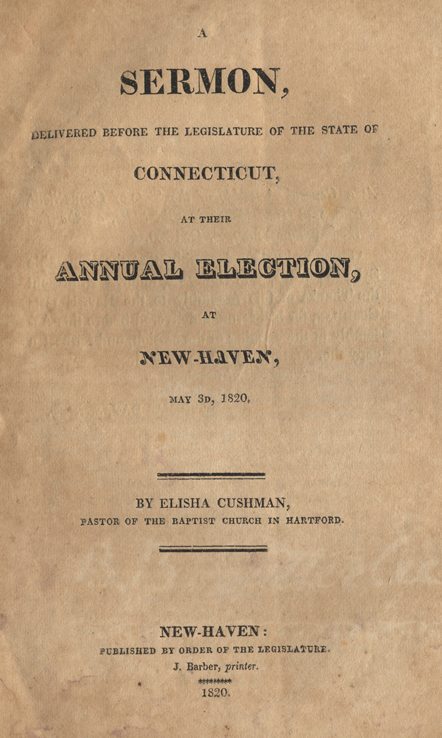
Sermon – Election – 1815, Connecticut


This election sermon was preached by Rev. Brockway on May 11, 1815.


sermon-election-1815-connecticut

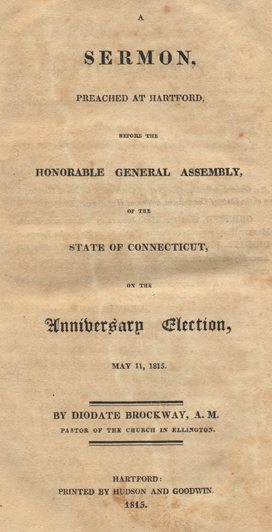
A

SERMON,

PREACHED AT HARTFORD,

BEFORE THE

HONORABLE GENERAL ASSEMBLY,

OF THE

STATE OF CONNECTICUT,

ON THE

ANNIVERSARY ELECTION,

MAY 11, 1815.

BY DIODATE BROCKWAY, A. M.
PASTOR OF THE CHURCH IN ELLINGTON.

HARTFORD:
PRINTED BY HUDSON AND GOODWIN
1815.


At a General Assembly of the State of Connecticut, holden at Hartford in said State, on the second Thursday of May, A. D. 1815.

ORDERED, That the Hon. Jonathan Brace, and Peleg Martin, Esq. present the thanks of this Assembly to the Reverend DIODATE BROCKWAY, for his Sermon preached before this Assembly on the 11th instant, and request a copy of the same, that it may be printed.

A true copy of record,
Examined by
THOMAS DAY, Secretary.
 

ELECTION SERMON.
ZECHARIAH, iv. 6.

Not by might, nor by power, but by my Spirit, saith the Lord of hosts.


The first temple, the most splendid edifice that was ever reared by men, continued in its glory but a few years. It was successively robbed of its treasures by Shishak, Joash, Ahaz, and others, and at last utterly destroyed by Nebuchadnezzar. At the head of a powerful army this wicked monarch overran a large part of Asia, and plundered, as well as conquered, the provinces through which he passed. He did not spare even the temple of the Lord: but after sacrilegiously enriching himself with its costly furniture, he demolished it to its foundation. In about half a century it began to be rebuilt by order of Cyrus, who had previously invaded the Assyrian empire, and succeeded in the reduction of its magnificent capital. The benevolent Cyrus liberated the enslaved captives of Judah, and ordered them to return to their own country. Over these redeemed captives he appointed Zerubbabel Governor, to whom he delivered the sacred vessels of the temple which Nebuchadnezzar had carried to Babylon.

In the rebuilding of the temple, there were difficulties, to human view, insurmountable. The Jews had just returned from a seventy years captivity, and were but poorly furnished with the requisite means, for accomplishing such an undertaking. The opposers of the work, also, were numerous and powerful. Under such discouraging circumstances, how could it proceed? Our text is the answer. Not by might, (or as is rendered in the margin, by army,) nor by power, but by my Spirit, saith the Lord of hosts. These words clearly express the divine efficiency in the work. They show that no human power was adequate to the successful prosecution of it, encumbered as it was with so many difficulties, and embarrassed with so much opposition.

Though the text primarily referred to the rebuilding of the temple, it admits of a more general and extensive application. It is literally true, when applied to all the labors and enterprises of men. Considered in this more general, and extensive sense, I derive from it the following sentiment:

The success of all human efforts depends entirely, and exclusively, upon the providential and all-powerful influence of God.

This sentiment necessarily results from the perfection of God’s character; and is exemplified in such of his works as are accomplished by the instrumentality of men.

I. The sentiment derived from the text necessarily results from the perfection of God’s character.

Isaiah, whose conceptions of the Most High were enlarged by the inspiration of the Holy Spirit, and whose lips were touched with a live coal from the heavenly altar, thus speaks of the glorious supremacy of God: “Who hath measured the waters in the hollow of his hand, and meted out heaven with the span, and comprehended the dust of the earth in a measure, and weighed the mountains in scales, and the hills in a balance? Behold, the nations are as a drop of the bucket, and are counted as the small dust of the balance: behold, he taketh up the isles as a very little thing. It is he that sitteth upon the circle of the earth, and the inhabitants thereof are as grasshoppers; that stretcheth out the heavens as a curtain, and spreadeth them out as a tent to dwell in; that bringeth the princes to nothing; he maketh the judges of the earth as vanity. There is no searching of his understanding. He giveth power to the faint; and to them that have no might he increaseth strength.”

Infinite power, wisdom, intelligence, goodness and purity, are but different names to express the character of him, who is the source of being, and the fountain of blessedness. In God is concentrated every possible perfection that can ennoble and exalt him. He is, in himself, incomparably great, glorious and incomprehensible: the source and centre of all power and efficiency. By the breath of his Spirit we are quickened into life; by the strength of his power we move and are sustained; and by his unerring wisdom we have our place and sphere of action assigned us. He has an intuitive knowledge of the conceptions of every mind in the universe, and with a power which nothing can resist, he controls the passions and purposes of the myriads of creatures which he has made. His influential and governing providence is co-extensive with his works; it is concerned in those events which appear to be the most trifling and casual; in the fall of a sparrow, in the trembling of a leaf, and in the motion of an insect. So entirely dependent are we upon his influence, that, it is not in man that walketh to direct his steps. God is the only independent agent in the universe. He governs with underived, and uncontrolled authority, and he alone has the right and power to do what seemeth him good. It is evident, then, from the character, and from the dominion of the Lord, hat the success of human efforts depends upon his aid and blessing. “Behold he taketh away who can hinder him? There is no wisdom, nor understanding, nor counsel against the Lord.”

II. The sentiment derived from the text is exemplified in those works of God, which are accomplished by the instrumentality of men.

Under his head of discourse, will be considered the instruments which God employs in building his spiritual temple, the Church; which he uses in building up and governing states and empires; and also those which he employs to conquer and destroy them.

1. Let us consider the instruments which God employs in building his spiritual temple, the Church.

The manner in which Christianity was first propagated, and the dispensation of redeeming mercy established, through a crucified Saviour, was a practical exposition of these words of the apostle Paul: “But God hath chosen the foolish things of the world to confound the wise: and God hath chosen the weak things of the world to confound the things which are mighty; and base things of the world, and things which are despised, hath God chosen, yea, and things which are not, to bring to nought things that are: that no flesh should glory in his presence.” The success which attended the labors of the apostles, the first preachers of the gospel, could not be attributed to human wisdom, learning, nor power. They were in general poor, humble and illiterate men, selected, not from the lists of the wise, mighty and noble, but from the lower walks of life. Such were the first propagators of the gospel, the founders of that kingdom which is established in mercy, truth and justice, and the conquests of which are eventually to extend from sea to sea, and from the river unto the ends of the earth. The work upon which they entered, calculating according to the wisdom of this world, was at once the most difficult, hazardous and hopeless, of any ever undertaken by men. Their preparation for this work, so far as it respected human acquirements or aid, was comparatively nothing. They went forth declaring the testimony of God concerning his Son, not with excellency of speech or wisdom; yet their speech and preaching were in demonstration of the Spirit, and of power.

In laying the foundation of that spiritual temple, of which that of Solomon was a type, the apostles were not only destitute of earthly support and aid; but they had to encounter the powerful opposition of men high in office and authority; in short they had to encounter all the opposition, which wealth, talents, and authority united, could give. In the name of their Master, and girded with His strength, they embarked in their holy warfare, successfully using the sword of the Spirit, which is the word of God. With a bold and persevering, but well tempered zeal, a zeal which was not to be terrified by menace, nor discouraged by opposition, they broke through the hatred and unbelief of their own countrymen, the Jews; and the deep rooted and long established prejudices of the gentiles. The doctrines and precepts which the apostles taught, though opposite in their nature and sanctions to the dispositions of unholy minds, yet proved in the hands of the Spirit, quick and powerful, and sharper than any two edged sword. With the seventy disciples, their coadjutors, they went into almost every part of the then known world, gathering and establishing churches. By their preaching an amazing change was effected in the religious state of mankind. Contemplating the success which attended their mission, they might without boasting exclaim in the language of Paul, “The weapons of our warfare are not carnal, but mighty through God to the pulling down of strongholds; casting down imaginations, and every high thing that exalteth itself against the knowledge of God, and bringing into captivity every thought to the obedience of Christ.”

The history of the reformation in the sixteenth century, shows what can be accomplished by the labors of men, when those labors are accompanied with the blessed influence of God’s Spirit. Under the most discouraging circumstances, this work was commenced by a few individuals, and was carried on against the combined opposition of earth and hell. The success which attended the labors of Luther, Calvin, Zulinglius, Melancthon, Cranmer and their colleagues, in exposing the heresies of Popery, in disseminating the pure doctrines of the gospel, and in reviving its discipline, can be attributed to nothing less than the special blessing of God upon their exertions. In defiance of the decisions of courts and councils, and raised above the fear of inquisitions, banishments and burnings, they faithfully preached the doctrines of the cross; protestant converts were multiplied; and so great and extensive were the blessings connected with the reformation, of which, under God, they were the authors, that it is justly considered as furnishing a new and important era in the history of the church.

No class of men so eminently need assistance from above, in the discharge of their official duties, as the ministers of Jesus Christ. Their work is great, their responsibility awful, and their strength weakness. They are to guide the blind in paths that they have not known, and like their divine Saviour to go about seeking that which was lost. Though they are said to be laborers together with God; yet such is the disproportion between the instruments employed, and the object to be accomplished by their ministry, as makes it demonstrably certain, that neither is he that planteth anything, neither he that watereth; but God that giveth the increase. The Great Head of the church has ordained, that the kingdom of holiness on the earth, shall be built up, by the instrumentality of men, who have no sufficiency of their own; that it may be acknowledged to the glory of his grace, that the work is accomplished, not by might, nor by power, but by the Spirit of the Lord of hosts.

2. The instruments which God employs in building up and governing states and empires, furnish a practical illustration of the sentiment derived from the text.

All ranks among men, from the highest to the lowest, (though they may not be conscious of any divine influence,) have their place and work assigned them, by Him who is wonderful in counsel, and excellent in working; whose providence it is to make the conduct both of the virtuous and vicious, subserve the designs of his mysterious and perfect government. The holy decrees of the Omnipotent God cannot be frustrated, nor the scheme of his providence broken, by the wicked counsels, and feeble efforts of creatures who inhabit his footstool. “There are many devices in a man’s heart; nevertheless the counsel of the Lord standeth forever, the thoughts of his heart to all generations,” He that sitteth upon the circle of the earth, controlling the elements, whose will the wind and the waves obey, and by whose decree the destiny of all nations is fixed, has a commanding influence over those who are employed in forming codes of laws, and into whose hands are committed the rights, liberties and lives of his people. Legislators and Statesmen, whether Christian or pagan, derive their wisdom and power from the great Governor and Legislator of the world. His secret, but powerful, agency is concerned in raising them up, moulding their minds, forming their characters, and fitting them for the stations which they occupy. They are God’s ministers, by whom he dispenses civil blessings, or executes national judgments. If they enact righteous laws, pursue an upright policy, and maintain a wise and just administration; it is because the Most High has given them a spirit of wisdom, and of love, and of a sound mind: for he hath said, Counsel is mine, and sound wisdom: I am understanding. If rulers pursue a destructive policy, by reason of which, vice and licentiousness are encouraged and systematized, peace, order the prosperity banished from society, and the choicest blessings of life swept away by their ruthless hands, it is because the Lord hath mingled a perverse spirit in the midst of them, and given them up to infatuated counsels. He who is infinitely wise and powerful can never want instruments to accomplish his purposes, as all creatures are subject to his dominion, and controlled by his will. If he designs to chastise a people for their wickedness he can give them Legislators, whose laws, like those of Draco, shall be written in letters of blood. If Athens filled with dissensions is to be quieted, he can raise up and qualify Solon for the work. If the Spartan government, rent by faction, and enervated by luxury, is to undergo a reform; if industry and useful arts are to be encouraged, and peace and order restored to a distracted people, a wise Providence can accomplish all this by the instrumentality of a Lycurgus. The wisdom and power of the Universal Governor, are exercised in fashioning the minds, as well as the bodies of men. With a skillful hand, unnoticed, indeed, by the gross vision of infidels, and with a touch too delicate for them to perceive, he sets in motion and guides those secret springs of the mind, which produce great characters, and splendid actions.

We have the testimony of God in his word, that his Providence is intimately concerned in the elevation of men to seats of magistracy and power. By me, saith Divine Wisdom, “kings reign, and princes decree justice. By me princes rule, and nobles, even all the judges of the earth.” There is no power, saith the apostle Paul, but of God, the powers that be are ordained of God. The Providence of God is not less concerned in influencing the policy of civil magistrates, than it is in raising them to office, and clothing them with authority and power. “The king’s heart is in the hand of the Lord; as the rivers of water he turneth it whithersoever he will.” By civil rulers, who are the ministers of God’s mercy or wrath, he carries on his designs, and executes his eternal purposes in the kingdoms of men. When he gives them in mercy they bear the names of their subjects in the breastplate of judgment, upon their heart, for a memorial before the Lord continually. When he gives them in anger, he hardens their spirit, and makes their heart obstinate, yea, firm as a stone, and hard as a piece of the nether millstone. It becomes a people then to rejoice when the righteous are in authority, for they are ministers of God for good, and to mourn when the wicked bear rule, for they are the rod and staff of the divine indignation. For this reason, weak, unprincipled and tyrannical rulers are to be viewed with terror. They are awful tokens of God’s displeasure, and as really the executioners of his merited vengeance as the pestilence, famine and tempest. Sinful nations are often punished, by having rulers set over them, who, like the princes of Zoan, are fools; or brutish like the counselors of Pharaoh.

Weak and wicked Magistrates, rendered vain and giddy by their elevation, may flatter themselves that they are independent of Him who girds them with power. They may say in the blasphemous language of the king of Babylon, “I will exalt my throne above the stars of God; I will ascend above the heights of the clouds; I will be like the Most High.” He who breaks the sceptre of rulers, and cuts off the spirit of princes, and is terrible to the kings of the earth has them in derision; he lets loose or restrains their rage at his pleasure, making their wrath praise him, and restraining the remainder of wrath. When they have performed the Lord’s work, his strange work of judgment, and accomplished the purpose for which they were raised up, they shall eat of the fruit of their own forward way, and be filled with their own mischievous devices. The sovereign disposer of events, can bring good out of their evil designs and wicked policy. He can disappoint their devices, or take them in their own craftiness. To use the language of another, “he can execute his decrees, by a pious Joshua, or an impious Nebuchadnezzar; by a holy David, or a haughty, insolent, blaspheming Sennacherib.”

When a people forget that God is their only safe refuge, and the rock of their salvation, and look to their rulers for protection and prosperity, as if they were the only guardians of their lives and fortunes, they are prepared to be covered with shame and confusion, like the people of Israel, when they strengthened themselves in the strength of Pharaoh, and trusted in the shadow of Egypt. Lamentable was the state of Jerusalem, when the Most High, to punish its devoted inhabitants for their insensibility and self-confidence, poured out upon them the spirit of deep sleep, and made the vision of all as the words of a book that is sealed. This awful prediction of the prophet concerning them was then accomplished, “The wisdom of their wise men shall perish, and the understanding of their prudent men shall be hid.” Civil rulers, by a wise and righteous policy, may do much to promote the happiness, and secure the liberties and prosperity of their subjects; but are not to be considered as the independent authors of national happiness, or ruin. To God, and to him exclusively, doth it appertain to speak the word, concerning a nation, and concerning a kingdom, to build and to plant it; or to pluck up, and to pull down, and to destroy it. His throne is the seat of power, and his own infinite mind the fountain of all wisdom, counsel and understanding. He will be known and acknowledged as the hope, the strength, and the salvation of Israel. Vain then is the confidence of rulers and subjects who place their safety and defence entirely in their own resources, in their fleets and armies, fortifications and arsenals. After all human means of security are used, the protection of the Almighty is the only effectual safe-guard of a nation. “Except the Lord keep the city, the watchman waketh but in vain.” When we render, therefore, to Caesar the honor which is his due as the minister of the Lord, the glory of all national blessings must be ascribed, not to Caesar, but to Caesar’s God.

3. The sentiment derived from the text, may be exemplified by the achievements of Generals and their armies.

When the Lord mustereth the host of the battle, when he girdeth his armies with strength, and giveth them the weapons of his indignation; they fight but to conquer. When this is not the case, they cannot prevail. Before their enemies, they become as small dust, and the multitude of the terrible ones as chaff that passeth away. “The race is not to the swift, nor the battle to the strong. There is no king saved by the multitude of an host; a mighty man is not delivered by much strength.” Those military chieftains who, impelled by the lust of ambition, avarice, and dominion, have waded to conquest through rivers of blood, and filled whole kingdoms with desolation and mourning, are to be considered as the sword of divine justice. To men who look only at the instruments, and regard not the operations of the invisible God who employs them, they may appear to go forward in the work of destruction in their own strength: yet their power is derived from above, and when they have accomplished the work for which they were commissioned; 1 when God has performed by them his work of vengeance as in mount Perazim, as in the valley of Gibeon, he will speak unto them in his wrath, and vex them in his sore displeasure. By a divine decree their bounds like those of the sea are fixed, over which they cannot pass—“Hitherto shalt thou come, but no further; and here shall thy proud waves be stayed.”

Sennacherib king of Assyria, with his army of which he boasted, in the pride of military glory, that it was invincible, besieged the fortified cities of Judah, and compelled them to surrender to his arms. The inhabitants of these cities, (as the sacred historian informs us) “were of small power, they were dismayed and confounded; they were as the grass of the field; and as the green herb, as the grass on the house tops, and as corn blasted before it be grown up.” God had given their insolent invader a charge, to take the prey, and to take the spoil, and to lay waste these cities into ruinous heaps. His strength and the weakness of those whom he besieged, cease to be mysterious, when both are viewed, as they ought to be, in their connection with the decree of heaven. The extent of his commission, was the extent of his power. Before the walls of Jerusalem he ceases to be formidable and is easily vanquished; for so had the Lord ordained. “He shall not come into this city, nor shoot an arrow there, nor come before it with shields, nor cast a bank against it. By the way that he came, by the same shall he return, and shall not come into this city, saith the Lord. For I will defend this city to save it, for mine own sake, and for my servant David’s sake.” This decree was not accomplished by might, nor army, nor by human power; the destroying angel commissioned from on high, “went forth and smote in the Assyrian camp, an hundred and four score and five thousand: and when they arose in the morning, behold they were all dead corpses. So Sennacherib king of Assyria departed, and went and returned, and dwelt at Nineveh.”

The victories obtained by Nebuchadnezzar were foretold in prophecy. Egypt, Phenicia, Canaan, Judea, Persia, Media, and many other nations were subdued and ravaged by his armies. A stranger to disasters and to defeat, meeting with nothing to check his impious career, nor to discourage his exertions, he sweeps away, like an overwhelming deluge, everything that opposes his progress. Such was the vast extent of his conquests, and the greatness of his tyrannical power, that the prophet Jeremiah styles him, the hammer of the whole earth. The same prophet represents him as flying with eagles’ wings, from victory to victory. But what is this military tyrant before the power of the Highest, when he cometh forth to make inquisition for blood, and to show himself the avenger of crimes? By a memorable act of divine justice, in which the hand of God is distinctly seen, he is driven from his throne, and from the society of men: “To the intent,” (saith the prophet) “that the living may know that the most High ruleth in the kingdom of men, and giveth it to whomsoever he will, and setteth up over it the basest of men.” What then are mighty conquerors, that they should glory, as if by the strength of their own arm they had gotten the victory? They are only the ax and the saw in the hand of God; and shall the ax boast itself against him that heweth therewith? Or shall the saw magnify itself against him that shaketh it?

The late triumphant tyrant of France, who watered whole kingdoms with tears and blood, and peopled them with widows and orphans; who filled the world with terror by his military achievements, and increased human misery, it is believed, beyond what was ever before accomplished by any one individual of our race; though he meant not so, neither did his heart think so, was executing upon guilty nations the just and long threatened judgments of God. In tracing the progress of his arms, a progress everywhere marked with blood and carnage, and rendered awfully solemn by the sound of death groans, we discover the footsteps of a mysterious and righteous Providence. The wars in which he was so successfully engaged, were the Lord’s, in which he was pouring out the vials of his wrath upon those nations which had received the mark of the Beast, and shed the blood of saints and prophets. Notwithstanding the success which long attended the tyrant’s arms, he who rides upon the wind, and directs the storm of battle, had fixed the bounds over which he could not pass. Having undertaken with an immense army, 2 and with vast military preparations, to penetrate into the interior of Russia, he confidently expected to overturn its government, and subjugate its inhabitants, in the same manner as he had overturned and subjugated those of other countries. Little did he imagine that he should be obliged, like the impious Sennacherib, to return in disgrace to his Capital, with only a fragment of that mighty army with which he commenced his expedition. The angel of the Lord smote his forces, and they became dead corpses. They were destroyed by the sword, and by famine; and their carcases became meat for the fowls of heaven, and for the beasts of the earth. The face of the spoiler was turned back and the oppressors consumed out of the land which they had invaded. How applicable are the words, which God addressed to the blasphemous invader of Jerusalem, to the merciless invader of Russia: “Therefore will I put my hook in thy nose, and my bridle in thy lips, and I will turn thee back by the way, by which thou camest.” He could not stand before the power of Him, who maketh the elements ministers of destruction, who giveth snow like wool; who scattereth the hoar frost like ashes; and at whose rebuke, both the chariot and horse are cast into a dead sleep, and the arrows of the bow, the shield, and the sword, and the battle are broken.

What, then, are the armies of confederated nations before the wrath of Him, who maketh the pillars of the earth tremble, and removeth it like a cottage? We have seen the tyrant and oppressor of Europe, who overturned the thrones of powerful Princes, and drove nations before him like a flock to the slaughter, cut down to the ground, and cast out like an abominable branch. We have seen his tents in affliction, and the curtains of his land tremble. We have seen his territory invaded, his capital besieged and taken, by the same armies that had fled before him in the heart of their own countries. We have seen him compelled to resign his command in the cabinet and in the field; to abdicate his throne, and to retire into obscurity, from the presence of those who could not forget his intrigues and bloody crimes. In view of such events we are led to exclaim; “Is this the man that did shake kingdoms; that made the world as a wilderness, and destroyed the cities thereof?” Success does not always and necessarily follow the best concerted plans, and cool command of the greatest generals, and the undaunted bravery of the best of soldiers. If men go not forth to battle in the strength of the God of armies, their hope shall be as the giving up of the ghost; a stripling shall slay their champion; five shall chase an hundred, and an hundred shall put ten thousand to flight.

That the success of human efforts, then, depends entirely and exclusively upon the providential and all powerful influence of God, appears from the instruments which he employs to accomplish his designs in the moral and political world.

From the truths which have been exhibited, we derive the following consequences.

I. God, alone, is worthy of our supreme confidence.

Our subject places God on the throne, and all created intelligences at his footstool. It teaches us that men are but instruments in his hands, and that he directs all their purposes and efforts, to the unfolding of his counsels, the display of his character, and the accomplishment of his will.

The ministers of the cross, are frail dying men and can accomplish nothing, without the aid of God’s Spirit. In vain do they lift up their voice like a trumpet, to shew the people their transgressions, and the house of Jacob their sins, unless God bless his word and make it fruitful. But they prophesy with success, even to dry bones, when he saith, Come, O breath, and breathe upon these slain that they may live. That they may habitually remember that their sufficiency is of the Lord, the words of our text ought to be indelibly imprinted on their hearts, and on the altars at which they minister.

Legislators and Magistrates, as our subject teaches, have no sufficiency of their own. They may exalt themselves, and be exalted by others, yet they shall die like men; for the Holy one standeth in the congregation of the mighty; and judgeth among the Gods. Ineffectual would be the labors of the wisest Magistrates, and the restraints of the best laws, if God, by his providence, did not succeed the former, and sanction with his own authority the latter. It becomes civil rulers, then, humbly to acknowledge their dependence upon the Universal Ruler; and to seek his blessing, without which they bear the sword in vain.

The great Disposer of events, as we have seen, directs the movement of armies, and in awful majesty presides over the field of battle, enthroned on a cloud of fire and smoke, giving victory or defeat as seemeth him good. Who then is worthy of our supreme confidence, and on whom can we safely place it, but Him, whose is the kingdom, and the power, and the glory? Who else can destroy effectually and forever; and where is any other that can save us in all our cities? Cease ye from men, who swell in houses of clay, whose foundation is in the dust, who are crushed before the moth. Put not your trust in princes, nor in the son of man, in whom there is no help. Trust ye in the Lord forever: for in the Lord JEHOVAH is everlasting strength.

2. It follows as a consequence from what has been said, that good men have abundant encouragement to persevere in their exertions, to promote human happiness.

From the immutable purposes and powerful influence of God, means derive all their importance and efficacy. Though it is not by might, nor by power, that the temporal and spiritual interests of men are advanced, and important reformations effected in Church and in State; yet the merciful character of God, the testimony of his word, and the history of his providence, furnish indubitable evidence that he will prosper the labors of the Wise and the Good. On these the divine blessing may be importunately sought, and confidently expected. It is impious to imagine that a benevolent God will not as readily lend his influence to succeed the endeavors of his friends, in promoting virtue, order, and happiness, as to uphold and strengthen tyrants and conquerors, while they are filling the earth with crimes, misery, and woe.

In laboring to reform the public sentiment and practice, whether religious, moral, or political, there are motives enough to inspire hope, to invigorate exertion, and to encourage perseverance. In such a work virtuous magistrates and subjects ought to unite their efforts. In the worst of times, and when the prospect of success is the most unflattering, it is highly criminal in them to sit down in despair and give up all for lost. Who has told them that God will not bless their efforts, and say to them as he did to Jacob, I will help thee saith the Lord, and thy Redeemer. When dissolute principles and practices are spreading in the community like an epidemical disease, much might be done to counteract their influence, to stay their progress, and to change the character of society for the better, if all who love their God and their country, exercising that confidence in him which he allows, would rid themselves of the disheartening suggestions of sloth and unbelief, and engage as one man in the glorious work of reformation. The time is coming, when all the friends of order and virtue will be thus unitedly engaged; and when, strengthened by the Spirit of the Lord of hosts, they will labor with becoming zeal and astonishing success. Then it will be acknowledged from fair experiment, that authority, example, and persevering exertion are as powerful, in the cause of virtue, as in the cause of sin. Iniquity will stop her mouth; the drunkard will not be seen reeling through the streets; the Sabbath will not be profaned by bringing in sheaves and lading asses, and carrying all manner of burdens to market on that holy day.

Those who are laboring to evangelize he heathen, may derive encouragement from our subject. When we can assure ourselves that our efforts accord with God’s purposes, we may be certain of their success. His decree has said, that the gospel shall be preached to every creature; that all nations, barbarous as well as civilized, shall be converted to the Christian faith; and that the earth shall be filled with the knowledge of the Lord, as the waters cover the sea. The Spirit of the Lord of hosts will accomplish all this by the instrumentality of men. What encouragement, then, have those who are engaged in the Missionary cause to increase their exertions, until the banner of the cross shall wave in every land, and the kingdoms of this world become the kingdoms of our Lord and of his Christ!

Finally, as all national blessings depend on the providential and all powerful influence of God, the only sure way to national exaltation and glory, is for rulers and people, by upright conduct, to conciliate his blessing.

It is not to be expected, that God, in his treatment of communities, will now depart from that line of conduct which he has uniformly pursued from the beginning. He prospers or punishes them in this world, according to their national character; for it is only in this world, that they are capable of being rewarded or punished in their public capacity. The history of nations in all ages, has been a practical comment on that sententious saying of Solomon, “Righteousness exalteth a nation: but sin is a reproach to any people.” When rulers pursue an upright policy, and their subjects lead quiet and peaceable lives, God will approve and bless. “The work of righteousness shall be peace; and the effect of righteousness quietness and assurance forever.” This will be literally the state of all nations in the Millennium, for the earth will then be filled with just rulers and virtuous subjects. Kings shall be thy nursing fathers and their queens thy nursing mothers. I will make thy officers peace, saith the Most High, and thine exactors righteousness. Violence shall no more be heard in thy land, wasting nor destruction within thy borders; but thou shalt call thy walls Salvation and thy gates Praise.

The highly privileged State, in which it is our happiness to live, has been blessed with a succession of wise and virtuous rulers, who have acknowledged their dependence upon God, and sought his blessing. That revolutionary storm which has swept away the liberties and happiness of states and nations, has beat in vain against the happy constitution and government of this State. These have remained entire in their principles, and uniform in their operations. Let not this be improved as a subject of unhallowed rejoicing, and of party triumph; but of devout gratitude, and humble thanksgiving. May a merciful God, still vouchsafe his protection and blessing to us, and continue our Judges as at the first, and Counselors as at the beginning.

Meeting our beloved Chief Magistrates and assembled rulers on this joyful Anniversary, we would unite with them, and our fellow citizens at large, in mutual congratulations for the return of peace. Let us not forget to ascribe this blessing to the goodness of Him, who stilleth the noise of the seas, and the tumult of the people, and maketh wars to cease unto the end of the earth. It becomes us to rejoice with trembling, and cease not to pray that the great disposer of events, would make our peace as a river, and our righteousness as the waves of the sea. We are not to imagine that all our dangers have vanished, and that the return of peace has left us nothing to fear. Our individual and national sins expose us to the judgments of heaven; and God calls upon us to repent and reform, so that iniquity shall not be our ruin. Our liberties and sovereignty need still to be guarded with a watchful and jealous eye. The preservation of our rights and privileges still requires the attention, and unwearied exertions of the wisest and best men. To you, Respected Magistrates, as the ministers of God, we have committed them for safe keeping. We confide in you because we believe you will take counsel of the Lord, and seek his influence on which depends everything dear and valuable to us as men, as citizens, and as Christians. Go then to the business for which you have convened, accompanied by our prayers for your personal happiness, and public usefulness. O! Thou, who givest wisdom unto the wise, give wisdom and knowledge to thy servants, that they may go out and come in before this people, as those that are sent for the punishment of evil doers, and for the praise of them that do well.

All in this assembly, whether ministers of religion, or ministers of state, all of every rank, office, and condition in life, are taught by our subject, where to look, and on whom to depend, for civil and religious blessings. “Every good gift, and every perfect gift, is from above, and cometh down from the Father of lights.” The temporal prosperity or ruin of every nation on the face of the earth; yea, more, the temporal and everlasting happiness or ruin of every individual, in every nation, is connected with the favor or frown of God. Who then that loves his country, or values his soul, can neglect to pray for the smiles of Providence on the former, and the blessings of grace on the latter? From a full conviction that our help must come from God, let us with one heart address to him the prayer of David, “O God, thou hast cast us off, thou hast scattered us, thou hast been displeased; O turn thyself to us again. Thou hast made the earth to tremble; thou hast broken it: heal the breaches thereof, for it shaketh.”

AMEN.


1.Some have thought it an illiberal reflection upon the character of a just and merciful God, to assert that such cruel monsters are commissioned by him, for their bloody and destructive work. Such persons seem to forget that God has a perfect right to use such instruments in accomplishing his designs, as he pleases; and that it is no more unjust, or cruel in him, to make wicked men the instruments of his vengeance in destroying their fellow men, who have filled up the measure of their sins, than it is to accomplish the same work, by a volcano, or an earthquake, by pestilence, or famine. No one thinks of calling God, unjust or cruel, when he depopulates whole cities by the plague, or destroys whole provinces by an earthquake.

2.The following, is said to be a list of the army with which Bonaparte commenced his Russian Campaign. Poles, 60,000; Saxons, 20,000; Austrians, 30,000; Bavarians, 30,000; Prussians, 22,000; Westphalians, 20,000; Wertemburghers, 8,000; Badeners, 3,000; Darmstadters, 4,000; Gotha and Weimers, 2,000; Wurtzburgh and Franconia, 5,000; Mecklenburg, Nassau, and small Princes, 5,000; Italians and Neapolitans, 20,000; Spain and Portugal 4,000; Swiss, 10,000; French, 250,000. Including 60,000 cavalry, besides 40,000horses for artillery and other military purposes.

Sermon – Fasting – 1815


This sermon was preached by John Latta on the national fast day proclaimed by President James Madison for January 12, 1815.


sermon-fasting-1815

A

SERMON

PREACHED ON THE

TWELFTH OF JANUARY, 1815.

A DAY

RECOMMENDED

BY THE

PRESIDENT

OF THE

UNITED STATES,

TO BE OBSERVED AS A DAY OF

HUMILIATION, FASTING, AND PRAYER.

By the Rev. JOHN E. LATTA, A. M.

A SERMON,
&c.

II CHRON. XXXII. 7, 8.

“BE STRONG and courageous, be not afraid nor dismayed for the king of Assyria, nor for all the multitude that is with him: for there is more with us, than with him. With him is an arm of flesh, but with us is the Lord our God, to help us, and to fight our battles. And the people rested themselves upon the words of Hezekiah, king of Judah.”

Sennacherib, king of Assyria, had invaded Judea. After he had taken several fortified cities, he threatened also to besiege Jerusalem, the metropolis of the kingdom. “And when Hezekiah saw, that Sennacherib was come, and that he was purposed to fight against Jerusalem,” he made preparations to sustain a siege and to defend the city. “He set captains of war over the people, and gathered them together to him in the street of the gate of the city, and spake comfortably to them, saying, in the language of our text: Be strong and courageous, be not afraid nor dismayed for the king of Assyria, nor for all the multitude that is with him,” &c.

Our design, in this discourse, is to speak—

I. Of the grounds of Hezekiah’s confidence in the divine protection.

II. Of the PROPRIETY of his confidence.

I. We are to speak of the grounds of Hezekiah’s confidence in divine protection:—And we would mention,

1st. That his having greatly reformed the nation, was a proper ground of his confidence.

When Hezekiah ascended the throne of Judah, the nation was grossly devoted to almost every species of idolatry. He therefore immediately made vigorous exertions to abolish all idolatrous rites and institutions, and to restore the worship of the true God. “In the first year of his reign, in the first month, he opened the doors of the house of the Lord and repaired them. And he brought in the Priests and the Levites, and said unto them, hear me ye Levites; sanctify now yourselves, and sanctify the house of the Lord God of your fathers, and carry forth the filthiness out of the holy place. For our fathers have trespassed, and have done that, which was evil in the eyes of the Lord our God, and have forsaken him, and have turned away their faces from the habitation of the Lord, and turned their backs.” After the house of the Lord, and the Priests and the Levites, agreeably to the directions of Hezekiah, were sanctified, he directed the offering of the different sacrifices, prescribed by the law of Moses: and his direction was obeyed. Next he issued a proclamation, requiring all Israel and Judah, to come to the house of the Lord at Jerusalem, to keep the Passover unto the Lord God of Israel. A great number assembled at Jerusalem, and kept the feast, not only seven days, the time prescribed by Moses; but “the whole assembly took counsel to keep other seven days: and they kept other seven days with gladness. So there was great joy in Jerusalem: for since the time of Solomon, the son of David, king of Israel, there was not the like in Jerusalem.”

Next, Hezekiah demolished all the objects of idolatrous worship which were in the land. “All Israel went out to the cities of Judah, and brake the images in pieces, and cut down the roes, and threw down the high places and the altars out of all Judah and Benjamin, in Ephraim also and Menasseh, until they had utterly destroyed them all.” He also commanded, that the tithes prescribed by Moses, should be given to the Priests. “Moreover Hezekiah commanded the people, that dwelt in Jerusalem to give the portion of the Priests and Levites, that they might be encouraged in the law of the Lord.” As Hezekiah was convinced, that the wrath of God was upon Judah, because they had forsaken his worship and devoted themselves to idolatry, and wickedness of various kinds, he justly considered their reformation as a proper ground for his confidence, tht the Lord would again bless and protect them.

2dly. Another ground of Hezekiah’s confidence was, that Sennacherib had blasphemed the God of the Jews—had set at defiance his power to save them—and ridiculed their confidence in the divine protection.

“Who was there (saith he) among all the Gods of those nations, that my fathers utterly destroyed, that could deliver his people out of mine hand, that your God should be able to deliver you out of mine hand? He wrote also letters to rail on the Lord God of Israel and to speak against him saying, as the Gods of the nations of other lands have not delivered their people out of mine hand, so shall not the God of Hezekiah deliver his people out of mine hand.” Here Sennacherib not only defies the divine power and blasphemes the Lord God of Israel, the only true God; but sets in competition with him and his power, the idols of the heathen and their power. Hezekiah therefore entertained a confidence, that God would for the sake of his glory, interpose for the deliverance of Judah from their enemies. He confidently expected, that God, by an extraordinary exertion of his power, would shew the Assyrians, that Israel’s God was not like the Gods of Hamath and Arpad, of Sepharvaim, Hena and Ivah, which were not able to deliver their worshippers; but that he was omnipotent to deliver all, who put their confidence in him. Thus God would vindicate his character against the reviling’s and blasphemies of Sennacherib, exalt himself above all Gods and display his glory to all nations. That this was one ground of Hezekiah’s confidence is evident from part of his prayer on this occasion. Thus he concludes his prayer; “Now therefore, O Lord our God, I beseech thee, save thou us out of his hand, that all the kingdoms of the earth may know that thou art the Lord God, even thou only.”

3dly. Another ground of Hezekiah’s confidence was, that Sennacherib relied entirely upon his own prowess and the greatness of his armies; but he himself placed all his dependence upon God.

“With him (saith Hezekiah) is an arm of flesh, but with us is the Lord our God to help us, and to fight our battles.” Sennacherib vaunted much of the power, which he had manifested in the destruction of other nations and cities; and he boasted, that he had the same power to destroy Jerusalem. But God abhorreth the proud and self-confident. He humbleth those that exalt themselves. “Pride goeth before destruction, and a haughty spirit before a fall. The day of the Lord of hosts shall be upon every one, that is proud and lofty, and upon every one, that is lifted up, and he shall be brought low. Thus saith the Lord, cursed be the man, that trusteth in man, and maketh flesh his arm. But blessed is the man that trusteth in the Lord, and whose hope the Lord is.” This naturally introduces to the

II. Head, viz. to illustrate and prove the propriety of Hezekiah’s confidence in the divine protection, and of his animating exhortation to his captains.

From the grounds which we have just stated, Hezekiah was confident, that the Lord would be with him and his people. This being the case, there was the utmost propriety in his confidence of protection. If the omnipotent Jehovah was for him, nothing could be against him. Who an have any strength against Omnipotence. “All nations before God are as nothing, and they are counted to him as les than nothing, and vanity. It is he that sitteth upon the circle of the earth, and the inhabitants thereof are as grasshoppers; that stretcheth out the heavens as a curtain, and spreadeth them out as a tent to dwell in; that bringeth the princes to nothing; he maketh the judges of the earth as vanity.” What is man then that he should defy the power of God? How insignificant are whole armies of men, when opposed to the Lord of Hosts, the God of armies? God at first spake them into existence, and whenever he gives the command, they crumble into dust. How absurd was it for Sennacherib, even with the multitude that was with him to presume that he should prevail against the King of Judah and his people, when Hezekiah could confidently say, that “there was more with them than with him.” In this expression Hezekiah doubtless had reference to the myriads of Angels, which God can at any moment send forth, either for the protection of his people, or for the destruction of his enemies. This expression of Hezekiah may be well illustrated by referring to the case of Elisha, recorded in the 6th chap. of the 2d book of Kings. A Syrian host compassed the city, where the prophet was, both with horses and chariots: “and Elisha’s servant said unto him, alas! My master, how shall we do? And he answered, fear not, for they that be with us are more than they that be with them. And Elisha prayed and said, Lord I pray thee open his eyes, that he may see. And the Lord opened the eyes of the young man; and he saw: and behold, the mountain was full of horses and chariots of fire round about Elisha.” The Psalmist says; “The chariots of God are twenty thousand even thousands of Angels.” What earthly potentate then, even with all his armies, can successfully oppose the King of Kings? Who can in a moment marshal an innumerable host of Angels, “that excel in strength.” And who shall not be safe under the banner of the Almighty? With great propriety then did Hezekiah confidently expect protection for himself and his people, when he knew, that “the Lord their God was with them to help them, and to fight their battles.”

Again, the covenant, which God made with the nation of Israel, proves the propriety of Hezekiah’s confident hope of protection. In this covenant the Lord engaged to the children of Israel saying; “If ye walk in my statutes, and keep my commandments, and do them, ye shall chase your enemies, and they shall fall before you by the sword. And five of you shall chase an hundred, and an hundred of you shall put ten thousand to flight, and your enemies shall fall before you by the sword. And I will establish my covenant with you. And I will walk among you and will be your God, and ye shall be my people.” Now God is faithful to his covenant. “He is not man that he should change, or the son of man that he should lye.” Since then Hezekiah had reformed the nation, and caused them to keep the statutes and commandments of the Lord, he with the utmost propriety entertained a confidence, that God would, on his part, fulfill his covenant. He had noticed too, that God had always hitherto been faithful to his promises. Without a single exception whenever the Israelites were observant of the divine ordinances, and institutions, they still triumphed over their enemies. This leads me to observe,

Farther, that the numerous instances of God’s special interference in behalf of his people, when beset by their enemies, evince the propriety of Hezekiah’s confidence in the divine protection. Of the many instances of this description, which are recorded in the scriptures we shall quote only one or two. In the reign of Jehoram, king of Israel, Benhadad the king of Syria, besieged Samaria, the capital city of the ten tribes so long and so closely that the women eat their own infants. But “the Lord made the host of the Syrians to hear a noise of chariots and a noise of horses, even the noise of a great host; and they said one to another, Lo, the King of Israel hath hired against us the Kings of the Hittites, and the Kings of the Egyptians, to come upon us. Wherefore they arose and fled in the twilight, and left their tents and their horses, and their asses, even the camp as it was, and fled for their life. And messengers of the King of Israel went after them unto Jordan; and lo, all the way was full of garments and vessels, which the Syrians had cast away in their haste.” In the reign of Ahab, the King of Syria with an immense army besieged Samaria. “And behold, there came a Prophet unto Ahab King of Israel saying; Thus saith the Lord, hast thou seen all this great multitude? Behold I will deliver it into thine hand this day: and thou shalt know that I am the Lord. And Ahab numbered the young men of the princes of the provinces, and they were 232: and after them he numbered all the people, even all the children of Israel, being 7,000. So these young men of the princes of the provinces came out of the city and the army, which followed them. And they slew every one his man: and the Syrians fled and Israel pursued them; and Benhadad the King of Syria escaped on a horse with the horsemen.” The Syrians having conjectured, that the Gods of Israel were Gods of the hills, and therefore Israel were Gods of the hills, and therefore Israel had defeated them, came up again to fight against them in the plain. “And Benhadad numbered the Syrians and went up to Aphek to fight against Israel. And the children of Israel were numbered, and were all present, and went against them; and the children of Israel pitched before them, like two little flocks of kids; but the Syrians filled the country. And they pitched one over against the other seven days; and so it was, that in the seventh day the battle was joined and the children of Israel slew of the Syrians 100,000 footmen in one day. But the rest fled to Aphek into the city, and there a wall fell upon 27,000 of the men that were left. And Benhadad fled and came into the city into an inner chamber.” Such was the excess of numbers in both these instances in favor of the Syrians, that, agreeably to the promise of God, it might, with respect to the Israelites be literally said that one man chased a thousand.

Lastly, the result in the case before us shewed also the propriety of Hezekiah’s confidence of protection. And this was the happy result: “The Lord sent an Angel, who cut off all the mighty men of valor and the leaders and captains in the camp of the King of Assyria: so he returned with shame of face to his own land. And when he was come into the house of his God, his own sons slew him there with the sword. Thus the Lord saved Hezekiah and the inhabitants of Jerusalem, from the hand of Sennacherib the king of Assyria, and from the hand of all other, and guided them on every side. And many brought gifts unto the Lord to Jerusalem and presents to Hezekiah king of Judah; so that he was magnified in the sight of all nations from thenceforth.” Hence the propriety of Hezekiah’s confident expectations of protection and deliverance appears abundantly evident. Therefore very properly addressed his captains in the animating words of our text; saying, “Be strong and courageous, be not afraid nor dismayed for the king of Assyria, nor for all the multitude that is with him; for there be more with us, than with him. With him is an arm of flesh; but with us is the Lord our God, to help us and to fight our battles.”

Let us now, my hearers, inquire whether we, as a nation, have any just grounds to entertain the same confidence of protection and deliverance, which Hezekiah entertained. Gloomy and discouraging as our situation may appear, we presume we have some grounds for the same confidence. And

1st. The difference between the nature and character of the two governments (I mean our own government and that of our enemies) is one ground for confident hope of protection, and of a termination of the war favorable to our nation. Here I shall consider myself as speaking to those, who believe, that the Gospel, in its purity and with its native influence, shall, at some period, and a period too perhaps not far distant, prevail throughout the world.

The government of our enemies is in structure or theory, as well as practice, antichristian . 1 It opposes many obstacles to the propagation of the Gospel in its purity. It unites the kingdom of Christ with the kingdom of the world. It makes the king of the nation the head of the church. 2 It requires, that every civil officer shall, by taking the holy sacrament of the Lord’s supper, declare himself, though an infidel, to be a believer—though evidently, by wicked works a member of Satan’s Kingdom, to be a visible member of the Kingdom of Christ. It constitutes ministers of the Gospel lords temporal, as well as spiritual lords, and endows them, whether worthy or unworthy, with exorbitant revenues. Many who hold this sacred office, having been appointed to it, without even the smallest claim to morality or piety, “lord it over God’s heritage.” The gross and abominable abuses, which have resulted from this system, are well known, to all, who are acquainted with that government. The prince, who is declared to be the head of the church of Christ, which, like its founder, ought to be pure and holy, is often at the head, is often the leader, in every thing, that is unholy, licentious, and profane. Many of the Bishops, who are appointed to serve at the holy altar of the Lord, are infamous for their irreligious principles and dissolute morals. Whilst they too enjoy large revenues, though they live in idleness, the curates, who perform the chief labour of parochial duty, have scarcely the means of subsistence. The test of civil office is frequently an instance of the grossest perjury, and has the greatest tendency to bring reproach upon the Christian religion; nay to exhibit it as a mere name, destitute of any reality, a mere technical form without substance. If then the Gospel is to prevail in its purity, every such government must be totally overturned. The gospel church knows no head but Christ. It, everywhere in the New Testament, is represented, as perfectly distinct from the kingdoms of this world. The gospel contemplates all men as brethren, as born equal. None of its laws or institutions give authority to oppress the diligent; nor to bestow rich livings upon the indolent. Its ordinances, being spiritual, were never intended to be a test for temporal preferment.

Besides, the land of our enemies is stained with the blood of the saints. Not only, whilst it was under Papal jurisdiction, did its rulers immure in prisons, put to the torture and burn at the stake thousands of martyrs, but even, since it became a protestant land, it has been stained with the blood of the persecuted. The blood therefore of all these saints cries to heaven for vengeance; and its cry will be heard. And though under the present administration of that government, there has been no direct religious persecution, political intolerance has raged to a degree without a parallel, and has shed the blood of thousands. I say direct; for the test of civil office is a species of persecution. It is true the people of England have of late done more, and are still doing more for the propagation of the gospel, than any other nation in the world. But we must make a distinction between the acts of individuals, and those of the government. This zeal too originated with the dissenters, and still prevails principally amongst them.

But our government, however it fails in doing any thing positively for the propagation of the gospel, places no impediments in its way. Here are no political nor artificial obstacles to the spread of the gospel, in all its purity and native influence. Our constitution in no instance connects civil and religious matters. It recognizes the concerns of the church, as too pure and spiritual to be connected with the affairs of the state. Here then the gospel “may have free course, may run (untrammeled by political interference) and may be glorified.” Our country too is free from the guilt of the blood of the saints. Our government has in no instance unsheathed the sword of persecution, nor kindled the flames of martyrdom. The awful judgments therefore threatened in the scriptures are not to be executed upon this country. They are in the opinion of commentators denounced only against those countries, which have been subjected to the reign of the beast and have persecuted the saints. Not only has our country been free from the guilt of persecution, but it has been the asylum of the persecuted. As in the days of popish persecution the saints fled to the wilderness of Piedmont, so, in the time of English persecution, they fled to the wilderness of America. Since then in this country there are no political barriers in the way of the spread of the gospel in its purity, and since it is not stained with the guilt of persecution, may we not suppose that, whilst other governments shall be overturned, this shall stand; and that here shall begin the dawn of that millennial day, which is to enlighten the world.

2dly. The warlike character of the government of our enemies, the nature and result of the wars, in which they have for many years been engaged, are reasons for supposing, that they will not long prosper, and consequently furnish grounds for hoping, that we shall be protected, and delivered from their hostile designs against us.

War is interwoven in the present system of political things in England. If war had not been originally congenial to her government, she has been so long engaged in it, that it has become part of the system, and necessary to its existence. It has become as necessary as breathing is to animal life; as robbing is to the system of robbery. As it is with systems of nature, so it is with political systems. That, which at first is not at all necessary, in process of time becomes necessary by use or change of situation. To human life intemperance is so far from being necessary, that it is injurious, yet long indulgence in excess, makes some degree of intemperance necessary, in certain cases, to the continuance of life. To the existence of the limpid stream gently purling along the mountain’s brow, impetuosity and overwhelming depth are not necessary, but they constitute its nature, when it becomes the deep, impetuous river, hastening to the ocean. Our enemies therefore in the present system of their conduct toward other countries, do not even pretend that their claims are founded in justice, or are consistent with the law of nations. Their only plea is that their situation renders such conduct necessary. And when remonstrance is made, they answer by shewing the arm of power. Necessity then of their own creating, and power are their ethics and their political justice. Our enemies therefore are not only devoted to war; but their wars, necessarily and systematically, are unjust and oppressive.

The result of their wars for twenty years, too, has been the supporting and reinstating of the popish antichristian power. Antecedently to the late revolution in France, that kingdom was the strong hold of Popery. All other kingdoms and states, which were then devoted to its interest, had dwindled into comparative insignificance. Did you then see our enemies unfurl their banners and marshal their forces to restore the former state of things in France? It was to restore popery in its strong hold. Did you see them aiding Austria? There also they fought the battles of antichrist. Did they erect their standard too in Italy? There they went to replenish at their fountain, the corrupt streams of popish ignorance, superstition, delusion, abominations and soul-destroying mummeries, to establish the man of sin, the son of perdition on his accursed throne, whence he may again thunder through the earth his anathemas upon princes and upon subjects-immure the saints in prison—cause their blood to flow in streams—fill Christendom with gibbets, racks and crosses—and enkindle again in every land, the infernal flames of martyrdom. When too the corrupt streams appears to be running out in Spain, thither you see the British fly with their wonted zeal to stop the ebbing current. They succeeded. The bloody inquisition, 3 the invention of Satan, the engine of hell is restored. Verily, they are the strong bulwark of that unholy religion: Hence it is evident, not only that the government of England is antichristian, but also that it has done every thing in its power to support him, who is emphatically called Antichrist. That too, which makes such conduct more strange and wicked, is, that the coronation oath requires the king of England to exert his power and influence for the suppression of popery. 4 Shall such a government stand! So assuredly as God has spoken it. Babylon the great, the mystery of iniquity shall fall, and all kingdoms, which have aided and supported her cause. Is the gospel of peace to overspread the earth? Then every warlike kingdom must be overturned. But we have proved, that the government of England has war interwoven in its very nature, therefore it must fall before the gospel of peace. How soon, or what nation shall be the instrument of its destruction, we cannot foresee. Perhaps it may fall in the present contest. Perhaps America may be the instrument. All things are possible with God. When he pleases, a David slays a Goliath. When he pleases, at the sound of horns, walls and towers fall down. “When the Lord their God is with them, he children of Israel, who are like two little flocks of kids, put to flight and totally defeat the Syrians, though they filled the country.” The weaker the instrument, and more improbable the event, the greater glory redounds to God, and the greater is the humiliation of the vanquished. This leads me to observe,

3dly. That the similarity of the character and conduct of Sennacherib, with the disposition and deportment of our enemies, forms another ground of confidence.

They like him, considered themselves invincible. They spoke and acted as if they thought no God was able to deliver out of their hand. Especially they vaunted beyond measure of their maritime force. Having so long devoted their principal attention to this species of armament, having augmented their naval forces beyond those of any other nation, or even of all other nations combined; and having been generally victorious by sea, they conceived themselves as lords uncontrolled of the watery element. Particularly they looked with disdain upon our infant navy. Like Sennacherib, having conquered other nations far superior to us, they as it were, said, what are you, that your God should deliver you out of our hands? In a word, the pride and haughtiness of Britain, have become proverbial, If “Pride then go before destruction, and a haughty spirit before a fall,” may we not expect, that she must soon fall?

4thly. The result in the present war, has already shewn, that we have some ground of confidence that the Lord our God is with us, to help us and to fight our battles.

The naval armaments of our enemy, in every instance of equal contest, have been defeated. Their proud flag has been struck and borne off in triumph. Not only have we been victorious, but our victories have been crowned with peculiar glory. In the different sea-engagements, our loss has been comparatively nothing. Our superiority over our enemies in naval contest, has become greater than theirs, over any other nation. Such too has been the celerity of conquest, that our naval heroes may adopt the very expressive language of Caesar, and say, I came, I saw, I conquered. Not only have they been victorious, when they attacked single ships; but also, when they engaged fleets. Every thing considered, the hero of the Nile, will but little exceed in celebrity, our heroes of the Lakes. That too, which adds splendor to their victories, is, that in both they give the glory to God. The hero of Erie, says: It has pleased the Almighty to give us the victory. The hero of Champlain, before the engagement, in imitation of Hezekiah, prayed fervently for divine protection; and after the battle, he pointed to heaven, and said, There is the power that protects man.

By land too, there have been several instances, in which, the Lord our God appeared to be with us, to help us and to fight our battles. In several engagements on the Niagara frontier, though the force of the enemy was nearly double that of our people, we were victorious. How wonderful also the result of the battle at Plattsburgh! Eight thousand regulars, 5 a number of them the invincible of Europe, composed the enemy’s forces. Our force consisted of fifteen hundred regulars (a considerable part of whom were the invalid remains of another army) and of about the same number of untrained militia. Yet, strange to relate! As if their commander in chief had, like the king of Syria, and his host, “heard a noise of chariots and a noise of horses,” the enemy fled in the utmost consternation, and, like the Syrians, in their precipitate flight, they left their implements of war, and an abundance of very valuable stores. On our own Peninsula too the interposition of heaven was equally evident. The enemy, headed by a daring desperado, made a night-attack upon a little band of our people, not more than half their number. Soon did their commander, who was proud and boastful as Sennacherib, fall. And, remarkable providence! Just as the means of their defense failed our men, the enemy precipitately fled. Surely here, with propriety, we may erect our Ebenezer, and say, “hitherto hath the Lord helped us.” The result of the attack upon Baltimore, too, is not without its evidence of divine interposition, as well for our protection as for the confounding of our proud and boastful enemy. The general, who commanded there, had boastingly set at defiance all our forces. He vauntingly said, he would rather meet fifty thousand, than ten thousand such troops in the field. But even before a general engagement took place, he received his death wound, by the hand of one of those, whom he had so contemptuously despised. Soon was the vaunting tongue silenced in death; and the hero weltered in his own blood, in the very spot, where he confidently expected to be crowned with victory and glory. Does not this case appear somewhat similar to the case, to which our text refers? The Syrians most confidently expected to take Jerusalem; but they returned home with shame. I might mention several other instances of success attending our arms; but time will not permit. I shall only add, that by the blessing of God, our north-western and south-western frontiers have been delivered from the merciless savagism, which pillages and plunders every thing in its way, and murders promiscuously, men, women and children. But methinks, I hear some ask; “what do you say of several defeats, which our armies have experienced, and especially of the capture of Washington?” I answer, that these were necessary to humble our pride, and to convince us of our dependence upon God. The destruction at Washington was peculiarly well calculated to humble our nation. There was the acme, the concentration of the pride and extravagance of the nation. The public buildings there exhibited a pride, which ill become our government, and especially in its infantile years. That disaster too was by providence overruled for our advantage. Rulers and people were asleep. But this awaked us from our lethargy: It roused the nation to see their danger, and to prepare for the defense of their property and their lives.

Lastly, that the ground of our confidence may be complete, let us, like Hezekiah reform the nation.

We, as well as the Jews, have much need of reformation. Though like them we have not erected altars to idols, and worshipped them in high places; yet we have done that which was equally wicked. No nation ever increased as rapidly, as we have done, in wealth and respectability. Equally fast too did we increase in irreligion, pride, luxury and extravagance, and vice of every description. We abandoned the altars of Jehovah, and erected altars to riches, sensuality and vain ambition. In the high places of gaiety and vanity, grandeur and pomp we zealously worshipped the God of this world; instead of righteousness and judgment running down our streets in streams, riot, excess and dissipation, gaming and gambling, injustice, fraud and extortion, slander and calumny, lewdness and debauchery, profane swearing, blasphemy and Sabbath breaking, swept through our country, like torrents. Let us then break off all our sins by repentance. “Let the wicked forsake his way, and the unrighteous man his thoughts. Let us do justly, love mercy, and walk humbly with God” Let us like Hezekiah, be zealous for the worship, service and glory of the Lord. Be exhorted, my dear hearers, to reverence the name and attributes of Jehovah, to keep holy his Sabbaths, to observe his ordinances, to talk in his statutes and to keep his commandments. Let the whole nation, rulers and people, return unto the Lord by repentance and reformation: and then we may entertain the same confidence with Hezekiah, that “the Lord our God will be with us, to help us and to fight for us,” and to deliver us from our enemies.

To conclude, I exhort the defenders of our beloved country, not to be afraid nor dismayed for all the multitude that is against them. Quit yourselves like men. You fight against a proud, oppressive, unjust and antichristian government, a kingdom devoted to destruction. You fight for your independence, for civil and religious liberty, for rights purchased by the blood of your fathers. “You fight for your brethren, your sons and your daughters, your wives and your houses.” You defend the only land, where manly freedom is enjoyed, and where the gospel of peace and salvation, may, unshackled by political interference, “have free course, run and be glorified.” Should such men as you flee! Heaven forbid it. Your beloved country calls. Bravely rally round its standard. Gird on your harness, and put it not off, till you have put to flight your proud enemies—till you have retrieved the honor of your country, re-established your glorious independence, and have obtained an honorable peace. And trusting that our nation, will this day, humble themselves before God, repent of their national and individual sins, and hereafter turn from their evil ways. I would not close this discourse in the animating language of my text. Be strong and courageous, be not dismayed for all the multitude of your enemies, for there be more with us, than with them. With them is an arm of flesh, but with us is the Lord our God, to help us and to fight our battles. And to him will we ascribe all the glory. Amen.

If it be objected to this discourse, that it has a greater tendency to exalt than to humble the pride of the nation, and is therefore unsuitable to the occasion: The author replies, that if declaring to an individual, that his salvation depends upon God’s “working in him to will and to do,” has a tendency to increase his pride; then teaching a nation that their safety depends upon the help of the Lord, will tend to exalt their pride. To an attentive reader it will plainly appear, that the discourse is calculated to shew the importance of having just grounds for confidence in divine protection and assistance, and that whenever this nation has been successful in the present war, they should give the glory to the Lord of hosts.


Endnotes

1. Antichristian means opposed to Christ, or to the propagation of the Christian religion in its simplicity and purity. To constitute a government then antichristian, it is not necessary that it be subject to the Pope, who is emphatically called antichrist. The reformation of England, therefore, from popery, does not free her from the charge of being antichristian. It only frees her from the charge of antichristian papacy. It is doubted however, by some, whether her reformation has been great enough to free her even from this charge. The union of church and state, it is supposed, bears some resemblance to a mark of the beast. When, therefore, the author of this discourse calls the government of England antichristian, he does not mean that it is in no degree reformed from popery, or that its prince, who is the head of the church, is emphatically the antichrist. He is please too, to find, that the Episcopal church in this country, tho’ they trace their origin to the church of England, do not contemplate her as the origin of their church in her established form, as connected with the civil government, and supported by it. The following is an extract from a sermon delivered by Bishop Hobart at the opening of the General Convention, May 18, 1814. “In boasting of our origin from the church of England, the preacher does not contemplate her as enriched with secular wealth, adorned with secular honors, or defended by the secular arm. Of the policy of this union of the civil and ecclesiastical authority, so that the latter in exchange for the wealth and patronage of the former, relinquishes a portion of her legitimate spiritual powers, and is in danger of being viewed as the mere creature of human institution, and of being made the engine of state policy, there have been sound churchmen, even of her own communion, who have entertained serious doubts.
Nor is the church of England contemplated in connection with the character or conduct of the government or nation where she is established, concerning which, wise and good men (and within the knowledge of him, who addresses you,) correct and exemplary churchmen entertain very different opinions; and your preacher would deprecate as unsound in principle and most impolitic in its results, any connection of our church, as a religious communion, with the principles and views of political parties.
Nor does he contemplate the church of England in that particular organization of her government, and those local ecclesiastical appendages, which involve no essential principle of church order. But in boasting our origin from the church of England, he views her merely as a spiritual society, possessing the faith, the order, and the worship, which were the characteristics and the glory of the primitive ages of the church.”
The author of this discourse will not therefore in his strictures on the British government, be considered as even insinuating any reflections against the Episcopal church in this country. His strictures refer only to the establishment. And if the intimation, just quoted, (viz. that the church in consequence of the establishment “relinquishes a portion of her legitimate spiritual power”) be correct, the establishment must be antichristian; for it is certainly contrary to the authority given by Christ to his church. To her and her officers, and to them alone, without any civil connection, “the keys of the kingdom are given.” But Bishop Hobart declares that his church does not trace its origin to the established church of England, or which is the same thing to her “enriched with secular wealth, adorned with secular honors, or defended by the secular arm, or in that particular organization of her government and local ecclesiastical appendages.” Of a church of England without these the author of this discourse has never heard. Divest the church in England of these and it is no longer (appellatively) the church of England. It has lost its primary essential mode. Why is it called the church of England? Certainly not as “merely a spiritual society,” but because it is established by the government of England. Since then the Bishop has chosen for their origin, a church, of which the author of this discourse has never heard, he cannot be considered as reflecting even against the origin of the Episcopal church in this country.

2. See Blackstone, vol. I. page 279.

3. This diabolical tribunal, says a late writer, takes cognizance of heresy, Judaism, Mahometanism, sodomy, and polygamy: and the people stand in so much fear of it, that parents deliver up their children, husbands their wives, and masters their servants to its officers, without daring in the least to murmur. The prisoners are kept for a long time, till they themselves turn their own accusers, and declare the cause of their imprisonment; for they are neither told their crime, nor confronted with witnesses. As soon as they are imprisoned, their friends go into mourning and speak of them as dead, not daring to solicit their pardon, lest they should be brought in as accomplices. When there is no shadow of proof against the pretended criminal, he is discharged after suffering the most cruel tortures, a tedious and dreadful imprisonment and the loss of the greatest part of his property. Those, that are condemned suffer the most excruciating death. They are placed at the top of a post twelve feet high. Their faces are first severely scorched and burned by the application of ignited combustibles. A fire is then kindled under them and they are rather roasted, than burned to death. There cannot be a more lamentable spectacle. The sufferers continually cry out, while they are able; pity for the love of God; pity for the love of God.
Since preaching the sermon the author has ascertained from good authority, that the society of Jesuits is also revived. The plan of this society is as effectual, as any invention of infernal wisdom can be, for the support of popish antichrist, and the destruction of the peace, safety and happiness of all who refuse to do homage to the beast. Every member of it takes a vow of implicit obedience to the Pope. They associate with all ranks, and assume all characters, that they may ascertain the intentions and views of all. They oppose every thing, that favors toleration in religion, and consequently Protestantism; and encourage and support, with the utmost zeal, every thing, that favors ecclesiastical and civil persecution. Of all societies, that ever was formed, this excels in intrigue, multiplicity of schemes, indefatigable zeal and unwearied diligence. In consequence of the baleful effects, which were discovered to result from this order, the different powers in Europe, one after another, expelled its members from their several kingdoms, and at length the Pope himself totally suppressed and abolished it.

4. Or which is the same thing; he swears “that he will to the utmost of his power, maintain the protestant reformed religion established by the law.” See, form of the oath, Blackstone’s Com. Vol. I, page 235. Protestant religion is so called because it protests against popery. The one therefore cannot exist, except to the demolition of the other.

5. Several accounts from Canada state the forces of the enemy to have been fourteen or fifteen thousand.

Sermon – Election – 1820, Massachusetts


William Jenks (1778-1866) graduated from Harvard in 1797. He was pastor of the First Congregational Church in Bath, ME (1805-1817) and a chaplain during the War of 1812. Jenks also was pastor of a church in Boston (1826-1845) and established free chapels for seamen in that city. The following election sermon was preached by Jenks in Massachusetts on May 31, 1820.


sermon-election-1820-massachusetts

A

SERMON,

PREACHED BEFORE

HIS EXCELLENCY JOHN BROOKS, ESQ.

GOVERNOR,

HIS HONOR WILLIAM PHILLIPS, ESQ.

LIEUTENANT GOVERNOR,

THE HONORABLE COUNCIL,

AND THE

LEGISLATURE OF MASSACHUSETTS,

ON THE

ANNUAL ELECTION,

MAY 31, 1820.

BY WILLIAM JENKS, A. M.
Minister of a Church in Bath, Maine, now resident in Boston.


COMMONWEALTH OF MASSACHUSETTS.
House of Representatives,
May 31, 1820.

Ordered, That Messrs. Noble, of Williamstown, Humphries, of Dorchester, and Lincoln, of Boston, be a Committee to wait upon the Rev. William Jenks, to return him the thanks of this House, for his able and learned Discourse, this day delivered; and to request of him a copy for the press.

A true copy from the record……Attest,
BENJAMIN POLLARD, Clerk of the House.


ELECTION SERMON.
THE present year will complete two centuries since the first colony of the pious Forefathers of New England embodied on these shores. Gratitude for the efforts of those venerable men and regard for their principles prompt us to notice such a period. The solemnities of this day assist the impression. Our Fathers consecrated by religious services their civil rights and blessings, and have transmitted to us the hallowed custom. Standing here, therefore, at the call of Providence, to address, on our most distinguished civil anniversary, the Constituted Authorities of that Commonwealth, which enjoys peculiarly the result of antient sufferings and labors in the cause of freedom; the Preacher will feel happy if he be able to transmit the views and feelings excited in his own mind by the subject contained in these words of the inspired volume—

2 COR. 3, 17.
“Where the Spirit of the Lord is, there is liberty.”

In making this assertion, the Apostle Paul had special reference to the distinctive features of the two divine dispensations, familiarly termed the Law and Gospel. The one he calls a covenant or dispensation of the Spirit, the other of the letter; and adds, the letter killeth, but the spirit giveth life. Pursuing the comparison, he claims for the gospel an increased regard and a higher glory; for, if in various particulars honor had been bestowed on the system of commands, whose operation was fatal, it seemed fit that the benevolence of God displayed in later times should be acknowledged with every token of respect and joy.

In the process of his reasoning, he complains that the Israelites were unable to contemplate the grand design of the promulgation of the law by Moses, and asserts that their blindness will not be removed before they embrace the spiritual dispensation of Christ. For where the Spirit of the Lord is, there is liberty.

These words I cannot regard in any other light, than as manifesting, in a general view, the prominent feature of the Gospel itself. From the exposition, therefore, of the celebrated Macknight, by which he would make the passage indicate only “a freedom of speech” in the Apostles themselves, when explaining the revelation entrusted to them, I feel compelled to dissent, and in agreement with the greater number of commentators, 1 both of Romish and Protestant communions, assign to it the meaning already affixed.

Considering the text, then, as asserting the liberal, filial spirit of the gospel, I would in the present discourse derive from it, and endeavour to illustrate and apply the proposition, that THE CHRISTIAN RELIGION IS EMINENTLY CONDUCIVE TO THE ESTABLISHMENT OF GENUINE LIBERTY.

In the first place, it vindicates the freedom of man in the concerns of religion.

But what is the freedom, to which, in the concerns of religion, man if entitled? Evidently, not a liberation from dependence on God, nor from the obligation of obedience to His requirements—the former of which is naturally, the latter morally impossible. Perfection in the Deity Himself excludes the possibility of doing wrong. To be permitted then to stray from the path of rectitude is no enviable liberty. To be as is our heavenly Father, must be regarded as well the height of happiness, as of perfection. With great propriety, therefore, is it said in the liturgy of that Church, from whose abuses only the founders of our Commonwealth dissented and removed, that the “service” of God “is perfect freedom.” 2For, to use the words of judicious Hooker, 3 “Of Law there can be no less acknowledged, than that her seat is the bosom of God, her voice the harmony of the world; all things in heaven and earth do her homage, the very least as feeling her care, and the greatest as not exempt from her power; both angels and men and creatures of what condition soever, though each in different sort and manner, yet all with uniform consent, admiring her as the mother of their peace and joy.” The authoritative voice of the Holy Scriptures asserts those to be free indeed, who are made free by Christ. Yet are they children and friends only as they observe His injunctions, and manifest His temper.

A cordial admission of obligation and accountability to God, and to Him alone, is essential to the idea of religious freedom. This relieves from the fear of man, recalls the mind to the contemplation of perfect rectitude, acknowledges the exhibition of that rectitude in revelation as the law and standard of right, and above all, delivers from the slavery of disordered passions and corrupt principles. It tends therefore to reduce the mind to order, harmony and duty; and, freeing it from the restraints of sin and error, enlarges its powers to their just expansion.

The ancient law given to the Israelites was not merely a declaration of eternal and unchangeable principles. Every part of it would then have been of perpetual obligation. Nor is it in such a view that the Apostle compares the two dispensations. Under each of them the great object of worship is the same. But the former covenant was encumbered with ceremonial observances, which the gospel abrogates. It severed the Israelites from the rest of the world, and consulted their benefit merely, as a nation. Its worship was local and restricted, and none could partake in it, but such as joined themselves to that peculiar people. Although the law of love was inculcated, as a rule of conduct toward a member of their own tribes, and occasionally toward the stranger, it is obvious to remark, that the result separated the Jews in affection as in fact from mankind at large; and though their system itself was confessedly introductory and imperfect, yet they could not stedfastly look to the end of that which is abolished.

The religion of the gospel, that dispensation of the Spirit of God, is, on the contrary, enlarged and free. Agreeably to express prophecy, Christ is given for a light to the gentiles as well, as a glory to Israel. The burdensome observances of the Hebrew ritual are no longer binding on the conscience. Equal privileges in religion are offered to all mankind, first indeed to the Jew, but still to the Greek—barbarian, Scythian, bond and free. The spiritual kingdom of Christ knows no national distinctions. One is the Master of all its millions, and they all are brethren.

The prevailing law of this kingdom is love. And love worketh no ill to his neighbour—suffereth long, and is kind, envieth not, vaunteth not itself, is not puffed up, doth not behave itself unseemly, seeketh not her own, is not easily provoked, thinketh no evil, rejoiceth not in iniquity, but rejoiceth in the truth, beareth all things, believeth all things, hopeth all things, and never faileth.

It is not then abundantly evident that, where this heavenly religion diffuses its blessings, its tendency is, to transform into its own image the character of the selfish and arrogant, the violent and impure? And if, while it instructs the mind concerning truths most essential and important, it fill at the same time the heart, to the exclusion of pride, malice, covetousness, indolence and sensuality, what remains that can obstruct human freedom in the concerns of religion?

But the design of this day’s solemnities, the illustration of our subject, and justice to the ennobling principles of our Forefathers demand that we attend in the second place, to the salutary efficacy of the Christian religion in things of civil concernment.

I am well aware that difficulties attend the discussion of this subject. Some arise from the alleged fact, that liberty has been oppressed and silenced by ecclesiastical establishments; that in no countries has civil freedom been overwhelmed more effectually than in those, wherein the priesthood, instituted for the service and advancement of religion, has attained a temporal ascendency and power. It is then asked triumphantly, if the spirit of intolerance and bigotry, of which reproach a full measure is poured on the heads of our venerated ancestors, who first established the polity of this Commonwealth, has ever shown itself more, than when were hear the loudest professions of religion.

But what does this prove? It argues nothing effectually against the doctrine of the text. Let the potsherd strive with the potsherds of the earth. Human nature, to say the least, is confessedly imperfect. The collision of separate and opposite interests will ever produce confusion. What men strongly desire they will strive with ardour to obtain – and if, in the chase of the honors or profits of the world, there have been found those, who prostrate on the same level things human and Divine, profane the sacred name of religion, by using it as a cloak to conceal extreme cupidity, and even while officiating at here hallowed altars, in secret sacrifice to ambition, avarice and pleasure, she is guiltless of their excesses. The cells of the Inquisition were never her abode, nor the purview of the “Holy Office” her domain. It was not she, who lighted the fires of Smithfield, nor has she been often found in Conclave. She was alike, I fear, a stranger to the voluptuous, classic Leo, and the sanctimonious Cromwell. Her code requires internal purity and practical virtue. Whatsoever things are true, honest, just, pure, lovely and of good report are the theme of her injunction and commendation. As well, then, might we charge upon the laws themselves the guild of a criminal, who falls under their just sentence, as upon religion the faults of those, whose lives evince, that they feel not its efficacy.

All men are subjects of the moral government of God. The simple acknowledgment of this principle virtually involves the whole system of duties and motives. There is no exception. No class or individual can claim to be exempted. The wealthy, who might bribe, the great and powerful who might intimidate a corrupt human judge or lawgiver, and the poor and abject, who might be thought beneath his notice, and whose rights or sufferings might attract no regard, are equal in the sight of our Divine Lawgiver and Judge. With Him, is no respect of persons.

Where these views prevail—and they must prevail wherever the religion of the gospel, bringing life and immortality to light, exerts its influence; there a responsibility to God will be felt. The selfish propensities will be checked and controlled by higher and nobler principles. It will be perceived that he who loves God, will love his brother also.

To establish, in this view of our subject, the doctrine of the text, it is not necessary to prove that inspiration is requisite in order to teach men their interest in establishing a recognition of civil rights. For this purpose, the mere love of power and hatred of control, prudently and intelligently directed, is generally sufficient. Heathens have had notions of liberty, and have established systems of legislation and government, from which the most enlightened nations of modern times have been proud to borrow both principles and exemplifications. It is, I conceive, incumbent on me only to maintain, that where the Christian religion has its genuine influence, it purifies legislation, checks the abuse of authority, and tends to liberate mankind from all oppressive exaction and degrading restraint.

Contemplate it in the civil ruler. He feels that he is a steward of God. He knows from the oracle of his daily consultation, it is required in stewards that a man be found faithful. The power lodged with him he regards as a sacred deposit. The government he exercises is an ordination of God, and he rules for Him. As a legislator, no partial or interested views are permitted to govern him. He shaketh his hands from holding of bribes. As a magistrate, while he despiseth the gain of oppressions, he will faithfully execute the laws, and exhibit himself a terror to the evil; but will also exert his influence for the praise of them that do well.

Contemplate it in the citizen or subject. If the ruler, raised apparently above the sway of ordinary motives, feel yet the obligation of religious motive, and be prompted to every salutary and honorable effort for the good he has been thus elevated; he who is subject to the ordinary operation of law feels on Christian principles bound to obey—to obey every lawful institution of man, for the Lord’s sake—as free, indeed; yet not using his liberty for a cloak of maliciousness, but as a servant of God.

If such, then, be the fruits of the Spirit, in all respects and among all orders of men beneficent and improving—must not the best interests of society be advanced, in proportion to the prevalence of the gospel? Its tendency is, to free the human mind from the shackles of ignorance and sin, from superstition, bigotry and false zeal—to inform it respecting human destination and duty—to exhibit in its just light the lovely and most venerable character of God, to reinstate man in His favor through the mediation of Jesus Christ, and to make his abode on earth introductory to his enjoyment of the felicity of heaven.

It will not be supposed, from the foregoing statement that the preacher inculcates the doctrine, that piety alone is to be regarded, as the sufficient qualification for the management of all the varied concerns of society. It must be obvious to all, that there are certain talents of indispensable necessity to everyone, who is invested with influence and power; information, without which he will be in perpetual hazard of mistake; sound wisdom and discretion, to enable him sagaciously to discern, and prudently to secure the public welfare.

The very idea of accountability to God for the employment of every talent demands the cultivation of the intellectual and moral powers, that we may serve Him with the first fruits—the best that we can offer. So thought our ancestors, when they provided schools. So prescribed the law of Moses, when it required, take ye wise men and understanding, and known among your tribes, and I will make them rulers over you. So, after the lapse of a thousand years, an indignant prophet 4 denounces thus a righteous malediction in the name of his Lord: if ye offer the blind for sacrifice4, is it not evil? Offer it now unto thy governor; will he be pleased with thee, or accept thy person? Cursed be the deceiver, which voweth and sacrificeth unto the Lord a corrupt thing; for I am a great King, saith the Lord of hosts.

That the gospel affords the best practical code of international and private law, and is as worthy to sway the scepter of princes, as to guide the crosier, we have, at this enlightened period, the express avowal of a cotemporary monarch—a Monarch, 5 whose consistency of character seems capable of redeeming from the reproach of policy and “kingcraft” the uncommon stand he takes in the defense and propagation of the kingdom of Christ. And though that kingdom be not indeed of this world, and therefore not established by mere worldly efforts, but by the Divine Spirit, and an unearthly influence; yet that the kingdoms of this world should become the kingdom of Christ, is, pardon the source of my remark, “a consummation devoutly to be wished.” The Lord hasten it in his time!

With some inferences, applying the subject, and the address customary on this occasion I will conclude.

I. God has been gracious to this Commonwealth, both in the circumstances of its settlement, and in subsequent events.

The time of its settlement is memorable, as several of the nations of Europe had just recovered their long lost liberty in religion. Church establishments had been formed, and the defects or excellencies of them were amply developed by experience. A century had elapsed, from the first successful struggle for emancipation from the spiritual tyranny of Rome to the time, in which the exiles at Leyden were contemplating a removal to America. The abuse of ecclesiastical authority had driven them from the land of their nativity indeed, but they sojourned with a people, whom Commerce and their own necessities had taught the convenient principles of religious toleration, and had opportunity to learn some at least, of its instructive lessons.

Protestant nations for a considerable period had been claiming the privilege of thinking for themselves; and this privilege our Puritan Ancestors claimed also. Their characters were mostly formed in the school of adversity, and their virtue must be acknowledged to possess a hardihood but seldom seen. They were well acquainted with the rights, and seem to have been well disposed to practice the duties of subjects—but that human power should prescribe for them in the concerns of religion they could not brook, nor submit to the arbitrary exactions of corrupt ecclesiastical courts. They drank into the spirit of the gospel, and demanded liberty of conscience.

The English nation early claimed a share in the diffusion of Christian knowledge. It was not Luther, nor Zuinglius, but Wickliffe, and his martyred pupils in Bohemia,6> who sowed first the seeds of reformation from Popery, and thus prepared the way for the growth of all those principles, the fruits of which succeeding generations gather. These seeds were disseminated from the precious Word of God. Nor is it easy to believe that there were not in the English nation, even from the time of the persecuted Lollards, many who mourned in secret, and prayed for times of freedom. Under the reigns of the 8th Henry, Edward and Elizabeth, the augmentation was of course rapid; a free communication was necessarily maintained with foreign protestants, especially during the arbitrary and cruel sway of Mary; and hence, with every advantage of religious instruction and discipline, our venerated ancestors were prepared to found their Commonwealth.

Do we wonder that, having themselves escaped from restrictions and persecutions, they should not readily adopt a tolerant system? Let the revered Pastor of their church at Leyden, the amiable and catholic Robinson, answer in their behalf. “It is not possible the Christian world should come so lately out of antichristian darkness, and that perfection of light should break forth at once.” That this good and great man felt the expansive spirit of genuine religious liberty is evident from his exhortation to his flock. “He charged us,” says one of them, “before God and His blessed angels to follow him no further than he followed Christ; and if God should reveal anything to us by any other instrument of His, to be as ready to receive it as ever we were to receive any Truth by his ministry; for he was very confident the Lord had more Truth and Light yet to break forth out of His Holy Word—but exhorted us to take heed what we receive for Truth, and well to examine, compare and weigh it with other Scriptures before we receive it”—“words,” says the New England historian, 7 who records them, “almost astonishing in that age,” the age of the bigot James—proving their author “capable of rising into a noble freedom of thinking and practicing in religious matters, and even of urging such an equal liberty on his own people. He labors to take them off from their attachment to him, that they may be more entirely free to search and follow the Scriptures.” Where the Spirit of the Lord is, there, indeed, is liberty. Hence the testimony of Governor Winslow; “the primitive churches in the Apostolic age are the only pattern which the churches of New England have in their eye; not following Luther, Calvin, Knox, Ainsworth, Robinson, Ames, or any other, further than they followed Christ and His Apostles.” This disposition prepared the way for the tolerant and liberal spirit of succeeding times, and gradually led our ancestors to perceive, that a contrary disposition and conduct are as unscriptural as impolitic. The sword, which religion wields, is the sword of the Spirit, and this is the word of God.

Do we examine subsequent events, still has God been gracious to this Commonwealth. Among our privileges the general diffusion of science and literature demands a primary notice. “Would you prevent crimes,” said the philosophic jurist of Milan, 8 “let liberty be attended with knowledge.” On this principle the civil fathers of Massachusetts had been acting a century and half before he penned the sentence. They came for the enjoyment of freedom. But, deeply sensible that mere intellectual liberty, however precious, would prove inadequate of itself, without the cultivation of piety and virtue—and that, deprived of the salutary restraints of religion, intellectual liberty but panders for the passions—they founded the first and most important seminary of our whole United Republic, “for Christ and the Church.”

The doctrines of the Reformation, which had begun to display their political tendency before our ancestors left their country, and which, conspiring with new views of the inherent rights of mankind, produced in the first place the Commonwealth of England, and afterwards temperate restrictions of royalty at “the Revolution,” were always cherished in New England. Here they virtually originated our own revolutionary struggle, were sanctioned and established with the acknowledgment of the national independence, embodied in our bill of rights, and exemplified in the code of our laws. But in all the series of events, how kind toward us was the providence of God! Neither the perils of “the Restoration,” the tyranny of Andros, the hostile fleet of France, 9 which was expected to annihilate the rising glory of New England, nor the sanguinary conflict with the mother country were permitted to destroy the vine, which God had planted. With every difficulty He provided relief.

II. Two errors, of opposite tendency indeed, but equally pernicious, it becomes us sedulously to avoid. One is ingratitude to the Author of our distinctions, the other a vain and overweening estimate of our character and advantages. And, perhaps, of each of these we are equally in danger. Let their cure be found in the reflection, that we fall far below the just improvement of our accumulated facilities; and that, in the advancing emancipation of mankind, to be effected by the gospel, we shall lose even their esteem, if we be not devoted to God.

Some distinctions we may overrate. But the distinction, which arises from the prevalence among a people of scriptural religion and the free enjoyment of civil liberty can scarcely be prized too high. These are precious gifts of God, and demand not gratitude alone, but consecration to His glory. Even the delusions of self-love will here be unable to exaggerate the favor. Yet the equitable rule must apply; unto whomsoever much is given of them will much be required. But,

III. The continuance of our blessings depends on our own fidelity—fidelity to God, to our own institutions, and to the best interests of our posterity.

Nations experience in this world the final ministration of providential awards. Only in the world to come can the individual behold the Divine system toward himself completed. Righteousness tendeth to life—and exalteth a nation. Sin is the reproach, and naturally effects the ruin of any people. What a course have the governments of this world hitherto run! Comparative purity in youth conducted to vigorous manhood. Jeshurun 10 then wantons in prosperity. The seeds of moral disease germinate, and a baneful harvest evinces the fatal tendency of corruption. To evoke the shades of departed states and empires is not needful here. They flit across the pages of history, both sacred and profane; and every citizen of our Republic, who addresses his country on the value of her dear bought liberty, compels them to reveal the causes of their fall. To his imagination the stagnant pool and loathsome haunts of reptiles, where once towered the walls of Babylon, testify the vengeance threatened on human pride. He questions Athens, and Rome and Carthage, and the sepulchral voice is heard to echo, “faction, ambition, avarice.” He asks the ruins of Jerusalem, and seems to hear her answer from the dust, “rebellion against my God, and rejection of His Anointed.”

The warnings of all ages, then, admonish us of our duty, and the improvements of all ages enlighten us to perform it. There has been a progress of genuine liberty in religion and in civil concerns. Nobles were once the asserters of human rights. But they meant their own; and while they wrested the Magna Charta from an imbecile despot, their vassals were slaves. But the rights, the wealth, the influence of nobles have at length migrated to citizens and yeomen. In more than one instance regal prerogative has been limited and curtailed by conventional provisions. Aristocratic insolence has been checked. Privileged orders sustain an investigation of their immunities. Divine Truth beams amidst the chaos of revolutions, and gradually reveals the principles of order and humanity. It shines on Africa and India, and breaks the bondage of caste and the chains of slavery. Wherever it diffuses its light, it raises the female character to a just elevation, leaving it by its excellence to illustrate Christian liberty. It visits the tribes of our own forests, and rears to civilization, science and religion the youth of Choctaws and Cherokees, redeeming the pledge of our pious ancestors, and fulfilling their sacred errand hither. The Bible spreads its salutary influence, and even the Russian peasant hails a dawn like his own northern Aurora. The Bible will spread its salutary truths, and no American Sparta, clamorous for “the rights of men,” will be long able to manacle her degraded Helots, or withhold instruction from them. Salutary Truth will still advance, will expel tyranny from thrones, prevent it in legislators and the people, will break every yoke, and let the oppressed go free.” 11 It will be seen, that licentiousness is not liberty—nor because one tyrant falls, that the liberty of a nation is necessarily established. True liberty is built on real virtue, not that alone, which Montesquieu establishes 12 as the principle of republican government, and terms political, but that which is founded on principles of the gospel. The patient labour of centuries may be needed to erect the fabric. One day of presumption and negligence may level it with the ground.

To protract the continuance and efficiency of our free institutions, or to advance the Commonwealth and Nation to their highest improvement, nothing seems more essential and promising than a sacred care of the education of youth. Happy it has been for ourselves, that our ancestors resolved thus in their wisdom, and were consistent in practice; and happy will it be for our posterity, if, in the true spirit of the gospel, their fathers train them up in the way they should go.

Would we then perpetuate our liberties, let us impress on the minds of our children and on our own, the vital importance of our holy religion—a religion, which is not a code of ceremonial injunctions, or merely of civil precepts, but points continually at the heart and life—a religion produced by the Holy Spirit of God, tending perpetually to the advancement of His Glory, operating by peace on earth and good will toward men, and assimilating the character of its votaries to that of the just made perfect.

His Excellency, the Governor, will be pleased to accept a cordial congratulation on the general condition of our Country and Commonwealth. The elective principles, which so early flourished in Massachusetts, now rule a Nation. Two centuries have at length witnessed their growth; and it will be no trivial distinction of your Excellency’s administration, that under it these principles have expanded into the legitimate proportions of a liberal constitution of government, now adopted as the Palladium of a Sister State, free, sovereign and independent.

That a question of such magnitude and importance, as the separation of Maine from Massachusetts, was discussed with so much magnanimity, and its erection into an organized civil community effected with so much ease and mutual good-will, as it is indicative of the progress of genuine principles of liberty, may well be a theme of this day’s respectful congratulation. And I trust your Excellency will allow the preacher, whose recollections of that part of his beloved country are mingled with many tender and grateful emotions, to express the fervent wish, that it may flourish in the hallowed principles, in which it has been nurtured, and with its parent Commonwealth enjoy the increasing blessings, which are promised to later ages.

His Honor, the Lieutenant Governor, in these felicitations of the day, will accept the tribute of respect for a professed attachment to those views and feelings, which pervaded the earlier periods of our history, and of gratitude for that beneficent and effective patronage, to which our charitable institutions bear witness. Descended from two of the most distinguished Ministers 13 of the gospel among the Puritan Forefathers of New England, your Honor is accustomed to survey their characters with tenderness and respect. May you see their piety revive, and blend itself with the more enlarged views and more graceful urbanity of modern times.

The Members of the Honorable Council, and of the Honorable Senate and House of Representatives demand the respectful attentions of the preacher.

To you, Gentlemen, is confided the execution of no easy task. Temporary expedients and feigned reasons of state may appear the height of wisdom to the shortsighted cupidity of the worldly; but religion offers the solid foundation of trust in God, introduces to His counsels, enables us to “act upon His plan,” and establishes the best claim to the esteem and confidence of mankind. Peculiarly necessary in free states, where ambition has a wider scope, exercises more power, enlists more passions in its service, and exerts a stronger influence; where habits soon affect the laws, and government derives its stability from opinion—need I say, Gentlemen, it asks your support? I could hardly be forgiven, were I not to say, its claims are as imperative on our legislators now, as on their venerable fathers. Yet it is not the guard of human enactions, nor the authority of civil law, much less investment with civil power, which she so much requires, as the almost irresistible power of personal example. The evil bow before the good, and the wicked at the gates of the righteous.

If the principles assumed in this discourse be correct, the power to legislate is a talent, for which an account is to be rendered. The consideration of this will impress deeply the mind of a conscientious legislator, and render the discharge of duty momentous. Nor are laws to be estimated by their numbers and penalties, but by the existing need of them, their intrinsic excellence, and their conformity to the unchanging principles of moral rectitude. Where the Spirit of the Lord is, there is liberty—a freedom from every bias, that might else prevent and misguide the mind, or corrupt the heart. May you partake largely of the sacred influence.

A word to this audience, and I close.

We have reviewed some distinguished favors of God toward our ancestors and ourselves. What people have greater reason than we to be devoutly thankful, and conscientiously vigilant? You are not assembled to do honor to the birth day of an arbitrary sovereign, or to cringe before his satraps; but to commemorate the beginning of your own civil year—the entrance on office of those, who are by your own suffrage made dispensers to you and your children of the blessings of freedom. Let me exhort you, then, to guard against your dangers. The Lord is with you while ye be with Him. His blessings, which maketh rich, and He addeth no sorrow therewith, will then alone be your inheritance and that of your families and posterity. But remember if you forsake Him, He will cast you off forever. Let us rather labor to emancipate ourselves from all impediments and restraints of error, ignorance, prejudice and vice; and renouncing solemnly our sins, approach Him in the Great Mediator, while He may be found, professing, with the Hebrew Psalmist, I will walk at liberty, for I seek Thy precepts.


Endnotes

1. See Rhemish Version, note; Whitby and Doddridge, in loco, and Schleusner, art. IINEYMA.

2. Collect for Peace.

3. Ecclesiast, polity, b. I.

4. Malachi.

5. The Emperor of Russia.

6. Jerome of Prague and John Hus.

7. Prince, in his N. Engl. Chronol.

8. M. de Beccaria, on crimes and punishments. Ch. 42.

9. Under the Duke D’Anville in 1746.

10. Heb. the upright, or perfect.

11. “So spreading may be the spirit for the restoration and recovery of long lost national rights, that even the Cortes of Spain may re-exist, and resume their ancient splendor, authority and control of royalty.” Thus wrote the late President Stiles in 1783. In 1820, this is history. He adds, “The same principles of wisdom and enlightened politics may establish rectitude in public government throughout the world.”

12. Esprit des Loix.

13. Rev. George Phillips, first minister of Watertown, and Rev. John Wilson, first minister of Boston.

The Sermon on the Mount Carl Bloch, 1890

Sermon – Election – 1820, Connecticut


Elisha Cushman (1788-1838) was a carpenter before he decided to become a clergyman. He was pastor of a Baptist church in Hartford, CT. This election sermon was preached by Rev. Cushman in New Haven, CT on May 3, 1820.


sermon-election-1820-connecticut

A

SERMON,

DELIVERED BEFORE THE LEGISLATURE OF THE STATE OF

CONNECTICUT,

AT THEIR

ANNUAL ELECTION,

AT

NEW-HAVEN,

MAY 3D, 1820.

BY ELISHA CUSHMAN,
PASTOR OF THE BAPTIST CHURCH IN HARTFORD.

NEW-HAVEN:
PUBLISHED BY ORDER OF THE LEGISLATURE.
J. Barber, printer.

1820.


At a General Assembly of the State of Connecticut, holden at New-Haven in said State, on the first Wednesday of May, A. D. 1820.

ORDERED by this Assembly, that the Honorable Sylvester Wells, and Henry Seymour, Esq. present the Thanks of this Assembly to the Rev. Elisha Cushman, for his Sermon, delivered before this Assembly at the opening of the session, and request a copy thereof, that it may be printed.

A true copy of record,
Examined by
THOMAS DAY, Secretary.
 

SERMON.
If true patriotism consists in an attachment to the government under which we serve, it will become my profession to expatiate on the excellencies of Him.

Who is the blessed and only Potentate

I Timothy, vi. 15.

It was the design of the apostle in this text, and the preceding verses, to support the mind of his son Timothy under those discouragements which often overspread the prospects of the church. He well knew that the doctrine of salvation, by the cross of Christ, would be a scandal to those who were satisfied with nothing beyond sensible evidences, and, of course, that this doctrine would be made a subject of regard, or derision, according to its external prosperity or embarrassments. He was sensible that a system containing truths so humiliating to aspiring nature, imposing precepts so incongruous with the affections of the heart, and participating so little in temporal prosperity, would call forth the opposition of the world; and that through the infirmity of nature, Timothy would be tempted to despond under the reproaches to which his ministerial office would subject him, or to temporize with the popular influence which it was his duty to repel. He therefore enforces his charge to Christian patience and fidelity, by referring to the example of Jesus Christ, who before Pontius Pilate witnessed a good confession.

Jesus Christ has condescended to become the pattern, as well as the ruler of his people: He has exemplified every virtue which he commends for our observance: He lays no heavier burden upon his followers than he has endured himself; and perhaps no instance can be found in his life, which furnishes a more illustrious example of divine magnanimity in the deepest tribulation, than the one referred to by the apostle.—He was buffeted by his own people; hated and condemned by heathens; betrayed by one of his chosen apostles; denied by another, and forsaken by them all; and what was still more disheartening to human nature, he was apparently stricken, and smitten of God. But in the midst of all this, the afflicted Redeemer maintained his right to divine authority: He explained the nature of his kingdom, and referred who would admit no other proof of his dignity than the testimony of their senses, to an hereafter, when they should see the Son of man sitting on the right hand of the power of God.

This striking occurrence in our Saviour’s life, is calculated to inspire the most ardent devotion, to quicken us in the service of religion, to support our faith under the darkest human prospects, and teaches us to wait patiently for the victory over the world, when Christ, in his own time, shall shew who is the blessed and only Potentate.

That Jesus Christ is the blessed, and that he is the only Potentate, may be illustrated by a few following reflections.

I. He is the Blessed Potentate.

Were our reflections on the blessedness of Christ, to embrace all those divine excellencies which enrapture the celestial spirits, and which render him in the estimation of the church, the chief among ten thousands, and the one altogether lovely, we should transgress not only the bounds of prudence on the present occasion, but even the limits prescribed in the text; for if we consider him only in the character of a potentate, it is necessary to confine our reflections to the administration of his government, the blessedness of which consists in the purity and happy influence of his laws and the lenity of his dispensations.

1. The government of Jesus Christ is blessed on account of the happy influence of his laws on the morals of mankind.

Amidst the controversies which have arisen in the world respecting the necessity of a divine revelation, and its bearing upon the happiness of mankind, it has never been denied that virtue is preferable to vice, and that without the general prevalence of virtuous principles, social happiness cannot subsist: the important question has been, whether reason and philosophy, unassisted by the Christian revelation, are sufficient to influence mankind in the path of duty, and to fix a standard of morals adequate to the exigencies of the present state.

It must be acknowledged that reason and natural philosophy, have suffered in common with revealed religion, from the false pretensions of superficial professors. The tide of popular opinion, the sensual appetites, and the ambition of self interest, have each in their turn, held dominion over the human mind, under the title of reason; and in many instances inculcated principles disgusting to common sense. This accounts for the absurdities of that notorious infidel, 1 who after having resorted to the scriptures to justify and establish his theory of the rights of man, was taught by his reason to disbelieve the authenticity of that holy volume, and to impugn its sacred doctrine. This accounts also for the inconsistencies of a thousand others, who professing themselves to be wise, have become fools.

It is through the aid of reason that divine revelation commends itself to every man’s conscience; its precepts through this medium impress the understanding, and find an avenue to the heart. It is therefore equally repugnant to truth, and a departure from Christian candor to disparage the utility of reason, upon no other authority than the foibles of superficial beings, no less irrational in their notions than they are vicious in their lives. The power of reason and natural philosophy are nowhere more highly estimated than in the holy scriptures. Natural philosophy sets before the understanding a portrait of those divine perfections which claim the homage of the heart; reason, unbiased by the depraved affections, acknowledges the justice of the claim and ratifies the law of moral obligation: The invisible things of Him from the creation of the world are clearly seen, being understood by the things that are made, even his eternal power and Godhead. So clearly were the perfections of God manifested to the heathens, that they are said to have known him; and so forcibly was their obligation represented by rational inference, that they were declared to be without excuse: Their being given over to a reprobate mind, was not because they adhered too closely to the dictates of reason, but because they DID NOT LIKE to retain God in their knowledge.

But after all the instruction imparted by the light of nature, it still remains a question, whether there be virtue enough in the human heart, unawed by the realities of a future state of retribution, and uninfluenced by the Spirit of God, to render that obedience to the Divine Being which reason dictates, and which conscience approves. On this question every candid man, acquainted with his own heart, will decide in the negative. It was the fault of the heathen philosophers, that when they knew God, they glorified him not as God.—It is the embarrassment of the Christian, that when he would do good, evil is present with him: and it is a fact, apparent on the very face of the world, that where the doctrine of a revelation is either denied or unknown, the dignity conferred upon human nature in creation, is debased by sordid habit; the understanding, capable of retaining a just knowledge of truth, is darkened by evil affections; and the morals proportionably corrupted by sensual lust.

The adversaries of Christianity, to commend the fruits of their own principles, have found it necessary to impress with the signet of virtue, many of the dissipating amusements and indulgences of life; and where vice has been too glaring to admit of an apology, it has usually been discarded in general terms; or, through fear of finding its true pedigree, ascribed to some indefinite cause. Where the greatest corruptions are allowed to be treated in this superficial manner, and their indirect fruits honored with the appellation of innocence, it is not difficult to rear a temple nominally to virtue, and to paint its foundation with the colouring of philosophy. But if social happiness depends upon the principles of morality, its extent will be in proportion to the purity of those principles, and therefore can never be complete so long as the standard of morals is biased by a depraved taste.

The task assigned to the advocates of truth at the present day, is not so much to prove that the doctrine and precepts of Jesus Christ are beneficial to mankind, as to represent them to be the only system of peace and good will to men. Open infidelity of late, seems in many instances, to dread that publicity she once labored to maintain; her hideous portrait, and disastrous effects, have excited the apprehension of many modern ‘free thinkers,’ and driven them back to the hypothesis adopted by Lord Herbert and others, that Christianity, though a friend to virtue, is not its only source.—On this ground the peculiar claims of Jesus Christ are now disputed, and on this ground the Christian is bound to contend with error.

It is a mark of human depravity, that whilst the pure streams of morality are conveying peace to the Christian world, their source is so generally unknown; as if, because God sends his rain upon the just and unjust, it were difficult to ascertain whether his blessings are designed as a reward of virtue, or as an encouragement to disobedience; or because the Christian and the infidel are made to enjoy the blessings of good order in common, it were doubtful whether these blessings of good order in common, it were doubtful whether these blessings spring from Christianity, or from atheism, or from some intermediate principle, or indifferently from them all.

The Christian religion must stand or fall alone; it can never hare with the systems of men, in the reputation of destroying the vices of the world, and restoring the happiness of mankind. If the scattered fragments of morality, collected from mere human maxims, can produce the effects for which we depend on the gospel of Jesus Christ, they deserve our superior regard, and our entire confidence: for they evidently have this preference—they impose no cross, they conduce to the end designed by revealed religion, and supersede the means; to concede a part therefore, is to yield the whole. If the requirements of Christianity are not necessary to the restraint of the passions, and the promotion of human happiness, it is justly chargeable with unwarranted austerity. It is conceded that the morality of Jesus Christ imposes a rigorous discipline upon the passions: In addition to prohibiting those notorious crimes which the votaries of no system whatever are willing to avow, it attacks the buddings of iniquity, and forbids those apparently trifling indulgences, the greatest evil of which consists in the mis-improvement of life, and their tendency to ripen into more flagrant vice. It requires not only that we abstain from murder, adultery, theft, &c. but also that we should be transformed by the renewing of our minds; that the affections should be set on things above; and that our conversation should be in heaven. But the very circumstance that renders these demands unwelcome, proves them to be of the utmost importance, by illustrating the opposition of the heart to that which is of itself just and good. The vitiated taste of man requires a remedy—and happy for us if an antidote, nowhere to be found on earth, is given us from heaven. The holy scriptures are wisely adapted to our fallen situation; they excite our hopes and fears, by revealing a future state, where righteousness is crowned with glory, and where iniquity is clothed with shame; they exhibit in the person of Jesus Christ a perfect model of excellence, calculated to elevate the mind above the level of itself; they furnish the only sufficient motives to restrain the sinful appetites; and where they are not enjoyed, a chasm is left in the moral world which no system, merely human, has ever been able to fill.

The individual and social happiness resulting from a life of holiness, might indeed convince the judgment, but can never win the affections; the present indulgence of a vicious appetite leads to a procrastination of that course of sobriety which reason declares essential to durable peace.

Nor can a sense of honor command the heart; a respect for public reputation might avail something in regulating the habits, if virtue only were approbated in the world, and vice universally despised: but this is not the case—many things highly esteemed among men are an abomination in the sight of God; as there was scarcely a species of iniquity among the ancient heathen which was not sanctioned by the example of someone of their gods, so there is scarcely a vice practiced in the world, which is not justified and applauded by some portion of mankind. What assistance therefore can rational argument obtain by appealing to a sense of honor, when the name of honor is associated with the grossest violations of order; when even the deliberate barbarities of the duelist receive applause from a considerable part of the world, and sometimes apologies from the Christian himself.

No less ineffectual are the tenderest sympathies of nature to prompt to a virtuous life. Go tell the unfeeling oppressor, who keeps back by fraud the hire of his labourers, that by his conduct he distresses the poor, and that by his example he contaminates the world; adjure him by the tenderest regard he feels for the happiness of his fellow men, to cease from his misanthropy and to become the benefactor of mankind. Go entreat the barbarous assassin to abandon his cruel purpose; tell him that he is spreading misery through the unhappy community by his nefarious practices; that whilst he is plundering the mangled corpse, he is breaking a widow’s heart, and robbing a helpless offspring at the same time, of their father and of bread: exhort him by appealing to his humanity, if he cannot meliorate, not to multiply the sorrows of life. Expostulate with the ambitious warrior, and remonstrate against the injustice of his campaigns; tell him that while he is building his throne with the bones of his subjects, he is filling the world with woe; represent to his imagination those scenes of horror which he has often with cold insensibility realized; the rural abodes of peace thrown into confusion by the din of arms—the verdant fields stained with human blood—Rachel weeping for her children, and searching for her first-born among the undistinguished heaps of the slain—pillaged edifices in flames—a merciless band let loose among the affrighted remnant of a slaughtered community.****We will turn from this dismal picture; it shades are too dark to be traced here; we will only say, it is impossible to excite generous sensations in a mind inebriated with the love of the world; it is impossible to awaken sympathy in a heart chilled beforehand with the frost of death.

Through the obstinacy of the human passions the most powerful motives fail to produce all the good requisite to human happiness: the heart must be affected before the character can be radically renewed.—But what are the motives drawn from human sources, compared with those derived immediately from the mouth of God—by whose word consequences more dismal than the miseries of life are affixed to the crimes of men? By his word the transgressor is taught that he stands in relation to God as well as man; that the magnitude of his offence is proportioned to the value of those interests which the law he has violated was designed to guard; that in trespassing upon the rights of his neighbour, he has opposed the honor of Jehovah, and that he stands before the tribunal of his eternal Judge, charged with guilt, which nothing but the blood of Jesus Christ can absolve. This revelation of a future state of retribution is the peculiar energy of the gospel, and evinces its emanation from a blessed Potentate.

As Christianity possesses a superior energy above every other system to awaken the conscience, so it has this peculiar virtue—its spirit quickens and sanctifies the heart.

It has been considered a question of importance, whether a community, favored with the knowledge of the gospel without its power, would surpass in virtue the heathen nations, who have only the light of nature, and even that eclipsed by a train of superstitious rights. Through the goodness of God a decisive experiment cannot be made, for wherever the unadulterated truth of Christianity has been faithfully dispensed, the agency of the Holy Spirit has given it access to the hearts of many, who by their pious example have in a great measure regulated the habits of the unconverted. If we can form a probable conjecture however, from the morals of a people whose faith is merely intellectual, we shall find it unsafe to rest our hopes upon a speculative religion of any kind. It is with the heart man believeth unto righteousness, and with the mouth confession is made unto salvation.

It is observable that St. Paul in his second epistle to the Thessalonians, has considered the moral tendency of heathenism and of papal superstition in every material respect the same. After extending his reflections forward to that period when the man of sin should be revealed, exercising usurped dominion over the consciences and rights of men, he immediately turned his attention to the persecutions of Nero, Domitian, and others, and observed that the mystery of iniquity did then already work—that there was no essential difference between that and the future period; only, that the pagan horn, which then ruled the Roman empire, would retain its power until it should be overcome; only he who now letteth, will let until he be taken out of the way.

This sentiment of the apostle was fully substantiated by the subsequent history of the church. The reins of government were held by men, who, though they adopted the faith of Christianity, made no other use of it than to accelerate their worldly projects; and being altogether unaffected in heart with the principles they avowed, were left without restraint, both with regard to their public edicts, and their private deportment.

The conversion of Clovis, king of the Franks, to the Christian faith, must have been considered an event highly auspicious to the church of Christ, had the doctrine he espoused held its dominion over his princely ambition, and his sensual appetites; but having embraced Christianity in the first place, to facilitate his worldly enterprise, who could suppose that the principles he had adopted would restrain his lusts, or smother the pride of his heart, or withhold his arm from shedding human blood?

By the addition of superstitious rites to the ordinances of the church; by the union of worldly maxims with the precepts of Christ, and especially by the prostitution of evangelical truth to serve the policy of state, fornication was early committed with the kings of the earth, and by an illegitimate increase of the church, thousands became nominally the sons of Zion, who were never lawful heirs to her incorruptible inheritance. A host of avaricious priests were spread over the world, who, not contented with their own personal gratification, encouraged in others the basest corruptions with the pretended authority of heaven, and exhibited the fruits of their arrogance as an article of merchandize. Had the morality of the church of Rome corresponded in purity with her doctrine, (which would have been the case, if her doctrine had been inculcated with reference to its original design,) less occasion would have been given for the enemies of the cross to charge the most salutary principles with the worst effects, and to arm themselves with the enormities of hypocrites against the power of evangelical conviction.

Divine truth, notwithstanding the abuses it has suffered, still retains its excellency, and extends its influence; where it is exhibited only as the test of worldly emolument, it may produce but little salutary effect: but where it is disseminated as the seed of piety, and cultivated accordingly, it will, through the spiritual influence of its great Author, soften the obdurate heart; it humbles that pride and subdues those passions which produce the greatest evils of life. Under its sacred energies a radical change is wrought in the whole man; the wandering sinner is brought to the communion of his God at the mercy seat. The persecuted saint, so far from retaliating the wrongs he suffers, moved by the love of God, and drawn by the love of his neighbour, prays for the blessing of heaven on the head of his enemies. The veneration and respect of the unconverted are gained; the realities of eternity are preserved in remembrance; the conscience is kept awake, and the general habits of mankind regulated. If we extend our reflections abroad, and contemplate the situation of those miserable beings who sit in the region and shadow of death, we are shocked at the contrast presented to our imaginations between light and darkness; the mind sickens at the thought of being left to make its way through this enchanted maze without a guide, and to form its ideas of futurity from mere conjecture. We bless the light of revelation which beams upon the bewildered mind, and under the genial influence of the gospel, we recognize the administration of a blessed Potentate.

2d. The lenity of Jesus Christ towards his subjects, is a further illustration of the blessedness of his government.

The humiliation and sufferings of the Redeemer have procured him the rightful scepter of the vast universe; all power is given unto him in heaven and in earth; he is set as a king upon the holy hill of Zion. He has however referred us to a future period for a full and visible display of his vindictive authority; his government is at present characterized by unexampled mildness.—A bruised reed he shall not break, the smoking flax he shall not quench, until he bring forth judgment unto victory. The suspension of those judgments with which idolatrous and oppressive nations have been threatened, is one of the numerous instances of divine compassion. The cry of innocent blood ascending from under the altar, though by no means a subject of indifference to him in whose cause the holy martyrs suffered, is nevertheless deferred for a season, through the divine forbearance; and where injured goodness has forbid a further delay, and the general good, connected with the glory of God, has demanded immediate vengeance, he has either delivered his servants by a premonition of his designs, or graciously supported them through their trials, and received them to himself. His lenity is no less visible in his dealings with individual sinners; though they have transgressed his law, and abused his gospel, he still protracts their space for repentance, and enriches their forfeited lives with the blessings of his bounty. He watches the first emotions of godly sorrow; he listens to the first sigh of repentance, and early answers the supplications of the contrite sinner, with the forgiveness of sin. Or if the stout-hearted transgressor refuses to bow to his scepter, and persists in rebellion until the Lord Jesus shall be revealed from heaven in flaming fire, he assigns no heavier penalty in the world to come, than to reap eternally what has been voluntarily and deliberately sown in time.

II. Jesus Christ is the only Potentate.

The sentiments of the apostle were too well understood to admit of such a construction as would preclude the exercise of civil authority. Although he has in the text represented Jesus Christ as the only Potentate, he has elsewhere enjoined subjection to the higher powers on earth, and declared them to be ordained of God. The institution of civil government, so far from contradicting the supremacy of Jesus Christ, directly confirms it.—The precariousness of human power, evinces its derivation from a source higher than man, and shews at once its dependence on the King of heaven. Two arguments only are proposed to illustrate the entire sovereignty of Jesus Christ. The first drawn from the fate of nations; the other from the progress of that truth of which he has styled himself the king.

1st. The prosperity or declension of empires has ever been according to the extent in which the spirit of Christianity has characterized their government. The history of nations establishes the fact that the restless ambition of princes to enlarge their dominions, and to extend their authority by injustice, has been as repugnant to their own interest as it is contrary to the spirit of Christ. It has produced evils which the wisest policy of state could never avert; it has ever exposed them to the resentment of potentates equally as ambitious as themselves, and they have found at last, that a part of their glory was purchased at the ultimate expense of the whole.—Personal indulgence in those sensualities which the Christian religion so strictly forbids, by its own natural tendency paralizes the arm of temporal dominion, and often conducts to an ignominious death. Wherever the pride of monarchs, cherished by the illusive splendor of royalty, has led them to forget their dependence, and to trifle with the liberties of their subjects, they have blindly courted sedition, and provoked insurrections fatal to themselves and destructive to their government. Specimens of these uniform effects of pride and sensuality are furnished in the history of the Greeks, of the Romans, and of some of the more modern kingdoms of Europe, and substantially prove, that righteousness only, can for any length of time, exalt a nation. Could even the establishment and support of the Christian religion by the strength and emoluments of state, atone for the personal violation of its precepts, governments long since dissolved, might still have retained their glory and their strength; but experience has proved that nothing short of Christian humility and obedience, can meet the favour of Him to whom all are subject, and on whose smiles all are dependent for temporal prosperity and eternal salvation.

2d. The supreme power of Jesus Christ is illustrated in the success of his doctrine and institutions.

The prosperity of the Christian religion from its early dispensation, and especially for a few years past, has been too obvious to escape the notice of men of ordinary information, and supersedes the necessity of a particular detail of events. It has gladdened the hearts of its friends, and awakened the jealousy of its enemies. A cursory reflection however on the multiform opposition which it has withstood, and the multitudes it has gained to its standard, is sufficient to convince every mind that is not guarded against the light, of the excellency of its nature, and the divine power of its Author.

In the first triumphs of Christianity, Jesus Christ was the only potentate. His own arm brought salvation unto him: The kings of the earth stood up, and the rulers were gathered together against the Lord, and against his Christ. The most violent persecutions were raised against the disciples of Christ, and what could not be effected by formal indictment, was attempted to be done by fraud; but notwithstanding all that was done (and but little more could be done) to destroy the followers of Jesus, their numbers increased, and their religion flourished.

The immortal principle of piety, which had outlived the rage of Jews and Pagans combined, was next doomed to suffer the weight of papal vengeance. The history of the church, at one view, seems to represent those professors of the Christian religion, who had escaped the pagan executioner, reserved only for the rack, the fire and gibbet, prepared under the pretended authority of their own Master: while on the other hand, it represents them multiplying in proportion to their trials, and the very flames in which they expired, served only to enlighten the world, and develop the hypocrisy of their persecutors.

At length in her turn, arose that subtle adversary, justly styled modern infidelity; for the realities of a future state, which ancient rationalists acknowledged probable, she professed authority to deny; and having learned in the fate of the church of Rome, the consequences of propagating licentiousness with a pretence to divine authority, chose to distribute her indulgences with human credentials, under the forged signature of reason and philosophy. The open attack made upon Christianity at the time of the French revolution, threatened evils from which no human arm could deliver; but yet so far from being overcome by her enemies, the church gained extent and glory by the contest; infidelity became less successful in open combat, than it had been by clandestine efforts to make disciples in the dark; its noisy clamour awoke the slumbering talents of the friends of truth, and the result became, as might be expected, through the strength of her sovereign Potentate, prosperous to the church. Must not a religion which has withstood all these enemies be divine?

Jesus Christ has also displayed his power in the multitudes who have voluntarily consecrated themselves to the promotion of his religion.

There are two classes of people gained to the cause of the Christian religion, who we can hardly suppose would have embraced it, if they had not been influenced by its sacred energy. Among the first class are those earthly potentates, who are surrounded by the temptations and encumbered with the concerns of the court. Among the other, are those who from infancy have been trained up in idolatrous superstition.

It is not necessary to the present object, to investigate the motives of those, who amidst the grandeur of state, have availed themselves of their eminence in life, to commend the doctrine of the cross; admitting the motives of honour and self-interest, with which they are often charged, be justly applied—it may be with propriety asked, Whence happens it, that it is now the honor and interest of kings to recommend and aid a religion which it was once their glory and their policy to suppress? How happens it that hypocritical princes have found it necessary to assume the name of Christian, to secure the loyalty of their subjects, and gain the applause of the world, unless those whose applause they seek have been made favorable to Christianity by its own intrinsic charms?

In order to estimate the power of the gospel over the mind of pagans, trained up in superstition, it may be proper to calculate the number of souls instrumentally converted from idolatry by a single minister of Christ, and then enquire how many proselytes a Hindoo Brahmin would collect in a Christian land, in the same term of time—let him exhibit the evidence of the authority of his god, and commend by its excellencies his system of worship. In is conceded that men have been dissuaded from that belief of Christianity which they had been taught from childhood, and led to denounce all religion; but this does not afford a fair experiment of the comparative strength of the Christian religion and infidelity, for in order to estimate the weight of evidence in favour of infidelity, we must ascertain and deduct the assistance it has derived from the passions. Let us suppose that a man in order to become a complete infidel, must publicly espouse his cause at the expense of house or land, or parental affection, or whatever else rises to hinder him in his profession—that he must devote a seventh part of his time to the promotion of his religion, and consecrate his substance to defray its expence—that he must not revenge an injury—when reviled he must bless—that he must pray to the author of his faith for blessings upon his persecutors, and weep over the miseries of those who are deluded by Christianity, and who then, from the power of conviction only, would become a conscientious infidel?

The perpetuity of the Christian religion in its primitive simplicity, amidst the changes of the world, is a further proof of the power of its Author.

The philosophy of Aristotle held dominion over the intellectual world about two hundred years, until its imperfections were detected by new discoveries made from time to time. Every new hypothesis triumphed over the opinions that preceded it; the fall of one system seemed essential to the rise of another. But with the Christian religion it is not so; it has remained essentially the same from its first establishment. Improvements it is true, have been suggested, and exertions used to adapt the doctrine and institutions of Christ to the change of circumstances; nor have these exertions been altogether without effect: but the true standard has not been prostrated; every revolving year has added thousands to the number who have contended earnestly for the faith once delivered to the saints. After all the corruptions which have tarnished the glory of the church, the simplicity of her doctrine still remains, and the spiritual arm of her Potentate is redeeming her captive sons. Upon present prospects we may safely rest our hope, that Jesus Christ will shortly manifest his sovereign power, and subdue all things to himself.

Improvement.
1st. The happy influence of the Christian religion in perpetuating the blessings of social life, urges every friend of mankind to embrace and support it; and if its chief energy depends on its establishment in the heart, the good of our fellow-men, as well as the final salvation of the soul, requires that we should be born again. In representing the religion of Christ as the only basis of real virtue, there is a sensation of delicacy; it seems to implicate a part of society, by charging them with indifference to the public good, or a want of discernment in the best means of promoting it. The truth is, the virtues upon which our present and future happiness depend, are not generally raced to their real source. The human heart, prolific in every evil, has taken advantage from the indolence of the mind, and generated a kind of neutrality of sentiment, which indeed is but another name for infidelity in embryo; and which, if not checked, may ripen into entire skepticism. We cannot but deprecate the growth of this indifference towards a system so pure in its nature, so beneficial in its effects, so blessed in the enjoyments it affords, and so essential to eternal happiness. A cordial reception of the blessed Saviour is urged by all that can render him adorable as a God, or lovely as a Redeemer. O! let us not be so unwise as to reject his blessed government, and remain forever in slavery to the prince of darkness.

2d. From the sovereignty of Jesus Christ, we learn the responsibility of those who are entrusted with authority.

It is not intended to encumber the sacred office, by incorporating with it the task of inculcating maxims of civil policy; nor would we so far implicate the wisdom of our rulers, as to suppose them under the necessity of repairing to the house of God to learn a knowledge of jurisprudence; I would therefore, know nothing on this occasion, but Jesus Christ and him crucified. The subject before us however, suggests the propriety of preferring a memorial before this honorable body in behalf of the Christian religion, respectfully representing the influence of a public character over the habits of private life, and praying them by their personal example, to shed a lustre upon the morals of the community; and in their official capacity to maintain a wise reference to the tribunal of the only Potentate, before whose impartial throne the ruler is distinguished from his subjects only by his superior advantages improved, or by the more aggravated crimes which his exalted station has enabled him to commit. It is too generally forgotten, and sometimes denied, that the transactions of life are to pass a solemn review in the coming world; but it is to be hoped that men whose weight of character has entitled them to a place at the head of a Commonwealth, will bear in mind the intimate relation of human actions to a future state.

3d. The sovereignty of Jesus Christ secures advantage to the church, from all the changes and events which take place in the world.

Every revolution in the kingdoms of the world involves certain questions, the merits of which occupy the minds of statesmen, and regulate their hopes and fears. But the Christian looks beyond all these things, and beholds the exalted Saviour working all things after the counsel of his own will, and causing all things to work together for good to them that love God. Every public event opens an avenue for the rays of evangelical light. The cession of territory to the Russian empire at different times, has prepared the way for the spread of divine knowledge, and particularly for the spiritual instruction of the Jews.—The accession of the Earl of Minto to the government of Bengal, gave facilities to the missionaries of the cross, to propagate the gospel throughout India.—The public career of Bonaparte, though tracked in human blood, excited in many instances an enquiry after the true principles of religious liberty. What benefit may accrue to the Christian church from the late revolution in Europe, remains yet to be revealed by the order of Divine Providence; but should this event pass by, and contribute nothing to the general interests of the truth, it must be pronounced an EVENT EXTRAORDINARY in the annals of the world.

How consoling the reflection, that through the influence of Him who sits regent on the throne of universal dominion, the best effects may be realized from causes in themselves afflicting, and often unrighteous. Who that possesses human, (not to say Christian sympathy,) can look with cold indifference upon the distresses of a convulsed world, and contemplate without lamentation the fate of nations, dashing to pieces like a potter’s vessel? But the Christian, with the ye of faith, enlightened by the rays of Divine revelation, while he weeps over the destinies of the world, doomed and hastening to destruction, can rejoice in the expectation of a new heaven and a new earth, wherein dwelleth righteousness. Then let the wisdom of this world give place to the revelation of God.—Let wise men bring their offerings to the Babe of Bethlehem.—Let every human standard be prostrated at the foot of the cross.—Let every knee bow to the exalted Saviour, and let every tongue confess that Jesus is the Lord—of the increase of whose government and peace, there shall be no end. Amen.


Endnotes

1 Paine.

Sermon – Election – 1819, Massachusetts


Peter Eaton (1765-1848) graduated from Harvard in 1787 and was a classmate of John Quincy Adams. He was pastor of a Church in Boxford, MA (1789-1845). The following election sermon was preached by Eaton in Massachusetts on May 26, 1819.


sermon-election-1819-massachusetts

A

SERMON,

DELIVERED BEFORE

His Excellency JOHN BROOKS, Esq.

GOVERNOR;

His Honor WILLIAM PHILLIPS, Esq.

LIEUTENANT GOVERNOR;

THE HONORABLE COUNCIL;

AND THE TWO HOUSES COMPOSING THE

LEGISLATURE OF MASSACHUSETTS,

ON THE

ANNIVERSARY ELECTION,

MAY 26, 1819.

BY REV. PETER EATON,
Minister of a Church in Boxford.


COMMONWEALTH OF MASSACHUSETTS.
In Senate, May 27th, 1819.

Ordered, That the Hon. Israel Bartlett and William B. Banister, Esquires, be a Committee to wait upon the Rev. Peter Eaton, and, in the name of the Senate, to thank him for the Sermon, delivered yesterday, before His Excellency the Governor, His Honor the Lieutenant Governor, the Honorable Council, and the two branches of the Legislature; and to request a copy thereof, for the press.

Attest,
S. F. McCLEARY, Clerk.


DISCOURSE.
THE officers of state will accept our congratulations, on the auspicious opening of the present political year. It has been the lot of some predecessors in office, to assemble under circumstances gloomy and forbidding, when rulers felt oppressed with their high responsibility, when a thick cloud darkened our political horizon, and no friendly star pointed out the path of deliverance and safety. If they looked abroad, they beheld impending dangers; if at home, disunion and discord.

It is the happiness of our constituted authorities, to assume the reigns of government, at a period of profound peace. Europe, which has drank of the cup of suffering, to the very dregs, is hushed to silence and repose. Peace, which is continually consolidating by time, has succeeded to noise, to tumult, confusion and blood. Our own country presents the most flattering prospects, and inspires the most animating hope. Conflicting opinions, and party prejudices, are yielding to the sway of better feelings; and we enjoy the reign of uninterrupted peace, increasing prosperity, and equal laws.

The speaker is happy, that his own inclination, and sense of duty, are in perfect unison. While the former would lead him to avoid all political discussions, the circumstances of the day forbid him, to combat party prejudices, or intermeddle with political creeds. It would be arrogance in him, to presume to dictate to our Legislators, the path of duty they are to pursue, or the measures to be adopted. We rejoice, that the civil affairs of the Commonwealth are confided to those, who are much better informed than himself; with whom, in the fullest confidence, we entrust our dearest privileges, and of whose capacity and disposition to guard them, the prosperous condition of the Commonwealth is the best proof.

Shall mine be the attempt, as it is the appropriate duty of my office, to exhibit the efficacy, the salutary influence, and enforce the principles of our holy religion. The tranquil state of the public mind, encourages this attempt: and I am animated with the hope, that my respected audience, are disposed with candor, to listen to such a discussion. For a guide to our meditations, I would select that passage of scripture, recorded in

ROMANS, III. 1, 2.
What advantage, then, hath the Jew? or what profit is there of circumcision? Much, every way: chiefly, because unto them were committed the oracles of God.

The apostle states and answers an objection anticipated from his preceding reasoning. This was the truth he endeavored to establish, that the want of privileges did not render the condition of the Gentiles utterly hopeless, nor the enjoyment of privileges, in which the Jews gloried, such as being the descendants of Abraham, and heirs of the promises, furnish them with a sufficient foundation of confidence. He expresses more hope of the virtuous heathen, than of the vicious Jews. If, then, the enjoyment of privileges would not avail to the felicity of the one, nor the want of them form an inseparable bar to that of the other, the inquiry was natural, what advantage does the enlightened Jew possess over the ignorant Gentile? The answer is, “chiefly, because unto them were committed the oracles of God.” This was a treasure granted to them, not vouchsafed to any other nation; a treasure, in the view of the apostle, of inestimable worth. Were the Jews favored, because they enjoyed the writings of Moses and the prophets; how much more highly are we favored, who enjoy the writings of the apostles, and of that Divine Teacher, who came from God?

The peace, order and prosperity of a nation, not less depend upon its religious than civil institutions; both are connected with the vital interest of the state.

It is well known to have been the object of certain philosophers, to prostrate religion, and bring it into contempt. So far from giving it the credit, of producing any salutary influence upon morals and the great interests of the community, it has been represented a mere political machine, managed by artful men, for the accomplishment of party purposes, and most fit to operate upon the weak, the credulous and the superstitious. It is my wish to rescue religion from this reproach. The object of the present discourse, is to trace the influence of religion upon the temper and conduct; especially, to exhibit the favorable tendency of the Christian religion, and consider its high claims to veneration and support.

My theme is noble and sublime; it not only claims the attention of the Divine, but of the Legislator and Statesman. What especially I regret it, my incapacity to do it justice.

If it be a fact, that religion is a delusion, the fruit of priestcraft and cunning; if it has no salutary influence upon the present life, upon our civil and literary institutions; if the hopes of future good which it encourages, are fallacious, let it be discarded forever. Let not a burden be imposed on the community, nor the credulous deceived by a fabulous theology. But, if it be a blessing, and one of the richest blessings of Heaven; if it has the best influence upon our present state, and future hopes, may it receive that support of which it is deserving.

We remark, that the professed religion of a nation, will have a powerful influence upon their temper and conduct, their customs and laws. The observation of the prophet may be admitted as a maxim; “all people will walk, everyone in the name of his God,” the general impression, in regard to the ruling Deity, cannot fail to have an operative influence, upon the temper and manners of the people. Hence, among Pagan nations, who have their thousand Gods, we find an infinite diversity of character, of customs and laws. The opinion formed of the presiding Deity, gives a cast and complexion to the worshipper. Some of the Pagans imagined heir Gods were vindictive and cruel. To appease them, when incensed, altars were continually moistened and smoking with the blood of human victims. Such were the Gods of Mexico, such the Gods of Carthage. How cruel, ferocious and barbarous were the people! Others viewed their Gods impure, the slaves of passion and lust. Shall we look for purity among the votaries, or wonder that temples were raised in honor of Venus? Will anyone hesitate to practice that, which is sanctioned by so high authority? Mercury was a thief, Jupiter a debauchee, Venus a prostitute, and Juno a scold. This we believe to be one reason of the low standard of morals among Pagan nations; the dishonorable views they had of their Gods. The natural tendency, then of the popular religion of the ancients, was to corrupt. So far from operating as a restraint upon the vicious propensities, it encouraged indulgence. The character of their deities was formed by their own polluted imaginations, and adapted to their depraved dispositions. The better informed, observing the superstition of the multitude, and its mighty influence upon their character and manners, incorporated with it certain virtues. To secure to them weight, to render them venerable, they were deified. Philosophers took an active interest in the religion of their country, and gave such a direction to the public mind, as would favor their own designs. Under their artful management, religion was made subservient to political purposes, and became an engine of state. Experience and observation had taught the wise and enlightened, that laws, the most rigorous, enforced only by human authority, were insufficient to restrain the ignorant populace. They were deeply impressed with the importance of an established religion; of something which should be held sacred by the people, to give security to civil institutions. It is believed the nation cannot be named, that enjoyed the blessings of a regular government, who were without a religion. That envied pitch of greatness to which ancient Rome attained, was not less owing to her religion than her patriotism. The favorable responses of her oracles, or predictions of the Haruspsex [ancient Roman religious official who interpreted omens], were considered as certain pledges of success. Lycurgus, having completed his system of laws, though not insensible to the weight of his influence and character; yet, dared not hazard them upon his own reputation, but repaired to the temple of Delphos, to obtain the sanction of Apollo. Not only, did the statesman avail himself of the influence of the popular religion, to give energy to law, and security to civil institutions; but the warrior had recourse to it, to enkindle the valor and encourage the hopes of his soldiers.

My business, however, is not with heathen mythology. Permit me to conduct your minds to that pure system of truth, with which we are favored, and trace its influence upon laws and customs, upon rulers and people. A cursory view of this system and its effects, must enhance its value in the estimation of every reflecting mind.

1. The Christian religion is favorable to the interest of science and literature. This remark is confirmed by the fact that all the science and literature in the world, at the present day, is confined to Christian nations. Who can place a finger, upon a spot on the globe, irradiated by science, where Christianity is not enjoyed? Wherever a door has been opened for the admission of Christianity, knowledge has followed in the rear; or, if preceded by science, it has meliorated the condition, and enlarged the views of the nations which it has visited. These are not vague assertions; we will recur to facts.

Many of the arts have been the result of necessity, and received their birth in the early ages of the world. The various condition of nations have led to inventions to remedy evils, which they experienced, or procure advantages of which they were destitute. The ancient Egyptians and Chaldeans, the Greeks and Romans have been justly celebrated for their discoveries and improvements; yet, in regard to general literature and science, how much do they lose in comparison with the moderns! In what did Egyptian and Chaldean learning consist? In what, the learning of the schools, in the early ages?

There is a prevailing habit, of attaching a kind of sanctity to everything that bears the mark of antiquity; names and discoveries are rendered venerable by time. We feel no disposition to derogate from the honor of the ancients, for they had to originate everything. Though they brought few things to perfection, they elicited light, they furnished a clue to direct future inquirers. Of their improvements in poetry, mathematical science, oratory and sculpture, they might boast. We also admire the systems of morals, established by their philosophers; not, however, so much on account of the perfection of those systems, as that they should have attained to such correct views, while they enjoyed very limited means of information. If in oratory they excelled, it is to be remembered, this is rather the language of nature, than art. The moderns have greatly improved upon their systems of mathematics and astronomy. If their Homer stands unrivalled, and their sculpture is unequalled; who will repair to them, for lessons upon jurisprudence, ethics, philosophy, or general literature?

Before the introduction of Christianity into Britain, Ireland, Germany, and Gaul, these nations were enveloped in ignorance. After enjoying its cheering light, how soon did they begin to emerge, from a state of gross darkness? It had a revivifying power and influence, upon every community which it visited. It found Europe drunk in barbarism. If we look back eighteen hundred years, what a spectacle is presented! Refined, enlightened Europe, was the habitation of savages. Nations who can now boast of their legislators, civilians, judges, philosophers, and theologians, were then the sport of druidical delusion. No sooner did the gospel shed its light on these benighted nations, than they were roused as from a slumber; the arts and sciences were cultivated, barbarous customs abolished, and the condition of nations meliorated. Its happy influence upon Ireland, was inevitably perceptible. The following honorable mention is made of her, after receiving Christianity. “The Hibernians were lovers of learning, and distinguished themselves in those times of ignorance, by the culture of the sciences, beyond all other European nations. They were the first teachers in Europe, who illustrated the doctrines of religion, by the principles of philosophy; among whom, were men of acute parts, and extensive knowledge, who were perfectly well entitled to the appellation of philosophers. They refused to dishonor their reason, by submitting it implicitly to the dictates of authority. 1 Who can doubt the auspicious influence of Christianity, upon the literary institutions of our own country? In proof of our position, that religion is friendly to science, we need only compare those sections of our country, where religious order and worship prevail, with those portions, which are destitute of religious instruction. It is somewhat curious to observe, how religion and literature go hand in hand. In those favored spots, where are to be found the most valuable religious institutions, you discover the most general information and improvement; where religious instruction is not enjoyed, what lamentable ignorance and darkness! Let us extend our views to our western regions, on which the sun of righteousness has scarcely dawned; we find the minds of the inhabitants rough and uncultivated, like the country in which they dwell. The dissemination of knowledge among the people, we believe to be friendly to the diffusion of religion. The mind being enlightened, is better enabled to discern the excellency of its spirit, principles, motives, tendency, and, of consequence, its value. Religion, in return, pays homage to knowledge, by fostering those habits which are favorable to its increase.

2. We will now trace the influence of religion upon government and laws. It is one of the firmest pillars and most effectual supports of civil government. Religious principle has the best effect upon rulers; it secures their faithful services, and is a guard and preservative from intentional error. The truth of the observation of Solomon, has been confirmed by the testimony of ages; when the righteous are in authority, the people rejoice; when the wicked bear rule, the people mourn. A sense of moral and religious obligation, is the surest earnest and pledge, that the legislator will enact equal laws, and that the judge upon the bench, will decide, without favor or partiality.

Religious sentiment in the ruler, not only encourages the expectation, that we shall realize our best hopes; not only impels him to consecrate his time and talents to the public good; but it has also the most salutary influence upon the governed; effectually binding them to the observance of law and order. The following considerations, may give authority and efficacy to law: self interest, popular opinion, fear of punishment, and religious sentiment. Self interest is an universally operative principle, pervading every breast, and acting with greater or less force. The requirements of public law and private interest, are sometimes in unison. When private interest enforces the observance of law, it cannot be clothed with greater authority. But, not unfrequently, they are at variance. The former, may be promoted by the violation of the latter. How often in this case, does experience teach, that human laws are feeble barriers in the way of the selfish passions of men? In vain you direct the views of those to the public good, who are destitute of patriotism.

It is acknowledged, that public opinion is a safeguard to human law and duty. Despotism wields an iron scepter; it can bear down all opposition; and enforce laws, the most contrary to public opinion. The community must yield to the yoke of oppression, and pay a forced homage to tyranny.

In a popular government, like that, under which we live, it is necessary that the laws should be accommodated to public sentiment, to secure to them a cheerful obedience. If condemned by public opinion, it is in vain to attempt to enforce them. Of this, the Grecian law giver was convinced, when asked, “whether the system of his laws, was the best which could be devised;” his answer was, “the best that the people were capable of receiving.” Under a free, popular government, a regard must be had to the temper, the feelings, and the habits of the people. When laws meet the public sentiment, that sentiment will give to them stability, yet not communicate to them a universal efficacy. The virtuous citizen can only obey for himself. What numbers are there, in every community, who are the enemies of all law, and impatient of every restraint?

A regard to character, may influence some to uprightness of conduct; yet, how many, are indifferent to personal reputation, and to public opinion; who neither esteem the applause, or fear the censure of the world? In this case, there remains only the lash of the civil law to operate a restraint. But even this restraint is removed, in the secrecy of retirement, when hope promises concealment of transgression. We contend, that religious principle only, will ensure the universal observance of public law. A sense of moral and religious obligation, is a more effectual security for upright conduct, than law, armed with the greatest terrors. Conscience exerts a mighty, an irresistible influence. She speaks with a voice he most deaf must hear. May it be further considered, it is religion only, which gives sanctity to an oath. It derives all its solemnity, all its binding power, and influence, from invoking an omniscient, ever present Deity, who abhors perjury. Lay aside religious principle, and what is there to secure the observance of an oath, but a principle of honor?

May I be permitted to repeat some observations of him, whom we delight to recognize as the father of his country. “Of all the dispositions and habits which lead to political prosperity, religion and morality are indispensable supports. In vain would that man claim the tribute of patriotism, who would labor to subvert these great pillars of human happiness; these firmest props of the duties of men and citizens. The mere politician, equally with the pious man, ought to respect and cherish them. A volume would not trace all their connection with the private and public felicity. Let me simply ask, where is the security for property, for reputation, for life, if the sense of religious obligation desert the oaths which are the instruments of investigation in the courts of justice? Let us with caution, indulge the supposition, that morality can be maintained without religion. Whatever may be conceded to the influence of refined education, on minds of a peculiar structure, reason and experience both forbid us to expect, that national morality can prevail, in exclusion of religious principle.” 2

Of the importance of religion to society, public peace, and social happiness, we have been taught by a modern example. A great and powerful nation, within our recollection, have made an experiment; an experiment, the simple contemplation of which, causes us to shudder. A sect of philosophers, entertaining the most exalted opinion of human nature, and flattering hopes of that state of perfection to which man might be raised, by the cultivation and improvement of reason; viewing religion as a clog to his progress, and a bar in the way of attaining to the perfection of his nature; by systematic and unwearied exertions, at length prepared the public mind for an awful crisis. An explosion took place, the restraints of religion were burst asunder, and man was free. What was the consequence? Too shocking to describe! All the ferocious passions were let loose. A nation distinguished for its philanthropy and refinement, became a nation of monsters. The land was deluged with blood and crimes. A standing monument, a solemn warning to every nation, to guard against a similar experiment.

There is this imbecility in human law, which is irremediable; the offender must be convicted, the charge proved by indisputable evidence, before it can punish. The consequence is, that numerous transgressors escape with impunity. Religious principle, in this respect, possesses a decided superiority. It takes cognizance of every action, inspects the motive, operates in retirement, when secluded from the view of the world, as well, as when under public notice. It raises a tribunal in every breast, before which it arraigns the transgressor, and pronounces sentence upon secret faults, equally, with open offences. Human laws do not so much address the hopes, as the fears of men. They derive their authority more from the penalty with which they are armed, than the reward which they promise. They are framed on the presumption, that mankind are influenced much by fear, little by hope. This may be the case with certain abandoned characters; those who have reached a high pitch of depravity. Still, it may be admitted as a question, in regard to the great mass of mankind, whether hope or fear is the most operative. Human law is armed with a lash; it has little to allure. It is clothed with everything to alarm fear, little to inspire hope. Religious principle possesses this important advantage, it addresses both hope and fear. It presents on the one hand, glory, honor and peace; on the other, infamy, disgrace and ruin. As mercy is a distinguishing attribute of religious sentiment, its tendency is to divest laws, of all unnecessary rigor and severity. The criminal code of our own State, is not only an evidence of the enlightened views and humane feelings of our legislators, but of the prevalence of religious sentiment. To our religion also, are we indebted for the cultivation of all those mild and amiable virtues, which sweeten human life and adorn the human character.

That the Christian religion should have a salutary influence upon all those, by whom it is believed and embraced, would be a natural expectation. A system, so mild and beneficent, breathing peace on earth, and good will to men, cannot fail to have the best influence on those, who acknowledge its authority. But the fact, we believe to be unquestionable, that it has a beneficial effect upon unbelievers themselves. Their tempers are softened, their manners improved, their vicious propensities restrained by that very religion, they profess to reject and despise. Religion sheds her savory influence over a whole community; the beneficial effects are not confined to open, avowed friends; it is the parent of innumerable blessings to its enemies; gives a cast to the manners, and a tone to the morals of a nation. The infidel is profited by its effects upon others; and if not made better himself, is restrained from those excesses in vice, to which, otherwise he would proceed.

3. We will consider the influence of Christianity on customs and manners. Wherever its cheering light has shone, it has abolished the barbarous customs of sacrificing human victims. This practice prevailed, not only among the most ignorant Pagans, but the most enlightened nations; was not confined to a narrow compass, but was of universal extent. The impression was received, that such sacrifices were acceptable to the Gods; were efficacious in averting their anger, in conciliating their favor; and the more honorable the victim, the more acceptable to the Deity. The Carthaginians reduced to an extremity, in searching for the cause of their pressing calamities, imputed it to the anger of Saturn; Saturn, indeed, was angry, because, only the children of slaves had been offered to him in sacrifice. To appease the enraged Deity, to atone for past neglect, two hundred children of the first families in Carthage, were immolated upon the altar of the cruel God. We turn with disgust and horror from such scenes, to bless our God for a religion which has taught us better. Wherever the Christian religion has been introduced, it has abolished this cruel rite. Let it not be said, that the progress of civilization must claim the honor. Numerous instances might be adduced, in which the abolition immediately followed the introduction of Christianity.

Suicide, abhorrent to the better feelings of our nature, is expressly forbidden by the divine law. This practice was defended by the greatest philosophers and moralists of antiquity. Seneca, Plutarch, Quintilian, gave to it the sanction of their high authority. Their disciples were taught, either to despise the ills of life; or if calamities were pressing, to quit their post. Poverty, misfortune, dishonor, were considered sufficient to justify self murder; indeed, that not any were required longer to preserve life, than life was pleasant. At the present day, among some Pagan nations, we see the torch applied to the funeral pile, and the deluded follower of a false religion, expiring amidst the shouts of an infatuated multitude. We cease to wonder philosophers should countenance the practice, while their religion presented to them, little to hope, or fear from the future; especially, when it furnished no adequate motives to endure with fortitude, the trials of life. Nor is it a matter of surprise, that their disciples should regard suicide as an innocent act, when recommended by those revered for their wisdom, and honored for their virtue. If our religion has not cured the malady; it has checked the progress of the disorder. This divine philosophy furnishes us with motives to suffer with patience, and inspires feelings which revolt at the thought of self destruction. It teaches us to consider afflictions of a medicinal nature, designed to cure our vices and improve our virtues. The public mind is so far enlightened by our religion, the public feelings so far improved, that the public voice, as the only apology, pronounces the suicide a lunatic.

Christianity is justly entitled to the honor of abolishing that barbarous custom, the show of gladiators. This became a mere pastime at Rome. As their Gods were cruel, this belief served to render mankind obdurate; to stifle all the tender feelings of human nature. The impression was received and cherished, that departed heroes were delighted with carnage. For their entertainment, and to honor their memories, tragedies were acted at their funerals, and their graves bedewed with blood. In some nations, the aged were exposed a prey to the beasts of the desert; in others, infants, in whom the torch of life just lighted up, were by violent hands destroyed, and the murderer was the author of their being. Our hearts sicken at the recital of numerous Pagan rights, so abhorrent to the spirit of our religion.

Shall I, however, request your patience, while I mention one custom more, sanctioned by public opinion in the dark ages, now condemned, but still existing—dueling. We blush, that this relic of barbarism is still preserved. It originated in ignorance, under the false impression, that divine interposition would decide with rectitude. Competitors for office decided their claims with the sword; controversies between individuals were decided in a similar manner. This practice was encouraged by the highest authority of state. Their ignorantly, yet firmly believing, that truth and ignorance would be made manifest by the result, that divine interposition would decide with rectitude, pleads strongly in their favor. Their sin was the sin or ignorance. They did not contend under the false notion of honor; they were not hurried into the field by wounded pride, but it was an honest, sincere appeal to an higher power. Not so with our modern duelist. He outrages all law, human and divine. Is he a husband? He pierces the heart of the wife of his bosom. Is he a parent? His tender mercies to his children are cruelty. Is he a son? He brings down to the grave, the grey hairs of those he is bound to reverence and honor. He rushes to his solemn account, stained with blood. We are impressed with surprise, that a custom founded ignorantly upon principles which are now exploded, forbidden by human, divine law, and public opinion, which subjects families to such acuteness of sorrow, should still exist. While religion and humanity reprobate the custom; the tears of parents, widows, and orphans, plead against it; we are unable to find a single argument in its support. Is it such a virtuous and noble deed, shedding the blood of a fellow being, that it can wipe away dishonor? Standing as a mark to shoot at, will this save a sinking character? If this is honor, the assassin may die on the bed of honor.

If we contemplate the effects of Christianity upon the customs of war, it will appear that its influence has been highly beneficial. Since its introduction, wars have been less frequent. During seven centuries, the temple of Janus was but thrice closed. In reviewing the history of ancient nations, we feel almost compelled to subscribe to the sentiment, “a state of nature is a state of war.” Battles were fought with a savage ferocity. Victors became demons, deaf to the cries of mercy, and callous to the feelings of compassion. Captives were subjected to every kind of torture imagination could invent, and the scene closed with a carnival too horrible to relate. It is recorded to the honor of the “first Christian prince, that he offered a premium to the soldier who should save a captive alive.” Comparing the customs of Christian and Pagan nations, we learn how much we are indebted for our religion. It has enlarged the minds, improved the manners and softened the temper of men. Its spirit is pacific. To its influence may be attributed the tranquil state of Christendom and our own country. It has meliorated the customs of war, impressed the hearts of kings, who have avowed the purpose of governing according to its spirit and laws, honorable to their hearts, and an honorable testimony to our religion. Though Christianity has not proved efficacious in abolishing the custom of war; our hopes are sanguine, it will ultimately accomplish the object. Various appearances indicate the present, to be the dawning of a brighter day. The societies formed in different kingdoms, to give effect to the pacific principles of Christianity, prove an increase of enlightened views and good feelings. Success to those, the object of whose exertions, is to aid in the operation.

4. We beg leave to remark, religion is the surest basis of moral virtue. France has taught Christian nations, a practical lesson, upon this subject; and, by a melancholy experiment, has shown, how feeble are the restraints of moral virtue, separate from religious principle. These philosophers, who prevailed upon her to burst asunder the bonds of religion, were the perfect advocates of moral virtue, which furnishes the most powerful, operative motives to the practice. Would the moralist give the fullest effect to his system, let it be connected with religious principle.

“Talk they of morals!
Oh thou bleeding love,
The best morality is love to Thee.”

If pleasure and satisfaction may be derived from any particular course of action, an inducement is presented to pursue that course. “Happiness is our being’s end and aim.” It is the pole star, toward which human beings are directing their views. Virtue is the pursuit of one, because it promises happiness; sensual pleasure of another, because this is happiness. The greatest apparent good determines the choice of the mind. He who practices self denial, and he who indulges his vicious inclinations, both have the same object in view. And this choice must depend upon the moral complexion of the mind. That the practice of virtue affords pleasure to the pure in heart, is acknowledged; but not to him, who has contracted a high degree of moral depravity. In proportion to the increase of depravity, the moral sense is weakened, the power of conscience diminished, the mental taste corrupted, perverted; of consequence the pleasures of virtue lessened. Does the practice afford satisfaction to a pure mind? Revenge is sweet to a depraved mind. Does the enjoyment of one, consist in suppressing the benevolent feelings, in controlling the evil passions? The enjoyment of the other, consists in their gratification and indulgence. When, then, the violation of the principles of moral virtue promise happiness, what is there to give security to its laws, separate from religious obligation?

“But the beauty of virtue, its consistency with the reason and nature of things, must give to it a binding power.” What interest will the mass of the community take in philosophical discussions of the nature of virtue? Incapable of reasoning themselves, they will listen with no interest to a strain of reasoning from others, which they do not readily comprehend. Would you impress them, truth must be presented so clearly to the mind, that it may be discerned at the first glance, and so forcibly, that it shall be instantly felt. That persons of improved minds, of refined feelings and sentiments, are sometimes influenced to the practice of virtue, from a sense of its fitness, is unquestionable. The conviction produced in the mind, by their own reasoning, is operative. Yet, how large a portion of mankind are incapable of reasoning upon the subject; who are as insensible to the beauty of virtue, as the blind to colors. Display its propriety, utility, fitness; but what will be the effect upon minds indifferent to utility, and blind to moral fitness? That the obligations to virtue may be felt, it must be enforced by the high authority of Him who made us.

Permit me to conduct your minds a step further, to that eventful period, when time will close, and human distinctions be leveled. Who has not been a witness of the consolations religion has imparted, of the patience and fortitude with which it has inspired the mind, and the hopes it has cherished? We cannot recollect the tranquility of an Addison, his dying testimony in favor of our religion, without interest. To him, and to thousands, it has been of more worth, than crowns and diadems. Will it be objected that it is all a delusion? What an innocent delusion! a delusion, if you will have it so, which humanity forbids us to wrest from anyone, when it softens the dying pillow, and comforts the last sad hour. God forbid, we should deprive man of his last hope. The age in which we live, and the country in which we dwell, are distinguished for benevolent exertions to meliorate the condition of man. Systems are in operation to diminish the aggregate of human misery; to lessen the sufferings of the poor; to extend the means of moral and religious improvement, by a mild and gentle discipline; to reform that debased class of the community rendered obnoxious to her laws; to restore the lunatic to reason, and teach the dumb to speak. To the spirit of our religion are we indebted for these humane exertions, these benevolent institutions.

To Christianity it is objected, that it is found inoperative to a large portion of those by whom it is enjoyed. This objection cannot militate either against its truth or moral excellence. That it has a salutary influence upon all those by whom it is cordially embraced, must be conceded. Not having a favorable practical influence upon those, by whom it is rejected, no more disproves its value, than the virtue of a medicine is disproved, because refused to be taken. To test the value of a medicine, it must be taken; to test the value of our religion it must be received and practiced. The increased attention paid to sacred literature, must afford the most sincere satisfaction to the friends of our religion. Christianity has never suffered by investigation and research to the speaker, the supposition appears unreasonable, that no improvements can be made in theology; that we should rest precisely in the spot, where the first reformers left us. Indeed, they were not agreed. Luther, Calvin, and Zuinglius [Zwingli – Swiss Protestant reformer], differed in their conceptions of certain parts of Scripture. In the present age of literary improvement, when the best talents are employed in theological research, is nothing to be learned? Is every art and science susceptible of improvement, except divinity? It is not with Christianity as with mathematical science. The mathematics have for their basis certain unalterable principles. The theorems of Euclid admit of demonstration, being founded in nature. Improvements may be made in mathematical science, the superstructure may be enlarged, yet its fundamental principles remain unaltered. The process of reasoning is different, in establishing physical and moral truths. The former will admit that demonstration, of which the latter is not susceptible. Though the first grand principles, on which Christianity rests, is capable of satisfactory proof, yet, from that volume which contains our religion, numerous systems have been formed, the result of the inquiry and reasoning of fallible men. In mathematics, we recur to first principles; in theology we are often necessitated to recur to ancient customs, manners, laws. In fact, we know not the precise meaning attached to certain words. On this account, the field for improvement in sacred literature is widely extended. One important advantage must be the result of theological research; the better the Scriptures are understood, the more rational and consistent will be our religious system.

If such as have been stated, are the advantages of Christianity to the world, especially to our own country, we earnestly entreat for it the countenance and patronage of those who are advanced to offices of honor and trust. We recollect with gratitude, that the civil rulers of this Commonwealth have been uniformly friendly to religious order. This is recorded to their honor, as well as to the honor of the state. The greatest men, who have adorned any age, have been the patrons of religion. Christianity can claim in the number of her friends, an Addison, Boyle, Grotius, Bacon, Locke, Newton, Washington, Jones. What statesman will feel dishonored to be enrolled upon this catalogue? These men were not only her avowed friends, but placed themselves in the front rank of her defenders. To treat religion with cold civility and decent respect, is not all we ask of rulers. Permit us to say, we wish you to throw the weight of your influence into the scale. This will strengthen our hands, and encourage our hearts, who are her appointed guardians. And this, we believe, would be no less an act of patriotism than piety. My respected auditors cannot be insensible of the weight of their influence and example. Rulers may give a cast, a complexion, a tone to the body politic.

We beg leave to express our high satisfaction in seeing his Excellency again invited to the chair of state. Repeatedly clothed with the first office in the gift of the people, is the best evidence of their confidence. Nor could it fail to have been a source of pleasurable reflection to his Excellency, that under his administration, the asperity of political prejudices and party feelings have been yielding to mutual confidence. It has been the lot of no predecessor in office, to have witnessed the country in a state of greater prosperity. A consciousness of having contributed to allay the spirit of party, and increase the public prosperity, must afford comfort to the benevolent, patriotic mind. An administration, distinguished by enlightened views, guided by a wise policy, and animated by a spirit of moderation, has been duly appreciated by a discerning community. It is our prayer to God for his Excellency, that the evening of his life may be cheered and comforted, in beholding the rising glory, progressive improvement, and uninterrupted prosperity of a country, which has been the object of his best hopes, and shared in his best services.

We rejoice in those expressions of undiminished confidence, which his Honor is annually receiving from his fellow citizens. Religious sentiment being the best pledge of fidelity, we are assured that the Commonwealth will receive all the advantage of his talents and support. Though not insensible to the honor conferred by his fellow citizens, we are happy in claiming those high in office, practically subscribing to the sentiment. “A Christian is the highest style of man.” May a life, which has borne testimony to the truth, and in which so many of the virtues of our religion have been exhibited, experience its consolations, when earth and all its scenes shall be withdrawn. We tender our congratulations to the honorable Council, and are happy, that the important concerns of the Commonwealth are to share in the deliberations, and pass in review of those, who have been taught by experience, and whose knowledge of our civil and political concerns, must render them useful in Council.

The honorable Members of the Legislature, collected from various parts of the Commonwealth, bring with them the feelings and sensibilities, and know the wants of their constituents. Highly important and responsible is this branch of our government. You are not the minions of a chief, whose humble employment it is to receive projects of laws for discussion, or to adopt them without discussion. Yours, is the honorable, responsible office to originate them, to perfect them, to adapt them to the state of the times, to the habits and security of the people. Our protection and prosperity are intimately connected with this branch of our government. To you, we look for equal laws, security of life property, liberty, the encouragement of education, the preservation of order and protection in the enjoyment of that religion, the surest basis of morals, national order and happiness, and individual enjoyment. In the discharge of official duty, you have the example of statesmen and legislators of ancient and modern times. You will profit by their wisdom and their folly, their virtues and their vices. Such long experience have we had of the wisdom of our legislators, the equity of their laws, their careful attention to every part of the community, their attachment to order, learning, and religion, that with perfect confidence we commit to them our dearest rights. Happy the people who are favored with legislators, in whom, with so much confidence, they can confide. May God bless your labors, and your labors be rendered pleasant.

It has been remarked, that in America, our lofty mountains, majestic rivers, and extended forests, show that nature has wrought upon her largest scale. Our country affords the productions of every clime. Its rapid growth and increasing prosperity encourage the most flattering hopes. Blessed with constitutions of civil government, tested by experience, to be equal to the exigencies, and adapted to the habits and character of the people; favored with statesmen distinguished for talents, patriotism, and love of order; enjoying a religion, mild and beneficent; originating numerous institutions whose bounty flows in the channel of Christian charity, forming a swelling stream, which not only enriches and fertilizes our own country, but remote nations; with laws, just and equal, and numerous seats of science for the education of youth, what expectations may we not form of the rising glory of this western world? Some of the nations of Europe are on the decline; all probably have reached the zenith of their glory; while America is rapidly advancing to national eminence. May she be for a name and a praise.


Endnotes

1. Mosheim.

2.Washington.

The Sermon on the Mount Carl Bloch, 1890

Sermon – Election – 1818, Massachusetts


Zephaniah Swift Moore (1770-1823) graduated from Dartmouth in 1793. He was a teacher (1793-1796) and preached in Leicester, MA (1798-1811). Moore was professor of languages at Dartmouth and president of Williams College for a brief time in 1815. He was the first president of Amherst College (1821-1823). The following election sermon was preached by Moore in Massachusetts on May 27, 1818.


sermon-election-1818-massachusetts

The Sabbath a Permanent and Benevolent Institution.

A

SERMON,

PREACHED AT THE

ANNUAL ELECTION,

MAY 27, 1818,

BEFORE

HIS EXCELLENCY JOHN BROOKS, Esq.

GOVERNOR;

HIS HONOR WILLIAM PHILLIPS, ESQ.

LIEUTENANT GOVERNOR;

THE HONORABLE COUNCIL

AND THE

LEGISLATURE OF MASSACHUSETTS.

By Zephaniah Swift Moore, D.D.
President of Williams College

COMMONWEALTH OF MASSACHUSETTS

In the House of Representative,
May 27th, 1818

Ordered, That Messrs. Porter, of Hadley, Hunt, of Northampton, Farley, of Ipswich, Osgood, of Methuen and Page, of Hallowell, be a Committee to wait upon the Reverend ZEPHANIAH SWIFT MOORE, to return him the thanks of this House, for his able and learned Discourse, this day delivered to both branches of the legislature and to request a copy for the press.

Attest,
BENJ. POLLARD, Clerk.


ELECTION SERMON
Mark II. 27,28.

And he said unto them, The Sabbath was made for man and not man for the Sabbath: therefore the Son of Man is Lord also of the Sabbath.

The life of Christ was a life of benevolence. Of him it is emphatically said, “He went about doing good.” He exhibited evidence by his miracles and doctrines, that he was the Messiah and that his kingdom was not of this world. This evidence the chief men among the Jews resisted. They watched Christ, that they might discover some act, for which they might condemn him as a transgressor. No crime did they oftener allege against him, then that of violating the law of the Sabbath. When accused of this, he in no instance intimated that the law of the Sabbath is not of perpetual obligation. He performed no works on the Sabbath, but necessary works of mercy. These the law already admitted. Hence, in every instance, in which the Pharisees accused him of this crime, he effectually silenced them by appealing to the law itself; by reminding them of their own practical interpretation of the law; or by referring them to the conduct of someone, who performed necessary works of mercy on the Sabbath, but whom they never thought of accusing as a transgressor. His disciples, under pressure of hunger, plucked and ate of the corn in the field, through which they were passing to the synagogue on the Sabbath. Of this the Pharisees complained. He answered them by stating the conduct of David and his companions on the Sabbath, when they fled from Saul, and by saying, ”The Sabbath was made for man and man for the Sabbath: therefore the son of man is Lord also of the Sabbath.”

This general assertion very plainly implies that the Sabbath was not instituted for the benefit of the Jews only, but for the whole human family. To prohibit works of mercy on the Sabbath would be contrary to the benevolent design of God in appointing it and would involve the absurd notion that man was made for the benefit of the Sabbath and not the Sabbath for promoting his happiness. As anyone may do works of mercy on the Sabbath, especially might he, who is Lawgiver and Redeemer, and who has so regulated the day as to direct the attention of mankind to the greatest of all mercies, the finishing of his labours for their redemption.

The doctrine inculcated by the text, thus explained, is this,

The institution of the Sabbath is a permanent and a benevolent institution.

To elucidate this doctrine, I shall,

I. Show that the institution of the Sabbath is a permanent institution; and

II. That it is a benevolent institution.

The truth of the proposition, which asserts the perpetuity of the Sabbath, will appear, if we consider.

1. That it was appointed immediately after God had finished the work of creation. At the close of the account, which the sacred historian has given us of God’s creating the visible universe, he adds, “thus the heavens and the earth were finished and all the host of them. And on the seventh day God ended the work, which he had made; and he rested on the seventh day from all his work, which he had made. And God blessed the seventh day and sanctified it; because that on it he had rested from all his work, which God created and made.” 1 By blessing and sanctifying the seventh day we can understand nothing less, than appropriating it to religious duties exclusively. In this sense the temple and its utensils were sanctified. They were appropriated exclusively to religious services. By such an appropriation only can any portion of time be sanctified. That God did then thus sanctify the seventh day is as plainly asserted, as that he then ceased from creating. It is explicitly said, that he instituted the Sabbath on the seventh day, as it is that he created the lights in the firmament on the fourth day, animals on the fifth, and man on the sixth.

There is no circumstance in the account, which favors the opinion, that the Sabbath is here mentioned by way of anticipation. The reason given for sanctifying the seventh day prohibits this opinion. “Because that on it he had rested from all his work, which God has so wonderfully displayed his perfections, is one design of the Sabbath. In all other instances, in which God has appointed times for commemorating signal events, he has directed the celebration to commence at a period immediately succeeding the event to be celebrated. No reason can be given for a different procedure, as respects the appointment of the Sabbath.

The division of time into weeks or periods of seven days, which early and universally obtained, is a proof that the Sabbath was instituted when God had finished the work of creation. Of Cain and Abel it is said, “in process of time” they brought each of them an offering. The phrase, ”process of time,” literally rendered, is “at the end of days,” manifestly indicating that they had stated seasons of worship. These were probably the end of the days, appointed for labour, or on the seventh day, which God had blessed and sanctified.

Noah observed periods of seven days. Seven days before the flood, God commanded him to collect the animals to be preserved in the ark. When the waters were abated, he sent forth a dove, which returned. After seven days he sent forth the dove a second time, and again she returned. At the expiration of other seven days he sent forth the dove a third time. 2 In the history of Jacob and Laban a week is spoken of as a well period of time.

The Assyrians, Egyptians, Indians, Arabians and Persians have, have from time immemorial, made use of a week, consisting of seven days. The same custom prevailed among the ancient inhabitants of Greece and Italy, among the nations of the north and among almost all heathen nations, whether in some degree refined, or in the lowest state of barbarism. 3

This universal agreement in measuring time by weeks, among the nations of the earliest ages and among nations remote from each other, must have been derived from a common source. It is a measure, for which no natural reason can be given. For the division of time, into years, months and days, we can easily account. These are marked by the revolutions of the earth and moon. But there are no revolutions nor appearances in the material system, which mark periods of seven days. This division therefore must have been originally as arbitrary as a division into three, five or nine days. Yet it was from the earliest ages and among all nations without any variation in the form of it. For this there must have been some special reason. Such a reason will only account for its universal reception. “God blessed the seventh day and sanctified it, because that on it he had he had rested from all his works.” Here, and here only we have a satisfactory account of the origin of the division of time into weeks and here only a special and satisfactory reason for it. The division was made by God himself in the law, given to the common parents of our own race, for the sanctification of the seventh day. It is easy to see how this would be transmitted from them to Noah. From the sons of Noah and their families, all nations after the flood had their origin. From the known influence of customs, it is easy to see that this division of time would continue, even among those nations, who had in great measure lost the reason of it and whose religious notions were greatly corrupted.

This also affords the only satisfactory reason for the notions, which the ancient heathen had, of the sacredness of the seventh day. That they had such notions is evident from their poets. Homer, Hesiod and Linus term the seventh the sacred day. 4 The Pythagoreans held seven to be a perfect number, the most proper to religion and worthy of veneration. In the Hebrew, which was probably the first language, the word used to express seven, in its primitive meaning, denotes fullness, completion, sufficiency. “It is applied to a week or seven days, because that was the full time employed in the work of creation and to the Sabbath, because on it all things were completed.” From this, heathen nations derived their notions of the sacredness of the number seven. Among them a knowledge of the transactions at the creation was not entirely lost. The opinion, that they derived these notions from the Jews, has no evidence to support it. The single consideration, that the Jews were held in the utmost contempt by all idolatrous nations and all their religious rites were by them ridiculed, renders the opinion wholly improbable. The conclusion then is, that the Sabbath was instituted at the creation.

This conclusion is further supported by the manner in which the subject of the Sabbath was introduced after the Hebrews had left Egypt. Having advanced into the wilderness, they murmured for want of food—God said, “Behold I will rain bread from Heaven for you and the people shall go out and gather a certain rate every day, that I may prove them, whether they will walk with in my law or no. And it shall come to pass on the sixth day they shall prepare that which they bring in and it shall be twice as much as they gather daily.” The people obeyed this injunction and the rulers of the congregation came and informed Moses. “And he said unto them, this is that which the Lord hath said, tomorrow is the holy Sabbath unto the Lord.” 5

This account perfectly accords with the supposition that the Sabbath was now revived, the observance of which had been interrupted and perhaps wholly suspended, during the oppressive bondage of the Hebrews in Egypt. But it is wholly inconsistent with the supposition, that it had not before been instituted. The first thing commanded is a preparation for the holy rest. When that is completed, the Sabbath is mentioned as an institution previously known. “Tomorrow is the rest of the holy Sabbath unto the Lord.”

Thus is the truth of the proposition established, which exerts, that the Sabbath was appointed immediately after God had finished the work of creation. As it was then appointed, it was not designed for one individual, or for one nation, to the exclusion of others, but was designed for the whole human family. It was made for man and of course is a permanent institution. It is acceded and in perfect correctness by those who deny the early institution of the Sabbath and suppose it was not given till the days of Moses, that “if the divine command was actually delivered at the creation, it was addressed to the whole human family alike and continues unless repealed by some subsequent revelation, binding upon all who come to a knowledge of it.” 6

2. That the institution of the Sabbath is a permanent institution will appear, if we consider that the law of the Sabbath is placed in the Decalogue.

The Decalogue contains not ceremonial, but the moral law. It is an epitome of the permanent laws of this part of God’s moral kingdom. It was written by the finger of God upon two tables of stone, which by his direction were deposited in the ark of the covenant. The law of the Sabbath is here placed not as a new law, but as one already existing. “Remember the Sabbath day.” This language clearly indicates an anterior institution. That there should be no mistake with respect to the time of its appointment, the law itself refers us to the day on which God ended the work of creation.

The very manner in which the Ten Commandments were given, particularly their having been written by the finger of God himself, seem designed to show that they are the permanent laws of this part of his kingdom; and that they form no part of that system of laws which was designed for the Jews only and which was to continue only for a time. The ground on which we conclude any law is of perpetual obligation is this, the reasons for obeying it are the same in every age. This is true of all laws, which result from the unvarying relations between God and man, and between man and man. There are permanent relations, from which result permanent duties. On this ground we conclude the obligation to obey the Ten Commandments is perpetual.

The first requires that we give God the highest place in our affections. The reasons for this are always the same. They cannot very so long as God retains his worthiness and we our faculties. The sixth requires “that we use all lawful endeavors to preserve our own life and the life of others.” The reasons for this are always the same. Take the fourth, and the same rule will apply. No reason can be assigned why man when first created should be required to devote one day in seventh exclusively to religious services, which will not apply to man in every age since. No reason can be given why the Jews should be required to cease on every seventh day from all worldly occupations and devote the day to the social worship of God and other religious services, which will not apply to us and to every nation where the Scriptures are known.

The reasons for the observance of the ceremonial law and of course the obligation to observe it, ceased when Christ finished the work of atonement. But this is not true of the law of the Sabbath. The same reasons for the public and social worship of God exist now, that did from the beginning. The duties of piety are the same. The observance of the Sabbath has the same salutary influence. Men stand in the same relation to God and to a future world. Not a reason can be named for instituting the Sabbath or for observing it in an age which does not now exist in all its force. And it is not to be forgotten that it is a fixed maxim in the Divine government, that no law shall cease till the reasons for enacting it have ceased.

“No duty is more strictly moral, or of more universal obligation, that that of worshipping Almighty god. As it is our duty to join in acts of public and social worship, some fixed time must be appointed for the exercise of this duty. There is, therefore, nothing more of a positive or ceremonial nature in the sabbatical institution, than what arises form the necessity of the case,” and must exist at all times and in all places. To God it belongs to determine what portion of our time shall be exclusively devoted to religious services.

3. That the law appointed the Sabbath is a perpetual law, appears from the Scriptures of the New Testament and from the practice of the primitive Christianity.

Christ, in his memorable sermon on the mount, explicitly says that he “came not to destroy the law,” meaning the moral law contained in the Ten Commandments as is evident from the subsequent part of his discourse. “Till Heaven and earth pass, one jot or one title shall in no wise pass from the law till all be fulfilled.” The Divine law was never clothed with more authority that in this discourse of him who “spake as never man spake.”

In our text he says, “The Sabbath was made for man,” and that he himself is Lord of the Sabbath. After making known to his disciples the destruction, which would come upon Jerusalem and the persecutions which awaited his followers, he said “Pray that our flight be not on the Sabbath day.” In this he contemplated the Sabbatical institution as existing may years after his ascension. “Should the flight of his followers be on the Sabbath, they must neglect the peculiar duties of the day in consequence of the concerns that would press upon them or neglect their own safety through fear of transgressing the command of God.”

On the law of circumcision and of sacrifices, the great Apostle of the Gentiles said much. With his accustomed clearances and force of argument he shows in his epistle of the Hebrews, that the whole ceremonial law was designed to be temporary that the reasons for its continuance had ceased and that the obligation to observe it had of course ceased. But he no where intimates this of the moral law or of any of the Ten Commandments. 7 He asserts the contrary when he says, “Do we then make void the law through faith? God forbid; yea we establish the law.” This he could not have said, if the Gospel annulled any part of the moral law and especially so important a part of it as the Fourth Commandment.

The Apostles observe the Sabbath in obedience to the moral law. The primitive Christians did the same, considered the Sabbath a permanent institution. Pliny the Younger, who was Roman governor of Potus and Bithynia, two districts in which the convers to the Christian faith were numerous, in a letter written to the emperor Trajan about eighty years after the ascension of Christ, testifies that the Christians kept a day in honor of Christ. Treanoeus, who was one of the disciples of Polycarp, says “Each of us spends the Sabbath in a spiritual manner, mediating on the law of God with delight and contemplating his workmanship with admiration.”8 In this passage Trenoeus is describing not the conduct of any particular number of Christians, but of the whole of them. This is I might add the testimony of Ignatius, Athanasius, Eusebius, and others, all agreeing in the fact that the Christians everywhere observed the Sabbath as a divine institution. This universal practice of the primitive converts to the Christian faith confirms the fact that neither Christ nor the Apostles considered the law of the Sabbath otherwise than a s perpetual law.

That the disciples, after the resurrection of Christ, observed the first day of the week as the Sabbath admits of no doubt. Their meetings for religious worship were on that ay. The inference from this fact is that they were thus directed by Christ. His authority to change the Sabbath from the seventh to the first day of the week, he intimated when eh said “The son of man is Lord also of the Sabbath.” The first day of the week was early distinguished by the title “the Lord’s day,” from its having been appointed by Christ as the Sabbath and from its being kept in commemoration of his having on that day completed the work of atonement.

This change, it is easy to see, instead of implying a repeal of the law of the Sabbath is a strong confirmation of its perpetuity. Should the legislative authority of any kingdom change the day of holding a court, it would be an explicitly acknowledgment of the authority of the law which appointed the court, and a confirmation of its continuance.

Thus evident is it, that the law requiring that one day in seven be exclusively devoted to t he worship of God and other religious services is a perpetual law and binding on all persons where the law is known.

II. The Sabbath is a benevolent institution.

That this is true may be inferred from the known character of God. “The Lord is good to all and his tender mercies are over all his works.” He delights in holiness and in the diffusion of happiness. He is a holy and perfectly benevolent sovereign. In this character he planned and created the universe; and in this character he governs in all parts of his kingdom. Hence we may always know that obedience to any law which he prescribes and the observance of any institution which he appoints is connected with happiness. Men may enact laws and form institutions, the observance of which is not conducive to this end. From ignorance or from a want of benevolence they may err. But in neither of these respects is it possible for God to err. The divine goodness then assures us that the Sabbath is a benevolent institution, and the observance of it conducive to man’s highest happiness. It having been proved that it is an institution of God we cannot doubt its benevolence without impeaching his character.

But we are not left to this argument only though a conclusive one for proof of the proposition which asserts the benevolence of the Sabbath. Its truth appears form the nature and influence of the duties required on the Sabbath. Of these we have a statement in the law as written by God himself. “Remember the Sabbath day to keep it holy. Six days shalt thou labor and do all thy work: But the seventh day is the Sabbath of the Lord thy God; in it thou shalt not do any work, thou nor thy son, nor thy daughter, thy man-servant, nor thy maid-servant, nor thy cattle, nor the stranger that is within thy gates.” That we devote ourselves exclusively to the duties of religion, the pursuits of the world are to cease. And not only are we ourselves, to cease from all worldly occupations but all over whom we have authority are to do the same. We are not to direct nor permit them to do anything, which the law does not permit us to do. They are to be employed in the duties of religion.

God has also by the prophet Isaiah, given us a still more ample account of the duties, implied in sanctifying the Sabbath. If thou turn away thy foot from the Sabbath from doing thy pleasure on my Holy day; and call the Sabbath a delight, the holy of the Lord honorable; and shalt honor him, not doing thine own ways nor finding thine own pleasure, nor speaking thine own words; then shalt thou delight thyself in the Lord. 9 This passage deserves peculiar attention, as it not only describes the duties of the Sabbath, but also the temper of mind with which they are to be performed. We are not to do our own ways which relate to our worldly occupations. We are not to find our own pleasure on the Sabbath. All those ways of spending the day, which are contrived for sensual pleasure or for mere amusement are to be avoided. As we are prohibited pursuing our ordinary labors on the Sabbath, so we are also prohibited from making them the subjects of our discourse. Our conversation ought to be suited to the sacred offices of the day.

‘This beautiful passage teaches us also what ought to be the temper of our mind in the holy exercises required. Far from being weary of the spiritual employments of the Sabbath, we ought to account them our pleasure and call the Sabbath a delight as well as holy of the Lord. This day we are to esteem honorable above all other days. This day we are to honor him who is the Creator and Redeemer of the world.’ 10 This day we are to unite in his worship and to learn from his instructions our duty as subjects of his government as being united in society placed under a dispensation of mercy and preparing for a future state of retribution.

An attention to the duties of the Sabbath is closely connected with the improvement of the intellectual powers of man. It is a well-known fact that these powers are brought to maturity only by proper culture and that their growth depends on the objects with which we are conversant. He who never raises his mind above the world whose whole soul is occupied by objects of sense and the pursuits of this world debases his intellectual nature and rises little above the brutes.

There are objects and truths with which the more intimately we are conversant the greater will be the improvement of our intellectual powers. Such are those to which our attention is directed by the duties of Sabbath. These duties direct our attention to the truths of that science which God himself has taught and which treats of his being and glorious perfections and of the nature and extent of his kingdom. They direct the mind not to the works of man but the works of the ever blessed God; not to the displays of human power and skill but to the displays of infinite power and wisdom; not to the displays of the beneficence of a creature but to the manifestations of infinite benevolence; not to systems of human jurisprudence and civil polity but to the laws and government of Jehovah. The duties and employments of the Sabbath especially direct our minds to that part of the divine economy which relates to this god now placed under a dispensation of mercy by the introduction of the mediatorial scheme in which all the divine perfections appear in their peculiar glory. They call our attention to ourselves as the creatures of God formed by his power, supported by his goodness, redeemed by his love, and the objects of his constant care; to ourselves as made a little lower than the angles, possessing capacities for endless advancement in knowledge and destined by the purpose of God for immortality.

The very nature of these truths, an attention to which is involved in all the duties of the Sabbath shows how closely they are connected with intellectual improvement. If any truths within the circle of all the sciences are fitted to enlarge and exalt the powers of the mind, certainly these are. They are truths which God himself has taught. In point of importance and sublimity they exceed all others. 11 What are the most sublime and interesting productions of human genius, when compared with that volume which bears an impress of the glories of the Divine Majesty which like the sun throws a light on every thing around us, makes the study of the works of nature pleasing and eloquent in the praise of their creator. The influence, then, of the employments of the Sabbath upon the intellectual powers of man, shows its benevolence.

But the benevolence of the sabbatical institution appears with is proper evidence from the influence an attention to its duties on the heart or moral feelings. It is well-known that all human conduct springs from these, and is directed to that which is good or to that which is evil, according as these are virtuous or vicious, sinful, or holy. The capacity for happiness depends for its increase on the improvement of the intellectual powers; but the happiness actually enjoyed depends on the temper of mind or moral feelings. On these the duties of the Sabbath are fitted to have an influence and a most important influence. Their whole tendency is to bring man to that state of moral feeling which is necessary to raise him to his true dignity, to restore him to the favor of God, and to prepare him for endless felicity. Their whole tendency is to deter men from sin and misery, and to influence them to be holy and happy. The duties of the Sabbath do this by bringing into view the character of God, the purity of his law, man’s dependence on him, and a future judgment. They constantly present arguments and motives to duty, the most powerful and persuasive.

To see the benevolence of the Sabbath in this respect in all its extent, we must view man as he is, in a state of moral degradation, and now on trial for a state of endless retribution. The testimony of him who cannot err and facts which speak too loud not to be heard and too plain not to be understood, show that man is alienated from the righteous sovereign of the universe, and has no relish of heart for the sources of heavenly happiness and that he is in his moral feelings unprepared for the employments of those blessed mansions, where all are devoted to God and where all is praise and all is love. To reclaim men from their state of moral degradation, to reunite them to the holy part of God’s empire, and prepare them for mansions of blessedness in the grand scope of the dispensation of mercy. To accomplish this infinitely benevolent design the Sabbath was instituted. It is an institution in which the sons and daughters of God Almighty are to receive their education for eternity. It was appointed with this expressly in view. All its duties and employments have an ultimate reference to this end and to this end have they, in every age of the world, been made subservient.

In every place where the Sabbath has been regarded as God requires, he has come according to his promise, granted his blessing and recorded his name. He has distinguished this institution above all others by making its exercises the means, by the accompanying influences of his spirit, of freeing men from the dominion of sin and preparing them for the kingdom of Heaven. To the appointed exercises of this day do the redeemed in Heaven look back with humble gratitude and praise, as the means of rescuing them from deserved ruin and raising them to immortal glory.

Go through Christendom and search every spot and the conclusion will be that in every place where the Sabbath is regarded by an attention to its duties, there are those who possess a preparation of heart for the society of the blessed. Go back to the garden of Eden and follow down the history of human family to the present time and the conclusion will be the same. Where this institution has been regarded according to Divine requirement, it has been like the river of god on either side of which is the tree of life, whose leaves are for the healing of the nations.

Those in every age who have renounced this institution by neglecting its duties seem to have placed themselves beyond the influence of those means, which God has mercifully appointed for their recovery from a state of moral death to a state of moral life and blessedness. Go to those places where the duties of the Sabbath are wholly neglected and search for those whose life exhibits evidence of that state of moral feeling, which prepared for the kingdom of Heaven. The search is vain. The benign influence of the Gospel of peace is not felt. The fruits of the spirit of God are not seen. No heart is warmed with love to the redeemer; no voice speaks his praise; no cheering hope in distress; darkness and despair are spread over the tomb.

In view of the influence of the exercises of the Sabbath in reclaiming the rebellious and preparing them for future blessedness, what intuitions is benevolent, if this is not? Indeed we shall never be able to comprehend the whole of the good of which it is the means, till we behold that multitude of the redeemed, which St. John in vision saw which no man could number of all nations and kindreds and people and tongues before the throne of God ascribing salvation to him that sitteth on the throne and to the Lamb.

While the exercises of the Sabbath have respect to man, as now receiving of his education for another world and are designed to direct his attention to that world as his proper home and as the place where virtue will receive its final reward, and sin its final punishment, they also have respect to his happiness here. The same state of moral feeling and the same course which leads to happiness in a future life leads to happiness in this. It is the nature of virtue to produce happiness. “As this is its natural tendency, so this is always its tendency. Wherever and how long soever it exists, the happiness of which it is the parent will also exist.” A society be it more or less numerous, possessing that character which prepared for future blessedness will be happy in this world.

If mankind loved God with all the heart there would be no idolatry on the earth, nor any of its attendant abominations. The name of God would not be profaned. There would be no perjuries nor hypocrisies, no ingratitude, pride, nor self-complacency under the smiles of Providence, nor any murmurings under its frowns. If men loved God supremely to honor and obey him would be their constant delight. If they universally loved their neighbor as themselves, there would be no wars, no envying’s, nor strife’s; no slanders, litigations, nor intrigues between neighbors; no persecuting bitterness, fraud, nor deceit; no haughtiness nor oppression among the great; no murders, robberies, nor thefts; no unkindness, treachery, nor implacable resentments among friends; no jealousies nor bitter contentions in families; in short none of those streams of death, one or more of which flows through every vein of society and poisons its enjoyments. Everyone would pursue that course and that only which would be conducive the happiness of those whom his conduct might in any way affect. Peace would prevail in families, in societies, and through the world.

Love to God and love to man constitute true virtue and are the foundation of every virtuous character. So far then as the observance of the Sabbath is connected with the formation of such characters, it is conducive to the happiness of society. To the value of such characters even for the preservation of society, God testified when he said if there were ten of this character in Sodom, he would spare the place for their sake; and Christ when he said to such “Ye are the salt of the earth, ye are the light of the world.”

The benevolence of the Sabbath appears from the influence of an attention to its duties in restraining the vicious and preventing crimes. The public worship of God is necessary to preserve in the minds of men that sense of their accountability to him without which society could not exist. It was remarked by Judge Hale of England that among all who were convicted of capital crimes while he was judge, he found a few only who would not confess on inquiry that they began their career of wickedness by a neglect of the duties of the Sabbath and vicious conduct on that day. Were we to go to the prison of this state, we should probably not be able to select one who after an honest and correct analysis of his character and of the influence which led him to the commission of crimes, of whom it would not be true that he began his downward course by a neglect and contempt of the duties of the Sabbath. Among all that have been sentenced to that prison, not one will be found who had been in the practice of observing the Sabbath till he committed the crime for which he was condemned. Those who interrupt the peace of society by their vices and crimes, are not from among those who observe the Sabbath as God has directed.

The very act of assembling together every seventh day and uniting in prayer and praise to God has a powerful tendency to unite mankind together. On the salutary influence of public worship in this respect, a writer of celebrity observed, “So many pathetic reflections are awakened by every exercise of devotion that most men carry away from public worship a better temper towards the rest of mankind than they brought with them. Sprung from the same extraction, preparing together for the period of all worldly distinctions, reminded of their mutual infirmities and common dependency, imploring support and supplies form the same great source of power and bounty, having all one interest to secure and Lord to serve, one judgment the supreme object of all their hopes and fears to look towards it is hardly possible, in this position to behold mankind as strangers, or not to regard them as children of the same family assembled before their common parent and with some portion of the tenderness which belongs to the most endearing of our domestic relations. The frequent return of such sentiments as the presence of a devout congregation naturally suggests will gradually melt down the ruggedness of many unkind passions.”12

That the Sabbath is a benevolent institution appears from its comprising in its design the religious education of the young. God has explicitly required of parents that they give religious instruction to their families. Without stated times for the performance of this duty, it would be wholly omitted. The law of the Sabbath requires that heads of families see that all under their care be devoted on that day to the duties of religion. The law as written by God himself is explicitly on this subject. The observance of it then secures the religious education of the young. It is well known that no education can supply the place of this. Instruction in human science is important; but of infinitely greater importance to their personal happiness and to the happiness of society is the religious instruction of those who are yet beginning life.

As an institution securing by its observance this important object the Sabbath stands above all others, as respects its influence on the happiness of society and as manifesting the wisdom and goodness of god. It makes those the religious instructors of the young whom they love and revere to whose example they have always looked as a pattern for their imitation and of whose ardent desire for their happiness they never doubted. In forming the tender mind the parent has an influence which no one else can have.

Much has been said by theoretical projectors in favor of certain systems of scientific and literary education to the exclusion of that which is religious, which if adopted and pursued would fit men to live under mild laws and secure to them the highest happiness attainable in the social state. These systems al involve this fundamental error that the evils which have been suffered in society and that conduct which renders severe laws necessary have arisen from a bad understanding and not from a bad heart. The history of nearly sixty centuries and the oracles of God teach us that the corrupt passion and vices of men and not their ignorance have been the cause of the evils which have been suffered and of the destruction of nations. It is a maxim, confirmed by universal history that righteousness exalteth a nation but sin is a reproach to any people.

The most effectual security against those vices which debase and ruin a people is to be found in domestic and family instruction; but not in that which excludes religion. No system of education which excludes this will lead to the practice of those virtues which are connected with social happiness and prevent those vices which render severe laws necessary.

Will it be said that most of the good effects which have been attributed to the observance of the Sabbath are to be attained to the religion of the Bible? It is admitted. But this religion has no influence where the Sabbath is disregarded. On this subject we have the evidence of facts. I need only refer you to those places and families in our own land in which the Sabbath is treated with neglect and contempt. There public and family worship are neglected; there many families do not own the sacred Scriptures and those who do neglect to read them. Let the observance of the Sabbath wholly cease for half a century in this metropolis and who would think of looking here for piety or the practice of any of the Christian virtues or even for a single Bible? Let the observance of the Sabbath wholly cease for the same period of time in this Commonwealth and what would be its religious and moral character? Go to those places within the limits of the United States where there has been no Sabbath for only half that period and they will tell you. How vulnerable, how benevolent is the institution which ever has been and still is the means of preserving the religion of God in the world and of perpetuating all its happy influences.

From the doctrine of the text thus illustrated we may see why God has so often manifested his displeasure against those who have disregarded the Sabbath. Transgressions of the law of the Sabbath are oftener referred to in the Scriptures than any others as the procuring cause of the displeasure of God. The reason is obvious. On its observance depends the observance of all the other laws of God, the whole influence of the religion which he has given the progress of the work of redemption and the happiness of man in this and the future world. Hence the same benevolence, the same tender regard to the happiness of man which influenced God to institute the Sabbath, influences him to express in a most solemn manner his displeasure against any people who despise and neglect its duties. When other motives have no influence, exemplary punishment is sure to be inflicted. The history of ancient Israel is fully illustrative of this. The indignation of Infinite Benevolence against those who despise this institution will be proportionate to his regard for the happiness of man and his own glory.

From the subject we may see how we ought to feel in view of the prevailing neglect and open violations of the law of the Sabbath. It is a fact which cannot be concealed that there is no law of God oftener transgressed than this. Instead of devoting the day exclusively to the worship of God and the duties of religion not a few pursue with their wonted eagerness the business of the world. In too many instances other employments take the place of the duties of the sanctuary, other books the place of the Bible and other conversation the place of that which is religious. How have we degenerated in our attention to the duties of this instruction form the practice of our venerable ancestors. In too many instances the evil is increased by the example of those who are high in authority who are respected for their talents and who would not be thought unfriendly to the best interests of our country. Of such may we not say, “Father, forgive them for they know not what they do.” They know not that they are as really violating the law of God as those who clandestinely take the property of others, are acting against the best interests of society and pursuing a course and forming a character which infinite purity must and will condemn. In view of the prevailing neglect and open violations of the Sabbath, we ought to feel that deep concern which the preservation of an institution requires, on which depends the continuance of all that rich inheritance of civil, social, and religious blessings, transmitted to us by our fathers and on which depends the happiness, the endless happiness, of unborn millions.

With gratitude to Him who had distinguished us by his goodness, we behold dour civil rulers presenting themselves before the Lord for his direction and blessing.

His Excellency, the Chief Magistrate of this Commonwealth, has renewed testimony of the approbation of his fellow citizens and will not accept our very respectful congratulations. Confidence that he will, by his authority and example, continue to support the institutions of that God who has, in war and peace, been his protector and benefactor, we wish him his blessing. May he continue to execute his trust with integrity and impartiality and when he shall have finished with the cares of this world may he be admitted to the rewards of the just.

His Honor, the Lieutenant Governor, will accept our cordial congratulations on the renewed expression of the confidence of the Commonwealth in his integrity, public spirit, and patriotism. Having esteemed the Sabbath a delight, holy of the Lord, honorable and having remembered the words of him who is Lord of Sabbath, how he said, “It is more blessed to give than to receive,” may he, when he shall have finished the duties of this lie be admitted to the enjoyment of a never ending Sabbath in the kingdom of the blessed.

The Honorable Council from the dignity of their station and the fidelity with which they discharge their trust, merit and receive our respectful attention. May He, who cannot err in counsel, be their guide and may their receive the reward of the faithful.

The Honorable Senate and House of Representatives will accept our high respects.

The view which has been taken of the perpetuity and benevolence of the Sabbath is familiar to a Legislature which has said “that an uniform and enlightened observance of the Lord’s day is solemnly binding on the conscience of every individual; that without the appointment and continuance of the Lord’s day public instruction and worship would soon languish and perhaps entirely cease; that private worship and the best virtues of social life would share the same fate; that the Scriptures containing the records, the principles, the duties, and the hopes of our religious would pass from the recollection of multitudes of our citizens who now regard them and never become known to the great body of the rising generation; that the powerful and happy influence which they now exert upon public sentiment and morals would be seen no longer; that the powerful and happy influence, which they now exert upon public sentiment and morals, would be seen no longer; that the safety of the State, the moral and religious improvement of the people, the personal security and happiness of all are intimately connected with the uniform and conscientious observance of the Lord’s day.” 13

These sentiments are such as add dignity to a Christian Legislature. They are expressive of views and feelings like those of our venerable ancestors. They have gladdened the heart and excited the confidence of every friend to the best interest of the Commonwealth. They assure us that as the guardians of the State you feel yourselves bound to protect by your example, by your united efforts, and by laws so far as laws will protect, the Sabbath from open violation. We are assured that with these enlightened views of the influence of the observance of the Sabbath, you will consider yourselves as “more effectually protecting individuals in the possession of their property, their reputation, and their lives, by interposing to preserve the Sabbath from neglect and contempt than by any other exercise of your power.” We are assured that, collected form every part of the state, possessing a full view of the prevailing violations of the Sabbath and a knowledge of the existing laws for tis protection, if further legislative interposition is necessary, you will interpose. If the fault is wholly in those who are entrusted with the execution of the laws how solemn must be their account to him who are appointed the Sabbath. The oath of the Lord is upon them. Will he accept the excuses which they now offer for their neglect?

You will allow me to observe that by protecting the Sabbath from open violation, you set up a rampart around the paternal government and wholesome laws of the Commonwealth which will better secure their observance than millions expended in erecting prisons. To protect the Sabbath then is the part of kindness and benevolence.

Impressed with a deep sense of your responsibility to God in the care you take of the Commonwealth you cannot for a moment be influenced by the feelings of those who complain of all laws, restraining them on the Sabbath as oppressive and vexatious. You will deeply regret the want of discernment in those who can see no difference between a national religious establishment and the legislative protection of an institution appointed by the benevolent sovereign of the universe for the happiness of the whole human family.

As the legislators and guardians of the rights and liberties of more than seven hundred thousand people, may you be under the guidance of him whose wisdom is infinite, and be the ministers of the God for good.

The subject reminds this whole assembly of their obligation to bless God for the institution of the Sabbath. It also reminds them of their obligation to attend to all tis duties, that they may obtain the blessings of which it is designed to be the means. Duty and interest impose upon as all a sacred obligation to set our hearts to all the words of God’s law and especially to this institution for it is our life.

“If thou turn away thy foot from the Sabbath from doing thy pleasure on my holy day; and call the Sabbath a delight, holy of the Lord honorable; and shalt honor him, not doing thine own ways, nor finding thine own pleasure, nor speaking thine own words; then shalt thou delight thyself in the Lord; and I will cause thee to ride upon the high places of the earth and feed thee with the heritage of Jacob; for the mouth of the Lord hath spoken it.”

“Blessed is the man that keepeth the Sabbath from polluting it.”


Endnotes

1. Genesis II 1,2,3.

2. Genesis vii. 4 viii. 10,12.

3. President De Goguet, Origin of Laws, vol. i. p. 230. Grotius, Rollin and others, as referred to by Doddridge, Leet, exxvi.

4. These poets are quoted by Aristobulus, a learned Jew, by Clement of Alexandria and Eusebius. By each of them the seventh is called the sacred day. Encyclopedia, art. Sabbath.

5. Exodus. xvi. chap.

6. Paley’s Prin. Mor. And Plit. Book v. chap 7. The sentiments of this very interesting writer have had a very extensive influence, in weakening a sense of obligation strictly to observe the Sabbath. He wholly mistakes as to the time when the Sabbath was instituted ; classes the law appointing it among those , which were peculiar to the Jews ; and deduces the obligations to observe a Sabbath now from considerations of expediency merely. It is to be regretted that he did not attend with more care to the arguments, which have never yet been answered, in support of the primeval institution of the Sabbath.

7. There are two passages in the Epistles of Paul which to the inattentive reader may seem to favor the opinion that the law of the Sabbath has ceased under the Gospel dispensation. Rom. xiv, 15 and Coloss. Ii. 16. A very little attention to the context will convince anyone, that these passages have respect to the ceremonial law which was designed to cease under the Gospel dispensation and that they have no respect to the Sabbath of the fourth commandment, which was appointed at the creation and was never a part of the ceremonial law.

8. Unusquiesque nostum sabbatizat spiritulaiter, mulitatione legis gaudens, oppoisnum Dei admivans.” According to Eusebius Trenoeus was born at Smyrna, about the year 140 and was one of Polycarp’s disciples.

9. Isaiah lviii. 13, 14.

10. The Christian Observer, Vol. I, p. 419.

11. The following testimony of Sir William Jones was transcribed by his biographer, Lord Teignmouth, from his own manuscript in his Bible. “I have carefully and regularly perused these holy Scriptures; and am of opinion that the volume, independently of its divine origin, contains more infinite e sublimity, purer morality, more important history, and finer strains of eloquence, than can be collected from all other books in whatever language they may have been written.” Memoirs of the Life of Sir William Jones, page 374.

12. Paley’s Mor. And Polit. Phil. Book v. chap. 4.

13. Report of the Legislature of 1814.

Sermon – Election – 1818, Connecticut


sermon-election-1818-connecticut
A

SERMON

PREACHED AT THE

ANNIVERSARY ELECTION,

Hartford, May 14, 1818

BY

TH REV. HARRY CROSWELL, A. M.

RECTOR OF TRINITY CHURCH, NEW-HAVEN.


SERMON.
LUKE XX. 25.
RENDER, THEREFORE, UNTO CAESAR, THE THINGS WHICH BE CAESAR’S, AND UNTO GOD, THE THINGS WHICH BE GOD’S.

Holding in high veneration, the character of our pious forefathers; feeling every disposition to treat the customs which bear the sanction of their authority, with deference and respect; I would not, without good and sufficient cause, depart from a course, which appears to have been ranked among the “steady habits” of my native state: nor would I, from an affectation of singularity, or on any other slight ground, dissent from opinions, which have long been considered by many as incontrovertible. If, therefore, on the present occasion, I shall appear to entertain doubts on the propriety of blending too closely, the civil and religious aspects of the community; or if I shall seem more solicitous to maintain the dignity of my profession, than to subserve any particular political interest: or if it shall be found that I am more ambitious to fulfill my obligations as a minister of Christ, than to offer the incense of flattery to any sect or denomination of men; I trust, you will do me the justice to believe, that I act under the influence of a solemn sense of duty—and that I am governed by no other motive, than a sincere desire to comply with the spirit of the precept, which I have selected for my text. Be this, however, as it may—I hope to find a defense of the sentiments which I may advance, and a justification of the course which I may pursue, in the example of our blessed Lord, in the case which drew this precept from his lips.

It will be recollected, that the passage before us was spoken by our Savior, in answer to a political question a question, calculated to involve him in disputes entirely foreign to his views, and at variance with the nature of his mission. It is not necessary now to refer all the circumstances of this case; nor to examine into the motives of those by whom the question was proposed to him; nor to enquire, whether the respectful terms in which it was expressed, were affected, or sincere:—“Master, we know that thou sayest and teachest rightly; neither acceptest thou the person of any; but teachest the way of God truly: Is it lawful for us to give tribute unto Caesar, or no?” [Matthew 22:16-17; Luke 20:21] It is sufficient to remark, what indeed must be evident to all, that the question was of a political nature, and involved a point on which the people by whom he was surrounded, were much divided. The Jews, on one hand, were extremely tenacious of their religious freedom; and, acknowledging no other sovereign but God, they considered their independence an essential point in their religion, and viewed every interference or imposition of the civil authority, as an infringement of their spiritual privileges. While, on the other hand, the adherents of the Roman government, who pertinaciously maintained the claims of the emperor upon the service and allegiance of the people, would have highly resented any denial of his authority, or any indignity offered to his sovereignty. The question, therefore, appeared to present insurmountable difficulties; and our Saviour himself viewed it as a temptation thrown in his way by those who proposed it, for the purpose of ensnaring him. “He perceived their craftiness, and said unto them, Why tempt ye me?” [Matthew 22:18; Luke 20:23] And then, requiring them to shew him “a penny” (a current Roman coin) he asked, “Whose image and superscription hath it? They answered and said, Caesar’s.” [Matthew 22:20-21; Luke 20:24] To which he replied, “Render, therefore, unto Caesar, the things which be Caesar’s, and unto God’s the things which be God’s.” [Matthew 22:21; Luke 20:25] As if he said—I perceive that you hold in your possession, and employ in your daily transactions, a coin, bearing the image and superscription of the emperor—that is, it is impressed with the dead or likeness of Caesar, and with his imperial titles. By receiving and using, and thus giving currency to this coin, you virtually admit the authority of his government; because it is by that authority, that this coin has received the stamp which it bears. Were you disposed to reject the authority of Caesar, you would refuse to give currency to his coin, which derives its nominal value from his image and superscription. Having thus tacitly submitted to his authority, you are bound in obedience to his laws, and to pay that tribute which he requires for the support of his government. You must render unto Caesar, the things which be Caesar’s. But, having done justice to Caesar, you are not thereby absolved from your duty to God. To Him, you owe that love, and reverence, and worship, of which no earthly power has a right to deprive him. It is that homage of the heart, which you cannot withhold from your Almighty Sovereign, without incurring the guilt of flagrant ingratitude and impiety. You must, therefore, also render unto God, the things which be God’s. “And they could not take hold of his words before the people; and they marveled at his answer, and held their peace.” [Luke 20:26] Such is the example, on which I rely, to defend the sentiments which I feel bound to express on this occasion. Such is the case, which I adduce to show, that it is both improper and hazardous for those who minister in holy things, to intermeddle with the party-politics if the times in which they live. Such is the authority, on which, I trust, the opinion may be maintained, that political and religious concerns are separate and distinct, and that they cannot, without manifest inconsistency, be blended together.

In the precept before us, our Divine Lord and Master as clearly defined the limits and jurisdiction of the two empires of heaven and earth. A distinguishing line is here drawn between our temporal and spiritual concerns, and between our civil and religious rights and obligations. Keeping this distinction constantly in view, therefore, I propose now to apply the principle embraced in the text—

First, to all classes and descriptions of men, collectively—
Second, to those who are in authority, as civil rulers and magistrates—
And third, to those of the clerical profession.

1. All classes and descriptions of men, are bound to render unto Caesar, the things which be Caesar’s, and unto God, the things which be God’s. If the subjects of the Roman empire, by possessing and giving currency to a coin which bore the image and superscription of Caesar, became obligated to submit to his government, and to pay the tribute which he demanded—it must be admitted, that every citizen of a free country, by accepting the protection, and receiving the benefit, of the laws enacted by the government, binds himself in honor, in justice, and in good faith, to yield obedience to that government, and to contribute to its support. A difference in the constitution or form of government, can make no difference in the principle. Is the citizen protected in the enjoyment of his rights and liberties—his property and his reputation? Does he pursue his proper calling, under the guardianship of the laws? Does he seek redress, when he is wronged? Does he sit securely under his vine and his fig tree; and does he enjoy his fireside unmolested? These are the only proper questions for his consideration, in determining what is due from him to his government. And if he can answer these questions only in the affirmative, if follows, as a necessary consequence, that he owes allegiance to the government. He cannot refuse an equitable return of that tribute or pecuniary support, which the management of the public concerns may require. We perceive, then, that the only manner in which we can render unto Caesar, the things which be Caesar’s—in which we can fulfill our duties and obligations to the civil government, under which it has pleased God to place us—is to yield to that government obedience and support, to submit quietly to its laws, and to contribute cheerfully towards its necessary and lawful expenditures. This appears to be a fair construction of our Lord’s precept; and the same principle is supported by the general tenor of the scriptures. And hence we conceive, that the minister of Christ cannot safely or justly inculcate any other political sentiment, amid the conflicting and discordant opinions of his fellow men. But if we owe thus much to Caesar—to our civil government—how much more do we owe to God! to that Almighty Ruler, who created us by his power, who preserves us by his providence, who redeemed us by his love, and who sanctifies us by his grace. We must not only obey him; but our obedience must be prompted by that love and gratitude, which carry the whole heart and soul into his service. We must be tributary to him: But instead of that perishable substance, which derives its value from the image and superscription of an earthly prince, the tribute which we owe to Him, is that living an immortal spirit, which is rendered invaluable, by the “form and pressure,” THE IMAGE, AND THE NAME OF GOD! The entire energy of the soul, must be poured out in reverence, in worship, and adoration, or we withhold that tribute which we owe to our Almighty Sovereign. We possess no treasure that can be substituted for this tribute—nothing that can exempt us from this obedience. No outward forms of submission—no cold or formal compliance with appointed ordinances—no zeal or fervency in support of peculiar doctrines or tenants—no vain-glorious or arrogant pretensions to exclusive sanctity—no sacrifices we can possibly make, save only the sacrifice of the heart, can prove acceptable to our heavenly Master. Nothing in this world—no created substance—nothing within the power of men or angels—can redeem the pledge, by which the soul is bound to God. If it can profit a man nothing, though he gain the whole world, and lose his own soul [Matthew 16:26; Mark 8:36]—so it would avail him nothing, were he to offer the whole world to God, and withhold his own soul. Thus, in the general application of the precept under consideration, we perceive how far the empire and jurisdiction of our earthly rulers extend, and where the claims of our heavenly Sovereign commence. We perceive the dividing line between our temporal and spiritual concerns, and between our civil and religious rights and obligations. If, in the one case, we withhold our obedience and support, we render not unto Caesar, the things which be Caesar’s; and so, in the other, if we withhold the entire devotion of the heart and soul, we render not unto God, the things which be God’s.

2. Those who are in authority, as civil rulers and magistrates, are bound, in their official capacity, to render unto Caesar, the things which be Caesar’s, and unto God, the things which be God’s. In making this application of the of the precept, the necessity of keeping constantly in view, the distinguishing line between our civil and religious rights and obligations, is sufficiently apparent. Because it is manifestly important to know, how far the civil ruler may interpose his authority in matters of a religious nature, without over-stepping the boundaries of his province, or usurping the prerogative of heaven. Touching this point, then, let us ask, whether the civil rulers of a commonwealth, composed of various denominations of Christians, can, consistently with the rights of all, exercise authority or control over those concerns which are strictly spiritual?—Or whether they can prescribe rules of faith, or modes or worship, for the great body of the people, without violating the spirit of this precept? Man is required to worship God, in spirit and in truth: and it has been already shown, that no tribute can be acceptable to the Almighty, except the free-will offering of a devoted heart. Indeed, it cannot be supposed, that services rendered by constraint—or in mere conformity to prevailing customs or habits—or to gratify the wills or affections of men—can be such a tribute, as a Being of infinite purity and boldness requires. And may not the interference of the civil government in matters of this nature, give such a bias to the mind, and impose such shackles on the will, as entirely to change the quality of the offering? Is it not the natural tendency of such an interference, to give to the religious services of the people, an appearance rather of subserviency to Caesar, than of devotion to God? If this be admitted, the civil ruler will undoubtedly hesitate long, before he will consent to exercise any authority or control in spiritual concerns. Aware that it is the prerogative of God, solely and exclusively to judge the heart; and aware also, that all men are accountable to Him alone, for the motives which govern them in their intercourse with heaven, the civil government will abstain from every measure, which may seem to usurp the rights of conscience, or which may obtrude on ground forbidden to any earthly power. All laws which tend, either directly or indirectly, to prevent the freedom of spiritual exercises—either by setting up distinctions among the different denominations of Christians—or by elevating one denomination above another—or by granting exclusive privileges to the one—or by withholding favors from others—will be carefully avoided. Nor will the government give the sanction of its authority to any habits or customs, which are likely to overawe the conscience, or cause the sense of responsibility which man owes to his Eternal Sovereign, to be transferred to his temporal rulers. The question, therefore, again returns—whether the authority of the civil ruler can, in any case, extend to matters of a religious nature? The peace and good order of society—the safety and tranquility of the people—undoubtedly depend upon the strict observance of those divine commands which prescribe a man his moral duties. Hence, it becomes the duty of the government, to found all its laws upon the moral precepts of the Bible: and the right of inflicting temporal penalties for breaches of the moral law, must follow as a necessary consequence. But all this, it will be observed, relates only to temporal affairs: and this interference is not designed, nor is likely to produce, any other than a temporal effect. It has no concern whatever with the heart or conscience. And although God may so overrule the measures of the government, as to render them instrumental in the work of conversion; yet it is not ordinarily expected, that outward punishment will produce internal renovation. Thus, then, we perceive, in this application of the precept before us, that the boundaries between the two empires can be distinctly marked. The utmost power of man, can extend only to outward and temporal concerns—while every thing relating to faith, reverence, worship, and devotion—every thing which depends on the feelings, affections, and sentiments of the inner man—belongs exclusively to God. We may therefore conclude, that the civil government cannot prescribe rules of faith, or modes of worship, for the great body of the people, without claiming for Caesar, the things which be not Caesar’s—without violating that great charter of Christian liberty, which was written by the Spirit of God, and sealed by the blood of the Savior.

3. But I am now, thirdly, to apply that precept in the text, more particularly to a class of men, whose political and religious rights and obligations, are not to be defined by the same rules which govern other cases, and whose temporal and spiritual concerns, cannot be measured by the same standard. I allude to those who are of the clerical profession. And in this application, it will be proper to consider the things of Caesar as the general concerns of the world, in contradistinction to those things which are spiritual. This class of men profess to be solely and exclusively devoted to God and his service. They profess to have relinquished the world, with all its concerns—its wealth, its honors, and its pleasures. They profess to be the ambassadors of Christ—the publishers of his gospel—the stewards of his household—the shepherds of his flock: and the acknowledge and confess, that after the entire devotion of their time and talents to the cause of their divine master, they still may prove unprofitable servants. From these men, then, Caesar, or the things of this world, can justly claim but little: and it may not be improper to enquire, in what way they may be liable to render unto Caesar, the things which be not Caesar’s and, consequently, withhold from God, that tribute which of right belongs to Him alone. If men, professing to have given up this world—shall still pursue its vain objects—shall still covet its perishable riches—shall still pant after its fleeing honors—shall still participate in its corrupting pleasures—do they not thereby depart from the plain import of their profession? Do they not injure the cause in which they are engaged? Do they not neglect their high and indispensable duties and obligations? And do they not violate both the letter and the spirit of the precept of our blessed Lord? Again, if men, bearing the commission of ambassadors of Christ, shall so far forget the allegiance they owe to him, as to listen to the overtures of any earthly power, or lend their influence to subserve any temporal interest—do they not thereby betray the sacred trust reposed in them, and treacherously surrender the rights of their master? Again, if these men, while pretending to publish and proclaim the gospel of truth, of peace, and salvation, shall, on the contrary, become promulgators and heralds of a spurious divinity, so mingled with the maxims of the world, and so degraded by the impurities of natural reason, as to obscure the truth, engender strife, and defraud man of his eternal hopes—do they not prove themselves the slaves of Caesar, though disguised in the livery of Christ? And again, if men, under the name of shepherds of the flock of Christ, shall appear more intent on feeding themselves, than on feeding the flock—if they shall neither strengthen the diseased, nor heal the sick nor bind up the broken, nor bring back that which was driven away, nor seek that which was lost—but shall suffer the sheep to wonder through all the mountains, and the flock to be scattered upon all the face of the earth—can such unfaithful shepherds expect any thing from their Sovereign, but denunciations and judgments? No—they cannot hope to hear the approving sentence, Well done, good and faithful servants! [Matthew 25:21] These are among the cases, in which the precept before us may be violated: but others, of a still deeper shade may be mentioned. If those, for instance, who have received the office of ministers in the church of Christ, shall engage in the political contentions and disputes of the day; and shall thereby foment party animosity and discord among the people, and disturb that peace and harmony, which they are bound, by the most solemn of all obligations, to cherish and maintain—how can they excuse themselves from the charge of perverting the sacred things of God, to the gratification of the unholy passions of man? And how much more culpable must they appear, if they shall carry their devotion to the things of the world and to Caesar, so such a length, as to pollute the temple and the pulpit, which are solemnly consecrated to the service and worship of Almighty God, by converting them unto forums, for political disputation! Thus we perceive the various ways in which they are liable to violate the precept. And we perceive the necessity of constant watchfulness and circumspection on their part, lest they should be found blameable, in rendering unto Caesar, the things which be not Caesar’s, and in withholding from God, the things which be God’s.

Having thus made the proposed application of the principle embraced in the text—to the people collectively—to the civil rulers and magistrates—and to the clergy—I shall observe the same classification in a few closing remarks.

Under a system of government, where the whole sovereignty of the state returns annually to the hands of the people, we seldom discover any want of attachment or respect to the civil rulers, or any disposition to withhold from hem, that obedience and support, which they have a right to claim. It is unnecessary, therefore, to ask you, my brethren, whether you render unto Caesar, the things which be Caesar’s. But there is a question of infinitely greater importance, which I am bound to impress home upon your hearts and consciences:—Do you render unto God, the things which be God’s? Does that Almighty Sovereign, by whose power you were created—by whose providence you are upheld—by whose love you were redeemed, and by whose grace you were sanctified—receive that tribute which he rightfully demands from his creatures? Have you given him your hearts? Have you surrendered your wills and affections to his guidance? Have you humbled yourselves before him? Have you poured out, on the foot-stool of his throne, the entire energy of your souls, in love, in worship, and adoration? Remember the immortal pledge, by which you are bound to the service of the Great Jehovah. Think not, that the external homage of a poor, perishing body, or the dross of this world’s wealth, can redeem that pledge. The treasures of this world will soon lose their value. The body, with all its powers, soon be mingled with the clods of the valley.—The dust must “return to the earth as it was.” But, “the spirit shall return to God who gave it.” [Ecclesiastes 12:7] Yes—while the body is mouldering in the grave, the immortal spirit shall still live. It shall again reanimate the scattered dust, on the morning of the resurrection: and it shall be held responsible before the bar of our Eternal Judge, for the manner in which every precept of holy write has been complied with. Have you rendered unto God, the things which be God’s? will then be the great and momentous question, for every soul to answer. And if the bare suggestion, now excites a momentary alarm—what must be the effect of such a question, amid the tremendous scenes of the final day—when the awful concerns of eternity are laid open to the view of the countless throng, who shall then surround the judgment-seat?

Honored and respected rulers! In expressing my sentiments on the subject before us, I have aimed at a plainness and frankness becoming my profession.—Allow me, however, to indulge in a hope, that I have not been so unfortunate, as to violate any rule of decorum, or overstep the limits of my province. With state affairs, I claim not the right, I feel not the disposition, to meddle. But for the holy religion which I profess—for the Church, in which I have the happiness to minister—I feel bound, on all proper occasions, to plead. Suffer me, then, to avail myself of this opportunity to express an earnest hope, that those who are called to administer the government by the united suffrages of a free people, will regard the religious rights of all, with an equal and impartial eye—that all denominations of Christians, may enjoy the privilege of worshipping God according to the dictates of their conscience, without the fear of incurring the displeasure, or forfeiting the favor, of their rulers—that our religious services may be free from every mixture of human policy, and every bias of worldly influence—and that the incense which ascends to the throne of grace, may be that “pure offering,” [Malachi 1:11] which constitutes the only acceptable tribute that man can render to God.

My brethren of the clergy! I need not apologize for the freedom with which I have spoken of the rights and obligations peculiar to ourselves, and of the importance of our Lord’s precept, when applied to our practice. The subject undoubtedly demands our attention. And as there are few occasions which call such a number of our profession together, I have deemed this a fit and proper opportunity for expressing, not only my own sentiments, but those held by the Church generally to which I belong. And as we have little reason to hope, that we shall all meet again in this world—you will permit me now, on parting, to add a word of exhortation. Let us, then, my brethren, endeavor to profit by the precept before us. Aiming to maintain the honor of our profession, and the dignity of the Christian ministry, let us not become instrumental in debasing them, by worldly mixtures. Let it be our study to stand aloof from those disputes, which disturb the peace and harmony of society. Let us not suffer ourselves to be drawn into measures, which may tend to promote the spirit of party among our respective flocks. Let us not give any reasonable cause for suspicion, that our influence is exerted in those political questions, by which the community is unhappily divided. Let us not put it in the power of the historian, to accuse us of descending from our high calling, to mingle in those dissentions, which are the offspring of human pride and passion. And, above all, let us beware that we do not defraud our Lord and Mast of his rightful claims. His kingdom is not of this world. He is jealous of his honor; and will no suffer his unfaithful servants to escape unpunished. We know the nature of our obligations. We know by what solemn vows we have enrolled ourselves under the standard of the Cross. We know that we stand pledged, by every thing dear and sacred to man, to preach CHRIST CRUCIFIED. Let us not, then, incur the dreadful quilt of preaching a religion without a Cross. Let us not glory, save in the cross of our Lord Jesus Christ. [Galatians 6:14] By this cross, let the world be crucified unto us: and by the same cross let us be crucified unto the world.

And to God, the Father, Son, and Holy Ghost, be ascribed all the honor and glory, now, henceforth, and forever. Amen.

Sermon – Election – 1824, Massachusetts


Daniel Sharp (1783-1853) immigrated from England to America in 1805. He was a pastor of a Baptist Church in Newark, NJ (1809-1812) and a Baptist Church in Boston (1812-1853). Sharp was also a Brown University fellow (1828-1853). The following election sermon was preached by Sharp in Massachusetts on May 26, 1824.


sermon-election-1824-massachusetts

A

DISCOURSE,

PRONOUNCED BEFORE HIS

EXCELLENCY WILLIAM EUSTIS, ESQ.

GOVERNOR,

THE HONORABLE COUNCIL,

AND

THE TWO HOUSES, COMPOSING

THE LEGISLATURE OF MASSACHUSETTS,

MAY 26, 1824.

BEING THE ANNIVERSARY ELECTION.

BY DANIEL SHARP,
PASTOR OF THE THIRD BAPTIST CHURCH IN BOSTON.


COMMONWEALTH OF MASSACHURSETTS.
House of Representatives, May 27th, 1824.

Ordered, That Messrs. Thurber of Mendon, Train of Framingham, and Bassett of Boston, be a Committee to wait on the Rev. Daniel Sharp, and to return him the thanks of this House for his Excellent Discourse delivered yesterday before the Governor and Council and both Branches of the Legislature, and to request of him a Copy for the Press.


DISCOURSE.
JEREMIAH……CHAP 30, VERSES XIX, XX, XXI.

And out of them shall proceed thanksgiving, and the voice of them that make merry: and I will multiply them and they shall not be few; I will also glorify them and they shall not be small. Their children also shall be as aforetime, and their Congregation shall be established before me, and I will punish all that oppress them. And their Nobles shall be of themselves, and their Governor shall proceed from the midst of them.

In this chapter the Prophet foretells the deliverance of the Jews from captivity in Babylon, and the blessings connected with their return to the land of their fathers. When we recollect the deep-toned anguish with which he elsewhere records the sufferings of his countrymen, it is easy to conceive, that he should announce the termination of their calamities, and the commencement of a happy era in their history, with all the glow of patriotic delight.

And as a man of piety, his delight must have been greatly increased, when he foresaw, that in the enjoyment of profusion of blessings, the author of them would not be forgotten. He was told, that the voice of joy and thanksgiving should be heard, and that the people would have such a conviction of the kindness of their deliverer, as to engage their hearts to approach unto Him.

There can be nothing more pleasing to God, or more in unison with a spirit of enlightened piety, than a devout and grateful acknowledgment of his benefits. This is a duty which we all owe to our Maker. But if we would perform this duty acceptably, and make it a reasonable service, we must meditate on our personal and relative condition; we must ponder on the nature, extent, and variety of our blessings; and not only review the history of the past, but look forward to the cheering prospects of the future. When our thoughts are thus employed, whatever may be our situation, whether we dwell in the shades of private life, or are elevated by the suffrages of our fellow citizens to public and honorable station, we shall feel innumerable reasons for thanksgiving to Almighty God.

As the Civil Authorities of the Commonwealth are assembled in this house, to render homage to the Governor of the World, and to pray that he would guide their Counsels and bless their measures for the public good, it will not perhaps be deemed unsuitable to the occasion, should I remind them, and my fellow citizens who are present, that the past kindness of Providence to our Country, and the excellent nature of our Civil Institutions, have special claims on our gratitude.

It would be impossible in one discourse, to enumerate all the blessings of our social and political condition. I shall therefore confine myself to such topics as are suggested by the prediction in our test. In doing this you will not fail to observe, a remarkable coincidence between the blessings that were promised to the Jews, and those for which our nation is so highly distinguished.

1st. it was predicted, that their population should greatly increase. “I will multiply them and they shall not be few.” In the sacred writings, nothing is more common, than to describe the prosperity of a nation by the number of its inhabitants. The promise made to Abram, that his seed should be as the stars of Heaven for multitude, was an assurance that they would become a mighty and prosperous people. When Moses was about to resign the cares of office, he expressed his desires for the prosperity of the Israelites in the following prayer; “The Lord God of your fathers make you a thousand times so many as ye are, and bless you, as he hath promised you.” It was also mentioned by another prophet as a special token of divine favor, that a little one should become a thousand, and a small one a strong nation.

There may indeed, be such a state of society, and such arrangements concerning the distribution of property, that an increase of population may be viewed with dread. Even men of enlarged and philosophical minds, may only consider it, as the introduction of so many human beings to swell the tide of misery and vice which already flows through the poorer classes of the community.

But there is nothing in our political Institutions, or the possible limitation of our means of subsistence, which can make an increase of population, a subject of gloomy foreboding to us. So far from this, when we read the history of our country, and learn from how small a beginning we have already become a numerous people, we are sensible that we have great cause for gratitude.

When the pious but feeble band of Pilgrims landed at Plymouth, and asked as a boon, that they might be permitted to dwell among savages; who among them could have thought, that their posterity would have extended over so many States? Had any of the number been endowed with the gift of prophecy, and like the bards of old described, what would be the condition and increase of their descendants after the lapse of two hundred years, he would have been to them as one that dreamed. They could not have believed him for joy. But God has multiplied us, so that we are not few. There are at this time more than a million and a half of inhabitants in New-England; and it has been stated by respectable authority, 1 “that there are now more than a million of people, descendants of New-England ancestry, living free and happy, in regions which sixty years ago, were tracts of unpenetrated forest.” And what is still more gratifying, these people have carried with them from the home of their Fathers, the love of literature and religion; and those habits of industry virtue and economy, for which New-England has been so justly celebrated.

When from the sons of the Pilgrims, we direct our attention to the present number of inhabitants in the United States, we shall find, that the population of no other modern nation has advanced with equal rapidity. At the commencement of the war of the Revolution, there were about three millions of people, and now there are nine millions enjoying the blessings of rational freedom; and having the means of support within their power. There are also physical and moral causes peculiar to this country, now in operation, which render it certain, that in the ordinary course of Providence, its inhabitants, will become exceedingly numerous.

Now as a great population must bring within our reach more of the necessaries and comforts of life; and by facilitating to a greater extent the distribution of labour, must also make us less dependent on other nations, and less liable to insult and wrongs; we cannot do otherwise, than view it as a great blessing, that God has multiplied us and we are not few.

I need not tell you, my respected hearers, that the real glory and prosperity of a nation does not consist in the hereditary rank, or titled privileges of a very small class in the community; in the great wealth of the few, and the great poverty of the many; in the splendid palaces of nobles and the wretched huts of a numerous and half-famished peasantry. No! such a state of things may give pleasure to proud, ambitious, and selfish minds, but there is nothing here on which the eye of a patriot can rest with unmingled satisfaction. In his deliberate judgment;

“Ill fares the land, to hast’ning ills a prey,
Where wealth accumulates, and men decay;
Princes and lords may flourish, or may fade;
A breath can make them, as a breath has made;
But a bold peasantry their country’s pride,
When once destroy’d, can never be supplied.

It is an intelligent, virtuous, free and extensive population, able by their talents and industry to obtain a competent support, which constitutes the strength and prosperity of a nation.

2d. One of the advantages arising to a community possessing the character I have just described, is, the impression made on other nations of their greatness and power.

Here we perceive a very distinct resemblance between the promise made to Israel, and the commanding attitude in which the United States stand forth to the view of the kingdoms of the earth. The Lord said, concerning his ancient people; “I will also glorify them and they shall not be small.” That is, he would make them appear great and formidable in the eyes of surrounding nations. The same promise in substance had been made to their ancestors, just before they entered Canaan. “This day, said the Almighty, will I begin to put the dread of thee, and the fear of thee, upon the nations that are under the whole heaven, who shall hear report of thee.” You can easily suppose, that this must have operated as a powerful check on the unjust and ambitious designs of neighbouring princes, and thus have contributed much to the peace of the nation. In the same manner God has glorified the American people. And the fruits of this blessing are seen in the quiet repose they enjoy at home, and he unrivalled prosperity of their commerce abroad.

Events have taken place in the history of our country, which have indelibly impressed every European Government with the conviction of our power. It was remarked, by one of your most eminent statesmen, more than half a century ago, when referring to the difficulties which finally terminated in the Independence of his country; “Our Fathers were a good people, we have been a free people, and if you will not let us remain so any longer, we shall be a great people.” 2 Whether these words were written in the spirit of prophecy or not, they have literally been fulfilled. God has exalted us in the sight of the nations. They have had the most indubitable proofs of the wisdom and sagacity of our statesmen; they have seen the skill and valor of our warriors; they have acknowledged the prowess of our navy; they have been convinced of the universal patriotism of our citizens; they have heard of the enterprise of our merchants; the ingenuity of our artisans; the industry and happiness of our husbandmen; and the respectability of our men of literature and science.

Now the estimation in which we are held by foreign powers, lays us under special obligations of gratitude to God. To this cause, we may in a great measure ascribe our peace and prosperity; the preservation of our fellow citizens from the toils and dangers of war; and the undisturbed endearments of domestic life. It is because God has glorified us, that our rights are not infringed; and that no wicked design of subjugating us or of dictating to us; under what kind of government we shall live, has been attempted. I have made these statements, not to excite within you a spirit of national pride, but the feelings of joy and humble gratitude to the author of all good.

3d. The permanency of their Civil Institutions is enumerated among the causes why the people of Israel would be thankful. “Their children also, shall be as aforetime, and their Congregation shall be established before me.” They shall be restored to the blessings which their Ancestors enjoyed. The people at large shall be established. The compact which binds them together, shall be indissoluble. And is there I ask, a people under Heaven, who in this respect have equal cause of thankfulness with ourselves? We have a government founded in reason, and the fitness of things. It emanates from the will of the Sovereign People. It is adapted as all Governments should be, to promote the greatest good of the whole. And while it wisely provides for the honour and dignity of the Officers of State, yet it also provides, that all their power and authority shall be derived from, and dependent upon the people.

When our social compact was first formed, the enemies of freedom predicted its speedy destruction. They asserted, that it was too weak to hold the distant and diversified parts of the union together; and denounced it as an experiment of doubtful tendency, and were fearful that it could not be permanently established. But not one of these gloomy predictions have been verified. The Demon of Anarchy has not desolated our land. Our social compact has held the different parts of the Union together. It is firmly established. And it proves to be a wise and beautifully organized system; diffusing its salutary influence from the north to the south, and from the east to the west. It blesses alike the rich and the poor, and has this distinctive excellence, that it neither favours nor oppresses any particular denomination of professing Christians. While it is perpetually conferring the most substantial benefits upon us at home; it is viewed from abroad, by the Philosopher and Philanthropist of every other Country with wonder and delight.

What cause have we my hearers for thankfulness. While the political Institutions of other countries are tottering under the infirmities of age; ours just in their prime, are receiving firmness and solidity by the addition of years. While wise men in other nations are hoping, and yet fearing a change; while they are expecting, and yet dreading alterations in the social edifice; we are dwelling in ours with security. Relying on the continued kindness of Providence, we are neither agitated by the fear of storms from without, or strife from within.

Our satisfaction would indeed be greatly diminished, could we perceive anything in the character or condition of the community, that portends the probability of a change in our rational form of Government. But we are confident that our political Institutions will be permanent. Scarcely any of those causes exist in our Country, which have been so unfavourable to the attainment or preservation of Civil Liberty in other nations.

We have no great Military power to awe us into submission to unjust and arbitrary measures; or to put on us chains of bondage, and make us wear them. The means on which we chiefly rely for national defense consists in a Militia, whose interests and happiness are identified with those of the people, and who in fact are the people. There can therefore be no danger, that an organized body of men, who are habitually engaged in the peaceful and profitable avocations of life, should ever use their arms for the insane purpose of destroying their own sacred rights and dear bought liberties.

It is also a circumstance peculiarly favourable to the permanency of our free Institutions, that we have no established Priesthood. It is a melancholy fact, that wherever a union between Church and State has been the last in granting a particle of liberty to the people; and always the first in aiding to take it from them. This has not happened because they were worse than other men, but from the very nature of their connection with the State. They have felt, that it was only dutiful and grateful to strengthen the hand that fed them. And they have known, that it was in vain to aspire at clerical dignity, or the smiles of Court favour, unless they were strenuous supporters of the prerogatives of Princes. Hence both interest and inclination have made them the unblushing advocates of the divine right of Kings and of the Doctrine of non-resistance and passive obedience.

We sincerely bless God, that the ministers of every denomination in this Country, are shut out from all hope of ever being connected with the State; and that they are under no temptation to degrade Religion by employing it as an instrument of secular power. We hope few have the disposition, and we are glad that none have the ability either to control the consciences, or abridge the liberties of their fellow men on account of their religious opinions. It is the glory of our social compact that it leaves truth and error, equally unshackled, to contend against each other; and that it knows nothing of that monstrous system which inflicts fines, imprisonment and tortures on the body under the hypocritical pretence of doing good to the soul. An entire separation of the Church from the State, is then, a subject of congratulation, because this circumstance is favourable to the permanency of the freedom of our Government.

Neither is there with us, that utter destitution of knowledge in the poorer classes of the community, which, were it exists, renders them incapable of self-government, and of discerning the nature and proper boundaries of Civil Liberty. Notwithstanding all that has been written on the semi-barbarous state of Society in this Country, there is not a nation on the Globe, with perhaps, the exception of Scotland, where the means of Education are so free and extensive, and where the people so generally avail themselves of them, as in the United States.

“By the Constitution of the United States, says Mr. Ingersoll, it is the duty of government to promote the progress of science, and the useful arts. Not one of the eleven new States has been admitted into the Union without provision in its Constitution for Schools, Academies, Colleges, and Universities. In most of the original States large sums in money are appropriated to Education, and they claim a share in the great landed investments, which are mortgaged to it in the new States. Reckoning all those contributions, federal and local, it may be asserted, that nearly as much as the whole national expenditure of the United States, is set apart by laws to enlighten the people. Besides more than half a million of pupils at public Schools; there are considerably more than three thousand under graduates matriculated at the various Colleges and Universities, authorized to grant academical degrees; not less than twelve hundred at the Medical Schools; several hundred at the Theological Seminaries; and at least a thousand Students of law,” with a population thus informed, and who feel all the lofty consciousness of being freemen; we may well be confident that “their children shall be as aforetime; and their congregation shall be established.”

Nor ought we to omit a consideration of the fact, that as a people, we are strangers to that extreme poverty which, by creating a sense of dependence is unfriendly to the liberty of the citizen. When a large population, however virtuous and industrious they may be, find it difficult to obtain the necessaries of life, they must have cares which claim their attention much more effectually than the consideration of government and laws. Hence to procure a bare subsistence, they are frequently obliged to give their suffrages in support of measures which are subversive of the dearest rights of man. But where the state of property is different; where the great body of the people are possessors of the soil; and feel that they have a personal interest in all the enactments of the State which affect the liberty or property of the individual; they will be careful that the blessings they enjoy shall be transmitted to their posterity unimpaired.

And I may add that the infrequency of elections which has operated against the rights and liberties of the subject in other countries, is an evil which does not exist here. The frequency of elections produces a sense of responsibility in those who are appointed to office; it prevents in a great degree that abuse of power and inattention to the interests of their constituents which has frequently marked the conduct of Legislators when they have held their office for a long term of years, or for life; and it also gives the people an opportunity of expressing in a silent but forcible manner, their views of the public measures which have been pursued. From this general, but rapid view which we have taken of our situation, we may anticipate with pleasure the permanency of our political Institutions. We cannot perceive in them any elements of decay; nor anything in the condition or future prospects of the Republic, that should lead us to expect they will be changed.

4th. It was stated by the Prophet, that his people would be joyful, because their Nobles should be of themselves, and their Governor should proceed from the midst of them.

Such a change in their political condition, must have appeared to them an invaluable blessing. They had been long under a foreign yoke. The nobles who had governed them, were regardless of their welfare. They took their young men to grind, and the children fell under the wood. They also added insult to injury. For they that carried them away captive, required of them a song; and they that wasted them required of them mirth. It was therefore impossible for them to be restored to liberty and independence, and to have rulers from among themselves, without sensations of unutterable joy.

Nor can the possession of similar blessings be overlooked by us without incurring the guilt of ingratitude. There was a time which some off you are not too old to remember, when your nobles came from abroad, and strangers exercised authority over you. Men whose feelings, habits, and pretensions were dissimilar to your own, held the highest offices in the State. Many of them no doubt, were persons of much private worth and general excellence of character. But the source from whence they derived their dignity and power, and the conditions on which they retained them, forbade their taking that earnest and undivided interest in the welfare of the Commonwealth, which may always be expected from men of principle, when chosen by the people.

The right to choose our Governors from the midst of us, when wisely exercised, is attended with many and great advantages.

It gives the people an opportunity of placing in the Chair of State, men of talents, integrity and patriotism. Nor can any good reason be assigned, why our civil rulers should not always be persons, of clear and comprehensive views, capable of discerning the complicated interests of the community, and determined impartially to promote them. If we are just to ourselves, our social condition must be superior to that of any nation whose Chief comes to the possession of supreme authority by natural descent. In this case it is altogether uncertain, whether he who is to reign will be wise or foolish; devoted to his pleasures or the welfare of his country. Notwithstanding the general joy that is manifested at his birth, no one can tell whether he will be a blessing, or a scourge; a benefactor, or a tyrant. It is then a right, not to be valued lightly, that we can select the ablest and best citizens amongst us to direct the affairs of the Commonwealth.

There is another advantage in the election of our Civil Rulers from the midst of us, perhaps as great as the one I have just mentioned. They must feel a greater interest in the welfare of the people, and exercise a deeper sympathy in their situation, than could be expected under any other form of government. In other nations, Rulers are not from the midst of the people. In their own estimation at least, they form a distinct and higher order of beings. They pride themselves in their birth and blood; and look upon all others as an inferior race of mortals. Hence they do not consider themselves as occupying important stations for the good of the people. They consider them as a vulgar herd, made to minister to their pride and pleasure. They view their own interests not only as separate, but at variance, with the interests of the common people. Under the influence of these views and feelings the most powerful Monarchs on the Continent of Europe, have entered into what we believe to be a base and unholy alliance against the rights and liberties of all their subjects. When the Empress Catharine of Russia wrote a letter of advice and sympathy, to the unfortunate Queen of France just before the Revolution; she expressed it as her opinion that, “Kings ought to proceed in their career, undisturbed by the cries of the people, as the moon pursues her course unimpeded by the howling of dogs.” While the feelings of horror come over us at a recollection of the atrocious cruelties of the French Revolution, yet we cannot but detest the cold hearted selfishness that could dictate such counsel as this. And yet, what is it, but the proud, unfeeling, and despotic spirit of Catharine, which governs the Cabinets of continental Europe?—Whatever may be the oppression and sufferings of the people there, they must stifle their groans and endure all with patience. For should they seek a redress of their grievances, this misnamed Holy Alliance has determined, that for every such presumptuous attempt, their chains shall be doubly riveted. While we devoutly pray, that He who sitteth in the heavens, would break their bands asunder, and cast away their cords from us,” let us also be thankful, that our Governors proceed from the midst of us, and not from a rank of men, who because they are elevated by the artificial distinctions of society, are gazing down on the multitude with the aspect and feelings of utter contempt. Instead of this, they feel that they belong to the people; that they have with them a common interest; and that whatever measures will affect the rights, liberties and happiness of their fellow citizens will also affect their own. They also expect in the course of events to resign the cares and honors of office, and again appear as private citizens. Now all these considerations combined, will have such an influence on their feelings, that they will labor to promote the best interests of the Commonwealth. Proceeding from the midst of us, notwithstanding the honorable station which they hold, and the respect that is justly shewn them, yet they cannot forget their accountability to the people who have chosen them. This supplies them with motives to diligence and fidelity, which owing to the imperfection of our nature the very best of men sometimes need.

And although last mentioned, yet perhaps, it is not the least advantage of a popular government, that it brings into operation a greater amount of talent than any other. It is acknowledged by everyone, that the occurrence of great events, awakens the dormant energies of the human mind, and calls forth the most splendid and powerful abilities. It was the momentous question whether your country should be free and independent, and the declaration that it was so, which gave to you, Orators, Statesmen and Generals, whose names all future ages will delight to honor. The characters of men are generally moulded by the circumstances in which they are placed.—They seldom put forth all their strength without some powerfully exciting motives. But what motives can those have to qualify themselves for stations from which they are forever excluded on account of Plebeian extraction? How can those be expected to prepare themselves for the service of their country when they know, that their services would be rejected, because unfortunately, they dissent from the established religion, and have honesty to avow it? But in a country like ours, where the most obscure individuals in society, may by their talents, virtues, and public services, rise to the most honorable distinctions, and attain to the highest offices which the people can give, the most effectual inducements are presented. It is indeed true, that only a few who run in the race for political honor can obtain the prize. But although many come short, yet the exertions and progress which they make are not lost either on themselves or society. The suitableness of their characters and talents for some other important station may have been perceived; at least the cultivation of their minds, and the effort to acquire an honorable reputation may render them active and useful members of the community. These are some of the benefits peculiar to a popular government. Benefits which we have long enjoyed. And if we form any just estimate of their value, from us will “proceed thanksgiving and the voice of them that make merry.”

His Excellency will permit us on this occasion to offer him our respectful salutations. During a long life spent in the public service of his Country, he must have witnessed her increasing prosperity at home, her fame abroad, and he permanency of her free institutions with inexpressible satisfaction. It must be gratifying to his Excellency, that he is not indebted for his present elevation to noble birth, but to the suffrages of a free and enlightened people.

Republics have been charged with ingratitude.—And if to erect magnificent palaces, and make large grants of money, be necessary expressions of national gratitude, then, we have been ungrateful. But such as the people have had, they have freely bestowed on the distinguished Patriots and Heroes of their country. All the Presidents, and nearly all the Vice Presidents of the United States, have been persons who either by their wisdom or valor, assisted in achieving our Independence. And who, possessing any greatness of soul would not prefer to be like Washington, “first in the hearts of his countrymen;” or like the venerable sage of Quincy, happy in the unfeigned respect and gratitude of nine millions of freemen, rather than receive a price for his services, which should release his country from more honorable obligations?

It is only necessary to look over the list of governors in our own State, to be convinced that gratitude for public services has not been an inactive principle here. Our last Chief Magistrate for whose private and public character men of all parties feel a sincere and profound respect, was a soldier of the revolution. Nor has it been forgotten by the people that his Excellency held an important station in the army during the whole of that eventful period. Besides other considerations which I need not name; gratitude has had its influence in assigning to his Excellency the distinguished office which he now occupies.

The resignation of his honor the Lieut. Governor, would have been a source of regret to his fellow citizens, had they not known, that his services for the State are not withdrawn. Having acceptably discharged Legislative and Executive duties, he is now clothed with Judiciary power. We doubt not that his Honor will fill the seat of justice, with high reputation to himself, and add another name to the eminent men in that department. Should he need any incitement in the performance of new and arduous duties, he will call to recollection his learned, able and upright predecessor.

The honourable Council, the Senate the House of Representatives, will please to receive our congratulations. Proceeding from the midst of the people, and appointed for the express purpose of superintending the public interests, the objects of your labors are clearly defined. But how to attain these objects in the most effectual and satisfactory manner will frequently be a subject of painful solicitude. In cases which are brought before you, where there are interfering claims, you will find it of great advantage to divest yourselves as much as possible of local and sectional prejudices, and to act under the impression, that you represent the whole, and not merely a part of the Commonwealth. There is one statute of our common Lawgiver, which if sacredly regarded, will often do more in giving a right direction to your measures than the most able and eloquent arguments. “Therefore all things whatsoever ye would that men should do to you, do ye even so to them: for this is the law and the prophets.”

It has been a part of the system of despotic governments to keep the people in a state of gross ignorance. But a polity like ours can exist to no valuable purpose unless knowledge be generally diffused. Our Legislators have always perceived this; and to their honor it should be recorded, that they have made liberal provision for our Schools and Colleges. As our wealth and population have increased, Literary Institutions have arisen in different parts of the State; nor have they been left to wither and die from an apprehension, that they would impede the growth of those already planted.

Believing that knowledge and virtue, are the pillars which support our political Fabric, we indulge the hope that our Civil Rulers will continue to bestow, impartial, and liberal aid to Seminaries of learning. The multiplication of these, is an indication that the people are rising in the scale of intellectual improvement, and one of the best pledges that we shall remain virtuous and free. And it may be expected that each College in exciting an honorable rivalry, will be ambitious to enlarge its foundation, and provide more ample means for the instructions of its Students. But these considerations, have no doubt, already occurred to you and will have their due weight in your deliberations.

With the congratulations of this day, the Governor and Council, and the two branches of the Legislature will allow me to suggest that they need the blessing of God. Whatever experience and talents, you may bring to the Councils of State, your best efforts will be fruitless without the favor of the Almighty. “Except the Lord build he house: they labor in vain that build it: except the Lord keep the City, the watchmen waketh but in vain.” It was a conviction of his entire dependence on God for prosperity, which caused a Chief Magistrate of Judah to pray; “Do good in thy good pleasure unto Zion: build thou the walls of Jerusalem.”

Influenced by the same views, are we not ready with one consent, to offer the supplication; “O satisfy us early with thy mercy; that we may rejoice and be glad all our days. Let thy work appear unto thy servants, and thy glory unto their children. And let the beauty of the Lord our God be upon us: and establish thou the work of our hands upon us; yea, the work of our hands establish thou it.”


Endnotes

1. Vide Hon. Daniel Webster’s discourse at Plymouth.

2. Hon. James Otis, Esq.

Sermon – Election – 1823, Massachusetts


Nathaniel Thayer (1769-1840) graduated from Harvard in 1789. He was a pastor in Wilkeshare, PA and in Lancaster, MA (1795-1840). The following election sermon was preached by Thayer in Massachusetts on May 28, 1823.


sermon-election-1823-massachusetts

A

DISCOURSE,

PRONOUNCED BEFORE

HIS EXCELLENCY JOHN BROOKS, ESQ.

GOVERNOR,

HIS HONOR WILLIAM PHILLIPS, ESQ.

LIEUTENANT GOVERNOR,

THE HONORABLE COUNCIL,

AND THE TWO HOUSES, COMPOSING THE

LEGISLATURE OF MASSACHUSETTS,

ON THE

ANNIVERSARY ELECTION,

MAY 28, 1823.

By Nathaniel Thayer, D. D.
MINISTER OF LANCASTER.


COMMONWEALTH OF MASSACHUSETTS.
IN SENATE, MAY 29, 1823.

Ordered, That the Hon. Messrs. Adams, Gardner, and Tufts, be a Committee to wait upon the Rev. Nathaniel Thayer, D. D. and in the name of the Senate, to thank him for the Sermon, by him delivered before His Excellency the Governor, His Honor the Lieutenant Governor, the Honorable Council, and both branches of the Legislature; and to request a copy thereof for the press.

Attest,
PAUL WILLARD, Clerk.


DISCOURSE.
DEUTERONOMY…CHAP. XXVI., VERSE XIX.
And to make thee high above all nations which he hath made, in praise, and in the name, and in honor; and that thou mayest be an holy people unto the Lord thy God, as he hath spoken.

It is appropriate duty of an assembly of Christian patriots, to meditate the condition and destiny of their country. They will anxiously inquire after the means, which will extend and perpetuate its honor, peace, prosperity, and happiness. From a variety of sources they may derive aid in this review. They will weigh the probable result of the form of civil government, which is adopted. They will consider the natural tendency of the degree of encouragement given to learning. Their hope will be measured by the evidence which exists of the faithful application of a correct system of morals and religion. They will be assisted in forming a judgment by the veneration which is paid to Christian ordinances. They will take into the account the character of the rulers, the course of their policy, the manners of the great, the general taste and habits of society. They will not overlook the estimate which is declared of the sacrifices and services of the founders, friends, and defenders of their nation. They will survey the history of other countries and kingdoms, and from the causes which led to their rise or decline, prosperity or adversity, will learn the reasonable grounds of expectation. They will especially consult the sacred records. From the principles there published, the conditions of national glory or debasement there revealed, they may come to a safe conclusion.

Every community may collect lessons of instruction, encouragement, and warning from the divine communications to ancient Israel. It will be found without variation, that when a purpose is affirmed, promise made, or threatening pronounced, the accomplishment is to depend on an important condition. This condition is at the direction and control of the individuals or people, who are addressed. The instance before us is an illustration. If the Israelites should “perform their solemn vows on the day, that they avouched the Lord to be their God, should walk in his ways, keep his statutes, and his commandments, and his judgments, and should hearken unto his voice,” which would be in the most comprehensive sense to gain and support the character of a holy people, they might then rely on the promise, that they should be “high above all nations, in praise, and in the name, and in honor.”

Many causes combine to raise the hope, that America is destined by providence to distinction. One of the first efforts of patriotism will be, to ascertain and urge the adoption of a course, which will lead to the highest national honor and happiness.

The attention of this respected auditory is invited to a reference to facts in the situation and prospects of our country, which encourage the expectation, that it may hold a pre-eminent rank amongst civilized and Christian nations; and to a rehearsal of the means, which in the nature of things and by the appointment of heaven, are essential to the attainment of it.

In the history of communities is found a reason for the opinion, that the character and prospects of a people depend in a degree on climate and local situation. The salubrity [fitness] and uniformity of a temperate zone have proved favorable to physical strength and intellectual vigour. Inhabitants of countries, thus located, are happily formed to endure labor; engage in enterprise; secure a reputable subsistence; and perform the responsible duties of social and civil life. When surveying our scenery, our attention is arrested by a wonderful exhibition of river, lakes, and mountains. At these, the partiality of the native citizen leads him to gaze as designed by Him, “who hath measured the waters in the hollow of his hand, meted out heaven with the span, comprehended the dust of the earth in a measure, weighed the mountains in scales, and the hills in a balance,” as indications of the uncommon grandeur of his country. He will also find much to raise his attachment to it in its remoteness from powerful nations, who, if they have the desire, can with difficulty exert the means for retarding its elevation. There is also some merciful provision, if it be duly regarded, against the rise of envying, jealousies, and evil surmisings in the inhabitants of this favored land. Each section of the territory has some distinguishing excellence. It has either an atmosphere, which is a pledge of general health; a soil, suited to the luxuriant growth of some valuable articles of subsistence, convenience, or comfort; special advantages for the amassing of wealth by agriculture, manufactures, or commerce; liberal provision for extending to the members of every class the benefits of knowledge; or circumstances, which have excited ardour in the investigation of Christian truth and support of religious institutions. We may without reservation and with patriotic pride, adopt the sentiment of a writer, who has with elegance recorded the scenes most interesting to this nation. It is a wonderful fact, that a people inhabiting such an extent of territory, of such a diversity of views and principles in politics and religion, combining so many separate and apparently discordant and jarring interests; and at the same time exhibiting “fewer diversities of character, language, habits, and interests than any empire of similar extent in the world; all this accumulation of happiness and strength would have seemed only a splendid vision, beyond the conception of prophecy.

The natural equality of this people is a source of their most sure and rapid advancement. It is not the design, nor would it be for the growth and prosperity of our republic, to present any insuperable obstacle to the existence of outward, intellectual, or moral distinctions. The great value of these is, that they are not hereditary; that they proceed from the assiduous application of talents, and that in their acquirement are developed all the energies of the human character. So long as the political principles, by which we are professedly guided, remain uncorrupt and in active force, merit and service will form the only title to exaltation and honor. We shall look upon the badge of office as a splendid phantom, if it be gained by hollow professions, a morbid state of the public feeling, and the abandonment of principles, which the experience of ages has proved the only adequate source of individual or general prosperity.

A vast variety of causes operates to the introduction of inequalities in condition and character. Natural talents, education, associations, examples, seasons for exertion, motives to excellence do each conspire to form the difference. Let it be the desire and aim of every lover of his country, to disseminate and preserve in entire activity and influence the principle, that civil distinction shall in no case be the purchase of caprice, honorable descent, party views, local considerations, sinister or ambitious designs. Let it be an avowed maxim, coextensive with our limits and existence as a people, and boldly propagated wherever a correct term of promotion or claim to public confidence may with propriety be urged, that “able men, such as fear God, men of truth, hating covetousness, shall only be exalted to any office of emolument, honor, or trust.”

Territorial extent, and the opportunity it gives for all talents to be put in successful requisition, is another fact promising distinction to this nation. Enterprise is often checked, and talents are paralyzed by the intimation and belief, that the field for exertion is limited, that the professions and various employments are so crowded with labourers, that such as are now in preparation for service have little prospect of success. Centuries will probably elapse, before this may be urged to excuse the suspension of a spirit of adventure, or extinguish the hope of finding a field for honorable activity. Let it not be said, because that speck of the country with which we are conversant is occupied, that there is no remaining scene for diligence and usefulness. Shall the Divine cherish the narrow belief, that he cannot to spiritual advantage scatter the incorruptible seed; the Physician, that he will have no opportunity for skillfully arresting the progress of disease; the Lawyer, that he cannot aid in the distributions of law and justice; the Mechanic, that he is unable to subsist by his handiwork; the Citizen, that he can accomplish no object of personal or public utility, but in the centre of a thickly inhabited village, or amidst the refinements and luxuries of a populous city? May the patriotic sentiment find many advocates, that it is greater evidence of original and strong powers, to subdue the untrodden forest, than to till the cultivated field. May the Christian belief be diffused, that he is a fairer candidate for the honors of this world, and the glories of immortality, who shall be a humble instrument of causing the moral wilderness to blossom, than he, who shall contentedly remain an inefficient and dronish incumbent on cultivated society. May it in no instance operate as a hindrance to the growth of this nation, that parental weakness and partiality, or local attachments and prejudices have stifled in our young men a spirit of emigration. May they go, and evince the benefits of their early education, by establishing for the basis of domestic happiness and civil prosperity the principles and institutions, which have hitherto been the honor and security of this people.

All the remaining facts in the situation and prospects of this nation, which are necessary to confirm the hope of pre-eminence, may be comprised in some remarks on the peculiar character of our civil and religious institutions.

The former had their origin under more favorable auspices than those of any other country. There have been governments called free besides our own. Too often were they the fruits of usurpation and conquest, and in them liberty existed only in name. Of no other may it with equal justice be said, that the government is the result of the cool, deliberative wisdom of the native inhabitants, uncontrolled by foreign influence, and oppression at home. In men of superficial judgment, or constitutional despondency, the gloomy and extravagant predictions of the frailty of our political fabric, and the short life of our republic, may be reconciled with the purest patriotism. ON the page of history they have read an unbroken narrative of the premature birth, ephemeral and monstrous growth, convulsive throes, anticipated and awful dissolution of ancient republics. Hence they have hastily concluded, that in no state of things, or period of the world could a collection of moral beings be found, capable of a protracted enjoyment of liberty. They have slightly surveyed and misjudged the broad foundation on which our government rests. The thought has escaped them, that the two massive pillars, learning and religion, which are equal to the support of a civil structure of any dimensions, were raised and consecrated on the first possession of the soil. They have forgotten too, that the original architects were not under the control of inordinate ambition, selfish and mercenary views; not the builders of an edifice, which should simply provide a shelter for themselves and the men of their own generation, but which should be a safe and commodious habitation for their successors of the most distant times. Hurried in forming a judgment by ill-boding apprehensions, they have likewise overlooked, that these were men religiously educated, resolved to jeopardize everything else, that they might remain in quiet possession of liberty of conscience.

No period can be set to the durability of this confederated republic, if the design of the original projection be not perverted. In the establishment of schools and seminaries of learning, and in the erection of temples, the most effectual means were devised for attaching permanency to our civil privileges. While these fountains of knowledge are liberally supplied, these temples saved from destruction, and furnished with a learned and faithful ministry, we have little to fear from the encroachments of despotism. A well informed and religious people are in no danger of losing their liberties.

Still more may be said of our religious institutions, should they retain their primeval character. It is an unprecedented and singular fact in the history of nations, that the first settlers of this had for a paramount motive of their adventure, in search after a resting place, the enjoyment of religious liberty. When about to form a community, they justly believed that a nation without religion could have only a limited existence, and must be in degradation and disgrace. But little inferior to this degradation did they consider the state of the inhabitants of a country, who professed and supported religion, but had in operation means to keep the understanding and conscience in fetters. In accordance with the enthusiasm for religious freedom shown by our ancestors, their descendants, when framing constitutions of government, rested the responsibility of interpreting scripture, and of electing forms of worship, with the subjects.

No enlightened and upright statesman has dared to defend the licentious opinion, that the body politic would be in a healthful and vigorous state, if the right of choosing a mode of worship were treated with general indifference. We do not plead for anything resembling a national religious establishment. Forms of worship and systems of faith, supported and embraced by us, cannot be of a truly Christian character, or accord with the liberty of inquiry and choice, supposed and ensured by the Great Teacher from heaven, but when they are the result of a candid and independent investigation of revealed truth, and are adopted with the deliberate and settled conviction, that they correspond to the general spirit of his Gospel.

We can with difficulty make an exaggerated representation of the value of religious institutions, in their effect on the state and character of communities. Let it be tested by a small corporation. The habitual attendance on the duties of the Sabbath, has a benign influence on the domestic state, social intercourse, ordinary transactions, general manners. It tends to allay the turbulence of passion, liberalize the feelings and sentiments, restrain corrupt propensities, give a regular and moral direction to the whole conduct.

Imagine Christian ordinances to have universal patronage, and you will find a diminution of crimes, a gradual but incessant elevation of the moral taste, an industrious and upright use of all the means of outward prosperity. Should this nation be thus distinguished, you may expect that it will be high above all nations in praise, and in name, and in honor.

The things, to which we have referred, all tend to national dignity. From them has come the unexampled rise, the present standing, and whatever is admirable or exhilarating in the prospects of this community. Apart from the public opinion and course, they have not in themselves the power of preservation and progress. There are means, which are essential evidence of the nurturing care of the possessors of these advantages, and without a continual application of them we shall not advance, but be retrograde. In their moral state, neither individuals nor nations can remain stationary.

What are these means?

1. A correct and ardent love of country.

The sentiment is collected from reason, receives an affecting illustration in the example of the Redeemer, and is involved in the obligation to universal benevolence, which is an irreversible law of his religion, that this love of country is an essential principle of virtue, and is connected with all which is elevating and ennobling in the human character. It needs much to chasten, guide, and carry it to perfection. Patriotism, which is wild, boisterous, regardless of means to express itself, undirected by a knowledge of the tendency and history of nations and men, unsanctified by piety, is always suspicious, and frequently the source of mischievous operation. It subordinates concern for country to the accomplishment of purposes of ambition. It exhausts itself in high sounding protestations. It patronizes the pernicious theory, that a man may attain to eminence as a patriot, who has no liberality of feeling, no disposition to sacrifice personal convenience, interest, or happiness for the common good, and no veneration for religion, which shall prompt to vigorous and unwearied exertions for its support. This can with no shadow of reason be called Christian patriotism.

Is it to propose a visionary project, and which is unworthy the attention of a free people, that there be added to our means of education more systematic and pointed instructions relating to this virtue? Could ordinary teachers, or instructors of any class, be more usefully employed, than by exciting in the young a fervid attachment to the land of their fathers’ sepulchers; instilling as some of the first and best lessons, that the origin, growth, institutions, interests, character, and prospects of their country should often be contemplated, and never but with profound veneration? Might we not without giving rise to a dangerous pride, and without encouraging a supercilious contempt of the people of any nation, or age, frequently refer to the facilities at our command for obtaining a livelihood; attaining to distinction; accumulating wealth; acquiring knowledge; and laying up in store a good foundation for the generations, who shall live when we are sleeping in the dust? Might we not in special give birth to a glowing, inextinguishable, operative attachment to their country, should we dilate upon the Christian opportunities here enjoyed; the love of truth which is promoted; the spirit of free inquiry which has gone forth; the universal toleration of opinions and worship, which form a precious part of our liberties? If some of the first lessons which are given be of this character, it cannot be delusive expectation that a spark of patriotism will be enkindled in the youthful breast, which “no waters can quench, or floods drown.” It must then be, that the children, who are yet to be born, will have for their guides and protectors a race of men, who have the enlarged and philanthropic views, which give the surest promise of a steady advancement of their country toward perfection.

2. Liberal care and solicitude for the education and employment of the rising generation.

The opinion is not novel, but as ancient as the existence of civil government, and of republicanism in particular, that families are nurseries of the Commonwealth; children and youths the future pillars and guardians; that the dispositions, views, and habits which are cherished in the domestic circle from the husband and parent; mark the magistrate; characterize the civil ruler; shape the citizen. Nor has any sure expedient been yet devised, as a substitute for the first rudiments of learning, or the more advanced lessons. The most romantic and licentious have not found any plausible qualification for an actor on the public stage; nothing which could make him a safe depository of the great interests of society; nothing which could render him a faithful protector of its liberties, or an impartial and wise dispenser of justice, short of early, scientific, and moral instruction. Take knowledge from a republic, and you remove the corner stone. Cease to dispense and instill moral and Christian maxims into the youthful mind, and you leave the state without the prospect of trusty guides, and the certain and easy prey of every wanton assailant. It would be no miracle, but according to the course of things, and it would be a natural addition to the swoln catalogue of fallen states, if America, stripped of the means of learning and moral improvement, should furnish a triumph to some daring usurper, or a throne to some relentless despot. Keep alive the spirit of literary emulation, which pervades our land, and place your children in the way of knowing their relation to a moral Governor and Judge, and we may in vain attempt to set bounds to the rising glory and happiness of our country.

Every parent or guardian of a liberal mind will be as solicitous to form in his children a habit of industry, and to train them to some reputable employment, as that they should be scholars. Would it not establish free states upon a more firm and immovable basis, if the Athenian regulation should be rigidly enforced? It was there a standing law, that the son was exonerated from the support of his father, if he had neglected to initiate him into some regular and lucrative trade. Look upon him as a dangerous member of society, who shall advance the sentiment, that virtuous industry is at any time degrading. Let the youths who are coming upon the stage, and have not in view a learned profession, aim to be well skilled in some mechanic art, or devoted to a gainful and laborious enterprise. If by personal diligence or a prosperous event, they are raised above the necessity of manual labor, they need not fear, that their capacity for usefulness in any condition, will be reviewed by them with regret or mortification. No. They have the most solid cause of self respect, because they have done something to make industry reputable, and to gain for this people, on account of their skill and diligence, a name and a praise amongst all nations.

3. A vigilant and faithful regard to civil rights.

It is not difficult to know what these rights are, the value to be set on them, and the extent to which they are to be defended, if we form correct ideas of republican liberty. It is a liberty to pursue any course of thought, judgment, action, whether relating to our persons, property, performance of relative or civil duties, which is approved by nature and reason, and can be reconciled with the regulations and laws, which as a people we have voluntarily adopted for our guidance and restraint. We cannot but notice and admire the correspondence of a liberty of this character to that by which Christ hath made us free. He has guaranteed to all moral beings the liberty to think, judge, and act in the view of motives, within the limits prescribed by the law of nature and reason, and which by his gospel, containing a perfect republication of that law, is sanctioned.

There are civil rights, which are by all admitted. Such are the right of coming to a decision in our mind, and decorously expressing this, on the reasonableness and constitutionality of laws, the character and measures of rulers. We have also a right lawfully to resist assaults of our person, encroachments upon our property, an unauthorized invasion of any of our liberties, whether this come from persons in elevated stations, or in retirement. We have moreover the right of electing rulers. An awful responsibility rests upon subjects duly to exercise and guard these civil rights. IN the former cases they are at all hazards to maintain their liberty within the bounds of righteousness and law. In the choice of rulers they are to exercise judgment, unbiased by sinister, party, or local considerations, with a sacred regard to the qualifications and claims of the candidates for promotion, to the general good, and in strict submission to the scriptural character given of those, who are worthy of being clothed with authority. Neglect these things, undervalue these civil rights, and you may consider this state of torpor, this predisposition to moral blindness, as the sure precursor of your own disgrace, and the downfall of your country. Respect those rights. Use with caution but intrepidity this liberty. Guard against licentiousness. After a full investigation of the talents, the moral qualities, the political knowledge, the evidences of public spirit, and religion, in such as are offered for your suffrages, aid only in the appointment of the faithful of the land. Do thus, and you will be the nursing fathers of this nation. You may consider as certain its continued progress toward the perfection of civil glory.

4. Acting from concern for posterity.

Each age has an influence upon the external state, literary improvements, moral and religious character of such as shall succeed. A habit of imitation, a reverence for what is customary and ancient, and the idea that a principle, a mode of life, a regulation, an institution are transmitted under sanction of the attachment and value of a venerated progenitor will make them precious in the eyes of the descendant. He will cling to each and all of them as to the image of a much loved, respected, and departed friend.

In a qualified sense both virtue and vice continue in the world by descent. “The iniquities of the fathers will be visited upon the children unto the third and fourth generation;” will from one of the causes above recited or their joint operation have a control over their state and moral standing. Without any limitations of the number of generations, or the period of their existence, will the descendants of those, who have been and done good, derive essential benefits from the liberality and intrinsic excellence of a worthy ancestry.

The present age may not, with the profusion of means, have done all, which was practicable for their own good, and for the improvement and well being of after generations. To their honor be it publicly proclaimed, they have done much. Charities have been wisely applied to relieve the sufferer, reanimate the apparently dead, restore the insane, ameliorate the state of the indigent, and extend the advantages of science. These will be perpetual monuments of the liberality and Christian proficiency of our times. Nor will it cease to be remembered in commendation of this generation, that it has given birth to the mighty enterprise of terminating wars, spreading far and wide the blessings of the gospel, and sending “the word of life” without mutilation, or “words which man’s wisdom teacheth,” to those, who are perishing for lack of knowledge. Show yourselves worthy of being the children or cotemporaries of such men, by a solicitude to cherish and disseminate this heaven-born spirit, to patronize and recommend these measures. You are scattering seed, which will yield a rich harvest in distant ages. You are at work for the reputation and happiness of those, who shall then live. Your magnanimity and disinterestedness will inspirit the generations, which are yet to be born, to go, think, and do likewise. You may indulge a prophetic spirit, and announce to a listening world, that yours will be the land, which God hath chosen, and in which he will condescend to dwell.

Finally. A practical dependence on moral and religious principles, as they are enforced y Christianity.

We cannot but indulge the hope, that the idea, that nations can exist without the active prevalence of correct views of morality and religion, is exploded. We do hope for the honor of the present and of coming periods, that the individuals or people will not again be known, so bereft of reason and judgment, devoid of decency, regardless of character, blunted in moral sense, unworthy of life or its blessings, as to defend the preposterous idea, that any community can exist in dignity, prosperity, or safety without a sense of God, his government, and providence.

Is it to be licentious in charity to believe, that this address is made to an assembly, who, without exception, are ready to admit, that in the Gospel of Jesus alone is embodied such a system of morals and religion, as accords with the best wishes of man, approves itself to the enlightened understanding and judgment, is suited to exalt and make happy individuals and nations? If any have the boldness to deny this, let them be told, that they are indulging an opinion, and uttering language, which are rejected by common sense, are in open resistance to nature and reason, contradicted by the experience of the vile and unbelieving, subversive of all which is great and good in the world, and full of danger to themselves in every stage of their existence. Go then to the work, to which Christianity calls you. Abandon every corrupt propensity and sin. Independently oppose all excess and luxury. Be the friends of charity, truth, and rectitude. Exemplify “whatsoever things are true, honest, pure, lovely, praiseworthy, and of good report.” Have the faith in the Son of God, which is the surest principle of purity, and which shall incite you to the observance of all his ordinances and laws. Be examples of habitual piety. You may then believe, that whatever you have imagined or been taught of the future greatness, glory, prosperity, or blessedness of your country, will be accomplished. You or your children will be the witnesses of a fulfillment of the purposes and promise of God, in that he hath made you high above all nations which he hath made, in praise, and in name, and in honor; and this because you are a holy people unto the Lord your God, as he hath spoken.

Americans! This is the renown, to which your country by natural and adventitious advantages seems to be destined, and these are the means of attainment and security. A deliberate observer cannot reflect upon the course of his nation from comparative insignificance to distinction; from poverty to wealth; from weakness to power; from oppression to liberty; without holding in high veneration the honored instruments of these changes. Men of every succeeding age will celebrate the adventurous spirit, fortitude, wisdom, disinterestedness, and piety of our ancestors. None will have the hardihood to deny, that the latest generations will reap the benefit of their patriotic feelings, liberal provisions, and prospective aims.

We review the revolutionary struggle as an eventful epoch in our national history. The actors in that scene and their achievements cannot fail to be prominent articles in the annals of America. We should commit an act of the grossest injustice, and be unworthy of our blessings, did we not identify with the history of Washington, and his military and civil associates, much which is excellent and stable in our government; useful and permanent in our institutions; animating and estimable in our prospects.

The associations of the present hour awaken in our mind the days and scenes, with which our destinies as a people are intimately united. Called to take a respectful leave of our Chief Magistrate, he will permit us to remind him of the privilege of having lived in the most perilous times, shared the affection and confidence of the political deliverer of this nation, and aided him and other worthies, in founding, rearing in full proportions, and embellishing the Temple of Liberty. We ascribe praise to the giver of all good dispositions, that His Excellency, on retiring from public life, can bear testimony in honor of his countrymen, that ingratitude, which is the common legacy of Republics, forms no part of his reward. He may feel assured, that “our tongue will cleave to the roof of our mouth,” before we shall cease to recount his sacrifices and efforts for the common good, and the solicitude he has evinced for the ark of God. It is with joy and gratitude that we express our belief, that this administration will have a conspicuous place on the page of history. It will be held up as a model for the rulers of all free people, for success in allaying the rancor of party; for the principle which has been in exercise, to reward merit without regard to political distinctions, and for the lustre it has shed upon our Commonwealth. We offer a devout prayer, that His Excellency may live, to witness the continued purity and prosperity of our institutions, and to support them by his example. On the day, which God hath appointed, may the Lord, the righteous Judge, bestow upon him a crown of righteousness.

It will be gratefully remembered, that His Honor the Lieutenant Governor cheerfully obeyed the call of patriotism, and devoted the most valuable years of his life to the public interest. It is to us a cause of consolation, that in retiring from political life he has not separated himself from duties and objects, essentially important to the welfare and happiness of the world. Now that the repose of nations is again disturbed, and the people, who delight in war, ostentatiously boast of their preparations for the work of human destruction, we felicitate ourselves, and the cause of peace, and Christianity, on finding him at the head of a band of Peacemakers. We congratulate them on the unexampled diffusion of their principles. It is a favorable symptom of the moral state of the world, that nations signalized by ambition and martial prowess, esteem it honorable to learn of them the art of causing wars to cease from the ends of the earth. May they have good success in the prosecution of their work. We supplicate for their President, and all who co-operate with him, the highest of blessings and titles, even that they may be called “the Children of God.”

The Honorable Council, the Senate, and the House of Representatives will accept our congratulations on the tranquil and prosperous state of our country. They will appreciate the privilege and honor of being raised to office at a period, in which our humane, scientific, and civil establishments are in the height of their growth and vigour. Their duty chiefly consists in protecting, and carrying to perfection schemes of elevation and affluence, projected by their distinguished predecessors. The rulers of a free government cannot be unapprised of their moral and religious obligations. The state of order, and the general virtue, which it is expected will be produced under the reign of despotism, by compulsion and force, they may hope will be effected in a greater degree by instruction and their own example.

As many of the enterprising in this community are investing their property in manufacturing interests, as the most probable means of accumulation, and they are receiving the highest patronage, one request may be preferred to our Civil Fathers. If it be possible by early legislative provision, or by other means, which your wisdom shall suggest, we offer an earnest petition, that the class of labourers may be saved from the degradation of mind and character, which we deplore in those who are thus occupied in the elder world.

Imperishable fame redounds to the memory of preceding Legislators for their assiduity and vigilance in the promotion of useful knowledge. We commit to the keeping of their successors our Schools and Seminaries of learning, in the hope that they have an unshaken faith in the doctrine, that knowledge and virtue are the only safeguards of republicanism. We have a full persuasion, that while the seats in our halls of legislation are retained by the lovers of learning, and religious liberty, and by those, who venerate an Institution, which under God is a great source of our respectability and happiness, the University in this vicinity will be the object of their watchful and paternal care.

May we also from political as well as Christian motives bespeak your sympathy as citizens, and disciples of Jesus, in behalf of our Corporations, which by reason of indigence or divisions are without stated religious instruction and the ordinances. This appeal is made with the greater assurance, as the station you occupy is proof of the general confidence in your rectitude and public spirit. It is likewise believed, that much good might be produced by your example. Use your influence then in securing for your destitute brethren the means of religious knowledge. Keep them from being witnesses of a spirit of proselytism in any of its excesses. Provide for them such plain, reasonable, practical instructions as were dispensed by the Saviour, and his immediate disciples. Seed, which is thus sown, with the blessing of heaven, will spring up and bear fruit, “some thirty fold, some sixty fold, some an hundred fold.” You may hope to convert what are known to be abodes of anarchy, vice, and impiety, into scenes of Christian purity and order. You may hope in the best possible way to add strength and stability to our Republic; to convert those, who are now the servants of corruption, to the regularity and usefulness of good citizens; to “the stature of perfect men in Christ Jesus, and to the liberty of the Sons of God.”

With a reference to the retributions of eternity may you execute your labours for the suppression of vice, encouragement of virtue, preservation of order, and security of the common welfare. May you attain to the dignity and reward of good and faithful servants.

Christian Ministers! The enlightened and patriotic have been ready to acknowledge your agency in advancing the civil interests, independence, and moral distinction of this community. They rely on the religion you preach, with its momentous sanctions, and the ordinances you administer, to multiply the refinements of domestic and social life; impose restraints on the inclination to libertinism and excess; strengthen the arm of the magistrate; establish in the ordinary intercourse of men a love of charity, truth, justice, and right; eradicate all in their speculations or practice, which savours of superstition; give fervency and elevation to piety; minister consolation in affliction, sickness, and death; and to keep alive a sense of accountability at the tribunal of heaven.

An order of men, whose personal influence is owned, whose office is respected, whose work is admitted to involve the best interests of time and immortality, will suffer the word of exhortation, that they in nothing fail to sustain their appropriate character. Brethren! Ye are called unto liberty. It is your privilege to live where there are no hierarchal establishments. It is your happiness to have fallen upon times, too enlightened, to tolerate or fear the general triumph of a lust of spiritual domination. Let it be your great solicitude to give no just occasion for a prejudice against your profession. How can we better fulfill our commission, than by repressing in ourselves, and aiming to overcome in others, everything which is allied to religious indifference, illiberality, or censoriousness, and by showing that we have “put on the meekness and gentleness of Christ?” How can we reflect higher honor on our office and religion, than by bending all our energies to the discovery of truth; and by uniting in an earnest and well directed effort to advance the kingdom, which consisteth in righteousness, peace, and joy? How can we do more to make our nation high above all nations in praise, and in name, and in honor, than by dispensing such lessons, as shall persuade our fellow Christians to “deny all ungodliness, and worldly lusts, and to live soberly, righteously, and godly in the world?” How may we give more full effect to the Gospel, than by displaying the evidence of integrity and charity in our temper, preaching, and life, which must and will result from a cordial belief, that “one is our Master, even Christ, and all we are brethren?”

Each inhabitant of this land has a reputation and interest, which must rise or sink with the character, condition, and prospects of his country. To none but the stranger to genuine patriotism will it be a matter of indifference, whether the scene of his nativity shall be in honor or disgrace. Let it therefore be admitted by every citizen as an obligation, which he cannot alienate, to stand as a sentinel to guard the public welfare. Whatever may be his rank or station, he may by his principles and habits contribute to establish, or sully his country’s fame. Who does not admire to gaze in imagination on the glory and grandeur to which his nation may attain! Who is not prepared to give wings to his fancy, that he may survey the millions of people in distant times, who shall ascribe the existence of their privileges, and the sum of their safety and joy, to the liberality and foresight of the present and preceding ages!

Be as virtuous and pious as the land you inhabit is excellent, and you may hope to transmit this inestimable inheritance for the possession and enjoyment of future generations. They will rise up and call you blessed, who aided in forming and giving permanency to their institutions, and in devising so many of the means of their improvement and happiness.


Endnotes

1. Tudor’s Life of J. Otis.

2. Priestly’s Lectures on History.