Proclamation – Fasting – 1870

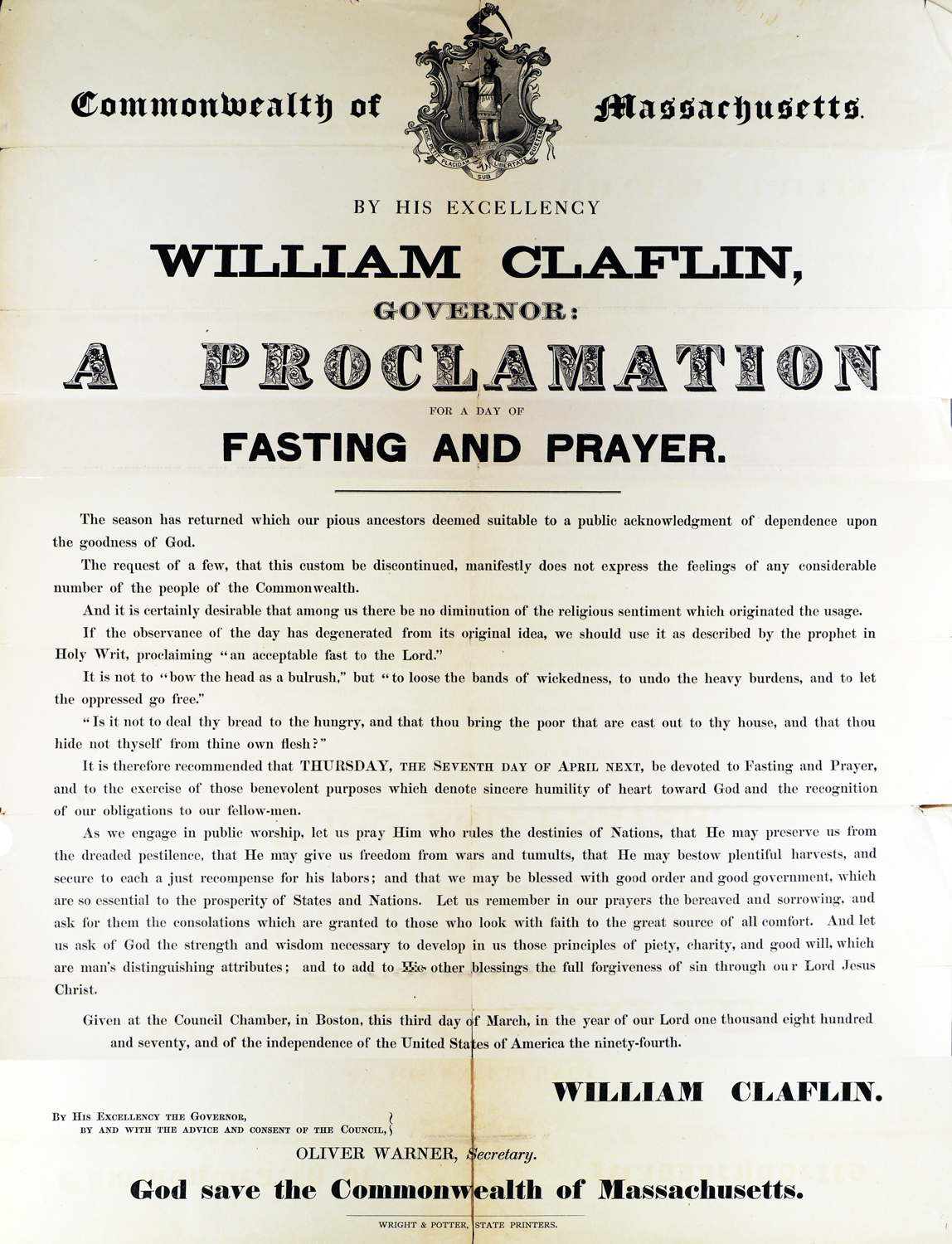
William Claflin (1818-1905) was governor of Massachusetts from 1869-1872. Here is his proclamation for a statewide day of fasting and prayer for April 7, 1870. Notice the mention he makes of “The request of a few that this custom [of issuing proclamations] be discontinued…”


Commonwealth of Massachusetts

By His Excellency

William Claflin,

Governor:

A Proclamation

For a day of Fasting and Prayer.

The season has returned which our pious ancestors deemed suitable to a public acknowledgment of dependence upon the goodness of God.

The request of a few, that this custom be discontinued, manifestly does not express the feeling of any considerable number of the people of the Commonwealth.

And it is certainly desirable that among us there be no diminution of the religious sentiment which originated the usage.

If the observance of the day has degenerated from its original idea, we should use it as described by the prophet in Holy Writ, proclaiming “an acceptable fast to  the Lord.”

It is not to “bow the head as a bulrush,” but to “loose the bands of wickedness, to undo the heavy burdens, and to let the oppressed go free.”

“Is it not to deal thy bread to the hungry, and that thou bring the poor that are cast out to thy house, and that thou hide not thyself from thine own flesh?”

It is therefore recommended that Thursday, the Seventh day of April Next, be devoted to Fasting and Prayer, and to the exercise of those benevolent purposes which denote sincere humility of heart toward God and the recognition of our obligations to our fellow-men.

As we engage in public, worship, let us pray Him who rules the destinies of Nations, that He may preserve us from the dreaded pestilence, that He may give us freedom from wars and tumults, that He may bestow plentiful harvests, and secure to each a just recompense for his labors; and that we may be blessed with good order and good government, which are so essential to the prosperity of the States and Nations. Let us remember in our prayers the bereaved and sorrowing and ask for them the consolations which are granted to those who look with faith to the great source of all comfort. And let us ask of God the strength and wisdom necessary to develop in us those principles of piety, charity, and good will, which are man’s distinguishing attributes; and to add to His other blessings the full forgiveness of sin through our Lord Jesus Christ.

Given at the Council Chamber, in Boston, this third day of March, in the year of our Lord One thousand eight hundred and seventy, and of the Independence of the United states of America the ninety-fourth.

William Claflin

By His Excellency the Governor,

By and With the Advice and consent of the Council.

Oliver Warner, Secretary.

God Save the Commonwealth of Massachusetts.

Proclamation – Lord’s Day – 1782

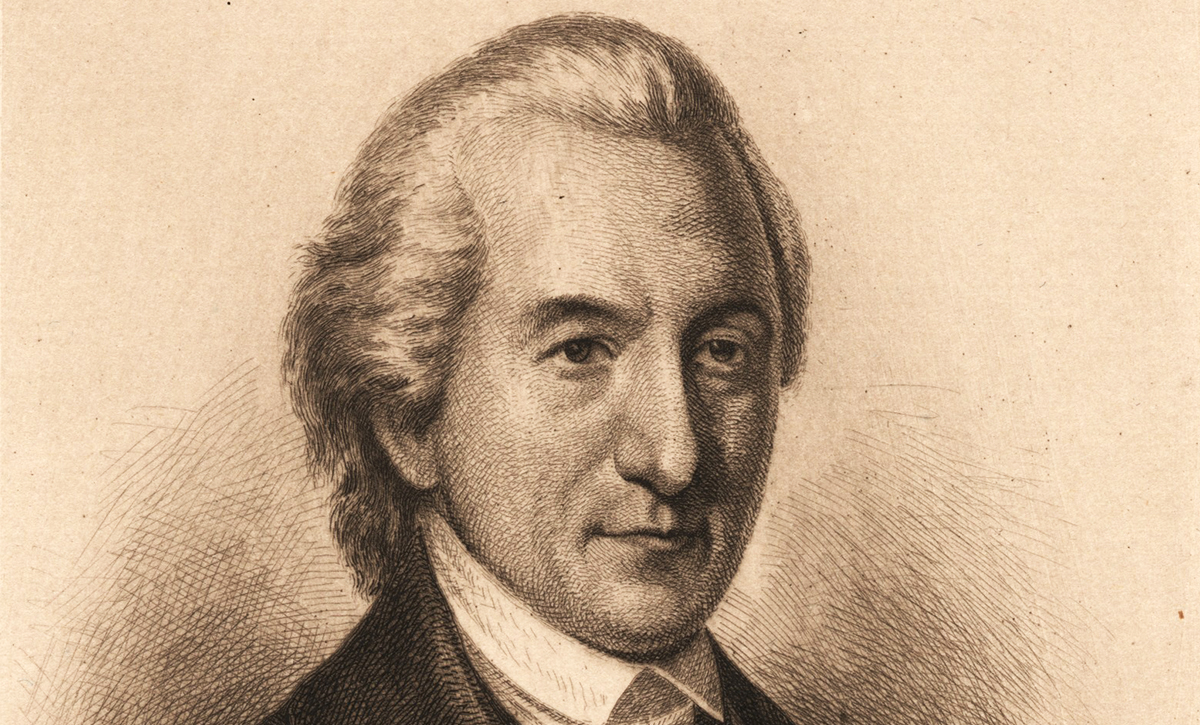
John Dickinson (1732-1808) was a lawyer, statesman, and soldier during the War for Independence. He wrote, among many other pieces, the Letters from a Farmer in Pennsylvania which were highly praised both in the colonies and abroad. Although he was a delegate to Continental Congress, he absented himself from the vote to adopt on the grounds of wishing to have more secure footing before igniting war with Briton. This, however, did do keep Dickinson from fully supporting the measure upon its adoption and throwing all his energies toward securing the liberty of America.

He was held in an extremely high regard by the other notable men of the time, with Dr. Benjamin Rush remarking that, “Few men wrote, spoke and acted more for their country from the year 1764 to the establishment of the federal government than Mr. Dickinson.”

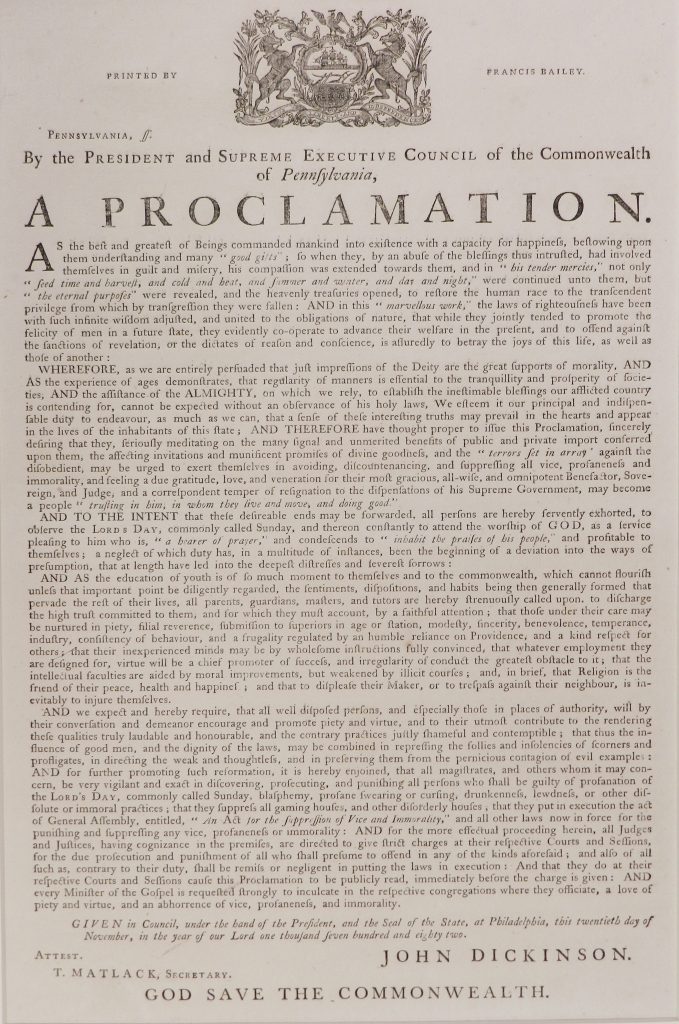
The following is a prayer proclamation John Dickinson issued while he was the president of Pennsylvania in 1782.


By the President and Supreme Executive Council of the Commonwealth of Pennsylvania,

A Proclamation.

As the best and greatest of Beings commanded mankind into existence with a capacity for happiness, bestowing upon them understanding and many “good gifts”; so when they, by an abuse of the blessings thus intrusted, had involved themselves in guilt and misery, his compassion was extended towards them, and in “his tender mercies,” not only “seed time and harvest, and cold and heat, and summer and winter, and day and night,” were continued unto them, but “the eternal purposes’ were revealed, and the heavenly treasuries opened, to restore the human race to the transcendent privilege from which by transgression they were fallen: And in this “marvelous work,” the laws of righteousness have been with such infinite wisdom adjusted, and united to the obligation of nature, that while they jointly tended to promote the felicity of men in a future state, they evidently cooperate to advance their welfare in the present, and to offend against the sanctions of revelation, of the dictates of reason and conscience, is suredly to betray the joys of this life, as well as those of another.

Wherefore, as we are entirely persuaded that just impressions of the deity are the great supports of morality, And As the experience of ages demonstrates, that regularity of manners is essential to the tranquility and prosperity of societies, And the assistance of the Almighty, on which we rely, to establish the inestimable blessings our afflicted country is contending for, cannot be expected without an observance of his holy laws, We esteem it our principal and indispensable duty to endeavor, as much as we can, that a sense of these interesting truths may prevail in the hearts and appear in the lives of the inhabitants of this state; And Therefore have thought proper to issue this Proclamation, sincerely desiring that they seriously meditating on the many signal and unmerited benefits of public and private import conferred upon them, the affecting invitations and munificent promises of divine goodness, and the “terrors set in array” against disobedient, may be urged to exert themselves in avoiding, discountenancing, and suppressing all vice, profaneness and immorality, and feeling a due gratitude, love,and veneration for their most gracious, all-wise , and omnipotent Benefactor, Sovereign, and Judge, and correspondent temper of resignation to the dispensations of his Supreme Government, may become a people “trusting in him, in whom they live and move and doing good.”

And to the intent that these desirable ends may be forwarded, all persons are herby fervently exhorted, to observe the Lord’s Day, commonly called Sunday, and thereon constantly to attend the worship of God, as a service pleasing to him who is, “a hearer of prayer,” and condescends to “inhabit the praises of his people,” and profitable to themselves; a neglect of which duty has, in multitude of instances, been the beginning of a deviation into the ways of presumption, that at length have led into the deepest distresses and severest sorrows:

And As the education of youth is of so much moment to themselves and to the commonwealth, which cannot flourish unless that important point be diligently regarded, the sentiments, dispositions, and habits begin then generally formed that pervade the rest of their lives, all parents, guardians, masters, and tutors are herby strenuously called upon, to discharge the high trust committed to them, and for which they must account, by a faithful attention; that those under their care may be nurtured in piety, filial reverence, submission to superiors in age or station, modesty, sincerity, benevolence, temperance, industry, consistency of behavior, and frugality regulated by an humble reliance on Providence, and a kind respect for others; that their inexperienced minds may be by wholesome instructions fully convinced, that whatever employment they are designed for, virtue will be a chief promoter of success, and irregularity of conduct the greatest obstacle to it; that the intellectual faculties are aided by moral improvements, but weakened by illicit courses; and in brief, that Religion is the fiend of their peace,health and happiness; and that to displease their Maker, or trespass against their neighbor, is inevitably to inure themselves.

And we expect and hereby require, that all well disposed persons, and especially those in places of authority, will by their conversation and demeanor encourage and promote piety and virtue, and to their utmost contribute to the rendering these qualities truly laudable and honorable, and the contrary practices justly shameful and contemptible; that thus the influence of good men, and the dignity of the laws, may be combined in repressing the follies and insolencies of scorners and profligates, in directing the weak and thoughtless, and in preserving them from the pernicious contagion of evil examples; And for further promoting such reformation, it is hereby enjoined, that all magistrates, and others whom it may concern, be very vigilant and exact in discovering, prosecuting, and punishing all persons who shall be guilty of profanation of the Lord’s Day, commonly called Sunday, blasphemy, profane swearing or cursing, drunkenness, lewdness, or other dissolute or immoral practices; that they suppress all gaming houses, and other disorderly houses, that they put in execution the act of General Assembly, entitled, “An Act for the suppression of Vice and Immorality,” and all other laws now in force for the punishing and suppressing any vice, profaneness or immorality: And for the more effectual proceeding herein, all Judges and Justice, having cognizance in the premises, are directed to give strict charges at their respective Courts and Sessions, for the due prosecution and punishment of all who shall presume to offend in any of the kinds aforesaid; and also of all such as, contrary to their duty, shall be remiss or negligent in putting the laws in execution: And that they do at their respective Courts and Sessions cause this Proclamation to be publicly read, immediately before the charge is given: And every Minister of the Gospel is requested strongly to inculcate in the respective congregations where they officiate, a love of piety and virtue, and an abhorrence of vice, profaneness, and immorality.

Given in council, under the hand of the President, and the Seal of the State, at Philadelphia, this twentieth day of November, in the year of our Lord one thousand seven hundred and eighty two.

Attest. T. Matlack, Secretary.

John Dickinson.

God Save the Commonwealth.

Proclamation – Humiliation, Fasting and Prayer – 1799

John Adams (1735-1826) Adams was an attorney, diplomat, and statesman; he graduated from Harvard (1755); leader in the opposition to the Stamp Act (1765); delegate to the Continental Congress (1774-77) where he signed the Declaration of Independence (1776); appointed Chief Justice of Superior Court of Massachusetts (1775); delegate to the Massachusetts constitutional convention (1779-80) and wrote most of the first draft of the Massachusetts Constitution; foreign ambassador to Holland (1782); signed the peace treaty which ended the American Revolution (1783); foreign ambassador to Great Britain (1785-88); served two terms as Vice-President under President George Washington (1789-97); second President of the United States (1797-1801); he and his one time political nemesis- turned-close-friend Thomas Jefferson both died on July 4, 1826, the fiftieth anniversary of the Declaration of Independence; Adams was titled by fellow signer of the Declaration Richard Stockton as the “Atlas of American Independence.”

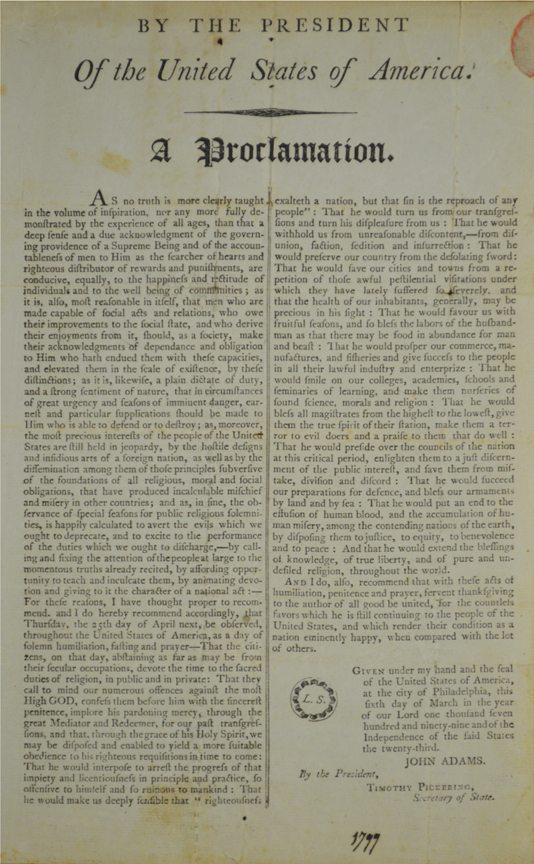
This is the text of a national day of humiliation, fasting, and prayer proclamation issued by President John Adams. This proclamation was issued on March 6, 1799 declaring April 25, 1799 the day of fasting for the nation. See a sermon preached by Rev. Manneseh Cutler on the 1799 fast day here.


By the President of the United States of America.

A Proclamation.

As no truth is more clearly taught in the Volume of Inspiration, nor any more fully demonstrated by the experience of all ages, than that a deep sense and a due acknowledgment of the governing providence of a Supreme Being and of the accountableness of men to Him as the searcher of hearts and righteous distributor of rewards and punishments are conducive equally to the happiness and rectitude of individuals and to the well-being of communities; as it is also most reasonable in itself that men who are made capable of social acts and relations, who owe their improvements to the social state, and who derive their enjoyments from it, should, as a society, make their acknowledgments of dependence and obligation to Him who hath endowed them with these capacities and elevated them in the scale of existence by these distinctions; as it is likewise a plain dictate of duty and a strong sentiment of nature that in circumstances of great urgency and seasons of imminent danger earnest and particular supplications should be made to Him who is able to defend or to destroy; as, moreover, the most precious interests of the people of the United States are still held in jeopardy by the hostile designs and insidious acts of a foreign nation, as well as by the dissemination among them of those principles, subversive of the foundations of all religious, moral, and social obligations, that have produced incalculable mischief and misery in other countries; and as, in fine, the observance of special seasons for public religious solemnities is happily calculated to avert the evils which we ought to deprecate and to excite to the performance of the duties which we ought to discharge by calling and fixing the attention of the people at large to the momentous truths already recited, by affording opportunity to teach and inculcate them by animating devotion and giving to it the character of a national act:

For these reasons I have thought proper to recommend, and I do hereby recommend accordingly, that Thursday, the Twenty-fifth day of April next, be observed throughout the United States of America as a day of solemn humiliation, fasting, and prayer; that the citizens on that day abstain as far as may be from their secular occupations, devote the time to the sacred duties of religion in public and in private; that they call to mind our numerous offenses against the Most High God, confess them before Him with the sincerest penitence, implore His pardoning mercy, through the Great Mediator and Redeemer, for our past transgressions, and that through the grace of His Holy Spirit we may be disposed and enabled to yield a more suitable obedience to His righteous requisitions in time to come; that He would interpose to arrest the progress of that impiety and licentiousness in principle and practice so offensive to Himself and so ruinous to mankind; that He would make us deeply sensible that “righteousness exalteth a nation, but sin is a reproach to any people;” that He would turn us from our transgressions and turn His displeasure from us; that He would withhold us from unreasonable discontent, from disunion, faction, sedition, and insurrection; that He would preserve our country from the desolating sword; that He would save our cities and towns from a repetition of those awful pestilential visitations under which they have lately suffered so severely, and that the health of our inhabitants generally may be precious in His sight; that He would favor us with fruitful seasons and so bless the labors of the husbandman as that there may be food in abundance for man and beast; that He would prosper our commerce, manufactures, and fisheries, and give success to the people in all their lawful industry and enterprise; that He would smile on our colleges, academies, schools, and seminaries of learning, and make them nurseries of sound science, morals, and religion; that He would bless all magistrates, from the highest to the lowest, give them the true spirit of their station, make them a terror to evil doers and a praise to them that do well; that He would preside over the councils of the nation at this critical period, enlighten them to a just discernment of the public interest, and save them from mistake, division, and discord; that He would make succeed our preparations for defense and bless our armaments by land and by sea; that He would put an end to the effusion of human blood and the accumulation of human misery among the contending nations of the earth by disposing them to justice, to equity, to benevolence, and to peace; and that he would extend the blessings of knowledge, of true liberty. and of pure and undefiled religion throughout the world.

And I do, also, recommend that with these acts of humiliation, penitence, and prayer, fervent thanksgiving to the Author of all good be united for the countless favors which He is still continuing to the people of the United States, and which render their condition as a nation eminently happy when compared with the lot of others.

Given, under my hand and the seal of the United States of America, at the city of Philadelphia, this sixth day of March, in the year of our Lord one thousand seven hundred and ninety nine, and of the Independence of the said States the twenty-third.

By the President, John Adams.

Timothy Pickering, Secretary of State.

* Originally Posted: September 9, 2017

Proclamation – Thanksgiving Day – 1784, Massachusetts

John Hancock (1737-1793) was a signer of the Declaration of Independence, the president of the Continental Congress, and governor of Massachusetts. It was during his time as governor that he issued the following October 28, 1784 proclamation declaring a day of Thanksgiving for November 25, 1784. The proclamation text and image is taken from Thomas’s Massachusetts Spy dated November 11, 1784.


COMMONWEALTH OF MASSACHUSETTS.
By His Excellency, JOHN HANCOCK, Esquire,
Governor of the Commonwealth of Massachusetts,
A PROCLAMATION,
For a Day of THANKSGIVING.
????????????????????????????????????

It being our indispensable duty as a people, in a public and religious manner, to acknowledge the preserving and Governing providence of Almighty God, and more especially to celebrate the Divine Goodness in the various blessings conferred upon us in the course of the year past.

I have therefore thought fit, with the advice and consent of the Council, to appoint, and do hereby appoint THURSDAY the Twenty-Fifth Day of NOVEMBER next, to be religiously observed as a Day of THANKSGIVING throughout this Commonwealth; hereby calling upon Ministers and people of all denominations, in their several assemblies, to unite with grateful hearts in celebrating the Praises of Almighty GOD, of His great goodness and bounty vouchsafed [given] to a sinful and unworthy people; particularly for the great and signal interpositions of His Providence in behalf of the United States in the course of the late contest, and that after being rescued from the dangers and calamities of war; peace has been restored to us, and that our public affairs are in so promising and happy a situation; for granting to us a plentiful harvest in the great abundance of the fruits of the earth; for the general health enjoyed throughout this State during the course of the year, and preventing epidemical and mortal distempers from spreading among us; reviving our trade, navigation and fishery and protecting the same from the insults of Pirates and other disasters; for directing and succeeding our public Councils, and above all for continuing to us the light of the blessed Gospel, and securing to us our religious and civil liberties and privileges. And to join with their praises their earnest and humble supplications to Almighty GOD, for the pardon of our past ingratitude and other transgressions; and that He would grant that all instances of the Divine goodness may have an effectual influence for working a general reformation in all orders of persons among us; that so we may be that happy people, whose GOD is the LORD, and that ALL nations may bow to the scepter of our LORD and SAVIOR JESUS CHRIST, and that the whole Earth may be filled with His Glory.

GIVEN at the Council-Chamber in Boston, the 28th day of October, in the Year of our Lord, one Thousand seven hundred and eighty-four, and in the ninth year of the Independence of the United Sates of America.

JOHN HANCOCK.

By his Excellency’s Command,
JOHN AVERY, Jun. Secretary
GOD save the Commonwealth of MASSACHUSETTS.

John Dickinson

Proclamation – Sabbath Day – 1782, Pennsylvania

John Dickinson (1732-1808) was a lawyer. He served in the Pennsylvania Assembly (1762, 1764), was a delegate to the Stamp Act Congress (1765); and was a member of the Continental Congress (1774-1776, 1779). He served as president of Pennsylvania (1782-1785) and was a signer of the Constitution (1787). Dickinson was also a brigadier general of the Pennsylvania Militia during the Revolution.

This proclamation was issued by John Dickinson as president of Pennsylvania on November 20, 1782 asking the people to observe the Lord’s Day and continue worshiping God.


proclamation-sabbath-day-1782-pennsylvania-1
By the President and Supreme  Executive Council of the Commonwealth of Pennsylvania,
A Proclamation.

As the best and greatest of Beings commanded mankind into existence with a capacity for happiness, bestowing upon them understanding and many “good gifts“; so when they, by an abuse of the blessings thus intrusted, had involved themselves in guilt and misery, his compassion was extended towards them, and in “his tender mercies,” not  only “seed time and harvest, and cold and heat, and summer and winter, and day and night,” were continued unto them, but “the eternal purposes” were revealed, and the heavenly treasuries opened, to restore the human race to the transcendent privilege from which by transgression they were fallen: AND in this “marvelous work,” the laws of righteousness have been with such infinite wisdom adjusted, and united to the obligation of nature, that while they jointly tended to promote the felicity of men in a future state, they evidently cooperate to advance their welfare in the present, and to offend against the sanctions of revelation, of the dictates of reason and conscience, is suredly to betray the joys of this life, as well as those of another.

Wherefore, as we are entirely persuaded that just impressions of the deity are the great supports of morality, AND As the experience of ages demonstrates, that regularity of manners is essential to the tranquility and prosperity of societies, AND the assistance of the Almighty, on which we rely, to establish the inestimable blessings our afflicted country is contending for, cannot be expected without an observance of his holy laws, We esteem it our principal and indispensable duty to endeavor, as much as we can, that a sense of these interesting truths may prevail in the hearts and appear in the lives of the inhabitants of this state; And Therefore have thought proper to issue this Proclamation, sincerely desiring that they seriously meditating on the many signal and unmerited  benefits of public and private import conferred upon them,  the affecting invitations  and munificent promises of divine goodness, and the “terrors set in array” against disobedient, may be urged to exert themselves in avoiding, discountenancing, and suppressing all vice, profaneness and immorality, and feeling a due gratitude, love, and veneration for their most gracious, all-wise, and omnipotent Benefactor, Sovereign, and Judge, and correspondent temper of resignation to the dispensations of his Supreme Government, may become a people “trusting in him, in whom they live and move and doing good.”

And to the intent that these desirable ends may be forwarded, all persons are herby fervently exhorted, to observe the Lord’s Day, commonly called Sunday, and thereon constantly to attend the worship of GOD, as a service pleasing to him who is, “a hearer of prayer,” and condescends to “inhabit the praises of his people,” and profitable to themselves; a neglect of which duty has, in multitude of instances, been the beginning of a deviation into the ways of presumption, that at length have led into the deepest distresses and severest sorrows:

And As the education of youth is of so much moment to themselves and to the commonwealth, which cannot flourish unless that important point be diligently regarded, the sentiments, dispositions, and habits begin then generally formed that pervade the rest of their lives, all parents, guardians, masters, and tutors are herby strenuously called upon, to discharge the high trust committed to them, and for which they must account, by a faithful attention; that those under their care may be nurtured in piety, filial reverence, submission to superiors in age or station, modesty, sincerity, benevolence, temperance,  industry, consistency of behavior, and frugality regulated by an humble reliance on Providence, and a kind respect for others; that their inexperienced minds may be by wholesome instructions fully convinced, that whatever employment they are designed for, virtue will be a chief promoter of success, and irregularity of conduct the greatest obstacle to it; that the intellectual faculties are aided by moral improvements, but weakened by illicit courses; and in brief, that Religion is the fiend of their peace, health and happiness; and that to displease their Maker, or trespass against their neighbor, is inevitably to inure themselves.

AND we expect and hereby require, that all well disposed persons, and especially those in places of authority, will by their conversation and demeanor encourage and promote piety and virtue, and to their utmost contribute to the rendering these qualities truly laudable and honorable, and the contrary practices justly shameful and contemptible; that thus the  influence of good men, and the dignity of the laws, may be combined in repressing the follies and insolencies of scorners and profligates, in directing the weak and thoughtless, and in preserving them from the pernicious contagion of evil examples; AND for further promoting such reformation, it is hereby enjoined, that all magistrates, and others whom it may concern, be very vigilant and exact in discovering, prosecuting, and punishing all persons who shall be guilty of profanation of the Lord’s Day, commonly called Sunday, blasphemy, profane swearing or cursing, drunkenness, lewdness, or other dissolute or immoral practices; that they suppress all gaming houses, and other disorderly houses, that they put in execution the act of General Assembly, entitled, “An Act for the suppression of Vice and Immorality,” and all other laws now in force for the punishing and suppressing any vice, profaneness or immorality: AND for the more effectual proceeding herein, all Judges and Justice, having cognizance in the premises, are directed to give strict charges at their respective Courts and Sessions, for the due prosecution and punishment of all who shall presume to offend in any of the kinds aforesaid; and also of all  such as, contrary to their duty, shall be remiss or negligent in putting the laws in execution: And that they do at their respective  Courts and Sessions cause this Proclamation to be publicly read, immediately before the charge is given: AND every Minister of the Gospel is requested strongly to inculcate in the respective congregations where they officiate, a love of piety and virtue, and an abhorrence of vice, profaneness, and immorality.

Given in council, under the hand of the President, and the Seal of the State, at Philadelphia, this twentieth day of November, in the year of our Lord one thousand seven hundred and eighty two.

John Dickinson.

Attest.
T. Matlack,,  Secretary.

God Save the Commonwealth.
Proclamation – Thanksgiving Day – 1782


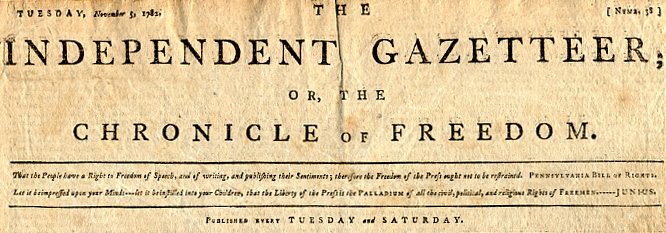
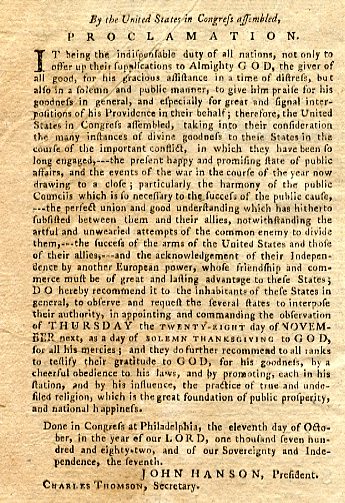
Here is the text of a Proclamation for a Day of Thanksgiving issued by John Hanson, while serving as President of the Continental Congress, on October 11, 1782. The Day of Thanksgiving took place on November 28, 1782. This proclamation was published in The Independent Gazetteer; or, the Chronicle of Freedom on November 5, 1782.


 proclamation-thanksgiving-day-1782-1 proclamation-thanksgiving-day-1782-2

By the United States in Congress assembled,
PROCLAMATION.
 

It being the indispensable duty of all nations, not only to offer up their supplications to Almighty God, the giver of all good, for His gracious assistance in a time of distress, but also in a solemn and public manner, to give Him praise for His goodness in general, and especially for great and signal interpositions of His Providence in their behalf; therefore, the Unites States in Congress assembled, taking into their consideration the many instances of Divine goodness to these States in the course of the important conflict, in which they have been so long engaged, – the present happy and promising state of public affairs, and the events of the war in the course of the year now drawing to a close; particularly the harmony of the public Councils which is so necessary to the success of the public cause, – the perfect union and good understanding which has hitherto subsisted between them and their allies, notwithstanding the artful and unwearied attempts of the common enemy to divide them, – the success of the arms of the United States and those of their allies, – and the acknowledgment of their Independence by another European power, whose friendship and commerce must be of great and lasting advantage to these States; Do hereby recommend it to the inhabitants of these States in general, to observe and request the several states to interpose their authority, in appointing and commanding the observation of THURSDAY the TWENTY-EIGHTH DAY OF NOVEMBER next as a day of SOLEMN THANKSGIVING to GOD for all His mercies; and they do further recommend to all ranks to testify their gratitude to God for His goodness by a cheerful obedience to His laws and by promoting, each in his station, and by his influence, the practice of true and undefiled religion, which is the great foundation of public prosperity and national happiness.

Done in Congress at Philadelphia, the eleventh day of October, in the year of our LORD, one thousand seven hundred and eighty-two, and of our Sovereignty and Independence, the seventh.

JOHN HANSON, President.

CHARLES THOMSON, Secretary.

Proclamation – Thanksgiving Day – 1781, Massachusetts

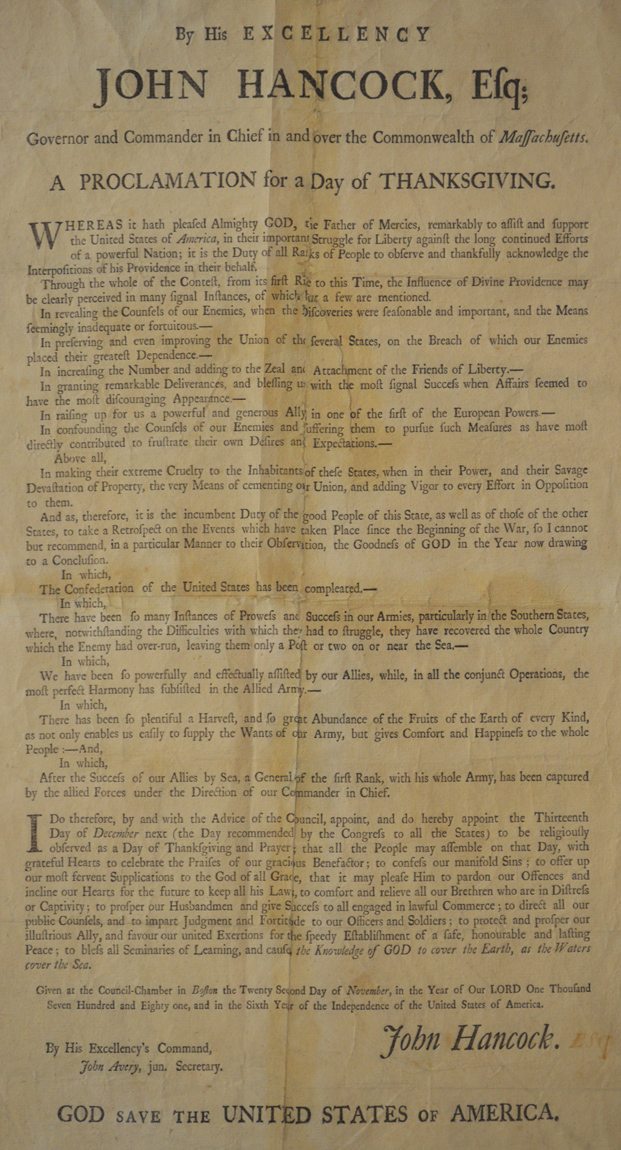
John Hancock (1737-1793) was a signer of the Declaration of Independence, the president of the Continental Congress, and governor of Massachusetts. It was during his time as governor that he issued the following November 8, 1781 proclamation declaring a day of Thanksgiving for December 7, 1781.


proclamation-thanksgiving-day-1781-massachusetts-1

By His EXCELLENCY

JOHN HANCOCK, Esq;

Governor and Command in Chief and over the Commonwealth of  Massachusetts.

A PROCLAMATION for a Day of THANKSGIVING.


Whereas it hath pleased Almighty God, the Father of Mercies, remarkably to assist and support the United States of America, in their important Struggle for Liberty against the long continued Efforts of a powerful Nation; it is the Duty of all Ranks of People to observe and thankfully acknowledge the Interpositions of his Providence in their behalf.

Through the whole of the Contest, from its first Rise to this Time, the Influence of Divine Providence may be clearly perceived in many signal Instances, of which but a few are mentioned.

In revealing the Counsels of our Enemies, when the Discoveries were seasonable and important, and the Means seemingly adequate or fortuitous.—

In preserving and even improving the Union of several States, on the Breach of which our Enemies placed their greatest Dependence.—

In increasing the Number and adding the Zeal and Attachment of the Friends of Liberty.—

In granting remarkable Deliverances, and blessing us with the most signal Success when Affairs seemed to have the most discouraging Appearance.—

In raising up for us a powerful and generous Ally, in one of the first of the European powers.—

In confounding the Counsels of our Enemies and suffering them to pursue such Measures as have most directly contributed to frustrate their own Desires and Expectations.—

Above all,

In making their extreme Cruelty to the Inhabitants of these States, when in their Power, and their Savage Devastation of Property, the very Means of cementing our Union, and adding Vigor to every Effort in Opposition to them.

And as, therefore, it is the incumbent Duty of the good People of this State, as well as of those of the other States, to take a Retrospect on the Events which have taken place since the Beginning of the War, so I cannot but recommend, in a particular Manner to their Observation, the Goodness of God in the Year now drawing to a Conclusion.

In which,
The Confederation of the United States has been completed.—

In which,

There have been so many Instances of Prowess and Success in our Armies, particularly in the Southern States, where, notwithstanding the Difficulties with which they had to struggle, they have recovered the whole Country which the Enemy had overrun, leaving them only a Post or two on or near the Sea.—

In which,

We have been so powerfully and effectually assisted by our Allies, while in all the conjunct Operations, the most perfect Harmony has subsisted in the Allied Army.—

In which,

There has been so plentiful a Harvest, and so great Abundance of the Fruits of the Earth of every Kind, as not only enables us easily to supply the Wants of our Army, but gives Comfort and Happiness to the whole People:—And,

In which,

After the Success of our Allies by Sea, a General of the first Rank, with his whole Army, has been captured by the allied Forces under the Direction of our Commander in Chief.

I do therefore, by and with the Advice of the Council, appoint, and do hereby appoint the Thirteenth Day of December next (the Day recommended by the Congress to all the States) to be religiously observed as a Day of Thanksgiving and Prayer; that all the People may assemble on that Day, with grateful Hearts to celebrate the Praises of our gracious Benefactor; to confess our manifold Sins; to offer up our most fervent Supplications to the God of all Grace, that it may please Him to pardon our Offenses and incline our Hearts for the future to keep all his Laws, to comfort and relieve all our Brethren who are in Distress or Captivity; to prosper our Husbandmen and give Success to all engaged in lawful Commerce; to direct all our public Counsels, and to impart Judgment and Fortitude to our Officers and Soldiers; to protect and prosper our illustrious Ally, and favor our united Exertions for the speedy Establishment of a safe, honorable, and lasting Peace; to bless all Seminaries of Learning, and cause the Knowledge of God to cover the Earth, as the Waters cover the Sea.

Given at the Council Chamber in Boston the Twenty Second Day of November, in the Year of Our Lord One Thousand Seven Hundred and Eighty one, and in the Sixth Year of the Independence of the United States of America.

JOHN HANCOCK.

By His Excellency’s Command,
John Avery, jun. Secretary.

GOD save the UNITED STATES of AMERICA.
 

Proclamation – Thanksgiving Day – 1781


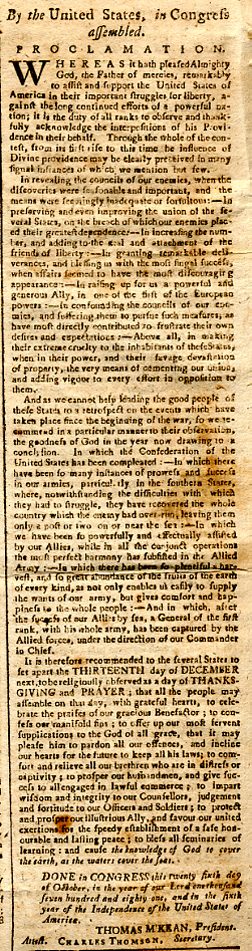
The following is the text of a Proclamation for a Day of Thanksgiving and Prayer issued by Thomas McKean, a Signer of the Declaration of Independence, while he was serving as President of Congress. This proclamation was issued on October 26, 1781 and the Day of Thanksgiving was to be December 18, 1781. This proclamation was published in The Independent Ledger and the American Advertiser on November 19, 1781.


proclamation-thanksgiving-day-1781-1

By the United States, in Congress
Assembled.

PROCLAMATION.
proclamation-thanksgiving-day-1781-2

Whereas it hath pleased Almighty God, the Father of Mercies, remarkably to assist and support the United States of America in their important struggle for liberty against the long-continued efforts of a powerful nation, it is the duty of all ranks to observe and thankfully acknowledge the interpositions of his Providence in their behalf; – Through the whole of the contest from its first rise to this time the influence of Divine Providence may be clearly perceived in many signal instances, of which we mention but a few: –

In revealing the counsels of our enemies, when the discoveries were seasonable and important, and the means seemingly inadequate or fortuitous.

In preserving and even improving the union of the several states on the breach of which our enemies placed their greatest dependence,

In increasing the number and adding to the zeal ad attachment of friends of liberty,

In granting remarkable deliverances and blessings with the most signal success, when affairs seemed to have the most discouraging appearance,

In raising up for us a most powerful and generous ally in one of the first of European Powers,

In confounding the counsels of our enemies and suffering them to pursue such measures a shave most directly contributed to frustrate their own desires and expectations: above all

In making their extreme cruelty to the inhabitants of those states when in their power and their savage devastation of property the very means of cementing our Union and adding vigor to every effort in opposition to them; and as we cannot help leading the good people of these states to a retrospect on the events which have taken place since the beginning of the war so we may recommend in a particular manner to their observation the goodness of God in the year now drawing to a conclusion in which the Confederation of the United States has been completed,

In which there have been so many instances of prowess and success in our armies, particularly in the southern states, where, notwithstanding the difficulties with which they had to struggle, they have recovered the whole country which the enemy had overrun, leaving them only a post or two on or near the sea,

In which we have been so powerfully and effectually assisted by our allies, while in all the unjust operations, the most perfect harmony has subsisted in the allied army: In which there has been so plentiful a harvest, and so great abundance of the fruits of the earth of every kin, as not only enable us easily to supply the wants of our army, but gives comfort and happiness to the whole people,

And in which, after the success of our allies by sea, a general of the first rank with his whole army has been captured by the allied forces under the direction of our commander-in-chief.

It is therefore recommended to the several states to set apart the THIRTEENTH day of DECEMBER next, to be religiously observed as a day of THANKSGIVING and PRAYER; that all the people may assemble on that day with grateful hearts to celebrate the praises of our glorious Benefactor, to confess our manifold sins, to offer up our most fervent supplications to the God of all grace that it may please Him to pardon our offense, and incline our hearts for the future, to keep all His laws, to comfort and relieve all our brethren who are in distress or captivity, to prosper our husbandmen, and give strength to all engaged in lawful commerce; to impart wisdom and integrity to our counselors, judgment and fortitude to our officers and soldiers; to protect and prosper our illustrious ally and favor our united exertions for the speedy establishment of a safe, honorable, and lasting peace, to bless our seminaries of learning, and cause the knowledge of God to cover the earth as the waters cover the seas.

Done in Congress the 26th day of October, in the year of our Lord, one thousand seven hundred and eighty-one, and in the sixth year of the Independence of America.


Thomas McKean, President.

Attest, Charles Thomson, Secretary.

Proclamation – Thanksgiving Day – 1780, Massachusetts

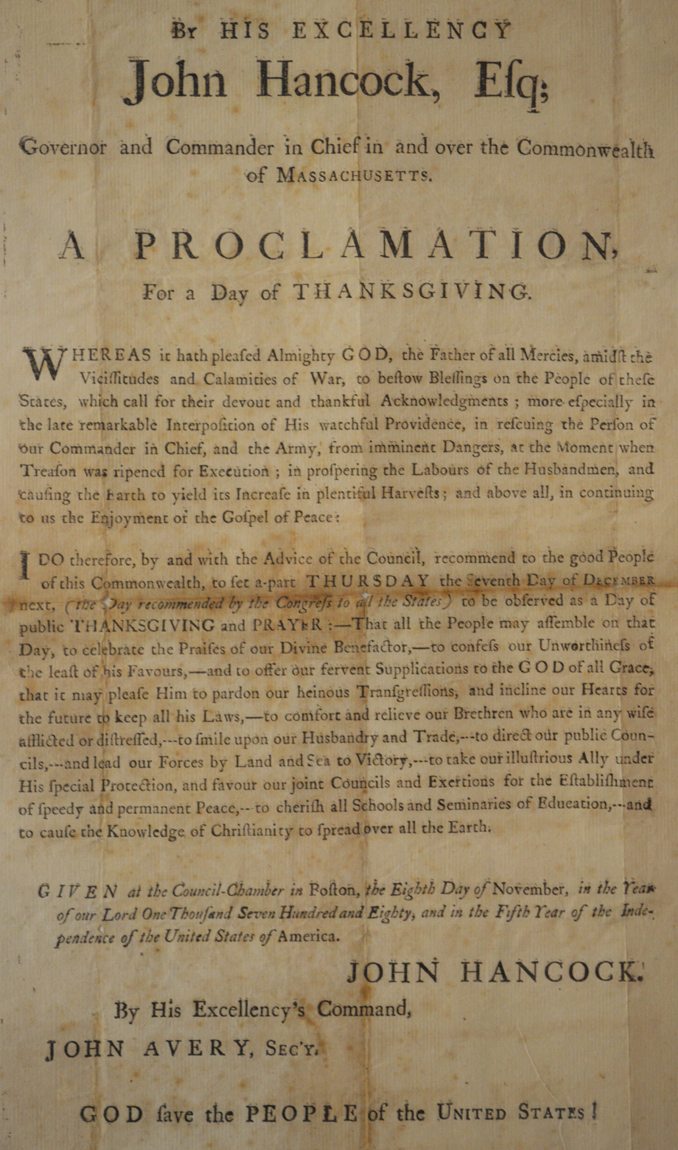
John Hancock (1737-1793) was a signer of the Declaration of Independence, the president of the Continental Congress, and governor of Massachusetts. It was during his time as governor that he issued the following November 8, 1780 proclamation declaring a day of Thanksgiving for December 7, 1780.


proclamation-thanksgiving-day-1780-massachusetts-1

By His Excellency
John Hancock, Esq.;

Governor and Commander in Chief in and over the Commonwealth of Massachusetts.

A PROCLAMATION,
For a Day of THANKSGIVING


Whereas it hath pleased Almighty God, the Father of all Mercies, amidst the Vicissitudes and Calamities of War, to bestow Blessing on the People of these States, which call for their devout and thankful Acknowledgments; more especially in the late remarkable Interposition of His watchful Providence, in rescuing the Person of our Commander in Chief, and the Army, from imminent Dangers, at the Moment when Treason was ripened for Execution; in prospering the labors of the Husbandmen, and causing the earth to yield its Increase in plentiful Harvests; and above all, in continuing to us the Enjoyment of the Gospel of Peace:

I do therefore, by and with the Advice of the Council, recommend to the good People of this Commonwealth, to set apart THURSDAY the Seventh Day of December next, (the Day recommended by the Congress of the States) to be observed as a Day of public THANKSGIVING and PRAYER:— That all the People may assemble on that Day, to celebrate the Praises of our Divine Benefactor,—to confess our Unworthiness of the least of his Favors,—and to offer our fervent Supplications to the GOD of all Grace, that it may please Him to pardon our heinous Transgressions, and incline our Hearts for the future to keep all his Laws,—to comfort and relieve our Brethren who are in any wise afflicted or distressed,—to smile upon our Husbandry and Trade,—to direct our public Councils,—and lead our Forces by Land and Sea to Victory,—to take our illustrious Ally under His special Protection, and favor our joint Councils and Exertions for the Establishment of speedy and permanent Peace,—to cherish all Schools and Seminaries of Education,—and to cause the Knowledge of Christianity to spread over all the Earth.

Given at the Council-Chamber in Boston, the Eighth Day of November, in the Year of our Lord One Thousand Seven Hundred and Eighty, and in the Fifth Year of the Independence of the United States of America.

JOHN HANCOCK.

By His Excellency’s Command,
John Avery, Sec’y

God save the People of the United States.

Proclamation – Thanksgiving Day – 1779, Pennsylvania

Joseph Reed (1741-1785) was born in New Jersey; graduated from the College of New Jersey (now Princeton) in 1757; and practiced law in New Jersey and Philadelphia. He served in the American army as aide-de-camp and secretary to George Washington (1775) and as Adjutant General (1776-1777). Reed was a member of the Continental Congress in 1778 where he signed the Articles of Confederation. He served as President (Governor) of Pennsylvania from 1778-1781.

Joseph Reed issued the following proclamation on November 29, 1779 as president of Pennsylvania declaring December 9, 1779 a day of Thanksgiving. The text and image of this proclamation is taken from The Pennsylvania Packet or the General Advertiser published on November 30, 1779.


By His EXCELLENCY
JOSEPH REED, Esquire,
President, and the Supreme Executive Council of the
Commonwealth of Pennsylvania,
A PROCLAMATION.

WHEREAS the Honorable the Congress of the United States of America, by their resolve of the twentieth day of October last, did recommend in the following words, to wit:

“WHEREAS it becomes us humbly to approach the throne of Almighty God, with gratitude and praise, for the wonders which His goodness has wrought in conducting our forefathers to this Western world; for His protection to them and to their prosperity, amid difficulties and dangers; for raising us their children from deep distress, to be numbered among the nations of the earth; and for arming the hands of just and mighty Princes in our deliverance; and especially for that He hath been pleased to grant us the enjoyment of health, and so to order the revolving seasons, that the earth hath produced her increase in abundance, blessing the labors of the husbandman and spreading plenty thro’ the land; that He hath prospered our arms and those of our ally, been a shield to our troops in the hour of danger, pointed their swords to victory and led them in triumph over the bulwarks of the foe that He hath gone with those who went out into the wilderness against the savage tribes; that He hath stayed the hand of the spoiler, and turned back His meditated destruction, that He hath prospered our commerce and given success to those who fought the enemy on the face of the deep; and above all, that He hath diffused the glorious light of the Gospel, whereby, through the merits of our gracious Redeemer, we may become the heirs of His eternal glory. Therefore,

“RESOLVED, That it be recommended to the several States to appoint THURSDAY the ninth of December next, to be a day of public and solemn THANKSGIVING to Almighty God, for His mercies, and of PRAYER, for the continuance of His favor and protection to these United States; to beseech Him that He would be graciously pleased to influence our public councils, and bless them with wisdom from on high, with unanimity, firmness and success, that He would go forth with our hosts and crown our arms with victory; that He would grant to His Church the plentiful effusions of Divine grace, and pour out His Holy Spirit on all Ministers of the Gospel; that He would bless and prosper the means of education, and spread the light of Christian knowledge through the remotest corners of the earth; that He would smile upon the labors of His people and cause the earth to bring forth her fruits in abundance, that we may with gratitude and gladness enjoy them; that He would take into His Holy protection our illustrious Ally, give him victory over his enemies, and render him signally great, as the father of his people, and the protector of the rights of mankind; that He would graciously be pleased to turn the hearts of our enemies, and to dispense the blessings of peace to contending nations; that He would in mercy look down upon us, pardon all our sins, and receive us into His favor; and, finally, that He would establish the Independence of these United States upon the basis of religion and virtue, and support and protect them in the enjoyment of peace, liberty and safety.”

WHEREFORE, as well in respect of the said recommendation of Congress, as the plain dictates of duty, to acknowledge the favor and goodness of Providence, and implore Its further protection: We Do hereby earnestly recommend to the good people of Pennsylvania, to set apart THURSDAY, the ninth day of December next, for the pious purposes expressed in the said resolve; and that they abstain from all labor on that day.

GIVEN under the Hand of His Excellency Joseph Reed, Esq; President, and the Seal of the State, at Philadelphia, this twenty-ninth day of November, in the year of our Lord One thousand seven hundred and seventy nine, and in the Fourth year of the Independence of the United States of America.

JOSEPH REED, President.

Attest, T. MATLACK, Secretary.

GOD SAVE THE COMMONWEALTH.