Proclamation – Fasting Humiliation and Prayer – 1804, New Hampshire


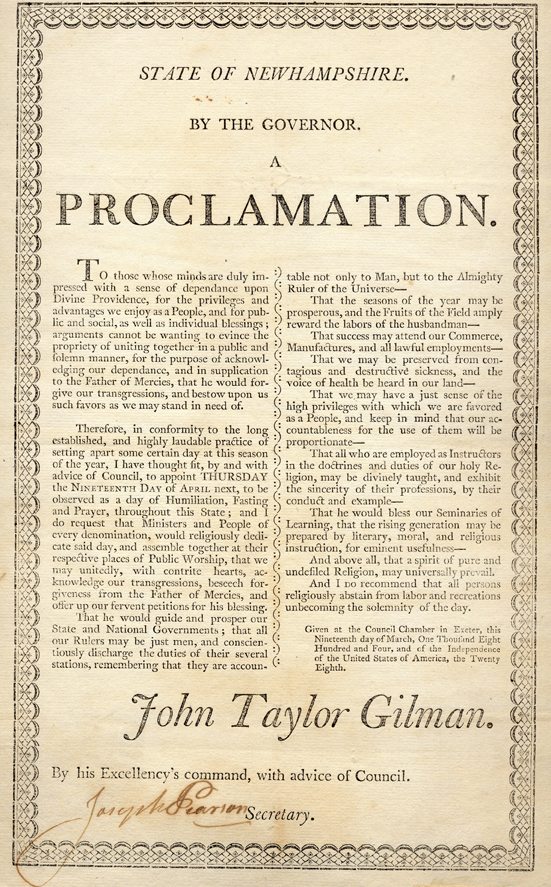
This is the text of a Proclamation for a Day of Fasting, Humiliation and Prayer issued by John Taylor Gilman (Member of the Continental Congress), while he was serving as Governor of New Hampshire. The proclamation was issued on March 19, 1804, declaring April 19, 1804 as a day of fasting, humiliation and prayer.


proclamation-fasting-humiliation-and-prayer-1804-new-hampshire-1

STATE OF NEW HAMPSHIRE.

BY THE GOVERNOR.

A


PROCLAMATION.

To those whose minds are duly impressed with a sense of dependence upon divine providence, for the privileges and advantages we enjoy as a people, and for public and social, as well as individual blessings, arguments cannot be wanting to evince the propriety of uniting together in a public and solemn manner, for the purpose and solemn manner, for the dependence, and in supplication to the father of mercies, that He would forgive our transgressions, and bestow upon us such favors as we may stand in need of.

Therefore, in conformity to the long established, and highly laudable practice of setting apart some certain day at this season of the year, I have thought fit, by and with the advice of council, to appoint THURSDAY, the Nineteenth Day of April next, to be observed as a day of Humiliation, Fasting and Prayer, throughout this state; and I do request ministers and people of every denomination, would religiously dedicate said day, and assemble together at their respective places of public worship, that we may unitedly, with contrite hearts, acknowledge our transgressions, beseech forgiveness from the father of mercies, and offer up our fervent petitions for His blessing.

That He would guide and prosper our state and national governments; that all our rulers may be just men, and conscientiously discharge the duties of their several stations, remembering that they are accountable not only to man, but to the almighty ruler of the universe.

That the seasons of the year may be prosperous, and the fruits of the field amply reward the labor of the husbandman.

That success may attend our commerce, manufactures, and all lawful employments.

That we may be preserved from contagious and destructive sickness, and the voice of health be hear in their professions, by their conduct and example.

That He would bless our seminaries of learning, that the rising generation may be prepared by literary, moral, and religious instruction, for eminent usefulness.

And above all, that a spirit of pure and undefiled religion may universally prevail.

And I do recommend that all persons religiously abstain from labor and recreations unbecoming the solemnity of the day.

Given at the Council Chamber in Exeter this Nineteenth day of March, One Thousand Eight Hundred and Four, and of the Independence of the United States of America, the Twenty-Eighth.


John Taylor Gilman

By his Excellency’s command, with advice of Council.

Joseph Pearson, Secretary

Proclamation – Humiliation Fasting and Prayer – 1799


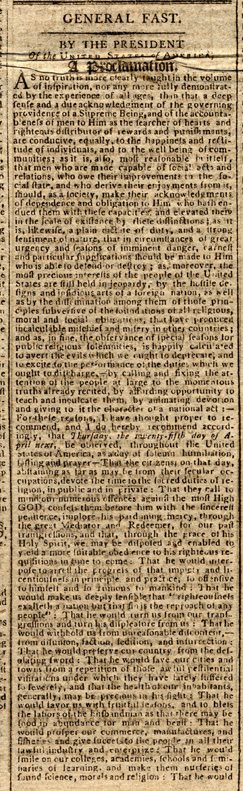
This is a proclamation by President John Adams for a day of “solemn humiliating, fasting, and prayer” set for April 25, 1799. This proclamation was not only printed as the below broadside but also published in numerous newspapers. Below are pictures of the broadside as well as one newspaper from Massachusetts. The text has been slightly modified by inserting paragraph breaks for easier reading. To see a sermon preached on the fast day, click here.


By the President
Of the United States of America.
A Proclamation.

As no truth is more clearly taught in the Volume of Inspiration, nor any more fully demonstrated by the experience of all ages, than that a deep sense and a due acknowledgment of the governing providence of a Supreme Being, and of the accountableness of men to Him as the searcher of hearts and righteous distributor of rewards and punishments, are conducive, equally, to the happiness and rectitude of individuals, and to the well-being of communities; as it is, also, most reasonable, in itself, that men who are made capable of social acts and relations, who owe their improvements to the social state, and who derive their enjoyments from it, should, as a society, make their acknowledgments of dependence and obligation to Him who hath endowed them with these capacities and elevated them in the scale of existence by these distinctions; as it is, likewise, a plain dictate of duty, and a strong sentiment of nature, that in circumstances of great urgency and seasons of imminent danger, earnest and particular supplications should be made to Him who is able to defend or to destroy; as, moreover, the most precious interests of the people of the United States are still held in jeopardy, by the hostile designs and insidious acts of a foreign nation, as well as by the dissemination among them of those principles subversive of the foundations of all religious, moral, and social obligations, that have produced incalculable mischief and misery in other countries; and as, in fine, the observance of special seasons for public religious solemnities, is happily calculated to avert the evils which we ought to deprecate, and to excite to the performance of the duties which we ought to discharge, – by calling and fixing the attention of the people at large to the momentous truths already recited, by affording opportunity to teach and inculcate them, by animating devotion and giving to it the character of a national act:

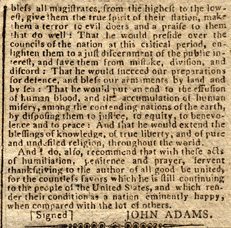
For these reasons I have thought proper to recommend, and I do hereby recommend accordingly, that Thursday, the 25th day of April next, be observed throughout the United States of America as a day of solemn humiliation, fasting, and prayer. – That the citizens on that day abstain as far as may be from their secular occupations, devote the time to the sacred duties of religion in public and in private: That they call to mind our numerous offenses against the most High God, confess them before Him with the sincerest penitence, implore His pardoning mercy, through the great Mediator and Redeemer, for our past transgressions, and that, through the grace of His Holy Spirit, we may be disposed and enabled to yield a more suitable obedience to His righteous requisitions in time to come: That He would interpose to arrest the progress of that impiety and licentiousness in principle and practice, so offensive to Himself and so ruinous to mankind: That He would make us deeply sensible that “righteousness exalteth a nation, but sin is a reproach to any people”: That He would turn us from our transgressions and turn His displeasure from us: That He would withhold us from unreasonable discontent, – from disunion, faction, sedition, and insurrection: That He would preserve our country from the desolating sword: That He would save our cities and towns from a repetition of those awful pestilential visitations under which they have lately suffered so severely, and that the health of our inhabitants, generally, may be precious in His sight: That He would favor us with fruitful seasons, and so bless the labors of the husbandman as that there may be food in abundance for man and beast: That He would prosper our commerce, manufactures, and fisheries, and give success to the people in all their lawful industry and enterprise: That He would smile on our colleges, academies, schools, and seminaries of learning, and make them nurseries of sound science, morals, and religion: That He would bless all magistrates, from the highest to the lowest, give them the true spirit of their station, make them a terror to evil doers and a praise to them that do well: That He would preside over the councils of the nation at this critical period, enlighten them to a just discernment of the public interest, and save them from mistake, division, and discord: That He would succeed our preparations for defense, and bless our armaments by land and by sea: That He would put an end to the effusion of human blood, and the accumulation of human misery, among the contending nations of the earth, by disposing them to justice, to equity, to benevolence, and to peace: And that He would extend the blessings of knowledge, of true liberty, and of pure and undefiled religion, throughout the world.

And I do, also, recommend that with these acts of humiliation, penitence, and prayer, fervent thanksgiving to the Author of all good be united, for the countless favors which He is still continuing to the people of the United States, and which render their condition as a nation eminently happy, when compared with the lot of others.

Given under my hand and the seal of the United States of America, at the city of Philadelphia, this sixth day of March in the year of our Lord one thousand seven hundred and ninety-nine of the Independence of the said States the twenty-third.

John Adams.

By the President,

Timothy Pickering,

Secretary of State


proclamation-humiliation-fasting-and-prayer-1799-1
proclamation-humiliation-fasting-and-prayer-1799-2
proclamation-humiliation-fasting-and-prayer-1799-3

Proclamation – Humiliation Fasting and Prayer – 1798


John Adams (1735-1826) Adams was an attorney, diplomat, and statesman; he graduated from Harvard (1755); leader in the opposition to the Stamp Act (1765); delegate to the Continental Congress (1774-77) where he signed the Declaration of Independence (1776); appointed Chief Justice of Superior Court of Massachusetts (1775); delegate to the Massachusetts constitutional convention (1779-80) and wrote most of the first draft of the Massachusetts Constitution; foreign ambassador to Holland (1782); signed the peace treaty which ended the American Revolution (1783); foreign ambassador to Great Britain (1785-88); served two terms as Vice-President under President George Washington (1789-97); second President of the United States (1797-1801); he and his one time political nemesis- turned-close-friend Thomas Jefferson both died on July 4, 1826, the fiftieth anniversary of the Declaration of Independence; Adams was titled by fellow signer of the Declaration Richard Stockton as the “Atlas of American Independence.”

This is the text of a national day of humiliation, fasting, and prayer issued by President John Adams as printed in the Columbian Centinel, April 4, 1798. This proclamation was issued on March 23, 1798 declaring May 9, 1798 the day of fasting for the nation. To read a sermon preached by Jeremy Belknap, in Boston, on the day of the national fast, click here.


proclamation-humiliation-fasting-and-prayer-1798-1

By the President of the United States of America

A PROCLAMATION

proclamation-humiliation-fasting-and-prayer-1798-2

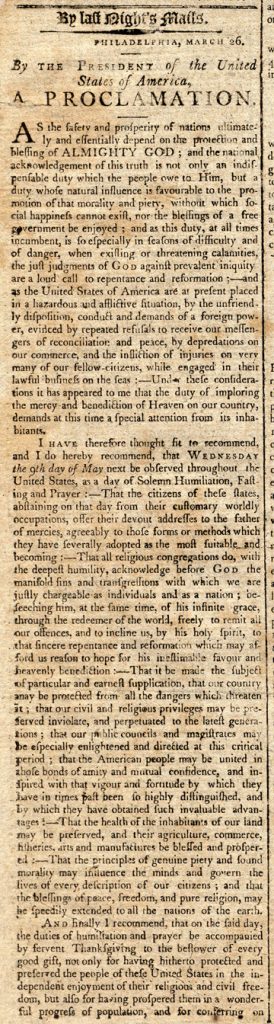
AS the safety and prosperity of nations ultimately and essentially depend on the protection and blessing of Almighty God; and the national acknowledgment of this truth is not only an indispensable duty which the people owe to Him, but a duty whose natural influence is favorable to the promotion of that morality and piety, without which social happiness cannot exist, nor the blessings of a free government be enjoyed; and as this duty, at all times incumbent, is so especially in seasons of difficulty and of danger, when existing or threatening calamities, the just judgments of God against prevalent iniquity are a loud call to repentance and reformation; and as the United States of America are at present placed in a hazardous and afflictive situation, by the unfriendly disposition, conduct and demands of a foreign power, evinced by repeated refusals to receive our messengers of reconciliation and peace, by depredations on our commerce, and the infliction of injuries on very many of our fellow citizens, while engaged in their lawful business on the seas: —Under these considerations it has appeared to me that the duty of imploring the mercy and benediction of Heaven on our country, demands at this time a special attention from its inhabitants.

I HAVE therefore thought it fit to recommend, that Wednesday, the 9th day of May next be observed throughout the United States, as a day of Solemn Humiliation, Fasting and Prayer; That the citizens of these states, abstaining on that day from their customary worldly occupations, offer their devout addresses to the Father of Mercies, agreeably to those forms or methods which they have severally adopted as the most suitable and becoming: That all religious congregations do, with the deepest humility, acknowledge before GOD the manifold sins and transgressions with which we are justly chargeable as individuals and as a nation; beseeching him, at the same time, of his infinite Grace, through the Redeemer of the world, freely to remit all our offences, and to incline us, by his holy spirit, to that sincere repentance and reformation which may afford us reason to hope for his inestimable favor and heavenly benediction; That it be made the subject of particular and earnest supplication, that our country may be protected from all the dangers which threaten it; that our civil and religious privileges may be preserved inviolate, and perpetuated to the latest generations; that our public councils and magistrates may be especially enlightened and directed at this critical period; that the American people may be united in those bonds of amity and mutual confidence, and inspired with that vigor and fortitude by which they have in times past been so highly distinguished, and by which they have obtained such invaluable advantages: That the health of the inhabitants of our land may be preserved, and their agriculture, commerce, fisheries, arts and manufactures be blessed and prospered: That the principles of genuine piety and sound morality may influence the minds and govern the lives of every description of our citizens; and that the blessings of peace, freedom, and pure religion, may be speedily extended to all the nations of the earth.

proclamation-humiliation-fasting-and-prayer-1798-3And finally I recommend, that on the said day; the duties of humiliation and prayer be accompanied by fervent Thanksgiving to the bestower of every good gift, not only for having hitherto protected and preserved the people of these United States in the independent enjoyment of their religious and civil freedom, but also for having prospered them in a wonderful progress of population, and for conferring on them many and great favours conducive to the happiness and prosperity of a nation.
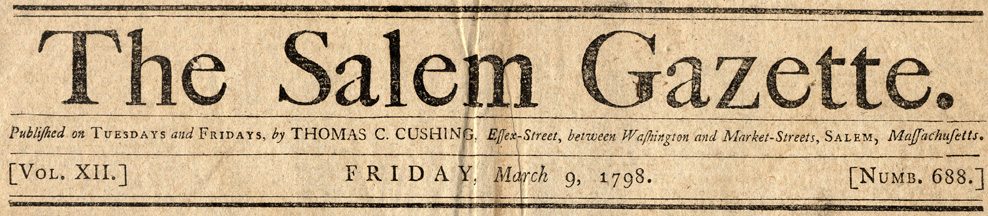

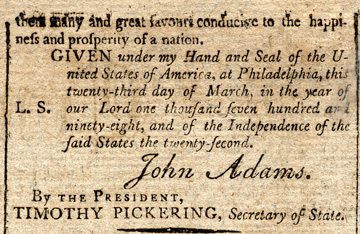
Given under my hand and seal of the United States of America, at Philadelphia, this twenty-third day of March, in the year of our Lord one thousand seven hundred and ninety-eight, and of the Independence of the said States the twenty-second.

JOHN ADAMS

By the President,TIMOTHY PICKERING,

Secretary of State

Proclamation – Fasting Humiliation and Prayer – 1798, Massachusetts


Increase Sumner (1746-1799) was the governor of Massachusetts from 1797-1799. He had previously been a member of the House of Representatives, a Senator, and a justice in the Massachusetts Supreme Court.

This proclamation was issued by Increase Sumner on March 1, 1798, declaring April 5, 1798 the day of fasting, humiliation, and prayer for the state. The text of the proclamation comes from The Salem Gazette on March 9, 1798. To see a sermon preached on the fast day in Massachusetts, click here.


proclamation-fasting-humiliation-and-prayer-1798-massachusetts-1
Commonwealth of Massachusetts.
By His Excellency
INCREASE SUMNER, Esq.
Governor of the Commonwealth
Of Massachusetts,
A PROCLAMATION
For a Day of Solemn FASTING and
PRAYER
.
proclamation-fasting-humiliation-and-prayer-1798-massachusetts-2The entire dependence of all men on the Supreme Governor of the World, for temporal as well as spiritual blessings, evinces the propriety and duty of supplicating His favor by humiliation and prayer. Deeply penetrated with this sentiment, our venerable ancestors have uniformly set apart, at this season of the year, a day for this religious purpose; not less impressed than those, whose example we follow, with a sense of our absolute dependence on the Fountain of Mercies for every public and private blessing,
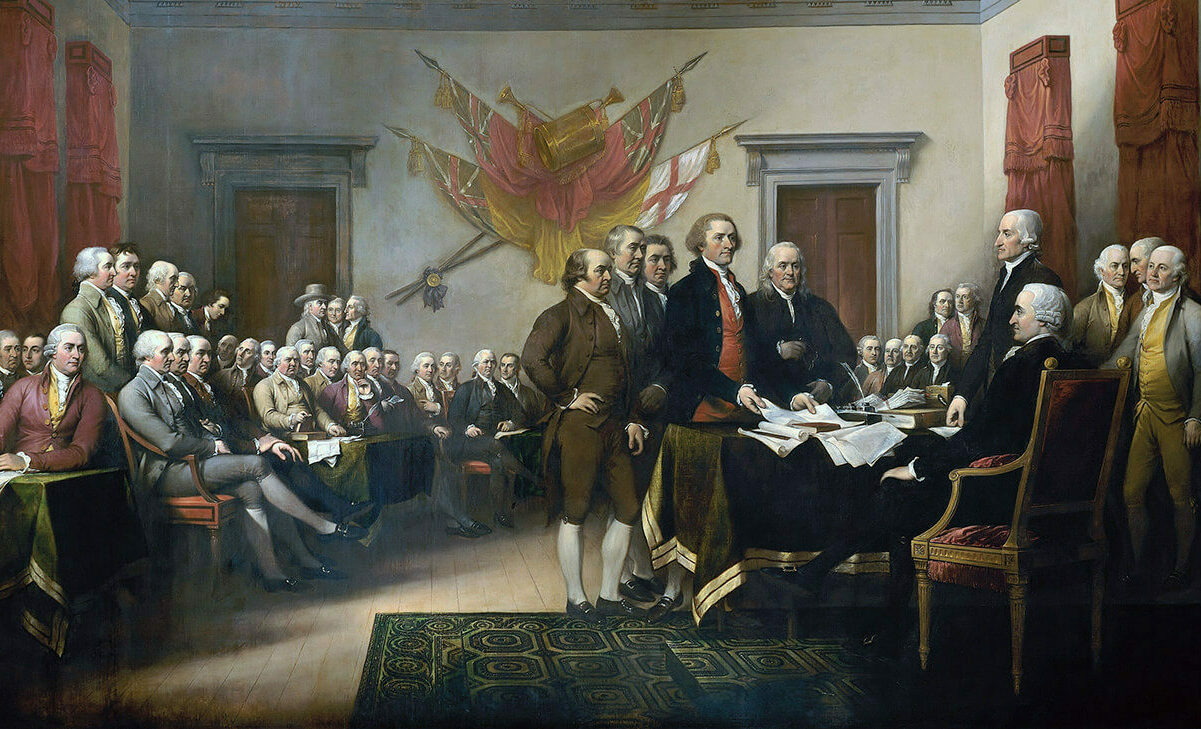
I have thought fit, by and with the advice of Council, to appoint THURSDAY the FIFTH of APRIL NEXT, to be observed throughout this Commonwealth, as a day Fasting, Humiliation and Prayer. Calling on ministers and people of every denomination to assemble on that day, in their respective places of public worship, and with united hearts penitently to confess their sins, and implore the favor and blessing of Almighty God, through the great Mediator, upon the concerns of the ensuing year.

In particular, that He would be pleased to guide and prosper the administration of Civil Government within this Commonwealth.

That He would afford His guidance and blessing to the President of the United States, and that the councils and determinations of our National Government, being founded in wisdom and justice, may promote the true interest and happiness of the United States. That He would be pleased to strengthen the union, and not suffer any design that may be formed against us to prosper.

That he would inspire those in civil authority with a just sense of the trust committed to their care, and enable them to discharge it with fidelity.

That the people may be endued with a public spirit, and true love of their country; properly estimating the blessings of civil and religious liberty, by which they are distinguished And that truth, piety and righteousness, which exalt a nation, may universally prevail.

That He would be graciously pleased to bless the labors of the husbandman, and so to order the seasons, as that the year may be crowned with a plentiful harvest.

That He would guide and direct our University and other seminaries within this Commonwealth, so that the rising generation may be properly instructed in every branch of useful learning, and impressed with the principles of true religion and virtue.

That He would protect our Commerce, Navigation and Fishery from unjust sizable obstructions, and give success to all our lawful undertakings.

That He would be graciously pleased to continue Health in our habitations, and prevent the spreading of mortal contagious diseases; and that through his abundant mercy we may be preserved from every desolating judgment.

That by His gracious influence we may be protected from Internal Commotion and Foreign Invasion.

That the overtures for adjusting differences in Europe may be successful, and permanent peace be established.

And finally, that Wars and Commotions may cease in all parts of the earth; and that mankind, sensible of their mutual dependence, may live in the practice of benevolence, charity, and every other Christian virtue, as become children of one common Parent.

And I do earnestly recommend that all servile labor and recreation, inconsistent with the solemnity of said day, may be suspended.

Given at the Council Chamber, in Boston, this first day of March, in the year of our Lord one thousand seven hundred and ninety eight and in the twenty second year of the independence of the United States of America.

Increase Sumner

By his Excellency’s Command, with advice and consent of the Council.
John Avery, Secr’y.

God Save the Commonwealth of Massachusetts

Sample Letters to the Editor

We receive numerous requests from across the country to answer various editorials and letters-to-the-editor. The subject usually involves the religious persuasions of the Founding Fathers, the “separation of church and state,” the “Religious Right” & theocracy, etc. The following are but a few of many possible replies to such editorials. (Note: Unfortunately, we do not have the resources to respond to individual editorials or articles from newspapers all across the U.S., and we have found it is typically much more effective if local people respond to editorials in their own community. David Barton’s book, Original Intent, and the Resources section of our website contain information that is very useful in successfully refuting the vast majority of negative editorials encountered.)


“The Founding Fathers & Deism”

I notice that your newspaper has an ongoing debate concerning the religious nature of the Founding Fathers. A recent letter claimed that most of the Founding Fathers were deists, and pointed to Washington, Jefferson, Franklin, Paine, Hamilton, and Madison as proof. After making this charge, the writer acknowledged the “voluminous writings” of the Founders, but it appears that they not read those writings herself. However, this is no surprise since the U. S. Department of Education claims that only 5 percent of high schools graduates know how to examine primary source documentation.

Interestingly, the claims in this recent letter to the editor are characteristic of similar claims appearing in hundreds of letters to the editor across the nation. The standard assertion is that the Founders were deists. Deists? What is a deist? In dictionaries like Websters, Funk & Wagnalls, Century, and others, the terms “deist,” “agnostic,” and “atheist” appear as synonyms. Therefore, the range of a deist spans from those who believe there is no God, to those who believe in a distant, impersonal creator of the universe, to those who believe there is no way to know if God exists. Do the Founders fit any of these definitions?

None of the notable Founders fit this description. Thomas Paine, in his discourse on “The Study of God,” forcefully asserts that it is “the error of schools” to teach sciences without “reference to the Being who is author of them: for all the principles of science are of Divine origin.” He laments that “the evil that has resulted from the error of the schools in teaching [science without God] has been that of generating in the pupils a species of atheism.” Paine not only believed in God, he believed in a reality beyond the visible world.

In Benjamin Franklin’s 1749 plan of education for public schools in Pennsylvania, he insisted that schools teach “the necessity of a public religion . . . and the excellency of the Christian religion above all others, ancient or modern.” Consider also the fact that Franklin proposed a Biblical inscription for the Seal of the United States; that he chose a New Testament verse for the motto of the Philadelphia Hospital; that he was one of the chief voices behind the establishment of a paid chaplain in Congress; and that when in 1787 when Franklin helped found the college which bore his name, it was dedicated as “a nursery of religion and learning” built “on Christ, the Corner-Stone.” Franklin certainly doesn’t fit the definition of a deist.

Nor does George Washington. He was an open promoter of Christianity. For example, in his speech on May 12, 1779, he claimed that what children needed to learn “above all” was the “religion of Jesus Christ,” and that to learn this would make them “greater and happier than they already are”; on May 2, 1778, he charged his soldiers at Valley Forge that “To the distinguished character of patriot, it should be our highest glory to add the more distinguished character of Christian”; and when he resigned his commission as commander in-chief of the military on June 8, 1783, he reminded the nation that “without a humble imitation” of “the Divine Author of our blessed religion” we “can never hope to be a happy nation.” Washington’s own adopted daughter declared of Washington that you might as well question his patriotism as to question his Christianity.

Alexander Hamilton was certainly no deist. For example, Hamilton began work with the Rev. James Bayard to form the Christian Constitutional Society to help spread over the world the two things which Hamilton said made America great: (1) Christianity, and (2) a Constitution formed under Christianity. Only Hamilton’s death two months later thwarted his plan of starting a missionary society to promote Christian government. And at the time he did face his death in his duel with Aaron Burr, Hamilton met and prayed with the Rev. Mason and Bishop Moore, wherein he reaffirmed to him his readiness to face God should he die, having declared to them “a lively faith in God’s mercy through Christ, with a thankful remembrance of the death of Christ.” At that time, he also partook of Holy Communion with Bishop Moore.

The reader, as do many others, claimed that Jefferson omitted all miraculous events of Jesus from his “Bible.” Rarely do those who make this claim let Jefferson speak for himself. Jefferson’s own words explain that his intent for that book was not for it to be a “Bible,” but rather for it to be a primer for the Indians on the teachings of Christ (which is why Jefferson titled that work, “The Life and Morals of Jesus of Nazareth”). What Jefferson did was to take the “red letter” portions of the New Testament and publish these teachings in order to introduce the Indians to Christian morality. And as President of the United States, Jefferson signed a treaty with the Kaskaskia tribe wherein he provided—at the government’s expense—Christian missionaries to the Indians. In fact, Jefferson himself declared, “I am a real Christian, that is to say, a disciple of the doctrines of Jesus.” While many might question this claim, the fact remains that Jefferson called himself a Christian, not a deist.

James Madison trained for ministry with the Rev. Dr. John Witherspoon, and Madison’s writings are replete with declarations of his faith in God and in Christ. In fact, for proof of this, one only need read his letter to Attorney General Bradford wherein Madison laments that public officials are not bold enough about their Christian faith in public and that public officials should be “fervent advocates in the cause of Christ.” And while Madison did allude to a “wall of separation,” contemporary writers frequently refuse to allow Madison to provide his own definition of that “wall.” According to Madison, the purpose of that “wall” was only to prevent Congress from passing a national law to establish a national religion.

None of the Founders mentioned fit the definition of a deist. And as is typical with those who make this claim, they name only a handful of Founders and then generalize the rest. This in itself is a mistake, for there are over two hundred Founders (fifty-five at the Constitutional Convention, ninety who framed the First Amendment and the Bill of Rights, and fifty-six who signed the Declaration) and any generalization of the Founders as deists is completely inaccurate.

The reason that such critics never mention any other Founders is evident. For example, consider what must be explained away if the following signers of the Constitution were to be mentioned: Charles Pinckney and John Langdon—founders of the American Bible Society; James McHenry—founder of the Baltimore Bible Society; Rufus King—helped found a Bible society for Anglicans; Abraham Baldwin—a chaplain in the Revolution and considered the youngest theologian in America; Roger Sherman, William Samuel Johnson, John Dickinson, and Jacob Broom—also theological writers; James Wilson and William Patterson—placed on the Supreme Court by President George Washington, they had prayer over juries in the U. S. Supreme Court room; and the list could go on. And this does not even include the huge number of thoroughly evangelical Christians who signed the Declaration or who helped frame the Bill of Rights.

Any portrayal of any handful of Founders as deists is inaccurate. (If this group had really wanted some irreligious Founders, they should have chosen Henry Dearborne, Charles Lee, or Ethan Allen). Perhaps critics should spend more time reading the writings of the Founders to discover their religious beliefs for themselves rather than making such sweeping accusations which are so easily disproven.

(For more on this topic see: Thomas Paine Criticizes the Current Public School Science Curriculum, Franklin’s Appeal for Prayer at the Constitutional Convention, Was George Washington a Christian?, The Founders and Public Religious Expression, & James Madison and Religion in Public)


“Thomas Jefferson & the ‘wall of separation between
church and state.’”

In a recent letter on religion, the writer put supporters of public religious expression on one side and Thomas Jefferson on the other. This is logical given what most know about Jefferson’s “wall of separation between church and state.”

Jefferson penned that phrase to reassure the Danbury (CT) Baptist Association that because of separation of church and state, the government would never interfere with their public religious expressions. For the next 150 years, federal courts followed Jefferson’s intent and attached his separation metaphor to the Free Expression Clause of the First Amendment, thus consistently upholding public religious expressions. However, in 1947, the Supreme Court reversed itself and began applying the phrase to the Establishment Clause instead, thus causing federal courts to remove rather than preserve public religious expressions.

The proof is abundant that this was not Jefferson’s intent. For example, two days after Jefferson wrote his separation letter, he attended worship services in the U. S. Capitol where he heard the Rev. John Leland preach a sermon. (As President of the Senate, Jefferson had personally approved the use of the Capitol Building for Sunday worship services.) The many diaries of Members of Congress during that time confirm that during Jefferson’s eight years, he faithfully attended church services in the Capitol. In fact, he even ordered the Marine Band to play the worship services there. Jefferson also authorized weekly worship services at the War Department and the Treasury Building.

And on December 23, 1803, Jefferson’s administration negotiated – and the Senate ratified – a treaty with the Kaskaskia Indians that stated “the United States will give annually for seven years one hundred dollars for the support of a priest” to minister to the Indians (i.e., federal funds for Christian evangelism!) Jefferson also signed presidential documents, closing them with the appellation, “In the Year of our Lord Christ.” There are many similar surprising facts about Jefferson that are fully documented historically, but that have been ignored for the past 50 years.

So would religious conservatives and Thomas Jefferson really be on opposite sides of the church/state issue? Probably, for I doubt that conservatives would agree with using federal dollars for evangelization.

(For more on this topic see: The Separation of Church and State & Letters Between the Danbury Baptists and Thomas Jefferson)


“Theocracy”

In a recent letter, the writer took the same position as Americans United for Separation of Church and State (AU) and parroted AU’s offensive mantra, associating a theocracy or theocratic state with the “Religious Right.” Such claims are patently false.

First, to have a theocracy in America, the Constitution must be replaced with a totalitarian dictator who speaks on God’s behalf (i.e., a revival of “the Divine Right of Kings” doctrine). I challenge AU, or anyone else to identify which part of the “Religious Right” is calling for such a government.

Second, the “Religious Right” leaders are calling for an increased respect for the Constitution and its actual wording, urging citizens to exercise their constitutional right to vote. The real “crime” of these leaders is not that they want a theocracy (which they don’t) but that they rightfully want legislators to make national policy instead of judges. Should that occur, AU or groups like them could not win another battle, for Americans overwhelmingly reject their policies (e.g., “under God” in the Pledge – a phrase opposed by AU but supported by 87% of Americans).

The rabid opposition to public religious expressions is often irrational, In fact, a New Jersey bill proposing that students begin each day by reciting the first 56 words from the Declaration of Independence was loudly denounced as “a thinly-veiled attempt to put prayer in schools” – the first step on the road to a – you guessed it – “theocracy!” Reading the actual wording of the Declaration of Independence leads to a theocracy??? It is time for that term to become anathema in public discourse.

During the Civil Rights Era, we gradually learned that if certain pejoratives were invoked, the individual doing so was a racist. Similarly, today we need to learn that when the emotive and pejorative term “theocracy!” is invoked, it is usually by an intolerant secularist who wants all public religious expressions expunged from society.

(For more on this topic see: A Tale of Two Constitutions & Impeachment of Federal Judges)


* This article concerns a historical issue and may not have updated information.

Republic v. Democracy

Founders & Democracy

We have grown accustomed to hearing that we are a democracy; such was never the intent. The form of government entrusted to us by our Founders was a republic, not a democracy. 1 Our Founders had an opportunity to establish a democracy in America and chose not to. In fact, the Founders made clear that we were not, and were never to become, a democracy:

[D]emocracies have ever been spectacles of turbulence and contention; have ever been found incompatible with personal security, or the rights of property; and have, in general, been as short in their lives as they have been violent in their deaths. 2 James Madison

Remember, democracy never lasts long. It soon wastes, exhausts, and murders itself. There never was a democracy yet that did not commit suicide. 3 John Adams

A democracy is a volcano which conceals the fiery materials of its own destruction. These will produce an eruption and carry desolation in their way. 4 The known propensity of a democracy is to licentiousness [excessive license] which the ambitious call, and ignorant believe to be liberty. 5 Fisher Ames, Author of the House Language for the First Amendment

We have seen the tumult of democracy terminate . . . as [it has] everywhere terminated, in despotism. . . . Democracy! savage and wild. Thou who wouldst bring down the virtuous and wise to thy level of folly and guilt. 6 Gouverneur Morris, Signer and Penman of the Constitution

[T]he experience of all former ages had shown that of all human governments, democracy was the most unstable, fluctuating and short-lived. 7 John Quincy Adams

A simple democracy . . . is one of the greatest of evils. 8 Benjamin Rush, Signer of the Declaration

In democracy . . . there are commonly tumults and disorders. . . . Therefore a pure democracy is generally a very bad government. It is often the most tyrannical government on earth. 9 Noah Webster

Pure democracy cannot subsist long nor be carried far into the departments of state, it is very subject to caprice and the madness of popular rage. 10 John Witherspoon, Signer of the Declaration

It may generally be remarked that the more a government resembles a pure democracy the more they abound with disorder and confusion. 11 Zephaniah Swift, Author of America’s First Legal Text

Many Americans today seem to be unable to define the difference between the two, but there is a difference, a big difference. That difference rests in the source of authority.

Democracy & Republic Definitions

A pure democracy operates by direct majority vote of the people. When an issue is to be decided, the entire population votes on it; the majority wins and rules.

A republic differs in that the general population elects representatives who then pass laws to govern the nation.

A democracy is the rule by majority feeling (what the Founders described as a “mobocracy” 12). A republic is rule by law.

If the source of law for a democracy is the popular feeling of the people, then what is the source of law for the American republic? According to Founder Noah Webster:

[O]ur citizens should early understand that the genuine source of correct republican principles is the Bible, particularly the New Testament, or the Christian religion. 13

The American Republic

The transcendent values of Biblical natural law were the foundation of the American republic. Consider the stability this provides: in our republic, murder will always be a crime, for it is always a crime according to the Word of God. however, in a democracy, if majority of the people decide that murder is no longer a crime, murder will no longer be a crime.

America’s immutable principles of right and wrong were not based on the rapidly fluctuating feelings and emotions of the people but rather on what Montesquieu identified as the “principles that do not change.” 14

Benjamin Rush similarly observed:

[W]here there is no law, there is no liberty; and nothing deserves the name of law but that which is certain and universal in its operation upon all the members of the community. 15

In the American republic, the “principles which did not change” and which were “certain and universal in their operation upon all the members of the community” were the principles of Biblical natural law. In fact, so firmly were these principles ensconced in the American republic that early law books taught that government was free to set its own policy only if God had not ruled in an area. For example, Blackstone’s Commentaries explained:

To instance in the case of murder: this is expressly forbidden by the Divine. . . . If any human law should allow or enjoin us to commit it we are bound to transgress that human law. . . . But, with regard to matters that are . . . not commanded or forbidden by those superior laws such, for instance, as exporting of wool into foreign countries; here the . . . legislature has scope and opportunity to interpose. 16

The Founders echoed that theme:

All [laws], however, may be arranged in two different classes. 1) Divine. 2) Human. . . . But it should always be remembered that this law, natural or revealed, made for men or for nations, flows from the same Divine source: it is the law of God. . . . Human law must rest its authority ultimately upon the authority of that law which is Divine. 17 James Wilson, Signer of the Constitution; U. S. Supreme Court Justice

[T]he law . . . dictated by God Himself is, of course, superior in obligation to any other. It is binding over all the globe, in all countries, and at all times. No human laws are of any validity if contrary to this. 18Alexander Hamilton, Signer of the Constitution

[T]he . . . law established by the Creator . . . extends over the whole globe, is everywhere and at all times binding upon mankind. . . . [This] is the law of God by which he makes his way known to man and is paramount to all human control. 19 Rufus King, Signer of the Constitution

Conclusion

The Founders understood that Biblical values formed the basis of the republic and that the republic would be destroyed if the people’s knowledge of those values should ever be lost.

A republic is the highest form of government devised by man, but it also requires the greatest amount of human care and maintenance. If neglected, it can deteriorate into a variety of lesser forms, including a democracy (a government conducted by popular feeling); anarchy (a system in which each person determines his own rules and standards); oligarchy (a government run by a small council or a group of elite individuals): or dictatorship (a government run by a single individual). As John Adams explained:

[D]emocracy will soon degenerate into an anarchy; such an anarchy that every man will do what is right in his own eyes and no man’s life or property or reputation or liberty will be secure, and every one of these will soon mould itself into a system of subordination of all the moral virtues and intellectual abilities, all the powers of wealth, beauty, wit, and science, to the wanton pleasures, the capricious will, and the execrable [abominable] cruelty of one or a very few. 20

Understanding the foundation of the American republic is a vital key toward protecting it.


Endnotes

1 An example of this is demonstrated in the anecdote where, having concluded their work on the Constitution, Benjamin Franklin walked outside and seated himself on a public bench. A woman approached him and inquired, “Well, Dr. Franklin, what have you done for us?” Franklin quickly responded, “My dear lady, we have given to you a republic–if you can keep it.” Taken from “America’s Bill of Rights at 200 Years,” by former Chief Justice Warren E. Burger, printed in Presidential
Studies Quarterly
(Summer 1991), XXI:3:457. This anecdote appears in numerous other works as well.

2 Alexander Hamilton, John Jay, James Madison, The Federalist on the New Constitution (Philadelphia: Benjamin Warner, 1818), 53, #10, James Madison.

3 John Adams to John Taylor, April 15, 1814, The Works of John Adams, ed. Charles Francis Adams (Boston: Charles C. Little and James Brown, 1850), VI:484.

4 Fisher Ames, Speech on Biennial Elections, delivered January, 1788, Works of Fisher Ames (Boston: T. B. Wait & Co., 1809), 24.

5 Ames, “The Dangers of American Liberty,” February 1805, Works (1809), 384.

6 Gouverneur Morris, An Oration Delivered on Wednesday, June 29, 1814, at the Request of a Number of Citizens of New-York, in Celebration of the Recent Deliverance of Europe from the Yoke of Military Despotism (New York: Van Winkle and Wiley, 1814), 10, 22.

7 John Quincy Adams, The Jubilee of the Constitution. A Discourse Delivered at the Request of the New York Historical Society, in the City of New York on Tuesday, the 30th of April 1839; Being the Fiftieth Anniversary of the Inauguration of George Washington as President of the United States, on Thursday, the 30th of April, 1789 (New York: Samuel Colman, 1839), 53.

8 Benjamin Rush to John Adams, July 21, 1789, The Letters of Benjamin Rush, ed. L. H. Butterfield (Princeton: Princeton University Press for the American Philosophical Society, 1951), I:523.

9 Noah Webster, The American Spelling Book: Containing an Easy Standard of Pronunciation: Being the First Part of a Grammatical Institute of the English Language, To Which is Added, an Appendix, Containing a Moral Catechism and a Federal Catechism (Boston: Isaiah Thomas and Ebenezer T. Andrews, 1801), 103-104.

10 John Witherspoon, Lecture 12 on Civil Society, The Works of John Witherspoon (Edinburgh: J. Ogle, 1815), VII:101.

11 Zephaniah Swift, A System of the Laws of the State of Connecticut (Windham: John Byrne, 1795), I:19.

12 See, for example, Benjamin Rush to John Adams, January 22, 1789, Letters, ed. Butterfield (1951), I:498.

13 Noah Webster, History of the United States (New Haven: Durrie & Peck, 1832), 6.

14 George Bancroft, History of the United States from the Discovery of the American Continent (Boston: Little, Brown & Co., 1859), V:24; Baron Charles Secondat de Montesquieu, Spirit of the Laws (Philadelphia: Isaiah Thomas, 1802), I:17-23, and ad passim.

15 Rush to David Ramsay, March or April 1788, Letters, ed. Butterfield (1951), I:454.

16 William Blackstone, Commentaries on the Laws of England (Philadelphia: Robert Bell, 1771), I:42-43.

17 James Wilson, “Of the General Principles of Law and Obligation,” The Works of the Honorable James Wilson, ed. Bird Wilson (Philadelphia: Lorenzo Press, 1804), I:103-105.

18 Alexander Hamilton, The Papers of Alexander Hamilton, ed. Harold C. Syrett (New York: Columbia University Press, 1961), I:87, February 23, 1775, quoting Blackstone, Commentaries (1771), I:41.

19 Rufus King to C. Gore, February 17, 1820, The Life and Correspondence of Rufus King, ed. Charles R. King (New York: G. P. Putnam’s Sons, 1900), VI:276.

20 John Adams, The Papers of John Adams, ed. Robert J. Taylor (Cambridge: Belknap Press, 1977), I:83, from “An Essay on Man’s Lust for Power, with the Author’s Comment in 1807,” written on August 29, 1763, but first published by John Adams in 1807.

Was George Washington a Christian?

This is a question often asked today, and it arises from the efforts of those who seek to impeach Washington’s character by portraying him as irreligious. Interestingly, Washington’s own contemporaries did not question his Christianity but were thoroughly convinced of his devout faith–a fact made evident in the first-ever compilation of the The Writings of George Washington, published in the 1830s.

That compilation of Washington’s writings was prepared and published by Jared Sparks (1789-1866), a noted writer and historian. Sparks’ herculean historical productions included not only the writings of George Washington (12 volumes) but also Benjamin Franklin (10 volumes) and Constitution signer Gouverneur Morris (3 volumes). Additionally, Sparks compiled the Library of American Biography (25 volumes), The Diplomatic Correspondence of the American Revolution (12 volumes), and the Correspondence of the American Revolution (4 volumes). In all, Sparks was responsible for some 100 historical volumes. Additionally, Sparks was America’s first professor of history–other than ecclesiastical history–to teach at the college level in the United States, and he was later chosen president of Harvard.

Jared Sparks’ decision to compile George Washington’s works is described by The Dictionary of American Biography. It details that Sparks began . . .

. . . what was destined to be his greatest life work, the publication of the writings of George Washington. [Supreme Court] Justice Bushrod Washington, [the nephew of George Washington, the executor of the Washington estate, and] the owner of the Washington manuscripts, was won over by an offer to share the profits, through the friendly mediation of Chief Justice [of the Supreme Court, John] Marshall [who from 1804-1807 had written a popular five volume biography of George Washington], who also consented to take an equal share, twenty-five per cent, with the owner. In January 1827, Sparks found himself alone at Mount Vernon with the manuscripts. An examination of them extending over three months showed that years would be required for the undertaking; and with the owner’s consent, Sparks carried off the entire collection, eight large boxes, picking up on the way to Boston a box of diplomatic correspondence from the Department of State, and the [General Horatio] Gates manuscripts from the New York Historical Society. Not content with these, he searched or caused to be searched public and private archives for material, questioned survivors of the Revolution, visited and mapped historic sites. In 1830, for instance, he followed [Benedict] Arnold’s [1775] route to Quebec. The first of the twelve volumes of The Writings of George Washington to be published (vol. II) appeared in 1834 and the last (vol. I, containing the biography) in 1837.

In Volume XII of these writings, Jared Sparks delved into the religious character of George Washington, and included numerous letters written by the friends, associates, and family of Washington which testified of his religious character. Based on that extensive evidence, Sparks concluded:

To say that he [George Washington] was not a Christian would be to impeach his sincerity and honesty. Of all men in the world, Washington was certainly the last whom any one would charge with dissimulation or indirectness [hypocrisies and evasiveness]; and if he was so scrupulous in avoiding even a shadow of these faults in every known act of his life, [regardless of] however unimportant, is it likely, is it credible, that in a matter of the highest and most serious importance [his religious faith, that] he should practice through a long series of years a deliberate deception upon his friends and the public? It is neither credible nor possible.

One of the letters Sparks used to arrive at his conclusion was from Nelly Custis-Lewis. While Nelly technically was the granddaughter of the Washingtons, in reality she was much more.

When Martha [Custis] married George, she was a widow and brought two young children (John and Martha–also called Patsy) from her first marriage into her marriage with George. The two were carefully raised by George and Martha, later married, and each had children of their own. Unfortunately, tragedy struck, and both John and Patsy died early (by 1781). John left behind his widow and four young children ranging in age from infancy to six years old.

At the time, Washington was still deeply involved in guiding the American Revolution and tried unsuccessfully to convince Martha’s brother to raise the children. The young widow of John was unable to raise all four, so George and Martha adopted the two younger children: Nelly Parke Custis and George Washington Parke Custis, both of whom already were living at Mount Vernon.

Nelly lived with the Washingtons for twenty years, from the time of her birth in 1779 until 1799, the year of her marriage and of George Washington’s untimely death. She called George and Martha her “beloved parents whom I loved with so much devotion, to whose unceasing tenderness I was indebted for every good I possessed.”

Nelly was ten years old when Washington was called to the Presidency, and she grew to maturity during his two terms. During that time, she traveled with Washington and walked amidst the great foreign and domestic names of the day. On Washington’s retirement, she returned with the family to Mount Vernon. Nelly was energetic, spry, and lively, and was the joy of George Washington’s life. She served as a gracious hostess and entertained the frequent guests to Mount Vernon who visited the former President.

On Washington’s birthday in 1799, Nelly married Washington’s private secretary, Lawrence Lewis. They spent several months on an extended honeymoon, visiting friends and family across the country. On their return to Mount Vernon, she was pregnant and late that year gave birth to a daughter. A short few weeks later, on December 14, General Washington was taken seriously ill and died.

Clearly, Nelly was someone who knew the private and public life of her “father” very well. Therefore, Jared Sparks, in searching for information on Washington’s religious habits, dispatched a letter to Nelly, asking if she knew for sure whether George Washington indeed was a Christian. Within a week, she had replied to Sparks, and Sparks included her letter in Volume XII of Washington’s writings in the lengthy section on Washington’s religious habits. Of that specific letter, Jared Sparks explained:

I shall here insert a letter on this subject, written to me by a lady who lived twenty years in Washington’s family and who was his adopted daughter, and the granddaughter of Mrs. Washington. The testimony it affords, and the hints it contains respecting the domestic habits of Washington, are interesting and valuable.”

Woodlawn, 26 February, 1833.

Sir,

I received your favor of the 20th instant last evening, and hasten to give you the information, which you desire.

Truro [Episcopal] Parish is the one in which Mount Vernon, Pohick Church [the church where George Washington served as a vestryman], and Woodlawn [the home of Nelly and Lawrence Lewis] are situated. Fairfax Parish is now Alexandria. Before the Federal District was ceded to Congress, Alexandria was in Fairfax County. General Washington had a pew in Pohick Church, and one in Christ Church at Alexandria. He was very instrumental in establishing Pohick Church, and I believe subscribed [supported and contributed to] largely. His pew was near the pulpit. I have a perfect recollection of being there, before his election to the presidency, with him and my grandmother. It was a beautiful church, and had a large, respectable, and wealthy congregation, who were regular attendants.

He attended the church at Alexandria when the weather and roads permitted a ride of ten miles [a one-way journey of 2-3 hours by horse or carriage]. In New York and Philadelphia he never omitted attendance at church in the morning, unless detained by indisposition [sickness]. The afternoon was spent in his own room at home; the evening with his family, and without company. Sometimes an old and intimate friend called to see us for an hour or two; but visiting and visitors were prohibited for that day [Sunday]. No one in church attended to the services with more reverential respect. My grandmother, who was eminently pious, never deviated from her early habits. She always knelt. The General, as was then the custom, stood during the devotional parts of the service. On communion Sundays, he left the church with me, after the blessing, and returned home, and we sent the carriage back for my grandmother.

It was his custom to retire to his library at nine or ten o’clock where he remained an hour before he went to his chamber. He always rose before the sun and remained in his library until called to breakfast. I never witnessed his private devotions. I never inquired about them. I should have thought it the greatest heresy to doubt his firm belief in Christianity. His life, his writings, prove that he was a Christian. He was not one of those who act or pray, “that they may be seen of men” [Matthew 6:5]. He communed with his God in secret [Matthew 6:6].

My mother [Eleanor Calvert-Lewis] resided two years at Mount Vernon after her marriage [in 1774] with John Parke Custis, the only son of Mrs. Washington. I have heard her say that General Washington always received the sacrament with my grandmother before the revolution. When my aunt, Miss Custis [Martha’s daughter] died suddenly at Mount Vernon, before they could realize the event [before they understood she was dead], he [General Washington] knelt by her and prayed most fervently, most affectingly, for her recovery. Of this I was assured by Judge [Bushrod] Washington’s mother and other witnesses.

He was a silent, thoughtful man. He spoke little generally; never of himself. I never heard him relate a single act of his life during the war. I have often seen him perfectly abstracted, his lips moving, but no sound was perceptible. I have sometimes made him laugh most heartily from sympathy with my joyous and extravagant spirits. I was, probably, one of the last persons on earth to whom he would have addressed serious conversation, particularly when he knew that I had the most perfect model of female excellence [Martha Washington] ever with me as my monitress, who acted the part of a tender and devoted parent, loving me as only a mother can love, and never extenuating [tolerating] or approving in me what she disapproved of others. She never omitted her private devotions, or her public duties; and she and her husband were so perfectly united and happy that he must have been a Christian. She had no doubts, no fears for him. After forty years of devoted affection and uninterrupted happiness, she resigned him without a murmur into the arms of his Savior and his God, with the assured hope of his eternal felicity [happiness in Heaven]. Is it necessary that any one should certify, “General Washington avowed himself to me a believer in Christianity?” As well may we question his patriotism, his heroic, disinterested devotion to his country. His mottos were, “Deeds, not Words”; and, “For God and my Country.”

With sentiments of esteem,

I am, Nelly Custis-Lewis

George Washington’s adopted daughter, having spent twenty years of her life in his presence, declared that one might as well question Washington’s patriotism as question his Christianity. Certainly, no one questions his patriotism; so is it not rather ridiculous to question his Christianity? George Washington was a devout Episcopalian; and although as an Episcopalian he would not be classified as an outspoken and extrovert “evangelical” Founder as were Founding Fathers like Benjamin Rush, Roger Sherman, and Thomas McKean, nevertheless, being an Episcopalian makes George Washington no less of a Christian. Yet for the current revisionists who have made it their goal to assert that America was founded as a secular nation by secular individuals and that the only hope for America’s longevity rests in her continued secularism, George Washington’s faith must be sacrificed on the altar of their secularist agenda.

For much more on George Washington and the evidences of his strong faith, examine the following sources:

  • George Washington, The Writings of George Washington, Jared Sparks, editor (Boston: Ferdinand Andrews, Publisher, 1838), Vol. XII, pp. 399-411.
  • George Washington, The Religious Opinions of Washington, E. C. M’Guire, editor (New York: Harper & Brothers, 1836).
  • William Johnson, George Washington The Christian (1917).
  • William Jackson Johnstone, How Washington Prayed (New York: The Abingdon Press, 1932).
  • The Messages and Papers of the Presidents, James D. Richardson, editor (Published by the Authority of Congress, 1899), Vol. I, pp. 51-57 (1789), 64 (1789), 213-224 (1796), etc.
  • George Washington, Address of George Washington, President of the United States, Late Commander in Chief of the American Army, to the People of the United States, Preparatory to his Declination (Baltimore: George & Henry S. Keatinge, 1796), pp. 22-23.
  • George Washington, The Maxims of Washington (New York: D. Appleton and Co., 1855).

* Originally Posted: Dec. 31, 2016.

The Founders And Public Religious Expressions

Recently, there have been objections to public religious expressions by legislative chaplains supported through State budgets. These objections to legislative chaplains are very similar to one lodged with the U. S. Congress in 1852. In that challenge, the Committees on the Judiciary in both the House and the Senate each delivered a report pertinent to this discussion.

For example, in the House Report on March 27, 1854, it noted:

There certainly can be no doubt as to the practice of employing chaplains in deliberative bodies previous to the adoption of the Constitution. We are, then, prepared to see if any change was made in that respect in the new order of affairs. . . . On the 1st day of May [1789], Washington’s first speech was read to the House, and the first business after that speech was the appointment of Dr. Linn as chaplain. By whom was this plan made? Three out of six of that joint committee were members of the Convention that framed the Constitution. Madison, Ellsworth, and Sherman passed directly from the hall of the [Constitutional] Convention to the hall of Congress. Did they not know what was constitutional?. . . It seems to us that the men who would raise the cry of danger in this state of things would cry fire on the 39th day of a general deluge. . . . But we beg leave to rescue ourselves from the imputation of asserting that religion is not needed to the safety of civil society. It must be considered as the foundation on which the whole structure rests. Laws will not have permanence or power without the sanction of religious sentiment—without a firm belief that there is a Power above us that will reward our virtues and punish our vices. 1

The House Judiciary Committee therefore concluded:

Whereas, the people of these United States, from their earliest history to the present time, have been led by the hand of a kind Providence and are indebted for the countless blessings of the past and present, and dependent for continued prosperity in the future upon Almighty God; and whereas the great vital and conservative element in our system is the belief of our people in the pure doctrines and divine truths of the gospel of Jesus Christ, it eminently becomes the representatives of a people so highly favored to acknowledge in the most public manner their reverence for God: therefore, Resolved, That the daily sessions of this body be opened with prayer and that the ministers of the Gospel in this city are hereby requested to attend and alternately perform this solemn duty. 2

On January 19, 1853, the Senate Judiciary Committee delivered its report:

The whole view of the petitioners seems founded upon mistaken conceptions of the meaning of the Constitution. . . . If [the use of chaplains] had been a violation of the Constitution, why was not its character seen by the great and good men who were coeval with the government, who were in Congress and in the Presidency when this constitutional amendment was adopted? They, if any one did, understood the true purport of the amendment, and were bound, by their duty and their oath, to resist the introduction or continuance of chaplains, if the views of the petitioners were correct. But they did no such thing; and therefore we have the strongest reason to suppose the notion of the petitioner to be unfounded. . . . They had no fear or jealousy of religion itself, nor did they wish to see us an irreligious people; they did not intend to prohibit a just expression of religious devotion by the legislators of the nation, even in their public character as legislators; they did not intend to spread over all the public authorities and the whole public action of the nation the dead and revolting spectacle of atheistical apathy. 3

Interestingly, a century later, the U. S. Supreme Court reached a similar conclusion, declaring:

We are a religious people whose institutions presuppose a Supreme Being. . . . When the State encourages religious instruction or cooperates with religious authorities by adjusting the schedule of public events to sectarian needs, it follows the best of our traditions. For it then respects the religious nature of our people and accommodates the public service to their spiritual needs. To hold that it may not would be to find in the Constitution a requirement that the government show a callous indifference to religious groups. That would be preferring those who believe in no religion over those who do believe. 4

Clearly, previous generations did not find difficulty with paid chaplains. In fact, even Thomas Jefferson would disagree in several areas with those who often invoke him as an authority for a secular public arena, for Jefferson himself regularly violated the bland “civil religion” standards which many secularists promote. Consider:

    • Jefferson urged local governments to make land available specifically for Christian purposes;5
    • In an 1803 federal Indian treaty, Jefferson willingly agreed to provide $300 to “assist the said Kaskaskia tribe in the erection of a church” and to provide “annually for seven years $100 towards the support of a Catholic priest.” He also signed three separate acts setting aside government lands
      for the sole use of religious groups and setting aside government lands so that Moravian missionaries might be assisted in “promoting Christianity.” 6
    • When Washington D. C. became the national capital in 1800, Congress voted that the Capitol building would also serve as a church building. 7 President Jefferson chose to attend church each Sunday at the Capitol 8 and even provided the service with paid government musicians to assist in its worship.9 Jefferson also began similar Christian services in his own Executive Branch, both at the Treasury Building and at the War Office. 10
    • Jefferson praised the use of a local courthouse as a meeting place for Christian services;11
    • Jefferson assured a Christian religious school that it would receive “the patronage of the government”;12
    • Jefferson proposed that the Great Seal of the United States depict a story from the Bible and include the word “God” in its motto; 13
    • While President, Jefferson closed his presidential documents with the phrase, “In the year of our Lord Christ; by the President; Thomas Jefferson.” 14

Furthermore, Jefferson would especially disagree with those who believe that public prayers should be non-sectarian and omit specific references to Jesus. Jefferson believed that every individual should pray according to his own beliefs. As Jefferson explained:

[The] liberty to worship our Creator in the way we think most agreeable to His will [is] a liberty deemed in other countries incompatible with good government and yet proved by our experience to be its best support. 15 (emphasis added)

Critics, therefore, would be particularly troubled by President Jefferson’s words that:

No nation has ever existed or been governed without religion. Nor can be. The Christian religion is the best religion that has been given to man and I, as Chief Magistrate of this nation, am bound to give it the sanction of my example. 16

James Madison also encouraged public officials to declare openly and publicly their Christian beliefs and testimony — as when he wrote to William Bradford (who became Attorney General under President George Washington):

I have sometimes thought there could not be a stronger testimony in favor of religion or against temporal enjoyments, even the most rational and manly, than for men who occupy the most honorable and gainful departments and [who] are rising in reputation and wealth, publicly to declare their unsatisfactoriness by becoming fervent advocates in the cause of Christ; and I wish you may give in your evidence in this way. 17

Additionally, throughout his Presidency, Madison issued several proclamations for public days of prayer, fasting, and thanksgiving, 18 and like Jefferson, President Madison also attended church at the Capitol, thus publicly endorsing religion in official arenas. 19

So, not only did Jefferson and Madison endorse religion in the public arena, they were even willing publicly to endorse Christian prayers in the public arena rather than the bland politically-correct civic prayers desired by critics of public prayers.

There are many additional framers of our government who are also qualified to speak to the issue of religious expressions in official and political arenas. For example:

· [W]e can only depend on the all powerful influence of the Spirit of God, whose Divine aid and assistance it becomes us as a Christian people most devoutly to implore. Therefore I move that some minister of the Gospel be requested to attend this Congress every morning during the sessions in order to open the meeting with prayer. 20Elias Boudinot, President of Congress, A Framer of the Bill of Rights in the First Congress

· We have been assured, Sir, in the Sacred Writings that except the Lord build the house, they labor in vain that build it. I firmly believe this; and I also believe that without His concurring aid, we shall succeed in this political building no better than the builders of Babel. . . . I therefore beg leave to move that henceforth, prayers imploring the assistance of Heaven and its blessings on our deliberations be held in this assembly every morning before we proceed to business, and that one or more clergy of the city be requested to officiate in that service.21 Benjamin Franklin, Signer of the Constitution, Signer of the Declaration, Governor of Pennsylvania

· Sensible of the importance of Christian piety and virtue to the order and happiness of a state, I cannot but earnestly commend to you every measure for their support and encouragement. . . . [T]he very existence of the republics . . . depend much upon the public institutions of religion. 22 John Hancock, Signer of Declaration of Independence, Governor of Massachusetts

· [It is] the duty of all wise, free, and virtuous governments to countenance and encourage virtue and religion.23 I therefore recommend a general and public return of praise and thanksgiving to Him from whose goodness these blessings descend. The most effectual means of securing the continuance of our civil and religious liberties is always to remember with reverence and gratitude the source from which they flow. 24John Jay, Original Chief-Justice U. S. Supreme Court, An Author of the Federalist Papers, Governor of New York

· I had the honor of being one among many who framed that Constitution. . . . In order effectually to accomplish these great ends, it is incumbent upon us to begin wisely and to proceed in the fear of God; . . . and it is especially the duty of those who bear rule to promote and encourage piety [respect for God]. 25 Henry Laurens, President of Congress, Selected as Delegate to the Constitutional Convention

· [A] free government. . . . can only be happy when the public principle and opinions are properly directed. . . . by religion and education. It should therefore be among the first objects of those who wish well to the national prosperity to encourage and support the principles of religion and morality. 26 Abraham Baldwin, Signer of the Constitution, A Framer of the Bill of Rights in the First Congress

· Of all the dispositions and habits which lead to political prosperity, religion and morality are indispensable supports. In vain would that man claim the tribute of patriotism who should labor to subvert these great pillars of human happiness. 27 (emphasis added) George Washington, Signer of the Constitution, First U. S. President

·[W]hatsoever State among us shall continue to make piety [respect for God] and virtue the standard of public honor will enjoy the greatest inward peace, the greatest national happiness, and in every outward conflict will discover the greatest constitutional strength. 28 John Witherspoon, Signer of the Declaration of Independence

There are many additional framers of our documents with similarly pertinent declarations—some more strongly worded, some less strongly worded, and some the equivalent of those above.

However, just because so many framers specifically endorsed Christianity did not mean that they excluded other religious faiths, for such was not the case. In fact, evangelical Christian Benjamin Rush (a signer of the Declaration and a member of the presidential administrations of Adams, Jefferson, and Madison), in discussing educational policies in public schools, declared:

Such is my veneration for every religion that reveals the attributes of the Deity, or a future state of rewards and punishments, that I had rather see the opinions of Confucius or Mohamed inculcated upon our youth than see them grow up wholly devoid of a system of religious principles. But the religion I mean to recommend in this place is that of the New Testament. . . . [A]ll its doctrines and precepts are calculated to promote the happiness of society and the safety and well-being of civil government.29

However, while Dr. Rush was outspoken about his personal Christian preferences, he was also gratified with the religious tolerance exercised in America. In fact, in his description of the federal parade in Philadelphia following the adoption of the Constitution, Rush happily declared:

The rabbi of the Jews locked in the arms of two ministers of the Gospel was a most delightful sight. There could not have been a more happy emblem! 30

And as Constitution signer Richard Dobbs Spaight similarly explained:

As to the subject of religion. . . . no power is given to the general government to interfere with it at all. . . . No sect is preferred to another. Every man has a right to worship the Supreme Being in the manner he thinks proper. 31

The “every man” protections mentioned not only by Jefferson and Spaight but by so many other framers would include protections for those chaplains who wish to offer prayers in whatever manner they may choose.

The historical evidence is clear: those who oppose legislative chaplaincies (paid or unpaid), or who decry sectarian public prayers, lack any broad historical basis for their arguments. Such opposition certainly cannot be justified in the name the Founding Fathers.


NOTES

1 Reports of Committees of the House of Representatives Made During the First Session of the Thirty-Third Congress (Washington: A. O. P. Nicholson, 1854).
2 Id.
3 The Reports of the Committees of the Senate of the United States for the Second Session of the Thirty-Second Congress, 1852-53 (Washington: Robert Armstrong, 1853).
4 Zorach v. Clauson, 343 U. S. 306, 312-314 (1952).
5 Letter of Thomas Jefferson to Bishop Carroll on September 3, 1801 (in the Library of Congress, #19966).
6American State Papers, Walter Lowrie and Matthew St. Claire Clarke, editors (Washington, D. C.: Gales and Seaton, 1832), Vol. IV, p. 687; see also Wallace v. Jaffree, 472 U. S. 38, at 103 (1985), Rehnquist, J. (dissenting); see also, The Public Statutes at Large of the United States of America, Richard Peters, editor (Boston: Charles C. Little and James Brown, 1846), Vol. VII, p. 79, Article III, “A Treaty Between the United States and the Kaskaskia Tribe of Indians,” December 23, 1803; Vol. VII, p. 88, Article IV, “Treaty with the Wyandots, etc.,” 1805; Vol. VII, p. 102, Article II, “Treaty with the Cherokees,” 1806.
7 Debates and Proceedings of the Congress of the United States (Washington: Gales and Seaton, 1853), Sixth Congress, p. 797, December 4, 1800.
8 See the records recently reprinted by James Hutson, Chief of the Manuscript Division of the Library of Congress. Religion and the Founding of the American Republic (Washington, D. C.: Library of Congress, 1998), p. 84.
9 Id. at 89.
10 Id. at 89; see also John Quincy Adams, Memoirs of John Quincy Adams, Charles Francis Adams, editor (Philadelphia: J. B. Lippincott & Co., 1874), Vol. I, p. 265, October 23, 1803.
11 Thomas Jefferson, The Writings of Thomas Jefferson, Albert Bergh, editor (Washington, D. C: Thomas Jefferson Memorial Association, 1904), Vol. XV, p. 404, to Dr. Thomas Cooper on November 2, 1822.
12 Letter of Thomas Jefferson to the Nuns of the Order of St. Ursula at New Orleans on May 15, 1804, original in possession of the New Orleans Parish.
13 Thomas Jefferson, The Papers of Thomas Jefferson, Julian P. Boyd, editor (Princeton: Princeton University Press, 1950), Vol. I, pp. 494-497, from “Report on a Seal for the United States, with Related Papers,” August 20, 1776.

14For example, his presidential act of October 18, 1804, from an original document in our possession.

15 Jefferson, Writings (1904), Vol. XVI, p. 291, to Captain John Thomas on November 18, 1801.
16 Hutson (see n. 8) at p. 96, quoting from a handwritten history in possession of the Library of Congress, “Washington Parish, Washington City,” by Rev. Ethan Allen.
17 James Madison, The Papers of James Madison, William T. Hutchinson, editor (Illinois: University of Chicago Press, 1962), Vol. I, p. 66, to William Bradford on September 25, 1773.

18A Compilation of the Messages and Papers of the Presidents, James D. Richardson, compiler (Published by the Authority of Congress, 1899), Vol. I, p. 513 on July 9, 1812, pp. 532-533 on July 23, 1813, p. 558 on November 16, 1814, and pp. 560-561 on March 4, 1815.

19 Hutson (see n. 8) at p. 96. These were the actions of Madison while he was a public official; yet, late in his life (The William & Mary Quarterly, Third Series, October 1946, Vol. III, No. 4, Madison’s “Detached Memoranda,” edited by Elizabeth Fleet, pp. 534-568), he apparently retreated from many of these positions he long held. It may be that Mr. Pramenko only knows this latter part of Mr. Madison’s life.

20 Elias Boudinot, The Life, Public Service, Addresses, and Letters of Elias Boudinot, LL.D., President of the Continental Congress, J. J. Boudinot, editor (Boston: Houghton, Mifflin & Co., 1896), Vol. I, p. 21, to the First Provincial Congress of New Jersey.

21 James Madison, The Papers of James Madison, Henry D. Gilpin, editor (Washington: Langtree & O’Sullivan, 1840), Vol. II, p. 985, June 28, 1787.

22 Independent Chronicle (Boston), November 2, 1780, last page; see also Abram English Brown, John Hancock, His Book (Boston: Lee and Shepard, 1898), p. 269.

23 The Speeches of the Different Governors to the Legislature of the State of New York, Commencing with those of George Clinton and Continued Down to the Present Time (Albany: J. B. Van Steenbergh, 1825), p. 66, Governor John Jay on November 4, 1800.

24 William Jay, The Life of John Jay: With Selections From His Correspondence and Miscellaneous Papers (New York: J. & J. Harper, 1833), Vol. I, pp. 457-458, to the Committee of the Corporation of the City of New York on June 29, 1826.

25Henry Laurens, The Papers of Henry Laurens, George C. Rogers Jr. and David R. Chestnutt, editors (Columbia: University of South Carolina Press, 1988), Vol. XI, p. 200, in a letter to Oliver Hart and Elharon Winchester on March 30, 1776.

26 Charles C. Jones, Biographical Sketches of the Delegates from Georgia to the Continental Congress (Boston: Houghton, Mifflin, and Company, 1891), pp. 6-7.

27 George Washington, Address of George Washington, President of the United States . . . Preparatory to his Declination (Baltimore: George and Henry S. Keatinge, 1796), pp. 22-23.

28 John Witherspoon, The Works of John Witherspoon (Edinburgh: J. Ogle, 1815), Vol. IV, p. 270, from his “Sermon Delivered at Public Thanksgiving After Peace.”

29 Benjamin Rush, Essays, Literary, Moral and Philosophical (Philadelphia: Thomas and Samuel F. Bradford, 1798), p. 8, “Of the Mode of Education Proper in a Republic.”

30 Benjamin Rush, Letters of Benjamin Rush, L. H. Butterfield, editor (Princeton: American Philosophical Society, 1951), Vol. I, p. 474, to Elias Boudinot on July 9, 1788.

31 The Debates in the Several State Conventions on the Adoption of the Federal Constitution, Jonathan Elliot, editor (Washington, D. C.: Jonathan Elliot, 1836), Vol. IV, p. 208, Richard Dobbs Spaight, July 30, 1788.

Thomas Jefferson and Sally Hemings: The Search for Truth

Founding Father Thomas Jefferson has had a significant impact on America, American government, and American culture. His words have helped shape policies on everything from the relationship between church and state to the scope and limits of the federal government. Yet, notwithstanding this extensive influence, a cloud hangs over Jefferson’s reputation–his alleged affair with Sally Hemings.

Sally Hemings was a young slave girl who served Jefferson’s eldest daughter, Martha, at the Jefferson home, Monticello. When Jefferson was sent as an American diplomat to Paris in 1787, he took with him his youngest daughter, nine year-old Polly, and the thirteen year-old Sally Hemings as a companion for Polly. Critics charge that while in Paris, Jefferson began a sexual relationship with Hemings (nearly thirty years his younger) which produced some or all of her children (of which four lived).

These Jefferson-Hemings charges have been repeated for over two centuries and, despite the fact that many Jefferson scholars have long rejected these claims, today much of the nation accepts them as true. The projection of Jefferson’s allegedly tainted character is reinforced through media presentations such as CBS’s “Sally Hemings” and the feature movie, “Jefferson in Paris.” Yet, was Thomas Jefferson really guilty of the sexual misbehavior with which he has been charged? What is the evidence against him?

The evidence against Jefferson stems from three primary sources:

  • The recent DNA testing which was reputed to provide proof that Jefferson fathered at least one of Hemings’s children.
  • Oral tradition, the strongest of which comes from Thomas Woodson. Two centuries ago, Woodson claimed (and others repeated) that Sally Hemings was his mother and Jefferson his father, and it was thus speculated that Sally had named the child “Thomas” because he had been fathered by Jefferson.
  • The published newspaper reports from Jefferson’s day charging him with fathering Hemings’s children.

On its face, such evidence against Jefferson appears almost conclusive. Yet, if the evidence is as unequivocal and overwhelming as the critics make it seem, why, then, have most of the prize-winning Jefferson historians long rejected the charges leveled against him? On what basis do they reach their conclusions in the face of such apparently incriminating evidence? What is the truth?

Three legal principles should guide the search for truth.

  • First, an individual is innocent until proven guilty.
  • Second, there must be opportunity for cross-examination so that the other side of the story may be offered. (According to the following proverb, presenting the other side of a story is vital: “He who states his case first seems right until his rival comes and cross-examines him.” PROVERBS 18:17 AMPLIFIED BIBLE; “Any story sounds true until someone tells the other side and sets the record straight.” PROVERBS 18:17 LIVING BIBLE)
  • Third, guilt must be based on a preponderance of the evidence–that is, after hearing all of the evidence, there should be no reasonable doubt that the accused individual is guilty of the charge. If a different view can be presented which raises a legitimate doubt and offers a rational alternative explanation, then the individual cannot be presumed to be guilty of the charges leveled against him.

Using these guidelines, examine the three sources of evidence against Jefferson. Consider first the most recent evidence–the scientific testing.

In late 1998, the prestigious scientific journal Nature announced that it had conducted DNA testings which proved that Thomas Jefferson had fathered a child with Sally Hemings. According to Nature:

Almost two hundred years ago, Thomas Jefferson was alleged to have fathered children by his slave Sally Hemings. The charges have remained controversial. Now, DNA analysis confirms that Jefferson was indeed the father of at least one of Hemings’ children.1

Following the release of this story, writers and columnists across the nation spread the report.2

In fact, within only a few days, Jefferson had become a sexual predator,3

and several reports made him into a child molester. 4

These authors, however, deliberately ignored the non-paternity results of the DNA testing. In fact, the original Nature article had reported that Thomas Woodson–the child that oral traditions claim was born of Sally when she was fifteen or so–the child born shortly after her return from France–was not sired by Jefferson:

President Jefferson was accused of having fathered a child, Tom, by Sally Hemings. Tom was said to have been born in 1790, soon after Jefferson and Sally Hemings returned from France where he had been minister. Present-day members of the African-American Woodson family believe that Thomas Jefferson was the father of Thomas Woodson, whose name comes from his later owner. No known documents support this view. 5

This finding was significant, for it repudiated the strongest of the oral traditions against Jefferson that many long had accepted as fact. A few–but only a very few–even bothered to report this non-paternity aspect of the DNA findings.6

Nature, however, after exonerating Jefferson in the birth of Thomas Woodson, claimed that the DNA evidence proved that Eston Hemings–the youngest of Sally’s children–was fathered by Thomas Jefferson. It was this story which swept the nation.

Yet, only eight weeks after releasing this story, Nature issued a retraction, admitting, “The title assigned to our study was misleading.”7

Why? Because after proving that Jefferson had not fathered Woodson, it was revealed that their paternity conclusions about Jefferson fathering Eston were based on inaccurate and incomplete information, both scientifically and historically.

While the researchers did find Jefferson genes present in the descendants of Eston Hemings, the researchers could not say that they were the genes of Thomas Jefferson, for they had not tested the DNA of any of Thomas’ descendants. They tested only the genes of the descendants of Thomas’ uncle, Field Jefferson, and of his nephews, Samuel and Peter Carr! Significantly, there were twenty-six Jefferson males living in the central Virginia vicinity at that time. Quite simply, the researchers failed to eliminate the other lines. As one report accurately observed, “Experts have noted the total absence of accurate Jefferson ancestry charts in the study.”8

However, of the twenty-six Jefferson males living around Monticello, eighteen lived over one hundred miles away and seem unlikely suspects, therefore leaving eight remaining. Herbert Barger, the Jefferson family historian and genealogist who assisted in the original DNA study for Nature (and who strenuously objected to the conclusions published in the original story) explained:

My study indicates to me that Thomas Jefferson was not the father of Eston or any other Hemings child. The study indicates that Randolph [Thomas’ younger brother] is possibly the father of Eston and the others. Randolph, named for his maternal Randolph family, was a widower and between wives when, shortly after his wife’s death, Sally became pregnant with her first child. . . . She continued having children until 1808 when Eston was born. Randolph Jefferson would marry his second wife the next year, 1809. . . . [Significantly, t]hree of Sally Hemings’ children, Harriet, Beverly and Eston (the latter two not common names), were given names of the Randolph family.9

Interestingly, in its retraction even Nature ruefully conceded:

It is true that men of Randolph Jefferson’s family could have fathered Sally Hemings’ later children. 10

Although Nature’s retraction and modification of its initial announcement was far more significant than its release, the retraction received little notice. The result is that the reputation of Jefferson has been permanently tarnished by “scientific evidence” which actually did not prove that Thomas Jefferson fathered any illegitimate child. But, as the Wall Street Journal noted, “Of course, the backtracking comes a little late to change the hundreds of other headlines fingering Jefferson.”11

The effect has been unfortunate, for as one reporter who covered the DNA story accurately noted, “Defective scholarship is difficult to recall.” 12

Yet, the contemporary “scientific” testing was only investigating the published charges made against Jefferson two centuries ago–the third and remaining source of evidence against Jefferson. Those charges originated in newspaper articles written from 1801-1803 by Scottish emigrant James T. Callender.

James T. Callender (1758-1803) first came to attention in 1792 in Scotland when he authored The Political Progress of Great Britain. That work, highly critical of the British government, led to his indictment for sedition. After being “oftimes called in court, he did not appear and was pronounced a fugitive and an outlaw.”13

Following that pronouncement, Callender, with his family of young children, fled to America for refuge and arrived here in 1793, having no prospect of a job or means of support. Many American patriots, learning of Callender’s plight, embraced him as a man suffering British persecution; and many, including Jefferson, personally provided charitable contributions to help relieve Callender.

In 1796, after three years in America, Callender found a job with an Anti-Federalist (pro-Jefferson) newspaper in Philadelphia. Promising his readers “a tornado as no government ever got before,”14

Callender resumed his defamatory writing style which had landed him in trouble in Great Britain, only this time it was against prominent Federalist Americans like Alexander Hamilton.

Fearing legal punishment as a result of his writings, in 1799 Callender fled Philadelphia and went to Richmond, Virginia. He took a job with another newspaper where he continued his attacks on the Federalists. (By attacking the Federalists, Callender considered himself as the mouthpiece for Jefferson’s Anti-Federalist party and believed that he was rendering it a valuable service.) Because of his vicious writings, in 1800, Callender was tried under the federal Sedition Law, fined $200, and imprisoned for nine months. Yet he did not relent; while in prison he authored two more attack pieces.

Throughout this period, Callender wrote Jefferson several letters–most of which Jefferson declined to answer or even acknowledge. In fact, because of Jefferson’s lack of response, Callender once told James Madison that he “might as well addressed a letter to Lot’s wife.”15

While Jefferson generally avoided direct contact with Callender, he continued his occasional charitable gifts for the support of Callender’s young children.

When Jefferson became President in 1801, he declared the Sedition Law to be unconstitutional and pardoned those who had been imprisoned under it–including Callender. Jefferson also ordered the $200 fine to be returned to Callender by the same Federalist sheriff who had collected it. That sheriff, however, refused, and even ignored direct orders from Secretary of State James Madison
to refund the fine. Callender, unaware of the difficulty with the sheriff regarding the return of his fine, wrongly thought that Jefferson was personally at fault and became irritated with the delay.

Believing that Jefferson’s party owed him something for all of his “service” in their behalf, Callender demanded a presidential appointment as the U. S. Postmaster for Richmond–a post which both President Jefferson and Secretary of State James Madison properly refused him.

Obtaining neither the postal appointment nor his $200, Callender became enraged against Jefferson. After complaining, “Mr. Jefferson has not returned one shilling of my fine. I now begin to know what ingratitude is,” 16

he issued an ominous warning- that he was no man “to be oppressed or plundered with impunity.”17

The disgruntled Callender, who had previously written only for Anti-Federalist newspapers, sought a job with a Federalist newspaper in Richmond highly critical of President Jefferson.

Callender there proceeded to launch a series of virulent attacks against Jefferson in articles written throughout 1801, 1802, and 1803. He accused Jefferson, among other things, of “dishonesty, cowardice, and gross personal immorality,”18

and even charged Jefferson with fathering several children by Sally Hemings.

Callender died less than a year after publishing his charges against Jefferson, and during that time Callender was constantly intoxicated. In fact, after threatening suicide on several occasions, he eventually drowned in three feet of water in the James River (a coroner’s jury ruled his death accidental, due to intoxication). Significantly, however, before his death, Callender acknowledged that his attacks against Jefferson had been motivated by his belief that Jefferson had refused to repay his $200 fine.19

Even though Jefferson could have taken the libelous Callender to court, he refused to lower himself to that level. Instead, he turned him over to the Judge of the Universe to whom he would eventually answer. As Jefferson explained:

I know that I might have filled the courts of the United States with actions for these slanders, and have ruined perhaps many persons who are not innocent. But this would be no equivalent to the loss of [my own] character [by retaliating against them]. I leave them, therefore, to the reproof of their own consciences. If these do not condemn them, there will yet come a day when the false witness will meet a Judge who has not slept over his slanders.20

He later told Abigail Adams that he did not fear a blemish on his reputation from Callender’s charges because, as he explained:

I am not afraid to appeal to the nation at large, to posterity, and still less to that Being Who sees Himself our motives, Who will judge us from His own knowledge of them. 21

Confident of his own innocence, and confident that God knew the truth, Jefferson was not afraid to appeal to God as his judge regarding the veracity of Callender’s charges.

Not surprisingly, then, given the scurrilous motives behind Callender’s publications of his accusations against Jefferson, and with such a proven record of inaccuracies, eminent historians both then and now have dismissed Callender’s charges as frivolous. For example, Pulitzer Prize-winning historian James Truslow Adams said that:

Almost every scandalous story about Jefferson which is still whispered or believed can be traced to the lies in Callender’s [writings].22

Others, including Merrill Peterson, Professor of History at the University of Virginia, hold the same opinion.23

John C. Miller, a Stanford University historian, describes Callender as “the most unscrupulous scandalmonger of the day . . . a journalist who stopped at nothing and stooped to anything.”24

He explains:

Callender made his charges against Jefferson without fear and without research. He had never visited Monticello; he had never spoken to Sally Hemings; he had never made the slightest effort to verify the “facts” he so stridently proclaimed. It was “journalism” at its most reckless, wildly irresponsible, and scurrilous. Callender was not an investigative journalist; he never bothered to investigate anything. For him, the story, especially if it reeked of scandal, was everything; truth, if it stood in his way, was summarily mowed down.25

Pulitzer Prize-winning historian Dumas Malone, after describing Callender as “one of the most notorious scandalmongers and character assassins in American history,”26

accurately observed of Callender that “The evil that he did was not buried with him: some of it has lasted through the generations.”27

And even historian Benjamin Ellis Martin–a hardened and ardent nineteenth-century critic of Jefferson who therefore could easily have accepted Callender’s charges–found no basis for believing Callender’s claims. In fact, Martin described Callender as a writer who did “effective scavenger work” in “scandal, slanders, lies, libels, scurrility” and one who excelled in “blackguardism” (unprincipled, vile writing).28

Martin concluded:

I am unable to find one good word to speak of this man. . . . He was a journalistic janizary, his pen always for sale on any side, a hardened and habitual liar, a traitorous and truculent scoundrel; and the world went better when he sank out of sight beneath the waters of the James River. 29

Significantly, history has proved many of Callender’s charges in his articles. against Jefferson to be completely fallacious. In fact, the charges Callender similarly made against George Washington, John Adams, and James Madison were largely ignored by the citizens of that day. And Callender’s charges against Jefferson probably would have completely died away had it not been for three feminist writers (Fawn Brodie, Barbara Chase-Riboud, and Annette Gordon-Reed) who in recent years, citing Callender’s charges, have written books accusing Jefferson of an affair with Hemings. As eminent Jeffersonian historian Virginius Dabney observed, “Had it not been for Callender, recently revived charges to the same effect probably would never have come to national attention.”30

The conclusion of all of this is very simple: neither the movies shown about Jefferson on CBS and in the theaters, nor the recent “scientific” charges of Jefferson’s illicit paternity, nor the oral traditions of two centuries ago, nor the tabloid “journalism” of Jefferson’s day or of today, in any manner demonstrates–much less proves–that Thomas Jefferson had any illicit relationship with Sally Hemings. If Thomas Jefferson is guilty of the charges against him, it will take much better evidence to prove his guilt than what has been presented to date.

Since this article was written, the Jefferson-Hemings Scholars Commission released a 565 page report on the Thomas Jefferson and Sally Hemings controversy. The Executive Summary of that report states:

The question of whether Thomas Jefferson fathered one or more children by his slave Sally Hemings is an issue about which honorable people can and do disagree. After a careful review of all of the evidence, the commission agrees unanimously that the allegation is by no means proven; and we find it regrettable that public confusion about the 1998 DNA testing and other evidence has misled many people. With the exception of one member, whose views are set forth both below and in his more detailed appended dissent, our individual conclusions range from serious skepticism about the charge to a conviction that it is almost certainly false.

The Jefferson-Hemings Scholars Commission was made up of eminent historians and scholars; they released their report on April 12, 2001.


Endnotes

1. Eric S. Lander and Joseph J. Ellis, “Founding Father,” Nature, November 5, 1998.

2. Dinitia Smith and Nicholas Wade, “DNA Tests Offer Evidence that Jefferson Fathered A Child With His Slave,” New York Times on the Web, November 1, 1998; see also Barbra Murray and Brian Duffy, “Jefferson’s Secret Life,” U.S. News & World Report, November 9, 1998; see also Dennis Cauchon, “Jefferson Affair No Longer Rumor,” USA Today, November 2, 1998; see also Malcolm Ritter, “Was It Thomas Jefferson?” Buffalo News, November 1, 1998; see also Lucian K. Truscott, IV, “Time for Monticello to Open the Gate and Stop Making Excuses,” San Jose Mercury News, November 8, 1998; see also Donna Britt, “A Slaveholder’s Hypocrisy was Inevitable,” Washington Post, November 6, 1998.

3. Christopher Hitchens, “Jefferson-Clinton,” Nation, November 30, 1998.

4. Richard Cohen, “Grand Illusion,” Washington Post, December 13, 1998; see also Clarence Page, “New Disclosure Shows Two Thomas Jeffersons,” Chicago Tribune, November 5, 1998; see also Dinitia Smith and Nicholas Wade, “DNA Tests Offer Evidence that Jefferson Fathered a Child With His Slave,” New York Times on the Web, November 1, 1998.

5. Dr. Eugene A Foster, et al, “Jefferson Fathered Slave’s Last Child,” Nature November 5, 1998.

6. Gene Edward Veith, “Founder’s DNA revisited,” World, February 20, 1999; see also Dinitia Smith and Nicholas Wade, “DNA
Tests Offer Evidence that Jefferson Fathered A Child With His Slave,” New York Times on the Web, November 1, 1998.

7. Dr. Eugene A Foster, et al, “The Thomas Jefferson Paternity Case,” Nature, January 7, 1999.

8. Press release by Jefferson family historian and genealogist, Herbert Barger, on January 2, 1999.

9. The Truth about the Thomas Jefferson DNA Study as told by Herbert Barger, Jefferson Family Historian, February 12, 1999.

10. Dr. Eugene A. Foster, et al, “The Thomas Jefferson paternity case,” Nature, January 7, 1999.

11. “Founding Fatherhood,” Wall Street Journal, February 26, 1999, sec. W, p. 15.

12. Gene Edward Veith, “Founder’s DNA revisited,” World, February 20, 1999.

13. Dictionary of American Biography, s.v. “Callender, James Thomson.”

14. Dumas Malone, Jefferson and the Ordeal of Liberty (Boston: Little, Brown and Company, 1962), p. 469 (Volume III of a six volume series Jefferson and His Time), in a letter from James Callender to Thomas Jefferson on November 19, 1798.

15. Dumas Malone, Jefferson the President, First Term, 1801-1805 (Boston: Little, Brown and Company, 1970), p. 209 (Volume IV of a six volume series Jefferson and His Time), in a letter from James Callender to James Madison on April 27, 1801 after Jefferson failed to respond to a Callender letter of April 12, 1801.

16. Id.

17. Id.

18. Dictionary of American Biography, s.v. “Callender, James Thomson.”

19.Malone, Jefferson the President, First Term, p. 208, quoting the Richmond Recorder, May 28, 1803.

20. Thomas Jefferson, Writings of Thomas Jefferson, Albert Ellery Bergh, editor (Washington, DC: Thomas Jefferson Memorial Association, 1904), Vol. X, p. 171, to Uriah McGregory on August 13, 1800.

21. Jefferson, Writings (1904), Vol. XI, p. 44, to Abigail Adams on July 22, 1804.

22. James Truslow Adams, The Living Jefferson (New York: Charles Scribner’s Sons, 1936), p. 315.

23. Virginus Dabney, The Jefferson Scandals: A Rebuttal (New York: Dodd, Mead, and Company, 1981), p. 15.

24. John Chester Miller, The Wolf by the Ears: Thomas Jefferson and Slavery (New York: The Free Press, 1977), p. 153.

25. Miller, p. 154.

26. Malone, Jefferson the President, First Term, p. 212.

27. Id.

28. Benjamin Ellis Martin, “Transition Period of the American Press,” Magazine of American History, Vol. XVII, No. 4, April 1887, published in Vol. XVII of Magazine of American History, Martha J. Lamb, editor (New York City: A. S. Barnes & Company, 1887), p. 285.

29. Martin, pp. 285-286.

30. Dabney, p. 6.

George Washington, Thomas Jefferson & Slavery in Virginia

It is ironic that two prominent Founding Fathers who owned slaves (Thomas Jefferson and George Washington) were both early, albeit unsuccessful, pioneers in the movement to end slavery in their State and in the nation. Both Washington and Jefferson were raised in Virginia, a geographic part of the country in which slavery had been an entrenched cultural institution. In fact, at the time of the Founders, the morality of slavery had rarely been questioned; and in the 150 years following the introduction of slavery into Virginia by Dutch traders in 1619, there had been few voices raised in objection. That began to change in 1765, for as a consequence of America’s examination of her own relationship with Great Britain, there arose for the first time a serious contemplation of the propriety of African slavery in America. As Founding Father John Jay explained, this was the period in which America’s attitude towards slavery began to change:

Prior to the great Revolution, the great majority . . . of our people had been so long accustomed to the practice and convenience of having slaves that very few among them even doubted the propriety and rectitude of it. 1

As the Colonists increasingly recognized that they themselves were slaves of the British Empire, and were experiencing the discomforting effects of such power exercised over them, their commiseration with those enslaved in America began to grow. As one early legal authority explained:

The American Revolution. . . . was undertaken for a principle, was fought upon principle, and the success of their arms was deemed by the Colonists as the triumph of the principle. That principle was. . . . an ardent love of personal liberty, and hence, the very declaration of their political liberty announced as a self-evident truth that all men were created free and equal. 2

Notwithstanding this emerging change in attitude, the response across America on how to end slavery differed widely according to geographical regions. As Thomas Jefferson explained:

Where the disease [slavery] is most deeply seated, there it will be slowest in eradication. In the northern States, it was merely superficial and easily corrected. In the southern, it is incorporated with the whole system and requires time, patience, and perseverance in the curative process. 3

As a middle colony, Virginia experienced the stress from the divergent pull of both northern and southern beliefs meeting in conflict in that State. Several northern States were moving rapidly toward ending slavery, while the deepest southern States of North Carolina, South Carolina, and Georgia largely refused even to consider such a possibility. 4Virginia contained strong proponents of both attitudes. While many Virginia leaders sought to end slavery in that State (George Mason, George Washington, Thomas Jefferson, Richard Henry Lee, etc.), they found a very cool reception toward their ideas from many of their fellow citizens as well as from the State Legislature. As explained by a southern abolitionist, part of the reason for the unfriendly reception to their proposals proceeded from the fact that:

Virginia alone in 1790 contained 293,427 slaves, more than seven times as many as [Vermont, Massachusetts, New Hampshire, Rhode Island, Connecticut, Pennsylvania, New York, and New Jersey] combined. Her productions were almost exclusively the result of slave labor. . . . The problem was one of no easy solution, how this “great evil,” as it was then called, was to be removed with safety to the master and benefit to the slave. 5

As Jefferson and Washington sought to liberalize the State’s slavery laws to make it easier to free slaves, the State Legislature went in exactly the opposite direction, passing laws making it more difficult to free slaves. (As one example, Washington was able to circumvent State laws by freeing his slaves in his will at his death in 1799; by the time of Jefferson’s death in 1826, State laws had so stiffened that it had become virtually impossible for Jefferson to use the same means.) What today have become the almost unknown views and forgotten efforts of both Washington and Jefferson to end slavery in their State and in the nation should be reviewed. Consider first the views of George Washington. Born in 1732, his life demonstrates how culturally entrenched slavery was in that day. Not only was Washington born into a world in which slavery was accepted, but he himself became a slave owner at the tender age of 11 when his father died, leaving him slaves as an inheritance. As other family members deceased, Washington inherited even more slaves. Growing up, then, from his earliest youth as a slave owner, it represented a radical change for Washington to try to overthrow the very system in which he had been raised. Washington astutely recognized that the same singular force would be either the great champion or the great obstacle to freeing Virginia’s slaves, and that force was the laws of his own State. Concerning the path Washington desired to see the State choose, he emphatically declared:

I can only say that there is not a man living who wishes more sincerely than I do to see a plan adopted for the abolition of it [slavery]; but there is only one proper and effectual mode by which it can be accomplished, and that is by Legislative authority; and this, as far as my suffrage [vote and support] will go, shall never be wanting [lacking]. 6

As Washington had pledged, he did provide his support and leadership in efforts to end the slave trade. For example, on July 18, 1774, the committee which Washington chaired in his own Fairfax County passed the following act:

Resolved, that it is the opinion of this meeting that during our present difficulties and distress, no slaves ought to be imported into any of the British colonies on this continent; and we take this opportunity of declaring our most earnest wishes to see an entire stop for ever put to such a wicked, cruel, and unnatural trade. 7

Having developed this position, Washington maintained it throughout his life and reaffirmed it often. For example, when General Marquis de Lafayette decided to buy a plantation in French Guiana for the purpose of freeing its slaves and placing them on the estate as tenants, Washington wrote Lafayette:

Your late purchase of an estate in the colony of Cayenne, with a view of emancipating the slaves on it, is a generous and noble proof of your humanity. Would to God a like spirit would diffuse itself generally into the minds of the people of this country, but I despair of seeing it. Some petitions were presented to the [Virginia] Assembly at its last session for the abolition of slavery, but they could scarcely obtain a reading. 8

And to his nephew and private secretary, Lawrence Lewis, Washington wrote:

I wish from my soul that the legislature of this State could see the policy of a gradual abolition of slavery. 9

In addition to the slaves he inherited, Washington also bought some fifty slaves prior to the Revolution, although he apparently purchased none afterward, 10 for he had reached the decision that he would no longer participate in the slave trade, and would never again buy or sell a slave. As he explained:

I never mean . . . to possess another slave by purchase; it being among my first wishes to see some plan adopted by which slavery in this country may be abolished by slow, sure, and imperceptible degrees. 11

As the laws of Virginia did not permit him to emancipate his slaved (those laws will be reviewed later in this work), the only other means for him to dispose of the slaves he held was to sell them. And had Washington not become so opposed to selling slaves, he gladly would have used that means to end his ownership of all slaves. As he explained:

Were it not that I am principled against selling Negroes . . . I would not in twelve months from this date be possessed of one as a slave. 12

Interestingly, the personal circumstances faced by Washington provide decisive proof that his convictions were indeed genuine and not merely rhetorical. The quantity of slaves which he held was economically unprofitable for Mount Vernon †and caused a genuine hardship on the estate. As Washington explained:

It is demonstratively clear that on this Estate (Mount Vernon) I have more working Negroes by a full [half] than can be employed to any advantage in the farming system. 13

What, then, could Washington do to reduce his expenses and to increase profits? An obvious solution was to sell his “surplus” slaves. Washington could thereby readily accrue immediate and substantial income. As prize-winning historian James Truslow Adams correctly observed:

One good field hand was worth as much as a small city lot. By selling a single slave, Washington could have paid for two years all the taxes he so complained about. 14

Washington acknowledged the profit he could make by reducing the number of his slaves, declaring:

[H]alf the workers I keep on this estate would render me greater net profit than I now derive from the whole. 15

Yet, despite the vast economic benefits he could have reaped, Washington nevertheless adamantly refused to sell any slaves. As he explained:

To sell the overplus I cannot, because I am principled against this kind of traffic in the human species. To hire them out is almost as bad because they could not be disposed of in families to any advantage, and to disperse [break up] the families I have an aversion. 16

This stand by Washington was remarkable. In fact, refusing not only to sell slaves but also refusing to break up their families distinctly differentiates Washington from the culture around him and particularly from his State legislature. Virginia law, contrary to Washington’s personal policy, recognized neither slave marriages nor slave families. 17

Yet, not only did Washington refuse to sell slaves or to break up their families but he also felt a genuine responsibility to take care of the slaves he held until there was, according to his own words, a “plan adopted by which slavery in this country may be abolished.” One proof of his commitment to care for his slaves regardless of the cost to himself was his order that:

Negroes must be clothed and fed . . . whether anything is made or not. 18

Not only did George Washington commit himself to caring for his slaves and to seeking a legal remedy by which they might be freed in his State but he also took the leadership in doing so on the national level. In fact, the first federal racial civil rights law in America was passed on August 7, 1789, with the endorsing signature of President George Washington. That law, entitled “An Ordinance of the Territory of the United States Northwest of the River Ohio,” prohibited slavery in any new State that might seek to enter the Union. Consequently, slavery was prohibited in all the American territories held at the time; and it was because of this law, signed by President George Washington, that Ohio, Indiana, Illinois, Michigan, Minnesota, and Wisconsin all prohibited slavery. Despite the slow but steady progress made in many parts of the nation, especially in the North, the laws in Virginia were designed to discourage and prevent the emancipation of slaves. The loophole which finally allowed Washington to circumvent Virginia law was by emancipating his slaves on his death, which he did. Notice the following provisions from his will which embodied the two policies he had pursued during his life,the care and well-being of his slaves and their personal emancipation:

Upon the decease of my wife, it is my will and desire that all the slaves which I hold in my own right shall receive their freedom. -To emancipate them during her life would, though earnestly wished by me, be attended with such insuperable difficulties on account of their intermixture by marriages with the Dower [inherited] Negroes as to excite the most painful sensations, if not disagreeable consequences from the latter, while both descriptions are in the occupancy of the same proprietor; it not being in my power, under the tenure by which the Dower Negroes are held, to manumit [free] them. -And whereas among those who will receive freedom according to this devise, there may be some who from old age or bodily infirmities, and others who on account of their infancy, that will be unable to support themselves; it is my will and desire that all who come under the first and second description shall be comfortably clothed and fed by my heirs while they live; -and that such of the latter description as have no parents living, or if living are unable or unwilling to provide for them, shall be bound by the court until they shall arrive at the age of twenty five years; -and in cases where no record can be produced whereby their ages can be ascertained, the judgment of the court upon its own view of the subject, shall be adequate and final. -The Negroes thus bound are (by their masters or mistresses) to be taught to read and write and to be brought up to some useful occupation agreeably to the laws of the Commonwealth of Virginia providing for the support of orphan and other poor children. -And I do hereby expressly forbid the sale or transportation out of the said Commonwealth of any slave I may die possessed of, under any pretense whatsoever. -And I do moreover most pointedly and most solemnly enjoin it upon my executors hereafter named, or the survivors of them, to see that this clause respecting slaves and every part thereof be religiously fulfilled at the epoch at which it is directed to take place without evasion, neglect or delay, after the crops which may then be on the ground are harvested, particularly as it respects the aged and infirm; -Seeing that a regular and permanent fund be established for their support so long as there are subjects requiring it, not trusting to the uncertain provision to be made by individuals. -And to my mulatto man, William (calling himself William Lee), I give immediate freedom; or if he should prefer it (on account of the accidents which have rendered him incapable of walking or of any active employment) to remain in the situation he now is, it shall be optional to him to do so: In either case, however, I allow him an annuity of thirty dollars during his natural life, which shall be independent of the victuals and clothes he has been accustomed to receive, if he chooses the last alternative; but in full, with his freedom, if he prefers the first; -and this I give him as a testimony of my sense of his attachment to me, and for his faithful services during the Revolutionary War. 19

Significantly, numerous incidents in George Washington’s life provide ample proof that he suffered from no racial bigotry. Those incidents include his approving a free black, Benjamin Banneker, as a surveyor to lay out the city of Washington, D. C., and his patronage of black poet Phillis Wheatley. In fact, after Phillis wrote a poem in 1775 praising General Washington, Washington made plans to publish the piece but then feared that the public would misunderstand his publication of a poem praising himself, believing it was a sign of his own vanity rather than as an intended tribute to Phillis. As Washington told her:

I thank you most sincerely for your polite notice of me in the elegant lines you enclosed; and however undeserving I may be of such encomium and panegyric [lofty praise], the style and manner exhibit a striking proof of your great poetical talents. In honor of which, and as a tribute justly due to you, I would have published the poem had I not been apprehensive that, while I only meant to give the world this new instance of your genius, I might have incurred the imputation of vanity. This, and nothing else, determined me not to give it place in the public prints. If you should ever come to Cambridge, or near Head Quarters, I shall be happy to see a person so favored by the muses and to whom nature has been so liberal and beneficent in her dispensations. 20

Additional proof of Washington’s lack of personal bigotry is provided by numerous black authors. One, for example, was Edward Johnson, a former slave and an abolitionist who was an author of textbooks for school children, particularly for young African-American students following the Civil War. Johnson provided the following anecdote:

Washington [was] out walking one day in company with some distinguished gentlemen, and during the walk he met an old colored man, who very politely tipped his hat and spoke to the General. Washington, in turn, took off his hat to the colored man; on seeing this, one of the company, in a jesting manner, inquired of the General if he usually took off his hat to Negroes. Whereupon Washington replied: “Politeness is cheap, and I never allow any one to be more polite to me than I to him.”21

Other anecdotes were provided by William C. Nell, a former slave who became an ardent abolitionist. Nell wrote numerous works on black history and against slavery preceding the Civil War, and in one of those works, he provided the following anecdote of Washington and Primus Hall:

Primus Hall. -Throughout the Revolutionary war, he [Primus Hall] was the body servant of Col. Pickering, of Massachusetts. He [Hall] was free and communicative, and delighted to sit down with an interested listener and pour out those stores of absorbing and exciting anecdotes with which his memory was stored.

It well known that there was no officer in the whole American army whose friendship was dearer to Washington, and whose counsel was more esteemed by him, than that of the honest and patriotic Col. Pickering. He was on intimate terms with him, and unbosomed himself to him with as little reserve as, perhaps, to any confidant in the army. Whenever he was stationed within such a distance as to admit of it, he [Washington] passed many hours with the Colonel, consulting him upon anticipated measures and delighting in his reciprocated friendship.

Washington was, therefore, often brought into contact with the servant of Col. Pickering, the departed Primus. An opportunity was afforded to the Negro to note him [Washington] under circumstances very different from those in which he is usually brought before the public and which possess, therefore, a striking charm. I remember [one] anecdote from the mouth of Primus. . . . so peculiar as to be replete with interest. The authenticity of . . . may be fully relied upon. . . .

[T]he great General was engaged in earnest consultation with Col. Pickering in his tent until after the night had fairly set in. Head-quarters were at a considerable distance, and Washington signified his preference to staying with the Colonel over night, provided he had a spare blanket and straw.

“Oh, yes,” said Primus, who was appealed to; “plenty of straw and blankets-plenty.” Upon this assurance, Washington continued his conference with the Colonel until it was time to retire to rest. Two humble beds were spread, side by side, in the tent, and the officers laid themselves down, while Primus seemed to be busy with duties that required his attention before he himself could sleep. He worked, or appeared to work, until the breathing of the prostrate gentlemen satisfied him that they were sleeping; and then, seating himself on a box or stool, he leaned his head on his hands to obtain such repose as so inconvenient a position would allow. In the middle of the night Washington awoke. He looked about and descried the Negro as he sat. He gazed at him awhile and then spoke.

“Primus!” said he, calling; “Primus!”

Primus started up and rubbed his eyes. “What, General?” said he.

Washington rose up in his bed. “Primus,” said he, “what did you mean by saying that you had blankets and straw enough? Here you have given up your blanket and straw to me that I may sleep comfortably while you are obliged to sit through the night.”

“It’s nothing, General,” said Primus. “It’s nothing. I’m well enough. Don’t trouble yourself about me, General, but go to sleep again. No matter about me. I sleep very good.”

“But it is matter-it is matter,” said Washington, earnestly. “I cannot do it, Primus. If either is to sit up, I will. But I think there is no need of either sitting up. The blanket is wide enough for two. Come and lie down here with me.”

“Oh, no, General!” said Primus, starting, and protesting against the proposition. “No; let me sit here. I’ll do very well on the stool.”

“I say, come and lie down here!” said Washington, authoritatively. “There is room for both, and I insist upon it!”

He threw open the blanket as he spoke and moved to one side of the straw. Primus professes to have been exceedingly shocked at the idea of lying under the same covering with the commander-in-chief, but his tone was so resolute and determined that he could not hesitate. He prepared himself, therefore, and laid himself down by Washington; and on the same straw, and under the same blanket, the General and the Negro servant slept until morning. 22

Nell also provided the following story entitled “A Tribute from the Emancipated, by Washington’s Freed Men” from the Alexandria, D.C. Gazette to illustrate the respect that Washington’s former slaves had for him:

Upon a recent visit to the tomb of Washington [at Mount Vernon], I was much gratified by the alterations and improvements around it. Eleven colored men were industriously employed in leveling the earth and turfing around the sepulcher. There was an earnest expression of feeling about them that induced me to inquire if they belonged to the respected lady of the mansion. They stated they were a few of the many slaves freed by George Washington, and they had offered their services upon this last melancholy occasion as the only return in their power to make to the remains of the man who had been more than a father to them; and they should continue their labors as long as anything should be pointed out for them to do. I was so interested in this conduct that I inquired their several names, and the following were given me: -Joseph Smith, Sambo Anderson, William Anderson his son, Berldey Clark, George Lear, Dick Jasper, Morris Jasper, Levi Richardson, Joe Richardson, Wm. Moss, Win. Hays, and Nancy Squander, cooking for the men. -Fairfax County, Va., Nov. 14, 1835. 23

Washington was truly one of the leaders in Virginia who sought to end slavery in that State (and the nation) and who worked to bring civil rights to all Americans, regardless of color. Jefferson, too, sought similar goals, but by living twenty-seven years longer than Washington, Jefferson faced additional hostile State laws which Washington had not. But before reviewing Jefferson’s words and actions regarding slavery, a brief review of the overall trend of the laws of Virginia on the subject are in order. In 1692, Virginia passed a law that placed an economic burden on any slave owner who released his slaves, thus discouraging owners from freeing their slaves. That law declared:

[N]o Negro or mulatto slave shall be set free, unless the emancipator pays for his transportation out of the country within six months. 24

(Subsequent laws imposed additional provisions that a slave could not be freed unless the slave owner guaranteed a security bond for the education, livelihood, and support of the freed slave in order to ensure that the former slave would not become a burden to the community or to the society. 25 Not only did such laws place extreme economic hardships on any slave owner who tried to free his slaves but they also provided stiff penalties for any slave owner who attempted to free slaves without abiding by these laws.) In 1723, a law was passed which forbid the emancipation of slaves under any circumstance-even by a last will and testament. The only exceptions were for cases of “meritorious service” by a slave, a determination to be made only by the State Governor and his Council on a case by case basis. 26 Needless to say, this law made the occasions for freeing slaves even more rare. In 1782, however, Virginia began to move in a new direction (for a short time) by passing a very liberal manumission law. As a result, “this restraint on the power of the master to emancipate his slave was removed, and since that time the master may emancipate by his last will or deed.” 27 (It was because of this law that George Washington was able to free his slaves in his last will and testament in 1799.) In 1806, unfortunately, the Virginia Legislature repealed much of that law, 28 and it became more difficult to emancipate slaves in a last will and testament:

It shall be lawful for any person, by his or her last will and testament, or by any other instrument in writing under his or her hand and seal . . . to emancipate and set free his or her slaves . . . Provided, also, that all slaves so emancipated, not being . . . of sound mind and body, or being above the age of forty-five years, or being males under the age of twenty one, or females under the age of eighteen years, shall respectively be supported and maintained by the person so liberating them, or by his or her estate. 29 (emphasis added)

That law even made it possible for a wife to reverse a portion of an emancipation made by her husband in his will:

And . . . a widow who shall, within one year from the death of her husband, declare in the manner prescribed by law that she will not take or accept the provision made for her . . . [is] entitled to one third part of the slaves whereof her husband died possessed, notwithstanding they may be emancipated by his will. 30

Furthermore, recall that Virginia law did not recognize slave families. Therefore, if a slave was freed, the law made it almost impossible for him to remain near his spouse, children, or his family members who had not been freed, for the law required that a freed slave promptly depart the State or else reenter slavery:

If any slave hereafter emancipated shall remain within this Commonwealth more than twelve months after his or her right to freedom shall have accrued, he or she shall forfeit all such right and may be apprehended and sold. 31

It was under difficult laws like these-under laws even more restrictive than those Washington had faced-that Jefferson was required to operate. Nevertheless, as a slave owner (he, like Washington, had inherited slaves), Jefferson maintained a consistent public opposition to slavery and assiduously labored to end slavery both in his State and in the nation. Jefferson’s efforts to end slavery were manifested years before the American Revolution. As he explained:

In 1769, I became a member of the legislature by the choice of the county in which I live [Albemarle County, Virginia], and so continued until it was closed by the Revolution. I made one effort in that body for the permission of the emancipation of slaves, which was rejected: and indeed, during the regal [crown] government, nothing [like this] could expect success. 32

Jefferson’s reference to the role of the British Crown in the continuance of slavery in Virginia is significant. Virginia, as a British colony, was subject to the laws of Great Britain, and those laws, executed by order of King George III, prevented every attempt to end slavery in America-or in any British colony. The specific law which the Crown invoked to strike down the attempts of the Colonies to free slaves had been passed in 1766 (three years before Jefferson’s election to office and his first efforts to end slavery), and declared:

[B]e it declared by the King’s most Excellent Majesty . . . that the said Colonies and plantations in America have been, are, and of right ought to be, subordinate unto and dependent upon the Imperial Crown and Parliament of Great Britain; and that the King’s Majesty . . . had, hath, and of right ought to have, full power and authority to make laws and statutes of sufficient force and validity to bind the Colonies and people of America, subjects of the crown of Great Britain, in all cases whatsoever. And be it further declared and enacted by the authority aforesaid that all resolution, votes, orders, and proceedings whereby the power and authority of the Parliament of Great Britain to make laws and statutes . . . is denied, or drawn into question, are, and are hereby declared to be, utterly null and void to all intents and purposes whatsoever. 33

This law gave to the Crown the unilateral and unambiguous power to strike down any and all American laws on any subject whatsoever. Significantly, prior to the American Revolution some of the Colonies had voted to end slavery in their State, but those State laws had been struck down by the King. 34 This inability of individual Colonies to abolish slavery, even when they wished to do so, had caused Thomas Jefferson to include in the Declaration of Independence a listing of this grievance as one of the reasons propelling America to separate from Great Britain:

He [King George III] has waged cruel war against human nature itself, violating its most sacred rights of life and liberty in the persons of a distant people which never offended him, captivating and carrying them into slavery in another hemisphere, or to incur miserable death in their transportation thither. This piratical warfare, the opprobrium [disgrace] of infidel powers, is the warfare of the Christian King of Great Britain. He has prostituted his negative for suppressing every legislative attempt to prohibit or to restrain an execrable commerce [that is, he has opposed efforts to prohibit the slave trade], determined to keep open a market where men should be bought and sold. 35

Following America’s separation from Great Britain in 1776, individual States, for the first time in America’s history, were finally able to begin abolishing slavery. For example, Pennsylvania and Massachusetts abolished slavery in 1780, Connecticut and Rhode Island did so in 1784, Vermont in 1786, New Hampshire in 1792, New York in 1799, New Jersey in 1804, etc. Significantly, Thomas Jefferson helped end slavery in several States by his leadership on the Declaration of Independence, and he was also behind the first attempt to ban slavery in new territories. In 1784, as part of a committee of three, they introduced a law in the Continental Congress to ban slavery from the “western territory.” That proposal stated:

That after the year 1800 of the Christian era, there shall be neither slavery nor involuntary servitude in any of the said States, otherwise than in punishment of crimes, whereof the party shall have been duly convicted to have been personally guilty. 36

Unfortunately, that proposal fell one vote short of passage. Three years prior to that proposal, Jefferson had made known his feelings against slavery in his book, Notes on the State of Virginia (1781). That work, circulated widely across the nation, declared:

The whole commerce between master and slave is a perpetual exercise of the most boisterous passions, the most unremitting despotism on the one part, and degrading submissions on the other. Our children see this and learn to imitate it; for man is an imitative animal. This quality is the germ of all education in him. From his cradle to his grave he is learning to do what he sees others do. If a parent could find no motive either in his philanthropy or his self-love for restraining the intemperance of passion towards his slave, it should always be a sufficient one that his child is present. But generally it is not sufficient. . . . The man must be a prodigy who can retain his manners and morals undepraved by such circumstances. And with what execration should the statesman be loaded who permits one half the citizens thus to trample on the rights of the other. . . . And can the liberties of a nation be thought secure when we have removed their only firm basis, a conviction in the minds of the people that these liberties are of the gift of God? That they are not to be violated but with his wrath? Indeed, I tremble for my country when I reflect that God is just; that His justice cannot sleep for ever. . . . The Almighty has no attribute which can take side with us in such a contest. . . . [T]he way, I hone [is] preparing under the auspices of Heaven for a total emancipation. 37

Nearly twenty-five years later, Jefferson bemoaned that ending slavery had been a task even more difficult than he had imagined. In 1805, he lamented:

I have long since given up the expectation of any early provision for the extinguishment of slavery among us. [While] there are many virtuous men who would make any sacrifices to affect it, many equally virtuous persuade themselves either that the thing is not wrong or that it cannot be remedied. 38

Jefferson eventually recognized that slavery probably would never be ended during his lifetime. However, this did not keep him from continually encouraging others in their efforts to end slavery. For example, in 1814, he wrote Edward Coles:

Dear Sir, -Your favor of July 31 [a treatise opposing slavery] was duly received and was read with peculiar pleasure. The sentiments breathed through the whole do honor to both the head and heart of the writer. Mine on the subject of slavery of Negroes have long since been in possession of the public and time has only served to give them stronger root. The love of justice and the love of country plead equally the cause of these people, and it is a moral reproach to us that they should have pleaded it so long in vain. . . . From those of the former generation who were in the fullness of age when I came into public life, which was while our controversy with England was on paper only, I soon saw that nothing was to be hoped. Nursed and educated in the daily habit of seeing the degraded condition, both bodily and mental, of those unfortunate beings, not reflecting that that degradation was very much the work of themselves and their fathers, few minds have yet doubted but that they were as legitimate subjects of property as their horses and cattle. . . . In the first or second session of the Legislature after I became a member, I drew to this subject the attention of Col. Bland, one of the oldest, ablest, and most respected members, and he undertook to move for certain moderate extensions of the protection of the laws to these people. I seconded his motion, and, as a younger member, was more spared in the debate; but he was denounced as an enemy of his country and was treated with the grossest indecorum. From an early stage of our revolution, other and more distant duties were assigned to me so that from that time till my return from Europe in 1789, and I may say till I returned to reside at home in 1809, I had little opportunity of knowing the progress of public sentiment here on this subject. I had always hoped that the younger generation, receiving their early impressions after the flame of liberty had been kindled in every breast and had become as it were the vital spirit of every American, that the generous temperament of youth, analogous to the motion of their blood and above the suggestions of avarice, would have sympathized with oppression wherever found and proved their love of liberty beyond their own share of it. But my intercourse with them since my return has not been sufficient to ascertain that they had made towards this point the progress I had hoped. . . . Yet the hour of emancipation is advancing in the march of time. It will come, whether brought on by the generous energy of our own minds or by the bloody process. . . . This enterprise is for the young; for those who can follow it up and bear it through to its consummation. It shall have all my prayers, and these are the only weapons of an old man. . . . The laws do not permit us to turn them [the slaves] loose. . . . I hope then, my dear sir. . . . you will come forward in the public councils, become the missionary of this doctrine truly Christian; insinuate and inculcate it softly but steadily through the medium of writing and conversation; associate others in your labors, and when the phalanx [brigade or regiment] is formed, bring on and press the proposition perseveringly until its accomplishment. It is an encouraging observation that no good measure was ever proposed which, if duly pursued, failed to prevail in the end. . . . And you will be supported by the religious precept, “be not weary in well-doing” [Galatians 6:9]. That your success may be as speedy and complete, as it will be of honorable and immortal consolation to yourself, I shall as fervently and sincerely pray. 39

The next year, 1815, Jefferson wrote David Barrow:

The particular subject of the pamphlet [against slavery] you enclosed me was one of early and tender consideration with me, and had I continued in the councils [legislatures] of my own State, it should never have been out of sight. The only practicable plan I could ever devise is stated under the 14th Query of my Notes on Virginia, and it is still the one most sound in my judgment. . . . Some progress is sensibly made in it; yet not so much as I had hoped and expected. But it will yield in time to temperate and steady pursuit, to the enlargement of the human mind, and its advancement in science. We are not in a world ungoverned by the laws and the power of a superior agent. Our efforts are in His hand and directed by it; and He will give them their effect in His own time. Where the disease is most deeply seated, there it will be slowest in eradication. In the northern States, it was merely superficial and easily corrected. In the southern, it is incorporated with the whole system and requires time, patience, and perseverance in the curative process. That it may finally be effected and its progress hastened will be the last and fondest prayer of him who now salutes you with respect and consideration. 40

In 1820, Jefferson again reaffirmed his continuing opposition to slavery, declaring:

I can say, with conscious truth, that there is not a man on earth who would sacrifice more than I would to relieve us from this heavy reproach in any practicable way. The cession of that kind of property-for so it is misnamed is a bagatelle [possession] which would not cost me a second thought if, in that way, a general emancipation and expatriation could be effected; and gradually, and with due sacrifices, I think it might be. But as it is, we have the wolf by the ears, and we can neither hold him nor safely let him go. 41

Then less than a year before his death, Jefferson responded to a young enthusiast:

At the age of eighty-two, with one foot in the grave and the other uplifted to follow it, I do not permit myself to take part in any new enterprises, even for bettering the condition of man, no even in the great one which is the subject of your letter and which has been through life that of my greatest anxieties. The march of events has not been such as to render its completion practicable with the limits of time allotted to me; and I leave its accomplishment as the work of another generation. And I am cheered when I see that on which it is devolved, taking it up with so much good will and such minds engaged in its encouragement. The abolition of the evil is not impossible; it ought never therefore to be despaired of. Every plan should be adopted, every experiment tried, which may do something towards the ultimate object. 42

And just weeks before his death, Jefferson reiterated:

On the question of the lawfulness of slavery, that is of the right of one man to appropriate to himself the faculties of another without his consent, I certainly retain my early opinions. 43

Since the State laws on slavery had significantly stiffened between the death of George Washington and Thomas Jefferson twenty-seven years later (as Jefferson had observed in 1814, “the laws do not permit us to turn them loose” 44), Jefferson was unable to do what Washington had done in freeing his slaves. However, Jefferson had gone well above and beyond other slave owners in that era in that he actually paid his slaves for the vegetables they raised and for the meat they obtained while hunting and fishing. Additionally, he paid them for extra tasks they performed outside their normal working hours and even offered a revolutionary profit sharing plan for the products that his enslaved artisans produced in their shops. 45

As a final note on Jefferson’s personal views and actions, Jefferson had occasionally offered the view that blacks were an inferior race to whites. For example, in his Notes on the State of Virginia in which he had expressed his ardent desire for the emancipation of blacks, he also offered his opinion that:

Comparing them by their faculties of memory, reason, and imagination, it appears to me that in memory they are equal to the whites; in reason much inferior. 46 [T]he blacks . . . are inferior to the whites in the endowments both of body and mind. 47

Notwithstanding such opinions, Jefferson was willing to be proved wrong. In fact, when Henri Gregoire in Paris read Jefferson’s views on the intellectual capacity of blacks, he sent to Jefferson several examples of blacks for the purpose of disproving Jefferson’s thesis. Jefferson responded to him:

Be assured that no person living wishes more sincerely than I do to see a complete refutation of the doubts I have myself entertained and expressed on the grade of understanding allotted to them by nature and to find that in this respect they are on a par with ourselves. My doubts were the result of personal observation on the limited sphere of my own State, where the opportunities for the development of their genius were not favorable, and those of exercising it still less so. I expressed them therefore with great hesitation; but whatever be their degree of talent it is no measure of their rights. Because Sir Isaac Newton was superior to others in understanding, he was not therefore lord of the person or property of others. On this subject they are gaining daily in the opinions of nations, and hopeful advances are making towards their reestablishment on an equal footing with the other colors of the human family. I pray you therefore to accept my thanks for the many instances you have enabled me to observe of respectable intelligence in that race of men, which cannot fail to have effect in hastening the day of their relief. 48 (emphasis added)

And to Benjamin Banneker (a former slave distinguished for his scientific and mathematical talents, the publisher of an almanac, and one of the surveyors who laid out the city of Washington, D. C.), Jefferson wrote:

I thank you sincerely for your letter . . . and for the almanac it contained. Nobody wishes more than I do to see such proofs as you exhibit, that nature has given to our black brethren talents equal to those of the other colors of men. . . . I have taken the liberty of sending your almanac to Monsieur de Condorcet, Secretary of the Academy of Sciences at Paris, and member of the Philanthropic Society, because I considered it as a document to which your color had a right for their justification against the doubts which have been entertained of them. 49

When considering Jefferson’s views on the capacity of blacks (views apparently not stridently held), Jefferson’s actions to end slavery must be seen as even more remarkable. His efforts to achieve full freedom for a race he perhaps considered inferior indicate not only the sincerity of his belief that all men were indeed created equal but also his abiding conviction-expressed at the age of 77, only five years before his death-that “Nothing is more certainly written in the book of fate than that these people are to be free.” 50

While today both Washington and Jefferson are roundly condemned for owning slaves, it is nevertheless true that they both laid the first seeds for the abolition of slavery in the United States. One historian summarized their pioneer efforts in these words:

With the minds of thoughtful men thoroughly wakened on the subject of human rights [shortly before the American Revolution], it was impossible not to reflect on the wrongs of the slaves, incomparably worse than those against which their masters had taken up arms. As the political institutions of the young Federation were remolded, so grave a matter as slavery could not be ignored. Virginia in 1772 voted an address to the King remonstrating against the continuance of the African slave trade. The address was ignored, and Jefferson in the first draft of the Declaration alleged this as one of the wrongs suffered at the hands of the British government, but his colleagues suppressed the clause. In 1778, Virginia forbade the importation of slaves into her ports. The next year Jefferson proposed to the Legislature an elaborate plan for gradual emancipation, but it failed of consideration. Maryland followed Virginia in forbidding the importation of slaves from Africa. Virginia in 1782 passed a law by which manumission of slaves, which before had required special legislative permission, might be given at the will of the master. For the next ten years manumission went on at the rate of 8000 a year. . . . Jefferson planned nobly for the exclusion of slavery from the whole as yet unorganized domain of the nation a measure which would have belted the slave States with free territory, and so worked toward universal freedom. The sentiment of the time gave success to half his plan. His proposal in the ordinance of 1784 missed success in the Continental Congress by the vote of a single State. The principle was embodied in the ordinance of 1787. 51

Significantly it was the efforts of both Washington and Jefferson, and especially the documents which Jefferson had written, that were so heavily relied on by later abolitionists such as John Quincy Adams, Daniel Webster, and Abraham Lincoln in their efforts to end slavery. For example, John Quincy Adams, called the “Hell Hound of Abolition” for his extensive endeavors against that institution, regularly invoked the efforts of the Virginia patriots, particularly Jefferson, to justify his own crusade against slavery. In fact, in a speech in 1837, John Quincy Adams declared:

The inconsistency of the institution of domestic slavery with the principles of the Declaration of Independence was seen and lamented by all the southern patriots of the Revolution; by no one with deeper and more unalterable conviction than by the author of the Declaration himself [Jefferson]. No charge of insincerity or hypocrisy can be fairly laid to their charge. Never from their lips was heard one syllable of attempt to justify the institution of slavery. They universally considered it as a reproach fastened upon them by the unnatural step-mother country [Great Britain] and they saw that before the principles of the Declaration of Independence, slavery, in common with every other mode of oppression, was destined sooner or later to be banished from the earth. Such was the undoubting conviction of Jefferson to his dying day. In the Memoir of His Life, written at the age of seventy-seven, he gave to his countrymen the solemn and emphatic warning that the day was not distant when they must hear and adopt the general emancipation of their slaves. 52

And Daniel Webster, whose efforts in the U. S. Senate to end slavery paralleled those of John Quincy Adams in the U. S. House, also invoked the efforts of Washington and Jefferson to bolster his own position that slavery must be ended. In fact, on January 29, 1845, Webster was one of three individuals who helped frame an “Address to the People of the United States’ promulgated by the Anti-Texas Convention. . . . [to] lift our public sentiment to a new platform of anti-slavery.” 53 Part of that address declared:

Soon after the adoption of the Constitution, it was declared by George Washington to be “among his first wishes to see some plan adopted by which slavery might be abolished by law;” and in various forms in public and private communications, he avowed his anxious desire that “a spirit of humanity,” prompting to “the emancipation of the slaves,” “might diffuse itself generally into the minds of the people;” and he gave the assurance, that “so far as his own suffrage would go,” his influence should not be wanting to accomplish this result. By his last will and testament he provided that “all his slaves should receive their freedom,” and, in terms significant of the deep solicitude he felt upon the subject, he “most pointedly and most solemnly enjoined” it upon his executors “to see that the clause respecting slaves, and every part thereof, be religiously fulfilled, without evasion, neglect, or delay.” No language can be more explicit, more emphatic, or more solemn, than that in which Thomas Jefferson, from the beginning to the end of his life, uniformly declared his opposition to slavery. “I tremble for my country,” said he, “when I reflect that God is just-that His justice cannot sleep forever.” * * “The Almighty has no attribute which can take side with us in such a contest.” In reference to the state of public feeling as influenced by the Revolution, he said, “I think a change already perceptible since the origin of the Revolution;” and to show his own view of the proper influence of the spirit of the Revolution upon slavery, he proposed the searching question: “Who can endure toil, famine, stripes, imprisonment, and death itself, in vindication of his own liberty, and the next moment be deaf to all those motives whose power supported him through his trial, and inflict on his fellow men a bondage, one hour of which is fraught with more misery than ages of that which he rose in rebellion to oppose?” “We must wait,” he added, “with patience, the workings of an overruling Providence, and hope that that is preparing the deliverance of these our suffering brethren. When the measure of their tears shall be full-when their tears shall have involved Heaven itself in darkness, doubtless a God of justice will awaken to their distress, and by diffusing light and liberality among their oppressors, or at length, by his exterminating thunder, manifest his attention to things of this world, and that they be not left to the guidance of blind fatality!” Towards the close of his life, Mr. Jefferson made a renewed and final declaration of his opinion by writing thus to a friend: “My sentiments on the subject of the slavery of Negroes have long since been in possession of the public, and time has only served to give them stronger root. The love of justice and the love of country plead equally the cause of these people; and it is a moral reproach to us that they should have pleaded it so long in vain and should have produced not a single effort-nay, I fear, not much serious willingness to relieve them and ourselves from our present condition of moral and political reprobation.” 54

And Abraham Lincoln specifically invoked the words and efforts of Thomas Jefferson to justify his own crusade to end slavery and achieve civil rights and equality for blacks. For example, Lincoln invoked Jefferson to condemn the Kansas-Nebraska Act permitting territories that allowed slavery to become States in the Union:

Mr. Jefferson, the author of the Declaration of Independence, and otherwise a chief actor in the Revolution; then a delegate in Congress; afterwards twice President; who was, is, and perhaps will continue to be, the most distinguished politician of our history; a Virginian by birth and continued residence, and withal, a slave-holder; conceived the idea of taking that occasion to prevent slavery ever going into the northwestern territory. . . . and in the first Ordinance (which the acts of Congress were then called) for the government of the territory, provided that slavery should never be permitted therein. This is the famed ordinance of ‘87 so often spoken of. . . . Thus, with the author of the Declaration of Independence, the policy of prohibiting slavery in new territory originated. Thus, away back of the Constitution, in the pure, fresh, free breath of the Revolution, the State of Virginia and the national Congress put that policy in practice. Thus through sixty odd of the best years of the republic did that policy steadily work to its great and beneficent end. And thus, in those . . . States, and five millions of free, enterprising people, we have before us the rich fruits of this policy. But now new light breaks upon us. Now Congress declares this ought never to have been; and the like of it, must never be again. . . . We even find some men who drew their first breath, and every other breath of their lives, under this very restriction [against slavery], now live in dread of absolute suffocation if they should be restricted in the “sacred right” of taking slaves to Nebraska. That perfect liberty they sigh for-the “liberty” of making slaves of other people-Jefferson never thought of. 55

On other occasions, Lincoln quoted Jefferson’s words from the Declaration of Independence, pointing out that Jefferson had . . .

. . . established these great self-evident truths that when in the distant future some man, some faction, some interest, should set upon the doctrine that none but rich men, or none but white men, were entitled to life, liberty and the pursuit of happiness, their posterity might look up again to the Declaration of Independence and take courage to renew the battle which their fathers began. . . . Now, my countrymen, if you have been taught doctrines conflicting with the great landmarks of the Declaration of Independence; if you have listened to suggestions which would take away from its grandeur and mutilate the fair symmetry of its proportions; if you have been inclined to believe that all men are not created equal in those inalienable rights enumerated by our chart of liberty; let me entreat you to come back. . . . [C]ome back to the truths that are in the Declaration of Independence. 56

It is undebatable that the early efforts and words both of George Washington and of Thomas Jefferson provided one of the strongest platforms on which later generations of abolitionists, and some of their most notable orators, erected their arguments. While it is difficult for today’s critics of Washington and Jefferson to understand the culture of America two centuries ago, it is nevertheless true that both Washington and Jefferson were influential in slowly turning that culture in a direction which-generations later-eventually secured equal civil rights for all Americans, regardless of their color.


Endnotes

1 John Jay, The Correspondence and Public Papers of John Jay, Henry P. Johnston, editor (New York: G. P. Putnam’s Sons, 1891), Vol. III, p. 342, to the English Anti-Slavery Society in June 1788.

2 Thomas R. R. Cobb, An Inquiry into the Law of Negro Slavery in the United States of America, to Which is Prefixed an Historical Sketch of Slavery (Philadelphia: T. & J. W. Johnson & Co., 1858), Vol. I, p. 169).

3 Thomas Jefferson, The Works of Thomas Jefferson, Paul Leicester Ford, editor (New York and London: G. P. Putnam’s Sons, 1905), Vol. XI, pp. 470-471, to David Barrow on May 1, 1815.

4 Jefferson, The Writings of Thomas Jefferson, Albert Ellery Bergh, editor (Washington, D. C.: Thomas Jefferson Memorial Association, 1903), Vol. I, p. 28, from his Autobiography; see also James Madison, The Papers of James Madison (Washington: Langtree and O’Sullivan, 1840), Vol. 111, p. 1395, August 22, 1787; see also James Madison, The Writings of James Madison, GaiIlard Hunt, editor, (New York: G. P. Putnam’s Sons, 1910), Vol. IX, p. 2, to Robert Walsh on November 27, 1819.

5 Cobb, Vol. 1, p. 172.

6 George Washington, The Writings of George Washington, John C. Fitzpatrick, editor (Washington, D. C.: United States Government Printing Office, 1936), Vol. 38, p. 408, to Robert Morris on April 12, 1786.

7 George Washington, The Writings of George Washington, Jared Sparks (Boston: American Stationers’ Company, 1837), Vol. 11, p. 494.

8 Washington, Writings (1936), Vol. 28, p. 424, to Marquis de Lafayette on May 10, 1786.

9 Washington, Writings (1936), Vol. 36, p. 2, to Lawrence Lewis on August 4, 1797.

10 George Washington, The Diaries of George Washington, 1748-1799, John C. Fitzpatrick, editor (Boston: Houghton Mifflin Company, published for the Mount Vernon Ladies’ Association, 1925), Vol. I, p. 117 (on January 25, 1760, Washington sought to purchase a joiner, a bricklayer, and a gardener), p. 278 (on July 25, 1768, Washington purchased a bricklayer), and p. 383 (on June 11, 1770, Washington purchased two slaves). Additional information on the total number of slaves Washington urchased, and the dates of those purchases, was provided by research specialist Mary Thompson of Mt. Vernon.

11 Washington, Writings (1939), Vol. 29, p. 5, to John Francis Mercer on September 9, 1786.

12 Washington, Writings (1939), Vol. 34, p. 47, to Alexander Spotswood on November 23, 1794.

13 Washington, Writings (1940), Vol. 37, p. 338, to Robert Lewis on August 18, 1799.

14 James Thomas Flexner, George Washington: Anguish and Farewell, 1793-1799 (Boston: Little, Brown and Company, 1972), p. 342.

15 Washington, Writings (1940), Vol. 37, p. 338, to Robert Lewis on August 18, 1799.

16 Washington, Writings (1940), Vol. 37, p. 338, to Robert Lewis on August 18, 1799.

17 Mount Vernon, “George Washington and Slavery. Slave Census, 1996,” www.mountvernon.org/education/slavery/census.html.

18 Washington, Writings (1931), Vol. 111, p. 285, to Edward Montague on April 5, 1775.

19 George Washington, The Last Will and Testament of George Washington and Schedule of his Property to Which is Appended the Last Will and Testament of Martha Washington, John C. Fitzpatrick, editor (Washington, D. C.: The Mount Vernon Ladies’ Association of the Union, 1939), pp. 2-4.

20 Washington, Writings (1931), Vol. 4, pp. 360-361, to Phillis Wheatley on February 28, 1776.

21 Edward Johnson, A School History of the Negro Race in America, from 1619 to 1890, with a Short Introduction as to the Origin of the Race; Also a Short Sketch of Liberia (Raleigh: Edwards & Broughton, 1891), p. 68.

22 William C. Nell, Services of Colored Americans in the Wars of 1776 and 1812 (Boston: Robert F. Wallcut, 1852), pp. 39-40, taken from the Appendix, quoting Rev. Henry F. Harrington, “Anecdotes of Washington,” Godeys Ladys Book, June, 1849.

23 Nell, Services, p. 38.

24 W. O. Blake, The History of Slavery and the Slave Trade; Ancient and Modern. The Forms of Slavery that Prevailed in Ancient Nations, Particularly in Greece and Rome. The African Slave Trade and the Political History of Slavery in the United States (Ohio: J. & H. Miller, 1857), pp. 373-374.

25 Blake, The History of Slavery and the Slave Trade, p. 381.

26 George M. Stroud, A Sketch of the Laws Relating to Slavery in the Several States of the United States of America (Philadelphia: Henry Longstreth, 1856), pp. 236-237.

27 Stroud, A Sketch of the Laws Relating to Slavery, pp. 236-237.

28 Dumas Malone, Jefferson and His Time: Volume Six, The Sage of Monticello (Boston: Little Brown and Company, 1981), p. 319.

29 The Revised Code of the Laws of Virginia: Being A Collection of all Such Acts of the General Assembly, of a Public and Permanent Nature, as are Now in Force (Richmond: Printed by Thomas Ritcher, 1819), pp. 433-436.

30 The Revised Code of the Laws of Virginia, pp. 433-436.

31 The Revised Code of the Laws of Virginia, pp. 433-436; see also, Stroud, A Sketch of the Laws Relating to Slavery, pp. 236-237.

32 Jefferson, Writings (1903), Vol. I, p. 4, from his Autobiography.

33 Anno Regni Georgii III. Regis Magne Britanniæ, Franciæ, & Hiberniæ, Sexto (London: Printed by Mark Baskett, Printer to the King’s most Excellent Majesty; and by the assigns of Robert Baskett, 1766).

34 Benjamin Franklin, The Works of Benjamin Franklin, Jared Sparks, editor (Boston: Tappan, Whittemore, and Mason, 1839), Vol. VIII, p. 42, to the Rev. Dean Woodward on April 10, 1773.

35 Journals of the Continental Congress, 1774-1789 (Washington: Government Printing Office, 1906), Vol. V, 1776, June 5-October 8, p. 498, Jefferson’s draft of the Declaration of Independence.

36 Journals of the Continental Congress, Volume XXVI, pp. 118-119, Monday, March 1, 1784.

37 Thomas Jefferson, Notes on the State of Virginia (New York: M. L. & W. A. Davis, 1794, Second Edition), pp. 240-242, Query XVIII.

38 Jefferson, Works (1905), Vol. X, p. 126, to William A. Burwell on January 28, 1805.

39 Jefferson, Works (1905), Vol. XI, pp. 416-420, to Edward Coles on August 25, 1814.

40 Jefferson, Works (1905), Vol. XI, pp. 470-471, to David Barrow on May 1, 1815.

41 Jefferson, Works (1905), Vol. XII, pp. 158-159, to John Holmes on April 22, 1820.

42 Jefferson, Writings (1904), Vol. XVI, pp. 119-120, to Miss Frances Wright on August 7, 1825.

43 Jefferson, Writings (1904), Vol. XVI, pp. 162-163, to the Hon. Edward Everett on April 8, 1826.

44 The Constitutions of the Sixteen States (Boston: Manning and Loring, 1797), p. 249, Vermont, 1786, Article I, “Declaration of Rights.”

45 Information obtained from Monticello, at www.monticello.org/jefferson/plantation/dig.html.

46 Jefferson, Writings (1903), Vol. II, p. 194, from Query XIV of Notes on Virginia.

47 Jefferson, Writings (1903), Vol. II, p. 201, from Query XIV of Notes on Virginia.

48 Jefferson, Writings (1904), Vol. XII, p. 255, to M. Henri Gregoire on February 25, 1809; see also Vol. XII, p. 322, to Joel Barlow on October 8, 1809, wherein, speaking on the same subject, he declares, “It is impossible for doubt to have been more tenderly or hesitatingly expressed than that was in the Notes of Virginia, and nothing was or is farther from my intentions that to enlist myself as the champion of a fixes opinion where I have only expressed a doubt.”

49 Jefferson, Writings (1903), Vol. VIII, pp. 241-242, to Benjamin Banneker on August 30, 1791.

50 Jefferson, Writings (1903), Vol. I, p. 72, from Jefferson’s Autobiography.

51 George S. Merriam, The Negro and the Nation: A History of American Slavery and Enfranchisement (New York: Henry Holt and Company, 1906), pp. 8-10.

52 John Quincy Adams, An Oration Delivered Before The Inhabitants Of The Town Of Newburyport at Their Request on the Sixty-First Anniversary of the Declaration of Independence, July 4, 1837 (Newburyport: Charles Whipple, 1837), p. 50

53 Daniel Webster, The Writings and Speeches of Daniel Webster Hitherto Uncollected (Boston: Little, Brown, & Company, 1903), Vol. 111, pp. 192-193, n., “Address on the Annexation of Texas,” January 29, 1845.

54 Daniel Webster, Writings . . . Hitherto Uncollected, Vol. III, pp. 204-205, “Address on the Annexation of Texas,” January 29, 1845.

55 Abraham Lincoln, The Collected Works of Abraham Lincoln, Roy P. Basler, editor (New Jersey: Rutgers University Press, 1953), Vol. II, pp. 250-251, from his speech at Peoria, Illinois, on October 16, 1854.

56 Lincoln, Works, Vol. II, p. 546, from his speech on August 17, 1858.