Proclamation – Humiliation and Prayer – 1812


This it the text of James Madison’s August, 1812 Humiliation and Prayer Fast Proclamation; as printed in the Independent Chronicle on July 20, 1812. To see a sermon preached on the fast day of August 20, 1812, click here.


proclamation-humiliation-and-prayer-1812-1
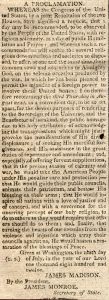
WHEREAS the Congress of the United States, by a joint resolution of the two Houses, have signified a request, that a day may be recommended, to be observed by the People of the United States, with religious solemnity, as a day of public Humiliation, and Prayer; and whereas such a recommendation will enable the several religious denominations and societies so disposed, to offer, at one and the same time, their common vows and adorations to Almighty God, on the solemn occasion produced by the war, in which he has been pleased to permit the injustice of a foreign power to involve these United States;

proclamation-humiliation-and-prayer-1812-2

I do therefore recommend the third Thursday in August next, as a convenient day to be set apart for the devout purposes of rendering to the Sovereign of the Universe and the Benefactor of mankind, the public homage due to his holy attributes; of acknowledging the transgressions which might justly provoke the manifestations of His divine displeasures; of seeking His merciful forgiveness, His assistance in the great duties of repentance and amendment; and especially of offering fervent supplications, that in the present season of calamity and war, He would take the American People under his peculiar care and protection; that he would guide their public councils, animate their patriotism, and bestow His blessing on their arms; that He would inspire all nations with a love of justice and of concord, and with a reverence for the unerring precept of our holy religion, to do to others as they would require others to do to them; and finally, that, turning the hearts of our enemies from the violence and injustice which sway their councils against us, He would hasten a restoration of the blessings of Peace.

Given at Washington the 9th day of July, in the year of our Lord one thousand eight hundred and twelve.

James Madison.

By the
President.
James Monroe,
Secretary of State


This is the text of four hymns for the August, 1812 day of national Humiliation and Prayer.


proclamation-humiliation-and-prayer-1812-3
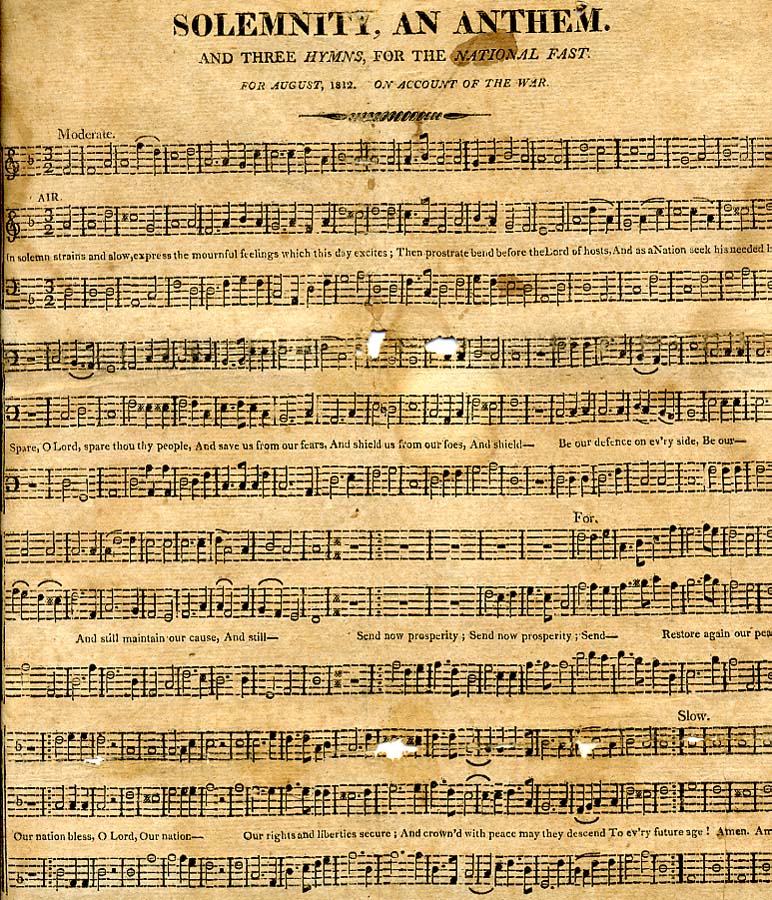
Solemnity, An Anthem.
And Three Hymns, for the National Fast.
For August, 1812. On Account of the War

In solemn strains and slow express the mournful feelings which this day excites; Then prostrate bend before the Lord of hosts. And as a Nation seek his needed help.

Spare, O Lord, spare thou thy people And save us from our fears And shield us from our foes, And shield- Be our defense on every side, Be our-

And still maintain our cause, And still- Send now prosperity; Send now prosperity; Send- Restore again our peace.

Our nation bless, O Lord, our nation- Our rights and liberties secure; And crown’d with peace may they descend to ev’ry future age! Amen. Amen.

proclamation-humiliation-and-prayer-1812-4
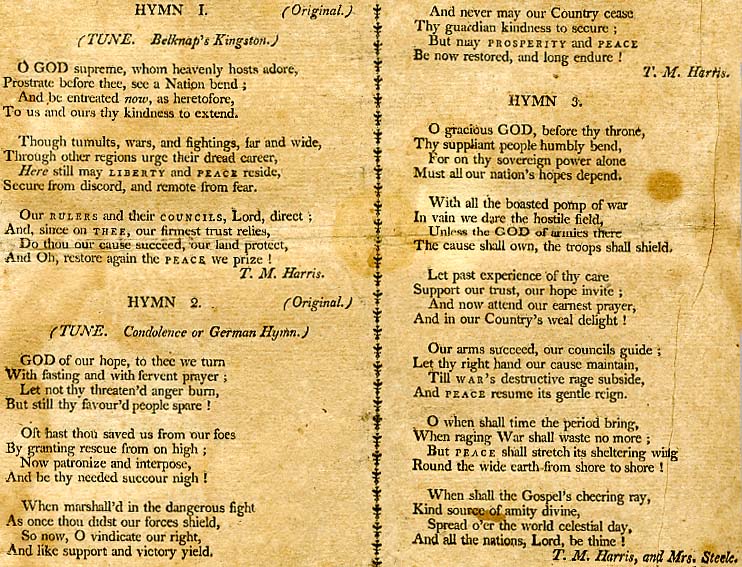
Hymn 1.

(Tune: Beklnap’s Kingston.)

O GOD supreme, whom heavenly hosts adore,
Prostrate before thee, see a Nation bend;
And be entreated now as heretofore,
To us and ours thy kindness to extend.

Through tumults, wars, and fightings, far and wide,
Through other reigns urge their dread career,
Here still may LIBERTY and PEACE reside,
Secure from discord, and remote from fear.

Our RULERS and their COUNCILS, Lord, direct;
And, since on THEE, our firmest trust relies,
Do thou our cause succeed, our land protect,
And Oh, restore again the PEACE we prize!

T.M. Harris

Hymn 2.

(Tune: Condolence or German Hymn.)

God of our hope, to thee we turn
With fasting and with fervent prayer;
Let not thy threaten’d anger burn,
But still thy favour’d people spare!

Oft hast thou saved from our foes
By granting rescue from on high;
Now patronize and interpose,
And be thy needed succour nigh!

When marshall’d in the dangerous fight
As once thou didst our forces shield,
So now, O vindicate our right,
And like support and victory yield.

And never may our Country cease
Thy guardian kindness to secure;
But may prosperity and peace
Be now restored, and long endure!

T.M. Harris

Hymn 3.

O gracious God, before thy throne,
Thy suppliant people humbly bend,
For on thy sovereign power alone
Must all our nation’s hopes depend.

With all the boasted pomp of war
In vain we dare the hostile field,
Unless the god of armies there
The cause shall own, the troops shall shield.

Let past experience of thy care
Support our trust, our hope invite;
And now attend our earnest prayer,
And in our Country’s weal delight!

Our arms succeed, our councils guide;
Let thy right hand our cause maintain,
Till war’s destructive rage subside,
And peace resume its gentle reign.

O when shall time the period bring
When raging War shall waste no more;
But peace shall stretch its sheltering wing
Round the wide earth from shore to shore!

When shall the Gospel’s cheering ray,
Kind source of amity divine,
Spread o’er the world celestial day,
And all the nations, Lord, be thine!

T.M. Harris, and Mrs. Steele


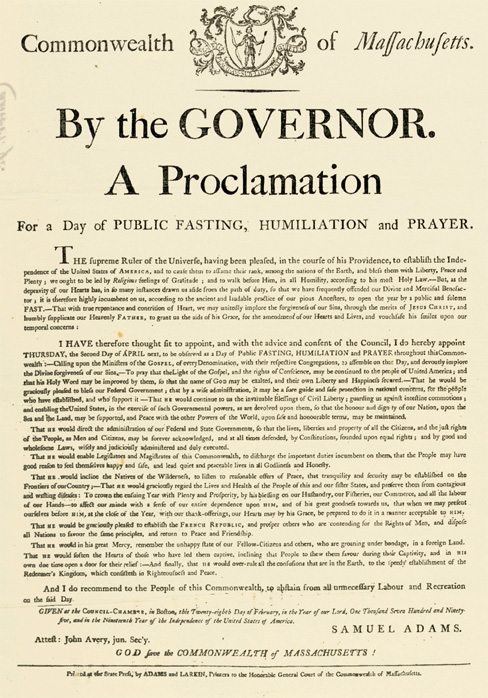
Proclamation – Humiliation Fasting and Prayer – 1810


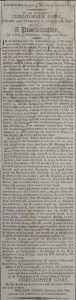
This is the text of Massachusetts Governor Christopher Gore’s April 5, 1810 proclamation for a day of Humiliation, Fasting, and Prayer for that state; as printed in the Columbian Centinel on March 7, 1810. To see a sermon preached on this Massachusetts Fast Day, click here.


proclamation-humiliation-fasting-and-prayer-1810-1

COMMONWEALTH of MASSACHUSETTS.

BY HIS EXCELLENCY
CHRISTOPHER GORE,
Governor and Commander in Chief of the State
aforementioned,

A PROCLAMATION,
For a Day of Humiliation, Fasting, and Prayer.

proclamation-humiliation-fasting-and-prayer-1810-2

In conformity with the invariable usage of the commonwealth, and with a sense of our absolute dependence on the beneficent parent of mankind, and of our numerous and aggravated offenses against his holy will and commandments- I have thought fit to appoint- and by and with the advice and consent of the council, I do appoint THURSDAY, the FIFTH DAY of APRIL next, as a Day of Public Humiliation, Fasting, and Prayer in this Commonwealth. And I do request the Ministers and People of every denomination throughout the same, to assemble on that day, in their several places of Public Worship, that we may unitedly humble ourselves in the presence of Almighty God, and acknowledge with deep contrition, our manifold sins and transgressions; that we may devoutly deprecate his judgments, and implore His merciful forgiveness, through the merits of our blessed Lord and Redeemer.

While we thus bow in humble adoration before the Most High, let us render Him our unfeigned thanks for the numerous instances of His continued bounty towards us, and our Forefathers whom he planted in this fruitful soil – and, in an especial manners, that He endued them with wisdom to render this a Land of Piety, Freedom, and Order. And inasmuch as we have disregarded their example, and neglected those principles by which they obtained and transmitted to us the inestimable blessings of the Christian Religion, of Law and of Liberty- let us earnestly beseech Him to heal our backslidings and to restore us to that temper and conduct, by which alone we can hope to be Happy in this World, and in that which is to come.

At the same time that we look with all humility to His Grace for the Remission of our Sins, let us, with one mind and one voice, supplicate His Blessing for us and our beloved Country; that He would alike preserve us from the Pestilence that walketh in Darkness, and the Destruction that wasteth at Noon-day; that He would graciously smile on the Labors of the Husbandman, and cause the Earth to bring forth her increase in due season; that He would relieve our Commerce from the embarrassments with which it is burdened, and grant that Prosperity may again distinguish our Navigation and Fisheries – so that they who go down to the sea in ships, and do Business in great Waters, may have abundant reason to praise His Holy Name; that he would afford success to our Manufactures, and prosper all the work of our hands.

That He would graciously condescend to direct the Government of the United States, and give them wisdom to discern, and firmness to pursue, the true Interests of the Country; that He would preserve us from War, and from all connections that lead to dishonor and adversity; that He would dispel the clouds that encompass us about, and continue to us the enjoyments of Peace, Liberty, and Religion; that he would influence the Governments of the several States to do every thing, within their respective spheres, to preserve the Union, Order, Tranquility, and Independence of the United States; that He would protect us from the assaults of open enemies, and from the snares of insidious Friends; that He would suffer no weapon formed against us to prosper, but would set at naught the counsels of those who devise mischief against us.

That He would vouchsafe His Blessings on our University, our Colleges and Seminaries of Learning; that He would advance all means used for propagating true Religion, and promote the pious purposes of those who endeavor to disseminate a Knowledge of the Holy Scriptures- that all may learn his Will and obey His Commandments.

And it is recommended, that all servile Labour and Recreation, be suspended upon the said Day.

Given at the Council Chamber, in Boston, this twenty-seventh day of February, in the year of our Lord one thousand eight hundred and ten, and in the thirty-fourth year of the independence of the United States of America.

CHRISTOPHER GORE.

By His Excellency the Governor, with the advice and consent of the council.

WILLIAM TUDOR, Secretary of the State.

GOD SAVE THE COMMONWEALTH OF MASSACHUSETTS!

Proclamation – Fasting Humiliation and Prayer – 1807, Connecticut


Jonathan Trumbull (1740-1809); Trumbull was a soldier and statesman from Connecticut. He served as paymaster/comptroller of the treasury for the American army (1775-80); aide-de-camp to General George Washington (1780-83); U.S. Congressman (1789-95) Speaker of the House (1791-95); U.S. Senator (1795); Lieutenant-Governor of Connecticut (1796-98); and Governor of Connecticut (1798-1809). His father, also named Jonathan (1710-1785), was a minister and statesman who was a close friend of General Washington and the only colonial governor to ardently support the American Revolution.

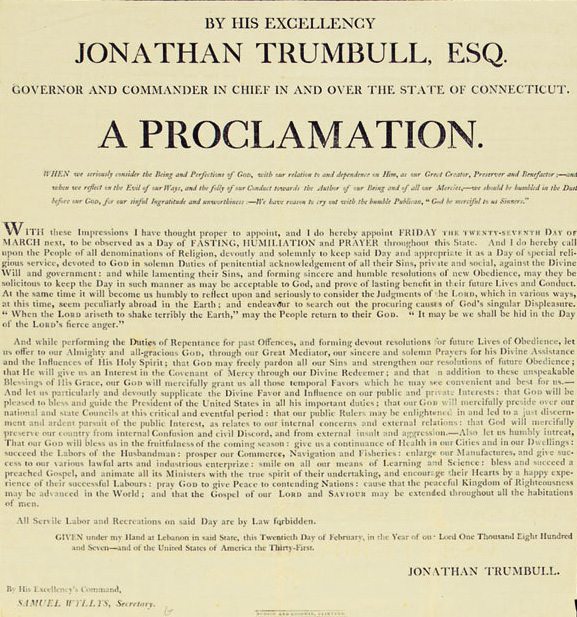
Following is the text of a proclamation for a day of fasting, humiliation, and prayer issued by Jonathan Trumbull, Governor of Connecticut. This proclamation was issued on February 20, 1807 proclaiming March 27, 1807 the day of fasting for the state.


proclamation-fasting-humiliation-and-prayer-1807-connecticut-1

By His Excellency

JONATHAN TRUMBULL, ESQ.

Governor and Commander in Chief in and Over the State of
Connecticut.

A PROCLAMATION.

WHEN we seriously consider the Being and Perfections of God, with our
relation to and dependence on Him, as our Great Creator, Preserver and Benefactor;-and
when we reflect on the Evil of our Ways, and the folly of our Conduct towards
the Author of our Being and of all our Mercies,-we should be humbled in the
Dust before our God, for our sinful Ingratitude and unworthiness:-We have
reason to cry out with the humble Publican, “God be merciful to us Sinners.”

WITH these Impressions I have thought proper to appoint, and I do hereby appoint Friday the Twenty-Seventh Day of March next, to be observed as a Day of Fasting, Humiliation and Prayer throughout this State. And I do hereby call upon the people of all denominations of Religion, devoutly and solemnly to keep said Day and appropriate it as a Day of special religious service, devoted to God in solemn Duties of penitential acknowledgment of their Sins, private and social, against the Divine Will and government: and while lamenting their Sins, and forming sincere and humble resolutions of new Obedience, may they be solicitous to keep the Day in such manner as may be acceptable to God, and prove of lasting benefit in their future Lives and Conduct. At the same time it will become us humbly to reflect upon and seriously to consider the Judgments of the Lord, which in various ways, at this time, seem peculiarly abroad in the Earth; and endeavor to search out the procuring causes of God’s singular Displeasure. “When the Lord ariseth to shake terribly the Earth,” may the People return to their God. “It may be we shall be hid in the Day of the Lord’s fierce anger.”

And while performing the Duties of Repentance for past Offences, and forming devout resolutions for future Lives of Obedience, let us offer to our Almighty and all-gracious God, through our Great Mediator, our sincere and solemn Prayers for his Divine Assistance and the Influences of His Holy Spirit; that God may freely pardon all our Sins and strengthen our resolutions of future Obedience; that He will give us an Interest in the Covenant of Mercy through our Divine Redeemer; and that in addition to these unspeakable Blessings of His Grace, our God will mercifully grant us all those temporal Favors which he may see convenient and best for us. -And let us particularly and devoutly supplicate the Divine Favor and Influence on our public and private Interests: that God will be pleased to bless and guide the President of the United States in all his important duties; that our God will mercifully preside over all our national and state Councils at this critical and eventful period: that our public Rulers may be enlightened in and led to a just discernment and ardent pursuit of the public Interest, as relates to our internal concerns and external relations: that God will mercifully preserve our country from internal Confusion and civil Discord, and from external insult and aggression. -Also let us humbly entreat, That our God will bless us in the fruitfulness of the coming season: give us a continuance of Health in our Cities and in our Dwellings: succeed the Labors of the Husbandman: prosper our Commerce, Navigation and Fisheries: enlarge our Manufactures, and give success to our various lawful arts and industrious enterprise: smile on all our means of Learning and Science: bless and succeed a preached Gospel, and animate all its Ministers with the true spirit of their undertaking, and encourage their Hearts by a happy experience of their successful Labors: pray God to give Peace to contending Nations: cause that the peaceful Kingdom of Righteousness may be advanced in the World; and that the Gospel of our Lord and Savior may be extended throughout all the habitations of men.

All Servile Labor and Recreations on said Day are by Law forbidden.

GIVEN under my Hand at Lebanon in said State, this Twentieth Day of February,
in the Year of our Lord One Thousand Eight Hundred and Seven-and of the
United State of America the Thirty-First

JONATHAN TRUMBULL

By His Excellency’s Command,
Samuel Wyllys, Secretary.

Proclamation – Fasting Humiliation and Prayer – 1804, New Hampshire


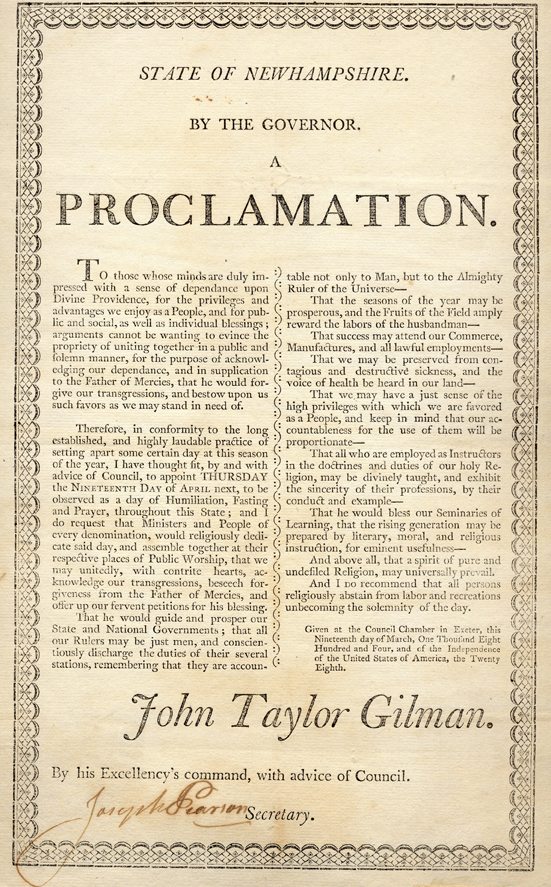
This is the text of a Proclamation for a Day of Fasting, Humiliation and Prayer issued by John Taylor Gilman (Member of the Continental Congress), while he was serving as Governor of New Hampshire. The proclamation was issued on March 19, 1804, declaring April 19, 1804 as a day of fasting, humiliation and prayer.


proclamation-fasting-humiliation-and-prayer-1804-new-hampshire-1

STATE OF NEW HAMPSHIRE.

BY THE GOVERNOR.

A


PROCLAMATION.

To those whose minds are duly impressed with a sense of dependence upon divine providence, for the privileges and advantages we enjoy as a people, and for public and social, as well as individual blessings, arguments cannot be wanting to evince the propriety of uniting together in a public and solemn manner, for the purpose and solemn manner, for the dependence, and in supplication to the father of mercies, that He would forgive our transgressions, and bestow upon us such favors as we may stand in need of.

Therefore, in conformity to the long established, and highly laudable practice of setting apart some certain day at this season of the year, I have thought fit, by and with the advice of council, to appoint THURSDAY, the Nineteenth Day of April next, to be observed as a day of Humiliation, Fasting and Prayer, throughout this state; and I do request ministers and people of every denomination, would religiously dedicate said day, and assemble together at their respective places of public worship, that we may unitedly, with contrite hearts, acknowledge our transgressions, beseech forgiveness from the father of mercies, and offer up our fervent petitions for His blessing.

That He would guide and prosper our state and national governments; that all our rulers may be just men, and conscientiously discharge the duties of their several stations, remembering that they are accountable not only to man, but to the almighty ruler of the universe.

That the seasons of the year may be prosperous, and the fruits of the field amply reward the labor of the husbandman.

That success may attend our commerce, manufactures, and all lawful employments.

That we may be preserved from contagious and destructive sickness, and the voice of health be hear in their professions, by their conduct and example.

That He would bless our seminaries of learning, that the rising generation may be prepared by literary, moral, and religious instruction, for eminent usefulness.

And above all, that a spirit of pure and undefiled religion may universally prevail.

And I do recommend that all persons religiously abstain from labor and recreations unbecoming the solemnity of the day.

Given at the Council Chamber in Exeter this Nineteenth day of March, One Thousand Eight Hundred and Four, and of the Independence of the United States of America, the Twenty-Eighth.


John Taylor Gilman

By his Excellency’s command, with advice of Council.

Joseph Pearson, Secretary

Proclamation – Humiliation Fasting and Prayer – 1799


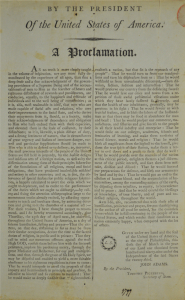
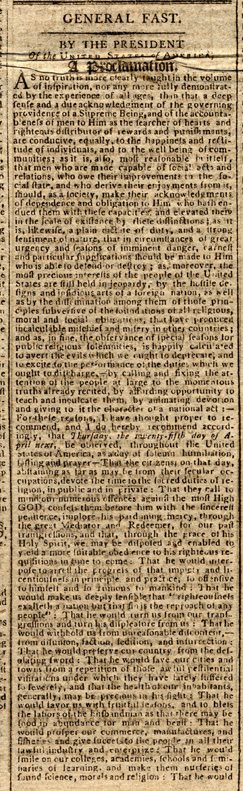
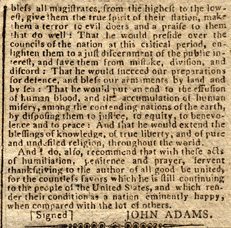
This is a proclamation by President John Adams for a day of “solemn humiliating, fasting, and prayer” set for April 25, 1799. This proclamation was not only printed as the below broadside but also published in numerous newspapers. Below are pictures of the broadside as well as one newspaper from Massachusetts. The text has been slightly modified by inserting paragraph breaks for easier reading. To see a sermon preached on the fast day, click here.


By the President
Of the United States of America.
A Proclamation.

As no truth is more clearly taught in the Volume of Inspiration, nor any more fully demonstrated by the experience of all ages, than that a deep sense and a due acknowledgment of the governing providence of a Supreme Being, and of the accountableness of men to Him as the searcher of hearts and righteous distributor of rewards and punishments, are conducive, equally, to the happiness and rectitude of individuals, and to the well-being of communities; as it is, also, most reasonable, in itself, that men who are made capable of social acts and relations, who owe their improvements to the social state, and who derive their enjoyments from it, should, as a society, make their acknowledgments of dependence and obligation to Him who hath endowed them with these capacities and elevated them in the scale of existence by these distinctions; as it is, likewise, a plain dictate of duty, and a strong sentiment of nature, that in circumstances of great urgency and seasons of imminent danger, earnest and particular supplications should be made to Him who is able to defend or to destroy; as, moreover, the most precious interests of the people of the United States are still held in jeopardy, by the hostile designs and insidious acts of a foreign nation, as well as by the dissemination among them of those principles subversive of the foundations of all religious, moral, and social obligations, that have produced incalculable mischief and misery in other countries; and as, in fine, the observance of special seasons for public religious solemnities, is happily calculated to avert the evils which we ought to deprecate, and to excite to the performance of the duties which we ought to discharge, – by calling and fixing the attention of the people at large to the momentous truths already recited, by affording opportunity to teach and inculcate them, by animating devotion and giving to it the character of a national act:

For these reasons I have thought proper to recommend, and I do hereby recommend accordingly, that Thursday, the 25th day of April next, be observed throughout the United States of America as a day of solemn humiliation, fasting, and prayer. – That the citizens on that day abstain as far as may be from their secular occupations, devote the time to the sacred duties of religion in public and in private: That they call to mind our numerous offenses against the most High God, confess them before Him with the sincerest penitence, implore His pardoning mercy, through the great Mediator and Redeemer, for our past transgressions, and that, through the grace of His Holy Spirit, we may be disposed and enabled to yield a more suitable obedience to His righteous requisitions in time to come: That He would interpose to arrest the progress of that impiety and licentiousness in principle and practice, so offensive to Himself and so ruinous to mankind: That He would make us deeply sensible that “righteousness exalteth a nation, but sin is a reproach to any people”: That He would turn us from our transgressions and turn His displeasure from us: That He would withhold us from unreasonable discontent, – from disunion, faction, sedition, and insurrection: That He would preserve our country from the desolating sword: That He would save our cities and towns from a repetition of those awful pestilential visitations under which they have lately suffered so severely, and that the health of our inhabitants, generally, may be precious in His sight: That He would favor us with fruitful seasons, and so bless the labors of the husbandman as that there may be food in abundance for man and beast: That He would prosper our commerce, manufactures, and fisheries, and give success to the people in all their lawful industry and enterprise: That He would smile on our colleges, academies, schools, and seminaries of learning, and make them nurseries of sound science, morals, and religion: That He would bless all magistrates, from the highest to the lowest, give them the true spirit of their station, make them a terror to evil doers and a praise to them that do well: That He would preside over the councils of the nation at this critical period, enlighten them to a just discernment of the public interest, and save them from mistake, division, and discord: That He would succeed our preparations for defense, and bless our armaments by land and by sea: That He would put an end to the effusion of human blood, and the accumulation of human misery, among the contending nations of the earth, by disposing them to justice, to equity, to benevolence, and to peace: And that He would extend the blessings of knowledge, of true liberty, and of pure and undefiled religion, throughout the world.

And I do, also, recommend that with these acts of humiliation, penitence, and prayer, fervent thanksgiving to the Author of all good be united, for the countless favors which He is still continuing to the people of the United States, and which render their condition as a nation eminently happy, when compared with the lot of others.

Given under my hand and the seal of the United States of America, at the city of Philadelphia, this sixth day of March in the year of our Lord one thousand seven hundred and ninety-nine of the Independence of the said States the twenty-third.

John Adams.

By the President,

Timothy Pickering,

Secretary of State


proclamation-humiliation-fasting-and-prayer-1799-1
proclamation-humiliation-fasting-and-prayer-1799-2
proclamation-humiliation-fasting-and-prayer-1799-3

Proclamation – Humiliation Fasting and Prayer – 1798


John Adams (1735-1826) Adams was an attorney, diplomat, and statesman; he graduated from Harvard (1755); leader in the opposition to the Stamp Act (1765); delegate to the Continental Congress (1774-77) where he signed the Declaration of Independence (1776); appointed Chief Justice of Superior Court of Massachusetts (1775); delegate to the Massachusetts constitutional convention (1779-80) and wrote most of the first draft of the Massachusetts Constitution; foreign ambassador to Holland (1782); signed the peace treaty which ended the American Revolution (1783); foreign ambassador to Great Britain (1785-88); served two terms as Vice-President under President George Washington (1789-97); second President of the United States (1797-1801); he and his one time political nemesis- turned-close-friend Thomas Jefferson both died on July 4, 1826, the fiftieth anniversary of the Declaration of Independence; Adams was titled by fellow signer of the Declaration Richard Stockton as the “Atlas of American Independence.”

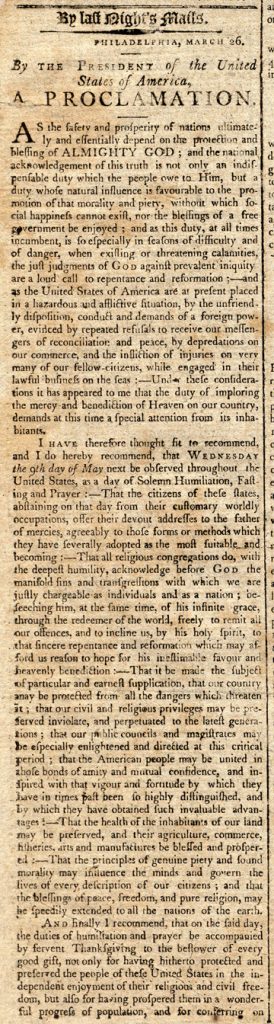
This is the text of a national day of humiliation, fasting, and prayer issued by President John Adams as printed in the Columbian Centinel, April 4, 1798. This proclamation was issued on March 23, 1798 declaring May 9, 1798 the day of fasting for the nation. To read a sermon preached by Jeremy Belknap, in Boston, on the day of the national fast, click here.


proclamation-humiliation-fasting-and-prayer-1798-1

By the President of the United States of America

A PROCLAMATION

proclamation-humiliation-fasting-and-prayer-1798-2

AS the safety and prosperity of nations ultimately and essentially depend on the protection and blessing of Almighty God; and the national acknowledgment of this truth is not only an indispensable duty which the people owe to Him, but a duty whose natural influence is favorable to the promotion of that morality and piety, without which social happiness cannot exist, nor the blessings of a free government be enjoyed; and as this duty, at all times incumbent, is so especially in seasons of difficulty and of danger, when existing or threatening calamities, the just judgments of God against prevalent iniquity are a loud call to repentance and reformation; and as the United States of America are at present placed in a hazardous and afflictive situation, by the unfriendly disposition, conduct and demands of a foreign power, evinced by repeated refusals to receive our messengers of reconciliation and peace, by depredations on our commerce, and the infliction of injuries on very many of our fellow citizens, while engaged in their lawful business on the seas: —Under these considerations it has appeared to me that the duty of imploring the mercy and benediction of Heaven on our country, demands at this time a special attention from its inhabitants.

I HAVE therefore thought it fit to recommend, that Wednesday, the 9th day of May next be observed throughout the United States, as a day of Solemn Humiliation, Fasting and Prayer; That the citizens of these states, abstaining on that day from their customary worldly occupations, offer their devout addresses to the Father of Mercies, agreeably to those forms or methods which they have severally adopted as the most suitable and becoming: That all religious congregations do, with the deepest humility, acknowledge before GOD the manifold sins and transgressions with which we are justly chargeable as individuals and as a nation; beseeching him, at the same time, of his infinite Grace, through the Redeemer of the world, freely to remit all our offences, and to incline us, by his holy spirit, to that sincere repentance and reformation which may afford us reason to hope for his inestimable favor and heavenly benediction; That it be made the subject of particular and earnest supplication, that our country may be protected from all the dangers which threaten it; that our civil and religious privileges may be preserved inviolate, and perpetuated to the latest generations; that our public councils and magistrates may be especially enlightened and directed at this critical period; that the American people may be united in those bonds of amity and mutual confidence, and inspired with that vigor and fortitude by which they have in times past been so highly distinguished, and by which they have obtained such invaluable advantages: That the health of the inhabitants of our land may be preserved, and their agriculture, commerce, fisheries, arts and manufactures be blessed and prospered: That the principles of genuine piety and sound morality may influence the minds and govern the lives of every description of our citizens; and that the blessings of peace, freedom, and pure religion, may be speedily extended to all the nations of the earth.

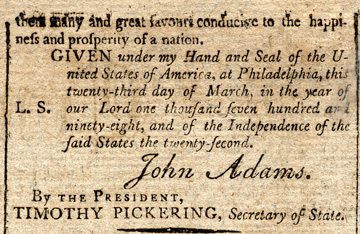
proclamation-humiliation-fasting-and-prayer-1798-3And finally I recommend, that on the said day; the duties of humiliation and prayer be accompanied by fervent Thanksgiving to the bestower of every good gift, not only for having hitherto protected and preserved the people of these United States in the independent enjoyment of their religious and civil freedom, but also for having prospered them in a wonderful progress of population, and for conferring on them many and great favours conducive to the happiness and prosperity of a nation.

Given under my hand and seal of the United States of America, at Philadelphia, this twenty-third day of March, in the year of our Lord one thousand seven hundred and ninety-eight, and of the Independence of the said States the twenty-second.

JOHN ADAMS

By the President,TIMOTHY PICKERING,

Secretary of State

Proclamation – Fasting Humiliation and Prayer – 1798, Massachusetts


Increase Sumner (1746-1799) was the governor of Massachusetts from 1797-1799. He had previously been a member of the House of Representatives, a Senator, and a justice in the Massachusetts Supreme Court.

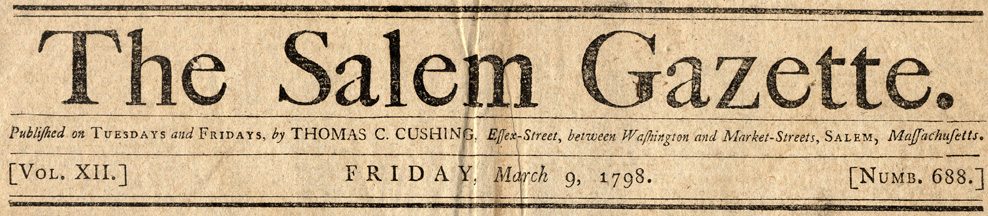
This proclamation was issued by Increase Sumner on March 1, 1798, declaring April 5, 1798 the day of fasting, humiliation, and prayer for the state. The text of the proclamation comes from The Salem Gazette on March 9, 1798. To see a sermon preached on the fast day in Massachusetts, click here.


proclamation-fasting-humiliation-and-prayer-1798-massachusetts-1
Commonwealth of Massachusetts.
By His Excellency
INCREASE SUMNER, Esq.
Governor of the Commonwealth
Of Massachusetts,
A PROCLAMATION
For a Day of Solemn FASTING and
PRAYER
.
proclamation-fasting-humiliation-and-prayer-1798-massachusetts-2The entire dependence of all men on the Supreme Governor of the World, for temporal as well as spiritual blessings, evinces the propriety and duty of supplicating His favor by humiliation and prayer. Deeply penetrated with this sentiment, our venerable ancestors have uniformly set apart, at this season of the year, a day for this religious purpose; not less impressed than those, whose example we follow, with a sense of our absolute dependence on the Fountain of Mercies for every public and private blessing,
I have thought fit, by and with the advice of Council, to appoint THURSDAY the FIFTH of APRIL NEXT, to be observed throughout this Commonwealth, as a day Fasting, Humiliation and Prayer. Calling on ministers and people of every denomination to assemble on that day, in their respective places of public worship, and with united hearts penitently to confess their sins, and implore the favor and blessing of Almighty God, through the great Mediator, upon the concerns of the ensuing year.

In particular, that He would be pleased to guide and prosper the administration of Civil Government within this Commonwealth.

That He would afford His guidance and blessing to the President of the United States, and that the councils and determinations of our National Government, being founded in wisdom and justice, may promote the true interest and happiness of the United States. That He would be pleased to strengthen the union, and not suffer any design that may be formed against us to prosper.

That he would inspire those in civil authority with a just sense of the trust committed to their care, and enable them to discharge it with fidelity.

That the people may be endued with a public spirit, and true love of their country; properly estimating the blessings of civil and religious liberty, by which they are distinguished And that truth, piety and righteousness, which exalt a nation, may universally prevail.

That He would be graciously pleased to bless the labors of the husbandman, and so to order the seasons, as that the year may be crowned with a plentiful harvest.

That He would guide and direct our University and other seminaries within this Commonwealth, so that the rising generation may be properly instructed in every branch of useful learning, and impressed with the principles of true religion and virtue.

That He would protect our Commerce, Navigation and Fishery from unjust sizable obstructions, and give success to all our lawful undertakings.

That He would be graciously pleased to continue Health in our habitations, and prevent the spreading of mortal contagious diseases; and that through his abundant mercy we may be preserved from every desolating judgment.

That by His gracious influence we may be protected from Internal Commotion and Foreign Invasion.

That the overtures for adjusting differences in Europe may be successful, and permanent peace be established.

And finally, that Wars and Commotions may cease in all parts of the earth; and that mankind, sensible of their mutual dependence, may live in the practice of benevolence, charity, and every other Christian virtue, as become children of one common Parent.

And I do earnestly recommend that all servile labor and recreation, inconsistent with the solemnity of said day, may be suspended.

Given at the Council Chamber, in Boston, this first day of March, in the year of our Lord one thousand seven hundred and ninety eight and in the twenty second year of the independence of the United States of America.

Increase Sumner

By his Excellency’s Command, with advice and consent of the Council.
John Avery, Secr’y.

God Save the Commonwealth of Massachusetts

Oliver Wolcott

Proclamation – Fasting Humiliation and Prayer – 1797, Connecticut


This is the text of a Proclamation for a Day of Fasting, Humiliation and Prayer issued by Oliver Wolcott, Governor of the State of Connecticut. This proclamation was issued on March 17, 1797, declaring April 14, 1797 as a day of fasting for the state.


proclamation-fasting-humiliation-and-prayer-1797-connecticut-1

BY HIS EXCELLENCY


Oliver Wolcott, Esq.

GOVERNOR AND COMMANDER IN CHIEF OF THE STATE OF CONNECTICUT,


A PROCLAMATION

AS it peculiarly becomes a Christian People, at particular and state Seasons, by Humiliation and Prayer, to pay their devout Homage to ALMIGHTY GOD;–

I HAVE thought proper to appoint, and do hereby appoint FRIDAY, the Fourteenth Day of April next, to be observed as a Day of public HUMILIATION, FASTING and PRAYER, throughout this State; recommending to all the People, in their solemn Assemblies, on that Day, devoutly to acknowledge their Dependence on the Supreme Ruler of the Universe, and with sincere Repentance for our many Sins, humbly to implore, of a merciful GOD, their Forgiveness and Remission, the gracious Aids of his Spirit, and the Blessings of his Providence.

That he would continue to us and successive Generations, the Gospel of Peace and Salvation;-teach the Hearts of all Men to know its Truth and Excellence, and to obey its holy Precepts:-Succeed the Means of Education and Learning; bless your Youth, furnish their Minds with useful Knowledge, and enrich them with the christian Graces:-That he would smile on our Husbandry; give and preserve to us the goodly Fruits of the Earth:-Prosper our Commerce, restrain the arbitrary Enterprizes so extensively practiced upon it, and cause the Nations at War, to observe towards our Trade and Navigation, the Laws of Justice and good Faith;- save us from desolating Diseases; and grant that in all our lawful Business and Vocations, we may experience the Divine Care and Beneficence. And moreover, humbly to beseech the Throne of Grace, that the God of Wisdom would enlighten the public Councils of this State, thereby to increase the Means of social Improvement and Happiness among the People, and to confirm and perpetuate the public Order, Liberty, and Tranquility.

That the United States may continue to be under the Superintendence and holy Protection of the Sovereign Arbiter of Nations:-That he would inspire all our Citizens with a Love of their Country, and each other; cement our Union; impart to all Departments of the Government Wisdom and Integrity, uprightly and ably to conduct the public Interests confided to their Care:-Still continue graciously to smile on our earnest and faithful Endeavours to preserve our Peace;- cause the

Negociations with the French Republic to issue in the Acknowledgement and secure Establishment of our just Rights, and the Restoration of Amity and good Agreement between the two Countries.

And that it would please GOD to afford his gracious Aids to the President of the United States, in the Discharge of the arduous Duties on which he is entering; and that he may be enabled, by a wise and impartial Administration of them, to preserve that Confidence of the People in this Branch of our Government, by which it has been so eminently distinguished:-That the Benedictions of Heaven may attend the late President of the United States, in his Retirement from his long, useful and disinterested Services to our Country.

And may God, who is the Author of Peace and Lover of Concord, restrain the Rage and Pride of warring Nations, and Cause them to submit to righteous and equitable Terms of Peace.

And that all those to whom the Ministration of the Gospel of Christ Jesus is committed, may be influenced by that Spirit which the Gospel is adapted to inspire; and that the Effect of their Ministration may be the Advancement of the peaceful Kingdom of the Great Redeemer among Mankind.

ALL SERVILE LABOUR ON SAID DAY IS FORBIDDEN.

GIVEN at Litchfield, this seventeenth Day of March, in the Year of our LORD one thousand seven Hundred and ninety seven, and of the Independence of the United States of America the twenty-first.

OLIVER WOLCOTT.

By his Excellency’s Command,

SAMUEL WYLLYS, Secretary.

Sample Letters to the Editor

We receive numerous requests from across the country to answer various editorials and letters-to-the-editor. The subject usually involves the religious persuasions of the Founding Fathers, the “separation of church and state,” the “Religious Right” & theocracy, etc. The following are but a few of many possible replies to such editorials. (Note: Unfortunately, we do not have the resources to respond to individual editorials or articles from newspapers all across the U.S., and we have found it is typically much more effective if local people respond to editorials in their own community. David Barton’s book, Original Intent, and the Resources section of our website contain information that is very useful in successfully refuting the vast majority of negative editorials encountered.)


“The Founding Fathers & Deism”

I notice that your newspaper has an ongoing debate concerning the religious nature of the Founding Fathers. A recent letter claimed that most of the Founding Fathers were deists, and pointed to Washington, Jefferson, Franklin, Paine, Hamilton, and Madison as proof. After making this charge, the writer acknowledged the “voluminous writings” of the Founders, but it appears that they not read those writings herself. However, this is no surprise since the U. S. Department of Education claims that only 5 percent of high schools graduates know how to examine primary source documentation.

Interestingly, the claims in this recent letter to the editor are characteristic of similar claims appearing in hundreds of letters to the editor across the nation. The standard assertion is that the Founders were deists. Deists? What is a deist? In dictionaries like Websters, Funk & Wagnalls, Century, and others, the terms “deist,” “agnostic,” and “atheist” appear as synonyms. Therefore, the range of a deist spans from those who believe there is no God, to those who believe in a distant, impersonal creator of the universe, to those who believe there is no way to know if God exists. Do the Founders fit any of these definitions?

None of the notable Founders fit this description. Thomas Paine, in his discourse on “The Study of God,” forcefully asserts that it is “the error of schools” to teach sciences without “reference to the Being who is author of them: for all the principles of science are of Divine origin.” He laments that “the evil that has resulted from the error of the schools in teaching [science without God] has been that of generating in the pupils a species of atheism.” Paine not only believed in God, he believed in a reality beyond the visible world.

In Benjamin Franklin’s 1749 plan of education for public schools in Pennsylvania, he insisted that schools teach “the necessity of a public religion . . . and the excellency of the Christian religion above all others, ancient or modern.” Consider also the fact that Franklin proposed a Biblical inscription for the Seal of the United States; that he chose a New Testament verse for the motto of the Philadelphia Hospital; that he was one of the chief voices behind the establishment of a paid chaplain in Congress; and that when in 1787 when Franklin helped found the college which bore his name, it was dedicated as “a nursery of religion and learning” built “on Christ, the Corner-Stone.” Franklin certainly doesn’t fit the definition of a deist.

Nor does George Washington. He was an open promoter of Christianity. For example, in his speech on May 12, 1779, he claimed that what children needed to learn “above all” was the “religion of Jesus Christ,” and that to learn this would make them “greater and happier than they already are”; on May 2, 1778, he charged his soldiers at Valley Forge that “To the distinguished character of patriot, it should be our highest glory to add the more distinguished character of Christian”; and when he resigned his commission as commander in-chief of the military on June 8, 1783, he reminded the nation that “without a humble imitation” of “the Divine Author of our blessed religion” we “can never hope to be a happy nation.” Washington’s own adopted daughter declared of Washington that you might as well question his patriotism as to question his Christianity.

Alexander Hamilton was certainly no deist. For example, Hamilton began work with the Rev. James Bayard to form the Christian Constitutional Society to help spread over the world the two things which Hamilton said made America great: (1) Christianity, and (2) a Constitution formed under Christianity. Only Hamilton’s death two months later thwarted his plan of starting a missionary society to promote Christian government. And at the time he did face his death in his duel with Aaron Burr, Hamilton met and prayed with the Rev. Mason and Bishop Moore, wherein he reaffirmed to him his readiness to face God should he die, having declared to them “a lively faith in God’s mercy through Christ, with a thankful remembrance of the death of Christ.” At that time, he also partook of Holy Communion with Bishop Moore.

The reader, as do many others, claimed that Jefferson omitted all miraculous events of Jesus from his “Bible.” Rarely do those who make this claim let Jefferson speak for himself. Jefferson’s own words explain that his intent for that book was not for it to be a “Bible,” but rather for it to be a primer for the Indians on the teachings of Christ (which is why Jefferson titled that work, “The Life and Morals of Jesus of Nazareth”). What Jefferson did was to take the “red letter” portions of the New Testament and publish these teachings in order to introduce the Indians to Christian morality. And as President of the United States, Jefferson signed a treaty with the Kaskaskia tribe wherein he provided—at the government’s expense—Christian missionaries to the Indians. In fact, Jefferson himself declared, “I am a real Christian, that is to say, a disciple of the doctrines of Jesus.” While many might question this claim, the fact remains that Jefferson called himself a Christian, not a deist.

James Madison trained for ministry with the Rev. Dr. John Witherspoon, and Madison’s writings are replete with declarations of his faith in God and in Christ. In fact, for proof of this, one only need read his letter to Attorney General Bradford wherein Madison laments that public officials are not bold enough about their Christian faith in public and that public officials should be “fervent advocates in the cause of Christ.” And while Madison did allude to a “wall of separation,” contemporary writers frequently refuse to allow Madison to provide his own definition of that “wall.” According to Madison, the purpose of that “wall” was only to prevent Congress from passing a national law to establish a national religion.

None of the Founders mentioned fit the definition of a deist. And as is typical with those who make this claim, they name only a handful of Founders and then generalize the rest. This in itself is a mistake, for there are over two hundred Founders (fifty-five at the Constitutional Convention, ninety who framed the First Amendment and the Bill of Rights, and fifty-six who signed the Declaration) and any generalization of the Founders as deists is completely inaccurate.

The reason that such critics never mention any other Founders is evident. For example, consider what must be explained away if the following signers of the Constitution were to be mentioned: Charles Pinckney and John Langdon—founders of the American Bible Society; James McHenry—founder of the Baltimore Bible Society; Rufus King—helped found a Bible society for Anglicans; Abraham Baldwin—a chaplain in the Revolution and considered the youngest theologian in America; Roger Sherman, William Samuel Johnson, John Dickinson, and Jacob Broom—also theological writers; James Wilson and William Patterson—placed on the Supreme Court by President George Washington, they had prayer over juries in the U. S. Supreme Court room; and the list could go on. And this does not even include the huge number of thoroughly evangelical Christians who signed the Declaration or who helped frame the Bill of Rights.

Any portrayal of any handful of Founders as deists is inaccurate. (If this group had really wanted some irreligious Founders, they should have chosen Henry Dearborne, Charles Lee, or Ethan Allen). Perhaps critics should spend more time reading the writings of the Founders to discover their religious beliefs for themselves rather than making such sweeping accusations which are so easily disproven.

(For more on this topic see: Thomas Paine Criticizes the Current Public School Science Curriculum, Franklin’s Appeal for Prayer at the Constitutional Convention, Was George Washington a Christian?, The Founders and Public Religious Expression, & James Madison and Religion in Public)


“Thomas Jefferson & the ‘wall of separation between
church and state.’”

In a recent letter on religion, the writer put supporters of public religious expression on one side and Thomas Jefferson on the other. This is logical given what most know about Jefferson’s “wall of separation between church and state.”

Jefferson penned that phrase to reassure the Danbury (CT) Baptist Association that because of separation of church and state, the government would never interfere with their public religious expressions. For the next 150 years, federal courts followed Jefferson’s intent and attached his separation metaphor to the Free Expression Clause of the First Amendment, thus consistently upholding public religious expressions. However, in 1947, the Supreme Court reversed itself and began applying the phrase to the Establishment Clause instead, thus causing federal courts to remove rather than preserve public religious expressions.

The proof is abundant that this was not Jefferson’s intent. For example, two days after Jefferson wrote his separation letter, he attended worship services in the U. S. Capitol where he heard the Rev. John Leland preach a sermon. (As President of the Senate, Jefferson had personally approved the use of the Capitol Building for Sunday worship services.) The many diaries of Members of Congress during that time confirm that during Jefferson’s eight years, he faithfully attended church services in the Capitol. In fact, he even ordered the Marine Band to play the worship services there. Jefferson also authorized weekly worship services at the War Department and the Treasury Building.

And on December 23, 1803, Jefferson’s administration negotiated – and the Senate ratified – a treaty with the Kaskaskia Indians that stated “the United States will give annually for seven years one hundred dollars for the support of a priest” to minister to the Indians (i.e., federal funds for Christian evangelism!) Jefferson also signed presidential documents, closing them with the appellation, “In the Year of our Lord Christ.” There are many similar surprising facts about Jefferson that are fully documented historically, but that have been ignored for the past 50 years.

So would religious conservatives and Thomas Jefferson really be on opposite sides of the church/state issue? Probably, for I doubt that conservatives would agree with using federal dollars for evangelization.

(For more on this topic see: The Separation of Church and State & Letters Between the Danbury Baptists and Thomas Jefferson)


“Theocracy”

In a recent letter, the writer took the same position as Americans United for Separation of Church and State (AU) and parroted AU’s offensive mantra, associating a theocracy or theocratic state with the “Religious Right.” Such claims are patently false.

First, to have a theocracy in America, the Constitution must be replaced with a totalitarian dictator who speaks on God’s behalf (i.e., a revival of “the Divine Right of Kings” doctrine). I challenge AU, or anyone else to identify which part of the “Religious Right” is calling for such a government.

Second, the “Religious Right” leaders are calling for an increased respect for the Constitution and its actual wording, urging citizens to exercise their constitutional right to vote. The real “crime” of these leaders is not that they want a theocracy (which they don’t) but that they rightfully want legislators to make national policy instead of judges. Should that occur, AU or groups like them could not win another battle, for Americans overwhelmingly reject their policies (e.g., “under God” in the Pledge – a phrase opposed by AU but supported by 87% of Americans).

The rabid opposition to public religious expressions is often irrational, In fact, a New Jersey bill proposing that students begin each day by reciting the first 56 words from the Declaration of Independence was loudly denounced as “a thinly-veiled attempt to put prayer in schools” – the first step on the road to a – you guessed it – “theocracy!” Reading the actual wording of the Declaration of Independence leads to a theocracy??? It is time for that term to become anathema in public discourse.

During the Civil Rights Era, we gradually learned that if certain pejoratives were invoked, the individual doing so was a racist. Similarly, today we need to learn that when the emotive and pejorative term “theocracy!” is invoked, it is usually by an intolerant secularist who wants all public religious expressions expunged from society.

(For more on this topic see: A Tale of Two Constitutions & Impeachment of Federal Judges)


* This article concerns a historical issue and may not have updated information.

Republic v. Democracy

Founders & Democracy

We have grown accustomed to hearing that we are a democracy; such was never the intent. The form of government entrusted to us by our Founders was a republic, not a democracy. 1 Our Founders had an opportunity to establish a democracy in America and chose not to. In fact, the Founders made clear that we were not, and were never to become, a democracy:

[D]emocracies have ever been spectacles of turbulence and contention; have ever been found incompatible with personal security, or the rights of property; and have, in general, been as short in their lives as they have been violent in their deaths. 2 James Madison

Remember, democracy never lasts long. It soon wastes, exhausts, and murders itself. There never was a democracy yet that did not commit suicide. 3 John Adams

A democracy is a volcano which conceals the fiery materials of its own destruction. These will produce an eruption and carry desolation in their way. 4 The known propensity of a democracy is to licentiousness [excessive license] which the ambitious call, and ignorant believe to be liberty. 5 Fisher Ames, Author of the House Language for the First Amendment

We have seen the tumult of democracy terminate . . . as [it has] everywhere terminated, in despotism. . . . Democracy! savage and wild. Thou who wouldst bring down the virtuous and wise to thy level of folly and guilt. 6 Gouverneur Morris, Signer and Penman of the Constitution

[T]he experience of all former ages had shown that of all human governments, democracy was the most unstable, fluctuating and short-lived. 7 John Quincy Adams

A simple democracy . . . is one of the greatest of evils. 8 Benjamin Rush, Signer of the Declaration

In democracy . . . there are commonly tumults and disorders. . . . Therefore a pure democracy is generally a very bad government. It is often the most tyrannical government on earth. 9 Noah Webster

Pure democracy cannot subsist long nor be carried far into the departments of state, it is very subject to caprice and the madness of popular rage. 10 John Witherspoon, Signer of the Declaration

It may generally be remarked that the more a government resembles a pure democracy the more they abound with disorder and confusion. 11 Zephaniah Swift, Author of America’s First Legal Text

Many Americans today seem to be unable to define the difference between the two, but there is a difference, a big difference. That difference rests in the source of authority.

Democracy & Republic Definitions

A pure democracy operates by direct majority vote of the people. When an issue is to be decided, the entire population votes on it; the majority wins and rules.

A republic differs in that the general population elects representatives who then pass laws to govern the nation.

A democracy is the rule by majority feeling (what the Founders described as a “mobocracy” 12). A republic is rule by law.

If the source of law for a democracy is the popular feeling of the people, then what is the source of law for the American republic? According to Founder Noah Webster:

[O]ur citizens should early understand that the genuine source of correct republican principles is the Bible, particularly the New Testament, or the Christian religion. 13

The American Republic

The transcendent values of Biblical natural law were the foundation of the American republic. Consider the stability this provides: in our republic, murder will always be a crime, for it is always a crime according to the Word of God. however, in a democracy, if majority of the people decide that murder is no longer a crime, murder will no longer be a crime.

America’s immutable principles of right and wrong were not based on the rapidly fluctuating feelings and emotions of the people but rather on what Montesquieu identified as the “principles that do not change.” 14

Benjamin Rush similarly observed:

[W]here there is no law, there is no liberty; and nothing deserves the name of law but that which is certain and universal in its operation upon all the members of the community. 15

In the American republic, the “principles which did not change” and which were “certain and universal in their operation upon all the members of the community” were the principles of Biblical natural law. In fact, so firmly were these principles ensconced in the American republic that early law books taught that government was free to set its own policy only if God had not ruled in an area. For example, Blackstone’s Commentaries explained:

To instance in the case of murder: this is expressly forbidden by the Divine. . . . If any human law should allow or enjoin us to commit it we are bound to transgress that human law. . . . But, with regard to matters that are . . . not commanded or forbidden by those superior laws such, for instance, as exporting of wool into foreign countries; here the . . . legislature has scope and opportunity to interpose. 16

The Founders echoed that theme:

All [laws], however, may be arranged in two different classes. 1) Divine. 2) Human. . . . But it should always be remembered that this law, natural or revealed, made for men or for nations, flows from the same Divine source: it is the law of God. . . . Human law must rest its authority ultimately upon the authority of that law which is Divine. 17 James Wilson, Signer of the Constitution; U. S. Supreme Court Justice

[T]he law . . . dictated by God Himself is, of course, superior in obligation to any other. It is binding over all the globe, in all countries, and at all times. No human laws are of any validity if contrary to this. 18Alexander Hamilton, Signer of the Constitution

[T]he . . . law established by the Creator . . . extends over the whole globe, is everywhere and at all times binding upon mankind. . . . [This] is the law of God by which he makes his way known to man and is paramount to all human control. 19 Rufus King, Signer of the Constitution

Conclusion

The Founders understood that Biblical values formed the basis of the republic and that the republic would be destroyed if the people’s knowledge of those values should ever be lost.

A republic is the highest form of government devised by man, but it also requires the greatest amount of human care and maintenance. If neglected, it can deteriorate into a variety of lesser forms, including a democracy (a government conducted by popular feeling); anarchy (a system in which each person determines his own rules and standards); oligarchy (a government run by a small council or a group of elite individuals): or dictatorship (a government run by a single individual). As John Adams explained:

[D]emocracy will soon degenerate into an anarchy; such an anarchy that every man will do what is right in his own eyes and no man’s life or property or reputation or liberty will be secure, and every one of these will soon mould itself into a system of subordination of all the moral virtues and intellectual abilities, all the powers of wealth, beauty, wit, and science, to the wanton pleasures, the capricious will, and the execrable [abominable] cruelty of one or a very few. 20

Understanding the foundation of the American republic is a vital key toward protecting it.


Endnotes

1 An example of this is demonstrated in the anecdote where, having concluded their work on the Constitution, Benjamin Franklin walked outside and seated himself on a public bench. A woman approached him and inquired, “Well, Dr. Franklin, what have you done for us?” Franklin quickly responded, “My dear lady, we have given to you a republic–if you can keep it.” Taken from “America’s Bill of Rights at 200 Years,” by former Chief Justice Warren E. Burger, printed in Presidential
Studies Quarterly
(Summer 1991), XXI:3:457. This anecdote appears in numerous other works as well.

2 Alexander Hamilton, John Jay, James Madison, The Federalist on the New Constitution (Philadelphia: Benjamin Warner, 1818), 53, #10, James Madison.

3 John Adams to John Taylor, April 15, 1814, The Works of John Adams, ed. Charles Francis Adams (Boston: Charles C. Little and James Brown, 1850), VI:484.

4 Fisher Ames, Speech on Biennial Elections, delivered January, 1788, Works of Fisher Ames (Boston: T. B. Wait & Co., 1809), 24.

5 Ames, “The Dangers of American Liberty,” February 1805, Works (1809), 384.

6 Gouverneur Morris, An Oration Delivered on Wednesday, June 29, 1814, at the Request of a Number of Citizens of New-York, in Celebration of the Recent Deliverance of Europe from the Yoke of Military Despotism (New York: Van Winkle and Wiley, 1814), 10, 22.

7 John Quincy Adams, The Jubilee of the Constitution. A Discourse Delivered at the Request of the New York Historical Society, in the City of New York on Tuesday, the 30th of April 1839; Being the Fiftieth Anniversary of the Inauguration of George Washington as President of the United States, on Thursday, the 30th of April, 1789 (New York: Samuel Colman, 1839), 53.

8 Benjamin Rush to John Adams, July 21, 1789, The Letters of Benjamin Rush, ed. L. H. Butterfield (Princeton: Princeton University Press for the American Philosophical Society, 1951), I:523.

9 Noah Webster, The American Spelling Book: Containing an Easy Standard of Pronunciation: Being the First Part of a Grammatical Institute of the English Language, To Which is Added, an Appendix, Containing a Moral Catechism and a Federal Catechism (Boston: Isaiah Thomas and Ebenezer T. Andrews, 1801), 103-104.

10 John Witherspoon, Lecture 12 on Civil Society, The Works of John Witherspoon (Edinburgh: J. Ogle, 1815), VII:101.

11 Zephaniah Swift, A System of the Laws of the State of Connecticut (Windham: John Byrne, 1795), I:19.

12 See, for example, Benjamin Rush to John Adams, January 22, 1789, Letters, ed. Butterfield (1951), I:498.

13 Noah Webster, History of the United States (New Haven: Durrie & Peck, 1832), 6.

14 George Bancroft, History of the United States from the Discovery of the American Continent (Boston: Little, Brown & Co., 1859), V:24; Baron Charles Secondat de Montesquieu, Spirit of the Laws (Philadelphia: Isaiah Thomas, 1802), I:17-23, and ad passim.

15 Rush to David Ramsay, March or April 1788, Letters, ed. Butterfield (1951), I:454.

16 William Blackstone, Commentaries on the Laws of England (Philadelphia: Robert Bell, 1771), I:42-43.

17 James Wilson, “Of the General Principles of Law and Obligation,” The Works of the Honorable James Wilson, ed. Bird Wilson (Philadelphia: Lorenzo Press, 1804), I:103-105.

18 Alexander Hamilton, The Papers of Alexander Hamilton, ed. Harold C. Syrett (New York: Columbia University Press, 1961), I:87, February 23, 1775, quoting Blackstone, Commentaries (1771), I:41.

19 Rufus King to C. Gore, February 17, 1820, The Life and Correspondence of Rufus King, ed. Charles R. King (New York: G. P. Putnam’s Sons, 1900), VI:276.

20 John Adams, The Papers of John Adams, ed. Robert J. Taylor (Cambridge: Belknap Press, 1977), I:83, from “An Essay on Man’s Lust for Power, with the Author’s Comment in 1807,” written on August 29, 1763, but first published by John Adams in 1807.