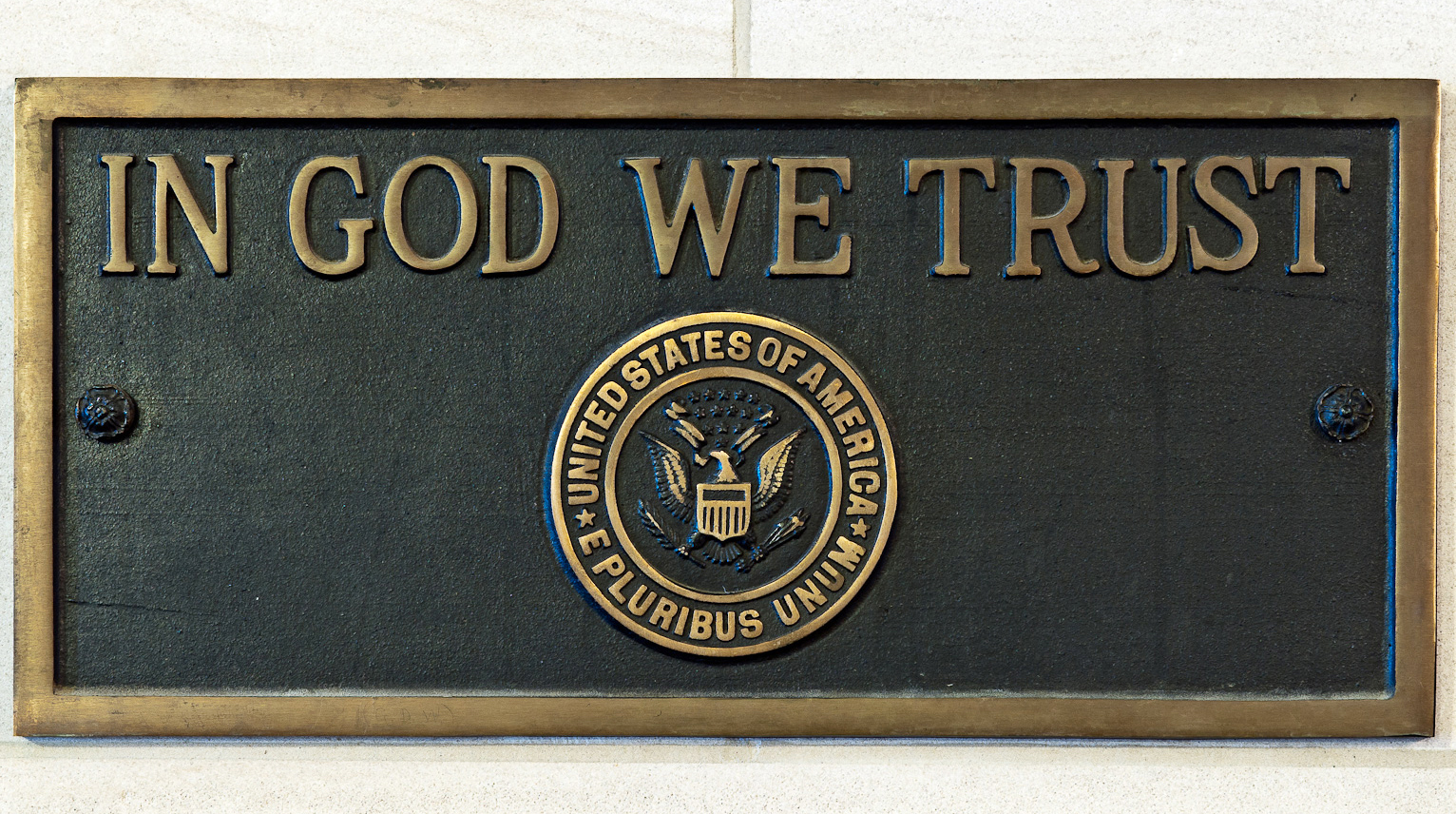
In God We Trust

In God We Trust

[*]
Over recent years there has been strident opposition to displays acknowledging God.[1] The opposition stems largely from a 1971 Supreme Court decision that produced what is known as The Lemon Test.[2]

Under this test, a public religious acknowledgment is constitutional only if its primary purpose is secular. Of course, on its face, this is oxymoronic, for nearly no religious expression can meet the standard of being primarily secular. This is why, over the past 50 years, more than 5,000 previously acceptable public acknowledgments of God or religion have been deemed unconstitutional.[3]

The History and Tradition of Official Public Acknowledgments of God

The secularization of the American public square gradually grew so extreme that in May 2022, Supreme Court Justice Stephen Breyer, perhaps the most Progressive justice on the Court at that time, penned a unanimous 9-0 decision going against the Lemon Test and upholding the right for a Christian flag to be flown at Boston City Hall.[4] In that decision, fellow justice Neil Gorsuch acknowledged that the Lemon Test was the result of “a ‘bygone era’ when this Court took a more freewheeling approach to interpreting legal texts.”[5] Thus, in a separate decision the following month (June 2022), the Court officially vacated The Lemon Test and replaced it with the “History and Tradition Test.”[6]

The Court had laid the groundwork for this return to history in 2019 when it explained that  “retaining established, religiously expressive monuments, symbols, and practices…. gives rise to a strong presumption of constitutionality.”[7] So today, if something with religious associations or of religious character can be shown to be historical and traditional, it now carries a “strong presumption of constitutionality.

So, what is the history and tradition of official public acknowledgments of God?

1776: God in the Declaration of Independence

Let’s start with 1776: our national birth certificate, the Declaration of Independence. Of course, this document and the political philosophy it introduced is what the nation is celebrating for the entire year of the 250th anniversary of that document.

The Declaration’s opening 126 words set forth the philosophy of American government in five succinct points. Significantly, four of those five points focus on God: 1. There is a God; 2. God establishes moral right and wrongs; 3. God is the source of the inalienable rights of every individual; and 4. Government exists first and foremost to protect our God-given rights. This is the official philosophy around which our Founding Fathers rallied, and on which this nation was built.

Early Mottoes and Founding-Era Acknowledgments

On the same day the Declaration of Independence was approved, Benjamin Franklin proposed in Congress America’s first national motto.[8] It was “Rebellion to tyrants is obedience to God.” Thomas Jefferson then made that God-centered phrase the motto of the state of Virginia during his governorship in the War for Independence.[9] He also carried it with him to the White House when he became president.[10]

By the way, before the American War for Independence, Ben Franklin was involved in the French and Indian wars. At that time, he raised a volunteer militia, one of whose companies made its motto “In God We Trust.”[11]

When George Washington became president, one of Congress’ first tasks was to create a Bill of Rights for the nation. The result was the first Ten Amendments to the Constitution, which protect the individual and civil liberties of all Americans.

Washington, Adams, and the Duty of Nations to Acknowledge God

When President Washington was notified the Bill of Rights was completed, on that very day he issued a national call for a day of prayer and thanksgiving. Why? He told the nation that:

It is the duty of all nations [that is, of political bodies] 1. to acknowledge the providence of Almighty God, 2. to obey His will, 3. to be grateful for His benefits, and 4. humbly to implore His protection and favor.[12] [emphasis added]

George Washington said it was the duty of governing political bodies to acknowledge God. President John Adams agreed. He reminded the nation:

The safety and prosperity of nations ultimately and essentially depend on the protection and the blessing of Almighty God, and the national acknowledgment of this truth is…an indispensable duty which the people owe to Him.[13]

Clearly, those who created our Constitution considered public acknowledgments of God to be an official duty of government.

From the Star-Spangled Banner to Civil War Coinage

In the War of 1812, a young attorney, Francis Scott Key, witnessed the Battle of Fort McHenry. He penned a literary description of that battle, which he called “The Defense of Fort McHenry.”[14] That title was later changed to “The Star-Spangled Banner,”[15] and its closing stanza affirmed what Americans strongly believed:

Blest with vict’ry and peace, may the Heav’n-rescued land

Praise the Pow’r that hath made and preserved us a nation.

Then conquer we must, when our cause it is just,

And this be our motto –“In God is our trust.”[16]

Over following years, America got off track with the expansion and growth of slavery. The country became divided between those who supported slavery and those who opposed it. As the polarization and violence increased, Abraham Lincoln sought to heal the growing divide, urging Americans to remember the fundamental God-centered truths in the Declaration of Independence.[17]

Then during the Civil War, Lincoln lamented “we have forgotten God.”[18] He therefore issued a national call urging Americans to come back to the God-consciousness and God-dependency that had been part of our public life for so many previous generations.[19]

During the Civil War is when “In God We Trust” was first added to our national coinage. As explained by Secretary of the Treasury Salmon Chase:

No nation can be strong except in the strength of God, or safe except in His defense. The trust of our people in God should be declared on our national coins.[20]

Under President Ulysses S. Grant, “In God We Trust” was added to American peace medals and trade coins,[21] thus further expanding public acknowledgments of God outward into other realms of public affairs.

Mid-20th Century: National Anthem, Official Motto, and the Pledge

In 1931, Congress made the Star-Spangled Banner the official National Anthem, thus incorporating the line “this be our motto, ‘In God is our trust!’” directly into federal law.[22]

By 1938, “In God We Trust” appeared on all our coinage.[23]

In the 1950s, as nations across the world were becoming overtly and even militantly secularist, America chose to set forth an opposite model. President Harry Truman signed a federal law establishing an annual “National Day of Prayer,” urging Americans to stop and seek God.[24]

His successor, President Dwight D. Eisenhower, expressed his concern that in America “we were getting too secular. He therefore added many other public religious acknowledgments, including:

  • Establishing an annual official National Prayer Breakfast to gather world leaders to Washington to pray.[26]
  • A federal law making “In God We Trust” the official motto of the nation,[27] even though it had been the unofficial motto for several generations previous.
  • A federal law that expanded the use of “In God We Trust” to include paper currency, not just coinage.[28]
  • A federal law adding “Under God” to the Pledge of Allegiance.[29]

In signing the Pledge law, President Eisenhower proudly announced:

From this day forward, the millions of our school children will daily proclaim in every city and town, every village and rural schoolhouse, the dedication of our nation and our people to the Almighty….[I]n this way we are reaffirming the transcendence of religious faith in America’s heritage and future—in this way we shall constantly strengthen those spiritual weapons which forever will be our country’s most powerful resource, in peace or in war.[30]

Given this history (including much more not covered here), it is hard to imagine how displaying the national motto in public buildings has become controversial.

Congressional Response to Secularization

Historically, the current hostility to expressing our religious heritage and traditions in public was officially introduced in June 1962, when the US Supreme Court, for the first time in history, disallowed traditional religious expressions and practices in public settings,[31] thus beginning the war on faith that has continued over recent decades.

Following that Court decision, in December 1962, the US House boldly engraved “In God We Trust” in gold letters over the Speaker’s Rostrum in the US House Chamber.[32] Missouri Democrat Congressman  William Randall acknowledged that the action was “a not-so-subtle way…[to] answer to the recent decision of the US Supreme Court order banning…prayer from the New York State schools.[33] He further explained

We sincerely believe the House, by its historic action today calling for this inscription to be placed constantly before the eyes of every Member, emphasized anew that we are a not only a God-fearing people but that we all realize that only by faith and trust in God can there be any hope for the solution of what seems to be the endless problems facing Congress in world affairs and within our country. The House, in providing for the inscription, put our great national motto in the most prominent place in the greatest legislative hall in the world. By this we speak out to the entire world that we are not an atheistic country or a Godless nation. [34]

Minnesota Democrat Congressman Fred Marshall rejoiced that people who “visit our Chamber…will all be reminded of our great reliance upon Almighty God and will thrill to the words of our motto.” He also pointed out that “We Members…will constantly be reminded of the faith of our fathers who formed our great Republic and who asked God’s Divine blessing on those actions.[35]

In January 1963, John F. Kennedy became the first president to deliver his annual address with the golden inscribed words “In God We Trust” clearly visible above him.[36] Every president since has delivered the nation’s State of the Union Address standing directly under “In God We Trust.”

(Today, thankfully the Court’s former overt religious hostility has finally been reversed by the Supreme Court’s 2022“History and Tradition Test.” The Court now holds that where there is an “original meaning and history” to support religious actions,

Upholding History, Tradition, and the Foundations of Government

Public displays of “In God We Trust” are the simple but profound acknowledgement of what every previous generation of American leaders officially recognized: that God and His standards and principles are not only  invaluable but are an essential element of American constitutional government.

It is worthwhile to hearken back to a passage from what is considered the most significant political address in American history: President George Washington’s “Farewell Address”—his final official advice to the nation. For 45 years his public service had been essential to America becoming an independent nation and a world leader. On his retirement, he offered fatherly advice to the nation which he loved, and for which he had sacrificed so much.

In these last words, not only did he provide a litmus test for determining true American patriotism, but he also identified the two things that would cause our government and our nation to prosper. He said:

Of all the dispositions and habits which lead to political prosperity, religion and morality are indispensable supports. In vain would that man claim the tribute of patriotism, who should labor to subvert these great pillars of human happiness.[38]

George Washington measured patriotism by whether or not there was open support for religion and morality, which were the two elements that made America’s culture prosper.

The display of our national motto in its various forms is simply upholding the path of  religious “history and tradition” regarding the most important and indispensable foundations of our government.

[*] This was a public address delivered on January 12, 2026, by David Barton at the dedication of the “In God We Trust” inscription added to the exterior of Cleveland Country Courthouse in Norman, Oklahoma, as well as to its various courtrooms inside.


Endnotes

[1] See, for example, “Oklahoma House approves bill that would require ‘In God We Trust’ display in state buildings,” March 2, 2021, KOCO News, https://www.koco.com/article/oklahoma-house-approves-bill-that-would-require-in-god-we-trust-display-in-state-buildings/35694319; “Measure Placing National Motto on Public Building passes Oklahoma House of Representatives,” March 2, 2021, CapitolBeatOK, https://www.capitolbeatok.com/reports/measure-placing-national-motto-on-public-buildings-passes-oklahoma-house-of-representatives/.

[2] Lemon v. Kurtzman, 403 U.S. 602 (1971).

[3] See examples in David Barton, Original Intent (Aledo, TX: WallBuilder Press, 2025), chapter 9.

[4] Shurtleff v. City of Boston, 596 U.S. ___ (2022).

[5] Shurtleff v. City of Boston, 596 U.S. ___ (2022), Neil Gorsuch concurring opinion.

[6] Kennedy v. Bremerton School District, 597 U.S. ___ (2022).

[7] American Legion v American Humanist Association, 588 U.S. ___ (2019).

[8] “Franklin’s Proposal,” August 20, 1776, National Archives, https://founders.archives.gov/documents/Jefferson/01-01-02-0206-0001.

[9] “Virginia “Happy While United” Indian Peace Medal,” 1780, Colonial Williamsburg, https://emuseum.colonialwilliamsburg.org/objects/90494/virginia-happy-while-united-indian-peace-medal; Dumas Malone, Jefferson the Virginian (Boston: Little, Brown and Company, 1948), 156, 226, 242.

[10] “Personal Seal,” October 4, 2007, Monticello, https://www.monticello.org/encyclopedia/personal-seal; Dumas Malone, Jefferson the Virginian (Boston: Little, Brown and Company, 1948), 156, 226, 242.

[11] “Colors of the Associator Companies,” January 12 & April 16, 1748, National Archives, https://founders.archives.gov/documents/Franklin/01-03-02-0105.

[12] George Washington, Proclamation for a Day of Thanksgiving, issued October 3, 1789, printed in The Providence Gazette and Country Journal (October 17, 1789), from the WallBuilders Collection, https://wallbuilders.com/resource/proclamation-thanksgiving-day-1789/.

[13] John Adams, Proclamation for a Day of Fasting, issued March 23, 1798, The American Presidency Project, https://www.presidency.ucsb.edu/node/203279.

[14] “Defence of Fort McHenry,” 1814, Library of Congress, https://www.loc.gov/resource/music.musihas-100010457/.

[15] “The Star-Spangled Banner: The Lyrics,” Smithsonian, accessed April 30, 2026, https://amhistory.si.edu/starspangledbanner/the-lyrics.aspx.

[16] “Defence of Fort McHenry,” 1814, Library of Congress, https://www.loc.gov/resource/music.musihas-100010457/.

[17] “Let me entreat you to come back…come back to the truths that are in the Declaration of Independence:” Abraham Lincoln, “Back to the Declaration: Speech at Lewiston, Illinois,” August 17, 1858, The Works of Abraham Lincoln: Speeches and Debates, ed. John H. Clifford (New York: The University Society Inc., 1908), 3:126-127.

[18] Abraham Lincoln, Proclamation for a Day of Fasting, issued March 30, 1863, The American Presidency Project, https://www.presidency.ucsb.edu/node/203143; see that proclamation in the WallBuilders Collection, https://wallbuilders.com/resource/proclamation-fasting-humiliation-and-prayer-1863/.

[19] Abraham Lincoln, Proclamation for a Day of Fasting, issued March 30, 1863, The American Presidency Project, https://www.presidency.ucsb.edu/node/203143; see that proclamation in the WallBuilders Collection, https://wallbuilders.com/resource/proclamation-fasting-humiliation-and-prayer-1863/.

[20] Salmon P. Chase to James Pollock, November 20, 1861, Thirty-Fourth Annual Report of the Director of the Mint to the Secretary of the Treasury (Washington: Government Printing Office, 1897), 107.

[21] The motto appeared on Trade Dollars authorized by the Coinage Act of 1873 (signed February 12, 1873). See also U.S. Mint production of presidential/Indian peace medals (e.g., 1871 Grant Peace Medal examples).

[22] Act of March 3, 1931, Public Law 71-810, 46 Stat. 1508.

[23] The motto had first appeared on the two-cent piece in 1864 and was gradually added to other denominations. It was restored to gold and silver coins by the Act of May 18, 1908 (35 Stat. 164). The five-cent nickel was the final denomination to receive it, with the introduction of the Jefferson nickel in 1938.

[24] “Joint Resolution to provide for setting aside an appropriate day as a National Day of Prayer,” Public Law 324-April 17, 1952, https://www.congress.gov/82/statute/STATUTE-66/STATUTE-66-Pg64-3.pdf.

[25] Dwight D. Eisenhower, The White House Years. Mandate for Change: 1953-1956 (NY: Doubleday & Company, 1963), 100.

[26] Diane Winston, “The History of the National Prayer Breakfast,” February 2, 2017, Smithsonian Magazinehttps://www.smithsonianmag.com/history/national-prayer-breakfast-what-does-its-history-reveal-180962017/.

[27] “Joint Resolution to Establish a National Motto of the United States,” July 30, 1956, https://uscode.house.gov/statviewer.htm?volume=70&page=732.

[28] Law passed on July 11, 1955, https://www.govinfo.gov/content/pkg/STATUTE-69/pdf/STATUTE-69-Pg290-2.pdf.

[29] Act of June 14, 1954, Pub. L. No. 83-396, 68 Stat. 249 (H.J. Res. 243), https://www.congress.gov/bill/83rd-congress/house-joint-resolution/243/text.

[30] Dwight Eisenhower, “Statement by the President Upon Signing Bill To Include the Words “Under God” in the Pledge to the Flag,” June 14, 1954, The American Presidency Projecthttps://www.presidency.ucsb.edu/documents/statement-the-president-upon-signing-bill-include-the-words-under-god-the-pledge-the-flag.

[31] Engel v. Vitale, 370 US 421 (1962). Other 1960s court cases addressing religion in public include: Abington School District v. Schempp, 374 US 203 (1963) and Murray v. Curlett, 228 Md. 239, 179 A.2d 698 (Md. 1962).

[32] “House Chamber: Furniture,” United States House of Representatives, accessed April 30, 2026, https://history.house.gov/Exhibitions-and-Publications/House-Chamber/Rostrum/.

[33] Congressional Record, 87th Cong., 2d Sess., vol. 108, at 21101–02 (Sept. 27, 1962).

[34] Congressional Record, 87th Cong., 2d Sess., vol. 108, at 21101–02 (Sept. 27, 1962).

[35] Congressional Record, 87th Cong., 2d Sess., vol. 108, at 22274 (October 4, 1962).

[36] “January 14, 1963: State of the Union Address,” The Miller Center, https://millercenter.org/the-presidency/presidential-speeches/january-14-1963-state-union-address.

[37] Kennedy v. Bremerton School District, 597 U.S. ___ (2022).

[38] Address of George Washington, President of the United states and Late Commander in Chief of the American Army to the People of the United States, Preparatory to His Declination (Baltimore: Christopher Jackson, 1796), 22-23.
Celebrating America’s Military

Armed Forces Day — a day set aside to honor all those who are either currently serving or have served in all branches of our nation’s Armed Forces — occurs on the third Saturday of May.1

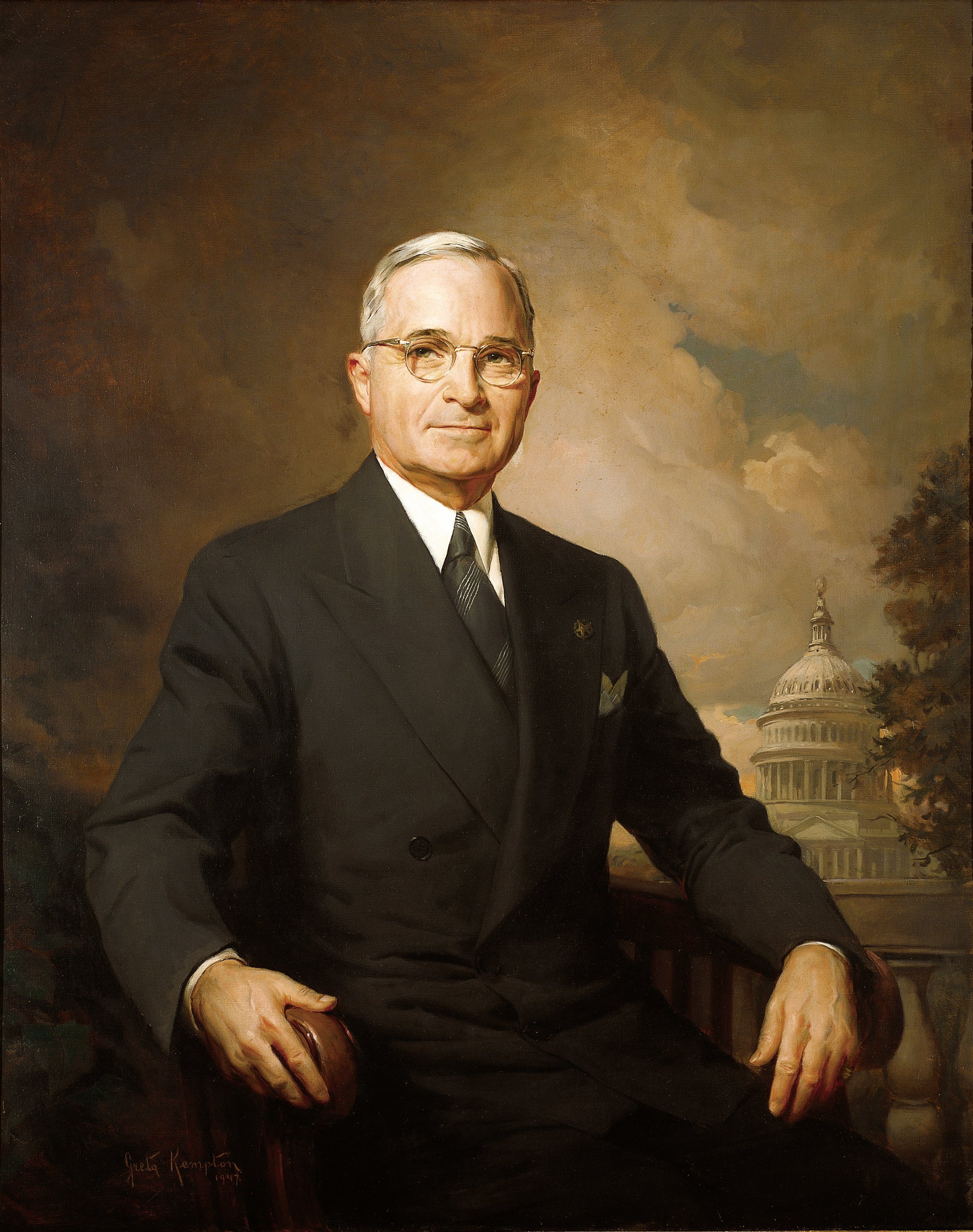
In 1947 America’s military was combined under what became the Department of Defense (now called the Department of War).2 Two years later, the Secretary of Defense created Armed Forces Day to replace the separate celebrations of each military branch.3 The first celebration was held in 1950 and included parades in Washington DC, Berlin, and New York City.4 For this day, President Truman urged all Americans to:
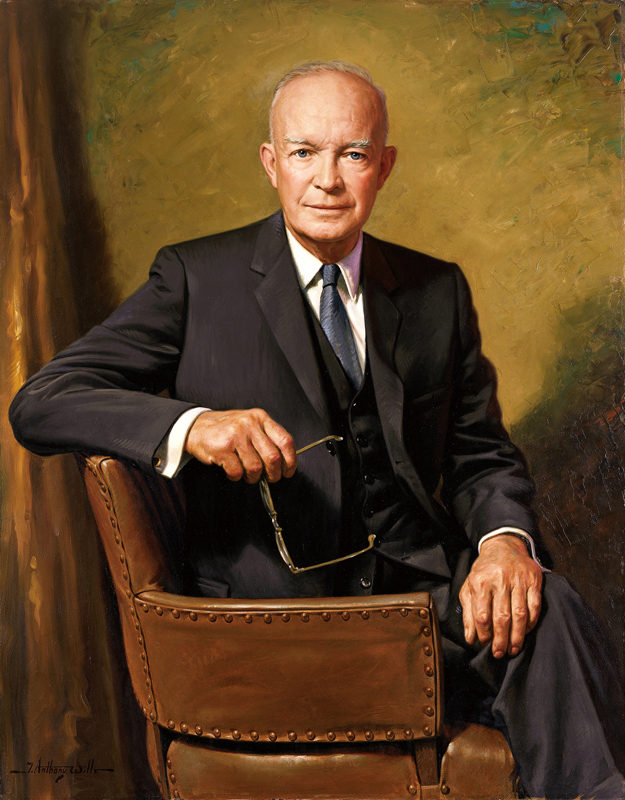
display the flag of the United States at their homes…and to participate in exercises expressive of our recognition of the skill, gallantry, and uncompromising devotion to duty characteristic of the Armed Forces in the carrying out of their missions.5

Other presidents and government officials since 1950 have issued proclamations and given speeches to celebrate Armed Forces Day,6 including General Dwight Eisenhower who reminded the nation:

It is fitting and proper that we devote one day each year to paying special tribute to those whose constancy and courage constitute one of the bulwarks guarding the freedom of this nation and the peace of the free world.7
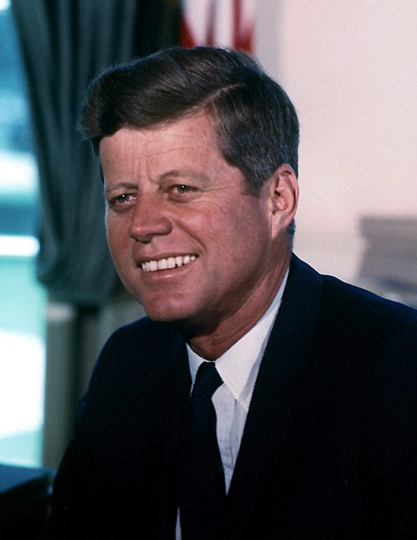
Armed Forces Day was set as the third Saturday of the month of May in 1961 with President Kennedy’s proclamation that encouraged Americans “as an expression of support for their armed forces and as a symbol of their unity in devotion to the preservation of our country, to display prominently the flag of the United States.”8
For this special celebration day, you can show your support for our military by flying the US flag, thanking a military member you know, and sending messages of support to those serving.

* Originally published May 29, 2023; updated May 15, 2026.


Endnotes

1 “When is Armed Forces Day?” May 17, 2022, USO.
2 “The National Security Act of 1947,” July 26, 1947, Public Law 253.
3 Senate Congressional Record, April 7, 1949, GovInfo.
4 “Armed Forces Day,” March 12, 2020, GovInfo; “What Is Armed Forces Day and Why Is It in May?” updated May 12, 2026, History; Bill Downs, “Armed Forces March in Berlin,” May 20, 1950, Bill Downs, War Correspondent.
5 Harry S. Truman, “Proclamation 2873—Armed Forces Day,” February 27, 1950, The American Presidency Project.
6 See search results for Armed Forces Day on GovInfo.
7 Dwight D. Eisenhower, “Proclamation 3008—Armed Forces Day,” March 17, 1953, The American Presidency Project.
8 John F. Kennedy, “Proclamation 3399—Armed Forces Day,” March 18, 1961, The American Presidency Project.

The Rock Upon Which Our Republic Rests

Thoughts on 2 Kings 23

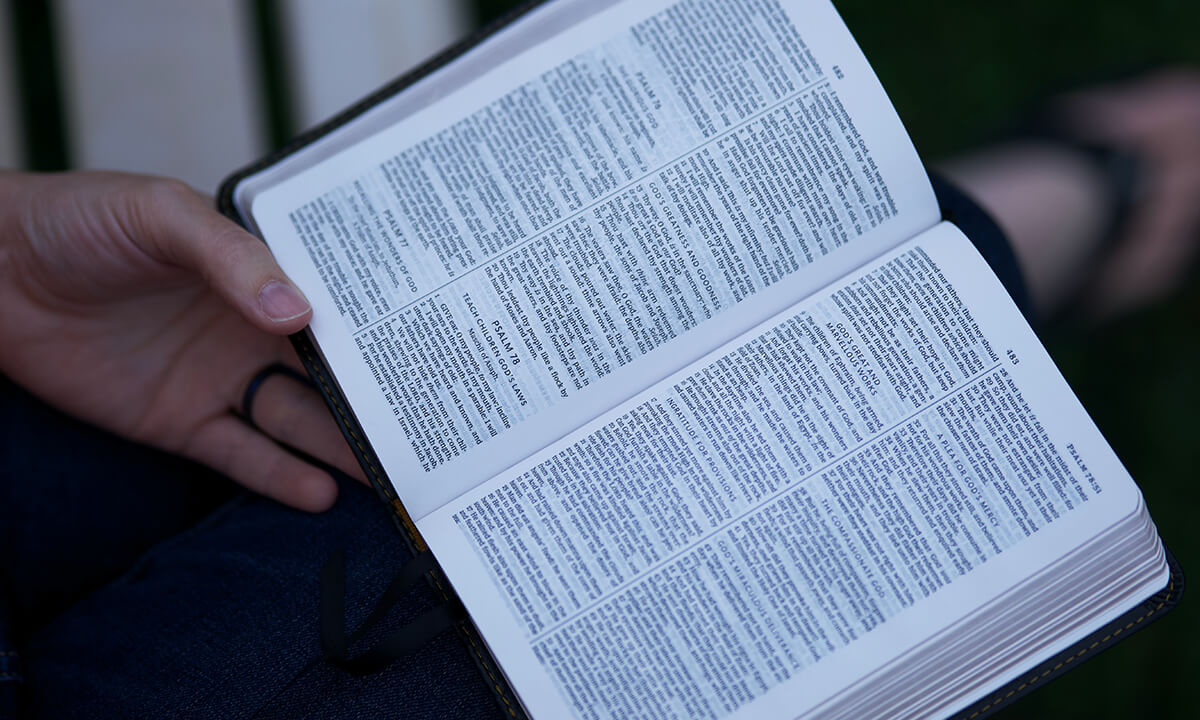
There are numerous Biblical occasions when civil leaders urged a national reading of God’s Word. For example, under righteous King Josiah of Israel:

The king went up to the house of the Lord with all the men of Judah, and with him all the inhabitants of Jerusalem—the priests and the prophets and all the people, both small and great. And he read in their hearing all the words of the Book of the Covenant which had been found in the house of the Lord (2 Kings 23:2).

Ezra also assembled the nation to read the Word of God (Nehemiah 8:1-3), and Moses likewise instructed the people to gather together and read God’s Word so that they might know it, obey it, and teach it to the rising generation, for by so doing, they would remain blessed as a nation (Deuteronomy 31:11-13).

America’s national leaders continued to follow this pattern. President Franklin Roosevelt proposed:

I suggest a nationwide reading of the Holy Scriptures during the period from Thanksgiving Day to Christmas. . . . Go to . . . the Scriptures for a renewed and strengthening contact with those eternal truths and majestic principles which have inspired such measure of true greatness as this nation has achieved.1

(Today, National Bible Week is still officially commemorated one week of the period between Thanksgiving and Christmas. But sadly few citizens know of its existence, and sadder still even fewer observe it.)

Why would President Roosevelt publicly call the nation to a time of Scripture reading? Because of its proven beneficial influence:

In the formative days of the Republic, the directing influence the Bible exercised upon the fathers of the Nation is conspicuously evident. . . . We cannot read the history of our rise and development as a Nation without reckoning with the place the Bible has occupied in shaping the advances of the Republic.2

On the same basis, President Ronald Reagan declared a national “Year of the Bible,” explaining:

Of the many influences that have shaped the United States of America into a distinctive Nation and people, none may be said to be more fundamental and enduring than the Bible. . . . The Bible and its teachings helped form the basis for the Founding Fathers’ abiding belief in the inalienable rights of the individual – rights which they found implicit in the Bible’s teachings of the inherent worth and dignity of each individual. This same sense of man patterned . . . the ideals set forth in the Declaration of Independence and the Constitution. . . . There could be no more fitting moment than now to reflect . . . upon the wisdom revealed to us in the [Bible].3

President Teddy Roosevelt similarly affirmed:

[T]he teachings of the Bible are so interwoven and entwined with our whole civic and social life that it would be literally—I do not mean figuratively, I mean literally—impossible for us to figure to ourselves what that life would be if these teachings were removed. We would lose almost all the standards by which we now judge both public and private morals—all the standards toward which we, with more or less resolution, strive to raise ourselves. Almost every man who has by his life-work added to the sum of human achievement of which the race is proud—of which our people are proud – almost every such man has based his lifework largely upon the teachings of the Bible. . . . Among the very greatest men, a disproportionately large number have been diligent and close students of the Bible at first hand. . . . So I plead not merely for training of the mind but for . . . the moral and spiritual training that have always been found in and that have ever accompanied the study of this Book—this Book, which in almost every civilized tongue can be described as “The Book.”4

Teddy wanted everyone to know the Bible, and a reason that he had been so thoroughly impressed by President Abraham Lincoln was his personal mastery of the Bible. As he explained:

Lincoln—sad, patient, kindly Lincoln, who after bearing upon his weary shoulders for four years a greater burden than that borne by any other man of the nineteenth century laid down his life for the people whom living he had served as well—built up his entire reading upon his early study of the Bible. He had mastered it absolutely – mastered it as later he mastered only one or two other books (notably Shakespeare) —mastered it so that he became almost “a man of one Book,” who knew that Book and who instinctively put into practice what he had been taught therein.5

Indeed, it is extremely difficult to find any of Lincoln’s major speeches not laced throughout with Scriptures, so it is therefore not surprising that in speaking of the Bible, Lincoln declared:

It is the best gift God has given to men. All the good the Savior gave to the world was communicated through this Book. But for it, we could not know right from wrong. 6

President Zachary Taylor also stressed how important it was that every citizen, especially young citizens, know the Bible:

The Bible is the best of books and I wish it were in the hands of everyone. It is indispensable to the safety and permanence of our institutions; a free government cannot exist without religion and morals, and there cannot be morals without religion, nor religion without the Bible. Especially should the Bible be placed in the hands of the young. It is the best schoolbook in the world. . . . I would that all of our people were brought up under the influence of that Holy Book.7

President Harry Truman, speaking at a conference of law enforcement officials assembled from across the nation, reminded them:

The fundamental basis of this Nation’s law was given to Moses on the Mount. The fundamental basis of our Bill of Rights comes from the teachings which we get from Exodus and St. Matthew, from Isaiah and St. Paul. I don’t think we emphasize that enough these days.8

President Andrew Jackson likewise declared of the Bible that “it is the rock on which our Republic rests.”9

And President Grant, on the 100th anniversary of American Independence exhorted, “Hold fast to the Bible as the sheet-anchor of your liberties; write its precepts in your heats, and practice them in your lives. To the influence of this Book we are indebted for all the progress made in true civilization, and to this we must look for our guide in the future.”10

There are many other examples demonstrating that America’s leaders understood the importance of God’s Word to the nation and publicly urged the reading and knowledge of it, just as ancient leaders such as Moses, Ezra, and Josiah had done. It is important that every citizen personally study, learn, and live by God’s Word, teaching it to their children and also electing at the local, county, state, and federal level leaders who know and honor the principles of “The Book.”


Endnotes

1 Franklin D. Roosevelt, “Proclamation 2629—Thanksgiving Day, 1944,” November 1, 1944, American Presidency Project, https://www.presidency.ucsb.edu/node/210843.

2 Franklin D. Roosevelt, “Statement on the Four Hundredth Anniversary of the Printing of the English Bible,” October 6, 1935, American Presidency Project, https://www.presidency.ucsb.edu/node/209257.

3 Ronald Reagan, “Proclamation 5018—Year of the Bible, 1983,” February 3rd, 1983, American Presidency Project, https://www.presidency.ucsb.edu/node/262128.

4 Theodore Roosevelt, “On Reading the Bible: Delivered before the Members of the Bible Society,” 1901, Modern Eloquence, ed. Thomas B. Reed (Philadelphia: John D. Morris and Company, 1903), XV:1770-1776.

5 Roosevelt, “On Reading the Bible: Delivered before the Members of the Bible Society,” 1901, Modern Eloquence, ed. Reed (1903), XV:1770-1776.

6 Abraham Lincoln, “Reply to Committee of Colored People of Baltimore Who Presented Him with a Bible,” Complete Works Comprising his Speeches, Letters, State Papers, and Miscellaneous Writings, John Nicolay and John Hay, editors (New York: The Century Co., 1894), 2:574.

7The President and the Bible,” New York Semi-Weekly Tribune (Wednesday, May 9, 1849), IV:100:1.

8 Harry S. Truman, “Address Before the Attorney General’s Conference on Law Enforcement Problems,” February 15, 1950, American Presidency Project, https://www.presidency.ucsb.edu/node/230655.

9 Ronald Reagan, “Proclamation 5018—Year of the Bible, 1983,” February 3rd, 1983, American Presidency Project, https://www.presidency.ucsb.edu/node/262128; see the same quote in a proclamation from President George H. W. Bush, “International Year of Bible Reading,” February 22, 1990, Code of Federal Regulations (Washington, D. C.: U. S. Government Printing Office, 1991), 21.

10 Ulysses Grant, “Message of President Grant to the Children and Youth of the U.S.” card in WallBuilders Museum collection.

Join WallBuilders in Supporting America Prays

Dear Supporters,

We are excited to announce our partnership with the White House in the launch of America Prays. WallBuilders, led by Tim and David Barton, has been involved in this initiative from the beginning.

The response has been inspiring! We’re grateful for your partnership in mobilizing Americans to pray for our nation as we approach the 250th anniversary of our freedom. Let’s unite in lifting up our nation in prayer!

Our call to action is simple:

Gather groups of ten or more for one hour each week to pray for our country and its people.

Please visit and share The Official White House America Prays Landing Page.

Spread the word within your ministries and networks to help this movement grow!

Thank you for standing with us,

The WallBuilders Team

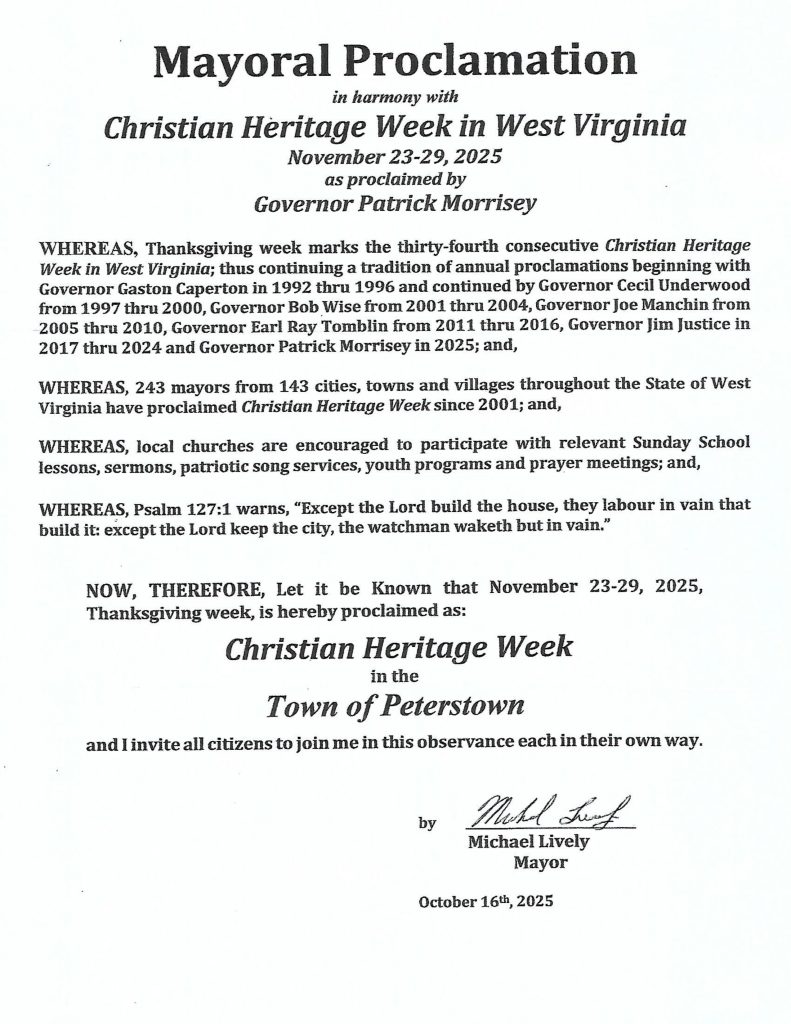
Peterstown, West Virginia 2025

Mayoral Proclamation

in harmony with

Christian Heritage Week in West Virginia

November 13-29, 2025

as proclaimed by

 Governor Jim Justice

WHEREAS, Thanksgiving Week marks the thirty-fourth consecutive Christian Heritage Week in West Virginia; thus continuing a tradition of annual proclamations beginning with Governor Gaston Caperton in 1992 thru 1996 and continued by Governor Cecil Underwood from 1997 thru 2000, Governor Bob Wise from 2001 thru 2004, Governor Joe Manchin from 2005 thru 2010, and Governor Earl Ray Tomblin from 2011 thru 2016 and Governor Jim Justice in 2017 thru 2024 and Governor Patrick Morrisey in 2025; and,

WHEREAS, 243 mayors from 143 cities, towns and villages throughout the State of West Virginia have proclaimed Christian Heritage Week since 2001; and,

WHEREAS, local churches are encouraged to participate with relevant Sunday School lessons, sermons, patriotic song services, youth programs and prayer meetings; and,

WHEREAS, Psalm 127:1 warns, “Except the Lord build the house, they labour in vain that build it: except the Lord keep the city, the watchman waketh but in vain.”

NOW, THEREFORE, Let it be Known that November 23-29, 2025, Thanksgiving Week is hereby proclaimed as:

Christian Heritage Week

in the

Town of Peterstown

and I invite all citizens to join me in this observance each in their own way.

By: Michael Lively
Mayor

Date: October 16th, 2026

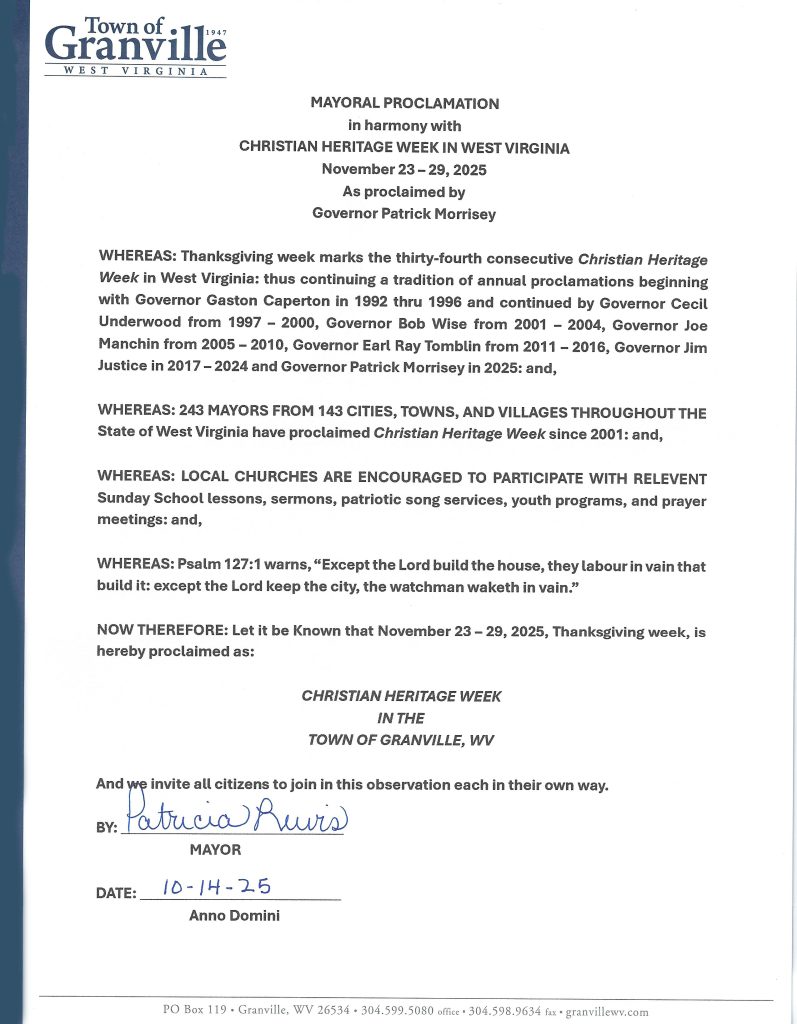
Granville, West Virginia 2025

Town of Granville

West Virginia

Mayoral Proclamation

In harmony with

Christian Heritage Week in West Virginia

November 23-29, 2025

As proclaimed by Governor Patrick Morrisey

WHEREAS, Thanksgiving week marks the thirty-fourth consecutive Christian Heritage Week in West Virginia: thus continuing a tradition of annual proclamations beginning with Governor Gatson Caperton in 1992 thru 1996 and continued by Governor Cecil Underwood from 1997 thru 2000, Governor Bob Wise from 2001 thru 2004, Governor Joe Manchin from 2005 thru 2010, Governor Earl Ray Tomblin from 2011 thru 2016 and Governor Jim Justice in 2017 thru 2024 and Governor Patrick Morrisey in 2025: and, 

WHEREAS, 243 mayors from 143 cities, towns and villages throughout the State of West Virginia have proclaimed Christian Heritage Week since 2001: and,

WHEREAS, local churches are encouraged to participate with relevant Sunday School lessons, sermons,  patriotic song services, youth programs and prayer meetings; and,

WHEREAS, Psalm 127:1 warns, “Except the Lord build the house, they labour in vain that build it: except the Lord keep the city, the watchmen waketh in vain.”

NOW, THEREFORE, Let it be Known that November 23-29, 2025, is hereby proclaimed as: 

Christian Heritage Week 

In the

Town of Granville, WV

And we invite all citizens to join me in this observance each in their own way. 

Patricia A. Lewis

Mayor

Date: 10-14-25
Anno Domini

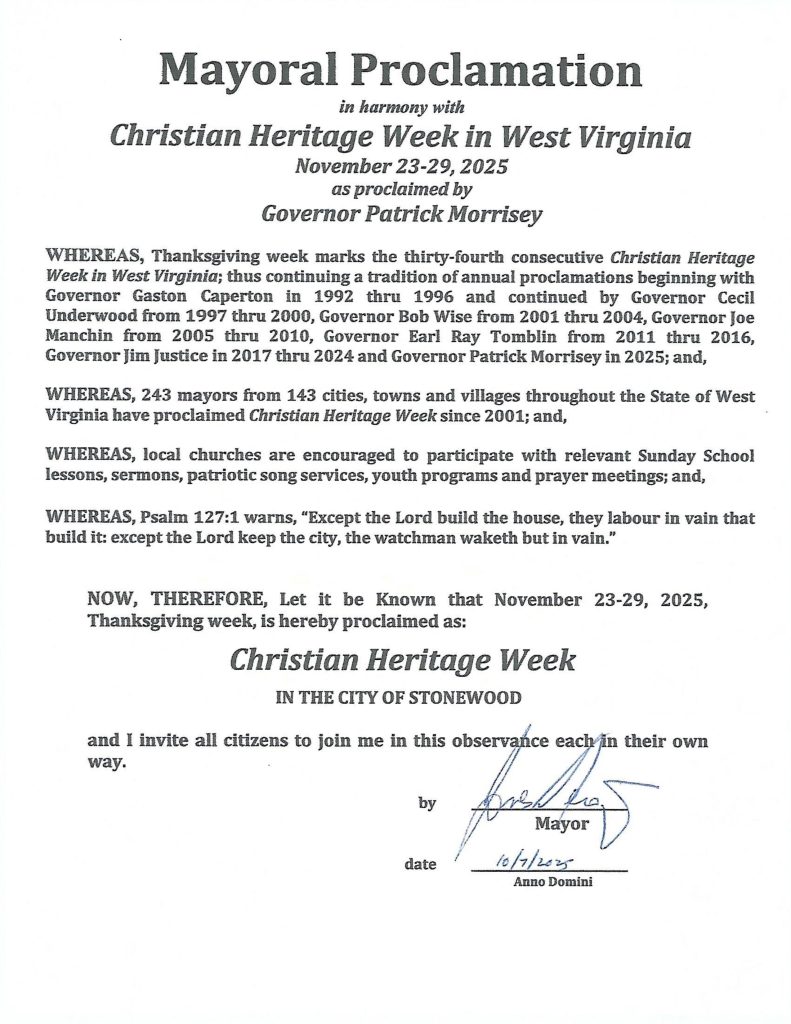
Stonewood, West Virginia 2025

Mayoral Proclamation

In harmony with

Christian Heritage Week in West Virginia

November 23-29, 2025

as proclaimed by

 Governor Patrick Morrisey

WHEREAS, Thanksgiving week marks the thirty-fourth consecutive Christian Heritage Week in West Virginia; thus continuing a tradition of annual proclamations beginning with Governor Gaston Caperton in 1992 thru 1996 and continued by Governor Cecil Underwood from 1997 thru 2000, Governor Bob Wise from 2001 thru 2004, Governor Joe Manchin from 2005 thru 2010, Governor Earl Ray Tomblin from 2011 thru 2016 and Governor Jim Justice in 2017 thru 2024 and Governor Patrick Morrisey in 2025; and,

WHEREAS, 243 mayors from 143 cities, towns and villages throughout the State of West Virginia have proclaimed Christian Heritage Week since 2001; and,

WHEREAS, local churches are encouraged to participate with relevant Sunday School lessons, sermons, patriotic song services, youth programs and prayer meetings; and,

WHEREAS, Psalm 127:1 warns “Except the Lord build the house, they labour in vain that build it: except the Lord keep the city, the watchman waketh but in vain.”

NOW, THEREFORE, Let it be Known that November 23-29, 2025, Thanksgiving week, is hereby proclaimed as:

Christian Heritage Week

in the City of Stonewood

and I invite all citizens to join me in this observance, each in their own way.

By

Mayor

Date 10-7-25

The Bible and American Education

Throughout much of American history, the Bible played an important role in education. Many of the nation’s earliest leaders believed that teaching children to read was essential so that they could study the Bible for themselves and thereby develop strong moral character.1

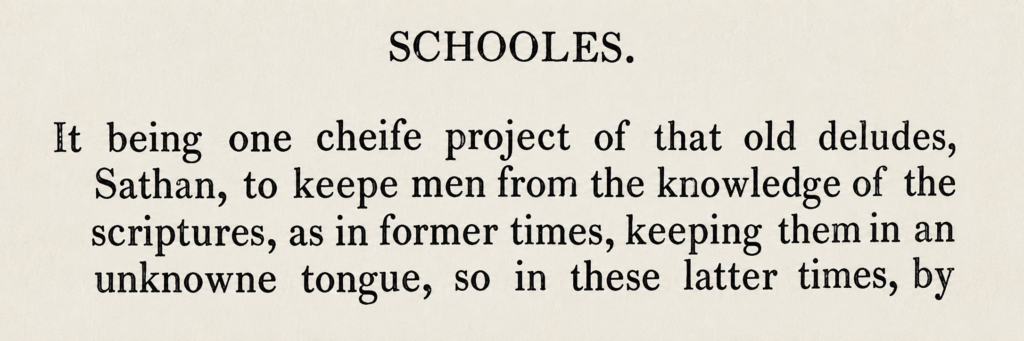
For example, the “Old Deluder Satan Act” from the Code of 1650 required towns with at least 50 households to establish a public school. According to the law, education was important because it helped ensure that the population could know the Bible rather than remain ignorant of God’s Word, like Europeans during the Dark Ages.

The Bible in Early American Classrooms

The influence of the Bible is evident in America’s earliest schoolbooks. The New England Primer, the first widely used textbook printed in the colonies, taught children to read through Bible passages, moral lessons, and shortened versions of Biblical catechisms.

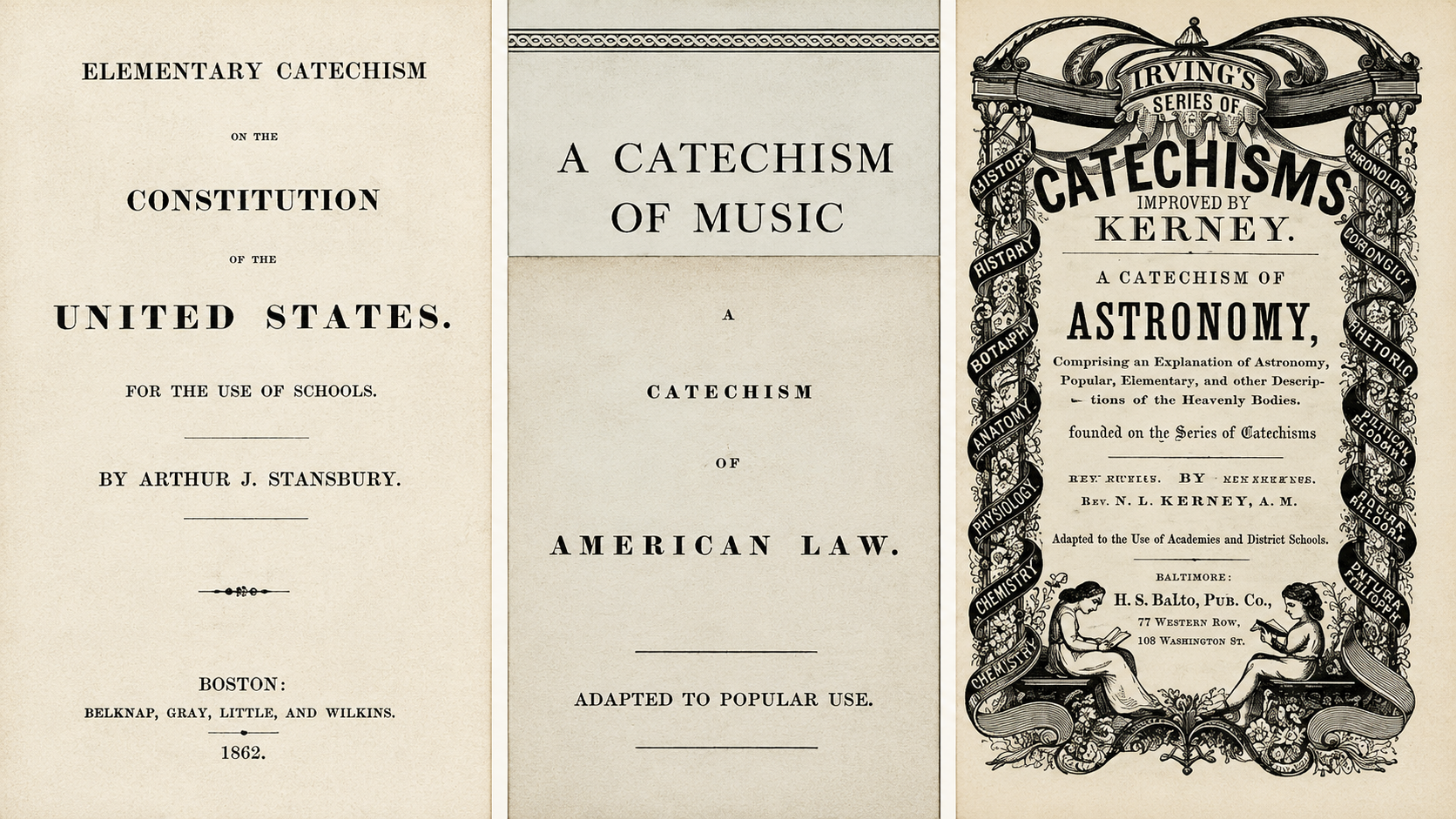
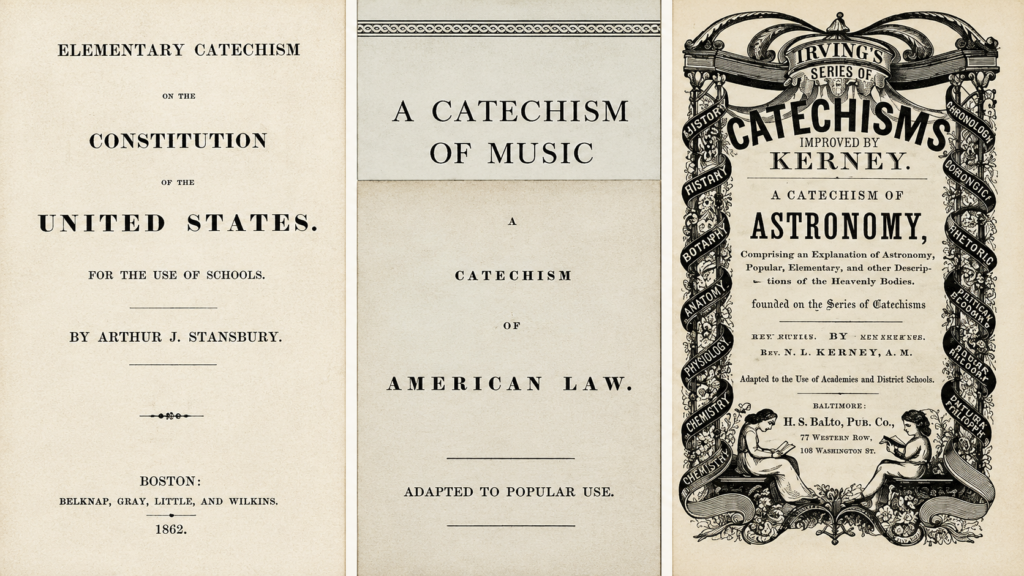
Early schools often used other catechisms—a question-and-answer method of teaching. While many catechisms focused on Biblical instruction, others taught subjects such as entomology, music, ancient history, and the US Constitution.

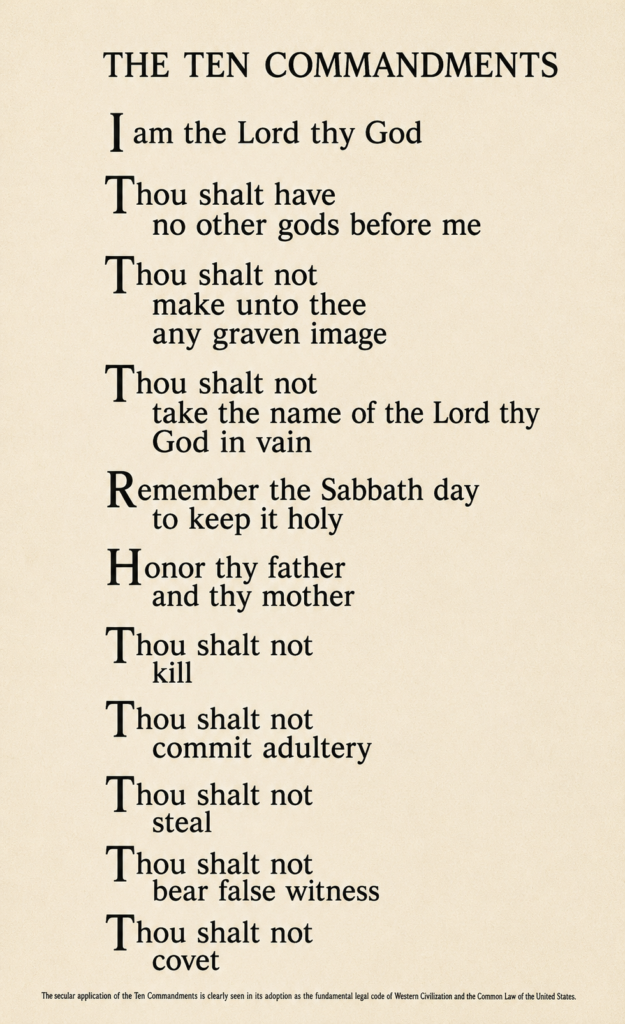
Other well-known textbooks also emphasized Biblical values. Noah Webster’s famous The American Spelling Book, often called the “Blue-Backed Speller,” included moral lessons that referenced the Ten Commandments. McGuffey’s readers, used by millions of students during the nineteenth century, combined reading instruction with the Ten Commandments and  lessons on honesty, responsibility, respect, and other virtues rooted in biblical principles.

These examples illustrate the significant role that biblical instruction and moral education played in American classrooms for many generations.

Progressive Educational Changes

During the twentieth century, the relationship between religion and public education changed through progressive policies and a series of Supreme Court decisions.

In Everson v. Board of Education (1947), the US Supreme Court misapplied Thomas Jefferson’s “a wall of separation between church and state” metaphor to its interpretation of the First Amendment. The Court not only ignored the context of Jefferson’s statement, but also neglected the broader historical context of Jefferson’s views and actions.

The Court continued in this misdirection in Lemon v. Kurtzman (1971), creating a three-part “Lemon test” to evaluate government actions involving religion. Using that framework, the Court later ruled in Stone v. Graham (1980) that Kentucky’s law requiring the posting of the Ten Commandments in public school classrooms was unconstitutional.2

In recent years, the Supreme Court has shifted away from the Lemon test. In American Legion v. American Humanist Association (2019), the Court emphasized the importance of the nation’s history and traditions when considering the relationship between the state and religion. Then, in Kennedy v. Bremerton School District (2022), the Court officially abandoned the Lemon test, directing lower courts to consider the original understanding of the First Amendment and the nation’s historical practices when deciding similar cases.

Influence Today

Today, as we look to our history and traditions—state laws encouraging Biblical literacy and textbooks that included Scripture and moral lessons—we can restore the Bible as a guide for America’s youth, just as it was in early American education.

To learn more about Christian influence in early American education, see Four Centuries of American Education. Or, own your own copy of The New England Primer and the Catechism on the Constitution.

1 For example: “The Christian religion is the most important and one of the first things in which all children under a free government ought to be instructed…. No truth is more evident to my mind than that the Christian religion must be the basis of any government intended to secure the rights and privileges of a free people.” Noah Webster, “Schoolmaster to America” (Reply to a Letter of David McClure on the Subject of the Proper Course of Study in the Girard College, October 25, 1836,” A Collection of Papers on Political, Literary, and Moral Subjects, New York: Webster and Clark, 1843, 291). “The Bible … should be read in our schools in preference to all other books.” Benjamin Rush, signer of the Declaration of Independence (“A Defense of the Use of the Bible as a School Book, Addressed to the Rev. Jeremy Belknap, of Boston,” on March 10, 1791, Essays, 94, 100). “The Bible…. [is] a necessary part of a polite education.” Henry Laurens, President of the Continental Congress (letter to James Lawrenson on August 19, 1772, Papers of Henry Laurens, George C. Rogers, Jr. and David R. Chesnutt, editors, University of South Carolina Press, 1980, VIII:426-427).

For a broader history of the “separation of church and state” phrase, see David Barton, Original Intent: The Courts, The Constitution, and Religion (Aledo, TX: WallBuilder Press, 2008).

wall builders

WallBuilders 2024 Impact Report

A LETTER FROM OUR PRESIDENT

While we understand that our reward is not in this life, God is good to give us an occasional peek into His workings here and now. WallBuilders has been blessed to share in some real victories and witness so many answers to prayer this year!

As we continue to rebuild our moral, religious, and constitutional foundation, we’ve seen reclaimed religious freedoms, with the reintroduction of Biblical content in classrooms in several states, and unapologetically Christian ads on the streets of Washington DC!

This year alone, through our Pro-Family Legislative Network, Pastors’ Briefings and Teachers Conferences, we’ve met with and fortified fellow rebuilders in almost all fifty states. In fact, in the last few months we’ve had Congressmen, congressional staffers, state legislators, school board members and numerous others, tell us they are now serving because of the influence of WallBuilders. We’ve encouraged faith leaders and emboldened church congregations to be salt and light in their communities. We also spent the several months before the election taking part in pastors’ and community events in all seven swing states. We had many reports of those pastors teaching about Christian participation and influence in the government arena, and church attendees who decided to be involved in the election process, many choosing to vote who had previously planned to abstain.

While we thank the Lord for these many victories, there is so much more to do! At this point, I feel like we’ve only won the coin-toss for possession of the ball and now the real effort begins; and there are so many opportunities in front of us. In the coming year, WallBuilders is looking to increase our outreach with expanded order fulfillment facilities and additional staff to support our mission of education and influence.

The rebuilding is ongoing and your support helps us empower many on the frontlines in school boards, state legislatures, get-out-the-vote efforts, and mobilize churches to reach their communities. We invite you to help us rebuild with a special gift today.

Now is the time to follow Nehemiah 2:18b: “Then they said, ‘Let’s arise and build.’ So they put their hands to the good work!”

Thank you for your prayers and support!

Tim Barton

Read the Full 2024 Impact Report Here

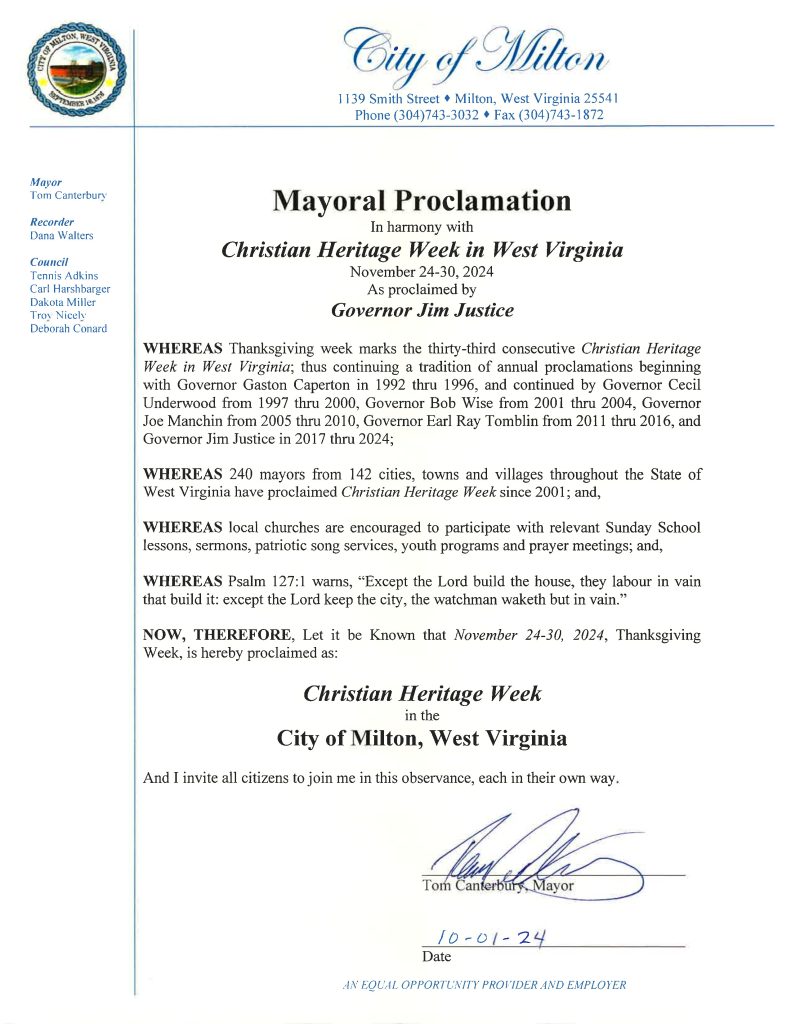
Milton, West Virginia 2024

Mayoral Proclamation

In harmony with

Christian Heritage Week in West Virginia

November 24-30, 2024

as proclaimed by

 Governor Jim Justice

WHEREAS, Thanksgiving week marks the thirty-third consecutive Christian Heritage Week in West Virginia; thus continuing a tradition of annual proclamations beginning with Governor Gaston Caperton in 1992 thru 1996 and continued by Governor Cecil Underwood from 1997 thru 2000, Governor Bob Wise from 2001 thru 2004, Governor Joe Manchin from 2005 thru 2010, Governor Earl Ray Tomblin from 2011 thru 2016 and Governor Jim Justice in 2017 thru 2024;

WHEREAS, 240 mayors from 142 cities, towns and villages throughout the State of West Virginia have proclaimed Christian Heritage Week since 2001; and,

WHEREAS, local churches are encouraged to participate with relevant Sunday School lessons, sermons, patriotic song services, youth programs and prayer meetings; and

WHEREAS, Psalm 127:1 warns “Except the Lord build the house, they labour in vain that build it: except the Lord keep the city, the watchman waketh but in vain.”

NOW, THEREFORE, Let it be Known that November 24-30, 2024, Thanksgiving Week, is hereby proclaimed as:

Christian Heritage Week

in the

City of Milton, West Virginia

And I invite all citizens to join me in this observance, each in their own way.

Tom Canterbury, Mayor

Date 10-01-24