A Tale of Two Constitutions

(First published in the October 2004 issue of The American Legion magazine)

The subject of constitutional interpretation may seem like a topic best fitted for an ivory-tower debate, but it actually has a very real and dramatic impact on daily life (as will be demonstrated shortly). In recent years, two competing viewpoints have emerged.

Probably the first exposure most citizens had to the two views came during the 2000 presidential debates. When asked what type of judges should be placed on the bench, candidate Bush responded: “I believe that the judges ought not to take the place of the legislative branch of government . . . and that they ought to look at the Constitution as sacred. . . . I don’t believe in liberal, activist judges; I believe in strict constructionists.”1 Candidate Gore countered, “The Constitution ought to be interpreted as a document that grows.”2 Gore later stated, “I believe the Constitution is a living and breathing document. . . . We have interpreted our founding charter over the years, and found deeper meanings in it in light of the subsequent experience in American life.”3 So, the two choices are . . . follow original intent, or construct a living constitution.

Proponents of a living constitution believe that we should not be bound by what dead white guys wrote two centuries ago when slavery was legal, women could not vote, and horses were the fastest means of transportation. Instead, we should live under a constitution that is alive and vibrant, reflecting today’s values and beliefs.

Such rhetoric makes a living constitution sound appealing, but it is actually a complete misportrayal of the difference between the two philosophies. In reality, both accommodate an evolving society; in fact, under the strict construction (or originalist) viewpoint, Article V of the Constitution requires that the Constitution be a living document. The real difference between the two approaches is not whether the Constitution should evolve,
but rather how those changes should occur – and whoshould make them.

Under the living constitution approach, history and precedent are largely irrelevant; instead, unelected judges create policy to reflect modern needs through the constitution they themselves write. As explained by Chief Justice Charles Evans Hughes:

We are under a constitution, but the constitution is what the judges say it is.4

Ironically, under this modern approach, judicial policy-makers are regularly out of step with modern society. For example, although 80 percent of the nation currently opposes flag desecration, living constitution judges have ruled that the people are wrong on this issue and that the flag cannot be protected. Similarly, 90 percent of citizens in the federal Ninth Circuit supported keeping “under God” in the Pledge of Allegiance, but their living constitution judges pronounced them wrong.

Equally striking is the number of recent occasions in which living constitution judges have overturned statewide votes wherein the People clearly expressed their will (e.g., striking down votes in New York and Washington that banned physician-assisted suicides; in Arkansas and Washington that enacted term limits; in Missouri that rejected a tax increase; etc.).

Each of these popular votes would be valid under original intent because in that approach, the People — not unelected judges — determine their policies and values. And whenever the People want a change, they do not rely on a judge to make it; instead, they update their Constitution to reflect their views — as they have done on over two-dozen occasions. Samuel Adams pointed out the strength of this approach:

[T]he people alone have an incontestable, unalienable, and indefeasible right to institute government and to reform, alter, or totally change the same when their protection, safety, prosperity, and happiness require it. And the federal Constitution — according to the mode prescribed therein [Article V] – has already undergone such amendments in several parts of it as from experience has been judged necessary.5(emphasis added)

This unique American guiding principle made its appearance in the Declaration of Independence as “the consent of the governed.” The State constitutions penned after the Declaration reiterated this precept — as, for example, in Massachusetts in 1780:

All power residing originally in the people and being derived from them, the several magistrates and officers of government vested with authority — whether Legislative, Executive, or Judicial — are their substitutes and agents and are at all times accountable to them.6

The same axiom was then established in the Constitution through the three-word phrase that begins its text: “We The People.”

Today’s living document proponents decry this approach as majoritarianism – the so-called “tyranny of the majority.” Perhaps, but what is the alternative? Minoritarism? That a small group should be able to annul the will of the People and enforce its own desires upon the masses? Such an option is unacceptable under original intent. As explained by George Washington:

The fundamental principle of our Constitution . . . enjoins [requires] that the will of the majority shall prevail.7

Thomas Jefferson agreed:

The will of the majority [is] the natural law of every society [and] is the only sure guardian of the rights of man. Perhaps even this may sometimes err. But its errors are honest, solitary and short-lived.8

Does this original principle therefore mean that minorities are to be disregarded or trodden upon? Of course not. As Jefferson further explained:

Though the will of the majority is in all cases to prevail, that will to be rightful must be reasonable — the minority possess their equal rights which equal law must protect.9

While the minority is not to prevail, with its constitutional guarantee of “free speech,” it does have the “equal right” to attempt to persuade the majority to its point of view. The minority does have equal rights, but equal right is not the same as equal power; the minority is never the equivalent of the majority and should never exercise control over it.

Living constitution judges, however, view the majority as inherently wicked and depraved — always seeking deliberately to violate the rights of the minority with only judges standing between the minority and total annihilation. Therefore, under this anti-majoritarian view, the greater the public support for a position, the more likely a living constitution judge is to strike it down.

Yet American history has proven that the best protector of minority rights is not the courts but rather the People. For example, former slaves received their constitutional rights not from the courts but by the majority consent of non-slaves; women were similarly accorded the constitutional right to vote not by the courts but by the majority approval of men; the constitutional rights accorded to the poor by the abolition of the poll tax came at the majority approval of those who were not poor; and the constitutional right allowing eighteen-year-olds to vote was given by the majority approval of voters not eighteen-years-old.

Additionally, all of the constitutional protections for individuals and minorities established in the original Bill of Rights (e.g., speech, religion, petition, assembly, bearing of arms, etc.) were also enacted by majority consent. In other words, all minority rights in the Constitution have in all cases been established by majority consent.

In fact, the courts have a very poor record of protecting minority rights. Although living constitution proponents love to point to the 1954 Brown v. Board of Education decision that ended segregation as proof that the courts protects minority rights, they conveniently forget to tell the rest of the story. In 1875, Congress — by majority vote — banned racial segregation, but in 1882, the unelected Supreme Court struck down that anti-segregation law; in 1896, the Supreme Court reaffirmed its pro-segregation position; but in 1954, the Court finally reversed itself and struck down segregation – eighty years after “We The People” had abolished segregation.

It is not surprising that judges are fallible, for as Jefferson pointed out:

Our judges are as honest as other men, and not more so. They have — with others — the same passions for party, for power, and the privilege of their corps. . . . And their power the more dangerous as they are in office for life and not responsible — as the other functionaries are — to the elective control.10

Certainly, the majority will sometimes err, but as Jefferson observed, “its errors are honest, solitary, and short-lived” and can be remedied by “elective control.” However, the errors created by judicial decisions are more severe and long-lasting.

While living document enthusiasts disparage strict constructionists as being narrow or restrictive, Justice Antonin Scalia counters:

Don’t think the originalist interpretation constrains you. To the contrary, my [originalist] Constitution is a very flexible Constitution. You want a right to abortion? Create it the way all rights are created in a democracy: pass a law. The death penalty? Pass a law. That’s flexibility. 11

Scalia points out that it is just the opposite with living constitution judges:

They want the whole country to do it their way, from coast to coast. They want to drive one issue after another off the stage of political debate. 12

In short, then, the living constitution approach empowers an unaccountable elite to make decisions on behalf of the People; original intent empowers the People themselves.


Endnotes

1 Commission on Presidential Debates, “October 3, 2000 Debate Transcript,” https://www.debates.org/index.php?page=october-3-2000-transcript.
2 Commission on Presidential Debates, “October 3, 2000 Debate Transcript,” https://www.debates.org/index.php?page=october-3-2000-transcript.
3 PBS.org, “Online News Hour: Al Gore,” March 14, 2000.
4 Charles Evans Hughes, speech at Elmira on May 3, 1907, The Autobiographical Notes of Charles Evans Hughes, eds. David J. Danelski and Joseph S. Tulchin (Cambridge: Harvard University Press, 1973), 144.
5 Samuel Adams to the Legislature of Massachusetts, January 19, 1796, The Writings of Samuel Adams, ed. Harry Alonzo Cushing (New York: G. P. Putnam’s Sons, 1904), IV:388.
6 A Constitution or Frame of Government Agreed Upon by the Delegates of the People of the State of Massachusetts-Bay (Boston: Benjamin Edes & Sons, 1780), 9, Part I, Article V.
7 George Washington, “Sixth Annual Address,” November 19, 1794, A Compilation of the Messages and Papers of the Presidents, 1789-1897, ed. James D. Richardson (Published by Authority of Congress, 1899), I:164.
8 Thomas Jefferson, “Response to the Citizens of Albermarle,” February 12, 1790, The Papers of Thomas Jefferson, ed. Julian P. Boyd (NJ: Princeton University Press, 1961), XVI:179.
9 Thomas Jefferson, “First Inaugural Address,” March 11, 1801, A Compilation of the Messages and Papers of the Presidents, 1789-1897, ed. James D. Richardson (Published by Authority of Congress, 1899), I:322.
10 Thomas Jefferson to William Charles Jarvis, September 28, 1820, Writings of Thomas Jefferson, ed. Albert Ellery Bergh (Washington D. C.: Thomas Jefferson Memorial Association, 1904), XV:277.
11 “Justice Scalia speaks on constitutional interpretation,” Princeton, February 24, 2001, https://www.princeton.edu/news/2001/02/24/justice-scalia-speaks-constitutional-interpretation.
12 “Justice Scalia speaks on constitutional interpretation,” Princeton, February 24, 2001, https://www.princeton.edu/news/2001/02/24/justice-scalia-speaks-constitutional-interpretation.

* This article concerns a historical issue and may not have updated information.

Revisionism: How to Identify It In Your Children’s Textbooks

Revisionism Definition & Goals

Revisionism is the common method employed by those seeking to subvert American culture and society. The dictionary defines revisionism as an “advocacy of the revision of an accepted, usually long-standing view, theory, or doctrine; especially a revision of historical events and movements.

Revisionism attempts to alter the way a people views its history and traditions in order to cause that people to accept a change in public policy. For example, during the 150 years that textbooks described the Founding Fathers as being devout men and Christians who actively practiced their faith, civic policy embraced and welcomed public religious expressions. But in recent years as the same Founders have come to be portrayed as atheists, agnostics, and deists who were opposed to religious activities, public policies have similarly been reversed.

Revisionists generally accomplish their goal of rewriting history by:

Underemphasizing or ignoring the aspects of American history they deem to be politically incorrect and overemphasizing those portions they find acceptable;

Vilifying the historical figures who embraced a position they reject; and

Concocting the appearance of widespread historical approval for the social policy they are attempting to advance.

There are many means that are used by revisionists to accomplish these goals but the most common include:

1. Patent Untruths

Numerous history texts make claims such as: our “national government was secular from top to bottom,” or that the Founders “reared a national government on a secular basis.” Those who have studied the American Founding know that this is a patent untruth. Many Founders proved the opposite, such as John Adams. He declared: “The general principles on which the fathers achieved independence were the general principles of Christianity.” (Even the text of the Declaration of Independence refutes any charges of government secularism.) This approach usually relies on a general lack of public knowledge about that untruth. Consequently, such untruthful claims are rarely made in areas where citizens have broad general knowledge. (For example, claiming that James Madison used an atomic bomb to end the Civil War. Or that the first sub-machine gun was developed in 1536 in Nevada by the Quakers). Revisionism relies on a lack of citizen knowledge in specific areas.

2. Overly Broad Generalizations

This revisionist tool presents the exception as if it were the rule. For example, texts often name Thomas Jefferson, Benjamin Franklin, and Thomas Paine as proof of the lack of religiosity among the Founders. Yet they fail to mention the rest of the almost 200 Founding Fathers. Dozens of these men received their education in schools specializing in the training of ministers of the Gospel and were active in Christian ministry and organizations. Some examples include: John Hancock, Samuel Adams, John Adams, Benjamin Rush, Roger Sherman.

Similarly, when discussing religion in America, the Salem Witch trials are universally presented. Rarely mentioned, however, are the positive societal changes produced by Quakers, Baptists, Presbyterians, and dozen of other religious groups. These organizations worked for the abolition of slavery, secured religious freedoms, and fought to end societal abuses. Also never mentioned is that the American witch trials resulted in some two dozen deaths and were halted by religious leaders. The European witch trials resulted in 100,000 deaths. American Christianity at that time might not have been perfect but it was light years ahead of Europe. European secularism also resulted in thousands of executions in the French Revolution.

3. Omission

Notice the following three examples from American history works:

We whose names are under-written . . . do by these presents solemnly and mutually in the presence of God, and one of another, covenant and combine our selves together into a civil body politick. MAYFLOWER COMPACT, 1620

Is life so dear or peace so sweet as to be purchased at the price of chains and slavery? . . . I know not what course others may take, but as for me, give me liberty or give me death? PATRICK HENRY, 1775

. . . ART. I.—His Britannic Majesty acknowledges the said United States . . . PEACE TREATY TO END THE AMERICAN REVOLUTION, 1783

What was omitted from these important historical quotes?

We whose names are under-written having undertaken for the glory of God, and advancement of the Christian faith and honor of our king and country, a voyage to plant the first colonie in the Northern parts of Virginia do by these presents solemnly and mutually in the presence of God, and one of another, covenant and combine ourselves together into a civil body politick.

Is life so dear or peace so sweet as to be purchased at the price of chains and slavery? Forbid it, Almighty God! I know not what course others may take, but as for me, give me liberty or give me death?

In the name of the Most Holy and Undivided Trinity. It having pleased the Divine Providence to dispose the hearts . . . ART. I.—His Britannic Majesty acknowledges the said United States . . .

The omitted segments are those that indicate the strongly religious nature of American government documents and leaders. Also regularly omitted from texts is the fact that gratitude to God was central to the first Pilgrim Thanksgiving. And ignored is that, in 1782, the US Congress approved America’s first English-language Bible. Also, in 1800, Congress voted that on Sundays, the Capitol Building would serve as a church building. (By 1867, the largest protestant church in America was the one that met inside the US Capitol.)

4. A Lack of Primary Source References

The avoidance of primary-source documents is characteristic in revisionism. For example, the authors of the widely-used text The Godless Constitution blatantly announce that they have “dispensed with the usual scholarly apparatus of footnotes.” This is supposed to support their thesis that America’s government is built on a secular foundation. Similarly, The Search for Christian America purports to examine the Founding Era and finds a distinct lack of Christian influence. Yet 80 percent of the “historical sources” on which it relies to document its finding were published after 1950! That is, to determine what was occurring in the 1700s, they quote from works printed in the 1900s.

Identify Revisionism

To locate revisionism in a text, look at its tone, the documents it presents, and the heroes it elevates.

  1. To discover a revisionist tone, find the answers to these questions in the textbook: Is exploration and colonization motivated only by the desire for land or gold? Are those who promoted religious and moral values portrayed as harsh, punitive, and intolerant? Is traditional family ignored? Is government presented as statist — that is, that the state (rather than individuals, families, churches, or communities) is to take care of society’s needs? Is there a victim ideology — a steady diet of those who have been exploited throughout history rather than those who have uplifted their culture? Are other religions portrayed positively and Christianity negatively (if at all)?
  2. Are original documents presented? (Do students see the actual text or only what someone else says about it?) Do they see the Mayflower Compact? Or the Declaration of Independence and the Constitution? Are George Washington’s “Farewell Address” and Abraham Lincoln’s Second Inaugural Address presented? Are the documents edited to present only a few sentences or do they provide a substantive amount of text?
  3. Who are the heroes presented? Do they tend to be angry – fighting an unjust society or government? Do they tend to be modern heroes only? Do they tend to be only secular leaders? For example, the U. S. Capitol displays some 100 statues of the most important individuals in America’s history; a significant percentage of those statues are of ministers and Christian leaders. Will your children receive in their textbooks at least the same view of American heroes that is presented in America’s pre-eminent government building?

Conclusion

When examining a text, always remember that your children do not know as much about history as you do. Consequently, they have no basis for identifying bias. Therefore, examine each text as if you knew nothing at all about history except what is presented in that text. On that basis, will you be pleased with the tone toward America inculcated in your child through that text? If not, then urge your school to get a better text or be diligent to supplement for your children what is missing or wrongly presented in the text.

It is not melodramatic to state that America’s future rests on what is taught to our children, for as Abraham Lincoln wisely observed:

The philosophy of the school room in one generation will be the philosophy of government in the next. (attributed)

Famous American educator Noah Webster therefore rightly admonished:

The education of youth should be watched with the most scrupulous attention. . . . [It] lays the foundations on which both law and gospel rest for success.

Indeed!

Election 2004: A Moral Mandate?

Most observers were surprised by the scope of President Bush’s winning margin as well as the reasons for that margin. Few expected Bush to:

  • receive more popular votes (60.5 million) than any previous president, and almost 6 million more than Ronald Reagan received in his 1984 landslide victory;
  • become the first incumbent since FDR in 1936 to increase his own vote and the size of his majority in both the House and Senate;
  • be the first president in 16 years to win more than 50% of the popular vote.

Even those who expected President Bush to win did not expect “moral issues” to rank first among reasons for voting. Who could have imagined that moral issues would outdistance taxes, the economy, Iraq, terrorism, education, or health care?

Numerous indicators affirm that the election results were directly affected by voters’ views on basic Biblical issues. Before examining some of those significant indicators, consider the overall demographics of the election.

General 2004 Voter Demographics

118 million votes were cast in the election, up nearly 12% from the 105 million cast in 2000.

Evangelical Voters: 23% (27.1 million) of all votes cast were by evangelicals. Bush received 78% (21.2 million) of those evangelical votes, representing an amazing 35% of his total of 60.5 million votes. (In 2000, evangelicals cast 15 million votes (15% of the total) and Bush received 71 percent of those votes, representing 21 percent of his 50.5 million total votes.)

Undoubtedly, one of the reasons that moral issues ranked so high in this year’s election was the 80% increase in the number of evangelical voters from the 2000 election. (In 2000, 15 million evangelicals voted; in 2004, nearly 12 million more evangelicals voted – a total of 27.1 million). This surge was one of the factors in reelecting Bush and in increasing Republican gains in both the U. S. House and Senate.

Women Voters: The “gender gap” (first measured in the 1980 election) favors Democrats, but in this election the gap was narrowed to only 7%. Among married women, Bush received 54% of the vote to Kerry’s 45%, but Kerry won 62% of the votes of unmarried women.

Jewish Voters: Jewish voters continue to remain a loyal Democratic constituency, although President Bush expanded his support from 19% in 2000 to 25% in this election.

Catholic Voters: Catholics have been a strong Democratic constituency, but in this election, 52% of the 31 million Catholic voters supported President Bush, resulting in 3.3 million more Catholic voters for Bush than in 2000 (up from his 45% in 2000).

Hispanic Voters: Hispanics, another traditional Democratic block, accounted for 12% of the total vote with 7 million voters (1 million more than in 2000); President Bush won 44% of the Hispanic vote – the largest share for a Republican since recording began in 1972, and up from the 35% he received in 2000.

African American Voters: African Americans continue to be the Democrats’ most faithful constituency in recent elections, but President Bush increased his share of the black vote from 8% in 2000 to 11% in this election.

Urban Voters: Urban areas tend to be the most strongly-Democratic geographic regions of the nation (i.e., the blue areas on the map); yet in this election, urban support for Democrats fell from 71% in 2000 to 60%, prompting Democratic observers to lament that the blue areas on the map are becoming less blue.

Youth Voters: There were 4.6 million more youth voters (ages 18-29) in this election than in 2000. (18.4% of youth voted this year, compared with 16.4% in 2000). Youth supported Kerry by a margin of 54 to 44, but the divide was not nearly as great as predicted. The expected gains from “Rock the Vote,” “Vote for Change,” and the “Vote or Die” efforts of MTV and secular entertainment artists were largely offset by the “Redeem the Vote” efforts of Third Day and nearly three dozen other Christian bands.

General Trends: Bush did poorly among single women, the young, and those who rarely attend church, but he made considerable gains in most other areas. And while half of Kerry’s vote came from Hispanics, African Americans, and single women, Bush made gains in two of those three groups compared to his 2000 election numbers.

A Religious Divide Among Voters

Even though most election analyses examined the vote according to traditional demographics (i.e., by ethnic group, gender, age, etc.), it is probably more accurate to analyze this year’s vote according to the religious practice of voters. In fact, numerous polls leading up to the election indicated that the best predictor of how an individual would vote in this election was frequency of church attendance.

This divide first became apparent in 2000, when those who attended religious services more than once a week supported Bush by a margin of nearly 2-1 and those who never attended religious services supported Gore by the same margin. With an eye to the 2004 election, Washington Post writer Thomas Edsall reported: “Pollsters are finding that one of the best ways to discover whether a voter holds liberal or conservative value stands is to ask: How often do you go to church? Those who go often tend to be Republican, those who go rarely or not at all tend to be Democratic.”

The recent election numbers affirm that the same religious-practice divide of 2000 was again present in 2004, and that it extended across ethnic, gender, and age lines. In this election, 61% of Bush’s vote came from people from all faiths who attend services weekly (this group comprised 41% of the electorate); conversely, Kerry received the support of 62% of Americans who never attend worship (accounting for 14% of the electorate); and among occasional church goers, voters were split almost evenly between Republicans and Democrats. Among Catholics who attended Mass on a weekly basis, 56% voted for Bush, but among Catholics who did not attend Mass regularly, Kerry won. (Protestants reflected the same trend.) Ultimately, Bush received 52% of the Catholic vote, prompting AP writer Richard Ostling to observe, “The majority of Catholics preferred an anti-abortion Methodist incumbent to one of their own – underscoring that today’s religious divide cuts across denominational lines.” (The exception to this trend is among African Americans, who tend to be active church goers but who vote almost exclusively Democratic.)

State Marriage Initiatives

The most obvious indicator that Biblical issues directly affected the election results was visible in the results of the state marriage initiatives. Many liberal Democratic leaders early acknowledged that this issue might be a determining factor in this election – evidenced by their vigorous efforts to keep the marriage issue off state ballots. In state after state, if Democrats failed to kill the measure in the state legislature they turned to courts to have the issue removed from the ballot.

Democratic fears about this issue were confirmed in Missouri three months before the November election. Even though the marriage issue was placed on the primary rather than the general ballot – and despite the fact that pro-marriage advocates were outspent by a margin of 40-1 – the measure passed with 71% support amidst record voter turnout! Matt Franck of the St. Louis Post Dispatch accurately concluded, “values appeared to beat dollars at the ballot box.” (By the way, the report of this massive victory was relegated to page A-16 of the New York Times.)

If the Missouri results disturbed liberal Democrats and marriage opponents, the subsequent efforts in Ohio were even more distressing. After all, citizens there had only nine weeks to gather 323,000 signatures to place the issue on the ballot; yet at the end of those nine weeks, 557,000 signatures had been submitted – and 54,500 new voters registered to vote so they could express their political voice in support of traditional marriage.

When election night arrived, marriage proposals in 11 states had survived all legal attempts to remove the issue from the ballot, and almost 20 million Americans in those states voted on the marriage issue. Not only did the measure pass in all 11 states by an overall margin of 2-1, but support ranged from a low of 57% support in Oregon (still an impressive number) to an almost unimaginable 86% support in Mississippi. (Interestingly, the marriage measures also passed by wide margins in blue states won by Kerry, and 8 of the 11 states included a ban on civil unions as well as on same-sex marriages.)

Immediately after the results were announced, legal challenges were filed in 6 states to overturn the statewide elections on marriage. (Even if the state courts eventually uphold the election results, the votes could still be overturned by federal courts – which is why the Federal Marriage Amendment is being so vigorously pursued in Congress.) Support for marriage was also a defining issue in several U. S. Senate races – including that of Senate Minority Leader Tom Daschle, who was defeated by John Thune (the first time in 52 years that a Senate party leader has lost a re-election bid).

(The interesting counter-trend to the national pro-marriage movement was seen in Massachusetts, where all incumbent state legislators who had advocated same-sex marriage or unions were reelected.)

Clearly, the marriage issue was a powerful influence in state and federal elections; was it also influential in the presidential election? Undoubtedly. Although the mainstream media failed to report on the more than 40 major speeches that President Bush delivered on the marriage issue, voters still learned of those speeches and spoke loudly on Election Day. As Tony Perkins, head of the Family Research Council, noted: “At weddings they used to say, ‘Speak now or forever hold your peace.’ This shows that the people, when given the opportunity, speak very clearly.”

The Pro-Life Vote

In this election, 13% of all voters said they voted for pro-abortion candidates, but 25% of voters said they voted for pro-life candidates, obviously resulting in a distinct advantage for pro-life candidates.

Evidences of pro-life victories in this election are readily available. For example, the Susan B. Anthony List (an organization that endorses only pro-life candidates) placed almost $5 million into pro-life races, and Emily’s List (an organization that only endorses pro-abortion candidates) placed almost $45 million into pro-abortion races. Yet despite being outspent by more than 8-1, 80% of the candidates endorsed by Susan B. Anthony won, compared to only 39% of the candidates endorsed by Emily’s List. In fact, Susan B. Anthony candidates defeated six candidates backed by Emily’s List; 15 backed by Planned Parenthood; five by NARAL (the National Abortion Rights Action League); 11 by NOW’s PAC; and 11 by the pro-abortion Women’s Candidate Fund. (By the way, the 2002 and 2004 elections have added 19 new members to the U. S. Senate: 15 Republicans and four Democrats; all 15 Republicans are pro-life, but none of the Democrats are. The U. S. Senate has become significantly more pro-life over the last two elections.)

The pro-life as well as the marriage issue helped President Bush make significant gains in the Hispanic community. Bush ran ads on abortion and homosexual marriage in Spanish-language media and received the largest numbers of Hispanic votes ever received by a Republican president. One Hispanic voter seemed to sum up the feeling of many when he explained, “I voted for Bush based on his moral stance. Bush is pro-life, I’m pro-life. He believes marriage should be between a man and a woman, and so do I.”

(One amazing and almost inexplicable aspect of this election was the fact that 26% of those who oppose all abortions voted for Kerry – who opposes no abortions.)

The African American Vote

While the percentage increase of African Americans voting for President Bush appeared relatively small, the gain was actually much greater than it appears. While Bush received 8% support of the 10.8 million black voters in 2000 (that is, 864,000 votes), in this election he received the support of 11% of 13.2 million black voters (that is, 1.45 million votes – nearly a 70% increase in the actual number of individual African Americans voting for President Bush).

As suggested by columnist Gregory Kane of the Baltimore Sun, the cause for much of the African American increase in support for President Bush was his pro-life and pro-traditional marriage position. Just days after the election, Kane explained:

The first inkling I had that Sen. John Kerry would lose Tuesday’s election came exactly a week before, when I participated in a telephone conference call that the Massachusetts senator had with about 350 black clergy. After former President Bill Clinton introduced him, Kerry told the group that the issue of gay marriage was a red herring. “I ask you not to be diverted from the real issue in this case,” as if blowing off the moral issue that would eventually cost him the election weren’t enough, we have to look at what else was wrong with the picture: when you’re telling clergy folks that things many Christians regard as sins don’t matter, you might not want an admitted philanderer to be the guy introducing you. Earlier in the campaign, Kerry shared a stage with the Rev. Jesse Jackson, another fella not yet bitten by the monogamy bug, who [also] said moral issues in campaign 2004 were a diversion.

While overall African American support for Bush was at 11%, it was much higher in many battleground states, such as Ohio and Pennsylvania where African American support for Bush reached 16%.

The New Faces Elected

The voters’ support for life, faith, and traditional family produced an outstanding body of freshmen House and Senate members. Consider first the U. S. Senate results: nine new freshman Senators, seven of whom are pro-life (all the Republicans).

Following the election, veteran Senator Jon Kyl (R-AZ) observed, “In terms of the Republicans, with the exception of Don Nickles, every one of them is more conservative than the person they replaced.” The voting records as recorded by the American Conservative Union (ACU) confirm the truth of Kyl’s statement:

  • South Dakota: John Thune (former House Member; ACU: 92%) will replace Tom Daschle (ACU: 22%).
  • South Carolina: Jim DeMint (current House Member; ACU: 100%) will replace Fritz Hollings (ACU: 15%).
  • North Carolina: Richard Burr (current House Member; ACU: 96%) will replace John Edwards (ACU: 30%).
  • Louisiana: David Vitter (current House Member; ACU: 100%) will replace John Breaux (ACU: 42%).
  • Florida: Mel Martinez (a pro-life, pro-traditional marriage Secretary of HUD under President Bush) will replace Bob Graham (ACU: 20%).
  • Georgia: Johnny Isakson (current House Member; ACU: 96%) will replace Zell Miller (ACU: 47%)
  • Oklahoma: Tom Coburn (former House member; ACU: 97%) will replace retiring Don Nickles (ACU rating: 100%). (This is the seat in which Kyl correctly acknowledged that there would be little change.)

The new Republican Senators are not just conservative votes but rather are committed leaders. As freshman Tom Coburn expressed it:

I believe we have a deficit of moral courage in the United States Congress. We have many learned individuals who know what is right but have not the courage to stand against the moral corruption that is now attempting to undermine our republic. I believe we have lost sight of the moorings of the Constitution in that it was founded upon the principles of a Creator and that we have inalienable rights given by that Creator. We need leaders who are unashamed of their faith and understand its importance in the maintenance of a free society.

On the Democratic side, the two new freshmen Senators – Barack Obama (IL) and Ken Salazar (CO) – are both pro-abortion and both oppose marriage protection.

In the House, there are 39 new members: 23 freshman Republicans, 14 freshmen Democrats, and two undecided (two House races in Louisiana will have runoffs in December). Like the Senate, the Democratic House Members tend to be pro-abortion and the Republicans pro-life, including new pro-life and pro-family advocates Geoff Davis (KY), Bobby Jindal (LA), Patrick McHenry (NC), Virginia Foxx (NC), Jeff Fortenberry (NE), Ted Poe (TX), Kenny Marchant (TX), Louie Gohmert (TX), Michael McCaul (TX), Cathy McMorris (WA), Mike Sodrel (IN), Mike Fitzpatrick (PA), Bob Inglis (SC), Dave Reichert (WA), and many others. (Additionally, the House’s strongest pro-choice Republican was replaced by a much more conservative Member.)

Clearly, candidates embracing Biblical moral values did very well in this election as voters showed their preference for such leaders.

The Specter Response

The day following the election, when even the secular media was acknowledging a moral mandate from the election, pro-abortion Republican Senator Arlen Specterv(likely the next chairman of the Senate Judiciary Committee) appeared to issue a thinly veiled warning to the President to not send conservative pro-life judicial nominees before his committee.

Senate offices were immediately inundated with thousands of calls, asking Senators to deny Specter the committee chairmanship. That unorchestrated, spontaneous, and rapid response was in itself a major victory, demonstrating that citizens intend to remain engaged in the culture war on the policy side as well as the election side. This unexpected response from citizens has already had a profound effect inside the Senate.

As a result, Sen. Specter is rapidly backtracking. It is likely that he will publicly pledge not to oppose any of the President’s nominees, and as a result his fellow Senators may permit him to become chairman. Such a result ensures that the message delivered so clearly by citizens in the election will be paid attention to after the election.

(Interestingly, the new Senate Minority Leader for the Democrats is Sen. Harry Reid of Nevada. Reid’s pro-life record is not particularly strong, but he is one of the strongest pro-life Democratic Senators. Ironically, over the last three sessions of Congress, Reid has actually had a better pro-life voting record than Specter!)

Three Post Election Reactions

There have been three distinct visible reactions (not responses) to the election results from various groups of Democratic leaders and activists. The first reaction is reminiscent of the reaction of Democrats against Republicans 144 years ago.

The election of 1860 was characterized by a cultural divide over slavery. The upstart Republicans (having been founded only six years earlier, in 1854) had issued platforms setting forth bold declarations of equality and civil rights for all African-Americans and, condemning slavery, the Fugitive Slave Law, and the Dred Scott decision. The Democrat platforms, however, strongly defended slavery and supported both the Fugitive Slave Law and the Dred Scott decision.

When Americans in that election handed the presidency, the House, and the Senate to Republicans, it was obvious to Democrats what was about to happen: the anti-slavery and pro-civil rights positions of the Republicans were about to become reality. What was the response? Southern Democrats seceded – they left Congress and took their states with them, forming a new nation that described itself as the “slave-holding” Confederate States of America – a nation led by a Democrat U. S. Senator as its president and a Democrat U. S. Representative as its vice-president. (By the way, the fear of Democrats in that election came true: Republicans not only passed a constitutional amendment abolishing slavery while still fighting the Civil War but they also passed two dozen civil rights laws in only a decade, one of which banned all segregation; but the Supreme Court – being as out of touch with the wishes of that generation as it is with today’s – struck down that desegregation law.)

Now, a century-and-a-half later in 2004, with it being obvious to Democrats that Republicans intend to protect marriage, innocent human life, and reign in an activist judiciary, Democratic leaders such as Lawrence O’Donnell, Bob Beckel, and Geraldine Ferraro (as well as many rank-and-file Democrats) are once again making noise about secession. The proposed map they are circulating on the internet demonstrates their understanding of the cultural divide in this election: they propose that the 19 blue states won by Kerry join with Canada to form the “United States of Canada,” and that the remaining 31 red states be named “Jesusland.”

However, not all Democrats are seeking to secede; some are simply seeking psychotherapy. In fact, so many have sought help that mental health professionals have developed a new category for the disorder. According to Rob Gordon of the American Health Association, “We’re calling it ‘post-election selection trauma’.” What are the symptoms of this disorder? “They include feelings of extreme anger, despair, hopelessness, powerlessness, a failure to function behaviorally, a sense of disillusionment, of not wanting to vote anymore.” Gordon warns: “There are definitely people depressed by John Kerry’s loss, and this can easily lead to suicides like the one we saw up in New York this weekend.”

The third apparent post-election reaction is a deliberate attempt to reshape long-held definitions of established words, or doing what the dictionary describes as “new-speak” (the “deliberately ambiguous and contradictory language used to mislead and manipulate the public,” based on the term invented in the famous novel 1984). In other words, many liberals, understanding that they lost the election largely because of traditional moral values, are attempting to redefine the scope and universally understood meaning of those words. For example, the Rev. Robert Edgar, general secretary of the National Council of Churches, laments: “The religious right has successfully gotten out there shaping personal piety issues – civil unions, abortion – as almost the total content of ‘moral values.’ And yet . . . God doesn’t want 45 million Americans without health care.

Supporters of same-sex marriage are now asserting that it is “moral” to extend partnership rights to two men or two women who have “committed” themselves to each other, and pro-abortion advocates are now claiming that it is “moral” for a poor mother to have an abortion rather than bear a child she might not want. Since the election, the Left has begun chanting about “morals” and “values,” but giving those words their own new meanings.

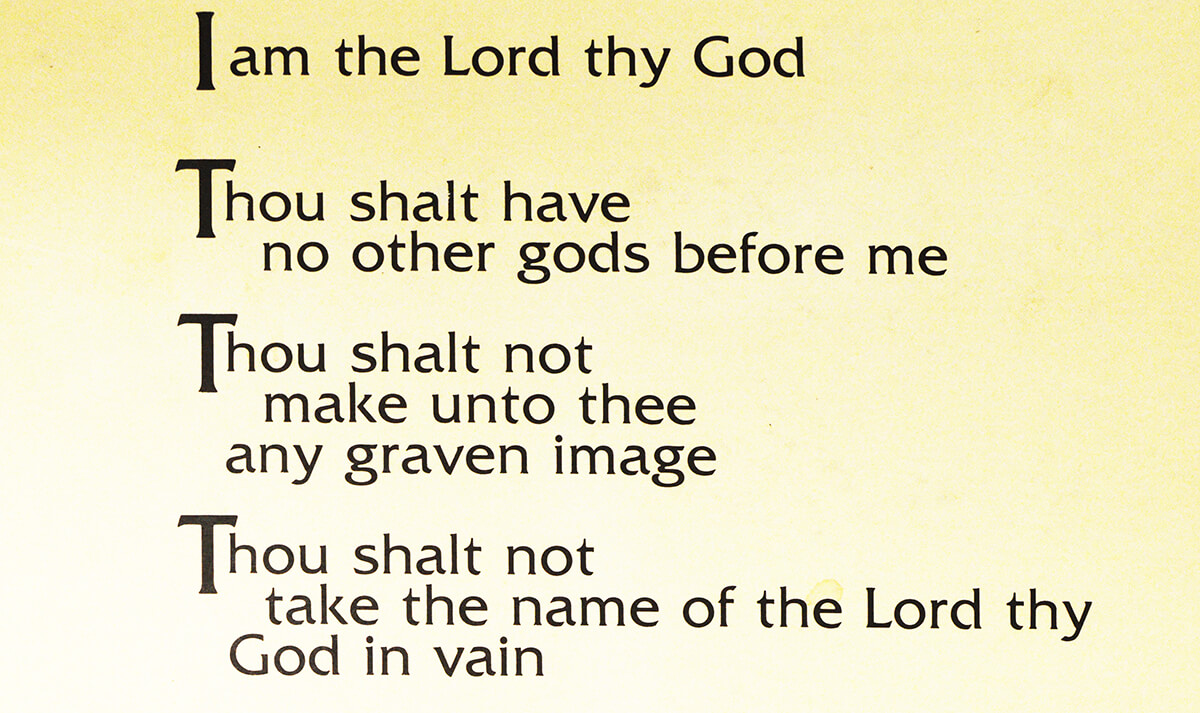
Another frequently mentioned “moral value” involves taking care of the poor. As the Rev. Stephen Bouman explains, “One thing Jesus was absolutely clear about was helping the poor.” While it is true that the Bible does have much to say about helping the poor, it is also true that the Bible clearly prioritizes certain issues. Consider the fact that God took over 600 laws and reduced them into His “Top Ten” commandments. The protection of innocent life does make God’s Top Ten (#6), and the protection of the sanctity of marriage also makes God’s Top Ten (#7); however, taking care of the poor does not make God’s Top Ten, and to elevate that issue above what God has elevated is to usurp His authority and that of His Word.

Additionally, when George W. Bush, then Texas Governor first implemented faith-based programs in Texas, CBS News traveled to Fredericksburg, Texas, and reported that the same amount of welfare money that previously had taken care of 4 recipients in the government system was now taking care of hundreds of recipients in the faith-based welfare system. Therefore, it is apparent that the ability to better help the poor is dramatically increased by the implementation of faith-based
programs – something that most Democrats vehemently oppose and most Republicans strongly support.

Statistical indicators in the election – as well as the reactions and rhetoric of those who lost – clearly confirm that “moral issues” were a definitive and major influence in the outcome of this election. So was there a moral mandate delivered by voters on election night 2004? Many indicators would suggest that the answer may be, “Yes.”

* This article concerns a historical issue and may not have updated information.
Taking On The Critics

As an example of the kind of misportrayals and mischaracterizations that David Barton is subjected to by critics, we have provided the following excerpt from an article written by Barry Hankins, an associate director of Baylor University’s JM Dawson Institute of Church-State Studies. Hankins’ article was entitled Separation Of Church And State Is Not Just For Liberals, and is typical of works by secularism advocates in that while it purports to discuss the “history” of church-state separation, it fails to use historical sources but instead overwhelmingly relies on works from current sources rather than primary or original sources. (David Barton’s response is provided below the article excerpt.)

Separation Of Church And State Is Not Just For Liberals excerpt:

Close observers of this phenomenon will know that arguably the most prolific and effective proponent of the antiseparationist view is David Barton, the former math teacher and high school principal who founded Wall Builders, headquartered in Aledo, Texas. Barton barnstorms the country with high tech slide-show presentations purporting to prove that the founders intended to establish a nation that gave preference to Christianity. He has written the aptly titled The Myth of Separation. In all his books, tapes, and public addresses, Barton relies heavily on selected quotations from America’s founders.

Recently Robert Alley, professor emeritus at Richmond University and an expert on James Madison, questioned a Barton quote attributed to Madison. When Alley’s research revealed that Madison had probably never uttered the remark in question, Barton retracted it. In an astounding move, Barton also issued a published retraction of 11 other quotes, listing 10 as questionable and two, including the Madison quote, as false.[7] However, the flap does not seem to have slowed Barton’s juggernaut.

David Barton’s response:

August 30, 2003
Barry Hankins
J. M. Dawson Institute
Baylor University
Waco, TX 76798

Mr. Hankins:

I recently was given an article you had authored, “Separation of Church and State is not Just for Liberals.” The copy I received was undated; perhaps it is an older article; nevertheless, since I was a subject of your pen (and since you never took the time to consult me either to confirm or deny what you alleged about me), I thought I would present you with a few facts concerning the misrepresentations you made about me on page 1 of that article:

1. To my knowledge, the only time I have acknowledged or read anything that Robert Alley has written was his attack on me for speaking at Gov. George Allen’s Inauguration in January 1994. It may come as a complete surprise to you to learn that I neither read nor follow anything Robert Alley may or may not say about me, nor have I read any article by him about Madison or his writings.

2. Since I do not read Alley’s materials nor do I concern myself with his writings, he clearly had no influence on our publication of the “Questionable Quotes” list. Consider: we listed over a dozen questionable quotes but Alley apparently mentioned only the Madison quote; and you assert that was the reason we issued our much more extensive list? Ridiculous! In fact, to our knowledge, my article about the uncertainty of the Madison quote predated his; we did not change our position in response to anything he wrote; rather, I publicly announced that I would no longer use the Madison quote (and others) not because it was inaccurate but rather because I had determined to raise the scholarship of the debate from an academic level to the higher level of legal documentation known as “best evidence” – a level of documentation that most of those in your camp have yet to embrace.

(For example, In Search of Christian America, written by three PhDs from your viewpoint, purports to search the Founding Era (1760-1805) for evidences of official acknowledgments of Christianity and concludes that there is a lack of such evidence. However, of the hundreds of sources cited to reach that conclusion, some 80 percent were taken from sources published after 1950 – more than a century-and-a-half after the period they purport to investigate! Such disparate and dissimilar sources would be unacceptable in a court of law.)

3. Alley can neither claim that Madison “never” uttered the “quote in question” about the Ten Commandments nor that it was “false.” As you yourself know, Madison’s “Detached Memoranda” (surely one of your favorite documents) was not “discovered” until 1946. More Madison letters previously unknown are found regularly, often in the estates of recently deceased individuals who held private collections or inherited family heirlooms received directly from Madison’s hand. Furthermore, much of what is known about Madison and his diverse and often changing viewpoints frequently comes from Madison’s contemporaries rather than from his own writings.

For example, more of Madison’s succinct statements against slavery are available through his personal interviews with Harriet Martineau (published in the early 1800s) than from his own writings. Alley can no more claim that the Madison quote does not exist than I can claim that it does. However, I can show that the Madison “quote in question” has been in circulation for generations, and I can document it (as I did) to non-modern works and works by credentialed historians. Quite simply, neither I nor Alley can say whether or not the Madison quote is false; however, I simply decided that I would no longer quote academics, historians, or doctorates of history to establish what the Founders said (as you regularly do) but instead I would cite only primary source documentation that meets a legal standard of evidence. (I continue to challenge your side to meet the same standard.)

4. Your claim that “The flap does not seem to have slowed Barton’s juggernaut” is baseless and irrelevant simply because there was no flap other than what you attempted to concoct. Furthermore, the specific work you so recklessly demean (The Myth of Separation) provided over 750 footnoted citations. Therefore, for us to drop a dozen quotes from that work represented a trivially small percentage and no historical conclusion was changed.

For example, rather than continuing to use the uncertain James Madison quote on the Ten Commandments, I replaced it with irrefutably-documented statements by other Founders on the same subject – such as the Ten Commandments quote by John Adams (by the way, Adams – unlike Madison – actually signed the Bill of Rights and is an equally competent legal authority on the subject). As a result of my decision to elevate the level of documentation, we replaced The Myth of Separation with Original Intent – a work with over 1,400 footnotes (rather than the 750 in Myth), and a work that not only meets legal standards of scrutiny but that also arrives at the identical historical conclusions reached in The Myth of Separation.

5. On the other hand, I notice that in books from those of your perspective, few footnotes are presented. For example, in The Godless Constitution – an allegedly “scholarly” university text written by two prominent PhDs – no footnotes are provided. As they openly concede, “we have dispensed with the usual scholarly apparatus of footnotes.” While a work such as this with no footnotes is probably acceptable to you simply because of its conclusions, it would not pass legal muster for best evidence; yet my work which does pass the standards of legal scrutiny is completely unacceptable to you. Ironically you frequently embrace and laud the types of works that fail to meet the legal standard of “best evidence” while attacking and demeaning the ones that do.

I recognize that there can be honest differences of opinions between well-intentioned individuals; and I whole-heartedly support your right to free speech — including your right to make uninformed statements, present incomplete and inaccurate information, and offer complete mischaracterizations and misportrayals — as you have done in the part of your article addressing me. Regrettably, the section of your article about me neither meets the standards of basic journalism (where an individual attacked in an article is called and asked to respond to charges) nor of academic scholarship (where footnotes and documentation are provided).

In your defense, I did note that you provided one footnote to document my “false” quotes; however, the source of that documentation was actually an attack piece written against me by one of your closest allies — not quite an unbiased objective source! However, objective truth was probably never the goal of your article.

An old lawyers’ adage admonishes: “When you have the facts on your side, argue the facts. When you have the law on your side, argue the law. When neither is on your side, change the subject and question the motives of the opposition.” You seem to have chosen the latter course of action.

David Barton

[For more information on this issue please see Unconfirmed Quotations”]

Ten Commandments Displays

Introduction

While there have been dozens of rulings striking down Ten Commandments displays (another indication that federal judges need to be appointed to the courts who are well-versed in original constitutional understandings); no ruling has been more publicized than that against Judge Roy Moore in Alabama. In that case, the 11th Federal Circuit Court of Appeals ruled that a 5,280 pound granite monument of the Ten Commandments could not be displayed in the rotunda of the Alabama State Judicial Building.

The ACLU, Americans United for Separation of Church and State, and the Southern Poverty Law Center filed suit against the Ten Commandments display on behalf of three attorneys. And why did those attorneys want the monument removed? They alleged that they had been “personally offended” by the monument and “as a result, suffered direct injury.” A three-judge panel of the 11th Federal Circuit Court of Appeals agreed with them and prohibited the display.

Court Decision

In order to reach their decision, the panel of federal judges transformed themselves into an ecclesiastical council of theologians. They ruled that the version of the Commandments posted by Judge Moore was a “Protestant” version and that “Jewish, Catholic, Lutheran and Eastern Orthodox faiths use different parts of their holy texts as the authoritative Ten Commandments.”

Strange! I thought that “Do not kill” and “Do not steal” meant the same regardless of the version! In fact, I am not aware of any person in America who, after seeing the granite monument, would cry out, “I have just seen the 9th command forbidding perjury, but it is a Protestant version of the Ten Commandments that I just saw, so I cannot obey it for I am a Lutheran (or a Catholic, or a Jew, or whatever).”

The 11th Circuit had ignored an elementary principle of law—and thus a fundamental responsibility of the courts: establish the spirit and intent of a law before making any ruling about it. Signer of the Constitution John Dickinson had explained the importance of this legal principle:

[N]othing is more certain than that the forms of liberty may be retained when the substance is gone. In government, as well as in religion, “the letter killeth, but the spirit giveth life.” 2 Cor. 3:6

The Ten Commandments

Actually, the Ten Commandments themselves were the result of God’s demonstration of this principle. When God delivered the Commandments, He told Moses “According to the tenor of those words I have made a covenant with you” (Exodus 34:27). That is, God Himself declared that the Ten Commandments were merely the general theme (the tenor) of what He wanted. “Don’t steal,” “Don’t kill,” “Don’t commit perjury,” etc. were simply the summation of over 600 laws given at or about the same time.

That these laws simply represent the spirit of all civil and criminal laws was made clear by an elderly Texas woman, Esther Armstrong. Despite her advanced years, Esther maintained a ministry in local prisons and jails, frequently visiting the inmates, all of who considered her as their own grandmother. One day, one of the “jail-house attorney” inmates (a prisoner who has become obsessed with the study of the law) told Esther in amazement: “Mama Esther? Did you realize that there are over one-hundred thousand laws that will put you in jail?” To which she promptly replied, “Do you realize that there are Ten that will keep you out?”

11th Circuit Court

Nevertheless, the federal judges refused to consider the general purpose of the Commandments. Instead, they focused on theological minutia about which version of the Ten Commandments was on display (which they apparently felt completely competent to address) much in the same way that theologians of former generations vigorously debated such useless and inane topics as how many angels would fit on the head of a pin.

Perhaps only a liberal activist judge, an ACLU attorney, or a member of Americans United for the Separation of Church and State (i.e., groups and individuals who have demonstrated their distaste for religion in general) would make this “theological” distinction as they did in this case. I am quite sure that Judge Moore, just like 99.9 percent of Americans, was not aware (nor would he have cared) that there were allegedly different theological versions of the Commandments. As a judge, he was concerned with general behavior, not theology.

Furthermore, I firmly believe that no matter which version of the Ten Commandments Judge Moore would have displayed (whether Jewish, Catholic, Protestant, or one of each), the same arguments still would have been used against him.

The three theologians (Oops! My bad!!! I meant the three judges) in the 11th Circuit who delivered the decision even personally impugned Moore, comparing him to “those Southern governors who attempted to defy federal court orders during an earlier era.” Amazing! Apparently in the minds of those judges, Judge Moore’s displaying the Ten Commandments must be a sin akin to racism! The three also forcefully pronounced to Moore a warning that when the time came, he would obey their order to remove the Commandments.

Protests

Following the 11th Circuit’s decision, federal district judge Myron Thompson (who originally ruled against Moore before the case rose to the 11th Circuit) promptly issued his own order that the monument be removed. Now! Even before Judge Moore’s appeal to the Supreme Court had been filed. Judge Moore refused to comply with that order, and hundreds rallied outside the court building in an effort to prevent the removal of the monument.

Dozens who exercised their First Amendment right “peaceably to assemble and to petition the government for a redress of grievances” were handcuffed and arrested, including an elderly woman in a wheel chair. She was one among hundreds willing to resort to peaceful civil disobedience in order to preserve respected symbols of our nation’s heritage and the constitutional right to free exercise of religion. Amazing! Americans are being arrested for trying to preserve the nation’s moral law rather than break it!

This same type of peaceful civil disobedience eventually turned the tide in the civil rights’ protests of the early 1960s. When Americans saw blacks arrested and beaten by police simply for sitting in the wrong seat on a bus, or going to the wrong table in a cafe, public sentiment propelled legislators to action to provide a political solution. Such may well be the effect of the current arrests—if they continue for an extended period. Perhaps the current publicity will cause Christians to stand up not only for this display but also for those in their own local communities.

Judge Moore

Interestingly, voices of condemnation against Judge Moore have been raised around the nation, alleging that he refuses to follow “the rule of law.” Such claims constitute some of the more civically-illiterate statements made in recent years.

Consider: in every student civics or government book in America is a page on “How a Bill Becomes a Law.” Anyone who examines those pages will notice that the judiciary has no role in making law; laws come from bills passed by the legislature and signed by the president or governor. Since no such law has been passed in this case, what “rule of law” is Judge Moore not upholding? Can it actually be that these critics talking about “the rule of law” believe that an order by a single unelected federal judge is actually the equivalent of a law? Apparently so.

Don’t misunderstand: this is not to suggest that judicial rulings should be ignored based on the personal predilections of an individual in a case; however, this ruling goes against every deeply embedded legal standard in America’s common law, and Judge Moore’s refusal is not based solely on his selfish or personal inclinations. (To learn how deeply the Ten Commandments have been implanted into American law and traditions, read our legal brief on this issue.)

Actions Against Him

Following Judge Myron Thompson’s edict, the other eight justices on the Alabama Supreme Court announced their unanimous opposition to Judge Moore’s position and agreed to cooperate in the removal of the monument. Judge Moore was subsequently suspended from his judgeship by the Alabama Judicial Inquiry Commission for his refusal to comply with the federal judge’s order.

Importantly, Judge Moore is elected (as are the other eight State Supreme Court  judges) and therefore ultimately accounts directly to the people of Alabama, who can have the final say on this issue. When that time comes, the decision of the voters likely will not agree with the State’s other Supreme Court judges or the State’s Judicial Inquiry Commission. Moore was already well-known for his stand for the Ten Commandments before he was elected to the Supreme Court (he had already won three legal decisions on the Ten Commandments at the time of his election) and recent polls show that 77 percent of the State supports the display.

Conclusion

The U. S. Congress is well aware of the situation in Alabama, and the House has already taken direct action.

Rep. John Hostettler introduced, and the House overwhelmingly passed (260-161), an amendment that prohibits federal funds from being used to enforce the judicial order against the display. Similarly, Rep. Robert Aderholt has introduced (and the House has twice passed) the Ten Commandments Defense Act, allowing State and local communities rather than federal judges to have the final say in displays of the Ten Commandments. The Senate Democrats have killed the bill each time.

Sen. Wayne Allard (R-CO) has introduced a bill (S 1558) that applies powers from Art. III, Sec. 2 of the U. S. Constitution to restrict the federal judiciary’s right to rule on this issue, but the bill is not likely to move unless Democratic Senators feel substantial pressure to do so.

The monument was eventually removed from the Rotunda and relocated in a remote non-public room in the building. This is simply a reconfirmation of the overall judicial message of recent years: if you must have a religious expression, it must be done in private (like pornography), not out in public where others can see it.

Churches And Elections – What Is The Law?

Liberty Legal Institute

Kelly
J Shackelford
Chief Counsel
903 East 18th St., Suite 230
Plano, Texas 75074
972.423.8889 Fax: 972.423.8899
[email protected]

CHURCHES AND ELECTIONS-
WHAT IS THE LAW?

Many churches and pastors feel called by scriptureto “equip the saints” to represent Christ in all areas of our society, including the voting booth. Pastors should thus be supported in their goal of helping their members be good stewards in representing Christ in their civic duties. This is especially important in light of the fact that only 1 out of every 4 Christians in America is voting.

Unfortunately, many churches and pastors have been given false information in an attempt to scare them from acting as a pastor and impacting their culture for Christ. The law is actually very supportive of pastors and churches in fulfilling their mission to equip their saints. Even as a non-profit corporation, there is very little a church may not do.

CHURCHES MAY NOT:

1. Endorse or oppose a particular candidate.

2. Contribute to or raise $ for a candidate (including free use of church list)

CHURCHES MAY (among other activities):

1.  Register their members as voters

2. Pass out Voter’s Guides

3. Invite all candidates in a race to speak (O.K. if only one shows up)

4. Speak Directly about specific issues and legislation (abortion, marriage, etc.)

Individually, a pastor can do whatever he feels led to do-endorse, support a member’s campaign, etc. There are no limitations. The few limitations above that exist are only for the Church entity and only if the Church is a non-profit corporation.

Pastors should not be intimidated from acting as pastors, calling their people to vote and giving them info so they can best represent Christ in the voting booth.

Liberty Legal Institute (now First Liberty) is the state legal group in Texas associated with Focus on the Family. It protects churches and religious freedoms free of charge. At the time of this article, H.R. 235, the “Houses of Worship Free Speech Restoration Act,” is currently pending in Congress. This bill would amend the IRS Code of 1986 to restore the ability of churches and other houses of worship to freely participate in political campaigns.

Impeachment of Federal Judges

The Founders’ intent for impeachment was to protect the fundamental principle of “the consent of the governed.” The Constitution carries no title but “We the People,” and impeachment removes from office those officials who ignore that standard. (Recall that the Constitution does not guarantee a federal judge his position for life, but only for the duration of “good behavior.” Art. III, Sec. 1)

For this reason impeachment was used whenever judges disregarded public interests, affronted the will of the people, or introduced arbitrary power by seizing the role of policy-maker. Previous generations used this tool far more frequently than today’s generation; and because the grounds for impeachment were deliberately kept broad, articles of impeachment have described everything from drunkenness and profanity to judicial high-handedness and bribery as reasons for removal from the bench. (Sixty-one federal judges or Supreme Court Justices have been investigated for impeachment, of whom thirteen have been impeached and seven convicted.)

Today’s judiciary, not having experienced any serious threat of impeachment as judges in earlier generations, repeatedly flaunts its contempt for the will of the people. It recently has overturned direct elections in Washington, New York, California, Arkansas, Texas, Missouri, etc., simply because it preferred a different outcome. This is not to suggest that the results of all citizen elections are final and infallible, for it is the duty of the Court to protect the Constitution. However, the above elections violated at most the judiciary’s ideological leanings rather than any manifest provision of the Constitution (e.g., English as a State’s official language, ending government assistance for illegal immigrants, enacting term-limits, prohibiting physician-assisted suicides).

Examples of Judicial Abuses

While most are aware of the 9th Circuit’s recent decision that saying “under God” in the Pledge of Allegiance threatens our American form of government, there are numerous additional examples, some staggeringly unbelievable. For example, in Jane Doe v. Santa Fe, a federal judge ruled that graduation prayers must not include any mention of “Jesus” or other “specific deities” and that any student offering such a prayer would face immediate arrest and up to six months in jail. The judge threatened “violators” by saying they would wish they “had died as a child” once his court finished with them.

In a Texas county where conservatives narrowly won multiple seats in an election, a federal judge reversed that outcome by arbitrarily throwing out the 800 votes cast by U.S. military personnel, saying they had no right to vote in local elections.

A federal judge in Nashville reviews the verdict of any jury in Tennessee that awards the death penalty. This judge has openly declared his personal opposition to the death penalty and has set aside every jury decision on this issue, despite the Constitution’s explicit language to the contrary. The judge even allows nine years to pass, on average, before overturning the jury’s sentence, thus disregarding the Constitution’s guarantee to a speedy trial.

After citizens in a statewide election voted down a proposed tax-increase in Missouri, a federal judge, in direct violation of Article I of the Constitution, unilaterally set aside the election results and instead decreed that the tax be levied in order to finance his own personal plan for education in the State. Interestingly, this judge’s plan (which funded the “Taj Majal” of public education) proved to be a dismal failure – at the continuing economic expense of the entire State.

There are many other examples; today’s judiciary is now so arrogant that the Supreme Court’s own Justices have described it as “a super board of education for every school district in the nation,” as amateur psychologists on a “psycho-journey,” and as “a national theology board.”

The Supreme Court versus Congress

Even though the Constitution gave the lawmaking powers to the Congress, courts have become the predominant policy making body in the nation. In fact, on public tours of the Supreme Court, one often hears the ridiculous claim that “this is the building from which all the laws in the land emanate.” The Supreme Court, fully believing its own propaganda, regularly strikes down or rewrites the laws of Congress to conform to its own predilections and edicts.

For example, in 1993, Congress passed the Religious Freedom Restoration Act (RFRA) to correct an earlier Supreme Court decision that weakened a long-standing First Amendment protection for religious groups. That Congressional act reinstituted protection declaring that a government entity must not interfere with a religious body unless it had “a compelling state interest” for doing so. When a Catholic church in Boerne, Texas, sought to accommodate its burgeoning membership but was denied a building permit to expand its facilities, the church invoked relief under RFRA, claiming the city had no “compelling state interest” in denying the church expansion. The Court ruled otherwise, striking down Congress’ attempt to protect religious bodies from government intrusion. While most decried this decision for weakening the rights of religious bodies, there was a far greater question at stake.

Congress invoked Section 5 of the Fourteenth Amendment of the Constitution in passing RFRA to protect religious freedoms from further governmental encroachment. Yet even though the Congress had acted on the power explicitly given it in the Constitution, the Court struck down the law, refusing to be corrected by Congress and warning that Congress should not attempt to correct a Court ruling. Significantly, Congress cited the Constitution as its authority for passing RFRA, but the Court did not cite the Constitution as its authority for striking RFRA down. The Court instead pointed to its own previous decisions, thus elevating its rulings higher than the Constitution itself. As it explained, “Any suggestion that Congress has a substantive, non-remedial power under the Fourteenth Amendment is not supported by our case law.” The Court then rebuked Congress, warning that its judicial edicts must be treated “with the respect due them.” In short, we the Court demand that you the Congress adhere to our opinions regardless of what the Constitution says.

Obviously, the Supreme Court considers both itself and its decisions supreme over Congress. However, the Constitution disagrees – it deliberately empowers Congress with greater power. For example, the Constitution gives Congress the authority to set the salaries for judges, determine the size of the Judiciary, establish the scope of the Judiciary’s jurisdiction and the types of cases which come before it. Furthermore, judges cannot serve without the approval of Congress, and Congress may remove judges with whom it is dissatisfied. These are just some of the “constitutional arms” for Congress’ “powers of self-defense” (Federalist 73, Alexander Hamilton).

The Constitution clearly places many of the operations of the Judiciary under the oversight of Congress – a power not granted reciprocally to the Judiciary. This is made clear in the Federalist Papers (described by James Madison as “the most authentic exposition of the heart of the federal Constitution”), which confirm that subjugating the Judiciary to Congress was deliberate and intentional. Federalist #51 declares:

The legislative authority necessarily predominates.

Federalist #78 then proclaims:

The Judiciary is beyond comparison the weakest of the three departments of power.

Furthermore, Federalist #49 declares that Congress – not the Court – is “the confidential guardians of [the people’s] rights and liberties.” Why? Because the Legislature – not the unelected judiciary – is closest to the people and most responsive to them. In fact, the Court’s own history proves that it is not a proficient guardian of the people’s rights. For example, after the Civil War, Congress passed civil rights laws forbidding segregation, but the Court struck down these laws and instead instituted “separate but equal” in Plessey v. Ferguson. (While the Court eventually ended this racial segregation in Brown v. Board of Education, that decision was merely the Court’s reversal of its own segregation standard previously established in Plessey.)

Moreover, had it been up to the Court, slavery would have never ended: in 1857, the Court declared it unconstitutional for the other branches to end slavery or to free slaves. Fortunately, Congress ignored that decision by declaring freedom for slaves in 1862 and President Lincoln also ignored that decision by issuing the “Emancipation Proclamation” in 1863. All substantive progress in civil rights after the Civil War was accomplished only after Congress used Article III, Section 2 of the Constitution to remove Reconstruction issues from the Court’s reach. Indeed, history demonstrates that the Court is less than a faithful guardian of the people’s rights, violating the people’s liberties as often as it protects them. As Thomas Jefferson pointed out:

Our judges are as honest as other men and not more so. They have, with others, the same passions for party, for power, and the privilege of their corps. . . . and their power the more dangerous as they are in office for life and not responsible, as the other functionaries are, to the elective control.

Today, the Court claims that it is the only body capable of interpreting the Constitution – that Congress is incapable of determining constitutionality. However, the Founding Fathers vehemently disagreed. For example, James Madison declared:

[T]he meaning of the Constitution may as well be ascertained by the Legislative as by the Judicial authority.

Constitutional Convention delegate Luther Martin similarly attested:

A knowledge of mankind and of legislative affairs cannot be presumed to belong in a higher degree to the Judges than to the Legislature.

The Founders consistently opposed the Court being the final word on constitutionality. For example, Thomas Jefferson declared:

[T]o consider the judges as the ultimate arbiters of all constitutional questions [is] a very dangerous doctrine indeed, and one which would place us under the despotism of an oligarchy. . . . The Constitution has erected no such single tribunal.

He further explained that if the Court was left unchecked:

The Constitution . . . [would be] a mere thing of wax in the hands of the judiciary which they may twist and shape into any form they please.

Allowing the Court to enlarge its own sphere of power beyond what the Constitution authorizes, permitting the Court to usurp the powers of Congress, and tolerating the Courts’ disregard of constitutional separation of powers moves America ever further from being a representative republic and ever closer toward the oligarchy against which Jefferson warned. The Court must be resisted in these attempts.

Impeachment: The Founders’ Solution

As noted earlier, judges in previous generations who usurped powers from Congress or the people faced impeachment. But today’s critics claim that the use of impeachment would either make the judiciary a “political” branch (as if it were not already a political branch) or that it would violate the “independence of the judiciary.” Yet, as Thomas Jefferson so accurately cautioned,

It should be remembered as an axiom of eternal truth in politics that whatever power . . . is independent is absolute also. . . . Independence can be trusted nowhere but with the people in mass.

No judge should ever be so independent that he is unaccountable to the Congress, and thereby the people. As Justice James Iredell (placed on the Court by President George Washington) so clearly explained:

Every government requires it [impeachment]. Every man ought to be amenable for his conduct.

Iredell further noted that some officials will behave themselves only under “the very terror of punishment” that impeachment provides. Recent events suggest he was right.

In 1996, six members of the Supreme Court voted to overturn the Colorado election forbidding special (rather than just equal) rights for homosexuals. Following that flagrant display of contempt for the will of Colorado voters, there was a national call for the impeachment of those six Justices. After this clamor for their removal, those same six Justices suddenly became ardent defenders of the people’s elections and in a subsequent decision unexpectedly and unanimously chastised a lower court that had overturned a statewide election in Arizona. (Interestingly, Thomas Jefferson on multiple occasions called impeachment a “scarecrow” – something used to frighten predators – and the threat of impeachment certainly had that effect on the Supreme Court.)

Similarly, after a federal judge overturned a binding referendum by the voters of California (“Proposition 209”), national leaders called for the impeachment of that judge. Later, the 9th Circuit ordered the results of the election reinstated and criticized that judge for ignoring the will of the people. Yet, this same 9th Circuit Court had itself shortly before overturned at least three similar elections. Why the flip-flop? The “scarecrow” had been forcefully raised by Congress to make judges accountable for their decisions by returning to the original constitutional uses of impeachment.

It is true that impeachment is a cumbersome process, and achieving a conviction is difficult. However, on most occasions, just the threat of impeachment produces results. In fact, there are several examples of federal judges correcting their own decisions after hearing Congressional calls for their impeachment; and an actual impeachment sends an even more powerful message to all other wayward leaning judges.

Although Congress is ultimately responsible for the discipline of judges, far too many of our Congressmen (like far too many of our citizens) have no understanding of the proper use of impeachment. However, a wise political axiom declares that “Congress sees the light when it feels the heat,” and this is especially true on this issue. As citizens, we need to educate ourselves on the proper use of judicial impeachment, and then we need to educate our Representatives, reminding them of the need for judicial reform and alerting them to those judges showing a pattern of abuse. The time for encouraging judicial accountability is once again ripe. This is a golden opportunity for citizens to weigh in and make a difference.

Copyright © 2002 David Barton, WallBuilders

(An excellent tool for educating yourself and your Congressional representative is the book Restraining Judicial Activisim . This work documents both the Founders writings on this issue and how impeachment was used in America in previous generations. Get a copy for yourself and an extra copy for your Representative and Senators!)


* This article concerns a historical issue and may not have updated information.
Solving the Pledge of Allegiance Controversy

The recent court ruling that saying “under God” in the Pledge of Allegiance threatens our American form of government came as a shock to millions of Americans. Even the cynical “nothing-can-surprise-us” national media raised its collective eyebrow at the decision.

Given the popularity of the Pledge, the reaction to that ruling was not surprising. For example, Members from both the House (mostly the Republicans) and Senate walked outside their chambers, faced the Supreme Court, and recited the Pledge – with a particularly loud emphasis on the “offensive” phrase. And for days following the decision, I was inundated with radio interviewers seeking the background of the case and its repercussions for the future. Even judges called, offering suggestions of how to deal with their renegade brethren. Congressmen also called, seeking help in drafting legislation to strip power from the courts as well as to begin impeachment proceedings against the offending judges.

This decision was described by White House and congressional leaders with adjectives such as “outrageous,” “ridiculous,” “stupid,” “asinine,” “twisted,” etc. However, it was not, as many might believe, far and away the single worst decision rendered by courts in recent years; it was just the one we all heard about. This decision, for example, was no less egregious than when the federal judge in Texas warned students that if they used the word “Jesus” in a prayer, a federal marshal would arrest them and give them six months in jail. Nor was this decision less despicable than when a federal judge in Alabama ordered undercover monitors into the classrooms to report to him if students engaged in illegal and forbidden religious conduct – such as praying over their lunches at school. No, these unpublicized decisions were just as unsavory as the recent one by the 9th Circuit.

Nonetheless, millions of Americans, now made aware of this absurd decision, are properly asking whether it will be overturned. Yet the more important question is how this decision came to be made in the first place.

The nation received its first public glimpse into what lay behind this decision during the second presidential debate in St. Louis in 2000. Al Gore promised that if he were elected President, he would continue the practice of his predecessor and place judges on the courts who believed that the Constitution was a living document. George Bush, on the other hand, pledged that his judicial nominees would be strict constructionists.

  • A strict constructionist interprets the Constitution as it is written, not as he or she wished it had been written. Thus, the Constitution’s guarantee of the “free exercise of religion” would protect the right to use “under God” in the Pledge of Allegiance.
  • A judge who believes in a “living constitution” believes that what the Supreme Court says about an issue is more important than what the Constitution says about the same issue. These judges agree with the philosophy set forth by former Supreme Court Chief Justice Charles Evan Hughes that, “We are under a Constitution, but the Constitution is what the judges say it is.”

The decision of the three judges in the Pledge case revealed that only one of the three was a strict constructionist – and unfortunately he was outvoted by the two “living constitution” judges. Significantly, those two did not use the Constitution to strike down the Pledge but instead cited three recent tests erected by the Supreme Court to replace the express language of the Constitution.

The first test was established in 1971 when the Court decided that the language of the religion clauses in the Constitution would be replaced with what it called its “Lemon Test.” Under this test, unless a public religious activity had a primarily secular purpose, that religious activity would be unconstitutional. In 1984, the Court established its second test, the “Endorsement Test,” declaring that if it appeared that the government was permitting a public religious activity, then the activity would be unconstitutional because someone might think that the government was “endorsing” religion. Then, in 1992, the Court added its third test, the “Psychological Coercion Test.” Under this test, if a single individual (such as the atheist in California who objected to the Pledge) is uncomfortable in the presence of a public religious public activity, then the Court will make that activity stop.

The two judges who ruled against the Pledge cited each of these three Tests rather than the Constitution. They struck down the Pledge because it failed the “Lemon Test,” the “Endorsement Test,” and the “Psychological-Coercion Test.”

While most Americans are completely unaware of these two judicial philosophies, those in Washington are not. In fact, it is the Senate’s clear understanding of these two philosophies that has caused one of the biggest unreported battles this session.

President Bush, true to his promise, has nominated 103 “strict constructionists” to fill federal judgeships. The Senate leadership, however, has refused to confirm his judges slated for the Court of Appeals. The Senate understands that if “strict constructionists” were placed on the courts, then the judicially-enacted national policies against school and graduation prayers, against the protection of innocent life, against traditional morality, etc. would be threatened. In fact, many of President Bush’s judicial nominees have gone more than a year without Senate action while it took President Clinton an average of only 77 days for the Senate to get his “living constitution” judicial nominees confirmed. Therefore, even though the Senate voted a 99-0 condemnation of the Pledge decision, for many Senators this vote was largely disingenuous since more that half the Senate (nearly all the Democrats) is actively engaged in keeping judges off the courts who would uphold the Pledge.

Yet, despite the Senate’s direct complicity in the Pledge decision, the Senate is not to blame for this travesty; Christians are. Why? Because of their widespread refusal to vote. There are 60 million evangelicals in America, and in the last election only 15 million voted (and 24 million of those 60 million evangelicals are not even registered to vote)! In that same election, five Senators lost who, if still in office, would have provided a majority of Senators that would confirm President Bush’s judicial nominees. However, those five Senators lost by a collective total of 100,000 votes in those five States – and 45 million evangelicals did not even vote in that election!

If Christians had voted for God-fearing Senators last election, not only would we have a different type of judge moving into the federal judiciary but fifty-three measures now languishing in the Senate would now be law. Those measures include a ban on human cloning, a ban on partial-birth abortions, a ban on “aborting” children after they are born (called the “Infants Born-Alive Protection Act”), a reversal of the discrimination against marriage, protection for faith-based programs, and many other measures. The President wants to sign these bills; the House has already passed them; but the Senate leadership refuses even to hold hearings on them.

President James A. Garfield (an ordained minister of the Gospel) foresaw a century ago where we are today:

Now, more than ever before, the people are responsible for the character of their Congress. If that body be ignorant, reckless, and corrupt, it is because the people tolerate ignorance, recklessness, and corruption. If that body be intelligent, brave, and pure, it is because the people demand these high qualities to represent them in the national legislature. If the next centennial does not find us a great nation, it will be because those who represent the enterprise, the culture, and the morality of the nation do not aid in controlling the political forces.

Understanding the importance of Christian involvement in elections, and its impact on the entire nation, Rev. Charles Finney (a leader in the 19th century’s Second and Third Great Awakenings) warned:

The Church must take right ground in regard to politics. . . . The time has come that Christians must vote for honest men and take consistent ground in politics. . . . God cannot sustain this free and blessed country which we love and pray for unless the Church will take right ground. Politics are a part of a religion in such a country as this, and Christians must do their duty to the country as a part of their duty to God. . . . God will bless or curse this nation according to the course Christians take in politics.

If we want to see less Pledge of Allegiance type rulings, then its time that Christians get out and vote. Thirty-three States have Senate elections this November, and in many of those States there are solid, evangelical, God-fearing Christians running for the Senate. In fact, many of those now running for the U. S. Senate have been in the U. S. House passing the good bills, but now want to move to the Senate where they can help break the logjam.

As the November elections draw near, heed the words of the Rev. Matthias Burnet, who in 1803 properly warned:

Ye whose high prerogative it is to . . . invest with office and authority or to withhold them and in whose power it is to save or destroy your country, consider well the important trust . . . which God . . . has put into your hands. To God and posterity you are accountable for them. . . . Let not your children have reason to curse you for giving up those rights and prostrating those institutions which your fathers delivered to you.

Houses of Worship Free Speech Restoration Act

Congressman Walter Jones from North Carolina’s 3rd District has introduced H.R. 235, the “Houses of Worship  Free Speech Restoration Act.” This bill would amend the IRS Code of 1986 to restore the ability of churches and other houses of worship to freely participate in political campaigns.

According to Congressman Jones:

“In 1954, then-Senator Lyndon B. Johnson offered an amendment to a revenue bill that would permanently extend the stranglehold of the Internal Revenue Service (IRS) into our nation’s churches, synagogues and mosques. Since that time, the IRS has turned the 501(c)(3) code-section on its head in an attempt to punish pastors, priests and rabbis for nothing more than communicating the principles of faith during an election period. If passed, the Houses of Worship Political Speech Protection Act would restore the rights of all religious organizations to determine for themselves what they can and cannot teach from their pulpits, or communicate to their congregation and the public without fear that their tax status may be in jeopardy. It is time to restore freedom to our Nation’s pulpits.”

houses-of-worship-free-speech-restoration-actTo contact your Representative or Senator: From a constitutional perspective, it is unconscionable that the current policy penalizing the free speech of religious institutions has remained intact and unchallenged for this long. The government has long recognized that institutions of faith and houses of worship have provided vital services to our communities and our nation. In fact, our public policy has been to honor the valuable contributions of these organizations with an exemption from taxes both for the organizations themselves and for the individuals and groups who support them. Regrettably, because of a simple appropriations rider in 1954, our public policy changed to recognizing the valuable contributions of houses of worship only if they gave up their constitutional right to free speech. (What an amazing exchange: we will honor your charitable contributions but only if you will give up your constitutional rights!) This obviously represents bad public policy and unjustly muzzles thousands of churches across America by preventing them from exercising their fundamental right to free speech. Free speech is most valuable when it is exercised during the elections of our government leaders.
  1. If you do not know your U. S. Congressman, go to https://www.house.gov/representatives/find-your-representative and type in yo ur zip code to learn the name of your Representative.
  2. Call the U.S. Capitol at (202) 224-3121. When the Capitol switchboard operator answers, ask for your Senator or Representative by name. When that office answers, ask to speak to your Congressman or Senator. If he is available, he will speak with you; if he is unavailable, simply tell his staff your thoughts on H.R. 235 and how you would like him to vote.
  3. If you wish to write and communicate the same message, the address is:

Name of your Representative

U.S. House of Representatives

Washington, DC, 20515


Name of your Senator

U.S. Senate

Washington, DC, 20510

(To access information (bill text, sponsors, status, etc.) and track the progress of the “Houses of Worship Free Speech Restoration Act,” go to https://clerk.house.gov/Votes and type in “HR 235” to see how your Congressman voted on a similar bill on October 2, 2002, click here. WallBuilders offers The Role of Pastors and Christians in Civil Government, which documents  the historic role people of faith played in our government.)

** This is historic information and not applicable to current pieces of legislation. **

united states flag

Ten Steps To Change America

Change Is Needed

What can be done to halt the havoc loosed on the United States since the early 60s? There must be two reversals, the first and most obvious one must occur in our national public stance toward God: the Supreme Court’s current ban on the acknowledgment of God and the use of His principles in public is a direct challenge to Him and has thus triggered the law of national accountability, subjecting the nation to severe consequences. Therefore, our current national public stand against God must be set aside.

The second reversal must center on the restoration of the personal benefits derived from living by Godly principles. For example, when the Courts ruled that students might not use the Ten Commandments, nor study the Scriptures, nor learn about sexual abstinence, etc., the separation of these teachings caused personal, individual harm to those students, as forewarned in Deuteronomy 6:24 and 10:13:

The Lord commanded us to obey all these decrees so that we might always prosper.

Observe the Lord’s decrees for your own good.

Observing His principles serves to our benefit. When His commands are rejected, it is to our own harm. Millions have been harmed by the mandated separation of His principles from specific arenas of their lives. The efforts at restoration and reversal must occur on both the national and on the individual levels.

Court Rulings & Christian Responses

In the decades immediately preceding the Court rulings (the 1920s, 30s, 40s, etc.), Christians en masse had voluntarily removed themselves from the political, social, and legal arenas. Whenever the Godly depart from any arena, their own Godly values depart with them. A person in office always legislates according to his own personal beliefs and convictions, and herein is the wisdom of Proverbs 29:2 made evident: “When the righteous rule, the people rejoice; when the wicked rule, the people groan.”

It was the plan and intent of the Founders that the Godly, and thereby Godly principles, remain intimately involved in the political, judicial, and educational realms. The Founders believed that only the Godly would understand the unalienable freedoms provided by God and thus protect them in our form of government; and they never intended that Christian principles be divorced from public affairs.

Christians, through bad doctrine, political inactivity, and apathy had handed the reins of the nation over to leaders who awarded potential lifelong appointments to Justices not only willing but also eager to uproot the Christian practices that had been the heart of this nation for centuries. Quite frankly, the Court’s 1962 (and subsequent) religion-hostile decisions were merely an outgrowth of what the Christian community-at-large had permitted and encouraged in the decades preceding those rulings.

A Biblical description of this process is given by Jesus in Matthew 13:24-26.  In that parable, good people had a good field growing good seed. However, an enemy came in and planted bad among the good, thus contaminating the entire field. What afforded the enemy such an opportunity? The stark answer is found in verse 24: “While the good men slept, the enemy came in.” Jesus never faulted the enemy for doing what he did, for it was his task and purpose to destroy; Jesus placed the fault on the good men who went to sleep, thus allowing the enemy to do what he did. Very bluntly what has occurred in America happened first because the church went to sleep, and then because the enemy came in and caused the damage.

The problems we have created for ourselves, although colossal, can be solved. Reversing the current trends involves making changes in the two areas mentioned earlier: (1) the official unfriendly stand taken against God must be corrected, and (2) religious principles and moral teachings must be restored and made available to individuals in public arenas. There are at least ten specific activities suggested in this chapter which can help realize these goals.

I. The first thing is to do first things first:

I exhort therefore, that, first of all, supplications, prayers, intercessions, and giving of thanks, be made for all men, for [leaders] and for all that are in authority. 1 TIMOTHY 2:1

This is not an arbitrary, haphazard plan given by God; God wants every individual to pray for civic leaders first, because civic leaders and their policies affect every individual. Simply for our own benefit we should be praying regularly for our leaders at local, state, and federal levels in each branch of government. Prayer will be the first key to effecting significant and lasting change, for situations do not change on earth until they have been changed in the heavenlies. Additionally, we need to pray faithfully that God will root the wicked from office and will raise up righteous individuals to replace them. “An ounce of prevention is worth a pound of cure,” and having the right individuals in office will prevent the enactment of many damaging policies. As explained by William Penn:

[G]overnments rather depend upon men than men upon governments. . . . Let men be good and the government cannot be bad. . . . [T]hough good laws do well, good men do better; for good laws may want [lack] good men . . . but good men will never want [lack] good laws nor suffer [allow bad] ill ones. [1]

Pray individually not only for our leaders on every level, but enlarge your sphere of influence and organize small groups to pray for our leaders.

2. Voluntary prayer currently is greatly restricted in many schools, but that does not mean children should not be trained daily to pray.

If you have children of school age, pray with them each day before they leave for school. Show them from the Scriptures the importance of prayer and petition, and help them begin each day by seeking God. Encourage them to pray specifically for students, families, schools, and the nation. God wants us to train our children in the importance of prayer.

The prayer of the upright is His delight. PROVERBS 15:8

Pray without ceasing. 1 THESSALONIANS 5:17

Continue in prayer. COLOSSIANS 4:2

3. Children currently receive little accurate information from their schools or public institutions either about the historical role of Christians in the nation or about the importance of involving Godly principles in our public affairs.

Nevertheless, you can help them obtain correct information. If you have children, teach them the Christian history, heritage, and traditions of our nation. If you do not have children, then educate those around you (i.e., Sunday School class, civic club, etc.) to an accurate history of our nation.

4. The political realm, formerly dominated by Christians, is still available to them.

It was the use of politics that resulted in the elimination of religious activities and the public acknowledgment of God from public affairs; it can therefore restore those principles. While it might seem easier to empty the ocean with a thimble than to change politics, it is actually not as difficult as many people think. We’ve probably heard, or perhaps even made, statements such as: “I’m only an individual-one vote. What can I do?” “My vote won’t make a difference anyway.” “It does us no good to vote. As Christians, we’re already in the minority.” Sound familiar? The fact is, such statements are not true.

A Gallup Poll shows that 84 percent of this nation firmly believe in Jesus Christ, [2] and a separate poll indicates that 94 percent believe in God.[3] Polls have shown that:

  1. Over 80 percent approve of voluntary prayer in school. [4]
  2. 81 percent of the nation opposes homosexual behavior. [5]>
  3. 89 percent opposes the use of abortion as a means of convenience birth control. [6]

Additional findings could be cited, but the conclusion is inescapable: although we have been led to believe that we, the 94 percent who believe in God, are the minority, we most definitely are not!

Imagine a hypothetical vote in the U. S. Senate where the final tally was 94 to 6. It would be untenable for the 6 to be declared the winner and to have their policy enacted over the votes of the 94; yet this is exactly what happened when the public acknowledgment of God was prohibited. Can such an act truly be appropriate either in a republic (to which we pledge our allegiance) or in a democracy (which we most often claim to be)? Certainly not! Yet, unfortunately, this travesty continues to occur on a regular basis today. We have relinquished our right to be a democratic-republic and instead have become an oligarchy-a nation ruled by a small group or a council of “elite” individuals.

While polls show that the overwhelming majority of our citizens seem ready to return Godly precepts to public affairs, it is clear that a vast number of our elected officials are not. Whose fault is that? Notice President James Garfield’s answer to this question:

Now, more than ever before, the people are responsible for the character of their Congress. If that body be ignorant, reckless, and corrupt, it is because the people tolerate ignorance, recklessness, and corruption. If it be intelligent, brave, and pure, it is because the people demand these high qualities to represent them in the national legislature. . . . If the next centennial does not find us a great nation . . . it will be because those who represent the enterprise, the culture, and the morality of the nation do not aid in controlling the political forces. [7]

Proof that it is up to us, the citizens, not them, the leaders, came in one election cycle, in 5 Senate races. The five candidates who stood for returning Godly principles to public affairs were defeated by a collective total of only 57,000 votes-less than 12,000 votes per state. Yet in those five states, there were over 5 million Christians who did not even vote! If only 1 of every 100 nonvoting Christians-one percent-had voted for the candidate supporting Godly principles, those five would have been elected and would have created a ten-vote swing in the Senate; five unGodly men would have been retired and five Godly men would have taken their places.

This is not the disheartening report it seems; actually, it is very encouraging, for it shows that Godly candidates are most often defeated not by activists and radicals, but by inactive Christians! This means that we do have the power to make a difference. When Christians begin to believe that we can make a difference and begin to act like the majority we are, we will make a difference. The ability to change the current situation is in our hands. As Edmund Burke explained:

All that is necessary forevil to triumph is for good men to do nothing. [8]

There is much that “good men” can do to stop the triumph of evil. One of the most important is to vote, and to vote Biblically. John Jay, America’s first Chief Justice of the Supreme Court, once received a letter inquiring from him whether it was permissible for a Christian to vote for an unGodly candidate. Jay responded:

Whether our religion permits Christians to vote for infidel rulers is a question which merits more consideration than it seems yet to have generally received either from the clergy or the laity. It appears to me that what the prophet said to Jehoshaphat about his attachment to Ahab [“Shouldest thou help the ungodly and love them that hate the Lord?” 2 Chronicles 19:2] affords a salutary lesson. [9]

On another occasion, Jay advised:

Providence has given to our people the choice of their rulers. It is the duty, as well as the privilege and interest, of our Christian nation to select and prefer Christians for their rulers. [10]

Daniel Webster delivered a similarly strong warning to teach our youth that:

[T]he exercise of the elective franchise is a social duty of as solemn a nature as man can be called to perform; that a man may not innocently trifle with his vote; that every free elector is a trustee as well for others as himself; and that every man and every measure he supports has an important bearing on the interests of others as well as on his own. [11]

Founding Father Noah Webster delivered a similar admonition:

Let it be impressed on your mind that God commands you to choose for rulers just men who will rule in the fear of God [Exodus 18:21]. . . . [I]f the citizens neglect their duty and place unprincipled men in office, the government will soon be corrupted . . . If [our] government fails to secure public prosperity and happiness, it must be because the citizens neglect the Divine commands, and elect bad men to make and administer the laws. [12]

These admonitions to vote, and to vote Biblically, came not only from our political leaders, but from our spiritual leaders as well. Charles Finney, a prominent minister in the early 1800s, succinctly declared:

The time has come that Christians must vote for honest men and take consistent ground in politics or the Lord will curse them. . . . God cannot sustain this free and blessed country which we love and pray for unless the Church will take right ground. [13]

It is time to believe and to behave differently. We are not a minority; we are the majority! It is time to declare at the ballot box that we will no longer allow officials who embrace the values of the 6 percent who do not believe in God to abrogate the rights of the 94 percent who do. We must remove officials who do not comply with traditional, historical, and Biblical principles and replace them with those who do. We can make a difference! Our vote does count!

5. Too often, an allegedly “good” candidate is elected and we later end up regretting his public stands and votes. Much of this could be eliminated if the right questions were asked before election.

We need to know more about a candidate than just the professional qualifications; we also need to know the personal traits that qualify him to represent us. As pointed out in a famous textbook first published in 1800:

A public character is often an artificial one. It is not, then, in the glare of public, but in the shade of private life that we are to look for the man. Private life is always real life. Behind the curtain, where the eyes of the million are not upon him . . . there he will always be sure to act himself: consequently, if he act greatly, he must be great indeed. Hence it has been justly said, that, “our private deeds, if noble, are noblest of our lives.”. . . [I]t is the private virtues that lay the foundation of all human excellence. [14]

It is not only proper, it is vital to investigate a candidate’s private life and beliefs before placing him into office. The reason is made clear in Matthew 7:16-20 and in Luke 6:43-44; in these passages, Jesus reminds us that bad roots will produce bad fruit. Consequently, a candidate’s moral and religious “roots” must be investigated before placing him into office. A candidate who produced bad fruit in private life will produce bad fruit in public life. Understanding this truth, Founding Father Elias Boudinot, President of the Continental Congress, reminded us to . . .

. . . be religiously careful in our choice of all public officers . . . and judge of the tree by its fruits. [15]

John Adams similarly charged us:

We electors have an important constitutional power placed in our hands; we have a check upon two branches of the legislature. . . . It becomes necessary to every [citizen] then, to be in some degree a statesman: and to examine and judge for himself. [16]

While there are many ways to ascertain a candidate’s private beliefs and behavior, two are readily available to any individual or group. The first is outside monitoring, and the second is direct questioning.

Outside monitoring. Many groups publish a voter’s guide showing the voting records of incumbents and the position of challengers on moral and religious issues of concern to the God-fearing community. A listing of several of these groups may be found on our Helpful Links  page. Contact the group’s national headquarters to get information on obtaining a voter’s guide for your state. The national group will usually refer you to one of their state groups/chapters in your local area. While each of the national groups may not have a representative, there is usually at least one of the groups which will have a contact in your area. You may have to call several of the national groups before you finally make the local connection you need, but don’t give up; the information you finally receive will be well worth the effort.

Direct Questioning. Another way to obtain information on a candidate’s stands on specific issues is simply to phone his or her office and ask. In addition to any questions which you might have concerning state or local issues, three additional questions you can pose will almost universally reveal the moral philosophy which guides that candidate. Specifically question each candidate on:

  • His view on the relationship between God and government.
  • His view on abortion.
  • His view on homosexual behavior.

The answers to these questions will reveal whether the candidate perceives the importance of God’s principles to government, whether he understands the value of life and of protecting the innocent, and finally whether he believes that there are behavioral absolutes based on fundamental rights and wrongs. How a candidate answers these three questions will identify the moral foundation from which all other political decisions will be made.

No matter which position a candidate is seeking, scrutinize his stands. Some candidates will argue that since they are seeking only the position of justice-of-the-peace, city treasurer, dogcatcher, etc., that their stands on issues like abortion will have no bearing on their office. While that statement may seem innocuous, it is misleading.

In Exodus 18:21, God holds forth the same standards for all elected officials regardless of whether they are “leaders of tens” (local), “leaders of fifties” (county), “leaders of hundreds” (state), or “leaders of thousands” (federal). The logic behind this is simple: nearly every current “leader of thousands” was once a “leader of tens”; that is, many low-level local offices have been starting points for prominent national careers. Therefore, screen candidates thoroughly at the lowest levels of government, for this is where their election or defeat is the easiest. Once a candidate is in office and becomes an incumbent, statistics show that his defeat and removal from office is much more difficult.

When you examine a candidate, realize that it is not vital that you agree on every specific doctrinal point. The determining factor is, do we agree on what the Founding Fathers called “the moral law”?; that is, do we agree on the moral essentials? Alexis de Tocqueville, in his famous book Democracy in America (still available in bookstores today), explained:

The sects [Christian denominations] which exist in the United States are innumerable. They all differ in respect to the worship which is due from man to his Creator; but they all agree in respect to the duties which are due from man to man. Each sect adores the Deity in its own peculiar manner; but all the sects preach the same moral law in the name of God . . . [A]lmost all the sects of the United States are comprised within the great unity of Christianity, and Christian morality is everywhere the same. [17]

This nation will not be put back on track by Baptists alone, or by Catholics alone, or by Methodists alone, or by Pentecostals alone, or by any other single group; there is not enough strength in any one denomination to return America to its Biblical roots. However, it will be put back on track by Christians of all denominations committed to the same moral law of God. Be prepared to accommodate an appropriate degree of tolerance for those of other religious communities without compromising basic Biblical principles of morality.

Once you have determined each candidate’s stand on moral and religious issues, do all you can to publicize those positions to your friends, acquaintances, and associates. (Note: It does not violate any tax-exempt provision of the IRS for a church to distribute voter’s guides or candidate positions; a voter’s guide is an educational publication and does not jeopardize a church’s tax-exempt status. A church may educate its members on the beliefs of candidates concerning issues of concern to Christians. It is only as an official corporate body that the church may not endorse a specific candidate or party. However, a pastor may endorse a candidate or a party-even from the pulpit-as long as he makes it clear that he is simply delivering his own opinion and that he is not speaking on behalf of the church board or church corporation. A pastor does not forfeit his right to freedom of speech just because he is a pastor.

6. After you have identified a Godly candidate, there is much you can do to help him or her.

Frequently such a candidate may not receive good media coverage; however, this is neither an unusual nor an insurmountable problem. Candidates with strong grass-roots efforts regularly overcome the media influence and win.

Once you identify a candidate who can make a positive difference, get involved with him. Offer as much financial support as you can (whether little or much), and then call the office and volunteer some time to the campaign, even if it is only an hour or two. By volunteering to help a Godly candidate, you will, in fact, be helping yourself and your posterity; it is important to remember posterity and to leave them something better than we have. The Rev. Matthias Burnet, in a sermon delivered before the Connecticut legislature in 1803, addressed this very concern when he stated:

Finally, ye . . . whose high prerogative it is to . . . invest with office and authority or to withhold them, [by voting] and in whose power it is to save or destroy your country, consider well the important trust . . which God . . . [has] put into your hands. To God and posterity you are accountable for them. . . . Let not your children have reason to curse you for giving up those rights and prostrating those institutions which your fathers delivered to you. [18]

We need to help the good candidates, for our own sake and for the sake of our children. However, when helping a candidate, learn to look beyond party. You might have been born a Democrat; you might have been born a Republican; you might have been born an Independent; that doesn’t matter. The fact is, you were reborn a Christian; reflect that in your political involvement. As Founding Father Benjamin Rush once declared:

I have been alternately called an aristocrat and a democrat. I am neither. I am a Christocrat. I believe all power . . . will always fail of producing order and happiness in the hands of man. He alone who created and redeemed man is qualified to govern him. [19]

Be a Christocrat; get involved with solid Godly candidates no matter what their party.

7. Another mechanism for effective change is direct contact with your Congressman.

A sincere, personal letter expressing your views and your concerns to your Congressman is effective, but for too long, most Americans have underestimated the effect they can have and thus have remained silent on many issues.

I had an opportunity once to participate directly in the introduction of a significant federal legislative bill. The bill received support from a wide variety of Congressmen (in fact, in the preceding month, the House of Representatives had voted two-to-one in favor of the material in the proposed bill). The bill was referred to the appropriate committee and subcommittee; however, those two chairmen refused to allow any hearings or discussion on the bill; they were both determined to let it die in committee.

Because of the widespread support already evident, and because it seemed inappropriate for only two individuals to block the progress of that bill, we asked several Congressmen how to get that bill released from the committee. The Congressmen instructed us to locate individuals in those two men’s home districts who would be willing to write letters to the two requesting that the bill be released and that hearings be scheduled on it.

To determine how many letters would be needed, we queried several: “Congressman, how do you know when you have a ‘hot’ issue?” Their answer was startling: “If we get as many as fifty letters on a bill, it’s a very hot issue.” They further indicated that, in their opinion, twenty letters would be sufficient pressure to cause the two Congressmen to reverse their position on the bottled-up bill. Amazed, we asked: “How many letters do you usually receive on a bill?” They responded, “Five to ten is normal.”

The fact that five to ten letters is the norm on a bill is a compelling commentary on the inactivity of most of us. Each Congressman represents at least 500,000 individuals, and as few as 20 letters can cause him to reverse his stand!  This explains why philosophical minorities and anti-Christian groups are often more successful in reaching their goals in Congress: they are simply more active in generating individual contacts with a Congressman.

In communicating with your Congressman, it is important that your contacts be personal. Congressmen openly acknowledge that mass-produced mailings, form letters, or petitions get no response and usually go into the trash. In their view, if a person does not feel strongly enough about a bill or an issue to express himself in a personal, original letter, then he receives little serious consideration.

A personal letter is effective, even a short one; and letter writing is not only easy, but often takes less time than imagined. Usually, the difficulty is simply in getting started; once you begin your letter, the thoughts and feelings flow easily. Here are a few suggestions to assist you in effective letter writing:

  • Be personal in your letter. Use the name of your Congressman-don’t address it to “Dear Congressman”. You typically don’t appreciate mail addressed to “Dear Occupant”; neither does he; call him/her by name. (You can obtain the name of your Congressman through the library, Chamber of Commerce, or other similar public service organizations.)
  • Get to the point-don’t be long-winded or wordy; three or four paragraphs is plenty and is much more likely to receive serious attention than is a lengthy letter. After a short friendly greeting, explain why you are writing and what you would like the Congressman to do.
  • Be specific in your requests. If possible, try to give the name, number, or description of the bill or measure with which you are concerned. Do not ask him to do general things like bring world peace, end the famines in Africa, etc.; he can no more do that than you can.
  • Don’t get preachy. Give practical, well-thought-out, logical reasons for your position and why you want him to take certain steps. Don’t use Christian cliches or phrases.
  • Don’t threaten. Don’t tell him, for example, that if he doesn’t vote the way you want that you will never vote for him again, or that if he doesn’t stop abortion that he will stand before God and answer for his votes. Although these things may be true, Philippians 2:14 instructs us to do everything without threatening. Threats tend to bring out the stubborn side in most individuals.
  • Be complimentary and appreciative, not antagonistic, provoking, obnoxious, rude, or abrasive. The Bible says not to speak evil of a ruler (Acts 23:5) and that a soft word breaks down the hardest resistance (Proverbs 25:15).
  • Close with a statement of appreciation, and sincerely and genuinely thank him (for his service, for his consideration of your request, etc.), and then ask him for a response to your letter.

The address for your federal Representative or Senator is:

Name of your Representative
U. S. House of Representatives
Washington, DC, 20515

Name of your Senator
U. S. Senate
Washington, DC, 20510

Because letter-writing does have an effect, many churches now are setting aside a portion of one service a month for their members to write letters. While it is very effective-and relatively easy-to organize a church or home letter-writing group, there is some preparation which must be done for this type of group activity.

The church leadership may designate one (or several) individuals to research current bills/issues of concern to the Christian community. (There are several groups listed on our “Helpful Links” page which monitor issues and bills of importance to Christians; it is beneficial to get on mailing lists of one or more of these groups in order to be informed about current issues.) The church then provides information on these bills or issues to the congregation in conjunction with a service (perhaps on a blackboard, an overhead, or a handout) and next provides the members with the paper and the time necessary to jot a short note to their Congressmen on one of the bills/issues. This entire process usually requires only 10-15 minutes; and since twenty letters can have substantial impact, virtually any church, Sunday School class, home-meeting group, etc. should easily be able to generate more than enough letters on a single bill/issue to create a “crisis” for a Congressman.

Although letters are more effective than calls, calls are still very effective. If you decide to call instead of write, dial the Capitol switchboard at (202) 224-3121. When the operator answers, ask for your Senator or Representative by name. When that office answers, ask to speak to your Congressman. If he is available, often he will speak with you. If he is unavailable, simply express to his staff your concern or how you expect him to vote on a particular issue. The staff will record your feelings and will communicate them to the Congressman. (This process is just as effective with your state and local leaders as it is with your federal officials.)

8. Often, we seem to be overwhelmed with bad news and regular reports concerning the loss or compromise of yet another moral or Biblical principle.

Why is this the case? According to a recent study, the majority of those working in certain areas of the public media consider themselves “liberal” and support immoral stands which most Godly individuals oppose. [20] We therefore receive a steady presentation of what the “liberal” media believes to be important and a suppression of what we believe to be important. Consequently, we often feel that we are a minority and have no power to alter the stand of our government.

Song of Solomon 8:13 tells us otherwise; it declares a simple principle: “Your companions hearken to your voice, so speak!” You can be effective in communicating a different viewpoint to your friends and to others, and one way is through the “Letters to the Editor” section of your local newspaper. Your views can offer an alternative to those frequently presented by the media and can show other silent or discouraged ones that there are many who actually feel as they do. Commit yourself to writing one or two public letters a month.

When composing such a letter, be sure to avoid being purely emotional (and thus often illogical); also, avoid using Christian cliches and phrases-they communicate only to other well-informed Christians and not to the general population.  In an English newspaper, you would not write in Japanese, nor would you write in Portuguese; therefore, don’t write in Christian-ese. Christian-ese is just as foreign a language to many readers as is Chinese or Swahili. Adopt the philosophy of Paul explained in 1 Corinthians 9:19-22:

[T]o win as many as possible. . . I became like one under the law so as to win those under the law. To those not having the law I became like one not having the law. . . so as to win those not having the law. To the weak I became weak to win the weak.  I have become all things to all men so that by all possible means I might save some.

Utilize the opportunity to give sound, practical reasons for your opinions and to provide a basis for others to adopt your views. As 1 Peter 3:15 instructs: “Be ready to give an answer to everyone.

9. As you become more active and involved, don’t underestimate the effect of the experience you are gaining.

Be willing to step into leadership, perhaps by stepping out to inform the community of important issues and consideration, perhaps by recruiting others to run for office, or perhaps even by running for local offices yourself.

Local offices are important-they influence the entire community. Furthermore, it is easier to be elected to local government or to local school boards than to be elected to a statewide or national office. Don’t be afraid to run for a position on the local school board, city council, or other areas where you can begin helping to implement changes. While Charles Finney’s statement from the mid-1800s is appropriate for every level, it is especially true at the local level:

Politics are part of a religion in such a country as this and Christians must do their duty to the country as a part of their duty to God. It seems sometimes as if the foundations of the nation are becoming rotten, and Christians seem to act as if they think God does not see what they do in politics. But I tell you He does see it, and He will bless or curse this nation, according to the course they [Christians] take. [21]

Recognize that involvement in civil government is a legitimate ministry: in Luke 19:17-19, Jesus shows that the reward God gave to those who proved themselves faithful was to place them in civil government, and Romans 13:4 declares that civil leaders are “ministers of God.” God wants His people in all arenas, including that of government, for government won’t be redeemed from without; it must be redeemed from within by people of Godly principles and integrity.

10. Finally, it is vital that we develop an attitude of unswervable duty coupled with an attitude of resolute steadfastness.

For the most part, our culture has developed a short-term, microwave mentality. Television seems to teach us that a family or a national crisis can arise and be resolved completely within a 30- or 60-minute program; consequently, we have embraced impatience as a national characteristic.

That characteristic too often infects our attitude toward involvement in public affairs. For example, we may get involved in an election or two; but when we don’t see a complete turnaround, we have a tendency to throw up our hands, declare that we tried and that it didn’t make any difference, then scurry on to our next inspiration. It took nearly half-a century to arrive at the situation in which we find ourselves today; that situation will not be reversed in one election, or two.

Even if the recovery turns out to be just as lengthy as was the disease, a recovery will come if we faithfully persist. Galatians 6:9 promises that we will reap the benefits if we will simply hang in there long enough. We must learn to be content with small, steady gains. The principle of retaking lost ground slowly, while neither appealing nor gratifying to our natural impatience, is a well-articulated Biblical principle:

I will not drive them out in a single year . . . Little by little I will drive them out before you, until you have increased enough to take possession of the land. EXODUS 23:29-30
The Lord your God will drive [them] out before you . . . little by little. You will not be allowed to eliminate them all at once.DEUTERONOMY 7:22

To retake lost ground quickly is not the strategy prescribed by the Lord Himself; the rewards promised in the Scriptures go to the faithful (Matthew 25:21, 23). Commit yourself to this engagement for the long haul-for the duration; arm yourself with the mentality of a marathon runner, not a sprinter. Very simply, be willing to stay and compete until you win.

Conclusion

We must regain the conviction that Biblical principles are vital to national success, and we must be willing to pursue their reinstatement. In recent decades, we have wrongly allowed the very principles which produced morality and virtue, and thus national stability, to be restricted in public life. We need once again to recognize the truth so well understood by George Washington that:

[T]he propitious [favorable] smiles of Heaven can never be expected on a nation that disregards the eternal rules of order and right which Heaven itself has ordained. [22]

We must become convinced of the principle expressed by Abraham Lincoln and then accept the civic responsibilities implied by his statement that:

The truth announced in the Holy Scripture, and proven by all history [is] that, “Those nations only are blessed whose God is the Lord.” [23]


Endnotes

[1] Thomas Clarkson, Memoirs of the Private and Public Life of William Penn (London: Longman, Hunt, Rees, Orme, and Brown, 1813), I:303.

[2] The Unchurched American . . . 10 Years Later (Princeton: The Princeton Religion Research Center, 1988), 25.

[3] Religion in America: 92-93 (Princeton: The Princeton Religion Research Center), 20, from a survey conducted for the Christian Broadcasting Network, Inc., by The Gallup Organization, Inc., in 1986.

[4] D. Gilbert, Compendium of American Public Opinion (New York: Facts on File Publications, 1988), 313.

[5] Congressional Record, June 29, 1987, H. 3511, citing General Social Survey Annual of the National Opinion Research Center.

[6] U. S. House of Representatives, What America Believes: The Rest of the Story (Republican Staff of the Select Committee on Children, Youth, and Families, U. S. House of Representatives, 1990), 12, citing the Boston Globe, October 31, 1989.

[7] John M. Taylor, Garfield of Ohio: The Available Man (New York: W. W. Norton and Company, Inc.), 180. Quoted from “A Century of Progress,” by James A. Garfield, published in Atlantic, July 1877.

[8] John Bartlett, Familiar Quotations (Boston: Little, Brown & Co., 1980), 374.

[9] John Jay, The Correspondence and Public Papers of John Jay, 1794-1826, ed. Henry P. Johnston (New York: G. P. Putnam’s Sons, 1893), IV:365.

[10] Id. at IV:393.

[11] Daniel Webster, The Works of Daniel Webster (Boston: Little, Brown and Company, 1853), II:108, on October 5, 1840.

[12] Noah Webster, The History of the United States (New Haven: Durrie and Peck, 1832), 336-337, 49.

[13] Charles G. Finney, Revival Lectures (Old Tappan, NJ: Fleming Revell Co., reprinted 1970), Lecture XV:336-337.

[14] M. L. Weems, The Life of Washington (Philadelphia: Joseph Allen, 1800), 6-7.

[15] Elias Boudinot, An Oration, Delivered at Elizabeth-town, New-Jersey . . . on the Fourth of July (Elizabethtown: Kollock, 1793), 14-15.

[16] John Adams, The Works of John Adams (Boston: Charles C. Little and James Brown, 1851), III:437, on August 29, 1763.

[17] Alexis De Tocqueville, The Republic of the United States of America (New York: A. S. Barnes & Co., 1851), 331.

[18] Matthias Burnet, D.D., Pastor of the First Church in Norwalk, An Election Sermon, Preached at Hartford Anniversary Election, May 12, 1803 (Hartford: Hudson and Goodwin, 1803), 26-27.

[19] David Ramsay, An Eulogium Upon Benjamin Rush, M.D. (Philadelphia: Bradford and Inskeep, 1813), 103.

[20] S. Robert Lichter and Stanley Rothman, The Media Elite (Bethesda, MD: Adler & Adler, 1986), 28-29.

[21] Charles G. Finney, Revival Lectures (Reprinted Old Tappan, NJ: Fleming Revel Company, 1970), Lecture XV:336-337.

[22] James D. Richardson, A Compilation of the Message and Papers of the Presidents, 1789-1897 (Published by Authority of Congress, 1899), I:52-53.

[23] Id. at VI:164, March 30, 1863.