Robert Smalls Honored with Medal


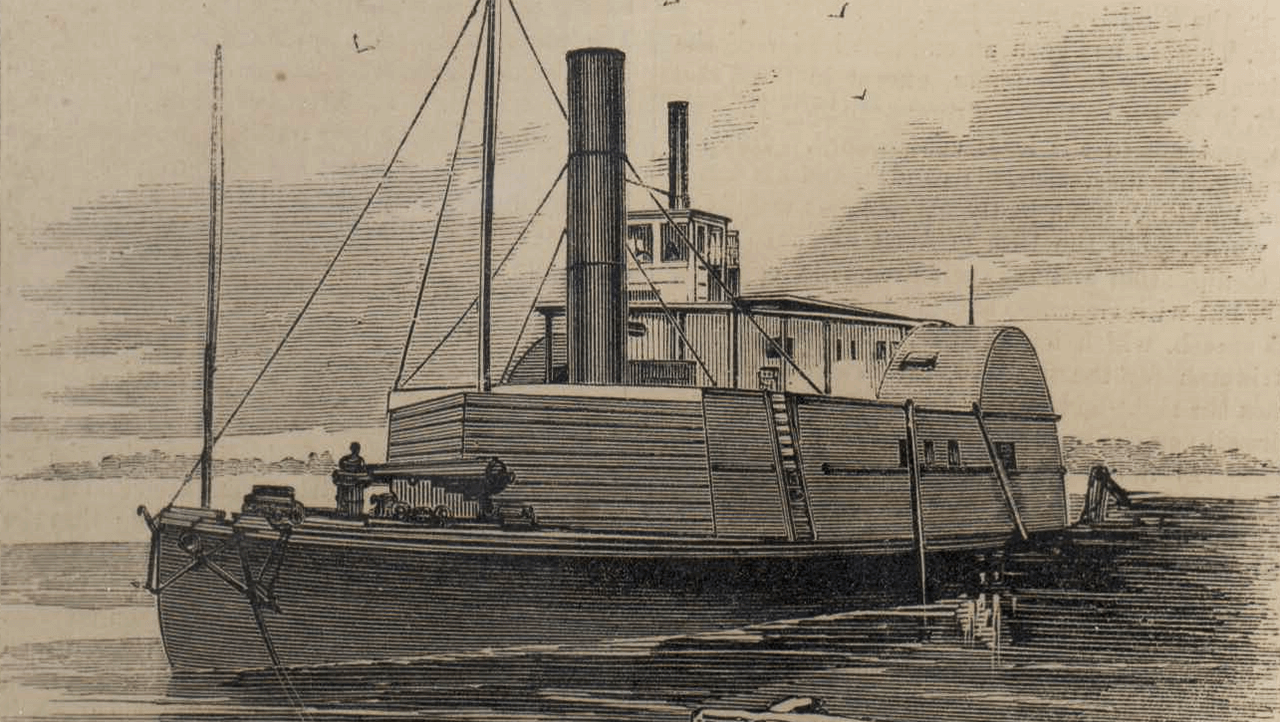
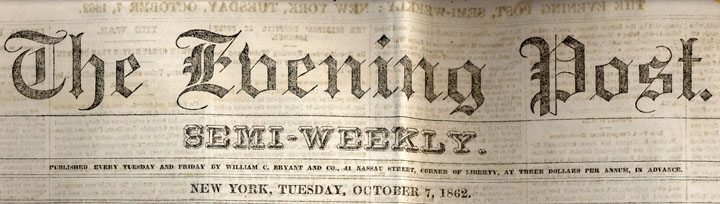
The following newspaper article is about the Gold Medal presented to Robert Smalls. Robert Smalls, a former slave at the time of the printing of this article, was pressed into service in the Confederacy as the quartermaster for the steamer Planter. On May 12, 1862 he was given an opportunity, as a result of the removal of the Confederate officers of the steamer, to take the steamer and make his escape. He piloted the steamer to freedom and surrendered it to the Union. The complete story of his inspiring escape can be found in this WallBuilders Newsletter. The New York newspaper, The Evening Post from October 7, 1862, gives the account of the presentation of Smalls with a Gold Medal from the “colored citizens of New York.”

smalls1

The Black Hero of the Planter Among His People.

PUBLIC RECEPTION OF ROBERT SMALLS – INTERESTING CEREMONIES AT SHILOH CHURCH

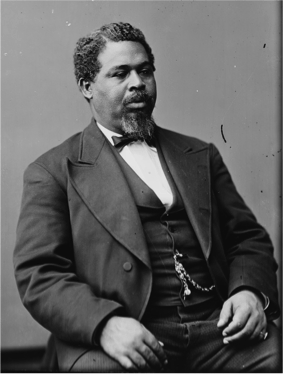
smalls2A great concourse of the colored people of this city assembled last evening at Rev. Henry Highland Garnett’s (Shiloh) Church, at the corner of Prince and Marion streets, to participate in the ceremonies of a public reception and presentation to Robert Smalls , the heroic pilot of the secession steamer Planter, which, with a crew of slaves, he ran out of Charleston harbor, passing six fortifications, including Sumter, and achieving freedom for himself and all on board. The gathering was most respectable in character; nearly all the noted colored men of New York and Brooklyn were present, and the demonstration was in every respect worthy of the occasion. The spectacle of a great and intelligent gathering of black men and women to do special honor to a recognized hero, who has honored not only himself but his race, was sufficiently sublime.

Ransom F. Wake called the meeting to order and nominated J. H. Townsend for President, and twenty vice-presidents, who were elected by acclamation. Mr. Townsend, on taking his seat, made an address, referring in suitable terms to the object of the gathering. A prayer was offered by the Rev. J. T. Raymond [Pastor of First Independent Baptist Church in Boston].

The first regular speech at the meeting was delivered by Rev. S. N. Gloucester, of the Siloam Presbyterian Church of Brooklyn. The speaker reviewed the history of the colored race in this country, form the time of Attocks {sic}, who was murdered in the streets of Boston for his hatred of England and his insults to British soldiers, to the present day. The most notable instances of courage and many resolution that have been developed in all that period, and finally, the crowning act of Smalls, not less difficult nor dangerous than many which have been undertaken that did not prove so signally successful – were referred to by the speaker; and he held that they were sufficient to establish the claims of the African-American race, notwithstanding the disadvantages under which it labored, to respectful recognition among the other races. Mr. Gloucester also spoke of the emancipation proclamation, regretting the delay of ninety days, but regarding it simply as an act of grace, which would not be accepted by the rebels. The hero of the evening received a flattering notice.
robertsmallsThe next speaker was Professor J. B. Wilson, principal of the Brooklyn colored public school. His remarks were directed principally to the question of emancipation, and the condition of the colored people of the South in the new sphere of life which he held they were about entering. He believed the slaves would remain permanently where they are at present – perhaps on the plantations they were now cultivating, and which they would finally possess. The war would, he thought, bring about this result. The colored men would obtain their livelihood as hitherto by the cultivation of the soil; and eventually either by purchase (which was most likely), from the government or individuals, or by possible confiscation and results which might grow out of the war, they would peaceably acquire the lands in small parcels. The fact that if the struggle continues, the rebel male population will be so diminished as to render it impracticable if not impossible for the agricultural interests of the South to be managed by the whites now resident there, had also in the estimation of the speaker an important bearing on the question. The South was the natural home of the blacks; there they desired to remain; and would not be removed, for the reason, if for no other, that as the only available laboring force their place could not be filled. Colonization, while it was unpopular, was yet also, he held, impossible; and the destiny of the southern states was inseparably connected with that of the black race, which constituted the bone and sinew of their prosperity.

Robert Smalls entered the church as Professor Wilson closed his remarks and advanced to the front of the pulpit in company with reception committee. The entire audience, as he was recognized, rose and received him with demonstrations of extreme delight. The scene during the five minutes ensuing was the most remarkable, perhaps, of tis kind that ever occurred. The period of the reception and its object, with the new light the congregation felt was dawning on their race, combined to intensify the welcome and to impart to the cheers and various wild and enthusiastic outbursts of feeling which were manifested, an electrifying effect that can scarcely be conceived. No description that we could give would convey any adequate appreciation of the occasion.
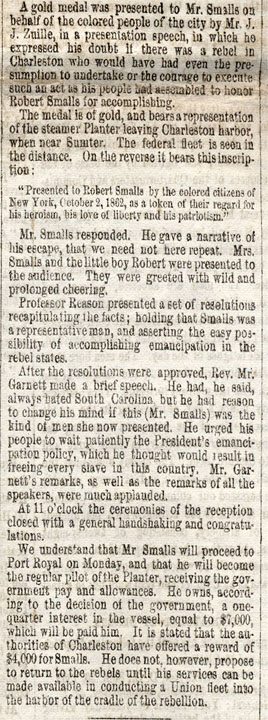
smalls3A gold medal was presented to Mr. Smalls on behalf of the colored people of the city by Mr. J. J. Zuille, in a presentation speech, in which he expressed his doubt if there was a rebel in Charleston, who would have had even the presumption to undertake or the courage to execute such an act as his people has assembled to honor Robert Smalls for accomplishing.

The medal is of gold, and bears a representation of the steamer Planter leaving Charleston harbor, when near Sumter. The federal fleet is seen in the distance. On the reverse it bears this inscription:

“Presented to Robert Smalls by the colored citizens of New York, October 2, 1862, as a token of their regard for his heroism, his love of liberty and his patriotism.”

Mr. Smalls responded. He gave a narrative of his escape, that we need not here repeat. Mrs. Smalls and the little boy Robert were presented to the audience. They were greeted with wild and prolonged cheering.

Professor Reason presented a set of resolutions recapitulating the facts; holding that Smalls was a representative man, and asserting the easy possibility of accomplishing emancipation in the rebel states.

After the resolutions were approved, Rev. Mr. Garnett made a brief speech. He had, he said, always hated South Caroline, but he had reason to change his mind if this (Mr. Smalls) was the kind of men she now presented. He urged his people to wait patiently the President’s emancipation policy, which he thought would result in freeing every slave in this country. Mr. Garnett’s remarks, as well as the remarks of all the speakers, were much applauded.

At 11 o’clock the ceremonies of the reception closed with a general handshaking and congratulations.

We understood that Mr. Smalls will proceed to Port Royal on Monday, and that he will become the regular pilot of the Planter, receiving the government pay and allowances. He was, according to the decision of the government, a one-quarter interest in the vessel, equal to $7,000 which will be paid him. It is stated that the authorities of Charleston have offered a reward of $4,000 for Smalls. He does not, however, propose to return to the rebels until his services can be made available in conducting a Union fleet into the harbor of the cradle of the rebellion.
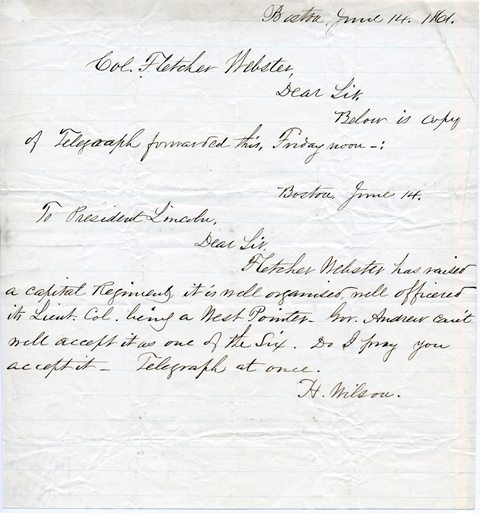
Webster Regiment

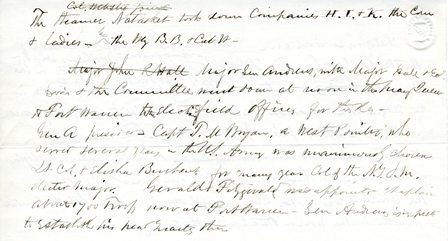
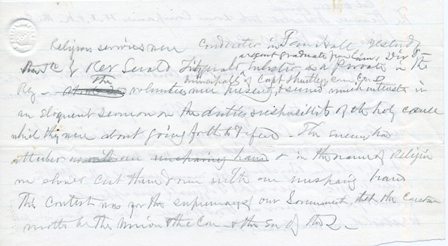
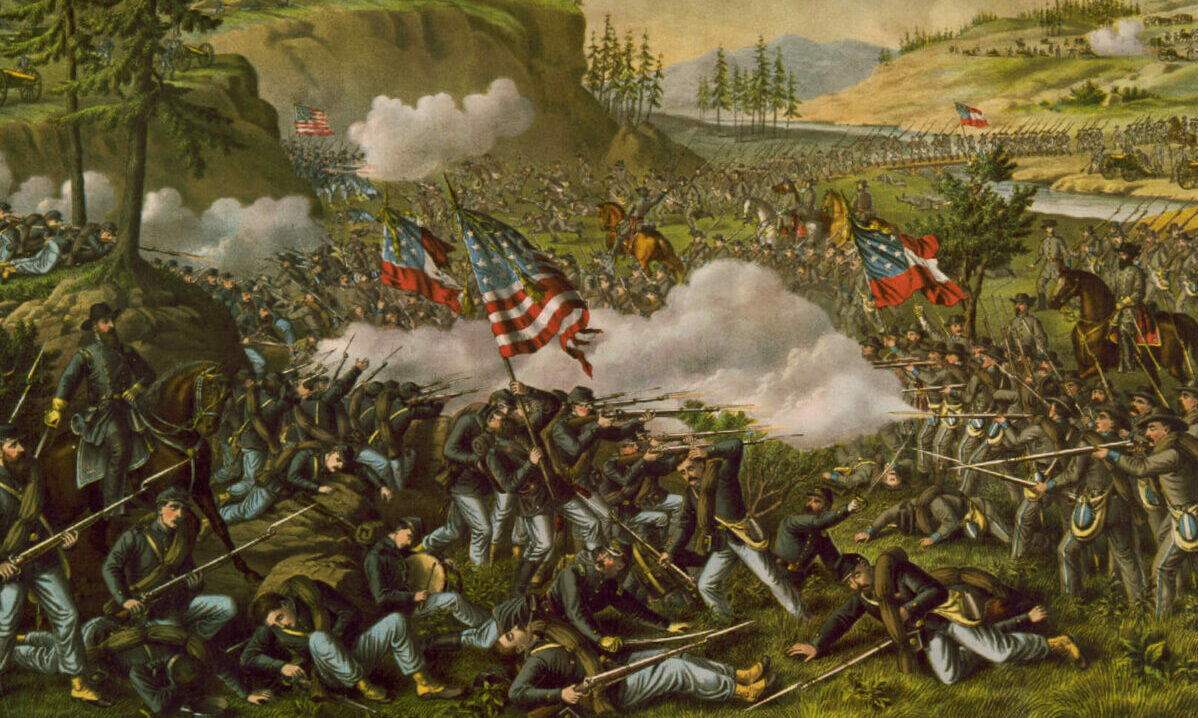
The following documents written by an unknown soldier in the regiment outlining the organization of “Webster’s Regiment” (officially known as the 12th Massachusetts regiment), which was established under the command of Fletcher Webster (son of Daniel Webster), the second generation Founding Father who was known as the “Defender of the U.S. Constitution.” This regiment was formed in April of 1861, and was recognized as an official regiment by the Union in June of that year. This regiment was later declared by General Meade to be “the finest regiment in the service.” More information about Webster’s Regiment can be found in this WallBuilders article.


This document is Webster’s copy of a telegraph that was sent to President Lincoln requesting that the regiment be officially recognized by the Union.

webster-regiment-1


The following document outlines the election of field officers (which were temporary positions assigned to the unofficial regiment), including the appointment of Gerald Fitzgerald as chaplain. In June of 1861, Edward Clark was appointed official Chaplain of the newly formed regiment.

webster-regiment-2


The following document recounts a sermon given by Rev. Gerald Fitzgerald and mentions that “[t]he volunteers were present and seemed much interested in an eloquent sermon on the duties and responsibilities of the holy cause, which they were about going forth to defend.”

webster-regiment-3

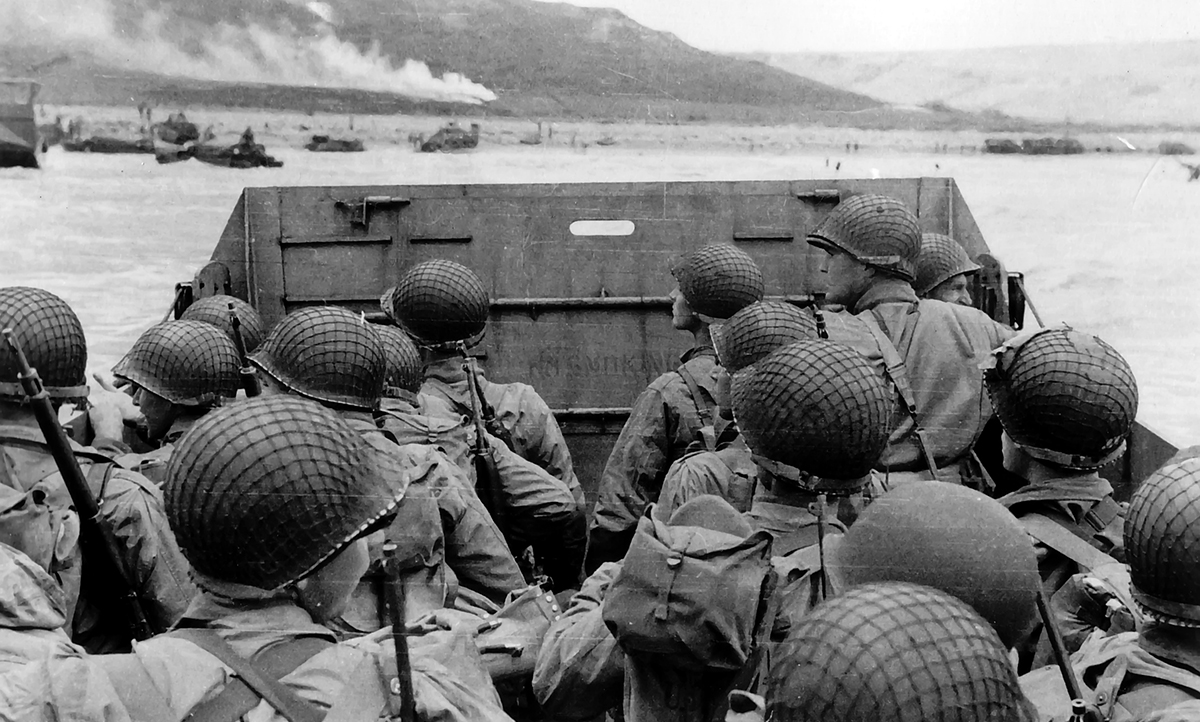
American troops land at Omaha Beach during the D-Day landings of 1944.

WWII Special Orders for German-American Relations

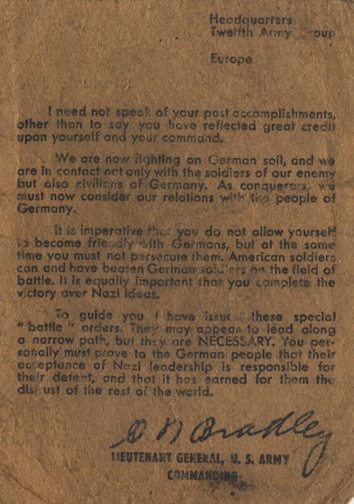
General Omar Bradley (1893-1981) commanded the Twelfth Army Group during WWII and was the commander of Allied land forces invading Germany from the west. The following special orders were issued by five-star General Omar Bradley after Germany surrendered (May 8, 1945).


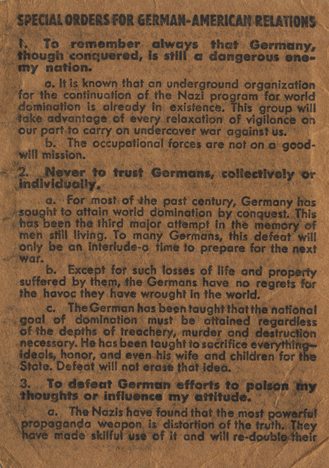
wwii-special-orders-for-german-american-relations-1

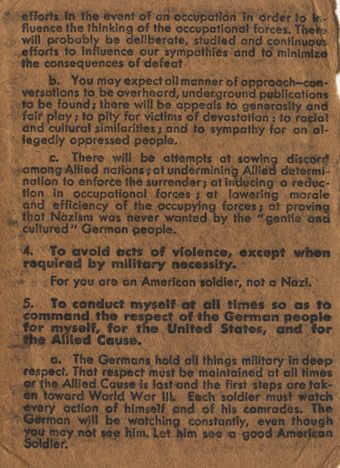
wwii-special-orders-for-german-american-relations-2

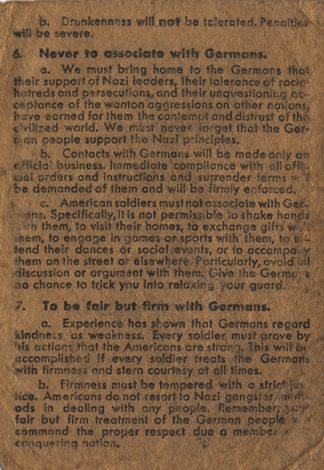
wwii-special-orders-for-german-american-relations-3

wwii-special-orders-for-german-american-relations-4


Headquarters
Twelfth Army Group

Europe

I need not speak of your past accomplishments, other than to say you have reflected great credit upon yourself and your command.

We are now fighting on German soil, and we are in contact not only with soldiers of our enemy but also civilians of Germany. As conquerors, we must now consider our relations with the people of Germany.

It is imperative that you do not allow yourself to become friendly with Germans, but at the same time you must not persecute them. American soldiers can and have beaten German soldiers on the field of battle. It is equally important that you complete the victory over Nazi ideas.

To guide you I have issued these special ” battle ” orders. They may appear to lead along a narrow path, but they are NECESSARY. You personally must prove to the German people that their acceptance of Nazi leadership is responsible for their defeat, and that it has earned for them the distrust of the rest of the world.

[signed] O N Bradley
LIEUTENANT GENERAL, U.S. ARMY
COMMANDING

SPECIAL ORDERS FOR GERMAN-AMERICAN RELATIONS

1. To remember always that Germany, though conquered, is still a dangerous enemy nation.

a. It is known that an underground organization for the continuation of the Nazi program for work) domination is already in existence. This group will take advantage of every relaxation of vigilance on our part to carry on undercover war against us.

b. The occupational forces are not on a good-will mission.

2. Never to trust Germans, collectively or individually.

a. For most of the past century, Germany has sought to attain world domination by conquest. This has been the third major attempt in the memory of men still living. To many Germans this defeat will only be on interlude – a time to prepare for the’ next war.

b. Except for such losses of life and property suffered by them, the Germans have no regrets for the havoc they have wrought in the world.

c. The German has been taught that the national goal of domination must be attained regardless of the depths of treachery, murder and destruction necessary. He has been taught to sacrifice everything— ideals, honor, and even his wife and children for the State. Defeat will not erase that idea.

3. To defeat German efforts to poison my thoughts or influence my attitude.

a. The Nazis have found that the most powerful propaganda weapon is distortion of the truth. They have mode skilful use of it and will re-double their efforts in the event of an occupation In order to influence the thinking of the occupational forces. There will probably be deliberate, studied and continuous efforts to influence our sympathies and to minimize the consequences of defeat.

b. You may expect ail manner of approach—conversations to be overheard, underground publications to be found; there will be appeals to generosity and fair play; to pity for victims of devastation : to racial end cultural similarities; and to sympathy for an allegedly oppressed people.

c. There will be attempts at sowing discord among Allied nations; of undermining Allied determination to enforce the surrender; at inducing a reduction in occupational forces; at lowering morale and efficiency of the occupying forces; at proving that Nazism was never wanted by the “gentle and cultured ‘ German people.

4. To avoid acts of violence, except when required by military necessity.

For you are on American soldier, not a Nazi.

5. To conduct myself at all times so as to command the respect of the German people for myself, for the United States, and for the Allied Cause.

a. The Germans hold all things military in deep respect. That respect must be maintained at all times or the Allied Cause is lost and the first steps are taken toward World War III. Each soldier must watch every action of himself and of his comrades. The German will be watching constantly, even though you may not see him. Let him see a good American Soldier.

b. Drunkenness will not be tolerated. Penalties will be severe.

6. Never to associate with Germans.

a. We must bring home to the Germans that their support of Nazi leaders, their tolerance of racial hatreds and persecutions, and their unquestioning acceptance of the wanton aggressions on other nations, have earned for them the contempt and distrust of the civilized world. We must never forget that the German people support the Nazi principles.

b. Contacts with Germans will be made only on official business. Immediate compliance with all official orders and instructions and surrender terms will be demanded of them and will be firmly enforced.

c. American soldiers must not associate with Germans. Specifically, it is not permissible to shake hands with them, to visit their homes, to exchange gifts with them, to engage in games or sports with them, to attend their dances or social events, or to accompany them on the street or elsewhere. Particularly, avoid all discussion or argument with them. Give the Germans no chance to trick you into relaxing your guard.

7. To be fair but firm with Germans.

a. Experience has shown that Germans regard kindness as weakness. Every soldier must prove by his actions that the Americans are strong. This will be accomplished if every soldier treats the Germans with firmness and stern courtesy at all times.

b. Firmness must be tempered with a strict justice. Americans do not resort to Nazi gangster methods in dealing with any people. Remember, your fair but firm treatment of the German people will command the proper respect due a member of a conquering nation.

The Four Chaplains Card

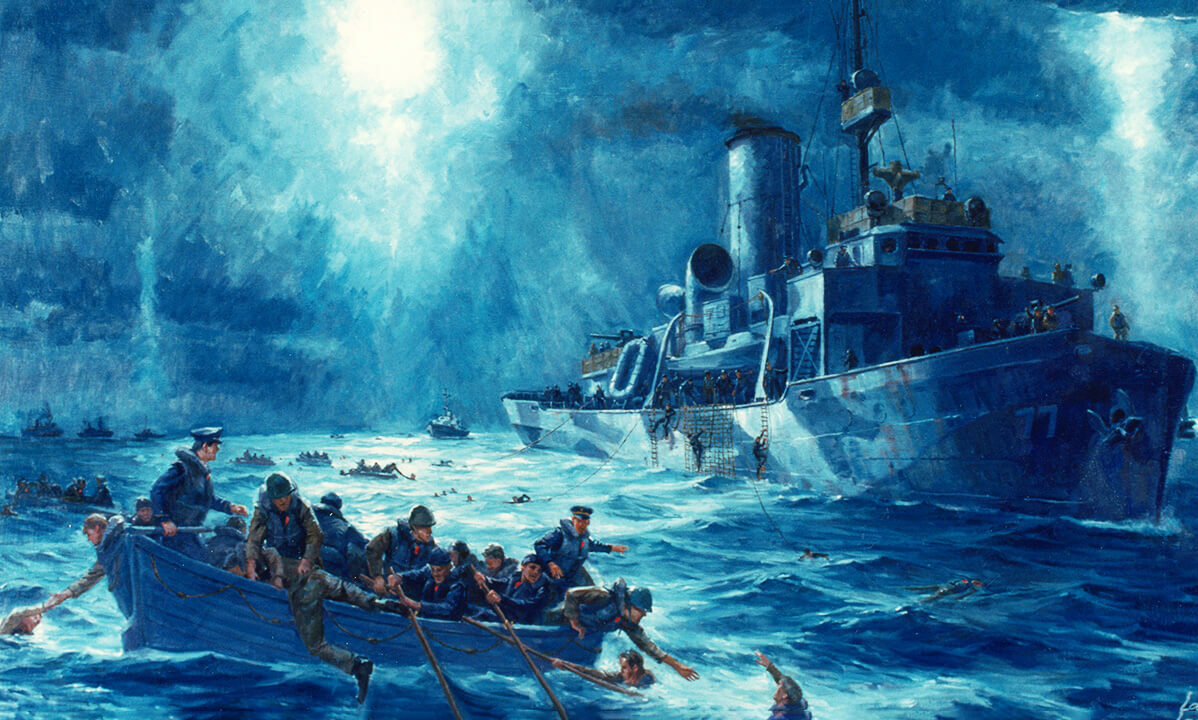
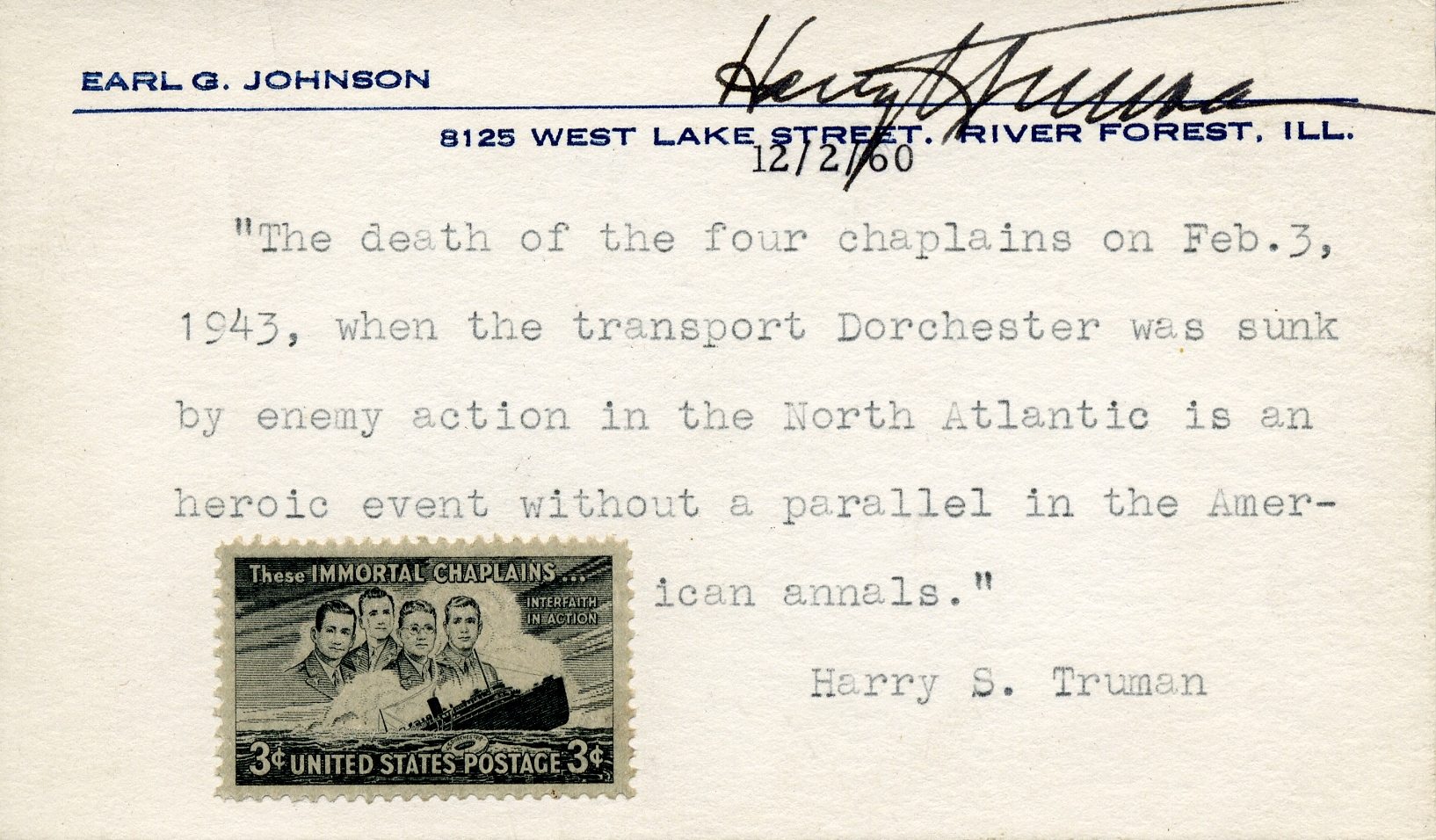
The story of the four chaplains aboard the Dorchester is one that is not often repeated when recounting the events of WWII today. However, their heroism was well known and respected, as evidenced by this 1960 collectors card signed by Harry Truman commemorating the sacrifice of these brave men.


the-four-chaplains-card-1

The death of the four chaplains on Feb. 3, 1943, when the transport Dochester was sunk by enemy action in the North Atlantic is an heroic event without a parallel in the American annals.

Harry S. Truman
American troops land at Omaha Beach during the D-Day landings of 1944.

Victory in Europe Prayer Proclamation – 1945

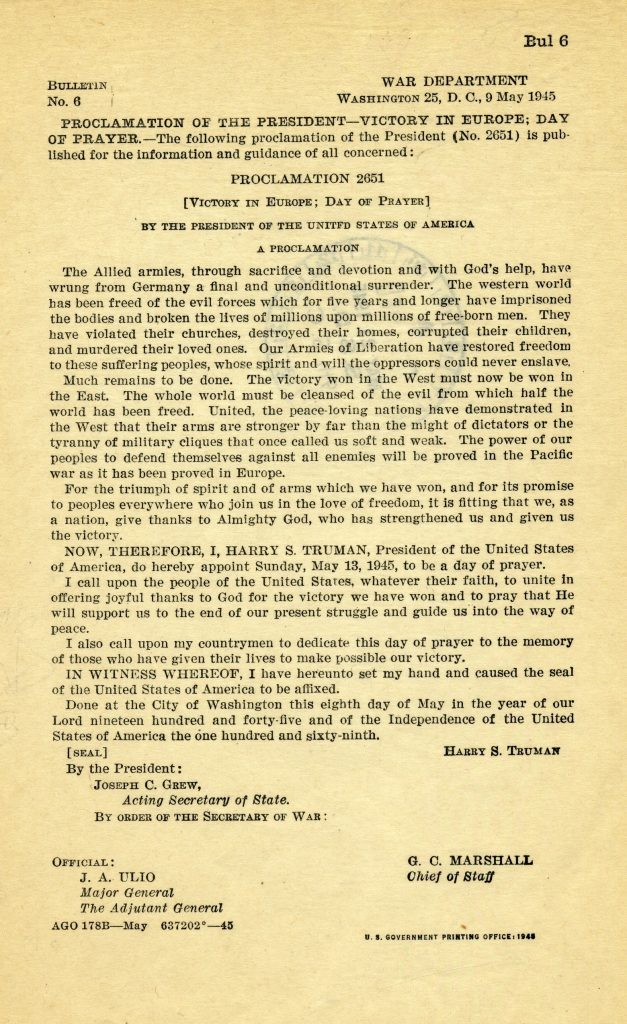
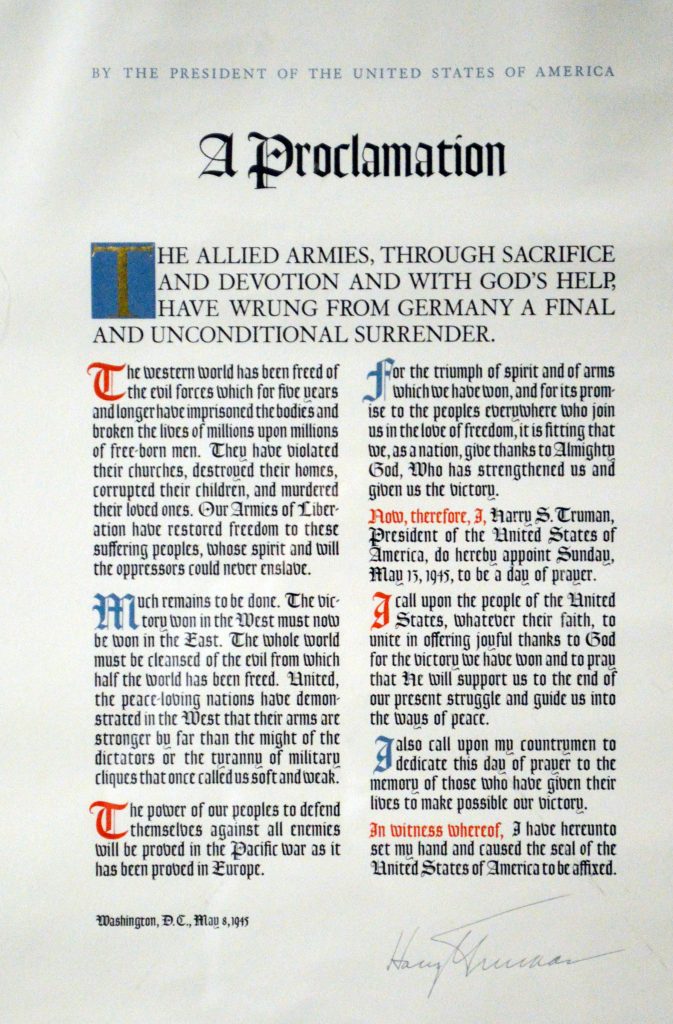
Victory in Europe Day (also known as V-E Day) occurred on May 8, 1945. Below is a proclamation for a day of prayer and thanksgiving issued by President Harry S. Truman in response to the unconditional surrender of the German troops, which effectively ended the war in Europe.

(A signed copy by President Truman is located below the text.)

 victory-in-europe-prayer-proclamation-1945-1

Bulletin   WAR DEPARTMENT
No. 6     Washington 25, D.C., May 9 1945

PROCLAMATION OF THE PRESIDENT – VICTOR IN EUROPE; DAY OF PRAYER.–The following proclamation for the President (No. 2651) is published for the information and guidance of all concerned:

PROCLAMATION 2651
[VICTORY IN EUROPE; DAY OF PRAYER]
BY THE PRESIDENT OF THE UNITED STATES OF AMERICA

A PROCLAMATION

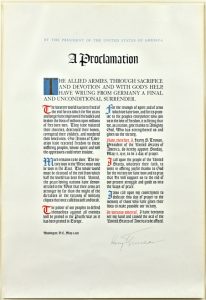
The Allied armies, through sacrifice and devotion and with God’s help, have wrung from Germany a final and unconditional surrender. The western world has been freed of the evil forces which for five years and longer have imprisoned the bodies and broken the lives of millions upon millions of free-born men. They have violated their churches, destroyed their homes, corrupted their children, and murdered their loved ones. Our Armies of Liberation have restored freedom to these suffering peoples, whose spirit and will the oppressors could never enslave.

Much remains to be done. The victory won in the West must now be won in the East. The whole world must be cleansed of the evil from which half the world has been freed. United, the peace-loving nations have demonstrated in the West that their arms are stronger by far than the might of dictators or the tyranny of military cliques that once called us soft and weak. The power of our people to defend themselves against all enemies will be proved in the Pacific war as it has been proved in Europe.

For the triumph of spirit and of arms which we have won, and for its promise to peoples everywhere who join us in the love of freedom, it is fitting that we, as a nation, give thanks to Almighty God, who has strengthened us and given us the victory.

NOW, THEREFORE, I, HARRY S. TRUMAN, President of the United States of America, do hereby appoint Sunday, May 13, 1945, to be a day of prayer.

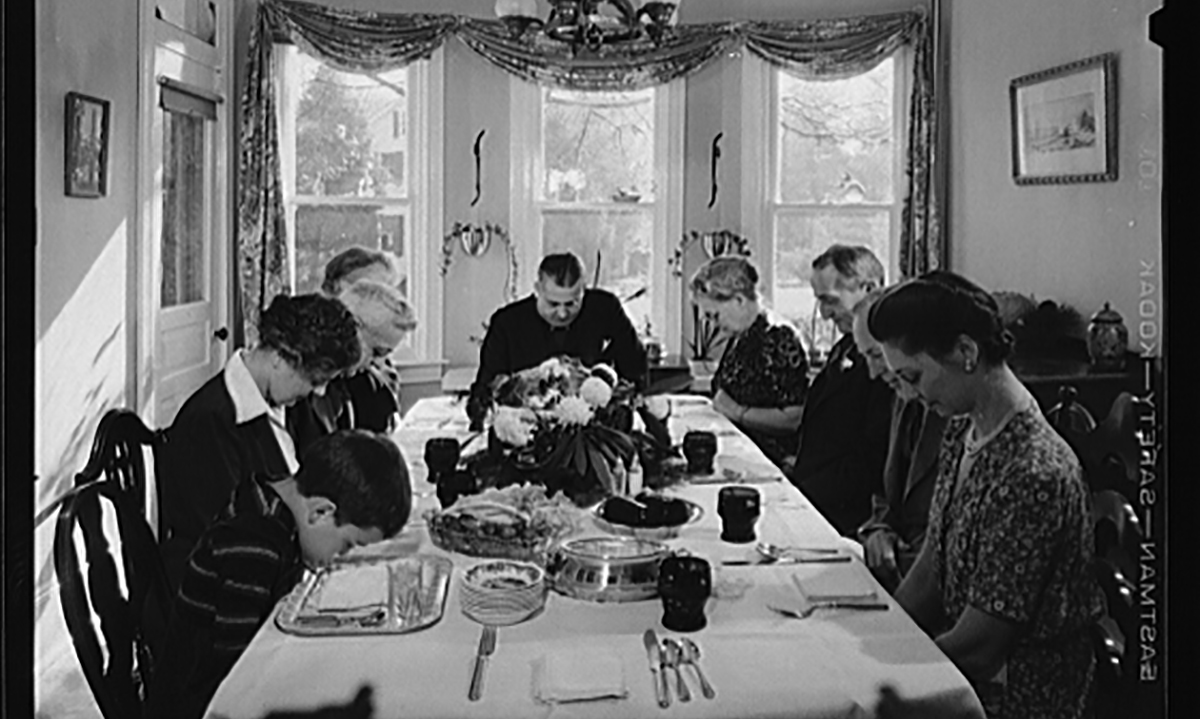
I call upon the people of the United States, whatever their faith, to unite in offering joyful thanks to God for the victory we have won and to pray that He will support us to the end of our present struggle and guide us into the way of peace.

I also call upon my countrymen to dedicate this day of prayer to the memory of those who have given their lives to make possible our victory.

IN WITNESS WHEREOF, I have hereunto set my hand and caused the seal of the United States of America to be affixed.

Done at the City of Washington this eighth day of May in the year of our Lord nineteen hundred and forty-five and of the Independence of the United States of America the one hundred and sixty-ninth. [SEAL]

HARRY S. TRUMAN
By the President:
Joseph C. Grew,
      Acting Secretary of State.
By order of the Secretary of War:
G. C. Marshall
Chief of staff

Official:
J.A. ULIO
Major General
The Adjutant General

AGO 178B-May   637202 ͦ –45

U.S. Government Printing Office, 1945

victory-in-europe-prayer-proclamation-1945-2

V-E Day Proclamation – Truman

V-E (Victory in Europe) Day was celebrated around the world on May 8, 1945. One day earlier, German forces unconditionally surrendered to the Allies, thus signaling the end of fighting in Europe. (The Allies, however, would continue fighting against Japanese forces for an additional 3 months.) President Harry Truman addressed the nation on the occasion and read his proclamation calling for a day of prayer.


By the President of the United States of America

A Proclamation

The Allied armies, through sacrifice and devotion and with God’s help, have wrung from Germany a final and unconditional surrender.

The western world has been freed of the evil forces which for five years and longer have imprisoned the bodies and broken the lives of millions upon millions of free-born men. They have violated their churches, destroyed their homes, corrupted their children, and murdered their loved ones. Our Armies of Liberation have restored freedom to these suffering peoples, whose spirit and will the oppressors could never enslave.

Much remains to be done. The victory won in the West must now be won in the East. The whole world must be cleansed of the evil from which half the world has been freed. United, the peace-loving nations have demonstrated in the West that their arms are stronger by far than the might of dictators or the tyranny of military cliques that once called us soft and weak.

The power of our people to defend themselves against all enemies will be proved in the Pacific war as it has been proved in Europe.

For the triumph of spirit and of arms which we have won, and for its promise to peoples everywhere who join us in the love of freedom, it is fitting that we, as a nation, give thanks to Almighty God, who has strengthened us and given us the victory.

Now, Therefore, I, Harry S. Truman, President of the United States of America, do hereby appoint Sunday, May 13, 1945, to be a day of prayer.

I call upon the people of the United States, whatever their faith, to unite in offering joyful thanks to God for the victory we have won and to pray that He will support us to the end of our present struggle and guide us into the way of peace.

I also call upon my countrymen to dedicate this day of prayer to the memory of those who have given their lives to make possible our victory.

In Witness Whereof, I have hereunto set my hand and caused the seal of the United States of America to be affixed.

Washington, D.C. May 8, 1945

Harry Truman

Christmas Message from Wartime

December 1944 was a key time during WWII. D-Day was over, and the Allied forces were moving forward rapidly, pushing the Nazis out of western Europe and back into Germany. But in mid-December, the Germans began an unexpected assault against the Americans, resulting in the six-week long Battle of the Bulge high in the mountains in the middle of winter. Extended bad weather (days of fog, snow, and torrential rain) grounded American airplanes and hindered the movement of American troops.

The forces of General George Patton were taking the brunt of the attack. On December 8th, Patton contacted his top chaplain, General James O’Neill, and asked for a prayer to change the weather.1
Patton explained:

God has His part, or margin in everything, that’s where prayer comes in. . . . We’ve got to get not only the chaplains but every man in the Third Army to pray. We must ask God to stop these rains.2

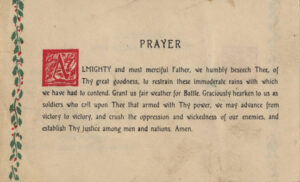
Chaplain O’Neill responded to Patton’s request by writing out a short prayer that was approved and printed and given to each of the 250,000 American soldiers.3

Each man prayed:

Almighty and most merciful Father, we humbly beseech Thee, of Thy great goodness, to restrain these immoderate rains with which we have had to contend. Grant us fair weather for Battle. Graciously hearken to us as soldiers who call upon Thee that, armed with Thy power, we may advance from victory to victory, and crush the oppression and wickedness of our enemies and establish Thy justice among men and nations.

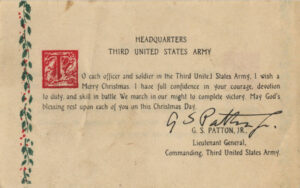
The reverse of the card carried a Christmas greeting from Patton:
To each officer and soldier in the Third United States Army, I Wish a Merry Christmas. I have full confidence in your courage, devotion to duty, and skill in battle. We march in our might to complete victory. May God’s blessings rest upon each of you on this Christmas Day.

These prayer cards were distributed to the troops on December 12-14, and on December 20th, the weather cleared, allowing the planes to return to the air,4 leading to an eventual hard-fought victory for the Allies.

As we celebrate Christmas with our families, history reminds us that God responds when people lift up their voices in prayer.5

From all of us at WallBuilders, Merry Christmas!


Endnotes

1 Evan Andrews, “8 Things You May Not Know About the Battle of the Bulge,” August 22, 2023, History.
2 Msgr. James H. O’Neill, “The True Story of The Patton Prayer,” originally published in Review of the News (October 6, 1971).
3 Msgr. James H. O’Neill, “The True Story of The Patton Prayer,” originally published in Review of the News (October 6, 1971).
4 Msgr. James H. O’Neill, “The True Story of The Patton Prayer,” originally published in Review of the News (October 6, 1971); “Interactive Timeline: Battle of the Bulge,” Library of Congress.
5 Matthew 18:19-20.

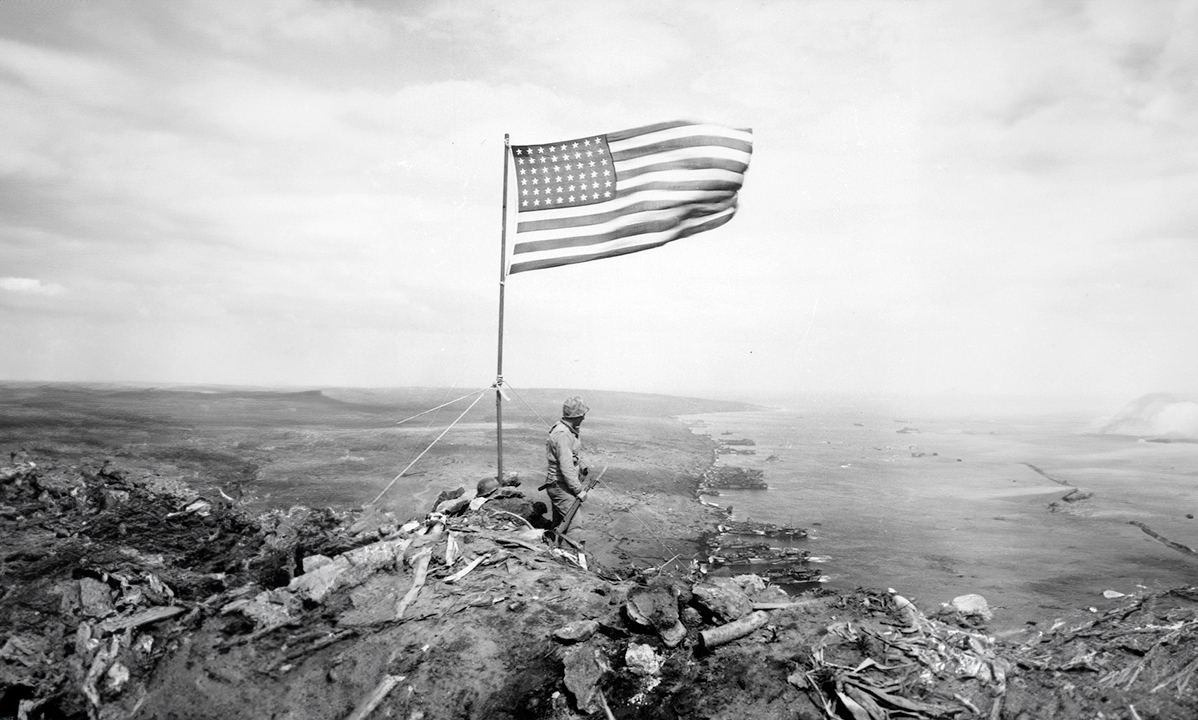
A member of the American military stands beside a US flag raised after the Battle of Iwo Jima.

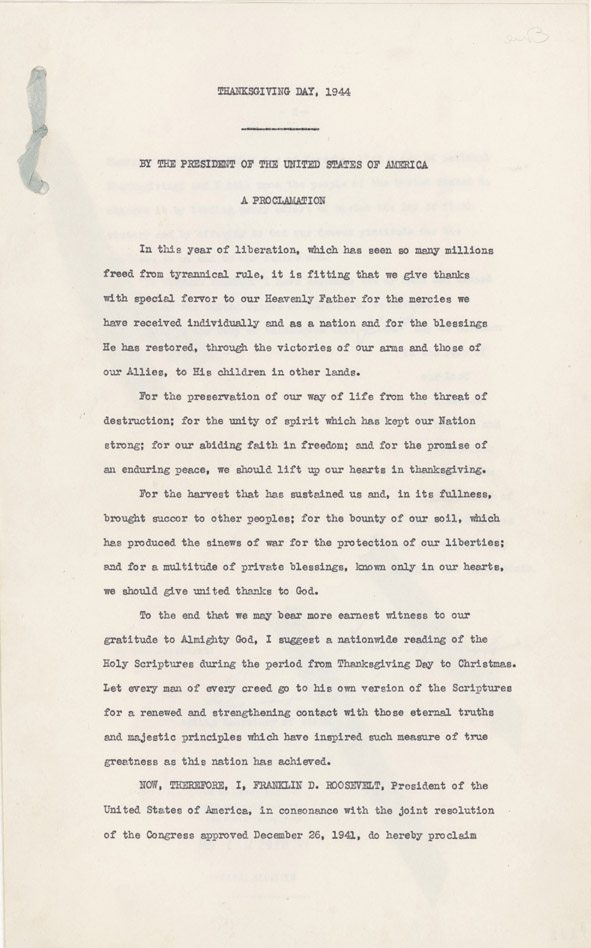
Proclamation – Thanksgiving Day – 1944


The following is the text of a national Thanksgiving proclamation issued by President Franklin D. Roosevelt on November 1, 1944. The Thanksgiving day was to take place on November 23, 1944. The images of the Proclamation are from the National Archives and Records Administration.


Red # 26058 13-A1-019 Research Request

Red # 26058 13-A1-019 Research Request


THANKSGIVING DAY, 1944

BY THE PRESIDENT OF THE UNITED STATES OF AMERICA
A PROCLAMATION

In this year of liberation, which has seen so many millions freed from tyrannical rule, it is fitting that we give thanks with special fervor to our Heavenly Father for the mercies we have received individually and as a nation and for the blessings He has restored, through the victories of our arms and those of our Allies, to His children in other lands.

For the preservation of our way of life from the threat of destruction; for the unity of spirit which has kept our Nation strong; for our abiding faith in freedom; and for the promise of an enduring peace, we should lift up our hearts in thanksgiving.

For the harvest that has sustained us and, in its fullness, brought succor to other peoples; for the bounty of our soil, which has produced the sinews of war for the protection of our liberties; and for a multitude of private blessings, known only in our hearts, we should give united thanks to God.

To the end that we may bear more earnest witness to our gratitude to Almighty God, I suggest a nationwide reading of the Holy Scriptures during the period from Thanksgiving Day to Christmas. Let every man of every creed go to his own version of the Scriptures for a renewed and strengthening contact with those eternal truths and majestic principles which have inspired such measure of true greatness as this nation has achieved.

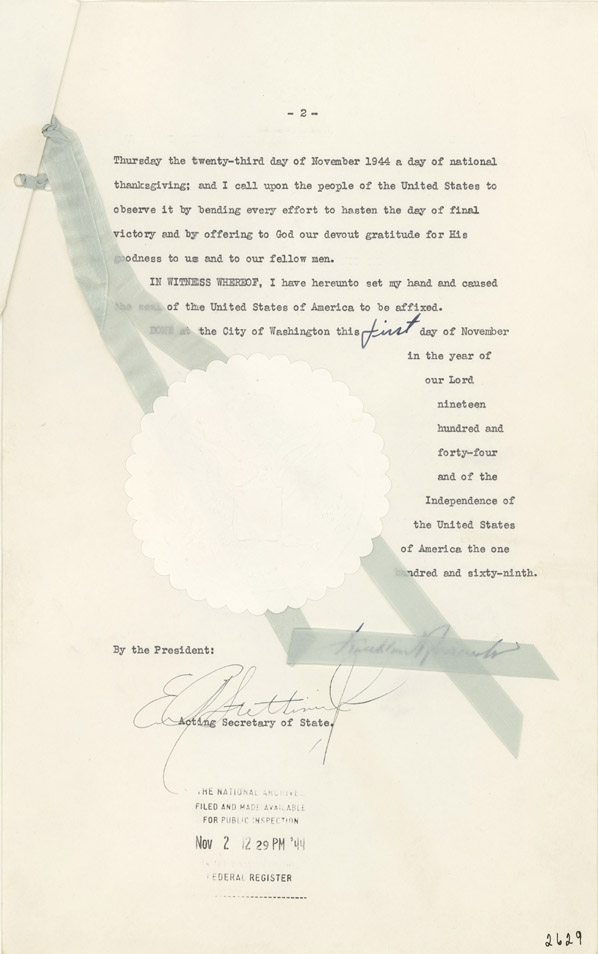
NOW, THEREFORE, I, FRANKLIN D. ROOSEVELT, President of the United States of America, in consonance with the joint resolution of the Congress approved December 26, 1941, do hereby proclaim Thursday the twenty-third day of November 1944 a day of national thanksgiving and I call upon the people of the United States to observe it by bending every effort to hasten the day of final victory and by offering to God our devout gratitude for His goodness to us and to our fellow men.

IN WITNESS WHEREOF, I have hereunto set my hand and caused the seal of the United States of America to be affixed.

DONE at the City of Washington this first day of November in the year of our Lord nineteen hundred and forty-four and of the Independence of the United States of America the one hundred and sixty-ninth.

By the President:
Franklin Roosevelt

Edward Stettinius Jr.
Acting Secretary of State.

D-Day Prayer

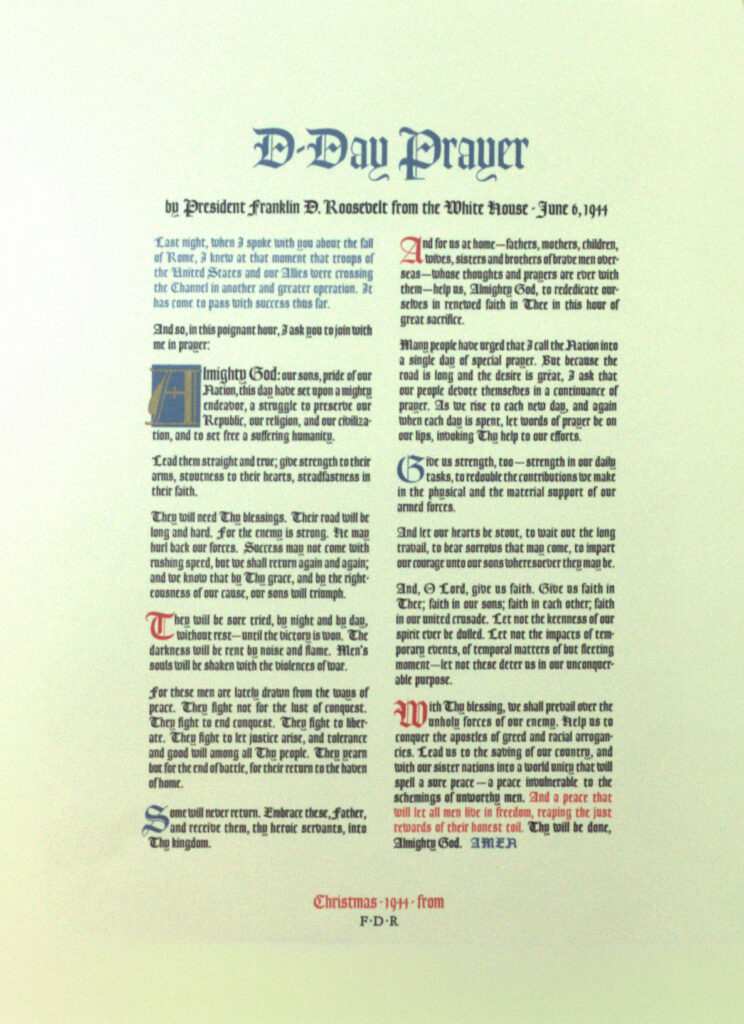
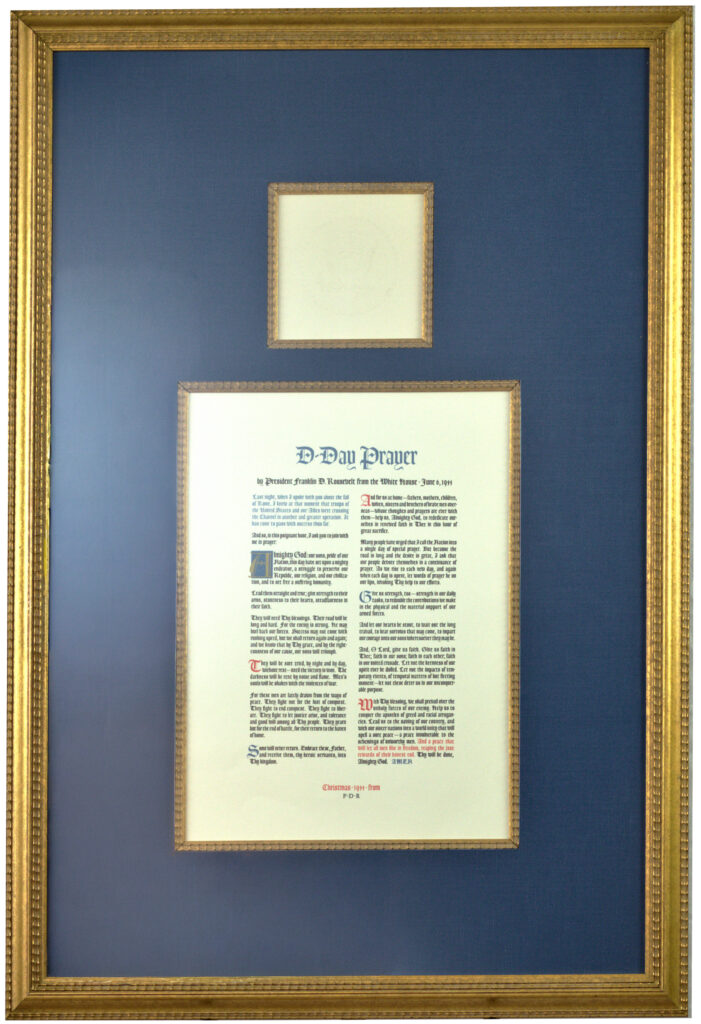
In 1944, President Franklin D. Roosevelt printed copies of his famous D-Day speech to give to give as gifts. Below is a picture of that 1944 Christmas gift and the transcription of the prayer Roosevelt prayed on D-Day (June 6, 1944).


D-Day Prayer

by President Franklin D. Roosevelt from the white House – June 6, 1944

Last night, when I spoke with you about the fall of Rome, I knew at that moment that troops of the United States and our Allies were crossing the Channel in another and greater operation. It has come to pass with success thus far.

And so, in this poignant hour, I ask you to join with me in prayer:

Almighty God: our sons, pride of our Nation, this day have set upon a mighty endeavor, a struggle to preserve our Republic, our religion, and our civilization, and to set free a suffering humanity.

Lead them straight and true; give strength to their arms, stoutness to their hearts, steadfastness in their faith.

They will need Thy blessings. Their road will be long and hard. For the enemy is strong. He may hurl back our forces. Success may not come with rushing speed, but we shall return again and again; and we know that by Thy grace, and by the righteousness of our cause, our sons will triumph.

They will be sore tired, but night and by day, without rest – until the victory is won. The darkness will be rent by noise and flame. Men’s souls will be shaken with the violences of war.

For these men are lately drawn from the ways of peace. They fight not for the lust of conquest. They fight to end conquest. They fight to liberate. They fight to let justice arise, and tolerance and good will among all Thy people. They yearn but for the end of battle, for their return to the haven of home.

Some will never return. Embrace these, Father, and receive them, thy heroic servant into Thy kingdom.

And for us at home – fathers, mothers, children, wives, sisters and brothers of brave men overseas – whose thoughts and prayers are ever with them – help us, Almighty God, to rededicate ourselves in renewed faith in Thee in this hour of great sacrifice.

Many people have urged that I call the Nation into a single day of special prayer. But because the road is long and the desire if great, I ask that our people devote themselves in a continuance of prayer. As we rise to each new day, and again when each day is spent, let words of prayer be on our lips, invoking Thy help to our efforts.

Give us strength, too – strength in our daily tasks to redouble the contributions we make in the physical and material support of our armed forces.

And let our hearts be stout, to wait out the long travail, to bear sorrows that may come, to impart our courage unto our sons wheresoever they may be.

And, O Lord, give us faith. Give us faith in Thee; faith in our sons, faith in each other; faith in our united crusade. Let not the keenness of our spirit ever be dulled. Let no the impacts of temporary events, of temporal matters of but fleeting moment – let not these deter us in our unconquerable purpose.

With Thy blessings, we shall prevail over the unholy forces of our enemy. Help us to conquer the apostles of greed and racial arrogancies. Lead us to the saving of our country, and with our sister nations into a world unity that will spell a sure peace – a peace invulnerable to the schemings of unworthy men. And a peace that will let all men live in freedom, reaping the just rewards of their honest toil. Thy will be done, Almighty God. Amen.

Christmas- 1944- from

F. D. R.

Gen. Eisenhower’s D-Day Message

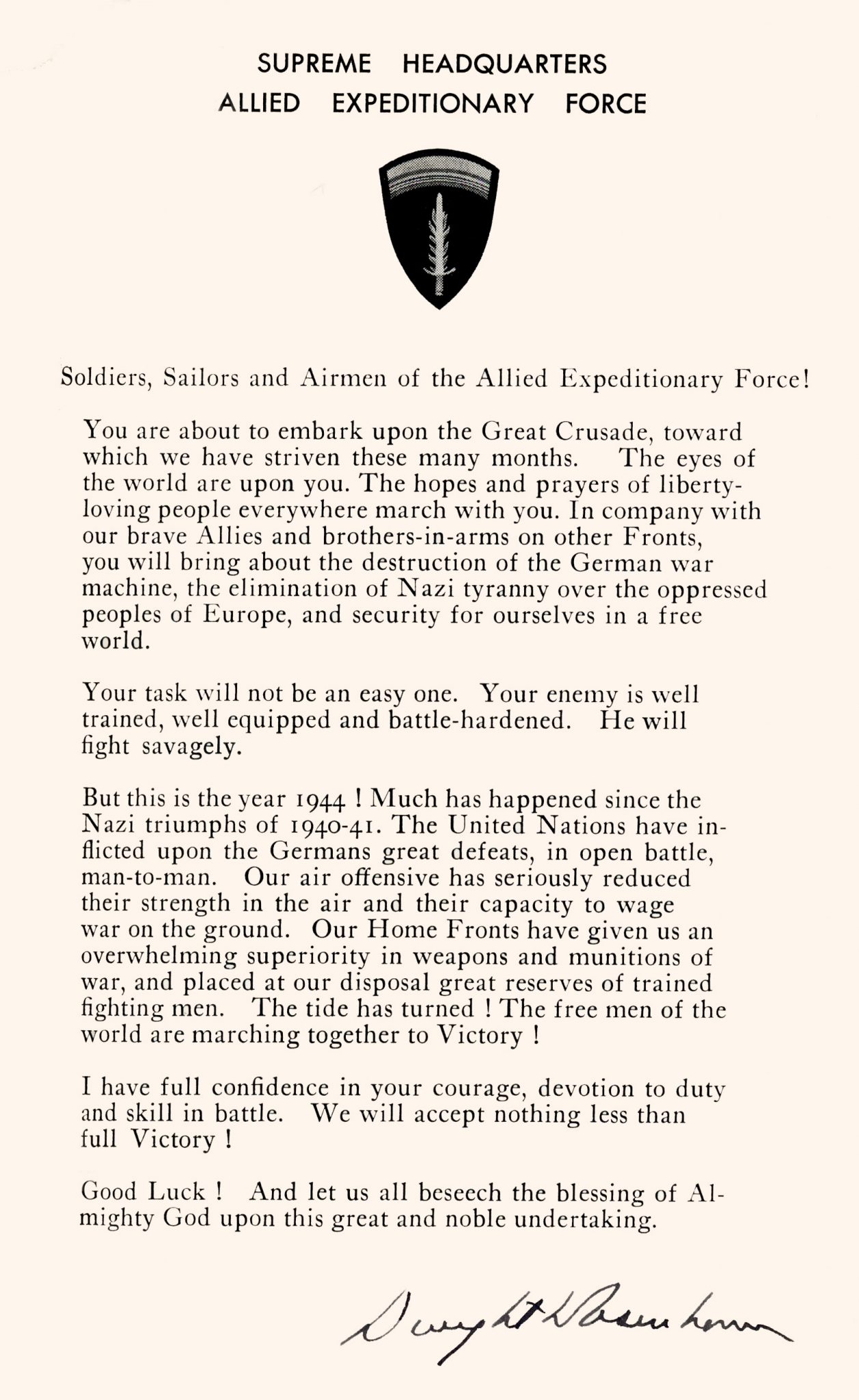
Read the message from Gen. Dwight D. Eisenhower, Commander of the Allied Forces, to the troops as they prepared to embark on the D-Day invasion. Notice his short prayer at the end, asking God to bless their efforts.


gen-eisenhowers-d-day-message-1


Soldiers, Sailors and Airmen of the Allied Expeditionary Force!

You are about to embark upon the Great Crusade, toward which we have striven these many months. The eyes of the world are upon you. The hopes and prayers of liberty-loving people everywhere march with you. In company with our brave Allies and brothers-in-arms on other Fronts, you will bring about the destruction of the German war machine, the elimination of Nazi tyranny over the oppressed peoples of Europe, and security for ourselves in a free world.

Your task will not be an easy one. Your enemy is well trained, well equipped and battle-hardened. He will fight savagely.

But this is the year 1944! Much has happened since the Nazi triumphs of 1940-41. The United Nations have inflicted upon the Germans great defeats, in open battle, man-to-man. Our air offensive has seriously reduced their strength in the air and their capacity to wage war on the ground. Our Home Fronts have given us an overwhelming superiority in weapons and munitions of war and placed at our disposal great reserves of fighting men. The tide has turned! The free men of the world are marching together to Victory!

I have full confidence in your courage, devotion to duty and skill in battle. We will accept nothing less than a full Victory!

Good Luck! And let us all beseech the blessing of Almighty God upon this great and noble undertaking.

Dwight D. Eisenhower