Three weeks before the Civil War broke out and began watering American soil with soldiers’ blood, the vice president of the Confederacy, Alexander Stephens, addressed his fellow Confederates in Savannah, Georgia. His infamous words—known to history as the “Cornerstone Speech”—explained that the “cornerstone” of the Confederacy “rests upon the great truth that the negro is not equal to the white man; that slavery—subordination to the superior race—is his natural and normal condition.”1
It was necessary for the Southern states to break away from America, Stephens told his audience, because the proslavery “cornerstone” of the Confederacy was “exactly the opposite idea” to the principles that America’s Founding Fathers had agreed upon in 1776. Stephens explained,
The prevailing ideas entertained by him [Thomas Jefferson] and most of the leading statesmen at the time of the formation of the old constitution were that the enslavement of the African was in violation of the laws of nature; that it was wrong in principle, socially, morally, and politically.
These words startle modern Americans, who have been taught their whole lives to be ashamed of, or even to condemn, the Founding Fathers because of their alleged bigotry. In particular, why did the vice president of the Confederacy, a sickening racist, regard Thomas Jefferson as a herald of equality? Didn’t he know that Jefferson lived on a plantation and owned slaves? Couldn’t he have appealed to Jefferson’s legacy as a racist slaveowner?
To the contrary, the generations that came after the Founders (and Stephens himself, despite his manifold faults) had a very different understanding of Jefferson. They knew much about him that most Americans have never heard today.
In his article, Was Thomas Jefferson America’s First Abolitionist?2 former University of Virginia law professor Robert F. Turner does a remarkable job rebuilding the true, historical Thomas Jefferson. He not only debunks the myth that Jefferson unequivocally fathered children with his slave but also documents Jefferson’s many attempts to fight and abolish the slave trade. Turner also introduces a document of premier importance—Jefferson’s rough draft of the Declaration of Independence.
The Declaration Draft
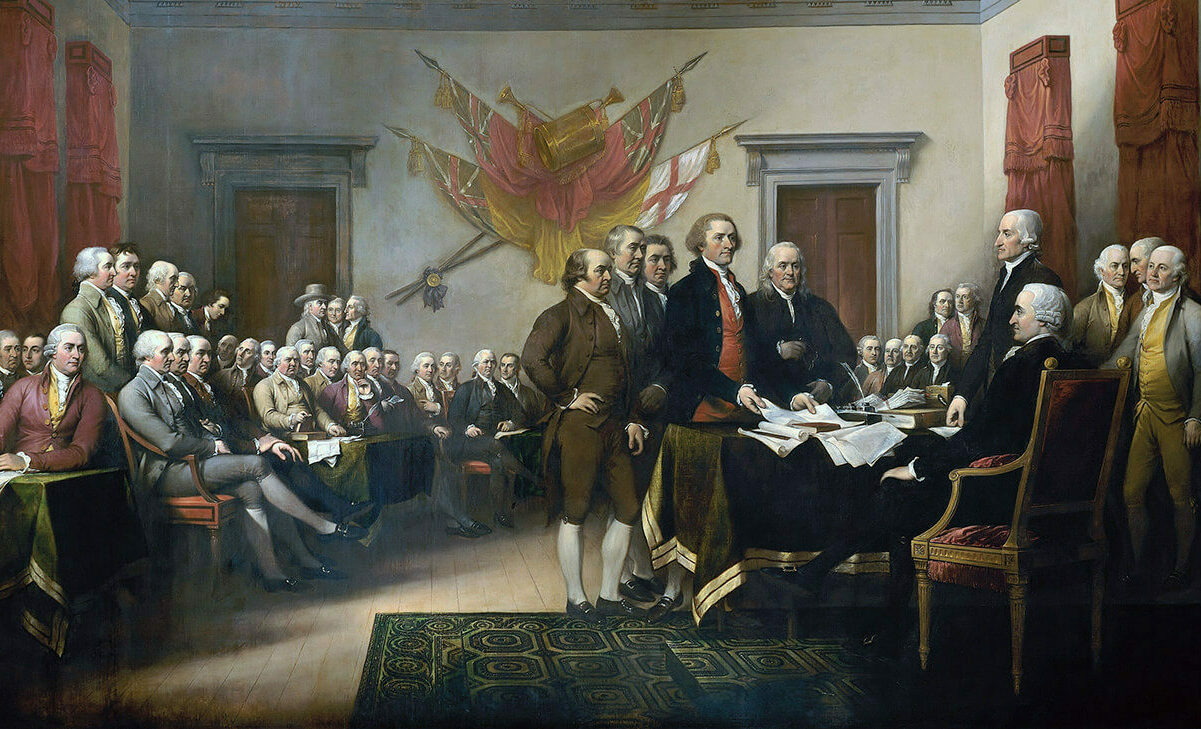
In June 1776, the colonies had already been warring against Great Britain for more than a year. So Congress, realizing that full separation from Great Britain was on the horizon, called upon Thomas Jefferson—who was only 33, but brilliant beyond his years—to draft the Declaration of Independence. It would be America’s “breakup letter” articulating the reasons that the colonies had to separate from Great Britain.
Hunched over his portable writing desk for 17 days in the sweltering summer heat, Jefferson condensed the great political philosophy of America into a few basic principles: there is a God; He creates men with inalienable rights; governments exist to protect those rights; and it is the right of the people to replace a government that violates those principles.
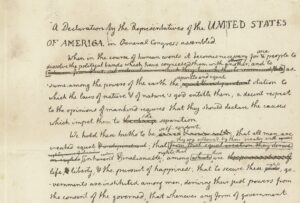
Years later, after Thomas Jefferson passed away in 1826, his grandson found that original rough draft, which had survived for half a century. Knowing that Americans would want to see that important document for themselves, Jefferson’s grandson produced exact facsimiles of his grandfather’s handwritten manuscript. These pages contain a beautiful treasure never seen by most Americans.
When, in July 1776, the colonies began debating the words that Jefferson had drafted, the delegates understood how important it was to be unified in their grievances against Great Britain. This way the British crown could not divide the colonies over disagreements on the grievances. As Benjamin Franklin reportedly quipped, “We must, indeed, all hang together or, most assuredly, we shall all hang separately.”3
The Slave Trade Grievance
This resulted in certain of Jefferson’s original grievances being struck from the final version. One of these, Jefferson’s last and longest grievance, was a scathing condemnation of the slave trade. Jefferson opened:
He [King George III] has waged cruel war against human nature itself, violating its most sacred rights of life and liberty in the persons of a distant people who never offended him, captivating and carrying them into slavery in another hemisphere, or to incur miserable death in their transportation thither.
This is already a stunning indictment, but Jefferson goes on. The emphasis is his own:
This piratical warfare, the opprobrium [disgrace] of infidel powers, is the warfare of the Christian king of Great Britain.
Here Jefferson essentially accuses King George III of violating the commandment “you shall not take the name of the Lord your God in vain” (Exodus 20:7) by claiming the label of “Christian” while acting like the “infidel powers”—the Muslim Barbary Pirates on the north coast of Africa, who began and perpetuated the intercontinental slave trade. The king, although identifying himself with Jesus Christ, was acting no better than wicked nonbelievers.
Jefferson still was not done:
Determined to keep open a market where MEN should be bought and sold, he [King George III] has prostituted his negative [veto] for suppressing every legislative attempt to prohibit or to restrain this execrable commerce [the slave trade]…. (emphasis original)
This is the crux of the grievance. In the years before the American Revolution, many colonies had pushed to restrict or ban the slave trade. Some colonies, like Connecticut and Rhode Island, had succeeded.4 But most attempts had been vetoed by Britain, including those by South Carolina (1760), Massachusetts (1771, 1774, and 1774 again), Delaware (1775), and Pennsylvania (1775).5 Even efforts by Virginia (1766, 1769, 1772) to impose taxes on imported slaves and discourage the slave trade were also vetoed.6
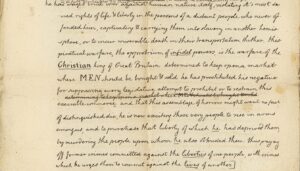
And thus, Jefferson’s final and longest grievance condemns the king for imposing slaves and the slave trade on the colonies against their will.
There is also one word in this grievance that stands out among the rest: MEN. Nearly all the words in the draft are lowercase and cursive, yet MEN is not only printed but also capitalized. This word was used in referring to all those who were being enslaved and trafficked in the evil slave trade. The word harkens back to the opening of the Declaration: “we hold these truths to be self-evident; that all men are created equal.” Too often, Americans hear that Jefferson did not truly believe that all men are created equal;7 yet in the very same document where he penned those words, Jefferson appeals to the humanity of the Africans who were bought and sold in the transatlantic slave trade—evidence from Jefferson’s own writing of his sincere belief that all men are created equal in the image of God.
A majority of the colonies agreed that the king’s imposition of slaves and the slave trade on the colonies was legitimate grounds for separation and approved the grievance. Tragically, South Carolina and Georgia—the two most southern (and likely the most proslavery) colonies—opposed the grievance.8 The grievance was removed.
But the failures of two states do not negate the significance of Jefferson’s vision. His Declaration draft stands today as a testament to his righteous crusade for equality. His outspoken denunciation of slavery and his biting condemnation of the king of Great Britain are essential parts of his story. His own handwritten words—and not the contrived smears of modern academics—are why, for so many generations of Americans, Thomas Jefferson stood as a visionary and champion of the freedom and equality of all people.
1 Alexander Stephens, “Speech Delivered on the 21st March, 1861, in Savannah, Known as “The Corner Stone Speech,” Reported in the Savannah Republican,” March 21, 1861, Alexander H. Stephens in Public and Private with Letters and Speeches, Before, During, and Since the War, ed. Henry Cleveland (National Publishing Company, 1866), 721.
2 Robert F. Turner, “Was Thomas Jefferson America’s First Abolitionist?” May 20, 2021, Minding the Campus, https://mindingthecampus.org/2021/05/20/was-thomas-jefferson-americas-first-abolitionist/.
3 Benjamin Franklin, The Works of Benjamin Franklin, with Notes and A Life of the Author, Jared Sparks, editor (Boston: Tappan and Dennet, 1844), I:408.
4 W. E. B. Du Bois, The Suppression of the African Slave-Trade to the United States of America (New York: Longmans, Green, and Co., 1896), 222-223.
5 Du Bois, Suppression of the African Slave-Trade (1896), 20, 219, 221-222.
6 Du Bois, Suppression of the African Slave-Trade (1896), 12.
7 See, for example, Nikole Hannah-Jones, “Our democracy’s founding ideals were false when they were written. Black Americans have fought to make them true.” Aug 14, 2019, New York Times Magazine, https://www.nytimes.com/interactive/2019/08/14/magazine/black-history-american-democracy.html; Annette Gordon-Reed, “Thomas Jefferson’s Vision of Equality Was Not All-Inclusive. But It Was Transformative,” Feb 20, 2020, Time, https://time.com/5783989/thomas-jefferson-all-men-created-equal/; Melissa De Witte, “How the meaning of the Declaration of Independence changed over time” July 1, 2020, Stanford Report, https://news.stanford.edu/stories/2020/07/meaning-declaration-independence-changed-time; Shankar Vedantam et al., “The Founding Contradiction: Thomas Jefferson’s Stance On Slavery,” June 29, 2020, National Public Radio, https://www.npr.org/2020/06/29/884634146/the-founding-contradiction-thomas-jeffersons-stance-on-slavery.
8 Thomas Jefferson, Autobiography of Thomas Jefferson, ed. Paul Leicester Ford (New York: The Knickerbocker Press, 1914), 33.