John Quincy Adams Graduates from Harvard

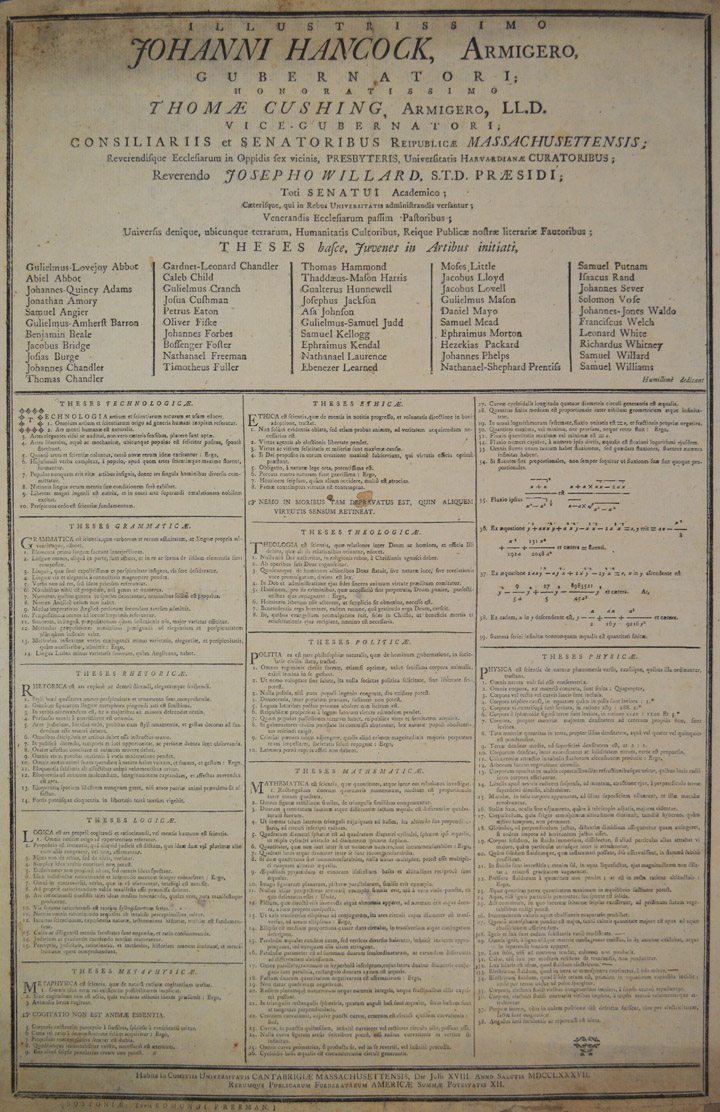
Harvard University was founded in 1636 and was incorporated in May 1650. Many of America’s early leaders graduated from Harvard – including John Quincy Adams. Below is a broadside from the WallBuilders library that lists the graduating class of 1787 (John Quincy Adams is listed in the first column) along with the thesis topics of that class.


john-quincy-adams-graduates-from-harvard-1

Manumission – Christopher Johnson – 1782


manumission-christopher-johnson-1782

manumission-christopher-johnson-1782-1


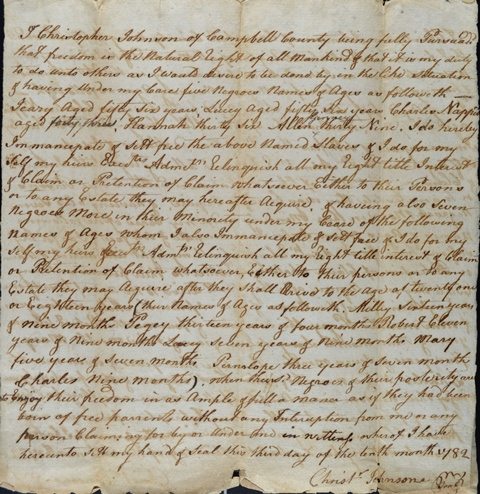
I Christopher Johnson of Campbell County being fully persuaded that freedom is the natural rights of all mankind & that it is my duty to do unto others as I would desire to be done by in the like situation & having under my care five negroes names & ages as followeth – Ieary aged fifty-six years, Succy aged fifty six years, Charles Nappier aged forty years, Hannay thirty six, Allen Ginnery thirty nine. I do hereby emancipate & set free the above names slaves & I do for my self, my heirs Execters Administers religioquick all of my right tittle interest and claim as Retentions of Claim whatever either to their persons or to any estate they may hereafter acquire of having also seven negroes more in their minority under my care of the following names of ages whom I also emancipate & set free & I do for my self, my heirs, executors, administers relinquicsh all my right title interest & claim or pretention of claim whatsoever, either to their persons or to any estate they may acquire after they share arrive to the age at twenty one or eitgheten years (their names & ages as followeth. Molly sixteen years & nine months, Peggy thirteen years & four months, Robert eleven years & nine months, Lacey seven years & nine months, Mary five years & seven months, Penelope three years & seven months, Charles nine months) when these negroes & their posterity are to enjoy their freedom in as ample & full a manor as if they had been born of free parents without any interuption from me or any persons claiming for by or under and in witness whereof I have hereunto set my hand of seal this third day of the tenth month 1782
Christopher Johnson

BACK
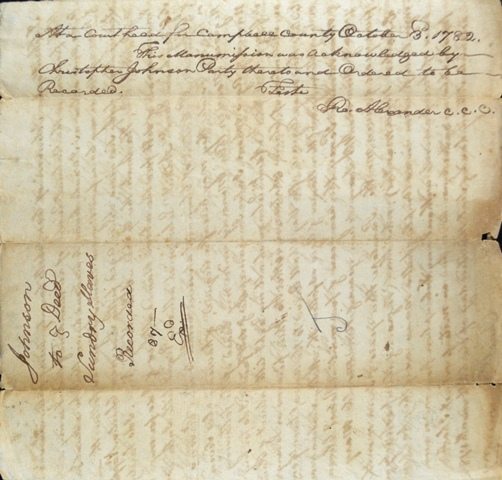
Johnson to Deed Sundry Slaves Recorded 7—
At a Court here for  Campbell County October 13, 1782.
This manumission was acknowledged by Christopher Johnson Party thereto and order to be recorded.
Estate The. Alexander c.c.c.

Aitken Bible

Prior to the American Revolution, the only English Bibles in the colonies were imported either from Europe or England. Publication of the Bible was regulated by the British government, and required a special license. Robert Aitken’s Bible was the first known English-language Bible to be printed in America, and also the only Bible to receive Congressional approval. Aitken’s Bible, sometimes referred to as “The Bible of the Revolution,” is one of the rarest books in the world, with few copies still in existence today.
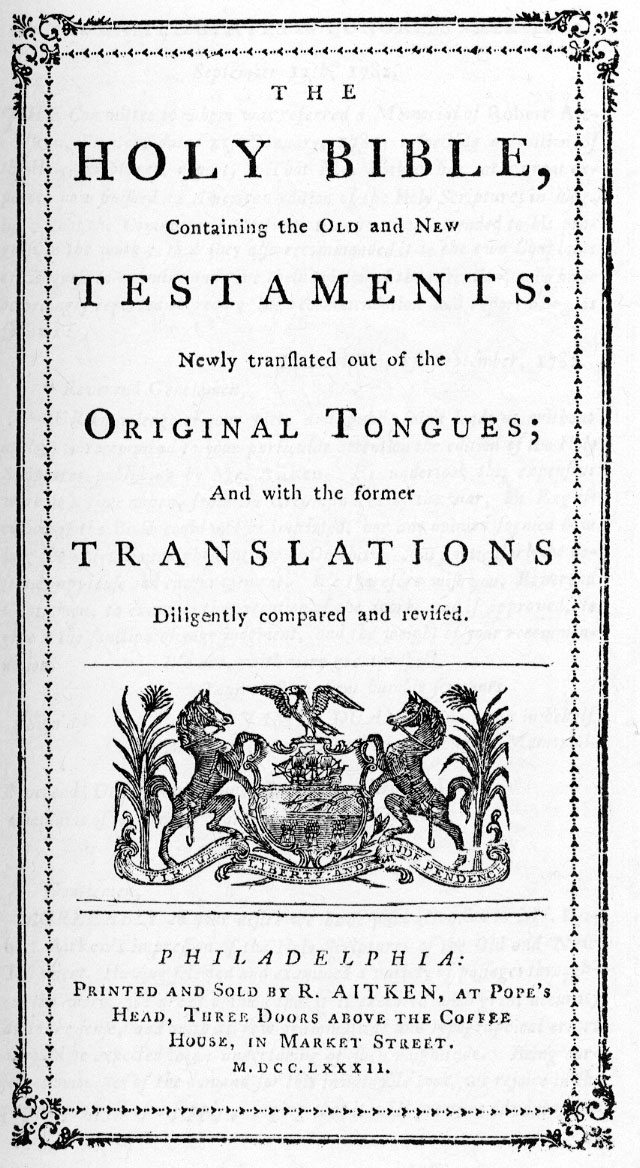

aitken-bible-1


History of the Aitken Bible

On January 21, 1781, Robert Aitken presented a “memorial” [petition] to Congress offering to print “a neat Edition of the Holy Scriptures for the use of schools.” This is the text of that memorial:

To the Honourable The Congress of the United States of America
The Memorial of Robert Aitken of the City of Philadelphia, Printer

Humbly Sheweth

That in every well regulated Government in Christendom The Sacred Books of the Old and New Testament, commonly called the Holy Bible, are printed and published under the Authority of the Sovereign Powers, in order to prevent the fatal confusion that would arise, and the alarming Injuries the Christian Faith might suffer from the Spurious and erroneous Editions of Divine Revelation. That your Memorialist has no doubt but this work is an Object worthy the attention of the Congress of the United States of America, who will not neglect spiritual security, while they are virtuously contending for temporal blessings. Under this persuasion your Memorialist begs leave to, inform your Honours That he both begun and made considerable progress in a neat Edition of the Holy Scriptures for the use of schools, But being cautious of suffering his copy of the Bible to Issue forth without the sanction of Congress, Humbly prays that your Honours would take this important matter into serious consideration & would be pleased to appoint one Member or Members of your Honourable Body to inspect his work so that the same may be published under the Authority of Congress. And further, your Memorialist prays, that he may be commissioned or otherwise appointed & Authorized to print and vend Editions of, the Sacred Scriptures, in such manner and form as may best suit the wants and demands of the good people of these States, provided the same be in all things perfectly consonant to the Scriptures as heretofore Established and received amongst us.

After appointing a committee to study the project, Congress acted on September 12, 1782, by “highly approv[ing of] the pious and laudable undertaking of Mr. Aitken.” The endorsement by Congress was printed in the Aitken Bible:
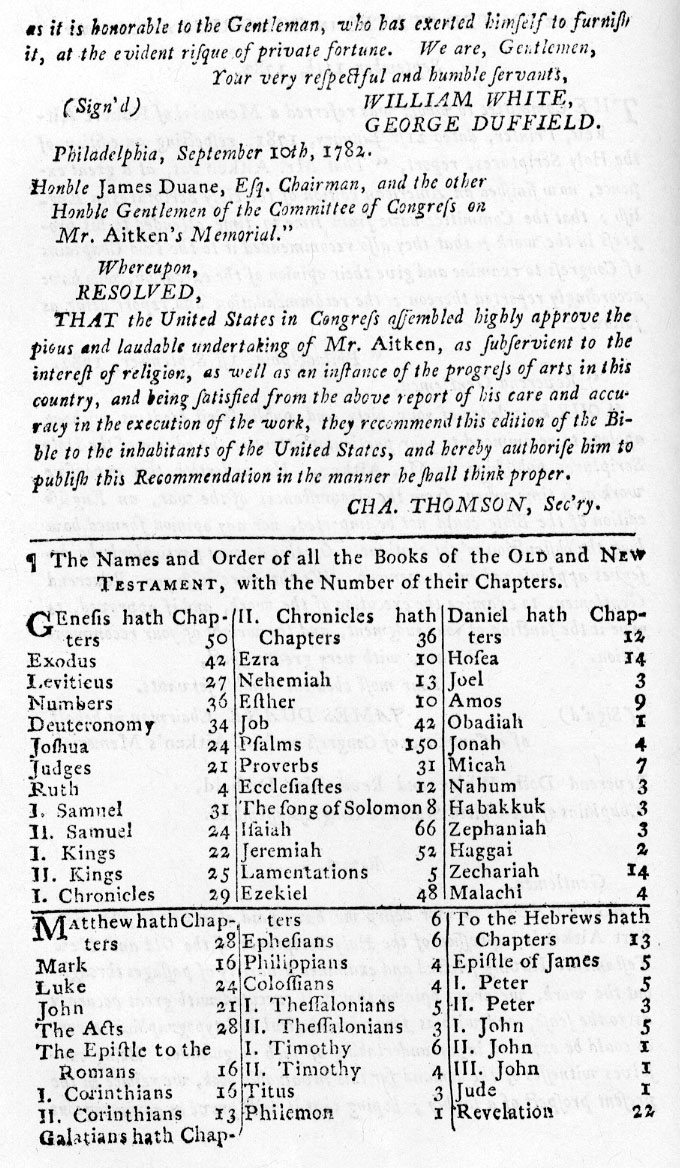
aitken-bible-2

The endorsement was signed by Charles Thomson, who was Secretary of the Continental Congress at the time as well as a signer of the Declaration of Independence. Thomson is also famous for “Thomson’s Bible,” the first American translation of the Greek Septuagint, published in 1808. (Thomson was an accomplished theologian, publishing such works as “A Regular History of the Conception, Birth, Doctrine, Miracles, Death, Resurrection, and Ascension of Jesus Christ.”)

Robert Aitken printed three documents in the front of his Bible, the report of the committee established to review his memorial; the report of the Congressional Chaplains; and Congresses endorsement. Below is the text of these documents.


BY THE UNITED STATES IN
CONGRESS ASSEMBLED:

September 12th, 1782.

THE Committee to whom was referred a Memorial of Robert Aitken, printer, dated 21st January, 1781, respecting an edition of the Holy Scriptures, report, “That Mr. Aitken has, at a great expense, now finished an American edition of the Holy Scriptures in English; that the Committee have from time to time attended to his progress in the work; that they also recommended it to the two Chaplains of Congress to examine and give their opinion of the execution, who have accordingly reported thereon; the recommendation and report being as follows:

“Philadelphia, 1st September, 1782.

“Reverend Gentlemen,
“Our knowledge of our piety and public spirit leads us without apology to recommend to your particular attention the edition of the Holy Scriptures publishing by  Mr. Aitken. He undertook this expensive work at a time when, from the circumstances f the war, and English edition of the Bible could not be imported, nor any opinion formed how long the obstruction might continue. On this account particularly he deserves applause and encouragement. We therefore wish you, Reverend Gentlemen, to examine the execution of the work, and if approved, to give the sanction of our judgment, and the weigh of your recommendation.

We are, with very great respect,
Your most obedient humble servants.
(Sign’d) JAMES DUANE, Chairman in behalf
of a Committee of Congress on Mr. Atken’s Memorial.

Reverend Doct. White and Revd. Mr. Duffield, Chaplains of the United States in Congress assembled.

Report.

Gentlemen,
AGREEABLY to your desire we have paid attention to Mr. Robert Aitken’s impression of the Holy Scriptures of the Old and New Testament. Having selected and examined a variety of passages throughout the work, we are of opinion that it is executed with great accuracy as to the sense, and with as few grammatical and typographical errors as could be expected in an undertaking of such magnitude. Being ourselves witnesses of the demand for this invaluable book, we rejoice in the present prospect of a supply; hoping that it will prove as advantageous as it is honorable to the Gentleman, who has exerted himself to furnish it, at the evident risk of private fortune. We are, Gentlemen, Your very respectful and humble servants,

(Sign’d) WILLIAM WHITE,
GEORGE DUFFIELD.

Philadelphia, September 10th, 1782.

Honble James Duane, Esq. Chairman, and the other
Honble Gentlemen of the Committee of Congress on
Mr. Aitken’s Memorial.”

Whereupon,
RESOLVED,
THAT the United States in Congress assembled highly approve the pious and laudable undertaking of Mr. Aitken, as subservient to the interest of religion, as well as an instance of the progress of arts in this country, and being satisfied from the above report of his care and accuracy in the execution of the work, they recommend this edition of the Bible to the inhabitants of the United States, and hereby authorize him to publish this Recommendation in the manner he shall think proper.

CHA. THOMSON, Sec’ry.


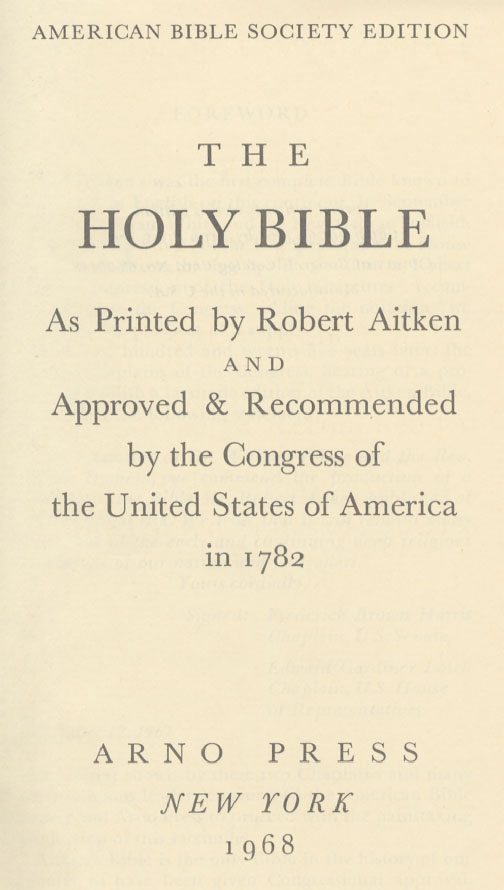
In 1968, the American Bible Society reprinted the Aitken Bible, this is the title page of that reprint:
aitken-bible-3

Will of Richard Stockton

Richard Stockton was a signer of the Declaration of Independence from New Jersey. Stockton was a lawyer and during the Revolution he was a member of the Continental Congress. Richard was taken prisoner by loyalists and during this time, his possessions were burned and his wealth reduced. He never recovered from his time as a prisoner and died in February, 1781.

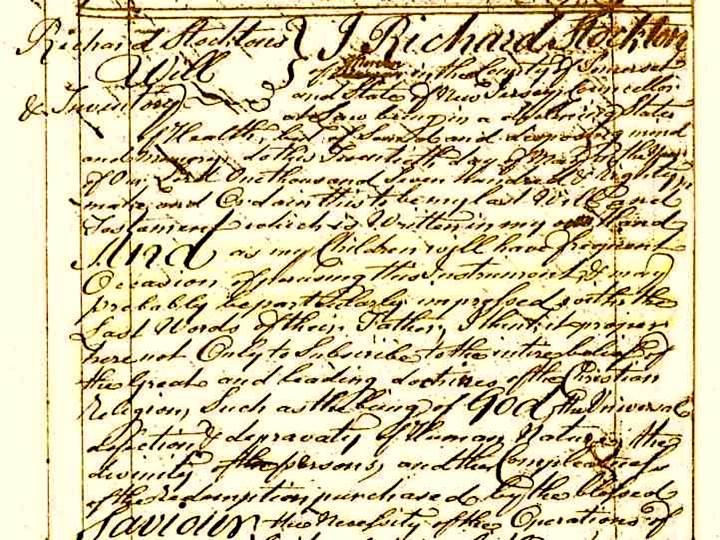
The text and image below are from Richard Stockton’s May 20, 1780 will. The complete 1780 will is held by the New Jersey State Archives.


will-of-richard-stockton-1

“…And as my children will have frequent occasion of perusing this instrument, and may probably be particularly impressed with the last words of their father, I think it proper here not only to subscribe to the entire belief of the great and leading doctrines of the Christian Religion, such as the Being of God, the universal defection and depravity of human nature, the divinity of the person and the completeness of the redemption purchased by the blessed Saviour, the necessity of the operations of the divine Spirit; of divine Faith, accompanied with an habitual virtuous life, and the universality of the divine Providence: but also, in the bowels of a father’s affection, to exhort and charge them, that the fear of God is the beginning of wisdom, that the way of life held up in the Christian system, is calculated for the most complete happiness that can be enjoyed in this mortal state; that all occasions of vice and immorality is injurious either immediately or consequentially; even in this life; that as Almighty God hath not been pleased in the holy Scriptures to prescribe any precise mode in which he is to be publickly worshipped, all contention about it generally arises from want of knowledge or want of virtue. I have therefore no particular advice to leave with my children upon this subject, saving that they deliberately and conscienciously, in the beginning of life, determine for themselves, with which denomination of Christians they can, the most devoutly and profitably worship God; that after such determination they statedly adhere to such denomination without being given to change; and without contending with or judging others who may think or act differently upon a matter so immaterial to substantial virtue and piety. That distinguished abilities, stations and authority are only desireable as occasions of doing greater private and public good, but that their footsteps being invariably masked with envy and opposition, make them enemies to private peace, and therefore unless public life is evidently pointed out by divine providence it should rather be avoided than coveted. Of the temporal estate with which it hath pleased Almighty God in his bountiful providence to bless me, I hereby make the disposition following…”

The 104th Psalm by John Quincy Adams

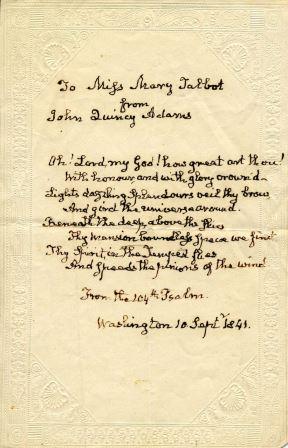
John Quincy Adams, sixth President of the United States was well known for his use of words. The below handwritten poem, dated September 10, 1841 and transcribed from the 104th Psalm, is a wonderful example of not only Adams’ appreciation for the Word of God, but also of his firm conviction and faith in God.


the-104th-psalm-by-john-quincy-adams-1

To Miss Mary Talbot
from
John Quincy Adams

Oh! Lord, my God! How great art Thou!
With honour, and with glory crown’d
Lights dazzling splendours veil thy brow,
And gird the universe around.

Beneath the deep, above the skies
Thy mansion boundless space we find.
Thy Spirit in the Tempest flies
And spreads the pinions of the wind.

From the 104th Psalm

Washington 10 Sept. 1841

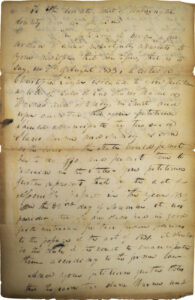
Manumission – Dorcas – 1837


To the County Court of Washington County now in session

The petition of Dorcas, a free woman of color respectfully represents to your worships that here to from, that is to say, on   7th of August 1833, a certain Christopher Taylor, executed to you petitioners a bill of sale of two slaves named Warner and Nancy, in trust and upon condition that your petitioners should emancipate to the two said slaves Warner and Nancy as soon as the laws of the state would permit her to do so, and permit them to remain in the State. You petitioners further represent that by to Act of Assembly passed in the year 1833 on the 23rd day of November, it was provided that if any slaves had in good faith contracted for their freedom previous to the passage of the Act of 1831, it should in the duty of the court to emancipate them according to the former laws –

And your petitions presented notes that the said two slaves, Warner and Nancy had in good faith contracted and agreed with the said Christopher Taylor for their freedom long before the passage of the act of 1831. She herein prays your worships that you will emancipate the said two slaves Warner and Nancy as the laws in such cases made and provided direct; and as in duty bound XXX wish ever XXX

Dorcas
Jan 2, 1837

American Bible Society Certificate Signed by John Jay

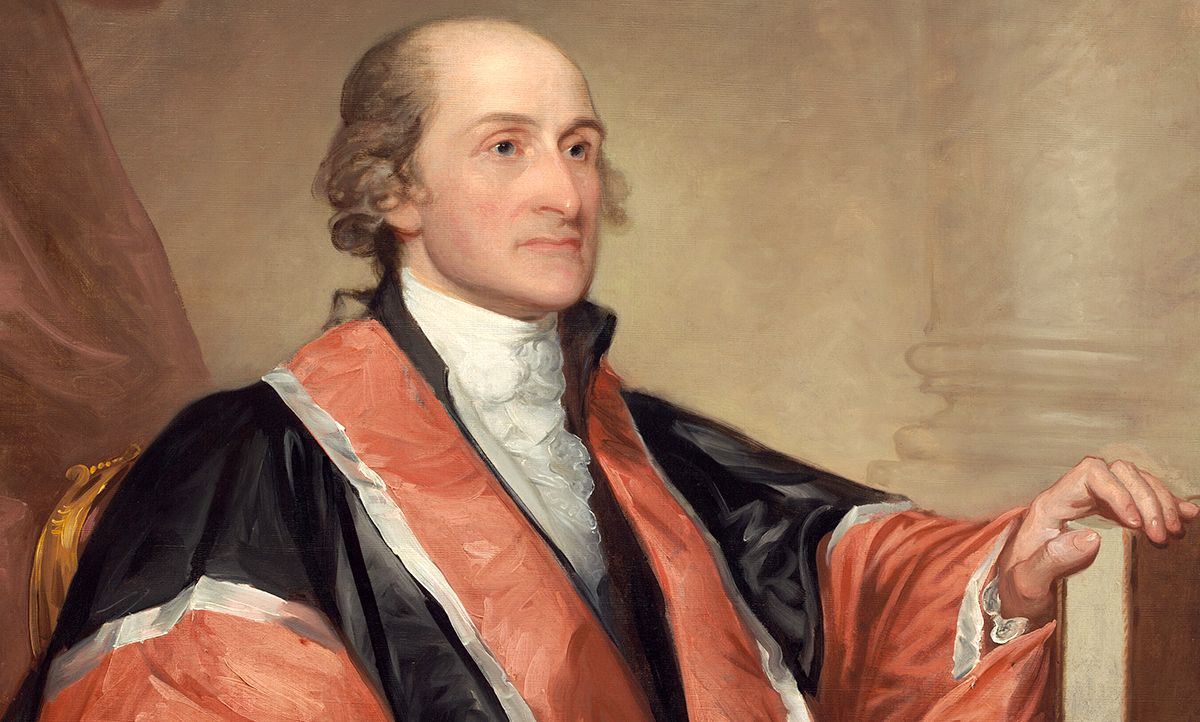
John Jay (1745-1829) was an attorney, public official, diplomat, jurist. He was member of the Continental Congress (1774-76, 1778-79) where he was President of Congress (1778-79) and helped write the New York State constitution (1777). Jay also authored first manual on military discipline (1777) and served as Chief-Justice of the New York Supreme Court (1777-78). During the War for Independnece, he was appointed minister to Spain (1779) and also signed the final peace treaty with Great Britain (1783). Jay, along with James Madison and Alexander Hamilton, authored The Federalist Papers, which were instrumental in securing the ratification of the US Constitution. Under President George Washington, he was appointed first Chief-Justice of the U. S. Supreme Court (1789-95) and later declined a reappointment as Chief-Justice by President John Adams. Jay later served as Governor of New York (1795- 1801).

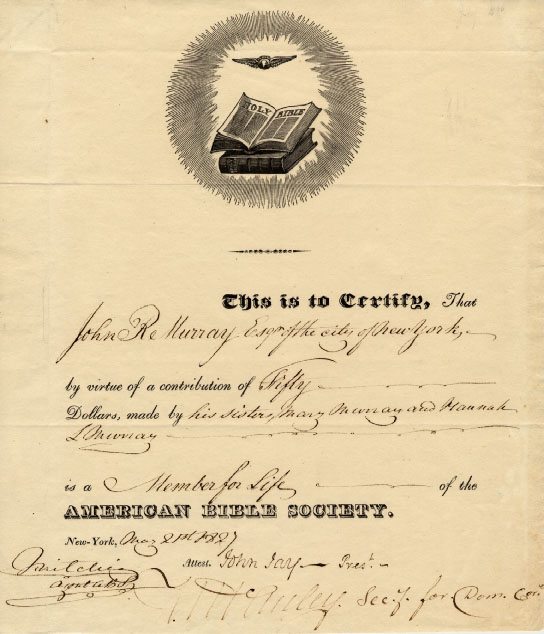
John Jay was also vice-president of the American Bible Society at its beginning, from 1816-21, and was president from 1821-27. Below is a membership certificate signed by him as president of the American Bible Society.


american-bible-society-certificate-signed-by-john-jay-1


This is to Certify, That John R Murray, Esqr. Of the city of New York, by virtue of a contribution of Fifty Dollars, made by his sisters, Mary Murray, and Hannah  L. Murray is a member for life of the

American Bible Society. 

New York, May 21st 1827
Attest. John Jay – Prest.[President] –
Jnitelies[?] Agent ABS
T. McAuley Secy. for Dom. Cores

The American Bible Society Constitution

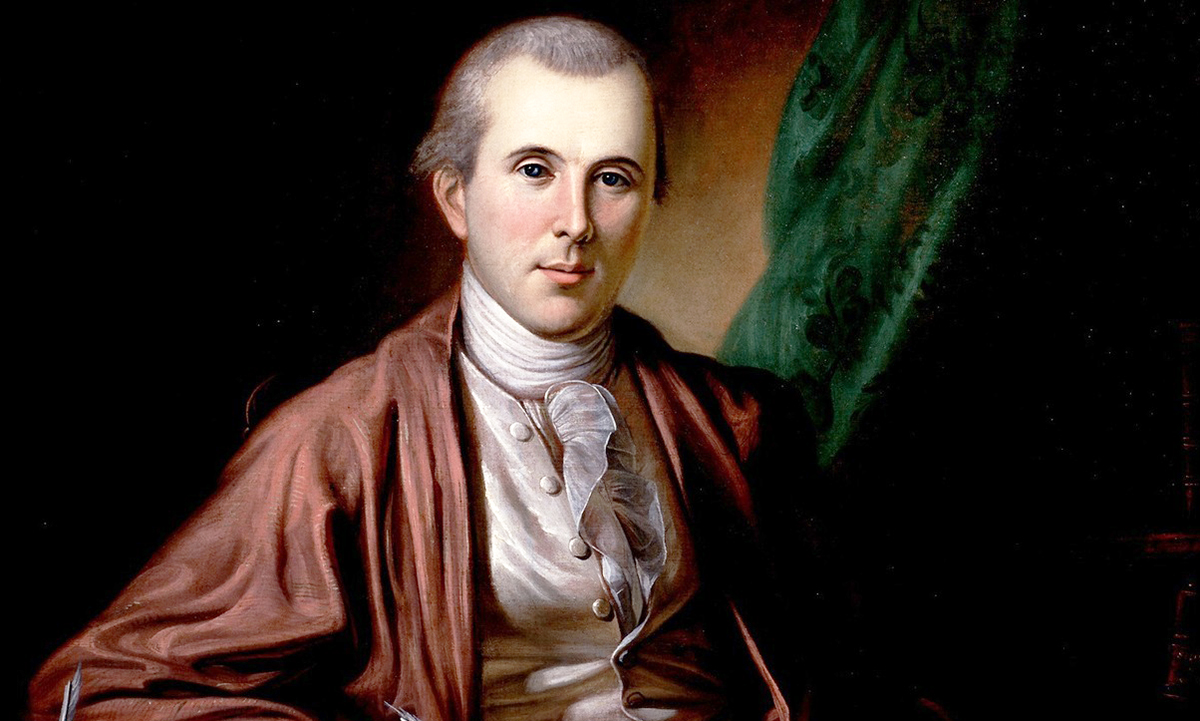
Bible societies in America date back to 1809 when Declaration Signer Benjamin Rush helped establish the first Bible society in America. By 1816, 121 more Bible societies had been started across the nation, many of them with the help of key Founding Fathers. The American Bible Society, founded in 1816, was the first national Bible society. The original officers of the Society included: signers of the U. S. Constitution, revolutionary generals, U.S. Supreme Court Justices, a U.S. Attorney General, a U.S. Secretary of the Treasury, state governors, and others.

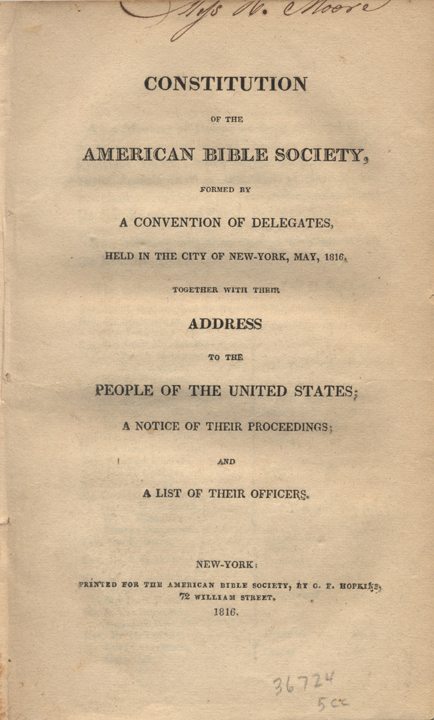
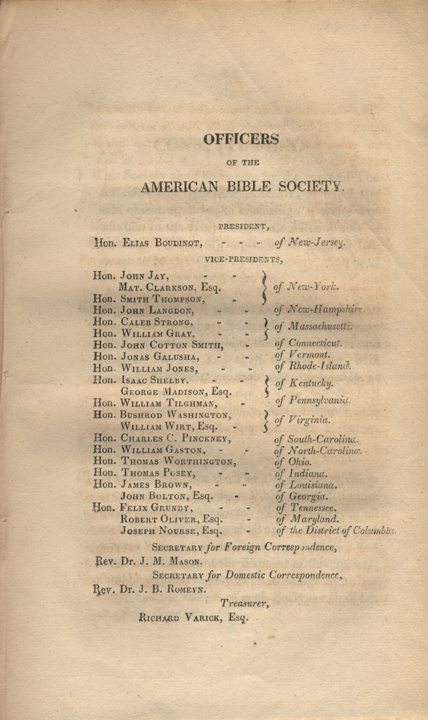
WallBuilders vast collection of original documents includes an original constitution of the American Bible Society as well as a first Bible printed by that society. Below are the title page and officers page for the 1816 American Bible Society Constitution.


the-american-bible-society-1

the-american-bible-society-2


OFFICERS
OF THE
AMERICAN BIBLE SOCIETY.
 

President,

Hon. Elias Boudinot,         of New-Jersey.

Vice-Presidents,

Hon. John Jay,                   of New-York.
Mat. Clarkson, Esq.       of New-York.
Hon. Smith Thompson,       of New-York.
Hon. John Langdon,           of New-Hampshire.
Hon. Caleb Strong,             of Massachusetts.
Hon. William Gray,             of Massachusetts.
Hon. John Cotton Smith,     of Connecticut.
Hon. Jonas Galusha,           of Vermont.
Hon. William Jones,            of Rhode-Island.
Hon. Isaac Shelby,              of Kentucky.
George Madison, Esq.      of Kentucky.
Hon. William Tilghman,        of Pennsylvania.
Hon. Bushrod Washington,   of Virginia.
William Wirt, Esq.           of Virginia.
Hon. Charles C. Pinckney,    of South-Carolina.
Hon. William Gaston,           of North-Carolina.
Hon. Thomas Worthington,  of Ohio.
Hon. Thomas Pusey,           of Indiana.
Hon. James Brown,             of Louisiana.
John Bolton, Esq.           of Georgia.
Hon. Felix Grundy,               of Tennessee.
Robert Olivers, Esq.         of Maryland.
Joseph Nourse, Esq.         of the District of Columbia.

Secretary for Foreign Correspondence,

Rev. Dr. J. M. Mason.

Secretary for Domestic Correspondence,

Rev. Dr. J. B. Romevn.

Treasurer,

Richard Varick, Esq.

First American Bible Society Bible

The 1816 American Bible Society Bible
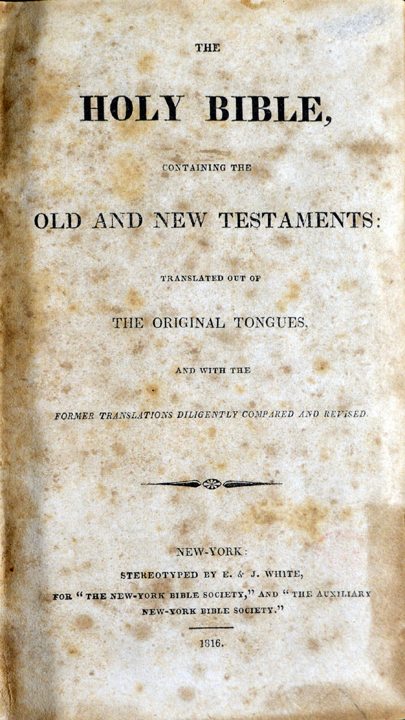
The American Bible Society, founded in 1816, was the first national Bible society in America. The original officers of the Society included: signers of the U. S. Constitution, revolutionary generals, U.S. Supreme Court Justices, a U.S. Attorney General, a U.S. Secretary of the Treasury, state governors, and others. WallBuilders vast collection of original documents includes an original constitution of the American Bible Society as well as a first Bible printed by that society. Below is the title page for this society’s first Bible, printed in 1816.


first-american-bible-society-bible-1

Philadelphia Bible Society Bible

The Philadelphia Bible Society, America’s first Bible society, was officially organized on December 12, 1808. Rev. Dr. William White was president of the society and Declaration signer Benjamin Rush was a vice president. By 1816, 121 more Bible societies had been started across the nation.

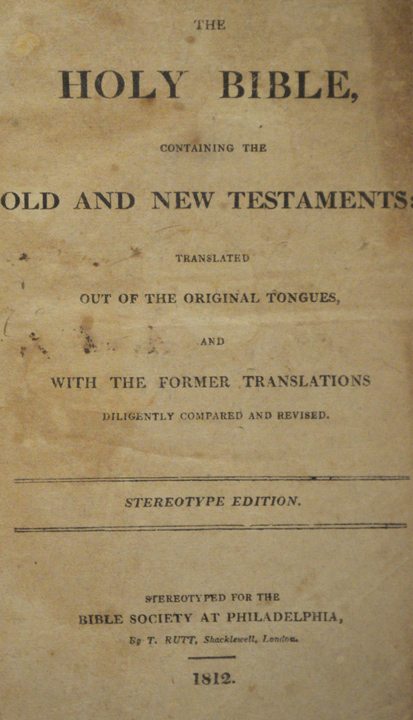
Below, from WallBuilders’ Collection, is the title page of an original Bible published by the Philadelphia Bible Society in 1812. This was the first Bible printed in America to use stereotype plates.


philadelphia-bible-society-bible-1