
Abigail Adams’ Letter

abigail-adams-letter-1

Abigail Smith Adams (1744-1818) was the second of three daughters born to a well-respected family, her father being a Congregationalist minister in Massachusetts.1 Due to her poor health in her early life Abigail had no formal education.2 In fact, at a time when female education was “neglected” and it had become “fashionable…to ridicule female learning,” 3 Abigail rose above this to become “qualified for eminent usefulness in her distinguished position as the companion of one great statesman, and the guide of another.” 4

Her strong religious convictions and intellect led her to be considered her husband’s “trusted advisor” 5 as she regularly wrote him information concerning what was happening in America throughout the Revolution. 6  Her Christian faith is evidenced not only by a statue of her and John Quincy Adams that has been placed outside the church in Quincy, Massachusetts where she was buried, 7  but also by her many religious references throughout her letters. 8

For example, as Abigail Adams reported to her husband, John Adams after the Battle of Bunker Hill:

The race is not to the swift, nor the battle to the strong; but the God of Israel is he, that giveth strength and power unto His people. Trust in Him at all times, ye people, pour our your hearts before Him; God is a refuge for us.” Charlestown is laid in ashes. The battle began upon our entrechments upon Bunker’s Hill, Saturday morning about three o’clock, and has not ceased yet, and it is now three o’clock Sabbath afternoon. It is expected they will come over the Neck tonight, and a dreadful battle muse ensue. Almighty God, cover the heads of our countrymen, and be a shield to our dear friends!9

In 1778, when John Quincy was 11 years old and accompanying his father on a diplomatic mission to France, Abigail gave him the following advice:

abigail-adams-letter-2Adhere to those religious sentiments and principles which were early instilled into your mind and remember that you are accountable to your Maker for all your words and actions….

[D]ear as you are to me, I would much rather you should have found your grave in the ocean you have crossed, or that any untimely death crop you in your infant years, than see you an immoral, profligate, or graceless child….

Young as you are, the cruel war, into which we have been compelled by the haughty tyrant of Britain and the bloody emissaries of his vengeance, may stamp upon your mind this certain truth, that the welfare and prosperity of all countries, communities, and, I may add, individuals, depend upon their morals. 10

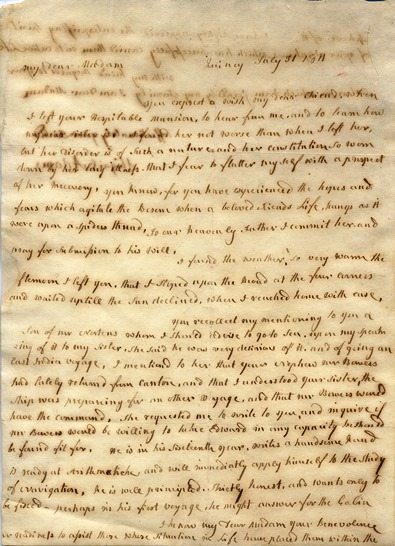
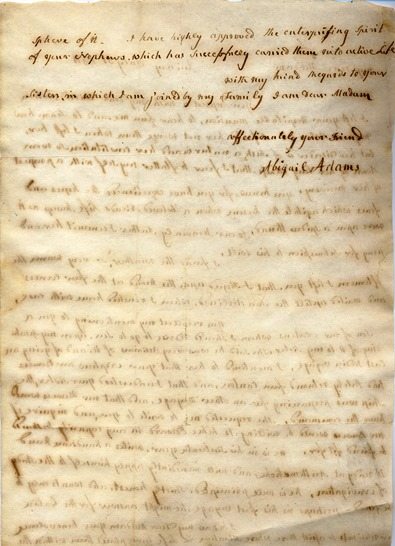
Another reflection of Abigail’s strong Christian faith is seen in a handwritten letter of Abigail’s that WallBuilders possesses.

In this letter to a friend on July 31, 1811, Abigail spoke a little about her older sister (Mary Cranch) and the illness that eventually resulted in her death later that year, 11 acknowledging that “to our heavenly Father I commit her.” The handwritten letter, along with its transcription is included below.

In 1818, Abigail contracted typhoid fever and passed away on October 28, 1818, but she left a legacy as a woman who “exercised great and far-reaching influence in her day and generation.” 12 For additional information about Abigail Adams, see the book Wives of the Signers, published by WallBuilders.
abigail-adams-letter-3

abigail-adams-letter-4

Quincy July 31, 1811

My Dear Madam,

You expressed a wish my dear friend when I left your hospitable mansion to hear from me and to learn how my dear sister is. I found her not worse than when I left her, but her disorder is of such a nature and her constitution so worn down by her long illness that I fear to flatter myself with the prospect of her recovery. You know, for you have experienced the hopes and fears which agitate the bosom when a beloved friends life hangs as if were upon a spiders thread.

To our heavenly Father I commit her and pray for submission to His will.

I found the weather so very warm the [a]fternoon I left you, that I stayed upon the road at the four corners and waited until the sun declined, when I reached home with ease.

You recollect my mentioning to you a son of Mr. Nortens whom I should advise to go to sea. Upon my speaking to my sister she said he was very desirous of it and of going on an East India voyage. I mentioned to her that your son had lately returned from Canton and that I understood your sister, the ship was preparing for another voyage and that Mr. Bowers would have command. She requested me to write to you and inquire if Mr. Bowers would be willing to take Edward in any capacity he should be found fit for. He is in his sixteenth year, writes a handsome hand, is ready at arithmetic [sic] and will immediately apply himself to the study of navigation. He is well principled, strictly honest, and wants only to be fixed – perhaps in his first voyage, he might answer for the cabin.

I know my dear madam your benevolence in readiness to assist those whose situation in life have placed them within the sphere of it. I have highly enjoyed the enterprising spirit of your nephews which has successfully carried them into active life.

With my kind regards to your sister, in which I am joined by my family, I am dear madam

Affectionately your friend,

Abigail Adams


Endnotes

1 Letters of Abigail Adams, the Wife of John Adams with an Introductory Memoir by her Grandson Charles Francis Adams, ed. Charles Francis Adams (Boston: Wilkins, Carter, and Company, 1848), xxiv; Elizabeth Ellet, Women of the Revolution (New York: Baker and Scribner, 1849), II:26; Charles Francis Adams, Familiar Letters of John Adams and His Wife Abigail Adams, During the Revolution (New York: Hurd and Houghton, 1876), xi.
2 Letters of Abigail Adams, ed. Adams (1848), xxiv; Adams, Familiar Letters (1876), xi.
3 Abigail Adams to John Adams, June 30, 1788, Letters of Abigail Adams, ed. Adams (1848), 99.
4 Ellet, Women of the Revolution (1849), II:31.
5 “John Adams and the Massachusetts Constitution,” Mass.gov, accessed November 1, 2023, https://www.mass.gov/guides/john-adams-the-massachusetts-constitution; Ellet, Women of the Revolution (1849), II:31.
6 See for exampleLetters of Abigail Adams, ed. Adams (1848); Adams, Familiar Letters (876).
7 “Abigail Adams Historical Marker,” The Historical Marker Database, accessed November 1, 2023, https://www.hmdb.org/m.asp?m=18502.
8 See for exampleLetters of Abigail Adams, ed. Adams (1848); Adams, Familiar Letters (1876).
9 Abigail Adams to John Adams, June 18, 1775, Letters of Mrs. Adams, ed. Adams (1848), 40.
10 Abigail Adams to John Quincy Adams, June, 1778, Letters of Mrs. Adams, ed. Adams (1848), 122-125
11 Ellet, Women of the Revolution (1849), II:34.
12 Harry Clinton Green and Mary Wolcott Green, The Pioneer Mothers of America (New York: G.P. Putnam’s Sons, 1912), 3:32.
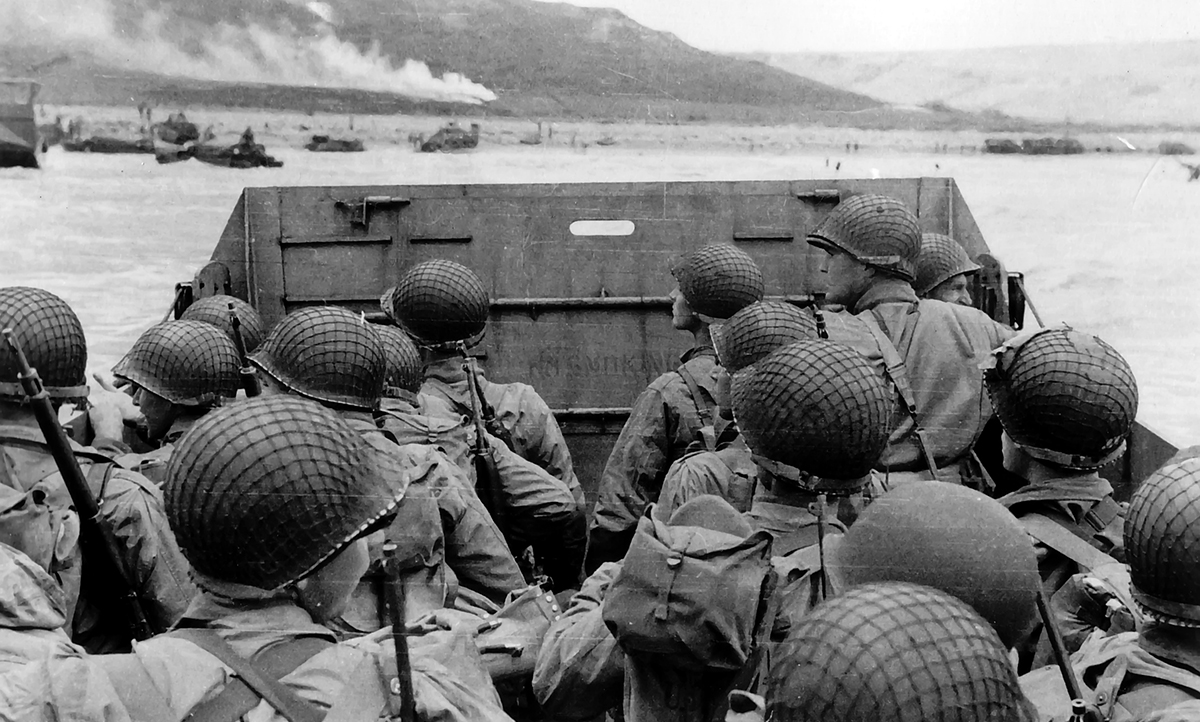
American troops land at Omaha Beach during the D-Day landings of 1944.

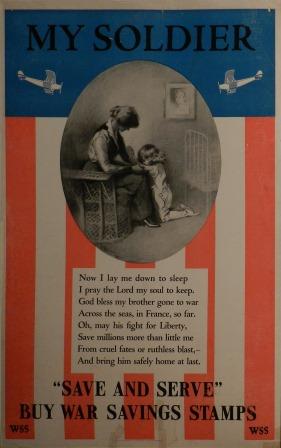
War Bond Posters

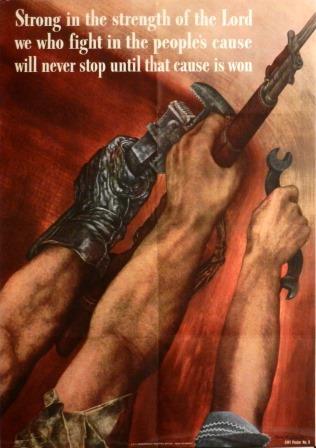
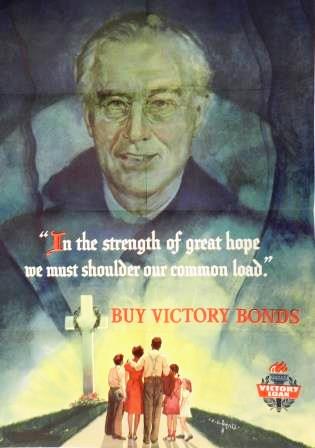
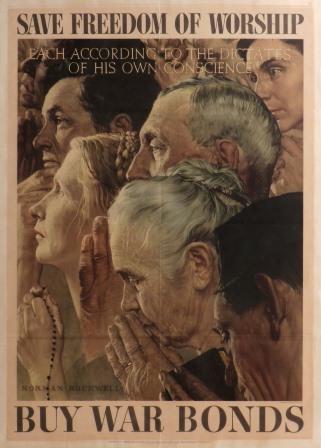
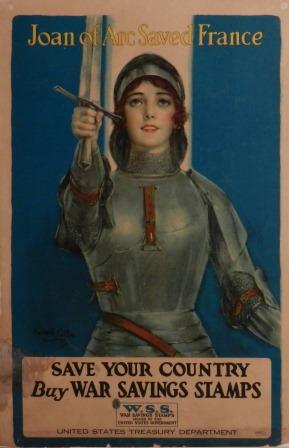
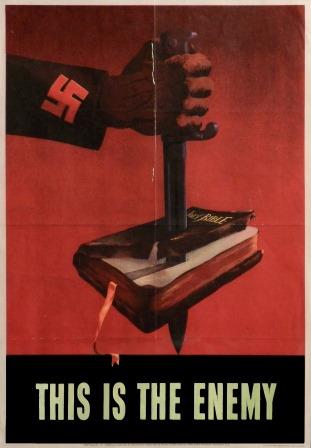
During WWI and WWI, war bonds were sold by the U.S. Treasury Department to help fund the war efforts. To promote the bonds and encourage their purchase by citizens, the government produced posters that would promote patriotism and stir pro-American feelings. Below are some of the official posters printed by the U.S. Government Printing Office; notice that each has a strong religious theme. For example, in the WWII posters, the enemy is attacking the Bible — the book that represented the heart and core of America and her beliefs and values. Notice that in the poster with President Franklin D. Roosevelt, a family is gathered around a cross. Others contain Bible themes and even point to the birth of Christ. Among the WWI posters is a mother and child offering a prayer, and an image of religious leader and hero Joan of Arc. Such messages, conveyed by the official mechanisms of the federal government, were never seen to be unconstitutional nor were they even questioned by citizens. To the contrary, Christian and Biblical principles were seen as indivisible from America.


World War II Posters

war-bond-posters-1          war-bond-posters-2

war-bond-posters-3          war-bond-posters-4

war-bond-posters-5


World War I Posters

war-bond-posters-6          war-bond-posters-7

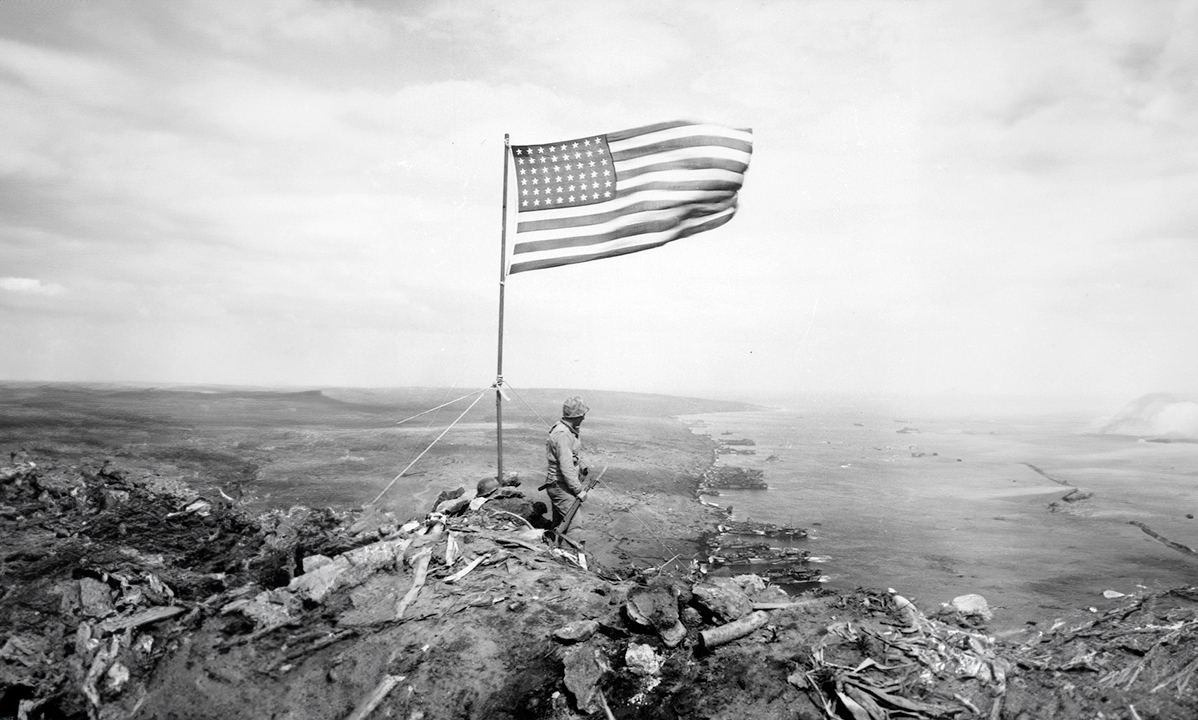
A member of the American military stands beside a US flag raised after the Battle of Iwo Jima.

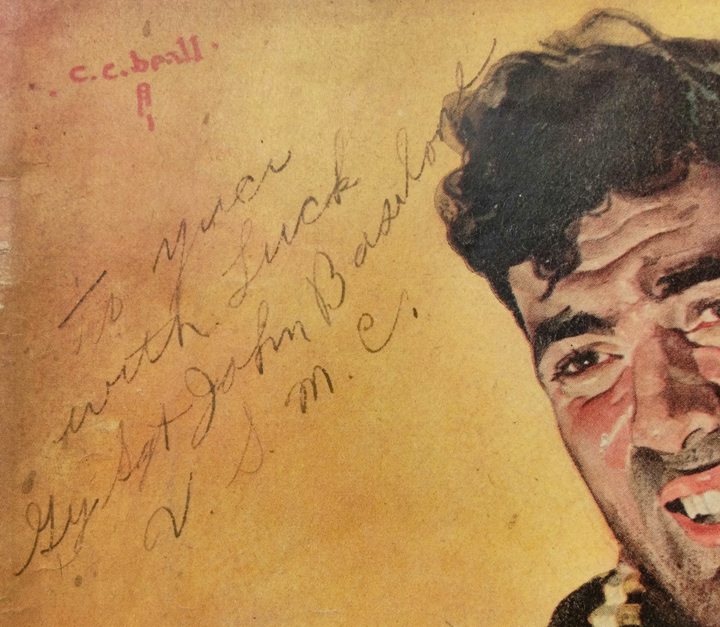
John Basilone Magazine Cover

Sergeant John Basilone showed great heroism during his service in WWII. During the Campaign of Guadalcanal (August 1942-February 1943), he and his handful of men were responsible for holding back a Japanese assault on October 24-25, 1942. Throughout this engagement, he personally repaired and manned multiple machine guns. When his small detachment ran low, Basilone fought his way through the Japanese lines to resupply critically-needed ammunition. The Americans eventually won this long campaign. As a result of his actions, Basilone was awarded the Congressional Medal of Honor.

Later in the war at the Battle of Iwo Jima (February 19-March 26, 1945), Basilone came ashore with the first wave of Marines. Shortly after landing, his unit was trapped by machine guns from Japanese blockhouses. Basilone worked his way around one of these blockhouses and single-handedly destroyed it. As he was making his way towards an airfield, he came across an American tank trapped in a minefield. While under fire, he guided the tank out of the minefield and to safety. He was later killed by flying shrapnel. Basilone was awarded the Navy Cross for his courageous actions during the battle.

Below is a June 24, 1944 Collier’s magazine cover with a picture of Sergeant Basilone as well as a brief note by him.


john-basilone-magazine-cover-1

john-basilone-magazine-cover-2


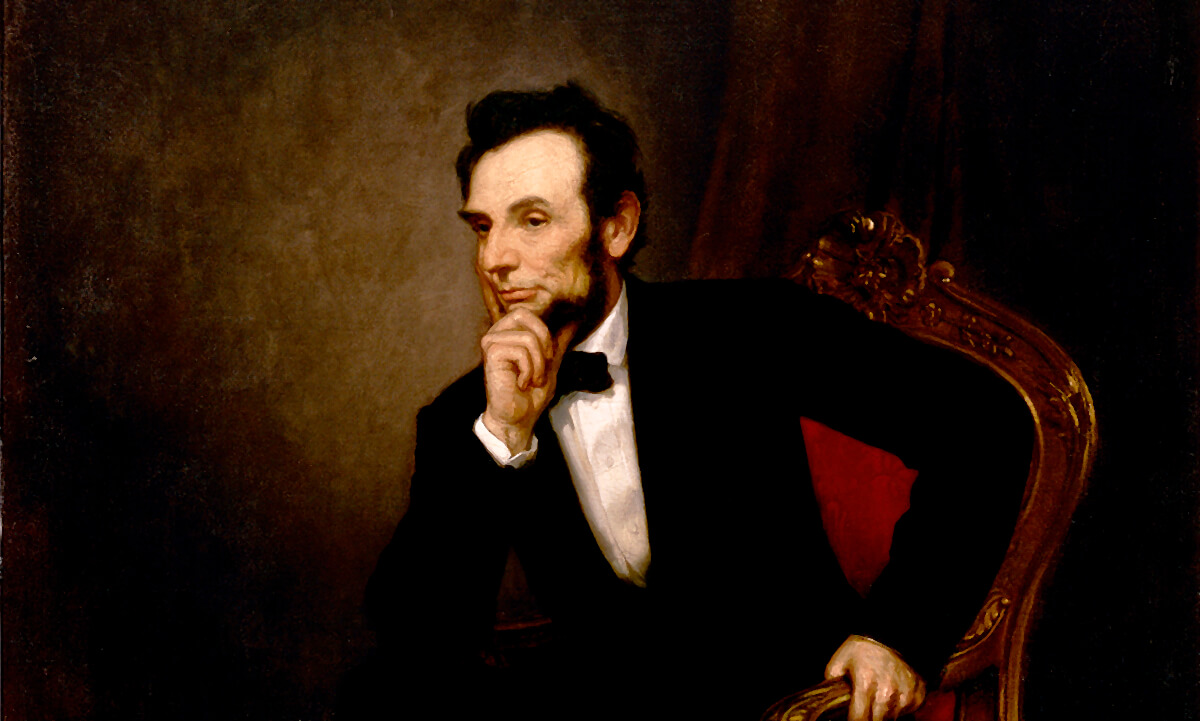
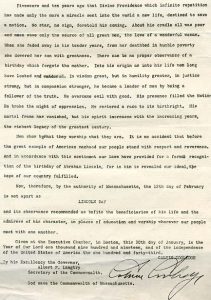
Proclamation – Lincoln Day – 1919, Massachusetts

This is the text of Calvin Coolidge January 30, 1919 Lincoln Day Proclamation, issued as governor of Massachusetts.

Lincoln Day Proclamation

January 30, 1919

THE COMMONWEALTH OF MASSACHUSETTS

By His Excellency Calvin
Coolidge, Governor.

A PROCLAMATION

proclamation-lincoln-day-1919-massachusetts-1Fivescore and ten years ago that Divine Providence which infinite repetition has made only the more a miracle sent into the world a new life, destined to save a nation. No star, no sign, foretold his coming. About his cradle all was poor and mean save only the source of all great men, the love of a wonderful woman. When she faded away in his tender years, from her deathbed in humble poverty she dowered her son with greatness. There can be no proper observance of a birthday which forgets the mother. Into his origin as into his life men long have looked and wandered. In wisdom great, but in humility greater, in justice strong, but in compassion stronger, he became a leader of men by being a follower of the truth. He overcame evil with good. His presence filled the nation. He broke the might of oppression. He restored a race to its birthright. His mortal fame has vanished, but his spirit increases with the increasing years, the richest legacy of the greatest century.
Men show by/ what they worship what they are. It is no accident that before the great example of American manhood our people stand with respect and reverence. And in accordance with this sentiment our laws have provided for a formal recognition of the birthday of Abraham Lincoln, for in him is revealed our ideal, the hope of our country fulfilled.

Now, therefore, by the authority of Massachusetts, the 12th day of February is set apart as

LINCOLN DAY

and its observance recommended as befit the beneficiaries of his life and the admirers of his character, in places of education and worship wherever our people meet with one another.

Given at the Executive Chamber, in Boston, this 30th day of January, in the Year of Our Lord one thousand nine hundred and nineteen, and of the independence of the United States of America the one hundred and forty-third.
Calvin Coolidge

By His Excellency the Governor,
Albert P. Langtry
Secretary of the Commonwealth.

God save the Commonwealth of
Massachusetts.


Andrew Carnegie Letter

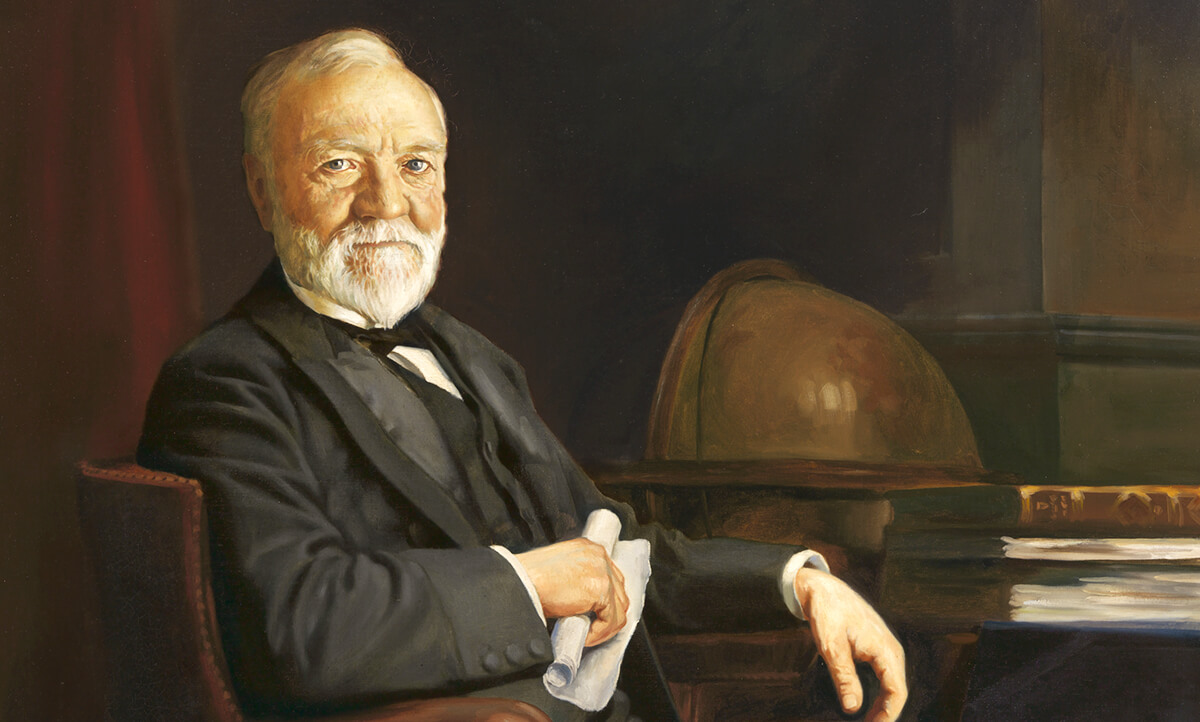
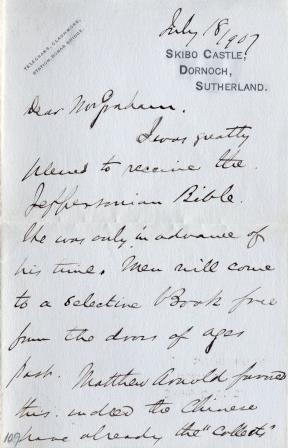
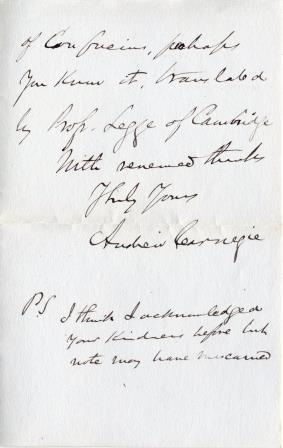
Andrew Carnegie was known as a great businessman and entrepreneur. He was also well known for his philanthropic efforts. Below is a letter (and transcript) that Mr. Carnegie wrote after his receipt of Jefferson’s Life and Morals of Jesus Christ, which is sometimes referred to as the “Jefferson Bible.” (For more information about this letter, see The Jefferson Lies by David Barton.)


andrew-carnegie-letter-1

andrew-carnegie-letter-2


July 18, 1907

Dr. Mr. Graham.

I was greatly pleased to receive the Jeffersonian Bible. He was only in advance of his time. Men will come to a selective Book free from the doors of ages past. Matthew Arnold favored this. Indeed the Chinese have already the “collects” of Confucius, perhaps you know it, translated by Prof. Legge of Cambridge.

With renewed thanks
Truly Yours
Andrew Carnegie
P.S. I think I acknowledged your kindness before last note may have miscarried.

General Order Respecting the Observance of the Sabbath

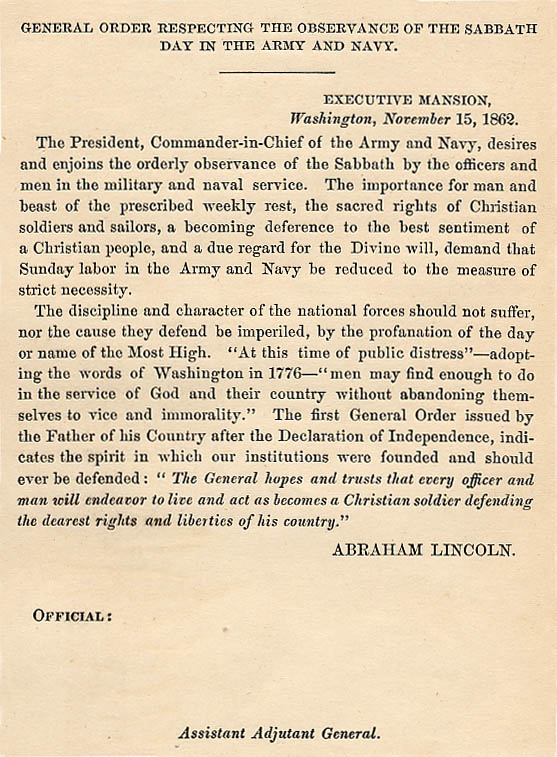
At the height of the Civil War in 1862, President Abraham Lincoln issued this General Order regarding the observance of the Sabbath in the military. In his General Order, President Lincoln quoted from two separate General Orders (February 26, and July 9, 1776) issued by George Washington during the Revolutionary War.


general-order-respecting-the-observance-of-the-sabbath-1


GENERAL ORDER RESPECTING THE OBSERVANCE OF THE SABBATH DAY IN
THE ARMY AND NAVY

EXECUTIVE MANSION,
Washington, November 15, 1862

The President, Commander-in-Chief of the Army and Navy, desires and enjoins the orderly observance of the Sabbath by the officers and men in the military and naval service. The importance for men and beast of the prescribed weekly rest, the sacred rights of Christian soldiers and sailors, a becoming deference to the best sentiment of a Christian people, and a due regard for the divine will demand that Sunday labor in the Army and Navy be reduced to the measure of strict necessity.
The discipline and character of the national forces should not suffer nor the cause they defend be imperiled by the profanation of the day or name of the Most High. “At this time of public distress,” adopting the words of Washington in 1776, “men may find enough to do in the service of God and their country without abandoning themselves to vice and immorality.” The first general order issued by the Father of his Country after the Declaration of Independence indicates the spirit in which our institutions were founded and should ever be defended:

The General hopes and trusts that every officer and man will endeavor to live and act as becomes a Christian soldier defending the dearest rights and liberties of his country.

ABRAHAM LINCOLN


George Washington’s original General Orders:

February 26, 1776

All Officers, non-commissioned Officers and Soldiers are positively forbid[den from] playing at Cards, and other Games of  chance. At this time of public distress, men may find enough to do in the service of God and their country without abandoning themselves to vice and immorality.

July 9, 1776

The Hon. Continental Congress having been pleased to allow a Chaplain to each Regiment, with the pay of Thirty-three Dollars and one third pr month—The Colonels or commanding officers of each regiment are directed to procure Chaplains accordingly; persons of good Characters and exemplary lives—To see that all inferior officers and soldiers pay them a suitable respect and attend carefully upon religious exercises. The blessing and protection of Heaven are at all times necessary but especially so in times of public distress and danger—The General hopes and trusts that every officer and man will endeavor to live and act as becomes a Christian soldier defending the dearest rights and liberties of his country.

[Source: The Writings of George Washington, ed. John C. Fitzpatrick (Washington: Government Printing Office, 1931), 4:347, February 26, 1776 Order; Writings (1932), 5:244-245, July 9, 1776 Order.]

Pony Express Bible

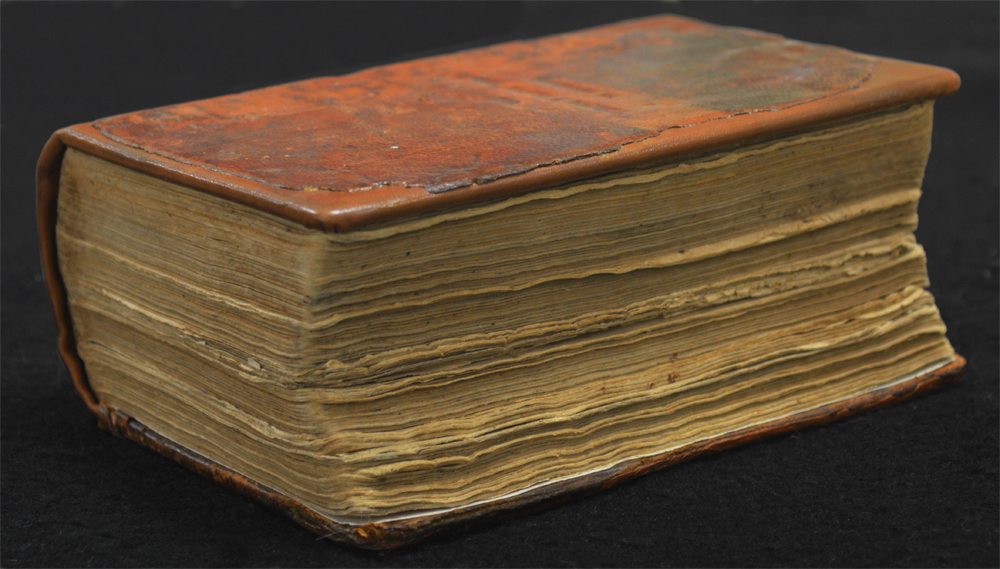
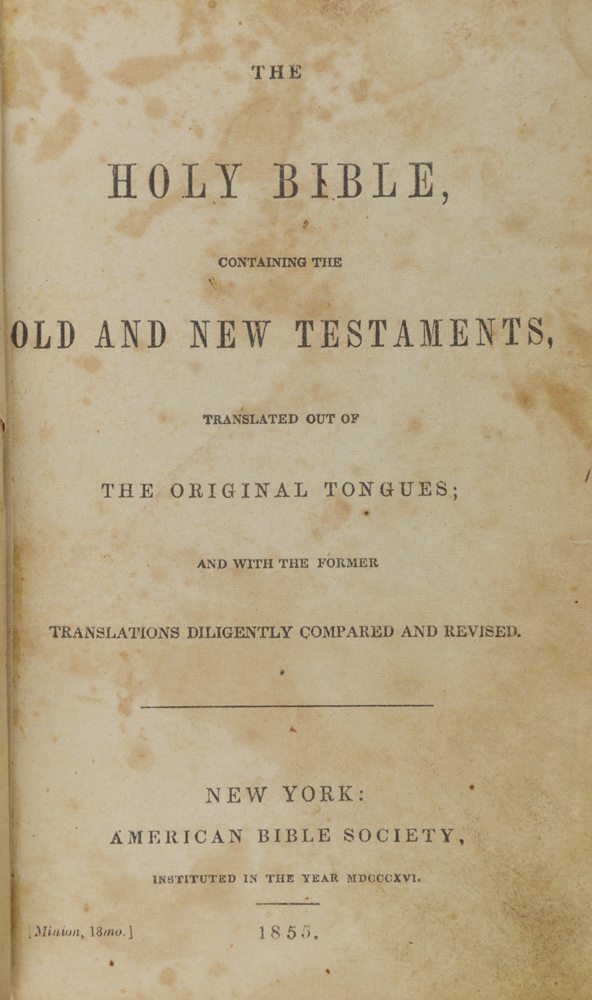
The Pony Express lasted only nineteen months during 1860/ 1861. During that time about 200 riders covered over 600,000 miles carrying the mail from Missouri to points West (such as California). The founders of the Pony Express wanted their riders to have spiritual support and so provided each one with a Bible. Below are pictures of a Pony Express Bible from the WallBuilders library.


pony-express-bible-1

pony-express-bible-2

pony-express-bible-3

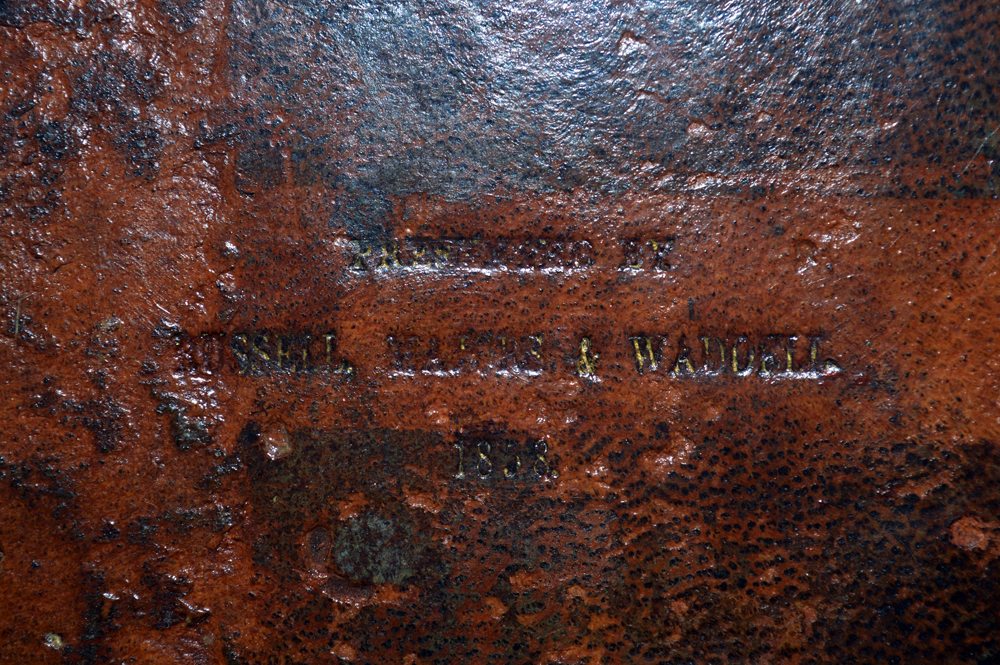
“Presented by Russell, Majors & Waddell. 1858”
This was inscribed in the front cover of all the Pony Express Bibles.

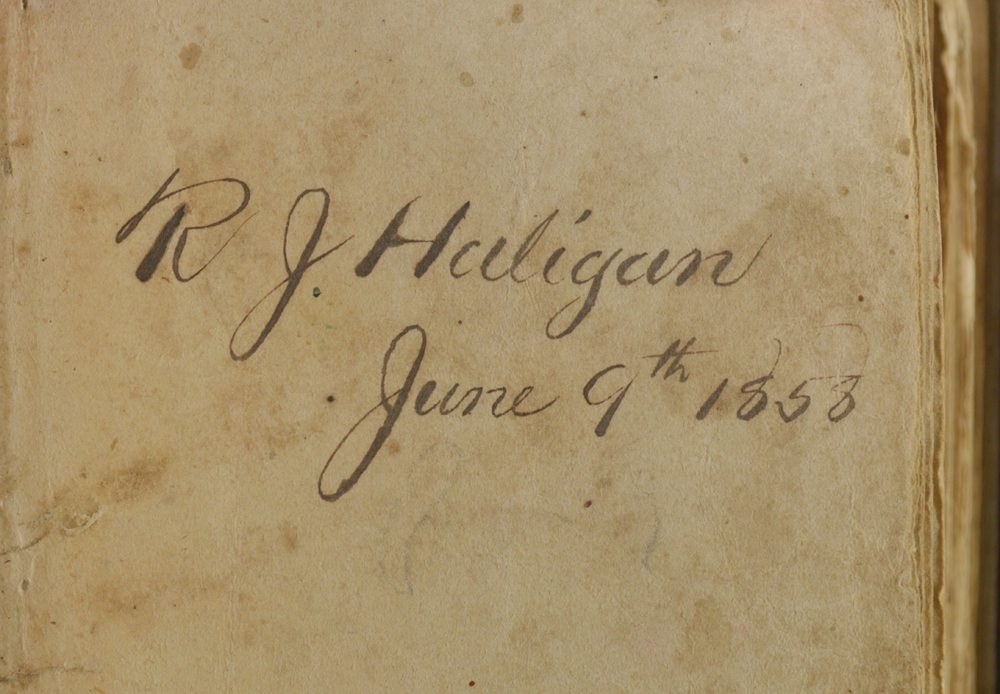
pony-express-bible-4

The name of the man this particular Bible was presented to.

Noah Webster’s Dictionary

In 1806, Noah began his work and studied about twenty different languages to translate and define words from their original languages into English. As a result of his efforts, his American Dictionary of the English Language was published in 2 volumes in 1828. The dictionary contained 70,000 words, with their spellings and definitions.  Noah’s strong faith and belief in God is evident not only in this original dictionary, but also in his 1833 The Holy Bible Containing the Old and New Testaments, in the Common Version, in which he updates outdated and unused words.

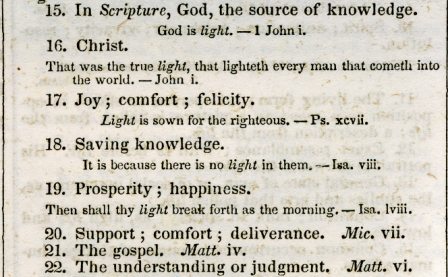
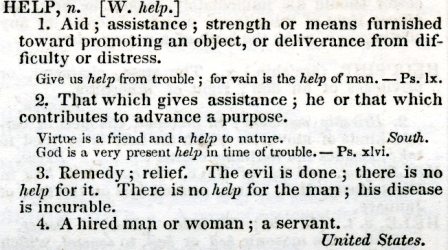
(Notice in the pictures below his use of Scripture to define words “Light” and “Help” and explain their meanings.)

light             help

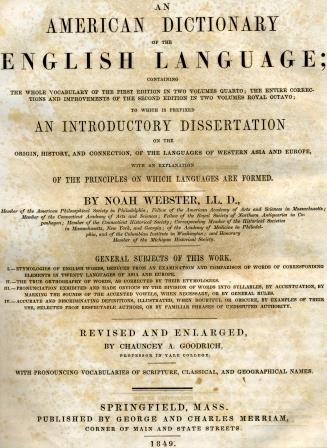
A testimony of his faith is also recorded in the 1849 edition of his Dictionary, which was printed only six years after his death in 1843. The introduction contains a biography of Noah Webster’s life, including his views on religion. This introduction was written by the editor, Chauncey A. Goodrich, Noah Webster’s son-in-law, who was a Professor at Yale. In the transcript below, Professor Goodrich details Noah Webster’s conversion experience and his faith in God.


nw1849-1

In respect to religion, Dr. Webster was a firm believer, during a large part of his life, in the great distinctive doctrines of our Puritan ancestors, whose character he always regarded with the highest veneration. There was a period, however, from the time of his leaving college to the age of forty, when he had doubts as to some of those doctrines, and rested in a different system. Soon after he graduated, being uncertain what business to attempt or by what means he could obtain subsistence, he felt his mind greatly perplexed, and almost overwhelmed with gloomy apprehensions. In this state, as he afterward informed a friend, he read Johnson’s Rambler with unusual interest; and, in closing the last volume, he made a firm resolution to pursue a course of virtue though life, and to perform every moral and social duty with scrupulous exactness. To this he added a settled belief in the inspiration of the Scriptures and the governing providence of God, connected with highly reverential views of the divine character and perfections. Here he rested, placing his chief reliance for salvation on a faithful discharge of all the relative duties of life, though not to the entire exclusion of dependence on the merits of the Redeemer. In this state of mind he remained, though with some misgiving and frequent fluctuations of feeling, to the winter of 1807-8. At that time, there was a season of general religious interest at New Haven, under the ministry of the Rev. Moses Stuart, now a professor in the Andover Theological Seminary. To this Dr. Webster’s attention was first directed, but observing an unusual degree of tenderness and solemnity of feeling in all the adult members of his family. He was thus led to reconsider his former views, and inspire, with an earnestness which he had never felt before, into the nature of personal religion, and the true ground of man’s acceptance with God. He had now to decide not for himself only, but, to a certain extent, for others, whose spiritual interests were committed to his charge. Under a sense of this responsibility, he took up the study of the Bible with painful solicitude. As he advanced, the objections which he had formerly entertained against the humbling doctrines of the Gospel, were wholly removed. He felt their truth in his own experience. He felt that salvation must be wholly of grace. He felt constrained, as he afterward told a friend, to cast himself down before God, confess his sins, implore pardon through the merits of the Redeemer, and there to make his vows of entire obedience to the commands and devotion to the service of his Maker. With his characteristic promptitude, he instantly made known to his family the feelings which he entertained. He called them together the next morning, and told them, with deep emotion that, while he had aimed at the faithful discharge of all his duties as their parent and head, he had neglected one of the most important, that of family prayer. After reading the Scriptures, he led them, with deep solemnity, to the throne of grace, and from that time continued the practice with the liveliest interest, to the period of his death. He made a public profession of religion in April, 1808. His two oldest daughters united with him in the set, and another, only twelve years of age, was soon added to the number.

In his feelings, Dr. Webster was remarkably equable and cheerful. He has a very strong sense of the providence of God, as extending to the minutest concerns of life. In this he found a source of continual support and consolation, under the severe labors and numerous trials which he had to endure. The same divine hand he habitually referred all his employments; and it was known to his family, that he rarely, if ever, took the slightest refreshment, of any kind, even between meals, without a momentary pause, and a silent tribute of thanks to God as the giver. He made the Scriptures his daily study. After the completion of his Dictionary, especially, they were always lying on his table, and he probably read them more than all other books. He felt, from that time, that the labors of his life were ended, and that little else remained by to prepare for death. With a grateful sense of past mercies, a cheering consciousness of present support, and an animating hope of future blessedness, he waited with patience until his appointed change should come.

During the spring of 1843, Dr. Webster revised the Appendix of his Dictionary, and added some hundreds of words. He completed the printing of it about the middle of May. It was the closing act of his life. His hand rested, in its last labors, on the volume which he had commenced thirty-six years before. Within a few days, in calling on a number of friends in different parts of the town, he walked, during one afternoon between two and three miles. The day was chilly, and immediately after his return, he was seized with faintness and a severe oppression on his lungs. An attack of peripneumony followed, which, though not alarming at first, took a sudden turn after four or five days, with fearful indications of a fatal result. It soon became necessary to inform him that he was in imminent danger. He received the communication with surprise, but with entire composure. His health had been so good, and every bodily function so perfect in its exercise, that he undoubtedly expected to live some years longer. But though suddenly called, he was completely ready. He gave some characteristic direction as to the disposal of his body after death. He spoke of his long life as one of uniform enjoyment, because filled up at every stage with active labors for some valuable end. He expressed his entire resignation to the will of God, and his unshaken trust in the atoning blood of the Redeemer. It was an interesting coincidence, that his former pastor, the Rev. Mr. Stuart, who received him to the church thirty-five years before, had just arrived at New Haven on a visit to his friends. He called immediately, and the interview brought into affecting comparison the beginning and the end of that long period of consecration to the service of Christ. The same hopes which had cheered the vigor of manhood, were now shedding a softened light over decay and sufferings of age. “I know in whom I have believed,’” – such was the solemn and affecting testimony which he gave to his friend, while the hand of death was upon him, – “I know in whom I have believed, and that He is able to keep that which I have committed to him against that day.” Thus, without one down, one fear, he resigned his soul into the hands of his Maker, and died on the 28th day of May, 1843, in the eighty-fifth year of his age….

August 1847


Noah Webster & The Bible

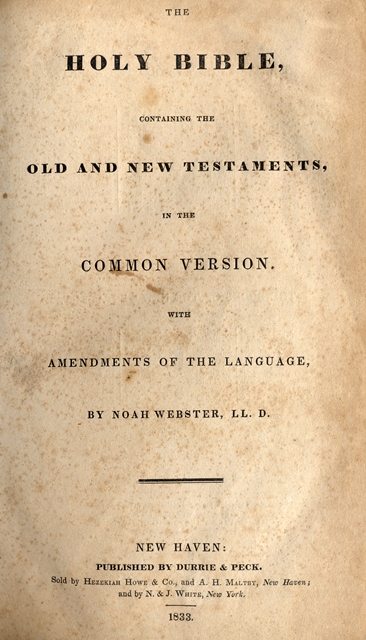
Even though, Noah Webster is most widely known for standardizing spellings and meanings of words through his Webster’s Dictionary, printed in 1828, he soon began an even greater task, which was to update The Holy Bible to exchange outdated and misunderstood words for more common ones. His belief in the inerrancy of Scripture was so strong, that he wrote an introduction to explain the changes that he made and the Scriptural integrity that was preserved. In fact, besides the introduction (transcribed below) to the Bible, WallBuilders has several notes and letters that discuss Noah Webster’s desire to preserve the accuracy of Scripture.


webster1833bible

The English version of the Sacred Scriptures, now in general use, was first published in the year 1611, in the reign of James I. Although the translators made many alterations in the language of former version, yet no small part of the language is the same, as that of the version made in the reign of Queen Elizabeth. In the present version, the language is, in general, correct and perspicuous [clear, comprehensible]; the genuine popular English of Saxon origin; peculiarly adapted to the subjects; and in many passages, uniting sublimity with beautiful simplicity. In my view, the general style of the version ought not to be altered.

But in the lapse of two or three centuries, changes have taken place, which, in particular passages, impaired the beauty; in others, obscure the sense, of the original languages. Some words have fallen into disuse; and the signification of others, in current popular use, is not the same now as it was when they were introduced into the version. The effect of these changes, is, that some words are not understood by common readers, who have no access to commentaries and who will always compose a great proportion of readers; while other words, being now used in a sense different from that which they had when the translation was made, present a wrong signification or false ideas. Whenever words are understood in a sense different from that which they had when introduced, and different from that of the original languages, they do not present to the reader the Word of God. This circumstance is very important, even in things not the most essential; and in essential points, mistakes may be very injurious [causing harm, hurt, damage, or distress].

In my own view of this subject, a version of the Scripture for popular use, should consist of words expressing the sense which is most common, in popular usage, so that the first ideas suggested to the reader should be the true meaning of such words, according to the original languages. That many words in the present version, fail to do this, is certain. My principal aim is to remedy this evil.
The inaccuracies in grammar, such as which for who, his for its, shall for will, should for would, and others, are very numerous in the present version.

There are also some quaint and vulgar phrases which are not relished by those who love a pure style, and which are not in accordance with the general tenor of the language. To these may be added many words and phrases, very offensive to delicacy and even to decency. In the opinion of all persons with whom I have conversed on this subject, such words and phrases ought not to be retained in the version. Language which cannot be uttered in company without a violation of decorum of the rules of good breeding, exposes the Scriptures to the scoffs of unbelievers, impairs their authority, and multiplies or confirms the enemies of our holy religion.

These considerations, with the approbation of respectable men, the friends of religion and good judges of this subject, have induced me to undertake the task of revising the language of the common version of the Scriptures, and of presenting for the public an edition with such amendments, as will better express the true sense of the original languages, and remove objections to particular parts of phraseology.

In performing this task, I have been careful to avoid unnecessary innovation and to retain the general character of the style. The principal alterations are comprised in three classes.

  1. The substitution of words and phrases now in good use, for such, as are wholly obsolete, or deemed below the dignity and solemnity of the subject.
  2. The correction of errors in grammar.
  3. The insertion of euphemisms, words and phrases which are not very offensive to delicacy, in the place of such as cannot, with propriety, be uttered before a promiscuous [consisting of parts, elements, or individuals of different kinds brought together without order] audience.

A few errors in the translation, which are admitted on all hands to be obvious, have been corrected; and some obscure passages, illustrated. In making these amendments, I have consulted the original languages, and also several translations and commentaries. In the body of the work, my aim has been to preserve, but, in certain passages, more clearly to express, the sense of the present version.

The language of the Bible has no inconsiderable influence in forming and preserving our national language. On this account, the language of the common version ought to be correct in grammatical construction, and in the use of appropriate words. This is more important, as men who are accustomed to read the Bible with veneration, are apt to contact a predilection for its phraseology, and thus to become attached to phrases which are quaint or obsolete. This may be a real misfortune; for the use of words and phrases, when they have ceased to be part of the living language, and appear odd or singular, impairs the purity of the language, and is apt to create a disrelish for it in those who have not, but long practice, contracted a like predilection. It may require some effort to subdue this predilection; but it may be done, and for the sake of the rising generation, it is desirable. The language of the Scriptures ought to be pure, chaste, simple, and perspicuous, free from any words of phrases which may excite observation by their singularity; and neither debased by vulgarisms, nor tricked out with the ornaments of affected elegance.

As there are diversities of tastes among men, it is not to be expected that the alterations I have made in the language of version will please all classes of readers. Some persons will think I have done too little; others, too much. And probably the result would be the same, were a revision to be executed by any other hand, or even by the joint labors of many hands.  All I can say is, that I have executed this work in the manner which, in my judgment, appeared to be the best.

To avoid giving offense to any denomination of Christians, I have not knowingly made any alteration in the passages of the present version, on which the different denominations rely for the support of their peculiar tenets.

In this country there is not legislative power which claims to have the right to prescribe what version of the Scriptures shall be used in churches, or by the people. And all human opinions are fallible it is doubtless for the interest of religion that no authority should be exerted in this case, except by commendation.

At the same time, it is very important that all denominations of Christians should use the same version, that in all public discourses, treatises, and controversies the passages cited as authorizes should be uniform. Alterations in the popular version should not be frequent; but the changes incident to all living languages render it not merely expedient, but necessary at times to introduce such alterations as will express the true sense of the original languages, in the current language of the age. A version thus amended may require no alteration for two or three centuries to come.

In this undertaking, I subject myself to the charge of arrogance; but I am not conscious of being actuated by any improper motive. I am aware of the sensitiveness of the religious public on the subject; and of the difficulties which attend the performance. But all men whom I have consulted, if they have thought much on the subject, seem to be agreed in the opinion, that it is high time to have a revision of the common version of the Scriptures; although no person appears to know how or by whom such revision is to be executed. In my own view, such revision is not merely a matter of expedience, but of moral duty; and as I have been encouraged to undertake this work, but respectable literacy and religious characters, I have ventured to attempt a revision upon my own responsibility. If the work should fail to be well received, the loss will be my own, and I hope no injury will be done. I have been painfully solicitous that no error should escape me. The reasons for the principal alterations introduced, will be found in the explanatory notes.

The Bible is the chief moral cause of all that is good, and the best corrector of all that is evil, in human society; the best book for regulating the temporal concerns of men, and the only book that can serve as an infallible guide to the future felicity. With this estimate of its value, I have attempted to render the English version more useful, by correcting a few obvious errors, and removing some obscurities, with objectionable words and phrases; and my earnest prayer is, that my labors may not be wholly unsuccessful. N.W.

New Haven, September, 1833