Sermon – Unlimited Submission 1750

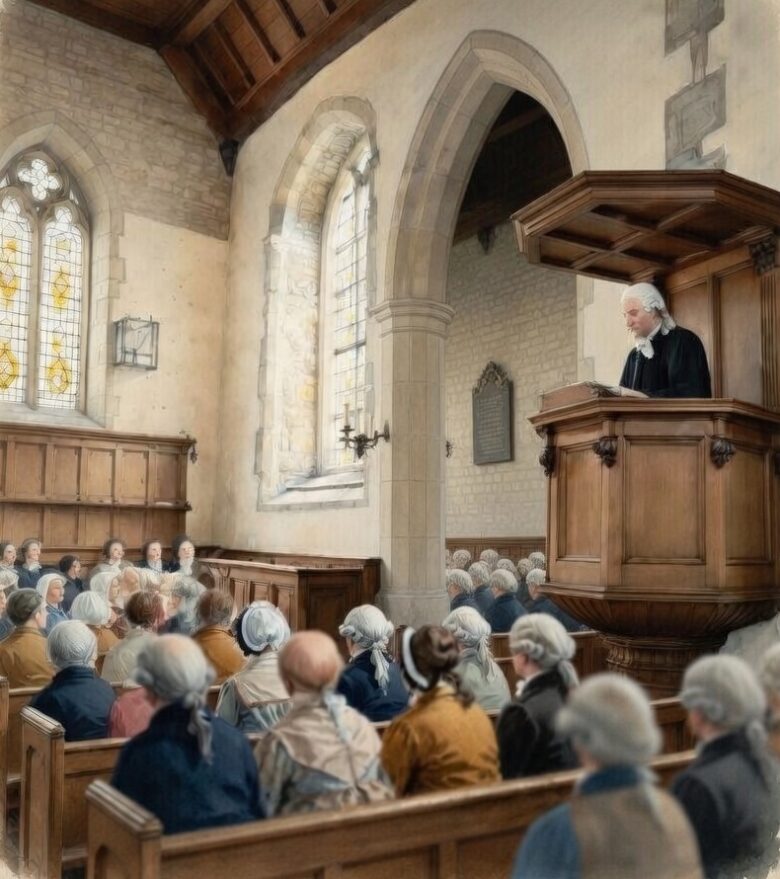
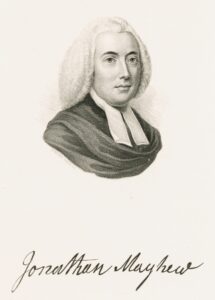
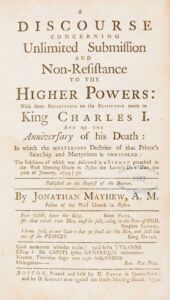
In 1750, Congregationalist minister Jonathan Mayhew (1720-1766) preached the sermon Concerning Unlimited Submission reminding his listeners, and then its readers once the sermon was published, that rebellion against tyrants could be both Biblical and just. His sermon helped form the basis of an early motto of the American Revolution: “Rebellion to Tyrants is Obedience to God,”1 which also became Thomas Jefferson’s personal motto.2

John Adams later recognized Mayhew as one of the individuals “most conspicuous, the most ardent, and influential” in the “awakening and revival of American principles and feelings” that led to our independence.3

Jonathan Mayhew, A Discourse Concerning Unlimited Submission and Non-Resistance to the Higher Powers. Boston: D. Fowle, 1750.

                                                            See the printed sermon

                                                                Read the transcript


Endnotes

1 John Adams, Letters of John Adams, Addressed to His Wife, ed. Charles Francis Adams  (Boston: Charles C. Little and James Brown, 1841), 1:152, to Abigail Adams on August 14, 1776.
2 Henry S. Randall, The Life of Thomas Jefferson (New York: Derby & Jackson, 1858), 3:393, 487.
3 John Adams, Novanglus and Massachusettensis: or Political Essays Published in the year 1774 and 1775 (Boston: Hews & Goss, 1819), 235 [Shaw #46923].
Declaration Hub

Introduction

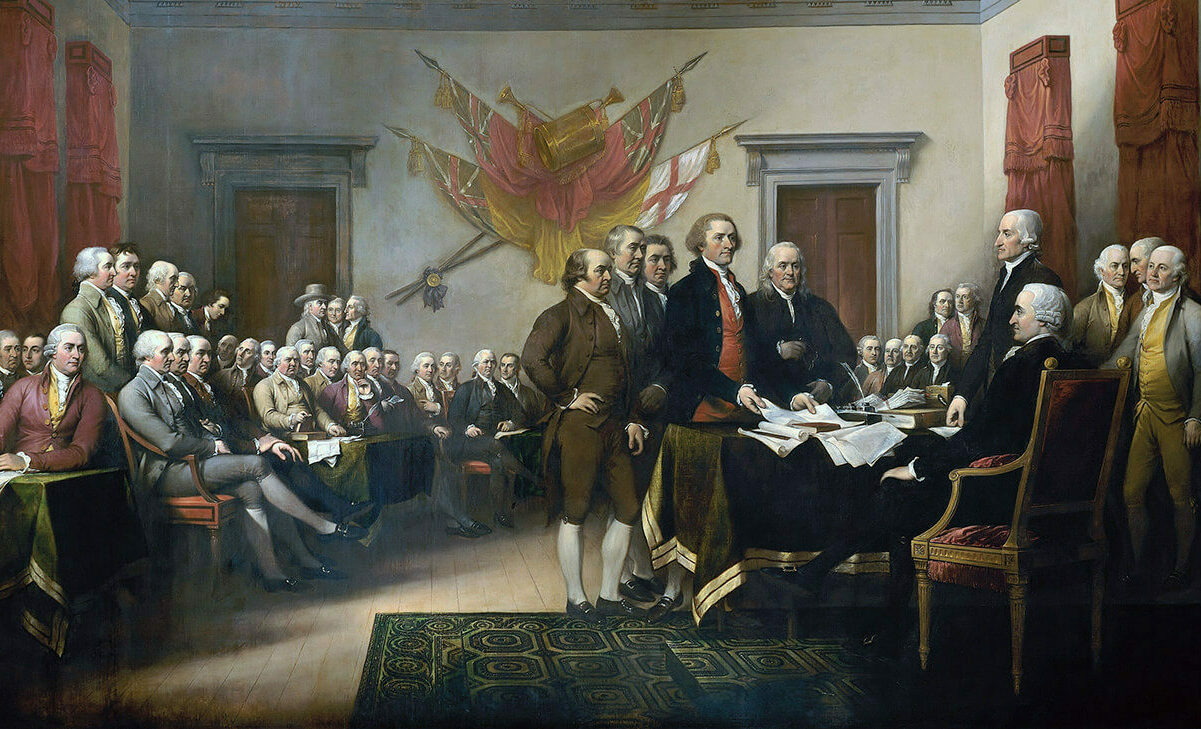
The Declaration of Independence, adopted by the Continental Congress on July 4, 1776, serves as America’s birth certificate and one of the most important documents in human history. It announced the separation of the thirteen American colonies from Great Britain and stated the key principles on which the new nation would be founded.

As Thomas Jefferson wrote in its famous preamble:

When in the course of human events, it becomes necessary for one people to dissolve the political bands which have connected them with another. We hold these truths to be self-evident, that all men are created equal, that they are endowed by their Creator with certain unalienable Rights, that among these are Life, Liberty, and the pursuit of Happiness.

These words justified the colonies’ break from tyranny and expressed a vision of government that is delegated its just powers by the consent of the governed. This was a groundbreaking idea based on the recognition of God-given rights.

The fifty-six signers of the Declaration pledged their lives, fortunes, and sacred honor to this cause.

Some History

Growing tensions between the American colonies and Britain led to the push for independence. Oppressive taxes, the Intolerable Acts, and limits on colonial freedoms fueled anger. In January 1776, Thomas Paine’s pamphlet Common Sense inspired many colonists to support breaking away from Britain.1

On June 7, 1776, Richard Henry Lee of Virginia proposed a resolution in the Continental Congress, stating that “these United Colonies are, and of right ought to be, free and independent States.”2 Congress then chose a Committee of Five—Thomas Jefferson (the primary author), John Adams, Benjamin Franklin, Roger Sherman, and Robert Livingston—to write a formal declaration.3

After intense debate and revisions (including the removal of a passage condemning the slave trade to secure unity4), Congress adopted the document. John Dunlap printed broadsides that night, spreading the news across the colonies.5

John Adams, writing to his wife Abigail on July 3, 1776, foresaw the day’s enduring legacy:

The Second Day of July 1776 will be the most memorable epoch in the History of America. I am apt to believe that it will be celebrated by succeeding Generations, as the great anniversary Festival… It ought to be solemnized with Pomp and Parade, with Shews, Games, Sports, Guns, Bells, Bonfires, and Illuminations from one End of this Continent to the other from this Time forward forever more.6

Although Adams anticipated celebrations on July 2 (the day the independence vote was held), history has adopted July 4 as Independence Day—the day the world was informed why America chose freedom.

The signers knew the risks: by declaring independence, they committed an act of treason against the British Crown, punishable by death. Yet, as Adams reflected, “posterity will triumph in that day’s transaction.”7

This hub explores the Declaration’s text, its courageous signers (including original documents and letters from several), and valuable resources for further study.

Timeline

  • June 7, 1776       Richard Henry Lee proposes independence.
  • June 11, 1776     Committee of Five appointed to draft the Declaration.
  • June 28, 1776    Draft presented to Congress.
  • July 2, 1776        Congress votes for independence (12 colonies in favor; New York abstains initially).
  • July 4, 1776        Declaration adopted and approved.
  • August 2, 1776  Most delegates sign the engrossed parchment copy.

The Text of the Declaration

The Declaration of Independence is remarkably concise—containing fewer than 1,400 words—yet it powerfully combines a philosophical defense of liberty with a detailed indictment of King George III’s abuses. The document is structured in four main parts:

  • The Preamble: States the necessity of explaining separation and introduces the famous self-evident truths.
  • A Statement of Rights and Principles: Outlines the purpose of government and the people’s right to alter or abolish it when it becomes destructive.
  • The List of Grievances: Presents 27 specific charges against the King.
  • The Resolution of Independence: Formally declares the colonies free and independent states.

These primary sources allow you to read the Declaration exactly as the Founders wrote, edited, and presented it to the world.

Primary Sources

Signers of the Declaration

The fifty-six men who signed the Declaration of Independence were not mythical figures—they were husbands, fathers, merchants, lawyers, farmers, and ministers who knowingly risked everything for the cause of liberty. By affixing their names to the document, they committed an act of treason against the British Crown, fully aware that failure could mean ruin or death. Yet they declared, in the document’s closing words, that “for the support of this Declaration, with a firm reliance on the protection of divine Providence, we mutually pledge to each other our Lives, our Fortunes and our sacred Honor.”

Many of these signers paid a heavy personal price: homes destroyed, families displaced, fortunes lost, and some imprisoned or hunted by British forces.8 Their courage and sacrifice laid the foundation for the nation we enjoy today.

WallBuilders is privileged to preserve and present original letters, documents, and artifacts from several of these brave patriots, offering a rare glimpse into their faith, character, and commitment. Below are highlighted resources featuring some of the signers and their stories.

Additional Helpful Resources

Explore the Declaration of Independence further through these trusted primary sources and educational tools. These resources provide everything from original manuscripts and images to classroom-ready materials, helping readers of all ages deepen their understanding of America’s founding document and the courageous men who signed it.

Additional Resources


Endnotes

1 Thomas Paine, Common Sense: Addressed to the Inhabitants of America (Philadelphia: 1776).
2 Richard Henry Lee’s handwritten resolution from the National Archives: https://www.archives.gov/milestone-documents/lee-resolution. See also, June 7, 1776, Journals of the American Congress: From 1774 to 1788 (Washington: Way and Gideon, 1823), 1:368.
3 June 11, 1776, Journals of the American Congress (1823), I:369.
4 “Thomas Jefferson, June 1776, Rough Draft of the Declaration of Independence,” Library of Congress, https://www.loc.gov/resource/mtjx.mtjbib000156/?st=gallery.
5 “Dunlap Broadside [Declaration of Independence],” July 4, 1776, National Archives, https://catalog.archives.gov/id/301682.
6 John Adams to Abigail Adams, July 3, 1776, Massachusetts Historical Society, https://www.masshist.org/digitaladams/archive/doc?id=L17760703jasecond.
7 John Adams to Abigail Adams, July 3, 1776, Massachusetts Historical Society, https://www.masshist.org/digitaladams/archive/doc?id=L17760703jasecond.
8 “FAQ: Difficulties and Sacrifices of the Declaration Signers,” WallBuilders, https://wallbuilders.com/resource/faq-difficulties-and-sacrifices-of-the-declaration-signers/.

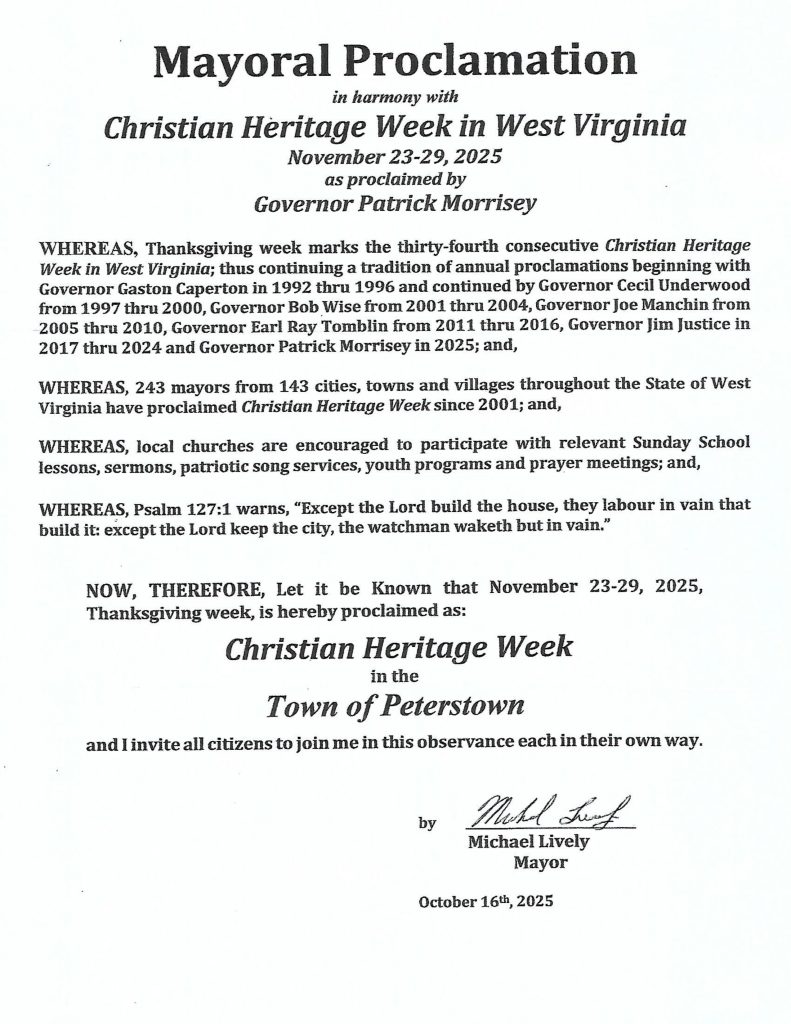
Peterstown, West Virginia 2025

Mayoral Proclamation

in harmony with

Christian Heritage Week in West Virginia

November 13-29, 2025

as proclaimed by

 Governor Jim Justice

WHEREAS, Thanksgiving Week marks the thirty-fourth consecutive Christian Heritage Week in West Virginia; thus continuing a tradition of annual proclamations beginning with Governor Gaston Caperton in 1992 thru 1996 and continued by Governor Cecil Underwood from 1997 thru 2000, Governor Bob Wise from 2001 thru 2004, Governor Joe Manchin from 2005 thru 2010, and Governor Earl Ray Tomblin from 2011 thru 2016 and Governor Jim Justice in 2017 thru 2024 and Governor Patrick Morrisey in 2025; and,

WHEREAS, 243 mayors from 143 cities, towns and villages throughout the State of West Virginia have proclaimed Christian Heritage Week since 2001; and,

WHEREAS, local churches are encouraged to participate with relevant Sunday School lessons, sermons, patriotic song services, youth programs and prayer meetings; and,

WHEREAS, Psalm 127:1 warns, “Except the Lord build the house, they labour in vain that build it: except the Lord keep the city, the watchman waketh but in vain.”

NOW, THEREFORE, Let it be Known that November 23-29, 2025, Thanksgiving Week is hereby proclaimed as:

Christian Heritage Week

in the

Town of Peterstown

and I invite all citizens to join me in this observance each in their own way.

By: Michael Lively
Mayor

Date: October 16th, 2026

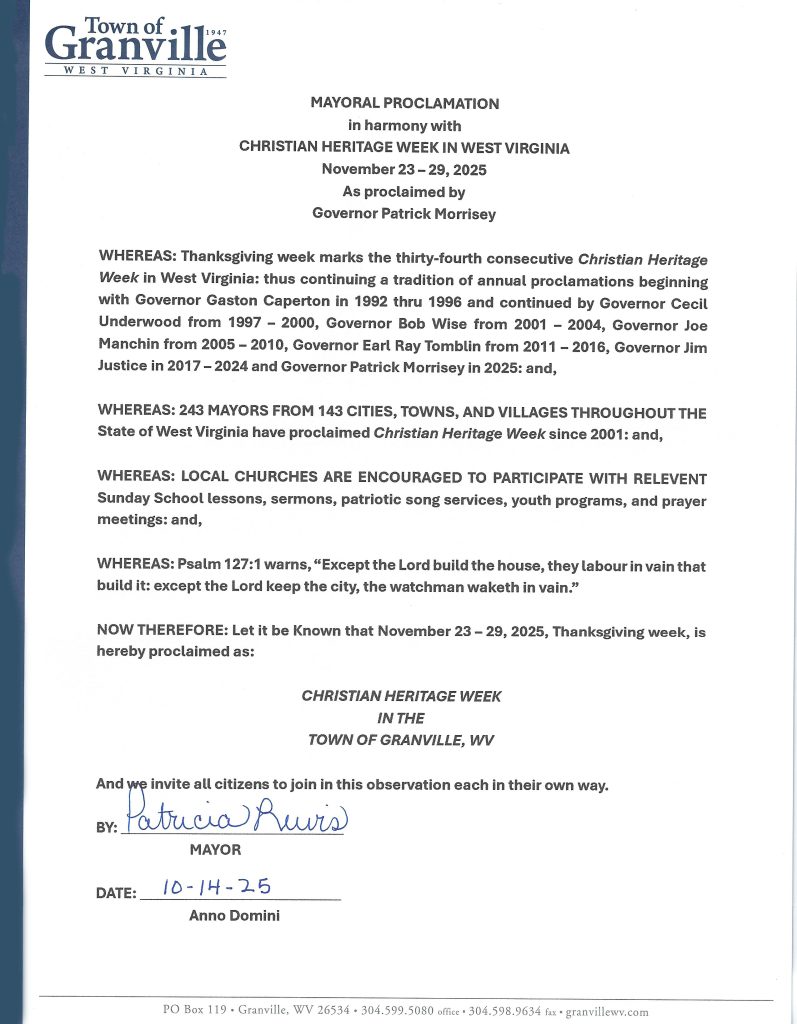
Granville, West Virginia 2025

Town of Granville

West Virginia

Mayoral Proclamation

In harmony with

Christian Heritage Week in West Virginia

November 23-29, 2025

As proclaimed by Governor Patrick Morrisey

WHEREAS, Thanksgiving week marks the thirty-fourth consecutive Christian Heritage Week in West Virginia: thus continuing a tradition of annual proclamations beginning with Governor Gatson Caperton in 1992 thru 1996 and continued by Governor Cecil Underwood from 1997 thru 2000, Governor Bob Wise from 2001 thru 2004, Governor Joe Manchin from 2005 thru 2010, Governor Earl Ray Tomblin from 2011 thru 2016 and Governor Jim Justice in 2017 thru 2024 and Governor Patrick Morrisey in 2025: and, 

WHEREAS, 243 mayors from 143 cities, towns and villages throughout the State of West Virginia have proclaimed Christian Heritage Week since 2001: and,

WHEREAS, local churches are encouraged to participate with relevant Sunday School lessons, sermons,  patriotic song services, youth programs and prayer meetings; and,

WHEREAS, Psalm 127:1 warns, “Except the Lord build the house, they labour in vain that build it: except the Lord keep the city, the watchmen waketh in vain.”

NOW, THEREFORE, Let it be Known that November 23-29, 2025, is hereby proclaimed as: 

Christian Heritage Week 

In the

Town of Granville, WV

And we invite all citizens to join me in this observance each in their own way. 

Patricia A. Lewis

Mayor

Date: 10-14-25
Anno Domini

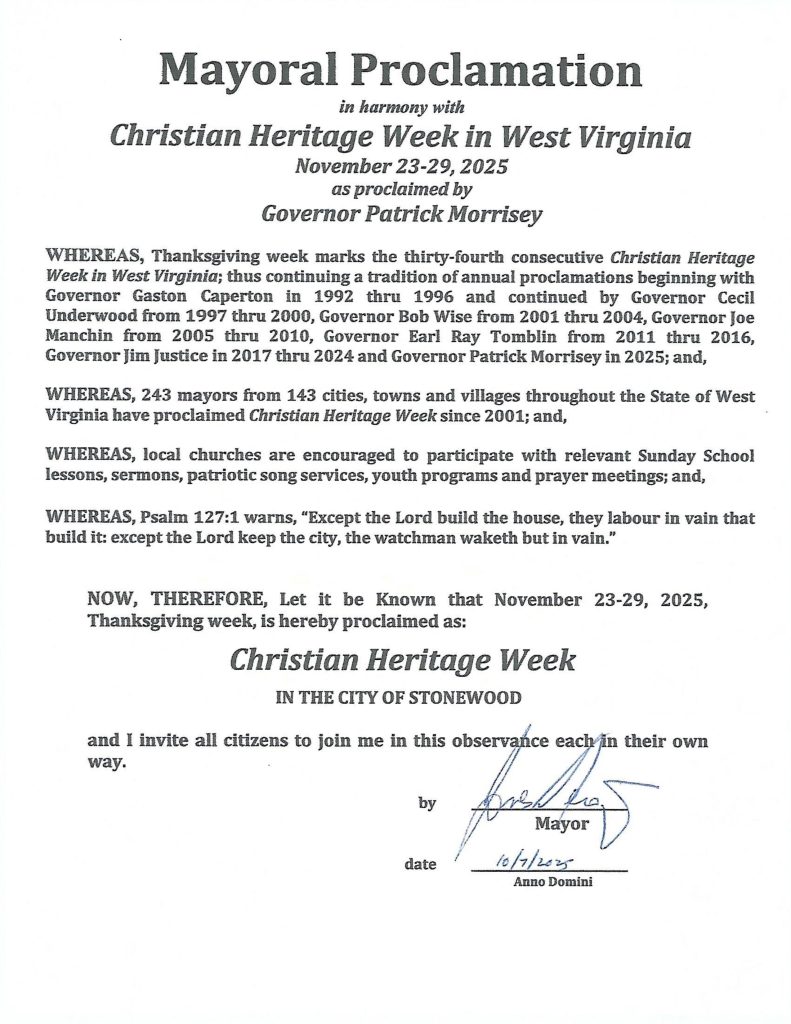
Stonewood, West Virginia 2025

Mayoral Proclamation

In harmony with

Christian Heritage Week in West Virginia

November 23-29, 2025

as proclaimed by

 Governor Patrick Morrisey

WHEREAS, Thanksgiving week marks the thirty-fourth consecutive Christian Heritage Week in West Virginia; thus continuing a tradition of annual proclamations beginning with Governor Gaston Caperton in 1992 thru 1996 and continued by Governor Cecil Underwood from 1997 thru 2000, Governor Bob Wise from 2001 thru 2004, Governor Joe Manchin from 2005 thru 2010, Governor Earl Ray Tomblin from 2011 thru 2016 and Governor Jim Justice in 2017 thru 2024 and Governor Patrick Morrisey in 2025; and,

WHEREAS, 243 mayors from 143 cities, towns and villages throughout the State of West Virginia have proclaimed Christian Heritage Week since 2001; and,

WHEREAS, local churches are encouraged to participate with relevant Sunday School lessons, sermons, patriotic song services, youth programs and prayer meetings; and,

WHEREAS, Psalm 127:1 warns “Except the Lord build the house, they labour in vain that build it: except the Lord keep the city, the watchman waketh but in vain.”

NOW, THEREFORE, Let it be Known that November 23-29, 2025, Thanksgiving week, is hereby proclaimed as:

Christian Heritage Week

in the City of Stonewood

and I invite all citizens to join me in this observance, each in their own way.

By

Mayor

Date 10-7-25

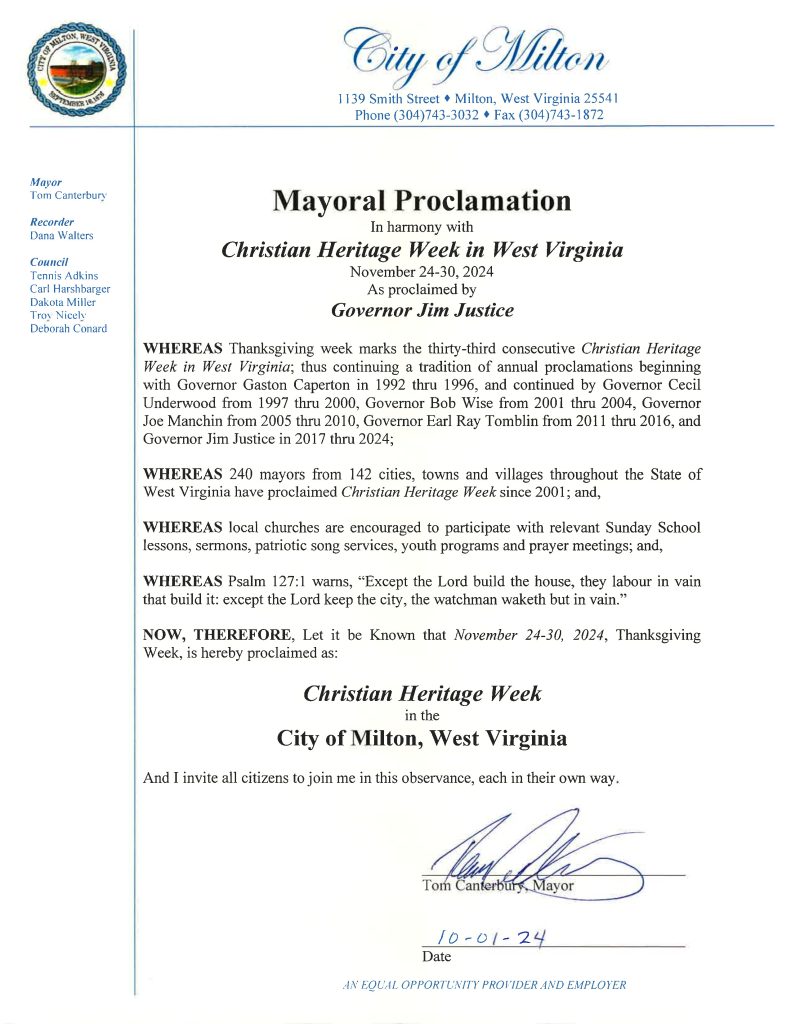
Milton, West Virginia 2024

Mayoral Proclamation

In harmony with

Christian Heritage Week in West Virginia

November 24-30, 2024

as proclaimed by

 Governor Jim Justice

WHEREAS, Thanksgiving week marks the thirty-third consecutive Christian Heritage Week in West Virginia; thus continuing a tradition of annual proclamations beginning with Governor Gaston Caperton in 1992 thru 1996 and continued by Governor Cecil Underwood from 1997 thru 2000, Governor Bob Wise from 2001 thru 2004, Governor Joe Manchin from 2005 thru 2010, Governor Earl Ray Tomblin from 2011 thru 2016 and Governor Jim Justice in 2017 thru 2024;

WHEREAS, 240 mayors from 142 cities, towns and villages throughout the State of West Virginia have proclaimed Christian Heritage Week since 2001; and,

WHEREAS, local churches are encouraged to participate with relevant Sunday School lessons, sermons, patriotic song services, youth programs and prayer meetings; and

WHEREAS, Psalm 127:1 warns “Except the Lord build the house, they labour in vain that build it: except the Lord keep the city, the watchman waketh but in vain.”

NOW, THEREFORE, Let it be Known that November 24-30, 2024, Thanksgiving Week, is hereby proclaimed as:

Christian Heritage Week

in the

City of Milton, West Virginia

And I invite all citizens to join me in this observance, each in their own way.

Tom Canterbury, Mayor

Date 10-01-24

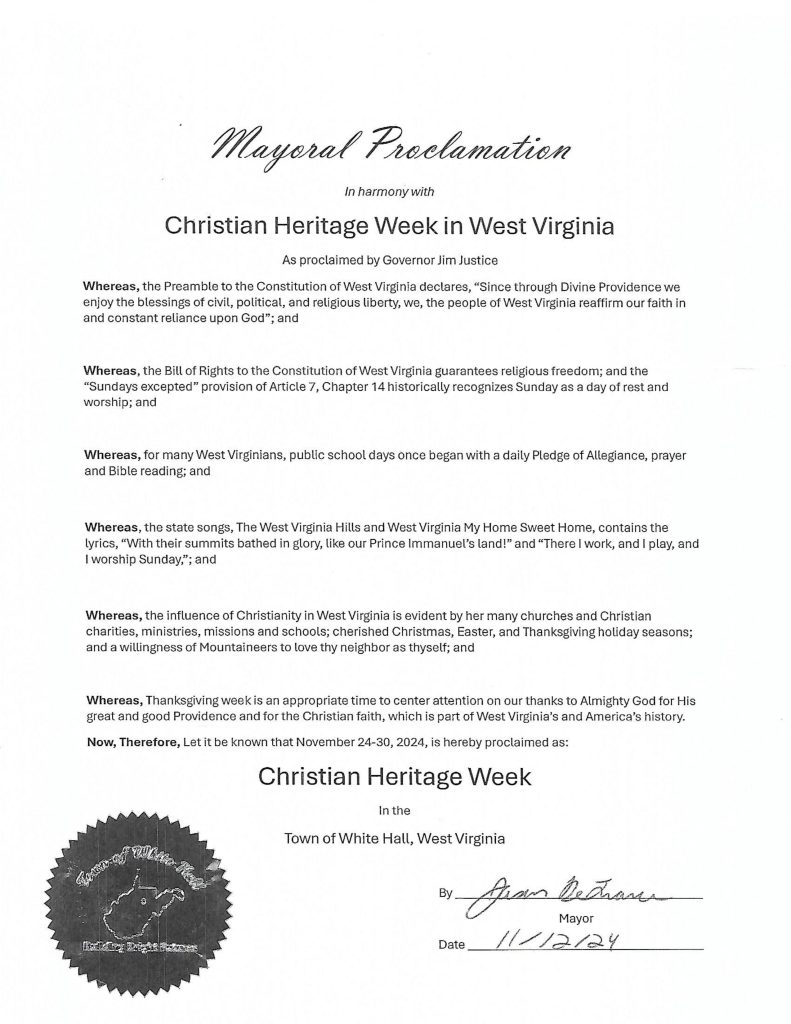
White Hall, West Virginia 2024

Mayoral Proclamation

in harmony with

Christian Heritage Week in West Virginia

As proclaimed by Governor Jim Justice

Whereas, the Preamble to the Constitution of West Virginia declares, “Since through Divine Providence we enjoy the blessings of civil, political, and religious liberty, we, the people of West Virginia reaffirm our faith and constant reliance upon God”; and

Whereas, the Bill of Rights to the Constitution of West Virginia guarantees religious freedom; and the “Sundays excepted” provision of Article 7, Chapter 14 historically recognizes Sunday as a day of rest and worship; and

Whereas, for many West Virginians, public school days once began with a daily Pledge of Allegiance, prayer and Bible reading; and

Whereas, the state songs, The West Virginia Hills and West Virginia My Home Sweet Home, contains the lyrics, “With their summits bathed in glory, like our Prince Immanuel’s land!” and “There I work, and play, and I worship Sunday,”; and

Whereas, influence of Christianity in West Virginia is evident by her many churches and Christian charities, ministries, missions and schools; cherished Christmas, Easter, and Thanksgiving holiday seasons; and a willingness of Mountaineers to love thy neighbor as thyself; and

Whereas, Thanksgiving week is an appropriate time to center attention on our thanks to Almighty God for His great and good Providence and for the Christian faith, which is part of Wast Virginia’s and America’s history.

Now, Therefore,  Let it be Known that November 24-30, 2024, is hereby proclaimed as:

Christian Heritage Week

in the

Town of White Hall, West Virginia

Jason DeFrance. Mayor

Date 11/12/24

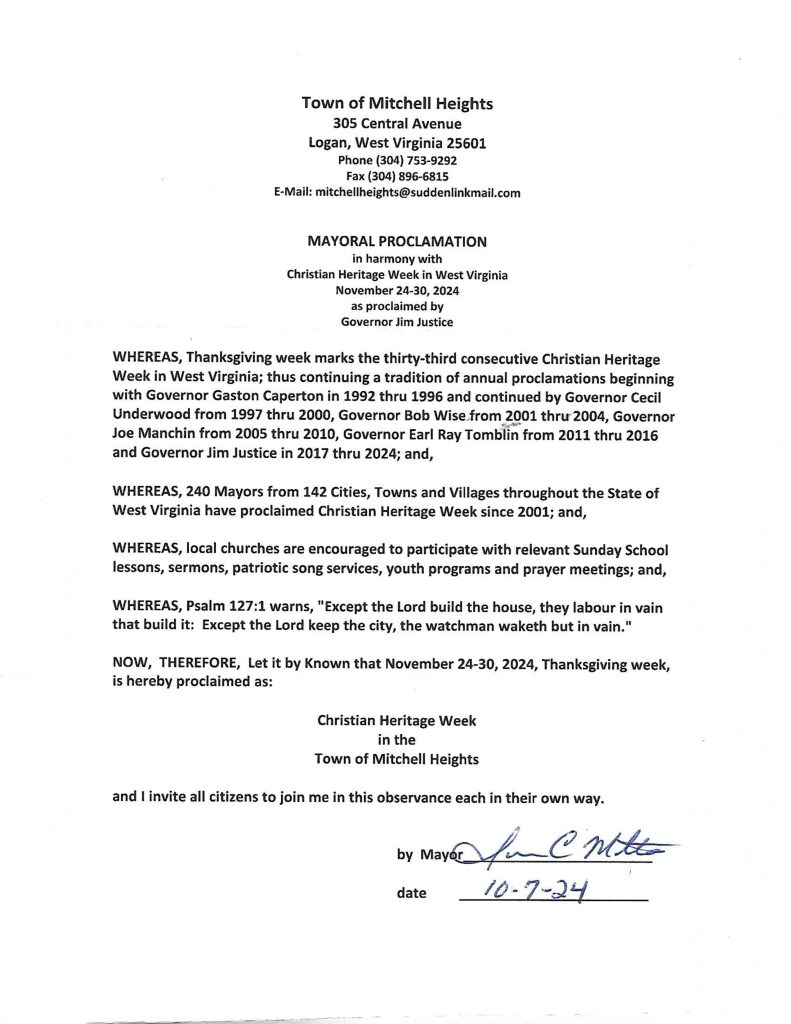
Mitchell Heights, West Virginia 2024

Mayoral Proclamation

in harmony with

Christian Heritage Week in West Virginia

November 24-30, 2024

as proclaimed by

 Governor Jim Justice

WHEREAS, Thanksgiving week marks the thirty-third consecutive Christian Heritage Week in West Virginia; thus continuing a tradition of annual proclamations beginning with Governor Gaston Caperton in 1992 thru 1996 and continued by Governor Cecil Underwood from 1997 thru 2000, Governor Bob Wise from 2001 thru 2004, Governor Joe Manchin from 2005 thru 2010, Governor Earl Ray Tomblin from 2011 thru 2016 and Governor Jim Justice in 2017 and 2024; and,

WHEREAS, 240 mayors from 142 cities, towns and villages throughout the State of West Virginia have proclaimed Christian Heritage Week since 2001; and,

WHEREAS, local churches are encouraged to participate with relevant Sunday School lessons, sermons, patriotic song services, youth programs and prayer meetings; and,

WHEREAS, Psalm 127:1 warns, “Except the Lord builds the house, they labour in vain that build it: Except the Lord keep the city, the watchman waketh but in vain.”

NOW, THEREFORE, Let it be Known that November 24-30, 2024, Thanksgiving week is hereby proclaimed as:

Christian Heritage Week

in the

Town of Mitchell Heights

and I invite all citizens to join me in this observance each in their own way.

James C. Motes

date 10-7-24

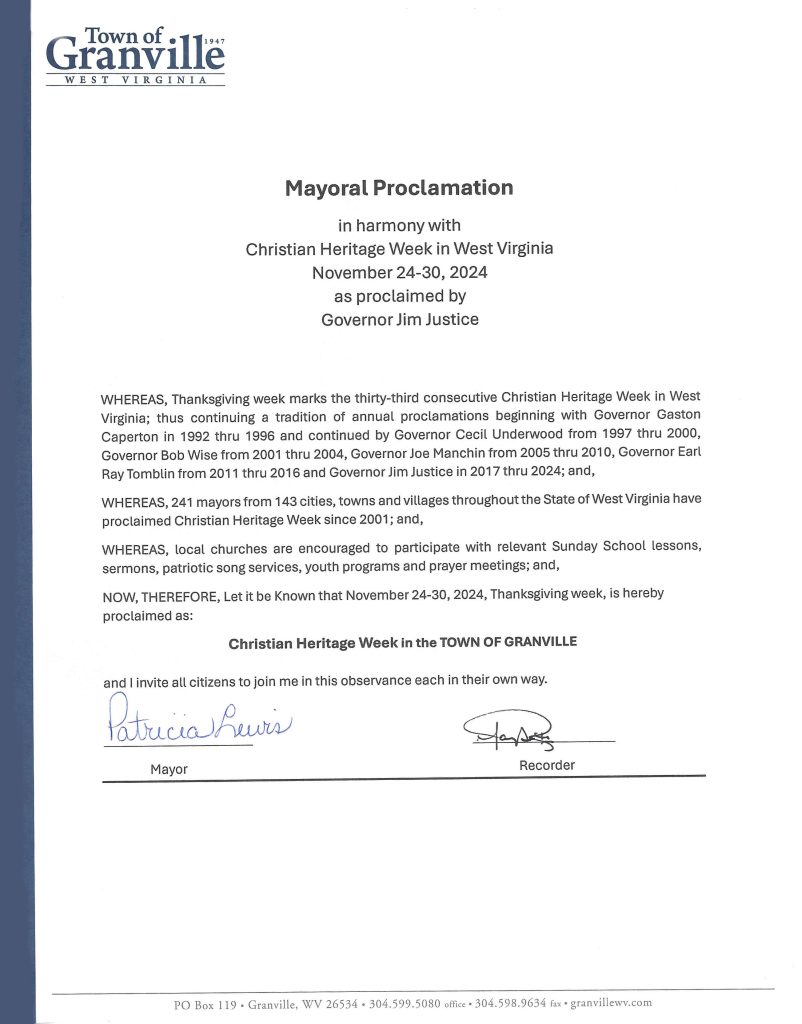
Granville, West Virginia 2024

Town of Granville

West Virginia

Mayoral Proclamation

In harmony with

Christian Heritage Week in West Virginia

November 24-30, 2024

As proclaimed by Governor Jim Justice

WHEREAS, Thanksgiving week marks the thirty-third consecutive Christian Heritage Week in West Virginia: thus continuing a tradition of annual proclamations beginning with Governor Gatson Caperton in 1992 thru 1996 and continued by Governor Cecil Underwood from 1997 thru 2000, Governor Bob Wise from 2001 thru 2004, Governor Joe Manchin from 2005 thru 2010, Governor Earl Ray Tomblin from 2011 thru 2016 and Governor Jim Justice in 2017 thru 2024; and, 

WHEREAS, 241 mayors from 143 cities, towns and villages throughout the State of West Virginia have proclaimed Christian Heritage Week since 2001; and,

WHEREAS, local churches are encouraged to participate with relevant Sunday School lessons, sermons,  patriotic song services, youth programs and prayer meetings; and,

NOW, THEREFORE, Let it be Known that November 24-30, 2024, is hereby proclaimed as: 

Christian Heritage Week 

In the

Town of Granville

and I invite all citizens to join me in this observance each in their own way. 

Patricia A. Lewis

Mayor

Montgomery, West Virginia 2024

Mayoral Proclamation

in harmony with

Christian Heritage Week in West Virginia

November 24-30, 2024

as proclaimed by Governor Jim Justice

WHEREAS, Thanksgiving week marks the thirty-third consecutive Christian Heritage Week in West Virginia; thus continuing a tradition of annual proclamations beginning with Governor Gaston Caperton in 1992 thru 1996 and continued by Governor Cecil Underwood from 1997 thru 2000, Governor Bob Wise from 2001 thru 2004, Governor Joe Manchin from 2005 thru 2010, Governor Earl Ray Tomblin from 2011 thru 2016 and Governor Jim Justice in 2017 thru 2024; and,

WHEREAS, 240 mayors from 142 cities, towns and villages throughout West Virginia have proclaimed Christian Heritage Week since 2001; and,

WHEREAS, local churches are asked to participate with relevant Sunday School lessons, sermons, patriotic song services, youth programs and prayer meetings; and,

WHEREAS, Psalm 127:1 warns “Except the Lord build the house, they labour in vain that build it; except the Lord keep the city, they watchman waketh but in vain.”

NOW, THEREFORE, Let it be Known that November 24-30, 2024, Thanksgiving week, is hereby proclaimed as:

Christian Heritage Week

in the

City of Montgomery, West Virginia

And I invite all citizens to join me in this observance, each in their own way.

by: Greg Ingram (Mayor)

date: 9-23-24