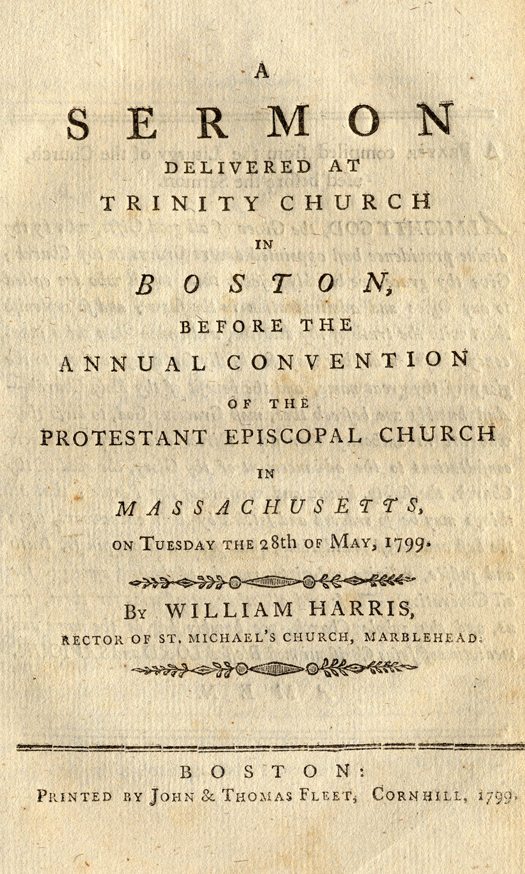
The Sermon on the Mount Carl Bloch, 1890

Sermon – Execution – 1796


sermon-execution-1796


A

SERMON:

DELIVERED
At Salem, January 14, 1796,

OCCASIONED BY THE

EXECUTION OF HENRY BLACKBURN,
ON THAT DAY,
FOR THE MURDER OF GEORGE WILKINSON.

BY
NATHANIEL FISHER, A.M.
Rector of Saint Peter’s Church, Salem.

PUBLISHED AT THE DESIRE OF THE WARDENS AND VESTRY.

Printed by S. Hall, in Boston, for J. Dabney, in Salem
1796.

For we must all appear before the Judgment Seat of CHRIST, that everyone may receive the things done in his body, according to that he hath done, whether it be good or bad.
2d. Corinthians, v. 10.

As the doctrine of a future state of retribution is the principal support of piety and virtue, the great and universal importance of it must be obvious.  And that this is a doctrine “worthy of all acceptation,” we have the concurrent testimonies of natural and revealed religion.

Our test leads us to consider – the certainty of a future judgment – some of the peculiarities of this judgment, as revealed in the gospel  – and the purposes for which God hath appointed it.

In regard to the certainty of a future state of retribution, let it be observed,
That the judgment we pass upon our own actions, or that faculty by which we discover the difference between good and evil, is the foundation of many of our most pleasing hopes, and of our most disquieting fears.  The satisfactions which accompany a life of innocence, are greatly increased by the expectation of a future recompense; and the terrors of a guilty conscience as greatly enhanced.

And we see, in many instances, that the dispensations of Providence in the present state, are promiscuous and unequal.  No certain conclusions can be drawn from them, in regard to the virtue or the vice of men.  The righteous often suffer, and for being righteous: and the wicked prosper, and prosper through their wickedness.

And although the wife and considerate in all ages, from a conviction that virtue was excellent in itself, and that vice was pernicious in its own nature, have endeavored to reward the former, and to punish the latter, according to their respective merits; yet no human laws have ever been able to effect these most desirable purposes.  No human tribunal can investigate the secret emotions of the heart, the source from which all our actions proceed; and in proportion to the relation which they bear to this fountain, they deserve either censure, or praise.  The specious hypocrite may come forward, and challenge the severest scrutiny, while the fear of a discovery has led him to commit his vile enormities in the dark.  But, that impartial justice may be dispensed, the motives and intentions of the agent must be known.  The rich, who, of their abundance cast much into the treasury, will undoubtedly receive their reward; and yet, the poor widow’s two mites may entitle her to a much greater recompense.

Should the internal satisfactions which accompany a virtuous life, and the miseries which commonly overtake the wicked, be urged, as an adequate reward to the former, and a sufficient punishment to the latter, it may be asked, whether any degree of external affluence, in addition to the pleasures which flow from a good conscience, separate from the views of eternity, would be deemed by a wise man, an adequate recompense for the exquisite sufferings with which the inflexibly virtuous are sometimes called to struggle?

As these inequalities have been from the beginning of the world, we have all reason to suppose, that they will continue unto the end of it.  And from this state of things, it is natural to conclude, that there will be a future state of retribution, in which all these inequalities will be rectified, and impartial justice dispensed to every man.

And this has been the prevailing opinion, in every age, and in every nation.  It is true, that one sect of philosophers among the heathen, and some among the Jews, denied the resurrection of the dead; but those characters were not very numerous; they bore scarce any kind of proportion to the body of the people, the great multitude, who received the doctrine of a future judgment.  On no other principle can we account for the worship of the dead; and for the animated descriptions which the poets have given of the Elysian fields: in which all the virtuous are represented in a state of happiness, and in the enjoyment of the fruits of their past labors: while the wicked are excluded those happy abodes, and consigned to the regions of woe and misery forever.  And although the rewards and punishments assigned to these characters, in the future world, are very different in their nature, from those which revelation has taught us to expect hereafter, and fall infinitely below them; yet they are strongly expressive of the general opinion concerning the doctrine before us.  The Apostle, in his address to the Gentiles, observes, that, “the invisible things of him,” (God) “from the creation of the world, are clearly seen, being understood by the things which are made, even his eternal power and Godhead.  So that they are without excuse,  because that, when they knew God, they glorified him not as God.”

But, although the religion of nature taught men to expect a future state of retribution, in which they would be rewarded and punished, according to their respective deserts; (and the evidences of this great doctrine have been confirmed by every revelation which God has given of himself), yet it gave no intimations of the circumstances which would attend it.  For these most solemn and interesting discoveries, we are indebted to the revelation of Jesus Christ; through whom, “life and immortality” are “brought to light:” i. c. more fully and clearly revealed.

The first of these peculiar and important discoveries which I shall mention, is this, – that there will be a DAY, on which all the generations of men, will be gathered together, in one great and general assembly, to receive the respective rewards of their past behavior.

“When the Son of man shall come in his glory, then shall be gathered before him all nations – God hath appointed a DAY, in which he will judge the world in righteousness – but of that day and hour, knows no man, not even the Son.”  This is one of those “secret things” which “belong to God.”  But we are informed, that this judgment will take place “at the end of the world,” an indefinite period; and which may be much nearer than we apprehend!  And when it shall commence, we are assured, that it will be accompanied by a universal resurrection – of all who in this world have ever tasted death.

“We must all appear before the judgment seat of Christ,” &c.  “Verily, verily, I say unto you, the hour is coming, and even now is, when the dead shall hear the voice of the Son of God, and they that hear him shall live.” – “Marvel not at this, for the hour is coming, in which all that are in the graves shall hear his voice, and shall come forth, they that have done good, unto the resurrection of life, and they that have done evil, unto the resurrection of damnation.”

And immediately after this general resurrection, we are informed, the world which we now inhabit will appear all in flames, and be utterly destroyed by fire.

“The Lord Jesus shall be revealed from heaven in flaming fire, taking vengeance on them who know not God, and who obey not the gospel of our Lord Jesus Christ.”  “The day of the Lord will come as a thief in the night, in which the heavens shall pass away in a great noise, and the elements shall melt with fervent heat.  The earth also, and all that therein is, shall be burned up.  Seeing then, that all these things are to be dissolved, what manner of persons ought we to be, in all holy conversation and godliness!”

Another circumstance concerning this future judgment, revealed in the gospel, respects the person to whom the judiciary powers of that great and solemn day are committed.  And this is the Lord Jesus Christ himself.  The person who once appeared in this world, in the form of a servant, and to save sinners, although “the Lord of life and glory” – “who went about doing good” – and after a life of the purest benevolence, and of unspotted innocence, “was taken, and by wicked hands, crucified and slain.  But God raised him up.”

“The Father judges no man, but hath committed all judgment to the Son.  It is Jesus that is ordained of God to be the judge of quick and dead – God will judge the world in righteousness, by that man Jesus Christ, whom he hath appointed.”

In some passages of scripture, God himself is said to be the judge of all the earth, and who will do right and that he will reward every man according to his deeds; “To them who by patient continuance in well doing, seek for glory, and honor, and immortality, eternal life; but unto them that are contentious, indignation and wrath, tribulation and anguish upon every soul of man that doeth evil.”  But these texts may be reconciled with the former, when we consider, that the future judgment will commence on the day appointed by God; and that all the transactions of it will be managed by his Son; to whom he has delegated his authority and power; and who will perform all the duties of that great and solemn office, in perfect obedience to the will of his Father.

Another peculiarity, and which deserves our most serious attention, is the manner in which he will appear upon that solemn occasion.
“He shall come in his own glory, in the glory of God, and in the glory of his holy angels – he shall sit upon the throne of his glory, and all nations shall be gathered before him.  And he shall separate them, one from the other, as a shepherd divides his sheep from the goats.  The Lord himself shall descend from heaven with a shout, with the voice of the archangel, and with the trump of God.  The dead in Christ shall rise first, and they that are alive shall be changed, and caught up to meet the Lord in the air.”

Further, the gospel of Jesus Christ discloses the purposes of God, in the appointment of this future judgment: namely, that his wisdom, justice, goodness and mercy, may be universally acknowledged and magnified – that all the ungodly may be convinced “of all their hard speeches spoken against him” – and that the glory of the great Judge may be most illustriously displayed – “That all men should honor the Son, even as they honor the Father” – Because “thou hast loved righteousness and hated iniquity, therefore God, even thy God, hath anointed him to the important office of Judge, both of quick and dead, “because he was the son of man” – To quiet our fears and apprehensions on that great day, when we shall behold, in the person of our Judge, the greatest benefactor and friend of the human race – one made like unto ourselves – acquainted with all the imperfections of our nature, and disposed to pity and compassionate our weakness.

“It behooved him to be made like unto his brethren, that he might be a merciful and faithful High Priest, which cannot be touched with the feeling of our infirmities.”

And here, it may be observed, that there is nothing in any of these peculiar discoveries of the gospel, concerning a future judgment, inconsistent with the principles of natural religion.  A Being possessed of almighty power can gather together all nations on that great day, as easily as dispose the individuals of which this numerous assembly is composed to meet together on the present very melancholy occasion.

And there can be no absurdity in believing, that the Being who first gave us life can reanimate the bodies which we now possess, and clothe them with fresh powers of life and sensibility, after they have laid ever so long a period in the graves.
And that the unexampled obedience and sufferings of our blessed Lord and Savior should be most openly acknowledged, and rewarded by the Deity, who has declared himself to be the   rewarder of all them that diligently seek him,” is most agreeable to all our notions of justice.

And does it not appear to be a merciful dispensation, that the human race should be judged by one in their own likeness?

And is it not proper and right, that the most public and expressive marks of approbation should be conferred upon the righteous; and that the wicked should be as openly exposed to disgrace and punishment?

Let us now attend to a few reflections, which arise from this most interesting and important of all subjects.
And First,
Allowing that we know not the nature, nor the proportion of the rewards and punishments to be dispensed in a future state; yet, this is certain, the gospel has represented them, and the solemnities of a future judgment, in the strongest light: and in such a manner, as to excite the most pleasing hopes in the virtuous; and the most awful apprehensions in the wicked.

“Then shall the King say unto them on his right hand, come ye blessed of my Father, inherit the kingdom prepared for you from the foundation of the world. – Then shall he say unto them on his left hand, depart from me, ye cursed, into everlasting fire prepared for the devil and his angels.”
Again.  From the certainty and circumstances of a future judgment, how great must be the absurdity of dissimulation!  On that day, “when the secrets of all hearts shall be disclosed,” the hope of the hypocrite will perish.  None of those arts and subtleties which he once practiced in the world, and with success, will then avail him. He will find no friend to cast the mantle of charity over his deceptions; nor any corner in which to hide his guilty face.  He will appear before his fellow creatures, and before the holy angels, in his true character, and be filled with shame and remorse.  The greater his duplicity may have been, the greater will be his confusion and distress.  He will then reflect on the value and importance of a good conscience: and be ready to acknowledge, that there are no pleasures comparable to those which flow from a faithful performance of our respective duties, and from a heart which cannot reproach us.

Again.  As the hopes given us in the gospel of Christ are most glorious, and its promises, respecting a future world, “exceeding great and precious,” not to extend our principal views towards futurity must be the greatest folly.  More especially, as our own feelings, and the circumstances of all things about us, are continually suggesting the infinite importance of it.  This is the “one thing needful,” and the greatest concern we can possibly attend to.  So great is the disproportion between things spiritual and things temporal, that we must see where our interest lies, and cannot be ignorant of the part we should prefer.  As we acknowledge, that the pleasures of this world are precarious, inadequate to our expectations, and only for a season, it becomes us to “set our affections on things above, not on things on the earth.”

Further.  Although the certainty and circumstances of a future judgment must strike the wicked, whenever they reflect upon them, with the utmost terror; they afford the greatest comfort and consolation to the righteous.  There are so many contending interests in the present world, and the passions and appetites of men are so strong and violent, that the virtuous are often reproached, and cruelly treated: and sometimes persecuted unto death.  This was the case with many of the primitive chieftains in particular; and who endured the greatest afflictions, and suffered the most grievous punishments, having “respect unto the recompense of the reward.”  They comforted and supported one another with the blessed hope of everlasting life – a future state of existence, in which their integrity would be completely rewarded.  “Our light affliction which is but for a moment, works for us a far more exceeding and eternal weight of glory.  For we must all appear before the Judgment seat of Christ, that everyone may receive the things done in his body, according to that he hath done, whether it be good or bad.”

The subject leads to many more very useful reflections; but they cannot be pursued at present: And I shall close this discourse, with an address to the audience, – and to the criminal.

My Brethren,
In the unhappy prisoner now before you, surrounded by the executive officers of justice, and fast bound in the chains of death, you behold a miserable sinner; covered with shame and stung with remorse: the usual and just effects of a wicked and profligate life!

One end of the law, in ordering him to suffer, in this public and ignominious manner, is to alarm and deter others – lest they should come into the same condemnation.  And if the solemn transactions of this day should not touch, and powerfully affect your hearts, they must be insensible indeed!

And here, permit me to caution you, in great seriousness, against those vices in particular which lead more immediately to the crime for which this unhappy man is now to suffer.

Among others, we may mention a barbarous and cruel temper.  It must be evident to those who are acquainted with the human heart, that every kind, and every degree of cruelty practiced upon man or beast, lessens the influence of those tender sensibilities implanted in our nature for the most benevolent purposes, and leaves impressions on the mind unfavorable to the interests of humanity.  The person who can wantonly wound and torture a brute, and take delight in his sufferings, will soon become callous to the feelings of his fellow creatures.  And society can never be too securely guarded against this brutal insensibility of temper.

Further.  All violent and head-strong passions lead to this monstrous crime: more especially when they have acquired, which is often the case, an irresistible authority.  A man thus enslaved is every moment liable to the most serious and affecting misfortunes.

And revenge, or a disposition to redress our own wrongs, leads onto the most fatal extremes.  Every emotion of this passion, is pregnant with danger: and victims without number have been sacrificed to its rash and precipitate purposes.
But, the most awful effects may be expected from a fixed rancor and malevolence of heart.  This is the most unsociable and wicked temper that can possibly possess a man.  It is the temper of that degraded being, “who was a murderer from the beginning.”  And “every man, who hateth his brother, is a murderer” also.
To these we may add avarice, gaming and dissipation; which excite contentions and quarrels; expose persons to the fevered temptations; and tend to destroy all sense of moral obligations.

There is another vice extremely prejudicial and dangerous, as it leads to the heinous crime of perjury; viz. rash and profane swearing; which has a tendency to lower the Divine Being in our minds, and to take off that reverential awe which is our natural duty to our Creator.

And if we may credit the concessions of many who have suffered for the crime of murder, a disregard to the Sabbath, and to the public worship of God, may be considered as ruinous to individuals, and highly injurious to the peace and welfare of society.  And this, I think, will hardly admit of a doubt, when we reflect, that the public exercises of our religion are calculated to keep up a lively and constant sense of God, and his providence, upon our minds; to impress our hearts with benevolent sentiments; and to establish the principles of self-government, by motives of present, and eternal happiness.

And now let me entreat you, in the most serious and affectionate manner, to guard yourselves not only against these great and most pernicious vices, but against every kind and degree of immorality.

If you believe in the existence of a God, who governs the world in wisdom and equity, and that you are accountable to him for your conduct, you have the strongest motives, great and powerful as they are, are often superseded by the solicitations of the tempter, attend to the first advances of vice, which approaches step by step: “First the blade, then the ear, after that the full corn in the ear.”  Look upon every deviation from the path of duty, however small, as unjustifiable and wrong.  Consider, that every irregular indulgence leaves an impression on the mind unfavorable to the interests of virtue.  It lessens the fear of shame, that innate modesty which is the natural guard of innocence, and weakens the power of conscience.  Be persuaded, that your duty and happiness are inseparably connected; and avoid even “the appearance of evil.”
And, may the inspiration of the Almighty govern your hearts!

You, HENRY BLACKBURN, are this day to suffer the pains and penalties of an ignominious death; for the unnatural and atrocious crime of MURDER: A crime of the highest nature; to which the law of God, and the laws of nations, have annexed this righteous, though awful  punishment, “he that sheds man’s blood, by man shall his blood be shed.”
You have repeatedly protested, and in the most solemn manner, by immediate appeals to heaven, that neither revenge, nor hatred, nor any other malignant passion, moved you to take away the life of the person who died in consequence of the wound you gave him.  But your country, after a most deliberate, solemn and impartial inquiry, has pronounced you guilty – and guilty of willful murder.  The matter rests with God and your own soul; that God who cannot be deceived, and “who will not be mocked.”

But, allowing that you had no design against the life of the unfortunate stranger, who fell a victim to your rashness and folly, this will not wipe away, although it may greatly extenuate your guilt.  Life is a gift too sacred to be sported with; and the weapons of death are not to be used lightly and wantonly.  And, although you may not have incurred the fearful guilt of willful murder, this is certain, you have shed the blood of a fellow creature; and in such a manner as cannot be justified in the sight of God, nor in the opinion of man.

During your confinement, which has been long and tedious, you have had time for the most serious and deliberate reflections: And you have been encouraged and assisted in the great duty of repentance.  You have been persuaded, “by the mercies of God, and by the terrors of the Lord,” to repent, to forsake your sins, and to turn most heartily unto God.  And from the solicitude which you early discovered for instruction, and from the apparently open and candid acknowledgments which you have made of the errors of your past life, we have reason to hope, that some good fruits have been produced in your heart: but, if you have imposed on your sincerest friends, and deceived yourself, let me exhort you, in the most serious and pathetic manner, by the mercies of God, and by the affection which you bear to your own soul, to renounce your hypocrisy this instant; to acknowledge your multiplied transgressions with your deepest humility; and to turn unto God with your whole heart.

Within a few moments, you will be taken from the house of God, carried to the place of execution, and “appear before the judgment-seat of Christ, to receive the deeds done in your body, whether they be good or bad.”  You have just heard the certainty, circumstances, and design of this judgment; and the passing interval before you must awaken all the powers of your soul!  It is enough to overpower your sensibility, unaccompanied and alone; and much more so, attended by the habiliments of death, and by thousands of surrounding spectators.

O, my brother! Thus encompassed with the sorrows of the grave, and the snares of death, you stand in need of every consolation.  And, to assist and support you in this most distressing hour, and to show the part which it becomes you to perform, “look unto Jesus, the author and finisher of our faith.”  It is true, the difference in point of character is infinite: For, although he died the death of a malefactor, he died perfectly innocent of every crime.  He died to support the cause of piety and virtue, and to save sinners: but you will die a malefactor indeed – for your atrocious crimes – because you have disregarded the principles of religion, and shed the blood of one, whom he died to redeem.

Our blessed Lord and Master endured the cross, despising the shame.  And he suffered that ignominious and painful death with the most perfect submission to the will of his Father, with the most heroic fortitude and equanimity of mind, and in the exercise of a most charitable and forgiving temper, even towards his enemies, and those who persecuted him unto death, and who insulted him in his last agonies.

And you have the example of one, who was a great sinner, and who suffered with him; and whose faith was not to be shaken by all the terrors of a lingering, shameful death.  Although he saw the Savior of the world nailed to the cross, and knew that he would expire within a few hours; yet he believed on him, and died entirely resigned to the will of God.  He died with Christian fortitude and submission; he died a sincere penitent; and he died in prayer – “Lord, remember me, when thou comes into thy kingdom.”  And as a reward of his faith, penitence and obedience, Christ answered him, and said, “Today shall thou be with me in paradise.”  And O that you, my brother, may discover this believing, resigned and heavenly temper, at the hour of your departure, and be admitted into the kingdom of the Great Redeemer!

Now, “unto God’s gracious mercy and protection we commit thee; the Lord bless thee, and keep thee; the Lord make his face to shine upon thee, and be gracious unto thee; the Lord lift up his countenance upon thee, and give thee peace, both now and evermore.”
Let us pray, &c.
END.

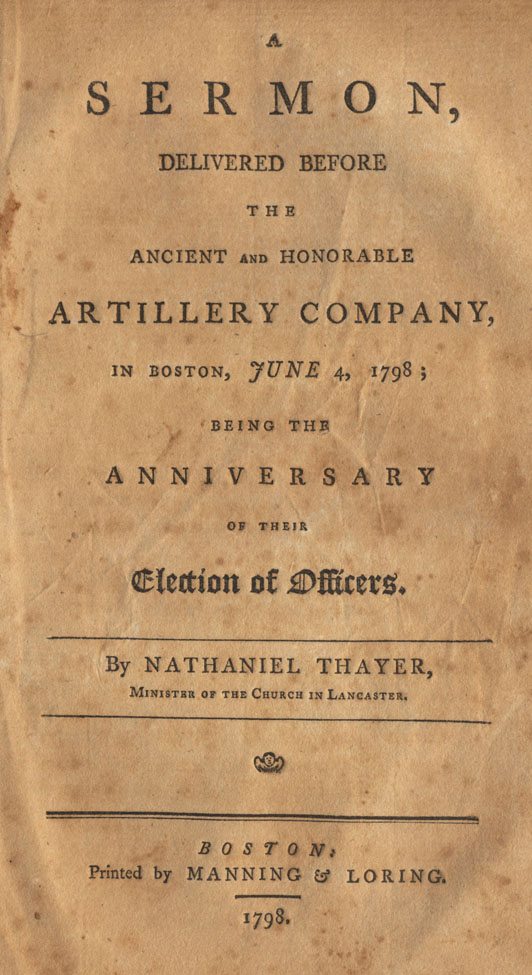
Sermon – Artillery Election – 1798


Nathaniel Thayer (1769-1840) graduated from Harvard in 1789. He was a pastor in Wilkeshare, PA and in Lancaster, MA (1795-1840). The following artillery election sermon was preached by Thayer in Boston on June 4, 1798.


sermon-artillery-election-1798

A

SERMON

DELIVERED BEFORE

THE

ANCIENT AND HONORABLE

ARTILLERY COMPANY,

IN BOSTON, JUNE 4, 1798;

BEING THE

ANNIVERSARY

OF THEIR

ELECTION OF OFFICERS

BY NATHANIEL THAYER,

MINISTER OF THE CHURCH IN LANCASTER

A
SERMON

Proverbs xvi. 32.

He that is slow to anger, is better than the mighty; and he that ruleth his spirit, than he that taketh a city.

Solomon wisely decided the comparative merit of characters. Viewing through an impartial medium their moves, plans of conduct, and respective influence on the public manners and happiness, “he weighed them in an even balance,” and suffered intrinsic excellence only to preponderate.

The contrasts, exhibited in the text, bring to view a respectable proportion of every community. Either impetuosity or moderation, rashness or courage, pusillanimity or fortitude, contentment or ambition, generosity or avarice are leading features in the character of the principal members. These virtues or vices, according to their natural tendency, lead to the elevation or debasement of personal virtue to the promotion or destruction of national honor and happiness.

Men, who lust after power, and are ambitious of extensive dominion, are justly characterized partial in reflection, hasty in resentment, precipitate in decision and instead of acting on the broad scale of virtue of public utility, solely aim after personal aggrandizement. Blindly pursuing their mad schemes, they forget, that an equitable exercise of powers is the offspring of a well-regulated heart, and that to check the turbulency of passion, is the best assistant in effecting honorable conquests. Strangers to consistency, deaf to the voice of conscience, and enemies to reason, they impetuously press forward to the accomplishment of a favorite object, and rely for the purest felicity on the subjugation of millions to their despotic sway.

On the other hand, a perfect control and deliberate indulgence of passion lead to justness and extent of thought, coolness of decision, and a proper estimate of the views, purposes and provocations of individuals and of communities. The man, who is slow to anger, suffers no ill-founded prejudice, superficial examination, hasty opinion or wild resolution to direct his conduct. But relying on the deliberate conclusions of unbiased reason, his chief employment is the discovery of what is right and fit, and the public benefit is the grand object of his pursuit. These attainments are evidently the result of laudable proficiency in self-government. When opposed to the petulant, to unprincipled seekers after power, or too such as are desirous of laying a foundation for universal empire this description of characters is entitled to high applause. In their practice is implied a respect for the dictates of reason and the precepts of the Gospel, a commendable solicitude for the harmony and happiness of society, and an active purpose to extend the knowledge to promote the principles of the divine government.

The observations already made, exhibit the outlines of the characters of those members of society who give unbounded license to passion, and of such as restrain it within reasonable limits. To display more explicitly the properties of personal discipline, as opposed to an insatiable thirst for power or extensive conquest; to deduce a preference in favor of the former, from the good effects it tends to produce; to confirm our remarks by historical examples; and to offer some reflections suggested by the situation and prospects of our country, form the design of the ensuing part of the discourse.

The general characteristic of personal discipline is the honorable supremacy it preserves over passion, and the subserviency it extorts from it, to the elevated desires, purposes and pursuits of reason.

No conflict is ever more dangerous, violent or eventful, than this, maintained between these two essential and important parts of every human character. It is dangerous, because reason is likely to be wounded and overcome in the contest. It is violent, because the “casting of fire-brands, arrows and death” is the natural product of excessive passion. It is eventful, because there is no empire so despotic, no tyranny so oppressive, no victory so haughty and insolent, as that which is supported or gained by passion A rising superior to this danger, a successful opposition to this violence, and an entire defeat of the hope of obtaining a victory can only be effected by the man who habitually “ruleth his own spirit.”

A criminal error in the ambitious, in men aspiring after power, whose wishes are scarcely limited by the universe, and who cherish the intention to conquer and oppress its inhabitants, is that they neither estimate the design, dignity, nor capacity of reason . hurried blindfold by lust, pride or avarice, personal elevation is the motive, riches or grandeur the object, and deathless fame the anticipated reward of their unbaiting enterprise. Alexander and Julius Caesar are striking examples of the despotic influence of passion. Ignorant of self-command, and fearful of attacking so rough, untried and formidable a fortress as their own hearts, they wandered abroad in pursuit of something which could equal their ambitious views. Wrapped in the illusions of fancy, these insolent and overbearing demagogues vainly hoped, that idiots, with respect to the first principles of government, might honorably aspire after, and sustain universal empire. These are two of numberless instances of the frenzy and distraction, occasioned by checking the exercise, and resisting the authority of reason.

A distinguishing property of personal discipline is fortitude, which enables the mind to bear insolent treatment originates just conceptions of its nature, and dictates the exercise of patience in devising means of redress.

To oppose insolence with forbearance is an important Christian attainment. This is the genuine fruit of fortitude, which is a chief promoter of the dignity and usefulness of man.

Rightly to comprehend an injury, to conceive of its tendency, and to judge of the intended extent of it, are exceedingly necessary, to proportion wisely our resentment to its deserts. Precipitancy, jealousy or petulance entirely prevent these acquirements. They delude the fancy, contract the understanding, warp the judgment, and fear the conscience. Certainly then, a perfect self-command will totally exclude these vices as enemies to liberal investigation and opposers of truth.

Fortitude is the desirable and happy medium between insensibility and rashness. It is not inconsistent with a keen sense of injuries, neither is it superior to resentment. It wisely discriminated between a hasty and inconsiderate sally of passion, and a deliberate provocation.

Equally distant is this virtue from cowardice as from insensibility. Although it is not hasty to resent an injury, it is prepared to repel it although it admits every honorable expedient to redress a grievance, to be preferable to sudden and open hostility, yet faith it’s brave and pious patron, “Though an host should encamp against me, yet will I not fear.”

Diametrically opposed to the condescending qualities of this amiable and Christian virtue, are the impetuosity, violence and pride of persons whose ambition is solely directed to the taking of cities. In an opposite scale with the prudence, forbearance, patient inquiry, firmness and magnanimity of such as cultivate the former, may be placed the inconsiderateness, temerity, avarice and insolence of those who cherish the latter, and this will lead to an impartial opinion of this part of their respective characters.

As self-government begets a nobleness and elevation of soul, to estimate and endure injuries, it also originates a boldness of sentiment, an animated, rational and inextinguishable courage.

Temperance and perseverance in the moment of severe trial are prominent features in the heroism of a truly valiant man. Neither appalled by the approach of danger, nor alarmed by its probable consequences, have his manly firmness and intrepidity served for a shield, which the impetuous ardor of a hostile foe can never penetrate.

True courage is distinguished from its counterfeit by a constant preparedness for the severest conflict, by a noble contempt of life and it’s most valued comforts, when the interests of liberty, virtue or religion are at hazard. Every partial or interested consideration is sacrificed to the advancement of the public good.

A man of courage exhausts not his ardor on trifling, ludicrous, or unimportant occasions, but wisely apportions it to the value of the object, and the urgency of the season.

This virtue is especially distinguished from the licentious fury of an avaricious pursuer of power or conquest, as it is restrained by reason, and receives additional and well-directed fervor from exercise.

Having taken this view of some of the discriminating properties of personal discipline, let us contemplate it’s most important effects, and ascertain their preference to the disgraceful consequences of an ungoverned lust of empire.

Undisturbed reflections, equanimity and rational comfort are the streams, incessantly flowing from this pure source, to refresh the individual.

Entertaining only moderate views and reasonable expectations, having enlightened reason for his unerring and sure guide, he is not precipitated into the transports of passion, which occasion a departure from a steady course of virtuous practice. Always having command of his understanding and reflection, he is not fickle in his inclinations, nor unstable in his purposes. Being settled, resolute and conscientious, his mind is undisturbed, his conscience calm, and all his reflections cheerful.

This perfect self-command is also a very happy mean of promoting the true dignity of man. It preserves in their proper subordination the inferior qualities of his nature. It gives full scope to the active energies of the mind. It completes the social, moral and religious character.

On the other hand, an ambition for power or conquest is always restless. Originating in selfish and avaricious views, exercising the corrupt and perverse dispositions of the heart, and having for it’s object the establishment of universal despotism, it tends to enervate the mind, to produce a constant fermentation in the heart, and lastingly to check the exercise of every social and pure sentiment.

The efficacy of self-government when exercised by the members of a community, is also particularly noticeable, as it’s tendency is, to promote and preserve harmony and order.

As personal comfort is the fruit of a peaceful and undisturbed mind, so the welfare and happiness of a nation must depend on a freedom from the excesses of unbridled passion. A restless and peevish, an irritable and turbulent temper a principal cause of the uneasinesses and contentions, the tumults and commotions, which have defaced the beauty, and in interrupted the order of the moral kingdom of God.

Private grudges and public contests, in connection with the long train of calamities, resulting from war, may be traced to this impure and corrupt source.

Individuals and nations, who have lusted after conquests, have mistaken their tendency, and the effects, they have generally produced. Instead of enriching, they impoverish, instead of strengthening, they weaken a government. The resources, extensively distributed, are beyond the reach of being suddenly called into action, or assisting to ward off any unexpected or unforeseen disaster. The Romans therefore, are the only ancient nation, who have grown rich by their ancient nation, who have grown rich by their conquests, and this because they exacted very little in the form of tribute. 1

This disposition, which has often proved ruinous, and laid a foundation for national degradation and disgrace, it was an express purpose of the Jewish dispensation to prohibit. They were forbidden to undertake any wars through caprice, ambition or a disposition for conquest6, and as a check to the unnecessary waste and havoc, which are authorized by the practice of other nations, were asked this simple question; Are the trees enemies, which can fight against you, so that you must cut them down? 2

The disposition, example and instructions of our Divine Master and his immediate followers tend to undermine this corrupt principle. The numberless precepts, to guard against ostentation, envy, pride, and to “take heed, and beware of covetousness,” are so many moral lectures on the importance of personal discipline, and are intended to prevent the growth of a tyrannical and domineering temper.

Hitherto in this country little encouragement has been found for the indulgence of an unreasonable desire of power, or a spirit of conquest. The early education and habits of its inhabitants, the laws, the government, and especially the Christian religion are peculiarly favorable to the extinction of an ambitious and dissocial spirit, and give all possible patronage to the mild, peaceful and unaspiring qualities of the heart.

It should neither be charged to ostentation nor ambition, if, from the history of the present age, we adduce examples for an unequivocal illustration of the sentiment, we are endeavoring to establish.

To avail ourselves of a decided proof, that personal discipline is preferable to a lust of empire, we need only contrast the meek, contented, firm courageous, unambitious and unassuming disposition of a WASHINGTON, with the proud ostentatious, lustful, and aspiring temper of a Bonaparte.

We may also successfully oppose the unexampled patience and perseverance, magnanimity and well regulated independence of an ADAMS, to the headstrong lusts and passions, or even to the most respectable attainments of all the proud plunderers and conquerors of the world.

Still more forcibly to demonstrate the idea, we may pursue the analogy between the moderation, forbearance, justice and unvaried inflexibility of the SUPREME EXECUTIVE of our Nation, and the precipitancy, inconstancy, violence and outrage, which have prevailing dictated the measures of the Directory of France.

The event of the present contest for dominion in the elder world, it is impossible certainly to predict. It seems however that no limits are fixed to their desires, nor any bounds set to their efforts. If an opinion may be formed from the past dispensations of providence it appears, that a nation, which presumes to wage war with the universe, and in effect to assume the prerogatives of its SUPREME FORMER and GOVERNOR, must be humbled.

After their wanton avowal of being in quest of universal empire, and of its being their fixed purpose to fraternize and subjugates this western world, the sons of freedom must be seized with more than lethargic stupidity, not to be aroused. When reminded of the political annihilation of Venice 3 as an example of their future debasement, and when the insolent and perfidious treatment of Italy, Holland, and Switzerland 4 are candidly considered, the native energy of independe34nt Americans will no longer sleep. The love of rational liberty, for which they are deservedly characterized, and a just appreciation of the earnings of honest and laborious industry, will command an obedient attention to the calls of their country, and a willingness to make every reasonable sacrifice for it’s permanent security.

In a season of common danger, the benefit of associations, formed to extend a knowledge of the military art, is readily perceived. There is then in reserve a competency of the skill, dexterity, firmness and heroism, which are indispensably requisite to the successful defense of an invaded country. A hopeful prospect then presents, of finding experienced veterans, who resolutely resist the first transports of passion, and who are impelled to action by a nobler motive than a love of conquest. In such schools, a knowledge of tactics is acquired, a spirit of enterprise encouraged, and patterns of patience and intrepidity uniformly displayed.

The exemplary attention, which has been paid to the diffusion of military skill, reflects honor on our rulers, as it is a demonstration of their unabating vigilance, and is a consoling circumstance at the present interesting period. It inspires a sanguine belief, that “if imperious necessity urge,” we shall not be found encumbered by a stupid languor, neither hurried to action by an impetuous zeal, but persuaded, that our resentment is authorized by the cool discussions of reason, and possessed of the fortitude, which is the best and most impregnable armor, the anticipated hour of danger will be realized by us, to be a season of perfect security.

Neither Lacedaemonian folly or superstition shall ever regulate the vibrations of the hearts of Americans. Being satisfied that the measure of aggression and insolence is filled up, whether the moon shall have just commenced it’s course, is totally eclipsed, or shines in its full brightness, if our country call, we must obey.

While the general attention of our citizens to the making of laudable acquirements deserves highly to be applauded, it is with particular pleasure, Gentlemen of the Ancient and Honorable Artillery Company, that we recognize the purpose of your institution, witness it’s present flourishing condition, and assure you of our firm reliance on your experience, fortitude and courage.

Educated in the belief, that temporary amusement or pleasure is but a secondary consideration in the establishment of such a seminary, you will consider it’s primary purpose to be a school, in which you may imbibe the principles, cherish the views, and form the habits, which re calculated to render you eminently serviceable to your country.

The distinguishing traits of a good soldier are skill in his profession, a perfect control over his passions, calmness in the hour of trial, and an enlarged patriotism. Regulated by these, you will never suffer your regard to the public interests, to vet itself in a furious or overheated zeal, neither when difficulty approaches, will you want the courage, resolutely to embrace every necessary mean for the defense of your dear-bought privileges. As a love of power or conquest is a debasing passion, when cherished as any other than a subordinate motive, you will evidence it to be your prevailing principle, to contend rather for safety than triumph, for the common good than personal glory.

To the friends of America it is an exhilarating circumstance, that in your number is perceived some of the temperate, yet inflexible resolute and active supporters of the late glorious revolution. An equally generous principle with that, which then glowed in your bosom, we doubt not, if circumstances require, will again stimulate you to action. On you we rely for an example of prudence to our youth, of restraint to check their natural impetuosity, and of wisdom to direct their ardor into its proper channel may the efficacy of your exertions be perceived, the respectability of your institution increase, and numbers in future be found, worthy of being added to your fair catalogue of Patriots.

My Fellow Countrymen will permit me to congratulate them on the mixed moderation and perseverance, coolness and decision, wisdom and uprightness, which dignify the transactions of our government. These truly form a splendid exhibition of the glorious triumphs of reason.

Every honest member of the community will feel indispensably obliged, to cultivate the same pacific and condescending temper. Such are the present limits of our country, that extent of territory can be no motive with us, to endeavor to increase our power, or to enlarge our conquests. Our affluence and prosperity have so rapidly increased, that it would be madness to apply to this source for a valuable addition. Unless therefore the dignity of our government, or our rights as an independent nation are implicitly or openly disputed, it will be honorable in us, to “study the things, which make for peace,” and to be anxious to obtain “other conquests, but those of the passions, and no other triumphs, but those of justice and humanity.”

For the acquiring of this disposition we are to remember, that the adventurer in the Christian warfare is required to be “temperate in all things.” The licentiousness of ungoverned passions and the visionary projects of insatiable ambition do not accord with the requisitions of the gospel, or the spirit of it’s Divine Author. When pointed to “the kingdoms of the world, and the glory of them” which are happily suited to nourish the vanity of a corrupt heart, so perfect was his self-command, that he viewed them as a gilded trifle, and the felicity they promised, empathy and delusive.

In attempting to copy this perfect pattern of subjection to the discipline of reason, it will be laudable in us, to aim after a humble but the greatest possible resemblance. The season of combating our appetites and passions, and endeavoring to subject them to the suggestions of our understanding, and the laws of the gospel, will be but short. “Eternity will be long enough to repay us.” There will then be a full display of the conquests of reason.

The fading glories of this world will soon lose their attraction. Uncorrupting palms of victory are promised to the perseveringly patient, resolute and intrepid. The faithful subjects of communities and empires are then to be admitted into “a kingdom, which cannot be moved;” where the SUPREME LORD of the universe maintains an equitable and impartial dominion, and the righteous shall come off conquerors, and “more than conquerors” over the enemies of their spiritual comfort, “through Him, who hath loved, and who hath given himself for us.”


Endnotes

1. Priestly’s Lectures on History.

2. Jews’ Letters in answer to Voltaire.

3. See the dispatches from our Envoys Extraordinary in France, to the Executive of the United States.

4. A judicious, impartial and interesting detail of the conduct of France towards these nations, is contained in the “Observations on the Dispute between The United States and France, addressed by Robert Goodloe Harper of South Carolina, to his constituents.” Every candid peruser will be satisfied, that such instance of wantonness and insincerity should inspire the inhabitants of these States with caution and firmness.

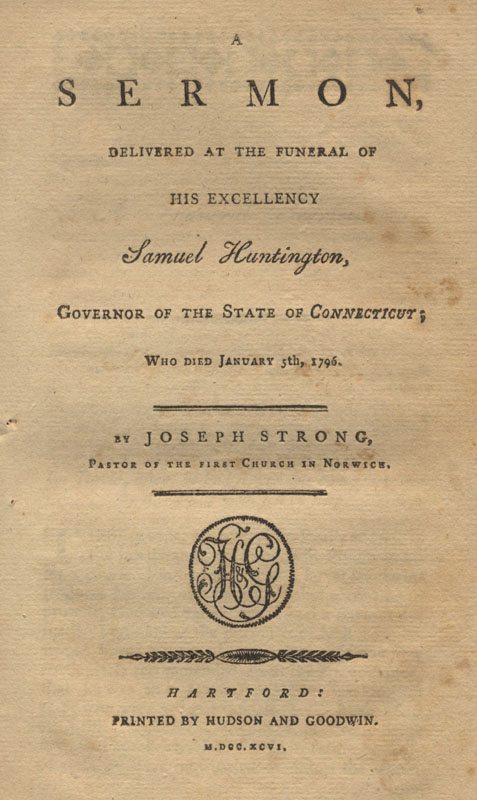
Sermon – Eulogy – 1796


Joseph Strong (1753-1834), brother of Nathan Strong, graduated from Yale in 1772. He was the pastor of the 1st church in Norwich, Connecticut for fifty-six years. The following sermon was preached by Strong at the funeral of Declaration signer Samuel Huntington in January, 1796.


sermon-eulogy-1796

A

S E R M O N,

DELIVERED AT THE FUNERAL OF

HIS EXCELLENCY

SAMUEL HUNTINGTON

GOVERNOR OF THE STATE OF CONNECTICUT;

WHO DIED JANUARY 5TH, 1796.

BY JOSEPH STRONG,
Pastor of the First Church in Norwich.


A FUNERAL SERMON.
ACTS XIII. 36.
For David, after he had served his own generation by the will of God, fell on sleep.
These words, are part of St. Paul’s address to the inhabitants, of Antioch in Pasidia. – After a course of historical remarks, he at length introduces his favorite subject, “that according to promise, God had raised unto Israel a Saviour Jesus.” Pertinent as the discussion of such a subject would have been on other occasions; it was now particularly recommended from the circumstance, that he was in a Jewish synagogue, speaking to those who were avowed infidels to the Messiahship of Christ. Under the influence of strong delusion, that another Savior should in future be raised up, they were unwearied to distort the whole system of scripture prophecy, in support of so false and hazardous an opinion – Professed believers in the old testament writings, they were still blind to their surprising fulfillment with reference to Christ, in a large number of respects. That he might meet the prejudices of his hearers to the greater advantage, and be more likely remove them; the apostle therefore directs their attention to the resurrection, in the light of certain prophecies, which were allowed by them to be of unquestionable authority – “And we declare unto you glad tidings, how that the promise which was made unto the fathers, God hath fulfilled the same unto us their children, in that he hath raised up Jesus again; as it is also written in the second Psalm, thou art my son, this day have I begotten thee – and as concerning that he raised him up from the dead, now no more to return to corruption, he said on this wise, I will give you the sure mercies of David – wherefore he saith also in another Psalm, thou shalt not suffer thine holy one to see corruption – for David after he had served his own generation by the will of God, fell on sleep.” But it is not my design, to pursue the argument of the text any further – Content with the remarks already made, as to its original intention; I shall now attempt to accommodate it to the present mournful occasion, in the light of a detached passage – an historical sketch, which commemorates the virtues and laments the death of an eminently great and good man.

Three enquiries, will comprise the substance of what is thus proposed; – when a person may be said, to serve his generation – the sense in which he is to be considered, as doing it by the will of God – and the nature of that sleep into which he afterwards falls.

With reference to the first of these enquiries; a person may be said to have “served his generation,” when he has done the whole of that good to mankind for which the forming hand of his creator appears to have designed him. Great abilities and an elevated sphere of action, are by no means essential to the character. The honest servant – the laborious husbandman – those who pursue the learned professions – and the civilian; may all have it truly said of them, that they serve their generation. No circumstance can be more self-evident, than that the present state of things was never designed for personal independence. Mutual wants, render mutual assistance constantly necessary; thus insensibly strengthening the bands of the social state, and furnishing a practical argument in favor of that benevolence, which is the perfection of the universe. Indeed, was it not for the dependence of man upon man, a link would be missing from that inconceivably long chain, which suspends from Jehovah’s hand creation at large; down to those more obscure articles, many of which it is difficult to conceive why they were ever made.

But proper and needful as it is, for these and other reasons, to serve ones own generation, there is nothing to discountenance the most earnest solicitude and strenuous endeavors, to subserve the interests of generations yet unborn. It is the character of a narrow mind, to be altogether wrapped up in pursuit of personal advantages; it is that of one comparatively so, to look no further than the benefit of neighbors – acquaintance – or other cotemporaries. The enlarged prosperity of an individual at the distance of centuries, is an object not merely to be wished, but actively labored for; so long as substantial increase is made to the quantity of human happiness, it matters less, whether it be within the limits of our own era or of one more remote. Nor is the thought I am now upon visionary or impracticable – It is true, the personal, more direct services of mankind to each other, always stand confined to a small number of years; though not to prevent their usefulness, many times, proving of a much more lasting nature. Was every generation to live for itself alone, how exceedingly limited would improvement be of every kind? The arts – science, and morals, would be placed upon much more unfavorable ground that at present; virtuous example lose its befriending effect upon the world, and long established order, by ceasing to operate, leave each successive period the prey of anarchy, with its whole train of unwelcome consequences. The remark is no doubt just, that a person cannot fail to subserve the interests of posterity, provided he serves his own generation as he both may and ought. Those parts of conduct which operate at the present time in a beneficial form, are certain to support the same character, in a way of more distant consequence.

The object of our second proposed enquiry, is in the sense in which he who serves his generation, may be considered as doing it by the will of God. What words could make more express recognition, that a divine agency is employed in forming for the purpose and directing to a particular province of action. Passing by that small number whose mental capacity is such, as scarcely to give them rank among moral agents, there are none but what are capable of being useful, in some or other way. – That diversity of constitutional make, which disqualifies for universal sameness of calling, and leads to widely varied pursuits in life, argues superior design, and is of inexpressible advantage to the combined interests of the world. No department of action is thus left vacant – the social body, like the natural, maintaining that connection and subserviency of parts, so essential to the convenience and most extended usefulness of the whole. Wide indeed, are such from serving their generation by the will of God, who from motives of ambition or imaginary interest, crowd themselves forward into some particular department of life, for which they possess no natural turn, nor have been previously educated. Plants of another climate, they shew themselves mere dwindled exotics thro’ life; occupying a place in the vineyard, without any increase to the quantity of its fruits. Numerous are the examples, of persons thus completely lost, both to themselves and others. In order to avoid the contemplated great unhappiness, the mind must be left to pursue its own native bent – the language of attending circumstances, carefully heeded; united with frequent supplication to him for guidance, without whom, it is not in man that walketh to direct his steps.

But thus careful to fall upon that course of life, which providence appears to have designed; serving our generation by the will of God requires further, that we industriously employ our whole ability and time for the purpose. Formed to be usefully active, and never thus happy as when we are so, the hours of indolence must be cautiously avoided, and the whole extent of resources, whether natural or acquired, called into vigorous operation. Blessed with only a single talent, that must not be buried in the earth. No adventitious circumstance, can excuse from a strict observance of this, the great law both of nature and revelation. In the place of a demand for industry, barely from those who have no other resource for their daily support; it is by no means beneath those in the most easy circumstances, or whose honors hang the thickest upon them. The mind hesitates not a moment in whose favor it shall decide; whether the great man who is proud and above business, or the one who acts with humility, and does not feel himself degraded, by occasional attention to agricultural or other innocent employments.

But to complete the idea of serving ones own generation by the will of God, we must not forget to mention, a spirit of constant dependence upon him, united with views to the promotion of his glory – Indeed the former of these in its full proper extent, ever implies the latter. The acknowledgment of the heart, “that in God we live, move and have our being, involves the disposition to think, speak, and act unvaryingly for his glory. You will remark, I use the word disposition, for nothing can be more absurd in itself, or contradictory to actual experience in the case of the very best, than that the divine glory should be constantly thought of, amidst the numerous, varied, and oftentimes exceedingly perplexing avocations and employments of life; this would be to expect more from imperfect human nature, than is possible for it to perform. He who knoweth our frame and remembereth that we are but dust, extends his expectations nothing so far; but approves the heart habitually inclined to rest upon and do honor to him. But words are needless, upon so plain a subject – the ideas of every person, must be sufficiently extended and accurate, what serving ones generation by the will of God imports. Did practice in such an instance keep pace with information, real desert of character and social obligation, would without question, be far greater than at present. That the number of those who extensively serve their generation by the will of God, is so small, must not be ascribed to a deficiency of motive – barely the one, that the present season, so rapid in its progress and of such short duration, is alone allowed for the purpose, is sufficient were there no other. As cannot be forgot such is a motive which the text particularly notes. Might Christ, by his instructions, example, death, and intercession, subserve the interests of each successive generation to the end of time; David’s opportunity for doing the same, stood confined to far more narrow limits – “For David when he had served his own generation by the will of God, fell on sleep.”

We are now naturally brought to the third and last enquiry upon the present subject – the nature of that sleep into which those who serve their generation by the will of God, afterwards fall. The import of sleep, as thus spoken of, is by no means difficult to be discovered – without question it denotes death, which is the lot of all, whether high or low, virtuous or vicious – useful in life or the reverse. The scripture examples of death’s being alluded to by such a form of expression, are numerous. We are presented with them both in the old and new testament; as by the prophet Daniel, “and many of them that sleep in the dust of the earth, shall awake; some to everlasting life and some to shame and everlasting contempt – and they that be wise shall shine as the firmament: and they that turn many to righteousness, as the stars for ever and ever.” And also with reference to the deceased Lazarus, “these things said he, and after that he saith unto them our friend Lazarus sleepeth; but I go that I may awake him out of sleep.” These and other similar Bible declarations, are obviously predicated of the body, and not of that deathless principle the soul; as for the latter, but few points command a greater weight of scripture evidence, that it continues to maintain a conscious existence, and immediately passes to a state of reward, or punishment, conformably to past character. Perhaps none have ever called in question such a fact unless secretly tinctured with infidelity. And confining sleep, as descriptive of death to the body, how just and forcible are the ideas it conveys? Does a want of consciousness mark the state of a person asleep; how strikingly is such fact in reference to the one deceased? A varied, busy world lives no longer for him in any sense or degree. – Hence that pointed address by Solomon, “whatsoever thy hand findeth to do, do it with thy might; for there is no work, nor knowledge, nor device, nor wisdom in the grave whether thou goest.” And again to much the same amount, where we find Job thus fervently expostulating with God, – “Are not my days few? Cease then, and let me alone, that I may take comfort a little, before I go whence I shall not return, even to the land of darkness, and the shadow of death; a land of darkness as darkness itself; and of the shadow of death, without any order, and where light is as darkness. It may be also noted , as a circumstance of strong resemblance between sleep and death, that they are respectively states of recess, from everything which can disturb, and give uneasiness. Does the laboring man, after the fatigues of the day, retire to rest and his sleep is sweet to him; the same is true of the good man when descended to the grave. Arrived in the place of which inspiration observes “for there the wicked cease from troubling, and the weary are at rest,” the storms of life are forever past; no care disturbs – no pain is felt – no tear is shed, but the whole is a state of uninterrupted repose. In addition to these circumstances of likeness betwixt sleep and death, I shall only note this equally striking one – that neither of them is perpetual, but only preparatory to soon waking up, refreshed and in possession of increased vigor. What a widely different conception is this of death, from what the heathen and a large proportion of modern infidels, profess to entertain? In their opinion the close of existence; he believer in revelation contemplates it in the very different light, of life’s commencement. He ventures down securely into the grave, with strong assurance, that in as much “as Jesus died and rose again; even so them also who sleep in Jesus, will God bring with him.”

And, in view of deaths being only such a pleasing short sleep, how is it in a great measure deprived of its naturally terrifying influence upon the mind. Instead of shrinking back with dismay, how ought the good man, who feels conscious that he has “served his generation by the will of God,” to congratulate himself, upon its hearer approach – Not only is he thus taken away from the evil to come, but put into possession of the whole heavenly blessedness.

But, constrained to view death in the light of a privilege to the one, who is called to be its subject; it assumes a widely different aspect, with reference to those who survive. The loss, thus incurred to them, often much exceeds their most extended calculation – A pillar, in that building of which they are a part, being fallen, both its beauty and durability, are in proportionable degrees diminished. At such a season of breaking down, there certainly is the greatest propriety that none should fail to join the lamenting prophet, in his memorable exclamation, “Help Lord for the godly man ceaseth, and the faithful fail, from among the children of men.”

And having enlarged upon the doctrinal parts of our subject, to the extent which is likely to be useful, I must not delay to invite your more particular attention to the mournful and truly calamitous providence, which is the occasion of our present assembling.

We are met to pay the last offices of respect to the chief Magistrate of this State. But a few weeks past, active as usual and able to perform the various weighty duties of office; we now behold him a striking example of the Psalmists words, “I have said ye are gods, and all of you children of the most high; but ye shall die like men and fall like one of the princes.” Probably there are few, who so richly deserve the character, which has been the burden of our past reflections, as what he did – “For when David had served his own generation by the will of God; he fell on sleep, and was laid unto his fathers and saw corruption.” – Like the ancient David, our modern one, “was taken from the sheepfold, to feed Jacob his people, and Israel his inheritance.” The son of an affluent farmer, his juvenile occupations were chiefly of the agricultural kind. Without the assistance of a collegiate education, his naturally discerning inquisitive mind, enabled him to acquire a good stock of scientific information, upon various subjects – among other studies, that of law engaged his particular attention, and was what he afterwards made his professional employment for a course of years. It was in this department, that he laid the foundation of his after very extended celebrity and usefulness. Aided by that candid deliberate manner, which seemed in a sort constitutional, but few have practiced at our bar more extensively or with greater applause. During the period, that law was his governing object, he occasionally represented this town in the General Assembly; and was soon advanced to a seat at the Council Board. It was while acting there, that he was delegated to the national Congress, of which he was twice appointed President, and after spending the whole term in that department, which the law would permit, he returned to his native state; where he has since sustained in succession, the offices of Chief Justice – Lieutenant Governor and Governor, with unusually great approbation. But barely thus to sketch the civil career of our departed father and friend, would by no means do justice to his memory. Of a naturally amiable disposition, the whole tenor of his conversation was ingratiating and exemplary. For many years, a professor of religion, he appeared to delight both in the doctrines and ordinances of the gospel – a constant attendant upon public worship; he was occasionally the people’s mouth to God, when destitute of preaching. After the commencement of his last sickness, previous to that singular debility both of body and mind under which he labored a few days before death, his religious confidence continued unshaken. Amid repeated and very feeling declarations of his own personal unworthiness, he avowed unwavering trust in God through his Son; in full belief that he would keep what he had committed to him, against that day. 1 But I perceive myself upon ground, which I should always wish to approach, with the greatest caution. The delineation of a good character, if deserved, is most commonly needless; and if the reverse, is no better than disguised satyre. The eulogy of words can never embalm the memory, which is not previously embalmed, in the progress of an exemplary, holy life. The preacher’s business is not with the dead, but with the living – May he be instrumental to heal the wounds of affliction and direct the heart to improvement, his every rational wish is answered.

Under the impression of such thoughts, I shall accordingly, now address myself, very briefly, to the adopted children of the deceased.

RESPECTED FRIENDS,

We presume, that though your present situation, is in some respects varied, from that of bereaved children in common, your feelings are not much different. – Left motherless in early childhood, the deceased and his amiable consort, opened their arms wide to receive you; and have since to the time of their death, consulted your interests, with all the apparent solicitude of own parents. Under their general guidance, the first rudiments of your education were attended to, and with what judicious indulgence they watched over your advancing youth, yourselves can best witness. Pleased with the return of filial obedience and respect, domestic happiness, has been in few instances more noticeable. But deprived months since of your adopting mother, 2 upon whom these scenes of happiness not a little depended, you are this day written fatherless. At a moment so interesting and solemn, we would fervently recommend you to the particular guidance and support, of our common father in heaven. Blessed with his continued patronage, may you carefully bear in mind, and to some good degree imitate the virtues, of your deceased parent. So far as he copied the example of our divine master, see to it that you make his life your own. Amid all the possible vicissitudes which may attend you, never forget the reality and importance of religion. Duly wrought upon by such an impression, both the enjoyment and respectability of your future days, will be much added to, and the only possible foundation laid, for looking beyond the grave, with the feelings of confidence and triumph.

The brethren and other relatives of the deceased, will also permit my most sincere condolence with them, under their very great loss.

Often of late called to mourn, another wide breach is now made upon your family connection. Deprived of that brother and friend, whom you deservedly esteemed and loved – clothed in sackcloth on his account; still in few instances, does grief admit of so many substantial alleviations. – Permitted to enjoy his company till the meridian of life was past, you behold him descending to the grave loaded with honor, and not without ground of hope, that he has already joined “the general assembly and church of the first-born, whose names are written in heaven.” To admit such for fact, that entire submission to divine disposal, which ranks so high among the Christian graces, becomes a dictate of the warmest friendship. In the place therefore, of a wish for re-union with your friend on earth, let the thought of following him into eternity, take full and lasting possession of all your minds. Weep not for him, but rather weep for yourselves and for your children; poured forth on such grounds, your tears cannot be too plentiful; till finally, may you be admitted to that world, where all tears shall be wiped away from the eyes, forever and ever.

A few words, to this very large assembly, shall close my discourse.

Beyond mere address to the passions, the present occasion is marked with the most speaking instruction to us all. Be we those who have been indulged the intimate friendships of the deceased – his brethren at the table of our common Lord, or of the number of those more distant citizens, who have for years been happy under his official administrations; let us not fail to bring his death home to the heart, and improve it as a most instructive lesson. In what more legible characters, could the uncertain fading nature of earth, be written out to view? We are thus shown, that a mind constitutionally formed for enjoyment – easy circumstances – a prospect of prolonged usefulness – and the unreserved esteem of an extensive acquaintance, can none of them defend from the arrest of death. So true is that inspired remark, “there is no man who hath power over the spirit to retain the spirit; neither hath he power in the day of death; and there is no discharge in that war.” Respectively hastening forward, to such so solemn a crisis, may we none of us fail to practice the most industrious preparation, against its arrival. Not a moment is to be lost, in respect to the great work – “Now is the accepted time; behold now is the day of salvation.” Of whatever age or description of persons we are, unless believers in Jesus and sanctified by his spirit, we shall be lost forever. May a gracious God forbid, that such should prove the event, to a single individual present.

In dependence upon his sovereign and rich grace, may we all rather now feel authorized on scripture grounds, to anticipate the very different issue of life, which the voice from heaven long since declared to the apostle John, “Blessed are the dead which die in the Lord, from henceforth; yea, saith the spirit, that they may rest from their labors, and their works do follow them.” Amen.


Endnotes

1. As some would probably be pleased with a more circumstantial account of Governor Huntington, the following extract is here inserted:
“Governor Huntington was descended from an ancient and respectable family in this state; he was son of Nathaniel Huntington, Esq. of Windham; his childhood and youth were distinguished by indications of an excellent understanding, and a taste for mental improvement. Without the advantage of collegiate education, or that assistance in professional studies which modern times have wisely encouraged, he acquired a competent knowledge of law, and was early admitted to the bar; soon after which, he settled in this town, and in a few years, became eminent in his profession. In the year 1764, he was a representative in the general assembly, and the following year appointed king’s attorney, which office he filled with reputation to himself, and usefulness to the public, till other and more important services induced him to relinquish it. In the year 1774, he was made an assistant Judge in the superior court. In 1775, he was chosen into the Council, and in the same year elected a delegate to congress. In 1779, he was made president of that honorable body, and in 1780, re-chosen. The time of his continuance at Congress expiring with that year, he returned home, and resumed his seat in council, and on the bench which had been continued vacant for his return. In 1783, he was again a member of congress. In 1784, he was chosen Lieutenant-Governor, and appointed Chief Justice of the State. In 1786, he was elected Governor, and was annually re-elected by the freemen, with singular unanimity, till his death.
The public need not be informed of the usefulness of Governor Huntington, or the manner in which he discharged the duties of his various and important offices, especially the last; the prosperity of the state during his administration, and the present flourishing condition of its civil and military interests, are unequivocal testimonies of the wisdom and fidelity with which he presided. Though not blessed with children, he was uncommonly happy in the conjugal relation with his excellent lady, who merited and possessed his most entire affection till her death.
As a professor of Christianity, and an attendant on its institutions, he was exemplary and devout; he manifested an unvarying faith in its doctrines, and joyful hope in its promises, amid the distresses of declining life, till debility of mind and body produced by his last sickness, rendered him incapable of social intercourse.
Under the influence of a charitable belief, that he is removed to scenes of greater felicity in the world of light, every good citizen will devoutly with, hat others, not less eminent and useful may succeed; and that Connecticut may never want a man of equal worth, to preside in her councils, guard her interests, and diffuse prosperity through her towns.”

2. Mrs. Huntington died June 4th, 1794, in the 56th year of her age – she was a daughter of the Rev. Ebenezer Devotion, of Windham; of an amiable disposition and condescending manners, he had many to lament her death – among other excellent parts of Christian character, her benefactions to the poor, ought not to be forgotten – The number is not small, of those, who on such grounds, “rise up and call her blessed.”

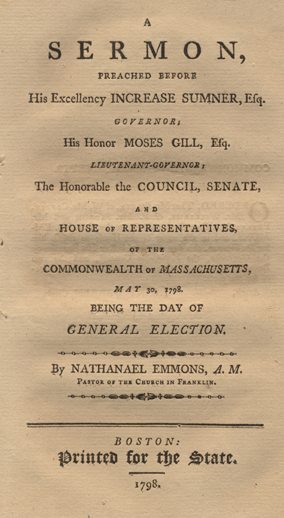
Sermon – Election – 1798, Massachusetts


Nathanael Emmons (1745-1840) graduated from Yale in 1767. He was pastor of a church in Franklin, Mass. from 1773 until his retirement in 1827. He received his D.D. from Dartmouth in 1798. He helped found and served as the first president of the Massachusetts Missionary Society. This election sermon was preached by Dr. Bassett in Boston on May 30, 1798.


sermon-election-1798-massachusetts

A

SERMON,

PREACHED BEFORE

His Excellency INCREASE SUMNER, Esq.

Governor;

His Honor MOSES GILL, Esq.

LIEUTENANT-GOVERNOR;

The Honorable the COUNCIL, SENATE,

AND

HOUSE OF REPRESENTTIVES,

OF THE

COMMONWEALTH OF MASSACHUSETTS,

MAY 30, 1798.

BEING THE DAY OF

GENERAL ELECTION.

By NATHANAEL EMMONS, A. M.

Pastor of the Church in Franklin.

BOSTON;

Printed for the State.

1798.


COMMONWEALTH OF MASSACHUSETTS.

In the House of Representatives, May 30, 1798.
 

ORDERED, That Mr. Fisher, of W. Mr. Coffin, Mr. Williams, of P. Mr. Slocum and Mr. Phelps, be a Committee to wait on the Rev. Mr. EMMONS, and in the name of the House to thank him for his Sermon, this day delivered before His Excellency the Governor, the Honorable Council, and the two Branches of the Legislature, and to request a copy thereof for the press.

Attest, HENRY WARREN, Clerk.


AN
ELECTION SERMON.

Daniel vi. 28.
SO THIS DANIEL PROSPERED IN THE REIGN OF DARIUS, AND IN THE REIGN OF CYRUS THE PERSIAN.
 

The prosperity of this noble ruler, clearly appears from the whole history of his life. Though, in his youth, he was carried away captive from Judea to Babylon; yet that dark and distressing scene soon opened the way to a brighter prospect. His high descent, his graceful appearance, and his shining talents, secured the royal favor, and the peculiar privilege of a public education. Having finished his academical course, he was presented, in usual form, before the reigning monarch; who, strictly inquiring into his proficiency in learning, found him not only superior to all his companions, but ten times better than all the magicians and astrologers in all his realm. Pleased with this promising youth, he took him into his own presence, and employed him in his own service. This was only a short and easy step to higher preferment. Being called to tell, and to interpret the king’s dream, which no other man was able to do, he was immediately advanced above all the governors in the province of Babylon. Though he had now scarcely reached the years of manhood, yet he faithfully and honorably discharged the duties of his office, during the reign of Nebuchadnezzar, during the reign of Evil-Merodach, and until the close of the reign of Belshazzar. At that portentous period, he was sent for, to read, and to explain the hand-writing on the wall, which contained the awful doom of that vile and impious prince; for which he was raised to higher dignity, and made the third ruler in the kingdom. The following night, Babylon was taken, Belshazzar was slain, and all his dominions thrown into the hands of Darius the Mede, by the victorious arms of Cyrus the Persian. Upon this large accession to his empire, Darius found it necessary to make a new arrangement in the departments of state. And in this new arrangement, he took particular notice of the celebrated Daniel, and placed him at the head of an hundred and twenty princes. Here, in spite of all his enemies, he continued to prosper, until Cyrus took the full possession of the Persian monarchy. That auspicious event gave him a free and easy access to Cyrus, and a happy opportunity of gaining a just and honorable influence over that great and amiable prince. In a word, it was the peculiar lot of Daniel to enjoy the favor and confidence of four of the greatest monarchs of the East; and to sustain, with dignity and success, some of the highest offices of state, for more than sixty years, in a constant, uninterrupted succession. Such another instance of long and increasing prosperity, in public life, we presume to say, cannot be found in the whole history of man.

Successful men have always been revered as well as admired. The Greeks and Romans held those in high estimation, who appeared to enjoy the peculiar smiles of the invisible powers. The same sentiment universally prevails in the minds of men. They spontaneously conclude, that those possess some extraordinary excellence, who are uncommonly successful in any important station of life. And if the Supreme Being governs the natural and moral world, according to a previous connexion between causes and effects; there seems to be a just foundation to suppose, that peculiar prosperity is a mark of peculiar merit. Under the impression of this sentiment, it is very natural to inquire what extraordinary qualities Daniel possessed, which mutually conspired to promote his prosperity, in the management of public affairs. Here it may be proper to observe,

First, That this excellent and prosperous ruler possessed superior powers of mind. The Father of Spirits has been pleased to display the same sovereignty in the bestowment of intellectual faculties, as in the bestowment of inferior favors. To some he has given ten talents; to some five; and to some fewer. The minds of different men are differently constructed. In one man, the memory is the superior power; in another, the imagination is the most brilliant talent; in a third, a clear and penetrating judgment is the most prominent faculty; but in Daniel, all these natural powers were equally strong and well proportioned. His quick apprehension and retentive memory were happily united with a strong and penetrating judgment, which formed him a great and noble genius. This appears from the account which we have of his mental improvements. He acquired knowledge with the greatest ease and rapidity; which discovered a sprightly and retentive mind. And he was able to excel in every branch of science, to which he turned his attention; which equally displayed the strength and symmetry of all his intellectual powers. These, perhaps, some may choose to ascribe to the plastic power of education: but taking education in the most extensive latitude, in which Helvetius, or any other author uses the term, it will not account for every mental distinction. It is readily admitted, that all the objects with which a man is surrounded, and all the connexions and circumstances in which he is placed, will either strengthen, or weaken his original powers. But to ascribe these powers to anything exterior to the mind itself, is no less absurd, than to ascribe the attractive power of the magnet to the needle, which only serves to discover that peculiar property. Daniel, like every other man in the morning of life, was unacquainted with the native strength of his own mind; but by repeated mental exertions, in the course of his education, he discovered those superior talents, which qualified him to manage the affairs of government, with great reputation and success. A party spirit, or the favor of friends, or a peculiar concurrence of circumstances, may chance to raise a man to a public station; but if his natural abilities are unequal to his office, he will most certainly fall, to rise no more. But Daniel began to rise, by the dint of merit, and therefore, he continued to rise from office to office, until he reached the next step to imperial power. Like Julius Cesar, he was born to govern, whether he lived in Judea, in Babylon, in Persia, or in any other quarter of the globe.

Secondly. Daniel possessed a large share of general information, which contributed to form him a great and successful politician. Civil government is extremely complicated and extensive, both in theory and in practice. It embraces all the objects in this world, and all the interests and concerns of men, in this life. No species of human knowledge is foreign to the business of a statesman, who needs to be universally acquainted with men and things. This idea was early and deeply impressed on the mind of Daniel. He was born a prince, and received a princely education. Providence directed his first and supreme view to the affairs of state. To be an able and successful politician, was the single object, which engrossed his whole attention, and which guided all his exertions. And no person, perhaps, ever enjoyed more ample means and opportunities of attaining this object. His great capacity; his refined taste; his studious habit; his early acquaintance with the solid branches of learning; and more especially his peculiar situation, prepared him to acquire the largest stock of general knowledge.

Babylon stood on the plains of Shinar, which was the most venerable and most enlightened spot on the face of the earth. There the residue of men first settled after the flood; and there they continued and increased, until their absurd and impious attempt to build the tower of Babel, proved the occasion of a general dispersion. Though this gave a universal shock to human affairs, and naturally checked the progress of knowledge; yet the feeds of science were happily preserved by the children of Ham, who still remained on the plains of Babylon. That city, therefore, was the fountain-head of information. There all the knowledge of both the old and of the new world concentred. There the arts and sciences were first cultivated. And there a literary society was first formed. The Chaldeans, who composed that society, devoted themselves wholly to the improvements of the mind, and made it their whole business to acquire and disseminate every species of rare and useful knowledge. And for this purpose, we may presume, they not only made deep researches into the works of nature, but also collected from every quarter, the most ancient and most valuable discoveries on every important subject. In such a circle of learned men, and in possession of so many means of information, such a man as Daniel, who had a peculiar capacity and taste for learning, must have amassed as large a stock of human literature, as could be derived from all the labors and researches of antiquity.

But I must further observe, that Daniel had the best sources of information in his own hands; I mean the sacred books of divine Inspiration. These acquainted him with the creation and fall of man, and the universal corruption of human nature. These exhibited the Church of God, as the great object, to which all human governments ought to be subservient. These placed before him a form of government, which was absolutely perfect. These presented him with the lives and characters of the greatest and best statesmen, for his constant imitation and encouragement. These reminded him of the awful fate of wicked nations and of wicked rulers. And these inculcated upon his own conscience his solemn obligations to live and act, like a dying and accountable creature. By reading and devoutly studying these sacred volumes, he obtained the best political as well as religious knowledge. Such a variety of books, however, would have been more injurious than beneficial to him, had he read without reflection, or thought without decision. But his strong, capacious, discerning mind could not be overloaded with learning. Like Pericles, he was able “to turn and wind everything to his own purpose,” and to apply every species of knowledge to a political use. The state physician needs an immense fund of political information, in order to prescribe on all occasions, a proper remedy for every political disorder. Such a source of political information Daniel possessed. He carried in his mind the history of the world, and the experience of ages. This enabled him to act with propriety, in every situation, and always to succeed in all his public measures. But,

Thirdly. Daniel’s extraordinary wisdom was no less beneficial, than his great information. Nebuchadnezzar pronounced him, even in his youth, to be ten times better “in all matters of wisdom,” than all the wise men in Babylon. And before he was thirty, his eminent wisdom was universally known and celebrated, not only through the empire, but through all the neighboring nations.

The haughty king of Tyrus had heard of the fame of his wisdom, otherwise he could not have felt the force of that severe reproof of the inspired prophet: “Thou art wiser than Daniel.”

Wisdom is a term of various and extensive meaning. It includes not only invention, but foresight and sagacity. Wisdom certainly implies the power of invention. It enables a man to take a clear and comprehensive view of things; and, under that view, to form the noblest designs, and to adopt the best means to accomplish the best purposes. But after a man has devised a great and complicated scheme, and made choice of the proper measures to carry it into execution, there is still occasion for what is commonly called foresight. This is that part of wisdom, which looks forward to, and provides against, unforeseen contingencies, which may possibly defeat a great and good design. But foresight is founded in sagacity, which is the power of discerning the near and remote connexion of things; of discovering the peculiar dispositions of mankind; and of penetrating their most dark and deep designs.

A large measure of wisdom, in all its branches, is indispensably necessary to form a great and good politician. Civil rulers are obliged, by the nature of their office, to be intimately concerned with every description of men. And unless they are “as wise as serpents and as harmless as doves,” they are in the utmost danger of being betrayed into measures, which will be injurious to themselves as well as to the public. Rehoboam lost the greatest part of his kingdom, by hearkening to the evil advice of young and conceited counselors. Political storms and tempests often rise, in which the ablest statesmen find occasion to exert all their wisdom, to devise the best measures, to prevent the political ship from foundering. Daniel frequently employed his wisdom to great advantage. By his wise and prudent conduct, he secured the favor and assistance of Cyrus, in restoring the Jews to their native land. By his great sagacity, he obtained the liberty of living according to the laws of his own religion. When he preferred his request to the superintendant of the captives, he replied, that he could not grant it, without endangering his head to the king. But Daniel was so perfectly acquainted with every avenue to the human heart, that he brought his benefactor to a cheerful compliance, even at the risk of his life. So, when the king had signed a rash and cruel decree, to destroy all the wise men of Babylon, he had the “wisdom and counsel” to stop the executioner in the discharge of his office, to appease the wrath of the king, and to preserve the lives of many of his most valuable subjects. By virtue of such extraordinary wisdom, he was able to promote his own and the public good; and to succeed in the administration of the most despotic government, that ever existed.

Fourthly. Daniel was a man of invincible firmness. This was but the natural effect of his wisdom. He was able to think for himself; to form his own opinions; and to comprehend the nature and tendency of his own designs. Having, therefore, once deliberately and wisely concerted a measure, he expected to succeed, and eventually to gain the approbation of the public. This well-founded confidence inspired him, with irresistible vigor and fortitude, in the prosecution of all his public measures. If he met with difficulty, or opposition, he steadily pursued his object, and appealed to the end, to justify the propriety of the means. He entreated Melzar to try his proposed expedient, and promised to renounce it, if it did not eventually answer a wise and valuable purpose. So, he besought the king to suspend the execution of his hasty decree, only upon the condition, that his dream should be interpreted, and his wishes completely gratified. Being ever fully persuaded of the wisdom and rectitude of his public conduct, he was always willing to suffer the opposition and clamor of the multitude, until his wisdom and rectitude should have a fair opportunity to triumph over all their prejudice and folly. Such a firmness of mind is the reverse of a vain and foolish obstinancy, which consists in a wilful opposition to the dictates of wisdom. This was the fault of Pharaoh, who ruined himself and his kingdom, by rejecting the advice of Moses. This was the fault of Saul, who disobeyed the voice of Samuel, and forfeited his title to the throne of Israel. And this was the fault of Ahab, who despised the admonition of the prophet, and died as a fool dieth, at Ramoth-Gilead. But Moses, Joshua, and Caleb, displayed a wise and noble firmness, in conducting the children of Israel to the land of promise, notwithstanding all their unreasonable opposition and complaints. If we consult the history of rulers, we shall find firmness of mind to be one of the distinguishing features of every great and prosperous statesman. And how often did God enjoin it upon the rulers of Israel, “to be strong and of a good courage,” in the discharge of their difficult and dangerous duties? There is no one thing, perhaps, more conducive to success in any important and difficult undertaking, than a firm, steady, unremitting spirit. And we have abundant reason to conclude, that this noble spirit had a large share of influence, in promoting the success and prosperity of Daniel, in some of the most critical and hazardous situations of his public life.

Fifthly. This same Daniel, who prospered so much under the most arbitrary princes, was a perfect pattern of inviolable integrity. By this is meant, that he always aimed to do justice, and to treat every man according to the eternal rule of right. As a ruler, he acted upon principle, in guarding the lives, the properties, and the characters of his subjects. Of this, we have incontestable evidence, even the united testimony of his most malicious enemies. “Then the presidents and princes fought to find occasion against Daniel concerning the kingdom; but they could find none occasion nor fault; forasmuch as he was faithful.” It is very remarkable, that the most critical and malignant eyes could discover no blemish in the integrity of Daniel, through the whole course of his public conduct. But we are to remember, that he had derived his moral sentiments from the pure source of divine Inspiration. He had read, with serious attention, the solemn charge, which Moses delivered to the judges of Israel. “Hear the causes between every man and his brother, and the stranger that is with him. Ye shall not respect persons in judgment, but ye shall hear the small as well as the great: ye shall not be afraid of the face of man; the judgment is God’s.” He had felt the force of that divine admonition to every civil officer in every civil department: “That which is altogether just shalt thou follow.” But, perhaps, no text in the Bible had a more steady, powerful, and practical influence upon his mind, than the last words which God put into the mouth of a dying statesman. “The God of Israel said, the rock of Israel spoke to me, He that ruleth over men must be just.”

The promotion of justice is the ultimate object of every branch of civil government. This is clearly and forcibly expressed, by an eminent British writer. “We are,” says he, “to look upon all the vast apparatus of our government, as having ultimately no other object or purpose but the distribution of justice, or in other words, the support of the twelve judges. Kings and parliaments, fleets and armies, officers of the court and revenue, ambassadors, ministers, and privy-counselors, are all subordinate in their end to this part of administration.” If the support of justice be the ultimate design of all civil governments, then the exercise of justice must be the indispensable duty of all civil rulers. They are appointed, not so much to promote, as to defend the public interest. Though they have the power of enacting laws; yet they have no right to dissolve the solemn obligation of mutual contracts, nor to require any man to do a single act, which is repugnant to that immutable justice, which is founded in the nature of things. And though they do, in a sense, hold the purse-strings of the people; yet they have no right to dispose of the public property for any other purpose, than the promotion of public justice. If they grant donations to particular corporations, or to particular persons, they ought to do it, not for the sake of those particular corporations, or particular persons, but simply to promote the public good. Indeed, their whole public conduct ought to be regulated, by the infallible standard of immutable justice. It is required of all stewards, whether sacred or civil, that a man be found faithful. Fidelity in civil rulers is, of all other virtues, the most acceptable to the people, who universally feel its happy influence, in every condition of life. Hence mankind have always manifested an uncommon attachment to, and veneration for, those eminent rulers who have given uniform and unequivocal proofs of their moral rectitude. Aristides among the Greeks, Cato among the Romans, and Daniel among the Jews, will be forever celebrated for their incorruptible integrity. This is that sterling excellence in a statesman, which needs no inscription, nor crowned head, to give it a universal currency among all nations of the earth. It was this rare, shining, captivating virtue of integrity, that recommended Daniel to Jews and Babylonians; to Medes and Persians; to Darius and Cyrus; and to every other prince, who employed him in public affairs. But,

Finally, The prosperity of Daniel, amidst all the burdens and dangers of public life, must be principally ascribed to his eminent piety and devotion. Like other men, who stood upon the pinnacle of power, he was continually exposed to the severest strokes of adversity. He came into administration in troublous times; and had a clear prophetic view of the dreadful convulsions, which were just ready to seize an expiring empire. And whilst he sat in the king’s gate, he was a spectator of many of those awful scenes, which were a fulfillment of his own predictions. He saw the haughty king of Babylon shook from his throne, driven from men, and degraded below the beasts that perish. He attended monarch after monarch to the silent mansions of the dead; and felt those heavy shocks, which falling princes never fail to give. And he was personally involved in the horrors of that memorable night, which sunk a mighty empire in perpetual ruin. But none of these things moved him, because his heart was fixed, trusting in the Lord. Those national convulsions and revolutions, which proved so fatal to others, all conspired to promote his personal prosperity and success. He secured the favor and protection of Heaven, by his sincere and exemplary piety. He carried conviction to all around him, that he possessed a truly “divine and excellent spirit.” His religion was neither a glowing enthusiasm, nor a gloomy superstition; but a pure and steady principle of universal benevolence. He gave God the supreme affection of his heart; and was neither afraid nor ashamed to profess the true religion, in the midst of a country and a court, that were involved in the grossest idolatry. He extended his benevolent regards to all the children of men, whether Jews, or Gentiles. He zealously promoted the cause of religion; and spent days and weeks, in humble, fervent, effectual prayers for the prosperity of Zion. He walked within his house with a perfect heart, and every day called upon God, at the head of his family. This he did; not because it was a common and reputable practice; but because it was a plain and important duty, which he owed to God, and to those whom God had committed to his care and instruction. His family devotion was known to his enemies as well as to his friends; and because there was nothing else to take hold of, his enemies took hold of this, as the only possible engine to work his ruin. Accordingly, they conspired together and obtained a royal decree, that “if any person should ask a petition of any God or man for thirty days, except of the king, he should be case into the den of lions.” As soon as he knew the writing was signed, he went to his house, opened his windows, fell upon his knees, and three times a day prayed and gave thanks to God. This threw him into the hands of his enemies, and out of the protection of his prince, who was constrained to expose him to the furious beasts of prey. But his heroic faith and fervent prayers stopped the mouths of lions, defeated the designs of his enemies, and smoothed the path of declining life with signal prosperity. For it is in immediate reference to this astonishing event, that it is emphatically said in the words of our text—“So this Daniel prospered in the reign of Darius, and in the reign of Cyrus the Persian.”

I have now delineated the most prominent features of this great and amiable statesman. His life is a bright assemblage of all the human virtues. And it is a just and beautiful remark, that “the collected virtues of one man, strike the mind much more forcibly and advantageously, that the scattered virtues of many.” Permit me then to hold up the character of Daniel as a mirror, in which all persons, and especially those in places of power and trust, may clearly and sensibly discover both what they are and what they ought to be.

The first thing suggested by this excellent character is, that great and good rulers are worthy of the highest respect. Who can contemplate the pious, virtuous, and useful life of Daniel, without paying him the sincere homage of the heart? Whilst he was acting his noble part on the stage of life, the happy influence of his public and private virtues commanded universal admiration and esteem. The greatest men in his day, honored him beyond the bounds of duty, or even propriety. Nebuchadnezzar prostrated himself at his feet, and payed him the excess of Eastern compliance. Darius gave him the strongest marks of sincere and ardent affection. Nor was he less esteemed in the court of heaven. The supreme Ruler dispatched an envoy extraordinary to assure him, “he was greatly beloved” by his Maker, and by all the principalities and powers above. This was no unmeaning compliment, but a divine testimony to his just desert of universal love and respect. All civil rulers of the same character, are equally objects of the highest veneration and regard. They are ministers of God for good to the people, and the principal instruments of all their temporal prosperity. Though the inventors of arts and sciences, and the promoters of agriculture and commerce, deserve the public esteem; yet wise and faithful rulers have a better claim to universal gratitude and respect. For it is ultimately owing to their exertions, that mankind derive any real benefit from their labors, their studies, or any of their natural advantages. A people may flourish in all the arts of Italy, or abound in all the wealth of the Indies; and yet drag out a poor, miserable life, under the power and oppression of a cruel and rapacious tyrant. But just men, ruling in the fear of God, give a people the full enjoyment of all the blessings of Providence. Those rulers, therefore, who direct all their views to the public good, and exert all their power and influence to promote it, are great benefactors to the world, and de4serve to be universally respected and revered. For this cause, therefore, God expressly commands every soul to be subject to the higher powers, not only for wrath, but also for conscience sake; rendering to all in authority their dues; tribute to whom tribute is due; custom to whom custom; fear to whom fear; honor to whom honor.

The pious and devout life of Daniel, in the next place, loudly admonishes civil rulers how much they are capable of doing, to promote the religious as well as civil interests of the people. The children of Israel were extremely addicted to the worship of idols, from the time they made the golden calf, to the time of their captivity in Babylon. But in that land of idols, the parent of idolatry, they were effectually and finally cured of their national sin. This great and extraordinary reformation, we must conclude, was brought about by the instrumentality of Daniel. The captive tribes were struck with his pious and exemplary conduct, in the midst of the worshippers of idols. They saw him pay a strict and sacred regard to those divine rites and ceremonies, which were designed to separate them, from all the idolatrous nations. They saw him daily and devoutly worship the true God, in his own family. They saw his faith and piety stop the lions’ mouths. They heard, with deep conviction, proclamation after proclamation, published by the great monarchs of Babylon, giving honor to the God of Daniel, and pouring contempt upon every false and inferior deity. They were acquainted with his days of mourning, fasting, and prayer, for the revival of religion, and the prosperity of the Church. In a word, they saw the purest piety constantly displayed in the life of a man, who was seated in the king’s gate, and universally loved and revered. And is it a thing incredible, that the pious example and influence of such a great and renowned ruler should awe the minds of a whole nation, and constrain them to cast all their idols to the moles and to the bats forever? The living example of other religious rulers has had the same transforming influence upon the minds of their subjects. We read, “The people served the Lord all the days of Joshua, and all the days of the Elders that outlived Joshua.”

Among the pious kings of Judah, do we find one, who ever failed to bring about a visible reformation in piety and virtue? And is it not equally true, that pious rulers, by their personal example and influence, have actually formed the moral and religions character of the people in this land? We know, that so long as all the governors, senators, and representatives of this Commonwealth, were public professors and zealous promoters of religion, the Sabbaths were sanctified; the houses of God were filled; divine institutions were attended; family religion and parental authority were maintained; cards, and balls, and theatres were unknown, and all open vice and infidelity were treated with general and just contempt. Whether this was pure superstition, or pure religion, it was certainly owing, in a great measure, to the example of civil rulers, who meant to form the people to virtue and piety. It is to be expected, that rulers should form the character of the people, and not that the people should form the character of rulers. It was never known, that the house of Israel reformed one of their loose, irreligious kings; but it was often known, that one pious, exemplary king reformed the whole nation. If Daniel had fallen into the corruptions of Babylon, there is not the least probability, that his people could have prevented his ruin. But when they had forsaken the paths of virtue and piety, he was able, by his personal example and influence, to bring them back to the worship and service of the God of their fathers. Civil rulers would find no occasion of promoting religion, by their laws, if they would only heartily and unitedly promote it, by their lives. Let them only live religion, and they will do enough to discharge their duty; and I will venture to add, they will do enough to form this people to a virtuous and religious character. For if this effect should not flow from the example of their virtue and piety, it would be a singular instance, and such an one as cannot be found in the history of any nation, from the beginning of the world to this day. If civil rulers carry the power of reformation in their own hands, then their obligation to reform the people, must be equal to that power. Let me, therefore, entreat the man of office, the man of honor, the man of influence, seriously to consider, that “to him that knoweth to do good, and doeth it not, to him it is sin.”

It further appears from the character and conduct of Daniel, that those who sit in the highest seats of government, have no excuse to neglect the profession and practice of vital piety. Real religion is necessary on their own account, as well as on account of those, who live under the influence of their powerful example. It is hard to say, whether the most dignified characters deserve our veneration, more than our tender compassion. They are certainly surrounded with peculiar temptations to forget their Creator, and to neglect the one thing needful. But Daniel has told them by his example, that they are under a great delusion, if they once imagine, their high stations and public employments, will afford them the least excuse for neglecting the duties of piety and devotion. They cannot seriously believe, that they have greater temptations to resist, than Daniel resisted; nor greater difficulties and embarrassments to surmount, than Daniel surmounted. He was born a prince, and spent his whole life in the presence of princes. But whilst he lived with the princes of Judah; whilst he marched with the army of the Chaldeans; and whilst he resided with the gay and dissolute youth, in Babylon, he remembered and obeyed his Creator. When his office seated him in the king’s gate, surrounded by profligate and infidel courtiers, he supported and adorned his religious profession. When an hundred and twenty princes sat at his feet, and the affairs of an hundred and twenty princes lay upon his hands, he found time and opportunity for the performance of every religious duty. And when propriety required him to submit to the most public and pompous parade; to be clothed in the silks of Persia, and adorned with the gold of Ophir; and to receive the incense of public honors; he could silently retire in the close of the day, and humbly prostrate himself, as a poor, guilty worm, before the supreme Majesty of heaven and earth, and devoutly implore his mercy. He very well knew, that though ornaments and honors might dazzle the eyes of unthinking multitudes, and conceal his imperfections from the view of men; yet they could by no means hide his heart, or conceal his criminal defects from the omniscient eye of God, to whom he stood accountable for all his internal feelings and external conduct. If young politicians, if aged statesmen, if the most dignified characters on earth, would seriously survey the pious and devout life of Daniel, they would be fully convinced, that neither the cares, nor honors, nor temptations of public life, can dissolve their obligations to call upon God; to read his word to reverence his sanctuary; and to attend all his holy and sacred institutions. Dignity and devotion have been, and may be united. Rulers over men have been, and may be, the most humble and faithful servants of God. “Be wise now therefore, O ye kings: be instructed, ye judges of the earth. Serve the Lord with fear, and rejoice with trembling.” Moreover,

The faith and piety of Daniel reprove the ignorance and presumption of those politicians, who profess and propagate the principles of infidelity. The infidels, in our Savior’s day, were men of superior rank and figure. And it is well known, that infidelity has commonly been first imbibed and propagated, by professed philosophers and politicians. Men of this exalted character have lately spread atheism and infidelity through a great nation; and attempted to diffuse the poison of their irreligious and disorganizing sentiments among the people of America. Such champions of infidelity endeavor to shake our faith in natural and revealed religion, by carrying us back into the dark regions of antiquity. Hume, Voltaire, and Condorcet, represent mankind as being originally involved in ignorance and barbarism. And they pretend to trace the progress of the human mind, in emerging from that primitive savage state, and gradually rising to a nobler state of civilization, learning, and infidelity. But were they better acquainted with the dark regions of antiquity, and with the rise and progress of human improvements, than the pious and learned Daniel? Did they ever live with him on the plains of Shinar? Did they ever search the same records and traditions of antiquity, which he searched? Did they ever converse with the Chaldeans, with whom he conversed? Were they ever personally acquainted, as he was, with the learned Amonians, who, as an incomparable writer has clearly proved, 1 spread every species of civil, political, and religious knowledge, through Egypt, through Greece, and through every part of the inhabited world? The most learned infidels of the present age, who have ransacked the bowels of the earth, and the dark corners of the globe, to pick up arguments against revealed religion, are but minute philosophers, in comparison with Daniel. Whilst he stood on the plains of Babylon, with the Bible in one hand, and all antiquity in the other, he saw, as clearly as the sun at noonday, the truth and divinity of that holy religion, which came down from heaven, through the medium of divine Inspiration. All his knowledge of the natural, moral, and political world, instead of weakening, confirmed his faith in the scriptures of truth. His strong and cordial belief of divine revelation, therefore, completely demonstrates, what has often been justly asserted, that infidelity is not seated in the head, but in the heart; and flows not from profound knowledge, but from a meaner and more criminal cause. Is it not sufficient to strike any modern infidel entirely dumb, to ask him this plain, pertinent, pointed question, “Art thou wiser than Daniel?”

Another important reflection, naturally suggested by the conduct of this able statesman, is, that civil rulers have no occasion for the use of art or intrigue, in any of their public measures. Those who conduct the intricate affairs of government ought to be wise and prudent; but yet they should never be artful, or designing. There are, however, professed politicians, who recommend this mode of conduct, by precept as well as example. They insinuate, that no man can succeed in political affairs without taking advantage of the weakness, folly, and caprice of human nature, and making use of measures, which are diametrically opposite to every idea of integrity. Some grave writers on moral and political philosophy, plainly inculcate the first principles of injustice and duplicity. They lay it down as a maxim, that politicians may and ought to make utility, or what they conceive to be the general good, the supreme rule of their conduct. But a great and good ruler will adopt and act upon a far more honest and noble principle: “Let justice be done, though the universe should sink.” Daniel found wisdom and integrity abundantly sufficient to answer all his political purposes, without ever stooping to the low arts of intrigue. These he was able to describe, and these he was able to defeat. In drawing the characters of the king of the North and of the king of the South, he gave a lively and striking picture of two profoundly artful and intriguing politicians. “And both these kings’ hearts shall be to do mischief, and they shall speak lies at one table; but it shall not prosper.” Whilst he presided over an hundred and twenty princes, he clearly and sensibly perceived the nature and tendency of that diabolical policy, which they employed to take away his life. But he opposed honesty to dishonesty; justice to injustice; wisdom to cunning; and open integrity to all their dark and deep designs. Nor did he fail of confounding their counsels; and of turning their own artful and malicious devices to their own destruction. Truly wise and upright politicians will never find occasion to employ any other weapon than perfect integrity, in order to defeat the pernicious purposes of their most subtile and malignant enemies, whether at home or abroad. Be it so, that our present connexion with distant nations may expose us to the arts and intrigues of foreign courts; yet those, who have the direction of our national concerns, may rely upon it, that a fair, open, upright conduct will be the best method, to frustrate the art, the duplicity, and unjust policy of five, or of five hundred unprincipled politicians.

This naturally leads me to observe, in the last place, that civil rulers have sufficient encouragement to be faithful, in the discharge of all their public duties. These, I shall not go out of my province to prescribe, nor even to suggest. If public men are but only faithful; there is no ground of anxiety about the wisdom or propriety of their public measures. Faithfulness, however, cannot be too often nor too forcibly inculcated upon those who have many opportunities, and of course many temptations to betray their trusts. But it is happy to reflect, that their encouragement to fidelity, is abundantly sufficient to balance all their unfavorable circumstances. The favor of God, and the esteem of men, are the most animating motives to duty. These had a commanding influence over the views and conduct of one of the most able and upright rulers. Daniel found by happy experience, that honesty was the best policy. For, his faithfulness to the Deity, secured his favor and assistance; and his fidelity to men, secured their sincere and warm attachment to his person and interest. As he constantly persevered and increased in integrity; so he constantly increased in wealth, in honor and outward prosperity. Let who would fall, Daniel stood. Let who would sink, Daniel rose. Let who would be in power, Daniel was their favorite. Let who would combine against him, Daniel always succeeded and prospered.

Is not this example worthy of the notice and imitation of all who sit in the seats of government? And may I not, with great propriety, take 0ccasion from it, to press the duty of fidelity upon the Honorable Legislature of this Commonwealth, which holds the first rank in the United States, for piety and virtue, as well as political importance? This large and religious community, are devoutly wishing and praying for a faithful administration of government. They would shudder at the thought, that their rulers should lift their hands to Heaven, and solemnly engage to administer a government, which they meant to undermine; and to protect a people, whom they meant to destroy. Their minds are alarmed at threatening dangers; and nothing can give them ease, but an unshaken confidence in the fidelity of their rulers. They do not distrust their abilities; but they may entertain some apprehensions respecting their integrity, since their enemies boast of corrupting it. But if those who direct our public affairs, would only display the piety, the integrity, and firmness of Daniel, they would undoubtedly possess the entire affection and confidence of this great and intelligent people. Indeed, some of the first characters in this Legislature, have already merited and secured the esteem and attachment of an enlightened part, and were it not invidious, I would add, of the most enlightened part of this Commonwealth. Notwithstanding the weakness and prejudice of some, we esteem it a favorable circumstance, that his Excellency has heretofore filled a dignified station; in which he had a peculiar opportunity of discovering his uprightness, and at the same time of forgetting the subtilties, and of imbibing the genuine spirit of the laws. This, and all the States in the Union, are much indebted to many eminent civilians, for the knowledge, the wisdom, and the integrity, which they displayed, in framing the Federal Constitution; which is not, and perhaps never will be, inferior to any one of mere human invention. This excellent constitution is the basis of all our national safety and happiness. And it is extremely difficult to conceive, that a single American, who is friendly to any good government, should be unfriendly to his own; and wish to alienate the affections of the people from it. But it is very natural to conclude, that the framers of the Constitution and those who were personally concerned in adopting it, should cherish an uncommon attachment to it, and labor to support it, with distinguished ardor and zeal. Upon this ground, the people have a just right to expect, that His Excellency will never mar the production of his own hands; nor renounce those political principles, which he has publickly and solemnly sanctioned, and which have had their proper influence in raising him to the head of this Commonwealth.

His Honor the Lieutenant-Governor, and the principal members of the Council, of the Senate, and of the House of Representatives, have not only gained the suffrages, but what is far more honorable and desirable, the confidence of the people, who sincerely esteem them for their able and faithful services. May this operate as a powerful and endearing motive to future fidelity and zeal, in the discharge of their important trusts. The greatest of all the men of the East, was highly gratified and animated, by the sincere affection of his grateful and dutiful subjects. “When I went out to the gate through the city, when I prepared my seat in the street, the young men saw me, and hid themselves; and the aged arose, and stood up. When the ear heard me, then it blessed me; and when the eye saw me, it gave witness to me: Because I delivered the poor that cried, and the fatherless, and him that had none to help him. I put on righteousness, and it clothed me: My judgment was as a robe and diadem. I broke the jaws of the wicked, and plucked the spoil out of his teeth.”

Such, sincerely respected rulers, are the consoling reflections, which naturally flow from fidelity in public life. If, therefore, you have begun to be faithful in your various departments, be not weary in well-doing; but be stedfast, unmoveable, always abounding in the service of God, and of your generation. Cherish a warm attachment to the government, which you are called to administer, and do all the public good, which both the State and Federal Constitutions require and enable you to do. Guide this people in the integrity of your hearts, and by the skillfulness of your hands. Exhibit before them a shining example of piety and virtue; and employ all your honor and influence to promote their spiritual as well as temporal good. This wise and faithful discharge of your public trusts, will finally put you into the full possession of that transporting promise, which is emphatically yours—“They that be wise shall shine as the brightness of the firmament; and they that turn many to righteousness, as the stars forever and ever.” But, if any of you should be conscious to yourselves, that you have been unfaithful, unjust, and unholy; let Daniel’s counsel be acceptable to you, and break off your sins by righteousness, and your iniquities by shewing mercy to the poor, that it may be a lengthening out of your tranquility. For, it is most certainly true, that, if you cast off fear, and restrain prayer before God, and despise all his warnings and admonitions, the day is coming, when that invisible hand, which is now recording all your deeds, will write on the table of your hearts, in a language which will need no interpreter, this final and fearful sentence: “You are weighed in the balances, and are found WANTING.”

END.


1.Bryant on Ancient Mythology.

Sermon – Establishing Public Happiness – 1795


Timothy Dwight (1752-1817) graduated from Yale in 1769. He was principal of the New Haven grammar school (1769-1771) and a tutor at Yale (1771-1777). A lack of chaplains during the Revolutionary War led him to become a preacher and he served as a chaplain in a Connecticut brigade. Dwight served as preacher in neighboring churches in Northampton, MA (1778-1782) and in Fairfield, CT (1783). He also served as president of Yale College (1795-1817). This sermon was preached by Dwight on July 7, 1795 in Connecticut.


sermon-establishing-public-happiness-1795

THE TRUE MEANS OF ESTABLISHING PUBLIC HAPPINESS.

A

S E R M O N,

DELIVERED

ON THE 7TH OF JULY, 1795,

BEFORE THE

CONNECTICUT SOCIETY

OF

C I N C I N N A T I,

AND PUBLISHED AT THEIR REQUEST.

THE MEANS OF ESTABLISHING PUBLIC HAPPINESS.

ISAIAH xxxiii. 6.

AND WISDOM AND KNOWLEDGE SHALL BE THE STABILITY OF THY TIMES.

To establish on firm foundations the Happiness of Society is evidently one of the most important concerns of man. If the attainment of that happiness by highly desirable, the perpetuation of it must be more desirable. Its daily value is daily renewed, during its continuance; and, when extended through a century, it is mathematically proved to be of a hundred times the value, which it would possess, if extended only through a year.

The mind of man, instinctively realizing this truth, has ever laboured rather to secure, than to obtain, happiness, both public and private. The attainment is usually not a difficult task, the establishment a Herculean one. A free government has been found sufficiently easy; but to render it durable has been ever considered as a problem of very difficult solution. Yet in its durability plainly consists almost all the value of such a government. Hence most of the political knowledge and labour of freemen has been employed, and exhausted, in endeavouring to give stability to their respective political systems. Hence have arisen the numerous checks, balances, and divisions of power and influence, found in our own political constitutions, and in those of several other nations. In other nations, these means have been generally insufficient to accomplish the end. Whether they will issue more happily in our own is uncertain. In several instances, we seem to have approached the verge of dissolution; but we have providentially withdrawn, before the season of safety was passed. Men of extensive political information, and sagacious forecast, have frequently trembled for our national existence; and, notwithstanding some favourable interpositions of Providence in our behalf, they still wait anxiously to know what the end will be. Should we fall, the fairest hopes of wise and good men will be blasted; the maxim, That mankind cannot be governed without force and violence, will stand on higher proof, and be advanced with new and triumphant confidence; and the great body of civilized men will probably sit down in sullen and melancholy conviction, that nations cannot, unless circumscribed by Alps, or oceans, be permanently free.

Most nations, and most politicians, have considered Arms and Wealth, as primary means of continuing national happiness. To this opinion they have probably been led by the allurements of avarice and ambition, by the power of custom, and by a persuasion, easily imbibed, that grandeur and happiness are synonymous. All these are deceitful guides, and have in this instance conducted only to error.

As means of defence, arms are evidently necessary to national safety, and, of course, to the permanence of national happiness; but, as means of conquest, they are usually the source of national ruin. States of moderate size, uninclined to military enterprise, and unambitious of high distinction, appear to have realized more happiness, than those of a contrary character. Widely extended dominions are too unwieldy and object, to be managed with either skill, or success; and power, diffused over a large territory, lessens at every stage of its diffusion. A greater and greater mixture of nations and tribes, once independent and impatient of subjugation, of different manners, religions, and interests, and prevented from uniting by prejudice and hatred, by imperious domination and irritated dependence, is continually accumulated, at every stride of conquest; and, like the iron and clay in the prophecy, though carefully moulded into a fair and regular form, is preparing to crumble, under the hand of the Former.

The system of government, also, and its necessary measures by becoming daily more complicated, become daily more perplexing. The public concerns are too numerous, the public officers, in opinions, characters, and interests, too various, the opportunities of secure oppression too easy, and the neglects of duty too frequent, to allow of any possible firmness, or consistency. The pile, however skillfully erected, and constantly repaired, is by the increase of its own weight precipitated to the ground.

From great accumulations of Wealth the same evil is derived with not less certainty, and in methods not very dissimilar. Avarice is one of those daughters of the horse-leach, which incessantly cry, “give, give;” it is eminently the fire, which saith not, “it is enough.” The love of property increases in a more rapid proportion, than the property itself. In a country possessed of immense wealth, places in government are, of necessity, highly lucrative, and, of course, the objects of ardent desire. To attain them, no principles, no efforts, are esteemed too great a sacrifice. Sycophancy, servility, bribery, perjury, and numberless other specters of vice, haunt all seats of power and trust, and force the friends of public integrity to retire with alarm and discouragement. Honesty is no longer counterfeited; but laughed at. Conscience is not silenced; but discarded. Posts of honour, are tossed out for a scramble; and truth, justice, and the public welfare, are vendued to the highest bidder.

On personal manners the effects are no less unhappy. Stimulated by avarice, and called onward by the commanding voice of custom, every man makes gold his god. To acquire riches becomes the only object, honour, or duty. By his wealth every man’s worth is sealed. Wealth is virtue; and poverty vice. The means of acquisition are, therefore, sanctified by the acknowledged importance of the end. Extortion, fraud, gaming, and peculation, steal into character, under the imposing names of industry and prudence, and whiten into virtues, in the sunshine, with which opulence is surrounded.

In the mean time, luxury holds out to appetite his store of various and sickly confections, and persuades those, who are prepared to be persuaded, that sense is the only source of real good, and that to eat and drink is the chief end of man. Enfeebled by sloth, debased by indulgence, and gross with a perpetual prostitution of taste and of talents, the rational character becomes assimilated to the animal one, and man claims a new and more intimate kindred to the swine.

Parade and appearance, also, invite and engross the national attention. Houses, gardens, equipage, and dress, take the place of duty and worth; and from the prince to the peasant the great ambition is to shine. Arts of ornament eject those of use; and manners of manliness and dignity give place to ceremony and profession. Education, instead of enlightening the understanding and forming the heart, is employed in gracing the person and supplying the limbs; and instead of teaching truth, implanting virtue and fashioning to worth by sober discipline, habituating care, and persuasive example, terminates all her labours in accomplishing for the dance and the drawing room. Children, are of course, led out of the path of reason and duty into the by-ways of appearance and sense, are conducted to the theatre and not to the church, and, while they are expected to become men and women, dwindle, with a regular diminution, into sribbles and dolls.

Thus the influence of enormous Wealth, and of extended Conquest, is equally pernicious to the Magistrate, and to the subject; and the national character becomes tainted, of course, with sickliness and corruption.

The experience of mankind has effectually elucidated the truth of these remarks. Greece, Rome, and the great nations of modern Europe, are all evident proofs of the intricate connection between Conquest and ruin; and Carthage and Holland are strong exhibitions of the perishing nature of society, which rests on the specious and treacherous support of unlimited Commerce.

The plans of those, who hitherto have chiefly planned for mankind, appear to have been formed principally for the purpose of fixing securely that state of society, which they found, a little, if at all, for its melioration. For this end, they appear to have aimed merely to strengthen the existing government against invasion and insurrection. Men, they seem to have supposed, must continue to e what they found them; ignorant, vicious, and unhappy. To render them as quiet as possible, in that state, is naturally concluded to have been the highest object of their policy, so far as it is exhibited in history. Hence they labored much to consolidate the elements of the government, and to secure to it that reverence, submission, and strength, which promised undisputed dominion. When the promotion of science became a part of the political system, it was principally adopted, for the purpose of qualifying individuals to govern, and furnishing useful agents to those who governed, in the prosecution of their measures; and rarely, and scantily, for the purpose of improving the mass of men. The Object was not so to rule, as to engross the esteem and affection of subjects; or to enable them to know when they were so ruled, as to make their rulers the proper objects of their esteem and affection. The Object was not to prepare subjects by information, happiness, and virtue, to understand, to love, and to preserve their state; but to make them quiet in that state, whether disposed, or indisposed. Hence, policy became an art; and government a trick. Rulers were employed in plotting against their subjects; and subjects either quietly sunk into torpid insensibility, or, awakened by oppression extended beyond every bound, rose to insurrection and madness.

This system, though it has been almost the only human system, has never appeared to be of real use to man. It has often defeated itself, and frustrated the designs of those, by whom it has been adopted. Assyria, Persia, Macedon, Rome, and France, are all proofs, that carefully supported, as it has been by all the arts of policy, and the utmost accumulation of power, it has still sown in itself the feeds of dissolution; and that those, whom it was intended to aggrandize, have fallen into the same gulf of perdition, with those whom it was intended to enslave. The Character of the mass of people, in each of those monarchies, was the real cause of its political ruin; and the nature of the political system was as really a principal cause of that character. In Africa, where Oppression has more effectually wielded her iron rod, and where man has been more entirely shorne of his intellectual dignity, a more uniform course of society has been accomplished. But here quietness has existed without happiness; a stagnant lake, filled with pollution and death; and nations, commuting reason for instinct have shrunk into brutes. In India, and in China, where the same system has long, tho’ not uninterruptedly prevailed, the inhabitants have indeed risen to higher grades of manual ingenuity, but, as moral beings, are nearly on the same level.

Under the influence of freedom, man has been roused from this lethargy, and shaken himself with a returning consciousness of energy and action. In this superior situation, his powers, his views, his efforts, enlarged with a portentous growth; but they grew chiefly by the aid of soil, climate, and accident. The cultivation which they received, was the cultivation of chance, of passion, and of appetite; not of system, wisdom, or virtue. Greece became a Giant in war, in science, and in arts; but was still an infant in moral improvement, and useful policy. No regular plan of amending the human character appears to have been thought of by her most admired sages; and, while her efforts in the field, and in the study, awed mankind to astonishment, her citizens were merely a collection of superior savages. Their depravity assumed, indeed, a more elegant form, but not an essentially different character. Rome systematized, and in a higher degree than any other State has ever done, war, oppression, and devastation. Her government, also, was more skillfully adjusted, and more firmly compacted than the Grecian systems; but it was still tossed by tumult, and shattered by frequent violence. Her citizens were left to the same accidental improvement; and, though possessed of a more specious stateliness than those of Greece, were debased with the same grossness and immanity [barbarity]. Accustomed, from our infancy, to study their history, to admire their talents, and to celebrate their exploits, we are prone to form a different estimate of these nations; yet by a very moderate examination we shall find, that they furnish us many things to admire, but few to approve, that, as moral beings, they are distinguished with little advantage from various nations whom they contemptuously styled barbarians. Indeed, one of the first political errors of later ages appears to be too high a respect for the state of society in Greece and Rome.

There is, I believe, a more rational policy, beginning with a different aim, and pursuing public quiet in a nobler and more effectual manner. The primary mean of originating and establishing happiness, in free communities, is, I imagine, the formation of a good personal character in their citizens. Good citizens must of course constitute a happier community than bad ones, and must better understand the nature and causes of their happiness. They may safely be governed by a milder policy, and cannot but be better judges of the desirableness of such policy. More the children of reason, and less the slaves of appetite and passion, they will naturally be more satisfied with real happiness, and less allured, by that, which, however shewy, is unsubstantial; will need fewer restrictions, and be more contented under such as are necessary; will prize more highly such liberty, as it suited to the condition of man, and proportionally disregard that, which is Utopian. Hence, such citizens may probably be governed by justice, and common sense; and will not necessitate the adoption of force and oppression, or the employment of circumvention and statecraft.

A family is, in some respects, a state in miniature. Children of bad personal characters can scarcely be governed at all, and never, without constant exertions of terror and force. Children of a good character are easily swayed, without either. Mild and equitable measures, few and gentle interpositions of mere authority, united with argument and persuasion, will, in a family composed of such children, effectually establish domestic order, peace, and happiness. This difference of regulations, this exemption from the necessity of exerting force and inspiring terror, depends wholly on the character of those, who are to be governed. To a State these truths are not less applicable. If the personal character of its citizens were perfectly good, there would be neither necessity, nor opportunity, of governing by force. That train of penalties, which constitutes a great part of the business of every Legislature, and of the contents of every statute book, would cease to exist, as it would cease to be necessary; and the mere expression of the public will would execute itself. The Sheriff would enjoy a sinecure, and the jail moulder without an inhabitant.

On this general principle was the prophecy of the Text written. Wisdom and knowledge, the prophet declares, shall, at some future period, some period which I apprehend to e still future, be the stability of the times, to which he refers: i.e. the public stability of the age; of one, or of more than one nation: or, in other words, the means of establishing on firm foundations public happiness.

By Wisdom, all Persons who read the Bible know the Sacred Writers commonly intend Virtue; and Virtue in that enlarged and Evangelical sense, which embraces Piety to God, Good-will to mankind, and the effectual Government of ourselves. “The fear of the Lord,” said Jehovah, when disclosing this inestimable and hitherto unexplored subject, “that is Wisdom.” “The fear of the Lord,” says Solomon, (Heb.) is the chief part of Wisdom.” “The Wisdom, that is from above,” says James, “is first pure, then peaceable, gentle, easy to be entreated, full of mercy and good fruits, without partiality, and without hypocrisy.” As Wisdom is properly defined to be that attribute of mind, which aims at the best ends, and chooses the best means to accomplish them; so Virtue, which steadily aims at the Glory of God, the Good of mankind, and the Good of ourselves, the best possible ends, and which more naturally than any other disposition directs to the best means of accomplishing them, was, with peculiar propriety, styled Wisdom by the penmen of the Scriptures.

Virtue may be defined—The Love of doing good. It will be easily seen from this definition, if allowed to be just, that it can be but one indivisible Attribute of mind. Yet, as the objects, towards which it is exercised, are materially different, it has been divided, for the purposes of consideration, into the three great branches already mentioned. It ought to be observed, that it is not a passion, nor an aggregate of passions; but a principle, or disposition, habitual, active, and governing. It is the mental energy, directed steadily to that which is right.

God, the greatest object in the Universe, and infinitely more important and worthy than all others, demands, of course, the supreme regard of every rational being. The first, the most obligatory, and the most noble exercise of Virtue is the Love and Reverence of this Glorious Being, generally termed Piety.

Our fellow creatures, collectively, form the next great object of our regard. Virtue, exercised towards them, has very properly been denominated Good-will or Benevolence; a name descriptive of all right affections towards them, and including justice, faithfulness, kindness, truth, forgiveness, and all those, which are frequently styled the Social Virtues.

To himself every Man is also an important object of regard. Virtue, as exercised towards ourselves, includes every just desire and vindicable pursuit of our real good; but it is principally employed in regulating and confining within due bounds our appetites and passions; principles in the human mind, which perpetually prompt to wrong, and which, without a continual and vigorous restraint, invariably dishonor God, injure our fellow men, and ruin ourselves. Thus exercised, Virtue is termed Temperance, or Self-government.

It is unnecessary for me to remark to this Audience, that all human conduct springs from the human will; that this is the only active principle in man; and that, as the will is directed to good, or evil, right, or wrong, man invariably does that, which is evil, or that which is good. The real importance of Virtue to the happiness of Society lies in this; that Virtue is an uniform direction of the will to that which is good. When man is virtuous, therefore, his disposition, the source of all his conduct, being steadily pointed to that, which is good, and right, his conduct must, of course, be also right and good. Hence Virtue of necessity aims at the happiness of Society. A man’s private interest may, for a time, and in his own view, be promoted by wrong; but the interests of a community can never be, for a moment, promoted but by that which is right. A selfish, separate interest clashes with that of every neighbor, and cannot be advanced, but to the injury of the common good. Avarice always robs; ambition always oppresses; and sensuality always wounds. Virtue, on the contrary, invariably seeks the common welfare, and gives no pain, where it is not indispensably necessary for the promotion of that welfare.

Virtue is, also, a principle sufficiently powerful and active to make all the happiness, which Society can enjoy. It is the whole energy of the Deity; and of every perfect being; and may become the whole energy of man. It often has become sufficiently powerful to produce the highest self-denial, of which man in his present state is capable; and is not uncommonly of such strength, as to constitute the only active character. Greater exertions have rarely sprung from selfishness, than have sprung from virtue. The labours of Alfred were not inferior to those of Caesar; nor were those of the proudest and most ambitious Philosopher to be named with those of Paul.

As Virtue is the genuine, the invariable, and the efficient source of public happiness, so it is in the same degree its stability. As it is its natural tendency to produce happiness, so this is always and equally its tendency. Wherever, and how long soever, it exists, the happiness, of which it is the parent, will also exist.

Good-will to Mankind, accomplishes directly most of those desirable objects, at which the political Constitutions, and the Laws, of Society aim; It makes men honest, just, faithful, submissive to government, and friendly to each other, without restrictions, or punishments; and renders magistrates equitable, public spirited, and merciful, without checks, factions, or rebellions. And all this it can accomplish, without labour, or expense, without force, turmoil or terror.

Self-government, on the other hand, effectually restrains from all those evils in Society, to prevent which is the principal employment of Laws and of Magistrates. With far more efficacy, and incomparably more ease, than the post and the prison, the gibbet and the cross, does it deter from fraud, revenge, impurity, theft, robbery, treason, and rebellion. At the same time, it guards from ten thousand other evils, which no Law can restrain, and which, often, are not less pernicious to Society, than those overt and glaring acts, which are the objects of judicial decision. Its influence on the Magistrate is equally propitious; nor are the private evils, which I have specified more effectually prevented, than the extensive and enormous mischiefs of corruption, peculation, and tyranny.

With regard to the advantage and necessity of Goodwill to public happiness, there has never been any debate, except that, which respects all Virtue, viz. Whether it is necessary, that men should be principled to pursue the good of Society; or whether it is sufficient, to require the actions conducive to this end, without any regard to the principle. This question I shall discuss in the sequel.

With regard to the necessity of Self-government to the happiness of Society a debate has always existed. In every Community men are found, who steadily insist, that the indulgence of those desires which are appropriately termed Appetites is justifiable, and in no way noxious to the public good. Were men brutes, and connected on equal terms with a republic of swine, goats, and swift-peters, this sentiment would at least plead some pretence in its behalf; and Reason would not be obliged so often to blush for the human character, when it read, to this effect, the labours of infidel philosophers, or heard the conversation of equally rational sensualists.

The man of sloth, the drone of Society, who adds nothing to the common stock, and lives on the labours and spoils of others, might yet be borne, were not his sloth the flood-gate of wickedness. Idle to do good, he is a pattern of industry in doing evil. In his merely slothful character, every morsel, which he tastes, is the plunder of his neighbour, and every act of his enjoyment a depredation on Society. To console them for the injustice, with a restless mind, and hands diligent in mischief, he consumes his time, and employs his talents, in gambling, horseracing, cheating, stealing, receiving from thieves, corrupting youth, disturbing good order, and pursuing an universal round of noxious labours and pernicious diversions.

If idleness, prodigality, the ruin of health, reputation, and usefulness, the depravation of every mental and bodily faculty, the mortification of friends, the destruction of the peace, comfort, and hopes, of his family, and the exhibition of a contagious and pestilential example, are not injurious to a Community, the drunkard, and the glutton, will undoubtedly stand on new ground, and may with new confidence bring forward a putrid carcass, and a putrid mind, to the public eye, and insist, that they are found useful, and healthy members of the Body politic.

The man of lewdness is in a condition even less hopeful. He unceasingly scatters fire-brands, arrows, and death, on all around him. He professes, indeed, to be in sport, and merely to pursue his own amusement; but the sufferings of those, who are unhappily within his reach, make that amusement a very serious concern to them. He lives but to injure, and acts but to destroy. The burglar plunders the purse; the murderer cuts off the life, and hurries his unhappy victim to an untimely grave. The man of Lewdness robs the parent of his child, the husband of his wife, and the family of their mother; murders household peace, character, and happiness; plunges the dagger of death into the soul, and hurries the victim of his lust into the abyss of the damned. The plunder of the burglar may be recovered, or the loss may be borne: the victim of the murderer may live beyond the grave, and the unhappy mourners may with this hope soothe their excruciating sorrows: but no means can restore, no mind can sustain, the plunder of peace; no balsam was ever found for the ulcer of infamy; no skill can rebuild a ruined family; nor can any artist repair the wrecks of a soul. Such is the innocence of the Leacher; and, were not too great multitudes interested in protecting and conniving at vice, the chase of the wolf and the tiger would be forgotten, and he, in their stead, would be hunted from the residence of men.

Piety, the remaining branch of Virtue, although its utility, and its necessity to public happiness, has been more frequently questioned, and denied, is, probably at least as useful, and as necessary to this object, as either of the other branches. It will, I presume, be allowed to be wholly rational, and probable, that there are, within the limits of the creation, worlds, where the Creator is wholly respected according to his character; and where infinite greatness and excellence not only demand, but obtain, a love, reverence, and obedience, suited to their nature. That there is one such world, the Bible directly declares. In such a world, it is evident, Piety is the whole source of order, peace, and happiness. Perfect itself, it there renders the whole moral system perfect, and spontaneously produces that obedience to the divine government, which is less effectually produced here by threatenings and judgments. As Piety is the foundation, in that world, of the order and peace, on which all social happiness depends, it is rationally concluded, that it must be the natural foundation, in any other world, of proportional order and peace; and that, so far as it exists, it will benefit earth, as well as heaven, men, as well as angels, and any particular nation, as well as mankind in general. In other words, as Piety appears to be the foundation of the most perfect intellectual happiness; so it is to be deemed the real, the natural, and the universal foundation of social good.

From Piety, also, the other exercises of Virtue derive a higher distinction, are presented with stronger motives, and enforced by more solemn sanctions, than can spring from any other source.

All the duties which we owe to mankind, are, without the consideration of Piety, viewed as merely due to men; worms of the dust, beings of yesterday, and children of vanity and sin. To such beings moral obligation, though real, must be of comparatively little importance, and operate with little force. But in the eye of Piety all these duties are enhanced, beyond measure, by the consideration, that they are enjoined by God, and that, of course, every fulfillment of moral obligation to our neighbour is the performance of a duty to our Maker. The same remarks are, with equal force, applied to the duties of Self-government. As much greater, therefore, as much more excellent, and as much more possessed of a right to require our service, as God is than men, just so much more importance, and distinction, does Piety give to these branches of Virtue, than they could otherwise receive.

The principal motives to virtue are evidently the pleasure found in the practice of it—the esteem, affection, and beneficence which it excites in our fellow creatures—the approbation and love of God—and the expectation of future rewards and punishments. The two first of these motives must certainly operate with as great, and the two last with much greater influence, on Piety, than on any other supposable character. To the eye of Piety God appears, as a Being totally different from that, which is usually formed by every other eye. His character is invested with an importance wholly new. His approbation, love, and rewards, on the one hand, and his abhorrence, anger, and punishments, on the other, appear as objects real and boundless. Primary objects of attention, they become primary concerns; and are not only seen by conclusion, but directly felt to involve all the interests of man. Hence they become the directory of thought, and the law of action.

A clear and fixed sense of moral obligation is, probably, in the opinion of most men, indispensably necessary to the discharge of the duties, and to the production of the happiness of Society. But such a sense, it is presumed, is to be looked for in Piety alone. The strength of moral obligation lies wholly in the conviction, that a constant adherence to it is obedience to the will of God. But almost all the regard, which is rendered to God, or to his will, is rendered by the pious. Imperfect and desultory feelings of this nature, feelings which are yet of no small importance, will generally be found, where a religious education has given birth to just moral sentiments; and especially where general influence and example, united with public instruction, have cultivated such sentiments into habit. Beyond these limits nothing can be expected, nothing is commonly professed, and nothing will ever be found, beside the changing power of fashionable opinion, the slippery dependence of personal honour, and the accidental coincidence of selfishness with duty.

The great support of moral obligation, in the present world, is the belief of God’s moral government, of our accountableness to him, and of an approaching state of rewards and punishments. The desire of happiness, and the dread of misery, is a part of the intelligent, and even of the animal nature, and is inseparable from the faculty of perception. As all happiness, and all misery, are ultimately derived from the hand of God, and as no bounds can be set to the degree, or the continuance, of either, beside those, which he is pleased to set, this object comes home to every heart with a power totally peculiar. Its efficacy reaches all places, times, and persons: all persons, I mean, beside the fool, who hath said in his heart, “There is no God.” Its superior efficacy on men of piety I have already explained.

In a world, like this, where the depravity of man is proclaimed by every Law, is engraven on the altars of every Religion, and is written with a pen of adamant on the iron page of History, how desirable is it, that this great motive to duty, this great sanction of moral obligation, should, instead of being lessened by sophistry, ridicule, and neglect, be preserved and strengthened to the utmost, to save Society from those numerous evils, of which it is the only remedy, and to prompt men to those indispensable duties, to which it is often the only effectual motive?

In addition to these observations it may be justly asserted, that, without Piety, the other branches of Virtue are never found. There has been no proof either from fact, or from argument, hitherto adduced, to shew, that one branch of Virtue can exist independently of the others. All the heathens, both individuals and nations, who regarded their fellow men in the most equitable manner, and who regulated themselves with the greatest decency, were distinguished by reverence for the gods. Among Christians, also, there is no want of evidence, to prove, that impious men are alike destitute of benevolence and self-government, and that the appearances, which are found, of these characteristics, in those who are not pious, are the accidental result of convenience, or necessity.

But the subject will easily, and, I apprehend, perfectly explain itself. Justice in man is the love of that which is just. But can he, in whom this principle exists, be unjust to his Maker? Can he be willing, and principled, to render to Caesar the things which are Caesar’s, and not to God the things which are God’s? Or can anything be Caesar’s with such absolute right, as he, his talents, time, and services, are God’s? Gratitude is an affectionate sense of benefits, and a proportionate love to the Benefactor. But can any man be grateful to a human, who is not grateful to the Divine, Benefactor? Generally, can a man love intelligent being at all, who does not love the Infinite Intelligent; or be at all virtuous, unless his virtue be directed primarily to that Being, who is, infinitely beyond all others, excellent, lovely and beneficent?

Whether it be desirable for Society, that its members should be principled to promote its happiness, or not; is a question, which cannot be asked without a blush, nor answered without a smile. It is to ask whether it would be better for Society, that its happiness should be great, stable, and secure; or small, fluctuating, and accidental. There is no steady source of public or private good, but principle; and there is, in this sense, no principle, but Virtue. To Virtue public good necessarily appears, and is enjoined by an Authority instinctively obeyed (the Authority of God) as a primary object of regard. To a mind not virtuous it is, of course, and always, an object subordinate, accidental, and solitary.

On the inhabitants of a land, universally virtuous, the peculiar blessings of Heaven may, also, be rationally expected to descend. Where human weakness errs, where human power falters, and where human means prove ineffectual, God may, both on rational and evangelical grounds, be expected to open his beneficent hand, and supply the necessary good. Here, also, Virtue may be safely pronounced to be the stability of public happiness.

But it is not enough, that the members of a Society aim at that, which will promote the general good; they must also know what it is. Knowledge is, therefore, with the utmost propriety designated in the text, as another source of this stability.

In examining this part of the subject, it will be useful to consider the kind, the diffusion, and the effects, of that knowledge, which is intended by the Prophet.

It will undoubtedly be conceded, that he intended that knowledge, which is real, and not merely nominal; that, also, which is practical, and therefore useful; and, of course, that, which is moral, or in other words, the most practical, and the most useful.

Almost all real knowledge, and all practical knowledge, is derived either from Experience, or from Revelation. Theories are generally mere dreams, which ought to be placed on the same level with the professed fictions of poets, and to be written in verse, and not in sober prose. Tho’ dignified with the pompous title of Philosophy, they have usually, after amusing the world, a little time, gone down the stream of contempt into the ocean of oblivion. They cannot be practical, because they cannot be true; and hence, being of no use, except to please the imagination, they are of course neglected and forgotten.

There is in the human mind a faculty, called Common-sense, which, though never in high estimation among Philosophers, seems to have originated, and executed, almost all the plans of human business which have proved to be of any use. The reason is obvious. Employed in forming near and evident deductions from facts, and in closely observing facts for that purpose, contented with moderate advances, and cautious of innovation, its step, though flow, has been sure; a real approximation to the end in view. Theory, on the contrary, rapid, but wild, has usually receded more than it has advanced. Untried causes, causes to which a new application is given, and experiments in business, made either anew, or in new circumstances, have always been regarded by Common-sense with a suspicious eye; and a state of things, not perfectly desirable, willingly endured, in preference to the adoption of new systems, of which the effects were uncertain, and the operations dangerous.

The system of government, formed for South-Carolina, by Mr. Locke, may stand as a portrait of all political theories. Fair and rational on paper, but deformed and useless in practice, it suited the real circumstances of that Colony, just as a map, drawn by the fancy of a Geographer, would suit an undiscovered country; or a chart of soundings, marked by the Navigator, in sport, would suit the real state of an untraversed ocean. If this Giant in understanding failed so entirely in an attempt to form a theoretical system of government, reducible to practice, of what character must be the attempts of modern pygmies?

That the knowledge, communicated by Experience and Revelation, was intended in this prophecy, will be evident to all persons, who remember, that this was the only knowledge in existence, when the prophecy was written. Visionary Philosophy had not then begun to mislead mankind. The world was contented with real knowledge; and, although its stock was small, it was genuine and unalloyed, and therefore of a currency and use, suited to human purposes. Had its progress been uninterrupted by war and devastation, and unbewildered by theoretical Philosophy, we should now probably be removed, in real knowledge, many degrees beyond our present advances.

A general diffusion of knowledge, was undoubtedly designed in this prediction. In no other sense could knowledge be supposed to be the means of general stability.

The effects of knowledge, thus defined, are evidently of high importance to social happiness. The Legislator it will enable to understand the state, the interests, and the duties, of a people; to form regulations suited to their state, promotive of their interests, and coinciding with their duty; to discern, with a freedom from low and pernicious prejudices, that equitable government is the true source of honour to himself, and of prosperity to his people; to cast his eyes abroad, without the purblind confusion of narrow minds, and see clearly the real condition of other nations, and their proper connection with the affairs of his own; to look back with distinctness, and with comprehension, on the past state of human society, and forward, with rational prediction, to events which are rising on the surface of futurity. In a word, placed by such knowledge on a lofty summit, he stands as a Watchman for the welfare of millions, unobstructed by mists, and undazzled by the height to which he is elevated, with a steady eye marks distinctly the surrounding progress of things, and is enabled with confidence, and with safety, to utter alike the quieting voice of peace, and the timely alarm of danger.

In the same manner is the Judge enabled to understand and interpret law, to form equitable decisions, to exercise his discretionary authority in extending or restricting penalties, and generally to hold with an equal hand the balance of right, between neighbour and neighbour, and between subjects and the state.

To maintain the dignity of government, to impress respect for his own office, to secure the general approbation in the execution of punitive justice, to stop at the bounds of law and right, and to mingle mercy with judgment by choosing the least distressing methods of enforcing judicial decisions, are employments which constitute the duty of the Executive magistrate; employments, which demand, perhaps in an equal degree, clear understanding and extensive information, and which hazard, without it, the public prosperity, and the public peace.

Nor are the people at large less interested in the knowledge above described. Stability of public happiness, especially in free States, depends wholly on the character of the citizens in general. Nor can it exist, unless they understand distinctly the rights and the duties freemen, the duties of magistrates, the requisitions of law, the common interest and the means of promoting it, the ruinous nature of war, the beneficent influence of peace, the relations of men in Society to each other, and the character, which those ought to sustain, who are contemplated as objects of the public suffrage. Equally useful is knowledge in teaching them the duties of Parents, children, friends, and neighbours, the nature and importance of a happy domestic education, the advantages of mild and obliging conduct, the universal profit of virtue, and the mischiefs of vice of every kind, in every degree, and towards every person. Highly important is knowledge, also, to give that personal respectability, and to secure that rational esteem, which excites and gratifies laudable ambition; to fill with profitable amusement the hours of leisure, and of age; to capacitate for the discharge of useful and necessary business; and to furnish means of improvement in the several arts and employments of life. In a word, from knowledge must, in a great measure, be derived that steadiness of character, that possession of comforts, and that rational estimation of things, which form the useful citizen, and the respectable Society.

From these observations, I flatter myself, it will appear, that the stability of public happiness is produced by Knowledge and Virtue; and that the diffusion of these through a Community is the true and the only method of solving that political problem, which has so long perplexed the rulers of mankind. By these great attributes men are made good members of society; and, composed of such members, a Society must be happy. They form, they finish, the magistrate and the citizen alike. They teach every duty, and prompt to every performance. They originate wise and equitable laws, just decisions and useful administrations. They create the amiable conjugal and household offices, produce effectual domestic education, train to early and happy habits, and conduct to family peace, neighbourly kindness, a cheerful submission to law, a steady love of rational government, and an universal growth of social enjoyment. Sweet and salubrious streams, they nourish happiness wherever they pass; and, enlarging and mingling in their progress, spread, in the end, an ocean of blessings over the millions, who inhabit an empire.

It will not be improper to add, that the most respectable political writers have, with one voice, declared Virtue to be indispensably necessary to the existence of a free Government. As this sentiment has been adopted in opposition to many prejudices, and interests, religious and secular, and adopted by them all, it may be fairly supposed to be the result of conviction and evidence. Perhaps it may have arisen, in part, from the following view of the subject.

Government is rendered effectual by two great engines—force and persuasion. Force is the instrument of despotism, and persuasion. Force is the instrument of despotism, and persuasion of free and rational government. To produce persuasion, it is always necessary to inspire confidence. To inspire confidence in subjects towards rulers, it is necessary for subjects to be satisfied, that their rulers are possessed of knowledge to discern, and of virtue to aim at, the general good. To inspire confidence in rulers towards subjects, it is necessary for rulers to be satisfied, that their subjects possess knowledge to discern, and virtue to approve, the real wisdom and equity of public measures. With these prerequisites, rulers will with confidence pursue the public interest; and subjects will with equal confidence support their administration: without them, the ruler, fearful and suspicious, always in perplexity and always in danger, will feel himself obliged to have recourse to art, cabal, and contrivance, to keep in motion the wheels of government; and subjects, anxious, jealous, and impatient, will continually fluctuate between hope and fear, flock at every call to the standard of faction, and prove the prey of every demagogue.

Facts, also, lend their evidence to support this doctrine. Sparta and Rome were the most stable of all the ancient republics. Virtue, in the sense of the Gospel, they had not; but, in their early periods, they were, to an unusual degree, possessed of what is called heathen virtue. Beyond most, perhaps beyond all, the heathen nations, they feared their gods, reverenced an oath, and believed in a providence, which rewarded the good, and punished the evil. Their ideas of truth and justice, however crude, were fixed; and they admitted fewer corruptions and violations of the principles, which they esteemed sacred, than most other nations. While this was their conduct, their public happiness, though imperfect, was stable; and, with the fall of these principles, it tumbled to the ground.

Among the modern nations of Europe, Switzerland, especially in some of its Cantons, holds the highest rank in public happiness. For more than 400 years, this distinguished country has withstood every shock from within, and from without, and appears still to rest on firm foundations. Equally remarkable has this country been for knowledge and virtue. In no State, in Europe, have the inhabitants at large possessed equal information, or exhibited equal proofs of piety and unblemished morals. To these causes their happiness is directly traced by every enlightened traveler. Happy Switzerland! God has created for thee thy walls and thy bulwarks. Under his good providence, thy bravery has made thee free, and thy knowledge and virtue have made me happy.

On this side of the Atlantic, Connecticut, by an extensive and increasing acknowledgement, appears to hold, in this respect, the first station. The happiness of this State, for one hundred and fifty years, has suffered, except from external enemies, little diminution. Its government, customs, manners, and general state of Society, have scarcely been changed, but by the gradual progress of refinement. Formed, at first, in all the great outlines, and nearly filled up, by men, whose distinguished rectitude of disposition, led, of course, to justness of opinion, and whose found Common-sense, improved by close observation, did not lead to error, its Constitution, although, in many respects, a violation of political theory, has been found more than any other to be fitted for practice. Public and private happiness its inhabitants have, in a high, perhaps an unrivalled, degree, enjoyed. In no country has Virtue, for so long a period, been held in higher estimation, received more marks of public regard, or more emphatically formed the general character. Knowledge, at the same time has, in an almost singular manner, been diffused through the mass of people. Every parent in the State has a school placed in his neighbourhood; and every child is furnished with the means of the most necessary instruction. To aid, and to complete, these peculiar advantages, a church in every district of a moderate size, opens its doors to the surrounding inhabitants, and invites every family to receive the knowledge, communicated by the Word of God.

The same doctrine might be even more strongly illustrated, if the time would permit, from the deplorable contrast to the picture already drawn, presented by the desolations and miseries of vice and ignorance have in most instances prevailed without a mixture, and reigned without control. Rulers have trampled on the necks, rioted on the spoils, and sported with the miseries, of their subjects. Subjects have fallen before them with impious homage, and slavish brutism, or rescued themselves from oppression, to run mad with the frenzy of anarchy, and to wanton in plunder and blood. Nations, as if in love with misery, and unsatisfied to see their sufferings so small, have reached out an eager hand to grasp at woe. War has been the profession of man, and arms his instruments of business, and of pleasure. Conquest, like a roaring lion, has stalked round the desolated globe, seeking whom he might devour. In his trains, Ambition has smoked with slaughter; Avarice has ground the poor into dust; and Pollution, like the messenger of death to the army of Sennacherib, has changed the host of man into putrefied corpses. Fiends have looked on, and triumphed; Angels have wondered, and wept; and Heaven, as if discouraged from efforts, has given up its work to waste and destruction.

The end of the observations, which I have made, is to impress on the minds of this audience the importance of public and individual exertions to promote knowledge and virtue in this State. If the observations are just, the value of the object will not be disputed. But it is one thing to be convinced of the importance of an object, and another to feel it in such a manner, as to be roused into exertion in its behalf. Ignorance of the most proper methods of exertion, difficulties always presenting themselves in its progress, and doubts concerning its success, added to native indolence, easily damp the rising effort, and incline us to shift the burden from ourselves to others, and to rest satisfied with the general opiate of conscience, that our attempts will be vain, and may, therefore, be safely neglected.

To strengthen this enervating conclusion in our minds, we naturally summon to our aid the general voice of human experience. “The course of human affairs,” we easily say, and say with some degree of truth, “has been a constant exhibition of extreme difficulty, ever found in extending and establishing virtue in the present world. The volume of man is written only in black; and page after page, when carefully turned over, is seen to be marked only with lines of vice, ignorance, and sorrow. Centuries have rolled on, without a beam of light; and Continents, throughout their expanded regions, have reeked with the slaughter of man, and echoed to the voice of mourning and misery. Intervals have indeed appeared of a brighter aspect; and favoured tracts have, at times, enjoyed the twilight promise of approaching day. But how few have been these envied exceptions to the general character of time, and to the general state of the world! What miniatures of happiness, knowledge, and virtue must we oppose to the gigantic figures of war, and woe, of idolatry and brutism! A few years form the only contrast to sixty centuries; and Switzerland is that small dust of the balance, which must be weighed against Africa and Asia.”

Such is the language of sloth and discouragement. In the main it is true; but it is not the whole truth. The few experiments, which have been imperfectly made, to diffuse knowledge, and implant and cultivate virtue, in the mass of mankind, have sufficiently proved, that efforts for this end may be successful; and that, when man has prepared the ground, and sown the seed, Heaven will refuse neither the rain, nor the sunshine.

The whole cultivation of virtue is a conflict with vice; but the warfare is honourable, and the victory fruitful in advantage, beyond the reach of computation. Nothing valuable comes to man, without his cooperation; and the toil is commonly proportioned to the worth of the acquisition. As the diffusion of Virtue over a Community is the first social blessing, so it ought, according to the analogy of Providence, to be expected to demand greater efforts, than any other blessing. Liberty has often been the price of lives scarcely numerable, and of property exceeding calculation. Yet Liberty is a profession of less importance than Virtue. Had half he efforts been made to promote virtue, which have been made to extend war and slaughter, virtue would not, probably, constitute the prevailing human character. But Virtue, though the first good of man, has least engaged his attention.

Wherever exertions have been made for the extension of virtue, success has followed. Under the superintendence, and by the labours, of the Apostles, its progress was a greater miracle to the eye, than all those, which they performed, as means of its existence. With the gradual decay of effort it gradually ceased. At the Reformation, exertion rose to a character almost Apostolic, and success attended it, like that of the Apostles. In Switzerland, Holland, Scotland, England, and in some parts of the American States, the growth and prevalence of Virtue has, at times, and through a considerable period, been fully proportioned to the efforts in its behalf, and answered every rational hope. There is, therefore, from experience, no reason for discouragement.

It may, perhaps, be said, that Virtue is the gift of God. This is no objection to the sentiments, here advanced. It is their support. Every blessing is the gift of God. The harvest is as truly his gift, as Virtue. Nor is there a reason to believe, that he will less willingly meet, with his blessing, him, who labours to adorn the mind with moral beauty, and to plant in it the feeds of righteousness, than him, who, with equal industry, is employed in dressing the earth in verdure, and in filling the field with bread.

That knowledge may be effectually diffused through a Community will not be doubted.

On the methods, by which these great attributes of the mind, these great means of Social happiness, may be most effectually cultivated, and established, I have much to say; and feel it to be a misfortune, that so large a part of my time seemed necessary to prepare a foundation, when the whole was necessary to raise the structure. To the time, however, I must conform, and important as I deem the subject, must dismiss it with mere hints, and heads of discourse.

The Laws of every country have all, or may have, an important influence on this subject. The formation and establishment of knowledge and virtue in the citizens of a Community is the first business of Legislation, and will more easily and more effectually establish order, and secure liberty, than all the checks, balances, and penalties, which have been devised by man. With the Legislature this business should begin; and with reference to it most, if not all, their important measures ought to be concerted. They wish, doubtless, to do good to their country. In this way they can do more good to it, than in any other. Were this sentiment, in full strength, in the mind of every Legislator, the object could not fail of being accomplished.

In the exact execution of Law, those magistrates, to whom this duty is entrusted, may find an extensive field for the employment of this most honourable patriotism. It is not an uncommon, nor unfounded opinion, that the duties of executive officer are, here, less punctually performed, than the public good demands; and that too strong a spirit of accommodation is become their customary character. Little crimes appear, unhappily, to be passed over with inattention, and thus prepare the way for those which are greater. It is desirable, that no laws, beside necessary ones, should exist; but is equally and even more desirable, that every existing Law should be executed. In an effectual Grand-Jury this State is unhappily and singularly defective, and suffers daily from the defect. Until this evil shall be remedied, one wide door to immorality and unhappiness will be unnecessarily left open.

Calumny against the several Officers, employed in governmental duty, is one of the most obvious methods of weakening government. The esteem of the Community is, in all countries, an object of no small importance to persons in public agency; but, in this country, it is of the highest importance. The magistrate, here, is raised above others by his office only; and the esteem, which he wishes to obtain, is the esteem of his peers and companions. To deprive him of this esteem is to deprive him, in a sense, of his all; and to do it wantonly and maliciously is to act the part of an enemy, and a savage. “Thou shalt no speak evil of the ruler of thy people” is equally a law of Revelation, and of Common sense. If Rulers transgress, and act with fraud, or injustice, the path of regular impeachment is open, and ought to be pursued. Mere political slander is the result of ambition, or of malice; and is as mischievous in its effects, as base in its origin. The length, to which it has already proceeded, is great; the length, to which it will proceed, cannot be calculated. A small degree of foresight, will, however, enable us to decide, that, should it not be checked, the possession of office will, of itself, be esteemed, ere long, an adequate proof of dishonesty.

But as Public happiness depends, in this country, at least, on the personal character of its inhabitants at large, so the promotion of public happiness must, in a great measure, rest on personal exertions. Men of every description, who wish the end accomplished, must unite to furnish the means.

The primary mean of this end has, I flatter myself, been proved to be Virtue. States may be rich, powerful and free; and yet not be happy. Antiquity furnishes us with a long and pompous list of rich and powerful States; but scarcely with one, in which the great body of citizens in this State would not, if fairly informed in the history of those States, be wholly unwilling to live; life, in our view, being hardly worth possessing, if it must be passed in so wretched state of Society. The same observation, with nearly the same force, may be applied to almost all the present States of Europe. The Grisons, allies of the Switzers, are, by their Constitution of government, the freest people, perhaps, of any on the Eastern Continent. Still they are an unhappy people. They have neither virtue to desire, nor knowledge to understand, the common interest. Justice, suffrages, and the whole public weal, are, among them sold annually, like goods in the market. Hence, with the fullest possession of liberty, they are equally contemptible and wretched.

There are two great means of promoting virtue; Religious Education and Public Worship. Religious education prepares the mind to love, to attend, and to profit by public worship; and public worship supports and regulates religious education. Without public worship, children would cease to be religiously educated; and without religious education, public worship would cease to be attended.

To render public worship useful, it must be frequented; and, to make it frequented, it must, so far as consists with its nature, be made pleasing. For this purpose, the ministers of this worship must, so far as the circumstances of men will allow, be persons of knowledge, virtue and dignity. To secure, in any country, a succession of such ministers, their support ought to be comfortable; the source neither of splendor and luxury on the one hand, nor of suffering and meanness on the other. Opulent livings would invite, and would be filled by those, who most covet opulence; the aspiring, and the unprincipled. A bare living would be left to sloth, and ignorance. A rich and proud ministry would be inaccessible to the poor, and the humble; a ministry struggling under penury would tremble at the frowns of the rich, and the great. The support of ministers ought also to be secure, and endangered by nothing, but their misconduct. Precarious livings, beside their exposure to all the evils of scanty ones, would furnish, to the incumbents, daily temptations to sacrifice conscience and duty to the whims, and the vices, of those, from whose goodwill they hoped to derive their daily bread. No Youth, possessed of learning, dignity, and worth, can be expected to venture himself on the ocean of life, in a bark, which so evidently announces a speedy and certain shipwreck, by its total want of strength, and safety, for the voyage.

Religion is always estimated by the character of its ministers. If they are generally vile, the religion, which they profess, is generally abhorred; if contemptible, it is despised; but, if worthy and dignified, it cannot but be respected. Thus intimate and inseparable is the permanent and sufficient support of the ministers of religion with virtue, and of course with the existence, and the stability, of public happiness.

Religious education, in the first instance, is domestic. To the early mind, parents are the ministers of religion appointed by God himself, and invested by him with authority, and advantages, wholly peculiar. On that mind it is in their power to make impressions, of the highest importance, and the most benign efficacy; impressions, which extend to all the great concerns of man, which mould the whole future character, and which stand, thro’ life, as prominent features in the conduct of every day. “Even a child may be known by his goings,” says Solomon; or, as in the Hebrew, “By the goings of a Child may be know his future character, when a man.” In the earliest stages of childhood may be implanted such a sense of right and wrong, of truth and falsehood, of honesty and fraud, of good will and malice, of accountableness and judgment, of heaven and hell, of the glorious character of the Redeemer, of the presence, inspection, agency, and government, of God, as will remain, influence, and govern, through every succeeding period; such a sense, as will, in a great measure, form for every social duty, and preclude the necessity of most political restraints, and of all political violence. To communicate a religious education to their children is the greatest blessing, which parents can usually confer upon them; the highest service, which they can render to society; and the most important duty, which they can perform to God. Yet there is, perhaps, no duty more neglected.

To the efforts of parents those of Schoolmasters ought to be added. Where parents perform this duty, the Schoolmaster may happily increase, and rivet, the impression: where they neglect it, he may, in no small measure, supply the defect. Moral instruction of every kind ought invariably to form a material part of school education. To this end, it ought to be exacted of every Schoolmaster, that he be, in the public eye, a virtuous man.

For this, and every other purpose, which is expected from schools, it is necessary, that the legislature should steadily interfere. Private efforts may do much; but they cannot do all. Where the suffrages of all concerned are of equal influence, measures are merely the effect of compromise, and incapable of system, or regularity. Hence the absolute necessity of some superior control. Visitors, under Legislative authority, ought to be empowered, and obliged, to inspect the knowledge, and the morals, of the teachers, the system of education, the diligence with which it is pursued, and the progress of the pupils in knowledge, manners, and morals. Regular returns ought to be made to Commissioners of Government, concerning the whole state of education; and public benefits should invariably reward such persons, as originate essential improvements.

Example, Union, Concert, are primary wheels in every system of improvement. All things flourish, where all hearts are engaged. The great object, here urged, has never been, but very imperfectly, made a national object. It ought to be the first end of all measures national and personal. Power, wealth, and splendor, cannot be more certainly acquired. It is as easy to bless, as to conquer; to enrich a land with virtue, and to adorn it with knowledge, as to store it with silver, and load it with villas and palaces. Man may as easily be a Saint, as a Savage; and Nations as easily enlightened with Millennial glory, as overcast with the midnight of Gothicism. All that is necessary, on the part of man, is to bring the subject home to his heart, to feel its inestimable importance, to realize its practicability, and to make it the chief aim of his fixed endeavours.

Confident of the justice, and of the interesting nature, of these observations, let me ask, is there in the wider regions of the universe, an object, which ought more to engross the attention, and the labour, of man? Is there a more honourable patriotism, or a truer friendship to liberty, than thus to aim, and thus to labour? Ought it not to seize the heart, to inspire the voice, and to command the hands, of every citizen? Who can say, “My labours will be useless”? Who is so poor, so lowly, so ignorant, as not to be able to cast in to the public stock []? Who among the richer, the more enlightened, the more dignified, can, to any other purpose, so nobly contribute, of his abundance?

Connecticut can never be distinguished for extent of territory, superior wealth, or great numbers of inhabitants. This, instead of being a misfortune, ought to be esteemed a blessing. A nobler distinction is thrown by a good Providence into its hands. It may rise to pre-eminence in knowledge, virtue, and happiness. We need not grudge the dross, while the gold is ours. It may be the Athens, not of a savage, idolatrous, and brutal world, but of a world enlightened, refined, and Christian. Let its citizens unite in well concerted and determined efforts, for this end; and it will be accomplished.

How honourable, how enviable a task, how glorious a crown of patriotic labours already undergone, would it be to the officers of an Army, distinguished by unprecedented and most public-spirited efforts, in the cause of their country, to stand foremost in the pursuit of this first interest, this supreme glory, of that country? With that courage with which they braved a foreign invader, that patience of suffering with which they encountered toil, and want, and that perseverance with which they surmounted difficulty and discouragement, to meet every foe employed to attack, every art exerted to undermine, and every obstacle raised up to hinder, our public prosperity? What a wreath of laurel will be twined around their memory, whenever it is rehearsed, that they were, alike, the best soldiers, and the best citizens? The path to this glory, I flatter myself, I have disclosed.

Such efforts are visibly demanded of all citizens to preserve, as well as to increase, the happiness, for which that Army so bravely fought, and so largely bled. Our very Government, so mild, so useful, and so harmoniously adopted, has been attacked by intrigue, calumny, and insurrection. This evil has existed, while the chair of Magistracy has been filled by a [] has probably wrought for this country [] than were ever wrought by any man for any country: whose wisdom has proved superior to every perplexity, whose patriotism to every temptation, and whose fortitude to every trial: a Man, who can pass through no American States, survey no field, and tread on no spot of ground, which he has not saved from devastation; who can mix with no assembly, visit no family, and accost no person, who must not say, “Our freedom, our peace, our safety, we owe first to God, and next to you:” who can turn his ear to no sound of joy, which he has not a share in exciting; and open his eye on no scene of comfort, which does not trace him as its origin; a man to whom poets, orators, sages, legislators, and the nations of two worlds, have eagerly paid their tribute of esteem, admiration, and love. Against this very man have these evils been directed. What they must be looked for, when the same seat shall be filled by inferior talents, sustained by a patriotism less unequivocal, and sanctioned by a popularity less complete? What, but an event, at which philanthropy shudders; and, with the existence of which, the hopes of the wise, and the good, will be extinguished forever? To avert such a catastrophe, and under the banner of such a leader, his illustrious companions in the field will cheerfully unite, and call to the standard every virtuous citizen, every friend of man, to preserve all that, for which they fought, and to increase all that, in which they glory. Thus will they secure the peace of an approving conscience, enjoy the transports of an expanded benevolence, and commence a career of honour which will know no end.
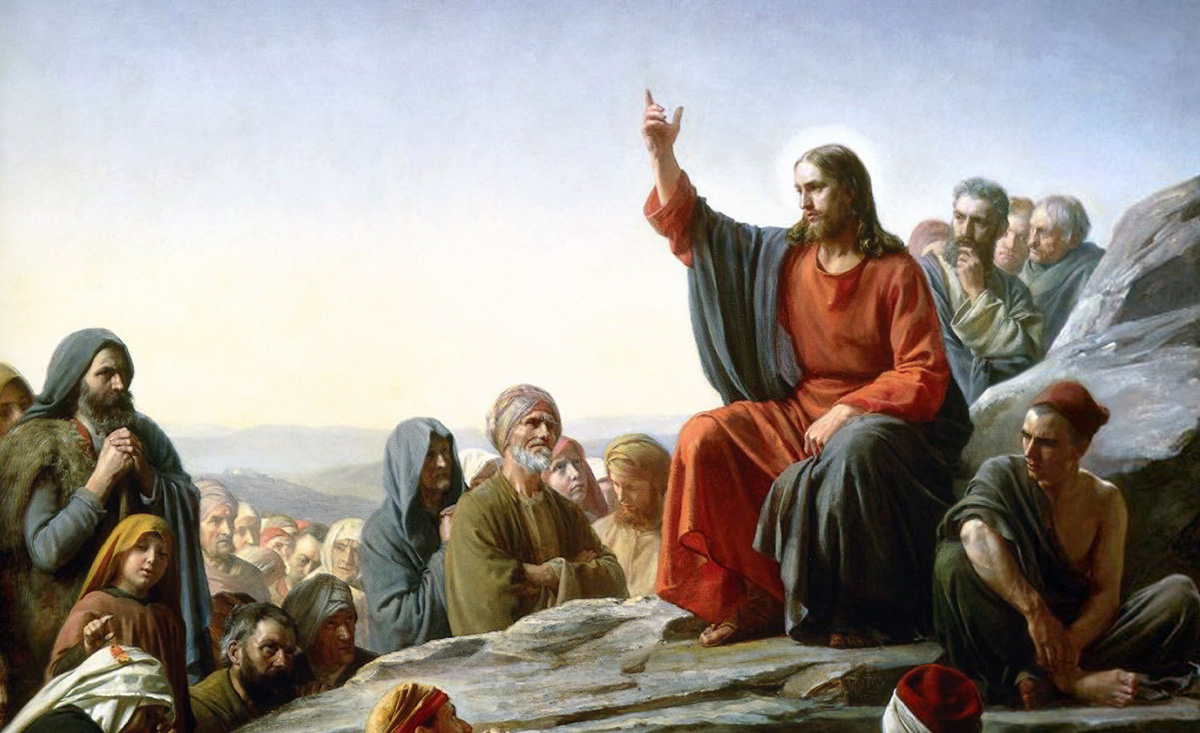

Sermon – Election – 1800, Connecticut


John Smalley (1734-1820) graduated from Yale in 1756. He was the preacher for a church in New Britain, Connecticut (1758-1798). This sermon was preached by Smalley in Connecticut on May 8, 1800.


sermon-election-1800-connecticut

ON THE EVILS OF A WEAK GOVERNMENT.

A

SERMON,

PREACHED ON THE

GENERAL ELECTION

AT HARTFORD, IN CONNECTICUT,

MAY 8, 1800.

By JOHN SMALLEY, A. M.
PASTOR OF A CHURCH IN BERLIN.

At a General Assembly of the State of Connecticut, holden at Hartford, on the second Thursday of May, one thousand eight hundred—

ORDERED, That the Honorable Thomas Seymour and Selah Heart, Esquire, present the thanks of this Assembly, to the Reverend JOHN SMALLEY, for his Sermon, delivered on the Anniversary Election, on the eighth of May instant, and to request a copy thereof for publication.

A true copy of Record,
Examined by

SAMUEL WYLLYS, Secretary.


An Election Sermon, &c.
 

ISAIAH iii. 4, 5.

And I will give children to be their princes, and babes shall rule over them. And the people shall be oppressed, everyone by another, and everyone by his neighbour: the child shall behave himself proudly against the ancient, and the base against the honorable.


When we read and hear such threatening predictions as this; and see our judges as at the first, and our counselors and governors as at the beginning—equally wise and good; we are ready to bless ourselves, and to say in our hearts, These things shall come upon us. That the whole of what is here foretold, has not yet come upon us, we have certainly great reason to bless God, and to congratulate one another. But it should be remembered, that neither past mercies, nor present happy circumstances, are any security against evils to come. Surprising changes in this fallen world, have ever been frequent, and are still to be expected. Prosperity and adversity, like sunshine and storms, are wont to follow each other, almost in constant rotation. Communities, as well as individuals, that have been remarkably raised up, are often as wonderfully cast down, in the providence of God, when most exalted. “He blesseth them also,” it is said, 1 “so that they are multiplied greatly, and suffereth not their cattle to decrease. Again they are minished, and brought low, through oppression, affliction and sorrow.”

Of such vicissitudes, the chosen people threatened in our text, was a striking and an instructive example. This nation had long been favored, in regard to government, as well as religion, far beyond any other then on the earth. From its earliest infancy, it had been under the peculiar guardianship of heaven. “When Israel was a child,” says the most High in Hosea, 2“then I loved him, and called my son out of Egypt:–I taught Ephraim also to go, taking them by their arms: I drew them with cords of a man, with bands of love; and I was to them as they that take off the yoke.”

They had been liberated from powerful oppressors, and cruel task-masters, by the out-stretched arm of the Almighty. They had been led like a flock, through the Red Sea, and forty years in a most perilous, howling wilderness, by the hand of Moses and Aaron. Under Joshua, their great and beloved general, they had vanquished mighty armies; and had obtained a peaceful settlement as a free and an independent people, in a land flowing with milk and honey.

Here, when they forgot God their Saviour, who had done such great things for them, and so many wonderous works before their eyes, he sometimes left them to have no guide, overseer or ruler; and suffered the Heathen around them, to make terrible inroads on their borders. Nevertheless, as often as they cried unto the Lord in their distresses, he raised them up judges—valiant, righteous men, to deliver them out of the hand of their enemies, and to administer justice among them. Afterwards, because of their uneasiness, and the hardness of their hearts, God gave them kings; and these, several of them, were very eminent for wisdom and virtue. Nor was their happiness, in this respect, yet at an end; for Isaiah prophesied no later than the reign of Hezekiah; one of the most amiable and best of princes.

But, from the days of their fathers, they had gone away from God’s ordinances; and now, it seems, the measure of their iniquities was almost full. A very awful decree of the holy One of Israel against them is therefore here announced. See the preceding context. “For, behold, the Lord, the Lord of hosts, doth take away from Jerusalem, and from Judah, the stay and the staff; the whole stay of bread, and the whole stay of water; the mighty man, and the man of war; the judge, and the prophet, and the prudent, and the ancient; the captain of fifty, and the honorable man, and the counselor, and the cunning artificer, and the eloquent orator. And I will give children to be their princes,” &c.

From my text, thus connected, the doctrine deducible, which will be our present subject, is this:

That to be under a weak government, is one of the greatest calamities, ever sent upon a people.

This, you observe, is here threatened together with drought and famine in the extreme—a total want of bread and of water; as well as being bereaved of the most eminent men, in every necessary employment: and it is mentioned last, and most enlarged upon, as the consummation of misery.

But, after explaining the calamity designed, and some of the principal causes of it, I shall attend, more particularly, to the proof and illustration of this doctrine.

There are two senses, in which government is said to be weak: when it is unwise; and when it wants energy. The latter is the more extensive signification of the phrase; and it comprehends the former: this, therefore, is the sense now to be considered. By a weak government will be meant, one that wants energy; whether through the weakness of those by whom it is administered, or by any other means.

To mention, with a little enlargement, some of the most common causes of so great an evil, will not be foreign to the design of this anniversary.

1. That the government of a nation or state has not proper energy, may be the fault of its constitution. A form of government may be such, that, unless the administration of it be arbitrary, it will necessarily be weak.

To give rulers all that power, and reserve to the subjects all that liberty, which is best for the people, is a nice point; very difficult, I imagine, to be exactly hit, by the wisest of men, and men the most disinterested. There is a danger of erring, undoubtedly, on either hand; of abridging freedom, as well as of limiting authority, more than is for the greatest general good—of adopting a constitution too despotic, as well as one too feeble. But when it is left to the people at large, what government it is left to the people at large, what government they will be under, the error most to be apprehended, I believe, is on the side of inefficiency.

The love of liberty is natural to all mankind; and even to birds, and four-footed animals, and creeping things. Of this celebrated virtue, we lost nothing by the fall of our first parents. Everyone, however depraved in other respects, wishes to be free—unboundedly free; to have none above him; to be his own subject, his own governor, his own judge. And when, for obtaining the advantages of social union, individuals give up to the community, or to any constituted authorities, a power over their words and actions, their property and lives; they do it with great reluctance, and as sparingly as possible.

To observe the extreme reluctance of some, on such occasions—to see how strenuously they will dispute every inch of power, vested anywhere, which might possibly be abused, or turned against themselves; is apt to remind one of the cautious policy of certain ancient Pagans, described by Jeremiah, in regard to their gods. Not only would they have gods of their own making, and made of such materials that they must needs be born, because they could not go; but, as wooden gods could fall and might happen to fall upon the makers of them, or on their children, or valuable furniture; for full security, they fastened them with nails and with hammers. “Be not afraid of them,” says the prophet; “for they cannot do evil, neither also is it in them to do good.”

Checks, unquestionably, there ought to be, on every department of a free government: But if such checks be laid upon rulers, that the ruled are under no check at all, harmless, indeed, will such rulers be; but altogether insignificant. These servants of the people, must have more power than the child, and the base, who proudly so call them; unless we would have them miserable gods, or ministers of God to us for good—their scripture titles. They must have authority to punish treasonable lies against themselves, as well as slanders against the meanest of their subjects; otherwise, who will be afraid of them? Or what protection can they afford?

2. That the government of a people is too weak, may be the fault of those betrusted with its administration. It may be owing to their weakness; or to their indolence, or flowness in doing business; or to their excessive lenity; or to their not being of a virtuous character, or not paying a due attention to the strict regularity of their own lives. These particulars, suffer me cursorily to go over.

When the rulers of a land are children; whether in understanding, or in firmness and stability of mind, we are not certainly to expect that the reins of government will be guided with discretion, and held with sufficient force. To govern well, at least in the higher and more difficult offices, considerable theoretic knowledge, some experience, and more than common natural powers, are altogether necessary. And so is that degree of courage and inflexibility, which will enable a man to maintain his post, and to persevere in what appears to him the plain path of duty; unmoved by noisy opposition—undaunted by popular clamor—undismayed by imminent danger.

To support an efficient government, rulers must likewise be men of vigilance and activity. “He that ruleth,” says an Apostle,3with diligence.” And of Jeroboam it was said, 4 “Solomon, seeing the young man that he was industrious, he made him ruler over all the charge of the house of Joseph.” A commonwealth, under the superintendency of indolent men, will resemble the field of the slothful which we read of, that was “all grown over with thorns; the face of it covered with nettles, and the stone wall thereof broken down.” Or, though rulers be not “slothful in business;” they may be so slow in transacting it, and in bringing anything to a termination, as very much to lower the tone, and defeat the salutary designs, of civil government. When courts of justice are so dilatory in their decisions, and such endless evasions, and reviews, are admitted; that a man had better lose almost any debt or damage, than commence a legal process for a recovery, the protection of law must be lamentably weak.

Excessive lenity, will have a similar effect. Mercy, is indeed an amiable attribute; to pass over a transgression, is said to be the glory of a man; and being ready to forgive, is a duty much inculcated in the word of God: But in one who sustains any place of authority, whether that of a parent or master, or civil magistrate; lenity and indulgence may be carried farther than is the glory or duty of a man; unless it be his duty and glory to have no government. Should rulers remit crimes, or pass them over without condemnation, when the public good, or righting an injured individual, requires their punishment; merciful they might be, but not as our Father in Heaven is merciful.

Liberality to the poor, out of one’s own proper goods, is a capital Christian virtue; but of the property of other people, judges and law-givers, may possibly be over liberal. The persons even of the poor are not to be respected in judgment. Making provision by law, for supporting such as are unable to support themselves, is doubtless very commendable; but why those who happen to be the creditors of the poor; who have helped them much already, and suffered much by their slackness and breach of promise, should be still obliged to lose ten times more for their relief, or for the relief of their families, than others equally able, it is not easy to conceive. And should courts of law, or courts of equity, cancel the debts of men, whenever they please a present incapacity to pay them, whether such clemency might not too much weaken government, as a security to everyone in his rightful claims, may be a question. Indeed, in any case, to give an insolvent debtor a final discharge from all he owes, without the consent of his creditors, looks like giving him a license to be an unrighteous man. For can it ever be right, or can any court under heaven make it right, for a man not to pay his promised debts, for value received, when now he has money enough, because once, the payment of them was not in the power of his hands.

Thus to exonerate of a heavy load of old debts, one deeply insolvent, is necessary, it will be said; as without this he could have no courage to commence business anew. And, no doubt, such expected exoneration, will be a mighty encouragement to extravagant adventurers, who have nothing to lose, since, by running the greatest hazards, with the slenderest chance of immense gain, they risk only the property of others. If successful, the profit is their own; if unsuccessful, the loss is their neighbour’s. But if the tendency of being thus merciful, were much better than it is; or the urgency for it far greater; would it not be doing evil that good may come. “He that ruleth over men must be just” 5 The laws of truth and righteousness, are not noses of wax; to be bent anyway, as will suit present convenience. It is dangerous to break down, or break over, the fixed barrier of eternal justice, on any pretence of temporary necessity.

One way more was hinted, in which those who govern, may weaken government; and that is, by being men of a vicious character; or by not paying a due attention to the strict regularity of their own lives. Indeed, “a wicked ruler” is often strong, and fierce, and active, as “a roaring lion and a ranging bear;” but rarely for the benefit of “the poor people.” He will not be eager to pluck the spoil out of the mouth of the fraudulent villain, or the violent oppressor; unless that he may get it into his own. Nor will authority, in the hands of libertine men, however it may terrify, be much revered. When the makers or judges of laws, are themselves notorious breakers of them, or of the laws of heaven, government will necessarily fall into contempt. It is also to be observed, that advancing to posts of honor, men of loose principles and morals, gives reputation to licentiousness, and stamps it as the current fashion. Their example will encourage evil doers, more than all the punishments they are likely to inflict, will be a terror to them. “The wicked walk on every side when the vilest men are exalted.” 6

But rulers may be far from being the vilest men, they may be very good men; and yet, by an incautious conformity to common practices, supposed to be innocent, they may too much countenance some things which are of very hurtful tendency. Permit me to instance in one particular. “It is not for kings,” we read, “to drink wine, nor for princes strong drink.”7 And certainly, it is not for the lower classes to drink so much of these as many of them do, if they regard their health, or competence, or peace. I select this instance, because it is directly pertinent to the main subject in hand. Nothing is a greater weakener of government—nothing makes the multitude more heady and high minded—nothing raises oftener or louder, the cry of liberty and equality—nothing more emboldens and enflames that little member, which boasteth great things, and setteth on fire the whole course of nature—nothing, in a word, makes men more incapable of governing themselves, or of being governed, than strong drink. Now, if rulers drink, though not to drunkenness; no so as quite to “forget the law,” or greatly to “pervert the judgment of any;” if they only drink as much as is very universally customary, in polite circles, on great occasions; though they do not hurt themselves, they may too much sanction that which will hurt their inferiors. That divine injunction, “Thou shalt not follow a multitude to do evil,”8 lies with peculiar weight on civil rulers, as well as religious teachers. They, more than others, are under obligation to lead the multitude, in whatsoever things are sober, wise and good. They, of all men, are bound in duty to abstain from all appearance of anything, which, improved upon by bungling eager imitators, might grow into a practice pernicious to society. Nor should it be forgotten, that every deviation from rectitude of conduct, lessens the dignity, and lowers the authority of great men. “Dead flies cause the ointment of the apothecary to send forth a stinking favor: so doth a little folly, him that is in reputation for wisdom and honor.” 9 But,

3. That weakness of government which is a calamity to any people, is often principally the fault of the people themselves. It may be owing to their negligence, or to their caprice and folly, in the choice of their rulers; or it may be owing to their ill-treatment of them when chosen. A government most excellent in its constitution, and most wise, just and firm, in its administration, may be enervated, or rendered inadequate, by the ungovernableness of the people: By their revilings and slanders—their haughtiness and insolence—their factions and tumults. David once said, “I am this day weak, though anointed king; and these men, the sons of Zeruiah, are too hard for me.” 10

Nor must it be omitted, that, besides the immediate natural causes of a weak government, the irreligion, or general wickedness of a people, may be its procuring cause, as a judgment of heaven. “The most High ruleth in the” nations of men; “and giveth” the dominion over them, “to whomsoever he will.” 11 “For promotion cometh neither from the east, nor from the west, nor from the south; but God is the judge; he putteth down one, and setteth up another.” 12 When the ways of a people please the Lord—when they fear Him, and work righteousness; among other blessings, he gives them good governors, under whose able and equitable administration, they lead quiet and peaceable lives. On the contrary, when they forget Him, neglect his worship, and disregard his word; among other modes of punishment, he takes away their wise and faithful magistrates, and gives them weak or wicked ones in their stead; or leaves them to trample all authority under foot. This was the cause of the calamities threatened in our text and context. See the eighth verse, which concludes the paragraph. “For Jerusalem is ruined, and Judah is fallen; because their tongue and their doings are against the Lord, to provoke the eyes of his glory.”

Let us now attend, as was proposed, to the proof and illustration of the doctrine laid down: That, of all the calamities ever sent upon a people, being under a weak government, is one of the most deplorable.

It is said, 13 “Woe to thee, O land, when thy king is a child.” It is also asked, 14 “If the foundations be destroyed, what can the righteous do?” And if we consider the matter, it may easily be seen, that the people of all characters, and not merely the righteous among them, must be in a very wretched condition, should government be overturned, or have no coercive force.

First; an exposedness to all manner of mutual injuries, without redress, is one obvious evil thence arising. The people shall be oppressed, everyone by another, and every one by his neighbor.

“Surely oppression maketh a wise man mad,” is an observation of the royal preacher.15 And many are the accounts in history, of oppression’s having had this effect on a multitude of men, the wise among the foolish. How often have whole nations raved and raged, like the fiercest of animals, under the operation of the hydrophobia, at only a distant oppression of this terrible evil?

I am sensible, it is the dread of oppression from government, and not of being oppressed one by another, through the want or weakness of it, that usually occasions this rage, and these ravings. The people are ten times more apt to be afraid of having heavy burdens and grievous restraints laid upon them, by the best men in power, than of anything they might be in danger of suffering from their equals, however wicked, and however unrestrained. But what can be the reason of this? Is it because there is not really as much mischief to be feared, from individual, as from public oppression? From the oppressions of the many, as of the few? From the unrighteousness of millions, let loose, as from that of one man, or a small number of men?

This, certainly, is not the case; this cannot be the reason. When there is no law, and everyone does what he thinks fit, without fear of punishment, the people, I believe, have ever been and are ever likely to be, much more unhappy than even under a very despotic and oppressive government.

What then is the reason? Why are the people, whose voice is said to be the voice of God, so much more ready to sound and take an alarm, when threatened with the latter, than with the former of these evils? Why are they so loud and tumultuous, when their liberties are thought to be in any danger; and so quiet and easy, when government is rudely attacked, and ready to be overthrown? Why is the shock of terror so much greater and more universal, at the remotest prospect of tyranny, than at the nearest, and most evident approximation to total anarchy?—There may be several reasons.

One, probably, is; when the people are oppressed by each other, their sufferings are separately felt: Whereas, oppression from the higher powers falls upon all in a body. In the former case, everyone bears his own different burdens; and divided complaints, though bitter, make but a confused and feeble murmur: in the latter case, all feel or fear the same; all voices, therefore, are united in one tremendous cry.

Another reason may be; under oppression from government, often no other way of relief is seen, than popular combinations and insurrections; but when injuries are done us by individuals, because there is no government to restrain them, a remedy is always near and obvious. If everyone is oppressed, everyone can be an oppressor. If a man’s neighbours all bite and devour him, he can bite and devour all his neighbours. Hence, a dissolution of government, instead of being universally deprecated, appears to many, “A consummation devoutly to be wished.”

But there is another cause of the wonderful phenomenon I am accounting for, more influential perhaps with the most, than both the forementioned. It is owing to charity. A kind of charity, not the exclusive glory of modern times; but entirely peculiar to fallen creatures. A kind of charity, which covers a multitude of our own sins, from our own sight. A kind of charity which always begins, and ends, at home; though often extensive in its circuits. From this boasted charity, we are ever inclined to hope all things, and believe all things, in favour of any number, or class, or order of beings, in which we ourselves are included. Thus men, naturally think of mankind, more highly than they ought to think. Frenchmen, of the French: Britons, of the British: Americans, of the people of America: Those of every state and town, of their own state’s men and town’s men; and men of every calling, of their brethren of the same occupation, collectively considered. In like manner, the common people, think the common people exceedingly honest, harmless, and virtuous; while of those in power, though of their own choosing, and just chosen out of all the people, they have not near so favorable an opinion. That the people should have too much liberty, therefore, they are not at all afraid: that rulers will not have checks enough upon them, is all their fear.

This beam of selfish liberality of sentiment, it ay be impossible for us to cast wholly out of our eye: But that, round the edges of it, we may get some glimpse of real human nature; I know of no better way than to look upon mankind one by one; or in circles not including ourselves. Let us then think of other nations; other states; other towns, and neighbourhoods; or of particular persons among our nearest neighbours. In this separate view, let us search and look; let us impartially examine characters.—Where do we find a great predominance of the innocent inoffensive people? Where do we find a nation, or state, or town, or society, except our own, so very virtuous? Where do we find many individuals, besides ourselves, so just and true, temperate and chaste, meek and merciful; so free from covetousness, pride, envy, revenge, and every unfriendly passion, that we could live safely among them, were they at full liberty from all the restraints of law and government?

Indeed, how great an alteration this would make, in the apparent characters of most men, it is difficult to conceive, without the trial. A very partial trial of it, for a short time, some of us have once seen; when it was made lawful to discharge pecuniary obligations, at the rate of a tenth, a twentieth, and even a fiftieth, of the real value justly due. We then had a convincing evidence, that the external justice of our common honest people, is owing to the expected compulsion of civil law, much more than to uprightness of heart, or feelings of conscience, or any dread of a higher tribunal. From this specimen, and from the sacred story of the behavior of the men of Benjamin, relative to the Levite from mount Ephraim, when “there was no king in Israel; and everyone did that which was right in his own eyes;” we may have some faint idea of the horrid scenes of unrighteousness, lewdness and cruelty, that would everywhere be acted, were it not for the fear of temporal punishment. From all that we have read of the destruction of mankind by one another, whenever they are at liberty; and from recent indisputable information of the shocking state of things, where government has been overturned; we may well believe that the scripture accounts of the depravity of men, are no exaggeration. Not even the following: “Their throat is an open sepulcher; with their tongues they have used deceit; the poison of asps is under their lips; whose mouth is full of cursing and bitterness; their feet are swift to shed blood. Destruction and misery are in their ways, and the way of peace have they not known.” 16

But if this be a true portrait of fallen men, when left to themselves, how much are we indebted to the restraint laid upon them, for the little peace we enjoy? And may we not well be convinced, that all the terror of the civil sword, in the most faithful and skillful hands, will not be more than enough to restrain from iniquity, such a race of beings, so that they may dwell together, not in unity, as brethren, but with any tolerable safety? Especially if, as is added to finish the above picture, “There is no fear of God before their eyes?” And that this last trait, is still a part of the character of many, is abundantly evident, both from their avowed principles and open practices. Now this being the case, that while the hearts of men are fully set in them to do evil, they have no fear of the God of heaven to restrain them; were it not for the dread of gods on earth, our civil rulers, what security should we have, for our names, or property, or lives? If we had no other evil to apprehend, from weakness of government, than only this, of lying open to all manner of mutual oppressions, slander, frauds and violences; it would, even then, be evidently one of the greatest calamities that could befall a people.

But a second evil, somewhat distinct, and worthy of some notice, is suggested in our text: No one in a subordinate station would keep his proper place, or treat his superiors with suitable respect. The child shall behave himself proudly against the ancient, and the base against the honorable.

Solomon says, “There is an evil which I have seen under the sun, as an error that proceedeth from the ruler: Folly is set in great dignity, and the rich in low place. I have seen servants riding upon horses, and princes walking as servants upon the earth.” 17 When authority fails, or is obstructed, at the fountain head, its remotest streams must, in a little time, run low. If parents will not obey magistrates, children will be disobedient to parents; if masters refuse subjection to the higher powers, their servants and apprentices will soon pay as little regard to their injunctions. Thus this evil proceedeth from the ruler; or from his not being able to rule. And a serious evil it certainly is. By superiors, in every degree, it will soon be very sensibly felt. They will have none to fear them, none to honor them, none over whom they can have any command. Inferiors, of the very lowest grade, may exult, for awhile, in such areas of freedom; and think them glorious times. But even to these—to the child and the base, this turning of things upside down, generally proves fatal in the end. Being under no control, they spend their time in idleness; waste their substance, if they have any, in riotous living; have recourse to pilfering, gambling, and every hazardous expedient, to support their extravagances, and by various foolish and hurtful practices, soon plunge themselves into irrecoverable wretchedness and ruin.

There is yet a third capital evil, arising from too weak a government, which, though not mentioned in our text, should be briefly noticed, when treating of this subject at large. A community in such a situation, will be able to make little defense against a foreign enemy. Like the people of Laish, who had no magistrate in the land to put them to shame in anything; they will be an easy prey to any handful of enterprising invaders. No resources can be drawn forth—no navies furnished—no armies raised and supplied—no fortifications erected and garrisoned, without energy in government. What Solomon says of a man that has no rule over his own spirit, holds equally true of an ungoverned nation: it “is as a city that is broken down, and without walls.”

The doctrine, I conceive, needs no farther illustration or proof. It only remains, that I endeavor to point out some useful inferences from it, applicable to our own times, and to the present occasion.

1. The Holy Scriptures may hence be vindicated, in their being so much on the side of government; and no more favorable to the insurrection of inferiors.

On these topics, it must be acknowledged, the spirit of the gospel, as well as of the Old Testament, is somewhat different from the spirit that worketh in the children of disobedience, among whom we have all had our conversation. Our Saviour “went about doing good, and healing all that were oppressed of the devil;” but under the political oppressions of the Jews, his countrymen, he seemed not much to sympathize with them. When it hurt their consciences to pay tribute to a foreign power, and they asked him whether it were lawful; his answer was, “Render to Caesar, the things that are Caesar’s, and to God, the things that are God’s.” He constantly preached peace, meekness, humility and submission. His apostles in like manner, taught children to obey and honor their parents: and servants to be “subject to their own masters, with all fear; not only to the good and gentle, but also to the forward.” And, instead of animating their numerous proselytes, at Crete, at Rome, and all over the world, to rise in arms against these rulers of the earth who were their unrighteous and unmerciful persecutors; they would have them “put in mind to be subject to principalities and powers, to obey magistrates:” 18 they exhorted them to “submit themselves to every ordinance of man, for the Lord’s sake;” 19 and told them, “Whosoever resisteth the power, resisteth the ordinance of God; and they that resist shall receive to themselves damnation.” 20

At this distance of time, and after so many revolutions, such passages as these may seem hard sayings, to some good soldiers, even of Jesus Christ. No wonder that the inculcators of so much poverty of spirit, should be rejected with scorn, and treated with scurrility, in this “age of reason.” We are not to wonder, were there no other cause, that infidelity should exceedingly increase, in these times of “illumination.”

To the spiritually minded Christian, however, it will readily occur, in favour of the author and finisher of our faith, and his first ministers, that the great objet they had in view, was to save the souls of men; and that, teaching them to be meek and lowly in heart, poor in spirit, and contented in whatsoever state they were, was better adapted to this design; than filling the heads of inferiors with exalted notions of the equal “rights of man;” inflaming their hearts with pride and angry passions; and throwing families into envying and strife, and nations into the convulsions of civil war; till everyone can be as free as the freest, and as high as the highest.

But, leaving things eternal out of the question; according to the subject to which we have now been attending, if the preachers and penmen of the New-Testament had aimed only to promote the temporal happiness, of only the lower classes of mankind, they would have done wisely in writing and preaching, on the duties of subordination, exactly as they did. Never can there be peace on earth, or any safety among men, while children are allowed to rise up against their parents, servants against their masters, and subjects against their civil rulers, whenever they think differently from them, or dislike their government. Thus to make the child, the governor of his governors, and the base, the judge of his judges, is the certain way to endless confusion, in all human societies.

2. If the doctrine insisted on be true, it follows, that a ready submission to all those burdens which are necessary for the support of good government, and for national defence, is the wisdom, as well as duty of any people.

The apostle to the Romans, having said, “The powers that be are ordained of God;” having observed that the benevolent end of their ordination was the good of the people; and, on these grounds, having enjoined subjection to them, he adds; “For this cause pay ye tribute also: for they are God’s ministers, attending continually upon this very thing.”

Public expenses are apt to appear to many, excessively high: but, perhaps, they do not well consider the real occasion there is for great expenditures, in a nation or state of any magnitude.

In order to the support of good government, many rulers, of high and low degree, are absolutely necessary. And it is necessary that those who occupy the higher offices, should be men of superior knowledge, and uncommon natural abilities: such knowledge as is not easily acquired, and such abilities as might procure them a plentiful income in other occupations. If the bramble, or the shrub oak, were adequate to rule over the trees, a cheap government might be expected; but if the vine, the fig-tree, and the olive-tree, must be promoted; we are not to think that these will leave their rich fruits; their sweetness, and fatness, without a suitable compensation.—Besides, rulers of high rank, must be at no inconsiderable expense, to support the proper dignity of their stations. It is also to be taken into the account, that the duties of those who rule well, and attend continually upon this very thing, are not only exceedingly laborious, but that some parts of the essential services they have to render must be very disagreeable; if they have any compassionate sensibility. The execution of deserved vengeance, is said to be God’s strange work; as being, in itself, most opposite to One whose nature is love, and who delighteth in mercy. And, doubtless, that punishment of evil doers, for which earthly rulers re appointed, and which the public good requires, must be rally painful to the feelings of humanity; more painful, in many cases, than the amputation of limbs, and other high operations in surgery, for which, on that account, as well as because of the superior skill and great care requisite, an ample fee to the operator is thought reasonable. Moreover; those who stand in elevated stations, are the marks of obloquy, and exposed to many dangers, much more than men on the level ground of private life. All these things well weighed, the equitable reward of governors, and the necessary cost of supporting good government, must be no inconsiderable burden on the people.

In order to national defense, against hostilities from abroad, still heavier expenses are often indispensible. In perilous times, there must be armies and fleets, forts and garrisons. At the first outset, more especially, when all these things are to be new-created, to a people unused to such vast expenditures, they will naturally appear enormous; and very easily may a popular clamor be raised against them. It is possible, indeed, that more may be laid out in these ways, many times, than the public exigencies require; but of this, few of the complainers are competent to judge. A nation that has an extended coast, and an extensive commerce to defend, had better be at immense charges for the security of these, than lie open to those spoliations and invasions, to which, without arming, when all the world is at war, they might inevitably be exposed.

To provide both for the internal and external safety of a numerous people, the burdens laid upon them must often be heavy. These are evils to be lamented; but in the present state of mankind, they are necessary for the prevention of far greater evils; and should therefore be submitted to, without murmuring.

3. The preceding observations may suggest to us, some peculiar advantages of a republican form of government. 21

Under every form, there must be orders and degrees; some must bear rule, and others be subject to tribute. Under every form, there will be duties, imposts, excises, and perhaps direct taxation. All forms of government, however, are not equal. Much advantage hath the republican, many ways.

One advantage is, that the people may always have good rulers, unless it be their own fault. Under a monarchy, or an aristocracy, let the body of the people be ever so virtuous, and ever so vigilant, they may have children for their princes, and babes to rule over them. When power is hereditary, in kings or nobles, not only is there a risk of having the highest seats of government filled by minors; but, if this should not happen, the hazard is great, that those who inherit the first offices of government, will frequently be men of not much knowledge, or of not much virtue. But in elective governments, where the people at large are the electors, and especially where the elections are frequent, they may always have wise and faithful men in all places of authority; if such are to be found, and if such they choose.

It may next be observed; that in republican governments, there is the least occasion for illegal associations, or popular tumults, to obtain a redress of grievances. If there be any mal-administration, or any fault in the constitution, a remedy is provided, without disturbing the public pace.

Another advantage must not be forgotten, which is very great: under this free form of government, the interests of rulers and subjects are so blended—so the same, that the former cannot oppress the latter, without equally oppressing themselves. In an absolute monarchy, the king; and in an aristocracy, the nobles, may “bind heavy burdens, and lay them on men’s shoulders,” without being obliged to “touch them themselves with one of their fingers:” but in democracies, the highest magistrates are subject to the same laws, the same duties, the same taxes, which they impose upon others. At least, those who this year bear rule, the next election may be under law, under tribute. This is a great security against their decreeing unrighteous decrees, and writing grievous things.

Lastly; representative rulers feel themselves so dependent on the people, for their continuance in office, that they are not likely to grow haughty and unreasonably over-bearing, as those naturally will, who have no such dependence.

These are some of the peculiar advantages of a republican government. But then, it is to be well remembered, that the best things may become the worst for us, be being abused. To render democratic governments stable and happy, it is highly necessary that the people should be wise, virtuous, peaceable, and easily governed. For want of these requisites, republics have often been, like “man that is born of a woman, of few days, and full of trouble.”

4. In the more particular application of our subject, we are naturally led to a view and conviction, of our own mercies, and privileges, and prospects, and duties.

That the past mercies of Heaven towards this country, have been singularly great, every pious observer will be ready devoutly to acknowledge. I have reference, chiefly, to political mercies; or those which relate to civil liberty and government. Hardly another instance can be found, I believe, in all history, of a people’s enjoying both these blessings jointly, in so high a degree, for so great a length of time, as they have been enjoyed by several of these united states; and by this state, in particular. The people of Connecticut, from the beginning, have invariably chosen their chief magistrates, and general assembly; and they have had a succession of good governors far beyond the common lot of mankind. Our “officers have been peace, and our exactors righteousness,” with as few exceptions, perhaps, as ever were known in any part of the world.

Or, if we confine the retrospect, within the compass of the last five and twenty years; and extend it to the whole union, how wonderful have been the salvations granted us! In this period, we have passed through the Red Sea of a revolutionary war; in which our then friends and coadjutors, assaying to follow us, as most who ever attempted it before us, have been drowned. Here, quite contrary to what usually happens, on such occasions, we had guides eminent for prudence, stability, coolness, and unconquerable perseverance. And one, super-eminent for all those; by the integrity of whose heart, and the skillfulness of whose hands, we were led like a flock, in safety, far surpassing all rational expectation. We have also passed, afterwards, thro the howling wilderness of an almost national anarchy: where were pits, and scorpions, and fiery flying serpents. Here again, our great men, with the greatest of all at their head, in a general convention, formed and recommended our present admirable constitution. And our wisest counselors and most eloquent orators, in every state, straining every nerve, procured its adoption; whereby we were saved, when on the brink of dissolution. That such men were raised up, and put forward, in these times of need; and their way made prosperous; was certainly “the Lord’s doing, and ought to be marvelous in our eyes.” In either of these perils, “it was of the Lord’s mercies that we were not consumed.”

And as past mercies, so our present privileges, are singular, and such as deserve a very grateful acknowledgment. While many other nations are suffering the ravages of a most furious war, still likely to be carried on with redoubled rage; we enjoy the inestimable blessings of peace. While most other nations are under the dominion of hereditary kings and nobles, such as they happen to be born and educated, whether virtuous or vicious, wise men or fools; we have rulers from the highest to the lowest, of our own election. While one other nation, great and highly civilized, after swimming in seas of blood for eight years, and after nearly as many revolutions, in a violent contest for liberty and equality, has at last, nothing more of either than the empty name, we possess the reality of both, as far as is consistent with any order or safety.

Our national expenses are necessarily great: but the burden of them is laid, as much as possible, on those most able to bear it; among whom, the imposers, being of the richer class, has taken a large proportion on themselves. In the nation, and in this state, the policy of government, certainly, is not to “grind the face of the poor.” The mildness and gentleness of our administration, it appears to me, is generally very great; and, in regard to its wisdom and firmness, considering the times, I think it deserving of much applause. Respecting rulers, certainly our condition, hitherto, is far different from that described and threatened in our text.

Such have been our mercies; such are our privileges. What then are our prospects?—Not altogether fair and promising, after all. As in the blessings of heaven, and the abuse of these blessings, there is a striking resemblance between us, and the land of Judah and inhabitants of Jerusalem, at the time of this prophecy, to which we have been attending; so, in the sequel, it is possible there may be a similitude. Our mountain is not yet so strong, that we have reason, from any quarter, to say in our prosperity, we shall never be moved.

Some may flatter themselves, that, although other republics have frequently been tumultuous, and of short continuance; ours will be peaceful and permanent, because of the greater knowledge and virtue of the people.

It is true, in this part of the union at least, “We know that we all have knowledge.” But, I doubt, we have more of the “knowledge which puffeth up,” than of that knowledge which promises “stability of times.” It is true, we have the light of the gospel; and were we disposed to be guided by this light, we need not fear the fate of ancient republics, that were bewildered in Pagan darkness. But, in matters relative to government and subordination; too many choose to take their instructions from Heathen philosophy, rather than from the oracles of God. And as the knowledge, so the virtue, of even this happy country, exceedingly wants to be Christianized. It is true, our “charity aboundeth:” but I am afraid we have not much of that charity which is “the bond of perfectness, or the bond of peace.”

Perhaps some good people are ready to think, we may safely “trust in God; who hath delivered, and doth deliver, that he will yet deliver us.” And had we rendered according to the benefits done us, indeed, we might thus securely trust. But has this been the case? On the contrary, have we not sinned more and more, since the almost miraculous deliverances granted us? Has not the worship of God been neglected; his day and name been profaned, his laws transgressed, and his gospel despised and rejected, of late years, more than ever? Have not infidelity, and all manner of loose principles, and immoral practices, abounded in all parts of the land, since the revolution, and our happy independence, more than at any former period?—Shall we then “lean upon the Lord, and say, Is not the Lord among us? No evil can come upon us?” 22 Or shall we think, “Because we are innocent, surely his anger shall turn from us?” His ancient covenant people thus leaned, and thus said, in times of their greatest degeneracy; but what were the answers of God to them? 23 “You only have I known, of all the families of the earth; therefore will I punish you for all your iniquities.” And, “shall I not visit for these things? Shall not my soul be avenged on such a nation as this?”

When we read such solemn divine admonitions as these, and consider our own ways and doings, can we confidently expect the continued smiles and protection of the holy governor of the world? Instead of this, may not our flesh well tremble for fear of him? Have we not reason to be afraid of his avenging judgments?

And has he not already begun to testify his righteous displeasure against us, in some terrible instances? For several years past, our capital towns and cities have been sorely visited with a wasting pestilence; little, if at all known before, in these parts. And now, very lately, a most awful breach has been made upon us; and of the very same kind threatened in our context to Jerusalem and Judah. For, behold, the Lord, the Lord of hosts, hath taken away from America, the stay and the staff:–the mighty man, and the man of war. The judge, and the prudent, and the ancient: The captain of all our armies, and our most honorable man. All these, in one; by a sudden and surprising stroke, hath the Lord taken away. The man who “fought for us, and adventured his life for, and delivered us.” The man who gave system to our distracted affairs; united our broken confederacy; and long guided our difficult course, between the whirlpools of European wars. The man, but for whom, very possibly, we should now have been wretched, conquered, rebel colonies; instead of triumphant, free, independent states; and but for whom, afterwards, we might have been as a rope of sand, instead of a strong united nation:–The man to whom we are thus indebted—on whom we were thus dependent, is no more.

What farther public calamities the sudden decease of this great Saviour of his country may portend, God only knows. We have reason to apprehend, that as he was ever prosperous in life, so his death, for him, was favorably timed; that he was taken out of the way of evils to come; great evils coming on a land most dear to him; which he could only have seen, to his inexpressible sorrow of heart, without being able to prevent. This lesson, however, we are plainly and most impressively taught, by a Providence which has clothed a continent in mourning; that Gods on earth must die like men.24 That o man hath power over the spirit, to retain the spirit; neither hath he power in the day of death; and there is no discharge in that war.” We have many great and good men, yet spared to us; nor are we without one, at the head of our national government, who, I presume, has the high veneration of the best judges, and their cordial prayers that he may long live; and long fill the important station which he now possesses. But his breath is in his nostrils; and so is the breath of every other man, most accounted of; in the nation, or in the state. Nor is natural death, the only way whereby our remaining firm pillars, may be removed.

And if we consider the spirit that now worketh, well may we be apprehensive of unhappy changes; and of all the evils threatened in our text. Some of these, we already experience. Though God hath not given children to be our princes, nor many bad men, we hope, to rule over us; yet the people are oppressed one by another, in a degree, I believe, beyond what has been usual heretofore. And certainly it is a remarkable day, for the child’s behaving himself proudly against the ancient, and the base against the honorable. Nor is this to be wondered at. Of such scenes as we have lately passed through, it is the natural consequence. In revolutionary times, all expressions of respect are wont to be laid aside, or the application of them reversed. The great lessons inculcated on youth, instead of modesty, dutifulness and subordination; are boldness, self-sufficiency, and self-importance. Children, too young to read the Bible, or to be taught their catechism, are mounted on the stage, to act the orator, the patriot and politician: while the parents, the aged and the wise, fit or stand around in low place, wonder and applaud. Brutus and Cassius, (not Jesus nor Paul, Peter nor John,) are the great models and instructors, of the rising generation of Christians. Such things as these, we have seen; and the effects of them, we still sadly feel. Habits of subordination, always painful to human pride; when once effaced, or much weakened, are not easily restored. On the other hand, habits of haughtiness and disobedience, always congenial to the human heart; when once imbibed, naturally increase to more ungovernableness. One point of freedom gained, another is struggled for with the greater ardor. Licentiousness, like the rave, never says, “It is enough.”

In this state, though not near so free as some, great liberties are enjoyed. We have liberty to do everything that we ought; and a great many things that we ought not. In matters of religion, our liberties are almost unbounded. We may sell, buy and read, what books we please: the best, or the most atheistical and blasphemous. We may worship what god we choose: a just God, or one who has no justice for men to fear. Every creature, has equal liberty to preach the gospel: and to preach what gospel he thinks proper. Those who persuade men by the terrors of the Lord, to stand in awe, and not sin; and those who embolden men in all manner of iniquity, by assurances of no wrath to come, have equal encouragement. Any people may make the firmest legal contract for the support of what minister they will; and any number, or all of them, may break it when they will.—In civil matters, our liberty is a little more circumscribed; yet, in these, we have a good deal of elbow-room, to do wrong, as well as right. We may honor all men, or defame the most dignified and worthy characters. We may speak the truth, or assert and propagate falsehoods. Man may fulfill their promises, or not fulfill them; pay their debts, or never pay them, without any restraint, or much danger of compulsion. All these liberties, and a thousand others, if not explicitly by law allowed; are taken, very freely by many, in their worst latitude; and taken with impunity, in a multitude of instances.

Yet, with all this, numbers among ourselves, and much greater numbers in the freer states, it is said, are not satisfied; but are striving, by calumnies, and by intrigues, for new revolutions still further to weaken government. That some men might wish to have their own hands and tongues at greater liberty, provided their neighbours and enemies could be kept fast bound, may easily be conceived: but how any man, on the least sober reflection, should be willing that all others should be under less restraint than they now are, appears almost inconceivable. One would have thought, that the tragedy so long exhibited on the great European theatre of confusion, and especially the last scene; must have opened the eyes of the most blind; and obliged them to see, that overturning and overturning, with a view to break all bonds of society asunder, is not the way to public happiness, or personal safety. Nevertheless, this seems not to have been the case. A majority of the people, however, it may be presumed, are convinced, that our greatest immediate danger, is of having too little government, not too little liberty.

Nor are our duties, if we have this conviction, hard to be understood. Were we in earnest disposed, to stand in the ways, and see, and ask for the old paths, where is the good way? And would we walk therein, rest might be found; and the threatened evils now spoken of, be prevented.

If we would not have the child behave himself proudly against the ancient, and the base against the honorable, greater attention should be paid to the schooling and government of the rising generation. Some attempt towards a reform in this matter has already been made, under the auspices of the general assembly: and, as far as I have had opportunity to observe, it has been attended with encouraging effects. It is necessary that those just weaned from the breast, should have line upon line, and precept upon precept; and it is of importance what those lines and precepts are. Little ones should be learnt their letters, at least; if not a few lines of the New-Testament, before they are learnt to be Grecian and Roman orators and patriots. They should be learnt a little modesty, and a little manners, before they are learnt to govern the nation. They should be made good children, before we attempt to make them great men.

If our legislators would prevent our being oppressed every one by another, the old and good way is, to have a code of laws, as short and plain as possible, and suitably enforced. Obsolete laws; and laws the only tendency of which is to evade, or needlessly delay, the operation of justice; I should think, ought to be repealed. And certainly great care should be taken, by the appointment of capable and faithful judiciary and informing officers, that the laws unrepealed be duly executed.

If our judges of courts, would keep us from oppressing, or being oppressed, they should cause “judgment to run down as waters, and righteousness as a mighty stream.” They should see that the old complaint in Isaiah;25 “Judgment is turned away backward, and justice standeth afar off; truth is fallen in the street, and equity cannot enter,” be not applicable to ourselves. They should see, if possible, that their judgment seats be not environed with so high piles of voluminous fortifications, and such numerous garrisons, armed at all points, and able to defend anything, that right can hardly be obtained, in the plainest cause, without a siege, as long, and as costly, as the siege of Troy.

If the freemen—the fountain of power, would strengthen government, or guard against its being farther weakened; they should be very punctual in attending their legal meetings, and very careful for whom they give in their suffrages, as members of Assembly, or of Congress. They should see that they do not vote for weak men, however honest; nor for vicious men, however capable; nor for intriguing men, who are crowding themselves forward, by every popular artifice: who understand perfectly all the duties and faults of their superiors, but see no beam in their own eye, and never mind their own business. Men of real abilities, are generally unassuming and self-dissident. Men sensible of the difficulties and responsibility of important posts of trust, are generally backward to undertake them. Men restless where they are, and troublesome to those above them, are generally haughty and overbearing, if advanced to higher stations. Nor should the freemen be too much given to change; unless they mean to weaken government. Bad men, if in office, cannot be too soon turned out; but those who have ruled well, ought not to be dropped, merely that every man may have his turn; nor merely to show the great power of the people, and to keep their servants, who govern them, more in fear of them.

The ministers of the gospel, are thought to have no concern with the temporal happiness of mankind: doubtless, the good way for them, whether the old way or not, is to confine themselves very much to their spiritual vocation. Doubtless their principal business is, to save the souls of those who hear them. But in order to this, they must warn all, of that “wrath of God which is reveled from heaven, against all ungodliness and unrighteousness of men.” They must “convert sinners from the error of their ways,” or they cannot “save their souls from death.” They must teach their converts to “observe all things whatsoever Christ hath commanded,” by himself or his Apostles; or they cannot make them “meet to be partakers of the inheritance of the saints in light.” And among these instructions, teaching them to “obey those who have the rule over them, and to be cautious how they speak evil of dignities, must not be omitted. Ministers must not “shun to declare all the counsel of God,” both to rulers and subjects, if they would be “pure from the blood of all men.” In a word, they must do what in them lies to make all their hearers good Christians; for without this they can never get them to heaven; and they need do no more, to make them peaceable and orderly members of society on earth. Thus far, and in this manner, Aaron may still support the hand of Moses, in ministering to the temporal good of men, even in a consistency with the modern line of separation drawn between them.

Lastly; all of every order, if they would do their part to prevent all the evils threatened in our text and context, from coming upon us, as the righteous judgments of Heaven, must see that their tongues and their doings are not against the Lord. Never can we rationally hope that God will be at peace with us, unless we treat his laws and ordinances with greater attention and respect. Unless we cease to do evil, and learn to do well; unless some check be put to those loose principles, and licentious practices, which have over-flowed all our cities, and towns, and villages.

The old paths, then, and the good way, to which we must return, and in which we must walk, would we find rest, are plain before us.

But, it is to be feared, the voice of a majority may now be, as it was in the days of Jeremiah: We will not walk therein. Both from the signs of the times, and from several predictions of scripture, I think the probability is, that things are not about to alter for the better, but for the worse. Mankind seem yet combining, and “taking counsel together, against the Lord, and against his anointed, saying, Let us break their bands asunder, and cast away their cords from us;” and God seems remarkably leaving them to strong delusions, to believe strange lies. He seems determined to let them go on, and try the boasted experiment of liberty and revolutions, to the uttermost: designing, it may be supposed, to have a more convictive discovery exhibited, than has ever yet been given, of the madness in the heart of the sons of men, before the general regeneration of the world. The unclean spirits, predicted to come out of the mouth of the dragon, and out of the mouth of the beast, and out of the mouth of the false prophet, as represented in the vision of John; appear evidently to have gone forth over all the earth, and to have been exceedingly busy and successful, in raising and training up their forces for the battle of that great day of God Almighty; 26 which, according to the common calculation of expositors, is now only commencing. Whether we turn our eyes to the word of prophecy, or to the aspects of providence, we have reason to be very apprehensive, that “this darkness” is yet for a while, to “cover the earth, and gross darkness the people,” 27 in a greater and greater degree, before the expected reign of light and truth, righteousness and peace.

Nevertheless, let not good men despond: nor let them relax their exertions to repel, as long and as extensively as they can, the prevalence of error, irreligion and wretchedness. Mightier is He that is with them, than all that are against them. When it is asked in the eleventh Psalm: “If the foundations be destroyed, what can the righteous do?” the answer is short, but very emphatical and abundantly sufficient: “The Lord is in his holy temple; the Lord’s throne is in heaven. Elsewhere, the Psalmist, adoring the power and wisdom of the Most High, says, “Surely the wrath of man shall praise thee; the remainder of the wrath shalt thou restrain.” 28 It is often said, “Christ is able to support his own church and ministers, without the aid of human laws.” This is doubtless true, it is also true, that Christ is able to take care of his church, and to bring the many sons given him to glory, without any ministers at all. And equally true is it, that God is able to govern the nations, without the help of earthly rulers. But, from these premises, the consequence will not follow, without hard drawing, that men may innocently and safely neglect exerting the power they have, for the support, either of good government, or of uncorrupted Christianity. “Those that walk in pride, God is able to abase;” but is there therefore nothing hazardous, nor wrong, in thus walking? A curse was once denounced, on them who “came not to the help of the Lord, against the mighty; though the Lord helped himself, without their assistance. But the foregoing truths, however they may have been perverted to the countenancing of human negligence in the cause of God or Christ, are matter of just consolation to the pious and good, when they walk in darkness and have no light: when they see little probability that their utmost efforts for the support of order, or of undefiled religion, will have any effect.

There will always be some, and some that ought to be leaders and teachers, whose policy it is, to turn with the times; to swim with the tide, and swing with the vibrating pendulum of popular opinion. Who will trim their way to seek love; and “become all things to all men, if by all means they may save” themselves. But a steadfast adherence to truth and duty, however great the apparent danger, is the only way of real safety. He who thus “loses his life, shall save it;” and he shall lose his life who would save it,” by deserting his post, or hiding himself under refuges of falsehood, when evil is forseen. “The fearful and unbelieving, shall have their part” at last, in the same lake with bolder transgressors. “The fear of man bringeth a snare; but whoso putteth his trust in the Lord shall be safe.”29 For the encouragement of good men, in perilous times, and particularly of good rulers, it is written: “He that walketh righteously, and speaketh uprightly; he that despiseth the gain of oppressions, that shaketh his hands from holding of bribes, that stoppeth his ears from hearing of blood, and shutteth his eyes from seeing evil; he shall dwell on high; his place of defence shall be the munitions of rocks: bread shall be given him, his waters shall be sure.” 30 On these grounds is the exhortation in Isaiah, a few chapters after our text, 31 with which I shall conclude. “Say ye not, A confederacy, to all them to whom this people shall say, A confederacy: neither fear ye their fear, nor be afraid. Sanctify the Lord of hosts himself; and let him be your fear, and let Him be your dread.”


Endnotes

1. Psalm cvii. 38, 39.

2. Chap. xi. 1-4.

3. Rom xii. 8.

4. I Kings xi. 28.

5. 2 Sam. xxiii. 3.

6. Psalm xii. 8.

7. Prov. xxxi. 4.

8. Exod. xxiii. 2.

9. Eccl. x. 1.

10. 2 Sam. iii. 39.

11. Dan. iv. 32.

12. Psal. lxxv. 6, 7.

13. Eccl. x. 16.

14. Psal. xi. 3.

15. Eccl. vii. 7.

16. Rom. iii. 13-17.

17. Eccl. x. 5, 6, 7.

18. Tit. iii. 1.

19. 1 Pet. ii. 13.

20. Rom. xiii. 2.

21. This inference was passed over in the delivery.

22. Micah iii. 11. Jer. ii. 25.

23. Amos iii. 2. Jer. v. 9.

24. Psal. lxxxii. 6, 7. Eccl. viii. 8.

25. Chap. lix. 14.

26. Rev. xvi. 13, 14.

27. Isa. ix. 2.

28. Psal. lxxvi. 10.

29. Prov. xxix. 25.

30. Isa. xxxiii. 15, 16.

31. Chap. viii. 12, 13.

Sermon – Death of George Washington – 1800


Peter Thacher (1752-1802) graduated from Harvard (1769), was ordained pastor in Malden, MA (1770), and also served as pastor to the Brattle Street church (1785-1802). He was a supporter of the Americans during the Revolution, preaching a sermon against standing armies and publishing a “Narrative of the Battle of Bunker Hill.” Thacher was also a delegate to the Massachusetts state constitution convention (1780) and served as chaplain to one or the other of the branches of the state legislature for 15 years. The following sermon was preached by Thacher after George Washington’s death.


sermon-death-of-george-washington-1800

A

SERMON

Occasioned By The Death Of

General George Washington,

And Preached Feb. 22, 1800, By Their Direction,

Before His Honor MOSES GILL, Esq. Commander in
Chief, the Honorable COUNCIL, the Honorable
SENATE and HOUSE OF REPRESENTATIVES

Of The

Commonwealth of Massachusetts.

BY PETER THACHER, D.D.
Chaplain to the General Court.


COMMONWEALTH OF MASSACHUSETTS.

In Senate, Feb. 24th, 1800.


Ordered, That Jona. Mason, Esq. with such as the Hon. House may join, be a Committee to wait on the Rev. Doct. Thacher, and present him the thanks of the Legislature for the Discourse he delivered on the 22d instant, before His Honor the Lieutenant Governor, the Hon. Council, and the two branches of the General Court, and request a copy for the press.

EDWARD M’LEAN, Clerk of Senate.


SERMON

II. CHRONICLES, XXXV. 25.

And they spake of Josiah in their lamentations to the day, and made them an ordinance in Israel.

We cannot wonder that the people of Israel were thus deeply affected by the death of a good prince who was their warm friend and their great benefactor. Josiah was the common centre around which every good citizen of Judah revolved; and on him they relied, under God, to defend their country if invaded from abroad, and to crush, with the weight of his name, and virtues, faction and rebellion at home.

How melancholy is the reflection that in the universal dominion of death over the human race, men of the most sublime virtues and most illustrious talents, are not only subjected to it, but frequently become the more early victims of his power; while some others who cumber the ground, and infest society, still live to disturb and distress all around them! We cannot comprehend the designs of Providence! It becomes us only to submit and to adore, to bow before the throne of the highest, encircled as it may be with the thickest clouds, and to know that “the Judge of all the earth will do right.”

Alas! that the empire of death is so universal; that the wise and the prudent, the brave and the virtuous, must submit to its power, as well as “the fool and the brutish person.” It is indeed “appointed unto all me once to die, and there is no discharge in that war.”

When the power of the king of terrors is exercised over those who, like Josiah, where highly esteemed and fondly beloved; when it levels, with its fatal wand, the men who stood high above their fellow mortals, and removes to their long home those whose services and suffering had purchased the freedom and happiness of a nation, we cannot be surprised that uncommon grief should possess the heart, and uncommon tokens of mourning should be displayed.

The people of Judah, not content with simply committing their hero to the tomb, and bedewing his hearse with the tears which a recent loss occasions, resolved to manifest their grief by long an uncommon mourning. All Judah and Jerusalem we are told, mourned for Josiah. They attended his remains to the sepulcher of his fathers, with deep and solemn grief. But they did not cease the expressions of it, when the clods of the valley covered him, and the grave concealed him from their view. But, “led by Jeremiah, the prophet of the Lord, they lamented for Josiah.” Determined to perpetuate their gratitude, “the singing men and women (the poets and historians of that age) spake of Josiah in their lamentations to the very day” in which the chronicles were written. This was many years after the death of Josiah; probably after the return of the Jews from the Babylonish captivity, when the sacred cannon was completed, under the auspices of heaven, by Ezra the high priest of the Lord.

When we lose those who are peculiarly dear to us, and those whom we highly honor, we cannon endure the idea of their being forgotten. We determine that they shall live in our remembrance, and that their names shall be transmitted with honor and respect to the “generations which are yet to be born.” It is a sentiment similar to these which led our civil fathers to institute the religious solemnities in which we are now engaged. Some weeks have elapsed since we were deprived of the great and good man who was so long the pride and the father of his country. Everything which gratitude could dictate, affection inspire and eloquence express has already been said and done on this occasion. The service before me is therefore a difficult one.

But, this solemnity is of a religious nature. The humble worship of the Deity is our object, and a moral improvement of a death so affecting, our design in the exercise before us. My duty is not that of the eulogists, whose classic elegance and glowing description have drawn the character of the illustrious dead, and richly emblazoned his fame. No; it belongs to the present discourse to lead our thoughts from earth to heaven; to adore the divine sovereignty; to acknowledge his gracious hand in all that the departed was himself and did for us; and to point out the lessons of wisdom, from earth to heaven; to adore the divine sovereignty; to acknowledge his gracious hand in all that the departed was himself and did for us; and to point out the lessons of wisdom, civil and religious, which we may learn from the affecting event!

The sovereignty of God, like the thunders and lightnings and thick cloud which surrounded him on Mount Sinai, veils from our eyes many of the motives which influence the divine conduct, and operate in the government of the world. Without control or restraint he does his pleasure in heaven above and on earth beneath. God is absolute and unlimited in hi will and purposes., himself the first cause, the source, the fountain of all existence and energy, he has communicated to his creatures whatever they possess, and the highest archangel in heaven is as entirely subjected to the divine sovereignty as the meanest reptile on earth. “God is a rock, and his work is perfect.” The plan of his government is fixed beyond alteration, and all creatures are in his hands as the “clay is in the hands of the potter.”

The divine sovereignty would be a doctrine f terror and distress to us, did we not know that it resided in a being perfectly wise and essentially good. It is not the exercise of power, prompted by caprice, actuated by resentment, or dictated by folly. It is the result of infinite wisdom which beholds the past, the present and the future at one view, which beholds the past, the present and the future at one view, which knows the nature and the consequences of all events, and will bring them to pass in the time and by the means which are most honorary to him, and the most beneficial to his creatures. Viewed in this light, the sovereignty of God should calm our hearts, engage our trust, command our obedience, and elevate our affections. With the inhabitants of heaven we should in humble devotion and grateful rapture, exclaim “Alleluia, the Lord God omnipotent reigneth!”

In all the circumstances which relate to the world and to man, from the revolution of a kingdom to the lighting of a sparrow, we view and should acknowledge this sovereign providence of the most HIGH. “In him we live and move and have our being.” We are supported by his bounty, defended by his power, pardoned by his grace and sanctified by his spirit. Surrounded by his immensity, we are always before his eyes. He upholds us in life. His “visitation preserves our spirits.” And he has determined the bounds of our habitations which we cannot pass.”

Death is an interesting period to us all, and for wise purposes we are made to dread its approaches. When its icy hand is laid upon us, or when its fatal vortex swallows up those who are dear to us as ourselves, then we should realize the sovereignty of God. “Behold, he taketh away, who can hinder him? There is no man who hath power over the spirit to retain the spirit in the day of death.” When the decree goes forth from the eternal throne, when the “time, the set time” is come, then the grim tyrant performs his fatal office. The prayers and tears of an assembled nation; the fondest affection of immediate friends; the most brilliant virtues; the most illustrious character; the esteem and honor and veneration of a world cannot for a moment arrest the progress of prevent the approach of death! The great and the small; the high and the low, the rich and the poor, bow their heads and die!

But under the exercise of this act of sovereignty, at a day of lamentation like the present, let us contemplate the wisdom and goodness and righteousness of God “He is in heaven and we are upon earth, and therefore it becomes us that our words should be few.” Our understandings, darkened by sin and clogged with the ways of God. But submission to his will becomes us who “are of yesterday, and know nothing.” We are as certain as he exists that God cannot do wrong. When therefore we mourn a loss like that which now covers America with sadness, we are to submit without a murmur to those dispensations which we cannot comprehend, and keep “our hearts fixed, trusting in the Lord.”

But when, in our lamentations, we speak of the friends, the patrons whom we have lost, we cannot fail to recollect their amiable characters and their excellent virtues.

Let us constantly remember that God is the source of all virtue and of all excellency; that mortals are good in themselves and useful to us as he makes them to be so. We may meditate with pleasure on their virtues. We may remember them with the warmest esteem and tenderest affection; but we should never be unmindful, that to every talent of nature, of reason and of art, descends from him who is “the father of our spirits, the former of our bodies, and the author of all our mercies.”

We mourn this day “a prince and a great man fallen in our Israel;” a man more truly elevated in the esteem of the world than any monarch who wields a scepter, or any hero who commands an army! The people of America have borne witness to his numerous virtues; and now, we will summon his illustrious shade to aid us in support of the religion which he honored, and to make those men virtuous and good whom he was instrumental of making free and happy.

Too often the public virtues of great character are clouded by private views. Sometimes those who are most useful to the world, and whose solid services and brilliant talents, compel our respect and admiration, prove themselves in the more retired walks of life to be “weak like other men.” It is happy for America, now she mourns her darling son, that not even the envenomed tongue of malice, battening on the faults of its neighbours, nor the rageful voice of party, more cruel than the grave itself, can assail the fair fame of the man whom she laments! In the domestic relations; in his private dealings; in his daily department, you always beheld him discreet, amiable dignified! He shone, not with the lustre which dazzles courts and armies, but with the purer, the more honorable rays of private virtue.

Was it not a sense of religion which led out late excellent friend to acknowledge, when at the head of our armies, and more lately when he presided in the nation, our absolute dependence upon the God of providence, ascribing the honor of his victories and our deliverance to him who “setteth up one and putteth down another!” In his public instruments; in his last precious legacy to his country and in his private conversation he expressed the deepest reverence for the infinite and eternal being who is “in all and over all, and by whom all things consist.” His constant attendance on the Christian church, is reverend observation of the Lord’s Day, as well as his whole behavior, demonstrated his belief in the religion of the Cross.

“He that is slow to anger is better than the mighty, and he that ruleth his spirit than he that taketh a city.” Never does a man appear so truly great as when he subdues those passions which infuriate others, and hurry them to the most fatal excesses. And here our beloved chief discovered true greatness, and placed before our eyes and illustrious example. His mildness, his patience, his impartial benignity enabled him to control the passions of others, and reconcile contending interests. His self command enabled him to rule those who did not possess their own minds. A reserve, partly the gift of nature and partly the effect of prudent habit, prevented him from betraying his own purposes or expressing sudden and unfruitable feelings. His patient endurance of wrong from the envious and the mistake, made him their superior, and converted his enemies into friends. The enemies of his country I mean; personal enemies he had none.

“He that walketh uprightly, walketh surely.” The blessing of God, the favor of men, and the testimony of a good conscience are the consequences of an honest and faithful discharge of our duty. These consequences of his integrity did our late excellent President enjoy. Neither wealth nor flattery nor clamour nor violence could corrupt his heart, or detach him from his duty. Honestly did he exert his whole power and influence to serve his country, nor can an instance be produced of his having neglected its concern, or betrayed its interests.

It is recorded of Naaman that “by him God gave deliverance to Syria.” And him whom we mention in our lamentations this day, God made the principal agent in giving freedom and deliverance to America. A soldier in early life, when he was highly useful to his native province, he possessed a cool judgment and a determined courage. Without the ardent impetuosity, the furious valour which some times give success to folly and prosperity to injustice, he was intrepidly brave. His love of liberty, his well known military talents, led the venerable band of patriots who, at the commencement of the revolution, conducted our councils, to consign to him the chief command of the American forces. Many of us remember this period, when at the hazard of his life and fortune, he first headed our feeble armies — “Gallant mortal” — how did our souls love him when first we beheld him on yonder plains flying to the relief of the oppressed, and defending the freedom of his country! How anxiously did we watch his footsteps through the dangers of our revolution, and how did our hearts warm with gratitude to heaven to him, when we found that the soldier had not destroyed the citizen; that the lust of power which led so many generals, the Caesars of old and the Cromwells of later days, to destroy their country and advance themselves, had no existence in his noble bosom; but that he could cheerfully resign his brilliant and flattering command, and seek the shades of private life! — Tither did he modestly retire from the applauses of his country and the world, and shook from his venerable brow the laurels which oppressed him!

To such a man it was self denial to leave the happiness and the security of private life, and again to enter on the fatigues and hazards of elevated station. — But the call of his country General WASHINGTON never declined. The unanimous suffrages of his fellow citizens (an election without a parallel in the history of the world) selected him to administer the free and excellent constitution of government which he had assisted in forming. In the cabinet he shone equally as in the field. The interests of the Union and of several States he guarded with tenderest care. Our foreign relations he conducted with a temperate firmness which defeated the designs of faction, crushed the efforts of rebellion, and prevented us from being fatally affected with the convulsions which have shaken Europe to its centre, and agitated the whole world!

Like Joshua, the brave leader of Israel to independence and Canaan; like David, the intrepid defender of his country; our late illustrious chief, when manly dignity and patriotic affection he retired from the chair of government, left a legacy the most valuable and important to his country. While we are governed by the moral and religious principles, and preserve the policy with respect to our internal and external affairs which he recommends, we shall be free and happy. When we leave them to adopt other principles and maxims, we shall deserve any consequences which may take place.

No man’s character is fully ascertained till his death. And happy is he who dies as he has lived in the exercise of firmness of spirit and benevolence of heart. So died our beloved friend! Without the sickness long debility which sometimes precede death; in the full exercise of reason, of humanity and patriotism, he suddenly encountered the universal conqueror. He submitted, for resistance was vain! — But nobly, and like a hero he submitted! — Great in his last moments, with his own hands he closed his own eyes, and gave up the Ghost!! — Happy man! Useful and beloved in live, calm and composed in death, embalmed with the tears of thy friends and thy country, God did bless thee above other mortals!

And now, let us make a solemn pause in our lamentation, and amidst our grief acknowledge the goodness of God in raising up this great man, in qualifying him so essentially for the service of his county, and continuing him to us for so many years. On this day when we used to celebrate his birth with warm and grateful pleasure, we feel his loss most deeply. But, now much more deeply should we have felt it, had he been taken away from us at any period of our revolutionary war; or when the whole weight of his influence and character was necessary to preserve us from being involved in the confusions of the European world, or when insurrection reared its hydra head, and threatened the most fatal of consequences?

But that God who has always been kind to America in raising up from among her own sons those who “naturally care for her state” and watchfully guard her interests, continued his life till a period when our excellent constitution is firmly established, and the prospects of disuniting and destroying us are greatly weakened. While we mention WASHINGTON in our lamentations this day, let us be thankful that so many great and good men in our Federal and State Governments are still spared to us; men whom God has qualified for eminent service, and called to fill the most important stations. Let us be thankful for the inestimable life, the un corrupted integrity, the superior wisdom, and the pure patriotism of Adams, the wise and the good who now presides over these states! May the Almighty continue him for many years, to be the father of his country, and the friend of mankind!

Let us be deeply humbled before God, this day, under the frowns of his providence in taking away men so great, so good, so useful as those whom we have lately been called to deplore.

When God removed from his ancient Israel “the stay and the staff, the mighty man and the man of war, the prudent and the ancient, the honorable man and the counsellor,” it was considered a token of the divine displeasure, and called not only for grief but humiliation. Great and good men are instruments in the hands of God to effect his purposes. They accomplish his will, and by them he does good to us. When they are taken away therefore, we ought to humble ourselves in his sight. When those by whom God has been used to do good to us are removed by death, have we not reason to fear that he means to deprive us of the good itself?

God is, we trust and hope, the guardian and friend of America, and his gracious favor is the palladium of our country. Its existence and prosperity do not depend upon any one man, or any number of men, let them be ever so wise or good. “The Lord is our defence, and the holy one of Israel is our king.” It is true that when we sustain the loss of such men as a WASHINGTON and a SUMNER, we are constrained to say, “Help Lord, for the godly man ceaseth, the faithful fail from among the children of men.” When those who “seemed to be pillars” are removed, we feel the goodly fabric of our government shaken. But, “the residue of the spirit is with God.” He gave us these excellent men. He continued them to us as long as he saw to be best. And not what he has taken them away, we will submit to the will of Heaven, and rely on him who has never forsaken us nor our fathers.

But surely when we mention the virtuous and the good in our lamentations, we should be stimulated to emulate their virtues, and be studious to follow their advices, founded on experience, wisdom and love of their country.

It is not to the parade of mourning, nor to the dictates of affectionate feeling only that we should this day attend. We ought to be made wiser and better by an event so affecting, and services so solemn as we are now performing. Our civil rulers have called us to celebrate the days of mourning for our beloved friend, in order to fix deeply in our minds a reverence for his character, and a respect to the principles which he practiced himself, and in his dying legacy recommended to us. You, especially, venerable fathers, who compose the executive and legislative powers of the commonwealth: You who so lately solemnized the obsequies of our own beloved Chief Magistrate, will suitably meditate on the uncertainty of human live, and the vanity of human greatness. You will feel the importance of faithfully discharging your whole duty, both public and private, so that you may be approved of God, and “accepted of the multitude of your brethren.” Go ye and imitate the self-command, the disinterestedness, the cool wisdom and warm patriotism of the man whom a nation this day laments. Go ye and serve God and your generation according to his will!” Go ye, continue in your uprightness, and still preserve the usefulness which gives us security and prosperity! — This is an awful and solemn scene! Here the supreme executive power and the high legislative authority of the Commonwealth, assemble in religious worship, to acknowledge and adore the governor of the universe under one of the most distressing events in his providence, and to condole each other on this melancholy dispensation. All the people of the Commonwealth unit this day in the expressions of their grief, and sympathize with their civil rulers on the great and universal bereavement! May our mourning be useful, and may we be “taught to profit by the things which we suffer.”

On imbibing the principles recommended by our late illustrious chief, equally distant from tyranny and licentiousness, depends the safety of our country. If we wish to be great among the nations abroad, and to be peaceful and happy at home, we must preserve inviolably our union. We must guard against improper foreign connections. We must maintain a spirit of mutual forbearance and good will, and must cultivate especially those principles of religion and morality which are the only solid cement of society, and the only firm foundation of liberty. Where God is neglected; where the religion of Christ is denied; where men are governed not by reason or religion, but by party views and furious passions, there may be the name of liberty, but the thing never can exist. If we are careful to preserve and to foster the universities the schools we now maintain : If we honor and respect the day and the ordinances of God: If we despise and neglect vice, and honor and support virtue : If we embrace the doctrines, and submit to the precepts of the Gospel, we shall be a happy people, and transmit our civil and religious liberties, a fair and large inheritance, to the latest posterity.

But while we sympathize with a nation in their afflictions, let us not forget the private distresses which this solemn event has occasioned. We mourn with the desolate widow, who is deprived of the “guide of her youth,” the friend of her riper years, and the most valuable of her earthly blessings! Calmly and with composure may she submit to this afflictive event; and sincer her attachments to earth are diminished, may she prepare to join the “desire of her eyes” in a better world! May his friends, his relatives, his domestics, while they mourn his loss, imitate his virtues, and may non who bear his illustrious name, tarnish its lustre, or bring disgrace upon it.

And now, friends and fellow-citizens, let us “cease from man whose breath is in his nostrils, for where is he to be accounted of!” If those who are the delights of their country and the veneration of the world : If men of the purest characters : I f those for whom prayers are continually ascending, that they may be spared and blessed: If they are taken away : If they are laid low in the dust, how shall we escape this common lot of humanity! If these cedars of Lebanon, “the height whereof reacheth up to heaven, and the fight thereof unto the ends of the earth:” If they bow and break what shall become of the “hyssop which springeth out of the wall!” — Surely we are hastening to the silent tomb, “the house appointed for all living!” We shall soon follow the friends whom we deplore, the wise and the good, whom we honor, through “the dark valley of the shadow of death!” — Let it be therefor our most earnest solicitude, to partake of the grace of the Gospel, to do our whole duty, and promote the welfare and happiness of our fellowmen, so that when we fall asleep, we may be “found of our judge in peace” and be “received into everlasting habitations!”

And now unto him, who is “prince of the kings of the earth,” “before whom” all nations are as the drop of the bucket, and the dust of the balance,” to the infinite, perfect and eternal mind, “the same yesterday, today, and forever,” be glory and honor, dominion and power, both now and forever.

AMEN.

Sermon – The Voice of Warning to Christians


John Mitchell Mason (1770-1829) was a minister from New York. He received a doctor of divinity degree from Princeton University in 1794 and was a pastor of two churches in New York City during his lifetime. Mason founded the first seminary of the Associate Reformed Church, in New York City (1804), was president of Dickinson College (1821-1824), and was a trustee (1795-1811) and provost of Columbia College (1811-1816).

Rev. Mason, a close friend of Alexander Hamilton who attended Hamilton at his death, preached the following sermon in 1800 in opposition of the idea of Thomas Jefferson being elected President. (Read more about clergy opposition to Thomas Jefferson, along with other issues, in The Jefferson Lies.)


sermon-the-voice-of-warning-to-christians-1800

THE

VOICE OF WARNING

TO

CHRISTIANS,

ON

THE ENSUING ELECTION

OF

A PRESIDENT

OF

THE UNITED STATES.

Blow the trumpet in Zion – Who is on the Lord’s side?

TO CHRISTIANS,
Who price a good conscience, a consistent character, and the honor of their Redeemer, above all personal and political attachments;
THE FOLLOWING PAMPHLET
IS DEDICATED:
With the single request, that, laying aside passion, they will give it such a calm, serious, and considerate perusal, as they owe to an argument relative to the best interests of themselves, their families, their country, and the Church of God.

-N. York, September 30, 1800.

THE
VOICE OF WARNING, &c.

If a manly attempt to avert national ruin, by exposing a favorite error, should excite no resentment, nor draw any obloquy upon its author, there would certainly be a new thing under the sun. Men can seldom bear contradiction. They bear it least when they are most demonstrably wrong; because, having surrendered their judgment to prejudice, or their conscience to design, they must take refuge in obstinacy from the attacks of reason. The bad, dreading nothing so much as the prevalence of pure principle and virtuous habit, will ever be industrious in counteracting it; and the more candid, rational and convincing the means employed in its behalf, the louder will be their clamor, and the fiercer their opposition. On the other hand, good men are often led insensibly astray, and their very honesty becomes the guarantee of their delusion. Unaware, at first, of their inconsistency, they afterwards shrink from the test of their own profession. Startled by remonstrance, but unprepared to recede; checked by the misgivings of their own minds, yet urged on by their previous purpose and connection, the conflict renders them irritable, and they mark as their enemy whoever tells them the truth. From the coincidence of such a bias with the views of the profligate and daring, results incalculable mischief. The sympathy of a common cause unites the persons engaged in it; the shades of exterior character gradually disappear; Virtue sinks from her glory; Vice emerges from her infamy; the best and the basest appear nearly on a level; while the most atrocious principles either lose their horror, or have a veil thrown over them: and the man who endeavors to arrest their course, is singled out as a victim to revenge and madness. Such, from the beginning, has been the course of the world. None of its benefactors have escaped its calumnies and persecutions: not prophets, not apostles, not the Son of God himself. To this treatment, therefore, must everyone be reconciled, who labors to promote the best interests of his country. He must stake his popularity against his integrity; he must encounter a policy which will be contented with nothing short of his ruin; and if it may not spill his blood, will strive to overwhelm him with public execration. That this is the spirit which has pursued a writer, the purity of whose views is equaled only by their importance – I mean the author of “Serious Considerations on the Election of a President,” I need not inform any who inspect the gazettes. To lay before the people of the United States, proofs that a candidate for the office of their first magistrate, is an unbeliever in the scriptures; and that to confer such a distinction upon an open enemy to their religion, their Redeemer, and their hope, would be mischief to themselves and sin against God, is a crime never to be forgiven by a class of men too numerous for our peace or prosperity. The infidels have risen en masse, and it is not through their moderation that he retains any portion of his respectability or his usefulness. But in their wrath there is nothing to deprecate; nor does he deserve the name of a Christian, who, in order to avoid it, would deviate a hair’s breadth from his duty. For them I write not. Impenetrable by serious principle, they are not objects of expostulation, but of compassion; nor shall I stoop to any solicitude about their censure or applause.

But do I represent as infidels all who befriend Mr. Jefferson’s election? God forbid that I should so “lie against the truth.” If I thought so, I should mourn in silence: my pen should slumber forever. That a majority of them profess, and that multitudes of them really love, the religion of Jesus, while it is my terror, is also my hope. Terror, because I believe them to be under a fatal mistake; hope, because they, if any, are within the reach of conviction. I address myself to them. The latter, especially, are my brothers, by dearer ties and higher interests than can be created or destroyed by any political connection. And if it be asked, why mingle religion with questions of policy? Why irritate by opposition? Why risk the excitement of passions which may disserve, but cannot aid, the common Christianity? Why not maintain a prudent reserve, and permit matters of State to take their own course? I answer, because Christians are deeply engaged already: because the principles of the gospel are to regulate their political, as well as their other, conduct: because their Christian character, profession and prosperity are involved in the issue. This is no hour to temporize. I abhor that coward spirit which vaunts when gliding down the tide of opinion, but shrinks from the returning current, and calls the treason prudence. It is the voice of God’s providence not less than of his word, “Cry aloud, spare not; lift up thy voice “like a trumpet, and show my people their transgression, and the house of Jacob their sins.” With Christians, therefore, I must expostulate; and may not refrain. However they may be displeased, or threaten, I will say, with the Athenian chief, “Strike, but hear me.”

Fellow Christians,

A crisis of no common magnitude awaits our country. The approaching election of a President is to decide a quest5ion not merely of preference to an eminent individual, or particular views of policy, but, what is infinitely more, of national regard or disregard to the religion of Jesus Christ. Had the choice been between two infidels or two professed Christians, the point of politics would be untouched by me. Nor, though opposed to Mr. Jefferson, am I to be regarded as a partisan; since the principles which I am about to develop, will be equally unacceptable to many on both sides of the question. I dread the election of Mr. Jefferson, because I believe him to be a confirmed infidel: you desire it, because, while he is politically acceptable, you either doubt this fact, or do not consider it essential. Let us, like brethren, reason this matter.

The general opinion rarely, if ever, mistakes a character which private pursuits and public functions have placed in different attitudes; yet it is frequently formed upon circumstances which elude the grasp of argument even while they make a powerful and just impression. Notwithstanding, therefore, the belief of Mr. Jefferson’s infidelity, which has for years been uniform and strong, wherever his character has been a subject of speculation – although that infidelity has been boasted by some, lamented by many, and undisputed by all, yet as it is now denied by his friends, the charge, unsupported by other proof, could hardly be pursued to conviction. Happily for truth and for us, Mr. Jefferson has written; he has printed. While I shall not decline auxiliary testimony, I appeal to what he never retracted, and will not deny, his Notes on Virginia.1

In their war upon revelation, infidels have leveled their batteries against the miraculous facts of the scripture: well knowing that if its historical truth can be overturned, there is an end of its claim to inspiration. But God has protected his word. Particularly the universal deluge, the most stupendous miracle of the Old Testament, is fortified with impregnable evidence. The globe teems with demonstrations of it. Every mountain and hill and valley lifts up its voice to confirm the narrative of Moses. The very researches and discoveries of infidels themselves, contrary to their intentions, their wishes and their hopes, are here compelled to range behind the banner of the Bible. To attack, therefore, the scriptural account of the deluge, belongs only to the most desperate infidelity. Now, what will you think of Mr. Jefferson’s Christianity, if he has advanced positions which strike directly at the truth of God’s word concerning that wonderful event? Let him speak for himself: “It is said that shells are found in the Andes, in South America, fifteen thousand feet above the level of the ocean. This is considered by many, both of the learned and unlearned, as a proof of a universal deluge. But to the many considerations opposing this opinion, the following may be added: The atmosphere and all its contents, whether of water, air, or other matters, gravitate to the earth; that is to say, they have weight. Experience tells us, that the weight of all these columns together, never exceeds that of a column of mercury of 31 inches high. If the whole contents of the atmosphere then were water, instead of what they are, it would cover the globe but 35 feet deep: but, as these waters as they fell, would run into the seas, the superficial measure of which is to that of the dry parts of the globe, as two to one, the seas would be raised only 52 ½ feet above their present level, and of course would overflow the land to that height only. In Virginia this would be a very small proportion even of the champagne country, the banks of our tide-waters being frequently, if not generally, of a greater height. Deluges beyond this extent then, as for instance, to the North mountain or to Kentucky, seem out of the laws of Nature. But within it they may have taken place to a greater or less degree, in proportion to the combination of natural causes which may be supposed to have produced them. But such deluges as these, will not account for the shells found in the higher lands. A second opinion has been entertained, which is, that in times anterior to the records either of history or tradition, the bed of the ocean, the principal residence of the shelled tribe, has, by some great convulsion of nature, been heaved to the heights at which we now find shells and other remains of marine animals. The favorers of this opinion do well to suppose the great events on which it rests to have taken place beyond all the eras of history; for within these certainly none such can be found; and we may venture to say further, that no fact has taken place either in our own days, or in the thousands of years recorded in history, which proves the existence of any natural agents within or without the bowels of the earth, of force sufficient to heave to the height of 15,000 feet, such masses as the Andes.”2 After mentioning another opinion proposed y Voltaire, Mr. J. proceeds, “There is a wonder somewhere. Is it greatest on this branch of the dilemma; on that which supposes the existence of a power of which we have no evidence in any other case; or on the first which requires us to believe the creation of a body of water and its subsequent annihilation? Rejecting the whim of Voltaire, he concludes, that “three hypotheses are equally unsatisfactory, and we must be contented to acknowledge, that this great phenomenon is, as yet, unsolved.”3

On these extracts, I cannot suppress the following reflections.

1. Mr. Jefferson disbelieves the existence of a universal deluge. “There are many considerations, says he, “opposing this opinion.” The Bible says expressly, “The waters prevailed exceedingly upon the earth, and all the high hills that were under the whole heaven were covered.”4Mr. Jefferson enters into a philosophical argument to prove the fact impossible; that is, he argues in the very face of God’s word, and, as far as his reasoning goes, endeavors to convict it of falsehood.

2. Mr. Jefferson’s concession of the probability of deluges within certain limits, does not rank him with those great men who have supposed the deluge to be partial, because his argument concludes directly against the scriptural narrative, even upon that supposition. He will not admit his partial deluges to rise above 52 ½ feet above the level of the ocean. Whereas the scripture, circumscribe its deluge as you will, asserts that the waters were fifteen cubits (27 ½ feet nearly) above the mountains.5

3. Not satisfied with his argument, Mr. Jefferson sneers at the scripture itself, and at the credulity of those who, relying upon its testimony, believe “that the bed of the ocean has by some great convulsion of nature, been heaved to the heights at which we now find shells and other remains of marine animals.” “They do well,” says he, “to suppose the great events on which it rests to have taken place beyond all the eras of history; for within these none such are to be found.” Indeed! And so our faith in God’s word is to dwindle, at the touch of a profane philosopher, into an “opinion,” unsupported by either “history or tradition!” All the fountains of the great deep, says the scripture, were broken up.6 Was this no “great convulsion of nature?” Could not this “heave the bed of the ocean to the height at “which we now find shells?” But the favorers of this opinion suppose the great events on which it rests to have taken place beyond all the eras of history. And they do well, says Mr. Jefferson: the plain meaning which is, that their error would certainly be detected if they did not retreat into the darkness of fable. Malignant sarcasm! And who are “the favorers of “this opinion?” At least all who embrace the holy scriptures. These do declare most unequivocally, that there was such a “great convulsion of nature” as produced a deluge infinitely more formidable than Mr. Jefferson’s philosophy can digest. But he will not so much as allow them to be history: he degrades them even below tradition. We talk of times for our flood, he tells us, “anterior to the records either of history or tradition.” Nor will it mend the matter, to urge that he alludes only to a profane history. The fact could not be more dubious or less deserving a place in the systems of philosophy from the attestation of infallible truth. And is this truth to be spurned as no history; not even tradition? It is thus, Christians, that a man whom you are expected to elevate to the chief magistracy, insults yourselves and your Bible.7

4. Mr. Jefferson’s argument against the flood is, in substance, the very argument by which infidels have attacked the credibility of the Mosaic history. They have always objected the insufficiency of water to effect such a deluge as that describes. Mr. J. knew this. Yet he adopts and repeats it. He does not deign so much as to mention Moses: while through the sides of one of his hypotheses, he strikes at the scriptural history, he winds up with pronouncing all the three to be “equally unsatisfactory.” Thus reducing the holy volume to a level with the dreams of Voltaire! Let me now ask any Christian, would you dare to express yourself in a similar manner upon a subject which has received the decision of the living God? Would you patiently hear one of your neighbors speak so irreverently of his oracles? Could you venture to speculate on the deluge without resorting to them? Would you not shudder at the thought to them? Would you not shudder at the thought of using, in support of a philosophical opinion, the arguments which infidels bring against that WORD which is the source of all your consolation; much more to use them without a lisp of respect for it, or of caution against mistake? Can he believe the Bible who does all this? Can an infidel do more without directly assailing it? What then must you think of Mr. Jefferson?

But it was not enough for this gentleman to discredit the story of the deluge. He has advanced a step farther, and has indicated, too plainly, his disbelief in the common origin of mankind. The scriptures teach that all nations are the offspring of the first and single pair, Adam and Eve, whom God created and placed in paradise. This fact, interwoven with all the relations and all the doctrines of the Bible, is alike essential to its historical and religious truth. Now what says the candidate for the chair of your president? After an ingenious, lengthy, and elaborate argument to prove that the blacks are naturally and morally inferior both to white and red men; and that “their inferiority is not the effect merely of their condition of life,”8 he observes, “I advance it therefore as a suspicion only, that the blacks, whether originally a distinct race, or made distinct by time and circumstances, are inferior to the whites in the endowments both of body and mind.”9 He had therefore asserted, that “besides those of color, figure, and hair, there are other physical distinctions, proving a difference of race.10 He does, indeed, discover some compunction in reflecting on the consequences of his philosophy. For to several reasons why his opinion “must be hazarded with great diffidence,” he adds “as a circumstance of great tenderness,” that the “conclusion” to which his observations lead, “would degrade a whole race of men from the rank in the scale of beings which their Creator may perhaps have given them.”11 Much pains have been taken to persuade the public that Mr. Jefferson by “distinct race” and “difference of race,” means nothing more than that the negroes are only a branch of the great family of man, without impeaching the identity of their origin. This construction, though it may satisfy many, is unfounded, absurd, and contradicted by Mr. Jefferson himself. Unfounded: For when Philosophers treat of man as a “subject of natural history,” they use the term “race,” to express the stock from which the particular families spring, and not, as in the popular sense, the families themselves, without regard to their original. A single example, embracing the opinions of two philosophers, of whom the one, M. de Buffon, maintained, and the other, Lord Kames, denied the common origin of mankind, will prove my assertion.

“M. Buffon, from the rule, that animals which can procreate together, and whose progeny can also procreate, are of one species, concludes that all men are of one race or species.”12 Mr. Jefferson, writing on the same subject with these authors, and arguing on the same side with one of them, undoubtedly uses the term “race” in the same sense. And as the other construction is unfounded, it is also absurd. For it represents him as laboring through nearly a dozen pages to prove what no man ever thought of doubting, and what a glance of the eye sufficiently ascertains, viz. that the blacks and whites are different branches of a common family. Mr. Jefferson is not such a trifler; he fills his pages with more important matter, and with deeper sense. And by expressions which cut off evasion, contradicts the meaning which his friends have invented for him. He enumerates a variety of “distinctions which prove a difference of race.” These distinctions he alleges are not accidental, but “physical,” i.e. founded in nature. True, alarmed at the boldness of his own doctrine, he retreats a little. His proofs evaporate into a suspicion; but that suspicion is at a loss to suspect, whether the inferiority of the blacks (Mark it well, reader!) is owing to their being “originally Branches of the same stock originally distinct, is a contradiction. Mr. Jefferson therefore means, by different races, men descended from different stocks. His very “tenderness” is tinctured with an infidel hue. A conclusion corresponding with his speculations, affects him, because it “would degrade a whole race of men from the rank in the scale of beings which their Creator may perhaps have given them.” So then; the secret is out! What rank in the scale of beings have we, obeying the scripture, been accustomed to assign to the injured blacks? The very same with ourselves, viz. that of children of one common father. But if Mr. Jefferson’s notions be just, he says they will be degraded from that rank; i.e. will appear not to be children of the same father with us, but of another and inferior stock. But though he will not speak peremptorily, he strongly insinuates that he does not adopt, as an article of his philosophy, the descent of the blacks as well as the whites from that pair which came immediately from the hands of God. He is not sure. At best it is a doubt with him – “the rank which their Creator may perhaps have given them!” Now how will all this accord with revealed truth? God, says the Apostle Paul, “Hath made of one blood all nations of “men, for to dwell on all the face of the earth.”13 Perhaps it may be so, replies Mr. Jefferson; but there are, notwithstanding, physical distinctions proving a difference of race. I cannot repress my indignation! That a miserable, sinful worm, like myself, should proudly set up his “proofs” against the truth of my God and your God, and scout his veracity with a skeptical perhaps! I entreat Christians to consider the sweeping extent of this infidel doctrine of “different races.” If it be true, the history of the Bible, which knows of but one, is a string of falsehoods from the book of Genesis to that of the Revelation; and the whole system of redemption, predicated on the unity of the human race, is a cruel fiction. I ask Christians again, whether they would dare to speak and write on this subject in the style of Mr. Jefferson? Whether any believer in the word of the Lord Jesus, who is their hope, could entertain such doubts? Whether a writer, acute, cautious, and profound, like Mr. Jefferson, could as he had before done in the case of the deluge, pursue a train of argument, which he knew infidels before him had used to discredit revelation, and on which they still have great reliance – Whether, instead of vindicating the honor of the scripture, he could, in such circumstances, be as mute as death on this point; countenancing infidels by enforcing their sentiments; and yet be a Christian? The thing is impossible! And were any other than Mr. Jefferson to be guilty of the same disrespect to God’s word, you would not hesitate one moment in pronouncing him an infidel.

It is not only with his philosophical disquisitions hat Mr. Jefferson mingles opinions irreconcilable with the scriptures. He even goes out of his way for the sake of a fling at them. “Those,” says he, “who labor in the earth, are the chosen people of God, if ever he had a chosen people, whose breasts he has made his peculiar deposit for substantial and genuine virtue.”14

How does a Christian ear relish this “profane babbling?” In the first place, Mr. Jefferson doubts if ever God had a chosen people. In the second place, if he had, he insists they are no other than those who labor in the earth. At any rate, he denies his privilege to the seed of Abraham; and equally denies your being his people, unless you follow the scythe and the plow. Now, whether this be not the lie direct to the whole testimony of the Bible from the beginning to the end, judge ye.15

After these affronts to the oracles of God, you have no right to be surprised if Mr. Jefferson should preach the innocence of error, or even of Atheism. What do I say! He does preach it. “The legitimate powers of government,” they are his own words, “extend to such acts only as are injurious to others. But it does me no injury for my neighbors to say there are twenty Gods or no God. It neither picks my pocket nor breaks my leg.”16

Ponder well this paragraph. Ten thousand impieties and mischief’s lurk in its womb. Mr. Jefferson maintains not only the inviolability of opinion, but of opinion, propagated. And that no class or character of abomination might be excluded from the sanctuary of such laws as he wishes to see established, he pleads for the impunity of published error in its most dangerous and execrable form. Polytheism or atheism, “twenty gods or no god,” is perfectly indifferent in Mr. Jefferson’s good citizen. A wretch may trumpet atheism from New Hampshire to Georgia; may laugh at all the realities of futurity; may scoff and teach others to scoff at their accountability; it is no matter, says Mr. Jefferson, “it neither picks my pocket, nor breaks my leg.” This is nothing less than representing civil society as founded in atheism. For there can be no religion without God. And if it does me or my neighbor no injury, to subvert the very foundation of religion by denying the being of God, then religion is not one of the constituent principles of society, and consequently society is perfect without it; that is, is perfect in atheism. Christians! What think you of this doctrine? Have you so learned Christ or truth? Is Atheism indeed no injury to society? Is it no injury to untie all the cords which bind you to the God of Heaven, and your deeds to his throne of judgment; which form the strength of personal virtue, give energy to the duties, and infuse sweetness into the charities, of human life? Is it indeed no injury to you, or to those around you, that your neighbor buries his conscience and all his sense of moral obligation in the gulf of atheism? Is it no injury to you, that the oath ceases to be sacred? That the eye of the Omniscient no more pervades the abode of crime? That you have no hold on your dearest friend, farther than the law is able to reach his person? Have you yet to learn that the peace and happiness of society depend upon things which the laws of men can never embrace? And whence, I pray you, are righteous laws to emanate, if rulers, by adopting atheism, be freed from the coercion of future retribution? Would you not rather be scourged with sword and famine and pestilence, than see your country converted into a den of atheism? Yet, says Mr. Jefferson, it is a harmless thing. “It does me no injury; it neither picks my pocket, nor breaks my leg.” This is perfectly of a piece with his favorite wish to see a government administered without any religious principle among either rulers or ruled. Pardon me, Christian: this is the morality of devils, which would break in an instant every link in the chain of human friendship, and transform the globe into one equal scene of desolation and horror, where fiend would prowl with fiend for plunder and blood – yet atheism “neither picks my pocket, nor breaks my leg.” I will not abuse you by asking, whether the author of such an opinion can be a Christian? Or whether he has any regard for the scriptures which confines all wisdom and blessedness and glory, both personal and social, to the fear and the favor of God?

The reader will observe, that in his sentiments on these four points, the deluge; the origin of nations; the chosen people of God; and Atheism, Mr. Jefferson has comprised the radical principles of infidelity in its utmost latitude. Accede to his positions on these, and he will compel you to grant the rest. There is hardly a single truth of revelation which would not fall before one or other of them. If the deluge be abandoned, you can defend neither the miracles, nor inspiration of the scripture. If men are not descendants of one common stock, the doctrine of salvation is convicted of essential error. If God never had any chosen people but the cultivators of the soil, the fabric of the New Testament falls to the ground; for its foundation in the choice of Israel to be his peculiar people, is swept away. And if the Atheism of one man be not injurious to another, society could easily dispense not only with his word but with his worship.

Conformable with the infidelity of his book, is an expression of Mr. Jefferson contained in a paragraph which I transcribe from the pamphlet entitled “Serious Considerations,”&c.

“When the late Rev. Dr. John B. Smith resided in Virginia, the famous Mazzei happened one night to be his guest. Dr. Smith having, as usual, assembled his family for their evening devotions, the circumstance occasioned some discourse on religion, in which the Italian made no secret of his infidel principles. In the course of conversation, he remarked to Dr. Smith, “Why your great philosopher and statesman, Mr. Jefferson, is rather farther gone in infidelity than I am;” and related, in confirmation, the following anecdote: That as he was once riding with Mr. Jefferson, he expressed his “surprise that the people of this country take no better care of their public buildings.” “What buildings?” exclaimed Mr. Jefferson, “Is not that a church?” replied he, pointing to a decayed edifice. “Yes,” answered Mr. Jefferson. “I am astonished,” said the other, “that they permit it to be in so ruinous a condition.” “It is good enough,” rejoined Mr. Jefferson, for him that was born in a manger!!” “Such a contemptuous fling at the blessed Jesus, could issue from the lips of no other than a deadly foe to his name and his cause.”17

Some of Mr. Jefferson’s friends have been desperate enough to challenge this anecdote as a calumny fabricated for electioneering purposes. But whatever they pretend, it is incontestably true, that the story was told, as here repeated, by Dr. Smith. I, as well as the author of “Serious Considerations,” and several others, heard it from the lips of Dr. Smith years ago, and more than once. The calumny, if any, lies either with those who impeach the veracity of a number of respectable witnesses, or with Mazzei himself. And there are not wanting, among the followers of Mr. Jefferson, advocates for this latter opinion. He must have been a wretch indeed, to blacken his brother-philosopher, by trumping up a deliberate lie in order to excuse his own impiety in the presence of a minister of Christ! If such was Mazzei, the philosopher, it is our wisdom to think, and think again, before we heap our largest honors upon the head of his bosom-friend.

Christian reader, the facts and reasoning which I have laid before you, produce in my mind an irresistible conviction, that Mr. Jefferson is a confirmed infidel; and I cannot see how they should have a less effect on yours. But when to these you add his solicitude for wresting the Bible from the hands of your children – his notoriously unchristian character – his disregard to all the ordinances of divine worship – his utter and open contempt of the Lord’s day, insomuch as to receive on it a public entertainment;+ every trace of doubt must vanish. What is a man who writes against the truths of God’s word? Who makes no even a profession of Christianity? Who is without Sabbaths; without the sanctuary; without so much as a decent external respect for the faith and the worship of Christians? What is he, what can he be, but a decided, a hardened infidel?

Several feeble and fruitless attempts have been made to fritter down and dissipate this mass of evidence. In vain are we told that Mr. Jefferson’s conduct is modest, moral, exemplary. I ask no odious questions. A man must be an adept in the higher orders of profligacy, if neither literary occupation, nor the influence of the surrounding gospel, can form or control his habits. Though infidelity and licentiousness are twin sisters, they are not compelled to be always in company; that I am not a debauchee, will therefore be hardly admitted as proof that I am not an infidel. In vain are we reminded, that the “Notes on Virginia” contain familiar mention, and respectful acknowledgment, of the being and attributes of God. Though infidelity leads to Atheism, a man may be an infidel without being an Atheist. Some have even pretended, that anxiety for the honor of God, prompted them to fix the brand of imposture upon the scripture! But where has Mr. Jefferson, when stating his private opinions, betrayed the least regard for the gospel of our Lord Jesus Christ? In vain is it proclaimed, that he maintains a Christian minister at his own expense. I shall not enquire whether that maintenance does or does not arise from the product of glebe lands attached to many southern estates. Taking the fact to be simply as related, I will enquire whether prudent and political men never contribute to the support of Christianity from other motives than a belief of its truth? Mr. Jefferson may do all this and yet be an infidel. Voltaire, the vile, the blasphemous Voltaire, was building churches, and assisting at the mass, while he was writing to his philosophical confidants, concerning your divine Savior, Crush the wretch! In vain is the “Act for establishing religious freedom,” which flowed from the pen of Mr. Jefferson, and passed in the Assembly of Virginia, in 1786, paraded as the triumph of his Christian creed. I protest against the credibility of the witness! That act, I know, recognizes “the Holy Author of our religion,” as “Lord both of body and mind,” and possessing “Almighty power;” and by censuring “fallible and uninspired men,” tacitly acknowledges both the inspiration and infallibility of the sacred writers. But Mr. Jefferson is not here declaring his private opinions: for these we must look to his Notes, which were published a year after, and abound with ideas which contradict the authority of the scriptures. He speaks, in that act, as the organ of an Assembly professing Christianity; and it would not only have been a monstrous absurdity, but more than his credit and the Assembly’s too, was worth, to have been disrespectful, in an official deed, to that Redeemer whose name they owned, and who was precious to many of their constituents. Such Christianity is common with the bitterest enemies of Christ. Herbert, Hobbes, Blount, Toland, Tindal, Bolingbroke, Hume, Voltaire, Gibbon, at the very moment when they were laboring to argue or to laugh the gospel out of the world, affected great regard for our “holy religion” and its divine author. There is an edict of Frederic the II, of Prussia, on the subject of religious toleration, couched in terms of the utmost reverence for the Christian religion, and yet this same Frederic was one of the know of conspirators, who, with Voltaire at their head, plotted the extermination of Christianity: and whenever they spoke of its “Holy Author,” echoed to each other, Crush the wretch! This act, therefore proves nothing but that, at the time of its passing (we hope it is so still) there was religion enough in Virginia, to curb the proud spirit of infidelity.

Christians! Lay these things together: compare them; examine them separately, and collectively: ponder; pause; lay your hands upon your hearts; lift up your hearts to heaven, and pronounce on Mr. Jefferson’s Christianity. You cannot stifle your emotions; nor forbear uttering your indignant sentence – INFIDEL!!

This point being settled, one would think that you could have no difficulty about the rest, and would instantly and firmly conclude, “Such a man ought not, and as far as depends on me, shall not, be President of the United States! But I calculate too confidently. I have the humiliation to hear this inference controverted even by those whose “good confession” was a pledge that they are feelingly alive to the honor of their Redeemer. No, I am not deceived: they are Christian lips which plead that “Religion has nothing to do with politics” – that to refuse our suffrages on account of religious principles, would be an interference with the rights of conscience – that there is little hope of procuring a real believer, and we had better choose an infidel than a hypocrite.

That religion has, in fact, nothing to do with the politics of many who profess it, is a melancholy truth. But that it has, of right, no concern with political transactions, is quite a new discovery. If such opinions, however, prevail, there is no longer any mystery in the character of those whose who conduct, in political matters, violates every precept, and slanders every principle, of the religion of Christ. But what is politics? Is it not the science and the exercise of civil rights and civil duties? And what is religion? Is it not an obligation to the service of God, founded on his authority, and extending to all our relations personal and social? Yet religion has nothing to do with politics! Where did you learn this maxim? The Bible is full of directions for your behavior as citizens. It is plain, pointed, awful in its injunctions on rulers and ruled as such: yet religion has nothing to do with politics. You are commanded “in ALL your ways acknowledge him.”18 IN EVERYTHING, by prayer and supplication, with thanksgiving, to let your requests be made known unto God,”19And WHATSOEVER YE DO, IN WORD OR DEED, to do ALL IN THE NAME of the Lord Jesus.20 Yet, religion has nothing to do with politics! Most astonishing! And is there any part of your conduct in which you are, or wish to be, without law to God, and not under the law of Christ? Can you persuade yourselves that political men and measures are to undergo no review in the judgment to come? That all the passion and violence, the fraud and falsehood, and corruption which pervade the systems of party, and burst out like a flood at the public elections, are to be blotted from the catalogue of unchristian deeds, because they are politics? Or that a minister of the gospel may see his people, in their political career, bid defiance to their God in breaking through every moral restraint, and keep a guiltless silence because religion has nothing to do with politics? I forbear to press the argument farther; observing only, that many of our difficulties and sins may be traced to this pernicious notion. Yes, if our religion had had more to do with politics, if, in the pride of our citizenship, we had not forgotten our Christianity: if we had prayed more and wrangled less about the affairs of our country, it would have been infinitely better for us at this day.

But you are afraid that to refuse a man your suffrages because he is an infidel, would interfere with the rights of conscience. This is a most singular scruple, and proves how wild are the opinions of men on the subject of liberty. Conscience is God’s officer in the human breast, and its rights are defined by his law. The right of conscience to trample on his authority is the right of a rebel, which entitles him to nothing but condign punishment. You are afraid of being unkind to the conscience of an infidel. Dismiss your fears. It is the last grievance of which he will complaint. How far do you suppose Mr. Jefferson consulted his conscience when he was vilifying the divine word, and preaching insurrection against God, by preaching the harmlessness of Atheism? But supposing Mr. Jefferson to be conscientiously impious, this would only be a stronger reason for our opposition. For the more conscientious a man is, the more persevering will he be in his views, and the more anxious for their propagation. If he be fixed, then, in dangerous error, faithfulness to God and truth requires us to resist him and his conscience too; and to keep from him the means of doing mischief. If a man thought himself bound in conscience, whenever he should be able, to banish God’s Sabbath, burn his churches, and hang his worshippers, would you entrust him with power out of respect to conscience? I trust not. And why you should judge differently in the case of an infidel who spurns at what is dearer to you than life, I cannot conceive. But in your solicitude for the conscience of Mr. Jefferson, have you considered, in the mean time, what becomes of your own conscience? Has it no rights? No voice? No influence? Are you not to keep it void of offense towards God? Can you do this in elevating his open enemies to the highest dignity of your country? Beware, therefore, lest an ill-directed care for the conscience of another, bring your own under the lashes of remorse. Keep this clear, by the word of God, and there is little hazard of injuring your neighbor’s. But how can you interfere with any man’s conscience by refusing him a political office? You do not invade the sanctuary of his bosom: you impose on him no creed: you simply tell him you do not like him, or that you prefer another to him. Do you injure him by this? Do you not merely exercise the right of a citizen and a Christian? It belongs essentially to the freedom of election, to refuse my vote to any candidate for reasons of conscience, of state, of predilection, or for no reason at all but my own choice. The rights of conscience, on his part, are out of the question. He proposes himself for my approbation. If I approve, I give him my support. If not, I withhold it. His conscience has nothing to do with my motives; but to my own conscience they are serious things. If he be an infidel, I will not compel him to profess Christianity. Let him retain his infidelity, enjoy all its comforts, and meet all its consequences. But I have an unquestionable right to say, “I cannot trust a man of such principles: on what grounds he has adopted them is not my concern; nor will his personal sincerity alter their tendency. While he is an infidel, he shall never have my countenance. Let him stay where he is: and let his conscience be its own reward.” I could not blame another for such conduct to me; for he only makes an independent use of his privilege, which does me no injury: nor am I to be blamed for such conduct to another, for I only make the same use of my privilege, which is no injury to him. Mr. Jefferson’s conscience cannot, therefore, be wronged if you exclude him from the presidency because he is an infidel; and your own, by an act of such Christian magnanimity, may escape hereafter many a bitter pang. For if you elect Mr. Jefferson, though an infidel, from a regard to what you consider the rights of conscience, you must, in order to be consistent, carry your principle through. If infidelity is not a valid objection to a candidate for the presidency, it cannot be so to a candidate for any other office. You must never again say, “We will not vote for such a man because he is an infidel.” The evil brotherhood will turn upon you with your own doctrine of the “rights of conscience.,” You must then either retract, or be content to see every office filled with infidels. How horrible, in such an event, would be the situation of your country! How deep your agony under the torments of self-reproach!

But there is no prospect, you say, of obtaining a real Christian, and we had better choose an infidel than a hypocrite. By no means. Supposing that a man professes Christianity, and evinces in his general deportment a regard for its doctrines, its worship, and its laws; though he be rotten at heart, he is infinitely preferable to a known infidel. His hypocrisy is before God. It may ruin his own soul; but, while it is without detection, can do no hurt to men. We have a hold of him which it is impossible to get of an infidel. His reputation, his habits, his interests, depending upon the belief of his Christianity, are sureties for his behavior to which we vainly look for a counterbalance in an infidel; and they are, next to religion itself, the strongest sureties of man to man. His very hypocrisy is homage to the gospel. The whole weight of his example is on the side of Christianity, while that of an open infidel lies wholly against it. It is well known that the attendance of your Washington, and of President Adams upon public worship, gave the ordinances of the gospel a respectability in the eyes of many which otherwise they would not have had: brought a train of thoughtless people within the reach of the means of salvation: and thus strengthened the opposition of Christians to the progress of infidelity. You can never forget the honorable testimony which Mr. Adams bore, in one of his proclamations, to a number of the most precious truths of Revelation; nor how he was abused and ridiculed for it, by not a few of those very persons who now strive to persuade you that Mr. Jefferson is a Christian. In short, your President, if an open infidel, will be a center of contagion to the whole continent: If a professed Christian, he will honor the institutions of God; and though his hypocrisy, should he prove a hypocrite, may be a fire to consume his own vitals, it cannot become a wide-spreading conflagration.

Can you still hesitate? Perhaps you may. I therefore bespeak your attention to a few plain and cogent reasons, why you cannot, without violating your plighted faith, and trampling on your most sacred duties, place an infidel at the head of your government.

1. The civil magistrate is God’s officer. He is the minister of God, says Paul, to thee for good.21 Consequently his first and highest obligation, is to cherish in his mind, and express in his conduct, his sense of obedience to the Governor of the Universe. He that rules over men must be just, ruling in THE FEAR OF GOD.22 The scriptures have left you this and similar declarations, to direct you in the choice of your magistrates. And you are bound, upon your allegiance to the God of the scriptures, to look out for such men as answer he description; and if, unhappily, they are not to be had, for such as come nearest to it. The good man, he who shall “dwell in God’s holy hill,” is one “in whose eyes “a vile person is contemned; but he who honors “them that fear the Lord.”23 But can you pretend to regard this principle, when you desire to raise an infidel to the most important post in your country? Do you call this honoring them that fear God? Nay, it is honoring them who do not fear God: that is, according o the scriptural contrast, honoring a vile person, whom as Christians, you ought to contemn. And have you the smallest expectation that one who despises the word and worship of God; who has openly taught the harmlessness of rebellion against his government and being, by teaching that Atheism is no injury to society, will nevertheless, rule in his fear? Will it show any reverence or love to your Father in Heaven, to put a distinguishing mark of your confidence upon his sworn foe? Or will it be an affront to his majesty?

2. The civil magistrate is, by divine appointment, the guardian of the Sabbath. In it thou shall not do any work; thou, nor thy son, &c. nor THE STRANGER THAT IS WITHIN THY GATES.24 “Gates,” is a scriptural term for public authority; and that it is so to be understood in this commandment, is evident from its connection with “stranger.” God says that even the stranger shall not be allowed to profane his Sabbath. But the stranger can be controlled only by the civil magistrate who “sitteth in the gate.”25I therefore belong to his office, to enforce, by lawful means, the sanctification of the Sabbath, as the fundamental institute of religion and morals, and the social expression of homage to that God under whom he acts. The least which can be accepted from him, is to recommend it by personal observance. How do you suppose Mr. Jefferson will perform this part of his duty? Or how can you deposit in his hands a rust, which you cannot but think he will betray; and in betraying which, he will not only sacrifice some of your most invaluable interests, but as your organ and in your name, lift up his heel against the God of Heaven? In different states, you have made, not long since, spirited exertions to hinder the profanation of your Lord’s day. For this purpose many of you endeavored to procure religious magistrates for this City, and religious representatives in the councils of the State. You well remember how you were mocked, traduced, execrated, especially by the infidel tribe. But what is now become of your zeal and your consistency? I can read in the list of delegates to the Legislature, the names of men who have been an ornament to the gospel, and acquitted themselves like Christians in that noble struggle, and yet are expected to ballot for electors, whose votes shall be given to an infidel President. Who has bewitched you, Christians? Or, what do you mean by siding with the infidels to lift into the chair of State, a man more eminent for nothing than for his scorn of the day, the ordinances, and the worship of your Redeemer; and who did not blush to make it, in the face of the sun, a season of frolic and revel?26 Is this your kindness to your friend?

3. The church of God has ever accounted it a great mercy to have civil rulers professing his name. Rather than yield it, thousands of your fathers have poured out their blood. This privilege is now in your hands: and it is the chief circumstance which makes the freedom of election worth a Christian’s care. Will you, dare you, abuse it by prostituting it to the aggrandizement of an enemy to your Lord and to his Christ? If you do, will it not be a righteous thing with God to take the privilege from you altogether; and, in his wrath, to subject you, and your children, to such rulers as you have, by your own deed, preferred?

4. You are commanded to pray for your rulers: it is your custom to pray, that they may be men fearing God and hating covetousness. You entreat him to fulfill his promise, that kings shall be to his church nursing-fathers and queens her nursing mothers.27 With what conscience can you lift up your hands in such supplication, when you are exerting yourselves to procure a President, who you know does not fear God; i. e. one exactly the reverse of the man whom you ask him to bestow? And when, by this act, you do all in your power to defeat the promise of which you affect to wish the fulfillment? Do you think that the church of Christ is to be nurtured by the dragon’s milk of infidelity? Or that the contradiction between your prayers and your practice does not mock the holy God?

5. There are circumstances in the state of your country which impart to these reflections, applicable in their spirit to all Christians, a double emphasis in their application to you.

The Federal Constitution makes no acknowledgement of that God who gave us our national existence, and saved us from anarchy and internal war. This neglect has excited in many of its best friends, more alarm than all other difficulties. The only way to wipe off the reproach of irreligion, and to avert the descending vengeance, is to prove, by our national acts, that the Constitution has not, in this instance, done justice to the public sentiment. But if you appoint an infidel for your President, and such an infidel as Mr. Jefferson, you will sanction that neglect, you will declare, by a solemn national act, that there is no more religion in your collective character, than in your written constitution: you will put a national indignity upon the God of your mercies; and provoke him, it may be, to send over your land that deluge of judgments which his forbearance has hitherto suspended.

Add to this the consideration, that infidelity has awfully increased. The time was, and that within your own recollection, when the term infidelity was almost a stranger to our ears, and an open infidel an object of abhorrence. But now the term has become familiar, and infidels hardly disgust. Our youth, our hope and our pride, are poisoned with the accursed leaven. The vain title of “philosopher,” has turned their giddy heads, and, what is worse, corrupted their untutored hearts. It is now a mark of sense, the proof of an enlarged and liberal mind, to scoff at all the truths of inspiration, and to cover with ridicule the hope of a Christian; those truths and that hope which are the richest boon of divine benignity; which calm the perturbed conscience, and heal the wounded spirit; which sweeten every comfort, and soothe every sorrow; which give strong consolation in the arrest of death, and shed the light of immortality on the gloom of the grave. All, all are become the sneer of the buffoon, and the song of the drunkard. These things, Christians, you deplore. You feel indignant, as well as discouraged, at the inroads of infidel principle and profligate manners. You declaim against them. You caution your children against their infection. And yet, with such facts before your eyes, and such lessons in your mouths, you are on the point of undoing whatever you have done; and annihilating, at one blow, the effect of all your profession, instruction, and example. By giving your support to Mr. Jefferson, you are about to strip infidelity of its ignominy; array it in honors; and hold it up with éclat to the view of the rising generation. By this act, you will proclaim to the whole world that it is not so detestable a thing as you pretended; that you do not believe it subversive of moral obligation and social purity: that a man may revile your religion and blaspheme your Savior; and yet command your highest confidence. This amounts to nothing less than a deliberate surrender of the cause of Jesus Christ into the hands of his enemies. By this single act – my flesh trembles, my blood chills at the thought! By this single act you will do more to destroy a regard for the gospel of Jesus, than the whole fraternity of infidels with all their arts, their industry and their intrigues. You will stamp credit upon principles, the native tendency of which is to ruin your children in this world, and damn them in the world to come. O God! “The ox knows his owner, and the ass his master’s crib: but thy people do not know, and Israel does not consider.”28

With these serious reflections, let me connect a fact equally serious: The whole strength of open and active infidelity is on the side of Mr. Jefferson. You may well start! But the observation and experience of the Continent is one long and loud attestation to the truth of my assertion. I say open and active infidelity. You can scarcely find one exception among all who preach infidel tenets among the people. Did it never occur to you, that such men would not be so zealous for Mr. Jefferson if they were not well assured of his being one of themselves – that they would cordially hate him if they supposed him to be a Christian – or that they have the most sanguine hope that his election to the Presidency will promote their cause? I know, that to serve the purpose of the moment =, those very presses which teemed with abuse of your Redeemer, are now affecting to offer incense to his religion; and that Deists themselves are laboring to convince you that Mr. Jefferson is a Christian; and yet have the effrontery to talk of other men’s hypocrisy! Can you be the dupes of such an artifice? Do you not see in it a proof that there is no reliance to be placed on an infidel conscience? Do you need to be reminded that these infidels who now court you, are the very men who, four years ago, insulted your faith and your Lord with every expression of ridicule and contempt? That these very men circulated, with unremitting assiduity, that execrable book of Boulanger, entitled Christianity Unveiled; and that equally execrable abortion of Thomas Paine, The Age of Reason? That, in order to get them (especially the latter) into the hands of the common people, they sold them at a very low rate; gave them away where they could not sell them; and slipped them into the pockets of numbers who refused to accept them? Do you know that some of these infidels were at the trouble of translating from the French, and printing, for the benefit of Americans, a work of downright, undisguised Atheism, with the imposing title of Common Sense? That it was openly advertised, and extracts, or an extract, published to help the sale?29 Do you know that some of the same brotherhood are secretly handing about, I need not say where, a book, written by Charles Pigott, an Englishman, entitled A Political Dictionary? Take the following example of its impiety: (my hair stiffens while I transcribe it) “Religion – a superstition invented by the arch-bishop of hell, and propagated by his faithful diocesans the clergy, to keep the people in ignorance and darkness, that they may not see the work of iniquity that is going on,” &c.30

Such are the men with whom professors of the name of our Lord Jesus Christ are concerting the election of an infidel to the Presidency of the United States of America. Hear the word of the Lord. “What fellowship has righteousness with unrighteousness? And what communion has light with darkness? And what concord hath Christ with Belial? And what part has he that believes with an infidel?”31 Yet Christians are uniting with infidels in exalting an infidel to the chief magistracy! If he succeed, Christians must bear the blame. Numerous as the infidels are, they are not yet able, adored be God, to seize up on our “high places.” Christians must help them, or they set not their feet on the threshold of power. If, therefore, an infidel preside over our country, it will be YOUR fault, Christians; and YOUR act; and YOU shall answer it? And for aiding and abetting such a design, I charge upon your consciences the sin of striking hands in a covenant of friendship with the enemies of your master’s glory. Ah, what will be your compunction, when these same infidels, victorious through your assistance, will “tread you down as the mire in the streets,” and exult in their triumph over bigots and bigotry.

Sit down, now, and interrogate your own hearts, whether you can, with a “pure conscience,” befriend Mr. Jefferson’s election? Whether you can do it in the name of the Lord Jesus? Whether you can lift up your heads and tell him that the choice of this infidel is for his honor, and that you promote it in the faith of his approbation? Whether, in the event of success, you have a right to look for his blessing in the enjoyment of your President? Whether, having preferred the talents of a man before the religion of Jesus, you ought not to fear that God will blast these talents; abandon your President to infatuated counsels; and yourselves to the plague of your own folly? Whether it would not be just to remove the restraints of his good providence, and scourge you with that very infidelity which you did not scruple to countenance? Whether you can, without some guilty misgivings, pray for the spirit of Christ upon a President whom you choose in spite of every demonstration of his hatred to Christ? Those who, to keep their consciences clean, oppose Mr. Jefferson, may pray for him, in this manner, with a full and fervent heart. But to you, God may administer this dread rebuke: “You chose an infidel: keep him as ye chose him: walk in the sparks that ye have kindled.” Whether the threats of God are not pointed against such a magistrate and such a people? “Be wise, O ye kings,” is his commandment; be instructed ye judges of the earth: serve the Lord with fear and rejoice with trembling; KISS THE SON, lest he be angry, and ye perish from the way when his anger is kindled but a little.”32 What then is in store for a magistrate who is so far from kissing the son,” that he hates and opposes him? “The wicked shall be turned into hell, and all the nations that forget God.”33 And who forgets him, if not a nation which, though called by his name, nevertheless caresses, honors, rewards his enemies? The Lord hath sworn to strike through Kings in the day of his wrath.34 Woe then, to those governments which are wielded by infidels, when he arises to judgment; and woe to those who have contributed to establish them! To whatever influence they owe their determinations and their measures, it is not to the “Spirit of understanding and of the fear of the Lord.” Do I speak these things as a man; or says not the scripture the same also? “Woe to the rebellious children, says the Lord, that take counsel, but not of me, and that cover with a covering, but not of my Spirit, that they may add sin to sin. That walk to go down into Egypt (and have not asked at my mouth) to strengthen themselves in the strength of Pharaoh, and to trust in the shadow of Egypt. Therefore the strength of Egypt shall be your shame, and the trust in the shadow of Egypt your CONFUSION.”35 This is the light in which God considers your confidence in his enemies. And the issue for which you ought to be prepared.

I have done; and do not flatter myself that I shall escape the censure of many professed, and of some real, Christians. The style of this pamphlet is calculated to conciliate nothing but conscience. I desire to conciliate nothing else. “If I pleased men, I should not be the servant of Christ.” I do not expect, nor wish, to fare better than the apostle of the Gentiles, who became the enemy of not a few professors, because he told them the truth.36 But the Bible speaks of “children that will not hear the law of the Lord – which say to the seers, See not: and to the prophets, Prophesy not unto us right things: speak unto us smooth things: Prophesy deceits.” Here is the truth, “Whether you will hear, or whether you will forbear.” If you are resolved to persevere in elevating an infidel to the chair of your President, I pray God not to “choose your delusions” – but cannot dissemble that “my flesh trembles for fear of his judgments.” It is my consolation that my feeble voice has been lifted up for his name. I have addressed you as one who believes, and I beseech you to act as those who believe, “That we must all appear before the judgment seat of Christ.” Whatever be the result, you shall not plead that you were not warned. If, notwithstanding, you call to govern you an enemy to my Lord and your Lord; in the face of earth and heaven, and in the audience of your own consciences, I record my protest, and wash my hands of your guilt.37

ARISE, O LORD, AND LET NOT MAN PREVAIL!


Endnotes

1 The edition which I use is the second American edition, published at Philadelphia, by Matthew Carey, 1794.

2 Jefferson’s Notes on Virginia, p. 39-41.

3 Jefferson’s Notes on Virginia, p. 42.

4 Gen. vii. 19.

5 ib. v. 20.

6 Gen. vii. 11.

7 Nay, as it is only the scripture which authenticates the popular belief of an universal deluge, Mr. Jefferson’s insinuation can hardly have any meaning, if it be not an oblique stroke at the Bible itself. Nothing can be more silly than the pretext that he shows the insufficiency of natural causes to effect the deluge, with a view of supporting the credit of the miracle. His difficulty is not to account for the deluge: he denies that; but for the shells on the top of the Andes. If he believed in the deluge, natural or miraculous, the difficulty would cease: he would say at once, The flood threw them there. But as he tells us, “this great phenomenon is, as yet, unsolved,” it is clear that he does not believe in the deluge at all; for this “solves” his “phenomenon” most effectually. And for whom does Mr. J. write? For Christians? None of them ever dreamed that the deluge was caused by anthing else than a miracle. For infidels? Why then of this “great phenomenon?” The plain matter of fact is, that he writes like all other infidels, who admit nothing for which they cannot find adequate “natural agents;” and when these fail them, instead of resorting to the divine word, which would often satisfy a modest enquirer, by revealing the “arm of Jehovah,” they shrug up their shoulders, and cry, “Ignorance is preferable to error.”+
+Notes on Virginia, p. 42.

8 Notes on Virginia, p. 205.

9 ib. 209.

10 ib. 201.

11 ib. 203.

12 Kame’s Sketches, vol. i. p. 24.

13 Acts xvii. 26.

14 Notes on Virginia, p. 240.

15 Some have been vain enough to suppose that they destroy this proof of Mr. J’s infidelity, by representing his expression “the chosen people of God, if ever he had a chosen people,” as synonymous with the following: “A.B. is an honest man, if ever there was an honest man,” which so far from doubting the existence of honest men, that it founds, in the certainty of this fact, the assertion of A.B.’s honesty. On this wretched sophism, unworthy of good sense, and more unworthy of candor, I remark,
1. That the expressions are by no means similar. The whole world admits that there are honest men, which makes the proposition, “A.B. is an honest man, if ever there was an honest man,” a strong assertion of A.B.’s honesty. But the hundredth part of the world does not admit that God had a chosen people, and therefore the proposition that “those who labor in the earth are the chosen people of God, if ever he had a chosen people,” is, upon this construction, no assertion at all that the cultivators of the soil are his people, because there are millions who do not believe the fact on which it must be founded: viz. that he had a chosen people.
2. That if the expressions were parallel, Mr. J. would still be left in the lurch, because the first asserts A.B. to be as much an honest man as any man that ever lived; and so Mr. J. asserts “those who labor in the earth” to be as much the “chosen people of God,” as any people that ever lived. This is still the lie direct to the whole Bible, and the inventors of this lucky shift, must set their wits at work to invent another..

16 Notes on Virginia, p. 231.

17 Serious Considerations, p. 16, 17.

18 Prov. iii. 3.

19 Phil. iv. 6.

20 Col. iii. 17.

21 Rom. Xiii. 4.

22 Ps. Xv. 4.

23 2 Sam. Xxiii. 3.

24 Ex. Xx. 10.

25 Dan. ii. 49.

26 The Fredericks feast, given on the Sabbath, to MR. J. 1798.

27 Is. xlix. 23.

28 Is. i. 3.

29 The title is a trick, designed to entrap the unwary, by palming it on them through the popularity of Paine’s tracts under the same name. The title in the original, is Le on Sens, Good Sense. It was printed, I believe, in Philadelphia; but the Printer was ashamed or afraid to own it.

30 Pigott’s Political Dictionary, p. 132. This work was originally printed in England; but having been suppressed there, the whole or, nearly the whole, impression was sent over to America, and distributed among the people. But in what manner, and by what means, there are some who can tell better than the writer of this pamphlet. It was thought, however, to be so useful, as to merit the American press. For the copy which I possess, is one of an edition printed at New York, for Thomas Greenleaf, late editor of the Argus: 1796.

31 2. Cor. V. 14, 15.

32 Ps. ii. 10-12 .

33 Ps. ix. 17.

34 Ps. cx. 5.

35 Is. xxx. 1-3.

36 Gal. iv 16.

37 Is. xxx. 9, 10.

Sermon – Eulogy – 1799


Peter Thacher (1752-1802) graduated from Harvard (1769), was ordained pastor in Malden, MA (1770), and also served as pastor to the Brattle Street church (1785-1802). He was a supporter of the Americans during the Revolution, preaching a sermon against standing armies and publishing a “Narrative of the Battle of Bunker Hill.” Thacher was also a delegate to the Massachusetts state constitution convention (1780) and served as chaplain to one or the other of the branches of the state legislature for 15 years. The following sermon was preached by him after the death of former Governor Increase Sumner.


sermon-eulogy-1799

A

S E R M O N

PREACHED JUNE 12, 1799,

BEFORE

His Honor MOSES GILL, Esquire,

LEIUTENANT GOVERNOR AND COMMANDER

IN CHIEF;

The Honorable the COUNCIL, SENATE and

HOUSE of REPRESENTATIVES,

OF THE

COMMONWEALTH OF MASSACHUSETTS,

AT THE INTERMENT OF

HIS EXCELLENCY

INCREASE SUMNER, ESQ.

WHO DIED JUNE 7, 1799, ET. 53.

BY PETER THACHER, D. D.

COMMONWEALTH OF MASSACHUSETTS.
In Senate, June 13, 1799.
ORDERED, That the Hon. John Treadwell, Esq. with such as the Honorable House may join, be a Committee to wait on the Rev. Dr. Thacher, and thank him for the Sermon preached by him, at the request of the two Houses, at the Funeral of His (late) Excellency INCREASE SUMNER, and to request a Copy thereof for the Press.
Sent down for Concurrence,
JOHN C. JONES, President pro tem.

In the House of Representatives, June 13, 1799.
Read and Concurred, and Mr. Fessenden, and Mr. Smith of Boston, are joined.
EDW. H. ROBBINS, Speaker.


S E R M O N.

I. SAMUEL, XXV. I.

AND SAMUEL DIED, AND ALL THE ISRAELITES WERE GATHERED TOGETHER, AND LAMENTED HIM, AND BURIED HIM AT HIS HOUSE IN RAMAH.

The frailty of human life; the vanity of human greatness; and the uncertain nature of all human events, are now presented to us in a light the most striking. The fable urn before us contains all that was mortal of one of the most amiable and excellent of men; a man who was happy in his family, warmly beloved by his friends, and elevated by the free suffrages of his fellow citizens to the highest station which it was in their power to bestow! In the midst of his days; while the honors of the world crowded thickly upon him; and while we hoped that he might be useful and happy for many years to come; Death, with inexorable hand, has seized him; his sun has gone down at noon; and we are now assembled to pay our last respects to his remains, to consign them, with decent solemnity, to the tomb where they shall moulder into dust, and arise no more “till the trumpet shall sound, and the dead shall be raised!”

To assist us in improving this melancholy providence, is the design of the following discourse. And how could we more naturally introduce it than by the account of the death and funeral of Samuel, who was long the Chief magistrate of Israel, who travelled for many years through the nation to dispense judgment and justice, who maintained a fair and honorable reputation to the end of life; and who, when he died, was attended to the grave by the heads of the tribes of Israel with deep and sincere regret?

Such a testimony in favor of any man, and such universal sorrow when he is taken away from life, are stronger evidences of his real virtue than any which the poetic page, or the sculptured marble can produce. We do not lament the useless or the wicked. We do not mourn for those whom we did not esteem and love. A whole community is never involved in woe and sadness, unless it has lost a friend, a benefactor, and a useful servant. And thus, the tears of the public embalm the memory of a wise and virtuous Ruler. They will transmit his name with honor to posterity in the annals of his country.

Samuel does not appear to have possessed the fire of imagination and brilliancy of genius which too often astonish and delude the world. He was not a conqueror who extended by arms the dominions of his Country, or gave it a false glory by splendid victories. He had a strong and capacious mind, which could easily discern the just and the fit, and could steer calmly the vessel of State when a more impetuous pilot would have dashed her on the rocks. An understanding clear and informed, a will regulated by reason, and never warped or corrupted by passion; with affections warm but not violent, sincere but not ardent; a knowledge of the tempers and feelings of mankind; and an acquaintance with the events of past times and the history of the world, rendered Samuel more competent for the place which he filled, than would those shining talents which too often lead their possessors to distress their country and desolate the world, that they may procure to themselves the fame of victory and the glory of conquest.

Early and sincere piety formed a striking trait in the character of Samuel. Dedicated to God by a pious parent, he was stationed in the tabernacle from his youth. Through a long life he preserved the “fear of God which is the beginning of wisdom,” and the respect to duty which is the strongest incentive to public virtue, and the most powerful restraint from a breach of trust. We find him strictly attentive to the ordinances of religion and the institutions of divine worship. But we find him more careful of the weightier matters of the law, of the great duties of morality and obedience. For, he expressly declares to Saul, when he had neglected submission to the plain will of God, under pretence of reserving an offering to the Lord, “to obey is better than sacrifice, and to hearken than the fat of rams.”

In the present age of wonders, when the results of the wisdom and experience of many ages are viewed as the dreams of aged and feeble insanity; when nature is placed in the throne of nature’s God; and the religion of Christ, mild, gentle and benevolent, like its Divine Author, is represented as a cruel and ferocious superstition: In this age of theory and innovation, Religion has been considered by some men and some nations as an injury to society, and incompatible with the character of a good Ruler. But, when we consider the deep influence which Christianity felt in its power, has upon the very tempers and dispositions of men; how it leads them to fear doing wrong ever so privately, and desire to do right, though no praise should attend them; how it places us always under the ye of the Deity, and brings death and judgment near to our view. When we thus view Religion in its nature and effects, we shall perceive it to be one of the most powerful and energetic principles which can operate upon the human mind. This principle reaches where no human law nor earthly consideration can extend. It operates as powerfully when no eye beholds it as when surrounded by thousands. It penetrates the heart. It governs the temper. It guides the conduct. It fortifies us against affliction, and renders prosperity more valuable and sweet. The Ruler who embraces the spirit, and copies the example of Christ; who relies on the promises, and is animated by the hopes of the Gospel, will “serve his generation according to the will of God,” and will be “received into everlasting habitations.”

When a man is under the influence of Religion, it will make him strictly upright, and will lead him to pay a close attention to the great duties of justice and integrity. This effect had religion upon Samuel. For many years he was a Judge among the People, and distributed justice to the aggrieved and oppressed. “And Samuel,” says the sacred historian, “judged Israel all the days of his life, and he went from year to year, in circuit, to Bethel and Gilgal, and Mizpah, and judged Israel in all those places, and his reurn was to Rama, for there was his house, and there he judged Israel, and there he built an altar unto the Lord.” His patient attention to the parties who litigated, his enlightened endeavors to find out the truth, and his candid, impartial decisions according to the evidence produced, procured him the esteem and veneration of all, even of those whom justice obliged him to condemn. We find Samuel always honored and esteemed in the nation of Israel. He was received with he utmost respect wherever he went. His decisions were implicitly followed. “When the ear heard him, then it blessed him, and when the ye saw him, then it gave witness to him.”

When he acted as Chief Magistrate of Israel, he “approved himself to every man’s conscience in the fight of God.” Although his sons conducted improperly in their subordinate capacity, yet it does not appear that he counte4nanced or supported them, nor do we ever find a single charge of incapacity, of partiality or injustice brought against him. His administration was easy to himself and useful to the People, and would have continued to the end of his life, had not that love of change, which strongly marks the human character, but often defeats its own purposes, led the People to desire a King. Then how must his heart have triumphed, when, with the firm and manly voice of dignified integrity, he could appeal to the assembled tribes of Israel, in this energetic language! “Behold, here I am; witness against me before the Lord and before his Anointed. Whose ox have I taken? Or whose whose ass have I taken? Or whom have I defrauded? Whom have I oppressed? Or of whose hand have I received any bribe to blind mine eyes therewith? And I will restore it to you.” His satisfaction must have been perfect, when the People with one heart and one voice replied, saying, “Thou hast not defrauded us nor oppressed us, neither hast thou taken ought of any man’s hand.” Happy Magistrate! Who was not only “approved of God, but accepted of the multitude of his brethren!”

Samuel was a man of mild and gentle manners. When the most direct attacks were made upon his family, and when the People applied to him to resign his power, he possesses, perfectly, calmness of mind. We do not hear a reproachful word from him, nor a single reflection on the ingratitude of those whom he had so long and so faithfully served. Mildly he remonstrates with the People upon the impiety and folly of their conduct. He does not suffer himself to be affected with personal flight to him which their application implied. He does not assail them with the asperity which stings, or the bitterness which provokes. This mildness of manners, this patience of contradiction, is of great use to those who rule over men, because it gives dignity to the character. It disarms resentment, and conciliates esteem.

But with all this mildness of manners the Patriarch of Israel still possessed the firmness and decision which his religion dictated, and his station required. When the Hebrews required to have a King, like the nations about them, Samuel did not hesitate to reprove them severely for their ingratitude to God, who was then their Ruler, and to shew them that they were enslaving themselves and their posterity, in order to attain an empty pageant. Superior to the love of popularity, which induces a man to conceal his sentiments or flatter a multitude, he firmly and decidedly proves to them that they are injuring themselves and destroying their own security. So honest and independent was he, as to hazard the displeasure of the People and his own influence over them, rather than encourage them to that which was hurtful to their true interest. It was in obedience to God alone, that the Prophet fixed Saul on the throne; and God gave them a King in his anger, and took him away in his wrath.”

It was the earnest solicitude of the Prophet of Israel to establish such a constitution of government as should guard them from the dangers which they had precipitately brought on themselves. “Then Samuel told the people the manner of the kingdom, and wrote it in a book, and laid it up before the Lord.” He knew that such a precaution was necessary to prevent the Israelites from becoming subject to the capricious humors or tyrannical passions of their King. Where the powers of Government and the liberties of the People are accurately defined, and proper checks are established to prevent the encroachments of one upon the other, there true freedom is enjoyed, and there alone man exercises his rights. From this principle, the wise, the patriotic and the good have always exerted themselves to form and to support definite and free Constitutions of government.

The love of God, and his country, animated this good man, to exert himself in the cause of Religion and liberty. These noble principles warmed his bosom, governed his mind, and regulated his whole conduct. A respect to the approbation of God, “who hath pleasure only in uprightness,” a sincere wise to promote the spiritual and temporal happiness of the People, whom he loved, induced him to exert his utmost energies in serving the religious and civil interests of his fellow-citizens. The prosperity of his Country gave him the most sensible pleasure; and when the clouds of adversity enveloped it, when it suffered from its own folly and rashness, his joy was turned into sorrow.

The unsullied reputation and the faithful services of Samuel, during his life, made his death a subject of deep regret to the people of Israel. They loved him while his existence here was continued, and when the common lot of all men befell him, they deeply mourned the melancholy event. The tribes of Israel assembled; they bedewed his hearse with the tears of genuine affection and gratitude, and buried him honorably in the tomb of his ancestors. This is the duty which we are now called to perform.

The character, briefly drawn, of Samuel in the past discourse, so strongly resembles that of our deceased Friend and Governor, as that little need be said in addition to it. Your own minds must have made the application.

Endued with strong and vigorous faculties of mind; favoured with the advantages of a public and liberal education; impressed with a sense of that Religion which forms men to virtue, kindness and charity, he was early called by his fellow-citizens to fill places of public trust and honor. As a Magistrate, a Legislator, and a Judge, he discovered the wisdom, the firmness, and impartiality which are so justly celebrated in the character of the text. His honor and integrity were never impeached, and had he made the same appeal to the People as Samuel did, he would have received the same answer.

His wife and faithful conduct in office of less dignity; their confidence in his patriotism, integrity and abilities, led the People of this Commonwealth to call him to the office of their Chief Magistrate. This confidence was fully gratified. The warm and decided Friend of our Federal and State Constitutions; the warm and decided enemy of all foreign interference in the affairs of our government; the watchful Guardian of the Civil, the Judicial and the Military interests of the Commonwealth, he was daily more and more esteemed and respected. His appointments were judicious, and he meant to confine them to men of virtue and abilities. He supported the honor of the State with dignity. His own deportment, while it was easy and agreeable, while it discovered the mildness of manners, the unassuming kindness which formed so striking a part of his character, was never such as to diminish our respect and esteem for him.

Kind, charitable and good; wishing well to everyone, and desirous of promoting their interests, Governor Sumner was universally beloved and honored. He was among the few men who, though he had many friends, warm and affectionate friends, yet, so far as my knowledge has extended, never had a personal enemy. Even those who on political subjects differed from him, and the interests of whose party led them to oppose his election, expressed personal respect for him in life, and now profess deeply to lament his death.

This good man was a warm and decided friend to the Religion of Christ. He early professed this religion, and his life appeared to be formed by its divine and sacred precepts. Thus influenced by its temper, and governed by its commands in life, he was animated by its hopes, and supported by its consolations, when he came to die.

Shall I call upon you, my brethren, on this occasion to admire and imitate the tender husband, the wife and affectionate father, the dutiful son, and the faithful friend! The grief which rends the bosoms, and the tears which fill the eyes of those to whom he was thus related, prove the justice of this part of his character, and display its amiableness in the most striking manner.

And now, seeing “a Prince and a great Man has fallen in our Israel this day,” let us humble ourselves under the divine correction! Let us admire and adore those dispensations of Providence which we cannot comprehend! And let us learn the lessons of wisdom, which an event so solemn and affecting is calculated to teach us.

His Honor, the Commander in Chief, while he laments the Friend, whom, with so much harmony, he accompanied in the public walks of life, will hear the voice of Providence speaking loudly to him, and teaching him that the most elevated station, the most affluent circumstances, and the warmest esteem and affection of our friends and fellow-citizens, cannot secure us from the arrests of the King of Terrors. The duties, to which he is now called, are difficult and important. May God give him wisdom and grace to discharge them usefully and well! “As his day is, so let his strength be also!” And when the common lot of the great as well as the small, the rich as well as the poor, shall befall him, may he, like his excellent Predecessor, leave behind him the “good name which is better than precious ointment.”

Let me call upon our Civil Fathers of the Council, the Senate and the House of Representatives, to contemplate the solemn scene before us, and see the vanity of human greatness, he insufficiency of the highest honors to “retain the spirit in the day of death!” There you behold the end of all flesh! – There you see the goal at which every man, who runs the race of life, must, sooner or later, arrive! – Thence you may learn that the hour hastens when all those distinctions, after which many men eagerly pant, will soon be leveled, and become lighter in our view than the dust of the balance! – Although “ye be called Gods,” yet here you find that “ye shall die like men and fall like one of the princes!” Remember, when discharging your important public trust, that the eye of God is upon you; that “he has pleasure only in uprightness;” and that when your bodies shall lie under the cold hand of Death, like the beloved dust before you, it will be of more importance in your view to be conscious of one act of true Religion or of public virtue, than to have possessed the highest honors which man can bestow. Learn, from this affecting Providence, to be more diligent, active and faithful in all the relations of life; so that, when you shall be gathered to the dust of your fathers, those around you may “mark the perfect man and behold the upright, for the end of that man is peace!”

With the afflicted widow, the fatherless children, the bereaved sisters, and the numerous relatives and friends of this excellent man, we mingle our tears! We hold out to them, while we wish to feel ourselves, the consolations and supports of Religion. We do not “mourn as those who are without hope.” Our Friend is gone from us, but we rust that his unembodied spirit now inhabits the courts of glory, and has become “a pillar in the temple of our God!”

And now behold, my brethren and fellow-citizens, behold how the “fashion of this world passeth away!” See how insufficient are the best earthly enjoyments to satisfy the cravings of the immortal foul, or to protract for a moment our existence in this world! Learn that the faith of Christ and the discharge of our duty, is the “one thing needful;” that while life, and health, and reason are granted us, they should be improved for the purpose of preparing for another world by performing the duty which we owe to God and man in this! “Now is the accepted time”! Let us improve it to secure “an interest in the better part which can never be taken away from us,” and to prepare us for the “rest and the triumph which remain to the people of God!”

The Religion of Christ, our guide in life, and our support in death, which regulates us in prosperity and guilds our darkest moments with light and comfort – This Religion teaches us to look beyond the grave to an heaven of infinite glory! It teaches us to deposit the precious remains of our Christian friends in the dust, with “a sure and certain hope of their resurrection unto eternal life.” Yes, my brethren, Death shall not retain his dominion over them! They shall burst asunder his iron bands! They shall awaken to a new and eternal life! They shall ascend to “their Father and our Father, to their God and our God;” and “with the ransomed of the Lord shall return and come to Zion with songs and everlasting joy upon their heads!”

Amen.

Sermon – Protestant Episcopal Church Convention – 1799


This sermon was preached by Reverend William Harris in 1799 at the Convention of the Protestant Episcopal Church.


sermon-protestant-episcopal-church-convention-1799

A

S E R M O N

DELIVERED AT

TRINITY CHURCH

IN

B O S T O N,

BEFORE THE

ANNUAL CONVENTION

OF THE

PROTESTANT EPISCOPAL CHURCH

IN

M A S S A C H U S E T T S,

On Tuesday the 28th of May, 1799.

By WILLIAM HARRIS,
RECTOR OF ST. MICHAEL’S CHURCH, MARBLEHEAD.


A Prayer compiled from the Liturgy of the Church,
Used before the Sermon.

ALMIGHTY GOD, the Giver of all good Gifts, who by thy divine providence hast appointed divers Orders in thy Church; Give thy grace, we humbly beseech thee, to all who are called to any Office and administration in the same; and so replenish them with the truth of thy doctrine, and endue them with innocency of life, that they may faithfully serve before thee, to the glory of thy great name, and the benefit of thy Holy Church—And humbly we beseech thee, most Gracious God, to bless those who are in authority over us. Direct and prosper all their consultations to the advancement of thy Glory, the good of thy Church, the safety, honor, and welfare of thy People; that all things may be so ordered and settled by their endeavours, upon the best and surest foundations, that peace and happiness, truth and justice, religion and piety, may be established among us for all Generations—These and all other necessaries for them, for us, and thy whole Church, we humbly beg in the name and mediation of Jesus Christ our most Blessed LORD and SAVIOUR.

A M E N
 

A S E R M O N.

St. Matthew’s Gospel xxviii, 20th.
And lo, I am with you always even unto the end of the World.

THESE words were spoken by our Blessed Saviour, to comfort and encourage his Disciples just before He was taken from them into Heaven. He had previously assured them, that all power was committed to him, both in Heaven, and Earth, and he engaged to be with them even unto the end of the world. Amidst the many and great discouragements which the faithful Minister of Christ is sure to meet with, these words of his divine Master, cannot but afford him consolation and encouragement. It is not, I conceive, to be doubted, that the promise here made was to be extended, not only to the Apostles, but to their Successors and to every succeeding faithful Minister of Christ, “Lo I am with you always,” &c. That is, I am and will be with you and your Successors, I will strengthen you by my power and authority, I will encourage you by the blessing and assistance of my Holy Spirit, I will be with you to uphold my Ordinances, to protect, encourage and reward you, and all your Successors in the faithful discharge of your trust. This promise, my Brethren, has been most remarkably fulfilled. God has never at any period been wanting to this Church. He has often rescued it from impending ruin. He has raised up, successively, able defenders of it, and has carried them through the greatest troubles, distresses and persecutions. Even in the present degenerate age, he still upholds his faithful Ministers, and by his mighty power will continue so to do till the end of the world. He has engaged to defend them, not only against all the subtleties, the craft and cunning of evil and malicious Men, but even against the enmity and malice of Satan himself, so that the Gates of Hell shall never prevail against his Church.

This gracious promise of protection and support is, my Brethren, at the present day, a great encouragement to us in the faithful discharge of our duty. It is our lot to live in a degenerate age; an open and professed disregard to religion is become, through a variety of unhappy causes, the distinguishing character of the present times. And the evil, far from receiving any check or opposition, is fast increasing. When did Infidelity and the contempt of everything serious and sacred, when did strife and division, envy and malice, when did the profanation of God’s holy name and Sabbaths, and the utter contempt of all laws civil and sacred, so shamefully abound? Where is that sense of the divine presence, that regard to the divine Authority, that hope of the favour and approbation of Heaven, which once directed the views, and influenced the actions, of our pious Forefathers?

When did we ever stand in more need of the aid and support of religion; and when was there ever such wicked arts employed, secretly to undermine its foundation, to destroy its influence and weaken its hold on the publick mind?

How is our holy religion treated with every possible mark of ignominy and insult by the Scorner? How have they endeavoured to hold up its divine Author, his laws, his ordinances, his institutions, his Ministers and his Altars, to universal abhorrence and contempt?

How often do we hear them affirming that Christianity is only a cunningly devised fable, when it is in truth a Revelation from Heaven—a Revelation supported by such a body of evidence as is sufficient to convince every unprejudiced mind; by a long train of prophecies, most undeniably completed, “by the most astonishing and well attested “miracles, by the strongest internal marks of truth, by the purity of its precepts, the sublimity of its doctrines, the perfect and unspotted character of its divine Author, by an innumerable company of Confessors, Saints and Martyrs, who have sealed their testimony to it with their blood,” and lastly by its wonderful prevalence and success, against all the combined efforts, of the wit, malice and power, of men and Devils. If to these arguments of its truth, we add the visible good effects it has had in promoting the welfare, comfort and happiness of mankind, where shall we find a religion so worthy of our belief, so deserving of our veneration, gratitude and love.—A Religion so holy and so pure, we every day hear the Infidel proclaiming to be no other, than the contrivance of Statesmen and Priests to rule and deceive the people.

Would to God, the people could see the hearts of these their pretended friends—They would then no longer glory in that, which ought to be their shame, nor be ashamed of that, which ought to be their glory!

But Mankind, lest they should be thought over zealous, have not become indifferent to all religion. Hence the cause of the rapid progress of infidelity. Hence it is that a plan has been laid to subvert our holy religion. A Plan dark and subtle as the Agents who have been, and still are, employed in its execution. It has for its object, the renovation of Society—an entire alteration in the religious, moral and civil principles of Mankind.

As Religion is the basis of all order and virtue, it was necessary to accomplish their scheme, to make that, the first object of attack. They well knew that it would be in vain to attempt so thorough a change, while religion and the fear of God, had any hold upon the minds of men—but if they could only succeed in removing this principal obstacle; they conceived that their plan might be executed, not only without difficulty, but with the greatest ease and dispatch. Accordingly, they first begun by undermining the foundations of the Gospel. If some of them extolled one part of Christianity, it was in order to subvert the rest. If they approved of the moral precepts, they denied the miracles, and all the characteristic doctrines of the Gospel. It was their first object to reduce the Gospel simply to a moral system, and if we believe the Philosophers, or rather the Philosophists of the present age, we are under no more obligation to receive and practice the precepts of Christianity, than we are to receive and practice the rules contained in any other moral tract. Volney’s treatise of the Law of Nature, is with them of equal authority with the precepts of the Gospel. These were their first attempts, and it is greatly to be lamented, that they were so fortunate in their beginning—their success has encouraged them to proceed to greater lengths; and for many years they have been indefatigable in spreading their licentious and irreligious tenets. Societies have been established in almost every Christian Country, for the express purpose of disseminating their poisonous principles, and now it is evident, that the subversion of Christianity, is only a part, and the beginning of their diabolical plan. Their horrid designs, could not be accomplished, while any fear of God or dread of futurity existed in the minds of men. In order therefore, to extirpate every religious sentiment, and to introduce the true principles of modern infidelity, one of their Champions has entirely thrown off the mask, and without disguise speaks the sentiments, and discovers the principles of the whole sect. “We want (says he) no other sermon but the rights of man—no other doctrine but the constitutional precepts—no other Church than where the Section of the Club hold their meeting. Man when free wants no other Divinity than Himself. This God will not cost us a single farthing,–not a single tear—nor a drop of blood. Reason dethrones both the Kings of earth and the Kings of Heaven—no Monarchy above, if you wish to preserve a Republick below. Volumes have been written to determine whether a Republick of Atheists could exist. I maintain that every other Republick is a Chimera. If you admit the existence of a heavenly Sovereign, at that instant you introduce the wooden Horse within your walls, and your Republick is no more.”1

These my Brethren, are the principles which the Philosophists of the present age, are so industrious in propagating. If they are successful in their endeavours, it needs little foresight to predict the consequences. It is an indisputable fact, that nine tenths of Mankind have been governed more or less by religious principle; take off this restraint—persuade the multitude that there is no future state—no God, to whom they are accountable, and you open a door to every kind of wickedness. The most horrid crimes would then be committed without shame or remorse. In vain would the rich have recourse to Bolts and Bars to secure their property, neither would they find any better security in the Laws of the Land; the unjust Steward in the parable, characterizes the great body of Mankind, if they fear not God, neither will they regard Man. “Human Laws, says an elegant writer, will be of little avail without a sense of divine Legislation, and the sanctions of Men have little force, unless they are supported by the Authority of God. Thus without religious principle, there would be no security for the public peace—the mutual confidence between man and man would be destroyed. The bond which keeps Society together would be broken—Oaths would become mere words of course, and an appeal to the great God of Heaven no more regarded, than if he were an Image of Stone. Human life would be thrown into the utmost confusion—the safety of Mankind would be endangered, and the moral World totter to its ruin, if such a Pillar as Religion were to fall. We ought, says Bourdaloue, to consider the principle of Religion in Individuals and Societies, as we do the first moving power of the Universe—this first moving power hath an influence so great, that is not only maintains all the Heavenly Bodies in their order and motion, but extends itself also to the bosom of the Earth, and is the cause of all the beauty, harmony and usefulness, of this lower would; were this first moving power, to suspend its operations, all nature must be destroyed; all must be trouble, confusion and ruin; so if you take away the principle of Religion from Individuals, especially from the leading Members of Society, you destroy all principle of obligation, you are no longer to look for charity, regularity or order among Individuals, or in human Societies; so true it is, that the tie which binds us as Brethren to each other, is our common obligation to God.

It is against this religious principle, the foundation of all order and happiness in Society, that the Infidels of the present age are contending. In France they have obtained a temporary victory, but not satisfied with that, they strive with unwearied industry, to obtain a similar triumph over morals and religion in every Country upon Earth. Nor will they be diverted from their purpose, unless their own pernicious principles should prove their destruction, until they have effected an entire change in the face of Society—all religion, morals and Government, shall fall before them, and Mankind will be brought back once more, to a state of ignorance, darkness and barbarity.

How justly has St. Paul, in his description of the Romans, delineated the Character of these modern Heathen. They were, says he, filled with all unrighteousness, fornication, wickedness, covetousness, maliciousness full of envy, MURDER, debate, DECEIT, malignity, whisperers, backbiters, HATERS of GOD, DESPITEFUL, PROUD, BOASTERS, INVENTORS OF EVIL THINGS, disobedient to Parents, without understanding, COVENANT BREAKERS, WITHOUT NATURAL AFFECTION, IMPLACABLE, UNMERCIFUL. Such a race of MONSTERS, we could scarcely have believed that the Earth ever bore, were not the fact asserted by an Apostle; and did not the present day afford us an example of their equals, if not of their SUPERIORS, in every species of wickedness and vice.

In short the French have not only an Army of Veterans, but what is worse, and more dangerous to the World, a Satanic Host of Principles, and where the former cannot reach, they make their boast, that the latter will penetrate to accomplish their horrid work of Revolution, anarchy and ruin. To effect this, their Philosophers have been most wickedly industrious in printing and disseminating their licentious Pamphlets. In these publications they address the multitude, and in order the more effectually to dupe them, they bring down their reasoning to a level with their comprehensions. “The whole poison of Infidelity is compressed into the narrow compass of an essence, or an extract, to render irreligion easy to the meanest capacity. It was by such small tracts disseminated among the lower Orders in every part of France, that the People there were prepared for that most astonishing event, the public renunciation of the Christian Faith.” 2 From these artful snares of their Philosophers, we are more in their power, than they can accomplish by their Arms—here lies our greatest danger. It is their Army of Principles which we have to oppose—and he must be blind indeed, who does not see that the present contest, is a War of Principles—its baneful effects are not confined to the European Powers now at variance—but in every Country, it is a war of vice against virtue, of Infidelity against Religion—of the Savage and brutal part of Mankind, against the refined and civilized.

Against such Men, and such principles, it is the duty of every pious Pastor to guard and defend his Flock.—And, my Reverend Brethren, at this eventful period, how can we be silent, consistently, with the solemn engagements we have made? At the peril of our Souls we have undertaken the Office of the Ministry. As the Messengers, the Watchmen and Stewards of the Lord, it is our duty to teach and admonish, to use all faithful diligence to oppose every error, either in faith or practice, nor are we to cease our labour, our care or diligence, until we have done all that lieth in us, according to our bounden duty, to bring all that are committed to our charge, to a due faith and knowledge of God, to a ripeness and perfection in Christ, so that no place be left among us, either for error in Religion, or viciousness of life. 3

It is therefore our duty, and becomes an important part of our sacred trust, publickly to bear testimony against those impious and destructive principles; which have proved so ruinous in other Countries, and which, unless they are speedily and successfully opposed, will prove no less ruinous and destructive in our own.—And in order that we may oppose them with success, it should be our first and principal care, to revive a spirit of Religion and Virtue, both among Rulers and People.

It is truly an alarming symptom, when there prevails in any Country, a cold indifference towards Religion—A greater calamity cannot befall a Nation—The Pestilence, the Famine, and the Sword, are often commissioned by Heaven to waste and destroy a negligent and careless People.—After every other method has been tried to awaken them from their slumbers, here remains but one expedient: The divine Judgments will then be poured out, effectually to rouse them to a sense of their duty and danger. That this is true of us, that, as a Nation, we deeply partake of this Character, is too evident to require any proof, or admit of any doubt.—Indifference in matters of Religion, is become an epidemic, which few, if any, have escaped.

I know that the degeneracy of the times has been a common complaint in all ages; but nevertheless, some periods have been more sunk in dissoluteness and irreligion, than others,–never surely was there juster foundation for complaint than at the present day. The great prevalence of infidelity, the profligacy of multitudes—the utter neglect of their eternal interests—the shameful profanation of God’s holy Name and Sabbaths—the wonderful increase of false philosophy, together with an unbounded love of pleasure and dissipation—these, to say nothing of other things,–are truly characteristic of the present age, and exhibit a most distressing and discouraging prospect, to the sincere friends of Religion and Virtue.

At this alarming period, my Reverend Brethren, all our zeal, our utmost diligence, our most fervent prayers, together with the most exemplary patience, prudence, fortitude and compassion are required.—It concerns us to be more active and faithful, than ever we have been, in discharging the duties of our functions; and above all, to be careful, at all times and in all circumstances, to cause our light so to shine before men, that by our example, credit and honor may redound to the Holy Religion we profess, and to the sacred doctrines that we teach.

To revive a true spirit of piety and virtue among the People, much will undoubtedly depend on our exertions; for no class of Men, are capable of doing greater service, or greater prejudice, to the interests of Religion; but our endeavours however earnest, though we should redouble our care and diligence, will not be sufficient.—If we are left alone in the arduous task of reformation, to what purpose are our most zealous exertions? Would those who are in the higher stations of life, vouchsafe to add their countenance and example, it would be of the greatest efficacy, not only to revive our spirits, but also to enkindle a true spirit of piety and virtue, and to diffuse it through every class of men. Their example would soon bring the study and practice of Religion into repute. Acts of impiety and profaneness would then become matter of shame and reproach, in the eyes of men, as they always are in the sight of God.

And believe me, my hearers, at this alarming crisis, good men ought not to forsake their Ministers; it is a time when the united efforts of virtuous and religious Men of every description should be exerted, in order to oppose those pernicious principles which threaten, like a deluge, to overwhelm our Country, and to subvert the fair fabric of our Government, Laws, and Religion.—It is not now a question, whether this or that Church shall prevail; whether this or that mode of worship is best; but the question is, whether there shall be any Church—whether there shall be any such thing as Christianity? We have not now to contend with Christian Brethren who hold to the essentials of Religion, and differ from us only in points that are immaterial. But our contest is with the bold unbelieving Infidel, “who is against the Gospel, because the Gospel is against him.” We have those for our adversaries who will not be satisfied with correcting errors, and reforming abuses:–Nothing less than the total subversion, and utter extermination of Christianity can content them.

Let it not be said that these are idle conjectures, and vain apprehensions—that there is no danger—that we “fear where no fear is.” Other Nations have flattered themselves that they were equally secure, and never could be persuaded to suspect, that either their Religion or their liberties were in danger, till sudden desolation and destruction came upon them. Let their fate be a warning to us. We had better be despised for too anxious apprehensions, than ruined, as they have been, by too confident a security.

It therefore becomes Christians of every rank and description to stand forth in defence of their holy faith, and to use their most zealous endeavours to enkindle, if possible, the almost “expiring lamp of Piety.”

To this end, let all who are in authority have the fear of God before their eyes, and the good of their Country at heart.—Let them remember that their success will depend not only on their political, but on their moral, and religious conduct, for except the Lord keep the city the watchman waketh but in vain.—Let them no presume to leave the Supreme Governour of the World out of their Councils, neither form Plans independent of him and his Providence, lest he should blast all their councils, and defeat their most vigorous exertions.

Let the Ministers of Religion, by an exalted piety, and exemplary virtue, add dignity and efficacy to their religious instructions; carefully preserving themselves, not only from the guilt, but even from the suspicion, of impiety and wickedness.

Finally, Let all who are any ways distinguished either by their education, wealth, or wisdom, add the weight of their example, and manifest their regard for Religion, and their love of their Country, by a serious and constant attendance on Public Worship, and by becoming models of everything that is great and good.

If we are thus sincere in our exertions, the restitution of religious principle, and virtuous practice, will not be so difficult a task as is imagined. We may then confidently expect the aid of our divine Master, who has promised to be “with us even to the end of the world.”—While we value the Christian Religion according to its real worth—while we are prudently zealous for its honor, and strive to recommend it to the world by an exemplary piety and virtue, we have no reason to fear the loss of this best of blessings, but if we are careless and indifferent—if we can patiently hear its holy Author—its divine precepts and heavenly doctrines ridiculed, despised and trampled upon, then surely we are unworthy of so great a benefit, and shall have reason to fear that the kingdom of God will be taken from us, and given to those who will duly value and improve the inestimable gift.

But thanks be to God, we are not so degenerate a People, but that there may be found, even in this age of Infidelity and Indifference, some eminent examples of real piety and virtue.—We have still those among us “who are not ashamed of the Gospel of Christ, and whose praise is not of Men only, but of God.” Who knows how far the influence of their example may extend. That it may become universal, is most devoutly to be wished. Then our holy Religion and invaluable privileges would be safe and secure. While we are with him, the Lord hath promised to be with us, and if He be for us, who can be against us. What though “the Heathen rage, and the People imagine a vain thing, He that sitteth in the Heavens shall laugh them to scorn.” If we have either secret or open enemies, their hearts are in his hand, their designs are always under his eye, and he can change them as he pleases. He can humble their pride—assuage their malice and confound their devices—He can prevent the mischief they contrive, or cause what they design for our destruction, to prove the means of our happiness and salvation—“He who stilleth the raging of the sea and the noise of his waves, an also at his pleasure restrain the madness of the People.”—The righteous Lord loveth righteousness, and to favour a righteous and religious nation, he will, should there be occasion, bring light out of darkness, good out of evil, and order out of confusion.

Wherefore, dearly beloved, let us hold fast the profession of our faith without wavering, since we are assured that he is faithful who hath promised to be with us always, even unto the end of the World.

May this gracious promise of Christ’s spiritual and perpetual presence with his Ministers excite us, my Brethren, to greater diligence, zeal and fervor in the cause of piety and virtue,–may we account no labour too great, no services too painful, and no sufferings too severe, so that we may finish our course with joy, and fulfill the rust committed to our charge. And since we all profess to believe in Christ; and are well assured that our faith is not founded on the cunningly devised fables of Men—since as Christians, we cannot but be interested in the honor of his Gospel, and are bound by the most sacred and solemn engagements to advance its reputation and success—since as protestant Episcopalians, we still hold fast to the form of sound words, and continue steadfastly in the Apostles doctrine and fellowship; Let us, therefore labour, more and more, that the “word of Christ like a fountain of living water may dwell richly in us in all wisdom, and flow liberally from us, in all holy conversation and Godliness.”

Now to the Father, to the Son, and to the Holy Ghost, the One Eternal and ever blessed GOD, be ascribed by us and by all Men, all possible adoration and praise, might, majesty and dominion, world without end.

A M E N.


Endnotes

1 See the speech of Anacharsis Cloots, published by Order of the National Convention in France.

2 Vide Bishop Porteus’s last Charge to his Clergy.

3 See the form and manner of ordaining Priests.