Sermon – Christmas – 1841


sermon-christmas-1841

Joy of the Shepherds.
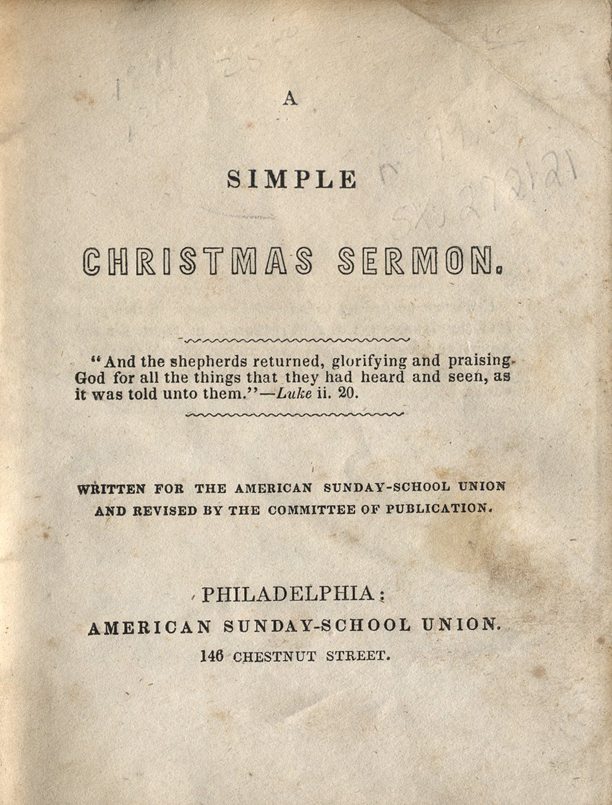
A
Simple
Christmas Sermon

“And the shepherds returned, glorifying and praising God for all the things that they had heard and seen, as it was told unto them.” – Luke ii. 20.

In the history which the evangelist, Luke, gives us of the birth of our blessed Savior, we are told that, “The shepherds returned, glorifying and praising God for all the things that they had seen and heard.” It is in the twentieth verse of the second chapter.

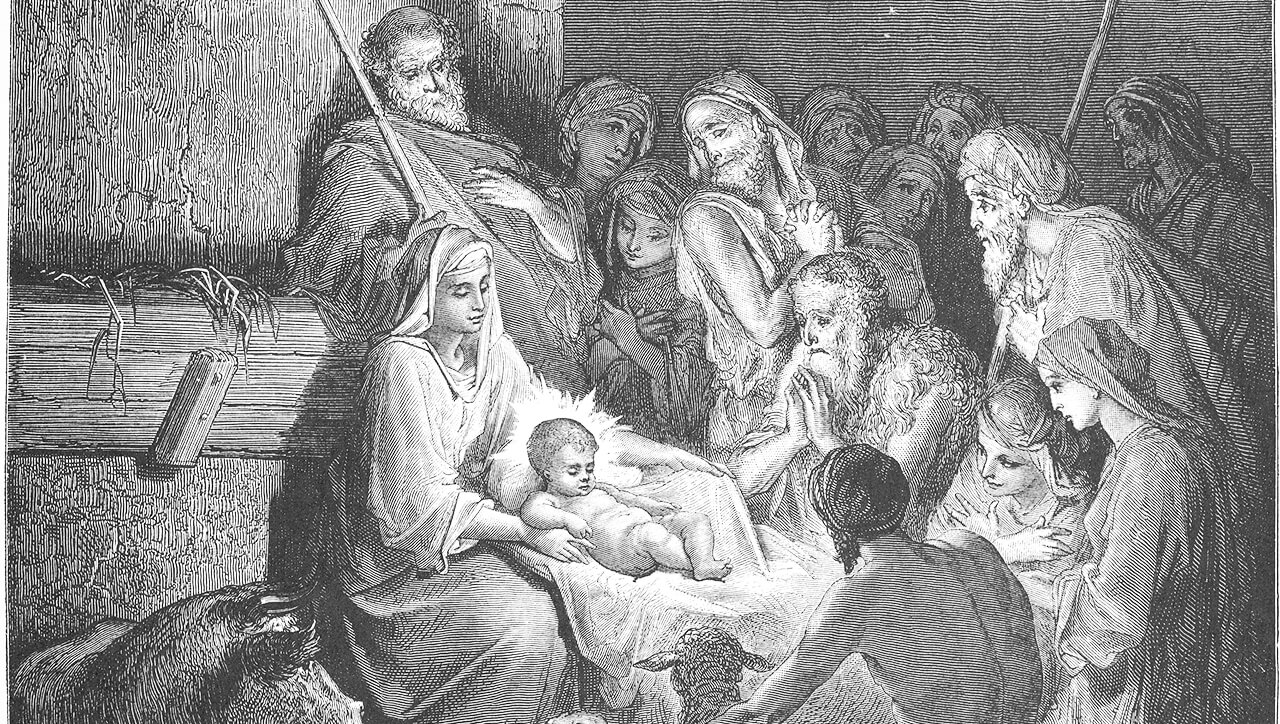
The shepherds had been to Bethlehem to see the infant Redeemer, and returned to take care of their flocks.

They were happy men, those shepherds, and very good men too, we may be sure, or God would never have made them so happy. They were not learned men; for as they had to watch their flocks by night and by day, but little time was left them to read books. Yet they were better taught than even the wise men, (and these wise men were good men too,) who came from the East to find out where Christ was born. God Sent a star to show them the way; but he sent an angel, all bright with his own glory, to tell that the shepherds were pious men, who would be glad to hear that their Savior was born, and would go and worship him.

Herod was a very great king, and very rich. His palace was very fine with gold, and silver, and purple, and precious stones. All the people that stood about him, and waited on him, were dressed in very beautiful clothes, and no doubt he had a great many singers and players upon instruments, who made good music for him to hear. But he never saw such a splendid sight as these shepherds saw, when the glory of the great God, who made all the silver, and gold, and bright and precious things, shone around them. He never had a servant to wait upon him looking so beautifully as the messenger that came to them; for it was an angel of the Lord, all glittering with the brightness of heaven, who came to tell them that their Savior was born. And there never was such a concert heard on earth as the angels made over the hill-side for these humble men, singing the anthems which God loves to hear in heaven.

Yet we need not envy those shepherds: for if we love Jesus Christ, and believe what God has told us, we may be as happy as they were, and happier too. God has given us the Bible to tell us all, and a great deal more, than the angels told them: and, besides, he sends his Holy Spirit to make us understand, if we are willing to be taught, all that he has said. We cannot go to Bethlehem and see the Savior there, a little babe, because long since he grew up to be a man; and having obeyed God’s law for us, died for our sins, and went up again into heaven, where he now reigns our blessed and holy King. But if we give our hearts to him, and trust him as our Savior, it is better than if we saw him on earth. For once, when the apostle Thomas worshipped him as his Lord and his God, because he saw him and touched him after he had risen from the dead, the Savior said to him, “Thomas, because thou hast seen me, thou hast believed: blessed are they that have not seen me, and yet have believed.”

If we believe the Bible we shall know not only that Christ was born into the world to be our Savior, but also that he lived, and died upon the cross, to make our salvation certain. We shall know not only that he was once a little child to show his love for us, but also that he is now the King of kings, in the glory of his Father; and yet as mindful of us on the throne of heaven, as when here upon the earth. If we do not love and trust him as our savior, we have no right to be glad and happy on Christmas-day, for hi is not our Savior; and God will punish us the more, because he has sent his Son into the world, and we have not given our hearts to him. But if we do truly believe on him, and try, by his help, to be like him, we may praise and glorify God now for the birth of Jesus Christ, and hope, through the death of Jesus Christ, to praise him in heaven, where the angels are always singing, “Glory to God in the highest:” and we shall sing it with them, and perhaps as well as they can.

The sacred historian tells us, that after the shepherds had been to Bethlehem, to see the new-born Savior, they returned glorifying and praising God.

They glorified God:—That  is, they not only were glad in their hearts, and talked gladly among themselves, but they worshipped God, with prayers and thanksgivings, and praised him for all the goodness and mercy he showed  in sending his own Son to be born into the world, that he might be our Savior. For it is not enough that we are glad when God gives us blessings, we must remember that they come from the great and holy God; and that we do not deserve them, because we are sinners. Therefore we must worship him, first, as the great and holy God; and then thank him for having such a love and pity towards such poor creatures as we are. And this we should do, not only when we pray to God by ourselves, but also before other people in his church, that they may be taught to praise God too. We should glorify and praise God—

First:—For showing his love towards us in the birth of Christ.

When we think how great God is; how many worlds he has made; how many pure and glorious angels he has to serve him; and how many more he could make if he chose, and then think how little we are ourselves, and how little we can do for him, we might well be afraid that he would never take notice of us. It is true, he seems to take care of all; and there is not a little bird that sings but he feeds; and we cannot look into any little flower of the field in the morning, but we shall see in it a drop of dew that God has sent to make it fresh and sweet: and so he feeds us, and takes care of us, and all we have comes from him. But then it is so easy for him to do so. As he sits upon his high throne he has but to open his hand, and plenty rains down from it, for all the living beings he has made. If he only says, “Let it be done,” no matter what it is, it is done at once. May he not then take care of us without thinking about us, or loving us much, after all?

So we find the heathen, who have no Bible, though they may believe in God, seem always to be afraid of him than to think of him as a God of love. But when we read of the birth of Jesus Christ, and know that he is the Son of God—God himself—who has come all the way to earth to live among people on earth for a little while, as a child, as a lad, and then as a man, we must see how God loves us, and how much he thinks of us.

Heaven is a very bright and happy place. There is no trouble there. There are no storms, no winters, no dark nights there. The leaves of the trees never wither; the flowers are always blooming; and there are no thorns, nor briers, nor waste places where nothing can grow. There is no sickness among those who live in heaven. They never suffer any pains. They are never tired. They never die. Those happy angels never have shed one tear in all their happy lives. They never quarrel nor hate one another; nor fight, nor steal, nor kill each other; and heaven was Jesus Christ’s home. Yet he loved us so much that he came from heaven into this sad and unhappy world. He put himself into our nature, and had a body and a soul like ours. He lived among wicked men. He became so poor that he had no home to live in, and they treated him cruelly, and hated him; so that he was “a man of sorrows, and acquainted with grief,” until he was put to death on the cross. He knew all this would happen to him when he came into the world, and yet he came, to show us how much he loved us, and how much he wished us to love him. O! How much must he love this world, when he thinks of the time he lived here for our sakes! How much must he love men when he remembers how he was a man! How much must he pity us when we are in trouble—for he had so much trouble himself! How much must he pity poor people, when he looks back upon the time when he was poor, and “had not where to lay his head!” How much must he love little children who love him, when he thinks of the manger at Bethlehem, where he slept as a little child.

Let us praise and glorify God as we think how much he loved us, and showed it by being born a little child. Surely he who loved us so much, then, will love us always, if we love him. Surely he who gave himself to us, will give us every thing that is good for us, if we ask and thank him for it. Surely we ought to love him best of all, who loved us so much, and is willing to love us still.
But there is another reason why we should glorify and praise God for giving us such a great Savior as Jesus Christ.

We are not only poor and little in his eyes, but we are also sinners. All our troubles, and sickness, and death, have been brought on us by our sins; and, what is worse, they are but the beginning of the trouble, and pain, and death that will come upon the sinner, who continues to be wicked, in another world. If God does not forgive us our sins, we shall be miserable forever in hell, among the devils. But God would rather save us than punish us forever. He wishes to bring us back to his love; that, instead of going to hell, we may go to heaven when we die: and he sent Jesus Christ into the world, that he might be our Savior.

We had broken his law, and God had said that he would love none who did not keep it; and Jesus Christ came and obeyed that law, that his father might love us for his sake. We deserve to die forever, because God had said that those who sin must die forever. But Jesus Christ died upon the cross in our stead. He died that we might not die.

God loved his Son so much, that he will take His death in place of the death of all those who are sorry for their sins, and who hope he will pardon them for Christ’s sake.

And now Jesus Christ, after living for us, and dying for us, has gone up to heaven to intercede for us, that God would hear us when we pray, and give us his pardon and his love, and every thing that we need.

O, when we think what Christ came into the world for, of all he suffered in his life of sadness, and his death of pain, and of how much he thinks of us now; and then think again that he is the great God, the very God we have sinned against, and whom we have made angry with us, ought we not to love him, and be sorry for our sins, and believe in his name?

We should glorify and praise God, too, for setting us such a good example in the life of Jesus Christ. We always know to do a thing better when we see it done, than when we are only told how to do it. So God thought; and though he had given us his holy commandments, and told us in many ways what we ought to do, yet, because we are very ignorant and foolish, he sent his Son, Jesus Christ, to become a man, that he might do what we are to do; and we know how to do all, by knowing how he did. So that now, if we only do as Christ did, we are sure that we are right.

He has set an example for us all. If we are young children, we see how Christ did when he was a little child. He loved his mother Mary, and her husband Joseph, who was like a father to him, and he obeyed them in all they said: for he was subject unto his parents. So all children who are like Jesus Christ, and wish him to love them, will love their fathers and mothers, or teachers, and do what they say. He grew in wisdom as he grew older: and so all good children who love Jesus Christ, will love to learn and become wiser every day. But especially did he love his Father in heaven, and learned his will, as you find when he went up to the temple at Jerusalem, and said he “must be about his Father’s Business;” by which he meant, that he should always serve his Father in heaven, and do what was for his glory. So all children who love Jesus Christ, will love to pray to their Father in heaven, and study the Bible, and attend at the place of worship; remembering that they are not their own masters, but God’s children.

Besides, we see that he was patient, and waited until his Father called him to act like a man, before he went out into the world to act for himself.

So all good children who wish to be like Jesus Christ, must not think that they are wise as men and women; but wait until they grow older before they contradict and become stubborn  in thinking they are right, and everybody else is wrong. You may think you know a great deal now, my dear children; but you will not—at least I hope you will not—think so by and by. Those people who think they know the most, particularly little people, are always the greatest fools, and get the most laughed at of anybody.

Christ has set an example for us all: for though he was first a child, he afterwards became a man. Are we poor and obliged to work for our living?—Christ was poor—and if we bear our poverty as meekly and patiently as he did, he will love us the more, because we are poor and like him. I have heard of people who are very angry at being called servants, though they are servants, and are paid wages for doing their work. But Christ was a servant. He “took upon him the form of a servant,” when he was born; and once we find that he waited on his own disciples like a servant, and washed their feet.

The name of servant is an honorable name; and if we only serve God in serving others, we shall be the brethren of Christ; and all good Christians will love good servants for Christ’s sake. Better to be a pious servant, than a wicked king.

Are we rich?—We ought not to be proud of it, or of our fine clothes and handsome houses, and the many good things that we have, and so despise poor people; because Christ was rich: he owned everything; for he made everything. All we have is from him, and he can dress a little lily finer than a prince; yet he was so humble and meek, that he laid all aside, and came to bless poor people, and to take all that love him to a beautiful home in heaven. So, if we would be like Christ, instead of being proud, we should remember that we are so poor as to have nothing but what Christ gives, and use our money in helping the poor, in feeding and clothing the needy, and in giving Bibles and good books to those who have none, and in sending missionaries to teach the ignorant and wandering the way to heaven.

Are we in trouble? Christ was always in trouble while he was on earth; but he bore it all without murmuring, because it was his good Father’s will. So should we drink the cup our Father gives us; and although it may seem bitter at first, if we receive it patiently, it shall be very sweet in the end. Trouble, if we profit by it, is the way to heaven, for it is the way in which Christ went there.

All Christ’s life was spent in doing his Father’s will, and in doing good to men. It was his meat and drink to do his Father’s will; and he came all the way from heaven to earth to save the souls of those that were ready to perish. The same love that made him pity men’s souls, made him pity their bodies when they were in want or pain. Almost every day of his life, after his baptism, we find him working a miracle to feed hungry people; or healing some sick, or blind, or lame person; or raising up someone from the dead. But his chief business was to save souls. So, if we would be true Christians, we must follow Christ; we must serve God all our lives, and be always trying to do good to our fellow-creatures; and more than all, in trying to save their souls by his divine blessing.

Let us now learn a few lessons from the birth of Christ.

1. We must become as little children if we would enter the kingdom of Christ.

Christ was given to us as the pattern of a Christian; and we see that he was born from the power of God. So we must be born again by the Spirit of God; and as God dwelt in the human nature of Christ, so must God the Holy Spirit dwell in us, that we may be able to live Christian lives.

Christ began his life on earth from the earliest infancy, and never ceased serving God and doing good till the end of it. So we can never begin serving God too soon. We ought never to put off being Christians until we become older; for our whole lives are little enough to give him.

When we devote our youth to God, ‘Tis pleasing in his eyes:
A flower, when offered in the bud,
Is no vain sacrifice.
‘Tis easier work if we begin
To serve the Lord betimes;
While sinners that grow old in sin,
Are hardened in their crimes.
‘Twill save us from a thousand snares,
To mind religion young;
Grace will preserve our following years,
And make our virtues strong.

So, if we be young, we ought to begin to serve God at once, that all our lives may be spent for him: and that is the reason why Christ loves to have little children come to him, they look so like what he was when he began to serve God on earth. If we be old, the more reason that we should not put off serving him, because we have so little time (who can tell how little?) to serve him in.

We must begin the Christian life as little children. They know nothing, and then begin to learn. So must we, no matter how much we know of other things, come to Christ to be taught, as though we had never known anything before. We must be willing to begin at the beginning, as Christ himself did, by becoming a little child, and learn from God the things that belong to salvation.

We must feel ourselves to be weak and helpless as little children, looking to Christ for all that we need, and leaning upon him. How feeble was the infant Jesus, in his mother’s arms? How dependent is a little child upon his parents for food, for clothing, for instruction? So must we become the little children of God, to be carried in Christ’s arms, to be fed by his grace, and clothed by his righteousness; and taught by his Spirit, and led by his hand. Until we have such simple faith, we do not begin the Christian life.

2.  We must be humble.

Christ was humble. He became a poor little child. He says, “Learn of me, for I am meek and lowly in heart, and ye shall find rest for your souls.” What a shame it is for anyone to be proud, when the Son of God was so humble? Humility is the root of the Christian character. The tallest oak tree in the forest grew from a little root, low, in the ground. If you cut that root, the tree dies, no matter how high and strong its branches may seem to be. So, unless we begin low, and keep our thoughts and prayers towards heaven, we shall never make true Christians. God hates proud people, but he gives grace to the humble.

3. We must be full of love and kindness.

It was love and kindness that made Christ our Savior. We are not Christians until we share in Christ’s loving-kindness, and be full of love and kindness to all around us. The best way to keep Christians, is first to give god thanks for his love and kindness to us, and then to show love and kindness to those who need our help. The best Christmas feast for a Christian’s heart, is making some poor person happy by our goodness for Christ’s sake.

I will only add some words of good St. Bernard.

There were four fountains in Paradise that sent forth living waters. So, there are four fountains opened by the birth of Christ in the kingdom of God.

There is the fountain of mercy, in which we may wash away our sins.

There is the fountain of heavenly wisdom, where we may drink in holy thoughts and feelings.

There is the fountain of the Spirit’s Grace, where we may drink in life and power to do God’s will.

And there is the fountain of holy zeal, which sends forth the waters of pious charity to refresh us, as we go on the way to heaven.

Let us then “draw waters with joy out of these wells of salvation.”

The End.

*Originally Posted: Dec. 24, 2016

Sermon – Christian Patriot – Boston, 1840

Rev. Mellish Irving Motte (1801-1881) was originally from Charleston, South Carolina. He obtained a Bachelors of Arts from Harvard in 1821 and became pastor of the South Congregational Church in Boston on May 21, 1828.

In this 1840 sermon, Rev. Motte encourages Christians to fully engage the culture, especially in the political arena. He decries politicians acting out of self-interest and greed rather than making decisions based upon what is morally right and wrong. Motte insists that religious morality is the very first manifestation of true patriotism and “Public virtue is the strongest spirit of national vitality.” He reminds his listeners that nations must be judged in the present since they do not exist in eternity and national ruin awaits national unrighteousness. Rev. Motte states that America’s Fathers founded the country on Christian principles and intended for the United States to be a Christian nation. According to Motte, the realization of this goal is to be found in individual piety and allegiance to righteousness over any political party.


The Christian Patriot
A
Sermon
Delivered at the
South Congregational Church,
Boston, July 5, 1840

By M. I. Motte

Psalm 144:15
Happy is that people, whose God is the Lord

One of the most common of mistaken and false forms, into which religion is apt to run, is an isolated piety, and abstract and independent devotion; religion separated from the business of life, instead of being woven up, conscientiously, with all its concerns. For convenience’ sake, we have a particular day, and place, and order of men, and class of exercises, especially devoted to the consideration of the great topic; but it is that its influence may be made to run through all days and places, all intercourse, every subject and employment. Yet the church has every been prone, even more than it conscious of, to sever itself from the world, instead of leavening it to its own spirit; and the same man, in his church relations, is a Christian, or would grieve not to be considered and to consider himself so, who, in some of his worldly interests and pursuits, is absolutely an atheist, living without God in his thoughts.

On no subject us thus more obvious, than on the one, from which it is most unfortunate in our country religion should be driven off, seeing it is that which agitates more people here than any other, viz. the whole business of politics. Religion and politics are spoken of as opposite poles, the positive and the negative as the acknowledgment of God is concerned. We hear it said, politics are of no particular religion; and it is too often true, in a more absolute sense than is intended. It would seem, at first, as if both subject were so important, so exciting, that the human hear is hardly large enough for both. (3) When we speak of a man as a politician preeminently, one enthusiastically absorbed in the affairs of the nation, or more probably of a party, we do not expect to find him in a church. And when a zealot for churches is invited to the polls, he seems to answer to the purpose, when he replies, “My Master’s kingdom is not of this world.” If he is a clergyman, the professional response expected from him is, “I have nothing to do with politics;” and only those object to this, who suppose, if he voted at all, he would vote with them; to all others he seems to have made the natural and legitimate reply. Both of these men are wrong, but they both point the direction in which public prejudice blows.

Our festivals, again, are either political or religious; not both together. There would seem to be something incompatible and profane, or absurd, in making them both. Such an anniversary as yesterday is not strikingly a religious day; as tomorrow’s published list of its outrages and truculent mishaps in all our cities will attest. Early in the morning, trains may be seen leaving the city by every outlet, anxious to escape the celebration of the National Independence. And, when the day of the month falls upon the first day of the week, its celebration is postponed till Monday; as if confessedly impossible to bring its spirit to into harmony with the Christian Sabbath.

All this shows, not the politics and religion are necessarily inconsistent, – for the former, I suppose, is a duty as really as the latter, and all duties should be performed in the fear of God, – but it shows, that the spirit of politics which prevails is not the right one. The good of our country should be provided for, as in the sight of God, and in sacred love to our fellow-men; and then it is a holy service, and need not be dissevered from the solemnest ministrations of devotions. It is one of the modes of worship with which the Universal Father is well pleased; one of the forms of his appointed ceremonial of religion pure and undefiled, which consists in going about doing good for his sake. But, if it is only a selfish, headlong, intemperate scramble for preeminence, if it is mercenary, not moral, in its spirit, a question of interest, not of right, the Sabbath is too good a day for it, and so is every other day.

Interest is to be regarded as well as right; but do not all political parties appeal too exclusively to the former? A reverence for right is not held high enough, as the guiding polar star for the opinions of the people. The people think, morality is a matter of home and neighborly intercourse, not involved in the vote they cast, and the opinions they express, on the acts of government, encouraging or condemning. How seldom is the guilt of upholding iniquitous public measures reflected on, as good men reflect on private violations of the ten Commandments. They may do infinitely more mischief than an individual’s misdemeanor, and yet many deem it a little thing. Men seem to think they may hold what opinions, and belong to what parties they please, without regard to their truth or effects, except as affecting themselves; as if politics were a lawless region, always out of Christendom, and from which even conscious was excluded by general consent. Look through the community and the world, and see how, on almost every question, you may draw a line between parties, accurately coinciding with the line between their interests. You need not ask, on which side a man’s convictions lie, if you only know on which side his wishes lie. The coincidence is certainly remarkable; and melancholy it is to reflect on the wide heartlessness it indicates. Here we see men fair-minded in every other concern, men of severe religious sanctity, of nice honor, of scrupulous integrity in their personal transactions, where the welfare of a few immediate connections or acquaintances is at stake; but, when millions lose though the prevalence of an opinion, the first and only thought that seems to occur to them is, How will it affect us, and I our lowest interests? And, if it promise to be lucrative, forthwith they adopt that opinion, and if their soul’s salvation hung upon it.

They adopt that opinion, I said; But can it be possible, that men always do really believe as if for their interests? Can they be conscientious, in such innumerable cases, arriving, through the careful and dispassionate examination, at precisely the result that happens to favor the views and wishes? I allow a great deal for the blinding power of self-interest; but this uniform concurrence of hope and belief is astonishing still. These same people will reason as clearly as daylight on any argument which comes within the tenth of an inch of their own concerns without touching it; but, the moment it touches, their light is darkened, their logical acumen is blunted, their perceptions evince a certain unfortunate obliquity, which is sure to twist their notions in one invariable direction. Can this be right? Can it be honest? We know, or we might know, if we chose, that truth and justice cannot always, and on every accidental question and measure, be in our favor. We are bound, at any rate, not to take it for granted. Let us inquire. Let us make up our minds to lose so many dollars, relinquish a few prejudices, and partialities, and expectations, rather than lose probity, the approbation that speaks within, all generosity of soul, and the smiles of God. Let us not be satisfied to be guilty, because the guilt is shared with a multitude. Away with injustice and ungenerosity, though only in thought, however popular, however fashionable. So shall we do our part to bring into currency a more elevated and uncompromising tone of political honor and conscience; and the whole regions of politics be no longer but as the Barbary States of moral geography, outlawed lands and piratical seas, from which are excluded all faith and virtue, all laws of God and man.

Politics should be but one form of that charity which is the end of the divine law. One more of benevolence, one of the ministrations of philanthropy; and “Holiness to the Lord” be inscribed over the portals of its halls of state and the chambers of its social festivals, as over the church door. Especially with us should this be aimed at on triple grounds. For, if political parties with us cannot be Christian parties, then are we a godless nation; there can be few Christians throughout the length and breadth of the land; since he, who is no politician under our institutions, is a solitary rarity.

Then, if they believe their own declamations, puffing up so unweariedly the national vanity, we are the most favored people on which the sun shines, at least, as regards all that God has done for us; and the Giver of all good should, least of all, be ungratefully overlooked by us. All the flights of rhetoric, that yesterday glittered over this continent, all the floods of panegyric that were sounded forth upon ourselves and our institutions and advantages, should they not all reecho, at least in and undertone whisper in reason’s ear, as if saying, To whom much is given, of them much will be required?

And, then, to make all that is given to us safe for us, and to expect a blessing continuance, we must remember God, and insist on a religious morality as the very first manifestation of a true patriotism. Ay, patriotism, that most abused words. Alas! That it is every vaunted and bravadoed by the scoffer and the profligate, not knowing, that blessed is that people, and that alone, whose God is the Lord. Without him they may speak great swelling words of vanity; but bombastic professions and oratorical displays are not the disinterested self-denial and sober toils of a virtuous citizen, who fears God and honors government, and serves and saves the state without boasting. He alone is a patriot. By such alone the country stands.

The Ruler of nations hath uttered the decree. From beginning of time his world has illustrating it. As surely as he is just and the King of nations as of individuals; as surely as there is truth taught by experience, and the unvarying certainty of the same effects from the same causes, according to the natural constitution he has impressed on his universe, the past, in all quarters of the globe, bids us look well to it. You may be the traitor within the garrison, though treason to the country be furthest from your thoughts. You may invoke ruin upon it when you are shouting, louder than any, the glory of its institutions. You may be the deadly enemy, though you shed your blood for it. Look into the nature of things. When hath a righteous nation perished? Where is there one doing justice and judgment, and it is not well with it? Public virtue is the strongest spirit of national vitality; and private virtue is the life-blood, coursing through every artery and vein, large and small, of the public institutions.

On the other hand, is it not undeniable from reason, scripture, and experience, that predominance of selfish principles and corrupt morals is the unfailing cause of calamities, perplexities, and ruin in a country? Reason tells us, that the character of the Judge of all the earth is the pledged to have it so. Vice, in the individual, may not always meet its retribution, nor virtue its reward, in this world, because there is to be another, of more perfect retribution for individuals. But nations exist here alone. Unlike the soul, they are annihilated at their temporal dissolution. Therefore, if their fortunes and fate be subject of the Divine Providence, to their present existence, which is the only one, must be applied the principle of its moral rule.

The scriptures confirm this rule, and do not restrict it to the theocracy of Israel. They say; “O Israel, thou hast fallen by thine iniquity; your iniquities have turned away good things and withheld them from you.” But it is not of Israel alone, (of whom it might be said, God was, in a peculiar way, a Governor by temporal sanctions,) that he announces this principle of legislation. His declarations are general. “At what instant I shall speak concerning a nation and concerning a kingdom, to build up and to plant it; if it do evil in my sight, that it obey not my voice, then I will repent of the good wherewith I said I would benefit them. In the hand of the Lord, there is a cup, and the wine is red. It is full mixed, and he poureth out of the same. As for the dregs thereof, all the ungodly of the earth shall drink them.”

And the experience of mankind puts the impressive truth beyond dispute. What is history but, on this account, like the Prophet’s, a scroll written, within and without, with lamentation, and mourning, and woe. Pity weeps as she unrolls its venerable annals. Its oldest records present the Cities of the Plain set forth for an example of the national ruin, that full surely awaits national unrighteousness. “Ten righteous men could not be found in them,” and they perished. Even to an earlier page the genius of history points, and sighs over the ravages of the flood. “All flesh had corrupted their ways before the Flood.” And we stand aghast at the sweeping catastrophe. Turn over a few pages onward, and direct your attention to the chosen people. See them, at one time, visited with pestilence, famine, conflagration, tempest; at another, falling under the sword, or languishing in captivity, feeling before the scourge of war, or terrified with awful phenomena of nature, and all these proclaimed the retributory angels of the Lord, the ministers of his justice for their sins. The wisdom of their wise men was taken away, and the understanding of their prudent men hid; and it was moral debasement that did it. Their cities, the places of their fathers’ sepulchers, were laid waste, and the gates thereof consumed with fire; and, in all the seasons of their affliction, mark the moral shade running though the history in proportioned intenseness; mark idolatry and its bitter fruit, general profligacy, tempting them to forget their God.

Read of a later day, travel among the scenes of profane chronicles, if you would see, that national vice is national suicide. Stand upon the moldering ruins of a thousand cities, once great and fair, and seek, – you will seek in vain, – for trace or even site of many others; and ask where are they, and why have they vanished from the earth? Roam through the desolated territories of empires, once splendid and mighty, and, as you brood over the gloomy vestiges of their decay, cannot find an inhabitant for many a mile, where throngs were loud and busy once, ask yourself, if integrity, industry, humanity, temperance, piety, and purity were rife there, when the besom of destruction came to sweep a tomb under those wide-spread ruins.

Thus history or travel will conduct you over the globe, and everywhere teach the same salutary lesson. They will point to empire after empire, and dynasty after dynasty, shriveling and shrinking with the imbecility of moral corruption; and it is not more sure, that the palaces of their pride, and the monuments of their perverted might, are crumbling into dust, than that other empires and other dynasties, now treading in their steps, will follow them to decay and desolation. O that our beloved land may be wise from the lesson! And the lesson is more pertinent under our republican polity, than under any other. If righteousness exalteth a nation, and sin is a reproach and ruin to any people, most speedily of all must it prove so to a people without the restraints of a strong government. Liberty and licentiousness roll trippingly off the tongue together; they flow, unseparated, from the lips of many, with easy alliteration and commonplace proverbialness, as if they were almost the same thing, or one inevitably followed the other. But, if it does, it is as commonplace a maxim of history, that it will follow it speedily to ruin. Liberty licentiousness, – it is the tritest of proverbs, – cannot coexist lastingly. The free people is the last that can afford to be vicious. The slave may throw off the restraints of virtue, and yet be kept in order by the restraints of despotism. But, when a freeman does not govern himself, he is ungoverned, so to speak, and careering to perdition; like the uncurbed wild ass of the desert, rushing to the precipice he tosses his head too high to see.

Therefore, every immoral republican is a traitor and conspirator against his government, as much as if, being the subject of a king, he pointed a dagger against his life. He is spreading stratagems and snares for the feet of his sovereign; for public virtue is his sovereign. He is seeking to blind, and deafen, and lame, and cripple, and make wholly inefficient, and worse than inefficient, he is seeking to corrupt, into tyrannical wantonness and cruelty, the most beneficent monarch that ever sat upon a throne.

So that you see, my brethren, in addition to every other motive for being good Christians, patriotism should be one. After we have turned away from the voice of God; after we have steeled our hearts to the claims of him who died upon Calvary, the just for the unjust, the he might bring us to God; after we have besotted our minds to act the fool’s part of blindness to our own interest; there is yet one appeal which may not be lost upon our generosity, one consideration that should be sufficient; public spirit, the love of our country. Its welfare is resting on our individual virtue. For as drops of water make up the ocean, and grains of sand constitute vast continents, so the personal character of the humblest individual among us adds something, for weal or for woe, to that national character, by which the land of our love, the government which has cherished us, will stand or fall. Our native soil, the scene of our happy childhood, the land of our fathers, the land where we have enjoyed so much, where we expect so much, and from which the world expects so much, shall it realize these expectations? Shall it become, as has been so fondly anticipated, the glory of the nations, has the perfection of beauty, the joy of the whole earth, showing what man can do with unshackled energies and faculties ripely developed in the wholesome air of liberty? Or shall it be one more byword and mockery of the aspirations and pretensions of freedom.

Think of this, when tempted to any wicked or base act. Above all, think of it when tempted to into any of the peculiar and besetting snares, and betraying exaggerations and caricatures of liberty; to vicious license, to lawlessness and recklessness of restraint, to inebriate zeal, party prejudice, bigoted factiousness, mob-rioting, passionate reviling of the powers that be, or the powers that are to be, and all bitter or mercenary partisanship. Remember, when tempted to any of these, you are tempted then to disappoint so many noble souls, the lovers of their kind, in every quarter of the globe, the enthusiasts for the advancement of the human race to a pitch of excellence and enjoyment yet unrealized, but the guaranty for which they look for in the great experience of self-government now trying on these shores.

The old world may be said to be leaning, with feverish anxiety, over the ocean to catch every symptom of the success or failure of his experiment. Have pity on the last hopes on man. Let is not be said again, as it was by the dying Brutus, after he had sacrificed all to realize a patriot’s dream; “O virtue, I have worshipped thee as a reality, and found thee but a shadow.” Let it not be said, again, as it was by the noble-hearted Madame Roland, as, on her way to the guillotine to lose her head for continuing a virtuous enthusiast for freedom amidst the herd of vicious, she passed under the statue of Liberty; “O Liberty, how they have played thee! What crimes have been committed in the name!” Ay, how it has been played in the world, historionized, juggled! What crimes have been committed, what crimes have not been committed, in its sacred name? It is assuredly the cloak of boundless evil, when not guarded with most scrupulous probity; for the best things, corrupted, always become the worst. The precious diamond may be blackened into a worthless coal. The sweet name of liberty has become a sound of ill omen and nauseous associations to many of the readers of history, from want of virtue in its votaries. Patriotism has been characterized as the last resource of a villain. Revolutions, said Napoleon, are not made with rosewater; but it were well if blood, and seas of it, were the dearest price paid. Moral corruption is what renders revolutions worse than vain.

Our fathers have made one more trial, knowing that past failures were from want of Christian principle, and that they had settled these shores expressly in obedience to Christian principle, and therefore they might hope. In faith and prayer they struggled; for they felt, that with God all things are possible in the cause of righteousness, and they hoped their children would feel this too. From the first, they set out with the idea of making this community that happy people, whose God is the Lord, – a Christian nation, – what the world had never yet seen, but what all its experience concurred in testifying it must seem or it would never see the amount of prosperity man is capable of attaining on earth. A Christian people! Not merely a sober, industrious people, without religion, if such could be expected, but distinctively a Christian people. Bright and glorious idea, far-seeing wisdom, true friends, and see its kingdoms prospering at this time just in proportion as they come near realizing this idea, other elements of their greatness being the same. Begin from the effete East, and come to the infant West. The nominally Christian are more thriving than the Pagan Mahometan; the Protestant than the Catholic; the praying and Bible-reading, than the ceremonial and formalist; and, so long hypocrisy could be kept out, that people would prosper most, who should require, as the settlers of these New England colonies did, that none but members of the church should be rulers in the state. Such a regulation is a bait for hypocrites, a trap for the consciences of the ambitious, and, therefore, it is not to be enforced after the primitive virtues of the settlement have been corrupted. But, is there were not fear of hypocrisy, verily and indeed happy would be that people, with whom God was effectively their Lord through the strict observances of such a rule. Then might we see such a phenomenon as a Christian people.

As it is, let us, – and it seems more incumbent on us than on any nation that lives in the sun’s more expressive, than as a mere geographical term. When we are called a Christian nation, let us allow more the meant, than that we are not savages or barbarians, or only semi-civilized, as all those nations are in which Christianity is unknown. Christian should be more than European or American, as distinguished from Asiatic or African. It should be more than latitude and longitude; more than eastern or western, northern or southern; more than tropics and zones, equator and ecliptic, arctic or antarctic.

And how can we make a Christian nation? To become so, must be an individual, not a collective act. Legislation cannot do it, if legislation would. Resolves of majorities, in caucus or in Congress, in towns or by states, or even unanimous votes, is not the way to affect it. The simple and sole process is for each person privately to resolve, for his single part, no influence in legislative deliberations, no political name or fame whatever, – nay, the shrinking woman and child, whose deliberations look not beyond the homestead, or who can legislate only over their own hearts, – these can add a stone, as truly as the mightiest statesman or the loudest demagogue, to build up the national temple to the Lord. Public opinion is the life-breath of our own government, and therefore to Christianize that, we have but to Christianize ourselves. O what it is ye may achieve! No such power as this is possessed by the subjects of any government but yours. They cannot regenerate their sovereign. They cannot even pray for his conversion with hope, the assurance, of the prayer being granted if sincere, which may warm your breasts.

And is there a consideration of earth or heaven, that is not present and potent to move us to this prayer? Pour it out to God, if righteousness would have but the promise of the life that now is. If a majority of the citizens were sincere followers of Jesus Christ, is it not evident, the councils of this nation would be wiser and mightier, its progress more glorious, its dominion even more potent than any the world has ever seen? The day when it shall be resolved, that the same evangelical principles shall govern states that govern churches and gospel professors in their private relations, would be the true jubilee of freedom. That will be the mind’s and the soul’s declaration of independence. That will be breaking every yoke at length from body, and heart, and spirit. Thenceforth slavery, in any form, would be but a tradition and a name; whereas now it is the commonest of conditions, and to the mass liberty is but a name; for he that serveth any sin is the slave of sin. That day will come, when the people choose.

Choose it, resolve it, O my brethren, as the first of civil duties. Whatever your party predilections, sacrifice them all for the party of righteous men. Support no administration, and oppose none, but one the ground of moral principle. Go with them as far as Jesus Christ would go, and no further. Read the constitution by the light of the Gospel. The Savior be your paramount leader.

And now I see his communion table before me this day, and I fear all that has been said will seem out of keeping with its solemn associations; so desecrating, as I began with intimating, seems any allusion to the politician’s trade. But let me hope I have not spoken all in vain. Follow it in the spirit in which you come here to the house of the Lord himself. You are performing a solemn act of worship then, if you feel it aright. You should enter upon office, you should deposit your vote for office, with a religious sense of accountableness, like that which makes you so serious when you handle the emblems of the Savior’s body and blood.

Approach his table because you would be good citizens, among the other reasons of the act; because you love, and you serve and save, your country; because you would have it long free; because you would be truly free yourselves. Where the spirit of the Lord is, there is liberty. If his Son shall make your free, ye shall be free indeed. Where he is not the deliverer, men may clamor, and boast, and carouse, and with bacchanalian revelry call themselves free but they are the bondmen of corruption, the thralls of Satan. O be ye, unlike them, the freedmen of the Lord, whose service is perfect freedom.

Sermon – Thanksgiving – 1852 Massachusetts


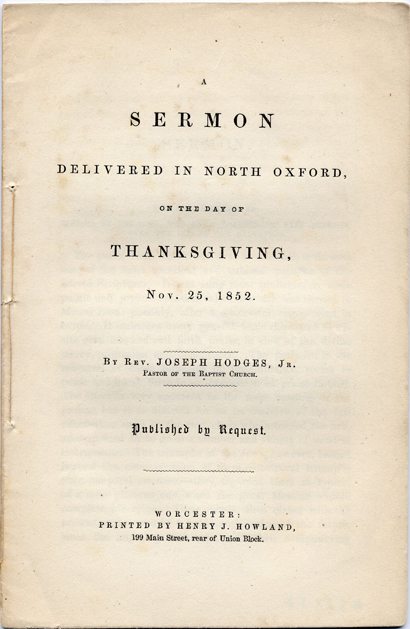
A sermon preached on Thanksgiving Day, November 25, 1852, by Reverend Joseph Hodges, Jr. in North Oxford.


sermon-thanksgiving-1852-massachusetts

A
Sermon
Delivered in North Oxford,
On the day of
Thanksgiving,
Nov. 25, 1852.
By  Rev. Joseph Hodges Jr.
Pastor of the Baptist Church.

Sermon
Psalm LXVIII [68]:19.
Blessed be the Lord, who daily loadeth us with benefits, even the God of our Salvation.

The psalm from which our text is selected, is deemed one of the most excellent and sublime portions of the Sacred Scriptures. It was sung, most probably, on some public and joyous occasion, when the ark was carried to Mount Zion: possibly, after a successful engagement in battle. It embraces every general topic calculated to excite gratitude and call forth praise, in view of the divine mercy, protection and beneficence. The psalmist, in the rehearsal of these blessing of remembrance, seems to pause and break forth in an expression of praise to God. The effect is very apparent in the mere reading of the psalm; but it is difficult for us to conceive of the full effect when sung by the vast choir who attended the ark, accompanied by so great a number and variety of musical instruments. The triumphs of the Jews, however, looked beyond the mere occasion of them, – temporal triumphs over temporal enemies, — they regarded them as typical of a more glorious one, when the great Messiah should complete his reign. Their minds, thus elated with the present, and moved by a fervid anticipation of the future, amid the imposing multitude, with their overpowering music, must have been excited by a spectacle at once touching to the heart, inspiring to the imagination, and lasting in its associations.

It is indeed, in a manner less imposing, that we are called upon to offer our tribute of praise and thanksgiving. Amid the current of life, our usual duties and avocations, the routine of common events and obligation, it is appropriate for us to pause, and at this season of our annual festival, lift up our humble voice in praise to our usual fruitful harvest, and to engage in other worthy pursuits and enterprises, the results of which furnish evidence of general prosperity. Every useful undertaking has been sustained. Though sin and trouble, losses and accidents, sickness and death, are the usual lot of some, from which none are entirely exempt, amid it all there has been the good hand of a wise Governor and Benefactor to guide, to deal out the blessings of life, and to overrule all events of prosperity or adversity, for the happiness of all.

It would be appropriate to recount the many favors of heaven, to specify the instances of mercy and goodness common to us as individuals or a community. There might be drawn out a long catalogue of benefits, with which the good Providence of God has loaded us, and each so presented, as to excite afresh in our breast delightful emotions of gratitude. These benefits would not be unlike those, which have often, almost annually occurred. God, in his Providence, as you are aware, gives, withholds, and controls, so as not only to affect the mind and heart with a sense of the blessings bestowed, to produce the feeling of gladness; but to stimulate withal a sense of obligation in respect to enterprise and activity. We feel bound not only to laud our great Benefactor, but we are moved by our gratitude to adopt and carry out plans of serving him which shall result in the good of the world and to His honor.

If therefore, instead of recounting these benefits, I refer you to the enterprises and improvements which have grown out of these favors, and which are calculated to stimulate us to greater exertions, to engage in more elevated employments, I may accomplish quite as good a service.

In prosecution of the object which I have suggested, time will allow me only to glance at some of the improvements in agriculture and manufactures, with which we are more intimately connected, and refer to the condition of education amongst us, as associated with the various branches of industry.

Agriculture I may name as a science, as well as an art, of the first importance. Some may be disposed to smile because this employment is spoken of as science. As it has been too often conducted, or neglected, it may seem to be the business of the most limited capacities of the most ordinary calculators, for those alone who can perform drudgery. Too often we fear that this sentiment has been taken for granted by farmers themselves, and hence they have plodded on, too much in the same old track. Hence the rest of the world is in advance of them, and their sons frequently leave them to follow less honorable callings. It is however at the foundation of all other employments, and no less dignified, healthy, or profitable. Its study and practice will serve to develop improvements, resources, strength, and health, as much certainly as any other. A glance at the earlier ages of the world will afford us some idea of the improvements which have taken place. If we may use Jahn as authority; and I know of no better, we must conclude that the implements first employed for husbandry were of the rudest construction, and so continued to be with comparatively little change for ages. Instead of shovels and spades, only sharpened sticks and flattened pieces of wood were used. The plow was made of a bent bough sharpened at one end, requiring the greatest strength and attention to hold it. The harrow was nothing more than a cluster of limbs of trees, thrown together so as to scratch the soil, tear apart the clods, and level somewhat the earth. Every other farming implement was of the same rude character. To perceive the improvements in this branch of business, we need not go further back than our own boyhood. Compare the implements then in use with those now, both as to form and adaptation, and we are struck with the change. Hence the ease and rapidity with which we prepare the land, sow the seed, and reap the harvest. And many are the improvements for gathering fruits and grain, mowing and raking, pulling up stumps by their roots, sinking rock, ditching meadows, irrigating hills, and converting marshes into arable fields. Science has taught us how resuscitate worn-out lands and to make the rich richer. No man who has land paid for, a house to live in, and information which may be gained in our common schools, with a good paper on farming, with health and energy, need be destitute. As much, however, depends on the head as the hands, yea more. There are needed, activity, investigation, perseverance and economy. And on this festival day, when so much of the farmer’s care and productions are brought to our board, in token of our thankfulness we are bound to understand and carry out in the world the improvements which, under a kind Providence, have been developed. Nor should we stop with the present. We should not live without leaving our mark somewhere, in and on our age; such as shall call forth the gratitude of another generation for what we have done; such as shall stimulate that generation to do more, and become wiser, than the former. Thus from generation to generation, the capabilities for the production of fruits shall abundantly manifest that agriculture is in no respect inferior to any other employment in dignity, usefulness, tastes, or health.

It would be interesting to trace the history of improvements in manufactures from the earliest times to the present. We are struck with the improvements in the structure of machinery, and the architecture of the mills within the last twenty-five years. This is true of all manufactories. We have specimens of art in the manufacture of cloth in ancient times, that would compete with those of modern, possibly in beauty, texture, and durability. But the long process and great labor mad these fabric expensive and rare. None but kings and princes could afford to be clothed in soft raiment and embroidered garments. Formerly cotton was deemed the richest and most costly fabric, now the commonest and cheapest. Under what inconveniences too, in the earlier days was cloth woven and garments fabricated? The Israelites had learned the art among the Egyptians and became their superiors. They were the New Englanders among the Southerners. On their tedious return to Palestine, they wove curtains for the tabernacle rich and beautiful. There was work performed under difficulties which, even in this day, in patient, persevering New England, might be deemed insurmountable. Scarcely less astonished should we be, to view the improved facilities with which we are now favored, compared with the disadvantages under which manufactories were commenced in our county. These very disadvantages were such, however, as to give stimulus to every generous enterprise.

May I not be permitted here to refer to the advantages growing out of our manufactories? That there are evils connected with them, we may not deny. The same may be said of every other enterprise under the sun, and it will be so, so long as human nature remains what it is, under the direction and restraints of similar impulses and influences. The evils are not necessarily of the business, but rather of the nature of the men who conduct and perform it. As the world advances there must necessarily be division of labor. Some may sigh for the time to return when in every family there shall be the loom, the spinning wheel, the shoe bench, the carpenter’s bench, the anvil, the chair-maker, the basket-maker, the broom-maker, the tailor, the dress-maker, as well as the farmer and dairy. And what manufacturers they were! Now as good and honest as those times were, who would roll back the world upon them? Now manufacture, commerce, agriculture, and all other honest employments or professions, help each other. What farmer would get twenty-five or thirty cents per pound for his butter in the country, such a season as this even, were all agriculturists who spun and wove their own cloth, and made their own garments and shoes? I do not speak as a partisan. Not at all. There have been in days gone by, honest differences as to the adoption of various measures in respect to political economy. There may be now. But the trouble was then, and now is, I divine, there was and is needed the light which comes from intercommunication of a practical character- a better understanding, not of theories, but of the working of them. When this light and understanding shall prevail, it will be found that all parties are nearer together than they supposed; that their true interest lies just on the line which divides these party interests, on which only the few quiet ones dare to walk. We need now the farmer, the merchant and manufacturer. Let each in his department adopt the principle “Live and let live.” For this purpose we have the world as the field of our operation. This village, this town, this county of Worchester, this our New England, these United States, none are large enough to operate in. Our action and industry must tell on the whole world. We have been inclined to circumscribe ourselves- or certainly to pen up ourselves within the old thirteen states. – Or perhaps we would somehow have New England set apart, or kept by itself, for fear with all honesty, that its industry, its ingenuity, its learning, its good taste, its good morals and religion, would be lost, no longer identified. But the Providence of God in its operations and developments is wiser than men. The foolishness of our Heavenly Father is wiser than the wisdom of the best of us. There is more wisdom in the plans of heaven that in all the concentrated wisdom of all political parties united, to effect the good of the world. When you have looked on the movements of our day, both of our own country and of Europe, some score of years hence, who shall be permitted to do so, will be fully convinced of this. We need not go to England, or China, of California, or Washington, or Boston, to exert any influence. The elements of this world, so far as intellect and principle are concerned, are elastic; and if you strike one, so as to make an impression, like a row of ivory balls suspended in contact, you affect all the rest. What you have to do then is not to turn from your calling, but act in your proper sphere; laying hold upon the information which comes in your path. If you have a farm to cultivate, do it with your might; as if you meant to accomplish something in this line business. If you have a manufactory to build, go about that most manfully. Whatever you have to lay your hand to that is good and honest, be about it in earnest. It is this spirit of earnestness and honesty and patient industry that has made New England what she is.

But as we are inclined to take pride to ourselves, not only as New England but also as a nation, as we have grown strong in our youth, and lest we might as we approached manhood become insolent, Providence is scattering among us thorns; sending- not the best specimens- the world to us. We may think in our vanity, that it is for the purpose of having them instructed and converted both politically and religiously. Would that they might become in both respects almost and altogether like ourselves, save those bands of Slavery for the South, and the Fugitive Slave law for the North. But may we not learn something from them? This truly; that man is our brother, and wherever he is found, in our country, or far away, in whatever circumstances, should be one with us. In this respect, the world is our country, our state, our town, our neighborhood, and whatever distinctions there may be in some respects, we are naturally dependent on each other. If England, proud in every thing as she is, has yielded to this nation the meed of praise, as superior to her in every useful employment, and awarded us a niche above all the world beside, we should be ambitious to prove ourselves as humane, as true to the world in all its wants and interests, as the mother country has been: not in arms and blood-shed, let what has been in this respect suffice, but in giving what is far more honorable, and the wiser policy, the advantages of civilization and pure christianity, of freedom and peace, through our faith and virtue, honesty and industry, ingenuity and energy, art and science, hope and charity. We have taught the world whatever may be the advantage of division of labor in its general character, that no artisan in free New England need confine himself to making the twentieth part of a pin. So sorry an account of his life he need not give, if he will but be a man.

True, as yet, but little of the mere polish, the mere ornament, has occupied our attention. What has been done of this character is only a pastime effort, as a matter of temporary gratification. It is rather a matter of accident than aim, that good taste has been combined with utility. Or rather we may infer that whatever is truly arranged for utility and convenience, produces good proportions, beauty, taste, and permanency. This sentiment is well sustained by a graphic writer in the Edinburgh Review. He says: “The tomb of Moses is unknown; but the traveler slakes his thirst at the well of Jacob. The gorgeous palace of the wisest and wealthiest of monarchs, with cedar and the gold and ivory, and even the great Temple at Jerusalem, hallowed by the visible glory of the Deity himself, are gone; but Solomon’s reservoirs are as perfect as ever. Of the ancient architecture of the holy city, not one stone is left upon another; but the pool of Bethesda commands the pilgrim’s reverence at the present day. The columns of Persepolis are molding into dust; but its cisterns and aqueducts remain to challenge our admiration. The golden house of Nero is a mass of ruins; but the Aqua Claudia still pours into Rome its limpid stream. The Temple of the Sun, at Tadmore in the wilderness, has fallen, but its fountain sparkles in its rays, as when thousands of worshippers thronged its lofty colonnades. It may be London will share the fate of Babylon, and nothing be left to mark it, save mounds of crumbling brickwork. The Thames will continue to flow as it does now. And if any work of art should rise over the deep ocean, time, we may well believe, that it will be neither a palace nor a temple, but some vast aqueduct or reservoir; and if any name should flash through the mist of antiquity, it will probably be that of the man who in his day, sought the happiness of his fellow-men rather than glory, and linked his memory to some great work of national utility and benevolence. This is the true glory, which outlives all others, and shines with undying luster from generation to generation, imparting to works some of its own immortality, and in some degree rescuing them from the ruin which overtakes the ordinary monument of historical tradition, or mere magnificence.”

Utility has ever been the watch-word of American genius, and we are happy that it is so. Even in our more ornamental literature we discern it. A tribute is everywhere paid to utility- so that if one seeks to gratify his love of the beautiful and true, for their own sake, he manifests a disposition to vindicate his course on the score of utility.  Our sweet poetry betrays it.

“Not useless are ye, flowers, though made for pleasure,
Blooming o’er fields and wave by day and night;
From every source your sanction bids me treasure
Harmless delight.”

I am inclined to think that utility and beauty are more nearly allied than we are generally disposed to allow. Are not strength and beauty usually combined? Is it not the strong and beautifully proportioned ship that weathers the most storms and outrides the most gales? Is it not the stateliest, the noblest, and hardiest trees, that gain strength through the pelting of a hundred winters? Now nature has furnished the outline, and made the suggestion which we as its learners should carry out in our enterprise. We are struck with the beauty, and acknowledge the advantages of natural scenery. View the valley of French River. Who as he passes along its stream, beholding the hills rising on either side in beauty and loveliness, extending in graceful and undulating curves, furnishing here and there a lively perspective; interspersed, as it was in early autumn, with trees reflecting from their changing foliage every variety of shade, giving a most picturesque and romantic appearance- not the less so on a misty, drizzly day like one of our October Sabbaths, than in the sunshine; -when the leaves and trees seemed fairy pictures, surrounding us with hills and vales of paradise, not in the soberness of reality, but in the beautiful wildness of a dream; as the gorgeous coloring of the imagination, or a rare deceptions of the painter’s skill, or some enchanted view which at best was a happy illusion. Can we say less, than that nature, in her suggestion of beauty as a model of taste, has done her part? But what do we behold amid this delightful landscape, where dashes along, eternally murmuring, the stream which gives name to the valley, itself full of beauty! Do we not here perceive utility? What constitutes the beauty, furnishes also the power which the ingenuity of man has improved, and thus added excellence and life to the picturesque scenery. But has man fully carried out the suggestion of nature? Some little more attention to the planting and nurturing of fruit and shade trees and shrubbery and flowers around our manufactories, dwelling houses, school houses, and house of worship, where the ancient forest has been torn up, would render this valley of the French River on of the most beautiful, unique, and inviting in the land! This might be the result without the expenditure of much money, time or labor. It would be better than a holiday for young persons to start out on some spring-like morning, collect and plant young trees which might take root and live many generations. This would be less fatiguing and much more satisfactory in the end than what is often done. Many a one, to enjoy a holiday, will hasten to the city and swelter in the sun, chasing pleasure which is ever eluding their grasp. Here, in the pastime of planting trees, there would ensue a living satisfaction; a satisfaction continuing and enhancing with the length of life. Here are change of employment, pastime, stimulus to the mind, interest, exercise, and utility, all combined. Besides it would more than gratify. It would cultivate a love for the beautiful, and serve to produce correct taste, drawn from nature herself.

Sometimes indeed, we have views of the sublime in nature which seem to cast into the background the beautiful. The grand cataract, the overshadowing mountain, the wild tornado, the tempest at sea, and the battle-field even, are accounted grand and sublime. The final results of each may be utility. Such, however, are rare. So in life there are projects and actions and engagements which may correspond. Amid destruction and terror, utility in the end may ensue. But the sunrise, the sunset, the sunlight, the moonlight, the starlight, the veiling cloud, the cheering landscape where waves the grass and grain, where murmurs the gentle stream, where are the pleasant vale, undulating hill, and the rich plain, the village with its spire and manufactories and the distant farm house; these are the common things, intimately connected with the useful and the beautiful which all may enjoy, all full of interest, all connected with pleasant, tender, associations varying in different families and different individuals, according to the checkering of their lives. For every thing bears on it the impress of the character and hue of events, sorrows, and joys which have moved our souls and given interest to our lot.

I may be permitted to remark further, that would we have intelligence and good taste prevail with utility, we need education. It is the instrumentality of success. Let all become ignorant in the true sense of the term, and there will follow a combination of ignorance, worthlessness, folly, and dissipation; indeed any thing rather than thrift and comfort. All persons, old and young, have minds; natural powers; some more, some less. All have a thirst for knowledge. They are inclined, however, to put into operation such knowledge as will furnish them immediate gratification. Some kind of knowledge will be practiced, if not for good, for evil; if not from books, from other sources; if not from schools like the one established in this district during the year; certainly from that extemporaneous school which occurs the year round in the street, or in the bar-room, the bowling alley, the card-table, or some other place of which it is a shame to speak. Now one kind of instruction, such as the Commonwealth provides, and which the munificence of individuals in this vicinity aids to carry out, in our common schools, strengthens the powers of the mind and fits them for the business of human life. But the other kind, gained in the street and other places where virtue is derided, serves to weaken the intellectual powers, as well as the moral and physical. Soon as the buoyancy of youth has passed away there are no resources to which to apply for interest or gratification. The mind can be moved only through the baser passions. Hence many become old, young. Their intellect becomes as feeble as that of an infant. Whatever may be their physical strength, they have no moral or intellectual.

It is wise, therefore, and very wise, to give particular attention to the education of the young all over the land. Education properly conducted is intended and calculated to furnish light and power for the accomplishment of good; not to make the world worse than it is, but better; so as to develop its latent powers and put them into operation. Knowledge is power. To be efficient, it must be practical. Mere theory is not power. Theory and practice, or the knowledge which embrace each, is power. The world has grown old, and yet we have just begun to develop its resources, and to use to advantage principles which have lain dormant since its existence. Fields of action and interest are continually opening. The more we do, the more we may. This is a law, which in its general bearings is true; and still, labor will have the better pay. This may seem paradoxical, and yet it is true and philosophical. There may be occasionally an overaction, producing reaction. But this will correct itself and serve to bring about a true balancing of things. We have been afraid to pay much for education, and too often the cause has been permitted to go begging. There can be no better investment than funds secured for the education of the young. When we pay for schoolhouses, teachers, and apparatus, it is like putting money into the bank, or a premium paid for the insurance of property. If we are not safe now, it is because we have not been heretofore sufficiently liberal. Complaints of taxation, or withholding the proper amount of appropriation by the towns, for purposes of schooling, only proves that the voters have not been properly educated. We are therefore happy to know there are some who feel an interest in this subject, and their actions and professions are alike honorable to their minds and hearts.

There are some considerations to which it would be appropriate to refer today worthy of our attention and sympathy. Death has made inroads upon men in high stations within a few months. Though such events are associated with grief and cast over the mind and heart the gloom of sadness, we may not pass them by when some of them are of so recent occurrence. The community has been thereby affected. Not like those whose hearts have been penetrated by deeper sorrow, where the head of a family circle has been stricken down by the common destroyer, and his place left vacant, literally made an aching void, reminding of the reality in form, in countenance, in affection, in voice, and excellence that was, and is no more. True it may be no more of an affliction for the family of Webster, to part with the honored and beloved head, than for another family unknown beyond private life. Many of the latter class possess keen sensibilities, and strong ties of attachment, equal to those of the former. And in view of such an event they are as deeply afflicted. This day comes to all, thus situated, reviving associations long cherished. The day which has been heretofore the occasion of much happiness, now produces the keenest sorrow; not without mitigation. In view of past joys, and intimacies, and virtues, and hopes, there is even to them occasion of gratitude. It is that which bears the pleasant melancholy of a sunny autumn day when the wind suddenly striking the trees with its startling rustle, drops the golden leaves to turn to earth. They who thus die live in the hearts of their friends and are there cherished, how muchsoever to the bustling, unthinking world they may have passed into oblivion. But the memory of great and influential men, who have been active in the world for scores of years and have left their mark upon it, cannot be effaced. That world, that nation, that community which have known their worth, will be profoundly affected. It is natural for us to inquire, who shall fill their places? Who shall ever exert so powerful and happy influence? Not only do men of the world and political virtue make similar inquiries, as they have done successively in regard to the lamented Calhoun of the South, Clay of the West, and Webster of the North; but we are accustomed to hear the same from other professions, and in respect to men occupying smaller sphere- of the bar, of the pulpit, of the bench, and of the seat of science. Though we mourn their departure, that is human, yet we may be grateful for the lives they have been permitted to live; that what they have done, spoken, and written, are in our possession, and may be preserved so far as on examination and the test of time, there are virtue, truth, and value in them. The Providence of God furnished them with their powers of mind, fitted them for and placed them in their posts. It has removed, checked, or prospered them according to its wisdom. So that we see enough of them to show us that they were human, fallible, erring. And therefore we may not adore the men, whilst we may venerate the principles which they inculcated. In the Providence of God we are tough lessons, which we may receive with thankfulness. Instead of regretting the dispensation which removes them as instrumentalities, and thus honors them, it should be rather a matter of gratitude. We complain sometimes of the ingratitude of the majority towards one who is excellent and deserving. We may not be able to judge of the correctness of the decision of the majority in the time of its expression. If it be of God, it will stand, but if it be of men, it will come to naught. Remember the case of Joseph.The majority of his brethren were against him. They in their wisdom plotted his destruction. Their own wisdom was folly. Their plotting was the plan of God to save both him and them. So God meets individual and nations. He teaches them that they are only men, nothing more. It is not the popular will or effort that saves always, or destroys. But some hidden spring which God touches brings out unforeseen results. These results may be in the highest sense an occasion of gratitude to all concerned. Hence we rely not on any system which men of a party may devise for the perfection or permanency of our government, not on the measures of any political party ever in power or that ever will be. These parties, however proper they may be, or however honest, or whatever name they may assume to catch the popular ear, must be, as they ever have been, changing as to the policy of their action. We rely however, on the overruling power and goodness of God. The things which will save or ruin us do not depend upon so slight a circumstance as securing free trade or a protective system. There are currents of honesty and virtue, of truth and sincerity, of charity and good will; or of falsehood and deception, of vice and wrong, of oppression and ambition, which will bless or curse this nation. All other policies, though they be not the wisest, we may meet. Our government may continue to prosper, if we but have the principles of truth and righteousness as their foundation.

There is one view in which we may consider the deaths of these great men calculated to excite the gratitude of the good. In the providence of God they have so occurred, often, as to rebuke the animosity of party spirit. When Adams the elder and Jefferson died, on the same birthday of our national Independence, this was most happily the effect. Years after, when occurring one of the most exciting canvassings for president which resulted in the choice of Harrison, the Providence of God rebuked that spirit by the marked defeat of one candidate, and the death of the other in a few days after his inauguration. Other instances less marked have occurred which were peculiarly salutary in their effects on the community. And now, just in the height of the excitement in respect to the presidential election, he who was deemed the greatest statesman of the age was smitten down, as if God would rebuke this partly spirit. The lesson, which we are taught is a matter of gratitude inasmuch as we are directed to repose confidence in the great and good Sovereign who knows how and when to make use of the great instrumentalities of mind for accomplishing great purposes and of teaching lessons which take immediate effect. We are compelled to pause long enough in our career to notice it. These dispensations and lessons may not be such as to produce elation of mind; yet such they may be as to afford peace, confidence, and hope, and prompt to happy exertions, and result in more holy and charitable sentiments towards men as our brethren who are of the same blood and bound to the same tribunal.

In closing, we are deeply impressed with importance of religious instruction. Man is naturally a religious being. But his religion frequently degenerates into superstition, and seldom does he pursue the course of truth and consistency. We ought to remember, whilst so much is done for the physical powers and the intellect, the most important and elevated are the religious. Notwithstanding the commendation we give to physical and mental sciences, and the importance we attach to their culture, yet little real advantage, lasting benefit will accrue where the sentiments of the Bible are not inculcated and adopted. Look at intelligent, philosophical France; an enlightened nation, almost literally without the Bible. What is the consequence? Other things may contribute to make the nation what it is. But much of their instability and want of true principle spring from the destitution of that religious element which the use of the Scriptures, with due reverence to their Author and true regard for his government, begets. Whilst the French are the politest nation on the earth, the most polished and scientific perhaps, a nation of gentlemen and ladies, doing everything according to the strictest rules of etiquette; they are the lowest in the scale of truth and virtue. If he adheres strictly to this established code, there is not a sin named in the Decalogue which a Frenchman may not commit and yet be esteemed a gentleman, a man of honor. Now education of the intellect and polished manners, without virtue and religion would make this nation like France. And fatal indeed would the prevalence of such principles of virtue and ambition prove to the permanency of our free government. Hence the need of teaching the truth as the Bible contains it. We need a religion which teaches and enforces the Sabbath as a day to be devoted to God, not a mere holiday. We need a religion which shall have control of the heart and life; which shall put an active faith and a conscience into all our works. The measure of religion called for by many, if not the many, is rather just enough to put conscience to rest and turn faith to presumption. They are not willing to live day by day according to their teaching, their principles. Men like to have seasons when by penalties and penances, they may pay off their accumulated debts of sin, with permission from their conscience thus bought off, to indulge themselves again, or to do up their work of religion a little beforehand. To borrow an illustration from the playful, almost sacrilegious suggestion of young Franklin to his Puritan father, when he was laying down the pork for the season in the cellar; “Why would it not be well,” said he, “to crave a blessing on the whole barrel, and thus save time at the table?” Now though men may not be so light and playful about their religion, yet it is the inclination of the human heart to do up their religious matters in a day, and enjoy the world and sin the rest. This disposition tends to sap the foundation of public virtue. It will, if permitted to gain universal ascendency, serve eventually to overthrow our government. This is an evil with which we have to contend in every good and worthy improvement, not only with respect to the virtues of the heart, but such as are common to the intellect, which are requisite in the true progress of science and the arts and human governments, the true progress of the world.

The End

Sermon – Fire – 1840


This sermon was preached by Rev. William M. Rogers in 1840 after the loss of the ships Harold and Lexington.


sermon-fire-1840

A

SERMON

OCCASIONED BY THE LOSS

OF THE

HAROLD AND THE LEXINGTON,

DELIVERED AT THE ODEON,

January 26, 1840.

By WILLIAM M. ROGERS,
PASTOR OF THE FRANKLIN STREET CHURCH.

Rev. William M. Rogers,

Dear Sir,

We were so much interested in the Discourse, delivered by you yesterday, in regard to the destruction of the ‘Lexington,’ and the dreadful loss of life on that occasion, that we are anxious to have it published. We hope that our belief, that good may be done thereby, will be a sufficient reason for you to comply with this request.

With sincere regard and respect,

Your friends,

JOHN C. PROCTOR,
THOMAS A. DAVIS,
DANIEL NOYES,
HENRY EDWARDS,
JOHN R. ADAN,
WM. J. HUBBARD.


Boston, Jan. 27, 1840.


GENTLEMEN,

Agreeably to your request, I submit the manuscript to your disposal. With many thanks for your favorable judgment on my labors,

I remain, yours in the Gospel,

WM. M. ROGERS.

To Messrs. John C. Proctor,
Thomas A. Davis,
Daniel Noyes,
Henry Edwards,
John R. Adan,
Wm. J. Hubbard.


SERMON.
JEREMIAH XLIX. 23

HAMATH IS CONFOUNDED, AND ARPAD: FOR THEY HAVE HEARD EVIL TIDINGS: THEY ARE FAINT-HEARTED; THERE IS SORROW ON THE SEA; IT CANNOT BE QUIET.

God only is unchangeable. All else is mutable. Amidst the vicissitudes of things he sits upon the throne of his eternity, inaccessible to change and unapproached of death, the same yesterday, to-day and for ever. Pervading nature by his universal presence, and unmoved amidst all fluctuations, He controls every event, and turns every change to the accomplishment of his own sovereign purposes. There are no accidents in the government of God, no calamities which come unforeseen, unanticipated. But all is known, and predetermined, and for purposes good to man and worthy God. When calamity overtakes us, it is difficult to discern his hand in events which bring with them only unmingled sorrow. Faith is overborne, the heart is over-tasked, and the defences and refuges of piety are prostrated by the first rush of affliction. But when the soul has had time to regain her balance, it becomes her to know, that God is good in sorrow as in joy, in these fearful events which crush our hopes, as in his providential bounty and care, as in the mercies of the cross and the joys of an eternal heaven.

What then is the voice of God in this calamity? What the lesson of his mercy, taught us in blasted hopes, in the hearts broken, in homes desolate and empty? What is the teaching of God, when he makes the dead—our friends, brothers, sisters, children, fathers, to utter his truth? From the graves God hath opened for them embosomed in the waters, let the dead speak to-day, and let us hear their voice a the voice of the eternal God our Father.

There is sorrow on the sea; there are evil tidings on the land. Why is it?

I. There is sorrow on the sea.

Separation from home, parting from friends, coarsness of fare, daily toils and exposure to the diseases of other climates, with sudden death upon the deep; these are the life, not the sorrows of those who go down to the sea. Their sorrows are of a deeper cast. Who has not seen the good ship swing from her moorings, and lift her canvass to the breeze, while the pier-head was thronged with eager friends cheering her parting and waving their last kind wishes for a happy return. The flag of her country waved above her—the emblem of her power and protection, far as the wind may bear, the billows foam. But, ah, she goes where the might of a nation is powerless—among the wonders of God in the sea. How often does the sailor mark the gathering storm, and brace him to meet it with the resources of seamanship. He has seen the sea tumultuous, he has felt the blast of the tempest before, and he walks the deck, strong, in his own resources. The thunders utter their voice, the lightnings flash, deep calleth unto deep, and lift their waves like arms to embrace and engulf the ship. She bends to the tempest, and braces her yards to its blast, or flies before it with resistless speed. But how little can man do. Her canvass is rent to shreds, a rope parts, spar after spar goes by the board, the ship does not answer her helm and she is overborne by the storm, or lies upon the waters, unmanageable, the plaything of its tumultuous waves. How often are the horrors of fire or the leak accompaniments and accessories of the storm, until the good ship goes down with all her rich freight, and the waters gather over her, as if she had never been. Truly God walks the sea in fearful majesty. It may be the sturdy men that walked her deck betake them to their boats, with hope of rescue and of home yet warm about their hearts. But how often is it a living death. The night brings no rest, the sun no cheering. They look for land, and see it not; they discern a sail, and it turns to cloud. An hungered, athirst, starved to the very bone, the kindliness of nature is overpowered, and they glare upon one another with hungry and cannibal eyes. They live in their coffins and their graves are beneath them.

There is sorrow on the sea. Even within the protection of our bays and harbors, where clustering vessels had sought a refuge from the storm, God hath broken the ships of Tarshish with an East wind, and while the shores were blackened with the many who sought their rescue, ready to peril life for life, within sight of their danger, within hearing of their agony, the storm has overmastered them and given back their mutilated corpses to the land again.

There is sorrow on the sea. We have spoken of familiar and recorded sorrow. But who can measure the griefs unwritten save in the book of God; who can catch and utter again the voice of human agonies amid the waste of waters unheard but by the ever present One? Who can describe the bitterness of their death, who went down to the grave struggling hopelessly, with no eye but His upon them? There are none of you familiar with the seas, who have not often passed in mid ocean a spar, a timber, rounded with the ceaseless wash and wear of waters, barnacled and tasseled with weeds, once doubtless a portion of some noble ship. But what was she, and whence? Where are the men that peopled her? She went forth and came not again. Her history is brief. She left her port and was never heard of more. The merchant, who has freighted her deep with the abundance of his warehouse, pores over the registers of arrivals and departures—but her name and her fate are hidden. The mother, whose boy has wandered from his home to the deep, looks for his coming—but he does not come; and often she asks, are there tidings—but tidings there are none. There is unknown sorrow on the sea.

But these are the common and expected casualties of the sea. They are the history of every day and the burden of every print. We meet them without surprise and leave them without abiding impression. Indeed it has come to be accounted a natural death for the seaman to perish by the waters; and when he dies, he dies often unknown, unvalued, with but a passing sensation upon the public mind. Sometimes, indeed, one we have known, and loved, leaving a family circle bound up in his life, finds his grave in the sea, and even then the teachings of that sorrow are too much limited to the firesides which shall know him no more for ever. In such casual and insulated calamities, the public mind is moved too much as the sea, when it open to embosom the sinking ship. There is a wave, a ripple, and it flows on as before. It is moved to sympathy, but passes on uninstructed. The voice of God is hushed amid the thronging cares of life. It is under such circumstances, that our God has often broken the common order of his providences by signal and general calamities. There always has been sorrow on the sea, but now there are evil tidings on the land. It comes to every church, to every congregation, to the families and firesides of our city, and our Commonwealth. It is not the nameless and homeless sailor who has fallen; it is the known, the loved, the honored, the pride and joy of many hearts. Truly God hath spoken with fearful distinctness, and to us all.

II. There are evil tidings on the land.

The facilities of communication between distant points introduced by steam, have been accompanied with a corresponding increase in travel itself. They who seldom travelled before, except under the pressure of circumstances, now mingle in the throng crowding our great routes. The men of business are there oftener than ever, and with them the man of science, the minister of the gospel on some errand of mercy, the father, the mother with helpless infancy, drawn by the ease of transfer from a quiet home to meet and bless once more the absent and the loved. A calamity here, touches society on the nerve. The dismal history of the Home, the Pulaski, the Lexington, shows a long, sad list of the honored and loved, filling every position in human society, and touching each a thousand hearts in his fall; and so will it be in the future. The community may expect, that whenever calamities occur upon our great routes, it will not be the nameless alone who will perish, but with them, the best life society can furnish.

Who did not feel this when the evil tidings of the Lexington came upon us, and the fearful list of dead became distinct and legible? Who but shrunk from the perusal; who but denied to himself the first overwhelming tidings, and disbelieved in spite of evidence, for hope overmastered fear. And when confirmation strong blasted all hopes, with what deep horror did men look upon one another. It was felt to be and it is a public calamity. Its pressure falls heavily on many firesides, but its shadow is over all.

There are evil tidings for us, for who were there? The men of business, whose foresight and energy pushed enterprise to its utmost; they who were the authors and centres of plans branching and extending until they girdled the globe; they whose activity gave bread to hundreds, they were there. And with them the minister of the gospel, one who had found a home in a land strange to his infancy, and whose integrity, learning and worth had won a place for him in many hearts, and a position honorable amongst men, he was there. And with them, one who had crossed many seas and looked upon death right often, and whose protracted absence had given rise to sad forebodings of his fate, when the glad news of his safe arrival filled many hearts with joy, he was there, and he came to crown the hopes of years, and to meet her who was to be his bride. 1 He hastened to his bridal, but it was with death; and she who was to be a wife was more than a widow. And they too were there who reverently took up their dead, that they might bear it to the family tomb, to rise together in the last day, and together God buried them. And helpless infancy enfolded in a mother’s arms, now first no protection, and veiled and enshrouded, the last sad office of a mother’s love, it was there. The eager crowds that thronged that boat were fathers, brothers, sisters, sons, daughters, friends, and with life vigorous at their hearts, and hope bright before them, they rushed, they knew it not, to their own graves. But could the private history of the individuals on board that boat be known, could we follow the tidings of death to each desolate home, and broken heart, there would be more of anguish in the circles of friends who live to suffer, than in the horrors of that night.

But among them never can we forget one, a brother of this church, with whom we have taken sweet counsel, and walked to the house of God in company, with whom we have broken the bread, and lifted the cup, the emblems of a Saviour’s sacrifice, with whom our prayers have gone up to God, and our labors been joined on earth;—possessed of a sweetness of temper, touched lightly by the cares and vexations of life, with a religious character ripening and maturing with great promise; loved as a son and as a brother, and loved in relations more tender than either, life was worth to him all it could be worth to any man. He entered that boat, committing himself, and the record yet remains to us, to his covenant keeping God, and his God in covenant hath taken him to join the sister and the brother, “not lost, but gone before.” And there with his God in covenant let us leave him, assured that redeeming love is a portion richer for the soul than any earthly good. 2

III. There is sorrow on the sea, and evil tidings on the land, and why is it?

In a government administered by infinite wisdom and goodness, nothing can transpire except in consistency with mercy. Sorrows come not forth of the dust; they spring not out of the ground. They have their purpose, and it is one worth the gaining, even at the price of life, and of such life. If we shrink sensitively, and who does not, from the horrors of that night, let us remember that the purpose of their death in the government of God, is as glorious as they were dreadful. In the heavens, one world calls to another to praise God, and in all their glorious circles, day to night, and night to day, proclaim him Creator. That is the voice of his majesty challenging the reverence of man. But here the dead speak to us, and from the enfolding depths where God hath them sure against the resurrection, I seem to hear them admonish us. This is the voice of his mercy—and it tells us to be ready to die at any time and in any way.

It is most solemn truth, that God has pledged himself to no man, how or when he will bring him to his grave. He has cast the shadows of futurity about it and bidden us be always ready. He will not give us this knowledge, to calculate how long we may live in sin, and when it is indispensable to become Christians. He will not sanction our being aliens while we may, and children when we must; but everywhere, in every open grave, in the common course of his providence, in unusual and marked calamities, in the warning of his word and the voice of all experience, he bids us be ready for any death at any time, for there is no safety to the Christless. This is the voice of God’s mercy to the living, coming up from those waters lit up by the fires of death. There never was a calamity so fatal, which to the eye of man seemed so needless, and so improbable; never one where the means of relief from within themselves or rescue from without so promising; and yet every hope was blasted, every expedient fruitless, and death closed the harrowing scene. It is often the case, that God leaves man to the sympathies of home, and the soothing kindnesses of affection; but often as here, he visits him in the midst of his strength, with all the appurtenances of safety about him, yes, in the very midst of his triumphs over nature, where he has imprisoned the fire, and made the air and the water, and the rugged iron toil for him like bondmen, in the very supremacy of his dominion over the elements, the hand of God is upon him and he dies. No miracle attests the present God. The fire and the waters and the air retain their nature, and, acting each in conformity with unvarying laws, they accomplish the purposes of God, and man finds his wisdom foolishness, and his strength helplessness. There is no safety to life in human devices.

And when the outcry rang through that ill-fated boat, that death threatened them in a form most appalling to humanity, how soon were the distinctions of society annulled. Poverty stood side by side with wealth, knowledge with ignorance, strength with feebleness, all were upon a common level. Of what avail was wealth? The coined silver and gold were not worth their bulk in water to quench the burning boat, but were emptied out and trodden under foot as worthless, with the life in peril. Here let the eager and the greedy for gain measure the value of their gettings. Here let them learn that gold will not save the life, though it may ruin the soul. Here let the proud take the guage and dimensions of their distinctions; they never have barred the pathway of death. Here let the vigorous, full of life, and trusting to see many years, acknowledge a mightier strength, before which theirs is but imbecility.

Oh, that was a scene of many and crowding thoughts. Home, and the hearts bound up with them in the issues of life, wives, husbands, parents, children, brothers, sisters, all were present to their thoughts. All that made life worth the having, concentred in the hour; but all that made life desirable could not make the cup to pass from them, which wrung the life from out their hearts.

That was a place of prayers. If men ever pray in earnest, it is at sea, when the help of man utterly fails, and God only can rescue. Doubtless men prayed who never prayed before. God grant their prayers were heard. And there were Christians there to test their piety, and cast themselves upon God, “for he who trusts in Jesus is safe, even amid the dangers of the sea.” But even prayer coming up amid voices of agony, and dying men, was heard unanswered, and they died. Does not God teach us to rely for life neither on human skill or strength, upon wealth or the ties that bind to life, nor even upon the piety of the Christian, for God hath richer blessings for him than life, stored up in heaven. There is assurance of existence no where. God warns us then to be ever ready to die in any way, for he has pledged himself to no man how or when he will bring him to his grave.

There is a duty which yet remains to me in closing this discourse. I address myself to those who never have professed to be Christians, and ask them,

Are you ready to die? Had your soul been in their souls’ stead, what would be now your condition? It is by the mercy of God that you are spared, and spared to the service of this day, to hear the solemn truth of this discourse, that God has not pledged himself to you, how or when he will bring you to the grave. Within the year, three members of the congregation and one of the church have found a sudden death on the sea, while a father of a member of the church has shared the same fate. Of the members of the congregation one was a child of the church, baptized and nurtured for God; the other in the vigor of manhood, generous, energetic, kind and affectionate, found his death by the burning of the Harold in mid ocean. The third in the vigor and promise of life was lost in the Lexington. These events which have filled the house with mourners, and touch every heart, are enforced and deepened by the sorrows of many bereaved by the recent calamity, teaching the same lesson in God’s providence. Be ready to die in any way, at any time. Are you ready? Men have died to teach you the lesson. Many hearts have been wrung with anguish to impress it. And while the weeds of wo are before your eyes, let the voice of the dead come to you as the voice of God, “Be ye also ready, for in such an hour as ye think not the Son of man cometh.” Be in earnest in the care of your soul. Put off from you this listlessness and indifference which is stamping death upon your immortality, and robbing you of heaven. Strip yourselves of that foolish and wicked pride which fears the world more than God, and shrinks from personal and earnest thought and action in religion. You have chosen a pastor as your guide to Heaven. Make him so frankly, openly, disclosing your hopes, your fears, your doubts and difficulties, never shrinking from a manly avowal of your estate, or from the use of opportunities to know yourself and God. And above all, go to your God, for you have a soul to be saved, and he alone can save it through Christ. So shall your end be peace, and the very grave, which hath enlarged herself to enclose the coming, shall yield to you the fruits of eternal life.

Brethren of the church: A brother has gone, for God has taken him. He mingles his voice in these services no more. He will break bread with us never again on earth. It would seem more natural for the eye to rest upon him in the vigor and bloom of health, worshipping among us, than to speak of his death. But such is the inscrutable purpose of God. We yet remain, but how long? He who hath taken him alone knoweth. And are we ready? Is our work done? Could we leave the earth in peace, feeling that nothing remained for us to do? Oh, it is not so. How much is yet undone! How brief a space to finish it! As we think of the dead, let us cherish no fears for him. We may exultingly take hold upon the promise of Christ, “He that believeth in me, though he were dead, yet shall he live.” There is enough of sureness and blessedness in the promise to cheer and sustain us in this bereavement. But let us think of the living, of our duties to our own souls, to those who are without hope in the world, and to God himself. Put away the fatal sloth and inaction, which preys upon the piety of a church, like a canker. Awake to righteousness and sin not. Let us humble ourselves before God for our negligence and remissness in his work, our coldness and unbelief, and implore the aids of his Spirit in humble dependence. Let us do these things, for death cometh and afterwards the judgment.

To the bereaved of this church and congregation, we extend our sympathies in their sorrows, and implore in our prayers the blessings of the Almighty Father upon them. But look to richer consolations than are found in any human hearts. Remember that your sorrows, keen as they may be, proceed from one who has tasted death, and known its bitterness, deepened a thousand fold by the accumulated sins of a world. He who hung upon the cross, and tasted death for every man, He it is who hath permitted these bereavements to come upon you, and for the self same end for which he died. They are means to the renewal of the heart or the sanctification of the soul. They are intended to prepare for you a far more exceeding and eternal weight of glory. Let not affliction fail of its end. Let it not be needful, that sorrow come again. Go then to the Saviour, who has smitten in tenderness, not in wrath, and learn to read this life in the light of heaven—and to hear the voice of God from the graves of your dead, bidding you be holy, trust in Christ, and be happy forever.


Endnotes

1. Capt. Carver, of Plymouth. After a passage so long as to excite serious apprehensions for his safety, he reached his port, and, by his request, every preparation had been made to consummate his marriage immediately on his arrival home. He entered the Lexington in that expectation, and was lost.

2. ‘Among the passengers who perished, was Mr. James G. Brown, of Boston, a young gentleman of devoted religious character, and greatly endeared to all who knew him. On the morning of the fatal 13th, he took, leave of his friends in Newark, where he had recently formed a most tender connection. Among his baggage, since found on the beach, and restored to his friends, is his pocket Bible, and a little volume called “Daily Food,” consisting of texts of Scripture for every month and day in the year. The texts for January 13th, (the fatal day) were, with singular appropriateness, these—“He that endureth to the end shall be saved.” “Watch, therefore, for ye know neither the day nor the hour wherein the Son of man cometh.” These passages were marked by his own hand by a turned down leaf, and from his known habits had doubtless been the theme of his meditation just before the melancholy catastrophe. The portion of Scripture marked as recently read is the 23d psalm, embracing the triumphant exclamation of David, “Though I walk through the valley of the shadow of death I will fear no evil, for thou art with me; thy rod and thy staff they comfort me.”’ Newark, N. J. Advertiser.

* Originally posted: December 24, 2016.

Sermon – Moral View of Rail Roads – 1851

sermon-moral-view-of-rail-roads-1851Samuel Clark Aiken (1791-1879) was born in Windham, Vermont. He became the first permanent pastor of Cleveland, Ohio’s well-known Old Stone Church (also known as First Presbyterian Church) in 1835; and pastored there until his retirement in 1861. Rev. Aiken was also an outstanding civic leader in Cleveland.

He preached several notable sermons including Theatrical Exhibitions (1836) and The Laws of Ohio in Respect to the Colored People, Shown to be Unequal, Unjust and Unconstitutional (1845).

Among the audience members for Aiken’s Moral View of Rail Roads discourse were the Ohio Governor, Speakers of the House and Senate, the presidents of two railroad companies, the mayors of Columbus and Cleveland, and others. In his discourse, Rev. Aiken cultivates a Christian worldview in his audience by presenting both a Biblical and historical context for transportation.


Moral View of Rail Roads

A Discourse, Delivered on Sabbath Morning, February 23, 1851
On the Occasion of the Opening Of the Cleveland and Columbus Rail Road 1

By Rev. S. C. Aiken, D.D., Pastor of the First Presbyterian Church.

Naham 2:4
The chariots shall rage in the streets: they shall justle one against another in the broad ways: they shall seem like torches, they shall run like the lightnings.

On reading this verse, one might naturally suppose that the prophet lived in the days of rail roads and Locomotives: But it was not so. His chariots of lightning were chariots of War armed and sent forth by the King of Babylon, to effect the conquest and ruin of the city of Nineveh. From the passage however, I shall take occasion to speak, not of war, which has proved such a curse to the world, and yet, has often been overruled for good but of the development and progress of a new power, which, we trust, is destined to supersede war and to introduce into our world, a new order of things, which seems to betoken the rapid fulfillment of prophecy: “Behold, I create new Heavens and a new earth: and the former shall not be remembered, nor come into mind: “In the wilderness shall waters break out and streams in the desert  and a highway shall be there, and a way, and it shall be called, The Way of Holiness.”

This prophecy, reminds me of an occasion similar to the one, that has called so many strangers to our city: when, on the opening of the Erie Canal, it was my privilege, on the Lord’s-Day, to address De Witt Clinton, and the Commissioners, in grateful recognition of the beneficent Providence, which had carried them on to the completion of a work, deemed chimerical by some and impolitic by others: but which has proved a highway for commerce, and made many a wilderness and solitary place to blossom as the rose.

In a moral and religious point of view, as well as social and commercial, to me, there is something interesting, solemn, and grand in the opening of a great thoroughfare. There is sublimity about itindicating not only march of mind and a higher type of society, but the evolution of divine purposes, infinite, eternal connecting social revolutions with the progress of Christianity and the coming reign of Christ.

To overlook such an event to view it only in its earthly relations, would be to overlook a movement of Providence, bearing directly upon the great interests of morality, and religion the weal or woe of our country, and of unborn millions. It is the duty of Christians, and especially of Christian ministers, to watch the signs of the times to see God, and lead the people to see Him, in all the affairs of the world, whether commercial, political or religious, in the varied aspects, in which He is presented to our view in His word.

The history of roads is one of the best commentaries upon the intellectual and social state of society. Of course, it will not become the time and place, to go into it any further than is needful as preliminary to my subject.

A road is a symbol of civilization the want of it, a symbol of barbarism. By its condition we may ascertain, with considerable accuracy, the degree of the one or of the other. “Let us travel,” says the Abbe Raynal, “over all the countries of the earth, and wherever we shall find no facilities of traveling from city to town, and from a village to a hamlet, we may pronounce the people to be barbarous.” The government is weak the inhabitants poor and ignorant. The road, then, is a physical index of the condition and character of any age or nation. Viewed from this standpoint, its history may correct one of our errors, and lead us to see, that we are not quite so far in advance of antiquity, as we are apt to imagine.

If we look back to the earliest period of the world, of which we have any record, we find that roads were the dividing line between civilization and barbarism. The first country, of which we have any definite knowledge, distinguished for the arts and sciences, was Egypt. Could we read its lost history, we should see that under the reign of its Pharaohs, it rose to a pitch of civilization and grandeur of which, probably, we have no conception. This fact is indicated by its pyramids and magnificent remains, which clearly show its former glory. If Thebes had its hundred gates, it is likely, that it had also its paved and spacious avenues leading from it into every part of the kingdom, on which the chariots of its kings and nobles rolled in splendor.

Nor was the Jewish commonwealth without its roads, constructed in the most durable manner, under the reign of Solomon. Those leading to and from the cities of refuge, have probably never been excelled. But in the uncivilized surrounding nations, we hear nothing of roads.

Mark also the Roman empire at the period of its highest prosperity and grandeur. The famous “Appian Way,” celebrated by Horace, built three hundred years before Christ, remains of which are still visible after the lapse of more than twenty centuries, is familiar to every reader of history. Two-thirds of it, from Capua to Brundusium, were built by Julius Caesar and formed one of the most splendid memorials of that Emperor’s reign. Its entire length was nearly four hundred miles graded so far as practicable to a level paved with hewn stone in the form of hexagonal blocks, laid in durable cement with a surface spacious and smooth. Besides this, there were other roads, constructed by different emperors, such as the Salernian, Flaminian, Ostian, and Triumphal, leading from the capital one of which extended four thousand miles, from Antioch on the north, to Scotland on the south at one place tunneling a mountain of rock, 2 at another, stretching over ravines and rivers by bridges and aqueducts, interrupted only by the English channel and the Hellespont.

Nor were the Romans so greatly behind us as to speed. History records the fact, that “one Cesarius went post from Antioch to Constantinople – six hundred and sixty-five miles – in less than six days. The modern traveler in his rail-car smiles at the statement; but he forgets, that the Roman horse was neither fire nor steam, and that he is indebted for his speed to the discovery of a new and wonderful power of which the ancients knew nothing.

Now turn and consider the old Saxons. Look at the Feudal age of comparative barbarism, when each community or county had its Baron and castle, built upon inaccessible rocks; – when the people dwelt in walled cities, with sentinels upon the towers; – when there were no roads – no wheeled vehicles, except a few, and those of the most cumbersome kind; – when the mode of travel was on foot or horseback, through fields and streams and forests. Then it was, that the arts, sciences, and religion were at a dead stand. There were no ducts for commerce – no life or motion. Day and night, the people lived in fear of robbers, and their only hope of safety lay in having no intercourse with one another, nor with distant neighborhoods and provinces. So it has always been. So it is now. Point me to a country where there are no roads, and I will point you to one where all things are stagnant – where there is no commerce except on a limited scale – no religion, except a dead formality – no learning, except the scholastic and unprofitable. A road is a sign of motion and progress – a sign the people are living and not dead. If there is intercourse, social or commercial, there is activity; “advancement is going on – new ideas and hopes are rising. All creative action, whether in government, industry, thought, or religion, creates roads,” and roads create action.

To an inquisitive mind, it is extremely interesting and instructive to mark the progress of mechanical invention. To one accustomed to trace effects to their causes, it is more than interesting. He sees something besides human agency at work in the provision of materials – in the adaptation of means to ends – in the wisdom, order, and regularity of general laws, which the practical mechanic has learnt to accommodate to his own purposes. But he is not the originator of those laws, nor of the materials on which he operates. He has discovered that certain agents will serve particular ends. Of these agents he skillfully avails himself, and the result he aimed at is produced.

The elements of water-power have been in existence since the world was made; and yet, there doubtless was a time when there was no waterwheel applied to a dashing current, to propel machinery. Why did not the human mind grasp at once the simple law, and dispense with animal power to grind meal for daily bread? On the principles of philosophy, this question is not so easily answered. To say that mind is slow in its development, does not solve the difficulty. From the earliest ages, it has accomplished wonders in the arts. It has built cities and pyramids – aqueducts and canals – calculated eclipses and established great principles in science.

The truth is, there is a providence in mechanical invention as well as in all the affairs of men. And when God has purposes to accomplish by this invention, he arouses some active spirit to search for the laws already in existence, and to arrange the materials with reference to the end.

In past ages, for all practical purposes, the world has done well enough with the mechanical powers it possessed. The water-wheel has moved the machinery attached to it. The stagecoach has trundled its passengers along, contented and happy with the slow pace, though not always convenient or comfortable, because they had no better mode of conveyance. The merchant has cheerfully committed his goods to the sail boat, because he knew of no more powerful agent than the winds. But the human mind has received a new impulse. It is waked up to unwonted energy. It is filled with the great idea of progress. It is leaving the things that are behind, and pressing onward.

Nothing has contributed more to wake up the mind from its sleep of ages – to draw out its powers and to set it on the track of discovery, than the invention of the steam engine. This event occurred about eighty years since, and the name of the inventor is inscribed on the tablet of immortality. It was no freak of chance – no random thought of the human intellect, unaided by that Infinite Intelligence, at whose disposal is all matter and mind; and who, in his own time and way, makes them subserve his own purposes. Was Bezaleel raised up by God and filled with wisdom “to devise cunning work – to work in gold and silver and brass” – to aid Moses in building the tabernacle? Was Hiram afterward endowed with great mechanical skill in the erection of Solomon’s temple? So was Watt. God raised him up to invent the steam-engine; and, when “he gave it to mankind in the form in which it is now employed for countless uses, it was as if God had sent into the world a legion of strong angels to toil for man in a thousand forms of drudgery, and to accomplish for man a thousand achievements which human hands could never have accomplished, even with the aid of such powers of nature as were previously known and mastered. The earth with the steam engine in it, and with all the capabilities which belong to that mighty instrument for aiding the industry and multiplying the comforts of mankind, is a new earth; – far better fitted in its physical arrangements for the universal establishment of the kingdom of
Christ, or in other words, for the universal prevalence of knowledge, liberty, righteousness, peace, and salvation.”

The application of steam, as a mechanical power, to locomotion on land and water, forms a new era in invention, and in the history of the world. Twenty years ago, the first successful experiment with the locomotive, was made between Liverpool and Manchester. Now, we can hardly compute the number of railways. Forty-three years ago the Hudson was first successfully navigated by a steamer. In the summer of 1838 the Atlantic ocean was crossed for the first time by vessels exclusively propelled by steam power. Now look at the progress. The steamer ploughs our navigable rivers – our great lakes – our coasts; – and asserts its supremacy over all other craft, from the Pacific to the Atlantic, and from the Atlantic to the Indian ocean. The changes in the moral and physical condition of our world, by means of this wonderful agency, are what no one can witness, without mingled emotions of admiration and wonder. That the hand of the Almighty is in it; that he has some good and grand design to accomplish through its instrumentality, must be evident to all who believe Him to be the moral Governor of the world. Were a new planet to start into existence, I should as soon think it the result of a fortuitous conglomeration of atoms, as to disconnect the present revolutions by steam, from the wisdom and power of God.

Some good people, I am aware, look with a suspicious eye upon the iron-horse. They fancy there is a gloomy destiny in it – a power to subvert old and established customs; – to change the laws and ordinances of God and man; – to introduce moral and political anarchy, ignorance and impiety, and to make our degenerate race more degenerate still.

Now, I am not troubled with such specters. I look for evils to be multiplied with the increase of travel. But order will reign – law will reign – religion will reign, because there will be an increase also of counteracting agents. If the effect should be the increase of wealth only, we might well pre-predict, fearful consequences. To look upon the railroad simply as an auxiliary to commerce – as a great mint for coining money; is to take but a superficial and contracted view of it. If we would contemplate it in all its bearings, we must consider it as a new and vast power, intended by Providence to act upon religion and education – upon the civilization and character of a nation in all the complicated interests of its social organism. This is a great subject, and while I have neither time nor ability to do it justice, I can see in it matter that may well employ, and will yet employ the best heads and hearts which God has bestowed on mortals. Without anticipating evils there are certain benefits to follow, which will prove more than an antidote. To name a few.

The increase of commerce and wealth is a consideration which I leave to the political economist. In no country should they be overlooked, much less in our own. Wealth is power, and when properly used, is a source of unspeakable good.

As to commerce, there are two aspects – aside from its bearing on wealth – in which I love to contemplate its connection with the railroad.

One is, as a preventive of war. This remark applies more to commerce as now conducted by steam on the ocean. It is bringing the nations together, and making them feel the sympathetic throbbings of one family heart – of one great brotherhood. Would the idea of a World’s Fair have been conceived, had it not been for steam navigation? It was a noble thought! Let the people of every tongue, and kindred, and nation from under heaven assemble. Let them gather under the same magnificent crystal palace, and through its transparent dome, raise their eyes to the same God, and feel that he has made them all of one blood, and united them, by one common tie of interest and affection, to the same father and to one another; and we may expect to hear that a motion has been made and carried by acclamation, to “beat their swords into plough-shares and their spears into pruning hooks.”

The other view of steam-commerce is, its tendency to unite more closely the states – bringing them into more intimate relations, and subjecting them to the influence of mutual intercourse.

Owing to emigration, we are becoming a heterogeneous people – unlike in habits, language and religion, and scattered over a vast territory, from the Atlantic to the Pacific. How States, formed out of such a population, thus widely dispersed, can be held together and consolidated, is a question vitally interesting and important. One thing is certain; it cannot be done by law, nor by military power alone. Sectional interests and jealousies will spring up against which the Constitution and brute force will form no barrier. Under circumstances so unprecedented in the history of nations, our only hope, it seems to me, lies in the general diffusion of religion and education, and in the kind and frequent intercourse which the railway is calculated to promote, – bringing distant portions of the country into the relation of neighborhoods, and thus removing sectional jealousies and animosities, and inspiring mutual confidence and affection.

It is for this reason, as well as others, I rejoice in the construction of a railroad, connecting, us I may say, with the Southern States. The influence, according to all the laws of our social being, cannot fail to be peaceful and happy. On a little better acquaintance, our brethren of the South will feel more kindly towards us, and we towards them; and, possibly, some mistakes and misapprehensions, on both sides, will be corrected and removed By means of recent intercourse with foreigners, the Chinese begin to think it doubtful whether the earth is a plane, and they in the center of it, and all upon the outside barbarians. By a law of our nature, minds in contact assimilate, and, for this reason, we hope to see good result from the intermingling of the North with the South; and, could a railroad. be extended to the Pacific, it would do more to promote union in the States – to circulate kind feelings – to establish our institutions in California, Oregon, Utah, and New Mexico, and to consolidate our glorious confederacy, than all the legislation of Congress from now until doomsday. A new and vast trade would at once spring up between the parent States and those more recently formed, also with the numerous islands of the Pacific, and with the populous regions of eastern Asia. In its tendency all legitimate commerce is peaceful and happy, because its benefits are mutual and reciprocal. Every new railway, therefore, constructed in our country, is another link in a chain of iron, binding the States together.

Another benefit. In one respect, the railroad. is a leveler, but it levels up, not down. Its tendency is to place the poor on a level with the rich, not by abolishing the distinction of property – it is no socialist – not by depressing the rich, but by elevating all to the enjoyment of equal advantages. It is like the Press. Before the art of printing, the poor had no books. Now, the possession of books is no very distinctive mark of wealth. Manufactories are leveling in the same way, by bringing to the firesides and wardrobes of the poor, articles of comfort and luxury, which once were attainable only by the rich. So with the railway The poor can travel with as much ease, rapidity and cheapness as the rich. They are not doomed, as formerly, to spend life within the limits of a parish or a city; but, can take their seat beside the millionaire, breathe the pure air of the country, recreate and recruit health and spirits in its valleys and on its mountain tops. But there are other advantages still greater.

One is the general diffusion of education. “Many shall run to and fro, and knowledge shall be increased.” The motion of the body quickens the mind. The rapid passing of objects – the active interchange of commodities in commercial intercourse, is attended with the interchange of ideas. Then, possibly, such active intercourse maybe unfavorable to education. In a passion for travel, there is danger of cultivating the senses more than the intellect. Should knowledge degenerate into mere sight-seeing and become superficial, the effect will be deplorable. But as an offset to this evil, which we hardly anticipate, we see everywhere the multiplication of schools and a disposition in the people, and especially in our rulers, to patronize and encourage education. Happily for the world, rulers are beginning to see, that they are invested with power not
for themselves, but for the people; that the interest of one is the interest of both; and, that in shaping their policy so as to advance general knowledge, industry, equal rights and privileges; they are laying a broad foundation in the intelligence and affection of the masses for permanent peace and prosperity.

In political science, this is a great advance from the old gothic notion that God made the people for the king and the king for himself. This branch of my subject I cannot close better, than in the words of an eloquent writer. Speaking of governments, he says: – “Having it for their problem to make every man as valuable as possible to himself and to his country, and becoming more and more inspired, as we may hope, by an aim so lofty, every means will be used to diffuse education, to fortify morals and favor the holy power of religion. This being done, there is no longer any danger from travel. On the contrary, the masses of society, will, by this means, be set forward continually in character and intelligence. As they run, knowledge will be increased. The roads will themselves be schools, for here they will see the great world moving, and feel themselves to be a part of it. Their narrow, local prejudices will be worn off; their superstitions forgotten. Every people will begin to understand and appreciate every other, and a common light be kindled in all bosoms.”

The effects to result from the great facilities for travel, in regard to the general interests of religion is another subject on which a large portion of community feel a deep interest. And well we may. Whatever tends to loosen the bonds that bind society together – to uproot law and order – to introduce anarchy and misrule, guilt and wretchedness.

There is one fact, however, which encourages us to hope that the influence of railways will be favorable to religion. As I have already said, they mark a new era in the world. They are destined to erect a great revolution in all the departments of society. Now, if we look back on the past half century, we see nothing but a succession of revolutions in government – in the arts and sciences – in the conditions of political and social life; and yet, where is there one that has not immediately or remotely favored the extension of Christianity – given prosperity and power to evangelical truth, and caused the heart of Christian philanthropy to beat more intensely for the happiness of universal being? On that one, I cannot place my eye. It is not in memory. It is not on record. Wrongs deep and dreadful there have been, and are still; but every attempt to perpetuate them – as is obvious to the nice observer – is working out, slowly it may be, but surely, their removal.

When railroads were first projected, it was predicted, and not without some reason, that they would demolish the Christian Sabbath. But what has been the result? So far as ascertained, I confess I see no occasion for alarm. True, this sacred season of rest, given to man by his Creator, and which his physical nature imperiously demands – being able, as has often been demonstrated, to do more labor with it than without it – is shamefully desecrated by steamers, railcars and other modes of conveyance. But, so far as railroads are concerned, experience both in this country and in England is gradually deciding favor of remembering the Sabbath day to keep it holy. If correctly informed,
several lines are already discontinued and others will be. Wherever the voice of community favors it, Directors are not backward to let their men and enginery remain quiet on this day; for it is found that nothing is gained and much lost by running. All the business can be done in six days of the week; while, not only one-seventh part of the expense is saved, but the hands employed are refreshed and invigorated by rest, and better prepared with safety and fidelity to discharge their duty. Thus the evil is working out its own remedy. The truth is, the law of the Sabbath is written, not only in the Bible, but upon the constitution of man; and such are the arrangements of Providence that it cannot be violated without incurring loss. The penalty will follow, and if religion does not enforce obedience, self-interest will. All that is necessary is, to direct the attention
of considerate men to the subject, and leave it with conscience and common sense to decide. This done, I have no fears of the result.

Another thing. When a railway is managed as it should be, and as I confidently believe ours will be, it is found to be an important auxiliary to the cause of temperance. In a concern involving so great an amount of life and property, it is worse than folly to employ men who are not strictly temperate. The public expect and have a right to demand, for the sake of safety if nothing else, the most scrupulous adherence on the part of directors to the principles of temperance; in the appointment of their agents. This will inspire confidence in the traveling community, and secure patronage; and if no higher motive actuates, its influence will be good, at least upon a large class of persons necessarily connected with such an establishment.

But it is in the power of directors – and that power can be easily exercised, especially at the first start of a railroad. – to extend the healthful influence of temperance, along the whole line; – operating benignly upon the population at large, through which it passes. They can and ought to control the eating-houses and depots maintained for its accommodation; and if this be so, the prohibited use of intoxicating liquor in them, by its example, will do good to the whole state. If this wise and practicable measure be adopted, as it has been on some other roads, and with entire success, it can readily be seen how powerfully it will aid the cause of temperance. For years past, one prolific source of intemperance, has been the taverns and grog-shops upon our great thoroughfares. Persons who drank but little at home, under the excitement or fatigue of traveling, have thought it pleasant if not necessary to indulge in the intoxicating cup, especially where none but strangers could be witnesses to their delinquency. As these sources will in a great degree cease to corrupt, if others are not opened on the railroad., incalculable good will result to the public. May we not hope that the noble stand will be taken and maintained, and that our railway, so big with promise to other interests, will apply its mighty fires and forces to dry up the poisonous fountains of intemperance? It will be an achievement worthy of the age. It will reflect honor upon our State. Its example will tell upon other railroads and upon the nation. In a few years,
it will save money enough to repay the building of the road. It will scatter unnumbered blessings of contentment, peace, prosperity, and religion over our great commonwealth!

Let me, in conclusion, recall your minds to the thought already suggested; that the hand of the Almighty is concerned in the vast system of railroads. In their construction, the object of man may be commerce, convenience, pleasure, profit, or national glory. But “my thoughts are not your thoughts, neither are your ways my ways, saith the Lord. For as the heavens are higher than the earth, so are my ways higher than your ways, and my thoughts than your thoughts.” What God intends to accomplish, we are incompetent fully to determine; but we may rest assured, that he has some great and glorious object in view, and will make man’s agency in this earthly enterprise instrumental in bringing it about.

Do you think it derogatory to Him who creates worlds and guides them in their orbits, to have thing to do with railroads? Or, do you adopt the Epicurean theory, revived by the author of “Vestiges of Creation” – a work replete with palpable and enormous blunders – a work based on the principle, that God, after creating the world, left it to take care of itself, and retired into the bosom or eternity? Revelation forbids the thought. Reason forbids it. The presence and action of universal laws forbid it. Look at the wisdom, order and harmony of these laws. Look at their unity, and in that unity, see the agency of one Infinite Mind upholding and governing all. Or do you take another view of the subject less revolting to the Christian mind? Is God in nature, but not in its movements and evolutions? Is he in matter, but not in the mind that molds it? Is he in the stars, but not in the telescope, nor in the mechanic that made it? Is he in the bow in the cloud, but not in the beautiful mechanism of the eye that looks upon it? And is he in the fires of Etna, and not in the locomotive? Give me the philosophy of David, rather than that of Laplace. “O Lord, how manifold are thy works! in wisdom hast thou made them all.” David looked up only to adore. Laplace never worshipped. David saw God everywhere. His boundless glory filled the universe. Laplace looked into the temple of omnipotence to scrutinize the principles of its structure, but saw nothing of “its Builder and Maker who is God.” Let us not be equally blind, unbelieving or irreverent. Let us not say, God is a spirit, infinite, omniscient, omnipresent; and yet deny him an agency in those mechanical forces destined to change the face of the world. Rather let us love and adore. Let us rejoice in the truth, that God reigns and “doeth his pleasure in the armies of heaven, and among the inhabitants of the earth.”

It is this view of the subject which I love to contemplate; and it is because deeply impressed with this view of it, that it is in my heart to congratulate the President and Directors, and my fellow citizens generally, on the completion of the first railway connecting Cleveland with the Capital, and with a great inland city upon the beautiful banks of the Ohio. I feel it to be a noble achievement – worthy our state – worthy the age; and while I praise God, who has furnished the men and the means, the skill and the talent, to carry it forward, amidst toils and difficulties, to a successful termination; I must not forget to mention the only drawback upon our rejoicings.

In the prosecution of the work there was one, who from its commencement has sustained a high and honorable part in it. Of his forecast, integrity, mechanical skill, incessant toil and uncompromising energy and perseverance, I need not speak. In connection with this road, the name of Harbach will long live in our affectionate remembrance. Strange, that just as it was completed, he should drop into the tomb! But we know that active mind lives, and is active still; and who can tell the interest it may now take, viewing events in the clear light of eternity – in the wonderful developments connected with his short but useful career!

“God moves in a mysterious way, His wonders to perform.”

Those most useful – whose services to the world seem indispensable, are often, as was our friend, suddenly called away. Let the dispensation, mournful to us all, and especially to the bereaved partner and family, with whom we deeply sympathize, teach us, that in the midst of life we are in death; – that life is only good and great as it works out the problem of a higher destiny, in the realization of a blessed hope of immortality through Jesus Christ.

My Friends, the stirring scenes through which we are passing – the movements of which we are spectators, and in which we are actors, are great to us. And, indeed, connected with the progress of our race, and with the destiny of our country and world, they are great in reality. But another existence is before us. Other scenes are yet to open – scenes of still deeper interest – vastly different in their nature – of a higher order – spiritual, eternal; and we are all approaching them in the great railcar of time, with a speed more rapid than lightning – more irresistible than chariots of fire.

God grant, that through infinite mercy in Jesus Christ, we may be faithful in our day and generation – live to some valuable purpose – that when we reach the great depot of our earthly existence, and go out of this tabernacle, we may enter into the building of God – “An house not made with hands, eternal in the heavens.”


NOTES

[1] For the information of persons at a distance, it may be well to say a word respecting the occasion which gave rise to this discourse. By invitation from the Common Council of Cleveland, the Legislature of Ohio, now in session, and the Common Councils of Cincinnati and Columbus were induced to unite with the citizens of Cleveland in celebrating Washington’s birthday and the opening of the Cleveland and Columbus Rail Road. Accordingly the Legislature adjourned for this purpose; and, accompanied with numerous gentlemen and ladies, the first train of cars passed over the road on the 21st inst., with entire ease and safety, and the guests remained until the Monday following. The Pastor of the First Presbyterian Church, anticipating the presence of strangers on the Sabbath, had determined to speak on the absorbing topic of the day, and had intimated the same to one or two friends. It so happened, that one of our editors hearing of it, inserted his own responsibility a notice of it in his paper, which circumstance will account for the large number of strangers at the Stone Church.

[2] The under ground tunnel of Pozzuoli, near Naples, is said to have been half a league, or, in American measure, one mile and a half. The passage was cut through solid rock fifteen feet square.

Sermon – Fire – 1840

Samuel Kirkland Lothrop (1804-1886) graduated from Harvard in 1825 and from the Harvard divinity school in 1828. He was a minister at the Unitarian Church in Dover, NH (1829-1834) and at the Brattle Square Church in Boston (1834-1876). Lothrop was a delegate to the Massachusetts state constitutional convention (1853), and served on the Boston school committee for 30 years. This sermon was preached by Lothrop after the steamship Lexington caught on fire and sunk.


sermon-fire-1840-2

A

SERMON,

PREACHED AT

THE CHURCH IN BRATTLE SQUARE,

ON SUNDAY MORNING, JANUARY 19, 1840,

ON THE

DESTRUCTION OF THE LEXINGTON BY FIRE,

January 13th.

By. S. K. LOTHROP,
Pastor of the Church.

SERMON.

JOB 1, 19.

I only am escaped alone to tell thee.

I feel confident, my friends, that I shall be meeting the state of your minds, as well as obeying the dictate of my own feelings, if I take my subject this morning from real life, and gather my sermon, not so much from some passage of scripture, as from that sad and appalling calamity, the news of which a few days since filled all hearts with sorrow.

During the last few weeks or months, our community has borne a melancholy resemblance to the scenes connected with the text. As messenger after messenger came unto Job, bringing him tale after tale of loss and disaster, of the swift destruction of his property, and the death, violent and sudden, of those in whom his affections were bound up, even so has been fraught with some sad intelligence. Scarcely have our minds recovered from the shock of one, ere another story comes, borne on the wings of the wind, and to rend our hearts, by the fearful images of suffering and sorrow it calls up. A city in the southern section of the republic, far off in its location, yet near to us in many social and commercial relations, is visited by pestilence and fire. Even as in Egypt of old, the voice of lamentation, mourning and woe goes up from every dwelling, for in almost every dwelling is one dead; and while disease is making these dwellings desolate, a conflagration buries them in ruins. Night after night, a fire sweeps through large quarters of the city, spreading terror and dismay before it, leaving ruined hopes, and prostrate fortunes, and wide spread suffering behind it. While we are expressing our sympathy, and in the midst of our efforts to relieve and comfort, a fearful tempest sweeps over our own borders. Traces of its ravages are left in various quarters of our city, at our wharves and in our streets. But they are slight and insignificant. We think not of ourselves. Comfortably housed and guarded, we feel not the cutting blast. But as we hear, amid the watches of the night, the wild wailing of the tempest without, the rush of the angry wind, mighty and irresistible, our thoughts instinctively turn to those, who have gone down to do business on the great deep, and a fervent, earnest prayer goes up from our hearts to that God, who holds the waters in the hollow of his hand, that he would guard and preserve them. We look on the morrow for the record of disaster. We know that in that fearful war of the elements, some must have been overwhelmed. But the truth is far beyond even our worst fears. We thought that perchance some solitary bark might have been driven upon the rocks, we heard in fancy,

The solitary shriek, the bubbling cry
Of some strong swimmer in his agony.”

But our thoughts and our fears are but faint images of the reality. Not one or two ships, but a fleet is wrecked,—not here and there has a solitary individual perished, but multitudes. In some places, the shore is literally strewn with the bodies of the dead, the mangled, frozen, wave-tossed forms, that but a few hours before were instinct with life and health and strength, whose hearts beat warm with affection, and high with hope, and whose thoughts were dreaming of home, of wife and children, and all the kindly charities of life.

Familiar with the shore of the north-eastern coast of our Bay, I have often tried to picture to my imagination the fearful scene in and about that spot, where so many sought a harbor, but found a grave. But I cannot,—I cannot take it all in at once, and survey, as a whole, that wild scene of destruction and death. My eye involuntary turns and rests upon a single point; I see a single vessel going to pieces upon the rocks, some rods from the shore. The waves are dashing and breaking over it,—one after another is swept off, till two stand there almost alone. Of these, one is a father, far passed the meridian of life, the other a son, in all the vigor and strength of early manhood. Who shall tell the communing of that moment,—the thoughts, feelings, and memories that rushed through the mind of each? Suddenly a sound comes to us on the breath of the tempest, “Father you shall not perish if I can save you,”—and the young man redeemed the pledge. He fastens a rope safe and sure to the body of his father, and lashing the other end to himself, with one strong embrace, one fervent prayer, a blessing craved and a blessing given, he springs from the wreck. Is he not instantly overwhelmed by the waves? Can it be that man can buffet with those angry surges? There is something in his heart mightier even than the elements. It was a fearful struggle,—again and again he seems overborne, and about to resign himself in despair to a watery grave. But the image of his father,—the father that had nurtured and guarded his infancy, is in his mind, the image of his mother, left solitary in her far off dwelling, rises up before him, the filial love of a noble heart is strong within him, and through this he perseveres and triumphs. He is borne unharmed through the surf, he stands secure upon the firm earth,—the signal is given, and in a few moments, by means of the rope, the old man is brought safely to the shore, to be locked in the embrace of his deliverer and his child.

This is no fancy sketch. I have been told, my hearers, that this thing occurred; and we should find many others like it probably in effect, if not in success, did we know all the incidents of that scene of peril and disaster. Out of this full fountain of woe and suffering, therefore, we can gather at least this measure of good,—the evidence of the noble disinterestedness, the deep, enduring sympathy, that dwells in the heart of man.

But scarcely have we ceased to think and to speak of this calamity, ere another is brought to our knowledge, unexpected and unlooked for, not so general, in its nature, yet appealing to and touching the deep sympathies of all. The sky is fair, the atmosphere serene, the wind, though cold and wintry, is light and gentle, and an unclouded sun sheds over nature all the beauty and gladness than can ever dwell in a winter’s landscape. A mother’s heart is beginning to beat with joy. Her countenance, which had worn the anxiety of “hope deferred,” is lighted up with a smile, for she feels that under such a sky, even a wintry approach to our coast is safe, and that the ship, richly freighted with her maternal affections, will soon arrive. It may come tomorrow;—alas! Tomorrow dawns only to bring death to her hopes and her dwelling,—to bring us all a sad and mournful tale, how that in the wildest track of wild sea, the fire-spirit overtook that ship and the majestic bark, “that had bounded over the waters like a conqueror, became a mighty pillar of fire in the vast desert of the ocean,” and how, while some escaped, her son and others of our fellow citizens, around whom gathered the affections of fond hearts, were lost. There is, there must be, it seems to me, for I cannot speak from experience, there must be “a fearfulness in the solitude of the ocean, which every one must feel, under whatever circumstances he traverses its mighty depths. Night, with its storms and tempests, may add to the sensation; but there is in the very vastness of the waters, in the awful uniformity of their murmurs, and in their unchanging aspect, a loneliness so deep and perfect that the human heart has no passion of hope or fear, which it does not deepen or overcome. The moonlight of a desert solitude, the gloom of evening or midnight in a ruined city may carry the traveller’s thoughts through years of bygone happiness; but it is in his passage across the deep, in the hush and loneliness of the ocean that the visions and bodings of his own spirit become palpable and real.” This it is, that causes the misfortunes that happen in the heart of the seas, to awaken in our breasts the deepest sympathy with the sufferers. There complete, absolute separation from the rest of mankind, makes us feel for them, as if they had been the inmates of our own dwellings. And if they have actually been known to us, if they have lived in our neighborhood, if our hands have ever exchanged with them the warm grasp of friendship and affection, if they have mingled in our social or domestic joys, our hearts yearn in pity and tenderness, as we think of their fate. No tomb shall plead to their remembrance. No human power can redeem their forms. The white foam of the waves was their winding sheet, the winds of the ocean shall be their eternal dirge.

The news of the burning of the Harold therefore, touched the sympathies of all of us, even of those who did not personally know the sufferers. Men talked of it at the corners of the streets, and expressed to each other their sorrow and regret. In every circle, gathered around the fire-side of every dwelling in the city, it was spoken of, and trembling prayers went up from all those, who had a son, a husband, a brother, traversing the vast deep.

A few days pass, and our thoughts are yet wandering to that far off spot on the lonely ocean, where

“The death Angel flapped his broad wing o’er the wave,”

When they are suddenly called back, and called home, by a calamity which appalls and almost benumbs sensation, by its fearful nature and a magnitude not yet ascertained in its full extent. I need not name it. I need not describe it. It cannot be described. The circumstances attending it are few, but terrible. Imagination can hardly paint a scene, in its immediate aspect, or its ultimate and swiftly approaching issues, more full of horrors, to distract the calmest mind, to unnerve the stoutest heart,—“horrors which must have appeared to start up from the wild caverns of the deep itself.” No warning was given to prepare the thoughts, no omen of peril had been noticed. The tempest and the whirlwind give signals of their approach, but no signal is here to tell of coming danger. In an instant almost, that unfortunate company found themselves assailed by an enemy against which they could make no defence, and from which they soon lost all means of escape. And three “only have escaped. And three “only have escaped alone to tell” the tale, to give the brief outline of the beginning of that scene of terror and dismay. How it ended, and the details of its progress, what were the movements, the efforts and sufferings of the multitudes gathered upon that burning deck, none can tell.

The physical suffering endured in those brief hours, must have been severe, but it sinks into insignificance before the mental suffering of a situation so bereft of hope. To be shipwrecked is terrible. To be driven by the fierce hurricane upon an iron, rock-bound coast, is fearful and appalling. But in shipwreck there is room for action, and consequently for hope. There is something to be done, some effort to be made; a steady eye, a calm, self-possessed mind, a courageous heart, may avail something towards escape, and if death come at last, it comes only after noble efforts and struggles. To die in battle is terrible. Few scenes of this world’s suffering and woe, can equal the battle field,—that scene of dreadful and indiscriminate slaughter, where multitudes are assembled that death may mow them down with greater facility, that, not individuals, but thousands may be leveled at a blow, that the mighty and renowned, the young, the healthy, and the vigorous may perish in a moment, amid piercing groans, and frantic shouts, and bitter shrieks, and the roar of the deadly thunder, which strews around them companions in misery. But in battle there is action, and to the very last there is hope, a hope of success or escape. The mind is buoyed up and pressed onward to effort and endurance by this hope, and if at last death come, sudden and violent, there is, it may be, the consciousness of a noble duty nobly done, of life periled in a holy cause, and sacrificed, if sacrificed it must be, to freedom and truth.

But here, after the first few moments, there was no room for action, effort, or hope. In the wild confusion and dismay of the first outbreak of danger, the only means of escape had been utterly lost. And there they stood, the two companies, helpless and powerless, gathered on the bow and stern of that ill-fated boat,—the devouring fire raging to madness between, throwing its lurid flames to Heaven and casting a terrific brightness upon the yawning waves that stood ready to engulph them. There was no longer any help in man. None could hope to live for an hour in that wild wintry sea. They had nothing to do but to wait, to suffer, and to die. If ever any situation required manhood, fortitude and the power of religious faith, it must have been this. Let us trust, brethren, that these were not wanting. Let us trust that those brief hours were not all hours of pain, of grief, of unmitigated anguish. Let us hope that, while glad memories of the past thronged thick and fast upon their minds, and burning thoughts of home, of wife or husband, of children and kindred, no more to be seen on earth, tore with anguish their hearts, there also came in upon their souls, sweet and holy in its influences, that faith, mightier than any human affection, stronger than any mortal peril, which lifts the spirit to God, and gives it peace in death.

That this faith was present to many, with a calming and sustaining power, we have reason to hope. That it was present to one I cannot doubt; and from among the many husbands and fathers, sons and daughters, brothers and sisters, who, torn from their homes on earth, have found, I trust, a home in Heaven, I may be allowed to select and notice one, the only one with whom I had an intimate acquaintance, whose unobtrusive goodness and genuine worth have won for him an abiding place, in the memory, and hearts of all, who knew him well.

Exiled from his birth place, not for any crime, but for his love of liberty, his adherence to what he thought right and truth, Dr. Follen, brought to this, his adopted country, the same principles, the same noble sentiments, the same love of freedom and of truth, the same devotion to what he deemed duty that had banished him from his home. It is now nearly twenty years since he sought a refuge in our land, bringing with him no patent of nobility, but that which God had stamped upon his soul; and he needed none other to secure him that place in society to which his worth and talents entitled him. During his residence among us, he has honorably filled some of the most important literary offices in the dwellings of the happy and the prosperous, remembering the injunction to “rejoice with them that do rejoice,” h secured to himself the love and respect of all. Even those, and I myself was among the number, who differed from him in judgment and opinion on some subjects, honored and revered the man. His character deserved and inspired these emotions. The qualities, for which Dr. Follen was remarkable, were his ardent love of truth and his fearless devotion to it, his patient perseverance, his high moral purpose, his warm and tender affections, his quick and wide sympathies with humanity, and especially and above all, the simplicity and purity that distinguished his every thought and word. He was truly an upright and sincere man, “in whom there was no guile.” In the prime of life, with a mind vigorous, active and richly stored with learning, a heart full of noble purposes and aspirations, his death is a public bereavement. From literature and religion it takes an ornament, from truth and virtue, an advocate, eloquent in character as well as speech, and from an extensive circle of friends, an object of warm and confident attachment. Upon the sanctuary of private sorrow, we cannot, we dare not intrude. There is desolation there which none but God can reach and comfort. Our sympathy is with the living,—for him we fear not. Death in however terrible a form, could have no terrors to him. It could not find him unprepared, and those who have seen his “calm look, where Heaven’s pure light was shed,” will feel assured that in that last hour of mortal agony,

“Faith o’er his soul, spread forth her shadowless, her sunny wing,
And from the spoiler plucked the dreaded sting.”

Confident that Christian faith thus calmed and sustained him, I would humbly trust that others also had a blessed experience of its power, that with many the last moment of sensation was full of that peace which no earthly vicissitude can disturb, and the gloom and darkness of a watery grave lighted by that hope, which speaks of eternal life.

I cannot but remark also, that although some families of our city are called to participate most deeply in this calamity, families for whose mournful bereavements we feel, and would express, a most tender and respectful sympathy, we have yet reason for gratitude as a community, that so few of us have a direct share in this sad event. Those who are taken from us were worthy, honorable and beloved, so far as known. To kindred and friends, their death has thrown an abiding shadow over life. Seldom, however, does a boat pass through the Sound, that is not more richly freighted, in numbers at least, with our own citizens; seldom could such an accident have happened and not have left more of our own dwellings desolate.

But though so few were connected with us, they were all connected with others. “They dwelt among their kindred.” Of that company there was not one, however humble or obscure, perfectly solitary and isolated in the world, not one, to whom the heart of some other one was not knit by some strong cord, some tender tie of interest and affection. No one dieth or can die to himself alone. He cannot, by sin or by solitude, so cut himself off from all connection or intercourse with his race, that no one shall notice or lament his death. Let him fix his residence in the wildest fastnesses of the mountains, that residence will sometimes be deserted. The strong, inextinguishable impulses of humanity will sometimes bring him back to the abodes of men. Curiosity will, at intervals, lead a stranger to his hut, and a kind providence, as many instances in the past illustrate, will so order it, that when disease finds its way to his dwelling, human aid shall follow its steps, human sympathy, unexpected yet gratefully received, shall minister to his wasting strength, and hollow in kindness, his solitary grave. Let him plunge into the abyss of sin, let him steep himself in crime, and die in ignominy, it can not be even then, that he will die to himself alone. The mother, that bore him, will mourn for the sinner because he is her son. The wife, whose love can not change, though the joy, that encircled it, is withered and crushed, will yet weep in bitterness and sorrow, and the children will lament for the father, though his memory be covered with shame. No one can die to himself. Let his age or station, his character or condition be what it may, so long as he lies, he is linked to his race, and whenever and however he may die, some heart shall hallow his memory and deplore his loss. Every individual of that company then had a home, some spot where his presence shed gladness and comfort, and where tender affections or fond hopes rested upon him. The cases, that are especially known to us, are of peculiar and distressing sadness. It may be that all are equally calamitous and mournful. Wide-spread is the sorrow then caused by this disaster; many tearful eyes and aching hearts are turned to that fearful scene. Many families are made desolate, many are left widowed and fatherless, deprived of the power that protected, the wisdom that guided, the love that blessed and made them happy. Let our hearts yearn for them, let our prayers go up for them, that God, who is as rich in mercy, as he is inscrutable in the ways of his providence, may give that support and consolation, which He only can impart.

But I confess, my friends, I hesitate not to say, that after the first emotions of horror and pity, excited by this event, the thought, the feeling that is uppermost in my own mind is, indignation; yes, I will use that word though it be a strong one, indignation at the gross recklessness or carelessness, which caused this destruction of human life and produced this wide suffering – and indignation also at the feeble and inefficient legislation, that permits, and has for years permitted, these disasters to occur throughout our waters, without a just rebuke or an adequate restraint in the laws. I have read the statement published by the agent of this ill-fated boat. I am willing to admit and believe that every word of that statement is true. I admit also that those, whose business it was to prevent by carefulness this accent, are themselves among the sufferers, and that the inference is, that they would not wantonly peril their own lives. They are dead,—I would respect the memory of the dead,—but I must plead, and I feel constrained to plead for the rights, the protection, the security of the living. Admitting all that has been, or can be said in extenuation, the simple facts of the case, so far as known, especially when taken in connection with the circumstance that this self-same boat has unquestionably been on fire once, rumor says two or three times, within the law few weeks, it seems to me, that these facts are enough to prove that a solemn duty, a fearful responsibility was neglected somewhere by some one, enough to sustain the opinion, widely prevalent, that this awful disaster is to be attributed, either to the selfishness and cupidity of the owners, who, greedy of gain, insisted upon overloading their boat with a dangerous and inflammable freight, or to the culpable carelessness, the utter inattention of the master and officers, in not stowing that freight securely, in not watching ever and constantly, with an eagle eye, the condition and safety of the vessel, to which hundreds had entrusted their lives.

The simple fact that such an accident, on such a night, occurred, is in itself presumptive evidence of carelessness or incompetence on the part of some one. At any rate, all the circumstances of the case ought to be thoroughly investigated, every thing that can be gathered, if anything can be gathered from the survivors, touching the origin and early progress of the fire, ought to be made known, to satisfy the public curiosity, to relieve the public anxiety. If this investigation makes against the owners or managers, the truth ought not to be winked out of sight. It ought not to be hushed up, and kept back, and passed over. It is a misplaced charity to do it. We are false to our own interests and safety, to the interest and safety of all, in doing it. It ought to bespoken out, to be urged and insisted upon, boldly and plainly. It ought to be proclaimed trumpet-tongued, throughout the length and breadth of the land, till it reaches the halls of Congress, calls off the members from their petty party animosities, their disgraceful personal contentions, and wakes up the government from its inertness, its epicurean repose, a repose of apparent indifference to those, whose safety it ought to guard, whose lives it ought to protect,—till it causes the supreme power of the land to legislate, wisely and efficiently, for one of the most important interests of the people, and to do, not something, but everything requisite, to check an evil that cries aloud for redress.

The destruction of human life in the United States, during the last ten years, by accidents and disasters in the public conveyances, is, I had almost said, beyond computation. It is utterly unparalleled in the history of the world. It confirms, what all foreigners and travelers assert, that there is no country upon earth, where the proprietors, managers and conductors of these public conveyances, are so little responsible, so slightly amenable to the law, so far beyond the reach of public rebuke or public punishment; and the fearful catastrophe of the past week, as well as many others that might be collected from the history of the past year, are sufficient evidence that the late act of Congress, as was anticipated, has proved utterly inadequate and inefficient, and that something more strong, peremptory and binding is necessary, to protect the immense amount of life and property, daily and hourly exposed upon our highways and our waters.

I call upon you therefore, as merchants, who have large interests at stake in this matter, I call upon you as men, and citizens, who cannot behold with indifference the sufferings of your fellow men, to let your influence be felt, let your voice be heard in this thing, let it go forth to swell the power of that great sovereign, Public Opinion, till it demands and insists upon enactments, that shall meet the necessities of the case.

But, my friends, we are Christians as well as men, believers in God and his providence, and it becomes us to look up from the secondary cause, that produced, to the great First Cause, that permitted and overruled this disaster. While it seems to us, that it may be traced to the carelessness of man, we cannot doubt that God, in the inscrutable depths of his wisdom, permitted it. The Infinite Spirit of the universe was not absent from that spot on that awful night. He, in whose hands is the breath of every living soul, who counts the hairs of our head and numbers the beatings of our pulse, He was nigh unto each and all of that suffering band,—to hear their prayers, and to receive their spirits to the bosom of his love.

We cannot comprehend all the purposes of his providence. We cannot fathom his councils, “whose ways are not our ways, whose thoughts are above our thoughts.” But we have reason to believe, that a wise and gracious design presides over every event, however dark and mysterious in its aspects; from every event also, even from that fearful scene of suffering and death, we can gather lessons of duty and instruction. It speaks to all of us all of our dependence upon God, and of the worth of that calm and holy trust in Him, which is the property only of the faithful and devout soul. It enforces also social duty. It bids us keep our hearts warm and our sympathies active, our affections strong, pure, tender, and to do what we can to make happy those, who are bound to us by close and tender ties; for we know not how soon or how suddenly they may be cut down, and placed beyond the reach of our love or our neglect.

Ah! If in that perished company there were any, who had parted in coldness or unkindness from their friends, any, who had given pain, or brought disappointment to fond and trusting hearts, by neglect or indifference, by harsh words, or selfish acts, how must the memory of these have oppressed their spirits, as they thought of passing into the presence of that Master and Judge, who has said “By this shall all men know that ye are my disciples if ye have love one toward another.” What would they have given, at that moment, for opportunity to return the affection they had so often slighted, to recall every cold look, every angry word, every hour marked by a selfish indifference to others? Let this event then speak to our consciences on this point. Let there be no longer any unkindness in our hearts, or in our conduct.

“While yet we live scarce one short hour perhaps,
Between us all let there be peace,”

And not peace only, but love, sympathy, kindness, a strong and abiding affection, that shall spread a joy and gladness over life and take from death all bitter and painful memories.

Let it speak to us also of that, which is so often urged, so seldom regarded, the utter uncertainty and insecurity of human life. How true it is, and how blessed for us that it is true, that we know not what a day, nay! Not what a moment may bring forth; that though there may be but a step between us and death, an impenetrable curtain, that no mortal vision can pierce, and only time lift up, conceals that step from us. Of those, whose untimely fate has excited such universal sympathy, many probably on the last Sabbath went up to the sanctuary of worship in devout gladness and gratitude. In firm health, with bright hopes, vigorous, active, useful, they anticipated death on the morrow, as little as we do now. Yet the morrow’s sun is the last which they behold on earth.

And who can tell what the morrow will bring to us? Who can say, as he passes forth, whether he shall ever re-enter these doors? Who has an armor of adamant, that death cannot pierce, or a talisman to bid misfortune stay its blow? No one!

These lips may be cold in death, the voice, that is now speaking, may be hushed in everlasting silence, ere the day returns, which gathers us within these consecrated walls. Even now the unseen arm of death, casting no fore running shadow, and known only when it falls, may be uplifted, to descend upon some one who hears me. The hoary head of age, the busy and anxious heart of manhood, or the fair cheek and persuasive lips of early beauty, may be its victim. Let us feel this uncertainty of life. The voice of God’s providence, speaking in the flames of that burning ship, is sounding in our ears “Be ye also ready,”—let it reach and touch our hearts.

NOTE.

It is worthy of record and acknowledgement, and the author of this discourse is ready to bear his humble testimony to the fact, that the steam boats on Long Island Sound have, till recently, been in general managed with distinguished skill and care, and all necessary, nay, even a scrupulous attention paid to the safety and comfort of the passengers. Of late years, however, the growing competition, and the increased facilities for carrying freight, afforded by the rail roads to Providence and Stonington, have produced an unfavorable change, and taken from the boats the high character for safety and comfort that once attached to them. They are now, it is said, almost invariably overloaded, the passengers all but crowded out by the freight, and their comfort and safety made apparently a secondary consideration. We have separate boats for freight on our waters? If steam boats, for passengers exclusively or principally, could not be supported at the present rate of fare, let it be increased. Until the fate of the Lexington is forgotten, most persons will be willing to pay something extra if they can be insured a safe, comfortable passage. It is to be hoped that this melancholy catastrophe will direct public attention to the subject, so that the reckless exposure of human life, which has marked some portions of the country, may never become one of the features of traveling in New England, and proper means be taken and efforts made, to provide against the recurrence of any similar disaster.

Sermon – Fugitive Slave Bill – 1851


John C. Lord preached this sermon on the fugitive slave bill in 1851.
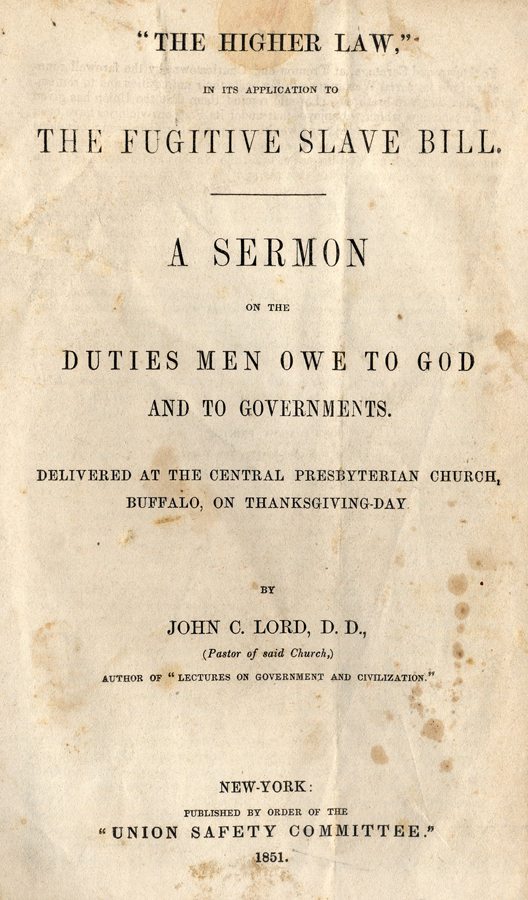

sermon-fugitive-slave-bill-1851

“THE HIGHER LAW”

IN ITS APPLICATION TO

THE FUGITIVE SLAVE BILL.

A SERMON

ON THE

DUTIES MEN OWE TO GOD

AND TO GOVERNMENTS.

DELIVERED AT THE CENTRAL PRESBYTERIAN CHURCH,

BUFFALO, ON THANKSGIVING DAY.

BY
JOHN C. LORD, D. D.,
(Pastor of said Church)
AUTHOR OF “LECTURES ON GOVERNMENT AND CIVILIZATION .”


SERMON

Tell us therefore, What thinkest thou? Is it lawful to give tribute unto Caesar or not? But Jesus perceived their wickedness, and said, Why tempt ye me, ye hypocrites? Show me the tribute money. And they brought unto Him a penny. And He saith unto them, Whose image and superscription? They say unto Him, Caesar’s. Then saith He unto them, Render therefore unto Caesar the things which are Caesar’s; and unto God, the things that are God’s. — Matt. xxii. 17-21.

We are summoned today by the proclamation of the Chief Magistrate of this State, to consider and acknowledge the mercies of God during the year that is past. As individuals, for ourselves, and our households, it becomes us to acknowledge our personal deliverances, and the varied proofs of the Divine goodness which we have experienced since we last assembled to render our annual tribute of praise, prayer, and thanksgiving to Him — “who causeth the outgoings of the morning and the evening to rejoice; who giveth the early and the latter rain’ who appointeth fruitful seasons and abundant harvests; who openeth his hand and satisfieth the desire of every living thing.” As citizens, it concerns us to consider the general prosperity of the State and the Nation, to notice the various tokens of the Divine mercy in regard to the preservation of the free government under which we live, founded by the sacrifices of our pious ancestry and perpetuated, as we may well believe, for this reason, among others, that their “prayers are yet had in remembrance before God, and their tears preserved in his bottle.” As individuals, our presence in this house today is a proof of the personal mercies which should lead us to offer the acceptable sacrifice of praise. Some who once sat with us in this sanctuary have gon to the congregation of the dead; deaf to the requiem which the winds of winter are now mournfully murmuring over their graves insensible to all sounds, until the palsied ear shall hear the “voice of the archangel and the trump of God;” others are upon beds of sickness, pain, and sorrow, and know not whether they shall enter again the house of prayer, to mingle their praises with yours or pass from the couch of suffering to the life to come, to hold the mysteries of the unseen world, and worship with that august thong, that “innumerable company of angels and spirits of just men made perfect,” who fill the arches of Heaven with the voices of praise and thanksgiving ascribing “blessing and honor and dominion and power to Him that setteth upon the throne, and to the Lamb for ever and ever.” Some are full of affliction oppressed with poverty or overwhelmed with reverses, which prevent them from mingling with us in the worship of the sanctuary on this day of thanksgiving : and alas! that it should be so — there are others who are full of prosperity, “whose eyes stick out with fatness, who are not in trouble as other men,” who are so unmindful of their dependence upon Him in “whom they live and move and have their being,” so regardless of all the goodness and mercy of God, tha they never darken the doors of the house of prayer, and never unite in the worship and praise of the Father of mercies. But by our presence in this place today, we are seen to be the witnesses of the Divine goodness, we acknowledge our selves the recipients of unnumbered favors, we propose to offer the sacrifice of thanksgiving, and call upon our souls and all within us to magnify the name of our Father, Preserver, Benefactor, and Redeemer.

But not alone for private and personal mercies should we render thanks today. As citizens of this State, and of the great Republic of which it is the chief member, we are called to consider the preservation of public tranquility the adjustment of sectional difficulties, and the continuance of the bonds of our union, amid excitements which threatened its integrity; amid a storm, the original violence of which is manifest in the clouds which yet muttering in the distance. It is not necessary to adopt the opinions of the extreme alarmists in either section of the country to conclude that great dangers have threatened, if they do not still, threaten, the union of these States. It does not require very great discernment to see that the continued agitation of the vexed question of Slavery, producing alienation and distrust between the North and the South must, in the end, either sever the bonds between the free and the salve states, or render them not worth preserving. A unity maintained by force, if this were possible, would not pay the cost of its keeping. If, in the heat of the existing controversies, these two great sections of the Union come at last to forget their common ancestry, and the mutual perils shared by them in the revolutionary struggle; if South Carolina and Massachusetts, who stood shoulder to shoulder in the doubtful contest for American freedom, come to disregard the voices of their illustrious dead, who lie side by side in every battle-field of the Revolution; if Virginia and New York refuse, in the heats engendered by this unhappy strife, to listen longer to the voice of Washington, warning them in his farewell address of this very rock of sectional jealousy and alienation; if the words of the Father of this country are no longer regarded with reverence in the ancient commonwealth of his birth, or in the great State whose deliverance from a foreign enemy was the crowning achievement of his military career; and if the compromises upon which the Union was consummated, continue to be denied or disregarded there is an end of the confederacy. If the stronger should crush the weaker, and hold on to an apparent union with the grasp of military power, it would no longer be a confederacy but a conquest. When there is no longer mutual respect; no more fraternal forbearance; no more regard for each other’s local interests; no more obedience in one section to the laws which protect the guaranteed rights of the other; the basis of union is wanting, and nothing but a military despotism, with a grasp of iron, and a wall of fire, can hold the discordant elements together.

In the discussions which the recent agitations of the country have originated, grave questions have arisen in regard to the obligation of the citizen to obey the laws which he may disapprove; appeals have been made to a HIGHER LAW, as a justification, not merely of a neglect to aid in enforcing a particular statute, but of an open and forcible resistance by arms. Those subject to the operations of the recent enactment of Congress in regard to fugitive slaves have been counselled from the pulpit, and by men who profess a higher Christianity than others, to carry deadly weapons and shoot down any who should attempt to execute its provisions. The whole community at the North have been excited by passionate appeals to a violent and revolutionary resistance to laws, passed by their own representatives to sustain an express provision of the constitution of the United States, which if defective in their details, are yet clearly within the delegated powers and jurisdiction of our national Legislature. The acknowledged principle that the law of God is supreme, and when in direct conflict with any mere human enactment renders in nugatory, has been used to justify an abandonment of the compromises of the Constitution; an armed resistance to the civil authorities, and a dissolution of that Union with which are inseparably connected our national peace and prosperity. The consideration of the duties which men owe to God, as subjects of his moral government, and which, as citizens, they owe the commonwealth, is at all times of importance, but now of especial interest in view of the agitations of the day. It is high time to determine whether one of the highest duties enforced by the Gospel, obedience to the law of God as supreme, can be made to justify a violent resistance to the late enactment of Congress; whether or Christianity enjoins the dissolution of our Union; whether the advocates of a higher law stand really upon this lofty vantage ground of conscience, or are scattering “firebrands, arrows, and death,” either under a mistaken view of duty, or the impulses of passion and fanaticism, or inflamed by the demagogueism, which, if it cannot rule, would ruin; which, like Milton’s fallen angel, would rather “reign in Hell than serve in Heaven.”

That this subject is not out of place in the pulpit, is manifest from the fact that it is strictly a question of morals. Our duties to God constitute the subject matter of revealed religion, and their enforcement is the great business of the Gospel minister; our duties to government FLOW OUT OUR RELATION TO THE SUPREME GOVERNOR, as well as our relations to each other, and are clearly pointed out and forcibly enjoined in the Gospel. “Put them in mind.” Says an Apostle, “to be subject to principalities and powers; to obey magistrates; to be ready to ever good work:” “Let every soul be subject unto the higher powers; the powers that be are ordained of God.” In the text, we are informed of an attempt made by the Jewish casuists to ensnare our Lord to Caesar; it being supposed by them, that any reply he could make would lead him into difficulty; for the Jews were perpetually galled by the Roman yoke, and any response favoring their oppressors would have aroused their indignation; while, if the lawfulness of tribute were denied by the reply of our Lord, it would have given his enemies ground to accuse him before the authorities, of sowing sedition. If our savior, in response to the question of the lawfulness of tribute, should answer in the affirmative, the Jews would stone him; if in the negative, the Romans would arraign him as a violator of law. He who knows all hearts perceived their wickedness, and said, “Why tempt ye me, ye hypocrites? Show me the tribute money. And they brought unto him a penny. And he said unto them, Whose is this image and superscription? They say unto him Caesar’s. then said he unto them, Render therefore unto Caesar the things which are Caesar’s; and unto God, the things that are God’s.” Well might “they marvel and go their way,” baffled by the answer of divine wisdom. Our Lord escaped their malice by stating the true principle on which the obedience of the citizen is demanded by government, in the legitimate exercise of its powers. The coining of money is an act of sovereignty; the impress of Caesar upon the penny was proof that the Romans possessed the government of Judea, de facto, and were therefore, to be obeyed as the supreme authority in all civil enactments; while any attempt to interfere with the religious principles or practices of the Jews might be conscientiously resisted.

We take the ground, that the action of civil governments within their appropriate jurisdiction is final and conclusive upon the citizen; and that, to plead a higher law to justify disobedience to a human law, the subject matter of which is within the congnizance of the State, is to reject eh authority of God himself; who has committed to governments the power and authority which they exercise in civil affairs. This is expressly declared by the Apostle in the Epistle to the Romans: “Let every soul be subject to the higher powers, for there is no power but of God; the powers that be are ordained of God; whosoever therefore, resisteth the power, resisteth the ordinance of God. For he (that is the civil magistrate) beareth not the sword in vain, for he is the minister of God, a revenger to execute wrath upon him that doeth evil. Wherefore ye must needs be subject, not only for wrath but also for conscience’ sake; render therefore all their dues, tribute to whom tribute is due, custom to whom custom, fear to whom fear, honor to whom honor.”

The language here cannot be misunderstood. Obedience to governments, in the exercise of their legitimate powers, is a religious duty, positively enjoined by God himself. The same authority which commands us to render to God the things which are God’s enjoins us, by the same high sanctions to render unto Caesar the things which are Caesar’s.

The following general principles may be deducted from the sacred Scriptures, and from the example as well as the teachings, of our Lord and his Apostles.

First — Government is a divine constitution, established at the beginning by the Creator, which exists of necessity, and is of perpetual obligation. Men are born under law, both as it respects the Law of God and the enactments of States. By the ordination of the supreme law, they owe allegiance to the country of their birth, and are naturally and unavoidably the subjects of its government; their consent to this is neither asked nor given; their choice can only respect the mode, never the fact of Government. The mutual compact without warrant from the word of God, and contradicted by all the facts in the case. We might as well affirm that men agree to be born, and to be subject to their parents, by a mutual compact, in which the child surrenders certain rights for the sake of parental protection, and the parent covenants to provide and govern on the promise of obedience. The statement in the last case is no more absurd than in the first. In the family is found the rudimental government, and the fifth commandment has always been understood by Christians as ordaining subjection to magistrates as well as parents.

Second — Governments have jurisdiction over men in all affairs which belong peculiarly to the present life; in all the temporal relations which bind societies, communities and families together in respect to all rights of person and property, and their enforcement by penalties. General rules are, indeed, laid down in the Scriptures for the regulation of human conduct, but God has ordained the “powers that be” to appoint their own municipal laws, to regulate and enforce existing relations, and to execute judgment upon offenders, under such form of administration as shall be suitable to the circumstances of the people and chosen by themselves. Governments as to their mode, do not form but follow the character and moral condition of a people, and are an indication of their real condition, intellectually and morally. The idea that the mere change of the form of a despotic government will necessarily elevate a nation, is a mistaken one. A people must be elevated before they can receive free institutions. The mode of government is the index and not the cause of the condition of the different nations of the earth, which may be demonstrated by the history of empires and states, and by the fain efforts, recently made in Europe, to adopt our institutions without the moral training and preparation which can alone make them either possible or valuable. France, today is a despotism under the forms of a free government, and maintains her internal tranquility by a hundred thousand bayonets.

Third — In regard to his own worship, and the manner in which we are to approach Him, the Supreme Governor has given full and minute directions. He has revealed himself, his attributes, and the great principles of his government, which constitute the doctrines of Christianity; and has conferred upon no human authority the right to interfere by adding to or taking from them. IN THE THINGS THAT BELONG TO HIMSELF, God exercises sole and absolute jurisdiction, and has, in regard to them, appointed no inferior or delegated authority.

Fourth — The decisions of governments upon matters within their jurisdiction though they may be erroneous, are yet, from the necessity of the case, absolute. Every man has a right to test the constitutionality of any law by an appeal to the judiciary, but he cannot interpose his private judgment as justification of his resistance to an act of the government. Freedom of opinion by no means involves the right to refuse obedience to law; for, if this were so, the power to declare war and make peace; to regulate commerce and levy taxes; in short, to perform the most essential acts of government, would be a mere nullity. No statue could be executed on this principle, which would leave every man to do what seemed right in his own eyes, under the plea of higher law and a delicate conscience. Even courts of justice, which are the constituted tribunals for ascertaining and determining the validity of all legislative enactment, by bringing them to the test of constitutional law and first principles, as well as for the decision of causes arising under the law in relation to persons and property, may form an erroneous conclusion; for no mere human wisdom is infallible; yet their final decisions are binding, from the same necessity. The fact that an innocent man may be condemned and suffer the penalty of law which he has never broken, might as well be urged to impeach the authority of a judicial decision as that the fallibility which is manifest in hasty and unwise legislation, should be alleged as an excuse for resistance to a particular statute.

The private judgments of individuals, for insurance, that all wars are unlawful, even those which are defensive; or that the existence of slavery is per se, sinful, is no just ground of resistance to the government which declares war, or the legislation which recognizes domestic servitude, and regulates it. Both these subjects are properly within the jurisdiction of civil government. The State may engage in an unjust war, but does this discharge the subject from his allegiance? No sane man will affirm it. the government may recognize an oppressive form of domestic servitude, or enact laws in relation to which are deemed by many oppressive. Is this a just ground of forcible resistance on Christian principles? No intelligent man who regards the authority of the Bible can consistently maintain such a position. Many at the North who assert such opinions have long since rejected the authority of the Word of God and have in their conventions publicly scoffed at divine as well as human authority.

But the position we have taken, that the decisions of governments are final in cases where they have jurisdiction, even when mistaken or oppressive, is not only sustained by the passages which have been cited from the Scriptures, but also by the example and practice of the primitive Christians. The words of our Saviour in the text, and of the Apostle, in his Epistle to the Romans, while they have a general application to all times and all governments, had a particular reference to the existing authorities or Rome, which were not only despotic in their general administration but peculiarly oppressive in their treatment of the infant church. The government under which our Saviour and the Apostles lived, and of which they spake, was habitually engaged in aggressive wars, aiming at the conquest of the world. Slavery was universal throughout the Roman Empire, and the laws gave the master the power of life and death over his servant. Did the Saviour and his Apostles, on this account, reject their authority, or incite their disciples to disobedience and resistance? Did they interfere with existing civil institutions, urging the slave to escape from his master, the citizen to rebel against the magistrate? Their conduct was the exact reverse of this; they preached to the master forbearance and kindness — to the observant submission and obedience — to both, the Gospel. Paul sent Onesimus back to his maser, on the very principles which he enjoined upon the Romans — subjection to existing civil authority. The inspired teachers of Christianity instructed both masters and slaves in regard to the duties which grow out of the institution of Slavery, without either approving or condemning the relation itself. They exhorted Soldiers on the same principle, to be content with their wages, and to forbear from mutiny and cruelty; without offering any opinion concerning the justice or injustice of the Roman wars. They spake indeed of a promised and predicted day, when wars, tumults and oppressions should cease, when at the name of Jesus every knee should bow, and there should be none, any more, to hurt or molest in the Mountain of the lord. The early Christians were, beyond controversy, obedient to the injunction of the Apostle. They obeyed law even when it was onerous or unjust. They had civil and military appointments under the Roman government in which they refused not to serve; they were obedient to the existing civil powers, in all matters within the jurisdiction of the State; they were no abettors of sedition and strife. Whole legions in the armies that were sent out for conquest by Rome, where composed of Christians, who were, doubtless, drawn in the general conscription for this service, and who felt it to be their duty to “render to Caesar the things that are Caesar’s;” however much they might dislike the business of war. Not until Caesar intermeddled with the things of God; not until, passing the legitimate jurisdiction of civil government the Roman magistrate commanded them to adore the image of the Emperor, and to offer incense to false gods; did the Christian refuse obedience. But here he was immovable; no flattery could subdue, no terrors appall him. Every engine of torture, which the barbarous ingenuity of Rome could invent failed of its purpose. They were tortured by fire; they were cast out to wild beasts; they were exposed in the amphitheater to the gaze of thousands, who mocked their dying agonies. Like the ancient prophets, “they were stoned; they were sawn asunder; they were tempted; they were slain with the sword; they wandered in deserts and mountains, in dens and caves of the earth.” It was enough that the Master had said, “render to God the things which are God’s.” Nor was their resistance that of armed and violent men; they assassinated no officers, and excited no seditious, but, after the example of their Lord, suffered with that passive firmness, which is the highest form of courage. But it may be replied to this, Your argument proves too much. You reaffirm the old doctrine of tyrants of passive obedience and non resistance; your position would render all revolutions unlawful; all changes of government impossible. To this it may be said, that it does not belong to the Church in her organized capacity, nor Christians, considered solely as such, and with reference to their religious duties, to revolutionize governments; for this reason, the Gospel is silent on this subject, while enforcing the general duties of the citizens under all governments de facto, whether revolutionary or otherwise; whether despotic or democratic. That, under certain circumstances, the people, by which is meant the large majority, have a right to revolutionize a government, is conceded. Presbyterians have ever resisted the High Church and tory doctrine of the divine right of Kings, in the State; and Prelates, in the Church. They stood, to a man, with the Patriots who achieved under God the independence of our beloved country; they have maintained the principles of civil and religious liberty, at the hazard of life and fortune, in both hemispheres. The Presbyterians of Scotland, and the Puritans of England, were the founders of English liberty, by the admission Hume himself, who hated them with infidel and tory extravagance. The right of a people to select their own form of government, a question entirely distinct from the fact of government, which is of necessity by a Divine Constitution, has ever been maintained by us as existing, not only in the nature of the case, but as warranted by the Word of God; of which, the choice by the Hebrews of a King, and the rejection of their ancient democratic mode of government, which they received from the Supreme Lawgiver himself, is an example. This change was expressly allowed them at their desire, though with a plain intimation that their choice was a bad one. So the revolt of the ten tribes upon the declaration of Rehoboam, that he would govern them in a despotic and arbitrary sway, that “his little finger should be thicker that his father’s loins,” appears afterwards to have been sanctioned by the Most High; who gave them Jeroboam for a King, and rent Israel for every from the house of David and Solomon.

The right of revolution is a civil right, which can be properly exercised only, by a decided majority, under circumstance of aggravated oppression and upon a reasonable assurance of success. It is not for the Church, as such, to determine when a just ground for revolution exists, it belongs to the body of the people in their civil capacity. If, in the judgment, for example, of a great majority of the citizens of the United States, it would be better to abandon our Union; if the South in her exasperation against the North, for interference with her domestic relations, and in the vain hope to secure an increase of wealth and population corresponding with that of the free States, desire disunion; if we of the North are unwilling to observe the guarantees of the Constitution, and think it worth while to abandon the advantages of the confederacy for the sake of making our territory a place of refuge for runaway slaves; the Union will be dissolved by a revolution, the most disastrous the world ever saw. But while the Constitution remains, while the Government, continues let us observe the laws; let us not justify murder and sedition; and least of all, let us not talk of a higher law, which absolves men from obedience to a Constitution which they have sworn to maintain. If there be any higher law, it is the law of resistance and revolution; and the sooner this is understood and openly avowed, by the ultraists and fanatics both North and South, the better for the country. The people of these United States are not likely, with their eyes open, to plunge into the gulf which disunionists are opening up beneath their feet; and when the real designs of these men are seen, when they openly avow that a revolution is the end of their movement, we believe that they will be crushed under the weight of public indignation.

But, in regard to the question of a higher law, which we think we have demonstrated cannot be urged to annul the legislation of a state, in relation to any matter properly with its jurisdiction, it may be further replied, that it is not yet proved that the enactment or recognition of Slavery is within the powers divinely delegated to Governments; that it is against the Supreme Law, and therefore all human legislation on the subject is inoperative and void. To this we reply, in the first place, that there are many evils incident to the fallen condition of our race, such as War and Slavery, the existence of which is to be regretted, but which are necessarily in the actual condition of mankind, the appropriate subjects of municipal regulation. A state involves not only the authority of the Magistrate to punish criminals, but of the expression “he beareth not the sword in vain.” But the state having this right may and do often abuse it by aggressive wars, the injustice of which, we have already seen is no ground of forcible resistance to the civil authority. So the right of legislation in regard to servitude as a punishment for crime, or as a method for disposing of prisoners taken in war, has been exercised any intelligent and fair-minded man. The state having jurisdiction of the subject may, as in the waging of an aggressive war, abuse their power, by enacting unjust and oppressive laws of servitude; but is such legislation therefore inoperative and void? To affirm this, is to contradict the decision of the Apostle in his Epistle to the Romans, and to subvert every established principle, whether human or divine, on which rests the authority of civil government. In certain conditions of society Slavery is universal; it was recognized and regulated by law in all the free states of antiquity; it is the first movement towards civilization by savage and barbarous nations to reduce their captives taken in war, to slavery, instead of subjecting them to torture and death. A recent traveler in the vast Empire of China, Mr. Lay, affirms that in that country the institution of Slavery is a positive blessing, as it prevents infanticide by the poorer classes, and provides for multitudes who must otherwise perish of want. That it exists in a mild form in China is admitted; but the question does not depend upon a comparison of the laws of different countries on this subject, but whether it is a condition of society which can in any case be allowed; whether civil governments have any authority or jurisdiction to enact laws upon the subject, or in any way to recognize or regulate it.

But there is higher authority for the determination of this question, than any thing we have yet suggested. The existence of domestic Slavery was expressly allowed sanctioned and regulated by the Supreme Lawgiver, in that divine economy which He gave the Hebrew state. The fact is open and undisputed; the record and proof of it are in the hands of every man who has in his possession a copy of the Bible. All the ingenuity and art of all the Abolitionists in the United States Can never destroy the necessary conclusion of this admitted divine sanction of Slavery, that it is an institution which may lawfully exist, and concerning which Governments may pass laws, and execute penalties for their evasion or resistance.

To allege that there is a higher law, which makes slavery, per se, sinful, and that all legislation that protects the rights of masters and enjoins the redelivery of the slave, is necessarily void and without authority, and may be conscientiously resisted by arms and violence, is an infidel position which is contradicted by both Testaments; — which may be taught in the gospel of Jean Jacques Rousseau, and in the revelation of the Skeptics and Jacobins, who promised France, half a century ago, universal equality and fraternity; a gospel whose baptism was blood, a revelation whose sacrament was crime; but it cannot be found in the Gospel of Jesus Christ, or in the revelation of God’s will to men. We do not mean to affirm that sincere and conscientious persons may not be found who have persuaded themselves that forcible resistance to slavery is obedience to God; and that in the increased light of the nineteenth century, the example of the Jewish economy, and the teachings and practice of our Lord and the Apostles, are antiquated and of no binding force upon the consciences of men. Such honest but mistaken persons should remember, that if the institution of slavery is necessarily and from it’s nature sinful now, it must always have been so; as universal principles admit of no change, and their argument is, therefore, an impeachment of the benevolence of God, and a denial of the supreme authority of the Gospel, as a system of ethics. They must, to sustain their position, assume that we are wiser and better men than the Saviour and the Apostles, and that the government of God and the Gospel need revision and emendation. Such a conclusion is inevitable from the premises, and I would affectionately warn all who have named the name of Christ, and who have been betrayed by passion or sympathy into such a position to see to it before they take the inevitable plunge, with the Garrison school, into the gulf of infidelity. I would respectfully entreat them to remember that this is not the first proclamation, “Lo, here is Christ, or there,” which has proved a device of the adversary; that Jacobins, Fourierites, Communists, and Levellers of all sorts, reject the Gospel on the ground that it does not come up to their standard of liberty, equality and fraternity, and has no sufficiently comprehensive views of the rights of man. Those who preach the Gospel ought specially to remember that our race are apostate, and live under a remedial government; and that is our mission to deal with the world as it is, and men as we find them, just as did the Saviour and the Apostles — remembering that here we have no continuing city,” and that the Gospel does not propose to us an equalization of human conditions in time; that “there remaineth a rest for the people of God,” and to this, the Master of life and his Apostles pointed the rich and the poor, the high and the low, the bond and the free. They made it no part of their work to array the prejudices of one class against another; to discontent the slave with his position; or the citizen with the government; but treated all these things as of inferior consideration, compared with the hope of another and a better life, through the blood of atonement.

The comparative mildness of Hebrew slavery which is alleged, if it were true, is of no moment in the decision of the question before us; for it is not, whether American legislation on this subject be unwise and unjust, but whether the institution of slavery is necessarily sinful, and all legislation on the subject void for want of jurisdiction, and because of a higher law that prohibits its existence.

Domestic slavery, in this country, is older than the Constitution; it had existed for several generations before the Revolution. The people of the North, in their union with the slave States under a General Government upon the adoption of a common Constitution, bound themselves to respect the institution of slavery as it then existed, so far as to deliver up fugitives to their masters. What has been said proves, we think, that such an arrangement was not void as being against a higher law, and consequently any legislation, by Congress, which fairly carries out this provision, and enforces this guarantee, is constitutional and lawful, and cannot be resisted upon any moral grounds. Whether the law is the best or the worst that could have been devised, is not the question here, nor is it really the question with the country; for it is the recognition of Slavery by the Constitution, and the right of recapture which it confers, which lies at the bottom of this agitation; all the rest is merely for effect, vox et preterea nihil [voice and nothing more], and those who recommend the violation of this law, would undoubtedly advise resistance to any enactment of Congress which would carry out the provision of the Constitution for the restoration of fugitive slaves.

It is somewhat singular that those whose consciences have been so much aroused in regard to a higher law that the constitution, should have forgotten in their contemplation of moral and religious questions, that the observance of the compact between the North and the South falls within the moral rule which enjoins good faith, honesty, and integrity among men. Until this compact is rescinded by the power that made it, and by the parties who assented to it, its fulfilment is required by every principle of common honesty. With what pretence of right can the North say to the South, we will hold you to your part of the bargain; you must remain in the Union, but we have conscientious scruples in regard to performing our part of the agreement. Is this language of good faith and integrity? Would it be thought honest in any private transaction or compact? Is it for those who threaten the South with force in case of their resistance of Constitutional enactments — who are themselves advocating the violation of the laws which protect the rights secured to the slave States by the Constitution — to talk about higher laws and sensitive consciences? Does the assertion, so often made, that there is no danger of disunion if the law of recapture if violated; that the south are not strong enough to set up for themselves; that they need the protection of the North to prevent a servile insurrection, add any thing to the moral beauty of this position What is this but the divine right of lawless force, the higher law of the strongest? What is this but a disavowal of all regard for the claims of the weak? In the words of a Highland song of the olden time,

“For why? because the good old rule
Sufficeth them; the simple plan,
That they must get who have the power,
And they must keep who can.”

May Vermont be permitted to pass laws to evade and prevent the execution of the legislation of Congress, and south Carolina threatened with investment by sea and land, by the army and navy of the United States, for doing the same thing? Is this good faith between sovereign States? Nay, is it common honesty among men? “I speak to wise men, judge ye!”

If we are comparatively so much stronger than the South, as is alleged, is it magnanimous, is it just, for us to take advantage of their weakness to violate their constitutional rights? If they look upon the greater prosperity of the North with a degree of jealousy, and are the more sensitive on that account upon any appearance of a disregard, on our part, of the guarantees of the constitution, there is the more reason for our forbearance; especially when it is considered that in the very formation of the Union, there was an implied understanding that good will and forbearance should characterize the intercourse of the parties; “that “Ephraim should not vex Judah; or Judah, Ephraim” Why should the Saxon obstinacy of the North and the Norman pride of the South be forever excited by these unhappy disputes in regard to slavery; a question which time, and patience, and God’s providence can alone resolve? The South are not so dependent upon us as we imagine; in the case of a servile insurrection they would hardly look for aid, in the present state of things, from the North, and our constant allegations of their weakness constitute one ground of their dissatisfaction; and one temptation to a separation, that they may prove to the North and the World that they can take care of themselves. They have the old Norman temper; the blood o the Cavalier predominates over that of the Puritan in the southern States, and they would rather see their territory desolated with fire and sword than yield a single point of honor — than to feel, much less to acknowledge, that they are dependent upon then North for protection against their own slaves. It is evident that the great body of the people at the South are attached to the Union, and will not readily yield it; but it is equally manifest that they have demagogues and traitors there, who desire to exercise dominion and lordship in a Southern Confederacy that shall extend from Virginia to Cuba; who, like some at the North would rather be Presidents and Secretaries by a division of the country, than to be out of office by its continued union.

If such men would boldly announce their design if they would form an anti-union party, and present this question of a revolution in our government and abandonment of our Constitution before the people, it would go far to dissipate the danger which threatens the Republic, and to quiet the perpetual agitations that are wearing out the strong bands that hold us together. For whatever allegations may be made that there is no danger of disunion; whatever cries of “peace, peace” may be reiterated by men who are doing what they can to nullify their own predictions; we may be assured there is treachery and danger all around us. The separation of large communions of Christians into Northern and Southern Churches was one of the first signs of evil omen to the country. But two of the leading Protestant denomination remained united. 1 I thank God that one of them is the Presbyterian Church, who are still one in form and fact, in heart and spirit from New York to New Orleans from the Atlantic to the Pacific, having long since met this question and settled it, finally and peacefully, upon Gospel principles. The constant agitation of the slavery question at the North, the untenable positions assumed, the fierce denunciations, the bitter revilings, the contumelious epithets which have been heaped upon our Southern brethren and all who would not consent to unite in a crusade against them, are producing their legitimate fruits of alienation, distrust, and hatred. If no positive proof exists of a conspiracy among certain hot-headed and ambitious demagogues at the South, to dismember the Union; that a Southern Confederacy may be formed which will make them all great men; yet, it is manifest that such a design has been formed, either with or without concert, among a class of abstractionists there, who are cooperating with the abolitionists, at the North to agitate and inflame the public mind, until a revolution is inevitable. The recent settlement of the vexed sectional questions, which was hailed by the country with confidence and hope, is sought to be disturbed not only by denunciation, but by a violent resistance of the laws enacted, and this, too, before sufficient time has elapsed to test them. Every kind of phantom is conjured up; visions of free men forcibly hurried into slavery; appalling pictures of cruelty and injustice are continually exciting the public mind; though but six captures are said to have been made under the fugitive slave law since its passage, and with two exceptions it is believed the alleged fugitives have been discharged or redeemed. If those who harrow up the sensibilities of innocent and ignorant persons by these dreadful imaginations, are sincere in the fears which they express that free persons of color are likely to be enslaved by the existing law, it shows how utterly fanaticism disregards fact; if they are opposed to the redelivery of fugitive slaves under the provision of the Constitution, the only honest position they can take is to declare at once and openly for a dissolution of the Union, or the subjugation of the South, by force of arms, to the North.

Before we leave this subject, we ought to notice the probable results of a dissolution of the Union. What its advantages have been, are matters of history and experience. Under God, the Union has made us a great and prosperous people. We have maintained peace at home and commanded respect abroad; our country has been the asylum of the oppressed of every land, the permanency of our institutions has been hailed as the last hope of freedom for the world. Every State has preserved its local sovereignty, while obedient to the general law. Every citizen has enjoyed the largest liberty consistent with the preservation of order, and dwelt under his “own vine and fig tree, with none to molest him or make him afraid.” We may say with the Psalmist, “the lines have fallen unto us in pleasant places, and God has given us a goodly heritage.”

On the other hand, all the disastrous consequences which must flow from disunion, are known only to Him who sees the end from the beginning. One thing is certain, no benefit can flow from a separation of the States, to that unhappy race about whom this whole controversy exists. No possible or conceivable advantage can arise to them if the Union were sundered tomorrow. Their condition at the North would not be improved, their state at the South would be rendered so far worse, as an increased severity of legislation might be required to prevent their escape to an enemy’s frontier. If a small increase of the number of those who escape to the North should be secured, which is doubtful, the question arises, and it is a grave and unsettled one, whether their residence with us is a substantial improvement of their condition. The forms of freedom are of little consequence to him who is made by color and caste a “hewer of wood and a drawer of water.” That the colored race are capable of elevation I have always maintained — just as capable as the white, if they can be made to possess the same advantage; but I am fully persuaded that colonization can alone secure those advantages and give to the African that which alone makes personal freedom and free institutions valuable. In any view of the subject, the agitations and divisions of a country on the question of slavery, and the revolution which may result from them, are of no conceivable consequence to those about whose interest the controversy exists. A more unprofitable and inconsequential abstraction was never before made to disturb the peace, and hazard the existence of a great Empire.

With reference to the positive evils of a revolution, it is the opinion of the most profound statesmen in the country, that a division of the Union must result in a perpetual war between the two sections. This agrees with all the facts of History, and the conclusions of the most profound observation upon human nature. Peace would be impossible under these circumstances. A line of fire would mark the boundary between the free and slave States, from the Atlantic to the Mississippi to the Pacific. The blackened roof trees of all human habitations, for miles on either side of this accursed line, would demonstrate the bitterness of a conflict between men of the same blood, and verify the declaration of Scripture that “the contentions of brethren are like the bars of a castle.” Across the entire continent the boundaries of the two governments would be marked by conflagration, rapine and violence. Armed plunderers, with whom war would be the excuse for murder and robbery, would make a desert of the country adjacent on either side, which would soon be known over the whole world by two names. ACELDAMA and GOLGOTHA, a field of blood — a place of skulls. There are no visionaries so wild as those who dream that this vast Empire can be disunited peacefully, or that peace can ever be maintained between the North and the South, under separate governments, with all the old memories, the bitter prejudices, the unavoidable rivalries, the unceasing disputes of jurisdiction, with the mouth of the Mississippi in one territory and its sources in the other, and with the ominous slave question embittered a thousand-fold by the dismemberment of the country. If, in this unnatural contest, the North should prevail over the South, it would be making a desert of the territory from the Potomac to the Gulf of Mexico, and by the destruction of both the races who now occupy it; a victory barren of glory — the jest of tyrants, and the scorn of the world.

But the spirit of disunion, once evoked, may extend its malign influences until, the supposition, having accomplished the ruin of the South, the states at the North should divide and set up for itself, and like the petty governments, or rather anarchies, of South America, command neither respect abroad nor obedience at home.

The beginnings of strife are like the letting out of waters, and to this miserable conclusion at last, these unhappy divisions may bring us. It is an old adage, that those whom God would destroy he first makes mad; and it would seem that nothing short of judicial blindness can lead into the further agitation of a question fraught with ruin to our beloved country, and to the hopes of political freedom over the entire globe. The dismemberment of this country will be the death-blow of its prosperity. Our rights will be no more regarded abroad or our laws at home, for our strength will be exhausted in our domestic wars; property both at the North and South, will immediately and decidedly depreciate in value; all confidence in the stability of grave of the American Constitution. Worst of all , this disastrous event will have been brought about by no foreign war, by no struggle with the civil or religious despotisms of the world; by no honorable resistance to foreign interference; but by the madness of men ready to sacrifice to one idea, and that an impracticable one, to one principle, and that a false one the legacy of Freedom and Union which we hold from our fathers, and which we are bound to transmit to our children every consideration of patriotism by every obligation of religion; and failing to do which, both earth and Heaven will cry out against us, as false to the trust committed to us by our noble ancestry; false to our allegiance and our oaths; false to our children and posterity ; false to our religion and to God, who has committed to our keeping the ark of civil and religious liberty, for the benefit of our race, to be held as a sacred deposit for the world. The plea of sympathy with the colored race, in view of their degraded condition, however suitable such sympathy may be, and demanded by Him who hath made of one blood all nations and races, to dwell together on the face of the earth, will never avail to justify an agitation which is useless to them and ruinous to us. A man who should expose a whole community to destruction, under the plea of delivering one of its members from servitude, or who should fire his neighbor’s dwelling for the same purpose, at the risk of a conflagration which must consume both master and slave, and even expose his own house and his own children to a miserable death, could hardly be counted a philanthropist, or find a justification of his conduct in any abstract question of human rights. I would that I had a voice to penetrate every habitation in this great Empire, to reach every ear from ocean to ocean, from Maine to Florida — to entreat my countrymen to pause from a controversy from which there will soon be no retreat, and of which, if protracted, there can be but one issue — the dissolution of the Union and the ruin of the Republic. By their duty to God and the Government, I would implore them to the obedient to the laws; by their regard for their children, by their respect for the interests of our common humanity, I would beseech them to take care of the Commonwealth, than which there is no higher law for the Christian citizen. I would appeal to the North and the South, by their common ancestry, by the august memories of the revolutionary struggle, by the bones of their fathers which lie mingled together at Yorktown and Saratoga, at Trenton and Charlestown, by the farewell counsels of the immortal Washington, to lay aside their animosities and to remember that they are brethren. I would remind them that the Union has given us the blessings which we enjoy — that under its Flag our victories have been won; our borders extended; our wealth and population increased; our ships respected in every port of every sea, until our national progress has excited the admiration or aroused the envy, of all the Nations and Potentates of the earth. I would warn them of that abyss of ruin which fanaticism and treason are opening beneath them; into which they would plunge our present fortunes and our future hopes,. I would beseech them to stand by the Union to obey the laws, to frown upon agitation, in this crisis of our beloved country. I would admonish them that failing to do this, failing to sustain the free institutions, and to regard the mutual compacts which we received from our fathers, we may expect as a consequence the curses of posterity, the contempt of the world, and the judgments of God. May the Ruler of nations avert from us these impending calamities. May the Holy Trinity, in whom our fathers trusted, gibe us, a s a people, the spirit of wisdom and understanding and of sound mine. May we hereafter on occasions like the present have a new motive of thanksgiving and praise in the proofs of the peaceful settlement of all sectional controversies — in the fact that the Ship of State, long tossed by tempests and threatened with destruction by conflicting and angry elements, is at last sailing in a calms sea, with a law-abiding crew. AND THE FLAG OF THE UNION NAILED TO HER MASTS.


Endnotes

1 The Protestant Episcopal and the Presbyterian.

Sermon – Christmas – 1838


Joseph Dow preached this sermon in Hampton, NH on Christmas Day, 1838.


sermon-christmas-1838

AN

HISTORICAL ADDRESS,

DELIVERED AT HAMPTON, NEW-HAMPSHIRE,

ON THE 25TH OF DECEMBER

1838,

IN COMMEMORATION OF THE SETTLEMENT OF THAT TOWN:

TWO HUNDRED YEARS

HAVING ELAPSED SINCE THAT EVENT.

BY
JOSEPH DOW, A. M.


ADDRESS.
As in the life of every individual, so likewise in the history of every community, there are seasons of more than ordinary interest. There are occasions, where not only individuals, but whole communities, are forcibly reminded of the rapid flight of time, and of the changes effected in a series of years. These changes are not confined to any one class of objects. They may be predicted of almost every thing around us. Many of them are so gradual, that, when viewed in relation to two successive days, they are wholly imperceptible; but they are, on this account, no less real. The countenance of a friend, whom we see every day, appears to undergo but little alteration while he is in health; but let us meet him after an absence of several years,, and the change, though no greater than before, is very apparent.

On one of those interesting occasions, when our thoughts are busy with the past, and when they also run forward to scan the events of futurity, we have this day assembled. Two hundred years have passed away since the settlement of our town was commenced, and the church that worships in this house, organized. Our thoughts revert to that period, and, in our imaginations, we hear the forests of Winnicumet, echoing, for the first time, with the sounds of civilized life. In the character and the fortunes of the little band that then came hither, we feel a deep interest, for they were our ancestors.

My object in the following remarks, will be, to give a brief account of the settlement of the town; to notice some of the more important transactions of the people, in the infancy of the settlement; to exhibit, however imperfectly, their trials, dangers, and sufferings; and then to trace, in a cursory manner, the history of the first church, through a period of two centuries.

The first permanent settlement in New-England was made near the close of the year 1620.

On the 10th day of August, 1622, a grant was made, by the Council of Plymouth, to Sir Ferdinando Gorges, and Captain John Mason, jointly, of all the land lying between the rivers Merrimack on Sagadehock, now the Androscoggin,–extending back to the great lakes and the river of Canada. This tract was called Laconia, and it was the first grant in which the territory of Hampton was included.

The next year a settlement was commenced near the mouth of the Piscataqua, and another further up the river, at the place which subsequently received the name of Dover.

The principle object in the formation of these settlements, both of which were commenced under the patronage of Gorges, Mason, and several English merchants, styled the “Company of Laconia,” was to carry on the fishing business, which, it was thought, would prove very lucrative.

May 17, 1629, a Deed is said to have been given by certain Indian chiefs, assembled at Swamscot falls, now Exeter, to Rev. John Whelewright and others, conveying to them, for what was deemed an equivalent, all the land along the coast, between the Merrimack and the Piscataqua rivers, and extending back to a considerable distance into the country. In this tract our own territory was evidently embraced.

Recently, however, the authenticity of this Deed has been denied, though it is admitted that Whelewright, several years afterwards, purchased of the Indians all the land lying within a considerable distance of Swamscot falls. A similar course was probably pursued by those who formed the first settlement in this place.

On the 7thday of November, 1629, the Council of Plymouth made a new grant to Captain Mason, of a tract of land “from the middle of Piscataqua river, and up the same to the farthest head thereof, and from thence north-westward, until sixty miles from the mouth of the harbor were finished; also through Merrimack river, to the farthest head thereof, and so forward up into the land westward, until sixty miles were finished; and from thence to cross over land to the end of the sixty miles as counted from Piscataqua river; together with all islands within five leagues of the coast.” This tract was called New-Hampshire, and it included the whole of Whelewright’s purchase, if such a purchase was ever made, and a part of the land previously granted to Massachusetts, as by the charter of that colony its territory extended three miles north of the Merrimack.

By other arrangements, made in 1630 and 1631, the settlements on the Piscataqua were divided into two parts, called the upper and the lower plantations. Captain Thomas Wiggen was appointed agent for the former, and Captain Walter Neal for the latter, which extended as far south as the stream called Little river, in the eastern part of North-Hampton.

In 1633 these two agents united in surveying their respective patents, and in laying out the towns of Portsmouth, Northam, afterwards called Dover—and Hampton; though no settlement had at that time been made at the place last mentioned.

Dr. Belknap sys, that this survey was made by order of the company of Laconia, and that these towns, together with Exeter, were named by that company. Hampton was, however, incorporated by is present name at the request of the first pastor of the church established here. Whether he chose the name in conformity to the wishes of the company of Laconia, I cannot tell.

I have been thus particular in noticing the different grants that were made of the same territory, as they gave rise to much subsequent litigation and expense, by which this town, as well as others, was exceedingly harassed.

In 1636 the General Court of Massachusetts authorized two persons, Mr. Dummer and Mr. Spencer, to erect a house at Hampton, which was then called by its Indian name, Winnicumet. A house was accordingly built by Nicholas Easton, under the direction of the two persons just mentioned, and at the expense of the Colony of Massachusetts. This house was called the Bound House, although, as Dr. Belknap observes, it was intended as a mark of possession rather than of limit.

There is no evidence that a settlement was actually made here, till two years afterwards. For what purpose, then, was the Bound House erected?

The General Court had learned, that there were in this vicinity extensive salt-marshes. These must, at that time, have been very valuable, as the upland had not been brought to such a state of cultivation as to afford a sufficient quantity of hay to winter the stock which might be kept through the summer. The court wished to secure these marshes, and, by causing a house to be erected near them, at the expense of the Colony, they virtually claimed jurisdiction over them. It was, perhaps, for the purpose of asserting such a jurisdiction, that they adopted this measure.

On what grounds could the General Court claim jurisdiction here? The chartered limits of Massachusetts extended only three miles north of the Merrimack; but the Bound House was probably much farther from that river.

That they did set up such a claim, is evident from the fact that they soon after made a formal grant of the territory to the company that actually formed a settlement here.

By a plain, natural construction of the meaning of their character, this place was, undoubtedly, beyond their limits, while it was evidently included in the grant made to Captain Mason. The charters, however, that were given by the Council of Plymouth, and also those granted by the Crown, were often worded with too little care. Sometimes, unquestionably, this arose from a want of sufficient geographical information concerning the portions of country granted, and, at other times, from sheer carelessness.

In this case, the grant to Massachusetts was of land reaching to “three miles north of the Merrimack river, and of every part of it.” Now, though that river is more than three miles south of this place, yet, if we trace it up to its source, we shall find, that it rises much farther to the north than we are, and Massachusetts claimed the land to our east and west line, passing through a point three miles north of the most northerly part of the river.

Such a construction of their charter would give the people of that Colony all the land granted to Mason, and a large part of Maine, which had been granted to Gorges; thus rendering the claims of these two gentlemen null and void, as the grants to them were made after that to Massachusetts.

The agent of Mason’s estate made some objections to the claims and the proceedings of Massachusetts, yet no legal method was taken to controvert this extension of their claim; and, as the historian of New-Hampshire very justly observes, “the way was prepared for one still greater, which many circumstances concurred to establish.”

In 1638 a petition was presented to the General Court of Massachusetts, by a number of people, chiefly from Norfolk in England, praying for permission to settle at Winnicumet. On the 7th of October their request was granted. Few privileges, however, were allowed besides that of forming a settlement. In the language of the early records of our town, “the power of managing the affairs thereof was not then yielded to them, but committed by the court to” three gentlemen, not belonging to the settlement, “so as nothing might be done without the allowance of them, or two of them.” 1

It was not till the 7th of June, 1639, that the plantation was allowed to be a town, and to choose a constable and other officers, and, as our records state, “to make orders for the well ordering of the town, and to send a deputy to the court.” Even then the power of laying out land was not granted to the town, but was left to the three gentlemen to whom I have already alluded.

At that time three men belonging to the town, viz. Christopher Hussey, William Palmer, and Richard Swaine, were appointed by the General Court, as commissioners, or justices, to have jurisdiction over all causes of twenty shillings, or under.

On the 4th day of September, in the same year, at the request of Rev. Stephen Bachelor, the name of the town was changed from Winnicumet to Hampton, and about the same time, through the influence of their deputy, the right of disposing of the land, and laying it out, was vested in the town.

The number of the original settlers was fifty-six. Rev. Dr. Appleton, in his dedication sermon, preached in 1797, says, “of the names of the first settlers of Hampton, only sixteen are transmitted to us; and but four of these names continue in the place.” 2 The same four names are still found among us, though one of them will probably soon become extinct, as it is now borne by only two individuals, both of them aged females.

The names of the sixteen persons referred to by Dr. Appleton are given in the first volume of Belknp’s History of New-Hampshire. In that list the name of only one female is found, and it is probable that most of the other settlers were members of the families of these sixteen.

Though the number of settlers was at first only fifty-six, yet large additions were soon made. At the time when the settlement became a town, the number of inhabitants had very much increased. Indeed, a writer who lived and wrote about that time, says that in 1639 there were about sixty families here. 3 It has been supposed that this writer stated the number larger than it really was. There are, however, reasons for believing that his statement is not far from the truth. In the record of the proceedings at a town meeting, early in the following year, more than sixty individuals are mentioned; and it is probable, from the great diversity of their names, that they belonged to nearly as many different families.

The historian of New-Hampshire says, that the people here began the settlement by laying out the township into one hundred and forty-seven shares. Others, relying upon him as authority, have repeated the statement. Our records, however, furnish an abundance of evidence that it is incorrect; and had Dr. Belknap, in this instance, exercised his usual caution, he would not have been led into such an error. The transaction which probably gave rise to this remark, did not occur till more than seven years after the settlement was commenced, and, even at that time, there was a division of only a small portion of the land within the limits of the township.

The course the people really pursued was far different from that which has so often been imputed to them. Soon after they were allowed the privileges of freemen, they began to exercise them. The first town meeting, of which any record remains, was held October 31, 1639. William Wakefield was chosen town clerk. The freemen, instead of proceeding to lay out the township into any definite number of shares, appointed a committee, whose duty it should be, for the space of one year, “to measure, lay forth, and bound all such lots as should be granted by the freemen there.” The compensation allowed this committee, was twelve shillings for laying out a house lot, and in ordinary cases, one penny an acre for all other land they might survey.

Only one other article was acted upon at this meeting. The object of that was to secure the seasonable attendance of the freemen at town meetings. A vote was passed, imposing a fine of one shilling on each freeman, who, having had due notice of the meeting, should not be at the place designated, within half an hour of the time appointed.

On other occasions, similar votes were passed, and rules were adopted to secure order and regularity, when the people were assembled in town meeting. I will mention the substance of several regulations made in 1641.

At the close of each meeting, a moderator was to be chosen, to preside at the next meeting.

Every meeting was to be opened and closed with prayer by the moderator, unless one of the ministers were present, upon whom he might call to lead in that exercise.

After the prayer at the opening of the meeting, the names of the freemen were to be called, and the absentees noted, by the town clerk.

The moderator was then “to make way for propositions” to be considered at the meeting. In doing this, he might propose any business himself, or he might call upon others to mention subjects to be acted upon.

When any person wished to speak in the meeting, he was to do it standing, and having his head uncovered.

When an individual was speaking in an orderly manner, no other one was to be allowed to speak without permission; and no person was to be permitted to speak, at any meeting, more than twice, or three times at most, on the same subject.

When any article of business had been proposed, it was to be disposed of before any other business could be introduced.

Penalties were to be exacted for every violation of any of these rules.

December 24, 1639, grants of land, to the amount of 2,160 acres, were made to 13 persons, in parcels, varying from eighty acres to three hundred. These were merely grants of a certain number of acres, without determining where the different lots should be located. The locations were fixed at subsequent meetings.

It is worthy of notice, that the persons who were regarded as the principal men in the town, received grants of the largest tracts of land, and so uniformly was this the case in regard to those individuals whose rank is known, that we may probably judge, with a considerable degree of accuracy, concerning the standing of others, by the grants made to them. In making the grants just mentioned, the records inform us, that “respect was had, partly to estates, partly to charges, and partly to other things.”

Town meetings were frequently holden, at which, in addition to the election of the necessary town officers, the making of regulations for the government of the people, the laying out of highways, and the transaction of such business as ordinarily comes before town meetings, at the present day, the people by vote, admitted persons to enjoy the privileges of freemen, and, from time to time, made such grants of land as they thought proper.

We come now to the transaction, alleged to have been a division of the town into 147 shares. It took place on the 23d of the 12th month, 1645; that is, according to the method of reckoning time, afterwards adopted, in February, 1646. At that time the town having previously disposed of a large portion of the land that had been surveyed, agreed to reserve 200 acres to be disposed of afterwards, and to divide the remaining part of the commons into 147 shares, and to distribute it among persons, most or all of whom had received previous grants.

There is some uncertainty as to the extent that was intended to be given to this order. It is certain that it was not designed to include all the land within the township, which had not already been disposed of, as large tracts were afterwards ordered to be laid out, and others were granted to individuals at different times. The probability is, that it was intended to embrace only such parts of the town as had been actually surveyed, but had not been granted to individuals. 4

Six years after this transaction, it was determined at a public town meeting, that the great Ox-Common, lying near the Great Boar’s Head, “should be shared to each man according as it would hold out.” It appears from the records, that in conformity to this order the common was divided into about seventy-five shares, and distributed among a portion of the people; most of those to whom any part was granted, received one share each, though a few individuals received two, or even three shares apiece.

Four years afterward, Sargent’s Island was appropriated to the use of fishermen, for the purpose of building stages and other things necessary in curing fish. There was in the grant, however, a promise, that, if the island should be deserted by fishermen, it should still remain at the town’s disposal. On the 9th of June, 1663, it was voted in town meeting, that the land in the west part of the town should be laid out to the amount of four thousand acres, extending through the whole breadth of the town along its western boundary. Subsequently it was determined that this land should be laid out, partly in hares of 80 acres each, and partly in shares of 100 acres each.

About a year afterwards, it was agreed, that each one of the inhabitants of the town, who would assure the selectmen that he should settle on these lands within twelve months, should be entitled to twenty acres for a house lot.

This land was called the New Plantation, and it extended from Salisbury to Exeter, and of course was a part of land now embraced in three or four towns.

I have mentioned these instances of grants and of laying out land, merely as a specimen of the course which our forefathers pursued. 5

When the settlement was in its infancy, it would have been very much exposed to injury if no precautions had been taken in regard to receiving inhabitants. Mischievous and disorderly persons might have come in and harassed the settlers. This was foreseen, and measures were taken to prevent it. The power of admitting inhabitants and of granting them the privileges of freemen, was strictly guarded. After the town was once organized, none were admitted from abroad without the permission of the freemen. It was voted, “that no manner of person should come into the town as an inhabitant, without the consent of the town, under the penalty of twenty shillings per week, unless he give satisfactory security to the town.”

On different occasions, votes were passed to prohibit the selectmen from admitting inhabitants. I will cite several of these, nearly in the words of the Town Records, as they will serve to show the course that was taken in regard to the subject.

The first vote of this kind, on record, is dated on the 6th of the 10th month, 1639, and is as follows:–

“Liberty is given to William Fuller of Ipswich, upon request, to come and sit down here as a planter and smith, in case he bring a certificate of approbation from the elders.”

“On the 25th of the 9th month, 1654.—By an act of the town, Thomas Downes, shoemaker, is admitted an inhabitant, who is to make and mend shoes for the town, upon fair and reasonable terms.”

“May 22, 1663. Thomas Parker, shoemaker, desiring liberty to come into the town and follow his trade of shoemaking, liberty accordingly is granted him by the town.” Ten men, however, dissented from this vote.

On the 8th of the 10th month, 1662, an order of the town was passed determining who should be regarded as inhabitants. It runs thus:–“It is acted and ordered, that henceforth no man shall be judged an inhabitant in this town, nor have power or liberty to act in town affairs, or have privilege of common-age, at least, according to the first division, and land to build upon.”

The sources of some of the troubles and perplexities of the early settlers, will next claim our attention. They were harassed by wild beasts, and by lawless men. No wonder, indeed, that they were troubled by the former. Until the English settlements were formed, the wild beasts had been free to range the country, their right undisputed, and themselves unmolested, except occasionally by the Indian hunter. It could hardly be expected that they would tamely yield to the new settlers, and acknowledge their right of jurisdiction over them. Though they did not often attack the people, yet they showed less respect for their herds and flocks. It then early became an object with the people to destroy such beasts as were found to be troublesome. Perhaps none annoyed them more than the wolves; and bounties were offered by the town, as an inducement for killing them.

In January, 1645, a bounty of ten shillings was offered for each wolf that might be killed in the town. 6 Nine years afterwards the bounty was increased to forty shillings. In 1658 it was raised to five pounds.

In 1663 a bounty of twenty shillings was likewise offered for each bear killed within the limits of the town.

The settlers were also troubled by disorderly persons. Depredations were often made upon the common lands owned by the town. The making of staves appears to have been a profitable employment, and some persons, who were engaged in this business, were not very scrupulous in regard to the means employed to procure timber. Wherever they could find any, that was suitable for staves, they took it, without inquiring to whom it belonged. The very best of the timber was thus, in many instances, taken from the commons. The town adopted various expedients to prevent such acts, but still depredations continued to be committed.

In some instances, persons, whom the town had never admitted as inhabitants, settled on the public lands. In other cases, difficulties occurred, and disputes arose, in consequence of the boundaries of the town not being well defined. There were disputes of this kind with Salisbury, and with Portsmouth.

The township extended so far north as to include a portion of the present town of Rye, and near the northern limit several persons settled without permission from the town. One of the most resolute and stubborn of them was John Locke, who settled at Jocelyn’s,–now Locke’s,–Neck. He was ordered to leave the town, but seems not to have regarded the order; and at length, a committee was chosen at a public town meeting, to go and pull up Locke’s fence, and give him notice not to meddle further with the town’s property. The difficulty with him was not settled till he, having expressed a willingness to demean himself peaceably as a citizen, was received as an inhabitant, by a vote of the town.

In speaking of the trials of our forefathers, it would be inexcusable to pass over in silence the dangers and the sufferings which resulted from the hostility of the Indians. It is uncertain how soon after the first settlement of the town they began to manifest their hostility. It is, however, evident that it was at a very early period.

In the latter part of the year 1640, the town passed a vote in relation to a watch-house, appropriating the meeting-house porch to this purpose, temporarily, till another could be procured. The object of providing a watch-house is not, indeed, stated, but we can hardly conceive of any object, unless fears were entertained from Indian hostility. That such was really the case will appear probable, if we compare this vote of the town with another passed several years afterward, at a time when it is well known that most of the settlements in this vicinity were exceedingly harassed by the Indians. The selectmen were then ordered “to build a convenient watch-house, and to provide powder, balls, watches, flints, and what else the law requires, for a town stock for the soldiers.”

Trainings were also ordered at an early period. Our records mention one that was appointed by the officers to be held on the 18th of May, 1641. Whether military duty was required by the town, or enjoined by the government of Massachusetts, is not of consequence. In either case, it shows that danger was apprehended from some source or other; but whence, except from the Indians, could the early settlers in this section of our country anticipate danger, which might be repelled by force of arms?

On the 8th of July, 1689, a vote was passed, very explicit, in regard to the town’s apprehension of danger from the Indians. The vote is as follows:–“That all those who are willing to make a fortification about the meeting-house, to secure themselves and their families from the violence of the heathen, shall have free liberty to do it.”

A fortification was accordingly built around the meeting-house, distinct traces of which remained till the academy was removed, a few years ago, to the spot it now occupies, and the land around it ploughed. I believe that, even now, a small portion of the mound may be seen, just without the east side of the academy yard.

May 17, 1692, it was voted to extend the line of this fortification, so as to enclose more space, and liberty was given “to build houses in it according to custom in other forts.”

At the same time it was voted to build within the fort, at the town’s expense, a house 14 by 16 feet, for the use of the minister, and that, when he made no use of it, it should be improved as a school-house.

About a year previous to the transaction just named, “it was voted that a committee should be chosen to agree with, and to send out two men as scouts, to see what they could discover of the enemy, so long as they could go upon the snow, or so long as the neighboring towns sent out.”

A distinguished historian says of a period a little subsequent to this, that “the state of the country at this time was truly distressed: a large quota of their best men were abroad, the rest harassed by the enemy at home, obliged to do continual duty in garrisons, and in scouts, and subject to severe discipline for neglects. They earned their bread at the continual hazard of their lies, never daring to stir abroad unarmed; they could till no lands but what were within call of the garrisoned houses, into which their families were crowded; their husbandry, lumber trade and fishery, were declining, and their taxes increasing, yet these people resolutely kept their ground.” 7

But we need not confine our attention to a recital of their fears and apprehensions, and to their preparations for self-defence. We may look at the actual loss of lives among them. How many of the early inhabitants of Hampton were slain by the Indians, we cannot confidently tell. The following facts rest on good authority.

On the 13th of June, 1677, four persons were killed in that part of the town which is now North-Hampton. These men were Edward Colcord, Jr., Abraham Perkins, Jr., Benjamin Hilliard, and Caleb Towle.

August 4, 1691, Capt. Samuel Sherburne and James Dolloff, both of Hampton, were killed by the Indians, near Casco Bay, in Maine.

August 26, 1696, John Locke was killed, while at work in his field, in the northeast part of the town, at Locke’s neck, now in the town of Rye. 8

August 17, 1703, five persons were killed between this town and Salisbury. One of them was a little boy, named Huckley. The others were Jonathan Green, Nicholas Bond, Thomas Lancaster and the widow Mussey. The last two were quakers. One of them, Mrs. Mussey, was distinguished as a speaker among the quakers, by whom her death was much lamented.

Dr. Belknap states that these persons were killed at Hampton village y a party of Indians under Capt. Tom, and further, that at the same time, the Indians plundered two houses, but having alarmed the people, and being pursued by them, they fled.

August 1, 1706, Benjamin Fifield was killed in the pasture near his house, and at the same time a boy was either killed or taken.

Having mentioned these instances of murder, nearly all of which were committed within the limits of Hampton, I will merely subjoin a brief account of an expedition, which proved fatal to Capt. Swett, one of the inhabitants of this town. He was sent by the government to assist the eastern settlements against the Indians. He was accompanied by forty English soldiers, and 200 friendly Indians. With these forces he marched to Ticonic falls, on the Kennebeck, where it is said the Indians had six forts, well furnished with ammunition. Having met the enemy, Swett and his men were repulsed, and he himself with about sixty others slain. Probably a part of this number, as well as their leader, belonged to this town.

We shall next glance at the civil and political history of the town during the early period of its existence. In doing this, it may be proper, not only to consider the connection of the town with the colonial governments of Massachusetts and of New-Hampshire, but also the policy pursued by the people, considered simply as a town.

Very soon after the inhabitants acquired corporate powers, we find them, as has already been remarked, assembled in town meeting. The transactions at the first meeting of which any record remains, have already been noticed. A town clerk, and three lot layers were chosen, the latter for the term of one year. It appears from the records that some of the town officers were from the first elected annually. Others seem to have been chosen for an indefinite period, or till their places should be supplied by a new election. The first town clerk held his office more than four years, probably without being annually reelected. His successor continued in office nearly three years before any new election was made. There is no evidence from the records that this became an annual office for more than sixty years after the settlement was commenced.

It may be well here to notice the fact, that the people of this place have not, during any period of their history, been disposed to change their town clerks frequently, there having been less than twenty during the two hundred years that the town has existed.

The duties and the compensation of the lot-layers have been already mentioned.

Another set of officers, chosen at a very early period, was that of woodwards, an office which long ago became extinct among this people. It would be very natural to suppose that when almost the whole township was a wilderness, no objection would have been made to cutting trees in any part of it; but such was not the case.

As early as 1639, three woodwards were elected, and no man was to fell any trees except on his own lot, without permission from these men, or at least two of them; and at another meeting during the same year, the town voted a similar prohibition, and also a fine for its violation. The fine was ten shillings for every tree felled without license from the woodwards.

It was further voted, that if any man had any trees assigned to him, he should fell them within one month, and make use of them within three months after felling, or the trees should be at the disposal of any two of the woodwards.

In taking a brief notice of the town officers, during the early part of our history, it will probably be expected that the board of selectmen should hold a prominent place. It does not appear, however, that such officers were elected till the settlement had been begun several years. The practice of choosing selectmen seems to have been of New-England origin, and to have grown up from the circumstances in which the early inhabitants were placed. After they had established themselves in the wilderness, far from their native land, and from the seat of that government to which they acknowledged allegiance, they found themselves under the necessity of managing their own affairs. At first these seem to have been conducted in a purely democratic way, so far at least as those who were regarded as freemen were concerned. They held frequent town meetings, and delegated power to committees from time to time, only for a specific purpose. This method of proceeding being at length found inconvenient, several persons were chosen to act for the town, as it is expressed in the records, “in managing the prudential affairs thereof.” This board of officers, to which at length the name of selectmen was given, at first, consisted in Hampton, of seven persons. The first notice of such a board is in 1644. On the 4th of May in that year, the following vote was passed—“These several brethren, namely—William Fuller, Thomas Moulton, Robert Page, Philemon Dalton, Thomas Ward, Walter Ropper, and William Howard, are chosen to order the prudential affairs of the town for a whole year, next following; reserving only to the freemen the giving out of commons and receiving of inhabitants.”

In about ten or twelve instances the number of selectmen has been seven. Generally five were chosen, till the year 1823, and from that time to the present only three have been elected annually, except in the year 1829, when the board consisted of five persons.

It is unnecessary to speak particularly of other town officers, as they were generally the same, and possessed of similar powers, with those of more modern times.

To show that the town took cognizance of some matters which at the present day are left to adjust themselves, I will mention a regulation, made in 1641, in regard to wages. From September to March, workmen were to be allowed only 1s. 4d. per day, and from March to September, 1s 8d. except for mowing, for which 2’s should be allowed. For a day’s work for a man with four oxen and a cart, five or six shillings were to be allowed, according to the season of the year. Soon after it was voted that the best workmen should not receive more than 2s. a day, and others not more than 1s. 8d.

It has already been noticed, that Hampton was settled by the authority of Massachusetts, and it was for many years considered under the jurisdiction of that colony. In 1639 the town was authorized to send a deputy, or representative, to the General Court at Boston.

This privilege was not long neglected, for about five months afterwards the town assessed a tax to pay their deputy, John Moulton, who had at that time been twice to the court, having spent twenty-seven days in the service of the town. The compensation allowed him was 2s. 6d. per day, besides his expenses.

In September, 1640, John Cross was elected a deputy to the court to be holden on the 7th day of the next month. He was the second representative chosen by the town.

Hampton was probably for a short time under the immediate jurisdiction of the courts at Boston. On the 25th of July, 1640, a “grand juryman” was chosen for the court to be holden at Boston in the following month.

The town was soon annexed to the jurisdiction of the county of Essex, whose courts were held at Ipswich.

In 1643 a new country was formed, embracing all the towns between the Merrimack and Piscataqua rivers. This was called the county of Norfolk. The number of towns within its limits however, had courts of their own, and in each of the towns there was an inferior court, whose jurisdiction extended to causes of twenty, had courts of their own, and in each of the towns there was an inferior court, whose jurisdiction extended to causes of twenty shillings and under.

The claim of Massachusetts to jurisdiction over the whole territory embraced within the county of Norfolk, was not undisputed. Mason, to whom a large part of it had been granted by charter, was dead. His heirs made some opposition, but there were at that time almost insurmountable difficulties in the way of obtaining redress by a civil process. In England, Charles and his Parliament were at variance, and civil war was raging among the people. When, after the execution of the king, Cromwell was at the head of the Commonwealth, Mason’s heirs could not hope for success in bringing an action against Massachusetts, for his family had always been adherents to the royal cause.

At the restoration in 1660, an attempt was made to influence the king to grant relief to the heir, or rather to the heir, of Mason. A petition for this purpose was presented to Charles II., who referred it to his Attorney General, and he reported that the petitioner had a good and legal title to the Province of New-Hampshire.

In 1664 commissioners were appointed by the crown to settle disputes in the New-England Colonies. These commissioners were not very favorably received, as their appointment, with such powers as were conferred upon them, was considered by the colonists an infringement of their chartered rights.

On their arrival in New-England, they made inquiries in regard to the bounds of Mason’s patent, and decided that the jurisdiction of Massachusetts should extend no farther north than the Bound House.

The proceedings of the commissioners gave umbrage to a large portion of the people. A party, however, had been previously disaffected towards the government of Massachusetts. A person by the name of Corbett, who belonged to this party, instigated, probably, by the commissioners, prepared a petition to the king in the name of the towns of Portsmouth, Dover, Exeter, and Hampton, complaining of the usurpation of Massachusetts, and praying for a release from that government. A large majority of the people, however, did not countenance these proceedings, and at their request the General Court of Massachusetts appointed a committee, before whom the people of the four towns had an opportunity to show their disapprobation of Corbett’s proceedings. Corbett himself was apprehended by warrant from the secretary of Massachusetts, in the name of the General Court, and tried and found guilty of sedition, and punished with severity.

Soon after this period the New-England colonies were involved in a general war with the Indians. Previous to that time, the wars with them had been of limited extent. For many years their minds had been full of suspicions and of jealousies. These were fanned and blown into a flame by Philip, a powerful sachem, who resided at Mount Hope, in Rhode Island. He was resolved upon a war of extermination. He sent runners to most of the tribes in New-England, and succeeded in engaging nearly all of them in an enterprise so adroitly planned.

Open hostilities commenced in June, 1675. The eastern Indians, who resided in Maine, extended their incursions into New-Hampshire. Houses were burned, and people slain, in various places. One man was killed and another captured, by a small party that lay in ambush near the road, between this town and Exeter. The one who was taken afterwards made his escape.

I shall not proceed to narrate in detail the events of this war. The dangers and the sufferings of the people of Hampton, at that time, have been already noticed. It must suffice to add, that the war terminated in the southern part of New-England, with the death of Philip, in August, 1676. In New-Hampshire, it raged two years longer, and for a time seemed to threaten the extinction of the whole colony.

During this war, the heir of Mason made another attempt in England to recover possession of New-Hampshire. Massachusetts was called upon by the crown to show cause why she exercised jurisdiction over this province. The royal order was brought to Boston by Edward Randolph, a kinsman of Mason. He soon came to New-Hampshire, and published a letter from Mason, in which he claimed the soil of the province as his own property. The people here were alarmed, and called public meetings, in which they protested against the claim, and agreed to petition the king for protection.

They stated that they had purchased the land of the natives; that they had labored hard to bring it under cultivation, and they thought it very unjust that their hard earned property should now be wrested from them.

Agents were sent over to England, after Randolph’s return, and a hearing was granted them before the highest judicial authorities. After the hearing, the judges reported that Mason’s heir had no right of government in New-Hampshire; and further, that the four towns of Portsmouth, Dover, Exeter, and Hampton, were beyond the limits of Massachusetts. In regard to Mason’s right to the soil of New-Hampshire, they expressed no opinion.

This report was accepted and confirmed by the king in council.

New-Hampshire was then separated from Massachusetts, with which it had been for so long time so happily united. The commission for the government of New-Hampshire passed the great seal on the 18th of September, 1679.

Under the new order of things, a President and six Counsellors were appointed by the crown, and these were authorized to choose three other persons, to be added to their number. An Assembly was also to be called. The powers of the respective branches of the government were tolerably well defined.

Among the counselors named in the commission, was Christopher Hussey, of this town, and one of the three afterwards chosen also belonged to Hampton, viz—Samuel Dalton.

This change of government was very far from being satisfactory to the people generally, and even those appointed to office entered upon their duties with great reluctance.

In the writs issued for calling a General Assembly, the persons in each town, who were considered as qualified to vote, were expressly named. The whole number in the four towns was 209, fifty-seven of whom belonged to Hampton. The oath of allegiance was administered to each voter. A public fast was observed, to ask the divine blessing on the assembly that was soon to convene, and to pray for “the continuance of their precious and pleasant things.”

The assembly consisted of eleven members, three from each of the four towns, except Exeter, which sent only two, that town having but twenty voters. The members from Hampton were Anthony Stanyan, Thomas Marston, and Edward Gove. The assembly met at Portsmouth, on the 16th of March, 1680. Rev. Joshua Moody, of that town, preached the election sermon.

Under the new government, the President and Council, with the Assembly, were a Supreme court of Judicature, a jury being allowed when desired by the parties. Inferior Courts were established at Dover, Portsmouth, and Hampton.

In 1682, another change was introduced into the government. Edward Cranfield was appointed Lieutenant Governor and Commander-in-chief of New-Hampshire. This change was effected through the influence of Mason’s grandson and heir. Cranfield’s commission was dated May 9, 1682.

Within a few days after publishing his commission, he began to exhibit his arbitrary disposition, by suspending two of the counselors. The next year he dismissed the Assembly, because they would not comply with all his requests.

This act of Cranfield’s very much increased the discontent of the people. In this town particularly, and in Exeter, it created a great excitement. Edward Gove, of this town, a member of the Assembly that had been dismissed, was urgent for a revolution. He went from town to town, crying out for “liberty and reform,” and endeavoring to induce the leading men in the Province to join him in a confederacy to overturn the government. But they were less rash than he was. However they might feel towards the government, they disapproved of Gove’s measures, and informed against him; upon which he collected his followers and appeared in arms; but was at length induced to surrender. He was soon after tried for high treason, was convicted, and received sentence of death. His property was confiscated. He was sent to England, and after remaining imprisoned in the Tower three years, was pardoned, and returned home, and his estate was restored to him.

Several other persons were also tried for treason, two of whom belonged to Hampton. These were convicted of being accomplices with Gove, but were reprieved, and at length pardoned without being sent to England.

Not long after, when the courts had all been organized in a way highly favorable to Mason, he commenced suits against several persons for holding lands and felling timber which he claimed. These suits were decided in his favor; the persons prosecuted, generally, indeed, making no defences. Some of the people of this town gave in writing their reasons for not offering a defence. The jury, however, gave their verdicts without hesitation. A large number of cases were dispatched in a single day, and the costs were made very great.

Still, those who were prosecuted, and against whom executions were obtained, had one consolation. When their estates were exposed to sale, no purchaser could be found, so that they still retained possession of them.

At length the grievances of the people were past endurance, and they resolved to complain directly to the king. Nathaniel Weare, of this town, was accordingly chosen their agent, and dispatched to England.

In 1684, Cranfield wishing to raise money to relieve himself from embarrassment, under false pretences induced the Assembly to pass an act for raising the money by taxation. The constables either neglected or refused to collect the tax, and a special officer was appointed for the purpose. When this officer came to Hampton, he was beaten, deprived of his sword, seated on a horse and conveyed out of the Province, to Salisbury, with a rope about his neck, and his feet tied together beneath the horse’s body.

At the time of this transaction, Weare, the agent of the people, was in England. In consequence of his representations, censures were passed on some of Cranfield’s proceedings, and he soon after left New-England and sailed to the West-Indies.

When the revolution occurred, which placed William, Prince of Orange, on the throne of England, the people of New-Hampshire were left in an unsettled state. A convention of deputies was holden, to resolve upon some method of government. Dr. Belknap says that “it does not appear from Hampton records whether they joined in this Convention.” This statement is incorrect. The town determined to unite with the other towns in the Convention, and for this purpose they chose and instructed six delegates. The persons chosen were Henry Green, Henry Dow, Nathaniel Weare, Samuel Sherburne, Morris Hobbs, and Edward Gove. 9

At the first meeting, the Convention came to no conclusion. Afterward they thought it best to become united with Massachusetts again. Massachusetts very readily agreed to receive them till the king’s pleasure should be known. In 1692, the king having refused to allow this union, sent over John Usher as lieutenant governor of New-Hampshire.

The people in general were so well satisfied with the government of Massachusetts, that they were very reluctant to be again separated from it. They, however, submitted to the king’s order, as a case of necessity.

We have now arrived at a period upon which we cannot look back without astonishment and regret, at the infatuation which prevailed in regard to witchcraft. I cannot relate, in detail, the proceedings of courts, and of churches, too, in relation to this subject. The chief seat of the infatuation was in and near Salem. Many persons were accused of being witches, were tried and condemned. Several were executed, while others were pardoned. The delusion was not confined to the vicinity of Salem. It extended to this town, and persons here fell under suspicion, and were tried for the crime of witchcraft. “In fine,” to use the language of an old writer, “the country was in a dreadful ferment, and wise men foresaw a long train of bloody and dismal consequences.”

We may wonder that the people of that period could be so deluded; but in New-England a belief in witchcraft was then almost universal. The same belief also prevailed in England, and even took strong hold of some powerful minds. It is said that several persons were tried and condemned by Sir Matthew Hale, a gentleman of noble intellectual endowments, and great moral worth, and one of the most distinguished judges that ever sat upon the English bench.

The author of the “Magnalia,” after relating several wonderful feats, said to have been performed by those who were reported to be witches, gravely adds: “Flashy people may burlesque these things, but when hundreds of people, in a country where they have as much mother wit certainly s the rest of mankind, know them to be true, nothing but the absurd and forward spirit of Sadducism can question them.”

But this feeling has passed away, and few people now fear that they shall be called Sadducees, or infidels, for maintaining the opinion that witchcraft is all a delusion.

It would be interesting to go back to our earliest history, and trace the progress of education in the town; to inquire what methods were adopted by our fathers, to instruct the young, and to notice the self-denials and the expenses to which the people subjected themselves, to afford the means of instruction to their children. A subject so important and so interesting, must, however, be passed over with a very few remarks.

It is probable that the ministers of the gospel, who were, from the first settlement of the town, stationed here as religious teachers, improved the opportunities which were afforded them, to inform the minds of those to whom they ministered, particularly the minds of the young. To judge otherwise would be derogatory to the good sense, the intelligence, and the discretion of the ministers themselves.

But straitened as were the circumstances of the people, they as a town were not unmindful of their duties to the young. Provision was early made for furnishing them with the means of acquiring knowledge. It is, indeed, uncertain at how early a period schools were established among them; probably soon after the formation of the settlement.

There is on record an agreement of the selectmen with a school-master, made in 1649, employing him, for a stipulated sum, to instruct the children of the town daily, for a whole year, when the weather would permit them to come together. 10 It is hardly probable that a contract would have been made with an instructor for so long a term, unless schools, or a school, had been previously established. It is not unreasonable to suppose that the origin of schools here is nearly coeval with the settlement of the town. While the town was under the jurisdiction of Massachusetts, the people were required by law to maintain a free school during a considerable portion of the time. Still, it is not certain that this law went into operation here till after the date of the agreement already mentioned. Since that time, there can be but little doubt that free schools have been maintained during a part at least of every year, where opportunities have been furnished for acquiring the rudiments of an education.

The next thing I shall notice, is the Ecclesiastical History of the town.

The object of the first settlers near the Piscatqua, as already mentioned, was to prosecute the fishing business. That business has undoubtedly been carried on here from a very early period; but this seems not to have been the prime object in forming the settlement. Our fathers came hither for the enjoyment of religious freedom. One of their first movements was to secure a minister, who should be to them a spiritual guide. They came hither united in church covenant, and at the very commencement of the settlement they were supplied with a pastor. It has been handed down to us by tradition, that the church was formed, and a pastor procured, before the settlement of the town was actually commenced; and the language of our early records seems to give countenance to this tradition. The records state that, “It was granted unto Mr. Stephen Bachelor and his company, who were some of them united together by church government, that they should have a plantation at Winnicumet, and accordingly they were shortly after to enter upon and begin the same.” This purports to have been taken from the Massachusetts court records.

A fair inference from this language is that the formation of the plantation was subsequent to that of the church.

It has sometimes been said that this was the second church formed in New-Hampshire,–a church having been previously gathered at Exeter. Both churches were formed in the year 1638; but I have been unable satisfactorily to determine which may justly claim priority of date; nor is it of much consequence. This church is acknowledged to be the oldest now existing in New-Hampshire, as the first church formed in Exeter became extinct a few years after its formation, when that town came under the jurisdiction of Massachusetts. The pastor of the church was under sentence of banishment from that Province, and he retired to Wells, in the Province of Main, whither he was followed by a considerable portion of his church.

In an old book, entitled “Wonder-Working Providence of Zion’s Saviour,” the church at Hampton is said to have been the seventeenth formed in the colony of Massachusetts.

The first pastor of the church was Rev. Stephen Bachelor. He was, at the time he came hither, advanced in life, being 77 years of age. He had been a minister in England for many years. In 1632, he removed to this country, and became the first pastor of the church at Lynn. In 1638 he came to Hampton with the little band that settled here. He was pastor of this church about three years, and was removed in 1641, at the age of 80. 11 He lived to a very advanced age, and is said to have died in England, in 1661, having completed a whole century.

Mr. Bachelor’s descendants are very numerous in Hampton, and in several other towns in New-Hampshire.

When the settlement was in its infancy, a log-house afforded the people a temporary place of worship. That house was located nigh the spot where here of the subsequent meeting-houses stood; very near the present site of the academy.

At the early period of which we are speaking, the people were called together for worship by the ringing of a bell, as appears from a vote of the town, Nov. 22, 1639, when one of the inhabitants was appointed “to ring the bell before the meetings on the Lord’s days and on other days,” for which he was to have a specified sum. How interesting to the settlers must have been the sound of that bell, as its peals echoed through the forest and broke the stillness of the Sabbath morning, inviting them to assemble for the worship of Jehovah; and how strange to the untutored sons of the forest, to see the settlers laying aside their implements of husbandry, and all the tools which they were accustomed to use, resting from their labors, and wending their way, along different paths, to the log-house whence the sound of the bell proceeded.

In 1639, the year after the formation of the church, Rev. Timothy Dalton was associated with the former minister, in the pastoral office. 12 Mr. Bachelor was indeed generally designated as the Pastor, and his associate as the Teacher of the church.

Mr. Dalton came to Hampton very soon after the formation of the settlement, and it is said a considerable company of settlers came with him.

After the removal of Mr. Bachelor, in 1641, Mr. Dalton was sole pastor of the church about six years, when Rev. John Whelewright, who had previously been settled at Exeter, was associated with him. How long they were thus connected does not appear from any records which I have consulted. Mr. Whelewright was at length dismissed, when Mr. Dalton was again left sole pastor of the church. He continued in the ministry till his death.

Our records do not show what compensation was made to Mr. Bachelor, nor to Mr. Dalton, in the early part of his ministry. Large tracts of land were granted to them both. At one town meeting in 1639, 300 acres were granted to each, Mr. Bachelor having a house lot before. Grants of land were also made to them, or to one of them, at other times. It is pretty evident that at first they received no stated salary. This appears from an agreement with Mr. Dalton, in 1651, when, on certain conditions, he released the town from all “debts and dues” to him, from his first coming until he had “a set pay” given him by the town. After he had been here several years, he seems to have had about L40 per annum. Mr. Dalton is called by an old writer, “the reverend, grave and gracious Mr. Dalton.” He died on the 28th of December, 1661, at an advanced age, probably about 84 years, having been here 22 years in the ministry. Our records state that he was “a faithful and painful laborer in God’s vineyard.”

Mr. Dalton, it is well known, was the minister who gave by deed to the church and town of Hampton the property from which the ministerial funds of this town, Hampton Falls, and North Hampton, have been derived.

Soon after his ministry commenced, the town adopted measures for building a new meeting-house, of framed work, to take the place of the log-house which had served temporarily as a place of worship. By vote of the town, the new house was to be forty feet in length, twenty-two in width, and thirteen in height, between joints, with a place for the bell, which was given by the pastor.

The agreement with the contractor for building this house was mutually subscribed by the parties on the 14th of September, 1640. Soon afterwards it was determined to defray the expense by voluntary contribution. The house was not wholly finished for several years. In July, 1644, persons were appointed to ask and receive the sums which were to be given towards building it, and, in case any should refuse to pay voluntarily, this committee was required to use all lawful means to compel them. The committee was farther instructed to lay out upon the meeting-house, to the best advantage, the money they might raise. When this house was first occupied as a place of worship, is not known.

In 1649, liberty was given to certain persons to build a gallery at the west end of the meeting-house, and these persons, on their part, agreed to build the gallery, provided that the “foremost seat” should be appropriated to them, for their own use, and as their own property.

The meeting-houses first built in this town were without pews. They were constructed simply with seats; and for the purpose of preventing any disorder that might otherwise be occasioned, committees were from time to time appointed, to direct the people what seat each one might occupy.

Early in the year 1647, the church and town gave a call to Rev. John Whelewright to settle as colleague with Mr. Dalton. They stated that Mr. Dalton had labored faithfully among them in the ministry, “even beyond his ability and strength of nature.”

Mr. Whelewright accepted the invitation extended to him. The agreement made with him is dated the 12th of the 2nd month, 1647. By this agreement, he was to have a house lot, and the farm which had once belonged to Mr. Bachelor, but which had been purchased by the town. This was to be given to him, his heirs and assigns, unless he should remove himself from them without liberty from the church. The church and town were also to pay some charges and give Mr. Whelewright as a salary L40 per annum. The farm was afterward conveyed to him by deed.

How long Mr. Whelewright retained his connection with this church, is uncertain. He was here in 1656, and probably left about the year 1658.

He was a person of considerable notoriety. Hutchinson, in his History of Massachusetts, calls him “a zealous minister, of character both for learning and piety.” When residing in Massachusetts, he was accused of Antinomianism, and one of his sermons was said to savor of heresy and sedition; and refusing to make any acknowledgment, when called to an account, he was banished from the province. He then came into this vicinity, and laid the foundation of the town and church at Exeter. When Exeter came under the jurisdiction of Massachusetts, as has already been stated, he retired into Maine and resided at Wells. He remained at that place till he received a all to come to Hampton, and settle as colleague with Mr. Dalton. This took place in the year 1647. Previous to this, his sentence of banishment seems to have been removed. After his dismission from this church, he went to England, where he was in favor with Cromwell, with whom he had in early life been associated at the University of Cambridge, in England. After Charles II came to the throne, Mr. Whelewright returned to New-England, and took up his residence at Salisbury, Massachusetts, where he died November 15, 1679, aged, probably, about 85 years.

It is worthy of notice that the first three pastors of this church all lived to an advanced age—one of them dying at the age of 100, and each of the others at the age of 84 or 85 years, so that the average age of the three was not far from 90 years.

Soon after Mr. Whelewright was removed from the church, and before the death of Mr. Dalton, Rev. Seaborn Cotton was settled as colleague with the latter. His settlement took place in 1660, and Mr. Dalton died the year after.

The father of Mr. Cotton was Rev. John Cotton, one of the most distinguished of the early New England divines. He was many years settled as pastor of a church at Boston, in England. Being driven thence by persecution, he sought an asylum in this country, and soon became pastor of a church at Boston, Massachusetts. Seaborn was his eldest son, and was born in 1633, during the passage of his parents across the Atlantic, from which circumstance he received his name.

He graduated at Harvard college, Aug. 12, 1651. Dr. Cotton Mather says of him, that he was “esteemed a thorough scholar and an able preacher.”

Of Mr. Cotton’s records, only a few fragments remain, so that we know but little of the state of the church while he was pastor of it. He continued in the ministry 16 uears, and died April 19, 1686, at the age of 53 years.

During Mr. Cotton’s ministry, a new meeting-house was erected, it being the third built in the town for the use of this church. It was built in the summer of 1675, and was placed near the old house then standing. By an order of the town, all the inhabitants of more than twenty years of age were required to attend and assist in the raising of this house, under a specified penalty for neglecting to do it. The house erected at that time was the one around which a fortification was made as a defence against the Indians. It is uncertain when the house was finished and began to be occupied. The old meeting-house was taken down in 1680, having stood about 40 years.

After the death of Mr. Cotton, the church was destitute of a pastor more than ten years; a period far longer than all the other periods during which it has been without a settled minister. It must not, however, be inferred that the people had no preaching during this long destitution of a pastor. The fact probably is that they were favored with preaching nearly every Sabbath during that time, and, for a considerable portion of it, by the son of the deceased pastor, the gentleman who at length succeeded his father in the pastoral office.

Nov. 28, 1687, a committee was chosen to treat with Mr. John Cotton, to ascertain whether he would be willing to be settled in the work of the ministry and to be ordained, agreeably to the desire of the town.

Mr. Cotton probably complied with this request, so far as to preach, but not to be ordained as pastor of the church. During the ten years immediately succeeding the death of his father, he received several urgent requests from the town to be ordained. For some reason or other, he declined ordination, though he continued his preaching. For some months, however, in the years 1690 and 1691, Mr. Cotton was absent from Hampton, residing in the vicinity of Boston. He also preached three months at Portsmouth, where he was invited to settle. During a portion of the time that he was absent, Rev. John Pike, minister of Dover, supplied the pulpit here, and received an invitation to become pastor of the church. He gave some encouragement that he would accept the invitation; but probably he was unable to procure a dismission from the church at Dover, as he retained his pastoral connection with that church till his death, which occurred in 1710.

The invitation to Mr. Cotton was renewed, and after much solicitation he consented to be ordained. His ordination took place Nov. 19, 1696. He continued in the ministry till his death, March 27, 1710. At the time of his decease he was fifty-two years of age. When he was ordained there were only ten male and fifteen female members, in full communion with the church. Mr. Cotton appears to have been a very worthy man, and an acceptable and successful preacher. During the fourteen years of his ministry, two hundred and twenty persons were admitted into full communion with the church.

After his death, the people were not long destitute of a stated minister. Rev. Nathaniel Gookin was ordained pastor, on the 15th of November, in the same year.

About one year after his ordination, a new church was formed in the south part of the town, and forty-nine persons, nineteen males and thirty females, were dismissed from the first church for the purpose of being organized into the new one.

The vote, dismissing these members, passed Dec. 9, 1711, and the church was organized soon after, and Rev. Theophilus Cotton settled over it as pastor. Several years afterward, that part of the town was formed into a new town, and called Hampton-Falls.

During Mr. Gookin’s ministry, the last meeting-house was erected, which stood at the meeting-house green, near where the academy now stands. The house was sixty feet in length, forty in breadth, and twenty-eight in height, between joints. It was finished with two galleries, one above the other, as many now present will recollect; for this was the same house that was taken down in 1808, having been built eighty-nine years. The frame was erected on the 13th and 14th of May, 1719, and the house was completed, so that it was occupied for the first time as a place of worship, Sabbath day, October 18th, of the same year. This house at first was finished with only one pew, and that was for the use of the minister’s family. Other pews were added at subsequent period.

In 1725 nine persons were dismissed from this church, in order to be, probably with others, formed into a church at Kingston.

It may be proper to remark, in this connection, that the charter of Kingston was granted Aug. 16, 1694, to James Prescott, Ebenezer Webster, and several other persons, belonging to Hampton. The grant embraced not only the territory of Kingston, as it now is, but also that of East-Kingston, Sandown and Danville. The first settlers there had many difficulties to encounter and hardships to endure, on account of Indian hostilities. No church was formed at Kingston till 1725.

The church at Hampton also furnished twenty of the original members of the church at Rye. They were dismissed from this church, July 10, 1726, and the church at Rye was formed ten days after. Most of these persons, however, resided within the limits of that town, which was made up of portions of Portsmouth, New-Castle, Greenland and Hampton, and was incorporated in 1719.

An event occurred during the ministry of Rev. Mr. Gookin, worthy to be noticed on this occasion, not only on its own account, but more particularly on account of circumstances connected with it. I refer to the great earthquake, October 29, 1727. This phenomenon is here associated with the name of Mr. Gookin, from his being led, in the providence of God, to preach to his people on the very day preceding the night on which the earthquake happened, a solemn discourse, from Ezekiel vii: 7. “The day of trouble is near.”

In the course of his sermon he remarked thus:–“I do not pretend to a gift of foretelling future things, but the impression that these words have made upon my mind in the week past, so that I could not bend my thoughts to prepare a discourse on any other subject, saving that on which I discoursed in the forenoon, which was something of the same nature; I say, it being thus, I know not but there may be a particular warning designed by God of some day of trouble near, perhaps to me, perhaps to you, perhaps to all of us.”

How forcibly must these solemn words have been impressed on the minds of those who heard them, when, after only a few hours had elapsed, and while the words still seemed ringing in their ears, a low, rumbling sound was heard, which soon increased to the loudness of thunder, while the houses shook from their very foundations, and the tops of some of the chimnies were broken off and fell to the ground, the sea in the mean time roaring in a very unusual manner.

Mr. Gookin labored to improve this event of Providence for the spiritual benefit of his people, and his labors were richly blessed. Within a few months after it occurred, large additions were made to the church.

On the 19th of June, 1734, Rev. Ward Cotton was associated with Rev. Mr. Gookin, as a colleague in the pastoral office. Mr. Gookin was then in feeble health, and he lived only about two months afterwards. He died of a slow fever, August 25, 1734, aged 48 years. During this time three hundred and twenty persons were admitted to the full communion of the church.

Mr. Gookin was much esteemed by his people, who, after his death, often spoke in high terms of his worth. He was regarded as a man of good learning, great prudence, and ardent piety. He ranked high as a preacher, and his opinions in ecclesiastical affairs were very much respected by contemporary divines.

Here I shall do injustice to this people, if I neglect to mention their generous provision for the maintenance of Mr. Gookin’s widow. Soon after his death the town agreed to give her L80 a year; to furnish her with the keeping of cows and a horse, summer and winter, and to give her fifteen cords of wood per annum. They also built, for her use, a house and a barn. All this they performed as a memento of their love to Mr. Gookin, and their high regard to the worth of his widow. Mrs. Gookin was a daughter of Rev. John Cotton, her husband’s immediate predecessor in the pastoral office.

The notice I shall take of the succeeding pastors of the church will be extremely brief.

The ordination of Rev. Ward Cotton has been already alluded to. He was pastor of the church more than 31 years. He was dismissed November 12, 1765, in accordance with the advice of a mutual council. He died at Plymouth, Mass., November 27, 1768, aged 57 years.

Seven persons were dismissed from this church, September 25, 1737, in order to be formed into a church in the third parish, now the town of Kensington. The same number was dismissed, one week afterwards, to be united with them. Among these was Mr. Jeremiah Fogg, who was ordained pastor of that church November 23d, of the same year.

The fourth society was formed soon after, in that part of the town then called North Hill, but which was incorporated as a town November 26, 1742, and received the name of North-Hampton. The first meeting-house was erected there in 1738, and about the same time those members of the church residing in that part of the town requested a dismission, for the purpose of being organized into a new church. Their request was not granted. The town also refused to liberate the people there from aiding in the support of Rev. Mr. Cotton. The reason is not known. It is, however, probable that the church and town considered the formation of a new church at that time unnecessary. A council was called, that, after due deliberation, proceeded to organize the church, over which Rev. Nathaniel Gookin, son of the late pastor of the first church, was ordained, October 31, 1739.

Rev. Ebenezer Thayer became pastor of the old church, September 17, 1766, and continued in that office till his death. He died September 6, 1792, aged 58 years.

A few months after Mr. Thayer’s death, the church and town invited his son, Nathaniel, to become their minister. He did not accept the invitation. About a year afterwards they gave a call to Rev. Daniel Dana. He also declined.

After this a division arose in the town and church, which resulted in leading a majority of the town and a part of the church to declare themselves Presbyterians. They invited Rev. William Pidgin to become their pastor; and he, having accepted the invitation, was ordained January 27, 1796. Mr. Pidgin was pastor of that church a little more than eleven years. He was dismissed in July, 1807.

A minority of the town formed themselves into a society, and united with the congregational church for the maintenance of public worship, and Rev. Jesse Appleton became their pastor, February 22, 1797. As the old meeting-house was occupied by the Presbyterians, the Congregationalists made arrangements for building a new house. Accordingly, the one where we are now assembled was erected, on the 24th of May, 1797, and dedicated on the 14th of November following.

In the year 1807, Mr. Appleton was elected President of Bowdoin College; and, having accepted the appointment, was dismissed from this church on the 16th of November, in the same year. He died at Brunswick, Mc., Nov. 12, 1819, aged 47 years.

After Mr. Appleton’s dismission both churches were without pastors, and it was proposed that they should be united. Articles of union having been agreed upon, the Presbyterian church was merged in the Congregational, from which it had sprung about thirteen years before, and Rev. Josiah Webster was installed pastor, June 8th, 1808, and sustained that office till his death, March 27, 1837—almost twenty-nine years. At the time of his death Mr. Webster was about 65 years old.

The present pastor of the church, Rev. Erasmus D. Eldredge, was ordained April 4, 1838.

From these remarks it appears that this church has been organized two hundred years. During that time it has had eleven pastors. Of the first ten, six died in office, and four were dismissed. The average length of the ministry of these ten was about twenty years; for although the church, since its formation, has been destitute of a pastor about fourteen years, yet it has enjoyed the labors of two associate pastors for about the same length of time.

What important and wonderful changes have taken place during the period which we have been contemplating. If we compare our condition with that of our ancestors at the commencement of this period, in almost every circumstance we shall perceive a great alteration. The same sky is indeed spread out over us, which covered them. The same sun enlightens us by day, and the same moon by night. The same stars still beautify the heavens, and the same ocean, too, extends along the eastern border of the town; but even that is viewed with very different emotions from those felt by our ancestors, when they looked upon its broad bosom. Now, many of the little eminences within our borders afford picturesque and delightful views of the ocean and the scenery near it. Pleasant roads lead to its shore; and as we stand upon this shore, and observe the waves rolling forward and dashing upon the sand, and then look abroad upon the ocean itself, our minds are filled with agreeable sensations. We see vessels moving in various directions, and occasionally a steam-boat passing rapidly along, almost in defiance of winds and currents, having its source of motion within itself. But let us go back, in our imaginations, two hundred years, and how unlike the present! Seldom was a vessel seen off our coast; but rarely was the shore itself visited by the early settlers, as between that and their settlement were fens, creeks and marshes, rendering the way almost impassable. When they did stand by the ocean and look abroad upon its mighty mass of waters, their emotions must have been very different from ours. They were undoubtedly reminded of a place beyond the ocean; of the land of their nativity. They would naturally call to mind the scenes of their infancy and childhood—the loved scenes, the kind and affectionate friends, they had left behind, and that were separated from them by the world of waters upon which they were gazing. With their other feelings, then, must have been blended those of sadness.

But suppose we go and stand upon the sea-shore during the raging of a storm, when the water is lashed into tremendous commotion by the violence of the tempest; our feelings are indeed indescribable, but those of sublimity or grandeur are predominant. With our ancestors, other feelings must have been most powerful. When they, from their log cabins, heard the noise of the tempest; when they saw the violent agitation of the forest, as the wind moaned among its branches; and when, in addition, they heard the roar of the ocean, they must have been reminded, even more forcibly than on other occasions, of the separation to which they had been called. They then felt that an almost impassable barrier was between them and their native land.

Besides these great natural objects, how few things there are in which there has not been an almost entire change. Two centuries ago nearly the whole township, except the land bordering upon the ocean, and the marshes which skirted the river, was a thick forest, the growth of ages. From the original settlement, formed around yonder common, which was early called the meeting-house green, there might indeed have been an opening in one direction, where the marshes stretch away to the south, as far as the eye can reach. With this exception, the infant settlement was hemmed in with thick woods. No path lay through them, except such as the wild beasts had formed, or the lone foot-path, made by the Indian hunter in pursuit of game, or as he bent his course to the river in search of shellfish from its banks. Where are the forests now? Almost all have been prostrated by the woodman’s axe, and in their place we find meadows, orchards, and cultivated fields. Instead of the winding footpath, and the Indian trail, we have good and convenient roads, in almost every part of the town. How different, too, is the mode of conveyance. Our fathers seldom rode; never, except on horseback. When the second minister of the town was called to Dover, to advise with other gentlemen in regard to ecclesiastical affairs, history informs us that he went on foot. How is it now? Station yourselves near one of our principal roads in a fair summer day, and let the scenes you witness, answer.

Another change we may notice. When our fathers came hither, the only dwelling they found were Indian wigwams, the smoke of which was seen here and there curling up in the very midst of the forests; their own dwellings, at first, were log-houses, rudely constructed, and few in number. Now, as we pass along our roads, we observe on either side, and, in some places, compactly situated, dwelling-houses of various forms and sizes, some new, and others exhibiting signs of age; scarcely any of them, indeed, elegant; but nearly all betokening comfort. In regard to neatness of appearance and taste in their construction and position, there is room for much improvement. Still most of our dwellings are abodes of comfort. In many of them are individuals who are by no means strangers to rural felicity. They do not, indeed, dwell in splendid domes, nor are they vexed with the cares and anxieties of those who usually inhabit such structures. Of many an individual here, may we says in the words of the poet:

“Sure peace is his; a solid life, estrang’d
To disappointment and fallacious hope;
Rich in content; in nature’s bounty rich,
In herbs and fruits.”

Within two centuries, a great change has also taken place in the inhabitants themselves. When our fathers came hither, they found no inhabitants but Indians. These have all passed away. Not one of them remains. The smoke long since ceased to ascend from their wigwams, and their wigwams themselves have entirely disappeared. Their hunting grounds have been broken up and transformed into cultivated fields, and even their graves are now unknown.

But “our fathers, where are they?” They, too, are gone. Death has been busy among them, and has swept them away. About six generations have gone down to the grave since the settlement of the town was commenced. We pass by yonder graveyards, and the stones which affection has erected in memory of departed friends, remind us of the ravages of mortality. But upon the stones themselves the hand of time has not been inactive. Many of them are fallen; some have crumbled with the dust they were intended to commemorate; from others the inscriptions are worn away, so that only the position of the stones indicates that a grave is beneath them. The graves of those who died during the first half century from the settlement of the town, are now unknown. Their inmates have mouldered to dust, and will continue mingled with other dust, and undistinguished from it, until the morning of the resurrection, when their dust, though for ages scattered abroad, shall be collected again, and the bodies, which mouldered so long ago will be reanimated, never more to decay.

If time permitted, it would be interesting to notice the changes in regard to the means of mental and of moral improvement; to point out our superior advantages, arising from the multiplication of books; from the improved character of our common schools; from the academy in our midst; and from the establishment of Sabbath schools, furnished with libraries, adapted to expand the intellect and improve the heart.

The period we have been considering forms an important portion of the history of the world. I cannot, however, even glance at the mighty political and moral revolutions which have occurred since its commencement, in different parts of the earth. To illustrate its importance, I will merely observe, that, if we go back through a little more than nine such periods since our town was settled, we shall find our Saviour on earth, “going about coing good.” And we need not go back through quite thirty such periods, to arrive at the time when “the earth was without form and void;” when God said, “Let there be light and there was light;” when “the morning stars sang together, and all the sons of God shouted for joy.”

But on this interesting occasion, it is not necessary to confine our attention to the past. Our thoughts naturally and unavoidably run forward into futurity. Let us allow them to range freely. Let us pass onward, in our imaginations, through another century. At its close, we may suppose the people here will assemble, as we have this day done, to review the occurrences of the past. And it is probable that the third century of our history will exhibit as great and as interesting changes as either of those already past? Let us, in imagination, take our stand in the assembly that will then be convened. All will be strangers to us;–not one countenance with which we are familiar. Where then will be the people with whom we are now associated? Death will have swept them all away. Yes, every individual of this assembly will then be sleeping in the dust, as our ancestors now are. Not one of us will participate in the exercises of that occasion. What other changes will take place within one hundred years, we know not. We cannot doubt that they will be great and important. Their character will, unquestionably, depend in some measure on the course pursued by the present generation. Let us, then, consider well what duties we have to perform, and pursue such a course, that “future generations shall rise up and call us blessed.”


Endnotes

1 John Winthrop, Jr., and Mr. Rawson—probably Edward Rawson—were two of this committee. The name of the other is gone from the records of the town.

2The names of some of the first settlers of Hampton are found in the Massachusetts Colony Records. Dr. Belknap has given them in his history. The following is his list:

Stephen Bachelor, Thomas Molton,
Christopher Hussey, William Estow,
Widow Mary Hussey, William Palmer,
Thomas Cromwell, William Sergeant,
Samuel Skullard, Richard Swayne,
John Osgood, William Sanders,
Samuel Greenfield, Robert Tucke,
John Molton, John Cross.

The four names still not found in the town, are Bachelor, Molton, Palmer, and Tucke. Three of these names are now spelled in a different manner.

3 The writer referred to, is Edward Johnson, author of a work entitled “Wonder Working Providence of Zion’s Saviour.” The following is an extract from this work: “Much about this time [1639,] began the Town of Hampton, in the County of Northfolk, to have her foundation stone laid, scituate near the Sea-coast, not farre from the famous River of Merimeck, the great store of salt marsh did intice this people to set downe their habitations there, for as yet Cowes and Cattell of that kinde were not come to the great downfall in their price, of which they have 450 head; and for the form of this Towne, it is like a Flower-de-luce, two streets of houses wheeling off from the maine body thereof, the land is fertile, but filled with swamps, and some store of rocks, the people are about 60 Families; being gathered together into Church covenant, they called to office the reverend, grave, and gracious Mr. Doulton, having also for some little space of time the more ancient Mr. Bachelor to preach unto them also.”

4 From a vote of the town passed several years afterwards, it appears, that the land divided at this time was only the Low Common, so called, lying in the northeast part of the town.

5 I have made no attempts to give a full history of the town. It is desirable, however, that some person, qualified for the undertaking, should prepare and publish such a work. Abundant materials, at present, exist; but they are every year diminishing. Hampton being one of the first settled towns in New-Hampshire, it for many years formed an important part of the Province. Its history must, therefore, be interesting and useful. Well written histories of the several towns settled at an early period, would be invaluable documents to any person preparing a history of the State.

6 The record of the first vote mentioned, offering a bounty for killing a wolf, is in the following words:

“The 27: 11 mo; 44. It is hereby declared that every townsman which shall kill a wolfe & bring the head thereof 7 nayle the same to a little red oake at the northeast end of the meeting-house—They shall have 10s. a woolfe for ther paynes out of the towne-fines; or otherwise, if noe fines be in hand.”


7 Belknap.

8 In Farmer and Moore’s Gazetteer, it is stated that Locke was killed in 1694. The date given here rests on the authority of Hampton Records.

9 The meeting at which these delegates, or commissioners, were chosen was held January 20, 1689-90. After a preamble, mentioning that commissioners had been chosen by the people of Portsmouth and of Dover, and that the people of Hampton had been invited to pursue a similar course, the determination of the town is expressed as follows:

“We therefore ye Inhabitants of the Towne of Hampton in answer to their request have agreed to send thes sixe persons as our comishoners to joyne with ye comishoners of ye other Towns in ye province to confer about and resolve upon a method of Government within this province—And what ye sayd comishoners of the whole province or the majer part of them shall conclude and agree upon as to ye setelment of Ensign Henry Dow, Mr. Nathaniel Wire, Capt. Sauel Sherrborne, Morris Hobs Senior, and Mr. Edward Gove, in discoursing and agreeing about ye same, if they or ye majer part of them shall se just cause to comply and agree with the other comishoners as to ye way and method of Government that shall be settled amongst us And shall subscribe thereto—We the Inhabitants of ye Towne of Hampton reposing espeaciall Trust and confidence in our sayd comishoners, what they shall agree to, or the majer part of them. We shall hould as good and valued to all intents and purposes; Hereby obleidging our Selves to yield all ready obeadience thereto, until Their Majesties Order shall arrive for ye Setelment of Government over us.”


10 “On the 2 of the 2 mo; 1649:”
“The selectmen of this Towne of Hampton have agreed with John Legat for this present yeare insueing—To teach and instruct all the children of or belonging to our Towne, both mayle and femaile (wch are capiable of learning) to write and read and cast accountes, (if it be desired) as diligently and as carefully as he is able to teach and instruct them; And so diligently to follow the said imployment att all such time and times this yeare insueing, as the wether shall be fitting for the youth to com together to one place to be instructed: And also to teach and instruct them once in a week, or more, in some Arthodox chatechise provided for them by their parents or masters.
“And in consideration hereof we have agreed to pay, or cause to be payd unto the said John Legat the som of Twenty pounds, in corne and cattle and butter, att price currant, as payments are made of such goods in this Towne, and this to be payd by us “John Legat entered upon scholeing, the 21 day of the 3 month, 1649.”
Town Records.

11 The Massachusetts Colony Records say that he was removed from the pastoral office for “contempt of authority.”

12 Rev. Timothy Dalton was once a minister in the church of England. Being a non-conformist, he was obliged to relinquish his office, and leaving his native land he came to New-England. About the year 1637, or 1638, he was admitted as a freeman at Dedham, Mass. Soon after he came to this town, where he was settled in the ministry in 1639.

Sermon – Thanksgiving – 1850 New York


Thomas Skinner (1791-1871). He studied law and graduated from Princeton, but in 1811 changed his profession to the ministry and was ordained in 1812. He served as pastor of the Second Church in Philadelphia, the Fifth Presbyterian Church in Philadelphia, the Pine Street Church in Boston, the Mercer Street Presbyterian Church in New York. He was a professor at the Theological Seminary in Andover from 1832-1835, and a professor at the Union Theological Seminary in New York beginning in 1848.


sermon-thanksgiving-1850-new-york


Love of Country:

A Discourse,

Delivered on Thanksgiving Day, December 12th, 1850,

In the

Bleecker Street Church.

By

Thomas H. Skinner,
Professor in the Union Theological Seminary.

Discourse.
Psalm cxxxvii. 5, 6. If I forget thee, O Jerusalem, let my right hand forget her cunning. If I do not remember thee, let my tongue cleave to the roof of my mouth. If I prefer not Jerusalem above my chief joy.

These words, taken from one of the most beautiful and touching melodies ever written even under inspiration, are an effusion of religious patriotism. They were prompted by an insult to that sentiment offered to captive Jews by their oppressors. “They that carried us away captive, required us to sing the Lord’s song in a strange land? The solemn chant would imply insensibility in us, to the dishonor of our country;—the Holy Land, with all its sacred associations, now lying desolate under the tyrannous hand of our heathen masters. No song of Zion from us shall entertain the ears of profane men, by the river of Babylon. Sooner may the divine judgment deprive us of every use both of hand and tongue.”

These Jews, in their exile, had not renounced The Love of Country: it was stronger in them than the love of life. Was not the affection virtuous? And has not the Holy Spirit, in this inspired Ode, set to it the seal of the Divine approbation?

It has been said that Christianity is against Patriotism. It removes the walls of partition between the different nations; makes the world one brotherhood; and thus leaves no place for the love of country, which is a sectarian and selfish sentiment, and is consistent with enmity to mankind. “Patriotism, that celebrated virtue, so much practiced in ancient, and so much professed in modern times, that virtue which so long preserved the liberties of Greece, and exalted Rome to the empire of the world; this celebrated virtue,” says a writer on the Evidences of Christianity [Saome Jenyns], “must be excluded; because it not only falls short of, but directly counteracts the extensive benevolence of this religion.” This, I shall, in the first place, show to be an error, or prove that Patriotism is a Christian virtue. Then, secondly, I shall specify the prominent duties of Christian patriotism; and, finally, I shall consider how love to our country, guided by the Gospel, will show itself in the reference to two or three subjects of national moment, now exciting special interest, and one of them no small solicitude, amongst us.—

It has been erroneously affirmed that the ethics of Christianity deny Patriotism a place among the virtues. Although there is no specific inculcation of it in the New Testament, it should not be hence inferred that the Gospel either disowns or underrates it as one of the modifications of that love which is the fulfilling of the Law. There were sufficient reasons for the silence which was observed on this subject, in the days of our Lord and his Apostles. The Jews were now in a state of vassalage to Rome, and appeals to the love of country, in their circumstances, would have been understood by them as a summons to rebellion against the established government; and had Christianity made such appeals, it would have taught disobedience to one of its own precepts—that which demands submission to the established authorities.—Again, this unhappy people were at this time, the subjects of a fanaticism which made them think malignity toward other nations a duty; and addresses to patriotism would, in their case have been in effect, only exciting and confirming an already rancorous hatred of mankind.—But more than all, this sinful nation, whose history from the beginning had been little else than a record of unparalleled perverseness, had only to perpetrate the murder of Christ in order to fill the measure of their guilt, and bring on themselves those visitations of the Divine wrath by which their political existence was destroyed: and our Savior, who was well aware of the gathering of the storm, and of the desolation it would produce, was too deeply moved with compassion, to be instilling lessons of patriotism into their hearts, while everything in their condition demanded alarms and calls to repentance.

The time moreover had arrived when the dispensation of Liberty was about to supersede that of Restraint, and all nations in respect of religious rights were to be made equal. The middle wall of separation between Jews and Gentiles was in the process of demolition; and exhortations to the love of country, either in the one or the other, would have had no other tendency, than to engender mutual antipathies, and thus prevent the accomplishment of the gracious design. But the silence of Christianity on that topic, at such a time, no more implied hostility or indifference to patriotism, universally and absolutely, than our being silent about intemperance, on a sacramental occasion, supposes us indifferent to the guilt of that sin.

The Gospel indeed proclaims peace and good-will to the world: It seeks to make all men in reference to earth, pilgrims and strangers, to unite them in one holy and happy fellowship, and to subject them to new and celestial relationships, strong and lasting as eternity, and embracing in their wide scope, the entire universe of the good, both on earth and in heaven. But the reasoning which would hence infer any inconsistency in the spirit of the Gospel, with the highest degrees of devotion to the welfare of our country, would make Christianity subversive of the foundations of society, and opposed not to nationality only, but to the continuance of the human race: For if the love of country be excluded by the predominance of that heavenly-mindedness which the Gospel inculcates, so are the love of neighborhood, and the love of domestic relations, and all the endearments of friendship, and all local attachments, and the pursuits of business, and labors for a household provision, and whatever else is necessary to the continued existence of man in this world.

It is admitted that Philanthropy, and not Patriotism, is the comprehensive expression, the most complete exponent, of the spirit of the Gospel, in reference to mankind. But there may be expansion without inconsistence; and there may be limitations and degrees, and various forms of interest and affection, connected with the most perfect harmony and unity of spirit. A Philanthropy which has no particular localities, no definite spheres of labor, no fixedness of regards, no specific tasks, no preferences, no individual of vicinal trials and pleasures, is a mere abstraction; why then may not the love of country consist with, nay, be a modification of the love of Man! Nothing is more manifest than that the same Law of Nature, which unites us in different degrees of affection, with different portions and individuals of our kind, must originate a peculiar love of country, in every unperverted heart; and therefore to make the spirit of Christianity opposed to patriotism is to make it unnatural.

There is a species of patriotism, so called, which the Gospel does not approve. It was the maxim of Themistocles, that whatever is advantageous to one’s country is just.—But as that self-love is criminal which pursues its purpose in violation of another’s rights, so is that love of country, if it must be so termed, which wantonly interferes with the peace and independence of other nations. Christianity has no encouragement for the darings, no sympathy with the spirit, of an Alexander or a Napoleon, or of any one of the great conquerors, whose exploits history has recorded, or poetry sung; on the contrary, language cannot express its hostility to all, whether individuals or nations, who encroach on the peace and liberty and unalienable rights of others, to aggrandize themselves. A plundering army is in the sight of God, but an association of robbers and murderers, whose individual liabilities will not be alleviated in the day of judgment, because they were banded together and headed by a brave and skillful chief. The triumphs of the Roman Generals which filled the Imperial city with exultation, moved Heaven with purposes of exterminating wrath against the nation.

The religion of Christ is also opposed to the vaunted patriotism of the spirit of party. The Gospel obliges us to seek the Country’s good: not the success of one portion of the community in opposition to another. It may be that the interests of the party and of the Country are identical; in which case, while Christianity requires us to pursue those interests, it forbids our doing so with the feelings of rivalry; and if we disregard the prohibition, however successful we may be, it denies us the praise of love to the nation. Good may come to the Country by our means, but our condemnation will be just, unless an honest zeal for the nation’s happiness, not the party’s triumph, be the motive of our conduct.

II. I proceed to specify the leading Duties embraced in the Love of Country.

1. It has been questioned whether Christians, and especially Ministers of the Gospel, should not stand aloof from all political contests, and either not vote at elections, or conceal their votes, so that their preference among rival candidates for office shall not be known. But is it not a purely selfish and time-serving prudence which ordinarily suggests this course? There may be rare occasions when reserve may be demanded; and our moderation and equanimity in political affairs should always be exemplary; but the cause of our Country is in all respects too important, and especially too closely connected with the interests of religion, to permit anyone who is controlled by principle and the spirit of the Gospel, to be in common cases, either negative or unknown in the influence which he exerts. Shall the interests of the nation be abandoned to the blind and headlong action of partisan zeal? When the State, as with us, deprives no man of the elective franchise, no man should deprive himself of it; and if public sentiment is anywhere opposed to a Clergyman in the calm and regular exercise of this privilege, he ought therein to be opposed to public sentiment; showing that he loves his Country and his Savior too well, and is too sensible of his final responsibility to God, to consent to the constant disuse of any talent which has been put into his hands.

2. A Patriotism governed by the precepts of the Gospel, cannot be revolutionary, so long as the government is administered according to legitimate authority, or the commission granted by the laws. We may frankly express our opinions of cabinet measures and legislative enactments. Under our responsibility to God, we should examine and judge whether the executive Head of the nation and all subordinate officers, act in their respective stations with or without authority; and if the limits of power are transgressed by them, we are not bound to silent submission. Circumstances may make it certain that resistance would be unavailing, in which case it would be unjustifiable; but to maintain that non-resistance is universally our duty, is to place God on the side of absolute tyranny, and to deny the permanent obligation of Patriotism, unless it be the invariable fact, that magistrates, do what they may, should be left unmolested. But so long as the government which is administered, is that which has been established, and so long as the administration is constitutional on the whole, however imperfect in some particulars, the spirit and the proceedings of Christian Patriotism will be anti-revolutionary; and while it may regret and freely censure “the want of wisdom,” firmness, clemency and principle in “the powers that be,” will not only obey, but sustain, if need be with arms, those duly constituted powers, against all rival ones, foreign or domestic; and this it will do from regard at once to the Country’s welfare and the will of God, who has declared the established authorities to be his own ministers, and those who resist them to be adversaries to this ordinance.

3. Nevertheless, Patriotism, as I have intended to assert, may possibly not only consist with, but be active and prominent in promoting Resistance. The noblest manifestation of the love of country have been made in revolutionary conflicts. When magistrates, for their own aggrandizement, maltreat and oppress the people in the exercise of usurped authority, they are the greatest of criminals, and if there be no appointed means for displacing them, other effectual means, if there be such, should be taken. The same principle in morals, which justifies a man in slaying one who would murder him, gives a people a right to use violent resistance against tyrants whom they cannot otherwise remove. Patriotism in such cases, true to itself as devoted to the national happiness, takes counsel of Expediency, and does not act without regard to probability as to consequences. The question first to be settled is, whether a revolution is practicable; and when no doubt remains on that point, another question demands solution, namely—whether the evils, present and future, incidental to a revolutionary contest, will be less than those which call for a revolution. If resistance would on the whole certainly tend to the nation’s damage, to attempt it would be the part, not of patriotism, but of fanatical rashness; and in the sight of God and man would be sedition and treason.

In uncertainty as to duty, we cannot, without folly, disregard the probable consequences of a proposed course of action. It is willful self-murder to expose ourselves to ruin, and worse, if others are to be associated with us, unless we proceed under a firm conviction of the propriety of the measure. Right is to be always done; fiat justitia ruat coelom; but let right be first ascertained. If Heaven is to be overturned, let it not be done by a mistake. In ordinary circumstances, right, justitia, requires submission “to the powers that be;” and if it sometimes requires or permits resistance to them, it is when the evils which call for resistance are greater than any which may probably connect themselves directly or remotely with revolutionary measures. Right will never be found on the side of those who pursue a course which, on the whole, is against the public good.

It is impossible to detail beforehand the circumstances in which Resistance becomes proper, or to define the limits to which oppression may proceed, before it should be attempted, or to specify the primary or other particular steps to be taken, after I has been resolved upon. The path of Patriotism, first and last, will be discovered and pursued by applying the principle of Expediency to the circumstances that justify or demand resistance. Patriotism resisting the civil authorities, is as thoughtful and reflective, as wise and sedate, as self-renouncing and profoundly studious of the national happiness, as it is sublimely venturous and bold. Resistance is the part, either of the most heroic and exalted form of virtue, or of the most enormous criminality. No responsibility is greater than that which Patriotism assumes when it seeks to subvert unjust and tyrannical rule. To take this responsibility in haste is not the part of patriots but of desperadoes and infatuated fanatics.

4. It is said that Christianity forbids the use of arms—and every form of war, so that martial courage is no form of true Patriotism. This, which is manifestly inconsistent with what we have just been propounding, is not the true teaching of Christianity. Though the Gospel would beat swords into ploughshares, and spears into pruning hooks, and keep the world in perfect peace, and though it employs a tone and emphasis of teaching against wars and fightings, which makes the responsibility for them fearful, yet it gives no ground for the conclusion, that it is unlawful to serve one’s Country in the camp or the battle-field. When we consider what is written concerning the four Centurions [Matt. viii:5 et seq., Luke xxiii. 47, Acts x. 1-8, and xxvii. 11]; and the advice of John to the soldiers [Luke iii. 14]; and that principle which so expounds the scriptures in question, as to draw from them testimony against arms, has not its limit in that inference, but equally condemns all punishment of crime, and either takes the sword from the Magistrate, or makes him bear it in vain, if it does not go against government itself, we find ourselves obliged to protest against this interpretation of the Gospel, as in the highest degree fanatical. Great as are the horrors of war, the same principle which vindicates the Divine Government in permitting these and greater evils, namely—that the highest good of the whole must be maintained against all opposers, at whatever hazards or consequences, vindicates the use of weapons of war in support of the government legally administered, against all assailants from without or within.

5. The spirit of true Patriotism, as we have before said, is one with that of all just government in seeking as its last end the Public Good: and because this is not to be identified with increase in numbers, wealth, territory, or magnificence, but with intelligence and virtue,—the only ground of solid and lasting happiness; and because these are to be permanently secured only by the prevalence of Religion; therefore, while an enlightened love of country must zealously promote the Education of the People, it must, while pursuing this object, be mainly intent on their Evangelization. They are the nation’s best friends, who, by holy living, and missionary labors and sacrifices, are infusing the leaven of the gospel into the community. In this Country, the State cannot use the public treasure in advancing Christianity, but that every statesman, judge and ruler should be a Christian in all his conduct, private and official, and particularly should be a liberal and zealous patron of Home Missions, is demanded alike by patriotism and religion.

6. One of the greatest duties that we owe our Country is Prayer for those who are in authority over it. In their hands lie the springs of the national welfare, and they cannot be touched without consequences of good or evil to every interest, civil and spiritual, throughout the whole land. There is not a village, church, family or individual whose interests are not committed to the Country’s Head and Council; and though the final triumph of the Church be certain, it is presumption to expect that the happiness of either country, church or individual is safe, if importunate prayer be not continually offered on behalf of those who bear the burden and responsibilities connected with the administration of the government. If they are wise and holy men, they ought to be prayed for, and much more if they are not. A distinct and prominent place should be given them in the devout exercises of the sanctuary; nor should it content anyone in this high matter to unite with others in public prayer, however solemnly and constantly; the most earnest supplications for them should ascend daily from their domestic worship.

7. Finally, though the Church in this land be separate from the State, there is no power which can be brought into action in favor of the nation’s happiness, equal to that of the Pulpit. The energies of this Divine means of every good to man, are greatly increased with us, by its disconnection from all civil advantages and aids. If it receive no support, it is under no specific obligations. If it stands alone, it stands independent and free: while there is no place near or remote, no person high or low, no subject whether of politics, legislation, morals, religion, science or art, to which it may bot boldly apply its appropriate influence, under protection of the government, so long as it violates no one’s civil rights. This privilege has the American Pulpit. Its field is boundless, its way unobstructed; it may a full experiment of its powers, and if it does this, the proof will not be wanting to the country, that the Gospel ministry is the best friend to all human interests, national and individual; the State will reverence and cherish, though it cannot espouse, the Church; and the peace of our rising and spreading Republic, will flow as a river, and its righteousness as the waves of the sea.

The Pulpit is often charged with occupying a sphere not its own, and there teaching against the Gospel, in its strictures on civil and political matters. Since ministers of the Gospel are of like passions with other men, they have, doubtless, sometimes given occasion for this grave accusation. But if they earnestly endeavor to meet their responsibilities in relation to the matters in question, the most blameless and exemplary manner of doing this, might be no security against the imputation of profaning the pulpit by intermeddling with politics. Ministers of the Gospel are not to hold themselves aloof from observing or criticizing the doings of magistrates and politicians. The kingdom of Christ, though not of this world, is over all kings and kingdoms, and governments of whatsoever kind; and of this kingdom the earthly administrators are Ministers of the Gospel; and if they do not appropriately assert the universal supremacy of its Lord and its laws, there is no unfaithfulness so great as that of which they are guilty. If, for the civil government and good of mankind, the “powers that be” are ordained of God, the Christian ministry are also most sacredly ordained of God, to propound his word and assert his authority to all orders of men, whether in low place or high, in office or not, requiring them in all parts of their conduct, and in every act of life, private or public, to obey the Divine Law. If civil legislatures make laws against the Law of God, or if judges and magistrates perpetrate moral wrong in the administration of the law, or if cabinet proceedings be in open violation of the great principles of moral order and rectitude, the silence of the Christian ministry, in view of such offences against the Sovereign of the Universe, would entitle them to the indignant disapprobation of God and men. Far should it be from the Ministers of Christ “to speak evil of dignities;” they should esteem, and teach all men to esteem civil order, as more precious than life; they should enjoin obedience to the laws—active obedience, unless the laws be immoral—and passive, unresisting submission to legal penalties, even though the laws be of this character; but as Christ’s anointed ambassadors and representatives, they are to maintain His just authority—the authority of Truth and Virtue, the supreme rule of Heaven—over all nations, and all human proceedings and acts. And if, in doing this with the “meekness of wisdom,” they incur the reproach of trespassing beyond their proper province, or any other reproach, they will, in due time, exchange this unmerited condemnation for the recompense of suffering for righteousness’ sake.

III. We now turn our attention to the more particular topics we promised to remark upon. Of those we had in thought, the first which presents itself is—

1. Popular Education.—We have already intimated the important place which this holds among the objects most deeply involving the national welfare. A people who appoint their own officers should be qualified to judge for themselves, as to the fitness of persons to places; otherwise they must be in this matter as men walking in the dark. If they have no guide, their appointments will be capricious, and may be absurd; and if they are led by others, the work is but theirs in name; they are but living machines for doing their managers’ pleasure. This might be less undesirable if it were certain that the hands they were under would be qualified to manage them, but as the case is, the almost certain fact would be the reverse of this. The conclusion is, that popular government, where the people are ignorant, is but a pretense, and that the government really in force is that of demagogues—the worst species of despotism.

It is well, therefore, for our Republic, that the work of educating the common people is engaging so much thought. It is an auspicious omen that all our political parties think and speak alike on this point. No party seems to regard popular ignorance as necessary to its success. But there is one thing as to this matter, in which all do not seem to be of the same mined, namely, that it is not sufficient simply to educate the people. This, most certainly, is the truth. Education can but render them intelligent; but simple intelligence in human nature is but as light to lawless men who are pursuing the path of crime and ruin. Knowledge is power, and is it desirable to arm depravity with power? Let the history of demagoguism answer this question. Demagogues in relation to the people they have misled, have ever been intelligent men; and what has been their preeminence over them in other respects, but the preeminence of selfish ambition? Make the people simply intelligent; let conscience in them be seared or perverted; let principle be dead; let selfishness be ascendant, and they do but become by education, as a community of shrewd and crafty dealers, ever eyeing one another, to discover advantages for getting the higher hand. The government now will be administered by corruption; the strong will rule, and their scepter will be iron, and the oppressed will wait the day to exchange the yoke for the throne and the rod. The demand for virtue in a republic is not less urgent than the demand for knowledge; both demands are to be met. With education religion must be conjoined in just proportion. The heart of the nation must be pure, and to this end Christianity must preside in the schools; and educational training, from the beginning and throughout, must be kept under the control and sway of the Word of God.

As friends to our Country, we cannot but rejoice that the several State Legislatures are giving this subject their attention; nothing deserves more their best counsels, and their liberal provision; but there is cause to tremble as well as rejoice. The question is under discussion, whether the Word of God should be read in our Common Schools? It is strenuously urged against this, that our Government being unsectarian, cannot constitutionally interfere with any one’s preferences or opinions on this point. The argument would restrain our legislatures from allowing any connection whatever, of religion, with their proceedings. Were there heathens amongst us, they might complain. Atheists themselves might complain of any legislative measure which was against their convictions or consciences, as to matters of religion. It is so, that our civil authorities must stand as much aloof from all recognition of God and Christ, in the exercise of their functions, as this argument supposes? If it be, with what fearful interest should we examine on what foundation our institutions are resting, and whether our destiny as a nation is not that which awaits all the nations which refuse to acknowledge the sovereignty of Christ.

This objection to the association of religion with popular education, though not triumphant as yet, and we hope for the honor of our Country it never will be, has its advocates among persons who call themselves Christians, and is not without practical influence in our elections and legislative proceedings; and falling in, as it does with man’s native enmity against God, it is well suited to inspire every friend of the Country with pensive thought, bearing as it does with direct force against this main pillar of our Republic, The Union Of Virtue and Intelligence In The People. If it prevail in our legislative bodies, and the Bible be banished by law from the Common Schools, then as our legislation will be against the government of God, we must look elsewhere for the means of popular education, and implore the Divine Mercy in behalf of the civil powers. We are not to despond. There are other resources at hand. The right and the ability will be left us of educating our children, and others under our influence, as we please. Let all private Christians do what they can; let wealthy Christians maintain schools of their own; le the different Evangelical churches undertake this work; and in their periodical councils, consistories, conventions, conferences, and assemblies, let free schools for the religious education of youth be as missions, or any other matter of denominational concern. Thus let the business proceed, and perhaps the mischief of irreligious legislation will be over-ruled, and be made the occasion of greater good than legislative resources, however ample, and however well appropriated, could have accomplished.

2. The next of these topics is Romanism.—This is an element in our social State, which does not combine well with our peculiar institutions. Its ascendency would be our overthrow, as an independent people. It would subject us to the sway of the Pope, whose kingdom is of this world—not spiritual only. The priests of this superstition are under an oath of allegiance to the Roman pontiff, which binds them to him in such a manner, that they could not, without perjury, stand for our country’s independence, in opposition to his will. They intend, if possible, to acquire the control of affairs. They have a plan of operations, and they are conducting it with great diligence, and with admirable adaptation to the spirit of the age and the genius of our people. Its instruments are churches, schools, colleges, theological seminaries, convents, nunneries, orphan asylums—unobjectionable, and the most efficient which could have been chosen. It is forwarded by foreign aid—French, Austrian, and Italian Romanists furnish hundreds of thousands a year, for the promotion of their faith in the United States.

This religion is becoming quite prominent and zealous in our political operations, and would make the impression that in some districts it already holds the balance of power. It is unquestionably advancing with great rapidity. Popish emigrants are arriving daily, and in large numbers. Impossibility alone will prevent the success of this bold, crafty, and pernicious system.

What is to be done? We cannot banish Romanism from our shores. Like Slavery, it has a place amongst us, from which it is no easy work to dislodge it. And should we desire its removal? Patriotism forbids. There were Roman Catholics among the achievers of our freedom, and their descendants are with us, having all the loyalty of their fathers; and there are others, not a few, who would resist their own priesthood with the Pope at their head, in defense of the Republic. Far from us be the wish, that our Catholic population might be expelled. Neither should we seek to prevent or diminish the immigration of Catholics. Our country stands open to the oppressed of all nations, and in the name of humanity so may it always stand. The favor of God would be forfeited by closing our door against any portion of suffering mankind. Nor should we receive them otherwise than with kindness, nor deal with them otherwise than as brethren. They come to us with a religion which we cannot look upon with favor, but they come to improve their condition; and even their undesirable religion recommends them to our philanthropic regard. In all appropriate methods we should strenuously resist the schemes of their priesthood and foreign patrons, for the extension of Romanism in this country; but let us, with open arms, and with warm fellow-feeling, welcome the emigrants, in whatever numbers they may come. Let them come from Ireland, from France, from Germany, from Spain, from Italy—let them come as many as will, and sit down with us under the Tree of Liberty, which God has planted in this land for the weary and afflicted of all nations.

Much may be plausibly said against this on the ground of abstract right, and absolute consistency. There is in Romanism the root of every evil: its tendency is everywhere to demoralize man; and it embraces a civil element which cannot commingle with our nationality as an independent people, and which, fully developed and ascendant, would bring us under the yoke of the worst despotism on earth. This is all true. Nevertheless, in the full view and the probable working of things, and as an experiment, which is to proceed under the influence, moral and civil, now advancing with resistless force and astonishing celerity in this country, we may wisely, prudently, and righteously allow, yea, and encourage the influx of Roman Catholics form every part of the world; and it is, therefore, on the whole, incumbent on us to do so. There would be cause for fear if all other influences were to be in abeyance, and Romanism have nothing adverse to encounter; but none, in the actual circumstances in which it must find itself. The protestant population is gaining on the Catholic at the rate of more than four hundred thousand a year. The Protestant clergy are eighteen or twenty thousand, and the Catholic eight or ten hundred. The Protestants are not inactive, and it is not probable that they will be. The converts from Romanism are many times more than the converts to it. These facts show no cause for fear. Suppositions may be made which would be startling, if there were reason to think they are to be realities; but, except in the imagination of alarmists, there seems to be no reason for such a conclusion; and in a world like this, where the utmost evidence as to the future course of things, cannot transcend probability, we can scarcely hope for higher security than we have, that Romanism is not to prevail in the United States, but to be ultimately lost in the predominance of a nationality, civil and religious, altogether our own.

3. The remaining topic is Slavery. This is becoming a subject of extreme interest in this country. It is moving deeply our religious bodies, entering with great earnestness and with decisive effect into our political contests, and profoundly agitating our national councils. As Christian patriots, we cannot be justified in holding toward it the position or neutrality or indifference. It is not probable that the excitement which has been created will subside without some result of importance to the nation. What course does true patriotism require us to take in regard to it? Let no man content himself with denouncing the excitement as the fruit of fanatical zeal. That cannot be done indiscriminately without casting reproach on not a few of the most excellent and honored of our citizens, and also without disregard to historic truth. This movement in our nation, unhappily as it has proceeded, in too many instances, is referable to a spirit in the age—an invincible spirit, we trust it will prove to be found—which seeks the universal emancipation of man, which should be resolved into the triumph of Christian truth as its remote cause, and which republican America, as having proclaimed to the world the natural equality of mankind, from the beginning of her independence, cannot, without palpable inconsistency, resist. Slavery as a system, should find advocates everywhere throughout the whole earth sooner than in this land of freedom. It should, and we hope soon will be, the universal desire that the institution utterly cease. But what to do in regard to it under existing circumstances—what Christians seeking the country’s good should do, is the question. And it demands for its solution, if any question ever agitated amongst us has done, the guidance of the wisdom which is from above; the wisdom which is pure, peaceable, gentle, easy to be entreated, full of mercy and good fruits, without partiality and without hypocrisy. American slavery, whatever evils it includes or propagates, has law on its side, and that, if we are not to renounce Christianity, is a serious fact, neither to be overlooked nor simply condemned and denounced. Christianity, as taught and exemplified by Christ and his apostles, does not permit its disciples, either individually or in their synods, to resist directly the civil power, except where that power forbids the exercise of true religion; and that authorizing slavery simply does not amount to this, the sacred records themselves attest. They do this constructively, not merely by silence as to the evils of slavery in the Roman empire, where its form was worse that it is with us, but by the kind of instruction with it requires Christian teachers to give in reference to the subject; by injunctions of obedience to Christian slaves; and by exacting for them from their Christian masters, not instant emancipation under all circumstances, but justice and kindness in the exercise of authority. No inference from hence can be drawn to the dishonor of the Gospel, as though it were friendly to the institution of Slavery; but the just observation is, that the Gospel being designed for the reformation of wrong-doing, and not for its condemnation merely, and relying for its success not upon miracles, but persuasion and the blessing of God, would not defeat its own end by provoking the magistrates’ resistance, with no means at hand of staying the devouring sword. The times, it is true, are different, but there is no change with us rendering obsolete or inapplicable the teaching of primitive Christianity on this subject. There is a greater number of the professors of Christianity; its spirit and power in the community are of wider extent; but the State with us holds itself aloof from the Church, and stands as Rome did in defense of Slavery; and we have no want of proof that the tendency of direct aggression upon the object around which its powerful shield is thrown, is to inflame popular and civil indignation.

Our wisdom in walking, as to this matter, in the footsteps of the apostles, would appear, from another consideration. If the State interposed no obstacle; if it were convinced of the impolicy of Slavery, and desirous of bringing it to an end, and ready to enter upon prudent and feasible measures for its abolition at once, would there be no obstructions to be surmounted, no provisions against incidental evils to be devised, nothing to be done to prepare the slave population for a condition of independence? Is it not morally certain that abrupt legislation against our slavery, would lead to evils in the country scarcely less, on the whole, than the slavery itself, and in respect to slavery be abortive? How unwise, therefore, that a course should be pursued implicating the laws and slaveholders together in atrocious guilt, for not bringing the system to an end in a day! There should be no question as to the intrinsic and enormous evil of Slavery, as existing in this country; but it is a maxim of wisdom and virtue, that many things which ought not to have been done, are, because they are done, not to be undone. The institution of American Slavery, we hope in God, is not one of these things. It is, doubtless, in one way or another, sooner or later, to be undone. A tide of opinion and feeling is rising against it, which, if things proceed as they are now doing, will at length become too powerful to be resisted. If, however, it be undone, with advantage to the slaves, and without hazard to the peace of the nation, the result must be effected, not by an impetuous driving home of abstract right and truth, but by the meekness of wisdom operating in the indirect, gentle and suasory methods of primitive evangelism. In this age, and especially in this free land, the discussion of the subject should, as it will, be prosecuted; but this should be done thoroughly; the subject should be looked at on all sides; all the difficulties connected with it should be admitted and considered; allowances should be made for circumstances tending to mitigate the country’s responsibility, as having had the evil entailed upon it; and the proceedings in regard to it should be marked by exemplary meekness, taking note of the glaring fact, that the materials and causes for excitement in this affair are peculiarly abundant, both in the actors and those to be acted upon. These, so far as we can see, are the general principles by which our love or country should direct its way in relation to this subject.

They are, I think, the proper directory of our patriotism in reference to the excitement now prevailing about the restoration of fugitives from slavery. The immediate occasion of this excitement is a legislative measure for the maintenance of principles of order, which were settled, when the compact was formed, on which the American Union is based. The States originally composing this Union bound themselves by a sacred compact to observe these principles, and the other States also are under the same obligation. These foundations of the Union had been disturbed, and our national Council, after serious and long deliberation, enacted this law as a measure for securing them against further molestation. That it would produce excitement could not but have been foreseen from the existing state of feeling in the country in regard to Slavery; but its justification is, that this, or some other not less efficacious measure, was necessary to prevent a worse evil—the violation of the national compact, tending to the disruption of the bonds of Union, and the overthrow of the great American Republic.

The law has given dissatisfaction on various grounds: It has been thought by some to be unconstitutional, by others to be at least inexpedient, and not a few have denounced it as positively immoral, or against the law of God. Without attempting to examine its character, or interfering with any one’s judgment of it in any point of view, the path of Patriotism is manifest. Be the just estimate of the law in question what it may, if such a country as this is any longer an object to be loved or desired, if American Patriotism has not become an unlawful and vicious sentiment, violent resistance to the authorities of the land is one of the highest crimes that man can commit.

It is universally felt that the restoration of fugitives from bondage is, in itself or apart from civil relations and affinities, a work of simple injustice and inhumanity; but where such fugitives themselves are violators of civil order, and where those who oppose their restoration are violators of the same order, and of their own sacred covenant, whereby they have bound themselves not to violate it, no true humanity, or justice, or virtue, in any form, will forcibly resist the execution of a law requiring their restoration. The alternative now is, either to let the law have its course, or to overthrow if possible the government of the country,—and the office of casuistry here, is to judge which of these two will prove the greater evil. If the destruction of the government would be for the advantage of the slaves, would this compensate the evil in which it would involve the interests of the nation and of mankind?

There is no difference as to the course to be taken, whether the law be immoral or not, so far as resisting the government is concerned. Those who think it immoral should not violate conscience, by doing what to them would be wrong, but let them not violate social order and resist the ordinance of God, by refusing to suffer patiently what obedience to conscience may cost them. They have in this country the right of remonstrance and petition, and of using whatever means they may think best, consistently with keeping the public peace, for obtaining the regular repeal of the law; let them, if they choose, avail themselves of their rights; but unless they are convinced that it is their duty to seek the overthrow of the government, they are not more bound in conscience to decline obeying the precept of the law than they should be to bear meekly and unresistingly the infliction of its penalty for their disobedience. Let them love the Constitution of their country well enough to suffer for it patiently, even though they love God and virtue too well to do wrong though at their Country’s bidding. To resist the authorities in the regular administration of a law, simply because it is supposed to be unjust, is the part, not of loyalty to God, but of rebellion against both God and the State.

Nor would it vary the character of the resistance, if not a particular enactment only, but the Constitution itself, enjoined as some seem to hold that it does enjoin, the violation of essential morality, in relation to this matter. Whether the Constitution, or a particular law, require wrong-doing, the requirement will be obeyed by no conscientious man; but violently to resist the government on account of immorality in the Constitution, is another and a most flagitious immorality, unless it be justifiable to attempt a revolution on this account. In vain is it alleged that there is a higher law than the Constitution. For the purpose intended, namely, to justify resistance, there is no higher law, unless it be a law which exalts itself above all that is called God, or is worshipped. God has given no law authorizing resistance to civil government, when there is no sufficient cause for a revolutionary contest.

In conclusion, let us bear in mind, with grateful wonder and praise, that, while as Christians, the love of country is not only allowed, but required of us by our Holy Religion, we have a country so preeminently deserving of our best affection, our most devoted attachment; a country most remarkably signalized by dispensations of the Divine favor from its beginning; and never more so distinguished than at the present moment; a country the most favored, the most prosperous, and the most happy on the globe, and a country advancing in power and greatness with a rapidity of which the history of nations affords no parallel, and which commands the admiration of the world. How many waters should it require to quench, how many floods to drown the flame of American patriotism. O my Country, with all thy faults, if I forget thee, let my right hand forget her cunning. If I do not remember thee, let my tongue cleave to the roof of my mouth, if I prefer not my Country above my chief joy.

Sermon – Thanksgiving – 1850

THE

AMERICAN UNION:


A DISCOURSE

DELIVERED ON THURSDAY, DECEMBER 12, 1850,
THE DAY OF THE ANNUAL THANKSGIVING IN PENNSYLVANIA.
AND REPEATED ON THURSDAY, DECEMBER 19,
IN THE TENTH PRESBYTERIAN CHURCH, PHILADELPHIA.

BY
HENRY A. BOARDMAN, D. D.

Second Thousand.

PHILADELPHIA:
LIPPINCOTT, GRAMBO AND CO.,
SUCCESSORS TO GRIGG, ELLIOT & CO.
1851.


Entered according to the Act of Congress, in the year 1851, by
LIPPINCOTT, GRAMBO AND CO.,
In the Clerk’s Office of the District Court for the Eastern District of Pennsylvania.
 

To the Rev. Henry A. Boardman, D. D.

Philadelphia, December 20th, 1850.

Dear Sir:–Your friends and immediate fellow-citizens who have listened to your discourse on the Union, are naturally desirous of sharing with the country at large the advantages of so valuable a production.

The spirit of true patriotism which it breathes is especially calculated to do good y being widely diffused at the present moment, while it is distinguished by a tone of piety that is auspicious at all times, and cannot fail to be universally acceptable.

In the name of all who had the satisfaction to witness your eloquence on this interesting occasion, we respectfully ask that you would favor us with the use of the manuscript for publication.

With sincere respect and regard,
Your friends and faithful servants,
J. R. Ingersoll,            G. M. Dallas,
R. Patterson,          W. M. Meredith,
John K. Findlay,        Jos. Patterson,
W. C. Patterson,        R. M. Patterson
John W. Forney,        Edward Armstrong,
John S. Riddle.

Philadelphia, December 20th, 1850.

To the Rev. Henry A. Boardman, D. D.

Reverend and Dear Sir:–Cordially approving the sentiments expressed by you in your recent discourse on the American Union, and believing that a more general diffusion of these sentiments would tend to the formation of a sound public opinion on this very important subject, and being desirous, moreover, individually, in some explicit and formal manner, to testify our own devout attachment to the Union, and our utter dissent from those who would subvert it, and our determination to abide by the Constitution and laws, and more particularly those laws of the last session of Congress known as the Compromise Acts, we, the undersigned, do most gratefully and heartily thank you for your eloquent and timely discourse on this subject, and request a copy of the same for publication.

Alex. W. Mitchell, M.D.,        Charles B. Penrose,
Wm. H. Dillingham,         A. V. Parsons,
Lawrence Lewis,        John S. Hart,
Wm. Shippen, M.D.,        James B. Rogers,
C. B. Jaudon,        Wm. Harris, M.D.
Hugh Elliot,        J. N. Dickson,
Francis West, M.D.,        Smith, Murphy & Co.,
Wm. Goodrich,        Hogan & Thompson,
R. R. Bearden,        J. B. Ross
Turner, Harris & Hale,        James Boggs,
James Imbrie, Jr.,        Lippincott, Grambo & Co.
CORRESPONDENCE.
Jno. R. Vogdes,         Peter L. Ferguson,
John K. Townsend, M.D.,        Truitt, Brother & Co.
W. H. Gillingham, M.D.,        Martin & Smith
A. B. Cummings,        W. Kirk,
John H. Brown,        Arthur A. Burt,
Samuel Hood,        Morris Patterson,
William B. Hieskell,        Faust & Winebrenner,
Moses Johnson,        William Brown,
Dale, Ross & Withers,        D. B. Birney,
Thos. H. Hoge,                Gemmill & Cresswell,
Dundas T. Pratt,        J. G. Mitchell,
F. N. Buck,        Scott, Baker & Co.,
James Orne,        J. Anspach, Jr.,
James Schott,        Geo. C. Barber,
Wm. Veitch,        J. W. Tilford,
Lind & Brother,        Jno. McArthur,
Taylor & Paulding,        Robt. M. Slaymaker,
B. P. Hutchinson,        A. W. Slack,
Sibley, Moulton & Woodruff,        James Burrowes,
David Springs & Co.,        Knorr & Fuller,
R. B. Brinton & Co.,        De Coursey, Lafourcade & Co.,
James Leslie,        Maurice A. Wurts,
Henry R. Davis.

Philadelphia, December 23d, 1850.

Gentlemen:–I cannot doubt that the favor with which my late humble effort in behalf of the Union has been received, is to be ascribed more to the existing state of the public mind on this subject, than to the intrinsic merits of the performance itself. I do not feel at liberty, however, to decline an application emanating from a body of my fellow-citizens so honorably representing the commerce of our city, and the learned professions, and comprising gentlemen whose public services have won for them the respect and gratitude of the nation, and identified their fame with that of the Union.

In the hope that the discourse which you have in such flattering terms requested for publication may be made, by a good Providence, instrumental in promoting in some degree the cause which we all have so much at heart, I herewith place the manuscript at your disposal.

I am very faithfully,
Your friend and fellow-citizen,
H. A. BOARDMAN.
To the Hon. Joseph R. Ingersoll,
Major-General Patterson,
Hon. George M. Dallas,
Hon. Wm. M. Meredith,
Hon. Charles B. Penrose,
Hon. A. V. Parsons,
Alex W. Mitchell, M. D.
Wm. H. Dillingham, Esq.,
Professor Hart,
Lawrence Lewis, Esq., and others.


THE UNION.
 

Do ye thus requite the Lord, O foolish people and unwise? Is not be thy father that hath brought thee? Hath he not made thee, and established thee?

Remember the days of old, consider the years of many generations: ask thy father, and he will show thee; thy elders, and they will tell thee.

When the Most High divided to the nations their inheritance, when he separated the sons of Adam, he set the bounds of the people according to the number of the children of Israel.

For the Lord’s portion is his people; Jacob is the lot of his inheritance.

He found him in a desert land, and in the waste howling wilderness: he led him about, he instructed him, he kept him as the apple of his eye.

As an eagle stirreth up her nest, fluttereth over her young, spreadeth abroad her wings, taketh them, beareth them on her wings;

So the Lord alone did lead him, and there was no strange god with him.

He made him ride on the high places of the earth, that he might eat the increase of the fields; and he made him to suck honey out of the rock, and oil out of the flinty rock;

Butter of kine, and milk of sheep, with fat of lambs, and rams of the breed of Bashan, and goats, with the fat of kidneys of wheat; and thou didst drink the pure blood of the graps.—‘Deut. XXXII 6-14.

THESE words delineate with great beauty of imagery the general course of the Divine dispensations towards ancient Israel. Susceptible as they are of a ready adaptation to our own country, they suggest some of the various causes for gratitude to the Supreme Disposer of events, which should animate our hearts as we assemble in our sanctuaries on this Day of Thanksgiving. But they also intimate (if we choose thus to appropriate the passage to ourselves) that we are in danger of perverting and losing the munificent blessings Providence has conferred upon us. There is, I fear, but too much occasion for this warning. The pulpit should be very slow to give countenance or currency to topics calculated to excite or alarm the public mind; but where the Union itself is in jeopardy, both patriotism and religion forbid that it should remain silent. In the judgment of discreet and upright men of all parties, a crisis of this kind has now arrived. And, indeed, the indications of it are so palpable that he only who shuts his eyes can fail to see them.

Up to a period quite within the recollection of the young men before me, the atrocious word, Disunion, was never uttered in any part of the Republic but with abhorrence. The universal sentiment was that the Union of these States was to be maintained at all hazards—that it was not a question to be discussed—and that any individual who should presume to impugn its sacred obligation would be justly chargeable with moral treason, and ought to be regarded as an enemy to his country. This wholesome public sentiment has been for several years past gradually giving way. Our ears have become familiarized to the word, Disunion. A protracted session of Congress has been consumed in discussing the thing itself. One State is at this moment almost on the verge of secession. Others are threatening it. And a large and vigilant party elsewhere are pressing favorite measures with the full conviction that, if they succeed in carrying them, the Union must and will be riven asunder. Under these circumstances, the pulpit may no more keep silence than the press. We have the same civil rights as other citizens; and we do not mean lightly to surrender them. But aside from this, the interests of religion in this country are in some sort confided to the keeping of the Ministry: and Christianity—not Christianity for our own land merely, but for the world, and for all coming generations of mankind—has so much at stake in the American Union, that, if we should refuse to co-operate with our fellow-citizens in all legitimate measures for the preservation of that Union, we should be recreant to the Master we profess to serve, and unfit to minister at his altar.

In the original manuscript of Washington’s Farewell Address, there is the following paragraph partially erased. With the exception of the last sentence, it was rejected by him; but no apology will be needed for citing it on an occasion like the present: “Besides the more serious causes already hinted as threatening our Union, there is one less dangerous, but sufficiently dangerous to make it prudent to be on our guard against it. I allude to the petulance of party differences of opinion. It is not uncommon to hear the irritations which these excite, vent themselves in declarations that the different parts of the United States are ill affected to each other, in menaces that the Union will be dissolved by this, or that measure. Intimations like these are as indiscreet as they are intemperate. Though frequently made with levity, and without any really evil intention, they have a tendency to produce the consequence which they indicate. They teach the minds of men to consider the Union as precarious; as an object to which they ought not to attach their hopes and fortunes; and thus chill the sentiment in its favor. By alarming the pride of those to whom they are addressed, they set ingenuity at work to depreciate the value of the thing, and to discover reasons of indifference towards it. This is not wise.—It will be much wiser to habituate ourselves to reverence the Union as the Palladium of our National happiness; to accommodate constantly our words and actions to that idea, and to discountenance whatever may suggest a suspicion that it can in any event be abandoned.”

It maybe doubted whether this paragraph would not have been retained, could Washington have foreseen the events which are passing before our eyes. For there is a tone of remark now prevalent on this subject which indicates a wide-spread and perhaps growing disposition to calculate the value of the Union. That such a problem should in any quarter be seriously entertained—that it should not, on being propounded, be as summarily and indignantly thrust away as the question would be, whether we shall not replace our present form of government with a monarchy—is symptomatic of a decay of that pure and lofty patriotism which once throbbed in every American breast. Certain it is that those who can degrade a theme like this to the computations of a mere commercial arithmetic, and resolve the value of the Union as they would adjust a marine venture, or the cost of a cotton-mill, have never even begun to comprehend the extraordinary chain of events which led to the establishment of this Union, the gigantic difficulties which opposed its formation, the manifold blessings which have resulted from it, and the legionary evils which would be produced by its destruction. A proper discussion of these several topics in a temperate and able manner might well engage the leisure of some one of our eminent statesmen at the present juncture, and could not fail to have a salutary influence on the nation at large. I propose simply to recall your attention to THE ORIGIN OF THE UNION, AND SOME OF THE MORE OBVIOUS CONSEQUENCES WHICH WOULD BE LIKELY TO FLOW FROM ITS DISSOLUTION—that we may the better understand what it is that certain parties are proposing to accomplish.

The observation has been often made, that the whole current of events connected with the settlement of America, and the growth of the Colonies, reveals a purpose on the part of Divine Providence to found, in this Western Hemisphere, a model government. They were no ordinary men who were sent here to lay the foundations of an empire in a wilderness tenanted by wild beasts and savages. No nation can boast a more honorable ancestry than that which comprises the Puritans, the Huguenots, and the Quakers, who fled to this continent, that they might enjoy

“Freedom to worship God.”

The seeding of the soil gave promise of a rare and generous harvest; and amply was the pledge redeemed. They knew not the exalted mission entrusted to them; it was impossible, without the gift of foresight, that they should have known it. But it is easy for us to see that, during the entire period of their colonial state, they were preparing for the work before them. In their privations and dangers, their sicknesses and wars, their mutual rivalries and quarrels; in the unnatural neglect and flagrant oppression with which their circumstances helped to develop; and in the continual accession to their numbers of men of kindred principles, who were driven from the old world by persecution or tyranny—we can detect a superhuman agency, which was moulding the strengthening them for the scenes of the Revolution, and the responsibilities involved in its successful termination. These, it is important to remember, demanded a training no less peculiar than the Revolution itself. It is too commonly taken for granted that, with the Peace of ’83, all danger was over; that the auspicious issue of our contest with the mother country was tantamount to the creation of a free and powerful Republic. In a word, that, as soon as their battles were ended, and the chains of their colonial vassalage broken, our fathers had but to sit down in quiet and enjoy the benign protection of that glorious Union which has, under Providence, made us the most prosperous nation on the globe. This is not only an utter misconception of the facts in the case; but it is adapted to disparage the wisdom and patriotism of the men of the Revolution, and to impair our reverence for the Union itself. It is scarcely going beyond the truth to say that their work was but half accomplished with the close of their last campaign. They had severed their allegiance to the crown; but they had no adequate government of their own, and they were in a situation most unfavorable for the establishment of one. The Union, that is, such a Union as their necessities demanded, was so far from evolving itself spontaneously from the chaos which succeeded the war, that the wisest and best men among them entertained the most anxious apprehensions as to the possibility of effecting it at all. “It may be in me,” said one of them, 1 a man whose comprehensive and penetrating intellect resolved the abstrusest theorems in political science as by intuition, and who could express his profound and luminous views in a style which would scarcely suffer by a comparison with that of Junius—“It may be in me a defect of political fortitude, but I acknowledge that I cannot entertain an equal tranquility with those who affect to treat the dangers of a longer continuance in our present situation as imaginary. A nation without a national Government is an awful spectacle. The establishment of a Constitution in time of profound peace, by the voluntary consent of a whole people, is a Prodigy, to the completion of which I look forward with trembling anxiety. I dread the more the consequences of new attempts, because I know that powerful individuals in this State [New York] and other States, are enemies to a general national Government in every possible shape.”

In a similar strain, General Washington, at an earlier period, two years after the Treaty of Peace, wrote to Mr. Jay: “What astonishing changes a few years are capable of producing! I am told that even respectable characters speak of a monarchical form of government without horror. From thinking proceeds speaking: thence to acting is often but a single step. But how irrevocable and tremendous! What a triumph for our enemies, to verify their predictions! What a triumph for the advocates of despotism, to find that we are incapable of governing ourselves, and that systems founded on the basis of equal liberty are merely ideal and salacious! Would to God that wise measures may be taken in time to avert the consequences we have but too much reason to apprehend!”

The old Confederation would have been too weak even for the purposes of war in any other hands than those of the pure and able men who were called to conduct the Revolution. And when the outward pressure was removed, and the colonies fell back under the sway of their several local usages and interests, the compact which united them proved to be but a rope of sand. The condition of the country waxed worse and worse, until it seemed to be on the verge of some terrible catastrophe. The war had dried up its resources. The government was encumbered with a debt which it had no means of paying. Commerce was at the lowest point of declension. The colonies, oppressed by their necessities, and more solicitous to retrieve their own fortunes than those of the Union, refused the supplies of money which were indispensable to the efficiency of the Confederation, and even to its prolonged existence. The Government was the very picture of imbecility; without troops, without a revenue, without credit, without power to enforce its laws at home, or to inspire respect abroad. And the reciprocal jealousies of the colonies, reviving with the return of peace, afforded little ground to hope that any scheme of union could be devised in which they would all, or even a major part of them, coalesce. The defects of the existing league were too palpable to be denied; but the most discordant opinions prevailed as to the appropriate remedy. This may be seen in the multiform objections which were made to the new Constitution when it came to be submitted to the States for their adoption. Not to speak of the monarchical party alluded to by General Washington, and which was probably very small, the following may be taken as a sample of these objections—“This one tells us that the Constitution ought to be rejected, because it is not a Confederation of the States, but a government over individuals. Another admits that it ought to be a government over individuals to a certain extent, but not to the extent proposed. A third objects to the want of a bill of rights. A fourth would have a bill of rights, but would have it declaratory not of the personal rights of individuals, but of the rights reserved to the States in their political capacity. A fifth thinks the plan would be unexceptionable but for the fatal power of regulating the times and places of election. An objector in a large State exclaims loudly against the unreasonable equality of representation in the Senate. An objector in a small State is equally loud against the dangerous inequality in the House of Representatives. From one quarter the amazing expense of administering the new government is urged; from another the cry is that the Congress will be but a shadow of a representation, and that the government would be far less objectionable if the number and the expense were doubled. A patriot in a State that does not import discerns insuperable objections against the power of direct taxation. The patriotic adversary in a State of great exports and imports is not less dissatisfied that the whole burthen of taxes may be thrown on consumption. This politician discovers in the Constitution a direct and irresistible tendency to monarchy; that is equally sure it will end in aristocracy.” 2 But it would be wearisome to go on with this catalogue, and cite the objections urged against the instrument as a whole, and those advanced against the specific provisions appertaining severally to the legislative, the judicial, and the executive departments. Enough has been said to show that the convention which assembled to frame a Constitution had an herculean task to perform; and that, without the special illumination of Divine Providence, they must have essayed in vain to frame an instrument which should unite in its support the suffrages of a majority of the States.

It is an additional consideration of great weight, bearing upon this point, that they were without a model. There was no existing government which they were willing to copy. There was no government of antiquity which would at all answer their purpose. They were, in truth, not only in advance of their own age, but of all ages, in their ideas of civil government. We may apply to them what Milton has said of the Hebrew prophets: they appear

“As men divinely taught, and better teaching
The solid rules of civil government,
In their majestic, unaffected style,
Than all the oratory of Greece and Rome;
In them is plainest taught and easiest learnt,
What makes a nation happy, and keeps it so.”
The concise instrument drawn up and signed in the cabin of the May Flower, was the charter of an embryo Commonwealth. It recognizes the great principle of equality, and the right and duty of the “civil body politic,” into which the signers organized themselves, to “enact, constitute, and frame such just and equal laws, ordinances, acts, constitutions, and offices, as should be thought most convenient for the general good of the colony.” This germ expanded. It derived nurture from the alternate indifference and tyranny of the home government. The colonists, not of Massachusetts only, but of Virginia and the other provinces, were compelled to act for themselves. They came to regard the “general good,” not the honor of a throne, or the aggrandizement of an aristocracy, as the proper end of government; and “just and equal laws,” as the legitimate means by which this end was to be promoted. Long before their difficulties with the crown reached their crisis, these ideas had become as familiar to their minds as household words. They were very unlike the prevailing ideas in the Old World. They found no place in the constitutions of the most liberal monarchies. Political equality—popular suffrage—equal laws—the right of the majority to govern—the greatest good of the greatest number as the end of government,–these were principles which, however they might be entertained by individuals, had yet for the first time to be enacted, or even recognized by any European monarchy. And when with these principles is combined another of no less importance, that of a representative republic, we shall search in vain for any adequate exposition of their views even among the so-called republics of ancient or modern times. It shows an extraordinary elevation of mind, and a moral courage stamped with true sublimity, that they should have succeeded in divesting themselves of the intolerable thraldom of precedent and authority, and dared to lay the foundations of their new structure on principles which no other government had made trial of, or which had certainly never been tested in such combinations as were now contemplated. These principles alone, however, were suited to the emergency, and they applied them with a trustful fortitude and a profound wisdom which have never ceased (unless they have now ceased) to elicit the gratitude of their posterity, and the admiration of enlightened and liberal statesmen in all lands.

Without stopping to illustrate these points in detail, let us advert for a moment to that great principle of a representative republic which they invoked to harmonize the conflicting rights and interests of the colonies. Our minds are so familiar with this principle that we are scarcely in a position to appreciate the wisdom which guided the convention to the discovery of it (for it was a discovery), and led them to adopt it as the core of the new Constitution. They were to create a Government or Governments for the colonies. Putting monarchy out of the question, these plans were before them: 1st. Consolidation; the dissolution of the thirteen Provincial or State Governments, and a general amalgamation under one republican charter. 2dly. Consolidation in the form of a pure democracy. 3dly. The organization of thirteen entirely independent Governments—republican or democratic. 4thly. A simple Confederation of thirteen sovereignties.

These were the only models to be found in the annals of the world. All Governments not monarchical had conformed to one or another of these types: and yet the statesmen of the Revolution had the sagacity to see that they were alike either impracticable or utterly insufficient for their purposes. Consolidation was out of the question; the colonies would not consent to merge their individual existence in a single organization. A pure democracy was impracticable even for the States as such. A democracy requires the periodical convocation of the entire body of the citizens, to conduct its legislation, and is of course admissible only in the case of States comprising a very limited territory. This was a favorite scheme of a party after the war; and to elude the difficulty just stated, they were for dividing the larger colonies into districts of a tractable size. The creation of thirteen isolated sovereignties would have been the sure precursor and occasion of dissensions and wars. Nor would a simple Confederation of such a cluster of sovereignties, the scheme which was advocated by many of the most patriotic and influential men of the nation, have been essentially better. Such a Confederation already existed. Its inadequacy was matter of experience. No modification would be of any avail which came short of curing its radical vice, to wit, that of providing “legislation for States or Governments in their corporate or collective capacities, and as contradistinguished from the individuals of whom they consist.” So long as this principle was retained, the States might be bound together in a league, but there could be no national Union. Nor would a general government be able to enforce its decrees at home or to protect its foreign interests, if the execution of its mandates were made contingent upon the legislation of other independent sovereignties. 3 A new principle was, therefore, needed to meet the exigencies of the case; and it was found in that of a representative republic. The sovereignty of the several States was left unimpaired in respect to all matters of local jurisdiction, while the Federal Government, springing no less directly than the State governments from the bosom of the people, and operating no less directly upon the people, was clothed with the functions requisite for the efficient administration of all interests appertaining to the general welfare of the Republic. Thus was the great problem solved. From the confusion and distraction, the imbecility and exhaustion, the conflicting theories and rivalries, of these emancipated provinces, emerged the Union, clothed with majesty and honor, radiant with celestial beauty, her temples bound with a perennial olive-wreath, and her hands filled with such blessings for the expectant people as no nation but God’s chosen one had ever dreamed of. Tyrants looked upon her and gnashed their teeth with rage. The patriots of every land hailed her advent as the rising of a second sun in the heavens. The down-trodden nations of Europe found life and hope even in her far-off smile. And as her magic influence penetrated their dungeons, the martyrs of liberty felt their chains lightened, and blessed God that, although their efforts had failed, one nation had at length established its freedom. It was in truth the triumph, the first great triumph, of CONSTITUTIONAL LIBERTY. The records of mankind supplied no parallel to it; and it was a fitting occasion for a jubilee among the friends of human progress of every creed and country.

This cursory glance at the difficulties which were surmounted in the formation of our government may serve to enhance our appreciation of the Union, and to invigorate our gratitude to the men who founded it. A nobler race of men, or one who have a stronger claim upon the affectionate veneration of mankind, the world has never seen. It is impossible that they should be forgotten so long as integrity, patriotism, and public virtue, have a being among men. Their names (to borrow the sublime tribute of Daniel Webster to John Hancock—a tribute which we may even now appropriate to the great orator himself) have a place as bright and glorious in the admiration of mankind, “as if they had been written in letters of light on the blue arch of heaven, between Orion and the Pleiades.” Certain it is that if we ever cease to do them honor or to cherish the work of their hands, we shall deserve the execration of all future generations. For, whatever specious objections may have been urged against the Constitution at the period of its adoption, it is not with us an open question whether that immortal instrument was framed with all the wisdom which has been claimed for it, and whether it is adequate to the purposes for which it was designed. The seal of more than sixty years is now upon it, and its results are known and read of all men. In the crypt of St. Paul’s Cathedral, in London, is the tomb of Sir Christopher Wren, the architect of that noble structure, and the felicitous inscription upon it runs thus: “Reader, if you seek his monument, look around!” So we may say of our Constitution. If you would estimate its value, LOOK AROUND!

“How many States,
And clustering towns, and monuments of fame,
And scenes of glorious deeds.”
Contrast the thirteen colonies of the Revolution with our thirty-one States. And then contrast the Republic as a whole with any other, even the most prosperous, empires of the globe. I give utterance only to one of our familiar common-places, when I say, that whether we regard the increase of its population, the development of its resources, the augmentation of its wealth, its power, and its influence among the nations, or the steady progress of its people in all the arts of a refined civilization, the history of this country is unexampled in the annals of our race. Without wishing to chime in with that strain of self-complacent declamation which has made so many Fourth of July orations an offence to cultivated ears, the occasion not only authorizes but compels me to say, that there is no people on the earth so free as we are; none who possess such an affluence of all the immunities and appliances, social and political, secular and religious, essential to the plenary enjoyment of all personal rights, and to the greatest good of the great mass of the nation. To prove this would be a work of supererogation. If any man can “look around” and doubt it, he has mistaken his country, and should transfer his domicil to a more congenial clime.

Nor is the extraordinary growth of the United States in all the elements which constitute the true greatness and glory of a nation more indisputable than is the fact that we have been steadily opposed by most of the leading cabinets of Europe, and especially by the whole moral influence of the British Government and aristocracy. England has never forgiven us the Declaration of Independence. Whether it is because this Union is a standing memento of her folly and misgovernment, or because she is jealous of a daughter whose ships and spindles compete with her own in the markets of the globe, certain it is that she has always looked upon us with an evil eye. No maternal pride has ever betrayed her into a spontaneous burst of admiration at the enterprise, the intelligence, and the moral worth of her transatlantic offspring. When James the Second, one of her faithless kings, whom she drove in indignation from his throne, overlooked from the French coast the great naval action of La Hogue, and saw the British, after putting to flight that imposing squadron with which all his hopes were embarked, pursue their enemy in boats into the very shallows, and set fire to the ships which would otherwise have escaped, he could not restrain his admiration of their gallantry, but cried out, “Ah, none but my brave English could do this!” But no such paroxysm of generosity has ever overcome our venerable mother in contemplating this fair country. Instead of exclaiming, as she has marked the gradual transition of this vast wilderness into a cultivated continent, covered with towns and cities, and smiling harvests, “None but my brave children could have done this!” she has systematically detracted from our just fame, and disparaged our achievements. Allowing for individual exceptions, the tone of her press (not to speak of other indices of her feeling) has been marked with an illiberality and acerbity towards us which nothing could justify. Her journalists and tourists have set themselves to misrepresent and depreciate our institutions. From her stately Quarterlies down to the humblest hebdomadal repositories of provincial wit and wisdom, they have exerted their ten talents or their one talent, as the case might be, to cast ridicule upon our public acts and monuments, upon our civil franchises, our manners, our literature, our very roads and vehicles, and the whole working of our political and social systems. They have done what they could to make the impression in Europe that our great “experiment” was a failure; that there was no security here for life and property; that anarchy and semi-barbarism were already rampant; and that the Union must presently fall to pieces. And how has the country heeded these unworthy demonstrations? Precisely as a loaded train heeds the straws which sportive children scatter on the rails; or as an eagle heeds the pellets of mud cast after him as he soars upwards on his mighty pinions towards the sun. The country has advanced with a constantly accelerated momentum, which has at least changed the contempt of its maligners into the dignity of hatred. And neither defamatory presses nor official decrees, neither standing armies nor a domiciliary espionage, nor all these combined, have been able to conceal the truth from the simple-minded peasantry and the degraded operatives of Europe. Alike in their pestiferous workshops and in their remote mountain chalets, the name of the United States is a talisman to them. The salutation, “I am an American citizen,” is the best passport a stranger can have to their confidence. Often have I seen their eyes sparkle on hearing it; and the sight made me proud of my country. It was the boast of the ancient Roman that the watch-word, “I am a Roman citizen,” would secure him personal respect throughout the known world. But it was the dread of the imperial eagles which insured his safety. No such sentiment protects the American abroad. It is not the inspiration of fear, but of love, which lights up the countenances of the common people at his approach. They know little of politics, and less of geography. They have read but few books. They could give no very lucid account of this country. But they have these two ideas about it inwrought into their minds, viz., that it is a free country, and that the people are comfortable and contented. This makes it a land of hope to them. This makes them long to get here. This constitutes the subtle, mysterious influence which has gone out from our Union into all the hamlets and all the mines and forges of Europe; and which is drawing their tenantry towards us with an agency as irresistible as that which keeps the needle to the pole. This it was which made an honest, truthful peasant, who lived in one of those lofty valleys at the base of Mont Blanc, say to a party of Americans, a year or two since: “Not less than two hundred of my neighbors have gone from this small valley to your country, and nothing but the want of means keeps me from following them.” I say again, I was proud to hear it. These unbought testimonies to the all-pervading and blessed influence of my country—testimonies picked up by the wayside, and by the cotter’s hearth, and the shepherd’s fold, from reapers, and wagoners, and guides, and laborers—are worth more than all the studied compliments ever bestowed upon America by courtly diplomatists. It is something to belong to a land which looms up in this way before all nations, as a land of peace and plenty, of virtue and safety—as an asylum where the oppressed may find a refuge from tyranny, and the poor the amplest scope and encouragement for frugal industry. It is something to belong to a land which is known wherever the foot of civilized man has trod, not by her Caesars and Napoleons, not by her bloody wars and conquests, but by her Washingtons and Franklins, her civil and religious liberty, her equal laws, and her thriving populations. That such a land should draw upon the Old World is not surprising. The philosophy of the fact is sufficiently simple, and it was set forth by one of the illustrious orators of the Revolution with a felicity which is equaled only by his extraordinary prophetic announcement of the fact itself. Immediately after the close of the Revolution, Patrick Henry delivered a speech of great power in the Assembly of Virginia in favor of a liberal policy on the subject of immigration. Contrasting the expanse of our territory with the scanty population, he observed, “Your great want, sir, is the want of men, and these you must have, and will have speedily, if you are wise. Do you ask, how are you to get them? Open your doors, sir, and they will come in; the population of the Old World is full to overflowing; that population is ground, too, by the oppressions of the governments under which they live. Sir, they are already standing on tip-toe upon their native shores, and looking to your coasts with a wishful and longing eye; they see here a land blessed with natural and political advantages, which are not equaled by those of any other country upon earth; a land on which a gracious Providence hath emptied the horn of abundance; a land over which Peace hath now stretched forth her white wings, and where Content and Plenty lie down at every door! Sir, they see something still more attractive than all this; they see a land in which Liberty hath taken up her abode; that Liberty whom they had considered as a fabled goddess, existing only in the fancies of poets; they see her here a real divinity, her altars rising on every hand throughout these happy States, her glories chanted by three millions of tongues, and the whole region smiling under her blessed influence. Sir, let but this celestial goddess, Liberty, stretch forth her fair hand toward the people of the Old World, tell them to come, and bid them welcome; and you will see them pouring in from the north, from the south, from the east, and from the west; your wilderness will be cleared and settled, your deserts will smile, your ranks will be filled; and you will soon be in a condition to defy the powers of any adversary.” Li
berty did “stretch forth her hand towards the Old World,” and this eloquent prophecy glided into history. The three millions who chanted her glories have now become twenty-five millions; and the mighty current of humanity is setting towards our shores with a depth and a majesty which are enough to awe every thoughtful beholder. There are various aspects, economical, political, and religious, in which this imposing movement may be viewed. The twofold object for which it is cited here is to illustrate, on the one hand, the unprecedented growth of our country; and, on the other, the Antaean hold which this Union has taken upon the other hemisphere. Without restricting the remark to this wonderful migration from the Old World to the New, we are safe in affirming that the sublime spectacle of a self-governed and well-governed nation has told with prodigious effect upon the dynasties of Europe. For “the greatest engine of moral power known to human affairs is an organized, prosperous State. All that man in his individual capacity can do—all that he can effect by his private fraternities, by his ingenious discoveries and wonders of art, or by his influence over others—is as nothing, compared with the collective, perpetuated influence on human affairs and human happiness of a well-constituted, powerful commonwealth. It blesses generations with its sweet influence. Even the barren earth seems to pour out its fruits under a system where rights and property are secure; whilst her fairest gardens are blighted by despotism.” 4 Such an example has been before the world for more than half a century; and while it is impossible to trace the influences which have gone out from it upon the other hemisphere, all parties are agreed that it has had a most effective agency in bringing about the ameliorating changes which have taken place in the European Governments. The reforms in those governments, which have consisted essentially in raising the people from a condition of political nonentity to a substantive power in the State, have drawn their animating breath and derived their most effective support from the precedent supplied by these United States. If the Nesselrodes and Metternichs of the day are competent witnesses, this country has been the great laboratory from whence “liberal ideas” have been continually flitting across the ocean and disturbing the Dead Sea tranquility of the venerable despotisms of Europe. The extent to which these ideas have permeated the masses there is really surprising, when one considers the vigilance and severity with which tyranny everywhere guards its usurpations. Many a generous struggle has proved abortive, and hecatombs of brave but unfortunate patriots have been immolated to the Moloch of absolutism; but the cause of freedom has on the whole advanced. The nations are not where they were at the commencement of this century; and unless we betray our trust, and extinguish the light which now allures them on to freedom, there is little likelihood that they will ever consent to resume their chains. If we guard this vestal flame upon which so many anxious eyes are turned, the political renovation of the world must go on. Other lands will be emancipated, and the prophetic vision so beautifully depicted by the poet will be realized:–

“I saw the expecting regions stand,
To catch the coming flame in turn;
I saw from ready hand to hand
The bright but struggling glory burn.
And each, as she received the flame,
Lighted her altar with its ray;
Then, smiling to the next who came,
Speeded it on its sparkling way.” 5

No man who believes that there is a Providence can take even a brief retrospect of our history, like that which has now engaged our attention, without discovering innumerable evidences of his benignant agency. He who does not see a Divine hand directing and controlling the whole course of our affairs, from the landing of the colonists at Jamestown and Plymouth until the present hour, would hardly have seen the pillar of cloud and of fire had he been with the Hebrews in the wilderness. This Union is not the work of man. It is THE WORK OF God. Among the achievements of his wisdom and beneficence in conducting the secular concerns of the world, it must be ranked as one of his greatest and best works. And he who would destroy it is chargeable with the impiety of attempting to subvert a structure which is eminently adapted to illustrate the perfections of the Deity, and to bless the whole family of man.

There are, however—the fact cannot be disguised—parties actually at work in endeavoring to destroy the Union. A party at the South and another party at the North, the poles apart in their speculative views of the subject which agitates them, and inflamed with a bitter mutual hostility, have virtually joined hands for the purpose of demolishing this Government. This is not, indeed, as to one of these parties, the ostensible object they have in view; but it is essentially involved in that object, and they know it. They must, therefore, be held to the responsibility of aiming at a dissolution of the Union, equally with those inhabitants of the Southern States who avow this as their aim.

The subject which has occasioned this commotion is Slavery. The Southern Disunionists would secede because Congress, at its late session, passed certain acts abridging, as they allege, the rights of the slave-holding States; and the Northern Disunionists insist upon the repeal of a law passed at the same time, entitled the Fugitive Slave Law, even though its abrogation should involve a dissolution of the Union. My business as a Northern man, and a citizen of a free State, is with the latter of these parties, or rather with the North generally. In the few observations I am about to make on the subject, I shall simply reiterate sentiments which have been so often and so eloquently expressed both in Congress and out of it, that they have become familiar to every well-informed citizen. But I may say that the man who can put the American Union, with all its untold and inconceivable blessings, into one scale, and the repeal of the Fugitive Slave Law into the other, and then strike the balance in favor of the latter, is without an exemplar in the history of the race until we get back to the record of that primeval tempter who said to our first mother, “Ye shall not surely die.”

She pluck’d, she eat!
Earth felt the wound, and Nature from her seat,
Sighing thro’ all her works, gave signs of woe,
That all was lost!”
In saying this, I utterly disclaim any design to become the champion of Slavery. I have never set myself to defend it; and by the grace of God I never will. I concur in the estimate which is put upon it by the people of the North, and by tens of thousands of our Southern countrymen, that it is a colossal evil; and that no consummation is more devoutly to be wished and prayed for than its removal. But I can as little undertake the championship of Northern agitators and fanatics as that of Slavery. I believe they are the worst enemies of the slave, and the most efficient protectors of Slavery; and as such, I can have no fellowship with them. The law to which they object may be, or it may not be, defective or unjust in some of its provisions. If it is, it will no doubt at the proper time be amended; if it is not, it will stand. But what we are called upon to discountenance is the spirit in which this excitement is promoted—the recklessness and violence with which the unconditional repeal of the obnoxious law is demanded, irrespective of consequences—the abusive attacks which are constantly made upon the South—and the whole system of measures put in operation to alienate the two portions of the confederacy, and bring about a disruption.

However the fact may be contemned by the radical Abolitionists, it behooves us all to remember, what even the cursory retrospect presented in this discourse must have made sufficiently manifest, that the Union of these States was a matter of compromise. Obstructed as it was by the most serious impediments, it could never have been effected had not all the parties concerned been animated by a rare spirit of accommodation. General Washington, in submitting the draft of the new Constitution to Congress, thus expresses himself in his official letter as the President of the Convention: “In all our deliberations on this subject, we kept steadily in our view that which appears to us the greatest interest of every true American, the consolidation of our Union, in which is involved our prosperity, felicity, safety, perhaps our national existence. This important consideration, seriously and deeply impressed on our minds, led each State in the Convention to be less rigid on points of inferior magnitude than might have been otherwise expected; and thus the Constitution which we now present is the result of a spirit of amity, and of that mutual deference and concession which the peculiarity of our political situation rendered indispensable.”

In this spirit the Union originated, and in this spirit it has, under God’s blessing, been preserved. On all the most important measures of the government, the country has been divided into two great parties. We have passed through various crises, which have tested the loyalty of one party or of the other, as the case might be, as in a fiery furnace. Take for example the following measures: Jay’s Treaty—the Embargo—the War of 1812—the Missouri question—the Nullification controversy—the admission of Texas—and the Mexican War. Each of these measures was highly offensive to a large portion of the American people. The legislation of Congress was, in some of the cases, resisted by Statesmen of the most eminent abilities, as being in the face of the Constitution and destructive to our best interests. But when the acts were passed, the law-abiding spirit of the Anglo-Saxon race began to work, and all parties acquiesced. We have a striking illustration of this in one of the most recent of the measures just mentioned, the admission of Texas. The major part of the population in the free States regarded this, in the manner in which it was done, as a gross invasion of the Constitution. A distinguished citizen of South Carolina, formerly Governor of that State, has remarked, in a letter recently published, that “the admission of Texas furnished a far greater provocation to the North to secede, than the admission of California does to the South, with the auxiliary stipulations incident to the former.” 6 But we did not secede. Nobody talked of seceding, except the party who are driving at disunion now. The sober sense and enlightened patriotism of the mass of the people, fortified by sixty years’ experience, have taught them the necessity of forbearance, and made them feel that it is far better to submit even to what they believe to be wrong and hurtful measures than to break up the Union. They have no notion of setting the ship on fire because the captain deals out some oppressive orders. They choose rather to wait till the ship returns to port, and then, if they can, get a new captain.—In this spirit the compromise measures of the last session ought to be treated. They were not party measures, for none of the recognized parties was, as such, satisfied with them. But they supplied the only platform on which men of all parties could meet; and this is a sufficient reason why the country should acquiesce in them.

That a statute respecting fugitive slaves should form a part of this series of pacificatory measures, was a thing of course. One of the chief compromises of the Constitution itself relates to this very subject. The South would not come into the Union without some guarantee on this point, and the following section (Art. IV. Sect. 2) was adopted by the Convention—I believe unanimously. “No person held to service or labor in one State, under the laws thereof, escaping into another, shall, in consequence of any law or regulation therein, be discharged from such service or labor, but shall be delivered up on claim of the party to whom such service or labor may be due.” A law was enacted under Washington’s administration, and with his approval, to carry this provision of the Constitution into effect. 7 This law had of late years been rendered nugatory in some of the States by local legislation, and it became necessary to replace it with another. This is the statute which is now exciting so much opposition, and the execution of which has been resisted with so much violence. These demonstrations, although professedly directed against some of the details of the act, are to a great extent leveled against its principle. We do the party concerned in them no injustice in supposing that they would be equally hostile to any adequate law designed to effect the same object. In this view, one cannot but be struck with the flexible morality which can declaim fiercely about the inalienable rights of man, while it is trampling under its feet one of the most sacred covenants which ever bound a people together. There is no difference of opinion as to the meaning of the Constitutional provision on this subject. To that provision, in common with the others, our fathers assented, and we have assented. It is one of the terms of a compact into which we have as a people entered with one another; and which is just as binding upon us as any other of its provisions. Our judgment may condemn it. It may be very revolting to our feelings. But this is nothing to the purpose. We are under no obligation to remain in a country which we believe to be governed by oppressive laws; there is nothing to prevent our flying to any land which rejoices in a milder code and a more rational liberty. But as long as we continue citizens of this Union, we must abide by its Constitution and obey its laws. 8 And we cannot consent to take lessons in ethics from those who deny this proposition. The first requisite we demand in a teacher of morals is that he be a moral man himself. And when a covenant-breaker comes to expound to us our obligations, we feel disposed to decline his instructions and to say to him,

“Your nickname, virtue; vice, you should have spoke;
For virtue’s office never breaks men’s troth.”

To some persons this may sound very unfeeling as regards the slave. I will not reply by saying that the Apostle Paul thought it no sin to send a fugitive back to his master. But this is a case where we are not at liberty to take counsel merely of our sympathies. The obligation of contracts is not made contingent upon men’s feelings; and if this plea was to be urged at all, it should have been before the Constitution was adopted. We do not, however, rest our answer to the objection on this ground only. We are not willing to concede a monopoly of all the sympathy which is entertained for the bondman to the party which is clamoring for an unconditional repeal of the Fugitive Slave Law. So far from it, we claim to be the truest friends of the slave. We believe that, as well for nations and in respect to public affairs, as for individuals, “Honesty is the best policy;” and that kindness to the colored race, no less than patriotism, demands a faithful adherence on the part of all concerned to the stipulations of the Constitution. By that instrument the exclusive jurisdiction of slavery is reserved to the several States. We have no more right to dictate to South Carolina what she shall do with her slaves than she has to prescribe to Pennsylvania what railroads we shall construct or what banks we shall charter. Nor does the responsibility of her system of servitude any more attach to us than does the responsibility of the serfdom of Russia. The Northern abolitionists (I use the term in its technical sense), impressed, it would seem, with a conviction that their proper responsibilities, sectional and national, secular and spiritual, are not commensurate with their capacities, have volunteered to shoulder by much the heaviest portion of the obligations resting upon the Southern States. The South declines the proffered civility; but they press their attentions. The South remonstrates, on the ground that the contemplated interference would be highly prejudicial to her tranquility; but her officious friends insist upon it as their right to help her manage her private affairs. The South at length puts herself in an attitude of resistance, and points to the solemn compact in the Constitution; but they reply, with an air of triumph, that they are governed by a “higher law,” and that under that law, it is not only their right but their duty to take charge of her slaves. And what have they accomplished by this Quixotic generosity? They have riveted the fetters of the slave. They have deterred at least three States, Maryland, Virginia, and Kentucky, from carrying out the plans of prospective emancipation they were just entering upon when this outbreak of misguided philanthropy occurred at the North. They have scattered the seeds of discord and alienation broad-cast through the Confederacy. In a word, protesting that they were the exclusive friends of the slave, they have taken him to their breasts with a hug which reminds one of the embrace of that terrific automaton of the Virgin found in the dungeons of the “Holy Inquisition,” which, clasping the victim in its arms and pressing him to its bosom, transfixed him with a thousand concealed spikes and knife-blades. And their fitting auxiliaries in all this crusade against the South have been British emissaries; the subjects of that crown which, in the face of the remonstrances of some of the colonies, planted slavery in our soil and fostered it into manhood, and which at this moment has millions of subjects at home and in its colonies who would be the gainers in physical comfort, and even in spiritual privilege, by exchanging places with our Southern slaves.

The failure of all past efforts at the North to ameliorate the condition of the slave is not more palpable than is the certainty that the grand expedient now contemplated would prove equally abortive. For, suppose radicalism could achieve its purpose and split the Union to pieces, how would this help the slave? Does any man, not a tenant of a Lunatic Asylum, believe that Disunion would mitigate the evils of Southern servitude? Would it bring about a relaxation of the laws which regulate it? Would it incline the planters to put books and pens into the hands of their slaves? Would it facilitate the flight of fugitives? Would it conciliate the various legislatures towards schemes of emancipation? No one is so infatuated as to affirm this. The most frantic abolitionists must be aware that the disruption of the Union would put a cup of gall and wormwood to the lips of every slave; that it would be a signal for the enactment of more stringent laws than have ever appeared upon the Southern Statute-books; and for the institution of a system of surveillance on every plantation and in every household, the rigor of which has no parallel in the records of American bondage. In the name, then, of three million slaves, we protest against all schemes for dissolving the Union. We believe that, terrible as such a catastrophe would be to the whites, it would be no less so to the blacks; that it would abridge their privileges, augment their burdens, and postpone by many years the period of their ultimate emancipation. And we should be criminally indifferent to their welfare, as well as treacherous to those sacred bonds which have hitherto united the North and the South in an honorable and affectionate brotherhood, if we could remain silent when sincere but mistaken religionists and unprincipled demagogues have well nigh precipitated the country into this frightful abyss. And we are all the more disposed to break silence because we believe that, of the two classes of agitators just named, the latter has a great deal more to do with the present excitement than the former. There is, it is true, a settled conviction in the minds of the Northern people that slavery is a great evil, and there is an anxious desire to see the country rid of it. But, left to itself, this feeling is as still as it is strong and deep; and it never could have been lashed into the foaming surges which now break over the land but through the systematic, crafty and wicked exertions of political demagogues. There were men in the ancient republics whose motto was,

“Better to reign in hell than serve in Heaven;”

and they cared not what became of their country, so they were promoted. Monsters, it has been said, cannot perpetuate their species; but this species, if not perpetuated, has been reproduced, for we indubitably have them among ourselves. Like Erostratus, who, when put to the torture, confessed that his motive in setting fire to the magnificent temple of Diana at Ephesus was to gain himself a name among posterity, these men appear to be intent upon attracting to themselves the attention of the world, even though it can be done only by applying the torch of civil war to this glorious Union. Let us hope that a merciful Providence will baffle their designs; that the upright and law-abiding people whom they have, for the time, bewitched with their enchantments, will detect the real character of their leaders; and that these local ebullitions of fanaticism will soon give place to those patriotic and conciliatory sentiments which have in every previous crisis of our history proved equally efficacious against domestic faction and foreign aggression.

It would be well for all classes of our citizens, at this critical juncture, to look Disunion fairly in the face. Its unavoidable effects upon the colored population constitute but a tithe of the evils which would flow from it. Not to exhaust your patience by going into the question at large, let it suffice to say that Disunion not only involves a fratricidal war, but that it would undoubtedly lead to a continued series of contentions and disruptions among the States. It seems to be taken for granted that, if we divide, we divide into two confederations. But why stop at two? It would be quite as natural certainly to form four confederations as two. And how long should we pause at four? A sense of common danger might hold the new combinations together for a season; but this would give place, after a while, to local and more potent influences. The strength of the Union lies not in its physical, but its moral power. Its real buttresses are not its army and navy, its mines and factories, it canals and railroads—not even its written constitutions and charters, its laws and tribunals; but its sacred traditions, the inwrought and, until lately, universal conviction of its unparalleled benefits, and that sense of its sanctity which has made the nation regard it with a reverential awe akin to that with which the Hebrews looked upon the ark of the covenant. The feeling has been that the Union was another ark of the covenant to us—that it was the repository of our most precious national mementoes, the symbol of the Divine presence with us, and the pledge of his future protection. This feeling is not to be ascribed to any specific training. It is no set lesson we have learned at school, or which has been drilled into us like a code of morals or a code of manners at home. We have inherited it from the mothers who bore us; we have inhaled it in the air of heaven; it has gathered nourishment from the scenes of our firesides, from our daily employments, from our journeys, from our sanctuaries, from our national anniversaries, from all our experiences and all our associations. It has grown with our growth and strengthened with our strength, and imperceptibly become a part of our being. And this it is which, under God, has made the Union so strong; it is because its roots are struck down into our hearts, and so interlaced with the very framework of our moral being, that they seem to belong to our personal identity.

Now dissolve the Union, and not only do we cease to be what we have been, as individuals, but the power of the Union over us is gone, and gone forever. You annihilate by one stroke that feeling of its sanctity which has done more to preserve it than all other causes combined. And it matters not whether you merely cleave it in halves or divide it down into quarters or eighths. One pebble will spoil a mirror as well as a handful. The people will have learned, from a single rupture, that the Union is frangible—a most fatal discovery. For when they, have broken it once, they will not scruple, if occasion serves, to break it, or rather to break its fragments again; for it will have ceased to be the Union. We shall no longer have a national existence. The great events of our history—the illustrious names which adorn our annals—the heritage of renown committed to us—can no longer be appealed to as incentives to virtuous conduct, or as rallying-cries in seasons of peril. What orator will dare allude to Bunker Hill or Yorktown, to Champlain or Erie? What senator will dare invoke the name of Washington—or to speak of Henry and Marshall, of Greene and Morgan, of Jackson and Harrison, of Hull and Bainbridge? These illustrious men toiled and bled for the UNION; and when we shall have destroyed the work of their hands, and resolved the almost perfect government they established or defended at so great a cost into a group of petty jarring confederacies, shame will conspire with ingratitude in consigning their names, their honors, and their sufferings, to a speedy and an eternal oblivion. Nothing—if this calamity awaits us—nothing presents itself to our expectations but a future as humiliating and disastrous as our past has been bright and ennobling. Instead of that beneficent mission which we have been wont to suppose had been confided to us, of leading the nations on to freedom and happiness, we may look forward to protracted scenes of anarchy and bloodshed, which will sicken and discourage the patriots of other lands, and supply the partisans of arbitrary power with a triumphant proof that nations require a master.

We are not at liberty to disregard this consideration. Even if we were so lost to virtue and patriotism as to be reckless of the fate of our own countrymen, we could not elude the responsibilities which rest upon us in reference to the world at large. This Union cannot expire as the snow melts from the rock, or a star disappears from the firmament. When it falls, the crash will be heard in all lands. Wherever the winds of Heaven go, that will go, bearing sorrow and dismay to millions of stricken hearts. Not the dismay and sorrow incident to the blighting of their own prospects and the breaking up of their household plans’ but the deep and inconsolable grief occasioned by a calamity so startling and so disastrous in its bearings upon the happiness of mankind as to leave the mind no opportunity for expatiating on its own private misfortunes. For the subversion of this Government will render the cause of CONSTITUTIONAL LIBERTY hopeless throughout the world. What nation can govern itself, if this nation cannot? What encouragement will any people have to establish liberal institutions for themselves, if ours fail? Providence has laid upon us the responsibility and the honor of solving that problem in which all coming generations of men have a profound interest, whether the true ends of government can be secured by a popular representative system. In the munificence of his goodness, he put us in possession of our heritage by a series of interpositions scarcely less signal than those which conducted the Hebrews to Canaan; and He has up to this period withheld from us no immunities or resources which might facilitate an auspicious result. Never before was a people so advantageously situated for working out this great problem in favor of human liberty. And it is important for us to understand that the world so regards it. The argument with which Napoleon inflamed the ardor of his troops on the eve of the great battle of the Pyramids was in these pregnant words, “Soldiers! consider that from the summits of yonder Pyramids forty centuries look down upon you.” Whatever the rhetoricians may say of this speech, they must at least admit that the principle to which it appeals constitutes one of the most powerful springs of human action, and that no man is at liberty to disregard its promptings. We, certainly, are bound to remember that the nations are looking to us, not for themselves only, but for the “centuries” which are to follow, to learn whether “order and law, religion and morality, the rights of conscience, the rights of persons, and the rights of property, may all be preserved and secured in the most perfect manner by a government entirely and purely elective.” And if, in the frenzy of our base sectional jealousies, we dig the grave of the Union, and thus decide this question in the negative, no tongue may attempt to depict the disappointment and despair which will go along with the announcement as it spreads through distant lands. It will be at once the most unlooked-for and the most irrefragable testimony ever given to the odious theory, that princes were made to govern, and nations only to obey. It will be America, after fifty years’ experience, in the course of which period she had done more to inspire the nations with a desire for liberal institutions than all other popular Governments combined had effected in the lapse of ages, giving in her adhesion to the doctrine that man was not made for self-government. It will be Freedom herself proclaiming that Freedom is a chimera; Liberty ringing her own knell all over the globe. And when the citizens or subjects of the Governments which are to succeed this Union shall visit Europe, and see in some land, now struggling to cast off its fetters, the lacerated and lifeless form of Liberty laid prostrate under the iron heel of despotism, let them remember that the blow which destroyed her was inflicted by their own country.

“So the struck Eagle, stretched upon the plain,
No more through rolling clouds to soar again,
Viewed his own feather on the fatal dart,
And winged the shaft that quivered in his heart.
Keen were his pangs, but keener far to feel
He nursed the pinion which impelled the steel;
While the same plumage that had warmed his nest
Drank the last life-drop of his bleeding breast.”
Nor is this the only aspect in which the issues of Disunion present themselves to our contemplation. We are forced to consider them as well in respect to our spiritual our civil and social interests. For the most remarkable characteristic of this whole movement is that the sacred name of RELIGION should be invoked to give a sanction to measures adapted to destroy this government; the Union is to be broken up for the sake of religion! The lofty morality of the Scriptures will not permit us to live together under a constitution which authorizes the Fugitive Slave Law; and we must separate.

“I thought where all thy circling wiles would end;
In feign’d religion, smooth hypocrisy!”
It needed but this ingredient to consummate the superlative madness and impiety of this scheme. For, if there is any one great national interest upon which the disruption of these States would fall with a crushing weight, it is our CHRISTIANITY—that interest which as much surpasses all others in importance as it will in duration.

There is no land where Christianity has achieved nobler victories than it has here. Enjoying at once plenary protection from the State and the utmost freedom, it has developed itself with a purity and an energy rarely witnessed in the Old World. It was a sublime undertaking, that of supplying, without the aid of endowments or government patronage, churches and spiritual teachers for a youthful and growing nation like this, diffused over so great an expanse of territory. And the predictions of failure were equally sanguine and universal among the adherents of the ecclesiastical establishments of Europe. But these predictions have not been verified. We may venture to assert, without violating the modesty proper to the occasion, that Christianity has accomplished far more than its friends could have anticipated; that the efficiency of the voluntary principle, as displayed here, has excited the astonishment of its bitterest opponents; and that we have done more y our example to refute the vicious theories of foreign statesmen and ecclesiastics, and to promote the progress of religious liberty on that side of the water, than could have been done by whole libraries of polemical divinity. The time forbids me to go into detail. But no candid observer can survey our country, in its moral and religious features, without being impressed with the grandeur of the results already achieved here. Not to speak of the churches with which the land is dotted over; the large body of educated and evangelical clergymen who occupy our pulpits and conduct most of the higher literary institutions; the liberal sums spontaneously contributed for the support and propagation of the Gospel; and the promptitude with which further subsidies and new laborers are supplied as fresh fields demand cultivation; look at the benign and powerful influence religion has exerted upon the population at large. There was a work to be done here so indispensable that the government could not get on tranquilly without it, but which the government could not do. Religion has done it. It has been the chief agent in establishing our systems of education. It has been the main-spring of most of the humane institutions designed to alleviate the wants and improve the condition of the people. It has gone down among the masses, and not only fed them and clothed them, but renovated their principles, restrained their passions, taught them their duties, and made them value their privileges. It has received in the arms of its comprehensive charity the myriads who land upon our wharves; and done more by its wondrous alchemy, than all other agencies combined, to transmute them into good citizens, and to homologate all creeds and parties and tongues in a harmonious brotherhood. It has redoubled its exertions to keep pace with the tide of emigration as it has rolled over the prairies, pierced the primeval forests of the West, and poured itself down the slopes of the Rocky Mountains upon the fertile plains of Oregon and into the auriferous valleys of California. And, not satisfied with domestic conquests, though stretching from ocean to ocean, it has sent forth its peaceful cohorts to distant shores; and from Asia, from Africa, from the Isles of the Sea, ten thousand voices come back to proclaim their bloodless victories, and to assure us that the wilderness and the solitary place have been made glad for them, and the desert rejoices and blossoms as the rose.

Now let the Union be dissolved, and how certainly will this vision pass away. For it is not possible that this event should occur without involving religion in the general catastrophe. It is a common maxim that, in times of public distress or alarm, credit is the first thing to suffer. It is no less true that RELIGION sympathizes at such crises, not only with credit, but with every other element of prosperity. Christianity is not a thing by itself—a mere matter of Bible-reading and Church-going, of Sundays and Sacraments. It is interfused, as we have just seen, through all our relations, comprehends all our employments, and exerts its prerogative over the whole field of human duty. The moment you touch the commerce or the husbandry of a country, you touch its Christianity. If you paralyze any branch of industry, weaken the popular confidence in the government, excite an expectation of war, or do anything else to agitate the public mind, religion feels the effect of it. It requires no prophet, therefore, to foresee that, in the event of a disruption, the churches would share in the common fortunes of the country. Amidst despondency and terror, dissensions and war, their strength would dwindle and their zeal decline. With diminished resources, the money now appropriated to the maintenance and diffusion of the Gospel would be wanted to pay troops and purchase munitions of war; or, should an appeal to arms be averted, to meet the enormous taxes for civil and military purposes incident to the new order of things, and the critical relations among the several States and Federations. It is no extravagant supposition that, if the process of dissolution once begins, it will not finally stop until the Republic is chopped up into six or eight distinct Leagues, each one of which must have its own general government, with the usual symbols and implements of nationality, such as Legislative and Judicial tribunals, ambassadors, a navy, and, what will then be unavoidable, a cordon of camps and fortresses and a considerable standing army. The very transit from our present condition to a state like this would be like the passage of a fleet through the Norwegian Maelstrom. It would extinguish hundreds of feeble churches and shatter the strongest ones. Instead of keeping pace with the spiritual wants of our nomadic population, which they are barely able to do when blessed with a redundant prosperity, the various denominations would find it difficult to sustain themselves at home. Foreign Missionaries would be recalled, and fields restored to paganism which have been won from it at a great outlay of money and life, and which are now “white to the harvest.” The circumstances of the country would be as unpropitious to the culture of sound morals as they are now favorable. Infidelity and atheism would run riot through the land, violence and crime would super-abound, and we should deteriorate in all those high oral qualities which have hitherto attested the efficacy of our Christianity and secured for us the respect of the civilized world.

And all this avalanche of evil is to be brought down upon us for the sake of RELIGION! We are to exchange our present condition for alienation, insecurity, commercial prostration, the decay of our churches, and the bankruptcy of our great charities—for the sake of religion! We are to make the Bible a nullity, and the Sabbath a day of amusement, re-open all the sluices of immorality, and deluge the land with licentiousness and profanity—for the sake of religion! We are to disband our schools and churches among the heathen, and send back the multitudes, now under Christian instruction, to worship in idol temples and sacrifice their children to devils, for the sake of religion!

We protest against this huge impiety. If fanatics and demagogues are resolved to destroy this Union, let them not pretend to sanctify the parricidal crime by perpetrating it in the name of religion. Enough that Buddhism should crush its deluded devotees under the car of Juggernaut, in the name of religion; that Mohammed should fertilize kingdoms with human blood, in the name of religion; that a spurious Christianity should keep its arsenals of chains and fagots and slaughter whole tribes of unoffending peasants, in the name of religion. Let not Satan come hither also in robes of an angel of light. Let not the august name of religion be invoked to hallow an enormity which would not only shroud this land in mourning, but inflict upon religion itself the most irreparable injury. Every consideration of virtue not only, but of decency, forbids that Christianity should be called upon to preside at an auto-da-fe of which it is itself to be the holocaust; to consecrate an action which would for the time arrest its own beneficent triumphs, clothe atheistic impiety with superhuman power, and send a thrill of sardonic joy through those infernal legions who exult only in the calamities of virtue and the victories of sin.

Not to pursue this painful theme, it must be too apparent to require argument that the dismemberment of this Union would be one of the most appalling calamities which could befall the world. “Other misfortunes (I use the words of the great statesman of Massachusetts) may be borne or their effects overcome. If disastrous war should sweep our commerce from the ocean, another generation may renew it; if it exhaust our treasury, future industry may replenish it; if it desolate and lay waste our fields, still under a new cultivation they will grow green again and ripen to future harvests. It were but a trifle even if the walls of the Capitol were to crumble, if its lofty pillars should fall, and its gorgeous decorations be all covered by the dust of the valley. All these might be rebuilt. But who shall reconstruct the fabric of demolished Government? Who shall rear again the well-proportioned columns of Constitutional liberty? Who shall frame together the skilful architecture which unites national sovereignty with State-rights, individual security, and public prosperity? No, if these columns fall, they will not be raised again. Like the Coliseum and the Parthenon, they will be destined to a mournful, a melancholy immortality. Bitterer tears, however, will flow over them than were ever shed over the monuments of Roman or Grecian art; for they will be the remnants of a more glorious edifice than Greece or Rome ever saw—the edifice of Constitutional American Liberty.” 9 But why should they fall? What is it which now threatens to overwhelm this Government in irretrievable ruin? Has it become so enervated by luxury as to sink into a state of inanition? Are we falling to pieces through the extraordinary and intractable expansion of our territory? Is there a victorious army at our gates? Are we ground down with oppressive laws for which there is no remedy but in a dissolution? No: none of these. But Congress, in the exercise of a power never before called in question, has admitted a State into the Union which refused to tolerate involuntary servitude; and in obedience to an imperative requisition of the Constitution, has passed a law for the reclamation of fugitive slaves! These are the grounds on which it is proposed to destroy this Government. For these reasons we are called upon, in the midst of peace, plenty, and prosperity, to exchange the best Government the world has ever seen—the most affluent blessings, the most glorious reminiscences, and the most brilliant prospects a nation ever enjoyed—for dismemberment, anarchy, and carnage. Surely, if the establishment of this Union by the voluntary consent of the people was, as Mr. Hamilton declared, a “prodigy,” its voluntary destruction by that same people or their degenerate descendants, for causes like these and after sixty years experience of its benefits, would be a far greater prodigy. The turpitude of such a crime has nothing in history to illustrate it. Language was not made to define it. The generation which perpetrates it will cover themselves with an infamy as deep as the abyss into which they will have plunged their country. And the patriots of all coming generations will execrate the memories of the men who betrayed the priceless heritage of Constitutional Liberty which was purchased with the blood of their fathers and placed in their hands as trustees for all mankind.

Let it be our aim to do what we can to avert so fearful a catastrophe. Let us cultivate a spirit of conciliation towards all portions of the Confederacy. Let us sustain the majesty of the law. Let us invoke the blessing of heaven upon our rulers. Let us, above all, be instant and earnest in commending our beloved country to the care of that benignant Providence who has brought us through so many dangers and crowned us with such unexampled prosperity.


END.


Endnotes

1. Mr. Hamilton.

2. Mr. Madison.

3. See these points argued in the Federalist.

4. Mr. Edward Everett.

5. I am indebted to Mr. Everett for this beautiful quotation.

6. General James Hamilton’s Letter to the People of South Carolina.

7. It must be recorded, to the lasting honor of Pennsylvania, that she was the first of the thirteen States to abolish Slavery. This was done under the administration of President Reed, in 1780. And it is a circumstance worthy of note, that the act embraces a provision for the extradition of fugitive slaves. The following is an extract from its Eleventh Section: “Provided always, and be it further enacted, that this act, or anything in it contained, shall not give any relief or shelter to any absconding or runaway negro, or mulatto slave or servant, who has absented himself, or shall absent himself, from his or her owner, master or mistress, residing in any other State or Country; but such owner, master, or mistress, shall have like right and aid to demand, claim, and take away his slave or servant, as he might have had in case this act had not been made.”

8. It is not necessary, for the purposes of the present argument, to state the limitations of this principle.

9. Mr. Webster’s Speech at the celebration of Washington’s Birthday, in Washington, 1832.