The following document is actually a copy of a letter written by Noah Webster in 1809. The letter was so well received that Noah Webster was asked to publish the letter. This letter was then edited by Noah Webster and published in The Panoplist and Missionary Magazine (a magazine created to encourage Americans by sharing stories and letters from missionaries).
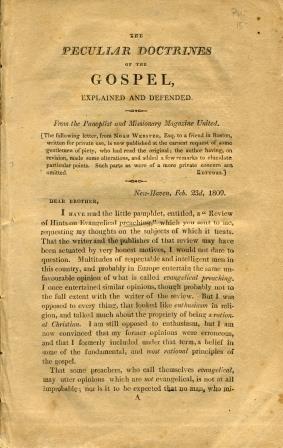
THE
PECULIAR DOCTRINES
OF THE
GOSPEL,
EXPLAINED AND DEFENDED
From the Panoplist and Missionary Magazine United
[The following letter, from Noah Webster, Esq. to a friend in Boston, written for private use, is now published at the earnest request of some gentlemen of piety, who had read the original; the author having, on revision, made some alterations, and added a few remarks to elucidate particular points. Such parts as were of a more private concern are omitted Editors.]
New-Haven, Feb. 23d, 1809
DEAR BROTHER,
I have read the little pamphlet, entitled, a “Review of Hints on Evangelical Preaching,” which you sent to me, requesting my thoughts on the subjects of which it treats. That the writer and the publisher of that review may have been actuated by very honest motives, I would not dare to question. Multitudes of respectable and intelligent men in this country, and probably in Europe entertain the same unfavorable opinion of what is called evangelical preaching. I once entertained similar opinions, though probably not to the full extent with the writer of the review. But I was opposed to everything that looked like enthusiasm in religion, and talked much about the propriety of being a rational Christian. I am still opposed to enthusiasm, but I am not convinced that my former opinions were erroneous, and that I formerly included under that term, a belief in some of the fundamental, and most rational principles of the Gospel.
That some preachers, who call themselves evangelical, may utter opinions which are not evangelical, is not at all improbable; nor is it to be expected that no man, who ministers in holy things, should go too far in depreciating the moral duties. Minds, impelled by zeal, may acquire a momentum that may carry them beyond the Gospel mark, at which they aim. But, if I understand the reviewer, he not only censures what may be really wrong in zeal, but aims to make the moral duties the essence of the Gospel, which the publisher of the pamphlet calls the benevolent and moral religion of Jesus. And this I understand to be the creed of many respectable men in this country. I am probably as sincere a frien[d] to the moral duties as the reviewer; but that these constitute the ground-work of the Gospel, I believe to be a fatal error; a rock on which perhaps more intelligent men are shipwrecked than on any other. Were there no other defect in this creed, this alone would overturn it, that no man destitute of a principle of holiness, or a supreme love and regard to his Maker, can perform the moral duties, in the manner which the laws of God require. His motives cannot be pure; they cannot spring from the right source; nor will any man, without a higher principle than a mere regard to social happiness, ever be able to perform all the moral duties with steadiness and uniformity.
But let us examine this scheme of religion on other grounds. It is the principle of our religion, and of all true religion, that there is a God of infinite perfection, who is the Author of whatever has been created. This Being is man’s Creator and, of course, his sovereign Ruler; and if his Sovereign Ruler, He has a right to give laws to man for his government. From God’s sovereignty, or his character as Creator and Governor of the universe, results necessarily his right to the supreme reverence of all the rational beings he has created; and from this sovereignty, and from the perfection of His nature, as well as from His benevolence to man, in creating him, and supplying him with all the means of happiness, results God’s right to man’s highest love and gratitude. For nothing is more obvious than that supreme excellence is entitled to the first place in our esteem. Our first class of duties then respects our Maker, our Preserver, our Benefactor, and Redeemer. These duties, I apprehend, are dictated by reason and natural religion, as well as commanded in the Scriptures. They result necessarily from our relation to the Supreme Being, as the head of the universe.
In the next place, men are made for society. Our natural propensities lead us to associate with each other; and society is necessary to the continuation of the species, as well as to our improvement, protection, and happiness. From this association of men, and the various interests involved in it, result numerous social duties, which we comprise under the general term, morality. These constitute the second class of the duties of men. This distribution of our duties is precisely that which Moses has made in the Ten Commandments, which were originally divided and engraved on two tables. The first table contained our duties to God; the second our duties to each other; and this distribution is expressly recognized by our Savior, who declares that the first and great commandment is to love the Lord our God with all the heart, with all the soul, and with all the mind; and that the second, which is like to it, is to love our neighbor as ourselves.
Now let me ask the advocates of a moral religion, with what propriety, or by what authority, can we dispense with the first table of the law, or even postpone it to the second? Are not the duties of piety as necessary, and as positively commanded as the duties of morality? and more, are they not placed at the head of the list? The command, “thou shalt have no other God before me,” [Exodus 20:3] which enjoins supreme love, reverence, and adoration, as duties to the Creator of the universe, precedes all the other commands, not only in the order of arrangement, but in the order of propriety, resulting from God’s character and supremacy. The Scriptures inculcate this doctrine from beginning to end; and it is as consonant to reason, and the moral fitness of things, as it is to the Scriptures.
To illustrate great things by small, let me state the following case. The father of a family, wishing to furnish his children with the means of enjoying happiness, tells them, “I have the means of supplying you with everything you can desire. I will build, for each of you, a house in my neighborhood, and I will send you every day whatever you want or can enjoy; and you shall have no trouble in living, except in dressing and preparing the provisions and materials I shall send, to suit your own desires. But to secure to yourselves the continuance of my favors, it is necessary that you comply with two conditions…the first is that you shall treat me with the respect due to a parent and call daily at my house to thank me for the benefits you receive. The second is that you shall treat each other with the utmost kindness and justice.” Suppose then that these children, placed in this eligible situation, and living in profusion on their father’s daily supplies, do actually comply, in a good degree, with the second condition; performing all their social duties, with tolerable, or even with strict punctuality; but pass thirty, forty, or fifty years, without once calling upon their benefactor, to make to him their grateful acknowledgments. What shall we say to such base ingratitude? But suppose further, that these children, instead of H pious veneration, and daily expressions of gratitude to their kind father, should declare that they owe him no immediate duties: that to be kind and just to each other is all that is necessary to fulfill the conditions, on which they hold their estates and enjoyments, and some of them even reproach their father as a hard master, and treat him with open contempt! What can be said in vindication of such conduct? Can such children claim from their insulted benefactor a continuance of his kindness? Much less can they expect, or even hope from him, further means of enjoyment, and a more splendid establishment! I leave this case, my dear brother, to be decided by the advocates of a religion consisting of moral duties; referring you, however, to a single passage of Scripture in which Jehovah, as the Father and Ruler of men, claims His rights with the affecting benignity [kindness] of a God. “A Son honoreth his father, and a servant his master; if then I be a Father, where is my honor? And if I be a Master, where is my fear?” Mal. i. 6.
If I understand anything of God’s character and moral government, and of our relation to Him, as His dependent creatures, a supreme regard to Him, as the first great cause and last end of all things, is the foundation of all true religion in the heart…as indispensable to the perfection of His moral government, as it is to the happiness of His rational creatures. Perfect excellence being entitled to supreme love and regard, and God being perfect excellence and the only Being of that character in the universe, it results that intelligent creatures must give to Him the first place in their hearts, or they do not conform to the standard of moral rectitude which God has established; and if they do not conform to that standard, they cannot be entitled to the happiness which results from such conformity. Hence, we are repeatedly informed in the Scriptures, that “the fear of God is the beginning of wisdom;” [Ps. 111:10, Prov. 9:10] the foundation on which the whole system stands. God then claims from us, as the first duty, a supreme regard to His character and laws, which is to be manifested by the duties of piety, prayer, worship, fear, love, attendance upon His instituted ordinances, and a reference to His will as the only rule of our moral and religious conduct; in short, an unreserved submission to His laws and government. He, as the Sovereign of the universe, has a right to this regard; He demands it as His right; and according to my view of His character and government, He cannot dispense with it. It should even say, with reverence, it would be an imperfection in His government if He could.
But this is not all. While God makes His own glory the chief object of His works and government, He has made holiness or conformity to His image, the condition on which His rational creatures are to enjoy supreme happiness. The connection between holiness and future felicity is inseparable. The happiness of a future life is represented as consisting in the enjoyment of God’s favor and presence. How, let me ask, can a soul enjoy the Divine presence without supreme love to the divine character? What joy can a soul experience in the presence of a God to whose attributes and laws it is not previously reconciled? How can a soul be delighted with the favor of God in heaven, which has never loved him supremely on earth? Is the heart to be changed after death? This we are forbid to believe. A man may, in this life, perform moral duties without any particular regard to his Maker and without any particular relish for His character and government. He may perform good works to his fellow-men, even from a sense of their fitness and propriety, without performing a single act of homage to the Supreme Being, although, as I have before remarked, without a reference to God’s will, he will rarely perform them with uniformity, even in the view of the world. But the natural heart is enmity against God; and if such moral man dies without a change in the affections of his heart, what qualification will he possess for that heaven, whose employment consists in loving and praising God? How will he relish the joys of pure and holy spirits? It is impossible. Even in this life, nothing is more painful to a man than the presence of a kind benefactor whom he has injured. Were a man of mere morality to be instantly transferred to the presence and favor of a pure and Holy Being, Heaven itself would be a hell. An unholy being cannot be happy in the immediate presence of a Holy God; at least, in my apprehension, it appears to be impossible. Hence it appears that regeneration and holiness of heart are in the very nature and fitness of things necessary to the enjoyment of Heaven; and the Gospel doctrines really stand as well on the immutable order of things in the universe, as on the positive declarations of Christ and His apostles. We are placed on this earth in a state of trial and probation, furnished with intellectual powers to learn the character of God and our own duty; with the Word of God to direct us and a free will to accept or reject the offers of salvation. To complete the means of salvation a Mediator has been provided to make an offering of Himself for our sins and satisfy that law which we have violated and which we ourselves are certainly unable to satisfy. In this state, the seeds of holiness are to be planted in the heart and are destined to grow and ripen into a full harvest of felicity in a future life. Holiness, in this life, is the germ of Heaven. But holiness, in a Scriptural sense, and indeed in any sense, is a distinct thing, from a principle of morality. Morality, or good works, respect our fellow-men; holiness respects God. It is that state of the heart which proceeds from supreme love to God, faith in Christ, and entire submission to the Divine commands. Without this holiness, the Bible informs us, no man shall see the Lord. And this holiness is indispensable to the performance of good works. As faith without works is dead; so good works are the fruit of faith [James 2:14-26]. And according to the Gospel, it is not possible for moral duties to be acceptable to God unless they proceed from faith and holiness or from a supreme regard to God’s will as their spring or motive.
These doctrines involve the necessity of regeneration, a doctrine which many men, called Christians, deny; and which the morality-system utterly excludes. I know not how men who believe the Scriptures can reason away a doctrine so fully and expressly revealed as that of the new-birth. The passages of Scripture which directly assert the necessity of such a change, I need not recite; they must be familiar to you, but I will make a few remarks on this subject.
That the heart of man is naturally destitute of holiness, or true love to God, is equally provable from the Scriptures and from observation. That the natural heart is at enmity with God, one would think any person must admit who reads history or observes the state of society within his own view. But I want no other evidence of the fact than that which is furnished by the men who make morality or good works the basis of all religion, and the ground of acceptance with God. The disposition to exclude the duties of piety as of primary importance in a scheme of religion; or a disposition to obtain salvation, by the merit of moral duties in exclusion of the merits of Christ’s righteousness, without a supreme love to God and His laws and an entire dependence on sovereign grace, is to my mind a demonstration that the natural heart is “enmity against God.” [Romans 8:7] Indeed, it is an astonishing proof of pride and ingratitude, that men who acknowledge themselves to have been created without any agency of their own and who cannot raise an arm or draw a breath without the agency of their Creator, should attempt to prove that they can obtain salvation by their own works, without Divine aid and without the infusion of a principle of holiness by the same Spirit which first breathed into man the breath of life. Why is it more improbable that God should exert His sovereign power in regenerating the soul to make it a suitable being to dwell in immortal glory, than that he should form the body as a suitable being to inhabit the earth? It should be observed that the Supreme Being reserves to Himself exclusively the glory of creation. He created man and the universe with all its furniture. He has placed the animals, plants, and minerals of this globe at the disposal of man. We have the means, under His providence, of multiplying the number of animals and plants at pleasure; we can modify and use the species which He has made; but observe, we can create nothing. We cannot add a single new species to those which God has made. If the heart of man, in its natural state, is not qualified to be an inhabitant of Heaven and must be renovated, how is the change to be effected? The Scriptures everywhere represent the change of affections in the heart, as a new birth or creation; and if such is the change, who but God is to be the Creator?
Regeneration consists in an entire change of the affections. The natural man’s affections are placed on temporal enjoyments and objects of this life. Hence the social duties are the sum of his religion. The affections of the regenerate heart are placed on God, as the first and noblest object of love; on Christ as the Redeemer, through Whom man has access to God and happiness; and on the will of God as the only rule of his conduct. It looks to God as the Author of all good; trembles at the thought of offending Him; submits cordially to his commands and dispensations; and reposes with delight and unshaken confidence on his promises. The real Christian does not, in his moral conduct, make his own honor, interest, or reputation the primary rule of decision; but endeavors to regulate his actions by God’s law; “for of Him, and through Him, and to him are all things.” [Romans 11:36] In short, his heart recognizes the great truths delivered by our Savior, that the first and great commandment is to love the Lord our God with all the heart, soul, strength, and mind; and that the second is to love our neighbor as ourselves. This is unquestionably the order of pious affections; the order of nature; the order of moral fitness; and the order of the Gospel. And how is it possible for men who study the universe and read the Scriptures, to attempt to invert this order? From what cause proceeds this unnatural perversion of truth, as immutable as God himself? Is it not the natural pride and the evil propensities of the human heart? Why does man wish to dispense with the duties of piety and obtain salvation upon the strength of duties performed to his fellow-men? Is there anything painful or mortifying in piety and a dependence on Divine grace for salvation? If there is, the heart is wrong. There is certainly no durable pleasure in sin. Long before I had these views of the Gospel scheme of salvation, I was convinced that sin, even in this life, produces more pain and misery than real pleasure. No, my friend, there is no substantial satisfaction in this life, except in conforming to the laws of the Supreme Lawgiver. As His laws and character are the most excellent, and as intellectual happiness can proceed only from truth and excellence, it results that man must enjoy the most happiness, when his heart is reconciled to the Divine laws and most conformed to the Divine character.
So far are the duties of piety and religion from being painful that the human mind, roving from one temporal object to another, unsatisfied with the pleasures they afford, perplexed with doubts, and, like Noah’s dove, finding no solid ground on which to rest, never enjoys permanent peace until it has sought a refuge in that ark of Divine safety, the Redeemer’s kingdom. The soul of man is, I am persuaded, never tranquil till the will is subdued and has yielded, with implicit submission, to God’s sovereign grace. This submission, however humiliating it may appear to the natural man, is accompanied or followed with unspeakable satisfaction. The most dignified attitude of feeble, sinful man is that of a penitent at the foot of the cross, imploring pardon from an offended God; and I firmly believe that every man must be brought to this posture before he can enjoy any permanent tranquility of mind in this life, or possess any qualification for the happiness of the next.
These sentiments may perhaps expose me to the charge of enthusiasm. Of this I cannot complain, when I read in the Gospel that the apostles, when they first preached Christ crucified, were accused of being full of new wine; when Paul was charged by Felix with being a madman; and when Christ Himself was charged with performing miracles through the influence of evil spirits. If, therefore, I am accused of enthusiasm, I am not ashamed of the imputation. It is my earnest desire to cherish evangelical doctrines and no other. That the opinions here expressed are substantially true, I firmly believe; and I number it among the strong arguments in favor of the truth of these doctrines and of revelation, that pious men in every age have entertained similar views and experienced corresponding affections of the heart. In every period of the church and in every country where the true religion has been professed, men of piety have had substantially the same views of the character of God and of the duty of man; the same supreme love to their Maker; the same submission to His will, faith in His promises, and zeal in His cause, as were manifested by Abraham, by David, and the apostles. This uniformity of affections among pious men, in distant countries and periods of time, affords a solid proof of the truth of their religion and of its Divine original; for nothing is uniform but truth; nothing unchangeable but God and His works.
Nor is the opposition to this scheme of religion, in my apprehension, less an argument of its truth. In every age, men who are unwilling to submit to God’s sovereignty and who desire to have as little dependence as possible on His power and mercy, have opposed the religion which gives to God His true place in the universe. The men who now reject the doctrines of the divinity of Christ, of regeneration, of the atonement, of saving faith, and of free grace; follow the footsteps of the chief priest, scribes, and Pharisees; substituting external duties for the doctrines of the cross. But, in my apprehension, we must receive these doctrines or reject the Scriptures as a forgery and Christ as an impostor. To reject the Scriptures as forgeries is to undermine the foundation of all history; for no books of the historical kind stand on a firmer basis than the Sacred Books. The correspondence of the geographical descriptions, interspersed in various books, with the real state of the countries described as it now exists, will demonstrate the historical truth of the Scriptures beyond the possibility of cavil [objection].
If then the Scriptures are ascertained to be faithful histories or relations of many facts still capable of unequivocal proof, we have a pledge that the writers have not deceived us in regard to facts not now equally susceptible of proof; and we have the strongest ground to believe that they are what they are declared by the writers themselves to be, the records of God’s revealed will. No historical facts are better attested than the miracles performed by Jesus Christ; and to deny the facts is to set afloat all history. If Christ then performed the miracles ascribed to Him, He must have been a Divine person or a mere man possessed of Divine powers for particular purposes; but He could not have been a mere man, for He expressly declares, that “Before Abraham was, I am,” John viii. 58. “And now, O Father, glorify thou me with thine own self, with the glory which I had with thee before the world was,” John xvii. 5. We must therefore admit with the apostle that Christ was “God manifest in the flesh,” [1 Timothy 3:16] or place these declarations to the account of falsehood, and hold Christ for an impostor; which no believer in the Scriptures will have the hardiness to do. I once had doubts on this subject; but my mind is now satisfied of the divinity of our Savior. “Never man spake as He spoke.” [John 7:46] The prophecies respecting Christ and the astonishing train of events recorded in the Jewish history, as preparatory to his appearance, have had no small effect in satisfying my mind on this subject. Let any man attend, among other prophecies, to the clear predictions of Christ, in the ninth and fifty-third chapters of Isaiah and he will find abundant evidence of Christ’s divinity and the inspiration of the Scriptures. It cannot be said that these predictions are forgeries, for we have ample proof that they were written several centuries before the birth of Christ. A part, if not the whole of the Old Testament, was translated into Greek by the seventy, nearly three centuries before Christ appeared, for the benefit of the Jews who, after their captivity and dispersion, had lost a knowledge of the Hebrew language; and this translation is now extant. In addition to this, it has been justly remarked, that the quotations from the Old Testament by the apostles and evangelists are taken from the Greek copy. If, then, the predictions of the prophets are genuine, as I firmly believe, they must have been dictated by the Spirit of God. Now the prophets apply to Christ not only the attributes, but the title of Jehovah [ ] Jehovah our righteousness, Jer. xxiii.6, and xxiii. 16. I have long regretted that, in the common version of the Bible, the original word Jehovah has not been generally retained in the translation. I think the original loses much of its force in the English word Lord and, when applied to Christ, the evidence of the Divinity of Christ contained in the title is to an ordinary reader, entirely lost or much impaired.
To those who object to this doctrine of Christ’s divinity on account of its mysteriousness, I would reply, that there is nothing more mysterious in this doctrine than in everything else respecting God and His works. Men should not stumble at mystery after having disposed of the difficulties attending the belief of a preliminary mystery, the least comprehensible of all. The existence of a God, infinite, eternal, and unchangeable in His being and perfections is, in my apprehension, by far the greatest mystery that can be presented to the human mind. Yet few men hesitate to believe in the existence of such a Being. Men who are not staggered at this first and greatest mystery, one would think, could not hesitate to give their assent to doctrines involving less difficulties; for when once the existence of a God of unlimited power is admitted, we may safely admit the existence of any facts, however mysterious and astonishing, that do not involve an absolute contradiction. I am not perfectly satisfied with the terms used in creeds, “three persons in one God;” the terms are not Scriptural and may not assist the understanding in its contemplations on this subject. I receive the doctrine just as the Scriptures represent it without attempting to explain it in terms of my own. I bow to this, as to all other mysteries in the kingdoms of nature, providence, and grace. All creation is full of mystery; indeed the constitution of man is, perhaps, as great a mystery as any other. The union of an intelligent principle with a certain organic structure of bones, flesh, vessels, and nerves, is perhaps as really incomprehensible by us as the existence of God or the Divinity of Christ; for we cannot compare degrees of incomprehensibility. Explain to my understanding, how a man, by an act of the will, can move a finger, and I think I may safely undertake to unfold any mystery in the Gospel. Explain to me the natural cause of attraction, in gravitation, cohesion, or magnetism; describe to me the process of vegetation on the earth, and of mineralization beneath its surface; attend the chemist in his laboratory, and see two invisible colorless gases combined in a certain proportion, producing that visible substance, water, and the same substance decomposed and converted into gases; in short, unfold to my comprehension the cause of heat, the operations of light, and of congelation [thickening], before you complain of the mysteriousness of Christ’s divinity. What is there, my dear friend, in Heaven above or on the Earth beneath, which we do comprehend? Surely, beings of our limited capacities have no right to expect we shall be able to understand all the works and counsels of the infinite Jehovah. It is our duty to admire and adore, to love and obey. In short, it is the duty of man to be humble. Indeed, it is a remarkable fact, that God rarely communicates to man the consolations of His grace and evidences of His favor till severe convictions have reduced him to a strong sense of the feebleness of his powers as well as the sinfulness of his heart. “God resisteth the proud, but giveth grace to the humble.” [Proverbs 3:34, James 4:6]
Men who depend on their own works for salvation, appear to question the special influences of the Divine Spirit in renewing the heart. It is difficult to reconcile this skepticism with a belief in the Scriptures, which repeatedly and unequivocally assert the fact. Real Christians have the witness within themselves; that is, they have evidence from their views of divine things and the affections of the heart, which leave little or no room to doubt the divine influence which produced them. The operations of the Spirit are very various. In some persons convictions produce anxiety and error, which drive them almost to despair. In others, convictions are less violent but produce a solicitude which leads the subjects of them to read the Scriptures; to inquire the way to Zion; to attend to the means of grace and gradually to renounce all reliance on themselves, and to seek God through Christ with humility, prayer, and submission. In some cases, though less frequently, persons without much previous distress, have opened to their minds, most luminous views of the excellence of the Divine character, of God’s love and mercy in Christ; and seem to pass at once from death to life; and from the most determined enmity of heart and opposition to the Christian scheme of salvation, to the most cordial delight in the doctrines of the Gospel. These facts, which are within the observation of every honest inquirer, correspond with the account of Christ Himself has given of the operations of the Spirit, which are compared to the blowing of the wind, whose effects only are perceived. Many persons, whose views and affections are evidently changed, are not sensible of any particular operation on their hearts. They have new affections and views, but know not the time or the manner in which they received them. In others, the impressions are too sensible not to be recognized. I know there are men who denominate such impressions enthusiasm and spiritual delusion. But the instances of such sensible changes of the heart, in persons of sound judgment and cool, dispassionate minds, not prone to yield to fanciful suggestions and transient feelings, furnish evidence of the reality of such special agency of the Divine Spirit on the heart which I cannot think it right to reject.
That the operations of the Holy Spirit are sometimes accompanied with a light exhibited to the imagination, is not generally believed; but I am inclined to believe the fact on the authority of well authenticated cases. I see no more reason for disbelieving the fact, than for rejecting the account of St. Paul’s conversion; for the soul of man is undoubtedly the medium through which the Supreme Being makes His communications. At the same time, there is so much danger of deception, in the force of the imagination, that I think the evidence of such facts should be very clear to encourage confidence. The proof of a real change of heart should rest on the subsequent life; for “the tree is known by its fruit.” [Matthew 12:33, Luke 6:44] But that God does make special communications of His favor to man, through the intellectual and spiritual principle, or soul; and that He often grants the requests of His children, by a direct agency, independent of visible means, are facts fully revealed in the Scriptures and well known to Christians.
“Whatsoever ye shall ask in my name, that will I do, that the Father may be glorified in the Son,” [John 14, 13] is the repeated promise of our Savior; a consolatory promise that many pious souls have known to be fulfilled, to their unspeakable joy and to the great confirmation of their faith.
These are points which I am sensible are not generally believed. But why should they be questioned? For what purpose was the soul infused into man? Why was man distinguished from the brute? If man was made to perish like the beast of the field, of what use is his intellectual part? The animal appetites of the brute afford, perhaps, in the gratification, as much pleasure as those of man. Surely, then, man was endowed with superior powers and faculties for some important purpose. For what purpose? The soul bears some resemblance to divinity and is evidently designed for enjoyments of a superior rank. To direct the intellectual powers of man to their proper objects, it was doubtless necessary for him to have a revelation of God’s will and such revelation requires a direct communication from God. It may be said that such communications were undoubtedly made but having been made and the substance of them recorded, further communications are unnecessary. This may, in a sense, be true; but I see no improbability in God’s continuing to make special communications of His will to man, by illuminating the mind, in the present, as well as in former periods. The instances in which such revelations are distinctly recognized, may be rare; but some well authenticated facts of this kind may serve to confirm the truth of former revelations, and fortify the faith of Christians. Such instances now, as in former ages, may be intended to answer some important purposes in the economy of Providence and grace; and are, probably in most instances, given in answer to fervent prayer.
It is no objection to these opinions that such communications are not general or common, any more than it is to the special infliction of punishment by Divine wrath on some heinous crimes, while other crimes, apparently as offensive, are suffered to pass, for the present, unpunished. If a blasphemer, riding in company, should, with an oath and a lie upon his tongue, declare that the horse he is on never stumbles, and his horse should instantly fall and break the man’s neck, no person could hesitate to believe it at least probable that the Almighty had interposed, by His agency, to execute sudden vengeance on the offender. Yet many other men, committing a like offence, may escape present punishment without, in the least, impairing the evidence of God’s special interference in the case stated. For it is the character of God as represented in the Scripture, and manifested every day, to exercise mercy rather than vengeance and, by a few instances of His wrath, to give examples and evidences of His power and government, to recall other offenders to their duty. It is equally probable, that special communications of His will, and of His favor, may be made to strengthen the faith and animate the hopes of those who confide in him. Not to believe in such instances, is to discredit all human testimony. If you will take the trouble to converse with experienced Christians, and read the written accounts of their lives, you must, I think, be satisfied that God does, at times, as directly interpose in behalf of those who ask Him in faith, as He did in restoring health to the sick, and sight to the blind, under the ministration of our Savior on earth.
Such facts serve to establish the doctrine of a special Providence, the truth of which I once questioned, but now fully believe. Indeed, it is surprising I could ever entertain a doubt on the subject; for it is as unphilosophical as unscriptural to admit a general Providence without a special one; as a general Providence implies particular providences. I was probably led into this error by the false philosophy which prevails in the world and of the universe. This philosophy substitutes for the mighty hand of Deity, the operations of second causes and laws of nature. We are taught in our youth that nature, or created things, are subject to certain laws, such as attraction, gravitation, and repulsion; and with the help of these we pretend to account for all the phenomena of the universe, without the direct agency of a supreme, intelligent Cause.
But what are the laws of nature? Nature, in its most comprehensive sense, means all that is made or produced; and laws, when applied to such created things, signify the regular motions, operations, and changes of these things, or the causes by which they are produced. If the laws of nature are the motions and changes of bodies, then they are effects and not causes, and we ascribe the phenomena of the universe to the effects of something else. If these laws are the producing or primary cause, they must be the supreme Author Himself, whom all rational men must admit to be an intelligent Being. Is it possible that laws or principles, competent to carry on the stupendous operations of the universe, can be attached to matter and not immediately dependent on the Almighty Author! Is matter susceptible of such active principles independent of an intelligent mind? I would not dare to circumscribe, even in thought, the power of Jehovah; but I have given up this philosophy and am compelled to resolve all the laws of nature into the direct agency of the almighty First Cause. The operations of nature are evidently the effects of that power constantly exerted, which first called all things into existence. Hence their uniformity; for nothing can be uniform but God and His operations.
The Jews were an illiterate people, cultivating neither arts nor sciences, to any considerable degree; yet, surprising as it may appear, they were, for ages, the only people whose history has come down to us, who appear to have had just ideas of the only true philosophy which, mounting to the true source of all created beings and their operations, ascribes all vents to Jehovah. Upon this scheme of philosophy, the difference between miracles and natural events is that natural events are usual, constant, and regular operations of Divine Power and supernatural events are the unusual and special operations of the same power which astonish men merely because they are not frequent. It cannot be the magnitude of the event which excites our wonder; for we have no ground to suppose the raising of the dead is a greater act of divine power, as it regards the Supreme Being, than the growth of a tree. If any person should incline to allege that the difference between a miracle and a natural event is that a natural event takes place by means of some medium or instrument and a miracle without such medium; this would only compel us to mount one step higher, to find the immediate agency of God. The waters of the Red Sea were removed to make a passage for the Israelites [Exodus 14], by a “strong east wind;” but it was “God who caused that wind to blow,” and the effect produced may have been as really supernatural as the revival of Lazarus from the dead [John 11].
I see nothing, therefore, in reason, to make me doubt, that God’s moral government may admit and even require, in every period of the world, special interpositions of power, divine and supernatural; nor can I see, in such special interpositions, anything more improbable than in the first formation of man, by molding matter into a particular organic frame and infusing into it an intelligent principle. The God who created the universe governs it, and all the things that inhabit it by such exertions or operations of power, general or particular, as best suits His own purposes.
The doctrine of predestination and election, is one which is much opposed by some denominations of Christians. But I see not how this doctrine can be separated from the being and attributes of an infinite God. If God is infinite, there can be no such thing as past and future, or a succession of ideas in the Divine Mind. The terms predestination and foreknowledge, are therefore inapplicable to the Supreme Being; and are used only in reference to finite beings, who have a succession of ideas. An Infinite Being must know with certainty every event, future as well as past; and if events are certainly known to Him, they must be unalterably determined: for how can He know them but in consequence of His own determination? If they are not certain, He cannot know them; and this supposition involves both a limitation of His knowledge and an imperfection in His attributes. I conceive, therefore, the Scriptural doctrine of election stands on the very character and attributes of that Being, “with Whom is no variableness, neither shadow of turning.” [James 1:17] Yet we are conscious of free agency in our determinations. That man is not, in a strict sense, perfectly free, that is, independent of God in determining his actions, we must believe; for there can be but one such Being in the universe as a perfectly independent mind; but I see no contradiction nor absurdity in the doctrine of a predetermined order of events in the universe and, at the same time, the possession by man of such a freedom of will as to render him accountable for his actions. The first is affirmed in the Scriptures and, in my apprehension, is inseparable from the sovereignty and infinite perfections of the Deity; while the last is equally affirmed in the Scriptures and authorized by our own experience. The terms, unconditional election, I think, are inapplicable to the subject; for we have the Scriptures for our authority, supported by every principle of reason, that every man’s future state will be determined by his voluntary obedience or disobedience. I think it better to submit and obey, than to perplex our minds with abstruse [difficult to understand] reasonings on subjects beyond our comprehension.
To many men, the doctrine of free, unmerited grace in the salvation of sinners is very offensive. Such persons seem to suppose they can merit salvation and claim it as a right. But was not our first formation an act of free grace and uncontrolled sovereignty? Was not the gift of an intelligent mind to man, distinguishing him from the brutes, an act of Sovereign grace? Did a man ever plant a field with corn and claim from the Almighty, as a right, a fruitful harvest? Why then object to free grace in the work of salvation? Surely man, a feeble, frail being, who holds his life and all his powers at Divine sufferance, should be more humble.
But is there nothing for man to do? He is commanded to “work out his salvation with fear and trembling.” [Philippians 2:12] Yes, my friend, man has much to do…he must work out his salvation with fear and trembling; but the misfortune is a great part of the world wish to work out their salvation without fear and trembling. They are willing to be honest and just to their fellow-men and then confidently claim salvation from their Creator, without fearing His laws, or trembling at his judgments; without performing the duties of piety, submitting to His will, or accepting a Savior: in short, without that humility which gives God all the glory, and that holiness, without which there can be no enjoyment in Heaven. The condition of salvation, which God has imposed, is that the heart must be right with God; not with man, for man is not the Lawgiver or Judge—but with God, the only Being who has the right to judge and the power to punish or reward.
Man comes into the world without any knowledge of his Maker, and with a heart opposed to His law. His business is to learn the character of God, from the Scriptures and from the works of nature and Providence; then to learn his own sinfulness and frailty and his obligations to love and serve his Maker. Being convinced of his own sinfulness and utter helplessness without Divine aid, it is his duty to abandon every sin, to humble himself before his Maker, repent of all His transgressions, bow to God’s sovereign will, implore his pardon, and cordially accept of the Savior as his only hope and refuge. On such conditions salvation is freely offered; and those who comply with them, may expect the consolations of the Spirit and good hope through grace of their acceptance with God. But men cannot expect these consolations until they are humbled. Those who proudly rely on their own good works, virtually tell their Maker they do not want His assistance and grace; and God gives His Holy Spirit to those only who ask it in humility. God is the Sovereign of the universe. He does govern it; He has a right to govern it; and men, if saved, can be saved only on the conditions which He has prescribed. He reserves to Himself the whole glory of saving sinners and the hearts of His children rejoice in the Divine determination.
I am therefore of opinion that the doctrines of Divine sovereignty, the Divinity of Christ, regeneration by the Holy Spirit, and free grace through Christ, are fundamental in the Gospel scheme of salvation. Those who reject these doctrines appear to me to tear out the vitals of Christianity, leaving nothing but a lifeless skeleton. The cold doctrines of Arminianism almost exclude the Divine agency in man’s salvation. They supersede the necessity of a Redeemer and of public worship, for morality may be taught in families and schools. In short, they never reach the heart and appear not to alter the life and character.
Such are not the doctrines of the Gospel. These elevate the soul to God, the Fountain of light, life, and blessings; they subdue the natural pride of the heart, control the passions, and change the affections. They infuse a principle of supreme love to God and create a faith in Christ which tranquilizes the soul, dispels the gloomy anxieties of skepticism, alleviates the cares, and enlivens the joys of life; and to crown all, reposes, with delightful confidence, upon the Almighty Arm of a Redeemer for salvation.
Nor are the temporal benefits of real religion less conspicuous in the effects they produce in families and in society. In minds the best regulated by family discipline and the rules of civility, there will at times break forth sallies of envy, jealousy, petulance, and discontent, which annoy the peace of families and of neighborhoods. Nothing seems effectually to restrain such passions but Divine grace. The fear of man and a regard to decorum, will not produce the effect in minds of a particular structure. But the humbling doctrines of the Gospel change the tiger to a lamb. Real religion, which implies a habitual sense of the divine presence, and a fear of offending the Supreme Being, subdues and controls all the turbulent passions; and nothing is seen in the Christian but meekness, forbearance, and kindness, accompanied by a serenity of mind and a desire to please as uniform as they are cheering to families and friends. On this subject I speak with delight from observation.
At the same time, real religion inspires mutual confidence, it establishes a guard over the heart, and creates a security for fidelity and affection, in husband and wife, parents and children, brothers and sisters, neighbors and friends, which cannot be derived from authority or instruction, from the force of law, or the influence of example.
These, my dear brother, are some of my views of the Calvinistic doctrines and their effects. These doctrines, in the main, I do believe to be evangelical; and my belief is not the effect of education, for formerly my opinions were unfavorable to some of these doctrines. My belief is the fruit of some experience and much inquiry and reflection.
It is with heart-felt regret that I see a large portion of the world so inattentive to religion. Men often live for many years, gazing upon the stupendous fabric of the universe, apparently without a sentiment of piety; and wander among the charming beauties of the earth, where the power, the wisdom, and the beneficence of the Creator are displayed on every flower, and every leaf, with as little admiration and gratitude as the beasts that graze on the field. Equally insensible are they to the beauties of the Divine Character, unfolded in the works of Providence and grace; forgetting that the same God who arrays the lilies of the field with more than Solomon’s glory [Matthew 6:28-29], is ready to clothe his children with the splendid robes of the Redeemer’s righteousness [Isaiah 61:10]. And what is astonishing, but often true, the more temporal blessings men enjoy, the less disposed are they to love and obey their heavenly Benefactor: a truth which gave occasion for our Savior to remark, how difficult it is for a rich man to enter into the kingdom of God [Matthew 19:23-24, Mark 10:25, Luke 18:25]. It is a melancholy proof of the depravity of the human heart that men often invert the order of things and suffer their gratitude to abate in proportion as their wealth increases. Indeed it is extremely painful, to a reflecting mind, to observe men in affluence, who live amidst a profusion of everything the bounty of Heaven bestows, indulging in sensual gratifications and rolling in splendor; but forgetting, or insulting the Benefactor, while they riot on the benefit.
But I must come to a conclusion; or instead of a letter, I shall write a book. I could dwell on subjects of this kind with pleasure; but if what I have written is the truth, it is enough: if not, it is too much. If my opinions are erroneous, I should be happy to be corrected; if they are substantially true, I hope they will have their due weight. As pilgrims on the same journey, it would be for our mutual happiness on the road, “so to be agreed as that we might walk together,” [Amos 3:3] and be united in principle as well as by the most endearing of all ties, Christian love.
I am, with sincere affection, Yours, &c.
NOAH WEBSTER, jun.
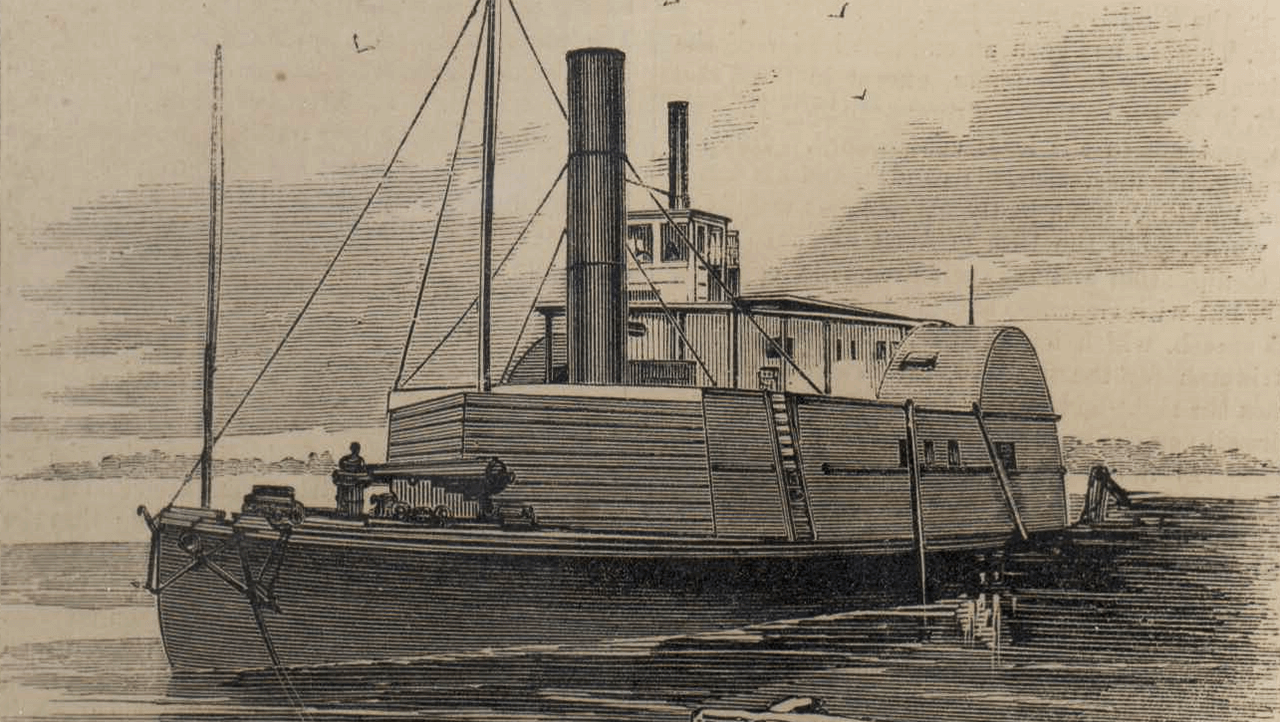
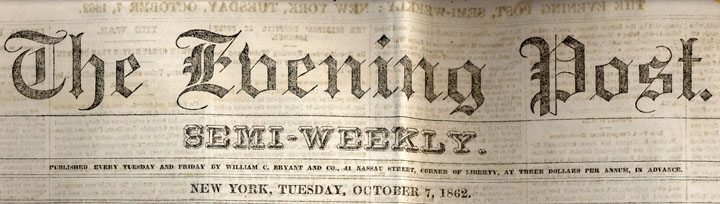
 A great concourse of the colored people of this city assembled last evening at Rev. Henry Highland Garnett’s (Shiloh) Church, at the corner of Prince and Marion streets, to participate in the ceremonies of a public reception and presentation to
  The next speaker was Professor J. B. Wilson, principal of the Brooklyn colored public school. His remarks were directed principally to the question of emancipation, and the condition of the colored people of the South in the new sphere of life which he held they were about entering. He believed the slaves would remain permanently where they are at present – perhaps on the plantations they were now cultivating, and which they would finally possess. The war would, he thought, bring about this result. The colored men would obtain their livelihood as hitherto by the cultivation of the soil; and eventually either by purchase (which was most likely), from the government or individuals, or by possible confiscation and results which might grow out of the war, they would peaceably acquire the lands in small parcels. The fact that if the struggle continues, the rebel male population will be so diminished as to render it impracticable if not impossible for the agricultural interests of the South to be managed by the whites now resident there, had also in the estimation of the speaker an important bearing on the question. The South was the natural home of the blacks; there they desired to remain; and would not be removed, for the reason, if for no other, that as the only available laboring force their place could not be filled. Colonization, while it was unpopular, was yet also, he held, impossible; and the destiny of the southern states was inseparably connected with that of the black race, which constituted the bone and sinew of their prosperity.
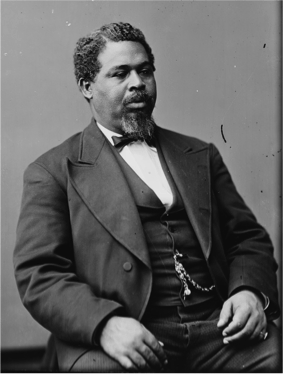
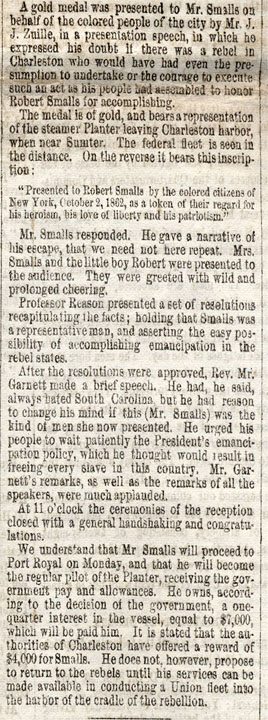 A gold medal was presented to Mr. Smalls on behalf of the colored people of the city by Mr. J. J. Zuille, in a presentation speech, in which he expressed his doubt if there was a rebel in Charleston, who would have had even the presumption to undertake or the courage to execute such an act as his people has assembled to honor Robert Smalls for accomplishing.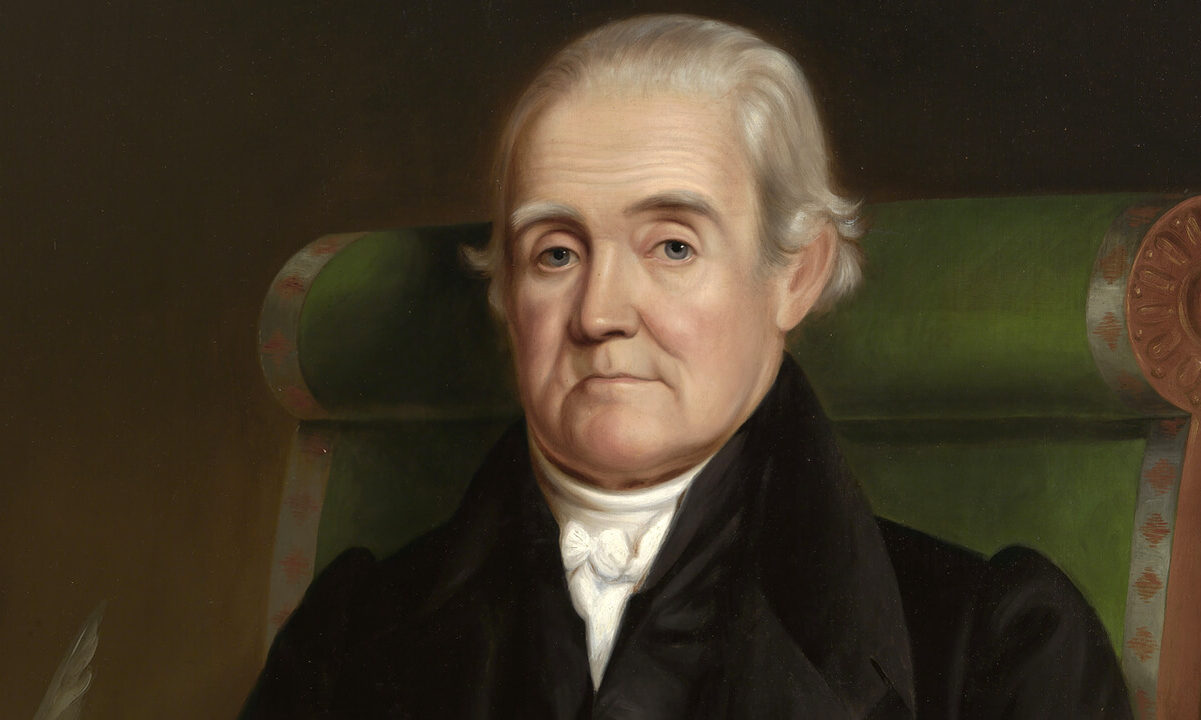






 H.C.R. No. 29