Oration – July 5th – 1824, Quincy

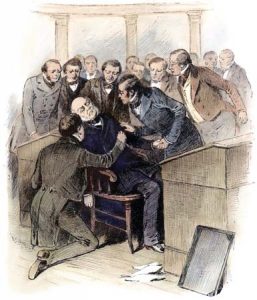
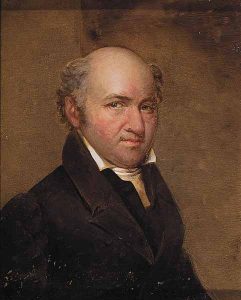
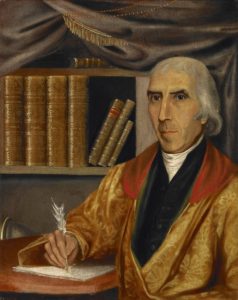
George Washington Adams was the oldest son of John Quincy Adams. He graduated from Harvard, studied law, and was a member of the Massachusetts House of Representatives. He died in 1829.


AN

ORATION

DELIVERED AT QUINCY,

ON THE

FIFTH OF JULY, 1824.

BY

GEORGE WASHINGTON ADAMS

ORATION.

The causes of great events, those events themselves, and their extensive consequences, are subjects worthy the attention of enlightened and intelligent minds. We have assembled, fellow citizens, to celebrate the anniversary of a day justly memorable in the records of our country’s history: a day glorious to this nation as the festival of its nativity; glorious to humanity, for the expression of principles, proportionate to its exalted privileges. It is the intention of our celebration to signify our adherence to those sublime principles, “which are not of an age but for all time,” and it is delightful to reflect upon the countless multitude of free Americans who with this purpose have watched this morning’s dawn. While we are endeavouring to pay the meed of gratitude to the memory of the past; while we are here to record our sense of our unexampled blessings, the voice of praise ascends around us in every variation of the passing wind: the time is hallowed: the Spirit of Gladness smiles on the land and her altars are adorned with thousand offerings: Genius is strewing roses over our happy clime, and Poetry is breathing forth her heaven born inspiration; throughout our wide extended territory, the day is welcomed with one burst of pleasure. Whence is this general joy? It arises from our independent freedom, which has made known to us the value of our institutions, planted by the energies, and secured to us by the virtuous efforts of our ancestors. Let their energy be to us an example, and their efforts motives for unfailing gratitude to Him who prospered them.The Declaration of Independence, was an advance in the progress of mind; a point in human history, to which the important occurrences of preceding ages led, and from which consequences of high import have proceeded.

The Christian Revelation, that mild and beautiful religion, which has taught man his duties and his hopes, is the true source of human happiness. With its establishment commenced the course of improvement, which succeeding ages and wonderful events have carried onward to our own age and time. The contemplation of the steps by which it has advanced affords much matter of instructive thought, and many reasons for just admiration. America has done and is doing her share in the great work and from the hour of the discovery up to the present moment has shown a proud example to the world.

Past history justifies the reflection that undertakings of magnitude are accomplished only through toil, and suffering, and perilous endurance. This vast continent, unknown for centuries, was discovered, from the fortunate conjecture of an enlightened mind; yet the history of its discoverer is a history of injuries; injuries during his life and neglect after his death. Born in a republic, Christopher Columbus was brought up upon the bosom of the wave and fitted for the mighty object of his life. Having conceived that object he imparted it first to the people of his native land. Censured by his own countrymen as a visionary projector; rejected by nation after nation to whom he had applied; Columbus persevered in his design, with assiduity and firmness truly admirable. At length the Spanish sovereigns risked the experiment: furnished the daring navigator with a miserable squadron, and assisted him with slight encouragement: ill appointed and badly manned, he sailed to find a world! Tried by the dangers of the ocean; distrusted by his men; conflicting twice with mutiny and rage, the promise was wrung from him that in three days if land were not discovered he would return to Spain. His life; his all was on the cast, but his own fortitude supported him. On the evening after he gave the promise, a distant light pierced the dark waste of waters; Columbus saw and marked the glimmering signal: it was a moment of intense interest: to his aspiring mind, another world was found! His triumph was complete; that little beam revived the fainting spirits of his crew, and relumed [illuminate again] the rays of Hope,

“That star on life’s tremulous ocean.”

But this is not the time, my fellow citizens, nor this the place to detail the romantic incidents in the fortunes of Columbus, however rich the theme. His discovery has been mentioned only to notice its effects. It occasioned a rapid improvement in the condition of civilized man, and we may trust that the bright beam Columbus saw, betokened to the untutored Indian, the rising of the star of Bethlehem.

The Discovery of America by Columbus in 1492, succeeded by that of a shorter passage to the East Indies in 1497 by Vasco de Gama, exposed to European avarice the sources of unlooked for wealth. From their full fountains, the Indies poured the precious metals into Europe like a flood. With them went luxury and its concomitant vices, but with them went also the means of knowledge and they aroused an ardent desire for its acquisition. Europe was astonished at these immense discoveries: Venice, the Ocean Power, saw with alarm and terror her sister nations winning all her wealth: Spain measured with enthusiasm, the vast possessions she had acquired: the avarice of England’s seventh Henry stimulated him to obtain for her some portion of this valuable territory: a succession of skilful navigators pursued the track of the great Genoese, and all conspired to increase the thirst for knowledge; mankind began to think: the Reformation followed, and this third astonishing event, rousing men’s passions as its march went on, caused a continued emigration from the old world to the new, for other purposes than those of wealth and plunder, till the poor pilgrim, crossed the deep waters to find a home where he might worship God as his own conscience taught, and where he might be free from persecuting power.

The Reformation emanating from Germany passed into England, and owing to the fortunate conjuncture of the times was there established; but it was not in the intention of her “hard ruled king” to part with his supremacy, and hence arose wide differences of opinion. Tyrant power wielded the sword and used it bloodily designing, not to silence but to extirpate religious opposition, and the sanguinary measures thence adopted, hardened the non-conformists in their faith. Persecution was opposed by bigotry; suffering was paralleled by obstinacy; till the temper of the age grew cruel, unrelenting, merciless: men’s minds were soured and all parties assuming the rigorous rule of uniformity, while they believed their own opinions right, held every departure from them, heresy and sin. In this state of things, our forefathers, tired of a fruitless struggle with the dominant power, and harassed by domestic sorrows, sought an asylum here. Heaven seems to strengthen the human faculties proportionally to the obstacles to be encountered: obstacles multiplied before our fathers, and were surmounted; Plymouth was settled and in the rock the tree of Liberty was rooted. Bound by their religious covenant, the Pilgrims bound themselves by a political constitution. By a charter to the Plymouth Council, under a royal grant, based on discovery and implied conquest, they came hither, but their best title was afterwards acquired by purchase from the natives of the soil, and subsequent efficient labour on the land. Hardly had they completed the outline of their town, before the indiscretion of their countrymen surrounded them with dangers. The Puritans in England held a reformation of the manners of the age, essential to the reformation of religion, and the sharp cruelty exercised upon them, induced them to assert this point with more than stoic rigour: this drove their opponents to the opposite extreme; they increased their luxury because it was attacked, deriding Puritan severity to cut off the growth of Puritan belief. With these opinions, some of the established church came over to New England in the first year after the Plymouth settlement commenced, and fixed themselves at Weymouth: others followed them, and chose Mount Wollaston for their plantation: their leading officers soon left them, and they, unlike their Plymouth neighbours, and unrestrained by conscientious virtue, gave themselves up to wild licentiousness. The natives, wronged by them, concerted deep laid plans for their destruction, but they, urged onward by an evil schemer, plunged deeper into reckless dissipation: gathered the flowers of spring to wreath their garlands, and like the victims of the Roman altars, knew not the fate that was impending over them: strange! That a few adventurers; on an unsettled coast; surrounded by tribes whom they had irritated; straitened for bare subsistence; and while a fearful storm was gathering, could listen to the siren voice of pleasure and drain the cup of idle wantonness: yes; on yon merry mountain the shout of revelry was heard, until the Plymouth Government, alarmed at its pernicious influence, suppressed the settlement.

History, my fellow citizens, must be impartial: if the fate of this unthinking crew awakens painful feeling, there is an honest pride in the remembrance that you are not their sons. Very different was the character of the successful founders of New England. Their energy soon settled Plymouth, and their example founded other colonies, which, under favourable charters, nourished a free and hardy population, growing and gradually spreading through this Western world. The Pilgrims of Plymouth and the primitive settlers of New England came over to enjoy unmolested, the exercise of a simple and unadulterated form of worship. To obtain this religious freedom, they left a land over which Nature has profusely scattered her most attractive graces: a land which has been beautifully called

“A precious stone set in the silver sea,”

Where were the tombs of their fathers and the homes of their kindred; where their earliest affections had grown, and their dearest recollections lingered: but it was no longer the home of Liberty; Astraea had deserted it, and left green Albion a barren waste girt with a ripple wall of regal tyranny. What was the beauty of the earth to them, deprived of liberty of conscience? For this they could forego this “Pleasant land of their nativity;” for this they could restrain those feelings which might not be entirely destroyed; estrange themselves from home, and friends and kindred to become acquainted with the rude savage of the wilderness. They brought with them the rigid principles for which they had contended, and the stern spirit which they had imbibed. Religion was the platform of their political state, and they respected its ordinances, and its ministers. These exerted a favourable influence upon the public morals, watching them with scrutinizing jealousy: the people possessed an operative suffrage in their church government, and were familiar with polemic controversy: they sifted doctrines and decided for themselves contested points: but in the innumerable differences of human opinion, it was not probable that uniformity could long exist among them. Uniformity was the rule which the opposing sects required in England before they emigrated, and their uncompromising disposition made it essential here. They had moreover, assumed mistaken definitions of religious liberty: zeal was the leading feature of the character: zeal which had induced such honourable sacrifices, impelled them to become intolerant and too uncharitable to those from whom they differed in speculative belief. This intolerance was owing to their early habits, to the partial knowledge which that age possessed, and to their danger as a community if different systems should gain ground. If there are dark shades in the portrait, they serve but to contrast its glowing colours and to enhance its general expression. It is man’s nature to mingle imperfection with his best efforts, and his past errors present an awful warning for the future.Accustomed to judge for themselves in matters of theology, they began to feel it as their right to judge in those of government. Acknowledging themselves to be English subjects, they drew nice distinctions in defining that subjection in order that it might not prejudice their privileges. With no nobility to check the growth of equal systems; no hierarchy to hold out a lure to clerical ambition, or to sustain royal pretensions to supremacy in religion; no courts supported by the forfeitures decreed by their own judges; they grew up in the enjoyment of republican rights. They constituted a republic under the jurisdiction of a magistrate, too distant to govern them effectively, and too profoundly ignorant of their importance, to straiten round them the cords of sovereignty. Their governor chosen by themselves was annually removable under the earlier plan of administration, and though afterwards lost, this right of choosing their own rulers had been exercised and was remembered. Their immediate executive was elective and thus responsible to them: indeed, the wise and virtuous men who took the lead in their affairs, encouraged the republican immunities of the people and supported the established charter rule of annual elections from their own conviction of its value; sensible

“That nobler is a limited command
“Given by the love of all your native land,
“Than a successive title, long and dark,
“Drawn from the mouldy rolls of Noah’s ark.”

To annual elections they soon added representation, and improved on the practice of the Mother Country, by equalizing the rule. This right of being represented was not granted by the first charters, but it was adopted shortly after their arrival, and in various periods of our history its value has been ascertained. Actual experience proved the necessity of distinguishing property and they fortunately held it unburthened with the incidents of feudal extortion and by admitted titles.

These rights were the elements of their high character; but there was another cause which added to their firmness and increased their privileges. From the earliest settlement, they cultivated good learning and useful science. The controversies of theology could not be maintained without sufficient learning to oppose the arguments of learned orders of the church, laboring for its preservation. Controversy had been for years familiar as the daily food of life. The reformation had in the different sides which States and Monarchs were compelled to take, opened the wide gates of speculative doubt, and proved to mankind that they could think for themselves. This point once gained, there was no limit to the interest which attended the investigation of religious questions; hence this interest extended throughout Europe, and spread itself over the whole surface of society. The study of theology became the surest path to influence and hour, and learning was sought for as a weapon of controversy. Inexpressibly anxious about their eternal welfare, our fathers taught their children to “search the scriptures,” and thus laid the corner stone of learning’s proudest temple, a reading and reflecting community. They established schools and colleges for public education. While New England was a sterile wilderness, the halls of Harvard rose to educate a line of excellent men, qualified to instruct their countrymen in wisdom: to seek her in her dearest treasuries: to dispense to mankind the inestimable benefits of knowledge and virtue.

“These are brighter, richer gems
“Than the stars of diadems.”

The collective character of a people is composed of the same mixture of differing qualities, which are discernible in individuals: it comprises the same liberality, generosity, honesty of intention, and the same stormy passions which when roused, shake the whole happiness of private life. Our forefathers were a patient and persevering people: their devotion was simple but earnest; their theories were circumscribed but conscientious; their morality was rigorous but practical. They were from necessity frugal; from their position circumspect; from their situation vigorous and hardy. Obliged alike to brave the savage and the European foe; acquainted equally with the implements of husbandry and with the weapons of war, they guarded the State till she had cleared the dangers of her infancy. Such was the early character of the people of New England. It shows a race of men fit to be free. History presents no parallel to such a people: mid all her records of blood stained laurels and successful wrong; mid all her tales of daring enterprise and reckless valour; of learned lawgivers and grasping conquerors, she shows no other state, originating in devotion and in liberty of thought; no other nation whose foundation was the pure worship of the living God.

In this character we may trace the progress of mind. Freedom opened the blossom of republican polity which was in aftertimes to ripen into admirable fruit. The early systems of elections, of representation and of property were improvements on the old modes; the former by limiting official power, increasing responsibility and equalizing popular participation in government; the latter by securing to industry, the profits it affords.

This character, which intercourse and habit, in the next generation had extended and confirmed, was not in good accordance with regal prerogative or Parliamentary supremacy. It became necessary, therefore, that the Mother Country should counteract and check it, by a plan of colonial policy.

The affairs of England claimed the whole attention of her cabinet, and these plantations were permitted to grow unmolested, until the overturn of ancient prejudices had changed the form of English government, and placed Cromwell at the helm. He first perceived the true importance of the colonies, and bent his mind upon them. The leader of the Puritans; he looked with favour on New England while ruling other colonies with rigour; but to sustain the war with Holland, he procured from Parliament the passage of the act of navigation, which formed the ground work of their future policy. After the restoration, the people lost many of their most peculiar privileges. The gloomy machinations of the last Stuarts, extended to America, and were mainly directed against the bold and independent spirit of New England. No longer empowered to elect their own executive, the colonists were holden at the mercy of the throne; a mercy, burthened with such hard conditions as completely changed its office. Violent and arbitrary maxims of government, carried into execution by rulers, strangers to the soil and its inhabitants, affecting the right of property, destroying the right of suffrage, subverting customs which had grown up with the people, were the “tender mercies,” which the “nursing mother” administered to her distressed offspring. The same eclipse which had overshadowed the Sun of British Liberty, portended total darkness to the world, but under the merciful decree of Providence it passed away, and left the orb more radiant than before. The British revolution saved mankind from projects deeply designed for their entire subjection, and forms another step in the advance of mind. During the reigns of the last Charles and James, the value of the American plantations began to be appreciated. The Mother Country framed a system of colonial policy, which depressed their energies and fettered their power. The Parliament during the Commonwealth had passed the act of navigation, and subsequently added to it acts of trade, by which the profits of the colonial commerce were made returnable through the British market. This commercial monopoly was vigorously enforced by one party and artfully evaded by the other, till at length the power of the crown extorted a partial obedience. The secret springs of the machine were avarice and fear. Profound and learned writers directed the attention of the British rulers, to the colonies. The propositions fundamental to their policy were, that plantations possessing unrestricted trade are prejudicial to the commerce of the Mother Country; and that on this principle, New England most of all obstructed English trade. It was therefore determined to check the growth and stop the progress of these provinces by means of the act of navigation, strengthened and supported by a succession of laws for regulating, or more properly, crippling the trade of the plantations by a continued chain of restrictions laid on their commerce. These restrictions were made to act equally upon the importation and the exportation of the Colonists, compelling them to purchase at a dearer rate than was primarily requisite, and to sell at a higher rate than was otherwise necessary, to prevent their underselling the English trader. The people of New England were experienced navigators, and the fisheries an unfailing school for seamen. The coast afforded large facilities for ship building, and the Colonies would assuredly improve them, whence would arise in case of insubordination, an American navy. The commercial monopoly was the instrument made use of to prevent all this danger to the “fast anchored isle.” Was it to be imagined that a people such as we have shown, habitually jealous of their liberties, would tamely and quietly submit to such restrictions? Was it to be supposed that a hardy and enterprising race of men, skilful in calculation and shrewdly sensitive to honest profit, would willingly consent to let the price of their labour, the gains of their industry slip from their hands? It would have been wholly foreign to the character of this people to have submitted without murmuring to this unfavourable scheme. They did not willingly submit: they lost the first charter for their opposition; they lost that right of choosing their own executive, which had so long protected them in freedom: they were subjected to a tyrannical governor, brought up and nourished in the Stuart projects: all this they bore, before they would submit to this restrictive plan, and when at last, they were compelled to avow obedience, it was conveyed to an act of their own legislature, which imposed the burthen. From the Restoration in 1660, this plan of curbing the Colonies was enforced by England and evaded in America, till in the course of time it became the fountain of our revolution. When the provinces had consented to it, their obedience was as literal as might have been expected, and notwithstanding its rigorous operation, they prospered, for their commodities and produce were immensely profitable to the monopolist, and thence in great demand; and this may prove the interested wisdom of the framers of this scheme; for if the sun “shorn of his beams” yet shone so brightly, his concentrated power might be dangerous. The Colonies increased and prospered, their regulation notwithstanding, but their prosperity ran counter to the fundamental proposition of English doctrines, and in consequence it became necessary to weave a net about America, which should completely foil her struggles and be sufficiently elastic to increase with her increasing strength. To effect this scheme, some genius, invented the plan for raising a revenue from America by Parliamentary taxation without representation: a revenue superadded to the restrictive, exclusive, oppressive system of commercial monopoly: an union of which the offspring was “uncompensated slavery.” My fellow citizens it was this scheme of “exquisite policy” originating either in ministerial embarrassments abroad or in high reaching ambition at home, which brought about our glorious revolution. The people saw that the point most settled in the British constitution, that taxation must not exist without representation, was annihilated by the British policy. It was this violation on the British part which caused the revolution, and was followed by the revolutionary war.

The revolution commenced with the resistance made to an order from the superior court of this province for writs of assistance to carry into execution the acts of trade. These writs of assistance indicated the first speck in the horizon, round which the clouds collected, to burst in thunder over Britain and to purify the political atmosphere of the world. The revolution, that total change in the feelings of the Colonies towards the Mother Country, was completed by the Declaration of Independence, which was ratified by a successful conflict. The Colonies together with the parent kingdom were coming out victoriously from the war with France, which had greatly added to their military glory and to the national burthens. The provinces in America had borne an active and an honourable share in the labours and successes of the war; thereby becoming more closely bound to the parent state than ever; but their success alarmed the British ministry by awakening their fears, that the checks on the free spirit of the Americans had been diminished by the destruction of the French power. They resumed their monopoly and added to it the scheme for revenue at the very moment they lessened the means of meeting their demands. Bill after bill was fulminated by Parliament with the double motive of extorting revenue to meet the pecuniary difficulties of the kingdom, and of breaking the spirit of the Americans. It is a tale of wrongs too melancholy for this hour. After long suffering, patient forbearance, and glorious resistance, America determined to be free. Passions were roused to their extremes, and British pride pledged to the contest: the ministry alarmed and angered, drew the sword upon their countrymen, resolved to strain every nerve for ultimate success.

In this situation, when the British government had decided to exert the power of the empire, and war hung lowering darkly over America; the Declaration of Independence was issued and received with acclamation throughout the Colonies.—The arm of Tyranny was palsied by the blow, it cleft his Lion helm in twain, and struck the feeble faulchion [one-handed, single-edged sword] from his hand. The Colonies had shaken off the chains by which they had been manacled, and owned no longer an imperious master; they told the world that they were free; and in the reasons they assigned for this assertion of their freedom are to be found the soundest principles of public justice, the boldest theories of human rights. These are the reasons why this sublime instrument marks an advancement of the human mind; these are the claims, which have won for this day the annual tribute of a nation’s joy; these are the sacred ties, which hold together these increasing states in the strict bonds of union and of harmony.

The effects of this Declaration were at the time when it was issued, most favourable. Other powers lent their assistance to an independent nation, contending for its existence, which they could not have done to subject colonies, conflicting with a master whom they acknowledged: at home the public resources were concentrated: an object to be gained and defined. Through fields of hard fought battle, through patient toil and painful suffering, the object has been gained: America is free: the valour of her sons, the wisdom of her statesmen, nerved by the glorious cause for which they fought, have made and kept her free.

The effects of this Declaration are now everywhere visible. Look through the country and behold our accumulated blessings: see Nature robed in beauty; fertile in rich luxuriance: see health and plenty everywhere around you: see a dense and settled population stretching from the cold regions of the North to the exuberant valleys of the South; from the prolific intervals of the East to the flourishing prairies of the West: see your shores washed by two oceans and the soil your own: Are not these motives for rejoicing? The welcome of this day throughout the land gives our reply.

But beside the general national reasons for rejoicing in the benefits resulting from this proud day, there are others, fellow citizens, which affect us peculiarly. We cannot forget that the great name, which leads the illustrious catalogue upon that venerated instrument, went forth from here. I would speak with diffidence of Mr. Hancock. Common praise would not express his virtues. His character was compounded of mingled gravity and splendor. Accustomed to the luxuries of life, Fortune clothed him with her mantle of elegant refinement and poured her gifts upon him in a golden shower. With every prospect of pre-eminence under the ancient aristocratic system, commanding influence and sure of honours, it was no common strain of patriotism that could put by the glittering bait which courted him. Dignified, graceful, affable, and eloquent, he seemed to win involuntary favour, while to these outward excellences, he added the sterner virtues which the time required. Liberal, charitable, generous, his fortune was his country’s and his wealth made for the poor. Generosity was the flower of his life, and whether actively exercised in freely bestowing or negatively in giving up emoluments it bloomed in equal brilliancy. His splendid qualities were perhaps displayed too publicly ; there might be something too shining in his mode of life; but this splendor was the growth of early habit and the overflowing of a liberal nature. It is difficult to lay aside the customs which have grown with us from childhood; self denial is a hard and trying thing; but Mr. Hancock was willing to put everything at stake: fortune, honours, safety, life itself were to him worthless in comparison with Republican Liberty. His soul was comprehensive and his spirit bold as the character which records his signature: and if persevering aid to the right cause in sickness, sorrow, sacrifice are honourable; then is Mr. Hancock’s life entitled to our highest panegyric.

While he was thus conspicuous in the front rank of the advocates of liberty and law, beside him stood a Roman patriot. Samuel Adams was certainly an extraordinary character: a man whom few resemble. We should be inclined to think him rather of the school of the younger Brutus, or bred in the faith of Cato, than an inhabitant of a modern colony; rather taught by the Scottish Covenanters than by the courtly statesmen in the reign of the third George; cotemporary rather with Standish and Carver than with Bernard and Hutchinson. There was “a daily beauty I in his life” which calls for our warmest approbation. His public course exhibited a firmness and decision which were indeed remarkable: he was no half way man; reform with him required total, final, essential, alteration. Poor as he was, it was idle to attempt to bribe such a man: to the allurements of Fortune he was blind as her own fabled divinity; but to the real charms of Liberty he paid his homage with clear unclouded vision. In private he was conciliating and benevolent; in public strenuous and severe. He could contemplate the gathering clouds with satisfaction; could see a glory in the fearful struggle; could moralize upon the day of battle: there was, it may be, something too rugged in his policy, but it was the obstinacy of masculine virtue. He was one of those men who effect great ends, and that he did contribute much to the event, which distinguishes this day, is clearly unquestionable. Differing widely in character from Mr. Hancock he was equally useful to the cause of American freedom: their names were inscribed together on the same record of proscription and glow with equal grandeur on the same scroll of fame.

There was a third citizen of this soil: alas! too quickly taken. Educated to benefit his species; gifted with the fascinating, the appalling powers of oratory; compared by those who heard his magic speech to the splendid orator of Rome:–God in his own wise designs did not permit him to see the light of that bright hour, which gave our Declaration of Independence, but “his mind’s eye” beheld it as Moses from the top of Pisgah saw the land which he might not inhabit. His life was spent in arduous professional labour, and he bore an honourable share in that decree which proved the triumph of eternal justice even in the very midst of massacre. This severe labour, added to the toils he bore to aid his country, cost Mr. Quincy life: let his memory live ever here; bloom ever in the spot which bears his name: it is not too much to say of him in the language of the poet,

“O’er him whose doom your virtues grieve,
“Aerial forms shall sit at eve
“And bend the pensive head:
“And fallen to save his injur’d land
“Immortal Honour’s awful hand
“Shall point his lonely bed.”

In attempting to award a feeble measure of justice to the memory of these eminent men, it is not designed to assign to them exclusive praise. The results of our Revolution produced a company of patriots unsurpassed in earthly annals; men wise and bold in counsel and the field. The majority of that vigorous race have gone to brighter climes; a few, alas, how few! Remain to greet this morning; blessed by the wishes of their country: blessed by the sight of national prosperity beyond their fondest hopes:–the rest we trust are joined again with Washington, above the reach of time.

The last, the best effect of this immortal instrument, has been upon the nations of the earth. The lessons which it diffuses have not been lost, have not died away unheard. Crushed, trampled on, oppressed, Liberty rises by her own resistless energy, to renew the struggle for the dearest rights of man. The herald of those rights has spoken to the world. France has heard the sound, but Despotism has benumbed her faculties and Cruelty has stained her proud escutcheon. Spain has heard the sound and tried to loose the chains of ancient days, but Superstition holds her down as with a spell of sorcery. Greece has heard the sound and sprung in armour from her slothful couch, to ring the loud larum [alarm] peal of war, and blood, and battle: yes, my fellow citizens, the subtle fluid is at work; the waters are rising, and they will pour the great tide of liberty throughout the globe: it already rolls in the Archipelago, it mingles in the billows of the mighty Amazon.
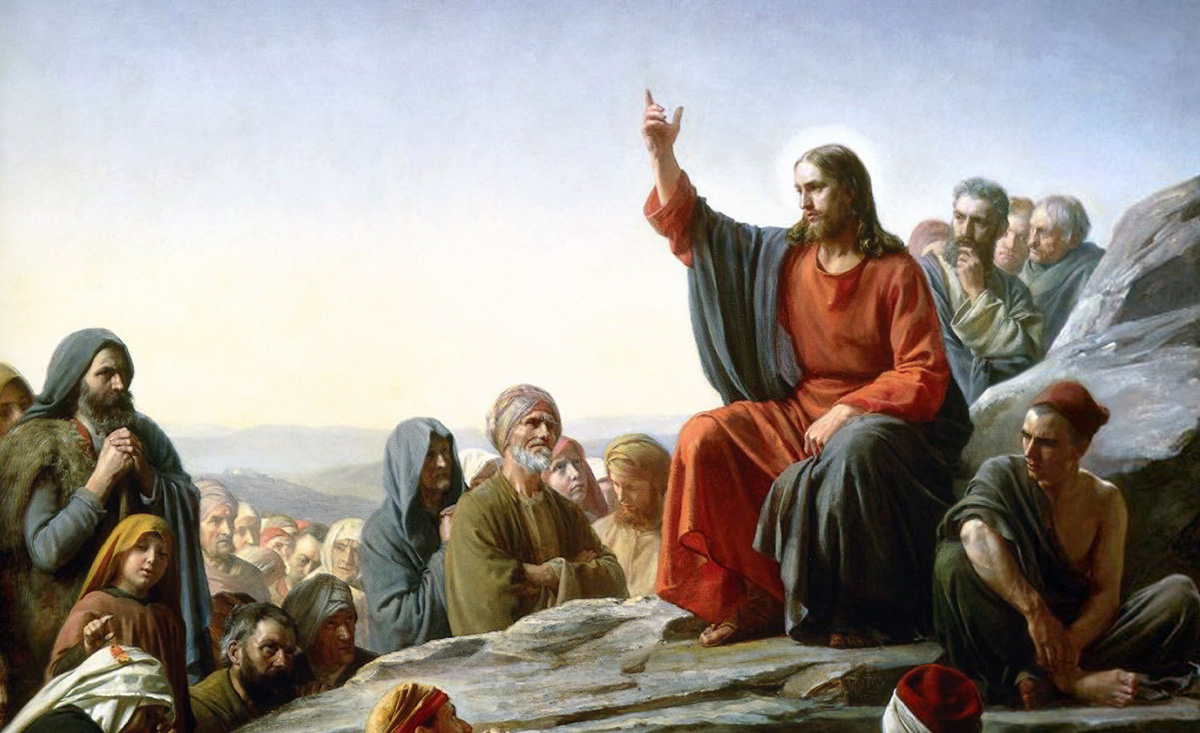
The Sermon on the Mount Carl Bloch, 1890

Sermon – Artillery Election – 1814, Massachusetts

Samuel Cary (1785-1815) Biography:

Cary (whose father was a minister) graduated from Harvard in 1804, when nineteen. He entered the study of theology and in 1808 he took a probationary position at King’s Chapel in Boston (which began as an Anglican Church in 1686). Successfully performing his assigned duties, in 1809 he was asked to join the staff of King’s Chapel as a Junior Pastor, but in 1815, he became very ill and was forced to retire from preaching. At the urging of friends, Cary traveled to England as a better climate in which to convalesce, but passed away while there.

The Ancient and Honorable Artillery Company was originally organized and chartered in England in 1527. Many of those who arrived in America in Plymouth in the early 1600s had been involved with the Company and saw the need for one in the New World, for there was absolutely no organized military force to provide protection. In 1637, a group of settlers sought a charter from then governor John Winthrop, but he initially refused the request, wanting no organized military that could overthrow the civil power. However, one year later, he changed his mind and granted a charter. On the first Monday of that June, the election of the officers was to take place on the Boston Commons, and for the next 300 years, the Ancient and Honorable Artillery Company conducted its annual election of officers at the Boston Commons. Across the years as traditional military and militia reduced the need for the Ancient Artillery Company, it became more of a civic organization, raising funds for local churches, helping enforce local laws, and promoting the local Boston economy. Members of the Company likewise contributed their time and finances to education, religion, and charity.


SERMON

Preached Before The

ANCIENT AND HONORABLE

ARTILLERY COMPANY,

In Boston, June 6, 1814

Being the 177th Anniversary of Their

Election of Officers

By Samuel Cary,

One of the Ministers of the Chapel, Boston,


Non jam ad culmina rerum

Injustos erevisse queror; tolluntur  in altum

Ut lapsu graviore ruant.           Claudian.


BOSTON:

Published by Thomas Wells, 3, Hanover Street

John Eliott, Printer.

1814.


SERMON


2 Samuel 24:16.

And the Lord said unto the Angel that destroyed the people, it is enough, stay thou Thine Hand


       It is at all times a most animating subject to consider the proofs of divine agency in the affairs of this world; the connexion which exists between the revolutions of human society, its improvement or corruption, its prosperity or wretchedness and God the beneficent cause and controller of all things.  It is peculiarly so at this period of the world, when we have lived to see a course of events, to which nothing in history can be at all parallel; events so vast, so unexpected, so appalling; which have so baffled all our calculations and all human foresight, that the mind cannot rest upon mere natural causes, but ascends and fixes itself upon that invisible power, which calls order out of confusion and joy out of depression and despair.  And the subject presents itself with obvious propriety on the present occasion, when the soldier appears in the temple of the most high, to acknowledge, that his courage and strength and skill, without the divine blessing, are all vanity; that it is God, who covers him with his shield in battle; that peace and war, glory and shame, victory and defeat are from his hand.

I shall make no apology therefore, if I should deviate from what may have been the usual practice on these occasions, for the sake of making such remarks upon these great occurrences, as may display the agency of divine providence in producing them and their tendency to confer ultimate and great benefit upon human society.

Let us endeavor to recall some of those apprehensions, which not many months ago, made every good and every thoughtful man among us tremble for himself and for mankind.  What a spectacle of horror, of cold-hearted, merciless tyranny, of the irresistible and triumphant career of vice was at that time exhibited in Europe!  We saw a despotism of a character totally unknown in modern history, more ferocious and more extensive than the soundest politicians had believed could have existed in an advanced and enlightened state of society, establishing itself, upon the ruin of old and venerable habits, principles and institutions;-a despotism possessing all the worst features of the ancient governments, with more experience, more profound views of human nature, more skill in applying itself to the character, the favorite prejudices, the corrupt passions and sympathies of mankind;-a dreadful despotism, which held both soul and body in chains. We saw it advancing with an impetuosity, which confounded all calculations and all resistance; bearing down in its course, monarchs and armies and nation, degrading the exalted, disarming the powerful, endeavoring to crush every feeling of patriotism and every manly sentiment; proclaiming an exterminating war against human liberty, virtue and happiness.  We saw it inflicting misery upon its victims till their courage is gone, till they resigned themselves to despair.

It was a time of universal dismay—a day of clouds and of thick darkness.  There was nothing in prospect to support or encourage hope, no visible means of arresting the destroyer in his course and saving the world from slavery, nothing in short to console the philanthropist but confidence in the over-ruling, the ever watchful, the benevolent providence of the Supreme Being. The most enlightened of our citizens thought they could perceive distinctly, that the foundations of this terrible power were laid with too much care and were too broad and deep to be shaken by any probable human efforts; that there were causes, to be found in the profligate spirit and principles of the French revolution and in the habits and comparative imbecility of the other nations of Europe, which ensured its permanence and its security.  They told us of the immense resources of France; of the admirable subtlety with which her plans of subjugation had been conceived and the steadiness with which they had been kept in view and the success which had followed them; of the boldness with which she had released herself from every mortal obligation, from all those common ties, those habits and laws, which connected her with other people and place her in some measure within their control.  A nation like France, despising the restraints of justice and humanity, calling its whole population to arms, employing its whole wealth in the service of war or of corruption, giving all its spirits and energies to foreign conquest, must, as they thought, be always irresistible.  They told us of the martial enthusiasm of this people, of their thirst for glory and their contempt for the arts of peace, a passion which had marked their national character for centuries, which was diffused through all ranks and all possible conditions, which glowed in the bosom of squalid penury and reconciled the slave to his chains and was extinguished only with life;– a passion which taught them to submit to any sacrifices and to follow any leader who could cut his way to victory.  We were referred to the character of the man, who held these great resources at his own disposal; to his fierce, inexorable, insatiable ambition; to his unrivalled skill in the art of sowing discord among his enemies, dividing their strength, alarming their fears, inflaming their cupidity; to the originality and grandeur of his military schemes, the facility with which he could strike all the points of his object at the same moment, the fury of his onset, the rapidity with which one blow was followed by another, the immense armies, trained by exact discipline and animated by the hope of victory and plunder, with which he could overwhelm his terrified enemies.  We were told of that keen sight, which penetrated all the sources of danger and was forever on its guard, which detected hostility in its very germ and could blast it; which suffered nothing to escape its notice, however remote, however difficult of access, which could serve as an instrument of ambition.  Can we forget the impassioned tone of eloquence, in which our statesmen and orators declared to their countrymen, that the same fatal influence, which had destroyed the energies of Europe, had extended itself to our own shores and was already visible in the base servility of the government and in the degraded character and growing depravity of the people?  Can we forget the anguish, which these great men saw their country associating itself with the fortunes of this sanguinary tyrant and throwing at his feet the noble inheritance, which had been purchased with the blood of its best citizen?  We thought of consequences of this most hateful union.  It was a theme, on which our emotions were unutterable; on which we dwelt, “till our hearts grew liquid and we could have poured them out like water.”[i]

Let me hold this picture before your eyes a little longer. — It was a time, when men said, one to another, doth God know this?  Is the arm of the Lord shortened, that he cannot save?  Why is this moral desolation, this contempt of truth and justice and mercy and good faith, permitted to spread itself over the face of society?  It was indeed the language of short-sighted impatience, of unmanly, thoughtless despondency; of men, who, because they could not see the end of these things and how far this confusion and misery might be consistent with the ultimate felicity of mankind, distrusted the benevolent intentions of the Deity; of men, who did not allow themselves to consider, that the design of the calamity, might be corrective and remedial; that, however terrible and mysterious, it might still be intended to to remove greater and more fatal corruptions and to be the instrument of some vast and permanent good to be conferred hereafter.  We have proofs equally strong and incontestable, that the storms of society and the storms of nature are called forth and controlled by God.  We see them equally serving as means of purification and followed by that genial, benign sunshine, which yields health, plenty and cheerfulness.  Everyone knows, that war, not-withstanding its influence upon public morals and its innumerable calamities, is one of the most powerful instruments, in the hand of God, of destroying deep rooted and inveterate abuses, of elevating the human character, eliciting its noblest energies and displaying all the sublimity of virtue; that it advances society toward perfection, increases its knowledge, improves its condition, excites its piety;[ii]  that its ultimate effects, in one word, are often inestimable.  While the dark cloud is hanging over our heads and the thunder is roaring furiously around is, the heart may perhaps sink with terror, because the end is distant and uncertain and the tempest, we think, may discharge its fury upon ourselves.  But if we are permitted to live til it is over and the light of heaven gain bursts forth in full splendor, we feel that what excited all this solicitude was a dispensation of mercy.

We have seen the justice of the Supreme Being manifested in the utter ruin of this tremendous despotism.  It is now proved to have been a scourge in his hands, inflicting misery under his eye and in such degree and to such extent, as his perfect wisdom determined to be right.  It was permitted to rise, like a malignant star, to a fearful elevation and to “shake pestilence from its horrid hair,” till the mysterious purpose of heaven was accomplished; and then God stretched forth his hand and sunk it forever.  There is nothing since the miraculous victories of the Old Testament. Which has demonstrated the divine interposition so clearly, as this great act of retribution; nothing which has taken place so directly in opposition to the strongest human probabilities, or to which human causes, even in the eye of the most intelligent observers, appeared so totally inadequate.  Could we have believed, that a force so immense and irresistible as that which invaded the north of Europe, a body of disciplined warriors, a mass, vigorous, active, intelligent, in proportion to its magnitude; animated by the most powerful of human passions; supported by the accumulated resources of Europe, conducted by a leader, accustomed to see victory hovering about his standard, whose very name paralyzed the strength of his antagonists; and opposed by a people without political or military renown and degraded by domestic tyranny ,—that these vast armies were marching to their graves?  Could any human sagacity have foreseen, that, in the heart of a half civilized country, there would have been displayed a miracle of magnanimity, unequalled by anything ever exhibited among mankind and will be learnt by future ages of admiration,—a people sacrificing their capital, the object of deep religious awe and the strongest national enthusiasm, to the safety of their country?  Could we have thought, that this accursed enemy of virtue herself?— that his overthrow would be so sudden, so complete, so awful; that this mighty conqueror, who had set God and man at defiance, should, in the space of a few months, have fled, a trembling coward, alone, exhausted seeking his safety within the walls of his own palace; that so many enslaved people would have shaken off the yoke which crushed them to the earth and actually decree the repose of Europe, from the very throne of the disgraced and fallen oppressor?  Yet this is what our eyes have seen!  Oh God, how just and how terrible are thy judgments!

And now the day of vengeance and desolation is over.  God has to the destroying angel, it is enough, stay thine own hand.  The fearful images, which have passed before us in rapid succession, have disappeared, and the light of hope and peace is drawing upon the world.  But still it may be asked, can events, which have produced in their progress such extreme misery, be referred to the Supreme Being, and to beneficence?  Are we to consider the anarchy and horrors of the French revolution and its deadly enmity to religion and the consequent subversion of the most sacred rights of mankind, as produced by the permission of God and as an act of mercy?  Let it be remembered, my friends, that evil, or what we call evil, when it is employed as the punishment of vice, or as the means of rectifying disorder, or of producing good, is one of the instruments of benevolence.  If it is the only mode, or the most effectual mode of promoting human improvement;—if, for instance, it is the direct the direct tendency of this great experiment, which we have now seen brought to its conclusion, to develop and to establish those principles, which are essential to social happiness; if it will serve to give mankind more enlightened views of the nature of government or of religion, to increase their knowledge or their virtue, to effect radical and permanent beneficial changes in their condition;— then it is unquestionably a subject of thankfulness to heaven and ought to be acknowledged as such by us, who survive the storm and by those, who come after us.  That this is, in fact, its tendency, I will endeavor to show in a few words.

It would be wrong for us to undertake to say what precise effects will take place when this convulsion of Europe has subsided.  But there are some general views of the subject, which, at least, so far display its tendency to promote human happiness upon the whole, as to vindicate the equity of the divine government in permitting it to exist.

In the first place, we may consider it as a lesson of most solemn instruction to the present and all future ages.  It has taught mankind in a tone of energy, which must forever be heard and felt;— that the restraints of law and of religion are essential to  the very existence of human liberty;—that a state of rational freedom is not that in which every citizen may act as he is prompted by his corrupt passions, or his false principles, or the impulse of his wild imagination; but that in which he has the power of acting the part for which God created him and improving his own character and advancing his own and his neighbor’s felicity.  It has given more solid ideas of government itself and of the rights of mankind.  It has exhibited to the world the singular spectacle of a pure theoretic democracy, –a government of the very populace, a state in which all ranks, conditions, and understandings are levelled, in which power is entrusted without discrimination  to the ignorant and the intelligent, the upright and the base, the men of character, principle, virtue and those who have no consciousness of their responsibility and are capable of sacrificing everything to their own selfishness,—a state in which the passions are triumphant and every clamorous demagogue becomes an oracle.  We have seen how far such a state of things is consistent with public liberty and happiness.  We have seen the passion for unrestrained freedom overturning principles, which had been sanctioned by the experience of ages, plunging a flourishing people into anarchy, and at length subjecting it to the rod of a ferocious tyranny, which had no heart to pity the miseries it inflicted.  And is it possible for us, or for posterity to see these things in vain?

It is most important, that this decisive experiment should be permitted to take place in the present state of society.  It was the error of many intelligent minds, that the intellectual condition of mankind was so evidently improved, that they would now be safe under a government of philosophy; that liberty was in no danger of being abused, because men were capable of discerning their real interests and the necessity of restraining themselves.  Similar experiments in ancient times had no weight in the minds of these reasoners.  They saw nothing in the lesson of history, nothing in the state of the Greek and Roman republics, or the causes of their destruction, which was at all applicable to an enlightened age.  They considered the principles of government as so much better understood and the means of judging rightly on subjects that immediately affect human happiness, as diffused so generally among all classes, that the seeds of corruption would be at once detected and extinguished; that a free people would, of course, be virtuous, because virtue was essential to their security.  But now this delusion is ended.

In the second place, it is the evident tendency of these events to destroy the accumulated abuses of the old systems.  That such abuse did exist and were inveterate and most oppressive is undeniable; that they were an effectual bar to the general advancement of society and that it was most important, that they should be rectified, is also undeniable.  But how was this desirable end to be accomplished?  How were evils, which had become so venerable by age, so confirmed by education and habit, so closely associated with all the sympathies of human nature, to be separated from the good and thrown away forever?  Not by the mere influence of reason, for reason had to be content with power, with ambition, with avarice, with the fear of change,—with enemies, who would either despise its gentle remonstrances, or would not hear them;—not by the moral improvement of mankind, for it was first necessary  to remove the evils, before such improvement  could exist.  Nothing could have so effectually and so radically extirpated these abuses, as the great convulsion which God, in his wisdom, has permitted to take place in Europe; an event it is true, which seemed, instead of correcting, to destroy; which overturned the whole political fabric, with its good as well as its evil, its beauty and deformity; but which, without question, will prove most salutary in its consequences.  The discordant and inflammable principles, which had been so long collecting, have discharged their fury and are harmless.  Society will be restored to tranquility and to refinement.  It will be settled upon more solid principles awakened as it is, and made wise by the severe lessons of experience.  There will probably be a more equal distribution of power, a more sacred regard to the acknowledged rights of mankind, more distinct ideas of the duties of those who govern and those who obey, a more solemn conviction, that the true glory of the one consists in giving efficacy to just laws by their ready acquiescence, and that of the other in promoting the public prosperity.

Again it is the tendency of these events to encourage a commercial, instead of a military spirit, among the nations of Europe.  War has always been their passion and pride; a passion kept alive and cherished by the nature of their governments, their habits and institutions.  But in the general wreck of ancient habits and institutions, these sources of military enthusiasm have disappeared and will not soon and perhaps never be revived.  War is at length a prostrate and vanquished enemy.  The world is exhausted by its miseries and tired of the follies of ambition and the blood-stained trophies of victory.  What a lesson for the pride of kings in the poor, degraded exile of the Mediterranean, yesterday the terror and scourge of mankind, darting thunder from Olympus and covering the earth with desolation; today so low, so despicable, that his conquerors will not deign to crush him!

Europe will now seek felicity in the arts of peace, in the interchange of good offices, of wealth, of knowledge; in the encouragement of industry and honorable enterprise, in giving useful employment to all classes of its population; in exciting a love of order and truth and justice and all those virtues, which are the support and ornament of society.  That commerce may eventually produce luxury and its peculiar vices and a spirit of mutual hostility, is not improbable.  But in the mean time the general state of society will have been most essentially improved; habits of amity will have been formed between the people of different nations, the principles of national law and justice will have become generally understood and respected; and war will neither possess its present malignant character, nor will its effects be so ruinous to the general interests of mankind.

I persuade myself, that these most awful dispensations of divine providence are intended to produce great efforts upon the religious character of society.  They have already drawn the eyes of the world to the Supreme Being.  In the stillness of prosperity, when men are wafted gently along the stream of life by favorable breezes and cheered by a serene sky, they forget the Creator and their dependence and their duty.  It is amid the horrors of the storm and the earthquake and the falling empires that we fly to religious principles for consolation and feel that without the protective care of the Deity, we must perish, we are nothing.  The persons, who are now to act a distinguished part in Europe, have been trained in the school of adversity; they know the value of religion and they will support and diffuse it by their example.
But this is not all.  Christianity was given by God to soften the hearts and reform the manners of the world.  It is a system most admirably adapted to its end; and eighteen centuries have elapsed since its influence began to be exerted.  Has it been successful?  No. and the reason is, that Christianity, as it has been current in Europe during this long period, is as distinct from that simple and benevolent religion, which was once delivered to the saints, as the abominations of Paganism. The thing, which has assumed this name, is a ferocious system, armed with the sword of the civil magistrate, loaded with disgusting absurdities, teaching sentiments concerning God and the condition of mankind, which fill the soul with horror and breathing vengeance against all, who venture to question its infallibility.

When the religion of Jesus was taken under the protection of the state as incapable of protecting itself and was decorated with artificial ornaments to make it venerable in the eyes of the vulgar; and when the scriptures were withdrawn from the public eye, as if this gift of God was an inconsiderate gift and ill adapted to the conditions or wants of man,— then a dark cloud spread itself over this bright orb, and it became invisible.  Then the dogmas of ignorant pride and the reveries of an absurd philosophy were delivered to mankind, as the genuine doctrine of the gospel.  Our faith fell into the hands of theorists, who undertook to make the work of omniscience more perfect, to supply what they chose to consider deficient and to beautify what to their tasteless vision seemed gross deformities.  The consequence was that a mass of falsehood became incorporated with Christianity, which was handed down from generation to generation; and which, though in some measure exploded at the reformation, still exerted a most fatal influence throughout Europe.  But in this whirlwind which we have seen subverting religion and liberty and government, from their foundations, these abuses, of which we speak, have disengaged themselves from Christianity.  There is at least this advantage resulting under the care of divine providence from a general inattention to religion, that what is false belonging to it loses its hold upon the affections; error ceases to be encouraged and it expires; systems are permitted with impunity to be severely scrutinized; and the true principles of religion, which are indestructible, invulnerable by any revolutions of society, founded in the nature of man and eternal as his duration— these true principles rise from their temporary depression in a purified and most glorious form, to be the consolation, the support, the joy of mankind.
It appears that the great principle of Protestantism, the right of worshipping God unmolested, according to the dictates of conscience, is to be guaranteed by the new constitution of France.  My friends, have we considered this all-important, this most animating fact with sufficient attention?  The rights of conscience are at length distinctly recognized and protected upon the continent of Europe!  Christians then are permitted to search the records of their faith, without opposition and without fear; to hold their own conclusions and to avow them honestly; to assail and reject error without exposing themselves to public scorn, or the lash of ecclesiastical tyranny.  The mind is at last free.  Man may worship the God of his affections and his understanding, the God of the scriptures, the God and Father of our Lord Jesus Christ, instead of the idol of superstition, or of the civil magistrate.  The principle obstruction to freedom of inquiry and the acquisition of evangelical truth and the genuine influence of Christianity, are at an end and is it too much to predict, that the gospel in its original simplicity, the gospel as it was preached by Christ and his apostles, that gospel, which breathes nothing but benevolence and subdues the whole heart to purity,—will come forth from obscurity and reign in triumph over the very people who have loaded it with injuries?  What a glorious prospect presents itself to our eyes!  What a day is breaking upon the moral state of man!  Intolerance, bigotry, persecution, —demons, your hour is come, your empire is destroyed!

Gentlemen of the Ancient and Honourable Artillery—-In applying this subject to the state and prospects of our own country, it is impossible to disguise or to restrain our apprehensions.  We have seen the Supreme Being wise and benevolent in his dispensations; and this should teach us to confide in his care and to be satisfied, that whatever lot is reserved for us will be right.  But at the same time we have seen him leading mankind to happiness through scenes of inconceivable misery.  Perhaps it may be necessary, that we should suffer more and severely, before we are permitted to see days of prosperity.  It may be that there are prevailing vices among us, which must be removed by punishment; a national tameness and insensibility to honour, which requires to be stimulated; a timid, luxurious, indolent, mercenary spirit, which fears to be disturbed, more than it fears disgrace; a national degeneracy, which must be checked before it drags us to ruin.  Our fathers scorned to stop and calculate, whether it was more profitable to be freemen or slaves.—perhaps the blessing of regenerated Europe are not to be imparted to us, who may be unworthy to enjoy them. When, however, I consider the character of the nation, with which we at war, the astonishing elevation on which it stands, its unexampled magnanimity;— when I consider the heroism and inflexible fidelity with which it has defended the cause of God and man, of religion, of liberty, of justice, of everything valuable, which escaped the fangs of anarchy; the enthusiasm with which it has flown to the succor of nations who dared to struggle for their rights; its devotion to the arts of peace and to whatever improved the intellectual and moral conditions of society—-I think there is everything to hope. I think this people will not tarnish the ineffable glory which surrounds them, by an act of mere vengeance.

But, gentlemen, there are more serious causes of apprehension than foreign hostility.  The collisions between this country and Europe may be extinguished.  But will peace reconcile the innumerable contending interests which exist among ourselves?  Will it appease the fierce animosities which are cherished by the different sections of this republic, or restrain the ungovernable spirit of party, or teach the people and their rulers to become disinterested patriots?  I fear the time is not far distant, when these seeds of national disgrace and wretchedness will shoot into fatal luxuriance.  But on this topic I have no time and no desire to enlarge.  Let us trust in God.  If prosperity is in store for us, let us take warning by what we have suffered and bear it with moderation.  If we are to pass through scenes of horror, let it be with that fortitude and that dignity, which will prove us worthy of our ancestors and bright examples to our posterity.

OFFICERS OF THE COMPANY.

1813-1814
Captain,   Capt. Jonathan Whitney
Lieutenant, Mr. Jacob Hall
Ensign,       Mr. Caswell Beal

Sergeants,
Capt. John Roulstone       Mr. Edward Gray
Mr. Abraham Wood         Mr. James Hooper

1814-1815
Captain,  Mr. William Howe
Lieutenant, Capt. George Welles
Ensign, Mr. Levi Melcher

Sergeants,
Capt. Benjamin Loring                  Capt. James B Marston
Mr. John Dodd                               Mr. Thomas Wells


[i] Ames

[ii] When thy judgments are in the earth, the inhabitants of the world will learn righteousness.  Isaiah 26: 9.

Sermon – Eulogy on John Quincy Adams

John Quincy Adams’ Death
Joshua Bates (1776-1854) Biography:

Born the same year that Congress penned the Declaration of Independence, Bates grew up helping with the family farm and serving as a clerk in the family store. Self-taught, he was able to enter Harvard in 1797 as a sophomore, and after three years he graduated with honors. He then took a teaching position at Philips Andover Academy, which is how he earned his living while studying theology. Ordained in 1803, he became pastor of the Congregational Church in Dedham, Massachusetts, until 1818, when he became President of Middlebury College, a position he held until 1839. After retiring from Middlebury, Bates served as the chaplain of the United States House of Representatives from 1839-1840. Former President John Quincy Adams was a member of the House during the time he was chaplain, and when Adams died eight years later in 1848 (following seventy years of public service in America’s behalf), Bates delivered the following sermon eulogizing Adams.


A DISCOURSE

ON

THE CHARACTER, PUBLIC SERVICES, AND DEATH,

OF

JOHN QUINCY ADAMS.


BY JOSHUA BATES.


WORCHESTER:

PRINTED BY SAMUEL CHISM.

218 Main Street.


DISCOURSE.

Know ye not that there is a prince and a great man fallen this day in Israel.

2 Sam. Iii. 38.

            “Know ye not that there is a great man fallen?”  This inquiry, or rather announcement, made in Judea, three thousand years ago, might, with great propriety, have been made in our country, when recently John Quincy Adams, under the sudden stroke of disease, sunk down in his seat in the Congress, and soon after died, still within the walls of the Capitol of the United States.[i]  Indeed, the announcement was made, in language scarcely less forcible and impressive, not only at Washington, but, through the whole land; was made and sent abroad with lightning speed, with telegraphic dispatch.  And everywhere, as the tidings spread, the involved sentiment seems to have met a ready response, and been echoed back, in soft and solemn tones, – “A great man is fallen.”

            Nor should we, my hearers, though far removed from the exciting scene of his death, and dwelling in a retired village, suffer the announcement of the solemn fact to pass by us, or the recollection of it to escape from our minds, without some special notice of the event itself, and some practical application of the instructions which it brings along with it.  I repeat the language of the text to-day,[ii] therefore, not for the purpose of comparing the event, to which I apply it, with that to which it was originally applied by David, the king and sweet Psalmist of Israel; nor for the purpose of tracing analogies and running a parallel between the great man of old, whose death David announced to the children of Israel, and him, whose death, at Washington, has been recently announced to us.  I adopt the language of the text, merely as a suitable and striking introduction to a discourse, on the character, public services, and death of this great man of Massachusetts, of New England, of the United States of America, of the world; who has thus fallen, full of years and crowned with honors.  Accordingly, I shall endeavor to delineate a few of the most prominent features of his character, and speak of some of the most striking occurrences and actions of his life, which conspired to constitute him “a great man.”  And I intend to intersperse the whole with such reflections and practical remarks, as seem adapted to the condition and claims of our country; and as are calculated to remind us of our obligations, and prompt us to the faithful discharge of duty, as members of civil society and citizens of a great republic.

            With this view I must detain you a little while, with the definition of terms; and occupy a few moments in showing what are the elements of greatness in human character – what constitutes a great man.

            Clearly all that is sometimes called great, is not truly great.  Greatness in man, evidently does not depend on position in society, on place and power, on office and rank, on pedigree and primogeniture; on the ten thousand nominal and factitious distinctions which have been arbitrarily made in society.  For the most elevated rank and the most honorable titles are often assumed by men of the lowest minds and vilest character; and not unfrequently the highest civil offices are conferred on the weak and the wicked.  In hereditary governments, the chances are, at least equal, that his will be the fact; whenever an heir-apparent ascends the throne; because he ascends, of course, without regard to character or qualifications.  And even in elective states, want of judgment in the electors, deception practiced by selfish aspirants, and the blinding influence of party spirit, too often produce the same results.  Thus the high places in civil society are sometimes filled by men of little minds, and destitute of all moral and religious principles.  And the ultimate consequence is, that the wicked walk on every side, when the vilest men are thus exalted.  Then vice and iniquity every where abound, drawing down upon the country the judgments of Heaven.

            Nor will the possession and development of some one high quality alone, make a great man.  A man may be a great mathematician or a great poet, a great general or a great politician, and yet be destitute of that, which is absolutely necessary to constitute a great man.  Yes, even the best moral qualities may be seen in connection with much intellectual deficiency; such weakness of judgment, wildness of imagination, or instability of purpose in a man, as to forbid the application of the epithet great to him as a man; however, charity may wink at his errors, smile at his foibles, pity his misfortune, and yet praise him for his good intentions.

            But we may remark positively, that great intellectual faculties and high moral powers, fully developed, properly directed, and actively employed, are all requisite to make a truly great man.  Or, to express the same thing in different language, we may say, a great man must possess, at once, symmetry and elevation of character.  His original powers of mind and susceptibilities of heart must be of a high order, cultivated with care, drawn out and kept in such just proportion and steady equilibrium, as to produce a finished character – firm and elevated, beautiful and sublime.  Or better still, perhaps, we may say: a great man must show his greatness, by standing on high ground, where his light may shine and he may be seen; and by there exhibiting those excellencies which are involved in a faithful and diligent discharge of the duties, growing out of all the relations of life and immortality.

            He must, therefore, be a man of firmness of purpose and decision of character; of self-possession, self-culture, and self-control; and all these qualities he must possess in such measure, as not only to secure his own happiness, but to be able, most effectually, to promote the happiness of others – of all others, who are dependent on him and connected with him.  He must be prepared to discharge faithfully and successfully all the duties which his social and civil relations impose upon him; prepared for the service of his country and generation; prepared, especially, for the service of his God and the enjoyment of his favor forever.

            Hence, though there may be degrees of greatness in character, and, of course, different classes of great men, yet the number of those who are truly eminent, and are entitled to the high distinction denoted by the epithet, is, in every age and country, comparatively small.  For, as we have said, no one can be truly great, without possessing great original powers of mind; nor unless these great powers are fully developed, carefully cultivated, properly directed, and faithfully employed.

            These cultivated and well-directed powers, I repeat, may exist in different degrees and various proportions, in different men; but in whatever degree or proportion they are possessed by any one, and in whatever relation or office he may be placed, if truly a great man, he will be found always prepared to meet the calls of duty with promptitude and decision, and to pursue the path of duty with untiring assiduity and never-yielding perseverance.

            Especially, let it be remembered, the religious element is indispensable to constitute greatness of character in man.  All other powers and qualities, however exalted and apportioned, will fail to produce true greatness, without the combining and controlling influence of this high quality.  To render them subservient to the purpose for which they were bestowed, or even to secure their salutary tendency, they must be sanctified by religious sentiment, and exercised and employed under the direction of religious principle.

            This element of greatness in character, has, indeed, been generally overlooked or forgotten.  Hence, talents of the most brilliant order have been wasted; genius permitted to run wild, and scatter abroad the seeds of death; and knowledge, though extensive and powerful, suffered to lie dormant, or become merely the power of producing mischief and misery in the world.  Hence the great general (so-called) has sometimes become a cruel murderer, destroying without mercy and almost without thought, the innocent and defenseless.  Hence the great poet (so-called) has sometimes become a trifler, a madman, a corrupter of youth, diffusing everywhere a mortal pestilence – error, ice, and wretchedness.  Hence, too, the great statesman and politician (so-called) has sometimes become a selfish demagogue, a fraudulent diplomatist, a cunning aspirant for power, and a cruel oppressor when in power.  Thus greatness (so-called – falsely so-called) sinks into littleness, into meanness even when separated from goodness.  Yes; all talents, however brilliant; all knowledge, however extensive; all developments of mental power, however mighty; all acquisitions of science and learning, however comprehensive; all natural sympathy and even moral sensibility, however exquisite; unsanctified by religious truth and uncontrolled by religious principle, will forever fail to  produce true greatness of character, or render any one truly a great man.  They need one essential ingredient to form the compound.  They want the combining and conservative element, the purifying and controlling power; that, which alone can give consistency, permanency and excellence; unity, beauty and sublimity, to human character; or render a man of great powers and acquisitions, truly a great man.

            Yet, as few as men of greatness of character are – here and there one in an age, like light-houses scattered along the sea coast, to guide the bewildered mariner – our country has produced her full proportion; and John Quincy Adams was decidedly one of the number.  Yes; he possessed all the elements of greatness, and most of them developed in a high degree, harmoniously combined, well balanced, and steadily employed, under the direction of enlightened conscience and fixed religious principle.

His native powers of mind seem to have been of a high order.  It may, perhaps, be thought by some, that his great attainments in literature and science, depended more upon his superior advantages for improvement, than on native vigor of intellect. It must indeed, be admitted, that his advantages were uncommonly great, and eminently calculated to develop his original powers of mind, and urge them forward to maturity.  Born at a most interesting period in the history of the country,[iii]  just as she was entering into her mighty struggle for independence, of parents deeply involved in the counsels and measures which led to that struggle and carried it through with success; rocked in the cradle of liberty and science, and nursed in the arms of piety and patriotism, his first impressions and earliest developments were unquestionably favorable to energy of character, enterprise of spirit, and that greatness to which he ultimately rose.  Especially was the influence of his excellent mother manifest in giving direction to his high pursuits and forming his elevated character, both intellectual and moral.  Under her superintendence his literary career, as well as his moral.  Under her superintendence his literary career, as well as his moral and religious training, was commenced.[iv]  And, even when withdrawn from her personal influence, by his residence with his father and others in Europe, he failed not to receive her high counsels through the medium of those excellent letters which are already before the public.

At the age of eleven years, he began to study foreign languages, both ancient and modern, in a foreign country; and, before he had reached the age of twenty, he had completed a course of liberal education, having pursued his studies at two universities,[v]  besides receiving the best tuition at home and abroad; and, at the same time, enjoying the advantages of travel and extended observation, in daily communion with some of the greatest minds and ripest scholars of the age.

But, while all this is admitted, it must be seen in the result, that the mind which could appreciate these advantages, meet their high claims on his energy and diligence, improve them all without distraction or weariness, and grow to maturity under their pressure and multiplied appliances, must have been a great mind; must have possessed happy tendencies and strong capabilities.  I am not, however, anxious to settle this metaphysical question, and balance the weight of evidence between the claims of original talents and a judicious, energetic, and persevering improvement of facilities and favorable opportunities.  It is enough for our purpose, that we are able to affirm and prove, that he possessed great powers of intellect, fully developed and completely disciplined; a mind of enlarged capacity, and well furnished with the richest stores of learning.

His opportunities for observation and the various circumstances of his early life, were surely favorable for the acquisition of knowledge.  But still, his perceptive faculties must have been acute, and his powers of attention and abstraction must have been great, or these opportunities and favoring circumstances would have availed him little; certainly would not have made him the ripe and universal scholar that he was.  Similar advantages have been enjoyed and abused by thousands.  Thousands, like him; have traveled in foreign lands, conversed with great minds and learned men, and received instruction in the best schools, who, nevertheless, wanted the capacity or energy of mind requisite for scholarship; for high attainments in literature and science; – not unfrequently have they come out  from the university “graduated dunces,” or returned from abroad, “traveled fools.”  He had the opportunities for improvement, it is true; and he improved them; because he possessed the capacity to receive and retain, and the energy to pursue and acquire knowledge.

We may, at least, affirm without the fear of contradiction, that his memory was extraordinary, perhaps unequalled.  I discover, however, nothing in his course of education peculiarly calculated to form such a memory; nothing but what is common to the discipline of a liberal education, with a steady exercise of the faculty, and a practical application of the knowledge acquired.  I know not, that he adopted any rules of arbitrary association, in order to strengthen his powers of retention and recollection; that he took any special pains to commit to memory, for the purpose of exercise and discipline; or that he reviewed what he read more frequently than other sound and finished scholars.  I see nothing, indeed, connected with his mental habits, peculiarly favorable to the improvement and enlargement of this intellectual faculty, except his early and continued practice of committing to writing, every day, the most important occurrences of the day, with his own views and reflections.  But this practice can scarcely be said to be peculiar to him.  Others have done the same thing; and some, perhaps; with equal care and particularity.  And yet his memory was certainly extraordinary; perhaps unparalleled, both as to its extend, retention, and readiness.  He seems to have taken notice of whatever occurred within the sphere of his observation; to have read whatever came to his hand, worthy of being read; and to have retained, and kept in a state of readiness for use, whatever of knowledge he had acquired, both by reading and observation.

It has been said, that readiness and retentiveness of memory are qualities inconsistent with each other, and not to be found in the same person; because they depend on antagonistic habits of association – the one belonging to the philosophic mind, and the other to the practical man of business.  But in him we have an example of their perfect consistency and complete union.  His memory was both philosophical and particular; both a retentive and a ready memory.  What he had once learned, as we said, he seems to have retained always; and what he thus knew, he had always at command, and ready for immediate and appropriate use.

The consequence of his great powers of memory, happily directed by the course of his education, and faithfully applied by his great industry and persevering energy of research, was, as already intimated, the acquisition of extensive and various knowledge – knowledge laid by in store, and yet held ready for use, whenever occasion called.

He was more or less acquainted with many of the modern languages of Europe; and several of them he could speak and write with readiness and accuracy.[vi]  In the classical languages of Greece and Rome, and especially the latter, he read much, and he was thoroughly acquainted with the literature which they embodied.  He was, too, a man of science; wonderfully catching the spirit of the times, and keeping along with the rapid progress, both of the abstract and the natural sciences.  But his knowledge of history, natural law, political economy, and the science of legislation and civil government, constituted his chief attainments, and furnished the mighty resources and high qualifications which he possessed for complicated action in public life, and the various services of his country to which he was called.[vii]

His unrivalled power in debate, depended more on his inexhaustible fund of knowledge and ready memory, than on any distinguished qualities of eloquence or peculiar graces of oratory.  He always overthrew his antagonists on the political arena, because he was always clad in panoply complete – armed cap-a-pe, with sword in hand, sharpened and burnished, and ready for action.  When pursued with objections, inquiries, and rash statements, as he sometimes was in Congress, and even with a spirit of bitterness and reproach, his resources of mind never failed him; his answers were always ready, his replies conclusive, his retorts keen; confounding his assailants with an array of facts which no man could gainsay, and a conclusiveness of argument which no man could resist.

It has been said, that no man ever attacked him wantonly, in a deliberative assembly, with impunity; that whoever presumed thus to assail him, might be sure of defeat – yes, if the combat was continued, of political death.  An illustration of the truth of this remark occurred in Congress, a few years ago, when he was suddenly attacked by a combination of talents and a conspiracy of interests and prejudices, with a view to his expulsion from the House of Representatives.  How expertly did he resist the attack on the right hand and on the left, in front and in rear; and how completely did he put the combined forces of his assailants to flight, and scatter them to the four winds of heaven!  During the first session of the twenty-sixth Congress, I remember, that a similar, though not so violent attack, was made upon him, with a similar result; and I remember, when the remark was subsequently made to one of the members of the House:  “Why, Mr. Adams seems to know more than any of you,” the prompt reply was: “Yes; more than all of us together.”

Another trait of intellectual character in Mr. Adams, which ought not to be passed without notice, is imagination.  This faculty, however, was certainly not so prominent in him, as was that of memory.  The two faculties, indeed, are never displayed, in very eminent degree, by the same person; because they depend on principles and habits of association differing from each other, and counteracting each other’s operation.  Memory depends on arbitrary connections, gross resemblances, and scientific classifications; but imagination on slight analogies, shadowy visions, ethereal views, and transcendental flights of fancy.  A rich, poetical imagination, therefore, is seldom found in connection with a giant memory.

His imagination, however was by no means deficient.  Some of his poetical effusions have been very favorably received by the literary public.  But if he was not eminent as a poet, he had sufficient power of imagination for the purposes of vivid conception, graphic description, forcible illustration; enough to constitute him a sound and dignified orator; enough to secure to him the title of “the old an eloquent,” as well as “the eloquent young man.”  His eloquence; however, did not depend on voice, or attitude, or playful gesture, but on

“Thoughts that breathe

And words that burn,”

on clearness of views, extent of knowledge, closeness of reasoning and soundness of judgment, expressed in appropriate and forcible language, and addressed to the understanding and the heart.

I well remember, with what dignity and commanding eloquence he rose, on the 5th of December, 1839, in that tumultuous assemblage of the Representatives of the people of the United States, who had been four days in the great hall of the Capitol, without a chairman and without order, trying, but trying in vain, to organize a House.  He rose, after having waited in silence till a crises seemed to be at hand – he rose – I seem to see him now – he rose, and, with his piercing eye, his slowly waving hand, and shrill voice, already enfeebled by age, he soon calmed the troubled elements, “and stilled the tumult of the people.”  The result is known.  But what the result of that party-strife would have been, without his influence, no one can tell.  It might have issued in a continued disorganized convention, or a complete dissolution of the government.

Mr. Adams, we may add, was a man of great decision of character, firmness of purpose, unflinching moral courage.  So prominent was this quality of his mind, that he was sometimes thought to be too unyielding, and even obstinate.  But time has generally shown, that what bitter enemies and timid friends called willfulness and self-sufficiency, was conscientious firmness – a determined adherence to what he viewed as right – that it was conscience and not self-will that held him to his purpose.  Witness his long contest and arduous struggle in Congress for the constitutional right of petition – a contest in which he sometimes stood almost alone; but one in which he never yielded, nor relaxed his efforts, till he carried his point, and convinced both friends and foes, that he was right, and that he had been conscientious in contending for the right.

It was this high quality of firmness and independence, of conscientious adherence to the decisions of his own judgment, which caused him, as I verily believe, so often to break off his connection with those who had claimed him as a partisan.  He was too conscientious and independent to be held in the trammels of party.  Of course, he has been claimed, at different times, as a member of the several political parties, which have existed in the country, but he was never completely identified with any.  Bred in the school of Federalism, he embraced and generally maintained its doctrines, during the administration of Washington and his father.  But, when an occasion occurred, where he thought the policy of the party wrong, he acted promptly on the other side of the question.  Believing, as he declared, that the rights of our oppressed seamen demanded stringent measures to bring the British government to regard the humane law of nations on the subject of impressments, he left the ranks of the opposition, and fell, of course, into the measures and the ranks of those who supported the administration.  He might have been wrong in his judgment; at the time I thought him wrong; and I am not yet convinced, that the unnatural war which followed the stringent measures of the Embargo of 1807, might not have been avoided, and thus much blood and treasure saved.  But he thought otherwise – honestly thought, as I now believe; and accordingly made the strong declaration, for which he has been often and severely censured: “Mr. President,” said he, addressing the presiding officer of the Senate of the United States – “Mr. President, I would not deliberate, I would act.”  I well remember the indignation which burst upon his head, from his former friends and his father’s friends.  Yes; I remember, when a grey-headed man pointedly reproached him in a public hall, where he could not, with propriety, vindicate his conduct; and I remember the meekness and firmness with which he bore the reproach.  The rebuke was certainly untimely; and the indignation, if, as is generally believed, he acted according to his judgment and conscience, was unjust.  Indeed, the language which preceded his vote for the Embargo, upon this supposition, was not rash; it was sublime; it was nobly said: “I would not deliberate, I would act.”

By this course he was brought, as I said, to sympathize and act with what was then called the Republican party; and with them he continued under Madison’s and Monroe’s administrations, till that old division of parties sunk into obscurity, and he was brought into the presidential chair.  But here he found many of his opinions so much at variance with the interests and prejudices of some with whom he was called to act, especially with regard to internal improvements, the regulation of a tariff, the proper treatment of the Indians, and the still more embarrassing subject of slavery, that the course of measures, which he felt himself compelled to recommend, deprived him of a second election to the presidential chair – an election which he might have secured, if he had been willing to sacrifice his judgment and his conscience, or resort to the power of perverted patronage and political proscription.

Finally, by this independent course he became the champion, and, for a time, the favorite of a new party, through whose influence he commenced his long and laborious career in the House of Representatives.  But to meet their wishes and sustain their proposed measures, he could proceed no farther than he felt himself at liberty to go, according to his views of the provisions of the Constitution, and the implied contract with the States of Virginia and Maryland, in the cession of the District of Columbia to the jurisdiction of the United States.  Here again some thought him self-sufficient on the one hand, or too scrupulous on the other.  But, whether right or wrong in judgment, he was honest and firm in purpose.  Thus has he been called to act, in the measures which he approved, with all parties; but he belonged exclusively to none.  Thus did he beautifully illustrate the character of decision, firmness, and moral courage, which constitutes a great man, acting as an independent republican.

One other general characteristic of his mind, or rather of his heart, I am constrained to mention: his susceptibility of emotion, his strong passions, his ardent feelings, his acute sensibility.  But strong as his passions were – and they were confessedly strong and easily excited, – they were always under the control of his will, and subject to the guidance of his reason.  In his highest sallies of indignant eloquence and withering sarcasm; in his most vehement retorts upon his antagonists in debate, he never said what he did not believe to be true; and seldom what he could not prove to be both true and just.  Under the most powerful provocations and the strongest excitement, his understanding remained undisturbed, his conceptions clear, his inexhaustible treasures of knowledge at command; and he never failed of vindicating the positions he had taken against the assailing powers of talent, and eloquence, and prejudice; and to the complete satisfaction of all enlightened, impartial observers.

“Always?” – “Never?” did I say?  Perhaps this language is too strong and sweeping.  He was a man; and it is human to err.  He may have made mistakes; he may have indulged unjust suspicions, and thrown out unkind insinuations.  Unquestionably he sometimes did.  But was he not always ready to explain, where he had been misapprehended?  To make reparation, where he had injured? To forgive, where forgiveness was asked? To be reconciled, where alienation had unhappily and inadvertently taken place?  Would time permit, I could state cases and relate anecdotes, which would furnish a favorable answer to these inquiries, and satisfy every candid mind.

He was, indeed, as we have said, a man of strong feelings and acute sensibility; and the wonder is, that his self-government was so nearly perfect as it was; that amidst all the storms of debate, through which, in high party times, he was called to pass, and under all the violent personal attacks of deliberately-formed conspiracy against him, he was able to control his feelings, so as to command the resources of his mighty mind and inexhaustible memory; so as to throw back upon his assailants the scorching and withering eloquence of truth, and reason, and indignant rebuke.

Yes, he was a man of feeling – of tender as well as strong feeling.  Often have I seen that feeling exhibited in his changing countenance, and even falling tears, under the preaching of the gospel of Christ, in view of the melting scenes of Calvary, and under the pressing influence of the doctrines which cluster around the cross.  Is it improper to say, (for I speak what I do know,) that he has been seen, as he sat in the Clerk’s seat, on the Sabbath, in one of the halls of Congress, with his eye turned to the preacher in the Speaker’s desk, melting into tears, while the doctrine of justification by faith and salvation by grace was exhibited and vindicated against Infidel objections; was presented, as a practical subject; “a doctrine according to godliness,” and applied to the heart and conscience?  This statement I make, not as showing his religious creed, for I know not what he believed on the subject; not even as proof of his being a Christian, (that proof belongs to another place.)  Besides, transient emotion is not the best evidence of religious principle.  But I mention the fact, merely as furnishing evidence of his sensibility – his susceptibility of tender emotion, in view of melting scenes of compassion; where justice is vindicated, while mercy is exercised; where love is exhibited, while integrity and truth are preserved; where grace is displayed, while righteousness is secured, and a holy moral government maintained; where, in a word, justice and mercy meet together, and righteousness and peace embrace each other.

Would time permit, I might here speak of his character for prudence, self-respect, industry, improvement of time, punctuality in business, early rising, exercise and general regimen; with his simplicity of  manners, of dress, of equipage, of everything, indeed, becoming a true republican in a well constituted republic.  For all these things were intimately connected with the development and efficient application of his intellectual powers, and his salutary influence in society.

I might too, speak of his private virtues, domestic relations, and moral character generally.  But my personal acquaintance with him was not sufficiently intimate to justify the attempt to do justice to these topics.  Besides, it seems uncalled for, and altogether unnecessary.  For here public sentiment, I believe, universally concurs with private friendship, in pronouncing his unqualified eulogy.  Here the tongue of slander is silent, and even the breath of calumny suppressed.

I might, moreover, speak more at large than I have incidentally done of his public services.  But they were performed in public view, and were subjected to public inspection.  They are recollected by some of my hearers; others have been told of them by their fathers; and they will soon become matters of history, and will unquestionably occupy some of the most brilliant and instructive pages of the history of liberty and our country.  Let it suffice, therefore, at this time, simply to say, – No man ever served his country longer,[viii] more faithfully, with higher motives and a purer patriotism; and history will, by and by, show with better and happier ultimate results.  Though party spirit has for a time counteracted some of his wise measures, and retarded the progress of improvement, it will not always retain its power; though it may, for the present, throw some obscurity over his political career, history will dissipate the darkness which surrounds it, and show it in all its brightness; will, especially, show, that the administration of the government, during his presidential term, was a model administration; among the most prudent and economical; free from the abuse of patronage, and the use of questionable power; consistent with the true spirit of the Constitution, and promotive of the cause of liberty and equal justice; – that, next to Washington, he has left the strongest impress of true republicanism on our institutions and the age.  History, I say, will do him justice.  Already, indeed, public opinion is returning to his rejected counsels, and preparing the way for the voice of history to be favorably heard.

But I forbear, and hasten to say a word on his crowning excellency; that which gave direction to his great talents, security to his high morals, utility to his arduous labors, and greatness to his whole character – I mean his religious principles.

Mr. Adams was a Christian; and a Christian, as has been beautifully said, “is the highest style of man.”  What were his particular views on many controverted points in theology, I am not informed. He did not intrude them on the public.  Indeed, I suppose though he was a close student of the Bible, he was not a technical theologian.  Some of his practical sentiments come out incidentally in his published writings, but not in technical language.  For example, in his second letter to his son, on the reading of the Bible, he says: “There are three points of doctrine, the belief of which form the foundation of all morality.  The first is the existence of God; the second is the immortality of the soul; and the third is a future state of rewards and punishments.  Suppose it possible,” he continues, “for a man to disbelieve either of these articles of faith, and that man will have no conscience; he will have no other law than that of the tiger or the shark.  The laws of man may bind him in chains or put him to death, but they can never make him wise, virtuous, or happy.”

In the autumn of 1840, Mr. Adams delivered two lectures in New York, on the subject of Faith, which, at the time, made a strong impression on the public mind, and are said to have done much in arresting the progress of Infidelity.  I find a synopsis of one of them in the New York Observer of November 28th, of that year, in the following words:

“1.  In the existence of one Omnipresent God, the Creator of all things.

2.  In the immortality of the soul, and man’s accountability to God for his conduct.

3.  In the divine mission of the Lord Jesus Christ.”

But I will not detain you with farther quotations.  He was a practical Christian; not a theorist; certainly not a sectarian.  He called himself a Bible Christian.  This blessed book he read much; and, in a course of letters to his son, written while he was in Russia, he recommends it as a Divine Revelation, to be read and studied daily, and to be made the rule of faith and practice.  To enforce on his son this earnest recommendation, he says: “I have myself, for many years, made it a practice to read through the Bible once every year.”  After speaking of the necessity of prayer “to Almighty God, for the aid of his Holy Spirit,” he adds: “My custom is to read four or five chapters every morning, immediately after rising from my bed.”  In this daily exercise, as he stated to a friend, he used the text of the original or versions in four other languages; always, however, making use of our common English translation as one of the copies.

He was, indeed, a Bible Christian; and his letters to his son show, with what confidence and strong faith he searched the Scriptures, and submitted to their authority.

He was, too, as I said, a practical Christian.  He early joined the church in his native village – a Congregational Church – formed in the days of our pilgrim fathers.[ix]  Here he continued to worship and attend on the ordinances of the gospel, whenever he visited that village.  At Washington, he always attended the stated service held in the Capitol in the morning, during the sessions of Congress.  In the afternoon, as there were no services in the Capitol, he attended at some church in the city.  He was, indeed, an example of punctuality and constancy, in attendance on the public worship and ordinances of God.  I am told, that he never failed, when in health, of attending on the religious services of Congress, during the winter of 1839 and 1840.  And had all the members of Congress been as constant, and punctual, and devout, as he was, I am confident, that a religious influence would have been diffused over the troubled elements of that stormy session.

Yes, he was a Bible Christian, I repeat; and a practical Christian.  And this fact gave the crowning excellence to his character, and rendered him truly “a great man.”

“Know ye not,” my hearers, that “a great man is fallen?”  The repetition of this inquiry brings us to the consideration of the closing scene of his life.  Let us contemplate it for a few moments, as it must have appeared to those who stood around him when he fell.  Truly it must have been a scene, not of excitement and solemnity merely, but of awful sublimity merely, and moral grandeur.  A great man fallen, at the close of a protracted period of public service, full of years, crowned with honors, still at his post of duty, with armor on, watching for his country’s good; surrounded by his compeers; having just given his last vote, and uttered his last emphatic No in the cause of liberty; – fallen and stinking submissively into the arms of death, and even announcing his departure from earth, in language of composure and peace of mind, is indeed a scene of great moral sublimity and beauty; may I not add, in view of his Christian character and Christian hopes, and the glory and immortality which awaited him, a scene of solemn joy?

I have often stood by the bed of dying Christians – Christians, dying in peace and hope; and sometimes in the triumph of faith, and even, like Stephen, in the ecstacies of anticipated life and immortality in the presence of their God and Redeemer.  And I have always viewed such scenes, not with sorrow, but with chastened joy.  Indeed, it is a blessed privilege to see a Christian die.  “For precious in the sight of the Lord is the death of his saints:”

                                                The chamber, where the good man meets his fate,

                                                Is privileged beyond the common walks

                                                Of virtuous life – quite on the verge of heaven.

But when a great man dies, and dies in the midst of circumstances and coincidences which fill the mind with high thoughts and rich associations; which read lessons of wisdom, while they bring consolation to the living, the beauty of death swells into the sublime of immortality; the very soul of the pious spectator is lifted up, and he is ready to exclaim with Elisha, as he gazed on the ascending chariot of Elijah: “My father, my father; the chariot of Israel, and the horsemen thereof!”

Who that has faith – who that has hope, would not wish to die such a death?  “Let me die the death of the righteous, and let my last end be like his!”


END. 


[i] The death of Mr. Adams was, indeed, sudden; and the circumstances attending it peculiarly impressive.  He had through life enjoyed almost uninterrupted health.  And by his attention to diet and regimen, early rising, regularity of exercise, careful appropriation of time, and complete system in the regulation of his business and various pursuits, he had been able to accomplish more labor than most men could endure; and to accomplish it with apparent ease and satisfaction.  A little more than a year before his death, he had a slight stroke of the palsy, which he viewed as the premonitory stroke of death, designed to bring his earthly labors to a close; and, we are told, he made a corresponding entry in his daily record of himself.  Still, as his energies of mind remained unimpaired, and as his bodily strength and activity soon returned, he was induced to resume his public duties, and take his seat in Congress.  And though he never recovered his full strength, he continued to discharge his public duties with his wonted faithfulness and punctuality; till, on Monday the 21st of February, 1848, as he sat in his seat in Congress, the same disease returned; and on Wednesday the 23d, closed his eventful life, at the ripe age of more than four-score years.

[ii] Delivered at Dudley, Mass., April 6th, 1848, being the day of the Annual Fast in this Commonwealth.

[iii] July 11, 1767.

[iv] It was stated by an intimate friend, that he continued, through life, to repeat, in connection with his evening devotions, a simple prayer, taught him by his mother.

[v] Leyden and Cambridge.

[vi] The French and German especially.

[vii] A collection of his miscellaneous publications, which, I hope, will soon be made, would furnish abundant proof of the accuracy of this general statement.

[viii] John Quincy Adams, the subject of this discourse, was born (as stated before) July 11th, 1767, in the village of Quincy, formerly a part of the town of Braintree.  His ancestors were among the first settlers of that part of Massachusetts.  He was the eldest son of John Adams – subsequently the second President of the United States, and Abigail (Smith) Adams, the daughter of a Congregational minister of Weymouth.

In the year 1778 – being then a lad of eleven years – he went to France with his father; and with him and at school pursued his studies as before; till, at the age of fourteen, in 1781, he proceeded to Russia, as private Secretary to Francis Dana, Minister to the Court of St. Petersburg.  Thence he returned to his father, in Holland, in 1783; and with him, as Minister to the Court of St. James, he went to England, where he acted as Private Secretary to his father, (at the same steadily pursuing his classical studies) till his return to America, where he finished his classical education; and was graduated at Harvard College in 1787.

His professional studies were pursued at Newburyport, in the office of Theophilus Parsons, subsequently Chief Justice of the Supreme Court of Massachusetts.

Mr. Adams commenced the practice of the law, at Boston, in 1790.  But he was soon called, by President Washington, in 1794, at the early age of twenty-seven, to assume the character of a public Minister at a foreign Court; and thus he commenced that career of public service which he pursued with little interruption to the end of life.

He continued in Europe, Resident Minister, at different Courts, till he was recalled by his father, at the close of his presidential term; and returned to America in 1801.

Almost immediately on his return, he was elected a member of the Senate of Massachusetts, and, in 1803, he was appointed a Senator of the United States.  This office he held till his resignation in 1808.  During a part of his Senatorial term, he had held the office of Professor of Rhetoric and Oratory in Harvard College.  To the duties of this office he devoted his undivided energies till 1809, when he was again called into public service, and appointed Minister Plenipotentiary at the Court of Russia.  Subsequently he was called to act as one of the Commissioners in negotiating the peace of Ghent in 1815.  Hence, by appointment, he proceeded to England; and became the Resident Minister of the United States, at the Court of St. James.

In 1817, he was called home to act as Secretary of State.  This office he held for eight years, during both the terms of Mr. Munroe’s Presidency.  In 1825, he became President of the United States.  On the expiration of his presidential term, he retired to private life; till in 1831 he consented to enter Congress again, as a member of the House of Representatives.  And in this capacity, he continued to serve his country, with undiminished zeal and fidelity, till Feb. 7th, 1848; when, as stated before, he died, at the age of 80 years and 7 months.

[ix] A.D., 1639.

Eulogy – 1813, Massachusetts

Isaac Parker (1768-1830) Biography:

Born in Boston, Parker graduated from Harvard when 18. After teaching for many years, he began studying law. Admitted to the law profession in 1789, Parker relocated to Castine, Maine, and became its first lawyer. In 1796, he was elected to Congress as a Federalist and served one term. Leaving Congress, Parker served as a US Marshall from 1797-1801 under President John Adams. Five years later, he relocated to Portland (where he remained until his death) and became a judge on the Massachusetts Supreme Court. He taught law at Harvard for eleven years, was an overseer at Harvard, and a Trustee of Bowdoin College. In 1820, he served as president of the Massachusetts Constitutional Convention. Two of his famous orations that were published included his Oration on Washington and Sketch of the Character of Chief-Justice Parsons.


A


SKETCH

OF THE CHARACTER OF THE LATE

CHIEF JUSTICE PARSONS,


EXHIBITED IN

AN ADDRESS TO THE GRAND JURY,

DELIVERED

AT THE OPENING OF THE SUPREME JUDICIAL COURT

AT BOSTON,

ON THE TWENTY-THIRD DAY OF NOVEMBER, 1813.

AFTER THE

USUAL CHARGE.


PUBLISHED AT THE UNANIMOUS REQUEST OF

THE GRAND JURY AND THE BAR OF SUFFOLK.


BY ISAAC PARKER, ESQ.

ONE OF THE ASSOCIATE JUSTICES OF THAT COURT.


BOSTON:

PRINTED BY JOHN ELIOT, COURT STREET

1813.

INTRODUCTION.


            CHIEF JUSTICE PARSONS was born in February, 1750, and received the rudiments of his education under the celebrated Master Moody, at Dummer Academy, in his native parish of Byefield, within the ancient town of Newbury.  His father was minister of that parish.  He received the ordinary honours of the University in Cambridge in 1769.  He entered upon the study of the law under the late Judge Bradbury, in Falmouth, now Portland, and while there kept the Grammar School in that town.  He practiced law there a few years; but the conflagration of the town by the British obliged him to withdraw to his father’s house, where he met Judge Trowbridge, as stated in the address.  He, in about a year from this time, opened his office in Newburyport.  He has been honoured with degrees of Doctor of Laws, from the University of Cambridge and Dartmouth College, and from Brown University in Rhode Island.  In 1801, he was presented by President Adams with a commission of Attorney General of the United States, which he did not accept.  He had been also, by the choice of our state Legislature, one of the Commissioners to settle a controversy with the State of New York.  He continued faithful to his chosen profession, until he was appointed Chief Justice of the State, which was in the summer of 1806.

            While this Address was passing through the press, the following letter was received, and the testimony it contains cannot fail to gratify the publick.

Cambridge, 1 December, 1813.

            My Dear Sir,

                        SINCE I handed you the note containing the testimonial of Professor Luzac to our venerated friend’s rank, as a proficient in Greek learning, I have received a letter from my respected friend Vanderkemp, from which I extract the following.

            “We have then lost that ornament of the bench, that brilliant gem of your country.—The Giant of the Law, the polished Greek scholar, is gone. I knew him:  I had learned to revere him through my friend Luzac.  You introduced me to him, and he afterwards honoured me by visiting me three times at my lodgings in Boston.  For this I was indebted to my deceased Luzac, whom he respected.  I flattered myself that I should yet gather a rich harvest from his acquaintance; and he seemed inclined not to disappoint me “Make my compliments to Mrs. V.” these were his last words to me, “and tell her she ought to command you to return soon to Boston.”—Such a delicate compliment from a Parsons, was a treasure to an epicurean, in regard of praise.”

            The good man then indulges his hopes, in a strain of enthusiasm, that the excellent properties of our deceased luminary may excite the emulation of professors of the law who survive him, and of those who may hereafter arise.

            I am, dear Sir,

            Your most obliged servant,

            D. A. TYNG.


ADDRESS, &c.


Gentlemen of the Grand Jury,

                        At the first assembling of this Court in this place, after the death of that eminent man who has for some years been its head and ornament, our minds are naturally and forcibly led to a contemplation of those extraordinary qualities, which had secured to him an uncommon share of the veneration of his fellow-citizens.

            Eulogies upon the dead have become, in publick estimation, but equivocal evidence of their virtues and talents, and indiscriminate panegyrick conveys no honour to its subject and no benefit to survivors.

            But the illustrious dead—those who have brought signal reputation to their country, who have aided in rearing and supporting the edifice of state, whose learning has been devoted to general use, whose private virtues have afforded an example to the young—whose strength of mind and character has added to the dignity of man—these ought not to be forgotten.

            The stores of human wisdom could never be increased, did not such men speak, even though dead.  Their lives, and their actions, recorded with truth, are the voice of history speaking to successive generations, calling them to emulate what is great and noble, and shewing the practicability of almost infinite improvement in the capacities of the human mind.

            I shall not be accused of fulsome panegyrick, in asserting that the subject of this address has for more than thirty years been acknowledged the great man of his time.  The friends who have accompanied him through life, and witnessed the progress of his mind, want no proof of this assertion; but to those who have heard his fame, without knowing the materials of which it is composed, it may be useful to give such a display of his character as will prove, that the world is not always mistaken in awarding its honours.

            From the companions of his early years I have learned, that he was comparatively great, before he arrived at manhood; that his infancy was marked by mental labour and study, rather than by puerile amusements; that his youth was a season of persevering acquisition, instead of pleasure; and that, when he became a man, he seemed to possess the wisdom and experience of those who had been men long before him.  And, indeed, those of us, who have seen him lay open his vast stores of knowledge in later life, unaided by recent acquirement, and relying more upon memory than research, can account for his greatness only by supposing a patience of labour in youth, which almost exhausted the sources of information, and left him to act rather than study, at a period when others are but beginning to acquire.

            His familiar and critical knowledge of the Greek and Latin tongues, so well known to the literati of this country, and to some of the most eminent abroad, was the fruit of his early labours, preserved and perhaps ripened in mature years, but gathered in the spring time of his life (a) His philosophical and mathematical knowledge were of the same early harvest, as were also his logical and metaphysical powers.

            Had he died at the age of twenty-one, I am persuaded he would have been held up to youth, as an instance of astonishing and successful perseverance in the severest employments of the mind.

            Heaven, which gave him this spirit of industry, endowed him also with a genius to give it effect. 

            There were united in him an imagination vivid, but not visionary, a most discriminating judgment, the attentiveness and precision of the mathematician, and a memory, which, however enlarged and strengthened by exercise, must have been originally powerful and capacious.

            With these wonderful faculties, which had, from the first drawings of reason, been employed on subjects most interesting to the human mind, he came to the study of that science, which claims a kindred with every other—the science of the law.

            This was a field worthy of his labours and congenial with his understanding.  How successfully he explored, cultivated and adorned it, need not be related to his cotemporaries.

            Never was fame more early or more just, than that of Parsons as a lawyer.  At an age when most of the profession are but beginning to exhibit their talents and to take a fixed rank at the bar, he was confessedly, in point of profound legal knowledge, among the first of its professors.

            His professional services were everywhere sought for.  In his native county, and in the neighbouring state of New-Hampshire, scarcely a cause of importance was litigated in which he was not an advocate.  His fame had spread from the country to the capital, to which he was almost constantly called to take a share in trials of intricacy and interest.

            At that early period of his life, his most formidable rival and most frequent competitor was the accomplished lawyer and scholar, the late Judge Lowell, whose memory is still cherished with affection by the wise and virtuous of our state.  Judge Lowell was considerably his senior, but entertained the highest respect for the general talents and juridical skill of his able competitor.  It was the highest intellectual treat, to see these great men contending for victory in the judicial forum.  Lowell, with all the  ardour of the most impassioned eloquence, assaulting the hearts of his auditors, and seizing their understandings also, with the most cogent as well as the most plausible arguments.  Parsons, cool, steady and deliberate, occupying every post which was left uncovered, and throwing in his forces, wherever the zeal of his adversary had left an opening.  Notwithstanding this almost continual forensic warfare, they were warm personal friends, and freely acknowledged each other’s merits.

            The other eminent men of that day, with whom Parsons was brought to contend, did full justice to his great powers.  I have myself heard the late Governor Sullivan declare, he was the greatest lawyer living.

            So rapid and yet so sure was the growth of his reputation, that immediately upon his commencing the practice of the law, his office was considered, by some of the first men our state has produced, to be the most perfect school for legal instruction.

            That distinguished lawyer and statesman Rufus King, having finished his education at our university, at an age when he was qualified to choose his own instructor, placed himself under the tuition of Parsons; and probably it was owing in some measure to the wise lessons of the master, as well as to the great talents of the scholar, that the latter acquired a celebrity during the few years he remained at the bar, seldom attained in so short a professional career.

            Many others of our principal lawyers and statesmen are indebted to the same preceptor for their fundamental acquisitions in the science of jurisprudence and civil polity.

            I will not omit to mention, for I wish not to exaggerate his powers, that he enjoyed one advantage in his education beyond any of his cotemporaries, except the learned, able and upright Chief Justice Dana, whose long and useful administration in this court ought to be remembered with gratitude by his fellow citizens.  I refer to the society and conversation of Judge Trowbridge, perhaps the most profound common lawyer of New England before the revolution.  This venerable old man, like some of the ancient sages of the law in England, had pursued his legal disquisitions, long after he had ceased to be actively engaged in the profession, from an ardent attachment to the law as a science, and had employed himself in writing essays and forming elaborate readings upon abstruse and difficult points of law.

            Many of his works are now extant in manuscript, and some in print, and they abundantly prove the depth of his learning, and the diligence and patience of his research.

            When Parsons had retired to the house of his father, a respectable minister of Newbury, in consequence of the destruction of Falmouth by the British, he there met Judge Trowbridge, who had sought shelter from the confusion of the times in the same hospitable mansion.  How grateful must it have been to the learned sage, in the decline of life, fraught with the lore of more than a half century’s incessant and laborious study, to meet in a peaceful village, secure from the alarms of war, a scholar panting for instruction and capable of comprehending his profound and useful lessons; and how delightful to the scholar to find a teacher so fitted to pour instruction into his eager and grasping mind.  He regarded it as an uncommon blessing, and has frequently observed, that this early interruption to his business, which seemed to threaten poverty and misfortune, was one of the most useful and happy events of his life.

            His habit of looking deeply into the ancient books of the common law, and tracing back settled principles to original decisions, probably acquired under this fortunate and accidental tuition, was the principal source of his early and continued celebrity.

            He entered upon business also, after this connexion ceased, early in our revolutionary war, when the courts of admiralty jurisdiction were open and crowded with causes, in the management of which he had a large share.  This led him to study with diligence the civil law, law of nations, and the principles of belligerent and neutral rights, in all which he soon became as distinguished as he was for his knowledge of the common and statute law of the country.  Twenty-six years ago, when I with others of my age were pupils in the profession of the law, we saw our masters call this man into their councils, and yield implicit confidence to his opinions.  Among men eminent themselves, and by many years his seniors, we saw him by common consent take the lead in causes which required intricate investigation and deepness of research.

            In the art of special pleading, which more than anything tests the learning of a lawyer in his peculiar pursuit, he had then no competitor.

            In force of combination and power of reasoning he was unrivalled, and in the happy talent of penetrating through the mass of circumstances which sometimes surround and obscure a cause, I do not remember his equal.

            His arguments were directed to the understandings of men, seldom to their passions; and yet instances may be recollected, when, in causes which required it, he has assailed the hearts of his hearers with as powerful appeals as were ever exhibited in the cause of misfortune or humanity.  I do not disparage others by placing him at their head.  They were great men, he was a wonderful man.  Like the great moralist of England, he might be surrounded by men of genius, literature and science, and neither he nor they suffer by a comparison. Indeed, he seemed to form a class of intellect by himself, rather than a standard of comparison for others.

            Even his enemies, for it is the lot of all extraordinary men to have them, paid involuntary homage to his greatness; they designated him by an appellation which from its appropriateness became a just compliment, the Giant of the Law.

            I have spoken now of his early life only, before he was thirty five years of age, and yet it is known that common minds and even great minds do not arrive at maturity in this profession until a much later period.

            From this time for near twenty years I lived in a remote part of the state, and had no opportunity personally to witness his powers; but his fame pursued me even there.  He was regarded by those lawyers, with whom I have been conversant, as the living oracle of the law.  His transmitted opinions carried with them authority sufficient to settle controversies and terminate litigation.

            On my accession to the bench, I had an opportunity to see him in practice at the bar, when he possessed the accumulated wisdom and learning of fifty-six years. Though laboring under a valetudinarian system, his mind was vigorous and majestic.  His great talent was that of condensation.  He presented his propositions in regular and lucid order, drew his inferences with justness and precision, and enforced his arguments with a simplicity yet fullness which left nothing obscure or misunderstood.

            He seemed to have an intuitive perception of the cardinal points of a cause, upon which he poured out the whole treasures of his mind, while he rejected all minor facts and principles from his consideration.

            He was concise, energetic and resistless in his reasoning. The most complicated questions appeared in his hands the most easy of solution; and if there be such a thing as demonstration in argument, he, above all the men I know, had the power to produce it.

            With this fullness of learning and reputation, having had thirty five years of extensive practice in all branches of the law, and having indeed for the last ten years acted unofficially as judge in many of the most important mercantile disputes which occurred in this town, he was, on the resignation of Chief Justice Dana, selected by our present Governour to preside in this court. (b) This was the first, and I believe the only instance of a departure from the ordinary rule of succession; and, considering the character and talents of some who had been many years on the bench, perhaps no greater proof could be given of his pre-eminent legal endowments, than that this elevation should have been universally approved. Perhaps there never was a period when the regular succession would have been more generally acquiesced in as fit and proper, and yet the departure from it in this instance, was everywhere gratifying.

            That the man who, in England would, probably, by the mere force of his talents, without the aid of family interest, have arrived to the dignity of Lord Chancellor or Lord Chief Justice, should be placed at the head of so important a department, was considered a most favourable epoch in our juridical history. (c)

            The imperfect system of judicature, which had prevailed here until about that period, had rendered even great legal abilities inadequate to the establishment of a course of proceedings, and uniformity of decisions, so necessary to the safe and satisfactory administration of justice.  There had been no history of past transactions preserved by a reporter, the sage opinions and learned counsels of departed judges had been lost even from the memory, and precedents were sought for only in the books of a foreign country.  The most interesting points of law had been settled in the hurry and confusion of jury trials; and conflicting opinions of judges, arising from pressure of business and want of time to deliberate, were adjusted by that body which is supposed by the constitution and the laws to be competent to try the fact alone.

            But a new era had arisen; our system had been wisely assimilated to that of England, imperfectly it is true, but with great improvements upon the old.

            Its success depended much upon the character of those who were called to administer it.  There were men upon the bench qualified to illustrate its advantages, (I need not say to a candid auditory that I speak altogether of others,) yet the appointment of parsons was hailed by all, and especially by those who best understood our past difficulties, with the highest approbation.  His profound learning, long and uninterrupted employment in the country and in the capital, and especially his accurate knowledge of forms and practice peculiarly fitted him to take the lead in the new and improved order of things.  How fully publick expectation has been satisfied, I need not declare.  The reformed state of the dockets throughout the commonwealth, the promptness of decisions, the regularity of trials, attest the beneficial effects of a system, which he has done so much to render popular and permanent.

            If to some respectable and eminent men he at times appeared precipitate, in his nisi prius opinions, I am sure they will admit that he of all men had the most right to decide promptly, and that the rectitude of his decisions generally justified their apparent haste.

            On this subject I would also remark, that in the course of thirty-five years practice almost every subject of legal inquiry had passed in review before his mind; that his memory, the most distinguished of all his great faculties, retained everything he had ever read, and almost everything he had ever heard; and that, thus supplied with principles and precedents, it is not astonishing that great minds, should sometimes be surprised at the suddenness of his opinions, and should be inclined to impute to haste what was the effect of knowledge.  He appeared to have an instantaneous perception of the legal merits of a controversy, and to see the beginning, middle and end of a cause with one comprehensive glance.  I acknowledge myself among those who have sometimes imputed to precipitancy, what I have afterwards found to be the result of learning and memory.

            To have had a depository for the preservation of the learned efforts of so eminent a judge, must be considered fortunate for us and for posterity.  The six first volumes of the present series of reports will long endure, as a monument of the technical learning and deep juridical reasonings of the late chief justice.  The principles of the common law, relating to real estates, are there clearly and familiarly explained, and most of our important legislative acts have there received constructions consonant to their real, but often obscure, intent.  In these books will also be found many important mercantile cases, in which the principles of commercial and marine contracts have been discussed with remarkable clearness, and the law merchant has been fully and satisfactorily explained.  Had he been speared to us, as I had always hoped he would be, for a period of ten years of judicial life, the abundant stores of his knowledge would have been thus drawn out for publick use, and his fellow-labourers who survive, and their successors, perhaps for centuries, would have enjoyed the fruits of his studies and experience.  But more than two years ago it pleased Heaven to afflict him with a malady, which, though it left his mind unimpaired, rendered corporeal exercise, particularly that of writing, extremely irksome.  In this respect only was his usefulness diminished, but the consequence has been a loss to the publick of much of his learning and juridical wisdom.

            But he possessed other qualities of a judge, not exposed to the publick eye, but equally important with those which have been mentioned.  He was a patient and diligent inquirer after truth, revolving and revising his own opinions, until it was scarcely possible they should not be correct, communicating freely to his brethren his own reasonings, and candidly listening to theirs, suppressing all pride of opinion, and being ready to adopt another’s, instead of his own, if found more conformable to truth, and never being willing to give the sanction of the whole court to a principle, until it had been tested by every method which learning and ingenuity could devise.

            The remarkable coincidence of opinion, which appears in our reports, is not more a testimony of his power of enforcing his own, than of his candid estimation of that of others.  He was not an arrogant man; for, though he well knew his own powers, he also knew the fallability of all human power, and that no man is so sufficient of himself as to want no assistance from others.  The decisions of the court, with the reasons on which they were founded, when digested and committed to writing by him, were submitted to the consideration of his brethren, with a strong desire that they should be criticized and pruned, and he lent a willing ear to suggestions of alteration and improvement.

            Though fraught with all the technical learning of the bar, and accustomed to a strict adherence to rules in his own practice, he yet, like Lord Mansfield, was averse from suffering justice to be entangled in the net of forms; and he, therefore, exerted all his ingenuity to support by technical reasoning the principles of equity and right.

            In the administration of criminal law, however, he was strict, and almost punctilious, in adhering to forms.  He required of the publick prosecutors the most scrupulous exactness, believing it to be the right, even of the guilty, to be tried according to known and practiced rules; and that it was a less evil for a criminal to escape, than that the barriers established for the security of innocence should be overthrown.

            He was a humane judge, and adopted, in its fullest extent, the maxim of Lord Chief Justice Hale, that doubts should always be placed in the scale of mercy.

            I have thus attempted a sketch of the professional and judicial character of Chief Justice Parsons; but he was always a man belonging to the publick, and his political character requires some attention.  I abstain from any observations upon the political doctrines he uniformly espoused, so far as they relate to the administrations of our government, for I wish not to offend the feelings of some who are obliged to hear, and who, probably, differ from him, and from me, upon that subject.  I mean only to show what he has done, in order that you may not refuse to join me in ascribing to him the character of a statesman and a patriot.  He was always tenaciously attached to home, and unwilling to engage in scenes which drew him from it; so that it was difficult to prevail upon him to take so great a share in publick councils as his townsmen and the people of his county desired.

            But on great and solemn occasions, when the commonwealth was organizing, and when it was in jeopardy, he yielded to the impulse of patriotism and the solicitations of his neighbours, and gave his time and talents to the state.  Accordingly in 1779 he became a member of the convention which deliberated upon and formed the frame of state government, which has so happily continued, in spite of the many rude shocks it has received, to the present day. At a time when the people had freed themselves from a government which had become tyrannical, when they were held together as a body politick by a sense of danger rather than by the restraints of law, and when an enthusiastic love of liberty was universally felt, so that the rigours of a bad government would naturally excite jealousy of any which should be proposed, it was no easy task to introduce into the compact vigour enough to prolong its existence beyond the time of peril, which seemed to supersede the necessity of all government.

            There were great and amiable men in that convention, so enraptured with the view of order, discipline and regard to right, spontaneously existing without coercive power, that they in some measure lost sight of the lessons of history, and concluded that the people would always remain wise and virtuous, and that the most lax system of government for such a people was the best.  There were others equally attached to true liberty, but less ardent in their feelings, who believed, that man was in all ages, and in almost all places, the same; a being of many virtues and many vices, thoughtful and moderate in adversity, rash and presumptuous in prosperity, and at all times requiring the strong arm of government and law to repress his passions, and restrain his propensity to errour.

            In the latter class was Parsons; and he was indefatigable in his exertions to obtain as energetic a system as the people would bear, and to introduce into it those checks and balances which would ensure its durability.  I have the authority of contemporary statesmen for declaring, that, among these wise men and patriots, Parsons, at that time not thirty years old, discovered an intelligence, strength of mind, and force of reasoning, which gave him a decided influence in that venerable assembly.  Many of the most important articles of the constitution were of his draught, and those provisions which were most essential, though least palatable, such as dignity and power to the executive, independence to the judiciary, and a separation of the branches of the legislative department, were supported by him with all the power of argument and eloquence, which could be derived from deep historical information and wise reflections upon the nature and character of mankind.  Wherever he was placed, his influence was immediately felt, and his assiduity and patience of investigation, added to his ability to enforce his opinions, put him in the front rank in all arduous and anxious conflicts. (d)

            After this constitution had been adopted by the people, and had gone into operation, he appeared but seldom in the political assemblies of the state.  The ordinary business of legislation was not of importance enough in his mind to draw him from a profitable pursuit of his profession, which was necessary for the support and education of an increasing family.  Yet when the seeds of disorder sprang up in the community, and the most dangerous principles of disorganization had begun to spread, he was again prevailed upon to take a seat in the legislature, where his great political knowledge, and his peculiar address, contributed largely to the preservation of that constitution he had done so much to establish.

            But another great national revolution occurred.  The constitution of the United States was presented to the people for their approbation, and a convention of delegates from the several towns in this commonwealth was assembled to discuss its merits, and adopt or reject it.  This was the crisis of life or death to the union of the states, and ruin or prosperity hung upon the decision.  Parsons again appeared in the cause of order, law and government, the cause indeed of the people, though they did not recognize it; for no doubt was entertained that, at the first meeting of that convention, a great majority of its members were predetermined to reject the constitution.  I, then a young man, was an anxious spectator of these doings.  I heard there the captivating eloquence of Ames, the polished erudition of King, the ardent and pathetic appeals of Dana, the sagacious and conciliating remarks of Strong, and the arguments of other eminent men of that body.  But Parsons to me appeared the master spirit of that assembly.  Upon all sudden emergencies, and upon plausible and unexpected objections, he was the centinel to guard the patriot camp, and to prevent confusion from unexpected assault. He labored there in season and out of season, the whole energies of his mind being bent upon the successful issue of a question which was, he believed, to determine the fate of his country.  This finished his political engagements, except some few years in the legislature at subsequent periods, when his influence was visible, but the subjects which occurred only of ordinary import.

            But though he was only occasionally engaged as a member of the legislature, he yet was an active observer of publick measures, and without doubt contributed his councils in many of the arrangements which took place.  His political friends frequently sought his advice, and they always found him perfectly acquainted with passing events and ready to communicate his opinions.

            More has been imputed to him on the score of political influence than was true.  By those who felt the weight of his character, without enjoying his confidence, it was believed, or at least asserted, that he dictated most of the measures which his political friends adopted.  From seven years most intimate and confidential intercourse with him, I can testify, that his influence has not been exerted during that period in projecting publick measures, that it appeared only in giving advice when solicited for it, and that if his opinions were adopted, it was not from any authority claimed by him or submitted to by others, but because they were deemed wise and beneficial.

            He was undoubtedly a bold politician, and on any interesting crisis his system was to take the ground which he thought was right, and maintain it without regard to the difficulties to be encountered, and especially never to be deterred by fear of unpopularity.  This sometimes led even his friends to think that his political courage partook of temerity, and that he overlooked expediency in pursuit of right; but it not unfrequently happened, that the difference between them was owing to his greater share of political foresight, or to his instantaneous perception of what the times and circumstances required.

            In his political, as well as in his judicial character, there was an apparent suddenness of opinion, which at the moment seemed precipitancy, but which has in most instances been discovered to be the effect of a process of reasoning astonishingly rapid, or the immediate decision of judgment upon fact and principles stored in his memory and always ready for use.  Instances could be adduced, in which his friends have rejected his opinions, from a doubt of their correctness, and yet have been necessarily brought, by the course of events which he had the sagacity to foresee, to the very point from which they had prudently, as they thought, receded.

            I add, that I most sincerely believe that he had no private or personal views to gratify, and that his sole object was the permanent interest and prosperity of his country.

            You will spare me a few moments, while I briefly exhibit to you the private character of this distinguished man.  He was just, regular and punctual in all his transactions.  Simplicity and order presided over his household; hospitality, without ostentation or ceremony, reigned within his mansion.  Domestick tranquility and cheerfulness beamed from his countenance, and was reflected back upon him from his happy and delighted family.  It has been the misfortune of many, if not most of those, who have been devoted to literature, and who have attained great celebrity, to have been so much absorbed in grave contemplations as to acquire a distaste to those charities of life which are the sources of its happiness, or to become insensible to the ordinary excitements to recreation and pleasure.  It was not so with Parsons.  He was great even in common affairs.  His conversation could instruct or amuse, as times and seasons suited.  Neither philosophers nor children could leave his society without being improved or entertained.  Amid the multifarious occupations of his mind in business and scientific pursuits, he had still found room for all the lighter literature, and was ready with his critique even upon the ephemeral works of fancy and of taste.  The more solid productions of polite literature had passed the ordeal of his judgment, so that his materials for social converse were abundant, and his power of using them unlimited.  Indeed, his memory may be considered a capacious store house, separated into an infinite number of apartments, in which principles, facts and anecdotes were laid up according to their classes, marked and numbered, so that he could draw them out and appropriate them whenever occasion offered, without confusion or misapplication.  His conversation was illumined with flashes of wit and merriment, which captivated his hearers, and rendered him at the same time the most edifying and the most entertaining of companions.  He was accessible, familiar and communicative, never morose or ill-natured, a patron of literature and literary men, a warm friend to the clergy and to the institutions of religion and learning, and a most ardent admirer and promoter of merit among the young. (e)  He was not an avaricious man, for, after a long life of labour in a lucrative profession, with as much opportunity as was ever enjoyed to amass riches, he has left no greater estate, than is frequently accumulated by a prudent and respectable tradesman.

            The man whom he most resembled in powers of mind could be brilliant and astonishing, when surrounded by kindred spirits, and spurred on to intellectual conflicts; but when the tournament was over, he retired with exhausted spirits and debilitated mind, and sunk into the gloom of superstition and the horrours of self-condemnation.  But Parsons could leave the theological controversy, the mathematical problem, or the legal inquiry, and enter, at once, with spirit and interest into domestick conversation, and even into children’s sports.  When fatigued with the labour of deep legal research, or exhausted by a continued train of thought upon one subject, it was not uncommon for him to relax his mind with some abstruse arithmetical or geometrical demonstration, or to turn over the pages of some popular and interesting novel.  And, strange as it may seem, it is true, that, from his earliest years to the latter season of his life, these two sources of amusement were constantly enjoyed by him. (f)

            I know that I am in danger of being thought so infatuated with admiration, as to exaggerate his talents, or at least to give them too high a colouring.  But death has destroyed all motives for flattery, if any could have existed, and a month’s interval has given opportunity to reflect upon the folly of overstrained praise.  I confess, the more I contemplate his character, the more I revere it.  To some of its strongest points I consider myself a witness, and should disdain to pass beyond the limits of truth.  In relation to his professional and publick judicial character, I speak in the presence of men, who are witnesses as well as myself.  As to his classical and literary acquirements I profess not to judge, except from the testimony of those best qualified to decide.  I can appeal with confidence to the learned and reverend governours of our university, who for more than ten years have enjoyed the benefit of his counsels, and witnessed the depth of his learning.  For his mathematical and philosophical eminence, I could summon the chosen professors of those branches, and I could add to them the modest and scientific Bowditch. (g)  For his knowledge in astronomy, mechanicks, chemistry and electricity I would venture to call the most distinguished masters we have in those several branches, and I believe the testimony from each witness would be, that Parsons was great in each particular department.

            Should anyone ask, had this great man no faults, no foibles?  I answer, he had, for he was a man—but none which ought to enter into a candid estimation of his character.  I leave them to those who are hardy enough to violate the sanctity of the tomb for the purpose of magnifying and exposing them.

            That such a man as this, whose mind had never been at rest, and whose body had seldom been in exercise, should have lived to the age of sixty three, is rather a matter of astonishment, than that he should then have died.

            At this distance from the period of his death, when the first painful sensations at so great a loss have subsided, it is not unsuitable to take consolation from the possible, if not probable consequences of a prolonged life.  Beyond the age at which he had arrived, I do not know, that an instance exists of an improvement of the faculties of the mind, but many present themselves of deplorable decay, and humiliating debility.  An opposite example exists in the case of that venerable Judge Trowbridge, whom I have had occasion to mention before in this address.  The last twenty years of his life passed in almost entire forgetfulness of and by the world.  Should it not be considered a happy, rather than a lamentable event, to escape the infirmities, the disabilities, and perhaps the neglects of a protracted old age?  Parsons died in the zenith of his reputation, in the strength of his understanding; and so dying, has left a legacy to his children and to the publick, in his character, more valuable than exhaustless riches.

            The testimony he bore, too, to the truth of the Christian revelation should furnish a consolation for his death.  It was the testimony of a most exalted human intellect, unclouded by the apprehensions of death, and unobscured by superstition. It was declared repeatedly in the best state of his health, and confirmed in the serene contemplation of his expected change.  It was the result of a trial of witnesses, in which professional acuteness was aided by native powers of discrimination.  He has left written evidence of the conclusion his penetrating mind had formed upon this all interesting inquiry.  It may seem unbecoming in a Christian to place much reliance upon human authority for his hopes of immortality and happiness.  But a great portion of the world is governed by authority, and when some few great men have published their skepticism, and thus given confidence to the infidel of inferior understanding, it is comforting to the sincere and humble believer, to be able to add the name of Parsons to the long list of great and good men, who have given their living and dying testimony to the religion they profess. (h)

            May the life and celebrity of this great man stimulate the young to diligence and perseverance in their studies, so that, at some future time, one may rise up from among them fit to supply his place in publick estimation.

            May his pre-eminent qualifications for the judicial magistracy, which cannot be reached by his fellow labourers, incite them to greater zeal, labour and attention, so that the chasm made by his death may be the less observed.  And may his departure impress us all with solemn and suitable reflections upon the vanity of all human attainments, compared with that wisdom which cometh from above, whose ways are pleasantness, and whose end is everlasting life.

NOTES.


            (a)  The following facts were communicated to me by the Hon. D. A. Tyng.

            During the late visit of Fr. Ad. Vanderkemp, Esq. formerly of Leyden, but for many years past resident in the State of New York, I had the satisfaction of introducing him to our late excellent Chief Justice, and of witnessing a very interesting conversation between these two learned men on various topicks of literature.  After we left the Chief Justice’s house, Mr. V. said to me, that he had been much gratified with the interview, for which he had felt a strong desire, and particularly from a circumstance which he then related.

            Some years since Mr. V. received a letter from the late Mr. John Luzac, professor of the Greek language, &c. in the university of Leyden, who was the relative and intimate friend and correspondent of Mr. V. and confessedly the first Greek scholar of his day in Europe; in which letter Mr. Luzac inquired of Mr. Vanderkemp, whether he had made an acquaintance with a Mr. Parsons of Boston, of whom he had heard that he was called in America “the Giant of the law.”—How well Mr. Parsons might be entitled to this appellation, Mr. Luzac said he could not judge; but he could of his own knowledge affirm that he was “a giant in Greek Criticism.”

            Professor Luzac’s opinion was founded on a correspondence he held with the Chief Justice many years ago, occasioned by the latter sending to Amsterdam for some rare editions of Greek authors which could not be obtained then, either in this country or England.

            At College he was an excellent scholar in Greek and Latin.  But he began the study of Greek again after he was 40 years old, when his eldest son was fitting for college.

            (b)  So great was his reputation as a lawyer, that, upon his removal from Newburyport to Boston, it was customary for merchants of distinction, who had some unavoidable dispute, to make out a statement of the facts, and submit them to his decision, and in this way many important commercial questions have been settled, without incurring the expense or delay of a lawsuit.

            (c)  The assertion, that Chief Justice Parsons would probably have been made Lord Chancellor or Lord Chief Justice in England had he lived there, will probably be considered extravagant by those who are in the habit of magnifying objects in proportion to their distance.  But from a comparison of him with Lords Mansfield, Kenyon, Ellenborough, Eldon and Erskine, as they appear in books, and from the opinion of several gentlemen, who have seen most of those dignitaries in the exercise of their high functions, I have little doubt that such would have been his destiny, and none that he would have merited it.

            (d)  It is not generally known, that before this convention of the people by their delegates was called for the purpose of making a constitution, the existing government, which was exercised by a convention, in the year 1777, drew up the form of a constitution, and presented it to the people for their acceptance.  This appeared to some gentlemen in the county of Essex so loose and inefficient in its texture, that they urged a representation of their towns in a county convention, which accordingly met in 1778 at Ipswich.  Parsons was one of this convention.  They agreed to advise the towns to reject the constitution, which had been proposed.  A committee of this county convention was appointed to take into consideration the proposed constitution, and report thereon.  Parsons was upon this committee.  The report is undoubtedly his, though he was probably aided by others, at least with their advice.  This elaborate report is called the Essex Result; and it contains an able discussion of the principles of a free republic, and shows clearly the defects of the proffered form of government.

            The people rejected the constitution.  A convention was called for the express purpose of making another, which was finished and accepted by the people in 1780.

            (e)  The zealous attention of the Chief Justice to the interests of the college, while he was a member of the corporation, was generally known. But his care for the interests of literature was in other ways exemplified.  He had been for three years one of the supervisory committee of a Grammar School, kept by Mr. Clap in this town.  I have attended the examinations of the scholars, at all of which the Chief Justice was present.  He generally took the lead in the examination, and discovered such a critical knowledge of the Greek and Latin languages as surprised everybody.

            His presence was useful in other respects, for he so interested and amused the boys with anecdotes concerning the men and the times about which they were reading, as to render their examinations pleasant, instead of being formidable to them.

            (f)  Judge Tudor, who was a class-mate of the Chief Justice in college, and in the college phrase, his chum, has frequently told me, that after the usual exercises, Parsons was in the habit of taking his slate and amusing himself with some deep mathematical calculation, and that he would vary his recreation by reading some tale or novel—it seeming indifferent to him, which of these amusements first fell in his way.  I have, within the last seven years of his life, found him indulging the same propensity—finding him with his slate and pencil so deeply engaged, that I would not disturb his slate and pencil so deeply engaged, that I would not disturb him for some minutes after my entrance, and not unfrequently as deeply engaged in some modern novel, or other work of fancy.

            (g)  Mr. Bowditch, in his Practical Navigator, on the subject of Lunar Observations, speaking of a method of correcting the apparent distance of the moon from the sun, says, “it is an improvement on Witchell’s method, and was made in consequence of a suggestion from a gentleman eminently distinguished for his mathematical acquirements;” and by a note referred to in this passage, Chief Justice Parsons is the gentleman alluded to.  Mr. Bowditch also received some communications from him on the subject of the Comet, which last made its appearance in our hemisphere, which showed ingenuity and learning.

            (h)  About three months before the Chief Justice died, I had a conversation with him upon the subject of the Christian religion, and particularly upon the proofs of the resurrection contained in the New Testament.  He told me, that he felt the most perfect satisfaction on that subject; that he had once taken it up with a view to ascertain the weight of the evidence by comparing the accounts given by the four evangelists with each other; and that from their agreement in all substantial and important facts, as well as their disagreement in minor circumstances—considering them all as separate and independent witnesses, giving their testimony at different periods, he believed that the evidence would be considered perfect, if the question was tried at any human tribunal.  I then did not know that he had made a publick profession of his belief by becoming a member of any church, and I asked him why he had not thus testified his belief.  He told me that he had postponed it a great while, because, as the general state of his health, and his fear of exposing himself to the cold and damp air would prevent him from attending publick worship constantly, and as from those causes, he might frequently be absent on communion days, he was apprehensive he might be thought not to act up to his profession; but that two or three years ago, he had made up his mind to do his duty in joining the church, and as much of his duty as he could in attending upon the ordinance—and he accordingly joined the church of which President Kirkland was then the pastor.

            A similar conversation was held by him with the Rev. Mr. Thacher during his late sickness, through the whole of which he evinced a patience and resignation, which, considering his extreme nervous irritability and apprehensions of disease, when in his best state of health, can be accounted for only by the enlightened and satisfactory hopes he entertained of a happy immorality.  It ought to be highly consolatory to his friends to know, that he whom they had seen to shrink at an eastern breeze, and to start at the slightest pain, should, at the certain approach of the king of terrours, collect all the energies of his wonderful mind, and contemplate his approaching dissolution with as much steadiness and composure, as he would many of the ordinary events of life.

END.

Sermon – Fasting – 1825, Massachusetts

Francis Wayland (1976-1865) graduated from Union College in 1813. He served as President of Brown University (1827-1855), where he also taught psychology, political economy, and ethics. These sermons were delivered on April 7, 1825.


THE DUTIES OF AN AMERICAN CITIZEN.


TWO DISCOURSES,

DELIVERED IN THE


First Baptist Meeting House in Boston,

On Thursday, April 7, 1825.


THE


DAY OF PUBLIC FAST


By FRANCIS WAYLAND, JUN.

PASTOR OF THE FIRST BAPTIST CHURCH IN BOSTON. 

Published by request of the Society.


BOSTON:

JAMES LORING, WASHINGTON ST.

1825.


SERMON I.


LUKE XXI. 25.

AND THERE SHALL BE UPON THE EARTH, DISTRESS OF NATIONS WITH PERPLEXITY.


            The season has arrived, my brethren, when in conformity with the usages of our forefathers, we are assembled to supplicate the blessing of God on the labours of the advancing year.  Custom has permitted that on such occasions, the minister of religion, digressing somewhat from the path of his ordinary duty, should exhibit to his hearers, some truths not expressly revealed in the gospel of Jesus Christ.  He is allowed to select a subject, which may be rather of national interest, and is commanded to abstain only from such discussion, as would enkindle those feelings of party animosity, to which a free people, in the present imperfect condition of human nature, must always be liable.

            If, then, I should on this day direct your attention to a subject somewhat unlike those which you are accustomed to hear from this sacred place, I trust the example of wiser and better men will plead for me an apology.

            But I find in the occasion that has called us together, an apology, with which I must confess myself far better satisfied.  We have come here as citizens of the United States, to implore the blessing of God upon our common country.  At such a time, it cannot be unsuitable to inquire, how may the interests of that country be promoted?  The destinies of this, are intimately connected with those of other nations, and it surely becomes us to ascertain the duties which that connection imposes upon us.  I remember that on every question decided in this community, each one of you has an influence.  I am addressing an assembly, whose voice is heard through the medium of its representatives, not only in our halls of legislation, and in our cabinet, but throughout the legislatures and the cabinets of the civilized world.  In the attempt, then, to enlighten you upon any of those great questions, on which the well-being of our country, as well as other countries, is virtually interested, I seem to myself to be discharging a duty not improperly devolving upon a profession, which is expected to watch with sedulous anxiety, every change that can have a bearing upon the moral or religious interests of a community.  Impressed with these considerations, I shall proceed to offer you some reflections, on what appears to be the present intellectual and political condition of the nations of Europe; the relations we sustain to them; and the duties which devolve upon us, in the consequence of those relations.

            I shall this morning direct your attention to some reflections upon THE PRESENT INTELLECTUAL AND POLITICAL CONDITION OF THE NATIONS OF EUROPE.

                You are doubtless aware, that society throughout Christendom, has been undergoing very striking alterations since the era of the Reformation, and the invention of the printing press.  The effects of this new impulse, which was then given to the human mind, have been every where visible.  The attempt to delineate it would require a volume, instead of a paragraph.  It will only be possible here to state, that it has been produced by the more universal diffusion of the means of information; it has been characterized by more unrestrained liberty of thinking; and has every where resulted in elevating the rank, and improving the condition, of what are generally denominated the lower classes of society.

            But it must be obvious to all of you, ht especially within the last fifty years, the intellectual character of the middling and lower classes of society throughout the civilized world has materially improved, and that the process of improvement is at present going forward with accelerated rapidity.  A taste for that sort of reading, which requires considerable reflection, and even some acquaintance with the abstract sciences, is every day becoming more widely disseminated.  And not only is the number of news papers multiplying beyond any former precedent, but it is found necessary to enlist in their service a far greater portion of literary talent than at any other period.[i]

            For this increase of the reading and thinking population of Europe at this particular time, many causes may be assigned.  It is owing, in part, to that slow but certain progress, which the human mind always makes after it has once commenced the career of improvement.  It may also have been considerably accelerated by the various wars, which have of late so frequently desolated the continent.  The momentous events to which every campaign gave birth, have quickened the desire of intelligence in every class of society, and taught men more or less to reflect upon the principles which led to so universal commotions.  And besides this, the range of information among those attached to the army must have been materially enlarged by visiting other countries, and becoming in a considerable degree acquainted with their inhabitants, and familiar with their institutions.

            And her truth obliges us to state, that this melioration owes much of its late advancement to the pious zeal of Protestant Christians.  Desirous to extend the means of salvation to the whole human race, these benevolent men have labored with perseverance and success, not only to circulate the Bible, but to enable men to read it.  Hence have arisen the British and Foreign Bible Society, the British and Foreign School Society, the Baptist Irish Society, the multiplied free schools, and the innumerable Sabbath schools, which are so peculiarly the glory of the present age of the church.  And surely it is delightful to witness the disciples of Him, who went about doing good, thus girding themselves to the work of redeeming their fellow men from ignorance and sin.  O it is a goodly thing to behold the rich man pouring forth from his abundance, and the poor man casting in his mite; the old man directing by counsel, and the young man seconding him by exertion; the matron visiting the prison, and the young woman instructing the Sabbath school; and all pledging themselves, each one to the other, that, God helping them, this world shall be the better for their having lived in it.  The effects of these exertions are every year becoming more distinctly visible.  In a short time, if the church is faithful to herself, and faithful to her God, what are now called the lower classes of society will cease to exist; men and women will be reading and thinking beings; and the word canaille, will no longer be applied to any portion of the human race within the limits of civilization.

            In connection with these facts, we would remark, that in consequence of this general diffusion of intelligence, nations are becoming vastly better acquainted with the physical, moral and political conditions of each other.  Whatever of any moment is transacted in the legislative assemblies of one country, is now very soon known, not merely to the rulers, but also to the people of every other country.  Nay, an interesting occurrence of any nature cannot transpire in an insignificant town of Europe or America, without finding its way, through the medium of the daily journals, to the eyes and ears of all Christendom.  Every man must now be, in a considerable degree, a spectator of the doings of the world, or he is soon very far in the rear of the intelligence of the day.  Indeed, he has only to read a respectable newspaper, and he may be informed of the discoveries in the arts, the discussions in the senates, and the bearings of public opinion all over the world.

            The reasons for all this, as we have intimated, may chiefly be found in that increased desire of information, which characterizes the mass of society in the present age.  Intelligence of every kind, and specially political information, has become an article of profit; and when once this is the case, there can be no doubt that it will be abundantly supplied.  Besides this, it is important to remark, that the art of navigation has been within a few years materially improved, and commercial relations have become vastly more extensive.  The establishment of packet ships between the two continents has brought London and Paris as near to us as Pittsburgh and New-Orleans.  There is every reason to believe, that within the next half century, steam navigation will render the communication between the ports of Europe and America as frequent, and almost as regular, as that by ordinary mails.  The commercial houses of every nation are establishing their agencies in the principle cities of every other nation, and thus binding together the people by every tie of interest; while at the same time they are furnishing innumerable channels, by which information may be circulated among every class of the community.

            Hence it is that the moral influence, which nations are exerting upon each other, is greater than it has been at any antecedent period in the history of the world.  The institutions of one country, are becoming known almost of necessity to every other country.  Knowledge provokes to comparison, and comparison leads to reflection.  The fact that others are happier than themselves, prompts men to inquire whence this difference proceeds, and how their own melioration may be accomplished.  By simply looking upon a free people, an oppressed people instinctively feel that they have inalienable rights; and they will never afterwards be at rest, until the enjoyment of these rights is guaranteed to them.  Thus one form of government, which in any pre-eminent degree promotes the happiness of man, is gradually but irresistibly disseminating the principles of its constitution, and from the very fact of its existence, calling into being those trans of thought, which must in the end revolutionize every government within the sphere of its influence, under which the people are oppressed.

            And thus is it that the field in which mind may labour, has now become wide as the limits of civilization.  A doctrine advanced by one man, if it have any claim to interest, is soon known to every other man.  The movement of one intellect, now sets in motion the intellects of millions.  We may now calculate upon effects not upon a state or a people, but upon the melting, amalgamating mass of human nature.  Man is now the instrument which genius wields at its will; it touches a chord of the human heart, and nations vibrate in unison.  And thus he who can rivet the attention of a community upon an elementary principle hitherto neglected in politics or morals, or who can bring an acknowledged principle to bear upon an existing abuse, may, by his own intellectual might, with only the assistance of the press, transform the institutions of an empire or a world.

            In many respects, the nations of Christendom collectively are becoming somewhat analogous to our own Federal Republic.  Antiquated distinctions are breaking away, and local animosities are subsiding.  The common people of different countries are knowing each other better, esteeming each other by various manifestations of reciprocal good will.  It is true, every nation has still its separate boundaries and its individual interests; but the freedom of commercial intercourse is allowing those interests to adjust themselves to each other, and thus rendering the causes of collision of vastly less frequent occurrence.  Local questions are becoming of less, and general questions of greater importance.  Thanks be to God, men have at last begun to understand the rights, and feel for the wrongs of each other.  Mountains interposed do not so much make enemies of nations.  Let the trumpet of alarm be sounded, and its notes are now heard by every nation whether of Europe or America.  Let a voice borne on the feeblest breeze tell that the rights of man are in danger, and it floats over valley and mountain, across continent and ocean, until it has vibrated on the ear of the remotest dweller in Christendom.  Let the arm of oppression be raised to crush the feeblest nation on earth, and there will be heard every where, if not the shout of defiance, at least the deep-toned murmur of implacable displeasure.  It is the cry of aggrieved, insulted, much-abused man.  It is human nature waking in her might from the slumber of ages, shaking herself from the dust of antiquated institutions, girding herself for the combat, and going forth conquering and to conquer; and woe unto the man, woe unto the dynasty, woe unto the party, and woe unto the policy, on whom shall fall the scath of her blighting indignation.

            Now it must be evident, that this progress in intellectual cultivation must be operating important changes in the political condition of the nations of Europe.  This moral power has been applied almost exclusively to one portion of the social mass.  The rulers remain very much as they were half a century ago; but the people have advanced with a rapidity, of which the former history of the world furnishes us with no similar example.  The relations which once subsisted between the parties having changed, the institutions of society must change with them.  A form of government to be stable, must be adapted to the intellectual and moral condition of the governed; and when from any cause it has ceased to be so adapted, the time has come when it must inevitably be modified or subverted.  These remarks seem to us to apply with special force to the present condition of many of the nations of Europe.  I will proceed then, and remark some of the changes which this progress in intellectual improvement is effecting in their political condition.

            II.  We shall commence this part of our subject by remarking, that the various forms of government under which society has existed may, with sufficient accuracy, be reduced to two; governments of will, and governments of law.

            A government of will supposes that there are created two classes of society, the rulers and the ruled, each possessed of different and very dissimilar rights.  It supposes all power to be vested by divine appointment in the hands of the rulers; that they alone may say under what form of governments the people shall live; that law is nothing other than an expression of their will; and that it is the ordinance of Heaven that such a constitution should continue unchanged to the remotest generations; and that to all this, the people are bound to yield passive and implicit obedience.  Thus say the Congress of Sovereigns, which has been styled the Holy Alliance:  “All useful and necessary changes ought only to emanate from the free will and intelligent conviction of those, whom God has made responsible for power.”  You are well aware, that on principles such as these rest most of the governments of continental Europe.

            The government of law rests upon principles precisely the reverse of all this.  It supposes that there is but one class of society, and that this class is the people; that all men are created equal, and therefore that civil institutions are voluntary associations, of which the sole object should be to promote the happiness of the whole.  It supposes the people to have a perfect right to select that form of government under which they shall live, and to modify it at any subsequent time, as they shall think desirable.  Supposing all power to emanate from the people, it considers the authority of rulers purely a delegated authority, to be exercised in all cases according to a written code, which code is nothing more than an authentic expression of the people’s will.  It teaches that the ruler is nothing more than the intelligent organ of enlightened public opinion, and declares that if he ceases to be so, he shall be a ruler no longer.  Under such a government may it with truth be said of law, that “her seat is the bosom” of the people, “her voice the harmony” of society; “all men in every station do her reverence; the very least as feeling her care, and the very greatest as not exempted from her power; and though each in different sort and manner, yet all with uniform consent, admiring her as the mother of their peace and joy.”  I need not add, that our own is an illustrious example of the government of law.

            Now which of these two is the right notion of government, I need to stay to inquire.  It is sufficient for my purpose to remark, that whenever men have become enlightened by the general diffusion of intelligence, they have universally preferred the government of law.  The doctrines of what is called legitimacy, have not been found to stand the scrutiny of unrestrained examination.  And besides this, the love of power is as inseparable from the human bosom as the love of life.  Hence men will never rest satisfied with any civil institutions, which confer exclusively upon a part of society, that power which they believe should justly be vested in the whole; and hence it is evident that no government can be secure from the effects of increasing intelligence, which is not conformed in its principles to the nature of the human heart, and which does not provide for the exercise of this principle, so inseparable from the nature of man.

            We see then that the people under arbitrary governments, whenever they have become enlightened, must begin to desire some change in the existing institutions.  On the contrary, it is not unreasonable to suppose, that to such change the rulers would everywhere be opposed.  Instances have been rare in the history of man, in which the possessor of power, has surrendered it to anything but physical force.  The rulers everywhere will, to the utmost of their ability, maintain the existing institutions.  This is not conjecture.  The Holy Alliance has declared its determination to bring its whole power to bear upon any point, from which there was reason to fear the love of change, or in other words the love of liberty, would be disseminated.  They have announced that “the powers have an undoubted right to assume an hostile attitude, in relation to those States in which the overthrow of governments may operate as an example.”

            You perceive then, that if the people in Europe have become dissatisfied with the government of will, and if the rulers have determined to support it, the present progress of intelligence must be rapidly dividing the whole community into two great classes.  The one is composed of the monarchy, the aristocracy and the army, and in general of all those whose wealth, whose rank, or whose influence depend on the continuance of the existing system.  The other is composed of the middling and lower classes of society, of the men who understand the nature of liberal institutions, and those who are groaning under the weight of civil and religious oppression.  The question at issue is, whether a nation shall be governed by men of its choice, or by men whose only title to rule is derived from hereditary descent; whether laws shall be made for the benefit of the whole or a part; and whether they shall be the expression of a monarch’s will, or the unbiased decisions of an enlightened community.  It is a question between precedent and right; between old notions and new ones; between rulers and ruled; between governments and people.  It has already agitated Spain, Portugal, Italy, France, Germany, Prussia, and South America.  Hence you see that the parties formed in those nations have all taken their names from their attachments to one or the other of these notions of government.  Hence we hear of constitutionalists and royalists, of liberals and anti-liberals, of legitimates and reformers.  It is in a word the same question, though modified by circumstances, which wrought out the revolution under Charles I., and in which the best blood of this country was shed at Lexington and at Bunker-Hill, at Saratoga, and at Yorktown.

            But we cannot pass from this subject without remarking another fact, which renders the present state of Europe doubly interesting to every friend of the religion of Jesus Christ.  You are well aware that what is called Christianity is at the present day exhibited to the world under two very different forms.  The one supposes man amenable to no created being for his religious opinions, and that provided he do not disturb the peace of society, he is perfectly at liberty to worship God after the dictates of his own conscience.  It supposes, moreover, the Bible to be a sufficient and the only rule of faith and practice; a book of ultimate facts in morals, which is to be put in the hands of everyone, which everyone is at liberty to interpret for himself, and that with his interpretation neither any man nor body of men has any right to interfere.  The other form, which also professes to be Christianity, supposes, on the contrary, that religious opinion must be subject to the will of man; and that for disbelieving the religion of the State, the citizen is justly liable to fine, disfranchisement, imprisonment, and death.  It denies to man to right of reading the scriptures, and substitutes in their place monkish legends of fabulous miracles.  It stamps the traditions and the decisions of men with the authority of a revelation from heaven, and thus places conscience, by far the strongest of those principles which agitate the human bosom and direct the human conduct, entirely within the control of ambitious statesmen and avaricious priests.  You perceive I have alluded to the Protestant and Catholic forms of Christianity, as they generally exist on the continent of Europe.

            These systems, as you must be convinced, depend upon principles very different the one from the other.  The one pleads for the universal circulation of the scriptures; the other, from its highest authority, forbids it.  The one labours for the improvement of the lower classes of society, and lives and moves and has its being in the atmosphere of religious liberty; the other has never been able to retain its influence over the mind any longer than whilst enforcing its doctrines by relentless persecution.  And hence are the scriptures supposed to have designated this church by that awful appellation, “drunk with the blood of the saints.” Here then we see that the adherents of these two systems must be at issue on that question, of all others dearest to man, the question of liberty of conscience.

            But it is here of importance to observe, how nearly the line which is drawn in this division coincides with the other on the question of civil liberty, of which we have just spoken.  The government of will has never been able to support itself without an alliance with the ecclesiastical power.  Having no hold upon the understanding or upon the affections of man, it must control his conscience or it could not be upheld.  And on the contrary, the Catholic religion cannot carry its principles into practice without the assistance of the civil arm.  The State needs the anathema of the Church to check the spirit of inquiry, and the Church needs the physical power of the State, to silence by force when it cannot convince by argument.  These systems are, as you see, the natural allies of each other; and hence in fact have they always been found very closely united.  Hence is it that we behold at present among the sovereigns of the Holy Alliance, so evident an attempt to re-establish the influence of the papal see; and hence, to use the language of the Christian Observer,[ii] do we perceive throughout Europe the mournful advances of that superstitious and persecuting church, whose much abused power we had hoped was crumbling to decay.”

            And on the contrary, it is equally evident, that popular institutions are inseparably connected with Prostestant Christianity.  Both rest upon the same fundamental principle, the absolute freedom of inquiry.  Neither accepts of any support not derived from the suffrages of a free, intelligent, and virtuous community.  Though each is perfectly independent, yet neither could long exist without giving birth to the other.  And here, were it necessary, it would not be difficult to show that the doctrines of Protestant Christianity are the sure, nay, the only bulwark of civil freedom.  A survey of the history of Europe since the era of the Reformation would teach us, that man has never correctly understood nor successfully asserted his rights, until he has learned them from the Bible; and still more, that those nations have always enjoyed the most perfect freedom, who have been most thoroughly imbued with the doctrines of Jesus Christ.  But a discussion of this sort would lead us too far from the range of this discourse.  Enough has, we trust, been said to convince you, that the very existence of Protestantism in Europe, is at stake on the issue of the question, which appears so soon about to agitate that continent.

            And hence if the human mind only continues to advance with its present ratio of improvement, a general division of the people in Christendom seems inevitable.  The questions at issue are the most momentous that can be presented, and the most active principles of the human heart must oblige every man to rank himself on the one side or the other.  It is the question, whether man shall surrender up into the hands of other men those rights, which he holds immediately from God; whether, in fact, he shall bow to nothing but law, or tremble at the frown of a despot.  It is whether the human mind shall advance steadily onward in the career of improvement,  or whether it shall lose all that it has gained, and sink back again into the gloom of monkish superstition.  On the issue of this controversy depends the question, whether the light of divine revelation shall shine far and wide over our benighted world, pointing out to our fellow men the path to everlasting life; or whether that light shall be extinguished, and the generations which follow, the prey to a designing priesthood, shall be led in ignorance to everlasting woe.

            Such seem to us to be some of the circumstances attending the present political condition of Europe.  That two parties are forming in every country, you have abundant evidence; it is equally evident that the question on which they are divided is of the utmost magnitude; and that it is in every nation substantially the same.

            In concluding, it may be worth our while to remark very briefly, the condition and the prospects of these two opposite parties.

            1.  As to their present state, we may observe, that the one has enlisted the greatest numbers, while the other wields the most effective force.  The one comprises the lower and middling classes of society, which are of course by far the most numerous, and the other the rulers, and their immediate dependents.  The physical power of any nation always resides with the governed, and it is the governed who are the friends of free institutions.  But it is to be remarked, that the millions who desire reform are scattered abroad over immense tracts of country, each one by his own fireside, without concert, and destitute of the means for organized operation; on the contrary, the force of the rulers is always collected, and can at any moment be brought to bear upon any portion of territory, in which there might appear the least movement towards revolution.

            But the friends of popular institutions are opposed, in every nation, by more than the force of their own rulers.  Whilst they are powerful only at home, the rulers are able to bring all their forces to bear upon a single point in any part of the civilized world.  To accomplish this purpose, seems the principal design of the Holy Alliance; and hence they have pledged the physical force of the whole to each other, whenever the question shall be agitated in any country, on which depends the rights of the people.

            2.  If we compare their prospects, we shall find that the power of the popular party is increasing with amazing rapidity.  Nations are already flocking to its standard.  Fifty years ago and it could be hardly said to exist, only as the voice of indignant freemen was heard in yonder hall, the far famed “cradle of liberty.”  From that moment, its progress has been right onward.  A continent has since declared itself free.  In the old world, the principles of liberty are becoming more universally received, more thoroughly understood, and more ably supported.  Education is becoming every day more widely disseminated; and every man, as he learns to think, ranks himself with the friends of intellectual improvement.  The trains of thought are already at work, which must operate important modifications in the social edifice, or that edifice, undermined from its foundations, must crumble into ruin.

            And thus from these very causes, the other party is rapidly declining.  Nations are leaving it.  The people are loathing it.  It cannot ultimately succeed, until it has changed the ordinances of heaven.  It cannot prosper, unless it can check that tendency to improvement, with which God endowed man at the first moment of his creation.  Every report of oppression weakens it.  Every Sabbath School, every Bible Society, nay, every mode of circulating knowledge weakens it.  And thus, unless by some combined and convulsive effort it should for a little while recover its power, it may almost be expected that within the present age it will fall before the resistless march of public opinion, and give place everywhere to governments of law.


SERMON II.


PSALM LXVII. 1, 2.

GOD BE MERCIFUL UNTO US, AND BLESS US, AND CAUSE HIS FACE TO SHINE UPON US; THAT THY WAY MAY BE KNOWN UPON EARTH, THY SAVING HEALTH AMONG ALL NATIONS.


          Pursuing the train of thought which was commenced this morning, I shall proceed to consider the relation which this country sustains to the nations of Europe, and some of the duties which devolve upon us in consequence of this relation.

            I.  Let us consider the relation which this country sustains to the nations of Europe.  Here we shall observe in the first place, that this country is evidently at the head of the popular party throughout the civilized world.  The statement of a few facts will render this remark sufficiently evident.

            1.  This nation owes its existence to a love of those very principles for which the friends of liberty are now contending.  Rather than bow to oppression, civil or ecclesiastical, our fathers fled to a land of savages, determined to clear away in an inhospitable wilderness, one spot on the face of the earth where man might be free.  Ense petit placidam sub libertate quietem.

            2.  This nation first proclaimed these principles, as the only proper basis of a constitution of government.  Here was it first declared by a legislative assembly:  “We hold these truths to be self-evident, that all men are created equal; that they are endowed by their Creator with certain inalienable rights; that among these are life, liberty, and the pursuit of happiness; that to secure these rights, governments are instituted among men, deriving their just powers from the consent of the governed; that whenever any form of government becomes destructive of these ends, it is the right of the people to alter or abolish it, and to institute a new government, laying its foundation on such principles, and organizing its powers in such form as to them shall seem most likely to effect their safety and happiness.”

            3.  This nation first contended for those principles with perfect success.  In other countries, attempts had been made to re-model the institutions of government.  But in some cases, the attempt was arrested in its outset by overwhelming force; in others, the first movement had been succeeded by anarchy; anarchy gave place to military despotism, and this at last yielded to a restoration of the former dynasty.  In our country first was the contest commenced in simplicity of heart, for the rights of man; and when these were secured, here alone did the contest cease.  Since our revolution, other nations have followed our example, and many more are preparing to follow it.  But when the most glorious success shall have attended their struggle for liberty, they are but our imitators; and the greatest praise of any subsequent revolution must be that it has resembled our own.  Our heroic struggle, its perfect success, its virtuous termination, have riveted the eyes of the people of Europe specially upon us, and they cannot now be averted.  To us do they look when they would see what man can do; and while sighing under their oppressions, yet hope to be free.

            4.  And lastly, our country has given to the world the first ocular demonstration, not only of the practicability, but also of the unrivalled superiority of a popular form of government.  It was not long since fashionable to ridicule the idea, that a people could govern themselves.  The science of rulers was supposed to consist in keeping the people in ignorance, in restraining them by force, and amusing them by shows.  The people were treated like a ferocious monster, whose keepers could only be secure while its dungeon was dark, and its chain massive.  But the example of our own country is rapidly consigning these notions to merited desuetude.  It is teaching the world that the easiest method of governing an intelligent people is, to allow them to govern themselves.  It is demonstrating that the people, so far from being the enemies, are the best, nay, the natural friends of wholesome institutions.  It is showing that kings, and nobles, and standing armies, and religious establishments, are at best only very useless appendages to a form of government.  It is showing to the world that every right an be perfectly protected, under rulers elected by the people; that  government can be stable with no other support than the affections of its citizens; that a people can be virtuous without an established religion; and more than this, that just such a government as it was predicted could no where exist but in the brain of a benevolent enthusiast, has actually existed for half a century, acquiring strength and compactness and solidity with every year’s duration.  And it is manifest that nowhere else have been so free, so happy, so enlightened, or so enterprising, and nowhere have the legitimate objects of civil institutions been so triumphantly attained.  Against facts such as these it is difficult to argue; and you see they furnish the friends of free institutions with more than an answer to all the theories of legitimacy.

            It is unnecessary to pursue this subject further.  You are doubtless convinced that this country stands linked by a thousand ties to the popular sentiment of Europe.  We have no sympathies with the rulers.  The principles, in support of which they are allied, are diametrically opposed to the very spirit of our constitution.  All our sympathies are with the people; for we are all of us the people.  And not only are we thus amalgamated with them in feeling, we are manifestly at the head of that feeling.  We first promulgated their sentiments, we taught them their rights, we first contended successfully for their principles; and for fifty years we have furnished incontrovertible evidence that their principles are true.  These principles have already girded us with Herculean strength, in the very infancy of our empire, and have given us political precedence of governments, which had been established on the old foundation, centuries before our continent was discovered.  And now what nation will be second in the new order of things, is yet to be decided; but the providence of God has already announced, that, if true to ourselves, we shall be inevitably first.

            Now to say that any country is at the head of popular sentiment, is only to say in other words that it is in her power to direct that sentiment.  You are then prepared to proceed with me, and remark, in the next place, that it devolves on this country to lead forward the present movement of public opinion, to freedom and independence.

              It devolves on us to sustain and to chasten the love of liberty among the friends of reform in other nations.  It is not enough that the people everywhere desire a change.  The subversion of a bad government is by no means synonymous with the establishment of a better.  A people must know what it is to be free; they must have learned to reverence themselves, and bow implicitly to the principles of right, or nothing can be gained by a change of institutions.  A constitution written on paper is utterly worthless, unless it be also written on the hearts of a people.  Unless men have learned to govern themselves, they may be plunged into all the horrors of civil war, and yet emerge from the most fearful revolution, a lawless nation of sanguinary slaves.  But if this country remain happy, and its institutions free, it will render the common people of other countries acquainted with the fundamental principles of the science of government; this knowledge will silently produce its practical result, and year after year will insensibly train them to freedom.

            But suppose that the spirit of freedom have been sustained to its issue, the blow to have been struck, and either by concession or force, the time to have arrived when the institutions of the old world are to be transformed; then will the happiness of the civilized world be again connected most intimately with the destinies of this country.  Ancient constitutions having been abolished, no new ones must be adopted by almost every nation in Europe.  The old foundations will have been removed; it will still remain to be decided on what foundations the social edifice shall rest.  From the relation we now sustain to the friends of free institutions, as well as from all the cases of revolution which have lately occurred,[iii] it is evident that to this nation they will all look for precedent and example.  Thus far our institutions have conferred on man all that any form of government was ever expected to bestow.  Should the grand experiment which we are now making on the human character succeed, there can be no doubt that other governments, following our example, will be formed on the principles of equality of right.  To illustrate the subject by an example;—who does not see, that if France had been illuminated in the era of her revolution by the light which our fifty years’ experience has shed upon the world, unstained with the blood of three millions of her citizens, she might now have been rejoicing in a government of law?

            We have thus far spoken only of the effects which this country might produce upon the politics of Europe, simply by her example.  It is not impossible, however, that she may be called to exert an influence still more direct on the destinies of man.  Should the rulers of Europe make war upon the principles of our constitution, because its existence “may operate as an example;” or should a universal appeal be made to arms, on the question of civil and religious liberty;—it is manifest that we must take no secondary part in the controversy.  The contest will involve the civilized world, and the blow will be struck which must decide the fate of man for centuries to come.

            Then will the hour have arrived, when uniting with herself the friends of freedom throughout the world, this country must breast herself to the shock of congregated nations.  Then will she need the wealth of her merchants, the prowess of her warriors, and the sagacity of her statesmen.  Then, on the altars of our God, let us each one devote himself to the cause of the human race; and in the name of the Lord of Hosts go forth unto the battle.  If need be, let our choicest blood flow freely; for life itself is valueless, when such interests are at stake.  Then when a world in arms is assembling to the conflict, may this country be found fighting in the vanguard for the liberties of man.  God himself hath summoned her to the contest, and she may not shrink back.  For this hour may he by his grace prepare her.

            How a contest of this kind would terminate, we should doubt, if our trust were in the arm of flesh.  But we doubt not.  We believe that the cause of man will triumph, because the Judge of the whole earth will do right.  The wrath of man shall praise him, and the remainder of wrath he will restrain.  And yet again we doubt not; for we believe that on the issue of this controversy, the dearest interests of the church of Christ are suspended.  That day will decide, whether the light of revelation shall shine far abroad among the nations, or whether it shall be extinguished, and its place be supplied by the legends of a monkish superstition.  We cannot believe that the blood of martyrs has flowed so much in vain.  We cannot believe that God will suffer his church to go back again for ages, after he has showed her in these latter days, so many tokens for good.  Therefore, though the kings of the earth set themselves, and the rulers take counsel together against the Lord and against his anointed, saying, Let us break their bands asunder and cast away their cords from us; he that sitteth in the heavens shall laugh; the Lord shall have them in derision.  Then shall he speak unto them in his wrath, and vex them in his sore displeasure.  For he hath set his King upon his holy hill of Zion.  God is our refuge and strength, a very present help in trouble.  The Lord of Hosts is with us; the God of Jacob is our refuge.

            And if the cause of true religion and of man shall eventually triumph, as we trust in God it will, who can tell how splendid are the destinies which will then await this country!  One feeling, the love of liberty, will have cemented together all the nations of the earth.  Though speaking different languages and inhabiting different regions, all will be but one people, united in the pursuit of one object, the happiness of the whole.  And at the head of this truly holy alliance, if faithful to her trust, will then this nation be found.  The first that taught them to be free; the first that suffered in the contest; the nation that most freely and most firmly stood by them in the hour of their calamity;—at her feet will they lay the tribute of universal gratitude.  Each one bound to her by every sentiment of interest and affection, she will be the centre of the new system, which shall then emerge out of the chaos of ancient institutions.  Henceforth she will sway for ages the destinies of the world.

            Who of us does not kindle into enthusiasm as he contemplates the mighty interests connected with the prosperity of this country?  With the success of our institutions, the cause of man throughout the civilized world seems indissolubly interwoven.  What, then, let us inquire, are the DUTIES TO WHICH WE ARE SUMMONED BY THE RELATION THAT WE SUSTAIN TO OUR BRETHREN OF THE HUMAN RACE?  This is the last topic to which I shall direct your attention.

            And here it is scarcely necessary to remark, that it cannot be our duty to do anything which shall at all interfere with the internal concerns of any other government.  We should thus compromise the fundamental principle of our constitution, that civil institutions are to be established or modified only in obedience to the will of the majority.  But this will can only be ascertained by allowing each nation to select for itself that form of government, which it shall choose.  If the majority in any nation are willing to be slaves, no power on earth can make them free.  It is certainly their misfortune; but physical force can do them no good.  We may extend to them every facility for the dissemination of knowledge and of religion; this we owe them as brethren of the human race; and having done this, we must commit them to the decisions of an all-wise and holy Providence.

            It is evident, then, that unless called to defend the cause of liberty in the field, all we can do for it must be done at home.  Our power resides in the force of our example.  It is by exhibiting to other nations the practical excellence of a government of law, that they will learn its nature and advantages, and will in due time achieve their own emancipation.

            The question, then, What can we do to promote the cause of liberty throughout the world? Resolves itself into another, What can we do to ensure the success of that experiment which our institutions are making upon the character of man?

            In answering it, it is important to remark, that whatever we would do for our country, must be done for THE PEOPLE.  Great results can never be effected in any other way.  Specially is this the case under a republican constitution.  Here the people are not only the real but also the acknowledged fountain of all authority.  They make the laws, and they control the execution of them.  They direct in the senate, they overawe the cabinet, and hence it is the moral and intellectual character of the people which must give to the “very age and body of our institutions their form and pressure.”

            So long, then, as our people remain virtuous and intelligent, our government will remain stable.  While they clearly perceive, and honestly decree justice, our laws will be wholesome, and the principles of our constitution will recommend themselves everywhere to the common sense of man.  But should our people become ignorant and vicious; should their decisions become the dictates of passion and venality, rather than of reason and of right, that moment are our liberties at an end; and, glad to escape the despotism of millions, we shall flee for shelter to the despotism of one.  Then will the world’s last hope be extinguished, and darkness brood for ages over the whole human race.

            Not less important is moral and intellectual cultivation, if we would prepare our country to stand forth the bulwark of the liberties of the world.  Should the time to try men’s souls ever come again, our reliance under God must be, as it was before, on the character of our citizens.  Our soldiers must be men whose bosoms have swollen with the conscious dignity of freemen, and who, firmly rusting in a righteous God, could look unmoved on embattled nations leagued together for purposes of wrong.  When the means of education everywhere throughout our country shall be free as the air we breathe; when every family shall have its Bible, and every individual shall love to read it; then and not till then shall we exert our proper influence on the cause of man; then and not till then shall we be prepared to stand forth between the oppressor and the oppressed, and say to the proud wave of domination, Thus far shalt thou go and no farther.

            It seems then evident, that the paramount duty of an American citizen, is, to put in requisition every possible means for elevating universally the intellectual and moral character of our people.

            When we speak of intellectual elevation, we would not suggest that all our citizens are to become able linguists, or profound mathematicians.  This, at least for the present, is not practicable; it certainly is not necessary.  The object at which we aim will be attained, when every man is familiarly acquainted with what are now considered the ordinary branches of an English education.  The intellectual stores of one language are then open before him; a language in which he may find all the knowledge that he shall ever need to form his opinions upon any subjects on which it shall be his duty to decide.  A man who cannot read, let us always remember, is a being not contemplated by the genius of our constitution.  Where the right of suffrage is extended to all, he is certainly a dangerous member of community who has not qualified himself to exercise it.  But on this part of the subject I need not enlarge.  The proceedings of our general and State Legislatures already furnish ample proof that our people are tremblingly alive to its importance.  We do firmly believe the time to be not far distant, when there will not be found a single citizen of these United States, who is not entitled to the appellation of a well informed man.[iv]

            But supposing all this to be done, still only a part and by far the least important part of our work will have been accomplished.  We have increased the power of the people, but we have left it doubtful in what direction that power will be exerted.  We have made it certain that a public opinion will be formed; but whether that opinion shall be healthful or destructive, is yet to be decided.  We have cut out channels by which knowledge may be conveyed to every individual of our mighty population; it remains for us, by means of those very channels, to instill into every bosom an unshaken reverence for the principles of right.  Having gone thus far, then, we must go farther; for you must be aware that the tenure by which our liberties is held can never be secure, unless moral, keep pace with intellectual cultivation.  This leads us to remark in the second place, that our other and still more imperious duty is, to cultivate the moral character of our people.[v]

            On the means by which this may be effected, I need not detain you.  We have in our hands a book of tried efficacy; a work which contains the only successful appeal that was ever made to the moral sense of man; a book which unfolds the only remedy that has ever been applied with any effect to the direful maladies of the human heart.  You need not be informed that I refer to the Holy Scriptures of the Old and New Testaments.

            As to the powerful, I had almost said miraculous effect of the sacred scriptures, there can no longer be any doubt in the mind of anyone one whom fact can make an impression.  That the truths of the Bible have the power of awakening an intense moral feeling in man under every variety of character, learned or ignorant, civilized or savage; that they make bad men good, and send a pulse of healthful feeling through all the domestic, civil and social relations; that they teach men to love right, to hate wrong, and to seek each other’s welfare, as the children of one common parent; that they control the baleful passions of the human heart, and thus make men proficients in the science of self government; and finally, that they teach him to aspire after conformity to a Being of infinite holiness, and fill him with hopes infinitely more purifying, more exalting, more suited to his nature than any other, which this world has ever known; are facts incontrovertible as the laws of philosophy, or the demonstrations of mathematics.  Evidence in support of all this can be brought from every age in the history of man, since there has been a revelation from God on earth.  We see the proof of it everywhere around us.  There is scarcely a neighbourhood in our country where the Bible is circulated, in which we cannot point you to a very considerable portion of its population, whom its truths have reclaimed from the practice of vice, and taught the practice of whatsoever things are pure and honest and just and of good report.

            That this distinctive and peculiar effect is produced upon every man to whom the gospel is announced, we pretend not to affirm.  But we do affirm, that besides producing this special renovation to which we have alluded, upon a part, it in a most remarkable degree elevates the tone of moral feeling throughout the whole of a community.  Wherever the Bible is freely circulated, and its doctrines carried home to the understandings of men, the aspect of society is altered; the frequency of crime is diminished; men begin to love justice, and to administer it by law; and a virtuous public opinion, that strongest safeguard of right, spreads over a nation the shield of its invisible protection.  Wherever it has faithfully been brought to bear upon the human heart, even under most unpromising circumstances, it has within a single generation revolutionized the whole structure of society; and thus within a few years done more for man, than all other means have for ages accomplished without it.  For proof of all this, I need only refer you to the effects of the gospel in Greenland, or in South Africa, in the Society Islands; or even among the aborigines of our own country.

            But before we leave this part of the subject, it may be well to pause for a moment, and inquire whether, in addition to its moral efficacy, the Bible may not exert a powerful influence on the intellectual character of man.

            And here it is scarcely necessary that I should remark, that of all the books with which, since the invention of writing, this world has been deluged, the number of those is very small which have produced any perceptible effect on the mass of human character.  By far the greater part have been, even by their cotemporaries, unnoticed and unknown.  Not many an one has made its little mark upon the generation that produced it, though it sunk with that generation to utter forgetfulness.  But after the ceaseless toil of six thousand years, how few have been the works, the adamantine basis of whose reputation has stood unhurt amid the fluctuations of time, and whose impression can be traced through successive centuries on the history of our species.

            When, however, such a work appears, its effects are absolutely incalculable; and such a work, you are aware, is the Iliad of Homer.  Who can estimate the results produced by this incomparable effort of a single mind!  Who can tell what Greece owes to this first-born of song.  Her breathing marbles, her solemn temples, her unrivalled eloquence, and her matchless verse, all point us to that transcendent genius, who by the very splendor of his own effulgence woke the human intellect from the slumber of ages.  It was Homer who gave laws to the artist; it was Homer who inspired the poet; it was Homer who thundered in the senate; and more than all, it was Homer who was sung by the people; and hence a nation was cast into the mould of one mighty mind, and the land of the Iliad, became the region of taste, the birth-place of the arts.  Nor was this influence confined within the limits of Greece.  Long after the scepter of empire had passed westward, genius still held her court on the banks of the Ilyssus, and from the country of Homer gave laws to the world.  The light which the blind old man of Scio had kindled in Greece, shed its radiance over Italy; and thus did he awaken a second nation to intellectual existence.  And we may form some idea of the power which this one work has to the present day exerted over the mind of man, by remarking, that “nation after nation, and century after century has been able to do little more than transpose his incidents, new-name his characters, and paraphrase his sentiments.”[vi]

            But considered simply as an intellectual production, who will compare the poems of Homer with the Holy Scriptures of the Old and New Testament.  Where in the Iliad shall we find simplicity and pathos which shall vie with the narrative of Moses, or maxims of conduct to equal in wisdom the Proverbs of Solomon, or sublimity which does not fade away before the conceptions of Job, or David, of Isaiah, or St. John.  But I cannot pursue this comparison.  I feel that it is doing wrong to the mind which dictated the Iliad, and to those other mighty intellects on whom the light of the holy oracles never shined.  Who that has read his poem has not observed how he strove in vain to give dignity to the mythology of his time?  Who has not seen how the religion of his country, unable to support the flight of his imagination, sunk powerless beneath him?  It is the unseen world where the master spirits of our race breathe freely and are at home; and it is mournful to behold the intellect of Homer striving to free itself from the conceptions of materialism, and then sinking down in hopeless despair, to weave idle fables of Jupiter and Juno, Apollo or Diana.  But the difficulties under which he labored are abundantly illustrated by the fact, that the light which he poured upon the human intellect taught other ages how unworthy was the religion of his day of the man who was compelled to use it.  “It seems to me,” says Longinus, “that Homer, when he ascribes dissensions, jealousies, tears, imprisonments, and other afflictions to his deities, hath, as much as was in his power, made the men of the Iliad gods, and the gods men.  To man when afflicted, death is the termination of evils; but he hath made not only the nature but the miseries of the gods eternal.”

            If then so great results have flowed from this one effort of a single mind, what may we not expect from the combined effort of several, at least his equals in power over the human heart?  If that one genius, though groping in the thick darkness of absurd idolatry, wrought so glorious a transformation in the character of his countrymen, what may we not look for from the universal dissemination of those writings, on whose authors was poured the full splendor of eternal truth?  If unassisted human nature, spell-bound by a childish mythology, have done so much, what may we not hope for from the supernatural efforts of pre-eminent genius, which spake as it was moved by the Holy Ghost?

            To sum up in a few words what has been said.  If we would see the foundations laid broadly and deeply, on which the fabric of this country’s liberties shall rest to the remotest generations; if we would see her carry forward the work of political reformation, and rise the bright and morning star of freedom over a benighted world; let us elevate the intellectual and moral character of every class of our citizens, and specially let us imbue them thoroughly with the principles of the gospel of Jesus Christ.

            You are well aware that to carry into effect this design, is one of the objects in which good men of every denomination are now so actively engaged.  Having observed that the precepts of the Bible take more immediate effect when repeatedly inculcated upon man by teachers set apart for this purpose, missionary societies have been formed to furnish such teachers to the destitute.  Having found that the proportion of ministers of the gospel is lamentably insufficient to meet the wants of our increasing population; they have formed societies, and endowed institutions, with the design of qualifying a greater number for the pastoral office.  And again it has been observed, that youth is the season for instilling into man the elements of knowledge, and the principles of piety; and hence the Christian world is universally engaged in the benevolent work of Sabbath school instruction.  And here in passing I cannot but remark, that if indeed our country shall be saved from that ruin which has awaited other republics, and shall move steadily onward in that career of glory which Providence has opened before her; next to the circulation of the scriptures, to the Sabbath school more than to anything else, do I verily believe that salvation will be owing.

            You see then that these institutions all have one common object in view, to elevate the intellectual and moral character of our people.  Here is true philanthropy; here is Christian patriotism.  And this is one reason why we so often present these charities to your notice.  When therefore we ask you to aid us in circulating the Bible, in sending the gospel to the destitute, or in educating the ignorant, you must not look unkindly at us; for we plead the cause of our country, of liberty, and of man.  Let us all unite in spreading abroad the means of knowledge and of religion; let us do our utmost to render our nation a church of our Lord Jesus Christ;

Then, howe’er crowns and coronets be rent,

A virtuous populace shall rise the while,

And stand a wall of fire, to guard their native soil.

            And lastly, I would urge you, my brethren, to activity in these labours of charity, by presenting at single view, the momentous results with which they seem to me indissolubly connected; but I feel myself utterly incompetent to the task.

            When I reflect that some of you who now hear me will see fifty millions of souls enrolled on the census of these United States; when I think how small a proportion our present efforts bear to the pressing wants of this mighty population, and how soon the period in which those wants can be supplied will have forever elapsed; when moreover I reflect how the happiness of man is interwoven with the destinies of this country;—I want language to express my conceptions of the importance of the subject; and yet I am aware that those conceptions fall far short of the plain, unvarnished truth.  When I look forward over the long track of coming ages, the dim shadows of unborn nations pass in solemn review before me, and each, by every sympathy which binds together the whole brotherhood of man, implores this country to fulfill that destiny to which she has been summoned by an all-wise Providence, and save a sinking world from temporal misery and eternal death.

            In view of all these considerations, let me again urge you to be in earnest in this cause.  I would plead with you, instead of engaging in political strife, to put forth your hands to the work of making your fellow citizens wiser and better.  I pray you think less of parties and more of your country; and instead of talking about patriotism, to be indeed patriots.  And specially would I charge you to give to this cause not only your active exertions, but your unceasing prayers.  Ye who love the Lord, keep not silence, and give him no rest, until he establish this his Jerusalem, and make her a praise in the whole earth.  God be merciful to us and bless us, and cause his face to shine upon us; that his name may be known on earth, and his saving health unto all nations.  And to him shall be the glory, forever.  Amen


NOTES


Note A.           Page 6.


            In confirmation of these remarks, it may not be amiss to state the following facts.  The Gentleman’s Magazine was, until about thirty years since, almost the only extensively circulated periodical pamphlet in Great Britain.  In this department of literature are now numbered, The Edingburgh and Quarterly Reviews; Westminster Review; Blackwood’s, The Scotsman’s, Monthly, New Monthly, Gentleman’s, and Sporting Magazines; The Christian Observer; Eclectic Review; Universal Review; The Etonian; The Oxonian; Ackerman’s Repository; Retrospective Review; London Magazine; Baldwin’s Magazine; The  Churchman; Evangelical Magazine; Mechanic’s Magazine; The Literary Chronicle; Literary Gazette; The Kaleidoscope; Newcastle Magazine; British Critic; Pamphleteer; Classical Journal; Christian Guardian; Cottager’s Magazine; Farmer’s Magazine; Sunday School Magazine; European Magazine; Imperial Magazine; Literary Magnet; Knight’s Quarterly Magazine; four Botanical Journals, monthly; three of general science, quarterly; besides several other scientific and professional periodical works.  Some of these are splendidly edited, many ably, and most well supported.  The largest works print from five to fourteen thousand copies.

            Upon the eight morning and six evening papers in London, there are no less than 150 literary gentlemen employed, at an expense of L1000 per week; for workmen, L1500 per week; and L1500 more for the literary labours of the weekly and semi-weekly papers.  There are on an average 250 provincial papers.  300,000 papers are ordinarily printed in London weekly, and 200,000 in the country; total 500,000.  The whole amount of the expenses of the British newspaper press is estimated at L721,266 per annum.  The total number of newspaper stamps issued in Great Britain, for the year 1821, was 24,779,786.

            From these facts we may form some idea of the demand for information in Great Britain.  But one other fact may convince us that the number of readers very far exceeds the number of printed papers.  “It is there a custom for carriers to set out in all directions daily, and let papers out to customers, for a few moments to each, as they proceed, until night; so that a hundred persons may read or rather glance over the same paper for a penny each.”

            “There are but few papers published in the departments of France; but those in the metropolis, publish an enormous number.  The Constitutionel publishes 19,000; the Journal des Debats, 14,000, and the other papers from that to 5,000.”  It is probable that the ratio of improvement in many nations on the continent of Europe is not very far beneath that of Great Britain.


Note B            Page 31.


            “The following are a few of the subjects of the political essays of the Censor (a periodical paper published at Buenos Ayres) in 1817: an explanation of the Constitution of the United States, and highly praised—The Lancastrian System of Education—on the causes of the prosperity of the United States—Milton’s essay on the liberty of the press—A review of the work of the late President Adams, on the American Constitution, and a recommendation of checks and balances, continued through several numbers and abounding with much useful information for the people—brief notice of the life of James Monroe, president of the United States—examination of the federative system—on the trial by Jury—on popular elections—on the effect of enlightened productions on the condition of mankind—an analysis of the several State constitutions of the Union, &c.

            “There are in circulation, Spanish translations of many of our best revolutionary writings.  The most common are two miscellaneous volumes, one, containing Paine’s common sense and rights of man, and declaration of Independence, several of our constitutions, and General Washington’s farewell address.  The other is an abridged history of the United States down to the year 1810, with a good explanation of the nature of our political institutions, accompanied with a translation of Mr. Jefferson’s inaugural speech, and other state papers.  I believe these have been read by nearly all who can read, and have produced a most extravagant admiration of the United States, at the same time, accompanied with something like despair.”—Breckenridge’s South America, Vol. II. Pp. 213, 214.—From Prof. Everett’s Oration at Plymouth.


Note C.           Page 38.


            In illustration of these remarks, it may be interesting to state the following facts.  “Not one of the eleven new States has been admitted into the Union without provision in its constitution for Schools, Academies, Colleges and Universities.  In most of the original States large sums in money are appropriated to education.  And they claim a share in the great landed investments which are mortgaged to it in the new States.  Reckoning those contributions, federal and local, it may be asserted, that nearly as much as the whole national expenditure of the United States is set apart by the laws for enlightening the people.  Besides more than half a million at publick schools, there are considerably more than 3000 undergraduates matriculated at the various colleges and universities authorized to confer academical degrees.”—Ingersoll’s Oration before the Historical Society of Pennsylvania.

            It is, however, evident, from the returns of the State of New York alone, that the above estimate of Mr. Ingersoll is vastly below the truth.  Governor Clinton in his late message states, that “the number of children taught in our common schools during the last year, exceeds 400,000; and is probably more than one fourth of our whole population.  The students in the incorporated academies amount to 2,683; and in the Colleges to 755.”  It is very rare to find a person born in New England, who cannot both read and write.  The late Judge Reeve, of the Supreme Court of Connecticut, declared, that in the whole of his professional practice, he had found but three persons in that State who could not sign their names, and that all of them were foreigners.


Note D.          Page 39.


            “A republican government is certainly most congenial with the nature, most propitious to the welfare, and most conducive to the dignity of our species.  Man becomes degraded in proportion as he loses the right of self government.  Every effort ought therefore to be made to fortify our free institutions, and the great bulwark of security is to be formed in education; the culture of the heart and the head; the diffusion of knowledge, piety and morality.  A virtuous and enlightened man can never submit to degradation, and a virtuous and enlightened people will never breathe in the atmosphere of slavery.  Upon education, then, we must rely for the purity, the preservation, and the perpetuation of Republican government.  In this sacred cause, we cannot exercise too much liberality.  It is identified with our best interests in this world, and with our best destinies in the world to come.”Gov. Clinton’s last Message.   END.


[i] Note A.

[ii] Ch. Observer, Vol. 24, p. 401.

[iii] Note B.

[iv] Note C.

[v] Note D.

[vi] Johnson. Preface to Shakespeare.

Sermon – Fasting – 1836, Massachusetts (Gunnison)

The Nation’s Progress,

Or

Licentiousness and Ruin,

A Discourse,

Delivered on the Evening of the

Annual Fast in Massachusetts,

April 7, 1836.


By John Gunnison,

Pastor of the Union Evangelical Church

Of Amesbury and Salisbury.


“Their rules of life,

Defective and unsanctioned, prove too weak

To bind the roving appetite, and lead

Blind nature up to God.” Cowper.


Amesbury:

Printed by J. Caldwell,

Courier Press.


Discourse.


Psalm XXII: 23.

The Kingdom is the Lord’s; He is the governor among the nations.

Psalm II:9. Thou shalt break them with a rod of iron; Thou shalt dash them to pieces like a potter’s vessel.


These sentiments are but dimly recognized, either by the rulers or the ruled of this world. That the world belongs to God–that He made it–that He governs it–and that He will dispose of it, are facts seldom presenting themselves, in all the impressiveness of their vast reality, before the great mass of human minds. It is true men do not–they dare not–in so many words deny the rightful dominion of God; yet they do virtually exclude Him from his own kingdom. By enacting laws, and cherishing principles, and setting examples, in direct contrariety to the divine law, rulers ask, in language by no means equivocal; “Who is the Lord, that we should obey Him?” –and by following out his spirit in their allowed practices, the great mass of men say, “There is no God!”

 Now here we detect the specious machinery of atheism. The simple fact that men deny their obligations to God, or attempt unrighteously to cancel these obligations, shows beyond doubt that they deem themselves their own masters, created for their own gratification, with a perfect right to live exclusively to themselves. Yet, notwithstanding the universality of this practical atheism, “The kingdom is the Lord’s, and He is governor among the nations.” This is God’s world. He made it. He preserves it, and to his righteous disposal it must ultimately submit.

“Why then do the heathen rage, and the people imagine a vain thing? Why do the kings of the earth set themselves, and the rulers take counsel against the Lord and against his anointed, saying, let us break their bands asunder, and let us cast their cords away from us? He that sitteth in the heavens shall laugh. The Lord shall have them in derision. He shall speak to them in his wrath, and vex them in his sore displeasure.”

 It would seem that the fact of God’s rightful authority should have exerted, ere this, a constraining influence upon the world which he has made. Such however is not the result. It has been true in all time that men are “lovers of pleasure more than lovers of God.” If we survey the first sinner, upon his expulsion from paradise, or mark the malice of Cain, or the ambition of Nimrod; or if we trace down in all its length the mighty stream of generations past, we perceive the same features, and the same proofs of practical atheism, in the great mass of men, of every period and of every clime.

 The idolatry of the Canaanites, the abominations of Israel, he tyranny of Ahab, the cruelties of Nero, the fires of the Inquisition, and the blasphemies of Voltaire and Paine, although standing out as monitory way-marks in the “course of time,” are by no means extraordinary exhibitions. They serve indeed as beacons for us to gaze at and as facts to converse upon and occasions from which wrongfully to infer our own virtue, and to congratulate our own age and country upon the refinement of intellect–the reign of liberty–and the influence of religion–when, in sober truth, the same great outlines of oppression, idolatrous love to the world, atheism, and unblushing sin, in all their essential elements, live and operate in our own bosoms–expand by our firesides–give complexion to our social interviews–pollute our sanctuaries– bask beneath the tree of liberty and assume the control of our national and state legislatures.

In confirmation of these remarks, it seems needful only to survey the existing state of the public mind and the public morals in our own land.

 From the morals of a community may always be inferred the virtue or licentiousness of public sentiment; and on the other hand, the public mind is always a true index of the public morals. That era of anarchy and misrule which changed the most populous cities of France into a modern Golgotha, by the sacrifice of not fewer than three millions of human beings upon the altar of cruelty and lust, did not at once burst forth, without having been preceded by the state of mind and morals, in perfect accordance with all the fatal transactions of that dark period.

Previous to the out-breaking of the French Revolution, it is a well-known historical fact, that the public mind had become notoriously licentious. It is true, that a “form of godliness” was sustained; nor is it less true, that atheism was openly avowed by many, and secretly cherished by more, whose place and whose privilege it was to give form, and force, and character to the public mind.

 Licentiousness of sentiment, therefore, may justly be regarded as the pioneer which preceded and effectually prepared the way for the abolition of God’s sabbath–the prostitution of His ordinances, and the entire reign of terror which ensued. And is not similar licentiousness of sentiment now a marked, and by no means a happy feature of our national mind?

The Press, in these States, is an engine of immense power indeed, with some qualification, may it not be denominated the presiding genius of our law, religion, and liberty? What then is the general character of the American press? Is it, or is it not anti-Christian? In reference to the great mass of periodicals devoted to politics, may it not justly be asserted, that their influence, in this point of view, is bad, decidedly bad? To profit, or party, or popularity, most of them are manifestly pledged; wholly irrespective of those eternal obligations which bind all men to act for God and virtue. And what shall be said of scores even, among those nominally devoted to the advancement of God’s kingdom? Is it not their direct tendency to undermine the deep and everlasting foundations of the gospel? It cannot be denied, that to a considerable extent, through the press, the public mind is infected with the spirit of a religion, which not only fails of recognizing God as the moral Governor of the world, and contemplating man as a lost and guilty being, whose only refuge from “the wrath to come” is in the cross of Christ–but a religion which commends itself to the worldly, the careless and the profane, by casting a false garb over the deep depravity of the heart–by trifling with sin, and sneering at accountability and a “judgment to come.” “Christ and the Church!” was the motto of our puritan fathers; but this perverted public sentiment leaves God, and Christ, and holiness, and the Church altogether in the back ground. And have not the magistrate and the preacher aided the press and contributed their full share in this deterioration of public sentiment?

 Whether the multitude range themselves under the undisguised banner of infidelity, or embrace a system claiming affinity with the scriptures, the operation of one and the same spirit seems widely prevalent. This spirit manifestly seeks to deny, evade or explain away the great distinguishing doctrines of revelation–to keep the awful attributes of God out of sight–to hurl conscience from her throne–to blot out accountability–to reduce heaven and hell and holiness to the mere imagery of a disordered brain, and with one sweeping stroke, to prostrate all those cardinal truths which alone can exert a redeeming influence upon fallen man.

 There was a period in our history, when the public sentiment (especially of New England) contemplated man, not as the mere creature of time and chance and reason; but as a being of eternal destination–a subject of God’s moral government–most strongly bound to recognize the law of his Creator and to live for eternity, his final abode. Then, appeals were made, both by the magistrate, the preacher, and the press, to the moral obligation and the living conscience of men.

Then, instead of eulogizing the all-sufficiency of reason, and man’s native purity, and God’s indulgent tenderness toward sin; instead of speaking with complacency of the imperfection of the scriptures, and the innocent frailties of human nature; and the trifling importance of vital godliness–public sentiment recognized distinctly through all its mediums, the “desperate wickedness” of unrenewed hearts; the personality and office word of the Holy Ghost; the vicarious sufferings of “God manifest in the flesh;” the supremacy of the scriptures; and the indispensableness of that new-birth, without which none can see God in peace.

 Then, God the Creator, God the Lawgiver, God the Governor and God the Judge, both in the world of matter and the world of mind, was acknowledged; and the elements of man’s spiritual and accountable being were aroused and put in motion by appeals to his actual state, in relation to those everlasting truths revealed in the scriptures.

 And what was the result upon the Puritans themselves, and their immediate descendants? Why (to borrow the language of a certain writer, not far from a century subsequent to the landing of the pilgrims) –“The name and interest of God has been written upon us, in capital letters, from the beginning. How did our fathers entertain the gospel from the first, with all the institution thereof! How much of “holiness to the Lord; was inscribed upon all their ways and works@ and how do we reap the fruits, in the good influence of our pious rulers, and the practice of morality, and the enjoyment of peaceable times!” Near the same period, a member of the British Parliament, in a speech before that body, said– “I have lived in New England seven years, and all that time I never heard one profane oath; and all that time I never saw a man drunk in that land.”

 Now when we wander back through by-gone periods, and contrast the purity of that “olden time” with the corruption of the present, how can we avoid the conviction, that, in the language of Moses to Israel, “Of the Rock that begat us we are unmindful; and have forgotten God, that formed us?” That “we have provoked him to jealousy with new gods, and sacrificed to gods which came newly up, which our fathers feared not?” How can the fact be well concealed that a spirit of practical atheism is not only pervading the domestic circle, but diffusing its baneful influence through the press, and the pulpit, the court of justice, and the hall of legislation?

Is it not obvious that the face of society now exhibits many of those dark presages which ushered in the death-struggle of liberty, religion and law in revolutionary France? Who can fail of perceiving, in “the signs of the times,” a marked contempt of those statutes of eternal righteousness, laid down in the great law-book of heaven? Is it not easy to detect in many features of our political economy and the administration of our civil government, a tacit denial of God’s right and God’s agency, and the great principles of God’s government amongst men?

Instead of making, as did the Puritans, God’s word the polestar and chart of legislative rule and legal enactment, is it not undeniable, that selfishness, reckless of consequences, often binds in fetters of adamant the decisions of the Judge–the doings of State legislatures, and the acts of Congress?

 Time was, when for arresting with a bold and fearless hand, the current of death in its fatal sweep over the community, a worthy citizen could not have been personally abused, legally prohibited the liberty of speech, fined, and condemned to solitary imprisonment; and the reckless ruffian exculpated from the due rewards of his deeds, and virtually commended for personal insult and brutal force! In the better days of New England, such an act of palpable disregard to righteousness in high places would have eclipsed her glory, and darkened the promise of her brightening hopes.

 But now, such a transaction may command public applause; and in perfect keeping with the spirit by which this is prompted, the system of retailing strong drink at the corner of every street, and in almost every dark receptacle of sin, is legalized, and guarded and watched over, and invested with energy and power, and progress, by those august bodies, which are entrusted with the guardianship of the commonwealth, and solemnly pledged to act for the public good. It would seem that the iniquitous system of “rum-shops and ruin,” which has so long obliterated the fear and counteracted the truth of God; and preyed upon the very vitals of our communities; I say, it would seem that this ruinous system should have failed ere this to command the influence of legislative enactments, and the fostering guardianship of the law.

 Indeed, it is matter both of astonishment and mortification, that in such a land, and at such a day, the cause of distillers, drunkards and criminals can be vindicated by the majesty of the statute book! Yet such is the fact; and the position (of some at least) of our constituted authorities, in relation to the distillery and the dram-shop, is such, in the judgment of sober charity, as to exclude the moral government of God and the accountability of man altogether from the public mind! And how shall it be accounted for? Why truly, “the powers that be” seem, at least in this respect, moved and influenced by that greater power, denominated in scripture phrase, “the God of this world.” Fear of public odium–love of sensual indulgence, or self-interest, in some one or other of its numerous forms, appears to have perverted the judgments–blinded the perception, and eradicated from the ethics of our rulers, those eternal principles of righteousness, which only can “exalt a nation.” And thus it comes to pass that in instances, too numerous, both the maker and the executor of the law sacrifice the interests of two worlds upon the polluted and polluting altar of selfishness.

In fact, the publicly legalized and cherished manufacture and sale of intoxicating drinks, with its associated sisterhood of vices, affords fearful indication that the death-struggle of virtue is about being witnessed; and that Jehovah is suffering us as a nation, to strengthen ourselves “against the Almighty;” and to rush madly “upon the thick bosses of his burning buckler.”

Associated with this sin and invigorated by the atmosphere of a lax religious sentiment, is the open and allowed and legalized desecration of God’s sabbath.

It is ours, not only to witness in the common walks of life, the transaction of secular business–the idleness– the labor, and the sport, which, from the gray-headed to the little child, alarmingly mark the Lord’s day; but also, to see our national legislature lay reckless hands upon that sacred institution, by employing scores of thousands in conveying the mails, discharging the duties of the Post Office, drilling at military stations, and attending to secular business, in various other departments of the  general government; and thus giving the whole country a precedent for travelling, boating, gambling, horse-racing, or whatever else may suit their own convenience or profit, or pleasure on that day, with the sanctification of which is entwined the very life of our country’s welfare. And it might with propriety be added, that the personal example of our rulers, from the highest to the lowest, with few exceptions, indicates in this respect, the prevalence of an infidelity, the sad story of which will probably be read by coming generations, in the gone-by glory and departed worth of this once favored land. Here again we can but perceive marked forgetfulness of God, rebellion against His laws, and a tacit denial that “the kingdom is the Lord’s; that he is Governor amongst the nation’s.”

An additional feature of the same degeneracy may be seen in the gross, growing, and disgraceful violation of the seventh commandment; under which, to say the least, every city, and village, and considerable town groans and becomes infected with the elements both of literal and spiritual death. This “body of sin” has filled our moral atmosphere with pestilential vapors; and in conjunction with infidelity, intemperance and sabbath breaking, consigned to the grave and a hopeless eternity.

“Tis a vortex insatiate, on whose giddy bosom,

The victim is whirl’d, till his senses are gone;

When lost to all shame, and the dictates of reason,

He lends not an effort to ever return.”

How many have found its ‘end as bitter as wormwood;” and mourned “at last, when their flesh and body are consumed!” and yet it is tolerated by the laxity of public religious sentiment. The prevailing skepticism, in regard to God’s government and God’s truth, gives it countenance; and the pulpit, and the press, and the ruler have forborne to portray its hideous features, and to hang out for the benefit of the young and unsuspecting, such beacons as should effectually deter them from that pathway which leads “down to hell.” And hence, it has continued to extend its ravages and multiply its victims, and increase its pollutions, in our nominally Christian communities–in which even, there has seemed to be too little virtue to check its onward march! Nevertheless, “Because of these things cometh the wrath of God upon the children of disobedience!”

“Whoremongers and adulterers, He will judge!”

To the foregoing it were well to add, in all their deteriorating attitudes, and disgraceful mobs, the deliberate assassinations, the gambling, the perjury and bribes, which in most parts of the country, stalk forth at noon day. But time forbids. Justice, however, demands the introduction of one other, and peradventure, the chief of this sisterhood of harpies, who have already commenced their prey upon our body politic; and are rapidly bearing off in their foul talons, the guards of liberty, the restraints of law, and the sanctions of religion. I allude to American Slavery. “That we have in the midst of us more than town millions of human being in servile bondage, is a fact suited to awaken the deepest solicitude and the most fearful apprehension.” This simple fact of itself is a caricature upon all the institutions of our boasted democracy; it gives the lie to our constitution; and holds us up to the world as a nation of hypocrites and oppressors! Such is the attitude in which it inevitably places these United States.

Nor is it amongst the least of the alarming features of this great national sin, that it finds a congenial atmosphere in the capital of this falsely-called “asylum of the oppressed;” and beneath the very eye of the constituted guardians of liberty!

Think of the spectacle. On the one hand, imagine the American eagle proudly towering above the nation’s dome, the ensign of equal rights; and on the other, –perchance within the very shadow which this proud ensign casts upon the distance–scores or hundreds of human beings, lacerated by the lash, groaning beneath the chain, or being bought and sold like beasts of burden! And those too, MEN, to whom equally with ourselves, not only the Constitution, but the God of nature, has guaranteed the “inalienable rights” of “life, LIBERTY, and the pursuit of happiness!” A spectacle sufficiently ludicrous one might suppose, to ensure its suppression, even were it not attended with superlative guilt. But alas! When we enter the halls of Congress; when we listen to the sentiments advanced by many of those legislators who lay high claim to patriotism, devotion to the cause of liberty, and even deference for the bible, we can be tremble for our political ark. There, in the legitimate spirit of despotism, we hear the right, and even the virtue of slavery asserted. Here, in too many lamentable instances, we see a disposition to sacrifice upon the altar of lust and licentiousness, whatever is valuable in our bill of rights, and whatever is obligatory in the law of love. It is a dark omen–that Columbia, the seat of government, the alledged strong-hold of liberty, the focus of equal rights, should after all be the greatest slave market perhaps in the Christian world, is a fact pregnant with the most fearful evils. The “mischief” however, thus “framed by law, and proceeding from the throne of iniquity,’ terminates not with the sacrifice of the flesh, and blood, and souls of nearly three millions of immortal beings; but like the poisonous effluvia from the fabled bohon upas, it impregnates the whole atmosphere of our republic.

Witness its influence in the interception and robbery of the United mail; the cold-blooded murder of guiltless citizens, without the privilege of trial by jury; the various attempts to interdict the freedom of the press; and by lawless mobs and brute force, to aim a fatal blow at free discussion, and liberty of speech! It is not, then merely the wrongful oppression of degraded millions, which is involved in the natural results of this great moral outrage; but all the rights and immunities for which the Pilgrims suffered, the Puritans prayed, and the Patriots bled; all that is dear in our social compact; all that is valuable in our privileges of citizenship; all that is to be prized in our religious, literary and political institutions; stands or falls inevitably with the great question of American slavery, in its present aspects and bearings. Yes–let the unobstructed influence of this crying sin, with its legitimate legion of moral maladies and physical tortures, continues to go forth and finally preponderate–and the knell of this republic will soon have tolled–our halls of legislation will be transformed into theatres of violence and blood–our Constitution scattered to the winds–our sanctuaries demolished–and evils “without a precedent, without a number, and without a name,” overwhelm us, as did the deluge the antediluvians, or the fire the guilty cities of the plain.

Without, therefore, attempting to describe the numberless evils, the cruelties, the unbridled licentiousness, the extreme degradation of morals, the ruin of souls, and the numerous and nameless lesser sufferings and sins of which slavery is directly or indirectly the prolific source; I would merely ask, do not the facts alluded to in this connexion, show undeniably that our nation has forgotten that God who has threatened to judge the oppressor? –That we practically claim the kingdom as our own–and impiously ask, “Who is Lord over us?”

Howbeit, such is the spectacle which our country at present exhibits. These are the great features of its moral character and its political aspect. Such is the cloud, surcharged with blackness and pregnant with the lightnings of heaven, which is now intercepting the rays of our sun, and stretching athwart our national horizon! It is not however, there mere demanded surrender of civil rights–it is not the prospective entombing of liberty and law alone, which admonish us of the coming catastrophe, in a voice of thunder; but those interests which are vastly more valuable–which will outlive time and chance and change–the interests of the imperishable spirit, the untold and imagineless joys or woes of an approaching ETERNITY, call upon us to AWAKE! And is there no redeeming principle? May not the threatening calamity be strayed? Not surely by casting a false and fallacious garb over the existing state of things. The elements of anarchy and sin can never be palsied and rendered powerless by the siren song of safety. You might as well hope to arrest the tornado by dint of argument, or to lull the ocean to repose with the sound of the violin. No–the seeds of iniquity lie deeply imbedded in the human soul. “The carnal mind is enmity against God.” In the power and the purity of vital godliness, therefore, exists our last hope. A return to the primitive views of God’s character and the sublime, and spiritual and purifying truths of God’s word, holds forth the only bright promise either for “the life that now is or that which is to come.” Here must be the starting place, the source, and the sanction of all genuine reform. The gross, and willful, and bewildering errors, in regard to God’s righteous government and man’s moral being, which have so widely gone forth, must be counter acted by those scriptural truths, which urge the broad and spiritual and unyielding demands of the divine law–which waken up convictions of sin, solicitude for salvation, and thirst for holiness, in the heart forgetful of God and careless of its immortal destiny. Not until then, will the deceitful gains and the gaudy gayeties of this passing world fade away before the Saviors’ Cross. Not until then, will the sense of a present and presiding God constrain and hollow-hearted statesman, and the unrighteous judge, and the aspiring demagogue, to act in reference to that day, “when every work shall be brought into judgment, with every secret thing!” indeed, not until then, will “peace on earth and good will” abound, and man’s emancipated spirit, “like the waters of a peaceful pool, reflect the image of heaven.” But whilst he continues to imbibe the elements of any system which deprives God of his holiness–the transgressor of his guilt, and sin of its malignity; so long will man think upon and live for himself alone. So long will he forget his moral ruin, and the imperishable spirit, and God his Judge, and eternity, his final abode. So long will he seek only the world that he dwells in, the vanities that encompass him around, and those “fleshly lust that war against the soul.” Until the bible, as understood by Paul and the Pilgrims shall become the “citizen’s directory and the statesman’s manual,” bribery, and intrigue, and management will preside at our elections; and instead of having our “officers peace and our exactors righteousness,” the wicked will rule–sin will stand forth with brazen front in the hall of legislation, the seat of justice, and the sanctuary of God–and the land will mourn.

So long, it must be expected, that “the house” which “is the way to hell, going down to the chambers of death” will continue to send forth its putrefactive influence; diffusing rottenness and corruption through the land–while drunkenness, perjury and murder flourish within and around it.

So long, that Sabbath will be used as an engine of Satan, in the unrestrained pursuit of sin. It will be appropriated to human convenience of interest, a legalized, and established and frequented entrance-way to perdition.

So long will rulers legislate, and advocates plead, and judges decide for distilleries and dram shops, and ensure an incalculable amount of wrong and ruin to the community.

So long will human flesh and blood and souls be held in unrighteous bondage– the institution of marriage derided–separation of parents and children enforced–a vast system of incest and pollution cherished–and liberty, and right, and religion despised and trampled in the dust, until “the land spew us out, as it spewed out the nations that were before us.”

And now, my brethren, it remains for the watchmen upon Zion’s walls; and for “the church of God which He has purchased with his own blood,” to decide in no small measure whether our country shall still be borne down, and palsied, and petrified by this mighty pressure of sin, until He who “is Governor among the nations, shall “break us with a rod of iron, and dash in pieces like a potter’s vessel.” Did the prayer of Abraham avail for polluted Sodom? Might “ten righteous” have saved the guilty cities of the plain? What then may not the thousands of Israel, by deep humiliation, repentance, and intercession before God, accomplish for our sinning, sinking land? “Behold, thus saith the Lord, return ye everyone from his evil way, and make your ways and your doings good. But if ye will not return, I will pluck you up, and leave you desolate.” Let, therefore, the neglect of God and profanation of His sabbath, the lewdness and intemperance, oppression and pride, and practical atheism which now abound, be tolerated, and cheered and cherished, by the rulers and the ruled, but for a while, and the sad crisis of our destiny will have fully come.

“Behold, saith the Lord, it is written before me, I will not keep silence, but will recompense, even recompense, your iniquities into your own bosom!” and what can shield us against the righteous retribution of Jehovah? Where are the cities, and states, and kingdoms of antiquity? Babylon? Ninevah? Tyre? Egypt? Carthage? Could their walls, or treasures, or armies withstand the visitation of the Almighty? “Like a potter’s vessel,” they are “dashed in pieces” –like a passing meteor, they have faded from the horizon of human sight! And thus must it be inevitably in relation to ourselves, “whenever God takes off his restraining hand,” and suffers lewdness, and lust, and infidelity unchecked to fill the sail, and guide the helm, and drive furiously upon the hidden rocks below! Then–in the characteristic language of an eminent writer–“the reign of chaos will return. The waves of our unquiet sea, high as our mountains, will roll, and roar, and dash, from West to East, and from South to North, wrecking the hopes, and upturning the deep foundations of all that we hold dear! Who then would thrust out our ship from her moorings, in a starless night, upon an ocean of storms, without rudder, or anchor, or compass, or chart? The elements around us may remain; and our giant rivers and mountains; our miserable descendants also may multiply and vegetate, and rot, in moral darkness and putrefaction, –But, the American character, and our glorious institutions, will go down to the tomb, and our epitaph will stand forth a warning to the world–Thus endeth the nation that despised the Lord!”

Here, then, o ye people! “Be instructed, ye judges of the earth. Serve the Lord with fear, and rejoice with trembling. Kiss the Son, lest he be angry, and ye perish from the way, when his wrath is kindled but a little. Blessed are all they that put their trust in Him.”


Sermon – Fasting – 1839, Maine

Fret not thyself because of evil doers.”

A

Sermon

Preached on Fast Day,

April 18, 1839.


By Samuel Hopkins

Pastor of the First Congregational Church

In Saco, ME.


[Published by Request]


Saco:

S. L. Goodale

1839


Psalm 37. 1.


Fret Not Thyself Because of Evil Doers.


The world abounds with evil doers. You may find them – without search – among the polite and the vulgar; in high ways and by-ways; abroad and at home. They beset you, they face you, they thwart you – everywhere. If you will, you may spy some deformity of conduct, or policy, or principle – some flaw or defect – some excrescence or putrefying sore – upon every one you look at; upon chief magistrate, law maker, judge, and petty justice; upon pedagogue and school-boy; buyer and seller; husband, wife, and child; maid and mistress; deacon and minister of the Gospel.

How this strange and universal degeneracy comes to pass – how it dare sustain itself against the tremendous warnings of all past history – I do not stop to enquire. The fact is all I want. Everybody – at least everybody else – does wrong, more or less. They do not do what they should. They do what they should not.

Another thing. The eyes and ears of the present generation are peculiarly occupied with each others’ faults. Not that we are quicker to scent, or more ravenous to devour, the offal [refuse] of human wickedness than our fathers were. But times have changed. The ends of the earth are brought together. An evil done at a distant point–in a twinkling–is bruited in our ears. The press tells it. Steam power carries it. Strolling lecturers trumpet it and denounce it.  And the result is, that whereas past generations could see but little of the deeds of evildoers, beyond their own firesides or hamlets – we have an interminable succession of abominations, floating before us from every quarter of the globe, thrust upon us by every wind that blows, chattered to us by every tongue that talks, till we are sickened – verily sickened – with the uncleannesses of a world lying in wickedness. All this is well. God has his design in it. And God will make it tell – with power, too – in the accomplishment of his purposes of grace.

These two facts, then, are now before us; the one – that the world is full of evil doers; and the other – that the deeds of evil doers, to a degree unknown in former times, are forced upon our minds.

These things being so – if ever there was a generation for whom the words of our text were specially designed; if ever there was a generation who needed specially to weigh and remember these words – that generation is our own. And perhaps the careful consideration of their import can never be more timely than upon a day like this; a day set apart “in view of our manifold transgressions as individuals and as a community”; a day which we are as prone to occupy in brooding over the sins of others, as in confessing and forsaking our own.

The duty enjoined in the text can hardly be stated in plainer terms – “Fret not thyself because of evil doers.” In presenting it to your consideration I shall endeavor.


I.       To illustrate the behavior here prohibited.

II.    To present some reasons why we should avoid it.


I.       Let us examine the behavior here prohibited.

A man of a right spirit will feel the spirit stirred within him against Sin; whether the Sin be in himself or in others; whether it rise before him in the misdeeds of the oppressor, in the vices of the inebriate, in the arts of the libertine, or in the waywardness of a little child. He will not wonder, yet never feel – he will not behold, yet never care a feather – when evil doers are scattering firebrands, arrows and death. Neither will he be roused because men do evil here or there, in this way or that – yet blink and nod and go to sleep over wickedness in some other shape or some other place. It is impossible for us, if we obey the Bible, to look upon any sort of evil doing with indifference.

There is, then, a feeling, an excitement of heart against evil doers which is duty. To describe it; it is – dislike – strong aversion – abhorrence. All this exists in the spotless citizen of heaven. It exists in God.

But – there is a kind of excitement which, forsooth, because it is against evil doers, calls itself good, and passes for good, though it is kith and kin with the evil it opposes. It is not an excitement which leads us to yearn over the worker of iniquity. It is not an excitement which sends us to our closets to weep and plead in their behalf. It is an excitement which hurries us to harshness and bitterness; of look, of word, of deed. It is – passion. It is – ill humor. It is – wrath. It is what, in common talk, we call “getting cross.” It is what the Bible calls “fretting ourselves.” When we indulge it, we get out of all patience and into all agitation – perhaps, beside ourselves – because somebody does not do, or believe, or feel, or preach, what we think is right. When a child teases us; when a jockey cheats us; when a friend neglects us, or a neighbor defames us; when a man-seller or a rum-seller will not mind us; when an impudent fellow insults us; when any one refuses our party, our doctrine, or our measures; when Congress thrusts out our petitions; when  a Christian brother or a Christian minister seems to us to say “God speed” to the wicked; – whatever be the evil, and how great soever the provocation – the moment we lose our temper, the moment we get angry and vexed, we fall into the very behavior forbidden in our text. We “fret ourselves because of evil doers.”

II.    Let us consider some reasons why we should avoid fretting ourselves because of evil doers.

1. One reason is – it does no good. True – it sometimes passes for an evidence of piety; and sometimes is all the evidence we can get. We may point to our feelings and our bold words and our schemes and our labors against evil doers and say – “Lo our zeal – ; our zeal for the Lord of Hosts.” [Isaiah 37:32] – We may point conscience there and say – “Peace – Peace.” We may feel Pharisaical, and self-righteous, and self-pleased, and safe, because we are hot against the wicked. Thus our opposition to evil doers may give a temporary comfort; it may bolster up, for a day, our souls – lull to sleep, for a night, our fears – and keep at bay, for a while, our convictions.

But does this do us good? Does it make us better? Does it mold us into the likeness of God? Does it help us in our preparatory work for heaven? What! – fretfulness – ill temper – self-righteousness – the light of our own fire – the sparks of our own kindling – guide us to glory and to God! Fretting ourselves against the wicked – is this attuning our hearts to the music of heaven! But, if not – what doth it profit us?

“But it does the wicked good. It takes off their chariot wheels. It troubles their consciences. It sometimes makes them leave off their wickedness.”

Does it? What! You’re getting peevish do all this! Your ill humor physic away iniquity like this! The mere lightning and grumbling of a towering passion – of yours, of mine, or of a hundred others leagued together – will they do so much? Will a scowl – all alone – quell a willful child? Will a volley of angry words – and nothing else – reclaim a thief? Will the flashing indignation of priests and elders – all alone – convert a heretic? Will the trumpeted wrath of the north – all alone – bring to repentance the slaveholder of the south?

Try it – then. To the work – then; good men and true. And – by all your pity for the oppressed, your fears for the unbeliever, your regard for order, and you love for domestic peace – use no truth, no persuasion, no authority; but raise one united and untiring peal of wrath – till the wilderness bud and blossom – till the world put on righteousness for her robe and beauty for her diadem.

“But, nay – ; this is absurd. No one affirms it. Truth is wanted, for the conscience. Power is wanted, for the perverse.”

Well – then; has Truth grown halt and lazy, in her old age, that she must needs be whipped and spurred by Passion? Has Power lost its nerve and right that it must be bolstered up by anger? – If truth for the conscience, and power for the intractable – be the legitimate and effective means of dealing with the wicked, why not trust to them? Why foist in something else? Can we not publish truth – can we not use our power (when we get it) without being in a passion? To be sure we can. And if we can, and if a sour temper neither convicts the conscience nor subjects the forward pray how does it mend the matters of a wicked world? Not at all. Then it does no good. And God has well said – “Fret not thyself because of evil doers.”

The truth is – when a man’s desire is purely to do good; to convince, to reclaim, to gain, the evil doer; he coincides, instinctively, with the precept we are considering. He is moved; but not to wrath. He is excited; but not with fretting. He goes about, the gentle and hopeful bearer of “the Truth as it is in Jesus.” A precious testimony, this, to the righteousness and wisdom of the text.

2.  But – another reason. Fretting ourselves because of evil doers does hurt.

How is our own comfort affected by it? Well – or ill? Watch the man who is out of humor at somebody’s wickedness; the man whose words are quick and sharp and hot; the man who looks and tones and gestures show you that he is out of patience – vexed – that someone does not think as he thinks and do as he does. Is he happy? – No. that fretful gust must pass away; that swell of passion must subside, before he can enjoy himself or anything that God has made. But we need not look to others, to understand this. We have all felt it. Anger and enjoyment cannot live together. They are contrary the one to the other. We must either train ourselves to consider, and to endure evil doers without being irritated; or – in this world where they whirl around us like the leaves of autumn – we must lead wretched life to our graves.

Beside; a man in a passion is no comfortable companion. In matters not what his passion concerns. Whether fretting himself because someone has done right, or because someone has done wrong – he sends discomfort all around him.

And again; when we are irritated because of evil doers, we shall act accordingly. “Out of the abundance of the heart the mouth speaketh.” [Matthew 12:34] “Out of the heart are the issues of life.” [Proverbs 4:23] Like does not more surely beget like, than a fretted temper, some evil fruit. It makes us speak wrong. It makes us do wrong.

And yet more. A vexed spirit vexes a spirit. Passion excites passion. If you do wrong, and I fret about it, you are not excited by my wrath to do better, but to do as you please; and that is – to do wrong the more. Let a man see that you cannot bear him because he is so bad – you excite his anger. He cannot bear you. This is human nature. Miserable stuff, I grant; nevertheless, the very stuff you have to deal with. And a fine beginning you have made in the scheme of mending a sinner, when, by your fretting, you have brought him to fretting too. Why! You have made him bristle like a porcupine. He says “touch me if you dare.” You have made him set his feet like a mule; and there, in the midst of evil deeds, dogged the perverse – while he pleases, he will stand. And he will please to stand while – you fret. You have made him blind. You made him deaf. And now you may show him truth, pure as the blush of morning; he will not hail it. You may show it to him, vivid as the lightening’s glare; he will not see it. You may peel it to him like the rolling of a thousand thunders; he will not hear it.

Now we may philosophize about this as we please. We may speculate, till we are gray – and lecture, till the season of our stewardship is spent – about the omnipotence of truth; but we cannot make one hair of this matter white or black. It still remains true an angered man is immovable. The omnipotence of Truth notwithstanding – no sinner, since the world has stood, has been converted from the error of his way, or his doctrine, in a passion. – And while the world standeth, no sinner will be. The passion must be subdued – even in the operations of Divine grace – or the truth fails. Wake it up – sustain it; and you have reared a wall of defense and defiance; a wall which must come down ere the citadel can be won.

Now, if fretting ourselves because of evil doers works mischief like this – mars our comfort – and others’ comfort – provokes us to bad deeds – and rouses in those against whom we fret a spirit which prevents their reform – we had better give it up; we had better forswear it forever. We had better hold the truth in righteousness, and “speak the truth in love.” [Ephesians 4:15] We had better – first of all – and last of all – “take heed to our spirits.” [Malachi 2:15]

3. But another reason; – fretting ourselves because of evil doers is unseemly.

It is becoming to feel towards those who do wrong, as Paul did towards his unbelieving “kinsmen according to the flesh;” [Romans 9:3] as Stephen did, when he prayed “Lay not this sin to their charge;” [Acts 7:60] as Jesus Christ did, when he wept over Jerusalem – when he cried “Father forgive them.” [Luke 23:34] But, that it is becoming to feel fretful, in the case, is what none can show.

But, take another view. When we get vexed at evil doers it is not because they abuse God, but because they abuse ourselves, or our fellow creatures. We do not fret at a man because he is unconverted, spiritually; but because he is somehow irregular, outwardly. I have never seen a man cross because his neighbor was not born again. But I have seen hundreds cross because their neighbors–born again, or not – transgressed the second table of the law. Now we ourselves are guilty of deeds more evil than our neighbor’s deeds which anger us. Perhaps we have not, like him, cheated in a bargain; or extorted usury; or sworn profanely; or enticed men to drunkenness; or held our fellow men in bondage; – but, we have done things worse – all of us; we do things worse, all of us, every day. We have done, and do things compared with which the deed of his we fret at, is as a mole hill to a mountain–as a bubble to a world–as a feather to a universe of lead. He wrongs his fellow creature–(for that is the only thing which frets us)–we wrong our God. He treads upon the claims of blood to blood–we, in every error of our lives and secret thoughts, upon those of matchless Grace, of pure redeeming Love.

True – our sin against God is no counterpoise to his against man. His sin is just as heavy and just as ill deserving as though we were sinless. It merits our abhorrence just as much. Our greater wickedness is no reason why we should like or justify his. But it is a reason why we should view his, and bear it too, – without wrath.

It does not become an evil doer to sit in haughty, angry, judgment upon an evil doer. It does not become one who has a beam in his own eye to scowl and chafe at the mote in his brother’s eye.

But–

4. To fret ourselves because of evil doers is wicked.

It is against the Bible. It is as truly disobedience of God as any other thing. It is as openly, as pointedly, disobedience of God. Has he forbidden idolatry? So he has, this. Has he forbidden oppression? So he has, this. Has he forbidden domestic broils–and fraud–and lying–and stealing–and adultery. So he has, this; just as decidedly, just as plainly.

If it be sin to disobey God in one thing–is it not, to disobey him in another? If it be sin to hold flesh and blood of man as chattels, so it is to fret ourselves because of him who does it. if it be sin to be a drunkard, so it is to be vexed against a drunkard. And which is the less and which the greater sin–to be an evil doer in this or that; or–to be an evil doer in fretting ourselves against an evil doer? Which is the least a disobedience of God; and which the most?

True– this fretfulness is natural. It is hard to avoid it. We slip into it unawares. We see the best of men indulge it. And sometimes it seems as though one could scarce do God service–briskly–without it. But all this weighs nothing, nothing, against–“Thus saith the Lord.” “Therefore–thou art inexcusable, O man, whosoever though art that judgest: for wherein thou judgest another, thou condemnest thyself–for thou that judgest, doest the same things.” Thou who frettest against  an evil doer, and he–alike and equally–disobey God.

Another thing will illustrate this sin. What would be your thoughts, and what, your emotions, should I tell you that our Savior used, at times, to foam with passion against evil doers in his day, as you have seen his professed disciples do in yours? You would start at it as blasphemy. Why? If it be not a sin thus to feel toward the wicked–why?

But take another test; for the matter in hand is worth it. –The influence of petulance towards the wicked upon devotion shows it to be a sin. Any feeling which is wrong prevents our access to God. We must first smooth down our ruffled spirits before we can commune at the mercy seat. –Now how is it with an angry, peevish spirit toward the wicked? Does it help, or hinder, prayer? While we are in the heat–are we ready for the communion of our closets–or not? A certain writer answer the question. He says–“prayer is the daughter of charity and the sister of meekness; and he that prays to God in an angry spirit, “is like him who retires into a battle to meditate, and sets up his closet in the out quarters of an enemy, “and chooses a frontier garrison to be wise in. anger is a perfect alienation of the mind from prayer; “and–is contrary to the attention which presents our prayers in a right line to Heaven. For so have I seen “a lark rising from his bed of grass, and soaring upwards, singing as he rises, and hops to get to heaven, “and climb above the clouds. But the poor bird was beaten back by the loud sighings of an eastern wind, “and his motion made irregular and inconstant; descending more, at every breath of the tempest, than “he could recover by the libration and frequent weighings of his wings; till  the little creature was forced “to sit down and pant, and stay till the storm was over; and then–it made a prosperous flight and it did “rise and sing as if it had learned music and motion from an angel, as he passed sometimes through the “air, about his ministries here below.

“So is the prayer of a good man, when anger raises a tempest and overcomes him. Then his prayer was “broken, and his thoughts were troubled, and his words went up towards a cloud; and his thoughts “pulled them back against, and made them without intention. And the good man sighs for his infirmity; “but he must be content to lose his prayer; and he must recover it when his anger is removed, and his “spirit is becalmed, and made even as the brow of Jesus, and smooth like the heart of God: and then is “ascends to heaven upon the wings of the holy dove, and dwells with God, till it returns like the useful “bee, laden with a blessing and the dew of heaven.”

Surely, then, if fretfulness be disobedience of God; if it be contrary to the spirit of our great Example; if it spoil the hours of our closet devotion; there is something wrong about it. It is wicked to be vexed at the ill-behavior of others; as verily wicked as the evil we fret at.


Brethren beloved–there is reason why we should guard ourselves against this sin. Fretting is in vogue. We see it. We hear it–every day. We are tempted to it every day. And, truly, we ought to watch against and resist the temptation–because, God has forbidden the thing–; because, it is unseemly; –because it does much hurt and no good.

In times past we have been guilty. Not one of us but has lost his temper; more or less. Somebody has been lax, and somebody else has been ultra, on some subject of practical moment; and it has made us fretful. Some school boy has been a rogue; some vixen in our families has molested us; some sharper has over-reached us in trade; some canting tyro in politics, or religion, or morals, has aspersed our integrity; silly dupes have gulped the libel; and we–have been nettled about it. –Verily, verily, we have been guilty.

Brethren–suppose we should do better. Suppose we should cleave to the Bible in this matter. Suppose we should mind God. Come–let the past suffice, and more than suffice wherein we have fretted ourselves because of evil doers. In our families, in our streets, in our church meetings, in our enterprises of moral reform, never let us fret ourselves. If heretics and sinners, publicans and Pharisees, thwart us and throw dirt at us–by scores–by thousands–let us never fret. Should the world grow ten times as wicked; should Satan come down with tenfold wrath; nay–should the church of the living God–the family of our espousal and vows, of our hope and love–apostatize; should priest and people go and do abominations, together, on the altar of Belial–whatever else we do, let us never prostitute our own integrity; never let us allow ourselves in a fretful, snarlish temper.

Let us abjure it. Root and branch, let us expel it. We shall be the better. We shall be the happier. We shall die the easier. We shall love each other the more. We shall do the more–a deal more–toward the conviction and reform of evil doers. It would be so strange a thing, if only you and I should look upon the wickedness, and bear the buffetings of evil doers, without ill humor–why! The wicked would suspect us, Christians; and–by the contrast–themselves, sinners. But, however this might be, life would be another thing to us. Our food would be sweeter; our sleep, better; our sunshine, brighter. Our fellowship would be heartier; our pilgrimage, smoother; and the evening twilight of our days, softer.

Brethren–brethren–remember these words–“fret not thyself because of evil doers.” And, remember, THEY ARE GOD’S WORDS. He gave them–to be obeyed. If you care for his approval; if you value the peace which he giveth; if you covet the refreshing dews of his grace–obey his word. “Be not overcome of evil; but overcome evil with good.” “He that is slow to anger is better than the mighty; and he that ruleth his spirit, than he that taketh a city.”


The Sermon on the Mount Carl Bloch, 1890

Sermon – Fasting – 1841, New York

An

Oration


On the Occasion

Of the National Fast;

Delivered Before The

Academy of Sacred Music,

In the Broadway Tabernacle, New York,

On Friday Evening, May 14, 1841.


New York:

Office of the Iris, 647 Broadway,

John S. Taylor & Co., 145 Nassau Street.

1841.


Entered, according to Act of Congress, in the year 1841,

By George H. Houghton,

In the Clerks Office of the District Court of the Southern District of New York.


Piercy & Reed, Printers, 9 Spruce St.


Advertisement


The introductory remarks of this Address have reference to two things which may be here more distinctly presented. The one is, those widely-circulated notices of the meeting, on the evening of the Fast Day, which were intended to indicate the subject of the Address. This is their form: “Rev. E. N. Kirk will deliver an Eulogy on the Death of the late President Harrison.” These notices are alluded to here, both because of the blunder they contain, and for the wrong impression they were calculated to make. The author of the Oration is not responsible for their awkward use of language, in speaking of an Eulogy on Death, where they meant to promise an Eulogy on the President. And moreover, although the personal qualities of that great and good man are incidentally introduced, yet the discourse was in no way designed to be, nor, we think, can it properly be designated, an Eulogy. The other allusion is to the fears of many excellent persons, that the Academy of Sacred Music would give a secular character to the latter part of a day designed to be as sacred as the Sabbath. Nothing was farther from their desires, nor from those of the speaker. Whether the fears were well or ill-founded, must be determined by those who heard, and by those who now may read.

E.N.K.


Address

The specialty of the case may justify a preliminary remark. Many who desire to see this day and its rites so observed as to meet the Divine approbation, and secure the greatest degree of the Divine blessing, have feared that the present exercise might strike and discordant not, and disturb the plaintive harmony of the nation’s dirge. It is of course manifest that we do not participate in this fear. Nor should it be alluded to here, did it not furnish us a good occasion for introducing the fact, that the general estimate of Sacred Music is too low. If the fear is founded upon the notice that there was to be a Concert and an Eulogy on the Death of General Harrison, we are not surprised at it. A Concert given in reality for the public amusement, but calling itself “sacred,” were as ill-timed and sacrilegious, as it were unfair toward those places of professedly secular amusement, which, in deference to public sentiment, have this night closed their doors.

And again; it were as much a violation of good taste, as of religious propriety, to devote the hours of such a day to an “Eulogy on Death,” as your advertisements have it, or an Eulogy on our departed chieftain, as your advertisements partly state and partly imply.

And yet again; if he, who knows not this Academy, nor its principles, aims, and practice, presumes that its members are not acquainted with the true nature of Sacred Music, and its relations to such occasions as the present, and therefore fears that the holy art will be perverted, and the holy season desecrated, we need no other vindication than the exercises of this evening.

But if the fear alluded to, implies that Sacred Music should not occupy the hours of such a day, then we must be indulged in our brief plea. And it is altogether based upon this fact, that the elements of Sacred Music; sacred poetry expressed by appropriate melody and harmony, have not on earth a more appropriate sphere than that which we here assign them.

A nation is mourning its bereavement in mutual condolence! A nation is mourning its sins in lowly prostration before the offended Deity! The active stir of business is suspended, the voice of mirth is hushed, the face of beauty is veiled, the steps of millions hasten tremblingly to the house of prayer – the honorable and the base are gathered in the temples of mercy – ten thousand supplicating voices are raising their imploring cry, “Spare, O Lord, thy people; give not thy heritage to reproach” – the strength of the nation is feebleness before God, lofty looks are bowed, and proud spirits are contrite – intellect, the heart, the will of a free and mighty people lies low before the mighty Governor of the Universe. He has taken away our staff and our strength; He has removed the stay in which we trusted; and thus cast the nation upon his own naked arm; and we are made to feel an awful nearness to the Omnipotent. He has taken away the veil which hid Him and His authority from our unbelieving eyes; and a sinful people seem to be ushered unanointed into the presence where angels tremble, and archangels veil their faces! Well may we weep. We do weep. The voice of lamentation is wafted like the sigh of the summer wind from the Northern Lakes to the Southern Gulf, from the Atlantic Sea to the Rocky Mountains. It is in the presence of Death we are weeping. We had but just rejoiced as a nation. Part of us had honestly opposed the choice; but the choice once made, patriotism carried it over party, and the man of the North West became the man of the country. Never since the first days of the republic, had there been such enthusiasm on the accession of a Chief Magistrate. The heart of the people has honestly, profoundly glad; but scarcely had the excessive, nay, the idolatrous congratulations ceased, ere the whisper of fear began to spread; the sun had barely lifted his cheering disk upon our horizon, ere a dark cloud was drawn toward it by a mighty and invisible hand. The people trembled, they supplicated; but the decree had gone forth; the mercy that would save us from total ruin, arrested us kindly, though sternly; it gathered us around a vacated throne, a pallid corpse, a silent grace, and changed the voice of joy into lamentation; that amid blasted hopes and broken hearts, we might pause to “hear the voice of the rod and him who appointed it.”

Death is always formidable to man as an inhabiter of time and an inheritor of this lovely planet, so full of God’s bounty. We are loth to part from familiar scenes; we are by instinct tenacious of life. And when we see any fellow-creature die, we start as from a spectral hand that writes our own doom. But when death strikes a high mark; when it treads unrelenting upon hopes and hearts, breaks through the life guard of the throne, and despises the supplicating millions; our terror is enhanced. It has entered our palace; it has conquered our unvanquished defender; it has dimmed the eye that watched only for his country’s welfare; it has closed the ear that was quick to a nation’s complaint, and open to the cry of the needy; it has chilled the heart that throbbed with paternal love over the people that called him father; it has palsied that hand, so honestly, so honorably pledged to defend the Constitution, and to execute the laws. As was said of the death of the great Maccabeus, so may we say here: “At the first tidings of this dreadful accident, all the cities of Judah were moved, streams of tears flowed from the eyes of all their inhabitants. They were struck for a time, dumb, immoveable. An effort of grief at length breaking this long and sad silence, with a voice interrupted by sobbings, that sadness, pity and fear are wringing from their hearts, they exclaimed, ‘How is this mighty fallen, he who saved the people of Israel!’ At these cries Jerusalem redoubled her wailings; the vaults of the temple trembled, the Jordan was troubled, and all its banks echoed the sound of these mournful words: ‘How is the mighty fallen, that saved the people of Israel.’”

Yes, the nation feels; and to express her feeling, behold this day of fasting and prayer! Yes, America, “Atheistical America,” who has no national church, no national creed, no national clergy; America is now in the dust before her God. To our friends and to our foes in Europe, who ask, Where is your religion? We reply, Behold it! With you it may be form the state policy to appoint and observe a fast. But with us, none can doubt that it is a genuine expression of public sentiment. Here is no pageant, no pomp, no royal patronage to encourage our piety. It is a free people invited by a man who has and who wishes no other authority than such as the people have given him, to meet the chastisement of our common Father. And we have done it. We have done it, because we recognized that God has afflicted us, and that for our sins. Such is the object of this day and of its exercises. But what can more appropriately enter into the design of this day, than penitential song? It is answer enough to this, to refer to the dirges and elegies of Jeremiah and David. Whether then we contemplate this fast as an expression of true grief or as an act of homage and worship toward a God holy, and yet inclined to forgive the penitent; Sacred Music is a most desirable auxiliary in our solemn public exercises.

But we leave the vindication, and enter more directly upon the designs of this day. In the expressive language of the prophet, we have paused to “hear the rod and him who hath appointed it.” This day has reference to the past and the future. The rod is upon us, and it speaks to us of the sins which is rebukes; and it hath another voice, lessons are rich, varied, most important, nay, indispensable. America, O America! My dear, my native land, hear the voice of the Lord! Americans, my countrymen, shall we not hear this voice; shall we fail to profit by these lessons? Shall we not become better observers of Providence, and commune more closely with Him “in whom we live and move, and have our being?”

The Voice of the Rod

 1. We are learning our dependence on God. Nation after nation, for nearly six thousand years, has been trying to obtain prosperity independently of the favor of Jehovah. The experiment has been fairly made; made under every variety of circumstances. But no one nation has ever yet truly prospered, and answered the true and obvious ends of the social state; because no nation, not even the Jewish, has yet governed itself permanently and faithfully by the will, and under the supreme authority of Jehovah. And hence the most of them have run a career of ambition, crime, and luxury, to dreadful and utter ruin; while others have remained in a state of stagnant, though sometimes splendid barbarism. America sees the open page of history spread before her. Infidelity and Christianity are both expounding it to here, each in its own way. The one says– no, it was simply and solely because they cast off the fear of God.

The political and diplomatic errors which led immediately to their destruction, had their origin in national impiety. The universe waits to see to which Instructor the young republic will accord its faith. Untold and unborn millions await this decision. The exercises of this day ministers of Christ feel as they do feel, their souls pressed with unusual responsibilities. May the Spirit of the Lord be our aid.

The holy oracles proclaim that Jehovah ruleth among the armies of heaven, and doeth his pleasure among the inhabitants of the earth; that it is he who lifts up, and he who casts down. This was believed by our fathers. But the Atheism of the European illuminati rolled its pernicious waves over us soon after the revolution; and we have had many manifestations of that Skepticism which denies to the Son of God the supreme control of human affairs. What, through our dullness, the sacred oracles failed to teach, He has been teaching by the rod of His chastisement. And the lessons have not been in vain.

I select a single specimen of the tone of the secular press in our country, in reference to this fast; a tone to us full of promise for our country:

 “National Fast.– We hope to see evidence that the occasion of the National Fast will not have passed by as a mere formality. We hope to see proofs that the National Heart can be touched by the spirit of devotion.

“It is nearly time that this and other Nations, professing to be Christian, should break some of the links in the base chain that binds them to the foot-stool of Belial, Moloch and Mammon. The spirit of avarice especially should be crushed. It is in this country a whirlpool that is engulphing all, with hardly an exception. The base pursuit of gain, with little regard to the honesty of the means, has become the disgrace of some of those most eminent for intellect, and heretofore highest in public estimation.

“We hope that by divine co-operation the hearts of our countrymen will be ‘touched to finer issues.’ For we are sure that a mere money-loving and money-seeking nation, must sink under the enervating indulgences, which the sordid spirit brings in its train.”

“Then look at the frequency with which the most enormous crimes are perpetrated; the frauds, embezzlements, defalcations, and forgeries, which greet our ears on every side; the prevalence of Sabbath-breaking, intemperance and profaneness, (though in these particulars we hope there has been some amelioration of late.) Look too at the delicate sate of foreign relations. How easily, by an unfortunate turn of affairs, –by the occurrence of some ‘untoward’ event, –may we become involved in a bloody and protracted war! Now these accidents, as we call them, are entirely within the control of the Being before whom if, as individuals, we look at our personal demerit in the sight of the Holy One, surely, taking all these things into account, and a thousand more which will suggest themselves to the reflecting mind, we shall find reason enough for setting apart, as a nation, one day for fasting, humiliation, and prayer.”

 From the Spring of 1837 to the present day, there has been a powerful tendency of the public mind back toward the recognition of a minutely superintending Providence Events which human prudence would not foresee nor provide against, indicated the movings of an invisible hand, and suggested the counsellings of a Superior Will; blow followed blow, cloud came after cloud, until the close of the last political campaign. Then hope revived; and confidence was returning. The country had chosen a tried man, a man whom his enemies opposed, not from personal, but political considerations; who had, in fact, no enemies but such as envy made. There he sat, calm at the helm, inspiring new confidence in our institutions, new hopes for our country. The Lord saw it, and saw that we had not yet learned where to put our trust. And again; the pressure of his hand must be felt. The rod is therefore upon us. It teaches us, that while political sagacity has its sphere, and that a very important one; yet, after all, there remains so many occult which modify and baffle all his plans and enterprises, that man in his very philosophy ought to seek for a sure director of those unseen influences, those hidden but mighty powers, determine the fate of empires. My countrymen – God is teaching us that He reigns over us, that his favor is life. We must learn that lesson, or perish. We must learn to recognize, to fear, to obey, to trust, to supplicate God, who has revealed himself in his Word. We had in the late President all that we can ask in a Chief Magistrate of a Constitutional Government. He met the wants of our hearts as well as those of our judgments; and therefore we loved as well as trusted him. Probably there is scarcely the man living who combines, both in his history and character, so many of the qualifications that office requires. He was evidently fitted of God for the station and its responsible duties. He had the practical talents for governing, which are more needed there than in any other office of the republic. All this has been proved by incontestable evidence. Through a space of at least twenty years, he was called upon to act in the varied character of Commissioner to the Indians, Secretary of the Territory, Legislator, Commander in Chief, and Governor. Here he displayed all those practical talents, that purity of purpose, that knowledge of men, of public affairs, of the principles of government, which his last station demands. He had, in fact been remarkably trained amid the horrors of the border- warfare, the difficulties of treating with the treacherous savage, and the rude settler. But as he rose from station to station, he became more and more the very shield and pillar of that whole North- Western Territory. By treaty he procured the right of the soil, by the prowess of his arm he defended it, by the wisdom of his counsels he governed it. There were times when the Indians renewed their bloody system of border-warfare. Once, shortly after the battle of Tippecanoe, they commenced their depredations on the borders of Ohio, Indiana and Illinois, at points so far distant from each other, as to distract public attention and create a universal panic. As the murders became more frequent, and more aggravated by the cruelties which attended their perpetration, the alarm scene of dismay and suffering; the labors of husbandry were suspended, families deserted their homes and sought safety in flight, and Governor Harrison found himself surrounded by fugitives claiming protection, and by sufferers demanding vengeance. There his patriotism and capacity and energy were called into full exercise. The country was put into the best posture for defense, the enemy was met at every point where his approach could be anticipated, and the defenseless inhabitants owed their safety, under God, to his well directed energies. Of his integrity, it is enough to state, that after having had more power than many an eastern prince, over men’s persons and property, more opportunity to enrich himself in appropriating the best lands of the world; by one treaty alone, securing fifty-one million acres of the richest country in the West, and the most valuable mineral region in the Union, he lived and died poor, and that not from prodigality, but integrity. He never used his immense power and influence to procure stations for his own relatives, if we except his private Secretary. And soon after his resignation in the army, while the wants of a large family were pressing upon him, he made up his mind to ask an appointment for one of his sons in West Point. But before he had done it, a poor boy, a neighbor’s child, made a personal application to the General, to secure him a place in the Institution. He immediately waived the application for his son, and procured a place for this poor lad, who is now a distinguished citizen of Indiana. Who can doubt the integrity of that man! Equally strong was his sense of honor, which was to the country a pledge that merit, and not favoritism nor party-interests, would secure the places of trust. A political opponent, who had known him for forty years, said: “General Harrison never had a particle of dishonesty about him; he was honest in politics, honest in religion, honest in everything.” His benevolence which is the antagonist of ambition. There has been much reproach cast upon our government in regard to the Indians; but he who becomes familiar with General Harrison’s history, will not make the charge of cruelty without many and strong qualifications. Harrison was a warrior; and there may have been a mingling of that selfish love of military renown which leads many to enlist cheerfully in the work of blood. But every step of his military career indicates the contrary in his case. Let the historian speak here for a moment: “On the morning of the 27t, the final embarkation of the army on Lake Erie, commenced. The sun shone in all his autumnal beauty, and a gently breeze hastened onward the ships to that shore, on which , it was anticipated, the banner of our country would have to be planted amid the thunder of British arms and the yells of ferocious Indians. While moving over the bosom of the lake–every eye enchanted with the magnificence of the scene, and every heart panting for the coming opportunity of avenging their country’s wrongs, –the beloved commander-in-chief caused the following address to be delivered to his army:

‘The General entreats his brave troops to remember that they are the sons of sires whose fame is immortal; that they are to fight for the rights of their insulted country, while their opponents combat for the unjust pretensions of a master. Kentuckians! Remember the river Raisen; but remember it only, whilst victory is suspended. The revenge of a soldier cannot be gratified upon a fallen enemy.’” The latter sentiment characterized all his military operations, even with the savage tribes. He never drew his sword but for his country and for liberty. It was fiery rampart to our exposed frontier; but it blazed only for defense. And in alluding to his qualifications, we speak once more of his simplicity of character and manner. One who knew him wells, says: “in personal address and manners, he was the very man to be popular in a republican government. He was no aristocrat in democratic disguise; but, a people’s man, he went among the people in the people’s dress, and with the people’s manners.  Though President of the United States, any one could see him even from sunrise in the morning. He had a native courteousness united with the ease and dignity of a Virginia republican. His countenance was goodness, honesty, frankness, and disinterestedness. His eye was emphatically “the light of his body,” a soft, sparkling eye–dark, but gently; and though gentle, full of fire. Mildness and energy were hardly ever more beautifully blended.” Another says, “he was condescending. The poor and illiterate found as ready access to him as the great and learned. Even the children were at home with him, and none but the guilty were embarrassed in his presence.” His views of agriculture, as presented in an address delivered ten years ago, are so entirely accordant with the spirit of our institutions, so utterly opposed to this office-seeking, money-grasping spirit, that now infects the youth of our nation; and at the same time these views are so strongly descriptive of the simplicity and purity of his character, that you will bear their introduction here. “The encouragement of agriculture, gentlemen, would be praiseworthy in any country; in our own it is peculiarly so. Not only to multiply the means and enjoyments of life but as giving greater stability and security to our political institutions. In all ages and in all countries, it has been observed, that the cultivators of the soil, are those who were least willing to part with their rights, and submit themselves to the will of a master. I have no doubt, also that a taste of agricultural pursuits, is the best means of disciplining the ambition of those daring spirits, who occasionally spring up in the world, for good or for evil, to defend or to destroy the liberties of their fellow-men, as the principles received from education or circumstances may tend. As long as the leaders of the Roman armies were taken from the plough, to the plough they were willing to return. Never in the character of General, forgetting the duties of the citizen, and ever ready to exchange the sword and the triumphal purple, for the homely vestments of the husbandman.

The history of that far-famed republic is full of instances of this kind; but none more remarkable than our own age and country have produced. The fascinations of power and the trappings of command were as much despised, and the enjoyment of rural scenes and rural employments as highly prized, by our Washington, as by Cincinnatus or Regulus. At the close of his glorious military career, he says, ‘I am preparing to return to that domestic retirement, which, it is well known, I left with the deepest regret, and for which I have not ceased to sigh through a long and painful absence. Your efforts, gentlemen, to diffuse a taste for agriculture amongst men of all descriptions and professions, may produce results more important than increasing the means of subsistence, and the enjoyments of life. It may cause some future conqueror for his country, to end his career,

“Guiltless of his country’s blood.”

Such views in our day are of incalculable importance and you will excuse their introduction while I am showing what we have lost, in losing such a man. And you will allow one other feature of his character to be mentioned; his patriotism. He was born of a race that have distinguished themselves as lovers of liberty. As far back as Charles I, we find a Harrison, boldly condemning to the scaffold a monarch who as much violated the law of his country, as any murderer does. The father of our hero was signer of the Declaration of Independence, who nobly ceded the Speaker’s chair to Hancock, seizing the modest candidate in his athletic arms, placing him in the chair, and then exclaiming to the members, –“we will show Mother Britain how little we care for her, by making a Massachusetts man our President, whom she has excluded from pardon by a public proclamation.” Such was the descent of General Harrison. He was born and bred in the very school of Washington, and Adams, and Madison. And through the long course of almost half a century, that he was in his country’s service, not an act, not a word, can be adduced that indicates that he preferred anything to the welfare of his country, and the permanence of her institutions. His time, his property, his domestic comfort, the temporal welfare of his family, his life, his fortune, his sacred honor, were laid on his country’s altar; and his dying breath uttered the sentiment, that next to the fear of God, had lain deepest and most cherished in his heart, as it had been the main-spring of his wonderfully active, and efficient, and protracted career– “I wish you to understand the true principles of the government– I wish them carried out– I ask nothing more.” Yes, departed sage, horseman of Israel and the chariot thereof; they shall be carried out, and the last earthly wish of thy noble heart shall be gratified! And in his statement of the principles on which he would govern the country, we have an exhibition of the apparent importance of his presence at the helm of State.

“Among the principles proper to be adopted by any Executive sincerely desirous to restore the administration to its original simplicity and purity, I deem the following to be of prominent importance:

I.        To confine his service to a single term.

II.      To disclaim all right of control over the public treasure, with the exception of such part of it as may be appropriated by law to carry on the public services, and that to be applied precisely as the law may direct, and drawn from the treasury agreeably to the long established principles of that department.

III.    That he should never attempt to influence the elections, either by the people or the state legislatures, nor suffer the federal officers under his control to take any other part in them than by giving their own votes, when they possess the right of voting.

IV.    That in the exercise of the veto power, he should limit his rejection of bills to–1. Such as are, in his opinion, unconstitutional. 2. Such as tend to encroach on the rights of the states or individuals. 3. Such as involving deep interests, may, in his opinion, require more deliberation or reference to the will of the people, to be ascertained at succeeding elections.

V.      That he should never suffer the influence of his office to be used for purposes of a purely party character.

VI.    That in removals from office of those who hold their appointments during the pleasure of the Executive, the cause of such removal should be stated, if requested, to the Senate, at the time the nomination of the successor is made.

VII.  That he should not suffer the Executive department of the Government to become the source of legislation; but leave the whole business of making laws for the Union to the department to which the Constitution has exclusively assigned it, until they have assumed that perfected shape when and where alone the opinions of the Executive may be heard.”

 These are the principles which we had fondly hoped he was going to carry out and execute. To us, they seem inseparable from the dignity of that high office, essential to the healthful action of our political system.  With such an exposition made by such a man, we rejoiced to see him going up to the highest place of power and trust.

Such was General Harrison, considered in reference to the qualifications for the Presidential chair. And such is our loss. But it is the Lord who qualified him, who gave him and who has taken him. Hear then, mourning nation, the voice of the rod. It proclaims our complete, our incessant dependence on a sovereign God. Today let it be engraven on the heart of this people, and let them tell it to their children’s children; that “His dominion is an everlasting dominion, and all the people of the earth are reputed as nothing; and he doeth according to His will in the army of heaven and among the inhabitants of the earth.”

2. The dealings of Providence bring to our view our national and personal sins. This blow is but one of a series. The history of the last six years recounts the resources of the Almighty hand, when he means to visit a nation for its sins–fires, storms, disease, wrecks, perplexity, fear, murderers, rumors of war, heart-burnings, volcanic and subterranean thunderings of party strife–public distrust created by an unparalleled series of public frauds, and the breach of the public faith; these have been the inflictions superadded to ordinary inflictions, and to which the vain heart of man pays too little heed. And all these chastisements seemed to have, through our obstinacy, one defect as chastisements; they did not strike suddenly enough, nor with a sufficiently general effect, to make the nation comprehend their meaning. So this last was sent, and may it be the last? This has a two-fold efficacy–it strikes the nation like an electric shock. Probably there was not a hamlet within the broad domain of our empire, in which the cry was not heard in less than one week from its occurrence–the President is dead. And it came too just in the height and heat of the nation’s enthusiasm. Just when they would feel it most, and when the spirit of man-worship was in its most lusty stage. God lifted him up to a nation’s admiration; but at the same time held up the decree– “this day have I set my king upon my holy hill of Zion; be wise, now therefore, O ye kings, and be instructed, O ye judges of the earth; serve the Lord with fear and rejoice with trembling. Kiss the Son, lest he be angry.” The space of one short month was given, that like Nineveh we might repent and avert the impending blow. But we repented not, and the rod fell. All our sins are comprehended in this one of rejecting Christ. And all our national sins are personal sins. And the appropriate spirit and employment of this day, is the review of our personal transgressions, and the putting away of our individual atheism and unbelief, our disregard of the supremacy of Christ, and of his precious gospel. He is the true patriot, who this day carries a broken heart to his closet, and mourns over his own and our people’s sins; our worldliness and love of money, our party-spirit, our profanation of the Sabbath, our lewdness and profaneness, our neglect of the Bible and of prayer. “Kiss the Son,” as our Sovereign and your Savior, and let your entire influence be henceforth devoted to securing to him the faith, the homage and the praises of the nation. Let us repent and bring forth fruits meet for repentance. Let the ministry lay aside its sins, the country, the President, the Cabinet, the Law-makers, the Judges, the Princes, and the People all bow down this day before an offended God, and seeking the aids of his grace, promise new obedience to Him who was exalted, in order that to Him every knee might bow and every tongue confess that He is Lord, to the glory of the Father.

3. Let us learn that we must die, and how to die. The dispensation that now afflicts us, impresses on our minds two great realities; – that we must die; and, that personal piety is the only and the essential preparation for that great change. I doubt, if any event in our history has ever called forth so cordial, so extensive and impressive an expression of the genuine conviction of our country. It is remarkable, how earnestly the secular journals have echoed the question–was our noble friend prepared for the great change? And it is as remarkable how full, and how satisfactory an answer Providence is giving to that inquiry. The nation is treasuring up his doings and sayings; but none give such relief to the burdened heart, as those which show him a penitent suppliant for mercy at the foot of the cross. And he did bow there, we fully believe. For several years the claims of his Savior, and the interests of his own soul had been objects of supreme importance in his view. And his were no superficial views of piety as consisting in belonging to a particular sect, or rendering a respectful homage to Christianity in general. He regarded the gospel as designed to penetrate and renovate the heart. He said to a clergyman, “I like your views of repentance; genuine sorrow, humble confession, and a forsaking of sin, are the only things that can bring peace to the sinner, or make him a better man–“How beautifully,” said he, “is the gospel adapted to the wants of the world. God must love the penitent more than the sinless, and the forgiven penitent must love God more than those who never sinned.” And in a full accordance with our views of the nature and intent of the rite, he intended to celebrate the love of his Savior at the sacramental supper. But the facts are before the nation; he loved the Bible, the Sabbath, the ministry, the cause of evangelical religion. His message, penned in the chamber where maternal piety taught his infant lips to lisp the Lord’s prayer, presents to the nation his sense of our dependence upon the power and favor of God.

Let the nation now gather around his silent tomb. By the fresh grave let our young men learn to die. We ask the infidel there; what do you find despicable in piety? Did it make Harrison less intelligent, less energetic, less upright, less patriotic? Let the soul consumed by the feverish thirst of wealth stand there and think of one whose character was never tainted by the foul passion, one who had chosen the good part that can never be taken from him. Let the ambitious pause in his career, and see whether honors are worth so much, when they may be enjoyed so briefly, snatched away so suddenly, so early; whether it is best to sell the soul and gain the world.

Let the friend of his country there see that just what we need in our rulers, is, that conscientiousness and disinterestedness which piety creates. He had the godliness which is profitable for the life that is, and for that which to come.

“It is appointed unto men once to die; and after that, the judgment.” Fellow citizens, are you prepared for judgment? Could his voice be heard amidst us again, think you it would teach you to disregard the mercy of God and to despise his anger? Oh no; my countrymen, no. Pause, pause, he would say; pause ere you rush into the holy presence where my soul is now standing in holy fear and rapture. Young men, cease to struggle for party and for power. Political men, cease your schemes of vain ambition. Where are my laurels now? Behold them already withered in the tomb. Where is the power and glory of my envied elevation? Evaporated by one breath of disease. Where is my soul? Here, where no political party no military renown, no classic lore, no national gratitude, no personal worth, has raised me; but that grace of Christ to which I fled, as a perishing sinner. Living, I would have labored for your temporal good, and I would have labored for your temporal good, and I would have shewn you an imperfect though honest example of obedience to Christ. But that was not permitted me. To my emancipated spirit, it is only permitted to utter one word more of counsel. It is this–“Be ye also ready.”

Sermon – Fasting – 1851, Massachusetts

The Divine right of Government:

A

Discourse

Delivered in

Quincy, Massachusetts,

On the Day of

The Annual State Fast,

April 10, 1851,


By WM. P Lunt,

Minister of the First Congregational Church in Quincy.


Boston:

WM. Crosby and H. P. Nichols,

111, Washington Street,

1851.


To William P. Lunt, D. D. Quincy,

Quincy, April 12, 1851.

Dear Sir, –In the belief, that, in times like the present, the pulpit may find a useful auxiliary in the press, the undersigned, with many others who had the good fortune to hear your Fast-day Sermon on the 10th inst. are desirous of obtaining a copy for publication. Your kind compliance with their and our wishes in this regard will much oblige, dear Sir,

Yours very truly,

S. G. Williams

Josiah Brigham

Daniel Greenleaf

Thomas Greenleaf

Lemuel

Brackett

Ebenezer Woodward

George W. Beale

I.W. Munroe

Gideon F. Thayer

Lysander Richards


To Messrs. S. G. Williams, Josiah Brigham, and others.

Quincy, April 17, 1851.

Gentlemen, – I place at your disposal a copy of the Discourse which you have done me the honor to ask for publication, and am, with great regard,

Your friend and servant,

Wm P. Lunt.


Discourse

Titus III. 1, 2.

“Put them in mind to be subject to principalities and powers, to obey magistrates, to speak evil of no man, to be no brawlers.”


It appears, then, from the text, that there is such a virtue, in the judgment of a Christian apostle, as allegiance to human authority, and that obedience to magistrates is to be found on the catalogue of Christian duties. It may be well for us to keep this fact in mind; because, in the estimation of many at present day, the only test of virtue seems to lie in resistance to the execution of laws, and in disrespect to rulers.

It also appears from the text, that one of the vices against which Christian morality laid an injunction in apostolic times was the vice of an evil-speaker or a brawler. This, too, it may be well for us to bear in mind; because this part of morality seems to be obsolete in the consideration of many in our generation. A man is in no esteem now, if he be not a brawler and an evil-speaker. The Apostle Peter, in one of his epistles, speaks of a class of “presumptuous, self-willed” persons, who “are not afraid to speak evil of dignities.” If the Apostle Peter were alive now he would find a class who are not only “not afraid,” but who esteem it quite commendable, to “speak evil of dignities.” They vilify their magistrates from principle. They appear to regard it as their peculiar mission, and the service which they are sent into the world to perform, to malign the motives and characters of those opposed to them. They set about the service quite deliberately. They have furnished a good deal, by their ingenuity and invention, to enlarge the vocabulary of abuse. Probably the people’s English was never so rich in terms and phrases suited to the purpose of defamation, as, through the contributions of such persons, it has grown to be. What will become of the next generation, if they use faithfully all these weapons of tongue-welfare, which are laid up in the armories of the fashionable philanthropy, and add to them others of their own forging, perhaps of keener edge than any they inherit, it is impossible for our foresight to determine. Certainly there is not a prospect of the earth being possessed by a very amiable society.

By they are doing a good work, they say; they are working for God and for humanity; and this will excuse, they imagine, any methods and instruments that may be employed. Doubtless they are so sincere, and so intent upon the object at which they are aiming, that they are not observant of the consequences of the course they pursue. And they will not, therefore, take it ill, if one who is standing by a cool spectator should undertake to suggest, by way of caution, that their mode of reforming the world may possibly resemble a case which is recorded in the Bible. The unclean spirit against which they are striving may be cast out; but the mischief is, that seven other spirits, more wicked than the one ejected, enter in, and the last state is worse than the first. If we must purchase exemption from one undeniable social evil by the introduction into the system of seven more virulent diseases, surely the world will not be very much of a gainer by the use of such remedies.

Another suggestion may not be regarded inapplicable to those persons who are so fond of “speaking evil of dignities.” The Apostle Jude, in his brief epistle, relates an interesting and instructive incident. He tells us that “Michael the archangel, when contending with the devil” (it was a kind of habeas corpus process served upon the evil one for the body of Moses), “durst not bring against even him a railing accusation, but said, The Lord rebuke thee.” If this was treating the devil altogether too well, there is very little danger of the Archangel Michael’s example being followed in our day.

It may therefore be deemed not inappropriate to the present occasion, called together as we are by the recommendation of the public authorities, “to consider, in the spirit of Christianity, the private and public sins of this community;” to give our attention specially to the two which are named in the text, –Resistance to the Laws, and Evil-Speaking.

With regard to the first of these sins, – resistance to the laws, – I am aware that there are two classes of persons who will be likely to object to the remarks now to be offered. First, there is the class containing those who will be ready to say that there is no disposition in our community to resist the laws; that, however much opposed our people may be to a particular enactment, they have no wish and entertain no purpose to act in any other than a regular way, through discussion and the ballot-box. It is to be hoped that this course will be pursued. Our people generally have been marked by a love of order, as much as by an inbred, if not an inborn, hatred of oppressions. But we are all composed of inflammable materials; and it is not unlikely that those who kindle into a flame most slowly may burn with the greater fierceness, and keep their unsafe heat for the longer time. When, too, we hear it said, as it has been said among us not once, but repeatedly, and as deliberately as the persons uttering it were capable of, that, Constitution or no Constitution, a certain law shall not be executed; when we hear the most violent language used by those who are looked to as guides, and witness the natural influence of such language upon the temper of persons who are ignorant and impressible; when the pulpit is denounced, if it says a word to support of the Government and Union under which we live; when the coarsest abuse is poured out upon the Judiciary, because they dare to refuse to be made use of for party purposes; – when these things are said and done, surely the coolest may see reason to be alarmed, and the conviction must be forced upon them, that there are some unmistakable symptoms in the midst of our community, of resistance to the laws. The danger is not imaginary, as some are disposed to allege. Nor is it wholly a pretext thrown before the public by designing politicians, who wish to divert attention by sounding a false alarm. There is a factious element in our community; and it will be found far more material to put down, at all hazards, this turbulent spirit, than to oppose any law, however objectionable.

But, besides those who maintain that there is no ground for fearing resistance to the laws, there is among us another class composed of persons who make resistance, passive if not active, to the laws a matter of principle. They assume the right to bring any act of statue of the government to the bar of their individual judgment or conscience; and, if the statute in question does not square with their private notions of justice, they claim the liberty to set it aside. This doctrine has been broached among us; and it finds able, eloquent, earnest advocates. The doctrine in question, it will be observed, goes far beyond any nullification that has been heretofore proposed. The dogma set up in this new school is, – that, without waiting for State action, without the necessity of calling any convention, every individual is competent to consider and pronounce the final judgment upon the laws of the land; that the rule hitherto adopted in our communities – that the majority shall govern – is a false rule; that King Majority is as great a tyrant as King George; that every individual, when he enters into society, promises to obey the Constitution of such society, as he understand that Constitution, not as others interpret it for him; that he is bound to submit only to such laws as he approves, and finds a warrant for in his own judgment. The practical operation of such a dogma is, – that, if any statute conflicts with the conscience of an individual, he will not entertain the question whether his conscience is right, but assume that it is infallible; nor will he entertain the question whether it would be practicable to submit every public act to twenty million consciences, with all the variety that may be found ranging from the inmates of the State’s prison up to the most enlightened and righteous in the land; but that, if the statute in question is pronounced wrong in the court of his private mind, he will set it aside; he will trample upon it; he will annul it. When Louis Fourteenth of France abruptly interrupted some one of his courtiers, who presumed to mention in his hearing the State, – “The State! I am the State,” – it has been thought to indicate the highest point of arrogance that a human being could reach. The pretensions of absolute power, it has been supposed, would be carried no farther. The doctrine of the tyrant is, “My will is law. My conscience is the public judgment. There shall be no appeal from my edicts.”

But is it any less arrogant and assuming for a private individual to say, – “Constitution! I am the Constitution. There shall be no appeal from my conscience to any tribunal or instrument on earth.” Who would have looked, a few years since, to find the most extravagant and high-toned doctrine of absolutism adopted by individuals nominally republicans?

Now, against every doctrine of this kind, against every species of nullification, – that which would bring State laws into conflict with the laws of the nation, as well as that more extreme but equally ungrounded species which would set the decisions of the mind of an individual, call them decrees of conscience or assertions of will, in opposition to the deliberate expression of the public mind, – against every form of nullification, both reason and religion alike protest. Man, in his private relations, may and should be governed by his own sense of right. And if all the separate members that compose society were as scrupulous to apply this inward light, each one to his private walk and personal character, as some are officious in thrusting their peculiar judgments upon the community, it would be well for the world.

But when men come to act together, a multitude of consciences and wills, there must of necessity be some umpire to settle unavoidable differences. There must of necessity be some limits beyond which the freedom of the individual shall be restrained. There must be some standard, some central authority, which shall be sovereign, and beyond which, for the purposes of society, there shall be no appeal. For the purposes of society, I say, this limitation of the individual’s prerogative is indispensable. Thought may still be free; but, when thought expresses itself in overt acts, those acts must be restrained within some fixed and definite bounds. This seems to be unavoidable, if we would maintain any form of human association.

The simple questions, then, for men to ask are, Who shall be the umpire? What power shall fix the limits beyond which the individual shall not go? And what shall be the standard from which no appeal is allowable? These questions, it is well known, have been variously answered in different countries; and, according to the answer given to them, the forms of society, and the political institutions under which men have lived, have varied. In one country the settled polity is, that a single individual, as the autocrat of Russia for example, or the Pope of Rome, called infallible, shall be umpire. He shall arbitrarily, and according to his good pleasure, fix the limits beyond which the wills of his subjects shall not transgress. His mind shall be the standard from which there shall be no appeal. In another country, the aristocracy – those who are accounted the wisest and best in the land – are the ultimate judges of what is right and binding.

Now, we reject both of these standards. We deny the divine right of kings; we deny the infallibility of the Pope. But yet we allow, as all reflecting men must allow, the necessity of some ultimate standard, if we would avoid anarchy, and uphold the order and stability of a social system. How is this problem met and solved in the theory and practice of our free forms of government? We say, – and this is the fundamental principle of our systems, – that the will of the majority, deliberately expressed, and embodied according to wholesome, prescribed forms agreed upon beforehand, and described in written Constitutions, – that this will of the majority shall rule, and that nothing shall set it aside but itself revising and reversing its own acts. This fundamental principle of our institutions has always heretofore been esteemed the best, the safest, the most reasonable rule for determining public questions; and, if we look at the working of this principle, the influence it has actually exerted, the results which have flowed from it, the prosperity and happiness, public and private, to which it has contributed, we must be convinced that it has proved itself by its fruits and beneficent principle. The amazing spectacle which our favored land presents, stretching as it does from ocean to ocean, is a proof that may be seen of all men to the same effect.

It is not maintained by any, that the principle is a perfect one, either theoretically or practically. Doubtless, the majority in any community are liable to error. They may, and sometimes do, commit mischievous mistakes. They may be driven by passion or by interest; or, by the dissemination of false doctrine, may be led deliberately into unjust and pernicious measures. But with all this liability to error, inseparable from the will of the majority, should we be ready to exchange the popular rule, judging of its character by its influence on the whole, for the principle upon which absolute governments are founded? If the action of the majority is wrong in any instance, being grounded in false doctrines whether moral in any instance, being grounded in false doctrines whether moral or political, the only remedy open to us, short of revolution, is to set about rectifying public opinion, so that at some future period the wrong measures may be repealed. If the expressions of the popular will were to be regarded as irreversible decrees which it were unlawful to consider and discuss, in that case there would be some valid reason for complaint. It is true, that, when public opinion gets bent and fixed in any wrong direction, it is no easy matter, and it is not the work of a day or of a year, perhaps not in some cases the work of a single generation or century, to rectify the errors that have been committed, and to put society upon the right track. But is this any reason why a being so short-lived as the individual man is upon the earth should fret and work himself into a passion, and distrust Providence, and oppose his will to the public will, and, if he cannot have his own way, impede, as much as in him lies, the working of social institutions?

Government, therefore, as we may easily convince ourselves, grows out of the necessity of human affairs, although its form may and does vary in different countries and periods of time. But whatever form it may assume, and however much it may be improved, it will always be an imperfect instrument, involving evils of greater or less magnitude, and for ever failing to correct social inequalities, and to bring the condition of mankind upon the earth to that point of absolute justice and right of which the human mind can form an ideal conception. Nor is this any good reason why men should give over all effort to better their condition, and to bring the actual state of society more nearly up to the level of their ideal standard. Let such efforts be unceasingly made by the wise and benevolent of successive generations. But, in laboring for a good which they have not attained, let them not put to hazard the manifold blessings they already possess. With all its imperfections, and failing, as it does, to accomplish much that the heart of man earnestly desires to attain, there is yet a sacredness attached to government which is a wholesome sentiment; and although there are cases when rulers may be rightfully resisted, and when revolution is a duty, yet these are extreme cases, and require for their justification the most imperative necessity.

The sentiment of the sacredness of government is expressed and enforced in the Scriptures very emphatically. The words of the Apostle Paul, for example, are often quoted to enforce this sentiment, “Let every soul be subject unto the higher powers. For there is no power but of God: the powers that be are ordained of God.” Although these words have too often been misinterpreted, as if they were designed to uphold and justify absolute governments, and to inculcate passive, unresisting submission to laws, however unjust and oppressive; one sentiment they do at least convey, namely, the divine right of government, the majesty and sacredness of public law, and the consequent venerableness of those who are invested and authority. He who allows himself to speak evil of magistrates dishonors himself as one of the people from whom those magistrates derive their delegated power. And therefore it is a just and well-grounded maxim for every good citizen, that a magistrate, when he has been fairly chosen to office, whether we ourselves helped to elect him or not, is entitled to respect until he may forfeit it by some unworthy act.

The Divine Right of Government! This is eminently a Christian sentiment. The divine right of kings is a fiction formerly entertained very widely by the human mind, but which has vanished before the clear light of intelligence and Christian truth. The divine right of any particular form of government, in preference to any other form, will not bear the test of examination. But the divine right of government as opposed to anarchy; the necessity, established by God himself in our constitution and condition, for some restraint upon the wills of individuals; the essential sanctity of law, – this is a sentiment which no changes to which the human mind is subject can impair. Reason and Scripture, with united voice, say to men: “Choose you, as wisdom may dictate, under what form of civil society you will live. Determine, as you like best, where the sovereign authority shall be lodged from which there shall be no appeal. If you are oppressed by intolerable burthens and unjust exactions, rise up against the tyranny, and shake it off; do this calmly, in the fear of God, and not without a prudent calculation of the hazards. However, do the work, hazardous as it is, if you are convinced that it must be done, and strive to place yourselves in a position more favorable for your happiness.” But Reason and Scripture add this caution to the liberty which is granted to men: “Remember, you cannot choose whether you will live under some government or none at all. This is not – this never has been– this never will be the alternative offered to mankind.” Nor, because a government fails to come up to the ideal standard we form in our minds, and to accomplish all the unmixed good we could desire, are we at liberty to disallow its claims, and to fall back upon our own individual judgments.  It is with government as with all earthly blessings, even the best: we take it, and we take them all, “for better or for worse,” “until death do us part.” Authority supreme, from which there shall be allowed not appeal, must reside somewhere. God, who desires the highest good of communities, has instituted government for the promotion of that good. Government, therefore, is not only to be submitted to as a necessity, nor merely to be look upon as an institution quite useful to society, but the Christian citizen will look upon it as a shield which Heaven has interposed between what he most loves and what he most dreads; he will regard it with veneration, as type, however imperfect, of that divine sovereignty which rules the universe; as a branch of that law whose “seat is the bosom of God.” This is the doctrine in regard to governments, magistrates, and laws which Christianity plainly inculcates.

And assuredly there never was a time when our community stood more in need than now of the influence of this great conservative sentiment of the divine right of government, and of such precepts as those contained in the text, to moderate the excitement which exists against an obnoxious law. To examine with the utmost freedom, consistent with decorum, all public measures, is a clear and indisputable right, which none of us would willingly surrender. To discuss the laws of the land, to point out their defects, to argue their inconsistency with the Constitution, to criticize their details, or to object to the principle they involve; to point out, by fair reasoning, their opposition to natural justice and to the duties of religion; to urge their repeal on the ground either of their transcending the powers lodged with the lawmaking branch, or if clearly within the scope of their authority, yet as unadvisable exercises of that authority, under a complex system which depends very much for its harmonious working on compromise, concession, and forbearance, – all this is allowable surely. But while this process for rectifying public sentiment, necessarily slow, requiring long periods of time it may be, and calling for much patience before the object is gained, – while this process is going on, the obnoxious law must be executed, or there must be a revolution. And amidst the complicated affairs of this world, where nothing corresponds to the principles which we are apt to regard best, we are forced to decide between submitting to a wrong for which we are not responsible, or hazarding the existence of those social safeguards upon which all our most valued blessings rest.

It should be borne in mind, too, that there are consciences on both sides of such a question as now divides our community; that there are convictions equally strong, equally enlightened, equally pure and honest, on both sides. It is neither justifiable nor sufferable for a person to assume, that the motives of himself and of those who agree with him are right, and that all opposed to him are acting under the influence of interested, immoral, and unchristian motives. The only fair view of the case is, that there is a conflict of consciences equally honest. And, in such an exigency, what can be done, what do the necessary imperfections of the social state allow to be done, except to submit to the umpire which we have voluntarily and deliberately adopted, – the will of the majority; to defer to the best judgment touching the matter in dispute, which the body of the community is capable of arriving at for the present, and to trust to the enlightening influence of causes now at work, to produce a better state of public opinion hereafter?

This conflict of consciences among men that think at all, and that are able to exercise the faculty of judgment on moral subjects, demonstrates the imperative necessity of some government, that is, of some established umpire, whose decisions, if not always wise and right, if even they may at times be unjust, are far better fore society than infinite wranglings among those who will consent neither to give over their disputes, nor to refer their differences to any earthly tribunal. What society needs, in order that the great interests of man which are aimed at in social institutions should be promoted, is some chance for repose. It were but poor amends for the evil of never-ending, bitter strife, to say that the combatants are conscientious. If they are conscientious in quarrelling, there ought to be some power somewhere in the world that shall be conscientious in putting a stop to their quarrels. We are bound to consider what must be the consequence, if, in every collision that occurs between private conscience and public law, we apply the doctrine that we may set aside a portion of that public law. Where can this doctrine end but in the sovereignty of every individual? – a state of things very much resembling that which is described in the Book of Judges, – “In those days there was no king in Israel; but every man did that which was right in his own eyes.” And as the wise man tells us, “Every way of a man is right in his own eyes.” There is not an article in any Constitution that now exists upon earth, or in any Constitution that could be devised by the wit or wisdom of man, to which the honest or the contentious conscience of some individual might not be found to object. If a person should feel impelled by his conscience to aim a murderous weapon at my life, or to appropriate to himself a portion of my substance, or to vilify and slander my good name (and all these things have been done very conscientiously), I should pray to be protected from that man’s conscience.

What other conclusion, then, can wise, practical men come to, but to allow the laws of the land, which have been enacted in due form, to have their course and be executed, until we can so far change the current of public opinion that what is objectionable in those laws may be corrected?

Among the great, wise, and good men who met in convention more than sixty years since to frame the Constitution of the United States, under which we have lived and prospered thus far, was Benjamin Franklin, known all over the world for his genius, his virtue, and his usefulness. At that time, he was eighty-one years old. He had learned all that he was likely to learn upon earth. He had all but finished his mortal career, and therefore was not open to the charge, from the most captious, of being influenced by interested motives. In a speech that he made at the close of the convention, he said, among other good remarks; “I consent to this Constitution, because I expect not better, and because I am not sure that it is not the best. The opinions I have had of its errors I sacrifice to the public good. On the whole, sir, I cannot help expressing a wish, that every member of the convention who may still have objections to it would with me on this occasion doubt a little of his own infallibility, and, to make manifest our unanimity, put his name to this instrument.” Such was the language of Franklin on a memorable occasion. I would seek to strengthen the good sense and practical wisdom of his words, not by any language of my own, but by the inspired world of Holy Writ: “Put them in mind to be subject to principalities and powers, to obey magistrates, to speak evil of no man, to be no brawlers.” This is the charge given to a Christian teacher and minister in early times; and the same charge is given, as I understand the matter, to the servants of the altar now. If the time shall ever come when it shall be deemed the legitimate office of the Christian pulpit to preach revolutionary doctrines, and to instigate the minds of men to resistance to the laws of the land, it will be time, too, for the people to consider whether the pulpit is worth upholding. God grant that that time may never come!

Sermon – Fasting – 1798, Massachusetts (Morse)

Jedidiah Morse (1761-1826) Biography:

Born in New Haven, Connecticut, Morse graduated from Yale in 1783. He began the study of theology, and in 1786 when he was ordained as a minister, he moved to Midway, Georgia, spending a year there. He then returned to New Haven, filling the pulpit in various churches. In 1789, he took the pastorate of a church in Charlestown, Massachusetts, where he served until 1820. Throughout his life, Morse worked tirelessly to fight Unitarianism in the church and to help keep Christian doctrine orthodox. To this end, he helped organize Andover Theological Seminary as well as the Park Street Church of Boston, and was an editor for the Panopolist (later renamed The Missionary Herald), which was created to defend orthodoxy in New England. In 1795, he was awarded a Doctor of Divinity by the University of Edinburgh. Over the course of his pastoral career, twenty-five of his sermons were printed and received wide distribution.
Morse also held a lifelong interest in education. In fact, shortly after his graduation in 1783, he started a school for young ladies. As an avid student of geography, he published America’s very first geography textbook, becoming known as the “Father of American Geography,” and he also published an historical work on the American Revolution. He was part of the Massachusetts Historical Society and a member in numerous other literary and scientific societies.

Morse also had a keen interest in the condition of Native Americans, and in 1820, US Secretary of War John C. Calhoun appointed him to investigate Native tribes in an effort to help improve their circumstances (his findings were published in 1822). His son was Samuel F. B. Morse, who invented the telegraph and developed the Morse Code.


A Sermon

Delivered at the New North Church in Boston,

In the Morning

And

In the Afternoon at Charlestown,

May 9th, 1798,

Being the Day recommended by

John Adams,

President of the United States of America,

For

Solemn Humiliation, Fasting and Prayer.

By Jedidiah Morse, D.D.

Minister of the Congregation in Charlestown.

Published at the request of a number of the Hearers, in both Congregations.

Printed by Samuel Hall, No. 53, Cornhill, Boston.

1798.


2 Kings, XIX. Part of Verse 3 & 4.

This day is a day of trouble, and of rebuke, (or reviling) and blasphemy – wherefore lift up thy prayer for the remnant that are left.


Thus king Hezekiah, by his messengers, addressed the prophet Isaiah, in circumstances of singular perplexity and distress for the safety of his threatened country. It must be interesting to us in the present posture of our public affairs, to know that were the peculiar circumstances and dangers, which prompted good king Hezekiah to make a declaration and a request, so remarkably applicable to our case as a nation, and so exactly coincident with the spirit of the proclamation. “This day,” said Hezekiah to the prophet, “is a day of trouble, of reviling, and of blasphemy – Wherefore lift up thy prayer so the remnant that is left.” –  “The United States of America,” says the President, to the minister of religion and the people, “are at present placed in a hazardous and afflictive situation” – Wherefore make earnest supplication to God “that our country may be protected from all the dangers which threaten it.” – In what respects the causes which, in each case, produced the perilous and distressful situation, bear resemblance to each other, may be perceived from a concise historical view of the state of public affairs in the kingdom of Judah, at the period of which we are speaking, and with which, as applicable to the present occasion, I shall introduce this discourse.


The Assyrians, in the time of Hezekiah, were the most powerful nation on earth. Their empire embraced and controlled the strength of the kingdoms of Babylon, Nineveh and Medea. – They had, in rapid succession, subdued and annexed to their empire, Syria, Palestine, and the whole territory inhabited by the ten tribes, constituting the kingdom of Israel; and had even carried their conquests into Egypt, and ravaged that country. With their immense spoils, they had enriched and aggrandized their empire; and with their captives, they had peopled their waste territories. Thus strengthened by the accession of the conquered countries, by their inhabitants and wealth, they became formidable, and the dread and terror of their neighbors.

They were a treacherous and faithless, as well as powerful nation. Ahaz, king of Judah, the wicked father of Hezekiah, discarding the aid of the God of his fathers, had very unwisely, and at the very great price, purchased an alliance with the king of Assyria; but he basely betrayed the interests of Ahaz, and converted the fruit of all his conquests to his own advantage. “In reality,” to use the words of the learned and faithful historian, Predeaux, “he was in reality distressed rather than any way helped by this alliance; the land being almost as much exhausted by the presents and subsidies, which were extorted from him by his pretended friend and ally, as it was by the ravages and pillages of his open enemies.” Two other evils of magnitude to the kingdom of Judah, grew out of this alliance: it brought into its neighborhood, in place of a number of small and feeble states, the formidable Assyrian empire, which afterwards proved a severe scourge; it cut off the inhabitants from their lucrative trade to the Southern sea, which had been the source of all their riches. And what was worst of all, and proved afterwards a source of great and almost ruinous calamity to the kingdom of Judah, was, that Ahaz, with a view to induce the king of Assyria to form an alliance with him, had meanly engaged, in case of his compliance, to become his vassal and tributary. This base agreement was the foundation of the difficulties and distress in which the good king Hezekiah was involved, when he sent the message in our text to the prophet.

Early in the reign of Hezekiah, the king of Assyria sent to demand the tribute, which, by the agreement of Ahaz, was his due. Hezekiah could not brook this base submission, and refused to comply with the demand. A war with Tyre, which commenced at this time, diverted the Assyrian king, Salmanezer, from urging his demand by force.

This demand, however, was repeated by his successor, Sennacherib, who, upon the refusal of Hezekiah to comply with it, declared war against him, and entered Judah with a numerous army. In this alarming state of affairs, Hezekiah consulted with the chief men of his kingdom, and it was agreed to put the city of Jerusalem into the best possible state of defense. Accordingly the old walls were repaired; new ones erected, and towers and other works, necessary for their defense were provided: All the people, capable of bearing arms, were enrolled an disciplined for war; and every possible preparation was made to repel the attacks of the enemy.

In the meantime, the king of Assyria was ravaging the cities of Judah, and advancing towards Jerusalem. Grieved at this havoc, and fearing its increase, notwithstanding the defensive measures which he had taken, he sent ambassadors to Sennacherib with this humiliating message, “I have offended, return from me; that which though puttest on me I will bear. And the king of Assyria appointed to king Hezekiah 300 talents of silver and 30 talents of gold.” [II Kings 18:14] To pay this heavy contribution he exhausted the treasures of the temple, and his own coffers, and even cut off the gold from the doors and pillars of the temple. Mark the subsequent conduct of the haughty Assyrian conqueror: Having procured from his humiliated enemies, their means of defense, and knowing them to be now more completely in his power than ever, regardless of the sanction of treaties and oaths, he renewed the war with Hezekiah, and pushed on his conquests more vigorously than ever!

In the meantime, hearing that and Egyptian army was advancing, agreeably to treaty, to the aid of Hezekiah, Sennacherib raised the siege of Jerusalem, and proceeded to meet them, gave them battle and defeated them, and carried desolation into the heart of Egypt, and came back with great spoil. Elated and proud with his successes, he returned to the siege of Jerusalem, and, by three of his principal officers, sent to Hezekiah that insulting, boastful and blasphemous message which is recorded at length in the chapter preceding the text. It is remarkable, that Sennacherib directed that this message should be delivered under the walls of Jerusalem, in the Hebrew language, and within the hearing of the people, with an evident design to destroy their confidence in their king, and to excite them to revolt. The style of the message was calculated to effect this base purpose. When the messengers of Hezekiah, who were appointed to negotiate with those of Sennacherib, requested the orator, Rabshakeh, to speak to them in the Syrian language, telling them that they understood it, and not to talk with them in the Jews language in the hearing of the people who were on the wall; the orator replied–“Hath my master sent me to thy master, and to thee, to speak these words? Hath he not sent me to the men which fit on the wall?” [II Kings 18:27] – or, in plainer and more modern language, My business is not with your government, it is with the people. “Then Rabashakeh stood, and cried with a loud voice in the Jews language, and spake, saying, Hear the words of the great king, the king of Assyria. Thus saith the king, Let not Hezekiah deceive you, for he shall not be able to deliver you out of his hand. Neither let Hezekiah make you trust in the Lord, saying, The Lord will surely deliver us. Hearken not unto Hezekiah; for thus saith the king of Assyria, Make an agreement with me by a present, and come out to me; and then eat ye every man of his own vine and fig-tree, and drink ye every one the waters of his cistern. Hearken not unto Hezekiah, when he persuadeth you, saying, The Lord will deliver us. Hath any of the gods of the nations delivered at all his land out of the hand of the king of Assyria? Where are the gods of Hamath, and of Arpad? Where are the gods of Sepharvaim, Hena, and Ivah? Have they delivered Samaria out of mind hand? Who are they, among all the gods of the countries, that have delivered their country out of mine hand, that the Lord should deliver Jerusalem out of mind hand? But the people held their peace, and answered him not a word.” [II Kings 18:28-36]

We can easily conceive what effect this message must have had upon the people, upon the messengers of Hezekiah, and upon this good king himself, when it was told to him. They rent their clothes; the king covered himself with sackcloth, and, like a good man, went into the house of the Lord. He then sent the message, of which our text makes a part, to the prophet Isaiah. “This day is a day of trouble and of reviling and of blasphemy; wherefore lift up thy prayer for the remnant that are left.”

 How far the facts and circumstances, in the foregoing narrative, apply to our case as a nation; what degrees of resemblance there are in the causes which involved Hezekiah and his people in their great perplexity and distress, and those which have brought us into our present unhappy and perilous situation, I leave everyone to judge for himself. I make no particular applications. However we may vary in our opinion on these points, we shall all agree, I apprehend, in this – “the situation of the United states, at present, is hazardous and afflictive.” And I would hope that we all feel disposed, in compliance with his request, to unite in earnest supplications to God for those important and timely favors enumerated in the proclamation. It would be difficult to reconcile with a sincere belief of the Christian religion, the conduct of any person, who should seriously object to the observation of this day, as a day of humiliation, fasting and prayer, at a time when all must agree, we have peculiar need of divine support, guidance and protection. Whether our troubles and dangers arise from our own errors, or from the unjustifiable conduct of foreign nations, it becomes us, in either case, and peculiarly in the former, to humble ourselves before God, and to implore his forgiveness, direction and benediction. But that we should have men among us, so lost to every principle of religion, morality, and even common decency, as to reprobate the measure; as to condemn the authority who recommended it, and to denounce it as hypocritical, and designed to effect sinister purposes, is indeed alarming. Such persons address the sentiments, if not the language, of Rashakeh to the people – “Suffer not your President to make you trust in the Lord.” That such vile sentiments should find their way into a newspaper, and be read and tolerated by a people who profess Christianity, indicates a degree of corruption and depravity in the public mind, more truly threatening to our dearests rights and interests, than the hostile attitude and movements of foreign nations.

 I proceed to show, in what respects, the present may be considered as a day of trouble, of reviling and blasphemy.

It is a day of trouble with us in respect to our foreign relations. Our situation is rendered “hazardous and afflictive,” (says the proclamation), “by the unfriendly disposition, conduct and demands of a foreign power, evinced by repeated refusals to receive our messengers of reconciliation and peace; by depredations on our commerce, and the infliction of injuries on very many of our fellow citizens, while engaged in their lawful business on the seas.” These circumstances prompted our Chief Magistrate to recommend the solemn Fast which we now celebrate; and they constitute the leading and most operative causes of our existing troubles.

To the unfriendly disposition and conduct of foreign power, we may ascribe the unhappy divisions that have existed among us, which have so greatly disturbed our peace, and threatened the overthrow of our government. Their maxim, to which they have strictly and steadily adhered, has been, “Divide and govern.” Their too great influence among us has been exerted vigorously, and in conformity to a deep-laid plan, in cherishing party spirit, in vilifying the men we have, by our free suffrages, elected to administer our Constitution; and have thus endeavored to destroy the confidence of the people in the constitution authorities, and divide them from the government. They have abused our honest friendship for their nation, our gratitude for their assistance in our revolution, and our confidence in the uprightness and sincerity of their professions of regard for us; and, by their artifices and intrigues, have made these amiable dispositions in the unsuspecting American people, the vehicles of their poison. Hence has arisen no small portion of the troubles which we now experience. They are the bitter fruit of a subtle and secretly operating foreign influence among us – an influence which has proved the bane of our peace, and which ought, as we value our liberties and dearest privileges, to be vigilantly watched, and firmly resisted.

Calculating upon the effects produced, in this country, by their “diplomatic skill” in intrigue, and believing that they had secured a party sufficiently strong to enable them to accomplish their designs, this foreign nation have, by degrees, adopted a bolder and bolder tone towards us, and at length have openly avowed their object. By their ministers they have quarreled with our government: They have vehemently opposed our exercising the rights of an independent nation: They have fomented insurrections among us: They have artfully endeavored to plunge us into a ruinous war: They have, unjustly and unprovoked, captivated, imprisoned, and otherwise mal-treated many of our fellow-citizens. And when, notwithstanding all these aggressions and provocations, our government, sincerely anxious for peace, and willing to sacrifice everything but our national honor and independence to this purpose, sent ambassadors of reconciliation, with ample and unexceptionable powers – (could it have been expected from allies? – allies who have yet their admirers among us!!!)they have refused, and that repeatedly and perseveringly, and in a manner most mortifying to an independent mind, even to receive them! They will not hear what we have to say in vindication of those measures, at which they affect to be offended. They spurn at our advances for reconciliation, and insult us with their neglect. More than all this, to use the language of our commissioners, “In the haughty style of a master, they tell us, that unless we will pay them a sum of money, to which our resources scarcely extend, we may expect their vengeance, and, like Venice, be erased from the list of nations; that they will annihilate the only free republic on earth, the only nation in the universe, which has manifested for her a cordial and real friendship!” – Still more, they say to our commissioners of peace, “You believe, perhaps, that in returning and exposing to your countrymen, the unreasonableness of the demands of this government, you will unite them in their resistance to those demands. You are mistaken – you ought to know that the diplomatic skill of France, and the means she possesses in your country, are sufficient to enable her, with the French party in America, to throw the blame, which will attend the rupture of the negotiations, on the Federalists, as you term yourselves, but on the British party, as France terms you; and you may assure yourselves this will be done.”

Such are the causes which have progressively operated, till they have ultimately placed us in our present hazardous and afflictive situation. If proofs are demanded in support of the foregoing statement, they are contained in the State Papers which have been published by our own government and by the government of France –in the late dispatches from our commissioners, and in the newspapers; and these proofs are abundant, luminous and convictive to everyone who reads them with a candid and unprejudiced mind.

It will, perhaps, be expected by some, that while so much is said concerning the unjustifiable conduct of one foreign nation, another, whose conduct towards us, during the present war, has been unfriendly and unjustifiable, should not pass unnoticed and uncensored. On this subject I would observe, that this thing was done at the time. The unjust spoliations of the British nation were reprobated in the strongest terms, throughout America; and similar measures for an amicable adjustment of differences, and compensation for losses, were then adopted, and pursued successfully with Great-Britain, which have since been repeatedly proffered to France, and as repeatedly rejected with most insulting aggravations. I am by no means an advocate for the aggressions of any nation on our rights. I would with equal indignation resist them all. But when differences with a nation have been once settled, and provision made for the peaceable adjustment of any new ones which may arise, why should we be continually opening afresh old wounds? What purposes can it answer, but to inflame the public mind, to prevent a union in the measures of our own government, and aid the views of a nation who seek our division and ruin? It was insinuated to our commissioners in France, and it is a current and credited language among a particular class of people in this country, (and the design of it is too visible to escape a discerning mind), that it is the wish of our government and its supporters, to form an alliance with Great-Britain. To this insinuation I believe I may safely and truly answer in the words of our commissioners – that “with respect to any political connection with Great-Britain, America never contemplated it.” Our maxim, as citizens, in regard to all nations, ought to be that contained in the declaration of our independence, “Enemies in war, but friends in peace.”

Our situation is rendered “hazardous and afflictive,” not only from the unfriendly disposition, conduct and demands of a foreign power, which excite painful apprehensions that war may be the consequence, and which render necessary expensive measures of defense; but also and peculiarly from the astonishing increase of irreligion. I use this word in a comprehensive sense, and would be understood to mean by it, contempt of all religion and moral obligation, impiety, and everything that apposeth itself to pure Christianity. This day is a day of reviling and blasphemy.

Never, at any period, could this be said, in reference to the world at large, with more truth than at the present. Kings, princes, and rulers in all governments; government itself in all, even its mildest, forms; priests and ministers of religion of all denominations; and the institutions of Christianity of all kinds, from the most corrupt to the most pure, are reviled and abused, in a singular manner, in similar language, in all Christian countries, and seemingly by common consent. The existence of a God is boldly denied. Atheism and materialism are systematically professed. Reason and Nature are deified and adored. The Christian religion, and its divine and blessed Author, are not only disbelieved, rejected and condemned, but even abhorred, and efforts made to erase their very name from the earth. As the natural fruits of these sentiments, and what we ought to look for where they prevail – fraud, violence, cruelty, debauchery, and the uncontrolled gratification of every corrupt and debasing lust and inclination of the human heart, exist, and are increasing with unaccountable progress. Evidence of the truth of this representation is brought by almost every arrival from Europe, and we have it, in various and convincing forms, before our eyes in our own country.

Our newspapers teem with slander and personal invective and abuse. Our rulers, grown grey, many of them, in the service of their country; who, in the various dignified and responsible offices they have filled, have discharged their duties with great ability and incorruptible integrity, are yet stigmatized continually, as unfriendly to the rights and liberties of the people, and to the true interests of their country. Our Government itself, the most perfect, and best administered, the least burdensome, and most happysying to the people of any on earth, is yet steadily opposed in all its important measures, and regular and continual efforts are made to “stop its wheels.”

The Clergy also, who have according to their influence and abilities, supported the Government and vindicated its administration, have received, from the same quarter, a liberal portion of reviling and abuse. And what have the Clergy done to provoke this treatment? Can it be said, with truth, that they are unfriendly to the rights and interests of the people? On what side were they in the year 1775, and during the revolution? What interests can they have separate from those of their people and their country suffer, must they not necessarily suffer with them? Their little all of property stands on the same basis with that of their people, and the same events affect them equally. Could they not subsist in as much ease and affluence as they now do, by other professions? Are their stipends or their prospects of promotions enviable or alluring? Can they then be your friends who are continually declaiming against the Clergy, and endeavoring by all means – by falsehood and misrepresentation, to asperse their characters, and to bring them and their profession in to disrepute? If the Clergy fall, what will become of your religious institutions? Undoubtedly they must share the same fate. And are they of no value?

What can be the design and tendency of all these things? Have we not reason to suspect that there is some secret plan in operation, hostile to true liberty and religion, which requires to be aided by these vile slanders? Are they not intended to bring into contempt those civil and religious institutions founded by our venerable forefathers, and to prostrate those principles and habits formed under them, which are the barriers of our freedom and happiness, and which have contributed essentially to promote both; and thus to prepare the way among us, for the spread of those disorganizing opinions, and that atheistical philosophy, which are deluging the Old World in misery and blood?

We have reason, my brethren, to fear that this preparatory work is already begun, and made progress among us; and that it is a part of a deep laid and extensive plane, which has for many years been in operation in Europe. To this plan, as to its source, we may trace that torrent of irreligion, and abuse of everything good and praise-worthy, which, at the present time, threatens to overwhelm the world. This plan is now unveiled.

In a work written by a gentleman of literary eminence in Scotland, within the last year, and just reprinted in this country, entitled, “Proofs of a Conspiracy against all the Religions and Governments of Europe,” we are informed, that a society who called themselves the illuminated has existed for more than twenty years past in Germany. The express aim of this society is declared to be, “To root out and abolish Christianity, and overturn all civil government.” Their principles are avowedly atheistical. They abjure Christianity–justify suicide–declare death an eternal sleep–advocate sensual pleasures agreeably to the Epicurean philosophy–call patriotism and loyalty narrow minded prejudices, incompatible with universal benevolence–declaim against the baneful influence of accumulated property, and in favor of liberty and equality, as the unalienable rights of man–decry marriage, and advocate a promiscuous intercourse among the sexes–and hold it proper to employ for a good purpose, the means which the wicked employ for bad purposes.

This society, under various names and forms, in the course of a few years, secretly extended its branches through a great part of Europe, and even into America. Their aim is to enlist in every country, “such as have frequently declared themselves discontented with the usual institutions”–to “acquire the direction of education–of church management–of the professorial chair and of the pulpit–to bring their opinions into fashion by every art, and to spread them among young people by the help of young writers.” They are unwearied in their efforts, by various artifices, to get under their influence the reading and debating societies, the reviewers, journalists or editors of newspapers and other periodical publications, and booksellers and post-makers; and to insinuate their members into all offices of instruction, honor, profit and influence, in literary, civil and religious institutions. The leading members of this Order are men of great talents, zeal and industry; and governed by their maxim, borrowed from the Jesuits, “that the end sanctifies the means,” they are prevented by none of those religious and moral principles, which are wont to restrain men when prompted to acts of wickedness, from pushing their plans by the vilest means.

This society, aided by concurrent causes which it has been instrumental in combining and bringing into operation, has already shaken to their foundation, almost all the civil and ecclesiastical establishments in Europe. There is great reason to believe that the French revolution was kindled by the Illuminati; and that it has been cherished and inflamed by their principles. The successes of the French armies, many of them, can be traced to the influence and the treacheries of different branches of this society.  –– There are too many evidences that this Order has had its branches established, in some form or other, and its emissaries secretly at work in this country, for several years past. From their private papers which have been discovered, and are now published, it appears, that as early as 1786, they had several societies in America. And it is well known that some men, high in office, have expressed sentiments accordant to the principles and views of this society.

In a work published by Hoffman, at Vienna, in 1795, and quoted by professor Robison, in the following remarkable passage respecting France: – “The intelligent saw (in 1790) in the open system of the Jacobins, the complete hidden system of the Illuminati. We knew that this system included the whole world in its aims, and France was only the place of its first explosion. The Propaganda works in every corner to this hour; and its emissaries run about in all the four quarters of the world, and are to be found in numbers in every city that is a seat of government.” There can be little doubt that the “Age of Reason” and the other works of that unprincipled author, as they proceeded from the fountain head of Illumination, and have been so industriously and extensively circulated in this country, were written and sent to America expressly in aid of this demoralizing plan. The titles of some of these works, and the tendency of them all, are in exact conformity to the professed principles and designs of the society. It is not improbable that the affiliated Jacobin Societies in this country were instituted to propagate here the principles of the illuminated mother club in France. And is it not apparent that the seeds which were then sown, are springing up and bearing fruit.

Let any who doubt the truth and fairness of the foregoing representation, read for themselves. The book which is my authority ought to be read by every American. It throws more light upon the causes, which have brought the world into its present disorganized state, (I speak for myself), than any, I had almost said than all other books beside.

I hold it a duty, my brethren, which I owe to God, to the cause of religion, to my country, and to you, at this time, to declare to you, thus honestly and faithfully, these truths. My only aim is to awaken in you and myself a due attention, at this alarming period, to our dearest interests. As a faithful watchman I would give you warning of your present danger.

By these awful events – this tremendous shaking among the nations of the earth, God is doubtless accomplishing his promises, and fulfilling the prophecies. This wrath and violence of men against all government and religion, shall be made ultimately, in some way or other, to praise God. All corruptions, in religion and government, as dross must, sooner or later, be burnt up. The dreadful fire of Illuminatism may be permitted to rage and spread for this purpose. When a work of vengeance and destruction is to be performed, the instruments are fitted for their work. But while we contemplate these awful events in this point of view, let us beware, in our expressions of approbation, of blending and end with the means. Because atheism and licentiousness are employed as instruments, by divine providence, to subvert and overthrow popery and despotism, it does not follow that atheism and licentiousness are in themselves good things, and worthy of our approbation. While the storm rages, with dreadful havoc, in Europe, let us be-comforted in the thought, that God directeth it, and that he will, by his power and wisdom, so manage it, as to make it accomplish his own gracious designs. While we behold these scenes acting abroad, and at a distance from us, let us be concerned for our own welfare. In various respects, as we have shown, it is with us, at present, “a day of trouble, of reviling, and blasphemy.” Our situation is “hazardous and afflictive” –We have reason to tremble for the safety of our political, as well as our religious ark. Attempts are making, and are openly, as well as secretly, conducted, to undermine the foundations of both. In this situation of things, our duty is plain, and lies within a short compass.

The pious king Hezekiah hath set us an example, when place in a similar situation, well worthy our present imitation: he took the message he had received from the king of Assyria, and spread it before the Lord, and prayed – (let us unite in this pertinent prayer) – “O Lord God of Israel, which dwellest between the cherubims – thou art the God, even thou alone, of all the kingdoms of the earth – thou hast made heaven and earth – Lord, bow down thine ear and hear – open, Lord, thine eyes and see; and hear the words of Senacherib, which hath sent him to reproach the living God. Of a truth, Lord, the kings of Assyria have destroyed the nations and their lands, and have cast their gods into the fire; for they were no gods, but the work of men’s hands, wood and stone, therefore they have destroyed them – Now, therefore, O Lord our God, I beseech thee, save thou us out of his hand, that all the kingdoms of the earth may know that thou art the Lord God, even thou only.” [II Kings 19:14-19] The effectual fervant prayer of this good man availed much. [James 5:16]

As citizens, we ought with one heart to cleave to, and support, our own government. It is a government of our own forming, and administered by men of our own choice; and therefore claims our confidence and support. We ought to repel, with indignation, every suggestion and slanderous insinuation, calculated to weaken and just confidence in the rectitude of the intentions of our constituted authorities. All such insinuations, at this critical period, proceed from an influence hostile to our peace; and, if permitted to have their intended effect, may accomplish the purposes of our enemies, in our division and the overthrow of our government. While, on the one hand, we would avoid passive obedience and non-resistance, let us not vibrate into the other extreme, and believe it a duty to be jealous and suspicious of everything which is done by our rulers. We thought them honest men, and friends to their country, when we elected them into office; and what have they since done to forfeit our good opinion? Let their measures be examined with candor, and we shall assuredly say, they deserve well of their country. In this moment of our political danger, let us be impressed with this truth – that – “United we stand – divided we fall.” The increasing union among us, and the revival and expression of the true American spirit, are tokens for good, and augur well in regard to our political interests.

As Christians, we ought to be alarmed for the safety of the church; to be vigilant in resisting the open and secret attempts to bring into disrepute and to prostrate our religious institutions. If these foundations be destroyed, and infidelity and atheism prevail, what will the righteous do? Let us then search for the Achans, the accursed things, among us, and let them be taken away and destroyed. Let us, each with care, inspect his own heart and conduct, and repent of, and correct, what he finds amiss. Let us examine into the state of our families, “those little communities which constitute the great public body,” and reform, as far as in us lies, whatever is sinful or wrong in them. Let us exert all our influence and efforts to effect a general reformation, in principles and manners, trusting in the Lord to succeed our endeavors. These are the sure, and only means of our preservation. If, in defiance of all warnings, we will be a sinful people, and abuse our civil and religious blessings, we must expect to be punished with the loss of them. Talents that are unimproved will in due time, be taken away. As we would hope for their continuance then, let us properly appreciate our national privileges, and our religious institutions, and repent that we have been so insensible of their value, and so negligent to improving them. And, agreeably to the excellent and reasonable advice of our Chief Magistrate, let us this day, “with the deepest humility, acknowledge before God the manifold sins and transgressions with which we are justly chargeable as individuals and as a nation, and beseech him, of hi infinite mercy, through the Redeemer of the world, freely to remit all our offences, and to incline us, by his Holy Spirit, to that sincere repentance and reformation, which may afford us reason to hope for his inestimable favor, and heavenly benediction.” And will God vouchsafe to hear our prayers, and the prayers of his people, throughout our country, this day, and grant us an answer of peace, through Jesus Christ, our divine Lord; to whom, with the Father and Holy Spirit, be ascribed praises everlasting.

AMEN