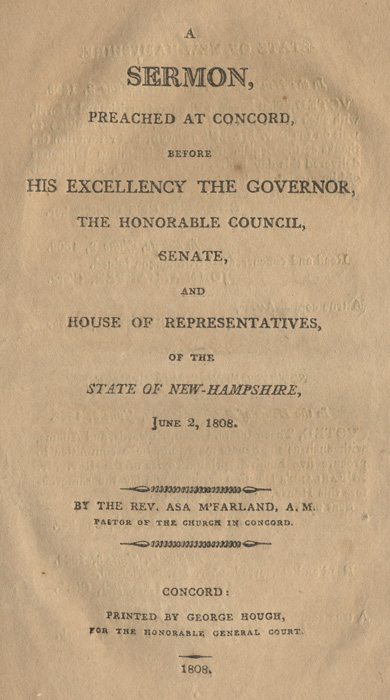
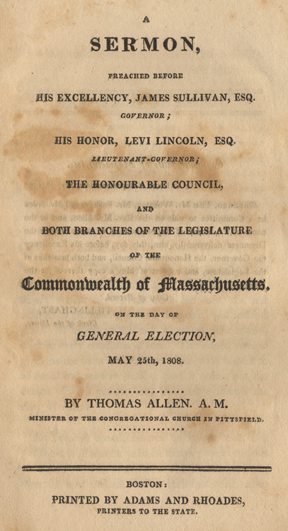
Sermon – Society in Saybrook – 1803


Jonathan Bird gave this sermon on April 11, 1803. Bird uses 1 Peter 2:13 and Romans 13:1 as the basis for this sermon.


sermon-society-in-saybrook-1803

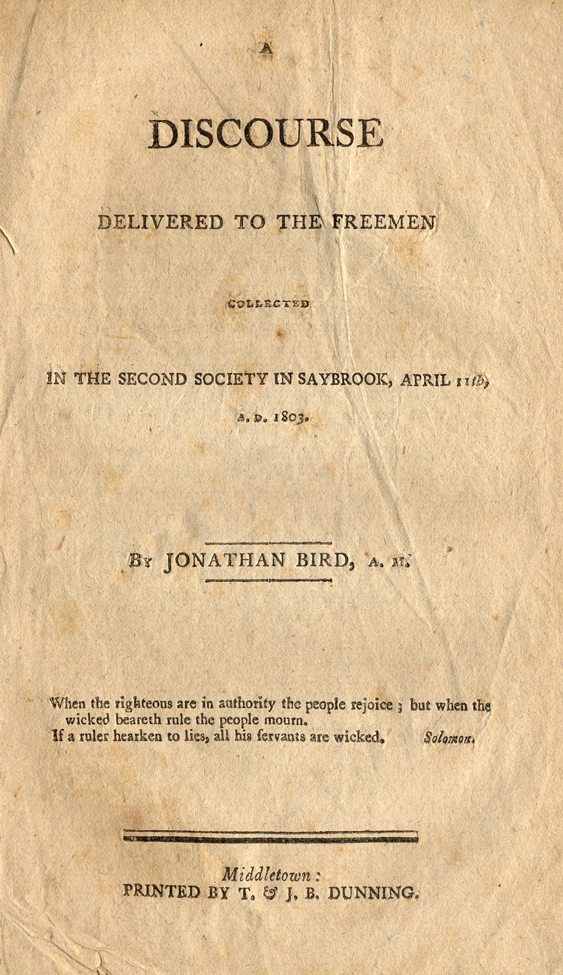
A

DISCOURSE

DELIVERED TO THE FREEMEN

COLLECTED

IN THE SECOND SOCIETY IN SAYBROOK, APRIL 11th,

A.D. 1803.

By JONATHAN BIRD, A.M.

When the righteous are in authority the people rejoice; but when the wicked beareth rule the people mourn.

If a ruler hearken to lies, all his servants are wicked. Solomon.


A DISCOURSE, &C.
I Pet. II. 13.Submit yourselves to every ordinance of man, for the Lord’s sake.

Rom. XIII. 1. Let every soul be subject to the higher powers, for there is no power but of God: the powers that be, are ordained of God.

When we see the restless pursuits of the world; good order disregarded; laws, human and divine, trampled on; religion derided; and its professors made the scoff of the profane – When vice of every kind is rampant, its votaries applauded, and advanced to lucrative and honorable stations, then, we justly fear for the safety of our civil and religious liberty.

It is needless to turn your thoughts to the wars and open attacks, on civil and religious liberty, which have convulsed and torn to pieces the European governments. Sufficient, and more than sufficient, has America drank of the lethiferous [lethal] streams of European politics, and of their demoralizing systems, which have poisoned our civil and religious liberty. (2. 3.)

In vain shall we look to the boasted empire of reason, and the philosophism of the present day to remedy the evil: for the most part, it has arisen from this very source. And, though the precepts of the gospel will do much to promote virtue, peace and good order, among those who believe in revelation and are civilly disposed, yet, with others, such as have dipped into the demoralizing principles of vain philosophy, they will have little or no influence: under God, we must depend, principally, on the civil arm. Good laws, upright judges, and a prompt execution are the main anchor of hope. (4. 7.).

It is of high importance, my hearers, that as individuals, and as members of society, we use our influence to establish and maintain civil government. This is not merely the voice of reason, it is the voice of God: “Let every soul be subject to the higher powers, for there is no power but of God, the powers that be are ordained of God.” The civil constitution and laws of a state are, strictly, the civil power, by which, both rulers and subjects are bound. But, as laws are nothing without an executive, the apostle speaks of them as one: and calls the present rulers, the powers that be, on the supposition they adhere to the laws, or, are ministers of God for good: and, as such, affirms they are ordained of God.

The nature of civil government – how far it is an ordinance of God – and our obligation of obedience, thereto, now call for our attention.

“Government is the exertion or display of lawful powers, for the attainment of good and proper ends.” In all government, whether family, ecclesiastical or political, good and proper ends should be the first ingredients. Civil government proposes a fourfold good, viz. Natural good, the preservation of our lives and properties: Moral good, the promotion of virtue, and suppression of vice and immorality: Civil good, the support of justice, truth and honesty among all degrees of men: Religious good, friendship, protection and maintenance of the religion of our Lord Jesus Christ; thy kings shall be nursing fathers, and thy queens nursing mothers, saith the Lord. Had such ends always been kept in view, by those who enact and execute laws, this world would have been a Paradise of God, in comparison with what it now is: But, alas! Long experience hath taught, that when pride, ambition, avarice, and other vices obtain the chair of state, or sword of civil power, then tyranny or anarchy prevail, liberty bleeds, and the people mourn.

But let it be noticed again, that as there are good ends in civil government; so there must be a power vested, somewhere, sufficient for the attainment, or for the ordering of things and persons for the attainment of such ends. Government, without this, would be a mere air built castle, a name without a substance. Men may propose good ends, talk and make a bustle about government; but it is all nonsense, while they have neither power nor influence to effect, or order things and persons for effecting such ends. A power here must be, and sufficient power too, or government will become nerveless, sink into contempt, and do no good. (5) – Whether this power be vested in one, two, or more, is non-essential, so it be for the best good of the community; and without this, it can in no form, be an ordinance of God for good.

It is necessary, that power be exerted. Power, while dormant, is the same as no power. Laws, not executed, are the same as no laws. There must be a display of power for the attainment of good ends. The laws must be put promptly in execution to render government energetic, a praise to them that do well, and a terror to the evil. This is the sum of civil government. Good ends; power to effect these ends; and this power actually exerted, completes the system. It contains a legislative, and an executive body, each tending, ultimately, to promote the glory of God through the best good of the community, and as such, constitutes them an ordinance of God, and entitles them to this glorious character — Ministers of God for good.

Let us in the next place inquire, wherein civil government is an ordinance of God, and, in what respects it is an ordinance of man. The apostle says, “The powers that be, are ordained of God.” Civil government, therefore, is of divine authority. It is God’s ordinance for the well-being of society: not a necessary evil, as some wild visionaries have asserted, for the humbling of the soul, and a scourge to sin. It was appointed for the natural, moral, civil and religious good of society. And, though the law was made for the unholy and disobedient, yet, it tends to God’s glory through the greatest good of the community, and as such, is a glorious ordinance of God. Civil government is an abstract of the divine government, influencing us to an imitation of the perfections of the Deity — “What, O man, doth he require of thee, but to do justly, love mercy, and walk humbly before God?” This requirement was worthy of Jehovah; and it is our glory to obey it.

This passage contains the whole of civil government, as an ordinance of God, but says nothing of laws, modes and forms. It only requires such a system of moral and civil walking, as will maintain justice, truth and mercy; and promote mutual subjection and subordination among men. Such a requirement is the unalienable prerogative of Deity, and the language of sound reason; and teaches us, that every government, whoever are its ministers, or whatever is its form, if calculated to answer the above mentioned purposes, is an ordinance of God, resembling his own divine government, and answering his demands of righteousness, truth and mercy in the land. (1. 2.).

Civil government, in every other respect, is left to human prudence and discretion: agreeably to which, St. Peter in our text, calls it an ordinance of man. – This grant to man, is highly fit and infinitely kind, in this changeable state of things; because, no mode of government will suit all communities — different circumstances, require different laws and procedures. Hence arises a necessity, that every state or corporate body should form such a constitution, and enact such laws as they find most conducive to general good. (3).

This right and privilege may be used personally or representatively, as shall be most convenient, and best subserve [to be helpful in promoting] the public weal. The ordinance of God, however, will in this circumscribe our liberty; and restrain our choice to those men who fear God and work righteousness. As God does not permit us to live without government; so neither does he allow us to chose fools and knaves for legislators, and executive officers: the one cannot, and the other will not subserve his glory and the general good. Men, who act on narrow, selfish principles and from sinister views — men, who maintain demoralizing tenets and practices, or countenance and connive at those who do – men, who wish and endeavor to cut, or weaken the sinew2s of energetic government, are a curse to the community (5)—“The best of them is as a briar, and the most upright is sharper than a thorn hedge.” Such men have no just title to the suffrages of freemen, for they are not, and will not be ministers of God for good.

This restraint in the ordinance of God, is compatible with the highest degrees of reasonable civil liberty; and extends to the greatest good of the community. As it rejects the vicious and ignorant, and promotes the wise and virtuous; (2) so it require that these be taken from among ourselves, not strangers and foreigners, but men, who are intimately connected, and well acquainted with the interest of the community, that when they enact and execute laws, they may feel for their brethren as for themselves. Agreeably to which, God said unto his people Israel, “One from among thy brethren, shalt thou set over thee: thou sayest not set a stranger over thee, who is not thy brother.” And, that he might feel his dependence on God, and his connection with the people, he was required to keep a copy of the law by him, and to read in it all the days of his life, that he might learn to fear the Lord — that his heart might not be lifted up above his brethren — and that he turn not aside from the commandment to the right hand or to the left.

Hence we see in what respects civil government is an ordinance of God, and wherein it is an ordinance of man. The constitution, and choice of all persons to be invested with power, are left to the discretion and wisdom of the people: God only requires that his glory be consulted, in every part, through the best good of the community. (2) Our best interest and highest reasonable liberty is consulted, in this ordinance of God. It is truly a popular government, for “the voice of the people is the voice of God:” that which best subserves the good of the community, best subserves his glory, therefore, is his ordinance for good.

Our obligation of obedience to such a government, is too obvious to need any labored proof. Is civil government for the benefit of society, then, common sense teaches the duty of obedience: nor can we withhold our obedience, and not injure ourselves, hurt the public, and dishonor God; hence the apostle said, “He that resisteth shall receive to himself damnation.” They who conscientiously obey the good laws of the state, cannot be unhappy in a civil sense: it is their disobedience to good laws, or submission to bad ones, which render them unhappy, and urges them to disorder and insurrection. (4)

The apostle presses his arguments, pointedly, for obedience to the powers that be, from the consideration, that they were not a terror to good works, but to the evil. Would we discourage vice and promote virtue — would we live in peace and safety — would we enjoy our own, and let our neighbor enjoy his, we must yield a prompt obedience to the powers ordained of God. No other course will insure these blessings.

And, as this is the dictate of found reason, so it has the sanction of heaven: Submit yourselves for the Lord’s sake. Let every soul be subject to the higher powers, for they are ordained of God. God has, doubtless, a right to command even unconditional obedience; but in this case, of civil government, he has in an high degree, connected our interest and happiness with obedience: His command is, therefore, enforced with double energy. We must submit not only for wrath, but for conscience sake — not merely for fear of punishment, but from a spirit of love and obedience; and, thus keep a good conscience towards God and man. Yea, gratitude and justice are not silent on this point: gratitude to God for this civil ordinance; and respect, honor and justice to his ministers who faithfully rule. Accordingly we read, “For, for this cause pay ye tribute also; for they are God’s ministers, attending continually on this very thing,” the good of the people; therefore, render to all their dues: tribute, to whom tribute is due; custom, to whom custom; fear, to whom fear; honor, to whom honor. Thus, God and reason require, that the Minister of God for good shall receive a reward for his service; and honor, respect and obedience for the sake of the ordinance.

You will observe, that I have not been pleading the cause of passive obedience and non resistance; but have urged my arguments for obedience, solely on the ground, that civil government is an ordinance of God for good. (5) That the executive officer, and the people in their representative and legislative capacity may do wrong, will not admit of a doubt. But whether they do wrong, will not admit of a doubt. But whether they can, or do; or wherein they cease to be an ordinance of God: or whether the people can, or wherein they may have just cause of resistance, are points on which I have neither time nor inclination to enter. — Many political retailers have made a noise, and done mischief on these points. Would such men take less pains to pull down and destroy, and make complaint of government: and, would they take more pains to fill the legislative and executive departments of government, with men of sound heads, and of honest devout hearts, they might be an honor to themselves, and greatly subserve the peace and well being of society. (3)

It is, indeed, a melancholy truth, that political heresies, disorganizing and demoralizing principles abound in the Union. Some states are in absolute confusion. 1 And, so confident of success are the authors and promoters of this baneful system, that they boast in the very face of day.

In justice, however, it must be acknowledged the people of this State have, for a long time, enjoyed a larger share of civil and religious liberty and happiness, than most of the other States; and are still, as a body, warm friends to good order in church and state. Some instances to the contrary, doubtless, there are, which call for attention and vigilance from the friends of government.

And, happy am I to congratulate you, my hearers, on this annual return of the day of liberty and freedom, a day, on which, we have opportunity to testify to the world, our abhorrence of men and measures which, tend to deprive us of the civil and religious liberty, handed down from our ancestors. – According to the civil constitution of this State, which, we believe, is an ordinance of God, we have both right and opportunity to chose the Executive and Legislative branches of our government. This liberty is a great and high privilege: may we honor God, and act worthy of our freedom.

Government, as we have heard, is an ordinance of God, and tends to promote the natural, moral, civil and religious good of the community. Under an energetic government, life and property are safe – vice hides her head – virtue triumphs – justice and honesty are maintained, and the religion of Jesus Christ is befriended. Thus, peace and good order are supported, religion flourishes, heaven smiles, and we are blessed. (5) How important then is it, that we use our liberty this day, in appointing and choosing such men to the civil department, as fear God and work righteousness?

It is not a matter of indifference, what characters we choose to office: all will not make Ministers of God for good. – Let it be remembered, that there are but two leading principles in the universe, godliness, and selfishness. The former, is universal benevolence; the latter, is universal malevolence: they are diametrically opposite to each other. Would we have a good and peaceable government, we must have godly men at the helm: (2) men that fear God and love the public good. Selfish men are no friends to God, nor to their fellow creatures: self, like the rave, swallows up everything. The nearest relations – the dearest connections – and the greatest public good are as stubble, when they stand in competition with self. So speaks Dr. Watts:

O cursed idol self!
The wretch that worships the would dare to tread
To ‘scape a rising wave when seas the land invade.
To gain the safety of some higher ground,
He’d trample down the dikes that fence his country round
Amid’st a general flood, and leave a nation drown’d.

In perfect agreement with this sentiment, and with common experience is St. Paul’s observation to Timothy – Know this also, that in the last days perilous times shall come: for men shall be lovers of their own selves. This, the Apostle said would be the character of these last days – men would be lovers of their own selves – destitute of love to God, and of benevolence toward man. All public spirit would be lost in the insatiable abyss of self. Hence the times would be perilous; men would not know whom to trust; and were sure to be ruined, if power should get into the hands of such characters. This is evident from his description of these selfish men. They would be covetous, boasters, proud, blasphemers, disobedient to parents, unthankful, unholy, without natural affection, trucebrakers, i.e. no bonds, covenants or agreements would hold them against self-interest, false accusers, the original is devils like satan, they would accuse and distress the righteous; incontinent, i.e. intemperate; fierce dispisers, i.e. haters of them that are good, traitors, heady, high minded, i.e. inflated, blown up like empty bladders; lovers of pleasures more than lovers of God. As the apostle expressed all these descriptions of selfish men, by the term, lovers of their own selves: so he summed up their practices, as covered with hypocrisy – having a form of godliness, but denying the power thereof. Such characters will put on a form – an outward show of religion to deceive people, and hoist themselves into office, and places of honor, trust and profit; and then, kick down the ladder by which they had risen. From such turn away, have nothing to do with them.

Do we desire a government that God will own and bless, we must make choice of rulers, that are friends to him and his cause. Has God a church on earth, and will he take his church to heaven; then such as ridicule religion, and scoff at professors – such as oppose church discipline and order, endeavoring to sink the church into the state governments, and to put down pulpits and ministers, are no friends to God and his cause — they are lovers of their own selves. (3) They will never serve the public good, any further, than self-interest shall compel them: and will always lie open to bribery, corruption and venality. Remember, my fellow citizens, the schemes and plans of selfish men, are the ways of wicked and evil men: avoid them, pass not by them, turn from them, and pass away. (2)

That there are such base characters in the union, is too evident: but I hope, and believe, that in Connecticut, they do not greatly abound; and am happy to understand, that in this town, it is by no means a general thing — as yet, you are strongly attached to your steady habits. Some good and worthy men, doubtless, are deluded and deceived by the vailed measures of selfish men. — What I have said is not to reflect on any; but to excite all to stand on their guard against designing men, and honestly, to support the cause of religion, morals and good government.

At a time like the present, when many are casting off moral and civil restraint, it peculiarly concerns the friends of good order to come forward, in their several stations, and maintain that civil liberty, which is God’s ordinance for good. If the friends of good order, neglect their feats and duty; depend on it, the enemies of government will be there and fill the offices with their own creatures. (2 3.) If we neglect the right of choosing our representatives and civil officers we dishonor God, and despise our civil birthright; and may thank ourselves for bad laws, or, at least, for the want of good ones, and good government.

And as we may not neglect, so neither may we misuse our liberty. It is not sufficient that we choose men to fill the civil departments, but we must be careful to choose men fit to be there; men, who have both will and ability to be Ministers of God for good.

As we must avoid the vain, the simple, and the ignorant; so must we reject impious, immoral, selfish, intriguing, party-making, honor-hunting, double-faced, and double-tongued men: the former cannot, and the latter will not honor their office, glorify God, and benefit the public.

Let us remember my fellow citizens, that we are accountable to God, to the present and future generations, for the use of our liberty this day. God’s glory, public good, and private happiness are depending on the choice of officers we shall make. And, to press our duty still closer on our consciences, let us remember the solemn oath we have taken in the presence of God, and of each other, that to the best of our ability, we will use our liberty, as not abusing it. With these impressions on our minds, let us apply to the throne of grace for necessary light and assistance; and so enter on the duties before us. And may God grant, that we shall honestly give our votes for such men, as in our consciences, we believe will best subserve God’s glory, and the public good. Amen. (7)


AN APPENDIX
Containing several extracts, verbatim, from Gen. William Hart’s Letter to the Rev. Richard Ely, with reference to the foregoing sermon — Dated 12th April, 1803.

(1) The sermon or rather declamation may be termed, from the bitterness and virulence it contained, a violent philippie and a libel on the administration of your country.

(2) What was the evident drift and design of this party-colored sermon? If those who heard it may judge, it was calculated to undermine our national government and administration, by weakening the confidence of the people in it; and that the Freemen must not choose such men to office as were professedly its supporters.

(3) It was calculated to hurt the reputations and wound the feelings of all those who wished to aid and assist in the support of our executive government, and who are all firm and tried friends to this State in which we live, — by imputing to them the worst principles, and the vilest motives; those of a design to pull down and destroy both church and state, and fill the earth with general confusion and anarchy.

(4) The text chosen contained inunctions of obedience to rulers and to the constituted authorities, and yet he scandalized our national rulers, by indirectly imputing to them a vain philosophy and demoralizing principles, overlooking at same time that obedience to rulers which is their due.

(5) What did he think of his hearers when he was enforcing the principles of an energetic and arbitrary government? Did he suppose them to be as ignorant and stupid as himself? Observe his word, “that men opposed to an energetic government are a curse to community” — I believe that no intelligent man could form any other idea from it, than a dislike to our republican government and wish to introduce an aristocracy or a monarchy.

(6) Observe his words as he goes on, when alluding to republicanism, “that where it had prevailed in any of the Stats, confusion had succeeded, and that in one of the States, they are in total confusion.” This is without foundation and not true. We know of no State in the union, where confusion either totally or partially prevails.

(7) In short, sir, we consider this attack on our characters and political sentiments and privileges, as a flagrant insult on our understandings and feelings as men, as Christians and as members of society.


Endnotes

1 The author purposed to have omitted this sentence in the delivery; but happening to fall upon it before he recollected himself, he thought fit to let it pass. – This whole paragraph is verbatim as it was delivered. (6)

Sermon – Sabbath Day – 1803

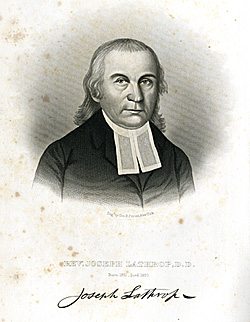
Joseph Lathrop (1731-1820) Biography:

Lathrop was born in Norwich, Connecticut. After graduating from Yale, he took a teaching position at a grammar school in Springfield, Massachusetts, where he also began studying theology. Two years after leaving Yale, he was ordained as the pastor of the Congregational Church in West Springfield, Massachusetts. He remained there until his death in 1820, in the 65th year of his ministry. During his career, he was awarded a Doctor of Divinity from both Yale and Harvard. He was even offered the Professorship of Divinity at Yale, but he declined the offer. Many of his sermons were published in a seven-volume set over the course of twenty-five years.

Following are two sermons preached by Lathrop on two separate Sabbath days. Both of these sermons were based on Revelation 1:10.


sermon-sabbath-day-1803

T
TWO
SERMONS,

On The

Christian Sabbath,

For Distribution

In The New Settlements

Of The

UNITED STATES.

By JOSEPH LATHROP, D. D.
Pastor of the first Church in West-Springfield.

ON THE CHRISTIAN SABBATH.SERMON I.
Revelation I. 10.
I was in the Spirit on the Lord’s Day.

The Apostle John was one of those, who by their doctrine and works bare testimony to the resurrection and divinity of Jesus Christ. For this testimony, he was banished by the Roman Emperor to an island called Patmos, a dreary, uninhabited island in the Archipelago, which is a part of the Mediterranean sea.

As his crime was preaching the gospel of Christ, his persecutor chose to send him into a solitary and desolate place, where he would have no opportunity to propagate his religion. But no solitude could exclude him from communion with God—no artifice of man could defeat the purpose of heaven. Here was communicated to him, in vision, that wonderful revelation, which contains a prophetic series of events, from that time to the end of the world, and which, in every age, is a standing demonstration of the truth of the glorious gospel of Christ. ‘The testimony of Jesus is the Spirit of prophecy.’

John makes particular mention of the day, on which he received the divine communication. ‘I was in the Spirit on the Lord’s Day.’

The churches, to whom he wrote, knew and observed this day. He named it to them to shew, that their Lord had put a distinguished honor upon it, and that they were bound to keep it holy in honor and obedience to him. On this day John was in the Spirit. Being engaged in the exercises of piety and devotion, he enjoyed that high communion with God, which, at other times, he had seldom known. By a pious observance of God’s consecrated day he could have communion with him in a wilderness.

We will here consider the day, which is distinguished by the name of the Lord’s day—the manner in which the holy apostle was employed on this day—and the advantage, which he found in his employment.

We will then attend to the instructions, which may be collected from our subject.

I. We observe, first, that the apostle speaks of a certain day, distinguished from all others by the name of the Lord’s day.

As he was writing to Christian churches, and expressly to the churches in Asia, he undoubtedly called the day by a name, which was then common and familiar among Christians. We may therefore conclude, that there was a certain day, which, in the apostles’ times, was known and observed in all the churches, as eminently and peculiarly the Lord’s day. And this must be the first day of the week, the day on which the Lord arose from the dead; for no other day is mentioned in the New Testament, as in any respect distinguished among Christians from other days, or as entitled to the peculiar honor of being called by this name.

As the sacrament of the supper, which was instituted in remembrance of Christ’s death, is called the Lord’s Supper; so the day on which he arose from the dead is called the Lord’s day. As the supper is distinguished from all other festivals by the express institution of Christ, and by his express command to observe it in remembrance of his death; so the day of his resurrection is distinguished from all other days by this great and important event, and sequestered by his authority as a day of religious worship among Christians, that this interesting event might the better be kept in remembrance. There is the same reason, why Christians should have a standing memorial of his resurrection as of his death. The supper is the memorial of the one; the Christian Sabbath is the memorial of the other. And this is called the Lord’s day, for the same reason, as that is called the Lord’s Supper.

The name seems to be taken from the 24th verse of the 188th Psalm, where David, speaking prophetically of Christ’s resurrection, says, ‘I will praise thee, for thou art become my salvation. The stone, which the builders refused, is become the head of the corner. This is the Lord’s doing, and it is marvelous in our eyes. This is the day, which the Lord hath made; we will rejoice in it, and be glad.’ Here is a plain intimation, that the day, on which the marvelous work of Christ’s resurrection should be accomplished—the day, when the stone rejected by the builders should be made the head of the corner, would be consecrated for, and observed by the church, as eminently the Lord’s day—the day which he had made in a peculiar sense—had dignified by his resurrection, and appointed by his authority for religious worship.

And we find in fact, that this day, immediately and constantly, after our Lord’s resurrection, was observed among his disciples as a day sacred to piety and devotion. And the observance of it was doubtless in compliance with the previous instructions of him, who is Lord of the Sabbath; otherwise we can hardly suppose, it would have begun so soon, and prevailed so generally, as it appears to have done.

The apostle John, in his gospel, tells us, that Jesus rose from the dead early on the first day of the week. ‘And the same day, at evening, being the first day of the week, when the disciples were assembled together, came Jesus and stood in the midst of them, and said, Peace be unto you.’ And on the eighth day after this, when the disciples were again assembled together, came Jesus, as before, and stood in the midst of them.

There is certainly some reason, why these circumstances are so particularly remarked, once and again. And what could it be, but because this day was, in future, to be distinguished by the religious assemblies, of Christians, and the gracious presence of Christ in them?

We are told, in the history of the acts, that ‘when Paul and his company came to Troas,’ where was a Christian church, ‘they tarried there seven days; and on the first day of the week, when the disciples came together to break bread, Paul preached unto them, ready to depart on the morrow.’ And because this was the day, on which Christians statedly assembled for religious worship, Paul gives instructions to the churches of Corinth and Galatia, that, in order to prepare a collection for the suffering saints in Jerusalem, ‘every one, on the first day of the week, should lay by him in store, as God had prospered him.

This day was honored by the first remarkable effusion of the divine Spirit on the apostles of Christ, and the preachers of his Gospel; and by the first signal instance of the success of their preaching. ‘When the day of Pentecost was fully come, the disciples were all together with one accord.’ This is the same festival, which, in the law of Moses, is called the feast of weeks; i.e. of seven weeks, or one week multiplied into another, which make forty nine days. It was forty nine days after the second day of the Passover. Pentecost signifies the fiftieth. It is so called, because it was celebrated on the fiftieth day from the first day of the Passover. The first day of the Passover was the Jewish Sabbath; the fiftieth day from thence would be the first day of the week. On this day the disciples were all together. On this day Christ fulfilled the promise, which, before his ascension, he made to his disciples, that ‘they should be baptized with the Holy Ghost not many days hence.’ On this day Peter preached to the assembled Jews; and the word came with power and with the Holy Ghost. Multitudes were awakened and converted, and the same day there were added to the church three thousand souls.

In this chapter, which contains our text, we have another example to our purpose. John, in his vision, beheld the churches in Asia assembled, on the Lord’s day, for religious worship, and the Lord Jesus walking among them, to observe their order, to assist their pastors, and to impart his grace. He says, ‘I was in the spirit on the Lord’s day. And I heard behind me a great voice, saying, I am the First, and the Last. And what thou seest write in a book, and send to the seven churches which are in Asia. And being turned, I saw seven golden candlesticks, and in the midst of them one like the son of man—his eyes were as a flame of fire—and he had in his right hand seven stars.—The seven stars are the angels of the seven churches, and the seven candlesticks are the seven churches.’ This vision plainly instructs us, that the Lord’s day was the time, when the churches assembled for hearing the word—that on this day, their respective angels or pastors attended to preach the word to them—and that the Lord Jesus, in a peculiar manner, honoured this day by his gracious presence with his worshipping assemblies, & ministering servants.

These examples sufficiently demonstrate, that the churches, from the time of Christ’s resurrection, and during the life of the apostles, met for social devotion on the first day of the week, and that they did this with the approbation of him, who is Lord of the Sabbath, and in consequence of his institution.

We find, indeed, that Paul often went into synagogues to preach on the Jewish sabbath, or the seventh day of the week; for as this was the day, on which the Jews assembled for worship, it was the most favorable opportunity to preach the gospel to them. But wherever Christian churches were established the first day of the week was invariably observed as sacred time. This was the day on which they met together to hear the word, break bread, and unite in prayer and praise.

That a seventh part of time should be sequestered for the purposes of piety and devotion was a law as early as the creation of man. ‘On the seventh day God ended his work, which he had made; and he blessed the seventh day and sanctified it.’ This law is not only recorded by Moses for the Jews, but seems to have been conveyed to other nations, by tradition. How else should it be, that nations, which had no knowledge of, or paid no respect to the mosaic law, should think of dividing their time into periods of seven days? Periods of years are naturally marked by the declinations of the sun: periods of months are also marked by the changes of the moon: periods of days are marked by the vicissitudes of light and darkness. We easily see, how mankind came to agree in these divisions of time. But how came they to think of these septenary [seven] periods of days? Doubtless they were taught, from the beginning, to reverence one day in seven as consecrated to God.

The sons of Adam had their stated seasons of worship. These were probably at the end of the days appointed for labor. ‘Abel was a keeper of sheep, and Cain was a tiller of the ground.’ They both were employed in secular occupations. ‘And in process of time;’ or, as the margin reads, agreeably to the original, ‘at the end of the days, they brought the one of the fruit of his ground, and the other of the firstlings of his flock, an offering unto the Lord.’

Noah, after the ark had rested, constantly observed periods of seven days in sending forth his doves, to discover whether the waters of the flood were abated.

The Jews, in the wilderness, before the law was given from Sinai, observed one day in seven, as a holy Sabbath; and God, by withholding the manna on a certain day, pointed out this, as the day of rest. Moses, by God’s direction, says to the people on the sixth day, ‘Tomorrow is the rest of the holy Sabbath. Six days ye shall gather the manna; but on the seventh, which is the Sabbath, there shall be none.’

When the law was given, there was placed among the moral precepts, a command to observe a seventh part of time as holy to God. This with the others, was spoken by the voice of God to the people, and written with the finger of God on a table of stone, and deposited by the order of God in the ark of the covenant. These circumstances plainly indicate its moral and perpetual obligation.

The contempt of the Sabbath is in scripture ranked with idolatry, and other gross corruptions and immoralities; for it always was followed with a general depravation of sentiments and manners. One reason, why the Jews were to observe the Sabbath, was that they might not be seduced to idolatry: And one reason, why Christians are not to forsake the assembling of themselves together on the Lord’s day is, that they may hold fast the profession of their faith.

The prophets, in their reproofs and exhortations to the Jews, lay particular weight on the religious observance of the Sabbath, and distinguish this from all ceremonial observances. This they urge, in degenerate times, as the first step to a reformation, and a principal mean of national virtue, security and happiness: And the judgments which befell that nation are oftener ascribed to their profanation of God’s holy day, than to any other particular crime; for this was the source of all crimes.

If we believe, that there is one supreme God, who exercises a moral government in the world, we must believe, that we are bound to worship him. And if we believe, that we are made to subsist in a social connection, and to serve one another in the exercise of mutual benevolence; and that God extends his government to societies, as well as to individuals, then we must believe, that social worship is a moral duty. If we are to worship God in a social manner, there must be some fixed and known season for this purpose. And as mankind would not be likely to agree on the time, it is reasonable to expect, that God, in a revelation given to men, would appoint the time for them. Thus far the observance of a Sabbath is matter of moral obligation, as really as prayer, or praise, or any exercise of piety, justice or benevolence.

A seventh part of time seems to be a reasonable proportion for sacred use. Too frequent a return of holy time would exclude the necessary occupations of the world. Too long intervals would leave the pious sentiments awakened in our devout exercises to languish and expire. Tho’ we cannot say, that this is the only proportion, which would answer the purposes of piety, without intruding on the duties of common life, yet experience teaches us, that it is justly and wisely chosen. Which of the seven days should be consecrated to religion, in preference to the others, reason could form no judgment. This depends on positive institution, and belongs not at all to the morality of the command. And therefore, tho’ the Sabbath cannot be abolished, yet the day may be changed. From the time of the creation, there was a natural propriety in resting from the labors of life, on the day, on which the work of creation ceased, because this would aptly bring to mind that vast and stupendous work.

The deliverance of the Jews from the bondage of Egypt, was an event, in which that nation were deeply interested, and which, in all generations, they ought thankfully to commemorate. Therefore the renovation of the ancient institution, so far as it peculiarly respected them, had a special reference to this deliverance; and their observance of the Sabbath is urged by this, in addition to other arguments. ‘Keep the Sabbath day, and sanctify it, as the Lord hath commanded thee—Remember, that thou waft a bondman in the land of Egypt, and that the Lord brought thee out thence with a mighty hand; therefore he commanded thee to keep the Sabbath day.’

The Jewish Sabbath was appointed to be on the day of this deliverance. Thus it would be a mere pertinent commemoration of it. The resurrection of Christ, by which he finished the work of our redemption, was an event far more grand, interesting and glorious. Hence there was a manifest propriety in setting apart that day of the week, on which he arose, to be observed in perpetual remembrance of this event. This was eminently the Lord’s day; and as such it was revered and observed in all churches of the saints.

We proposed to shew,

II. How John was employed on this sacred day. It appears from the text, and the words connected with it, that he spent this, and doubtless other Lord’s days, in the exercises of religious worship.

As he was confined to a place uninhabited, he had no opportunity to join in those social devotions, which were a usual part of the business of the Lord’s day among the early Christians. But he did not forget the day, when it returned. He remembered it in distinction from all other days, and spent it, as far as he was able, in conformity to the sacred design of its institution. He did not give himself to indolence and slumber, as if there were nothing to be done; but implied in the expression, I was in the Spirit. He had a vision of the assembled churches, and of Jesus walking in the midst of them. He attended to the instructions given him by Christ relative to the work which he had to perform, particularly to the admonitions, which he was to send to the churches in Asia. Not able to go and preach to them in person, he employed the day in writing letters of reproof, instruction, and consolation, that they might know what the Spirit said to them.

It was by humble prayer, that the prophets of old were prepared to receive the visions of God. Daniel, before he was made acquainted with the great designs of providence concerning the church, set himself to search the word of God, and to seek light and direction from him by earnest supplication. The visions, which he has recorded, were made to him in consequence of fasting and prayer and reading the books of former prophets. In like manner John was prepared for the discoveries made to him. He remembered the Lord’s day. He gave himself to meditation and prayer, and doubtless also to reading the prophets; for from them he has taken many of the expressions, and most of the figurative descriptions, which we find in this book. While he was seeking divine grace, light and comfort in these devout exercises of the Lord’s day, the heavenly communications were made to him.

This leads us to consider.

III. The benefit, which the apostle found, in attending on the duties of the Lord’s day.

He says, I was in the Spirit. This phrase especially intends the communication of the Spirit of prophecy, as appears from the following description of the vision presented to him. The phrase is again used in the same manner in the 4th chapter. The expression, in this high sense, is applicable only to the prophets of God. But there is a sense in which it may be applied to every pious and humble Christian. As there was an extraordinary operation of the Spirit, peculiar to the prophetic and apostolic ages, so there is an ordinary influence, common to all ages of the church.

The Spirit of God is represented as dwelling in the hearts of true believers, to sanctify them more and more from sin, to assist them in prayer, to strengthen them in duty, to comfort them in trouble, to succor them in temptations, and to seal them unto the day of redemption. And in regard of these gracious influences, they are said to be in the Spirit. The apostle says to the Romans, ‘ye are not in the flesh, but in the Spirit, if so be that the Spirit of God dwell in you. If any man have not the Spirit of Christ, he is none of his.’

The Lord’s day is the time, when Christians most eminently experience the communication of the Spirit; for the word and ordinances administered on this day, are the means by which God imparts his grace to humble souls; and it is in a diligent attendance on these means, that they are to hope for his grace.

God promised of old, ‘In every place, where I record my name, I will come unto you and bless you.’ Similar to this is the promise of our Savior; ‘Where two or three are gathered together in my name, there am I in the midst of them.’ It is by an attendance on the instituted duties of the sanctuary, that Christians increase in knowledge and holiness, have their doubts removed and their darkness dispelled, and feel their virtuous resolutions animated and confirmed. Christ gave pastors and teachers for the edifying of his body, that all might come to perfect men in him.

We may add farther: The conviction and conversion of sinners are, in scripture, ascribed to the Spirit of God. The preaching of the word is the ordinary mean of conversion: but it is by concurrent divine influence, that the word becomes effectual to this end. The sinner, therefore, awakened to a sense of sin, convinced of his danger, and ‘framing his ways to turn unto God,’ may be said to be in the Spirit—to be a subject of divine operation. As God is pleased ordinarily to grant his spirit in the use of those means, which are to be statedly enjoyed on the Lord’s day, so this is the season, when sinners have most reason to hope for the effectual working of God’s power in their souls. Lydia’s heart was opened, while she was hearing the word. It was on the day of Pentecost, while Peter was preaching, that the multitude were pricked in their hearts. It was when this apostle was speaking the word to Cornelius and his friends, that the Holy Ghost fell on them. The Galations received the spirit in the hearing of faith. As the word of God is the appointed mean of obtaining the Spirit, and as the Lord’s day is the appointed season of hearing the word, so this is the time, when we are most likely to receive the heavenly gift. Therefore seek the Lord, while he may be found; call upon him when he is near. Ask and ye shall receive; for he gives his Spirit to them who ask him.


center>SERMON II.

Revelation I. 10.
I was in the Spirit on the Lord’s Day.

The Christian Sabbath, or the first day of the week, is here called, the Lord’s day; it being the day, on which he arose from the dead, and which he appointed to be observed among Christians, as a season of religious worship.

On this day John was employed in such exercises of piety and devotion, as were suited to his solitary condition, and to the general state of the church, whose prosperity lay with weight on his mind.

Being thus employed, he received some special communications of the divine Spirit. He had a view of the blessed Jesus in his exalted glory—a view of resembling, but far surpassing that which he formerly had, when he was with him on the mount. And he had also a discovery of the great designs of providence with regard to the church, from that time to the end of the world. The Spirit of revelation and prophecy, which John enjoyed on the Lord’s day, was peculiar to the times of inspiration. But there is an influence of the Spirit common to all ages. And this we may hope to obtain by our attendance on the institutions of the gospel on the appointed day. Christians on this day may receive the sanctifying and comforting presence of the Spirit; and sinners may hope to become the subjects of his convincing and converting power.

On these thoughts we enlarged in our preceding discourse.

I shall now call your attention to the reflections and inferences, which naturally result from our subject.

I. As a day has been set apart by divine authority for the commemoration of Christ’s death and resurrection; we may hence conclude, that these were events vastly important to mankind, and worthy to be remembered in all ages of the world. If Jesus had been only a common man, and his death and resurrection uninteresting occurrences, a day would not have been sequestered to perpetuate the remembrance of them.

Moses, the great lawgiver of the Jewish nation, was deservedly held in high estimation among them for his institutions and miracles, virtues and self denials. But lest a superstitious veneration should be paid to him, his burial was so ordered in providence, that the place of it was utterly unknown.

Next to Moses, Elijah was a man of most distinguished eminence among the Jews. He restored to its primitive purity the divine law, which had been corrupted by the intermixture of pagan rites. He performed many surprising miracles. He acted in the cause of religion, with a warm and animated zeal. He encountered opposition, and endured affliction, with singular fortitude and patience. To reward his great piety and patriotism, and to prevent a superstitious remembrance of him, he was translated to heaven, and exempted from death.

No day was sequestered, nor form of worship instituted in memory of these high and distinguished characters; but, on the contrary, particular care was taken, that nothing like religious veneration should be paid to their names. A grateful remembrance is due to publick benefactors; but no festivals have ever been divinely instituted in honor of their persons, or in memory of their services. Certainly then we must conclude, that Jesus Christ is a character superior to all human characters; and that his death and resurrection are events, in which mankind are more interested, than in any other event, which has taken place in the world.

A day was set apart in commemoration of the creation. An additional reason for the religious observance of a Sabbath among the Jews, was their glorious deliverance from the bondage of Egypt. The former was a work worthy to be commemorated by all mankind. The latter was an event peculiarly deserving of a grateful remembrance among the Jews. But when the Redeemer died on the cross, and rose again from the dead, another day was appointed, instead of the former, to celebrate the wonders of his redemption. We may then conclude, that redemption is a work more worthy of our remembrance, than creation itself. Creation has given us a rational existence: Redemption has procured for us a happy immortality. If positive happiness is of more value, than bare existence, we are more indebted to divine goodness for the work of redemption, than for that of creation.

The superstition of heathens has deified certain heroes and conquerors; and the superstition of some nominal Christians has canonized particular saints, and appointed days for the celebration of their virtues and works; but divine institution has honored with this distinction none but our glorious Redeemer, the Lord Jesus Christ. To him, in the religious observance of his day, let us devoutly pay the honor due to his merits.

II. Our subject teaches us, that it is the indispensible duty of all Christians, living within a convenient vicinity, to associate for the maintenance of, and an attendance upon the instituted worship of God. The appointment of a particular day for this object bespeaks its solemn importance.

The Jews, on their Sabbath, were to have a holy convocation. The early Christians, on the Lord’s day, came together to break bread, hear the word, and unite in prayers and praises. The believers in Corinth are said to have met together in one place. The Hebrew Christians are cautioned, not to forsake their religious assemblies. In the several provinces of Asia, there were distinct churches, and each church had its fixed pastor. To the pastors John directs his epistles, to be by them communicated to the people of their respective charges. Wherever the apostles found a number of believers, so situated that they could assemble together, they collected them into a church; and in every church they ordained an elder. They never allowed Christians to live in a disconnected state, nor churches to continue without a pastor.

Their example teaches Christians their duty in all ages. They are bound to associate for the maintenance of divine worship, and to procure them pious and able ministers, who may statedly preside in their religious solemnities. And every Christian, as he has opportunity, is bound to join himself to some such society, for his own and the common edification. No man has a right to live unconnected with the church; and no church has a right to continue destitute of a pastor. These are not matters of human option, but divine injunction. As Christ has purchased the church with his blood, instituted social worship in it, given pastors and teachers for its edification, and appointed a day, in which it shall statedly assemble, they who voluntarily, or negligently continue without a minister, without stated worship, and without the observance of the Lord’s day, live in plain disobedience to his authority, and in open contempt of his grace and love.

We see, then that they who change the place of their worldly habitation, should keep in view the worship of God. Men have a right to alter their situation, when they think they can mend it; to sell one inheritance and purchase another, when they reasonably expect to meliorate their condition. But in all their removes they should preserve a regard to divine worship, should either go to places where it is enjoyed, or speedily seek the enjoyment of it where they go. This was the temper of the Psalmist; ‘God shall choose our inheritance for us, even the excellency of Jacob, which he loved.’ This excellency or glory of Jacob, was the sanctuary, which God had ordained, and the worship, which he had instituted. The Psalmist refers it to Providence to choose for him his earthly inheritance; but with this humble and pious reserve, that it might be in a place, where God was known and worshipped. ‘This one thing he desired of the Lord, and this he sought after, that he might dwell in the house of the Lord all the days of his life, to behold the beauty of the Lord, and to enquire at his temple.’ This privilege, has so near a connection with the existence of religion, and with the hope of Salvation, that a pious man, sooner than part with it, will forego every worldly interest.

III. Our subject teaches us the importance of attending on divine institutions. It is thus that we are to obtain the Spirit.

We are dependent on God in the concerns of religion, as well as in those of common life. Of ourselves, without the grace of God, we are no more sufficient to effect our preparation for heaven, than, without the blessing of his providence, we are sufficient to procure our daily bread. But his grace no more supersedes our labors in the former case, than his providence excludes our diligence in the latter. To obtain the blessing of his providence on our husbandry, we must apply the means which nature and experience point out. To obtain the influence of his Spirit in the work of our Salvation, we must apply the means, which his word prescribes. The Sabbath, the preaching of the gospel, joint prayer, and social worship are institutions of God; and, while we enjoy them, we are to expect his blessing only in the use of them.

God doubtless could grant his Spirit independently of these means; nor will we presume to say, how far his grace may interpose in behalf of some, to whom these means are denied. But we, who enjoy them, cannot expect his blessing in the neglect of them. God could reveal to every mortal the gospel scheme, as easily as he revealed it to the apostles; and he could form men’s hearts to embrace it by his immediate energy, as well as by the intervention of external means. But this is not the way in which he has chosen to deal with us. He has given us a written revelation—he has appointed teachers to open the doctrines, and inculcate the precepts contained in this revelation. And he grants his Spirit in the hearing of faith. ‘Faith comes by hearing, and hearing by the word of God.’

God will not do that for men immediately, which they are capable of obtaining in the use of the means which he has given them.

When there was no written revelation, God often communicated his will to men in an immediate way. As the written revelation began to appear, these immediate communications became less frequent. And when revelation was complete, they wholly ceased.

When Saul of Tarsus, who made havock of the church, was on his way to Damascus, with a commission to destroy the Christians there, Jesus, that he might bring the persecutor to a conviction of his madness, spake to him by a voice from heaven, and made himself known to him as the Savior whom he was persecuting. Saul now enquired, ‘Lord, what will thou have me to do?’ Jesus could as easily have instructed him in his future duty, as have spoken what he had already. But that was not necessary. There were other means of information within Saul’s reach. Jesus therefore says to him, ‘Go into the city, and it shall be told thee what thou must do!’ He obeyed; and Ananias was sent to instruct him.

When the devout Gentile Cornelius prayed in his house, his prayer rose up before God, and an angel was sent to tell him, where he might find an apostle, who could instruct him in the way of salvation. God could as easily have taught Cornelius by inspiration, as have taught the apostles. And the angel, if such had been his orders, might as well have given him instruction on this subject, as have directed him to send for Peter. But God will have his institutions honored. He would not by inspiration, or by a message from heaven, teach this Gentile the things, which he could learn by applying to a minister of Christ. Cornelius could not, by his own reason, investigate the way of salvation. But he could send for Peter; hear the apostle when he came; and understand what he said. Had he refused to apply to Peter, or to hear him preach, his inability to find out the way of salvation, would have been no excuse for his ignorance.

Farther: The gospel teaches us, that we are saved, not of ourselves, but by the grace of God. A doctrine worthy of all acceptation; but no way tending to encourage indolence.

Salvation is the purchase of Christ. In this view it is wholly his own work, we have nothing to do in it. It is the gift of God: We can do no more to deserve it for ourselves, than we have done to purchase it for the world. The gospel teaches us the way of salvation: Had we not been taught the way, we never could have found it. Repentance is the condition of pardon; and to this divine grace is necessary. Thus all things are of God.

But then we are rational beings—there are means put into our hands—and with the means God often gives some attendant influence of his Spirit; for the gospel is called a ministration of the Spirit. The means afforded us we must apply to the purpose for which they were appointed. Thus we are to hope for God’s blessing. ‘To him who hath, shall more be given.’ If we neglect the plain institutions of God, despise his word and worship, and profane his day, there is no ground to expect, that his spirit will be given us; for there is no encouragement in scripture, that it will be given us; for there is no encouragement in scripture, that it will be given in this way.

IV. Our subject farther teaches us, that the Lord’s day is a season peculiarly favorable to the purpose of religion.

On this day John was in the spirit. He certainly had some good reason for informing the churches of this circumstance. And what could it be, but to recommend to them the religious observance of the day, as a mean of obtaining the spirit.

The churches, to whom he wrote, were generally fallen from their first purity. The purport of his letters was to reprove them for their declensions, and exhort them to repentance. He tells them that what he wrote was dictated by the spirit of Christ, and that he received the spirit on the Lord’s day—that on this day Christ walks in the midst of his churches, and that if they would receive his spirit, they must meet him in his sanctuary, where he walks.

Here is a plain intimation, that the declension of religion among them had been owing to a neglect of the Christian Sabbath; and that the revival of religion would depend on a more strict observance of that day.

It appears from John’s letters to some of these churches, that their declension had been caused, in a great measure, by the influence of certain irregular teachers, who, under false pretensions, had gained admission among them, disturbed their order, and corrupted their sentiments. It is common, that such teachers divert men from the stated worship of the Lord’s day, by substituting other times of worship in its place. John would have Christians strictly attend to the instituted worship of the holy Sabbath. He suggests to them, that the day of the Lord was the season, and his ordinances were the means of obtaining his grace. Christians must be builded together for an habitation of God thro’ the spirit, and by peace and union in sacred duties grow into an holy temple in the Lord.

Other days, besides the Sabbath, are sometimes pointed out in providence, and may be usefully employed for the purpose of social worship. But occasional seasons must never supplement the Lord’s day. When this is the case, they rather obstruct, than promote religion. An attendance on occasional worship is a matter of Christian prudence; an attendance on the stated worship of the Sabbath is matter of divine requirement and moral obligation. Paul, when necessity required, taught out of season, as well as in season; and from house to house, as well as publickly. Thus he did in Ephesus, when the gospel was first introduced there. But seasonable and publick teaching he preferred. At Troas he waited seven days for the return of the Lord’s day, when the disciples would of course come together. Other seasons, prudently chosen, may be useful; but on this day we have most reason to expect God’s blessing. If we wish for the power of religion in our own hearts, and the promotion of it among others, we must honor this day.

V. We are taught, that, under ordinary circumstances, we cannot be excused from the duties of the Sabbath. John, even in a state of banishment and solitude, found something to do.

As social worship is an institution of God, every one, as there is opportunity, is bound to attend upon it. This however, is not the only duty of the Lord’s day. There are other more private exercises, which belong to it. It is to be ‘a Sabbath to the Lord in our dwellings.’ We are to ‘call the holy of the Lord honorable, and to honor him, not doing our own ways, nor finding our own pleasure, nor speaking our own words.’ We are to withdraw ourselves from the cares and occupations of the world, and employ our private hours in meditation, self examination and prayer, and in profitable conversation and reading—in exercises adapted to promote personal piety, and in instructions suited to advance family religion.

VI. We are here farther instructed, that we ought to improve the Lord’s day with an aim and desire to obtain the Spirit in those gracious influences, which are suited to our condition and character. We should come to God’s house hoping that we may receive a word in season, and that the word may be attended with the holy Ghost and with power.

Sinners should desire the convincing and converting influences of the Spirit. In hearing the word, the Jews, at the feast of Pentecost, were pricked in the heart. The Lord’s day is the time in which, and the preached word is the mean by which the Spirit usually convinces sinners, and begins a good work in them. The stated exercises of the Sabbath are indeed sometimes the means of conviction to those, who had no such aim in attending on them. The Jews, on the day of Pentecost, received lasting benefit from a gospel sermon, which they had no previous intention or desire to hear. But where any serious disposition already exists, there is still greater hope of spiritual benefit. If then you view yourselves as being in a state of unpardoned guilt, and feel any solicitude to be delivered from this state, attend on the publick solemnities of the sanctuary, give earnest heed to the things which you hear, apply to yourselves what is pertinent to your case, and pray for the Spirit to impress it deeply on your hearts. And let the serious sentiments, awakened in hearing the word, accompany you in the ordinary business of life. Take heed, that the affairs of the world extinguish not your Sabbath feelings; but let your better frames govern you in your worldly labors, and restrain your worldly affections.

If you are in affliction, go to God’s house with a desire to hear some instructive and consoling truths adapted to your case, and with these to receive the guiding and supporting influences of that Spirit, who is called the comforter. David, in the house of his pilgrimage, made God’s statutes his song. He confessed that, unless God’s law had been his delight, he should have perished in his affliction.’ Asaph in his perplexities went to God’s sanctuary, and there found relief. Hannah, in the bitterness of her spirit, repaired to the temple of God, and there poured out her soul before him. ‘And she went her way, and her countenance was no more sad.’

If you view yourselves as saints, so improve the Lord’s day, that it may be a mean of rendering you more holy and heavenly. Seek a greater measure of the Spirit’s sanctifying influence.

To be in the Spirit, is to possess and exercise that temper which is the fruit of the Spirit. ‘This is in all goodness, righteousness and truth.’ We are in the Spirit, when the Spirit awakens into exercise those pious and benevolent dispositions, in which the religion of the gospel consists.

We are especially required to exercise these graces in the publick solemnities of the Lord’s day, prayer, praise, and hearing the word. Al these things are to be done with charity, meekness and humility. When we stand praying, we are to forgive, if we have ought against any man. We are to sing praises with grace in our hearts, with thankfulness to God, and peaceableness and benevolence to men. In hearing the word we are to lay aside all malice, envy, guile and hypocrisy, and receive with meekness the engrafted word, that it may save our souls. When we thus worship God on the Lord’s day, we may be said, to be in the Spirit, for we have those tempers, which are the fruits of the Spirit.

But let us not imagine, that these goodly frames are required only on the Lord’s day—that if we are serious, grave and devout then, we may indulge our passions, and live to the world every day besides. The religious exercises of the Lord’s day are instituted to make us constantly and habitually pious and holy.

We are to be in the spirit on this day, that we may walk in the spirit every day. We are to forgive, when we stand praying—to have the peace of God in our hearts, when we are singing—to put on humility and meekness, when we are hearing, that we may be always of a meek, humble, peaceable and forgiving temper. If such a temper is right in the duties of devotion, it is right also in the duties of common life. In vain we pretend, that we are in the spirit of Christ on his day, if we are in the spirit of the world on all other days. Let us, therefore, at all times, put on humbleness of mind, meekness, goodness and love, which are the fruits of the spirit. Thus it will appear, that we have not received the spirit of the world, but the spirit, which is of God, and tht we know the things, which are freely given us of God.

CONCLUSION.
Our subject may with great propriety, be applied to the people dispersed in the wilderness, and in the new settlements, for whose benefit the publication of it is principally intended.

To you, our friends and brethren, we address our affectionate advice.

In regard to your own, and your children’s worldly interest, you have removed to a distance from us. But we hope, you have carried with you those sentiments of regard for the gospel and the day of our Lord, which you entertained while you were among us. And we entreat you not to forget them, nor suffer them to languish in your hearts.

Pay an early attention to the enjoyment of the gospel ministry in the places where you are. Let not the paucity of your numbers, or the poverty of your condition plead for too long a delay, lest your children, growing up unaccustomed to this divine institution should contract an indifference to it; and even some, who are older, should, by long disuse, sink into habitual carelessness; and thus your difficulties, instead of being diminished by an increase of wealth and numbers, should be increased by the diminution of virtue and piety. For your encouragement, think of the example of the fathers of our country. In all their new plantations, one of the first objects was the enjoyment of gospel ordinances, and the settlement of an able minister. In their zeal they found ability; and God prospered them. For our present national happiness we are much indebted to their social spirit, love or order, attention to family education, and reverence for divine institutions.

Look to the example of the holy patriarchs. They were pilgrims in the world. But in all their peregrinations they shewed a governing regard to God and his worship. And wherever they made a stand, their first work was to erect an altar to God, at which they, and all, who accompanied them, might attend for social devotion. Thus they preserved religion in their own hearts, maintained it in their households; and recommended it to the people among whom they sojourned; and thus they obtained the promise of God’s blessing on their posterity.

As you have come from different parts to settle on the same ground, it is natural to expect, that there should be some diversity in your sentiments and usages. But let not this diversity obstruct your measures for obtaining religious order and a stated ministry. Avoid vain jangling and perverse disputing, and exercise yourselves to godliness. Distinguish between things essential, and things circumstantial in religion. A proper zeal for the former will always be accompanied with condescention in the latter. Exercise the same charity, humility and forbearance, which saint Paul inculcated, in his day, on the Jewish, and the Gentile believers; and you may, as they did, unite in the same church, and under the same ministry; for we trust, your differences are, in few instances, greater than were theirs. The rule which this apostle gives you is, that ‘you reject not those, whom God receives.’ This rule, well observed, will have a happy tendency to unite you.

While you are destitute of a stated ministry improve the means, which you have.

Attend on the missionaries, whom we send among you. We shall fend only such as can be well recommended—men duly authorized, and competently furnished for their mission—men of ability, learning and piety—men of pacific, candid and conciliating dispositions—men who will study to edify you in love, not to sow discord, and cause divisions among you.

If you have not a minister, yet forsake not the assembling of yourselves together. Statedly meet on the Lord’s day, join together in prayer, and let there be a portion of scripture, or some pious book read in your assemblies. Thus you will proote brotherly peace and love; thus you will cherish in youthful minds sentiments of reverence for religion, for the gospel, and for the Lord’s day.

On this day, forbear all unnecessary secular labor and worldly discourse, and restrain your children from diversion and amusement, and every thing inconsistent with its sacred design. Remember, how John kept the day in a wilderness. Let it be a Sabbath to God in your hearts, and in your dwellings.

Maintain daily religion in your families. Let your houses be houses of prayer. Let the Holy Scriptures be read in them. Train up your youth in the nurture and admonition of the Lord. Walk before them in a perfect way. Thus let there be a little church in every house; and soon there will be a house for God in every plantation, and his house will be filled.

Cultivate the spirit of religion in your hearts, and exhibit the virtues of it in your lives. Consider one another to provoke unto love and good works, and be fellow-workers to the kingdom of God.

We wish you health and prosperity; and, above all, that your souls may be in health and prosper. Great will be our joy, if we hear, that you and your children walk in the truth, the order and purity of the gospel.

How transporting to John, in the wilderness, must have been that vision, in which he saw, on the Lord’s day, the churches of the Redeemer assembled in their respective temples, to mingle hearts and voices, to offer joint prayers and praises, and to hear the glorious doctrine of salvation; and, at the same time, beheld the Lord Jesus, dressed in his robes of majesty and grace, walking among them to observe their order, diffuse his influence, bless his ordinances, and offer incense with the prayers of his saints? This nearly resembled his subsequent vision, in which he saw a door opened in heaven, a throne there placed, and saints and angels surrounding it with harps and songs, and giving glory and honor and thanks to him who sat upon it, and who lives for ever and ever.

A sight like this was enough to turn his wilderness into paradise—his Isle of Patmos into the Garden of Eden.

Could we see you, our brethren, who are scattered in the wilderness, every where gathering into churches, erecting sanctuaries for God, assembling in them on the Lord’s day, calling ministers of Christ to preside in your solemnities, walking together in purity, peace and love, and thus exhibiting a proof that the Lord is among you of a truth, we should feel a joy approaching toward that, which saint John must have felt; and our joy would be the joy of you all. May God pour down his spirit and blessing upon you from on high, and comfort all your desolate places; may he soon make your wilderness as Eden, and your desert as the garden of the Lord: may joy and gladness be found therein, thanksgiving and the voice of melody.

F I N I S.

Sermon – Thanksgiving – 1808


James Gray (1770-1824) was born in Ireland and graduated from the University of Glasgow in 1793, but immigrated to the United States in 1797. He served as a pastor in Washington, NY (1797-1803), and preached at the Associate Reformed Church in Philadelphia beginning in 1803. Gray helped establish the theological seminary for the Reformed Church in New York City and the Philadelphia Bible Society. This sermon was preached in Philadelphia on December 31, 1808.


sermon-thanksgiving-1808

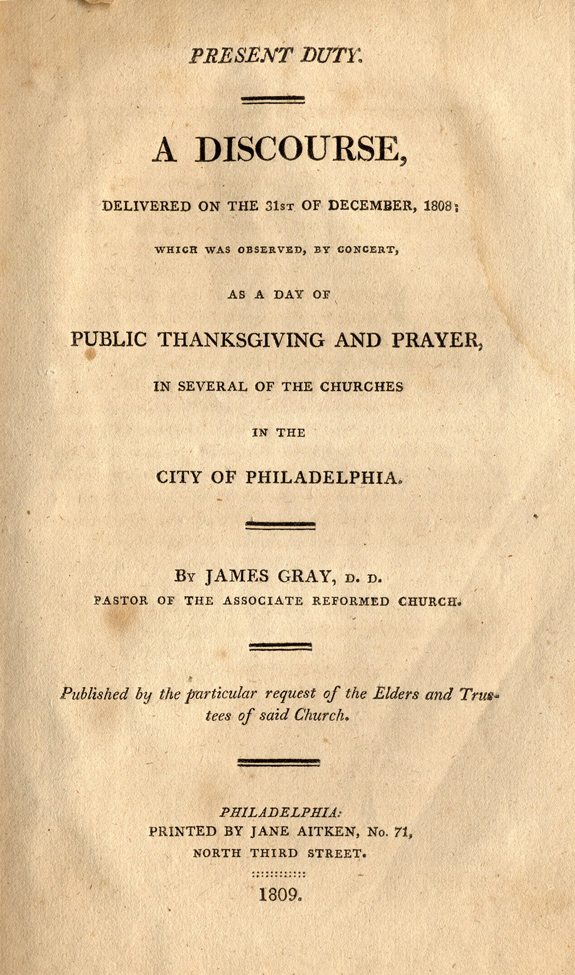
PRESENT DUTY.

A DISCOURSE,

DELIVERED ON THE 31ST OF DECEMBER, 1808;

WHICH WAS OBSERVED, BY CONCERT,

AS A DAY OF

PUBLIC THANKSGIVING AND PRAYER,

IN SEVERAL OF THE CHURCHES

IN THE

CITY OF PHILADELPHIA.

By JAMES GRAY, D. D.
PASTOR OF THE ASOCIATE REFORMED CHURCH.

THANKSGIVING.

Philadelphia, November 1st, 1808.

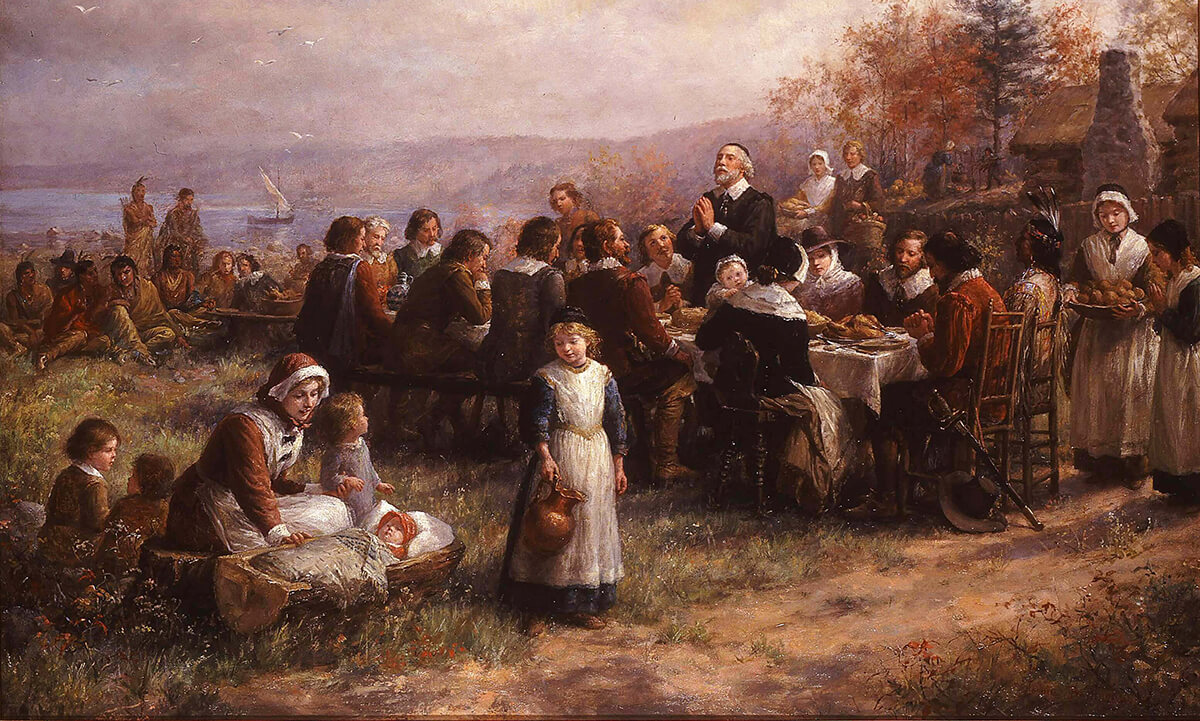
At a meeting of the Clergy of the following religious denominations, viz. The Presbyterian, Baptist, Methodist Episcopal, German Lutheran, Evangelical Lutheran Church of St. John, Moravian, and Associate Reformed Churches: with a pledge of co-operation by the German Reformed, and Reformed Presbyterian Churches; whose ministers were prevented by circumstances from attending the meeting: the last day of the present year, was appointed to be observed in their respective places of public worship, as a day of solemn thanksgiving to Almighty God, for the blessings conferred on this city in particular, and the nation at large, during the current year; and of prayer, for the continuance and enlargement of the divine favor to ourselves and others.

By order of the meeting, the following address to the people of their respective charges, is respectfully submitted.

GRATITUDE for the unmerited blessings of a munificent Providence is at all times a reasonable exercise and an incumbent duty, and the expression of it constitutes an important part of that public worship, which all Christian societies, are regularly in the habit of offering unto God in their weekly assemblies—But when cities or nations receive peculiar favours; or when they are exempted from calamities to which they have been before subject, or under which other nations are suffering, there appears to be a special call in providence for setting apart, days of thanksgiving and praise, to Almighty God for his distinguished mercies.

Upon a review of the occurrences of the year which is now drawing to a close, and from a consideration of the dispensations of divine providence towards this city in particular, we are of opinion, that our circumstances plainly indicate, the propriety of engaging, unitedly and publicly, in rendering thanks to a gracious God, for the favours which he hath bestowed upon us. For, although we have suffered some privations, and have been threatened with considerable dangers, yet our city and our country generally, have been exempted from the calamities of war, pestilence and famine; the three principal scourges, which the governor of the universe makes use of, for the punishment of guilty nations. The blessing of peace can scarcely be appreciated by those who have never witnessed the horrors of war. The long train of evils attendant on a state of warfare, whether successful or unsuccessful, cannot be fully described. But that which greatly enhances the value of this blessing in our case, is, that to us it is almost a peculiar favour. The whole civilized world beside, has been, for many years, in an awful state of agitation. The period in which we live is marked by events of a very uncommon and astonishing kind.—Thrones, dominions, and empires, have not only been shaken to the centre, but overturned to the foundation. Ancient dynasties, the most powerful in Europe, have been entirely annihilated, and new ones suddenly created. Human blood has been profusely shed, and millions of our fellow creatures have been hurried out of the world by a violent death.—And still the work of destruction goes on—still the sword of war is bathed in blood.—Permitted to be little more than spectators of this awful scene, it is no doubt our duty, to sympathize in the sufferings of afflicted humanity; but, at the same time, we may rejoice that the “Lord reigneth,” and will overrule all these commotions to accomplish his own wise purposes. And we should be unfeignedly thankful, that hitherto to our country has been preserved from being involved in the tremendous storm which now overwhelms Europe: and also, that the spirit of internal discord has been so far repressed, as not to burst forth into open acts of violence. Whilst other cities have been convulsed and torn asunder with dissentions and insurrections, ours has enjoyed undisturbed peace, and settled tranquility. “Oh that men would praise the Lord for his goodness, and for his wonderful works to the children of men.”

But, our gratitude is not only due to God for the blessing of peace, but also for that of health. You stand in no need of arguments to convince you, that pestilence is a terrible judgment.—Your own experience is sufficient to prove, that the prevalence of a malignant epidemic disease, is a fearful calamity. At the conclusion of some former years, the retrospect of events was calculated to produce very different sensations from those which you feel at the present time. Then, the most poignant grief was revived by every recollection of the past. But these distressing scenes are too recent, and have left too deep an impression on your minds, to be easily forgotten; and the mention of them is here introduced, merely to excite your gratitude to a merciful God, for preserving you during the last season, from a visitation so calamitous. The common lot of mortality, it is true, has fallen upon many;–and the insatiable grave has devoured its usual number of victims, both old and young: but “the pestilence which walketh in darkness, and destruction which wasteth at noon day,” have not come near you. General health, with its concomitant blessings, has been granted. Free from alarm, and free from danger, you have been permitted to remain in your dwellings, and without interruption from disease, to pursue your respective occupations, and to enjoy the inestimable privilege of assembling from Sabbath to Sabbath in the house of God. “Oh give thanks unto the Lord for he is good, and his mercy endureth forever.”

But whilst we are recollecting the blessings of a beneficent providence, which claim your gratitude, we must not omit to mention the plenty, which has rewarded the labours of the husbandman. It is God who giveth us “rain from heaven, and fruitful seasons, filling our hearts with food and gladness.” It is he who causeth the earth “to bring forth and bud, that it may give seed to the sower, and bread to the eater.” He has “crowned the year with his goodness,” and his “paths drop fatness,” so that “the pastures are clothed with flocks’ the valleys also are covered over with corn. Lift up your hands in the sanctuary, and bless the Lord.” “Sing praises unto his name, for it is pleasant, and praise is comely.”

But it must be confessed, that the picture has a dark as well as a bright side. For, although in the retrospect of the past, there is reason to rejoice; yet, in the prospect of the future, there is also much cause to fear. Let us therefore “rejoice4 with trembling;” and, while we offer our thanksgiving for favours received, let us earnestly beseech the Father of mercies to continue our blessings, and to deliver us from those evils which we either feel or fear.

Our national affairs, it is acknowledged by all, are in a very difficult and perilous condition, and seem to be rapidly approaching to some important crisis. No human wisdom is adequate to foresee, and provide against, the evils to which we may be exposed. We should, therefore, with importunate supplications, entreat Almighty God to interpose in our behalf, and to continue to protect our country from all the dangers by which it is surrounded; to preside over our President; to counsel our counselors; and so to overrule all the deliberations of our legislators, that they may be led, at this critical and interesting period, to adopt such measures, as will preserve the peace and promote the prosperity of the nation. And as the hearts of kings are in the hands of the Lord, so that he turneth them whithersoever he will, let us earnestly pray that he would dispose the contending powers of Europe, to treat us with justice, and permit us to remain in peace;–that he would smile on our country, and cause our agriculture, commerce, and manufactures to flourish:–that he would preserve the health of our citizens, and banish plague and pestilence from all our borders.—And, above all, let us beseech the “God of all grace,” that he would grant the rich effusions of his Holy Spirit to all our churches, that truth and piety, may flourish in our day; that the institutions of religion may be reverenced; that justice, benevolence, and humanity, may prevail; that the rising generation may be early and deeply tinctured with the genuine spirit of the gospel; that vice and error may be suppressed; that luxury and dissipation may be retarded in their alarming progress; that political dissentions and the baleful spirit of party may be extinguished; and, in short, that a pure and general reformation may take place among all denominations of Christians, and through all classes of society. And, finally, let us pray, that God would extend the benign influence of the gospel to the most dark and distant regions; that the whole earth may be full of the knowledge of God; that his name may be great among the heathen; and that the remnant of Israel may be gathered in; that “the Lord may be King over all the earth,” so that there may be “One Lord and his name One.”

Dear brethren, we earnestly recommend that the day appointed be religiously observed for the aforesaid purposes; and that attention to secular affairs be, as far as practicable, intermitted. And we hope that a gracious God will enable you in sincerity to offer “the sacrifice of thanksgiving” and the “prayer of faith;” and that his ear will be open to receive your supplications, and his arm stretched out for your protection and salvation.


PRESENT DUTY.

A DISCOURSE, &c.

PSALM, XXX. 6, 7, 8, 9, 10, 11, 12.

“IN my prosperity I said, I shall never be moved. Lord, by thy favour thou hast made my mountain to stand strong. Thou didst hide thy face, and I was troubled. I cried to thee, O Lord, and unto the Lord I made supplication. What profit is there in my blood when I go down to the pit? Shall the dust praise thee? Shall it declare thy truth? Hear, O Lord, and have mercy upon me: Lord, be thou mine helper. Thou has turned for me my mourning into dancing: thou hast put off my sackcloth, and girded me with gladness; to the end that my glory may sing praise to thee, and not be silent. O Lord my God, I will give thanks to thee forever.”

WE have assembled for the purpose of contributing our share to carry into effect the concluding recommendation in the address which was read to you in the morning. Thanksgiving for public mercies received, and prayer for future mercies, were the two objects submitted by that address to our serious and conscientious consideration. The recommendation to consecrate the day to these objects comes from a number of clergymen of various religious denominations; who, after considering the aspect of holy providence, judged it their duty to make the proposal, and to take that part in its execution, which their station in the church of God renders proper. Accordingly, our former discourse went to illustrate the subjects of thanksgiving; the present is devoted to illustrate those of prayer.

The passage of Holy Writ which has been read, records events, which bear no obscure analogy to the circumstances of this nation. It presents, in the life of David, one of those rapid transitions from prosperity to adversity, which occur not unfrequently in human affairs. And, what is more interesting still, it exhibits that good man, in every change of fortune, tendering due adoration to the Supreme Disposer: praising the divine favour in his elevation, and from the depths of distress looking up, and imploring the divine interposition. It is thus that the visitations of the spirit of grace qualify for all contingencies. Give us but an abundant unction of that grace, and let Sovereignty order events as he pleases; for, whether in sorrow, or in joy, we shall abound in faith, and “in those fruits of righteousness which are by Jesus Christ to the glory and praise of God.” This nation, like David, has been elevated to a high pitch of prosperity; like him, it is “troubled:” may our views and conduct correspond with his: and may God of his infinite mercy grant, that a similarity of issue may fill up the measure of coincidence; till the two cases accord as type and antitype.

“In my prosperity, I said, I shall never be moved. Lord by thy favour thou hast made my mountain to stand strong.” Such was David’s declaration; and it is not long since this nation might have pledged him in the cup of blessing. It was but lately that its mountain swelled towards heaven, and seemed to promise some stability of base. Within its territorial circuit were displayed a rapidly increasing population,–fed, clothed, and industrious; while a generous soil poured out, with exuberant bounty, a superabundance of the gifts of life. Agriculture pushed on its conquests over the forests. Cities sprung up out of villages; villages arose in the deserts. In addition to these essential articles of national prosperity, its commerce covered the ocean: ships from every clime crowded its harbours: the fabrics and productions of the trafficking world filled its warehouses. We were clothed in silk, and fared sumptuously every day. The self-created distractions of other nations seemed to be permitted, and ordered by Providence to swell the spring-tide of our national prosperity. Our coffers ran over; and we exhibited the political phenomenon of a nation paying its debts. Our mountain stood strong. It is to be hoped there was national piety enough to recognize the fact, that it stood strong, by the favour of God. Perhaps some calculated on the perpetuity of our prosperous condition; on its longer continuance many certainly did calculate. Self-love, so inventive of reasons to justify and flatter its hopes, could produce a thousand imposing arguments to demonstrate, that it was as much the interest of other nations, as of this, that commerce should continue to flow in the channels, into which the necessities of the times had forced it.

But sanguine hopes are seldom realized; and ours, if such hopes were ours, have met a disastrous rebuke. The Lord hath hid his face and we are troubled. All the internal springs of prosperity continue; but commerce is gone. Reflecting men had long beheld, with anxiety and with terror, the embittered and obstinate spirit of hostility displayed by the two conflicting potentates of Europe. The fate of two great nations, populous, rich, and highly civilized, was itself an object sufficiently interesting to humanity. But that interest was, it appears, mingled with too justly founded a fear, that the effect of their hostilities might reach beyond themselves; that it might affect the essential interests of many nations; and that the principles of public law and of civilization might get involved in the issue. These were not the alarms of the passions, but the apprehensions of sober wisdom, calmly calculating the effects of exorbitant ambition and relentless wrath, united with great power. The event has justified them all. Even this nation, “entirely divided from the whole world,” has got involved at last. Nature had removed her far from the theatre of war: a commerce, which nursed and nurtured both the belligerents, has brought us into the midst of it: a commerce, which nursed and nurtured both the belligerents, has brought us into the midst of it: a commerce, the value of which we well knew, and they have sufficiently proclaimed; while each cuts off the channel which conveyed it to the other, as they would cut through the aqueduct of a fortress which they wished to reduce. The thing is done. Our commerce has disappeared from the ocean. Our ships rot along the banks of our rivers. Our seamen, where are they? At this moment the nation stands astounded. And no wonder. A great portion of the arrangements of the social body are to be changed at once, in opposition to feelings the most tender, and habits the most inveterate. Wealth must explore new and untried channels; industry find new objects; the poor seek new resources; even luxury—but luxury is the last that suffers in public distress.

Such are the circumstances in which we meet to supplicate the interposition of divine providence in behalf of the nation. The interest at stake is the happiness of a whole people. And we shall ill display our faith in God, or love to man, if such circumstances do not inspire our prayers with ardour and importunity. The subjects of prayer I shall state and illustrate in order of the address.

FIRST SUBJECT OF PRAYER.

It is our duty “To entreat Almighty God to interpose in our behalf, and to continue to protect our country from all the dangers by which it is surrounded; to preside over our President; to counsel our counselors; so to overrule all the deliberations of our legislators, that they may be directed, at this critical and interesting period, to adopt such measures as may preserve the peace and promote the prosperity of the nation.”

In sum and essence; that God would inspire our magistrates with wisdom and virtue for their high official functions; and crown their labours with, what is the end of all civil government, the happiness of the nation. Among all the social duties there is scarce any, of the duties which the people owe to their governors, there is certainly not one, which comes home to the understanding with stronger recommendatory arguments, and at the same time impress conscience with less force, than the duty of prayer for civil magistrates. Every thing else we will do for them; honour them, praise them, pay them, fight for them; every thing but pray for them; every thing but bear them on our hearts to the throne of grace. This fact is a demonstration that there is a prevalent practical atheism in human nature; and that, even under the gospel and with all the boasted illumination of the age, the simple principle that “Jehovah reigns” is by far too sublime for the gross and vulgar conceptions of men, who feel sufficiently impressed with every other species of government. The unceasing agency of Deity in the production of things, his operation on the mind of man, his supreme but all-wise disposal of us and our concerns; or in other words, what we call his Providence, is a principle of faith more difficult of admission than his creating energy; and vastly more important. It is this that lays the basis of religious trust. In introduces us to a rational communion with all the perfections of Deity. Deny this, and that communion is gone. All appeals to his justice or mercy, all confidence in his wisdom or power are absurd, if he presides not over us and all that interests us. But do they manifest their belief in the providential government of God, who never recommend the common weal to his care and keeping? It will be well if even that part of the community, who are accustomed to wrestle with God, by prayer, shall be found to have respected, as they ought, the apostolic exhortation: “I exhort, therefore, that first of all, supplications, prayers, intercessions, and giving of thanks, be made for all men; for kings, and for all that are in authority; that we may lead a quiet and peaceable life in all godliness and honesty: for this is good and acceptable in the sight of God our Saviour.” 1 It were devoutly to be wished, that there did prevail that sublime faith which recognizes Jehovah’s agency in all thing, from the most minute to the most grand, and which recommends to his safe keeping, parents, ministers, magistrates, church, and state; that he would so enlighten them by his spirit, that they may discharge their various trusts with fidelity. It is this that would sanctify man in all his relations. It is this that would sanctify, even that too frequently unsanctified thing, patriotism.

There are two objects to be kept in view when we address the throne of grace in behalf of our civil magistrates. The first is, that God would inspire them with wise and righteous counsels. Even a heathen could dedicate a temple to the Inspirer of good counsels. We will have exchanged heathenism for Christianity, to little purpose, if we do not honour the true God in our way, as much as pagans honoured idols in theirs. A conversion from superstition to atheism is a poor step in the progress of intellect. Let us take a view of the privilege granted to prayer when a nation’s welfare is at stake; of the use which piety makes of that privilege; of the approbation which God gives to that use; and of the consequences to national felicity. Let us survey the whole in the instance of Solomon. After his advancement to the throne of Israel, he attended a grand national festival, at which he offered up a thousand burnt offerings. The subsequent history runs thus: “In that night did God appear unto Solomon, and said unto him, Ask what I shall give thee. And Solomon said unto God, Thou hast showed me great mercy unto David my father, and hast made me to reign in his stead. Now, O Lord God, let thy promise unto David my father be established: for thou hast made me king over a people like the dust of the earth in multitude. Give me now wisdom and knowledge, that I may go out and come in before this people: for who can judge this thy people that is so great?—And God said to Solomon, Because this was in thine heart, and thou hast not asked riches, wealth, or honour, nor the life of thine enemies, neither yet hast asked long life; but hast asked wisdom and knowledge for thyself, that thou mayest judge my people, over whom I have made thee king; wisdom and knowledge is granted thee; and I will give thee riches, and wealth, and honour, such as none of the kings have had that have been before thee, neither shall there any after thee have the like.” 2 Such was the prayer of Solomon; such the answer of God. We read the result in the history of a long reign, peaceful and glorious; which civilized and enriched the Israelitish nation, and diffused its fame, linked and entwined with the most solid advantages, to the surrounding countries. When God withholds the blessing of wisdom from a government, the consequences are dreadful. There is not a more awful mark of heaven’s displeasure against a people, than to see their rulers abandoned to infatuated counsels. Yet in the changes of men and measures in the political management of nations, there has appeared I know not what malignity, worse than human; which has seemed to triumph in the pernicious counsels and ruinous administration of civil governors: as if the errors of a statesman and calamities of a nation, were grounds of rejoicing: or as if any virtuous man could wish a change, the means to produce which must be the previous prostration of justice and public happiness. Let us pray God to inspire our rulers in all their various ranks and functions, with wise counsels; and particularly with that, without which no counsel is wise, nor can be ultimately beneficial—the righteousness which exalteth a nation.

But we should pray for more than wisdom and righteousness in our civil governors. Injustice and folly eventually and inevitably destroy nations: but wisdom and virtue will not always save a state. It is the blessing of heaven which gives them that success. Mankind admit, unless when malignity to multiply its censures multiplies crimes, they admit that no man is responsible for the success of his measures, but only for their wisdom and rectitude; herein recognizing an important principle of religion—the providential government of God. There are nice junctures in human things. The moral machinery of states is vastly complicated: it interlocks, moreover, with the machinery of nature; with the situations and productions of countries; with winds and waves, and a thousand things else. To give success, therefore, to the wisest plans, belong to him whose kingdom ruleth over all. Did a government combine in itself, the wisdom of Solomon, the meekness of Moses, and the heroism of David, it could neither insure success to its measures, nor stability to its duration. Nations should look beyond their chiefs, those idols whom they worship to-day, and dash in pieces to-morrow, to the supreme Jehovah, as the author of political prosperity or trouble. It must be strange, if, while the “hairs of our head are numbered,” and even “a sparrow falleth not on the ground without our heavenly father;” states and empires, the most important of things, should rise and fall without his agency. Strange indeed! That he who has kindly relieved us from the burthen of our cares, commanding us to be careful for nothing, but in every thing to let our requests be known to him by prayer and supplication, should be considered as having excepted the weightiest of all human cares, those of nations, from his benevolent grant, and left them to bow us down to the ground, without opening any avenue by which we may bring them to his throne, and obtain his support under their pressure. Let it never be said that those who pray to God for daily bread, for the preservation of an absent friend, for the recovery of a sick relative; should by some unaccountable weakness of faith, or sluggishness in duty, neglect to pray for their country; which includes in it the life, comfort, virtue, and honour, of themselves, their friends, of millions of human beings, and of unborn ages.

It is a happy circumstance that this duty stands detached from the opinions afloat concerning men and measures. Our duty is plain; we see our magistrates elevated by the providence of God, and the voice of men, to the seat of authority: a nation’s interests are in their hands: their administration must prove the happiness or misery of those whom they represent: this we see; and it is our duty to pray that God may enable them to discharge their duty.

THE SECOND SUBJECT OF PRAYER IS THUS EXPRESSED—

“And as the hearts of kings, are in the hand of the Lord, so that he turneth them whithersoever he will; let us pray that he would dispose the contending powers of Europe to treat us with justice, and permit us to remain in peace.”

This article includes three ideas.—Prayer for our enemies.—That they may treat us with justice.—That we may remain in peace.

Prayer for our enemies. Whether both, or either of the potentates of Europe, whose proceedings affect this country, be actuated by a spirit of animosity to its prosperity, the searcher of hearts must determine. We can see in them, only the organs of public measures. And, beyond peradventure, their measures will never be produced as a proof of their friendship for us. We place our duty on high ground when we insist, that, enemies though they be, we may not omit to pray for them. It is the command of our Lord: “But I say unto you, Love your enemies, bless them that curse you, do good to them that hate you, and pray for them which despitefully use you and persecute you; that ye may be the children of your father which is in heaven.” Doth God prescribe laws for individuals, and not for societies? It is absurd to imagine that every man is bound to pray for the enemy who inflicts a trifling personal injury; and yet that nations are under no obligation to pray for those more powerful enemies, whose injuries afflict millions. Let the law of God have its full scope. When we see the spirit of human nature interposing with its arguments, menaces, and physical force, to avert national calamity; let the spirit of Christianity interpose with its prayers and supplications—that cheap defence of nations.

But what prayers? That our enemies may triumph in their iniquity! God forbid. Christianity knows nothing of the wickedness of praying, that injustice may prosper: nothing of the absurdity of praying that our enemies may be successful in invading our rights; and ourselves successful in defending them. It is impossible for God to command, or for man to perform such a thing. The prayer which we are directed to address to the throne of grace, is, that the Lord, in whose hands are the hearts of kings, “would dispose the contending powers of Europe, to treat us with justice.” We ask no more, we dare ask no more, than that God would dispose them to “reign in righteousness.” He can easily inspire them with sentiments of justice and moderation. He can teach them to feel the truth so fully taught in the scriptures; so echoed by every man that writes, and every man that speaks; so confirmed by every page of history; and yet so ineffectual in the hour of temptation:–that no solid permanent advantage ever accrued to man or country, from the violation of justice and mercy. Whatever thoughtless men may have surmised, or malignant men urged against the duty of praying for our enemies, the truth is, our prayers for our enemies, and for our friends, and for ourselves, contemplate the very same blessing: that God would subject us all to the authority of his own most holy, wise, and good law, and prosper us in the discharge of our duty. But every prayer for the success of unrighteousness, even our own unrighteousness, is an abomination. The reason why prayer for enemies is so specifically and forcibly noted by our Lord is obvious. Injury excites no feeling but resentment; and resentment prompts to nothing but revenge. These are far from comprehending the whole duty of man, in any case. Do we not see in every act of injury to man, a dishonor done to God, a brother exposed to wrath? The former can be repaired, the latter averted, only by his repentance and reformation. Our prayers, if fruitless to the offender, at least exempt our own souls from guilt, while still we are in possession of all the rights and means of self-defense. If answered, God is honoured, a brother restored to virtue, and our own peace and happiness secured, by a bloodless victory. The duty of prayer for our enemies will, when duly examined, be found, like the other sublimities of that glorious system of which it is a part, as full of wisdom and sound discretion as it is of benevolence.

There are times that try men’s souls. The present times try the souls of Christians. Perhaps even they have not been wise spectators of the out-pouring of the viols of divine wrath on the nations of Europe. Glowing with unsanctified rage towards this nation, and as unsanctified an attachment towards another, they may have indulged themselves in an exultation in defeats and in victories, far from Christian. Are we sure that we have felt for man as we ought? Have we interceded with our heavenly father, to abridge the days of violence and blood? I take it for granted that it was always our duty to pray that those men who direct the energies of desolation, over so large and fair a portion of Christendom, should be disposed to use the vast power which heaven has committed to them, for the peace and happiness of mankind. They were at no time objects of indifference. Noting human, is foreign to man. Our duty is now brought home to us. They are our enemies: and in this new relation, inauspicious and painful as it is, our duty has become more definite and pressing; we must pray for them. Nor let a narrow and selfish regard confine our views to those points only in which our own interests are concerned. Let us lift up our eyes, and cast them over that wide field of horror which Europe presents. Millions of men, as dear to their creator as we can be; and many of them as faithful servants of their Redeemer as any of us, exposed to hunger and nakedness, to oppression and the wasting sword, claim our prayers on their own account.

For ourselves, we are to pray that we may be permitted to “remain in peace.” Of the value of peace I need say nothing. The subject is too plain for argument; too trite for declamation. That men, as individuals, are fond of peace I believe; the occurrences in domestic and social life justify the inference. But that nations, in their corporate capacity, are fond of peace, is utterly incredible. With all their perpetual declamations in favour of peace, are they not perpetually at war? Fifty years in the century scarcely suffice for shedding human blood. Their conduct is the language we must believe. By some frown of God upon the human race, almost all the systems of government hitherto adopted, have been constructed, as if on purpose, to render peace insecure; and to make it, as easy to commence war, and as difficult to terminate it, as possible. It is not very long since, in that part of the world which we have been habituated to call civilized, every gentleman walked the streets with a sword by his side; no doubt under pretence of preserving the peace. Did they preserve it? It was but a word, it was but a look, and blood flowed. What individuals were then, nations are to this hour. The slightest insult, the slightest injury, even the suspicion of injury or insult, is sufficient to commit two great nations, on the field of mutual wrath and destruction. And once committed, they rarely cease, while they can find soldiers to be slaughtered, and money to pay them for exposing their lives. Open the pages of history, and tell me how many governments have been constructed on the principle of rendering peace secure, and the commencement of war difficult. If one cannot propose a remedy for such a clamant evil, he may at least be permitted to lament it. While the divine deduces from perpetual wars a proof of the corruption of human nature, the politician may demonstrate from the same source, the ignorance of mankind in constructing governments. The proof is complete in both instances.

I will not affect to conceal the satisfaction I feel, that, by the singular favour of heaven, this nation has obtained a government marked with imbecility, or an inaptitude for war. Yes, that imbecility, so scoffed and so scorned: that imbecility, so regretted and bewailed: that very imbecility, is the brightest star in our political constellation. It is the grand security of our peace; and a much better security, than will ever be found in the justice or moderation of any one man whatever. To what other human cause can be ascribed the tranquility, under which we have so long and happily flourished? It is not the political calculations of a man or knot of men at the head of affairs, it is not their gutsy passions; it is not even their legitimate resentment of injuries and insults, that can commit the nation to the certain calamities, and uncertain issues of war. The injury must oppress, the insult must irritate, the whole mass of inhabitants, from one end to the other of a great empire. The cause of war must be a great one, because it has a nation to move. A government in a perpetual state of revolution, by the frequency of elections, can scarcely begin, and never continue a war contrary to the will of those who must ever be the actors and sufferers—the people. But whether an armed nation inflamed with one common spirit of resentment, will prove an imbecile enemy, when its territory and domiciles are violated, is another question. We must defer the answer, till we see with what wisdom its energies are directed.

To those indeed who account human blood as so much water; who calculate nothing on thousands of fellow men writhing in the agonies of despair and death, on fields of battle; nothing on millions of human souls sent to the eternal world; who never reflect on the armies of widows and orphans, thrown into the jaws of hunger, and into the jaws of vice, still more devouring: to such sanguinary spirits war may appear a trifling inconveniency, to be incurred on every pique of national pride, or for every paltry motive of commercial advantage. But the man who estimates these as very great evils, and who fills up the group of horrors, with burned cities, with desolated countries, with national debts contracted, which will wring from the hands of labour, its hard earning for ages to come; such a man will ask, what is gained by all this waste of human life, and human happiness? Is it that a hero may triumph! Is it that a victory may be announced by the ringing of bells, and splendid illuminations! Is it that a hospital may be built for those miserable fragments of men who have left their legs and arms on the field of battle! Is it the pitiful dole of charity, so ostentatiously bestowed on widows and orphans, the poor solace for the loss of husbands and of fathers! Is it that most detestable of all boasts, the superior desolation, inflicted on the enemy! Or is it the status quo ante bellum! If this be the whole, and in most cases it is the whole of the advantage accruing from a glorious and successful war, he will despise the wisdom and detest the morality of the men, who did not evade it, as long as evasion was possible. When national liberty and independence are the question, there is no choice. They deserve them not, who hesitate a moment about defending them. This is a cause worthy of blood. But to create facilities of going to war on every occasion, is the extreme of folly and depravity. Is war such a blessing, that we should be afraid of missing any opportunity of getting into it! David preferred the pestilence.

But whatever protection the national institutions furnish to peace, they can never insure it. There is a supreme and righteous ruler, who will take vengeance on transgressing nations. And there is some ground of apprehension that he is preparing an awful chastisement for us. If the measure of our guilt should be that of our alarm, security is at present no proof of wisdom. But I shrink from attempting the portrait of national iniquity. Whether we have transgressed beyond the bounds which divine forbearance permits to frail man, before the infliction of national judgments, God only knoweth. It were well, however, if a signal national repentance and reformation, rendered the question less dubious. If the supreme ruler please he can soon raise up against us some “bitter and hasty nation,” to be the rod of his wrath. With the most profound humility and contrition, let us prostrate ourselves before him, and urge our last plea—his mercy. Let us pray that our peace may be permanent. He is not worthy the name of Christian, who is terrified merely by “the two tails of those smoking fire brands,” terrific and mighty as they are, and flushed with the conflagration of half the globe. He is still less worthy that name, whose hope of deliverance is not in the arm of Almighty God.

THE THIRD SUBJECT OF PRAYER TO GOD IS—

“That he would smile on our country, and cause our agriculture, commerce and manufactures to flourish.”

The objects brought under our eye in this article, are the most important and obvious causes of national prosperity.—The organization of a great empire, is never completed, till every useful art and profession, has engaged in its service its due portion of the national wealth and population. Then; as hands, feet, eyes, ears, minister, each in its station and office to the being and well-being of man, each section of society, in its appropriate station and functions, contributes to the being, support, ornament and felicity, of the nation: and thus, while there is a separation into parts, there are ligaments which connect those parts into a whole; and there is no schism in the body politic.

Agriculture is the first and noblest employment of man: the most conducive to health and longevity; the most favourable to the enjoyment of the pure and unsophisticated pleasures of humanity; the best calculated to expand and invigorate the mind, to preserve virtue uncontaminated, and to nurture a pure and ardent piety. Cities have their importance, as marts of commerce, and seats of science, and as the centers where national force and counsel are collected, and whence they operate on the nation, and on all things connected with the nation. But the mass of political power, of sound practical intellect, of virtue, of piety, of happiness, of patriotism, should ever be sought among the cultivators of the soil. If it be not found there, we may assure ourselves that the nation is a hot-house, where plants are forced by artificial means beyond the power of soil and climate. It was a paradise watered by the dews of heaven, and producing its fruits and flowers by the immediate breath and agency of God, that was the first residence of innocent humanity; and that furnished the means for perfecting its piety, and its virtue. We rejoice therefore to see the wilderness retreating westward. We exult, while we survey the teeming vallies and green hills, where man has asserted the original dominion which God gave him over nature. There peace and plenty reign throughout the year. Happy husbandmen! Ye are the philosophers in soils and in crops; in flocks and in herds: ye are the astronomers who know, not the eclipses of planets and satellites, but under what heavenly sign to sow; when occur the droughts, and the dews of heaven; and when to expect the appointed weeks of harvest. Ye are the elder sons and stewards of the universal parent, who receive from his own hand the bounty intended for all, and distribute it around his family. It is you that feed us all. And may that God who has given to you, “every herb bearing seed which is upon the face of all the earth, and every tree in which is the fruit of a tree,” bless your labours with abundant increase.

But the husbandman is only the first link in the chain of social connections. The “cunning artificer” holds an important place. Clothes for decency and health, and some species of shelter from the elements, are as necessary to man as bread. Arts are coeval with society. And in the progress of tribes from barbarism to civilization, from civilization to refinement, from refinement to luxury, the increase and extension of the arts keep pace with the march of general improvement. The prosperity of that class of men, who devote themselves to arts and manufactures is greatly interesting, both for their own sake, and for the sake of the public, so essentially served by them. Self interest and social benevolence, may be set at variance by sordid wretches, quibbling metaphysicians, and intriguing politicians; but the sound moralist and wise man know that benefits ought to be mutual; and will no more wish to destroy this principle, than that other principle of nature, that action and reaction are equal, and in opposite directions. Manufactures promote agriculture, as agriculture feeds manufactures. They are the two pillars of national independence, I mean real practical independence, where the sense does not belie the sound; that independence which can be seen, felt, and enjoyed. A people depending on foreign countries for the bread that feeds them, are in the most miserable state of dependence that can be can be conceived. Rome, with five millions of inhabitants, domineering over the globe of the earth, and calling herself the mistress of the world, saw herself desolated by famine and insurrection, whenever a storm or other casualty interrupted the arrival of the victualling fleets of Egypt and Africa. Even the circumstance of being clothed by foreign countries, creates a dependence; certainly not so dangerous as the former, but yet a real dependence. But whenever a nation has secured within itself those essential articles, “food and raiment,” in the possession of which God has said “be content,” she may boast of a substantial, practical independence. Should this country secure that advantage, at the price of all its present difficulties, the purchase will not be too dear. The young eagle is now sufficiently fledged to be thrown from the nest, to provide for himself. Providence has done this. And while some are indulging a zealous eloquence in reproaching those whose injustice has troubled us, and in magnifying the injury beyond all its dimensions, in order to render the reproach more pungent; it is highly gratifying to see how many are bending their genius and force to those projects of internal improvement, which must in the end convert a transient calamity, into a permanent national blessing. We pray for their success most sincerely. “Who can find a virtuous woman? For her price is far aboe rubies, she seeketh wool and flax, and worketh willingly with her hands.—She perceiveth that her merchandise is good; her candle goeth not out by night. She layeth her hands on the spindle; and her hands hold the distaff. She is not afraid of the snow for her household; for all her household are clothed in scarlet. She maketh herself coverings of tapestry; her clothing is silk and purple. Her husband is known in the streets, when he sitteth among the elders of the land. She maketh fine linen and selleth it; and delivereth girdles unto the merchant. Her children rise up and call her blessed; her husband also, and he praiseth her. Many daughters have done virtuously, but thou excellest them all.”

Commerce is the next article, which claims our notice as a subject of prayer. This is the link which connects nation to nation; and converts the various tribes of men into one society. This is the channel in which the divine bounty flows, till it finds its level; equalizing the riches and enjoyments of mankind, notwithstanding the variety of their soils and climates. It is the vehicle in which arts, science, and improvement, make the tour of the globe. We will appreciate its importance when we consider that it is to it we owe the grain in our fields, the fruits in our orchards, the cattle in our plains, and the flocks on our hills; to say nothing of those medicines by which we are enabled to ward off the calamities of life, and protract our existence to a reasonable period. Among its moral effects we recognize the security of property. It has taught justice to rapacious despotism. No arbitrary demands, no governmental extortions, nor any thing to impair that mutual trust which is the soul of traffic, can exist in the same atmosphere with commerce. The moment property becomes insecure, she spreads her sails, and is gone to another port. In fine, could nothing else be said in favour of commerce, than that it has wasted the gospel of salvation, over a great part of the habitable world, it would be a high eulogium.

But alas! The moral condition of mankind forbids us to realize the golden dream of nations, linked together in friendly intercourse, mutually interchanging superfluities, for the relief of mutual wants. The human family was once a single society; and God thought it necessary to interpose, and sever them into dissociated tribes. Their union, it would seem, was the source of corruption; their separation is to be the security of virtue. The period of their re-union (if ever that should take place) has not yet arrived: it lies hid amidst the shades of long futurity. Commerce is now the only bond of union among nations. And if mankind were virtuous, and national concerns conducted on principles of justice, this bond seems sufficient for all the purposes of charity, and mutual benefit. Virtue, however, is scarce indeed. Individuals are but partially under the influence of moral principle; and, if I mistake not, nations not at all. This is the principal cause of the inconveniencies resulting from commercial relations: inconveniencies so numerous and weighty, as in many cases to render the general benefit, or general detriment, of such relations, extremely problematical. Should we give the reins to fancy, and imagine the nations of the earth to be so many moral persons (the personification is usual) we would shudder to contemplate the personages whom our curiosity had conjured up. What are they? Robbers. Do you expect candour, truth, fidelity, justice, mercy, from one of them? Nothing less. Do you expect they will make a fair bargain with you? Not if it be in their power to deceive you. Will they adhere to a bargain? Not if they find an interest in breaking it. If you are weak will they assist you, will they even permit you to grow strong, by the blessing of Providence? They seize the moment of your weakness to subject you to their power, or to turn the little rivulet which supplied you, into the full stream of their own overflowing prosperity. Do they care for your blood? They do not. If this be not the truth, history lies, and the testimony of all our senses deceives us. And while nations are actuated by such principles, commerce, which brings them together, will be the grand cause of controversy, and bloodshed. Hence the fact, that while nothing is so favourable to commerce as peace, nothing so injurious as war, yet almost all the wars of modern times, originate in commercial claims and interests. It has long been matter of fact, and of feeling to this country, that commerce creates frequent collisions of interest among nations, and ever exposes the weak to the cupidity and injustice of the powerful. It is generally believed that America is not able to support her commercial rights by the sword. But I do not know that it is so generally admitted, that even were she able to enforce all her claims, the object is scarce worth the cost. What! Can we not eat our own bread? Can we not wear our own wool? Can no healthy, can no invigorating beverage be produced in a country, reaching almost from the pole to the equator? Can we not live out our three score years and ten, on the blessings which God has bestowed on one hemisphere of the globe? While foreign commerce is so cautiously guarded, and so much panegerysed, why is domestic commerce, which would link the east to the west, the north to the south, of this great empire; which would create new ties and dependencies, new benefits and charities among the children of the same household, so little thought of; or why has it so few advocates?

I ask not in what situation, as to piety and virtue, and the prospects of eternity, that large portion of the community are placed, who are immediately employed in the transportation of commodities from country to country. I will not enquire into the effects of commerce on patriotism: there are noble minds, which in the day on their country’s peril can break those moorings which attached them to foreign nations, and make themselves fast to its soil and its fortunes. I have said that commerce brings us medicines; need I add, it is also the vehicle of disease. I have said it taught despots to respect property; but does it instruct republics to cherish liberty? When its advantages are all summed up, they amount to a rapid maturity, and premature decay of every nation which depends on it. And where is the great ground of boasting, if commerce introduces wealth, wealth luxury, luxury the dissolution of morals, and that gain the decay and extinction of the state!

But are we not to pray for the prosperity of our commerce? Most unquestionably: nor have I lost sight of that duty. But I hold myself bound in honour and in conscience, not to urge the duty of prayer, without exhibiting what I conceive to be a just valuation of the blessing to be asked. Commerce is a blessing, but of the secondary order. As comfort is to be sought in our families, not in visiting our friends; so a nation’s felicity is to be found within the precincts of its territory, not in foreign connections. I do not take into the calculation the case of a Tadmor in the wilderness, or a Corinth between two seas: such places are only centers where men meet to do business. Nations possessed of extensive and fruitful territories are different things. To the declamations in favour of general commerce, made by the men who manage the affairs of states, we listen with spontaneous jealously. Without estimating at its worth the enlarged and permanent interest of a nation, they may be well pleased to see an immense property floating along its wharves, presenting a convenient subject of revenue, to any amount, and easily collected. Such men are not the best judges. Errors in politicks and morals are rarely discovered, and never proclaimed, by those who profit by them. The case seems to stand thus—we certainly do derive several important advantages from foreign nations; these are blessings to us: and we certainly do communicate several important advantages to foreign nations; these are blessings to them: and every man of humanity, would wish that the tide of heaven’s blessings were permitted to wash all the shores of the universe, without being interrupted by those mounds, which an unjust policy is perpetually erecting to force them out of their natural course.

I cannot close this article without observing, that since it has pleased God to inflict a wound, we should be thankful that he has inflicted it on a part, of all others the least mortal. Had it been famine, or pestilence, or civil commotion, then should we have felt the weapon pierce our vitals. But he has touched us in the extremities, in commerce, a part exquisitely sensible, tremblingly alive to feeling; but not at all mortal. The language of the dispensation is, You shall have bred to the full, but you shall not grow rich so fast as you calculated.—

The remaining subjects of prayer, I shall recite together.

Let us pray to God: “That he would preserve the health of our citizens, and banish plague and pestilence from all our borders; and, above all, let us beseech the “God of all grace,” that he would grant the rich effusions of his Holy Spirit to all our churches, that truth and piety, may flourish in our day; that the institutions of religion may be reverenced; that justice, benevolence, and humanity, may prevail; that the rising generation may be early and deeply tinctured with the genuine spirit of the gospel; that vice and error may be suppressed; that luxury and dissipation may be retarded in their alarming progress; that political dissentions and the baleful spirit of party may be extinguished; and, in short, that a pure and general reformation may take place among all denominations of Christians, and through all classes of society. And, finally, let us pray, that God would extend the benign influence of the gospel to the most dark and distant regions; that the whole earth may be full of the knowledge of God; that his name may be great among the heathen; and that the remnant of Israel may be gathered in; that “the Lord may be King over all the earth,” so that there may be “One Lord and his name One.”

The limits which must be set to this discourse admit nothing beyond a cursory notice of the three topics here suggested:–Health, Religion, and the extinction of Party spirit.

Of health it is unnecessary to say much, as every human being is equally ascertained of its value; and as the audience are in the habit of attributing this, with every other blessing, to him in whom “we live, and move, and have our being.” Too much circumspection, however, cannot be used to preserve on our hearts the impression, that he is the God of our lives, and that our days are in his hand. No reasonable man will object against inquiries into the causes of health and disease; no true philosopher will exclude from his consideration of the subject, the idea of a supreme cause: but it belongs to the Christian to estimate the moral considerations; the sins, and the reformations, which influence divine judgments and mercies. While we bless God that he hath not said concerning us, “they shall die by the sword, and by the famine, and by the pestilence,” let us implore his mercy for such an increase of faith and righteousness, that it may cease to be necessary to teach us the obligation of his law, by the infliction of its penalties.

As to Religion, it is the one thing needful; the portion of the soul, the means of securing to man an immortality of happiness and of glory. In this view, it is constantly presented, in all the acts of private and social worship. Here we need not dilate. But the appropriate duties of the day forbid us to overlook the immense importance of it to states, and societies. A high encomium is passed on religion, when it is represented as the contrivance of civil authority, to enforce subjection to the laws. We cannot avoid feeling indignant that so base and spurious a parentage should be assigned to the offspring of heaven; yet, while the high priests of impiety who pretend to have inspected the register of her birth, acknowledge, that notwithstanding the baseness of her descent and blood, she is still the protectress of order and law, of justice, peace and social concord, we accept the compliment; and allow it that accumulated meaning, which belongs to the praise of an enemy. They are right in this praise. It does require something more august than mortal majesty; something more imposing than the wisdom of senates; something more terrible than legal penalties, so easily evaded; some inspection less capable of elusion than that of human tribunals, to give efficiency to those laws which prescribe restraints to all the wild and furious, and destructive lusts, of the human bosom.

When we read the Scriptures, we feel the impression of a dignity in magistrates, laws and obedience, which we are sure we never experienced in reading history, or in contemplating any particular commonwealth: we see the magistrate receiving an investiture more noble than the pomp of a coronation, or even the election of the freest people on earth can give. He is the “minister of God;” the instrument by which the sovereign of heaven, manages the moral government of this world; by which he dispenses his justice and mercy to mankind, and preserves the order, peace and happiness of the human race. As such we fear and venerate him, with an allegiance consecrated by religion. We see in just laws something more than the contrivance of those men, whom wisdom, or the reputation of it, has raised to the high trust of legislation: they are the laws of God sanctioned by eternal rewards and punishments: and we feel that “we must be subject not only for wrath, but also for conscience sake.” Religion, so far as it operates on society, secures veneration to magistrates, and obedience to the laws, to the full extent of their merit.

It does more: far more. It attains the noblest ends of civil government, by a native inherent energy, which leaves the magistrate nothing to do, but to look on and approve. While a Christian is enabled to “do justly, and to love mercy, and to walk humbly with God;” the laws against murder, unchastity, fraud, perjury, and other enormities, may, for him, sleep in the statute books of the country forever. He knows little about them. They were not made for him; but “for the lawless and disobedient; for the ungodly and for sinners; for the unholy and profane.” He soars over the heads of magistrates, and transacts his moral concerns, immediately with the sovereign of the universe: and while he thinks only of obeying the laws of God, he renders an exemplary obedience to the laws of man.

The influence of religion does not terminate here. Within the circle of social relations, there are immense tracts, where human government has scarcely the shadow of authority. How extensive are the duties of parental and filial obligation? How numerous those imposed by friendship and gratitude? How sacred the obligation to forgive injuries, to sympathize with sufferings, to bear with prejudices? Yet there is not one of a thousand of such duties that can be enforced by civil law; not one of a thousand violations of them, against which a civil penalty can be directed. They are only a few palpable crimes and virtues bout which the magistrate is versant.—Religion steps in and sanctifies all the relations of man; and by a secret but mighty influence, eradicates vices which the laws could not punish, and plants in their room graces and virtues, which the laws could not enjoin. Need I add, that religion furnishes the surest and best, and in many cases the only consolations, which can cheer and support us under the numerous calamities to which humanity is at present exposed.

As well therefore for sake of the blessings which it diffuses among men in this life, as because it is the means of everlasting happiness, should we pray that God, for Christ’s sake, would diffuse the gospel over the land, and by the blessing of his divine spirit render it efficacious in the conversion and sanctification of the inhabitants. For the same reasons, we should pray for its diffusion over the globe. The moral state of the world at this day is shocking; it is alarming. The greater part of it is literally a field of blood, where nothing is displayed but perfidy and violence. We despair of general peace and virtue, till the “prince of peace,” reigns in righteousness. Our prayers should be the more earnest on this subject, because here, more than any where else, God displays that sovereignty which baffles calculation. He only can Christianize the world.

The last subject to be noticed is party spirit. Perhaps it may appear superfluous to attempt defining a spirit, which whistles in every wind, and roars in every storm of politics; and which, though frequently changing its visible vehicle, still continues the same malignant blasting spirit, which all the world have agreed in reprobating. I should have thought so, were there not reason more than to suspect, that unguided declamation, has placed on one degraded level, the mean partisan and the man of moral worth; and poured out the same fretful and acrimonious invectives, against the baseness of the one, and the principled virtue of the other. The clumsy sophistry crawls on, from error to error, thus: every man belongs to some political party; he is, therefore, a partisan; and therefore, again, must be actuated by party spirit; and then, as all agree that party spirit is a base and abominable spirit, the conclusion is unavoidable: all men are alike base. A conclusion grateful to miscreants! But to ascribe no other, nor better motive to tens of thousands of men, respectable for judgment and virtue, than the desire of supporting a party, is to betray an intellect too weak to judge of human nature; or a heart so thoroughly rotten and dissolved, as to be incapable of conceiving even the possibility of a virtuous motive. What is that spirit which in all sects and parties, civil and ecclesiastical, merits the abhorrence of good men?

It has been said that parties are unavoidable in free governments. And whether we look to fact, or philosophy, we must accredit the assertion. The laws of justice and mercy are divine, and immutable. Systems of political economy must change with circumstances; and therefore God has left them free, binding us only thus far, that change them as we may, we must never violate justice and humanity. We accept the liberty which the Creator has conceded to the free-born mind, under the sole restriction which his righteousness has imposed. To minds so differently gifted as ours, so variously instructed, so usurped by personal, local, and unaccountable feelings and prejudices, political questions will ever present an infinite variety of views. Differ we will. Nothing can prevent it, unless God should, by a moral miracle, reduce all men to the same standard of intellect, education, habits, virtues, vices. That miracle would indeed prevent parties: but it would destroy society, by destroying the adaptation of our various talents, to their appropriate offices in the social state. Under free governments, where mind lives, parties spring out of the constitution, which God has given to the world, and to man. Sin does not spring from the necessity of things. But man must mend God’s world! Is there, then no human cure for parties? Yes, certainly: a medicine tried in all climates and on all constitutions, with complete success. A superincumbent despotism, which forbids all communication of thought, and combination of counsel! A despotism which appropriates to government the rational privileges of thinking, planning, and resolving; and leaves to the nation only the brutal rights of feeding, and of obeying they know not why, nor wherefore: such is the cure: if we like the medicine, let us swallow the dose; it never yet has failed. Only still the pulsations of my heart, and I shall have no more fever. One of the first of men, in one of the first of human productions, has said: “Give me the liberty to know, to utter and to argue freely according to conscience, above all liberties. ” 3 What man would praise that stagnant pool of society, where the pure and wholesome streams of our rational and nobler powers, are absorbed and evanish, leaving nothing behind but the grossness of our animal nature? Let us have the free and honest use of our souls, and if that creates parties, we shall derive some profit even from these. They will stimulate thought, they will provoke discussion, they will promote research, they will affect compromises between plans and measures, preferable in many instances to any one of those plans or measures, separately.

The result is; that if parties are unavoidable, there is an unavoidable and a virtuous party spirit. No man can prevent himself (nor ought he, if he could) from feeling an interest in the measures which he judges just and beneficial; nor an he avoid an attachment to the men who support them. As an honest man, he must applaud both. Any pretence to the contrary, would betray hypocrisy, or at least insipidity of character. A candid man, acting on his best judgment in the duties of his station, and violating no moral law, is an object of approbation. We may dispute his political judgment; but the man we must respect. It is a violation of truth and decency, to stigmatize such men as partisans.

But there is another, and a very different party spirit. A spirit in which wisdom and honesty have no share. It knows nothing but party. Name but the men, and it stands ready to approve or disapprove, as the case may be, all they are pleased to do or think. It never ponders the wisdom and utility of a proposition; but asks who moved and seconded it. It always dresses by the flag of party. It I a malignant spirit too: it deals less in panegyric than in censure; more in refutation than in confirmation. It is a presumptuous spirit; it knows every thing, and how it originated, and in what motives, and where it will end. This is that evil spirit which, in one degree or other, in all the parties on the field, is laboring with all its might, to banish all truth and candour, all independence of character, and enlightened patriotism, out of the nation and out of the world.

Its very first effect is to render a man’s intellect of no use to him: talents, genius, knowledge, wisdom, of what use are they to a man who considers himself pledged to a blind and obstinate adherence to whatever his party, or the leaders of his party, are pleased to propose? The less such a man knows the better: “a common steadfast dunce,” noisy, bustling and violent, forms the best of partisans. When this party spirit has thoroughly leavened a mass of men, it gives a fatal permanency to the party, long after they have unfortunately survived their wisdom and virtue. Few parties arise without making court to public opinion, by the profession of an honourable object, to be obtained by just and honourable means. Few preserve their original purity; but, by a variety of obliquities and aberrations, maneuver themselves off their first ground, and lay themselves liable to be frowned back into atoms, by the good sense and virtue of the community. But party spirit holds them together, after they have renounced, or lost their first object. And they are found cooperating, with the zeal of proselytes, in measures, which perhaps not a man of them would ever have adopted of unbiased choice.

But it is with horror that I mention one other effect of this party spirit. It is this—that, it destroys the best and noblest of human virtues, that which is the base of all virtue, and of all virtuous character, honesty. I do not allude to pecuniary honesty; that is the lowest grade of the virtue: I mean that honesty, which impels a man, on every question of conduct, to form his best judgment; to speak “as he thinketh in his heart;” and to act according to his principles. Such a one is an honest man; and we should never stoop to call or to think any other man honest. Yet such a man, the thorough paced partisan scarcely can be. He gets into the habit of shutting his eyes least he should discover the faults of his party, and their measures; or the excellencies of his opponents, and their measures. He learns to defend what he does not understand, and to confute what he cannot comprehend: to speak or be silent, to praise or to blame, by signal; to throw out innuendoes; to search for slanders; to credit vague rumours; to circulate dark reports. What a pernicious influence must such proceedings have on any man’s mind? A soul poisoned, throughout the whole circle of its faculties, with darkness, and evasion, and disingenuity, is ruined.

Such is that “baleful spirit of party,” for the extinguishment of which we are called upon to address our ardent supplications to the throne of grace. And verily the temptations re so numerous, and the motives to its indulgence so prepollent, and almost irresistible; that to secure men against their influence, belong only to that God, who can preserve virtue untouched in the midst of the fiery furnace.

Here, I willingly conclude. My object has been to lay before you what I conceived a just, (though it is certainly an inadequate) view of the blessings for which we have met to pray: and at the same time to communicate some impression of the duty of praying for those blessings. That latitude of reflection which such an occasion, and such topicks required, has been freely indulged. Knowing and feeling our privilege of drawing near with boldness to the throne of grace, nothing is wanting but a just estimate and impression of the blessings, which we are to supplicate. If the subjects which have been stated are not important, it will be difficult to name those which are. I hope you will ever esteem it a religious duty, which you owe to God, and a political duty which you owe to the state, to pray for the prosperity of the nation, and for those who administer its government. And, whatever issue adorable Providence may give to the present portentous circumstances, whether peace, or unavoidable war: be of good courage, and play the men for your people, and for the cities of your God: and the Lord do that which seemeth him good.


Endnotes

1. I Timothy 2: 1-3.

2. 2 Chronicles, 1: 7-12.

3. Milton’s Areopagitica.

Sermon – Election – 1805, Massachusetts


John Allyn preached this election in Boston on May 29, 1805.


sermon-election-1805-massachusetts

A

SERMON,

PREACHED IN THE AUDIENCE OF HIS EXCELLENCY

CALEB STRONG, Esq.

GOVERNOR,

The other MEMBERS of the EXECUTIVE,

AND

The Honorable LEGISLATURE

OF THE

COMMONWEALTH OF MASSACHUSETTS,

ON THE

ANNIVERSARY ELECTION,

MAY 29, 1805.

BY JOHN ALLYN,

CONGREGATIONAL MINISTER OF DUXBOROUGH.

BOSTON:

PRINTED FOR YOUNG & MINNS, PRINTERS TO THE STATE.

1805.


IN SENATE, MAY 29, 1805.

ORDERED, That the Hon. Thomas Hale, William Brown, and John Phillips, (Essex) Esqrs. Be a Committee to wait on the Rev. John Allyn, and in the name of the Senate to thank him for the Sermon he this day delivered before His Excellency the Governor, His Honor the Lieutenant Governor, the Honorable Council and the Two Branches of the Legislature, and request a copy thereof for the press.

A true Copy from the Journals,
WENDELL DAVIS, Clerk of Sen.
 

AN

ELECTION SERMON.

ROM. X. 1. & IX 1, 2, 3.

BRETHREN, MY HEART’S DESIRE AND PRAYER TO GOD FOR ISRAEL IS, THAT THEY MIGHT BE SAVED. I SAY THE TRUTH IN CHRIST, I LIE NOT, MY CONSCIENCE ALSO BEARING ME WITNESS IN THE HOLY GHOST, THAT I HAVE GREAT HEAVINESS AND CONTINUAL SORROW IN MY HEART. FOR I COULD WISH THAT MYSELF WERE ACCURSED FROM CHRIST, FOR MY BRETHREN, MY KINSMEN ACCORDING TO THE FLESH.


The most eminent personages of sacred history have expressed a peculiar attachment to the welfare of their own nation. That first divinely enlightened lawgiver, Moses, though nursed at the court of Pharaoh, and having a prospect of being advanced to the head of Egypt, yet, preferred affliction with his own people, the people of God, to the crown and treasures of Egypt. He chose to wander with his countrymen in a desert, where sustenance could not be had without a miracle, rather than to feast with a foreign monarch. The first impulse of resentment which agitated his breast was toward an Egyptian, who did wrong to one of his brethren, oppressing him with a burthen. When his people had “sinned a great sin,” in making the golden calf, whereby their title to the promised blessings of Canaan was forfeited, Moses intercedes, 1 “if thou wilt not forgive their sin, blot me I pray out of thy book which thou hast written.” He chose death rather than to see the miseries of his people, or would willingly submit to it, if their pardon could be purchased by this sacrifice. This natural affection to his own race, invigorated by religious faith, afterward unfolded itself in the most patient and laborious services of patriotism.

The great Author and Finisher of the Christian faith, in this respect, was like unto Moses. While he exercised the most self-denying and disinterested benevolence, productive of the most substantial blessings to mankind, his personal ministry was restricted to the Jews. Jesus the true light came to his own; 2 he did this from affection as well as by divine appointment. Being partaker of flesh and blood, he took not on him angels but men, and the seed of Abraham in particular. 3 Anticipating the unexampled tribulation, which awaited the unbelief and sins of his countrymen, he uttered that pathetic apostrophe, “O Jerusalem, Jerusalem—how often would I have gathered thy children together, even as a hen gathereth her chickens under her wings, and ye would not!” 4 Jesus Christ, the image of the invisible God, 5 and an exemplar spotless and undeviating, manifested the whole series of limited affections. He cherished the ordinary sensibilities of domestic life, 6 the more generous emotions of private friendship, and to these, added the display of the most fervent love to his country, with tokens of unparalleled grace and compassion towards mankind.

After the evidence of such a witness, it is not necessary to vindicate any sentiment by the subordinate authority of prophets and apostles. Indulge me, however, in two instances relating to the present subject.

The prophet Jeremiah, when Israel was carried away captive, and Jerusalem became desolate, sat weeping, and bewailed with this lamentation: “How doth the city sit solitary that was full of people! How is she become as a widow! She that was great among the nations and princess among the provinces, how is she become tributary! 7 O that mind head were waters, and mine eyes a fountain of tears, that I might weep day and night for the slain of the daughter of my people!” 8 The pathos of the prophet’s lamentation, on account of judgments already executed, is equaled only by the ardent language of the apostle in the text, in which he deprecates impending calamities. “My heart’s desire and prayer to God for Israel is, that they might be saved. I say the truth in Christ, I lie not, my conscience bearing me witness in the Holy Ghost, that I have great heaviness and continual sorrow in my heart. For I could wish that myself were accursed from Christ, 9 FOR MY BRETHREN, MY KINSMEN ACCORDING TO THE FLESH” Oppressed with the presentiment of that unparalleled tribulation, which awaited his countrymen, his bowels yearned with compassion, and his most affectionate prayers ascended to God in behalf of his kinsmen and brethren according to the flesh.

But why such a limitation of benevolence? Why such deep regret on account of the destruction which impended the Jews, when the spirit of prophecy might have taught the apostle that like miseries awaited the crimes of other nations? Why not from the prime minister of the gospel of peace on earth expressions of more extended sympathy? Why not an imitation of the Father’s love, who is no respecter of persons, and whose blessings flow, at times appointed, on Jews and Gentiles?

It is replied, that as “man was made for his species by the Christian duties of universal charity, so he was made for his country by the obligations of the social compact.” 10 Patriotism is no more incompatible with general benevolence, than the more partial affections of domestic life are with patriotism. General benevolence implies particular; it includes the limited affections; it is a seminal principle in the heart, producing, in just measure and at proper seasons, the fruits of beneficence to our family, friends, fellow-citizens and fellow-men. While it propels to every useful exertion as opportunity is presented, conscious of imbecility and obedient to the emotions of nature, its beneficent hand is most frequently opened to comfort and supply the household. Indeed, as the domestic affections may be cherished and expressed, without any infraction of the maxims of justice and mercy to our neighbours, or encroachment upon the rights of the commonwealth, so these rights may be respected and the duties of patriotism be performed, without any infringement on the obligations of humanity.—It is then no proof that the apostle Paul was destitute of general benevolence, that he had an ardent love to Israel, his brethren and kindred according to the flesh.

While the patriotism of St. Paul operated according to the dictates of nature and the necessities of man in a state of society, it received an accession of strength from his reflections on the invaluable privileges which had been long participated by the chosen people of God. He seems to assign a reason for his love to Israel in the words subjoined to the text: “I could wish myself accursed from Christ for my brethren—to whom pertaineth the adoption, and the glory, and the covenants and the giving of the law, the service of God and the promises; whose are the fathers, and of whom concerning the flesh Christ came.” Why this particular enumeration of national honours and privileges, unless because a grateful participation in them was intimately associated with deep solicitude for the future welfare of his fellow participants? He is himself an illustration of his own description of charity, when he says, “if one member be honoured, all the members rejoice with it; and if one suffer, the rest suffer also.”

Were it necessary, in explaining and vindicating the patriotic character of St. Paul, it might be further urged that his love to his brethren was exercised in due subordination to the will of God, and the highest demands of philanthropy. Obedient to the voice from heaven he resisted his tender desires after his brethren, and pursued his mission to the Gentiles. He preferred compliance with the invitations of general benevolence and the will of God to the gratification of his limited affections. Though willing to be accursed from Christ for his brethren, without hesitancy, he acquiesces in the designation, “I will send thee far hence to the Gentiles.” 11

When we consider the order and progress of our social feelings, and weigh the authority of so great an exemplar as the apostle Paul, can there be any room doubtingly to inquire whether patriotism be compatible with the spirit of Christianity? And why does a celebrated modern writer 12 consider patriotism as excluded from the Christian system of moral duties? If indeed this term, when strictly defined, import a “disposition to oppress all other countries to advance the imaginary prosperity of our own; and to copy the mean partiality of a parish officer, who thinks injustice and cruelty are meritorious, when they promote the interest of his own inconsiderable village; if patriotism has ever been the favourite virtue with mankind, because it conceals self-love under the mask of public spirit,” Christianity, indeed, condemns it. Such patriotism does not approach, in degree or extent, the benevolence of the religion of Christ. But why degrade the term by such an exposition? Have there been no examples of a generous and laudable love of country? Will not fact justify the assertion, that those who are affectionate in limited circles, are seldom deficient in philanthropy? The kindest husband is probably the most helpful neighbour; this neighbour the most peaceable citizen; this citizen the most effective soldier; and such a soldier, educated in the different grades of social life, will the most readily weep over the ruins of war, cordially bewail the calamities of mankind, and conscientiously respect the obligations of humanity. It is, therefore, no proof that St. Paul was, or that any other person is destitute of general benevolence, that they manifest a kind affection towards brethren and kindred, according to the flesh.

But since the name patriot has been often usurped by wicked men, and historians have sometimes sanctioned the usurpation, and the nations aggrandized have acquiesced in the bestowment of unmerited honours upon unprincipled generals and statesmen; it is proper to discriminate more minutely on this subject, and thus to remove from the idea of patriotism, any disgrace into which it may have fallen by its alliance either with the weaknesses or vices of the human character.

No pretences of patriotism extenuate, much less justify the least violation of the maxims of justice and humanity. That greatness, which is invariably attached to vital benevolence, spurns at that policy which is merciless and dishonest. This benevolence, whether exercised towards family, fellow-citizens, or mankind, renounces every advantage, which cannot be secured without encroaching on the rights, or disturbing the happiness of individuals. It is indeed the greatest absurdity to attempt to build up any limited interest, by means which, if universally adopted, would prove subversive of all society.

It is scarcely necessary to add, that all illiberal partialities towards our own country, and unfounded antipathies toward other countries, are excluded from the idea of Christian patriotism. Neither is there anything commendable in the puerile attachment of some to their native soil and climate; though innocent, it ranks no higher than a fondness for one’s nurse. We may, however, view these natural feelings with a favourable eye, when they appear to be associated with moral feelings, and to limit and to strengthen them.

But severe censure is the just demerit of those hypocritical pretences to patriotism, which are designed for the concealment of personal ambition. Every age and country produces political sycophants, who flatter, that they may rule or plunder their fellow-creatures. The numerous instances of this deception should make us slow in giving credit to the appearances of patriotism. The popular opinion is frequently ungrounded. To-day we hear, Hosanna to the Son of David; tomorrow, Crucify, crucify him. Many excellent men sleep in the grave of obscurity, and others have a name to life, who deserve oblivion. Discrimination dictates an eulogy upon the poor man, whose wisdom saved the city, but who was never after remembered, 13 and assigns him a much more conspicuous niche in the temple of fame, than more celebrated characters, who have the credit of loving the nation and building a synagogue. It is but just to distinguish the unalloyed gold of patriotism from deceitful imitations, and the meteors of a moment from the stars of the first, second and third magnitude, which shine through successive generations.

Excluding then from the idea of patriotism whatever is unjust, frivolous, selfish or hypocritical, it is then only commended, when defined to express an honest solicitude for the welfare of the community to which we belong, and a glowing joy at the just gains and improvement of our kindred according to the flesh; a deep and anxious anticipation of our country’s dangers, and affectionate prayers for its prosperity:–Or in fewer words, patriotism is to be commended when the profession is sincere, the means just, and the objects important.

The favourable hearing of this intelligent audience is solicited, while the speaker dispatches the practical part of his subject, and applies it to the occasion in our view; to the characters here assembled, and the times in which we live.

The most arduous duty of patriotism is to die in its cause, when required. Many names in Greek and Roman history, as also in the history of other nations, have been transmitted with veneration, for this reason, that they counted not their own lives dear to them, if they might but work some great deliverance to their country. Indeed, a greater oblation than that of life cannot be made for the common safety. But the call to embrace certain death is made but seldom, and but to few individuals of any nation. And if called, many worthy citizens might shrink from so expensive an offering for the public good. The spirit might be willing, but the flesh might be weak. With more frequency, we are called to hazard our lives; and when the justice of our country’s cause is clearly established in the mind, and the obtrusions upon our personal safety and possessions are violent and continued, whoever can ardently pray for his brethren and kindred according to the flesh will seek no dispensation from the ordinary casualties of war; but cheerfully obey a summons to the field. The state of peace, in which we live at present, renders any persuasive on this head unreasonable. By favour of Divine Providence, we are not required at present to decide on such trying demands of patriotism. More pleasant themes invite attention. The ordinary course of things in our times and country affords many opportunities of rendering patriotic services, and everyone may daily find some work of love to his brethren. Beside what may be exacted in the defence of our country against a foreign enemy, there are a multitude of other expressions of patriotism important in their nature, practicable by all, and especially by such, as occupy stations of influence and authority.

It is consoling to reflect that every individual, in whatever station, may reap the honour of patriotism and enjoy the complacency which springs from useful actions, by cherishing in himself and others benevolent opinions and feelings, by setting an example of ready obedience to the laws, by giving support to institutions of public utility, by aiding in the establishment of such new regulations as the common good requires, by occasional acts of charity, and above all, by exhibiting an undefiled pattern of Christian virtue and godliness.

But perhaps these objects seem distant and general, and the effects produced by individual exertion almost imperceptible. We may, however, find a new spring of animation and diligence in considering how much good may be done to our country by only pursuing with zeal and fidelity the business of our respective vocations. It falls but to few to die for the nation, and an opportunity may seldom be afforded of contributing to the erection of some great edifice; yet everyone, in all times, by well discharging the duties of his sphere and station, may build up the interests and increase the happiness of his country.

The social body is composed of various members, mutually connected and dependent. Though some be deemed less honourable, they may not be less necessary than others. As the eye, the ear, the hand, the foot of the human body, cannot say one to the other, I have no need of you, but all in their respective places have indispensable uses; so, in the commonwealth, each citizen has dome gift or function, by which he may become a contributor to the support and pleasure of the whole body. In every society there is much mutual dependence. “The king himself is served by the field.” 14 All the various classes of men derive subsistence from each others’ power or favour. The most essential labours are those of the field. The different fabrications of the artist are either useful or convenient. The rich would be less happy without the poor to administer to their leisure and ease; and the poor, in turn, are profited by the stewardship of the rich, whose enterprise, providence and economy enable them to reward their labour, and relieve that indigence, which springs from indolence, wastefulness, and vice, or from sickness and misfortune. The young sustain an important relation to the aged, whose infirmities and sorrows it is their province to bear and mitigate, as well as perform the manual service, and endure the hardships of life; and the young may reap a full reward from the counsel of ancient men, matured by experience and rendered impressive by grey hairs. We need not therefore every despond with the idea that we are unable to serve the community; for keeping in the line, that nature and providence have marked out for us, we may effect a multitude of purposes useful to society. By assiduity in our professional labours, without any uncommon exertions and sacrifices, we may reap the praise of serving our country and generation.

But the subject of patriotic duties more properly embraces the consideration of certain weighty interests of society, in the advancement of which it is necessary we should all unite, be our particular vocations what they may. There are some burdens, which may be lifted by individual strength; others require the united force of the whole community to raise and support them. The opinions of all parties must be embraced, when it is said, that patriotism requires the watchful preservation of our constitution and liberties—the cultivation of agriculture arts—the diffusion of knowledge—and, above all, the promotion of a religious spirit, fruitful of good works.

I. The first duty of patriotism (especially in our country) is to PRESERVE OUR CONSTITUTION AND LIBERTIES. Mankind have entertained different ideas on the subject of civil constitutions, and have adopted different forms, “according to the different habits, genius and circumstances of the people.” With us there ought to be but one opinion; and, as the result of this opinion, the most decided support given to our republican institutions, as best adapted to promote the happiness of all ranks in society. Some parts of the superstructure may with propriety admit of occasional alterations; but the elective base, and those constitutional pillars of freedom, upon which we are compacted together, require vigilant protection. There is danger of innovation without improvement, of annihilating one point after another, to facilitate the designs of party, and serve the purposes of personal ambition.

Our fathers, in the most serious exercise of their understandings, and influenced by the most disinterested motives, adopted and established those civil constitutions, by which we have been protected, and to which we still look for protection. We have reason of full confidence both in their judgment and patriotism, from the experience of safety and prosperity. The lover of his country will watch against every encroachment on established rights and liberties, and especially such as have for their object the perpetuation of civil power in the hands of a few. But what are the means to this end? To what expedients must we have recourse in securing tour present privileges? No mean, no expedient is of more certain operation than the appointment of wise and good men to manage our common interests. Let all classes of citizens unite in this point, viz. To place honest and able men in their public councils. Can we be so infatuated as to think our constitutions and liberties ever safe, when we entrust civil power to men whom we discredit in private transactions? The governing part of a nation ought to be men of unimpeachable justice, prudence, temperance, and exemplary goodness. For if men have lost the moral government of themselves, how shall they direct the affairs of the public with reason and equity, and how can we suppose they will respect the rights of the whole people, who do not respect individual claims.

It may be added, that the corrupt example of men in station is peculiarly contagious and destructive. The pagans imitated the supposed practices of their gods. Gods on earth equally propagate their vices. And as it was formerly in vain for the philosophers to arraign the vices of heathen deities, so now it is equally fruitless for the preacher and moralist to inveigh against vices made reputable by official eminence. There is special reason to fear that our rights and liberties will be impaired and lost, and our national manners corrupted by unprincipled and immoral rulers.

So much evil is to be apprehended from this source, that it may be established as a prime duty of patriotism in every citizen to exercise his elective power with caution, and entrust the administration of public affairs only to men of sound minds and virtuous habits. Without this preventive, that treasure of independence and freedom, which our country so long and so nobly bled to acquire, will be dissipated and irrecoverably lost. We often look to political expedients for the preservation of political blessings; but they will all prove deficient, if the general course of our public affairs be not directed by wisdom and uprightness. To this point then, let all collect, and commit the custody of our political tables to men of unostentatious wisdom and experienced fidelity. Thus shall we preserve and perpetuate our constitutions and liberties.

II. But the attainment of this object is intimately connected with another branch of patriotic duty, the GENERAL DIFFUSION OF KNOWLEDGE. We have a text on this subject, the writer of which, and the chapter containing it must be recollected by every individual in this audience. “In proportion as the structure of a government gives force to public opinion, it is essential that public opinion be enlightened.” 15 Whoever loves liberty and the government of laws will cultivate seminaries of learning. He will manure and weed every plot where seeds of instructions have been sown, and hedge in new enclosures, that “children’s children may go in and find pasture” to satisfy the hunger of their minds. It may be a fact, that ignorant subjects are most peaceable and submissive, and that learning, beyond the sphere of one’s own occupation, has sometimes a tendency to beget uneasy and aspiring sensations. Under despotic governments, sound policy may forbid the dissemination of knowledge; but we profess to value liberty, as conducive to the safety, peace and improvement of man. Let us then provide against both its abuses and its loss. The preservation of it can be insured by no means of more infallible operation than that of enlightening the public mind. The wise sometimes, the ignorant always are led by their passions. By mental cultivation these passions are subdued in part, and the remainder restrained. The uninformed are easily excited to rebellion by coarse and noisy eloquence; and there are no establishments or measures, however wise and salutary, but must yield to the vandal rage of an ignorant populace. The light of knowledge also tends to harmonize the feelings of men, to prevent the unhappiness arising from a collision of manners, and dispose them to endure that heterogeneous quality of each other’s habits, which, to a certain degree, is incurable. Beside these considerations, showing the importance of diffused information, how unqualified are the ignorant to designate wise and honest agents from the general mass for the purpose of government. Blind electors will not probably choose seeing guides. The issue is still less problematical, when the blind are leaders of the blind. The grossly ignorant and immoral cannot subsist under a free government. Among such, civil power must be concentrated in the hands of one or a few, and profound submission to its most arbitrary exercise be the only means of preserving any order and justice.

Impressed with these convictions, the patriot will render every support and encouragement to teaching and learning, and the diffusion of useful information through all ranks in society. Though smatterings of knowledge may often produce pedantry, and though the poet has said, “A little learning is a dangerous thing,” yet boorish ignorance is both more unpleasant and dangerous.

But in devising methods for effecting this object, it must be recollected, that knowledge is not to be gained, after arriving to adult age. Some improvement may made on the stock acquired, but few additions to it can be expected. The nurture of the mind must be commenced early. It is then flexible, active, and partakes of a higher degree of susceptibility, than belongs to riper years. It is a most ingenious and instructive figure, which someone has adopted, to illustrate the necessity of early instruction in morals, who says, speaking of the young, “they must be died in the wool.” This idea applies as well to the principles of knowledge, as to those of morality. . The colours communicated after the cloth is made will soon fade, if not entirely wear out. It is hence easy to perceive that the diffusion of knowledge imports something more than circulating party pamphlets, newspapers, and sectarian theological tracts, 16 which, like some of our political schoolmasters, are not always the better for being of imported origin. The Christian patriot, in his efforts to spread knowledge, will first light the taper at home: he will teach his children and dependants, morning and night, in the house and by the way. And since few have both the ability and leisure to do this, it is necessary to patronize young men of respectable character and suitable talents, and give them ample encouragement to enter upon the laborious duties of common schools, that the profession of teaching may be pleasant and reputable, if not lucrative, to the teacher. In producing these teachers, and thus advancing the interests of early education, there must be primary schools for their instruction. The institution of colleges, where the higher branches of knowledge are taught and learnt, is indispensable for this as well as other purposes. Though they may be complained of as aristocratic, since the advantages of education they furnish are necessarily limited to a few, yet great is their influence upon political freedom and public improvement. Beside affording the community qualified teachers of youth, their effect is discovered in the debates of our public assemblies, in the weekly services of religious teachers, and the general style of reasoning throughout the whole community. Admit that they discharge their streams with partiality, watering here and there a favoured spot, yet providence has opened numberless channels, by which their salutary waters are diffused over the whole face of the commonwealth. We have not much to fear from literary aristocracy. Though knowledge be power, and superior intelligence as well as property extends the influence of the possessor; yet science, truly so called, has no corrupting effect on the heart. The pursuit of it tranquilizes the mind and reforms the manners. We may be assured, that if the larger windows of light be shut, the whole mansion will be soon involved in barbarian darkness, with which despotism is inseparably connected.

The Christian patriot will therefore cherish in his own and in the minds of others a veneration for the larger seminaries of instruction, and their founders, and daily pray that “healing salt may be cast into these fountains of knowledge.”

III. Although the defence of liberty and the spreading of knowledge are objects of high concernment in the view of patriotic minds; yet the article on which we are about to enter must be magnified in its importance. “Of all dispositions and habits which lead to political prosperity, RELIGION and morality are indispensable supports. In vain would that man claim the tribute of patriotism, who should labour to subvert these great pillars of human happiness, these firmest props of the duties of men and citizens. The mere politician equally with the pious man ought to respect and cherish them.” Thus spake one, “by whom many worthy deeds were done to our nation,” at a time too when no personal motive could possibly bias his counsel.

The opinion of some that RELIGION is not to be associated in any degree with political affairs, that society may flourish without its aid and influence, it may not be needful to confute in this assembly; if it were, we would demand an instance of a people, altogether profane, regardless of an oath, destitute of religious fear, who have subsisted in peace and order, and found growing prosperity and happiness.

What part of nature is supported without God? Do the planets keep in their spheres? Does the earth revolve? Does the soil shoot forth the blade of grass? Does health nerve the limbs and cheerfulness expand the soul, without the all pervading spirit of the Most High? Nay. How then shall the social virtues bud and grow independently of the same cause? How shall order, strength and manhood accrue to the social body without any portion of divine influence? And through what channels can this influence flow, but through the mind and heart?

Religion may be considered as to its theory, its spirit, and

practice. Its theory involves the consideration of things infinite, eternal, and transcendently excellent, viz. God, immortality, and the immutable discriminations of holiness and sin. Its spirit implies such emotions towards God as are associated with everything mild, joyful and sublime. The practice of religion, or the sensible forms of it, conduce to the two first mentioned ends, viz. the knowledge of its theory and the exercise of its spirit. Religion doubtless subsists in different persons and communities, and at different periods of time, in various degrees of purity. But without some respect for a Supreme Lawgiver, there is no basis of obedience to the laws of morality. Even a weak sense of religion, clouded by ignorance and intermingled with the vanities and weaknesses of human nature, secures the practice of many duties, which can never be successfully enforced by civil laws.

It is necessary, however, to distinguish the religion, which is useful in the preservation of social order and happiness, from certain corrupt and unlawful establishments which have been made in many countries. Correct ideas of religion are not obtained by reading the debates of the council of Nice, the minutes of a Romish conclave or Protestant synod. Most, if not all ecclesiastic, academic, as well as legislative disquisitions on this subject have shed darkness rather than light, and unfolded the character of the man of sin, rather than that of the prince of peace.

Useful religion is also to be discriminated from the wild enthusiasm, excited by field oratory, and the anti-social gloom of the cloister. Religion has often been defiled and rendered unprofitable and unamiable; and is always tinctured, by the education, constitution, and moral habits of men; yet even in its most imperfect forms, it is accompanied with some meliorating effects. In this recommendation of religion as useful in a state, we are not so much concerned to make any casuistical statement of its metes and bounds, as to illustrate its general influence on the conduct and happiness of mankind. A scantier portion of religious knowledge and sentiment may answer useful purposes in society, than will be necessary to our obtaining a part in the future inheritance of saints.

In these remarks on the effect of religion, the epithet Christian, though omitted, is understood. For to us there can be no middle way between embracing the doctrines of the gospel, and resorting to skepticism and irreligion. We can have no motives and feel no impulse to adopt pagan idolatry or Mahometan imposture. And it is a thesis, from the defence of which no believer need shrink, that every person who experiences the smallest excitements of a religious nature, will eagerly read and hear the report of Jesus Christ. Is anyone alarmed by anticipations of the punishment of his sins? Is anyone conscious of inability to keep the law? In the gospel are promises of pardon and aid. Does anyone hunger for the bread of life? From this source it may be procured. The neglect or rejection of Christianity, when fairly proposed, in most cases indicates religious unsusceptibility, and we may add, an equal deficiency of moral feelings.

We are sensible there are many sects among Christians, some of which claim an exclusive patent right to the keys, which unlock the door of divine truth and the gate of heaven. Some incorporate the logic of the school with their Christian divinity; their liturgy does seldom comprise the Lord’s prayer, and their confession of faith is such as might be framed by men, who forget that the Sermon on the Mount was ever preached.

Others are disposed to monastic life, and think they never serve God, but when in the act of praying. There are, too, lordly Christians, who would bring over again the mischievous farces of national and ecumenical councils. Some, of unfeigned piety, but illiberal minds, deem nothing religion unless it be measured by their line, and its fervor be excited to a given point, which is also to be ascertained by their thermometer. In this collision of sentiment, the Christian patriot may hesitate what course to pursue, what tenets to defend, and to what establishment to adhere. Shall he embrace the church, whose articles of faith are multiplied and circumstantially defined? Possibly he may neither get any good himself or do any to the commonwealth. Shall he make the matter of rites and ceremonies a turning point? He will be fed, neither with “milk nor meat.” Let every man examine his faith, his feelings, and his practice by the word of God, permitting no inferior authority to warp his decisions. In promoting the interests of religion among his fellow-men, let him propagate those truths which are plain and important; nor feel obliged to satisfy the inquisitiveness of bigots by avowing the party of Paul, Apollos, or Cephas; contented if it do but appear that he hath been with Christ. So far at least as the welfare of society is concerned, there is but one essential point, viz. to convince those who believe in God that they ought carefully to maintain such good works as are profitable to men. Whilst these are indispensable to the character of the disciple, they form the sum of the religion of the patriot. As to those, who act a contrary part, and endeavour by their sophistry or their ridicule to extirpate that little respect for Christianity, which at present subsists, the most favourable remark which we can make was made by our Saviour on those, who were active in his crucifixion, “they know not what they do.” 17 The Christian patriot will cherish the vital sentiment, the inward operation of religion, and judge in all cases of its strength and purity by the fruits. “How shall I do this great wickedness, and sin against God,” is an exclamation, which, when dictated by the heart, and verified by the conduct, ascertains with sufficient clearness the power of religion in any man’s breast to entitle him to our confidence, respect and love.

Beside the influence of religion upon morality in general, it merits consideration, that whatever be the means or objects of patriotism, its spirit is purified and its zeal quickened by this principle. No virtuous emotion can long subsist, much less be excited to a high degree, in an unsanctified heart. Love to man, whether more or less limited as to its objects, must be frequently invigorated by the stimulations of piety. It will wax cold, and the number of its labours be diminished, unless its fire be renewed by a spark from the altar. 18

Beside the cardinal interests of LIBERTY, KNOWLEDGE and RELIGION, there are other objects of subordinate value soliciting the attention of him who loves his country.

Agricultural improvements, rural and domestic economy, the introduction of useful plants, roots and grains, rank high among SECONDARY TOPICS. He, who should discover one grain of wheat so much earlier than the common kind, as to be exempt from blast; and who should propagate it with effect, will in the result have done more good to his country, than he, who, by conquest or purchase, should add the mines of Mexico to our national domain. We ought to know who first introduced and encouraged the cultivation of that vegetable, which is next in value to bread. If the plough, in its present improved state, had been the invention of one man, a colossal statue, larger than that of Rhodes, would be too little to perpetuate the remembrance of the inventor. As the ancients contended about the place which gave birth to Homer, we, as philanthropists, have much more reason to respect the character of Rumford, 19 and honor ourselves by some indelible register of his name. The happiness of the human kind is an aggregate made up of particulars, some of which escape the observation of little and great minds. The vision of the former does not extend far enough, and that of the latter extends too far, to make discovery of the truth. Whoever surveys the map of our country, and considers the variety of its soil and climate, will see how much our interest and comfort are involved in the improvements of husbandry, compared with which, the mechanic arts and commerce are of secondary importance. The number of people, who subsist by these, must ever be comparatively small. Commerce indeed is a handmaid of agriculture, by opening a market for the surplus produce of the earth. But of what other value are the returns? In a moral view, the commodities of the East and West Indies are of little service. Ought it not to diminish our relish for some of them, that they are the produce of slavery? Such was the sensibility of David, that he would not, though thirsty, drink of water brought from the well of Bethlehem by three brave men at the hazard of their lives. He called it the blood of those who went in jeopardy of their lives. And yet we, Christians, advocates for liberty and the rights of men, stimulate our appetites and feast our palates, daily, and without remorse, upon luxuries produced—but I stop, lest something unwelcome should obtrude itself in regard to the social condition of some of our sister states. To revert to our subject. Many imported commodities encourage idleness, and engender corruption and effeminacy. By establishing two great interests, commercial and agricultural, unhappy alienations among citizens are excited, while the merchandize exposed on the ocean allures the cupidity of foreign pirates.

Provision for the subsistence and morals of the poor is a duty of patriotism. In every country this class is numerous; more especially where population increases and the means of subsistence are unequally divided. In our country, poverty arises from idleness, want of economy, and moral debasement. The patriot will deem it no trifling object to infuse into the poor a “spirit of decency, a love of economy, a desire of knowledge, and a regard to character.” In ordinary times, few services can be rendered to our country of greater magnitude than the promotion of the above objects. Abjectness and vice in the character of the poor are disgraceful to the laws and manners of every country. In some countries this subject is truly awful, and invites the most active services of benevolence. The prevention of this evil invites the most serious consideration of active patriotism in our own.

When we reflect the SPIRIT OF THE TIMES in which we live, it will appear evidently to be the duty of every patriot to set an example of sobriety and temperance, to promote peace and mutual confidence, to dissipate, by honest and prudent means, those pestilential vapours which hover in our political atmosphere, and to breathe out, in conversation and behavior, the spirit of meekness and urbanity. What we experience at this day is not new in the world. In navigating the sea of popular liberty, it has always been found tempestuous. The rich and the poor, the north and the south, form into parties to injure and destroy each other; and under the specious cover of preserving liberty, liberty is at length annihilated. To this danger we stand exposed. A part of the time we contend about principles and measures, but the whole time about men. Our restlessness and folly render imminent that demolition of freedom, which other free states have experienced. All lovers of their country, not putting far away the evil day, will labour to avert its calamitous issues.

With a view to this end, we naturally ask, are there not some untried expedients of peace, harmony and mutual confidence? Instead of debating any longer on the points of difference, let it be inquired coolly in how many things men are agreed. Instead of using harsh and scornful language, and wantonly shooting arrows dipt in poison, let men consider that a steady hand, a tender heart and gentle tongue are qualities most useful to the patriotic surgeon, who would heal the festering wounds of division. The “tongue of the righteous is health, his mouth is a well of life; his lips disperse knowledge; his communications are good to the use of edifying, and minister grace to the hearer.” Let also every man shew more solicitude that his fellow-creatures be well informed and governed, than that his particular opinions be adopted, or he himself allowed to share in the administration of public affairs. And above all, as a fundamental recipe in healing divisions, let every man govern himself, not serving his own interest at the expence of justice, or seeking revenge at the expence of charity. Self-government is striking the ax at the root of the tree; it is like drying up the sharp humours and cooling the feverish fluids of a diseased body. “Could men but be persuaded to prefer the public peace and welfare to their own private advantage; to seek fame, honour, authority or wealth in subordination to things of greater moment; in claiming their own rights to allow others theirs; to smooth the rugged waves of each other’s passions with the oil of kindness; soon would the tumults and strifes, which now exist, be hushed, and a happy calm spread itself over the face of the earth.” Should we continue to suffer our judgments to be perverted in the plainest cases; to invade the peace of individual breasts; to dissolve the tender charities of blood and kindred on the pretext of difference in political opinions, more baleful ills must be expected than we now experience; public order will be interrupted, the foundations of society endangered, and the effusion of blood and the establishment of despotism close the tragic drama.

The offices and objects of patriotism, which have been particularized, interest exclusively no one class of men. The powers and opportunities of individuals are indeed dissimilar; but everyone, the peasant, the prince, the villager, the citizen, the husbandman, mechanic and scholar, may all, in their respective places, do good to their country. And even the most inferior labours of beneficence, when stimulated by honesty and benevolence, are to be praised, and the Supreme Rewarder above will not forget them. Remember the widow’s mite: though small, compared with the gifts of rich men, yet the piety and penury of the donor made it a respectable offering. Let it console the obscurest individual, that though he is able to throw but a mite into the mass of common improvement and happiness, yet he shall in no wise lose his reward. Be it so, that his circumstances are straitened and his capacities small, yet there is some one good thing which he may do. Let him plant a tree; meliorate one acre of soil; diffuse love in his family and neighbourhood; give impression to one moral truth upon the tender and the real effect of his patriotism shall outweigh that of many statesmen, philosophers, and conquerors, who have had the name of serving their country. We are apt to be weary of well-doing, more especially if the benefaction seem like a drop in the ocean; but how are we sure this figure is just? With respect to moral influences, it certainly is not just. If “one sinner destroyeth much good,” 20 one righteous man may be the instrument in Divine Providence of repairing the ruin. Good men are the salt of the earth. Let them awake and come to their work of love and labours of patriotism, not disheartened by the fewness of either their powers or means. The feeblest man may remove a small stone from the traveler’s path, and perhaps save his life. The most obscure and indigent man in society may apply a healing medicine to one moral disease, stop the progress of one infectious particle, close the avenue of one crime, and the effect of such exertion shall extend to future generations. It is in the aggregate of such labours, that the commonwealth shall experience growing prosperity and happiness.

But THIS OCCASION and THE RESPECTABLE AUDIENCE here convened remind us of that extensive field of usefulness, which is occupied by men in PUBLIC STATIONS. Legislators, Magistrates and Ministers of the Gospel possess many ways and means of contributing to the public welfare. To them especially we look for an example of patriotism. A tendency must exist in their vocation to sequester their thoughts from private and local interests, and to expand their social feelings. Though they live by others, yet in a peculiar sense they live for others. Strictly speaking, there is no honour in station. “It is more glorious to be a good subject than a bad ruler; to be a good disciple than a bad teacher.” 21 There is neither any debasement or exaltation, absolutely such, but that which adheres to the moral character. Yet there are certain posts of eminence, those placed in which are highly responsible for the result of their example and administrations. These posts are occupied by the Civil Ruler and the Christian Minister.

Consider yourselves, O YE RULERS IN THE EARTH, as vested with eminent powers of doing good. It is yours, to facilitate the acquisition of right; to protect the hedge which separates individual property; to patronize improvement, and thus to meliorate man’s condition. Great are these objects of your appointment and authority. Think not merely of engrossing the honours and emoluments of station; but scrutinize with eagerness the means of rendering mankind more happy. Ye are the agents of God to punish evil doers, and to bestow praise on those who do well. The lives, the estates, the reputations of men are, in a qualified sense, committed to your keeping. Offices of such trust as yours will never be sought after, except by the vain and ambitious. The solicitude of a patriot, excited by a lively sense of responsibility, more than outweighs all the honours and profits of his station. An awful account must be rendered at the final day of retribution, if, through avarice and ambition, absorbing every feeling of justice and humanity, ye have desolated other countries or divided and plundered your own.

And consider also, ye MINISTERS OF THE SANCTUARY, the extensive influence of your functions and example. “Ye are an epistle, read of all men.” Evince your piety and patriotism by abounding “in faith, utterance, knowledge, diligence and love.” Instead of triumphing at the spread of those particular tenets, which ignorance, education or bigotry may have infixed on your minds, rejoice rather when you see the truths and comforts of the gospel exciting to resignation and benevolence, and the practice of those virtues, which dignified and adorned the character of your divine master. While with serious simplicity, ye illustrate the truth and maxims of Christianity, let your most concealed actions be as disinterested and upright as your public professions imply. Preach as often on purity of heart as on purity of faith. Be not eager to thrust yourselves into the chair of Moses. He who is the best servant to the church is the greatest. To shine in life and manners is a more suitable object of Christian ambition, than to shine in word and influence. Be not among the number of those who commend themselves; who encroach on other men’s labours. Feed the hunger, watch the wanderings of your own flock, nor seek to establish any intermediate guide between yourselves individually and the great shepherd of the sheep.

May God by his Holy Spirit assist and quicken all his ministering servants in Church and State, who now act on the theatre of public life; and may he sanctify others from the womb, to succeed in their stations, and even to display marks of superior excellence. May America produce a Fenelon to instruct the princes of our tribes how to exercise their power in the most beneficial manner; another Newton to unfold some hidden laws of nature, and fill the astonished mind with new transports at the sight of God’s power and majesty; another Locke to anatomize in some new and instructive manner the complicated operations of the human understanding; another Butler to destroy the fabric of infidelity, and raze it to the very foundation. May God, in the number of his heavenly gifts, supply all our churches with Doddridges and Wattses, who shall nourish and defend, with a well balanced zeal, the interests of orthodoxy, devotion, and charity. May he always provide and designate for the people able men, such as fear God, men of truth, hating covetousness, to rule and to judge in every public department with equity and wisdom.

Let an affectionate regard for posterity stimulate us to the present discharge of patriotic duties. Whether high or low, private or public be our station, let this sentiment invigorate our exertions, that the improvement, virtue and happiness of the succeeding generation are inseparably linked with the diligence and fidelity of the present. Here parental and patriotic affections unite to encourage the same efforts. We are zealous to exhibit marks of elegance in our public buildings, and we devote the superfluity of our wealth to the purposes of many important improvements in the whole face of our country. But is there not infinitely more elegance and improvement in a body of youth, trained up in the holy nurture and admonition of the Lord? The Roman and Greek orders in architecture have infinitely less grace that the spiritual pillars of the Christian virtues. These virtues grace indeed the social building. To erect them on a stable foundation, and add some finishing strokes of moral beauty equally becomes the character of the Christian and the patriot. We rejoice in growing prosperity and wealth; but what wealth can a people boast, equal to the treasure of sons and daughters, walking in the truth, growing in stature, and by wisdom and virtue increasing in favour with God and man?

To dignify the acts of Government and give importance to this occasion, we have joined in a solemn procession to the house of God. How interesting is that procession of one generation after another, which the Author of Nature has ordained, and how desirable that we may have reason to believe, that in following our steps, our ancestors will not err. Sparta gloried in the military talents and achievements of her youth. But patriots and Christians will glory more in the knowledge and virtue of their children, in whom they had rather see an air of respect to the aged, than the stern visage of the warrior—the healthful complexion of charity, than the rough features produced by early toil and hardship. The military displays of a Spartan band excite not half so much interest in the peaceful and patriotic, as the youthful trains of our schools and academies, displaying at once the harmlessness of their purpose and the fervor of bloodless emulation.

While we leave to posterity improved roads, ceiled houses, literary institutions, salutary laws; let the higher ambition pervade our hearts of transmitting to them unsophisticated principles of religion and government, with the purest maxims of Christian morality. God forbid that we should encumber the opening minds of youth with our errors and follies—that they should inherit our factious dispositions, and have a pretence impiously to complain hereafter, “The Fathers have eaten sour grapes and our teeth are set on edge.” 22 May they rather have cause to eulogize us, as we have to eulogize our predecessors.

It may serve to inspire all with an affectionate regard for the common welfare to consider the examples of a patriotic spirit, which are exhibited in the annals of our country. At the glorious era of the American revolution, men of the purest and most active patriotism came forward into the public service; many of them sleep in the dust of the earth, and the few, who survive, have either retired or must soon retire from the field of public usefulness. We shall reap more instruction and be fired with warmer solicitude for the good of our country, by weighing the spirits and pondering the paths of some deceased patriots and others, now in the decline of life, than can be derived from all the empty harangues and fruitless diligence of the whole tribe of mushroom declaimers about the public good.

Those, who in the prime and vigour of life, at the epocha of our revolution, conducted the arduous struggle for independence—who planned and matured those constitutions of government, under which we live; who wrought in the vineyard from the earliest period of difficulty and danger, deserve gratitude and confidence, prior to those, who, stepping in at the eleventh hour of public labours, presumptuously claim the honour and recompence of doing the whole work. From these early patriots we may select many models deserving imitation. There is one model of preeminent beauty and proportion, which we trust may be mentioned without exciting any jealousy even in the hearts of the most envious and proud.—The name of Washington should be pronounced on this anniversary throughout all generations. Let all remember with what dissidence he received power, with what anxious solicitude for the public welfare he exercised it; and how willingly he resigned it when its destination was accomplished. His benevolence was not a transient sensibility, producing a flood of tears, not a spasmodic convulsion, now opening, then shutting the heart more close than ever; but it was a strong vibration, propelling to one uniform series of patriotic deeds from the morning to the evening of his precious life. The leaves of his patriotic professions were few; but the fruits, those signs by which a good tree is known, were large and sound. May not that Goth, who shall ever presume to deface that monument of admiration and gratitude, which his patriotic virtues have raised in the American breast, share the fate of Miriam when she spake evil of Moses, and become “leprous, white as snow.”

In surveying this respectable assembly, our thoughts have been for some time directed to a CHARACTER, in addressing to whom the respectful congratulations of the Commonwealth, private inclination concurs with a sense of propriety. Both prompt us to express a satisfaction in seeing the chair of supreme executive authority occupied by one, whose life illustrates the subject of patriotism. May that divine promise be fulfilled upon him: “When a man’s ways please the Lord, he shall make even his enemies to be at peace with him.” 23 May the Governor of this Commonwealth ever be a man, on whom the viperous tongue of malice and envy cannot fix for a moment the imputation of injustice, ambition, hypocrisy, or impiety. And may the citizens of the State never banish from their public councils an Aristides, because vexed with continually hearing him called the Just. 24

We tender our political homage to the Second Magistrate in the administration of Government, to the Council, to the Two Branches of the Legislature, who, we expect, will teach their constituents by all their deliberations to look more at principles than persons,–at measures than men. The state of things among us is not to be disguised. Such disguise indicates a contemptible timidity, unbecoming the free spirit of patriotism and religion. We beseech you all, by the manes of departed patriots and the hoary locks of the living, no longer to sever us in two, but by example, excite us to rise up and build the wall of common safety and defence. Deny yourselves the pleasure of petty conquests, and command our respect by seeking the things which make for peace and the edification of the whole body. You have received the suffrages of your constituents. It will be far more honourable for you, if by wise and patriotic services you gain and keep the confidence of the worthy. Then the ear which hears you shall bless you, and the eye which sees you shall witness favourably.

Every vice receives a currency from your example. With the image and superscription of a ruler, it passes, if not with the deserving and good, yet with the mass of mankind, who do not examine with care any coin, if it only satisfy the lust of present gratification. In men in your station and of your character, we expect to see an exemption from both the follies of childhood and the faults of old age. In you we expect a happy union of wisdom and patriotism, and hope to find you never departing from beneficent purposes—never unsettled by casual praise or dispraise, but founding a reputation with the people only by the sanction of self-approbation.

While as citizens of the commonwealth and members of the American union, we mutually embrace and provoke one another to love, let our practice be honourable and our feelings kind towards all men. The cultivation of a public spirit and the enforcement of patriotic duties have no necessary tendency to foster a contracted and exclusive spirit. The liberal genius of Christianity is to break down every partition wall created by the vanity, prejudices, or selfishness of mankind. And he who is our peace suffered on the cross, that he might reconcile us to God and to one another. The gospel is announced to those afar off, as well as to those who are nigh. While we express “our hearts’ desire and prayer to God for our brethren and kinsmen according to the flesh,” let no supplication be concluded without fervent intercession “for the stranger who is not of this people; 25 for such as groan under oppression, “who sow and reap not, who tread the olive but are not anointed with the oil.” 26 For such as are wasted by war, by pestilence, by famine; and especially for them, who sit in darkness and in the region of the shadow of death. Such expressions of benevolence become our highly favoured condition, and such devout sacrifices are acceptable with God.

It is not to be doubted but that united America has yet to exhibit an interesting character, and act an important part on the theatre of the world. The womb of futurity conceals the secret, whether she shall imitate the vices and experience the catastrophe of other nations, or whether her manhood and old age shall be as singular and unique, as her birth and youth. We may be ready to wish that Providence would permit us to become a great nation; but the spirit of Christian patriotism rather dictates another petition, that we may be a good nation, and that happy people whose God is the Lord. May not united America ever vie in magnificence and splendor ancient Rome, and after stretching the arms of her power from one end of the world to the other, pillaging mankind and becoming rich with spoil, suffer the distress and ruin, which she shall have inflicted, bow to the hardy courage of some barbarous Alaric, and sink under the dissolving influences of effeminacy and corruption. But may we be that virtuous people against which there is “no enchantment,” against which the heathen may rage and the kings of the earth set themselves in vain.

“Blessed is the nation which walketh not in the counsel of the ungodly, whose delight is in the law of the Lord. It shall be like a tree planted by the rivers of waters, its leaf shall not wither, and whatsoever it doth shall prosper.”

FINIS.
 

Note. A few paragraphs of the preceding discourse were omitted in the delivery, through want of time.


1.Exod. xxxii. 32.

2.St. John’s Gospel i. 11.

3. Heb. ii. 14, 16.

4.Mat. Xxiii. 37.

5.Col. i. 15.

6.John xix. 26.

7.Lam. Jer. i. 1.

8.Jer. ix. 1.

9.I could wish that myself were accursed from Christ.—This passage has been variously interpreted. By some the most literal construction is preferred, and the writer is understood to say, that he was willing even to postpone his own salvation, if it could be the means of saving his countrymen, by atoning for their sins. By others, he is supposed to describe his own former character, (I did wish myself accursed) the recollection of which made him more solicitous for the conversion and safety of his kinsmen, as it created a more lively feeling of their error and danger.—Another interpretation may be grounded on the ambiguity of the original term, rendered accursed, which may properly be used to express an honourable oblation. The meaning then is, that the apostle wished to have been deputed from Christ an apostle to the Jews, rather than to the Gentiles. From patriotic feelings, he would prefer to exercise the functions of his apostleship with his kinsmen and brethren. Whichever construction be adopted, the idea of love to country in the doubtful sentence under consideration concurs with the whole passage vigorously to express the sentiment of patriotism.

10.Mr. J. Q. Adams’ Ann. Ora. Plymouth.

11.Acts xxii. 21.

12.Soame Jenyns.

13.Eccl. ix. 15.

14.Ecclesiastes v. 9.

15.President Washington’s Address on retiring from public life.

16.Nothing is intended by this remark unfavourable or disrespectful to those individuals or associations, whose object is the dissemination of useful tracts. It is believed their designs are pure, and that their liberal exertions in this way have produced many good effects. It is however to be wished, that the books circulated should not contain dogmatic decisions on points of doctrine of a doubtful nature. The prefaces or appendixes subjoined should not be designed to make the common reader lay a stress upon particular controverted ideas and phrases, which many serious and judicious ministers decline introducing into their course of weekly instructions. We may also ask, is it not time that our country should produce authors upon common subjects, who can treat them with more conformity to the feelings and language of the place and time?

17.Luke, xxiii, 34.

18.The following general observations in Neeker’s work on the Influence of Religious Opinions, with many others in the same volume, deserve to be universally known and considered. “I cannot, I avow, without disgust, and even horror, conceive the absurd notion of a political society, destitute of that governing motive afforded by religion, and restrained only by a pretended connexion of their private interest with the general.” “It is at the tribunal of his own conscience, that a man can be interrogated about a number of actions and intentions, which escape the inspection of government. Let us beware of overturning the authority of a judge so active and enlightened. Let us beware of weakening it voluntarily; and let us not be so imprudent as to repose only on social discipline. I will even venture to say, that the power of conscience is perhaps still more necessary in the age we live in, than in any of the preceding. Though society no longer presents us with a view of those vices and crimes, which shock us by their deformity; yet licentiousness of morals and refinement of manners have almost imperceptibly blended good and evil, vice and decency, falsehood and truth, selfishness and magnanimity. It is more important than ever to oppose to this secret depravity an interior authority, which pries into the mysterious windings of disguise, and whose action may be as penetrating, as our dissimulation seems artful and well contrived.”

19. In this respectful mention of Benjamin Thompson, we have particularly in view his meritorious services to the poor of Munich.

20.Ecclesiastes ix. 18.

21.Saurin.

22.Exek. xviii. 2.

23.Prov. xvi. 7.

24. “It is said of Aristides, that he would never consent to any injustice to oblige his friends. He declared that a good citizen should place his whole strength and security in advising and doing what is just and right. In the changes and fluctuations of the government his firmness was wonderful. Neither elated with honours, nor discomposed with ill success, he went on in a moderate and steady manner, not looking so much to the reward either of honour or profit, as persuaded that his country had a claim to his services. When the following verses were repeated on the stage, “To be and not to seem in this man’s maxim; His mind reposes on its proper wisdom, And wants no other praise—the eyes of the people were fixed on Aristides as the man to whom this encomium was most applicable.”

25.I Kings viii. 40.

26.Micah vi. 15.

Sermon – Fasting – 1808, New York


Alexander Proudfit (1770-1843) graduated from Columbia in 1792. He served as minister at a congregation in Salem, NY (1795-1802), and was a Professor at the Theological Seminary of the Associate Reformed Church (1819-1820). The following fasting sermons were preached by Proudfit in November, 1808 in Salem, NY.


sermon-fasting-1808-new-york

OUR DANGER AND DUTY:

TWO SERMONS

DELIVERED ON WEDNESDAY, THE 30TH DAY
OF NOVEMBER, 1808.

BEING A DAY APPOINTED BY THE

PRESBYTERY OF WASHINGTON

FOR THE EXERCISES OF

FASTING, HUMILIATION, AND PRAYER,

ON ACCOUNT OF THE ALARMING ASPECT OF DIVINE
PROVIDENCE TO OUR COUNTRY.

BY ALEXANDER PROUDFIT, A. M.
MINISTER OF THE GOSPEL SALEM.

OUR
DANGER, &c.

JEREMIAH v. 29.

SHALL NOT MY SOUL BE AVENGED ON SUCH A NATION AS THIS.

This prophet appeared in a very degenerate period of the Jewish church. Every order of that people, from the humble peasant to the prince on the throne, had apostatized from the true God, and had lost that simplicity in his worship, and that zeal for his name which were their former characteristic and glory. The mass of the people, forsaking the Lord God of their fathers, had mingled in all the absurdities of the idolatry of the nations around them: their princes did evil in the sight of Jehovah, and no longer ruled for his glory, or the good of their subjects: even those who were called to minister at the altar degraded both themselves and their office by servile, corrupt, mercenary spirit: The sun had also gone down upon their prophets; these lights of Israel were now darkened through error of principle, and licentiousness of practice; instead of stemming the torrent of general defection by exposing with a holy heroism the iniquities of all classes, they rolled along with the stream, and rather tended to swell and infuriate it by prophecying a false vision, and the deceit of their own hearts. There is not a more awful presage of speedy destruction to a nation than when, as the prophet expresses it, there is like people, like priest; when corruption of manners generally prevails, and the messengers of the Lord of hosts have neither firmness nor fidelity to make an open opposition.

The Lord God, grieved and provoked with these abominations, gently, yet severely reminds Israel of her former zeal for his glory, and his delight in her as his peculiar people. I remember thee, the kindness of thy youth, and the love of thine espousals: Israel was holiness to the Lord, and the first fruits of his increase. He then appeals to heaven and earth, whether an example of such ingratitude and obstinacy could be found in any other nation. Hast thou seen that which backsliding Israel hath done: She is gone up upon every high mountain and under every green tree, and there hath played the harlot: and I said after she had done all these things, turn thou unto me, but she returned not: their transgressions are many, and their backslidings are increased, how shall I pardon thee for this? At last worn out with their iniquities, and resolved to make a full end of them as a people altogether incorrigible, Jehovah calls upon Jeremiah to arise and at the peril of his own soul not to refuse denouncing their doom; Thou therefore gird up thy loins and arise and speak unto them all that I command thee; be not dismayed at their faces, lest I confound thee before them. Shall not I visit for these things saith the Lord; “Is not my wrath revealed from heaven against all unrighteousness and ungodliness of man? Can I consistently with the purity and rectitude of my nature; can I consistently with my character as the moral governor of the world pass by with impunity these wanton, these repeated, these gross violations of my law? Shall not my soul be avenged on such a nation as this?

You will readily notice that the expression, shall not my soul be avenged, is rather uncommon; it is used after the manner of men and represents the great God as earnestly and unalterably bent on his purpose; it is designed to express both the certainty and the severity of the judgments to be executed on infatuated Israel.

This day was set apart for the solemn exercises of fasting, humiliation and prayer on account of the alarming aspect of providence to our country. We are not called merely to deprecate that wrath which apparently hangs over our nation; they are greatly mistaken who imagine that this should be our only, or even our principal exercise: we ought to be deeply impressed that our national offences are the cause of our national calamities; we ought impartially to examine what transgression on our part has kindled this hot displeasure; to acknowledge the righteousness of Jehovah in all the judgments with which we are threatened; to improve by faith the atonement of his Eternal Son as the only mean of our reconciliation; to return to him in the exercise of unfeigned repentance, and then earnestly to plead with an offended God that in the midst of wrath he would remember mercy.

In order to assist you in these important exercises it may be proper,

I. To consider those crimes with which as a nation we are obviously chargeable – and

II. Those evidences of divine vengeance which we have occasionally felt and under which we now suffer.

1. As a nation, we are chargeable with shameful ingratitude for privileges enjoyed. It must be fresh in your own recollection when the spot where we now worship was ravaged by the incursions of a formidable, unpitying foe; when the murderous savage with his tomahawk and scalping knife prowled around your dwellings, often piercing your souls with his terrific yells; when the doors of your sanctuary were shut up; when your habitations 1 were left desolate; when the son, torn from the arms of his mother, and the husband from the embraces of his wife, were exposed to the toils and dangers of the field; and you were driven to strangers for a miserable shelter from the inclemency of the season. In that hour of peril and panic, the avenger of wrongs interposed in your behalf; disconcerted the adversary; crowned with victory equally unexpected and signal 2 your feeble exertions, and restored you to the peaceful possession of your own habitations. Since the revolutionary war, which terminated in the independence of our country, we have enjoyed a degree of prosperity without a parallel in the history of any nation; We are favored with a constitution probably the most mile, the most equitable, and, while supported by public virtue, the most diffusive of general happiness that was ever framed by man. While our ears have often heard the thunder of distant war; while almost every arrival upon our coasts has brought the intelligence of the murderous battle fought; of other wives made widows, and other children fatherless; of old kingdoms convulsed, and new empires erected on their ruins, our peace has been uninterrupted: We have eat every man, of his own vine, and every one of his fig tree, and drank every one of the waters of his cistern, without any to annoy or alarm: While famine has waved her scourge over other countries and driven thousands of the inhabitants to the necessity of begging their bread, we have literally rolled in worldly affluence; our soil, under the husbandman’s cultivation, has yielded a rich profusion of fruits, and our commerce has wasted upon our shores the productions of every foreign clime. These outward privileges have been crowned with the infinitely more precious means of salvation. We have enjoyed the oracles of the living God in our own language, and the various ordinances of his worship in their native simplicity and purity. When privileges so pre-eminent are bestowed on a person or a people, returns of thanksgiving, and obedience are expected in proportion; but the blessings heaped upon us as a nation have been equaled only by our ingratitude and impiety. Have we as individuals, been walking in the fear of the Lord, regulating ourselves by his word as the rule, and consulting his glory as the highest end of our lives? As families have we been offering up the tribute of praise to the common Author of our mercies; has each been encouraging the other to the performance of every civil, and social, and religious duty; have we been thus teaching and admonishing one another in psalms, and hymns, and spiritual songs? Have we as a nation exceeded all others in gratitude, as we have been elevated above them in privilege? As citizens, as ministers, as magistrates have we advanced hand in hand, each aiming at the good of the whole; and all promoting the glory of Him who raised us to a rank so exalted among the nations of the earth? How reverse have been our character, and conduct? More ungrateful, more infatuated than Jeshurun we have waxed fat; we have forgotten the God that made us, who redeemed us in the hour of jeopardy, and lightly esteemed the rock of our salvation. The distinguishing goodness of God instead of leading us to repentance, to reformation of life has produced pride, presumptuousness, licentiousness of principle, and profligacy of manners. Our affluence, which ought to have flowed in supplying the wants of the indigent; in supporting the ordinances of religion; in propagating the gospel through the frontier settlements; and in conveying to the perishing heathen the means of salvation, has been prostituted to luxury of living; to extravagance of dress; to the aggrandizement of our families; or in adding house to house and farm to farm. Our language has corresponded with that of the presumptuous monarch of Egypt, Who is the Lord that we should obey him? “Our gold, our silver, our possessions are our own, and for the gratification of our own appetites they shall be employed.” Our gratitude is thus a sin of high aggravation, and is one cause why the Lord God is pleading his controversy with our land. Hear O heavens, and give ear, O earth, for the Lord hath spoken; I have nourished and brought up children, and they have rebelled against me. They have forsaken the Lord; they have provoked the holy one of Israel to anger, they have gone away backward. Might he not in righteous indignation have added, Ah, I will ease me of mind adversaries; I will avenge me of mine enemies?

2. Our daring impiety manifested by a contempt of God, and his ordinances, is another cause of his controversy; one for which we ought this day to exercise humiliation in his fight. How is his infinitely venerable name profaned in the unnecessary, irreverent use of it by some, and in the impious oaths and imprecations of others? Are not his ordinances neglected and despised by many, who live within reach of the sanctuary, and who, by their parents, were early devoted to his service in baptism? Is not that precious volume the Bible; that volume which affords the most reviving expressions of Jehovah’s love, and constitutes the broad charter of all our privileges and prospects; is not that volume regarded by some with neglect and indifference; by others has it not been derided as the offspring of superstition, or priestcraft? Does not a licentious infidelity obviously pervade the higher orders of society in our country? Was not that man who has appeared as one of the most open, bold, unblushing champions in this cause; who has exhausted his talents in the derision of everything sacred; who has uttered the foulest blasphemies, which a polluted imagination could conceive, against the Son of God, against his Person, against the mysteries of his gospel, and the ministers of his religion; has not that man been invited to this country by the leading men of our nation; has he not been corresponded with, and caressed since his arrival? If this circumstance does not avow their real enmity to the Saviour’s cross, it at least betrays an alarming indifference to its interests: And I am bold to assert that those who are hostile to our religion cannot be the real friends of our liberty, whatever be their political pretensions. Divine revelation is the great charter of our rights as men, no less than of our privileges and prospects as Christians; it proclaims to man his dignified origin, as created after the image of God; it inspires the individual with the most exalted sense of his own importance, by declaring that the Lord God hath made of one blood all men to dwell upon the earth, and consequently that all are naturally possessed of certain, equal, unalienable rights: This constitutes the greatest possible security for social order among men by enjoining us to live soberly, righteously and Godly; to do justly, to love mercy, and walk humbly with our God. These are not the sentiments merely of the divine; they are maxims firmly believed and openly avowed by the most accomplished legislators that ever adorned the world. – Suffice it to mention the observations 3 of Him whom all revered as equally the Statesman, the Hero, the Patriot; on whom the eyes of every American citizen were fastened as the brightest ornament of our country; our pride in peace; our shield in war; and, under God, the instrument of incalculable blessings to our nation. “Of all the dispositions and habits which lead to political prosperity, religion and morality are indispensible supports. In vain would that man claim the tribute of patriotism who should labor to subvert these great pillars of human happiness; these firmest props of the duties of men and citizens: The mere politician equally with the pious man ought to respect, and to cherish them. A volume could not trace all their connections with private and public felicity.”

Again, is not the holy Sabbath, that rest which is ordained for the people of God; that institution which is calculated to secure health to the body, no less than happiness to the soul; tht institution which is a lively memorial of the resurrection of our crucified Lord, and furnishes a constant pledge of our own resurrection, is not this day openly prostituted without a blush, and without remorse? Is it not profaned by some in idleness and amusements; by others in unnecessary visits, and by many in the deliberate prosecution of their secular employments? Is not the peaceful worshiper often interrupted and insulted as he repairs to, or retires from the temple of his God, by the wanton transgressors of that sacred institution? And does it not render our guilt more aggravated, and expose us to severer vengeance, that this profanation of the Sabbath is permitted in part by public authority? Our Legislature 4 has explicitly provided that no man “removing his family, or household furniture” shall be detained on that day. Does not this toleration virtually make void the command of Jehovah who had enjoined, TAKE HEED TO YOURSELVES, AND BEAR NO BURDEN ON THE SABBATH DAY, nor bring it in by the gates of Jerusalem; neither carry forth a burden out of your houses on the Sabbath day, neither do ye any work, but hallow the Sabbath day, as I commanded your fathersi. Have we not reason to fear that the Lord God, provoked by our impiety, will execute upon us the vengeance denounced against the nation of Israel, I will draw out a sword after you, and make your cities waste. Then shall the land enjoy her Sabbaths as long as it lieth desolate, and ye shall be in your enemies country; even then shall the land rest and enjoy her Sabbaths.

3. The general, and very gross corruption of public morals is another cause of the divine displeasure with us as a nation. May not the records of our courts of justice testify how common are the crimes of false swearing, and forgery; crimes peculiarly offensive to Jehovah; and which tend to sap the very foundation of social order among men? Do not our daily prints announce the very alarming increase of bankruptcies in our country? Probably one thousand instances of private failure occur now, where not one occurred twenty years ago. This fact evinces the corruption of public morals, as these failures must ordinarily proceed either from a concealment of property with a view to defraud the creditor, or from a mode of living utterly beyond our ability. Is not that most unnatural, most horrid of all crimes, self-murder, become mournfully prevalent among us? Is it not also a fashionable thing; is it not considered the test of real heroism, the characteristic of the man of honor to take, or to aim at taking the life of another in dueling? And is not this murderous 5 practice publicly sanctioned by the advancement of such offenders to stations of emolument and honor? Have we not this moment some standing high in office in our own state, and in the United States, whose consciences are stained with the guilt, and whose hands are encrimsoned with the blood of their fellow-men? Can we expect that our country, in over-looking with impunity this daring offence, will escape the vengeance of him who has solemnly ordained that, WHOSO SHEDETH MAN’S BLOOD BY MAN SHALL HIS BLOOD BE SHED, FOR IN THE IMAGE OF GOD MADE HE HIM.

How common among us are the vices of intemperate drinking, of rioting, of gambling and swearing? Are these not some men presiding on the bench of civil justice who are grossly profane in their conversation; who have lived in repeated acts of uncleanness; who are devoted to gambling, and by whom the Lord’s day is often spent in their worldly occupations? This dissipation of conduct is offensive in any man but accompanied with peculiar aggravations in the magistrate who explicitly is pronounced a MINISTER OF GOD FOR GOOD to others: it is a direct prostitution of his sacred function, and renders him a terror not to evil works, but to the good. Civil government is as really an ordinance of Jehovah, as ecclesiastical government; he, therefore, who sustains an office in the state ought to aim at purity of conversation, no less than he who sustains an office in the church; and when they who rule in either capacity lose sight of the solemnity of their station, they degrade both themselves and their office. It is the uniform, the upright, the dignified deportment of the man which gives majesty to the minister: it is no less the uniform, the upright, the dignified deportment of the man which gives majesty to the magistrate. Besides, a wanton dissipated conduct in those who sustain the office of the civil magistracy has a tendency to demoralize society at large. When the root of a tree is rotten, the branches cannot remain verdant, and flourishing; if the fountain itself be polluted, we cannot expect the stream to be pure, and when the head of the body politic becomes disordered the deadly contagion necessarily spreads through all parts of the system.

There is another evidence of public corruption which I dare not pass over unnoticed: I mean the obvious prostitution of the right of suffrage. In our free government the choice of all rulers either immediately or remotely depends on the people. This right of electing our own representation is the great privilege for which our fathers fought, and which is bequeathed to us, sealed with the blood of thousands; this is a privilege for which many of you fought, and for the purchase of which some of you bled: It is the full enjoyment of this right which distinguishes the citizen from the subject; which exalts the freeman in one country above the abject insulted, degraded slave in another country: But is not this right criminally prostituted among us? What is the primary qualification which is ordinarily fought in the candidate for public office? Do we attend to the admonition prescribed by Eternal truth, He that RULETH over men must be JUST, RULING in the FEAR of Jehovah? Have we pursued the maxim delivered by the wisest of men, and the most magnificent, prosperous of Princes, RIGHTEOUSNESS EXALTETH A NATION, and offered our suffrages for those who in private life were patterns of righteousness, and as rulers would probably use their influence for promoting it among others? Have we not more generally enquired, “where is the decided, ardent partisan; the man who will most zealously adhere to that political section to which we belong,” without regard to moral, or religious, or even intellectual qualifications? In the warmth of party-spirit have we not contributed to the advancement of those who were the known enemies of religion, and have allowed themselves in falsely slandering its ministers? On this day of humiliation as the messenger of the Lord of hosts, and as I desire to be found faithful to my trust when the storm is blackening over us, I bear my testimony against the promotion of unprincipled, immoral, impious men as a most aggravated iniquity in our land; and I believe, as firmly as I believe my existence, that without speedy and special repentance on our part, this insult to the Lord of hosts will bring wrath upon our nation, until both our ears will tingle. Has he not most solemnly forewarned us that, when righteous men are in authority the people rejoice, but when the wicked rule the land mourneth? Besides, the election of men to public office who are destitute of moral rectitude, is impolitic in the extreme, and puts in jeopardy our most important interests as citizens. Hear the sentiment of a reverend member who adorned our counsels during the struggle with Great-Britain; one in whom were united the eminent divine, the enlightened statesman, and the uncorrupted, ardent patriot. “Those who wish well to the state ought to choose to places of trust men of inward principle, justified by exemplary conversation. It is reasonable to expect wisdom from the ignorant; fidelity from the profligate; or application to public business from men of dissipated life? Is it reasonable to commit the public revenue to one who has wasted his own patrimony? Those therefore who pay no respect to religion and sobriety in those whom they send to the Legislature of any state, are guilty of the greatest absurdity, and will soon pay dear for their folly. Let a man’s zeal, professions, or even principles as to political measures be what they may, if he is without personal integrity and private virtue, he is not to be trusted. I think we have had some instances of men who have roared in taverns for liberty, and been most noisy in public meetings, who have become traitors in a little time. Suffer me on this subject to make another remark. With what judgment will laws against immorality be made, or with what vigor will they be executed by those who are profane and immoral in their own practice. Let us suppose a magistrate on the bench of justice, administering an oath to a witness or passing sentence of death upon a criminal and putting him in mind of a judgment to come. With what propriety, dignity, or force can any of these be done by the one who is known to be a blasphemer, an infidel, or by whom in his convivial hours everything serious or sacred is treated with scorn. 6

Permit me to notice as another cause of the divine displeasure those bitter contentions, those mutual reproaches which abound among us. What are our seasons of election but seasons of detraction, and defamation, by which the passions of each other are inflamed? What liberties are frequently taken in reproaching public men, and misrepresenting public measures. Does not the living God explicitly forbid the indulgence of hatred, variance, emulations, wrath and heresies? An untender, unforbearing spirit between man and man is always inexcusable, but it is peculiarly offensive when cherished by those who are citizens of the same commonwealth; whose civil and social interests are immediately blended together. In republican forms of government, where public virtue is the great pillar on which the government rests, a degree of party spirit may be profitable; one portion of the community thus proves a “watch-tower” to the other; but when this spirit becomes outrageous and infuriated, when jealousy pervades every class of society, and extinguishes almost every spark of mutual confidence, it proves equally reproachful, and ruinous.

These are a few of those provocations with which we are chargeable as a people, and for which we are chargeable as a people, and for which without sincere repentance on our part, the scourge of a righteous God will unavoidably overtake us. For such provocations were his judgments for merely denounced against even his favorite Israel, and owing to their obstinate impenitence were finally executed in their utter destruction. If ye will not hearken unto me, saith Jehovah, and do all my commandments: and if ye shall despise my statutes, or if your soul abhor my judgments; I also will do this unto you; I will appoint unto you terror, consumption, and the burning ague that shall consume the eyes and cause sorrow of heart; and ye shall sow your seed, and your enemies shall eat it; and I will make your cities waste and bring your sanctuary into desolation. Then shall the land enjoy her Sabbaths. Again, if ye will not hearken unto me to hallow the Sabbath day, and not to bear a burden, even entering in at the gates of Jerusalem on the Sabbath day; then will I kindle a fire in the gates thereof, and it shall devour the palaces of Jerusalem and it shall not be quenched.

Brethren, when we read these fearful denunciations, and then contemplate our own conduct, who must not tremble for his country? Was the holy Sabbath more generally, or wantonly profaned in Judea, than in America? Were the streets of Jerusalem more frequently polluted by the unhallowed buyer and seller on that day, than are the streets of our own settlements and villages and cities? Must we not rationally expect that the foul of our offended sovereign will be avenged on such a nation as ours? Is the violation of his law less aggravated among us whose light is more clear, whose privileges are more exalted than among them; or is the Lord God less righteous to avenge the quarrel of his covenant? Nay, have not our judgments already commenced?

To consider the evidences of divine wrath which we have occasionally experienced, and under which we now suffer, was the second part of our subject, and demands our attention.

1. Has not a Holy God often plead his controversy with our land by a fearful pestilence? Receiving its commission from on high, has not this scourge gone abroad through our country, and visited in their turn our cities from the northern to the southern extremities of the union? In its hostile career has it not desolated for a season the sanctuaries of God; driven from their abodes thousands of our citizens, and mingled in sudden promiscuous ruin the babe, the youth and the hoary head?

As another mark of his indignation, and another mean of reclaiming an ungrateful apostatizing people, has he not commissioned the fire to become the avenger of his quarrel? Has not this devouring element laid waste in some degree many of our cities, and reduced from affluence to poverty hundreds of their inhabitants? The messengers of Jehovah’s wrath have not been confined to our cities, but have occasionally visited all parts of the country. The insect, an army small, imperceptible, yet irresistible, has marched through the land, and cut down in its progress, the staff of life. Before it our fields were cloathed with verdure, and flourishing as the garden of Eden, but behind it a desolate wilderness. Did he not in one year shut up the windows of heaven, refusing to us the early and latter rain in their season; and by intemperate rains in another year did he not destroy the fruits of the earth, blast the hopes of the husbandman, and alarm with apprehensions of cleanness of teeth? Such are the scourges which we have occasionally felt in years that are past; such the expressions of divine indignation under which our land has often trembled: Natural causes have been ingeniously assigned for all these calamities: Presumptuous, impious mortals would fondly exclude Jehovah from all agency in the world, as they extinguish every generous impulse of his fear and love in their own hearts: Every occurrence, whether prosperous or adverse, is ascribed by them to secondary means; but the man of wisdom will consider them as coming forth from the Lord of hosts, and as visitations either of his mercy or wrath. Is there evil in the city; is there evil in the country, and the Lord hath not done it? Does the pestilence consume the persons of our citizens, or the fire devour their property? Does the rain prove our scourge in one year, or the draught in another, or the mildew in another without his permission and appointment. They are alike the ministers of almighty God; they come only at his call, and they continue to fulfill the high commission received from his hand. Thus he declared to Israel formerly, and thus he may declare to America now, I have withholden the rain from you when there were yet three months to the harvest: I have smitten you with blasting and mildew: I have sent among thee pestilence after the manner of Egypt. I have overthrown some of you, as God overthrew Sodom and Gomorrah.

For all these his anger is not turned away, but his hand is stretched out still. Is not our nation trembling at this moment under awful appearances of the divine displeasure? Has not the cloud collected, and spread, and darkened every part of our horizon, and is seemingly ready to burst forth in our destruction? Are we not now assembled in this sanctuary for the very purpose of deprecating the displeasure of our God; of confessing and mourning over our national guilt as the procuring cause, and to implore his return in loving kindness to our land? The anger of the Lord hath divided us as a people; he no longer regards us. Does not a diversity of sentiment; does not alienation of affection almost universally prevail? Has not mutual confidence departed from our fellow-citizens, and the fell demon of discord succeeded in its room? Is not the brother alienated from his brother; the son from his father; the neighbor from his neighbor; the citizen from the magistrate? Nay, has not mutual confidence departed in some instances from the spiritual pastor and the people of his charge? Is it not a notorious fact that if the servants of the cross remain faithful to their trust; if they expose without partiality and without hypocrisy the corruption of men and magistrates, they are immediately slandered in public houses and public prints; they are represented as rallying under the standard of party, and as converting their pulpits into political engines. Have not these jealousies, these contentions diffused their deadly influence through every part of the community? Do they not tend to distract the proceedings of every assembly, from the petit-jury up to the highest deliberative counsel in the nation? Has it not become a matter of course that a measure proposed by one class of the community will be opposed and reprobated by the other? Although we are citizens of the same commonwealth, and united by the dearest social connections; although we have all that is interesting to us in time, our property, our liberty, our religion, our lives embarked on the same bottom, yet we mark the movements of each other with all the suspicion of the avowed, irreconcilable enemy. This alienation of heart; those bitter reviling I formerly mentioned as our sin; I would now mention them as a most deplorable calamity, and as an evident, very awful proof of the Lord’s controversy with us. It is an old proverb, uttered by an infallible teacher, that a house divided against itself cannot stand. When we see a particular family split up into factions; each member torturing the feelings, crucifying the character, and opposing the interests of the other, we conclude without hesitancy that the Lord has departed from that house, and that its desolation is near. It is not less true of nations than of particular families, united and you establish; divide and you destroy. – When Jehovah denounced the overthrow of Egypt for their contempt of his name, and the cruelties which they had perpetrated upon his people, he declares, I will set the Egyptians against the Egyptians, and they shall fight every man against his brother, and every man against his neighbor; city against city, and kingdom against kingdom. May we not therefore consider our internal dissensions and distractions as coming forth from the Lord of hosts, and as his righteous judgment upon our guilty land? Are we not constrained to deplore in the plaintive language of the prophet, The anger of Jehovah hath divided us; Manasseh against Ephraim, and Ephraim against Manasseh, and they together shall be against Judah.

For all this his anger is not turned away, but his hand is stretched out still. We are now pressed down under a general and heavy calamity: our commerce, the chief source of wealth to the individual, and of revenue to the government is in a great measure destroyed, and even our peace is endangered by the hostile appearance of foreign nations. More than a year have we suffered under these complicated evils, and their effects have produced embarrassment among all classes of society. No longer is employment offered as formerly to the laborer; no longer is the toil of the husbandman rewarded by an equal compensation for his produce, no longer is the merchant animated to enterprise by success in his trade; no longer are our harbors enlivened by a race of hardy, generous seamen; no longer does our canvass whiten the ocean; no longer do our ships return wasting upon our shores the wealth, and the luxuries of every clime: Different causes are assigned for this sudden, calamitous reverse of our situation: by some it is attributed to the want of wisdom and energy in our administration; by others to the intolerant, oppressive measures of Britain; by others to the ambition, intrigues, and corrupting influence of France, but this also must be considered as coming forth from the Lord of hosts, and by this he is avenging his quarrel with our country. It is his blessing which maketh rich; that crowns with prosperity the individual, or the community, and it is his displeasure which blasts their enterprise; his displeasure causes citizen to become alienated from citizen; wisdom to depart from our rulers; commerce to quit our shores, and that is threatening to muster the hosts to the battle. Behold the Lord maketh the earth empty, and scattereth abroad the inhabitants thereof, because they have transgressed the laws; changed the ordinance and broken the everlasting covenant: The new wine mourneth; the vine languisheth; all the merry hearted do sigh: He stretched out his hands against the sea; the Lord hath given a commandment against the merchant city, to destroy the strong holds thereof.

I must trespass on your patience by noticing another evidence of the divine displeasure with our country; it is one which must peculiarly interest and alarm the hearts of all who realize our dependence on the God of nations, that our attention has never been directed to the real source either of our miseries, or relief. A spirit of lethargy, of slumber when the great God is shaking his rod over a nation is not merely their sin, but a fearful presage of a more dreadful visitation. Because they consider not the works of the Lord, nor regard the operations of his hand; therefore the Lord will destroy them and not build them up. There is probably not a more awful evidence that an individual, or a nation is abandoned of God, and marked as victims for his wrath than to be given up to themselves; to be permitted to remain unawakened and unconcerned amidst the alarming dispensations of his providence. When the cup of iniquity of Israel was nearly full, and the decree for their destruction had irreversibly passed, how awful is the commission given to the prophet, Make the heart of this people fat, and make their ears heavy, and shut their eyes: lest they see with their eyes, see my judgments which are already gathered and lowering over their heads; and hear with their ears, hear my voice of warning in my word, by my messengers, in the movements of my providence; and understand with their heart, be really affected with their own abominations as the meritorious cause of their miseries, and be healed. The prophet melted at hearing the doom of his deluded country affectionately replies, Lord, how long? He is answered by the oracle, Until the cities be waste without inhabitant, and the houses without man, and the land be utterly desolate.

Brethren, does not our situation as a nation obviously and awfully correspond with that of deluded Israel? Can we imagine that they were more stupid, more infatuated amidst the terrors of the Almighty than are we in America? Much time has been occupied in devising the means of safety; much treasure has been expended in fortifying our harbors: message after message has been transmitted to foreign courts representing our grievances and demanding redress; but during all our alarms, all these exertions for maintaining our rights has the Lord of hosts been acknowledged by us as a nation; have we been called by our civil Rulers to ask the interposition of him by whom kings reign, and princes decree justice; by whom princes rule, and nobles even all the judges of the earth? Nay, I mention it with the most profound emotions of regret, and of trembling; of humiliation for the past and apprehensions for the future, that during eight years we have not been recommended in a national capacity to acknowledge the Ruler of nations: no tribute of thanksgiving has ascended to his throne in the season of prosperity; neither have we in adversity been directed to the confession of guilt, nor to ask the interference of that arm which works salvation. Was such the example exhibited by our illustrious patriots of 1776; by those who then directed our counsels, marshaled our armies in the field, and were, under God, the instruments of our national glory? On the 17th of May in that year, a day that must remain memorable while the love of liberty is cherished in our country, the oppressed millions of America at the call of their rulers approached the mercy-seat, laid a history of their grievances before the avenger of wrongs; implored his interposition in their behalf, and his ear was graciously open to their cry.

From this doctrine, thus explained, it is obviously suggested,

1. That verily there is a God who judgeth in the earth. Vain, impious mortals frequently ask, Who is Jehovah that we should obey him? In the infatuation and madness of their hearts, they often challenge, How doth God know, and is there knowledge in the most high? In the enthusiasm of their impiety, they are resolving, Let us break his bands asunder and cast his cords from us. But notwithstanding all their presumption and self-confidence, their judgment lingereth not, and their damnation slumbereth not. He that sitteth in the heavens shall laugh at them; the Lord shall hold them in derision: Then shall he speak to them in his wrath and vex them in his fore displeasure. Though hand join in hand his soul will be avenged sooner or later on the wanton, incorrigible person or people. – What is the history of the world, but a history of Jehovah’s judgments in the overthrow of haughty, licenscious nations? Where are now the once mighty, magnificent empires of Egypt, of Assyria, of Greece, of Rome? Where are now their splendid cities, their adamantine walls towering towards heaven; their disciplined armies; their gates of brass, their chariots of iron which promised an invincible defense against every assault from without? We behold them in their turn receding from the earth, and their memorial has nearly perished with them: there remains nothing but their name feebly written on the historian’s page. – How are the mighty fallen, and the weapons of war perished? What crashing of thrones and kingdoms have we witnessed with our own eyes? Where is now the antient, august monarchy of France; that which stood for ages, and apparently defied even the hand of time? Have we not seen it and many others totter to their foundations, and hundreds and thousands of the inhabitants lost in the general wreck? Is it argued “that these kingdoms, having grown old, decayed and mouldered away of course, as everything created naturally tends to dissolution;” or is it argued, “that internal causes may be assigned for all these effects; that violent insurrections convulsed the empire of Rome, and that Babylon was taken during the licenscious rioting of her princes and nobles? These objections do not in the least militate against the argument. The sovereign ruler of nations accomplishes his purposes by secondary causes; by means he protects the righteous, and by means he executes vengeance on the deluded, insolent opposers of his government. – As a proof, for instance, that the conquest of Babylon and the destruction of the empire was of God, this event was foretold ages before its accomplishment; the instrument of its overthrow was mentioned by name; the very manner in which he should execute his purpose was minutely expressed; and yet all was represented as the effect of divine vengeance against the Assyrians. Come down, saith Jehovah by his prophet to that impious city, come down and sit on the ground; For thou hast trusted in thy wickedness; thou hast said, none seeth me: Therefore shall evil come upon thee; thou shalt not know from whence it riseth; and mischief shall fall upon thee; thou shalt not be able to put it off; and destruction shall come upon thee suddenly which thou knowest not. Through the anger of almighty God these fearful desolations are spread among the nations of the earth: A flood of impiety, of licensciousness on their part is succeeded by a flood of wrath on his part.

2. We learn from this doctrine who are the enemies of a country; who disturb her peace, who interrupt her prosperity and endanger her very existence; they are those who live in the contempt of God, and the violation of his righteous law. These are the Achans in the camp who bring wrath upon the nation of Israel. The immoral, impious man; the swearer, the Sabbath-breaker, the insolent scoffer of religion and its institutions; the parent who is undutiful in his station, who is not diligent in educating his offspring for God and his service; the magistrate who does not rule in the fear of Jehovah, but pollutes the land by a loose, licenscious deportment and conversation: These are the persons, by whatever political name they are known, or under whatever mask they appear among their fellow-citizens, who bring down the judgments of heaven on settlements, and cities and nations: These are the persons who occasionally shut up the windows of heaven, suspending the early and later rain in their season; who dry up the streams of commerce; who give commission to the pestilence wasting its thousands in our streets; who unsheathe the sword of war, and drench a land in the blood of its inhabitants. Hear the word of the Lord ye children of Israel: hear his word, ye citizens of America, for the Lord hath a controversy with the inhabitants of the land, because there is no truth, nor mercy, nor knowledge of God. By swearing and lying, and killing, and committing adultery they break out, and blood toucheth blood. Therefore shall the land mourn, and everyone that dwelleth therein shall languish with the beasts of the field and the fowls of heaven. They, on the other hand, are the true patriots who fear God; who work righteousness; who render to all their due, giving unto Caesar the things that are Caesar’s and unto God the things that are God’s; who keep holy the Sabbath by “spending it in the public and private exercises of divine worship;” who visit the fatherless and widow in their affliction, and preserve themselves unspotted from the world: parents who are devout in their habitations; who early infuse into the hearts of their children the principles of religion and virtue; magistrates who feel the solemnity and responsibility of their station, being ministers of God for the good of society; who assume the important office, not from motives of interest, or honor, but that they may rule for the glory of him by whose authority they act, and to whose bar they are accountable; who by the blamelessness of their conversation, and by the impartial discharge of every official duty become a terror to evil doers and a praise to them that do well; ministers who abound in the work of the Lord; who are not lured from their sacred function by considerations of worldly ease, or emolument, but actuated by the same spirit with their divine master, go about doing good: such persons, such magistrates, such ministers are the genuine patriots and friends of their country. Contemplating such I may freely exclaim in the language of a Jewish king to the prophet of Jehovah, my Father, my Father, the chariots of Israel, and the horsemen thereof. They are the massy pillars which gives stability to a nation within; they are the broad shield which render her invincible and impenetrable by any opposition without. Their prayers, their intercessions, their alms are of more importance towards her defense than all the speculations of the vain philosopher; than all the schemes of the self-confident statesman; than all the martial prowess of either the soldiery or navy. For the sake of these, judgments are often averted and days of calamity are shortened. The waters never gushed up on the old world until Noah was secured in the ark; the arm of the destroying angel was stayed from the destruction of Sodom until Lot had escaped to the mountains, and when Phineas arose, and, as a faithful magistrate, executed righteousness the plague was instantly arrested in the camp of Israel. Run, faith Jehovah to the prophet his messenger, run ye to and fro through the streets of Jerusalem, and seek ye in the broad places thereof, if ye can find a man; if there be any that executeth judgment; that seeketh truth, and I will pardon it.

3. We learn from this doctrine the suitable exercises of a people in the season of impending judgments; they ought diligently to enquire into the cause of the Lord’s controversy; they should aim at discovering those national sins which are the procuring cause of national calamities. We hear the prophet complaining with respect to the people of Israel, O Lord, thou hast stricken them, but they have not grieved; thou hast consumed them, but they have refused to receive correction: When thy hand is lifted up they will not see, and will not behold the majesty of the Lord. This complaint is mournfully applicable to us amidst the present alarming appearances of divine providence. Our attention is chiefly confined to the instruments, one party is disposed to throw the censure upon the other; the citizen reprobates the ruler, and one portion of the rulers reproach the other as the cause of our evils. But whatever sinful instrumentality men have in involving our country in the present state of embarrassment and alarm, the Lord God has a sovereign, righteous agency; he is avenging his quarrel with an ungrateful, disobedient nation: and until we become sensible of his displeasure as manifested in our judgments; until we discover our own iniquities as justly provoking this displeasure; until we are sincerely humbled on account of our iniquities, and led to the blood of reconciliation as our only remission, I shall entertain little hopes that the rod will be removed. Let all, on this day of humiliation, turn their eyes upon their own hearts and impartially examine their particular exercises; are they cordially melted for their own iniquities and for the abominations that prevail in the land? Are they sincerely humbled before the Lord that ordinances are so generally neglected; that Jesus and his great salvation are despised, that the holy Sabbath is wantonly prostituted by all classes in our nation? Such were the exercises of the church formerly in the season of her calamity, and such, if we have received an unction of the same spirit, will be our exercises this day. O Lord, to us belong confusion of face, to our kings, to our princes, and to our fathers because we have sinned against thee; yea, all Israel have transgressed thy laws; therefore the curse is poured upon us, and the oath that is written. With confession of former sins let us connect earnest resolutions of amendment in the time to come. Would to God that henceforth all classes of our citizens were going hand in hand, and weeping as they go; saying, with penitent Israel, let us return to the Lord, for he hath torn and he will heal; he hath smitten and he will bind us up: come and let us join ourselves to Jehovah in a perpetual covenant that shall not be forgotten. Such exercises would be the surest presage of future peace and felicity and glory to our nation: They might be considered an infallible pledge that the cloud which now darkens our horizon will shortly evanish, and that the fun of prosperity will revisit with his cheering beams our long favored land.

O Lord, revive thy work in the midst of the years; in the midst of the years make known: in wrath remember mercy. Amen and Amen.


OUR DUTY, &c.
SERMON II.

AMOS iv. 12.

AND BECAUSE I WILL DO THIS UNTO THEE; PREPARE TO MEET THY GOD, O ISRAEL.

The holy scriptures are admirably adapted to man in his present, imperfect, militant state. They forewarn him of approaching calamities; they afford direction in every perplexity; they inspire with confidence in the hour of surrounding peril, and impart consolation amidst the various adversities of life. – The admonition contained in our text must appear peculiarly seasonable to Israel, when we realize her awful and interesting situation at the time of its delivery. It was uttered by the inspired messenger in the days of Uzziah king of Judah, and in the days of Jeroboam king of Israel, two years before the earthquake. The visitation of the Jewish nation by an earthquake is noticed only in this place, and by the prophet Zechariah. The latter as the messenger of divine wrath declares, I will gather all nations against Jerusalem to battle; and the city shall be taken, and the houses rifled: and ye shall flee to the valley of the mountains; yea, ye shall flee, like as ye fled before the earthquake 7 in the days of Uzziah king of Judah. The Lord God never wants instruments for avenging his quarrel with the enemies of his government: All elements are subject to his sovereign control, and all agents, visible and invisible, rational and irrational, from the least insect which moves on the earth to the loftiest angel who walks the streets of heaven are at his disposal, and stand ready to perform his pleasure either of mercy or wrath: Yet HE is infinitely slow to anger, and displays his exceeding, abundant compassion in giving previous intimations of approaching calamities. The cloud usually makes its first appearance small as a man’s hand; it gradually rises higher and becomes darker, before it bursts forth upon the object devoted to destruction. The great God warns the wicked by his word, raising up messenger after messenger; by his providence, inflicting lesser judgments as a mean of reclaiming and saving them from more awful visitations. He thus proves to the satisfaction of every rational spectator, that he is merciful, and gracious, long-suffering and abundant in goodness and truth; that he has no pleasure in temporal destruction of nations, or in the everlasting ruin of individuals, but would rather that both should repent, and return and live. Before he opened the fountains of the deep, and brought the flood upon the old ungodly world, he raised up Noah a preacher of righteousness, and warned them year after year; previous to the overthrow of Ninevah, that great city, he commissioned Jonah to go forth and proclaim in the streets, yet forty days and Nineveh shall be destroyed; and before he pours out the fury of his anger upon Israel, his once favorite people, the offspring of Abraham his servant, he addresses them in the admonition which you have heard, prepare to meet thy God, O Israel.

In the preceding verses of this chapter, the prophet, in the name of his God, recapitulates to this deluded, obstinate nation the various methods which had been employed for their reformation. And I also have given you cleanness of teeth in all your cities, and want of bread in all our places, yet have ye not returned unto me, saith the Lord: And I have also withholden from you the rain, when there were yet three months to the harvest, yet have ye not returned unto me, saith the Lord: I have smitten you with blasting and mildew, yet have ye not returned unto me, saith the Lord: I have sent among you the pestilence after the manner of Egypt, yet have ye not returned unto me, saith the Lord: I have overthrown some of you, as the Lord overthrew Sodom and Gomorrah, and ye were as a fire-brand plucked out of the burning, yet have ye not returned unto me, saith the Lord. Who that has noticed, in the most superficial manner, the dispensations of Jehovah toward us as a people, must not read in our punishments a counterpart of the punishments formerly inflicted on Israel? Did not a righteous God, year after year, withhold from us the rain of heaven, causing the pastures to fail in the field, and the corn to languish in the valley? Has he not occasionally smitten us with blasting 8 and mildew? Has he not sent among us again and again the pestilence 9 after the manner of Egypt? And is not the accusation, which was brought against Israel, at least as applicable to us, Yet have ye not returned unto me, saith the Lord? Where is there any evidence that either our mercies or our judgments have proved effectual for reclaiming or reforming us? Are the living oracles more generally read, or more deeply revered? Is the sanctuary attended now by those who formerly lived in the neglect of its ordinances? Are the praises of God resounding now in houses, where that celestial melody was formerly unheard? Is the holy Sabbath more consciensciously sanctified through our land, or does the power of Godliness shine more illustrious in the lives of those who possess the form? Is the charge of pride, extravagance, injustice between man and man, and ingratitude to the God of our mercies less applicable now than in years that are past? Nay, has not the tide of our impiety and profligacy risen with the tide of our prosperity, and when the divine hand has been stretched out for our correction we have not seen it, neither have we trembled under these displays of the majesty of Jehovah. Is such the fact, beloved brethren, then I cannot address you in language more appropriate than the admonition of the prophet to his nation, prepare to meet thy God, O Israel.

The people to whom the warning is directed are Israel, the visible church of God. The fire of divine jealousy burns peculiarly awful around his altar: There the light shines most clear; there the voice of admonition is most frequently heard; there the privileges are most exalted, and consequently there the consumption determined usually commences its career. – Those who rank first in point of privilege are ordinarily made the first and most fearful monuments of divine indignation. Judgment must begin at the house of God. Rebellion in a son is both more unnatural and inexcusable, than in a servant: Our abhorrence is much more excited by an act of treachery in a pretended friend, than in the open, avowed enemy; upon the same principle the crimes of a professing people are most offensive to God, and expose to the severest marks of his displeasure. You only have I known of all the families of the earth; I will therefore punish you for your iniquities. The history of the world fully confirms the truth of these denunciations. – Those very parts of the earth which were long, and singularly favored with a pure dispensation of the gospel, have been afterwards as singularly the feat of judgments, both temporal and spiritual. Turn your eyes for a moment to Jerusalem, once the most distinguished spot of the earth; that city where the temple was erected; where the living oracles were proclaimed; where the morning and evening sacrifice, this lively pledge of our Great Propitiation, was offered up; where the incense arose in sacred columns from the censer of Aaron the type of the high priest of our profession; where the ministry of our Lord was chiefly accomplished; where miracles the most sublime were frequently wrought by his hands, and celestial truth flowed from his lips: Behold also Corinth, 10 Sardis, Smyrna, and Thyatira, cities where flourishing churches were early planted by the Evangelists and Apostles of our Lord. How has their external importance sunk, and their spiritual glory departed? Just in proportion as evangelic light formerly shone clear around, a cloud dark and impenetrable envelopes them, and the wretched inhabitants are debased by ignorance, by superstition, by every species of abomination.

This verse, thus explained, presents to our consideration,

1. A solemn event, a meeting with our God; and

2. Our duty in the prospect of this event, prepare to meet thy God.

Each individual of the human kind must meet Jehovah at death: The immortal spirit, immediately after its separation from the body, is summoned to the tribunal of its judge; then it is called to render a solemn account of its stewardship, and afterwards, according to its works, is adjudged to an unchanging destiny, either of glory or shame. It is appointed unto all men once to die, and after death the judgment: Again, we must all appear before the judgment seat of Christ, that everyone may receive according to the things done in his body, whether they be good or evil.

All mankind collectively must meet Jehovah in the hour of general retribution. The Lord God hath appointed a day, in the which he will judge the world in righteousness, by that man whom he hath ordained. The trump of the archangel shall found; the great white throne shall be erected; the sign of the son of man shall appear; the judge shall descend; all the living shall be instantly changed, and all the dead arise: then the kindreds of the nations shall flock to the judgment seat of their common Lord, and receive one general irreversible sentence, When the son of man shall come in his glory, and all the holy angels with him, then shall he sit upon the throne of his glory; and before him shall be gathered all nations, and he shall separate them the one from the other: the deeds done in the present life must then undergo a review the most minute, the most impartial, and the countless myriads of the human family be awarded to everlasting life, or everlasting perdition.

But the meeting with God to which the prophet alludes, and for which he admonishes Israel to prepare, is an event materially different; it belongs to particular communities, or nations, in their public, social capacity. There are periods of national retribution, no less than of personal retribution; periods when the adorable Ruler of the universe rises from his throne, and comes forth to reckon with the inhabitants of a country; when he takes a review of all the privileges bestowed upon them; of all the deliverances wrought from time to time in their behalf; of the duration of their national peace; of the degree of their national prosperity, and then chastises them for the abuse of their privileges. Hear, all ye people; hearken, O earth and all that therein is: For behold the Lord cometh forth out of his place, and will come and tread on the high places of the earth: For the transgressors of Jacc is all this, and for the iniquity of the house of Israel.

The dealings of a sovereign God toward individuals and nations obviously correspond. He spares the particular person notwithstanding numerous provocations; he affords him the means of repentance, and the offers of life; he alternately alarms and allures; he tries him now with mercies, then with judgments, before he gives commission to cut him off as utterly incorrigible: And such also is his conduct toward nations in general. He admonishes them for their impiety; he forewarns them now by his messengers, again by the movements of his providence of calamities that are approaching; he executes one threatening as a mean of awakening them to repentance, and saving them from other and severer scourges: He thus entreated with the old world one hundred and twenty years by the ministry of Noah; he thus reproved the cities of the plain by Lot as his messenger, before it turned them into ashes, making them public monuments of his vengeance. With what long-suffering did he expostulate with the nation of the Jews before he finally marked them out as the people of his wrath? How shall I give thee up, Ephraim? How shall I deliver thee, Israel? How shall I make thee as Admah? How shall I set thee as Zeboim? My heart is turned within me: my repenting are kindled together. And upon their partial reformation in the days of Samuel, of Asa, of Josiah he immediately suspended the execution of his judgments, and wrought salvation in their behalf.

When an individual willfully closes his eyes against the light of the Gospel; when he shuts his ears against its pointed and repeated admonitions; when he tramples with deliberate hardihood on mercies and judgments Jehovah in awful sovereignty leaves him to his own delusions; he ceases to reprove him either by his word, or spirit, or providence; and pronounces him a vessel of wrath fitted for destruction: His condition then becomes utterly and everlastingly desperate: All his prayers, all his tears, all his remorse for past transgressions, or resolutions of amendment in future are unavailing. He that being often reproved and hardeneth his neck, shall suddenly be destroyed and that without remedy. As it is with individuals, it is also with nations. They have their accepted time, and, if the expression be allowed, their day of political Salvation: But if this be misimproved; if they fill up their cup of iniquity, by ingratitude for national mercies, and by a spirit of slumber and impenitence amidst the scourges of his providence, the Lord God abandons them as altogether incorrigible, and irreversibly decrees their consumption: All the intercessions of righteous individuals, and even a general reformation will be unavailing for the removal of divine vengeance: Though Noah, and Daniel, and Job should interpose and supplicate, spare thy people, their prayers may rest in blessings upon their own heads, but will not stay the hand that is stretched out for correcting the nation. The sovereign Ruler of the world either pours upon them a spirit of discord and confusion, making one part of the community the instrument of destruction to the other, or he surrenders them up an easy prey to some foreign foe. What an example of his vengeance against the disobedient, incorrigible nation do we behold in the final overthrow of the Jews and their city. O Jerusalem, Jerusalem, thou that killest the prophets and stonest them that are sent unto thee, how often would I have gathered thy children together, as a hen gathereth her chickens under her wings, and ye would not: Behold your house is left unto you desolate. If thou hadst known, even thou at least in this thy day the things which belong to thy peace, but now they are hid from thine eyes.

Is there not reason to apprehend that such a meeting with our God is awaiting us as a nation; that it is near at hand? The signs of the times are peculiarly ominous and deserve the attention of all: The Lord God has come out of his place, and in a manner unusually awful is punishing the inhabitants of the earth. With our own eyes we have beheld him shaking all nations; we have seen the sword of war unsheathed in almost every part of the globe; we have seen her crimson flag unfurled by land, and on the ocean; the earth has been reddened, and the very waters of the deep have been tinged with blood 11 of the slain; we have seen the most ancient and stately empires shook to their center; crowns tottering on the heads of princes; princes hurled from their thrones and princes and peasants mingled in promiscuous ruin. Nation has been rising up against nation, and the Lord of hosts has mustered the hosts of the battle. Hitherto, through his tender mercies, we have escaped the all devouring vortex; our peace, with a few inconsiderable exceptions, has been uninterrupted, and our immunities as an independent nation have been uninfringed. But the period of our public tranquility, we have reason to apprehend, has nearly expired. Are not our natural rights at present wantonly violated, and our commerce invaded; has not the property of our citizens been violently wrested from their possession on the high seas, and fold at foreign markets, and their persons laid in chains, and doomed to languish in cheerless dungeons: Every effort used for the restoration of our neutral rights, and the redress of our grievances has hitherto failed, and the cloud is daily spreading and blackening over our heads.

Amidst these dangers from abroad, how humiliating is our situation at home? Instead of harmony in concerting measures for our national defense, is there not universal distrust and distraction? No longer rallying around one center, and blending ourselves in the common name of AMERICANS, are we not assuming different names, and flocking to different standards, as if we neither regarded each other as children of the same family, nor members of the same community? Does not a spirit of discord pervade from New-Hampshire to Georgia? Have not the different parties become so intolerant, so infuriated, that seemingly they want only an opportunity to rise up in open hostilities? And remember, of all wars, that of citizen against citizen is the most to be deplored: This flame when once kindled, is the most inextinguishable in its nature, and the most wasteful in its progress: It is like a torch in a sheaf, and usually consumes a nation both root and branch. O my country! Unless the Lord of hosts speedily interpose in thy behalf; unless he restore mutual confidence among thy sons, and harmony to thy public counsels, AN END, THINE END MUST COME: The sword without, and terror and confusion within must destroy thee.

Is such our situation; are such our apprehensions, then the enquiry must appear equally appropriate and important, how shall we prepare for meeting with our God?

This was our second proposition, and to it your attention is now invited.

1. All should prepare for this event, by fleeing without delay to Jesus-Jehovah as their city of refuge. He is a hiding place from every storm, and a covert from the tempest; sheltered beneath this rock by a living faith; having our consciences sprinkled with his atoning blood, and our souls adorned with his immaculate righteousness, we may sit secure when the cloud has actually bursted, and the storm is exhausting its fury. The believer, with the lively exercise of all his graces, is like a rock in the midst of the ocean, unmoved, immoveable by all the dashing of either wind or wave: But, where, ah, where will the ungodly and the sinner appear, when the wrath of Almighty God has gone forth; when it consumes the earth with her increase; when it sets on fire the foundations of the mountains, and burns to the lowest hell? Where, ah, where will appear the empty professor; the man who possesses merely the mask of Christianity, and is an utter stranger to its power, where will he appear when Jehovah in his jealousy will search Jerusalem as with lighted candles, and punish the men that are settled on their lees; that say in their hearts, the Lord will not do good, neither will he do evil. Where, ah, where will then appear the gay, the thoughtless, wanton youth; those who put far away the evil day; “who crown themselves with rose buds,” who chant to the found of the viol, and remain deaf to all the entreaties of friends, and parents, and ministers, where will they flee for help, where will they leave their glory, when the whirlwind of divine wrath shall sweep terribly the earth; when the fierce anger of the Lord shall come upon them, when the day of the Lord’s anger shall come upon them? To all such every temporal scourge is only a pledge of that hour when the elements shall melt with fervent heat, and the world and the things that are therein shall be dissolved. But they who are reconciled to God by the blood of the Infinite Surety, are secured, infallibly secured from avenging wrath: here the thunders of a broken law cannot reach to alarm, no lightnings pour their terrors, and therefore they may sit unruffled amidst all the agitations of the world. – Being justified by faith they have peace with God, and if God be for them who can be against them? With his wisdom to direct; his omnipotence to defend; his all-sufficiency to supply, and his mercy to sympathize, they enjoy a peace which passeth understanding amidst every outward storm.

2. We ought to prepare for meeting our God by walking circumspectly and keeping our garments unspotted from every pollution. Upon all occasions it is our duty to be sober and vigilant; to keep our hearts with all diligence; to walk worthy of him who is calling us to glory and virtue, but this is pre-eminently our duty and our interest in the hour of impending judgment. True it is, there is nothing meritorious in the services of the creature; our most perfect performances fall infinitely short of the pure law of Jehovah; yet the reflection that we have walked circumspectly before him; that we have not willingly deviated from the paths of righteousness to the right hand or to the left, inspires with confidence and joy when his rod is stretched out to scourge a nation and we must participate in the common calamity. While conscious guilt then stands appalled; while it startles at the shaking of every leaf, the righteous is bold as a lion; looking for protection to that God whom he has served; to whose glory his life has been honestly devoted, he bids defiance to all external danger; he considers that all the afflictions of time are short and inconsiderable when compared with the glories of eternity; he contemplates death itself as stripped of every terror, and no more than a dark entry to the regions of unclouded, everlasting day. With what consolation in the depth of distress; with what holy heroism in danger, did a consciousness of their integrity inspire the three Israelites in Babylon; it extinguished in their bosoms every impulse of fear, it enabled them to behold undismayed the majesty of the princely throne, and the horrors of the fiery furnace; O, Nebuchadnezar, we are not careful to answer thee in this matter: If it be so, “if we must resist even unto blood in adhering to our religion and our God; if our tortures are even aggravated by a furnace sevenfold hotter than usual, we are not alarmed at the prospect, nor anxious about the issue;” our God whom we serve is able to deliver from this burning, fiery furnace; and he will deliver us out of thine hand, O King.

3. We ought to prepare for meeting our God by awakening to greater diligence in the discharge of every duty, and abounding more eminently in the work of the Lord. When the tumult of war is heard, and the enemy appears in view, the prudent soldier instantly arises; he collects his armor; he fastens every part of it in its proper place; he arranges himself in order for battle, and thus stands ready every moment for the arduous onset: When a storm is expected on the ocean; when the clouds collect and blacken; when the distant thunder is heard and the lightnings begin to blaze around, the vigilant mariner takes the alarm, and makes the requisite preparation. Such should be the christian’s conduct when the judgments of Almighty God are commissioned to pass through a nation. Of whatever kind the calamity be, whether war or famine, or pestilence; on whatever that he esteems precious the assault may be made, whether on his liberty, or religion, or life, he should aim at standing prepared; at shaking off his spiritual sloth; at having his lamp carefully trimmed and replenished with oil, from Jesus Jehovah the anointed one, burning with the purest flame; he ought to become more fervent in prayer; more edifying in his conversation; more sincere in repentance for his own iniquities, and the iniquities of the nation with which he is connected; more abundant in all the duties which are incumbent upon him as a man and a Christian. This is the best possible preparation for all the calamities of life. To all such the Lord God will become a little sanctuary when the sword of his vengeance is drawn, and his wrath consumes a guilty land. The angel spreads his pavilion around the pious Lot, when the cities of the plain are turned into ashes; the houses of the Israelites were passed over without injury, when the first born was slain in every family of the Egyptians, and the minister of justice never disclosed his commission against Jerusalem, until a mark was set upon the forehead of the men that sighed and cried for all the abominations that were done in the midst of the land. The providence of God has even miraculously interposed for the protection of his faithful followers; he has proved a wall of fire around the individual, the families, the settlements that have cleaved to him in the hour of general apostacy.

The application suitable for this subject will be readily suggested by your own minds.

1. Let all be exhorted to improve their distinguishing privileges while they are yet enjoyed. You have long sat undisturbed under the means of salvation; the heavenly manna has been descending in showers around your tents and you have been entreated again and again to partake this divine provision; the river of life has been rolling plenteously around you its refreshing waters, and you have been urged again and again to draw near and drink and live forever. – Whether these golden opportunities will be long continued, is altogether uncertain; it depends on the mere sovereignty of Jehovah: I would therefore most solemnly admonish you to walk in the light while you have it: Give glory to the Lord your God, lest he cause darkness, and before your feet stumble on the dark mountains: Let the drunkard abandon his cups; let the swearer cease from his impious oaths; let him that stole steal no more, but render to all their due; let those who have indulged themselves in sensual gratifications crucify the flesh with its affections and lusts; let the covetous remember that neither their gold nor their silver will deliver them in the day of the Lord’s anger; let every prayerless person awake from his unconcern, and arise calling upon his God; let those who have wasted the precious Sabbath in idleness, or worldly employments, hereafter keep holy that day to the Lord our God by not finding their own pleasure, nor speaking their own words, let the secure, impenitent hearers break off their sins by righteousness, and their iniquities by turning to the Lord. Are their any present who, through the cares of this world, the deceitfulness of riches, or the influence of ungodly associates, have departed from the holy commandment, and thrown off their Christian profession, let them be impressed with the danger of their situation, and return in the exercise of repentance to the Living God: let the vain and the thoughtless youth remember their Creator, lest they mourn at the last when their flesh and their body are consumed, saying, how have we hated instruction and our hearts despised reproof? By all that is dreadful in the wrath of Almighty God, by all that is desirable in his loving kindness I exhort sinners of every age, of every condition to turn this day to the strongholds while they are prisoners of hope. The door of the city of refuge is now open, and all the redeemed on earth, and all the redeemed in heaven, and all the angels of light will hail with transports of joy your entrance and your escape from the avenger of blood. Hasten, hasten to Jesus Christ, to his sacrifice, to his righteousness as your only security from the wrath that is to come. The Lord God of gods in whose presence I now stand, whom I serve in the gospel of his Son bears me witness that I have aimed on this day of humiliation at espousing you all to one husband, and thus preparing you to meet your God; to met him now as he is coming forth to avenge his quarrel with our country; to meet him hereafter in the hour of final, irreversible retribution. But if ye will not hear it, my soul shall weep in secret places for your pride, and mine eye shall weep fore and run down with tears, because the Lord’s flock is carried away captive.

2. Be exhorted to live at peace among yourselves, and whatsoever ye do, whether in word or in deed, do all in the name of our Lord Jesus Christ. Let the Saviour’s cross be the only point around which you rally in all your deliberations, whether civil or religious; let it never be mentioned to the reproach of the Christian name; let it not be told in Gath, let it not be heard in the streets of Askelon that an avowed enemy of the dear Redeemer, who coincides with you in political sentiment, should lie nearer your hearts; should possess a greater, or an equal share in your confidence and affection with a Brother in grace, whose political views may be different from your own: And I am bold to affirm that while you live habitually on the Son of God; while you derive from him daily that wisdom which is pure, and peaceable, and gentle, and easy to be entreated, all your diversity of sentiment respecting public measures will not alienate your hearts from each other. This sacred unction will excite to the exercise of mutual forbearance wherein you differ. A variety of political opinions must be expected. In this state of imperfection where we see but in part, and know but in part; where we are actuated by different motives, and look through different mediums, it is rare that our views fully harmonize on any subject: This very diversity of sentiment affords a greater opportunity for exercising the most illustrious graces, charity, patience and forbearance. At a moment so critical to our own country, so eventful to the world in general, I cannot therefore address you more suitably than in the language of Joseph to his brethren, see that ye fall not out by the way. Every citizen possesses an equal right to the enjoyment of his own sentiments, and in this free government he has liberty to communicate his views on public men, and public measures: but let this freedom be always exercised with moderation and prudence. Liberty of speech, when used with discretion, proves a public blessing, but when indulged in a manner intemperate and indiscreet, it becomes a political curse. Finally, brethren, be perfect; be of good comfort; be of one mind; live in peace, and the God of love and peace shall be with you. Should those speaks of dissention, which are already kindled in every part of the community, burst into an open flame, it will be a consolation to reflect, in the general calamity, that I never added fuel to the fire by irritating the passions of my fellow-citizens.

I should feel chargeable with the omission of a very important duty did I conclude these solemn exercises without directing our attention to signs of the times. A cloud is seemingly collecting over the church and the nations more gloomy than has been witnessed for ages. It is the general opinion of commentators, 12 who have made prophecy the subject of particular investigation, that the two witnesses, mentioned in scripture, are yet to be slain, and that the religion of papal Rome will obtain a universal diffusion through the earth. The remarks of a learned expositor, 13 who appeared in the last century, are so interesting that you must readily excuse me in quoting them at large. – “The light of the gospel will be wholly withdrawn for a while; the slaying of the witnesses is yet to come; it will make a dismal night, and be accompanied with the universal spread of popery.” A late and most profound divine, 14 in the church of Scotland, was so deeply impressed with the same sentiment, that he is said to have collected every fragment which has been written in opposition to that heresy, and circulated it to his correspondents in different countries. Do not the present appearances of the world obviously correspond with the opinions of these commentators? Probably in no period of time did the anti-Christian religion extend its influence more rapidly than in the present. It is now the established worship of France. There is a decree of that government, that “no church-book, no psalm book, nor catechism shall be published without the permission of the bishop of the diocese.” It is virtually established in Holland and Switzerland, as the regulation of all ecclesiastical concerns is committed to their sovereigns who are papists: This religion has recently obtained a rapid spread through Germany, and other countries adjacent: Bills, at different times have been brought before the parliament of Great-Britain for securing to the votaries of Antichrist privileges in common with the protestants. If we turn our eyes from Europe to our own country, how very alarming is the prospect? In several of our capital cities the churches, professing the religion of Rome, are more flourishing than those of any other communion; and three Bishops 15 have lately been consecrated to super-intend the papal interests in the United States. When we add to these things the open infidelity of some, the abject ignorance and utter indifference of others, there is little, humanly speaking, to prevent the general spread of that abomination through our country.

Amidst these realities and apprehensions our duty if obvious. Let every man look to his own interest, by making his calling and election sure: Let every parent look to the dearest interests of his children, by bringing them up in the nurture and admonition of the Lord; let him consider a profound education in the doctrines of Christianity as the most impenetrable shield against the assaults of either superstition or error: Let every master look to the dearest interests of those committed to his charge, by recommending Jesus and his salvation as, beyond comparison, their most enriching portion: Let every magistrate, as he regards his peace in the hour of peril, execute with unremitting vigilance and unshaken fidelity, the duties of his office. Let the priests, the ministers of the Lord, awake to double diligence in their vocations; let them weep between the porch and the altar, saying, spare thy people, O Lord, and give not thy heritage to reproach. Beloved in the Lord Jesus Christ, what shall I say more? To you it is the call of Jehovah in his word; it is his call by the very awful movements of his providence, Come, my people; enter thou into thy chambers; hide thyself as it were for a little moment, until the indignation be over past. For, behold the Lord cometh out of his place to punish the inhabitants of the earth for their iniquity; the earth also shall disclose her blood and shall no more cover her slain.

O Lord, thou sittest upon the floods, thou sittest king forever, look with a compassionate eye, on our guilty miserable world, and shorten these days of calamity; proclaim to every scourge that has desolated our earth, it is enough, stay thine hand; may the thunder of war expire; may the sword of slaughter return to its scabbard, no more to be bathed in the blood of man; let not nation any longer rise up as the destroyer of nation, but may the peaceful banner of Messiah wave in triumph around the globe; hasten the period when creation shall become one sanctuary, and men of all kindreds one assembly, in doing homage to the God of Israel. Amen, even so come LORD JESUS.


Endnotes

1 The British army under the command of General Burguoyne, in their descent from Canada, marched along the Hudson river about sixteen miles to the west of Salem; but small detachments of the enemy penetrated that and the neighboring towns, plundering the inhabitants: Parties of Indians also sallied out through these settlements, and murdered a whole family in the vicinity of Salem; and the town was almost entirely evacuated in August of 1777, when the inhabitants, through apprehension of the enemy, fled for shelter into the interior of the country.

2. The memorable defeat and capture of General Burguoyne took place about the 17th of October, when the inhabitants returned to their own possessions.

3. His Excellency George Washington, in his last address to the citizens of the United States. “Christianity,” says Montesque, a celebrated French writer, “has prevented the establishment of despotism in Ethiopia, notwithstanding its situation in the midst of African despotic states.” And Hume, although a malignant enemy to religion, has acknowledged that “the previous sparks of liberty were kindled by the puritans in England, and to them the English owe the whole freedom of their constitution.” I cannot help remarking that the observations of these authors are literally exemplified in New-England. There is no part of the Christian world where pure religion more eminently flourished than in those states for generations after their first settlement; and there is perhaps no part of the globe, where the principles of rational liberty are better understood, or more zealously vindicated. On the other hand, what probably paved the way for the easy introduction of despotism in France than the general infidelity and licensciousness of the people.

4. During the discussion of a bill relating to the Sabbath, which was brought before the Legislature some years since, a member was heard in the street to “damn the Sabbath and all its advocates.” I mention this circumstance merely, to shew that in the election of the unprincipled, indecent man to public office, we not merely evince a want of zeal for God, a want of concern for the interests of morality, but a great want of respect to ourselves. Petitions in support of that bill were poured in from various parts of the state, and a single copy of the petitions from the city of New-York, as was stated in a public paper, had eighteen hundred names annexed to it. As citizens of a free government we possess the right in a respectful manner to petition our legislative bodies, and our petitions, especially when presented by a large and respectable part of the state, are entitled to respectful attention. But in the instance of the member above mentioned, the maxim holds true, that he who does not fear God will not regard man, not even his constituents from whom all his little importance is derived.

5. Is this epithet pronounced harsh; it is supported by the judicial testimony of an honorable gentleman of our own age and country; by one whose benevolence of heart must excite the affection, and whose integrity and capacity in his office command the esteem of all who know him. “As murder in contemplation of law essentially consists in deliberately killing a fellow creature, it is obvious where death ensues in a duel, that it is generally speaking the most aggravated species of murder, because it is accompanied with every species of cool premeditation that a spirit of envy could dictate.” – Charge to the Grand Jury of Reading, by the Honorable Jacob Rush, Esq.

6. Dr. Witherspoon, in his sermons, delivered on a general fast at the commencement, and a general thanksgiving, at the conclusion of the late revolution.

7. This event is particularly mentioned by Josephus in his “Antiquities of the Jews;” he relates that “Jereboam the son of Joash was a prince most dissolute and licentious in his practices, by which he brought almost innumerable calamities upon the people of Israel;” that “in his days there was a terrible earthquake;” that “the roof of the temple opened with the shocks of it, and one half of the mountain Eoge was torn from the other.” – Jos. Ant. 145. 6. N. Y. ed. 1792.

8. In the summer of 1802, just as the fields began to whiten for the harvest, a mildew pervaded the northern and western parts of this state, and blasted in its course two thirds, perhaps three fourths of the wheat, the staple commodity of this country.

9. Not to mention those malignant, mortal epidemics, which have fearfully scourged our principal cities, the influenza, a species of the pestilence, has repeatedly taken its course through almost every state in the Union. So generally did it prevail in the autumn of 1807 that scarcely a family in this town escaped it; and on a particular Sabbath, through the almost universal indisposition of ministers and people, various churches were laid desolate.

10. A modern traveler represents, in a most affecting light, these once distinguished parts of the world. Sardis, according to his account, “was overthrown by a most terrible earthquake, and is now only a poor habitation of sherherds, living in low and humble cottages: howsoever,” he elegantly adds, “the antient pillars and ruins lift up their heads, as unwilling to lose the memory of their former glory:” and Corinth which the Roman orator pronounced “lumen totius Grecie,” the light of all Greece, was burnt to ashes for its insolence to the legates of Rome. – See Calmet’s Dic. On Jer. And Well’s Geog. Of the Old and New Test. Vii. 259, 60. 2756.

11. The battles of Marengo and Jena by land, and the naval engagements at the Nile, in the Channel and at Trasalgar, whether we regard the obstinacy with which they were fought or the numbers that were slain, probably stand without a parallel either in ancient or modern history.

12. The calculations of expositors, both antient and modern, relative to the slaying of the witnesses, have been lately exhibited by the author, at considerable length, in two lectures, which he designs to offer to the public.

13. Dr. Gill in a sermon delivered in 1750.

14. Dr. John Erskine.

15. This fact was stated in a public print during the last summer, and was sine confirmed to the author in a letter from a respectable correspondent.

Sermon – Bridge Opening – 1808


Samuel Willard (1776-1859) graduated from Harvard in 1803. He worked as a tutor at Bowdoin College (1804-1805), and became a minister of the Congregational Church in Deerfield, Massachusetts (1807-1829). He continued to preach occasionally throughout his life. The following sermon was preached by Willard in 1808 at the occasion of opening a bridge in Northampton, Massachusetts.


sermon-bridge-opening-1808

A

S E R M O N,

PREACHED AT NORTHAMPTON,

OCTOBER 27, 1808,

AT THE OPENING

OF

Northampton Bridge.

BY SAMUEL WILLARD,
MINISTER OF DEERFIELD.


AT a Meeting of the Proprietors of the Northampton Bridge, holden at the house of Barnabas Billings, in said Northampton, on Thursday the 27th of October, 1808;

VOTED UNANIMOUSLY,
THAT the thanks of the Corporation be tendered to the Rev. Mr. Willard, for the ingenious and elegant Sermon, which he has this day delivered, in celebration of the completion and opening of said Bridge; and that he be requested to favor them with a copy thereof for the press.

ATTEST,
E. H. MILLS,
PROPRIETORS’ CLERK.


A SERMON, &c.
 

“HATH NOT MY HAND MADE ALL THESE THINGS?”
ACTS, VII, 50.

“The fool hath said in his heart, there is no God;” 1 and of all the folly that has ever resulted from dullness or affectation, it may be difficult to find an instance to be compared with the absurdity of atheism. A denial of Divine Providence; a supposition, that the order and harmony of the boundless system of things, when once in being, could be preserved, without the unceasing agency of an omniscient and almighty Superintendant, is sufficiently unphilosophical and absurd. But it will appear much more extravagant, to suppose that all the material, inactive, and unintelligent things we behold, came into existence, without an intelligent creator; and that the innumerable instances of exquisite organization, were all results of chance. Indeed, a person, who could admit this, deserves not to be numbered with RATIONAL creatures; and much less with philosophers.

Of all truths, scarcely any is more evident, than the existence of GOD.

“That there’s a GOD, all nature cries aloud,
Thro all her works.”

The heavens and the earth, with all they contain; every fowl of the air; every beast of the field; every fish, that swims in the ocean; every tree of the forest and grove; every herb; every flower is a witness of his being.

The God, of whose being we have such evidence, is the Creator of all things visible and invisible. “Of old he laid the foundation of the earth; and the heavens are the work of his hands.” 2 It is HE that hath lighted up the sun, the moon, and the stars, and hung them, as lamps in the sky. It is HE that created the rivers, and scooped out a bason for the ocean, and filled it with water. It is HE that hath formed the vegetables, from the least to the greatest. It is HE that hath organized our bodies, with those of all animal things, and given us the breath of life.

Further; God is to be regarded, as the author not only of all the works of NATURE, as they are called, but of those also, which, in distinction from these, are called ARTIFICIAL.

We are not, indeed, to be considered as mere machines. We have a proper agency of our own. But we are so dependent on God, that HE is to be considered the “author and finisher” of everything we do, that is lawful and wise. Every utensil we form; every garment we make; every house we build; every bridge we erect, is in an important sense, the work of his hands. This will appear from several considerations.

1. It is God who provides MATERIALS, without which we must be inactive. We cannot, like him, raise a fabric out of NOTHING. Nor is it enough, that we have materials, unless they be suitable. We might as well attempt to build a house or a bridge with nothing, as with some things in existence.

We may TRANSPORT timber from place to place, if the distance be not too great, nor the intervening space impassable. We may alter the FORM of stuff, making that straight or crooked, which was naturally otherwise, and in various ways accommodating it to our purposes. And by composition, or analysis, or some other operation, we may, in some instances, give a permanent form, and a strong cohesion to things, which in their original state, have little or NO cohesion. Thus we may furnish ourselves with materials for building, where at first sight there appear to be none; and, when furnished, we can dispose and connect them, and form an edifice according to our mind.

Here are the limits of human power. Justly, then, may it be said, “The hand of the Lord hath made all these things.” The part we perform, compared with that HE does, is a very humble one; so humble, that it is hardly to be named. But,

2. God may challenge to himself the honor of all artificial works, so far as they are honorable, not only as the principal part is performed by his immediate agency, but as it is HE that gives us wisdom to provide for our convenience.

What would have been the situation of mankind, had they continued innocent; whether in that case they would have been subjected to any inconveniences, during their abode in this world; or what change the curse, or the general deluge, that was sent for the disobedience and corruption of man, produced in the earth, we cannot tell. But this we know, that among many CONVENIENCES, fallen man is naturally subject to many INCONVENIENCES. Indeed, most of the blessings of life are attended with some trouble; and very few things are prepared for our use and enjoyment, without some invention and labor on our part.

But God has provided for our wants, by bestowing on us the power of invention. “There is a spirit in man, and the inspiration of the Almighty giveth him understanding.” Our Creator has made us capable of perceiving the various qualities, relations, and affections of things, and not only of perceiving them, when occasionally presented to our observation, but of SEARCHING into the nature of things, and by scientific attainments, originating or improving useful arts. Thus we may overcome inconveniences, and by racing out the means, convert to our enjoyment things, that are seemingly most remote from use.

For this most noble talent, and for all the improvements we are enabled to make, we are indebted to the Author of our being. To the great Builder of the world we are under obligations for our skill in ARCHITECTURE, by which we are enabled to provide ourselves with commodious habitations, bridges, &c. as well as for the invention of various instruments of labor, without which our greatest designs could not be carried into effect. It is God who teaches the BEAVER to raise his pond, and the bird and the insect to build their nests. Most surely then, he is to be acknowledged in our SUPERIOR power of contrivance and execution. “He teacheth us more than the beasts of the earth, and maketh us wiser than the fowls of heaven.” 3

From the observations here made it appears, that for more reasons than one, it appears, that for more reasons than one, it may be said of every fabric we raise, and of every valuable production of art, “The hand of God has made all these things.”

3. God is the Author of all the worthy productions of our hands, as he is the author and preserver of those powers by which we EXECUTE our designs. In all things we are dependent on him; and in our bodies more especially, or rather, more APPARENTLY, we have no independent or permanent strength. Though, as observed above, we in our whole nature and constitution are not mere machines, our BODIES are nothing else. All our external strength, by which the action of the mind is conveyed to material objects around us, is purely mechanical. And as our animal frame is a machine, so it is of such a slender construction, that it is always tending to ruin, and is in need of constant or frequent repairs. Continual exercise soon wears it out, and renders it incapable of motion. In regard to permanent strength, it is not to be compared with many machines constructed by the art of man. A clock, or a mill, with little or no repair, may be kept in ceaseless motion for many years; but the human body scarcely one day. Without food and rest our strength would presently be exhausted. It is true, there are means provided for repairing the waste of time and exercise, so that this most delicate machine is made more lasting, than any among the works of man. But we can do little in the application of these means. Without the divine agency to convey reparatives to the parts that need, it were vain for us to eat or drink. And without God it were equally vain to expect refreshment from inaction. As well might we hope an INANIMATE machine, when worn out, would be repaired by disuse. It is the Former of our bodies, who alone is able to remove our weariness by rest and sleep. It is HE that diffuses thro the joints, that have been exhausted and stiffened by labor, the necessary moisture, and in this way prepares them for renewed exercise.

Thus God supports or revives our wasting strength. Thus it is “in him,” or thro his agency, “we live and move.” On this account alone he might claim the honor of all our works. Much more, when we take into view the several things that have now been suggested, should we acquiesce in his holy declaration, “My hand hath made all these things.”

Thus much, my friends, may suffice for the doctrine of our text, which is too plain to require any proof or much illustration. The remaining part of this discourse will be composed of hints and reflections, suggested by the subject or the occasion. And,

1. Our subject suggests to us the duty of acknowledging God in all our undertakings, and especially in the more important, looking to him for his blessing on our labors and designs, without which we much labor in vain. This is a very natural duty. It is one that could not be excusably omitted by a heathen, and much less by one, who is favored with the religion of CHRIST. When we see that any HUMAN aid, whether public or private, is needful to the success of a favorite design, while we have reason to believe that by asking we may obtain, we do not neglect to ask. And it must be very unreasonable not to supplicate the DIVINE blessing which is indispensable to our success, and which we are encouraged to expect on this, and on no other condition.

2. The occasion suggests to us the duty of gratitude to God, that in the original constitution of nature, things were disposed so much for our convenience; and that we are enabled to remove many of the inconveniences we find, and in various ways meliorate our condition.

All things at creation were “good” in the eyes of HIM, who would have discovered the least imperfection. Everything great and small, animate and inanimate, was created for some purpose worthy of the all-wise Creator; and this purpose was in every instance effected.

The great design, or at least one of the leading designs of this lower creation, was the happiness of him, who was formed “after the image of HIM that made him.” For his use everything beneath the sun was designed, and all were good for him. It is true, there are numberless other creatures on earth, capable of happiness. But these, while indulged with their proper enjoyments, were all servants of man; and every tree of the forest, and every herb of the field, was, we have reason to suppose, designed to subserve in some way direct or indirect, the HAPPINESS of man. 4

And, whatever change took place in the earth, at the time of the great apostasy of mankind, we are still surrounded with many accommodations. A great proportion of the things we see, human actions excepted, may be pronounced good. Many things indeed may, at the first view, appear incapable of promoting human enjoyment; and a child or an adult, whose experience and observation had been confined within a very small circle, might pronounce them worthless, tho’ persons of more knowledge consider them of great value. If fully acquainted with the nature of things in their PRESENT state, perhaps we should find nothing, which might not be useful to man.

That our convenience and enjoyment have been so much consulted, in the original constitution and disposition of things, and that our accommodations in this life are still so good, notwithstanding our unworthiness, should certainly be made subjects of thankful acknowledgement.

It is true, as already observed, things which in some respects are among our best accommodations, may in other respects be occasions of great difficulty and trouble. Fire and water, tho’ among the NECESSARIES of life, when not restrained within due bounds, may destroy all our OTHER means of life. Rivers which fertilize the neighboring meadows, while in the direction of their courses they facilitate commerce; as well as MOUNTAINS and HILLS, which among other benefits, give rise to these streams; are naturally great IMPEDIMENTS when we wish to pass from one place to another on opposite sides of them.

But, thanks to God, most of the difficulties we meet, not excepted the greatest, may be lessened, if not entirely removed by human labor and contrivance. It seems not to have been the design of the Creator, that human happiness should be the reward or the privilege of INDOLENCE, but of ACTIVITY. Our situation in this life is such, as will naturally call forth exertion. Few of the comforts or even of the NECESARIES of life are in their natural state ready for our use. While in INNOCENCE, man was required to dress the garden, which had been prepared and planted for him. 5 And after the fall his support and comfort were made still more dependent on the exercise of his strength and skill. 6

What supernatural instructions relative to the common arts of life were, in the infancy of the world, afforded mankind, we cannot determine. We have reason to believe however, that with a very few exceptions, these arts were left to human invention, aided, as all our exertion must be in order to success, by DIVINE wisdom and energy. Of this at least we are sure, that in the early ages of the world, many useful arts and some that are now considered NECESSARY to enjoyment or activity, were unknown. In general the arts, and the sciences, on which they are founded, have been progressive from the earliest to the present time; and within a few centuries some of the most important discoveries and inventions have been made, especially in the means of traffic and literary communication. And by our proficiency in mechanics and other branches of natural philosophy, many machines have within a few years been invented, by which the conveniences of life are procured with a vast saving of manual labor. In some branches of ARCHITECTURE, is must be confessed that no improvements have for many ages been made; and the patterns left us by the Greeks, are considered INCAPABLE of alteration for the better. In the building of Bridges however we vastly exceed he ancients; if not in the science and skill, at least in ENTERPRISE of this kind.

The histories of primitive times informs us of many works of almost incredible magnitude, which, tho’ they discover no great skill, shew the laborious spirit of those who effected them; or rather the strength of that despotism, by which thousands, could for years be subjected to hard labor for the gratification of pride or some idle fancy. Many of their most stupendous works were of little or no utility. But this is not the case with the greatest part of MODERN works. They are generally of public or private benefit. Our days have produced some, inferior in magnitude to very few productions of antiquity. In our times, by the erection of bridges, we travel over navigable waters as on dry land, while by means of canals, in the preparation of which the most stubborn rocks are rent, and the everlasting hills give way, we navigate into the heart of a continent.

Thus my friends, by the various discoveries and inventions, that have been made in the progress of years, we are relieved from a multitude of inconveniences, to which the ancients were exposed, and furnished with innumerable accommodations, to them unknown. And we have still abundant encouragement, to study the things, which may alleviate the hardships and contribute to the comforts of life. Most surely then we should be grateful to the author of all good for the favorable constitution of things, and for the means and ability of making such alterations in the state of surrounding objects, as we may find conducive to our east and comfort. Temporal accommodations and enjoyments are not indeed among our greatest blessings. We are under much stronger obligations to be thankful for religious favors, and especially for the great work of REDEMPTION by Jesus Christ, than for any temporal advantages, however great. But every favor of heaven is to be received with thanksgiving, and it is hardly consistent with gratitude for the greater to overlook the less. But

3. The subject admonishes us to be HUMBLE in the contemplation of our own works, comparing them with the works of God.

Mankind are very apt to VAUNT themselves in the works of their hands. The words of Nebuchadnezzar, the proud king of Babylon, while walking in his palace, and surveying the ensigns of his fancied greatness, were “Is not this great Babylon, that I have built for the house of my kingdom, by the might of my power, and for the honor of my majesty?” 7 And many others inferior to him have indulged the same feelings, whence this language proceeded.

There is indeed a remarkable difference in the characters and conditions of men, when compared one with another. Some by their activity and enterprise, or by their hereditary wealth, provide themselves with easy and some with sumptuous accommodations, while others live in great plainness or poverty. And it is not strange, if some, while they compare themselves with none but their fellow mortals, are elated with the consideration of their own superiority. But in the presence of God, all human distinctions are almost lost.—Compared with His the greatest and most improved of our works are nothing, less than nothing, and vanity. In such a comparison there are many things to inspire us with humility.

In the first place, there is an inconceivable difference between the works of men and those of God, in NUMBER and MAGNITUDE. The building of an edifice to cover a few rods of ground, and extend a few feet into the air; the cutting of a canal of a moderate width and a few miles in length, perhaps thro’ hills, which in comparison with the earth are little more than grains; and the erection of a Bridge, that may be passed in a few minutes, are among the greatest of our works. And what are these compared with the earth, we inhabit? And what is the earth compared with the solar system? And again, what is this system to the whole extent of creation? If, as we have reason to believe, the numberless stars that appear in the skies, with millions of others, which thro’ their incalculable and inconceivable distance give no other evidence of their being, than a few faint and confused rays, are all suns enlightening each a great number of planets, the earth on which we live, which separately considered, appears so great, is little more than an ATOM, compared with the rest of God’s works. What then are the greatest productions of human power? Their comparative insignificance is inexpressible. They vanish into nothing.

Another consideration, that forbids all boasting while we survey the greatness of our works, is that we must expend MUCH LABOR and TIME in effecting a little. The greatest of human designs are in general many years in execution. But there is no such necessity with God. Only six days were employed in the creation of our system; and why so much time was employed, is perhaps an inscrutable secret of the divine counsels. Or, if it be lawful for so ignorant creatures, as we, to hazard a conjecture on such a subject, we may suppose the gradual succession of God’s works was designed to aid the comprehension of those seraphic spirits, whose exalted service it is, to contemplate without intermission the wonderful works of God, and render him unceasing praise; and another design might be to leave us an example “of order and not of confusion.” Had it seemed good in the sight of God, TO EXERT his omnipotence, one word and one instant, had been sufficient to give being to all the innumerable worlds, that NOW exist. Such power is incomprehensible by us, and the thought of it almost overwhelming, and it should certainly extinguish every spark of vain glory.

But further; our most considerable works require the co-operation of many individuals, as well as a long course of time. Man is a feeble creature; and during a long life, the greatest solitary exertions would effect little. Were the undivided glory of any production then much greater than it is, when distributed among all, who may claim a share, the dividend would in general be very small. But GOD has no partner in the glory of HIS works. He is under no necessity of calling in the aid of his creatures for the execution of his greatest designs. The Father thro’ the agency of his only begotten Son, created the world with all things now in existence, and neither angels nor archangels had any part in the work or the glory of it. The principalities and powers of Heaven were mere SPECTATORS of the work.

Once more; I would observe, that God’s designs were all perfect in the origin, neither wanting, nor capable of improvement. Not only the works of creation, but those of PROVIDENCE and REDEMPTION, were dictated by infallible wisdom. “Known unto God are all his works, from the beginning of the world,” 8 not excepted those which are accommodated to the actions of his creatures; and it is impossible for anything to frustrate his designs, or render any measures needful on his part, that were not ordained from eternity.

But how erroneous and deficient are the most ingenious inventions of man, till corrected and improved by experiment! In some things, it is true, we may calculate effects with a considerable degree of certainty. But a great many of our designs are little more than experiments, and want of success often compels us to VARY, if not ABANDON our plans. And notwithstanding the present imperfection of most human designs, they have been a long time in coming to their present state, and in general a small part of the honor belongs to the last inventor. In the early ages of the world, the arts were few, and extremely defective; but from those times to these, they have been gradually increased and improved. One generation inherits from another, and in general adds something to the inheritance. But a small part of the inventions, that are made, are anything more than slight meliorations of former ones. It is true, that on the discovery of new properties or relations in things, original inventions are made. But the first inventors almost always leave them far short of perfection.

Such, my friends, are the defects of human contrivance, and so little reason have we to boast of our most distinguished productions. But,

4. While we contemplate the improvements, that are gradually made in our own country, we should drop a tear over the declining state of many foreign countries, in which the works of centuries are swept away with a torrent of desolation, and where the citizens, instead of leisure for improvements, have scarcely time for procuring the ordinary means of life. Such is more or less the case of almost every nation of Europe. There are some, indeed, which, during the present wars, have not seen the ravages of an invading and triumphant foe; and some of these find abundance of time for the exercise of injustice and inhumanity. But these are so much employed in the art and practice of war, that they have little time or disposition for cultivating the arts of peace. And, tho’ the productions of past ages remain among them, it cannot be supposed they make many improvements. What then, shall we think of those countries which have been overrun, perhaps once and again, by large and lawless armies, or rather, by armies, whose law was rapine, desolation, and murder? What proficiency could be hoped from such in the arts of life? And, tho’ peace succeed these calamities, what encouragement can they have for the least enterprise or exertion, while they behold the ruins of their former labors, and feel the loss of their independence, and of all those privileges, which had descended from their fathers, perhaps thro’ a long succession of ages, and while of course they have no security of any reward for future exertions? If persons alive, with the feelings of men, are not in DESPAIR in such circumstances; if they are still able to enjoy the remaining comforts of life; they must be allowed to have no small share of fortitude. No EXERTION is to be hoped from them. Still less and they be expected to cultivate the arts of life, if after their own degradation, they are compelled to assist with all their resources, in the subjugation of others. And such my friends, has long been the situation of no small part of the European nations, while others, to defend and preserve their rights, have almost universally united the characters of citizens and soldiers.

How widely different has been the situation of our country! For several years after the flames of war were lighted up in Europe, we experienced little inconvenience from them. Refraining from all needless interference, we enjoyed a tranquil state, which gave us an opportunity for enriching ourselves with commerce, and cultivating to an eminent degree the useful arts. And tho’ within a few years we have suffered many injuries and indignities, from those who acknowledge no law but power, the sound of battle has not yet been heard in our land; we are not yet deprived of our independence; we may still sit by our own firesides, “without any to molest or make us afraid:” we are still at leisure to pursue the works of peace.—Our inquiries are not, how shall we contrive to raise or support vast armies, either for our own protection, or for the gratification of an ambitious and blood thirsty master or ally? But how shall we enlarge and beautify our dwellings, alleviate by mechanical aids, the ordinary labors of life, and by the improvement of roads, the erection of bridges, &c. facilitate the journeys of those, who travel for business, health, or amusement?

The improvements made in our country within these twenty years, are perhaps unexampled. It is only a few years since the establishment of the first turnpike road in our country, and now a great part of the considerable places in the union are connected by turnpikes. In the NUMBER and LENGTH of our BRIDGES, tho’ not in the MATERIALS of which they are composed, we rival almost every country under heaven; and every year adds several to the number.

A comparison of our condition with that of most foreign countries should awaken within us the most generous sympathy for their degradation and distress, while it enkindles within us the most lively gratitude to the Giver of all good for his distinguished favors.

5. The occasion constrains me to add one word of acknowledgement to those, from whose enterprise we derive many of our public accommodations. Bridges are of very great utility; and, if the one we now see opened, be allowed to stand, it will very much accommodate THIS and other neighboring towns, and the public in general. A person of a little experience will discover several reasons for preferring a bridge to a ferry. Without a bridge, a river like this can never in the open months be passed without considerable delay, frequently not without danger, and in some seasons not at all.

We wish success to this enterprise, and hope the projectors of it will be indemnified for all their trouble and expense.

6. One thought remains. All our worldly projects, however perfectly executed, are TEMPORAL; but some of our works are ETERNAL. The houses we build for our present accommodation, must crumble into dust, yonder bridge, if not swept away by ice nor flood, will shortly fall into ruin. But we are each erecting an edifice of indissoluble materials, that will remain, when the earth is no more. This building my friends, is either a prison of darkness and eternal woe, or a palace of glory and everlasting blessedness. Let us take heed how we build. Let us build on the stone that is laid in Zion, with the materials our Saviour has provided: and thus, when our earthly tabernacles shall be dissolved, may we be received into everlasting habitations, thro’ Jesus Christ; to whom be glory and praise forever. Amen.


Endnotes

1 Psalm 14. 1.

2 Psalm 102. 25.

3 Job, 35. 11.

4 Genesis, ix. 2, 3.

5 Genesis ii. 15.

6 Genesis iii. 17, 18, 19.

7 Daniel iv. 31.

8 Acts, xv. 8.

Originally published: Dec. 26, 2016

Sermon – Artillery Election – 1808


Leonard Woods (1774-1854) graduated from Harvard in 1796. He was a pastor in Newbury, Massachusetts (1798-1808), and a professor of Christian theology at the Andover theological seminary (1808-1846). Woods was active in establishing the American tract society, the Temperance society, and the board of commissioners of foreign missions. This sermon was preached in Boston on June 6, 1808 by Woods.


sermon-artillery-election-1808

A

SERMON,

DELIVERED BEFORE

THE ANCIENT AND HONORABLE

ARTILLERY COMPANY

IN BOSTON, JUNE 6, 1808

THE HUNDRED AND SEVENTIETH ANNIVERSARY

OF THEIR

ELECTION OF OFFICERS.

By LEONARD WOODS, A. M.


Monday, 6th. June, 1808.

AT a meeting of the Ancient and Honorable Artillery Company, Voted unanimously, that Captain Edmund Bowman, Lieutenant Jonathan Loring, and Ensign Whitney, be a committee to wait on Reverend Mr. Woods, to thank him for the eloquent and appropriate discourse this day delivered before the Company, and request a copy for the press.

Attest, T. CLARK, Clerk.

OFFICERS, 1807…1808.

Mr. Edmund Bowman, Captain.
Mr. Jonathan Loring, Lieutenant.
Mr. Jonathan Whitney, Ensign.
General John Winslow, Treasurer.
Captain Thomas Clark, Clerk.

OFFICERS, 1808….1809.

Captain Melzar Holmes, Captain.
Mr. Benjamin Coates, Lieutenant.
Mr. Dexter Dana, Ensign.

Sergeants
Captain Thomas Dean, 1st.
Mr. William Bowman, 2nd.
Mr. David Forsaith, 3d.
Mr. Samuel Waldron, 4th.

General John Winslow, Treasurer.
Captain Thomas Clark, Clerk.

ARTILLERY ELECTION SERMON.

HEB. ii. 10.

THE CAPTAIN OF THEIR SALVATION.


To men of every profession the Son of God is a finished pattern of true virtue. Every man, whatever his department in life, who diligently and devoutly imitates his example, will attain the most amiable and useful character; while he, who disregards it, whatever other qualities he may possess, and whatever honors he may receive, falls far short of real excellence.

I know not therefore, how I can render a more acceptable service to the Ancient and Honorable Artillery Company, at whose request I now speak, or more properly express that pious respect, which on this occasion we ought to feel for the author of our holy religion, than to exhibit him, as the great pattern of military virtue. Such a design is evidently authorized by the scriptures. “Behold,” says God by a prophet, “behold, I have given him—a leader and commander to the people;” and the apostle in our text represents him, as the Captain of our salvation.

Let us then devoutly contemplate the Son of God in this character; and may the contemplation inspire that martial virtue, which harmonizes with the benign spirit of the gospel.

The primary and most distinguishing characteristic of Christ, as the Captain of our salvation, is benevolence. The end, he pursues, is the good of intelligent beings. His love is not restricted to family, nation, or world; but is infinitely diffusive, extending to all beings capable of enjoyment, and apportioned to all according to justice and truth. His love is perfectly free from every kind and degree of selfishness. He did nothing to promote his own private honor; he came not to do his own will; he pleased not himself. His heart embraced no interest, but that of the universe.

This divine affection has a direct and commanding influence in every part of his mediatorial work. By love he was prompted to undertake the salvation of sinners. It was love, which induced him, who was rich, to become poor for our sake. In this astonishing act, the endless felicity of those, whom sin had expelled from Paradise, was the object of his benevolent heart.

It is a common expression, that men rise to office. But in becoming the Captain of our salvation the Son of God descended. The Lord of angels became a servant of men. His entering into office was an unparalleled exercise of condescending love. By the same motive was the author of our salvation guided through his whole work on earth. He went about doing good. The deaf blessed with hearing, and the blind with sight, the sick restored to health, and the dead to life, the hungry fed, the ignorant instructed, mourners comforted, the penitent pardoned, and profligates reclaimed, all bear testimony to the benignity of his character, and evince that his name is love.

It is said in scripture, he came to send fire, division, and a sword. For a just comment on these words we must look, not to the pure, peaceful nature of his gospel, but to those fiery passions and hostile exertions of his enemies, which contravene the benevolent and pacific design of his coming. The warfare, which the Captain of our salvation carried on, was wholly in subservience to the cause of love. The sword, which he used, was meekness and truth. The enemies, he opposed, were the enemies of God and man; the enemies of virtue, peace, and happiness. If his enemies prevailed, he well knew the divine government would be prostrated, and no trace of moral beauty or joy remain. The victory, which he sought and obtained, was the victory of wisdom over folly, of benevolence over malice, of truth and order over falsehood and confusion; the victory of righteous government over universal anarchy. In the holy war, which he waged, he showed himself a consummate, a divine commander. He had a perfect discernment of the power, designs, and motions of the enemy; and skill to make his arrangements in such manner, as to ensure success.

In pursuing his great object, the Captain of our salvation displayed the highest degree of courage. Confident of the goodness of his cause, and resolved on victory, he was not to be overborne or dismayed. He was carried on to his object by the force of equal, persevering benevolence. He showed no vehemence, no impetuosity; but calm, deliberate, invariable determination, the sure sign of a great and good mind. Difficulties, however numerous and constant; dangers, however alarming; opposition, however subtle, malignant, and formidable, had no discouraging influence. His sublimely benevolent soul was not subdued even by desertion. When betrayed by one of his followers, forsaken by the rest, and left alone in the hands of false accusers and bloodthirsty, triumphant foes; he was fixed, as the throne of heaven. Clamorous insult, a crown of thorns, cruel mocking and scourging, could not disturb the serenity, nor sink the resolution of his exalted spirit. Upon fortitude, like his, even the pains and infamy of crucifixion produced no effect. Nailed to the accursed tree, enfeebled by bleeding and torture, surrounded and insulted by enemies, deserted by his friends, and forsaken of his God, he was still unsubdued; still displayed the unyielding energy of his love. Yea, he there displayed the glory of his power; there he fought successfully for his people, conquered principalities and powers, and triumphed over them on the cross.

Now in all the sufferings, which the Captain of our salvation endured, he was influenced by the most enlarged benevolence. He voluntarily submitted to torture and death, in order to repair the injury, which human transgression had occasioned; in order to honor and support the divine government, so that we might be made the heirs of eternal life, without encouraging rebellion, or degrading the authority of Jehovah. Immanuel’s love to men was not a partial affection, aiming at their separate interest. It was an extensive, unbounded affection, aiming to promote the happiness of men in consistence with the good of the intelligent universe, and to augment the good of the universe by the happiness of men. To render these two objects compatible with each other, Messiah patiently suffered, and gloriously died.

Our divine Leader, now seated at the right hand of the Father, and honored by the praises of angels, is as much influenced by benevolence, as when he abode on earth. He is highly exalted, and hath received a name, that is above every name, not for personal aggrandizement, but for the good of the world. As the Captain of our salvation, he is entrusted with all power in heaven and earth, for this purpose, that he may give eternal life to his people. For their security he ascended to his celestial throne. For their benefit he wields the scepter of unlimited empire. His honor is the honor of infinite goodness. The glory of his character and the happiness of his kingdom are inseparably and eternally one. What was the joy, which was set before the Saviour, for which he endured the cross, despising the shame? Was it such a joy, as excites the desire, and gratifies the taste of proud, selfish mortals? God forbid! The joy, which he sought, and which was his full reward for the travail of his soul, was the joy of infinite benevolence in beholding the purity and felicity of those, whom he had redeemed by his blood.

This, it is conceived, is a true, though very imperfect description of the Captain of our salvation. To do good upon the most extensive scale is his sole object. He seeks no glory but the glory of doing good. For all his labors, he desires no recompense, but to see and enjoy the perfect holiness and happiness of his kingdom. According to reason and truth, he has a supreme regard to his own honor and blessedness. But his honor and blessedness always stand in connection with the interest of creation. To the cause of general good he is united by indissoluble ties. To that cause his whole being is devoted. For that cause he became incarnate, suffered, died, and now reigns in glory. All he has done in creation, providence, and redemption; all he has done in heaven and on earth, has been a correct expression of pure, perfect, divine benevolence.

To exhibit the Captain of our salvation, as a pattern of true virtue to men in military life, was the design of this discourse. But here it must be remarked, that, in some parts of his character, he is not an object of imitation. What man or angel shall aspire to resemble him, who is the Alpha and Omega, the first and the last, the Almighty? Him, who was in the beginning with God, and who was God? What man or angel shall admit the presumptuous thought of resembling him, by whom, and for whom all things were created, that are in heaven and that are in the earth, visible and invisible, whether they be thrones, or dominions, or principalities, or powers, and by whom all things consist? Who among God’s creatures can imitate him, who, by the sacrifice of himself, made atonement for the sins of the world, and is the eternal rock of confidence to the kingdom of the redeemed? Who shall entertain the impious desire of holding, like him, the scepter of the universe; or of receiving, like him, the profound worship of angels and men? In these sublime attributes of his character, the Captain of our salvation is too high for imitation. Compared with him, the most renowned generals, the wisest politicians, and the most powerful kings and emperors are, as nothing and vanity.

If we would exhibit Christ, as the object of imitation, we must exhibit his pure benevolence, his fervent zeal for the cause of virtue, his devotion to the honor of God and the welfare of man. In these respects he is to be considered, as an example to all military men. If they would attain the true excellence of martial character, and deserve the lasting esteem and confidence of mankind, they must be good soldiers of Jesus Christ; they must govern their actions by Christian benevolence and piety.

That wisdom of the world, which is foolishness with God, has often urged, that the obligation of Christian benevolence and piety is not so extensive, as we have represented; that these qualities, though useful and necessary in public worship, in the domestic circle, in the chamber of sickness, and in other retired scenes of human life, have no necessary connection with political or military virtue.

In reply, it might be sufficient to ask;—do men, by being engaged in political or military concerns, cease to be subjects of God’s moral government? Does their obligation to obey the divine commands terminate, when they leave retirement, and enter on public life? Are they not always under equal obligation to observe God’s law? The spirit of Christian benevolence and piety ought then to pervade every portion, and to prompt every action of their lives. The divine law is as much directed to the legislator, the judge, and the military commander, as to the believer at the sacred table, or the preacher proclaiming God’s mercy to sinners.

In this view of the subject, we are constrained to remark, that it is highly important to inculcate the Christian spirit on those, who are in military life; because in that department men are apt to consider themselves, as freed from the obligations of religion, and at liberty to deviate from the rules of Christian duty. In that sphere of action the Christian spirit is peculiarly necessary, as in it men are liable to peculiar temptations. Such are the nature and objet of military life, that those, who are engaged in it, are exposed to angry and violent passions; in consequence of which, is there not manifest danger of their losing every remnant of humanity, and becoming ferocious and cruel? Against this danger there is no effectual safeguard, but that benevolence and piety, which constitute the essence and beauty of religion. Where the Christian spirit predominates, it prevents the growth of the unfriendly passions, and gives a cast of mildness and beneficence even to those, whose profession is war and fighting.

How important to such men does the spirit of religion appear, when we consider, that their character is so generally respected, and their influence so extensive; and that, if actuated by wrong motive, they are likely to increase the corruption of public morals, and to be highly injurious to the best interests of society.

What principle can be safely substituted for Christian goodness? There is no principle, which has obtained so great influence over generals and soldiers, as love of military glory; and it may be added, there is none, which seems so well calculated to take the place and produce the effects of true virtue. But it is easy to see, that ambition, or love of honor and promotion, as a principle of action, is radically defective and corrupt, exceedingly inconstant in its operations, and fatal in its tendency. It is radically defective and corrupt, because it implies an overrating of one’s self, and of the vain applause of mortals, and an impious encroachment on the rights of God. It is exceedingly inconsistent in its operations. Depending on the capricious humors of mankind, and changing its course with them, it is fickle as the wind. Its tendency is fatal. Though in some circumstances it may lead to great and useful achievements; in others, it leads to the basest and most pernicious crimes. But what more is necessary to stigmatize this principle of action, than to say, it lives, and flourishes, and yields its natural and abundant harvest in characters, the most depraved and abandoned, that have disgraced human nature. The greatest scourges, that ever afflicted the world, have been formed and guided by love of military glory. The moment we have evidence, that men are governed by this passion, we may consider them, as prepared for every species of crime. The Caesars and the Alexanders of both ancient and modern times clearly prove, that plunder, carnage, desolation, and tyranny spring, as genuine fruits, from the love of fame. If this principle rule, the power of conscience and every moral principle are prostrated, and the door is opened for the reign of terror and destruction.

Ambition, or love of fame, has been called a splendid and noble vice. But it is neither a virtue, nor a noble vice. There is not on earth a greater moral pestilence. Though its features, at first view, may appear kind and lovely; it is deformity itself, and carries everlasting enmity in its bosom. If it could be successful, and execute all its wishes; there would be no bounds to the mischief and ruin, it would occasion. Scorning reproof and restraint, it would suppress conscience, and nullify God’s holy law. Brooking no rival, and no resistance, and disregarding every idea of justice and right, it would excite each individual to seek superiority over all others, and all others over him. The consequence would be the most violent interference and strife. And he, who in the issue should have no superior on earth, would still be uneasy at the thought of a POWER SUPREME in heaven;—uneasy indeed, if he should view that heavenly POWER, as the unchangeable and almighty enemy of human pride and human glory.

Not so the excellent Gardiner, celebrated by the pious friendship of Doddridge. Not so the man, who was once the hope and confidence, and will ever be the honor, of America. Those heroes fought, not for their own fame, but for their country, and their God. They proved that religion has as much to do in the field of battle, as in the house of prayer. It is religion, that must teach commanders when to engage in the bloody fight, and when to sheath the sword; how to bear defeat, and how to enjoy success; how to treat their bleeding enemies, their captives, and their victors; how to conquer, and how to die. Oh, had all the great generals and rulers of former and latter times possessed the spirit of Washington; nay, rather, the spirit of him, who was Washington’s Pattern and Savior; how different would have been the state of the world! What boundless evils would have been prevented! To the love of military fame and civil power we must ascribe a great part of the dissentions and wars, which have distressed and wasted mankind. This has kept, and still keeps the nations of the earth in a state of discord and misery.

No consideration, perhaps, deserves more particular notice on this occasion, or more directly exposes the love of personal honor, than its influence in originating and perpetuating the practice of single combat. What can be conceived more unreasonable, more vicious, more hurtful, or more detestable, than a principle, which gives rise to such a practice? A principle, which leads men openly to set at nought the righteous law of God, and to violate every social and civil obligation; a principle, which hardens the heart against the earnest cries and melting entreaties of domestic affection and distress, and against the still more solemn warnings, and more melting expostulations of divine mercy? Can it be thought necessary to prove that dueling is totally contrary to Christian virtue? Look at the Captain of our salvation. Was he quick to resent the insults and injuries he received? Did he return evil for evil? Did he aim at the life of others, and expose his own, to revenge every trifling offence? Was not he meek and lowly in heart, compassionate and forgiving? When he was reviled, did he revile again? When he suffered, did he load his enemies with angry threats? Did not he say, love your enemies; bless them that curse you; do good to them that hate you; and pray for them that despitefully use you? We must either renounce the fashionable maxims of personal honor and revenge, and decidedly discountenance the practice of dueling; or give up all pretensions to the name and privileges of Christians.

Can it be apprehended, that a character, formed and actuated by Christian benevolence, would be less dignified and sublime, than one, formed upon the principle of ambition? What constitutes sublimity of character? Does it arise from the sublimity and excellence of the object pursued? The object of an ambitious hero is, that his splendid victories may be celebrated through the world, and that he may rise in fame and power above all other mortals. The object of the Christian hero is the virtue and happiness of mankind. Which, I ask, is the more sublime and excellent, the high sounding honor of a weak, blind, selfish individuals, or the solid, durable happiness of unnumbered millions? The object of an ambitious commander is so narrow, groveling, and base, as to deserve no notice, but contempt. The object of the Christian commander is so sublime and excellent, as to engage the diligent exertion of angels, and the benevolent attention of God. What excellence and sublimity does such an object impart to his character? A sublimity, which will forever mock the aspiring views of proud ambition.

Will it be said, that love of glory creates the highest activity and energy of character? Is not the love of God and man a more powerful stimulus? Are mankind,—are all so lost to reason and virtue, as to be more strongly excited and more completely governed by the breath of flattery and applause, than by the honor of their Maker, and the welfare of the world? Are there no military, no civil characters, who display as much activity and energy under the uniform and salutary influence of Christian goodness, as others, under the influence of ambition? Through the favor of God, there are some. For the sake of our country and the world, we devoutly wish them multiplied a hundred fold.

The Ancient and Honorable Artillery Company will accept our congratulations on the return of this joyful anniversary. Heaven grant, that you may continue to make the most valuable improvements in military science, and be a school of Christian heroes, till wars and rumors of wars shall cease. Wishing, Gentlemen, that you may attain the highest dignity and usefulness of character, we have directed your attention to the great Captain of salvation, and inculcated the importance of imbibing his benevolent spirit. Without this spirit, mankind, pursuing ten thousand separate, clashing interests, will be in a state of perpetual variance and confusion. But this spirit, by uniting mankind in one interest and one cause, will make what can never be made without it, a perfect society.

In training up young men for war, you will consider, Gentlemen, that it is indispensable to impress on their minds Christian truth and piety. If this be neglected, their discerning fellow citizens will look upon them with distrust and alarm. If this be neglected, their influence may be so baleful to society, and their conduct so extensively mischievous, that their death will be hailed, as the relief and joy of their injured country.

How great is the evil of setting up for examples men, whose characters were formed upon the principle of military glory. These, alas, are the men, whom poets and historians have celebrated. These are the men, whose crimes are ingeniously varnished, and whose names are transmitted to posterity, surrounded with the most captivating splendor. Ambitious young minds are imposed upon by the deceitful light, in which they are seen; and attracted, by the false honors which decorate their characters, to a studious imitation of their vices. Turn away with abhorrence from these contagious, destructive characters, which have so long been exhibited, as patterns of virtue; but which, in fact, have no recommendation, except to a proud, inhuman heart. Look unto him, whom the mercy of God has presented, as a perfect example; and lose not this distinguishing advantage of that holy religion, which you now publicly recognize and honor in this house of God. If all, who are invested with military and civil authority, will sacrifice the lust of power and every unhallowed principle, cherish the humble, self denying, and heavenly temper of Jesus, and regulate their measures, and employ their influence according to Christian wisdom and goodness; there is still hope for our country, even in this day of darkness, rebuke, and peril. The King of Zion deserves our entire, unwavering confidence. His throne is our refuge, our strength, and our safety. Without his friendship, fleets and armies are of no use. Let his gospel prevail; by faith, obedience, and prayer let his favor be secured; and America will yet triumph in peace and prosperity. Or, if we be called forth in righteous war, the Captain of our salvation will go with us, as he did with our fathers; will conduct our armies, and crown us with victory. Amen.

The following are the names of the gentlemen who have commanded the Honorable Artillery Company.

1638 Robert Keyne
39 Edward Gibbon
40 Robert Sedgwick
41 Edward Gibbons
42 Israel Stoughton
43 Elisha Cook
44 Thomas Hawkins
45 Maj. Robert Sedgwick
46 Maj. Edward Gibbons
47 Robert Keyne
48 Maj. Robert Sedgwick
49 Maj. Edward Gibbons
50 Humphrey Atherton
51 Thomas Savage
52 John Leverett
53 Thomas Clark
54 Maj. Gen. Ed. Gibbons
55 Francis Norton
56 James Oliver
57 Edward Hutchinson
58 Maj. Humph. Atherton
59 Thomas Savage
60 Maj. Gen. D. Dennison
61 William Hudson

1662 Thomas Lake
63 Major John Leverett
64 William Davis
65 Thomas Clark
66 James Oliver
67 Isaac Johnson
68 Thomas Savage
69 Peter Oliver
70 Maj. Gen. J. Leverett
71 John Hull
72 William Davis
73 Thomas Clark
74 Thomas Lake
75 Thomas Savage
76 Elisha Hutchinson
77 Richard Woodde
78 John Hull
79 John Walley
80 Major Thomas Savage
81 Penn Townsend
82 Theophilus Frary
83 Ephraim Savage
84 Elisha Hutchinson
85 John Phillips

In 1686, Sir Edmund Andross, upon his arrival, turned out all the Magistrates, Judges and Officers of the Militia chosen by the people, and appointed others in their room, and overturned by degrees the whole Constitution, so that this Company did not publicly meet till after his departure for England.

Ap. 1691 Maj. E. Hutchinson
91 Penn Townsend
92 M. Gen. Wait Winthrop
93 John Wing
94 Col. Samuel Shrimpton
95 Col. Nicholas Page
96 Bazoon Allen
97 Lt. Col. E. Hutchinson
98 Major Penn Townsend
99 Major John Walley

1700 Samuel Checkley

1701 Samuel Sewall
2 Major Charles Hobby
3 John Ballentine
4 Thomas Hutchinson
5 Thomas Savage
6 Major Adam Winthrop
7 John Walley
8 Thomas Fitch
9 Col. Penn Townsend
10 Lt. Col. John Ballentine
11 Habijah Savage

1712 Hon. William Taylor
13 Sir Charles Hobby
14 Edward Winslow
15 Edward Martyn
16 Samuel Keeling
17 Edward Hutchinson
18 Thomas Hutchinson
19 Hon. William Dummer
20 Col. Thomas Fitch
21 Major Habijah Savage
22 Thomas Smith
23 Col. Penn Townsend
24 Lt. Col. Ed. Hutchinson
25 Col. Thomas Fitch

1726 John Greenough
27 Major Habijah Savage
28 Col. Samuel Thaxter
29 Major Edward Winslow
30 Col. Ed. Hutchinson
31 Nathaniel Cunningham
32 William Downe
33 Major William Brattle
34 Major Samuel Sewall
35 Lt. Col. Jacob Wendell
36 Col. John Chandler
37 Col. Richard Saltonstall
38 Daniel Henchman
39 Caleb Lyman

The following are the names of the gentlemen who have commanded the Ancient and Honorable Artillery Company.

1740 John Wendell
41 Joshua Cheever
42 Hon. Samuel Watts
43 Hon. Joseph Dwight
44 Lt. Col. William Downe
45 Col. Jacob Wendell
46 Maj. Daniel Henchman
47 John Phillips
48 John Carnes
49 Ebenezer Storer
50 Hugh McDaniel
51 Jonathan Williams
52 Joseph Jackson
53 Thomas Edwards
54 Ralph Hart
55 John Symmes
56 John Welsh
57 Thomas Savage

1758 Newman Greenough
59 Col. John Phillips
60 William Taylor
61 Major John Symmes
62 Onesiphorus Tilestone
63 Thomas Marshall
64 Maj. Gen. J. Winslow
65 William Homes
66 Thomas Dawes
67 Lt. Col. Tho. Marshall
68 Maj. Jam. Cunningham
69 Josiah Waters
70 Capt. William Heath
71 Capt. Samuel Barret
72 Capt. Martin Gay
73 Major Thomas Dawes
74 William Bell

The company performed the duty enjoined by their charter on the first Monday in April, 1775, commanded by Capt. Bell.

The revolutionary war commenced April 19, 1775, when the members of the company were dispersed, and did not meet again until July, 1786, when the company recommenced military duty under the command of the surviving officers elected in June, 1774.

CAPTAINS ELECTED SINCE THE REVOLUTION.
1787 Maj. Gen. John Brooks
88 Maj. Gen. Benj. Lincoln
89 Brig. Gen. William Hull
90 Capt. Robert Jenkins
91 Col. Josiah Waters
92 Col. John Winslow
93 Maj. A. Cunningham
94 Maj. Gen. John Brooks
95 Col. Amasa Davis
96 Thomas Clark
97 Samuel Todd

1798 Col. John Winslow
99 Capt. Robert Gardner

1800 Jonas S. Bass
1 Maj. Benjamin Russell
2 James Phillips
3 Capt. Lemuel Gardner
4 Capt. Daniel Messenger
5 Maj. George Blanchard
6 William Alexander
7 Edmund Bowman
8 Capt. Melzar Holmes.

Sermon – Election – 1808, New Hampshire


Rev. Asa McFarland (1769-1827) preached this election sermon in New Hampshire on June 2, 1808.


sermon-election-1808-new-hampshire

A

SERMON,

PREACHED AT CONCORD,

BEFORE

HIS EXCELLENCY THE GOVERNOR,

THE HONORABLE COUNCIL,

SENATE,

AND

HOUSE OF REPRESENTATIVES,

OF THE

STATE OF NEW-HAMPSHIRE,

June 2, 1808.

BY THE REV. ASA M’FARLAND, A. M.
PASTOR OF THE CHURCH IN CONCORD.

SERMON.

II PETER, I. 19.

But we have also a more sure word of prophecy, where unto ye do well that ye take heed, as unto a light that shineth in a dark place.

MANKIND have, in all ages, been disposed to associate religion with the most important transactions and events of life. The Grecian states committed the guardianship of the great oracle at Delphos, to the general council of the whole nation, that they might the more certainly secure the favor of the deity, who was supposed, through the medium of that oracle, to communicate his will. Lycurgus, who instituted laws for the government of the Lacedemonians, consulted the same oracle, that he might commend the laws which he made, to the regard of his countrymen, by suggesting that they had the approbation of the divinity. For a similar reason, Numa Pompilius pretended to have had intercourse with the goddess Egeria, who dictated those laws to him by which Rome was to become the mistress of the world.

These men, though not favored with the advantages which we derive from divine revelation, were well versed in the feelings which govern mankind. The reasons which influenced them to consult the oracle, and publish laws under t pretence that they were communicated from heaven, have their foundation in one of the most powerful and operative principles of human nature, a principle of religion. The necessities to which men are subjected in this life, impel them to seek aid from above. Their hopes and their fears lead them to adopt some form of religious worship. Whether the object of their worship be the sun and moon, the stars and the elements, or the great Jehovah himself, who formed the light, and who createth darkness, they must seek relief from their distresses, dispel their fears, and cherish their hopes, by some supposed, if not real, intercourse with the Deity.

As mankind must have some religion, it becomes of course necessary to inspire them with confidence in the laws, and engage their conscience on the side of obedience, that they should believe them to have the sanction of divine authority. This principle is so interwoven with all their feelings, and it is so readily excited on every new occasion of alarm, that no change of manners, nor different mode of education, nor the lapse of ages, can prevent its operation. If improvements are made in philosophy, or in the science of civil government, they can modify, but not extirpate, this principle. In this respect man is ever the same. He cannot find means to quiet his mind in the moment of alarm, nor any prospect to keep his hopes alive, unless he have recourse to some principles of religion.

While legislators of antiquity consulted a pagan oracle to know what institutions they should adopt, or rather to give them efficacy when adopted, we, my hearers, have a more sure word of prophecy. In the Christian dispensation we have more infallible indications of the divine will, and more certain principles to guide us, as well in those transactions which are of public moment, as in the private walks of life. As men must have some religion to regulate their conduct, attach them to society, and enforce upon their conscience respect and obedience to civil institutions, wise men will choose and cherish that which most effectually answers these purposes. They will encourage that system which most effectually controls those passions which tend to the subversion of government, that which fixes on the mind of men the deepest and the most durable impressions of their accountability to God for their conduct in society, and binds them one to another by a common interest.—We have a religion in the Holy Scriptures which answers these purposes.

Hence I shall endeavor to illustrate this general truth: The Christian dispensation, more than any other system of religion, is favorable to the true end of civil government.

Those whose professional employments have led them to contemplate government in all its branches, are better qualified than I am to explain its nature and end; and it does not become me to discuss subjects of this nature; but as I have proposed to prove, that the influence of the Gospel is favorable to the end of civil government, let it suffice on this occasion to say, that the true end of government is the common safety; and to secure this end, there are dispositions in mankind which need to be corrected, and passions which need to be controlled; and they must be controlled y restraints of powerful efficacy, or the safety of a community must inevitably be endangered.

I am now to prove, that the Christian dispensation has the happiest influence to secure this end.

1. Because its restraints reach the temper of the heart, where only they can rectify or wholly prevent the evil. It is in the hearts of men that all the mischief is conceived, arranged, and matured, which interrupts the public peace, and converts the world, at times, into a melancholy scene of oppression and violence.

The heart of the ambitious usurper is that secret asylum where he first conceives the design to overturn lawful authority, and exalt himself upon its ruins. Here it is matured, and his future operations are marked out. Here the oppressor fixes upon the man whom he intends to ruin; and arranges the plan by which the fraud is to be managed. In this asylum, which is fertile in every species of iniquity, the adulterer designates the family which he intends to involve in disgrace and wretchedness, singles out the unfortunate object of his criminal passions, and securely exults in the prospect of success.

Murder also begins here. It has its origin in that malice, or lust for plunder, which being indulged in the heart, become too riotous for restraint. Into this asylum of iniquity no human eye can penetrate. NO human remedies can reach the disorders which rankle here, so as to heal them. Whatever mischief is conceived in the heart, human laws cannot rectify, until it is manifested in overt acts. The officer of justice cannot enter and seize the lurking enemy, before he has begun the work of destruction.

It is however desirable and necessary for personal and public safety, that some effectual restraint should be laid on the intensions of men: for when the criminal design is brought to maturity, and the man has already begun to commit deeds of violence, the evil, at best, can be rectified but in part. The religion of the Bible furnishes this desirable restraint. The word of the Lord is quick and powerful, sharper than any two edged sword, and is a discerner of the thoughts and intentions of the heart. It arrests the guilty purpose before it is ripened for execution. Here men are taught, that though they may avoid disgrace, and escape punishment in this life, on account of criminal intentions, yet there is another tribunal. They must appear in the judgment before God, who now looketh at the heart, and requireth purity in the inward part, and who will bring every work into judgment, with every secret thing, whether it be good or evil. At that awful tribunal, the intention to commit a crime will be found criminal, even though the crime had not been perpetrated.

Where the Scriptures have their effect on the mind, they already create some anticipations of the judgment in those self-reproaches which men experience when they harbor iniquity in their hearts. This religion begins its salutary work at the foundation. It rectifies the motives and the intentions of the heart; and when the heart is restored to order, it is easy to regulate the conduct of men. With the powerful aid of such principles deeply impressed on the mind, civil government can, with great ease, accomplish its object—the safety and happiness of a community.

As all these principles are denied, so these salutary restraints are removed, at one stroke, by infidelity. The man who believes and who acts on the principle that he shall not be called to account, in the future world, for his temper and designs and conduct in this, may allow himself great latitude. He can, and probably will, do much mischief in ways where it would be impossible for human laws to detect and punish him. He can deceive; he can oppress and defraud, and perhaps destroy the comfort of families, by his impurities; and if men of this description have conducted with decency and sobriety, it must be imputed to the remaining influences of a Christian education.

If we would contemplate the full effect of infidelity, we must conceive at least a new generation, on whose mind there is no trace of religious truth, and no principles of conduct which have their origin in revealed religion. Among such a people, it would be difficult indeed to secure the public safety. Fines, imprisonments, and corporal punishment, would be feeble restraints; too feeble to control the violence of cupidity: and as to maintaining a reputation, and avoiding public disgrace, they would not be under a necessity of restraining their passions for this purpose; because, in such a state of things as that which I have supposed, it would not be disreputable to commit any enormity which men choose to sanction by custom.

The religions of the pagan world, in their moral tendency, were but little preferable to infidelity. It seems their principles never reached the heart, at least not so as to correct its vicious propensity. In every form of pagan religion, there were encouragements held out to men to practice those immoralities which must inevitably interrupt the public peace. If the principles of their religion reached the heart, they could not produce any useful effect; for it could not be supposed that the morals of men would be pure, when they worshipped deities who were supposed to indulge in all the excesses of wrath, revenge, lust, or intemperance. Men, who have had the best means of knowing the moral state of the pagan world, have testified that St. Paul exhibited a true representation in the first chapter of Romans, when he said they were “filled with all manner of unrighteousness, without understanding, covenant breakers, without natural affection, implacable, unmerciful.”

The religion of Mahomet, it is well known, does not better secure the morals of the people: for that portion, which is not evidently taken from the Gospel, encourages them in the most abominable licentiousness. It is enough to say, they are taught to expect sensual enjoyments in Paradise, to reward them for spreading slaughter and destruction over the earth.

2. The Christian dispensation is favorable to the true design of civil government, not only because it lays effectual restraints upon the criminal intentions of men, but likewise because it distinctly specifies the whole system of their public and social duty in detail.

That mankind may be trained up in those habits which will make them good subjects in a community, it is necessary, not only that they be governed by pure motives, but they should also be well informed in the nature of their obligations. It is impossible but that a man should fail in many instances, however honest his intentions may be, if he be ignorant of his duties. The Gospel is commended to the regard of every wise man, on account of the universality of its principles; for they embrace every possible relation, and they are applicable to every case. If a man, with an honest and good heart, take his direction from the Scriptures, he will find how he ought to conduct in every relation, to his Maker, to civil rulers, to his family, and neighbors, and to mankind at large. In every case of doubt, he may find here some salutary direction. If he commit his ways to the Lord, his thoughts will be established. If he have committed mistakes, here he may learn how to rectify them: and if his hopes be disappointed, and his prospects cut off, he will find those consolations which will save him from total despondence.

The Gospel has made the best provision for the education and the government of youth, by guarding the marriage covenant with the most awful penalties. Are you placed at the head of a family, you are taught that God has put a governing authority into your hands, and made the future character and condition of your children to depend, in some respect, on your faithfulness. He also teaches you, that you are responsible to him for the examples which you exhibit before your household, and for the habits which your children form under your instructions. Are you a subordinate member of a family, your obligations to honor and obey your superiors is made exceedingly plain; and your correspondent duties are enforced by the promise of long life and prosperity here, with the favor of God beyond the grave, and the fear of incurring his everlasting displeasure.

That this provision, which the Gospel makes, for the early education and government of youth, has a happy influence to aid civil government, will obviously appear when we consider, that it is in the family circle where the youth receive those impressions which will remain and characterize them through life. Here they imbibe their most permanent principles of action. If care be used in their early instruction and government, there is a probability of their being peaceable members of the community; but if they are not habituated to subordination in their minority, they will not patiently endure it when they shall act for themselves. The strong arm of civil government must be exerted to control habits which have been fixed by age, and deepened by repetitions of sinful indulgence; and notwithstanding what the civil authority can do, the public safety will be endangered by such unsubdued spirits.

If infidelity does not go to the utter dissolution of the marriage covenant, it certainly removes from the mind a sense of its sacred nature, and therefore in effect it destroys those relations which alone can insure the proper care and management of youth. When men no longer believe that they are accountable to a divine tribunal for their conduct in their families, whatever care they may use to furnish their children with exterior accomplishments, or leave estates to them, it cannot be expected that they will be in any degree solicitous in forming their moral character. Such men will generally be either insupportable tyrants in their families, and vent their spleen upon those whom they should govern with a steady hand; or, neglecting all rule, they will suffer their children to form their own habits, and govern themselves.

Nor are the various forms of Pagan and the Mahometan religions much better in this respect than infidelity. They do not guard those domestic relations of husbands and wives, parents and children, from which only the public may hope that the morals of youth will be secured. When we find that polygamy, and an almost unlimited concubinage, were not incompatible with the principles of their religion; and when such abominable practices are encouraged by the example of persons in the highest stations; we may easily conceive, that as St. Paul says, they are without natural affection, covenant-breakers, and given over to a reprobate mind, to do those things which are not convenient. All those bonds which attach husbands and wives, parents and children, are loosened, if not wholly dissolved, with them; and, therefore, their religion furnishes no principle that may be relied on for the proper government of youth.

3. The influence of the Gospel affords the best aid to the civil government, because its principles are unchangeable. They are the same to men of all conditions, and to every age of the world.

Most of the prevailing religions, except the Christian, have been variable. They have been adapted to the policy of particular nations, and to the exigencies of times. The pagan nations, as either their fancy or their fears might dictate, joined new deities to their catalogue. This necessarily laid a foundation for new principles, and the institution of new rights. They had no system which embraced men of all conditions, and which was suited to every form of government. They had mysteries interwoven in their system, in which the learned pretended to receive degrees of light and knowledge in divine things, which were not to be exposed to the great mass of mankind. But the probability is, that their mysteries were only a pretext to evade those moral obligations which were enjoined upon the vulgar, and indulge the criminal propensities of the heart.

It must be obvious, that government is most secure and permanent when the members of the community embrace a religion which is always the same; for at every new turn which the religious system experiences, the form of the government would be exposed to change. If the religion did not bind all men by the same obligations, there would be danger that one portion of the community would exempt themselves from burden, and indulge in liberties which would be hurtful to the state.

The Christian dispensation embraces men of all ranks and conditions. It does not bend to times and circumstances, or to the purposes of men. Amid the fluctuation of sentiments, the changes in men, views of morality, this is an invariable standard to recall them from their wanderings in a corrupt age. Here are no mysteries that are not to be exposed to the vulgar, where the learned or powerful may shelter themselves, and evade those moral obligations which are binding upon the common people. It is not one thing to the rich and honorable, and another to persons of humble rank. One man is not justified by the Gospel in laying burdens upon others, without bearing his own part. No change in a man’s outward condition can make void his obligations to God and his fellow creatures. It is, in short, the religion of all conditions and times, and forms of civil government.

If it be a principle of human nature, that man must have some religion, the government will unquestionably be most secure and efficient when the members of the community feel the influence of a system which binds every man, of whatever condition, to duties which he owes to God and to his fellow creatures.

4. As the Gospel is the same to the rich and the poor, the powerful and the weak, it affords at once the best security to rulers and to subjects.

Government will receive great support from a religion which adds weight to the authority of the magistrate, and which at the same time guards that authority so that it shall not be abused. Such is the light in which the Gospel places civil rulers, that their authority has a commanding influence over the minds of good men, an influence which infidelity denies, and infidels cannot feel.

In view of infidelity, the magistrate is but a creature of men, clothed with no other than human power. The authority by which he acts, is no more than that which men have delegated to him, if he be an elected ruler; or if an usurper, it is no more than a power which he has assumed. With such views, it is not possible that men should feel any great respect for the office of him who bears rule; or that they should consider it to be very criminal to oppose even the necessary exercise of authority.

In the light of divine revelation, the case is different. Here civil rulers are represented as deriving their power from a higher source than the suffrage of the community. They have a power which is calculated to command respect, and overawe the disobedient. According to the Gospel, the magistrate is not a creature of men; for though he came into office by the election of men, yet when executing the proper power of his office, he is a minister of God. He is appointed to execute the divine will, to correct and reclaim offenders, and encourage and protect them that do well. Viewing him as a minister of the Most High, conscientious men have other reasons to respect his office and obey the laws, than the fear of those corporal pains and penalties which the laws inflict on offenders. If they oppose the civil power, they have reason to fear, that they must answer to their Almighty Judge for having trampled his authority under foot.

These are the powerful enforcements to obedience, which the Gospel furnishes. “Wilt thou then not be afraid of the power? For he beareth not the sword in vain; for he is a minister of God, an avenger to execute wrath upon him that doeth evil. Wherefore ye must needs be subject, not only for wrath, but for conscience sake.”

Although Christianity throws its weight into the scale of civil authority, and engages the conscience of virtuous men on the side of obedience, it effectually guards this authority that it be not abused. It recognizes the rights of the subject, and affords the best means of his security; for though it represents the magistrate as a minister of God, it reminds him that he is clothed with this high authority for good.—Such power is not committed to him of God to be an instrument of oppression, or to be subservient to pride, or selfishness, or a worldly mind; but that he may be extensively beneficial to his fellow creatures. The very consideration that he receives his authority from heaven, lays an awful responsibility upon him; and if good men are afraid of resisting power which is derived from so high a source, the Christian ruler will be no less afraid of abusing such power.

Thus those who are appointed to rule, are endued with a power, in some respect, divine, to carry into effect God’s designs of justice and benevolence towards men, to restrain offenders, and protect the upright and inoffensive; but not to subserve a private interest. The Gospel directs the magistrate to that dread tribunal, where he must stand upon a level with the most obscure subject, to give an account of his stewardship; and assures him, that as he acts in a higher station than others, and has it in his power to perform greater service to his Maker, so more will be required of him. Having authority to bear down iniquity, and encourage virtue, to protect the innocent, and punish the guilty; if, disregarding the rights of the subjects, he has aimed to enrich or aggrandize himself, he abuses not only a power which men have committed to him, but that which he has received from above. He stands amenable not only to the public opinion, but to the more awful tribunal of the great God.

The ruler who acts under the influence of these solemn Scripture truths, must be sensible that his eternal interest requires that he should rule in the fear of God. Such effectual security, both rulers and subjects derive from the influence of the Gospel. The former have need to beware, that they do not pervert a power to selfish purposes, which was committed to them to promote the general good. The latter have need to be no less cautious, that they do not resist an ordinance of God, by opposing the necessary exercise of civil authority.

5. When the Gospel, in any good measure, produces its effect on the minds of men, it begets the purest patriotism. It is a happy medium, between that selfish love of country which influences a man to desire the extirpation of all who do not belong to his own community, and the spurious philanthropy of some modern theorists which seems intended to dissolve the relations of kindred and country.

The pagan nations had each their tutelary deities; and these guardian gods of one people were supposed to be hostile to those of another. It were easy to calculate the effects which such a religion would produce on the temper and conduct of men. It would inspire them with surprising courage when fighting in the defense of their country, under the protection and with the aid of their chosen deity. Accordingly, the history of heathen nations furnishes astonishing instances of personal valor.—But at the same time it inspired them with a savage cruelty towards their enemies, at which humanity is shocked. It was an exterminating principle. This is an extreme of patriotism, if it may be called by that name, which, though it might produce some brilliant actions, is, nevertheless, baneful in its effects.

Another extreme no less pernicious in reality, though more plausible in appearance, is that of some modern infidels. They consider man in the abstract as the object of benevolence, without regarding the relations of family or of country; and that those who are the most remote, and beyond the region of our influence, have an equal claim to our affection and care, with our countrymen, or neighbors, or relatives. The fallacy of this principle will appear, when we consider that the sphere of man’s influence is circumscribed. He can be beneficial to but few. By being dispersed over an infinite surface, benevolence becomes wholly ineffectual. It is lost in the immensity of its object. This imaginary philanthropy tends to the subversion of society. It seems to be a chosen pretext to evade all the social and relative duties, and it terminates in unqualified selfishness.

The Gospel begets a patriotism which is adapted to the real state of mankind. It teaches them, that the God whom they worship is also the Guardian of other nations; and as his providence embraces all creatures so they are bound to embrace all in their good will; and that it would be criminal to desire the ruin of others, though not of the same community. But this benevolence is necessarily bounded in its operation.

As a man can actually benefit the members of his own family, his neighbors, or perhaps his countrymen, the Gospel recognizes these relations, and enjoins correspondent duties. It requires him to do good within the circle of his influence, rather than seek for remote objects which he cannot benefit. It begets the principle of patriotism in the heart, by teaching that none of us are to live to ourselves. Our calculations are not to terminate in our own interest or pleasure; that is, we must not make these our ultimate object; for if we take the example of the great Author of this religion for our model, we shall always be ready to sacrifice personal ease and emolument to the good of the community.

There are considerations to attach a pious man to his country, which can have no influence upon the mind of an unbeliever. His country contains not only the sepulchers of his forefathers, but also the institutions of their religion, the sacred temples where they sought the Lord, sang his praise, obtained relief in their distresses, and spiritual comfort to their souls. It protects not only his person and property, but the privilege of worshipping God according to the convictions of his own mind, and of enjoying those religious ordinances which to some are more precious than property, or kindred, or life itself. Nothing can animate him with equal zeal to repel an enemy who threatens to profane the sanctuary which his ancestors consecrated to God.

The truly patriotic sentiment of the Psalmist is exemplified in every good man, and his country’s peace is a constant subject of his prayer. “Peace be within thy walls, and prosperity within thy palaces. Because of the house of the Lord my God, I will seek thy good.”

The pagan nations contended with desperate courage in the defence of the temples and shrines of their gods; but their patriotism, as we have seen, was destructive in its effects. It had no mixture of that benevolence to the human race in general, which has softened the asperity and lessened the evils of war.

In short, where the Gospel has been published with success, it has produced an astonishing change in the views and manners of mankind; and this change is altogether for the better. Men of moderate capacity, who have received their principles from the sacred oracles, have more correct moral sentiments, and they are better instructed in the nature and extent of their relative and social duties, than heathen philosophers of elevated genius.

The Gospel presents enforcements to virtue inconceivably more efficacious than any other religion has furnished.—I have said, it has lessened the evils of war. It has also nearly abolished slavery; and God grant that it may perfect this good work. Where it has not wholly abolished this inhuman practice, it has certainly abated its severity; for the slaves of Christian masters are privileged beings in comparison with those who were so unfortunate as to be enslaved in pagan countries.

The time, and I fear your patience also, would fail, if I were to be more particular in stating the advantages which civil government derives from the influence of the Gospel.

I will now offer a few remarks on the conclusion which the Apostle draws in my text. Since we have a religion so completely adapted to the condition of mankind, a religion which furnishes such effectual aid to government, and which brings eternal life to individuals, ye do well that ye take heed to this sure word of prophecy, as unto a light that shineth in a dark place.

Perhaps I need not take a moment of the time in cautioning this respectable audience, that they do not conclude, from what has been said, that the principal excellence of this religion consists in its subserviency to the end of government.—Its great Author did not come down from heaven solely, or principally, to regulate the affairs of society; but for a more important purpose—to seek and to save that which was lost.

The Gospel is to be prized, chiefly because God has here given us all things which pertain to life and godliness, through the knowledge of Jesus Christ, who hath called us to glory and virtue. It is commended to our first attention as accountable creatures, because it contains those principles and discoveries which are able to make us wise unto salvation. Still it is a dispensation which embraces all the interests of mankind, in relation both to time and eternity: and since the aid which civil government derives from its influence is at once the most salutary and effectual, it is worthy of our regard in this respect.

If the positions which have been laid down in this discourse be true; and their truth may be ascertained and made evident by comparing the moral state of mankind in Christian and heathen countries; if mankind, under the influence of the Gospel, are made more discreet and conscientious rulers, or quiet and peaceable subjects, better parents, and more obedient children, benevolent masters, and faithful servants: If, I say, the Gospel produces such effects, it claims the regard of political men. Nay more, that man who would weaken or counteract this influence, immediately forfeits the character of a true patriot, and wise politician. He who aims, I will not say to promote the eternal interests of mankind, but the peace and happiness of the community, would not knowingly weaken the influence of one Gospel institution. He would carefully avoid every measure, whether he acts in a public or private capacity, which might lead others to disregard its institutions or doctrines.

I have already observed, that mankind must have religion; and I have the experience of all ages to justify me in the observation. I do not mean to say, that they are born with a holy disposition; that they are willingly subject to the law of their Maker; or that it is their pleasure to honor and serve him. But there are principles wrought into the very frame of their minds, which impel them to seek a refuge in some form of religious worship.

We admit, that there are times when all men do not feel the necessity of divine aid and consolation. This is the case with worldly minds in seasons of outward prosperity and inward quiet. If any, at such times, should suppose it would be as well with them if every principle of religion were extirpated, yet in the moment of impending danger they have other feelings. When the elements around them are thrown into confusion, and threaten destruction, something within impels them to consent to the truth that there is a God who ruleth over all; that it is infinitely desirable to possess his favor, and dreadful to meet his displeasure.

If then mankind have in all ages sought for some medium of intercourse with the Deity, the conclusion is unavoidable that wise men will choose and encourage that system which is best adapted to the condition of the human race, and which meets all their wants and difficulties.

The pious man will cordially approve of the Christian dispensation, as it clearly reveals his duty and supreme interest, and exhibits the desirable medium by which he may secure the divine favor. It administers those friendly warnings which are calculated to awaken him from his slumbers. At the same time promises are exhibited to allay his fears, lest they should drive him to a destructive issue. Here he finds safe ground for a humble hope and trust in the mercy of God. These are discoveries and aids which he cannot find in any other system of religion. When he finds such friendly warnings and instructions in the Gospel, that it contains a remedy for every moral disease, healing for every wound, duties prescribed for all the relations and conditions of life, and safe directions for every case of difficulty and doubt, he sees indications on every page of revealed truth, that it is the will of God, and bestowed, in mercy, on mankind.

But let a man even forget that he is a candidate for eternity; let him lose sight of all his relations, except his relation to society here; and in that case, if he be a friend to the peace and the true interest of the community, he will encourage the institutions of the Gospel; for surely such a man will encourage a religion which has the best tendency to secure the public safety, which opposes the most effectual restraints to the passions, and rectifies the disorders of the heart. He will be influenced, by these considerations, to pay a tribute of outward respect at least, to the institutions of religion, and encourage others also to respect and observe them.

To persuade mankind to abandon all religious principles, would be a fruitless attempt; it would be fatal, if not fruitless. Hence we see, that it is bad policy to counteract and weaken the influence of Christianity; for if mankind could be persuaded to believe that this is not important and essential to their peace, they are not persuaded to live without religion. They have only exchanged that which controls their criminal desires and intentions, for one perhaps more agreeable to their feelings, but inconceivably less safe. If they should be disengaged from the Gospel, they will feel at liberty to choose a system which will encourage them in immoralities, that will prove ruinous to themselves and to the community.—From these considerations, the Apostle’s conclusion in my text has a peculiar force.

We have a system of religion which afforded a refuge to our forefathers in seasons of the greatest peril and distress; a system which we have proved, and we have experienced its beneficial effects. It is to be imputed to the habits which have been formed under the influence of this religion, that we have been favored with civil freedom; and the state of society is more happy in this than in any other portion of the world. It is our interest to take heed to this system, until we can find a better, or at least one as good. It will be our wisdom to encourage the institutions of the Gospel, humbly receive its holy doctrines, and draw from this fountain of unerring wisdom, the principles of our conduct, whether we act in a public or private capacity.

Reflections of this nature must, at all times and under every circumstance, operate powerfully on every considerate mind; but they receive tenfold weight from the peculiar complexion of the present period. The political and the moral state of the world seems rapidly approaching to some momentous issue. The sudden changes which take place among nations astonish and alarm us, although we have hitherto been so happy as to remain distant spectators of the convulsions and distresses which other nations have experienced.

In the sudden vicissitude of human affairs, God is teaching mankind the uncertainty of worldly power. It seems that he will soon make it more manifest than ever, that he ruleth in the armies of heaven, and among the inhabitants of the earth; and that he giveth it to whomsoever he will. He is giving us sensible proof of the truth of Scripture prophecy, by visiting the nations with terrible judgments for their iniquities, as he has threatened.

We know not how soon we may share in the awful calamities which others have suffered. It will be remarkable indeed if we wholly escape. Should the wars and revolutions, which have convulsed Europe, reach this hitherto favored land, the civil government will need the aid of our holy religion, and individuals will need its consolations.

Whatever will be the result of those sudden and astonishing changes which take place in this age, we know it will be happy for those who have God for their friend. He will fix a mark upon his own people, that they shall not be involved in the destruction of the wicked. It will be safe for that nation where God has many true friends. Their prayers shall ascend for a memorial before him. It will, in short, be happy for that community whose members honor the institutions which Jehovah has ordained. He will be to them a covert from the tempest and the storm; for he never raised any expectations in the minds of his creatures which he will not fulfill.

I would not excite any unnecessary alarm, much less would I speak the language of despondence. That same kind providence, which has protected our country in ages past, will still protect us, if we have not forfeited the divine favor by ingratitude and disobedience. The Lord’s hand is not shortened that he cannot save. It has been our privilege to have descended from a race of men who were precious in his eyes; men who took early care to have the Gospel established among them, and made honorable provision for the education of youth.

It is doubtless to be imputed to the effect of institutions, that were so precious in the infancy of our country, that we have had so large experience of divine protection; that knowledge has been so generally diffused; and that there remains so great a degree of social order and happiness. We have been reaping the precious fruit of principles and habits which were planted and nurtured by the pious care of our forefathers.—Let us walk in their steps, and prove ourselves to be sons who are worthy of such fathers.

In these perilous times, let us take heed to that sure word which a gracious God has, in infinite mercy, spoken to us. Let us derive at once our principles and our hopes from the sacred volume. Let us honor its institutions, and be governed by its doctrines and precepts. Then may we hope that God will be our God, as he was the God of our fathers.

I proceed to such an improvement of this important subject, as the present occasion suggests.

We have assembled today, to seek the divine protection for those who are appointed to guard the rights and manage the public interests of the State. It is with pleasure that we see our rulers disposed to call in the aids of religion to the important object of legislation. It gives us confidence that they commence the business of the political year with suitable impressions of the insufficiency of human reason, and the necessity of direction from the Fountain of Wisdom.

We have endeavored to investigate some of the effects of the Christian dispensation on the habits and conduct of mankind; and to point out the degree of assistance which civil government derives from its influence. The general inference which results from this view of the moral tendency of the Gospel, is that which the apostle has exhibited. In whatever situation God in his providence has called us to act, whether rulers or subjects, ministers of religion, or people, it is our interest, as well as duty, to take heed to this holy dispensation as the ark of our temporal and eternal salvation.

When addressing myself to those whom I have represented as ministers of the Most High, I should be indeed inexcusable were I to betray any want of respect. But while I forbear to dictate to the rulers of the people on those topics which appertain to their office, and not to mine, I must not forget that I am set for the defense of the Gospel, and that it belongs to me, on this occasion, to vindicate this dispensation, the richest and the most desirable gift which a merciful God has bestowed on our world, and to recommend it to the regard of all men, whatever may be their rank and condition in life.

I will now apply the subject to the different branches of the government; and first to His Excellency the Chief Magistrate.

Your Excellency will be pleased to accept our cordial congratulations on this new proof of the public confidence and esteem. The providence of God has placed you in that elevated station, where your influence and example will have great weight in recommending to the regard to others that religion from which we have the happiness to believe you derive your own principles and hopes. It could not escape your observation, that the light in which the Gospel exhibits a Christian magistrate, ruling over a Christian and free people, is such as reflects great dignity on his office. His authority is derived from the highest source of power, and it will have a commanding influence over the reason and conscience of every good man. He is a minister of God for good, and therefore he holdeth not the sword in vain. But while this gives great weight to his office, his responsibility to the Supreme Ruler of the universe is proportionably great. The abuse of a power which is so sacred, and derived from such a source, will be followed by consequences greatly to be dreaded.

While an exalted station, like that which you fill, is always attended with trials, and especially in this convulsed age; and while the responsibility of such an office is great; you will feel that it is the more important that you take heed to that sure word of prophecy which the Christian Scriptures furnish; and that you take the principles of your conduct, as well in public as in private life, from the word of God.

Allow me to assure your Excellency, that, taking this unerring word for your rule, it will be a lamp to your feet, and a light to your paths. You will find support, equal to every trial, and safe directions in every difficult case: for though Jesus Christ did not undertake to legislate for mankind, yet he established those principles which are profitable to direct in all the relations of life.

We pray, Sir, that you may be favored with the divine direction, and experience divine support; and that, closing a long life, devoted to public employments, you may be approved as a faithful steward in the household of God, and be established in a state of everlasting rest.

Those who compose the Honorable Council, Senate, and House of Representatives, will permit me respectfully to recommend the religion of the Gospel to their regard, not only as men, but as rulers. I trust, that in the course of this exercise, it has been made evident, that where the principles of the Gospel have been understood and felt, they have given stability and effect to the government; though I will not pretend to have offered anything new.

If this truth, however, has been established; and we wish that everyone would satisfy himself on a subject of such moment, for it does not avoid, but invite, investigation; then the conclusion, which has been already suggested, is unavoidable.

It would be destructive policy, to counteract or weaken the influence of the doctrines and institutions of our holy religion. It would enfeeble the hands of rulers, and paralyze the nerves of government. It would disengage mankind from restraints which alone can reach the source of those evils that government was designed to recify, and leave them at liberty to adopt such system, for themselves, as would encourage them to commit every kind and degree of iniquity. It would, in short, set open the gates through which an overwhelming deluge of fraud, deceit, oppression, violence, profaneness, intemperance, and impurity, would pour in upon us, and lay waste this goodly heritage which our fathers left us.

We feel confident, Legislators, that none of you are disposed to try the desperate experiment. For should you weaken the influence of the Christian dispensation, or persuade mankind to abandon it, you have not persuaded them to abandon all religious principles. Such an attempt would be fruitless. It would be opposed by those hopes and fears which are wrought into the frame of every man’s mind. You only leave them to adopt such principles as will be infinitely less favorable to correct morality, and to the designs of civil government.

It is, then, far more safe, that we cherish the system which made our forefathers a respectable and happy people, and which has maintained among us, even to this day, a good degree of social order and happiness.—What then is the conclusion from these principles? It is obviously this—As men, and accountable creatures, we are all bound to respect the Sabbath, and keep it, and encourage the institution of preaching.

But you are called to act in another relation. An enlightened people have committed to your trust their most valuable temporal interests. In the discharge of this important trust, you will feel bound to take your principles from the oracles of unerring truth.—But this is not all. As political men, you will feel an additional enforcement to give all the efficacy in your power, by your personal example and official influence, to that religion which will strengthen your own hands as rulers, and which begets in the minds of people a confidence in government, and the principle and habit of obedience.

The recollection that you are called to legislate for one section of a community, the most happy and enlightened in the world, will naturally lead you to inquire by what means so much knowledge has been diffused, and so great a degree of social order and happiness has been maintained among us. If, in the result of such an inquiry, you find, as I am persuaded you will, that the happy state of society here, is in a great measure to be imputed to the divine blessing on the means of religious improvement, this will be a powerful inducement to regard and encourage these truths and institutions as the most effectual means to perpetuate our tranquility.

It is our prayer, that you may commence and proceed in the important business for which you are convened, under the divine guidance; that you may enjoy health and happiness; and when every earthly distinction shall be leveled in the dust, may you partake of the final rewards of good and faithful servants, in that Kingdom which will endure forever.

I conclude, with a few words to this numerous assembly.

This day, fellow citizens, exhibits to our eyes a sensible proof that our civil liberties are not yet wrested from us; and that the storm which has overwhelmed nations, and involved millions of our fellow creatures in want and wretchedness, has not yet reached us. The favors by which we are distinguished, demand our unfeigned gratitude to that Almighty Being, who holds in his hands the destiny of nations. Especially it becomes us to be the more thankful, that we are favored with a religion which reveals the whole system of our duty, and which is able to make us wise unto salvation.

I would devoutly hope, that in this assembly of people, who inherit the spirit of freedom, and many peculiar privileges, from pious ancestors, there are but few, if any, who wish that the principles of the Gospel were extirpated. If I were to address a congregation of this description, I would inquire, What advantage can you promise yourselves, should you succeed in your wishes? Would it make one soul more happy, or would it better the moral condition of mankind? Alas! if the Christian system should fall, the only remaining comfort of many would fall with it. I mean, those who are pinched with penury and want, and groaning under oppression, have nothing to make their condition tolerable, but those prospects of rest and peace beyond the grave, which they derive from the provisions and promises of the Gospel.

As to the moral state of mankind, as you weaken the influence of the Gospel, you will give a freedom and momentum to vice, that it will burst through every human restraint, and eventually dissolve the bonds of society.

In this age, infidels themselves begin to tremble at the result of their own work, and acknowledge that mankind must have religion. Public order and personal security require it. They find, that infidelity is an unnatural monster that threatens to devour its own children.

The present age has furnished melancholy proof, that when mankind are disengaged from the restraints of religion, they will go to greater excesses of violence than was expected. It is therefore generally conceded, that personal safety and public order absolutely require that some kind of religious institutions should be maintained. When we obtain such a concession that mankind must have religion, we ask, is it wise, is it consistent with prudence and correct policy, to reject that system which our forefathers received, or withdraw your support from those institutions whose salutary effects have been proved, until you have found some other system which you are sure will be at least equally beneficial and safe? It cannot be wise to hazard the experiment which promises no certain good, but much probable evil.

As you regard your personal happiness, and as you wish that your civil privileges may be perpetuated, let your choice always fall on those men to rule over you, who give evidence that they fear God, and regard his word and ordinances: and having chosen such men, give them your confidence and support.

Especially cultivate an acquaintance with the principles of our holy religion. Honor and observe its institutions. Such public calamities may come upon us, and we may experience such vicissitudes even in the present life, that we shall need all its consolations. In this we shall find a covert from the tempest and the storm. It will be our support under trials, our relief from distress, our hope in death, and our defense and joy in the eternal world.

Sermon – Election – 1808, Massachusetts


Thomas Allen (1743-1810) graduate from Harvard in 1762. He was pastor of the Congregational Church in Pittsfield, Massachusetts from his ordination in 1764 until his death. He twice volunteered as a chaplain during the revolutionary war and took up arms in the Battle of Bennington. The following sermon was preached by Rev. Allen on May 25, 1808.


sermon-election-1808-massachusetts

A

SERMON,

PREACHED BEFORE

HIS EXCELLENCY, JAMES SULLIVAN, ESQ.

GOVERNOR;

HIS HONOR, LEVI LINCOLN, ESQ.

LIEUTENANT-GOVERNOR;

THE HONOURABLE COUNCIL,

AND

BOTH BRANCHES OF THE LEGISLATURE

OF THE

Commonwealth of Massachusetts.

ON THE DAY OF

GENERAL ELECTION,

MAY 25TH, 1808.

BY THOMAS ALLEN, A. M.
MINISTER OF THE CONGREGATIONAL CHURCH IN PITTSFIELD.

BOSTON:
PRINTED BY ADAMS AND RHOADES,
PRINTERS TO THE STATE.


Commonwealth of Massachusetts.
In House of Representatives, May 25, 1808.
Ordered, That Mr. Wheaton, Mr. Parker, and Mr. Niles be a Committee to wait on the Rev. Mr. Allen, and in the name of the House of Representatives to thank him for the Discourse delivered by him, this day, before his Excellency the Governor, the Honourable Council, and both branches of the Legislature, and request of him a copy thereof for the Press.

Copy of Record,
N. TILLINGHAST,
Clerk of the House.
 

ELECTION SERMON.

I TIMOTHY, iv. 8.

GODLINESS IS PROFITABLE UNTO ALL THINGS, HAVING PROMISE OF THE LIFE, THAT NOW IS, AND OF THAT WHICH IS TO COME.


True religion is the only foundation of human happiness. The gospel of Jesus Christ contains a system of religious truth and duty, the best adapted to promote personal, domestic, and national good. It affords us the most excellent rules of conduct in every condition of life. The sacred volume gives us the most ample instructions with respect to all social and relative duties; and it points out the design of civil government, and makes known the duty of rulers.

An inspired apostle assures us in our text, that godliness is profitable unto all things; that religious obligation reaches every state and condition of life, even the most exalted. The Christian spirit, when it is possessed, pervades the whole conduct, and is felt through the whole soul.

The nature of godliness, its necessity and importance in the character of civil rulers and of the people, and its usefulness in promoting public happiness will be the topics of discourse on this anniversary. Though frequently touched upon by those, who have gone before the preacher in the offices of this day, the subject has not yet been exhausted; or if it had been, it might be reviewed with advantage.

The preacher is duly sensible of the great respect, that is due to this numerous assembly, and must appeal to a spirit of candor in an age of taste and refinement for the want of those modern embellishments, which advanced years seldom possess. If he can speak with the faithfulness, the subject and the occasion demand, and in demonstration of the spirit and with power, he shall not lament the absence of the recommendations of style.

Godliness comprises the whole Christian character. It embraces the whole Christian system. It receives its doctrines and precepts as of divine origin. It contains in it supreme love to God, and an ultimate regard to his glory, and a subordination of all selfish views to the highest good of the creation. It leads us to obey God and uniformly to fulfill the duties which relate to him and our neighbour at every hazard and loss. It implies a change of heart, the renovation of our souls by the washing of regeneration and renewing of the Holy Ghost; a resurrection from the dead to spiritual and divine life, the seed and beginning of life eternal. It consists in the divine likeness, in the moral image of our creator; and contains in it all that is implied in the new creature, repentance unto life, the faith of God’s elect, the sanctification of the spirit, and being rich in all good works. It implies a heart reconciled to God, subjected to him as the Supreme Ruler, and devoted to him as the last end of the universe. The possession of true godliness implies that we are delivered from the bondage of sin, and enjoy the glorious liberty of the children of God: that we are upright before him, and have respect unto all his commandments; and that Christ is in us the hope of glory, that we believe the sufficiency of his mediation, and place our whole dependence upon what he has done for our redemption.

Godliness in the human breast is a precious gift of Heaven, it is an unction from the Holy One, a seal and earnest of the Spirit, a well of water springing up to everlasting life. It triumphs over every selfish consideration, inflexibly adheres to truth and duty, notwithstanding every discouragement, and opens the eyes to see the truth as it is in Jesus. It courts no man’s favor, and fears no man’s censure so as to make shipwreck of a good conscience; and nothing can quench the sacred flame. No dangers, no losses, no sufferings will overcome it. The virtuous principle in man will be supported by the author of it, and he will crown it with glory and salvation.

The usefulness of godliness is asserted in the text. It is profitable unto all things. It is useful in every condition and relation in life. Its natural tendency is to promote our real happiness in this world, as it enables us to prosecute our worldly business to the greatest advantage, by rendering us temperate, industrious, and frugal. It yields the peace of God, which now is, and of that which is to come. God will withhold no good thing from them, who walk uprightly, and all things shall work together for good to them, who love God. Great will be their happiness here, but inexpressibly greater in the world to come. I give unto my sheep, saith our Saviour, eternal life, and they shall never perish, neither shall any be able to pluck them out of my hands.

Let us now consider the importance and usefulness of godliness in the character of civil rulers, as the words are to be understood without limitations.

It is not indeed the only qualification necessary in the character of a good ruler, many pious persons are not qualified for that office. To piety, must be joined a cultivated understanding, a good judgment, a penetrating discernment. But godliness is of primary importance, and sanctifies other talents, and renders them useful. The God and rock of Israel hath said, He that ruleth over men must be just, ruling in the fear of God. And the wisest of mere men, under the inspiration of him, whose understanding is infinite, hath said, When the righteous are in authority the people rejoice; but when the wicked beareth rule, the people mourn. In the latter case their interests are betrayed, and unnecessary burdens imposed on them.

Godliness will preserve rulers from those views and pursuits, from that selfishness and partiality, which are of pernicious influence on the public good.

Godliness will preserve rulers from bribery, and corruption, and from that covetousness, which is idolatry. They will not love the wages of unrighteousness, nor bow before the shrine of Mammon. Nothing can purchase their integrity, nothing seduce them from the path of righteousness.

Godly rulers will guard against pride and self exaltation, against that undue love of commendation and applause, which leadeth men astray. If it be more honorable to seek the approbation of a nation of freemen, than that of an individual; yet even here there is danger. The public esteem may be too highly regarded, as it always is, when men do what they believe is wrong in order to obtain it.

Godly rulers will not endeavour to subvert our excellent government, nor to wrest from the people their civil and religious rights by introducing arbitrary power. A principle of religion will teach them ever to respect the liberties of the people, and to become ministers of God for good to them. Neither civil nor ecclesiastical tyranny will ever be countenanced by pious magistrates.

True godliness will preserve rulers from the rage of conquest, and the desire of extending the territories of a nation or its advantages in commerce on the ruins of justice and humanity. National glory does not consist in the terror of arms, in the power to oppress and desolate the earth; but in a sacred regard to the principles of justice and equity, in promoting peace on earth and good will to men. Let it be our boast, that we have found out the untrodden path of national glory, which consists in diffusing happiness, in encouraging everything, which shall tend to the present or future welfare of the members of the community.

Godliness will keep rulers from framing unjust laws, and from violating in their own persons, the laws they have made. When legislators themselves disregard the laws they have enacted, the discordance of their example and their official conduct must have a most pernicious influence on society. On the contrary, if by their practice they enforce obedience to the laws, their example will co-operate with legislative provisions, and greatly conduce to the public welfare.

Godliness will induce magistrates, to whom is entrusted the administration of the laws, to preserve the fountains of justice pure. They will hold the balances with a equal, impartial hand; and no prejudice, nor passion will induce them to pervert judgment.

Pious rulers will be opposed to state establishments of religion, and to the impositions of creeds. They will leave religion, where Christ and his Apostles left it, to be propagated by the force of argument and persuasion, and not by the authority of civil government. They will not assail the liberty of these independent churches.

As godliness will preserve rulers from those measures, which are injurious to society, so it will lead them to seek the promotion of the public good.

They will give the people the benefit of their pure examples. Their veneration for the holy scriptures, their regard to the sacred institutions of religion, their affection for the faithful ministers of the gospel, their fear of God and constant sense of accountableness to him will give a lustre to their characters, which will shine around them.

They will legislate in obedience to God, for the good of the people. They will frame wise and just, and not oppressive laws. They will adopt measures for the general welfare, and not for the advantage of a few.

True religion is not only of happy influence on rulers to make them the greatest blessings to society; but it is equally important among the great body of the people in order to the security of national happiness. Righteousness exalteth a nation, but sin is a reproach to any people. Knowledge, morality, and piety diffused through a nation are a sure pledge of its welfare; while ignorance, profaneness, and impiety forebode its destruction.

Such is the importance, and usefulness of the principles and practice of true religion in the hearts and lives of rulers, and the people in order to national happiness. Lo, this is the way; let us walk therein, and we shall find rest to our souls. Nor can I think of any other course we can take for the restoration of peace and unity, after we have been so long rent by divisions, but by the restoration of living, vital religion. True godliness only can ever make us one again, and as we cannot meet on the ground of uniformity of sentiment, we must meet on that of mutual love, which may exist amidst a discordancy of views. Beloved, let us love one another, for love is of God, and everyone that loveth is born of God, and knoweth God. Without the exercise of this mutual affection, nothing can restore our lost peace.

It is to the principles of true godliness, that we owe the present happiness of our country. These principles brought our first fathers here. The seeds of virtue, which they early planted, have grown, and yielded us their descendants a rich harvest of blessings, which we hope will be continued to our posterity. Our literary institutions have enriched our land with the most exalted and virtuous characters; and it must be our desire, that they may train up our youth in sentiments of respect for our republican form of government, that they may be abundantly useful to our country, and may receive the most liberal encouragement from the legislature.

Though for the present our ships are shut up in our harbours to preserve them from capture by European powers; yet do we enjoy national happiness in a remarkable degree. The general face of our country proclaims, that this is not the abode of wretchedness. Survey the cattle upon a thousand hills and the abundance, which everywhere exists, and say if this be a land of poverty and want? The temples for the worship of God, convenient and elegant, which have been multiplied through the country, are not the monuments of our departed glory; nor do we find evidence of our approaching ruin in the neglect of ministerial support. With but few exceptions where a party spirit has sprung up, pastors are sufficiently supplied for by their flocks.

It is true the ministers of Jesus Christ are not held in such high veneration and awe, nor considered such infallible oracles of truth, as they were formerly. It will be well, if the people will search for the truth with their own eyes, and if they look upon their teachers only as their helpers.

Another proof of our general happiness is the mutual charity, and general harmony, that subsists among different sects of Christians, who are all one in Christ Jesus. It was not so with us fifty years ago. We stood aloof and at a distance from each other. If we were not chargeable with oppression and persecution, if we did not withhold from each other the blessings of social intercourse, nor deprive each other of equal privileges, yet we well remember that churchmen, Baptists, and others differing from us, were excluded from a participation in the services of this day. But godliness has brought us nearer together, and is producing that union, which we in vain look for from any other source.

In addition to these things; the formation of various benevolent nd religious societies, and the flourishing state of religion in various places, exhibit to us some evidence of our growing felicity.

The abolition of the slave trade, that infamous traffic in human blood, is very honourable to our country. We have not stopped, where our fathers left us. We have put an end to persecution for conscience sake. Our jurisprudence has been greatly improved; education has much advanced; colleges and schools have been multiplied; and the pleasures of social life have been increased. If new improvements can be made in the administration of government, or if new discoveries can be made in religious truth, the fear of innovation ought not to impose restraints.

But our happiness is not unmixed. Amidst the great variety of our blessings, there is much to deplore. The gold in some respects has become dim, and the most fine gold is changed. As riches have poured upon us, we have become extravagant and luxurious. The holy Sabbath is not sufficiently sanctified by us according to the rules of our holy religion. Immoralities show themselves in various shapes, and much needs to be corrected.

Will it be improper, while speaking of subjects of lamentation, to allude to the violence of party spirit among us? Wherever there has been a violation of truth, or outrage, let it be condemned; and if men of a party spirit have opposed their rulers without charity, and without regard to the public good, and under the cloak of religion have violated the principles of religion, we may be assured they have not been actuated by the gentle, humble, holy spirit of the gospel, and have made vain pretences to godliness.

We believe that the administration of our general government has been correct, and that the President of our country has for many hears employed his talents in pursuing the public good, and that he has displayed in his life many virtues honourable to his character. We believe that his unshaken regard to the civil and religious liberties of his country, and his wisdom in giving a constitutional direction to our government, and his pursuit of a course of measures best adapted to our prosperity and glory, give a lustre to his character, which no length of time will obliterate. Believing this, and as we know it to be the duty of a people to respect their rulers, we must express disapprobation of all instances, wherein opposition has been shown to what is considered as right, and wherein there has been any violation of a Christian duty.

It is to the gospel of Christ so early planted in this country, to its sacred principles, to its influence on the consciences of men, to its spirit formed in their hearts, and to the smiles of divine providence, that we owe all our blessings, and all the joys of this day. True godliness inspires a regard to the public good, and it was from a regard to the general good, that our constitution of government was formed; and it is owing to the intelligence and virtue of the people that its principles have been preserved, notwithstanding any design of altering its spirit. Our republican form of government depends for its continuance upon the public opinion and the public morals; and it is necessary that the public opinion should be enlightened and not debased by corruption, by luxury, by covetousness, love of pleasure, pride, by desire of conquest and the loss of all sense of honour; and it is necessary that the citizens should be actuated by principles of true godliness. So long as this is the case, we shall remain the envy of nations, and the glory of all lands.

The fathers of our happy republic, his Excellency the Governor, his Honour the Lieutenant Governor, the members of the Council, Senate, and House of Representatives of Massachusetts will accept of our respect and honour. Elevated to places of trust by the people, they repose confidence in your virtue and patriotism, and expect you to be governed by the principles and spirit of the gospel of Christ. The foundation of the noble edifice, on which you stand, is the public opinion expressed in the constitution. As you have assisted in laying the foundation of our state and national governments, and in raising the superstructure, we trust you will not suffer the goodly edifice to fall into ruins. If a rude hand should attack the building, we must look to you to repair its breaches.

At this solemn crisis of national danger and suffering, may He, who giveth wisdom to the wise, and knowledge to men of understanding, direct your counsels, and inspire you with that wisdom, fortitude, and energy, which the public safety may require.

While the whole country is in suspense, and our national government resting on the only peaceable measure of security, awaits the issue of events, we rely on you to provide against those dangers, which threaten this part of the union.

We trust the honoured fathers of Massachusetts will give their efficient support to the general administration, while it seeks the security of the rights of our citizens, and is endeavouring to preserve our commerce from being destroyed by the enemies of our country. The people of Massachusetts confide in you to support our national government in the wise measures, which it adopts, for the safety of our maritime wealth; and in its endeavours to bring hostile nations to a sense of their injustice towards us, and their outrages upon us. We can have but one voice in the final result, and that voice will be, OUR TRADE SHALL BE FREE, OUR COUNTRYMEN SHALL BE PROTECED ON THE OCEAN.

It can never be, that as an independent nation we should be opposed to principles and measures which have for their tendency the protection of our maritime rights.

If the God of Israel is with us to protect us and save us, we need fear no evil. Strong is the Lord of Hosts, and having the eternal God for our refuge we must be secure. “The name of the Lord is a strong tower; the righteous runneth into it and is safe.”

May true godliness, may private and public virtue overspread our land; may our civil rulers be ever under the sacred influence of religion; and may the people generally be actuated by its principles. Then we shall have a strong city; God will appoint salvation for our walls and bulwarks. Our peace wil be as a river, and our righteousness as the waves of the sea.

AMEN.

Sermon – Election – 1808, Connecticut


Nathan Perkins (1749-1838) graduated from Princeton in 1770. He preached in Wrentham, MA shortly after graduation, and at West Hartford Congregational Church (1772-1838). The following election sermon was preached in Hartford on May 12, 1808.
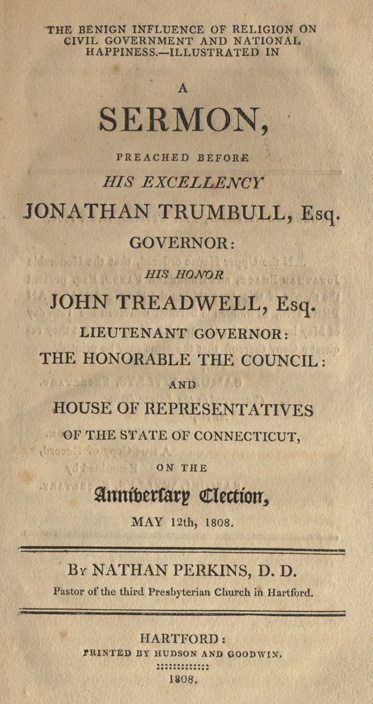

sermon-election-1808-connecticut

THE BENIGN INFLUENCE OF RELIGION ON CIVIL GOVERNMENT AND NATIONAL HAPPINESS.—ILLUSTRATED IN

A

SERMON,

PREACHED BEFORE

HIS EXCELLENCY

JONATHAN TRUMBULL, Esq.

GOVERNOR:

HIS HONOR

JOHN TREADWELL, Esq.

LIEUTENANT GOVERNOR:

THE HONORABLE THE COUNCIL:

AND

HOUSE OF REPRESENTATIVES

OF THE STATE OF CONNECTICUT,

ON THE

ANNIVERSARY ELECTION,

MAY 12TH, 1808.

BY NATHAN PERKINS, D. D.
PASTOR OF THE THIRD PRESBYTERIAN CHURCH IN HARTFORD.


GENERAL ASSEMBLY, MAY SESSION. A. D. 1808.

In the Upper House ordered, that the Honorable Jonathan Brace, and Ebenezer Faxon, Esq. present the thanks of this Assembly to the Reverend NATHAN PERKINS, D. D. for his Sermon delivered the 12th day of May instant, at the General Election, and that they request a Copy thereof, that the same may be printed.

Test,
SAMUEL WYLLYS, Secretary.
Concurred in the Lower House.
Attest,

E. STIRLING, Clerk.
A true Copy of Record,
Examined by
SAMUEL WYLLYS, Secretary.


ELECTION SERMON.

NATIONAL VIRTUE, AND NATIONAL HAPPINESS

DEUT. XXVIII. 1, 2.

And it shall come to pas, if thou shalt hearken diligently unto the voice of the Lord thy God, to observe and do all his commandments which I command thee this day, that the Lord thy God will set thee on high, above all nations of the earth. And all these blessings shall come on thee, and overtake thee, if thou shalt hearken unto the voice of the Lord thy God.

TO render a nation happy and prosperous, the wise and reflecting will readily admit, is of the highest consequence. The first concern of civil rulers, of those who have the management of the public interests lodged in their hands, should, therefore, be to obtain and secure such a state. And if united in their exertions to accomplish it, as their main object, unquestionably, success would generally crown their labors. There is a way, without doubt, for a nation to be permanently prosperous and happy. A moderate share of true patriotism will lead us to wish that our nation, now in its infancy, and but lately risen to be one among the empires and kingdoms of the world, may be distinguished in the annals of history, for its virtue and prosperity.

Looking over the history of former ages and nations, we have to lament that the way to gain and establish public happiness has been seldom pursued. Concerning this way, a great diversity, likewise, of opinions, has prevailed in the history of the world. Of this diversity of opinions, all history is a proof. We know that wrong measures have been taken. And alas! we also know that most nations, in the past ages of the world, have never been long happy. They have either groaned under tyranny and oppression, been afflicted with famine, or plunged in bloody and expensive wars. The right measures to render a nation happy, have either not been discovered, or if discovered, have not been adopted. It may with high propriety be observed that a people must be free, in order to enjoy the greatest quantity of public happiness. An enslaved and oppressed people, cannot possess the necessary ingredient of national glory. Such a people, as live, or rather drag out their existence, under absolute despotism, where oppressive and unrighteous laws are enacted, and are oppressively and cruelly executed, may be calm, and tranquil; but their calmness or tranquility, is the calmness of the dead sea. The chief excellence of civil liberty, that pleasing and delightful sound, so dear to our citizens, is its tendency to put in motion all the human powers;–it promotes industry, and in this respect, happiness:–produces every latent quality, and improves the human mind; and is the source of riches, literature and heroism. People who live under arbitrary governments, are found to love their forms of government as ardently as those who live in a free state, love theirs; and often more ardently. They are as contented. Perhaps, impatience and discontent are more observable in free than in arbitrary governments. Immense advantages however, result from the enjoyment of a free government. And, in this land, we have a free government. The human race are all born EQUAL and FREE. The true notion of liberty and equality is the prevalence of law and order, and the security of individuals. This is supposed to be a primary source of national happiness. The grand enquiry is, how may a people under a free government, be most prosperous and happy. Virtue is essential to the well being of such a government. The truth contained in the words now read, is, that the GREAT MEANS of obtaining and securing national prosperity and honor, are piety and morality.—By harkening diligently to the voice of the Lord our God, and by observing and doing all his commandments, we are, past all doubt, to understand the whole of revealed religion, the duties of the first and second table of the law, piety and morality.—By God’s promising to set a people on high, above all nations of the earth, and blessing them, we are to understand, public happiness, and national glory and prosperity.

The doctrine of the text is, then, most obviously, this, that piety and morality are the only CERTAIN MEANS of national happiness and prosperity. This is a truth of the greatest possible consequence to mankind; is the uniform doctrine of the holy scriptures; and is clearly proved from the reason and nature of the thing, and yet after all has been overlooked by most philosophers and statesmen.

To this important and interesting truth, your attention is now to be directed. And no subject can be more worthy of the attention of civil rulers, and those who have the management of the national counsels and interest, or be better adapted to this great anniversary occasion, when our rulers, and the tribes of the people are assembled before God, to render their homage to him, and devoutly to implore his blessing on the commonwealth. If everyone, whether in public or private life, had a deep impression of this truth, the effect would be most salutary.

What is accordingly proposed, in the subsequent discourse, is,

I. Concisely to explain the nature of that piety and morality, which are said to be the CERTAIN MEANS of public happiness.

II. And chiefly, to enquire how it appears that they are the certain means of national glory and prosperity.—And we are to consider,

1. The nature of that piety and morality, which are said to be the certain means of public happiness. Little need be offered here. No more indeed will be offered, than may be necessary to present the subject, in a fair light, and to prevent mistakes and misapprehension. The nature of revealed religion is often delineated. It comprehends these two things, piety and morality; and they are put together, in this discourse; because, essentially connected. Morality is not only an important, but necessary part of true religion. No man can be really pious, who is not a moral man; neither can he be a moral man, in the largest and best sense of that word, who is not a pious man. In the words now under consideration, piety and morality are set forth, under the idea of hearkening diligently to the voice of God—and observing and doing all his commandments. To hear his voice, is to believe all the doctrines which he has revealed, and exercise all the affections of the heart towards him, which constitute vital piety. We cannot, with any propriety, be said to hear diligently his voice, if we disbelieve his truths, or omit devotional exercises and offices. To observe and do all his commandments is habitually to perform all moral, as well as religious duties. All revealed religion, consequently, may be considered as divided into these two great branches; piety and morality, or the love of God, and the love of our neighbor.

Piety comprises all the affections and duties, which we owe to God and the Saviour. We are required to love our Maker, with supreme affection. And this supreme love to him is the grand principle of religion, and foundation of all right exercises of heart or duty to him. Here all religion begins; and divine worship, steadily maintained in its several forms, is the chief part of piety. He, indeed, is a neglecter of piety, who does not devoutly engage in the exercises of divine worship, public, social, and private. The fear of God is essential to a pious temper. We are not pious, unless we have a reverential awe of his sacred Majesty. We are to serve, to fear, to adore, and to praise him, as our Creator, Preserver and Benefactor. In every step of our conduct, we are to look up to him as the supreme disposer of events, to feel our obligations of reverence for his names, titles, ordinances and word. The first concern should be to give all glory to him, and render him, as honest minds, all the duties which he requires. No man can be really pious, who habitually and statedly omits the offices of devotion, and holy exercises of heart towards him. A principle of piety will necessarily lead to a trust in his mercy and wisdom—a becoming sense of all his infinite glories—a choice of him as our God—a cordial reception of the Redeemer of a ruined world, in all his saving work and offices, a reliance upon the revealed way of life and forgiveness—the high and mysterious dispensation of grace. It will create in the soul, a holy mourning for all our departures from God and duty, and violations of the divine law. It will dispose us to place him on the throne, as exercising a wise and beneficent government; and as ordering, directing, controlling, and conducting a dependent universe, at his sovereign pleasure, and in the best possible manner, so as eventually to cause the greatest sum of blessedness. In the exercise of pious affections to God, and stated and habitual practice of the duties which we owe him, we choose him for our portion; and say, for this God is our God forever and ever: he will be our guide even unto death.

Morality is the other constituent part of revealed religion. We are to observe and do all God’s commandments, as well as diligently to hear his voice. Our duty to our neighbor, and ourselves is to be uniformly practiced, as well as our duty to God, and a divine Mediator.—Scriptural morality comprehends the constant practice of every civil, social and relative duty. The moral man, according to the inspired volume, is honest and righteous, kind and charitable, compassionate and pure, in his intercourse with his fellow-creatures. He never allowedly oppresses by extortion—acquires property by injustice and fraud, falsehood and hypocrisy. He never habitually takes away the reputation of others by slander and lies; or wishes to destroy their peace by violence and deceit—and is careful to avoid all crimes against society—or sins against others, as malice, hatred, revenge, dissimulation and evil speaking.—His rule of duty is to do unto others as he would be done by, from a principle of benevolence. All things whatsoever ye would that men should do unto you, do ye the same unto them. Scriptural morality is summed up, in the following manner by the apostle Paul.—Finally, brethren, whatsoever things are true, whatsoever things are honest, whatsoever things are just, whatsoever things are pure, whatsoever things are lovely, whatsoever things are of good report, if there be any virtue, and if there be any praise, think on these things.

The moral man, according to scripture, is attentive likewise to all that class of duties, which relates to himself, as well as his neighbor. He uniformly endeavors to exhibit to all observers, strict temperance, continence, sobriety, self-government, and purity in heart, speech and behavior. If at any season of temptation, he wrong his fellow-men in their property, he hastens to make restitution. If in their good name, he honorably makes reparation, if he fall into sins, by the indulgence of passion and prejudice, pride and avarice, ambition and envy, against himself or neighbor, he penitently regrets his folly, and resolves, in future, on amendment. He makes conscience of living in all the ways of holy obedience—of assisting and helping all in his power—of molesting and injuring none.—Such is the nature of scriptural morality: of that morality required and recommended, in holy writ—and which must flow from a right principle, the love of God and our neighbor.—And we ought to remark here, to prevent all misapprehension and prejudice, that this morality cannot exist without piety—but is essentially connected with it.—There may be, we know, and very often is, an outward decorum of manners and conduct, or outward regularity of life, where there is no piety. Nay, where there is a total disbelief of all religion—of the being of God—the immortality of the soul—a state of future retributions, and of conscience. This is, many times, through ignorance, relied on as all the religion necessary to man, and is frequently called moral honesty. But it is totally different from scriptural morality, and is only built upon maxims of worldly convenience—customs of the country—a pretended sense of honor, or some selfish views; it is, however, beneficial to society.

Upon the whole, no man can be a moral man in the scripture sense, who is unjust to God, to himself, or his fellow-men. He, who feels his obligations to God, will feel his obligations to man. He, who loves his Maker, will love his neighbor. He, who reveres the divine Majesty and attributes, will regard the rights of man. We are as inexcuseable, in allowedly omitting the duties of piety, as of morality. The sum of the moral law is to love God with all our heart, and our neighbor as ourselves—on these two commandments hang all the law and the prophets.

2. We proceed to the next thing proposed, which is the principal design of the discourse, to enquire how it appears that piety and morality are the CERTAIN MEANS of national happiness and prosperity. This most important and interesting truth is strongly expressed, in the words now under consideration. And it shall come to pass that the Lord thy God will set thee on high, above all nations of the earth. And all these blessings shall come on thee, and overtake thee, if thou shalt hearken unto the voice of the Lord thy God. The whole nation was to be thus blessed and protected, defended and prospered, if virtuous. As long as they would be faithful and diligent in serving God, adhering to, professing, and practicing the true Religion, he would bestow temporal advantages—withhold national judgments—raise them, in character, and importance, above other nations, give them a name, and make them a praise in the earth. The religion, which God has revealed unto the children of men, is calculated, to make both individuals and nations happy. This is a point of supreme importance, and as the sons of philosophy, and rulers of the world, have both thought and acted very differently from it, it is eminently worthy to be accurately considered, and firmly established by argument. Had the Empires of the world, and politicians believed and acted upon this single principle, man would, long ago, have reached the highest point of perfection and happiness in society, attainable on earth. But now alas! he is as far from this desired point as ever. After so many nations have perished—so many kingdoms have risen and fallen—so many wars and revolutions, mankind have still to learn that free governments only can secure happiness to the ruled, and that free governments can only be supported by virtue. As long as the body of the people continue well informed and virtuous, freedom may be enjoyed.—The truth now to be established, is that piety and morality are the certain means of national glory and prosperity. And that they are so, will appear first, from a consideration of the origin of civil government, and what is, or ought to be its end or design. The wants of man are unquestionably the first cause or origin of the social compact. In a solitary state, he would find himself totally inadequate to procure what might be essential to his well-being. Every individual has many wants, which he cannot satisfy, is surrounded with evils, which he cannot remedy, exposed to fears, which he cannot remove, and open to dangers, against which he cannot provide. Unable is he of himself to supply his necessities. He wants knowledge to guide and direct him; laws to restrain and rule him; property to support him; food to nourish him; and clothing to cover him. All find themselves encompassed with these wants. Feeling the same wants, men unite, to provide for their own convenience; and by common industry to guard against famine, and to procure, in sufficient plenty, the means of subsistence. They, therefore, form society and government. Man, in his very nature, is social; was made by his adorable Creator, to derive his sweetest happiness from union in society. Man is naturally inclined to unite with man for protection, defense, and the common good. The end of all government, consequently, must be to secure the rights and property of all its subjects. Why should they form society and government, but to promote their own welfare and happiness! As a rational creature certainly this would be man’s object in forming government. Endowed with reason, and capable of reflection, his desire would be to possess the means of being happy. The design of forming government then must be the COMMON GOOD of the whole, and to obtain blessings for all the governed. The original purpose of the institution of government must of course be the best good of the people, at large; not to provide for the ease, and honor of such as might be entrusted from time to time with its management. The people are the source of power.—The design, then, of all government, must be the good of the governed, not the aggrandizement of the individuals, who hole its reins.

If the origin, and end of government, have been justly stated, it is apparent that the blessings sought by the social compact, cannot be attained, without piety and morality—a sense of moral obligation—a belief of a divine existence—of man’s accountability—and the ties of justice and humanity. Each individual should feel responsible to each individual, and to the whole. He must be industrious, that he may not be burdensome to the rest of the community. He is bound to avoid also all those practices, which will injure others, or trespass upon their rights. He must love mercy, as well as do justly, that he may be the most useful to others. All the branches of morality must be observed, that the community may be generally benefitted. No man may live for himself alone, but must look at the things of others, and that the public good may be advanced. But the various duties, which man owes to himself, and his fellow-men, as a part of the public, will not be habitually performed, and with a good conscience, if he feel not his accountableness to a superior tribunal, to an omniscient and omnipresent Judge,–If he have no fear of God—no regard to a future world—and if he, customarily and openly, CONTEMN the duties of piety. The moral duties are essential to the well-being of the community. But they are built on the fear of God, or piety, as their only solid foundation.

In order to cut off all objections and cavils, which those may raise, who disbelieve or deny the necessity OF ANY RELIGION, in order to the greatest national honor and glory, we ought to remark, that when it is affirmed, that piety and morality, are the best means of national prosperity and glory, it is not to be understood that no nations have flourished, except such as were governed by the precepts and doctrines of religion. Some states, which have only partially conformed to its laws, have long flourished, and enjoyed glorious advantages on the theatre of the world; either because their false religion, contained some principles in common with the true; or because in order to induce such people to practice such virtues as are essential to the being of society, success has attended such practices; or because virtue has never yet been fully rewarded, or vice punished in this world. But it will be found, that public happiness is best promoted by an adherence to religious and moral institutions. It is not pretended that this will, in every particular case, ensure the greatest temporal advantages. If an individual will love life and see good days, let him refrain from evil and do good, so if a nation would prosper and be exalted, they must adopt the same wise course. STATE-CRIMES, however, may be sometimes, for a season, successful; and may have been the steps, by which nations may have acquired worldly glory. National justice, moderation, and regard to the rights of other nations, may be sometimes an obstacle to grandeur. But if we consider a nation, in every point of light, and in all its circumstances, we contend, that the more piety and morality are practiced, the more prosperity it will enjoy; and that the more it abandons itself to vice, the more misery, sooner or later, it will suffer, according to the very nature of things, and a wise and governing Providence. If vice for a while seem to exalt, and virtue to abase it, still in the end, vice will be its overthrow, and virtue its exaltation. It is, also, worthy to be observed that by the prosperity or glory of a nation, is not intended what worldly heroes and tyrants consider as such, enlarging its territories by wars and conquests; acquiring power and influence over other nations by fraud and injustice; and becoming a terror and scourge, as executioners of divine vengeance. By national prosperity, I mean the happiness of the citizens at large, in their various orders and classes—attacking an enemy when invaded with courage—defending itself with resolution—negotiating successful treaties—possessing every blessing conducive to public tranquility—and favored with the protection and smiles of the divine Being. We do not suppose that piety and morality will free a nation from calamities. This is an imperfect world. Adversity will be mingled with prosperity. Untoward events are to be expected. There may be unhappy disputes with other nations on account of interfering interest—or a supposed interference. There may be wars—famine—pestilence—and other great and terrible evils. The most virtuous societies, like individuals, may labor under trials and difficulties, and must expect many misfortunes.

A further consideration to evince, secondly, the benign influence of religion on civil government and national happiness, is, that public bodies and communities only exist in this world; and of course, can only be rewarded and punished in this world by Divine Providence. Individuals are to exist in another life, and are capable, consequently, of being either rewarded or punished, in that state of retribution, according to their deeds. But nations or kingdoms can only be blessed or frowned upon in this world, as they have no existence in a future. A Being of infinite holiness and wisdom is at the head of the Universe, and rules among all the nations on earth. And it is infinitely desirable that he should rule and reign among them, as AS HE, in his sovereign pleasure, sees best. He is the disposer of events, and the sovereign Arbiter of the fate of kingdoms. He will let it be known that there is a righteous God in the earth. The honor of his providence is concerned to give ample testimony of his benevolent and righteous character, as ruler of the world. It is of incalculable importance to the interest of his moral kingdom, that he should manifest himself to be the lover of righteousness, and hater of iniquity, to all mankind. The righteous Lord loveth righteousness, and his countenance doth behold the upright. The eyes of the Lord are over the righteous, and his ears are open unto their prayers: but the face of the Lord is against them that do evil. Nations, then, will, by him, in his holy government of the world, be blessed and prosperous, generally, when virtuous and pious; and be frowned upon and punished, when vicious and profligate. Public happiness is the reward commonly of public virtue; frowns and divine rebukes follow national sins and immoralities. The wisest and most virtuous nations are usually the most prospered. Virtue walks with glory by her side. God testifies his anger against a people for their wickedness. He turneth a fruitful land into barrenness, for the wickedness of them that dwell therein. If they forsake him, he will forsake them. If they seek him, he will be found of them. He is with them, while they are with him. And Azariah went out to meet Asa, and said unto him, hear ye me, Asa, and all Judah and Benjamin, the Lord is with you while ye be with him; and if ye seek him, he will be found of you; but if ye forsake him, he will forsake you. Misfortunes and calamities, follow national immoralities and profligacy, as the natural consequence, as well as by special appointment of an all-governing Providence. Could we have, in one view, the reasons of the decline and fall of kingdoms, we should find them to be chiefly national crimes and vices. Idleness, dissipation, luxury, voluptuousness, pride, irreligion and contempt of moral principles have gradually impaired; and, at length, ruined former empires and states. The natural effect of vice, and gross crimes widely diffused among a people is to destroy them. As each individual makes a part of the nation, it is his indispensible duty, to contribute, what in him lies, to the good of the nation; and as his piety will tend to bring down blessings on the state, he is answerable to the public for his conduct as it respects religion. Many philosophers and statesmen, very erroneously conceive that religion is only an AFFAIR BETWEEN GOD AND THE SOUL, and may be necessary to a preparation for future happiness, but that it is of little or no consequence to the state, whether the Christian religion be believed or disbelieved, practiced or not practiced, protected and supported, or reproached, profaned and extinguished. The idea attempted to be disseminated, is, that every citizen is answerable only to God for his reception and practice, or rejection and neglect of it; not that he is, also, answerable at the bar of the public, and to civil society. But such are the effects of religious institutions upon men with respect to their moral character, their political state, and their domestic life; that whoever totally neglects, or impiously contemns them, has to answer for it to his God, to his neighbor, to his country, and to his family. “He partakes with other men in their sins. He associates with the enemies of mankind. He does what in him lies, to undermine the basis, on which the order and happiness of civil society is built. He teaches the false swearer to take the name of his God in vain. He directs the midnight robber to his neighbor’s house. And he delivers into the hand of the assassin, a dagger to shed innocent blood.” Hence it is worthy of remark, that the most of those daring and atrocious offenders, who, by their crimes, have forfeited life, and brought themselves to an untimely death, and the ignominy of a public execution, by their own voluntary confession, have traced their career in vice, to a profanation of the Sabbath, and total neglect or contempt of religious institutions.

We add, as a third argument, to evince the importance of religion to government and civil society, God’s special treatment of his people of old. Out of all the nations, he selected one people, who should be the depository of his revealed will, and towards which his providential conduct was, for ages, to be very singular.

The history of this people is very peculiar, and is worthy of the attentive perusal and regard of rulers, and may afford the most useful lessons to all governments. They were the care of God’s watchful providence. His hand was ever visible in what of good or evil happened to them. He warned and counseled them. He often and abundantly, tenderly and affectionately exhorted and entreated them to fear and obey him, to receive and practice the true religion. If they would be faithful to him, fear and serve him, abstain from idolatry and immoralities, he would bless them, defend them against all their enemies—lift them up on high—make them a great, a flourishing and happy nation—order favorably the seasons, cause the earth to be fruitful, and be their God, their covenant God; but if they refused to obey him, renounced his religion, would commit gross crimes, and fall into idolatry, he would bring upon them his judgments, he would punish and afflict them, give them into the hand of their enemies, distress them by national misfortunes and calamities. He uniformly treated them, as they treated him and his religion. If moral and pious, public blessings were conferred; if otherwise, judgments were inflicted; all their history is a proof of this. God, treated them, in his holy Providence, as they treated his religion. If they forsook him, he forsook them. If they sought him, he was found of them. National piety was followed invariably with national mercies. But they were only a sample of his treatment of all other nations. One grand object indeed in chusing them to be his people, was to shew all mankind, that he rules in the world; disposes of nations; and loves righteousness, and hates iniquity; that national virtue will be rewarded; and national wickedness punished. He, in general, deals with nations, in a similar manner, to what he did with the Jews, as their history fully evinces. The Lord ruleth among all nations. By him kings reign, and princes decree justice. An invisible hand guides and directs, among all nations, and in all ages. They do not rise and fall as atoms float in the atmosphere without his providence. At what instant I shall speak concerning a nation, and concerning a kingdom to pluck up, and to pull down, and to destroy it. If that nation against whom I have pronounced, turn from their evil, I will repent of the evil, that I thought to do unto them. And at what instant I shall speak concerning a nation, and concerning a kingdom, to build and to plant it; if it do evil in my sight, that it obey not my voice, then I will repent of the good wherewith I said I would benefit them.

This matter is by the decree of the watchers, and the demand by the word of the HOLY ONES: to the intent that the living may know that the Most High ruleth in the kingdom of men, and giveth it to whomsoever he will, and setteth up over it the basest of men.—The doctrine that an infinitely wise and benevolent Being rules over the kingdoms of men, is a most important doctrine. He raises up one, and destroys another at pleasure. He afflicts and destroys, when a nation becomes awfully corrupt and wicked; and blesses, and prospers, when there is national virtue. Religion has a no less intimate relation to the present life, than to another world. Its beneficial influence affects the happiness not only of individuals, of every temper and disposition, in all circumstances and situations; but, also, of societies and nations. “As the Sun, although he regulate the seasons, lead on the year, and dispense light and life to all the planetary worlds, yet disdains not to raise and beautify the flower, which opens in his beams; so the christian religion, though chiefly intended to teach us the knowledge of salvation, and to be our guide to happiness on high; yet, also, regulates our conversation in this world, extends its benign influence to the circle of society, and diffuses its blessed fruit in the path of domestic life.”

The necessity of religion to aid government, has been felt, and generally owned by wise men, in all ages, and under all forms of government. It is well known by the learned, that the wisest statesmen, in ancient kingdoms and republics, invented and framed a religion suited to their various kinds of government, and INCORPORATED THEM TOGETHER. Their object was to civilize and reduce mankind to order and law. The idea that religion of some kind is absolutely necessary to the existence and well-being of the state or civil government; whatever be its form, especially REPUBLICS, has generally obtained among the nations. Hence in pagan countries, where there has been no revealed religion, a system of false religion has been interwoven in the particular form of the government. The reviler of religion was deemed an enemy to the state. The superstitious rites were celebrated, in much pomp, and at great expense. The design of the whole, was to strengthen the ties of conscience, and by this means to add force to government. The fears of the people were wrought upon; and to be profane towards the PUBLIC DIVINITIES of the nation was considered as an atrocious offence against the laws of the land. It will always be found, even, among the most civilized and polished, and best informed people, on experiment, to administer government, without the ties of conscience is impossible. Hence the origin of kind of religion is necessary to civil society; and where the true was unknown, politicians and impostors have invented and disseminated a false one. Even the city of Athens, learned and polite as it was, obtained this character from an ancient historian, “hospitable to the gods,” but whether by way of reproach or encomium, at this distance of time and place, cannot be ascertained. It grew into a maxim among the wisest men of Greece, “to know no man beyond the altar.”

The SCHEMES of false religion invented by the famous impostors, Zoroaster, among the Persians; Numa Pompilius, among the Romans; Mahomet, among the Arabians; and Cophal Mango among the Romans; Mahomet, among the Arabians; and Cophal Mango among the Peruvians in South America, were all intended to soften and CIVILIZE a barbarous and savage people; or to inspire them with courage; or to make them thirst for the blood of their enemies.—How deep a sense the rulers and statesmen, in ancient lands, had of the absolute necessity of good morals and some kind of religion to the safety and well-being of the state and prosperity of the nation is evident from history.

It may be acceptable to my audience, on this great occasion, to recite from authentic history, a few instances.—These shall be ancient Egypt, Persia and Rome. 1

A fourth argument to prove the benign influence of piety and morality on a free government, and society at large, is their natural tendency or operation.

That order of society is the most happy where all are obliged to be industrious; and where industry has all the benefits of its own care. Every branch of business, by which the nation is subsisted, should be diligently prosecuted, and each citizen protected in all his rights. Religion, in its natural tendency, has a most friendly and favorable influence on this order of society. That the Christian religion has this tendency, in the highest degree possible, deserves to be numbered among its great excellencies, and satisfactory evidences. It however interferes not with POLITICS, or directs to forms of government, but requires such a temper, and such a life and conversation, as will constitute quiet, peaceable, and useful citizens, in any government, and good rulers. It regards the civil and temporal, as well as the spiritual and eternal good of mankind. While this is strenuously maintained, no one can apprehend that the idea of a RELIGIOUS ESTABLISHMENT OR HIERARCHY, as in modern Europe, is either tacitly insinuated, or advocated. In our happy land, nothing resembling, even, in a remote degree, the INCORPORATION OF CHURCH AND STATE, to make one whole body politic, exists. Neither in the state or general government, as that phrase is understood, in modern Europe, and naturally imports, is there any UNION OF CHURCH AND STATE. And I trust never will be. In the various Christian nations of Europe, since the fourth century, Christianity has been variously blended with all the existing governments, let the form be what it might. Out of pious motives, and from a belief of the beneficial effect, of such a scheme of worldly policy, the church and state formed an INTIMATE ALLIANCE, OR UNION. In this way, both civil and ecclesiastical history of the nations of Europe, reciprocally aided and strengthened each other. To this source, it is apprehended, most of the abuses and perversions of, and even errors blended with Christianity, are to be traced. No friend to civil and religious freedom, can suppose, considering the love of power in all men, that the RELIGIOUS ESTABLISHMENTS of modern Europe, could be introduced to advantage in this country. The holy scriptures know of no such ALLIANCES. They are the fruit of worldly wisdom. The office of the magistrate, and the office of the minister of Christ are altogether different. CHRIST’S KINGDOM IS NOT OF THIS WORLD. In our free governments, in the United States, we have no religious establishments. Many learned statesmen, however, in Europe, and some in this land, consider this, at least, as an infelicity; and venture to predict, that in the compass of a few years, the gospel will be left unprovided for, and unsupported in this land; and of course, be driven out of it; and the name of Jesus be obliterated in the United States; or an effectual door be opened to all kinds of enthusiasm, and even atheism; and so our free government be overturned. Whether they judge right, time, the great expositor of events, must decide.

It is one of the perfect rights of man, in natural liberty, and which he may never alienate, to judge for himself in matters of religion. But as religious sentiments are very various, how far the magistrate or government ought to interfere, in matters of religion, becomes a question of great importance. While all idea of religious establishments, as understood in modern Europe, is utterly disclaimed—I submit to the hearer, whether the following observations be not built on the scripture, and reason?—The civil ruler ought to encourage piety by his own example, and to endeavor to make it an object of public esteem. Whatever is in general esteem, many will follow. The civil ruler may encourage, and promote men of piety and virtue, and discountenance those, whom it would be improper to punish.—He may and ought, again, to defend the rights of conscience, and tolerate all in their religious sentiments, when not subversive of society, and inconsistent with the rights of others.

“A legislature, may enact laws for the punishment of acts of profanity and iniquity. For however different the religious opinions of the citizens may be, yet all ought to condemn, profanity and impiety—and they ought to be punished as injurious to the commonwealth. Every government has a right to restrain by law and penalties, all acts subversive of itself.—Unquestionably, also, the civil magistrate, or the ruling part of any society ought to make provision for the public worship of God in such a manner as is agreeable to the great body of the society, though all who dissent are at the same time fully tolerated.—Multitudes would never have any religious instruction, or public worship, if the government did not interpose, to provide a way, for respectable ministers of the gospel to be decently supported, while employed in teaching the people. If a parent may and ought to provide for the instruction of his children, then the state may provide for the instruction of the whole family of the state in the great duties of godliness and virtue.” 2—Perhaps, in our own free and happy state, our government has hit upon the golden mean, of not interposing too much or too little in matters of religion. It is one of the chief glories of our civil constitution, or government that it encourages, countenances, and provides for piety and morality;–looks up with reverence to the Christian religion; and interposes for its maintenance. But there is no resemblance of a religious hierarchy in our state, or any improper interference of our government in matters of religion. What it does, in this respect, is fully warranted by the word of God, and perfectly consonant to reason.

The natural effect of religion is to secure and promote the peace, order, and well-being of society, and to give efficacy to the wholesome laws of a free government. The value or goodness of a thing is justly argued from its natural tendency. The advantages of revealed religion, as to this world, are great and interesting. It blesses very society. It sweetens every relation. It exalts every character. Exalt her, and she shall promote thee: she shall bring thee to honor, when thou dost embrace her. She shall give to thine head an ornament of grace, a crown of glory shall she deliver to thee. The community is made up of individuals. A nation is composed of all the families in it. In the same way that a family or individual is to be made happy and prosperous, is the community or nation. Virtue, consisting in the fear of God, and practice of morality, can alone make man happy. If we would, as individuals, be happy in life and death, we must feel the power, and practice the duties of religion. Would we, as a nation, enjoy the blessing of God, and be prosperous, we must fear him and work righteousness. Happy is that people whose God, is the Lord. Yea, happy is that people that is in such a case. Our help is in the name of the Lord, who made heaven and earth.

The influence of religion to render a people flourishing and happy is most powerful. From being a pious Christian, to a regular and good citizen, the transition is easy. So far as any individual is pious, so far he is happy. The same may be said of a nation. The means of private and public happiness are substantially the same. That which makes one individual or family happy, will make another happy, and the whole body politic. It is as necessary for the public to be honest and virtuous, as for an individual, in order to enjoy a divine blessing. A dissolute, idle, and profligate family must be eventually ruined, and so must a vicious nation. And all these blessings shall come upon thee, and overtake thee, if thou shall hearken to the voice of the Lord thy God.

We will show the operation of PIETY AND MORALITY, in producing public happiness, in a few important instances.—What is the natural effect of a full belief of the being of God on the mind of men? Here all religion begins. He that cometh to God must believe that he is, and that he is a rewarder of all them that diligently seek him. A disbelief of him, and his governing Providence, as ever been found, to lead to all manner of wickedness, excess, and dissipation. By necessary consequence, a belief of these will restrain the vile passions of man. He will fear to violate his oath, to commit murder, or robbery, theft, or any other secret or open crime. Conscious that he cannot hide his crimes from an omniscient and holy God, he will dread his anger, and refrain from open transgressions of his law. This belief, in a nation, will necessarily have an astonishing effect to preserve, amid all classes, a degree of order and decorum, and to prevent those heinous crimes, which destroy public happiness, and bring down on a nation the judgments of heaven.

Again; The knowledge of the various divine attributes, both natural and moral, has a direct tendency to produce great effects on the public character of a nation, and by necessary consequence, on civil government. Take away a sense of these, and you remove the very foundation of public morals. A sense of the divine perfections, power, wisdom, universal presence, independence, self-existence, holiness, goodness, justice and truth, leads to happy consequences, both on the mind and life. Realizing these glorious attributes, we shall dread to offend the divine Majesty, and feel our obligations to serve and obey HIM, who is possessed of such transcendent excellencies. Sensible that he is the greatest, best, and wisest of all beings, our Creator, Preserver, Benefactor, Lawgiver, Sovereign Lord of the universe, Disposer of all events, and Ruler among the nations of the earth, we shall continually aim to please him by a life conformed to his will; by a reverential fear; by seeking daily his blessing; by thankfulness for mercies received; by owning his providence and government; and by looking to him for general health, for fruitful seasons, for defense and protection in times of national danger, and public calamities.

Further; A belief of accountableness, and of the retributions of eternity has a wonderful influence on the public mind, to excite both hope and fear, two of the most powerful springs of action in the human frame; the one to restrain from vice, and the other to urge us to virtue. This belief is essential to the Christian religion. And the astonishing influence which it must have on the MORALS of a community, all are competent to understand. The very idea of our accountableness at the bar of a righteous and impartial Judge, insensibly leads to a fear, lest by sin, we offend and provoke him. Knowing, that when we shall have done with time, we must render an exact account of all our thoughts, words, and actions, is one of the most powerful considerations to induce to a regular and sober life. No doctrine is more either solemn or affecting, than that we must all appear, rulers, and ruled, before the judgment-seat of Christ Jesus, and give an account of the deeds done in the body, according to what every man has done, whether it be good or bad. Add to this, the exact retributions of eternity, of endless glory, or endless misery; and no motive can possibly have more weight to induce to a circumspect behavior, to prevent or reclaim from gross wickedness. In another world, ah my brethren! We shall be rewarded, or punished precisely according to our moral and religious character, to our good or evil deeds.—The more good we have done, in our place and station in life, or been the active means of, the more distinguished will be our reward: and the more sins we have committed, and vices, immoralities, and irreligion, we have been the means of others practicing, the heavier will be our condemnation, and the deeper our misery.—How solemn and affecting a doctrine! How well calculated is the full persuasion of it, to produce most beneficial effects on the public mind and morals; on all classes of people! And, of course, to prevent those gross abominations, which lay waste and destroy society. He, therefore, is doing the greatest conceivable mischief to the community, who attempts to rid the mind of the fear of punishment, or to banish the hope of reward, or to render doubtful the accountability of men to a future tribunal, and the immortality of the soul.

It is obvious still, further, to observe, that the constant exercise of divine worship, and the feelings of our dependence on God, and the infinite obligations of gratitude we are under to him for national, as well as personal blessings, have an inconceivable influence on civil government, and the temporal interests of a people. There can be no religion among a people, where the worship of the Supreme Being, public, social, and private, is wholly neglected; and his institutions set at naught. Public worship, at the religious instructions of the sanctuary, and the holy Sabbath are absolutely essential to the very being of Christianity. Every willful and total neglecter and contemner of these, is contributing, although he may think not of it, his proportion of influence to annihilate religion. The prevalence of religious principles, and the practice of religious duties among a people are essential to the morals; and the morals of the people are essential to their national prosperity. The decline, therefore, of religion in a nation, is an awful presage of evil impending that nation. When the worship of God, in its several forms, is disesteemed and neglected, when the dispensation of the word in the sanctuary is in disrepute, when the Lord’s day is vilely abused, hen morality will fail. Industry, learning, education, peace, the social duties, and with them, all public happiness will fail—RULERS will be disrespected—wholesome laws be trampled upon—and unfounded and unreasonable clamors be excited against the government. The institutions of religion, and constant exercise of divine worship, not only tend to harmonize the sentiments of the people, and to promote amity, civility and humanity, but, also, alone support the interests of morality. If a people reverence and statedly attend upon the ministrations of the gospel, feel their dependence on God, on the wisdom, goodness, and bounty of his Providence for general health, fruitful seasons, and success in their lawful pursuits; if they feel their obligations to be thankful for mercies received, and of humiliation and penitence under his frowns and righteous rebukes, they will be disposed to such a conduct as will subserve their highest temporal interest. Nay, I go farther and affirm, that, merely performing divine service, and expressing, in prayer and praise, gratitude to God for all his blessings, national and private, and acknowledging our entire dependence on his providential government, have a happy effect, both on the mind and morals of the public.

Moreover, it is an expressly commanded duty of the gospel to pray for civil rulers, from the highest to the lowest, and for all in authority over us, for the peace of government, for public order and stability, for good laws to be enacted, and that there may be obedience and submission to them, among all classes of people. I exhort that first of all, supplications, prayers, intercessions, and giving of thanks be made for all men. For kings, and for all that are in authority, that we may lead a quiet and peaceable life, in all godliness and honesty. For this is good and acceptable in the sight of God our Saviour. How reasonable and benevolent the Christian religion! It requires of all, peace, friendship, faithfulness, good will to man, to all men, and the forgiveness of injuries, GODLINES, AND HONESY. All are to seek blessings for one another, for all orders, and classes, rulers and ruled, that the administrators of government may be guided by wisdom, be kept from wrong measures and counsels, that we may all lead quiet and peaceable lives, in all godliness and honesty. Godliness and honesty are united. Piety and morality go together. MERELY PRAYING, in daily addresses to the throne of grace, for all in authority, for civil government—for good laws—for freedom, civil and religious—for a spirit of obedience to good laws—for a wise use of civil liberty has a direct and powerful tendency to honor civil authority, good laws, and good government; and, at the same time, to prevent unfounded jealousies, evil surmises, variance, hatred, calumny, sedition, pestilent ambition, mean and disingenuous artifices and intrigues against government. The gospel, alone, establishes on a due basis, the rights of man, liberty and equality of the rational kind, and fraternal sentiments. The gospel is an enemy to all tyranny and oppression, slavery and arbitrary government. How wise and suitable that we should pray for all men, when our morning and evening oblations ascend to heaven: and that all orders of the community, may lead a quiet and peaceable life, in all godliness and honesty. Would all classes of people comply with this one duty, the effect on government, on society in all its interests, would be most salutary. Prayer has a causal influence in procuring the blessings devoutly implored. Piety is indeed the strength of morality. Take away the former, and the latter will wither and fade, as a tender plant, from which you remove moisture and nourishment.

The practice of moral duties, as already remarked, is an essential part of the true religion. No man can be a really religious man, without morality. There may be hypocrisy, feigned pretences, and external observances of religion, where there is no morality, or even where heinous sins are allowedly committed; but there can be no real heart-religion, without the strictest regard to every moral duty. A man can no more be a Christian, or have the evangelic graces and temper, without morality, than he can be a Christian, without piety, or faith towards our Lord Jesus Christ, and repentance towards God. Those, therefore, who have attempted to separate piety and morality, or faith and good works, have done an unspeakable injury to religion, and greatly disserved the cause, which they meant to promote. They have, most unwisely and unhappily, crated a prejudice against either faith on the one hand, or good works on the other, and tempted some to disbelieve the usefulness of the gospel as to our present temporal well-being. Moral duties are as obligatory as devotional, and have the most friendly aspect on government, and the general welfare of society. This might be evinced, most clearly, from a large and critical examination of them in detail. All that the limits, to which I am confined, will permit, is briefly to enumerate some of the moral duties, which constitute an essential part of religion, and examine their tendency in respect to the public mind and civil government, in general. The several moral duties, which will be concisely mentioned and argued upon, are truth, righteousness between man and man, humanity and love of enemies, kindness and compassion, meekness, candor and humility, sobriety, temperance and self-government.

The religion, enjoined upon us by an infinitely wise and holy God, who perfectly knew what would be most for our good, in time and in eternity, and who would prescribe no duty to be done by us, which had not a happy tendency on society, requires strict veracity. It teaches us that truth between man and man, with which is inseparably connected faithfulness, is universally biding; obligatory at all times. It forbids all evil speaking and falsehood, from perjury down to all mental reservation, or equivocation. It allows us to depart from truth, on no occasion, even the most pressing, and from no temptation. How important a moral duty this is; and how necessary even to the existence of public happiness, all must be sensible, who give themselves leisure to reflect on the subject. What dependence can be placed, or safety had in the lying tongue, in perfidious treacherous men! When a man is habitually unfaithful, and pays no regard to truth, in his words, we can repose no confidence. There will be no binding power in an oath. In a multitude of cases, right cannot, therefore, be obtained.

Religion, also, requires strict justice, in the various dealings, among men, in every government. This includes, integrity, equity, honesty. The heart must be upright, and the whole of the conduct be regulated y inflexible righteousness. Justice between man and man is the pillar, on which rests the welfare of society. We may never be guilty of injustice and dishonesty to others: never oppress, extort from, or injure them: not in wish or act injure them in their good name, property, or right; all orders and classes of citizens are to observe all the laws of righteousness towards each other. JUDGES, on the BENCH, are to administer, impartially, without favor or affection, justice. The most of the laws indeed of society are to prevent dishonesty, and keep people upright in their intercourse with each other. So selfish, so full of malicious passions, is human nature, that even heavy penalties, exemplary punishment, and courts of justice cannot keep people from deviating from the rules of equity, in their connections in trade and business. A man, who has religion in his heart, will constantly and uniformly aim to walk in all HONESTY, as well as GODLINESS, though he may sometimes mistake the nature of justice; or through a selfish bias, or strength of temptation, be carried away from it. For no man is free from sin. How much to the honor, peace, and interest of the community, justice between man and man is, all must feel. An unjust and dishonest, cannot be long a flourishing and respected people. A national observance of strict equity will tend to prevent wars—bloodshed—and costly disputes; as well as to preserve national respectability, independence, and honor.—In a free, perfectly republican government, recourse by the citizens is too often had to the LAW and COURTS to decide on their claims. A litigious spirit should be discountenanced.

Religion, tends, further, to exalt a people, and to make them prosperous, as it censures and condemns all idleness, dissipation, excess, and vicious amusements; and requires of man INDUSTRY, in some lawful calling. It requires an attention to the duties of our several callings and stations, and a right improvement of all our time, talents, and opportunities to do good. How directly this contributes to wealth, and competency, to peace, contentment, and order, the least reflection is sufficient to convince us. Can a people be happy, or civil government be well supported, where idleness, murmurs, discontent, factions, vicious amusements, dissipation, debauchery, and luxury prevail? If a people or individuals would be either wealthy or virtuous, they must be industrious.—The prosperity of religion is, then, the prosperity of a nation.

We add, again—religion requires of all, humanity, kindness, candor, compassion to the poor, and all THE OFFICES of benevolence and tenderness. We are to be patient and forbearing under losses and injuries,–to be mild and forgiving in our temper,–to be gentle and condescending—to be obliging to all.—Conscious how often we ourselves offend—how liable to mistakes—to unreasonable prejudices, we shall feel how much we need candor from others. We are required, by our holy religion continually to exercise compassion to the poor;–sympathy to the afflicted;–kindness to the unfortunate;–patience to the forward;–humanity to all;–to think evil of no man without a justifiable cause;–to speak evil of no man unnecessarily;–to be bitter, malicious, and envious to no man;–to slander, abuse, oppress, and ill-treat no man: but to extend our good offices to all—and by a patient continuance in well-doing, to seek for glory, honor, and immortality. How happy does the practice of these mild and amiable virtues tend to make society, to sweeten the intercourse, and cherish the civilities and charities of human life!

The gospel, also, no less strictly and solemnly enjoins upon all classes and ranks, ruler and subject, high and low, the moral duties, which relate to self: sobriety, temperance, purity, and the due discipline of the passions. It never allows us to do anything with sobriety—the great duties of temperance, purity, meekness, and humility. The two Christian tempers of meekness and humility, would prevent anger, wrath, revenge, hatred, envy, pride, and all the violent passions; and of course would prevent all murder and dueling; crimes, of a scarlet color, though alas! fashionable, where the fear of God, and the love of a Redeemer have no place, or little influence. It cannot but be apparent to all, that the duties now mentioned, more than is generally conceived, contribute to secure one’s own, and to promote the happiness of others. A larger and fuller elucidation would prove the point before us, the beneficial influence of religion on civil government and national prosperity so as to stop the mouth, one would imagine, of the most bitter reviler of piety, and hardened gainsayer.

It is only subjoined, that religion has a powerful influence on public happiness and civil government, as it nourishes an ardent wish and desire to advance all useful arts, and the sciences. It is auspicious to everything, which can adorn life, or dignify human nature. It cannot be diffused, where there is no civilization or knowledge, or even exist. It, therefore, always consults how human learning may be promoted, and displays its excellence in the education of children and youth. The welfare of a nation rests much on the right education of children. As religion enlarges our views and expands the soul by the grandeur of its objects, and sublimity of its doctrines, so it affectionately regards the education of children.—It devises liberally for the teaching of the rising generation. It is unwearied in exertions for the public good. Peculiarly happy is OUR OWN STATE in having such ample provision for the education of the children of our citizens. And greatly have the legislature honored themselves by their attention to this important OBJECT. We cannot be long either a pious or free people, if this object be neglected.

It was the saying of a great orator and statesman of antiquity, “that the loss which the community sustains by a want of education, is like the loss which the year would suffer by the destruction of the spring.” If the bud be blasted, the tree will yield no fruit. If the springing corn be cut down, there will be no harvest. So if the youth be ruined through a fault in their education, the community sustains a loss which cannot be repaired. For it is too late to correct them, when they are spoiled. 3 Thus, plain is it that religion, free from superstition and enthusiasm, has a direct and powerful influence to secure and promote the public happiness, and to aid and bless civil government.

In the manner above illustrated, is Christianity propitious to the dearest interests of society. It prescribes rules to regulate the conduct and conversation of all, in every station, from the highest to the lowest. Its benevolent spirit wishes well to all; and requires all, to direct supremely their whole strength to promote the public good—to do as they would be done by—and forbids them to make self their chief end, on the pain of the divine displeasure, here and hereafter. What wise instructions does it give to all mankind, whatever be their station, to kings and subjects—to magistrates and people—to citizens and soldiers—to the church and world.—How important that we contemplate and adopt the means, by which free states may be happy. “Of the states called Republics, in ancient or modern times, all have lost their independence or ceased to exist, except the United States of America. As exhibiting to mankind one example of Republican government, we now stand alone on the globe, surrounded by ruins.” Were we to enquire into the decline of free states, we should find it owing to the general prevalence of vice among all classes of people, to luxury, voluptuousness, dissension, corruption in the exercise of the elective franchise, and boundless ambition, to a total disregard of religion.

The declarations of scripture are abundant to this purpose. If any should be inclined to doubt the friendly influence of true religion, an essential part of which are pure morals, on the public happiness, after all the arguments above advanced, they are requested candidly to weigh the proofs from the sacred pages. The text, and all the blessings and curses pronounced, in the verses next following, down to the 45th verse prove the doctrine. Hear the tender words addressed to the people of Israel on account of their neglect of God and his laws. O! that they were wise, that they understood this; that they would consider their latter end! How should one chase a thousand, and two put ten thousand to flight. Agreeably to this are the affecting words uttered by the Psalmist. O! that my people had hearkened unto me, and Israel had walked in my ways. I should have soon subdued their enemies, and turned mine hand against their adversaries. Their time should have endured forever. I should have fed them also with the finest of the wheat, and with honey out of the rock should I have satisfied them. What a rich promise is made in Isaiah?—Thus saith the Lord thy Redeemer, the Holy One of Israel, I am the Lord thy God which teacheth thee to profit, which leadeth thee by the way thou shoudst go. O! that thou hadst hearkened to my commandments! Then had thy peace been as a river, and thy righteousness as the waves of the sea. Thy seed also had been as the sad, and thy name should not have been cut off, nor destroyed before me. See also the threatenings denounced by Jeremiah against a degenerate and corrupt people. Though Moses and Samuel stood before me, yet my mind could not e towards this people; cast them out of my sight, and let them go forth. And it shall come to pass, if they say unto thee, whither shall we go forth, then thou shalt tell them, thus saith the Lord, such as are for death, to death, and such as are for the sword, to the sword, and such as are for the famine, to the famine, and such as are for the captivity, to the captivity. Thou hast forsaken me, saith the Lord, thou art gone backward; therefore will I stretch out my hand, and destroy thee; I am weary of repenting. A people are said to be happy, who have God, for their God. Happy is that people that is in such a case, yea, happy is that people whose God is the Lord. Righteousness is said to exalt, and sin to reproach a people. Righteousness exalteth a nation, but sin is a reproach of any people. The happy effect to a people of virtuous rulers, and unhappy effect from wicked rulers are thus stated. When the righteous are in authority, the people rejoice: but when the wicked beareth rule, the people mourn.—It is needless to recite more proofs from the word of God. Suffice it to say, that a wise and holy God, in his providence, conducts towards a people according to their treatment of him; and that the people of Israel were constantly prosperous or afflicted, as religion flourished or declined among them; and that he deals with all nations, to whom to whom he has revealed his will, in a similar manner. If we were called, to offer an apology for religion, before such an audience, the subject above discussed, would be the BEST: and, indeed, is an ample vindication of it against all the objections and cavils of infidelity. That it hath been, alas! abused to the purposes of superstition, and been employed to support ecclesiastical and civil tyranny, cannot be denied. But what blessing of heaven, has not often, by the corrupt passions of man, been abused?

Men and brethren, preserved by an indulgent Providence, in our various ways and stations, thro’ another year, while many of our friends 4 are removed by death from the theatre of the world, we have the opportunity of assembling on this joyful Anniversary, agreeably to the wise institution of our fathers, DEVOUTLY TO IMPLORE the blessings and smiles of Almighty God on the NATION, of which we are a part,–on OUR STATE—ON OUR RULERS—ON THE LGISLATURE—and ON ALL OUR CITIZENS.

And, let not the truths, to which we have been attending, be with us, mere speculation. Let us endeavor to reduce them to practice. Let us never suffer our political principles to clash with the principles of religion. Let us make it our supreme object to accept of the offered salvation, and obey the precepts of Jesus Christ, our divinely benevolent Redeemer, to believe the doctrines, and conform to the laws of his religion, and always seek the Lord, then he will be found of us: For public happiness is of him. Our help is in the name of the Lord, who made heaven and earth. By so doing we shall draw down blessings on our nation, still more valuable, than we have already enjoyed. The blessings which we have enjoyed, are such as ought to inspire us with lasting gratitude to the great Author of every good and perfect gift, the wise RULER among the nations, who setteth up one, and pullet down another. Through the good hand of our God upon us, we enjoy yet our liberties, and a free, equal, republican government. The same spirit of rational liberty, removed far from all licentiousness; the same love of our country, the same desire to enjoy the blessings of both civil and religious freedom; which were so conspicuously manifested, when our independence was established, should still operate with the same vigor. The grand question, which is equally interesting to all, is how may this great nation be long free, prosperous and happy; our rights; civil and religious, be enjoyed by all classes of citizens; our favored republic be perpetuated; saved from the evils, which have overwhelmed all past republics, buried the people under oppression and tyranny, and left them to mourn the loss of that liberty, which they never could again recover. History faithfully records by WHAT MEANS, free states have been ruined. May we have wisdom to receive the lessons of experience. In the United States, we have a free government. Few nations have enjoyed the opportunity of taking up government, upon its first principles, and chusing that form, which is best adapted to their situation, and most productive of their public interests and happiness. The government of the United States approaches the nearest to the social compact of any that history can furnish. It is as well, or better, perhaps, calculated for promoting the happiness, and preserving the lives, liberty, and property of the citizens, than any ever yet framed by the wisdom of man. Placing liberty in the custody of the people, it wisely guards against anarchy and confusion, on the one hand, and tyranny and oppression on the other. It is framed upon an extent, not only of civil, but of religious liberty, unexampled in any other country. The sacred rights of conscience are so secured, that no citizen is molested on account of his religious profession and sentiments. How should this consideration endear it, to its citizens, and induce them to regard it with a veneration and affection, rising even to enthusiasm, like that which prevailed at Sparta and at Rome. Happy people whose lot has fallen to them in pleasant places, and who have a goodly heritage! Happy people! If we have wisdom and virtue to improve aright, the advantages which we enjoy! Blessed be God who hath isited and redeemed his people: who hath called them to liberty, and granted them a free government! We have attempted above, to prove from reason and scripture, what are the certain and infallible means of national glory and prosperity; of establishing and perpetuating public happiness; and these are the prevalence of religious and moral principles, and practices, piety and morality. The great object of civil rulers, of those who make laws, or administer justice, or preside over the public interests, from the chief magistrate to the lowest, should be to render, as far as possible, the state happy, to advance the public good, the order and well-being of society. Consulting the annals of every government and people, we shall find, that arms and wealth, have been considered by most nations, and most politicians as the principal means of securing to a people, national glory and happiness. Piety and morality have been generally overlooked. If the arguments above urged, be conclusive, the civil ruler will feel it his duty, to endeavor to make the people happy, by making them virtuous. Much may he do, by example, by promoting men of good moral and religious principles and lives. We have been happy, in having from the beginning, even to the present day, a series of chief magistrates, who have been not only an honor to the state, but ornaments to our churches. May such a series be still continued, of EXCELLENT MEN, and EXCELLENT RULERS. Not only those clothed with civil offices and power, but the ministers of the glorious gospel of the Son of God, may, in the light of this subject, see their duty. The object of their office is to promote the spiritual and eternal good of man, his well-being in this world, and his future blessedness. Their business is to minister in holy things, avoiding all subjects foreign to their sacred calling. It is our business to study and teach Christianity, and thus to promote the civil, as well as spiritual good of man. What a noble employment! To fidelity and zeal, the motives of religion call us; and, also, motives of regard to our country. From love to religion and the souls of men, from a regard to the prosperity of our state and land, let us diligently study the evidences, nature, doctrines and duties of Christianity, and inculcate them with all plainness, assiduity and perseverance.

A consideration that we have but a short period, in which to labor in the gospel ministry, may well animate us to greater, and still greater zeal. We cannot continue long by reason of death. Since the last anniversary of this kind, several of our brethren in the Christian ministry, in our state, have closed life, and been called off from their labors. Let us drop a tear over their memory, and prepare to follow them to the silence of the tomb! 5

All this numerous assembly are deeply interested in the truths which I have illustrated. Men and brethren—you cannot be happy as individuals, but in the way of piety and virtue. You have not only the motive of eternal happiness, to choose the Lord for your God, but the motives of the peace, good order and happiness of the people, as a body politic, and the general happiness of the state. In a republic, all authority is derived from the people; and such as they are generally, such will be their representatives, legislators and civil authority. In order for the prosperity, and even existence of a FREE GOVERNMENT, there must be virtue and good morals among the great body of the people.—Where the elective franchise is enjoyed, those who rule, will, in character, be the same as the ruled. Let all make it their first and highest concern, to devote themselves to a life of piety, to the fear, love and service of God. And remember, your day of probation is rapidly passing away. Soon, at the longest, you will all be removed from earth, and go down to the dust of death. It is, therefore, of infinite importance that you embrace the gospel, receive a Saviour, who died for you, and prepare for a blessed immortality. How glorious the end of true religion! How desirable its effects!

We are happy, in being now met together in this large assembly, on this great occasion, and, for the first time, in this beautiful, elegant, and magnificent temple of worship, erected at great expense, and by the commendable exertions of this people.—But before the next return of this Anniversary, how many, who are now here, will belong to the great congregation of the dead, and be fixed unalterably in their eternal state! Who—where now in this Assembly are the persons thus destined so soon to another world.—Ah!—we all must travel the same dark road of death. What one individual here present can say he is not one of this number? Are we all prepared for our eternal state? In that state we shall all be soon found, while other busy mortals like ourselves, will take our places on this stage of life.—Never—never shall we all meet together again, till we meet with the assembled universe, before the tribunal of our final Judge.

The God of all grace, enable us so to live, that we may, at that solemn period, be found on the right hand of our Judge, and by the sentence of his mouth, have our portion assigned us with the general assembly and church of the firstborn, which are written in heaven, with the spirits of just men made perfect, with an innumerable company of angels, with Jesus the Mediator of the new covenant, and with God the Judge of all.

Blessing and honor, and glory, and power be unto him that sitteth on the throne, and unto the Lamb for ever and ever. AMEN.


Endnotes

1. By what mysterious art did ancient Egypt subsist, with so much glory during the period of fifteen or sixteen ages? By a benevolence so extensive that he who refused to relieve the wretched, when he had it in his power to assist him, was himself punished with death; by a justice so impartial that their kings obliged the judges to take an oath that they would administer impartial justice, though they, the kings should command the contrary; by an aversion to bad Princes so fixed as to deny them the honors of a funeral; by entertaining such just ideas of the vanity of life as to consider their houses as Inns, in which they were to lodge, as it were only for a night; and their sepulchers, as habitations, in which they were to abide for many ages; for which reason, they united, in their famous Pyramids, all the solidity and pomp of architecture; by a life so abstemious that even their amusements were adapted to strengthen the body and improve the mind; by such a remarkable readiness to discharge their debts that they had a law, which prohibited the borrowing of money, except on the condition of pledging the body of a parent for payment; a deposit so venerable that a man who deferred the redemption of it was looked upon with horror; in a word, by a wisdom so profound that Moses himself is renowned in scripture for being learned in it.—See Diodorus, Siculus, and Herodotus, Liber 2—The Persians, also, obtained a distinguished place of honor, in ancient history, by considering falsehood in the most odious light, as a vice the meanest and most disgraceful; by a noble generosity, conferring favors on the nations they conquered, and leaving them to enjoy all the ensigns of their former grandeur; by an universal equity, obliging themselves to publish the virtues of their greatest enemies; by educating their children so wisely that they were taught virtue as other nations were taught letters. The children of the royal family and of the nobles were at an early period of life, put under the tuition of four of the wisest and most virtuous statesmen. The first taught them the worship of the gods; the second trained them up to speak the truth and practice equity; the third habituated them to subdue voluptuousness, and to enjoy real liberty, to be always masters of themselves and their own passions; the fourth inspired them with courage, and by teaching them how to command themselves, taught them how to rule over others.
The Romans founded their system of policy upon the best and wisest principle, the fear of the gods—See Montague’s Letters, a firm belief of diving superintending Providence, and a future state of rewards and punishments. Their children were trained up in this belief from tender infancy, which took root and grew up with them, by the influence of an excellent education, where they had the benefit of example, as well as precept. Hence we read of no heathen nation in the world, where both the public and private duties of their religion were so strictly adhered to and so scrupulously observed as among the Romans. They imputed their good or bad success to the observance or neglect of these duties, and they received public prosperity, or public calamities, as blessings conferred, or punishments inflicted by their gods. Though the ceremonies of their religion justly appear to us instances of the most absurd and most extravagant superstition, yet as they were esteemed the most essential acts of religion by the Romans, they must consequently carry all the force of a religious principle.—In his book on soothsaying, Cicero the great Roman Orator and Philosopher, speaking of his countrymen says, We neither exceeded the Spaniards in number, nor did we excel the Gauls in strength of body, nor the Carthagenians in craft, nor the Greeks in arts and sciences, but we have indisputably surpassed all the nations of the universe in piety and attachment to religion, and in the only point that can be called true wisdom, a thorough conviction that all things here below are directed and governed by divine Providence. To this principle alone he wisely attributes the grandeur and good fortune of his country. From this principle proceeded that respect for, and submission to their laws, and that temperance, moderation, and contempt for wealth which are the best defence against the encroachments of injustice and oppression. Hence too arose that inextinguishable love of their country, which, next to the gods, they looked upon as the chief object of veneration.—Cicero de officiis, This they carried to such a height of enthusiasm, as to make every tie of social love, natural affection, and self-preservation give way to this duty to their dearer country. Hence proceeded that obstinate and undaunted courage, that insuperable contempt of danger, and death itself, in defence of their country which completes the idea of the Roman character, as it is drawn by the historians in the virtuous ages of the republic. As long as the manners of the Romans were regulated by the first great principle of religion, they were free and invincible. But the atheistical doctrine of Epicurus which insinuated itself at Rome, under the respectable name of Philosophy undermined and destroyed this ruling principle. The luxuries of the East, after the conquest of Asia, corrupted the manners of the Romans were regulated by the first great principle of religion, they were free and invincible. But the atheistical doctrine of Epicurus which insinuated itself at Rome, under the respectable name of Philosophy undermined and destroyed this ruling principle. The luxuries of the East, after the conquest of Asia, corrupted the manners of the Romans, weakened this principle of religion, and prepared them for the reception of Atheism, which is the never failing attendant on luxury. And thus by their rapid and unexampled degeneracy was brought on the total subversion of that mighty Republic.”

2. Witherspoon’s Lectures.

3. Belknap’s History of New-Hampshire.

4. And one from the council-board; Hon. Oliver Ellsworth, who in point of talents had few equals—who bore a distinguished part in our country’s cause and honors—and over whose memory who would not weep?

5. Five have departed life—Rev. Mr. Brockway, of Columbia. Rev. Mr. Rexford, of Huntington. Rev. Mr. Bray, of North Guilford. Rev. Mr. Eells, of North Branford. Rev. Mr. Enoch Pond, of Ashford.