The Revelatory Source for the Constitutional Separation of Powers

Thoughts on Jeremiah 17:9 

The separation of powers and reciprocal checks and balances incorporated throughout the Constitution is still heralded as one of the most important features of American government, enabling it not only to survive but to thrive for over two centuries. History is filled with oposite examples showing that when government power was centralized in one body or leader, that government always became abusive and resulting in national ruin. The Founding Fathers not only had these examples of history to guide them, but they had the wisdom found in the Bible.

The love of power, and our propensity to abuse it, finds its root in the human heart. Jeremiah 17:9 declares: “The heart is more deceitful than all else and is desperately sick; who can understand it?” This wellknown verse encapsulated what Calvinistic ministers and theologians termed the “depravity of man” (that the natural heart of man easily embraced moral and civil degradation). It was a frequent topic for sermons in the Founding Era. The Founding Fathers understood the significance of this verse and openly cited it, as when John Adams reminded Americans:

Let me conclude by advising all men to look into their own hearts, which they will find to be “deceitful above all things and desperately wicked” [Jeremiah 17:9].1

Those ignorant of the Bible often believe in the innate goodness of man—that man will naturally do what is right. However, experience regularly confirms the opposite: without a heart regenerated by the power of God, man will routinely do what is wrong. Adams specifically rejected any notion of the innate goodness of man, especially when it came to government:

To expect self-denial from men when they have a majority in their favor, and consequently power to gratify themselves, is to disbelieve all history and universal experience – it is to disbelieve revelation and the Word of God, which informs us “the heart is deceitful above all things and desperately wicked” [Jeremiah 17:9]. . . . There is no man so blind as not to see that to talk of founding a government upon a supposition that nations and great bodies of men left to themselves will practice a course of self-denial is either to babble like a newborn infant or to deceive like an unprincipled impostor.2

And even those who had experienced a regenerated heart through the power of God in Christ nevertheless knew enough about the truth of this verse and human nature to not even fully trust themselves to be above corruption. As John Quincy Adams confessed:

I believe myself sincere; but the heart is deceitful above all things and desperately wicked [Jeremiah 17:9]. I do not believe the total depravity of man, but I am deeply conscious of the frailty of my own nature.3

Understanding this principle from Jeremiah 17—a principle that was accepted by all sides of the theological spectrum—the Founders knew that government would be much safer if all power did not repose in the same authority. Making practical application of this Biblical truth, they divided and checked power between branches so that if one branch behaved wickedly, the other two might still check and stop it. As George Washington explained:

A just estimate of that love of power and proneness to abuse it which predominates in the human heart is sufficient to satisfy us of the truth of this position. The necessity of reciprocal checks in the exercise of political power by dividing and distributing it into different depositories . . . has been evinced [demonstrated] by experiments ancient and modern, some of them in our country and under our own eyes.4

James Madison agreed:

What is government itself but the greatest of all reflections on human nature? If men were angels, no government would be necessary. In framing a government which is to be administered by men over men, the great difficulty lies in this: you must first enable the government to control the governed, and in the next place oblige it to control itself.5

This remarkable feature of American government—the separation of powers and reciprocal checks and balances—can be attributed to the Founders’ understanding of Jeremiah 17:9.


Endnotes

1 John Adams, “On Private Revenge III,” published in the Boston Gazette, September 5, 1763, The Works of John Adams, ed. Charles Francis Adams (Boston: Charles C. Little and James Brown, 1851), 3:443.

2 John Adams, A Defense of the Constitutions of Government of the United States of America (London: John Stockdale, 1794), 3:289, “Letter VI. The Right Constitution of a Commonwealth, examined.”

3 John Quincy Adams, diary entry of November 16, 1842, Memoirs of John Quincy Adams, ed. Charles Francis Adams (Philadelphia: J.B. Lippincott & Co, 1876), XI:270.

4 George Washington, Address of George Washington, President of the United States, and Late Commander in Chief of the American Army, to the People of the United States, Preparatory to His Declination (Baltimore: Christopher Jackson, 1796), 13.

5 Alexander Hamilton, John Jay, & James Madison, The Federalist on the New Constitution; Written in 1788 (Philadelphia: Benjamin Warner, 1818), 281, Federalist #51 likely by James Madison.

What Good Can I Do This Day?

Thoughts on Acts 10:38

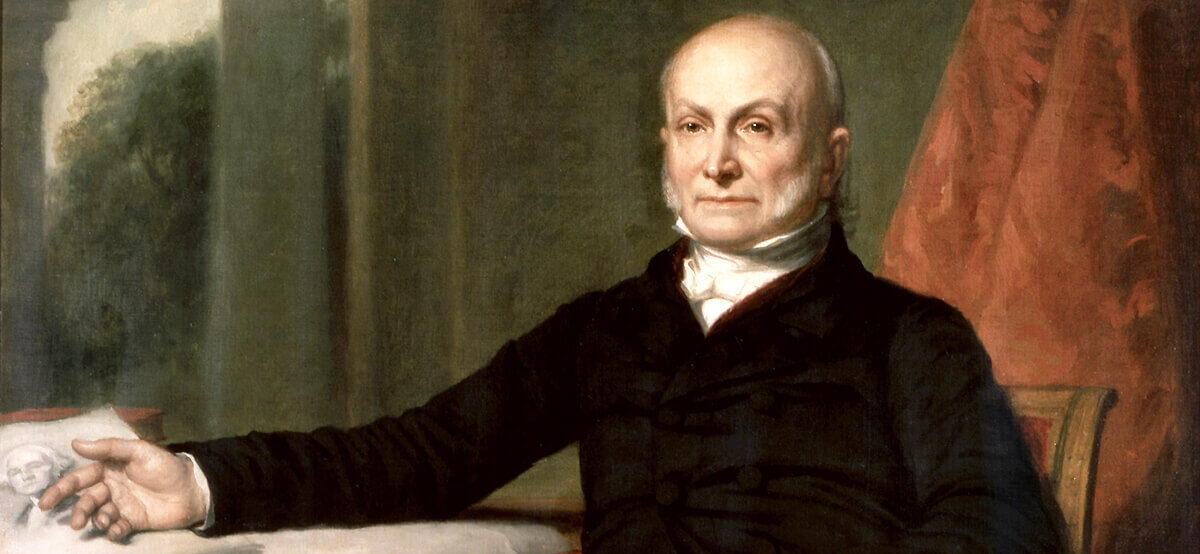
Founding Father John Quincy Adams gave his life to his faith, his family, and his country. He lived to be eighty years old and actively worked more than sixty of those years for the benefit of others. His service included diplomatic missions to five nations, serving as a state senator, US senator, secretary of state, and US president. And while every other president before and after him permanently retired from public life after leaving office, John Quincy Adams did not. On retirement, he was elected to the US House of Representatives, where he would spend nine terms. He eventually died in the US Capitol. Although he declared “I had not the slightest desire to be elected to Congress,”1 he still served because his neighbors desired his leadership and elected him for that purpose. Adams believed that it was his Christian duty to serve when called upon rather than indulging a personal wish to retire to a quiet unencumbered life.

In Congress, he took up the fight to end slavery at a time when the overwhelming majority in Congress did not want to even discuss the subject. He undertook a relentless personal crusade to secure the Declaration of Independence’s promise of “life, liberty, and the pursuit of happiness” for all individuals, regardless of race. But by choosing that path, he walked a difficult road. As he lamented, “The best actions of my life make me nothing but enemies.”2 Yet he did not quit, for he believed that “his service belonged to the nation.”3

He was consistently on the front lines in any quest to improve the lives of citizens and combat injustice. When he was seventy-four and had been fighting brutal congressional battles for over a decade, he wrote:

I deem it the duty of every Christian man, when he betakes himself to his nightly pillow, in self-examination to say, “What good have I done this day? Ay! And what evil have I done that may be repaired or repented of?” Nor should he rise from that pillow the next morning till after the inquiry, “What good can I do, and to whom, this day?” I have made this my rule for many years, with superadded prayer to the Lord of all—the Giver of every good gift for light [James 1:17]—for discernment, for guidance, for self-control, for a grateful heart to feel and acknowledge all His blessings, for humble resignation to His will, and submission to His chastisements. . . .Jesus Christ went about doing good [Acts 10:38]; I would do the same.4

John Quincy Adams understood that God places each of us here not to pursue own pleasure, but so that we might glorify God through serving and helping others. May the Spirit of God anoint us as well to imitate Jesus and personally “go about doing good.


Endnotes

1 John Quincy Adams, diary entry for September 18, 1830, Memoirs of John Quincy Adams, ed. Charles Francis Adams (Philadelphia: J. B. Lippincott & Co., 1876), 8:240.

2Adams, diary entry for October 25, 1833, Memoirs of John Quincy Adams, ed. Adams (1876), 9:26.

3 Dictionary of American Biography, ed. Allen Johnson (New York: Charles Scribner’s Sons, 1928), 1:92.

4 Adams, diary entry for November 16, 1842, Memoirs of John Quincy Adams, ed. Adams (1876), 2:269-270.


Calling the Nation to Prayer and Fasting

Thoughts on Ezra 8

In Ezra 7, Babylonian King Artaxerxes commissioned the priest Ezra to gather Jewish captives, return to their ancient homeland, and set up a civil government. They were also to rebuild the holy temple in Jerusalem, which had lain in ruins for decades. In chapter 8, Ezra assembled the people. But before they set out on their dangerous trek:

Then I proclaimed a fast there at the river of Ahava, that we might humble ourselves before our God to seek from Him a safe journey for us, our little ones, and all our possessions. For I was ashamed to request from the king troops and horsemen to protect us from the enemy on the way, because we had said to the king, “The hand of our God is favorably disposed to all those who seek Him, but His power and His anger are against all those who forsake Him.” So we fasted and sought our God concerning this matter, and He listened to our entreaty (vv. 21–23).

He called for a time of fasting and prayer to beseech the Lord’s intervention and assistance. And as Ezra attested, God answered their prayers. They journeyed safely to Jerusalem and successfully restored both the temple and civil government in their homeland.

The practice of calling the nation to a time of corporate prayer and fasting is repeated frequently throughout the Scriptures. For example, when the Ammonites came against Israel, King Jehoshaphat “turned his attention to seek the Lord, and proclaimed a fast throughout all Judah. So Judah gathered together to seek help from the Lord” (II Chronicles 20:3–4). Esther called the people to a time of prayer and fasting before she begged the king to save the Jews from the death decree issued by wicked Haman (Esther 4:16). And when Jonah warned the people of Nineveh of God’s intended judgment on them, “the people of Nineveh believed in God; and they called a fast and put on sackcloth from the greatest to the least of them” (Jonah 3:5), and their destruction was averted.

This Biblical model was repeated hundreds of times in early America.1 In fact, on eight separate occasions during the American Revolution, the Continental Congress called the nation to a time of humiliation, fasting, and prayer.2 Founding Fathers who were state governors likewise called their own states to prayer and fasting. These included signers of the Declaration Matthew Thornton,3 Samuel Adams,4 John Hancock,5 Samuel Huntington,6 Caesar Rodney,7 and signers of the Constitution John Dickinson,8 John Langdon,9 John Gilman,10 William Livingston,11 and others. This pattern—repeated so often before, during, and after the American Revolution—continued under the Constitution by U.S. presidents.

The XYZ Affair

During Washington’s presidency, France and Great Britain were at war with each other. So Great Britain blockaded American ships coming to Europe for fear they might be aiding the French. In 1794, John Jay negotiated a treaty (aka: the Jay Treaty) with the British to ease the growing tensions. But when the Jay Treaty was ratified in 1796, the French (still at war with Great Britain) responded by seizing 300 American ships to prevent supplies from reaching the British.

The following year in an attempt to prevent war with France, President John Adams dispatched three diplomats to negotiate with French officials. But before they could meet, the French agents demanded as preconditions: (1) a formal apology from President Adams, (2) a $10-million low-interest loan to the French government, and (3) a $250,000 personal bribe to the French foreign minister, Charles Tallyrand. Of course, the Americans refused.

The French continued to seize American ships and threatened an invasion of the United States. Congress therefore authorized a military buildup and began preparations for war. Adams’ political opponents believed he was exaggerating the situation and demanded proof of his claims. For which he released a report including the official diplomatic correspondence, but with the French agents’ names redacted (they were identified only as W, X, Y, and Z).

On seeing the documents, Americans were outraged. A formal declaration of war against France was narrowly averted. But an unofficial naval war (now called the Quasi-War), was unavoidable. Before France eventually signed a treaty with America in 1800, and war with France loomed, President Adams called the nation to a time of prayer and fasting:

Seasons of difficulty and of danger . . . are a loud call to repentance and reformation; and as the United States of America are at present placed in a hazardous and afflictive situation by the unfriendly disposition, conduct, and demands of a foreign power, evinced [proved] by repeated refusals to receive our messengers of reconciliation and peace, by depredations [attacks] on our commerce, and the infliction of injuries on very many of our fellow citizens while engaged in their lawful business on the seas. . . . I have therefore thought it fit to recommend . . . a day of solemn humiliation, fasting, and prayer.12

War of 1812

Nearly three decades after the American Revolution, the British had not kept many of the promises made at the end of the war. In fact, British encroachments on American ships and property were increasing. The result was the War of 1812, sometimes called the Second American Revolution. President James Madison regularly called the nation to prayer and fasting throughout the war, explaining on one of those occasions:

I do therefore recommend [a day of prayer and fasting] . . . for the devout purposes of . . . acknowledging the transgressions which might justly provoke the manifestations of His Divine displeasure; of seeking His merciful forgiveness and His assistance in the great duties of repentance and amendment; and especially of offering fervent supplications that in the present season of calamity and war, He would take the American people under His peculiar care and protection—that He would guide their public councils, animate their patriotism, and bestow His blessing on their arms . . . and, finally, that turning the hearts of our enemies from the violence and injustice which sway their councils against us, He would hasten a restoration of the blessings of peace.13

Civil War

In late 1860, it appeared that a national conflict was imminent. President James Buchanan called the nation to a time of prayer and fasting, reminding the country:

In this the hour of our calamity and peril, to Whom shall we resort for relief but to the God of our fathers? His omnipotent arm only can save us from the awful effects of our own crimes and follies—our own ingratitude and guilt towards our Heavenly Father. Let us, then, with deep contrition and penitent sorrow, unite in humbling ourselves before the Most High, in confessing our individual and national sins. . . . Let our fervent prayers ascend to His Throne that He would not desert us in this hour of extreme peril, but remember us as He did our fathers in the darkest days of the Revolution and preserve our Constitution and our Union, the work of their hands, for ages yet to come. . . .Let me invoke every individual, in whatever sphere of like he may be placed, to feel a personal responsibility to God and his country for keeping this day holy.14

And while in the midst of that bloody Civil War, President Abraham Lincoln called the nation to a day of humiliation, fasting, and prayer, explaining in most profound terms:

It is the duty of nations as well as of men to own their dependence upon the overruling power of God, to confess their sins and transgressions in humble sorrow yet with assured hope that genuine repentance will lead to mercy and pardon, and to recognize the sublime truths announced in the Holy Scriptures and proven by all history that those nations only are blessed whose God is the Lord. And insomuch as we know that by His Divine law, nations, like individuals, are subjected to punishments and chastisements in this world, may we not justly fear that the awful calamity of civil war which now desolates the land may be but a punishment inflicted upon us for our presumptuous sins, to the needful end of our national reformation as a whole people? We have been recipients of the choicest bounties of Heaven. We have been preserved these many years in peace and prosperity. We have grown in numbers, wealth, and power as no other nation has ever grown. But we have forgotten God—we have forgotten the gracious hand which preserved us in peace and multiplied and enriched and strengthened us, and we have vainly imagined in deceitfulness of our hearts that all these blessings were produced by some superior wisdom and virtue of our own. Intoxicated with unbroken success, we have become too self-sufficient to feel the necessity of redeeming and preserving grace—too proud to pray to the God that made us! It behooves us, then, to humble ourselves before the offended Power, to confess our national sins, and to pray for clemency and forgiveness. . . . All this being done in sincerity and truth, let us then rest humbly in the hope authorized by the Divine teachings that the united cry of the Nation will be heard on high and answered with blessings, no less than the pardon of our national sins and restoration of our now divided and suffering country to its former happy condition of unity and peace.15

Times of corporate humiliation and prayer were called in times of national danger and also in times of national tragedy. For example, in 1841 when President William Henry Harrison died, President John Tyler called the country to a time of special prayer:

When a Christian people feel themselves to be overtaken by a great public calamity, it becomes them to humble themselves under the dispensation of Divine Providence, to recognize His righteous government over the children of men, to acknowledge His goodness in time past as well as their own unworthiness, and to supplicate His merciful protection for the future.16

President Andrew Johnson held a similar day of humiliation, mourning, and prayer following the death of Abraham Lincoln.17 As did President Chester Arthur on the death of President James Garfield.18

Modern Examples

The US observed several days of national prayer during both World War I19 and World War II.20 And presidents George W. Bush and Donald Trump both issued prayer proclamations in response to natural disasters or epidemics.21

America has long followed the Biblical precedent of observing times of corporate prayer and fasting. But this is a spiritual discipline that every Christian would do well to personally develop (Matthew 9:15). After all, Jesus noted that some situations in our lives change only through prayer and fasting (Matthew 17:21). And it allows us to spend time in concentrated prayer in our relationship with the Lord.


Endnotes

1 See Deloss Love, The Fast and Thanksgiving Days of New England (Boston: Houghton, Mifflin and Company, 1895), 464–514.

2 See the Journals of the American Congress from 1774 to 1788 (Washington: Way and Gideon, 1823) for June 12, 1775; March 16, 1776; December 11, 1776; March 7, 1778; March 20, 1779; March 11, 1780; March 20, 1781; and March 19, 1782.

3 Matthew Thornton, “A Proclamation for a Day of Humiliation, Fasting and Prayer,” June 22, 1775, Evans #14275.

4 Samuel Adams, “A Proclamation for a Day of Fasting, Humiliation, and Prayer,” April 2, 1795, Broadside in the WallBuilders Collection; Samuel Adams, “A Proclamation for a Day of Solemn Fasting and Prayer,” May 4, 1797, Independent Chronicle (March 30, 1797).

5 John Hancock, “A Proclamation for a Day of Fasting and Prayer,” Independent Chronicle and the Universal Advertiser, March 26, 1789, 1; John Hancock, “A Proclamation for a Day of Fasting, Humiliation and Prayer,” April 25, 1782, Evans #17593; John Hancock, “A Proclamation for a Day of Public Fasting and Prayer,” May 15, 1783, Evans #18024; John Hancock, “A Proclamation for a Day of Humiliation, Fasting, and Prayer,” April 17, 1788, Evans #21236; John Hancock, “A Proclamation for a Day of Fasting and Prayer,” March 31, 1797, Evans #23549; John Hancock, “A Proclamation for a Day of Fasting, Humiliation, and Prayer,” March 29, 1792, Evans #24519; John Hancock, “A Proclamation for a Day of Public Fasting, Humiliation and Prayer,” April 11, 1793, Broadside in the WallBuilders Collection.

6 Samuel Huntington, “A Proclamation for a Day of Fasting, Humiliation, and Prayer,” April 17, 1788, Evans #21761; Samuel Huntington, “A Proclamation for a Day of Fasting, Humiliation, and Prayer,” Pennsylvania Packet or General Advertiser, March 4, 1780, 3; Samuel Huntington, “A Proclamation for a Day of Fasting, Humiliation, and Prayer,” March 31, 1791, Evans #23284; Samuel Huntington, “A Proclamation for a Day of Fasting, Humiliation, and Prayer,” April 12, 1792, Evans #24218; Samuel Huntington, “A Proclamation for a Day of Humiliation, Fasting and Prayer,” April 17, 1793, Dunlap’s Daily American Advertiser, March 30, 1793, 3; Samuel Huntington, “A Proclamation for a Day of Fasting, Humiliation, and Prayer,” April 22, 1789, Evans #21018; Samuel Huntington, “Proclamation for a Day of Fasting, Humiliation, and Prayer,” March 28, 1789, from Broadside in the WallBuilders Collection.

7 Caesar Rodney, “A Proclamation for a Day of Fasting, Humiliation, and Prayer,” May 6, 1779, Evans #43623.

8 John Dickinson, “A Proclamation for a Day of Public Prayer,” November 19, 1781, Evans #17134.

9 John Langdon, “A Proclamation for a Day of Public Fasting and Prayer,” April 6, 1786, Evans #19824.

10 John Taylor Gilman, “A Proclamation for a Day of Fasting, Humiliation, and Prayer,” April 19, 1804, Broadside in the WallBuilders Collection.

11 William Livingston, “A Proclamation for a Day of Fasting and Humiliation,” January 17, 1777, The Papers of William Livingston, ed. Carl E. Prince (New Jersey Historical Commission, 1979), I:200.

12 John Adams, “A Proclamation for a Day of Solemn Humiliation, Fasting and Prayer,” May 9, 1798, Russell’s Commercial Gazette (April 4, 1798); John Adams, “A Proclamation for a Day of Humiliation, Fasting and Prayer,” March 6, 1799, The Works of John Adams, Second President of the United States, ed. Charles Francis Adams (Boston: Little, Brown, and Company, 1854), 9:572.

13 James Madison, ”A Proclamation for a Day of Public Prayer,Connecticut Mirror (July 20, 1812), 3; James Madison, “A Proclamation for a Day of Public Prayer,” July 23, 1813, Independent Chronicle (July 29, 1813), 3–4; James Madison, “A Proclamation for a Day of Humiliation, Fasting and Prayer,” January 12, 1815, The Yankee (November 25, 1814), 2.

14 James Buchanan, “A Proclamation for a Day of Humiliation, Fasting, and Prayer,” January 4, 1861, from a Broadside in the WallBuilders Collection.

15 Abraham Lincoln, “A Proclamation for a Day of Humiliation, Fasting, and Prayer,” April 30, 1863, The Liberator (April 24, 1863), 3. See also, “A Proclamation for a Day of Humiliation, Fasting, and Prayer,” August 12, 1861, in the WallBuilders Collection; “A Proclamation for a Day of Fasting and Prayer,” July 17, 1864, Burlington Daily Hawk-Eye (July 14, 1864), 3.

16 John Tyler, “A Proclamation for a Day of Fasting and Prayer,” April 13, 1841, A Compilation of the Messages and Papers of the Presidents, ed. James D. Richardson (U.S. Bureau of National Literature and Art, 1910), 4:33.

17 Andrew Johnson, “The President’s Proclamation of a Day of Humiliation and Mourning,” May 25, 1865, The New York Herald (April 25, 1865), 8.

18 Chester A. Arthur, “A Proclamation for a Day of Humiliation and Mourning,” September 26, 1881, from a handwritten draft in the WallBuilders Collection.

19 Woodrow Wilson, Proclamation 1445—Decoration Day, May 11, 1918.

20 Franklin D. Roosevelt, Proclamation 2418—Day of Prayer, August 7, 1940; Proclamation 2531—Day of Prayer, December 22, 1941; Proclamation 2602—Day of Prayer, December 3, 1943; Harry S. Truman, Proclamation 2651—Victory in Europe: Day of Prayer, May 8, 1945; and Proclamation 2660—Victory in the East: Day of Prayer, August 16, 1945.

21 George W Bush, Proclamation 7462—National Day of Prayer and Remembrance for the Victims of the Terrorist Attacks on September 11, 2001, September 13, 2001; Proclamation 7925— National Day of Prayer and Remembrance for Victims of Hurricane Katrina, September 8, 2005, voluntary, and separate from regular National Day of Prayer from May of that year; Donald J Trump, Proclamation 9634— National Day of Prayer for Victims of Hurricane Harvey and for Our National Recover Efforts, September 1, 2017; Proclamation 9997-— National Day of Prayer for All Americans Affected by the Coronavirus Pandemic and for Our National Response, March 14, 2020.

Meditating on God’s Word

Thoughts on Psalm 4:4

The Bible places great emphasis on the meditation of God and His Word. In fact, the Bible makes clear that you cannot grow spiritually without meditating on His Word.

Perhaps the best way to describe the importance of meditation is to liken it to the process of digestion. While it is important to consume the food (or to use a spiritual analogy based on Matthew 6:11 and 4:4, to consume the Word of God), if what we consume is not broken down and digested so that it can be absorbed by the body, it renders no nutritional benefit. In fact, there are medical maladies whereby individuals can actually consume large amounts of food but die of starvation because the body does not break down and digest the food. So too, with the intake of God’s Word.

First Timothy 4:15 commands “meditate on these things; give yourself entirely to them, that your progress may be evident to all” (NKJV). Notice the sequence: if you (1) mediate on these things, (2) your growth and maturity will become evident to everyone. Similarly, Joshua 1:8 commands us to (1) meditate in His Word day and night, then (2) your way will be prosperous and you will have good success. Other verses that emphasize the importance of meditation include Psalm 63:6, Psalm 119:15, 99.

In both the spiritual and the physical realms, it is not how fast or how much you consume that is important, but how much you digest. And digestion takes time. You have to go over and over the same content similar to a cow chewing its cud. After cows have eaten, they lie still and ruminate—chew on what they ingested to allow full digestion and extract all the nutrition.

When you read God’s word (which should be done daily), be sure to meditate on what you just read. Take time to ask yourself questions such as: who (To whom was this passage written?), what (What was the theme of this passage?), when and where (What were the circumstances and events that surrounded this message?), why (Why was the message in this passage given?), and how (How will I apply what is in this passage to my own life? What changes must I make in my own speaking, thinking, or behavior?). This meditation will move our spiritual lives beyond merely taking the “milk” of God’s Word and on to consuming its “solid food” (Hebrews 5:12-14).

John Quincy Adams was one of many Founding Fathers who had consumed much of God’s Word. As he acknowledged:

My custom is to read four or five chapters every morning immediately after rising from my bed. It employs about an hour of my time and seems to me the most suitable manner of beginning the day.1

In addition to his regular daily readings, every Sunday he usually covered additional chapters, frequently studying and comparing translations of the Bible in several different languages (of which he could speak seven). One Sunday in 1826, while serving as president of the United States, he recorded:

Heard Mr. [Robert] Little [pastor of a church Adams attended] from Psalm 119:133: “Order my steps in Thy Word, and let not any iniquity have dominion over me.” A desultory [spontaneous] and impressive moral discourse [sermon], setting forth by various illustrations the different modes by which iniquity [sin] may obtain dominion over us. Among his quotations from Scripture was that of the first seven verses of the fifth chapter of Isaiah (the song of the vineyard that brought forth wild grapes). In this instance, as in numberless others, I was struck with the careless inattention of my own mind when reading the Bible. I had read the chapter of Isaiah, containing this parable I dare say fifty times, and it was altogether familiar to my memory; but I had never perceived a fiftieth part of its beauty and sublimity. The closing verse of the parable, especially which points the moral of the allegory, speaks with irresistible energy: “For the vineyard of the Lord of hosts is the house of Israel, and the men of Judah His pleasant plant, and He looked for judgment, but behold oppression – for righteousness, but behold a cry” [Isaiah 5:7].2

Significantly, Adams was fifty-eight when he made this diary entry, and it had been his practice from his youth to read through the entire Bible every year.3 So despite having already read this passage from Isaiah “I dare say fifty times,” he still saw something brand new in it. As he confessed, “I was struck with the careless inattention of my own mind when reading the Bible,” and it is for this reason that meditation receives such an emphasis in the Bible. We must read God’s Word every day; but we must also take time to digest what we read—to “meditate within your own heart…and be still” (Psalm 4:4).


Endnotes

1 John Quincy Adams, Letters of John Quincy Adams, to His Son on the Bible and Its Teachings (New York: Derby, Miller, & Co., 1848), 11-12.

2 John Quincy Adams, diary entry for November 5, 1826, Memoirs of John Quincy Adams, ed. Charles Francis Adams (Philadelphia: J.B. Lippincott & Co., 1874), 7:168-169.

3 Adams, Letters of John Quincy Adams, to His Son (1848), 10-11.

The Duty of Nations

Thoughts on Psalm 9:17

Proverbs 3:5–6 reminds us that in all our ways (public as well as private) we are to acknowledge Him. And while it is wisdom for individuals, it is also true of nations. In response to the idolatry of others or their failure to acknowledge God, Psalm 79:6 and Jeremiah 10:25 call for God’s wrath upon all nations that do not call upon His name; and the warranty of 1 Samuel 2:30 that “Those who honor Me I will honor, and those who despise Me will be lightly esteemed” was delivered to civil leaders, not religious ones.

The psalmist said, “The wicked return to Sheol, even all the nations who forget God” (Psalm 9:17). Whenever we stop acknowledging Him, whether as an individual or a nation, we then begin to forget Him, and at that point we are in trouble. Understanding this truth, President George Washington emphatically declared:

It is the duty of all nations to acknowledge the providence of Almighty God, to obey His will, to be grateful for His benefits, and humbly to implore His protection and favor.1

Notice the four duties that Washington said pertained to nations:

  1. Acknowledge God
  2. Obey His will
  3. Be grateful for His aid
  4. Implore His protection and favor

President John Adams concurred and similarly declared:

The safety and prosperity of nations ultimately and essentially depend on the protection and the blessing of Almighty God, and the national acknowledgment of this truth is . . . an indispensable duty which the people owe to Him.2

President Thomas Jefferson agreed, and in his First Inaugural Address reminded the nation that the first thing “necessary to make us a happy and a prosperous people” was “acknowledging and adoring an overruling Providence.”3

The conviction that America should publicly acknowledge God was frequently expressed by our national leaders. In fact, President Abraham Lincoln not only did so but even warned the nation in his day that it was beginning to forget God:

It is the duty of nations as well . . . and to recognize the sublime truth announced in the Holy Scriptures and proven by all history that those nations only are blessed whose God is the Lord [Psalm 33:12]. . . . But we have forgotten God. We have forgotten the gracious hand which preserved us in peace and multiplied and enriched and strengthened us, and we have vainly imagined in the deceitfulness of our hearts that all these blessings were produced by some superior wisdom and virtue of our own. Intoxicated with unbroken success, we have become too self-sufficient to feel the necessity of redeeming and preserving grace—too proud to pray to the God that made us.4

For this reason, President Lincoln called the nation to a time of public humiliation, fasting, and prayer so that it would once again remember God.

Remembering and honoring God at the national level begins with simple acknowledgment of God. Therefore modern conflicts over things such as the National Motto, the inclusion of “under God” in the Pledge of Allegiance, public displays of the Ten Commandments or nativity scenes, and prayer at athletic events, school meetings, or political gatherings are not small or trivial matters. The presence of such public acknowledgments is not coercive, but rather simple, encouraging reminders with a long history of precedent underscoring the value and wisdom of honoring God. The Founding Fathers would never have supported any public policy that would prohibit such expressions and thus invite us as a nation to forget God.


Endnotes

1 George Washington, “A Proclamation” printed in The Providence Gazette and Country Journal (October 17, 1789), 1. See also George Washington, “Proclamation for a National Thanksgiving,” Writings of George Washington, ed. Jared Sparks (Boston: American Stationers Company, 1837), XII:119.

2 John Adams, “Proclamation for a National Thanksgiving,” March 23, 1798, The Works of John Adams, Second President of the United States, ed. Charles Francis Adams (Boston: Charles C. Little and James Brown, 1851), IX:169.

3 Thomas Jefferson, “First Inaugural Address,” March 4, 1801, The Papers of Thomas Jefferson, ed. Barbara B. Oberg (Princeton, NJ: Princeton University Press, 2006), 33:150.

4 Abraham Lincoln, “A Proclamation” printed in The Liberator (April 24, 1863), 3. See also Abraham Lincoln, , “A Proclamation Appointing a National Fast-Day,” The Writings of Abraham Lincoln, ed. Arthur Brooks Lapsley (New York: G. P. Putnam’s Sons, 1923), 6:270–271.

The Sermon on the Mount Carl Bloch, 1890

His Desire to Answer Prayer

Thoughts on Matthew 6

Prayer has always been central to Biblical faith, highlighted in dozens of examples throughout the Scriptures, and was therefore also deeply embedded in American life. In fact, colonial, state, and federal governments issued over 1,400 official calls to prayer between 1620 and 1815.1 The Founding Fathers clearly were convinced of the efficacy of prayer.

John Jay, who was the original Chief Justice on the US Supreme Court, believed that the fact that God had told us to pray, and that He had even told us how to pray and what to pray for, were clear indications that He wanted to answer our prayers. As he explained:

Had it not been the purpose of God that His will should be done on earth as it is done in heaven, He would not have commanded us to pray for it. That command implies a prediction and a promise that in due season it shall be accomplished.2

Jay’s reference is to the Lord’s Prayer, when Jesus’ disciples had come to Him and asked Him to teach them to pray, to which He replied:

Pray, then, in this way: ‘Our Father who is in heaven, hallowed be Your name. Your kingdom come. Your will be done, on earth as it is in heaven. Give us this day our daily bread. And forgive us our debts, as we also have forgiven our debtors. And do not lead us into temptation, but deliver us from evil. [For Yours is the kingdom and the power and the glory forever. Amen.’] (Matthew 6:9-13)

This prayer, well known to the Founding Fathers, appeared in American public school textbooks for well over two centuries, and an elderly John Quincy Adams attested that it was one of the first things he had learned as a youngster:

My mother was the daughter of a Christian clergyman . . . In that same spring and summer of 1775 [when I was only seven], she taught me to repeat daily after the Lord’s Prayer before rising from bed, the Ode of Collins on the patriot warriors [a patriotic poem]. . . .Now—seventy-one years after they were thus taught me—I repeat them from memory.3

Early American statesman John Chandler Davis conversed with Adams about the Lord’s Prayer shortly before the latter’s death (Adams died in the U. S. Capitol in 1848), Davis recounted:

In 1847, I became well acquainted with him and frequently met with him and talked with him in the House of Representatives. I remember one morning in 1847 that I met him before the House was called to order. He was very feeble. It was not long before the subject of religion was introduced by Mr. Adams. Among other things I remember his saying, “There are two prayers I love to say: the first is The Lord’s Prayer, and because the Lord taught it; and the other is what seems to be a child’s prayer, “Now I lay me down to sleep,” etc., and I love to say this because it suits me. And,” he added, “I love this prayer so much that I have been repeating it every night for very many years past, and I say it yet – and I expect to say it my last night on earth if I am conscious. But,” said he, “I have added a few words to the prayer so as to express my trust in Christ, and also to acknowledge what I ask for I ask as a favor and not because I deserve it. This is it,” said he, and then he repeated it as he was in the habit of saying it: “Now I lay me down to sleep, I pray the Lord my soul to keep; if I should die before I wake, I pray the Lord my soul to take – for Jesus’ sake. Amen.” This was in 1847. He died in 1848 while I was living in Washington, and I have no doubt but that the “child’s prayer that just suited” him was reverently repeated every night until he died.4

Jesus taught His disciples to pray the Lord’s Prayer, something many Founding Fathers faithfully embraced. The Lord’s Prayer serves as a time-tested helpful guide for our own prayers that comes with a clear indication of God’s desire to answer them. As John Jay affirmed, the Lord’s Prayer leads to answered prayer.


Endnotes

1 DeLoss Love, The Fast and Thanksgiving Days of New England (Boston: Houghton, Mifflin and Company, 1895), 464-514.

2 John Jay at the Annual Meeting, May 8, 1823, The Life of John Jay, with Selections of his Correspondence and Miscellaneous Papers, ed. William Jay (New York: J. & J. Harper, 1833), 1:503.

3 John Quincy Adams, The Memoirs of John Quincy Adams, ed. Charles Francis Adams (Philadelphia: J. B. Lippincott & Co., 1874), I:5-6.

4 J. C. Davis, , “Child-Likeness of the Old Man Eloquent,” The Churchman (1890), reprinted in The Sunday School Union (1890), XXXII:415.

The Heart of a Grateful Nation

Thoughts on 2 Chronicles 5-7

King David, blessed by God throughout his long life, envisioned building a majestic temple to honor the Lord. But God told David that it would instead be his son, Solomon, who would construct the building. So David prepared everything his son would need. When later King Solomon successfully completed the temple, he gathered the nation together and dedicated the new structure with a time of prayer and praise (2 Chronicles 5-7). The spirit of God filled the temple and fell on those present. God promising Solomon that He would hear and answer prayers prayed from that location. Significantly, our Founding Fathers invoked this incident and this passage at a significant moment early in the political life of a young America.

On September 25, 1789, the very first federal Congress had just finished framing the Bill of Rights—the Capstone of the Constitution. On that notable day, the official records of Congress report:

Mr. [Elias] Boudinot said he could not think of letting the session pass over without offering an opportunity to all the citizens of the United States of joining with one voice in returning to Almighty God their sincere thanks for the many blessings He had poured down upon them. With this view, therefore, he would move the following resolution:

Resolved, That a joint committee of both Houses be directed to wait upon the President of the United States to request that he would recommend to the people of the United States a day of public thanksgiving and prayer, to be observed by acknowledging with grateful hearts the many signal favors of Almighty God. . . .

Mr. [Roger] Sherman justified the practice of thanksgiving on any signal [remarkable] event not only as a laudable one in itself but as warranted by a number of precedents in Holy Writ – for instance, the solemn thanksgivings and rejoicings which took place in the time of Solomon after the building of the temple was a case in point [2 Chronicles 5-7, 1 Kings 7-8]. This example he thought worthy of Christian imitation on the present occasion, and he would agree with the gentleman who moved the resolution. Mr. Boudinot quoted further precedents from the practice of the late Congress and hoped the motion would meet a ready acquiescence [approval]. The question was now put on the resolution and it was carried in the affirmative.1

Congress delivered it recommendation to President George Washington, who happily concurred. He issued America’s first federal proclamation for a Day of Prayer and Thanksgiving. That proclamation declared:

Whereas it is the duty of all nations to acknowledge the providence of Almighty God, to obey His will, to be grateful for His benefits, and humbly to implore His protection and favor. . . . Now, therefore, I do recommend . . . that we may then all unite in rendering unto Him our sincere and humble thanks for His kind care and protection of the people of this country. . . . And also that we may then unite in most humbly offering our prayers and supplications to the great Lord and Ruler of Nations, and beseech Him to pardon our national and other transgressions . . . to promote the knowledge and practice of true religion and virtue.2

Notice that George Washington said that nations—not just individuals, but nations—have four duties: (1) to acknowledge the providence of Almighty God, (2) to obey His will, (3) to be grateful for His benefits, and (4) humbly to implore His protection and favor. This proclamation, along with the several other calls to prayer issued during his administration, was written by Washington himself. Whereas other presidents had chaplains of Congress write their proclamations.3

America observed its first federal day of thanksgiving because Founding Fathers in Congress were thoroughly familiar with the Bible and found precedent for such a day from 2 Chronicles 5-7—one of many American practices with a Biblical basis.


Endnotes

1 September 25, 1789, The Debates and Proceedings in the Congress of the United States, Joseph Gales, editor (Washington: Gales and Seaton, 1834) I:949-950.

2 The Providence Gazette and Country Journal (Providence: October 17, 1789), 1. George Washington, “A Proclamation,” issued on October 3, 1789, observance date November 26, 1789.

3 Joseph H. Jones, The Life of Ashbel Green (New York: Robert Carter and Brothers, 1849), 270-271.

The Federalist Papers

Defending the US Constitution

On October 27, 1787 a New York newspaper published the very first article that would come to be known as the Federalist Papers.

The Delegates to the Constitutional Convention signed the United States Constitution on September 17, 17871 and then sent it to the thirteen states for ratification.

During this ratification process, the states would review the proposed Constitution and either approve or reject it. A favorable vote by nine of the states would be required for the Constitution to go into effect.2

Some states gave their blessings quickly, while some, like New York, had a more difficult time with this process before casting a narrow vote in favor of the document.3 New York’s ratification convention stretched well over a month in the summer of 1788.4

In October of 1787, before the debates even started in that state, four New York newspapers began publishing articles in support of the Constitution.5 The essays appeared anonymously under the name “Publius” in these newspapers. They explained various parts of the Constitution and encouraged its adoption.

The popular essays continued through May 1788, by which time a total of 85 articles had been published.6 They were first released as The Federalist in a bound volume in January 1788,7 before all the essays had even been completed.

These essays were influential not only in the New York ratification debates, but appeared in newspapers in other states as well. It was later discovered that James Madison, John Jay, and Alexander Hamilton were the authors of what became popularly embraced as the Federalist Papers.8

James Madison described this collection as “the most authentic exposition of the text of the federal Constitution as understood by the body which prepared and the authority which accepted it.”9 Courts across America’s history have relied on the Federalist Papers for explanations of the original intent of the US Constitution.

The Federalist Papers can provide context, insight, and authority to the Constitution in an era when Americans’ desperately lack Constitutional knowledge.10 Make it a part of your study of the Constitution for a deeper insight into what this important document means to our nation!


Endnotes

1 “The Constitution: How Did it Happen?” National Archives, accessed October 25, 2024.
2 “Elliot’s Debates,” Library of Congress, accessed October 25, 2024.
3 James Caldwell, “Ratification Dates and Votes,” April 23, 2024, U.S. Constitution.net.
4 “Introductory Note: New York Ratifying Convention, [17 June–26 July 1788],” National Archives: Founders Online.
5 “Federalist 1 (1787),” National Constitution Center, accessed October 25, 2024.
6 “Federalist Papers: Primary Documents in American History,” Library of Congress, accessed October 25, 2024.
7 “Printings and Reprintings of The Federalist,” 2003, Center for the Study of the American Constitution.
8 “About the Authors,” Library of Congress, accessed October 25, 2024.
9 James Madison to Thomas Jefferson, February 8, 1825, Letters and Other Writings of James Madison (Philadelphia: J. P. Lippincott Co., 1867), III:481.
10 See information about this lack of Constitutional knowledge in WallBuilders’ Constitution Hub.

Sermon – Solar Eclipse – 1806

Joseph Lathrop (1731-1820)

Lathrop was born in Norwich, Connecticut. After graduating from Yale, he took a teaching position at a grammar school in Springfield, Massachusetts, where he also began studying theology. Two years after leaving Yale, he was ordained as the pastor of the Congregational Church in West Springfield, Massachusetts. He remained there until his death in 1820, in the 65th year of his ministry. During his career, he was awarded a Doctor of Divinity from both Yale and Harvard. He was even offered the Professorship of Divinity at Yale, but he declined the offer. Many of his sermons were published in a seven-volume set over the course of twenty-five years.

In this sermon, Rev. Lathrop uses the occasion of a recent solar eclipse to strengthen the Biblical worldview of his parishioners by providing both a scientific explanation and gleaning spiritual truths from the phenomenon. Lathrop’s sermon is a clear example of how early American pastors used the events of their time to impart truth and develop the Christian worldview of their listeners.


A
SERMON
CONTAINING
REFLECTIONS ON THE SOLAR ECLIPSE
WHICH APPEARED ON JUNE 16, 1806
DELIVERED
ON THE LORD’S DAY FOLLOWING.

By Joseph Lathrop, D. D.
Pastor of the first Church in West-Springfield

AMOS 8:9
It shall come to pass in that day; saith the Lord, that I will cause the sun to go down at noon, and I will darken the earth in the clear day.

Amos was bred an husbandman and a shepherd. From his rural employment he was called to the office of a prophet. He says, “I was not a prophet, nor the son of a prophet; but I was an herdman and a gatherer of sycamore fruit. And the Lord took me, as I followed the flock, and said unto me, go, prophesy unto my people Israel.”

Many expressions in his book are taken from observations, which a shepherd would naturally make in attending to the business of his calling. In Judea the shepherds watched their flocks, not by day only, but also by night, to guard them against beasts of prey, in which that country abounded. And, in their attendance on their flocks, they would naturally observe the motions of the planets, and the appearances in the heavens, that they might foresee changes of weather and approaching storms. Hence the prophet, calling on the degenerate tribes of Israel
to renounce their false gods, and to worship the great author and governor of nature, uses a language suggested by his former pastoral occupation. “Seek not Bethel, enter not into Gilgal, nor pass to Beersheba,” the idolatrous places, where the sun and moon, and hosts of heaven were worshipped; “but seek him, who maketh the seven stars and Orion; and turneth the shadow of death into the morning, and maketh the day dark with night.”

The stated course of nature, the order of the heavenly bodies, the vicissitude of day and night, and the regular succession of seasons, demonstrate the existence and providence, the wisdom, power and goodness of God. “Day unto day uttereth speech; night unto night sheweth forth knowledge.” “God hath not left himself without witness, in that he giveth rain and fruitful seasons, and filleth our hearts with food and gladness.” But common appearances, as they become more familiar, are less impressive. Unusual phenomena, though no less the effects of natural causes, more powerfully arrest the attention, and more deeply affect the mind. The prophet, therefore, predicting some dire calamities on the house of Israel, alludes to an unusual and solemn appearance in the skies, which probably they had lately seen; a total eclipse of the sun in the midst of a clear day. “Thus saith the Lord, I will cause the sun to go down at noon, and I will darken the earth in the clear day.” The phenomenon which we beheld, on Monday last, will naturally lead us to understand the words as poetic descriptions of a solar eclipse.

Archbishop Usher, in his annals of the world, says, that in Amos’s time, there were two remarkable eclipses of the sun, which happened at solemn festivals, and struck the people with great consternation. In ancient times, when astronomy was but imperfectly understood, eclipses were by many considered, as preternatural and portentous. The prophet, therefore, foretelling the judgments coming on the land of Israel, might with great propriety figure to them the changes soon to take place in their political hemisphere, by an allusion to the change, which they had seen, with terror and amazement, in the natural hemisphere. “God would cause their sun to go down at noon, darken the earth in the clear day, turn their feasts into mourning, and their songs into lamentation, and bring up sackcloth on all loins.”

The use, which the prophet makes of a solar eclipse will justify us in some moral and religious reflections on the singular scene, which was exhibited in the past week.

1. We have reason to rejoice in the progress, which has been made in the sciences, and particularly in the noble science of astronomy. By this we are freed from many superstitious terrors, which, in the dark ages of the world, tormented mankind.

Eclipses have been observed from the remotest antiquity; and of these which were most remarkable, accounts have been transmitted to us by some of the earliest historians, who have also related the disastrous events which followed, and which the eclipses were supposed to portend.

The cause of eclipses must have been known long before they could be the subjects of mathematical calculation. It was well understood, many ages ago, that an eclipse of the moon was caused by its passing through the shadow of the earth, when the earth was between that and the sun; and that an eclipse of the sun was caused by the moon’s passing between us and the sun, and intercepting its light. This knowledge, however, was not common to the vulgar; nor did the more learned view these causes as operating by regular and stated laws.

There were predictions of some eclipses, which appeared several centuries before the birth of our Savior. But these predictions were probably, like the present predictions of comets, conjectures grounded on a course of observations, and not the result of exact calculations.

The relations, distances and motions of the heavenly bodies are now so well ascertained, that accurate calculations can be made of all the eclipses, which shall be in ages to come, and of those which have been, since our system was framed. These calculations are of great utility to mankind, in husbandry, navigation, geography, chronology and history. The credit of some ancient histories derives confirmation from this source. The historian relates some great events, which he supposes, were portended by a certain eclipse, which he describes. The astronomer finds, that there was in fact, such an eclipse, at such a time, and hence justly gives more full credit to the historian.

These phenomena have also their moral uses. They enlarge our views of the works of God, and of the grandeur and extent of his creation and providence. They display his wisdom, power and goodness, and his continual agency in the government of the world. They teach us his constant care for the creatures, which he has made, and call us to reverence and adore him, who thus manifests himself to us in the works of his hands.

We see innumerable worlds rolling around us at vast but various distances; with different, but inconceivable rapidity. These all perform their motions with regularity, and observe their times with exactness. They obey their destination, they keep their order, they never interfere. Shall we not fear the power, admire the wisdom, adore the goodness of that being, who made and adjusted, who sustains and directs such a stupendous system, and render it subservient to our happiness? These rational sentiments are pleasant and delightful in themselves; and are far more conducive to piety and virtue, than the terrors of that superstitious ignorance, which views every comet flaming in the sky, every obscuration of the sun at noonday, every failure of the full orbed moon at night, every unusual noise bursting from the clouds, every strange appearance in the heavens and in the earth, as awfully portentous of some dire, but unknown calamity.

Superstitious terrors may operate as a temporary restraint from vice. But when the dreaded calamity is delayed, the restraint ceases, and vice regains its dominion. A rational fear of God, arising from a calm contemplation of his agency and government, displayed in his works, and taught in his word, will have a steady and permanent influence. “Fear ye not me, saith the Lord, will ye not tremble at my presence, who have placed the sand for the bound of the sea, who give the former and the latter rain, and reserve to you the appointed weeks of harvest?” The more just are our thoughts of God’s government, and the more rational our reverence of his majesty, the more uniform and cheerful will be our obedience to his will.

2. An eclipse of the sun, though it is not an omen of any particular calamity, yet may properly lead us to contemplate the gloomy changes which await us in this guilty and mortal state.

By a total obscuration of his glorious luminary, at noon, in a clear day, a gloom is suddenly spread over the face of nature. Not only the human mind, but the animal and material creation is deeply affected. Night seems to anticipate the time of its return. The stars hand out their lamps; the dews descend on the earth; the grazing beasts forget their hunger; the fowls hasten to their resting places; the bird of night chants his evening ditty; every thing wears a sober and mournful aspect.

Here is an emblem of declining age and approaching death.

The time is coming – to some of us it is near; when the sun and the light will be darkened; the eyes, which look out at the windows, will be bedimmed, surrounding objects will be hidden, and “we shall go to our long home – to the land of darkness and the shadow of death, without any order, and where the light is as darkness.” “While we have the light, let us walk in the light, lest darkness come upon us. Let us give glory to God, before he cause darkness, and before our feet stumble on the dark mountains; lest, while we look for light, it be turned into the shadow of death.” The eyes of our understanding still remain unextinguished, and the sun of righteousness shines upon us with salvation in his beams. Let us attend to the glorious discoveries which are made to us, and apply ourselves to the momentous work before us. Let us work while it is day. The time is short – night is at hand. What we find to do, let us do it with our might. There is no work in the grave.

Some of you are in youth and in full strength. My friends, your morning sun shines bright and pleasant; you think your day will be long. But, oh! flatter not yourselves. Your sun may go down at noon, and your prospect be darkened in a clear day. Employ these morning hours in the work of your salvation. You know not what a day, or an hour may bring forth.

The darkness of an eclipse the prophet improves, though not as an omen, yet as an emblem of national judgments. He warns his people that a metaphorical and political darkness may overspread their country, in the same surprising manner, as literal darkness in a solar eclipse falls on the unsuspecting earth. “Thus saith the Lord unto me, an end is come upon my people; I will not pass by them any more. Hear this, ye that swallow up the needy, and that say, when will the new moon be gone, that we may sell corn, and the Sabbath, that we may set forth wheat? The Lord hath sworn by the excellency of Jacob, surely I will not forget any of their works. Shall not the land tremble for this, and every one mourn that dwelleth therein? Thus saith the Lord, I will darken the earth in the clear day. I will turn their feasts into mourning, and their songs into lamentation.”

Sudden darkness caused by eclipses, clouds, vapor and storms, is, in the prophetic writings, a common figure for great and unexpected plagues; such as war, discord, pestilence and famine. The prophet Isaiah, describing the calamitous state of the Jews, on the invasion of the Chaldeans, says, “They shall look to the earth, and behold, trouble and darkness, and dimness of anguish; they shall be driven into darkness.” In the same figurative language, Joel describes the devastation and famine caused in the land by clouds of devouring locusts, and by the rage of subsequent fires. “Let all the inhabitants of the land tremble; for the day of the Lord cometh and is nigh at hand; a day of darkness and gloominess, of clouds and thick darkness. There shall be wonders in the heavens and in the earth; there shall be pillars of smoke, and the sun shall be turned into darkness.”

When we see the sun darkened in the heavens, and the earth covered with a gloom, we are reminded, how easy it is for Him, who in a moment extinguishes the sun, to cast a cloud over our earthly prospects; to turn our joys into anguish, our confidence into terror, and our songs into lamentation – to subvert our national security, to let loose the infernal spirit of discord, to remove restraint from hostile nations, to send a blast on the labors of our hands, and to spread among us pestilence and death.

On God we are dependent not only for the daily visits of the sun, but also for his friendly beams, when he returns. The moon, which chases away the gloom of night, now and then steps in, and intercepts the light of day. If it should
make a stand in that position, our day would become night, and the warmth of summer would be changed into the frost of winter. But the moon obeys the divine command, moves the cheering beams, which it had, for a few moments withholden.

The creatures, which are our ordinary comforts, may by God’s direction or permission, become the occasions of affliction and anguish. The sun, which enlivens the rational, animal and vegetable world, may dart malignant fires and scatter pestilential
diseases. The rains, which refresh and fructify our fields, may “wash away the things which grow out of the earth, and destroy the hope of man.” The friends in whom we confide may become our tormentors, and “a man’s foes may be those of his own household.” Government, which is our defense against injustice, fraud and violence, falling into the hands of cruel and unprincipled men, may be made an instrument of oppression and misery. “They who lead us may cause us to err, and destroy the way of our paths.”

Where then is our security? It is in the protection of Him, who created and upholds the frame of nature, “who made and guides the seven stars and Orion, turns the shadow of death into the mourning, or makes the day dark with night” – “who calleth to the waters and sends them on the earth, and restrains the floods” within the bounds prescribed – “who rules the raging of the sea, and stills the tumults of the people” – ” who turns the hearts of men, as the rivers of water are turned” – “who causes the wrath of men to praise him, and the remainder of that wrath he restrains.” How shall we enjoy his protection ? He has told us, “If ye will walk in my statutes, keep my Sabbaths and reverence my sanctuary, then I will give you rain in due season, your fields shall yield their increase; I will give peace in your land, and ye shall lie down and none shall make you afraid.” – “But if ye will walk contrary unto me, I will walk contrary unto you, and make your plagues wonderful.”

Learned astronomers can calculate with exactness the times when, the places where, and the quantities in which the luminaries of heaven will be eclipsed; but they cannot with the same accuracy predict the judgments of God. Nor do we here need their astronomical skill. There are other signs by which we may discern impending judgments. Our Savior. has taught us a kind of moral astronomy to direct our prescience of such events. The prevalence of infidelity, immorality and vice as surely indicates approaching calamities, as clouds indicate a shower, winds forebode a storm, or the conjunction, or opposition of the sun and moon, in certain places in the heaves, presignify an eclipse. He said to the people, “When ye see a cloud rise out of the west, straitway, ye say, there cometh a shower; and so it is. When ye perceive the south wind blow, ye say, there will be heat; and it cometh to pass. Ye hypocrites, ye can discern the face of the sky and of the earth; but how is it, that ye cannot discern this time? Yea, and why even of yourselves judge ye not what is right?” The blindness and stupidity of the ancient Jews to the impending judgments of God, the prophet upbraids by referring them to the sagacity and discernment apparent in the fowls of heaven. “The stork in the heavens knoweth her appointed time; the turtle, the crane and the swallow observe the time of their coming; but my people knoweth not the judgments of God.”

There are now, as there were in former times, many who ask, “Watchman, what of the night? Watchman, what of the night?” And the watchman’s answer then, is seasonable now, “If ye will inquire, inquire ye” wisely; “return, come,” return to God by repentance; then come and inquire, and you may hope for a favorable answer.

It is common for people to look forward and inquire, what will be our national state in future years – what will be the result of certain public measures – what shall be done to obtain this favorite object, and avert that threatening evil, and to make future times better than these? But they inquire not wisely concerning this matter. Let them inquire what iniquities abound, and what share their own iniquities have in the common guilt? Let each one repent of his own wickedness, and apply himself to his own duty. Let each one use his best influence to correct the errors, and reform the manners of those with whom he is connected. Then things will go well. “Righteousness will exalt a nation. Sin will be a reproach to any people.”

3. The darkening of the earth in a clear day brings to mind the final judgment. The scripture assures us, that “God has appointed a day, in which he will judge the world in righteousness, and render to every man according to his works.” It teaches us, that the judgment will come on a guilty world by surprise – that “when men shall say, peace and safety, then sudden destruction cometh.” The manner of its coming is compared to the catastrophe of Sodom. “As it was in the days of Lot; they ate, they drank, they bought, they fold, they planted, they builded. But the same day, that Lot went out of Sodom, it rained fire and brimstone out of heaven, and destroyed them all. Even so shall it be in that day when the son of man is revealed.” To heighten the solemnity of this scene, the sacred writers tell us, “The sun shall be darkened, and the moon shall not give her light; the stars shall fall from heaven, and the powers of heaven shall be shaken – the heaven shall depart as a scroll when it is rolled together, and every mountain and island shall be removed out of their place.” What effect the expectation of such a day should have, St. Peter instructs us. “Seeing all these things shall be dissolved, what manner of persons ought we to be in all holy conversation and godliness, looking for and hastening unto the day of the Lord. Let us be diligent, that we may be found of the Lord in peace without spot and blameless.”

You think that great day to be remote. Perhaps it is so. But whether it be near or remote, it will come. And when it shall come, it will be as real and important, as if it were now present. “Count the longsuffering of God’s salvation. He is not willing that you should perish, but that you should come to repentance.”

Were you sure, that within ten or twenty years, the frame of nature, as well as the works of man, would dissolved, the heavens with all their splendors would vanish, and the earth with all her furniture and in habitants would pass away, how vain would all your property, all your designs and labors appear? What folly would be stampt on avarice, ambition, worldly grandeur and ostentation, political intrigues, party contests and animosities? But, my fellow mortals, where is the mighty difference to you and me, whether the world is to be dissolved within twenty years, or whether within that time we are to leave the world forever. The latter will certainly be the case with many of us in a shorter, and with all of us in a little longer time than this. Under an impressive sense of this solemn truth, let us banish all worldly passions, and direct our cares to the grand interests of futurity.

4. Total darkness at noonday reminds us of the solemn scene of the Savior’s crucifixion. The evangelists tell us, that when Jesus hung on the cross, “there was darkness over all the land from the sixth to the ninth hour;” or, according to our calendar, from midday to the third hour; “and the sun was darkened.” The darkness continued for three hours. This, we know, could be no natural eclipse; for, in the eclipse of the week past, which appeared to be central, the total obscuration continued but about four minutes.

The darkness at the crucifixion was very extensive. It was “over all the land.” Yea, it was beyond the land of Judea; or “over all the earth,” as the words are, in one place, rendered. It was observed in countries distant from Judea; and is related by profane historians, as a phenomenon, for which no natural cause could be assigned. In a natural eclipse, the total darkness cannot be of very great extent. I have had correct information, that within the space of less than two hundred miles, from north to south, a segment of the sun appeared during the whole time of the late eclipse.

Nay, farther, at the time of the crucifixion there could be no natural eclipse, for the sun and moon were then in opposition. Christ was crucified at the time of the Passover. The Passover was to begin on the fourteenth day of the month. The Jewish month began at the first appearance of the new moon. On the fourteenth day, the moon, being full, and in opposition to the sun, could not cause an eclipse. The obscuration therefore must have been preternatural and miraculous.

That there really was such an obscuration is indubitable. It is recorded by three of the evangelists, who published their narrative so soon after the crucifixion, that many spectators of the scene, both friends and enemies to Christ, were still living. They would not have asserted such a strange phenomenon, as being universally known, in that and neighboring countries, and as having happened on a certain day, if it had not been a fact; for every man, woman and youth, living at that time, would have been able to contradict it. Had the evangelists been impostors, they would not have published a falsehood of this kind; for nothing could have been more fatal to their cause. There is no room to question the reality of the fact.

This darkness, the earthquake, and the rending of the veil of the temple, which occurred at the same time, had a great effect on the spectators. The commanding officer, who stood by the cross of Jesus, struck with astonishment, said, “Surely this was the son of God.” “And all the people, who came together to that sight, beholding what was done, smote their breasts, and returned.”

These miraculous appearances in the earth and in the heavens, at the time, when Jesus was suffering on the cross, were such divined attestations in his favor, as reason could not resist; and they were also most awful indications of the wrath of God against the horrid and impious work, which the infidel Jews were then transacting.

But were these the only persons against whom the darkness denounced the anger of heaven? No; it equally manifested, and still it manifests the amazing guilt of all unbelievers under the gospel – of all who are enemies to the blessed Jesus – of all who despise and oppose his religion.

Infidelity and impiety involve in them the same guilt now as in former times. The gospel comes to us with equal evidence and authority, as it came to the Jews. They who reject it, crucify afresh its heavenly author, and are bringing on themselves swift destruction – to such is reserved the blackness of darkness forever. As they walk in the darkness of unbelief and wickedness, they will fall into the darkness of misery and despair. “When the Lord Jesus shall be revealed from heaven, he will come in flaming fire, and will take vengeance on them who know not God, and on them who obey not the gospel.”

5. The temporary darkness of an eclipse is followed with cheerful light, which “shines more and more unto the perfect day.” This is a natural emblem of that moral change, in which a soul is brought out of the darkness of sin and guilt into the marvelous light of purity, pardon and peace.

How sad and gloomy is the condition of a guilty mortal, who convinced of his numerous transgressions, feels himself condemned to eternal death. The divine law, which was delivered. From Sinai, in smoke and darkness, in clouds and tempest, thunders terror and destruction in his ears. But how happily is his state reversed, when light, beaming from mount Zion, in the discoveries and promises of the gospel, breaks in on his soul, exhibits to him a dying Savior, a forgiving God, a sanctifying spirit? What joy springs up, when he finds the power of sin subdued – his enmity to God slain – his opposition to the gospel conquered – and every thought captivated to the obedience of Christ? The light is ceding to previous darkness. So the hopes and comforts of religion in the soul are exalted by their contrast to preceding anxieties and fears.

Ye awakened, desponding souls, look up to the sun of righteousness. He shines from heaven with salvation in his beams. However guilty, unworthy and impotent ye feel, there is grace sufficient for you; there is righteousness to justify you, promises to support you, the spirit to help you. Light arises in darkness. Turn your eyes from the cloud, and direct them to the sun. Christ came a light into the world, that whosoever believeth in him should not walk in darkness. Look to him, and be ye saved.

Finally: the obscuration of the sun in the sky bids us contemplate the uninterrupted brightness of the heavenly state. Could we rise above the moon, the sun which is eclipsed to the inhabitants of the earth, would shine to us in all its splendor. When the Christian has the moon under his feet, he will be clothed with the sun, and crowned with stars.

There is no darkness, no night in heaven: all is light; all is glory there.

In heaven there is the light of purity, and love. The pure in heart shall see God; he is light; in him is no darkness. Nothing enters into his presence that defiles.

There is the light of knowledge – glorious discoveries of God – of the Savior – of the works of providence and grace – of the wonders of creation and redemption. Here we see through a glass darkly; there we shall see face to face. Here we know in part, there we shall know as we are known.

The light of heaven is constant; it is never eclipsed nor clouded. The holy city needs not the sun to shine in it, for the glory of God doth lighten it, and Jesus is the light thereof. The nations of them who are saved shall walk in the light of it, and there shall be no night there.

How different will be the state of good men in heaven from that which they experience on earth? Here they have some light, but it is often interrupted, and always dim. How little do they know of God and his works – how much error is mixed with their faith – how much doubt with their hope – how much fear with their courage; how much carnality with their devotion? In heaven it will be otherwise. Knowledge there will be full without error, certain without perplexity and clear without confusion. Holiness will be perfect without sin, and refined without dross and corruption. And they will serve God continually without reluctance or weariness.

Let us begin the life, and accustom ourselves to the works of heaven, while we dwell on earth, that we may be prepared for admission into heaven, when we depart hence. Here God sheds down some beams of heavenly light to invite our thoughts and affections upward. The light is mingled with shades, and interrupted with clouds, because this is a state of trial, and our faith and patience must be exercised. Here we must walk by faith; we cannot walk by sight. “It is by faith and patience, that we inherit the promises.” “We are saved by hope. But hope that is seen is not hope; for what a man seeth, why doth he yet hope for? And if we hope for that which we see not, then do we with patience wait for it. And the spirit helpeth our infirmities, and maketh intercession for us according to the will of God.”

It is but little, that we can at present know of heaven; but “then shall we know, if we follow on to know the Lord.” Let our souls follow hard after him; for what is there, which we can desire in comparison with him? “It doth not yet appear what we shall be. But when our Lord shall come, we trust, that we shall be like him and see him as he is. And having this hope, let us purify ourselves as he is pure.”


The American Story: Building the Republic Endnotes

Most Americans recognize the names George Washington, John Adams, Thomas Jefferson, and James Madison, but few can tell you their stories—much less that of James Monroe, John Quincy Adams, or Andrew Jackson. These seven men from the Founding Ear were America’s first presidents. They established our republic on the foundation of the Constitution and its liberties.

But who were they? Were they good or bad leaders? How did they become presidents? Did they follow the Constitution or abandon its principles?

Their lives reflect the opportunities America offers. Farmers, attorneys, military veterans, and philosophers, they each rose to the highest ranks of political leadership. From very different backgrounds, all loved their nation. Each had shortcomings (some far more than others) as well as stellar shining moments. Some preserved our strong foundations and some abandoned core constitutional principles.

The stories of each of these presidents are fascinating, instructive, and compelling. And why not? After all, these are the men who built the republic.

In this document, you will see the complete endnotes for this work. Thank you!

The American Story Building the Republic_Endnotes