Prayer has always been central to Biblical faith. Scripture is replete with stories of the efficacy of prayer. It is not surprising then that the practice of prayer was deeply embedded in early American life. In fact, colonial, state, and federal governments issued over 1,400 official calls to prayer between 1620 and 1815.1 The Founding Fathers clearly were convinced of the effectiveness of prayer.
John Jay, the original chief justice on the US Supreme Court, believed that the fact that God told us to pray, and how to pray and what to pray for, were clear indications that He wanted to answer our prayers. He explained:
Had it not been the purpose of God that His will should be done on earth as it is done in heaven, He would not have commanded us to pray for it. That command implies a prediction and a promise that in due season it shall be accomplished.2
Jay’s reference is to the Lord’s Prayer, when Jesus’ disciples came to Him and asked Him to teach them to pray. To which He replied:
Pray, then, in this way: ‘Our Father who is in heaven, hallowed be Your name. Your kingdom come. Your will be done, on earth as it is in heaven. Give us this day our daily bread. And forgive us our debts, as we also have forgiven our debtors. And do not lead us into temptation, but deliver us from evil. [For Yours is the kingdom and the power and the glory forever. Amen.’] (Matthew 6:9-13)
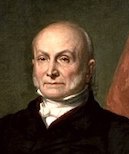
This prayer, well known to the Founding Fathers, appeared in American public school textbooks for over two centuries. An elderly John Quincy Adams recalled that it was one of the first things he had learned as a youngster:
My mother was the daughter of a Christian clergyman . . . In that same spring and summer of 1775 [when I was only seven], she taught me to repeat daily after the Lord’s Prayer before rising from bed, the Ode of Collins on the patriot warriors [a patriotic poem]. . . .Now—seventy-one years after they were thus taught me—I repeat them from memory.3
Early American statesman John Chandler Davis conversed with Adams about the Lord’s Prayer shortly before the latter’s death in 1848. Davis recounted:
In 1847, I became well acquainted with him and frequently met with him and talked with him in the House of Representatives. I remember one morning in 1847 that I met him before the House was called to order. He was very feeble. It was not long before the subject of religion was introduced by Mr. Adams. Among other things I remember his saying, “There are two prayers I love to say: the first is The Lord’s Prayer, and because the Lord taught it; and the other is what seems to be a child’s prayer, “Now I lay me down to sleep,” etc., and I love to say this because it suits me. And,” he added, “I love this prayer so much that I have been repeating it every night for very many years past, and I say it yet – and I expect to say it my last night on earth if I am conscious. But,” said he, “I have added a few words to the prayer so as to express my trust in Christ, and also to acknowledge what I ask for I ask as a favor and not because I deserve it. This is it,” said he, and then he repeated it as he was in the habit of saying it: “Now I lay me down to sleep, I pray the Lord my soul to keep; if I should die before I wake, I pray the Lord my soul to take – for Jesus’ sake. Amen.” This was in 1847. He died in 1848 while I was living in Washington, and I have no doubt but that the “child’s prayer that just suited” him was reverently repeated every night until he died.4
Jesus taught His disciples to pray the Lord’s Prayer, something many Founding Fathers faithfully embraced. The Lord’s Prayer serves as a time-tested guide for our own prayers that comes with a clear indication of God’s desire to answer them. As John Jay knew to be true, the Lord’s Prayer leads to answered prayer.
2John Jay at the Annual Meeting, May 8, 1823, The Life of John Jay, with Selections of his Correspondence and Miscellaneous Papers, ed. William Jay (New York: J. & J. Harper, 1833), 1:503.
3 John Quincy Adams, The Memoirs of John Quincy Adams, ed. Charles Francis Adams (Philadelphia: J. B. Lippincott & Co., 1874), I:5-6.
4 John C. Davis, “John Quincy Adams” The Churchman, June 14, 1890; reprinted as “Child-Likeness of the Old Man Eloquent,” in The Sunday School Union (1890), XXXII:415.
King David, blessed by God throughout his long life, envisioned building a majestic temple to honor the Lord. But God told David that it would instead be his son, Solomon, who would construct the building. So David prepared everything his son would need. When later King Solomon successfully completed the temple, he gathered the nation together and dedicated the new structure with a time of prayer and praise (2 Chronicles 5-7). The spirit of God filled the temple and fell on those present. God promising Solomon that He would hear and answer prayers prayed from that location. Significantly, our Founding Fathers invoked this incident and this passage at a significant moment early in the political life of a young America.
On September 25, 1789, the very first federal Congress had just finished framing the Bill of Rights—the Capstone of the Constitution. On that notable day, the official records of Congress report:
Mr. [Elias] Boudinot said he could not think of letting the session pass over without offering an opportunity to all the citizens of the United States of joining with one voice in returning to Almighty God their sincere thanks for the many blessings He had poured down upon them. With this view, therefore, he would move the following resolution:
Resolved, That a joint committee of both Houses be directed to wait upon the President of the United States to request that he would recommend to the people of the United States a day of public thanksgiving and prayer, to be observed by acknowledging with grateful hearts the many signal favors of Almighty God. . . .
Mr. [Roger] Sherman justified the practice of thanksgiving on any signal [remarkable] event not only as a laudable one in itself but as warranted by a number of precedents in Holy Writ – for instance, the solemn thanksgivings and rejoicings which took place in the time of Solomon after the building of the temple was a case in point [2 Chronicles 5-7, 1 Kings 7-8]. This example he thought worthy of Christian imitation on the present occasion, and he would agree with the gentleman who moved the resolution. Mr. Boudinot quoted further precedents from the practice of the late Congress and hoped the motion would meet a ready acquiescence [approval]. The question was now put on the resolution and it was carried in the affirmative.1
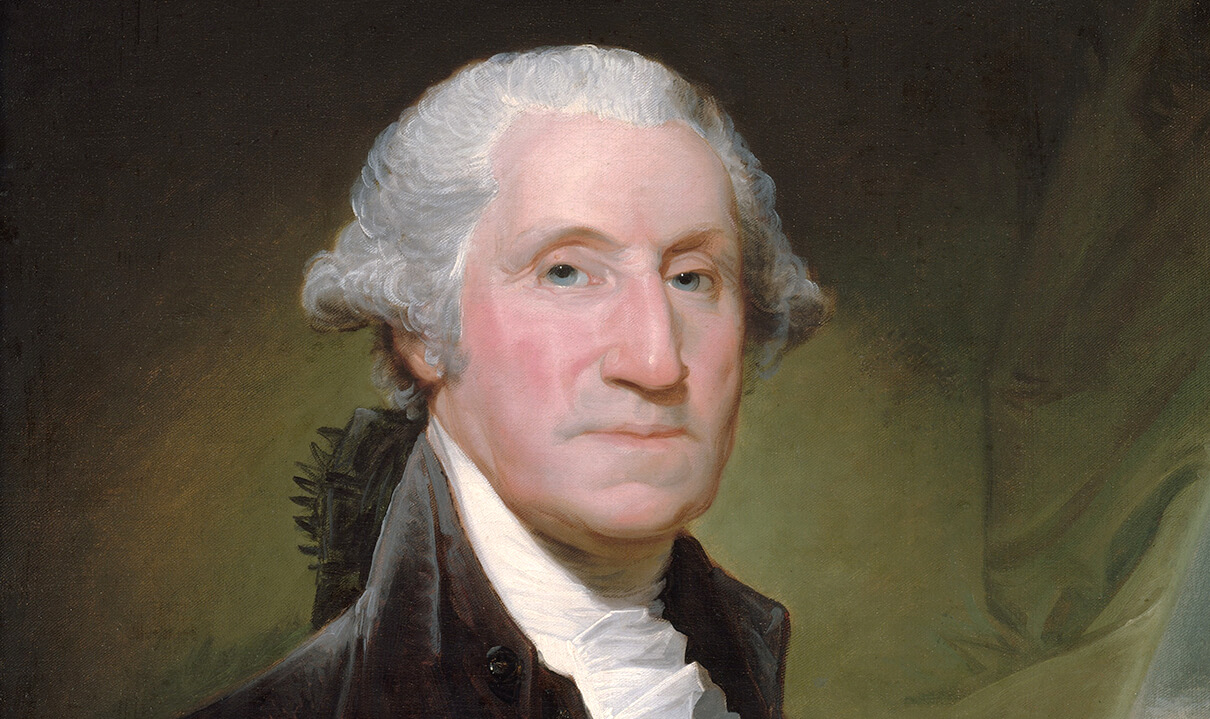
Congress delivered it recommendation to President George Washington, who happily concurred. He issued America’s first federal proclamation for a Day of Prayer and Thanksgiving. That proclamation declared:
Whereas it is the duty of all nations to acknowledge the providence of Almighty God, to obey His will, to be grateful for His benefits, and humbly to implore His protection and favor. . . . Now, therefore, I do recommend . . . that we may then all unite in rendering unto Him our sincere and humble thanks for His kind care and protection of the people of this country. . . . And also that we may then unite in most humbly offering our prayers and supplications to the great Lord and Ruler of Nations, and beseech Him to pardon our national and other transgressions . . . to promote the knowledge and practice of true religion and virtue.2
Notice that George Washington said that nations—not just individuals, but nations—have four duties: (1) to acknowledge the providence of Almighty God, (2) to obey His will, (3) to be grateful for His benefits, and (4) humbly to implore His protection and favor. This proclamation, along with the several other calls to prayer issued during his administration, was written by Washington himself. Whereas other presidents had chaplains of Congress write their proclamations.3
America observed its first federal day of thanksgiving because Founding Fathers in Congress were thoroughly familiar with the Bible and found precedent for such a day from 2 Chronicles 5-7—one of many American practices with a Biblical basis.
Endnotes
1September 25, 1789, The Debates and Proceedings in the Congress of the United States, Joseph Gales, editor (Washington: Gales and Seaton, 1834) I:949-950.
2The Providence Gazette and Country Journal (Providence: October 17, 1789), 1. George Washington, “A Proclamation,” issued on October 3, 1789, observance date November 26, 1789.
Throughout much of American history, the Bible played an important role in education. Many of the nation’s earliest leaders believed that teaching children to read was essential so that they could study the Bible for themselves and thereby develop strong moral character.1
For example, the “Old Deluder Satan Act” from the Code of 1650 required towns with at least 50 households to establish a public school. According to the law, education was important because it helped ensure that the population could know the Bible rather than remain ignorant of God’s Word, like Europeans during the Dark Ages.
The Bible in Early American Classrooms
The influence of the Bible is evident in America’s earliest schoolbooks. The New England Primer, the first widely used textbook printed in the colonies, taught children to read through Bible passages, moral lessons, and shortened versions of Biblical catechisms.
Early schools often used other catechisms—a question-and-answer method of teaching. While many catechisms focused on Biblical instruction, others taught subjects such as entomology, music, ancient history, and the US Constitution.
Other well-known textbooks also emphasized Biblical values. Noah Webster’s famous The American Spelling Book, often called the “Blue-Backed Speller,” included moral lessons that referenced the Ten Commandments. McGuffey’s readers, used by millions of students during the nineteenth century, combined reading instruction with the Ten Commandments and lessons on honesty, responsibility, respect, and other virtues rooted in biblical principles.
These examples illustrate the significant role that biblical instruction and moral education played in American classrooms for many generations.
Progressive Educational Changes
During the twentieth century, the relationship between religion and public education changed through progressive policies and a series of Supreme Court decisions.
In Everson v. Board of Education (1947), the US Supreme Court misapplied Thomas Jefferson’s “a wall of separation between church and state” metaphor to its interpretation of the First Amendment. The Court not only ignored the context of Jefferson’s statement, but also neglected the broader historical context of Jefferson’s views and actions.
The Court continued in this misdirection in Lemon v. Kurtzman (1971), creating a three-part “Lemon test” to evaluate government actions involving religion. Using that framework, the Court later ruled in Stone v. Graham (1980) that Kentucky’s law requiring the posting of the Ten Commandments in public school classrooms was unconstitutional.2
In recent years, the Supreme Court has shifted away from the Lemon test. In American Legion v. American Humanist Association (2019), the Court emphasized the importance of the nation’s history and traditions when considering the relationship between the state and religion. Then, in Kennedy v. Bremerton School District (2022), the Court officially abandoned the Lemon test, directing lower courts to consider the original understanding of the First Amendment and the nation’s historical practices when deciding similar cases.
Influence Today
Today, as we look to our history and traditions—state laws encouraging Biblical literacy and textbooks that included Scripture and moral lessons—we can restore the Bible as a guide for America’s youth, just as it was in early American education.
1 For example: “The Christian religion is the most important and one of the first things in which all children under a free government ought to be instructed…. No truth is more evident to my mind than that the Christian religion must be the basis of any government intended to secure the rights and privileges of a free people.” Noah Webster, “Schoolmaster to America” (Reply to a Letter of David McClure on the Subject of the Proper Course of Study in the Girard College, October 25, 1836,” A Collection of Papers on Political, Literary, and Moral Subjects, New York: Webster and Clark, 1843, 291). “The Bible … should be read in our schools in preference to all other books.” Benjamin Rush, signer of the Declaration of Independence (“A Defense of the Use of the Bible as a School Book, Addressed to the Rev. Jeremy Belknap, of Boston,” on March 10, 1791, Essays, 94, 100). “The Bible…. [is] a necessary part of a polite education.” Henry Laurens, President of the Continental Congress (letter to James Lawrenson on August 19, 1772, Papers of Henry Laurens, George C. Rogers, Jr. and David R. Chesnutt, editors, University of South Carolina Press, 1980, VIII:426-427).
In 2014, Wayne Mack was elected a judge in Montgomery County, Texas. As part of his responsibilities in dealing with troubled, grieving, and distraught families, he established a program for ministers to serve as volunteer chaplains, who would make themselves available to those families. Some sixty clergy from thirty different denominations and faiths currently participate in the program. Mack has observed that the clergy represent “every mosque, temple and synagogue” in the area.1 Judge Mack also allows different clerics to open his court sessions with prayer.
The Freedom From Religion Foundation (FFRF) of Madison, Wisconsin, learned of the prayers, objected, and filed a complaint with the Texas State Commission on Judicial Conduct. This complaint was dismissed. In 2016, FFRF filed another challenge, and the Texas Attorney General issued an opinion upholding Mack’s practice as constitutional. The Wisconsin group has since found a local attorney and residents to serve as plaintiffs, and in 2019 they filed suit in federal court objecting to the prayers in Judge Mack’s courtroom. They allege a violation of the First Amendment’s declaration that “Congress shall make no law respecting an establishment of religion or prohibiting the free exercise thereof,” which they interpret as requiring a religion-free public square. FFRF claims that:
Judge Mack’s courtroom-prayer practice unambiguously and unnecessarily endorses religion in general and Christianity in particular, and places the State’s imprimatur on religion in general and Christianity in particular, in violation of the Establishment Clause of the First Amendment to the U.S. Constitution.2
Is Judge Mack’s practice of courtroom prayer a violation of the Constitution? To answer this question, we must first consider how the Constitution should be interpreted. More narrowly, we need to examine how the modern US Supreme Court has said the Establishment Clause should be interpreted.
How Should the Constitution Be Interpreted?
America’s Founders believed that the Constitution, and other laws, should be interpreted in light of their original meaning. For instance, President Thomas Jefferson recalled to Supreme Court Justice William Johnson the cardinal maxim of constitutional interpretation:
On every question of construction, carry ourselves back to the time when the Constitution was adopted, recollect the spirit manifested in the debates, and instead of trying what meaning may be squeezed out of the text or invented against it, conform to the probable one in which it was passed.3
James Madison, often called the “Father of the Constitution,” agreed:
[I] entirely concur in the propriety of resorting to the sense in which the Constitution was accepted and ratified by the nation. In that sense alone it is the legitimate Constitution.4
And James Wilson, an early Supreme Court Justice whose role in drafting the Constitution was on a par with that of Madison, likewise affirmed:
The first and governing maxim in the interpretation of a statute is to discover the meaning of those who made it.5
Justice Joseph Story concurred. The youngest Justice ever appointed to the Court, in his 34 years on the bench he authored 286 opinions, of which 94 percent were recorded as the official Court position.6 Called the “foremost of American legal writers,”7 he affirmed:
The first and fundamental rule in the interpretation of all instruments [documents] is to construe them according to the sense of the terms and the intention of the parties.8
The Supreme Court and the Establishment Clause
Numerous times throughout the modern era the US Supreme Court has stated that the First Amendment must be interpreted according to its original intent—that early historical precedent is seminal in establishing constitutional understandings. As Justice Hugo Black (writing for the majority) affirmed in Everson v. Board of Education (1947), the “meaning and scope of the First Amendment” must be understood in “light of its history and the evils it was designed forever to suppress.”9 Justice Wiley Rutledge and three others dissented from the majority’s holding in that opinion, but they, too, agreed that the First Amendment must be understood in light of the Founders’ views.10 (In subsequent Establishment Clause decisions over the past 75 years, the vast majority of justices have invoked historical arguments to support their conclusions.11)
For instance, in the Marsh v. Chambers decision upholding the constitutionality of legislative chaplains and prayer (1983), Chief Justice Burger (writing for the majority) drew from a wide range of historical documents and actions to show that legislative chaplains and prayer were widespread in the Founding Era.12 He pointed out that the Founders who drafted and approved the First Amendment had themselves approved legislative prayer and therefore hired legislative chaplains.13 He further acknowledged that the fact states also had a long tradition of engaging in these practices showed that they were “deeply embedded in the history and tradition of this country.”14
In Town of Greece v. Galloway, 572 U.S. 565 (2014), the justices considered the constitutionality of a city council’s practice of opening its meetings with prayer. In his majority opinion, Kennedy observed that the “Court’s inquiry, then, must be to determine whether the prayer practice in the town of Greece fits within the tradition long followed in Congress and the state legislatures.”15 Drawing heavily from Founding Era practices (and historical practices since then), he concluded that opening a city council meeting with prayer was constitutional. Both the concurring and dissenting16 opinions all made historical arguments to support their respective conclusions. All nine justices affirmed that that history plays a critical role in helping the Court resolve First Amendment Establishment Clause issues.
In the Supreme Court’s 2019 Establishment Clause case, American Legion v. American Humanist Association, 588 U.S. __ (2019), the justices considered the constitutionality of a military war memorial in the shape of a Latin cross.17 By a vote of 7-2, they held that it did not violate the First Amendment. Justice Alito, writing for the majority, noted that recent Establishment Clause cases “look[ed] to history for guidance,”18 specifically pointing to both the Marsh and Galloway cases. He concluded that whenever “categories of monuments, symbols, and practices with a longstanding history follow in that tradition, they are likewise constitutional.”19
A Brief History of Courtroom Prayers in America
There is no question that courtroom prayer is a practice “deeply embedded in the history and tradition of this country.”20 Significantly, America’s Founders were familiar with and supportive of courtroom prayer, and hosts of judges and courts at the state and federal levels continued their practice across subsequent generations.
Consider first the original Supreme Court. It was comprised of six justices—one Chief Justice and five Associate Justices. Three of the six had been drafters and signers of the US Constitution (James Wilson, John Rutledge, and John Blair), and five were members of state conventions that ratified the Constitution (James Iredell, William Cushing, John Jay, John Rutledge, and James Wilson). Additionally, Jay was one of the three authors of The Federalist Papers, which James Madison described as “the most authentic exposition of the heart of the federal Constitution as understood by the body which prepared and the authority which accepted it.”21 Arguably, no other Court in American history had superior constitutional scholars or was in a better position to understand the original meaning of the Constitution and Bill of Rights.
The Judiciary Act of 1789 assigned justices judicial responsibilities over a specific geographic region (circuits). They personally traveled to those areas to impanel grand juries and oversee the federal courts in each jurisdiction. In preparation for these visits, local officials would correspond with the justices to ensure that all necessary arrangements for their visit were made.
For example, on February 24, 1790, federal judge Richard Law of Connecticut inquired of Chief-Justice John Jay which judges would be coming to their region, whether there should be a parade, if special robes for the judges were desired, or “whether they would wish to have a clergyman attend” at the Court sessions.22 To the latter question, Jay responded “The custom in New England of a clergyman’s attending should in my opinion be observed and continued.”23
Prayers in the Federal Courts
Newspaper accounts of the Justices’ visits (occurring after the First Amendment and its religion clauses had been added to the Constitution) confirm that courtroom prayer was part of the official court proceedings:
After the customary proclamations were made and the Grand Jury sworn, a short (though pertinent) charge was given them by his Honor the Chief-Justice [John Jay], when the Throne of Grace was addressed by the Rev. Dr. Haven.24 PORTSMOUTH, NEW HAMPSHIRE, 1791
Court opened on Saturday, May 12, with Chief-Justice John Jay, Associate Justice William Cushing, and Judge John Lowell in attendance….The prayer was made by the Rev. Dr. Parker. His Excellency the Vice-President of the United States [John Adams] was in Court.25 BOSTON, MASSACHUSETTS, 1792
Last Wednesday, the Circuit Court of the United States opened in this town, when the Rev. Mr. Patten addressed the Throne of Grace in prayer, after which the Hon. Judge Wilson delivered to the Grand Jury a charge.26 NEWPORT, RHODE ISLAND, 1793
On Monday last, the Hon. Judge Cushing commenced the lesson of the Circuit Court in this town when he delivered to the Grand Jury an animated charge….Previous to the charge, the Throne of Mercy was addressed in prayer by the Rev. Mr. Eckley.27 BOSTON, MASSACHUSETTS, 1794
On Monday last, the Circuit Court of the United States was opened in this town. The Hon. Judge Paterson [a signer of the Constitution who joined the Court in 1793] presided….After the charge was delivered, the Rev. Mr. Alden addressed the Throne of Grace in an excellent, well adapted prayer.28 PORTSMOUTH, NEW HAMPSHIRE, 1800
Prayers in federal courts continued across the generations
After a solemn and appropriate prayer by the Rev. Mr. Baker, his honor Judge [Joseph] Story delivered to the Grand Jury a highly impressive, eloquent and learned charge.29 RICHMOND, VIRGINIA, 1819
[T]he courtroom was very much crowded at an early hour. About half past ten he [Judge Levi Woodbury] came in with Judge Sprague and took his seat on the right. The court was then opened, a prayer was offered up by the Rev. Mr. Kirk.30 BOSTON, MASSACHUSETTS, 1845
President Hayes nominated a very intelligent Christian gentleman as Judge of this district. At the opening of court at G—- R—–, he telegraphed for me to come and open the court with prayer.…Judge ——- waited for me and took me up to the court-house.… [I asked] God’s blessing upon the Judge, prosecuting attorney, jurors, their town, households, families, companions, children, and youth of the town.31 WESTERN UNITED STATES TERRITORIAL FEDERL COURT, 1877
Court convened; opened with prayer by John Reed.32 UNITED STATES COURT OF CLAIMS, 1896
Following a custom which is observed in many United States [federal] Courts, the New Jersey Circuit was opened yesterday with prayer.33 NEW JERSEY, 1908
Clearly, across the generations prayer in the courtroom was common and not viewed as a violation of any constitutional clause.
Before leaving the federal courts, it is worth noting United States Supreme Court sessions regularly begin with the prayer “God save the United States and this Honorable Court.” The first recorded instance of the Supreme Court opening with this prayer was in 1827 but, as we have seen, other federal courts were already opening with prayer well before that date.34
Prayers in State Courts
Like federal courts, state court sessions also were often opened with prayer. Here are a few representative examples from across the states and generations:
At the opening of the Supreme Court in this city on Tuesday last, the Rev. W. Taylor, pastor of the Roman Catholic Church, was requested to offer up the customary prayer.35 MASSACHUSETTS, 1823
Rev. Dr. Lamson…made the opening prayer in court.36 MASSACHUSETTS, 1846
Judge Howe of Wisconsin opens his courts with prayer.37 WINCONSIN, 1851
The first general term of the Supreme Court of Judicature of the State of Vermont…opened Tuesday morning….The six judges…stood this morning while the Rev. J. H. Worcester opened the Court with prayer.38 VERMONT, 1858
One of the learned justices of the Maine Supreme Court…was holding court at Ellsworth, and according to honored custom called in a local clergyman to open the session with a supplication to heaven.39 MAINE, 1894
[O]ne of our county courts.…employed a Methodist minister to open the court with prayer.40 VERMONT, 1897
Circuit court was opened with prayer at 10 a.m. yesterday.41 SOUTH DAKOTA, 1906
Rev. F. M. Brown, pastor of the First M. E. church will open court with prayer and Judge Howard J. Curtis of Stafford will preside.42 CONNECTICUT, 1912
Dr. R. F. Moore of Sacred Heart church has been invited by County Sheriff Simeon Pease to open with prayer the December court, which will convene at the county court house tomorrow afternoon. Judge Joel H. Reed will be on the bench.43 CONNECTICUT, 1919
Judge Pomeroy called upon the Rev. Charles C. Cole, pastor of the Methodist church, to open court with prayer. It is understood that this will be a regular practice.44 MONTANA, 1921
Dr. J. F. McClure, pastor of the Broadway Methodist church, was called upon by Judge W. F. Freeman to open court with prayer.45 OKLAHOMA, 1923
Judge Emory E. Smith.…always opens his terms of court with prayer.46 MISSOURI, 1934
[A]t Marietta, Georgia, a clergyman was asked to open court with prayer.47 GEORGIA, 1947
Ministers of the Middlesboro Ministerial Association are opening police court everyday with prayer.…Each morning a different minister is assigned.48 KENTUCKY, 1950
Judge Maupin Cummings presided, and asked the Rev. W. R. Whiddon of Huntsville to open court with a prayer.49 ARKANSAS, 1955
Judge Bundy asked clerk George C. Holland to have a minister present when court opened Monday, Feb. 4. The Judge said it was his custom to open court with a prayer.50 NORTH CAROLINA, 1963
Judge Cooper Opens Court With Prayer.…[T]he invocation was delivered by the Rev. V. E. Brown, pastor of Gethsemane Baptist Church.51 NORTH CAROLINA, 1972
Judge William O. Bivens Jr.…called on a courthouse employee, Woodrow Bailey of the Assessor’s Officer, to open court with prayer. Judge Bivens usually opens the session with prayer each day.52 WEST VIRGINIA, 1977
There are many other examples.53 In fact, the practice of courtroom prayer was so common that in 1835, a ministerial handbook provided model prayers for opening a court session,54 and a century later, a 1928 pastoral handbook listed it as one of the expected activities of a minister.55
Conclusion
The First Amendment does prohibit the creation of a national church, but contrary to the claims from Freedom From Religion Foundation, it does not require religion to be scrubbed from the public square. The Establishment Clause, as it was originally understood and subsequently applied across the generations and the centuries, did not prohibit, a judge from allowing clergy from different religions and denominations to open court sessions with prayer. Such practices are “deeply embedded in the history and tradition of this country,”56 and as Justice Alito recently observed, when this is the case, there is a “presumption of constitutionality for longstanding monuments, symbols, and practices.”57 Opening court sessions with prayer is clearly such a practice.
* This article concerns a historical topic and may not be up to date.
Endnotes
1 Debra Cassens, Weiss, “Refiled lawsuit challenges justice of the peace’s courtroom prayer program,” ABA Journal, March 30, 2019, here.
2 “Complaint for Declaratory Relief,” in Freedom from Religion Foundation, Inc. v. Judge Wayne Mack, Case No. 4:19-cv-1934 (Filed May 29, 2019), 17, here.
3 Thomas Jefferson, Memoir, Correspondence, and Miscellanies, From the Papers of Thomas Jefferson, Thomas Jefferson Randolph, editor (Boston: Gray and Bowen, 1830), IV:373, to Judge William Johnson on June 12, 1823.
4 James Madison, Letters and Other Writings of James Madison (Philadelphia: J. B. Lippincott & Co., 1865), III:443, to Henry Lee on June 25, 1824.
5 James Wilson, The Works of the Honourable James Wilson, ed. Bird Wilson (Philadelphia: Bronson and Chauncey, 1804), I:14, from “Lectures on Law Delivered in the College of Philadelphia; Introductory Lecture: Of the Study of the Law in the United States.”
6Dictionary of American Biography (New York: Charles Scribner’s Sons, 1936), s.v. “Joseph Story.”
7Dictionary of American Biography (New York: Charles Scribner’s Sons, 1936), s.v. “Joseph Story.”
8 Joseph Story, Commentaries on the Constitution of the United States (Boston: Hilliard, Gray, and Company, 1833), III:383, §400.
9Everson v. Board of Education 330 U.S. 1, 14-15 (1947).
10Everson v. Board of Education 330 U.S. 1, 33 (1947).
11 Mark David Hall, “Jeffersonian Walls and Madisonian Lines: The Supreme Court’s Use of History in Religion Clause Cases,” Oregon Law Review (2006) 85:563-613. A slightly revised version of the article was reprinted in the High Court Quarterly Review (2009), 5:109-153.
14Marsh v. Chambers, 786. To support this proposition, Burger quoted his majority opinion in Walz v. Tax Commissioner: “It is obviously correct that no one acquires a vested or protected right in violation of the Constitution by long use, even when that span of time covers our entire national existence, and indeed predates it. Yet an unbroken practice of according the exemption to churches, openly and by affirmative state action, not covertly or by state inaction, is not something to be lightly cast aside.” 397 U.S. 664, 678 (1970).
15Town of Greece v. Galloway, 572 U.S. 565, 9 (2014) (Kennedy, J. majority opinion).
16Town of Greece v. Galloway, 572 U.S. 565, 9 (2014) (Kagan, J. dissenting).
17American Legion v. American Humanist Association, 88 U.S. __, 1 (2019), (Ginsburg, J., dissenting).
18American Legion v. American Humanist Association, 588 U.S. __, 25 (2019), (Alito, J.).
19American Legion v. American Humanist Association, 28.
21 James Madison, The Writings of James Madison, ed. Gaillard Hunt (New York: G. P. Putnam’s Sons, 1910), IX:219, to Thomas Jefferson on February 8, 1825.
22The Documentary History of the Supreme Court of the United States, 1789-1800, ed. Maeva Marcus (New York: Columbia University Press, 1988), II:11.
23The Documentary History of the Supreme Court, II:13, from John Jay to Richard Law on March 10, 1790.
24New Hampshire Gazette (Portsmouth), May 26, 1791; Documentary History of the Supreme Court, II:192.
25Columbian Centinel (Boston), May 16, 1792, 74; Documentary History of the Supreme Court, II:276. For a similar report from 1790, see Boston Gazette (May 10, 1790), in Charles Warren, The Supreme Court in United States History (Boston: Little, Brown, and Company, 1924), 1:59, here.
26The Documentary History of the Supreme Court, II:412, from the Newport Mercury (Rhode Island) of June 25, 1793.
27Philadelphia Gazette Of The United States And Daily Evening Advertiser (June 16, 1794), 6, from Boston, June 11, 1794, here
28United States Oracle (Portsmouth, NH), May 24, 1800; The Documentary History of the Supreme Court, III:436.
39The Barrister (Toronto: The Law Publishing Co., December 1894), 237, here. (For an example from 1882, see Tit-Bits From All The Most Interesting Books, Periodicals and Newspapers in the World No. 25, Vol. I (April 8, 1882), 12, here
40Vermont Bar Association: Officers, Proceedings, Papers and Addresses (October 12, 1897), Vol. IV No. 3, 347-348, here.
53 See, for example, Philadelphia Gazette of the United States (August 3, 1791), reporting an event on June 30, here; Milwaukee Sentinel and Gazette (June 14, 1851), 2, here; The New Bloomfield Times (December 30, 1879), 4, here; The Green Bag (Boston: October 1903), Vol. XV, No. 10, 502, relating info from circa 1880, here; Quincy Daily Herald (January 26, 1881), 2, here; Indianapolis Journal (February 2, 1885), 2, here; Savannah Morning News (March 14, 1895), 6, here; Jeffersonville Evening Journal (October 29, 1896), 2, here; Columbus Daily Times (March 15, 1898), 4, here; Seymour Daily Republican (March 2, 1898), 2, here; Atlanta Constitution (November 12, 1901), 7, here; Washington Evening Journal (February 3, 1902), 1, here; The Quincy Journal (February 22, 1908), 5, here; Norwich Bulletin (June 11, 1909), 6, here; Gulfport Daily Herald (September 9, 1910), 4, here; The Jackson Herald (August 7, 1913), 1, here; Santa Anna Daily Evening Register (July 21, 1914), 1, here; Vienna News (September 16, 1915), 1, here; Bridgeport Evening Farmer (February 12, 1916), 1, here; Bridgeport Evening Farmer (October 23, 1916), 1, here; Missouri Valley Independent (January 4, 1923), 1, here; Bluefield Daily Telegraph (March 8, 1971), 11, here; Bluefield Daily Telegraph (March 20, 1988), 7-4, here; and others.
54 Alexander V. Griswold, Prayers Adapted to Various Occasions of Social Worship: For Which Provision is Not Made in the Book of Common Prayer (Philadelphia: William Marshall & Co., 1835), 149-151, here.
55 Nolan B. Harmon, Ministerial Ethics and Etiquette (Nashville: Abingdon Press, 1987, originally published 1928), 52, here.
On October 27, 1787 a New York newspaper published the very first article that would come to be known as the Federalist Papers.
The Delegates to the Constitutional Convention signed the United States Constitution on September 17, 17871 and then sent it to the thirteen states for ratification.
During this ratification process, the states would review the proposed Constitution and either approve or reject it. A favorable vote by nine of the states would be required for the Constitution to go into effect.2
Some states gave their blessings quickly, while some, like New York, had a more difficult time with this process before casting a narrow vote in favor of the document.3 New York’s ratification convention stretched well over a month in the summer of 1788.4
In October of 1787, before the debates even started in that state, four New York newspapers began publishing articles in support of the Constitution.5 The essays appeared anonymously under the name “Publius” in these newspapers. They explained various parts of the Constitution and encouraged its adoption.
The popular essays continued through May 1788, by which time a total of 85 articles had been published.6 They were first released as The Federalist in a bound volume in January 1788,7 before all the essays had even been completed.
These essays were influential not only in the New York ratification debates, but appeared in newspapers in other states as well. It was later discovered that James Madison, John Jay, and Alexander Hamilton were the authors of what became popularly embraced as the Federalist Papers.8
James Madison described this collection as “the most authentic exposition of the text of the federal Constitution as understood by the body which prepared and the authority which accepted it.”9 Courts across America’s history have relied on the Federalist Papers for explanations of the original intent of the US Constitution.
The Federalist Papers can provide context, insight, and authority to the Constitution in an era when Americans’ desperately lack Constitutional knowledge.10 Make it a part of your study of the Constitution for a deeper insight into what this important document means to our nation!
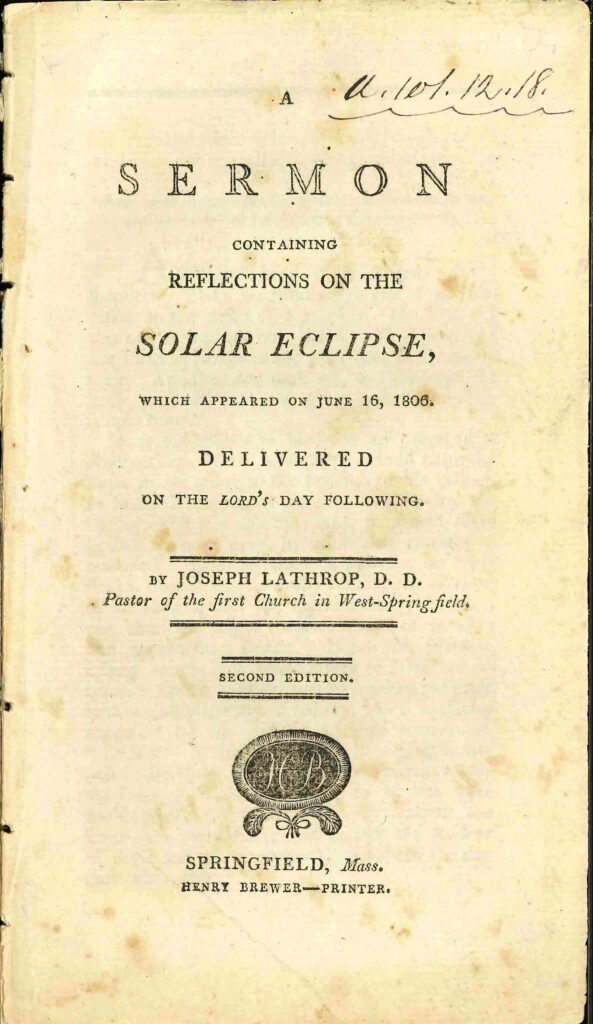
Lathrop was born in Norwich, Connecticut. After graduating from Yale, he took a teaching position at a grammar school in Springfield, Massachusetts, where he also began studying theology. Two years after leaving Yale, he was ordained as the pastor of the Congregational Church in West Springfield, Massachusetts. He remained there until his death in 1820, in the 65th year of his ministry. During his career, he was awarded a Doctor of Divinity from both Yale and Harvard. He was even offered the Professorship of Divinity at Yale, but he declined the offer. Many of his sermons were published in a seven-volume set over the course of twenty-five years.
In this sermon, Rev. Lathrop uses the occasion of a recent solar eclipse to strengthen the Biblical worldview of his parishioners by providing both a scientific explanation and gleaning spiritual truths from the phenomenon. Lathrop’s sermon is a clear example of how early American pastors used the events of their time to impart truth and develop the Christian worldview of their listeners.
A
SERMON
CONTAINING
REFLECTIONS ON THE SOLAR ECLIPSE
WHICH APPEARED ON JUNE 16, 1806
DELIVERED
ON THE LORD’S DAY FOLLOWING.
By Joseph Lathrop, D. D.
Pastor of the first Church in West-Springfield
AMOS 8:9 It shall come to pass in that day; saith the Lord, that I will cause the sun to go down at noon, and I will darken the earth in the clear day.
Amos was bred an husbandman and a shepherd. From his rural employment he was called to the office of a prophet. He says, “I was not a prophet, nor the son of a prophet; but I was an herdman and a gatherer of sycamore fruit. And the Lord took me, as I followed the flock, and said unto me, go, prophesy unto my people Israel.”
Many expressions in his book are taken from observations, which a shepherd would naturally make in attending to the business of his calling. In Judea the shepherds watched their flocks, not by day only, but also by night, to guard them against beasts of prey, in which that country abounded. And, in their attendance on their flocks, they would naturally observe the motions of the planets, and the appearances in the heavens, that they might foresee changes of weather and approaching storms. Hence the prophet, calling on the degenerate tribes of Israel
to renounce their false gods, and to worship the great author and governor of nature, uses a language suggested by his former pastoral occupation. “Seek not Bethel, enter not into Gilgal, nor pass to Beersheba,” the idolatrous places, where the sun and moon, and hosts of heaven were worshipped; “but seek him, who maketh the seven stars and Orion; and turneth the shadow of death into the morning, and maketh the day dark with night.”
The stated course of nature, the order of the heavenly bodies, the vicissitude of day and night, and the regular succession of seasons, demonstrate the existence and providence, the wisdom, power and goodness of God. “Day unto day uttereth speech; night unto night sheweth forth knowledge.” “God hath not left himself without witness, in that he giveth rain and fruitful seasons, and filleth our hearts with food and gladness.” But common appearances, as they become more familiar, are less impressive. Unusual phenomena, though no less the effects of natural causes, more powerfully arrest the attention, and more deeply affect the mind. The prophet, therefore, predicting some dire calamities on the house of Israel, alludes to an unusual and solemn appearance in the skies, which probably they had lately seen; a total eclipse of the sun in the midst of a clear day. “Thus saith the Lord, I will cause the sun to go down at noon, and I will darken the earth in the clear day.” The phenomenon which we beheld, on Monday last, will naturally lead us to understand the words as poetic descriptions of a solar eclipse.
Archbishop Usher, in his annals of the world, says, that in Amos’s time, there were two remarkable eclipses of the sun, which happened at solemn festivals, and struck the people with great consternation. In ancient times, when astronomy was but imperfectly understood, eclipses were by many considered, as preternatural and portentous. The prophet, therefore, foretelling the judgments coming on the land of Israel, might with great propriety figure to them the changes soon to take place in their political hemisphere, by an allusion to the change, which they had seen, with terror and amazement, in the natural hemisphere. “God would cause their sun to go down at noon, darken the earth in the clear day, turn their feasts into mourning, and their songs into lamentation, and bring up sackcloth on all loins.”
The use, which the prophet makes of a solar eclipse will justify us in some moral and religious reflections on the singular scene, which was exhibited in the past week.
1. We have reason to rejoice in the progress, which has been made in the sciences, and particularly in the noble science of astronomy. By this we are freed from many superstitious terrors, which, in the dark ages of the world, tormented mankind.
Eclipses have been observed from the remotest antiquity; and of these which were most remarkable, accounts have been transmitted to us by some of the earliest historians, who have also related the disastrous events which followed, and which the eclipses were supposed to portend.
The cause of eclipses must have been known long before they could be the subjects of mathematical calculation. It was well understood, many ages ago, that an eclipse of the moon was caused by its passing through the shadow of the earth, when the earth was between that and the sun; and that an eclipse of the sun was caused by the moon’s passing between us and the sun, and intercepting its light. This knowledge, however, was not common to the vulgar; nor did the more learned view these causes as operating by regular and stated laws.
There were predictions of some eclipses, which appeared several centuries before the birth of our Savior. But these predictions were probably, like the present predictions of comets, conjectures grounded on a course of observations, and not the result of exact calculations.
The relations, distances and motions of the heavenly bodies are now so well ascertained, that accurate calculations can be made of all the eclipses, which shall be in ages to come, and of those which have been, since our system was framed. These calculations are of great utility to mankind, in husbandry, navigation, geography, chronology and history. The credit of some ancient histories derives confirmation from this source. The historian relates some great events, which he supposes, were portended by a certain eclipse, which he describes. The astronomer finds, that there was in fact, such an eclipse, at such a time, and hence justly gives more full credit to the historian.
These phenomena have also their moral uses. They enlarge our views of the works of God, and of the grandeur and extent of his creation and providence. They display his wisdom, power and goodness, and his continual agency in the government of the world. They teach us his constant care for the creatures, which he has made, and call us to reverence and adore him, who thus manifests himself to us in the works of his hands.
We see innumerable worlds rolling around us at vast but various distances; with different, but inconceivable rapidity. These all perform their motions with regularity, and observe their times with exactness. They obey their destination, they keep their order, they never interfere. Shall we not fear the power, admire the wisdom, adore the goodness of that being, who made and adjusted, who sustains and directs such a stupendous system, and render it subservient to our happiness? These rational sentiments are pleasant and delightful in themselves; and are far more conducive to piety and virtue, than the terrors of that superstitious ignorance, which views every comet flaming in the sky, every obscuration of the sun at noonday, every failure of the full orbed moon at night, every unusual noise bursting from the clouds, every strange appearance in the heavens and in the earth, as awfully portentous of some dire, but unknown calamity.
Superstitious terrors may operate as a temporary restraint from vice. But when the dreaded calamity is delayed, the restraint ceases, and vice regains its dominion. A rational fear of God, arising from a calm contemplation of his agency and government, displayed in his works, and taught in his word, will have a steady and permanent influence. “Fear ye not me, saith the Lord, will ye not tremble at my presence, who have placed the sand for the bound of the sea, who give the former and the latter rain, and reserve to you the appointed weeks of harvest?” The more just are our thoughts of God’s government, and the more rational our reverence of his majesty, the more uniform and cheerful will be our obedience to his will.
2. An eclipse of the sun, though it is not an omen of any particular calamity, yet may properly lead us to contemplate the gloomy changes which await us in this guilty and mortal state.
By a total obscuration of his glorious luminary, at noon, in a clear day, a gloom is suddenly spread over the face of nature. Not only the human mind, but the animal and material creation is deeply affected. Night seems to anticipate the time of its return. The stars hand out their lamps; the dews descend on the earth; the grazing beasts forget their hunger; the fowls hasten to their resting places; the bird of night chants his evening ditty; every thing wears a sober and mournful aspect.
Here is an emblem of declining age and approaching death.
The time is coming – to some of us it is near; when the sun and the light will be darkened; the eyes, which look out at the windows, will be bedimmed, surrounding objects will be hidden, and “we shall go to our long home – to the land of darkness and the shadow of death, without any order, and where the light is as darkness.” “While we have the light, let us walk in the light, lest darkness come upon us. Let us give glory to God, before he cause darkness, and before our feet stumble on the dark mountains; lest, while we look for light, it be turned into the shadow of death.” The eyes of our understanding still remain unextinguished, and the sun of righteousness shines upon us with salvation in his beams. Let us attend to the glorious discoveries which are made to us, and apply ourselves to the momentous work before us. Let us work while it is day. The time is short – night is at hand. What we find to do, let us do it with our might. There is no work in the grave.
Some of you are in youth and in full strength. My friends, your morning sun shines bright and pleasant; you think your day will be long. But, oh! flatter not yourselves. Your sun may go down at noon, and your prospect be darkened in a clear day. Employ these morning hours in the work of your salvation. You know not what a day, or an hour may bring forth.
The darkness of an eclipse the prophet improves, though not as an omen, yet as an emblem of national judgments. He warns his people that a metaphorical and political darkness may overspread their country, in the same surprising manner, as literal darkness in a solar eclipse falls on the unsuspecting earth. “Thus saith the Lord unto me, an end is come upon my people; I will not pass by them any more. Hear this, ye that swallow up the needy, and that say, when will the new moon be gone, that we may sell corn, and the Sabbath, that we may set forth wheat? The Lord hath sworn by the excellency of Jacob, surely I will not forget any of their works. Shall not the land tremble for this, and every one mourn that dwelleth therein? Thus saith the Lord, I will darken the earth in the clear day. I will turn their feasts into mourning, and their songs into lamentation.”
Sudden darkness caused by eclipses, clouds, vapor and storms, is, in the prophetic writings, a common figure for great and unexpected plagues; such as war, discord, pestilence and famine. The prophet Isaiah, describing the calamitous state of the Jews, on the invasion of the Chaldeans, says, “They shall look to the earth, and behold, trouble and darkness, and dimness of anguish; they shall be driven into darkness.” In the same figurative language, Joel describes the devastation and famine caused in the land by clouds of devouring locusts, and by the rage of subsequent fires. “Let all the inhabitants of the land tremble; for the day of the Lord cometh and is nigh at hand; a day of darkness and gloominess, of clouds and thick darkness. There shall be wonders in the heavens and in the earth; there shall be pillars of smoke, and the sun shall be turned into darkness.”
When we see the sun darkened in the heavens, and the earth covered with a gloom, we are reminded, how easy it is for Him, who in a moment extinguishes the sun, to cast a cloud over our earthly prospects; to turn our joys into anguish, our confidence into terror, and our songs into lamentation – to subvert our national security, to let loose the infernal spirit of discord, to remove restraint from hostile nations, to send a blast on the labors of our hands, and to spread among us pestilence and death.
On God we are dependent not only for the daily visits of the sun, but also for his friendly beams, when he returns. The moon, which chases away the gloom of night, now and then steps in, and intercepts the light of day. If it should
make a stand in that position, our day would become night, and the warmth of summer would be changed into the frost of winter. But the moon obeys the divine command, moves the cheering beams, which it had, for a few moments withholden.
The creatures, which are our ordinary comforts, may by God’s direction or permission, become the occasions of affliction and anguish. The sun, which enlivens the rational, animal and vegetable world, may dart malignant fires and scatter pestilential
diseases. The rains, which refresh and fructify our fields, may “wash away the things which grow out of the earth, and destroy the hope of man.” The friends in whom we confide may become our tormentors, and “a man’s foes may be those of his own household.” Government, which is our defense against injustice, fraud and violence, falling into the hands of cruel and unprincipled men, may be made an instrument of oppression and misery. “They who lead us may cause us to err, and destroy the way of our paths.”
Where then is our security? It is in the protection of Him, who created and upholds the frame of nature, “who made and guides the seven stars and Orion, turns the shadow of death into the mourning, or makes the day dark with night” – “who calleth to the waters and sends them on the earth, and restrains the floods” within the bounds prescribed – “who rules the raging of the sea, and stills the tumults of the people” – ” who turns the hearts of men, as the rivers of water are turned” – “who causes the wrath of men to praise him, and the remainder of that wrath he restrains.” How shall we enjoy his protection ? He has told us, “If ye will walk in my statutes, keep my Sabbaths and reverence my sanctuary, then I will give you rain in due season, your fields shall yield their increase; I will give peace in your land, and ye shall lie down and none shall make you afraid.” – “But if ye will walk contrary unto me, I will walk contrary unto you, and make your plagues wonderful.”
Learned astronomers can calculate with exactness the times when, the places where, and the quantities in which the luminaries of heaven will be eclipsed; but they cannot with the same accuracy predict the judgments of God. Nor do we here need their astronomical skill. There are other signs by which we may discern impending judgments. Our Savior. has taught us a kind of moral astronomy to direct our prescience of such events. The prevalence of infidelity, immorality and vice as surely indicates approaching calamities, as clouds indicate a shower, winds forebode a storm, or the conjunction, or opposition of the sun and moon, in certain places in the heaves, presignify an eclipse. He said to the people, “When ye see a cloud rise out of the west, straitway, ye say, there cometh a shower; and so it is. When ye perceive the south wind blow, ye say, there will be heat; and it cometh to pass. Ye hypocrites, ye can discern the face of the sky and of the earth; but how is it, that ye cannot discern this time? Yea, and why even of yourselves judge ye not what is right?” The blindness and stupidity of the ancient Jews to the impending judgments of God, the prophet upbraids by referring them to the sagacity and discernment apparent in the fowls of heaven. “The stork in the heavens knoweth her appointed time; the turtle, the crane and the swallow observe the time of their coming; but my people knoweth not the judgments of God.”
There are now, as there were in former times, many who ask, “Watchman, what of the night? Watchman, what of the night?” And the watchman’s answer then, is seasonable now, “If ye will inquire, inquire ye” wisely; “return, come,” return to God by repentance; then come and inquire, and you may hope for a favorable answer.
It is common for people to look forward and inquire, what will be our national state in future years – what will be the result of certain public measures – what shall be done to obtain this favorite object, and avert that threatening evil, and to make future times better than these? But they inquire not wisely concerning this matter. Let them inquire what iniquities abound, and what share their own iniquities have in the common guilt? Let each one repent of his own wickedness, and apply himself to his own duty. Let each one use his best influence to correct the errors, and reform the manners of those with whom he is connected. Then things will go well. “Righteousness will exalt a nation. Sin will be a reproach to any people.”
3. The darkening of the earth in a clear day brings to mind the final judgment. The scripture assures us, that “God has appointed a day, in which he will judge the world in righteousness, and render to every man according to his works.” It teaches us, that the judgment will come on a guilty world by surprise – that “when men shall say, peace and safety, then sudden destruction cometh.” The manner of its coming is compared to the catastrophe of Sodom. “As it was in the days of Lot; they ate, they drank, they bought, they fold, they planted, they builded. But the same day, that Lot went out of Sodom, it rained fire and brimstone out of heaven, and destroyed them all. Even so shall it be in that day when the son of man is revealed.” To heighten the solemnity of this scene, the sacred writers tell us, “The sun shall be darkened, and the moon shall not give her light; the stars shall fall from heaven, and the powers of heaven shall be shaken – the heaven shall depart as a scroll when it is rolled together, and every mountain and island shall be removed out of their place.” What effect the expectation of such a day should have, St. Peter instructs us. “Seeing all these things shall be dissolved, what manner of persons ought we to be in all holy conversation and godliness, looking for and hastening unto the day of the Lord. Let us be diligent, that we may be found of the Lord in peace without spot and blameless.”
You think that great day to be remote. Perhaps it is so. But whether it be near or remote, it will come. And when it shall come, it will be as real and important, as if it were now present. “Count the longsuffering of God’s salvation. He is not willing that you should perish, but that you should come to repentance.”
Were you sure, that within ten or twenty years, the frame of nature, as well as the works of man, would dissolved, the heavens with all their splendors would vanish, and the earth with all her furniture and in habitants would pass away, how vain would all your property, all your designs and labors appear? What folly would be stampt on avarice, ambition, worldly grandeur and ostentation, political intrigues, party contests and animosities? But, my fellow mortals, where is the mighty difference to you and me, whether the world is to be dissolved within twenty years, or whether within that time we are to leave the world forever. The latter will certainly be the case with many of us in a shorter, and with all of us in a little longer time than this. Under an impressive sense of this solemn truth, let us banish all worldly passions, and direct our cares to the grand interests of futurity.
4. Total darkness at noonday reminds us of the solemn scene of the Savior’s crucifixion. The evangelists tell us, that when Jesus hung on the cross, “there was darkness over all the land from the sixth to the ninth hour;” or, according to our calendar, from midday to the third hour; “and the sun was darkened.” The darkness continued for three hours. This, we know, could be no natural eclipse; for, in the eclipse of the week past, which appeared to be central, the total obscuration continued but about four minutes.
The darkness at the crucifixion was very extensive. It was “over all the land.” Yea, it was beyond the land of Judea; or “over all the earth,” as the words are, in one place, rendered. It was observed in countries distant from Judea; and is related by profane historians, as a phenomenon, for which no natural cause could be assigned. In a natural eclipse, the total darkness cannot be of very great extent. I have had correct information, that within the space of less than two hundred miles, from north to south, a segment of the sun appeared during the whole time of the late eclipse.
Nay, farther, at the time of the crucifixion there could be no natural eclipse, for the sun and moon were then in opposition. Christ was crucified at the time of the Passover. The Passover was to begin on the fourteenth day of the month. The Jewish month began at the first appearance of the new moon. On the fourteenth day, the moon, being full, and in opposition to the sun, could not cause an eclipse. The obscuration therefore must have been preternatural and miraculous.
That there really was such an obscuration is indubitable. It is recorded by three of the evangelists, who published their narrative so soon after the crucifixion, that many spectators of the scene, both friends and enemies to Christ, were still living. They would not have asserted such a strange phenomenon, as being universally known, in that and neighboring countries, and as having happened on a certain day, if it had not been a fact; for every man, woman and youth, living at that time, would have been able to contradict it. Had the evangelists been impostors, they would not have published a falsehood of this kind; for nothing could have been more fatal to their cause. There is no room to question the reality of the fact.
This darkness, the earthquake, and the rending of the veil of the temple, which occurred at the same time, had a great effect on the spectators. The commanding officer, who stood by the cross of Jesus, struck with astonishment, said, “Surely this was the son of God.” “And all the people, who came together to that sight, beholding what was done, smote their breasts, and returned.”
These miraculous appearances in the earth and in the heavens, at the time, when Jesus was suffering on the cross, were such divined attestations in his favor, as reason could not resist; and they were also most awful indications of the wrath of God against the horrid and impious work, which the infidel Jews were then transacting.
But were these the only persons against whom the darkness denounced the anger of heaven? No; it equally manifested, and still it manifests the amazing guilt of all unbelievers under the gospel – of all who are enemies to the blessed Jesus – of all who despise and oppose his religion.
Infidelity and impiety involve in them the same guilt now as in former times. The gospel comes to us with equal evidence and authority, as it came to the Jews. They who reject it, crucify afresh its heavenly author, and are bringing on themselves swift destruction – to such is reserved the blackness of darkness forever. As they walk in the darkness of unbelief and wickedness, they will fall into the darkness of misery and despair. “When the Lord Jesus shall be revealed from heaven, he will come in flaming fire, and will take vengeance on them who know not God, and on them who obey not the gospel.”
5. The temporary darkness of an eclipse is followed with cheerful light, which “shines more and more unto the perfect day.” This is a natural emblem of that moral change, in which a soul is brought out of the darkness of sin and guilt into the marvelous light of purity, pardon and peace.
How sad and gloomy is the condition of a guilty mortal, who convinced of his numerous transgressions, feels himself condemned to eternal death. The divine law, which was delivered. From Sinai, in smoke and darkness, in clouds and tempest, thunders terror and destruction in his ears. But how happily is his state reversed, when light, beaming from mount Zion, in the discoveries and promises of the gospel, breaks in on his soul, exhibits to him a dying Savior, a forgiving God, a sanctifying spirit? What joy springs up, when he finds the power of sin subdued – his enmity to God slain – his opposition to the gospel conquered – and every thought captivated to the obedience of Christ? The light is ceding to previous darkness. So the hopes and comforts of religion in the soul are exalted by their contrast to preceding anxieties and fears.
Ye awakened, desponding souls, look up to the sun of righteousness. He shines from heaven with salvation in his beams. However guilty, unworthy and impotent ye feel, there is grace sufficient for you; there is righteousness to justify you, promises to support you, the spirit to help you. Light arises in darkness. Turn your eyes from the cloud, and direct them to the sun. Christ came a light into the world, that whosoever believeth in him should not walk in darkness. Look to him, and be ye saved.
Finally: the obscuration of the sun in the sky bids us contemplate the uninterrupted brightness of the heavenly state. Could we rise above the moon, the sun which is eclipsed to the inhabitants of the earth, would shine to us in all its splendor. When the Christian has the moon under his feet, he will be clothed with the sun, and crowned with stars.
There is no darkness, no night in heaven: all is light; all is glory there.
In heaven there is the light of purity, and love. The pure in heart shall see God; he is light; in him is no darkness. Nothing enters into his presence that defiles.
There is the light of knowledge – glorious discoveries of God – of the Savior – of the works of providence and grace – of the wonders of creation and redemption. Here we see through a glass darkly; there we shall see face to face. Here we know in part, there we shall know as we are known.
The light of heaven is constant; it is never eclipsed nor clouded. The holy city needs not the sun to shine in it, for the glory of God doth lighten it, and Jesus is the light thereof. The nations of them who are saved shall walk in the light of it, and there shall be no night there.
How different will be the state of good men in heaven from that which they experience on earth? Here they have some light, but it is often interrupted, and always dim. How little do they know of God and his works – how much error is mixed with their faith – how much doubt with their hope – how much fear with their courage; how much carnality with their devotion? In heaven it will be otherwise. Knowledge there will be full without error, certain without perplexity and clear without confusion. Holiness will be perfect without sin, and refined without dross and corruption. And they will serve God continually without reluctance or weariness.
Let us begin the life, and accustom ourselves to the works of heaven, while we dwell on earth, that we may be prepared for admission into heaven, when we depart hence. Here God sheds down some beams of heavenly light to invite our thoughts and affections upward. The light is mingled with shades, and interrupted with clouds, because this is a state of trial, and our faith and patience must be exercised. Here we must walk by faith; we cannot walk by sight. “It is by faith and patience, that we inherit the promises.” “We are saved by hope. But hope that is seen is not hope; for what a man seeth, why doth he yet hope for? And if we hope for that which we see not, then do we with patience wait for it. And the spirit helpeth our infirmities, and maketh intercession for us according to the will of God.”
It is but little, that we can at present know of heaven; but “then shall we know, if we follow on to know the Lord.” Let our souls follow hard after him; for what is there, which we can desire in comparison with him? “It doth not yet appear what we shall be. But when our Lord shall come, we trust, that we shall be like him and see him as he is. And having this hope, let us purify ourselves as he is pure.”
Most Americans recognize the names George Washington, John Adams, Thomas Jefferson, and James Madison, but few can tell you their stories—much less that of James Monroe, John Quincy Adams, or Andrew Jackson. These seven men from the Founding Ear were America’s first presidents. They established our republic on the foundation of the Constitution and its liberties.
But who were they? Were they good or bad leaders? How did they become presidents? Did they follow the Constitution or abandon its principles?
Their lives reflect the opportunities America offers. Farmers, attorneys, military veterans, and philosophers, they each rose to the highest ranks of political leadership. From very different backgrounds, all loved their nation. Each had shortcomings (some far more than others) as well as stellar shining moments. Some preserved our strong foundations and some abandoned core constitutional principles.
The stories of each of these presidents are fascinating, instructive, and compelling. And why not? After all, these are the men who built the republic.
In this document, you will see the complete endnotes for this work. Thank you!
“The powers not delegated [i.e., enumerated] to the United States by the Constitution, nor prohibited by it to the states, are reserved to the states respectively, or to the people.” Tenth Amendment of the Constitution
Enumerated powers are the particular powers granted to Congress (those which are specifically listed) in the US Constitution. There are seventeen such enumerated powers.
Article I, Section 8 lists the first fifteen powers enumerated to, or permissible for the federal government. Articles II-VII add no additional powers but define how to apply the powers enumerated in Article I.
For example, Article II identifies the president as Commander-in-Chief over the military, but this is not a new power since the Preamble already authorized the federal government “to provide for the common defense.” Likewise, the president’s Article II authority to “make treaties” and “appoint ambassadors” is part of the Article I provision “to regulate commerce with foreign nations.”
The Thirteenth and the Fourteenth Amendments to the Constitution added two additional federal powers. (But the other twenty-five Amendments to the Constitution added no federal powers.) With these two additional federal powers, the total number of constitutionally-authorized federal jurisdictions, or enumerated powers, is seventeen.
The Enumerated Powers Listed in the Constitution
The enumerated powers permissible to the federal government are:
To raise revenue to pay off debt, protect the nation, and fulfill the specific obligations established in the enumerated powers. (“To lay and collect taxes, duties, imposts and excises, to pay the debts and provide for the common defense and general welfare of the United States”)
“Borrow money on the credit of the United States.”
Protect the free-enterprise system and ensure free flow of commerce. (“To regulate commerce with foreign nations, and among the several states, and with the Indian tribes”)
Establish immigration laws and processes. (“To establish an uniform rule of naturalization”)
Establish the bankruptcy laws and processes. (“and uniform laws on the subject of bankruptcies throughout the United States”)
Establish national currency, monitor its supply and value, and punish counterfeiters of that currency. (“To coin money, regulate the value thereof, and of foreign coin, and fix the standard of weights and measures” and “provide for the punishment of counterfeiting the securities and current coin of the United States”)
“Establish post offices and post roads.”
Protect the private property (including the ideas, and the product of those ideas) of inventors, authors, and artists. (“To promote the progress of science and useful arts by securing for limited times to authors and inventors the exclusive right to their respective writings and discoveries”)
If Congress so wishes, create and regulate federal courts. (“To constitute tribunals inferior to the Supreme Court”)
To enforce international laws and prosecute offenses against it: “Define and punish piracies and felonies committed on the high seas, and offences against the law of nations.”
“Declare war, grant letters of marque and reprisal, and make rules concerning captures on land and water.”
To provide funding for and establish the size and operation of a national military. (“To raise and support armies, but no appropriation of money to that use shall be for a longer term than two years; to provide and maintain a navy; to make rules for the government and regulation of the land and naval forces”)
To call forth and train state militias for national needs. (“To provide for calling forth the militia to execute the laws of the union, suppress insurrections, and repel invasions; to provide for organizing, arming, and disciplining the militia, and for governing such part of them as may be employed in the service of the United States, reserving to the States respectively the appointment of the officers and the authority of training the militia according to the discipline prescribed by Congress”)
Oversee and manage all federal property, including Washington, DC, as well as bases, federal buildings, and so forth. (“To exercise exclusive legislation in all cases whatsoever over such District (not exceeding ten miles square) as may by cession of particular States and the acceptance of Congress become the seat of the government of the United States, and to exercise like authority over all places purchased by the consent of the legislature of the State in which the same shall be, for the erection of forts, magazines, arsenals, dock-yards, and other needful buildings”)
“To make all laws which shall be necessary and proper for carrying into execution the foregoing powers, and all other owners vested by this Constitution in the government of the United States, or in any department or officer thereof.”
To prevent slavery. (a power added by the Thirteenth Amendment)
To prevent states from violating individual constitutional freedoms and inalienable rights secured to every individual in the federal Constitution. (a power added by the Fourteenth Amendment)
Some Founding Fathers on Enumerated Powers
“The powers delegated [that is, enumerated] by the proposed Constitution to the federal government are few and defined. Those which are to remain in the state governments are numerous and indefinite. The former [i.e., federal powers] will be exercised principally on external objects, as war, peace, negotiation, and foreign commerce; with which last the power of taxation will, for the most part, be connected. The powers reserved to the several states will extend to all the objects which in the ordinary course of affairs concern the lives, liberties, and properties of the people, and the internal order, improvement, and prosperity of the state. The operations of the federal government will be most extensive and important in times of war and danger; those of the state governments in times of peace and security.” James Madison1
“The state governments may be regarded as constituent and essential parts of the federal government; whilst the latter [i.e., the federal] is no wise essential to the operation or organization of the former [i.e., the states].” James Madison2
(Warning what would eventually occur if Congress used the General Welfare Clause of the Constitution to become involved in more than its specifically enumerated powers):
“If Congress can apply money indefinitely to the ‘general welfare,’ and are the sole and supreme judges of the ‘general welfare,’ they may take the care of religion into their own hands; they may establish teachers in every state, county, and parish, and pay them out of the public treasury; they may take into their own hands the education of children, establishing in like manner schools throughout the Union; they may undertake the regulation of all roads other than post roads. In short, everything, from the highest object of state legislation down to the most minute object of police would be thrown under the power of Congress, for every object I have mentioned would admit the application of money, and might be called, if Congress pleased, provisions for the ‘general welfare’.” James Madison3
“I consider the foundation of the Constitution as laid on this ground that ‘all powers not delegated to the United States, by the Constitution, nor prohibited by it to the states, are reserved to the states or to the people’ [quoting the Tenth Amendment]. To take a single step beyond the boundaries thus specially drawn around the powers of Congress is to take possession of a boundless field of power, no longer susceptible of any definition.” Thomas Jefferson4
“I am not a friend to a very energetic [activist] government. It is always oppressive.” Thomas Jefferson5
“What an augmentation [growth] of the field for jobbing, speculating, plundering, office-building, and office-hunting would be produced by an assumption of all the state powers into the hands of the [federal] government. The true theory of our Constitution is surely the wisest and best: that the States are independent as to everything within themselves, and united as to everything respecting foreign nations. Let the [federal] government be reduced to foreign concerns only.” Thomas Jefferson6
(The Founders did not list all the powers the state possessed, but rather listed the few that the federal government was allowed to perform; all other powers belonged to the states.)
“In forming a federal constitution, which ex vi termine, supposes state governments existing, and which is only to manage a few great national concerns, we often find it easier to enumerate particularly the powers to be delegated to the federal head than to enumerate particularly the individual rights to be reserved.” Richard Henry Lee7
“[The Tenth A]mendment is a mere affirmation of what, upon any just reasoning, is a necessary rule of interpreting the Constitution. Being an instrument of limited and enumerated powers, it follows irresistibly that what is not conferred, is withheld, and belongs to the state authorities.” Supreme Court Justice Joseph Story8
“What is to become of constitutions of government if they are to rest not upon the plain [meaning] of their words but upon conjectural enlargements and restrictions to suit the temporary passions and interests of the day? Let us never forget that our constitutions of government are solemn instruments, addressed to the common sense of the people and designed to fix and perpetuate their rights and their liberties. They are not to be frittered away to please the demagogues of the day. They are not to be violated to gratify the ambition of political leaders. They are to speak in the same voice now and forever. They are of no man’s private interpretation. They are ordained by the will of the people and can be changed only by the sovereign command of the people.” Supreme Court Justice Joseph Story9
Endnotes
1 James Madison, No. XLV, The Federalist on the New Constitution Written in the Year 1788 (Washington, DC: Jacob Gideon, 1818), 292.
3 Madison, February 6, 1792, The Debates and Proceedings in the Congress of the United States (Washington, DC: Gales and Seaton, 1849), 2nd Cong., 1st Sess., 388.
4 Thomas Jefferson, “Opinion against the constitutionality of a National Bank,” February 15, 1791, The Writings of Thomas Jefferson, ed. H. A. Washington (Washington, DC: Taylor & Maury, 1854), VII:556.
5 Jefferson to Madison, December 20, 1787, Memoir, Correspondence, and Miscellanies from the Papers of Thomas Jefferson, ed. Thomas Jefferson Randolph (Charlottesville: F. Carr & Co., 1829), II:276.
6 Jefferson to Gideon Granger, August 13, 1800, Memoir, Correspondence, and Miscellanies, ed. Randolph (1829) III:437.
7 [Richard Henry Lee], “Letter XVI,” January 20, 1788, An Additional Number of Letters from the Federal Farmer to the Republican (1788), 143.
8 Joseph Story, Commentaries on the Constitution of the United States (Boston: Hilliard, Gray, and Company, 1833), III:752.
9 Story, Commentaries on the Constitution (1833), III:754.
Lesson 4: American Founding and Federal Era (1785-early 1800s)
Words such as “virtue,” “piety” and “learning” are emphasized in the writings of our Founding Fathers and therefore appear in many of our governmental documents. In fact, when modern political scientists examined seventy-six of the most representative pamphlets and essays written by our Founders, they found the word “virtue” stressed over 300 times.[1] Additionally, various synonyms meaning the same thing (such as “religion,” “morality,” and “knowledge”) also frequently appear in official writings (such as in the famous Northwest Ordinance, by which territories become states). [2] Significantly, to our Founders, “religion” meant Christianity; “morality” or “virtue” meant Biblical character; and “knowledge” meant information or skills acquired within the framework of a Biblical worldview.
The Founders consistently emphasized the elements of religion and morality (or piety and virtue) as the indispensable foundation and supports of our American system of government. They believed that if these pillars were lost, then our nation would eventually collapse. Notice some of their representative declarations affirming this:
[I]t is religion and morality alone which can establish the principles upon which freedom can securely stand. [3] [R]eligion and virtue are the only foundations…of republicanism and of all free governments. [4] Our Constitution was made only for a moral and religious people. It is wholly inadequate to the government of any other. [5] John Adams, SIGNER OF THE DECLARATION
Samuel Adams
[R]eligion and good morals are the only solid foundations of public liberty and happiness. [6] While the people are virtuous, they cannot be subdued; but when once they lose their virtue, they will be ready to surrender their liberties to the first external or internal invader. [7]Samuel Adams, SIGNER OF THE DECLARATION
[A] free government….can only be happy when the public principles and opinions are properly directed….by religion and education. It should therefore be among the first objects of those who wish well to the national prosperity to encourage and support the principles of religion and morality. [8] Abraham Baldwin, SIGNER OF THE CONSTITUTION
Charles Carroll
Without morals a republic cannot subsist any length of time; they therefore who are decrying the Christian religion (whose morality is so sublime and pure)… are undermining the solid foundation of morals– the best security for the duration of free governments. [9] Charles Carroll, SIGNER OF THE DECLARATION
Sensible of the importance of Christian piety and virtue to the order and happiness of a state, I cannot but earnestly commend to you every measure for their support and encouragement….Manners, by which not only the freedom but the very existence of the republics are greatly affected, depend much upon the public institutions of religion. [10] John Hancock, SIGNER OF THE DECLARATION
[T]he great pillars of all government and of social life [are] virtue, morality, and religion. This is the armor, my friend, and this alone, that renders us invincible. [11] Patrick Henry
[F]or avoiding the extremes of despotism or anarchy…the only ground of hope must be on the morals of the people.[12]I believe that religion is the only solid base of morals and that morals are the only possible support of free governments. [13] [T]herefore education should teach the precepts of religion and the duties of man towards God. [14] Gouverneur Morris, SIGNER OF THE CONSTITUTION
Religion and morality…[are] necessary to good government, good order, and good laws. [15] William Paterson, SIGNER OF THE CONSTITUTION
Benjamin Rush
Without [religion] there can be no virtue, and without virtue there can be no liberty, and liberty is the object and life of all republican governments. [16] Benjamin Rush, SIGNER OF THE DECLARATION
George Washington
The practice of morality being necessary for the well-being of society, He [God] has taken care to impress its precepts so indelibly on our hearts that they shall not be effaced by the subtleties of our brain. [17] [T]he studious perusal of the Sacred Volume will make [us] better citizens. [18] Thomas Jefferson,SIGNER OF THE DECLARATION
Purity of morals [is] the only sure foundation of public happiness in any country. [19] [R]eligion and morality are the essential pillars of civil society. [20] George Washington, SIGNER OF THE CONSTITUTION
[T]he primary objects of government are the peace, order, and prosperity of society….To the promotion of these objects, particularly in a republican government, good morals are essential. Institutions for the promotion of good morals are therefore objects of legislative provision and support, and among these…religious institutions are eminently useful and important. [21] Oliver Ellsworth, DELEGATE TO THE CONSTITUTIONAL CONVENTION; CHIEF JUSTICE OF THE SUPREME COURT
[G]overnment…is a firm compact sanctified from violation by all the ties of personal honor, morality, and religion. [22] Fisher Ames, FRAMER OF THE BILL OF RIGHTS
[T]he cultivation of the religious sentiment represses licentiousness…inspires respect for law and order, and gives strength to the whole social fabric. [23] Moral habits…cannot safely be trusted on any other foundation than religious principle, nor any government be secure which is not supported by moral habits….Whatever makes men good Christians, makes them good citizens. [24] Daniel Webster, “DEFENDER OF THE CONSTITUTION”
Noah Webster
Republican government loses half of its value where the moral and social duties are…negligently practiced. To exterminate our popular vices is a work of far more importance to the character and happiness of our citizens, than any other improvements in our system of education. [25] [T]he moral principles and precepts contained in the Scriptures ought to form the basis of all our civil constitutions and laws….All the miseries and evils which men suffer from vice, crime, ambition, injustice, oppression, slavery and war, proceed from their despising or neglecting the precepts contained in the Bible. [26] Noah Webster, “SCHOOLMASTER TO AMERICA”
There are many additional examples affirming the Founders’ belief that Biblical morality and Biblical faith were vital for the proper operation of both society and civil government. But the Founders did more than just hold these convictions, they also acted on them. This is apparent in the very first governments they created.
Significantly, America’s separation from Great Britain had wiped out all state and colonial governments, for each had been British authorized and operated. New purely American governments were needed, so many of the Founders who signed the Declaration returned home to assist in drafting their state’s first constitution and establishing its new government. They took deliberate steps to ensure that both Biblical religion and morality were directly incorporated into government from the beginning.
For example, Declaration signers George Read and Thomas McKean helped draft [27] Delaware’s 1776 constitution, which required:
Every person who shall be chosen a member of either house, or appointed to any office or place of trust…shall…make and subscribe the following declaration, to wit: “I, _________, do profess faith in God the Father, and in Jesus Christ His only Son, and the Holy Ghost, one God – blessed forevermore; and I do acknowledge the Holy Scriptures of the Old and New Testament to be given by Divine inspiration.” [28]
Massachusetts’ 1780 constitution (written with the help of Declaration signers Samuel Adams, John Hancock, Robert Treat Paine, and John Adams, [29] as well as Constitution signer Nathaniel Gorham [30]) similarly required:
Any person chosen governor, lieutenant-governor, counselor, senator, or representative, and accepting the trust, shall—before he proceed to execute the duties of his place or office – make and subscribe the following declaration, viz. “I, ___________, do declare, that I believe the Christian religion and have a firm persuasion of its truth.” [31]
Declaration signers Benjamin Franklin and James Smith of Pennsylvania helped write its 1776 Constitution, [32] which likewise stipulated:
And each member [of the legislature] before he takes his seat, shall make and subscribe the following declaration, viz: “I do believe in one God, the Creator and Governor of the universe, the Rewarder of the good, and the Punisher of the wicked; and I acknowledge the Scriptures of the Old and New Testaments to be given by Divine inspiration.” [33]
Other constitutions contained similar clauses. [34] The Christian spirit undergirding America was so readily apparent even to the British that in England…
Sir Richard Sutton read a copy of a letter…from a governor in America to the Board of Trade showing that….”If you ask an American, ‘Who is his master?’ he will tell you he has none—nor any governor but Jesus Christ.” [35]
Another reflection of the Founder’s insistence that Biblical principles be part of public affairs is seen in the fact that all the states had Sabbath laws, requiring rest and abstinence from work on that day. In some cases, these laws continued for centuries; in fact, even today some states still use parts of those Sabbath laws.
Across the years, there were attempts to secularize the government and repeal these Sabbath laws and (until recent years) those efforts were largely rejected. For example, in 1838, the Legislature of New York received a petition seeking “the repeal of the laws for the observance of the Sabbath.”[36] They refused that call in a nearly unanimous vote, explaining:
With us it is wisely ordered that no one religion shall be established by law but that all persons shall be left free in their choice and in their mode of worship. Still, this is a Christian nation. Ninety-nine hundredths, if not a larger proportion of our whole population, believe in the general doctrines of the Christian religion. Our government depends for its being on the virtue of the people—on that virtue that has its foundation in the morality of the Christian religion and that religion is the common and prevailing faith of the people. There are, it is true, exceptions to this belief; but general laws are not made for excepted cases. [37]
The Articles of Confederation
George Washington, President of the Constitutional Convention, declared of the Convention, “The event is in the hands of God.”
Just as the Founders created new state governments after their separation from Great Britain, so, too, they also created a national government. In 1777, they penned the Articles of Confederation, under which Congress governed itself throughout the remainder of the War for American Independence. But their experience over that time demonstrated that it had three major weaknesses:
Congress had no power to raise the money needed to fund its appropriate activities, such as national defense and operating the Continental Army.
Congress had no power to enforce any of its decisions.
There was no clear national leader—that is, no single executive head. Congress, as a body, had been the governing entity, but it was bulky, slow, and inefficient when it came to making important and timely decisions.
These flaws caused the government to be weak and inept, resulting in almost fatal problems. For example, because of these shortcomings, many times during the war the army lacked supplies and received no pay, which not only contributed to the suffering of the troops in places such as Valley Forge in 1777 but also caused some officers and men to threaten a military coup in 1783. It was evident that something must be done to correct these glaring weaknesses. Some proposed amending the Articles of Confederation; others, including James Madison, George Washington, and Noah Webster, felt that an entirely new system was needed.
The Constitutional Convention, 1787
In an attempt to solve the problems in the national government, in the spring of 1787 delegates from across the country met together at the State House in Philadelphia (also known as Independence Hall, where the Declaration of Independence had been signed). Most came prepared to keep (but amend) the Articles of Confederation; but the Virginia delegates proposed an entirely new and different governing document. The initial reaction by the other delegates was hesitancy and doubt, believing any dramatic change would be opposed by the people and would fail; they felt that half-measures would be far more acceptable.
George Washington (who had been chosen by the other delegates to preside over this assembly) then arose and addressed the Convention in a brief but immortal speech. He agreed that it was indeed “probable that no plan we propose will be adopted,” but warned that if this occurred, then it was entirely possible that we would have to endure another dreadful war. [38] He therefore challenged the delegates to be bold, telling them, “If—to please the people—we offer what we ourselves disapprove, how can we afterward defend our work?”[39] He concluded by urging the delegates to “raise a standard” of the best government they could possibly devise, no matter how much change it required, and then trust in the fact that “The event is in the hands of God.”[40] They accepted his challenge, but their way forward was neither easy nor smooth.
In fact, after only a few weeks of deliberations, the Constitutional Convention was on the verge of collapsing. For more than a month the delegates had been deadlocked on different issues, such as that of fair representation between the small and large states. With this impasse, and no forward progress, patience was wearing thin and emotions were on edge. A somber George Washington began to despair of seeing success.
At this point, Benjamin Franklin, the oldest delegate (he was then 81-years-old at a time when the average lifespan in America was only about thirty-three [41]), asked for permission to speak. On previous occasions, he had always written his remarks and had someone else read them to the Convention, but this time Franklin was stirred to personally address the delegates, telling them:
Benjamin Franklin
In this situation of this assembly, groping, as it were, in the dark to find political truth, and scarce able to distinguish it when presented to us, how has it happened, sir, that we have not hitherto once thought of humbly applying to the Father of Lights to illuminate our understandings? In the beginning of the contest with Britain when we were sensible of danger, we had daily prayers in this room for the Divine Protection. Our prayers, sir, were heard, and they were graciously answered. All of us who were engaged in the struggle must have observed frequent instances of a superintending Providence in our favor….And have we now forgotten that powerful Friend? or do we imagine we no longer need His assistance? I have lived, sir, a long time; and the longer I live, the more convincing proofs I see of this truth: that God governs in the affairs of men. And if a sparrow cannot fall to the ground without His notice, is it probable that an empire can rise without His aid? We have been assured, sir, in the Sacred Writings that except the Lord build the House, they labor in vain that build it. I firmly believe this; and I also believe that without His concurring aid, we shall succeed in this political building no better than the builders of Babel…and we ourselves shall become a reproach and a byword down to future ages.I therefore beg leave to move, that henceforth prayers imploring the assistance of Heaven, and its blessings on our deliberations, be held in this assembly every morning before we proceed to business, and that one or more of the clergy of the city be requested to officiate in that service. [42]
Most modern observers, even critics, would certainly concede that these eleven sentences spoken by Franklin carry a general religious overtone, but they likely would not admit much more. However, there is much more. Unrealized by most today is that in those eleven sentences, Franklin had specifically referenced or quoted by memory eight different Bible phrases that appear in thirteen different Bible verses:
“groping in the dark” (Job 12:25)
“the Father of Lights” (James 1:17)
“illuminate our understanding” (James 1:5)
“a sparrow cannot fall to the ground without His notice” (Matthew 10:29, Luke 12:6)
“can an empire rise without His aid” (Daniel 4:17, Psalm 75:7)
“except the Lord build the house, they labor in vain that build it” (Psalm 127:1)
“the builders of Babel” (Genesis 11:1-9)
“a reproach and a byword” (Deuteronomy 28:37, 2 Chronicles 7:20, 1 Kings 9:7, Psalm 44:14)
Many Americans now know so little of the Bible that they no longer recognize these Bible references and phrases. In fact, unless speakers today announce they are citing a specific Bible verse, people listening usually don’t recognize Bible quotations or references. But in the Founders’ day, they didn’t need to call attention to which Bible verses they were quoting, for nearly all Americans had learned to read from the Bible and studied it in school and therefore knew and recognized its phrases.
Roger Sherman of Connecticut seconded Franklin’s motion for prayer, but then Hugh Williamson of North Carolina pointed out that they had no funds to pay the salary of a full-time chaplain. [43] Edmund Randolph of Virginia then proposed “that a sermon be preached, at the request of the Convention, on the Fourth of July, the anniversary of Independence” and that “thenceforward prayers to be read in the Convention every morning.”[44]
The Constitutional Convention therefore recessed for three days, attended church, and listened to patriotic orations. [45] They gathered at the Calvinist Reformed Church in Philadelphia, and the Rev. William Rogers prayed a special prayer over them:
[W]e fervently recommend to Thy fatherly notice…our Federal Convention….[F]avor them from day to day with Thy immediate presence; be Thou their wisdom and their strength! Enable them to devise such measures as may prove happily instrumental for healing all divisions and promoting the good of the great whole…that the United States of America may furnish the world with one example of a free and permanent government….May we….continue, under the influence of republican virtue, to partake of all the blessings of cultivated and civilized society. [46]
Calvin Coolidge
After those three days off, with attending church, listening to orations, and having special prayer, there was an apparent change in atmosphere: the delegates slowly began making progress and were gradually able to reach a solution on major problematic issues. This resulted in the best form of government ever devised by man, and the US Constitution has proven to be the most valuable and stable civil document in history. [47]
As President Calvin Coolidge affirmed, “no other document devised by the hand of man has brought so much progress and happiness to humanity. The good it has wrought can never be measured.”[48] He correctly concluded that “To live under the American Constitution is the greatest political privilege that was ever accorded to the human race.”[49] The finished Constitution was signed by thirty-nine delegates on September 17, 1787 (which is why September 17 is annually celebrated nationally as “Constitution Day”), and then sent to the states for approval. The ratification debates in several of the state conventions were heated, and in many states the votes were close.
Significantly, some forty-four clergy from various denominations had been elected by their states as delegates to the state ratification conventions, [50] and in states such as Connecticut, North Carolina, and Massachusetts, the ratification conventions for the Constitution were actually held in churches. [51] Many of those clergy delegates (especially in Massachusetts, North Carolina, and New Hampshire) played key roles in securing approval for the Constitution.
For example, twenty clergy in Massachusetts served in that state’s convention, and their support was crucial since the Constitution was ratified in that state by a margin of only nineteen votes (187 to 168). Benjamin Lincoln of Massachusetts (one of George Washington’s most trusted generals during the final campaigns of the War for Independence) reported to his former Commander-in-Chief: “It is very fortunate for us that the clergy are pretty generally with us.”[52]
In South Carolina, celebration broke out after the successful ratification vote was announced. When order was restored, elder statesman Christopher Gadsden addressed the convention. Acknowledging his advanced age, he said that he would probably not live long enough to see the happy results of the final adoption of the Constitution by the entire nation, but for his own part, he declared: “I shall say with good old Simeon [when he saw the Christ child brought into the Temple] ‘Lord, now let Thou Thy servant depart in peace, for mine eyes have seen the salvation of my country [Luke 2:29]’”[53]
He believed the new Constitution would be a significant force for good in the nation, and was grateful to have lived long enough to see it approved before he died.
Despite sometimes vigorous debates, state after state continued approving the Constitution. New Hampshire became key; if it ratified, it would be the ninth state to do so, which meant that the necessary threshold had been reached for the Constitution to officially become the new governing document for America. Just prior to that vote, George Washington told American hero Marquis de Lafayette:
Should everything proceed with harmony and consent according to our actual wishes and expectations, it will be so much beyond anything we had a right to imagine or expect eighteen months ago that it will, as visibly as any possible event in the course of human affairs, demonstrate the finger of Providence. [54]
The Constitution was indeed ratified by New Hampshire; and all of the remaining states also eventually approved it.
Significantly, numerous Framers of the Constitution openly avowed that the final document reflected God’s hand and providence. For example, signer William Samuel Johnson of Connecticut declared that the finished Constitution was the result of “a signal [obvious]intervention of Divine providence.”[55]
Alexander Hamilton similarly affirmed:
For my own part, I sincerely esteem it a system which without the finger of God never could have been suggested and agreed upon by such a diversity of interests. [56]
James Madison
James Madison agreed, and reported:
It is impossible for the man of pious reflection not to perceive in it a finger of that Almighty Hand which has been so frequently and signally extended to our relief in the critical stages of the Revolution. [57]
According to these delegates (and others), the finger of God—that is, His Divine power (specifically referenced in Bible passages such as Exodus 8:19, Exodus 31:18, Deuteronomy 9:10, Luke 11:20)—had guided their writing of the Constitution. Benjamin Franklin certainly believed this to be the case, explaining:
[I] beg I may not be understood to infer that our general Convention was Divinely inspired when it formed the new federal Constitution…[yet] I can hardly conceive a transaction of such momentous importance to the welfare of millions now existing (and to exist in the posterity of a great nation) should be suffered to pass without being in some degree influenced, guided, and governed by that omnipotent, omnipresent, and beneficent Ruler in Whom all inferior spirits “live and move and have their being” [Acts 17:28]. [58]
George Washington (president of the Convention) similarly attested:
As to my sentiments with respect to the merits of the new Constitution…It appears to me then little short of a miracle that the delegates from so many different states…should unite in forming a system of national government. [59]
Benjamin Rush
Benjamin Rush, a signer of the Declaration from Philadelphia (and a ratifier of the Constitution), closely monitored the proceedings and openly testified:
I do not believe that the Constitution was the offspring of [Divine] inspiration, but I am as perfectly satisfied that the Union of the states in its form and adoption is as much the work of a Divine Providence as any of the miracles recorded in the Old and New Testament were the effects of a Divine power. [60]
Clearly, many of the Founding Fathers involved with writing and approving the US Constitution believed that God had been a direct force in its creation.
The US Constitution
Sadly, despite the abundant historical evidence, numerous modern jurists, academics, and others today wrongly claim the US Constitution is a Godless document. In fact, in the book Godless Constitution, two professors firmly assert the Constitution was completely secular and not influenced by religious principles.On what authoritative historical sources do those professors rely to prove this errant claim? Significantly, in their “Note on Sources” at the end of the book, they candidly admit: “we have dispensed with the usual scholarly apparatus of footnotes.”[61]
There are no footnotes—they use no original historical documentation to prove their “historical” claims. What a startling admission, but this is reflective of what often occurs in far too much of academia and media today.
For several reasons, the truth is actually the opposite of what they claim.
First, many of the specific ideas presented in the Constitution were developed from the Christian culture of the preceding two centuries. This is confirmed by the extensive work of political scientists who embarked on an ambitious ten-year project to analyze writings from the Founding Era (1760-1805) with the goal of isolating and identifying the specific political authorities quoted during in those writings. If the sources of the specific quotes in those writings could be identified, then the origin of the Founders’ political ideas could be documented.
Selecting some 15,000 representative writings, the researchers isolated 3,154 direct quotations, and then documented the origin of those quotations. [62]
Their research revealed the single most cited authority in the writings of the Founding Era was the Bible: thirty-four percent of the documented quotes were taken from the Bible—a percentage almost four times higher than the second most-quoted source. [63]
A second proof that the Constitution is not secular or Godless is that it was deliberately designed to be utilized alongside the Declaration of Independence—a document that explicitly refers to God multiple times. The Declaration is the foundation upon which first our nation and then our Constitution were built, and the Declaration and the Constitution were intended to be used side-by-side—hand-in-hand; one will not work properly if separated from the other. As the US Supreme Court attested (1897):
[T]he latter [Constitution] is but the body and the letter of which the former [Declaration of Independence] is the thought and the spirit, and it is always safe to read the letter of the Constitution in the spirit of the Declaration of Independence. [64]
This reality was also affirmed by John Quincy Adams in his famous oration, “The Jubilee [that is, the fiftieth anniversary] of the Constitution,” in which he explained:
John Quincy Adams
[T]he virtue which had been infused into the Constitution of the United States…was no other than the concretion of those abstract principles which had been first proclaimed in the Declaration of Independence….This was the platform upon which the Constitution of the United States had been erected. Its virtues, its republican character, consisted in its conformity to the principles proclaimed in the Declaration of Independence and as its administration…[and] was to depend upon the…virtue, or in other words, of those principles proclaimed in the Declaration of Independence and embodied in the Constitution of the United States. [65]
From the beginning, the interdependent relationship between these two documents was clear: together, both of them form our founding charter; and the entire framework of our government as expressed in both documents is built upon the Christian idea of man and government.
A third proof that the Constitution is not a Godless secular document is found in its internal content. Several of its specific clauses actually incorporate specifically recognizable Biblical provisions and rhetoric. Here are a few examples.
Sundays Excepted
The Constitution recognizes and sets apart Sunday from governmental work. Article II of the Constitution stipulates that when Congress passes a bill, for that bill to become law the president has ten days to sign it—not counting Sundays, or as the Constitution says, “Sundays excepted.”
Significantly, Christianity is the only major religion in the world that has a Sunday Sabbath. As the Supreme Court of California observed (1858), the Sabbaths observed by various religions included “the Friday of the Mohammedan, the Saturday of the Israelite, or the Sunday of the Christian.”[66] The South Carolina Supreme Court (1846) similarly noted the fact that the US Constitution officially recognized and set apart the Christian Sabbath:
Christianity is a part of the common law of the land, with liberty of conscience to all. It has always been so recognized….The US Constitution allows it as a part of the common law. The President is allowed ten days [to sign a bill], with the exception of Sunday. The Legislature does not sit; public offices are closed; and the government recognizes the day in all things….The observance of Sunday is one of the usages of the common law recognized by our US and state governments….Christianity is part and parcel of the common law. [67]
The Senate Committee on the Judiciary similarly commented (in 1853) on this constitutional provision, reaching the same obvious conclusion:
In the law, Sunday is a “dies non” [a day on which no legal business can be conducted]. It cannot be used for the services of legal process, the return of writs, or other judicial purposes. The executive department, the public establishments—are all closed on Sundays; on that day neither House of Congress sits….Here is a recognition by law and by universal usage not only of a Sabbath but of the Christian Sabbath, in exclusion of the Jewish or Mahammedan Sabbath….The recognition of the Christian Sabbath [by the Constitution] is complete and perfect. [68]
For decades, the specific recognition of the Christian Sabbath in the Constitution was cited by state and federal courts as proof of the Christian nature of our Constitution (and many other governing documents contain the same recognition of the Christian Sabbath).
Oath-Taking
The five oath-taking clauses in the Constitution also demonstrate its religious nature, for the Founders universally affirmed oath-taking to be a singularly religious activity. For example, James Madison called an oath “the strongest of religious ties”[69]; John Adams said oaths were “sacred obligations”[70]; Declaration signer John Witherspoon said taking an oath “indeed is an act of worship”[71]; Declaration signer Oliver Wolcott said that an oath “is a direct appeal to…God”[72]; US Supreme Court Justice James Iredell said it was a “solemn appeal to the Supreme Being”[73]; and George Washington warned to never let oath-taking become a secular activity.a href=”#_edn74″ name=”_ednref74″>[74] For the Founding Fathers and Framers of the Constitution, the oath-taking clauses were overtly religious.
Rufus King
In fact, Constitution signer Rufus King declared that oaths were a “principle which is proclaimed in the Christian system.”[75] Consider how this is “principle” from the “Christian system” is reflected in our American oath-taking process even today.
Traditionally, in taking an oath an individual raises their right hand, places the other on the Bible, takes the oath, and concludes with “So help me God.” Notice how the elements in this sequence directly parallels specific verses in the Bible.
For example, in Genesis 26:2-3, God told Isaac “I will perform the oath which I swore to Abraham your father”—so God Himself swore an oath. Concerning the oath, God declared: “i raised my hand in an oath. . .” (Ezekiel 20:15, 23; 36:7; Psalm 106:26). The Scripture further tells us that “The Lord has sworn by His right hand” (Isaiah 62:8). And when God’s people were instructed about how to take an oath, they were told: “You shall . . . take oaths in his name” (Deuteronomy 10:20), which is what we do today when we use the phrase “So help me God.”
Clearly, the oath-taking clauses of the Constitution reflect specific Biblical practices.
Attestation Clause
The Constitution declares in Article VII that it was written “in the year of our Lord” 1787. Most legal documents of that day gave only the year; a few added “in the year of the Lord”; but the drafters of the Constitution personalized that phrase, making it “in the year of our Lord.” Our Founders deliberately dated the Constitution in a way that recognized the birth of Christ.
Other Clauses
Notice the extremely close parallels between the explicit wording of the Bible and the almost identical wording of that unique thought or idea in the Constitution. For instance:
The Natural-Born Citizen Presidential Requirement
Concerning the selection of a national executive leader, the Bible says “One from among your brethren you shall set as king over you; you may not set a foreigner over you, who is not your brother” (Deuteronomy 17:15, ESV). The national leader cannot be an immigrant but must be native-born.
Reflecting this same requirement, the Constitution stipulates: “No person except a natural born citizen…shall be eligible to the office of President” (Article II, Section 1, Paragraph 5). The Constitution allows a US Senator or Representative to be an immigrant, but it requires that the national leader—the President—must be native-born (or as the Bible specified, “one from among your brethren” who is “not a foreigner”).
Capital Punishment
Concerning the death penalty, the Bible says: “Whoever is deserving of death shall be put to death on the testimony of two or three witnesses; he shall not be put to death on the testimony of one witness.” (Deuteronomy 17:6, NKJV)
Concerning treason (a death penalty offense specifically named in the Constitution), the Constitution likewise requires: “No person shall be convicted of treason [and put to death], unless on the testimony of two witnesses to the same overt act” (Article, Section 3, Paragraph 3).
Attainder
The Bible says: “The son shall not bear the guilt of the father, nor the father bear the guilt of the son. The righteousness of the righteous shall be upon himself, and the wickedness of the wicked shall be upon himself” (Ezekiel 18:20, NKJV). The family is not to be punished for the wrongdoing of a single member of the family.
Attainder (common in European governments at the time) punishes an entire family for the wrongdoing of one member of the family. For example, if one person in the family commits treason, then the bloodline of the entire family becomes “corrupt” and for generations thereafter no member of the family can own property or enjoy other rights. But the Constitution, echoing the Bible’s teaching, says: “No attainder of treason shall work corruption of blood or forfeiture, except during the life of the person attained” (Art. III, Sec. 3, Clause 2).
And notice also the three branches of government—the Judicial, Legislative, and Executive—is set forth in Isaiah 33:22 (“The Lord is our judge [the judicial] , the Lord is our lawgiver [the legislative] , the Lord is our king [the executive]”). And the type of tax exemptions the Founders gave to churches (tax exemptions that still exist today) is found in Ezra 7:24: “You have no authority to impose taxes, tribute or duty on any of the priests, Levites, musicians, gatekeepers, temple servants or other workers at this house of God.”
And the mandate of republicanism set forth in the Constitution in Art. IV, Sec. 4 (that is, of selecting our leaders at the local, county, state, and federal levels) has its origins in Exodus 18:21(“select capable men from all the people…as officials over thousands, hundreds, fifties, and tens”) and also Deuteronomy 1:13. In fact, Noah Webster (the Founder personally responsible for Art. I, Sec 8, ¶8 of the Constitution) specifically cites Exodus 18:21, [76] as do Declaration signers John Witherspoon and Benjamin Rush. [77]
Further demonstrating the Constitution’s reliance on and incorporation of Biblical precepts, on multiple occasions John Adams directly affirmed that the principle undergirding the constitutional separation of powers was specifically taken from the Bible is teaching in Jeremiah 17:9. Adams explained:
John Adams
To expect self-denial from men when they have a majority in their favor (and consequently power to gratify themselves) is to disbelieve all history and universal experience—it is to disbelieve [Divine] Revelation and the Word of God, which informs us, “the heart is deceitful above all things, and desperately wicked” [Jeremiah 17:9]….There is no man so blind as not to see that to talk of founding a government upon a supposition that nations and great bodies of men, left to themselves, will practice a course of self-denial is either to babble like a new-born infant, or to deceive like an unprincipled impostor.[78]
To understand Adams’ reference to Jeremiah 17:9, recall that the Founders largely viewed man from a Christian perspective. As such, they believed in what Christian theologians call “the depravity of man.” This meant that man is in a fallen state; consequently, doing the wrong thing comes naturally to him—unless he has chosen to live by God’s principles and the uplifting standards of the Bible. Because of man’s sinful proclivity to do what is wrong, it was not likely that governments formed by men will automatically be inherently good and always serve the people. In fact, the record of countless governments across history repeatedly proves just the opposite—that nearly all governments which do not have internal safeguards and restraints that account for the inherent “depravity of man” will eventually become corrupt, selfish, oppressive, and tyrannical.
The Founders believed that the branches of government therefore needed to be separated from, and able to check and balance each other so that perhaps all might not go wicked at the same time. Thus, if the Judiciary became selfish and corrupt, then perhaps the Legislative and Executive could negate that influence; and the same was true with the other branches. So, using their Biblical understanding of the general fallen nature of man, the Founders were careful to construct a form of government that would not entrust any man or branch with too much power, knowing that sinful man tends to abuse that power.
Not only did John Adams cite Jeremiah 17:9 (on multiple occasions) to explain separation of powers, but the same point was similarly made by signers of the Constitution George Washington [79] and Alexander Hamilton. [80] And James Madison, affirming the same Biblical view of the fallen and sinful nature of man, in Federalist 51 affirmed:
What is government itself but the greatest of all reflections on human nature? If men were angels, no government would be necessary. In framing a government which is to be administered by men over men, the great difficulty lies in this: you must first enable the government to control the governed, and in the next place oblige it to control itself.[81]
The Preamble to the Constitution
Significantly, the Preamble (that is, the introduction) to the Constitution set the tone for the limited nature of that document. It identifies five basic functions of civil government, and each reflects Biblical precepts. Those five enumerated purposes of America’s federal government are to:
“Establish justice.” Dozens of Bible verses specifically address this as being a proper and primary object of government. For example:
Thus says the Lord of hosts: “Execute true justice.” (Zechariah 7:9)
All His ways are justice—a God of truth and without injustice. (Deuteronomy 32:4)
Righteousness and justice are the foundation of Your throne. (Psalm 89:14)
Government must administer God’s justice.
“Insure domestic tranquility.” In 1 Timothy 2:1-2, the Bible urges Christians to pray for civil rulers “in order that we may lead a tranquil and quiet life in all Godliness and dignity.” God wants His people to seek and enjoy, and the government to produce domestic tranquility.
“Provide for the common defense.” In Romans 13:4, the Bible affirms that civil government “does not bear the sword in vain.” The “sword” is a military weapon, and even Jesus Christ taught His disciples the legitimacy of being armed, telling them in Luke 22:36, “Now…let him who has no sword sell his robe and buy one.” Protecting innocent human life is a primary purpose of government (cf. Romans 13:1-5 and 1 Peter 2:13-14), and to fulfill this purpose, governments organize armies to protect citizens from international threats, and establish police forces to protect citizens from domestic threats.
“Promote the general welfare.” Romans 13:4 says that civil leaders are to be servants “to you for good”—they are to serve and seek the common good of all classes of citizens. God wants government to reflect equality in the same way He does; after all, God uses the same standards for all (see Matthew 5:45), and all were created equal by and before God. As the Bible affirms:
Have we not all one Father? Has not one God created us? (Malachi 2:10)
God does not show favoritism. (Acts 10:34, Romans 2:11)
For the Lord your God…shows no partiality. (Deuteronomy 10:17)
By the way, notice that the Preamble says that government is to “promote the general welfare,” not “provide for the general welfare.” Numerous Scriptures make clear that needy individuals are to be cared for by private acts of charity from individuals, churches, and families, but not from government. The Framers of our government frequently reiterated the same point about promoting welfare.[82]
The fifth purpose of American government set forth in the preamble is to “Secure the blessings of liberty.” “Blessings” means “God’s favor and protection” and liberty is one of God’s blessings for all the people.
Proclaim liberty throughout the land unto all the inhabitants thereof. (Leviticus 25:10)
Where the Spirit of the Lord is, there is liberty. (2 Corinthians 3:17)
You have been called unto liberty. (Galatians 5:13)
The US Constitution contains many Biblical ideas and principles.
Significantly, the most basic of our Creator-endowed blessings are identified in the Declaration of Independence as well as in the Fifth Amendment of the Constitution as “life, liberty, [and] private property.” Just as God is the source of liberty, the Scriptures also identify Him as the source of life (Genesis 1:27, “And God created man…” and Acts 17:28 “In Him we live, move, and have our being”). God is also the source of private property (Ecclesiastes 5:19 states, “For every man to whom God has given riches and wealth, He has also empowered him to eat from them…and rejoice in his labor; this is the gift of God”; and 1 Chronicles 29:12, likewise affirms: “Both riches and honor come from Thee.”)
The purpose for which American government exists and the Constitution was written is set forth in the five clauses of the Preamble, and all five are firmly rooted in Bible teachings.
The First Inauguration, 1789
Washington took the Presidential oath of office with his hand on the Bible.
By June 1788, the Constitution had been ratified. Electors from the states then unanimously chose George Washington as the first president. He was the only president in US history to be elected with no opposition.[83]
Constitutional experts abounded at that first presidential inauguration in March 1789. Not only did George Washington help create the Constitution that was now to govern the nation but one fourth of the members of the Congress that organized and directed his inauguration had been delegates with him in writing that Constitution.[84]
Furthermore, this very same Congress also penned the First Amendment to the Constitution with its religion clauses. Clearly, therefore, this Congress definitely knew what was and was not constitutional; so the religious activities that were part of the first inauguration may well be said to have had the approval of the greatest congressional collection of constitutional experts America has ever known.
That inauguration occurred in New York City, which served as the nation’s capital during the first year of the new federal government. The preparations had been extensive; everything had been well planned; and religious activities abounded.
The newspapers reported on the very first activity of the inauguration:
[O]n the morning of the day on which our illustrious President will be invested with his office, the bells will ring at nine o’clock, when the people may go up to the house of God and in a solemn manner commit the new government, with its important train of consequences, to the holy protection and blessing of the Most High. An early hour is prudently fixed for this peculiar act of devotion and…is designed wholly for prayer. [85]
As the parade carrying Washington by horse-drawn carriage to the swearing-in was nearing Federal Hall, it was realized that no Bible had been obtained for administering the oath, and New York state law required that a Bible be part of the ceremony.[86] Parade Marshal Jacob Morton therefore hurried off and soon returned with a large 1767 Bible.
The inauguration ceremony was conducted on the balcony at Federal Hall; and with a huge crowd gathered below watching the proceedings, the Bible was laid upon a crimson velvet cushion and the oath of office was administered. The Bible was opened (at random) to Genesis 49;[87] Washington placed his left hand upon the open Bible, raised his right, took the oath of office, then bent over and reverently kissed the Bible.[88] Washington and the other officials then departed the balcony and went inside Federal Hall to the Senate Chamber, where Washington delivered his Inaugural Address.
In that first-ever presidential speech, Washington opened with his own heartfelt prayer. [89] He then called on his listeners to remember and acknowledge God.[90] Finishing his address, Washington offered his closing prayer.[91]
Moving on to the next inaugural activity, the Senate directed:
That after the oath shall have been administered to the President, he—attended by the Vice-President and members of the Senate and House of Representatives—proceed to St. Paul’s Chapel to hear Divine service.[92]
The House approved the same resolution, [93] so the president and Congress thus went en masse to church as an official body. As affirmed by congressional records:
The President, the Vice-President, the Senate, and House of Representatives, &c., then proceeded to St. Paul’s Chapel, where Divine Service was performed by the chaplain of Congress.[94]
There were thus at least seven distinctly religious activities included in this first presidential inauguration, and those activities have been repeated in whole or part in every inauguration since: (1) the use of the Bible to administer the oath; (2) solemnifying the oath with multiple religious expressions (placing a hand on the Bible, saying “So help me God,” and then kissing the Bible); (3) prayers offered by the president himself; (4) religious content in the inaugural address; (5) the president calling on the people to pray or acknowledge God; (6) church inaugural worship services; and (7) clergy-led prayers.
Christianity and the Congress
The Continental Congress had passed an important act known as “The Northwest Ordinance.” President Washington and Congress passed a federal law to ensure that this Ordinance would be in effect under the new Constitution.[95]
It is so important that even today, it is still considered one of the four organic, or fundamental American laws on which all others are to be based.[96] It not only declared that “civil and religious liberty…form the basis whereon these republics, their laws, and constitutions are erected,”[97] but it was also the first federal law to address education. Article III of that national law directly linked religion and public education together, declaring:
Religion, morality, and knowledge, being necessary to good government and the happiness of mankind, schools and the means of education shall forever be encouraged. [98]
(Across history, numerous state constitutions, complying with this provision, likewise declared that religion, morality, and knowledge were to be part of public education, and many state constitutions today still retain this requirement.[99])
Some six weeks later on September 25, 1789, Congress finished framing the Bill of Rights (the first Ten Amendments, setting forth the God-given inalienable rights that belong to every individual). The Bill of Rights was the Capstone of the Constitution. Significantly, 165 years later, US Supreme Court Chief Justice Earl Warren declared:
I believe the entire Bill of Rights came into being because of the knowledge our forefathers had of the Bible and their belief in it: freedom of belief, of expression, of assembly, of petition, the dignity of the individual, the sanctity of the home, equal justice under law, and the reservation of powers to the people….I like to believe we are living today in the spirit of the Christian religion. I like also to believe that as long as we do so, no great harm can come to our country. [100]
On that notable day in 1789 on which the Bill of Rights was completed, the Journals of Congress record that:
Ten of the twelve originally proposed amendments to the Constitution were ratified by the states, and those then are now known as the Bill of Rights.
Mr. [Roger] Sherman [the only Founding Father to sign all four founding documents] justified the practice of thanksgiving on any signal [important] event not only as a laudable one in itself but as warranted by precedents in Holy Writ [i.e., the Scriptures]: for instance, the solemn thanksgivings and rejoicings which took place in the time of Solomon after the building of the temple was a case in point [1 Kings 8, 2 Chronicles 5-7]. This example he thought worthy of Christian imitation on the present occasion. [101]
Congress therefore unanimously requested that President Washington issue a proclamation for the people of the United States to thank Almighty God for the “opportunity peaceably to establish a Constitution of government for their safety and happiness.”[102] Washington happily complied with that request, affirming that it is “the duty of all nations to acknowledge the providence of Almighty God, to obey His will, to be grateful for His benefits, and humbly to implore His protection and favor.”[103]
Notice that George Washington said nations—not just individuals, but nations—have four distinct duties: (1) to acknowledge the providence of Almighty God, (2) to obey His will, (3) to be grateful for His benefits, and (4) humbly to implore His protection and favor. Our Congress and our presidents have fulfilled this duty hundreds of times in our nation’s history.
The First Amendment
The First Amendment to the Constitution (part of the Bill of Rights passed by the Congress) is misunderstood by many people today, including numerous courts. Concerning religion, the Amendment states: “Congress shall make no law respecting an establishment of religion or prohibiting the free exercise thereof.” Many today claim that this Amendment mandates a “separation of church and state,” which to them means that government can have nothing to do with religion in general, or Christianity in particular. But our Founders wrote this clause only to ensure that Congress could not establish a national church, or give official preference to a particular religious denomination, as had been the centuries-long practice for many European governments at that time.
The Founders considered the idea of separating God from government, or making government purely secular, a ridiculous notion. They repeatedly affirmed that God was Supreme over all earthly governments; to them, any attempt to separate government from Godly principles would mean the death of the nation. As George Washington openly reminded Americans:
Of all the dispositions and habits which lead to political prosperity, religion and morality are indispensable supports. In vain would that man claim the tribute of patriotism who should labor to subvert these great pillars of human happiness—these firmest props of the duties of men and citizens. [104]
According to Washington, anyone who sought to remove religion or morality from government could not be considered a patriot—he was not a friend to or supporter of America. Founding Father John Witherspoon likewise declared:
[H]e is the best friend to American liberty who is the most sincere and active in promoting true and undefiled religion, and who sets himself with the greatest firmness to bear down profanity and immorality of every king. Whoever is an avowed enemy of God, I scruple not to call him an enemy to his country. [105]
The Founders were adamantly opposed to any notion of a secular society or a Godless public square.
The proper view of the meaning of the First Amendment was accurately set forth by early Supreme Court Justice Joseph Story (called a “Father of American Jurisprudence,” placed on the Court by President James Madison). Story authored the famous Commentaries on the Constitution of the United States (1833), considered one of the most respected American legal works. Concerning the First Amendment, he explained:
At the time of the adoption of the Constitution, and of the Amendment to it now under consideration [i.e., the First Amendment], the general if not the universal sentiment in America was that Christianity ought to receive encouragement from the state….An attempt to level all religions and to make it a matter of state policy to hold all in utter indifference would have created universal disapprobation, if not universal indignation….The real object of the [First] Amendment was not to countenance [approve], much less to advance Mahometanism, or Judaism, or infidelity, by prostrating Christianity, but to exclude all rivalry among Christian sects [denominations] and to prevent any national ecclesiastical establishment which should give to a hierarchy the exclusive patronage of the national government [i.e., establish an official national church or denomination, such as Baptists, Catholics, Methodists, or any other].[106]
Justice Story further explained:
In some of the states, Episcopalians constituted the predominant sect [denomination]; in others, Presbyterians; in other, Congregationalists; in others, Quakers; and in others again, there was a close numerical rivalry among contending sects [denominations]. It was impossible that there should not arise perpetual strife and jealousy…if the national government were left free to create a [national] religious establishment….Thus the whole power over the subject of religion is left exclusively to the state governments.[107]
Significantly, even Thomas Jefferson (the man often credited today with being the originator of the phrase “separation of church and state”) adamantly opposed the concept of a secular nation, or Godless public square. In fact, he frequently introduced religious activities directly into the public arena.
For example, in 1774 while serving in the Virginia state legislature, he introduced a resolution for a colony-wide day of fasting and prayer. And in 1779 as governor of Virginia, he issued a proclamation calling for a statewide day of prayer and thanksgiving.[108]
In 1789, he began serving in the federal government as Secretary of State for President George Washington where he was placed in charge of laying out the city of Washington DC, including building the White House and the US Capitol. He then became Vice President under President John Adams, and during this time,on November 22, 1800, Congress moved into the newly constructed US Capitol building.
Two weeks later on December 4, 1800, with Theodore Sedgwick presiding over the House and Thomas Jefferson over the Senate, a plan was approved whereby Christian church services would be held every Sunday in the Hall of the House of Representatives[109] —the largest room in the Capitol building. The spiritual leadership for each Sunday’s service would alternate between the chaplain of the House and the chaplain of the Senate, each of whom would either personally conduct the service or invite some other minister to preach.
It was in this most recognizable of all government buildings that Vice President Jefferson attended church[110] —a practice he continued throughout his two terms as president.[111] In fact, US congressman Manasseh Cutler, who also attended church at the Capitol, affirmed that “He [Jefferson] and his family have constantly attended public worship in the Hall.”[112] Mary Bayard Smith, another attendee at the Capitol services, confirmed, “Mr. Jefferson, during his whole administration, was a most regular attendant.”[113] She even noted that Jefferson had a designated seat at the Capitol church: “The seat he chose the first Sabbath, and the adjoining one, which his private secretary occupied, were ever afterwards by the courtesy of the congregation left for him and his secretary.”[114]
Each Sunday, Jefferson rode his horse from the White House to the church at the Capitol, [115] a distance of 1.6 miles and a trip of about thirty minutes. He made this ride regardless of weather conditions. In fact, among Representative Cutler’s entries is one noting that “[i]t was very rainy, but his [Jefferson’s] ardent zeal brought him through the rain and on horseback to the Hall.”[116] Other diary entries similarly confirm Jefferson’s faithful attendance despite unfavorable weather.[117]
Interestingly, the Marine Corps band, now known as the President’s Own Band, played worship services at the Capitol. [118] According to attendee Margaret Bayard Smith, the band, clad in their scarlet uniforms, made a “dazzling appearance” as they played from the gallery, providing instrumental accompaniment for the singing. [119] However, good as they were, they seemed too showy for the services and “the attendance of the Marine Band was soon discontinued.”[120]
Under President Jefferson, Sunday church services were also started at the War Department and the Treasury Department[121] —government buildings of the Executive Branch under Jefferson’s direct control. If Jefferson thought such religious services in government buildings and government settings were unconstitutional or improper, he certainly had the power to stop them; but he did not. To the contrary, he helped start them and encouraged their use. Therefore, on any given Sunday, worshippers could choose between attending church at the US Capitol, the War Department, or the Treasury Department—all with the blessing of Jefferson. (By 1867, the church in the Capitol that Jefferson helped start had become the largest church in Washington, DC.[122])
When Jefferson was asked why he attended church at the Capitol, he answered:
No nation has ever yet existed or been governed without religion—nor can be. The Christian religion is the best religion that has been given to man and I, as Chief Magistrate of this nation, am bound to give it the sanction of my example. [123]
Additionally, while serving as President of the United States, Jefferson authored the original plan of education for the public schools of Washington, DC. He used the Bible and Watt’s Hymnal (one of the greatest doctrinal hymnals in Christendom) as the primary reading texts.[124] In 1803, he signed a federal act renewing provisions related to propagating the Gospel among the Delaware Indian tribe[125] and also approved a treaty with the Kaskaskia tribe to provide them Christian ministry and teaching.[126] And in 1804 he signed a federal act related to the propagation of the Gospel among Indians on federal land trusts.[127] President Jefferson not only personally undertook federal initiatives to help propagate Christianity and Christian teachings among native peoples, he also praised others who did the same.[128]
After he left the presidency, Jefferson established the University of Virginia, where he encouraged the teaching of religion and set apart space in the Rotunda for chapel services.[129] He also praised the use of the local courthouse in his home town for religious services.[130]
Congressional Actions
Many significant acts of Congress in promoting religion and Biblical Christianity have already been noted, but there are many more. For example, between 1836 and 1847, Congress commissioned four massive paintings to be hung in the Rotunda of the US Capitol for public viewing. They were designed to depict events reflecting the Christian heritage of the nation, and among the four paintings are featured three Christian prayer services, a Christian Bible study, and a Christian baptism. [131]
A few years later in 1852-1853, a group petitioned Congress for a complete secularization of the public square and a cessation of all religious activities by government. But Congress rejected that request, instead making unambiguous declarations about America as a God-centered and Christian nation:
House Judiciary Committee: Had the people, during the Revolution, had a suspicion of any attempt to war against Christianity, that Revolution would have been strangled in its cradle. At the time of the adoption of the Constitution and the amendments, the universal sentiment was that Christianity should be encouraged, not any one sect [denomination]….In this age there can be no substitute for Christianity. That [Christianity], in its general principles, is the great conservative element on which we must rely for the purity and permanence of free institutions.[132]
Senate Judiciary Committee: We are Christians, not because the law demands it, not to gain exclusive benefits or to avoid legal disabilities, but from choice and education; and in a land thus universally Christian, what is to be expected—what desired—but that we shall pay a due regard to Christianity? [133]
In 1856, the House of Representatives likewise declared:
[T]he great vital and conservative element in our system is the belief of our people in the pure doctrines and Divine truths of the Gospel of Jesus Christ. [134]
There are countless other examples from congressional records that could similarly be cited to affirm that America’s culture and institutions, including that of civil government, were shaped by Christianity.
American Courts
The Christian presence so visible across America and throughout government was also openly acknowledged in the Judicial Branch. For example, in a unanimous decision in 1844, the US Supreme Court affirmed that America was “a Christian country.”[135] Then in 1892, after having reviewed scores of historical documents, the Court again delivered a unanimous ruling, declaring:
[N]o purpose of action against religion can be imputed to any legislation, state or national because this is a religious people….[T]his is a Christian nation. [136]
In 1931, the Court rearticulated the same message:
We are a Christian people…according to one another the equal right of religious freedom, and acknowledging with reverence the duty of obedience to the will of God. [137]
These “Christian country,” “Christian nation,” and “Christian people” declarations were subsequently cited by numerous lower federal courts for decades, including well into the modern era.[138] And because the Supreme Court viewed America as a Christian nation, it is not surprising that it regularly invoked Christian principles as the basis of its rulings on marriage,[139] citizenship,[140] foreign affairs, [141] domestic treaties,[142] and other issues.
(By the way, these decisions about America as a “Christian nation” were not issued because only Christians inhabited America, for such was never the case—not ever, not at any time. These decisions were rendered because the Court rightly recognized that Christianity had indeed shaped America’s institutions and formed the basis of its unique culture, and that those principles provided freedom and liberty for all citizens, regardless of whether or not they happened to be Christians. Thus, being a Christian nation did not exclude anyone from participation in or protection by American government.)
Significantly, state courts were just as forthright in their declarations on this subject as the federal courts had been. For example:
[O]ur laws and institutions must necessarily be based upon and embody the teachings of the Redeemer of mankind. It is impossible that it should be otherwise. And in this sense, and to this extent, our civilization and institutions are emphatically Christian. [143] Illinois Supreme Court, 1883
Democracy is the outgrowth of Christianity. Although the constitutional decree of freedom of religion and worship embraces any faith…ours is a Christian nation.[144]Kentucky Court of Appeals, 1945
Our great country is denominated a Christian nation….We imprint “In God We Trust” on our currency. Our state has even sometimes been referred to by cynics as being in the “Bible Belt.” It cannot be denied that much of the legislative philosophy of this state and nation has been inspired by the Golden Rule and the Sermon on the Mount and other portions of the Holy Scriptures.[145] Mississippi Supreme Court, 1950
[I]t is well settled and understood that ours is a Christian Nation, holding the Almighty God in dutiful reverence. It is so noted in our Declaration of Independence and in the constitution of every state of the Union. Since George Washington’s first presidential proclamation of Thanksgiving Day, each such annual proclamation reiterates the principles that we are such a Christian Nation….At public expenditure we engrave on our coins, “In God We Trust” and print the same on currency. Our National Motto adopted by joint resolution of Congress is “In God We Trust.” Our National Anthem closes with these words “In God is Our Trust.”…[W]e consider the language used in our Declaration of Independence, and in our national Constitution, and in our Constitution of Oklahoma, wherein those documents recognize the existence of God, and that we are a Christian Nation and a Christian State. [146]Oklahoma Supreme Court, 1959
Numerous other courts made similarly succinct pronouncements.
The Declaration of Independence and the US Constitution were clearly founded upon Christian ideas of man and government. Our Founders were the first civil leaders to (as the Declaration of Independence announced) “hold these truths” and establish a nation upon them. Without Christianity, there never would have been the US Constitution that has caused America to become the longest on-going constitutional republic in the history of the world. As Noah Webster (father of the American dictionary and a key individual in the passage of the Constitution) affirmed:
The religion which has introduced civil liberty is the religion of Christ and His apostles, which enjoins humility, piety, and benevolence; which acknowledges in every person a brother, or a sister, and a citizen with equal rights. This is genuine Christianity, and to this we owe our free constitutions of government. [147]■
___________ [1] Charles Hyneman and Donald Lutz, American Political Writing during the Founding Era 1760-1805 (Indianapolis: Liberty Fund, 1983), see listing for “virtue” in the index.
[2] The American Museum, or Repository of Ancient and Modern Fugitive Pieces, & c.(Philadelphia: Matthew Carey, 1787), Vol. II, p. 191, “An Ordinance for the Government of the Territory of the United States Northwest of the River Ohio,” July 30, 1787, Article III.
[3] John Adams, The Works of John Adams, Second President of the United States, Charles Francis Adams, editor (Boston: Little, Brown and Company, 1850),Vol. IX p. 401, to Zabdiel Adams on June 21, 1776.
[4] John Adams, The Works of John Adams, Second President of the United States, Charles Francis Adams, editor (Boston: Little, Brown and Company, 1850), Vol. IX p. 636, to Benjamin Rush on August 28, 1811.
[5] John Adams, The Works of John Adams, Second President of the United States (Boston: Little, Brown and Co., 1854), Vol. IX, pp. 228-229, “A Letter to the Officers of the First Brigade of the Third Division of the Militia of Massachusetts, October 11, 1798.”
[6] Samuel Adams, The Writings of Samuel Adams, Harry Alonzo Cushing, editor (New York: G. P. Putnam’s Sons, 1905), Vol. IV, p. 74, to John Trumbull on October 16, 1778.
[7] Samuel Adams, The Writings of Samuel Adams,Harry Alonzo Cushing, editor (New York: G. P. Putnam’s Sons, 1905), Vol. IV, p. 124, to James Warren on February 12, 1779.
[8] Charles C. Jones, Biographical Sketches of the Delegates from Georgia to the Continental Congress (Boston and New York: Houghton, Mifflin and Company, 1891), pp. 6-7.
[9] Bernard C. Steiner, The Life and Correspondence of James McHenry (Cleveland: The Burrows Brothers Company, 1907), p. 475, Charles Carroll to James McHenry on November 4, 1800.
[10] The Independent Chronicle(Boston: Nathaniel Willis) on November 4, 1780, Vol. XIII, p. 4, from John Hancock’s Inaugural Address as Governor of Massachusetts. See also Abram English Brown, John Hancock, His Book (Boston: Lee and Shepard Publishers, 1898), p. 269.
[11] Patrick Henry,Life, Correspondence and Speeches, William Wirt Henry (New York: Charles Scribner’s Sons, 1891), Vol. II, p. 592, to Archibald Blair on January 8, 1799.
[12] Gouverneur Morris, A Diary of the French Revolution (Boston: Houghton Mifflin Co., 1939), Vol. II, p. 172, April 29, 1791.
[13] Gouverneur Morris, A Diary of the French Revolution (Boston: Houghton Mifflin Co., 1939), Vol. II, p. 452, to Lord George Gordon, June 28, 1792.
[14] Jared Sparks, The Life of Gouverneur Morris (Boston: Gray and Bowen, 1832), Vol. III, p. 483, from his “Notes on the Form of a Constitution for France.”
[15] United States Oracle(Portsmouth, NH), May 24, 1800. See also The Documentary History of the Supreme Court of the United States, 1789-1800, Maeva Marcus, editor (New York: Columbia University Press, 1988), Vol. III, p. 436.
[16] Benjamin Rush, Essays, Literary, Moral and Philosophical (Philadelphia: Thomas and Samuel Bradford, 1798), p. 8, “On the Mode of Education Proper in a Republic.”
[17] Thomas Jefferson, The Writings of Thomas Jefferson, Albert Ellery Bergh, editor (Washington, DC: The Thomas Jefferson Memorial Association, 1904), Vol. XII, p. 315, to James Fishback on September 27, 1809.
[18] Daniel Webster, The Writings and Speeches of Daniel Webster Hitherto Uncollected (Boston: Little, Brown, and Company, 1903), Vol. IV, pp. 657, to Professor Pease on June 15, 1852.
[19] George Washington, The Writings of George Washington, John C. Fitzpatrick, editor (Washington: U. S. Government Printing Office, 1936), Vol. XIII, p. 118, from General Orders, October 21, 1778.
[20] George Washington, The Writings of George Washington, Jared Sparks, editor (Boston: Ferdinand Andrews, 1838), Vol. XII, p. 245, to the Clergy of Different Denominations Residing in and Near the City of Philadelphia, on March 3, 1797.
[22] Independent Chronicle(Boston), February 22, 1787, Fisher Ames writing as Camillus. See also Fisher Ames, The Works of Fisher Ames, Seth Ames, editor (Indianapolis: Liberty Classics, 1983), Vol. I, p. 67.
[23] Daniel Webster, Mr. Webster’s Address at the Laying of the Cornerstone of the Addition to the Capitol; July 4th, 1851 (Washington: Gideon and Co., 1851), p. 23.
[24] Daniel Webster, A Discourse Delivered at Plymouth, December 22, 1820. In Commemoration of the First Settlement of New England (Boston: Wells and Lilly, 1821), pp. 49-50.
[25] Noah Webster, History of the United States (New Haven: Durrie & Peck, 1832), p. 6.
[26] Noah Webster, History of the United States (New Haven: Durrie & Peck, 1832), p. 339, ¶ 53.
[28]The Constitutions of the Several Independent States of the America (Boston: Norman and Bowen, 1785), pp. 99-100, Delaware, 1776, Article 22.
[29] Samuel Adams, Life and Public Services of Samuel Adams (Boston: Little, Brown, and Company, 1865), Vol. III, pp. 84-85.
[30]Appleton’s Cyclopedia of American Biography, James Grant Wilson and John Fiske, editors (New York: D. Appleton and Company, 1888), s.v. “Nathaniel Gorham.”
[31]A Constitution or Frame of Government Agreed Upon by the Delegates of the People of the State of Massachusetts-Bay (Boston: Benjamin Edes & Sons, 1780), p. 44, Chap. VI, Art. I.
[32]The Constitution of the Commonwealth of Pennsylvania (Philadelphia: Francis Bailey, 1784), pp. 32, 34.
[33]The Constitutions of the Several Independent States of the America (Boston: Norman and Bowen, 1785), p. 81, Pennsylvania, 1776, Article II, Section 10.
[34] See, for example, The Constitutions of the Several Independent States of the America (Boston: Norman and Bowen, 1785), p. 108, Maryland, 1776, Declaration of Rights, Section 35; p. 4, New Hampshire, 1783, Bill of Rights, Article I, Section 6; etc.
[35] Hezekiah Niles, Principles and Acts of the Revolution in America (Baltimore: William Ogden Niles, 1822), p. 198, debate on the bill for regulating the civil government of Massachusetts Bay, April 26, 1774.
[36]Documents of the Assembly of the State of New-York, Sixty-First Session. 1838 (Albany: E. Croswell, 1838), Vol. V, p. 1, “No. 262: Report of the committee on the judiciary on the petition of Joseph Frost, Joseph Sibley, and others, praying the repeal of the laws for the observance of the Sabbath & c.,” March 13, 1838.
[37]Documents of the Assembly of the State of New-York, Sixty-First Session. 1838 (Albany: E. Croswell, 1838), Vol. V, p. 6, “No. 262: Report of the committee on the judiciary on the petition of Joseph Frost, Joseph Sibley, and others, praying the repeal of the laws for the observance of the Sabbath & c.,” March 13, 1838.
[38] Gouverneur Morris, An Oration Upon the Death of General Washington by Gouverneur Morris. Delivered at the Request of the Corporation of the City of New York, On the 31stday of December 1799 (New York: John Furman, 1800), p. 21. Evans #38002.
[39] Gouverneur Morris, An Oration Upon the Death of General Washington by Gouverneur Morris. Delivered at the Request of the Corporation of the City of New York, On the 31stday of December 1799 (New York: John Furman, 1800), p. 21. Evans #38002.
[40] Gouverneur Morris, An Oration Upon the Death of General Washington by Gouverneur Morris. Delivered at the Request of the Corporation of the City of New York, On the 31stday of December 1799 (New York: John Furman, 1800), p. 21. Evans #38002.
[42] James Madison, The Papers of James Madison, Henry D. Gilpin, editor (Washington: Langtree and O’Sullivan, 1840), Vol. II, pp. 984-985, Benjamin Franklin on June 28, 1787.
[43] James Madison, The Papers of James Madison, Henry D. Gilpin, editor (Washington: Langtree and O’Sullivan, 1840), Vol. II, p. 986, June 28, 1787.
[44] James Madison, The Papers of James Madison, Henry D. Gilpin, editor (Washington: Langtree and O’Sullivan, 1840), Vol. II, p. 986, June 28, 1787. Hamilton opposed the resolution, saying such an action at that time might communicate to the populace (who knew nothing of the events in the closed convention) they were having troubles and, hence, undermine the people’s support. Mr. Sherman from Connecticut pointed out they would have greater troubles if they neglected this important duty. It was also proposed to have a sermon preached on July 4th at the request of the convention. Dayton records the motion appointing a chaplain was seconded and carried. Madison records they did not vote on the issue. If this were so, it was because they had no funds to officially invite a chaplain, as pointed out by Delegate Williamson. (See James Madison, The Papers of James Madison, Henry D. Gilpin, editor (Washington: Langtree and O’Sullivan, 1840), Vol. II, p. 986, June 28, 1787.) However, chaplains were certainly obtained in some manner as they opened future daily sessions with prayer. (See Max Farrand, The Records of the Federal Convention of 1787 (New Haven: Yale University Press, 1911), Vol. III, p. 472, from William Steele to Jonathan Steele, September 1825 recounting a conversation with Jonathan Dayton.)
[45] James Madison’s records for Monday, July 2, 1787 notes, “That time might be given to the Committee, and to such as chose to attend to the celebration on the anniversary of Independence, the Convention adjourned till Thursday.” (James Madison, The Papers of James Madison, Henry D. Gilpin, editor (Washington: Langtree and O’Sullivan, 1840), Vol. II, pp. 1023-1024.) George Washington’s notes on July 4, 1787, “and (the Convention having adjourned for that purpose), [he] went to hear an Oration on the anniversary of Independence.” (Worthington Chauncy Ford, George Washington (New York: Charles Scribner’s Sons, 1900), Vol. II, p. 132.)
[46] The Massachusetts Centinel, August 15, 1787, p. 1.
[47] See The North American Review (Boston: Ticknor and Fields, January 1867), Vol. 104, p. 249: “Mr. [J. Arthur] Partridge…“the American government and Constitution is the most precious possession which the world holds, or which the future can inherit.” This is true—true because the American system is the political expression of Christian ideas.”; Daniel Webster, An Anniversary Address, Delivered Before the Federal Gentlemen of Concord and Its Vicinity, July 4th, 1806 (Concord, NH: George Hough, 1806), p. 6: “We live under the only government that ever existed, which was formed by the deliberate consultations of the people. Miracles do not cluster. That which has happened but once in six thousand years, cannot be expected to happen often. Such a government, once destroyed, would have a void to be filled, perhaps for centuries, with evolution and tumult, riot and despotism.”
[48] Calvin Coolidge, The Autobiography of Calvin Coolidge (Honolulu: University Press of the Pacific, 2004; originally printed in 1929), p. 40.
[49] James M. Beck, The Constitution of the United States, 1787-1927, Edwin L. Miller, C. C. Barnes, editors (New York: George H. Doran Company, 1927), p. viii, a letter from the White House by Calvin Coolidge, December 12, 1924.
[50] John Eidsmoe, Christianity and the Constitution (Grand Rapids, MI: Baker Books, 1987), p. 352, n. 15.
[51] The Debates in the Several Conventions, on the Adoption of the Federal Constitution, Jonathan Elliot, editor (Washington, DC: 1836), Vol. II, p. 2-3, Massachusetts Convention, January 10, 1788; Vol. IV, p. 1, North Carolina Convention, July 21, 1788; Mark David Hall, Roger Sherman and the Creation of the American Republic (Oxford University Press, 2013), p. 118-119, n75.
[52] George Washington, The Papers of George Washington, Dorothy Twohig, editor (Charlottesville: University Press of Virginia, 1997), Vol. 6, pp. 104-105, from Benjamin Lincoln on February 9, 1788.
[53] George Bancroft, History of the United States of America (New York: D. Appleton and Company, 1882), Vol. VI, p. 420, address by Christopher Gadsden originally reported in the Pennsylvania Packet, June 14, 1788.
[54] George Bancroft, History of the United States of America (New York: D. Appleton and Company, 1882), Vol. VI, p. 414, George Washington to Marquis de la Fayette on May 28, 1788.
[55] George Bancroft, History of the Formation of the Constitution of the United States of America (New York: D. Appleton and Company, 1882), Vol. II, p. 257, address by William Samuel Johnson originally reported in the Pennsylvania Packet, January 24, 1788.
[56] Essays on the Constitution of the United States, Published During its Discussion by the People, 1787-1788, Paul Leicester Ford, editor (Brooklyn: Historical Printing Co. 1892), p. 288, Caesar to Mr. Childs, October 17, 1787, originally printed in The Daily Advertiser. (This was written under his pseudonym Ceasar.)
[57] Alexander Hamilton, John Jay, & James Madison, The Federalist on the New Consitution; Written in 1788 (Philadelphia: Benjamin Warner, 1818), p. 194, James Madison, Federalist #37.
[58] Benjamin Franklin,The Works of Benjamin Franklin, Jared Sparks, editor (Boston: Hilliard, Gray, and Company, 1840), Vol. V, p. 162, from “A Comparison of the Conduct of the Ancient Jews and of the Anti-Federalists in the United States of America,” no date.
[59] George Washington, The Writings of George Washington, Jared Sparks, editor (Boston: Russell, Odiorne, and Metcalf, 1835), Vol. IX, p. 317, to Marquis de Lafayette on February 7, 1788.
[60] Benjamin Rush,Letters of Benjamin Rush, L. H. Butterfield, editor (Princeton, New Jersey: American Philosophical Society, 1951), Vol. I, p. 475, to Elias Boudinot on July 9, 1788.
[61] Isaac Kramnick and R. Laurence Moore, The Godless Constitution (New York: W.W. Nortion & Company, 1996) p. 179.
[62] Donald S. Lutz, “The Relative Influence of European Writers on Late Eighteenth Century American Political Thought,” American Political Science Review, Vol. 78, Issue 1, March 1984, p. 191.
[63] Donald S. Lutz, “The Relative Influence of European Writers on Late Eighteenth Century American Political Thought,” American Political Science Review, Vol. 78, Issue 1, March 1984, pp. 192-193. See also Donald Lutz, The Origins of American Constitutionalism (Baton Rouge: Louisiana State University Press, 1988), pp. 141-142.
[64]Gulf, Colorado and Santa Fe Railway Company v. Ellis, 165 U. S. 150, 160 (1897).
[65] John Quincy Adams, The Jubilee of the Constitution. A Discourse Delivered at the Request of the New York Historical Society, in the City of New York, On Tuesday the 30thof April, 1839; Being the Fiftieth Anniversary of the Inauguration of George Washington as President of the United States, on Thursday, the 30thof April, 1789 (New York: Samuel Colman, 1839), p. 54.
[67] City Council of Charleston v. S. A. Benjamin, 2 Strob. 508, 518-521 (Sup. Ct. S.C. 1846)
[68] The Reports of Committees of the Senate of the United States For the Second Session of the Thirty-Second Congress, 1852-53 (Washington: Robert Armstrong, 1853), pp. 3, “Rep. Com. No. 376,” January 21, 1853.
[69] James Madison, The Writings of James Madison, Gaillard Hunt, editor (New York: G.P. Putnam’s Sons, 1904), Vol. V, p. 30, to Thomas Jefferson on October 24, 1787.
[70] John Adams, The Works of John Adams, Charles Francis Adams, editor(Boston: Little, Brown and Company, 1854), Vol. IX, p. 229, to the Officers of the First Brigade of the Third Division of the Militia of Massachusetts on October 11, 1798.
[71] John Witherspoon, The Works of John Witherspoon (Edinburgh: J. Ogle, 1815), Vol. VII, p. 139, from his “Lectures on Moral Philosophy,” Lecture 16 on Oaths and Vows.
[72] Jonathan Elliot, The Debates in the Several State Conventions on the Adoption of the Federal Constitution (Washington: Printed for the Editor, 1836), Vol. II, p. 202, Oliver Wolcott on January 9, 1788.
[73] Jonathan Elliot, The Debates in the Several State Conventions on the Adoption of the Federal Constitution (Washington: Printed for the Editor, 1836), Vol. IV, p. 196, James Iredell on July 30, 1788.
[74] George Washington, Address of George Washington, President of the United States, and Late Commander in Chief of the American Army, to the People of the United States, Preparatory to His Declination (Baltimore: Christopher Jackson, 1796), p. 23.
[75] Reports of the Proceedings and Debates of the Convention of 1821, Assembled for the Purpose of Amending The Constitution of the State of New York (Albany: E. and E. Hosford, 1821), p. 575, Rufus King, October 30, 1821.
[76] Noah Webster, Letters to a Young Gentleman Commencing His Education (New Haven: S. Converse, 1823), pp. 18-19, Letter 1. See also a similar comment in Noah Webster, History of the United States (New Haven: Durrie & Peck, 1832), pp. 336-337, ¶ 49, although the Scripture citation in this work is closer to 2 Samuel 23:3 than Exodus 18:21.
[77] John Witherspoon, The Works of John Witherspoon (Edinburgh: J. Ogle, 1804), Vol. V, pp. 266-267, from “A Sermon Delivered at a Public Thanksgiving after Peace”; and a handwritten manuscript of Dr. Benjamin Rush in the private collection of David Barton. In that work, Dr. Rush lists several headings, and under the heading, verses that he believed pertained to that subject. Under the heading, “Government” in his manuscript, Dr. Rush lists Exodus 18:21 as an applicable verse.
[78] John Adams, A Defence of the Constitutions of Government of the United States of America (London: C. Dilly, 1788), Vol. III, p. 289.
[79] George Washington, Address of George Washington, President of the United States, and Late Commander in Chief of the American Army, to the People of the United States, Preparatory to His Declination (Baltimore: Christopher Jackson, 1796), p. 13.
[80] Alexander Hamilton, John Jay, & James Madison, The Federalist on the New Constitution; Written in 1788 (Philadelphia: Benjamin Warner, 1818), p. 85, Federalist #16 by Alexander Hamilton.
[81] Alexander Hamilton, John Jay, & James Madison, The Federalist on the New Constitution; Written in 1788 (Philadelphia: Benjamin Warner, 1818), p. 281, Federalist #51 by James Madison.
[82] See The Founders Bible (Newbury Park, CA: Shiloh Road, 2017), articles relating to Deutereonmy 15:11 (p. 311) and Deutereonmy 24 (p. 337).
[83] For George Washington’s unanimous vote, see: Journal of the First Session of the Senate of the United States of America, Begun and Held at the City of New York, March 4, 1789 (Washington: Gales & Seaton, 1820), Vol. 1, p. 8, Senate vote of April 6, 1789, and p. 9, John Langdon’s letter to George Washington on April 6, 1789.
[84] Significantly, many of the US Senators at the first Inauguration had been delegates to the Constitutional Convention that framed the Constitution including William Samuel Johnson, Oliver Ellsworth, George Read, Richard Bassett, William Few, Caleb Strong, John Langdon, William Paterson, Robert Morris, and Pierce Butler; and many members of the House had been delegates to the Constitutional Convention, including Roger Sherman, Abraham Baldwin, Daniel Carroll, Elbridge Gerry, Nicholas Gilman, Hugh Williamson, George Clymer, Thomas Fitzsimmons, and James Madison.
[85] The Daily Advertiser, New York, Thursday, April 23, 1789, p. 2.
[86] Laws of the State of New York(New York: Thomas Greenleaf, 1798), p. 21, “Chap. XXV: An Act to dispense with the usual mode of administering oaths, in favor of persons having conscientious scruples respecting the same, Passed 1stof April, 1778”; and James Parker, Conductor Generalis: Or the Office, Duty and Authority of the Justices of the Peace (New York: John Patterson, 1788), pp. 302-304, “Of oaths in general.”
[87] Clarence W. Bowen, The History of the Centennial Celebration of the Inauguration of George Washington (New York, D. Appleton & Co., 1892), p. 52, Illustration.
[89] The Debates and Proceedings in the Congress of the United States, Joseph Gales, editor (Washington: Gales & Seaton, 1834), Vol. I, p. 27. See also George Washington, Messages and Papers of the Presidents, James D. Richardson, editor (Washington, D.C.: 1899), Vol. 1, pp. 44-45, April 30, 1789, Inaugural Address.
[90]The Debates and Proceedings in the Congress of the United States, Joseph Gales, editor (Washington: Gales & Seaton, 1834), Vol. I, pp. 27-29, April 30, 1789.
[91]The Debates and Proceedings in the Congress of the United States, Joseph Gales, editor (Washington: Gales & Seaton, 1834), Vol. I, pp. 27-29, April 30, 1789.
[92]The Debates and Proceedings in the Congress of the United States, Joseph Gales, editor (Washington: Gales & Seaton, 1834), Vol. I, p. 25, April 27, 1789.
[93]The Debates and Proceedings in the Congress of the United States, Joseph Gales, editor (Washington: Gales & Seaton, 1834), Vol. I, p. 241, April 29, 1789.
[94]The Debates and Proceedings in the Congress of the United States, Joseph Gales, editor (Washington: Gales & Seaton, 1834), Vol. I, p. 29, April 30, 1789.
[95]The Constitutions of the United States of America With the Latest Amendments (Philadelphia: Robert Campbell, 1800), p. 272, “An Act to Provide for the Government of the Territory Northwest of the River Ohio,” August 7, 1789.
[96]United States Code Annotated (St. Paul: West Publishing Co., 1987), “The Organic Laws of the United States of America,” p. 1. This work lists America’s four fundamental laws as the Articles of Confederation, the Declaration of Independence, the Constitution, and the Northwest Ordinance.
[97]The American Museum, or Repository of Ancient and Modern Fugitive Pieces, & c. (Philadelphia: Matthew Carey, 1787), Vol. II, p. 190, “An Ordinance for the Government of the Territory of the United States Northwest of the River Ohio,” July 30, 1787.
[98]The American Museum, or Repository of Ancient and Modern Fugitive Pieces, & c. (Philadelphia: Matthew Carey, 1787), Vol. II, p. 191, “An Ordinance for the Government of the Territory of the United States Northwest of the River Ohio,” July 30, 1787, Article III.
[99] The Constitutions of the United States of America With the Latest Amendments(New York: Evert Duygkinck, 1820), p. 409, Mississippi, 1817, Article 6, §16; House of Representatives, Mis. Doc. No. 44, 35th Congress, 2nd Session, February 2, 1859, pp. 3-4, Article 1, §7, of the KansasConstitution; The Constitution of North Carolina (Raleigh: Rufus L. Edmisten, 1989), p. 42, Article 9, §1; Constitution of the State of Nebraska (Lincoln: Allen J. Beermann, 1992), pp. 1-2, Article 1, §4; Page’s OhioRevised Code Annotated (Cincinnati: Anderson Publishing Co., 1994), p. 24, Article 1, §7; The Constitution of Michigan, Article VII, §1; and so forth.
[101]The Debates and Proceedings in the Congress of the United States, Joseph Gales, editor(Washington: Gales and Seaton, 1834) Vol. I, pp. 949-950, September 25, 1789.
[102]The Debates and Proceedings in the Congress of the United States, Joseph Gales, editor(Washington: Gales and Seaton, 1834) Vol. I, pp. 949-950, September 25, 1789.
[103]The Providence Gazette and Country Journal (Providence: October 17, 1789), p. 1. George Washington, “A Proclamation,” issued on October 3, 1789, observance date November 26, 1789.
[104] George Washington, Address of George Washington, President of the United States, and Late Commander in Chief of the American Army, to the People of the United States, Preparatory to His Declination (Baltimore: Christopher Jackson, 1796), pp. 22-23.
[105] John Witherspoon, The Works of John Witherspoon (Philadelphia: William Woodward), Vol. III, p. 42, from “The Dominion of Providence Over the Passions of Men,” May 17, 1776.
[106] Joseph Story, Commentaries on the Constitution of the United States (Boston: Hilliard, Gray, and Company, 1833), Vol. III, pp. 726, 726, §1868 & §1871.
[107] Joseph Story, Commentaries on the Constitution of the United States (Boston: Hilliard, Gray, and Company, 1833), Vol. III, p. 731, §1873.
[108]Official Letters of the Governors of the State of Virginia, H. R. McIlwaine, editor (Richmond: Virginia State Library, 1928), Vol. II, p. 65, Thomas Jefferson, “Proclamation,” November 11, 1779.
[109]Debates and Proceedings in the Congress of the United States (Washington, D. C.: Gales and Seaton, 1851), 6th Cong., p. 797, December 4, 1800.
[110] Bishop Claggett’s letter of February 18, 1801, attests that while Vice-President, Jefferson attended church services in the House. Available in the Maryland Diocesan Archives.
[111] Margaret Smith, The First Forty Years of Washington Society (New York: Charles Scribner’s Sons, 1906), p. 13.
[112] Rev. Manasseh Cutler, Life, Journal, and Correspondence of Rev. Manasseh Cutler, William Parker Cutler and Julia Perkins Cutler, editors (Cincinnati: Colin Robert Clarke & Co., 1888), Vol. II, p. 119, to Joseph Torrey on January 3, 1803.
[113] Margaret Smith, The First Forty Years of Washington Society (New York: Charles Scribner’s Sons, 1906), p. 13.
[114] Margaret Smith, The First Forty Years of Washington Society (New York: Charles Scribner’s Sons, 1906), p. 13.
[115] See, for example, Rev. Manasseh Cutler, Life, Journal, and Correspondence, William Parker Cutler and Julia Perkins Cutler, editors (Cincinnati: Colin Robert Clarke & Co., 1888), Vol. II, p. 119, to Dr. Joseph Torrey on January 3, 1803.
[116] Rev. Manasseh Cutler, Life, Journal, and Correspondence of Rev. Manasseh Cutler, William Parker Cutler and Julia Perkins Cutler, editors (Cincinnati: Colin Robert Clarke & Co., 1888), Vol. II, p. 119, to Joseph Torrey on January 3, 1803.
[117] Rev. Manasseh Cutler, Life, Journal, and Correspondence of Rev. Manasseh Cutler, William Parker Cutler and Julia Perkins Cutler, editors (Cincinnati: Colin Robert Clarke & Co., 1888), Vol. II, p. 114, diary entry for December 26, 1802.
[118] James Hutson, Religion and the Founding of the American Republic (Washington, D. C.: Library of Congress, 1998), p. 89.
[119] Margaret Smith, The First Forty Years of Washington Society (New York: Charles Scribner’s Sons, 1906), p. 14.
[120] Margaret Smith, The First Forty Years of Washington Society (New York: Charles Scribner’s Sons, 1906), p. 16.
[121] John Quincy Adams, Memoirs of John Quincy Adams, Charles Francis Adams, editor (Philadelphia: J. B. Lippincott & Co., 1874), Vol. I, p. 265, diary entry for October 23, 1803; and Vol. I, p. 268, diary entry for October 30, 1803; National Intelligencer, December 9, 1820, p. 3. See also James Hutson, Religion and the Founding of the American Republic (Washington, D. C.: Library of Congress, 1998), p. 89.
[122] James Hutson, Religion and the Founding of the American Republic (Washington, D. C.: Library of Congress, 1998), p. 91.
[123] James Hutson, Religion and the Founding of the American Republic (Washington, D. C.: Library of Congress, 1998), p. 96, quoting from a handwritten history in possession of the Library of Congress, “Washington Parish, Washington City,” by Rev. Ethan Allen.
[124] Records of the Columbia Historical Society (Washington, D. C.: Columbia Historical Society, 1897), Vol. 1, pp. 122-123, 127, from the report by Mr. Henry Ould on February 10, 1813. See also National Intelligencer, March 20, 1817, p. 2.
[125]The Debates and Proceedings in the Congress of the United States (Washington: Gales and Seaton, 1851), 7th Cong., 2nd Sess., p. 1602, “An Act to Revive and Continue in Force An Act in Addition to an Act, Entitled, ‘An Act in Addition to an Act Regulating the Grants of Land Appropriated for Military Services, and for the Society of the United Brethren for Propagating the Gospel Among the Heathen,’ and for Other Purposes,” March 3, 1803.
[126]American State Papers: Documents, Legislative and Executive of the Congress of the United States, Walter Lowrie and Matthew St. Claire Clarke, editors (Washington, D. C.: Gales and Seaton, 1832), Vol. IV, p. 687, “The Kaskaskia and Other Tribes,” October 31, 1803.
[127]The Public Statutes at Large of the United States of America, Richard Peters, editor (Boston: Charles C. Little and James Brown, 1845), Vol. II, pp. 271-272, “An Act Granting Further Time for Locating Military Land Warrants, and for Other Purposes,” March 19, 1804.
[128] See, for example, Thomas Jefferson, The Writings of Thomas Jefferson, Andrew A. Lipscomb, editor (Washington, D. C.: The Thomas Jefferson Memorial Association, 1904), Vol. XVI, p. 289, to Thomas, Ellicot, and Others on November 13, 1807.
[129] Thomas Jefferson, The Writings of Thomas Jefferson, Andrew A. Lipscomb, editor (Washington, D. C.: The Thomas Jefferson Memorial Association, 1904), Vol. XIX, pp. 449-450, “A Meeting of the Visitors of the University of Virginia on Monday the 4th of October, 1824.”
[130] Thomas Jefferson, Memoir, Correspondence, and Miscellanies, Thomas Jefferson Randolph, editor (Charlottesville: F. Carr and Co., 1829), Vol. IV, p. 358, to Doctor Thomas Cooper on November 2, 1822.
[132]Reports of Committees of the House of Representatives Made During the First Session of the Thirty-Third Congress (Washington: A. O. P. Nicholson, 1854), pp. 6, 8, “Rep. No. 124,” March 27, 1854.
[133]The Reports of Committees of the Senate of the United States for the Second Session of the Thirty-Second Congress, 1852-53 (Washington: Robert Armstrong, 1853), p. 3, “Rep. Com. No. 376,” January 21, 1853.
[134]Journal of the House of Representatives of the United States: Being the First Session of the Thirty-Fourth Congress (Washington: Cornelius Wendell, 1855), p. 354, January 23, 1856.
[135]Vidal v. Girard’s Executors, 43 U. S. 126, 198 (1844).
[136]Church of the Holy Trinity v. U. S., 143 U. S. 457, 465, 471 (1892).
[137]United States v. Macintosh, 283 U. S. 605, 625 (1931).
[138] See for example, Warren v. United States, 177 F.2d 596 (10thCir. Ct. of App., 1949); United States v. Girouard, 149 F.2d 760 (1stCir. Ct. of App., 1945); Steiner v. Darby, 88 Cal. App. 2d 481 (1948); Vogel v. County of Los Angeles, 68 Cal. 2d 18(Ca. Sup. Ct., 1967); and many others.
[139] See, for example, Davis v. Beason, 133 U. S. 333, 341-344, 348 n (1890); The Church of Jesus Christ of Latter-Day Saints v. United States,136 U. S. 1, 49 (1890); and many others.
[140] See, for example, U. S. v. Macintosh, 283 U. S. 605, 625 (1931); and many others.
[141] See, for example, Ross v. McIntyre, 140 U. S. 453, 463 (1891); Kinsella v. Krueger, 351 U. S. 470 (1956); Reid v. Covert, 354 U. S. 1 (1957); and many others.
[142] See, for example, Beecher v. Wetherby, 95 U. S. 517, 525 (1877); Lone Wolf v. Hitchcock, 187 U. S. 553, 565 (1903); Yankton Sioux Tribe of Indians v. U. S., 272 U. S. 351 (1926); U. S. v. Choctaw Nation, 179 U. S. 494 (1900); Atlantic & P R Co v. Mingus, 165 U. S. 413 (1897); Missouri, Kansas & Texas Railway Company v. Roberts, 152 U. S. 114 (1894); Buttz v. Northern Pac. R. Co., 119 U. S. 55 (1886); Tee-Hit-Ton Indians v. United States, 348 U. S. 272 (1955); and many others.
[143]Richmond v. Moore, 107 Ill. 429 (Ill. Sup. Ct.,1883).
[144]Mordecai F. Ham Evangelistic Ass’n v. Matthews, 30 Ky. 402, 189 S.W. 2d. 524 (Ky. Ct. of Ap., 1945).
[145]Paramount-Richards Theatres v. City of Hattiesburg, 210 Miss. 271 (Miss. Sup. Ct., 1950).
[146]Town of Pryor v. Williamson, 374 P.2d 204, 207 (Ok. Sup. Ct. 1959).
[147] Noah Webster, History of the United States (New Haven: Durrie & Peck, 1832), p. 300.
More than 250 individuals are considered Founding Fathers. These include those who signed the Declaration of Independence and/or the Constitution, played a role in drafting the Bill of Rights, served as state governors, commanded military forces during the War for Independence, etc. A more precise definition of those we consider Founding Fathers is given in our book Original Intent.
The vast majority of our Founders were God-fearing men, and most were Christians. But even though they are the exception, today’s critics typically focus on only a few Founding Fathers with less pronounced religious beliefs, such as Benjamin Franklin and Thomas Jefferson. Americans often know very little about the more numerous and noteworthy Christian Founders. For example, most people are unaware that 29 of the 56 signers of the Declaration of Independence possessed qualifications that would now be considered equivalent to Bible school degrees. Many of them also regularly and openly expressed their personal faith – men such as Benjamin Rush, John Adams, Charles Carroll of Carrollton, John Jay, John Hancock, and many more. It’s important to emphasize that none of the Founders adopted secular worldviews.
For more information on the faith of the Founders check out these articles (or search our resources for additional information):
American liberty is being eroded, and our Biblical foundation is under constant attack. Here at WallBuilders, we provide education, training, and resources to equip people to know and defend the truth to protect our freedom.
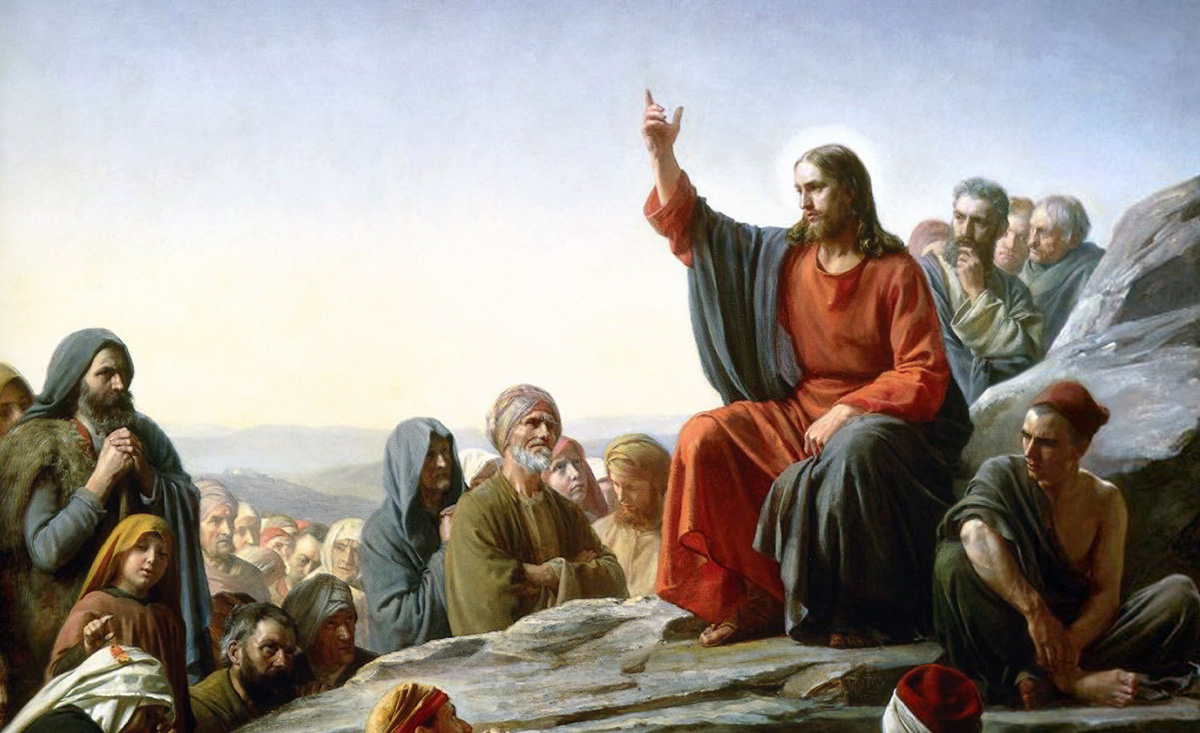
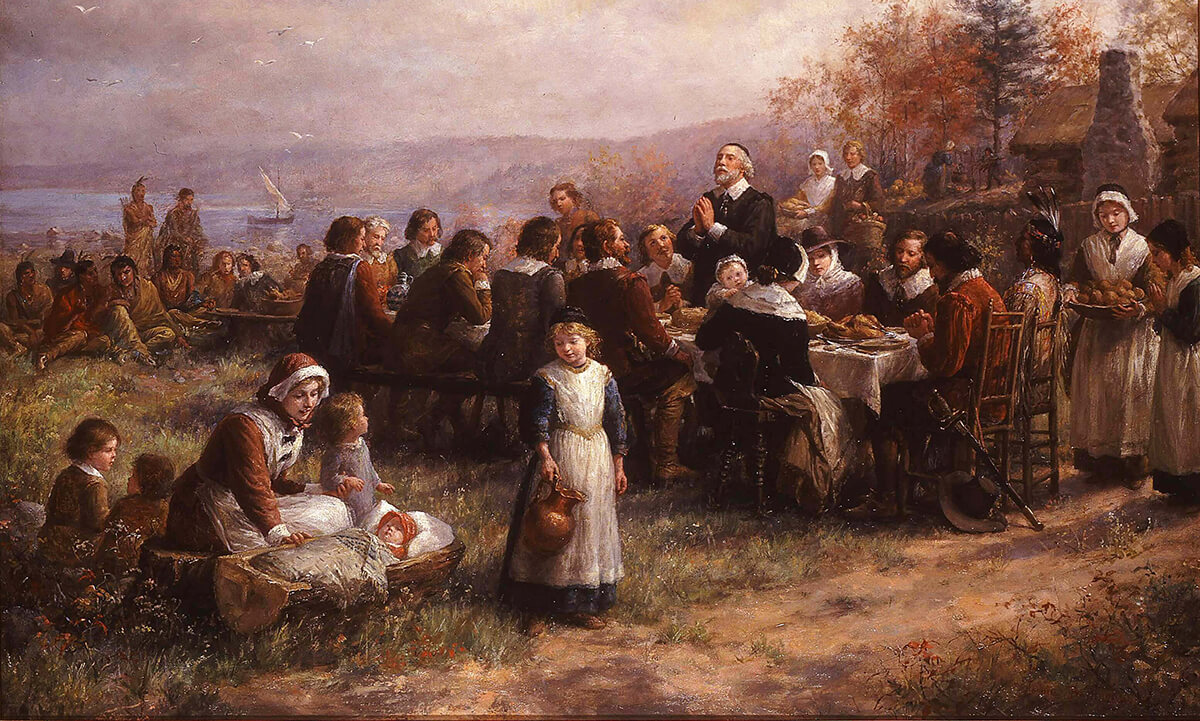
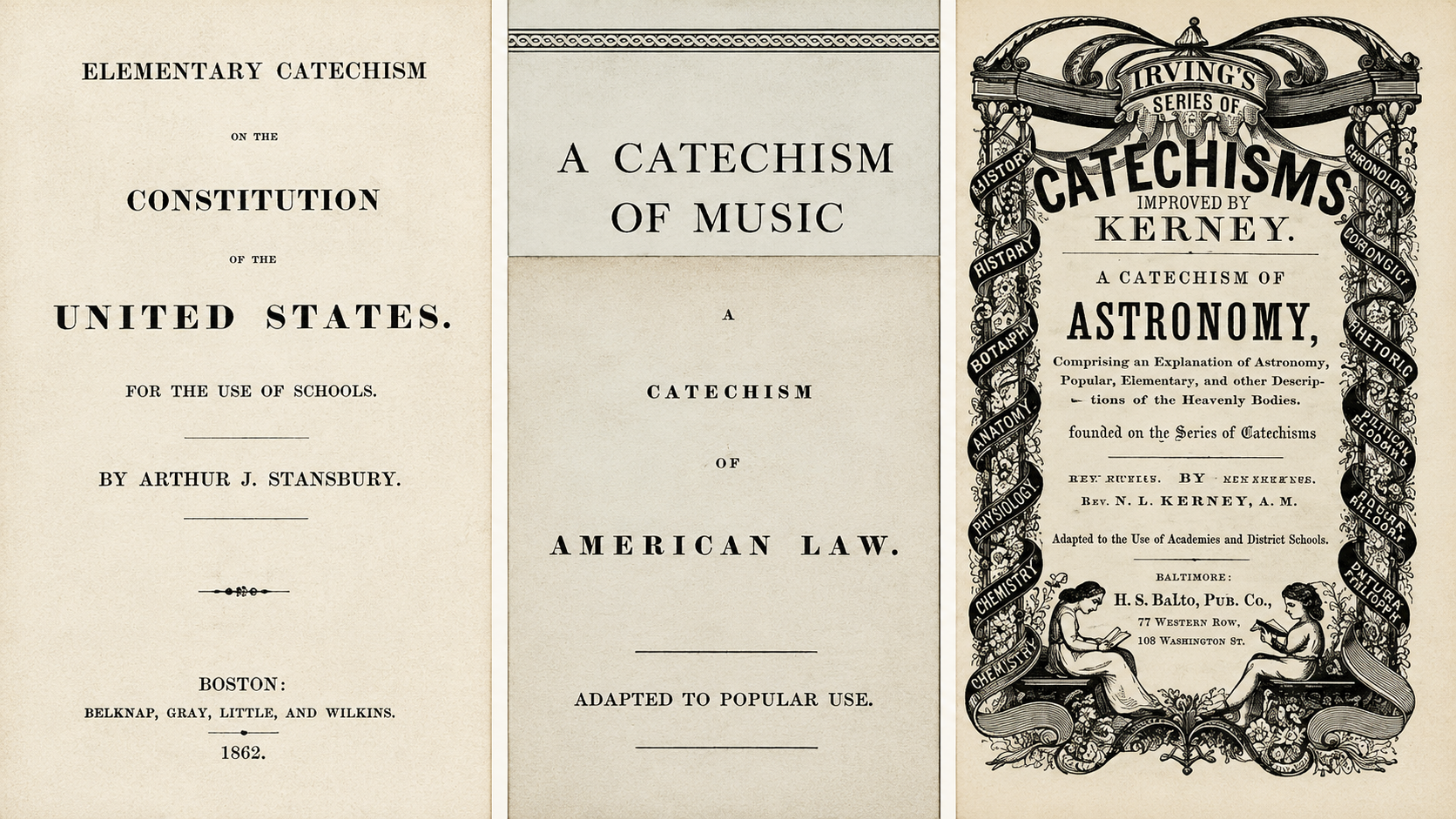
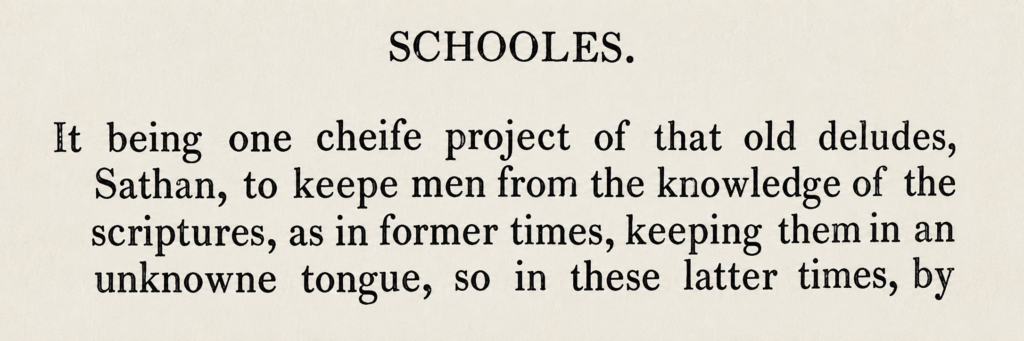
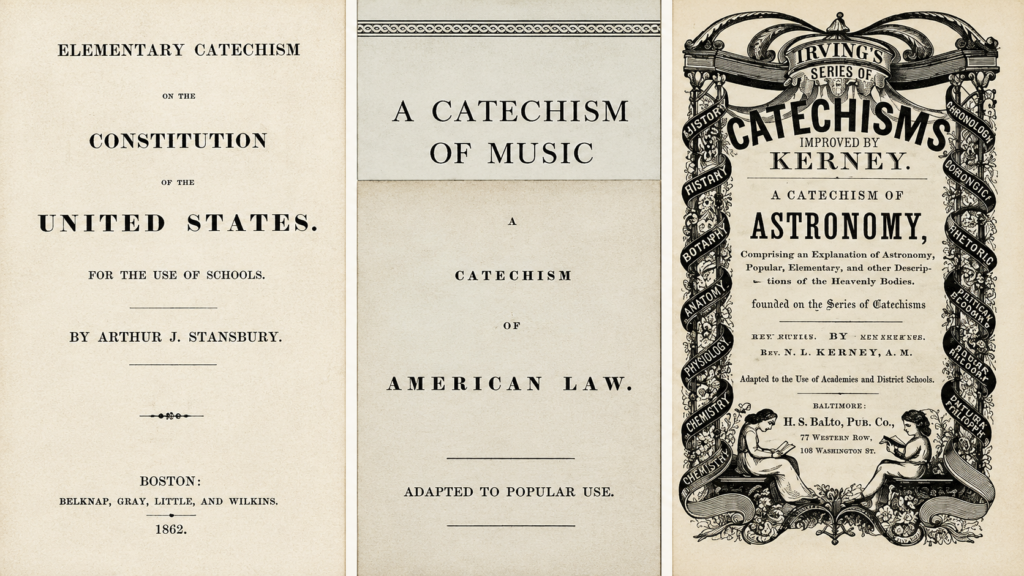
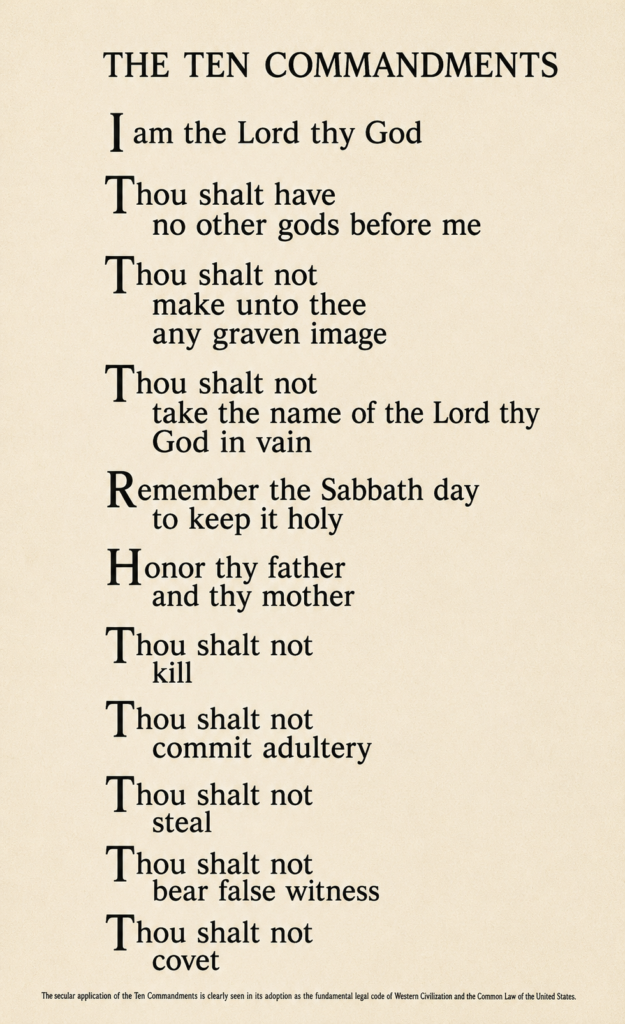
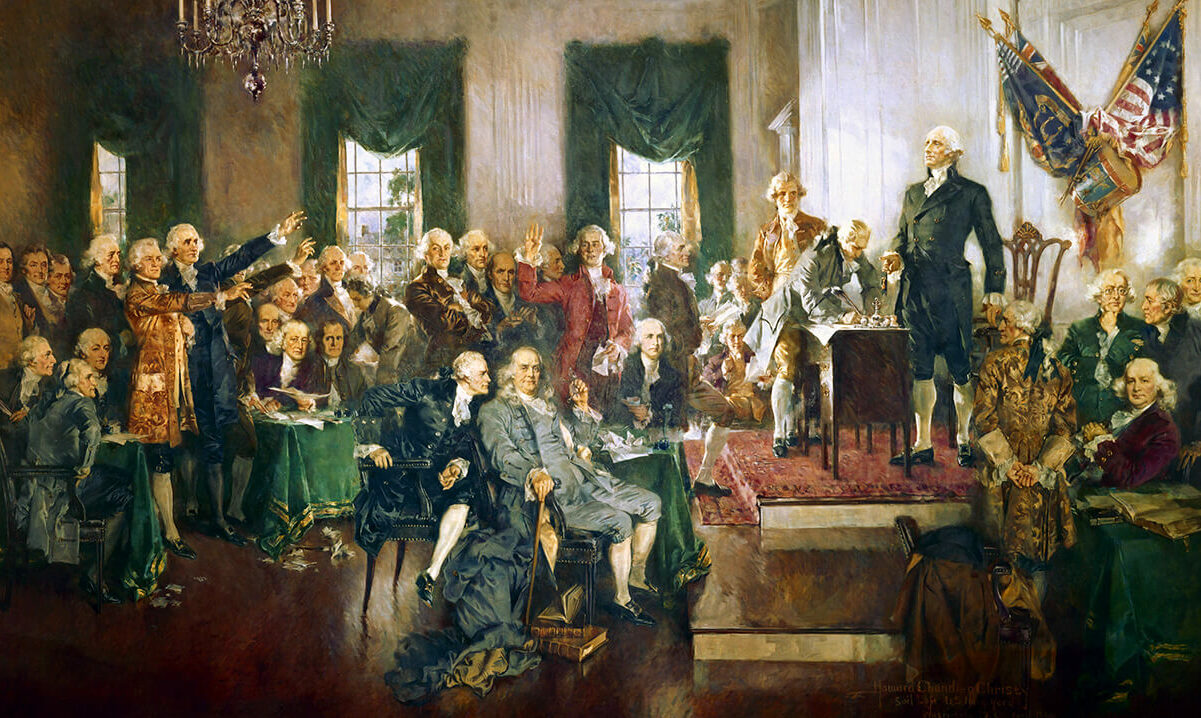
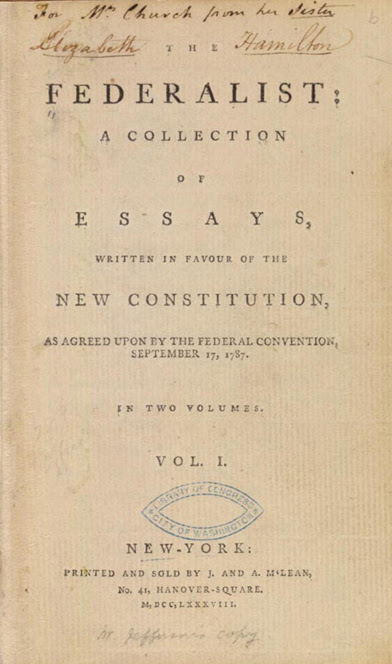 On October 27, 1787 a New York newspaper published the very first article that would come to be known as the Federalist Papers.
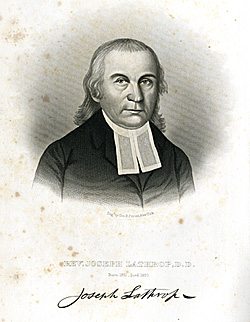 Lathrop was born in Norwich, Connecticut. After graduating from Yale, he took a teaching position at a grammar school in Springfield, Massachusetts, where he also began studying theology. Two years after leaving Yale, he was ordained as the pastor of the Congregational Church in West Springfield, Massachusetts. He remained there until his death in 1820, in the 65th year of his ministry. During his career, he was awarded a Doctor of Divinity from both Yale and Harvard. He was even offered the Professorship of Divinity at Yale, but he declined the offer. Many of his sermons were published in a seven-volume set over the course of twenty-five years.