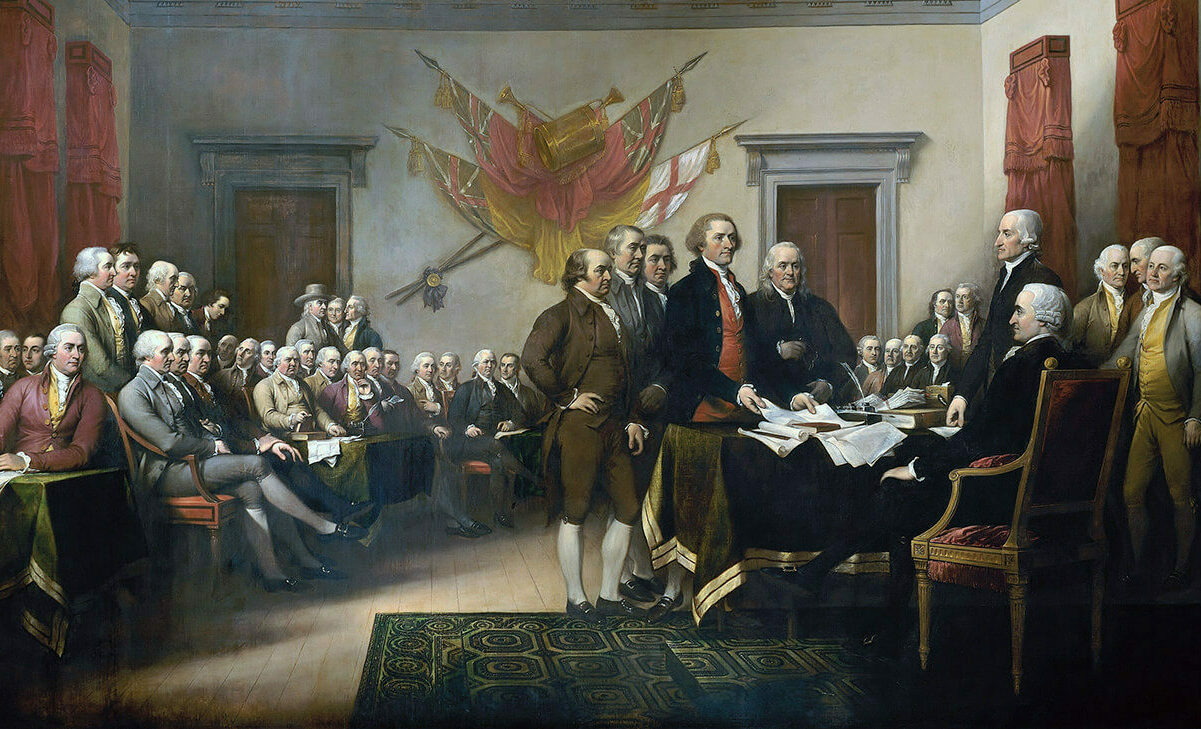
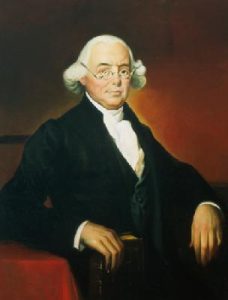
James Wilson had a great influence during the American Founding but has been called “the lost Founder” because of his relative modern obscurity.
He was born to a poor family in Scotland 273 years ago today (on September 14, 1742), but managed to attend universities in Glasgow, St. Andrews, and Edinburgh. [1] At the age of 21, he immigrated to America and soon began tutoring at Philadelphia College. He studied law under John Dickinson, a fellow signer of the Declaration of Independence. [2] [John Dickinson was actually a signer of the Constitution, not the Declaration of Independence. For additional information, please see our correction update.]
In 1768, he wrote a pamphlet arguing for American independence but it considered too radical for the times. When public opinion later shifted, it was finally published. Thomas Jefferson copied portions of it for his own use, and it is conceivable that parts of Wilson’s essay even influenced the language of the Declaration. Compare the similarity of Wilson’s writing with the wording of the Declaration:
| “All men are by nature equal and free. No one has a right to any authority over another without his consent. All lawful government is founded on the consent of those who are subject to it. Such consent was given with a view to ensure and to increase the happiness of the governed above what they could enjoy in an independent and unconnected state of nature. The consequence is that the happiness of the society is the first law of every government.” ~ James Wilson | “We hold these truths to be self-evident: that all men are created equal, that they are endowed by their Creator with certain unalienable rights, that among these are life, liberty and the pursuit of happiness. That to secure these rights, governments are instituted among men, deriving their just powers from the consent of the governed, …” ~Declaration of Independence |
 Wilson served as a Pennsylvania delegate to the Continental Congress, where he voted for and signed the Declaration of Independence. He later was a member of the Constitutional Convention, where he signed the Constitution. [3]
Under the new federal government, President George Washington appointed Wilson as an original justice on the U. S. Supreme Court, where he served for 9 years until his death on August 28, 1798. He was buried at Christ Church in Philadelphia. [4]
Over recent years, the federal courts have become particularly unfriendly to Christianity and religious faith, but it was not that way under Justice Wilson. In fact, Wilson started America’s first organized legal training while he served on the Court, and he told students:
Far from being rivals or enemies, religion and law are twin sisters, friends, and mutual assistants. Indeed these two sciences run into each other. . . . All [laws], however, may be arranged in two different classes. 1) Divine. 2) Human. . . . But it should always be remembered that this law, natural or revealed, made for men or for nations, flows from the same Divine source: it is the law of God. . . . Human law must rest its authority ultimately upon the authority of that law which is Divine. [5]
Endnotes
1 Nicholas Pederson, “The Lost Founder: James Wilson in American Memory,” Yale Journal of Law & the Humanities, 22:2:3, (May 8, 2013); Robert K. Wright, Jr. and Morris J. MacGregor, Jr., “James Wilson: Pennsylvania,” Soldier-Statesmen of the Constitution (Center of Military History, Washington, D.C., 1987).
2 “James Wilson,” Signers of the Declaration of Independence (2014).
3 “James Wilson, Pennsylvania,” Charters of Freedom: America’s Founding Fathers (accessed September 8, 2015).
4 L. Carroll Judson, A Biography of the Signers of the Declaration of Independence (Philadelphia : J. Dobson, and Thomas, Cowperthwait & Co., 1839), 130-131; “James Wilson, Pennsylvania,” Charters of Freedom: America’s Founding Fathers (accessed September 8, 2015).
5 James Wilson, The Works of the Honourable James Wilson (Philadelphia: Bronson and Chauncey, 1804), I:106 & 103-105.

 America’s first attempt at a national governing document was in 1777 with the Articles of Confederation.
 James Madison agreed:
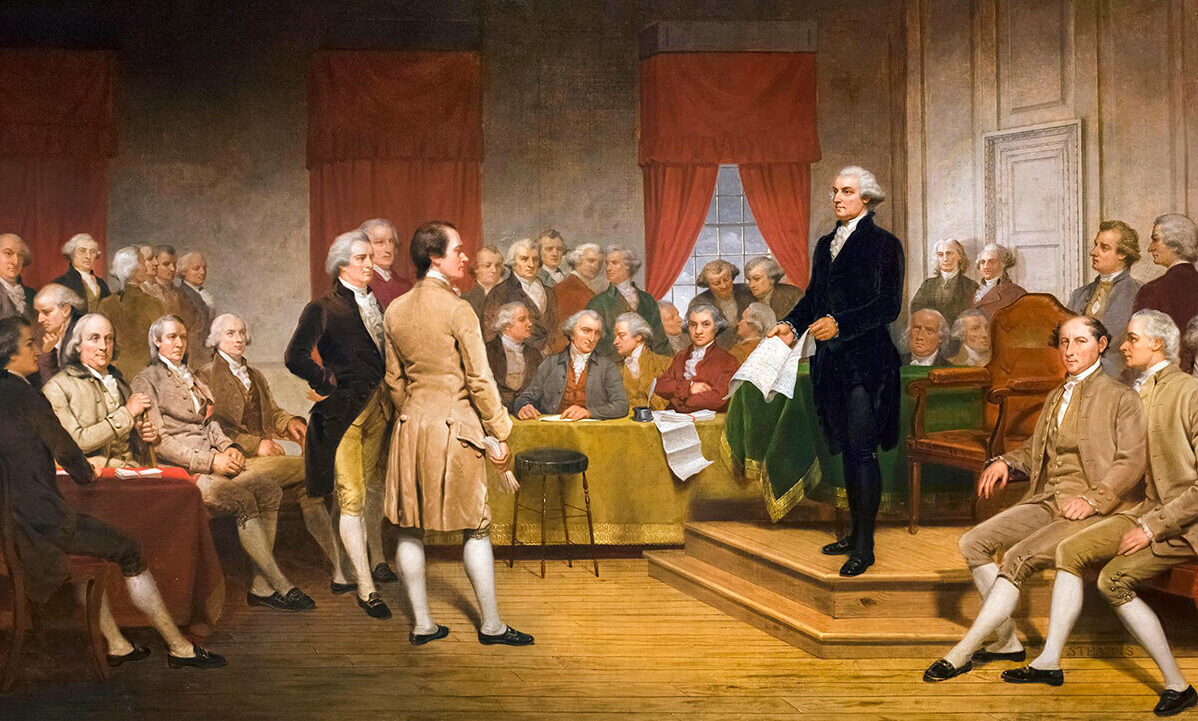
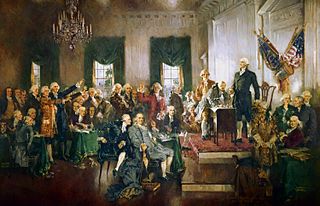 Many delegates involved with writing the Constitution were trained in theology or ministry,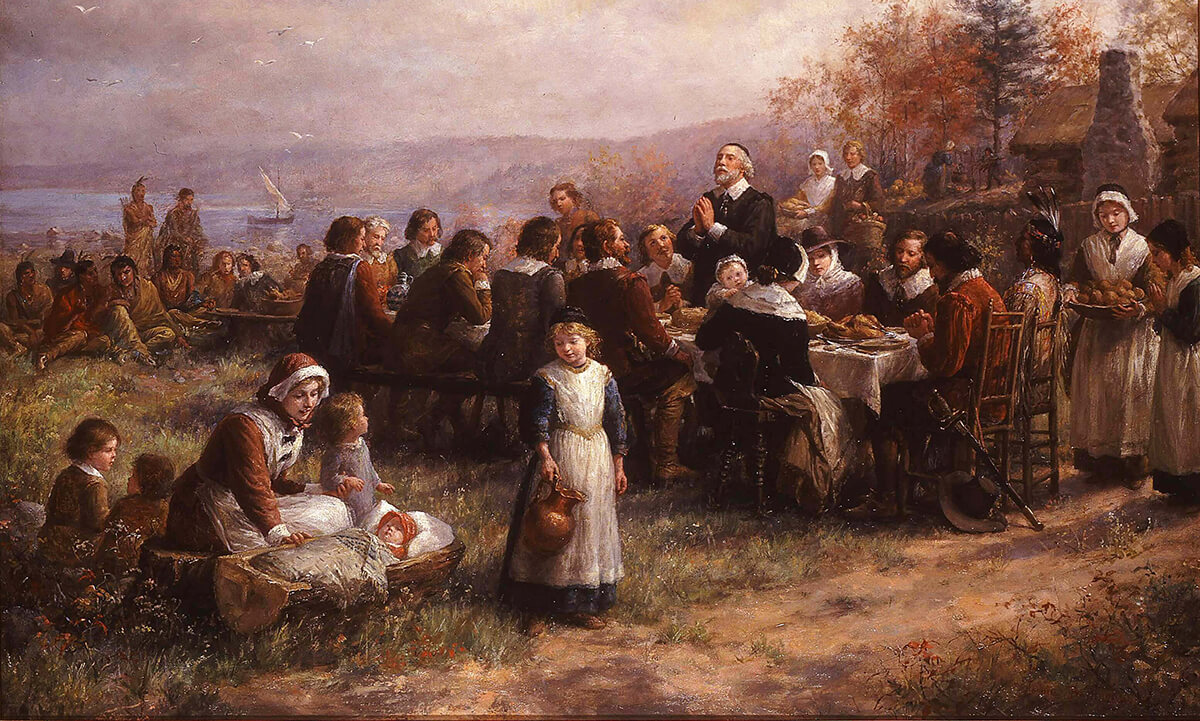

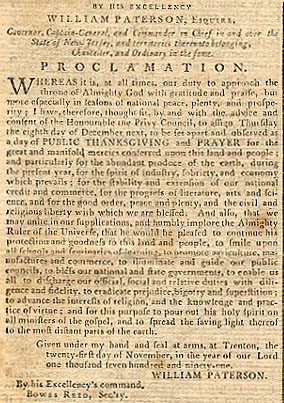

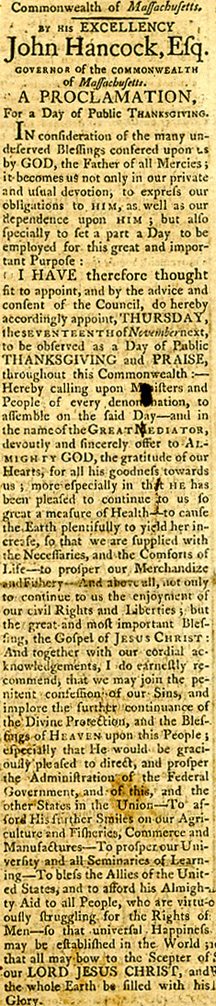
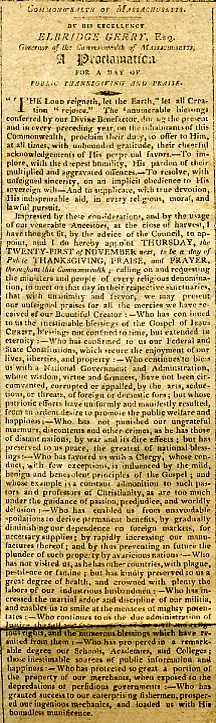
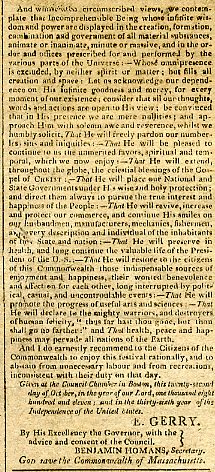
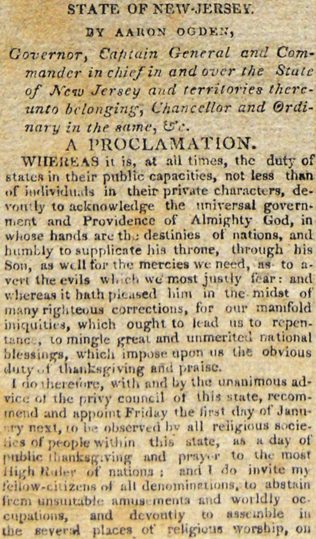 WHEREAS it is, at all times, the duty of states in their public capacities, no less than of individuals, in their private characters, devoutly to acknowledge the universal government and Providence of Almighty God, in whose hands are the destinies of nations, and humbly to supplicate His throne, through His Son, as well for the mercies we need, as to avert the evils which we most justly fear, and whereas it hath pleased Him, in the midst of many righteous corrections, for our manifold iniquities, which ought to lead us to repentance, to mingle great and unmerited national blessings, which impose upon us the obvious duty of thanksgiving and praise.
 I do, therefore, with and by the unanimous advice of the privy council of this state, recommend and appoint Friday the first day of January next, to be observed by all religious societies of people within this state as a day of public thanksgiving and prayer to the most High Ruler of nations; and I do invite my fellow citizens of all denominations, to abstain from unsuitable amusements and worldly occupations, and devoutly to assemble in their several places of religious worship, on that day, to offer Him their homage for His multiplied blessings, through the past year, particularly recalling with thankfulness, in His presence, the general healthfulness and fertility of the season, which have crowned the hopes of the husbandmen with plenty, rendering praise to Him for the continued preservation of our inestimable privilege, civil and religious; for that general and peaceful submission to the wholesome laws of the state, which has not been disturbed among us by the violent impulses of party zeal; for that charitable and harmonious union, which prevails among all sects in their salutary endeavors to advance the interest of morality and piety; for tranquility in all our borders, so that while we behold, at distance, the fail of so many ruined dynasties and oppressed republics, we have been enabled to preserve our freedom and independence unimpaired; for our happy exemption from invasion and insurrection, and all those heavy calamities with which divine providence often chastises the iniquities of offending nations, above all we are called upon now, and at all times, to renew the sentiments of our most profound gratitude to the God of all mercy and grace for the precious gift of divine truth and for the consoling hope of life and immortality, as brought to light by the blessed Redeemer, Christ Jesus our Lord.