Sermon – Election – 1805, Massachusetts


John Allyn preached this election in Boston on May 29, 1805.


sermon-election-1805-massachusetts

A

SERMON,

PREACHED IN THE AUDIENCE OF HIS EXCELLENCY

CALEB STRONG, Esq.

GOVERNOR,

The other MEMBERS of the EXECUTIVE,

AND

The Honorable LEGISLATURE

OF THE

COMMONWEALTH OF MASSACHUSETTS,

ON THE

ANNIVERSARY ELECTION,

MAY 29, 1805.

BY JOHN ALLYN,

CONGREGATIONAL MINISTER OF DUXBOROUGH.

BOSTON:

PRINTED FOR YOUNG & MINNS, PRINTERS TO THE STATE.

1805.


IN SENATE, MAY 29, 1805.

ORDERED, That the Hon. Thomas Hale, William Brown, and John Phillips, (Essex) Esqrs. Be a Committee to wait on the Rev. John Allyn, and in the name of the Senate to thank him for the Sermon he this day delivered before His Excellency the Governor, His Honor the Lieutenant Governor, the Honorable Council and the Two Branches of the Legislature, and request a copy thereof for the press.

A true Copy from the Journals,
WENDELL DAVIS, Clerk of Sen.
 

AN

ELECTION SERMON.

ROM. X. 1. & IX 1, 2, 3.

BRETHREN, MY HEART’S DESIRE AND PRAYER TO GOD FOR ISRAEL IS, THAT THEY MIGHT BE SAVED. I SAY THE TRUTH IN CHRIST, I LIE NOT, MY CONSCIENCE ALSO BEARING ME WITNESS IN THE HOLY GHOST, THAT I HAVE GREAT HEAVINESS AND CONTINUAL SORROW IN MY HEART. FOR I COULD WISH THAT MYSELF WERE ACCURSED FROM CHRIST, FOR MY BRETHREN, MY KINSMEN ACCORDING TO THE FLESH.


The most eminent personages of sacred history have expressed a peculiar attachment to the welfare of their own nation. That first divinely enlightened lawgiver, Moses, though nursed at the court of Pharaoh, and having a prospect of being advanced to the head of Egypt, yet, preferred affliction with his own people, the people of God, to the crown and treasures of Egypt. He chose to wander with his countrymen in a desert, where sustenance could not be had without a miracle, rather than to feast with a foreign monarch. The first impulse of resentment which agitated his breast was toward an Egyptian, who did wrong to one of his brethren, oppressing him with a burthen. When his people had “sinned a great sin,” in making the golden calf, whereby their title to the promised blessings of Canaan was forfeited, Moses intercedes, 1 “if thou wilt not forgive their sin, blot me I pray out of thy book which thou hast written.” He chose death rather than to see the miseries of his people, or would willingly submit to it, if their pardon could be purchased by this sacrifice. This natural affection to his own race, invigorated by religious faith, afterward unfolded itself in the most patient and laborious services of patriotism.

The great Author and Finisher of the Christian faith, in this respect, was like unto Moses. While he exercised the most self-denying and disinterested benevolence, productive of the most substantial blessings to mankind, his personal ministry was restricted to the Jews. Jesus the true light came to his own; 2 he did this from affection as well as by divine appointment. Being partaker of flesh and blood, he took not on him angels but men, and the seed of Abraham in particular. 3 Anticipating the unexampled tribulation, which awaited the unbelief and sins of his countrymen, he uttered that pathetic apostrophe, “O Jerusalem, Jerusalem—how often would I have gathered thy children together, even as a hen gathereth her chickens under her wings, and ye would not!” 4 Jesus Christ, the image of the invisible God, 5 and an exemplar spotless and undeviating, manifested the whole series of limited affections. He cherished the ordinary sensibilities of domestic life, 6 the more generous emotions of private friendship, and to these, added the display of the most fervent love to his country, with tokens of unparalleled grace and compassion towards mankind.

After the evidence of such a witness, it is not necessary to vindicate any sentiment by the subordinate authority of prophets and apostles. Indulge me, however, in two instances relating to the present subject.

The prophet Jeremiah, when Israel was carried away captive, and Jerusalem became desolate, sat weeping, and bewailed with this lamentation: “How doth the city sit solitary that was full of people! How is she become as a widow! She that was great among the nations and princess among the provinces, how is she become tributary! 7 O that mind head were waters, and mine eyes a fountain of tears, that I might weep day and night for the slain of the daughter of my people!” 8 The pathos of the prophet’s lamentation, on account of judgments already executed, is equaled only by the ardent language of the apostle in the text, in which he deprecates impending calamities. “My heart’s desire and prayer to God for Israel is, that they might be saved. I say the truth in Christ, I lie not, my conscience bearing me witness in the Holy Ghost, that I have great heaviness and continual sorrow in my heart. For I could wish that myself were accursed from Christ, 9 FOR MY BRETHREN, MY KINSMEN ACCORDING TO THE FLESH” Oppressed with the presentiment of that unparalleled tribulation, which awaited his countrymen, his bowels yearned with compassion, and his most affectionate prayers ascended to God in behalf of his kinsmen and brethren according to the flesh.

But why such a limitation of benevolence? Why such deep regret on account of the destruction which impended the Jews, when the spirit of prophecy might have taught the apostle that like miseries awaited the crimes of other nations? Why not from the prime minister of the gospel of peace on earth expressions of more extended sympathy? Why not an imitation of the Father’s love, who is no respecter of persons, and whose blessings flow, at times appointed, on Jews and Gentiles?

It is replied, that as “man was made for his species by the Christian duties of universal charity, so he was made for his country by the obligations of the social compact.” 10 Patriotism is no more incompatible with general benevolence, than the more partial affections of domestic life are with patriotism. General benevolence implies particular; it includes the limited affections; it is a seminal principle in the heart, producing, in just measure and at proper seasons, the fruits of beneficence to our family, friends, fellow-citizens and fellow-men. While it propels to every useful exertion as opportunity is presented, conscious of imbecility and obedient to the emotions of nature, its beneficent hand is most frequently opened to comfort and supply the household. Indeed, as the domestic affections may be cherished and expressed, without any infraction of the maxims of justice and mercy to our neighbours, or encroachment upon the rights of the commonwealth, so these rights may be respected and the duties of patriotism be performed, without any infringement on the obligations of humanity.—It is then no proof that the apostle Paul was destitute of general benevolence, that he had an ardent love to Israel, his brethren and kindred according to the flesh.

While the patriotism of St. Paul operated according to the dictates of nature and the necessities of man in a state of society, it received an accession of strength from his reflections on the invaluable privileges which had been long participated by the chosen people of God. He seems to assign a reason for his love to Israel in the words subjoined to the text: “I could wish myself accursed from Christ for my brethren—to whom pertaineth the adoption, and the glory, and the covenants and the giving of the law, the service of God and the promises; whose are the fathers, and of whom concerning the flesh Christ came.” Why this particular enumeration of national honours and privileges, unless because a grateful participation in them was intimately associated with deep solicitude for the future welfare of his fellow participants? He is himself an illustration of his own description of charity, when he says, “if one member be honoured, all the members rejoice with it; and if one suffer, the rest suffer also.”

Were it necessary, in explaining and vindicating the patriotic character of St. Paul, it might be further urged that his love to his brethren was exercised in due subordination to the will of God, and the highest demands of philanthropy. Obedient to the voice from heaven he resisted his tender desires after his brethren, and pursued his mission to the Gentiles. He preferred compliance with the invitations of general benevolence and the will of God to the gratification of his limited affections. Though willing to be accursed from Christ for his brethren, without hesitancy, he acquiesces in the designation, “I will send thee far hence to the Gentiles.” 11

When we consider the order and progress of our social feelings, and weigh the authority of so great an exemplar as the apostle Paul, can there be any room doubtingly to inquire whether patriotism be compatible with the spirit of Christianity? And why does a celebrated modern writer 12 consider patriotism as excluded from the Christian system of moral duties? If indeed this term, when strictly defined, import a “disposition to oppress all other countries to advance the imaginary prosperity of our own; and to copy the mean partiality of a parish officer, who thinks injustice and cruelty are meritorious, when they promote the interest of his own inconsiderable village; if patriotism has ever been the favourite virtue with mankind, because it conceals self-love under the mask of public spirit,” Christianity, indeed, condemns it. Such patriotism does not approach, in degree or extent, the benevolence of the religion of Christ. But why degrade the term by such an exposition? Have there been no examples of a generous and laudable love of country? Will not fact justify the assertion, that those who are affectionate in limited circles, are seldom deficient in philanthropy? The kindest husband is probably the most helpful neighbour; this neighbour the most peaceable citizen; this citizen the most effective soldier; and such a soldier, educated in the different grades of social life, will the most readily weep over the ruins of war, cordially bewail the calamities of mankind, and conscientiously respect the obligations of humanity. It is, therefore, no proof that St. Paul was, or that any other person is destitute of general benevolence, that they manifest a kind affection towards brethren and kindred, according to the flesh.

But since the name patriot has been often usurped by wicked men, and historians have sometimes sanctioned the usurpation, and the nations aggrandized have acquiesced in the bestowment of unmerited honours upon unprincipled generals and statesmen; it is proper to discriminate more minutely on this subject, and thus to remove from the idea of patriotism, any disgrace into which it may have fallen by its alliance either with the weaknesses or vices of the human character.

No pretences of patriotism extenuate, much less justify the least violation of the maxims of justice and humanity. That greatness, which is invariably attached to vital benevolence, spurns at that policy which is merciless and dishonest. This benevolence, whether exercised towards family, fellow-citizens, or mankind, renounces every advantage, which cannot be secured without encroaching on the rights, or disturbing the happiness of individuals. It is indeed the greatest absurdity to attempt to build up any limited interest, by means which, if universally adopted, would prove subversive of all society.

It is scarcely necessary to add, that all illiberal partialities towards our own country, and unfounded antipathies toward other countries, are excluded from the idea of Christian patriotism. Neither is there anything commendable in the puerile attachment of some to their native soil and climate; though innocent, it ranks no higher than a fondness for one’s nurse. We may, however, view these natural feelings with a favourable eye, when they appear to be associated with moral feelings, and to limit and to strengthen them.

But severe censure is the just demerit of those hypocritical pretences to patriotism, which are designed for the concealment of personal ambition. Every age and country produces political sycophants, who flatter, that they may rule or plunder their fellow-creatures. The numerous instances of this deception should make us slow in giving credit to the appearances of patriotism. The popular opinion is frequently ungrounded. To-day we hear, Hosanna to the Son of David; tomorrow, Crucify, crucify him. Many excellent men sleep in the grave of obscurity, and others have a name to life, who deserve oblivion. Discrimination dictates an eulogy upon the poor man, whose wisdom saved the city, but who was never after remembered, 13 and assigns him a much more conspicuous niche in the temple of fame, than more celebrated characters, who have the credit of loving the nation and building a synagogue. It is but just to distinguish the unalloyed gold of patriotism from deceitful imitations, and the meteors of a moment from the stars of the first, second and third magnitude, which shine through successive generations.

Excluding then from the idea of patriotism whatever is unjust, frivolous, selfish or hypocritical, it is then only commended, when defined to express an honest solicitude for the welfare of the community to which we belong, and a glowing joy at the just gains and improvement of our kindred according to the flesh; a deep and anxious anticipation of our country’s dangers, and affectionate prayers for its prosperity:–Or in fewer words, patriotism is to be commended when the profession is sincere, the means just, and the objects important.

The favourable hearing of this intelligent audience is solicited, while the speaker dispatches the practical part of his subject, and applies it to the occasion in our view; to the characters here assembled, and the times in which we live.

The most arduous duty of patriotism is to die in its cause, when required. Many names in Greek and Roman history, as also in the history of other nations, have been transmitted with veneration, for this reason, that they counted not their own lives dear to them, if they might but work some great deliverance to their country. Indeed, a greater oblation than that of life cannot be made for the common safety. But the call to embrace certain death is made but seldom, and but to few individuals of any nation. And if called, many worthy citizens might shrink from so expensive an offering for the public good. The spirit might be willing, but the flesh might be weak. With more frequency, we are called to hazard our lives; and when the justice of our country’s cause is clearly established in the mind, and the obtrusions upon our personal safety and possessions are violent and continued, whoever can ardently pray for his brethren and kindred according to the flesh will seek no dispensation from the ordinary casualties of war; but cheerfully obey a summons to the field. The state of peace, in which we live at present, renders any persuasive on this head unreasonable. By favour of Divine Providence, we are not required at present to decide on such trying demands of patriotism. More pleasant themes invite attention. The ordinary course of things in our times and country affords many opportunities of rendering patriotic services, and everyone may daily find some work of love to his brethren. Beside what may be exacted in the defence of our country against a foreign enemy, there are a multitude of other expressions of patriotism important in their nature, practicable by all, and especially by such, as occupy stations of influence and authority.

It is consoling to reflect that every individual, in whatever station, may reap the honour of patriotism and enjoy the complacency which springs from useful actions, by cherishing in himself and others benevolent opinions and feelings, by setting an example of ready obedience to the laws, by giving support to institutions of public utility, by aiding in the establishment of such new regulations as the common good requires, by occasional acts of charity, and above all, by exhibiting an undefiled pattern of Christian virtue and godliness.

But perhaps these objects seem distant and general, and the effects produced by individual exertion almost imperceptible. We may, however, find a new spring of animation and diligence in considering how much good may be done to our country by only pursuing with zeal and fidelity the business of our respective vocations. It falls but to few to die for the nation, and an opportunity may seldom be afforded of contributing to the erection of some great edifice; yet everyone, in all times, by well discharging the duties of his sphere and station, may build up the interests and increase the happiness of his country.

The social body is composed of various members, mutually connected and dependent. Though some be deemed less honourable, they may not be less necessary than others. As the eye, the ear, the hand, the foot of the human body, cannot say one to the other, I have no need of you, but all in their respective places have indispensable uses; so, in the commonwealth, each citizen has dome gift or function, by which he may become a contributor to the support and pleasure of the whole body. In every society there is much mutual dependence. “The king himself is served by the field.” 14 All the various classes of men derive subsistence from each others’ power or favour. The most essential labours are those of the field. The different fabrications of the artist are either useful or convenient. The rich would be less happy without the poor to administer to their leisure and ease; and the poor, in turn, are profited by the stewardship of the rich, whose enterprise, providence and economy enable them to reward their labour, and relieve that indigence, which springs from indolence, wastefulness, and vice, or from sickness and misfortune. The young sustain an important relation to the aged, whose infirmities and sorrows it is their province to bear and mitigate, as well as perform the manual service, and endure the hardships of life; and the young may reap a full reward from the counsel of ancient men, matured by experience and rendered impressive by grey hairs. We need not therefore every despond with the idea that we are unable to serve the community; for keeping in the line, that nature and providence have marked out for us, we may effect a multitude of purposes useful to society. By assiduity in our professional labours, without any uncommon exertions and sacrifices, we may reap the praise of serving our country and generation.

But the subject of patriotic duties more properly embraces the consideration of certain weighty interests of society, in the advancement of which it is necessary we should all unite, be our particular vocations what they may. There are some burdens, which may be lifted by individual strength; others require the united force of the whole community to raise and support them. The opinions of all parties must be embraced, when it is said, that patriotism requires the watchful preservation of our constitution and liberties—the cultivation of agriculture arts—the diffusion of knowledge—and, above all, the promotion of a religious spirit, fruitful of good works.

I. The first duty of patriotism (especially in our country) is to PRESERVE OUR CONSTITUTION AND LIBERTIES. Mankind have entertained different ideas on the subject of civil constitutions, and have adopted different forms, “according to the different habits, genius and circumstances of the people.” With us there ought to be but one opinion; and, as the result of this opinion, the most decided support given to our republican institutions, as best adapted to promote the happiness of all ranks in society. Some parts of the superstructure may with propriety admit of occasional alterations; but the elective base, and those constitutional pillars of freedom, upon which we are compacted together, require vigilant protection. There is danger of innovation without improvement, of annihilating one point after another, to facilitate the designs of party, and serve the purposes of personal ambition.

Our fathers, in the most serious exercise of their understandings, and influenced by the most disinterested motives, adopted and established those civil constitutions, by which we have been protected, and to which we still look for protection. We have reason of full confidence both in their judgment and patriotism, from the experience of safety and prosperity. The lover of his country will watch against every encroachment on established rights and liberties, and especially such as have for their object the perpetuation of civil power in the hands of a few. But what are the means to this end? To what expedients must we have recourse in securing tour present privileges? No mean, no expedient is of more certain operation than the appointment of wise and good men to manage our common interests. Let all classes of citizens unite in this point, viz. To place honest and able men in their public councils. Can we be so infatuated as to think our constitutions and liberties ever safe, when we entrust civil power to men whom we discredit in private transactions? The governing part of a nation ought to be men of unimpeachable justice, prudence, temperance, and exemplary goodness. For if men have lost the moral government of themselves, how shall they direct the affairs of the public with reason and equity, and how can we suppose they will respect the rights of the whole people, who do not respect individual claims.

It may be added, that the corrupt example of men in station is peculiarly contagious and destructive. The pagans imitated the supposed practices of their gods. Gods on earth equally propagate their vices. And as it was formerly in vain for the philosophers to arraign the vices of heathen deities, so now it is equally fruitless for the preacher and moralist to inveigh against vices made reputable by official eminence. There is special reason to fear that our rights and liberties will be impaired and lost, and our national manners corrupted by unprincipled and immoral rulers.

So much evil is to be apprehended from this source, that it may be established as a prime duty of patriotism in every citizen to exercise his elective power with caution, and entrust the administration of public affairs only to men of sound minds and virtuous habits. Without this preventive, that treasure of independence and freedom, which our country so long and so nobly bled to acquire, will be dissipated and irrecoverably lost. We often look to political expedients for the preservation of political blessings; but they will all prove deficient, if the general course of our public affairs be not directed by wisdom and uprightness. To this point then, let all collect, and commit the custody of our political tables to men of unostentatious wisdom and experienced fidelity. Thus shall we preserve and perpetuate our constitutions and liberties.

II. But the attainment of this object is intimately connected with another branch of patriotic duty, the GENERAL DIFFUSION OF KNOWLEDGE. We have a text on this subject, the writer of which, and the chapter containing it must be recollected by every individual in this audience. “In proportion as the structure of a government gives force to public opinion, it is essential that public opinion be enlightened.” 15 Whoever loves liberty and the government of laws will cultivate seminaries of learning. He will manure and weed every plot where seeds of instructions have been sown, and hedge in new enclosures, that “children’s children may go in and find pasture” to satisfy the hunger of their minds. It may be a fact, that ignorant subjects are most peaceable and submissive, and that learning, beyond the sphere of one’s own occupation, has sometimes a tendency to beget uneasy and aspiring sensations. Under despotic governments, sound policy may forbid the dissemination of knowledge; but we profess to value liberty, as conducive to the safety, peace and improvement of man. Let us then provide against both its abuses and its loss. The preservation of it can be insured by no means of more infallible operation than that of enlightening the public mind. The wise sometimes, the ignorant always are led by their passions. By mental cultivation these passions are subdued in part, and the remainder restrained. The uninformed are easily excited to rebellion by coarse and noisy eloquence; and there are no establishments or measures, however wise and salutary, but must yield to the vandal rage of an ignorant populace. The light of knowledge also tends to harmonize the feelings of men, to prevent the unhappiness arising from a collision of manners, and dispose them to endure that heterogeneous quality of each other’s habits, which, to a certain degree, is incurable. Beside these considerations, showing the importance of diffused information, how unqualified are the ignorant to designate wise and honest agents from the general mass for the purpose of government. Blind electors will not probably choose seeing guides. The issue is still less problematical, when the blind are leaders of the blind. The grossly ignorant and immoral cannot subsist under a free government. Among such, civil power must be concentrated in the hands of one or a few, and profound submission to its most arbitrary exercise be the only means of preserving any order and justice.

Impressed with these convictions, the patriot will render every support and encouragement to teaching and learning, and the diffusion of useful information through all ranks in society. Though smatterings of knowledge may often produce pedantry, and though the poet has said, “A little learning is a dangerous thing,” yet boorish ignorance is both more unpleasant and dangerous.

But in devising methods for effecting this object, it must be recollected, that knowledge is not to be gained, after arriving to adult age. Some improvement may made on the stock acquired, but few additions to it can be expected. The nurture of the mind must be commenced early. It is then flexible, active, and partakes of a higher degree of susceptibility, than belongs to riper years. It is a most ingenious and instructive figure, which someone has adopted, to illustrate the necessity of early instruction in morals, who says, speaking of the young, “they must be died in the wool.” This idea applies as well to the principles of knowledge, as to those of morality. . The colours communicated after the cloth is made will soon fade, if not entirely wear out. It is hence easy to perceive that the diffusion of knowledge imports something more than circulating party pamphlets, newspapers, and sectarian theological tracts, 16 which, like some of our political schoolmasters, are not always the better for being of imported origin. The Christian patriot, in his efforts to spread knowledge, will first light the taper at home: he will teach his children and dependants, morning and night, in the house and by the way. And since few have both the ability and leisure to do this, it is necessary to patronize young men of respectable character and suitable talents, and give them ample encouragement to enter upon the laborious duties of common schools, that the profession of teaching may be pleasant and reputable, if not lucrative, to the teacher. In producing these teachers, and thus advancing the interests of early education, there must be primary schools for their instruction. The institution of colleges, where the higher branches of knowledge are taught and learnt, is indispensable for this as well as other purposes. Though they may be complained of as aristocratic, since the advantages of education they furnish are necessarily limited to a few, yet great is their influence upon political freedom and public improvement. Beside affording the community qualified teachers of youth, their effect is discovered in the debates of our public assemblies, in the weekly services of religious teachers, and the general style of reasoning throughout the whole community. Admit that they discharge their streams with partiality, watering here and there a favoured spot, yet providence has opened numberless channels, by which their salutary waters are diffused over the whole face of the commonwealth. We have not much to fear from literary aristocracy. Though knowledge be power, and superior intelligence as well as property extends the influence of the possessor; yet science, truly so called, has no corrupting effect on the heart. The pursuit of it tranquilizes the mind and reforms the manners. We may be assured, that if the larger windows of light be shut, the whole mansion will be soon involved in barbarian darkness, with which despotism is inseparably connected.

The Christian patriot will therefore cherish in his own and in the minds of others a veneration for the larger seminaries of instruction, and their founders, and daily pray that “healing salt may be cast into these fountains of knowledge.”

III. Although the defence of liberty and the spreading of knowledge are objects of high concernment in the view of patriotic minds; yet the article on which we are about to enter must be magnified in its importance. “Of all dispositions and habits which lead to political prosperity, RELIGION and morality are indispensable supports. In vain would that man claim the tribute of patriotism, who should labour to subvert these great pillars of human happiness, these firmest props of the duties of men and citizens. The mere politician equally with the pious man ought to respect and cherish them.” Thus spake one, “by whom many worthy deeds were done to our nation,” at a time too when no personal motive could possibly bias his counsel.

The opinion of some that RELIGION is not to be associated in any degree with political affairs, that society may flourish without its aid and influence, it may not be needful to confute in this assembly; if it were, we would demand an instance of a people, altogether profane, regardless of an oath, destitute of religious fear, who have subsisted in peace and order, and found growing prosperity and happiness.

What part of nature is supported without God? Do the planets keep in their spheres? Does the earth revolve? Does the soil shoot forth the blade of grass? Does health nerve the limbs and cheerfulness expand the soul, without the all pervading spirit of the Most High? Nay. How then shall the social virtues bud and grow independently of the same cause? How shall order, strength and manhood accrue to the social body without any portion of divine influence? And through what channels can this influence flow, but through the mind and heart?

Religion may be considered as to its theory, its spirit, and

practice. Its theory involves the consideration of things infinite, eternal, and transcendently excellent, viz. God, immortality, and the immutable discriminations of holiness and sin. Its spirit implies such emotions towards God as are associated with everything mild, joyful and sublime. The practice of religion, or the sensible forms of it, conduce to the two first mentioned ends, viz. the knowledge of its theory and the exercise of its spirit. Religion doubtless subsists in different persons and communities, and at different periods of time, in various degrees of purity. But without some respect for a Supreme Lawgiver, there is no basis of obedience to the laws of morality. Even a weak sense of religion, clouded by ignorance and intermingled with the vanities and weaknesses of human nature, secures the practice of many duties, which can never be successfully enforced by civil laws.

It is necessary, however, to distinguish the religion, which is useful in the preservation of social order and happiness, from certain corrupt and unlawful establishments which have been made in many countries. Correct ideas of religion are not obtained by reading the debates of the council of Nice, the minutes of a Romish conclave or Protestant synod. Most, if not all ecclesiastic, academic, as well as legislative disquisitions on this subject have shed darkness rather than light, and unfolded the character of the man of sin, rather than that of the prince of peace.

Useful religion is also to be discriminated from the wild enthusiasm, excited by field oratory, and the anti-social gloom of the cloister. Religion has often been defiled and rendered unprofitable and unamiable; and is always tinctured, by the education, constitution, and moral habits of men; yet even in its most imperfect forms, it is accompanied with some meliorating effects. In this recommendation of religion as useful in a state, we are not so much concerned to make any casuistical statement of its metes and bounds, as to illustrate its general influence on the conduct and happiness of mankind. A scantier portion of religious knowledge and sentiment may answer useful purposes in society, than will be necessary to our obtaining a part in the future inheritance of saints.

In these remarks on the effect of religion, the epithet Christian, though omitted, is understood. For to us there can be no middle way between embracing the doctrines of the gospel, and resorting to skepticism and irreligion. We can have no motives and feel no impulse to adopt pagan idolatry or Mahometan imposture. And it is a thesis, from the defence of which no believer need shrink, that every person who experiences the smallest excitements of a religious nature, will eagerly read and hear the report of Jesus Christ. Is anyone alarmed by anticipations of the punishment of his sins? Is anyone conscious of inability to keep the law? In the gospel are promises of pardon and aid. Does anyone hunger for the bread of life? From this source it may be procured. The neglect or rejection of Christianity, when fairly proposed, in most cases indicates religious unsusceptibility, and we may add, an equal deficiency of moral feelings.

We are sensible there are many sects among Christians, some of which claim an exclusive patent right to the keys, which unlock the door of divine truth and the gate of heaven. Some incorporate the logic of the school with their Christian divinity; their liturgy does seldom comprise the Lord’s prayer, and their confession of faith is such as might be framed by men, who forget that the Sermon on the Mount was ever preached.

Others are disposed to monastic life, and think they never serve God, but when in the act of praying. There are, too, lordly Christians, who would bring over again the mischievous farces of national and ecumenical councils. Some, of unfeigned piety, but illiberal minds, deem nothing religion unless it be measured by their line, and its fervor be excited to a given point, which is also to be ascertained by their thermometer. In this collision of sentiment, the Christian patriot may hesitate what course to pursue, what tenets to defend, and to what establishment to adhere. Shall he embrace the church, whose articles of faith are multiplied and circumstantially defined? Possibly he may neither get any good himself or do any to the commonwealth. Shall he make the matter of rites and ceremonies a turning point? He will be fed, neither with “milk nor meat.” Let every man examine his faith, his feelings, and his practice by the word of God, permitting no inferior authority to warp his decisions. In promoting the interests of religion among his fellow-men, let him propagate those truths which are plain and important; nor feel obliged to satisfy the inquisitiveness of bigots by avowing the party of Paul, Apollos, or Cephas; contented if it do but appear that he hath been with Christ. So far at least as the welfare of society is concerned, there is but one essential point, viz. to convince those who believe in God that they ought carefully to maintain such good works as are profitable to men. Whilst these are indispensable to the character of the disciple, they form the sum of the religion of the patriot. As to those, who act a contrary part, and endeavour by their sophistry or their ridicule to extirpate that little respect for Christianity, which at present subsists, the most favourable remark which we can make was made by our Saviour on those, who were active in his crucifixion, “they know not what they do.” 17 The Christian patriot will cherish the vital sentiment, the inward operation of religion, and judge in all cases of its strength and purity by the fruits. “How shall I do this great wickedness, and sin against God,” is an exclamation, which, when dictated by the heart, and verified by the conduct, ascertains with sufficient clearness the power of religion in any man’s breast to entitle him to our confidence, respect and love.

Beside the influence of religion upon morality in general, it merits consideration, that whatever be the means or objects of patriotism, its spirit is purified and its zeal quickened by this principle. No virtuous emotion can long subsist, much less be excited to a high degree, in an unsanctified heart. Love to man, whether more or less limited as to its objects, must be frequently invigorated by the stimulations of piety. It will wax cold, and the number of its labours be diminished, unless its fire be renewed by a spark from the altar. 18

Beside the cardinal interests of LIBERTY, KNOWLEDGE and RELIGION, there are other objects of subordinate value soliciting the attention of him who loves his country.

Agricultural improvements, rural and domestic economy, the introduction of useful plants, roots and grains, rank high among SECONDARY TOPICS. He, who should discover one grain of wheat so much earlier than the common kind, as to be exempt from blast; and who should propagate it with effect, will in the result have done more good to his country, than he, who, by conquest or purchase, should add the mines of Mexico to our national domain. We ought to know who first introduced and encouraged the cultivation of that vegetable, which is next in value to bread. If the plough, in its present improved state, had been the invention of one man, a colossal statue, larger than that of Rhodes, would be too little to perpetuate the remembrance of the inventor. As the ancients contended about the place which gave birth to Homer, we, as philanthropists, have much more reason to respect the character of Rumford, 19 and honor ourselves by some indelible register of his name. The happiness of the human kind is an aggregate made up of particulars, some of which escape the observation of little and great minds. The vision of the former does not extend far enough, and that of the latter extends too far, to make discovery of the truth. Whoever surveys the map of our country, and considers the variety of its soil and climate, will see how much our interest and comfort are involved in the improvements of husbandry, compared with which, the mechanic arts and commerce are of secondary importance. The number of people, who subsist by these, must ever be comparatively small. Commerce indeed is a handmaid of agriculture, by opening a market for the surplus produce of the earth. But of what other value are the returns? In a moral view, the commodities of the East and West Indies are of little service. Ought it not to diminish our relish for some of them, that they are the produce of slavery? Such was the sensibility of David, that he would not, though thirsty, drink of water brought from the well of Bethlehem by three brave men at the hazard of their lives. He called it the blood of those who went in jeopardy of their lives. And yet we, Christians, advocates for liberty and the rights of men, stimulate our appetites and feast our palates, daily, and without remorse, upon luxuries produced—but I stop, lest something unwelcome should obtrude itself in regard to the social condition of some of our sister states. To revert to our subject. Many imported commodities encourage idleness, and engender corruption and effeminacy. By establishing two great interests, commercial and agricultural, unhappy alienations among citizens are excited, while the merchandize exposed on the ocean allures the cupidity of foreign pirates.

Provision for the subsistence and morals of the poor is a duty of patriotism. In every country this class is numerous; more especially where population increases and the means of subsistence are unequally divided. In our country, poverty arises from idleness, want of economy, and moral debasement. The patriot will deem it no trifling object to infuse into the poor a “spirit of decency, a love of economy, a desire of knowledge, and a regard to character.” In ordinary times, few services can be rendered to our country of greater magnitude than the promotion of the above objects. Abjectness and vice in the character of the poor are disgraceful to the laws and manners of every country. In some countries this subject is truly awful, and invites the most active services of benevolence. The prevention of this evil invites the most serious consideration of active patriotism in our own.

When we reflect the SPIRIT OF THE TIMES in which we live, it will appear evidently to be the duty of every patriot to set an example of sobriety and temperance, to promote peace and mutual confidence, to dissipate, by honest and prudent means, those pestilential vapours which hover in our political atmosphere, and to breathe out, in conversation and behavior, the spirit of meekness and urbanity. What we experience at this day is not new in the world. In navigating the sea of popular liberty, it has always been found tempestuous. The rich and the poor, the north and the south, form into parties to injure and destroy each other; and under the specious cover of preserving liberty, liberty is at length annihilated. To this danger we stand exposed. A part of the time we contend about principles and measures, but the whole time about men. Our restlessness and folly render imminent that demolition of freedom, which other free states have experienced. All lovers of their country, not putting far away the evil day, will labour to avert its calamitous issues.

With a view to this end, we naturally ask, are there not some untried expedients of peace, harmony and mutual confidence? Instead of debating any longer on the points of difference, let it be inquired coolly in how many things men are agreed. Instead of using harsh and scornful language, and wantonly shooting arrows dipt in poison, let men consider that a steady hand, a tender heart and gentle tongue are qualities most useful to the patriotic surgeon, who would heal the festering wounds of division. The “tongue of the righteous is health, his mouth is a well of life; his lips disperse knowledge; his communications are good to the use of edifying, and minister grace to the hearer.” Let also every man shew more solicitude that his fellow-creatures be well informed and governed, than that his particular opinions be adopted, or he himself allowed to share in the administration of public affairs. And above all, as a fundamental recipe in healing divisions, let every man govern himself, not serving his own interest at the expence of justice, or seeking revenge at the expence of charity. Self-government is striking the ax at the root of the tree; it is like drying up the sharp humours and cooling the feverish fluids of a diseased body. “Could men but be persuaded to prefer the public peace and welfare to their own private advantage; to seek fame, honour, authority or wealth in subordination to things of greater moment; in claiming their own rights to allow others theirs; to smooth the rugged waves of each other’s passions with the oil of kindness; soon would the tumults and strifes, which now exist, be hushed, and a happy calm spread itself over the face of the earth.” Should we continue to suffer our judgments to be perverted in the plainest cases; to invade the peace of individual breasts; to dissolve the tender charities of blood and kindred on the pretext of difference in political opinions, more baleful ills must be expected than we now experience; public order will be interrupted, the foundations of society endangered, and the effusion of blood and the establishment of despotism close the tragic drama.

The offices and objects of patriotism, which have been particularized, interest exclusively no one class of men. The powers and opportunities of individuals are indeed dissimilar; but everyone, the peasant, the prince, the villager, the citizen, the husbandman, mechanic and scholar, may all, in their respective places, do good to their country. And even the most inferior labours of beneficence, when stimulated by honesty and benevolence, are to be praised, and the Supreme Rewarder above will not forget them. Remember the widow’s mite: though small, compared with the gifts of rich men, yet the piety and penury of the donor made it a respectable offering. Let it console the obscurest individual, that though he is able to throw but a mite into the mass of common improvement and happiness, yet he shall in no wise lose his reward. Be it so, that his circumstances are straitened and his capacities small, yet there is some one good thing which he may do. Let him plant a tree; meliorate one acre of soil; diffuse love in his family and neighbourhood; give impression to one moral truth upon the tender and the real effect of his patriotism shall outweigh that of many statesmen, philosophers, and conquerors, who have had the name of serving their country. We are apt to be weary of well-doing, more especially if the benefaction seem like a drop in the ocean; but how are we sure this figure is just? With respect to moral influences, it certainly is not just. If “one sinner destroyeth much good,” 20 one righteous man may be the instrument in Divine Providence of repairing the ruin. Good men are the salt of the earth. Let them awake and come to their work of love and labours of patriotism, not disheartened by the fewness of either their powers or means. The feeblest man may remove a small stone from the traveler’s path, and perhaps save his life. The most obscure and indigent man in society may apply a healing medicine to one moral disease, stop the progress of one infectious particle, close the avenue of one crime, and the effect of such exertion shall extend to future generations. It is in the aggregate of such labours, that the commonwealth shall experience growing prosperity and happiness.

But THIS OCCASION and THE RESPECTABLE AUDIENCE here convened remind us of that extensive field of usefulness, which is occupied by men in PUBLIC STATIONS. Legislators, Magistrates and Ministers of the Gospel possess many ways and means of contributing to the public welfare. To them especially we look for an example of patriotism. A tendency must exist in their vocation to sequester their thoughts from private and local interests, and to expand their social feelings. Though they live by others, yet in a peculiar sense they live for others. Strictly speaking, there is no honour in station. “It is more glorious to be a good subject than a bad ruler; to be a good disciple than a bad teacher.” 21 There is neither any debasement or exaltation, absolutely such, but that which adheres to the moral character. Yet there are certain posts of eminence, those placed in which are highly responsible for the result of their example and administrations. These posts are occupied by the Civil Ruler and the Christian Minister.

Consider yourselves, O YE RULERS IN THE EARTH, as vested with eminent powers of doing good. It is yours, to facilitate the acquisition of right; to protect the hedge which separates individual property; to patronize improvement, and thus to meliorate man’s condition. Great are these objects of your appointment and authority. Think not merely of engrossing the honours and emoluments of station; but scrutinize with eagerness the means of rendering mankind more happy. Ye are the agents of God to punish evil doers, and to bestow praise on those who do well. The lives, the estates, the reputations of men are, in a qualified sense, committed to your keeping. Offices of such trust as yours will never be sought after, except by the vain and ambitious. The solicitude of a patriot, excited by a lively sense of responsibility, more than outweighs all the honours and profits of his station. An awful account must be rendered at the final day of retribution, if, through avarice and ambition, absorbing every feeling of justice and humanity, ye have desolated other countries or divided and plundered your own.

And consider also, ye MINISTERS OF THE SANCTUARY, the extensive influence of your functions and example. “Ye are an epistle, read of all men.” Evince your piety and patriotism by abounding “in faith, utterance, knowledge, diligence and love.” Instead of triumphing at the spread of those particular tenets, which ignorance, education or bigotry may have infixed on your minds, rejoice rather when you see the truths and comforts of the gospel exciting to resignation and benevolence, and the practice of those virtues, which dignified and adorned the character of your divine master. While with serious simplicity, ye illustrate the truth and maxims of Christianity, let your most concealed actions be as disinterested and upright as your public professions imply. Preach as often on purity of heart as on purity of faith. Be not eager to thrust yourselves into the chair of Moses. He who is the best servant to the church is the greatest. To shine in life and manners is a more suitable object of Christian ambition, than to shine in word and influence. Be not among the number of those who commend themselves; who encroach on other men’s labours. Feed the hunger, watch the wanderings of your own flock, nor seek to establish any intermediate guide between yourselves individually and the great shepherd of the sheep.

May God by his Holy Spirit assist and quicken all his ministering servants in Church and State, who now act on the theatre of public life; and may he sanctify others from the womb, to succeed in their stations, and even to display marks of superior excellence. May America produce a Fenelon to instruct the princes of our tribes how to exercise their power in the most beneficial manner; another Newton to unfold some hidden laws of nature, and fill the astonished mind with new transports at the sight of God’s power and majesty; another Locke to anatomize in some new and instructive manner the complicated operations of the human understanding; another Butler to destroy the fabric of infidelity, and raze it to the very foundation. May God, in the number of his heavenly gifts, supply all our churches with Doddridges and Wattses, who shall nourish and defend, with a well balanced zeal, the interests of orthodoxy, devotion, and charity. May he always provide and designate for the people able men, such as fear God, men of truth, hating covetousness, to rule and to judge in every public department with equity and wisdom.

Let an affectionate regard for posterity stimulate us to the present discharge of patriotic duties. Whether high or low, private or public be our station, let this sentiment invigorate our exertions, that the improvement, virtue and happiness of the succeeding generation are inseparably linked with the diligence and fidelity of the present. Here parental and patriotic affections unite to encourage the same efforts. We are zealous to exhibit marks of elegance in our public buildings, and we devote the superfluity of our wealth to the purposes of many important improvements in the whole face of our country. But is there not infinitely more elegance and improvement in a body of youth, trained up in the holy nurture and admonition of the Lord? The Roman and Greek orders in architecture have infinitely less grace that the spiritual pillars of the Christian virtues. These virtues grace indeed the social building. To erect them on a stable foundation, and add some finishing strokes of moral beauty equally becomes the character of the Christian and the patriot. We rejoice in growing prosperity and wealth; but what wealth can a people boast, equal to the treasure of sons and daughters, walking in the truth, growing in stature, and by wisdom and virtue increasing in favour with God and man?

To dignify the acts of Government and give importance to this occasion, we have joined in a solemn procession to the house of God. How interesting is that procession of one generation after another, which the Author of Nature has ordained, and how desirable that we may have reason to believe, that in following our steps, our ancestors will not err. Sparta gloried in the military talents and achievements of her youth. But patriots and Christians will glory more in the knowledge and virtue of their children, in whom they had rather see an air of respect to the aged, than the stern visage of the warrior—the healthful complexion of charity, than the rough features produced by early toil and hardship. The military displays of a Spartan band excite not half so much interest in the peaceful and patriotic, as the youthful trains of our schools and academies, displaying at once the harmlessness of their purpose and the fervor of bloodless emulation.

While we leave to posterity improved roads, ceiled houses, literary institutions, salutary laws; let the higher ambition pervade our hearts of transmitting to them unsophisticated principles of religion and government, with the purest maxims of Christian morality. God forbid that we should encumber the opening minds of youth with our errors and follies—that they should inherit our factious dispositions, and have a pretence impiously to complain hereafter, “The Fathers have eaten sour grapes and our teeth are set on edge.” 22 May they rather have cause to eulogize us, as we have to eulogize our predecessors.

It may serve to inspire all with an affectionate regard for the common welfare to consider the examples of a patriotic spirit, which are exhibited in the annals of our country. At the glorious era of the American revolution, men of the purest and most active patriotism came forward into the public service; many of them sleep in the dust of the earth, and the few, who survive, have either retired or must soon retire from the field of public usefulness. We shall reap more instruction and be fired with warmer solicitude for the good of our country, by weighing the spirits and pondering the paths of some deceased patriots and others, now in the decline of life, than can be derived from all the empty harangues and fruitless diligence of the whole tribe of mushroom declaimers about the public good.

Those, who in the prime and vigour of life, at the epocha of our revolution, conducted the arduous struggle for independence—who planned and matured those constitutions of government, under which we live; who wrought in the vineyard from the earliest period of difficulty and danger, deserve gratitude and confidence, prior to those, who, stepping in at the eleventh hour of public labours, presumptuously claim the honour and recompence of doing the whole work. From these early patriots we may select many models deserving imitation. There is one model of preeminent beauty and proportion, which we trust may be mentioned without exciting any jealousy even in the hearts of the most envious and proud.—The name of Washington should be pronounced on this anniversary throughout all generations. Let all remember with what dissidence he received power, with what anxious solicitude for the public welfare he exercised it; and how willingly he resigned it when its destination was accomplished. His benevolence was not a transient sensibility, producing a flood of tears, not a spasmodic convulsion, now opening, then shutting the heart more close than ever; but it was a strong vibration, propelling to one uniform series of patriotic deeds from the morning to the evening of his precious life. The leaves of his patriotic professions were few; but the fruits, those signs by which a good tree is known, were large and sound. May not that Goth, who shall ever presume to deface that monument of admiration and gratitude, which his patriotic virtues have raised in the American breast, share the fate of Miriam when she spake evil of Moses, and become “leprous, white as snow.”

In surveying this respectable assembly, our thoughts have been for some time directed to a CHARACTER, in addressing to whom the respectful congratulations of the Commonwealth, private inclination concurs with a sense of propriety. Both prompt us to express a satisfaction in seeing the chair of supreme executive authority occupied by one, whose life illustrates the subject of patriotism. May that divine promise be fulfilled upon him: “When a man’s ways please the Lord, he shall make even his enemies to be at peace with him.” 23 May the Governor of this Commonwealth ever be a man, on whom the viperous tongue of malice and envy cannot fix for a moment the imputation of injustice, ambition, hypocrisy, or impiety. And may the citizens of the State never banish from their public councils an Aristides, because vexed with continually hearing him called the Just. 24

We tender our political homage to the Second Magistrate in the administration of Government, to the Council, to the Two Branches of the Legislature, who, we expect, will teach their constituents by all their deliberations to look more at principles than persons,–at measures than men. The state of things among us is not to be disguised. Such disguise indicates a contemptible timidity, unbecoming the free spirit of patriotism and religion. We beseech you all, by the manes of departed patriots and the hoary locks of the living, no longer to sever us in two, but by example, excite us to rise up and build the wall of common safety and defence. Deny yourselves the pleasure of petty conquests, and command our respect by seeking the things which make for peace and the edification of the whole body. You have received the suffrages of your constituents. It will be far more honourable for you, if by wise and patriotic services you gain and keep the confidence of the worthy. Then the ear which hears you shall bless you, and the eye which sees you shall witness favourably.

Every vice receives a currency from your example. With the image and superscription of a ruler, it passes, if not with the deserving and good, yet with the mass of mankind, who do not examine with care any coin, if it only satisfy the lust of present gratification. In men in your station and of your character, we expect to see an exemption from both the follies of childhood and the faults of old age. In you we expect a happy union of wisdom and patriotism, and hope to find you never departing from beneficent purposes—never unsettled by casual praise or dispraise, but founding a reputation with the people only by the sanction of self-approbation.

While as citizens of the commonwealth and members of the American union, we mutually embrace and provoke one another to love, let our practice be honourable and our feelings kind towards all men. The cultivation of a public spirit and the enforcement of patriotic duties have no necessary tendency to foster a contracted and exclusive spirit. The liberal genius of Christianity is to break down every partition wall created by the vanity, prejudices, or selfishness of mankind. And he who is our peace suffered on the cross, that he might reconcile us to God and to one another. The gospel is announced to those afar off, as well as to those who are nigh. While we express “our hearts’ desire and prayer to God for our brethren and kinsmen according to the flesh,” let no supplication be concluded without fervent intercession “for the stranger who is not of this people; 25 for such as groan under oppression, “who sow and reap not, who tread the olive but are not anointed with the oil.” 26 For such as are wasted by war, by pestilence, by famine; and especially for them, who sit in darkness and in the region of the shadow of death. Such expressions of benevolence become our highly favoured condition, and such devout sacrifices are acceptable with God.

It is not to be doubted but that united America has yet to exhibit an interesting character, and act an important part on the theatre of the world. The womb of futurity conceals the secret, whether she shall imitate the vices and experience the catastrophe of other nations, or whether her manhood and old age shall be as singular and unique, as her birth and youth. We may be ready to wish that Providence would permit us to become a great nation; but the spirit of Christian patriotism rather dictates another petition, that we may be a good nation, and that happy people whose God is the Lord. May not united America ever vie in magnificence and splendor ancient Rome, and after stretching the arms of her power from one end of the world to the other, pillaging mankind and becoming rich with spoil, suffer the distress and ruin, which she shall have inflicted, bow to the hardy courage of some barbarous Alaric, and sink under the dissolving influences of effeminacy and corruption. But may we be that virtuous people against which there is “no enchantment,” against which the heathen may rage and the kings of the earth set themselves in vain.

“Blessed is the nation which walketh not in the counsel of the ungodly, whose delight is in the law of the Lord. It shall be like a tree planted by the rivers of waters, its leaf shall not wither, and whatsoever it doth shall prosper.”

FINIS.
 

Note. A few paragraphs of the preceding discourse were omitted in the delivery, through want of time.


1.Exod. xxxii. 32.

2.St. John’s Gospel i. 11.

3. Heb. ii. 14, 16.

4.Mat. Xxiii. 37.

5.Col. i. 15.

6.John xix. 26.

7.Lam. Jer. i. 1.

8.Jer. ix. 1.

9.I could wish that myself were accursed from Christ.—This passage has been variously interpreted. By some the most literal construction is preferred, and the writer is understood to say, that he was willing even to postpone his own salvation, if it could be the means of saving his countrymen, by atoning for their sins. By others, he is supposed to describe his own former character, (I did wish myself accursed) the recollection of which made him more solicitous for the conversion and safety of his kinsmen, as it created a more lively feeling of their error and danger.—Another interpretation may be grounded on the ambiguity of the original term, rendered accursed, which may properly be used to express an honourable oblation. The meaning then is, that the apostle wished to have been deputed from Christ an apostle to the Jews, rather than to the Gentiles. From patriotic feelings, he would prefer to exercise the functions of his apostleship with his kinsmen and brethren. Whichever construction be adopted, the idea of love to country in the doubtful sentence under consideration concurs with the whole passage vigorously to express the sentiment of patriotism.

10.Mr. J. Q. Adams’ Ann. Ora. Plymouth.

11.Acts xxii. 21.

12.Soame Jenyns.

13.Eccl. ix. 15.

14.Ecclesiastes v. 9.

15.President Washington’s Address on retiring from public life.

16.Nothing is intended by this remark unfavourable or disrespectful to those individuals or associations, whose object is the dissemination of useful tracts. It is believed their designs are pure, and that their liberal exertions in this way have produced many good effects. It is however to be wished, that the books circulated should not contain dogmatic decisions on points of doctrine of a doubtful nature. The prefaces or appendixes subjoined should not be designed to make the common reader lay a stress upon particular controverted ideas and phrases, which many serious and judicious ministers decline introducing into their course of weekly instructions. We may also ask, is it not time that our country should produce authors upon common subjects, who can treat them with more conformity to the feelings and language of the place and time?

17.Luke, xxiii, 34.

18.The following general observations in Neeker’s work on the Influence of Religious Opinions, with many others in the same volume, deserve to be universally known and considered. “I cannot, I avow, without disgust, and even horror, conceive the absurd notion of a political society, destitute of that governing motive afforded by religion, and restrained only by a pretended connexion of their private interest with the general.” “It is at the tribunal of his own conscience, that a man can be interrogated about a number of actions and intentions, which escape the inspection of government. Let us beware of overturning the authority of a judge so active and enlightened. Let us beware of weakening it voluntarily; and let us not be so imprudent as to repose only on social discipline. I will even venture to say, that the power of conscience is perhaps still more necessary in the age we live in, than in any of the preceding. Though society no longer presents us with a view of those vices and crimes, which shock us by their deformity; yet licentiousness of morals and refinement of manners have almost imperceptibly blended good and evil, vice and decency, falsehood and truth, selfishness and magnanimity. It is more important than ever to oppose to this secret depravity an interior authority, which pries into the mysterious windings of disguise, and whose action may be as penetrating, as our dissimulation seems artful and well contrived.”

19. In this respectful mention of Benjamin Thompson, we have particularly in view his meritorious services to the poor of Munich.

20.Ecclesiastes ix. 18.

21.Saurin.

22.Exek. xviii. 2.

23.Prov. xvi. 7.

24. “It is said of Aristides, that he would never consent to any injustice to oblige his friends. He declared that a good citizen should place his whole strength and security in advising and doing what is just and right. In the changes and fluctuations of the government his firmness was wonderful. Neither elated with honours, nor discomposed with ill success, he went on in a moderate and steady manner, not looking so much to the reward either of honour or profit, as persuaded that his country had a claim to his services. When the following verses were repeated on the stage, “To be and not to seem in this man’s maxim; His mind reposes on its proper wisdom, And wants no other praise—the eyes of the people were fixed on Aristides as the man to whom this encomium was most applicable.”

25.I Kings viii. 40.

26.Micah vi. 15.

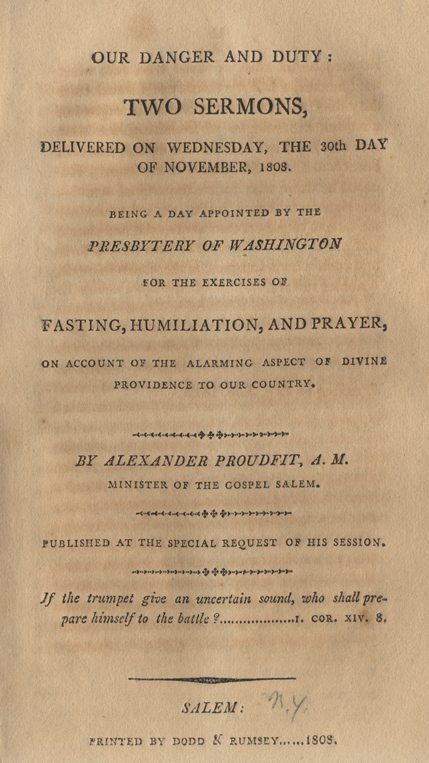
Sermon – Fasting – 1808, New York


Alexander Proudfit (1770-1843) graduated from Columbia in 1792. He served as minister at a congregation in Salem, NY (1795-1802), and was a Professor at the Theological Seminary of the Associate Reformed Church (1819-1820). The following fasting sermons were preached by Proudfit in November, 1808 in Salem, NY.


sermon-fasting-1808-new-york

OUR DANGER AND DUTY:

TWO SERMONS

DELIVERED ON WEDNESDAY, THE 30TH DAY
OF NOVEMBER, 1808.

BEING A DAY APPOINTED BY THE

PRESBYTERY OF WASHINGTON

FOR THE EXERCISES OF

FASTING, HUMILIATION, AND PRAYER,

ON ACCOUNT OF THE ALARMING ASPECT OF DIVINE
PROVIDENCE TO OUR COUNTRY.

BY ALEXANDER PROUDFIT, A. M.
MINISTER OF THE GOSPEL SALEM.

OUR
DANGER, &c.

JEREMIAH v. 29.

SHALL NOT MY SOUL BE AVENGED ON SUCH A NATION AS THIS.

This prophet appeared in a very degenerate period of the Jewish church. Every order of that people, from the humble peasant to the prince on the throne, had apostatized from the true God, and had lost that simplicity in his worship, and that zeal for his name which were their former characteristic and glory. The mass of the people, forsaking the Lord God of their fathers, had mingled in all the absurdities of the idolatry of the nations around them: their princes did evil in the sight of Jehovah, and no longer ruled for his glory, or the good of their subjects: even those who were called to minister at the altar degraded both themselves and their office by servile, corrupt, mercenary spirit: The sun had also gone down upon their prophets; these lights of Israel were now darkened through error of principle, and licentiousness of practice; instead of stemming the torrent of general defection by exposing with a holy heroism the iniquities of all classes, they rolled along with the stream, and rather tended to swell and infuriate it by prophecying a false vision, and the deceit of their own hearts. There is not a more awful presage of speedy destruction to a nation than when, as the prophet expresses it, there is like people, like priest; when corruption of manners generally prevails, and the messengers of the Lord of hosts have neither firmness nor fidelity to make an open opposition.

The Lord God, grieved and provoked with these abominations, gently, yet severely reminds Israel of her former zeal for his glory, and his delight in her as his peculiar people. I remember thee, the kindness of thy youth, and the love of thine espousals: Israel was holiness to the Lord, and the first fruits of his increase. He then appeals to heaven and earth, whether an example of such ingratitude and obstinacy could be found in any other nation. Hast thou seen that which backsliding Israel hath done: She is gone up upon every high mountain and under every green tree, and there hath played the harlot: and I said after she had done all these things, turn thou unto me, but she returned not: their transgressions are many, and their backslidings are increased, how shall I pardon thee for this? At last worn out with their iniquities, and resolved to make a full end of them as a people altogether incorrigible, Jehovah calls upon Jeremiah to arise and at the peril of his own soul not to refuse denouncing their doom; Thou therefore gird up thy loins and arise and speak unto them all that I command thee; be not dismayed at their faces, lest I confound thee before them. Shall not I visit for these things saith the Lord; “Is not my wrath revealed from heaven against all unrighteousness and ungodliness of man? Can I consistently with the purity and rectitude of my nature; can I consistently with my character as the moral governor of the world pass by with impunity these wanton, these repeated, these gross violations of my law? Shall not my soul be avenged on such a nation as this?

You will readily notice that the expression, shall not my soul be avenged, is rather uncommon; it is used after the manner of men and represents the great God as earnestly and unalterably bent on his purpose; it is designed to express both the certainty and the severity of the judgments to be executed on infatuated Israel.

This day was set apart for the solemn exercises of fasting, humiliation and prayer on account of the alarming aspect of providence to our country. We are not called merely to deprecate that wrath which apparently hangs over our nation; they are greatly mistaken who imagine that this should be our only, or even our principal exercise: we ought to be deeply impressed that our national offences are the cause of our national calamities; we ought impartially to examine what transgression on our part has kindled this hot displeasure; to acknowledge the righteousness of Jehovah in all the judgments with which we are threatened; to improve by faith the atonement of his Eternal Son as the only mean of our reconciliation; to return to him in the exercise of unfeigned repentance, and then earnestly to plead with an offended God that in the midst of wrath he would remember mercy.

In order to assist you in these important exercises it may be proper,

I. To consider those crimes with which as a nation we are obviously chargeable – and

II. Those evidences of divine vengeance which we have occasionally felt and under which we now suffer.

1. As a nation, we are chargeable with shameful ingratitude for privileges enjoyed. It must be fresh in your own recollection when the spot where we now worship was ravaged by the incursions of a formidable, unpitying foe; when the murderous savage with his tomahawk and scalping knife prowled around your dwellings, often piercing your souls with his terrific yells; when the doors of your sanctuary were shut up; when your habitations 1 were left desolate; when the son, torn from the arms of his mother, and the husband from the embraces of his wife, were exposed to the toils and dangers of the field; and you were driven to strangers for a miserable shelter from the inclemency of the season. In that hour of peril and panic, the avenger of wrongs interposed in your behalf; disconcerted the adversary; crowned with victory equally unexpected and signal 2 your feeble exertions, and restored you to the peaceful possession of your own habitations. Since the revolutionary war, which terminated in the independence of our country, we have enjoyed a degree of prosperity without a parallel in the history of any nation; We are favored with a constitution probably the most mile, the most equitable, and, while supported by public virtue, the most diffusive of general happiness that was ever framed by man. While our ears have often heard the thunder of distant war; while almost every arrival upon our coasts has brought the intelligence of the murderous battle fought; of other wives made widows, and other children fatherless; of old kingdoms convulsed, and new empires erected on their ruins, our peace has been uninterrupted: We have eat every man, of his own vine, and every one of his fig tree, and drank every one of the waters of his cistern, without any to annoy or alarm: While famine has waved her scourge over other countries and driven thousands of the inhabitants to the necessity of begging their bread, we have literally rolled in worldly affluence; our soil, under the husbandman’s cultivation, has yielded a rich profusion of fruits, and our commerce has wasted upon our shores the productions of every foreign clime. These outward privileges have been crowned with the infinitely more precious means of salvation. We have enjoyed the oracles of the living God in our own language, and the various ordinances of his worship in their native simplicity and purity. When privileges so pre-eminent are bestowed on a person or a people, returns of thanksgiving, and obedience are expected in proportion; but the blessings heaped upon us as a nation have been equaled only by our ingratitude and impiety. Have we as individuals, been walking in the fear of the Lord, regulating ourselves by his word as the rule, and consulting his glory as the highest end of our lives? As families have we been offering up the tribute of praise to the common Author of our mercies; has each been encouraging the other to the performance of every civil, and social, and religious duty; have we been thus teaching and admonishing one another in psalms, and hymns, and spiritual songs? Have we as a nation exceeded all others in gratitude, as we have been elevated above them in privilege? As citizens, as ministers, as magistrates have we advanced hand in hand, each aiming at the good of the whole; and all promoting the glory of Him who raised us to a rank so exalted among the nations of the earth? How reverse have been our character, and conduct? More ungrateful, more infatuated than Jeshurun we have waxed fat; we have forgotten the God that made us, who redeemed us in the hour of jeopardy, and lightly esteemed the rock of our salvation. The distinguishing goodness of God instead of leading us to repentance, to reformation of life has produced pride, presumptuousness, licentiousness of principle, and profligacy of manners. Our affluence, which ought to have flowed in supplying the wants of the indigent; in supporting the ordinances of religion; in propagating the gospel through the frontier settlements; and in conveying to the perishing heathen the means of salvation, has been prostituted to luxury of living; to extravagance of dress; to the aggrandizement of our families; or in adding house to house and farm to farm. Our language has corresponded with that of the presumptuous monarch of Egypt, Who is the Lord that we should obey him? “Our gold, our silver, our possessions are our own, and for the gratification of our own appetites they shall be employed.” Our gratitude is thus a sin of high aggravation, and is one cause why the Lord God is pleading his controversy with our land. Hear O heavens, and give ear, O earth, for the Lord hath spoken; I have nourished and brought up children, and they have rebelled against me. They have forsaken the Lord; they have provoked the holy one of Israel to anger, they have gone away backward. Might he not in righteous indignation have added, Ah, I will ease me of mind adversaries; I will avenge me of mine enemies?

2. Our daring impiety manifested by a contempt of God, and his ordinances, is another cause of his controversy; one for which we ought this day to exercise humiliation in his fight. How is his infinitely venerable name profaned in the unnecessary, irreverent use of it by some, and in the impious oaths and imprecations of others? Are not his ordinances neglected and despised by many, who live within reach of the sanctuary, and who, by their parents, were early devoted to his service in baptism? Is not that precious volume the Bible; that volume which affords the most reviving expressions of Jehovah’s love, and constitutes the broad charter of all our privileges and prospects; is not that volume regarded by some with neglect and indifference; by others has it not been derided as the offspring of superstition, or priestcraft? Does not a licentious infidelity obviously pervade the higher orders of society in our country? Was not that man who has appeared as one of the most open, bold, unblushing champions in this cause; who has exhausted his talents in the derision of everything sacred; who has uttered the foulest blasphemies, which a polluted imagination could conceive, against the Son of God, against his Person, against the mysteries of his gospel, and the ministers of his religion; has not that man been invited to this country by the leading men of our nation; has he not been corresponded with, and caressed since his arrival? If this circumstance does not avow their real enmity to the Saviour’s cross, it at least betrays an alarming indifference to its interests: And I am bold to assert that those who are hostile to our religion cannot be the real friends of our liberty, whatever be their political pretensions. Divine revelation is the great charter of our rights as men, no less than of our privileges and prospects as Christians; it proclaims to man his dignified origin, as created after the image of God; it inspires the individual with the most exalted sense of his own importance, by declaring that the Lord God hath made of one blood all men to dwell upon the earth, and consequently that all are naturally possessed of certain, equal, unalienable rights: This constitutes the greatest possible security for social order among men by enjoining us to live soberly, righteously and Godly; to do justly, to love mercy, and walk humbly with our God. These are not the sentiments merely of the divine; they are maxims firmly believed and openly avowed by the most accomplished legislators that ever adorned the world. – Suffice it to mention the observations 3 of Him whom all revered as equally the Statesman, the Hero, the Patriot; on whom the eyes of every American citizen were fastened as the brightest ornament of our country; our pride in peace; our shield in war; and, under God, the instrument of incalculable blessings to our nation. “Of all the dispositions and habits which lead to political prosperity, religion and morality are indispensible supports. In vain would that man claim the tribute of patriotism who should labor to subvert these great pillars of human happiness; these firmest props of the duties of men and citizens: The mere politician equally with the pious man ought to respect, and to cherish them. A volume could not trace all their connections with private and public felicity.”

Again, is not the holy Sabbath, that rest which is ordained for the people of God; that institution which is calculated to secure health to the body, no less than happiness to the soul; tht institution which is a lively memorial of the resurrection of our crucified Lord, and furnishes a constant pledge of our own resurrection, is not this day openly prostituted without a blush, and without remorse? Is it not profaned by some in idleness and amusements; by others in unnecessary visits, and by many in the deliberate prosecution of their secular employments? Is not the peaceful worshiper often interrupted and insulted as he repairs to, or retires from the temple of his God, by the wanton transgressors of that sacred institution? And does it not render our guilt more aggravated, and expose us to severer vengeance, that this profanation of the Sabbath is permitted in part by public authority? Our Legislature 4 has explicitly provided that no man “removing his family, or household furniture” shall be detained on that day. Does not this toleration virtually make void the command of Jehovah who had enjoined, TAKE HEED TO YOURSELVES, AND BEAR NO BURDEN ON THE SABBATH DAY, nor bring it in by the gates of Jerusalem; neither carry forth a burden out of your houses on the Sabbath day, neither do ye any work, but hallow the Sabbath day, as I commanded your fathersi. Have we not reason to fear that the Lord God, provoked by our impiety, will execute upon us the vengeance denounced against the nation of Israel, I will draw out a sword after you, and make your cities waste. Then shall the land enjoy her Sabbaths as long as it lieth desolate, and ye shall be in your enemies country; even then shall the land rest and enjoy her Sabbaths.

3. The general, and very gross corruption of public morals is another cause of the divine displeasure with us as a nation. May not the records of our courts of justice testify how common are the crimes of false swearing, and forgery; crimes peculiarly offensive to Jehovah; and which tend to sap the very foundation of social order among men? Do not our daily prints announce the very alarming increase of bankruptcies in our country? Probably one thousand instances of private failure occur now, where not one occurred twenty years ago. This fact evinces the corruption of public morals, as these failures must ordinarily proceed either from a concealment of property with a view to defraud the creditor, or from a mode of living utterly beyond our ability. Is not that most unnatural, most horrid of all crimes, self-murder, become mournfully prevalent among us? Is it not also a fashionable thing; is it not considered the test of real heroism, the characteristic of the man of honor to take, or to aim at taking the life of another in dueling? And is not this murderous 5 practice publicly sanctioned by the advancement of such offenders to stations of emolument and honor? Have we not this moment some standing high in office in our own state, and in the United States, whose consciences are stained with the guilt, and whose hands are encrimsoned with the blood of their fellow-men? Can we expect that our country, in over-looking with impunity this daring offence, will escape the vengeance of him who has solemnly ordained that, WHOSO SHEDETH MAN’S BLOOD BY MAN SHALL HIS BLOOD BE SHED, FOR IN THE IMAGE OF GOD MADE HE HIM.

How common among us are the vices of intemperate drinking, of rioting, of gambling and swearing? Are these not some men presiding on the bench of civil justice who are grossly profane in their conversation; who have lived in repeated acts of uncleanness; who are devoted to gambling, and by whom the Lord’s day is often spent in their worldly occupations? This dissipation of conduct is offensive in any man but accompanied with peculiar aggravations in the magistrate who explicitly is pronounced a MINISTER OF GOD FOR GOOD to others: it is a direct prostitution of his sacred function, and renders him a terror not to evil works, but to the good. Civil government is as really an ordinance of Jehovah, as ecclesiastical government; he, therefore, who sustains an office in the state ought to aim at purity of conversation, no less than he who sustains an office in the church; and when they who rule in either capacity lose sight of the solemnity of their station, they degrade both themselves and their office. It is the uniform, the upright, the dignified deportment of the man which gives majesty to the minister: it is no less the uniform, the upright, the dignified deportment of the man which gives majesty to the magistrate. Besides, a wanton dissipated conduct in those who sustain the office of the civil magistracy has a tendency to demoralize society at large. When the root of a tree is rotten, the branches cannot remain verdant, and flourishing; if the fountain itself be polluted, we cannot expect the stream to be pure, and when the head of the body politic becomes disordered the deadly contagion necessarily spreads through all parts of the system.

There is another evidence of public corruption which I dare not pass over unnoticed: I mean the obvious prostitution of the right of suffrage. In our free government the choice of all rulers either immediately or remotely depends on the people. This right of electing our own representation is the great privilege for which our fathers fought, and which is bequeathed to us, sealed with the blood of thousands; this is a privilege for which many of you fought, and for the purchase of which some of you bled: It is the full enjoyment of this right which distinguishes the citizen from the subject; which exalts the freeman in one country above the abject insulted, degraded slave in another country: But is not this right criminally prostituted among us? What is the primary qualification which is ordinarily fought in the candidate for public office? Do we attend to the admonition prescribed by Eternal truth, He that RULETH over men must be JUST, RULING in the FEAR of Jehovah? Have we pursued the maxim delivered by the wisest of men, and the most magnificent, prosperous of Princes, RIGHTEOUSNESS EXALTETH A NATION, and offered our suffrages for those who in private life were patterns of righteousness, and as rulers would probably use their influence for promoting it among others? Have we not more generally enquired, “where is the decided, ardent partisan; the man who will most zealously adhere to that political section to which we belong,” without regard to moral, or religious, or even intellectual qualifications? In the warmth of party-spirit have we not contributed to the advancement of those who were the known enemies of religion, and have allowed themselves in falsely slandering its ministers? On this day of humiliation as the messenger of the Lord of hosts, and as I desire to be found faithful to my trust when the storm is blackening over us, I bear my testimony against the promotion of unprincipled, immoral, impious men as a most aggravated iniquity in our land; and I believe, as firmly as I believe my existence, that without speedy and special repentance on our part, this insult to the Lord of hosts will bring wrath upon our nation, until both our ears will tingle. Has he not most solemnly forewarned us that, when righteous men are in authority the people rejoice, but when the wicked rule the land mourneth? Besides, the election of men to public office who are destitute of moral rectitude, is impolitic in the extreme, and puts in jeopardy our most important interests as citizens. Hear the sentiment of a reverend member who adorned our counsels during the struggle with Great-Britain; one in whom were united the eminent divine, the enlightened statesman, and the uncorrupted, ardent patriot. “Those who wish well to the state ought to choose to places of trust men of inward principle, justified by exemplary conversation. It is reasonable to expect wisdom from the ignorant; fidelity from the profligate; or application to public business from men of dissipated life? Is it reasonable to commit the public revenue to one who has wasted his own patrimony? Those therefore who pay no respect to religion and sobriety in those whom they send to the Legislature of any state, are guilty of the greatest absurdity, and will soon pay dear for their folly. Let a man’s zeal, professions, or even principles as to political measures be what they may, if he is without personal integrity and private virtue, he is not to be trusted. I think we have had some instances of men who have roared in taverns for liberty, and been most noisy in public meetings, who have become traitors in a little time. Suffer me on this subject to make another remark. With what judgment will laws against immorality be made, or with what vigor will they be executed by those who are profane and immoral in their own practice. Let us suppose a magistrate on the bench of justice, administering an oath to a witness or passing sentence of death upon a criminal and putting him in mind of a judgment to come. With what propriety, dignity, or force can any of these be done by the one who is known to be a blasphemer, an infidel, or by whom in his convivial hours everything serious or sacred is treated with scorn. 6

Permit me to notice as another cause of the divine displeasure those bitter contentions, those mutual reproaches which abound among us. What are our seasons of election but seasons of detraction, and defamation, by which the passions of each other are inflamed? What liberties are frequently taken in reproaching public men, and misrepresenting public measures. Does not the living God explicitly forbid the indulgence of hatred, variance, emulations, wrath and heresies? An untender, unforbearing spirit between man and man is always inexcusable, but it is peculiarly offensive when cherished by those who are citizens of the same commonwealth; whose civil and social interests are immediately blended together. In republican forms of government, where public virtue is the great pillar on which the government rests, a degree of party spirit may be profitable; one portion of the community thus proves a “watch-tower” to the other; but when this spirit becomes outrageous and infuriated, when jealousy pervades every class of society, and extinguishes almost every spark of mutual confidence, it proves equally reproachful, and ruinous.

These are a few of those provocations with which we are chargeable as a people, and for which we are chargeable as a people, and for which without sincere repentance on our part, the scourge of a righteous God will unavoidably overtake us. For such provocations were his judgments for merely denounced against even his favorite Israel, and owing to their obstinate impenitence were finally executed in their utter destruction. If ye will not hearken unto me, saith Jehovah, and do all my commandments: and if ye shall despise my statutes, or if your soul abhor my judgments; I also will do this unto you; I will appoint unto you terror, consumption, and the burning ague that shall consume the eyes and cause sorrow of heart; and ye shall sow your seed, and your enemies shall eat it; and I will make your cities waste and bring your sanctuary into desolation. Then shall the land enjoy her Sabbaths. Again, if ye will not hearken unto me to hallow the Sabbath day, and not to bear a burden, even entering in at the gates of Jerusalem on the Sabbath day; then will I kindle a fire in the gates thereof, and it shall devour the palaces of Jerusalem and it shall not be quenched.

Brethren, when we read these fearful denunciations, and then contemplate our own conduct, who must not tremble for his country? Was the holy Sabbath more generally, or wantonly profaned in Judea, than in America? Were the streets of Jerusalem more frequently polluted by the unhallowed buyer and seller on that day, than are the streets of our own settlements and villages and cities? Must we not rationally expect that the foul of our offended sovereign will be avenged on such a nation as ours? Is the violation of his law less aggravated among us whose light is more clear, whose privileges are more exalted than among them; or is the Lord God less righteous to avenge the quarrel of his covenant? Nay, have not our judgments already commenced?

To consider the evidences of divine wrath which we have occasionally experienced, and under which we now suffer, was the second part of our subject, and demands our attention.

1. Has not a Holy God often plead his controversy with our land by a fearful pestilence? Receiving its commission from on high, has not this scourge gone abroad through our country, and visited in their turn our cities from the northern to the southern extremities of the union? In its hostile career has it not desolated for a season the sanctuaries of God; driven from their abodes thousands of our citizens, and mingled in sudden promiscuous ruin the babe, the youth and the hoary head?

As another mark of his indignation, and another mean of reclaiming an ungrateful apostatizing people, has he not commissioned the fire to become the avenger of his quarrel? Has not this devouring element laid waste in some degree many of our cities, and reduced from affluence to poverty hundreds of their inhabitants? The messengers of Jehovah’s wrath have not been confined to our cities, but have occasionally visited all parts of the country. The insect, an army small, imperceptible, yet irresistible, has marched through the land, and cut down in its progress, the staff of life. Before it our fields were cloathed with verdure, and flourishing as the garden of Eden, but behind it a desolate wilderness. Did he not in one year shut up the windows of heaven, refusing to us the early and latter rain in their season; and by intemperate rains in another year did he not destroy the fruits of the earth, blast the hopes of the husbandman, and alarm with apprehensions of cleanness of teeth? Such are the scourges which we have occasionally felt in years that are past; such the expressions of divine indignation under which our land has often trembled: Natural causes have been ingeniously assigned for all these calamities: Presumptuous, impious mortals would fondly exclude Jehovah from all agency in the world, as they extinguish every generous impulse of his fear and love in their own hearts: Every occurrence, whether prosperous or adverse, is ascribed by them to secondary means; but the man of wisdom will consider them as coming forth from the Lord of hosts, and as visitations either of his mercy or wrath. Is there evil in the city; is there evil in the country, and the Lord hath not done it? Does the pestilence consume the persons of our citizens, or the fire devour their property? Does the rain prove our scourge in one year, or the draught in another, or the mildew in another without his permission and appointment. They are alike the ministers of almighty God; they come only at his call, and they continue to fulfill the high commission received from his hand. Thus he declared to Israel formerly, and thus he may declare to America now, I have withholden the rain from you when there were yet three months to the harvest: I have smitten you with blasting and mildew: I have sent among thee pestilence after the manner of Egypt. I have overthrown some of you, as God overthrew Sodom and Gomorrah.

For all these his anger is not turned away, but his hand is stretched out still. Is not our nation trembling at this moment under awful appearances of the divine displeasure? Has not the cloud collected, and spread, and darkened every part of our horizon, and is seemingly ready to burst forth in our destruction? Are we not now assembled in this sanctuary for the very purpose of deprecating the displeasure of our God; of confessing and mourning over our national guilt as the procuring cause, and to implore his return in loving kindness to our land? The anger of the Lord hath divided us as a people; he no longer regards us. Does not a diversity of sentiment; does not alienation of affection almost universally prevail? Has not mutual confidence departed from our fellow-citizens, and the fell demon of discord succeeded in its room? Is not the brother alienated from his brother; the son from his father; the neighbor from his neighbor; the citizen from the magistrate? Nay, has not mutual confidence departed in some instances from the spiritual pastor and the people of his charge? Is it not a notorious fact that if the servants of the cross remain faithful to their trust; if they expose without partiality and without hypocrisy the corruption of men and magistrates, they are immediately slandered in public houses and public prints; they are represented as rallying under the standard of party, and as converting their pulpits into political engines. Have not these jealousies, these contentions diffused their deadly influence through every part of the community? Do they not tend to distract the proceedings of every assembly, from the petit-jury up to the highest deliberative counsel in the nation? Has it not become a matter of course that a measure proposed by one class of the community will be opposed and reprobated by the other? Although we are citizens of the same commonwealth, and united by the dearest social connections; although we have all that is interesting to us in time, our property, our liberty, our religion, our lives embarked on the same bottom, yet we mark the movements of each other with all the suspicion of the avowed, irreconcilable enemy. This alienation of heart; those bitter reviling I formerly mentioned as our sin; I would now mention them as a most deplorable calamity, and as an evident, very awful proof of the Lord’s controversy with us. It is an old proverb, uttered by an infallible teacher, that a house divided against itself cannot stand. When we see a particular family split up into factions; each member torturing the feelings, crucifying the character, and opposing the interests of the other, we conclude without hesitancy that the Lord has departed from that house, and that its desolation is near. It is not less true of nations than of particular families, united and you establish; divide and you destroy. – When Jehovah denounced the overthrow of Egypt for their contempt of his name, and the cruelties which they had perpetrated upon his people, he declares, I will set the Egyptians against the Egyptians, and they shall fight every man against his brother, and every man against his neighbor; city against city, and kingdom against kingdom. May we not therefore consider our internal dissensions and distractions as coming forth from the Lord of hosts, and as his righteous judgment upon our guilty land? Are we not constrained to deplore in the plaintive language of the prophet, The anger of Jehovah hath divided us; Manasseh against Ephraim, and Ephraim against Manasseh, and they together shall be against Judah.

For all this his anger is not turned away, but his hand is stretched out still. We are now pressed down under a general and heavy calamity: our commerce, the chief source of wealth to the individual, and of revenue to the government is in a great measure destroyed, and even our peace is endangered by the hostile appearance of foreign nations. More than a year have we suffered under these complicated evils, and their effects have produced embarrassment among all classes of society. No longer is employment offered as formerly to the laborer; no longer is the toil of the husbandman rewarded by an equal compensation for his produce, no longer is the merchant animated to enterprise by success in his trade; no longer are our harbors enlivened by a race of hardy, generous seamen; no longer does our canvass whiten the ocean; no longer do our ships return wasting upon our shores the wealth, and the luxuries of every clime: Different causes are assigned for this sudden, calamitous reverse of our situation: by some it is attributed to the want of wisdom and energy in our administration; by others to the intolerant, oppressive measures of Britain; by others to the ambition, intrigues, and corrupting influence of France, but this also must be considered as coming forth from the Lord of hosts, and by this he is avenging his quarrel with our country. It is his blessing which maketh rich; that crowns with prosperity the individual, or the community, and it is his displeasure which blasts their enterprise; his displeasure causes citizen to become alienated from citizen; wisdom to depart from our rulers; commerce to quit our shores, and that is threatening to muster the hosts to the battle. Behold the Lord maketh the earth empty, and scattereth abroad the inhabitants thereof, because they have transgressed the laws; changed the ordinance and broken the everlasting covenant: The new wine mourneth; the vine languisheth; all the merry hearted do sigh: He stretched out his hands against the sea; the Lord hath given a commandment against the merchant city, to destroy the strong holds thereof.

I must trespass on your patience by noticing another evidence of the divine displeasure with our country; it is one which must peculiarly interest and alarm the hearts of all who realize our dependence on the God of nations, that our attention has never been directed to the real source either of our miseries, or relief. A spirit of lethargy, of slumber when the great God is shaking his rod over a nation is not merely their sin, but a fearful presage of a more dreadful visitation. Because they consider not the works of the Lord, nor regard the operations of his hand; therefore the Lord will destroy them and not build them up. There is probably not a more awful evidence that an individual, or a nation is abandoned of God, and marked as victims for his wrath than to be given up to themselves; to be permitted to remain unawakened and unconcerned amidst the alarming dispensations of his providence. When the cup of iniquity of Israel was nearly full, and the decree for their destruction had irreversibly passed, how awful is the commission given to the prophet, Make the heart of this people fat, and make their ears heavy, and shut their eyes: lest they see with their eyes, see my judgments which are already gathered and lowering over their heads; and hear with their ears, hear my voice of warning in my word, by my messengers, in the movements of my providence; and understand with their heart, be really affected with their own abominations as the meritorious cause of their miseries, and be healed. The prophet melted at hearing the doom of his deluded country affectionately replies, Lord, how long? He is answered by the oracle, Until the cities be waste without inhabitant, and the houses without man, and the land be utterly desolate.

Brethren, does not our situation as a nation obviously and awfully correspond with that of deluded Israel? Can we imagine that they were more stupid, more infatuated amidst the terrors of the Almighty than are we in America? Much time has been occupied in devising the means of safety; much treasure has been expended in fortifying our harbors: message after message has been transmitted to foreign courts representing our grievances and demanding redress; but during all our alarms, all these exertions for maintaining our rights has the Lord of hosts been acknowledged by us as a nation; have we been called by our civil Rulers to ask the interposition of him by whom kings reign, and princes decree justice; by whom princes rule, and nobles even all the judges of the earth? Nay, I mention it with the most profound emotions of regret, and of trembling; of humiliation for the past and apprehensions for the future, that during eight years we have not been recommended in a national capacity to acknowledge the Ruler of nations: no tribute of thanksgiving has ascended to his throne in the season of prosperity; neither have we in adversity been directed to the confession of guilt, nor to ask the interference of that arm which works salvation. Was such the example exhibited by our illustrious patriots of 1776; by those who then directed our counsels, marshaled our armies in the field, and were, under God, the instruments of our national glory? On the 17th of May in that year, a day that must remain memorable while the love of liberty is cherished in our country, the oppressed millions of America at the call of their rulers approached the mercy-seat, laid a history of their grievances before the avenger of wrongs; implored his interposition in their behalf, and his ear was graciously open to their cry.

From this doctrine, thus explained, it is obviously suggested,

1. That verily there is a God who judgeth in the earth. Vain, impious mortals frequently ask, Who is Jehovah that we should obey him? In the infatuation and madness of their hearts, they often challenge, How doth God know, and is there knowledge in the most high? In the enthusiasm of their impiety, they are resolving, Let us break his bands asunder and cast his cords from us. But notwithstanding all their presumption and self-confidence, their judgment lingereth not, and their damnation slumbereth not. He that sitteth in the heavens shall laugh at them; the Lord shall hold them in derision: Then shall he speak to them in his wrath and vex them in his fore displeasure. Though hand join in hand his soul will be avenged sooner or later on the wanton, incorrigible person or people. – What is the history of the world, but a history of Jehovah’s judgments in the overthrow of haughty, licenscious nations? Where are now the once mighty, magnificent empires of Egypt, of Assyria, of Greece, of Rome? Where are now their splendid cities, their adamantine walls towering towards heaven; their disciplined armies; their gates of brass, their chariots of iron which promised an invincible defense against every assault from without? We behold them in their turn receding from the earth, and their memorial has nearly perished with them: there remains nothing but their name feebly written on the historian’s page. – How are the mighty fallen, and the weapons of war perished? What crashing of thrones and kingdoms have we witnessed with our own eyes? Where is now the antient, august monarchy of France; that which stood for ages, and apparently defied even the hand of time? Have we not seen it and many others totter to their foundations, and hundreds and thousands of the inhabitants lost in the general wreck? Is it argued “that these kingdoms, having grown old, decayed and mouldered away of course, as everything created naturally tends to dissolution;” or is it argued, “that internal causes may be assigned for all these effects; that violent insurrections convulsed the empire of Rome, and that Babylon was taken during the licenscious rioting of her princes and nobles? These objections do not in the least militate against the argument. The sovereign ruler of nations accomplishes his purposes by secondary causes; by means he protects the righteous, and by means he executes vengeance on the deluded, insolent opposers of his government. – As a proof, for instance, that the conquest of Babylon and the destruction of the empire was of God, this event was foretold ages before its accomplishment; the instrument of its overthrow was mentioned by name; the very manner in which he should execute his purpose was minutely expressed; and yet all was represented as the effect of divine vengeance against the Assyrians. Come down, saith Jehovah by his prophet to that impious city, come down and sit on the ground; For thou hast trusted in thy wickedness; thou hast said, none seeth me: Therefore shall evil come upon thee; thou shalt not know from whence it riseth; and mischief shall fall upon thee; thou shalt not be able to put it off; and destruction shall come upon thee suddenly which thou knowest not. Through the anger of almighty God these fearful desolations are spread among the nations of the earth: A flood of impiety, of licensciousness on their part is succeeded by a flood of wrath on his part.

2. We learn from this doctrine who are the enemies of a country; who disturb her peace, who interrupt her prosperity and endanger her very existence; they are those who live in the contempt of God, and the violation of his righteous law. These are the Achans in the camp who bring wrath upon the nation of Israel. The immoral, impious man; the swearer, the Sabbath-breaker, the insolent scoffer of religion and its institutions; the parent who is undutiful in his station, who is not diligent in educating his offspring for God and his service; the magistrate who does not rule in the fear of Jehovah, but pollutes the land by a loose, licenscious deportment and conversation: These are the persons, by whatever political name they are known, or under whatever mask they appear among their fellow-citizens, who bring down the judgments of heaven on settlements, and cities and nations: These are the persons who occasionally shut up the windows of heaven, suspending the early and later rain in their season; who dry up the streams of commerce; who give commission to the pestilence wasting its thousands in our streets; who unsheathe the sword of war, and drench a land in the blood of its inhabitants. Hear the word of the Lord ye children of Israel: hear his word, ye citizens of America, for the Lord hath a controversy with the inhabitants of the land, because there is no truth, nor mercy, nor knowledge of God. By swearing and lying, and killing, and committing adultery they break out, and blood toucheth blood. Therefore shall the land mourn, and everyone that dwelleth therein shall languish with the beasts of the field and the fowls of heaven. They, on the other hand, are the true patriots who fear God; who work righteousness; who render to all their due, giving unto Caesar the things that are Caesar’s and unto God the things that are God’s; who keep holy the Sabbath by “spending it in the public and private exercises of divine worship;” who visit the fatherless and widow in their affliction, and preserve themselves unspotted from the world: parents who are devout in their habitations; who early infuse into the hearts of their children the principles of religion and virtue; magistrates who feel the solemnity and responsibility of their station, being ministers of God for the good of society; who assume the important office, not from motives of interest, or honor, but that they may rule for the glory of him by whose authority they act, and to whose bar they are accountable; who by the blamelessness of their conversation, and by the impartial discharge of every official duty become a terror to evil doers and a praise to them that do well; ministers who abound in the work of the Lord; who are not lured from their sacred function by considerations of worldly ease, or emolument, but actuated by the same spirit with their divine master, go about doing good: such persons, such magistrates, such ministers are the genuine patriots and friends of their country. Contemplating such I may freely exclaim in the language of a Jewish king to the prophet of Jehovah, my Father, my Father, the chariots of Israel, and the horsemen thereof. They are the massy pillars which gives stability to a nation within; they are the broad shield which render her invincible and impenetrable by any opposition without. Their prayers, their intercessions, their alms are of more importance towards her defense than all the speculations of the vain philosopher; than all the schemes of the self-confident statesman; than all the martial prowess of either the soldiery or navy. For the sake of these, judgments are often averted and days of calamity are shortened. The waters never gushed up on the old world until Noah was secured in the ark; the arm of the destroying angel was stayed from the destruction of Sodom until Lot had escaped to the mountains, and when Phineas arose, and, as a faithful magistrate, executed righteousness the plague was instantly arrested in the camp of Israel. Run, faith Jehovah to the prophet his messenger, run ye to and fro through the streets of Jerusalem, and seek ye in the broad places thereof, if ye can find a man; if there be any that executeth judgment; that seeketh truth, and I will pardon it.

3. We learn from this doctrine the suitable exercises of a people in the season of impending judgments; they ought diligently to enquire into the cause of the Lord’s controversy; they should aim at discovering those national sins which are the procuring cause of national calamities. We hear the prophet complaining with respect to the people of Israel, O Lord, thou hast stricken them, but they have not grieved; thou hast consumed them, but they have refused to receive correction: When thy hand is lifted up they will not see, and will not behold the majesty of the Lord. This complaint is mournfully applicable to us amidst the present alarming appearances of divine providence. Our attention is chiefly confined to the instruments, one party is disposed to throw the censure upon the other; the citizen reprobates the ruler, and one portion of the rulers reproach the other as the cause of our evils. But whatever sinful instrumentality men have in involving our country in the present state of embarrassment and alarm, the Lord God has a sovereign, righteous agency; he is avenging his quarrel with an ungrateful, disobedient nation: and until we become sensible of his displeasure as manifested in our judgments; until we discover our own iniquities as justly provoking this displeasure; until we are sincerely humbled on account of our iniquities, and led to the blood of reconciliation as our only remission, I shall entertain little hopes that the rod will be removed. Let all, on this day of humiliation, turn their eyes upon their own hearts and impartially examine their particular exercises; are they cordially melted for their own iniquities and for the abominations that prevail in the land? Are they sincerely humbled before the Lord that ordinances are so generally neglected; that Jesus and his great salvation are despised, that the holy Sabbath is wantonly prostituted by all classes in our nation? Such were the exercises of the church formerly in the season of her calamity, and such, if we have received an unction of the same spirit, will be our exercises this day. O Lord, to us belong confusion of face, to our kings, to our princes, and to our fathers because we have sinned against thee; yea, all Israel have transgressed thy laws; therefore the curse is poured upon us, and the oath that is written. With confession of former sins let us connect earnest resolutions of amendment in the time to come. Would to God that henceforth all classes of our citizens were going hand in hand, and weeping as they go; saying, with penitent Israel, let us return to the Lord, for he hath torn and he will heal; he hath smitten and he will bind us up: come and let us join ourselves to Jehovah in a perpetual covenant that shall not be forgotten. Such exercises would be the surest presage of future peace and felicity and glory to our nation: They might be considered an infallible pledge that the cloud which now darkens our horizon will shortly evanish, and that the fun of prosperity will revisit with his cheering beams our long favored land.

O Lord, revive thy work in the midst of the years; in the midst of the years make known: in wrath remember mercy. Amen and Amen.


OUR DUTY, &c.
SERMON II.

AMOS iv. 12.

AND BECAUSE I WILL DO THIS UNTO THEE; PREPARE TO MEET THY GOD, O ISRAEL.

The holy scriptures are admirably adapted to man in his present, imperfect, militant state. They forewarn him of approaching calamities; they afford direction in every perplexity; they inspire with confidence in the hour of surrounding peril, and impart consolation amidst the various adversities of life. – The admonition contained in our text must appear peculiarly seasonable to Israel, when we realize her awful and interesting situation at the time of its delivery. It was uttered by the inspired messenger in the days of Uzziah king of Judah, and in the days of Jeroboam king of Israel, two years before the earthquake. The visitation of the Jewish nation by an earthquake is noticed only in this place, and by the prophet Zechariah. The latter as the messenger of divine wrath declares, I will gather all nations against Jerusalem to battle; and the city shall be taken, and the houses rifled: and ye shall flee to the valley of the mountains; yea, ye shall flee, like as ye fled before the earthquake 7 in the days of Uzziah king of Judah. The Lord God never wants instruments for avenging his quarrel with the enemies of his government: All elements are subject to his sovereign control, and all agents, visible and invisible, rational and irrational, from the least insect which moves on the earth to the loftiest angel who walks the streets of heaven are at his disposal, and stand ready to perform his pleasure either of mercy or wrath: Yet HE is infinitely slow to anger, and displays his exceeding, abundant compassion in giving previous intimations of approaching calamities. The cloud usually makes its first appearance small as a man’s hand; it gradually rises higher and becomes darker, before it bursts forth upon the object devoted to destruction. The great God warns the wicked by his word, raising up messenger after messenger; by his providence, inflicting lesser judgments as a mean of reclaiming and saving them from more awful visitations. He thus proves to the satisfaction of every rational spectator, that he is merciful, and gracious, long-suffering and abundant in goodness and truth; that he has no pleasure in temporal destruction of nations, or in the everlasting ruin of individuals, but would rather that both should repent, and return and live. Before he opened the fountains of the deep, and brought the flood upon the old ungodly world, he raised up Noah a preacher of righteousness, and warned them year after year; previous to the overthrow of Ninevah, that great city, he commissioned Jonah to go forth and proclaim in the streets, yet forty days and Nineveh shall be destroyed; and before he pours out the fury of his anger upon Israel, his once favorite people, the offspring of Abraham his servant, he addresses them in the admonition which you have heard, prepare to meet thy God, O Israel.

In the preceding verses of this chapter, the prophet, in the name of his God, recapitulates to this deluded, obstinate nation the various methods which had been employed for their reformation. And I also have given you cleanness of teeth in all your cities, and want of bread in all our places, yet have ye not returned unto me, saith the Lord: And I have also withholden from you the rain, when there were yet three months to the harvest, yet have ye not returned unto me, saith the Lord: I have smitten you with blasting and mildew, yet have ye not returned unto me, saith the Lord: I have sent among you the pestilence after the manner of Egypt, yet have ye not returned unto me, saith the Lord: I have overthrown some of you, as the Lord overthrew Sodom and Gomorrah, and ye were as a fire-brand plucked out of the burning, yet have ye not returned unto me, saith the Lord. Who that has noticed, in the most superficial manner, the dispensations of Jehovah toward us as a people, must not read in our punishments a counterpart of the punishments formerly inflicted on Israel? Did not a righteous God, year after year, withhold from us the rain of heaven, causing the pastures to fail in the field, and the corn to languish in the valley? Has he not occasionally smitten us with blasting 8 and mildew? Has he not sent among us again and again the pestilence 9 after the manner of Egypt? And is not the accusation, which was brought against Israel, at least as applicable to us, Yet have ye not returned unto me, saith the Lord? Where is there any evidence that either our mercies or our judgments have proved effectual for reclaiming or reforming us? Are the living oracles more generally read, or more deeply revered? Is the sanctuary attended now by those who formerly lived in the neglect of its ordinances? Are the praises of God resounding now in houses, where that celestial melody was formerly unheard? Is the holy Sabbath more consciensciously sanctified through our land, or does the power of Godliness shine more illustrious in the lives of those who possess the form? Is the charge of pride, extravagance, injustice between man and man, and ingratitude to the God of our mercies less applicable now than in years that are past? Nay, has not the tide of our impiety and profligacy risen with the tide of our prosperity, and when the divine hand has been stretched out for our correction we have not seen it, neither have we trembled under these displays of the majesty of Jehovah. Is such the fact, beloved brethren, then I cannot address you in language more appropriate than the admonition of the prophet to his nation, prepare to meet thy God, O Israel.

The people to whom the warning is directed are Israel, the visible church of God. The fire of divine jealousy burns peculiarly awful around his altar: There the light shines most clear; there the voice of admonition is most frequently heard; there the privileges are most exalted, and consequently there the consumption determined usually commences its career. – Those who rank first in point of privilege are ordinarily made the first and most fearful monuments of divine indignation. Judgment must begin at the house of God. Rebellion in a son is both more unnatural and inexcusable, than in a servant: Our abhorrence is much more excited by an act of treachery in a pretended friend, than in the open, avowed enemy; upon the same principle the crimes of a professing people are most offensive to God, and expose to the severest marks of his displeasure. You only have I known of all the families of the earth; I will therefore punish you for your iniquities. The history of the world fully confirms the truth of these denunciations. – Those very parts of the earth which were long, and singularly favored with a pure dispensation of the gospel, have been afterwards as singularly the feat of judgments, both temporal and spiritual. Turn your eyes for a moment to Jerusalem, once the most distinguished spot of the earth; that city where the temple was erected; where the living oracles were proclaimed; where the morning and evening sacrifice, this lively pledge of our Great Propitiation, was offered up; where the incense arose in sacred columns from the censer of Aaron the type of the high priest of our profession; where the ministry of our Lord was chiefly accomplished; where miracles the most sublime were frequently wrought by his hands, and celestial truth flowed from his lips: Behold also Corinth, 10 Sardis, Smyrna, and Thyatira, cities where flourishing churches were early planted by the Evangelists and Apostles of our Lord. How has their external importance sunk, and their spiritual glory departed? Just in proportion as evangelic light formerly shone clear around, a cloud dark and impenetrable envelopes them, and the wretched inhabitants are debased by ignorance, by superstition, by every species of abomination.

This verse, thus explained, presents to our consideration,

1. A solemn event, a meeting with our God; and

2. Our duty in the prospect of this event, prepare to meet thy God.

Each individual of the human kind must meet Jehovah at death: The immortal spirit, immediately after its separation from the body, is summoned to the tribunal of its judge; then it is called to render a solemn account of its stewardship, and afterwards, according to its works, is adjudged to an unchanging destiny, either of glory or shame. It is appointed unto all men once to die, and after death the judgment: Again, we must all appear before the judgment seat of Christ, that everyone may receive according to the things done in his body, whether they be good or evil.

All mankind collectively must meet Jehovah in the hour of general retribution. The Lord God hath appointed a day, in the which he will judge the world in righteousness, by that man whom he hath ordained. The trump of the archangel shall found; the great white throne shall be erected; the sign of the son of man shall appear; the judge shall descend; all the living shall be instantly changed, and all the dead arise: then the kindreds of the nations shall flock to the judgment seat of their common Lord, and receive one general irreversible sentence, When the son of man shall come in his glory, and all the holy angels with him, then shall he sit upon the throne of his glory; and before him shall be gathered all nations, and he shall separate them the one from the other: the deeds done in the present life must then undergo a review the most minute, the most impartial, and the countless myriads of the human family be awarded to everlasting life, or everlasting perdition.

But the meeting with God to which the prophet alludes, and for which he admonishes Israel to prepare, is an event materially different; it belongs to particular communities, or nations, in their public, social capacity. There are periods of national retribution, no less than of personal retribution; periods when the adorable Ruler of the universe rises from his throne, and comes forth to reckon with the inhabitants of a country; when he takes a review of all the privileges bestowed upon them; of all the deliverances wrought from time to time in their behalf; of the duration of their national peace; of the degree of their national prosperity, and then chastises them for the abuse of their privileges. Hear, all ye people; hearken, O earth and all that therein is: For behold the Lord cometh forth out of his place, and will come and tread on the high places of the earth: For the transgressors of Jacc is all this, and for the iniquity of the house of Israel.

The dealings of a sovereign God toward individuals and nations obviously correspond. He spares the particular person notwithstanding numerous provocations; he affords him the means of repentance, and the offers of life; he alternately alarms and allures; he tries him now with mercies, then with judgments, before he gives commission to cut him off as utterly incorrigible: And such also is his conduct toward nations in general. He admonishes them for their impiety; he forewarns them now by his messengers, again by the movements of his providence of calamities that are approaching; he executes one threatening as a mean of awakening them to repentance, and saving them from other and severer scourges: He thus entreated with the old world one hundred and twenty years by the ministry of Noah; he thus reproved the cities of the plain by Lot as his messenger, before it turned them into ashes, making them public monuments of his vengeance. With what long-suffering did he expostulate with the nation of the Jews before he finally marked them out as the people of his wrath? How shall I give thee up, Ephraim? How shall I deliver thee, Israel? How shall I make thee as Admah? How shall I set thee as Zeboim? My heart is turned within me: my repenting are kindled together. And upon their partial reformation in the days of Samuel, of Asa, of Josiah he immediately suspended the execution of his judgments, and wrought salvation in their behalf.

When an individual willfully closes his eyes against the light of the Gospel; when he shuts his ears against its pointed and repeated admonitions; when he tramples with deliberate hardihood on mercies and judgments Jehovah in awful sovereignty leaves him to his own delusions; he ceases to reprove him either by his word, or spirit, or providence; and pronounces him a vessel of wrath fitted for destruction: His condition then becomes utterly and everlastingly desperate: All his prayers, all his tears, all his remorse for past transgressions, or resolutions of amendment in future are unavailing. He that being often reproved and hardeneth his neck, shall suddenly be destroyed and that without remedy. As it is with individuals, it is also with nations. They have their accepted time, and, if the expression be allowed, their day of political Salvation: But if this be misimproved; if they fill up their cup of iniquity, by ingratitude for national mercies, and by a spirit of slumber and impenitence amidst the scourges of his providence, the Lord God abandons them as altogether incorrigible, and irreversibly decrees their consumption: All the intercessions of righteous individuals, and even a general reformation will be unavailing for the removal of divine vengeance: Though Noah, and Daniel, and Job should interpose and supplicate, spare thy people, their prayers may rest in blessings upon their own heads, but will not stay the hand that is stretched out for correcting the nation. The sovereign Ruler of the world either pours upon them a spirit of discord and confusion, making one part of the community the instrument of destruction to the other, or he surrenders them up an easy prey to some foreign foe. What an example of his vengeance against the disobedient, incorrigible nation do we behold in the final overthrow of the Jews and their city. O Jerusalem, Jerusalem, thou that killest the prophets and stonest them that are sent unto thee, how often would I have gathered thy children together, as a hen gathereth her chickens under her wings, and ye would not: Behold your house is left unto you desolate. If thou hadst known, even thou at least in this thy day the things which belong to thy peace, but now they are hid from thine eyes.

Is there not reason to apprehend that such a meeting with our God is awaiting us as a nation; that it is near at hand? The signs of the times are peculiarly ominous and deserve the attention of all: The Lord God has come out of his place, and in a manner unusually awful is punishing the inhabitants of the earth. With our own eyes we have beheld him shaking all nations; we have seen the sword of war unsheathed in almost every part of the globe; we have seen her crimson flag unfurled by land, and on the ocean; the earth has been reddened, and the very waters of the deep have been tinged with blood 11 of the slain; we have seen the most ancient and stately empires shook to their center; crowns tottering on the heads of princes; princes hurled from their thrones and princes and peasants mingled in promiscuous ruin. Nation has been rising up against nation, and the Lord of hosts has mustered the hosts of the battle. Hitherto, through his tender mercies, we have escaped the all devouring vortex; our peace, with a few inconsiderable exceptions, has been uninterrupted, and our immunities as an independent nation have been uninfringed. But the period of our public tranquility, we have reason to apprehend, has nearly expired. Are not our natural rights at present wantonly violated, and our commerce invaded; has not the property of our citizens been violently wrested from their possession on the high seas, and fold at foreign markets, and their persons laid in chains, and doomed to languish in cheerless dungeons: Every effort used for the restoration of our neutral rights, and the redress of our grievances has hitherto failed, and the cloud is daily spreading and blackening over our heads.

Amidst these dangers from abroad, how humiliating is our situation at home? Instead of harmony in concerting measures for our national defense, is there not universal distrust and distraction? No longer rallying around one center, and blending ourselves in the common name of AMERICANS, are we not assuming different names, and flocking to different standards, as if we neither regarded each other as children of the same family, nor members of the same community? Does not a spirit of discord pervade from New-Hampshire to Georgia? Have not the different parties become so intolerant, so infuriated, that seemingly they want only an opportunity to rise up in open hostilities? And remember, of all wars, that of citizen against citizen is the most to be deplored: This flame when once kindled, is the most inextinguishable in its nature, and the most wasteful in its progress: It is like a torch in a sheaf, and usually consumes a nation both root and branch. O my country! Unless the Lord of hosts speedily interpose in thy behalf; unless he restore mutual confidence among thy sons, and harmony to thy public counsels, AN END, THINE END MUST COME: The sword without, and terror and confusion within must destroy thee.

Is such our situation; are such our apprehensions, then the enquiry must appear equally appropriate and important, how shall we prepare for meeting with our God?

This was our second proposition, and to it your attention is now invited.

1. All should prepare for this event, by fleeing without delay to Jesus-Jehovah as their city of refuge. He is a hiding place from every storm, and a covert from the tempest; sheltered beneath this rock by a living faith; having our consciences sprinkled with his atoning blood, and our souls adorned with his immaculate righteousness, we may sit secure when the cloud has actually bursted, and the storm is exhausting its fury. The believer, with the lively exercise of all his graces, is like a rock in the midst of the ocean, unmoved, immoveable by all the dashing of either wind or wave: But, where, ah, where will the ungodly and the sinner appear, when the wrath of Almighty God has gone forth; when it consumes the earth with her increase; when it sets on fire the foundations of the mountains, and burns to the lowest hell? Where, ah, where will appear the empty professor; the man who possesses merely the mask of Christianity, and is an utter stranger to its power, where will he appear when Jehovah in his jealousy will search Jerusalem as with lighted candles, and punish the men that are settled on their lees; that say in their hearts, the Lord will not do good, neither will he do evil. Where, ah, where will then appear the gay, the thoughtless, wanton youth; those who put far away the evil day; “who crown themselves with rose buds,” who chant to the found of the viol, and remain deaf to all the entreaties of friends, and parents, and ministers, where will they flee for help, where will they leave their glory, when the whirlwind of divine wrath shall sweep terribly the earth; when the fierce anger of the Lord shall come upon them, when the day of the Lord’s anger shall come upon them? To all such every temporal scourge is only a pledge of that hour when the elements shall melt with fervent heat, and the world and the things that are therein shall be dissolved. But they who are reconciled to God by the blood of the Infinite Surety, are secured, infallibly secured from avenging wrath: here the thunders of a broken law cannot reach to alarm, no lightnings pour their terrors, and therefore they may sit unruffled amidst all the agitations of the world. – Being justified by faith they have peace with God, and if God be for them who can be against them? With his wisdom to direct; his omnipotence to defend; his all-sufficiency to supply, and his mercy to sympathize, they enjoy a peace which passeth understanding amidst every outward storm.

2. We ought to prepare for meeting our God by walking circumspectly and keeping our garments unspotted from every pollution. Upon all occasions it is our duty to be sober and vigilant; to keep our hearts with all diligence; to walk worthy of him who is calling us to glory and virtue, but this is pre-eminently our duty and our interest in the hour of impending judgment. True it is, there is nothing meritorious in the services of the creature; our most perfect performances fall infinitely short of the pure law of Jehovah; yet the reflection that we have walked circumspectly before him; that we have not willingly deviated from the paths of righteousness to the right hand or to the left, inspires with confidence and joy when his rod is stretched out to scourge a nation and we must participate in the common calamity. While conscious guilt then stands appalled; while it startles at the shaking of every leaf, the righteous is bold as a lion; looking for protection to that God whom he has served; to whose glory his life has been honestly devoted, he bids defiance to all external danger; he considers that all the afflictions of time are short and inconsiderable when compared with the glories of eternity; he contemplates death itself as stripped of every terror, and no more than a dark entry to the regions of unclouded, everlasting day. With what consolation in the depth of distress; with what holy heroism in danger, did a consciousness of their integrity inspire the three Israelites in Babylon; it extinguished in their bosoms every impulse of fear, it enabled them to behold undismayed the majesty of the princely throne, and the horrors of the fiery furnace; O, Nebuchadnezar, we are not careful to answer thee in this matter: If it be so, “if we must resist even unto blood in adhering to our religion and our God; if our tortures are even aggravated by a furnace sevenfold hotter than usual, we are not alarmed at the prospect, nor anxious about the issue;” our God whom we serve is able to deliver from this burning, fiery furnace; and he will deliver us out of thine hand, O King.

3. We ought to prepare for meeting our God by awakening to greater diligence in the discharge of every duty, and abounding more eminently in the work of the Lord. When the tumult of war is heard, and the enemy appears in view, the prudent soldier instantly arises; he collects his armor; he fastens every part of it in its proper place; he arranges himself in order for battle, and thus stands ready every moment for the arduous onset: When a storm is expected on the ocean; when the clouds collect and blacken; when the distant thunder is heard and the lightnings begin to blaze around, the vigilant mariner takes the alarm, and makes the requisite preparation. Such should be the christian’s conduct when the judgments of Almighty God are commissioned to pass through a nation. Of whatever kind the calamity be, whether war or famine, or pestilence; on whatever that he esteems precious the assault may be made, whether on his liberty, or religion, or life, he should aim at standing prepared; at shaking off his spiritual sloth; at having his lamp carefully trimmed and replenished with oil, from Jesus Jehovah the anointed one, burning with the purest flame; he ought to become more fervent in prayer; more edifying in his conversation; more sincere in repentance for his own iniquities, and the iniquities of the nation with which he is connected; more abundant in all the duties which are incumbent upon him as a man and a Christian. This is the best possible preparation for all the calamities of life. To all such the Lord God will become a little sanctuary when the sword of his vengeance is drawn, and his wrath consumes a guilty land. The angel spreads his pavilion around the pious Lot, when the cities of the plain are turned into ashes; the houses of the Israelites were passed over without injury, when the first born was slain in every family of the Egyptians, and the minister of justice never disclosed his commission against Jerusalem, until a mark was set upon the forehead of the men that sighed and cried for all the abominations that were done in the midst of the land. The providence of God has even miraculously interposed for the protection of his faithful followers; he has proved a wall of fire around the individual, the families, the settlements that have cleaved to him in the hour of general apostacy.

The application suitable for this subject will be readily suggested by your own minds.

1. Let all be exhorted to improve their distinguishing privileges while they are yet enjoyed. You have long sat undisturbed under the means of salvation; the heavenly manna has been descending in showers around your tents and you have been entreated again and again to partake this divine provision; the river of life has been rolling plenteously around you its refreshing waters, and you have been urged again and again to draw near and drink and live forever. – Whether these golden opportunities will be long continued, is altogether uncertain; it depends on the mere sovereignty of Jehovah: I would therefore most solemnly admonish you to walk in the light while you have it: Give glory to the Lord your God, lest he cause darkness, and before your feet stumble on the dark mountains: Let the drunkard abandon his cups; let the swearer cease from his impious oaths; let him that stole steal no more, but render to all their due; let those who have indulged themselves in sensual gratifications crucify the flesh with its affections and lusts; let the covetous remember that neither their gold nor their silver will deliver them in the day of the Lord’s anger; let every prayerless person awake from his unconcern, and arise calling upon his God; let those who have wasted the precious Sabbath in idleness, or worldly employments, hereafter keep holy that day to the Lord our God by not finding their own pleasure, nor speaking their own words, let the secure, impenitent hearers break off their sins by righteousness, and their iniquities by turning to the Lord. Are their any present who, through the cares of this world, the deceitfulness of riches, or the influence of ungodly associates, have departed from the holy commandment, and thrown off their Christian profession, let them be impressed with the danger of their situation, and return in the exercise of repentance to the Living God: let the vain and the thoughtless youth remember their Creator, lest they mourn at the last when their flesh and their body are consumed, saying, how have we hated instruction and our hearts despised reproof? By all that is dreadful in the wrath of Almighty God, by all that is desirable in his loving kindness I exhort sinners of every age, of every condition to turn this day to the strongholds while they are prisoners of hope. The door of the city of refuge is now open, and all the redeemed on earth, and all the redeemed in heaven, and all the angels of light will hail with transports of joy your entrance and your escape from the avenger of blood. Hasten, hasten to Jesus Christ, to his sacrifice, to his righteousness as your only security from the wrath that is to come. The Lord God of gods in whose presence I now stand, whom I serve in the gospel of his Son bears me witness that I have aimed on this day of humiliation at espousing you all to one husband, and thus preparing you to meet your God; to met him now as he is coming forth to avenge his quarrel with our country; to meet him hereafter in the hour of final, irreversible retribution. But if ye will not hear it, my soul shall weep in secret places for your pride, and mine eye shall weep fore and run down with tears, because the Lord’s flock is carried away captive.

2. Be exhorted to live at peace among yourselves, and whatsoever ye do, whether in word or in deed, do all in the name of our Lord Jesus Christ. Let the Saviour’s cross be the only point around which you rally in all your deliberations, whether civil or religious; let it never be mentioned to the reproach of the Christian name; let it not be told in Gath, let it not be heard in the streets of Askelon that an avowed enemy of the dear Redeemer, who coincides with you in political sentiment, should lie nearer your hearts; should possess a greater, or an equal share in your confidence and affection with a Brother in grace, whose political views may be different from your own: And I am bold to affirm that while you live habitually on the Son of God; while you derive from him daily that wisdom which is pure, and peaceable, and gentle, and easy to be entreated, all your diversity of sentiment respecting public measures will not alienate your hearts from each other. This sacred unction will excite to the exercise of mutual forbearance wherein you differ. A variety of political opinions must be expected. In this state of imperfection where we see but in part, and know but in part; where we are actuated by different motives, and look through different mediums, it is rare that our views fully harmonize on any subject: This very diversity of sentiment affords a greater opportunity for exercising the most illustrious graces, charity, patience and forbearance. At a moment so critical to our own country, so eventful to the world in general, I cannot therefore address you more suitably than in the language of Joseph to his brethren, see that ye fall not out by the way. Every citizen possesses an equal right to the enjoyment of his own sentiments, and in this free government he has liberty to communicate his views on public men, and public measures: but let this freedom be always exercised with moderation and prudence. Liberty of speech, when used with discretion, proves a public blessing, but when indulged in a manner intemperate and indiscreet, it becomes a political curse. Finally, brethren, be perfect; be of good comfort; be of one mind; live in peace, and the God of love and peace shall be with you. Should those speaks of dissention, which are already kindled in every part of the community, burst into an open flame, it will be a consolation to reflect, in the general calamity, that I never added fuel to the fire by irritating the passions of my fellow-citizens.

I should feel chargeable with the omission of a very important duty did I conclude these solemn exercises without directing our attention to signs of the times. A cloud is seemingly collecting over the church and the nations more gloomy than has been witnessed for ages. It is the general opinion of commentators, 12 who have made prophecy the subject of particular investigation, that the two witnesses, mentioned in scripture, are yet to be slain, and that the religion of papal Rome will obtain a universal diffusion through the earth. The remarks of a learned expositor, 13 who appeared in the last century, are so interesting that you must readily excuse me in quoting them at large. – “The light of the gospel will be wholly withdrawn for a while; the slaying of the witnesses is yet to come; it will make a dismal night, and be accompanied with the universal spread of popery.” A late and most profound divine, 14 in the church of Scotland, was so deeply impressed with the same sentiment, that he is said to have collected every fragment which has been written in opposition to that heresy, and circulated it to his correspondents in different countries. Do not the present appearances of the world obviously correspond with the opinions of these commentators? Probably in no period of time did the anti-Christian religion extend its influence more rapidly than in the present. It is now the established worship of France. There is a decree of that government, that “no church-book, no psalm book, nor catechism shall be published without the permission of the bishop of the diocese.” It is virtually established in Holland and Switzerland, as the regulation of all ecclesiastical concerns is committed to their sovereigns who are papists: This religion has recently obtained a rapid spread through Germany, and other countries adjacent: Bills, at different times have been brought before the parliament of Great-Britain for securing to the votaries of Antichrist privileges in common with the protestants. If we turn our eyes from Europe to our own country, how very alarming is the prospect? In several of our capital cities the churches, professing the religion of Rome, are more flourishing than those of any other communion; and three Bishops 15 have lately been consecrated to super-intend the papal interests in the United States. When we add to these things the open infidelity of some, the abject ignorance and utter indifference of others, there is little, humanly speaking, to prevent the general spread of that abomination through our country.

Amidst these realities and apprehensions our duty if obvious. Let every man look to his own interest, by making his calling and election sure: Let every parent look to the dearest interests of his children, by bringing them up in the nurture and admonition of the Lord; let him consider a profound education in the doctrines of Christianity as the most impenetrable shield against the assaults of either superstition or error: Let every master look to the dearest interests of those committed to his charge, by recommending Jesus and his salvation as, beyond comparison, their most enriching portion: Let every magistrate, as he regards his peace in the hour of peril, execute with unremitting vigilance and unshaken fidelity, the duties of his office. Let the priests, the ministers of the Lord, awake to double diligence in their vocations; let them weep between the porch and the altar, saying, spare thy people, O Lord, and give not thy heritage to reproach. Beloved in the Lord Jesus Christ, what shall I say more? To you it is the call of Jehovah in his word; it is his call by the very awful movements of his providence, Come, my people; enter thou into thy chambers; hide thyself as it were for a little moment, until the indignation be over past. For, behold the Lord cometh out of his place to punish the inhabitants of the earth for their iniquity; the earth also shall disclose her blood and shall no more cover her slain.

O Lord, thou sittest upon the floods, thou sittest king forever, look with a compassionate eye, on our guilty miserable world, and shorten these days of calamity; proclaim to every scourge that has desolated our earth, it is enough, stay thine hand; may the thunder of war expire; may the sword of slaughter return to its scabbard, no more to be bathed in the blood of man; let not nation any longer rise up as the destroyer of nation, but may the peaceful banner of Messiah wave in triumph around the globe; hasten the period when creation shall become one sanctuary, and men of all kindreds one assembly, in doing homage to the God of Israel. Amen, even so come LORD JESUS.


Endnotes

1 The British army under the command of General Burguoyne, in their descent from Canada, marched along the Hudson river about sixteen miles to the west of Salem; but small detachments of the enemy penetrated that and the neighboring towns, plundering the inhabitants: Parties of Indians also sallied out through these settlements, and murdered a whole family in the vicinity of Salem; and the town was almost entirely evacuated in August of 1777, when the inhabitants, through apprehension of the enemy, fled for shelter into the interior of the country.

2. The memorable defeat and capture of General Burguoyne took place about the 17th of October, when the inhabitants returned to their own possessions.

3. His Excellency George Washington, in his last address to the citizens of the United States. “Christianity,” says Montesque, a celebrated French writer, “has prevented the establishment of despotism in Ethiopia, notwithstanding its situation in the midst of African despotic states.” And Hume, although a malignant enemy to religion, has acknowledged that “the previous sparks of liberty were kindled by the puritans in England, and to them the English owe the whole freedom of their constitution.” I cannot help remarking that the observations of these authors are literally exemplified in New-England. There is no part of the Christian world where pure religion more eminently flourished than in those states for generations after their first settlement; and there is perhaps no part of the globe, where the principles of rational liberty are better understood, or more zealously vindicated. On the other hand, what probably paved the way for the easy introduction of despotism in France than the general infidelity and licensciousness of the people.

4. During the discussion of a bill relating to the Sabbath, which was brought before the Legislature some years since, a member was heard in the street to “damn the Sabbath and all its advocates.” I mention this circumstance merely, to shew that in the election of the unprincipled, indecent man to public office, we not merely evince a want of zeal for God, a want of concern for the interests of morality, but a great want of respect to ourselves. Petitions in support of that bill were poured in from various parts of the state, and a single copy of the petitions from the city of New-York, as was stated in a public paper, had eighteen hundred names annexed to it. As citizens of a free government we possess the right in a respectful manner to petition our legislative bodies, and our petitions, especially when presented by a large and respectable part of the state, are entitled to respectful attention. But in the instance of the member above mentioned, the maxim holds true, that he who does not fear God will not regard man, not even his constituents from whom all his little importance is derived.

5. Is this epithet pronounced harsh; it is supported by the judicial testimony of an honorable gentleman of our own age and country; by one whose benevolence of heart must excite the affection, and whose integrity and capacity in his office command the esteem of all who know him. “As murder in contemplation of law essentially consists in deliberately killing a fellow creature, it is obvious where death ensues in a duel, that it is generally speaking the most aggravated species of murder, because it is accompanied with every species of cool premeditation that a spirit of envy could dictate.” – Charge to the Grand Jury of Reading, by the Honorable Jacob Rush, Esq.

6. Dr. Witherspoon, in his sermons, delivered on a general fast at the commencement, and a general thanksgiving, at the conclusion of the late revolution.

7. This event is particularly mentioned by Josephus in his “Antiquities of the Jews;” he relates that “Jereboam the son of Joash was a prince most dissolute and licentious in his practices, by which he brought almost innumerable calamities upon the people of Israel;” that “in his days there was a terrible earthquake;” that “the roof of the temple opened with the shocks of it, and one half of the mountain Eoge was torn from the other.” – Jos. Ant. 145. 6. N. Y. ed. 1792.

8. In the summer of 1802, just as the fields began to whiten for the harvest, a mildew pervaded the northern and western parts of this state, and blasted in its course two thirds, perhaps three fourths of the wheat, the staple commodity of this country.

9. Not to mention those malignant, mortal epidemics, which have fearfully scourged our principal cities, the influenza, a species of the pestilence, has repeatedly taken its course through almost every state in the Union. So generally did it prevail in the autumn of 1807 that scarcely a family in this town escaped it; and on a particular Sabbath, through the almost universal indisposition of ministers and people, various churches were laid desolate.

10. A modern traveler represents, in a most affecting light, these once distinguished parts of the world. Sardis, according to his account, “was overthrown by a most terrible earthquake, and is now only a poor habitation of sherherds, living in low and humble cottages: howsoever,” he elegantly adds, “the antient pillars and ruins lift up their heads, as unwilling to lose the memory of their former glory:” and Corinth which the Roman orator pronounced “lumen totius Grecie,” the light of all Greece, was burnt to ashes for its insolence to the legates of Rome. – See Calmet’s Dic. On Jer. And Well’s Geog. Of the Old and New Test. Vii. 259, 60. 2756.

11. The battles of Marengo and Jena by land, and the naval engagements at the Nile, in the Channel and at Trasalgar, whether we regard the obstinacy with which they were fought or the numbers that were slain, probably stand without a parallel either in ancient or modern history.

12. The calculations of expositors, both antient and modern, relative to the slaying of the witnesses, have been lately exhibited by the author, at considerable length, in two lectures, which he designs to offer to the public.

13. Dr. Gill in a sermon delivered in 1750.

14. Dr. John Erskine.

15. This fact was stated in a public print during the last summer, and was sine confirmed to the author in a letter from a respectable correspondent.

Sermon – Bridge Opening – 1808


Samuel Willard (1776-1859) graduated from Harvard in 1803. He worked as a tutor at Bowdoin College (1804-1805), and became a minister of the Congregational Church in Deerfield, Massachusetts (1807-1829). He continued to preach occasionally throughout his life. The following sermon was preached by Willard in 1808 at the occasion of opening a bridge in Northampton, Massachusetts.


sermon-bridge-opening-1808

A

S E R M O N,

PREACHED AT NORTHAMPTON,

OCTOBER 27, 1808,

AT THE OPENING

OF

Northampton Bridge.

BY SAMUEL WILLARD,
MINISTER OF DEERFIELD.


AT a Meeting of the Proprietors of the Northampton Bridge, holden at the house of Barnabas Billings, in said Northampton, on Thursday the 27th of October, 1808;

VOTED UNANIMOUSLY,
THAT the thanks of the Corporation be tendered to the Rev. Mr. Willard, for the ingenious and elegant Sermon, which he has this day delivered, in celebration of the completion and opening of said Bridge; and that he be requested to favor them with a copy thereof for the press.

ATTEST,
E. H. MILLS,
PROPRIETORS’ CLERK.


A SERMON, &c.
 

“HATH NOT MY HAND MADE ALL THESE THINGS?”
ACTS, VII, 50.

“The fool hath said in his heart, there is no God;” 1 and of all the folly that has ever resulted from dullness or affectation, it may be difficult to find an instance to be compared with the absurdity of atheism. A denial of Divine Providence; a supposition, that the order and harmony of the boundless system of things, when once in being, could be preserved, without the unceasing agency of an omniscient and almighty Superintendant, is sufficiently unphilosophical and absurd. But it will appear much more extravagant, to suppose that all the material, inactive, and unintelligent things we behold, came into existence, without an intelligent creator; and that the innumerable instances of exquisite organization, were all results of chance. Indeed, a person, who could admit this, deserves not to be numbered with RATIONAL creatures; and much less with philosophers.

Of all truths, scarcely any is more evident, than the existence of GOD.

“That there’s a GOD, all nature cries aloud,
Thro all her works.”

The heavens and the earth, with all they contain; every fowl of the air; every beast of the field; every fish, that swims in the ocean; every tree of the forest and grove; every herb; every flower is a witness of his being.

The God, of whose being we have such evidence, is the Creator of all things visible and invisible. “Of old he laid the foundation of the earth; and the heavens are the work of his hands.” 2 It is HE that hath lighted up the sun, the moon, and the stars, and hung them, as lamps in the sky. It is HE that created the rivers, and scooped out a bason for the ocean, and filled it with water. It is HE that hath formed the vegetables, from the least to the greatest. It is HE that hath organized our bodies, with those of all animal things, and given us the breath of life.

Further; God is to be regarded, as the author not only of all the works of NATURE, as they are called, but of those also, which, in distinction from these, are called ARTIFICIAL.

We are not, indeed, to be considered as mere machines. We have a proper agency of our own. But we are so dependent on God, that HE is to be considered the “author and finisher” of everything we do, that is lawful and wise. Every utensil we form; every garment we make; every house we build; every bridge we erect, is in an important sense, the work of his hands. This will appear from several considerations.

1. It is God who provides MATERIALS, without which we must be inactive. We cannot, like him, raise a fabric out of NOTHING. Nor is it enough, that we have materials, unless they be suitable. We might as well attempt to build a house or a bridge with nothing, as with some things in existence.

We may TRANSPORT timber from place to place, if the distance be not too great, nor the intervening space impassable. We may alter the FORM of stuff, making that straight or crooked, which was naturally otherwise, and in various ways accommodating it to our purposes. And by composition, or analysis, or some other operation, we may, in some instances, give a permanent form, and a strong cohesion to things, which in their original state, have little or NO cohesion. Thus we may furnish ourselves with materials for building, where at first sight there appear to be none; and, when furnished, we can dispose and connect them, and form an edifice according to our mind.

Here are the limits of human power. Justly, then, may it be said, “The hand of the Lord hath made all these things.” The part we perform, compared with that HE does, is a very humble one; so humble, that it is hardly to be named. But,

2. God may challenge to himself the honor of all artificial works, so far as they are honorable, not only as the principal part is performed by his immediate agency, but as it is HE that gives us wisdom to provide for our convenience.

What would have been the situation of mankind, had they continued innocent; whether in that case they would have been subjected to any inconveniences, during their abode in this world; or what change the curse, or the general deluge, that was sent for the disobedience and corruption of man, produced in the earth, we cannot tell. But this we know, that among many CONVENIENCES, fallen man is naturally subject to many INCONVENIENCES. Indeed, most of the blessings of life are attended with some trouble; and very few things are prepared for our use and enjoyment, without some invention and labor on our part.

But God has provided for our wants, by bestowing on us the power of invention. “There is a spirit in man, and the inspiration of the Almighty giveth him understanding.” Our Creator has made us capable of perceiving the various qualities, relations, and affections of things, and not only of perceiving them, when occasionally presented to our observation, but of SEARCHING into the nature of things, and by scientific attainments, originating or improving useful arts. Thus we may overcome inconveniences, and by racing out the means, convert to our enjoyment things, that are seemingly most remote from use.

For this most noble talent, and for all the improvements we are enabled to make, we are indebted to the Author of our being. To the great Builder of the world we are under obligations for our skill in ARCHITECTURE, by which we are enabled to provide ourselves with commodious habitations, bridges, &c. as well as for the invention of various instruments of labor, without which our greatest designs could not be carried into effect. It is God who teaches the BEAVER to raise his pond, and the bird and the insect to build their nests. Most surely then, he is to be acknowledged in our SUPERIOR power of contrivance and execution. “He teacheth us more than the beasts of the earth, and maketh us wiser than the fowls of heaven.” 3

From the observations here made it appears, that for more reasons than one, it appears, that for more reasons than one, it may be said of every fabric we raise, and of every valuable production of art, “The hand of God has made all these things.”

3. God is the Author of all the worthy productions of our hands, as he is the author and preserver of those powers by which we EXECUTE our designs. In all things we are dependent on him; and in our bodies more especially, or rather, more APPARENTLY, we have no independent or permanent strength. Though, as observed above, we in our whole nature and constitution are not mere machines, our BODIES are nothing else. All our external strength, by which the action of the mind is conveyed to material objects around us, is purely mechanical. And as our animal frame is a machine, so it is of such a slender construction, that it is always tending to ruin, and is in need of constant or frequent repairs. Continual exercise soon wears it out, and renders it incapable of motion. In regard to permanent strength, it is not to be compared with many machines constructed by the art of man. A clock, or a mill, with little or no repair, may be kept in ceaseless motion for many years; but the human body scarcely one day. Without food and rest our strength would presently be exhausted. It is true, there are means provided for repairing the waste of time and exercise, so that this most delicate machine is made more lasting, than any among the works of man. But we can do little in the application of these means. Without the divine agency to convey reparatives to the parts that need, it were vain for us to eat or drink. And without God it were equally vain to expect refreshment from inaction. As well might we hope an INANIMATE machine, when worn out, would be repaired by disuse. It is the Former of our bodies, who alone is able to remove our weariness by rest and sleep. It is HE that diffuses thro the joints, that have been exhausted and stiffened by labor, the necessary moisture, and in this way prepares them for renewed exercise.

Thus God supports or revives our wasting strength. Thus it is “in him,” or thro his agency, “we live and move.” On this account alone he might claim the honor of all our works. Much more, when we take into view the several things that have now been suggested, should we acquiesce in his holy declaration, “My hand hath made all these things.”

Thus much, my friends, may suffice for the doctrine of our text, which is too plain to require any proof or much illustration. The remaining part of this discourse will be composed of hints and reflections, suggested by the subject or the occasion. And,

1. Our subject suggests to us the duty of acknowledging God in all our undertakings, and especially in the more important, looking to him for his blessing on our labors and designs, without which we much labor in vain. This is a very natural duty. It is one that could not be excusably omitted by a heathen, and much less by one, who is favored with the religion of CHRIST. When we see that any HUMAN aid, whether public or private, is needful to the success of a favorite design, while we have reason to believe that by asking we may obtain, we do not neglect to ask. And it must be very unreasonable not to supplicate the DIVINE blessing which is indispensable to our success, and which we are encouraged to expect on this, and on no other condition.

2. The occasion suggests to us the duty of gratitude to God, that in the original constitution of nature, things were disposed so much for our convenience; and that we are enabled to remove many of the inconveniences we find, and in various ways meliorate our condition.

All things at creation were “good” in the eyes of HIM, who would have discovered the least imperfection. Everything great and small, animate and inanimate, was created for some purpose worthy of the all-wise Creator; and this purpose was in every instance effected.

The great design, or at least one of the leading designs of this lower creation, was the happiness of him, who was formed “after the image of HIM that made him.” For his use everything beneath the sun was designed, and all were good for him. It is true, there are numberless other creatures on earth, capable of happiness. But these, while indulged with their proper enjoyments, were all servants of man; and every tree of the forest, and every herb of the field, was, we have reason to suppose, designed to subserve in some way direct or indirect, the HAPPINESS of man. 4

And, whatever change took place in the earth, at the time of the great apostasy of mankind, we are still surrounded with many accommodations. A great proportion of the things we see, human actions excepted, may be pronounced good. Many things indeed may, at the first view, appear incapable of promoting human enjoyment; and a child or an adult, whose experience and observation had been confined within a very small circle, might pronounce them worthless, tho’ persons of more knowledge consider them of great value. If fully acquainted with the nature of things in their PRESENT state, perhaps we should find nothing, which might not be useful to man.

That our convenience and enjoyment have been so much consulted, in the original constitution and disposition of things, and that our accommodations in this life are still so good, notwithstanding our unworthiness, should certainly be made subjects of thankful acknowledgement.

It is true, as already observed, things which in some respects are among our best accommodations, may in other respects be occasions of great difficulty and trouble. Fire and water, tho’ among the NECESSARIES of life, when not restrained within due bounds, may destroy all our OTHER means of life. Rivers which fertilize the neighboring meadows, while in the direction of their courses they facilitate commerce; as well as MOUNTAINS and HILLS, which among other benefits, give rise to these streams; are naturally great IMPEDIMENTS when we wish to pass from one place to another on opposite sides of them.

But, thanks to God, most of the difficulties we meet, not excepted the greatest, may be lessened, if not entirely removed by human labor and contrivance. It seems not to have been the design of the Creator, that human happiness should be the reward or the privilege of INDOLENCE, but of ACTIVITY. Our situation in this life is such, as will naturally call forth exertion. Few of the comforts or even of the NECESARIES of life are in their natural state ready for our use. While in INNOCENCE, man was required to dress the garden, which had been prepared and planted for him. 5 And after the fall his support and comfort were made still more dependent on the exercise of his strength and skill. 6

What supernatural instructions relative to the common arts of life were, in the infancy of the world, afforded mankind, we cannot determine. We have reason to believe however, that with a very few exceptions, these arts were left to human invention, aided, as all our exertion must be in order to success, by DIVINE wisdom and energy. Of this at least we are sure, that in the early ages of the world, many useful arts and some that are now considered NECESSARY to enjoyment or activity, were unknown. In general the arts, and the sciences, on which they are founded, have been progressive from the earliest to the present time; and within a few centuries some of the most important discoveries and inventions have been made, especially in the means of traffic and literary communication. And by our proficiency in mechanics and other branches of natural philosophy, many machines have within a few years been invented, by which the conveniences of life are procured with a vast saving of manual labor. In some branches of ARCHITECTURE, is must be confessed that no improvements have for many ages been made; and the patterns left us by the Greeks, are considered INCAPABLE of alteration for the better. In the building of Bridges however we vastly exceed he ancients; if not in the science and skill, at least in ENTERPRISE of this kind.

The histories of primitive times informs us of many works of almost incredible magnitude, which, tho’ they discover no great skill, shew the laborious spirit of those who effected them; or rather the strength of that despotism, by which thousands, could for years be subjected to hard labor for the gratification of pride or some idle fancy. Many of their most stupendous works were of little or no utility. But this is not the case with the greatest part of MODERN works. They are generally of public or private benefit. Our days have produced some, inferior in magnitude to very few productions of antiquity. In our times, by the erection of bridges, we travel over navigable waters as on dry land, while by means of canals, in the preparation of which the most stubborn rocks are rent, and the everlasting hills give way, we navigate into the heart of a continent.

Thus my friends, by the various discoveries and inventions, that have been made in the progress of years, we are relieved from a multitude of inconveniences, to which the ancients were exposed, and furnished with innumerable accommodations, to them unknown. And we have still abundant encouragement, to study the things, which may alleviate the hardships and contribute to the comforts of life. Most surely then we should be grateful to the author of all good for the favorable constitution of things, and for the means and ability of making such alterations in the state of surrounding objects, as we may find conducive to our east and comfort. Temporal accommodations and enjoyments are not indeed among our greatest blessings. We are under much stronger obligations to be thankful for religious favors, and especially for the great work of REDEMPTION by Jesus Christ, than for any temporal advantages, however great. But every favor of heaven is to be received with thanksgiving, and it is hardly consistent with gratitude for the greater to overlook the less. But

3. The subject admonishes us to be HUMBLE in the contemplation of our own works, comparing them with the works of God.

Mankind are very apt to VAUNT themselves in the works of their hands. The words of Nebuchadnezzar, the proud king of Babylon, while walking in his palace, and surveying the ensigns of his fancied greatness, were “Is not this great Babylon, that I have built for the house of my kingdom, by the might of my power, and for the honor of my majesty?” 7 And many others inferior to him have indulged the same feelings, whence this language proceeded.

There is indeed a remarkable difference in the characters and conditions of men, when compared one with another. Some by their activity and enterprise, or by their hereditary wealth, provide themselves with easy and some with sumptuous accommodations, while others live in great plainness or poverty. And it is not strange, if some, while they compare themselves with none but their fellow mortals, are elated with the consideration of their own superiority. But in the presence of God, all human distinctions are almost lost.—Compared with His the greatest and most improved of our works are nothing, less than nothing, and vanity. In such a comparison there are many things to inspire us with humility.

In the first place, there is an inconceivable difference between the works of men and those of God, in NUMBER and MAGNITUDE. The building of an edifice to cover a few rods of ground, and extend a few feet into the air; the cutting of a canal of a moderate width and a few miles in length, perhaps thro’ hills, which in comparison with the earth are little more than grains; and the erection of a Bridge, that may be passed in a few minutes, are among the greatest of our works. And what are these compared with the earth, we inhabit? And what is the earth compared with the solar system? And again, what is this system to the whole extent of creation? If, as we have reason to believe, the numberless stars that appear in the skies, with millions of others, which thro’ their incalculable and inconceivable distance give no other evidence of their being, than a few faint and confused rays, are all suns enlightening each a great number of planets, the earth on which we live, which separately considered, appears so great, is little more than an ATOM, compared with the rest of God’s works. What then are the greatest productions of human power? Their comparative insignificance is inexpressible. They vanish into nothing.

Another consideration, that forbids all boasting while we survey the greatness of our works, is that we must expend MUCH LABOR and TIME in effecting a little. The greatest of human designs are in general many years in execution. But there is no such necessity with God. Only six days were employed in the creation of our system; and why so much time was employed, is perhaps an inscrutable secret of the divine counsels. Or, if it be lawful for so ignorant creatures, as we, to hazard a conjecture on such a subject, we may suppose the gradual succession of God’s works was designed to aid the comprehension of those seraphic spirits, whose exalted service it is, to contemplate without intermission the wonderful works of God, and render him unceasing praise; and another design might be to leave us an example “of order and not of confusion.” Had it seemed good in the sight of God, TO EXERT his omnipotence, one word and one instant, had been sufficient to give being to all the innumerable worlds, that NOW exist. Such power is incomprehensible by us, and the thought of it almost overwhelming, and it should certainly extinguish every spark of vain glory.

But further; our most considerable works require the co-operation of many individuals, as well as a long course of time. Man is a feeble creature; and during a long life, the greatest solitary exertions would effect little. Were the undivided glory of any production then much greater than it is, when distributed among all, who may claim a share, the dividend would in general be very small. But GOD has no partner in the glory of HIS works. He is under no necessity of calling in the aid of his creatures for the execution of his greatest designs. The Father thro’ the agency of his only begotten Son, created the world with all things now in existence, and neither angels nor archangels had any part in the work or the glory of it. The principalities and powers of Heaven were mere SPECTATORS of the work.

Once more; I would observe, that God’s designs were all perfect in the origin, neither wanting, nor capable of improvement. Not only the works of creation, but those of PROVIDENCE and REDEMPTION, were dictated by infallible wisdom. “Known unto God are all his works, from the beginning of the world,” 8 not excepted those which are accommodated to the actions of his creatures; and it is impossible for anything to frustrate his designs, or render any measures needful on his part, that were not ordained from eternity.

But how erroneous and deficient are the most ingenious inventions of man, till corrected and improved by experiment! In some things, it is true, we may calculate effects with a considerable degree of certainty. But a great many of our designs are little more than experiments, and want of success often compels us to VARY, if not ABANDON our plans. And notwithstanding the present imperfection of most human designs, they have been a long time in coming to their present state, and in general a small part of the honor belongs to the last inventor. In the early ages of the world, the arts were few, and extremely defective; but from those times to these, they have been gradually increased and improved. One generation inherits from another, and in general adds something to the inheritance. But a small part of the inventions, that are made, are anything more than slight meliorations of former ones. It is true, that on the discovery of new properties or relations in things, original inventions are made. But the first inventors almost always leave them far short of perfection.

Such, my friends, are the defects of human contrivance, and so little reason have we to boast of our most distinguished productions. But,

4. While we contemplate the improvements, that are gradually made in our own country, we should drop a tear over the declining state of many foreign countries, in which the works of centuries are swept away with a torrent of desolation, and where the citizens, instead of leisure for improvements, have scarcely time for procuring the ordinary means of life. Such is more or less the case of almost every nation of Europe. There are some, indeed, which, during the present wars, have not seen the ravages of an invading and triumphant foe; and some of these find abundance of time for the exercise of injustice and inhumanity. But these are so much employed in the art and practice of war, that they have little time or disposition for cultivating the arts of peace. And, tho’ the productions of past ages remain among them, it cannot be supposed they make many improvements. What then, shall we think of those countries which have been overrun, perhaps once and again, by large and lawless armies, or rather, by armies, whose law was rapine, desolation, and murder? What proficiency could be hoped from such in the arts of life? And, tho’ peace succeed these calamities, what encouragement can they have for the least enterprise or exertion, while they behold the ruins of their former labors, and feel the loss of their independence, and of all those privileges, which had descended from their fathers, perhaps thro’ a long succession of ages, and while of course they have no security of any reward for future exertions? If persons alive, with the feelings of men, are not in DESPAIR in such circumstances; if they are still able to enjoy the remaining comforts of life; they must be allowed to have no small share of fortitude. No EXERTION is to be hoped from them. Still less and they be expected to cultivate the arts of life, if after their own degradation, they are compelled to assist with all their resources, in the subjugation of others. And such my friends, has long been the situation of no small part of the European nations, while others, to defend and preserve their rights, have almost universally united the characters of citizens and soldiers.

How widely different has been the situation of our country! For several years after the flames of war were lighted up in Europe, we experienced little inconvenience from them. Refraining from all needless interference, we enjoyed a tranquil state, which gave us an opportunity for enriching ourselves with commerce, and cultivating to an eminent degree the useful arts. And tho’ within a few years we have suffered many injuries and indignities, from those who acknowledge no law but power, the sound of battle has not yet been heard in our land; we are not yet deprived of our independence; we may still sit by our own firesides, “without any to molest or make us afraid:” we are still at leisure to pursue the works of peace.—Our inquiries are not, how shall we contrive to raise or support vast armies, either for our own protection, or for the gratification of an ambitious and blood thirsty master or ally? But how shall we enlarge and beautify our dwellings, alleviate by mechanical aids, the ordinary labors of life, and by the improvement of roads, the erection of bridges, &c. facilitate the journeys of those, who travel for business, health, or amusement?

The improvements made in our country within these twenty years, are perhaps unexampled. It is only a few years since the establishment of the first turnpike road in our country, and now a great part of the considerable places in the union are connected by turnpikes. In the NUMBER and LENGTH of our BRIDGES, tho’ not in the MATERIALS of which they are composed, we rival almost every country under heaven; and every year adds several to the number.

A comparison of our condition with that of most foreign countries should awaken within us the most generous sympathy for their degradation and distress, while it enkindles within us the most lively gratitude to the Giver of all good for his distinguished favors.

5. The occasion constrains me to add one word of acknowledgement to those, from whose enterprise we derive many of our public accommodations. Bridges are of very great utility; and, if the one we now see opened, be allowed to stand, it will very much accommodate THIS and other neighboring towns, and the public in general. A person of a little experience will discover several reasons for preferring a bridge to a ferry. Without a bridge, a river like this can never in the open months be passed without considerable delay, frequently not without danger, and in some seasons not at all.

We wish success to this enterprise, and hope the projectors of it will be indemnified for all their trouble and expense.

6. One thought remains. All our worldly projects, however perfectly executed, are TEMPORAL; but some of our works are ETERNAL. The houses we build for our present accommodation, must crumble into dust, yonder bridge, if not swept away by ice nor flood, will shortly fall into ruin. But we are each erecting an edifice of indissoluble materials, that will remain, when the earth is no more. This building my friends, is either a prison of darkness and eternal woe, or a palace of glory and everlasting blessedness. Let us take heed how we build. Let us build on the stone that is laid in Zion, with the materials our Saviour has provided: and thus, when our earthly tabernacles shall be dissolved, may we be received into everlasting habitations, thro’ Jesus Christ; to whom be glory and praise forever. Amen.


Endnotes

1 Psalm 14. 1.

2 Psalm 102. 25.

3 Job, 35. 11.

4 Genesis, ix. 2, 3.

5 Genesis ii. 15.

6 Genesis iii. 17, 18, 19.

7 Daniel iv. 31.

8 Acts, xv. 8.

Originally published: Dec. 26, 2016

Sermon – Artillery Election – 1808


Leonard Woods (1774-1854) graduated from Harvard in 1796. He was a pastor in Newbury, Massachusetts (1798-1808), and a professor of Christian theology at the Andover theological seminary (1808-1846). Woods was active in establishing the American tract society, the Temperance society, and the board of commissioners of foreign missions. This sermon was preached in Boston on June 6, 1808 by Woods.


sermon-artillery-election-1808

A

SERMON,

DELIVERED BEFORE

THE ANCIENT AND HONORABLE

ARTILLERY COMPANY

IN BOSTON, JUNE 6, 1808

THE HUNDRED AND SEVENTIETH ANNIVERSARY

OF THEIR

ELECTION OF OFFICERS.

By LEONARD WOODS, A. M.


Monday, 6th. June, 1808.

AT a meeting of the Ancient and Honorable Artillery Company, Voted unanimously, that Captain Edmund Bowman, Lieutenant Jonathan Loring, and Ensign Whitney, be a committee to wait on Reverend Mr. Woods, to thank him for the eloquent and appropriate discourse this day delivered before the Company, and request a copy for the press.

Attest, T. CLARK, Clerk.

OFFICERS, 1807…1808.

Mr. Edmund Bowman, Captain.
Mr. Jonathan Loring, Lieutenant.
Mr. Jonathan Whitney, Ensign.
General John Winslow, Treasurer.
Captain Thomas Clark, Clerk.

OFFICERS, 1808….1809.

Captain Melzar Holmes, Captain.
Mr. Benjamin Coates, Lieutenant.
Mr. Dexter Dana, Ensign.

Sergeants
Captain Thomas Dean, 1st.
Mr. William Bowman, 2nd.
Mr. David Forsaith, 3d.
Mr. Samuel Waldron, 4th.

General John Winslow, Treasurer.
Captain Thomas Clark, Clerk.

ARTILLERY ELECTION SERMON.

HEB. ii. 10.

THE CAPTAIN OF THEIR SALVATION.


To men of every profession the Son of God is a finished pattern of true virtue. Every man, whatever his department in life, who diligently and devoutly imitates his example, will attain the most amiable and useful character; while he, who disregards it, whatever other qualities he may possess, and whatever honors he may receive, falls far short of real excellence.

I know not therefore, how I can render a more acceptable service to the Ancient and Honorable Artillery Company, at whose request I now speak, or more properly express that pious respect, which on this occasion we ought to feel for the author of our holy religion, than to exhibit him, as the great pattern of military virtue. Such a design is evidently authorized by the scriptures. “Behold,” says God by a prophet, “behold, I have given him—a leader and commander to the people;” and the apostle in our text represents him, as the Captain of our salvation.

Let us then devoutly contemplate the Son of God in this character; and may the contemplation inspire that martial virtue, which harmonizes with the benign spirit of the gospel.

The primary and most distinguishing characteristic of Christ, as the Captain of our salvation, is benevolence. The end, he pursues, is the good of intelligent beings. His love is not restricted to family, nation, or world; but is infinitely diffusive, extending to all beings capable of enjoyment, and apportioned to all according to justice and truth. His love is perfectly free from every kind and degree of selfishness. He did nothing to promote his own private honor; he came not to do his own will; he pleased not himself. His heart embraced no interest, but that of the universe.

This divine affection has a direct and commanding influence in every part of his mediatorial work. By love he was prompted to undertake the salvation of sinners. It was love, which induced him, who was rich, to become poor for our sake. In this astonishing act, the endless felicity of those, whom sin had expelled from Paradise, was the object of his benevolent heart.

It is a common expression, that men rise to office. But in becoming the Captain of our salvation the Son of God descended. The Lord of angels became a servant of men. His entering into office was an unparalleled exercise of condescending love. By the same motive was the author of our salvation guided through his whole work on earth. He went about doing good. The deaf blessed with hearing, and the blind with sight, the sick restored to health, and the dead to life, the hungry fed, the ignorant instructed, mourners comforted, the penitent pardoned, and profligates reclaimed, all bear testimony to the benignity of his character, and evince that his name is love.

It is said in scripture, he came to send fire, division, and a sword. For a just comment on these words we must look, not to the pure, peaceful nature of his gospel, but to those fiery passions and hostile exertions of his enemies, which contravene the benevolent and pacific design of his coming. The warfare, which the Captain of our salvation carried on, was wholly in subservience to the cause of love. The sword, which he used, was meekness and truth. The enemies, he opposed, were the enemies of God and man; the enemies of virtue, peace, and happiness. If his enemies prevailed, he well knew the divine government would be prostrated, and no trace of moral beauty or joy remain. The victory, which he sought and obtained, was the victory of wisdom over folly, of benevolence over malice, of truth and order over falsehood and confusion; the victory of righteous government over universal anarchy. In the holy war, which he waged, he showed himself a consummate, a divine commander. He had a perfect discernment of the power, designs, and motions of the enemy; and skill to make his arrangements in such manner, as to ensure success.

In pursuing his great object, the Captain of our salvation displayed the highest degree of courage. Confident of the goodness of his cause, and resolved on victory, he was not to be overborne or dismayed. He was carried on to his object by the force of equal, persevering benevolence. He showed no vehemence, no impetuosity; but calm, deliberate, invariable determination, the sure sign of a great and good mind. Difficulties, however numerous and constant; dangers, however alarming; opposition, however subtle, malignant, and formidable, had no discouraging influence. His sublimely benevolent soul was not subdued even by desertion. When betrayed by one of his followers, forsaken by the rest, and left alone in the hands of false accusers and bloodthirsty, triumphant foes; he was fixed, as the throne of heaven. Clamorous insult, a crown of thorns, cruel mocking and scourging, could not disturb the serenity, nor sink the resolution of his exalted spirit. Upon fortitude, like his, even the pains and infamy of crucifixion produced no effect. Nailed to the accursed tree, enfeebled by bleeding and torture, surrounded and insulted by enemies, deserted by his friends, and forsaken of his God, he was still unsubdued; still displayed the unyielding energy of his love. Yea, he there displayed the glory of his power; there he fought successfully for his people, conquered principalities and powers, and triumphed over them on the cross.

Now in all the sufferings, which the Captain of our salvation endured, he was influenced by the most enlarged benevolence. He voluntarily submitted to torture and death, in order to repair the injury, which human transgression had occasioned; in order to honor and support the divine government, so that we might be made the heirs of eternal life, without encouraging rebellion, or degrading the authority of Jehovah. Immanuel’s love to men was not a partial affection, aiming at their separate interest. It was an extensive, unbounded affection, aiming to promote the happiness of men in consistence with the good of the intelligent universe, and to augment the good of the universe by the happiness of men. To render these two objects compatible with each other, Messiah patiently suffered, and gloriously died.

Our divine Leader, now seated at the right hand of the Father, and honored by the praises of angels, is as much influenced by benevolence, as when he abode on earth. He is highly exalted, and hath received a name, that is above every name, not for personal aggrandizement, but for the good of the world. As the Captain of our salvation, he is entrusted with all power in heaven and earth, for this purpose, that he may give eternal life to his people. For their security he ascended to his celestial throne. For their benefit he wields the scepter of unlimited empire. His honor is the honor of infinite goodness. The glory of his character and the happiness of his kingdom are inseparably and eternally one. What was the joy, which was set before the Saviour, for which he endured the cross, despising the shame? Was it such a joy, as excites the desire, and gratifies the taste of proud, selfish mortals? God forbid! The joy, which he sought, and which was his full reward for the travail of his soul, was the joy of infinite benevolence in beholding the purity and felicity of those, whom he had redeemed by his blood.

This, it is conceived, is a true, though very imperfect description of the Captain of our salvation. To do good upon the most extensive scale is his sole object. He seeks no glory but the glory of doing good. For all his labors, he desires no recompense, but to see and enjoy the perfect holiness and happiness of his kingdom. According to reason and truth, he has a supreme regard to his own honor and blessedness. But his honor and blessedness always stand in connection with the interest of creation. To the cause of general good he is united by indissoluble ties. To that cause his whole being is devoted. For that cause he became incarnate, suffered, died, and now reigns in glory. All he has done in creation, providence, and redemption; all he has done in heaven and on earth, has been a correct expression of pure, perfect, divine benevolence.

To exhibit the Captain of our salvation, as a pattern of true virtue to men in military life, was the design of this discourse. But here it must be remarked, that, in some parts of his character, he is not an object of imitation. What man or angel shall aspire to resemble him, who is the Alpha and Omega, the first and the last, the Almighty? Him, who was in the beginning with God, and who was God? What man or angel shall admit the presumptuous thought of resembling him, by whom, and for whom all things were created, that are in heaven and that are in the earth, visible and invisible, whether they be thrones, or dominions, or principalities, or powers, and by whom all things consist? Who among God’s creatures can imitate him, who, by the sacrifice of himself, made atonement for the sins of the world, and is the eternal rock of confidence to the kingdom of the redeemed? Who shall entertain the impious desire of holding, like him, the scepter of the universe; or of receiving, like him, the profound worship of angels and men? In these sublime attributes of his character, the Captain of our salvation is too high for imitation. Compared with him, the most renowned generals, the wisest politicians, and the most powerful kings and emperors are, as nothing and vanity.

If we would exhibit Christ, as the object of imitation, we must exhibit his pure benevolence, his fervent zeal for the cause of virtue, his devotion to the honor of God and the welfare of man. In these respects he is to be considered, as an example to all military men. If they would attain the true excellence of martial character, and deserve the lasting esteem and confidence of mankind, they must be good soldiers of Jesus Christ; they must govern their actions by Christian benevolence and piety.

That wisdom of the world, which is foolishness with God, has often urged, that the obligation of Christian benevolence and piety is not so extensive, as we have represented; that these qualities, though useful and necessary in public worship, in the domestic circle, in the chamber of sickness, and in other retired scenes of human life, have no necessary connection with political or military virtue.

In reply, it might be sufficient to ask;—do men, by being engaged in political or military concerns, cease to be subjects of God’s moral government? Does their obligation to obey the divine commands terminate, when they leave retirement, and enter on public life? Are they not always under equal obligation to observe God’s law? The spirit of Christian benevolence and piety ought then to pervade every portion, and to prompt every action of their lives. The divine law is as much directed to the legislator, the judge, and the military commander, as to the believer at the sacred table, or the preacher proclaiming God’s mercy to sinners.

In this view of the subject, we are constrained to remark, that it is highly important to inculcate the Christian spirit on those, who are in military life; because in that department men are apt to consider themselves, as freed from the obligations of religion, and at liberty to deviate from the rules of Christian duty. In that sphere of action the Christian spirit is peculiarly necessary, as in it men are liable to peculiar temptations. Such are the nature and objet of military life, that those, who are engaged in it, are exposed to angry and violent passions; in consequence of which, is there not manifest danger of their losing every remnant of humanity, and becoming ferocious and cruel? Against this danger there is no effectual safeguard, but that benevolence and piety, which constitute the essence and beauty of religion. Where the Christian spirit predominates, it prevents the growth of the unfriendly passions, and gives a cast of mildness and beneficence even to those, whose profession is war and fighting.

How important to such men does the spirit of religion appear, when we consider, that their character is so generally respected, and their influence so extensive; and that, if actuated by wrong motive, they are likely to increase the corruption of public morals, and to be highly injurious to the best interests of society.

What principle can be safely substituted for Christian goodness? There is no principle, which has obtained so great influence over generals and soldiers, as love of military glory; and it may be added, there is none, which seems so well calculated to take the place and produce the effects of true virtue. But it is easy to see, that ambition, or love of honor and promotion, as a principle of action, is radically defective and corrupt, exceedingly inconstant in its operations, and fatal in its tendency. It is radically defective and corrupt, because it implies an overrating of one’s self, and of the vain applause of mortals, and an impious encroachment on the rights of God. It is exceedingly inconsistent in its operations. Depending on the capricious humors of mankind, and changing its course with them, it is fickle as the wind. Its tendency is fatal. Though in some circumstances it may lead to great and useful achievements; in others, it leads to the basest and most pernicious crimes. But what more is necessary to stigmatize this principle of action, than to say, it lives, and flourishes, and yields its natural and abundant harvest in characters, the most depraved and abandoned, that have disgraced human nature. The greatest scourges, that ever afflicted the world, have been formed and guided by love of military glory. The moment we have evidence, that men are governed by this passion, we may consider them, as prepared for every species of crime. The Caesars and the Alexanders of both ancient and modern times clearly prove, that plunder, carnage, desolation, and tyranny spring, as genuine fruits, from the love of fame. If this principle rule, the power of conscience and every moral principle are prostrated, and the door is opened for the reign of terror and destruction.

Ambition, or love of fame, has been called a splendid and noble vice. But it is neither a virtue, nor a noble vice. There is not on earth a greater moral pestilence. Though its features, at first view, may appear kind and lovely; it is deformity itself, and carries everlasting enmity in its bosom. If it could be successful, and execute all its wishes; there would be no bounds to the mischief and ruin, it would occasion. Scorning reproof and restraint, it would suppress conscience, and nullify God’s holy law. Brooking no rival, and no resistance, and disregarding every idea of justice and right, it would excite each individual to seek superiority over all others, and all others over him. The consequence would be the most violent interference and strife. And he, who in the issue should have no superior on earth, would still be uneasy at the thought of a POWER SUPREME in heaven;—uneasy indeed, if he should view that heavenly POWER, as the unchangeable and almighty enemy of human pride and human glory.

Not so the excellent Gardiner, celebrated by the pious friendship of Doddridge. Not so the man, who was once the hope and confidence, and will ever be the honor, of America. Those heroes fought, not for their own fame, but for their country, and their God. They proved that religion has as much to do in the field of battle, as in the house of prayer. It is religion, that must teach commanders when to engage in the bloody fight, and when to sheath the sword; how to bear defeat, and how to enjoy success; how to treat their bleeding enemies, their captives, and their victors; how to conquer, and how to die. Oh, had all the great generals and rulers of former and latter times possessed the spirit of Washington; nay, rather, the spirit of him, who was Washington’s Pattern and Savior; how different would have been the state of the world! What boundless evils would have been prevented! To the love of military fame and civil power we must ascribe a great part of the dissentions and wars, which have distressed and wasted mankind. This has kept, and still keeps the nations of the earth in a state of discord and misery.

No consideration, perhaps, deserves more particular notice on this occasion, or more directly exposes the love of personal honor, than its influence in originating and perpetuating the practice of single combat. What can be conceived more unreasonable, more vicious, more hurtful, or more detestable, than a principle, which gives rise to such a practice? A principle, which leads men openly to set at nought the righteous law of God, and to violate every social and civil obligation; a principle, which hardens the heart against the earnest cries and melting entreaties of domestic affection and distress, and against the still more solemn warnings, and more melting expostulations of divine mercy? Can it be thought necessary to prove that dueling is totally contrary to Christian virtue? Look at the Captain of our salvation. Was he quick to resent the insults and injuries he received? Did he return evil for evil? Did he aim at the life of others, and expose his own, to revenge every trifling offence? Was not he meek and lowly in heart, compassionate and forgiving? When he was reviled, did he revile again? When he suffered, did he load his enemies with angry threats? Did not he say, love your enemies; bless them that curse you; do good to them that hate you; and pray for them that despitefully use you? We must either renounce the fashionable maxims of personal honor and revenge, and decidedly discountenance the practice of dueling; or give up all pretensions to the name and privileges of Christians.

Can it be apprehended, that a character, formed and actuated by Christian benevolence, would be less dignified and sublime, than one, formed upon the principle of ambition? What constitutes sublimity of character? Does it arise from the sublimity and excellence of the object pursued? The object of an ambitious hero is, that his splendid victories may be celebrated through the world, and that he may rise in fame and power above all other mortals. The object of the Christian hero is the virtue and happiness of mankind. Which, I ask, is the more sublime and excellent, the high sounding honor of a weak, blind, selfish individuals, or the solid, durable happiness of unnumbered millions? The object of an ambitious commander is so narrow, groveling, and base, as to deserve no notice, but contempt. The object of the Christian commander is so sublime and excellent, as to engage the diligent exertion of angels, and the benevolent attention of God. What excellence and sublimity does such an object impart to his character? A sublimity, which will forever mock the aspiring views of proud ambition.

Will it be said, that love of glory creates the highest activity and energy of character? Is not the love of God and man a more powerful stimulus? Are mankind,—are all so lost to reason and virtue, as to be more strongly excited and more completely governed by the breath of flattery and applause, than by the honor of their Maker, and the welfare of the world? Are there no military, no civil characters, who display as much activity and energy under the uniform and salutary influence of Christian goodness, as others, under the influence of ambition? Through the favor of God, there are some. For the sake of our country and the world, we devoutly wish them multiplied a hundred fold.

The Ancient and Honorable Artillery Company will accept our congratulations on the return of this joyful anniversary. Heaven grant, that you may continue to make the most valuable improvements in military science, and be a school of Christian heroes, till wars and rumors of wars shall cease. Wishing, Gentlemen, that you may attain the highest dignity and usefulness of character, we have directed your attention to the great Captain of salvation, and inculcated the importance of imbibing his benevolent spirit. Without this spirit, mankind, pursuing ten thousand separate, clashing interests, will be in a state of perpetual variance and confusion. But this spirit, by uniting mankind in one interest and one cause, will make what can never be made without it, a perfect society.

In training up young men for war, you will consider, Gentlemen, that it is indispensable to impress on their minds Christian truth and piety. If this be neglected, their discerning fellow citizens will look upon them with distrust and alarm. If this be neglected, their influence may be so baleful to society, and their conduct so extensively mischievous, that their death will be hailed, as the relief and joy of their injured country.

How great is the evil of setting up for examples men, whose characters were formed upon the principle of military glory. These, alas, are the men, whom poets and historians have celebrated. These are the men, whose crimes are ingeniously varnished, and whose names are transmitted to posterity, surrounded with the most captivating splendor. Ambitious young minds are imposed upon by the deceitful light, in which they are seen; and attracted, by the false honors which decorate their characters, to a studious imitation of their vices. Turn away with abhorrence from these contagious, destructive characters, which have so long been exhibited, as patterns of virtue; but which, in fact, have no recommendation, except to a proud, inhuman heart. Look unto him, whom the mercy of God has presented, as a perfect example; and lose not this distinguishing advantage of that holy religion, which you now publicly recognize and honor in this house of God. If all, who are invested with military and civil authority, will sacrifice the lust of power and every unhallowed principle, cherish the humble, self denying, and heavenly temper of Jesus, and regulate their measures, and employ their influence according to Christian wisdom and goodness; there is still hope for our country, even in this day of darkness, rebuke, and peril. The King of Zion deserves our entire, unwavering confidence. His throne is our refuge, our strength, and our safety. Without his friendship, fleets and armies are of no use. Let his gospel prevail; by faith, obedience, and prayer let his favor be secured; and America will yet triumph in peace and prosperity. Or, if we be called forth in righteous war, the Captain of our salvation will go with us, as he did with our fathers; will conduct our armies, and crown us with victory. Amen.

The following are the names of the gentlemen who have commanded the Honorable Artillery Company.

1638 Robert Keyne
39 Edward Gibbon
40 Robert Sedgwick
41 Edward Gibbons
42 Israel Stoughton
43 Elisha Cook
44 Thomas Hawkins
45 Maj. Robert Sedgwick
46 Maj. Edward Gibbons
47 Robert Keyne
48 Maj. Robert Sedgwick
49 Maj. Edward Gibbons
50 Humphrey Atherton
51 Thomas Savage
52 John Leverett
53 Thomas Clark
54 Maj. Gen. Ed. Gibbons
55 Francis Norton
56 James Oliver
57 Edward Hutchinson
58 Maj. Humph. Atherton
59 Thomas Savage
60 Maj. Gen. D. Dennison
61 William Hudson

1662 Thomas Lake
63 Major John Leverett
64 William Davis
65 Thomas Clark
66 James Oliver
67 Isaac Johnson
68 Thomas Savage
69 Peter Oliver
70 Maj. Gen. J. Leverett
71 John Hull
72 William Davis
73 Thomas Clark
74 Thomas Lake
75 Thomas Savage
76 Elisha Hutchinson
77 Richard Woodde
78 John Hull
79 John Walley
80 Major Thomas Savage
81 Penn Townsend
82 Theophilus Frary
83 Ephraim Savage
84 Elisha Hutchinson
85 John Phillips

In 1686, Sir Edmund Andross, upon his arrival, turned out all the Magistrates, Judges and Officers of the Militia chosen by the people, and appointed others in their room, and overturned by degrees the whole Constitution, so that this Company did not publicly meet till after his departure for England.

Ap. 1691 Maj. E. Hutchinson
91 Penn Townsend
92 M. Gen. Wait Winthrop
93 John Wing
94 Col. Samuel Shrimpton
95 Col. Nicholas Page
96 Bazoon Allen
97 Lt. Col. E. Hutchinson
98 Major Penn Townsend
99 Major John Walley

1700 Samuel Checkley

1701 Samuel Sewall
2 Major Charles Hobby
3 John Ballentine
4 Thomas Hutchinson
5 Thomas Savage
6 Major Adam Winthrop
7 John Walley
8 Thomas Fitch
9 Col. Penn Townsend
10 Lt. Col. John Ballentine
11 Habijah Savage

1712 Hon. William Taylor
13 Sir Charles Hobby
14 Edward Winslow
15 Edward Martyn
16 Samuel Keeling
17 Edward Hutchinson
18 Thomas Hutchinson
19 Hon. William Dummer
20 Col. Thomas Fitch
21 Major Habijah Savage
22 Thomas Smith
23 Col. Penn Townsend
24 Lt. Col. Ed. Hutchinson
25 Col. Thomas Fitch

1726 John Greenough
27 Major Habijah Savage
28 Col. Samuel Thaxter
29 Major Edward Winslow
30 Col. Ed. Hutchinson
31 Nathaniel Cunningham
32 William Downe
33 Major William Brattle
34 Major Samuel Sewall
35 Lt. Col. Jacob Wendell
36 Col. John Chandler
37 Col. Richard Saltonstall
38 Daniel Henchman
39 Caleb Lyman

The following are the names of the gentlemen who have commanded the Ancient and Honorable Artillery Company.

1740 John Wendell
41 Joshua Cheever
42 Hon. Samuel Watts
43 Hon. Joseph Dwight
44 Lt. Col. William Downe
45 Col. Jacob Wendell
46 Maj. Daniel Henchman
47 John Phillips
48 John Carnes
49 Ebenezer Storer
50 Hugh McDaniel
51 Jonathan Williams
52 Joseph Jackson
53 Thomas Edwards
54 Ralph Hart
55 John Symmes
56 John Welsh
57 Thomas Savage

1758 Newman Greenough
59 Col. John Phillips
60 William Taylor
61 Major John Symmes
62 Onesiphorus Tilestone
63 Thomas Marshall
64 Maj. Gen. J. Winslow
65 William Homes
66 Thomas Dawes
67 Lt. Col. Tho. Marshall
68 Maj. Jam. Cunningham
69 Josiah Waters
70 Capt. William Heath
71 Capt. Samuel Barret
72 Capt. Martin Gay
73 Major Thomas Dawes
74 William Bell

The company performed the duty enjoined by their charter on the first Monday in April, 1775, commanded by Capt. Bell.

The revolutionary war commenced April 19, 1775, when the members of the company were dispersed, and did not meet again until July, 1786, when the company recommenced military duty under the command of the surviving officers elected in June, 1774.

CAPTAINS ELECTED SINCE THE REVOLUTION.
1787 Maj. Gen. John Brooks
88 Maj. Gen. Benj. Lincoln
89 Brig. Gen. William Hull
90 Capt. Robert Jenkins
91 Col. Josiah Waters
92 Col. John Winslow
93 Maj. A. Cunningham
94 Maj. Gen. John Brooks
95 Col. Amasa Davis
96 Thomas Clark
97 Samuel Todd

1798 Col. John Winslow
99 Capt. Robert Gardner

1800 Jonas S. Bass
1 Maj. Benjamin Russell
2 James Phillips
3 Capt. Lemuel Gardner
4 Capt. Daniel Messenger
5 Maj. George Blanchard
6 William Alexander
7 Edmund Bowman
8 Capt. Melzar Holmes.

Sermon – Eulogy – 1834


Nathaniel Langdon Frothingham (1793-1870) graduated from Harvard in 1811. He was the pastor of the 1st Congregational Church in Boston (1815-1850). Frothingham preached this sermon on the death of the Marquis de Lafayette on June 29, 1834.


sermon-eulogy-1834

A

SERMON

ON THE

DEATH

OF

GENERAL LAFAYETTE,

PREACHED TO THE

FIRST CHURCH OF BOSTON,

ON

SUNDAY, THE 29TH OF JUNE, 1834.

BY N. L. FROTHINGHAM,
MINISTER OF THE CHURCH.


S E R M O N.
Ecclesiastes xlviii.12.

“Elias it was, who was carried up in a whirlwind; and Eliseus was filled with his spirit. Whilst he lived, he was not moved with the presence of any prince, neither could any bring him into subjection.”

If it were only a political leader, a great military commander, a national friend and benefactor, an illustrious man, – according to any of the vulgar patterns of fame, – that has at length gone the way, where the meanest must follow, where the most different conditions are made equal, and there is no more place for rank and pride; his memory would hardly be a fitting subject to mix with the services of the Lord’s house. If it were some mere man of the people, some man of the times, some creature of splendid accidents, that claimed to be made mention of, here is not the place where such a claim would be regarded. If the feeling, that now pervades this community to its furthest borders, were a party feeling; if the tribute, that is now paying to his name from the freemen of all nations, were a tribute to station and chance, to talents or historical renown, and not to character, to a pure and noble desert; if the voice of praises and regrets, that is lifted up on every side of us, were only a popular acclamation for some transient benefit, or an unmeaning echo of what it has become customary for half a century to repeat; the pulpit at least might well be silent. But the circumstances are altogether otherwise; and the preacher may be more than excused if he is not silent, however inadequate to the occasion his words may be, and however lost and forgotten among worthier expressions of eulogy.

The man of whom I am to speak, and whom no one needs name, was perhaps even more remarkable by his conduct and personal qualities, than by all the various situations of his eventful life. At the top of fortune and power and favour, never elated; in the depths of disappointment and hopeless afflictions, never stooping or depressed; amidst the most magnificent temptations, never beguiled; amidst the wildest disorders, never discomposed; amidst the most difficult and delicate conjunctures, never at a loss; amidst the sharpest perils, never afraid; – he was true to himself and his principles, through the most agitating succession of changes that ever swept over the world. And therefore it is, and not because he stood on an eminence, and not for any advantages which he might have but chanced to bestow, that we may make mention of him in our holy places and the offices of devotion.

One may look in vain among the names of ancient or modern celebrity, to find any other who closely reminds us of the Father of our Country, by a similar combination of noble endowments. But He not only recalls him, but presents the most striking resemblance to him. He was formed of like materials. He was trained by a like discipline. A son of his house, and a pupil of his school, he appears with such a similarity of moral features as is seldom transmitted by natural descent, or formed by the influence of any model or education. No one shares with him this distinction. “Elias it was, who was carried up in a whirlwind; and Eliseus was filled with his spirit. Whilst he lived, he was not moved by the presence of any prince, neither could any bring him into subjection.”

There is something very instructive, as well as affecting in the sensation which the account of his death has recently produced among this people. He was a foreigner; of a different speech from ourselves, and dwelling in a distant home. He was an old man. He had passed far beyond the limit that is usually assigned to mortal life, and might seem to have lived long enough for any active service, having little else left to do but to die. He was not contributing, nor ever did contribute, by any peculiar intellectual ability, to the delight or instruction of mankind. He was a plain and a private man; divested by his own act of every title but that of a moral nobility, and deprived by an ungrateful government of all authority but that of a moral influence and command. He was not even adorned with the glory of success, but found the close of his days overshaded with disappointment and defeat. There have been some to tell us that there was no strain of greatness about him, and that the only appellation fairly due him is that of the good. We shall admit the assertion, – we shall accept the discovery, – when our views of what constitutes a great character shall agree more fully with theirs, who deny him the praise of possessing one. That part of the commendation, however, which they are willing to bestow, is as much as we need care at this moment to take up. We may point to it, and say; here is the true source of the sympathy and admiration and regret that we are now witnessing; feelings that are not confined to us but communicate their emotion round the globe. It is for the sake of his virtues, that his departure is bewailed as a misfortune; and his long-delayed assumption to a better glory than that of earth’s empire and man’s applause has come upon us as a prematureness and a surprise; and his “bones flourish out of their place”; and his remembrance is precious. When you have seen young faces saddened and old eyes wet at the tidings of his decrease, you knew that it was from the thought of his worth. When you hear the expressions of the general sorrow, you cannot fail to recognize in them testimonies of homage to a generous, constant, elevated soul.

A leading name has been struck from the roll of the living. A golden band, that connected us with the history of two generations and with some of the most interesting passages in the history of man, is broken. A venerable form, marred – as you have seen it – among the exposures of his daring devotion to what was right; familiar with all extremes of fortune, with the rough exercise of camps, and the dazzling pomp of courts, and the dreary solitude of dungeons; – equally collected in halls of legislation and fields of battle, and in popular crowds whether they were moved at his eloquence or muttered their discontent, whether they offered him garlands or demanded his head; – equally at home in the quiet joys of the vintage and the harvest and the summer flowers, and in the stormy labours of three revolutions; – wherever it has been, it has now gone to mingle its dust with a long line of distinguished ancestry. A brave and a loving heart has added one more to the company of the glorified. They who shall visit like pilgrims his residences in the old world will look round in vain for his cordial hand and benignant countenance; and he will not cross the sea for a fifth time towards the land that he helped to redeem. He has disappeared. He has lain down in the great rest. The ground is not consecrated by the ashes of a more single-minded and estimable and admirable man. Do not call death an equalizer, when it thus puts obediently the seal of a stamped decree and an eternal distinction upon the deeds and the name of one, over whom it has no power.

Let it be permitted to say a few words, which are all that the occasion permits, upon the peculiar character of this citizen of two worlds, this persevering friend of universal humanity, this pure impersonation – if such a thing was ever presented – of the two grand principles of order and liberty. It is of his character only that I would say these few words; for the facts in his recorded life have long been a book for our children, and are read of all. They shall be spoken with hat deep conviction and that affectionate reverence, which are neither new nor feigned.

The personal qualities, you will readily believe, must have been in several respects remarkable of one, who, without ostentation, – nay, declining and despising all the parade that vain men covet, – has made himself memorable, the world over, as a champion and pleader, a confessor and a faithful example, wherever the injurious were to be restrained, or the unfortunate helped, or the oppressed delivered. “Elias it was, who was carried up in a whirlwind; and Eliseus was filled with his spirit.” He was filled with it. What that spirit was, in its general features, we should be unpardonable if we were uninformed or forgetful. But let us attempt to define it with some particularity. Now that he is joined to his old commander, we remember that “whilst he lived he was not moved with the presence of any prince, neither could any bring him into subjection.” The text fitly describes him, in some of the leading traits of his steady and lofty mind. He never swerved from his principles; never temporized with the weak, nor gave way before the strong. None ever held his integrity faster than he, through all good and evil repute. He was inflexibly consistent; and this, which is a rare merit under any circumstances, becomes the more remarkable, when it is displayed as his was amidst troubled and disjointed times, when the world was maddening in a tumult of changes, and he wise were distracted, and the wicked ruled, and the firm were divided with perplexity and fear. He stood to his purposes with an unshaken constancy, and permitted nothing on earth to feel itself his master. His courage towered up above the most frightful emergencies, and his self-possession abode the proof, when others were losing their reason. He refused ever to despair of a cause that he had once believed to be good. He refused to withdraw his hand from its most unrequited and ill-requited toils, from its sternest perils and dearest sacrifices. It was nothing to him where he stood, so that he stood for the right. He made no compromises with rabble or emperor. The violence of the low could neither intimidate his resolution nor wear out his patience, while the will of the earth’s mightiest and proudest ones could not imagine for a moment that it had the right or the power to dictate to his.

But in all this rigid perseverance and high honour was there no harshness, no arrogancy, no repulsive or unlovely admixture? So far from it, as you all well know, that nothing can be conceived more mild and courteous, more unaffected and unpretending, than his whole carriage of himself towards his fellow men. He won hearts, wherever there could be truly said to be hearts, by the gentle dignity and the meek courageousness of his bearing. He was full of quick sympathies. He was forbearing and kind. He embraced all within the regards of an unwearied benevolence. The elements of his nature were all strong, but all kept in their proper places. He united with singular happiness those, which are usually found severed and opposed. There were tenderness and force dwelling together in him, like the leopard and he kid of the ancient prediction. His was a spirit of prudence and a spirit of fire, tempered into one. He was daring but wise, eager in action but patient in endurances, sanguine and impetuous, but self-moderated. His presence of mind was not allowed to desert him under any necessities that called for it. He never forgot what was due to others, nor made any haughty estimates of what was due to himself. There was nothing in him of the self-seeking of an ordinary ambition, nor was the plain modesty of his manners impaired in any degree by the scenes of breathless interest in which he had sustained a chief part, or by the vast concerns that were accustomed to rest upon his counsel and conduct, or by the general encomiums of mankind. He was eminently disinterested. It was not his own aggrandizement that he ever carried in view, but only his unsullied name, and his unshaken principles, and the welfare of the world. Rich remunerations have been offered him, only to be declined with the cold assertion, that he attached no more importance to the refusal than to the acceptance. He divested himself of all honours, which would not contribute to any valuable end by being worn. An enemy to dangerous power, he put it calmly aside from him as often as it was presented to his hands; whether it was offered in the shape of the marshal’s staff, or the sword of the constable of France, or the more splendid ensigns of a dictator’s command. An enemy to outside pomp, he withdrew from all appearance of it, when no good to others was to be gained from the display. He, who made his first visit to our shoes in a vessel of his own preparing, would not wait for the national ship of war that was commissioned to bring him over on his last one; but preferred coming as a private man and a stranger, if it might be allowed him to do so. He found the arms of twenty-four states ready to catch him up; and the old soldier was to be greeted as a father rather than as a guest; and every sound he heard was to be like a benediction, and every step he took better than victory. No one can have read of him, without being sure that it was not so satisfying a joy to him, when he rose up in the federation of the Field of Mars as the interpreter and representative of a nation, or when he was placed at the head of more than a million and a half of his armed countrymen, as when he perceived that he lived in the affections of millions of the grateful and the free. Much as has been related of him, much as is already known of him, his history remains to be written. But his character it is impossible to mistake; and whatever new shall be hereafter recorded will be in honourable consistency with it and only illustrate it the more.

“Whilst he lived,” says the text, “he was not moved with the presence of any prince, neither could any bring him into subjection.” What a train of the crowned and the discrowned, now for the most part but shades of kings, passes before us at the repetition of these words. They brought their importunities to him, or they laid their orders upon him; but they found him just as he has now been described. What was royalty, in its threats or persuasions, to the royal law in his own breast? A German sovereign one, and a deposed monarch driven from two thrones long afterwards, were taught by him that the vengeance of the one and the intercessions of the other were alike vain, when they would urge him to crouch to a galling necessity, or dissemble his cherished sentiments, or compromise his pure fame. In his own city five princes reigned, from the time when he first entered into its busy affairs, to the day when he closed his eyes upon it forever. We have only to look at his intercourse with hem, to perceive that there was something in him above their regal state.

The first, and most unhappy, both leaned upon him and feared him; and might have been rescued by him a second time, if it had not been thought too much to be indebted to him a second time for deliverance. The next was that wonderful chief, who almost dazzled the world blind with the blaze of his conquests. But there was one, who kept fixed upon him a searching and sorrowful look, as unshrinking as his own, and, as the event proved, more than equal to his own. He had retired quietly to his country home. He refused even an interview with the “emperor and king,” in his palace hall, since he had assumed to be a despot over his brethren. Palaces! He had seen all their hollowness and false luster. He was entitled to them as his resort from his early youth, and he had witnessed more wretchedness than he had ever beheld elsewhere in their envied inmates. The places that had been the objects of his boyish delight, he knew as dwellings of bitter cares and sorrows, before they were burst open by violence and spotted with blood. And is it strange, if he should have lost something of his reverence for courts? But let me add, that, when the conqueror was subdued, – when the city, that had well nigh been made the capital of the earth, was traversed and encamped in by insolent foes, – he endeavoured earnestly to befriend the fallen majesty, whose domination he had resisted. He had no hostility against the imperial fugitive, now that his ambition had overleaped itself and was no longer a terror. His indignation was turned to the opposite side; and when the English ambassador offered peace on the condition of delivering him up to the invaders, he replied, “I am surprised, my lord, that in making so odious a proposition to the French nation, you should have addressed yourself to one of the prisoners of Olmutz.”

The third figure that rises, is that of an unwieldy pretension to royalty, set up by foreign hands, and speaking what he was told to speak, and almost as helpless while he reigned, as the phantom that he seems to us now. His infatuated successor is an exile, one hardly remembers where, from an authority that he neither knew how to limit nor maintain. What could be, of whom we are now thinking, have to do with pageants like these, – except to warn them that they must pass away?

Another interval of murderous contention, and another king is in the seat that had been so rapidly and ominously left empty. Him he met as an adviser, and not as an inferior, as a patron rather than as a dependent. But his deed and intention returned to him void, and his expectations were once more baffled.

Let it be so. He has at length gone where there is no more disappointment, and where his faithful works will faithfully follow him. We will not wish that he had remained for further trials. We cannot bear to think of his furnishing opportunities for cavil, to those who do not revere and cannot understand him, by any faltering that might possibly have crept along with his old age, – by any clouding of his clear judgment, any declension of his well-used strength. Let him pass upward in peace to the King of kings and the Lord of lords, by the signs of whose “presence” he was always “moved,” and to whose holy Providence he brought himself cheerfully “into subjection.”

No; we will not desire him back. He has done enough; endured enough; enjoyed enough. It is time that he was translated. But we will write up his name as on a banner. We will plead that his memory may be sacredly appreciated and never forgotten. His example should shine out as a lesson, in these days of sycophancy and rank abuses, of party spoils and political profligacy and greedy gain; when Elias has been carried up in his chariot of glories, and they who never felt his spirit, and even scoffed at his immortal services, presume to connect themselves with his fame.

The bones of the disciple-prophet were said to awaken the dead. “He did wonders in his life, and at his death were his works marvelous.” 1 The miracle is done over again yet, and more nobly done. The name and character and deeds of the just are often a living and divine touch, after “their bodies are buried in peace.” May it be so with him! May the memory of that Eliseus, whom I have endeavoured to bring to your hearts to-day, stir up a community that is already turning into corruption to a fresh and purer life!


Endnotes

1 Ecclesiasticus xlviii.13.

Sermon – Succes Failure in Life – 1833


Jasper Adams (1793-1841) graduated from Brown University (1815) and was an ordained minister in the Protestant Episcopal Church.

sermon-succes-failure-in-life-1833

Few things are more striking than the fact, that so few of all the young men, who are permitted to arrive at “man’s estate,” ever come to satisfy the just and reasonable expectations of their parents, their friends, and their country. This is true even of those who are born and educated under the most favourable influences. It has been a standing theme of complaint, and source of unhappiness in all ages and in every country. There are few parents of considerable families whose hopes in regard to their children, have not been more or less blasted by disappointment. Of a thousand youths who grow up to participate in the business of life, how few are there whose lives are crowned with honour, with virtue, and with distinguished private or public usefulness? Yet, perhaps, every one of these youths was the object of the hopes, the prayers and the fond anticipations of devoted and affectionate parents.

This frequent and painful failure of parental anticipations and prospects, cannot be the result of chance, and must, therefore, have an adequate cause or causes. And as the highest interests of society are deeply involved in everything which pertains to its young men, it seems useful to attempt an investigation of the cause or causes to which this so frequent failure may be justly ascribed.

Of all the laws by which events are linked together, the relation of cause and effect is the most permanent, the most extensive, and to us the most valuable. And it is worthy of special remark, that in proportion as knowledge has advanced, the dominion of cause and effect has been extended, and in the same proportion has the dominion of chance been diminished. It is to the imperfection of the human mind, and not to any irregularity in the nature of things, that our ideas of chance and probability are to be referred. Events which to one man seem accidental and precarious, to another who is better informed, or who has a more comprehensive grasp of intellect, appear regular and certain. Contingency and verisimilitude, are, therefore, the offspring of human ignorance, and with an intellect of the highest order, cannot be supposed to have any existence. The laws of the material world have the same infallible operation on the minute and on the great bodies of the universe, and the motions of the former are as determinate as those of the latter. There is not a particle of water or of air, of which the condition is not defined by rules as certain as those which govern the sun or the planets, and which has not from the beginning, described a line determined by mechanical principles, and capable of being mathematically defined. This line is, therefore, in itself, a thing capable of being known, and would be an object of science to a mind informed of all the original conditions, and possessing an analysis that could follow them through their various combinations. The same is true of every atom of the material world;–so that nothing but information sufficiently extensive, and an analysis sufficiently powerful is wanting, to reduce all physical events to certainty, and from the condition of the world at any one instant, to deduce its condition at the next,–nay, to obtain an analytical expression representing at a single view, all the phenomena that have ever happened, or ever will happen in our system. 1

In truth, the discoveries which we have made in the material world, and the triumphs which we have achieved over physical difficulties, confer imperishable honour on human nature, and have contributed beyond measure to the welfare of mankind. And is it certain, or even probable, that while physical nature is thus subjected to invariable laws, capable of the most definite measurement and calculation, the powers of the understanding, and the results of moral conduct, should be governed by laws not admitting of careful statement and exact knowledge? There is much reason for the opinion, that the material world was originally created, and that the present physical order of things and events is regulated with a view to subserve the intellectual, moral and religious interests of the universe. 2 Are we, then, to believe that while the beauty of order, of regularity and of symmetry pervade the one, these same elements may not impart their beauty, their interest and their value to the other? Reason, analogy and common sense equally unite against such a conclusion. It is true, that moral principles and the results of moral conduct, are not capable of being presented in the imposing array of mathematical calculations; but we must not conclude that nothing is certain which cannot be clothed with mathematical formulas, or illustrated by mathematical diagrams. Law is a science scarcely less definite than geometry; and the moral principles and conduct which destroy the expectations of parents, and ruin such numbers of our most promising young men, may be expressed as definitely, and their influence and results may be estimated as exactly in regard to the ultimate issue, as in either of these sciences. It is a great mistake to suppose, that nothing can be certainly known or anticipated, out of the range of the mathematical and physical sciences.

This train of reflections has often presented itself to my mind, and the truths contained in it are entitled, I am persuaded, to a careful and respectful consideration. And in this view, I have thought, I could not select a more suitable subject for discussion, than what may be termed the “Laws of success and failure in Life,” when called by appointment to address such an audience as is now before me; especially one standing in a relation to me of so interesting and confidential a nature. 3 Unless you, young gentlemen, shall become respectable in private life, useful citizens of your country, qualified to participate honourably in private business and in public transactions, examples of integrity, of industry, of enterprise, of virtue, and of piety, my labours will have been expended in vain, and my life will have accomplished no useful purpose.

Permit me, then, to suppose the case of a thousand youths not yet beyond the period of life, at which the plastic hand of education is accustomed to exercise the full measure of its strength and influence. In truth, the case is much more matter of plain fact than of supposition; since in every community, there are not a thousand, but many thousands of youths in the precise situation which I am contemplating. I may well presume, that such youths are still ingenuous and pure in their minds, upright in their dispositions, uncontaminated in their habits, noble and generous in their impulses, and anxious to satisfy the anticipations of their parents, and the expectations of their friends and country, by lives of distinguished virtue, usefulness and honour.

How, then, are our young men of such qualities and such aspirations to attain the advantages and distinctions, in which success in life is supposed to consist; and to avoid the disastrous wreck of mortification and ruin, of blasted hopes and disappointed expectations, which constitute failure in life? I do not expect to exhaust the subject, but I am convinced that young men will attain the one of these results, and avoid the other, in strict proportion as they shall be governed by the principles and maxims which I proceed to state and illustrate.

1. No one can expect to ensure success and avoid failure in life, without a careful, persevering, and extensive preparation for the duties of life in his youth. 4

Youth has often been called the seed-time of life. The resemblance, though it has become trite by the frequency of its use, is still strikingly illustrative of the influence which a due improvement of youth never fails to have upon the success of mature life. It has always been true, and it must always remain true, that as we sow in youth we shall gather in manhood. Not more surely will he be disappointed, who expects figs to grow upon thorns, or grapes upon a bramble-bush, 5 than he, who expects an honourable and successful manhood will follow a slothful, neglectful or profligate youth. Such is the established order of Providence in the government of this world. This order of Providence, is, in other terms, the decree of the Most High;–we may render obedience to its requirements and secure respect, esteem and happiness; or we may neglect or refuse obedience, and seal our insignificance, shame and ruin.

That the education of young men must be made to correspond with the acquirement and other circumstances of the age in which they are to live and act, is one of those positions which cannot be made more plain by argument. Nor has the world varied more in any respect, than in the kind and standard of qualifications which have been esteemed most necessary and valuable. Milton says, “I call a complete and generous education, that which fits a man to perform justly, skillfully and magnanimously, all the offices both private and public, of peace and war.” 6 And many ages before Milton’s time, Juvenal had expressed the same sentiment:

“Gratum est, quod patriae civem propuloque dedisti,
“Si facis, ut patriae sit idoneus, utilis agris,
“Utilis et bellorum, et pacis rebus agendis.”—Sat. 14th, 70-72.

In the age of Homer, swiftness in the race, personal strength, and physical courage, were the chief requisites by which honour and esteem were secured. These were qualities, on which, the fame of Ajax and Achilles, of Hector and Diomedes, was founded. In the later ages of Grecian history, skill in the arts of painting and sculpture, of architecture and the drama, in philosophy, and above all, in oratory, was the chief ground of eminence. Military prowess has always been considered a conspicuous source of individual and national distinction. This was remarkably the case at Rome; yet even in that military republic, moral and civil qualifications seem to have come at length to be held in higher estimation, than military. 7 The same will be true in all countries, as civilization and refinement advance in their growth. At Rome, the civil and moral eminence by which Cicero, Cato and Laelius were adorned, was not less honourable than the military renown of Lucullus, Pompey and Caesar; and at the court of Augustus, Virgil and Horace enjoyed as much distinction as the successful generals by whom that Emperor was surrounded. As the Roman Empire declined, the military again triumphed over the civic virtues; and during the middle ages, personal prowess again became the principal qualification supposed to be entitled to confer rank and honour. This continues to be the case, in a considerable measure, in most parts of Europe;-and in Russia, military rank is still the highest, and almost the exclusive source of honour. Colonized as the United States were from Europe, it is not strange, that the European standard of honour was introduced into this country; and while the colonies were surrounded by numerous and warlike nations of Indians, the cultivation of the military spirit was certainly excusable, probably necessary, perhaps even indispensable. The war of the Revolution, moreover, made it necessary, that military talents should be a principal ground of distinction, as they were of usefulness, during the perilous crisis in which the country was then situated.

But our Indian enemies have disappeared, our national independence has long since been fully established; and however indispensable may have been military talents during the preceding part of our national history, circumstances warrant the full belief, that in our future progress, they will be unnecessary;-perhaps they may be injurious to our country. Everything indicates, that the arts of peace will be the great concern, as they have always been the great interest of mankind, during the age for which you are to be educated. It is constantly becoming more probable, that the plan of governing men chiefly by oral influences; by producing a practical and unequivocal conviction, that it is for the general interest of mankind to cultivate peace and tranquility, and by resorting to force only as an aid supplementary to moral causes, will be ultimately successful. Our own experiment has been thus far highly satisfactory and encouraging.

It may well be presumed, therefore, that the sentiments of Juvenal and Milton, so far as they relate to war, will have less application to the age to which you will belong, than to any which has gone before it in the history of mankind. To be respectable, useful, and successful, then, in life, you must be qualified to take a part in an age and in a state of society distinguished for general freedom of opinion and action, unusual diffusion of intelligence among all ranks of people, and an unexampled spirit of enterprise. It is an age, moreover, as much distinguished for profound and various learning, as for the extension of freedom, intelligence and enterprise. “Knowledge” has always been “power,” but never in such a sense and in such a degree, as at the present time. Such an age and such a state of society, therefore, imperatively demand extensive acquirements in knowledge. You must be acquainted with the poets, critics, orators, and historians of ancient Greece and Rome, 8 both for their intrinsic excellence; and because an acquaintance with them is necessary to a full and complete acquaintance with our own literature. Some acquaintance with the annals and institutions of other ancient nations, usually enters into a comprehensive course of education. Modern literature and institutions have received a tincture from some of the usages and institutions of the middle ages; and therefore, though they are a barren period in the history of mankind, yet as something may be learned from every situation in which man has lived and acted, they may not be entirely neglected. The French and German languages, are among the most valuable acquisitions with which your industry and enterprise can be rewarded. Every well educated gentleman must feel it to be required of him, to have some acquaintance with the history and institutions of modern Europe. From Great-Britain, much the greatest part of our customs, usages, literature, and institutions were derived, and no man can dispense with a full and even minute knowledge of the history of that Empire. Inventions and discoveries in the exact and experimental sciences, and our triumphs over the physical difficulties of nature, are one of the best defined characteristics of the times in which we live; and to this source we are indebted for the immense improvements which have been made in the comforts, conveniences, and elegancies of life. A full acquaintance with these, must be the result of professional study and the devotion of a life to them; but anyone who is contented to live and die in total ignorance of them, fails of seeing human enterprise and perseverance crowned with their most splendid wreaths.

The branches of knowledge comprised in this enumeration are highly valuable;-they are necessary, even indispensable to success in the highest walks of literature and philosophy, of usefulness and eminence. There are, however, two other departments of learning, which to us, as Christians, as Americans, are of still higher and more permanent value. First, as Christians, the careful study of our religion, merits our supreme regard. It is the standard of our morals both theoretical and practical, the chief source of the moral influences which alone can meliorate the condition of mankind, and the foundation of our ultimate hopes and prospects. We are most sacredly bound by every consideration of duty and interest to study in its history, in its literature, in its evidences, in its morals, and in its doctrines. Again, after our religion, nothing is so valuable as a complete and familiar acquaintance with the history, literature and institutions of our own country. If we remain in ignorance of our own, it is comparatively of small importance, that we are acquainted with the history, the literature, the institutions, and the languages of ancient times and foreign nations. Nor has there been a country, perhaps, from the beginning of time, whose history and institutions have been more worthy of careful and attentive study. 9 Our aboriginal history presents a field, which, as yet, has been but partially explored. There is nothing in the history of the world, which can be compared with our colonial growth. Our Revolution has as yet only begun to exert the influence which it must be destined to extend over the other quarters of the globe. The rise and progress of our National and State governments may justly excite our self-respect, and our confidence in our ability to maintain, perfect and perpetuate them. If we have been too much engaged by active employments to distinguish ourselves in speculative philosophy and the more abstract sciences, we have signalized ourselves by some of the noblest inventions in the more practical and useful departments of the arts and sciences. Government is the most practical, the most useful, and the most difficult of all human sciences; and in this great department, we have long since reached a point, which some of the European nations have attempted to reach in vain; and towards which, all of them are but gradually advancing. In a sense and in degree in which it was never attained before, we have consummated the beau-ideal of good government which presented itself to the mind of the philosophic Cicero when he said, “Statuo esse optime constitutam rempublicam, quae ex tribus generibus illis, regali, optimo et populari, modice confusa.” Finally, the people of the United States, in retaining Christianity as the basis of all their great institutions, social, civil, and political, have discontinued the abuses of all religious establishments, and while placing all denominations of Christians on an equal footing, they have granted universal toleration to all other religions.

2. No elements are more indispensable to ensure success in life, than industry, perseverance and enterprise. They will be equally necessary, in your case, to the accomplishment of the plan of education which has just been sketched, and to the successful pursuit of any profession of life, in which you may hope to be useful and honourable. If the Creator has made an original difference among men, by dispensing talents to them with an unequal hand, men have made an infinitely wider difference among themselves, by the unequal improvement which they have made of these precious endowments. In this, as well as in all other countries, men frequently become rich by inheritance, and by other ways in which personal merit has no concern, but substantial usefulness and honour must ever, among us, be the fruit of personal industry, enterprise and perseverance. The noble sentiment of Juvenal has its full force in respect to us, and our institutions:-

“Panlus, vel Cossus, vel Drusus moribus esto;
“Hos ante effigies majorum pone tuorum;
“Praecedant ipsas illi, te consule, virgas.
“Prima mihi debes animi bona. Sanctus haberi,
“Justitiaeque tenax factis dictisque mereris?
“Agnosco procerem. Salve, Getulice, sent u
“Silanus, quocunque alio de sanguine rarus
“Civis et egregious patriae contingis ovanti.”—Sat. 8. 1. 21-28.

The love of labour and the ability to bear long continued, exhausting, and perplexing labour, can only be acquired by a patient and severe course of discipline; but it is a qualification equally indispensable for attaining to stations of distinguished usefulness, and for discharging the duties of such stations when attained. The men who have fulfilled the duties of the more useful and difficult situations in life, with credit to themselves and advantage to their country, have been prepared for them by a careful preliminary training. It cannot be necessary to do more than refer to the story of Demosthenes, when addressing a literary society. Cicero says, that he acquired the immense treasures of literature and philosophy by which he adorned the annals of his country, and conferred immortality on himself, while his associates were occupied at entertainments, in celebrating festival days, in gaming, in athletic sports, or in other amusements and relaxations. 10 King Alfred, without an example to imitate, without the advantage of early education even the most scanty, in an unlearned age, and a still more unlearned country, after his best years had been consumed, and his youthful strength exhausted by the hardships of a military life, in the course of which he is said to have fought fifty battles; amidst the seductions of a throne, seductions of all others the most difficult to be resisted, became the first scholar and the most useful man, as he had before been the greatest soldier of his age. Hence, he ranks the greatest among kings, and almost the greatest among men. Sir Isaac Newton ascribed his success in the sciences to his superior patience and willingness to labour. If patience and resolution are not, as some have asserted, the only elements of genius, they are at least its firmest auxiliaries, its most powerful instruments;-and they are qualities so important, as to lead not unfrequently, in search of truth, to the same results as genius itself. But of all others, the example of Franklin is the most instructive to those whose circumstances require them to be the architects of their own fortunes. His father was accustomed to quote this verse of the Proverbs of Solomon:–“Seest thou a man diligent in his business? He shall stand before kings; 11–and the memoirs of the son warrant us in believing, that it had a decisive influence on his aspiring genius. 12 Born in the lowest obscurity, his industry and enterprise raised him to be the companion and the adviser of kings. Lord Chatham said, he was “one, whom all Europe held in estimation for his knowledge and wisdom, and ranked with Boyle and Newton; who was an honour, not to the English nation only, but to human nature.” 13 How great must have been the industry of Washington? How great must be the industry of every President of the United States? 14 How great must be the industry of all men who fill situations of distinguished usefulness and honour? Lord Chancellor Brougham said in the House of Lords in 1831, that during more than twelve months preceding, he had been employed, with the exception of five days, and those spent chiefly in travelling, from six or seven in the morning, until twelve or one at night; and he seemed to intimate on the same occasion, that two other members of the government had been engaged in still more exhausting labours. 15 No branch of reading is more instructive than the biography of those, who, born in the humbler walks of life, have risen by their talents and virtues, to the highest grades of useful distinction. The examples of Kepler, Hardwicke, Kenyon, Thurlow, La Grange, Day, Canova, Eldon, Stowell, West, Franklin and Sherman, are fitted to refresh the spirits and give an impulse to the energies of men the most industrious, and the most enterprising. When we look into the lives of such men, the cause of their success is no longer a secret to us; we cease to be surprised at the distinctions which they won. When we observe the series of struggles which they endured amidst poverty, obscurity, and neglect, their disciplined passions, their love of knowledge, their firmness of purpose, and their unconquerable zeal, we perceive that their success has followed in the rain of their exertions by the ordinary law of cause and effect.

It is a great mistake, however, to suppose, that the “res augusta domi” is the only obstruction to young men in the way to acquirement of knowledge and the attainment of eminence. In such a state of society as ours, where our peculiar institutions free most of our young men from the necessities of personal labour, the love of ease, the appetite for frivolous amusements, the seductions of pleasure, and the impulses of false honour, constitute obstacles still more formidable. It will require all your resolution and energy, to withstand these fatal enemies to your future prospects and welfare. Men have, sometimes, overcome the obstacles of obscure birth and narrow circumstances, who have afterwards fallen victims to sloth, intemperance and sensual gratifications of every kind.

Most intimately connected with a habit of industry, is a judicious employment of our time. How have those men, who have accomplished most in life, found time for all their variety of occupations? The answer is not difficult. They found time by never losing it. Time is the only gift of heaven, of which every man living has precisely the same share. The passing day is exactly of the same dimensions to each of us, and by no contrivance can anyone extend its duration by so much as a single minute. It is not like a sum of money, which we can employ in trade, or put out at interest, and thereby add to, or multiply its amount. Its amount is unalterable. We cannot make it increase; we cannot even keep it by us. Whether we will or not, we must spend it; all our power over it, therefore, consists in the manner in which it is spent. Part with it we must; but we may give it either for something or for nothing. Its mode of escaping from us, however, is so silent and subtle, that we are exceedingly apt, because we do not feel it passing out of our hands, to forget that we are parting with it at all, and thus from mere heedlessness, the precious possession is allowed to flow away as if it were a thing of no value. The chief rule, therefore, in regard to the economizing and right employment of time, is to accustom ourselves to watch it as it passes away. Of all the talents entrusted to our care, our time is the most valuable. 16

As long since as the time of Cicero, the intimate connexion which subsists between different branches of learning, and the light which they reflect on each other, was well understood. Etenim omnes artes, says he, quae ad humanitatem pertinent, habent quoddam commune inculum, et quasi cognatione quadam inter se continentur. 17 This fine observation is not less true now than in the time of Cicero, while its application is continually becoming more extensive as new sciences are invented, new departments of literature are cultivated, new arts are discovered, and new branches of business are opened or extended. Without the aid of the instruments which the science of optics has conferred on astronomy, this most noble of all the natural sciences, could not have been successfully cultivated. In like manner, astronomy has greatly contributed to the advancement of geography, navigation and commerce. Chemistry has the most intimate connexion with manufactures, with the mechanic arts, and with agriculture. An elaborate comparison of the various languages of the earth, has shed much light on the history of the nations which have inhabited its surface. No man can be an accomplished physician, without making himself acquainted with the laws of the intellectual powers. Chemistry and botany are the foundation of the medical profession. Law, Politics, and the Law of Nations are but branches of Ethics in the extensive use of that term. Christianity has a most intimate connexion with man in all his relations, social, civil, and political. There are few sciences that have not contributed to bring commerce to its present state; and commerce, in its turn, has greatly contributed to advance natural history, geography, physics, and astronomy. Moreover, from it has sprung, in a great measure, the system of European colonization, which is producing such mighty results in Asia, in Africa, and more especially in America. Finally, commerce has become instrumental in the diffusion of Christianity among “the nations that have long sat in darkness,” by furnishing facilities for the conveyance of missionaries, and for keeping up the intercourse with them which is necessary for their support, their comfort, and their usefulness. This part of my subject might be amplified to any extent; but the few facts adverted to, are sufficient to vindicate my views in regard to the comprehensiveness of the education which I have ventured to recommend. It will never cease to be true, that the various branches of science, of literature, of art, and of business, have, with each other, relations so intimate, that a man who has traversed a wide range of enquiry, will ever have an immense advantage over others, whose education has been less generous, comprehensive, and liberal.

3. But while an education thus extensive and liberal is recommended, we must remember that human powers and human efforts are limited, and that a judicious concentration of our exertions on the profession of our choice, is still more necessary to our success in life. No genius can correspond with the inscription on the pedestal of Buffon’s statue;-“majestati naturae par ingenium.” An acquaintance with many branches of learning is most highly useful; an acquaintance with our own profession is indispensable. In our profession, our learning must be full, minute, exact, and familiar; and it must comprise all the acquirements which our profession embraces. The field of scientific, literary and philosophical enquiry, has become so vast, that the most industrious may well be excused for being unacquainted with many things, even with entire departments of science; but any want of acquaintance with our own chosen profession, the little vineyard of science we have chosen with special care to cultivate, will always be disreputable, injurious to our interests, and to the trusts committed to us, and may not unfrequently cover us with mortification and disgrace.

Every professional man may be said to live by the public confidence; and confidence, as Mr. Pitt well remarked, “is a plant of slow growth.” The public will not give us its confidence, as Mr. Pitt well remarked, “is a plant of slow growth.” The public will not give us its confidence, unless we furnish some title by which we may justly claim it. Public confidence in us, cannot grow up healthy, strong, and vigorous, without the most careful and judicious cultivation. Men seldom gain it without knowledge, talents, and integrity; and if without these qualities, they, by the aid of propitious circumstances, succeed in its attainment, their hold on it will be temporary, it will soon elude their grasp, and leave them to the pain of blasted hopes, the victims of disappointment and failure. Industry, enterprise, devotion to business, knowledge, talents, worth, are the only qualities that can ensure permanent reputation and lasting usefulness.

4. We must avail ourselves of opportunities favourable to our success in life. History acquaints us, that even the destiny of nations has often been determined for evil or for good, by incidents slight in themselves. The Patriarch Moses, after having been “hid three months” in the house of his father, was exposed in an ark of bulrushes on the banks of the river of Egypt. How much has depended, in the history of mankind, on the preservation of this child by Pharoah’s daughter? Without any reference to his Divine inspiration, no other individual mentioned in the annals of the world, has exercised a more extensive and permanent influence over the destinies of mankind in general, than Moses. Christianity and Mahometanism alike respect, and in different degrees, derive their origin from the Mosaic institutes. Europe, with all its American descendants, the greater part of Asia, and the north of Africa, retain, in their opinions, their usages, their civil as well as their religious ordinances, deep and indelible traces of the Hebrew polity. 18 Rome was saved from being taken by the Gauls, by the cackling of the sacred geese kept in the Capitol. And when we consider, that the Roman Empire continued to comprise whatever was formidable in power, pure in morals, refined in manners, cultivated in art and science, and illustrious in genius, during the long period of a thousand years; that the Eastern Roman Empire continued to exist almost to our own times; (1453,) that the Western Imperial City was the metropolis of the unbroken Latin Church during more than another thousand years, and still continues the Metropolis of more than half of all Christendom;-when we recollect with Lord Holt, 19 that “the laws of all nations are raised out of the ruins of the civil (Roman) law, as all governments are sprung out of the ruins of the Roman Empire;” or with D’Aguesseau, (alluding to the Roman Law,) that “the grand destinies of Rome are not yet accomplished; (that) she reigns throughout the world by her reason, after having ceased to reign by her authority;” 20-I say, when we take into view all these consequences, we may well understand the influence exercised by the trivial circumstance referred to, on the destiny of the nations of the earth. How much is our situation affected at this day by the voyages of Columbus and Sebastian Cabot? How much are we affected personally, as well as nationally, by the wise moderation, the elevated wisdom, the consummate prudence and good judgment, the untiring industry, the inflexible patriotism, the exalted genius and high moral courage of one man;-Washington.

But if entire nations and successive ages are so much affected by circumstances in themselves trivial, this is still more strikingly true of individuals. In fact, almost every man, in reviewing his past life, must recollect occasions, when, in the order of Providence, his future welfare was made to be depending on the most trivial contingences. 21 Of men in similar circumstances, we habitually see one eminently successful, another successful in a measure, and a third failing entirely of the result which he had promised himself to attain. This remark is confined to no class or order of men. Of merchants who have commenced business under equal advantages, we every day see one prosperous and another ruined. Lawyers, physicians, clergymen; and planters of the same education, and of equal natural endowments, meet in life with the most unequal success. So marked a difference of results is not without an adequate cause. It cannot be true, that while “the condition of every particle of water and of air is defined by rules as certain as those which govern the sun or the planets,” 22 the results of human conduct and of human endeavours, are undefined by laws and uninfluenced by cause and effect;-the pervading principle by which all the parts of universal nature are bound to each other. We are accustomed to see almost uniform success accompanying the endeavours of some men, while failure scarcely less uniform, waits on all the plans of another. Where other circumstances are equal, (and this is the supposition upon which we are reasoning,) to what can this difference be ascribed? It cannot be ascribed to chance;-for, “it is to the imperfection of the human mind, and not to any irregularity in the nature of things, that our ideas of chance and probability are to be referred.” 23 Chance means a series of events not regulated by any law that we perceive; but because we do not perceive the existence of a law, we must not reason as if there were none, or were no principle by which a previous state of things determines that which is to follow. 24 Juvenal has admirably expressed the truth on this subject.

Nullum numen habes, si sit prudential; sed te
Nos facimus, Fortuna, Deam, coeloque locamus. 25

In the same situation, one man is attentive to the course of events, is watchful of favourable occasions as they arise, decides with promptitude, acts with intelligence and energy, and in this way controls events and turns them to his advantage; or if this is impossible, averts the ruinous consequences which might otherwise overwhelm him. Another is inactive, neglectful, without foresight to anticipate results; he acts with feebleness and irresolution, and instead of controlling events, becomes the victim of circumstances.

5. The cultivation of personal religion and moral qualities of a high order, is indispensable to our full and complete success in life. A sacred writer says, “trust in the Lord with all thine heart; and lean not unto thine own understanding. In all thy ways acknowledge him, and he shall direct thy paths. Be not wise in thine own eyes; fear the Lord, and depart from evil. Wisdom is the principal thing; therefore get wisdom; and with all thy getting, get understanding. Exalt her, and she shall promote thee; she shall bring thee to honour when thou dost embrace her. She shall give to thine head an ornament of grace; a crown of glory shall she deliver to thee.” 26 This language is as beautiful as the sentiments are persuasive, authoritative and valuable. In truth, it is only the inferior ends of life which can be attained without personal religion and the high moral qualities which flow from that perennial spring. But I can establish this position by authority so high and so decisive, that I may well omit all argument of my own. Lord Chatham, in advising his nephew while at the University of Cambridge, writes thus:-“I come now to the point of the advice I have to offer you, which most nearly concerns your welfare, and upon which every good and honourable purpose of your life will assuredly turn. I mean the keeping up in your heart, the true sentiments of religion. If you are not right towards God, you can never be so towards man; the noblest sentiment of the human breast, is here brought to the test.” Again he says, “Remember thy Creator in the days of thy youth, is big with the deepest wisdom; the fear of the Lord is the beginning of wisdom; and an upright heart, that is understanding. This is eternally true.” “Hold fast, therefore, by this sheet-anchor of happiness, religion; you will often want it in the times of most danger, the storms and tempests of life. Cherish true religion, continues he, as preciously as you will fly, with abhorrence and contempt, superstition and enthusiasm. The first is the perfection and glory of human nature; the two last the depravation and disgrace of it. Remember, the essence of religion is, a heart void of offence towards God and man; not subtle speculative opinions, but an active vital principle of faith.” 27 Again, another statesman says, “The individuals, the communities that are penetrated with a truly religious spirit, and exercise the moral qualities which flow from that source only, regularly prosper. They inherit the earth. Those that pursue a different course, as regularly dwindle into nothing and disappear.” 28 The most accomplished and successful chemist of the present century says, “I envy no quality of the mind or intellect in others; not genius, power, wit, or fancy; but if I could choose what would be most delightful, and I believe most useful to me, I should prefer a firm religious belief to ever other blessing; for it makes life a discipline of goodness, creates new hopes when all earthly hopes vanish, and throws over the decay, the destruction of existence, the most gorgeous of all lights; awakens life even in death, and from corruption and decay calls up beauty and divinity.” Again he says, “religion, whether natural or revealed, has always the same beneficial influence on the mind. In youth, in health, and prosperity, it awakens feelings of gratitude and sublime love, and purifies at the same time that it exalts; but it is in misfortune, in sickness, in age, that its effects are most truly and beneficially felt; when submission in faith and humble trust in the divine will, from duties become pleasures, undecaying sources of consolation; then it creates powers which were believed to be extinct, and gives a freshness to the mind, which was supposed to have passed away forever, but which is not renovated as an immortal hope. Its influence outlives all earthly enjoyments, and becomes stronger as the organs decay and the frame dissolves; it appears as that evening star of light in the horizon of life, which, we are sure, is to become in another season a morning star, and it throws its radiance through the gloom and shadow of death.” 29 Such are the sentiments, and such the result of the experience and reflection of men of the most cultivated understandings, and of the most enlarged acquaintance with human affairs. Many can comprehend the value and necessity of personal religion in reference to another life, who are not prepared to admit its value or its influence on the affairs of this life. The truth, however, the everlasting truth is, that without a clear sense of our relation to God, and of the duties, responsibilities and prospects thence resulting; man, in every period of his existence, is a desolate being, and cuts himself off from all the purest sources of happiness. The poet has well said;-

“But dreadful is their doom, whom doubt has driven To censure Fate, and pious hope forego; Like yonder blasted boughs by lightning riven, Perfection, beauty, life, they never know.”
30

It is probable, that the sentiment now under illustration, might be brought to the test of positive proof and actual experiment, by an extensive enquiry into the lives of individuals, especially into the lives of those whose biography we possess, minutely and accurately written. Such an inductive examination, my time and avocations have not permitted me to make; but two instances of testimony on this point have fallen in my way, which are so decisive and valuable, that I should do wrong to omit citing them. A gentleman, educated at one of our most distinguished colleges, has furnished this statement respecting the class to which he belonged, not more than thirty years since. “It was a class,” says he, “from which much was expected, as the instructors were often heard to declare, and was certainly not deficient, when compared with other classes, either as to numbers or talents. Unhappily a very low standard of morals was prevalent; only two of the class were free from the habit of profane swearing; and nearly all except these two, would occasionally get intoxicated. This class went out into the world as one of the hopes of the country. Comparatively a small number of them ever occupied respectable and conspicuous situations. In twenty-two years after leaving college, two-thirds of that class were known to have died; and of these full one half died the victims of intemperance. Of the survivors, some now living are known to be in the lowest state of degradation.” Another individual has given the character and history of another class which was graduated less than forty years since. “It was numerous;” says he, “the influence was decidedly in favour of morality. Before leaving college, a large proportion came under the power of religious principle, in consequence of a general revival of religion. Twenty-five years after the time of graduation, only one quarter of the class had died; and of the surviving three quarters, a large proportion were occupying stations of considerable usefulness.” 31 This is a highly instructive narrative, and it would be well, if others, in imitation of these gentlemen, would furnish direct testimony of the same kind, in regard to the connection between early moral and religious character, and subsequent success in the business of life. The entire subject of such a connection, is worth a careful investigation. No persons are so well qualified to furnish the requisite information, as the aged graduates of our colleges. The reason of this is plain. No persons are so well acquainted with the real characters of each other, as those who have been associated in the relation of classmates at our colleges, at the gay and fresh season of youth, when mankind are not accustomed to disguise their motives, feelings, intentions, and principles.

I can scarcely be mistaken, young gentlemen, when I suppose, that I have brought to your notice, on this occasion, a subject in which you will consider yourselves very deeply concerned. Next to your eternal salvation, and the welfare of your country, your success in life, must, of all subjects be the most interesting. An estate wasted by extravagance may often be repaired by subsequent industry and frugality; health injured by excesses may sometimes be restored by the renovating powers of nature or by the skill of physicians;-but who shall recall a wasted life to the guilty individual who has squandered the precious treasure? One life, and one life only is given you, and I am convinced from the reason of the case, from my own partial experience, and from the more ample experience of others, that your failure or success will chiefly depend on your neglect of, or adherence to, the principles and maxims which I have at this time attempted to establish and illustrate. To be successful, i.e. useful and honourable in life, you must laboriously prepare for discharging its great duties. You must be industrious; you must be enterprising. You must carefully cultivate your understandings, by making yourselves extensively acquainted with the most useful and valuable branches of literature, and science. Still one man cannot know everything, and to attempt this, would be not only unwise and visionary, but ruinous. Your attention, then, must be specially concentrated upon your chosen profession, and pursuit in life. You must watch the favourable occasions that may present themselves in your way, and skillfully turn them to your advantage. Nor must you consider the minor moralities and observances beneath your notice. You must cultivate all the qualities which make up good manners and good morals;-for good manners are part of the code of good morals. Above all, you must cultivate personal religion;-for as Lord Chatham says, “if you are not right towards God, you can never be so towards man.” It is a great mistake to suppose, that personal religion is valuable only in reference to the life to come;-it is the grand elevating and purifying element in character, the most precious of all precious possessions even in regard to the affairs of this life. All these various means of success, you must use carefully, perseveringly, resolutely;-and what young man ever failed in life, who used faithfully all these ways of ensuring success?-no one, I may assert with all confidence.

The reason why so many fail in life, is very obvious to all who will observe and reflect on the subject. They never use the means which are indispensable to success. Their preparatory and professional education has, through indolence, negligence, or impatience of restraint, 32 been totally inadequate to its end. There is a lion in their path, 33 whenever any object is to be accomplished requiring serious labour and adventurous enterprise. Their minds have not been enriched by various literature, nor their understandings disciplined by laborious study, precise method, and exact learning. Even within the narrow precincts of their own professions, their knowledge is too loose and indefinite to guide them in practice. All favourable occasions, and opportunities leading to success are seized by others, while they are beset by sloth, or the love of frivolous amusements; or they are destroyed by the withering blight of gross and degrading vices. Perhaps they neither fear God nor regard man. Perhaps they have small regard for the pious and moral influences which never fail to spring from the religious observance of Sunday, and an habitual attendance on the public worship of Almighty God. Perhaps the language of cursing and bitterness, and vulgar abuse, may be more familiar to them, than the accents of kindness and the law of love. Perhaps “God is not in all their thoughts,” nor his name upon their tongues, unless for the purpose of profaning it. Perhaps “they tarry long at the wine,” 34 and are “mighty at strong drink.” Perhaps they are more familiar with the theatre than with the church; and the evening may more often find them at the gaming table than at their own fire-sides. Perhaps they have been ensnared by “the strange woman, who forsaketh the guide of her youth and forgetteth the covenant of her God; whose house inclineth unto death, and whose guests are in the depths of Hell; who hath cast down many wounded; by whom many strong men have been slain; whose house is the way to Hell, going down to the chambers of death.” 35 They have neither said nor done anything to inspire public confidence. And yet these men are surprised at their want of success in life; and charge their failure upon their friends, upon want of discernment in the public to discover their merits, upon the government under which they live, upon fortune, upon fate, and sometimes upon Divine Providence. No one, however, is surprised at their failure, but themselves;-everyone else sees it to be the natural and inevitable consequence of their original deficiencies, and subsequent indifference, neglect, or misconduct. After some years, they abandon their professions for which they were never qualified, give themselves up to ruinous vices, if they have not done so before and become the victims of discouragement and despair, if not of premature death. In this way, thousands of ingenuous young men have been lost to themselves and to society, who under more favourable auspices, might have been useful, respectable, and happy.

Next to the blasting effects of vicious habits, nothing is more destructive to the ultimate prospects of young men, than an injudicious haste to enjoy the honours and emoluments of the learned professions, before they are qualified to discharge the duties which these professions impose. So sensible have the people of the United States been, to the danger of entrusting concerns of weighty import to very young men, that in our National, and in many of our State constitutions, a particular age is prescribed, previous to which, the public interests cannot be committed to their hands. 36 The law supposes that a man is not qualified to manage his own concerns until he is twenty-one years of age; and, therefore, does not permit him to become responsible for his own civil acts, before he has reached that time of life. Yet we constantly see youths in their minority, or if not, yet in the very first months of their majority, willing to assume the responsibilities of the Medical profession, of the Bar, and of the Christian Ministry. I must not be understood to say, that wisdom always accompanies length of days; still the position may be assumed as a general rule, with all confidence, that the term of twenty-five years does not usually bring with it more wisdom, discretion, and good judgment, than is sufficient to justify men in entrusting to the hands of others, their fortunes, their lies, and their eternal interests. It is the obvious dictate of reason and common sense, that the previous part of life should be occupied in a comprehensive course of study and discipline.

I cannot persuade myself to close; until I have presented this subject in still another light. I refer to the happiness of an active, energetic, and useful life, compared with a life of indulgence, sloth, and inglorious ease. Man was formed chiefly for action, and an active life is to him the highest sphere of duty and usefulness, of dignity and happiness. Study and contemplation are, in themselves, sources of high satisfaction and enjoyment, but they derive a still greater value from their relation to our future pursuits in an active course of duty and usefulness. Cicero commends some of his countrymen of distinguished rank, for their fondness for the study of geometry, dialectics, and the civil law, because those sciences are employed in the investigation of truth; but he affirms, that to permit ourselves to be drawn away, even by these attractive sciences, from active employments, is contrary to our duty. He says, “Virtutis enim laus omnis in action consistit.” 37 All wise and effectual action must spring from study and reflection. Eminent scholarship must be the fruit of industry, energy, and enterprise. You will not be learned men when you leave the walls of the college. You will not be learned men when you are admitted as members of the learned professions. Your success and happiness must consist, in your making continual advances, in the path of life which you have chosen to pursue. That class of learned men whose closets are the chief scene of their labours, or who are engaged in the instruction of youth, are supposed to be principally useful, inasmuch as their labours contribute to furnish others with materials and qualifications for active usefulness. The approbrious appellation of literary miser, is bestowed on him who is intent only on acquiring knowledge for its own sake, and without any view to convert it to the benefit of mankind.

Observe the distinctions around you in society, and reflect on the causes in which they originate. The choice of Hercules is substantially, if not formally presented to every young man in your situation. 38 Milton exhorts instructors “to inflame their scholars with the study of learning, and the admiration of virtue, to infuse into their young breasts such an incredible diligence and courage, (spirit of enterprise,) such an ingenuous and noble ardour, as will not fail to make many of them renowned and matchless men, and to stir them up with high hopes of living to be brave (excellent) men and worthy patriots, dear to God and famous to all ages.” “The end of learning,” continues he, “is to repair the ruins of our first parents, by regaining to know God aright, and out of that knowledge to love him, to imitate him, to be like him, as we may the nearest by possessing our souls of true virtue, which, being united to the heavenly grace of faith, makes up the highest perfection.” 39

The original standard of acquirements and of character in South-Carolina, was very high; and by this standard, the illustrious men were formed whose names adorn our annals. One of the most distinguished of our statesmen has said, “the only distinction to which South-Carolina can aspire, must be based on the moral and intellectual acquirements of her sons.” 40 The names of Rutledge, of Pinckney, of Laurens, of Drayton, of Heyward, of Lynch, of Middleton, of Moultrie, of Marion, of Gadsden, of Hayne, of Dehon, of Lowndes, and of Waties, are embalmed in our history, and their renown can never perish. You will inherit the country and the institutions which they loved and honoured by their talents, their acquirements, and their virtues. The same country will hereafter commit its interests and its honour to your keeping. It will also fall to you to sustain, perfect, and perpetuate the institutions which they founded, and to perform the duties which they so honourably performed. This is the time for you to decide, whether like them, you will be respectable, useful, and distinguished in life. The distinctions of talents, of acquirements, of virtue, of piety, are imperishable. By sloth, by impatience under restraint, by impiety, and by vice, you may consign yourselves to insignificance, blast the hopes of your parents, and refuse to render them those returns (pretia nascendi) for their expense, their labour, and anxiety, which will be inestimably precious in their eyes, their chief solace in advanced age, and which they may so rightfully require at your hands.

I am very sensible, that an address upon such a subject as that which I have chosen for this occasion, would have come with a much superior grace, from one who could have furnished in his own person, a case of signal success in life to be ascribed to an observance of the maxims and principles which I have attempted to illustrate and enforce. Such an one might have spoken with a degree of authority and a weight of argument to which I can lay no claim. “Feci ut potui.” Feeble as my attempt may have been, to point out to you the path to useful distinction, it is a sincere and disinterested endeavour to promote your welfare for time and eternity. Blessed will your lives be to yourselves, to your relatives, to your friends, and to your country, if you are habitually governed from the beginning to end of them, by high moral and religious principle, by the love of knowledge, of labour, of order, of truth, of your country, and of mankind.

NOTES.

A.
The author takes occasion to publish Cicero’s account of his professional education as an illustration of his views contained in this address. The greatest part of it was published in the Southern Review, vol. ii p. 515. He has used the translation of the Review, after carefully comparing it with the original, and has translated the remainder, so that it is now published entire.

Cicero says, “when I became acquainted with the Roman Forum. Hortensius was at the height of his reputation, Crassus was dead, Cotta had been banished, and judicial proceedings were suspended in consequence of the war. Hortensius was in the army, performing his term of service, according to the Roman discipline, one year as a common soldier, another as a military tribune. Sulpicious was absent, as was also M. Antony. Trials were conducted under the Varian law alone, as there was occasion for no other, by reason of the war. L. Memmius and Q. Pompey were habitually present, and spoke as their manner was. They were not distinguished in their profession; but still they are honoured with the title of orators by the eloquent Philip, according to whose testimony their speaking had the ehemence and fluency which belongs to the style of accusation.

The other most celebrated orators of the time, were in office, and I had almost daily opportunities of hearing them speak in public. For, C. Curio was then tribune of the people;-he, however, was not in the habit of speaking, since he had, on one occasion, been deserted by the whole assembly;-Q. Metellus Celer was not distinguished, but spoke occasionally. Q. Varius, C. Carbo, and Cn. Pomponius were distinguished orators, and may almost be said to have lived in the Forum. C. Julius, also, Curule Aedile, almost daily delivered speeches in a very accurate style. As I had been extremely desirous to hear Cotta, I regretted his banishment; still I attended on the speaking of the other orators with great zeal. In the mean time, I was not satisfied with hearing oratorical performances only, but passed no day without reading, writing, and meditation. The next year, Q. Varius was condemned to banishment under his own law. Moreover, I attended diligently to the study of the civil law under Q. Scaevola, who, though he did not give formal instruction on the subject, yet permitted such as were desirous of learning, to attend his consultations and learn what they could in that way. The year succeeding, Sylla and Pompey were elected consuls, and P. Sulpicius, tribune. With the oratorical style of the latter, I became intimately acquainted, as he spoke daily in some cause or other.

About the same time, Philo the head of the Academy and some of the principal men of Athens, left that city and came to Rome, being driven away by the Mithridatic war. To his instructions I devoted myself with the greatest ardour, not only because I was enthusiastically fond of philosophy itself, and delighted with the variety and importance of the subjects with which it made me acquainted, but because I was impressed with the belief, that the whole judicial system was abolished forever. During this year, Sulpicius died. The next, three of the most distinguished orators, Q. Catulus, M. Antony, and C. Julius, were most cruelly put to death. This same year, I also took lessons at Rome of Molo the Rhodian, who was both an eminent pleader at the bar and skillful teacher of rhetoric. Although this account of my studies may seem irrelevant to the object of this treatise, yet I have given it, that you, Brutus, (as it is already known to Atticus,) might have your wish gratified, of being made perfectly acquainted with the course I have pursued, and that you might likewise see how closely I have followed the footsteps of Hortensius throughout the whole of it. For almost three years after this, the city was free from any disturbance, but by reason either of the death, or departure, or banishment of the public speakers (for even M. Crassus, and the two Lentuli were not at Rome,)Hortensius took the lead in pleading causes;-the reputation, however of Antistius daily increased; Piso spoke frequently; Pomponius not so often; Carbo seldom; Philiponce or twice daily.

During this whole period, I was engaged night and day in the assiduous study of every branch of knowledge. I used to be with Diodotus the Stoic, who died lately at my house, where he had long resided. From him I learned, among other things, the principles of dialectics, which deserves to be considered as a more contracted and circumscribed eloquence, and, without which, you too, Brutus, have judged it impossible to attain to that higher kind of eloquence which is regarded as only a diffusive or expanded dialectics. To this teacher, and to the various branches of knowledge he professed, I devoted myself, but not so exclusively, as not to continue my oratorical exercises regularly every day. I studied and declaimed together, often with M. Piso and Q. Pompey, or with somebody else, sometimes in Latin, but more frequently in Greek, both because the Greek being riher in oratorical embellishments, naturally led to the same perfection in the use of the Latin language, and because I could not be instructed, nor have my errors corrected by Greek masters, unless I spoke Greek. In the meantime came the tumult about re-establishing the commonwealth, and the cruel deaths of Scaevola, Carbo, Antistius; the return of Cotta, Curio, Crassus,, the Lentuli, Pompey; law and judicature restored; the republic recovered; out of the number of orators, however, three perished. Pompoius, Censorinus, Murena. Then, for the first time, we began to be concerned in causes, both private and public, not to learn our business in the Forum, as many do, but that as far as possible, we might go into it ready prepared. At the same time, we studied once more under Molo, who had come s ambassador to the Senate, touching the rewards of the Rhodians. Thus it was, that our first speech in a public (or criminal) cause, that, namely, for Sextus Roscius, 41 was so highly commended, that no undertaking of the kind was thought beyond our talents; and from that time forward, we appeared in many others, in which we prepared ourselves elaborately, and even by midnight studies.

“And since it is your wish to know me, not by a few prominent marks, but by a full length portrait, I shall include some things in this account of myself, which may, perhaps, seems to be of minor importance. I was at that time remarkably spare, and feeble of body; with a long attenuated neck; and altogether, such a frame and constitution as is thought to make any extraordinary exertion of the lungs, imminently dangerous. The concern of those to whom I was dear, was so much the more increased, that I spoke always without the least remission or variety, with my voice stretched to the utmost pitch, and my whole body laboring and agitated. So that my friends and the physicians advised me to abandon all idea of the Forum, but I thought it better to encounter any peril, than renounce the pursuit of that glory which I believed to be within my reach. And thinking that by altering my manner of speaking, and modulating my voice with greater skill, I should at once avoid all danger, and improve my elocution, with a view of effecting such a change, I determined to go to Asia. 42 So after having been engaged in practice as an advocate for two years, and when my name was now become celebrated in the Forum, I left Rome. At Athens I staid six months, attending the praelections of Antiochus, the most renowned and able philosopher of the old Academy, and thus renewed, under the directions of a great master, the study philosophy, which I had cultivated from my earliest youth, and progressively improved myself in ever since. At the same time I used sedulously to practice speaking under Demetrius, the Syrian, an old and not undistinguished professor of the art. Afterwards, I travelled all over Asia, taking lessons of the greatest orators, with whom I exercised myself in the same way by their own invitation. Of these, the most distinguished was Menippus of Stratonice; in my opinion, the best speaker of that day in all Asia; and, if to be entirely free from affectation and impertinencies 43 of all sorts, (nihil habere molestiarum nec ineptiarum) is to be Attic, none was more so than this orator. Dionysius also was continually with me; as were Aeschylus the Cnidian, and Xenocles of Adramyttium. These were then reckoned the principal speakers of Asia. But not satisfied with their assistance, I went to Rhodes, and applied myself to the same Molo whom I had heard at Rome: who, whilst he was himself distinguished in the management of causes, and a writer of eminence, was the severest of critics in detecting and censuring any fault, and very able in the business of elementary instruction. He took particular pains (I will not say with what success) to prune away my style which was redundant, and rioted in a sort of youthful luxuriance and licentiousness, and to keep it, so to express myself, within its banks. So that I returned at the end of two years, not only better disciplined and practiced, but quite changed; for I had acquired a proper control of my voice, and what may be called the effervescence of my oratory had passed off, my lungs had gathered strength, and my whole constitution, some small degree of vigour and consistency.

“There were two orators at that time pre-eminent, to excite my emulation, Cotta and Hortensins: the former, pleasant and equable, expressing himself with great propriety, and with a careless ease and freedom; the other, ornate, animated, and not as you knew him, brutus, when he was on the wane, but much more vehement both in style and delivery. I, therefore, supposed that Hortensius was to be my principal rival, both as I resembled him more by the animation of my manner, and was nearer to him in age; and besides that, in the most important causes the leading part was always conceded to him by Cotta himself; for a concourse of people, and the tumult of the Forum, require impassioned and ardent speaker with a musical voice, and an impressive and rather dramatic manner. In the course of the first year after my return from Asia, I pleaded several important causes whilst I was suing for the Quaestorship, Cotta for the Consulship, and Hortensius for the place of AEdile. The next year I passed in Sicily; Cotta, after his Consulship, went to Gaul; Hortensius was and was reputed to be first at the bar. When I came back from Sicily, my talent (whatever it was) seemed to have attained to its full maturity and perfection. I fear I am dwelling too long upon these things, especially as they concern myself; but my object in all that I have said, is not to make a boast of any genius and eloquence, which I am far from pretending to, but to shew you what my labour and industry have been. After having been employed then for five years =, in the most important causes, and among the leading advocates, I was fairly matched with Hortensius in the impeachment of Verres, just after he had been elected Consul, and I AEdile. But as this conversation, besides a bare recital of facts calls for some ideas upon the art, I will briefly state what I think was most remarkable in Hortensius. After his consulship, (probably because he had no competitor among the Consulars, and he did not care about those who had not been Consuls) he relaxed from that application and study, which had been so intense in him from his childhood, and surrounded with the good things of life, he determined to live more happily, as he reckoned it, more at his ease certainly. The first, and second, and third year, the colouring of his eloquence, like that of an old picture, began gradually to fade, so gradually however, that an unpracticed eye could not detect the change, although connoisseurs might. As he grew older, he seemed to fall off every day, as in other respects, so particularly in the command of language. While on the other hand, I did not for a moment neglect, by every sort of exercise, but especially by writing a great deal, to increase the talent, whatever it was, that I possessed in that way. Meanwhile, (to omit other things) in the election of Praetors, I stood at the head of the college 44 by a very large majority; for not only by my industry and assiduity in the management of causes, but also by a more exquisite and an uncommon style of speaking, I had forcibly drawn the attention of men towards me. I will say nothing of myself. I shall confine myself to the rest of our public speakers, among whom there was none who seemed to have cultivated more thoroughly than other people, those literary studies, in which the fountains of eloquence are contained; none, who had made himself master of philosophy, mother both of good words and actions; none who was sufficiently versed in the civil law, a knowledge of which is so essential to an orator, especially in private causes; none who was so familiar with the Roman history, as to be able to call witnesses of high authority from the dead whenever need were; none who, when he had fairly caught his adversary in his toils, could relax the minds of the judges, and divert them for a while from the severity of their character and situation, to mirth and laughter; none who could expatiate at large, and introduce into the discussion of a particular case, general views and universal principles; none who, to amuse an audience, could digress from the subject in hand, who could inflame their minds with anger, or melt them to tears,–none, in short, who possessed that control over the human soul, which is the peculiar privilege of the orator.”—Cicero Liber de Claris Oratoribus, c. 89-93.

B.
The utility of classical studies has been much discussed within a few years. Most branches of the argument may be said to have been exhausted in the discussion, except perhaps the argument from experience. Some have supposed the moral influence of the classics to be unfavourable; the author, therefore, publishes a part of his introductory lecture on Moral Philosophy, in which he had occasion to defend the classics in this respect.

II. The claim of the Greek and Roman writers, to be made the basis of the higher education in our colleges, has been frequently and earnestly discussed; and it is believed, that there has been a vast preponderance of argument in their favour. To enter into the merits of the general question, is not consistent with my present object: but one exception has been taken to their claim, which it will be appropriate to my design to notice. It has been urged against the classic writers, by some excellent men, whose feelings and opinions are entitled to great respect, that their moral tendency is unfavourable to youth, however much they may contribute to improve their minds and cultivate their understandings. This objection, if true, would be insurmountable: for no cultivation of the intellect can compensate for the destruction of the moral principles. I shall, therefore, give it a careful consideration.

The tests which present themselves for determining this question, are;-(a) a review of the Greek and Roman classic writers, in respect to the moral sentiments which they contain, and the moral impression which they are calculated to produce: (b) an enquiry into the actual effect which has been produced by the study of these writers on classical scholars. My limits prescribe, that I should confine myself to the classic writers which are usually read at our best institutions.

(a) One of the earliest classics put into the hands of our youth, is Caesar’s Commentaries. This work is the personal narrative of the military achievements of that great commander, and is distinguished for its simple, perspicuous, and beautiful style. Its moral effect cannot be unfavourable, unless this is always the case with narratives of military adventures; a position that will scarcely be maintained. The histories of Sallust, in a neat and graphic style, convey a deep and lasting impression of the public injury and private ruin which never fail to follow in the train of private profligacy and unprincipled ambition. History has been said to be philosophy teaching by example; and what example can teach with more effect, the destructive consequences of civil dissensions, than that furnished by the History of Thucydides? Herodotus is various in his materials, mild and equitable in his observations, instructive in his details, and it is believed, has never been accused of being injurious to the morals of youth. The great Epics of Homer and Virgil, address themselves to the susceptibilities of taste, and not to the moral sense. The Idyls of Theocritus, and the Eclogues and Georgies of Virgil, were designated to recommend rural life, and to give instruction in husbandry, the most useful, the most healthful, the most moral, and the most dignified of all human employments. The Odes of Pindar and Horace contain some of the most brilliant and striking thoughts even on moral subjects, to be found in any language; and in the Satires and Epistles of Horace, a trace of the Stoic principles prevails, (Eichhorn’s Litterargeschichte, vol. i. p, 155.) and the inconsistences and less grave vices of men are chastised in a peculiar strain of pleasantry.

Omne vafer vitium ridenti Flaccus amico Tangit; et admissus circum praecordia, ludit.—Pers. Sat. 1. 116.

He attacks vices chiefly by the formidable instrument of ridicule. Perhaps no writer has chastised avarice with equal spirit and effect. Satire was the only branch of literature in which the Romans were original, and in a moral point of view, their satire is peculiarly rich. Few writers can be read with more profit in this respect, than Juvenal. He portrays the moral corruption of Rome with a spirit and depth of feeling inferior only to that of St. Paul (Romans i. 18-32.) Scaliger says of him, ardet, instat, jugulat;-and the character which he has given of Lucilius, is appropriate to himself.

Euse velut strict quoties Lucilius ardens
Infremuit, rubetauditor, cni frigid mens est
Criminibus, tacita sudant praecordia culpa.—Sat. 1. 165.

No writer is more fertile in valuable sentiments, suited as materials of thought and action, to all situations and circumstances of life. Where are the terrors of a guilty conscience depicted with such power as in his 13th Satire. No other human writing, perhaps, contains so many exalted sentiments, within the same compass, as his 8th Satire. Where can we obtain better instruction on the regulation of our desires than in the 10th Satire. What can be more beautiful or more valuable than the conclusion to which he comes, after having discussed the desire of riches, of power, of fame, of beauty, and of one life;-which make up the sum of human wishes;-

Orandum est, ut sit mens sana in corpora sano.
Fortem posce animum, et mortis terrore carentem,
Qui spatium vitae extremum inter munera ponat
Naturae, qui ferre queat quoscunque labors,
Nesciat irasci, cupiat nihil; et potiores,
Herculis aerumnas credit, saevosqne labors,
Et venere et caenis et plumis Sardanapali.—Sat x. 1. 356-362.

The 14th Satire on the influence of example, should be studied by parents, by instructors, and by magistrates, that they may be sensible of the influence which they wield and the responsibility which they incur. The style of Persius is harsh and obscure, but he had a richness of thought, and an energy of expression peculiar to himself. It has before been said, that he was a stoic in his doctrines, and his fine summary of moral doctrines has already been quoted. Among many impressive moral passages, I cannot refrain from citing his description of the power of conscience to punish the wicked.

Mague pater Divum, saevos punier tyrannos
Haud alia ratione elis, cum dira libido
Moverit ingenium fervent tineta veneno;
Virtutem videant, intabescantque relicta.
Anne magis Siculi gemuerunt aera juvenci;
Et magis auratis pendens laquearibus ensis
Purpureas subter ervices terruit; imus,
Imus praecipites, quam si sibi dicat; et intus
Palleat infelix quod proxima nesciat uxor?—Sat iii. 35-43.

The works of the critical writers, such as Aristotle, Dionysius of Halicarnassus, Quintilian, Louginus, and the rhetorical treatises of Cicero, are of a didactic nature, and have never been supposed to be unfriendly to morals. The same may be said of Lysias, Isocrates, Demosthenes, and Cicero, the principal classic orators which are studied in our colleges. History is a moral species of writing, and Tacitus and Livy are the Roman historians, which have been chiefly studied. Tacitus has ever been celebrated above all other historians, for the profound moral reflections which are found in his writings. It would be difficult to find in modern times a specimen of biography equally instructive with his life of Agricola. No where do we see the influence of high integrity, strict attention to duty, respect to superiors when in a subordinate station, and condescention to inferiors when in a superior:-in short, all those qualities which are accustomed to raise men to usefulness and distinction, more strikingly exemplified than in the conduct of Agricola. No writer, perhaps, ever possessed in an equal degree with Tacitus, the power of concentrating valuable thought. Describing the state of the times under Domitian, when the teachers of wisdom had been expelled, and their writings had been burnt in public, he says;-Scilicet illo igne vocem populi Romani et libertatem senates et conscientiam generis humani aboleri arbiratbantur, expulses insuper sapientiae professoribus, atque omni bona arte in exsilium acta, ne quid usquam honestum occurreret. (Agricola, c. 2.)

The original object of dramatic writing, was, by representation of such occurrences as might well be supposed to take place in actual life, to render deep the impression of the ultimate triumph of virtue, and the infallibly ruinous consequences of vice. Thus Horace says:

Ille bonis faveatque, et consilietur amicis,
Et regat iratos, et amet peccare timentes;
Ille dapes laudet mensae brevis: ille salubrem
Justitiam, legesque, et apertis otia portis:
Ille regat commissa; Deosque precetur et oret.,
Ut redeat miseris, abeat fortuna siperbis.—Ars Poet. 196-201.

An English poet has expressed the same views;-

To wake the soul by tender strokes of art,
To raise the genius and to mend the heart,
To make mankind in conscious virtue bold,
Live o’er each scene and be what they behold;
For this the tragic muse first trod the stage.—Pope’s Prologue to Addison’s Cato, 1-5.

And although this original design of the dramatic art has signally failed, and it is matter of history, that the use of dramatic representations is so connected with their abuse to licentiousness, that it seems impossible to have the one without the accompanying curse of the other; still, the ancient dramatists are never represented on the stage, and we may, in the perusal of such writers as Sophocles, Euripides, and Terence, obtain the benefit that was originally designed. St. Paul quotes (1 Cor. xv. 33 see Rosenmullur.) FROM Euripides or Menander, the moral maxim, “evil communications corrupt good manners.” The Tabula Cebetis, or Picture of human life by Cebes, who was a Theban and a Socratic writer, is an allegorical representation of life with its diversified trials, temptations, encouragements, and vicissitudes. The great and salutary moral doctrine is maintained and beautifully illustrated, tht riches, reputation, and even life itself, are neither blessings nor curses in their nature, but become such to their possessors according to the use which they make of them. The chief works of Plato and Xenophon, which are studied in an elementary course of classical learning, are the Crito, the Phaedo, and the Apology of Socrates of the former; and the Cyropaedia, the Anabasis, and the Memoirs of Socrates, of the latter. The dialogue of Phaedo, contains the conversations of Socrates concerning the immortality of the soul, held in his prison the very day on which he drank the fatal hemlock; and the conclusion contains a minute and moving notice of his behavior at that trying period. Rousseau had this passage in mind when he wrote his parallel, or rather contrast, between the life and death of Socrates and Jesus Christ, in which he said;-if the life and death of Socrates were those of a sage, the life and death of Jesus were those of a God. (Profession de Foi du Vicaire Savoyard, Rousseau’s Emile, vol. ii. p. 239.) The Cyropaedia of Xenophon is a historical romance, (Xenophontis quae extant, Edit. Schneider Tom i. p. 663.) founded upon fact, in which the author has given his views, in much detail, of the duties and qualifications of an accomplished prince or governor. If those maxims, and that line of conduct which tend to make a nation prosperous and happy, are embraced by the term moral, this beautiful work must be entitled to our approbation as justly forming part of the studies of youth. The Anabasis contains the author’s journal of the celebrated retreat of the ten thousand Greeks from Persia, which has given him the celebrated retreat of the ten thousand Greeks from Persia, which has given him the reputation of being the greatest military commander of his time. In his memoirs of Socrates, he gives a full narrative of his moral doctrines, often conveyed, there is reason to presume, in the very terms, and with the striking illustrations which he was accustomed to use. This most valuable of all Xenophon’s works, would well repay the labour of a careful perusal, if it contained nothing more than the beautiful allegory of Prodicus of Cos, respecting the celebrated choice of Hercules. Every youth, when he comes to act for himself, is in the situation of Hercules. (p. 27) On the one side, is the way of sloth and pleasure terminating in ruin; and on the other, the way of labour and virtue leading to happiness. Happy the youth, who with Hercules chooses the path of labour and of virtue. We may judge of the deep moral impression which this story makes on those who read it, from the circumstance that it has had so many imitators. Among the ancients, it was imitated by Lecian, and among the English, is illustrated by Lord Shaftesbury in his characteristics. It is imperfectly translated in the 97th No. of the Tatler. Shenstone rendered it into English verse; and Dr. Lowth, a scholar equally celebrated in the walks of classic and sacred literature, made it the subject of a poetical paraphrase.

The philosophical writings of Cicero, however, in which he has transferred all that was most valuable in the Greek Philosophy, to his native tongue, are probably the most valuable legacy of the kind, which we have received from antiquity. Cicero may be viewed in several characters, and we are at a loss in which to admire him most. As an orator, none but Demosthenes has been placed in comparison with him; and as a statesman, Juvenal may be presumed to have expressed the settled conclusion, at which his countryman had arrived, upon a full view of his conduct.

Tatum igitur muros intra toga contulit illi
Nominis et tituli. Quantum non Lencade, quantum
Thessaliae campis Octavius abstulit u do
Caedibus assiduis gladio S d Roma parentem,
Roma patrem patriae Ciceronem libera dixit.—Sat. viii. 240-244.

As a patriot, it is difficult to form a sufficiently high estimate of him, without a familiar acquaintance with his writings. The republic and its best interests were ever present to his mind. His reputation for scholarship is founded on nothing less than an acquaintance with every branch of literature which was known at the time when he lived. As a moralist, he produced the most valuable treatise of all antiquity. (De Officiis) and without the careful study of it, even at this time, a moral education must be acknowledged to be very imperfect. It is a remarkable fact, that some of the moral views contained in this treatise, (Lib. iii. c. 12-17.) have been judged too strict by such writers as Pothier, Puffendorf, and Grotius. (Kent’s Com. On Am. Law, vol. ii. p. 387.) amid all the light which Christianity has furnished. Among other merits, it contains all the striking thoughts which are to be found in the remarks of Dr. Channing on the career of Bonaparte, and on which no inconsiderable share of his reputation is founded. The work of Panaetius, a Grecian stoic, was taken as the basis of this treatise; but the several parts of the subject were so much amplified by Cicero, so many corrections were made by him, so many modifications of the ultra doctrines of the stoics were introduced and so many and such extensive deficiencies were supplied, (Lib. iii. c. 2.) that he may justly claim the substance as his own. It is in the form of letters to his son, who was studying philosophy at Athens at the time when it was written. It has been allotted to few sons to receive letters of this description from a father.

Two things appear to have led to the suggestion, that the tendency of the classics is unfriendly to morals; to wit, the circumstance, that there are some passages in the classic writers, of an immoral description;-and that the character of the heathen deities is such as no man can approve, and therefore, may have a pernicious influence.

1. The immoral passages to which objections have justly been made, are chiefly to be found in Ovid, Horace, and Juvenal. The reading of Ovid has generally been discontinued in our schools, and his writings are not so valuable, that it is desirable to retain them. The immoral passages of Horace and Juvenal, scarcely compose a thousandth part of those authors, and are always omitted by instructors in reading them. It is not perceived, that the study of the valuable parts of a classic writer in case objectionable passages are omitted, can injure the morals of a youth; any more than that travelling through a fine country and enjoying its best society, should injure him in the same respect, when he is careful to avoid every circumstance that could contaminate him. 2. The objection arising from the character of the heathen deities, admits of an equally clear and decisive answer. It may be said, that our youth who study the classics, are taught to have no respect for the heathen divinities, and even no belief in their existence; much less are they taught to regard them as models of character and conduct. It is not reasonable to believe, that a system of which our youth have no belief, and for which they have no respect, can have a moral influence upon them either favourable or unfavourable.

(b) Nor does it appear, if we examine the practical effect which the study of the Greek and Roman classic writers has had on classical scholars, that this influence, whatever it may have been, has been injurious in its tendency. It will not be said, that our classical scholars are the most immoral men in our community; which ought to be the fact, if the influence of the classical writers is unfriendly to the morals of youth. The clergy who adorn our pulpits and who have the chief influence in giving the tone to the public morals, are generally men well versed in ancient learning. It has not been understood, that the part of our clergy, who are without classical attainments, though some of them are highly respectable and useful, have been superior to their more learned brethren, in the all-important point of moral qualifications. Are our layers and statesmen who have drunk deep at the Pierian spring, less worthy of public trust or private confidence, than others? Are those physicians who have the best acquaintance with the classic writers, the men whom we are least willing to admit to the responsible and confidential relation which they sustain to ourselves and our families? The contrary in each of these cases is unquestionably true, and our eminent classical scholars are, as a class, examples of every great and shining virtue.

But the subject is not yet exhausted. The characters contained in the classics, are a most valuable part of them, and never fail to make a deep and salutary impression. Where is the sentiment, that the excellence of a mother is to be seen in the valuable traits of character exhibited by her children, so beautifully inculcated, as in the Roman Cornelia presenting her sons to her friend, as her most valuable jewels? Where has more delicate sensibility to the slightest touch of dishonor been displayed, than in the case of Lucretia, to whom life became an intolerable burthen, the moment her honour was tarnished. Where shall we find a scene of conjugal and parental tenderness so delicate and so touching, as the interview of Hector and Andromache? What country ever had patriots superior to Cincinnatus and the Decii? Nor was this exalted spirit of patriotism confined to individuals; it was a national characteristic. It was this trait which gave the Romans the empire of the world. Examples manifesting this spirit have been drawn from the Roman history, to encourage the efforts and strengthen the energies of every succeeding nation, and by none more often than by our own statesmen. When, during the year 1776, American affairs were in their most depressed state, when the country was invaded and apparently almost overwhelmed by a numerous and well disciplined army, John Jay, in an address to his countrymen, reminded them of the noble conduct of the citizens of Rome, when placed in circumstances somewhat similar. After the armies of Rome, said he, had been repeatedly defeated by Hannibal, that imperial city was besieged by this brave and experienced general, at the head of a numerous and victorious army. But so far were her glorious citizens from being discouraged by the loss of so many battles, and of all their country; so confident of their own virtue and the protection of heaven, that the very land on which the Carthagenians were encamped, was sold at public auction, for more than the usual price. (Pitkin’s Civ. And Po. History of U. States, vol, i. p. 380.) The Roman history has ever been the great storehouse of the heroic virtues.

The enquiry has frequently been made of the author, why a boy who is not designed for a learned profession, should be required to study the Latin and Greek classics. He has frequently replied to this question, and he embraces this occasion to publish an answer to the same enquiry, contained in an address delivered within a few months, before a literary society in the University of Pennsylvania, by Hon. Joseph Hopkinson, LL. D. District Judge of the U. States for the district of Pennsylvania.

“The American parent,” says he, “does an injustice to his child which he can never repair for which no inheritance can compensate, who refuses to give him a full education, because he is not intended for a learned profession;-whatever he may intend, he cannot know to what his son may come; and, if there should be no change in this respect, will a liberal education be lost upon him because he is not a lawyer, a doctor, or a divine? Nothing can be more untrue or pernicious than this opinion. It is impossible to imagine a citizen of this commonwealth to be in any situation, in which the discipline and acquirements of a collegiate education, however various and extended, will not have their value. They will give him consideration and usefulness, which will be seen and felt in his daily intercourse of business or pleasure, they will give him weight and worth as a member of society, and be a never failing source of honourable, virtuous, and lasting enjoyment, under all circumstances, and in every station of life. They will preserve him from the delusion of dangerous errors, and the seduction of degrading and destructive vices. The gambling table will not be resorted to, to hasten the slow and listless step of time, when the library offers a surer and more attractive resource. The bottle will not be applied to, to stir the languid spirit to action and delight, when the magic of the poet is at hand to rouse the imagination, and pour its fascinating wonders on the soul. Such gifts, such acquirements, will make their possessor a truer friend, a more cherished companion, a more interesting, beloved, and loving husband, a more valuable and respected parent.”

C.
The author has translated from the French, a letter from President John Adams to the Abbe De Mably, which contains the best summary view of the sources of American history with which he is acquainted within the same compass. Considerable search has been made for the English original, but without success. The author cannot say, whether the original is existing.

To M. the Abbe De Mably, 1782.

It is with pleasure that I have learned your design of writing upon the American Revolution, because your other writings, which are much admired by the Americans contain principles of legislation, of policy, and of negotiation, which are perfectly analogous to theirs; so that you will scarcely be able to write upon this subject without producing a work which will serve for the instruction of the public, and especially for that of my fellow-citizens. But I trust you will not accuse me of presumption, of affectation, or of singularity, if I venture to express to you the opinion, that it is yet too soon to undertake a complete history of this great event, and that there is no man either in Europe or America, who, at this time, is in a situation to do it, and who has the materials requisite or necessary for its accomplishment.

In undertaking such a work, a writer ought to divide the history of America into several periods. 1. From the first establishment of the Colonies in 1600, to the beginning of their difficulties with Great Britain in 1761. 2. From this beginning, (occasioned by an order of the Board of Trade and Plantations in Great Britain, given to the officers of the customs in America, to cause the acts of trade to be executed in a more rigorous manner, and to this end, to apply to the courts of justice for writs of assistance) to the commencement of hostilities, 19th April 1775. During this period of fourteen years, war was waged only with he pen. 3. From the battle of Lexington to the signing of the treaty with France, 6th of February 1778. During this period of three years, the war was waged only between Great Britain and the United States. 4. From the treaty with France to the breaking out of hostilities first between Great Britain and France, then with Spain, afterwards to the formation (development) of the Armed Neutrality and the war against Holland. Finally, all these scenes find their conclusion in the negotiations of the peace.

Without a clear knowledge of the history of the colonies during the first period, a writer will find himself constantly embarrassed, from the beginning of his work to the end, to give an account of the events and characters which will present themselves for description at each step, as he advances towards the second, third, and fourth periods. To acquire a sufficient knowledge of the first period, all the charter granted to the colonies, and the commissions and instructions given to the Governors must be read, all the Codes of Law of the different colonies, (and thirteen folio volumes of dry and repulsive statutes which are neither perused with pleasure nor in a small space of time,) all the records of the Legislatures of the different colonies, which will be found only in manuscript and by travelling in person from New-Hampshire to Georgia; the records of the Boards of Trade and of Plantations in Great Britain, from their institution to their dissolution, as also the office-papers of some of the offices of State.

There is another branch of reading which cannot be dispensed with, when the others shall have been completed. I speak of those writings which have appeared in America from time to time; I do not pretend, however, situated as I am, at a distance from all the books and writings, to make an exact enumeration of them;-the writings of the early Governors Winthrop and Winslow, of Dr. Mather, Mr. Prince,-Neal’s History of New-England, (2 vols. 8 vo. Tr.)—Douglas’ Summary of the first settlements, the progressive improvement of the lands, and present state of the British colonies, (Douglas, Wm., Summary Historical and Political of the British settlements in N. America, 2 vols. 8 vo. Tr.)-Hutchinson’s History of Massachusetts-Bay, (3 vols. 8 vo. Tr.)-Smith’s History of New-York,–Smith’s History of New-Jersey,–the works of William Penn,–Dummer’s Defence of the New-England Charters,–the History of Virginia, and several others. 45 All this was previous to the present dispute which began in 1761.

During the second period, the writings are more numerous and more difficult to be obtained:-works of great importance were then given to the public in the form of controversies between those who were actors in this scene, in quality of writers,–some of them deserve to be distinguished. We may reckon among them the writings of the Royal Governors Pownal, Bernard, and Hutchinson, of Lt. Gov. Oliver, of Mr. Sewall, Judge of Admiralty for Halifax,–of Dr. Jonathan Mayhew, James Otis, Oxenbridge Thatcher, Samuel Adams, Josiah Quincy, Joseph Warren;–and perhaps the following have not been less important than any of the others; to wit, the writings of Mr. Dickinson, of Mr. Wilson, and of Dr. Rush of Philadelphia, of Mr. Livingston, and Mr. Dougal of New-York, of Colonel Bland and Arthur Lee of Virginia, and of several others. The records of the city of Boston, and particularly of a Committee of Correspondence, of the Board of Commissioners of the Customs, of the House of Representatives, and of the Council, (Bureau du Conseil) of Massachusetts-Bay,–moreover, the Boston gazettes of late times, not to mention those of New-York and Philadelphia, ought to be collected and examined since the year 1760. All this is necessary to write with precision and in detail, the history of the controversies previous to the commencement of hostilities, comprising the period from the year 1761 to 19th April 1775.

During the third and fourth periods, the records, pamphlets and gazettes of the thirteen States ought to be collected, as well as the Journals of Congress, (a part of which, however, are still secret,) and the collection of New Constitutions of the different States,–the Remembrancer and the Annual Register, periodical papers published in England. The “Affaires de l’Angleterre and de l’Amerique,”—and the “Mercure de France” published at Paris, and the “Politique Hollandais” printed at Amsterdam,-the entire series of the correspondence of General Washington with the Congress from the month of July 1775, to this day, which has not been, and which will not be published until Congress shall order, or permit it to be published. And permit me to inform you, that unless this vast source be opened, it will be scarcely possible for a writer to undertake a history of the American war. There are besides, other writings of importance in the Archives of the Secret Committee, in those of the Committee of Commerce,–of the Committee of Foreign Affairs—of the Committee of the Treasury, of the naval Committee; in the War Office. (as long as it continued,)—and in the Archives of the Department of War, of Naval Affairs, of Finance, and of Foreign Affairs, since their institution. There is, also, the correspondence of the American Ministers in France, Spain, Holland, and other parts of Europe.

The greatest part of the documents and materials being still unpublished, it is a premature step to undertake a general history of the American Revolution; but too much activity and pains cannot be used in making a collection of the materials. In the meantime, there are, in fact, already two or three general histories of the American War and Revolution, published at London; and two or three others published at Paris. Those in the English language are only rude and confused materials without discrimination, and all these histories both in English and in French, are nothing more than monuments of the complete ignorance of their authors on this subject.

An entire and very long life, beginning at the age of twenty years, would be required, to collect from all nations and from all parts of the world, in which they exist, the documents requisite to form a complete history of the American War; because it is, in truth, the history of the human race during all this period. It is necessary to unite with it the history of France, of Spain, of Holland, of England, and of the Neutral Powers, as well as the history of America. The materials of it must be collected from all these nations; and the most important of all the documents, as well as the characters of the actors and the secret springs of the transactions, are still concealed in cabinets and in cipher.

Whether you, Sir, undertake to give a general history, or simply some remarks and observations similar to those which you have given upon the Greeks and Romans; you will produce a work highly interesting and instructive in regard to morals, politics and legislation, and I shall esteem it an honour and a pleasure to furnish you with all the small aid which shall be in my power, to facilitate your researches. It is impossible for me to inform you, whether the government of this country (France) would wish to see such a work profoundly written, and by an author of great celebrity, in the French language. It admits of a question, perhaps, whether such an enterprise of explaining principles of government so different from those which prevail in Europe, especially in France, would be viewed with an indifferent eye;–it is, however, a thing of which I do not consider myself a competent judge.

Permit me, Sir, to close this letter by giving you a key to all this history. There is a general analogy in the governments and characters of all the thirteen States;-but it was not until the discussions and the war began in Massachusetts, the leading Province of N. England, that the primitive institutions produced their first effect. Four of these institutions ought to be well studied and fully examined by everyone who may wish to write on this subject with a knowledge of causes; for they have produced a decisive effect, not only on the first determinations of the debates, on the public councils and the first resolutions to resist by arms, but also by the influence which they had upon the minds of the other colonies, in setting them an example, to adopt more or less the same institutions and similar measures.

The four institutions referred to, are, 1. The townships or districts. 2. The churches. 3. The schools. 4. The militia.

1. The townships are certain portions of country, or territorial districts, into which Massachusetts-Bay, Connecticut, New-Hampshire, and Rhode-Island were divided. Each township is usually six miles or two leagues square. The inhabitants who live within these limits, form by law, corporations or bodies politic, and are invested with certain powers and privileges;-as for example, with the power of repairing the highways, maintaining the poor, choosing the selectmen, constables, collectors of the taxes and other officers, and especially their representatives in the Legislature; as also with the right of assembling as often as they are notified by their selectmen, in town-meetings, in order to deliberate upon the public affairs of the township, or to give instructions to their representatives. The consequences of this institution have been, that all the inhabitants having acquired, from their infancy, a habit of discussing, deliberating and judging of public affairs, the sentiments of the people have in the first instance been formed, and their resolutions have been taken in these small townships or districts, from the commencement to the end of the discussions, and of the war.

2. The churches are religious societies which comprise the whole people. Each district contains a parish and a church. The greatest part have only one, but some have several of them. Each parish has a meeting house, and a minister supported at its own expense. The constitutions of the churches are extremely popular, and the clergy have little influence or authority, except what their piety, their virtue, and their knowledge naturally give them. They are chosen by the people of their parish, and receive their ordination from the neighbouring clergy. They are all married, have families, and live with their parishioners in perfect friendship and intimacy. They visit the sick, practice charity towards the poor, solemnize all marriages and burials, and preach twice each Sunday;-the least stain upon their moral character would cause them to lose their influence, and would injure them for life. They are wise, virtuous and pious men. Their sentiments are in general suited to those of the people, and they are jealous friends of liberty.

3. There are schools in each township; they are established by an express law of the colony; each township consisting of sixty families, is obliged, under the penalty of a fine, constantly to maintain a school and a master who teaches reading, writing, arithmetic, and the elements of the Latin and Greek languages. All the children of the inhabitants, those of the rich as well as of the poor, have the right of going to this public school. Students are prepared in them for Cambridge, N. Haven, Warwick, (Providence, Tr.) and Dartmouth Colleges; and in these colleges, masters are educated for the schools, ministers for the churches, lawyers and physicians, magistrates and officers for the government of the country.

4. The militia comprehends all the people. By the laws of the country, each male inhabitant between 16 and 60 years of age, is enrolled in a company and regiment of militia, completely furnished with all the officers. He is obliged always, to keep in his house and at his own expense, a musket in good order, a powder-horn, a pound of gunpowder, twelve flints, twenty-four leaden bullets, a cartouch-box, and a knapsack: so that the whole country is ready to march for its defense at the first signal. The companies and regiments are required to assemble at a certain time of the year, under the orders of their officers, for the inspection of their arms and ammunition, and to perform military exercises.

This, Sir, is a slight sketch of the four principal sources of that wisdom in council, of that skill and military courage, which produced the American Revolution, and which, I trust, will be sacredly preserved as the foundations of the liberty, the happiness and the prosperity of the people. If there are other particulars upon which I can give you information, you will do me a favour by letting me know it. I have the honour to be,

JOHN ADAMS.

D.
The author reprints from the columns of a newspaper, the best summary which he has seen, of the multifarious duties of the President of the United States.

“This (the Government of the United States) is a business government, and the chief magistrate, so far from being a parade officer, has much more business to do than any other officer in the Union. His business is of an arduous and complicated nature. He must be thoroughly acquainted with the laws of the country; for every question in the administration and execution of the laws, throughout the Union, which is referred to Washington, must be decided in the last resort, by him. Matters the most perplexed, are in this way constantly submitted to him, which he must personally investigate and settle. It is impossible to do this, without being familiar with the whole course of judicial decision in the Courts both of the States and the Union. All the intricacies of the public land system must be at his command. The entire series of the revenue laws, with their successive changes and present state, must be present at once to his mind; for millions of the public property depend upon his being able, in case of need, to direct their prompt application. All cases of disputed accounts, in every part of the service requiring executive sanction, are referred to and must be examined by him. The President must know the whole internal condition of the country, and the natural and economical connection of its various parts with each other, for he is daily called on to authorize expenditures of the public money, under the acts of Congress providing for surveys. Every act of Congress is presented to him for his signature. He must do what, if it were the sole business of the most industrious of our legislators, would be thought enough to occupy all their time; that is, he must read over every act of Congress, weight the reports on which it is founded and the debates of its friends and opposers, and make up his mind whether, under the solemnity of an oath, he can put his name to it. In the administration of so vast a country as this, and under a government so recent as ours, new cases, unprovided for by legislation, are of frequent occurrence in every department of the service. These must be anxiously examined and decided by the chief magistrate, according to the analogy of the constitution and laws of the country. Almost the whole province of the Indian affairs of the country, a subject difficult and embarrassing beyond belief, is left by law with the discretion of the President. A number of treaties, with different tribes of Indians, are annually to be made of the highest importance to the United States; difficulties of the most embarrassing character, in the execution of former treaties, frequently arise; and collisions between different States of the Union and the aborigines in their neighbourhood, of painful and alarming aspect, have taken place from time to time ever since the peace of 1783. All these are subjects on which the President must often come to an instant decision, involving vast amount of property, and affecting human life itself. The proceedings of court martials, naval and military, are referred to the President, and their record, often extremely voluminous, must be read by him with the greatest care, as he is to approve or disapprove the sentence. The same holds of criminal trials in the Courts of the United States. The President is obliged to administer, in the last resort, the discipline of the West-Point Academy; and in case of dismission, generally receives applications for the restoration of the cadet, requiring careful investigation of the circumstances. Then there is the entire foreign intercourse of the country, to which he must pay the closest attention. He must carefully read the voluminous correspondence of every foreign minister, charge d’affaires, and, in all cases of importance, that of the consuls and commercial agents; and he must direct the answers to be returned by the Secretary of State. With the principal powers of Europe we have negotiations pending, some of which relate to matters that have been in discussion twenty years; others to controversies as old as the constitution. The documents necessary to the understanding of these negotiations, fill a great number of printed volumes, and no doubt as many more lie unpublished in the archives of government. In addition to this, these negotiations often turn upon difficult points of foreign law, the law of nature and nations, and the import and construction of our own treaties. It will not do, when the time of decision arrives, for the President to be obliged to sit down, and begin to inquire into the subject. He cannot conscientiously leave to his Secretary of State, what his duty requires him to understand himself. All this profound and various knowledge must, therefore, be laid up in his mind, as in a vast storehouse, in orderly arrangement for immediate use. Besides the correspondence with our own ministers, the President must superintend the intercourse of the ministers of foreign powers with this government. We need only revert to the administration of Washington or the first of Madison, to understand the difficulty of this part of his duty. With all these labours pressing upon him, the President must, during one half of the year, stand ready to direct the answers to be made to the calls of the two Houses of Congress, on every imaginable subject, not merely of legislation, but of enquiry. He must find time to receive applications and recommendations for every office within his nomination; applications sometimes, it is believed, amounting to several hundreds for an office. He must receive the visits, and attend to the personal communications of every citizen of the United States, who repairs to Washington with business over which the chief magistrate has, or is supposed to have, a control. And he must go through his enormous amount of work, (more unquestionably, than devolves on any [other] officer in the world,) under the knowledge, that he is to be traversed at every step, by an active, and often unscrupulous and unprincipled opposition; that whichever way he decides or acts, some of the ablest men and most active presses in the country will be instantly in motion to prove that he ought to have done the precise contrary.” (Walsh’s National Gazette, Oct. 16th, 1828.)

E.
The celebrated letters of Lord Chatham to his nephew, Thomas Pitt, seem to the author to be much less known in this country, than they deserve to be. The great experience and distinction of Lord Chatham give them high authority. They are strongly illustrative of the views contained in this address, and the author avails himself of this occasion to place them in the hands of the ingenuous young men of the college, and to recommend them to their special notice.

The English Editor’s Preface.—The following letters were addressed by the late Lord Chatham to his nephew, Mr. Pitt, (afterwards Lord Camelford,) then at Cambridge. They are few in number, written for the private use of an individual during a short period of time, and containing only such detached observations on the extensive subjects to which they relate, as occasion might happen to suggest, in the course of familiar correspondence. Yet even these imperfect remains will undoubtedly be received by the public with no common interest, as well from their own intrinsic value, as from the picture which they display of the character of their author. The editor’s wish to do honor to the memory both of the person by whom they were written, and of him to whom they were addressed, would alone have rendered him desirous of making these papers public. But he feels a much higher motive, in the hope of promoting by such a publication the inseparable interests of learning, virtue, and religion. By the writers of that school, whose philosophy consists in the degradation of virtue, it has often been triumphantly declared, that no excellence of character can stand the test of close observation: that no man is a more amiable and dignified, is the opposite sentiment, delivered to us in the words of Plutarch, and illustrated throughout all his writings! ‘Real virtue,” says that inimitable moralist, ‘is most loved, where it is most nearly seen: and no respect which it commands from strangers, can equal the never ceasing admiration it excites in the daily intercourse of domestic life”—Plut. Vit. Periclis.

The following correspondence, imperfect as it is (and will not lament that many more such letters are not preserved?) exhibits a great orator, statesman and patriot, in one of the most interesting relations of private society. Not as in the cabinet or the senate, enforcing by a vigorous and commanding eloquence, those councils to which his country owed her pre-eminence and glory; but implanting with parental kindness into the mind of an ingenious youth, seeds of wisdom and virtue, which ripened into full maturity in the character of a most accomplished man: directing him to the acquisition of knowledge, as the best instrument of action; teaching him by the cultivation of his reason, to strengthen and establish in his heart those principles of moral rectitude which were congenial to it; and, above all, exhorting him to regulate the whole conduct of his life by the predominant influence of gratitude, and obedience to God, as the only sure groundwork of every human duty.

What parents, anxious for the character and success of a son, born to any liberal station in this great and free country, would not, in all that related to his education, gladly have resorted to the advice of such a man? What youthful spirit animated by any desire of future excellence, and looking for the gratification of that desire, in the pursuits of honourable ambition, or in the consciousness of an upright, active and useful life, would not embrace with transport any opportunity of listening on such a subject to the lessons of Lord Chatham? They are here before him. Not delivered with the authority of a preceptor, or a parent, but tempered by the affection of a friend towards a disposition and character well entitled to such regard.

On that disposition and character the editor forbears to enlarge. Their best panegyric will he found in the following pages. Lord Camelford is there described such as Lord Chatham judged him in the first dawn of his youth, and such as he continued to his latest hour. The same suavity of manners, and steadiness of principle, the same correctness of judgment, and integrity of heart, distinguished him through life; and the same affectionate attachment from those who knew him best, as followed him beyond the grave.

It will be obvious to every reader on the slightest perusal of the following letters, that they were never intended to comprise a perfect system of education, even for the short portion of time to which they relate. Many points in which they will be found deficient, were undoubtedly supplied by frequent opportunities of personal intercourse, and much was left to the general rules of study established at an English university. Still less, therefore, should the temporary advice addressed to an individual, whose previous education had labored under some disadvantage, be understood as a general dissuasive from the cultivation of Grecian literature. The sentiments of Lord Chatham were in direct opposition to any such opinion. The manner in which, even in these letters, he speaks of the first of poets, and the greatest of orators: and the stress which he lays on the benefits to be derived from their immortal works, could leave no doubt of his judgment on this important point. That judgment was afterwards most unequivocally manifested, when he was called upon to consider the question with a still higher interest, not only as a friend and guardian, but also as a father.

“I call that,” says Milton, “a complete and generous education, which fits a man to perform justly, skillfully, and magnanimously, all the offices, both public and private, of peace and war.”

This is the purpose to which all knowledge is subordinate; the test of all intellectual and moral excellence. It is the end to which the lessons of Lord Chatham are uniformly directed. May they contribute to promote and encourage its pursuit! Recommended, as they must be, to the heart of every reader, by their warmth of sentiment and eloquence of language; deriving additional weight from the affectionate interest by which they were dictated; and most of all enforced by the influence of his own great example, and by the authority of his venerable name.

LETTER I.—My dear child;–I am extremely pleased with your translation now it is written over fair. It is very close to the sense of the original, and done in many places, with much spirit, as well as the numbers not lame or rough. However, an attention to Mr. Pope’s numbers will make you avoid some ill sounds, and hobbling of the verse, by only transposing a word or two, in many instances. I have, upon reading the Eclogue over again, altered the third, fourth, and fifth lines, in order to bring them nearer to the Latin, as well as to render some beauty which is contained in the repetition of words in tender passages. You give me great pleasure, my dear child, in the progress you have made. I will recommend to Mr. Leech to carry you quite through Virgil’s AEneid, from beginning to ending. Pray show him this letter, with my service to him, and thanks for his care of you. For English poetry, I recommend Pope’s translation of Homer, and Dryden’s Fables in particular. I am not sure, if they are not called Tales instead of AEneid quite through, and much of Horace’s Epistles. Terence’s plays I would also desire Mr. Leech to make you perfect master of. Your cousin has read them all. Go on, my dear, and you will at least equal him. You are so good that I have nothing to wish but that you may be directed to proper books; and I trust to your spirit, and desire to be praised for things that deserve praise, for the figure you will hereafter make. God bless you my dear child.

Your most affectionate uncle.

LETTER II.—Bath, Oct. 12, 1751.—My dear nephew;–As I have been moving about from place to place, your letter reached me here, at Bath, but very lately, after making a considerable circuit to find me. I should have otherwise, my dear child, returned you thanks for the very great pleasure you have given me, long before now. The very good account you give me of your studies, and that delivered in very good Latin, for your time, has filled me with the highest expectation of your future improvements: I see the foundations so well laid, that I do not make the least doubt but you will become a perfect good scholar; and have the pleasure and applause that will attend the several advantages hereafter, in the future course of your life, that you can only acquire now by your emulation and noble labours in the pursuit of learning, and of every acquirement that is to make you superior to other gentlemen. I rejoice to hear that you have begun Homer’s Iliad; and have made so great a progress in Virgil. I hope you taste and love those authors particularly. You cannot read them too much: they are not only the two greatest poets, but they contain the finest lessons for your age to imbibe: lessons of honour, courage, disinterestedness, love of truth, command of temper, gentleness of behavior, humanity, and, in one word, virtue in its true signification. Go on, my dear nephew, and drink as deep as you can of these divine springs: the pleasure of the draught is equal at least, to the prodigious advantages of it to the heart and morals. I hope you will drink them as somebody does in Virgil, of another sort of cup: Ille impiger hausit spumantem pateram. Quickly he drained the foaming bowl.”

I shall be highly pleased to hear from you, and to know what authors give you most pleasure. I desire my service to Mr. Leech; pray tell him I will write to him soon about your studies. I am with the greatest affection, my dear child, your loving uncle.

LETTER III.—Bath, Jan. 12, 1754.—My dear nephew;–Your letter from Cambridge affords me many very sensible pleasures: first, that you are at last in a proper place for study and improvement, instead of losing any more of that most precious thing, time, in London. In the next place, that you seem pleased with the particular society you are placed in, and with the gentleman to whose care and instructions you are committed; and above all, I applaud the sound, right sense, and love of virtue, which appears through your whole letter. You are already possessed of the true clue to guide you through this dangerous and perplexing part of your life’s journey, the years of education; and upon which, the complexion of all the rest of your days will infallibly depend: I say you have the true clue to guide you, in the maxim you lay down in your letter to me, namely, that the use of learning is, to render a man more wise and virtuous; not merely to make him more learned. Macte tua virtute; ‘Go on, and prosper.’ Go on, my dear boy, by this golden rule, and you cannot fail to become everything your generous heart prompts you to wish to be, and that mine most affectionately wishes for you. There is but one danger in your way; and that is, perhaps, natural enough to your age, the love of pleasure, or the fear of close application and laborious diligence. With the last there is nothing you may not conquer: and the first is sure to conquer and enslave whoever does not strenuously and generously resist the first allurements of it, lest by small indulgences, he fall under the yoke of irresistible habit. Vitanda est improba siren, desidia, ‘Avoid that ugly siren, idleness,’ I desire may be affixed to the curtains of your bed, and to the walls of your chambers. If you do not rise early, you never can make any progress, worth talking of; and another rule is, if you do not set apart your hours of reading, and never suffer yourself or anyone else to break in upon them, your days will slip through your hands, unprofitably and frivolously; unpraised by all you wish to please, and really unenjoyable to yourself. Be assured, whatever you take from pleasure, amusements, or indolence, for these first few years of your life, will repay you a hundred fold, in the pleasures, honours; and advantages of all the remainder of your days. My heart is so full of the most earnest desire that you should do well, that I find my letter has run into some length, which you will, I know, be so good as to excuse. There remains now nothing to trouble you with, but a little plan for the beginning of your studies, which I desire, in a particular manner, may be exactly followed in every tittle. You are to qualify yourself for the part in society, to which your birth and estate call you. You are to be a gentleman of such learning and qualifications as may distinguish you in the service of your country hereafter; not a pedant, who reads only to be called learned, instead of considering learning as an instrument only for action. Give me leave, therefore, my dear nephew, who have gone before you, to point out to you the dangers in your road; to guard you against such things, as I experience my own defects to arise from; and at the same time, if I have had any little successes in the world, to guide you to what I have drawn many helps from. I have not the pleasure of knowing the gentleman who is your tutor, but I dare say he is every way equal to such a charge, which I think no small one. You will communicate this letter to him, and I hope he will be so good as to concur with me, as to the course of study I desire you may begin with; and that such books, and such only, as I have pointed out, may be read. They are as follows:–Euclid; a course of Logic; a course of experimental Philosophy; Locke’s Conduct of the Understanding; his Treatise also on the Understanding; his Treatise on Government, and Letters on Toleration. I desire, for the present, no books of poetry6, but Horace and Virgil; of Horace the Gdes, but above all, the Epistles, and Ars Poetica. These parts, Nocturna versate manu, versate diurnal. Tully de Officiis, de Amicitia. De Senectute. His Catilinarian Orations and Philippies. Sallust. At leisure hours, an abridgment of the history of England to be run through, in order to settle in the mind a general chronological order and series of principal events, and succession of kings: proper books of English history, on the true principles of our happy constitution, shall be pointed out afterwards. Burnet’s History of the Reformation, abridged by himself, to be read with great care. Father Paul on beneficiary matters, in English. A French master, and only Moliere’s Plays to be read with him, or by yourself, till you have gone through them all. Spectators, especially Mr. Addison’s papers, to be read very frequently at broken times in your room. I make it my request that you will forbear drawing, totally, while you are at Cambridge; and not meddle with Greek, (see p. 41 and letter xvi.) otherwise than to know a little the etymology of words in Latin, or English, or French: nor to meddle with Italian. I hope this little course will soon be run through; I intend it as a general foundation for many things, of infinite utility, to come as soon as this is finished.

Believe me, with the truest affection, my dear nephew, ever yours,

LETTER IV.—Bath, Jan. 14, 1754.—My dear nephew;–You will hardly have read over one very long letter from me before you are troubled with a second. I intended to have written soon, but I do it the sooner on account of your letter to your aunt, which she transmitted to me here. If anything, my dear boy, could have happened, to raise you higher in my esteem, and to endear you more to me, it is the amiable abhorrence you feel for the scene of vice and folly, (and of real misery and perdition, under the false notion of pleasure and spirit,) which has opened to you at your college, and at the same time, the manly, brave, generous, and wise resolution and true spirit, with which you resisted and repulsed the first attempts upon a mind and heart, I thank God, infinitely too firm and noble, as well as too elegant and enlightened, to be in any danger of yielding to such contemptible and wretched corruptions. You charm me with the description of Mr. Wheler, and while you say you could adore him, I could adore you for the natural, genuine love of virtue, which speaks in all you feel, say, or do. As to your companions, let this be your rule. Cultivate the acquaintance with Mr. Wheler which you have so fortunately begun: and, in general, be sure to associate with men much older than yourself: scholars whenever you can; but always with men of decent and honourable lives. As their age and learning, superior both to your own, must necessarily, in good sense, and in the view of acquiring knowledge from them, entitle them to all deference, and submission of your own lights to theirs, you will particularly practice that first and greatest rule for pleasing in conversation, as well as for drawing instruction and improvement from the company of one’s superior in age and knowledge, namely, to be a patient, attentive, and well bred hearer, and to answer with modesty; to deliver your own opinions sparingly and with proper diffidence; and if you are forced to desire farther information or explanation upon a point, to do it with proper apologies for the trouble you give: or if obliged to differ, to do it with all possible candour, and an unprejudiced desire to find and ascertain truth, with an entire indifference to the side on which that truth is to be found. There is likewise a particular attention required to contradict with good manners; such as, begging pardon, begging leave to doubt, and such like phrases. Pythagoras enjoined his scholars an absolute silence for a long noviciate. I am far from approving such a taciturnity; but I highly recommend the end and intent of Pythagoras’ injunction; which is to dedicate the first parts of life more to hear and learn, in order to collect materials, out of which to form opinions founded on proper lights, and well examined sound principles, than to be presuming, prompt, and flippant in hazarding one’s own slight crude notions of things; and thereby exposing the nakedness and emptiness of the mind, like a house opened to company before it is fitted either with necessaries, or any ornaments for temerity and presumption, but a more serious danger is sure to ensue, that is, the embracing errors for truths, prejudices for principles; and when that is once done, (no matter how vainly and weakly,) the adhering perhaps to false and dangerous notions, only because one has declared for them, and submitting, for life, the understanding and conscience to a yoke of base and servile prejudices, vainly taken up and obstinately retained. This will never be your danger; but I thought it no amiss to offer these reflections to your thoughts. As to your manner of behaving towards these unhappy young gentlemen you describe, let it e manly and easy; decline their parties with civility; retort their raillery with raillery, always tempered with good breeding; if they banter your regularity, order, decency, and love of study, banter in return their neglect of them; and venture to own frankly, that you came to Cambridge to learn what you can, not to follow what they are pleased to call pleasure. In short, let your external behavior to them be as full of politeness and ease as your inward estimation of them is full of pity, mixed with contempt. I come now to the part of the advice I have to offer to you, which most nearly concerns your welfare, and upon which every good and honourable purpose of your life will assuredly turn; I mean the keeping up in your heart the true sentiments of religion. If you are not right towards God, you can never be so towards man; the noblest sentiment of the human breast is here brought to the test. Is gratitude in the number of a man’s virtues? If it be, the highest benefactor demands the warmest returns of gratitude, love, and praise: Ingratum qui dixerit, omnia dixit. ‘When you have spoken ingratitude, you have spoken everything.’ If a man wants this virtue, where there are infinite obligations to excite and quicken it, he will be likely to want all others towards his fellow creatures, whose utmost gifts are poor compared to those he daily receives at the hands of his never failing Almighty friend. Remember thy Creator in the days of thy youth, is big with the deepest wisdom; the fear of the Lord is the beginning of wisdom; and, an upright heart, that is understanding. This is eternally true, whether the wits and rakes of Cambridge allow it or not: nay, I must add of this religious wisdom. Her ways are ways of pleasantness and all her paths are peace, whatever your young gentlemen of pleasure may think of a tainted health and battered constitution. Hold fast therefore by this sheet-anchor of happiness, religion; you will often want it in the times of most danger; the storms and tempests of life. Cherish true religion as precisely as you will fly with abhorrence and contempt superstition and enthusiasm. The first is the perfection and glory of the human nature; the two last, the depravation and disgrace of it. Remember the essence of religion is, a heart void of offence towards God and man; not subtle, speculative opinions, but an active vital principle of faith. The words of a heathen were so fine that I must give them to you: Compositum jus, fasque animi, sanctosque recessus mentis, et incoctum generoso pectus honesto. ‘What is just and right within the soul, and the sacred recesses of the mind, and a breast imbued with generous honesty.”

Go on, my dear child, in the admirable dispositions you have towards all that is right and good, and make yourself the love and admiration of the world! I have neither paper nor words to tell you how tenderly I am yours.

LETTER V.—Bath. Jan. 24, 1754.—I will lost not a moment before I return my most tender and warm thanks to the most amiable, valuable, and noble minded of youths, for the infinite pleasure his letter gives me. My dear nephew, what a beautiful thing is genuine goodness, and how lovely does the human mind appear, in its native purity, (in a nature as happy as yours,) before the taints of a corrupted world have touched it! To guard you from the fatal effects of all the dangers that surround and beset youth, (and many there are,) I thank God, is become my pleasing and very important charge; your own choice, and our nearness in blood, and still more, a dearer and nearer relation of hearts, which I feel between us, all concur to make it so. I shall seek then every occasion, my dear young friend, of being useful to you, by offering you those lights, which one must have lived some year in the world to see the full force and extent of, and which the best mind and clearest understanding will suggest imperfectly, in any case, and in the most difficult, delicate, and essential points perhaps not at all, till experience, that dear bought instructor, comes to our assistance. What I shall therefore make my task, (a happy, delightful task, if I prove a safeguard to so much opening virtue,) is to be for some years , what you cannot be to yourself, your experience; experience anticipated, and ready digested for your use. Thus we will endeavour, my dear child, to join the two best seasons of life, to establish your virtue and your happiness upon solid foundations. So much in general. I will now, my dear nephew, say a few things to you upon a matter where you have surprisingly little to learn, considering you have seen nothing but Bocounock; I mean behavior. Behaviour is of infinite advantage or prejudice to a man, as he happens to have formed it to a graceful, noble, engaging, and proper manner, or to a vulgar, coarse, ill-bred, or awkward, and ungenteel one. Behaviour, though an external thing which seems rather to belong to the body than to the mind, is certainly founded in considerable virtues: though I have known instances of good men, with something very revolting and offensive in their manner of behavior, especially when they have the misfortune to be naturally very awkward and ungenteel; and which their mistaken friends have helped to confirm them in, by telling them, they were above such trifles as being genteel, dancing, fencing, riding, and doing all manly exercises, with grace and vigour. As if the body, because inferior, were not a part of the composition of man; and the proper, easy, ready, and graceful use of himself, both in mind and limb, did not go to make up the character of an accomplished man. You are in no danger of falling into this preposterous error; and I had a great pleasure in finding you, when I first saw you in London, so well disposed by nature, and so properly attentive to make yourself genteel in person, and well bred in behavior. I am very glad you have taken a fencing master; that exercise will give you some manly, firm, and graceful attitudes: open your chest, place your head upright, and plant you well upon your legs. As to the use of the sword, it is well to know it; but remember, my dearest nephew, it is a science of defense; and that a sword can never be employed by the hand of a man of virtue, in any other cause. As to the carriage of your person, be particularly careful, as you are tall and thin, not to get a habit of stooping; nothing has so poor a look; above all things, avoid contracting any peculiar gesticulations of the body, or movements of the muscles of the face. It is rare to see in any one a graceful laughter; it is generally better to smile than to laugh out, especially to contract a habit of laughing at small or no jokes. Sometimes it would be affectation, or worse, mere moroseness, not to laugh heartily, when the truly ridiculous circumstances of an incident, or the true pleasantry and wit of a thing, call for and justify it; but the trick of laughing frivolously is by all means to be avoided: Risu inepto, res ineptior nulla est. ‘Nothing is so silly as a silly laugh.’ Now as to politeness; many have attempted definitions of it; I believe it is best to be known by description; definition not being able to comprise it. I would however, venture to call it, benevolence in trifles, or the preference of others to ourselves in little daily, hourly occurrences in the commerce of life. A better place, a more commodious seat, priority in being helped at table, &c. what is it but sacrificing ourselves in such trifles to the convenience and pleasure of others? And this constitutes true politeness. It is a perpetual attention, (by habit it grows easy and natural to us,) to the little wants of those we are with, by which we either prevent, or remove them. Bowing, ceremonious, formal compliments, stiff civilities, will never be politeness: that must be easy, natural, unstudied, manly, noble. And what will give this but a mind benevolent and perpetually attentive to exert that amiable disposition in trifles towards all you converse and live with? Benevolence in greater matters takes a higher name, and is the queen of virtues. Nothing is so incompatible with politeness as any trick of absence of mind. I would trouble you with a word or two more upon some branches of behavior, which have a more serious moral obligation in them, than those of mere politeness; which are equally important in the eye of the world. I mean a proper behavior, adapted to the respective relations we stand in towards the different ranks of superiors, equals, and inferiors. Let your behavior towards superiors, in dignity, age, learning, or any distinguished excellence, be full of respect, deference, and modesty. Towards equals, nothing becomes a man so well as well bred ease, polite freedom, generous frankness, manly spirit, always tempered with gentleness and sweetness of manner, noble sincerity, candour, and openness of heart, qualified and restrained within the bounds of discretion and prudence, and ever limited by a sacred regard to secrecy, in all things entrusted to it, and an inviolable attachment to your word. To inferiors, gentleness, condescension, and affability, is the only dignity. Towards servants, never accustom yourself to rough and passionate language. When they are good, we should consider them as humiles amici, as fellow Christians, ut conserve; and when they are bad, pity, admonish, and part with them if incorrigible. On all occasions beware, my dear child, of anger, that demon, that destroyer of our peace. Ira furor brevis est, animum rege qui nisi paret imperat, hunc fraenis, hune tu compesce catenis. ‘Anger is temporary madness,–unless it obey, it will rule the mind like a tyrant, restrain it with curbs and chains.’

Write soon and tell me of your studies. Your ever affectionate.

LETTER VI.—Bath, Feb. 3, 1754.—Nothing can or ought to give me a higher satisfaction, than the obliging manner in which my dear nephew receives my most sincere and affectionate endeavours to be of use to him. You much overrate the obligation, whatever it be, which youth has to those who have trod the paths of the world before them, for their friendly advice how to avoid the inconveniences, dangers, and evils, which they themselves may have run upon for want of such timely warnings, and to seize, cultivate, and carry forward towards perfection, those advantages, graces, virtues, and felicities, which they may have totally missed, or stopped short in the generous pursuit. To lend this helping hand to those who are beginning to tread the slippery way, seems, at best but an office of common humanity to all; but to withhold it from one we truly love, and whose heart and mind bear every genuine mark of the very soil proper for all the amiable, manly, and generous virtues to take root, and bear their heavenly fruit; inward, conscious peace, fame amongst men, public love, temporal and eternal happiness; to withhold it, I say, in such an instance, would deserve the worst of names. I am greatly pleased, my dear young friend, that you do me the justice to believe I do not mean to impose any yoke of authority upon your understanding and conviction. I wish to warn, admonish, instruct, enlighten, and convince your reason; and so determine your judgment to right things, when you shall be made to see that they are right; not to overbear and impel you to adopt anything before you perceive it to be right or wrong, by the force of authority. I hear with great pleasure, that Locke lay before you when you last wrote to me; and I like the observation that you make from him, that we must use our own reason, not that of another, if we would deal fairly by ourselves, and hope to enjoy a peaceful and contented conscience. This precept is truly worthy of the dignity of rational natures. But here, my dear child, let me offer one distinction to you, and it is of much moment: it is this: Mr. Locke’s precept is applicable only to such opinions as regard moral or religious obligations, and which as such, our own consciences alone can judge and determine for ourselves: matters of mere expediency, that affect neither honour, morality, or religion, were not in that great and wise man’s view: such are the usages, forms, manners, modes, proprieties, decorums, and all those numberless ornamental little acquirements, and genteel well-bred attentions, which constitute a proper, graceful, amiable, and noble behavior. In matter of this kind, I am sure, your own reason, to which I shall always refer you, will at once tell you, that you must, at first, make use of the experience of others; in effect, see with their eyes, or not be able to see at all; for the ways of the world, as to its usages and exterior manners, as well as to all things of expediency and prudential considerations, a moments reflection will convince a mind as right as yours, must necessarily be to inexperienced youth, with ever so fine natural parts, a terra incognita. As you would not, therefore, attempt to form notions of China or Persia, but from those who have travelled those countries, and the fidelity and sagacity of whose relations you can trust; so will you as little, I trust, prematurely form notions of your own concerning that usage of the world (as it is called) into which you have not yet travelled, and which must be long studied and practiced before it can be tolerably well known. I can repeat nothing to you of so infinite consequence to your future welfare, as to conjure you not to be hasty in taking up notions and opinions: guard your honest and ingenuous mind against this main danger of youth: with regard to all things that appear not to your reason, after due examination, evident duties of honour, morality, or religion, (and in all such as do, let your conscience and reason determine your notions and conduct) in all other matters, I say, be slow to form opinions, keep your mind in a candid state of suspense, and open to full conviction when you shall procure it, using in the mean time the experience of a friend you can trust, the sincerity of whose advice you will try and prove by your own experience hereafter, when more years shall have given it to you. I have been longer upon this head than I hope there was any occasion for: but the great importance of the matter, and my warm wishes for your welfare, figure, and happiness, have drawn it from me. I wish to know if you have a good French master: I must recommend the study of the French language, to speak and write it correctly, as to grammar and orthography, as a matter of the utmost and indispensable use to you, if you would make any figure in the great world. I need say no more to enforce this recommendation: when I get to London, I will send you the best French dictionary. Have you been taught geography and the use of the globes by Mr. Leech? If not, pray take a geography master and learn the use of the globes; it is soon known. I recommend to you to acquire a clear and thorough notion of what is called the solar system; together with the doctrine of comets. I wanted as much or more to hear of your private reading at home as of public lectures, which I hope, however, you will frequent for examples sake. Pardon this long letter, and keep it by you if you do not hate it. Believe me, my dear nephew, ever affectionately yours.

LETTER VII.—Bath, March 30, 1754.—My dear nephew;–I am much obliged to you for your kind remembrance and wishes for my health. It is much recovered by the regular fit of gout, of which I am still lame in both feet, and I may hope for better health hereafter in consequence. I have thought it long since we conversed: I waited to be able to give you a better account of my health, and in part to leave you time to make advances in your plan of study, of which I am very desirous to hear an account. I desire you will be so good as to let me know particularly, if you have gone through the abridgment of Burnet’s History of the Reformation, and the treatise of Father Paul on Benefices; also how much of Locke you have read. I beg you not to mix any other English reading with what I recommended to you. I propose to save you much time and trouble by pointing out to you such books, in succession, as will carry you the shortest way to the things you must know to fit yourself for the business of the world, and give you the clearer knowledge of them, by keeping them unmixed with superfluous, vain, empty trash. Let me hear, my dear child, of your French also; as well as of those studies which are more properly university studies. I cannot tell you better how truly and tenderly I love you, than by telling you I am most solicitously bent on your doing everything that is right, and laying the foundations of your future happiness and figure in the world, in such a course of improvement, as will not fail to make you a better man, while it makes you a more knowing one. Do you rise early? I hope you have already made to yourself the habit of doing it; if not, let me conjure you to acquire it. Remember your friend Horace. Etni posces ante diem librum cum lumine, si non intendes animum studiis, et rebus honesties, invidia vel amore miser torquebere. “If you do not go with a lamp before day light to your books,–if you do not bend your mind to study and virtuous employment, jealousy or love will soon make you miserable.” Adieu. Your ever affectionate uncle.

LETTER VIII.—Astrop Wells, Sept. 5, 1754.—My dear nephew;–I have been a long time without conversing with you, and thanking you for the pleasure of your last letter. You may possibly be about to return to the seat of learning on the banks of the Cam; but I will not defer discoursing to you on literary matters till you leave Cornwall, not doubting but you are mindful of the muses amidst the very savage rocks and moors, and yet more savage natives, of the ancient and respectable dutchy. First, with regard to the opinion you desire concerning a common-place book; in general, I much disapprove the use of it, it is chiefly intended for persons who mean to be authors, and tends to impair the memory, and to deprive you of a ready, extempore use of your reading, by accustoming the mind to discharge itself of its reading on paper, instead of relying on its natural power of retention, aided and fortified by frequent revisions of its ideas and materials. Some things must be common-placed in order to be of any use; dates, chronological order, and the like; for instance, Nathaniel Bacon 46 ought to be extracted in the best method you can: but in general my advice to you is, not to common-place upon paper, but, as an equivalent to it, to endeavour to range and methodize in your head what you read, and by so doing frequently and habitually to fix matter in the memory. If you have not read Burnet’s History of his own Times, I beg you will. I hope your father is well. My love to the girls. Your ever affectionate.

LETTER IX.—Pay Office, April 9, 1755.—My dear nephew;–I rejoice extremely to hear that your father and the girls are not unentertained in their travels. In the meantime your travels through the paths of literature, arts, and sciences, (a road sometimes set with flowers, and sometimes difficult, laborious, and arduous,) are not only infinitely more profitable in future, but at present, upon the whole, infinitely more delightful. My own travels at present are none of the pleasantest: I am going through a fit of the gout; with much proper pain and what proper patience I may. Avis au lecteur, my sweet boy; remember thy Creator in the days of thy youth. Let no excesses lay the foundations of gout and the rest of Pandora’s box; nor any immoralities, or vicious courses, sow the seeds of a too late and painful repentance. Here ends my sermon, which I rust, you are not fine gentleman enough, or in plain English silly fellow enough to laugh at. Lady Hester is much yours. Let me hear some account of your intercourse with the muses. And believe me ever, your truly most affectionate.

LETTER X.—Pay Office, April 15, 1755.—A thousand thanks to my dear boy for a very pretty letter. I like extremely the account you give of your literary life; the reflections you make upon some West Saxon actors in the times you are reading, are natural, manly, and sensible, and flow from a heart that will make you far superior to any of them. I am content you should be interrupted (provided the interruption be not long) in the course of your reading, by declaiming in defence of the thesis you have so wisely chosen to maintain. It is true indeed that the affirmative maxim, Omne solum forti patria est, “Every soil is his country to the brave,” has supported some great and good men under the persecutions of faction and party injustice, and taught them to prefer an hospitable retreat in a foreign land to an unnatural mother country. Some few such may be found in ancient times: in our own country also some; such was Algernon Sidney, Ludlow, and others. But how dangerous is it to trust frail, corrupt man, with such an aphorism! What fatal casuistry is it big with! How many a villain might, and has, masked himself in the sayings of ancient illustrious exiles, while he was, in fact, dissolving all the nearest and dearest ties that hold societies together, and spurning at all laws divine and aphorisms! If all soils are alike to the brave and virtuous, so may all churches and modes of worship; that is, all will be equally neglected and violated. Instead of every soil being his country, he will have no one for his country; he will be the forlorn outcast of mankind. Such was the late Bolingbroke of impious memory. Let me know when your declamation is over.

LETTER XI.—Pay Office, May 20, 1755.—My dear nephew;–I am extremely concerned to hear that you have been ill, especially as your account of an illness, you speak of as past, implies such remains of disorder as I beg you will give all proper attention to. By the medicine your physician has ordered, I conceive he considers your case in some degree nervous. If that be so, advise with him whether a little change of air and of the scene, together with some weeks’ course of steel waters, might not be highly proper for you, I am to go the day after to-morrow to Sunning Hill, in Windsor Forest, where I propose to drink those waters for about a month. Lady Hester and I shall be happy in your company, if your doctor shall be of opinion that such waters may be of service to you; which, I hope, will be his opinion. Besides health recovered, the muses shall not be quite forgot; we will ride, read, walk, and philosophise, extremely at our ease, and you may return to Cambridge with new ardour, or at least with strength repaired, when we leave Sunning Hill. If you come, the sooner the better on all accounts. We propose to go into Buckinghamshire in about a month. I rejoice that your declamation is over, and that you have begun, my dearest nephew, to open your mouth in public. I wish I had heard you perform: the only way I ever shall hear your praises from your own mouth. My gout prevented my so much intended and wished for journey to Cambridge: and now my plan of drinking waters renders it impossible. Come, then, my dear boy, to us; and so Mahomet and the mountain may meet, no matter which moves to the other. Adieu. Your ever affectionate.

LETTER XII.—July 13, 1755.—My dear nephew;–I have delayed writing to you in expectation of hearing farther from you upon the subject of your stay at college. No news is the best news, and I will hope now that all your difficulties upon that head are at an end. I represent you to myself deep in study, and drinking large draughts of intellectual nectar; a very delicious state to a mind happy enough, and elevated enough, to thirst after knowledge and true honest fame, even as the hart panteth after the water brooks. When I name knowledge, I ever intend learning as the weapon and instrument only of manly, honourable, and virtuous action, upon the stage of the world, both in private and public life; as a gentleman, and as a member of the commonwealth, who is to answer for all he does to the laws of his country, to his own breast and conscience, and at the tribunal of honour and good fame. You, my dear boy, will not only be acquitted, but applauded and dignified at all these respectable and awful bars. So, go on and prosper in your glorious and happy career; not forgetting to walk an hour briskly, every morning and evening, to fortify the nerves. I wish to hear, in some little time, of the progress you shall have made in the course of reading chalked out. Adieu. Your ever affectionate uncle. Lady Hester desires her best compliments to you.

LETTER XIII.—Stowe, July 24, 1755.—My dear nephew:–I am just leaving this place to go to Wotton; but I will not lose the post, though I have time but for one line. I am extremely happy that you can stay at your college, and pursue the prudent and glorious resolution of employing your present moments with a view to the future. May your noble and generous love of virtue pay you with the sweet rewards of a self-approving heart and an applauding country! And may I enjoy the true satisfaction of seeing your fame and happiness, and of thinking that I may have been fortunate enough to have contributed, in any small degree, to do common justice to kind nature by a suitable education! I am no very good judge of the question concerning the books; I believe they are your own in the same sense that your wearing apparel is. I would retain them and leave the candid and equitable Mr.—to plan with the honest Mr.—schemes of perpetual vexation. As to the persons just mentioned, I trust that you bear about you, a mind and heart much superior to such malice; and that you are as little capable of resenting it, with any sensations but those of cool, decent contempt, as you are of fearing the consequences of such low efforts. As to the caution money, I think you have done well. The case of the chambers, I conceive, you likewise apprehend rightly. Let me know in your next what these two articles require you to pay down, and how far your present cash is exhausted, and I will direct Mr. Campbell to give you credit accordingly. Believe me, my dear nephew, truly happy to be of use to you. Your ever affectionate.

LETTER XIV.—Bath, Sept. 25, 1755.—I have not conversed with my dear nephew a long time: I have been much in a post-chaise, living a wandering Scythian life, and he has been more usefully employed than in reading or writing letters; travelling through the various, instructing, and entertaining road of history. I have a particular pleasure in hearing now and then a word from you in your journey, just while you are changing horses, if I may so call it, and getting from one author to another. I suppose you are going through the biographers, from Edward the Fourth downwards, not intending to stop till you reach to the continuator of honest Rapin. * * * * I have met with a scheme of chronology by Blair, showing all cotemporary, historical characters, through all ages: it is of great use to consult frequently, in order to fix periods, and throw collateral light upon any particular branch you are reading. Let me know, when I have the pleasure of a letter from you, how far you are advanced in English history. You may probably not have heard authentically of Governor Lyttleton’s captivity and release. He is safe and well in England, after being taken and detained in France some days. Sir Richard and he met, unexpectedly enough, at Brussels, and came together to England. I propose returning to London in about a week, where I hope to find Lady Hester as well as I left her. We are both much indebted for your kind and affectionate wishes. In publica commode peccem si longo sermon morer, “I would sin against the public weal were I to detain with a long discourse,” one bent on so honourable and virtuous a journey as you are.

LETTER XV.—Pay Office, Dec. 6, 1755.—Of all the various satisfactions of mind I have felt upon some late events, none has affected me with more sensibility and delight than the reading my dear nephew’s letter. The matter of it is worthy of a better age than that we live in; worthy of your own noble, untainted mind; and the manner and expression of it is such, as, I trust, will one day make you a powerful instrument towards mending the present degeneracy. Examples are unnecessary to happy natures; and it is well for your future glory and happiness that this is the case; for to copy any now existing, might cramp genius and check the native spirit of the piece, rather than contribute to the perfection of it. I learn from Sir Richard Lyttleton, that we may have the pleasure of meeting soon, as he has already, or intends to offer you a bed at his house. It is on this, as on all occasions, little necessary to preach prudence, or to intimate a wish that your studies at Cambridge might not be broken by a long interruption of them. I know the rightness of your sound mind, and leave you to all the generous and animating motives you find there, for pursuing improvements in literature and useful knowledge, as much better counselors than your ever most affectionate uncle. Lady Hester desires her compliments. The little cousin is well.

LETTER XVI.—Horse Guards, Jan 31, 1756.—My dear nephew;–Let me thank you a thousand times for your remembering me, and giving me the pleasure of hearing that you was well, and had laid by the ideas of London and its dissipations, to resume the sober train of thoughts that downs, square caps, quadrangles, and matin-bells, naturally draw after them. I hope the air of Oambridge has brought no disorder upon you, and that you will compound with the muses so as to dedicate some hours, not less than two, of the day to exercise. The earlier you rise, the better your nerves will bear study.The earlier you rise, the better your nerves will bear study. When you next do me the pleasure to write to me, I beg a copy of your elegy on your mother’s picture: it is such admirable poetry, that I beg you to plunge deep into prose and severer studies, and not indulge your genius with verse for the present.Substitute Tully and Demosthenes in the place of Homer and Virgil; and arm yourself with all the variety of manner, copiousness, and beauty of diction, nobleness and magnificence of ideas of the Roman consul; and render the powers of eloquence complete by the irresistible torrent of vehement argumentation, the close and forcible reasoning, and the depth and fortitude of mind of the Grecian statesman. This I mean at leisure intervals, and to relieve the course of those studies, which you intend to make your principal object. The book relating to the empire of Germany, which I could not recollect, is Vitriaris’s Jus Publicum, an admirable book in its kind, and esteemed of the best authority in matters much controverted. We are all well: Sir Richard is upon his legs and abroad again. Your ever affectionate uncle.

LETTER XVII.—Hayes, near Bromley, May 11, 1756.—My dear nephew’s obliging letter was every way most pleasing, as I had more than begun to think it long since I had the satisfaction of hearing he was well. As the season of humidity and relaxation is now almost over, I trust that the muses are in no danger of nervous complaints, and that whatever pains they have to tell are out of the reach of Esculapius, and not dangerous, though epidemical to youth at this soft month—

“When lavish nature in her best attire,Clothes the gay spring, the season of desire.”

To be serious, I hope my dearest nephew is perfectly free from all returns of his former complaint, and enabled by an unailing body, and an ardent elevated mind, to follow, Quo te coelestis sapientia duceret, “Wherever divine wisdom shall lead thee.” My holidays are now arpproaching, and I long to hear something of your labours, which, I doubt not, will prove in their consequence more profitable to your country a few years hence than your uncle’s. Be so good as to let me know what progress you have made in our historical and constitutional journey, that I may suggest to you some farther reading. Yours most affectionately.


Endnotes

1 The basis of this paragraph is a noble passage contained in the Edinburgh Review, (vol. xxiii. P. 320) which, by abridging and otherwise altering, the author has converted the purpose of his argument.
2 See this opinion discussed and illustrated at great length in President Edwards’ “History of Redemption,” (Works, vol. iii. N. Y. edition, 1830.) a work in many respects profound and instructive.—See also London Quarterly Review for May 1830, p. 194. 195.
3 Nothing can be more accurate than the views of the ancients in regard to the relation subsisting between tutor and pupil. Quintilian says, “discipulos id unum monee ut praeceptores suos non minus, quam ipsa studia ament, et parentes esse, non quidem corporum, sed mentium credant.” Lib. ii. c. 9. Juvenal speaks of it thus:–Dii, majorum umbris tenuem et sine pondere terram, Spirantesque crocos, et in urna perpetuum ver,
Qui praeceptorem sancti voluere parentis
Esse loco.—Sat. vii. 1. 207-210.
4 See Note A.
5 St. Luke, vi. 44.
6 Letter to Master Samuel Hartlib on Education.
7 Juvenal. Sat. viii. 236-244. Cicero De Officiis, lib. e. c. 22. 24. Lib. ii. c. 13.
8 See Note B.
9 See Note C.
10 Oratio pro Archia, c. vi.
11 Chap. xxii. V. 29.
12 Franklin’s Works, vol. i. p. 85.
13 Franklin’s Works, voi. L. p. 323.
14 See Note. D.
15 The entire passage stands thus in the report:– ‘With respect to the question of the recess, he had no fears, whatever might be the impatience of one or two well-meaning but over-anxious individuals, that the people would do full justice to the motives of the government, in the time which they might propose. But, good God! when they talked of a prorogation for a week, did they know the state of exhaustion to which incessant labour had reduced some members of the Government? The two noble Lords (Althorp and Russell) could not, he was satisfied, go on without some repose; and as for himself, although he did not complain, it was exactly twelve months last Friday, since he had been at work, with the exception of three days at Christmas, and two days at Easter, (chiefly spent, by the by, in travelling) from six or seven in the morning till twelve or one at night. If any man was so unreasonable as to say they should go on, he was confident at least that the great body of the reasoning classes of his countrymen would think differently; and that if they threw themselves on them, they could have no fear of obtaining a verdict.”—Walsh’s National Gazette, for December 15th, 1831.
16 The greatest part of this paragraph is abridged from Lib. of Eut. Knowledge, vol. viii. Part 1, p. 12.
17 Oratio pro Archia, c. i.
18 1 Milman’s History of the Jews, 135.
19 Quoted by Sir J. Mackintosh, Discourse on the Law of Nature and Nations. p. 78.
20 Mercuriale, xiii.
21 As we are accustomed to call them.
22 See p. 4.
23 See p. 3.
24 See Edinburgh Review, vol. xxiii. P. 321.
25 Sat. x. 365.—Again Sat. xiv. 315.
26 Proverbs, Ch. Iii. 5-7.—Ch. iv. 7-9.
27 See Note E.
28 Speech of Mr. A. H. Everett, in the Senate of Massachusetts, 1833.
29 Consolations in travel, or the last days of a philosopher, by Sir H. Davy, pp. 23. 206.
30 Beattie’s Minstrel, B. 1.
31 Am. Quar. Register, vol. iv. p. 187. 188.
32 The author cannot hesitate to re-print in a note, some striking remarks on the necessity of restraint, made by Mr. Wirt in his speech on the trial of Judge Peck before the U.S. Senate;-see p. 481 of the report. This speech, in all the highest qualities of Forensic eloquence, does not appear to the author inferior to any one of the orations of Cicero or Demosthenes.
“There is no good,” says he, “that does exist or can exist, unless guarded by restraint. The best things that we enjoy, the noblest qualities that we possess, become vicious by excess. Mercy degenerates into weakness, generosity into waste, economy into penury’ justice into cruelty, ambition into crime. The principle of restraint has the sanction of Almighty wisdom itself, for it is impressed on every part of the physical as well as the moral world. The planets are kept in their orbits by the restraint of attraction;-but for this law, the whole system would rush into inextricable confusion and ruin. Does it detract from the simplicity, the beauty, the grandeur of this system, to say, that one of the laws which uphold it, is the law of restraint? Is it not to the restrained position of the earth, that we owe the revolution of the seasons with all their appropriate and successive enjoyments; and to its restrained revolution towards the sun, that we owe the relief of day and night, the seasons of labour and repose? What hinders the vine from wasting its juices in wild and fruitless luxuriance, but the restraint of the pruning-hook, and the discipline of the training hand? What hinders the produce of that vine from becoming a universal curse, but the restraint of temperance? What gives to civilized society its finest charm, but the restraints of decorum, of mutual respect, of honor, confidence, kindness, hospitality? Look where you will then, above you, around you, below you, you see that the great conservative principle is restraint;-tht same restraint which holds human society itself together.”
33 Proverbs, xxii. 13.—xxvi. 13.
34 Proverbs, xxiii. 30.
35 Proverbs, ii. 16-18.-ix. 18.—vii. 26. 27.
36 No person can be a member of the House of Representatives of the United States, until he has attained the age of twenty-five. A Senator must be thirty, and the President of the United States must be thirty-five years of age. A considerable number of the State constitutions have similar provisions, but the requisite age is usually not so high. A roman Senator was required to have attained the term of thirty years.
37 De Officiis, lib. i. c. 6.
38 See Note B.
39 Letter on Education, quoted p. 7.
40 Speech of John C. Calhoun in U. S. Senate, 15th Feb. 1833.
41 It appears from Aul. Gellius, that Cicero was twenty-seven years of age when he defended Roscius. Noct. Attic. 1 xv. c. 28. Nepos had erroneously made him less.
42 Why go to Asia, not to Athens? Cicero answers this question in another place. Athenis jam diu doctrina ipsorum Atheniensium interit; domicilium tantum in illa urbe remanet studiorum, quibus vacantcives, peregrine fruuntur et tamen eruditissimos bomines Asiaticos quivis Atheniensis indoctus, non verbis, sed sono vocis, nec tam bene quam suaviter loquendo, facile superabit.—De Orat. 1.iii.c.ii.
43 We use the term in its largest sense, in which it is precisely equivalent to ineptiae, quasi inaptiae.
44 Cic. De Officiis 1, iii. c. 26.
45 The enumeration in this paragraph is very imperfect for the reason assigned above; the translator, therefore, thinks it useful to add some further particulars and to subjoin the titles of some other historical works of the same class, including several of more modern date. Mather’s Magnalia Christi Americana, Winthrop’s History of New-England from 1630 to 1649, edited by James Savage, Priace’s Chron. Hist. of N. England, N. England’s Memorial by N. Morton, edited by John Davis, Minot’s History of Massachusetts-Bay from 1748 to 1765, Bradford’s History of Massachusetts from 1764 to 1820, Baylies’ History of Plymouth, Williams History of Vermont, Belknap’s History of New Hampshire, Williamson’s History of Maine, Trumbull’s History of Connecticut, Moulton’s History of New York, Gordon’s History of Pennsylvania, McMahon’s History of Maryland, Smith’s (John) History of Virginia, Stith’s History of Virginia, Beverly’s History of Virginia, Burk’s History of Virginia, Williamson’s History of North-Carolina, Hewatt’s History of South-Carolina and Georgia, Ramsay’s History of South-Carolina, M’Call’s History of Georgia, M. Marbois’ History of Louisiana, Martin’s History of Louisiana, Chalmer’s Political Annals, Marshall’s History of Kentucky, Peirce’s History of Harvard University to 1769, Massachusetts Historical Collections, New Hampshire Historical Collections, Maine Historical Collections, New-York Historical Collections, Hazard’s Historical Collections, Holmes’ American Anals. This catalogue is select and valuable, and might have been increased tenfold. Completeness has not been aimed at.
46 Author of a work on the History of England.

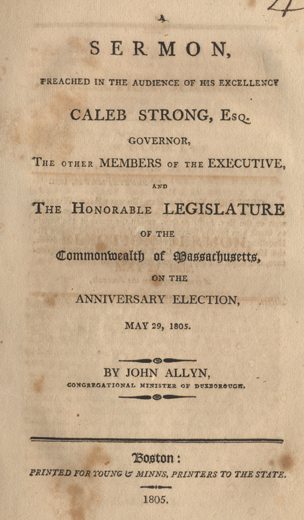
Sermon – Fasting – 1832, MA


Orville Dewey (1794-1882) graduated from Andover theological seminary in 1819. He held jobs as a teacher, a clerk, and an agent for the American education society. Dewey was pastor for the Unitarian Church in New Bedford (1823-1833), the 2nd Unitarian Church of New York (1835-1848), a church in Albany for a year, a church in Washington for two years, and for the “New South” society (1858-1862). This sermon was preached by Dewey on the 1832 Massachusetts fast day.


sermon-fasting-1832-ma

A

SERMON

ON THE

MORAL USES OF THE PESTILENCE,

DENOMINATED

ASIATIC CHOLERA.

DELIVERED ON

FAST-DAY, AUGUST 9, 1832.

By Rev. ORVILLE DEWEY,
PASTOR OF THE FIRST CONGREGATIONAL CHURCH IN NEW-BEDFORD


SERMON.

Isaiah XXVI. 9.

WHEN THY JUDGMENTS ARE IN THE EARTH, THE INHABITANTS OF THE WORLD WILL LEARN RIGHTEOUSNESS.

The visitation of a calamity in some respects of an unprecedented character, has awakened the world to an unusual degree of consideration. It is most desirable that this consideration should be rightly directed; that it should be guarded from all resorts to superstitious reliance’s, and from an absorption in mere worldly fears; and that it should yield some results adequate to the greatness of the occasion. If the world after this calamity shall have passed over it, is to be no wiser than it was before, such a failure must, to every sober mind, believing in the providence, be a deep cause of regret. The end is more important than the means. It more concerns every being to improve God’s discipline, than to escape it. To fail of that end, to fail of the improvement of the discipline, would be a greater calamity than it is to endure the visitation of the pestilence itself. For surely we are not, as Christians, to forget, that there are worse evils than the pestilence—worse evils than all outward calamities—evils so much worse, that all outward calamities are designed to be their antidote and cure.

This consideration, too, of the moral uses of the prevailing pestilence, would tend, more than any thing else, to allay the fears it inspires. To caution the people against being alarmed, to reiterate and multiply admonitions on this point, to warn the timid and terror-stricken, that this very panic is among the surest harbingers of the dreaded disease, to tell them continually that the more alarmed, the more exposed they are, to exhort and urge them, as they value their lives, to be calm, to recommend to them, in fine, by such constant implication, to try not to be afraid—this seems to be very ill adapted to answer the purpose. It is as if we would frighten people out of their fears, or hurry them into moderation and calmness. Besides, it is not easy, unless we look at the moral aspects of this calamity, to prevent some natural tremors, some agitations, perhaps, of unmanly fear. If the elements are left to work their will upon us, if they are working to no end, but to show their awful and destructive power, if the scourge is borne upon the uncommissioned winds, and its pavilion is darkness, and its way is mystery, and its end is death; and no explanation, and nothing for the mind to deal with, but elements, and powers, but inevitable fate, and dire necessity,—how can mortal hearts sustain themselves in the dread encounter with agents so blind, inexorable, and awful! But if there is a Power, beneficent as it is mighty, that stays, at its pleasure, the pestilence that walketh in darkness and the destruction that wasteth at noon-day; if it suffers the prevalence of disease to answer wise purposes; if this calamity, however singular, is, nevertheless, a part of the universal providence; if it is, like all other means for the reform and improvement of the world, to do more good than evil; then surely may we learn to look upon it with calmness and acquiescence. Then indeed shall we look seriously upon it, and we shall look upon it with fear, too, but with a fear that is rational and religious; with a fear that will turn very much, indeed, upon the state of our own minds. We shall think much of ourselves, and so much the less of the outward and physical forms of this evil; we shall think much of the good it is to do to millions of our fellow-men, and so much the less of the mere bills of mortality, dreadful as they are. In fine, we shall have our fears, but they will mingle much of devout and grave consideration with them—a trust and satisfaction in the wisdom of God’s providence; an apprehension lest we, and others, shall not reap the good designed to be communicated; and these moral considerations will assuage and moderate those panic sensations which are now occupied with nothing but danger, and rumors of danger.

There is another argument for attention, and for universal attention. The visitation of this calamity is a voice to the world. Other calamities have been partial in their extent. Other forms of pestilence have been confined to particular countries, or districts of country. No famine ever devastated a whole continent. No war ever raged from ocean to ocean. But to the ravages of this fearful destroyer, neither oceans nor continents have set bounds. It has compassed the habitable globe. From the plains of India, from the mountains of central Asia, its march has been steady and irresistible; it has traversed deserts and seas; it has broken through all the defences which the power and vigilance of governments could set up against it; till that which, for years, has been the rumor of far off evils, is suddenly become terrific reality; and the despoiler of two continents knocks at the door of our American homes.

At such a visitation, it is meet that the world should pause. It is meet that days of fasting and humiliation and prayer should suspend the ordinary pursuits and cares of life, and give an opportunity to meditate upon the ‘ways of God to man.’

I have thus far urged the propriety and advantage of a sober and attentive consideration of this extraordinary calamity. But is there any thing to consider? Is there any meaning in this visitation which can, without presumption, be fixed upon, by us, as the subject of attention?

I. I ask in reply: Is there not a providence in it? Permitted, or produced, does it not come within the range of the Almighty power and agency? Who will say that it is without the sphere of God’s government? Who will tell us where those dread regions are, over which God has no control, in which he does not his pleasure? Has not the whole course of events which take place in the world, a design? Did they receive their original, do they receive their present, impulses, from the tendencies of matter, or the ordinations of fate? But if there re ends to be accomplished by all things, will there not be a relation, an intentional relation, between the means and the ends? Why then—so far as the agency of any event is specific—why shall we not say, that the object, the design, the meaning, is specific?

And now, let me ask, was there ever a calamity in the world, not miraculous, which apparently possessed such a high and solemn moral significance as this pestilence? Was any design of earthly events ever more clear, specific or solemn? We saw an evil, the most insidious and deadly, entering the world by a thousand avenues, and gaining a strength unknown to former ages, by the modern improvements, if improvements we must call them, in the processes of distillation. We saw the produce of the ten thousand harvest-fields wrought, from all wholesome uses, into an intoxicating and destroying poison. We heard the voice of wailing, and lamentation and despair, from ten times ten thousand dwellings; and we asked, with many others, what can stay the progress of this horrible evil? What is to save the world? What is to leave in the world, any innocent father, mother, sister, friend, not utterly broken-hearted? And now, at this very crisis, when good men had begun to be alarmed, indeed, but when the good were more alarmed than the bad were reformed—at this very crisis, there appears in the world, a disease unknown to former times, and it appears as the grand antagonist power to the monster. Intemperance. It strikes as its foremost victims the votaries of strong drink; and to them, its blow, though all others, or nearly all, with prudence may escape—to them its blow is almost inevitable death!

If this be not providence, what is a providence? If this be not a voice from heaven, by what tokens shall we know such a voice? If all the pains and penalties that follow vice, are held, in all creeds but that of the atheist, to be the remedial and disciplinary processes of the Supreme wisdom; if those specific diseases, which set their mark and brand upon particular vices, are justly to be regarded as possessing, in a more striking degree, the same admonitory character, what less shall we think of a visitation like this unprecedented pestilence? If a new species of brain-fever were to appear in the world, and if it made gamesters its principal victims, what more specific and solemn moral would it hold out, than is to be found in this plague of the cholera?

It is true, indeed, that the desire, natural to the reflecting mind, of finding reasons for things, and of finding reasonableness, intelligence and wisdom, in the whole surrounding scene of life, may have carried us too far. It is true, too, that this is one of the subjects that comes not within the range of demonstrative, but only of moral evidence. I do not say that I know that this is a special visitation, designed to check a particular vice; and, on the other hand, no man can say that he knows, it is not. I can only say, that my mind leans to this view of the subject. I firmly believe that if there had been no intemperance in the world, this pestilence would not have been in the world. But what do I say? I had thought that I was arguing, and I find that I am stating a simple fact. Certainly there would have been no such pestilence in the world; there might have been such a disease, and it might have prevailed like other diseases—but there would have been no such pestilence in the world, if it had not been for intemperance. Intemperance is its very haunt, its resort, its prey—that without which, it would have no place on earth—that without which it could not live. Intemperance has occasioned it, created it, called it into being. Has it not? What means, then, the language of every medical report and opinion on the subject? What is to be made of the sense and experience of the whole world upon this point? Why do the intemperate every where feel that it is they who are exposed, that it is they who are meant? And why are so many moderate drinkers, as the disease approaches nearer and nearer to them, setting down the untasted cup? Is it too much to say, that it was designed for the check and destruction of the vice in question?

But it may be said, that the intemperate are not its only victims. It is true, that they are only its chief, its most conspicuous victims; other suffer. But this only comports with the general order of God’s providence. The innocent are every where suffering with, and for, and through, the guilty. It may possibly be said, also, that this pestilence does not, after all, and will not, altogether, reform the world, and so will fail of the alleged end, and therefore could not have been designed for that end. The general answer to both these objections, is the same. God’s providence over the mind, is adapted to the mind; does not compel it, or overwhelm it with flagrant and instantaneous results, but appears to its reason, elicits its powers, respects its freedom, deals with it by influences that are gentle and persuasive, and not coercive and irresistible. Whether the world will be reformed or not—it is warned—and this is the material point for us to establish. It is all the less likely to be reformed, till it feels that it is warned.

It is for this reason that I am concerned to urge the doctrine of a providence, in relation to this stupendous and wide-spreading calamity: for indeed the facts without the doctrine, are sufficient for my main purpose. And so eminently providential does it appear, that it might not be difficult for us to persuade ourselves, that it was designed to teach and explain this great doctrine of a providence to the generation of the thoughtless, the negligent, and skeptical. Let us, then, dwell a moment longer upon this point, to illustrate this use, if not design, of the affliction that is sent upon us.

The difficulty sometimes found with the doctrine of a providence, is, that it is held to be special, that it recognizes the efficacy of prayer, that it is believed to interpose at the call of human weakness, and distress, and penitence. It is the interposition of providence that is by some doubted.

But let it be supposed that the world were to be reformed from the vice of intemperance, and then, the cholera—that peculiar disease which is now prevailing—would cease. It would cease, because it would no longer find victims. The very element which supports it, would be taken away. On what condition, then, would it cease? The answer is, on the very condition of repentance. It would cease at the voice of humiliation and prayer; at the voice of a sorrowing and reformed people. Here, then, in a general view, is the efficacy of prayer, and here is the doctrine of a providence.

And why may we not go farther? Why may we not go beyond the general view? Why should it be thought “a thing incredible” with us, that he who inflicts the blow, should, with an interposing hand, suspend it, when its purpose is answered? It is here, perhaps, that the difficulty about a providence presses hardest. Are not the operations of nature, it may be said—are not the laws that govern the elements, uniform? I answer, we do not know that they are. What saith the visitation of this calamity? It reminds us how wide a theatre there is, for the operations of the overruling hand—how vast a region, before which the vail is lifted up, that none can penetrate. Where is the origin of this dread pestilence? Where are its dark magazines, out of which swift destruction cometh? Where is the secret of its presence, and the hiding of its power? Wisdom is baffled in the iniquity, and experience is but a blind guide. Whether it is in the heaven, or in the earth, or in the waters under the earth, it is questioned, and it is questioned in vain. Whether it is in the atmosphere, or in the human system—whether it is contagious, or infectious, or epidemic, or local, the understanding of the learned has not found out, and the wisdom of the wise has not decided. It has travelled through the world: the eyes of millions have been eagerly bent upon it; the voices of every language, have invoked from it, its dark secret; the seers of every healing art, from the Ganges to the Atlantic shore, have sought for the interpretation of its fearful signs—and still it is shrouded in impenetrable mystery. The object is clear; it is proclaimed as with the voice of a trumpet; all else is darkness and silence. Where the bolt strikes, we can see; we see who are its foremost victims; but the bosom of the black cloud, as it rolls onward, no eye has penetrated.

Let no man tell me, that in the bosom of that black cloud, there is no might, or mystery, beyond the reach and measure of his understanding,—no space for the secret work of God,—for the operations of an inscrutable and interposing providence. Let no man tell me, that he who rides on the whirlwind, and directs the storm, is bound by the chains of any fate or necessity. He doth his pleasure amidst the armies of heaven, amidst the thrones and powers of the firmament, and among the inhabitants of the earth; and none can say unto him, what doest thou? None can know what he doeth, or may dare to say what he doeth not; what is interposition, or what is not interposition; how far the overruling hand is stretched out, or where it is stayed; what chord in the mighty system of things it toucheth, or what hidden spring it doth unlock; what it bindeth that shall not be loosed, or looses, that shall not be bound.

But the skeptic will perhaps say, in fine, that man is a creature too insignificant to be the object of such attention and care, as we allege; that the Being who sits enthroned above the heavens, and governs millions of worlds, will not stoop to regard a thing so inconsiderable and indifferent as this dweller in the dust. But look at this being, when struggling as a victim in the grasp of the fell destroyer. If it were the lot of man, to drop from the course of life like an animal, a mere inert lump of clay, we might think differently. But what is the death of a man? What is it when it comes in the form of this disease, held to be so terrible? It is not any frightful paroxysm of pain, which makes that hour so awful; it is not the gathering mist that settles upon the closing eye-lids, that makes it so dark; it is not convulsion, and gasping for breath, and the mortal strife, that gives such intensity to every thought and feeling; but it is parting from the thousand ties that bind the heart to life; it is the solemn vision of eternity opening upon the soul; it is that intense spiritual consciousness that seems to concentrate all that is solemn and sublime in the universe, upon that dread moment; it is an element mightier than any earthly power, that imparts such grandeur to the death-bed scene; it is a portion of the Divinity, that is holding conflict with disease, and pain, and sorrow, and death. Will not God regard it, in its great and perilous hour? Can he hold that which was made in his own image, as too mean for his interposition or disposal? Can we believe that thousands and millions in the world, are dying under the stroke of this one peculiar and extraordinary infliction, and that there is no providence and no meaning in all this?

II. But if there is a meaning in this, what is it? If there is a providence, what does it teach? What do facts teach, let the doctrine be what it may? 1

The answer to this question, has been necessarily implied in the previous discussion; but we should be totally wanting to the occasion that has assembled us together, if we did not give it our direct and separate attention. I say, then, that that which providence teaches, that which facts teach the world in this great calamity, is a lesson of temperance. The calamity itself, as I think, naturally leads us to recognize a providence, and a special and interposing providence. But providence, if there be any in this matter, has an end. That end, if there be an end, must be, I repeat, to teach the world a lesson of temperance.

Will it not teach this? Will not increased temperance be the effect? And if it will, why should we not say, that it was intended to be the effect? But will it not, I repeat? Suppose the cholera were to remain ten years in this country, or in Europe: there is no reason to expect its speedy disappearance—it has already returned to some of the cities in Europe—it has been a long period in Asia: if, I say, the cholera were to remain ten years among us; if for that length of time it should hover in the air, ready to stoop with its deadly talons upon any dissolute city, or village, or individual, can it be doubted that by such an agency, the work of reform would be carried on with a success and effect, beyond all former example? Can it be doubted, that ten years, with the sword hanging over every man’s head, would make us comparatively a temperate people? How many is this single Summer’s experience showing, that they can live without spirituous drinks, and that they are altogether better without them! “When thy judgments are in the earth,” saith the Prophet, and surely when such judgments are in the earth, “the inhabitants of the world will learn righteousness.”

And if they are to learn righteousness, or if this going forth of the pestilence is fitted to teach them, then I am prepared to take another step, and to say, that it is a beneficent visitation. If you doubt whether your ears hear me rightly, I repeat it, and say it is a beneficent visitation. I confess that I do no not partake of the unmixed and supreme horror, which many feel at this disease. There is another calamity, another curse, which, as I believe, it is designed to remove, and which impresses me with greater horror. The Cholera, I am firmly persuaded, will prevent more suffering than it will occasion. The woes of unrestricted intemperance in this country for ten years would be far greater than the woes of a ten years’ plague. I cannot pray, therefore, without the most careful qualification, and the most guarded submission, that this pestilence should depart from our borders. I dare not say, it is best for us that it should depart. I dare not absolutely pray for the removal of this disease, any more than for the removal of many other diseases. I see clearly that the world would sink at once into the ruins of sensual indulgence, if no pain or sickness followed excess. I see that to indulgence, disease, of some kind or other, is the antagonist power. I now see indulgence of one particular species, rising to a most alarming height; and I see a disease breaking out at the same time to counteract it. This, to my apprehension, is the method which Providence has adopted for teaching the lesson of temperance. Say that this pestilence is developed by intemperance itself, or say that its causes, not of any new creation, have always lain hidden in the bosom of the elements; or say that it is the result of general laws; still it is none the less the teaching of Providence. And I dare not absolutely ask that the teaching should be suspended till the lesson is learnt. Though the discipline be costly and dear, I dare not ask it. I know that it is taking from us the lives of some valuable and beloved citizens, but I do not esteem even their lives too precious a sacrifice for the salvation of the land. I see the innocent, indeed, dying for the guilty; but I see in this, only the usual order of God’s providence; I see, indeed, the order of his grace; I see, as it were, Jesus again in his members, dying for the world.

The horrors of the Cholera, I must be allowed to repeat, are not the greatest horrors that are to be found in the abodes of the civilized world. The convulsions of this disease are not, in my eyes, so horrible as the paroxysm of drunkenness—the rioting of its merriment, or the writhing’s of its fury. The delirium of sickness is not so dreadful as the madness of the inebriate man. The dreaded “collapse” presents not a picture so dreadful as the poor wretch who lies by the wayside; no waiting friends or sympathizing kindred around him; senseless to the passing jest or buffet; no longer a human being, but the ghastly ruins of what was once human. And a brief sickness and a speedy death carry no such agony to the bosom of a family as ten, or twenty, or thirty years of dissoluteness in it; no, nor as one year’s woe and shame of intemperance, in one of its before cherished and beloved members. Nor doth the land mourn, nor ever can it mourn for a pestilence, nor is its substance wasted, nor are all its laws and safeguards sapped and undermined, though all the plagues of Egypt fall upon it—no, there is no such peril to any people in all this, as there is in the poisoned fountains of intoxication that are now deluging the world—there is no such sorrow, as the sorrow of millions by their desolate hearths, made desolate by this accursed indulgence; there is no such “cup of trembling” and of “wrath poured out without mixture,” as the horrible cup of excess!

It is impossible not to observe in this connection, that this judgment of Providence on the people at large, is especially a voice of admonition, a call for reform, to cities and populous places. It has always been found that in proportion as men congregate together, and wealth increases in the hands of some, and poverty presses hard upon others, that the vices shoot up into monstrous and fearful luxuriance. The most splendid advantages, the brightest gifts of heaven as they seem at least to most men, are here set in glaring and mournful contrast with the most awful abuses of them. It is here too perhaps, that the noblest virtues are developed and formed; but the powers of good in these circumstances have hitherto held but a feeble and doubtful conflict with the powers of evil; they have not, indeed, been put forth; and Christian men and women in our cities, are yet, perhaps, to learn the measure and the methods of their duty.

It would be dullness, worse than ingratitude, and more inexcusable, not to refer in this view to the noble efforts for teaching the poor and rescuing the vicious, which are now making by a Christian ministry devoted to those objects, in the metropolis of our own State—efforts, which it is hoped will in process of time, present to the world, the model of a Christian City. 2 This Ministry for the poor in cities, like the Sunday School, and the improved Prison Discipline, and the Bethel Churches, I regard as one of the great moral discoveries of the age. Physical causes, I trust, are also to lend their aid. It seems to me, not an extravagant anticipation, that the astonishing improvements about to be introduced in the facilities for carriage and passage,—the railroads, I mean—will have the effect to prevent the enormous growth of cities, to send their inhabitants abroad to build beautiful and delightful abodes in the country, and will thus tend to break up those hot beds of vice, those congregated masses of filth and misery which are now found in them. Meanwhile this pestilence is doing its work—its work of mercy as well as of judgment—its work of physical as well as moral purification. It would be scarcely too much to say, that the cleansing of our cities and villages, especially if it may be a precedent for future years, will save more lives, than the cholera will destroy.

Will there not be a moral cleansing, also? Will not this judgment of the Most High, strike a salutary dread into the scenes of drunkenness, debauchery, and Sabbath-breaking—and of that horrible filthiness which is itself a heinous sin? Is not that very point—the mass of evil in cities—that wickedness in high places, to which, all of the earth, the philanthropist and Christian have looked with the greatest despondency,—is it not to have light poured in upon it—the light of inquiry and of hope? Are not the miseries of those ten thousand thronged abodes, which it makes the heart ache to think of—are they not to be relieved? Is not that pestilential atmosphere of contagious vice, forever hanging over the cities and crowded villages of the world, and every year drawing millions from the healthful airs of a simple and rural life, to breathe it and die—is it not, at length, to be purified? Is not this fearful stroke of the lightning from heaven, to break the heavy and thick and settled cloud, beneath which such iniquities and abominations have been done for ages? When, ye children of darkness and vice and vileness! Will ye hear? Hath not trembling and death come into your habitations? Hath not horror taken hold of your hearts? When, till the judgment-hour break upon you, will ye listen to the voice of God?

I feel, too, that this visitation ought to speak to men in power, to the rulers of the earth, and to those, who, by their influence, reign in society. Why are those masses of vice, and filth, and famine, and bodily prostration, where the cholera finds its haunt, suffered to exist? It is, in part, because great men, aye, and good men, have failed to do their duty.—Much of this prostration, physical and moral, is to be referred, ultimately, to political oppression, to arbitrary distinctions in society, to cruel and unjust laws, and to proud self-complacency and selfishness, “passing by, on the other side.” In Asia, helpless millions have been swept away, the victims of grinding tyranny and of unparalleled social abuses. Such victims are to be found in Europe, too; nor are they wanting in America! When, let me ask then—ye great ones of the earth, and ye good men! When will ye hear? When will the whole power of the world, political and moral, arise to do good, and to heal the wounds of society, and to build up the fallen fortunes of afflicted humanity!

No, I am not indifferent to the fate of the unhappy victims of this visitation, hurried as they are by thousands to an untimely grave, and to a sudden and unlooked-for judgment. Who, with a Christian’s heart, will not mourn for them, as well as for the evil that they have inflicted upon the world? And yet, what can I say to them, or to the partakers of their guilt—what can I say, more or less than this? “You have been reasoned with, pleaded with, besought, warned, by every voice of tenderness and by every voice of terror, that God has given to man, or to woman, to utter, and it has been all in vain. You have resisted the outstretched hands of affection, and the pleading eye, and the breaking heart. You have trampled upon the dearest interests of society, as if it were without remorse. You have trampled upon all the admonitions of God’s word and providence, as if it were, without fear. You have trodden under foot all the agonizing remonstrances of your own hearts and consciences, as if they were but fit to pave your way to the resorts and haunts of indulgence. Would to God, that all this land not been in vain; but it has been in vain. It has been all in vain! You would not hear. You would not relent. You would not give up the deadly draught that bereaved you of every thing to respect, and of every thing to love. The child, the wife, the friend, have asked permission but to respect, but to love you; and you have hardened yourself against appeals, that might have broken—Oh! They might have broken, a heart of stone.” What they shall we say? Must we say and think, that it is hard, very hard that this additional, this last dread infliction, has come upon the victims of excess,—that this bolt has fallen, as it were, direct from heaven, to dash the guilty cup from their hands? God Almighty give them grace to be wise in the day of his rebuke! We dare not prescribe the term of this, to the vicious, tremendous day. May it be shortened, we are ready to say; yet we dare not ask that it may be shortened, but through the intervention of repentance, at the instance of a humbled and reformed people!

This, my friends, is the only escape, of which we can feel any assurance, or ought to feel any very strong desire. This pestilence has a moral mission to fulfill; its fulfillment is the only pledge for its termination. No services, no offerings to God, coming short of this, can promise us any relief. No wall of prayers is to be built up, to keep out this dreaded disease; no mere solemnities of fasting and humiliation, will disinfect the atmosphere; nothing, within our knowledge, but removing the cause, will remove the curse.

One more word, and I will relieve your attention from the unusual task, which I have ventured, at this time, to lay upon it.

What is it, then, I ask, which imparts to the pestilence, whose ravages have been the occasion of setting apart this day of solemn prayer and humiliation,—what imparts to this pestilence, I say, its peculiar horror? And, I answer, it is the terrible speed with which it does its work. It is not that its victims, according to present appearances, are likely to be more numerous than sometimes are the victims of a prevailing influenza, or of a malignant fever; not more numerous, than are, every year, the victims of consumption. It is, that death has been brought near to many minds, as it never was before. The impression has been made upon them, in a character and with an emphasis altogether new, that they might, indeed, die suddenly; that their moral account with this life, might be made up, and settled, and sealed forever, in a few brief hours; that although to-day in the midst of life, to-day walking in the same negligent course as for years before, to-day unprepared to die,—yet that to-morrow’s rising sun might behold them dead, and its parting ray might shine around the grave, that had closed upon them forever.

It is, my brethren, a most solemn and monitory conviction. This pestilence has created an era, I believe, in many of our minds, from which a new spiritual life ought to be dated. We have erred in this matter; we have erred in regard to the strict account, which we have to give, of life. We have been misled, with the negligent world, into the irrational, the absurd idea, that we may lie in sin, and yet die in safety; that we may live without religion, and yet die with it; that we may at last find some gracious dispensation from the law that is to “render to every man according to his living deeds.” We have vaguely and vainly imagined, with multitudes in the same delusion, that our sickness may, at length, do, what our health will not; that the last feeble pulses of life, may be strong enough to turn back the mighty current of tastes, and affections, and habits, that for years has been flowing on with accumulated power.

This is one of the grand ruining delusions of the world. “It is not this day,” men are perpetually saying, and still with every successive period of life they are saying, forever saying, “it is not this day, it is not this year, on which I can venture the decision of the great question for eternity; by and bye,” is the secret thought of thousands of hearts, “by and bye, amidst the days of sickness and sorrow, or of old age, I will prepare for heaven.” Let this solemn visitation of God, let this voice of the pestilence, break up forever that tremendous delusion. It speaks not only to the heinous transgressor, but scarcely less awfully to the careless neglector of his duty. It is in his heart, a voice of weighty admonition. What meaneth,—if it means not this—what meaneth that fear, curdling the very heart’s blood,—the fear of smiting disease and sudden death? Yes, its meaning is moral. It is not a mere dread of pain, or of parting with life. It is a fear, breathed in the deeper recesses of the soul. It is a voice, that speaks of duties neglected, of sins indulged; of the soul, unprepared for death. That very fear, that very voice, believe me, shall yet give witness at the bar of judgment: for us, or against us,—to proclaim our fidelity, or our neglect,—to declare that we have listened to the voice of God’s judgments, or have hardened ourselves in the day of his rebuke. But let me not close with the words of this last dreadful alternative upon my lips. Let us hope better things, and things that pertain to salvation. Let us give all earnestness, to meditation, and watchfulness, and humble prayer, that we may be found faithful to all the teachings of God’s wisdom, and all the tokens of God’s will!


Endnotes

1. Our doctrine does not, and that for obvious reasons, contradict the text, Luke xiii. 1-5.

2. Rev. Dr. Tuckerman’s Reports, Boston.

* Originally posted: December 24, 2016.

Sermon – Loss of Children – 1832


William Bourn Oliver Peabody (1799-1847) graduated from Harvard in 1816. He was a teacher at Exeter Academy (1817). Peabody was pastor of the Unitarian Church in Springfield, MA, a position he held throughout his life.


sermon-loss-of-children-1832

THE LOSS OF CHILDREN.

A SERMON.

Delivered January 22, 1832.

BY WILLIAM B. O. PEABODY,
Minister of the Third Society in Springfield.


This Sermon, suggested by a time of unusual anxiety and sorrow in this place, is respectfully dedicated to those who have suffered and those who are apprehending the loss of their children.

2 Kings, 4, 26.
Is it well with the child? And she said it is well.

This was said by a Hebrew mother, whose child had but just before expired in her arms. It was taken away suddenly and without warning: but she bore it, as became one who was acquainted with Divine Providence, and knew that He who gave, had a right to take away. She was not acquainted with the disclosures of Christianity which have thrown such brightness into the far regions of death: so that in her, this God, to whom this feeling was expressed, rewarded it divinely—by restoring the child living to her arms.

There are many who are looking upon the opening promise of their children, with a joy, which none but a parent understands: and they ought never to forget, that the young human being is delicate as the flower, whose whole history is embraced in the words “the wind passeth over it, and it is gone.” It would seem as if in the ordinary course of life, this was taught them by sufficient warnings. But there are times, when the air of death breathes widely and fatally from the dark cloud: when many wither at once, as the storm is passing by: there are times when the most thoughtless parents begin to tremble, and feel as if they heard the rushing of the death-angel’s wing. It is well that they should keep before their minds, the consolations which they may need sooner than they suppose: they know not where his withering touch may fall next—but wherever if falls, the mourner will need all the comfort, which the kind Providence of God has given.

When the first born of Egypt were slain, the Hebrew children were secure with death all around them;—but there is no mark of God upon your doors. Since you may be called to mourn, come and meditate on the grave: it is the place where you may lay your treasure down to-morrow; come, and meditate on the grave: it is the place where you may lay your treasure down to-morrow; come, and meditate upon it now—not in sorrow—not in dismay—but in the preparation of the gospel of peace. Those who are familiar with death, see him without his terrors: if they lose what they love, they can say “it is well,” the Lord gave and the Lord taketh away.

It may seem to the world—the thoughtless world, as if little consolation were required in preparation for the loss of children: if they are called away, they say, they will leave no vacancy in society—there will be no loss to the world. They will say this, because they cannot look down into a parent’s heart and measure the depth of her affections: they can no more understand the anguish which she feels when her infant’s heart is cold, then they can understand the looks of unutterable delight with which she gazed upon its living features, studying their first dawnings of expression: or the intense interest with which she hung over its fainting head in its sickness, trembling every moment lest she should see the seal of death upon its brow: they cannot imagine what warm affections are broken—what towering hopes are struck down on the quenching even of the fatal spark of life in an infant’s breast:—they know not therefore the energy of submission which is required, for the parent to say, Father, thy will be done.

But they will wonder less at the sorrow—or I may rather say, they will believe in the sorrow, which such events occasion, if they will remember this—the parent loses not only all it was, but all she hoped it would have been. It was to her a subject of constant and affectionate interest: she saw in it what others could not see: she saw the revelations of mind, and the play of the affections upon its features: she felt that young as it was, it had a heart—a living heart, which beat in answer to her own. She loses this: and then her hopes! She hoped that it would be in its childhood among the beautiful and happy: she had already imagined a glorious path in which it was to travel up to life: she foresaw no disappointment—no downfall in all her visions of its future welfare: and when all this is suddenly destroyed, no wonder that for the time, the whole heart is a wild and desolate ruin.

That it is well with children when they die, we know: we will then inquire what are the designs of Providence in calling children away from their parents’ arms.

I think that you cannot possibly imagine more than two reasons why children are thus called away. The first is, to save them from the evils of the world. Far be it from me to represent this life as a vale of tears—or as a place where the miserable out-number the happy: I know that it is not so, and that the great proportion of the earth’s inhabitants want not the power but the disposition to be happy. Still, time and chance happen to them all: and if you look upon those who started together in life, with high hopes and bounding steps, you find some who are soon bent down with suffering, while others keep on successfully to the last. You find some, who midway in life, are wasted with disease, which breaks off all the purposes of life and sinks them slowly and heavily to the grave: you find some, who, without any fault of their own, are thrown into a condition in life, in which they have everything to endure, with no hope of any thing better in this world: you see the man with the crown of rejoicing taken from his head: you see the aged moving alone, unsupported and uncared for to the tomb. Such destinies in life there are: and such might have been the portion of the child who perished yesterday, to-day, or the one that shall die to-morrow: if so, the parent should thank God, who hides it from the evil, even though He hides it in the grave.

But these which I have named, are not the worst evils of life. This is a world of sin. They who come forward to bear a part in it, meet a thousand various temptations: and there are too many who yield to them and fall. The generous and high-minded youth sometimes becomes a cold, selfish and unfeeling man: the man who used to look the world in the face, becomes base and dishonorable, and either frowns in savage defiance or looks down with shame: they who were loved for their kind hearts, become slaves to their vices which make them a burden and sorrow to their friends: and very often, those whom the world accuses of no vices, are yet entirely destitute of moral principles and religious affections. If it might have been the fate of your child, to sink in any one of these snares—if there were the least danger of his becoming an alien from heaven, and self outcast from his God, what parent would not rejoice to have this child taken to a better world before it becomes deeply stained with the corruption of this? You should bless the hand that throws open a door of the grave.

No parent feels as if her child could ever have become a slave to corruption—but God knows—and if it is not to save them from the evils of life, that they are taken away, it must be for the second reason:—to place them in a condition more favorable to their improvement than this world affords.

I fear that the future life is so imperfectly realized, that this consolation loses most of its power. Why will men persist in thinking of heaven as a place of unmeaning rest?—of indolent happiness,—where the soul finds nothing but still and deep repose? They ought to reflect, that repose is not happiness to the mind—and that the enjoyment they dream of, is rather stagnation than repose—it is a state wholly unsuited to the nature of man. They ought to think of heaven, as a place where every power of every mind shall be steadily, successfully, and therefore happily exerted: where every affection of every heart shall be deeply interested, and therefore fully blessed. What the employment of that state will be, we know so far as this—it must be the employment of mind, in such researches as give the highest happiness—in discovering the manifestations of the glory and goodness of God. To think of heaven as we do, affords no comfort, no attraction;—it is like the long yellow line of a desart, seen by mariners who are looking for green hills and vallies as they draw near the shore: when, would they imagine it, as a place, where all are active, interested and happy, they would feel that when their child is gone to that world, there are some there, who will watch the flower, as it unfolds the beauty of its promise, and spreads out to the Sun of Righteousness, its leaves from which the dew of youth will never dry.

Think thus of heaven, and it will be something real and substantial to offer to the mourning heart. It is evidently a region more favorable to the growth of the immortal nature than this world: for, though in this world, there are trials and hardships, which serve to discipline some spirits and in this way to form them for heaven; there are other spirits perhaps, which are comparatively pure, and do not need them;—which are gentle, and could not bear them; which could not endure the rough climate of this world, but can grow and flourish divinely in the milder air of heaven. Such spirits, it is but reasonable to suppose, are translated, because heaven is better for them than earth—and God in his mercy, places every soul in the state, whatever it may be, which is most favorable to its growth in excellence: in our Father’s house there are many mansions—and all are open to the innocent as well as the just.

This accounts for the fact which has been so often observed, that many children of the brightest promise are removed from this world. A fact I have no doubt it is: though parents naturally esteem their own children too highly, and the lost are often the most loved, without being the best—still, it has been remarked from the earliest ages, that early death is given to the favorites of heaven. And why should it not be so? If there I a better world, for which they are better fitted than for this, why should we wish to detain them here? Why should we lament when the heavenly spirit ascends to its home in the skies? The parents should be ready to give up their child to a father, who has more right to its presence and affection than they—and, assured that “of such is the kingdom of heaven,” they should feel, that the hour cannot be untimely, which numbers it with the cherubim and all the radiant spirits round the throne.

I have mentioned the only reasons that I can imagine why children should be removed so early from the world—one is to save them from evils in the world—the other to place them in a state more favorable to improvement than this. And now we may humbly inquire why it is that parents are thus afflicted: there are reasons, which the kindness of God has graciously permitted us to know.

But first let me say, that it is not sent as a judgment, let the blow fall where it may: there is a language in use among some Christians, which ought never to be heard in the Christian world; which ascribes the misfortunes of life to divine displeasure. Can any thing be more opposed to our Saviour’s teaching? His words are almost indignant when he says to the narrow-minded Jews—What! Think ye that the murdered men were sinners above all the Galileans, because they suffered such things? I tell you no! I do not fear that you will point out mourners as subjects of divine displeasure; but I do fear lest some who have heard this language in their youth, should retain so much of their early impressions as to feel, if they are called to suffer, that the mercy of God is for a season withdrawn—I fear lest they should forget that whatever he does, is done in kindness, and should be less ready, than in better days, to bend the knee in submission to his will.—If the least vestige of such delusion exists in any of your hearts, let me entreat you to cast it away. God seeks your welfare as much—yes, more than you seek it yourself; he knows what is for your welfare, and you do not; therefore he sometimes conducts you to happiness in a way which you find it hard to tread. But if that path conducts you to heaven where you may fold your lost resume to your heart again; there you will see that what men called judgments, were often the best blessings ever sent from above; and you will praise God with all your hearts, that, in those days of earthly sorrow when you half doubted his kindness, His will and not yours, was done.

But I may ask you to consider these as chastening—for we need chastening, and it is kind to give them; we do lean with wondrous confidence upon the world; we do cherish even the frailest of our blessings as if we could not lose them; and since a trust like this must fail us; since it may induce us to fix the hopes here, that should anchor to heaven, He warns us in the mildest way, that we are preparing for disappointment—that we are giving far too much to the world—that we are expecting from it a permanent happiness, which it cannot give and was never meant to give.—When we embark on the voyage of life in vessels which cannot live in the open sea—when the waves are only sleeping for an hour, and the storm is already gathered in the cloud, is it not a kind providence, which induces us to turn back and make better preparation? Would we wish it to allow us to keep blindly on till we dash upon the rock? Oh no! the chastening may be hard to bear—but it may save us from what is of all things the most dreadful—from shipwreck of the soul. But I may embrace all in one: children are taken for the parents’ sake, in order that the parents may have their thoughts carried gently, but irresistibly upward to the heaven of the blessed; the place where they who perish in their innocence, and they whose labor of life I well done, shall be happy forever. Where their treasure is, there their heart will be also: the child is the parents’ treasure, and it is lifted up, that their hearts may follow to its home in the skies. And follow it they will. Other warnings might be disregarded; they cannot be insensible to this! Other blessings might be lightly resigned; they cannot find it in their hearts to surrender this! And since there is a way in which they may make it their own again; since there is no need of giving it up forever; since they may at once arise and move forward in that way, which leads to the heavenly rest, they will feel an inspiration, to go on and secure the lost treasure in another world, if they can enjoy it no more in this. They will feel like the disciples when their Master ascended; they stood with him on their favorite hill—rejoicing that the grave had given up its dead, and he was once more with his own. He talked with them for the last time of what lay near all their hearts, and before the sound had died away upon their ears, he rose calmly to the skies and was lost in the depths of heaven.—Long did they stand gazing upward; and parents, when their child ascends, often feel an attraction to which they were strangers before, and which leads their thoughts upward as rapidly and surely, as the star led the eastern travelers to our Saviour’s feet.

You will understand the reason why I have directed your thoughts to this subject to-day: it is because the air of death is around us: because they who are just beginning to live, are marked out to die: because some have already suffered, and there is too much reason to fear that others, who little apprehend it now, must become acquainted with grief. If it must be so, do not let it come without preparation, for I do assure you, prepare for it as you may, you will find it hard to bear; to see the child in its morning beauty changed into that on which even affection dreads to look; to feel the current of life in its bosom wearing away; to see its eyes turned upon you as if you were a God—with a plaintive, beseeching expression, which seems to say to you as the sufferer did to our Saviour, ‘I know, that if thou wilt, thou canst heal me;’ to feel that you can do nothing to relieve it, and after many a change of anxiety and hope, to see the shadow of death pass over it and its features grow fixed and cold as if graven from the marble of the tombs,—this requires preparation—all the preparation which the gospel of peace can give. Do not hope to prepare when the sorrow is already come: it will then be too late—unless you prepare now—in the present—the only accepted time, the day of sorrow will not be a day of salvation to you. Let it not be so with you. If the next visitation of death shall come to you—if they shall ask of you as of the Hebrew mother, Is the child well? May you be able like her to say It is well—for it is gone to be happy with its God!

Sermon – Modern Emigrant – 1832

sermon-modern-emigrant-1832


The

Modern Emigrant;

Or,

Lover of Liberty:

Being

A DISCOURSE,

Delivered in the city of New-York,

By The

Rev. J. M. Horner,

Author of ‘Immersion the only scriptural mode of Baptizing;’ of ‘Modern Persecution A Poem;’ and of ‘Hymns and Spiritual Songs, Collected, arranged, and composed for the use of the Union Baptists.’


O let me take my eagle flight,
Where Liberty is known and felt;
Where no despotic power can reign,
Over the souls or minds of men.
May I but scale the mountain top,
Or dwell within some humble cot,
Where I may freely write or speak,
Those thoughts which reason generate.


Introduction.

My Christian Friends, — When I was invited to address you in the character of a Minister of Jesus Christ, I thought it would not be amiss to submit to your notice my reasons for leaving the land of my nativity, my beloved relations, and my pastoral charge. If I do this, I must not only advert to the state of religion in England, but to the laws and politics of that country. I know that many professors, and some of the best Christians, are opposed to the idea of ministers introducing politics in their discourses.

I am one of those who think that Ministers should not give themselves to politics, so as to unfit them for the discharge of their more important duties. But that they should watch the proceedings of the government under which they live, make themselves acquainted with the politics of their own country, and recommend to the people of their charge good and wholesome laws, must be evident to every impartial mind.

If a Minister should see the people of his charge laden with an unjust taxation, imposed upon by a heavy tithe system and laboring under disabilities because of their religious and Christian creed, without speaking, writing or exercising his influence for their emancipation, in my opinion he would be cruel to an extreme enthusiastic beyond measure, or destitute of the common feelings of humanity. To say that the professors of religion should not concern themselves about the laws of their country, and the politics which surround them, is to say that the Dissenters of England should endure their religious disabilities, their cruel tithe system their oppressive government without speaking about them or writing on the subject or even petitioning their Legislature for their liberty and support. Were I called upon for a further justification for glancing at temporal governments in my discourses, I would do it by observing, that the prophets in their predictions, and the apostles in preaching, often noticed the governments under which they lived, and the politics which surrounded them.


A DISCOURSE.

“Then Philip went down to the city of Samaria and preached Christ unto them.” -Acts, 8,5.

SAMARIA in the original, שמרוך. The root of which is שמר and signifies to keep, watch, guard. Observe in שמרוך or Samaria, the Lord’s people were kept.

1. From the oppression of their enemies, and many of the troubles which the wars among them occasioned.

2. In that city the Lord’s chosen people had to “watch and “guard” against the encroachments of idolatry, and the influence of error.

This city stood about twenty miles north of Jerusalem, being twelve miles south of Dothan. This was a city of the Ephramites, the capital of the ten tribes of Israel : it was once wholly given up to idolatry. At that time, the Jews being afflicted with wars, fled to Samaria for shelter, and introduced their holy religion among its inhabitants.

When Philip went to preach the gospel of Christ to the Samaritans, he found them in possession of copies of the laws of Moses, which were corrupted with sundry mistakes. Not merely those which arose from the transcribers making on Hebrew letter for another, but because they were mixed with tenets in favor of idolatry.

Those two circumstances, namely, that of the Jews fleeing to Samaria from the storm of persecution, and that of Philip to preach the gospel to the Samaritans, reminds me of our venerable English forefathers, who, when the rod of oppression was shook over the English nation, and its Monarch descended from the throne of justice to exercise an undue authority, by inflicting pains and penalties, and confiscating the goods of those who dared to think for themselves in matters relative to their souls and their God, fled from the land which gave their birth, and to which they were attached by many reciprocal ties. But where did they flee? Not to any of the European nations. For by so doing they would not have bettered their condition; — not to any of the nations professedly Christian, for even there I blush to add, an intolerant spirit reigned. They fled to this country, now called the United States of America, and where they, like the Jews, or like Philip introduced their holy religion wherever they went.

Although the spirit of intolerance is in a measure subsided, and freedom of thought and the exercise of private judgment allowed yet a spirit of emigration prevails in every part of England, for her inhabitants are flocking to this country by hundreds and by thousands. It is true that these modern emigrants may not have the same reasons for leaving their native land as their forefathers, nevertheless they may have had powerful motives for taking up their abode in this country. Whether this be true or not with regard to many, it is true with regard to myself; for I can assure you that I have not given up my cottage of superfluity, my home of comforts, my house of temporal and spiritual mercies, my dearest relations, who were tied to me by the remembrance of their fostering care, my pastoral charge, who lived in my heart and partook of my homely, but I hope the spiritual productions of my study; — my native country, the inhabitants of which are as brave and famous as any in the world, who are repository of arts and sciences, and a library of intellectual wealth; — I say I have not given up all these without power inducement and reasons for taking such an important step . If I were called upon to give those reasons, I would cheerfully do so, among which the following would have a place:

1. Because of the influence of a bad Government.

You know that the inhabitants of any country are in a great measure influenced by the Government which exists among them.

You may know from history, and I know by experience, that an aristocratical government is generally, if not always, tyrannical in its enactments, oppressive in its measures and covetous in its demands. This I know to be the case with the English Government, for while it is desirous of exceeding every other country in its national splendor and ornamental palaces, it robs, plunders, and deprives the Lancashire weavers, the farmers’ laborers, and the parish paupers of the common necessities of life, by its enormous salaries and oppressive taxation., For there are taxes on the man of God, who bestows his gratuitous and theological lectures on the villagers; taxes on the widow, who consecrates her mud-walled cot to the worship of Jehovah; taxes on the house of God, which has been raised by the voluntary subscription of the poor. And what is worse than all is, that if the aged and infirm invite their minister to preach in their parlor, and if the conscience of the man of God dictates to him his exclusive allegiance to his Supreme in matters of religion, and he banishes from his creed the idea of asking man whether or not he may do his duty to his God; and should he comply with the request of those who entertain the same views and thus deliver his gospel sermon to twenty-two or more aged infirm, and worn-out pilgrims, the one must be liable to the penalty of ten pounds and the other to the penalty of forty pounds. (George III. cap. 155.)

Besides these fines and penalties on things pertaining to God, there are taxes on every article which enters the mouth or covers the back, or is placed under the foot. Taxes upon everything which is pleasant to see, hear, feel, smell, and taste; taxes upon warmth, light, and locomotion; taxes on every thing on earth, and the waters under the earth; on every thing from abroad, or that Is grown at home; taxes on the raw material; taxes on every value that is added to it by the industry of man; taxes on the sauce which pampers man’s appetite, and the drug which restores him to health; taxes on the ermine which decorates the judge, the rope which hangs the criminal, and the brass nails of the coffin; taxes on the ribands of the bride; at bed or at board, couchant or levant, they must pay. The schoolboy whips his taxed top, the beardless youth manages his taxed horse with a taxed bridle, on a taxed road; and the dying Englishman pouring his medicine, which has paid 7 per cent. into a spoon which has paid 15 per cent., throws himself back upon his chintz bed which has paid 22 per cent., makes his will on an eight-pound stamp, and expires in the arms of an apothecary, 1 who has paid one hundred pounds for the privilege of putting him to death. His whole property is then taxed from two to ten per cent. Besides the probate, large fees are demanded for burying him in the chancel; his virtues are handed down to posterity on taxed marble, and he is then gathered to his fathers to be taxed no more.

Now when we are thus oppressed with something like Egyptian bondage, and surrounded with fallen cheeks, the impoverished circumstances, and the cries of the poor, it cannot but affect the feelings of humanity. And like a swallow, which from the laws of nature predicts the near approach of an inclement season, takes her anticipating flight to some distant region, where she may enjoy her liberty, and a full supply of the calls of nature, so humanity, affected by the heart-rending scenes of poverty, and exorbitant demands of usurpers, cannot but desire to take her flight to some distant shore, where she may not be so much annoyed. The means, too, by which that Government is formed, the materials of which it is composed, are also appalling to the reflecting mind. Here I do not allude to the majority of the House of Parliament, nor to those illustrious characters — characters to whom minds reason has dictated sound and political ideas — who are the ornaments of their country, the political lights of the world, and the Washington’s of their day, — but to those characters and that hereditary system, which makes the throne of England groan with the weight of novices, and crowds the Upper House with characters, whom nature never formed for an important office, and for whom reason never demanded enormous salaries. I cannot stay to be more explicit on these particulars; suffice it to say, that I believe the English Government to be a mixture of Heathenism, Popery, and Protestantism. Such is its nature, that I believe the present day would blush to give it birth, and that none but the dark ages of Popery could have sent it into existence.

2. Because of the state of the Church in that country.

I admit that in every corner of that country, the gospel is preached, and the number of gospel ministers is abundant, many of whom evince extra ordinary talents; but, alas! the church is afflicted with skepticism, with imbecility of faith, with a deadness of soul in spiritual matters, with divisions and subdivisions, contentions and strife. There are but a few ministers who are satisfied with them. Should a minister step out of the common formal path he is looked upon as a speckled bird, and set up as a mark to be shot at. Such a state of Christianity is sufficient to induce us to say, from such “Good Lord deliver us.” Here I would observe, that I have desired to enjoy a more pure religious atmosphere, and the friendly company of those who are more zealous in matters pertaining to God, and the salvation of men; and since American Christians have been represented to me to be such like characters, I have ventured to come home and witness their zeal for the Lord of Hosts.

3. Because of Acquaintances and Christian Friends.

Many of these have emigrated to this country, whose talents will command respect, whose pious demeanor will make them ornaments to America and whose heavenly graces will enable them to adorn their Christian profession. Do not say that this is a small inducement; for the desire to enjoy the company of pious intimate and long-tried friends, induced a Hobab and a Jacob to leave the land of their nativity. I pity the soul that is destitute of natural affection, for it betrays a littleness of mind; but I more especially pity the soul that is destitute of love, for it displays a want of that grace which is the most essential virtue to the Christian.

4. Because of the reputed and reviving state of Christianity in this country.

The revivals of religion in America, form a very general topic of conversation in England; and many a time when I have read of them, my heart has burned with sacred desire to be among them. The revival of Christianity, the political views of the people, and the constitution of the united states, have been topics of close study and deep interest to me for seven years past; and such were my views, that I consider I should have been remiss in my duty, and I pierced my heart through with many sorrows, had I not visited America.

I have now submitted to your consideration, my reasons for the important step I have taken and therefore I shall proceed to notice —

I. The time to which the text refers us.

That was a time of violent persecution to the church – a time when the political atmosphere in which they breathed, the Mosaical partialities, and the deep-rooted prejudices of the Jews, appeared to form a dark cloud, which threatened the annihilation of the church; — a time when the Sun of righteousness appeared to be sunk in his orbit, and the light of the gospel to withdraw its shining; — a time, when the powers of darkness appeared to be let loose, and to seize with a salacious and insatiable desire upon the innocent lambs of the fold of Christ; — a time, when the hope of preserving Christianity to evangelize the earth must have been faint, and when the combined circumstances, the united powers and wickedness of men, appeared to predict the downfall of the Christian empire, and the giving up of the world to heathenish superstition., But, O my friends, “be not faithless, but believing; rejoice, and be exceedingly glad;” for although this was a time of thundering Jehovah was behind the cloud, and laughed at impossibilities; and as he has loved his church with an “everlasting love,” and has promised the “gates of hell shall never prevail against it,” so will he subvert the powers of darkness, frustrate the wicked designs of the ungodly, and cause the wrath of man to praise him. Yea, God did over-rule that persecution and caused it to disperse the Apostles to disseminate the gospel, and build up his church. Through that persecution, the gospel was sent to Samaria, to the Gentiles, to Rome, to Spain, to France, and to England; and when the violent hand of persecution was raised in England against the Non-Conformists, they fled to this country, and brought with them the mild truths, the enlightening truths, the all-glorious and soul-reviving truths of the Gospel of Christ.

II. We have here a particular account of what Philip did; and, therefore, let us notice —

1. The place he chose.

It was Samaria, which, in the New Testament, signifies the territory between Judea and Galilee, and where the tribes of Ephraim, Manasseh, and Issachar, had dwelt. We might have supposed that Samaria was the last place that Philip would have visited, and that there was the least probability of introducing the gospel there, because of the deep-rooted prejudices of its inhabitants against the Jews, so much so, that they even refused civil dealings with them. (John, iv. 9) And we all know that prejudice, which is invariably connected with ignorance, forms a mighty barrier to the introduction of any doctrine, however scriptural that doctrine may be, therefore we see, that if we are desirous of being informed how necessary it is that our minds possess “Charity, — Charity, which doth not behave herself unseemly;” which deliberately meditates on every new idea which strikes the mind; — Charity, which will not allow herself to be influenced by sectarianism, nor confined within the precincts of a party spirits; Charity which always listens to the voice of Reason, and with calmness and deliberation attends to logical productions.

2. The means Philip used to gain success.

Those were not the artificial show of heathenism, nor the theatrical or priestly splendor of the Papists, which merely work upon the senses without carrying conviction to the heart; neither did he act like Mahomet, who enforced his doctrines, and imposed his dogmas by sword and bloodshed, by fines and penalties; but he gave plain statements of divine truths, accompanied with the working of miracles, which spoke volumes to every reflecting mind, and carried with them a conviction of the holy truths he preached.

See what the Gospel Word can do,
When Plainly stated, and set forth;
What mighty changes it achieves,
When’er it is received by Faith.

3. The success which attended Philip’s labors.

We may here observe that his success was very great, for the Holy Ghost has stated, “That when the people saw the miracles which Philip wrought, and heard him preach the things concerning the kingdom of God, and the name of Jesus Christ they were baptized, both men and women,” which circumstance occasioned great and general joy in that city we may also consider that this great work of conversion was not confined to the metropolis of that country, but that it spread into all the suburbs and villages of the Samaritans. Thus we see that the word ran among them like fire among dry stubble, which I consider amply shows that the work was of God; so that we perceive when the gospel is preached in its purity, it is powerful and highly calculated to bring men to themselves to religion, and to God.

The Gospel is a mighty sword,
Which slays the selfishness of men;
It brings their souls to know the Lord,
And shows them how a heaven to gain.

III. There are two or three considerations, which, if noticed, will tend to show that Philips success was extraordinary; and those were

1. We may consider that many centuries prior to that time, and even down to the moment that Philip began preaching among them, they had been given up to idolatry, and that the idolaters were always prejudiced against Christianity.

2. That the minds of the Samaritans were embittered against Jerusalem in particular, and the Jews in general.

3. That at that time Simon the Sorcerer gave out that he was a great character, who mightily deluded the people by his wickedness and magic art; for him they had regard, yea he had long ascended the throne of their minds, and ruled with a mighty influence over their sentiments and conduct. Now, when we consider that those great obstacles which stood in the way to an introduction of the gospel among the Samaritans were overcome by the preaching of Philip, it will be evident that his success was extraordinary.

IV. The work in which Philip employed himself when at the city of Samaria. “He preached Christ into them;” that is, he preached the Savior unto them as an all-sufficient sacrifice to be offered to justice for the sins of his people; and, in order to do this, he must have preached —

1. Their incapacity to atone for themselves;

For they would not accept of a sacrifice on their behalf, except they were first convinced of their need of one. They would not receive such a conviction, without being shown their fallen state as sinners, their weakness and infirmity.

2. Philip must have preached Christ’s mysterious union with Deity.

If he showed them their utter incapability to atone for themselves, he must likewise have presented to their consideration a superior character, who possessed a capability to obey the Mosaical law, and who by his death could satisfy the demands of Divine Justice : therefore he preached Christ unto them as a mighty god come in the flesh to destroy the works of the Devil; as a Savior most eminently fitted; who could restore their lapsed powers, and implant in them heavenly tempers; – whose mysterious incarnation could endear them to God; – whose natural birth could procure their spiritual regeneration; — and whose unspotted life could restore them to a blissful immortality. Methinks that he would preach him as the joy of mourners, the glory of the infamous, and the salvation of the lost.

Yea, he would preach Christ as being wonderful in his prophetic, priestly, and kingly offices: — as one who had gained a triumphant conquest over death, hell, and all his inveterate enemies : as one whose doctrines would trample upon the arguments of the subtle, the power of princes, the blindness of zeal, the forced of custom, the pleasures of sin, and all the attempts of the wicked. It is easy to imagine that his extensive mind, his ardent soul, his honest heart, were all impressed with the greatness of his work, the importance of his character, and the glory of his Master.

3. Philip must have preached the manner of Christ’s crucifixion and death.

He showed them the analogy of the Predictions of the Prophets, with Christ’s life, miracles, and death; and, being near the very spot which was the stage and not the corner on which these things were transacted, he would be enabled to produce incontestable evidence of the fulfilment of those predictions.

4. Philip must have preached the triumphant resurrection of Christ;

And, to convince them of the truth of that essential doctrine, he would not have to resort to any garbled argument, nor any “cunningly-devised fable;” no, now yet to the pages of ancient or modern history, but to clear and evident facts, which transpired on the public platform of their own neighborhood, and which must have been so clear and evident to them, as to put to silence the skeptical characters, and convince the gainsayers.

5. Philip preached Christ as a King having a kingdom, and mildly swaying his scepter over the same; and, therefore, he preached

1.Christ’s capability and manner, by which he would overcome all his enemies; and here I imagine he would not need to make elaborate discourses, in order to convince them that Christ’s enemies were numerous, formidable in their strength, and terrific in their stately combinations; for they were at that time eye-witnesses of the superstitions of the Heathens, the spite of Pagans, and the malice of the Jews, all of which combined to oppose Christianity. The very first thought that impressed their minds, the first moments of reflection they devoted to the subject they would feel irresistibly convinced that Christ’s opponents were more numerous than any other principality or kingdom had to contend with. Philip, of course would take this opportunity of exhibiting the glory of Christ, by showing them how he would overcome his innumerable, combined and stately enemies; and, in doing this, he did not pretend to show them that Christ would assume any worldly grandeur to work upon the senses of his antagonists, or that he would wield a powerful sword to subdue their inveterate opposition, or command a warlike army of thousands to establish his kingdom in the world; but he would show them how that Christ had commissioned his disciples, men of no name, without any pretensions to worldly pomp and grandeur, without sword in their hand, or armies to command, should go forth and make a simple statement of facts, and preach the gospel of the kingdom of God; and that the gospel which was so generally despised, should subdue kingdoms, set men right, and convert them to its glorious truths.

O let thy kingdom come, great God
Subdue the nations round;
May the whole earth thy Gospel own,
And listen to its sound!

May kingdoms which in darkness lie,
Be brought beneath its light,
Lay down their weapons, and no more
Presume with thee to fight.

May Pagan tribes and Indian castes,
Be broken and subdued;
Give them to feel thy sovereign grace,
Constrain them by the Word.

2. Philip preached Christ unto them as a King, who had enacted laws for the government of his kingdom and also described the nature of them; and while exhibiting the goodness of those laws, he would know that they were decreed by him who had all power and that they were signed and sealed by him who had spoken, and would most assuredly bring it to pass. He would endeavor to convince them, that Christ had enacted laws for the government of nations, cities, families, masters and servants; and, that as far as they were governed by them, so should they have peace in this life, as well as an hope of that which is to come.

3. Philip preached Christ the King of Kings, and Lord of Lords, and therefore the best qualified to remunerate his heroes, his warriors, and all who enlisted in the glorious cause of subduing kingdoms. Promoting righteousness and evangelizing the earths. The truth of these sentiments may be shown by consulting those words, Col. 2, 9, where it is said that Christ possesses all fullness; that is, a fullness of repentance for sin, a fullness of justification for the soul, and a fullness of glorification at the right hand of the Majesty on high. When Christ spoke of his people, and the remuneration with which he will bless them, he spoke of them in the following manner: “I give unto them eternal life, and they shall never perish neither shall any man pluck them out of my hand.” John, 10, 28.

Now unto Him who is able to enlist you in his cause, to help you to fight manfully the battle of the Lord, and to crown you with laurels that will never fade, and with glory which will never fall from your heads, be ascribed all honor, might, majesty, and dominion, now and forever. Amen.


Endnotes

1 No druggist or doctor in England can sell medicine or practice physic, without first paying one hundred pounds to Government.

Sermon – Election – 1830, Connecticut


The following election sermon was preached by Charles Boardman in New Haven, CT on May 5, 1830.


sermon-election-1830-connecticut

THE DUTIES AND EMBARRASSMENTS OF RULERS.

A

SERMON,

ADDRESSED TO

THE LEGISLATURE

OF THE

STATE OF CONNECTICUT,

AT THE

ANNUAL ELECTION

IN NEW-HAVEN,

MAY 5, 1830.

BY CHARLES A. BOARDMAN,
Pastor of the Third Congregational Church in New-Haven.

At a General Assembly of the State of Connecticut, holden at New-Haven in said State, on the first Wednesday of May, in the year of our Lord one thousand eight hundred and thirty,

Resolved, That the Hon. William W. Boardman of the Senate, and Joseph N. Clarke, Esq. of the House of Representatives, be a committee to wait upon the Re. Mr. Boardman, and to present to him the thanks of this Assembly for the Sermon delivered before them on Wednesday last, and to request a copy of the same for publication.

A true copy of record,
Examined by
THOMAS DAY, Secretary.


A SERMON. EXODUS xviii. 17-24.

“And Moses’ father-in-law said unto him, The thing that thou doest is not good. Thou wilt surely wear away, both thou and this people that is with thee: for this thing is too heavy for thee; thou art not able to perform it thyself alone. Hearken now unto my voice, I will give thee counsel, and God shall be with thee: Be thou for the people to God-ward, that thou mayest bring the causes unto God: and thou shalt teach them ordinances and laws, and shalt shew them the way wherein they must walk, and the work that they must do. Moreover, thou shalt provide out of all the people, able men, such as fear God, men of truth, hating covetousness; and place such over them to be rulers of thousands, and rulers of hundreds, and rulers of tens: and let them judge the people at all seasons: and it shall be, that every great matter they shall bring unto thee; but every small matter they shall judge: so shall it be easier for thyself, and they shall bear the burden with thee. If thou shalt do this thing, and God command thee so, then thou shalt be able to endure, and all this people shall also go to their place in peace.”

The charge committed to Moses at the Exodus, was of great magnitude. He was leading an infant nation, and that the nation upon which the Most High had set his name, out from the grasp of oppression, to the possession of privileges and immunities which would one day manifest to the world, that “they were the seed of the blessed of the Lord, and their offspring with them.” He was to give them laws, adjudicate in all their controversies, and bring them, an united people, into the possession of their promised inheritance. Qualified for the high trust, as he was, both by the excellencies of his mind, and the advantages of a finished education at the Egyptian court, he found himself sinking under the responsibilities and embarrassments of his office, and would doubtless have fallen an early victim to his devotion to the interests committed to his hands, had it not been for the timely suggestion of his father-in-law. This suggestion contains a condensed exhibition of the duties of rulers, and their embarrassments. It was adopted by Moses, approved by God, and produced the happiest results. It is my object to present these topics of thought, in their order. I therefore notice,

I. The general duties of rulers.

Government is obviously an ordinance of God, having for its object the happiness of men. The duties of rulers, therefore, all lie in the creation and appropriate application of the means of advancing and securing this object; involving,

1. The perspicuous definition of the rights and duties of the people; and their protection in the enjoyment of their rights and privileges. Insecurity, oppression and misery, must inevitably result from the neglect, on the part of rulers, of either of these branches of duty. Law must define and protect right, or government inevitably becomes the most powerful engine of corruption and wretchedness to the people. Accordingly, the plan suggested to Moses in the text, and approved of God, embraced distinctly this principle. “And thou shalt teach them ordinances and laws, and shalt show them the way wherein they must walk, and the work that they must do.

2. It is the duty of rulers, to provide for the education of the people, and to encourage and promote the universal diffusion of knowledge.

Although knowledge is not the “righteousness which exalteth a nation,” it is essential to the production of that righteousness, and to the existence and perpetuity of elevated national character, and happiness. It is true that a nation may become voluptuous in the midst of the glory of its intellectual renown, because a learned aristocracy may exist in the midst of general stupidity, and intellectual debasement; and because, moral depravity may, and, unresisted, will, pervert and prostitute privilege to selfish and vicious gratification. But ignorance is neither “the mother of devotion,” nor security against universal licentiousness. On the contrary, general ignorance constitutes the foundation on which every despotism on earth rests, and opposes one of the most effectual barriers to the progress of holiness and sound morality. Despots so understand this subject, and when they would enslave, the avenues to intellectual improvement are cautiously closed against the mass of the people, and opened only to the favored few; and then “truth falls in the streets, and equity cannot enter.” In this country, where the people are the original depositaries of power, nothing can be more idle, than to expect that any system of legislation can result in the happiness of the people, and the elevation of national character, which overlooks the wide diffusion of knowledge. The resources of a state can never be developed and applied to the augmentation of human happiness, while the mass of the people are shut out from the means of an education, so ample at least, as to qualify them for, and create in them more or less of a taste for reading, and thorough discussion in the different departments of practical writing. There must be therefore, schools and literary institutions of all that diversity of character, and in such numbers, as to place the amount of education just alluded to, within the reach of the great body of the people; or the splendid experiment which we are making of the ability of men to govern themselves, and thus to promote their own happiness, will result not only in our own undoing, but in the disappointment of the hopes of half the world, and the increased rigor of all existing despotisms.

3. The happiness of men as the object of government, makes it the duty of rulers to resist vice, and protect, and give scope to the institutions of religion.

Vice contains in itself the elements of disease and death. Unresisted, it produces the same certain suffering and ruin upon a State, which it inflicts upon its individual votaries. And against its encroachments, in all the forms in which it is tangible to legislative enactment and judicial fidelity, the law must lift up its voice and its penalty. For there is a contagion in vice, and such a wide spread predisposition in men to its contamination, that, without the resistance, and purifying influence of prohibitory enactment, it is resistless and overwhelming. I am not unaware of the power of a sound and healthful public opinion to resist evil. I know that a public opinion, formed under the light and sanctifying influence of the gospel, and modeled by its morality and pervading the mass of the community, can, and will do a thousand fold more to repress and exterminate vice, than all that the civil magistrate can do, by the mere force of law. But it is to be remembered, that such a public opinion does not now exist, and cannot be made to exist, and cannot be made to exist, without the influence of law to create and sustain it. The operation of the laws for the suppression of vice, and the protection of morals, adopted by the Pilgrim Fathers of New-England, has done more than all other causes combined, (with the exception of the gospel of God,) to produce the morality which has been her praise and glory all abroad; and to this hour, we are more indebted to this influence for what remains of healthful public opinion, than to any other cause, the gospel only excepted. True, some of these laws threw strong bands upon the arms of the ungodly; but most of them were the very cords by which the Lord Jesus would bind men to his throne, and an inheritance of light: and it becomes the descendants of this noble race of men, to see to it, that in removing those parts of their scheme of government, which change of circumstances has rendered useless or obnoxious, that they do not “break the bands of Christ asunder, and cast away his cords from us.” For it is vain to expect, that a public opinion which shall resist the encroachment of vice, will long survive the withdrawal of legislative and judicial resistance of the evil. Because, there is a large class of immoralities, and these the most deadly in their influence and ultimate results, to the countenance of which, legislative influence is virtually extended, by failing to array against them the power of law. In this class may be ranked, gaming in all its forms, Sabbath breaking, profanity, and intemperance. Now, had no law existed against these vices, could a public opinion have been formed, which would render the enactment and execution of such statutes now practicable? And what would be the immediate and certain result upon public opinion, of the present repeal of these statutes? Annihilate the protection which legislation has given to the Sabbath, or relax the frown which it has fixed on drunkenness, difficult as that vice is of legal detection, and you have given a governmental influence to corruption, under which a public sentiment would speedily be formed, which would laugh at the impotency of all law, and render useless all the machinery of civil government.

Still, however, the direct resistance of immorality by law, is not all that is needed, to secure the people against influence, or produce the greatest amount of elevation of character and happiness. It will be too late to expect deliverance from corruption and ruin, when the religion of the Bible; the religion which transforms the character of man, and stamps him with the living image of God, has lost its hold upon the hearts and consciences of men. For, then come down upon the land, not infidelity merely, nor heathenism even, but atheism, and the judgments from on high, which are necessary to convince the world that “there is a God in Israel.” And that day of calamity will come, when the gospel and its institutions, and the appropriate means of giving it effect, are prevented from exerting their proper influence. It is from the gospel, therefore, that that strong, redeeming and purifying influence is to come, which must give elevation and stability to the public morality, and dignity and happiness to the nation. But to accomplish these objects, the gospel must have “free course.” With its appropriate institutions, and the means of every character necessary to its application to the “business and bosoms” of the entire community, it must go forth unrestrained by the frown of legislative enactment or example, and unencumbered by legislative favoritism to particular sects. In other words, let the gospel and its institutions be properly upheld by the rulers of the people;–so upheld as never to encroach upon the rights of conscience; never to invade denominational privilege; never to compel men to assume the badge of discipleship, as a test of official qualification; but so upheld by the example of those in high places, and by their adoption of appropriate measures, as to protect the Sabbath from profanation, give unrestrained efficacy to the gospel in the hands of an enlightened and efficient ministry,–room and privilege to charitable and benevolent associations to do their work, and for the church of God to accomplish her high and holy enterprise, under the blessing of the Holy Ghost sent down from heaven; and from the mightiness and all pervading nature of this cause, we may expect the perpetuity of our free institutions, the steady advance of national prosperity, and individual elevation and blessedness, and God will look down upon the land with favor, and lay it over with the manifestations of his presence and glory.

II. My second topic of thought is, the embarrassments of rulers. These arise,

1. From the magnitude and complicated nature of the interests committed to their hands.

Amazing interests are involved in the development and application of the intellectual resources of a State. These interests mingle in, and go to form the elements of action, in every department of life, and to an indefinite, but wide extent, modify and control the character and destiny of the State. A particular direction given to education, once bound Europe to the papal throne, and enslaved the minds of three fourths of Christendom, for ages. Under the same influence, France was prepared for the infidelity, and contempt of authority, which overthrew the throne of the monarch, and demolished the altars of God; riveted the chains of her despotism, and in connexion with the awakened wrath of heaven, sent her sons to fatten with their blood the soil of every country of Europe.

Interests of similar magnitude are involved in the development and application of the industry of a State. These too are found spreading themselves over the formation of individual character, and giving to public morality its complexion and its influence. Let the laws of a State and their administration be such, as to hold out but a doubtful security to the rewards of patient general industry, or so foster the spirit of adventure and speculation, as to produce an impression upon the yeomanry of the land, more or less extensively, that adventure is preferable to labor; or that the public scorn attaches to their circumstances or employment, and a mighty spirit, at war with the regular and healthful operations of commerce, is raised up to allure both the young and the old to recklessness and ruin, and to fill the land with idleness and crime.

Of still greater consequence are the interests involved in the morality and religion of a State. These are to give direction to all its physical and intellectual resources; to array against order, hope, and heaven, the intellectual prowess;–the wealth;–the distinction of public favor, and the passions of the State: or, to sanctify them all to the purpose of blessing men and glorifying God. Beside; these are the moving power of all influences;–always operating, always producing results of some specific character, good or evil, which far distant generations are to inherit, and which reach, in a great multitude of instances, into eternity;–to the judgment, and away;–forever,–beyond it.

All these amazing interests, complicated as they are, are committed to the care of rulers. And when it is recollected what tremendous consequences are to follow the neglect, mismanagement or abuse of them, and how easily they may all be sacrificed; how gentle a touch of almost any of the springs which regulate them, may give a wrong direction to the movements of the whole machinery of government, and result in wasting and desolation in time, and woe eternal beyond the grave,–a sober man might well tremble at the thought of assuming even a share in the control of such interests: and such a man must feel embarrassed by the magnitude and intricacy of the work cast upon his hands. For where shall he begin? Shall it be with that class of interests which respect the development of the intellectual resources of the State? By pursuing it under false lights, or with a disproportioned ardor, he may push his favorite object beyond the point of safety, or give it a false, and perhaps fatal direction, and then, he may have touched some hidden “cord of woe,” that, in the language of another, “may vibrate, long after his head is laid in the dust.” What shall he do? Remain himself inactive, in hope to throw the labor and responsibility upon others? That, were to assume a more tremendous responsibility still, that of neglecting interests which suffer as fatally from neglect as from abuse. What shall we do? Follow the mere dictates of his own feelings, without exploring consequences? That, is to abuse public confidence, pervert justice, and trifle, it may be, with everlasting interests, and just before him, is God in judgment on his present conduct!

2. Another source of embarrassment to rulers is, in the nature and power of existing influences, adverse to the advancement of the great interests of the nation.

The very means of becoming great and happy, which God has put into our hands, are capable of a perversion to produce deep and extensive national corruption. Our free institutions may be made the means of corrupting the hearts and the morals of the great mass of the community. Our learning, turned to the advancement of ungodliness, with the power of a free press to give it application and expansion;–our wealth, and the influence of station, either not employed on the side of God and his salvation, or devoted to the cause of irreligion; and our means of reaching the public mind with a pure and vigorous morality, either neglected, or thrown away, would as certainly corrupt the nation, extensively and vitally, as is the connexion between causes and their appropriate effects. From these means of national greatness, there have already come forth powerful opposing influences.

The press is, to an unhappy extent, exerting this influence. While it is true that many, perhaps a majority of the presses of our country, are devoted to the cause of good order, and morality, it is neither to be denied nor concealed, that many of them are exerting their influence in an opposite direction. Some of them, presuming on either the good nature of the community, or the prostration of public principle, unblushingly avow their hostility to the Bible, and evangelical influence in every form, and Bible morality as protected by the existing laws of the land: while others, more insidiously indeed, but with still more effect, are directing their energies to the same great but dreadful object. Now although it be true, that the influence thus exerted to corrupt and destroy, is to a very considerable extent counteracted by the opposing power of a more elevated press, it is both absurd and wicked, to believe and expect that this corrupting influence will produce no destructive results. Neither the entire mass of the community, nor all that portion of it whose influence is most commanding, has reached that point of moral elevation, and quick and delicate moral sensibility, which, as from the touch of pollution, recoils instinctively from all contact with licentiousness, and throws back upon the propagators of its doctrines, the frown and the scorn which neither pride, nor passion, nor the offer of popular favor, nor the endurance of invective, can relax. It is presumption to suppose it. Presses are already scattering over the face of the nation, infidel, irreligious, and atheistical tracts and periodicals; and, they are supported, and are rearing up a generation “of strange children, whose mouth speaketh vanity; and their right hand is a right hand of falsehood,” and whose influence, through the whole extent of its range, is to sweep away “the foundations of many generations.”

Extended, organized resistance to benevolent efforts and institutions, constitutes a powerful opposing cause of national greatness and happiness. That this resistance exists, will not be questioned; nor, that it exists under the form of organized, voluntary associations. It aims to check and retard the progress, if not subvert the foundations of those societies, whose object it is to diffuse more widely the light of the gospel, and to give augmented power to its influence all over the nation, and throughout the globe. And while this resistance to these institutions thus continues, it carries over its hostility to that great standing defence of national morality and blessedness, the Sabbath of the Lord, and pleads at the bar of the national councils for its prostitution by the power of civil enactment. And more than this;–while the godly of every name are pleading for the preserving and sanctifying influence of this holy day, and weeping over the sins of the land, there comes down a voice from high places, rebuking their solicitations with the insidious charge of ecclesiastical ambition, and gravely preaching to them the duty of pious living. All this is not, and cannot be ineffectual. It will, to a greater or less extent, retard the advancement of the public morality, and weaken the only influence, which is infallibly adapted to secure the nation against the corruption and curse of voluptuousness.

Another opposing influence of national elevation and happiness, is found, in the causes in operation to produce diminished patriotism, and disunion.

Some of these causes have just been stated. For, whatever tends to corrupt the public morals, and impair the sense of religious obligation, and weaken the influence of the gospel and its institutions upon the public mind, becomes in the same proportion, a cause of diminishing that love of country, which, fixing its strongest attachments and sympathies on the real and abiding and great interests of that country, imparts to them a paramount importance and value, and draws around them a nation’s prayers, and treasures, and bosoms, and blood, and pours them all down when the perpetuity of these interests demand the sacrifice. Such a patriotism, not only imparts loftiness to a nation’s glory, and invincibility to its defences, but makes its government strong, and the work of legislation both easy and efficient. And in proportion as it is diminished, the opposing causes of the nation’s greatness are multiplied. And that there are causes beside those which have been named, in operation to produce this diminution, there is little reason to doubt.

The strong, and increasing love of money, indicated by the spirit of adventure and speculation, and the reluctance with which, in many sections of the land, it is granted for purposes of public utility and improvement; as it is a selfish affection, is incompatible with that lofty patriotism which renders the work of government easy and effectual.

The luxury, which is steadily advancing in the land, is infallibly connected with an effeminacy and corruption, at war with the advancement of all the great interests of the nation, and is silently, but steadily and surely diminishing both the number of truly patriotic men, and the power of patriotic principles.

The ambition of civil distinction, is operating to diminish the amount of sterling patriotism, and to produce division and strife. There is an ambition, which fixes first on extensive usefulness, as its object, and brings the whole man under the steady influence of a mental and moral discipline, that produces qualifications of an high order for the duties of every responsible station. In such an ambition, there is a magnanimity and a promise of good, which balance its power to do evil, and give its energies a happy direction and influence. That, is an ambition that waits, but not in hypocrisy nor guile, for the public favor; which follows the perceived development of official qualifications, not seizes on that favor by art or intrigue, and in the fullness of self-complacent confidence proclaims, “Come see my zeal (not indeed for the Lord, but) for the people!” And “Oh that I were made a judge in the land!” But there is an ambition of this latter kind abroad; and when it shall have spread itself over so broad a surface, and taken such a deep root, that the legislation of the land shall be exercised principally with reference to provisions of place and favor, and the government itself shall become one great laboratory of office, with its public functionaries sworn to the superintendence of the manufacture; “and the people” shall “love to have it so;” then there will have come up over the land, in the length and breadth of it, a spirit dark and foul;–a spirit of selfishness and insubordination; a spirit of party strife and bitter crimination; a spirit changeful as the wind, yet to patriotism, public health and peace, deadly as the Samoom, and resistless as death. And there is in the very circumstances, which contemplated in one aspect, hold out a brilliant promise to the stability of our institutions and the peace and prosperity of the land, an opportunity for the widely extended operations of this spirit, and perhaps a tendency to quicken the development of its fearful energies. While unlike all other civilized nations, were are separated by oceans from the intrigue and corruption of foreign courts; and our liability to disastrous alliances with them, is diminished by the breadth of the line, and the nature of the barrier of separation; from this very circumstance, we are destitute of one powerfully united influence, which their contiguity puts into their possession, viz: the external pressure of foreign, but contiguous jealousy, rivalry, and arms. This compressing influence from without, adapted as it is, to throw upon party strife and wild ambition the resisting power of a near, perceived, and common danger, and thus to present to all minds the necessity of preserving, as an interest which comprehends almost all others, a common union, we have not. The consequence is, that while there is no pressure from without, to awe the recklessness of unprincipled ambition, and dissolve the power of faction the moment it oversteps the bounds of public safety, the existence even in embryo of this spirit of ambition, within the nation, constitutes a pressure from the centre of unity, tending to the widest extremes of anarchy and ruin. This circumstance unbinds the arm of the wicked political aspirant, and invites the exercise of all the arts of intrigue and corruption, by the augmented hope of success which it proffers; and the thought of what some master spirits of this character might speedily accomplish, is terrible.

Now let these opposing causes of national elevation and blessedness go into complete and successful operation; let the irreligious portion of our public press go on to minister to a depravity which derides the Bible and its God; let the resistance to benevolent exertions become successful, and sweep away the Sabbath, and either annihilate the power of the gospel, or confine its energies to the present limits of its influence; let the love of money, and the luxury, and the ambition of civil distinction, which are already visible, become more and more general, and clamorous, and powerful, till virtuous patriotism is dead, and the spirit of faction and disunion has risen up in its might, and nothing of Bible religion or Bible morality is left to rebuke and resist it; and soon will corruption and spiritual wickedness go up into high places, and the Sabbath will be gone; and infidel judges will swear fidelity on the book which they believe a lie; and perjury, unrebuked, will occupy the stand of the witness, and the box of the juror; and shame will lose her blush; and all that is fair, and lovely, and of good report, in this delightful heritage, will rot under one vast and universal gangrene; and then comes the end, and the light that has gladdened half the world is extinguished forever. God opens the grave for a great nation, and into it, it sinks, without promise or hope of a resurrection.

This is the result of the unrestrained operation of these causes; and can the ruler who remembers his or his fellow men, and who would neither neglect nor abuse the interests committed to his hands, contemplate the existence of these causes, even in their incipient state, and the result to which they tend, and feel no embarrassment in the discharge of his duties? When he recollects that God has made him “his minister, for good,” and sees how far these causes of ruin lie from the reach of direct penal enactment; how the penalty, or censorship which would silence one licentious press, would lay a similar injunction upon all the presses in the land, and turn back the whole nation to barbarism and death; and how the punishment of resistance to benevolent effort must fall with equal effect upon that effort itself; and yet how surely evil influences, unresisted, go on to the production of evil—must he not stagger under the weight of his responsibilities and embarrassments, rather than amuse himself with the titles which he wears.

The view we have taken, discloses,

1. The temerity of those who covet political elevation, merely for the distinction it confers. God has instituted civil government, for immeasurably higher purposes, than those of decking its ministers with a few perishing names of honor, and furnishing them with stations of dignified repose. To official stations, he has bound by cords which never an be broken, duties and responsibilities which can never be dissolved; duties, and interests, and embarrassments, and results, both of action and inaction, which, could they be spread out in a clear and strong light before the eye, in all their magnitude, and intricacy, and relations, would be seen to create a demand on the intellect and heart, mighty enough for an angel to sustain. And yet, there are those, who, looking only on the outside of government, and fascinated with both the sound and glitter of titles, and in love with power, covet earnestly, and seek laboriously, the dignity of station, not for the purpose of benefiting their fellow men; not to enter into the labors of benevolence, and justice, but to become ministers of power, and enjoy the greetings of distinction in the market-place. They may not wish to deceive the people, nor pervert their privileges, nor abuse their interests; nothing may be farther from their deliberate intention. But they think little, how easily a deceived heart may turn man aside from duty and safety; and little of the responsibilities which attach themselves to the object of their pursuit. But let these look at the duties and embarrassments which are bound to official station; let them remember that to the hands of rulers are committed interests too great for a feeble mind to grasp, and influences too powerful for a corrupt heart wisely and happily to direct; and this too, under embarrassments that darken the path of the great, and burden the hands of the mighty; let them think what a dark record “spiritual wickedness in high places” makes for the judgment day to read, and what a fearful retribution is to follow oppression and misrule, down through eternity; and then let them judge whether wisdom or rashness guides the desire of their hearts.

The view we have taken,

2. Rebukes the spirit of violent and indiscriminate censure of rulers.

While the nature and value of the interests entrusted to the control of the rulers of a free people, demand that the characters of the men who are to assume this control should be well understood, and therefore fairly and honorably canvassed; yet no necessity for calumny, and personal abuse, and indiscriminate vituperation exists. Corruption only can create such a necessity. Yet the existence of parties, and the comparative violence which the fear or mortification of defeat on the one hand, and the hope or fruition of success on the other, excite and perpetuate, create upon the whole community a liability to the indulgence of a spirit of censure towards rulers, incompatible alike with justice, candor, gratitude, the requisitions of the Bible, and the best interests of the State. This liability too, is probably increased, to no inconsiderable extent by the general neglect of an enlightened and fair comparison of the duties, with the unavoidable and appalling embarrassments of rulers. From this neglect, often results the indulgence of unreasonable expectations, which, of course, are ungratified, and which occasion fault-finding, where justice would demand content, and hostility, where benevolence would require co-operation. But let this comparison be fairly made, and we shall see the wisdom of the statute of Israel, “Thou shalt not speak evil of the ruler of thy people,” and repress that spirit of vituperation and abuse even, which is already undermining the influence of authority, and withdrawing from the race of virtuous and honorable distinction, many of the men whose services might bless the land, but whose consciousness of integrity, and self-respect, will not allow them to brook the thanklessness and censure which, to so unhappy an extent, become the reward of public fidelity. Let it be remembered, that there are difficulties connected with the most conscientious and faithful discharge of public duty, which baffle the energies of the mightiest and the best of men, and that what may seem political error, when contemplated under one aspect, and in one class of relations, may, under another aspect, and different relations, appear political virtue “seven times tried.”

The view we have taken, suggests,

3. The importance of personal piety to rulers.

The duty which God requires at their hands, is the advancement of the public interests which involve and affect the happiness of their fellow men. Their influence is therefore necessarily felt in all the departments of life, and reaches in its consequences (it may be) over successive generations in time, and onward, through eternity. In the discharge of this duty, however, they find themselves continually in contact with real, practical, and amazing difficulties, any one of which, either wrongly met, or willfully neglected, may produce not only increased wickedness here, but the eternal ruin of deathless spirits. But their individual responsibility to God is not a “jot nor tittle” diminished by the embarrassments which cluster about their path. Let them, in regardlessness of God, trifle with those interests, or wickedly pervert them to the advancement of their own selfish advantage, and rule but to make gain of the people; and the execrations of an abused nation follow them to the grave:–And there—God,–an offended God, meets them, to fulfill the oath which he sware, “If I whet my glittering sword, and mine hand take hold on judgment, I will render vengeance to mine enemies, and will reward them that hate me!” And if men ever need an open intercourse with heaven; if they ever need such an alliance to eternal wisdom, as to derive from it continual accessions to their own; if they ever need such an interest in the blood of atonement, as shall secure the pardon of their sins, and the protection and salvation of God, it is when, clothed with the authority, they assume the responsibilities of rulers of the people. And let all our rulers thus ally themselves to the eternal throne, and they will carry up the temporal interests of the people they are set to govern, to a participation in the safety and blessedness of that alliance, and God will pour out the treasures of his goodness upon the land, and cheer it with the manifestations of his goodness and glory.

AMEN.