Sermon – Fasting – 1851, Massachusetts

The Divine right of Government:

A

Discourse

Delivered in

Quincy, Massachusetts,

On the Day of

The Annual State Fast,

April 10, 1851,


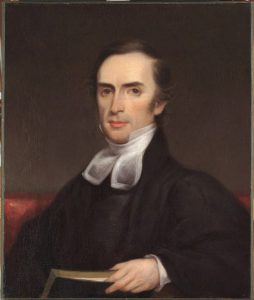
By WM. P Lunt,

Minister of the First Congregational Church in Quincy.


Boston:

WM. Crosby and H. P. Nichols,

111, Washington Street,

1851.


To William P. Lunt, D. D. Quincy,

Quincy, April 12, 1851.

Dear Sir, –In the belief, that, in times like the present, the pulpit may find a useful auxiliary in the press, the undersigned, with many others who had the good fortune to hear your Fast-day Sermon on the 10th inst. are desirous of obtaining a copy for publication. Your kind compliance with their and our wishes in this regard will much oblige, dear Sir,

Yours very truly,

S. G. Williams

Josiah Brigham

Daniel Greenleaf

Thomas Greenleaf

Lemuel

Brackett

Ebenezer Woodward

George W. Beale

I.W. Munroe

Gideon F. Thayer

Lysander Richards


To Messrs. S. G. Williams, Josiah Brigham, and others.

Quincy, April 17, 1851.

Gentlemen, – I place at your disposal a copy of the Discourse which you have done me the honor to ask for publication, and am, with great regard,

Your friend and servant,

Wm P. Lunt.


Discourse

Titus III. 1, 2.

“Put them in mind to be subject to principalities and powers, to obey magistrates, to speak evil of no man, to be no brawlers.”


It appears, then, from the text, that there is such a virtue, in the judgment of a Christian apostle, as allegiance to human authority, and that obedience to magistrates is to be found on the catalogue of Christian duties. It may be well for us to keep this fact in mind; because, in the estimation of many at present day, the only test of virtue seems to lie in resistance to the execution of laws, and in disrespect to rulers.

It also appears from the text, that one of the vices against which Christian morality laid an injunction in apostolic times was the vice of an evil-speaker or a brawler. This, too, it may be well for us to bear in mind; because this part of morality seems to be obsolete in the consideration of many in our generation. A man is in no esteem now, if he be not a brawler and an evil-speaker. The Apostle Peter, in one of his epistles, speaks of a class of “presumptuous, self-willed” persons, who “are not afraid to speak evil of dignities.” If the Apostle Peter were alive now he would find a class who are not only “not afraid,” but who esteem it quite commendable, to “speak evil of dignities.” They vilify their magistrates from principle. They appear to regard it as their peculiar mission, and the service which they are sent into the world to perform, to malign the motives and characters of those opposed to them. They set about the service quite deliberately. They have furnished a good deal, by their ingenuity and invention, to enlarge the vocabulary of abuse. Probably the people’s English was never so rich in terms and phrases suited to the purpose of defamation, as, through the contributions of such persons, it has grown to be. What will become of the next generation, if they use faithfully all these weapons of tongue-welfare, which are laid up in the armories of the fashionable philanthropy, and add to them others of their own forging, perhaps of keener edge than any they inherit, it is impossible for our foresight to determine. Certainly there is not a prospect of the earth being possessed by a very amiable society.

By they are doing a good work, they say; they are working for God and for humanity; and this will excuse, they imagine, any methods and instruments that may be employed. Doubtless they are so sincere, and so intent upon the object at which they are aiming, that they are not observant of the consequences of the course they pursue. And they will not, therefore, take it ill, if one who is standing by a cool spectator should undertake to suggest, by way of caution, that their mode of reforming the world may possibly resemble a case which is recorded in the Bible. The unclean spirit against which they are striving may be cast out; but the mischief is, that seven other spirits, more wicked than the one ejected, enter in, and the last state is worse than the first. If we must purchase exemption from one undeniable social evil by the introduction into the system of seven more virulent diseases, surely the world will not be very much of a gainer by the use of such remedies.

Another suggestion may not be regarded inapplicable to those persons who are so fond of “speaking evil of dignities.” The Apostle Jude, in his brief epistle, relates an interesting and instructive incident. He tells us that “Michael the archangel, when contending with the devil” (it was a kind of habeas corpus process served upon the evil one for the body of Moses), “durst not bring against even him a railing accusation, but said, The Lord rebuke thee.” If this was treating the devil altogether too well, there is very little danger of the Archangel Michael’s example being followed in our day.

It may therefore be deemed not inappropriate to the present occasion, called together as we are by the recommendation of the public authorities, “to consider, in the spirit of Christianity, the private and public sins of this community;” to give our attention specially to the two which are named in the text, –Resistance to the Laws, and Evil-Speaking.

With regard to the first of these sins, – resistance to the laws, – I am aware that there are two classes of persons who will be likely to object to the remarks now to be offered. First, there is the class containing those who will be ready to say that there is no disposition in our community to resist the laws; that, however much opposed our people may be to a particular enactment, they have no wish and entertain no purpose to act in any other than a regular way, through discussion and the ballot-box. It is to be hoped that this course will be pursued. Our people generally have been marked by a love of order, as much as by an inbred, if not an inborn, hatred of oppressions. But we are all composed of inflammable materials; and it is not unlikely that those who kindle into a flame most slowly may burn with the greater fierceness, and keep their unsafe heat for the longer time. When, too, we hear it said, as it has been said among us not once, but repeatedly, and as deliberately as the persons uttering it were capable of, that, Constitution or no Constitution, a certain law shall not be executed; when we hear the most violent language used by those who are looked to as guides, and witness the natural influence of such language upon the temper of persons who are ignorant and impressible; when the pulpit is denounced, if it says a word to support of the Government and Union under which we live; when the coarsest abuse is poured out upon the Judiciary, because they dare to refuse to be made use of for party purposes; – when these things are said and done, surely the coolest may see reason to be alarmed, and the conviction must be forced upon them, that there are some unmistakable symptoms in the midst of our community, of resistance to the laws. The danger is not imaginary, as some are disposed to allege. Nor is it wholly a pretext thrown before the public by designing politicians, who wish to divert attention by sounding a false alarm. There is a factious element in our community; and it will be found far more material to put down, at all hazards, this turbulent spirit, than to oppose any law, however objectionable.

But, besides those who maintain that there is no ground for fearing resistance to the laws, there is among us another class composed of persons who make resistance, passive if not active, to the laws a matter of principle. They assume the right to bring any act of statue of the government to the bar of their individual judgment or conscience; and, if the statute in question does not square with their private notions of justice, they claim the liberty to set it aside. This doctrine has been broached among us; and it finds able, eloquent, earnest advocates. The doctrine in question, it will be observed, goes far beyond any nullification that has been heretofore proposed. The dogma set up in this new school is, – that, without waiting for State action, without the necessity of calling any convention, every individual is competent to consider and pronounce the final judgment upon the laws of the land; that the rule hitherto adopted in our communities – that the majority shall govern – is a false rule; that King Majority is as great a tyrant as King George; that every individual, when he enters into society, promises to obey the Constitution of such society, as he understand that Constitution, not as others interpret it for him; that he is bound to submit only to such laws as he approves, and finds a warrant for in his own judgment. The practical operation of such a dogma is, – that, if any statute conflicts with the conscience of an individual, he will not entertain the question whether his conscience is right, but assume that it is infallible; nor will he entertain the question whether it would be practicable to submit every public act to twenty million consciences, with all the variety that may be found ranging from the inmates of the State’s prison up to the most enlightened and righteous in the land; but that, if the statute in question is pronounced wrong in the court of his private mind, he will set it aside; he will trample upon it; he will annul it. When Louis Fourteenth of France abruptly interrupted some one of his courtiers, who presumed to mention in his hearing the State, – “The State! I am the State,” – it has been thought to indicate the highest point of arrogance that a human being could reach. The pretensions of absolute power, it has been supposed, would be carried no farther. The doctrine of the tyrant is, “My will is law. My conscience is the public judgment. There shall be no appeal from my edicts.”

But is it any less arrogant and assuming for a private individual to say, – “Constitution! I am the Constitution. There shall be no appeal from my conscience to any tribunal or instrument on earth.” Who would have looked, a few years since, to find the most extravagant and high-toned doctrine of absolutism adopted by individuals nominally republicans?

Now, against every doctrine of this kind, against every species of nullification, – that which would bring State laws into conflict with the laws of the nation, as well as that more extreme but equally ungrounded species which would set the decisions of the mind of an individual, call them decrees of conscience or assertions of will, in opposition to the deliberate expression of the public mind, – against every form of nullification, both reason and religion alike protest. Man, in his private relations, may and should be governed by his own sense of right. And if all the separate members that compose society were as scrupulous to apply this inward light, each one to his private walk and personal character, as some are officious in thrusting their peculiar judgments upon the community, it would be well for the world.

But when men come to act together, a multitude of consciences and wills, there must of necessity be some umpire to settle unavoidable differences. There must of necessity be some limits beyond which the freedom of the individual shall be restrained. There must be some standard, some central authority, which shall be sovereign, and beyond which, for the purposes of society, there shall be no appeal. For the purposes of society, I say, this limitation of the individual’s prerogative is indispensable. Thought may still be free; but, when thought expresses itself in overt acts, those acts must be restrained within some fixed and definite bounds. This seems to be unavoidable, if we would maintain any form of human association.

The simple questions, then, for men to ask are, Who shall be the umpire? What power shall fix the limits beyond which the individual shall not go? And what shall be the standard from which no appeal is allowable? These questions, it is well known, have been variously answered in different countries; and, according to the answer given to them, the forms of society, and the political institutions under which men have lived, have varied. In one country the settled polity is, that a single individual, as the autocrat of Russia for example, or the Pope of Rome, called infallible, shall be umpire. He shall arbitrarily, and according to his good pleasure, fix the limits beyond which the wills of his subjects shall not transgress. His mind shall be the standard from which there shall be no appeal. In another country, the aristocracy – those who are accounted the wisest and best in the land – are the ultimate judges of what is right and binding.

Now, we reject both of these standards. We deny the divine right of kings; we deny the infallibility of the Pope. But yet we allow, as all reflecting men must allow, the necessity of some ultimate standard, if we would avoid anarchy, and uphold the order and stability of a social system. How is this problem met and solved in the theory and practice of our free forms of government? We say, – and this is the fundamental principle of our systems, – that the will of the majority, deliberately expressed, and embodied according to wholesome, prescribed forms agreed upon beforehand, and described in written Constitutions, – that this will of the majority shall rule, and that nothing shall set it aside but itself revising and reversing its own acts. This fundamental principle of our institutions has always heretofore been esteemed the best, the safest, the most reasonable rule for determining public questions; and, if we look at the working of this principle, the influence it has actually exerted, the results which have flowed from it, the prosperity and happiness, public and private, to which it has contributed, we must be convinced that it has proved itself by its fruits and beneficent principle. The amazing spectacle which our favored land presents, stretching as it does from ocean to ocean, is a proof that may be seen of all men to the same effect.

It is not maintained by any, that the principle is a perfect one, either theoretically or practically. Doubtless, the majority in any community are liable to error. They may, and sometimes do, commit mischievous mistakes. They may be driven by passion or by interest; or, by the dissemination of false doctrine, may be led deliberately into unjust and pernicious measures. But with all this liability to error, inseparable from the will of the majority, should we be ready to exchange the popular rule, judging of its character by its influence on the whole, for the principle upon which absolute governments are founded? If the action of the majority is wrong in any instance, being grounded in false doctrines whether moral in any instance, being grounded in false doctrines whether moral or political, the only remedy open to us, short of revolution, is to set about rectifying public opinion, so that at some future period the wrong measures may be repealed. If the expressions of the popular will were to be regarded as irreversible decrees which it were unlawful to consider and discuss, in that case there would be some valid reason for complaint. It is true, that, when public opinion gets bent and fixed in any wrong direction, it is no easy matter, and it is not the work of a day or of a year, perhaps not in some cases the work of a single generation or century, to rectify the errors that have been committed, and to put society upon the right track. But is this any reason why a being so short-lived as the individual man is upon the earth should fret and work himself into a passion, and distrust Providence, and oppose his will to the public will, and, if he cannot have his own way, impede, as much as in him lies, the working of social institutions?

Government, therefore, as we may easily convince ourselves, grows out of the necessity of human affairs, although its form may and does vary in different countries and periods of time. But whatever form it may assume, and however much it may be improved, it will always be an imperfect instrument, involving evils of greater or less magnitude, and for ever failing to correct social inequalities, and to bring the condition of mankind upon the earth to that point of absolute justice and right of which the human mind can form an ideal conception. Nor is this any good reason why men should give over all effort to better their condition, and to bring the actual state of society more nearly up to the level of their ideal standard. Let such efforts be unceasingly made by the wise and benevolent of successive generations. But, in laboring for a good which they have not attained, let them not put to hazard the manifold blessings they already possess. With all its imperfections, and failing, as it does, to accomplish much that the heart of man earnestly desires to attain, there is yet a sacredness attached to government which is a wholesome sentiment; and although there are cases when rulers may be rightfully resisted, and when revolution is a duty, yet these are extreme cases, and require for their justification the most imperative necessity.

The sentiment of the sacredness of government is expressed and enforced in the Scriptures very emphatically. The words of the Apostle Paul, for example, are often quoted to enforce this sentiment, “Let every soul be subject unto the higher powers. For there is no power but of God: the powers that be are ordained of God.” Although these words have too often been misinterpreted, as if they were designed to uphold and justify absolute governments, and to inculcate passive, unresisting submission to laws, however unjust and oppressive; one sentiment they do at least convey, namely, the divine right of government, the majesty and sacredness of public law, and the consequent venerableness of those who are invested and authority. He who allows himself to speak evil of magistrates dishonors himself as one of the people from whom those magistrates derive their delegated power. And therefore it is a just and well-grounded maxim for every good citizen, that a magistrate, when he has been fairly chosen to office, whether we ourselves helped to elect him or not, is entitled to respect until he may forfeit it by some unworthy act.

The Divine Right of Government! This is eminently a Christian sentiment. The divine right of kings is a fiction formerly entertained very widely by the human mind, but which has vanished before the clear light of intelligence and Christian truth. The divine right of any particular form of government, in preference to any other form, will not bear the test of examination. But the divine right of government as opposed to anarchy; the necessity, established by God himself in our constitution and condition, for some restraint upon the wills of individuals; the essential sanctity of law, – this is a sentiment which no changes to which the human mind is subject can impair. Reason and Scripture, with united voice, say to men: “Choose you, as wisdom may dictate, under what form of civil society you will live. Determine, as you like best, where the sovereign authority shall be lodged from which there shall be no appeal. If you are oppressed by intolerable burthens and unjust exactions, rise up against the tyranny, and shake it off; do this calmly, in the fear of God, and not without a prudent calculation of the hazards. However, do the work, hazardous as it is, if you are convinced that it must be done, and strive to place yourselves in a position more favorable for your happiness.” But Reason and Scripture add this caution to the liberty which is granted to men: “Remember, you cannot choose whether you will live under some government or none at all. This is not – this never has been– this never will be the alternative offered to mankind.” Nor, because a government fails to come up to the ideal standard we form in our minds, and to accomplish all the unmixed good we could desire, are we at liberty to disallow its claims, and to fall back upon our own individual judgments.  It is with government as with all earthly blessings, even the best: we take it, and we take them all, “for better or for worse,” “until death do us part.” Authority supreme, from which there shall be allowed not appeal, must reside somewhere. God, who desires the highest good of communities, has instituted government for the promotion of that good. Government, therefore, is not only to be submitted to as a necessity, nor merely to be look upon as an institution quite useful to society, but the Christian citizen will look upon it as a shield which Heaven has interposed between what he most loves and what he most dreads; he will regard it with veneration, as type, however imperfect, of that divine sovereignty which rules the universe; as a branch of that law whose “seat is the bosom of God.” This is the doctrine in regard to governments, magistrates, and laws which Christianity plainly inculcates.

And assuredly there never was a time when our community stood more in need than now of the influence of this great conservative sentiment of the divine right of government, and of such precepts as those contained in the text, to moderate the excitement which exists against an obnoxious law. To examine with the utmost freedom, consistent with decorum, all public measures, is a clear and indisputable right, which none of us would willingly surrender. To discuss the laws of the land, to point out their defects, to argue their inconsistency with the Constitution, to criticize their details, or to object to the principle they involve; to point out, by fair reasoning, their opposition to natural justice and to the duties of religion; to urge their repeal on the ground either of their transcending the powers lodged with the lawmaking branch, or if clearly within the scope of their authority, yet as unadvisable exercises of that authority, under a complex system which depends very much for its harmonious working on compromise, concession, and forbearance, – all this is allowable surely. But while this process for rectifying public sentiment, necessarily slow, requiring long periods of time it may be, and calling for much patience before the object is gained, – while this process is going on, the obnoxious law must be executed, or there must be a revolution. And amidst the complicated affairs of this world, where nothing corresponds to the principles which we are apt to regard best, we are forced to decide between submitting to a wrong for which we are not responsible, or hazarding the existence of those social safeguards upon which all our most valued blessings rest.

It should be borne in mind, too, that there are consciences on both sides of such a question as now divides our community; that there are convictions equally strong, equally enlightened, equally pure and honest, on both sides. It is neither justifiable nor sufferable for a person to assume, that the motives of himself and of those who agree with him are right, and that all opposed to him are acting under the influence of interested, immoral, and unchristian motives. The only fair view of the case is, that there is a conflict of consciences equally honest. And, in such an exigency, what can be done, what do the necessary imperfections of the social state allow to be done, except to submit to the umpire which we have voluntarily and deliberately adopted, – the will of the majority; to defer to the best judgment touching the matter in dispute, which the body of the community is capable of arriving at for the present, and to trust to the enlightening influence of causes now at work, to produce a better state of public opinion hereafter?

This conflict of consciences among men that think at all, and that are able to exercise the faculty of judgment on moral subjects, demonstrates the imperative necessity of some government, that is, of some established umpire, whose decisions, if not always wise and right, if even they may at times be unjust, are far better fore society than infinite wranglings among those who will consent neither to give over their disputes, nor to refer their differences to any earthly tribunal. What society needs, in order that the great interests of man which are aimed at in social institutions should be promoted, is some chance for repose. It were but poor amends for the evil of never-ending, bitter strife, to say that the combatants are conscientious. If they are conscientious in quarrelling, there ought to be some power somewhere in the world that shall be conscientious in putting a stop to their quarrels. We are bound to consider what must be the consequence, if, in every collision that occurs between private conscience and public law, we apply the doctrine that we may set aside a portion of that public law. Where can this doctrine end but in the sovereignty of every individual? – a state of things very much resembling that which is described in the Book of Judges, – “In those days there was no king in Israel; but every man did that which was right in his own eyes.” And as the wise man tells us, “Every way of a man is right in his own eyes.” There is not an article in any Constitution that now exists upon earth, or in any Constitution that could be devised by the wit or wisdom of man, to which the honest or the contentious conscience of some individual might not be found to object. If a person should feel impelled by his conscience to aim a murderous weapon at my life, or to appropriate to himself a portion of my substance, or to vilify and slander my good name (and all these things have been done very conscientiously), I should pray to be protected from that man’s conscience.

What other conclusion, then, can wise, practical men come to, but to allow the laws of the land, which have been enacted in due form, to have their course and be executed, until we can so far change the current of public opinion that what is objectionable in those laws may be corrected?

Among the great, wise, and good men who met in convention more than sixty years since to frame the Constitution of the United States, under which we have lived and prospered thus far, was Benjamin Franklin, known all over the world for his genius, his virtue, and his usefulness. At that time, he was eighty-one years old. He had learned all that he was likely to learn upon earth. He had all but finished his mortal career, and therefore was not open to the charge, from the most captious, of being influenced by interested motives. In a speech that he made at the close of the convention, he said, among other good remarks; “I consent to this Constitution, because I expect not better, and because I am not sure that it is not the best. The opinions I have had of its errors I sacrifice to the public good. On the whole, sir, I cannot help expressing a wish, that every member of the convention who may still have objections to it would with me on this occasion doubt a little of his own infallibility, and, to make manifest our unanimity, put his name to this instrument.” Such was the language of Franklin on a memorable occasion. I would seek to strengthen the good sense and practical wisdom of his words, not by any language of my own, but by the inspired world of Holy Writ: “Put them in mind to be subject to principalities and powers, to obey magistrates, to speak evil of no man, to be no brawlers.” This is the charge given to a Christian teacher and minister in early times; and the same charge is given, as I understand the matter, to the servants of the altar now. If the time shall ever come when it shall be deemed the legitimate office of the Christian pulpit to preach revolutionary doctrines, and to instigate the minds of men to resistance to the laws of the land, it will be time, too, for the people to consider whether the pulpit is worth upholding. God grant that that time may never come!

Sermon – Fasting – 1798, Massachusetts (Morse)

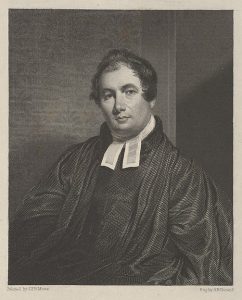
Jedidiah Morse (1761-1826) Biography:

Born in New Haven, Connecticut, Morse graduated from Yale in 1783. He began the study of theology, and in 1786 when he was ordained as a minister, he moved to Midway, Georgia, spending a year there. He then returned to New Haven, filling the pulpit in various churches. In 1789, he took the pastorate of a church in Charlestown, Massachusetts, where he served until 1820. Throughout his life, Morse worked tirelessly to fight Unitarianism in the church and to help keep Christian doctrine orthodox. To this end, he helped organize Andover Theological Seminary as well as the Park Street Church of Boston, and was an editor for the Panopolist (later renamed The Missionary Herald), which was created to defend orthodoxy in New England. In 1795, he was awarded a Doctor of Divinity by the University of Edinburgh. Over the course of his pastoral career, twenty-five of his sermons were printed and received wide distribution.

Morse also held a lifelong interest in education. In fact, shortly after his graduation in 1783, he started a school for young ladies. As an avid student of geography, he published America’s very first geography textbook, becoming known as the “Father of American Geography,” and he also published an historical work on the American Revolution. He was part of the Massachusetts Historical Society and a member in numerous other literary and scientific societies.

Morse also had a keen interest in the condition of Native Americans, and in 1820, US Secretary of War John C. Calhoun appointed him to investigate Native tribes in an effort to help improve their circumstances (his findings were published in 1822). His son was Samuel F. B. Morse, who invented the telegraph and developed the Morse Code.


A Sermon

Delivered at the New North Church in Boston,

In the Morning

And

In the Afternoon at Charlestown,

May 9th, 1798,

Being the Day recommended by

John Adams,

President of the United States of America,

For

Solemn Humiliation, Fasting and Prayer.

By Jedidiah Morse, D.D.

Minister of the Congregation in Charlestown.

Published at the request of a number of the Hearers, in both Congregations.

Printed by Samuel Hall, No. 53, Cornhill, Boston.

1798.


2 Kings, XIX. Part of Verse 3 & 4.

This day is a day of trouble, and of rebuke, (or reviling) and blasphemy – wherefore lift up thy prayer for the remnant that are left.


Thus king Hezekiah, by his messengers, addressed the prophet Isaiah, in circumstances of singular perplexity and distress for the safety of his threatened country. It must be interesting to us in the present posture of our public affairs, to know that were the peculiar circumstances and dangers, which prompted good king Hezekiah to make a declaration and a request, so remarkably applicable to our case as a nation, and so exactly coincident with the spirit of the proclamation. “This day,” said Hezekiah to the prophet, “is a day of trouble, of reviling, and of blasphemy – Wherefore lift up thy prayer so the remnant that is left.” –  “The United States of America,” says the President, to the minister of religion and the people, “are at present placed in a hazardous and afflictive situation” – Wherefore make earnest supplication to God “that our country may be protected from all the dangers which threaten it.” – In what respects the causes which, in each case, produced the perilous and distressful situation, bear resemblance to each other, may be perceived from a concise historical view of the state of public affairs in the kingdom of Judah, at the period of which we are speaking, and with which, as applicable to the present occasion, I shall introduce this discourse.


The Assyrians, in the time of Hezekiah, were the most powerful nation on earth. Their empire embraced and controlled the strength of the kingdoms of Babylon, Nineveh and Medea. – They had, in rapid succession, subdued and annexed to their empire, Syria, Palestine, and the whole territory inhabited by the ten tribes, constituting the kingdom of Israel; and had even carried their conquests into Egypt, and ravaged that country. With their immense spoils, they had enriched and aggrandized their empire; and with their captives, they had peopled their waste territories. Thus strengthened by the accession of the conquered countries, by their inhabitants and wealth, they became formidable, and the dread and terror of their neighbors.

They were a treacherous and faithless, as well as powerful nation. Ahaz, king of Judah, the wicked father of Hezekiah, discarding the aid of the God of his fathers, had very unwisely, and at the very great price, purchased an alliance with the king of Assyria; but he basely betrayed the interests of Ahaz, and converted the fruit of all his conquests to his own advantage. “In reality,” to use the words of the learned and faithful historian, Predeaux, “he was in reality distressed rather than any way helped by this alliance; the land being almost as much exhausted by the presents and subsidies, which were extorted from him by his pretended friend and ally, as it was by the ravages and pillages of his open enemies.” Two other evils of magnitude to the kingdom of Judah, grew out of this alliance: it brought into its neighborhood, in place of a number of small and feeble states, the formidable Assyrian empire, which afterwards proved a severe scourge; it cut off the inhabitants from their lucrative trade to the Southern sea, which had been the source of all their riches. And what was worst of all, and proved afterwards a source of great and almost ruinous calamity to the kingdom of Judah, was, that Ahaz, with a view to induce the king of Assyria to form an alliance with him, had meanly engaged, in case of his compliance, to become his vassal and tributary. This base agreement was the foundation of the difficulties and distress in which the good king Hezekiah was involved, when he sent the message in our text to the prophet.

Early in the reign of Hezekiah, the king of Assyria sent to demand the tribute, which, by the agreement of Ahaz, was his due. Hezekiah could not brook this base submission, and refused to comply with the demand. A war with Tyre, which commenced at this time, diverted the Assyrian king, Salmanezer, from urging his demand by force.

This demand, however, was repeated by his successor, Sennacherib, who, upon the refusal of Hezekiah to comply with it, declared war against him, and entered Judah with a numerous army. In this alarming state of affairs, Hezekiah consulted with the chief men of his kingdom, and it was agreed to put the city of Jerusalem into the best possible state of defense. Accordingly the old walls were repaired; new ones erected, and towers and other works, necessary for their defense were provided: All the people, capable of bearing arms, were enrolled an disciplined for war; and every possible preparation was made to repel the attacks of the enemy.

In the meantime, the king of Assyria was ravaging the cities of Judah, and advancing towards Jerusalem. Grieved at this havoc, and fearing its increase, notwithstanding the defensive measures which he had taken, he sent ambassadors to Sennacherib with this humiliating message, “I have offended, return from me; that which though puttest on me I will bear. And the king of Assyria appointed to king Hezekiah 300 talents of silver and 30 talents of gold.” [II Kings 18:14] To pay this heavy contribution he exhausted the treasures of the temple, and his own coffers, and even cut off the gold from the doors and pillars of the temple. Mark the subsequent conduct of the haughty Assyrian conqueror: Having procured from his humiliated enemies, their means of defense, and knowing them to be now more completely in his power than ever, regardless of the sanction of treaties and oaths, he renewed the war with Hezekiah, and pushed on his conquests more vigorously than ever!

In the meantime, hearing that and Egyptian army was advancing, agreeably to treaty, to the aid of Hezekiah, Sennacherib raised the siege of Jerusalem, and proceeded to meet them, gave them battle and defeated them, and carried desolation into the heart of Egypt, and came back with great spoil. Elated and proud with his successes, he returned to the siege of Jerusalem, and, by three of his principal officers, sent to Hezekiah that insulting, boastful and blasphemous message which is recorded at length in the chapter preceding the text. It is remarkable, that Sennacherib directed that this message should be delivered under the walls of Jerusalem, in the Hebrew language, and within the hearing of the people, with an evident design to destroy their confidence in their king, and to excite them to revolt. The style of the message was calculated to effect this base purpose. When the messengers of Hezekiah, who were appointed to negotiate with those of Sennacherib, requested the orator, Rabshakeh, to speak to them in the Syrian language, telling them that they understood it, and not to talk with them in the Jews language in the hearing of the people who were on the wall; the orator replied–“Hath my master sent me to thy master, and to thee, to speak these words? Hath he not sent me to the men which fit on the wall?” [II Kings 18:27] – or, in plainer and more modern language, My business is not with your government, it is with the people. “Then Rabashakeh stood, and cried with a loud voice in the Jews language, and spake, saying, Hear the words of the great king, the king of Assyria. Thus saith the king, Let not Hezekiah deceive you, for he shall not be able to deliver you out of his hand. Neither let Hezekiah make you trust in the Lord, saying, The Lord will surely deliver us. Hearken not unto Hezekiah; for thus saith the king of Assyria, Make an agreement with me by a present, and come out to me; and then eat ye every man of his own vine and fig-tree, and drink ye every one the waters of his cistern. Hearken not unto Hezekiah, when he persuadeth you, saying, The Lord will deliver us. Hath any of the gods of the nations delivered at all his land out of the hand of the king of Assyria? Where are the gods of Hamath, and of Arpad? Where are the gods of Sepharvaim, Hena, and Ivah? Have they delivered Samaria out of mind hand? Who are they, among all the gods of the countries, that have delivered their country out of mine hand, that the Lord should deliver Jerusalem out of mind hand? But the people held their peace, and answered him not a word.” [II Kings 18:28-36]

We can easily conceive what effect this message must have had upon the people, upon the messengers of Hezekiah, and upon this good king himself, when it was told to him. They rent their clothes; the king covered himself with sackcloth, and, like a good man, went into the house of the Lord. He then sent the message, of which our text makes a part, to the prophet Isaiah. “This day is a day of trouble and of reviling and of blasphemy; wherefore lift up thy prayer for the remnant that are left.”

 How far the facts and circumstances, in the foregoing narrative, apply to our case as a nation; what degrees of resemblance there are in the causes which involved Hezekiah and his people in their great perplexity and distress, and those which have brought us into our present unhappy and perilous situation, I leave everyone to judge for himself. I make no particular applications. However we may vary in our opinion on these points, we shall all agree, I apprehend, in this – “the situation of the United states, at present, is hazardous and afflictive.” And I would hope that we all feel disposed, in compliance with his request, to unite in earnest supplications to God for those important and timely favors enumerated in the proclamation. It would be difficult to reconcile with a sincere belief of the Christian religion, the conduct of any person, who should seriously object to the observation of this day, as a day of humiliation, fasting and prayer, at a time when all must agree, we have peculiar need of divine support, guidance and protection. Whether our troubles and dangers arise from our own errors, or from the unjustifiable conduct of foreign nations, it becomes us, in either case, and peculiarly in the former, to humble ourselves before God, and to implore his forgiveness, direction and benediction. But that we should have men among us, so lost to every principle of religion, morality, and even common decency, as to reprobate the measure; as to condemn the authority who recommended it, and to denounce it as hypocritical, and designed to effect sinister purposes, is indeed alarming. Such persons address the sentiments, if not the language, of Rashakeh to the people – “Suffer not your President to make you trust in the Lord.” That such vile sentiments should find their way into a newspaper, and be read and tolerated by a people who profess Christianity, indicates a degree of corruption and depravity in the public mind, more truly threatening to our dearests rights and interests, than the hostile attitude and movements of foreign nations.

 I proceed to show, in what respects, the present may be considered as a day of trouble, of reviling and blasphemy.

It is a day of trouble with us in respect to our foreign relations. Our situation is rendered “hazardous and afflictive,” (says the proclamation), “by the unfriendly disposition, conduct and demands of a foreign power, evinced by repeated refusals to receive our messengers of reconciliation and peace; by depredations on our commerce, and the infliction of injuries on very many of our fellow citizens, while engaged in their lawful business on the seas.” These circumstances prompted our Chief Magistrate to recommend the solemn Fast which we now celebrate; and they constitute the leading and most operative causes of our existing troubles.

To the unfriendly disposition and conduct of foreign power, we may ascribe the unhappy divisions that have existed among us, which have so greatly disturbed our peace, and threatened the overthrow of our government. Their maxim, to which they have strictly and steadily adhered, has been, “Divide and govern.” Their too great influence among us has been exerted vigorously, and in conformity to a deep-laid plan, in cherishing party spirit, in vilifying the men we have, by our free suffrages, elected to administer our Constitution; and have thus endeavored to destroy the confidence of the people in the constitution authorities, and divide them from the government. They have abused our honest friendship for their nation, our gratitude for their assistance in our revolution, and our confidence in the uprightness and sincerity of their professions of regard for us; and, by their artifices and intrigues, have made these amiable dispositions in the unsuspecting American people, the vehicles of their poison. Hence has arisen no small portion of the troubles which we now experience. They are the bitter fruit of a subtle and secretly operating foreign influence among us – an influence which has proved the bane of our peace, and which ought, as we value our liberties and dearest privileges, to be vigilantly watched, and firmly resisted.

Calculating upon the effects produced, in this country, by their “diplomatic skill” in intrigue, and believing that they had secured a party sufficiently strong to enable them to accomplish their designs, this foreign nation have, by degrees, adopted a bolder and bolder tone towards us, and at length have openly avowed their object. By their ministers they have quarreled with our government: They have vehemently opposed our exercising the rights of an independent nation: They have fomented insurrections among us: They have artfully endeavored to plunge us into a ruinous war: They have, unjustly and unprovoked, captivated, imprisoned, and otherwise mal-treated many of our fellow-citizens. And when, notwithstanding all these aggressions and provocations, our government, sincerely anxious for peace, and willing to sacrifice everything but our national honor and independence to this purpose, sent ambassadors of reconciliation, with ample and unexceptionable powers – (could it have been expected from allies? – allies who have yet their admirers among us!!!)they have refused, and that repeatedly and perseveringly, and in a manner most mortifying to an independent mind, even to receive them! They will not hear what we have to say in vindication of those measures, at which they affect to be offended. They spurn at our advances for reconciliation, and insult us with their neglect. More than all this, to use the language of our commissioners, “In the haughty style of a master, they tell us, that unless we will pay them a sum of money, to which our resources scarcely extend, we may expect their vengeance, and, like Venice, be erased from the list of nations; that they will annihilate the only free republic on earth, the only nation in the universe, which has manifested for her a cordial and real friendship!” – Still more, they say to our commissioners of peace, “You believe, perhaps, that in returning and exposing to your countrymen, the unreasonableness of the demands of this government, you will unite them in their resistance to those demands. You are mistaken – you ought to know that the diplomatic skill of France, and the means she possesses in your country, are sufficient to enable her, with the French party in America, to throw the blame, which will attend the rupture of the negotiations, on the Federalists, as you term yourselves, but on the British party, as France terms you; and you may assure yourselves this will be done.”

Such are the causes which have progressively operated, till they have ultimately placed us in our present hazardous and afflictive situation. If proofs are demanded in support of the foregoing statement, they are contained in the State Papers which have been published by our own government and by the government of France –in the late dispatches from our commissioners, and in the newspapers; and these proofs are abundant, luminous and convictive to everyone who reads them with a candid and unprejudiced mind.

It will, perhaps, be expected by some, that while so much is said concerning the unjustifiable conduct of one foreign nation, another, whose conduct towards us, during the present war, has been unfriendly and unjustifiable, should not pass unnoticed and uncensored. On this subject I would observe, that this thing was done at the time. The unjust spoliations of the British nation were reprobated in the strongest terms, throughout America; and similar measures for an amicable adjustment of differences, and compensation for losses, were then adopted, and pursued successfully with Great-Britain, which have since been repeatedly proffered to France, and as repeatedly rejected with most insulting aggravations. I am by no means an advocate for the aggressions of any nation on our rights. I would with equal indignation resist them all. But when differences with a nation have been once settled, and provision made for the peaceable adjustment of any new ones which may arise, why should we be continually opening afresh old wounds? What purposes can it answer, but to inflame the public mind, to prevent a union in the measures of our own government, and aid the views of a nation who seek our division and ruin? It was insinuated to our commissioners in France, and it is a current and credited language among a particular class of people in this country, (and the design of it is too visible to escape a discerning mind), that it is the wish of our government and its supporters, to form an alliance with Great-Britain. To this insinuation I believe I may safely and truly answer in the words of our commissioners – that “with respect to any political connection with Great-Britain, America never contemplated it.” Our maxim, as citizens, in regard to all nations, ought to be that contained in the declaration of our independence, “Enemies in war, but friends in peace.”

Our situation is rendered “hazardous and afflictive,” not only from the unfriendly disposition, conduct and demands of a foreign power, which excite painful apprehensions that war may be the consequence, and which render necessary expensive measures of defense; but also and peculiarly from the astonishing increase of irreligion. I use this word in a comprehensive sense, and would be understood to mean by it, contempt of all religion and moral obligation, impiety, and everything that apposeth itself to pure Christianity. This day is a day of reviling and blasphemy.

Never, at any period, could this be said, in reference to the world at large, with more truth than at the present. Kings, princes, and rulers in all governments; government itself in all, even its mildest, forms; priests and ministers of religion of all denominations; and the institutions of Christianity of all kinds, from the most corrupt to the most pure, are reviled and abused, in a singular manner, in similar language, in all Christian countries, and seemingly by common consent. The existence of a God is boldly denied. Atheism and materialism are systematically professed. Reason and Nature are deified and adored. The Christian religion, and its divine and blessed Author, are not only disbelieved, rejected and condemned, but even abhorred, and efforts made to erase their very name from the earth. As the natural fruits of these sentiments, and what we ought to look for where they prevail – fraud, violence, cruelty, debauchery, and the uncontrolled gratification of every corrupt and debasing lust and inclination of the human heart, exist, and are increasing with unaccountable progress. Evidence of the truth of this representation is brought by almost every arrival from Europe, and we have it, in various and convincing forms, before our eyes in our own country.

Our newspapers teem with slander and personal invective and abuse. Our rulers, grown grey, many of them, in the service of their country; who, in the various dignified and responsible offices they have filled, have discharged their duties with great ability and incorruptible integrity, are yet stigmatized continually, as unfriendly to the rights and liberties of the people, and to the true interests of their country. Our Government itself, the most perfect, and best administered, the least burdensome, and most happysying to the people of any on earth, is yet steadily opposed in all its important measures, and regular and continual efforts are made to “stop its wheels.”

The Clergy also, who have according to their influence and abilities, supported the Government and vindicated its administration, have received, from the same quarter, a liberal portion of reviling and abuse. And what have the Clergy done to provoke this treatment? Can it be said, with truth, that they are unfriendly to the rights and interests of the people? On what side were they in the year 1775, and during the revolution? What interests can they have separate from those of their people and their country suffer, must they not necessarily suffer with them? Their little all of property stands on the same basis with that of their people, and the same events affect them equally. Could they not subsist in as much ease and affluence as they now do, by other professions? Are their stipends or their prospects of promotions enviable or alluring? Can they then be your friends who are continually declaiming against the Clergy, and endeavoring by all means – by falsehood and misrepresentation, to asperse their characters, and to bring them and their profession in to disrepute? If the Clergy fall, what will become of your religious institutions? Undoubtedly they must share the same fate. And are they of no value?

What can be the design and tendency of all these things? Have we not reason to suspect that there is some secret plan in operation, hostile to true liberty and religion, which requires to be aided by these vile slanders? Are they not intended to bring into contempt those civil and religious institutions founded by our venerable forefathers, and to prostrate those principles and habits formed under them, which are the barriers of our freedom and happiness, and which have contributed essentially to promote both; and thus to prepare the way among us, for the spread of those disorganizing opinions, and that atheistical philosophy, which are deluging the Old World in misery and blood?

We have reason, my brethren, to fear that this preparatory work is already begun, and made progress among us; and that it is a part of a deep laid and extensive plane, which has for many years been in operation in Europe. To this plan, as to its source, we may trace that torrent of irreligion, and abuse of everything good and praise-worthy, which, at the present time, threatens to overwhelm the world. This plan is now unveiled.

In a work written by a gentleman of literary eminence in Scotland, within the last year, and just reprinted in this country, entitled, “Proofs of a Conspiracy against all the Religions and Governments of Europe,” we are informed, that a society who called themselves the illuminated has existed for more than twenty years past in Germany. The express aim of this society is declared to be, “To root out and abolish Christianity, and overturn all civil government.” Their principles are avowedly atheistical. They abjure Christianity–justify suicide–declare death an eternal sleep–advocate sensual pleasures agreeably to the Epicurean philosophy–call patriotism and loyalty narrow minded prejudices, incompatible with universal benevolence–declaim against the baneful influence of accumulated property, and in favor of liberty and equality, as the unalienable rights of man–decry marriage, and advocate a promiscuous intercourse among the sexes–and hold it proper to employ for a good purpose, the means which the wicked employ for bad purposes.

This society, under various names and forms, in the course of a few years, secretly extended its branches through a great part of Europe, and even into America. Their aim is to enlist in every country, “such as have frequently declared themselves discontented with the usual institutions”–to “acquire the direction of education–of church management–of the professorial chair and of the pulpit–to bring their opinions into fashion by every art, and to spread them among young people by the help of young writers.” They are unwearied in their efforts, by various artifices, to get under their influence the reading and debating societies, the reviewers, journalists or editors of newspapers and other periodical publications, and booksellers and post-makers; and to insinuate their members into all offices of instruction, honor, profit and influence, in literary, civil and religious institutions. The leading members of this Order are men of great talents, zeal and industry; and governed by their maxim, borrowed from the Jesuits, “that the end sanctifies the means,” they are prevented by none of those religious and moral principles, which are wont to restrain men when prompted to acts of wickedness, from pushing their plans by the vilest means.

This society, aided by concurrent causes which it has been instrumental in combining and bringing into operation, has already shaken to their foundation, almost all the civil and ecclesiastical establishments in Europe. There is great reason to believe that the French revolution was kindled by the Illuminati; and that it has been cherished and inflamed by their principles. The successes of the French armies, many of them, can be traced to the influence and the treacheries of different branches of this society.  –– There are too many evidences that this Order has had its branches established, in some form or other, and its emissaries secretly at work in this country, for several years past. From their private papers which have been discovered, and are now published, it appears, that as early as 1786, they had several societies in America. And it is well known that some men, high in office, have expressed sentiments accordant to the principles and views of this society.

In a work published by Hoffman, at Vienna, in 1795, and quoted by professor Robison, in the following remarkable passage respecting France: – “The intelligent saw (in 1790) in the open system of the Jacobins, the complete hidden system of the Illuminati. We knew that this system included the whole world in its aims, and France was only the place of its first explosion. The Propaganda works in every corner to this hour; and its emissaries run about in all the four quarters of the world, and are to be found in numbers in every city that is a seat of government.” There can be little doubt that the “Age of Reason” and the other works of that unprincipled author, as they proceeded from the fountain head of Illumination, and have been so industriously and extensively circulated in this country, were written and sent to America expressly in aid of this demoralizing plan. The titles of some of these works, and the tendency of them all, are in exact conformity to the professed principles and designs of the society. It is not improbable that the affiliated Jacobin Societies in this country were instituted to propagate here the principles of the illuminated mother club in France. And is it not apparent that the seeds which were then sown, are springing up and bearing fruit.

Let any who doubt the truth and fairness of the foregoing representation, read for themselves. The book which is my authority ought to be read by every American. It throws more light upon the causes, which have brought the world into its present disorganized state, (I speak for myself), than any, I had almost said than all other books beside.

I hold it a duty, my brethren, which I owe to God, to the cause of religion, to my country, and to you, at this time, to declare to you, thus honestly and faithfully, these truths. My only aim is to awaken in you and myself a due attention, at this alarming period, to our dearest interests. As a faithful watchman I would give you warning of your present danger.

By these awful events – this tremendous shaking among the nations of the earth, God is doubtless accomplishing his promises, and fulfilling the prophecies. This wrath and violence of men against all government and religion, shall be made ultimately, in some way or other, to praise God. All corruptions, in religion and government, as dross must, sooner or later, be burnt up. The dreadful fire of Illuminatism may be permitted to rage and spread for this purpose. When a work of vengeance and destruction is to be performed, the instruments are fitted for their work. But while we contemplate these awful events in this point of view, let us beware, in our expressions of approbation, of blending and end with the means. Because atheism and licentiousness are employed as instruments, by divine providence, to subvert and overthrow popery and despotism, it does not follow that atheism and licentiousness are in themselves good things, and worthy of our approbation. While the storm rages, with dreadful havoc, in Europe, let us be-comforted in the thought, that God directeth it, and that he will, by his power and wisdom, so manage it, as to make it accomplish his own gracious designs. While we behold these scenes acting abroad, and at a distance from us, let us be concerned for our own welfare. In various respects, as we have shown, it is with us, at present, “a day of trouble, of reviling, and blasphemy.” Our situation is “hazardous and afflictive” –We have reason to tremble for the safety of our political, as well as our religious ark. Attempts are making, and are openly, as well as secretly, conducted, to undermine the foundations of both. In this situation of things, our duty is plain, and lies within a short compass.

The pious king Hezekiah hath set us an example, when place in a similar situation, well worthy our present imitation: he took the message he had received from the king of Assyria, and spread it before the Lord, and prayed – (let us unite in this pertinent prayer) – “O Lord God of Israel, which dwellest between the cherubims – thou art the God, even thou alone, of all the kingdoms of the earth – thou hast made heaven and earth – Lord, bow down thine ear and hear – open, Lord, thine eyes and see; and hear the words of Senacherib, which hath sent him to reproach the living God. Of a truth, Lord, the kings of Assyria have destroyed the nations and their lands, and have cast their gods into the fire; for they were no gods, but the work of men’s hands, wood and stone, therefore they have destroyed them – Now, therefore, O Lord our God, I beseech thee, save thou us out of his hand, that all the kingdoms of the earth may know that thou art the Lord God, even thou only.” [II Kings 19:14-19] The effectual fervant prayer of this good man availed much. [James 5:16]

As citizens, we ought with one heart to cleave to, and support, our own government. It is a government of our own forming, and administered by men of our own choice; and therefore claims our confidence and support. We ought to repel, with indignation, every suggestion and slanderous insinuation, calculated to weaken and just confidence in the rectitude of the intentions of our constituted authorities. All such insinuations, at this critical period, proceed from an influence hostile to our peace; and, if permitted to have their intended effect, may accomplish the purposes of our enemies, in our division and the overthrow of our government. While, on the one hand, we would avoid passive obedience and non-resistance, let us not vibrate into the other extreme, and believe it a duty to be jealous and suspicious of everything which is done by our rulers. We thought them honest men, and friends to their country, when we elected them into office; and what have they since done to forfeit our good opinion? Let their measures be examined with candor, and we shall assuredly say, they deserve well of their country. In this moment of our political danger, let us be impressed with this truth – that – “United we stand – divided we fall.” The increasing union among us, and the revival and expression of the true American spirit, are tokens for good, and augur well in regard to our political interests.

As Christians, we ought to be alarmed for the safety of the church; to be vigilant in resisting the open and secret attempts to bring into disrepute and to prostrate our religious institutions. If these foundations be destroyed, and infidelity and atheism prevail, what will the righteous do? Let us then search for the Achans, the accursed things, among us, and let them be taken away and destroyed. Let us, each with care, inspect his own heart and conduct, and repent of, and correct, what he finds amiss. Let us examine into the state of our families, “those little communities which constitute the great public body,” and reform, as far as in us lies, whatever is sinful or wrong in them. Let us exert all our influence and efforts to effect a general reformation, in principles and manners, trusting in the Lord to succeed our endeavors. These are the sure, and only means of our preservation. If, in defiance of all warnings, we will be a sinful people, and abuse our civil and religious blessings, we must expect to be punished with the loss of them. Talents that are unimproved will in due time, be taken away. As we would hope for their continuance then, let us properly appreciate our national privileges, and our religious institutions, and repent that we have been so insensible of their value, and so negligent to improving them. And, agreeably to the excellent and reasonable advice of our Chief Magistrate, let us this day, “with the deepest humility, acknowledge before God the manifold sins and transgressions with which we are justly chargeable as individuals and as a nation, and beseech him, of hi infinite mercy, through the Redeemer of the world, freely to remit all our offences, and to incline us, by his Holy Spirit, to that sincere repentance and reformation, which may afford us reason to hope for his inestimable favor, and heavenly benediction.” And will God vouchsafe to hear our prayers, and the prayers of his people, throughout our country, this day, and grant us an answer of peace, through Jesus Christ, our divine Lord; to whom, with the Father and Holy Spirit, be ascribed praises everlasting.

AMEN

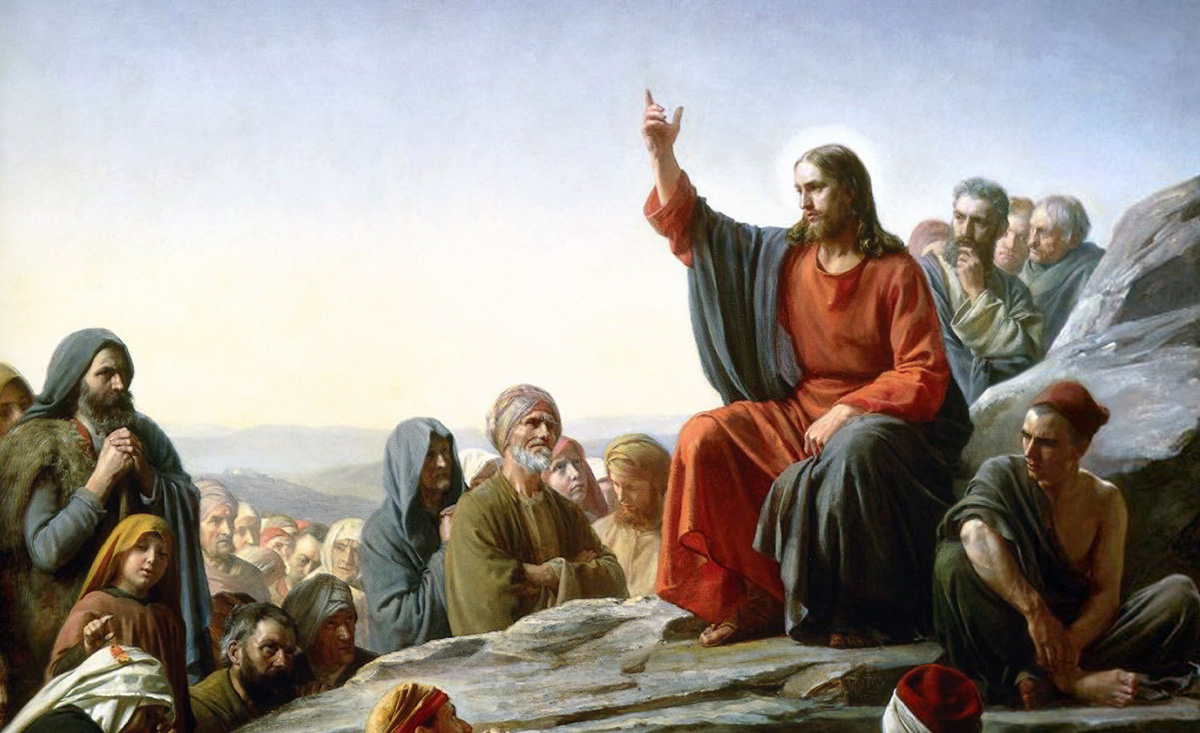
The Sermon on the Mount Carl Bloch, 1890

Sermon – Fasting – 1847, New Hampshire

Andrew Preston Peabody (1811-1893) Biography:

Peabody graduated from Harvard in 1826 when only fifteen years of age. He then entered Harvard Divinity School for three years, also serving as a mathematical tutor. In 1833, he was ordained as minister of South Parish Church in Portsmouth, New Hampshire, where he remained for 27 years until 1860.  After leaving his church, he returned to Harvard, where he served the  next 21 years in various positions, including Professor of Christian Morals, preacher to the university, and twice as president, once in 1862, and then from 1868-1869.  Peabody was a noted writer, having many of his sermons published as well as a Sunday School hymnbook he composed. He also penned some sixty articles from 1837-1859 in The Whig Review magazine; worked for the North American Review from 1852-1861; and likewise wrote for “The Christian Examiner,” “The New England Magazine,” “The American Monthly,” and other religious periodicals.  In 1863, he was awarded a doctorate from the University of Rochester, and on July 3, 1875, he delivered the centennial address at Cambridge, Massachusetts, upon the 100th Anniversary of George Washington’s taking command of the Continental Army.


THE TRIUMPHS OF WAR. 

A

SERMON

PREACHED

ON THE DAY OF THE ANNUAL FAST,

APRIL 15, 1847.


BY ANDREW P. PEABODY,

PASTOR OF THE SOUTH CHURCH, PORTSMOUTH, N. H.

SECOND EDITION.


PORTSMOUTH:  JOHN W. FOSTER.

C. W. BREWSTER, PRINTER.

1847.


SERMON.


ACTS X. 36.

Preaching peace by Jesus Christ.


            The day before yesterday, a peal of rejoicing for the taking of Vera Cruz was rung forth from most of the church steeples in town.  In employing for the expression of their gladness the furniture and property of our churches, the friends of the war now in progress have themselves violated the neutrality, which they have endeavored to impose on the voices of the sanctuary.  They have forced into their service tones hallowed by the most sacred associations with the worship of the living, and the last rites of loving piety over the departed.  They have thus taken their injunction of silence from the house of worship, and in making its inanimate, though most eloquent music echo their peculiar sentiments, they have, I trust, (if in any instance that work remained to be done,) unsealed, for Christian utterances on the great questions at issue, the living voices of all that minister at the altar.  I am sincerely thankful that our bell bore no part in that concert.  But, as the conduct of our Wardens in refusing to have it used for such a purpose may be called in question, I propose now to vindicate it, and to offer some of the reasons which justify the expressive silence of our belfry while the surrounding steeples rang with joy.

            In the first place, in our professed regard, our most precious article of church furniture is a volume here at my side, which bears the same relation to our rites of worship, which the image or oracle did to the temple service of the ancient heathen, and the ark with the overshadowing cherubim to that of the Jews.  This book is literally our oracle.  We come hither on the day which it pronounces sacred; we offer our prayers and praises to the Father whom it reveals, through the Mediator whom it presents to our faith; and all else that we profess to do here is to study its lessons of truth and duty.  This book has various contents, that have come down to us through a long series of ages, and it purports to give us a compend of God’s special revelations of his will and law for the guidance of successive generations of men.  Its history carries us through centuries of violence, wrong and blood; but we find them all spanned by the promise of a heaven-born King, under whose scepter wars should cease, the sword be broken into the ploughshare, and the spear into the pruning hook.  We have the record of the coming of that King, and of the song of angels on his birthnight, proclaiming, “on earth peace, and good will among men.”  We find abundant reason to believe that it was his prime aim and end in living and dying, to interweave all kindreds of men by the most sacred bonds of brotherhood, and to quench forever those lusts and passions, which alone lift the arm of violence, and light the flame of war.  That his aim has not been reached,—that his end is far from its fulfillment,—the recent victory gives us only too signal a token.  And that this is the case many rejoice, and have a perfect right to seek out all lawful modes of expressing their joy.  But it is certainly in utter violation of decorum and consistency that voices from our church-towers should bear part in this joy, and ring in gladness that the Gospel is not yet supreme,—that Christ does not yet reign,—that the earth is still reddened by he passions which he came to subdue,—that our oracle falls so far short of the fulfillment of its predictions.  In self-consistency we must put our Bible out of our church doors, and establish some other rule and form of worship than the Christian, before we lend any of the agencies of our sacred edifice to express joy on occasions on which the Bible would bid us mourn.

            Again, the Mexicans are called our enemies.  They probably are so.  We have done enough to make them so; and for them to be otherwise, they must have a double share of the spirit of Christ.  Now the religion, to which our church is consecrated, prescribes certain modes of dealing with enemies.  Its precepts are:  “If thine enemy hunger, feed him; if he thirst, give him drink”—“Love your enemies; do good to them that hate you,”—“Overcome evil with good.”  Had the Mexicans done us wrong, and had a Christian army crossed their frontiers to minister to their necessities, to proffer them on our behalf fraternal relations and offices, and to diffuse among them the benefits of that higher civilization and purer moral culture to which we lay claim, the progress of that army would have been conquering and to conquer, and we, with bell and organ, shout and anthem, would have made these walls shake and ring for the victory.  Heaven grant that they may stand long enough to echo with such bloodless triumphs, which are yet in reserve for coming years.  But which of these Christian laws for the treatment of enemies has not been atrociously violated in the recent siege?  Far other voices than those of love rent the walls and ran through the streets of the beleaguered city.  The most appalling necessities, the most deadly sufferings on the part of the besieged, were made the point of support and ground of confidence for the assailants.  Not one note of mercy, not one breathing of compassion, tempers the official narrative of that bloody transaction, or relieves the unmingled sadness, and the unqualified reprobation, with which it must be regarded by every Christian heart.  We have made that nation our bitter enemies; and the most rancorous hatred of men or fiends can invent no more fearful agony than that in which, within the last few months, we have consigned thousands upon thousands to a speedier or more lingering death, and steeped thousands of bereaved and desolate families.  If then there be anywhere a temple dedicated to the creed “of them of old time,” by whom it was said, “Thou shalt love thy neighbor, and hate thine enemy,” there is a bell which may fittingly swing in response to the boom of the rejoicing cannon.  But when the express laws of Christ have been in letter and in spirit utterly set at nought, a mournful silence becomes the Christian sanctuary.

            Again, the Bible establishes a law of impartial justice,–of sacred respect for the rights and property of all men.  Even in its early and imperfect revelations, it was said, “Thou shalt not steal,” and “Cursed be he that removeth his neighbor’s landmark”; and none can doubt that the Gospel prescribes the most rigid and conscientious equity in every relation and transaction.  Now what shadow of right have we even to the peaceful occupancy of the coil which we have deluged with the blood of its owners?  Does any pretended landmark of ours reach to the lines of our army, or approach within gunshot of the walls of Vera Cruz?  Have our citizens any more rights of property there, than Santa Ana and his army within our fields or walls?  It is said, indeed, that war suspends all common maxims of right and justice.  I know that it does.  But I look in vain to the New Testament for the charter of such a suspension.  The code of war is independent of that of Christ.  The broadest construction of his teachings leaves no provision open for a state of voluntary hostility, and those who aid in bringing about such a state are morally responsible for every violation of private rights, and every outrage on private property, to which it may lead.  So far as the written word of God goes, the midnight burglar or assassin within my doors, and the invading army battering down the walls of the Mexican city, occupy the same moral position, and incur the same fearful accountability.  The victory which we refused to help celebrate, was won in a conflict which no one has yet been daring enough to defend on moral grounds.  It was a victory of force over right,—of human passion over the law of Christ; and it would have been high treason against our holy faith, to have lent any portion of the apparatus of our Christian worship to proclaim the triumph of anti Christian principles.

            Yet once more, our church is consecrated to a humane and merciful religion.  Its Founder lifted off men’s burdens, and helped their infirmities.  Beneath his touch, bread grew in the desert for the famished multitude, and living pulses beat in the palsied frame.  Wherever he went, health and gladness flowed from his lips, and sprang upon his footsteps.  He bade his followers show mercy as they would receive mercy; taught them in the parable of the Samaritan that humanity was independent of national distinctions; and, in his sketch of the final judgment, made works of love for the relief of the needy, the stranger and the prisoner, the test of discipleship requisite for a place at his right hand.  In the same spirit, one of his three most intimate associates assigns to the visiting of the fatherless and the widows in their affliction, the first place among the marks of pure and undefiled religion.  Now it was for works of a character diametrically opposed to the tender and loving spirit of Christ and his Gospel, that we heard those notes of rejoicing.  I pity, from the bottom of my heart, the man who can have so much as a momentary feeling of exultation at such horrors.  What! Rejoice at the explosion of those infernal missiles in those late peaceful homes,—at the scattering of the dissevered limbs and mangled corpses of those hundreds of women and children?  Imagine the scene enacted among us.  Suppose our whole population surrounded by the enginery of war,—our wives and children forbidden all egress,—witnessing day after day spectacles of the intensest agony, at the very thought of which the blood runs cold,—burrowing in our cellars, while the shell bursts through roof, ceiling and floor, explodes on the ground, and wraps the torn and bleeding form of matron and maiden, boy and babe, in the winding-sheet of smoke and flame.  The groan of the wounded, the wild shriek of the  dying, rises from house to house above the roar of the artillery.  Dwelling after dwelling buries in its shattered ruins the dismembered and the dead, while survivors suffer a thousand times the pangs of death in the lacerating of every fibre of their being.  Were this measure meted to us, could we conceive of its giving joy anywhere this side of pandemonium?  Those Mexicans have human hearts.  There are there as here fond parents and loving children.  They have the same susceptibilities of suffering and anguish with ourselves.  Sudden calamity is no less appalling, the cup of bereavement no less bitter, the sense of desolation in the widow’s or the orphan’s heart no less keen, to them, than to us.  The frightful realities, through which the dead have passed into eternity, and surviving friends have seen them go, exceed the power of language, and leave imagination far behind experience.  And for works and scenes like these, shall there be rejoicing and that, too, echoed from the temples of the meek, compassionate, loving Redeemer?  These are the very works which Jesus came to destroy; and, had any sound of sympathy with them gone forth from our house of prayer, we should have reason to feel that it had utterly lost its consecration, and was no longer a fit place for the gathering of a Christian assembly.

            But it is said, perhaps, that the rejoicing was not for the horrible havoc of the siege, but for the display of the noblest traits of character on the part of our troops and their leaders.  Be it so.  In order to render it meet that our churches should participate in the outward demonstrations of joy, the characters manifested in the siege and illustrated in the victory must belong to the Christian school,—the virtues brought into exercise in the conflict must be such as have received our Divine Master’s approval.  Now, though I believe war under all circumstances inconsistent with the precepts, and opposed to the spirit of the Gospel, I by no means deny that there may be many noble Christian traits beneath the “garments rolled in blood.”  Where one repels assault from his own home, or helps roll back the tide of invasion from his own shores, even though his conscience be not fully enlightened as to the extent to which a Christian is bound to suffer wrong without doing wrong, he may still manifest some of the loftiest attributes of character,—he may have a keen sense of justice, may love mercy, and may be filled with that spirit of generous, disinterested self-sacrifice, which, with greater light, would have made him an unresisting martyr for truth and righteousness.  There was much of this martyr spirit among the leaders in the American Revolution; and I honor them for it, and believe that they were true to their highest convictions of duty.  But virtues of this class have no foothold in an assailing army, in an openly aggressive war.  We are told that the leaders in this war believe it unjust and wrong.  If this be the case, they must regard the successive outrages to which they have lent their services, as unmitigated robbery and murder; and to do this work they have sold themselves, body and soul.

            I know that the prevalent theory is,—“The soldier has no right to look behind his country’s orders,—it is no concern of his whether his country’s wars be right or wrong,” that is, he is not a moral agent,—he has ceased to be personally accountable.  This might be a safe theory, were human authority competent to establish it.  But unfortunately the very idea of accountability implies a higher party.  When the individual soul stands before the divine tribunal, stained with the wanton butchery of those women and babes, think you that the plea, “I knew that it was wrong and vile, but my country bade me do it,” will be accepted in Heaven’s chancery in mitigation of the crime?  We praise the man in high executive or legislative trust, who resigns his office, rather than violate his own conviction of duty at the bidding of the Chief Magistrate or of his constituents.  Why should not the conscientious soldier do the same, so that a government, intent on some scheme of lawless aggression, might know beforehand, that it could employ for such work only the refuse of its forces?  It is said that such a doctrine would undermine the military profession?  I answer, that, if the tenure of the military profession requires a man to perform acts of the most decisive and momentous moral significance, yet forbids him to consult his own conscience as to their moral bearing, and at the same time provides him with no release under the divine signature from the responsibility for individual acts which rests upon other men, it is a profession which cannot bear the light of Christianity.  I say not that the profession can rest on no other tenure, but would commend this as a subject of serious inquiry for the friends and advocates of war.  And I would still urge the question,—Is there, in the precepts or the spirit of Christ, any warrant or pretence for obeying man rather than God,—for trampling on every divine law and every human charity, and wading through seas of guilt at the bidding of corrupt rulers?  This at any rate is not Christian virtue,—not a style of moral excellence to be praised in or from the sanctuary.  This sacrifice of individual conscience is no offering for the altar of Christian faith.  Those who first bore the Saviour’s name, while they offered up everything else for Christ’s sake, proclaimed, “We must obey God rather than man,” in the very ears of those who occupied high places of power, and at the peril of their lives.

            We cannot then regard the blind, unquestioning obedience to Government at the sacrifice of individual conscience, without which our fleet and army would never have laid siege to Vera Cruz, as entitled to a place among the Christian virtues.  And for which among the shining sisterhood did that transaction afford scope?  Under which of the beatitudes shall we canonize the heroes of that massacre?  Surely meekness, humility, forbearance, long-suffering, can have had no home in the hearts of the assailants; and these are the cardinal virtues of the gospel.  The moral system of Christ beautifully verified the prediction:  “Every valley shall be exalted, and every mountain and hill shall be brought low.”  He deranged the entire moral scale, and transposed its very extremes.  He found the military virtues, aggressive courage, quick resentment, bigoted patriotism, unyielding obstinacy, at the summit of the scale.  He cast them down, and cast them out; and for courage he put fortitude,—for resentment, forgiveness,—for exclusive patriotism, an all embracing philanthropy,—for harsh, unfeeling rigidness of purpose, a love incapable of weariness or exhaustion.  For any signal victory, in which these virtues of the gospel and the cross bear the most prominent part, let every voice that the sanctuary can lend join in the triumph; but not for a victory over those virtues,—not for the disowning and overturning of the Christian scale,—not for transactions, which carry us back to the days of heathenism, and make us feel as if the sun of righteousness were setting in blood.

            Such were some of the reasons why no merry peal rang from our church-tower on the news of the victory.  That bell has deep notes of grief, which it might most fittingly have sent forth.  On that same afternoon, for the death of a single child, we heard the slow, sad knell from a neighboring steeple.  Had our bells all been tolled for the dead at Vera Cruz, they would have chimed with many hearts that were filled with sadness at the tidings, and would have been a not unapt expression of the contrite sorrow with which, under so heavy a load of guilt, the great heart of the nation should humble itself before its forsaken God.  Were we to embody right Christian feeling in our outward forms of worship, our churches would be clothed in mourning, the funeral toll would summon us to the sanctuary, our anthems would all be dirges, our praise would lose itself in penitential sorrow, until this atrocious war shall cease, and its memory shall be bathed throughout the land in floods of devout contrition.

            I have thus far spoken of the proprieties of the temple made with hands.  The order of the sanctuary, the outward beauty of holiness, is, however, but the type of that temple, whose builder and maker is God.  “The temple of God is holy, which temple ye are.”  If it be sacrilege to testify unholy joy for deeds of blood and rapine by soulless sounds from the house of prayer, how much more so is it to harbor thoughts of such joy in our hearts!  Of the warning this there is more need than a few weeks ago I was willing to believe.  While the fortune of the war hung in doubt, there were indeed many ready to denounce it; and one of the great political parties, though lacking courage, (with a few illustrious exceptions,) to maintain a firm and decided stand against it, still proffered many strong expressions of disapproval and abhorrence.  But now that success has crowned our arms, we find many members and some distinguished leaders of that party joining in the congratulations and festivities that hail the recent victories; thus showing how flexible the conscience of a political partisan is made by the current maxims of expediency and availability.  There are strong indications that this war in its triumphant progress is going to become generally popular, and that, through its shout and din, one of its laurelled heroes is to be elevated to the chief chair of state.  I can hardly imagine an event more fatal than this would be to the peace, and ultimately to the liberties, of a nation.  Should it once be established by so signal a precedent that military rnown, achieved in warfare however atrocious, affords the surest and quickest passage to the first places at the nation’s disposal, we have nothing in prospect but wars and rumors of wars for generations to come; and every new swarm of aspirants for public favor will work their way to power and office by fomenting discord and stirring up the waters of strife.  All this you and I may be unable to prevent, though none can tell how fast or far any earnest expression of dissent from the multitude on moral and religious grounds might spread.  There certainly exists, in our country, with all the prevalent apathy and time-serving, enough of Christian principle and sentiment to make itself strongly felt, would it only in some one quarter take to itself resolute, determined utterance.  The pulpit, the press where uncorrupted, the individual voice and influence of men who love the right better than their party, might yet achieve the salvation of our country from a destiny, which, after tossing her on seas of blood, will inevitably merge the last vestige of republican freedom in anarchy or military despotism.  But, whether we can effect much or little, we can at least be true to our own consciences.  We can keep ourselves innocent from the great transgression, and deliver our own souls from blood-guiltiness.  We can help our children, our neighbors, our friends, in the formation of right principles and sentiments.  We can prepare ourselves to pass, with clean hands and pure hearts, from a land filled with violence to the welcome tribunal of Jesus, and the peaceful seats of the redeemed.

            I know that such sentiments as I have now uttered are deemed unpatriotic.  I see it currently said in our most respectable public journals, that, whatever may be thought of the justice of this war, every citizen of the United States must needs rejoice in the brilliant success and honor that have attended our arms.  I for one feel no such joy, but only deep sorrow, shame and humiliation, the deeper for every victory.  Yet I believe that I love my country none the less for this.  In my view, success in crime, adroitness in wrong-doing, whether in an individual or a nation, confers no honor, and affords no just cause for joy.  I love my children; and, because I love them, if they entered on any wrong course of conduct, I should hope that they would fail of their evil ends, and be humbled and made better by the failure.  And I have all along hoped, till it is now too late for the hope, that our country might fail of every end sought by this conflict, and might, though the mortification of those lusts and passions whence it sprang, be made wiser and better.  I cannot but believe that Providence, in permitting this guilty success for a season, is preparing for us sorer judgments and a heavier doom.  The justice of an outraged Heaven makes me tremble for my country.  I can take no hopeful view of the nearer future; nor do I believe that we shall any of us live long enough to see the time, when we can again congratulate ourselves, as we have been wont to do, that we were born citizens of these United States.  By the threatened triumph of the war spirit, and the political profligacy which must follow in its train, our goodly heritage is to my eye hopelessly laid waste, and the sanctuary of our true peace and well-eing made utterly desolate.

            Think not, because I have thus freely expressed by abhorrence of this war, that I have no sympathy with those, who have been made its agents.  As to the members of our naval and military establishments, while, (as I have said,) I believe that they will find it hard to make good their plea before a higher tribunal, “let him that is without sin cast the first stone.”  I leave all harsh and reproachful censure for those, (if any there be,) who have never failed in the moral courage requisite for the surrender of all personal considerations at the call of duty.  Were these officers to make the sacrifice, which high Christian principle undoubtedly demands of them, it would be an illustrious sacrifice, worthy of the best days of the primitive church.  Their profession should not be made a mark for peculiar attack or condemnation.  It is but the exponent and representative of a still imperfectly Christianized condition of the body politic.  It will exist and be honored, so long as nations calling themselves Christian elevate other moral standards above that of the gospel,—it will decline and vanish with the revival and establishment of primitive Christianity.  In the present war, while I would not for worlds place myself in the moral position of those actively employed in its prosecution, I regard the greatest load of guilt as resting on the government, which has taken advantage of their maxims of unconditional obedience, to send them on a mission of rapine and blood, which most of them loathe and hate.  I sincerely lament the havoc that has been made in their ranks, and for their sake, as well as for the country’s, I long to see the plague staid.

            As for those, who, unforced by what they deemed prior obligations, have thrown themselves into this conflict, I feel unutterable pity for their recklessness and inhumanity.

            But, most of all, I confess, my sympathies are with the bereaved, suffering, homeless Mexicans,—with the multitudes, that, without fault of their own, have been made to feel the direst of earthly calamities, and have been given over to the wasting of the war-fiend, whose tender mercies are cruelty.  They are our brethren, commended to our charity and our intercessions by the blessed gospel, borne equally with ourselves on the heart of Jesus, loved no less than we are by the eternal Father.  Heaven grant them speedy release from fear, surprise and agony,—space to rear again their shattered dwellings, and to gather in quietness the remnants of their divided households.  Haven  grant that they may learn better lessons than we are teaching them, and that their experience of the bitterness of strife may commend to them the arts of peace and the spirit of gentleness and mercy.

            But all is not dark.  We have faith in the sure word of prophecy.  We doubt not that we may hasten, and our posterity behold the day, which the old Hebrew seers descried from afar through ages of guilt and woe, when men shall learn war no more.  Nor are we without signs of its approach.  The gospel is now, more than ever before, preached in its primitive spirit.  Christians are fast learning what they had forgotten for fifteen centuries, that meekness and mercy are the disciple’s only armor.  Let us labor in faith and hope, by example and influence, by word and deed, to diffuse the spirit of irrespective love and universal brotherhood, and, though God call us home before the work be done, we may join the second host of herald angels, who will wake the echoes of the regenerated earth with the song, “The kingdoms of this world are become the kingdoms of our Lord and of his Christ, and he shall reign forever and ever.”

END.

Sermon – Fasting – 1832, Massachusetts (Greenwood)

Francis William Pitt Greenwood (1797-1843) Biography:

Born in Boston, he graduated from Harvard at the age of 17 and then studied theology at Cambridge. Upon his ordination, he became pastor of Boston’s famous New South Church in 1818, but became ill and resigned two years later. He spent a year in Europe and then returned to Baltimore, where he spent two years as editor of Unitarian Miscellany. In 1824, he relocated to Boston and became pastor of King’s Chapel, where he remained until his death. He faced recurring bouts of illness, and on one occasion on the advice of his doctor he went to Cuba to help his health. In addition to theology, he was also interested in botany and conchology (the scientific study and collection of mollusk shells) and became a supporter of the Boston Society of Natural History. He wrote for its journal and was also associate editor of the Christian Examiner. A number of his sermons were published as well as his hymnal for Christian worship. In 1839, he was awarded a Doctor of Divinity from the Harvard College of Divinity.


PRAYER FOR THE SICK.

A 

S E R M O N

PREACHED AT KING’S CHAPEL, BOSTON,

ON THURSDAY, AUGUST 9, 1832, 

BEING

THE FAST DAY

APPOINTED BY

THE GOVERNOR OF MASSACHUSETTS,

ON ACCOUNT OF THE

APPEARANCE OF CHOLERA IN THE UNITED STATES.


BY F. W. P. GREENWOOD,

JUNIOR MINISTER OF KING’S CHAPEL.


PUBLISHED BY REQUEST.


B O S T O N:

LEONARD C. BOWLES

362 Washington Street.

1832.

S E R M O N.


JAMES V. 16.

CONFESS YOUR FAULTS ONE TO ANOTHER, AND PRAY ONE FOR ANOTHER, THAT YE MAY BE HEALED.  THE EFFECTUAL FERVENT PRAYER OF A RIGHTEOUS MAN AVAILETH MUCH.


            The apostle is urging the duty of intercession with God for the sick, and of mutual confession and forgiveness in the time of sickness.  He thus joins moral duty with prayer, and signifies that an humble, repentant, charitable state of mind, is one condition on which the restoration of bodily health, and the answer of prayer depend.  And who will object to the condition?  Who will harden his heart against his neighbor, and refuse him his full forgiveness, when he sees the hand of the Lord lying heavily upon him, and hears the groans of his anguish, and thinks, whatever he may have been, or whatever he may have done, what a poor, feeble, suffering creature he is now?  And who, on his own sick-bed, feeling the same hand on himself, and made sensible, by the near approach of another world, how vain and how wrong are the competitions and discords of this, and by he pressing thoughts of judgment and God’s holiness, of his own manifold imperfections, and repeated transgressions, can hesitate to acknowledge his errors, and forgive all who have sinned against him, as he himself hopes to be forgiven.

            After thus recommending the holy dispositions which should accompany prayer for the wick, the apostle James asserts the efficacy of prayer in obtaining the implored blessing.  ‘The effectual fervent prayer of a righteous man,’ he continues, ‘availeth much.’  He then mentions as an instance in proof, the case of Elias or Elijah, at whose earnest entreaty the Lord withheld rain from heaven, and afterwards caused it to be given again.

            The translation, in our common Bible, of the latter clause of the test, is not a happy one.  It is clearly tautology to say, at least according to the present meaning of words, that an effectual prayer will avail much.  The single Greek word which is here rendered by the two English words ‘effectual fervent,’ is rendered by some commentators inwrought, or inspired; and these commentators consequently suppose that the whole passage applies only to the prayers of such persons as are inspired, or strongly and supernaturally moved to pray for particular blessings, which are granted at their request.  And they say that the very instance given of Elijah, an inspired prophet, who prayed, as he was moved by divine impulse, for extraordinary and almost miraculous events, is a proof of the correctness of their interpretation.  This rendering, though not to be overlooked, is not required, and in all probability is not the correct one.  The original word (eveqyouuevn) is one from which our own word energetic is immediately derived.  It means internally and strongly working.  Wakefield translates the sentence thus; ‘The effect of the prayer of a righteous man is very powerful.’  And if the translators of the received version had omitted the word effectual, and rendered ‘The fervent prayer of a righteous man availeth much,’ they would have given us a more intelligible translation, and one, too, not far from the true meaning of the writer.

            I have offered this brief criticism on the passage, because it is one which is constantly quoted, whenever the efficacy of prayer is the subject of discussion, and is not often clearly apprehended, on account of the dim and neutral character of the translation.

            As to the doctrine of the text, the prevalence of the sincerely fervent prayer of a righteous man, I have no doubt of its soundness.  Even if it could be conclusively shown that in this particular place, reference is had solely to the prayers of inspired saints in the first age of Christianity, and previously under the Jewish dispensation, yet there are so many general exhortations to prayer in the Scriptures, on the ground of its efficacy with One who hears and answers it, that I could not permit myself to deny that sincere, fervent, and righteous prayer is of much avail, not only with the petitioner, but with God.  And this doctrine, which I believe to be a Scriptural, appears to me to be also a comforting and a rational doctrine.  It is comforting to all who love God, to perceive him brought so near to them; to be confident, from the assurances of his own word, that he hears all they say to him; that he not only hears, but attentively and graciously listens, with the purpose of granting those requests which can be granted, consistently with his own wisdom, the real good of the petitioner, and the happiness of the great whole.  Why should prayer be made, if God does not hear?  Why should God hear if not to listen: and why should he listen, if not with a purpose connected with the prayer?  We are not justified in expecting any miraculous answer to prayer, but a direct answer to prayer, through ordinary means, we are justified in expecting, if the gift is expedient for us; and if it is not granted we should rest satisfied that it is not expedient.

“If what I ask my God denies,

It is because he’s good and wise.’

            Beyond a very few steps, and a very short distance in the path of God’s operations, our eyes are too weak to see.  It is highly unbecoming in us o say, or to presume, that there is nothing, because we see nothing beyond, or that we know exactly how those events which we do see re brought about by a ruing Deity.  There is a regularity and order in that which we discern, which we call natural, and which none but a fanatic would look to see interrupted.  But without this regularity and order being interrupted, blessings may come to us, or evils may be averted from us, through the steps of this very order, this natural regularity and order, at the voice of our prayer, and a bidding from on high.  There is nothing irrational in this, for there is nothing irrational in believing that we are ignorant, and that God, who orders all things, may grant us special blessings by common means; and that he will grant them, because, in a revelation which we agree is from him, he has promised so to do.

            To occupy no longer time in introduction—though I easily might on so wide, so fruitful and so interesting a subject—and to come at once to the occasion of our present assembling together, let me ask who knows anything of the origin and mode of progress of the disease which we have prayed God to avert from us?  Who knows what place or what person it will next attack?  Who knows how it journeys from place to place, and from person to person?  Who knows how near it may be to ourselves, or whether it will enter our gates at all?  Who knows how many it will visit if it should come, or how many of those whom it visits it will spare, and how many it will not spare from the consummation of death?  Who knows how soon it will leave a town or city, after it has once entered?  Who knows at what time it will leave the world, or whether it will ever leave the world?  Who knows whether sin may not be the cause of this disorder, and whether prayer, righteous prayer, may not be among the most effectual means of averting it?  At any rate, the servant of God who has prayed in sincerity that the calamity may not fall on himself, his household and his neighbors, has performed his duty in seeking the throne of Grace.  He knows that he has been heard kindly by Him who sitteth on the throne, and that whether he is to be spared or not, whether his household and neighbors are to be spared or not, the event will be wisely and mercifully ordered.  He feels, moreover, that his own affections have been raised and his own charities been warmed and extended by his devotion; and that he is consequently better prepared for sickness and for health, to be taken or to be left.

            This last is a highly important consideration, and is ground on which all sober and pious persons can stand together, whatever may be their differences of opinion with regard to the direct efficacy of prayer on the mind of the Deity, or rather the literal correspondence of its efficacy with the promises of scripture.  All such will agree that the effect of prayer on the devout heart is great and beneficial; that it softens and sanctifies; that it places the petitioner, by the influence thus exerted on his dispositions and life, in the best position for receiving and enjoying the blessings, and bearing and improving the chastisements of Heaven.  All will agree, too, that if prayer has not this effect on the hearts and lives of those who pray, it can have no effect on Him who hears; and that whatever may be the precise way in which the fervent prayer of a righteous man availeth, one thing is undeniable, if a prayer be not one of sincerity and righteousness it will avail nothing.

            What, then, should be some of the moral influences and effects of prayer on the present occasion?  What must be some of the moral influences and effects of fervent and righteous prayer?

            In order to answer these questions let us consider, first, what it is which we pray God to avert from us.  Some call it the blighting curse of God.  I will not call it so.  Some call it a fierce demon let loose upon poor mortals, and some a horrid monster glutting itself with prey.  I give my assent to no such epithets.  It is a wasting disorder, melancholy in its character, but commissioned with the intentions of God’s omniscience.  It is a judgment on the earth.  It is a warning to the people against sin and uncleanness.  It is a trying but also a just providence.  These are the names by which I prefer to describe it; and in painting it to the imagination, I would draw it not with eyes angry and bloodshot, and a mouth breathing out fumes from the bottomless pit, but as an angel, a mourning as well as a retributive angel, bearing the sword of the Almighty not in vain, but hiding its sad countenance with one hand, while with the other it deals the speedy blow.

            1.  I have called it a judgment on the earth, and a warning against sin and uncleanness.  And is it not reasonable and justifiable to call it so, when we are told that it seizes first and principally on the intemperate and the unclean?  How can the voice of God speak more plainly against these forms of unrighteousness, than in this mandate to his destroying angel?  In praying that the disorder may not be sent among us, we should call to mind this purpose of its mission, and remember the vices against which it appears so evidently to be sent, and thus strengthen our conviction of their fatal nature and exceeding sinfulness, and redouble our efforts to root them out.  How can we expect that the disease will keep away, when that which invites the disease is permitted to remain?  It is a solemn truth that every intemperate and corrupt person, that every keeper and every supporter of the haunts of profligacy and riot is laboring to bring the so much dreaded pestilence to the place in which he dwells.  Should the punishment come, it will be called a demon and curse—when behold the demon and the curse are even now among us and upon us.  Do we expect to sin on and sin on forever, without any notice taken, and without a retribution?  While we pray, we would meditate on these things, with the purpose of acting accordingly, and then we may hope that our prayer will be availing.

            2.  But the disease does not entirely confine itself to the above described victims.  Though it principally selects these, yet it falls occasionally on the sober and pious and on innocent children.  And ought we not to be taught by this, not to boast of our virtue, nor to be sure of exemption, not to elevate ourselves in fancied security above the poor creatures whose vices are their exposure?  Humility will always accompany sincere prayer.  We are all exposed in some degree; and therefore it should be a primary consideration with us how we shall be prepared; and surely no better preparation will present itself to the Christian than that of mercy and charity.  While we are roused to act against sin, it will be in a temper of great pity for the sinner, and with especial care that we do not fall into sin, particularly the sin of the Pharisee, ourselves.  ‘Vengeance is mine; I will repay, saith the Lord.’  Let us be careful that we interfere not with the Supreme prerogative.  It is the Lord’s to send abroad his terrible and righteous judgments; it is ours to be kind and charitable, humble and watchful.

            3.  We are to be prepared, but not afraid.  ‘The Lord is the strength of my life,’ exclaims the Psalmist, ‘of whom shall I be afraid?’  It is the tendency of true prayer to lift up the heart above fear, because it lifts it up into the presence of God.  Can we run to an Almighty Guardian, and acknowledge his power to save, and then feel and talk and act as if we had no guardian?  Shall we come into the temple of the Most High, and address him as our ever present God and watchful Father, and after we have gone from the door, tremble at the first rumor of disease, as if we had no God and no Father?  I say that he who prays sincerely, not only prays to be delivered from pestilence, but prays to a being who sends, limits and rules the pestilence, who is the Lord of life and death, who is the Judge of all the earth, who will do what is right, and who is the refuge and defense of all those who trust in him.  Such a suppliant cannot be overcome by unworthy dread.  He has gone and placed his life in the hands of its Author, and his blessings and comforts in the hands of their Giver.  They are locked up—he is sure of them—and therefore he is not afraid.  My friends, if we come here and pray, and if other congregations of our brethren assemble to pray, merely because we are afraid; and if the effect of our praying will be only to make us more afraid, we have not prayed aright—we could not have been doing a more ineffectual thing—our prayers have been vainer than vanity.  He who has been fervently and righteously praying that this pestilence may be averted from him and his, will rise up from his knees, a fearless man.  He will feel himself piously and rationally superior to the exaggerated alarms which have operated on some.  Rather than permit a sufferer from the disease to be shamefully deserted and neglected, he will go and minister to him himself.  Rather than permit the lifeless frame of a fellow creature to lie on the bare earth, he will dig a grave with his own hands, and then fall again on his knees, and commit that body to the earth, and the spirit to God who gave it.  And when he has done this, he will feel that his prayer has availed much.

            4.  But while fervent and righteous prayer will make us fearless, it will have no tendency to make us neglect other proper means of prevention or of cure.  It will, on the contrary, lead us to view those means with increased respect and gratitude, as the merciful provision of God, and use them diligently and advisedly, as by his ordination and appointment.  Whence are all these means?  What are all exciting, soothing and healing medicines; what are all purifying and disinfecting agents; what are all sanative applications, but treasures drawn from his storehouse?  So far from despising them, therefore, the religious man will regard them as things divine; he will regard medical skill, as an art and gift divine; and he will make use of them when necessary, as by divine commandment.  The health which God bestows, he will endeavor to preserve or restore by means which the finger of God points out, not relying on his own strength or merits and leaving the event to Him.  He loves to pray to his gracious Father, but he will not tempt him.  He is no fatalist.  He believes it to be disobedience to God, not to employ the aids which God furnishes for his use; he therefore employs, but does not finally trust in them.  He trusts in nothing but the divine wisdom, mercy and promises, and in these he trusts to the end.

            Let us then confess our faults one to another, and let us pray one for another.  Let us confess our faults to God, and pray for ourselves.  If our prayers are fervent and righteous; if they awaken us to the evil and danger of sin; if they make us humble and unassuming; if they inspire us with a cheerful courage, united with a rational prudence, we may be confident that they will avail much.  They have availed much.  They have prepared us in the best possible manner against the hovering pestilence; they have saved us from sin, which is more dreadful than pestilence.  God has heard them; and he will answer them, if not by temporal immunity, yet y the answer of eternal salvation.

END.

William Henry Harrison 1835

Sermon – Fasting – 1841, New York (Sprague)

William Sprague (1795-1876) Biography

Born to farming parents, Sprague attended Colchester Academy and then attended Yale, where he graduated in 1815. He was invited to be the tutor for the children of Virginian Major Lawrence Lewis, nephew of George Washington. (Lewis’ wife was the granddaughter of Martha Washington.) He accepted, and traveled from Connecticut to Virginia. The Lewis’ home, Woodlawn, was part of the original Mount Vernon (George Washington’s home), and over the year Sprague stayed with the family, he received permission from Bushrod Washington (George Washington’s nephew who served on the US Supreme Court) to go through many of George Washington’s letters and papers. Sprague was allowed to take as many of those letters as he wanted, so long as he left copies of all letters he took, which was about 1,500. From these letters, Sprague was able to compile the very first complete set of autographs of all of the signers of the Declaration of Independence. In 1816, Sprague returned to school at the Theological Seminary at Princeton, where he studied for three years. In 1819, he became an associate pastor at First Congregational Church in West Springfield, Massachusetts, and remained there a decade before becoming pastor of Second Presbyterian in Albany, New York, where he remained until 1869. Sprague was a prolific writer, and penned sixteen major works, including biographies of important American Christian leaders as well as religious works such as Lectures on Revivals of Religion (1832), Contrast Between True and False Religion (1837), and Words to a Young Man’s Conscience (1848). He also wrote over 100 religious pamphlets and smaller works. Elected a member of the American Antiquarian Society, much of his writing and preaching was of a historical and biographical nature. In fact, one of his greatest accomplishments was his nine-volume Annals of the American Pulpit, which was particularly rich with biographies of those pastors who played important roles in the American War for Independence. By the time of Sprague’s death in 1876, he had collected over 100,000 historical autographs, including three complete sets of signatures of all the signers of the Declaration; one set of all the members of the Convention that framed the US Constitution; a complete set of the autographs of the first six Presidents of the United States and the officers of their administrations (including signatures of the Presidents, Vice Presidents, Cabinet members, US Supreme Court Justices, and all foreign ministers in those administrations); and the signatures of all military officers involved in the American War for Independence, regardless of the nation from which they came or the side of the war on which they fought. He also collected signatures of leaders of the Reformation as well as those of great skeptics and opponents of religious faith. His collection was considered the largest private collection in the world at the time of his death.


VOICE OF THE ROD:

A

SERMON,

DELIVERED AT ALBANY, MAY 14, 1841,

THE DAY OF THE NATIONAL FAST.

OCCASIONED BY THE DEATH OF THE LATE

WILLIAM HENRY HARRISON,

PRESIDENT OF THE UNITED STATES. 


By WILLIAM B. SPRAGUE, D. D.

PASTOR OF THE SECOND PRESBYTERIAN CHURCH.


ALBANY:

PRINTED BY C. VAN BENTHUYSEN.

1841.


To the Rev. W. B. Sprague, D. D.

            Dear Sir—

            The trustees, as well in conformity with their own wishes, as the wishes of others of your congregation, respectfully request for publication a copy of the Sermon delivered by you on the morning of the 14th inst., the day recommended by the President of the United States for a National Fast.

We are very respectfully,

Your obed’t serv’ts,

JOSEPH ALEXANDER,

A. M’INTYRE,

ERASTUS CORNING,

THOMAS W. OLCOTT,

E. P. PRENTICE,

Jno. I. BOYD,

JOHN TOWNSEND,

A. MARVIN.

Albany, May 15, 1841.


            To the Board of Trustees of the Second Presbyterian Congregation in Albany:

            GENTLEMEN—

            It has not been my custom to apologize for my own productions: on the contrary I have suffered even the most hasty of them to go to the publick for what they were worth; considering it a good general rule, that if a sermon is too poor to print without an apology, it is too poor to print at all.  In consenting, however, to the publication of this discourse, as I am aware that it very imperfectly meets the expectation which the occasion might reasonably justify, it is due to myself to state that it was necessarily prepared in a few hours, when I had but partially recovered from the fatigue of a journey; to say nothing of the fact of which you are already apprized, that I had previously delivered two other discourses on the same subject, in the same place, and to some extent to the same congregation; so that for this there remained little else than the gathering up of the fragments.  But for the mysterious disappearance from my study of the MSS. Of the two former, one of them, would have been given to the publick instead of this, which is now somewhat hesitatingly yielded to your wishes.

            I beg you will accept, Gentlemen, the assurance of my highest regard.

            W. B. SPRAGUE.

May 25, 1841.


SERMON.


MICAH VI. 9.

Hear ye the rod, and who hath appointed it.


                The occasion which has brought us into the house of God this morning, marks an era in the history of this nation.  Not that this is the first time that the nation has been called to keep a day of humiliation and prayer; but the first time that it has been called to keep such a day for such a cause.  Not that this is the first instance in which death has removed an individual whom we had elevated to the chair of supreme authority; but the first in which such an event has occurred at the commencement, or even in the course, of the Presidential career.  I am sure you will agree with me that every sentiment of religion, every dictate of propriety, justifies this appointment.  I count it an omen for good that our present Chief Magistrate, as one of the first of his official acts, has called upon his people to humble themselves beneath the rod of God.  Whatever his future communications to the nation may be, he has already given us one that will stand the test of time; for it breathes the spirit of reverence for the Divine authority, of confidence in the Divine government.  Whatever measures may characterize his course hereafter, he has adopted one in the beginning which may always be appealed to as worthy of imitation, so long as this nation exists.  God grant that this disposition to acknowledge Him, and to call upon the country to acknowledge Him, may prove the harbinger of a happy administration—an administration through which blessings incalculable in their number and extent shall be conveyed not only to this nation but to the world.

            If I were to meet one of you with your heart bleeding at the death-bed of a beloved friend, I know not what more appropriate counsel I could address to you, than “Hear ye the rod, and who hath appointed it.”  Or if death had made a fearful inroad upon our congregation, removing someone who had shared in an unusual degree our affection and confidence, and in respect to whom, after he was gone, we should say that an armour-bearer had failed us—here again, I know not what better I could say to you, than “Hear ye the rod, and who hath appointed it.”  And now that my country hath been smitten of God, and is bleeding under His righteous hand, what better can I say to her—what better can I say to you, my friends, who are assembled here this morning as part of this nation, than “Hear ye the rod, and who hath appointed it.”  The rod speaks: listen to the warning voice.  Consider the hand that wields it:  it is the hand of the Ruler of nations.

            We shall fall in, I trust, with the design of the occasion, if we consider this national bereavement as having a bearing both upon the past and the future; as administering rebuke on the one hand, and conveying instruction and expostulation on the other.  In the prosecution of this object,

            I.  I remark, in the first place, that this dispensation rebukes our national ingratitude, and calls upon us to form a higher estimate of our obligations to the Divine goodness.

            I do not say that, as a nation, we have been insensible of our superior privileges; or that we have been backward on certain occasions and in certain ways, to speak of them; but I appeal to you, whether it has not been chiefly in a manner that has discovered more of a boasting than of a grateful spirit.  When we have congratulated ourselves on the freedom and the supposed stability of our institutions, has not the secret feeling of our heart been, rather a feeling of complacency in consideration of our possessing these privileges, than a feeling of gratitude towards the bestower of them?  And even when we have professed to recognize them as the fruit of the Divine goodness; when we have said with our lips that it is God who hath made us to differ from other nations, and that He hath not dealt so with any nation as with us; nay, when we have been assembled professedly to recount the tokens of His favour, and offer to Him the sacrifice of thanksgiving; has not our recognition of His goodness been, to a great extent, a mere matter of form;—have we not been too much like those of old who sang His praise, and then forgat His works?  Yes, Brethren, as a nation, we are deeply chargeable with the sin of ingratitude; and I repeat—this dispensation administers a rebuke for it.

            For suppose you had lost an earthly friend—say a parent—whose watchful kindness had been the channel through which, from the first hour of your existence, there had been conveyed to you an uninterrupted stream of blessings; and you had been accustomed always to receive these blessings merely as a matter of course, without lifting your eye to that Almighty Father who gave you your earthly parent and constituted the endearing relation that he sustained to you; I ask whether his removal from the world would not come as a rebuke to your ingratitude;—whether it would not set you to thinking of blessings innumerable which had been forgotten in unthankfulness; and not merely of those which had come to you through the medium of parental kindness, but of others which may have come more directly from the hand of your Heavenly Father?  And why should not the same principle operate in respect to the nation bereaved of its Head?  The President of this nation sustains to it, in an important sense, the relation of a father.  The President who has lately died, though not the choide3 of the whole nation, was the choice of the majority; and I may safely say in view of the mourning which his death has brought over the land, had the respect and good will of the country at large.  I suppose that none of us doubt that he was a man of integrity and wisdom; and there is much reason to believe that, if he had lived, he would have ruled the nation in the fear of God.  Of course, the loss of such a man from such a place, irrespective of all party considerations, is to be regarded as a publick calamity.  We must suppose that a great blessing—certainly that which the majority of the nation accounted so—has been withdrawn from us in his death; and why should not this remind us of other blessings which we have enjoyed and still enjoy, and rouse us from a habit of thankless indifference in respect to them?  We have had other men distinguished for their patriotism and talents and usefulness to rule over us; and instead of being cut off at the commencement of their career, they have lived to complete the term of service which their country had allotted to them.  We have seen our nation going forward in the course of unexampled prosperity; enlarging the bounds of her habitation on the right hand and on the left; and when clouds have lowered in our horizon, they have soon disappeared; or if a tempest has passed over the land, it has lasted but for an hour, and has left a purer atmosphere and a brighter sky.  You who have travelled in other countries, especially on the continent of Europe, know better than others how to value the liberal spirit that characterizes our institutions.  You may have seen much abroad to gratify your curiosity and excite your astonishment; but you come back after all, rejoicing that your home is on this side of the ocean.  You welcome the sight of your own vine and fig tree, beneath which you can sit without any to molest or make you afraid.  Now I say, the effect of this national bereavement should be to remind us of these forgotten and neglected mercies; to lead us to recount them, not with a view to minister to our self-complacency, but to quicken our impulses of gratitude for the Divine bounty.  It will be a beautiful offering to the memory of your departed President, to make his death the occasion of a grateful recollection of your distinguished blessings.

            II.  This dispensation rebukes our national self-confidence, and charges us to cease from man and put our trust in the Lord.

            I honour and venerate my country; but I am sure I do not charge her unjustly, when I say that she has been most criminally given to leaning upon an arm of flesh.  She has gloried in the wisdom of man, as if man had no occasion to take counsel of any wisdom above his own.  She has seen ruin waiting on one set of measures, and safety and glory on another, without remembering that no measures can render her interests secure, unless they are attended with God’s blessing; that her destinies are in the hands of him who putteth down one and setteth up another.  In all this she has dishonoured the Ruler of nations.  She has acted as if she would take the scepter of supreme authority into her own hands.  She has practically bid the Most High stand aside, and without dreaming of the vanity or the madness of her pretensions, has attempted, in the spirit of the ancient builders of Babel, to make to herself a name whose glory should fill the earth.

            But it is not easy to conceive how a more effectual rebuke could have been given to this spirit, than has been in the death of our Chief Magistrate.  In his administration were bound up the hopes of a majority of the nation.  His election had been the result of a struggle, which had well nigh convulsed the country; and those who had placed him in that lofty station, thought they saw in the measures to which he was pledged, all they could ask to ensure the country’s prosperity.  But come, yet self-confident politicians, to your President’s grave, and tell us what ye think now of the wisdom of trusting to an arm of flesh.  Nerveless as a clod is the hand which but the other day received the staff of office.  The eye that looked out upon that brilliant and imposing pageant, sees not: the ear upon which fell the deafening plaudits of the multitude, hears not: the voice that uttered itself with freedom and energy from the highest place in the nation, speaks not: the senses are all locked up in the slumber of the sepulcher.  And death hath removed to another sphere, though by no means blotted out of being, that well-balanced and well directed mind, in which were already treasured up thoughts and plans for the development and execution of which you were anxiously waiting.  That beautiful fabric which your imagination had framed, and to which your heart was so strongly attracted, God has only touched; and lo, it has passed away, like the morning vapour before the sun!  Transfer your confidence, then, from the creature to the Creator.  Remember that if our national interests are safe, they are so only because God’s protecting hand is upon them.  Remember that if we in our folly refuse to put our trust in Him, we have no right to expect, either from His word or His providence, but that He in judgment will withhold His blessing from us.  If we confide in Him unreservedly and implicitly, we may be sure of His favour; and with that we need not fear, though enemies should encircle us, and convulsions should agitate us, and our very mountains should be carried into the midst of the sea.

            III.  This dispensation of providence rebukes our national idolatry of our rulers, and teaches us to remember that they are but men.

            Far be it from me to intimate that we have had too much of that sober and rational regard for those in authority, to which their station justly entitles them:  what I would here reprobate is that idolatrous homage, that fanatical praise, which they are perpetually receiving from that part of the nation that approves and sustains their measures.  I refer not to any particular administration as distinguished in this respect above others; but if I mistake not, you will find in looking through our whole national history, that just in proportion to the prevalence of party spirit, this evil of which I am now speaking has prevailed: the majority of the people have spoken, and written, and acted, concerning our rulers, as if everything they did was right, merely because they did it.  Now it is to be borne in mind that rulers are constituted with the same flesh and blood, the same susceptibilities and infirmities, with other men; and if other men cannot safely be subjected to such an influence, neither can they.  Admitting that they are good men, and disposed to rule with an equal hand; admitting too that they are discerning men, and more capable than most of discriminating between truth and falsehood; yet, after all, if their ears are continually trained to the sound of their own praise, it is hardly possible but that their hearts will beat too vigorously to the idea of their own merit; and as a consequence, that they will commit mistakes and errors which they would otherwise have avoided.  Many a ruler, I doubt not, has adopted measures adverse to the publick good, which he never would have adopted, had he not been kept in countenance by the unceasing flatteries of a party.  The nation that deals thus with its rulers, need not wonder if it should first ruin them, and then render them instrumental of bringing ruin upon itself.

            You see how this dangerous and deceiving spirit is rebuked by this providence.  Rulers are not only, like others, accountable for their conduct at the bar of Heaven, but their responsibility is increased in proportion to the amount of authority which is committed to them.  When they die, they enter upon their retribution, receiving good or evil in another world, according to the amount of good or evil which they have done in this.  Say, then, whether the grave of our departed President does not charge us to beware how we throw stumbling blocks in their way?  It lifts up the voice of intercession in their behalf, and pleads with us to remember that they have temptations enough to encounter, without being subjected to the ordeal of national flattery.  It admonishes us that such a course, more than almost any other, puts in jeopardy the best interests of our country.  And finally, it proposes to us the solemn interrogation, how we can meet our rulers in the judgment, if by our inordinate and unceasing flatteries, we have contributed to nourish their pride, to benumb their moral sensibility, and thus to accumulate for them the materials of an aggravated condemnation.  But on the other hand,

            IV.  This providence rebukes no less effectually our growing contempt of authority, and calls upon us to render honour to whom honour is due.  I am not sure but that I may have introduced this thought in the discourse which you heard on the Sabbath morning after the President’s death; but if I did, it is too important, and too opposite to the present occasion, not to be introduced here, even though it be at the expense of repetition.

            It is the fashion in this country for the party not in power to be exceedingly restless, and to oppose the administration under which they live, with at least an equal degree of zeal with that with which its advocates sustain it.  It is the fashion to level against rulers the arrows of detraction; to watch for every occasion for calling in question either their integrity or their ability, and to find occasion often where there is none; to impute selfish and abominable motives, where nothing can be said against the external act; and sometimes even to talk loudly of revolt and rebellion.  And I must add, it has become the fashion in many parts of our land, to trample upon the laws with mob-like violence; the consequence of which is, that sometimes an innocent man is maimed, or mangled, or torn to pieces, where the laws ought to have protected him; and in other cases the criminal is prematurely and unjustly punished, because the operation of the laws is too tardy for the taste of the people.  If I mistake not, this desperate spirit constitutes one of the worst features of our times.  In every instance in which it is manifested, there is not only an outrage committed against the laws of God, but an act of rebellion against the laws of the country.

            Here again, listen, and you shall hear your President’s grave still speaking forth the language of rebuke and exhortation.  He had indeed but just entered upon his office; but he had held it long enough to know that it was anything else than a bed of roses; and some have imagined that he actually fell a victim  to the fatigue and anxiety by which his introduction to it was attended.  His language to the nation now is, “Your rulers have care and responsibility enough to overwhelm them, apart from all those burdens which ye have been accustomed needlessly and voluntarily to impose.  Let the clamours of party then be hushed.  Let the voice of crimination and insult be heard no more.  Remember that your President is a man, that your rulers are all men, and that you have as little reason to expect perfection in them as have in you.  Be lenient, then, towards their infirmities, and be not too strict to mark even their errours against them.  Remember that they are God’s ministers for good, and as such claim your homage and obedience.  And if you will see their administration most fruitful in blessings, study to alleviate rather than increase their burdens; submit cheerfully to the laws which it is their duty to enforce, and co-operate with them to suppress the spirit of insubordination, and thus promote the best interests of our common country.  Render unto Caesar the things that are Caesar’s.  It is due to humanity; it is due to justice; it is due to honour; it is due to patriotism.”

            V.  This affecting providence rebukes our national inconsideration of death, and calls upon us to awake to a sense of our mortality.

            Look through any circle you please, no matter how limited, no matter how extensive, and you find a general inattention to the concerns of eternity.  You may travel through the length of the land, and then through the breadth of it, and it is only here and there one that you will meet, who is not living as if this world were his final home.  The merchant is busy in accumulating wealth, and in proportion to his success, is ever grasping for more; but he forgets that he must die and leave it.  The politician is eager to make his voice heard through the nation; but he forgets that his voice must soon be hushed in death.  The aspiring statesman has his eye upon some lofty place of honour, and labours day and night to lift himself into it; but he forgets that there is a pathway ever kept open even from the throne to the sepulcher.  The creature of habitual thoughtlessness is buzzing about in pursuit of pleasure, like a butterfly in the sun; but it never occurs to him that death may put an end to all his pleasures to-morrow.  Yes, the great mass of the nation are utterly absorbed in this world; and neither their vision nor their aspirations extend to a coming one.

            True there are rebukes to this spirit of inconsideration, every day, and on every side:—every death-bed scene, every funeral procession, every open grave, rebukes it.  But in ordinary cases the providence of God speaks to a comparatively small circle: here it speaks to every individual in the nation; for if the death of the father of a family be an admonition to that family to prepare to die, not less is the death of the Head of a nation an admonition to that entire nation to consider their latter end.  But a little while since, my countrymen, your President spoke to you as a living man, and he told you concerning the projected measures of his administration: today he speaks to you from the silence and corruption of the tomb, and I trust I may add, in view of all the cheering evidence of his Christian character which has come to us,—from that world where the dignity of earthly distinction is forgotten amidst the splendours of a blood-bought crown; but he speaks on another and more momentous subject—your relations to God and eternity.  If you were disposed to heed the voice of the living, turn not a deaf ear to the voice of the dead.  Men of every class and every character throughout this nation, not God’s ministers, but the grave, is preaching to you to-day; and the doctrine is everywhere the same—that you must all die; and the exhortation is everywhere the same—that you should prepare to die.

            Hitherto I have dwelt upon those national sins which are more directly and especially rebuked by this affecting dispensation; but I must now add in the

            VI.  Last place, that God has here sent us a rebuke for all our national transgressions, and is calling us to repentance and reformation in view of them.

            Nothing is so well adapted to set an individual to reflecting upon his sins, as the chastisements of the Divine hand.  Thus, you remember, when Jacob’s sons were brought into circumstances of difficulty and peril in Egypt, they began immediately to commune with themselves and with one another, in respect to their cruel and murderous treatment of their brother; and the reason was that conscience did its office, and recognized the doctrine of a retribution.  And the same principle applies to communities as to individuals.  When the rod of God is laid upon a nation as it has been now upon us, it is adapted to excite the inquiry, wherefore is it that He has thus come out in judgment?  What are the sins of which we have been guilty, that we are thus subjected to the chastisements of Heaven?  I can only hint at those which have not been already mentioned.

            Let me say, then, that we are chargeable with having shut our ears against the voice of God, when he has spoken to us in former judgments.  It is but a few years since the pestilence passed through this land, like fire through a forest.  We had heard of it indeed as the scourge of other lands; but we had looked at the ocean as an effectual barrier against its approach to us.  Presently, however, that barrier was passed; and we read in our own newspapers, under the head of domestick intelligence, as fearful tales of desolation as any which had come to us from across the ocean.  It was not here and there only, but every where; and the graves were multiplying every day by thousands and thousands; and even the most thoughtless were compelled to feel that they lived on the threshold of eternity.  But at length the pestilence passed off, and our anxiety passed off with it; and there is reason to believe that instead of melting the nation into penitence, it rendered it more obdurate in transgression.  At a more recent period, the country has been subjected to unprecedented commercial distress.  Rich men have seen their fortunes vanishing like chaff before the whirlwind; and poverty and bankruptcy and ruin have become as household words, where for years nothing but affluence and independence had been dreamed of.  But the nation has remained unhumbled still.  We have been loud enough and busy enough in referring the evil to second causes; but where have been the evidences of our recognition of the Divine hand;—of our repentance and reformation in view of the Divine rebuke?  And finally, the elements have been commissioned as ministers of God’s displeasure toward us.  The conflagration has swept over no inconsiderable portion of the metropolis of the land, blotting out the productions of art, frustrating the labours of industry, and arresting temporarily the current of expectation and enterprise.  Our vessels have been abroad upon our waters, freighted with youth and beauty, with intelligence and virtue; but the midnight tempest has opened for these multitudes a common grave in the deep; or the terrific explosion has announced their entrance into eternity; or else the flames around and the waters beneath have contended in the work of death, till there have been only enough left to record the horrours of the scene.  These events occurring in fearfully rapid succession, have for the time, spread consternation and agony through the land; and it has seemed as if God’s warning voice were raised to a note so loud and terrible, that the most thoughtless must be forced to consideration; but here again, scarcely have the tidings died away upon our ears, before we have regained our accustomed insensibility, and virtually said to God that if he would melt or humble us, it must be done by some yet more appalling visitation.

            Infidelity is another crying sin with which we are chargeable—yes, infidelity in every form and degree; from the dark insinuation against Christianity that is only whispered in a corner, down to the open rejection of all religion, and the blasphemies of the blackest atheism.  The state of the country in reference to this subject at this moment would, I doubt not, if it could be laid open to us, furnish matter of most appalling interest to everyone who regards his country’s welfare.  We should see that there is no place so high, but that infidelity has been able to reach it; no place so low but that she has been willing to creep into it; and I fear, no place so sacred, but that she is suffered to profane and pollute it.  From every part of this land, and especially from our great cities, there is a voice going up to Heaven, calling for still heavier judgments to descend upon us, because we are so rapidly becoming an infidel people.

            And there is the sin of slavery—yes, silent as we may be in respect to it, because fanaticism on the one hand, and prejudice and selfishness on the other, are lifting up together their discordant voices to seal our lips and palsy our efforts—the sin of slavery is, at this moment, bearing testimony against us before the Ruler of nations, as loudly as any other.  True, indeed, the fact that this mighty burden of guilt rests upon us is no reason why we should act precipitately, and thus defeat our own efforts in endeavoring to throw it off; but it is a reason why we should not remain inactive; and if we are contented to remain so, what else will other nations say of us, what else will our own consciences say of us, what else will God the righteous Judge write in His book concerning us, but that with all our eulogies of freedom, and all our pretended abhorrence of slavery, we are, after all, willing that this sin should lie at our door?

            The spirit of violence and bloodshed too is abroad in the land, and in some parts of it to a degree, to which you will scarcely find a parallel even in the most barbarous country.  The good and useful citizen is decoyed away from his habitation to be murdered at noon-day; and the murderer with a view to escape detection, turns his own dwelling into a sepulcher.  The magistrate, while engaged in the discharge of his appropriate functions, falls dead from his seat, a victim to ruthless violence.  The neighbourhood echoes at midnight to the alarm of fire; but it turns out that amidst those flames there is blood; and the fire has been kindled only to hide the assassin’s hand.  And in some instances the perpetrators of these deeds are suffered to go at large, while justice stands like a statue at her post, as if her eyes were put out, or her hands were palsied, or her life blood were frozen.  My country, thou hast a fearful account to settle for these bloody outrages; especially for such as are voluntarily, deliberately, left unpunished!

            I Had intended to add to this list of our national sins, the extensive desecration of the Sabbath; the neglect of the ordinances of religion; the profanation of God’s holy name, as well as the sin of intemperance, which is still in no small degree prevalent, notwithstanding all that Christian benevolence and Christian enterprise have done to arrest it; but instead of pursuing this train of thought, I will only in conclusion urge you in a single word, to fulfill the great purpose for which the solemnities of this day have been ordained—that of repentance and reformation.  The repentance of the nation must be that of the individuals of which the nation is composed; and as you are among its component parts, I call upon you this day, every one, to break off your iniquities by turning to the Lord, as a debt which you owe to your country.  Repent of your own personal transgressions—of the sins of your heart and of your life, and supplicate grace to enable you to live a righteous, sober and godly life, to the glory of God’s holy name.  Humble yourselves in view of our national sins, and resolve that the full amount of your influence shall be consecrated to the cause of national reformation.  And then go forth and act in the spirit of this day’s solemnities, in the spirit of the resolutions you have here formed, and it will be good for you, it will be good for our common country, that you have engaged in this exercise.

            It is at once a sublime and affecting thought that this great nation is professedly humbling itself to-day around the tomb of its departed Head.  If I had a voice that could be heard from one end of the land to the other, I would say, My countrymen, take heed that ye do not hereafter prove this day’s solemnities to have been a farce.  Ye are professing now to be humble for our sins, and to ask that God’s judgments may not be lost upon you: show your sincerity then by forsaking the sins for which you mourn; by laying duly to heart the chastisement which you profess to recognize.  But if you rise from your knees only to commit the sins which you have confessed; if you go forth from your chambers of fasting to open your bosoms to the influence of party strife, and criminal worldliness, and forgetfulness of God, then remember that you have played the hypocrite amidst the solemnities of an occasion which has had it not more of a fast than of a funeral; and to say nothing of other testimony, the grave of your lamented President will be a witness against you until it shall give up its dead at the great resurrection day.


END.

[/fusion_text][/fusion_builder_column][/fusion_builder_row][/fusion_builder_container]

Sermon – Fasting – 1850, South Carolina

GOD, THE REFUGE OF HIS PEOPLE


A SERMON,


DELIVERED BEFORE


THE GENERAL ASSEMBLY

OF


SOUTH CAROLINA,

ON FRIDAY, DECEMBER 6, 1850,


BEING A DAY OF


FASTING, HUMILIATION AND PRAYER.


BY WHITEFOORD SMITH, D. D.


COLUMBIA, S. C.

PRINTED BY A. S. JOHNSTON.

1850.


EXTRACT

From the Message of his Excellency, W. B. Seabrook.


            “In recommending, as I now do, that South Carolina should interpose her sovereignty in order to protect her citizens, and that by co-operation with her aggrieved sister States, she may be enabled to aid in averting the doom which impends over the civil institutions of the South, it is fit and proper that, as a Commonwealth, we should, at an early day, to be designated by you, implore the God of our fathers for the pardon of our manifold transgressions, and invoke his protection and guidance in this our day of trouble and affliction; that he would graciously vouchsafe to enlighten the minds of our Federal rulers, the North and its citizens, and direct them in the way of truth, of reason and of justice, and preserve a once happy political family from the unspeakable horrors of civil strife.”

From the Journal of the House of Representatives,

November 26, 1850.

            Mr. Memminger submitted the following Preamble and Resolutions, which were ordered to be considered immediately, and were agreed to:

            Whereas, it becomes a Christian people, at all times to look to the King of Kings for guidance and direction, but more especially in seasons of trial and difficulty; and, whereas, the enactments of the last Congress of the United States have destroyed the equal rights of the Southern States, have invaded the peace and security of our homes, and must lead to an overthrow of the existing order of things: therefore,

            Resolved, unanimously, That we recommend to the people of South Carolina, to set apart Friday, the 6th of December, as a day of fasting and humiliation, and that the Reverend Clergy throughout the State be invited to assemble their respective congregations on that day, to unite in prayer to Almighty God, that He may direct and aid this General Assembly in devising such means as will conduce to the best interests and welfare of our beloved State.

            2.  Resolved, unanimously, That religious services and a sermon appropriate to the occasion be had in the Hall of the House of Representatives, and that a fitting Clergyman be invited to officiate.

            3.  Resolved, unanimously, That a committee of three be appointed on the part of this House, and that a message be sent to the Senate proposing the appointment of a like Committee to meet the Committee of this House, for the purpose of carrying into effect these resolutions.

From the Journal of the House of Representatives,

December 7, 1850.

            Mr. E. P. Jones submitted the following resolutions, which were ordered to be considered immediately, and were agreed to:

            1.  Resolved, That a copy of the able and eloquent discourse, delivered before the General Assembly, by the Rev. Whitefoord Smith, be requested of him for publication.

            2.  Resolved, That a committee of three, on the part of this house, be appointed to meet a similar committee on the part of the Senate, for the purpose of making the request, and directing the publication.

            3.  Resolved, That two thousand copies be published.

            In the Senate, on the same day, the message of the House was concurred in, and Messrs. Moses, Manning, and Griffin appointed on the committee.


CORRESPONDENCE.


Senate Chamber,

Columbia, Dec. 10, 1850.


Rev. Whitefoord Smith.


            Dear Sir:—We take pleasure in communicating, as a committee appointed for that purpose, the unanimous resolution of both Houses of the Legislature, requesting, for publication, a copy of your able, impressive and eloquent Sermon, delivered at the solicitation of the General Assembly of the State, on the day of fasting, humiliation and prayer.


            In performing this duty, permit us to assure you of the high consideration with which we subscribe ourselves,


            Very respectfully yours,

            FRANKLIN J. MOSES,

            Chair of the Senate Com.

            E. P. JONES,

            Chair of House Com.


Columbia, Dec. 10, 1850.


Gentlemen:—Your note of this date, conveying the request of the General Assembly of South Carolina, for a copy of the Sermon delivered before that body, on Friday, the 6th inst. For publication, is before me.  I cannot forbear the expression of my profound gratitude for the kind manner in which the discourse has been received by the Legislature.

The manuscript is placed at your disposal.

            With the highest consideration,

            I have the honor to be,

            Very respectfully,

            Yours, &c.

            WHITEFOORD SMITH.


To the Hon. F. J. Moses,

            E. P. Jones, and others,         Committee.

SERMON.


God is our refuge and strength, a very present help in trouble.  Therefore will not we fear, though the earth be removed, and though the mountains be carried into the midst of the sea; though the waters thereof roar and be troubled, though the mountains shake with the swelling thereof.  The Lord of Hosts is with us; the God of Jacob is our refuge.  PSALMS. XLVI. 1, 2, 3, and 11.

            Never, in the history of our State, have our people been called to the observance of a day of fasting, humiliation and prayer, under circumstances so peculiar and critical, as those which now surround us.

            For near three quarters of a century our country has enjoyed a state of almost uninterrupted internal tranquility, and pursued her steady and onward course towards that point of greatness and glory to which the Providence of God had called her.  In the legitimate exercise of the functions of government, there seemed nothing to retard her progress, and the eye of hope was already dazzled with the splendor of the future, while anticipating the development of her illimitable resources.  The capability of man for self-government was the theme of the proud American, as he pointed to each bright page of his country’s history, rendered illustrious by acts of patriotism which claimed the admiration of the world.  No scenes of moral sublimity had Time’s long calendar chronicled, grander than the Declaration of American Independence, and the adoption of our Federal Constitution.  No name shone brighter on the roll which fame had made immortal, than that of the Christian Washington.  The future was radiant with the reflection of the past, and down the long vista of coming years, the sanguine could already discern the last-born star of the political firmament, outshining every sister planet, and reigning “lord of the ascendant.”

            But it is not to be disguised that all these bright hopes have become clouded—that the most serious dissensions have arisen among us—and that while we are at peace with all the foreign powers of the world, we are the subjects of an internal convulsion which threatens the overthrow of our government.  There is reason to apprehend that the confederated States of this Union,

“That stood the storm when waves were rough,

Shall, in a sunny hour fall off,

Like ships that have gone down at sea,

When Heaven was all tranquility.”

            At such a time, when such dangers threaten us, nothing surely can be more appropriate and becoming than that, as a Christian people, we should recognize the supreme control of God, and with a rue and sincere humiliation, present ourselves before the throne of Grace, to ask the guidance of the All-wise, the support of the Almighty.

            While the perilous condition of our country is of itself sufficient to justify the appointment you have made of this day for fasting, humiliation and prayer, the sable drapery of these halls of legislation admonishes us that South Carolina has other griefs, which should lay her in the dust before God.

            For many years past, in every exigency of her history, she has been accustomed to turn her eyes to that favored son, whose wisdom and far-seeing sagacity pre-eminently qualified him to direct the public mind, and upon whose virtue and firmness she leaned as on the pillar of her strength.  But in vain do we look to meet the glance of that piercing eye—in vain do we seek the motion of that hand which always pointed out the path of duty and of honour.  Carolina’s long-loved son is gone,

“Like a summer-dried fountain

When our need was the sorest.”

            The flowers on his tomb are yet scarcely withered—the eyes that wept for him are yet moistened with tears—the hearts that bled at his departure are not yet healed.  But alas! He is gone.  And while the cry of his own dear State is rallying her sons to the rescue, he, who was ever foremost to answer to her call, comes not now.

“He sleeps his last sleep, he has fought his last battle,

No sound shall awake him to glory again.”

            Strange and mysterious was the dispensation of Providence which removed him from us at such a time.  But like the Hebrew Prophet, who had led his people through all the intricacies of the wilderness and the perils of the desert, till they were in sight of the promised land, yet was not permitted to enter that land and head their hosts in battle with their foes; so our illustrious statesman, who for years had predicted the coming of this day and of these events, was only allowed to guide us to the passage of this Jordan, and then his work was done.  May He who has taken away our Moses, give us another Joshua!

            Nor while we visit with tears the grave of our Calhoun, can we forget that he who was called to succeed him in the high honours of the Senatorial office, has likewise followed him with rapid step to the grave.

            From our Judiciary, also, in the last twelve-month, have been removed two bright luminaries of the law; one in the maturity of years and honours, the other in the meridian of life and usefulness.  A visitation so extraordinary may well be expected to produce the deepest impression.  While we are thus solemnly reminded of the uncertainty and frailty of all human dependence, it becomes us to put our trust in Him who is the rock and the refuge of his people.  Surely Heaven could scarce address us in plainer or in louder tones, commanding us to cease from man, and to make God the only object of our faith.

            It is a practice sanctioned by a high antiquity, and commended by every consideration both of reason and religion, that a people, in any crisis of their history, should turn their thoughts to God.  Even heathen nations, whose brightest illuminations were but the indistinct lights of natural religion, acknowledged this propriety.  Political disasters were followed by sacrifices and humiliation; and difficulties were solved, and perplexities relieved, by consulting the oracles of their gods.  And surely nothing is more fitting to a Christian people, bowed under the weight of manifold afflictions, than a true and penitent humiliation—nothing more proper to them, when surrounded by peril, than acts of supplication and prayer.  And let it be distinctly remembered, that we claim to be a Christian people.

            The causes which have led to the existing crisis in our public affairs, have been often superficially and imperfectly considered.  By forgetting our relation to God as a Christian nation, we lose sight of moral causes, and turn our eyes only to external and political ones.  He who supposes that all the excitement and danger which now pervade our land are the result of abolitionism alone, has not thoroughly explored the subject, and has formed a very inadequate conception of the evil.  The disposition to interfere with the slave institutions of the South, is but one of the ebullitions of a spirit of insubordination and lawlessness, of infidelity and atheism.  In the eyes of this fanaticism, the rights of the South are as sacred as those of the North.  But to it, no rights are sacred.  The law and revealed will of God have declared it to be consistent with his moral government and wise purposes, that differences should exist in human fortunes; that there should be rich and poor, high and low, bond and free.  It is in antagonism to these great principles of our holy religion, that the wild passions of the godless are arrayed.  In their esteem, a Bible, which proclaims the right of one man to a larger possession than another, is a cheat, an imposition, a cunningly devised fable.  A God who should order such inequalities in the temporal condition of men, is no God.  Religion, therefore, they consider priestcraft—revelation a shameless imposture—the God of the Bible their sworn and bitter foe.  They may not yet have gathered the strength and courage necessary for so open an avowal of their views and designs, or, with a cunning policy, they may be biding their time for the declaration; but when the one or the other shall justify the announcement, the war-cry of their ranks will be universal equality and no religion—their oriflamme, the bloody flag.

            When that day shall come, which to all appearance is fast approaching, they who now, instead of supporting the Constitution and laws of our Government, either passively look on at this gathering storm of human passion, or seek to direct it hither for their own security, will be the first victims of its violence. For, let them not suppose that the infuriate mob will desire to seek their homes amid the malaria of southern swamps, when they can so easily avail themselves of a nearer possession in the beautiful villas of the Hudson and the Delaware.

            It is, unfortunately, too common, to confound the religious freedom which our Constitution secures to every man, with infidelity and atheism; to suppose, because we repudiate Church establishments, we acknowledge no religion.  Nothing can be more false in fact—nothing more fatal in practice.  The laws and institutions of our land are all avowedly Christian.  While preeminence is given to no particular church or denomination—while no religious tests of conformity or orthodoxy are demanded—while freedom to worship God according to the dictates of his conscience, is guaranteed to every man—yet still we claim to be a Christian people.  What means the adjournment of this General Assembly from Saturday to Monday, but the recognition of the Christian Sabbath?  What arguments have we for the protection of our rights of property, that are not founded on the Christian Revelation?  What insurmountable barrier do we present against the pretended philanthropy of those who would overturn our domestic institutions, but the living oracles of God?

            It may well constitute a subject of humiliation to us on this day, that, in this particular, our practice has been so far beneath our creed.  We can scarcely suppose that any intelligent citizen of this State can be found, who would be willing to imitate unhappy France in her bloody revolution, either in the repudiation of religion, or in the general and authorized profanation of the Sabbath.  Yet, how frequently it happens, that those who shudder at the thought of what would be the result of a general and legalized act, seem unconscious of the evil of an individual or partial dereliction!

            Think not, Legislators of South Carolina, when a portion of your fellow-citizens appeal to you in petitions for the suppression of immoralities and the prevention of violations of the Divine Law, that it is with any disposition to coerce their neighbors into the practice of religion by the civil power.  The idea of conversion by force is the exploded theory of a bye-gone age.  But it is because, with the spirit of true patriotism, they look upon this as a Christian State; and they would have all its statutes built upon a sure and permanent foundation.  They believe that a due respect to God’s laws is the certain way to secure his favor for their land—to promote its prosperity—to augment its glory.—They have learned, as well from the history of all the kingdoms of the earth, as from the inspired record, that “righteousness exalteth a nation, but sin is a reproach to any people.”  And when the day of invasion or peril shall come, they would gird on the harness of war, not trembling with fear, the first-born child of guilt; but triumphant in hope, the fruit of confidence in God.  They would answer the reproachful addresses of their foes in the language of the once happy Israel to the haughty Assyrian:

            “The virgin, the daughter of Zion, hath despised the, and laughed thee to scorn; the daughter of Jerusalem hath shaken her head at thee.  Whom hast thou reproached and blasphemed; and against whom hast thou exalted thy voice, and lifted up thine eyes on high?  Even against the Holy One of Israel.”

            Since, however, the peculiar domestic institution of the South is made the ostensible cause for all the wrongs of which we complain in the Federal legislation of our country, let us turn our attention to it briefly.  As Christians, we are called to admit that all things are under the special, superintending providence of God.  We shall not go back to trace the origin and history of slavery through the patriarchal and prophetic ages, nor stop to note its Divine recognition in the dispensation of God’s chosen people.  These are matters too patent and indisputable to be questioned even by its most relentless opponents.  But the horrors of the slave-trade have furnished a copious theme for philanthropic declamation, while the barbarism and cannibalism of the untaught African have been always overlooked.  Can we doubt that the hand of God was mighty enough to have prevented all this inhumanity, if his providence had no purposes of mercy and wisdom to serve in the permission of a temporary evil to effect an ultimate and incalculable good?  And if we could dispossess our minds of those prejudices which warp our better judgment, and look rather to the way in which God brings good out of seeming evil, to what different conclusions should we come, than when, following the blindness of our own reason and passions, we undertake to challenge His justice and goodness?  If we form our opinions of good and evil, not according to principles of worldly expediency, but, as Christians ought to do, according to the word of God, considering a future life as well as the present, can there be any question that the negro race among us, under all the supposed disadvantages of slavery, are happier than were their fathers in their native land, or than they themselves could be in any place or in any condition that is really practicable?  They who make slavery a cause of offence, fight not against us, but against God.  Who, in the creation, formed these lands and suited them to that peculiar culture which makes their product the great staple of the world?  Who, of all the various tribes of men, has adapted this peculiar people to this climate and fitted them for this very toil?  Who, in his own infinite wisdom, gave those rules for the regulation of this relation, so that it might be a blessing both to the master and his slave?  Who has caused, in the last twenty years, a spirit of devotion and self-sacrifice in the hearts of good men, and led them to consecrate themselves to the great work of evangelizing and saving this portion of the human family?  Who has crowned these Christian labors with such eminent success, unparalleled in the history of modern missions, so that in our own State alone, more than fifty thousand of these very people are in the communion of His Church?

            And what is it that these sworn foes to slavery desire to do?—Is it to place the negro race in a better condition, civilly, politically, or religiously?  Have they not written their own hypocrisy in capitals before the world, by forbidding their entrance into many of their States?  And in those free States, where a scattered remnant of them still survive, are they not “the most degraded, under-foot, down-trodden,” victims of inhumanity?  What would they come to teach them?  Is it contentment, and peace and piety?  What text-book would they give them?  Is it the Bible?  No, no!  They would come only to desolate and to blight.  Under a pretence of religion, they would institute “a higher law.”  Under the pretended sanction of the Gospel of peace, they would light up the fires of an exterminating war.  Under the affectation of Christianity, they would teach the doctrines of devils.

            Some of the more moderate and thoughtful among those who array themselves against us on this subject, profess an unwillingness to interrupt by force our existing relations, but at the same time desire to effect a peaceful change in public sentiment among us.  Ignorant of the true state of things, and misled by imaginary evils, they would teach us a better way.  To all such offers, “be our plain answer this:  The laws we reverence are our brave fathers’ legacy—the faith we follow, teaches us to live in bonds of charity with all mankind, and die with hope of bliss beyond the grave.  We seek no change; and, least of all, such change as they would bring us.”

            There is a singular fact connected with the history of slavery among us, which seems to have escaped public notice, and which conveys a most important moral lesson.  In the early periods of our history, this institution was viewed at the South with an evil eye.  It was commonly regarded as a hindrance to the prosperity of those States in which it existed.  So common was this feeling at the South, that many of our youth were sent for their education into the free States.  Thousands who were born and reared among us, looked forward with hope to the day when we should be able to rid ourselves of a slave population, and when our territory should become the abode only of the free.  At this time, there existed among this great body of people no Christian missions.  They lived and died in as utter heathenism, as did their pagan progenitors.  No man cared for their souls.  To speak, therefore, of their emancipation, was to address the philanthropy and Christian feeling of the human heart.

            A little more than twenty years ago, attention was first turned to their religious culture.  It was remembered that they were human beings—that though they were our property, they were also our fellow-creatures.  It was discovered that their oral instruction in the elementary principles of practical and experimental religion, was compatible with the public safety, and even tributary to the master’s interest.  To our own State belongs the honour of having originated this enterprise, and it stands associated with a name of which South Carolina has always been proud.  Since that time, in many of the slaveholding States, the different churches have engaged in the work of teaching them their moral responsibility, their duty to God, and to their masters.

            Now, mark in this, the hand of a wise and gracious God, accomplishing his own designs in ways we had not known.  Had the torrent of fanaticism which now threatens to desolate the land, come upon us and found us unprepared—had we no moral and religious barrier to interpose against this professed philanthropy—its progress had been irresistible.  The great mass of Christians in the slave States would have been paralyzed—the public sentiment among ourselves would, in all probability, have been greatly divided—and no unanimous concurrence of our people could have been expected in its defense, when the institution was regarded only as a political one, and, by many, considered as an evil.

            But the public mind has now received another direction.  Missionary efforts for the salvation of the negro race have turned the attention of Christians to the more calm and correct appreciation of slavery.  They found the authority for its existence in the Bible—they discovered its obligations and duties sanctioned by a Divine Revelation.  The more its discomforts and inconveniences were modified and alleviated, the firmer hold did it take upon every Christian heart.  And when the battle-cry of fanaticism was raised in its first serious attack upon the slave institution, its first bold repulse was from the Christian church, whose adamantine fortification was the Word of God!

            This was no “odium theologicum.”  The question at issue was no metaphysical point of speculative theology.  It was a question of practical religion, grave in its character, momentous in its consequences.  And the Southern Church occupied the platform which inspiration had laid, when, with the spirit of prophecy, it foresaw the licentiousness of later times.  “Let as many servants as are under the yoke count their own masters worthy of all honour, that the name of God and His doctrine be not blasphemed.  And they that have believing masters, let them not despise them, because they are brethren; but rather do them service, because they are faithful and beloved, partakers of the benefit.  These things teach and exhort.  If any man teach otherwise, and consent not to wholesome words, even the words of our Lord Jesus Christ, and to the doctrine which is according to godliness, he is proud, knowing nothing, but doting about questions and strifes of words, whereof cometh envy, strife, railings, evil-surmisings, perverse disputing of men of corrupt minds, and destitute of the truth, supposing that gain is godliness:  from such withdraw thyself.”

            And now, hallowed by this sacred connection, and assured of the righteousness of our cause, and of the promised protection and blessing of Heaven, the Christians are among the foremost to plant themselves in the breach, and to defend with their lives this institution of God and our fathers.

            What could more powerfully enforce the salutary lesson, that the faithful fulfillment of the duties involved in this relation is the best security for its preservation; and that the only danger to be apprehended in connection with it, is the want of fidelity to our stewardship!  Look around through all the slave States, and you shall find that wherever the greatest attention has been paid to the moral duties of this relation, there, the greatest unanimity exists, and the loftiest courage is exhibited in its defense.

            No apology will be needed for having occupied your attention so long on this topic.  It is well that on so solemn an occasion our conscientious conviction of the rectitude of our cause should be declared before the world.  And it is likewise most proper that we should know whether we have a right to expect the Divine blessing, which this day has been specially set apart to seek.  If our cause be an unjust and sinful one, our humiliation and prayers shall be all in vain.  For, as saith the Psalmist, “if I regard iniquity in my heart, the Lord will not hear me.”  But if, on the contrary, we are assured of its righteousness—if we can appeal to the Searcher of hearts for our sincerity and integrity—if what we defend is the institution of God, and consistent with his revealed will, then we know that our prayers shall be answered and the Divine blessing be given.

            But although the justice of our cause may well embolden us, yet is this day most properly consecrated to humiliation and prayer.  We have many sins for which to mourn and repent.  Let us not indulge in a spirit of pride and vain-boasting, but examine wherein we have failed of our duty to God.  It is not the rage and malice of our enemies we have to fear.  We have a conscience void of offence towards them.  We have not wronged them; we have not deserted them in the time of their need; we have not sought their hurt.  But our only fear is that we have provoked the displeasure of our Heavenly Father, by neglecting his commands, and being too forgetful of Him—that in the pride and fullness of our hearts, we have lost sight of our dependence upon Him.  Let us return unto Him with penitence and tears.  Let us rend our hearts and not our garments, and put away all evil from us, and in sincerity and truth devote ourselves to Him.  Let us remember the Sabbath He hath sanctified, and keep it holy.  Let us meet the high responsibilities of a Christian people with cheerful and willing hearts.  Oh!  I would that He who looketh into all hearts might behold in every one of us to-day, and in all our people who are surrounding his altars, the spirit of a true contrition and of a living faith!  Oh!  I would to Heaven that this day’s acts of penitence and prayer might come before the mercy-seat as an acceptable offering, the odour of a sacrifice pleasing to God!  Oh! That there might follow this day’s humiliation, such an effusion of the spirit of love, and of power, and of a sound mind, as should inspire our people with a moral courage, adequate not only to the necessity of these times, but of all times; such a spirit of rejoicing and heavenly triumph, as neither danger can disturb, nor disaster overcome, nor death destroy.  Then should there be heard the shout of a King in the camp, and the people of the Lord should do valiantly.

            Let it be deeply impressed upon our minds, how insufficient is human wisdom, how inadequate human power, to achieve anything of itself, without the aid of God.  It is too common for men to rely upon themselves more than upon God.  This is perhaps one of the abuses we make of our moral agency.  It is true that we are not to neglect the right and proper means for the accomplishment of an end, but the best and most efficient means may be utterly unavailing, when, depending on them alone, we refuse to put our trust in the Lord.  The secret spring of all moral power is faith in God.

            It were falling infinitely below this great occasion, and losing sight of the moral issues it involves, if we should place our security and trust in any other than an Almighty arm.  We claim that our cause is the cause of justice and of truth.  We appeal to God, as did our fathers in the darkest days of their peril, for support; and we believe that He will guide us safely through.  But let us not anticipate his time, nor, by any rash precipitancy of our own, take our cause out of his hands.  Human pride is human weakness.  Our sufficiency is of God.  If we entrust our cause to him, our steps shall be ordered surely.  Cast your eyes around you, and ask, if we were disposed to lean upon earthly aid, whence is that aid to come?  Yet, this need not intimidate us.  For, what though we were deserted by men?  What though the world were in arms against us?  Has God never delivered his people under circumstances as threatening and desperate as even these would be?  Man’s extremity has always been God’s opportunity.  And if we had not a hand to lift for our defense, the voice Almighty might be heard, bidding us, “stand still, and see the salvation of God.”

“Lo! To faith’s enlighten’d sight,

All the mountain flames with light,

Hell is nigh, but God is nigher,

Circling us with hosts of fire.”

            While prayer cannot sanctify that which is unholy in principle, yet how great is its advantage, when the object of the prayer is good.  How powerful, then, should be the influence of this day’s service upon all our hearts.  “For, if God be for us, who shall be against us?”  It becomes those who are supported by such high considerations, to be above all petty heats of passion—to repose with a steady confidence on God—to deliberate calmly—to act courageously.  In all we purpose and in all we do, let the fear of God be before our eyes, but not the fear of man.  For, the fear of God is the beginning of wisdom; but the fear of man bringeth a snare.

            Through the length and breadth of the land, too, it shall be told, that South Carolina is not engaged in an unhallowed cause.  It shall be known, that she has taken no step, engaged herself to no line of action, until she had asked direction of Heaven, and committed her cause to Him that judgeth righteously.  But let us not forget, that when we come to place ourselves under Divine guidance, and to seek illumination from above, we should dispossess our minds of all antecedent prejudices, and sincerely implore Almighty God to show us the way in which He would have us go.  It may not comport with His will, to workout our deliverance in the way we might desire.  And it would be impious in us, while asking his counsel, to be determined to pursue the course which our prejudices or passions might prefer.  It has been frequent in the history of nations and of men, that the ways in which He has wrought out the deliverance of his people, have been very different from those which they anticipated.  We are taught to pray, “Thy will be done.”

            Whether it shall please Him to interpose at this time, for our deliverance, by producing a revolution in public opinion throughout the land, making even our enemies to be at peace with us; or, by some signal judgment upon those who persecute us, manifesting the strength of his displeasure; or, by cursing them with a mental blindness, that by farther aggressions they may drive the most tardy and timid into a ready co-operation with us—whether He shall be pleased that this Confederacy of States shall still continue, with the wrongs of which we complain redressed, and with a Constitution rescued from the dust, and environed around with new securities—or, whether it shall be His will that the bonds which have united us shall be severed, and new combinations formed; all these should be left in His hands.  Nothing is beyond the reach of His power.

            We have not been nursed in the lap of Christianity, and taught the Bible from our infancy, without learning that it is not with the Lord to save by many or by few.  It is not numbers which constitute right; neither in morals, do numbers constitute might.  A firm and true reliance upon God is worth more than a Macedonian phalanx.  A secret and lurking infidelity in our hearts may say, the age of miracles is gone.  But a living faith confesses no abatement of Jehovah’s power.  Under the protection of that power, we place ourselves to-day. We cannot tell, in the boding future, through what dark scenes our path may lie.  We know not who may survive to witness the triumphs of constitutional freedom.  But, come what may, in weal or in woe, this shall be our rejoicing, “God is our refuge and strength, a very present help in trouble.”  Whatever insignia may wave over the bannered hosts of other States, let the glorious and encouraging motto on our flag be this:  “The Lord of Hosts is with us; the God of Jacob is our refuge.”

 Gentlemen of the Senate

And House of Representatives:

            You occupy this day the most honourable, and yet, the most responsible position which it is possible for men to hold.  In your hands, under God, are our destinies, and the destinies of our wives, and children, and servants.  The eyes of your fellow-citizens are upon you, awaiting, with intensest interest, your action.  Our State has been traduced and mocked, as rash and hasty.—No efforts have been spared to wean from her the support and co-operation of her sister States of the South.  Her chivalry has been made a bye-word of reproach.  Her nice and delicate sense of her constitutional rights, has been distorted into disaffection to the Union.  Her avowed determination to maintain those rights “at any and every hazard,” has been met by threats of coercion if she dare resist.  Everything has been done that could be done to provoke your wrath, and urge you to an impetuous and precipitate act.  You understand the design, and hitherto, South Carolina has taken no step which she has had to retrace.  You know full well that a constitutional revolution is not the work of a day.  They who desire our destruction would rejoice to force you into a wrong position.  Let them find that your indomitable courage is tempered by a wise discretion.

            When you adopted the resolutions by which this day was set apart for these religious purposes—when you invited the ministrations of religion to hallow your deliberations, and called upon the whole people of our State to unite with you in prayer to God in this great emergency; you sent a thrill of joy through every Christian heart, and inspired hope and confidence in the breasts of us all.  Then we saw that our Legislators were placing us “rectus in curia” before the world—that you were recognizing your dependence, and ours, upon God—that you were taking counsel where wisdom dwelt, and seeking alliance with a mightier power than all the kings of the earth.

            And how encouraging to your own hearts must be the thought, that, united with you in spirit to-day around the throne of the heavenly mercy, are the people you represent, and supplications are ascending for you for thousands of souls—that infancy, in timid accents, is lisping its early prayer; and old age, trembling under its infirmities, commends you to God; and female tenderness, with its accustomed faith, implores on you the blessing of Heaven; while manhood adds all its strength to the general intercession.

            And may we not suppose that the knowledge of this day’s transactions shall have its effect far beyond the borders of our own State?  May not God make the position of a praying people terrible to their foes?  May not the dark clouds which have hung portentously over our sky, be removed by an Almighty Hand?  The attitude in which you have placed yourselves by this day’s proceedings shall reflect honour on your names among the generations to come.  For it declares that, while you fear no earthly power, you own subjection and fealty to the King of Kings.

            Gentlemen, to the best of my humble abilities, I have performed the duty with which your kindness has honoured me.  I have endeavored cautiously to abstain from dictating to you in those things which are legitimately confided to your hands, as the Representatives of the people of South Carolina.  I have only sought to point you to the true source of wisdom, to the fountain of all grace and good.  And now, I commend you to God.  May He enable you so to direct our ship of State through all the perils of the present storm, that she may gallantly ride each heaving billow, and find safe anchorage in the Port of Peace!    Amen.

Sermon – Fasting – 1843, Massachusetts

Our Political Idolatry.


A

Discourse

Delivered in the First Church in Roxbury,

On Fast Day, April 6, 1843


By George Putnam,

Minister of that Church


Published by Request of the Parish.


Boston:

William Crosby and Co.

1843.


Isaiah 10:11

Shall I not, as I have done unto Samaria and her idols, so do to Jerusalem and her idols?


            These are words of warning.  The application to be made of them is obvious.  They related to a proud and self-confident nation, a people who, regarding themselves as in some sense the chosen people of God, their city as the religious center of the world, with a temple in which they said all men ought to worship, a favored people, highly privileged and exalted, imagined that on this account their national existence and welfare would be shielded for ever by a peculiar Providence, irrespective of national character.  But they were woefully mistaken.  The moral law of God makes no exceptions.  They sinned, and their sins were visited rigorously upon them as upon others.  They fell, as they had been warned, into captivity and ruin, like other nations that had in like manner corrupted their ways. 

            Our own country needs the same warning; and would that we might give better heed to it than they did whom the prophet had in his mind!

            Our Fast day is not a Sabbath.  It derives its appointment from the civil authorities.  We come up hither today as citizens of the State, in obedience to the call of the magistrate.  It seems, therefore, as much in accordance with propriety as with usage, that the observance should be as peculiar as the occasion; that, omitting the usual Sabbath-day topics, we should consider, in some of their more moral aspects, our public condition and civil relations,—not as to the details of the political expedients and measures of the day, but those principles which underlie them all, and the tendencies that direct them,—not party politics, but the elements of our social system.  And inasmuch as this is professedly not a day for congratulations and rejoicing, but a day of humiliation, it is not a fit time to take flattering views, or prophesy smooth things; but to look upon the darker side,—the side of error and danger,—and see wherein we should take shame or take warning, for evils committed, or evils to be apprehended.  If we meet here for any one definite object more than another, it is to contemplated and mourn for our public sins, mistakes, calamities, and dangers, and to be humble before God on account of them. 

            Our text leads us to this remark, namely, that our nation is liable to the same errors and sins which have in all ages brought distress or ruin on other nations, and that, greatly favored as we are in some respects, if we do as other nations have done, we shall suffer as they have suffered.  Jerusalem and her idols must fare as Samaria and her idols.

            Our people think otherwise.  They seem to imagine that our free institutions, universal suffrage, and the establishment of what are called popular rights, are in absolute pledge and infallible means of national welfare; as if, by avoiding privileged orders and monarchical power, we had turned out of the only path, and must needs be safe.  This is a great delusion, and it is high time to awake from it.  We flatter ourselves that we are free indeed, and absolutely, and always must be, if we keep on as we are going on,—free, in a sense in which people, under different forms of government, never were, nor can be.  No such thing; we have a sovereign, and on that threatens to become, if he be not yet, as absolute, as arbitrary, as uncontrolled, and as capricious too, as ever sat upon a throne.  That sovereign is the majority, a dominant party.  Out of seventeen millions, the nine millions constitute the sovereign, and the eight are subjects.  We are never under any rule but that of a party,—a party,—a sovereign always rendered vindictive and oppressive by the bitter struggle through which alone he ever gets into power.  The sovereign people means, of course, a sovereign majority.  And this mighty sovereign is subject to dangerous tendencies and misleading influences, similar to those which have made individual monarchs unscrupulous and tyrannical.  As, for instance,—the one thing that perhaps more than any other has perverted and made insupportable the absolute monarchies of the Old World,—the system of courtiership,—that is, a few persons, of little principle and great address, besetting the sovereign, and, by insinuating flatteries, and professions of unbounded devotion to his person and service, securing the honors and emoluments in his gift, and the fatal powers that accrue to court favorites.  They get their places by flattery, and use them for their own aggrandizement, and in disregard of the subject’s welfare. 

            And now is not our sovereign monarch beset just so?  As a general rule, those who aspire to favor with our king, Majority, pursue the same course; they fawn upon him, flatter him, assure him of his unparalleled wisdom, his universal and astonishing intelligence, his incorruptible virtue, of his perfectly cool and passionless judgment; above all, (and this is always the most agreeable incense to the ear of monarchs,) they tell him of the rightful extent of  his prerogative, how he ought to rule with absolute sway, how certain checks to his power ought to be removed an shall be, and nothing stand between him and the exercise of his divine instinct of right, his unerring wisdom and good pleasure.  They are careful not to tell him, that to err is human, that he is liable to passion and may do wrong, to mistakes of judgment and may err, and that therefore he ought, for his own safety and the welfare of his subjects, to surround himself, and keep himself surrounded, with regular checks against his own mistakes and caprices.  O, no!  if he ever did do wrong for a moment, it was because he was innocently misled by this or that false friend and bad adviser, who has squandered his money, or disparaged his wisdom, and must be put away. 

            Never was there a sovereign more courtier-ridden than ours, more easily duped by flatteries, or intoxicated by the sweets of power and the pride of dominion.  Our public men, and would-be public men, are of the genus Courtier, to as great an extent as any set of men that ever surrounded an absolute throne; and they do—as why should they not?—corrupt the sovereign as much, and do as much to blind him to his faults, and to make him a reckless and conceited tyrant.  A demoralized sovereign must be as pernicious here as elsewhere.

            The downfall of liberty and the decline of states has generally been brought about by the sovereign’s gradually engrossing into his own hands all the powers of the state, and ruling with the unrestrained sway of pure despotism.  That sovereign may be an aristocracy, as in Venice, and in Rome at one period; or an individual man, as in France before the first revolution; or the mass of the people, as in France after that revolution, and in some of the states of ancient Greece; in either and every case of unrestrained, unbalanced power, whether of monarchy, an aristocracy, or a democracy,—no matter which,—the liberty and safety of the individual and the good order of the state have been the sacrifice. 

            Our fathers seem to have understood perfectly this fearful lesson of history, and, in establishing a republic and framing our system of polity, they appear to have been as anxious to guard against an unmitigated democracy as against an unmitigated monarchy; they designed the one as little as the other; they designed neither.  They placed the sovereignty in its most rightful and proper depository, the people; but they were careful to set up all the checks against its despotism that were compatible with such a sovereignty; they desired to have, and they provided, as many guards as possible against the ambition, the rashness, the vindictiveness, the destructiveness of excited numbers, victorious majorities, and headlong party.

            This is not the place, and I am not the person, to show in detail how wisely our fathers managed this matter, teaching the young sovereign that he must set and maintain salutary restraints upon himself, and keep himself from doing wrong in the coming day of his pride and passion.  I will only refer to one of these checks,—the judicial system.  Here is one great branch of power, the administration of justice, taken away from the sovereign, removed as far as possible from his control, not intended to be subject to any vote of his, he himself even being made amenable to its decisions.  Our fathers designed that the rampant monarch, the major party of the day, should never assume, nor indirectly approach, this department of government,—the judiciary.  They put the appointing and the removing power of this branch, as far as practicable, out of the reach of party cabal and popular caprice, that it might be as much as possible independent of the sovereign, a barrier between the monarch, Majority, and the individual subject.  Experience has proved how wise they were.  The judiciary has been unapproachably the highest in character, the purest in its administration, of all the departments of the government.  Uninfluenced by party spirit, uncontrolled by this or that ruling faction, not obliged to court the smiles and bespeak the sweet voices, of the fickle multitude, it has stood aloof and incorrupt,—independent in its dignified and beneficent function.  It has fearlessly asserted the majesty of law.  It stands in its place, the calm and passionless organ of individual right and eternal justice, the curb of the strong, the defense of the weak, and the impartial guardian of all.  Here, as everywhere, where its independence is secured, it is the bulwark of liberty against the encroachments of arbitrary power, in its insidious pretensions, or its open violence. 

            This provision for and independent judiciary, as well as many others, shows that our fathers dreaded and would avert despotism, that is, concentrated power, whether lodged in a king or a multitude.  They never designed and unmixed democracy.  But here, as everywhere, the grasping sovereign makes constant efforts after absolute power.  It is ever of the nature of a sovereign to do so.  He always chases at the restraints put upon him.  Now conflicting parties contend which shall best secure and deserve the name of Democracy; and whichever can most firmly fix the title on its banners is nearly sure of triumph.  Here, as everywhere, whoever can most flatter and exalt the sovereign, and raise him into unfettered absolutism, will, of course, win his smiles and sit at his right hand. And men seem to be seeking how they shall outdo one another in professions of unlimited loyalty to the monarch, and give freest play to his passions and his will. 

            The present stage of our history is strongly marked by the tendency to make the sovereign, Majority, absolute and unfettered in his sway.  Just so in the palmy days of the Caesars, all Rome was studying ways to exalt the emperor’s power, and remove all hindrances from his way.  Public sentiment seems to be upon the steady, onward march towards changing our old republic, with its numerous checks and guards, into the despotism of an unmixed democracy.  As in a single instance, already referred to,—the judiciary,—is it not plain that the idea is working in the sovereign’s mind, that that institution must, in some way, be brought under his more immediate control,—must not be so independent of the popular voice,—must have done with its abstract right and absolute justice, and learn to echo only the popular acclamations,—must come every year to the sovereign to beg for a precarious subsistence and for the boon of appointment and reappointment, and so learn to dispense justice according to the behests of partisan press, the votes of a caucus, and the interests of this or that party struggling to get or keep the ascendency?  When king James II wished to play the despot, the great step was to get the courts of law subject directly to his will, and a Judge Jeffreys became a notable instrument in the sovereign’s hands.  The king made him Lord Chancellor.  It is always one great step towards despotism to get a dependent and subservient judiciary.  And our sovereign will probably take that step, and many more.  A raging thirst of power burns in the heart of this sovereign.  He is but too unlikely to observe the limits he at first set to himself, and there is none else to compel his observance of them. 

            I am showing that there is the same room for, and danger of, a despotism, under our institutions, as under any other, and that the same consequence must follow.  Why is there not the same room for it?  Let us see. 

            One leading maxim under a monarchical government is this, that the king can do no wrong; that is, he cannot be called to account, tried, or punished for anything he may do.  This maxim is probably essential to sovereignty and to the stability of a government; but it is a great help to a king toward becoming a tyrant.  The same maxim here pertains to the sovereign majority, and is more potent here than elsewhere; for an individual tyrant may be put out of the way, like a Julius Caesar, a Charles I., or the Russian Paul, and the many kings that have been dethroned; but our multitudinous sovereign may commit what outrages he will, out-herod Herod in atrocity, and there is no remedy, legal or illegal. 

            It is little relief, that the majority may change every year, now this side triumphing, and now that.  If the system be such as gives absolute power to the ruling party, little is gained by a frequent change of masters.  The rival houses of York and Lancaster alternated on the English throne, every few years, for a long period; but it made little difference in the condition of the oppressed subject which side was uppermost.  So let the principle be established, that a numerical majority is absolute in power,—the constitutional checks removed or evaded,—and it will matter little to individual citizens which party triumphs today or tomorrow.

            Is our sovereign any less likely to commit violence than other sovereigns?  The greatest atrocities on record have been committed, not by kings, but by excited and dominant masses, sometimes with, and sometimes without, the forms of law. 

            That great interest, so closely connected with the prosperity and morality of a nation,—Property,—is that more likely to be respected under an absolute democracy that under any other absolute power?  No; the popular passion and jealousy are more easily excited against this interest than any other.  From the nature of things, property, if it exist and flourish at all, must be very unequally divided.  It is true, we have not, and cannot have, any permanently rich class.  The families that are rich now are no more likely than others to be so a few years hence.  But those, who, for the time being, happen to hole property in large masses, are always objects of jealousy, often bitter and rabid, to those who have little or none, for the time being; that is, to the majority, the sovereign.  At least, such a jealousy may be easily awakened by the interested demagogue.  Let that majority become the absolute, unlimited monarch, according to the tendency of the times, and the security of property is gone.  The assault will be gradual and specious at first, but effective.  It will show itself in a noisy and meddlesome zeal for the rights of the poor, in petty persecutions of property, all sorts of embarrassments thrown in the way of its operations, inquisitorial proceedings instituted over private possessions and affairs, innumerable means of  thwarting, vexing, hampering the thrifty and successful,—making them odious and suspected.  This is the way with despotism, whether popular or monarchical.  There is nothing in our institutions, after the removal of a few barriers,—which are no more than bulrushes in the hand of our mighty sovereign,—nothing to hinder our approaching the condition of some Oriental states,—(for the thing has been comparatively unknown in modern Europe, except in France, during the reign of the Jacobin clubs,—) Asiatic states, I say, in which the possession of riches subjects the holder to such exactions, persecutions, and dangers, that treasure is hidden in the ground, carried out of the country, disappears, is hunted out of visible existence, by the jealousy or cupidity of the potentate.  It would be no marvel, if another century should witness such a state of things in this favored land; for such a potentate is growing up here, and, under the plausible motto of Popular Rights, sounded from all tongues, is fast approaching the fatal absolutism. 

            Once more,—is our boasted sovereign one that is sure to surpass other sovereigns in the moral character of his dealings with mankind?  Will this sovereign manifest a high-toned conscience, a scrupulous regard to honor and good faith in his engagements?  This question is answered but too plainly already.  To the infinite shame and sorrow of every high-minded citizen, the answer I written down before the eyes of the world in facts as black and foul as any, of this class, that ever yet blasted the fame of prince or people.  In some States of the Union,—and God only knows how it would be in other States under like difficulties, or how it will yet be in some of them,—in some States debts have been openly repudiated, or else evaded under flimsy pretexts more disgraceful than open repudiation, because more mean.  And this by the people, the infallible majority, the immaculate heaven-born sovereign of the New World, the model government, the desire of all nations!  Our good name is gone beyond the power of many ages to redeem.  The most beggarly prince in Europe, who strives to maintain a tottering throne, or who only goes out on adventure to acquire one, is a more welcome applicant to the capitalist than many a State in this Union, ore the whole together; and our glorious sovereign, Majority, that we fondly dreamed was to eclipse all others in the splendor of his power and the exaltation of his character, is a disgraced swindler, that can no longer be trusted for a mess of pottage.  After this, any, the gloomiest, apprehensions for the career of our great potentate, in his future strides to absolutism, will not be deemed quite fanciful or gratuitous.  Ten years ago, had this moral outrage of repudiation been predicted, the prophet would have been scouted, as a libeler, that could be no lover of his country.  Yet now it is fact,—a fact that should secure a charitable hearing for one who ventures to whisper his fears of calamity and disgrace yet to come.

            We are accustomed to place our great reliance on the intelligence of the people.  Certainly we must place it there, if anywhere.  There is probably as much intelligence diffused among our people as among those of any country in the world.  But, after all our efforts for the cause of universal education, who does not know that there are, and always will be, great numbers, who really know almost nothing of the institutions or interests of the country, and do not at all know the duties or feel the responsibilities of the sovereignty which they share?  It is an unpleasant truth,—but who seriously doubts that it is a truth?  Nay, worse, there are great numbers who have no interest in the permanency and good management of our institutions,—or do not feel that they have,—who partake of the sovereignty; and may be said to hold the destinies of the country in their hands; for none will doubt that such persons are more numerous, a hundred fold, than the difference between the majority and the minority on any disputed question that ever divided, or ever will divide, the people.

            In fact, it seems to be of the nature of sovereignty everywhere, that men acquire it, not by competency, but by birth.  And, from the nature of the case, it would be as absurd for us to inquire into the fitness of a man to share the sovereignty by his vote, as for the Russians to inquire into the fitness of the crown prince to reign.  He is born to reign, and in either case he must reign, fit or unfit, qualified or not,—and either nation must bear the consequences, or guard against them as it can. 

            It can avail but little for our security, that we have, and may continue to have, what is called a government of laws.  The legislatures in many States—and there is too much cause to say the same of the national councils—seem to be losing the character of independent deliberative bodies.  They meet, not to deliberate, but to act,—not to exercise their judgment, but to carry out at once the express or presumed decrees of sovereign party,—each member pledged and bound, not to think, but to do as he is commanded,—a dead hand, to register the edicts of the monarch.  A legislature thus conducting itself will soon cease to be an assembly of wise men,—or, if they be wise, their wisdom will be as useless as their folly,—and it will become, as to a great extent our have become already, a mere index of the party passion and popular caprice of the year, enacting the changeful our-door clamor into laws as changeful.  Our legislative bodies are becoming as subservient to the sovereign, as much mere automatic machines in his mighty hand, as ever was a British parliament under the eye of a Henry VIII or a queen Elizabeth.  Unless our people pause soon in this career of revolution, and begin to retrace their steps towards the original theory of our government, the meeting of a legislature will come to be dreaded by quiet and order-loving citizens, little less than the gathering of a mob.  Grave discussion gives place to party cabal, to foul-mouthed violence, nay, to open brawls and occasional homicide.  A busy, capricious, and arbitrary legislation, continually unsettling all things and keeping them unsettled, echoing ever the gustful passion of the hour, will soon cease, as things are going on, to give us any comfort in the mere name of a government of laws.  A legislature that basely lays down its independence at the feet of the sovereign, whether that sovereign be a crowned king or a triumphant party, always was and will be more an oppressor than a guardian, more a scourge than a blessing,—a supple tool of tyranny.        

            But why indulge these somber and unusual apprehensions?  Why reflect thus on unhappy possibilities and fearful tendencies?  It is not that we would depose our sovereign, or change him for another, if we could.  He is—as American citizens we will maintain—the best in the world.  I will cry with him who cries loudest, long live the Republic!—as long as it can live and be truly a republic.  God grant that may be forever!  We are born the subjects of this sovereign, and would render to him all true allegiance.  But we will watch him, jealously, as every strong sovereign must be watched.  We would not wrap ourselves up in our notorious national vanity, and refuse to see the peril.  We will respect our changeful ruler, the Majority; but we would not be so duped by our own ceaseless and absurd adulation of him, as to be blind to the fact, that he can as easily become, is as eager to become, and is as likely to become, and absolute and arbitrary tyrant, a ruthless scourge of liberty, as any potentate that ever wore a crown.  Such he has been in other parts of the world, and he may become such here.  Let him become such, let all barriers fall away, and nothing stand between the individual citizen, and the passions and caprices of king Majority, always at war with, and perpetually exasperated by, a rival Minority, nearly equal, and close upon his heels, and often displacing him to take his turn in power and plunder, both made greedy and hot by the chase,—let this come to pass according to the strong tendencies of the age, and then, woe to the lane!  The Assyrians be upon thee!  As it has been with Samaria, so must it be with Jerusalem! 

            Absolute and unmitigated democracy, such as we are approaching,—far distant be the day of our reaching it!—is tantamount to downright and insupportable despotism, the worst in the world, because it is the reign of chaos and confusion.  That is a condition that cannot be borne long,—never was borne long.  When it comes to that pass, men must have relief, and it is only found in some single mighty are, able to seize and hold the scepter.  Some “man of destiny” always arises at such a crises, and gives the only protection and rest then attainable, gives it beneath his iron heel and blood-red banner.  He finds the people torn by faction, weakened by ceaseless dissensions, wearied out and impoverished by the instability of every private and public interest, fit and glad to welcome any master that can give them repose.  Thus Greece got her Alexander, thus Rome got her Caesar, thus France got her Napoleon.  Our “man of destiny,” we trust, is not yet born; but we are doing more than we are aware towards laying for him the foundations of a throne, broad and strong enough to overshadow and crush us. 

            Miserable forebodings, these!—yet I see not how any man, who stands apart from political strife, and watches the tendencies of the times, can help sometimes entertaining them; they are but echoes of the sad lessons of history, voices from the tombs of ruined nations; and, if ever these are to be uttered, when so fitly as on the day set apart for public humiliation?

            Humiliation,—a word most appropriate to our subject.  It is the one thing that this nation needs,—humiliation!  We want it; not such as consists in shame and disgrace without repentance, of which kind we have enough; but humiliation before God.  Our pride needs to be humbled.  We are a vain-glorious people,—none more so ever flourished.  Pride such as ours must be put away, or it must have a fall and we with it.  The truth is, we have set up an Idol.  The specious name we have inscribed upon its car is Popular Rights; a noble title, a precious possession, and never to be disparaged, ever to be honored,—yes honored and guarded, but not worshipped.  Our people worship it, make a god of it.  Our public men can never laud it and magnify it enough.  It is the one great theme of state papers, and the daily press, and the popular harangue.  “Take care lest Popular Rights be abridged, or called in question, or secretly undermined, or be not worshipped enthusiastically and loudly enough.”  This is the one precept, the universal homily of politics; as if any one questioned the validity of those rights; as if the least conceivable speck of danger lay in that direction of all others; as if the one great and only peril with us did not consist in exalting the popular will into a divinity, and men’s believing that the voice of the people is in very truth the voice of God; as if the only possible despotism for us did not threaten us singly and solely from the side of party passion, and sweeping popular domination, majority exalted into a tyrant.  One of the worst Roman emperors, Domitian, I think, had his closet paneled all round with mirrors, so that no assassin might approach him unperceived.  His thoughts were always upon assassins; he could conceive of the existence of no other evil; not considering that the dangers and miseries of Rome were centered in himself,—him alone, his power and his cruelties.  So our emperor, the Popular Will, who is not nearly so bad as Domitian, has mirrored himself all round, and is watching with sleepless eye for the approach of an enemy; conjuring up fearful specters, of king or aristocracy,—phantoms that exist nowhere in this country, but in the cant of demagogues, and in the brain of the ignorant and deluded;—his guards proclaiming, every moment, from every quarter but the right one, “Here they come! Here is the danger!”  when, in fact, it is from himself alone that the ruin of our liberties can possibly come; in himself lies the only conceivable danger. 

            We worship a political idol; Popular Rights, Equal Rights, Inalienable Rights, is the flaming inscription; but under that title we worship man, human nature, ourselves, our idea of speedy perfectibility, our own omnipotence and infallibility, our unparalleled intelligence, and unequalled liberty, and glorious destiny.  This idol may crush us yet, as it has others; as Samaria, so Jerusalem.  In this idol, and our fanatical worship of it, lies our danger.  When we learn to believe in God as firmly, and to worship him as devoutly, then, and not till then, the danger will be overpast. 

            Would that there were in fact, as well as in name, one day of true fasting and real humiliation throughout the land,—a day when the whole people, tearing off the sevenfold veil of national conceit, should confess with shame and contrition their political idolatries, their atheistic pride, their clamorous ambition for rights, to the forgetfulness of duties, their thirst for power, their rash removing of the father’s landmarks, their woful breaches of honor and integrity, their party rancor, their political lies and flatteries and endless chicaneries and self-deceptions, their cringing, self-seeking pretenses of devotion to the despot they are rearing and pampering,—the whole vast, complicated idol worship, which blinds them with self-sufficiency, and estranges them from their God!

            This land is indeed a Jerusalem, and a glorious temple of liberty has been built therein, but a political idol usurps the place of the shechinah of the Lord; so it must not be, or that temple must fall into the dust, and bury us in the ruins.  Such is the law of the God of nations.  So it has been, so it must be.  “Shall I not, as I have done unto Samaria and her idols, so do to Jerusalem and her idols?”                            

Oration – July 4th- 1837


An

Oration

Delivered

Before the Inhabitants

of

the Town of Newburyport,

at their request,

on the Sixty-First Anniversary

of

theDeclaration of Independence,

July 4th, 1837.

By John Quincy Adams.

“Say ye not, A Confederacy, to all them to whom this people shall say A Confederacy; neither fear ye their fear, nor be afraid.” Isaiah 8:12.

ORATION.Why is it, Friends and Fellow Citizens, that you are here assembled? Why is it, that, entering upon the sixty-second year of our national existence, you have honored with an invitation to address you from this place, a fellow citizen of a former age, bearing in the records of his memory, the warm and vivid affections which attached him, at the distance of a full half century, to your town, and to your forefathers, then the cherished associates of his youthful days? Why is it that, next to the birthday of the Savior of the World, your most joyous and most venerated festival returns on this day? – And why is it that, among the swarming myriads of our population, thousands and tens of thousands among us, abstaining, under the dictate of religious principle, from the commemoration of that birth-day of Him, who brought life and immortality to light, yet unite with all their brethren of this community, year after year, in celebrating this, the birth-day of the nation? Is it not that, in the chain of human events, the birthday of the nation is indissolubly linked with the birthday of the Savior? That it forms a leading event in the progress of the gospel dispensation?

Is it not that the Declaration of Independence first organized the social compact on the foundation of the Redeemer’s mission upon earth? That it laid the corner stone of human government upon the first precepts of Christianity, and gave to the world the first irrevocable pledge of the fulfillment of the prophecies, announced directly from Heaven at the birth of the Savior and predicted by the greatest of the Hebrew prophets six hundred years before? Cast your eyes backwards upon the progress of time, sixty-one years from this day; and in the midst of the horrors and desolations of civil war, you behold an assembly of Planters, Shopkeepers and Lawyers, the Representatives of the People of thirteen English Colonies in North America, sitting in the City of Philadelphia. These fifty-five men, on that day, unanimously adopt and publish to the world, a state paper under the simple title of ‘A DECLARATION.’

The object of this Declaration was two-fold. First, to proclaim the People of the thirteen United Colonies, one People, and in their name, and by their authority, to dissolve the political bands which had connected them with another People, that is, the People of Great Britain. Secondly, to assume, in the name of this one People, of the thirteen United Colonies, among the powers of the earth, the separate and equal station, to which the Laws of Nature, and of Nature’s God, entitled them. With regard to the first of these purposes, the Declaration alleges a decent respect to the opinions of mankind, as requiring that the one people, separating themselves from another, should declare the causes, which impel them to the separation. – The specification of these causes, and the conclusion resulting from them, constitute the whole paper. The Declaration was a manifesto, issued from a decent respect of the opinions of mankind, to justify the People of the North American Union, for their voluntary separation from the People of Great Britain, by alleging the causes which rendered this separation necessary. The Declaration was, thus far, merely an occasional state paper, issued for a temporary purpose, to justify, in the eyes of the world, a People, in revolt against their acknowledged Sovereign, for renouncing their allegiance to him, and dissolving their political relations with the nation over which he presided. For the second object of the Declaration, the assumption among the powers of the earth of the separate and equal station, to which the Laws of Nature and of Nature’s God entitled them, no reason was assigned, – no justification was deemed necessary.

The first and chief purpose of the Declaration of Independence was interesting to those by whom it was issued, to the people, their constituents in whose name it was promulgated, and to the world of mankind to whom it was addressed, only during that period of time, in which the independence of the newly constituted people was contested, by the wager of battle. Six years of War, cruel, unrelenting, merciless War, – War, at once civil and foreign, were waged, testing the firmness and fortitude of the one People, in the inflexible adherence to that separation from the other, which their Representatives in Congress had proclaimed. By the signature of the Preliminary Articles of Peace, on the 30th of November 1782, their warfare was accomplished, and the Spirit of the Lord, with a voice reaching to the latest of future ages, might have exclaimed, like the sublime prophet of Israel, – Comfort ye, comfort ye my people, saith your God [Isaiah 40:1]. But, from that day forth, the separation of the one People from the other was a solitary fact in their common history; a mere incident in the progress of human events, not more deserving of special and annual commemoration by one of the separated parts, than by the other. Still less were the causes of the separation subjects for joyous retrospection by either of the parties. – The causes were acts of misgovernment committed by the King and Parliament of Great Britain. In the exasperation of the moment they were alleged to be acts of personal tyranny and oppression by the King.

George the third was held individually responsible for them all. The real and most culpable oppressor, the British Parliament, was not even named in the bill of pains and penalties brought against the monarch. – They were described only as “others” combined with him; and, after a recapitulation of all the grievances with which the Colonies had been afflicted by usurped British Legislation, the dreary catalogue was closed by the sentence of unqualified condemnation, that a prince, whose character was thus marked by every act which might define a tyrant, was unworthy to be the ruler of a free people. The King, thus denounced by a portion of his subjects, casting off their allegiance to his crown, has long since gone to his reward. His reign was long, and disastrous to his people, and his life presents a melancholy picture of the wretchedness of all human grandeur; but we may now, with the candor of impartial history, acknowledge that he was not a tyrant. His personal character was endowed with many estimable qualities. His intentions were good; his disposition benevolent; his integrity unsullied; his domestic virtues exemplary; his religious impressions strong and conscientious; his private morals pure; his spirit munificent, in the promotion of the arts, literature and sciences; and his most fervent wishes devoted to the welfare of his people. But he was born to be a hereditary king, and to exemplify in his life and history the irremediable vices of that political institution, which substitutes birth for merit, as the only qualification for attaining the supremacy of power. George the third believed that the Parliament of Great Britain had the right to enact laws for the government of the people of the British Colonies in all cases. An immense majority of the people of the British Islands believed the same. That people were exclusively the constituents of the British House of Commons, where the project of taxing the people of the Colonies for a revenue originated; and where the People of the Colonies were not represented. The purpose of the project was to alleviate the burden of taxation bearing upon the people of Britain, by levying a portion of it upon the people of the Colonies. – At the root of all this there was a plausible theory of sovereignty, and unlimited power in Parliament, conflicting with the vital principle of English Freedom, that taxation and representation are inseparable, and that taxation without representation is a violation of the right of property. Here was a conflict between two first principles of government, resulting from a defect in the British Constitution: the principle that sovereign power in human Government is in its nature unlimited: and the principle that property can lawfully be taxed only with the consent of its owner.

Now these two principles, carried out into practice, are utterly irreconcilable with each other. The lawyers of Great Britain held them both to be essential principles of the British Constitution. – In their practical application, the King and Parliament and people of Great Britain, appealed for the right to tax the Colonies to the unlimited and illimitable sovereignty of the Parliament. – The Colonists appealed to the natural right of property, and the articles of the Great Charter. The collision in the application of these two principles was the primitive cause of the severance of the North American Colonies, from the British Empire. The grievances alleged in the Declaration of Independence were all secondary causes, amply sufficient to justify before God and man the separation itself; and that resolution, to the support of which the fifty-five Representatives of the One People of the United Colonies pledged their lives, their fortunes, and their sacred honor, after passing through the fiery ordeal of a six years war, was sanctioned by the God of Battles, and by the unqualified acknowledgment of the defeated adversary.

This, my countrymen, was the first and immediate purpose of the Declaration of Independence. It was to justify before the tribunal of public opinion, throughout the world, the solemn act of separation of the one people from the other. But this is not the reason for which you are here assembled. The question of right and wrong involved in the resolution of North American Independence was of transcendent importance to those who were actors in the scene. A question of life, of fortune, of fame, of eternal welfare. To you, it is a question of nothing more than historical interest. The separation itself was a painful and distressing event; a measure resorted to by your forefathers with extreme reluctance, and justified by them, in their own eyes, only as a dictate of necessity. – They had gloried in the name of Britons: It was a passport of honor throughout the civilized world. They were now to discard it forever, with all its tender and all its generous sympathies, for a name obscure and unknown, the honest fame of which was to be achieved by the gallantry of their own exploits and the wisdom of their own counsels. But, with the separation of the one people from the other, was indissolubly connected another event. They had been British Colonies, – distinct and separate subordinate portions of one great community. In the struggle of resistance against one common oppressor, by a moral centripetal impulse they had spontaneously coalesced into One People. They declare themselves such in express terms by this paper. – The members of the Congress, who signed their names to the Declaration, style themselves the Representatives, not of the separate Colonies, but of the United States of America in Congress assembled. No one Colony is named in the Declaration, nor is there any thing on its face, indicating from which of the Colonies, any one of the signers was delegated. They proclaim the separation of one people from another. – They affirm the right of the People, to institute, alter, and abolish their Government: – and their final language is, “we do, in the name, and by the authority of the good People of these Colonies, solemnly publish and declare that these United Colonies, are and of right ought to be FREE AND INDEPENDENT STATES.”

The Declaration was not, that each of the States was separately Free and Independent, but that such was their united condition. And so essential was their union, both in principle and in fact, to their freedom and independence, that, had one of the Colonies seceded from the rest, and undertaken to declare herself free and independent, she could have maintained neither her independence nor her freedom. And, by this paper, this One People did notify the world of mankind that they thereby did assume among the powers of the earth the separate and equal station, to which the Laws of Nature and of Nature’s God entitled them. This was indeed a great and solemn event. The sublimest of the prophets of antiquity with the voice of inspiration had exclaimed, “Who hath heard such a thing? Who hath seen such things? Shall the earth be made to bring forth in one day? Or shall a nation be born at once?” [Isaiah 66:8]. In the two thousand five hundred years, that had elapsed since the days of that prophecy, no such event had occurred. It had never been seen before. In the annals of the human race, then, for the first time, did one People announce themselves as a member of that great community of the powers of the earth, acknowledging the obligations and claiming the rights of the Laws of Nature and of Nature’s God. The earth was made to bring forth in one day! A nation was born at once! Well, indeed, may such a day be commemorated by such a Nation, from year to year!

But whether as a day of festivity and joy, or of humiliation and mourning, – that, fellow-citizens, – that in the various turns of chance below, depends not upon the event itself, but upon its consequences; and after threescore years of existence, not so much upon the responsibilities of those who brought the Nation forth, as upon the moral, political and intellectual character of the present generation, – of yourselves. In the common intercourse of social life, the birth-day of individuals is often held as a yearly festive day by themselves, and their immediate relatives; yet, as early as the age of Solomon, that wisest of men told the people of Jerusalem, that, as a good name was better than precious ointment, so the day of death was better than the day of one’s birth [Ecclesiastes 7:1]. Are you then assembled here, my brethren, children of those who declared your National Independence, in sorrow or in joy? In gratitude for blessings enjoyed, or in affliction for blessings lost? In exultation at the energies of your fathers, or in shame and confusion of face at your own degeneracy from their virtues? Forgive the apparent rudeness of these enquiries: – they are not addressed to you under the influence of a doubt what your answer to them will be. You are not here to unite in echoes of mutual gratulation for the separation of your forefathers from their kindred freemen of the British Islands. You are not here even to commemorate the mere accidental incident, that, in the annual revolution of the earth in her orbit round the sun, this was the birthday of the Nation.

You are here, to pause a moment and take breath, in the ceaseless and rapid race of time; – to look back and forward; – to take your point of departure from the ever memorable transactions of the day of which this is the anniversary, and while offering your tribute of thanksgiving to the Creator of all worlds, for the bounties of his Providence lavished upon your fathers and upon you, by the dispensations of that day, and while recording with filial piety upon your memories, the grateful affections of your hearts to the good name, the sufferings, and the services of that age, to turn your final reflections inward upon yourselves, and to say: – These are the glories of a generation past away, – what are the duties which they devolve upon us? The Declaration if Independence, in announcing to the world of mankind, that the People comprising the thirteen British Colonies on the continent of North America assumed, from that day, as One People, their separate and equal station among the powers of the earth, explicitly unfolded the principles upon which their national association had, by their unanimous consent, and by the mutual pledges of their faith, been formed.

It was an association of mutual covenants. Every intelligent individual member of that self-constituted People did, by his representative in Congress, the majority speaking for the whole, and the husband and parent for the wife and child, bind his and their souls to a promise, appealing to the Supreme Judge of the world for the rectitude of his intentions, covenanting with all the rest that they would for life and death be faithful members of that community, and bear true allegiance to that Sovereign, upon the principles set forth in that paper. The lives, the fortunes, and the honour, of every free human being forming a part of those Colonies, were pledged, in the face of God and man, to the principles therein promulgated. My countrymen! – the exposition of these principles will furnish the solution to the question of the purpose for which you are here assembled. In recurring to those principles, let us remark, First, that the People of the thirteen Colonies announced themselves to the world, and solemnly bound themselves, with an appeal to God, to be One People. And this One People, by their Representatives, declared the United Colonies free and independent States. Secondly, they declared the People, and not the States, to be the only legitimate source of power; and that to the People alone belonged the right to institute, to alter, to abolish, and to re-institute government. And hence it follows, that as the People of the separate Colonies or States formed only parts of the One People assuming their station among the powers of the earth, so the People of no one State could separate from the rest, but by a revolution, similar to that by which the whole People had separated themselves from the People of the British Islands, nor without the violation of that solemn covenant, by which they bound themselves to support and maintain the United Colonies, as free and independent States.

An error of the most dangerous character, more than once threatening the dissolution by violence of the Union itself, has occasionally found countenance and encouragement in several of the States, by an inference not only unwarranted by the language and import of the Declaration, but subversive of its fundamental principles. This inference is that because by this paper the United Colonies were declared free and independent States, therefore each of the States, separately, was free, independent and sovereign. The pernicious and fatal malignity of this doctrine consists, not in the mere attribution of sovereignty to the separate States; for within their appropriate functions and boundaries they are sovereign; – but in adopting that very definition of sovereignty, which had bewildered the senses of the British Parliament, and which rent in twain the Empire; – that principle, the resistance to which was the vital spark of the American revolutionary cause, namely, that sovereignty is identical with unlimited and illimitable power. The origin of this error was of a very early date after the Declaration of Independence, and the infusion of its spirit into the Articles of Confederation, first formed for the government of the Union, was the seed of dissolution sown in the soil of that compact, which palsied all its energies from the day of its birth, and exhibited it to the world only as a monument of impotence and imbecility. The Declaration did not proclaim the separate States free and independent; much less did it announce them as sovereign States, or affirm that they separately possessed the war-making or the peace-making power. The fact was directly the reverse.

The Declaration was, that the United Colonies, forming one People, were free and independent States; that they were absolved from all allegiance to the British Crown; that all political connection, between them and the State of Great Britain, was and ought to be totally dissolved; and that as free and independent States, they had full power to levy war, conclude peace, contract alliances, establish commerce, and do all other acts and things, which independent States may of right do. But all this was affirmed and declared not of the separate, but of the United, States. And so far was it from the intention of that Congress, or of the One People whom- they represented, to declare that all the powers of sovereignty were possessed by the separate States, that the specification of the several powers of levying war, concluding peace, contracting alliances, and establishing commerce, was obviously introduced as the indication of powers exclusively possessed by the one People of the United States, and not appertaining to the People of each of the separate States. This distinction was indeed indispensable to the necessities of their condition. The Declaration was issued in the midst of a war, commenced by insurrection against their common sovereign, and until then raging as a civil war. Not the insurrection of one of the Colonies; not the insurrection of the organized government of any one of the Colonies; but the insurrection of the People of the whole thirteen. The insurrection was one. The civil war was one. In constituting themselves one People, it could not possibly be their intention to leave the power of concluding peace to each of the States of which the Union was composed. The war was waged against all.

The war itself had united the inhabitants of the thirteen Colonies into one People. The lyre of Orpheus [Orpheus was, in Greek mythology, the son of the river god Oiagros and the Muse Calliope (the muse of epic poetry) and was called “the father of songs.” He was also considered to be the perfector of the lyre.] was the standard of the Union. By the representatives of that one People and by them alone, could the peace be concluded. Had the people of any one of the States pretended to the right of concluding a separate peace, the very fact would have operated as a dismemberment of the Union, and could have been carried into effect only by the return of that portion of the People to the condition of British subjects. Thirdly, the Declaration of Independence announced the One People, assuming their station among the powers of the earth, as a civilized, religious, and Christian People, – acknowledging themselves bound by the obligations, and claiming the rights, to which they were entitled by the laws of Nature and of Nature’s God. They had formed a subordinate portion of an European Christian nation, in the condition of Colonies. The laws of social intercourse between sovereign communities constitute the laws of nations, all derived from three sources: – the laws of nature, or in other words the dictates of justice; usages, sanctioned by custom; and treaties, or national covenants. Superadded to these, the Christian nations, between themselves, admit, with various latitudes of interpretation, and little consistency of practice, the laws of humanity and mutual benevolence taught in the gospel of Christ.

The European Colonies in America had all been settled by Christian nations; and the first of them, settled before the reformation of Luther, had sought their justification for taking possession of lands inhabited by men of another race, in a grant of authority from the successor of Saint Peter at Rome, for converting the natives of the country to the Christian code of religion and morals. After the reformation, the kings of England, substituting themselves in the place of the Roman Pontiff, as heads of the Church, granted charters for the same benevolent purposes; and as these colonial establishments successively arose, worldly purposes, the spirit of adventure, and religious persecution took their place, together with the conversion of the heathen, among the motives for the European establishments in this Western Hemisphere. Hence had arisen among the colonizing nations, a customary law, under which the commerce of all colonial settlements was confined exclusively to the metropolis or mother country. The Declaration of Independence cast off all the shackles of this dependency. The United States of America were no longer Colonies. They were an independent Nation of Christians, recognizing the general principles of the European law of nations. But to justify their separation from the Parent State, it became necessary for them to set forth the wrongs which they had endured. Their colonial condition had been instituted by charters from British kings. These they considered as compacts between the king as their sovereign and them as his subjects. In all these charters, there were stipulations for securing to the colonists the enjoyment of the rights of natural born Englishmen. The attempt to tax them by Act of Parliament, to sustain their right of taxing the Colonies had appealed to the prerogative of sovereign power, the colonists, to refute that claim, after appealing in vain to their charters, and to the Great Charter of England, were obliged to resort to the natural rights of mankind; – to the laws of Nature and Nature’s God.

And now, my friends and fellow citizens, have we not reached the cause of your assemblage here? Have we not ascended to the source of that deep, intense, and never-fading interest, which, to your fathers, from the day of the issuing of this Declaration, – to you, on this sixty-first anniversary after that event, – and to your children and theirs of the fiftieth generation, – has made and will continue to make it the first and happiest of festive days? In setting forth the justifying causes of their separation from Great Britain, your fathers opened the fountains of the great deep. For the first time since the creation of the world, the act, which constituted a great people, laid the foundation of their government upon the unalterable and eternal principles of human rights.

They were comprised in a few short sentences, and were delivered with the unqualified confidence of self-evident truths. “We hold,” says the Declaration, “these truths to be self-evident: – that all men are created equal; that they are endowed by their Creator with certain unalienable rights; that among these are life, liberty, and the pursuit of happiness; that to secure these rights, governments are instituted among men, deriving their just powers from the consent of the governed; that whenever any form of government becomes destructive of these ends, it is the right of the People to alter or to abolish it, and to institute a new government, laying its foundations on such principles, and organizing its powers in such form, as to them shall seem most likely to effect their safety and happiness.” It is afterwards stated to be the duty of the People, when their governments become incorrigibly oppressive, to throw them off, and to provide new guards for their future security; and it is alleged that such was the condition of the British Colonies at that time, and that they were constrained by necessity to alter their systems of government.

The origin of lawful government among men had formed a subject of profound investigation and of ardent discussion among the philosophers of ancient Greece. The theocratic government of the Hebrews had been founded upon a covenant between God and man; a law, given by the Creator of the world, and solemnly accepted by the people of Israel. It derived all its powers, therefore, from the consent of the governed, and gave the sanction of Heaven itself to the principle, that the consent of the governed is the only legitimate source of authority to man over man. But the history of mankind had never before furnished an example of a government directly and expressly instituted upon this principle. The associations of men, bearing the denomination of the People, had been variously formed, and the term itself was of very indefinite signification. In the most ordinary acceptation of the word, a people, was understood to mean a multitude of human beings united under one supreme government, and one and the same civil polity. But the same term was equally applied to subordinate divisions of the same nation; and the inhabitants of every province, county, city, town, or village, bore the name, as habitually as the whole population of a kingdom or an empire. In the theories of government, it was never imagined that the people of every hamlet or subordinate district of territory should possess the power of constituting themselves and independent State; yet are they justly entitled to the appellation of people, and to exemption from all authority derived from any other source than their own consent, express or implied.

The Declaration of Independence constituted all the inhabitants of European descent in the thirteen English Colonies of North America, one People, with all the attributes of rightful sovereign power. They had, until then, been ruled by thirteen different systems of government; none of them sovereign; but all subordinate to one sovereign, separated from them by the Atlantic Ocean. The Declaration of Independence altered these systems of government, and transformed these dependant Colonies into united, free, and independent States. The distribution of the sovereign powers of government, between the body representing the whole People, and the municipal authorities substituted for the colonial governments, was left for after consideration. The People of each Colony, absolved by the People of the whole Union from their allegiance to the British crown, became themselves, upon the principles of the Declaration, the sovereigns to institute and organize new systems of government, to take the place of those which had been abolished by the will of the whole People, as proclaimed in the Declaration of Independence. It will be remembered, that, until that time, the whole movement of resistance against the usurpations of the British government had been revolutionary, and therefore irregular. The colonial governments were still under the organization of their charters, except that of Massachusetts-Bay, which had been formally vacated, and the royal government was administered by a military commander and regiments of soldiers. The country was in a state of civil war. The people were in revolt, claiming only the restoration of their violated rights as subjects of the British king. The members of the Congress had been elected by the Legislative assemblies of the Colonies, or by self-constituted popular conventions or assemblies, in opposition to the Governors. Their original mission had been to petition, to remonstrate; to disclaim all intention or purpose of independence; to seek, with earnest entreaty, the redress of grievances, and reconciliation with the parent State. They had received no authority, at their first appointment, to declare independence, or to dissolve the political connection between the Colonies and Great Britain. But they had petitioned once and again, and their petitions had been slighted. They had remonstrated, and their remonstrances had been contemned. They had disclaimed all intention of independence, and their disclaimer had been despised. They had finally recommended to the People to look for their redemption to themselves, and they had been answered by voluntary and spontaneous calls for independence. They declared it, therefore, in the name and by the authority of the People, and their declaration was confirmed from New Hampshire to Georgia with one universal shout of approbation. And never, from that to the present day, has there been one moment of regret, on the part of the People, whom they thus declared independent, at this mighty change of their condition, nor one moment of distrust, of the justice of that declaration.

In the mysterious ways of Providence, manifested by the course of human events, the feeble light of reason is often at a loss to discover the coincidence between the laws of eternal justice, and the decrees of fortune or of fate in the affairs of men. In the corrupted currents of this world, not only is the race not always to the swift, nor the battle to the strong [Ecclesiastes 9:11], but the heart is often wrung with anguish at the sight of the just man that perisheth in his righteousness, and of the wicked man that prolongeth his life in his wickedness [Ecclesiastes 7:15]. Far different and happier is the retrospect upon that great and memorable transaction. Every individual, whose name was affixed to that paper, has finished his career upon earth; and who, at this day would not deem it a blessing to have had his name recorded on that list? The act of abolishing the government under which they had lived, – of renouncing and abjuring the allegiance by which they had been bound, – of dethroning their sovereign, and of discarding their country herself, – purified and elevated by the principles which they proclaimed, and by the motives which they promulgated as their stimulants to action, – stands recorded in the annals of the human race, as one among the brightest achievements of human virtue: – applauded on earth, ratified and confirmed by the fiat of Heaven. The principles, thus triumphantly proclaimed and established, were the natural and unalienable rights of man, and the supreme authority of the People, as the only legitimate source of power in the institution of civil government. But let us not mistake the extent, nor turn our eyes from the limitation necessary for the application, of the principles themselves.

Who were the People, thus invested by the laws of Nature and of Nature’s God, with sovereign powers? And what were the sovereign powers thus vested in the People? First, the whole free People of the thirteen United British Colonies in North America. The Declaration was their act; prepared by their Representatives; in their name, and by their authority. An act of the most transcendent sovereignty; abolishing the governments of thirteen Colonies; absolving their inhabitants from the bands of their allegiance, and declaring the whole People of the British Islands, theretofore their fellow subjects and countrymen, aliens and foreigners. Secondly, the free People of each of the thirteen Colonies, thus transformed into united, free, and independent States. Each of these formed a constituent portion of the whole People; and it is obvious that the power acknowledged to be in them could neither be co-extensive, nor inconsistent with, that rightfully exercised by the whole People. In absolving the People of the thirteen United Colonies from the bands of their allegiance to the British crown, the Congress, representing the whole People, neither did nor could absolve them, or any on individual among them, from the obligation of any other contract by which he had been previously bound. They neither did nor could, for example, release any portion of the People from the duties of private and domestic life. They could not dissolve the relations of husband and wife; of parent and child; of guardian and ward; of master and servant; of partners in trade; of debtor and creditor; – nor by the investment of each of the Colonies with sovereign power could they bestow upon them the power of dissolving any of those relations, or of absolving any one of the individual citizens of the Colony from the fulfillment of all the obligations resulting from them. The sovereign authority, conferred upon the People of the Colonies by the Declaration of Independence, could not dispense them, nor any individual citizen of them, from the fulfillment of all their moral obligations; for to these they were bound by the laws of Nature’s God; nor is there any power upon earth capable of granting absolution from them.

The People, who assumed their equal and separate station among the powers of the earth by the laws of Nature’s God, by that very act acknowledged themselves bound to the observance of those laws, and could neither exercise nor confer any power inconsistent with them. The sovereign authority, conferred by the Declaration of Independence upon the people of each of the Colonies, could not extend to the exercise of any power inconsistent with that Declaration itself. It could not, for example, authorize any one of the United States to conclude a separate peace with Great Britain; to connect itself as a Colony with France, or any other European power; to contract a separate alliance with any other State of the Union; or separately to establish commerce. These are all acts of sovereignty, which the Declaration of Independence affirmed the United States were competent to perform, but which for that very reason were necessarily excluded from the powers of sovereignty conferred upon each of the separate States. The Declaration itself was at once a social compact of the whole People of the Union, embracing thirteen distinct communities united in one, and a manifesto proclaiming themselves to the world of mankind, as one Nation, possessed of all attributes of sovereign power. But this united sovereignty could not possibly consist with the absolute sovereignty of each of the separate States.

“That were to make Strange contradiction, which to God himself Impossible is held, as argument of weakness, not of power.” [Quoted from Milton’s Paradise Lots (London: S. Simmons, 1674), Book 10.]

The position, thus assumed by this one People consisting of thirteen free and independent States, was new in the history of the world. It was complicated and compounded of elements never before believed susceptible of being blended together. The error of the British Parliament, the proximate cause of the Revolution, that sovereignty was in its nature unlimited and illimitable, taught as a fundamental doctrine by all the English lawyers, was too deeply imprinted upon the minds of the lawyers of our own country to be eradicated, even by the civil war, which it had produced. The most celebrated British moralist of the age, Dr. Samuel Johnson, in a controversial tract on the dispute between Britain and her Colonies, had expressly laid down as the basis of his argument, that:

“All government is essentially absolute. That in sovereignty there are no gradations. That there may be limited royalty; there may be limited consulship; but there can be no limited government. There must in every society be some power or other from which there is no appeal; which admits no restrictions; which pervades the whole mass of the community; regulates and adjusts all subordination; enacts laws or repeals them; erects or annuls judicatures; extends or contracts privileges; exempts itself from question or control; and bounded only by physical necessity.” [Johnson’s Taxation no Tyranny (1775).]

The Declaration of Independence was founded upon the direct reverse of all these propositions. It did not recognize, but implicitly denied, the unlimited nature of sovereignty. By the affirmation that the principal natural rights of mankind are unalienable, it placed them beyond the reach of organized human power; and by affirming that governments are instituted to secure them, and may and ought to be abolished if they become destructive of those ends, they made all government subordinate to the moral supremacy of the People. The Declaration itself did not even announce the States as sovereign, but as united, free and independent, and having power to do all acts and things which independent States may of right do. It acknowledged, therefore, a rule of right, paramount to the power of independent States itself, and virtually disclaimed all power to do wrong. This was a novelty in the moral philosophy of nations, and it is the essential point of difference between the system of government announced in the Declaration of Independence, and those systems which had until then prevailed among men.

A moral Ruler of the universe, the Governor and Controller of all human power, is the only unlimited sovereign acknowledged by the Declaration of Independence; and it claims for the United States of America, when assuming their equal station among the nations of the earth, only the power to do all that may be done of right. Threescore and one years have passed away, since this Declaration was issued, and we may now judge of the tree by its fruit. It was a bold and hazardous step, when considered merely as the act of separation of the Colonies from Great Britain. Had the cause in which it was issued failed, it would have subjected every individual who signed it to the pains and penalties of treason, to a cruel and ignominious death. But, inflexible as were the spirits, and intrepid as were the hearts of the patriots, who by this act set at defiance the colossal power of the British Empire, bolder and more intrepid still were the souls, which, at that crisis in human affairs, dared to proclaim the new and fundamental principles upon which their incipient Republic was to be founded. It was an experiment upon the heart of man. All the legislators of the human race, until that day, had laid the foundations of all government among men in power; and hence it was, that, in the maxims of theory, as well as in the practice of nations, sovereignty was held to be unlimited and illimitable. The Declaration of Independence proclaimed another law. A law of resistance against sovereign power, when wielded for oppression. A law ascending the tribunal of the universal lawgiver and judge. A law of right, binding upon nations as well as individuals, upon sovereigns as well as upon subjects. By that law the colonists had resisted their sovereign. By that law, when that resistance had failed to reclaim him to the rule of right, they renounced him, abjured his allegiance, and assumed the exercise of rightful sovereignty themselves. But, in assuming the attributes of sovereign power, they appealed to the Supreme Judge of the world for the rectitude of their intentions, and neither claimed nor conferred authority to do any thing but of right. Of the war with Great Britain, by which the independence thus declared was maintained, and of the peace by which it was acknowledged, it is unnecessary to say more.

The war was deeply distressing and calamitous, and its most instructive lesson was to teach the new confederate Republic the inestimable value of the blessings of peace. When the peace came, all controversy with Great Britain, with regard to the principles upon which the Declaration of Independence had been issued, was terminated, and ceased forever. The main purpose for which it had been issued was accomplished. No idle exultation of victory was worthy of the holy cause in which it had been achieved. No ungenerous triumph over the defeat of a generous adversary was consistent with the purity of the principles upon which the strife had been maintained. Had that contest furnished the only motives for the celebration of the day, its anniversary should have ceased to be commemorated, and the Fourth of July would thenceforward have passed unnoticed from year to year, scarcely numbered among the dies fasti [Latin for the days on which law business was allowed to be transacted, these days are part of the Fasti Diumi (the official year book of Rome included directions and dates for religious ceremonies, court days, and more).]of the Nation. But the Declaration of Independence had abolished the government of the thirteen British Colonies in North America. A new government was to be instituted in its stead.

A task more trying had devolved upon the People of the Union than the defense of their country against foreign armies; a duty more arduous than that of fighting the battles of the Revolution. The elements and the principles for the formation of the new government were all contained in the Declaration of Independence; but the adjustment of them to the condition of the parties to the compact was a work of time, of reflection, of experience, of calm deliberation, of moral and intellectual exertion; for those elements were far from being homogeneous, and there were circumstances in the condition of the parties, far from conformable to the principles proclaimed. The Declaration had laid the foundation of all civil government, in the unalienable natural rights of individual man, of which it had specifically named three: – life, liberty, and the pursuit of happiness, – declaring them to be among others not enumerated. The revolution had been exclusively popular and democratic, and the Declaration had announced that the only object of the institution of governments among men was to secure their unalienable rights, and that they derived their just powers from the consent of the governed. The Declaration proclaimed the parties to the compact as one People, composed of united Colonies, thenceforward free and independent States, constrained by necessity to alter their former systems of government. It would seem necessarily to follow from these elements and these principles, that the government for the whole People should have been instituted by the whole People, and the government of each of the independent States by the People of that State.

But obvious as that conclusion is, it is nevertheless equally true, that it has not been wholly accomplished even to this day. On the tenth of May preceding the day of the Declaration, the Congress had adopted a resolution, which may be considered as the herald to that Independence. After its adoption it was considered of such transcendent importance, that a special committee of three members was appointed to prepare a preamble to it. On the fifteenth of May this preamble was reported, adopted, and ordered to be published, with the resolution, which had been adopted on the tenth. The preamble and resolution are in the following words:

“Whereas his Britannic Majesty, in conjunction with the Lords and Commons of Great Britain, has, by a late Act of Parliament, excluded the inhabitants of these United Colonies from the protection of his crown; and whereas no answer whatever to the humble petitions of the Colonies, for redress of grievances and reconciliation with Great Britain, has been or is likely to be given, but the whole course of that kingdom, aided by foreign mercenaries, is to be exerted for the destruction of the good people of these Colonies; and whereas it appears absolutely irreconcilable to reason and good conscience for the people of these Colonies now to take the oaths and affirmations necessary for the support of any government under the crown of Great Britain, and it is necessary that the exercise of every kind of authority under the said crown should be totally suppressed, and all the powers of government exerted under the authority of the people of the Colonies, for the preservation of internal peace, virtue, and good order, as well as for the defense of their lives, liberties, and properties, against the hostile invasions and cruel depredations of their enemies: – Therefore, Resolved,

“That it be recommended to the respective assemblies and conventions of the United Colonies, where no government sufficient to the exigencies of their affairs hath been hitherto established, to adopt such government as shall, in the opinion of the Representatives of the People, best conduce to the happiness and safety of their constituents in particular, and America in general.”

The People of some of the Colonies had not waited for this recommendation, to assume all the powers of their internal government into their own hands. In some of them, the governments constituted by the royal charters were continued without alteration; or with the mere divestment of the portion of the public authority, exercised by the crown. In others, constitutions had been adopted, or were in preparation by representative popular conventions. Massachusetts was represented by a Provincial Congress, elected by the people as the General Court had been under the royal charter, and from that assembly the general Congress had been urgently invoked, for their advice in the formation of a government adapted to the emergency, and unshackled by transatlantic dependence. The institution of civil government by the authority of ‘the People, in each of the separate Colonies, was thus universally recognized as resulting from the dissolution of their allegiance to the British crown. But, that the union could be cemented and the national powers of government exercised of right, only by a constitution of government emanating from the whole People, was not yet discovered.

The powers of the Congress then existing, were revolutionary and undefined; limited by no constitution; responsible to no common superior; dictated by the necessities of a death-struggle for freedom; and embracing all discretionary means to organize and maintain the resistance of the people of all the Colonies against the oppression of the British Parliament. In devising measures for giving permanence, and, as far as human wisdom could provide, perpetuity, to the Union which had been formed by the common sufferings and dangers of the whole People, they universally concluded that a confederation would suffice; and that a confederation could be instituted by the authority of the States, without the intervention of the People. On the twenty-first of July, 1775, nearly a year before the Declaration of Independence, a sketch of articles of confederation, and contingently perpetual union, had been presented to Congress by Doctor Franklin, for a confederacy, to be styled the United Colonies of North America. It was proposed that this confederacy should continue until a reconciliation with Great Britain should be effected, and only on failure of such reconciliation, to be perpetual.

This project, contemplated only a partnership of Colonies to accomplish their common re-subjugation to the British crown. It made no provision for a community of independent States, and was encumbered with no burden of sovereignty. No further action upon the subject was had by Congress, till the eleventh of June, 1776. Four days before this, that is, on the seventh of June, certain resolutions respecting independency had been moved and seconded. They were on the next day referred to a committee of the whole, and on Monday, the tenth of June, they were agreed to in the committee of the whole and reported to the Congress. The first of these resolutions was that of independence. The second was, that a committee be appointed to prepare and digest the form of a confederation, to be entered into between these Colonies. The third, that a committee be appointed to prepare a plan of treaties to be proposed to foreign powers. The consideration of the first resolution, that of independence, was postponed to Monday the first day of July; and, in the meanwhile, that no time should be lost, in case the Congress should agree thereto, it was resolved, that a committee be appointed to prepare a Declaration, to the effect of the resolution. On the next day, the eleventh of June, the committee to prepare the Declaration of Independence was appointed; and immediately afterwards, the appointment of two other committees was resolved; one to prepare and digest the plan of a confederation, and the other to prepare the plan of treaties to be proposed to foreign powers. These committees were appointed on the twelfth of June.

The one, to prepare and digest the plan for a confederation, consisted of one member from each Colony. They reported on the twelfth of July, eight days after the Declaration of Independence, a draught of articles of confederation and perpetual union between the Colonies, naming them all from New Hampshire to Georgia. The most remarkable characteristic of this paper is the indiscriminate use of the terms Colonies and States, pervading the whole document, both the words denoting the parties to the confederacy. The title declared a confederacy between Colonies, but the first article of the draught was – “The name of this confederacy shall be the United States of America.” In a passage of the 18th article, it was said, – “The United States assembled, shall never engage the United Colonies in a war, unless the delegates of nine Colonies freely assent to the same.” The solution to this singularity was that the draught was in preparation before, and reported after, the Declaration of Independence. The principle upon which it was drawn up was, that the separate members of the confederacy should still continue Colonies, and only in their united capacity constitute States. The idea of separate State sovereignty had evidently no part in the composition of this paper. It was not countenanced in the Declaration of Independence; but appears to have been generated in the debates upon this draught of the articles of confederation, between the twelfth of July, and the ensuing twentieth of August, when it was reported by the committee of the whole in a new draught, from which the term Colony, as applied to the contracting parties, was carefully and universally excluded. The revised draught, as reported by the committee of the whole, exhibits, in the general tenor of its articles, less of the spirit of union, and more of the separate and sectional feeling, than the draught prepared by the first committee; and far more than the Declaration of Independence.

This was, indeed, what must naturally have been expected, in the progress of a debate, involving all the jarring interests and all the latent prejudices of the several contracting parties; each member now considering himself as the representative of a separate and corporate interest, and no longer acting and speaking, as in the Declaration of Independence, in the name and by the authority of the whole People of the Union. Yet in the revised draught itself, reported by the committee of the whole, and therefore exhibiting the deliberate mind of the majority of Congress at that time, there was no assertion of sovereign power as of right intended to be reserved to the separate States. But, in the original draught, reported by the select committee on the twelfth of July, the first words of the second article were, – “The said Colonies unite themselves so as never to be divided by any act whatever.” Precious words! – words, pronounced by the infant Nation, at the instant of her rising from the baptismal font! – words bursting from their hearts and uttered by lips yet glowing with the touch from the coal of the Declaration! – why were ye stricken out at the revisal of the draught, as reported by the committee of the whole? – There was in the closing article, both of the original and of the revised draught, a provision in these words, following a stipulation that the articles of confederation, when ratified, should be observed by the parties – “And the union is to be perpetual.” – Words, which, considered as a mere repetition of the pledge, the sacred pledge given in those first words of the contracting parties in the original draught, – “The said Colonies unite themselves so as never to be divided by any act whatever,” – discover only the intenseness of the spirit of union, with which the draught had been prepared; but which, taken by themselves, and stripped of that precious pledge, given by the personification of the parties announcing their perpetual union to the world, – how cold and lifeless do they sound! – “And the union is to be perpetual!” – as if it was an after-thought, to guard against the conclusion that an union so loosely compacted, was not even intended to be permanent.

The original draught, prepared by the committee contemporaneously with the preparation, by the other committee, of the Declaration of Independence, was in twenty articles. In the revised draught reported by the committee of the whole on the twentieth of August, the articles were reduced to sixteen. The four articles omitted, were the very grappling hooks of the Union. They secured to the citizens of each State, the right of native citizens in all the rest; and they conferred upon Congress the power of ascertaining the boundaries of the several States, and of disposing of the public lands which should prove to be beyond them. All these were stricken out of the revised draught. You have seen the mutilation of the second article, which constituted the Union. The third article contained the reserved rights of the several parties to the compact, expressed in the original draught thus:

“Each Colony shall retain and enjoy as much of its present laws, rights, and customs, as it may think fit; and reserves to itself the sole and exclusive regulation and government of its internal police, in all matters that shall not interfere with the articles of this confederation.”

In the revised draught, the first clause was omitted, and the article read thus:

“Each State reserves to itself the sole and exclusive regulation and government of its internal police, in all matters that shall not interfere with the articles of this confederation.”

From the twentieth of August, 1776, to the eighth of April, 1777, although the Congress were in permanent session, without recess but from day to day, no further action upon the revised draught reported by the committee of the whole was had. The interval was the most gloomy and disastrous period of the war. The debates, on the draught of articles reported by the first committee, had evolved and disclosed all the sources of disunion existing between the several sections of the country, aggravated by the personal rivalries, which, between the leading members of a deliberative assembly, animated by the enthusiastic spirit of liberty, could not fail to arise. When, instead of a constitution of government for a whole People, a confederation of independent States was assumed, as the fundamental principle of the permanent union to be organized for the American nation, the centripetal and centrifugal political powers were at once brought into violent conflict with each other.

The corporation and the popular spirits assumed opposite and adversary aspects. The federal and anti-federal parties originated. State pride, State prejudice, State jealousy, were soon embodied under the banners of State sovereignty, and while the cause of freedom and independence itself was drooping under the calamities of war and pestilence, with a penniless treasury, and an all but disbanded army, the Congress of the people had no heart to proceed in the discussion of a confederacy, overrun by a victorious enemy, and on the point, to all external appearance, of being crushed by the wheels of a conqueror’s triumphal car. On the eighth of April, 1777, the draught reported by the committee of the whole, on the preceding twentieth of August, was nevertheless taken up; and it was resolved that two days in each week should be employed on that subject, until it should be wholly discussed in Congress. The exigencies of the war, however, did not admit the regular execution of this order. The articles were debated only upon six days in the months of April, May, and June, on the twenty-sixth of which month the farther consideration of them was indefinitely postponed. On the eighteenth of September of that year, the Congress were obliged to withdraw from the city of Philadelphia, possession of which was immediately afterwards taken by the British army under the command of Sir William Howe. Congress met again on the thirtieth of September, at Yorktown, in the state of Pennsylvania, and there, on the second of October, resumed the consideration of the articles of confederation. From that time to the fifteenth of November, the debates were unremitting.

The yeas and nays, of which there had until then been no example, were now taken upon every prominent question submitted for consideration, and the struggle between the party of the States and the party of the People became, from day to day, more vehement and pertinacious. The first question upon which the yeas and nays were called was, that the representation in the Congress of the confederation should be proportional to a ratio of population, which was presented in two several modifications, and rejected in both. The next proposal was, that it should be proportional to the tax or contribution paid by the several States to the public treasury. This was also rejected; and it was finally settled as had been reported by the committee, that each State should have one vote. Then came the question of the proportional contributions of the several States. This involved the primary principle of the Revolution itself, which had been the indissoluble connection between taxation and representation. It follows as a necessary consequence from this, that all just taxation must be proportioned to representations; and here was the first stumbling block of the confederation. State sovereignty, which in the collision of debates had become stiff and intractable, insisted that, in the Congress of the Union, Massachusetts and Rhode Island, Virginia and Delaware, should each have one vote and no more. But when the burdens of the confederacy came to be apportioned, this equality could no longer be preserved; a different proportion became indispensable, and a territorial basis was assumed, apportioned to the value of improved land in each State. From the moment that these two questions were thus settled, it might have been foreseen that the confederacy must prove an abortion. Inequality and injustice were at its root. It was inconsistent with itself, and the seeds of its speedy dissolution were sown at its birth. But the question of the respective contributions of the several States, brought up another and still more formidable cause of discord and collision. What were the several States themselves? What was their extent, and where were their respective boundaries?

They claimed their territory by virtue of charters from the British kings, and by cessions from sundry tribes of Indians. But the charters of the kings were grossly inconsistent with one another. The charters had granted lands to several of the States, by lines of latitude from the Atlantic to the Pacific Ocean. Yet by the treaty of peace of February, 1763, between Great Britain and France, the King of Great Britain had agreed that the boundary of the British territories in North America should be the middle of the river Mississippi, from its source to the river Iberville, and thence to the ocean. The British colonial settlements had never been extended westward of the Ohio, and when the peace should come to be concluded, it was exceedingly doubtful what western boundary could be obtained from the assent of Great Britain. Besides which, there were claims of Spain, and a system of policy in France, in no wise encouraging to the expectation of an extended western frontier to the United States. Here then were collisions of interest between the States narrowly and definitely bounded westward, and the States claiming to the South Sea or to the Mississippi, which it was in vain attempted to adjust.

In the original draught of the articles of confederation, reported on the twelfth of July, among the powers proposed to be within the exclusive right of the United States assembled, were those of “limiting the bounds of those Colonies, which, by charter, or proclamation, or under any pretence, are said to extend to the South sea; and ascertaining those bounds of any other Colony that appear to be indeterminate: assigning territories for new Colonies, either in lands to be thus separated from Colonies, and heretofore purchased or obtained by the crown of Great Britain of the Indians, or hereafter to be purchased or obtained from them: disposing of all such lands for the general benefit of all the United Colonies: ascertaining boundaries to such new Colonies, within which forms of government are to be established on the principles of liberty.” This had been struck out of the revised articles reported by the committee of the whole.

A proposition was now made to require of the legislators of the several states, a description of their territorial lands, and documentary evidence of their claims, to ascertain their boundaries by the articles of confederation. This was rejected. Another proposition was, to bestow upon Congress the power to ascertain and fix the western boundary of the States claiming to the South Sea, and to dispose of the lands beyond this boundary for the benefit of the Union. This also was rejected, as was a similar proposal with regard to the States claiming to the Mississippi, or to the South Sea. These were all unavailing efforts to restore to the definitive articles of confederation, the provisions concerning the boundaries of the several States which had been reported in the original draught, and struck out of the draught reported by the committee of the whole, on the twentieth of August, 1776. An interval of fourteen months had since elapsed, which seemed rather to have weakened the spirit of union, and to have strengthened the anti-social prejudices, and the lofty pretensions of State sovereignty.

The articles containing the grant of powers to Congress, and prescribing restrictions upon those of the States, were fruitful of controversial questions and of litigious passions, which consumed much of the time of Congress till the fifteenth of November, 1777, when the articles of confederation, as finally matured and elaborated, were concluded and sent forth to the State Legislatures for their adoption. They were to take effect only when approved by them all, and ratified with their authority by their Delegates in Congress. It was provided, by one of the articles, that no alteration of them should ever be admitted, unless sanctioned with the same unanimity. There was a solemn promise, inserted in the concluding article, that the articles of confederation should be inviolably observed by every State, and that the Union should be perpetual. The consummation of the triumph of unlimited State sovereignty over the spirit of union, was seen in the transposition of the second and third of the articles reported by the committees, and the inverted order of their insertion in the articles finally adopted.

The first article in them all gave the name, or as it was at last called, the style, of the confederacy, “The United States of America.” The name, by which the nation has ever since been known, and now illustrious among the nations of the earth. The second article, of the plans reported to the Congress by the original committee and by the committee of the whole, constituted and declared the Union, in the first project commencing with those most affecting and ever-memorable words, – “The said Colonies united themselves so as never to be divided by any act whatever:” In the project reported by the committee of the whole, these words were struck out, but the article still constituted and declared the Union. The third article contained, in both projects, the rights reserved by the respective States; rights of internal legislation and police, in all matters not interfering with the articles of the confederation.

But on the fifteenth of November, 1777, when the partial, exclusive, selfish and jealous spirit of State sovereignty had been fermenting and fretting over the articles, stirring up all the oppositions of the corporate interests and humors of the parties, when the articles came to be concluded, the order of the second and third articles was inverted. The reservation of the rights of the separate States was made to precede the institution of the Union itself. Instead of limiting the reservation to its municipal laws and the regulation and government of their internal police, in all matters not interfering with the articles of the confederation, they ascend the throne of State sovereignty, and make the articles of confederation themselves mere specific exceptions to the general reservation of all the powers of government to themselves. The article was in these words: “Each State retains its sovereignty, freedom, and independence, and every power, jurisdiction, and right, which is not by this confederation expressly delegated to the United States in Congress assembled.” How different from the spirit of the article, which began, – “The said Colonies unite themselves so as never to be divided by any act what ever!” The institution of the Union was now postponed to follow and not to precede the reservations; and cooled into a mere league of friendship and of mutual defense between the States.

More then sixteen months of the time of Congress had been absorbed in the preparation of this document. More than three years and four months passed away before its confirmation by the Legislatures of all the States, and no sooner was it ratified, than its utter inefficiency to perform the functions of a government, or even to fulfil the purposes of a confederacy, became apparent to all! In the Declaration of Independence, the members of Congress who signed it had spoken in the name and by the authority of the People of the Colonies. In the articles of confederation they had sunk into Representatives of the separate States. The genius of unlimited State sovereignty had usurped the powers which belonged only to the People, and the State Legislatures and their Representatives had arrogated to themselves the whole constituent power, while they themselves were Representatives only of fragments of the nation.

The articles of confederation were satisfactory to no one of the States: they were adopted by many of them, after much procrastination, and with great reluctance. The State of Maryland persisted in withholding her ratification, until the question relating to the unsettled lands had been adjusted by cessions of them to the United States, for the benefit of them all, from the States separately claiming them to the South sea, or the Mississippi. The ratification of the articles was completed on the first of March, 1781, and the experiment of a merely confederated Union of the thirteen States commenced. It was the statue of Pygmalion before its animation, – beautiful and lifeless. And where was the vital spark which was to quicken this marble into life? It was in the Declaration of Independence. Analyze, at this distance of time, the two documents, with cool and philosophical impartiality, and you will exclaim, – Never, never since the creation of the world, did two state papers, emanating from the same body of men, exhibit more dissimilarity of character, or more conflict of Principle! The Declaration, glowing with the spirit of union, speaking with one voice the vindication of one People for the act of separating themselves from another, and ascending to the First Cause, the dispenser of eternal justice, for the foundation of its reasoning: – The articles of confederation, stamped with the features of contention; beginning with niggardly reservations of corporate rights, and in the grant of powers, seeming to have fallen into the frame of mind described by the sentimental traveler, bargaining for a post chaise, and viewing his conventionist with an eye as if he was going with him to fight a duel! Yet, let us not hastily charge our fathers with inconsistency for these repugnances between their different works. Let us never forget that the jealousy of power is the watchful handmaid to the spirit of freedom.

Let the contemplation of these rugged and narrow passes of the mountains first with so much toil and exertion traversed by them, teach us that the smooth surfaces and rapid railways, which have since been opened to us, are but the means furnished to us of arriving by swifter conveyance to a more advanced stage of improvement in our condition. Let the obstacles, which they encountered and surmounted, teach us how much easier it is in morals and politics, as well as in natural philosophy and physics, to pull down than to build up, to demolish than to construct; then, how much more arduous and difficult was their task to form a system of polity for the people whom they ushered into the family of nations, than to separate them from the parent State; and lastly, the gratitude due from us to that Being whose providence watched over, protected, and guided our political infancy, and led our ancestors finally to retrace their steps, to correct their errors, and resort to the whole People of the union for a constitution of government, emanating from themselves, which might realize that union so feelingly expressed by the first draught of their confederation, so as never to be divided by any act whatever. The origin and history of this Constitution is doubtless familiar to most of my hearers, and should be held in perpetual remembrance by us all.

It was the consummation of the Declaration of Independence. It has given the sanction of half a century’s experience to the principles of that Declaration. The attempt to sanction them by a confederation of sovereign States was made and signally failed. It was five years in coming to an immature birth, and expired after five years of languishing and impotent existence. On the seventeenth of next September, fifty years will have passed away since the Constitution of the United States was presented to the People for their acceptance. On that day the twenty-fifth biennial Congress, organized by this Constitution, will be in session. And what a happy, what a glorious career have the people passed through in the half century of their and your existence associated under it! When that Constitution was adopted, the States of which it was composed were thirteen in number, – their whole population not exceeding three millions and a half of souls; the extent of territory within their boundary so large that it was believed too unwieldy to be manageable, even under one federative government, but less than one million of square miles; without revenue; encumbered with a burdensome revolutionary debt, without means of discharging even the annual interest accruing upon it; with no manufactures; with a commerce scarcely less restricted than before the revolutionary war; denied by Spain the privilege of descending the Mississippi; denied by Great Britain the stipulated possession of a line of forts on the Canadian frontier; with a disastrous Indian war at the west; with a deep-laid Spanish intrigue with many of our own citizens, to dismember the Union, and subject to the dominion of Spain the whole valley of the Mississippi; with a Congress, imploring a grant of new powers to enable them to redeem the public faith, answered by a flat refusal, evasive conditions, or silent contempt; with popular insurrection scarcely extinguished in this our own native Commonwealth, and smoking into flame in several others of the States; with an impotent and despised government; a distressed, discontented, discordant people, and the fathers of the revolution burning with shame, and almost sinking into despair of its issue.

Fellow citizens of a later generation! You, whose lot it has been to be born in happier times; you, who even now are smarting under a transient cloud intercepting the dazzling sun-shine of your prosperity; – think you that the pencil of fancy has been borrowed to deepen the shades of this dark and desolate picture? Ask of your surviving fathers, cotemporaries of him who now addresses you, – ask of them, whose hospitable mansions often welcomed him to their firesides, when he came in early youth to receive instruction from the gigantic intellect and profound learning of a Parsons, – ask of them, if there be any among you that survive, and they will tell you, that, far from being overcharged, the portraiture of that dismal day is only deficient in the faintness of its coloring and the lack of energy in the painter’s hand. Such was the condition of this your beloved country after the close of the revolutionary war, under the blast of the desert, in the form of a confederacy; when, wafted, as on the spicy gales of Araby [Arabia] the blest, your Constitution, with Washington at its head,

“Came o’er our ears like the sweet sound That breathes upon a bank of violets, Stealing and giving odor.” [Quoted from William Shakespeare’s Twelfth Night, Act. 1, Scene 1 (c. 1601).]

And what, under that Constitution, still the supreme law of the land, is the condition of your country at this hour? Spare me the unwelcome and painful task of adverting to that momentary affliction, visiting you through the errors of your own servants, and the overflowing springtides of your fortunes. These afflictions, though not joyous but grievous, are but for a moment, and the remedy for them is in your own hands. But what is the condition of your country, – resting upon foundations, if you retain and transmit to your posterity the spirit of your fathers, firm as the everlasting hills? What, looking beyond the mist of a thickened atmosphere, fleeting as the wind, and which the first breath of a zephyr will dispel, – what is the condition of your country? Is a rapid and steady increase of population, an index to the welfare of a nation? Your numbers are more than twice doubled in the half century since the Constitution was adopted as your fundamental law. Would those of you whose theories cling more closely to the federative element of your government, prefer the multiplication of States, to that of the People, as the standard test of prosperous fortunes? The number of your free and independent States has doubled in the same space of half a century, and your own soil is yet teeming with more. Is extent of territory, and the enlargement of borders, a blessing to a nation? And are you not surfeited with the aggrandizement of your territory? Instead of one million of square miles, have you not more than two? Are not Louisiana and both the Florida’s yours? Instead of sharing with Spain and Britain the contested waters of the Mississippi, have you not stretched beyond them westward, bestrided the summits of the Rocky Mountains, and planted your stripes and your stars on the shores of the Pacific Ocean? And, as if this were not enough to fill the measure of your greatness, is not half Mexico panting for admission to your Union? Are not the islands of the Western Hemisphere looking with wistful eyes to a participation of your happiness, and a promise of your protection? Have not the holders of the Isthmus of Panama sent messengers of friendly greeting and solicitation to be received as members of your confederation? Is not the most imminent of your dangers that of expanding beyond the possibility of cohesion, even under one federative government – and of tainting your atmosphere with the pestilence of exotic slavery? Are the blessings of good government manifested by the enjoyment of liberty, by the security of property, by the freedom of thought, of speech, of action, pervading ever portion of the community? Appeal to your own experience, my fellow citizens; and, after answering without hesitation or doubt, affirmatively, all these enquiries, save the last, – if, when you come to them, you pause before you answer, – if, within the last five or seven years of your history, ungracious recollections of untoward events crowd upon your memory, and grate upon the feelings appropriate to this consecrated day, – let them not disturb the serenity of your enjoyments, or interrupt the harmony of that mutual gratulation, in which you may yet all cordially join. But fix well in your minds, what were the principles first proclaimed by your forefathers, as the only foundations of lawful government upon earth. – Postpone the conclusion, of their application to the requirements of your own duties, till to-morrow; – but then fail not to remember the warnings, while reaping in peace and pleasantness the rewards, of this happy day.

And this, my fellow citizens, or I have mistaken the motives by which you have been actuated, is the purpose for which you are here assembled. It is to enjoy the bounties of heaven for the past, and to prepare for the duties of the future. It is to review the principles proclaimed by the founders of your empire; to examine what has been their operation upon your own destinies, and upon the history of mankind; to scrutinize with an observing eye, and a cool, deliberate judgment, your condition at this day; to compare it with that of your fathers on the day which you propose to commemorate; and to discern what portion of their principles has been retained inviolate, – what portion of them has been weakened, impaired, or abandoned; and what portion of them it is your first of duties to retain, to preserve, to redeem, to transmit to your offspring, to be cherished, maintained, and transmitted to their posterity of unnumbered ages to come. We have consulted the records of the past, and I have appealed to your consciousness of the present; and what is the sound, which they send forth to all the echoes of futurity, but Union; – Union as one People, – Union so as to be divided by no act whatever. We have a sound of modern days, – could it have come from an American voice? – that the value of the Union is to be calculated! – Calculated? By what system of Arithmetic? By what rule of proportion? Calculate the value of maternal tenderness and of filial affection; calculate the value of nuptial vows, of compassion to human suffering, of sympathy with affliction, of piety to God, and of charity to man; calculate the value of all that is precious to the heart, and all that is binding upon the soul; and then you will have the elements with which to calculate the value of the Union. But if cotton or tobacco, rocks or ice, metallic money or mimic paper, are to furnish the measure, the stamp act was the invention of a calculating statesman. “Great financier! Stupendous calculato!” And what the result of his system of computation was to the treasury of Great Britain that will be the final settlement of every member of this community, who calculates, with the primary numbers of State sovereignty and nullification, the value of the Union. Our government is a complicated machine.

We hold for an inviolable first principle, that the People are the source of all lawful authority upon earth. But we have one People to be governed by a legislative representation of fifteen millions of souls, and twenty-six Peoples, of numbers varying from less than one hundred thousand to more than two millions, governed for their internal police by legislative and executive magistrates of their own choice, and by laws of their own enacting; and all forming in the aggregate the one People, as which they are known to the other nations of the civilized world. We have twenty-six States, with governments administered by these separate Legislatures and Executive Chiefs, and represented by equal numbers in the general Senate of the nation. This organization is an anomaly in the history of the world. It is that, which distinguishes us from all other nations ancient and modern; from the simple monarchies and republics of Europe; and from all the confederacies, which have figured in any age upon the face of the globe. The seeds of this complicated machine, were all sown in the Declaration of Independence; and their fruits can never be eradicated but by the dissolution of the Union. The calculators of the value of the Union, who would palm upon you, in the place of this sublime invention, a mere cluster of sovereign confederated States, do but sow the wind to reap the whirlwind.

One lamentable evidence of deep degeneracy from the spirit of the Declaration of Independence, is the countenance, which has been occasionally given, in various parts of the Union, to this doctrine; but it is consolatory to know that, whenever it has been distinctly disclosed to the people, it has been rejected by them with pointed reprobation. It has, indeed, presented itself in its most malignant form in that portion of the Union, the civil institutions of which are most infected with the gangrene of slavery. The inconsistency of the institution of domestic slavery with the principles of the Declaration of Independence, was seen and lamented by all the southern patriots of the Revolution; by no one with deeper and more unalterable conviction, than by the author of the Declaration himself. No charge of insincerity or hypocrisy can be fairly laid to their charge. Never from their lips was heard one syllable of attempt to justify the institution of slavery. They universally considered it as a reproach fastened upon them by the unnatural stepmother country, and they saw that before the principles of the Declaration of Independence, slavery, in common with every other mode of oppression, was destined sooner or later to be banished from the earth. Such was the undoubting conviction of Jefferson to his dying day.

In the Memoir of his Life, written at the age of seventy-seven, he gave to his countrymen the solemn and emphatic warning, that the day was not distant when they must hear and adopt the general emancipation of their slaves. [From Jefferson’s Memoir, Correspondence and Miscellanies (Boston: Gray & Bowen, 1830), Vol. 1. p. 40.] “Nothing is more certainly written,” said he, “in the book of fate, then that these people are to be free.”

My countrymen! It is written in a better volume than the book of fate; it is written in the laws of Nature and of Nature’s God. We are now told, indeed, by the learned doctors of the nullification school, that color operates as a forfeiture of the rights of human nature; that a dark skin turns a man into a chattel; that crispy hair transforms a human being into a four-footed beast. The master-priest informs you, that slavery is consecrated and sanctified by the Holy Scriptures of the old and new Testament; that Ham was the father of Canaan, and that all his posterity were doomed by his own father to be hewers of wood and drawers of water to the descendants of Shem and Japheth; that the native Americans of African descent are the children of Ham, with the curse of Noah still fastened upon them; and the native Americans of European descent are children of Japheth, pure Anglo-Saxon blood, born to command, and to live by the sweat of another’s brow. The master-philosopher teaches you that slavery is no curse, but a blessing! – that Providence – Providence! has so ordered it that this country should be inhabited by two races of men, one born to wield the scourge, and the other to bear the record of its stripes upon his back, one to earn through a toilsome life the other’s bread, and to feed him on a bed of roses; that slavery is the guardian and promoter of wisdom and virtue; that the slave, by laboring for another’s enjoyment, learns disinterestedness, and humility, and to melt with tenderness and affection for his master; that the master, nurtured, clothed, and sheltered by another’s toils, learns to be generous and grateful to the slave, and sometimes to feel for him as a father for his child; that, released from the necessity of supplying his own wants, he acquires opportunity of leisure to improve his mind, to purify his heart, to cultivate his taste; that he has time on his hands to plunge into the depths of philosophy, and to soar to the clear empyrean of seraphic morality. The master-statesman, – ay, the statesman in the land of the Declaration of Independence, – in the halls of national legislation, with the muse of history recording his words as they drop from his lips, – with the colossal figure of American liberty, leaning on a column entwined with the emblem of eternity, over his head, – with the forms of Washington and La Fayette, speaking to him from the canvass, – turns to the image of the father of his country, and forgetting that the last act of his life was to emancipate his slaves, to bolster the cause of slavery says, – That man was a slaveholder.

My countrymen! These are the tenets of the modern nullification school. Can you wonder that they shrink from the light of free discussion? That they skulk from the grasp of freedom and truth? Is there among you one who hears me, solicitous above all things for the preservation of the Union so truly dear to us, – of that Union, proclaimed in the Declaration of Independence, – of that Union, never to be divided by any act whatever, – and who dreads that the discussion of the merits of slavery will endanger the continuance of the Union? Let him discard his terrors, and be assured that they are no other than the phantom fears of nullification; that while doctrines like these are taught in her schools of philosophy, preached in her pulpits, and avowed in her legislative councils, the free and unrestrained discussion of the rights and wrongs of slavery, far from endangering the union of these States, is the only condition upon which that union can be preserved and perpetuated.

What! Are you to be told with one breath, that the transcendent glory of this day consists in the proclamation that all lawful government is founded on the unalienable rights of man, and with the next breath that you must not whisper this truth to the winds, lest they should taint the atmosphere with freedom, and kindle the flame of insurrection? Are you to bless the earth beneath your feet, because she spurns the footstep of a slave, and then to choke the utterance of your voice, lest the sound of liberty should be re-echoed from the palmetto groves, mingled with the discordant notes of disunion? No! No! Freedom of speech is the only safety valve, which, under the high pressure of slavery, can preserve your political boiler from a fearful and fatal explosion. Let it be admitted that slavery is an institution of internal police, exclusively subject to the separate jurisdiction of the States where it is cherished as a blessing, or tolerated as an evil as yet irremediable. But let that slavery, which entrenches herself within the walls of her own impregnable fortress, not sally forth to conquest over the domain of freedom. Intrude not beyond the hallowed bounds of oppression; but if you have by solemn compact doomed your ears to hear the distant clanking of the chain, let not the fetters of the slave be forged afresh upon your own soil; far less permit them to be riveted upon your own feet. Quench not the spirit of freedom. Let it go forth, – not in the panoply of fleshly wisdom, but with the promise of peace, and the voice of persuasion, clad in the whole armor of truth, – conquering and to conquer.

Friends and fellow citizens! I speak to you with the voice as of one risen from the dead. Were I now, as I shortly must be, cold in my grave, and could the sepulchre unbar its gates, and open to me a passage to this desk, devoted to the worship of almighty God, I would repeat the question with which this discourse was introduced: – “Why are you assembled in this place”? – And one of you would answer me for all, – Because the Declaration of Independence, with the voice of an angle from heaven, “put to his mouth the sounding alchemy,” and proclaimed universal emancipation upon earth!

It is not the separation of your forefathers from their kindred race beyond the Atlantic tide. It is not the union of thirteen British Colonies into one People and the entrance of that People upon the theatre, where kingdoms, and empires, and nations are the persons of the drama. It is not that this is the birthday of the North American Union, the last and noblest offspring of time. It is that the first words uttered by the Genius of our country, in announcing his existence to the world of mankind, was, – Freedom to the slave! Liberty to the captives! Redemption! Redemption forever to the race of man, from the yoke of oppression! It is not the work of a day; it is not the labor of an age; it is not the consummation of a century, that we are assembled to commemorate. It is the emancipation of our race. It is the emancipation of man from the thralldom of man!

And is this the language of enthusiasm? The dream of a distempered fancy? Is it not rather the voice of inspiration? The language of holy writ? Why is it that the Scriptures, both of the old and new Covenants, teach you upon every page to look forward to the time, when the wolf shall dwell with the lamb, and the leopard shall lie down with the kid? Why is it that six hundred years before the birth of the Redeemer, the sublimest of prophets, with lips touched by the hallowed fire from the hand of God, spake and said, – “The Spirit of the Lord God is upon me; because the Lord hath anointed me to preach good tidings unto the meek; he hath sent me to bind up the broken hearted, to proclaim liberty to the captives, and the opening of the prison to them that are bound?” [Isaiah 61:1] And why is it, that, at the first dawn of the fulfillment of this prophecy, – at the birth-day of the Savior in the lowest condition of human existence, – the angel of the Lord came in a flood of supernatural light upon the shepherds, witnesses of the scene and said, – Fear not, for behold I bring you good tidings of great joy which shall be to all people? Why is it, that there was suddenly with that angle, a multitude of the heavenly host, praising God, and saying, – Glory to God in the highest, and on earth peace, – good will toward men? [Luke 2:9, 10, 13, 14] What are the good tidings of great joy, which shall be to all people? The prophet had told you six hundred years before, – liberty to the captives, – the opening of the prison to them that are bound. – The multitude of the heavenly host pronounced the conclusion, to be shouted hereafter by the universal choir of all intelligent created beings, – Glory to God in the highest; and on earth peace, – good will toward men.

Fellow citizens! Fellow Christians! Fellow men! Am I speaking to believers in the gospel of peace? To others, I am aware that the capacities of man for self or social improvement are subjects of distrust, or of derision. The sincere believer receives the rapturous promises of the future improvement of his kind, with humble hope and cheering confidence of their final fulfillment. He receives them too, with the admonition of God to his conscience, to contribute himself, by all the aspirations of his heart, and all the faculties of his soul, to their accomplishment. Tell not him of impossibilities, when human improvement is the theme. Nothing can be impossible, which may be effected by human will. See what has been effected!

An attentive reader of the history of mankind, whether in the words of inspiration, or in the records of antiquity, or in the memory of his own experience, must perceive that the gradual improvement of his own condition upon earth is the inextinguishable mark of distinction between the animal man, and every other animated being, with the innumerable multitudes of which every element of this sublunary globe is peopled. And yet, from the earliest records of time, this animal the only one in the visible creation, who preys upon his kind. The savage man destroys and devours his captive foe. The partially civilized man spares his life, but makes him his slave. In the progress of civilization, both the life and liberty of the enemy vanquished or disarmed are spared; ransoms for prisoners are given and received. Progressing still in the paths to perpetual peace, exchanges are established, and restore the prisoner of war to his country and to the enjoyment of all his rights of property and of person. A custom, first introduced by mutual special convention, grows into a settled rule of the laws of nations, that persons occupied exclusively upon the arts of peace, shall with their property remain wholly unmolested in the conflicts of nations by arms.

We ourselves have been bound by solemn engagements with one of the most warlike nations of Europe, to observe this rule, even in the utmost extremes of war; and in one of the most merciless periods of modern times, I have seen, towards the close of the last century, three members of the Society of Friends, with Barclay’s Apology and Penn’s Maxims in their hands, pass, peaceful travelers through the embattled hosts of France and Britain, unharmed, and unmolested, as the three children of Israel in the furnace of Nebuchadnezzar. War, then, by the common consent and mere will of civilized man, has not only been divested of its most atrocious cruelties, but for multitudes, growing multitudes of individuals, has already been and is abolished. Why should it not be abolished for all? Let it be impressed upon the heart of every one of you, – impress it upon the minds of your children, that this, total abolition of war upon earth, is an improvement in the condition of man, entirely dependant on his own will. He cannot repeal or change the laws of physical nature. He cannot redeem himself from the ills that flesh is heir to; but the ills of war and slavery are all of his own creation. He has but to will, and he effects the cessation of them altogether. The improvements in the condition of mankind upon earth have been achieved from time to time by slow progression, sometimes retarded, by long stationary periods, and even by retrograde movements towards primitive barbarism. The invention of the alphabet and of printing are separated from each other by an interval of more than three thousand years. The art of navigation loses its origin in the darkness of antiquity; but the polarity of the magnet was yet undiscovered in the twelfth century of the Christian era; nor, when discovered, was it till three centuries later, that it disclosed to the European man, the continents of North and South America. The discovery of the laws of gravitation, and the still more recent application of the power of steam, have made large additions to the physical powers of man; and the inventions of machinery, within our own memory, have multiplied a thousand fold the capacities of improvement practicable by the agency of a single hand.

It is surely in the order of nature, as well as in the promises of inspiration that the moral improvement in the condition of man should keep pace with the multiplication of his physical capacities, comforts, and enjoyments. The mind, while exerting its energies in the pursuit of happiness upon matter, cannot remain inactive or powerless to operate upon itself. The mind of the mariner, floating upon the ocean, dives to the bottom of the deep, and ascends to the luminaries of the skies. The useful manufactures exercise and sharpen the ingenuity of the workman; the liberal sciences absorb the silent meditations of the student; the elegant arts soften the temper and refine the taste of the artist; and all in concert contribute to the expansion of the intellect and the purification of the moral sense of our species. But man is a gregarious animal. Association is the second law of his nature, as self-preservation is the first. The most pressing want of association is government, and the government of nature is the patriarchal law, the authority of the parent over his children. With the division of families commences the conflict of interests. Avarice and ambition, jealousy and envy, take possession of the human heart and kindle the flames of war. Then it is that the laws of Nature become perverted, and the ruling passion of man is the destruction of his fellow-creature, man. This is the origin and the character of war, in the first stages of human societies.

But war, waged by communities, requires a leader with absolute and uncontrolled command; and hence it is that monarchy and war have one and the same origin, and Nimrod, the mighty hunter before the Lord, was the first king and the first conqueror upon the record of time. “A mighty hunter, and his prey was man.” In process of time, when the passions of hatred, and fear, and revenge, have been glutted with the destruction of vanquished enemies, – when mercy claims her tribute from the satiated yet unsatisfied heart, and cupidity whispers that the life of the captive may be turned to useful account to the victor, -the practice of sparing his life on condition of his submission to perpetual slavery was introduced, and that was the condition of the Asiatic nations, and among them of the kingdoms of Israel and of Judah, when the prophesies of Isaiah were delivered. Then it was that this further great improvement in the condition of mankind was announced by the burning lips of the prophet. Then it was that the voice commissioned from Heaven proclaimed good tidings to the meek, mercy to the afflicted, liberty to the captives, and the opening of the prison to them that are bound.

It is generally admitted by Christians of all denominations, that the fulfillment of this prophecy commenced at the birth of the Redeemer, six hundred years after it was promulgated. That it did so commence was expressly affirmed by Jesus himself, who, on his appearance in his missionary character at Nazareth, we are told by the gospel of Luke, went into the synagogue on the Sabbath-day, and stood up to read. And there was delivered to him the book of the prophet Isaiah. And when he had opened the book, he found this very passage which I have cited. “The Spirit of the Lord God is upon me; because the Lord hath anointed me to preach good tidings unto the meek; he hath sent me to bind up the broken hearted; to proclaim liberty to the captives, and the opening of the prison to them that are bound! And he closed the book, and gave it again to the minister, and sat down” [Luke 4:17, 18, 20, 21]. This was the deliberate declaration of the earthly object of his mission. He merely read the passage from the book of Isaiah. He returned the book to the minister, and, without application of what he had read, sat down. But that passage had been written six hundred years before. It was universally understood to refer to the expected Messiah. With what astonishment then must the worshippers in the synagogue of Nazareth have seen him, an unknown stranger, in the prime of manhood, stand up to read; on receiving the book, deliberately select and read that particular passage of the prophet; and without another word, close the volume, return it to the minister, and sit down! The historian adds, “and the eyes of all them that were in the synagogue, were fastened on him. And he began to say unto them, This day is this scripture fulfilled in your ears.” The advent of the Messiah, so long expected, was then self-declared. That day was that scripture fulfilled in their ears. They had heard him, at once reading from the book of the prophet, and speaking in the first person, declaring that the Spirit of the Lord God was upon himself. They heard him give a reason for this effluence of the Spirit of God upon him because the Lord had anointed him to preach good tidings to the meek. They had heard him expressly affirm that the Lord had sent him to bind up the broken hearted, to proclaim liberty to the captives, and the opening of the prison to them that are bound. The prophecy will therefore be fulfilled, not only in the ears, but in the will and in the practice, of mankind. But how many generations of men, how many ages of time, will pass away before its entire and final fulfillment?

Alas! More than eighteen hundred years have passed away since the fulfillment of that scripture, which announced the advent of the Savior, and the blessed object of his mission. How long – Oh! how long will it be before that object itself shall be accomplished? Not yet are we permitted to go out with joy, and to be led forth with peace. Not yet shall the mountains and the hills break forth before us into singing, and all the trees of the field clap their hands. Not yet shall the fir tree come up instead of the thorn, nor the myrtle-tree instead of the brier. But let no one despair of the final accomplishment of the whole prophecy. Still shall it be to the Lord for a name, for an everlasting sign that shall not be cut off [Isaiah 55:12-13]. The prediction of the prophet, the self-declaration of the Messiah, and his annunciation of the objects of his mission, have been and are fulfilled, so far as depended upon his own agency. He declared himself anointed to preach good tidings to the meek; and faithfully was that mission performed. He declared himself sent to bind up the broken hearted; and this, too, how faithfully has it been performed! Yes, through all ages since his appearance upon earth, he has preached, and yet preaches, good tidings to the meek. He has bound up; he yet binds up the broken hearted. He said he was sent to proclaim liberty to the captives, and the opening of the prison doors to them that are bound. But the execution of that promise was entrusted to the will of man. Twenty centuries have nearly passed away, and it is yet to be performed. But let no one surrender his Christian faith, that the Lord of creation will, in his own good time, realize a declaration made in his name, – made in words such as were never uttered by the uninspired lips of man, – in words worthy of omnipotence.

The progress of the accomplishment of the prophecy is slow. It has baffled the hopes, and disappointed the wishes, of generation after generation of men. Yet, observe well the history of the human family since the birth of the Savior, and you will see great, remarkable, and progressive approximations towards it. Such is the prevalence, over so large a portion of the race of man, of the doctrines promulgated by Jesus and his apostles, – lessons of peace, of benevolence, of meekness, of brotherly love, of charity, – all utterly incompatible with the ferocious spirit of slavery. Such is the total extirpation of the licentious and romantic religion of the heathen world. Such is the incontrovertible decline and approaching dissolution of the sensual and sanguinary religion of Mahomet. Such is the general substitution of the Christian faith for the Jewish dispensation of the Levitical law. Such is the modern system of the European law of nations, founded upon the laws of Nature, which is gradually reducing the intercourse between sovereign states to an authoritative code of international law. Such is the wider and wider expansion of public opinion, already commensurate with the faith of Christendom; holding emperors, and kings, and pontiffs, and republics, responsible before its tribunals, and recalling them from all injustice and all oppression to the standard maxims of Christian benevolence and mercy, always animated with the community of principles promulgated by the Gospel, and armed with a two edged sword, more rapid and consuming than the thunder bolt, by the invention of printing.

But of all the events tending to the blessed accomplishment of the prophesy so often repeated in the book of Isaiah, and re-proclaimed by the multitude of the heavenly host at the birth of the Savior, there is not one that can claim, since the propagation of the Christian faith, a tenth, nay a hundredth part of the influence of the resolution, adopted on the second day of July, 1776, and promulgated to the world, in the Declaration of Independence, on the fourth of that month, of which this is the sixty-first anniversary. And to prove this has been the theme of my discourse.

And now, friends and fellow citizens, what are the duties thence resulting to yourselves? Need I remind you of them? You feel that they are not to waste in idle festivity the hours of this day, – to your fathers, when they issued their decree, the most solemn hours of their lives. It is because this day is consecrated to the cause of human liberty, that you are here assembled; and if the connection of that cause, with the fulfillment of those clear, specific predictions of the greatest of the Hebrew prophets, re-announced and repeated by the unnumbered voices of the heavenly host, at the birth of the Savior, has not heretofore been traced and exhibited in the celebrations of this day, may I not hope for your indulgence in presenting to you a new ray of glory in the halo that surrounds the memory of the day of your national independence?

Yes, from that day forth shall the nations of the earth hereafter say, with the prophet, – “How beautiful upon the mountains are the feet of him that bringeth good tidings, that publisheth peace!” [Isaiah 52:7] “From that day forth shall they exclaim, Sing, O heavens, and be joyful, O earth; and break forth into singing, O mountains! for the Lord hath comforted his people, and will have mercy upon his afflicted” [Isaiah 49:13, 24-25]. From that day forth, to the question, – “Shall the prey be taken from the mighty, or the lawful captive be delivered?” – shall be returned the answer of the prophet, – “But thus saith the Lord, – Even the captives of the mighty shall be taken away, and the prey of the terrible shall be delivered; for I will contend with him that contends with thee, and I will save thy children.” – “From that day forth, shall they say, commenced the opening of the last seal of prophetic felicity to the race of man upon earth, when the Lord God shall judge among the nations, and shall rebuke many people; and they shall beat their swords into ploughshares, and their spears into pruning hooks; nation shall not lift up sword against nation, neither shall they learn war any more” [Isaiah 2: 4].

My countrymen! I would anxiously desire, and with a deep sense of responsibility, bearing upon myself and upon you, to speak to the hearts of you all. Are there among you those, doubtful of the hopes or distrustful of the promises of the Gospel? Are there among you those, who disbelieve them altogether? Bear with me one moment longer. Let us admit, for a moment, that the prophesies of Isaiah have no reference to the advent of the Savior; – let us admit that the passage in the Gospel of Luke, in which he so directly makes the application of this particular prophesy to himself, is an interpolation; – go further, and if, without losing your reverence for the God to whom your fathers, in their Declaration of Independence, made their appeal, you can shake off all belief, both of the prophesies and revelations of the Scriptures; – suppose them all to be fables of human invention; yet say with me, that thousands of years have passed away since these volumes were composed, and have been believed by the most enlightened of mankind as the oracles of truth; – say, that they contain the high and cheering promise, as from the voice of God himself, of that specific future improvement in the condition of man, which consists in the extirpation of slavery and war from the face of the earth. Sweep from the pages of history all the testimonies of the Scriptures, and believe no more in the prophesies of Isaiah, than in those of the Cumaean sybil [a priestess of Roman mythology who presided over the Cumae (a Greek colony in Naples) Apollonian oracle]; but acknowledge that in both there is shadowed forth a future improvement in the condition of our race, – an improvement of good tidings to the meek; of comfort to the broken hearted; of deliverance to the captives; of the opening of the prison to them that are bound. Turn then your faces and raise your hands to God, and pray that, in the merciful dispensations of his providence, he would hasten that happy time.

Turn to yourselves, and, in the Declaration of Independence of your fathers, read the command to you, by the unremitting exercise of your highest energies, to hasten, yourselves, its consummation!

William Henry Harrison 1835

Sermon – Fasting – 1841, Massachusetts


Bela Bates Edwards (1802-1852) graduated from Amherst in 1824 and was licensed to preach in 1831. He served in the American Education Society, as editor of several publications, Professor of the Hebrew Language and later the chair of Biblical Literature at Andover Theological Seminary. This sermon was preached on May 14, 1841, a fast day mourning the death of President William Henry Harrison.


ADDRESS

DELIVERED ON THE DAY OF THE

NATIONAL FAST, MAY 14, 1841,

AT A UNITED MEETING OF THE

RELIGIOUS SOCIETIES IN ANDOVER.

BY B. B. EDWARDS,

PROF. IN THE THEOLOGICAL SEMINARY, ANDOVER.

ANDOVER:

PUBLISHED BY WILLIAM PEIRCE.

ALLEN AND MORRILL, PRINTERS.

1841.


                                                                                                Andover, May 14, 1841.


Rev. B. B. Edwards—Dear Sir,

The undersigned, ministers of the several denominations of Christians in this town, having to-day, with their people, listened, with great pleasure, to your eloquent and appropriate Address on the character of General William H. Harrison, our lamented Chief Magistrate, and wishing to have the sentiments expressed in it placed before their fellow-townsmen, and the public generally, do hereby most respectfully request a copy for publication.

LORING.

C. JACKSON.

PAGE.

FULLER, Jr.

L. TAYLOR.

HERVEY.

A. MUDGE.

H. GRISWOLD.


ADDRESS.

The event which has called us together on this occasion,  is commonly spoken of as unexpected.  That the President of the United States should die, immediately upon his elevation to his high office, appears to have been wholly unanticipated.  Possibly not one in a thousand of those who contributed to his election, ever imagined, that he could claim no exemption from the common lot of man.  It seems to have been taken for granted, that after one had reached the object of his wishes, perhaps the fruit of a long and hard struggle, he should be permitted to enjoy it awhile; that even the inexorable enemy would show some pity.

But is it so?  Does the crown which was yesterday put on, sit more firmly than that which has been worn for half a century?  Is the life, which is vigorous to-day, insured against the accidents of to-morrow?  On the contrary, is there not in the anxiety and heated action which are incident to the pursuit of power, or wealth, or great usefulness, an obvious cause, why the over-tasked frame should suddenly fail?  Besides, no observation is more common, and none is more just, than that adversity is set over against prosperity; and often it is an invisible line which divides them.

We read, last week, in the public papers, of a family that had come into the possession of about all which is commonly regarded as desirable.  A joyous household shared in the nameless delights which wealth honorably acquired, could secure.  But in three or four days, an only son was borne from that household to his burial-place, and the frantic mother, like Rachel, refused to be comforted.

Last November, a youthful preacher,[i] whom some of you knew, was set apart to his work.  Many years he had spent, most industriously, in the fields of human and sacred learning.  Rich in acquisition, graceful in manners, bland in temper, strong in aspiration, he entered upon his labors.  A large, and almost for the first time unanimous, congregation hung upon his lips, as if they uttered the accents of angels.  The educated and the illiterate alike acknowledged his mastery over them.  But he passed away like some dream of the night which is too delicious to be real.  In four short months, he added another impressive commentary upon frail man’s fondest hopes.  He had hardly essayed his polished armor before he must put it off forever.

On the 17th of April last, a morning newspaper in a neighboring city informed us that the proprietor and principal editor would on that afternoon embark for Europe.  He had labored long and almost convulsively in his vocation.  His sleepless vigilance was crowned with success.  Those for whom he battled so unintermittingly came into power, and the worn laborer thought that he might rest from his toil.  “I have dreamed all my life,” he said, “of seeing Europe.  To-day I go:  yes, I am going to Rome.  These eyes will soon gaze on the Eternal City.”  He did embark, but it was upon that great ocean from which no voyager returns.

These, however, it may be said, were individuals in private life.  They did not sit in the seat of presidents or kings.  Surely the men who are high in power, and who are entrenching themselves in the warm affections of millions, will not thus pass away.  Their premature death will not crush in the germ hopes which are so sanguine.  But what is the testimony of the historian?  What are the annals of States and Empires?  Is it not the concurrent voice of history both sacred and profane, that it is the good, the ardently beloved among sovereigns who die first, while those, “whose hearts are dry as summer dust, burn to the socket.”

Across the centre of the Holy Land, from the Mediterranean to the Jordan, is a large plain, called the valley of Jezreel, or the plain of Esdraelon, which has been the theatre of many sanguinary battles, from the days of Joshua to those of Bonaparte and Sir Sidney Smith.  Thirty-three hundred years ago, the brook which winds its way through this plain, was called the Kishon of battles.  A few hundred years later, its pure water was reddened with the blood of a Jewish monarch, who there fell mortally wounded.  Never, perhaps, did death come in more affecting circumstances.  Hardly in the page of universal history is there a character more faultless than his.  In his continued life, the very existence of his nation was bound up.  He fell too in the meridian of his days, when he was just ready to enjoy the fruits of the gigantic reformation which he had accomplished.  Well might the tearful Jeremiah lament for Josiah, while all the singing men and singing women spake of him in their lamentations, for the hope of the nation was extinct, and we shut up the remaining history in despair.

Coming down to modern times, we find that the best king that France ever had, Henry the Fourth, the most interesting monarch, it is said, whom history describes, the defender of Protestantism against hosts of enemies, whose only victories, during a large part of his life, were those which he won over the hearts of his subjects by his generosity, magnanimity and patience, fell by the dagger of a Jesuit; he fell too just as he was on the point of commencing a great enterprise for the peace of Europe.  The grief for his death partook of the character of madness.  Tears were the least tokens of sorrow.  Many persons died on learning the catastrophe.

A few years earlier, the English Josiah, the good king Edward, as he was familiarly called, died in the sixteenth year of his age, leaving a nation in tears, the Protestant cause in despair, and the throne to one whose characteristic epithet is, “the bloody.”

On the 2d of May, 1816, an English princess, of the age of twenty-one years, was married.  She was the undisputed heiress to the most enlightened and coveted throne of earth; and to which she would have brought the spirit of an English queen of former days.  She had read much and with discrimination.  There was a mingled dignity and sweetness in her looks.  Warmth and openness of heart marked her conduct through life.  Her cherished place of resort was not the palace, but the cottage of the poor.  She was the favorite of the religious portion of her people, for she was of pious habits, and a strict observer of the Sabbath day.  When she found herself blessed with the husband of her choice, and saw that choice justified by his virtues, she more than once repeated, that she was the happiest woman in the kingdom.

Just eighteen months after her marriage, her bonnet and cloak were on the screen where she placed them, and her watch was suspended upon the wall by her own hands; and there they remained untouched for weeks, for the brokenhearted survivor would not allow them to be removed, and he looked upon them with such fixedness, as if his eyes had been marble.  Never, perhaps, was there an instance in which a whole nation, through all its ranks and degrees, was more deeply moved.  Never had a mourning been so universal; and its universality attested its sincerity,  It was as if the whole people formed but one afflicted family, and every individual had lost a dear sister, an affectionate friend, or a kind benefactress.  To this universal grief, there was but one exception, and that was the most lamentable sight of all, for to the old king, there was neither sun, nor moon, nor kingdom, nor wife, nor children.[ii]

Somewhat similar has been our experience during the last few weeks.  It is not, indeed, over departed youth and beauty, that the country mourns, but it is over withered hopes, blasted expectations, and fallen goodness.  The solemn observance of this day, these tokens of universal grief are not uncalled for.  The sorrow is no less considerate and befitting, than it is extensive and heart-felt.  The United States have experienced a heavy calamity.  Every incident which has come to light respecting the President since his decease, every new development of his character which has been brought to our knowledge, is fitted to awaken a profounder impression of our loss, and to create a more thorough conviction, that but poor justice was done to him while living, even by his more immediate friends.

We are aware, that there may be some, who, now that the first shock occasioned by his death has passed away, do not regard it as a national calamity at all.  He died, they say, at the critical moment for his own fame, before he had plunged into the treacherous sea of politics.  The government will move on as strongly and as prosperously as before.  Only one of the many eminent men in the nation has been removed.  Let us thank God, and take courage.

But we are not among those who can dispose of a great event so summarily. We are not ready to brand this universal sorrow as a hollow show, or an irrational sympathy.  If it is not to be viewed in the light of a national judgment; if in the President’s death there be no cause for mourning, why was he elected to his office.  Why was he borne to it by an overwhelming majority?  Why should we raise one to his high position whose death would be nothing more than an ordinary calamity?  He was not chosen by a mere popular impulse.  Wise and discerning men thought that they saw in his honesty, integrity, and comprehensive views, evidence of his eminent fitness for the station.

If we cannot, indeed, say what would have happened, had he lived.  We do not know but that the country maybe more prosperous under his successor, than if he had completed his term of office.  These things do not now concern us.  They are understood only by God.  They do not, however, diminish in the least the causes for the national sorrow.

His death may be, in various aspects of it, a most calamitous event.  It may be that his personal influence was indispensable in order to carry through some one of those prominent measures, on which, in the opinion of many, the repose of the country depends.  It may appear, without reflection on any other individual, that a President was needed, whose home was neither in the North, nor in the South, but in the controlling West.  It is a possible thing, that some of the great religious interests of the country are destined to suffer several additional years of embarrassment; and that, too, not through any fault of his successor.  It may be found, that as a people we were not worthy of a President who was manifestly a religious man, and who had determined to exert that religious influence, which is so much needed at our capital city, and which is so becoming in the Head of a great Christian people.  It may be, that the fate of the wretched Aborigines was depending on his continued life.  No paragraph in his Inaugural Address was perused with a warmer gush of emotion than that which asserted his determination to protect their rights.  We had hoped, that the time had now come when their captivity would be turned back, when some of the wrongs which we have ruthlessly heaped upon them should be redressed.  Their lot has been a hard one, and the day of their extinction draws near.  General Harrison might not have been able to arrest their descent; but he would have wiped some of the tears from their cheeks.  The good old soldier would have placed himself between them and the remorseless whiskey-dealer of the frontier.  His heart was full of tenderness towards them.  His death they may well mourn with bitterer tears than others shed, for no one who has survived him so well understood their peculiar circumstances; none would have administered so effectually to their relief.  For many years, he stood up their unflinching guardian, when they were infested by hordes of depredators and swindlers.

It is not my intention, on the present occasion, to narrate the incidents of General Harrison’s eventful life.  They are, doubtless, perfectly familiar to all who hear me.

It has seemed to me, that the main features of his character might be legitimately deduced from his Inaugural Address.  With the political views contained in that document, I shall not meddle.  I refer, mainly, to certain moral lineaments which cannot be mistaken.  The address is perfectly characteristic of the mind from which it proceeded.  It bears the indubitable impress of the generous soldier, of the man of integrity, compassion, forbearance, firmness, patriotism, unaffected simplicity.

Exceptions have, indeed, been taken to it in several respects; among others, as a literary performance.  It does not exactly please the refined scholar.  There are too many words in it; and the classical allusions are too frequent.  But General Harrison was not educated as a scholar.  His collegiate course was early interrupted, and never resumed.  The days of his later youth were passed in the unbroken forests and tangled swamps of the North West Territory.  His intellectual discipline was gained in unraveling the plots of the wary trapper, and in reconciling the feuds of the jealous and fault-finding emigrant.  His academic halls were the ancient woods of Vincennes; the lamps by which he read Caesar and Tacitus were the watch-fires of Tippecanoe.  Almost the whole of his adult life, from the time when he received an ensign’s commission from Washington, was spent in the most laborious practical duties, far away from books, and from nearly everything which could nurture a correct literary taste.

We have, however, but little patience with the men who dwell on defects of this nature.  Such defects are not, indeed, to be overlooked in documents which emanate from high places.  But compared with certain other things, they are lighter than the dust of the balance.  What we need in these papers are evidences of candor, benevolence, love of country, firmness, incorruptible integrity.  We want plain, direct, straight-forward writing, such as flows from the heart of an honest man, though the style may not be modeled after Quinctilian, and though the periods are not altogether graceful.

General Harrison had studied Roman History attentively and fondly, and in the Latin originals.  His address throughout betrays this predilection, while certain features of his character are in accordance with the models with which he was familiar.

He possessed the sterling integrity of some of the old Romans.  At certain periods of his life, he had immense pecuniary resources at his command.  But no one has detected, after the sharpest scrutiny, the slightest trace of dishonesty.  General Harrison never prostituted any office to the purpose of personal emolument.  By taking advantage of legal technicalities, he might have become affluent.  In former times, land-titles in the western country were loosely secured.  In one case, it is stated, that an individual recovered $80,000 for property which his ancestors had designed to alienate, but for which they gave no sufficient title.  In circumstances almost precisely similar, General Harrison, in the right of his wife, might he ejected the honest purchaser, and entered upon the possession of property of untold value.  But, said he, “if I have no moral title, I have no legal title.[iii]  No man who has filled an office in our country has enjoyed so many tempting opportunities as General Harrison did, to amass great wealth by deviating from the strict line of integrity, and, at the same time, with less risk of detection.  But he had that nice sense of honor in pecuniary and official engagements, which shrank from the remotest contact with aught corrupt or mean.  With Roman fastidiousness, he disdained all modes of acquiring wealth, which would not bear investigation.  In the Head of government, in these times of peculation and fraud, how inestimable such an example of more than Catonian probity!

All who knew General Harrison, speak of his unaffected simplicity.  He was a frank, large-hearted, affable farmer.  In his dress, equipage, manners, domestic arrangements, in all his intercourse with society, he was a plain man.  Pride of office, superciliousness of aspect, impatience of contradiction, airs of bustling importance, were as alien to him, as if he had had no conception of their existence.  He was not the friend of the people for the sake of winning their applause, or of buying their votes.  Everywhere, and at all times, he showed the same guileless, unassuming deportment, in office and out of office, retiring from public life, and a candidate for its honors.

These qualities were not, however, isolated and disproportionate.  If President Harrison had the unostentatious simplicity of him who was called from the plough to the dictatorship, he had his firmness also.  Without a large measure of it, he could never have fulfilled the numerous and complicated trusts which were committed to him.  The governor of a newly-established, ill-defined territory, filling up with emigrants from every region, who were dissimilar in habits, and often involved in bickering and law-suits, must have been a man of firm nerves.  The superintendent of a score of Indian tribes, that were at enmity with each other, always jealous of the encroaching white settler, and often the dupes of some French renegade, or Canadian sharper, could not have proceeded a single step, if he had not had a will of his own.

To these characteristics of integrity, simplicity, and decision, which might have flourished, and which did flourish on Roman soil, others were associated, which are more peculiarly the growth of a Christian land.  General Harrison was a remarkably kind and compassionate man.  In the document to which we have referred, there is an entire freedom from all acerbity of feeling, from all expressions of bitterness towards the party which had so strenuously sought the election of another individual.  There is not a harsh phrase in it.  This magnanimous forbearance characterized his whole life, military as well as civil.  Many of the anecdotes related of him strikingly illustrate his freedom from censoriousness, his habit of putting a charitable construction upon the conduct of others.  In his protracted, public career, he must have met with many temptations to indulge in exasperated passion and bitter animosity.  Even General Washington, on one or two occasions, could not control his anger.  But among all the military officers with whom General Harrison was associated, he had no enemy.  All unite in testifying to his habitual kindness, and his promptitude, in every emergency, to succor those in distress.  Even the poor comforts which followed him in his wet encampments and forced marches, he was prompt to resign to one who had greater need, let him be friend or foe.  The miserable man who had determined to take his life, he promptly rescued from his deserved punishment; thus exemplifying that forgiving spirit, which he could not have learned from Plutarch or Caesar, but which beams from every page of that volume which it was both his habit and his pleasure to read morning and evening.

In respect to the most interesting of all questions relating to the deceased President—his religious character—his countrymen are not required, nor are they competent, to decide.  This must be left with Him who judges without prejudice or partiality, and before whom the distinctions of earth are of no avail.  Amid the sorrow in which the country is involved, it is affecting to observe the solicitude which is felt on this point, and which is not confined to the religious press, or to professedly religious men.  All other questions are merged in this:  Was General Harrison a true Christian?  Every minute circumstance, every casual incident bearing on this subject, is repeated, as affording the most precious consolation which can be set before an afflicted people.  It shows what are the honest convictions of men.  We are not content with vague generalities.  In the case of one so much beloved, we cannot rest calmly on mere negative evidence.  We search for something more specific; we enter into his secret retirements, and rejoice to find, that, amid the strife of parties, and even the excitements of a triumphal march, he did not neglect his Maker, nor his Bible.

This solicitude indicates, also, that there is a conviction in the public mind of the indispensableness of moral principle in him who administers our government.  We have ceased to be frightened with the miserable bug-bear of “Church and State.”  We do not demand that a president or a judge should be an atheist, lest he should infringe on the rights of conscience.  For several years a reaction has been going forward in the public mind towards the better feelings and practices of our early ancestors.  Every recognition of a superintending Providence, every reverential allusion to the Inspired Word, in the doings or writings of the high officers of State, is welcomed with joy by multitudes in every part of our land, and of all Christian sects.

When it was seen, that General Harrison went beyond this, and avowed his profound reverence for the Christian system, as distinguished from Judaism, or from the religion of nature, multitudes hailed it as a still brighter omen.  And when, further, it was understood, that this was not mere profession, but was the utterance of what the President was, and what he meant to be and to do, how could a Christian people help feel a rushing of heart towards him?  The blessed days of the Winthrops, the Trumbulls, the Belchers, the Boudinots, the Witherspoons, were coming once more.  The highest man in the nation was not ashamed to have it known, that he bowed his knees daily to the God and Father of our Lord Jesus Christ, and that he had determined, whatever others might do to interrupt him, to hallow the Christian Sabbath.

Now when these joyous anticipations were dashed to the ground by his sudden departure, how could a Christian people suppress their tears?  How could they avoid being astonished at the inextricable mystery?  Most appropriately is it regarded as a national judgment.  Pertinently is this day set apart to learn the solemn lessons which it cannot fail to teach.

I. One use of this bereavement, we say in general, is the same, which should be made in every instance of personal or family grief.  In such a case, you are the subjects of a new experience.  The stony soil in your hearts is broken up.  The vain things which cheat men out of the great object of life, you instinctively cast aside.  Death and the eternal state rise up before you as vital realities, which are not to be shuffled away by any of the devices which fools may invent.  So in the bereavement which affects a whole  people.  The national heart is softened.  The general conscience has an unwonted susceptibility.  Practices which are at war with virtue and with God, are felt to be what they are, an impertinence, or an abomination.  When the news of the death of the Princess Charlotte Augusta reached London, the midnight reveler stole silently away from his unfinished banquet.  Not a theatre was opened, and, we presume, not an infidel club was held, that week, throughout Great Britain.  Thus, when the intelligence of the great calamity which has befallen our country first reached us, amusements lost their power to charm; secular business stood still.  Tears came unbidden.  It was felt that God was in his holy Temple, and that the whole land should keep silence before Him.  The public mind was in that mellowed, softened state, which is one of the richest blessings of Heaven; which indicates the presence of the Holy Spirit, affecting millions, as a mighty wind bows down the forest, and which, if cherished, is the sure harbinger of a brighter day.

II. We are taught by this event the importance of cherishing kind feelings towards our rulers, and of forming liberal judgments of their measures.

It would shock us now to hear any harsh epithets applied to General Harrison.  We should turn away in sorrow or in anger from him who had it in his heart to vilify the dead.  We should be ready to eject from civilized society the man who could wantonly traduce the motives of one who is now alike insensible to human praise or blame.

But is it not wrong to lacerate the feelings of the living?  Is it any palliation of our offence, that the object at which we aim our envenomed shafts has nerves which are quick with sensibility?  It is a poor business to make war upon the dead.  But it is a poorer business to injure the feelings and vilify the name of the living.

Yet it has been done to a mournful extent in relation to our civil rulers.  We do not now refer to any particular individual or party.  It is a national sin.  It is the original sin, we had almost said, of every party.  The utmost ingenuity is called into requisition in the invention of abusive epithets, in distorting the plainest facts, in tearing open character, and then pouring into the wounds the venom of asps.  He is apt to be regarded as the ablest editor of a newspaper, who can use the most stinging phrases, who has at his command the largest vocabulary of excoriating epithets.  It is not unfrequently mentioned in praise of some zealous orator hat he flayed alive his poor opponent.  Withering sarcasm has come into the place of calm reasoning; the traducing of motives into that of respectful remonstrance, or of gentlemanly refutation.  One would think that many among us had passed their lives in studying the plays of Aristophanes, or the writings of John Wilkes or William Cobbett.

And the abuse is as indiscriminate, as it is abundant.  Who does not now see that Mr. Madison did not deserve the torrent of obloquy which was heaped upon him in 1812?  Thousands would gladly recall the hard speeches which they then uttered against that illustrious patriot.  So we feel it a duty to say, that many illiberal and unjust accusations were laid against the immediate predecessor of General Harrison; accusations to which General Harrison gave no countenance, and whose circulation conferred no honor upon their authors or abettors.

One would think, that it is the great business of men living under a free government, to show their freedom by maligning their rulers, just as the Athenians showed their democracy by ostracizing every citizen of extraordinary virtue.  But why can we not learn to distinguish between ignorance and bad intention, between limited capacity and malice, between ignorance which is unavoidable and that which is criminal?  Our rulers are not omnipresent.  They must often, and necessarily, decide on imperfect information.  If they waited for exact knowledge in every case, they would commit flagrant wrong, by the delay, in some other quarter.  Many of them have not the keen-sighted sagacity of Sully, nor the comprehensive statesmanship of Burke.  They must sometimes test a measure before they can decide upon its practical utility.  Why should we assign a sinister motive, when an honorable one is much more probable?

An eminent individual is strongly attached to office.  He wishes to have a voice in public affairs up to extreme old age.  We attribute it to his ambition, to his love of office for its own sake; whereas it may result from the perfect consciousness which he has, that the abandonment of an occupation with which he has been fifty years familiar, would be the shipwreck of his understanding.  The same individual does not act in some great emergency as we had anticipated.  He does not remain steadfast in the traces of the party with which he generally votes.  We wonder at his inconsistency.  We are amazed at his wrong-headedness.  Now the day of the revelation of all hidden things may show, that he was not obstinate, but conscientious, that his solemn and well-ascertained convictions of duty would not allow him to vote with his party.  Shall we then visit him with our maledictions?  To his own Master, he standeth or falleth.

Ought we not to practice a little magnanimity?  Ought we not to judge our public men with comprehensive and Christian charity?  It may be the trade of a partisan to show how adroit he can be in the use of opprobrious terms.  Be it ours, so far as we can, to correct this crying national offense, to rise superior to the miserable arts of the demagogue, and to demonstrate in our own case the ennobling influence of our free institutions, whose foundation rests upon a fraternal and affectionate equality.  In no other way, can we obey the authoritative injunctions of the Bible; for how an we offer intercessions for “all in authority,” when in the next breath, we cast out their names as evil, and denounce their knavery or incompetency.

III. Another vice, for which we may be suffering the chastisement of Heaven, is a want of moral integrity, which is the result, in part at least, of an insatiable desire for the acquisition of wealth.  This is one of the most vigorous off-shoots of our national depravity.  And yet, for the most part, it seems to be overlooked and uncondemned. When we speak of the offences for which we are visited in judgment, our minds instantly revert to the violation of the Sabbath, to intemperance, or to the wrongs inflicted by involuntary servitude.  But we are not certain, that either of these is more offensive, or more wide-spread than that controlling love of money which is growing upon the country and menacing alike its purity and its happiness.  Thus it was regarded by the departed President.  In a speech before the Historical Society of Ohio in 1837, he said, “The inordinate desire for the accumulation of riches, which has so rapidly increased in our country, if not arrested, will ere long effect a deplorable change in the character of our countrymen.  This basest of passions could not exhibit itself in a way more destructive to republican principles, than by exerting an influence on the course of education adopted by our youth.”

This impatience of labor, this reluctance to pursue the honorable and toilsome way for the acquisition of wealth, manifests itself in a great variety of forms.  It has occasioned a rush of young men from the country to the large towns and cities, many of whom look with contempt upon what they consider the menial and ill-requited tasks of the husbandman; imagining that, as merchants or importers, they shall rapidly rise to the high places of wealth and consideration.  Hence, in the reverses or stagnation of business, they are thrown out of employment, and are compelled to resort to almost any occupation, provided it is in a city, for their habits and tastes now unfitted to the dull and prosaic vocation of the tiller of the soil.  Hence, also, we may account, in part, for the disgraceful eagerness which thousands manifest to obtain a public office, saying like some of former times, “Thrust me into one of the offices, that I may obtain a morsel of bread;” preferring to live in a sort of precarious vassalage, rather than to go to work, like independent men, and earn, by hard labor, the means of subsistence.

Hence, also, the before unheard-of speculations, the stupendous frauds, forgeries, embezzlement of public funds, ruin of character, which are so common now as to cease to create any surprise.  This vice has infested all classes of society.  It has even crept into the sacred profession, and men have been found who could preach against the love of money on the Sabbath, and during the whole of the following week speculate in western lands.

It is obvious, that something was necessary to stop this insinuating and fatal vice.  It was fast corrupting the vitals of our prosperity, disgracing our character and institutions in the view of the civilized nations of Europe, some of whom are not unwilling now to brand us a community of swindlers and knaves.  If the death of General Harrison, coupled with the fact, that both his example and remonstrances were uniformly and decidedly in opposition to the vice in question, should be the means, in any degree, of turning the minds of men to it, with a view to its utter abandonment, then that death, so much lamented, will not have been in vain.  It may have been one of the principal reasons of the frown of Heaven.  In this matter, we have gone in defiance of the plainest precepts of the Bible.  We have run counter to the laws impressed on our own nature, and to the whole tenor of human experience.

IV. One use of this national bereavement maybe to teach us to estimate more adequately the value of our free institutions.

During the last twelve months, these institutions have passed through pretty severe ordeals.  It has been proved again, that there is in them some fitness to our character and wants, some adaptation to the genius of the people.  It has been too common to represent them as arbitrary and conventional, as something to which the people must inure themselves with long and severe discipline.  They are often likened to a reed shaken by the wind, to a rope of sand, to a sheet of perishing parchment, or to the feeblest and frailest objects in nature.  It seems to be imagined, that the great Author of our freedom is honored when we speak disparagingly, or contemptuously, of our political institutions, as though he could protect us just as well in some other way, by a monarchical establishment, for instance, or a paternal despotism, between which and the feelings of the people, there is no possible correspondence.  It is often said, that our frame of government is no defense against exasperated passion.  It is a mere paper bulwark, which a breath may throw down.  But is it not thus with any of the works of man?  Would not the boasted British constitution be like tow in the fire in some conceivable exigency?  And yet that instrument is fitted to the spirit and genius of the British people.  It has weathered the storms of more than a dozen centuries.  So with our Constitution.  It has had somewhat violent handling for more than fifty years, and yet it is substantially unimpaired.  It may be battered by some daring innovator, but it has a self-recovering energy.  It may be infringed upon by some State or local partisanship, but it is so nicely balanced, so perfectly adjusted, that the attack will call forth a powerful defense from some opposite quarter of the Union; and where one hand of violence is raised for its overthrow, a thousand hands will rally for its rescue.  God is to be honored, we conceive, not by mournful ditties on the worthlessness of these civil privileges, but by praising Him, that they are as good as they are, and that He presided in those illustrious councils which gave birth to them.  His wisdom was most conspicuously manifest.  His spirit of conciliation, and of comprehensive benevolence was breathed into the hearts of the venerable fathers of our republic.  One is struck in reading the journals of their secret deliberations, with their repeatedly-expressed consciousness of the solemnity of their work; that the well-being of a “continent,” to use their favorite term, was suspended on the result of their deliberations.[iv]

It has been confidently predicted, over and over again, by the wise and by the unwise, that our frame of government would not endure this or the other sharp trial.  Men trembled for the ark when General Washington’s steadying hands were withdrawn from it.  The gulf of ruin was yawning before us in the period of the embargo, and of the Berlin and Milan decrees.  Many men gave up all for lost when the war of 1812 burst upon us.  The financial embarrassments, which succeeded, would ruin forever, it was thought, our public credit.  The horrors of civil strife would inevitably follow the discussion of the Missouri question, whichever way it should be decided.  Again, when one of the twenty-six planets showed some tokens of rushing out of its orbit, the whole system, it was supposed, would be thrown into disastrous confusion.  But the sun still shines in the centre, and the goodly company of stars hold on their luminous road.  The elections of the last year were full of inauspicious omens.  The immense meetings of the people would be a fatal precedent.  The voice of reason would be drowned in the uproar of a multitude.  But the constitution and the country came out of the conflict without any serious defacement.  It was certainly a sublime spectacle to see two or three millions of men meet together, with strong political preferences, and elect peaceably, without the loss of a single human life, and without anything which could be termed a riot, a fellow-citizen to preside over them, whom most of them had never seen, and who resided hundreds or thousands of miles from them; and then, in the course of a few days, to behold all parties quietly acquiesce in the will of the majority.  It shows, that, with all our degeneracy, there is some self-control among us, some true love of country.  It demonstrates that our Constitution is not that miserable parchment, which some men would call it.  It proves that our fathers’ God has not wholly deserted the people whom he once blessed with his presence.

To one test, however, our institutions had never been subjected.  There was one fire into which their metal had never been thrown.  No President had ever died in office.  No one, for any reason, had ever vacated his seat.  A provision of the Constitution is now, for the first time, practically applied.  For fifty years the vice-president, as such, as a cipher in our system.  A slumbering article of the immortal instrument awakes into life.  We have a President, not by the choice of even a minority of the people.  He assumes his office, by the immediate dispensation of Almighty God.  There is not, however, the slightest jarring in the system.  When Alexander of Russia died—the only one of the monarchs of Europe who was styled an autocrat—there were serious disturbances.  His legitimate successor soon abdicated his office, and the present emperor succeeded, not without hazard of the most fearful insurrections.  But in our country, which is full of the fiery elements of freedom, there has been a succession to the chief magistracy, without the slightest desire or whisper of those changes, which sometimes perplex hereditary monarchs.  This noiseless and admirable working of our system must, we should suppose, exert some influence in Europe in favor of republican and representative governments.  We are aware, that the people of Europe do not like to take lessons of us.  They are much more apt to chronicle our misdemeanors, than to study patiently our invaluable civil polity.  Still, our country is, in this respect, like a city set on a hill.  The eagerness with which our faults are scanned shows that our example, be it good or bad, is felt among the old despotisms of Europe.  Every great and successful struggle which we pass through is welcomed by all the friends of human improvement from the cliffs of Norway to the rock of Gibraltar.  Several of the Northern and central governments of Europe are gradually extending to their people the benefits of representative forms.  Whether this improvement shall advance any further depends essentially upon us.  Dishonesty, want of integrity, misgovernment here, will certainly put an end to the generous aspirations which are breathed forth there.  We cannot but believe, that the severe tests to which our civil institutions are subjected, from time to time, in the Providence of God, are intended to demonstrate the superiority of our system, for the benefit of other nations.

We are aware, that the common doctrine is, that one form of government is as good as another.  What is best for us could not be administered in Austria.  Some tribes of men are born to be the tools of a despot.  All these fond and ardent expressions about freedom and popular governments are but idle prating.  The Cossacks and the Tartars must be taught, as the men of Succoth were, with the thorns and briers of the wilderness.  But we suppose that the Russian emperor is not always to rule over a nation of rein-deer or of wolves.  A despotic government is as good as any other, provided the people do not know the difference between it and any other.  But the moment you enlighten them, you infuse a doubt into their minds whether an irresponsible monarchy is the best form of human government.  And just according to the degree in which you enlighten them, to that degree you make a popular government indispensable for them.  The reason why Nicholas is an autocrat is, that his subjects are boors.  England and France are becoming more enlightened every year, and they are approximating, indisputably, to the American theory.  Therefore it is, that our example is of immeasurable importance.  Therefore it may be that God afflicts us, that he may benefit our brethren over the waters.

It is, however, objected, that our form of government, by its leveling tendencies, annihilates all that wholesome reverence which every people should manifest towards their rulers.  This feeling sickens and dies except under the sun-light of a monarchy.  We deny the position altogether.  The observance of this day is a refutation of it, borne upwards by voices like the sound of many waters, from the Southern Gulf to the Lake of the Woods.  Yes, the simple observance of this day is a tribute of mingled love and reverence from a people towards a ruler, sublime than was ever chanted in royal cathedral, or listened to in the precincts of courts.  It was not ordered, it was recommended; it is not a hard service; it is a spontaneous outflow.  And it is not a solitary instance.  What sovereign in Europe was ever honored as Washington is now, and as he will be till the republic which he founded shall cease to exist?

V. One lesson, we might say, the great lesson, to be learned from this bereavement is, the necessity of a profounder conviction that God is the Governor of the world.

If there be one truth on the pages of the Bible more luminous than any other it is this, that Jehovah is King of kings.  The Jewish theocracy is sometimes spoken of as if God’s Providence were confined to it, and as if he permitted the contemporary nations to live as they listed.  Nothing, however, is plainer, than that they felt his punishing arm, or heard his cheering voice, according as they sinned or feared before Him; and this too when their conduct had no special reference to his chosen race.  The cry of the oppressed in Nineveh and in Jerusalem alike clothed Him in vengeance.  Repentance was equally opportune with both.  Monuments of his consuming wrath met you in the Holy City and in the fastnesses of Edom.  They jut out from under the second temple, they rise up from the sands of Egypt, and from the banks of the Euphrates.

All history is full of like examples.  Evidences of God’s supremacy, and of his anger with nations, are chronicled on every shore.  The lightning has scorched them into the eternal rocks on every part of the globe.

Fifty years ago, men wondered at the events which were transpiring in the French capital.  There appeared to be no cause adequate to the tragedy.  France was suffering a punishment, not only greater than she could bear, but greater than she deserved.  Demons could hardly merit a heavier infliction.  But men forgot the age of Louis XIV. And the night when the great bell of St. Bartholomew tolled.

So when the storm of war swept over the central and northern kingdoms of the continent, near the beginning of the present century.  Why were the old capitals of Europe sacked?  Why were the hoary thrones of despotism like the chaff before the wind?  Why were the Francises and the Gredericks compelled to flee, like the veriest thieves, under cover of midnight?  Because God was remembering Poland.  When the sun went down upon Austerlitz and Jena, thoughtful men recurred to Warsaw and Kosciusko.  “Righteous are thy judgments,” might have been written on “the ocean of flame” which rose up from the old palace of the czars.  Spain too—she suffers a long time, for it will take a long time to expiate the innocent blood which her viceroys poured out on this continent, for ages, like water.

May we not learn a lesson from the honest page of history?  Can we safely neglect the warning voice?  Has not God a controversy with us?  May not our long-continued commercial embarrassments, which have brought ruin into so many families, and disgrace upon our national character, have a deeper cause than our worldly-wise men are apt to imagine?  May they not be foretokens of more bitter afflictions to come?  Behind this visible scene of things, there is One, “who shutteth up a man and there can be no opening;” “who leadeth away” the most sagacious financiers, the most sharp-sighted statesmen, “spoiled;” “who discovereth deep things out of darkness, and bringeth out to light the shadow of death;” “who enlargeth the nations, and straiteneth them again.”  In the sad event which we this day mourn, is there not some other agency than the course of nature, or the ministry of a disease?

Lay not, therefore, upon thy soul any atheistic unction by practically denying the Providence of God, by referring to accident or to nature what was meant as a pointed admonition.  Beware, that thou do not hide thyself under any indistinct generalities.  If God speaks to the whole people, he speaks to thee.  Interrogate thyself, personally, under this national bereavement.  Break off the sins which make a part of the vast national aggregate.  Beware, lest thou provoke God to withdraw in anger from thy country.  See to it, that the cry of the oppressed does not arm Him in wrath.  Pollute not his holy Sabbath.  Profane no more his awful name, for he is a jealous God.  Take heed, lest thy thoughtless ingratitude, thy abuse of favors and of afflictions alike, prove the ruin of the fairest inheritance which the sun in his circuit beholds; lest the friends of freedom and the rights of conscience in other lands should curse thee as miserably faithless to the most precious hopes ever entrusted to man.


END.


[i] Rev. William Bradford Homer.

[ii] See the details in the English newspapers, Nov. 1817.

[iii] Se the Sermon of Rev. Thomas Brainerd of Philadelphia.

[iv] See the Journals of Mr. Madison.

Sermon – Fasting – 1832, Massachusetts


Orville Dewey (1794-1882) graduated from Williams in 1814 and pastored various churches from 1823 to 1862. This sermon was given on August 9, 1832.


     SERMON        

On the Moral Uses

Of the Pestilence

Denominated

Asiatic Cholera

Delivered on
Fast-Day August 9, 1832

By Rev. Orville Dewey

Pastor of the First Congregational Church in New-Bedford

published by Request of the Society

New – Bedford

Printed by Benjamin T Congdon

1832

SERMON

Isaiah XXVI

When Thy Judgments Are In The Earth, The Inhabitants of the

World Will Learn Righteousness

   The visitation of a calamity in some respects of an unprecedented character, has awakened the world to an unusual degree of consideration.  It is most desirable that this consideration should be rightly directed; that it should be guarded from all resorts to superstitious reliances and from an absorption in mere world fears; and that it should yield some results adequate to the greatness of the occasion.  If the world after this calamity shall have passed over it, is to be no wiser than it was before, such a failure must, to every sober mind, believing in providence, be a deep cause of regret.  The end is more important than the means.  It more concerns every being to improve God’s discipline, than to escape it.  To fail of that end, to fail of the improvement of the discipline would be a greater calamity than it is to endure the visitation of the pestilence itself.  For surely we are not , as Christians to forget that there are worse evils than the pestilence—worse evils than all outward calamities— evils so much worse , that all outward calamities  are designed to be their antidote and cure.
   

This consideration too, of the moral uses of the prevailing pestilence, would tend more than anything else, to allay the fears it inspires.  To caution the people against being alarmed, to reiterate  and multiply admonitions on this point, to warn the timid and terror-sticken, that this panic is among the surest harbingers of the dreaded disease, to tell them continually that the more alarmed , the more exposed they are, to exhort and urge them, as they value their lives, to be calm,  to recommend to them , in fine, by such constant implication,  to try not to be afraid—this seems to be very ill adapted to answer the purpose.  It is as if we would frighten people out of their fears, or hurry them into moderation and calmness.  Besides, it is not easy, unless we look at the moral aspects of this calamity, to prevent some natural tremors, some agitations, perhaps of unmanly fear.  If the elements are left to work their will upon us, if they are working to no end, but to show their awful and destructive power; if the scourge is borne upon the uncommissioned winds and its pavilion is darkness and its way is mystery and its end is death and there is no object and no explanation and nothing for the mind to deal with, but elements and powers, but inevitable fate and dire necessity.  How can mortal hearts sustain themselves in the dread encounter with agents so blind, inexorable and awful!  But if there is a Power, beneficent as it is mighty, that stays at its pleasure, the pestilence that walketh in darkness and the destruction that lays waste at noon-day; if it suffers the prevalence of disease to answer wise purposes.  If this calamity , however singular it is , nevertheless a part of the universal providence; if it is , like all other means for the reform and improvement of the world , to do more good than evil; then surely may we learn to look upon it with calmness and acquiescence.  Then indeed shall we look seriously upon it and we shall look upon it and we shall look upon it with fear too, but with a fear that is rational  and religious ; with a fear that will turn very much indeed upon the state of our own minds.  We shall think much of ourselves and so much more the less of the outward and physical forms of this evil.  We shall think much of the good it is to do millions of our fellow-men and so much the less of the mere bills of mortality , dreadful as they are.  In fine, we shall have our fears, but they will mingle much of devout and grave consideration with them —a trust and satisfaction in the wisdom of God’s providence; an apprehension lest we and others shall not reap the good designed to be communicated and these moral considerations will assuage and moderate those panic sensations which are now occupied with nothing but danger and rumors of danger.
     

There is another argument for attention and for universal attention.  The visitation of this calamity is a voice to the world.  Other calamities have been partial in their extent.  Other forms of pestilence have been confined to particular countries, or districts of country.  No famine ever devastated a whole continent.  No war ever raged from ocean to ocean.  But to the ravages of this fearful destroyer, neither oceans nor continents have set bounds.  It has compassed the habitable globe.  From the plains of India, from the mountains of central Asia, its march has been steady and irresistible.  It has traversed deserts and seas.  It has broken through all the defenses which the power and vigilance of governments could set up against it; till that which for years has been the rumor of far off evils, is suddenly become terrific reality and the spoiler of two continents knocks at the door of our American homes.

At such a visitation, it is meet that the world should pause.  It is meet that days of fasting and humiliation and prayer should suspend the ordinary pursuits and cares of life and give an opportunity to meditate upon the “ways of God to man”. 

I have thus far urged the propriety and advantage of a sober and attentive consideration of this extraordinary calamity, but is there anything to consider?  Is there any meaning in this visitation which can without presumption, be fixed upon by us, as the subject of attention.

I ask in reply:  Is there not a providence in it?   Permitted, or produced, does it not come within the range of the Almighty power and Agency?  Who will say that it is without the sphere of God’s government?   Who will tell us where those dread regions are, over which God has no control, in which He does not His pleasure?  Has not the whole course of events which take place in the world, a design?  Did they receive their original, do they receive their present impulses from the tendencies of matter, or the ordinations of fate?  But if there are ends to be accomplished by all things, will there not be a relation, an intentional relation between the means and the ends?  Why then —- so far as the agency of any event is specific —-why shall we not say that the object, the design, the meaning, is specific.

And now, let me ask, was there ever a calamity in the world, not miraculous, which apparently possessed such a high and solemn moral significance as this pestilence?  Was any design of earthly events ever more clear, specific or solemn?  We saw an evil, the most insidious and deadly, entering the world by a thousand avenues and gaining a strength, unknown to former ages, by the modern improvements, if improvements we must call them, in the process of distillation.  We saw the produce of ten thousand harvest-fields wrought, from all wholesome uses, into an intoxicating and destroying poison.  We heard the voice of wailing and lamentation and despair, from ten times ten thousand dwellings: and we asked, with many others, what can stay the progress of this horrible evil?  What is to save the world?  What is to leave in the world, any innocent father, mother, sister, friend, not utterly broken-hearted?  And now, at this very crisis, when good men had begun to be alarmed, indeed, but when the good were more alarmed than the bad were reformed—at this very crisis, there appears in the world, a disease  unknown to former times and it appears as the grand antagonist power to the monster, Intemperance.  It strikes as its foremost victims the votaries of strong drink and to them, its blow, though all others, or nearly all, with prudence may escape-–to them its blow is almost inevitable death!

If this be not providence, what is providence?  If this be not a voice from heaven, by what tokens shall we know such a voice?  If all the pains and penalties that follow vice, are held, in all creeds but that of the atheist, to be the remedial and disciplinary process of the Supreme wisdom; if those specific diseases, which set their mark and brand upon particular vices, are justly to be regarded as possessing, in a more striking degree, the same admonitory character, what less shall we think of a visitation like this unprecedented pestilence?  If a new species of brain-fever were to appear in the world and if it made gamesters its principle victims, what more specific and solemn moral would it hold out, than to be found in this plague of the cholera?

It is true, indeed, that the desire, natural to the reflecting mind, of finding reasons for things and of finding reasonableness, intelligence and wisdom, in the whole surrounding scene of life, may have carried us too far.  It is true, too, that this is one of the subjects that comes not within the range of demonstrative, but only of moral evidence. I do not say that I know that this is a special visitation, designed to check a particular vice; and on the other hand, no man can say that he knows it is not. I can only say, that my mind leans to this view of the subject.  I firmly believe that if there had been no intemperance in the world, this pestilence would not have been in the world.  But what do I say?  I had thought that I was arguing and I find that I am stating a simple fact.  Certainly there would have been no such pestilence in the world; there might have been such a disease and it might have prevailed like other diseases—but there would have been no such pestilence in the world, if it had not been for intemperance.  Intemperance is its very haunt, its resort, its prey—that without which it could not live.  Intemperance has occasioned it, created it, called it into being.  Has it not?  What means then, the language of every medical report and opinion on the subject?  What is to be made of the sense and experience of the whole world upon this point?  Why do the intemperate everywhere feel that it is they who are exposed, that it is they who are meant?  And why are so many moderate drinker, as the disease approaches nearer and nearer to them, setting down the untasted cup?  Is it too much to say , that it was designed for the check and destruction of the vice in question?

But it may be said, that the intemperate are not its only victims.  It is true, that they only its chief, its most conspicuous victim; others suffer.  But this only comports with the general order of God’s providence.  The innocent are everywhere suffering with, and for, and through, the guilty.  It may possibly be said, also, that this pestilence does not, after all and will not, altogether reform the world and so will fail of the alleged end and therefore could not have been designed for that end.  The general answer to both these objectives is the same.  God’s providence over the mind, is adapted to the mind; does not compel it or overwhelm it with flagrant and instantaneous results, but appeals to its reason, elicits it powers, respects its freedom, deals with it by influences that are gentle and persuasive and not coercive and irresistible.  Whether the world will be reformed or not—it is warned—and this is the material point for us to establish.  It  is all the less likely to be reformed, till it feels that it is warned.

It is for this reason that I am concerned to urge the doctrine of a providence, in relation to this stupendous and wide-spreading calamity: for indeed the facts without the doctrine, are sufficient for my main purpose.  And so eminently providential does it appear, that it might not be difficult for us to persuade ourselves, that it was designed to teach and explain this great doctrine of a providence, to the generation of the thoughtless, the negligent and skeptical.  Let us then, dwell a moment longer on this point, to illustrate this use, if not design, of the affliction that is sent upon us.

The difficulty sometimes found with the doctrine of a providence is, that it is held to be special, that it recognizes the efficacy of prayer, that it is believed to interpose at the call of human weakness and distress and penitence.  It is the interposition of providence, that is by some doubted.

But let it be supposed that the world were to be reformed from the vice of intemperance and then, the cholera—that peculiar disease which is now prevailing—would cease.  It would cease, because it would no longer find victims.  The very element which supports it, would be taken away.  On what condition then, would it cease?  The answer is, on the very condition of repentance.  It would cease at the voice of humiliation and prayer; at the voice of a sorrowing and reformed people.  Here then, in a general view, is the efficacy of prayer and here is the doctrine of a providence.

And why may we not go farther?  Why may we not go beyond the general view?  Why should it be thought “a thing incredible” with us, that who inflicts the blow, should with an interposing hand, suspend it, when its purpose is answered?  It is here perhaps, that the difficulty about a providence presses hardest.  Are not the operations of nature, it may be said—are not the laws that govern the elements, uniform?  I answer, we do not know that they are.  What saith the visitation of this calamity?  It reminds us how wide a theatre there is for the operations of the overruling hand—how vast a region, before which the vail is lifted up, that none can penetrate.  Where is the origin of this dread pestilence?  Where are its dark magazines, out of which swift destruction comes?  Where is the secret of its presence and the hiding of its power? Wisdom is baffled in the inquiry and experience is but a blind guide.  Whether it is in the heaven or in the earth or in the waters under the earth, it is questioned and it is questioned in vain.  Whether it is in the atmosphere or in the human system—whether it is contagious or infectious or epidemic or local, the understanding of the learned has not found out and the wisdom of the wise has not decided.  It has travelled through the world: the eyes of millions have been eagerly bent upon it; the voices of every language have invoked from it, its dark secret; the seers of every healing art, from the Ganges to the Atlantic shore, have sought for the interpretation of its fearful signs and still it is shrouded in impenetrable mystery.  The object is clear; it is proclaimed as with the voice of a trumpet; all else is darkness and silence.  Where the bolt strikes, we can see; we see who are its foremost victims; but the bosom of the black cloud, as it rolls onward, no eye has penetrated.

Let no man tell me, that in the bosom of that black cloud, there is no might or mystery beyond the reach and measure of His understanding—no space for the secret work of God—for the operations of an inscrutable and interposing providence.  Let no man tell me, that he who rides on the whirlwind and directs the storm, is bound by the chains of any fate or necessity.  He does his pleasure amidst the armies if heaven, amidst the thrones and powers of the firmament and among the inhabitants of the earth and none can say unto Him, what doest thou?  None can know what He does, or may dare to say what He doeth not.  What is interposition or what is not interposition; how far the overuling hand is stretched out or where it is stayed; what chord in the mighty system of things it touches or what hidden spring it unlocks; what it binds that shall not be loosed, or losses that shall not be bound.

But the skeptic will perhaps say, in fine, that man is a creature too insignificant to be the object of such attention and care, as we allege, that the Being who sits enthroned above the heavens and governs millions of world, will not stoop to regard a thing so inconsiderable and indifferent as this dweller in the dust.  But look at this being, when struggling as a victim in the grasp of the fell destroyer.  If it were the lot of man, to drop from the course of life like an animal, a mere inert lump of clay, we might think differently.  But what is the death of a man?  What is it when it comes in the form of this disease, held to be so terrible?  It is not any frightful paroxysm of pain, which makes that hour so awful; it is not the gathering mist that settles upon the closing eye-lids, that makes it so dark; it is not convulsion and grasping for breath and the mortal strife , that gives such intensity to every thought and feeling; but it is parting from the thousand ties that bind the heart to life; it is the solemn vision of eternity opening upon the soul; it is that intense spiritual consciousness that seems to concentrate all that is solemn and sublime in the universe, upon that dread moment; it is an element mightier than any earthly power, that imparts such grandeur to the death-bed scene; it is a portion of the Divinity, that is holding conflict with disease and pain and sorrow and death.  Will not God regard it, in its great and perilous hour?   Can He hold that which was made in His own image, as too mean for His interposition or disposal?  Can we believe that thousands and millions in the world are dying under the stroke of this one peculiar and extraordinary infliction and that there is no providence and no meaning in all this?

II. But if there is a meaning in this, what is it?  If there is a providence, what does it teach?  What do facts teach, let the doctrine be what it may?

The answer to this question has been necessarily implied in the previous discussion; but we should be totally wanting to the occasion that has assembled us together, if we did not give it our direct and separate attention.  I say then, that which providence teaches, that which facts teach the world in this great calamity, is a lesson of temperance.  The calamity itself, as I think, naturally leads us to recognize a providence and a special interposing providence.  But providence, if there be any in this matter, has an end.  That end, if there be an end, must be, I repeat, to teach the world a lesson of temperance.

Will it not teach this?  Will not increased temperance be the effect?  And if it will, why should we not say, that it was intended to be the effect?  But will it not, I repeat?  Suppose the cholera were to remain ten years in this country or in Europe : there is no reason to expect its speedy disappearance—it has already returned to some of the cities in Europe—it has been a long period in Asia: if I say, the cholera were to remain ten years among us; if for that length of time it should hover in the air, ready to stoop with its deadly talons upon any dissolute city or village or individual, can it be doubted that by such an agency, the work of reform would be carried on with a success  and effect, beyond all former example?  Can it be doubted, that ten years, with the sword hanging over every man’s head, would make us comparatively a temperate people?  How many is this single summer’s experience showing that they can live without spirituous drinks and that they are altogether better without them!  “When thy judgments are in the earth,” saith the prophet and surely when such judgments are in the earth, “the inhabitants of the world will learn righteousness.”

And if they are to learn righteousness, or if this going forth of the pestilence is fitted to teach them, then I am prepared to take another step, and to say, that it is a beneficent visitation.  If you doubt whether your ears hear me rightly, I repeat it, and say it is a beneficent visitation.  I confess that I do not partake of the unmixed and supreme horror, which many feel at this disease.  There is another calamity, another curse, which, as I believe, it is designed to remove, and which impresses me with greater horror.  The Cholera, I am firmly persuaded, will prevent more suffering than it will occasion.  The woes of unrestricted intemperance in this country for ten years, would be far greater than the woes of a ten years’ plague.  I cannot pray, therefore, without the most careful qualification, and the most guarded submission, that this pestilence should depart from our borders.  I dare not say, it is best for us that it should depart.  I dare not absolutely pray for the removal of this disease, any more than for the removal of many diseases.  I see clearly that the world would sink at once into the ruins of sensual indulgence, if no pain or sickness followed excess.  I see that to indulgence, disease, of some kind or other, is the antagonist power.  I now see indulgence of one particular species, rising to a most alarming height; and I see a disease breaking out at the same time to counteract it.  This, to my apprehension, is the method which Providence has adopted for teaching the lesson of temperance.  Say that his pestilence is developed by intemperance itself, or say that its causes, not of any new creation, have always lain hidden in the bosom of the elements; or say that it is the result of general laws; still it is none the less the teaching of Providence.  And I dare not absolutely ask that the teaching should be suspended till the lesson is learnt.  Though the discipline be costly and dear, I dare not ask it.  I know that it is taking from us the lives of some valuable and beloved citizens, but I do not esteem even their lives too precious a sacrifice for the salvation of the land.  I see the innocent, indeed, dying for the guilty; but I see in this, only the usual order of God’s providence; I see, indeed, the order of his grace; I see, as it were, Jesus again in his members, dying for the world.

The horrors of the Cholera, I must be allowed to repeat, are not the greatest horrors that are to be found in the abodes of the civilized world.  The convulsions of this disease are not, in my eyes, so horrible as the paroxysm of drunkenness—the riotings of its merriment, or the writhings of its fury.  The delirium of sickness is not so dreadful as the madness of the inebriate man. The dreaded “collapse” presents not a picture so dreadful as the poor wretch who lies by the wayside; no waiting friends or sympathizing kindred around him; senseless to the passing jest or buffet; no longer a human being, but the ghastly ruins of what was once human.  And a brief sickness and a speedy death carry no such agony to the bosom of a family as ten, or twenty, or thirty years of dissoluteness in it; no, nor as one year’s woe and shame of intemperance, in one of its before cherished and beloved members.  Nor doth the land mourn, nor ever can it mourn for a pestilence, nor is its substance wasted, nor are all its laws and safeguards sapped and undermined, though all the plagues of Egypt fall upon it—no, there is no such peril to any people in all this, as there is in the poisoned fountains of intoxication that are now deluging the world—there is no such sorrow, as the sorrow of millions by their desolate hearths, made desolate by this accursed indulgence; there is no such “cup of trembling” and of “wrath poured out without mixture,” as the horrible cup or excess!

It is impossible not to observe in this connection, that this judgment of Providence on the people at large, is especially a voice of admonition, a call for reform, to cities and populous places.  It has always been found that in proportion as men congregate together, and wealth increases in the hands of some, and poverty presses hard upon others, that the vices shoot up into monstrous and fearful luxuriance.  The most splendid advantages, the brightest gifts of heaven as they seem as least to most men, are here set in glaring and mournful contrast with most awful abuses of them.  It is here too perhaps, that the noblest virtues are developed and formed; but the powers of good in these circumstances have hitherto held but a feeble and doubtful conflict with the powers of evil; they have not, indeed, been put forth; and Christian men and women in our cities, are yet, perhaps, to learn the measure and the methods of their duty. 

It would be dullness, worse than ingratitude, and more inexcusable, not to refer in this view to the noble efforts for teaching the poor and rescuing the vicious, which are now making by a Christian ministry devoted to those objects, in the metropolis of our own State—efforts, which it is hoped will in process of time, present to the world, the model of a Christian City.  This Ministry for the poor in cities, like the Sunday School, and the improved Prison Discipline, and the Bethel Churches, I regard as one of the great moral discoveries of the age.  Physical causes, I trust, are also to lend their aid.  It seems to me, not an extravagant anticipation, that the astonishing improvements about to be introduced in the facilities for carriage and passage,—the rail-roads, I mean—will have the effect to prevent the enormous growth of cities, to send their inhabitants abroad to build beautiful and delightful abodes in the country, and will thus tend to break up those hot beds of vice, those congregated masses of filth and misery which are now found in them.  Meanwhile this pestilence is doing its work—its work of mercy as well as of judgment—its work of physical as well as moral purification.  It would be scarcely too much to say, that the cleansing of our cities and villages, especially if it may be a precedent for future years, will save more lives, than the cholera will destroy. 

Will there not be a moral cleansing, also?  Will not this judgment of the Most High, strike a salutary dread into the scenes of drunkenness, debauchery, and Sabbath-breaking—and of that horrible filthiness which is itself a heinous sin?  Is not that very point—the mass of evil in cities—that  wickedness in high places, to which, of all the earth, the philanthropist and Christian have looked with the greatest despondency,—is it not to have light poured in upon it—the light of inquiry and of hope?  Are not the miseries of those ten thousand thronged abodes, which it makes the heart ache to think of—are they not to be relieved?  Is not that pestilential atmosphere of contagious vice, forever hanging ever the cities and crowded villages of the world, and every year drawing millions from the healthful airs of a simple and rural life, to breathe it and die—is it not, at length, to be purified?  Is not this fearful stroke of the lightning from the heaven, to break the heavy and thick and settled cloud, beneath which such iniquities and abominations have been done for ages?  When, ye children of darkness and vice and vileness!  Will ye hear?  Hath not trembling and death come into your habitations?  Hath not horror taken hold of your hearts?  When, till the judgment-hour break upon you, will ye listen to the voice of God?

I feel, too, that the visitation ought to speak to men in power, to the rulers of the earth, and to those, who, by their influence, reign in society.  Why are those masses of vice, and filth, and famine, and bodily prostration, where the cholera finds its haunt, suffered to exist?  It is, in part, because great men, aye, and good men, have failed to do their duty.—Much of this prostration, physical and moral, is to be referred, ultimately, to political oppression, to arbitrary distinctions in society, to cruel and unjust laws, and to proud self-complacency and selfishness, “passing by, on the other side.”  In Asia, helpless millions have been swept away, the victims of grinding tyranny and of unparalleled social abuses.  Such victims are to be found in Europe, too; nor are they wanting America!  When, let me ask then—ye great ones of the earth, and ye good men!  When will ye hear?  When will the whole power of the world, political and moral, arise to do good, and to heal the wounds of society, and to build up the fallen fortunes of afflicted humanity!

No, I am not indifferent to the fate of the unhappy victims of this visitation, hurried as they are by thousands to an untimely grave, and to a sudden and unlooked-for judgment.  Who, with a Christian’s heart, will not mourn for them, as well as for the evil that they have inflicted upon the world? And yet, what can I say to them, or to the partakers of their guilt—what can I say, more or less than this?  “You have been reasoned with, pleaded with, besought, warned, by every voice of tenderness and by every voice of terror, that God has given to man, or to woman, to utter, and it has been all in vain.  You have resisted the outstretched hands of affection, and the pleading eye, and the breaking heart.  You have trampled upon the dearest interests of society, as if it were without remorse.  You have trampled upon all the admonitions of God’s word and providence, as if it were, without fear.  You have trodden under foot all the agonizing remonstrances of your own heart and consciences, as if they were but fit to pave you way to the resorts and haunts of indulgence.  Would to God, that all this had not been in vain; but it has been in vain.  It has been all in vain!  You would not hear.  You would not relent.  You would not give up the deadly draught that bereaved you of everything to respect, and of everything to love.  The child, the wise, the friend, have asked permission but to respect, but to love you; and you have hardened yourself against appeals, that might have broken—Oh!  They might have broken, a heart of stone.”  What then shall we say?  Must we say and think, that it is hard, very hard, that this additional, this last dread infliction, has come upon the victims of excess,—that this bolt has fallen, as it were, direct from heaven, to dash the guilty cup from their hands?  God Almighty give them grace to be wise in the day of his rebuke!  We dare not prescribe the term of this, to the vicious, tremendous day.  May it be shortened, we are ready to say; yet we dare not ask that it may be shortened, but through the intervention of repentance, at the instance of a humbled and reformed people!

This, my friends, is the only escape, of which we can feel any assurance, or ought to feel any very strong desire.  This pestilence has a moral mission to fulfill; its fulfillment is the only pledge for its termination.  No services, no offerings to God, coming short of this, can promise us any relief.  No wall of prayers is to be built up, to keep out this dreaded disease; no mere solemnities of fasting and humiliation, will disinfect the atmosphere; nothing, within our knowledge, but removing the cause, will remove the curse.       

One word more, and I will relieve you attention from the unusual task, which I have ventured, at this time, to lay upon it. 

What is it, then, I ask, which imparts to the pestilence, whose ravages have been the occasion of setting apart this day of solemn prayer and humiliation,—what imparts to this pestilence, I say, its peculiar horror?  And, I answer, it is the terrible speed with which it does its work.  It is not that its victims, according to present appearances, are likely to be more numerous than sometimes are the victims of a prevailing influenza, of a malignant fever; not more numerous, than are, every year, the victims of consumption.  It is, that the cholera, unlike every other disease that has appeared among us, makes but a step, between us and death.  It is, that death has been brought near to many minds, as it never was before.  The impression has been made upon them, in a character and with an emphasis altogether new, that they might, indeed, die suddenly; that their moral account with this life, might be made up, and settled, and sealed forever, in a few brief hours; that although to-day in the midst of life, to-day walking in the same negligent course as for years before, to-day unprepared to die,—yet that to-morrow’s rising sun might behold them dead, and its parting ray might shine around the grave, that had closed upon them forever. 

It is, my brethren, a most solemn and monitory conviction.  This pestilence has created an era, I believe, in many of our minds, from which a new spiritual life ought to be dated.  We have erred in this matter; we have erred in regard to the strict account, which we have to give, of life.  We have been misled, with the negligent world, into the irrational, the absurd idea, that we may live in sin, and yet die in safety; that we may live without religion, and yet die with it; that we may at last find some gracious dispensation from the law that is to “render to every man according to his living deeds.”  We have vaguely and vainly imagined, with multitudes in the same delusion, that our sickness may, at length, do, what our health will not;  that the last feeble pulses of life, may be strong enough to turn back the mighty current of tastes, and affections, and habits, that for years has been flowing on with accumulated power. 

This is one of the grand ruining delusions of the world.  “It is not this day,” men are perpetually saying, and still with every successive period of life they are saying, forever saying, “it is not this day, it is not this year, on which I can venture the decision of the great question for eternity; by and bye,” is the secret thought of thousands of hearts, “by and bye, amidst the days of sickness and sorrow, or of old age, I will prepare for heaven.”  Let this solemn visitation of God, let this voice of the pestilence, break up forever that tremendous delusion.  It speaks not only to the heinous transgressor, but scarcely less awfully to the careless neglector of his duty.  It is in his heart, a voice of weighty admonition.  What meaneth,—if it means not this—what meaneth that fear, curding the very heart’s blood,—the fear of smiting disease and sudden death?  Yes, its meaning is moral.  It is not a mere dread of pain, or of parting with life.  It is fear, breathed in the deeper recesses of the soul.  It is a voice, that speaks of duties neglected, of sins indulged, of the soul, unprepared for death.  That very fear, that very voice, believe me, shall yet give witness at the bar of judgment: for us, or against us,—to proclaim our fidelity, or our neglect,—to declare that we have listened to the voice of God’s judgments, or have hardened ourselves in the day of his rebuke.  But let me not close with the words of this last dreadful alternative upon my lips.  Let us hope better things, and things, that pertain to salvation.  Let us give all earnestness, to meditation, and watchfulness, and humble prayer, that we may be found faithful to all the teachings of God’s wisdom, and all the tokens of God’s will!