Sermon – Ordination – 1793


David Osgood (1747-1822) graduated from college in 1771 and spent a year studying theology in Cambridge. He preached in many different places (including Boxford, Charlestown, and Medford – all in Massachusetts) throughout his life. The following sermon was preached by Osgood at the ordination of Nathaniel Thayer in 1793.


sermon-ordination-1793

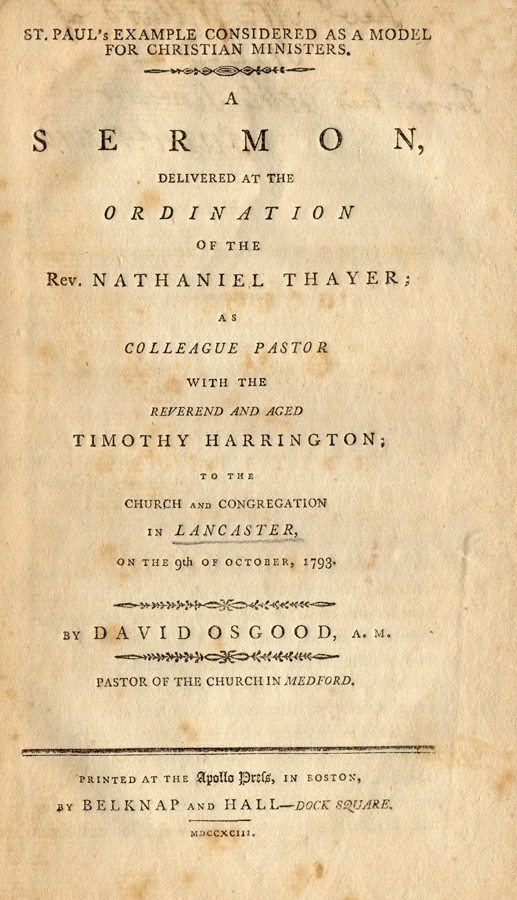
ST. PAUL’S EXAMPLE CONSIDERED AS A MODEL
FOR CHRISTIAN MINISTERS.

A

S E R M O N

DELIVERED AT THE

O R D I N A T I O N

OF THE

Rev. N A T H A N I E L T H A Y E R;

AS

COLLEAGUE PASTOR

WITH THE

REVEREND AND AGED

T I M O T H Y H A R R I N G T O N;

TO THE

CHURCH AND CONGREGATION

IN LANCASTER,

ON THE 9TH OF OCTOBER, 1793.

BY D A V I D O S G O O D, A. M.
PASTOR OF THE CHURCH IN MEDFORD.

AN
ORDINATION SERMON.

ACTS XX. 27.
I HAVE NOT SHUNNED TO DECLARE UNTO YOU
ALL THE COUNSEL OF GOD.

The discourse with which these words are connected, is most pathetic and affecting. As addressed to Christian ministers, it furnishes directions highly suitable for them in fulfilling their ministry. What the apostles and first preachers of the gospel were, exclusive of their supernatural call and qualifications, all who still succeed them in teaching the religion of Jesus, ought undoubtedly to be. In their example we have a model for the right discharge of the duties of the ministry. Their doctrines, manner of preaching, temper and conduct through the various scenes of their ministry, are recorded, as for the instruction of Christians in general, so for the imitation of ministers in special. And as the labours of Paul abounded beyond those of the other apostles, so his example is exhibited in scripture with a distinguished lustre. After the evangelists, his epistles and the history of his ministry, form the principal part of the writings in the new testament. But in no other single passage, have we so full an account of his ministry, and of the manner of his fulfilling it, as that which he himself gives, in the context, to the elders of Ephesus.

With unwearied pains, and amidst many fears and dangers, he had planted the church of Christ in that city. And being now called away, and obliged to leave the work in other hands, he was anxious for its success, and that it might still flourish, under the fostering care of those to whom it was committed. He therefore called for their attendance, that he might, with his own lips, renew the solemn charge and say, “Take heed unto yourselves, and to all the flock, over which the Holy Ghost hath made you overseers, to feed the church of God, which he hath purchased with his own blood.” To quicken them in keeping this charge, he sets his own example before them in some of its more signal instances during his ministry among them; bringing to their recollection both his preaching and his practice. And having apprized them, that he was now taking his leave of them, and that they would see him no more; on this solemn occasion, he testifies to them, that whatever the issue of his preaching might be with respect to some, whatever melancholy consequences might ensue after his departure, if any of them, or of the people of their charge, should finally miscarry, yet for himself, he was clear from the blood of all men having fully and faithfully delivered the gospel message. For I have not shunned to declare unto you all the counsel of God.

In holding up the apostle’s example as a model for us, we may consider both the subject and the manner of his preaching.

In the first place, the subject, viz. the counsel of God, or the Gospel of his grace, concerted by the divine wisdom, and now, in its most full and complete dispensation, published to the world for the obedience of faith. The whole Christian system is included in that counsel of God which Paul preached. To its peculiar and distinguishing doctrines, however, he did not, upon every occasion, confine his discourses. In addressing the idolatrous Gentiles, he began with asserting the great principles of natural religion, 1 the unity of God, his perfections and universal providence; our relation to him as his creatures, dependence upon him, and consequent obligations to serve him with our mental faculties, in distinction from those bodily exercises which cannot profit. These primary truths of religion, together with those equally obvious ones of morality, of doing justly and loving mercy in our dealings with one another, and walking humbly in the government of ourselves, are that good which God hath shewed unto men in furnishing them with the gift of reason. They are the great law of our nature, coeval with our existence, written upon the hearts of all men, and binding at all times.

Yea, God has so constituted our nature and the frame of things around us, that while reason discerns these fundamentals of religion and morality, experie4nce teaches us how essential to happiness is our conformity to them. Our self-love, the principle of self-preservation, so strong in every one, is made to sanction these dictates of reason, and to urge our compliance with them. And were our reason clear and perfect, unclouded by passion, unbiased by prejudice, unimpaired by disease or intemperance; did it retain its original strength and supremacy over the propensities of nature, it might prove a sufficient guide to virtue and happiness. If it hath totally failed of these ends, the cause lies in its perversion and abuse through the strength of prevailing corruption.

After the apostacy, men became vain in their imaginations; and while they retained some knowledge of God, yet glorified him not as God; but rebelling against reason, gave themselves up to vile affections. These darkened their understandings more and more, and gradually sunk them into deplorable ignorance, superstition and idolatry. Under this mass of rubbish, the light of reason was nearly extinguished, and many ages elapsed, while the moral world lay buried in darkness, gross and heavy, like that which overspread this earth in its chaotic state.

And when, at length, the divine mercy introduced the gospel dispensation for the general benefit of the world, the first object of this revelation was, to recover reason from its degradation, and re-establish the principles of natural religion. This voice from heaven confirms the dictates of reason, restores those which had been lost, enlightens those which had been obscured, strengthens those which had been weakened, and clothes them all with a divine authority; giving to the voice of reason and conscience the commanding energy of the voice of God.

But, were this all that is effected by revelation, (so great is the change made in the condition of man by sin) this which was ordained to life, would be found to be unto death—serving only to show us the extent of our misery. It would be like the appearance of God to our first parents after their transgression, arraigning, convicting and condemning, and then leaving them without the hope which he actually gave in his sentence upon their seducer. By clarifying our reason, and setting before us in its purity and perfection the great law of our nature, revelation enables us to behold the number and aggravations of our sins. “By the law is the knowledge of sin.”

Astonished at the view of his guilt, and alarmed with the apprehension of the divine displeasure, the awakened convinced sinner is anxious to find some mercy to pardon, some kind power to save. He earnestly inquires, by what sacrifices and offerings, or in what way, he may appease an offended Deity, and make satisfaction for breach of his law. Reason cannot answer the inquiry. All nature is silent, and affords no certain ground of hope. The more we think and reason upon our condition, the more helpless and desperate it appears.

These are the real circumstances of all men as under sin and guilty before God. And thus circumstanced, the gospel, in its literal import, as glad tidings of great joy, comes in to our relief. Its glorious peculiarities, the scheme of mediation, the person, character and offices of the Mediator, his propitiation for the sins of the world, and ability to save all who come to God through him, these are our only grounds of hope.

To the inquiry upon what terms this hope may be ours, St. Paul answers when he testifies both to the Jews, and also to the Greeks, repentance toward God, and faith toward our Lord Jesus Christ: A return from iniquity, and cordial submission to him who is made King in Zion, obedience to his precepts, and conformity to his example; these are the requisitions of the gospel; these form the distinguishing character of real Christians.

In attempting these things, however, we find a new difficulty arising. All our moral powers have been weakened in the service of sin, and evil habits have gained such dominion over us, that it is no easy matter to turn the current of our affections from earthly to heavenly things, to mortify the deeds of the body, get free from the bondage of corruption, and recover the lost rectitude of our nature. After some unsuccessful efforts, we should be in danger of giving over the attempt, were we not encouraged to expect aid from above. But so complete is the provision made in the divine counsels for our salvation, that the gospel is the ministration of the Holy Spirit. This divine agent is tendered as the guide of our feeble steps in our return to virtue. We are directed to seek, and encouraged to hope for his assistance on our first honest attempts to reform. “Turn ye at my reproof: Behold, I will pour out my spirit unto you. Ask, and it shall be given; seek and ye shall find; if e being evil, know how to give good gifts unto your children: How much more shall your heavenly Father give the Holy Spirit to them that ask him?”

And that nothing proper to quicken our exertions, may be wanting, the sanctions with which the gospel is enforced, are as full and perfect as can be imagined. Its promises and threatenings addressed to our hopes and fears, are so great, solemn and awful, that, when duly considered, they seem sufficient, to overwhelm the mind, and seizing upon all our faculties, to bear us away by an irresistible influence from all other objects of attachment and pursuit, to the great and momentous concerns of eternity.

These things, in their connection with various other particulars in the inspired writings, were those divine counsels which Paul, with such unremitting diligence, declared. Not this account of them however, but the scriptures themselves are to be regarded as the law and the testimony, the oracles of God, in conformity to which every discourse upon religion and Christian morality is to be composed. By the study of these inspired writings, every Christian, and especially every Christian minister is to satisfy himself what are indeed the counsels of God. The studies of a minister principally consist in searching the scriptures. From these he must derive the things new and old with which he is to entertain and edify his hearers. That he may “rightly divine the word of truth,” and approve himself “a workman who needeth not to be ashamed,” it is necessary, that he have a thorough and intimate acquaintance with every part of divine revelation. Its doctrines and duties should be so familiar to this thoughts, that on every occasion his lips may preserve knowledge, drop as the rain and distil as the dew. As set for the defence of the gospel, it is also necessary, that he be so versed in the various and abundant evidence of its truth both internal and external, that he may be ready at all times, to remove the scruples of the yet wavering and unsettled inquirer, answer the objections of infidels, and stop the mouths of gainsayers.

In searching out the meaning of the scriptures, and determining what doctrines they really contain, a knowledge of ancient manners, customs and languages, especially of those languages in which the scriptures were originally written, is highly requisite. Much useful information may be derived from those profane authors who were cotemporary with the inspired writers. With as many of these, as have reached modern times, the interpreter of scripture should be acquainted. He should know what allowance to make for the difference between ancient and modern languages; and for the peculiar phrases, idioms and proverbial sayings of the people for whose use the scriptures were at first designed. In construing those passages which are hard to be understood, he must keep in view the general aim and scope of the writer, and by comparing spiritual things with spiritual, make what is clear and plain to reflect light upon that which is doubtful and obscure.

To the disgrace of all Christendom, it has been the too general practice, to adopt, with little or no inquiry, a set of doctrines as the standard of orthodoxy from some celebrated Father, Reformer, established Church, Synod or Council. And having thus embraced our scheme of divinity, all our studies have been to weave these doctrines into our interpretations of scripture; and detached texts, sentences and phrases have been turned and twisted in every direction to the support and defence of pre-conceived opinions. “Instead of impartially examining the sacred writings with a view of discovering the truth, in whatever shape it may appear, we enter on the inquiry with a system already adopted, and have erected the edifice, even before the ground has been explored, on which it must be reared. It is from this cause, that the Greek and Latin churches have discovered in the new testament their different tenets, and that the most opposite parties, which have arisen in the Christian world, have made the same divine oracles the basis of their respective creeds. It is from this source that the church of Rome derives her seven sacraments, the Divine of the church of England his thirty nine articles, the Lutheran his symbolic books, and the Calvinist his confession of faith.”

To the honour of the present age, a more rational method of treating the scriptures seems to be gaining ground. These shackles upon the minds of men are evidently loosened, and we may hope, will gradually fall off. It begins to be generally acknowledged that “as an historian should be of no party, an interpreter of scripture should be of no sect. His only business is to inquire what the apostles and evangelists themselves intended to express; he must transplant himself, if possible, into their situation, and in the investigation of each controverted point, must examine, whether the sacred writers, circumstanced as they were, could entertain or deliver this or that particular doctrine. This is a piece of justice that we refuse not to profane authors, and no reason can be assigned, why we should refuse it to those who have a still higher title to our regard.”

Having, by diligent and impartial inquiry, settled in his mind what are the doctrines of scripture, the preacher, who would regard Paul as his model, will make these the constant theme of his discourses: And his great concern and study will be, to teach them in their purity and simplicity, and with such persuasive force and energy as if possible to impress a just sense of them upon the minds of his hearers. This he will be most likely to effect, if in the discharge of his ministry, he sets before him,

Secondly, the manner of the apostle; his faithfulness, earnestless, constancy, and sincerity in practicing himself what he inculcated upon others. These virtues are highly important, are indispensably requisite in the character of a gospel minister, and they were all eminently illustrated in the example of Paul. Each of them is strongly implied in what he says of himself to the Ephesian elders. His faithfulness is the direct import of the text. “I have not shunned to declare unto you all the counsel of God.” Nor was it more obvious in the unreservedness of his communications than in his manner of making them. As he kept back nothing that might be profitable, his constant study was, how to be most profitable, and accomplish the great end of his ministry in persuading men. Every faithful minister will copy after him in this respect, and will propose to himself the same object as his grand and ultimate aim. To promote this end, all his studies and endeavours will be steadily directed. In the choice of his subjects, and in his manner of handling them, he will be guided by what in his conscience he thinks will be most useful to his hearers. Merely to amuse and entertain them with the pop of language, or the charms of eloquence; or to gain their applause by gratifying their curiosity, or feeding their passions and prejudices, he will always esteem unbecoming the solemnity of a religious assembly, and below the dignity of a Christian minister. St. Paul preached not himself, but Christ Jesus the Lord. That desire of fame to himself, that ambition of being known and distinguished, which fired the ancient orators of Greece and Rome, was far below the sublime views by which the apostle was actuated. Had he been capable of seeking praise with men, his knowledge as an apostle might have been no impediment. The man who had been admitted within the veil, caught up into heaven, and initiated into the secrets of the invisible world, had it undoubtedly in his power to have gratified human curiosity on a number of questions concerning which it eagerly inquires. Should not his silence upon such questions, correct the vanity of those preachers who are always studying to surprise their hearers with some new discovery in divinity?

If such pretended discoveries have no conceivable relation to practical godliness; if curious disquisitions upon subjects of little consequence, uninteresting speculations, or dry criticisms even upon the scriptures themselves, form the bulk of a preacher’s discourses; or if he confounds his hearers with controversial divinity, and is always endeavouring to reestablish some favourite system of human construction, and under the impression of its peculiarities, gives to every discourse, be the text what it may, the same general complexion; if his preaching be destitute of that variety of different views and illustrations which the rich treasure of scripture affords; or if in treating on the important doctrines of the gospel, he introduces a train of intricate and perplexed reasoning; or if in teaching the moral virtues, he recommends them by no other arguments than a Plato or a Socrates would have used; if he forgets to assign them their proper place in the Christian system, or to enforce them by those peculiar motives which the gospel furnishes; if he adopts either of these defective modes of preaching, though he should be ever so laborious in his studies, yet must he not fall short of that profit to his hearers which is essential to faithfulness?

As the arts of persuasion are the only ones by which success in preaching is to be attempted, with what diligence should they be studied? How solicitous will the faithful minister be in acquainting himself with the most engaging methods of address? How careful and circumspect, left in little things, he stir up prejudices which may lessen his influence in matters of greater moment. In this respect, few of us, perhaps are sufficiently wary. Some, indeed, when they have once settled in their own minds, what is right, seem to make it a point of conscience, to pay no respect to the opinions or prejudices of others. Rigid and inflexible, they push their sentiments with a zeal often subversive both of peace and charity.

How very different was the conduct of the apostle? To gain upon believers, to edify the faithful and strengthen the weak in faith, with what ease did he accommodate himself to their known prepossessions? With what condescending tenderness, in matters not essential, did he become all things to all men, that by all means he might save some. With those under the law, or who looked upon themselves as bound by its ceremonial rites, he readily complied with those rites, though he knew them to have been abolished: Whilst with those who had obtained the same knowledge with himself, he as constantly used his Christian liberty. “To the weak he became, as weak, and would eat no meat, whilst the world standeth, rather than make the weakest brother to offend.” Had the same temper continued universally to prevail in the church, the bonds of charity would never have been broken. From the beginning, all the different sects and denominations of Christians would have dwelt together in unity like brethren.

The faithful minister will consider, not only the prevailing prejudices of his people, but their capacities, characters and religious circumstances; and to these adapt his discourses, his method of reasoning and address. Thus he will distinguish the precious from the vile, warn the unruly, and comfort the feeble indeed, and give to every one his portion in due season. With admirable wisdom and a nice discernment of circumstances and characters, this was done by the apostle on every occasion. To the heathen worshipping dumb idols, he set forth the absurdity of idolatry. Their objection against him was, his saying, that, they be no Gods, which are made with hands. To the Jews who had received by Moses and the prophets the shadow of the gospel, the hope of the Messiah, he immediately testified, that Jesus was the Messiah whom they expected. To the awakened jailor inquiring, What he should do to be saved, “he immediately answers, believe on the Lord Jesus Christ: Whilst with the hardened unprincipled Felix, he reasons of righteousness, temperance and a judgment to come. Knowing himself the terror of the Lord, he fought to persuade men, to alarm the vicious, and arouse the thoughtless, by a faithful denunciation of that wrath, “which is revealed from heaven against all ungodliness, and unrighteousness of men.” Many there are in every congregation, to whom these warnings are still necessary. 2 And whether they will hear, or whether they will forbear, the watchman cannot, with safety, shun to declare them. For he is himself warned, “If thou speak not to warn the wicked from his way, he shall die in his iniquity; but his blood will I require at thine hand. Yet if thou warn the wicked and he turn not, he shall die in his iniquity; but thou hast delivered thy soul.”

In dispensing these warnings, and indeed all the other truths of the gospel, the fervor and earnestness of the apostle, as well as his faithfulness, are to be our model. Upon his mind the gospel took full hold, and knowing its truth, he felt its importance “counting all things to be loss for the excellency of the knowledge of Christ,” he felt no other interest or concern here below but in its spread and success. Of course his preaching, was not with the enticing words of man’s wisdom, or the studied forms of human eloquence, but in the words of truth and soberness warm from his heart. With an air of deep and awful concern he persuaded men. In his addresses to them, his soul melted, (if we may so speak) and like his divine Master weeping over Jerusalem, flowed forth in streams of tenderness and compassion. To those addressed in the text he says, remember that by the space of three years I ceased not to warn every one night and day with tears.

This appearance of earnestness cannot be tolerably imitated without the reality. The affectation of it in feigned tears and a melancholy tone, or by vociferation and unusual gestures, succeeds with a very few only of the most ignorant and undiscerning: To a judicious audience these hypocritical arts are always disgusting. A degree of St. Paul’s faith, charity and piety is essential to that earnestness which he expressed. If the great principles of religion warm the heart of the preacher, they will influence him in the composition as well as in the delivery of his discourses. Despising frivolous ostentations harangues, he will study to place divine truth in a light the most advantageous for conviction and persuasion, that it may at once enlighten the understanding and touch the heart. In order to this it is necessary, that the composition be solid, cogent and animated, free from dull explanations of what is already sufficiently obvious, and uninteresting paraphrases on passages of scripture needing no illustration. The plain simple language of the Bible is always more lively and striking, than the circumlocution of a paraphrase. 3

When due care has been taken in the composition of a discourse to render it worthy of attention, the consciousness of this in the preacher will animate his delivery. And if he enters into the spirit of his subject, and feels it upon his own heart; his earnestness being real, will prove affecting to the hearers: The piety which glows in his bosom will be in a measure communicated to theirs.

With this earnestness is to be united the most persevering diligence in fulfilling the private as well public duties of the ministry. In the example of Paul we behold an unremitting attention to his work. He taught not in public only, but from house to house, and by night as well as by day. And he charges Timothy to be instant in season and out of season, “watching for souls as one that must give an account.” The Christian minister should be always ready to deliver those who are drawn unto death; pulling them out of the fire, giving to every one that asketh a reason for the gospel hope, reproving, rebuking, exhorting families and individuals as there may be occasion from day to day. In the course of providence favourable opportunities frequently occur for rendering in a private way, important services to the souls of men. Among the sons and daughters of affliction, in the chambers of sickness and houses of mourning the visits of a sympathizing minister are always welcome, and his counsels and exhortations are heard with more than ordinary attention. In this way it is expected of him, that he go about doing good.

Yea, it is expected, not only in those kind offices which belong immediately to his profession, but in his whole conversation and deportment, and that he exhibit the benevolent spirit of the gospel and exemplify its precepts. It is essential to the right discharge of their office, that ministers consider themselves, “not as Lords over God’s heritage, but as ensamples to the flock; in a word, in conversation, in charity, in faith, in purity.” Having the same interest with their hearers in the gospel which they preach, it will not be believed, that they are earnest in pointing out the way of salvation to others, unless they themselves visibly walk in this way. Their exemplary deportment as Christians will add weight to their instructions as ministers of Christ; and have an happy influence in recommending his religion. No arguments have a more persuasive force with the world in general to the practice of religion, than the beholding of it illustrated and shining in the lives of its teachers. Every minister should so live, as to be able thus to address his people, Be ye followers of me as I also am of Christ.

In Paul we behold a disinterestedness, fortitude and sincerity in practicing himself what he inculcated upon others, worthy of universal imitation. To the Ephesian elders he appeals as having witnessed the display of these virtues through the whole period of his continuance among them. “Ye know, from the first day that I came into Asia, after what manner I have been with you at all seasons, serving the Lord with all humility of mind, and with many tears and temptations; shewing you all things, how that so laboring ye ought to support the weak; coveting no man’s silver, or gold or apparel. Yourselves know, that these hands have ministered to my necessities, and to them that were with me.” While he strongly asserted the right of those who preach the gospel, to live of the gospel; for special reasons he waved this right in his own case. Straights and difficulties he frequently experienced, and in every city had the certain prospect of bonds and afflictions; yet no distresses, however heavy, no dangers, however formidable, did in the least dishearten him, or shake his resolution.

“None of these things move me, says he, neither count I my life dear unto myself, so that I might finish my course with joy, and the ministry, which I have received.” And so well did he finish, so complete was his fulfillment of this ministry among the Ephesians, that he adds, “I take you to record this day, that I am pure from the blood of all men.” Happy Paul! Who had managed so high a trust with such fidelity as to enjoy the comfort of this reflection.

To us, my fathers and brethren, the same trust, though in an inferior sense, is committed. With the office of declaring the counsels of God for the salvation of men we are honoured. To ourselves, as well as to our respective charges, it is of no small moment, that we form ourselves after the model of Paul and the other apostles; that the principles and views from which they acted, have a governing influence over us, that like them we approve our fidelity by keeping back nothing that may be profitable, and enforcing the whole by our own example. Moderate desires with respect to the good things of this life, and patience and fortitude in bearing its evil things, are highly becoming the ministers of a crucified Saviour. Some evil things are to be expected. From men of corrupt minds opposition is scarcely avoidable. Faithfulness, when it fails of reclaiming them, often provokes their angry passions and draws upon itself a torrent of abuse. Let none of these things move us from the steady discharge of our duty. Knowing that it is but a small thing to be judged of man’s judgment, let our great concern be to stand approved at an higher tribunal. Behold, our witness is in heaven our record is on high. Stewards of the mysteries of God let it satisfy us, if our faithfulness be known to him. The period will soon arrive when his judgment will be manifested. Let the serious thought of this, under every discouragement, animate our diligence and fidelity. The expected summons, give an account of thy stewardship; for thou mayest be no longer steward, may well arouse our utmost exertions.

In the mean while, changes are continually taking place. Paul is constrained to bid adieu to his Ephesian friends: The period of separation arrives, and they can see his face no more. Thus all earthly friendships, relations and connections are dissolved. While we ourselves are suffered to continue, the flight of time, of days, months and years bears away from under our care the fouls at first committed to our charge, and transmits them into that state where they try the reality of those discoveries which we announce to them from the word of God. How many who once sat under our ministry, are gone already! What their condition is in the world on which they have entered, we know not. But to ourselves it may be of importance, seriously to inquire, whether if any of them have miscarried, it has been in no degree owing to our negligence? Are we indeed pure from the blood of all men?

Under a consciousness of our defects, it becomes us to humble our souls before God, and while we implore his pardon for the past, to renew our resolutions, by his grace assisting, of greater diligence for the future. And may his mercy grant, that when our day shall end, we may be able to look back upon its labours with comfort, and forward to their reward in the world of glory with hope and joyful expectation!

To you, my brother, in particular, at the close of that scene of labour on which you are now entering, I most ardently with this felicity. To point out the way leading to it, has been the design of the preceding discourse. From my acquaintance with you I have just grounds to believe that your heart is steadily inclined towards what has been now recommended, and that you wish to excel in all the qualifications of an able and faithful minister of Christ. Descended from one of this character, 4 an ornament to his profession, and trained up with every advantage from his instruction and example; you now come forward with the raised hopes of your friends, and the good wishes of all your acquaintance. Providence is casting your lot in a pleasant part of the vineyard, and many circumstances concur in rendering the prospect before you agreeable and pleasing.

But you are not insensible of the arduous nature of the work in which you are engaging, nor of the trials to be expected in its prosecution. Oft have you contemplated the charge which you are now to receive, and under the apprehension of its weight and solemnity, have breathed forth the sigh, who is sufficient for these things! Had your father’s life been still spared, what a tide of paternal affection would have swollen his bosom in addressing you on this solemn occasion! How would he have poured forth his soul in tenderness for you; in soothing your spirit; in encouraging, directing and animating you! A sovereign God has ordered it otherwise, and one stands in his place who can only say, “Look to thy Father in heaven whose grace is sufficient for thee.” A lively spirit of devotion, my brother, is not more suitable to the character of a Christian minister, than necessary to fit him for the right discharge of every part of his duty. It raises the mind to an elevation proper either for studying the great mysteries of godliness, or performing its sacred offices. It invigorates all the faculties, and renders that a pleasure which would otherwise be gone through as a burden. It even leads to the hope of communication and assistance from above. If under a sense of our lack of wisdom, we humbly ask it of God, we are encouraged to expect, that he will give liberally.

Of every advantage from devotion, reading, conversation and study you will endeavour to avail yourself. With your aged and venerable colleague you will frequently consult, and by a respectful tenderness and sympathy with him under his growing infirmities, console the evening of his life. From his experience and knowledge of the state of this people you may receive much useful information. By adapting your discourses to their spiritual circumstances and giving to every one their portion in due season, you will, in the course of your ministry, declare all the counsel of God. May he prolong your life, give eminence to your character, success to your labours, and in the end, accept you with a well done good and faithful servant!

It is with pleasure, my brethren of this church and society, that we witness your zeal for the institutions of the gospel, and desire of hearing those divine counsels which concern the common salvation. The decays of nature having withdrawn your aged pastor from those labours, which, through the course of many years, he performed with honour to himself and profit to his people; you early sought, and this day happily obtain another to be set over you in the Lord. We rejoice in your peace and unanimity; and honour you for the wisdom and judgment, which, in our esteem, you have shown in this election. We are persuaded of the good abilities and good dispositions of our friend, who is now to be inducted into office.

With you it remains, to give an hearty welcome to him who thus cometh in the name of the Lord. Know him in his office as a minister of Christ. Esteem him highly in love for his work’s sake. Assist him with your prayers, and encourage him by a regular and general attendance on his ministrations. Look with candour on his public performances and private conduct. Forbear to notice those failings which are inseparable from human weakness. Guard his reputation with the vigilance of true friendship, and protect it from every rude assault. Clear his way before him of all difficulties and obstacles so far as you are able. Study to extend his influence, and promote his usefulness to the utmost. And let him see, that you profit by his labours; that you improve in knowledge and virtue, and in a conversation becoming the Gospel of Christ. Thus he will prove an helper of your joys, and you will become his in the day of the Lord Jesus.

My respected hearers of this great assembly, we find ourselves lately brought into existence, and rapidly hurrying through life. We are anxious to know what is to be done with us hereafter, and what are the intensions of our Creator concerning us. But who hath known the mind of the Lord? Or who can penetrate the secrets of his will? The things of God knoweth no man; but the spirit of God searcheth all the depths of his counsels, and is conscious of all his designs; and by his spirit they are revealed unto us in the gospel of his son. This divine revelation removes the veil, and lays open to human view his eternal counsels with respect to the present and future destinations of men. On these subjects your ministers from time to time address you. They declare to you the counsel of God—the gospel of his grace. Your recovery from sin and ruin, and final salvation are the object of this high dispensation. For the obtaining of this end, it makes the most ample provision, and furnishes every necessary mean. Suffer it to have its due effect upon your hearts and lives, and it will guide you to life eternal. Let me entreat you, therefore, not to receive the grace of God in vain. For how shall we escape, if we neglect so great salvation? To day if ye will hear his voice, harden not your hearts. The wages of sin is death; but the gift of God is eternal life, through Jesus Christ our Lord; to whom be glory for ever,

A M E N.
 

THE RIGHT HAND OF FELLOWSHIP,
BY THE
Rev. WILLIAM EMERSON
OF HARVARD.
The benevolence of God is the principle of his works. It reared the pillars of the universe; it gave to all material and intellectual systems their being; and unless this divine influx had been the motive of creation, neither men nor angels would have never existed.

To imagine the Deity, therefore, to be deficient in love towards any of his creatures is criminally to mistake his true character. It is, without doubt, less wrong to deny the existence of a God, than to suppose the God, whom we adore, is not infinitely good.

Hence, Christianity seems principally concerned to display the benignity of the divine nature. Christ has, indeed, taught us truths, which we could not have known, except by preternatural revelation. It is, however, a distinguishing excellence in his religion, that it ripens the hope, which nature, from the first, produced, that the original of all things is full of placability [forgiveness] and good will. I say, it is the glory of the gospel to confirm to us the truth, which, since time began, was imprinted, as with a sunbeam, on the face of the world, that God is love.

It is remarkable, as this divine dispensation had its origin in love, and is the most illustrious instance of love, that the history of man can furnish, so it must be perfected by the same heavenly quality.

Accordingly, its professors and teachers are happy to embrace every fit opportunity sensibly to manifest to each other and to mankind, that they are in truth governed by the spirit of their religion.

Wherefore, reverend and dear Sir, perceiving the grace that is given to you, and ardent to love you, not in word only and in tongue, we thus express to you the joy we derive from the late solemn transaction.

In observing, on the present occasion, this significant and apostolic custom, the elders and messengers from many branches of the Christian church, now convened, acknowledge you a disciple of Jesus Christ, and duly commissioned to preach his religion. We hereby welcome you to a place in our fellowship and affections. We rejoice, that God has qualified you for the office of a Christian minister, and that he has inclined your heart to devote yourself to so useful and pleasurable an employment. It also gladdens us, that the bounds of your habitation are fixed in this part of Christendom, that the lines have fallen to you so pleasantly, and that you have so goodly an heritage. As long, as you continue to feed this heritage with knowledge, and to sustain the function, you have assumed, with true dignity, it will form one of our most exalted pleasures to be auxiliary and kindly affectioned towards you, as well in the private scenes, as in public labours of your life.

At the same moment, Sir, we are filled with the joyful persuasion, that you will ever readily meet us in the exercise of the friendly dispositions. Yes, my friend, this hand, which I have long been used to receive as the faithful representative of a sound heart, is to me, and, I presume, to my reverend fathers and brethren, a sure evidence of your purpose to live with us in the charity of our holy faith, and in the cordial reciprocation of benevolent offices.

Now fare thou well, brother, whom I love in the truth! May the God of thy fathers bless thee, and make thee happy through the course of a long and successful ministry. Let the dictates of an enlightened understanding, the love of humanity, the shade of a pious parent, the honour of Christ, and the desire of God’s approbation uniformly incite thee to fidelity in thy sacred character, and to deeds of honest glory in the various relations, thou mayest hold, in the brotherhood of man. And, at the last, mayest thou be crowned with consummate and eternal felicity!

We congratulate you, brethren of this religious society, on the joyous solemnities of this day. Surely this is the day, which the Lord hath made. Well may your hearts rejoice and be glad in it. For it is the day, to which ye have long anxiously looked, and which confers upon you the minister of your early choice, whom ye justly consider as an Israelite indeed in whom there is no guile. Behold, now, the man Blessed be he, that cometh to you in the name of the Lord! Be entreated to own him as a gift of our ascended Redeemer, and to know him in his station Yea, beloved in the Lord, we beseech you, by ministering to his necessities, by fair construction of his conduct, courteous behavior to his person, and chiefly, by giving heed to the words of his mouth confirm your love towards this our brother.

Amid the important concernments of the hour your aged and worthy pastor has a dear interest in our memory and feelings. We have blessed him this day out of the house of the Lord. We trust, ye will solace the evening of his days by the continuance of those amiable kindnesses, which have so long endeared you to his heart, and whose commendation gives such an unction to the precepts of our Lord and yours.

Finally, brethren, seeing that ye walk in the truth, and in love one with another, we do recognize you, as the church of God and of Christ. So, then, ye are the temple of the living God. As God hath said, I will dwell in them, and will walk in them; and I will be their God, and they shall be my people.

Arise now, therefore, O Lord God, into thy resting place, thou and the ark of thy strength! Let thy priests be clothed with salvation, cause thy saints to rejoice in goodness, and let all the people say—Amen


Endnotes

1 See Acts xvii. 22.

2 It is matter of regret, that any should object to this part of ministerial faithfulness. No excuse indeed is to be offered for those preachers who endeavour to supply the want of sensible composition and of a serious and rational method of address by overbearing noise and terror: Censure upon them is just. Yet it is a melancholy fact, that the refinement of modern times has produced some occasional hearers, (for they are not in general, very constant in attending public worship) whose delicacy seems to be shocked at the least mention of the threatenings in scripture. “Let us, say they, be drawn by the beauties of virtue and the hopes of heaven, and not driven by the terrours of hell. We chuse not to be frightened into our duty.” Upon this principle, they openly avow their disapprobation of all discourses upon the terrours of the world to come and the doom of the ungodly at the last day. They affect to despise the preacher, who, by these motives would persuade men to holiness. In their opinion he not only exposes his ignorance of human nature, but his want of sensibility and benevolence of heart, by thus endeavouring to alarm his hearers. Pronouncing him to be both ignorant and unfeeling, they glory in their contempt of all his admonitions. But, before men suffer themselves to receive the prejudice which such sentiments and language are adapted to convey, they ought seriously to consider, whether the danger of which they are warned, be real or not. From ignorance or ill design false alarms do indeed proceed. With these we are justly displeased. But no man is offended at being apprized of a danger which he believes to be real, especially when the warning tends to facilitate his escape, and is given solely for this purpose. Were you walking in the dark till your feet approached an unsuspected precipice? Were you sitting secure in your house, or sleeping in your bed, while your habitation was kindling into flames? Or in any other circumstance of real danger to your person, family or interest; previous warning of it would be so far from being deemed unkind, that he would be accounted a wretch indeed unfit to live in society, who should willfully withhold it from his neighbor or friend. The only reason why men are offended at being warned of the danger to which their souls are exposed, is because they believe not this danger to be real. Lot seemed as one that mocked unto his sons in law. In the same light every monitor appears whose warnings are not believed. And hence it will come to pass, that, as it was in the days of Lot; even thus will it be in the day when the son of man is revealed.

3 “By a multiplicity of words the sentiment is not set off and accommodated, but like David equipt in Saul’s armour, it is encumbered and oppressed. Yet this is not the only, or perhaps the worst consequence resulting from this manner of treating sacred writ. We are told of the Torpedo, that it has the wonderful quality of numbing every thing it touches. A paraphrase is a Torpedo. By its influence the most vivid sentiments become lifeless, the most sublime are flattened, the most served chilled, the most vigorous enervated. In the very best compositions of this kind that can be expected, the gospel may be compared to a rich wine of a high flavor, diluted in such a quantity of water as renders it extremely vapid.” Campbell.

4 The Rev. Ebenezer Thayer, late of Hampton, in New-Hampshire, who died Sept. 6, 1792, Et. 59.

Sermon – Protestant Episcopal Church Convention – 1792


Devereux Jarratt (1733-1801) worked as a schoolmaster and lay minister for a time. He was ordained in the Church of England in 1762. He took part in a revival that happened in America just before the American Revolution, often preaching with Methodist ministers. The following sermon was preached by Jarratt in Virginia in 1792.


sermon-protestant-episcopal-church-convention-1792

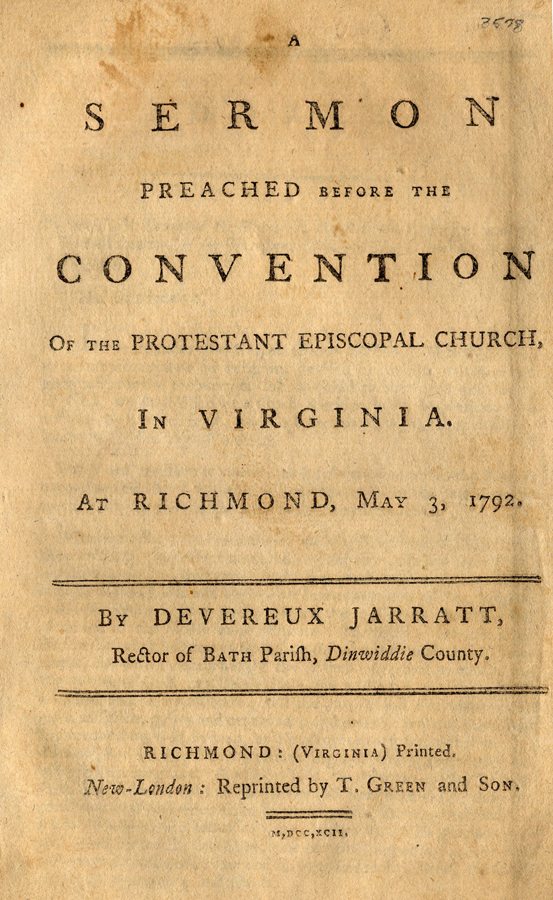
A

S E R M O N

PREACHED BEFORE THE

C O N V E N T I O N

Of The PROTESTANT EPISCOPAL CHURCH,

In V I R G I N I A.

At R I C H M O N D, May 3, 1792.

By DEVEREUX JARRATT,
Rector of Bath Parrish, Dinwiddie County.

A D D R E S S.

To the Right Reverend the Bishop, the Rev. the Clergy, and the Lay-Members of the Protestant Episcopal Church, in the State of Virginia.

My Brethren,

If we consider the Gospel of our LORD JESUS CHRIST, as a complete system of religion, devised by infinite wisdom and goodness, for the recovery of lost mankind to the favor and image of God, we shall discover a fitness therein, every way adapted to answer the end designed; and that, in this view, the gospel is consistent with the highest reason.

But if we consider it merely as a system of morals, the Gospel becomes a riddle of absurdities, and leaves us in the dark how to account for the thousandth part of its sacred contents.

Whoever adverts to the tenor of the holy scriptures, will find that they uniformly represent mankind, by nature, as fallen from God;–fallen into sin, and under guilt and condemnation;–as having lost the divine favor and their own innocency, and all that original rectitude and primitive purity, which they possessed, when they first came out of the plastic hand of their CREATOR. On this foundation the whole scheme of salvation, through the mediation of Jesus Christ, standeth. Accordingly the gospel takes into consideration the nature of God, as a Being, holy, just and pure, as well as good, merciful and compassionate; and the nature and circumstances of man, as fallen, guilty and depraved; and makes adequate provisions for reconciling God to man, by the propitiatory sacrifice of the Redeemer; and man to God, by renovating and refining degenerate nature, by divine grace. And thus it is, that sinners, guilty and defiled, are restored both to the favor and image of God; not only made fit subjects for GOD to take pleasure in. The glorious gospel, when viewed in this light, must certainly appear to accord with the eternal reason and nature of things, and most justly to challenge universal veneration and esteem.

It must also be observed, by every attentive reader, that the blessings or benefits of the gospel are held forth and offered to men, not in a jumbled or promiscuous manner, but in such certain order and connection, that one benefit precedes, or goes before another, with the utmost propriety and regularity. This, if duly observed, would naturally point out to a considerate mind the order and connection, in which the doctrines of Christianity ought to be preached.

But tho’ this is a matter of very great consequence to the proper discharge of the ministry, and the success of our labours, yet it is greatly to be feared, that it too seldom enters into the heads or hearts of many ministers. They may take care that their sermons shall be adorned with fine language, and contain nothing but what is true in itself; but whether the matter be truly evangelical, and suitable to the present stage of religion, in the congregation, to which they preach, perhaps, may make no part of the inquiry.

I may be told, that they preach up the purest morality, and bear their “testimony against all the reining vices of the times.” I acknowledge morality to be a lovely, precious and ornamental jewel; and hat vice is odious, abominable and destructive. But true morality can never spring forth from an unrenewed heart, whatever specious appearances there may be; nor can vice be rooted out, by inveighing against it, in the most severe and pointed terms; or by satirizing it, with the utmost keenness and asperity.

If my historical knowledge does not fail me, I can venture to affirm, that the vices of the Roman empire never grew faster, or more rank, than after Perseus, Juvenal and Horace adopted the satirical method of reformation. And he must have little knowledge of the human heart, who can suppose that its vices can be removed by such methods. They have struck their vile roots too deep to be eradicated by anything less, than the power and grace of God, which the gospel supplies. If we wish or expect to do anything less, than the power and grace of God, which the gospel supplies. If we wish or expect to do anything effectual to their extirpation, let us strike at the root of the disease; for all our labours will be to no purpose, while we direct our strokes merely at the branches.

But after all that can be said, I am fully convinced, that no man is likely to make an able and useful minister of the new testament, who has not had a proper introduction to the gospel ministry. I mean, that he, who would preach with order, propriety and success to others, must be experimentally acquainted with the order, in which he himself has actually received the blessings of the gospel to the saving conviction of his own soul.

Such an introduction to the ministry will let a man in at the right door, and the sheep will hear his voice. For that minister who has himself been truly awakened to a just sight and sense of his own lost and helpless state—has been deeply conscious of his absolute need of a savior—has been enabled, by divine aid, to come to God, as a poor miserable sinner; and has obtained pardon and peace with his offended Sovereign, by faith in the blood of Christ—that minister, I say, will be best qualified, caeteris paribus, to teach others, not only the right way, but the right order, in which the benefits of the new covenant are to be looked for and expected. He will also speak feelingly, because he himself has felt, and does feel: he will speak alarmingly, because he has been alarmed, and he will speak comfortably to such as stand in need, or are duly prepared for the reception of comfort, because he himself has been comforted, by the consolation of Jesus Christ.

O that it may please the eternal God to furnish our church with a rich supply of such experienced Pastors. Then may we expect to see the present gloomy aspect of our religious affairs wonderfully changed for the better: vital piety will then spring up and flourish among us, and our church become the glory of the land. But till this shall be the case I cannot entertain the least hope or expectation of ever seeing any other change, but from bad to worse.

In the following discourse I have endeavored to lay down some of the leading truths of the gospel, and to point out the order and connection in which they should be preached. At the request of the clerical and lay deputies, in Convention yesterday, I have sent it to the press, without any apology for its being destitute of the flowers of rhetoric and the ornaments of speech. “My one design was to speak plain truth,” in such terms as might be easily comprehended, by every class of my hearers, then present, and which, I trust, will be understood by all my readers.

That the Lord may accompany with his abundant blessing, what is here laid before the public, is the sincere prayer of,

GENTLEMEN,
Your real Friend and humble Servant,
In the pure Gospel of Christ,
DEVEREUX JARRATT.

Richmond, May 5, 1792.

1st Timothy 4th and 16th.

Take heed unto thyself, and unto thy doctrine; continue in them; for in doing this, thou shalt both save thyself and them that hear thee.

The office of a gospel Minister is, of all others, the most sacred, weighty, and important; and the condition on which it is held, very awful and tremendous. It is therefore the duty and interest of all those who are invested with it, seriously to reflect on, and frequently to revolve in their minds, the greatness of the trust, in them reposed; and also to consider, with the utmost solemnity and concern, in what manner they ought to conduct themselves in their vocation and ministry, so as to deliver their own souls from death, and be a Savor of life unto life, to as many of their hearers as possible. To effect these salutatory purposes, the Apostle Paul gave this solemn charge and pertinent advice contained in my text. Take heed unto thyself; have a particular regard to thine own temper and conduct; let this by thy first and greatest care; and to thy doctrine, not only to the matter, but also to the manner of thy preaching; and continue in them, give up thyself wholly to this business and persevere therein to the end of thy days: and to animate and support thee under all the fatigues, trials, and sufferings, which thou mayest meet with, in the faithful discharge of thy office, still keep the prize in view, the happy consequences of such a conduct; for in doing this thou shalt both save thyself and them that hear thee.

As these words are equally applicable to us, as they were to Timothy, I shall, without any farther exposition, proceed to consider the several particulars contained in them. These are the four following:

I. That it is the primary duty of gospel Ministers to take heed to themselves.

II. To their doctrine.

III. That they must continue in them, and persevere to the end: and

IV. The happy consequences resulting from so doing: for in doing this, thou shalt both save thyself and them that hear thee.

As the province of addressing you, on this occasion, was assigned me, by the last convention, I shall not take up any of your time in making the customary apologies, about slenderness of abilities for addressing such a respectable and learned audience, or unfitness to assume the province of your instructor. I consider myself as a debtor both to the wise, and to the unwise: and while I address myself, both to clergy and laity, in the name, and by the authority of my adorable Lord and Master, my one concern is, not to please the taste or tickle the fancy, but to speak plain truth, in such a manner, as may be most acceptable in his sight.—And may the eternal God enable me so to preach, and you to hear, that his name may be glorified, and you edified, for Christ’s sake.

I. Take heed to yourselves. This is the first particular in the text; and it is truly the first and most essential qualification in a gospel Minister. He that does not take good heed to himself, is not likely to take good heed to the souls of others; or indeed to do anything else, belonging to his sacred office, in a becoming manner.

Many things are supposed to be implied, in this injunction. But I am verily persuaded, that the main thing intended by the Apostle, is personal religion. Ministers are as intimately concerned, in the weighty truths, they deliver, as any of their hearers. And when their own hearts are duly impressed with them, it is reasonable to suppose, that this impression, as by a happy contagion, will, more or less, diffuse and spread itself from them to the people. By personal religion I mean not a blameless life and conversation only; but an experimental acquaintance with the transforming power of the gospel, on the inward man of the heart; whence all true religion takes its rise. This, I say, is the first, the most essential qualification of a gospel Minister; the want of which, all other acquisitions of Greek, Latin, Philosophy, Rhetoric, and such like, can never supply; though they are useful in their own places. 1

The study of pulpit eloquence has been warmly recommended to us; and to deny its utility, would argue both want of taste and judgment. But as art can never vie with nature, so all the cold rules laid down in books, though learned and conn’d by rote, and digested in the most perfect manner, can never, in reality, make a pulpit orator, without the saving, vivifying grace of God ruling and inspiring the heart and soul of the speaker. All would appear but as the bold strokes and nice touches of the pencil, on canvas, when compared to the active warmth and glowing features of the living man. Art can smooth our periods and add lustre to our sentiments: but all the art in the world can never reach that natural, spontaneous force and pathos, which is the genuine offspring of ital piety, and the love of God shed abroad in the heart, by the Holy Ghost. For my part, I see not how it is possible for any man to inculcate the great truths of the gospel, and distinguishing doctrine of Christianity, with any suitable degree of ardor and propriety, who has never known their saving power on his own soul. For instance, how can a preacher enforce, with spirit and confidence, the necessity of spiritual regeneration on others, who has no experimental knowledge of that great, that heaven born change on his own heart? My brethren, let us take heed to ourselves that we rest not in any outward form of godliness, without the inward power thereof; and that we never deal “in the false commerce of a truth unfelt.”

‘T is absolutely necessary to salvation, for the Laity, as well as for the Clergy, to be possessed of the life and power of religion, for without holiness no man shall see the Lord. But there is an additional obligation on us, who are Ministers, because the honor of God and the prosperity of the Church depend more on us than other men.—The rapid declension of the Church, to which we belong, and the decadence of religion among us, have been mentioned on former occasions. This indeed has been matter of grief and complaint to all her real friends. A number of things may have contributed towards it; but, as has been hinted before today, I am verily persuaded, nothing has been more prejudicial than the misconduct of some, and lukewarmness of others belonging to our own body. Can it be doubted, but the house of God may and will be deserted; and that men will abhor the offerings of the Lord, now, as well as in the days of Eli, if similar causes abound?—Tis not a secret sentiment, or a mere conjecture, but the avowed profession of multitudes, that the main reason why numbers have fallen away from our church, is not only the “cold, inanimated method of reading sermons” there, “and the want of preaching in a manner sufficiently evangelical,” but also the want of that gravity and sobriety, fervency of spirit and holiness of life and conversation in her ministers, which they know to be absolutely necessary, not only to distinguish the Clergyman, but every real Christian. I doubt not but our church is founded on principles as pure and apostolic as any church in Christendom. But the laity, in general, are not so capable of judging, in those points of controversy, which respect the different modes and constitutions of different churches, but they are very capable of judging and distinguishing between those Ministers who are grave in their deportment, strict and holy in their lives, warm and animated in their preaching, and diligent and laborious in their ocations; and those, who are cold and languid, slothful and vicious. And on this distinction they often decide, in favor of this or that community.

My brethren, tis in vain to dissemble the matter, the greatest share of that which has reduced our Church to her truly mortifying and humiliating state, is justly chargeable on our selves: and we may flatter ourselves as much as we please; yet, be assured of this, till the Altar be purged, the sacrifice will be contemptible.—I speak this, with the more assurance, from my long and extensive acquaintance, with the language and sentiments of the people, in many parts of the state.—And I must confess, with the aspiring youth mentioned by the Poet, I have often been put to silence by their observations and reflections; because, as he said,

______pudet haec opprobria nobis
Et dici potuisse, et non potuisse reselli.

But as this is a subject which may require to be touched with a more tender and delicate hand, than falls to my share, I shall not enlarge upon it, lest, by attempting to heal, I should exasperate the sore. However, I have said enough to show how absolutely necessary it is, that Ministers should take heed to themselves.—I pass on to the

II. Particular. Take heed doctrine.

This injunction comprehends these two things—

I. Take heed to the matter; and,
2. Take heed to the manner, of teaching.

I. The matter.

I am sensible that this subject is too comprehensive to have justice done it, within the limits of one Sermon. I shall therefore say, in a word, “the subject-matter and substance of all gospel doctrine is Christ.” This may be easily evinced from the writings of St. Paul. In his epistles to the Corinthians, he says, we preach not ourselves, but Christ Jesus the Lord. I determined not to know any thing among you, but Jesus Christ, and him crucified. And writing to the Colossians, concerning the glorious mystery, which had been hid from ages, but was then made known to the Gentiles; he informs them, that it is Christ in you, the hope of glory; whom we preach. This endearing object occupied his whole time, and drew all his attention and studies after it. This was his joy, his treasure, and his boast: God forbid, says he, that I should glory, save in the cross of our Lord Jesus Christ. No consideration could divert him from this favorite and important theme. When the Jews sought after signs and the Greeks for wisdom, he would gratify neither the one nor the other; who’ it might cost him his reputation for Philosophy and other arts and sciences. Instead of this, he persisted to preach a crucified Saviour, as being of more value than all the fine arts in the world. We preach Christ crucified, though a stumbling block to the Jews, and to the Greeks foolishness. To preach Christ crucified comprehends the whole credenda and agenda of Christianity; all things necessary to faith and practice.

Were we the disciples of some of the renowned sages of Pagan antiquity, we might think it sufficient to amuse our hearers with some spruce subjects of morality. But as we profess to be the disciples of a crucified Jesus, and to receive our lessons from him, and those Apostles who were immediately commissioned by him, What have we to do with your Plato’s Seneca’s, Socrates, and such like, who were utter strangers to that glorious gospel which we are commissioned to preach? At proper times, I grant, it is our indispensable duty to explain and enforce the great duties of morality. But to dwell on moral duties, before we have laid a proper foundation for the due and acceptable discharge of them, on evangelical principles, is not proper; because this is to begin at the wrong end of our work, and, of consequence, we are not likely to effect any good purpose.

Now, in preaching Christ crucified, we shall observe certain evangelical truths, which immediately break forth from him, in that capacity, as their source and centre, just as the rays of light break forth from the meridian Sun.—These truths are such as follow. To wit. The fallen and miserable state of man, on which the whole gospel scheme of Salvation is founded; the necessity of an atonement, thro’ a mediator; the sufferings of Christ, for that purpose; the dignity of his person and the infinite merit of his death and passion; the free forgiveness of sins, through his blood and righteousness; the necessity of regeneration, and the influence of the Holy Ghost, to enlighten our understanding, renew our will, sanctify our affections, shed abroad the love of God in our hearts, comfort our souls, and support us, in all our trials, temptations, and difficulties. These are the doctrines, which are most intimately connected with a dying Saviour, and the whole scheme of redemption thro’ him. They are of such importance, that we should never lose sight of them, let the subject of our discourse be what it will; and when we preach these, we preach Christ. And as these are the doctrines, which ever have been, so they ever will be, the most effectual and successful means of converting sinners from the error of their ways, and saving souls from death. They ought, therefore, to be clearly explained, frequently repeated, and strongly enforced.—I come,

2. To treat of the manner, in which the doctrines of the gospel ought to be preached.

And, I. They should be preached in their proper order and connection.

2. With ardor, zeal, and affection: and,

3. With a close application.

I. The doctrines of the gospel ought to be preached in their proper order and connection; and not in a jumbled and promiscuous manner.

Now, as the whole scheme of redemption, thro’ Christ, is founded on the fallen and ruined state of mankind, then the first thing necessary to effect their recovery from ruin, is to make our hearers sensible, deeply sensible, that this is their state, in particular. Till this is done, we may preach against this vice and that vice, to no purpose; and we may preach morality till we preach it all out of the world. I firmly believe there never was, and never will be, one soul brought to take one right step, in the way to heaven, by merely preaching Morality. 2 Christ is the way, and the only way pointed out in the Gospel. And if ever we bring sinners to Christ, as the way, and to clothe with him, on gospel terms, we must so preach as to make them feel extreme need of him. For, they that are whole, need not the Physician, but they that are sick.

We must, therefore, labor, by all means, to expose, in the most alarming colours, the entire depravity and universal corruption of human nature; and place before the eyes of our hearers their guilt, and danger of perishing, as being under the wrath and curse of God, and liable every moment, to the strokes of vindictive justice.

However unwelcome, or unpleasing such a conviction might be to any of you, my hearers, yet it cannot be dispensed with. Tis of the utmost necessity, that you should not only hear, but feel that you are wretched and miserable, and poor, and blind, and naked: and that there is indeed; “no health in you.” The very meaning of the Greek word, which is translated Gospel, signifies “good news, or glad tidings.”—But you will never be able to apprehend the propriety and significancy of this word, or rightly understand why it is so called, till you feel the deadly wounds which sin has given you, and are painfully sensible of the woeful destruction it hath wrought on your precious souls.

Should any of our hearers deny the doctrine of original sin, or that human nature is so degenerate and corrupt, we can easily prove that it is so, both from scripture, and matters of fact. The Scriptures assure us, That we are shapen in wickedness and conceived in sin: that we are dead in trespasses and sins; and are, by nature, children of wrath:–that in our flesh dwelleth no good thing; and that by the offence of one, judgment came upon all men to condemnation.—And if we look round us, and survey the conduct of the generality, evidences of this universal degeneracy and depravity of mankind, from matters of fact, will glare upon us from every quarter. See! Whole families! See thousands, of all ranks and degrees, living in the neglect of God and his reasonable service.—See every species of wickedness and profaneness abounding and overspreading the land, like a rapid torrent, or a sweeping inundation. And whence do all these foul streams originate, but from the polluted fountain of a corrupted heart?

But men should not only be convicted or original, but of their actual sins against God; and the imminent dangers to which they are exposed, on account of their multiplied transgressions of his holy law. And, as by the law is the knowledge of sin, this renders it necessary for Ministers to preach the law, in all its spirituality and broad extent: and that so pointedly, that the hearers may duly apprehend their own particular concern, in what is delivered. Impenitent sinners must be faithfully warned that the wrath of God is revealed from Heaven against all ungodliness and unrighteousness of men: that tribulation and wrath, indignation and anguish is the certain doom of the Christless and unconverted sinner; whether high or low, rich or poor.

These, and such like alarming declarations, when pronounced in their proper place, and pointed at the conscience, with a solemnity becoming their dread importance, and divine authority, will not fail, by the blessing of Heaven, of having their salutary effects, upon some of the most secure and careless. Sinners in Zion will be afraid, and fearfulness will surprise the hypocrites. They start alarmed from their carnal slumbers, and behold the gloomy clouds of divine vengeance, hanging over their guilty and defenseless heads, big with thunder, fire and storm; while, far beneath, the flaming gulf gapes wide to receive them at their coming.

By such just views of their guilt and danger, sinners begin, in good earnest, to strive to flee the wrath to come.—Now they quit their jovial companions: the ball room and the card table are no longer frequented: they break off every species of vice, and betake themselves to reading, hearing, and praying, with a solemnity unknown before.—They now plainly see that life, their eternal life, is at stake, and there is no time left for trifling and delay. Their anxious hearts, wounded by the pungent terrors of the divine law, and opprest with loads of guilt, vent themselves, in many a sigh and groan, in sorrowful retirement. In a word, as their duty is, so they now make use of all the means of grace, with constancy, vigor, and exertion.

By this time, a very great reformation and visible change have taken place in such, and they may begin to flatter themselves, that they are out of danger now, and all is well.—But this is a fatal mistake; for there is still greater danger, though of a different kind than before. Before, they were in danger of perishing, from their out-breaking sins and criminal neglect of religious duties: but now, they are in danger of resting in an outward reformation, and of making a Saviour of their duties. Thus like the Jews, in St. Paul’s day, being ignorant of God’s righteousness, and going about to establish their own righteousness, they may never submit themselves to the righteousness of Christ, by which alone they can be justified in the sight of God.

Therefore, when sinners are ready to sing a requiem to their souls, reposing themselves, on their external change, and resting in the works of their own hands, the ministers of Christ must alarm them, with fresh discoveries of their danger; chafe them out of all their safe hiding-places; dislodge them from all their refuges of lies; and make use of the heaviest artillery of law, to demolish the flattering entrenchment of their own self-righteousness. In short, they must be closely pursued, till, from a full conviction of their own inability to relieve themselves, by any thing they can either do, or suffer, they are made heartily willing to submit themselves to the righteousness of Christ, and, in humble self-despair, cheerfully accept of pardon and salvation, as they are freely offered in the gospel. Now, when we have so successfully convicted sinners of their guilt and danger, and reduced them to despair of any help in themselves, then, and not till then, is the way properly opened for the proclamation of deliverance, through the riches of free, gospel grace.

Here it is, that we are called forth to the most sweet and pleasing part of our work: I mean, that now is the time for us to exhibit the Lord Jesus, in all his mediatorial glories, and in all the offices which he, as the great Redeemer of a fallen race, sustains and executes. Now we must open and display the plan of salvation through him: how, as our substitute and surety, he fulfilled the precept of the law or covenant of works, and bore the curse for us, or in our stead. That having magnified the law and made it honourable, by his active obedience, and satisfied the rigid demands of justice by his passive obedience; God may now be just and the justifier of him, who believeth in Jesus. We may therefore invite the weary and heavy laden, with a burden of guilt, to come to him for rest.—We may give them the strongest assurance of his willingness to receive all repenting and returning prodigals, from his kind invitations, indefinite calls, and gracious promises.

We must also point out and explain the method by which sinners obtain a saving interest, in the justifying righteousness of Christ. And this, I apprehend, must be by imputation. This important truth we are taught, by St. Paul, in several places; but no where more clearly and explicitly than in his second epistle to the Corinthians, V. chap. 21st verse, For he was made sin for us, who knew no sin, that we might be made the righteousness of God in him. As if he had said—Christ Jesus, who had no sin, but by imputation, was made sin, or a sin offering for us; that we who have no righteousness of our own, might be made the righteousness of God in him. Or in other words; as our sins were so charged to his account, as our surety, that he suffered for them; so must his righteousness, consisting in his active and passive obedience, be imputed to us, or placed to our account, that by this righteousness, we may be justified in the sight of God, and saved from wrath through him. But the condition, on our part, whereby we become entitled to the benefits, procured by our Redeemer’s righteousness, is Faith. Faith is the grand condition of the gospel. This is exceedingly evident from the writings of the Apostle Paul, especially his epistles to the Romans and Galatians. And we also find, that when the trembling jailor asked that important question, Sirs, what must I do to be saved?—The answer is, Believe in the Lord Jesus Christ and thou shalt be saved. But we read so frequently of being justified by Faith in Christ, by believing in Christ, and by faith in his blood, that it is needless to enlarge. To mention only one instance; you will observe (in Acts 20) that St. Paul, in his solemn and affectionate farewell to the churches of Ephesus, reminds hem of his own fidelity, in declaring to them the whole counsel of God, and that he had kept back nothing that was profitable to them, or to their salvation; and, in the 21st verse, he sums up the substance of what he had taught them publicly, and from house to house; namely, Testifying to the Jews and also to the Greeks, repentance toward God, and faith toward our Lord Jesus Christ. This was the sum of his preaching; and, indeed, it is the sum and substance of all gospel doctrine. And how exactly this accords, with the order of preaching I have just now laid before you, must strike every attentive mind.—We are first to preach Repentance toward God. But this cannot so effectually be done, in any other way, as by exposing the degeneracy and corruption of mankind; and pointing out the horrid deformity, dangerous nature, and destructive consequences of sin. And when this has produced the designed effects, then we naturally proceed to exhibit the Lord Jesus, as the all-sufficient Saviour, and to preach faith, in him, as the only condition of justification through him. 3

From the same source, the corruption of human nature, we likewise proceed to evince the absolute necessity of regeneration, of the New-Birth. Marvel not, says our Lord, that I said unto thee, ye must be born again. If we only consider our Saviour’s reason, for this declaration, mentioned in the preceding verse, that which is born of the Flesh is Flesh, i.e. carnal and corrupt, there can be no cause to marvel at it. But on the other hand, there would be great cause for wonder and amazement, should any assert, that an internal change was unnecessary. If mankind be justly depicted, in Rom. iii. 10 verse and downward—if we are shapen in wickedness and conceived in sin—if, by nature, we are earthly, sensual, and devilish, and have no relish for the refined pleasures of devotion. Would it not shock all common sense, to affirm, that such creatures, without an entire change of heart and affections, are capable of the enjoyment of God, the company of Saints and Angels, and all that ecstatic bliss of Heaven, consisting in the worship and praises of God, and the perfection of Holiness?

The absolute necessity of regeneration, must be strenuously insisted on, and its nature and author held forth, in a clear light. By doing this, our hearers will be convinced, not only that they cannot be happy without it, but also, that no work, good and acceptable, in the sight of God, can be done, by them, till they are renewed in the spirit of their mind, and have put on the new man, which, after the image of God, is created in righteousness and true Holiness.

Should any object to this, as if it were a new fangled doctrine, we may readily prove to the contrary, by showing how consonant these sentiments are to the Liturgy and Articles of the old Church. The 13th article expressly declares, that “works done before the grace of Christ and “the inspiration of his Spirit are not pleasing to God, forasmuch as they spring not of faith in Jesus Christ, neither do they make men meet to receive grace.—Yea, rather for that they are not done, as God hath willed and required them to be done, we doubt not but they have the nature of sin.” And let all my hearers be assured, that no external reformation of life or manners, nor a submission to baptism, or any other outward rites of the Church, will amount to this change.—Nothing less than a renovation of the whole man is the change intended. The Apostle calls it a new creation. If any man be in Christ, savingly, he is a new creature; or, here is a new creation;” (as the Greek word ktisis might more properly be rendered).—And again, for in Christ Jesus, neither circumcision availeth anything, nor uncircumcision, but a new creation; kainee ktisis.

And be it known unto you all, that it is not enough to acknowledge the necessity of such a change, but you yourselves must be the subjects of it; you must be acquainted with the transforming power of it, on your own hearts; or where God is, there you can never come.

You must also be deeply conscious, that a change so great, so noble and divine, cannot be effected by any human power or ability. It is God alone, the fountain of divine influence, who is able to repair the ruins of degenerate nature. Hence it is said, that we must be born of the Spirit—born of God. To God, therefore, must you look¨ to him must you frequently and fervently pray, that, according to his great and precious promises, you may be made partakers of the divine nature.

Oh Sirs, were we all but truly sensible how excellent and indispensible this renovation is, and how insufficient we are of ourselves to effect it, we should discover a beauty and propriety, in our truly excellent and comprehensive Liturgy, we never saw before. And, O, with what fervor should we join in praying, that Almighty God “would cleanse the thoughts of our hearts, by the inspiration of his holy Spirit, that we may perfectly love him, and worthily magnify his holy name.” A subject of greater importance than this, never engaged the attention and concern of mankind; but, as time will not admit of enlargement at present, I shall conclude, with reminding the Laity, that it is the Spirit of God alone, that can work in you this spiritual and internal change, which is so absolutely necessary to prepare you for the mansions above, and inspire you with that Heaven-born religion which will grow and thrive and ripen for eternal glory: and with cautioning the Clergy to take heed, that you never intimate that any man can enter into the kingdom of Heaven without this change, or pass through it, and yet remain insensible of it. A mere hint of this nature, from a Minister, may be attended with very pernicious consequences to many souls.

And now, my brethren, on supposition that any of our dear hearers, in our respective congregations, have been brought to see and lament their lost and wretched state—have repented and fought the Lord, with all their hearts, and have obtained pardon for all their sins, by faith in the righteousness of Christ; and have been regenerated and made alive to God, by the cleansing and quickening powers of the eternal Spirit, the way is now opened for inculcating all moral duties; all the good works of piety and mercy, enjoined in the moral law of liberty.

In preaching morality, in this order and connection, we tread on safe ground; because herein we follow the best patterns and examples. Saint Paul, in his letter to Titus, having reminded him of the free grace of God, in the salvation of men: that they were saved, not by any works which they had done, but merely through the mercy of the Lord, by the washing of regeneration and renewing of the Holy Ghost: being justified by his grace, and made heirs of eternal life, through Jesus Christ—proceeds to admonish Titus of the necessity of inculcating the practice of good works, on believers. This is a faithful saying, and these things I will that thou affirm constantly, that they which have believed in God, may be careful to maintain good works.—The doctrine of justification, by faith only, is so far from discharging us from the necessity of good works, that, as it lays a proper foundation for the due and acceptable performance of them, so it strongly enforces them, from considerations and motives, the most cogent, weighty, and powerful. Indeed it is the only doctrine that is likely to produce the strictest morals and the holiest practice. The love of Christ, says the Apostle, constraineth us; while we thus judge, that if one died for all, then were all dead: and that he died for all, that they who live, in consequence of his death, should not henceforth live unto themselves, but to him, who died and rose again.

But though it be our duty to enforce the purest morals, yet, at the same time, let us take heed to do this, not as Heathen moralists, but as Ministers of the Gospel. As such, be our subject what it will, we must always place Jesus Christ in the centre of the plan, so that we may point our hearers continually to him, from whom all ability, both to will and to do, is derived; and through whom alone all our works, as well as our persons, can find acceptance with God. In vain do we attempt to make men active, lively, and uniform Christians, in any other way, than by teaching them, “to live a life of faith, in the Son of God, who has so loved them, as to give himself for them.” This consideration, that Christ hath loved me, and given himself for me, is the main spring of all Chritian virtues, and most powerful stimulus to obedience.

Talk they of morals! O thou bleeding love!
Thou maker of new morals to mankind:
The grand morality, is love to thee.

But the tree must be made good, before the fruit can be so, in reality. Good works, says the 12th article, are the fruits of faith, and follow after “justification.” Observe, they follow after justification, as the fruit of that faith by which we are justified. But notwithstanding it is impossible for our good works, at any time, to merit the pardon of sin, or a title to Heaven; yet such as do spring from a lively faith, are pleasing to God, and answer many valuable purposes.—They are a debt of gratitude to our Redeemer; the brightest evidence of the truth of our faith, and the reality of an inward change of heart: they perfect our faith, and through their instrumentality, we grow in grace and meekness for the celestial kingdom. In short, professing Christians not only ought to be holy, but they must be holy in heart and life. For let a man profess ever so great a regard for Christ, and faith in the Gospel, yet, if he live in the practice of any known sin, or in the omission of any known duty, his profession is vain, his faith is dead, and Christ will profit him nothing.

Having pointed out the order and connection in which the truths of the Gospel ought to be preached, I come,

II. To speak of that ardor, zeal, and affection, with which they should be preached.

It is neither commendable nor becoming, in a Minister, who is to speak the words of truth and soberness, to put on the wild airs of fanaticism, or the extravagant rage and fury of a frantic reveree.—And it is equally unbecoming to speak of the Lord Christ, and the weighty truths of the Bible, with coldness, langor, and air of unconcern. If Ministers are to be burning and shining lights, then it should be our endeavor, not only to speak truth with clearness and propriety of diction, but with such fervency of spirit, and ardent zeal, as may at once convey light and heat to the souls of our hearers. Thus shall we both inform the judgment, and engage the passions on the side of truth.

When we ascend the sacred desk, and cast our eyes round on the audience, we often behold multitudes of souls, on the very brink of everlasting ruin. Multitudes of impenitent and unconverted sinners, who must repent and fly to the arms of Jesus, and that soon, or be forever miserable. And yet perhaps, they are as full of pride, levity, and unconcern, as if they were in no danger; or as if they had no God to obey, no soul to save, no heaven to gain, no hell to shun. Now we know, or ought to know, the deplorable, dangerous state that such poor, thoughtless and wretched mortals are in. That there is but a step between them and death; and should they die in their present state, they must suffer the vengeance of eternal fire. In such circumstances, what a betraying of our own trust, and of the souls of men, would it be in us, if, instead of exerting ourselves to the utmost of our power, and using every motive to awaken them to an awful sense of their extreme danger, or rousing them with a voice of thunder to flee the wrath to come, we should entertain them with some languid harangue on the beauties of virtue; or amuse them with an affected display of our own abilities, to catch their applause?—Or, suppose the preacher should treat on a subject more evangelical, yet, if this be done in a spiritless manner, no good effects can reasonably be expected from it; because the speaker does not appear to be in earnest in what he says. Almost every body is so well acquainted with the constitution of human nature, as to know, that a man cannot but speak in earnest, when he is in earnest.

My brethren, if our hearts were suitably warmed with the generous love of God and the souls of men; if we feel the power of divine truth in our own breasts, we cannot but speak with some suitable degree of animation and pathos: devout passions will enliven and adorn our periods, and apparent indications of affectionate concern for the salvation of immortal souls, will command attention and solemnity, and bear home the truth, with mighty force and energy, on the minds and consciences of our hearers.—I have to add, on this head,

III. That we should close our discourses with a pointed application.

Many a good sermon has proved abortive, for want of a proper application. I have intimated already, that men must be brought to know themselves, or they will never suitably prize the Saviour. But we are not very likely to help them to this self-knowledge by merely dealing in generals, or speaking in a distant, abstract manner, as if we were talking of some third persons, and not speaking to those who are present. We must apply our doctrines to the particular cases and circumstances of the souls present. And then shall we be workmen, who need not be ashamed, when we separate the precious from the vile, rightly dividing the word of truth, and give to everyone, whether saint or sinner, his proper portion in due season. This interesting particular would admit of great enlargement—but I am hurried on to the

III. Particular, contained in the text.

Here I am lead to speak of ministerial assiduity and perseverance. Continue in them.

If there was any necessity for St. Paul, to charge his son Timothy, who, from a child had known the holy scriptures, to give attendance to reading and meditation; and to devote himself wholly to the work of the ministry, that his profiting, his increasing proficiency, might appear unto all his hearers; there is certainly as much necessity for this charge to be enforced upon and strictly observed by the Ministers in our age and time. If we duly consider the importance of our office, and the awful account we must render to the Lord of our stewardship, and the souls committed to our care, we shall easily discover that we have no time to waste in idle visits and trifling conversation; much less to encourage, by our presence, if not by example, those vain, time-wasting and soul-destroying pleasures and amusements, so much in vogue among the gay, the giddy, the thoughtless and irreligious majority of mankind. Might not a Minister, if seen in the ball-room, at the card-table, or in the race-field, justly meet with, at least, that mild, but pertinent rebuke, which the Lord gave the timorous Prophet, when out of his place of duty and usefulness—What dost thou here, Elijah? Let a Domitian descend from his imperial throne to the childish employment of catching flies—let a Nero drop the reins of government, and turn all his attention to a fiddle; but, as one immortal soul is of more value than the vast Roman Empire, in all its height of grandeur and extent of territory, let not those, who have the awful charge of souls, act a still more shocking and incongruous part, by giving themselves up to an over eager pursuit of this world; to trifling levities, or wasting their time in vanity, idleness, and unprofitable conversation. All the time we have to spare, from our public labors and those avocations, which are connected with our office, is little enough to spend in useful studies to furnish ourselves with divine knowledge, and wrestling with God, in prayer and supplication, for the growth of grace, in our own hearts, for a blessing on our labors, and for the salvation of the people.

But it is not enough to make a good beginning, or to flourish and blaze for a while: we must continue steadfast and unmovable, always abounding in the work of the Lord.—When we read, Say to Archippus, take heed to the ministry which thou hast received in the Lord, that thou fulfill it, we should make the application to ourselves. The dying charge of Paul the aged to his son Timothy, we should also frequently call to mind—Watch thou in all things; endure afflictions; do the work of an evangelist; make full proof of thy ministry.—Be instant in season, out of season; reprove, rebuke, exhort, with all long suffering and doctrine. Perseverance must crown our labors: Fidelity unto death ensures the crown of life. Difficulties and fore trials we may expect to meet with; but the happy consequences of fidelity and perseverance, if duly reflected on, may abundantly support us under all. For in doing this, thou shalt both save thyself and them that hear thee, and this leads me to the

IV. And last particular contained in the text.

Is it possible for us to conceive of, or wish for anything greater, and more desirable, than the salvation of our own souls, and the souls of others?—Blessed be God, his faithful servants are not doomed to drudge in this world forever. Death is fast approaching, as a friendly messenger, to put a period to all their toils and labors, in the Church militant here on earth. And, O what strong consolation must it afford a faithful Minister, in his last moments, to be conscious to himself that he is pure from the blood of all men. That, with zeal and unwearied diligence, he has declared the whole counsel of God; and approved himself as the Minister of Christ, in much patience, in necessities, in distress, in labors, in watchings, in fastings: by pureness, by knowledge, by love unfeigned, by the word of truth, and by the armor of righteousness on the right hand and on the left.—That he has spent his life and exhausted his strength, in striving to save immortal souls from death. See, how serene and placid he lies on the confines of the grave; and with what fortitude he faces the King of Terrors, with all his ghastly train.—How does he triumph in the prospect of a happy immortality, while he expires under the smiles of Heaven, and transporting expectations of being immediately admitted to the bosom of his beloved Lord and Saviour—And surely it must greatly augment his comfort and happiness, that he has not labored in vain, nor spent his strength for nought. That his condescending master has so honored him as to make him an instrument, in his hand, of turning many to righteousness, who will be his crown of rejoicing, in the day of the Lord: that God has made him the father of many spiritual children, dearer than sons and daughters; and who, as they have joined with him, in sweet communion and fellowship, in the humbler forms of worship here below, will shortly meet him again in the glorious realms of light, and join together, in the nobler services of the celestial temple above. O, transporting thought!—Enough to fire our souls, and inspire the most timorous breast to encounter difficulties, brave dangers, and break through all oppositions.

These, my brethren, are not matters of doubtful import: they are not merely ideal.—They are substantial realities, of which we have the most indubitable assurance. For what says my test—“Take heed unto thyself and unto thy doctrine; continue in them: for in doing this, thou shalt both save thyself and them that hear thee.”

Having dispatched the doctrine, I cannot conclude, consistently with my own plan, without some application.

APPLICATION.
As every application should naturally arise from the doctrine, so,

I. You will recollect, that I have mentioned something of the fall and ruin of mankind, and the great necessity that men should be sensible of this, that they may suitably prize the Saviour. The question then, which I solemnly put to your consciences, is—Have you ever been so deeply conscious that this case was your own, as to be alarmed with such a sense of your danger, by reason of sin, that you have betaken yourselves to constant and fervent prayer to God, for mercy and deliverance. You could not rest as you had done, because you saw your soul lying under the corruption and guilt of sin, and every moment exposed to the sentence of the broken law, and the strokes of incensed justice. My hearers, Clergy and Laity, do you know anything of these matters, by your own heart-felt experience? Do you—or do you not? If not, you are certainly strangers to vital religion; and have never taken one right step in the way to Heaven, in all your life, though you may have attended constantly, on all the outward forms of religion, ever since you can remember. To know ourselves, and to be feelingly sensible of our ruined, helpless state, is, undoubtedly, the first step towards our recovery by Christ, and consequently the first step heavenward. And if we have never taken this first step, it is not probable that we have taken a second. You have, therefore, great reason to conclude, that you are yet in your sins, and stand exposed to all the maledictions denounced against them. O that you would admit the conviction now, lest you see the truth of these things, when it is too late.

II. I observed, that when sinners are properly awakened to a sense of their danger, they reform their lives, and diligently attend on all the duties of religion and means of grace.—But yet there was danger, lest they should take up with the means instead of the end; and stop short of an interest in Christ’s righteousness, by making a Saviour of, or trusting in, their reformation, and performance of moral and religious duties. Then it was necessary to drive them out of all dependence in their own righteousness, and bring them to despair of meriting the pardon of one sin, or the favor of God, by anything they could either do or suffer. This is the second step toward closing with Christ on gospel terms. And have you, my dear hearers, ever been brought to this?—When—and where?—Let conscience answer. If you are ignorant of this, your cause is very unpromising indeed. You do not appear ever to have seen, as you ought, your need of the Physician, or of that Saviour, who came to seek and to save the lost, the helpless, and the desperate.

III. I observed further, that when souls are happily reduced to the state last mentioned, that is, to despair of all help in themselves, then was the time for displaying the free grace of the gospel, and pointing the guilty and the helpless to the Lord Jesus Christ as an all-sufficient and willing Saviour. Dying souls are called to look unto him, by faith, and live; and the weary and heavy laden are invited to come to him for rest, with a promise that they should find it.—And have you ever, in such circumstances, actually obeyed these calls and invitations?—Do you know what it is to find rest for your souls, in Jesus Christ?—Rest from a burden of sin and guilt?—Perhaps these close interrogatories may pinch some of my audience, and you might be ready to ask—“What sort of preaching is this?” I answer—this is preaching with an application, that every one of you may examine yourselves, and know what your present state is; whether a Saint or a sinner. But you might ask further—“Does not this talk about feeling the burthen of guilt, and feeling the need of a Saviour,” and such like, favor too much of enthusiasm, and the wild notions of Fanatics?—No, sirs; this the very language of our own mother Church. You can’t be unacquainted with the confession she puts into the mouths of all who come to her solemn feasts. “The remembrance of our sins is grievous unto us; the burthen of them is intolerable.” And she directs the Minister, when he visits the sick, to pray, that the sick person may not know, but “feel that there is no other name, through whom he may receive salvation, but only the name of our Lord Jesus Christ.”—Have you been made to feel this? And have you been enabled, by divine assistance, to cast your souls with all their load of guilt on the righteousness of the Redeemer? Have you, by faith, suspended your eternal all on his merits, expecting pardon of sin, the love and favor of God, and a title to Heaven, as the free gift of God, through Jesus Christ our Lord?—If so, then are ye true believers, and must know what it is to have joy and peace, in believing. Being justified by faith, we have peace with God, through Jesus Christ our Lord. But if you have not the happy experience of such a faith, and its blessed effects, you are not Believers, in a Gospel sense, but are still liable to all the miseries of a sinner out of Christ.

IV. I was led to mention the necessity of regeneration, and that this change was not merely external, but internal. Have you been the subjects of this change?—I do not ask you, Whether you believe this change to be necessary?—The necessity of it is demonstrable, both from reason and scripture. Nor do I ask the Clergy, Whether you sometimes preach up the necessity of it? This we may do, and yet know nothing of it by experience. We may preach a truth unfelt. But I ask you all, Whether you have indeed experienced this great, this radical, this universal change on your hearts, so as to be renewed in the spirit of your minds, in righteousness and true holiness?—If you have not good reason to conclude, that his change has been wrought in you, how can you enjoy any rest or peace till it be effected?—Do you not remember the solemn, the reiterated declaration of our blessed Lord, except a man be born again, he cannot see the Kingdom of God.

Finally. If those who have believed, must be careful to maintain good works: if good works are the fruits of a saving faith, and the brightest evidence of our being in a state of grace; then I ask, in the presence of God, Is your conversation such as becometh he Gospel of Christ? Do you live a life of self-denial, and take up the cross daily? Have you abandoned every known sin? Are there no swearers, drunkards, liars, and such like, within the sound of my voice? Do you conscientiously discharge the several duties you owe to God, your neighbor, and yourselves? Do you gladly attend all the ordinances of religion? Do you, at all opportunities, partake of the supper of the Lord? Do you pray in your families, morning and evening? Do you instruct your children in the principles of our holy religion, and endeavor to bring them up in the nurture and admonition of the Lord? Can you answer these questions, in a manner satisfactory to yourselves?—If not—what shall I say to you? To call you Christians, would be a cruel deception.—And can you hope you are in the favor of God, and that you should be happy, if you die in your present case? Alas! sirs, where is your warrant for such a hope? I beg and intreat you not to deceive yourselves: God is not mocked; for whatever a man soweth, that shall he also reap.

Let me then beseech you all to lay these solemn truths to heart.—Don’t let them flow out of your mind. You must have discovered, by this time, what your present condition is; and whether you belong to the class of Saints, or sinners. If to the former, then rejoice in your happy lot: let your mouths be full of the praises of God, and ever abound in the works of faith, and the labors of love.—But if to the latter, then for God’s sake, and your own souls sake, rest not in such an awfully dangerous condition. Be up and doing. Seek the Lord with your whole heart. Break off every sin, without delay. Quit the company of the vain, the giddy, and the profligate; and cease not to watch, and pray, and seek and strive, till you have experienced, in your own souls, what it is to be born of the Spirit: and have obtained pardon of sin and peace with God, by faith in Jesus Christ.

Now to God the Father, God the Son, and God the Holy Ghost, be ascribed, as is most due, all Praise, Power, Majesty and Dominion, both now and ever. AMEN.


Endnotes

1 It is far from my intention to depreciate human learning; or to insinuate that the knowledge of Greek and Latin, and of the arts and sciences, is of little or no account. I am fully persuaded that the knowledge of these is of great service to a preacher of the gospel; as it tends to adorn the mind, enlarge the faculties, improve the understanding, and habituate a man to close thinking and just reasoning. Nay, I may venture to say, that, when under proper direction, it may prepare the heart for higher attainments even in religion. But the knowledge of these, of themselves, would be very insufficient to qualify a man for the gospel ministry, “For (to use the words of a fine writer) a priest that is not cloathed with righteousness, tho’ otherwise richly adorned with all the ornaments of human and divine literature, and those gilded over with the rays of seraphic prudence and sagacity, is yet but a naked, despicable creature, of no authority, no interest, no use or services in the church of God.” Stackhouse’ body of divinity—Page 752.

2 I speak of such as are under the gospel. The Heathens I leave in the hands of their Creator: For what have I to do with those that are without? They that are without God judgeth.

3 How clearly do the articles of our old church point out to us this order and manner of preaching? After laying down what her sons are to believe respecting God, and the Three Persons, in Trinity and Unity, the canonical Scriptures, and the Creeds, she proceeds, in article the ninth, to speak of original sin and the depravity of human nature: in the tenth, she sets forth the helpless state of man; and in the eleventh, she teaches how we are to be justified, or made righteous and restored to the favor of God. Her words are, “We are accounted righteous before God, only for the merit of our Lord and Saviour Jesus Christ by Faith, and not for our own works or deservings. Wherefore that we are justified by faith only, is a most wholesome doctrine and very full of comfort.”

united states flag

Sermon – Century – 1801

Rev. Timothy Alden Jr. was born August 28, 1771, to a ministe­rial family in Yarmouth, Massachusetts, the direct descendant of John Alden of Plymouth Colony he was the first president of Alleghany College (as the name was then spelled) and professor of oriental languag­es, ecclesiastical history, and theology until 1831; librarian until 1832; and trustee until his death on July 5, 1839.


sermon-century-1801


THE GLORY OF America

A

CENTURY SERMON

DELIVERED AT THE
SOUTH CHURCH IN PORTSMOUTH,
NEWHAMPSHIRE,

IV JANUARY, MDCCCI.

TOGETHER WITH A NUMBER OF HISTORICAL NOTES, AND AN APPENDIX, CONTAINING AN ACCOUNT OF THE NEWSPAPERS IN THE STATE.

TO THE READER.

A few sentences, which seem, in some measure, malapropos to the solemnities of the Sabbath, were passed over, in the delivery, or have since together with the notes been added.

It is hoped that the errors which may discovered on perusing the subsequent pages, will be kindly veiled with a mantle of candor.

“Siquid, novisti, rectius istis, candidus imerti, si non, his utere mecum.”
T.A.


The Glory of America

The desert shall rejoice and blossom like the rose. Isaiah, XXXV.I.

This is a beautiful description of that glorious epoch, which Christendom beholds with an eye of faith, and in which the world will finally rejoice.

The time is rapidly advancing, when the outcasts of Israel and the dispersed of Judah will be gathered together, from the four quarters of the glove, to the ancient land of promise. They will wail because of him, whom their forefathers have pierced, and will flee to the standard of the cross.

This great event will usher in the aurora of that happy day, which prophets, time immemorial, have predicted, and which poets, with raptures, have often sung.

The children of Abraham, who are now despised, as the mere off scouring of the earth, will then be revered as the favored of heaven. Ten men,[i]at that time, out of all languages of the nations, will even take hold of the skirt of him, who is a Jew, and will say to him, we will go with you, for we have heard that God is with you.

The kingdoms of the world will become the kingdoms of Immanuel. The knowledge of the Lord will cover the earth, as the waters cover the depths of the sea. The great family of man will become a family of brethren, Every knee will bow in the name of Jesus. Every tongue will confess that he is Lord, to the glory of the God supreme. The fear of Jehovah will dwell in every heart, and tranquility and happiness in every dominion of the globe.

Agreeably to the ideas, which the speaker has been led to form, these are the outlines of that joyful period, which the followers of Jesus anticipate and which is elegantly prefigured in the language of the prophet. The desert shall rejoice and blossom like the rose.

Having, my Christian friends, touched upon the original and special import of the inspired passage, before us it will not be deemed an unwarrantable violence to improve it, on the present occasion, as a motto strikingly descriptive of that unparalleled glory, to which God, in his providence, has exalted this western world.

Upon entering a new century, there seems to be a propriety in taking a religious notice of the times, which are past. It is, therefore, our present design to animadvert on the great things, which God has done, to give us a name, among the nations of the earth, and to make the howling deserts of America to rejoice and blossom like the rose.

Without a formal division of our subject, we shall dwell considerably, on the two most important eras in the history of our country’ the first settlement of New England, and our deliverance from an ungenerous oppression. We shall then notice some of the special interpositions of providence. Finally, it will be our endeavor to make some miscellaneous reflections on our national prosperity, and, occasionally, to introduce a few historical facts.

There is, in many respects, a striking similarity between the fortune of the first settlers of New England and that of the children of Israel.

Like the chosen people our venerable, puritanic, progenitors were loaded, from time to time, with a rich exuberance of the most signal divine regard.

Like the chosen people, they fled from a land of tyranny and oppression, passed through clouds of difficulty and distress, were obliged to root out and destroy many barbarous and idolatrous nations, and at length possessed a land flowing with milk and honey.

Our pious ancestors, though conscious duty, forsook the endearments of friends and country, to gain the tranquil enjoyment of that holy religion, which descended from above.

For a few years, those who were destined in providence, to become the first settlers of the Old colony, sought an asylum in a hospitable city of Holland. Such, however, was the flagrancy of vice, in their neighbors, and such their apprehensions for the religious weal of their rising offspring, that, once more, they committed themselves to the mercy of an unstable element. After a most humble, serious, and melting address to the great Father of all, they sailed, in the midst of a thousand calamities, for the wilds of America.

At home, through the pragmatical frenzy of a weak and inconsiderate prince, they were persecuted. Abroad, though the irreligious deportment of those, with whom they sojourned, they were unhappy. On the wide Atlantic, they were often threatened with the most imminent danger. The dreary wilderness, for which they were destined, was peopled with tribes of unfeeling savages.

It was a zeal for the prosperity of Zion, which supported this little band of brothers, when overshadowed by the dark clouds of uncertainty and distress. Their trust was in the God of Abraham. On the land and on the deep, at home and abroad, his banner over them was love. They gloried in the cross of Christ. Like the primitive martyrs, they were ready to brave the storms of live, and even to die in the cause of heaven.

Perhaps it may be thought, that these observations are too minute, considering how small was the number, to whom they principally refer; but it may be asked, were not the first adventurers to New England a band of Christian heroes, who nobly dared to wage war with incalculable jeopardy? Were they not an important instrument, in the hand of God, in laying the foundation of this great and powerful empire?

It is worthy of notice, that, seemingly through a miraculous interposition, a most desolating[ii] pestilence, a little before the arrival of the first settlers of the Old colony, had swept away thousands of native Indians. If the way had not been prepared by this extensive destruction among the aboriginal tribes, the probability is, that our ancestors would have experienced on their first approach, the fatal vengeance of the tomahawk.

It is a historical fact, as handed down by unquestionable tradition, that the first adventurers, when they had reached the territory, destined for their settlement, stepped from their barge upon a ROCK,[iii] the identity of which is still ascertained. We may innocently consider this solid rock, as a sure prognostic, and a significant emblem of the permanence of the future faith, freedom, and independence of this western world.

The remarkable enterprise of the ancient colonist will continue to be a subject of the highest[iv] eulogy, so long as a spark of civil and religious liberty shall animate a soul of their posterity.

To form an idea of the hazardous adventure, on which we have descanted, we should bring to view the silken ties of kindred and country; the dangers of the long and tedious voyage; the uncultivated wilds of this distant land; the howling monsters of the extensive desert; and the unnumbered tribes of savages, who exulted in scenes of the most wanton barbarity.

We[v] have heard with our ears, O God, our fathers have told us what works thou didst in their days, in the times of old; how thou didst drive out the heathen; fur they got not the land in possession by their own sword; but, it was by thy right hand, and thy arm, and the light of thy countenance; because thou hadst a favor unto them.

This national scion, ingrafted on the American stock, has ever been nurtured by the hand of Deity. Like the tree, in Nebuchadnezzar’s dream, its height has reached the Heavens and its beauty the ends of the earth.

The early settlers of New England were the offspring of men, who had long been the guardians of a liberty, established by the word, and cemented with the blood of heroes. At the unhappy period of their departure, the helm of the British empire was guided by an unskillful pilot. They were doomed to flee from the impious scourge of a despot. They were obliged to bid adieu to their natural shore; but, thanks be to God, they retained and cherished that holy religion, for which they had suffered persecution, and that bravery and independence, which they had imbibed from their parent soil.

Planted in this remote and fertile territory; if England had ever been crowned with a ministry and a monarch, faithful to her interests; at length secure from the inroads of the savage foe; flushed with the bounties of nature; happy in the enjoyment of the true religion, and in defeasible rights of man; the Anglo-Americans would, for ages, have remained the loyal subjects of their parent empire. At some distant period, like the full ripe fruit, they would have gently dropped from their maternal stock, Then, collected in themselves, they would have stood an independent kingdom; but, oh the wretched tyranny of foolish, weak, and inconsiderate man! How fatal, to the glory of England, was that dreadful blow, which, since George the third ascended the throne, tor us asunder, never to join again!

There were not wanting friends, who in the cause of justice, opposed reason a and humanity to the base demands of a haughty, daring, and imperious ministry. In the cause of America, long did the British parliament resound, with the thunders of a Chatham. His majesty, said this nobleman, may wear his crown, but, the American jewel out of it, will scarce be worth the wearing.

On the part of America, justice innocence, and loyalty were urged in vain. While, in the most suppliant manner, we were prostrated at the throne of that monarch, who ought to have been the father of his loyal subjects, we were unnoticed, or spurned with scorn and contempt. In addition to a long and shameful neglect, and a series of insults, our mother country, at last, turned upon us the instruments of death, and we were forced into measures, which we viewed with abhorrence.

After a most devout and solemn appeal to the tribunal of unerring wisdom, we commenced that hazardous but glorious career, which, under a guidance from above, liberated us from the shackles of an ungenerous oppression, and crowned us with liberty and independence, while our enemy lost nearly a hundred thousand lives, and added many millions to her national debt.

The wonders, which we achieved, are the astonishment and the applause of the world. Under that almighty being, whose kingdom is over all, we had no reliance, but the justice of our cause, and the bravery, which we inherited from our fathers.

The enterprise, on which we have ventured a few sentiments, was big with the fate of millions. It was vast in design. It was fraught with the utmost hazard. Our situation was the most precarious possible. We were defenseless as the tender lamb. We were ignorant of the martial employment. Our enemy was unequalled in arts and arms. Her fleets had overspread the ocean. Her flag had waved triumphant in every quarter of the globe.

A green proportion of this society has heard, and many still recollect, with keen sensations, what scenes of rapine and plunder, fire and sword, bloodshed and carnage, distorted the face of this country from Georgia to Maine.

Our enemy was, at length, obliged to yield to the palm and to return, in shame, to reap the fruits of folly.

Let us never forget to give the glory and the praise to whom they are due. It was the God of armies, who lifted up his buckler, in excellency of his might, and gave us peace, liberty, and independence. By the blessing of heaven, “Under[vi] the banners of Washington and freedom, we fought conquered, and retired,” to enjoy the sweets of peace, the reward of valor, and the bounties of a rich and happy country.

It would be the height of ingratitude, the blackest stain in the catalog of guilt, not to acknowledge the repeated, special interpositions of God, on our behalf, from the earliest dawn of our national existence.

It was a kind and overruling providence, which conducted our pious forefathers to the howling wilds of America; gave them this goodly heritage; protected them, when their number was small; carried them from one degree of prosperity to another; and built them up, till they became a great and powerful nation. When our mother country threatened us with chains forged by the omnipotence of parliament, the heavens were melted at the voice of our complaint; liberated us from an ungenerous oppression; gave us peace, liberty and independence’ and crowned us with a form of government, which is admirably calculated to secure the rights, and promote the happiness of every order of citizens.

We have transiently adverted, my Christian friends, on the present occasion, to a number of historical facts, which are intimately connected with the two most important eras in the history of our country, in order to exhibit the unparalleled goodness of Jehovah to this western world. We shall now, in some measure, retrace the ground, with a design, as has already been proposed to notice more particularly, the special hand of heaven towards the American Israel. It is a pleasant thing to meditate on the loving kindness of our God. This is the least return, which we can make to him, whose mercies are as numerous, as the leaves of autumn or the stars of light. A thankful recollection of his unmerited favors is more acceptable, to him, than rivers of oil, or the incense of a thousand hecatombs. Has any people ever been under greater obligations to gratitude, than the American? Have we not planted, upholden, prospered, and raised high among the nations of the earth, by the special providence of God?[vii] Hear this, ye old men, and give ear, all ye inhabitants of the land. Tell ye your children of it, and let your children tell their children, and their children another generation.

If it had not been that God was on our side, the aborigines would have exterminated Every European, who should have dared to set foot on the American land.

When our ancestors had gained an establishment, in this territory, the bloodthirsty heathen would probably have spared neither root nor branch, but for the friendship and alliance of the good Massasoit.

At the time the great conspiracy, in 1630, John Sagamore became an instrument, in the hand of God, in delivering them from the jaws of destruction.

To all human appearance, it would have been an easy task for the New England tribes, with the artful and insidious [viii]Philip, the sachem of Mount-hope, at their head, to have affected the utter extirpation of the colonists, at the time, they combined for that nefarious purpose. The God of Israel, however, by a mighty hand and an outstretched arm, drove out these idolatrous nations, and gave our fathers this land for a possession forever.

We shall now turn out attention to the overtures of providence in later times.

The capture of Louisburg, in1745, is so remarkable a proof of a special overruling power, that we shall be indulged if somewhat minute.

This[ix] fortress was so strong as to be called the Dunkirk of America. It was, seemingly, as impregnable, as the rocks of Gibralter. It was oft the firs importance to France. In peace it was a safe retreat, and in war, a dreadful terror to her foes. The project for reducing this modern Carthage, originated in New England. It was at first rejected by the general court of Massachusetts, as a chimera. It is worth of notice, that the vote was finally obtained, in the absence of a number, known to be opposed to the expedition through the address of two influential characters, by a majority of only one.

The heavens and earth seemed to  combine in aid of the undertaking. Our winters were usually severe. This was as mild, as the spring Rivers, which were commonly frozen, were navigable, in the month of February. The news of the expedition was considered, in Canada, as a mere idle report, and was altogether unknown in Nova Scotia. A fortunate concurrence brought together a number of British ships, from various parts of the continent at the most important juncture. It, afterwards, appeared that the garrison was in want of warlike stores and provisions, and was in a state of mutiny. The provincial forces were also in want of provisions, but prizes supplied the deficiency. The siege continued for forty-nine[x] days. At length, this celebrated fortress surrendered, to the astonishment of Europe, and to the joy of the American colonies. The weather was extremely favorable during the expedition, but directly after the surrendry, a terrible storm commenced, which continued for ten days. The pious acknowledged that they saw the immediate finger of Deity, in this train of fortunate coincidences.

Was there ever a more remarkable interposition of providence? When God is for us, wo, can be against us?

Equally worthy of our notice is the destruction of the Chebucto[xi] fleet, on the ensuing year. France was exasperated at the loss of Louisburg, and was determined on revenge, She, accordingly, raised a naval armament of seventy sail, by the aid of which, it was her design to recapture the formidable garrison she had lost and to subjugate the English colonies, or to lay waste, with the fire and sword, every settlement from Nova Scotia to Georgia. This fleet which was commanded by the duke of Anville, having taken its departure, was soon separated by a most tremendous storm.  Some of the ships were so injured as to be obliged to return. Some were driven to the West Indies, and not more than on tenth arrived at the place of destination. In addition to this disaster, they were visited with sever sickness and mortality. Such, therefore, was the consternation of the duke that he put an end to his life. The second in command was equally discouraged, and fell upon his own sword. At length, the fleet, reducing to a very small number of ships, without effecting or even attempting a descent upon any part of the country, returned, like the messengersof Job, with a sorrowful tale.

Many of you, my Christian friends, still recollect the anguish and distress, which were portrayed in every countenance, in every countenance, at the awful vengeance, which was menaced the American colonies, by this formidable Gallic armada. [xii]“Never did that religion for which this country was settled appear more important, nor prayer more prevalent, than on this occasion. A God hearing prayer, stretched forth the arm of his power, and destroyed that mighty armament in a manner almost as extraordinary, as the drowning of Pharaoh and his host in the Red Sea.”

What a series of providential interpositions distinguished us, in the various steps, by which we were carried through the late revolutionary war! Before it commenced, a military ardor, like an electric shock, had fired the colonies. The pulpit, the rostrum, and the press glowed with the warmest zeal, in the cause of liberty, which was justly deemed the cause of God. The contest begun, warlike implements and stores, in a remarkable manner, and frequently, at most critical junctures, poured into our hand from various parts of the world. The success of our forces at Trenton, and a Princeton; the capture of Burgoyne; the surrender of Cornwallis; the timely development of Arnold’s treason; in a word, the glory of our arms, under the victorious banners of Washington, are full demonstrations of a repeated providential interposition, in behalf of united America.

How often was every human probability against us! How often, were we on the very brink of despair! How often, did every face gather paleness, and every soul tremble, like the king of Babylon, for the fate of his country! No tongue can describe, they alone who have witnessed can conceive the awful distress of a land, overrun with veterans, scattering arrows, firebrands, and death.

To give a narrative of the multiplied interpositions of providence, in aid of the American cause, would require a volume. They are engraved deep on every grateful heart. Many of them were almost miraculous. Suffice it to say, the God of armies girded his sword upon his thigh, and rode upon the heavens for our help. He laid our enemies prostrate, at our feet, or he destroyed them with the thunder of his might.

How many have been the wonderful works of God! How great has been his loving kindness! How unabounded has been his goodness to his American Israel!

At the conclusion of the war, when, to our shame be it spoken, we had cheated our soldiers out of a great part of their scanty stipulations, why did they not turn their arms upon their cruel and ungrateful country, till indemnified for the toils, and the hazard which they had endured?

When we were without law and government, as it were, what prevented us from falling an easy prey to our enemies?

Is it not astonishing that Shays[xiii] and his numerous retinue, when they were in arms, and ready to shed the blood of their fellow citizens were put to fight, and the tumult quelled in the bud?

When the collected wisdom of our country had formed a national constitution, so various was the public opinion, doe it not seem a matter of equal astonishment, that it was not finally rejected, and our country ruined by civil commotions?

Is it not the hand of heaven, in a most eminent degree, which has so thwarted the machinations of enemies, at home, and enemies, abroad, as to preserve us from an implication in that awful war, which having lost its primary object, has burned with the unhallowed lust of universal domination, drenched Europe in the blood of millions, and even tinged the Nile with the stain of her guilt?

If, my Christian friends, we cannot see a special overruling providence, in these various mercies, and thousands of others, which have been poured upon us, like the manna upon ancient Israel, from the first landing of our fathers, to the present day, neither should we see it, we may be bold to assert, though transported to the joys of the heaven of heavens.

What shall we say! Has any people, without the interventions of miracles, ever been so highly favored as the American? Let him, who protects the feeble, debases the proud, and exalts the humble, have all the glory, the honor, and the praise. It is he, who has made this desert to rejoice and blossom, like the rose.

According to our original design, we shall now offer some miscellaneous reflections, which will, occasionally, be interspersed with a few historical facts, apropos to a retrospective view of the times which are past.

To the goodness of our God we are indebted for the establishment, continuance, and prosperity of our civil, literary, and religious institutions. Without a regular form of government, the situation of the tawny tribes, beyond the western mountains, would be infinitely preferable to that of man, polished and refined from the barbarisms of the savage State. There is an Arabic[xiv] proverb, which teaches us that a man, without learning, is like a body without a soul. The very life of a republican government depends upon a general dissemination of knowledge. In such governments, the voice of the people is the law of the land. It is, therefore, evident, that, unless their minds be enlightened, their judgment will be erroneous, and the consequence fatal.

The welfare of a nation, under such a form of government, is better secured by schools, academies and colleges, than by a Grecian phalanx. Religion, however, should ever be the wheel within the wheel of the government. General information is necessary, that the path of duty may easily be descried; but, a reverence for religion, or a general prevalence of moral and religious habits, is, at least, of equal importance, that it may be faithfully followed. A republican constitution, aided by these indispensable supports, may bid defiance to the blasts of demagogues and the fiery indignation of the powers of darkness. Although the world is exceedingly corrupt, and ignorance greatly abounds, we may safely assert that the prosperity of our country has depended, in no small degree, upon the prevalence of knowledge and of moral and religious habits. It is a matter of fact, as we conceive, that, in those parts of our country, where the people have been the most attentive to the education of youth, and the warmest patrons of religious institutions, there we, in general, find, not only the most profound regard for the rights of man and the laws of heaven, but the greatest prevalence of peace and plenty, harmony and love.

It deserves the highest strains of pious gratulation, that the sun of righteousness, having risen upon this western world, continues to shed his heavenly beams on every class of men.

As we can never do too much to promote, so we can never be too thankful that our country is so generally favored with a diffusion of useful science. In more than twenty different places, with the United States colleges[xv] have been established. Many of them are handsomely endued and are continually pouring into the bosom of our country, characters, who would be an honor, to any seat of science, or nation in the world. Schools and academies so universally abound, that, it may be said, in no part of the world is the education of both sexes, of every description, upon a better footing than in America.

Our national government with these inestimable advantages is admirably calculated to promote the lasting welfare and happiness of every order. If we abuse it, or if we be discontented, under it, we shall be as blameworthy, as were the children of Israel, when murmuring under a government immediately from heaven.

It was principally for the tranquil enjoyment of pure and undefiled religion that our ancestors hazarded their lives and every earthly comfort. To this end, they fixed themselves down, a little band of brothers, amid unnumbered tribes of savages and the howling monsters of the desert. Far from adopting the papistic maxim, that ignorance is the mother of devotion, they made early provision for the establishment of schools and colleges. Through the goodness of that God, who promised Abraham that his children should be as the stars of heaven, in number, this little family of Christian patriarchs and heroes is become a nation and has the means to cope with any power on earth. Here they ingrafted the olive branch of the gospel of peace. Under its benignant influence, this desert has been made to rejoice and blossom like the rose. Here, the rights of conscience remain inviolate. There, the holy[xvi] bible is open wide for the direction and comfort of every friend of God and man.

The century, which is just closed, and particularly the latter part of it, has been distinguished by many important discoveries[xvii] in various arts, many improvements in almost every science, and many great and deeply interesting events. To particularize, we should scarcely know where to begin, or where to end. Here, then, let those, who delight to blazon the historic page, bend their genius to deck with every flower, Parnassian fields can boast, the heroes, statesmen, literati, discoveries, improvements, and multifarious events, which render the eighteenth century illustrious, in the annals of this Western world.

It is now, my Christian friends, one hundred and eighty years, since the first permanent settlement of New England. How astonishingly rapid, beyond all calculation and conjecture, has been the growth of the United States! Who, among the first settlers of Plymouth could have believed, if they had been told, that, before their grandchildren should be laid in their graves, the inhabitants of these colonies would amount to millions? It is a matter of fact, that there were two[xviii] grandchildren of one, who came in the first ship, in 1620, living, so late as the year 1774. Our number was, at that time, supposed to be about three millions. In 1790, notwithstanding the ravages of the revolutionary war, our numbers had increased to nearly 3,950,000. In a few months, when the census, which is already begun, will again be completed, we shall probably find that the inhabitants of these United States amount to nearly five millions.

To give a minute account of the rise of this western empire, and of its various sources of increasing wealth and glory, is inconsistent with the limits of the present discourse. We must therefore, refer to the several[xix] histories of the different parts of the union. It is particularly worthy of remark , that the early history of no country is so well known as that of the American.

The subsequent facts relative to the state of New Hampshire, have a claim on our notice, on this occasion. The first settlements in this state, were as early as 1633. (NOTE there is a handwritten note here that says “earlier”) One hundred years ago, it contained only seven incorporated towns. Fifty years ago, the number was increased to thirty seven. At the present period, so rapid has been the population of this state, particularly, since the revolution, the number of incorporated towns has amounted to two hundred and seven.[xx]

The number of clergymen, of all denomination, in New Hampshire, is nearly one hundred and fifty. Of these, according to the best information, there are fifteen of the Baptist, seven of the Presbyterian, three of the Episcopalian, one of the Sandimanian, and the residue of the congregational order.

The increasing attention paid to[xxi] literature, in this state, affords a happy presage. Our college, although it be but thirty years since it was founded, through the zeal of the late pious and benevolent Wheelock, amid the trees of the forest, is already high in reputation among the seminaries of the United States. The situation and resources of this alma mater are such that it will undoubtedly continue to flourish, so long as a taste for the useful science shall characterize this western world.

Many things further might be said relative to the flattering prospects of New Hampshire. We will, however, only observe that the flourishing condition of our agricultural and mechanical interests, and the attention, paid to the establishment of bridges and[xxii] turnpikes, in the interior parts of this state, are a handsome evidence of the prosperity, wealth, and laudable enterprise of its industrious in habitants.

It would be a pleasing task, on entering the nineteenth century, to take a retrospective view of this town from its first settlement to the present period. Our data, however, are inadequate to the attempt. Such an undertaking naturally devolves upon age and experience. A few reflections must therefore suffice.

On the banks of the Pascataqua we are favored with one of the most pleasant situations in America.

It is remarkable, that no fire has ever laid waste a street, and rarely a single house, within the limits of Portsmouth.

We have one of the best harbors in the United States. Our commercial interests are in a very prosperous condition. We know of no town, where greater encouragement is given to the mechanic.

Among the most distinguished improvements, have here marked the close of the eighteenth century, we may mention the new market; the number of elegant houses lately erected; the aqueduct; the convenient pavements, on one side of most of our streets; and the beautiful rows of the Lombardy poplar, which begin to appear.[xxiii]

It would not be malapropos to suggest a few ideas relative to the welfare, which we have experienced , as a Christian society. This however, we will leave to a future consideration.[xxiv]

Before we proceed to our general inference, we would beg leave to inquire have not the various literary societies, established in many parts of the United States, had an ample share in adding to our respectability, in the view of the world? Have not the societies, which have been instituted and patronized for the purpose of ameliorating the distressed condition of slaves, in the southern states, and those for the benevolent purpose of restoring life to the apparently dead, and for administering comfort to mariners, cast upon desolate islands, been not only the happy instrument of gaining the blessing of thousands, ready to perish, but of insuring the smiles of heaven upon our country?[xxv]

Let us hear the conclusion of the whole matter through the unbounded goodness of Jehovah the desert has been made to rejoice and blossom like the rose.

In the Christian History we find the following extract from a sermon, delivered, before the general court, at Boston, in 1668, by William Soughton, who was, for several years, a preacher of the gospel, then a magistrate, and finally lieutenant governor of Massachusetts. “If any people in the world,” says this excellent character, “have been lifted up to heaven, as to advantages and privileges, we are the people. Name what you will, under this head, and we have had it. We have had Moses and Aaron to lead us. We have had teachings and instructions, line upon line, and precept upon precept. We have had ordinances and gospel dispensations the choicest of them, We have had afflictions and chastisements in measure. We have had the hearts, and prayers, and blessing of the Lord’s people everywhere. We have had the hearts, and prayers, and blessing of the Lord’s people everywhere. We have had the eye and hand of God watching and working every way for our good. Our adversaries have had their rebukes. We have had our encouragements and a wall of fire around us. What could have been done for us more than has been done already?”

Without a comment, we see the pertinence of these reflections, at the present period, which is one hundred and thirty-two years, since they were made relative to the inhabitants of this country.

Who, among our venerable Ancestors, ever dreamed of the unparalleled glory of this western world? Our land, like that of Canaan, flows with milk and honey. From Dan to Beersheba, we have seen the arm of Jehovah continually stretched out for the protection, the deliverance, and exaltation of his American Israel. We now behold, in various parts of our country, flourishing vineyards, towns, and cities, where, on the dawn of the century, which is just elapsed, wolves, bears, and catamounts burrowed, and the aboriginal tribes, in awful powwows, howled their superstitious orgies to the heavens. The beasts of the forest are fled and have given place to our flocks and herds. The savages are extinct, or have retired, beyond the high topped mountains, to enjoy the sports of hunting. There, they have ceased the dismal warwhoop; buried the hatchet; brightened the chain of friendship; and their humble wigwams are filled with the grateful odor of the calumet of peace. Through the smiles of heaven, a nation has here been born in a day. The riches of the deep are poured into our hands. Our coffers are heaped with the wealth of every clime. Our navy[xxvi] has already checked the daring presumption of the marauding sons of Europe. To view our internal resources, our rapid population, and enterprising spirit, one might venture to predict, that the period is advancing, when the wooden walls of America will be able to bid defiance to the world. Our country is become the soil of genius and the seat of science. The religion of Jesus, “The noblest gift of God to man,” prevails and triumphs, in this distant land, to the joy of angels and the happiness of millions. The desert has been made to rejoice and blossom like the rose.

Terque quaterque beati bona si sua nôrint Americani.

The subject before us is like an infinite series in mathematics. It is impossible to exhaust it.

As the most important inference from our various considerations, it may be said that A SURPRISING INTERPOSITION OF PROVIDENCE has often been exercised towards us, from the time, when the pilgrims of Leyden embarked for the wilds of America, to the present period. The same blessing was experienced, by the children of Israel for ages; but their ingratitude and rebellion, at length, armed the justice and entailed the wrath of heaven.

God only knows how long it will be, before we, for the abuse of his loving kindness and tender mercy, shall experience the awful frowns of his vengeance; become the prey of vaction, the sport of enemies; be doomed to drag the chains of slavery; or be cast off, broken to pieces, and our name erased from the catalogue of empires. From these dreadful judgments may the God in whom our fathers trusted, graciously preserve us.

Some of the friends of this country are alarmed at the cloud, which is gathering on our political horizon; but  my Christian friends, why should we be anxious? The blackest cloud may discharge its thunder and its storm upon the wind; or, when it threatens terror and devastation, it may only distil a gentle and refreshing rain.

Let us, then, indulge the fond hope, that the same almighty arm, which has ever delivered us from danger, and, repeatedly, when every human probability was against us, will condescend to bless us still; to turn us from our sins; to bring good out of the evil, and light out of darkness; THAT THE GLORY OF America MAY BE THE JOYFUL THEME OF EVERY AGE, TILL TIME SHALL BE NO MORE.

Finally, my Christian friends, this is the last century sermon I shall ever preach, and no doubt, the last, which any of you will ever hear.

God grant that we, who are worshippers in this earthly temple, long before the commencement of another century, may all be worshippers in the temple, not made with hands, eternal in the heaves.

END OF THE SERMON.

A CARD

Mr. Alden has it in contemplation to employ some of those interstitial moments, which can be spared from parochial and domestic duties, in preparing a history of this town, from its first settlement to the present period.

The work will require time, patience, and industry.

If the suggestion should meet the cordial approbation of the enlightened citizens of Portsmouth, it is hoped that they will occasionally, communicate such historical facts, as may comport with their convenience and aid the undertaking.

APPENDIX

The writer of the foregoing pages having taken considerable pains to ascertain a few historical facts, relative to the newspapers, which have been printed, in New Hampshire, submits the fruit of his researches to the public.
Portsmouth

    • The first printing office, in this state, was erected for the use of Daniel Fowle. It is still standing and is at present improved as a dwelling house. Mr. Fowle came to Portsmouth, in 1756, and published the first number of THE NEW HAMPSHIRE GAZETTE, on the 7 October. Samuel Hall, who is a printer and bookseller in Boston, was with Mr. Fowle and executed the first impressions in the state. From the 25 May, 1776, to the 31 May, 1777 the paper was carried on under the superintendence of Benjamin Dearborn. It was then called THE FREEMAN’S JOURNAL this paper was at first conducted by Daniel Fowle, and then Daniel and Robert Fowle. Daniel Fowle, however, was ever the proprietor of the paper to the day of this death, which happened in 1787. For several years before this period, John Melcher carried it on for him. Upon his decease, Mr. Melcher became and has ever since continued the proprietor of the paper. This has ever been the state gazette. It is published every Tuesday. Motto. My country’s good shall be my constant aim. No 1 vol. 49, issued 30 December, 1800, and at that time  the whole number was 2341. The above facts are mostly from the information of Mr. Melcher.
    • The United States’ Oracle of the Day: Is published every Saturday morning by Charles Peirce printer of the laws of the United States, in New Hampshire. Motto. Of all the dispositions and habits, which lead to political prosperity, religion and morality are indispensable supports. Washington’s Legacy. No. 11, vol 11 27 December, 1800 and whole number 531. It was instituted 4 June, 1793, and was published, twice a week, till 1 January, 1796.
    • The Republican Ledger: Was begun, in September, 1799. By George Jerry Osborne, who deceased last summer. It is now conducted by Nutting and Whitelock. It is published every Tuesday. Motto. When you shall these deeds relate speak of them as they are nothing extenuate nor set down ought in malice. No. 19, vol. 2, 30 December, 1800, and whole number 71.
    • The Portsmouth Mercury and weekly Advertizer: Was printed in Portsmouth, by Thomas Furber and Ezekiel Russell in the years 1765, 6, and 7.
    • The New Hampshire Mercury: Was published about four or five years, between 1780 and 1790, by Robert Gerrish.
    • The New Hampshire Spy: Was published for five or six years and, most of the time, twice a week, by George Jerry Osborne, jun. and was discontinued early in 1793.
    • The Federal Observer: Was begun 22 November, 1798, and ended 12 June, 1800. It was first printed by William Treadwell and Samuel Hart, and finally by Treadwell alone.
      Exeter.
    • The first who attempted to carry on a paper at Exeter, was Robert Fowle. He was succeeded in the business by Zechariah Fowle. Melaher and Osborne began the Exeter Chronicle in June, and ended in December, 1784. Ranlet and Lmson began a paper in 1784 and continued it for several years. Stearns and Winslow printed the American Herald of Liberty, about two years. Ranlet printed the Exeter Federal Miscellany about two years. Lamson and Odiorne printed the Weekly Visitor. Ranlet again printed a paper. This is the best account the writer can give and he is sensible of its imperfection.

Concord.

    • The Courier of New Hampshire: Is printed every Friday, at Concord, by George Hough, printer of the laws of the United States except those which relate to commerce, for the district of New Hampshire. No. 48 vol, 11, 26 December 1800, whole number 568.
    • A few years since, a paper was printed at Concord for about two or three years, by Elijah Russel and Moses Davis.
    • The Concord Morror: Was printed by Moses Davis. Our documents will not admit of being more exact.

Dover.

    • The first paper in Dover entitled the Political Repository and Strafford Recorder, was published by Eliphelet Ladd. It was begun, 15 July, 1790, and ended, 19 January, 1792.
    • The Phoenix, under the same editor, was begun 23 January, 1792, and continued to 29 August, 1795. From March, 1794, to that time was published by Samuel Bragg, jun.
    • The Sun Dover Gazette and Country Advertiser: Is published, every Wednesday, by the last mentioned editor. It was begun, 5 September, 1795. Motto. Here truth unlicensed reigns. No. 17, vol. 6, 31 December 800, and whole number 278.

Gilmantown.

    • The Gilmantown Gazette and Farmer’s weekly Magazine: Is published every Saturday by Leavitt and Clough. Motto. By knowledge shall the chambers be filled with all precious and pleasant riches. Moreover the profit of the earth is for all. The king himself is served by the field. Bible. No. 18, vol. 1, 26 December 1800.
    • The Gilmantown Museum: Was published for six months, immediately before the Gazette, by Elijah Russell.

Amherst.

    • The Village Messenger: Which is published every Saturday, was begun by William Biglow and Samuel Cushing, 9 January 1796. From 12 July, 1796, to 18 April, 1797, it was carried on by Cushing. Since that period it has been published by Samuel Preston. No. 1, vol. 6, 27 December, 1800, and whole number 261.
    • The Amherst Journal and New Hampshire Advertiser: Was published, immediately before the Village Messenger, by Nathanael Coverly, and was begun 16 January, 1795.

Keene.

    • The New Hampshire Sentinel: Which was begun, in March, 1799, is published every Saturday, by John Prentiss. Motto. My country’s good, a faithful watch I stand. Vol 2, whole number 93. 27 December, 1800.
    • The New Hampshire Recorder: Was published from August 1789, for about two years and a half, by James Davenport Griffith. The same editor published from 1 January, 1792, the Cheshire Advertiser, Which continued about one year.
    • The Columbian Informer: Was published by Henry Blake, and Co. from 3 April, 1793 for two years. It was then carried on for four months by William Ward Blake.
    • The Rising Sun: Was published from 4 August, 1795, till March 1798, by Cornelius Sturtevant, junior, and Co. From that time it was published three months, by Elijah Cooper.

Walpole.

    • The Farmer’s Museum or Literary Gazette: Is published at Walpole, ever Monday, by David Carlisle, for Thomas and Thomas. It  was till lately edited under the superintendence of Joseph Dennis, the reputed author of the Lay Preacher. Motto. “Hither, each week the pheasant shall repair To sweet oblivion of his daily care. Again the farmers’ news, the barber’s tale Again the woodsman’s ballad shall prevail.” Goldsmith. Vol. 8, 29 December, 1800, whole number 404. This paper was first called the Farmer’s Weekly Museum and New Hampshire and Vermont Journal. From February 1799, for one year, it was called the Farmers Museum, or Lay Preacher’s Gazette. Its proprietors were first Isaiah Thomas and David Carlisle, secondly Carlisle alone, and then Isaiah Thomas, and no Thomas and Thomas.

Hanover.

    • Alden Spooner, now printer at Windsor, in Vermont, is said to have printed the first paper at Hanover.
    • The Eagle or Dartmouth Centinel: Was published by Josiah Dunham, A.M. from 22 July, 1793, to 23 February, 1795. It was then published from 2 March, 1795, to 30 March, 1795 by John M. Dunham. From 6 April 1795, to 13 March, 1797, it was published by Dunham and True. From 20 March, 1797, to 24 July, 1798, it was published by Benjamin True, under the same name. From that period it was published by True, with the title of the Eagle, but under the superintendence of Moses Fiske, A.M. till the first week of June, 1799 when it was stopped.
    • The Dartmouth Gazette,: Which commenced, 27 August, 1799, is published every Saturday. On the college plain, by Moses Davis. Motto. Here range the world, explore the dense and rare And view all nature in your elbow chair. Vol. 2, 27 December, 1800m, whole number 70.

Haverhill.

    • Some Years ago Nathanael Coverly published a paper for about six months at Haverhill. Three or four numbers of a magazine were, two or three years since, published by Moseley Dunham, at the the same place.
    • In 1799 the prospectus of a paper which was to have been published at Charleston, was issued, but the paper was never carried into effect.

The foregoing historiette, in some instances, may perhaps be erroneous. It is however, as correct, as our materials would admit. In collecting data, the writer has been assisted principally by Mr. Charles Pierce, editor and printer of the United States’ Oracle of the Day.
FINIS


[i] Zechariah, viiii.3.
[ii] History informs us that the Massachusetts’ fighting Indians were reduced, from thirty thousand, to about three hundred.
[iii] Before our late revolutionary war, the people of Plymouth removed a piece of this rock of several tons weight, to a conspicuous situation, in front of the court house. It was then contemplated to erect a handsome monument, by the side of it, which was to have been enriched with some pertinent historical inscription. It is visited by many, from various parts of the country, with a veneration little inferior to that, with which the followers of Mohammed repair to the black stone at Mecca.
[iv] The anniversary of the landing of the pilgrims of Leyden has, for many years, been celebrated, with a laudable zeal, by their descendants, at Plymouth, and for several years at Boston,
[v] Parts of the 44 psalm.
[vi] Philenia
[vii] Joel.
[viii] He was killed in 1676. His successor, Annawon, was soon after taken, by the brave colonel Church, and an end was put to the most bloody and alarming war, which New England has ever experience with the aboriginal tribes.
King Philip’s scalp is said to be preserved in the museum of Rhode Island college.
[ix] For this paragraph the writer is much indebted to Hutchinson and Belknap,.
[x] French’s sermon.
[xi] See Hutchinson and others.
Chebucto was the Indian name of Halifax, whither the fleet was destined to repair.
[xii] Thanksgiving sermon by the Reverend Jonathan French of Andover, in 1798.
[xiii] In 1786 and 1787.
[xiv] Shchts bla adb kgad bla rwhh. Preserved in Erpenius’ Arabic grammar.
[xv] Dartmouth college, at Hanover, in the western part of New Hampshire, received its royal charter, through the address of the late president Wheelock, in 1769.
A college at Burlington in Vermont, was incorporated in 1791. It remains in statu quo.
Various obstacles having obstructed the efforts, heretofore made, for the establishment of a college, in this state, its legislature has lately passed an act incorporating a university at Middlebury. It is already endued with a handsome library and apparatus. The number of its students from this and the neighboring states, as also from Canada, is continually increasing. It bids fair to be minently useful to Vermont and the interests of science. See a late Vergennes Gazette.
Harvard college, at Cambridge, in Massachusetts, was founded in 0638. It is the most ancient college and the best endued of any in America.
Williamstown college, at Williamstown, in the western part of this state, was incorporated in 1793.
Rhode Island College, at Providence, in Rhode Island, received its charger from the legislative assembly, in 1764. It was at first established, at Warren, and was removed to its present location in 1770.
Yale College, in Connecticut, was founded at Killingworth, in 1700. It continued there till 1707. From this first period, it was stationed at Saybrook till 1716, when it was permanently fixed, at New Haven.
Columbia college, in the city and state of New York, was founded in 1754.
Union College, at Schenectady, in this state, was incorporated, in 1794.
Nassau Hall, or the college at Princeton, in New Jersey, Obtained its charter of incorporation, from George the second, in 1748. See the laws of the institution.
Dickinson College, at Carlisle, 120 miles to the westward of Philadelphia, was founded in 1783.
Franklin College, a German institution, was founded, at Lancaster, in the same state as the above, in 1787.
The University of Maryland consists of Washington College at Chestertown, founded in 1782, and St. John’s College at Annapolis, founded 1784.
The Roman Catholics have a college, at Georgetown, on the Potomac, in Maryland.
Cokesbury College, an institution for the Methodists, at Abington, in the same state, was founded in 1786.
William and Mary College, at Williamsburg, in Virginia, was founded in the time of the King William and Queen Mary.
Hampden Sydney College is in Prince Edward County of the same state.
The legislature of Virginia made handsome provision for a college in Kentucky before its separation from that state. Funds are collecting for the establishment of another college in it .
The University of North Carolina was instituted by the general assembly, in 1779.
Greenville College, in Green county; Blount College at Knoxville, and Washington College in Washington county, are established by law, in the state of Tennessee.
Three colleges have lately been incorporated in South Carolina. One at Charleston, one at Winnsborough in the district of Camden, and the other at Cambridge, in the district of Ninety-six. The last is at present no more than a grammar school.
A college, with ample enduements, is instituted at Louisville in Georgia.
A great part of the above, for which no authority is quoted is drawn from Doctor Morse’s Geography.
[xvi] Les excellens Livres sont les lunes, ou les satellites, qui eclairent notre planete; car on sait bien qu’il n’y a qu’ un soleil. C’est le livre des ecritures sacrees.
[xvii] American mechanical  inventions.
In 1730, a reflecting quadrant was contrived by Thomas Godfrey, of Philadelphia. It may be said of him as it was of Virgil, at a certain period of his life. Alter tulit honores. It is commonly known by the name of Hadley’s quadrant.
In 1750, the late Benjamin Franklin. LL. D. discovered the use of electrical rods.
In 1776 David Bushnel of Saybrook, in Connecticut, became the author of an invention for submarine navigation. The design of the machine, which was put in operation by the aid of the screw, was to blow up the British ships, which lay in the Delaware. The floating kegs were another ingenious contrivance of the same man. See a humorous account of their effects, in a poem, by the late Francis Hopkinson esquire.
Major Samuel Sewall, of York, in Maine, is the inventor of the machine for sinking the wooden piers of all the large bridges in America, and a number, in Europe.
Joseph Pope, of Boston is the inventor of the orrery , at Harvard college.
The late David Rittenhouse, LL.D. is the inventor of the orrery, at Princeton college.
The Reverend John Prince, LL.D. of Salem, is the author of a very great improvement in the air pump. See memoirs of the American Academy.
Apollos Kinsley, of Bridgewater, is the inventor of a patent machine for making bricks of an excellent quality and with great expedition.
Major Isaac Lazell, of the same town, is the inventor of a useful patent machine for raising and removing rocks.
Dean Howard is the inventor of a patent boot and shoe lathe, calculated to facilitate the operation of boot and shoe making. See New England Palladium.
Captain Michael Wigglesworth, of Newburyport, is the inventor of a patent improvement in the rope making business.
Jacob Perkins of the same place, is the inventor of a patent machine for making nails with cold iron. Upon his plan they are cut out of plates of iron, whose width determines their length. They are cut with astonishing expedition, but every nail must be handled separately, in order to form the head, which requires considerable time.
The Reverend Jonathan Newell, of Stow, in Massachusetts, is the inventor of a patent nail machine, which goes beyond anything of the kind heretofore discovered. It not only cuts but heads the nail at the same operation. The machine is moved by water. A lad of fifteen years of age may tend it with ease. It completes sixty five nails in a minute. With a full head of water, it has completed eighty in the same time. Its principles will serve for nails of any size. M S letter from the Reverend Nathaniel Hill Fletcher of Kennebunk.
Sears, of Dennis in Massachusetts, has a patent for his improvements in the construction of salt works.
The late Hattel Killey, Junior, of the same town, obtained a patent for a further improvement.
Benjamin Dearborn, of Taunton, is the inventor of a patent improvement in the steelyard.
Stephen Parsons, of Parsonsfield, in Maine, is the inventor of a patent machine, for making window sashes. It is said that a man with this machine will complete in a day, two hundred squares, which is eight days’ work.
Mark Jambard Brunel, of the city of New York, is the inventor of a penna duplex, or machine for writing with two pens at the same time. It is so contrived that, when one of the pens into one inkstand, the other is carried to another. When one moves the other moves correspondently. Its principal use is in copying drawings. The inventor has obtained a second patent in Europe.
Benjamin Wyncoop of Philadelphia, is the inventor of a patent machine for expelling foul air from the holds of ships at sea. Two of his ventilators which are sufficient for any ship do not occupy the space of four flour barrels. See the Medical Repository where several attestations to their great utility are given by some, who have experienced their good effects.
The Reverend Ezra Weld, of Braintree near Boston, has a patent for a washing machine, of his contrivance, which greatly facilitates and expedites the severe labor of washing clothes. It is a great improvement upon all other machines of the kind, and is coming into general use, in every part of the country. The foregoing notes are from various sources of information.
[xviii] Caotaun Samuel Alden, of Duxborough, father of Colonel Ichabod Alden, who was killed, at Cherryvalley, was a grandson of John Alden, who was one of the signers of the covenant, at Cape Cod Harbor, and for many years an assistant in the Old Colony government. He lived, for some time, after the year 1774. A sister of Samuel Alden was also alive, at this time, in the county of Barnstable. See a note to the Reverend Charles Turner’s sermon, on the anniversary of the landing of the fathers at Plymouth.
[xix] The following are some of the most modern productions of this kind, which at present occur. History of Maine, by the honorable James Sullivan esquire, History of New Hampshire, by the Rev. Jeremy Belknap D.D., History of Vermont by Samuel Williams, LL.D., History of Massachusetts by the late Governor Thomas Hutchinson, and the honorable George Richards, Minot esquire, History of Connecticut, by the Reverend Benjamin Trumbull, D.D., History of New York, down to 1732, by William smith, A.M., Notes on Virginia by Thomas Jefferson LL.D., Vice President of the United States, History of South Carolina by David Ramsey, M.D., History of New England, by Hannah Adams. Collections of the Massachusetts Historical Society, American Geography, by the Reverend Jedediah Morse, D.D.
It is said, that a gentleman of respectability, in Rhode Island, has for a number of years been collecting materials for a history of that state.
The Reverend Samuel Miller, one of the Ministers of the United Presbyterian churches, in the city of New York, is preparing a history of the state of New York, from its first settlement to the present period.
It is ardently to be desired, that an example so laudable, may be followed, till the world shall be favored with an accurate history of every state in the union.
[xx] The number of incorporated towns in each county, is as follows.
Rockingham          45
Strafford                28
Hillsborough         40
Cheshire                                35
Grafton                  59
———
Total       207
[xxi] Executive officers of Dartmouth college.
John Weelock, LL.D president and professor of history
Bezaleel Woodward, A.M. Professor of mathematics and philosophy, and treasurer
Nathan Smith, A.M. professor of medicine and lecturer on anatomy and surgery, theory and practice of physics
Lyman Spalding, M.B. lecturer on chemistry and materia medica.
Stephen Bemis, A.B. tutor.
About 800 have been graduated at this college. Its library contains upwards of 2000 volumes. The libraries of its several literary societies consist of about 700 volumes, the chief f which are some of the most useful productions.
Academies in New Hampshire.
Phillips Academy at Exeter, is better endued, than any other in America. It was founded by the late honorable John Phillips LL.D. in 1780, Instructors, Benjamin Abbot, A.M. preceptor, Samuel Dunn Parker, A.B. and gates Burnap, A.B., assistants.
Moor’s school, or the Hanover Academy, founded in 1754, at Lebanon, in Connecticut, by the late reverend Eleazar Wheelock, and removed to its present situation in 1770.
Newipswich academy, founded in 1789
Aurean Academy, at Amhers, founded in 1790
Charleston academy, founded in 1791
Chesterfield academy founded in –
Haverhill academy, founded in 1793
Gilmantown academy founded in 1794
Salisbury academy, lately founded
Several others are said to be in contemplation.
[xxii] Acts for the establishment of four turnpike roads in the state of New Hampshire, have been passed by the general court.
The first, for a turnpike road from Pascataqua bridge in Durham, to Merrimac river, in Concord, was passed, 16 June, 1796.
The second for a Turnpike road from the lottery bridge in Claremont, to the plain in Amherst, near the courthouse, was passed, 26 December, 1799.
The third for a turnpike road from Bellows Falls, in Walpole, on Connecticut river, through Keene, towards Boston, to the Massachusetts line, was passed, 27 December, 1799.
The fourth, for a turnpike road from the east bank of Connecticut river, in Lebanon nearly opposite the mouth of White river, eastwardly, to the west bank of Merrimac river, in Salisbury, or Boscawen, was passed, 8 December 1800.
[xxiii] The following historical notes have been collected from various respectable sources.
According to the enumeration, made pursuant to an act of congress passed 9 July, 1798, there were in the town of Portsmouth six hundred and twenty-six dwelling houses. Of these eighty-six are one story, five hundred and twenty-four are two stories, and sixteen are three stories high. Since the enumeration, five houses of three stories, and several, of other dimensions, have been erected, in the town.
We have thirty-one streets, thirty-one streets, thirty-eight lanes, ten alleys, four roads, and three public squares.
The number of inhabitants in 1775 amounted to four thousand five hundred and ninety. In 1790, the number was four thousand seven hundred and twenty. It is supposed that in the last ten years there has been an increase of about a thousand.
In 1798, this town was visited with an alarming epidemic, the yellow fever, and dysentery. One hundred and seven died between 20 July and 6 October. It appears that fifty-five died with the fever and fifty-two with the dysentery and other disorders, but mostly with the dysentery. Among the fifty-two were twenty-nine young children. Forty-one persons who had the fever recovered. It is worthy of remark that the fever was confined to people, who either lived, or hand been employed in the north part of the town, and the dysentery, to those of the southern part.
A House of Mr. John Langdon father of the senator at congress of that name, at Sagamore’s Creek was burnt about sixty years ago. In 1745, the house of the honorable Richard Waldron, esquire, at the plains was demolished with fire and most of the probate courts records together with many other papers which belonged to the executive of the then province of New Hampshire. A house belonging to Nathaniel Rogers, esquire, in Pleasantstreet and occupied by James Nevin, esquire, which stood on the spot where now stands the house of the honorable John Langdon, was burnt about the year 1760. Many years before this, a house which belonged to the Reverend Nath. Rogers, and stood on the same ground was consumed with fire and a negro woman with it. Somewhere about the year 1750 or 1755, a barber’s shop which stood on the parade was burnt. In January 1761 a house belonging to James Stoodley, esquire, in Daniel street, was consumed with fire. In 1762, a barn belonging to the late Reverend Samuel Langdon, D.D. was burnt. In 1763, a house of George Jaffrey, esquire, in Washington street occupied by John Wendell, esquire, was reduced to ashes. A small house belonging to Mr. Philip Babb, was burt, at the plains. At another time, a house belonging to Mr. William Peyerly, was also burnt at the plains. In 1780, Mr. Samuel Sherburnes house was burnt at the plains. In the same year, a house of Mr. Volentine Nunes at Islington or the creek was also burnt. The most alarming fire, which this town has ever experienced was that in March, 1781, when the honorable Woodbury Langdon’s house, stable, large store, and the county gaol wwere destroyed. It is supposed that a great part of the town would inevitably have been laid waste, if the wind which was at first westwardly, had not veered to the northward. To check the progress of this fire a house of Mr. Richard Mills was torn down.
[xxiv] The author is leisurely collecting materials for a history of the south church.
Twenty-eight ships, forty-seven brigs, ten schooners, two sloops and one barque, which are employed on foreign voyages belong to the town of Portsmouth. It is particularly worthy or remark that seventeen of the above, and mostly large vessels have been built in course of the year 1800. We have also about twenty coasting and more than that number of fishing vessels.
The Portsmouth pier was incorporated in December, 1795. The pier, or wharf, is three hundred feet in length and averages sixty feet in breadth. There is one building on it which is not equaled by anything of the kind in New England. It is three hundred and twenty feet in length and thirty feet in breadth. It is three stories high and is divided into fourteen stores. On the north side of the pier there is another building of the same height, which is designed into two stores. On the front of the pier is a large brick hotel.
The new market was built in 1800. The building is eighty feet long thirty feet wide, and two stories high. The lower story, which is designed for the market, is twelve feet high. The upper story, which is fourteen feet high, is intended for a commodious and elegant town hall. The bricks, used in the building, amounted to one hundred and forty-five thousand and were all laid in thirty nine days.
The Portsmouth aqueduct was incorporated, 19 December, 1797. In 1799 and 1800, it was brought into operation, so that 200 and 14 houses and stores are amply supplied with water of an excellent quality for every domestic purpose. Its source is a spring, within the limits of Newington at the distance of nearly three miles from the Portsmouth pier. Its ramifications lead into most f the streets in town. The premium from a family consisting of from six to ten persons to the proprietors, is five dollars per annum. There appears to be a sufficiency of water so a much larger number of inhabitants than Portsmouth contains. On the north side of the pier is a waterhouse with a pump, where ships and the inhabitants, at any time can be supplied with water at twelve cents and half per hogshead. In case of fire the aqueduct must be of vast importance to the town.
In Portsmouth we have but one street entirely paved. In course of a few years however one side of most of our streets have been paved very nice flat stones, brought from Durham, in such a manner that two or three persons can conveniently walk a breast.
The Lombardy poplars in Mr. Joseph havens front yard, were twigs of six inches, in length, in the spring of 1794. They now measure thirty six inches in circumference at the but. Joshua Bracker, M.D.  and the honorable John Langdon, esquire, have some which are one or two years older, and were the first introduced in Portsmouth. The row on the south side of Pleasant street, was set out in 1798. The row before judge Langdon’s on the north side of Broad street was set out in 1799. The row on the north side of Deer street, extending  from Madam Sherburne’s to Fore street, the row on the north side of Pleasant street, extending from deacon Penhallow’s corner to the south church, and the row on the south side of Jaffrey street, in front of Mr. John Pierce’s elegant new house were set out in the spring of 1800. It ought to be noted that all these rows of trees have been set out, and neatly boxed, throught the are and experience of public spirited citizens. As trees are allowed by philosophers and physicians to render the air more salubrious and as nothing can be more ornamental to a town, it is to be hoped that their laudable example will be followed till every street and vacant corner is replenished with the Lombardy poplar.
There seems to be a propriety in adding the following historical facts, although not immediately connected with our discourse.
It has often been observed that we have had less snow, of late years, than formerly. The most remarkable snow, ever known in New England, fell in the latter part of April (this is marked out and beneath it is hand written February) 1717. It was so deep, that in many instances, people were obliged to get out of their chamber windows. The writer has been told by aged people, in the county of Plymouth, if he mistake not, that it was supposed to be eight feet on a level. This has ever since been known by the name of the GREAT SNOW.
The aurora borealis, or northern light, has been frequent during a great part of the eighteenth century. The first ever noticed in New England, was on the 11 December, 1719, and was very remarkable. Flashes were continually heard. The hemisphere seemed to glow like a burning oven. Many thought that the end of the world was at hand and expected every moment to behold the Son of man coming in the clouds to judge the world. Ten years ago the aurorae borealis were common; but for a number of years, scarcely any have appeared which is a matter for curious speculation.
The dark day, as it was called, happened on the 19 May, 1780. The darkness extended throughout New England and was perceived fifteen leagues at sea. It is said to have been occasioned by an unusual quantity of vapor, which had been generated by great burnings in the western woods. The writer, who was then at Bridgewater, perfectly recollections that a total eclipse of the sun was said to be calculated for the succeeding day. As it was previously cloudy, when the darkness same on, it was concluded that there was a mistake in the almanac of one day relative to the eclipse. The people were therefore not alarmed. Candles were lighted at dinner. Fowls repaired to their roost. The whippoorwill was heard to sing, and everything had the semblance of night.
About the 2 June, 1638, a great earthquake was felt in New England. In about half an hour, there was a second shock, but with less severity. There is an account of it in the New England’s Memorial. In the same work, it is also said that there was a great earthquake in the year 1658 and another shutting in of the evening of 25 January 1653, which was very great. Another shock was felt in the course of the same night, and again, another on the 28of the same month about nine in the morning. After this, it is said that there were several light shocks of earthquakes, in different years, but none very considerable till the great earthquake, 27 October, 1727. This happened at a little more than half after ten, on the evening of the Sabbath. It was at that time considered, as the greatest this country had ever experience. It was observed that some towns, or almost every day for several weeks after, felt slight repetitions of the shock. The last great earthquake was on Tuesday, 18 November, 1755, at about a quarter after four, in the morning. There was another small shock an hour, and a quarter after this, and a third, on the Saturday evening ensuing, at twenty seven minutes after eight. There was another shock at ten on the evening of Friday, 19 December. It is said that there have been three or four earthquakes since that period. Two or three of them were between 1758 and 1770j. A slight shock was felt about the year 1784, 5, or 6. The newspapers have lately mentioned that an earthquake was perceived at Hanover, on Friday evening, 19 December, 1800, and again, on the Saturday evening ensuing and at Bolton, Concord, and other places. See discourses, by Foxcroft, Prince, Chauncey, and Winthrop.
[xxv] “Let us recollect the success of philosophy in lessening the number and mitigating the violence of incurable diseases. In this age, medical practitioners have done more. Their knowledge, their zeal, and philanthropy have penetrated the deep and gloomy abyss of death and acquired fresh honors in his cold embraces. Witness the many hundred people, who have lately been brought back to life by the Royal Humane Society and other humane societies now established in many parts of Europe and in several parts of America” Benjamin Rush, M.D.
The Royal Humane society in Great Britain was founded in 1774. Since that period so happy have been the effects of this benevolent institutions that about one hundred lives, a year, have been restored from apparent death to husbands, wives, parents, brothers, sisters, friends, and the world, who, but for this noble establishment would have been numbered among the dead.
[xxvi] Our national navy is in its infancy. It however consists of fifteen frigates eleven sloops of war, seven brigs, two schooners and seven gallies.
Of these there are                                               guns.
6 Frigates which carry         44 guns each                        264
3                                              36                                           108
6                                              32                                           192
4 sloops of war                     24                                             96
4                                              20                                             80
3                                              18                                             54
1 brig                                      18                                             18
3                                              16                                             48
3                                              14                                             42
2 schooners                          12                                             24
____
Total number of guns          926

*Originally Posted: Dec. 26, 2016

[/fusion_text][/fusion_builder_column][/fusion_builder_row][/fusion_builder_container]

The Sermon on the Mount Carl Bloch, 1890

Sermon – Century – 1801

Joseph Lathrop (1731-1820) Biography:

Lathrop was born in Norwich, Connecticut. After graduating from Yale, he took a teaching position at a grammar school in Springfield, Massachusetts, where he also began studying theology. Two years after leaving Yale, he was ordained as the pastor of the Congregational Church in West Springfield, Massachusetts. He remained there until his death in 1820, in the 65th year of his ministry. During his career, he was awarded a Doctor of Divinity from both Yale and Harvard. He was even offered the Professorship of Divinity at Yale, but he declined the offer. Many of his sermons were published in a seven-volume set over the course of twenty-five years.

Lathorp delivered  this message on January 1, 1800, ushering in the new era.


sermon-century-1801-2

Dr. Lathrop’s
CENTURY SERMON.

The works of GOD in relation to the church in general, and our own land in particular especially in the last century, considered in
A
SERMON,
Delivered
In West-Springfield, on the 1st day of the
NINETEENTH CENTURY.

By JOSEPH LATHROP, D. D.


PSALM LXIV. 9
All men shall fear, and shall declare the work of God for they shall wisely consider of his doing.

As God manifests himself to us in his works, it is our wisdom to contemplate them, as far as they come within our view. And we are to consider them wisely; in their connection with one another, and their relation to their end; in the benefits resulting from them to ourselves and to mankind. To consider them piously and devoutly, that our conceptions of the Author may be enlarged, our gratitude to him enlivened, and our faith in him established.

The contemplation of God’s works may be daily exercise, but there are particular seasons which especially invite us to this agreeable employment. The anniversary of great events and the beginning of a new year may, with great propriety, be chosen for this devout purpose. The emancipation of the Jews from Egypt gave them a new epoch, and fixed the month in which their ecclesiastical year should in future begin. This event was ever after to be recognized by a festival celebrated in the same month.

Civilized nations have generally had an era from which they dated their time. The Greeks dated their time. The Greeks dated from the institution of their public games; the Romans from the building of their city; the Turks and Arabians date from the flight of their prophet from Mecca to Medina. Christian nations have a more remarkable epoch, the birth of that wonderful person, who taught their religion, founded their Church, and purchased their salvation. This epoch came not into immediate use among Christians It was first used by Dionysius a Roman abbot, in the beginning of the sixth century; and next by Bede, and English writer, in the beginning of the eights century. After him it soon came into general use. The French that they might wipe away the very remembrance of Christianity, have with the Sabbath, abolished this era, and substituted their own revolution. Other nations retain it, and all Christian nations will doubtless continue to retain it in memory of the great Redeemer.

As this day begins, not only a new year, but a new Century from that memorable era, it is proper that we should employ a part of it in recollecting the works of God, and wisely considering his doings. And as we date our time from the birth of the Savior of men, and the Ruler of the Church, God’s doings in relation to the Church in general, o our own country in particular, and more especially in the last century, will most naturally fall under our contemplation.

In surveying so spacious a field, we can only select some of the most prominent objects.

The though which first meets us is grand and solemn. Eighteen hundred years ago was born in Judea the great Redeemer of our fallen race. After spending about thirty years in private life, he appeared on the public theatre, taught that divinely excellent religion which is conveyed to us, and confirmed the truth of it by his miraculous works, then voluntarily submitted to a death on the cross for the expiation of human guilt and for the father proof of his heavenly mission; soon returned from the dead, and, after spending a few days among his disciples, visibly ascended into heaven in the presence of more than five hundred people. Before his ascent, he founded a Church, or rather enlarged the foundation of the ancient Church, and commissioned a number of his disciples, whom he had educated for the work, to go forth into all the world, and by their preaching and miracles to collect subjects into his kingdom. And he left them a promise, that he would never forsake the faithful ministers of his word, and that his Church founded on the truth, as on a rock, should stand unmoved, and the gates of hell should never prevail against it. His promise we, to this day, see remarkably verified, and hence receive fresh evidence of the truth of his religion.

The religion of Jesus soon made a mighty progress. It subverted the idolatry and polytheism of the heathens, reclaimed them from their abominable vices, introduced among them a traditional worship, and formed them to virtuous manners. Within the age of the Apostles it had spread over the greatest part of the Roman Empire, and found a place even in Cesar’s household. That a religion so holy, so contrary to the opinions and vices, the habits and prejudices of the world, should, in so short a time, so far extend its power, in the hands of such weak instruments, is an undeniable evidence, that a divine energy accompanied it, and that its origin was from Heaven.

In its progress, however, it met with great opposition: but this opposition operated to display its dignity and increase its influence.

Among the Jews arose the first persecutors of the Christian Church. Of the believing Jews many fled into other parts to escape the persecuting rage of their countrymen. The dispersed Christians carried their religion with them, and by their means it became more extensively known.

The Jews, at this time, had only a limited government of their own: their country was a province of the Roman Empire. In about forty years after the crucifixion, they were totally subdued and extirpated by the Romans, whom they had exasperated by repeated insurrections, being excited thereto by a false expectation of a Messiah to deliver them from this foreign government, and to give them dominion over all nations.

Their rejection of the gospel of Christ was the direct cause of their destruction. Had they believed in the Savior already come, they would not have looked for another, nor in this vain expectation have risen in arms against the Romans. In this war, in which they resisted their enemies with an enthusiastic ardor, they were finally conquered, multitudes perished, the rest were captivated and dispersed. The have never since existed in a national form, and never will, till the fullness of the Gentiles shall come in. They fell by their infidelity, we stand by faith. Let us not be high minded, but fear. If a people, who have had the gospel, explode it for the abominable licentiousness of infidelity, misery, and destruction await them.

The first Christian Church was in Judea. It might naturally have been expected, that the conquest of that country would have been the extinction of the Church. But it proved the reverse this conquest was an awful display of God’s wrath against the enemies of truth, and a striking accomplishment of the prophecies delivered by Christ, a few years before, concerning this grand catastrophe. The dissolution of the Jewish state suppressed the most implacable enemies of the Church. The dispersion of the Jews spread the knowledge of the Old Testament, and the flight of Christians disseminated the doctrines of the New, and both concurred to awaken enquiry and excite attention. The present state of the Jews, wholly expatriated, everywhere dispersed, generally despised, often oppressed, and still preserved a distinct people, is so singular, so correspondent to prophecy, and so expressive of God’s design to collect them again into a national capacity, that it must be regarded as a standing proof of the divinity of the gospel.

Christianity, in the second and third centuries, while it was in progress in the empire, suffered repeated persecutions from the pagan powers. But still it increased and grew. Persecution kept the zeal of Christians alive, and directed it to its proper object, their exemplary piety, peaceableness and benevolence confounded the accusations of their enemies; and the power of divine grace remarkably animated them in their dangers, and supported them in their sufferings. Hence many were constrained to confess, that God was among them of a truth.

In the beginning of the fourth century, the Church had a season of rest. Constantine the Great was called to the imperial throne. He, being a friend to Christianity, put an end to her grievous persecutions. In him was in some measure fulfilled the prophet’s prediction concerning the Church that “kings should be her nursing fathers.” This prediction will be more eminently fulfilled in a happy age yet to come. After the government of the empire fell into the hands of Christian princes, the Church enjoyed a season of prosperity. Her increase and happiness in this period, John, in the 7th chapter of the Revelations, describes by the sealing of 144,000 out of the tribes of Israel, and by the accession of innumerable multitudes from all nations of the earth. The happy alteration in the state of the Church consequent on the transition of the government from Heathen to Christian Princes was a new subject of praise in Heaven. On this occasion the saints and the angels fell down before the throne of God, ascribing to him blessing and glory and thanksgiving for the salvation which he had granted to the Church. If any imagine that civil government in a Christian land may safely be committed to infidels, let them recollect that this is not the opinion of Heaven. Saint Paul, indeed, directs Christians to be subject to, and peaceable under the then existing government, though administered by heathen magistrates : but where Christians have the power of choice, he instructs them to submit their temporal controversies to wise men chosen from among themselves; not to unbelievers, or heathens, who were least esteemed in the Church.

In this state of security, the Church, after some time, degenerated into a lukewarm and worldly spirit. Heresies of various kinds started up, as is common, when the power of religion declines; and Christians, now delivered from their common enemy, fell into warm altercations and violent animosities among themselves. In this period, Arianism, or the denial of the proper divinity of Jesus Christ, first disturbed the peace of the Church. Before this time, Christians had spoken of the Trinity in the God head, and the character of Christ, very much in the language of scripture, and thus had avoided all dangerous controversy on these mysterious subjects. But, Arius a presbyter of Alexandria, hearing, in the assembly of Elders, the divinity of Christ asserted in  terms, which he thought exceptionable, rose in opposition to it, and affirmed, that Christ, though the noblest of creatures, still was but a creature. His opinion was warmly embraced by many, and by many as warmly opposed. The Church was divided; the parties hereticated each other, and by their intemperate zeal produced distraction and violence. Other controversies grew out of this; an immoderate heat attended them; and pure and practical religion was in danger of being consumed in the flame of party zeal. Christians now needed, and soon they experienced new judgments to arrest their attention to, and engage their hearts in the practical concerns of religion.

In the fifth century the northern barbarians in prodigious numbers broke into the western empire, and carried conquest and devastation with them. They plundered and demolished opulent cities, laid waste large tracts of country and took and sacked Rome itself, overturned the ancient government and established their own, and divided the empire into those ten kingdoms, which Daniel and John had foretold under the figure of ten toes on the feet of Nebuchadnezzar’s image, and ten horns on the head of the beast. From the fulfillment of these prophecies there arose a new proof of the divinity of the scriptures. These calamities, for a while threatened the destruction of the empire and the extinction of the Church; but they ultimately proved favorable to mankind, and to the Christian cause. They repressed the exorbitant power of the empire, checked the growing luxury of the age, and called the attention of serious Christians to the solid doctrines and precepts of religion; and they eventually contributed to the spread of the gospel; for these victorious barbarians, instead of imposing their own superstitions, adopted the religion of the countries which they conquered. They, however, mingled with Christianity some of their pagan ceremonies, and thus unhappily prepared the way for a more easy introduction of the papal superstition. But the corruption, now openly appearing, awakened, for the present, the concern of pious Christians, and roused the zeal of the abler and better part of the clergy, to explain the nature, assert the simplicity and vindicate the truth of the religion taught in the gospel. Thus pure religion was maintained amidst gross and threatening corruptions.

When Christianity began to assume a worldly form, avarice and ambition became motives to spiritual offices and ecclesiastical distinctions. The successive pastors of the church in the city of Rome felt and discovered the influence of these motives in a peculiar manner. They contended for a superiority in office above other ministers, and for the preeminence of this Church above other Churches. And in the beginning of the seventh century, the Bishop then in office succeeded I his ambitious project so far as to obtain from the Emperor the title and authority of Pope, or Supreme Head of the Church. In the middle of the next century the Roman pontiff was vested with civil authority. This papal power is supposed to be the beast in the Revelation. This is to continue from the time of its rise, 1260 years. If we date its rise from the former of these periods, it is within about 60 years of its fall; if from the latter, it will stand 200 years longer. Its present condition does not promise so long a duration.

After the papal power began to operate, ignorance and superstition more and more prevailed, and the Church sunk into dismal bondage and darkness. The pontiff claimed a superiority over kings, assumed the power of remitting and indulging sins, pretended to infallible knowledge, took the scriptures out of the hands of the people, and disposed of their property and their souls according to his own sovereign will. The spirit of liberty and enquiry was almost suppressed, and pure, genuine Christianity scarcely to be found.

In this dark period, however, there were some, who had better discernment, maintained the truth, and lamented the general corruption. These were the two witnesses, who, during the reign of the beast, were to prophecy, clothed in sackcloth. Some efforts for a reformation, from time to time, were made; but with little success, until the beginning of t the 16th century when God remarkably appeared for the support of the sinking Church and the revival of expiring Christianity. Men of eminent ability and invincible fortitude were raised up, who opposed the vices and corruptions of the times with a force of argument which confounded their adversaries, and with boldness of spirit, which astonished the world. Their preaching awakened the drowsy multitude to enquiry, and their writings, aided by the art of Printing, now lately invented, gave the pure doctrines of the gospel a rapid spread. The Pope, feeling his danger, had recourse to arms: many princes, embracing the reformation role in its defense. A war commenced which, continuing for some years with various success, terminated in favor of the reformed religion.

The reformation soon made a public appearance in England, the country of our fathers, where the principles of it had been more privately taught for many years. It met, however, with violent opposition, and suffered severe persecution. In one reign it was conceived and protected, in another it was condemned and execrated by the ruling powers, until about the middle of the sixteenth century, when, in the reign of Elizabeth, it was fully established. Attempts to subvert it were afterward made, but they were providentially defeated.

The reformation, though a glorious, was an imperfect work. Many pious and discerning people wished it might be carried to greater purity: but if this might not be done, they at least, wished for themselves to be excused from a compliance with certain ceremonies retained in the English Church; and on this condition, they would gladly have continued in her bosom. But in this request they could not be indulged. An unqualified conformity to all her established ceremonies was an indispensable term of communion. They were therefore compelled to withdraw. These puritans, as they were now called, suffered great oppressions and cruelties from the bigotry of the Church and the tyranny of the court. They were deprived of the rights of humanity as well as of conscience. They were dragooned from the sanctuaries of worship, hunted in their secret retreats, ferretted from place to place, until wearied out with dangers, and worn down with sufferings, they sought asylum, firs in Holland, and then in the deserts of America.

We are now, in the course of our narrative, come to our own country. Had persecution and tyranny been unknown in Europe, America might long have remained a wilderness. How important are the consequences of those oppressions, which our fathers suffered! What a mighty territory is here cultivated, once a wilderness, the haunt of savage beasts and men more savage! How much has Europe been populated by emigrations to, and enriched by commerce with the American world! She supports millions more than could have been nourished in her bosom, if she had derived no assistance from America. What an increase of human liberty – what a spread of knowledge – what a growth of wealth – what an enlargement of the Church, have followed from events which portended nothing but misery! How unsearchable are the ways of God!

The settlement of New England, which began in the year 1620, was at a time, and in a manner the most favorable that can be imagined, to the introduction of the Gospel in its genuine purity. It was a little after the reformation from Popery, and just before the eruption of infidelity in England. The reformation was there established about sixty years before, and the first deistical book was there published by Lord Herbert about ten years, and the next by Hobbes, about thirty or forty years after the settlement of this country began. Had it begun a little earlier, Popery would have been the prevailing religion: had it been deferred a little longer, the seeds of infidelity, planted with it, would have taken root in the soil, and produced their poisonous fruits with the luxuriance, in which they have appeared in some parts of Europe. The period of the settlement seems to have been providentially chosen for the purpose of preserving the purity of religion. The principal adventurers in this arduous enterprise were men distinguished for their ability and learning their zeal and fortitude. Hence Churches were immediately erected, eminent ministers settled, decent provision made for their support, and a college soon founded and endowed to supply the Churches with learned ministers. Our fathers had too much wisdom to think that illiterate men were capable of performing the ministerial duties; they had too much honesty to pretend that divine inspiration would supersede a learned education; they furnished themselves for the service of the Churches, should perform the service at their own charges.

The settlement of New England was begun by a small number of people. There arrived at Plymouth in 1620 no more than 101 persons; and of these nearly half died in the ensuing winter. In the space of twenty years, there came over from England about 21,000 persons, men, women and children, of whom few settled in Plymouth were the soil was uninviting, but the greater part planted in Massachusetts, Hampshire, Maine, and other places. After the year 1640, there were few emigrations from England, as persecution had then ceased; and many, who had come hither, returned to enjoy the sweets of their native land.

The perils and distresses of these settlers in a dreary wilderness, filled with savages, must have been inconceivable, and their preservation and increase remarkably providential; as it was at any time in the power of savages to have extirpated them, had they not been mercifully restrained. There were times, however, when the natives, apprehensive of danger from these increasing foreigners, attempted a general combination for their destruction. The most distinguishable seasons of danger, were in the conspiracy of 1630, in the Pequot war of 1636, and in Philip’s war of 1675, in which Springfield was burnt, and many other towns; some within 20 miles of Boston. But these combinations were broken and defeated; and the two last with such destruction and terror to the natives as greatly facilitated the progress of the English settlements. These wars, however, were exceedingly calamitous. By a computation made at the close of Philip’s war, the losses sustained by the English amounted to £150,000 besides expenses incurred in their defense. There were 1,200 houses burnt: 8,000 head of cattle of all kinds killed; several thousands of bushels of grain destroyed; and great numbers of the active men and promising youth of the country slain. Of the Indians, it is said, more than 3,000 were destroyed.

About the year 1664, the colonies were alarmed with a danger of a different kind. Their enemies here and in England had been secretly plotting to annihilate or abridge their charter privileges. Commissioners were now sent from the king, vested with powers incompatible with these privileges; and they opened and exercised their powers with a hauteur which indicated no friendly design. By the prudent firmness of the colonial assemblies, especially that of Massachusetts, the commissioners were disappointed and with some disgust embarked for England. Apprehensions still remained, that by their unfavorable report to the king, new displeasure would be raised, and a new attempt made against the colonies. But the commissioners, in their homeward voyage, by storms and capture, lost all their papers, and no report was ever made.

In 1686 the design was renewed with more serious effect. James II a bigoted papist and an arbitrary tyrant being seated on the throne, resolved, as his brother Charles had done before him to establish through his dominions the popish religion and an absolute government. But he proceeded with less cautious steps, than Charles had done. He seized the charters of corporations in England, and demanded the New England charters. These infant colonies, unable to contend with the king, yielded to the imperious mandate. The Connecticut charter was saved by an artifice, and afterward resumed; but for the present it efficacy was lost with the rest. Sir Edmund Andros was appointed governor-general, and vested with absolute powers to rule the colonies. He arrived at Boston in December 1686, and soon began the exercise of his authority. From this time, for about two years, all civil and religious liberty was suspended, and seemed to be lost. Printing presses were restrained; congregational ministers were treated as laymen, and personally insulted; attempts were made to invalidate their marriages; meeting houses were threatened with demolition, and congregational worship with interdiction. The fees of officers were fixed by themselves at an exorbitant rate. The business of probate was conducted by the governor; and widows and orphans from the remote parts of the country were obliged to repair to Boston, and pay an immoderate fee for the probate of a will. Few estates in that early period would bear the expense of a settlement in the probate office. Titles to lands were declared void without a patent from the governor, the cost of which, in many instances was more than the owners could pay; nor was the current money in the country adequate to the purchase of new titles for all the possessors. In this matter the Governor found it necessary to relax. The people were taxed at the pleasure of the Governor and four or five of his Council, without an assembly of their own. No town meeting could be held without special license. In short, ever vestige of former liberty was obliterated. Provoked by intolerable oppression and encouraged by intelligence of a probable revolution in England, the people took the desperate resolution to seize and imprison the Governor and his creatures, and to resume their charter-government. This was a bold and adventurous act: But the abdication of James and the accession of William in 1688, delivered the people from servitude and danger, and restored them to liberty and security. In four years after this, our charter was granted by William and Mary. By this the colonies of Plymouth and Massachusetts were united. This, though less popular than the charter, which was lost, yet placed the people in a tolerable situation, and soon gave general satisfaction. If Britain had not been too exorbitant in her claims, it is probable we should for some time have been happy and contented under it. We have come to the century which is just closed. Here we meet events no less interesting. To trace their connection would be entertaining; but time will permit us only just to detail, them. This country in its dependence on Britain was involved in all her wars, which have occupied one half of the past century. These wars, though calamitous in themselves, have usually terminated favorably for us; and, together with the frequent incursion of the natives, they have obliged us to keep op that military spirit, which displayed itself so successfully in our late conflict with Britain.

The capture of Louisbourg, in 1745, by the New England forces, assisted by a few British ships, was a wonderful event. It raised the respectability of the colonies, gave them an idea of their strength and importance and enabled the British government to conclude a tolerable peace, after an unsuccessful war in Europe, and while it excited in that government a jealousy of our future attempts for independence, and suggested the expedience of bringing us more absolutely under their control, it strengthened our resolution to defend our liberties.

The defeat of the formidable French fleet, which, in the following year, was sent to recapture Louisbourg and destroy our coasts, and which had escaped the vigilance of the British fleet, was a striking instance of the care of providence for this favored country; for this defeat was effected wholly by the hand of Heaven – by unusual storms, sickness and mortality, without any human means.

The war, which began in 1755, and closed in 1763, was still more important in its consequences. It not only delivered us from the incursions of the savages, by which for 130 years we had been frequently alarmed and distressed; but drove the French from their encroachments on the claims of the British government, and put into the hands of that government a territory extending from the Atlantic to the Mississippi. In consequence of this acquisition, we now possess a territory vastly larger than could have been ceded to us in our treaty of peace with Britain, if the French had retained their encroachments. That war prepared the way for us to become a great and might nation. It operated to our independence in another respect. The prodigious expenses of that war put the British ministry on devising new expedients to increase their revenue. Among these the taxation of America was one. Their unbounded claims alarmed the spirit of freedom, which had ever distinguished the people of this country. As the ministry refused to recede from their claims, and we refused to submit to them, a war necessarily ensued, which, after a severe conflict terminated in our independence.

This is one of the most remarkable events recorded in the history of nations. Compared with our enemies we were few in number – without an army or navy – naturally brave, but undisciplined and unarmed – we had few experience officers – possessed little property, except the soil and its appendages – were thinly scattered over a wide country – without an energetic government – without any band of general union, but mere advice and recommendation, and without any coercive method to raise money or levy troops. We were to contend with a nation opulent, numerous, powerful and warlike; furnished with all the apparatus of war, and in a situation to form alliances if necessary. Great was the disparity – we saw it. But we felt the justice and importance of our cause. We were encouraged by able patriots. We entered the lists, trusting in the power and addressing the throne of the Almighty – we were united – we raised armies without compulsion, and we supported them almost without means – they soon were able to face veteran troops on equal ground – they endured hardship and met danger without complaining – we astonished the ocean with ships of force – we from various sources procured arms, ammunition and all the furniture of war. In many encounters we had success; in disastrous seasons we maintained our courage – we captured whole armies of invaders – we formed an advantageous alliance – we reduced our enemies to the necessity of withdrawing their forces and acknowledging our independence – we negotiated peace, which was ultimately established on terms equal to our wishes and superior to our hopes. Through the whole scene the hand of heaven was conspicuous in the production of events by disproportionate means; and in raising up and employing in the great work of men of eminent ability and unshaken fidelity, whose names will naturally occur to your mind. Among these General George Washington and President Adams were distinguished; the former in the field, the latter in the cabinet. The one at the head of his army conducted the war to a successful issue; the other, with his colleagues, negotiated an advantageous peace.

Nor can we overlook the divine influence in directing the people to the formation and adoption of constitutions, which happily combine energy with liberty; and to the choice of men to administer them, whose wisdom and fidelity have in the main preserved peace and respectability abroad, and tranquility and order at home, promoted industry, restored public credit and mutual confidence and rendered the nation prosperous and happy. If we can judge of the goodness of a government from its good effects, and this is certainly the best criterion, we must approve our own in its construction and administration.

The progress of our country in population, wealth, navigation and learning, is beyond example; and this has been most conspicuous since the revolution.

The growth of the Plymouth colony was, at first, but slow. In four years after it began, there were in it but 180 persons and 32 houses. In thirteen years its inhabitants were not more than sufficient to populate a single town. In the space of forty years it had only twelve small towns, on saw mill and a bloomer. The other colonies made greater progress. In 1643 there were in Massachusetts thirty incorporated towns, including four then under its jurisdiction within the limits of New Hampshire. Some other plantations were begun. There are within what is now the State of Massachusetts nearly 300 towns, 500 worshiping assemblies, and 400 settled ministers. The county of Hampshire was erected in 1662. There were then only three towns, Springfield, Hadley and Northampton. Within the same territory, which included Berkshire, there are now more than 90 towns.

In 1665, according to the report of the general court to the king’s commissioners, there were, in Massachusetts, 4,400 militia, exclusive of those excused by age, infirmity and office; and probably from 25 to 30,000 souls. The inhabitants at the present time may amount to 500,000. According to the same report, the shipping belonging to the colony was not far from 5,000 tons. The shipping of Massachusetts, exclusive of Maine, is now more than 200,000 tons. In the beginning of the past century, we may probably suppose, New England contained upwards of 100,000 souls; the other colonies a greater number. Virginia alone in 1671, contained 46,0000 white inhabitants, and 2,000 slaves. In 1760 there were in New England half a million, in 1790 more than a million of inhabitants. At this time there are probably 13 or 1,400,000; and in the united 5 million or more.

Within the last seven years, Pennsylvania has increased in taxable more than one fifth, and is supposed to have increased in inhabitants in equal ration, and to contain 530,000 souls. Her slaves, in this time, have diminished more than half, and are now but about 1500.

Within a century have arisen six new governments, and four within a few years, where before was only an uncultivated wilderness. Husbandry and commerce, by their mutual aid, are rapidly increasing. The shipping of the United States exceeds that of any nation, except the British. The armed ships of all descriptions, public and private, are said to amount to 300. In case of a war, which should offer inducements to the enterprise for private adventurers, the number might soon be doubled. In the Louisbourg expedition, fifty-five years age, it was with difficulty that a squadron of 12 armed ships, the largest mounting 20 guns, could be collected from New England.

In the year 1771, the exports from all the British colonies in America, including Bermuda and the Bahamas, and the shipments from colony to colony, amounted to about 15 millions of dollars. In the year 1790, the exports from the United only, exclusive of the colonies which the British retain, and of the home shipments, amounted 18 million. In 1796 they exceeded 67 million; in 1799 the amounted nearly to 79 million. They have considerably increased in the year past. The value of exports, in the space of nine years, has more than quadrupled. New York alone in 1799 exported as much in value, as all the states nine years before. Our exports in one year amount to more than the national debt. It is owing to our increasing commerce that our husbandry is in so flourishing a state. Our farmers had never less cause of complaint. The revenue arising from all our resources, chiefly from our commerce, was in 1791 short of five millions, in 1799 it was twelve and a half millions of dollars; and in this whole period it has amounted to above seventy-seven millions. This has been sufficient to defray the current expense of government, pay the interest of the national debt, and make some reduction of the principal; and all this at a time when our commerce suffered largely by wanton depredations, and when our expenses were increased by two insurrections, by Indian wars, by the building and arming of ships for the protection of our trade, and by the supposed necessity of assuming a warlike attitude on land. If we should enjoy external peace, internal tranquility and a wise administration of government, our strength and opulence in half a century will almost exceed calculation.

About the commencement of the last century, there was only one college in America, and in that number of students did not rise to seventy. Now there are in New England six colleges some of which contain from 150 to 240 students; and more than double this number of colleges in the other States.

Our country has produced many eminent characters in all the departments of civil and social life

In the late war our military officers soon equaled those of Europe in personal bravery and tactical knowledge. Our commander in chief was an honor to his country and to human nature. His reputation is surrounded with a glory to which no European can approach.

Our public ministers in the treaties which they have negotiated have shown a diplomatic skill not inferior to that of the ablest foreign ministers.

In our legislative assemblies there are speakers whose extensive science and commanding eloquence would do honor to a British parliament. And in our judicial courts, the bench and bar may boast of characters which would fill with dignity a correspondent place in the king’s bench.

Some of our literary writers in theology, history, philosophy, poetry and other sciences, might appear with reputation and acquire celebrity on an European theatre. American publications within twenty years have been multiplied, some of which are read with attention on the other side of the Atlantic. Too many7, however are frivolous some are vile. The increase of printing offices indicates the diffusion of knowledge. Newspapers are circulated through the nation and read by almost every citizen. These, if executed with regard to truth and decency, are useful vehicles of information. But when they are basely prostituted to irreligion, falsehood, slander, sedition, anarchy and party intrigue, they are the greatest curse that a nation can suffer. The moderate price at which they are obtained, and the facility with which they are circulated give them a peculiar advantage speedily to disuse their poison through all the veins of the body. A free and independent press is highly beneficial; but a licentious one is abominable. The former deserves encouragement; the latter will meet the execration of the wise and virtuous. There is no way in which a people can more rapidly accelerate their corruption and misery, than by patronizing newspapers of the latter description.

The American Revolution has been productive of serious consequences to other countries. By means of the French army and navy, which co-operated with us in the latter part of our late war the sentiments of liberty were spread through France; and, concurring with other causes, produced a revolution there. The opposition made to this revolution by the neighboring powers has involved Europe in a war, which has exceedingly deranged her ancient system of politics. Though the immediate effects of this war have been extremely calamitous, and though the French revolution, instead of exalting, has almost extinguished the liberties of the people, yet we doubt not, that the great events, which have taken place in that hemisphere, will, in the hands of providence, be made the means of accomplishing the predictions of scripture concerning the happy state of the Church and the world. The present events wear the complexion which prophecy has impressed on those which are to precede that glorious issue.

We see the prophecies fulfilling. Popery has received a mortal wound and is tending to its exit. According to prophecy, the mahometan and the papal powers will fall nearly together. The same duration is prefixed for both. Mahometanism arose about the time that the bishop of Rome was declared universal head of the Church. These two systems of superstition are equal obstructions to the spread of Christianity. This never can generally prevail, while either of those systems stands in the way.  The Turkish Empire has for some time been tottering. Its government, though despotic, is feeble and inefficient. The French have taken and still keep possession of Egypt. Passawan Oglou makes progress and gives terror to the Turkish government. He is probably assisted by the French and Russians. The Russians, who border upon and are enemies to the Turks, will probably soon make war upon them, and reduce till lower, their declining power. When popery and mahometanism have fallen, the two grand obstacles to the spread of the gospel will be removed. After this perhaps in about forty five years, if we rightly understand Daniel, a glorious reformation will begin to make its appearance. Previously, however there will be a great prevalence of infidelity. This, I fear, has not yet risen to his height, nor spread to its extent. It will be most bold and daring toward the commencement of grand reformation. The devil will come down with great wrath, when he sees that his time is short. Under the seventh vial in the Revelation, Babylon will completely fall. We are now supposed to be under the sixth vial perhaps near the last running of it. Under this we are warned, “Unclean spirits, the spirits of devils will go forth unto the kings of the whole world, and gather them to the battle of the great day of God Almighty.” These spirits of devils are supposed to be the malignant enemies of the gospel, who will apply every artifice to spread their pernicious sentiments and undermine the interest of Christ’s kingdom; and they will probably use force, as well as intrigue. This seems to be imported in the expression, “They will gather the kings to the battle,” Though they deny the right of rulers to support religion, they will call in their power to subvert it. They will, use every stratagem to put the power of the government into the hands of their own partisans, and to corrupt those in whom this power is vested. They will make a kind of open war against God. They will seem, for a while, to prevail against the friends of God and religion. This perhaps will be the slaying of the witnesses mentioned by Saint John. But these witnesses will not long lie dead. They will wonderfully rise up again and stand on their feet, to the terror of their enemies and astonishment of the world. On these enemies of the truth, awful judgments will now be executed thousands of them will be slain, and the remnant will be affrighted and give glory to God. Such a scene as we have described, prophecy instructs us, will precede the happy day.

“Blessed is he that watcheth and keepeth his garments.” Something of the kind seems already to have begun in Europe. Our safety will depend on our maintaining the religion of Christ, and standing firm against the machinations of its enemies. The gospel is a most benevolent and friendly institution: opposition to it must therefore proceed from a settled malignity of heart; and to what lengths this malignity may proceed, none can foretell. Let us not be shaken in mind, but stand fast in the Lord.

The 18th century has closed – and closed with an event, which, we hope, may be of happy consequence; a treaty of amity with the French. Of the merits of the treaty we pretend not to be judges. The disposal of it we leave to the continued authority. At least we flatter ourselves that it may lead to the termination of an unhappy controversy.

We wish this new century may begin with an event of more general importance, the establishment of a peace in Europe. Negotiations have been opened; but, I fear there is but a faint prospect of a pacific issue. The war has so deranged the ancient relations of the European powers, that an adjustment of their disputes will be extremely difficult; the satisfaction of their interfering aims will be utterly impossible. If necessity should compel them to a peace, it probably will be only a breathing spell to gather strength for war. This, if I mistake not, is that eventful period, in which there must be convulsions and over-turnings to prepare the way for the glory of the Redeemer’s kingdom. A people, among whom virtue and Christianity reign, will need no essential change; for the kingdom of Christ is already with them. O that we may be thus secured from a share in those judgments which will fall on a guilty world.

I will conclude this discourse with some general reflections.

1. In the dispensations of God toward his Church, we have full evidence of the truth of the gospel. From the beginning of the Christian institution; yea, from the beginning of the world, god has taken the Church under his protection. Mighty changes have been made in the world. Nations have risen, conquered, spread, declined and become extinct; others have succeeded them, followed their fortune, and shared their fate. But the Church has sustained and preserved; yea, to prevent its extinction God has often marvelously interposed. When we review God’s dealings toward it for eighteen centuries past, we plainly see that he has exercised over it a most peculiar care, and has directed the methods of his Providence in subservience to its interest. Can we doubt, then, whether the gospel be divine? On this the Church is founded: in this are foretold many of the great events which history records: evidence of its truth is constantly exhibited to our view. If the gospel is so much an object of God’s care, it must be highly important: indifference to it is a contempt of his grace; opposition is an outrage on his government.

2. Our subject gives us a humbling view of human corruption.

In all ages mankind, in a greater or less degree, have been favored with revelation. This, though in fact much confined, has been given under such circumstances, that, if men were as attentive to their eternal, as they are to their temporal interest, it would have prevailed universally. The partiality of it is no real objection against its divinity, but is a mortifying proof of human depravity. Were there the same attention to the concerns of futurity, as to those of the present life, the gospel would as easily and as rapidly spread among men, as discoveries in arts and sciences. It is a humiliating thought that when we need a remedy for our corruption, we are so obstinate in this corruption, as to spurn the remedy provided.

3. We see the importance of an attention to succeeding generations.

If the tendency of human nature is to corruption in sentiments and manners, it concerns us to communicate to our children just notions of religion, and to inculcate on them the virtues which it teaches. Let the generation on the stage faithfully discharge their duty to the next, and this again to the succeeding, and religion will be preserved. But the neglect of one generation opens the door to increasing corruption; and the neglect continued opens the door wider still; and in a succession of such generations the mounds will be broken down, and vice and error, breaking in like a flood, will overwhelm the land.

4. We see that the happiness of a nation depends on the existence of the Church among them.

This is God’s promise to his Church, “I am with thee to save thee: Though’ I make a full end of all nations, I will not make a full end of thee.” As the Church is under the protection of this promise, the nations which have a civil connection with her hence derive a national security. “Beautiful for situation is Mount Zion, the city of the great king; God is known in her palaces for a refuge.” Our security as a nation depends on our maintaining that religion which God, by a wonderful series of dispensations, has brought down to our days and put into our hands. If we neglect and despise it, and from us, our defense will depart with it, and we shall be made to feel, that it is an evil and bitter thing, that we have forsaken our God.

5. The events, which we have detailed, must awaken an expectation of still greater events.

The mighty drama is not closed. The day is coming, when the kingdom of Christ will overspread the world, and God will purge out of it all things that offend. But before this can take place, there is much to be done. God usually employs human agency in effecting the great purposes of his government, so that they seem to be brought forward in a natural way. He is now disposing the affairs of the world to introduce the mighty scene, and removing the obstacles which retard its appearance. Great alterations must be made before the gospel can have a general spread. Ignorant nations must be enlightened and arbitrary governments reformed. The paganism of heathens, the delusion of mahometans, the infidelity of the Jews, the superstition of papists, the corruptions of Protestants, the stupidity and formality of nominal Christians must all be removed. And all this must be a work of time. None of us can expect to see the glorious day foretold. It is our wisdom, however to seek and pray for such a state of religion among ourselves, as that which the world will hereafter enjoy. If we cannot see mankind as happy as we wish, yet let us be solicitous to obtain for ourselves that personal happiness, which religion offers. Let us diligently promote the faith and practice of religion within the circle of our influence – within the families in which we preside – within the societies of which we are members.

Through the goodness of God we have begun a new century. We saw not the beginning of that which is past, nor shall we see on earth the end of that which is begun. Great events have we seen, and great events will our children see. And there is one which we all must see, and which, as it concerns the individual, is more important than all that have passed before us – that within a short time, we must relinquish our earthly interests and connections, and remove, not from one clime, but from one world to another; must enter on a new state of existence; appear in presence of the Almighty Judge; receive our eternal destination to felicity or woe; dwell among spirits, holy or impure, according as our character is assimilated to the one, or the other – Good God! How amazing the thought! – To thine unbounded mercy we resort and here we rest. Compared with such a change, what is the revolution of a kingdom or the dissolution of an empire what multitudes have experienced such a change in the century past? What multitudes will experience the same in the century to come? Countless millions not yet in existence will, within a hundred years, come on the stage, act a part, and pass away to receive their retribution in another world. We have already come on the stage; our part is assigned us; our end will be according to our works. To us the gospel of salvation is given: whether our descendants will enjoy it, depends on our wisdom and fidelity. Let us cordially obey it, and faithfully hand it on to them. Thus we shall ensure our own salvation, and in the best manner contribute to theirs. Though we cannot in this low vale see all the vast events, with which the new century is pregnant, yet we may rise to a superior station, and thence behold them with admiration and joy. Though we shall not see the Church in its glory on earth, yet we may join a more glorious Church above, and thence look down on the wonders of Divine Providence toward the Church below, and join the Heavenly choir in ascribing glory and blessing to God for his great salvation to the faithful, and his righteous judgments on their enemies. Great and marvelous are thy works, Lord God Almighty: Just and true are all thy ways, thou King of Saints


A HYMN

Sung after sermon.

With wonder we survey they ways,
In which our God to men imparts
The blessings of his love; with praise
Our mouths are fill’d with joy our hearts.

From Heaven he sent his glorious son,
To dwell with men; for them to die;
From death he rais’d him to a throne,
With pow’r to rule through earth and sky.

Proud are the kingdoms of the world;
But though of wealth and pow’r they boast,
They all to ruin shall be hurl’d,
Rather than his Redeem’d be lost.

Rear’d by his hand, bought with his blood,
Firm stands his Church, though earth assail;
Through twice nine ages it has stood,
Nor will the gates of hell prevail.

Like Moses’ bush on Midian’s plains,
Oft has it been enwrapt in flame;
But unconsum’d it still remains,
Secur’d by Jesus’ mighty name.

By superstition’s madness driv’n,
To these Columbian wilds it fled;
Here nurtur’d by the care of Heav’n,
It , like a vine has grown and spread.

This vine, Dear Savior, nurture still;
Vile shoots prune off, but spare the root:
Increase it, till the land it fill
And bless the nations with its fruit.

With joy we contemplate the day,
When Christ shall through the earth be known:
Ye lin’ring years, come, roll away,
To speed the glories of his throne.


Sermon – Century – 1801


Benjamin Trumbull (1735-1820) was a historian and minister. He graduated from Yale in 1759 and received a theological education from Rev. Eleazer Wheelock. He served as a minster for almost 60 years. Trumbull also was a chaplain during the Revolutionary War.


sermon-century-1801-3

A
CENTURY SERMON,
Or
SKETCHES
Of
THE HISTORY OF THE EIGHTEENTH CENTURY.
Interspersed and Closed With
SERIOUS PRACTICAL REMARKS.
Delivered at Norh-Haven,
JANUARY 1, 1801

BY BENJAMIN Trumbull, D.D.
PASTOR
Of the Church of North-Haven.

I. CHRONICLES, XXIX. 29, 30, AND PSALM LXXVII. 11, 12.

Now the acts of David the king, first and last, behold they are written in the book of Samuel the seer, and in the book of Nathan the prophet, and in the book of Gad the seer, with all his reign and his might, and the times that went over him, and over Israel, and over all the kingdom of the countries.
I will remember the works of the Lord: surely I will remember thy wonders of old. I will mediate also of all thy work, and talk of thy doings.

THE works of the Lord are great, honorable and glorious. They are sought out of all those who have pleasure in them. His works of providence, in the redemption, preservation, government and final salvation of the church, especially, are great and marvelous. They have employed the thoughts, the tongues and pens of patriarchs and prophets, of apostles and good men, in the various ages of the world. They have been the wonder and joy of saints and angels; and will be celebrated in their united songs forever. They exhibit the glories of God to men, and teach them their duty to him. How important is it therefore, that they should be made known to us: That they may excite out reverence and fear of him; our gratitude and praise, our hope and trust!

For these ends, those excellent men, Samuel, Nathan, and Gad, who were prophets, and teachers in the church, recorded the great events of David’s reign, and the times that went over him, and over Israel, and over all the neighboring kingdoms. – This affords full evidence that it is a pious and honorable work, becoming the character of a teacher in the house of GOD.

In our text, David, the man after God’s own heart, determined piously to recollect and most certainly to keep in his remembrance, the wonders, which, in former generations, the LORD had wrought for his people. He formed a resolution, that they should be the subject of his pious and frequent meditations, and that he would converse upon them, for his own support and comfort, and for the instruction and comfort of others. In how many other psalms does he, in a most sublime and animating manner, celebrate the divine works? How does he wake up his glory, and summon everything which hath life and breath to praise the LORD, for his mighty acts, and for his excellent greatness? How does he teach all men to regard and contemplate the works of GOD, and to praise him, for the wondrous things he hath wrought in all the earth?

Another thing worthy of special notice in the words of the text, is the doctrine of the universal providence of God, superintending all the affairs of men – all the revolutions and events of ancient and modern times. Whatever influence creatures might have in them, the psalmist teaches us that they are the works and wonders of God. In numerous other psalms he gives us the same view. Saith he, the LORD hath prepared his throne in the heavens: and his kingdom ruleth over all.[1] He celebrates the dispensations of providence over the sick, over travelers, captives, mariners, the planters of new countries, princes and nations, as governing them in adversity and in prosperity, and in all the various conditions of life. In this view, he exhorts all men to praise the LORD for his goodness and wonderful works.[2] The Almighty claims it as his sole prerogative, to govern all events. I form the light, and create darkness: I make peace, and create evil: I the LORD do all these things.[3] It was the doctrine of our Savior that the divine providence extended to all events, and to all things: That the hapless sparrow falls not on the ground without the notice of our Father who is in heaven: That he gives to the grass of the field, to the tulip and the rose their verdure, fragrance and beauty. Saith the apostle, of him, and through him, and to him are all things: To whom be glory forever.[4]

Having made these general observations, showing the duty of bringing into view and devoutly contemplating the works of God and that we should view the mighty revolutions and events of ages as the operations of the divine hand, I shall now proceed to give you a sketch of the works of God, in the century past, in Europe and other parts of the old world; and especially of his dispensations towards America, the United States, New England and this town.

In this sketch I shall more especially notice those events which respect the church of God, in which prophecies have been fulfilled and the work of redemption advanced.

At the commencement of the last century William and Mary reigned on the throne of Great Britain, and Lewis the XIVth on the throne of France. Poland was a powerful Roman Catholic kingdom. At Rome the pope reigned with great power and magnificence. He was supported by the Lewises, those powerful kings of France, by the emperor of Germany, the kings of Spain, Portugal and Naples, and by numerous petty princes and states. Avignon, that large opulent and capital city of Provence, in France, where seven popes had successively reigned, with the whole province of the Venaissin, was subject to his dominion. – In America, the French and Roman Catholics were powerful. – The Jesuits, who constituted the most deceitful, intriguing and formidable branch of the Romish hierarchy, were in full power. These kings and priests with the whole papal hierarchy, in their respective kingdoms, according to the divine prediction, had one mind to give their power and strength unto this anti-christian beast.[5]

At this period the state of literature and civilization was advanced to a considerable degree of eminence; but its progress since is beyond calculation. The improvements of the last century, in philosophy, astronomy, mathematics, law, physics, the fine arts, navigation, commerce, and manufacturers have exceeded all former precedent.[6] The acquaintance of mankind, with the seas, continents and islands, with the various inhabitants of the earth, with their customs, manners, religion, commodities, manufactures and commerce has exceedingly increased.[7] The progress in history and geography in Europe and America has been very considerable.[8] In both countries there have been great improvements in almost every branch of agriculture. In both the progress of civilization has been rapid. Numerous new and humane establishments have been made, for the relief and assistance of the poor, the infirm, the unfortunate and miserable of the human kind. A vast number and variety o instruments have been invented of great convenience and utility in manufactures, husbandry, and the numerous branches of business which employ mankind.[9]

However it is remarkable that in the midst of all these improvements, light and civilization, the most illuminated and civilized nations upon the globe, have employed one half of the century in fierce and horrid warfare. Between eleven and twelve years, Queen Anne and her allies carried on a powerful and bloody war, to defend themselves against the encroachments, growing powers and influence of Lewis XIV, and to preserve the balance of Europe. The wars of her successors, with France, Spain and America, have employed them nearly forty years more. About forty years of the same period, these American colonies and United States, have been obliged to fight in their own defense, against France, Spain Great Britain, and the American Indians. Other nations in Europe and other parts of the earth, have exhibited the same hostile desolation and death. What a public and striking evidence have all men, that violence is yet in the earth! That their feet are swift to shed blood; and that destruction and misery are in their ways?

In these mighty wars and convulsions, Kingdoms, commonwealths, and cities have been despoiled, overthrown and erased; thrones and royalty have been annihilated; whole countries impoverished and enslaved, and debts contracted which are the astonishment of mankind.[10] In Europe and America great and wonderful revolutions have been effected: and while kingdoms and thrones and cities have disappeared in some places, new and independent states, republics, and cities have sprung up in others.

Another event worthy of special notice is the growth of error, infidelity, atheism, the most filthy and abominable doctrines, immoral obscene, unnatural and wicked practices. Deism, which made its first appearance in France and Italy, about two hundred and forty years ago, and in England little more than a hundred and seventy, in the last century, as might naturally be expected, degenerated into the grossest atheism. The false reasoning and dissolute lives to which infidelity led those who embraced it so blinded and hardened them that they boldly denied authority to be a mere usurpation: That family government which God has enjoined, to be the beginning of all tyranny; AND CIVIL GOVERNMENT A CURSE. They have declared chastity and natural affection to be mere prejudices: and that murder, adultery, the poisoning of their neighbors, and other crimes of the same diabolical nature, , are lawful, and, as circumstances may be, virtuous actions. Their writings and conversation are too obscene to be expressed among people of any modesty. There is no impiety, filthiness, villainy, nor cruelty which they do not vindicate. They have conspired against religion, society, government and God himself. In the latter part of the century they spread their infernal doctrines and manners far and wide, in France and Germany, in several of the principal courts of Europe, and among people in other countries. By this means they have effected the late surprising revolutions, in France, Germany and Italy: and have filled Europe and other parts of the world with such a scene of horror rapine, death and carnage, as has no parallel in modern ages.[11]

In these wars and revolutions, God in his province, has in a conspicuous manner accomplished the predictions of his word, and diminished the resources, wealth, power and influence of the Roman anti-christ. Within the last half century the order of Jesuits has been abolished[12], and other orders of the Romish clergy, in several papal countries, have been suppressed or greatly reduced.[13] In some, their permanent estates have been confiscated. The inquisition in some popish countries has been abolished,[14] and in others greatly ameliorated. Poland, as a distinct kingdom, is no more.[15] Venice, and Sardinian monarchy, and the popish part of Switzerland, as political bodies, have vanished in the late memorable revolutions. Austria and the whole German empire have been greatly impoverished, weakened and deeply wounded. Rome and Naples have been taken, plundered and exceedingly weakened. Italy has been conquered, impoverished and laid waste.

In France, the throne of the Louis’s, those firm and powerful supporters of popery has been overthrown, and royalty and annihilated. The Romish hierarchy has been persecuted and destroyed with the hatred and cruelty which have no example. Thousands of the clergy have been slain or banished, and their estates confiscated. Not only in France, but in Belgium, the influence of the clergy has been in a manner destroyed, and their immense wealth taken from them, and employed for secular purposes. In France, Spain Germany, Italy and Egypt, millions have perished in the revolutionary wars.

At the same time the personal revenues of the pope have been exceedingly diminished, and in a good measure annihilated. Avignon, that ancient and opulent city, and the whole province of which it was the capital, has been taken from him.[16] The late pope was seized, divested of all temporal dominion, restricted to a certain pension, and exiled from his royal city. For a certain time the beast ceased to reign on the seven mountains. A successor, it is true, has been chosen and crowned. But what dominion resources or influence has he? Is not the mystical Euphrates dried up? Is there not a drought upon all its waters?

Can we not in these great events clearly see the accomplishment of several of the divine predictions, especially under the sixth vial! What can more clearly answer to the description of the three unclean spirits, the spirits of devils, working miracles, and going forth unto the king of the earth, and of the whole world, to gather them to the battle of that day of GOD ALMIGHTY, than the teachers of those impious and filthy doctrines of which I have just been speaking? Have they not above all contended against GOD? Have they not, in a very extraordinary manner, gathered the kings, and a great proportion of the inhabitants of the earth to fight against GOD? Are they not still gathering them together? Is not the figurative Euphrates drying up; and the way preparing for the destruction of the mystical Babylon?

It is not remarkable indeed, that the ten kings, the same earthly powers, which for a time, had one mind to give their power and strength unto the beast, should now hate and destroy him? Is it not worthy of special notice, that France, the very power whose king, nearly ten centuries and a half since, raised the pope to temporal power and dominion, should be the first to implacably to hate him, and  with such power and success, to begin the work of his destruction? Is there not something in this rapid decline of popery in the shaking of all the Roman Catholic kingdoms, and the destruction of so many men of eminence and figure among them, which looks like the falling of the tenth part of the city, and the slaying of seven thousand men of name! At least, do we not see the commencement of them? How strongly do these great events witness, that, known unto God, are all his works from the foundation of the world? What new and increasing evidence do they exhibit that the scriptures are a divine word!

America, New England, and the United States, in the same period, have witnessed great events and salvations. At the commencement of the century, they were few in number, poor, and scattered over a vast tract of country, the principal part of which was a vast wilderness. Their wants, enemies, and dangers were great and many. Queen Anne’s long war impoverished, weakened and almost ruined the Northern, and greatly distressed some of the Southern colonies.

In 1707, the French invaded South Carolina, demanded the surrender of Charlestown, landed in several places, and burnt a number of buildings, they were nevertheless, through a variety of providential circumstances, remarkably defeated. Of about eight hundred of the enemy, nearly three hundred were killed and taken. Among the latter was Monsieur Arbuset, commander in chief by land, with a number of naval officers, who offered ten thousand pieces of eight for their ransom.

The massacre of the Palatines, and war with the Tuscaroras in 1712, and the general rising of the Indians in 1715, exceedingly distressed the colony, and threatened its total extirpation. But, in the mount of difficulty, god appeared for the distressed colony and granted a signal victory.

The New England colonies, during the war, made great exertions to defend themselves against the enemy. In 1710 they were successful in an expedition against Port Royal. The next year, they, with the Providence of New York, made extraordinary exertions for the reduction of Canada. But the design failed by reason of the shipwreck of the fleet in the river St. Lawrence.

In 1742, Georgia experienced a memorable deliverance. – About the last of June a Spanish fleet or thirty-two sail, with more than three thousand men on board, under the command of Don Manuel de Monteano, came to anchor near the fort. They soon passed it, and proceeding up the river, out of reach of its cannon, landed the troops erected a battery of twenty eighteen pounders. The enemy had a fine artillery, under a good commander. But General Oglethorpe, with seven hundred men and some friendly Indians, defended himself for a considerable time, and finally by a stratagem, caused them, after sustaining considerable loss, to raise the siege and quit the colony.

The capture of the Louisburg by the New Englanders, assisted by a few of the King’s ships in 1745m, was a truly memorable event. Its consequences to New England to Great Britain and France were prodigious. The prizes taken, during and after the siege, amounted to about a million sterling. The French fishery on the coast was destroyed, the trade of the colonies was preserved, the Newfoundland fishery restored, Nova Scotia and the Eastern Coast protected. What was still more important, it finally purchased a peace for the nation.

The next year New England experienced a deliverance never to be forgotten. The French, fired with resentment at the losses they has sustained in America determined on the recovery of Louisburg, the conquest of Nova Scotia, the destruction of Boston, and the ravaging of the American coasts from Nova Scotia to Georgia. The armament designed for this mighty work of destruction, consisted of eleven ships of the line, and thirty smaller ships of war, from thirty to ten guns. It was accompanied with transports carrying between three and four thousand regular troops. These were to form a junction with fifteen hundred French and Indians, at Nova Scotia. The Duke D’Anville, a nobleman of distinguished abilities, in whose courage and conduct the French had reposed the greatest confidence, was appointed to command the armament. Monsieur Pomeret commanded the land forces. As early as beginning of May, this formidable fleet was ready for sea; but it was so detained by contrary winds, that the Admiral could not leave the coasts of France until the 22d of June. Admiral Martin, with a fleet of observation, waited before the harbor to prevent his sailing, but he got out unnoticed and proceeded without molestation.  The Duke detached Mons. Conflans with three ships of the line and frigate, to convoy the trade to Cape Francois in Hispaniola, with directions to join him at Chebucto, the place of general rendezvous. This powerful fleet and army were now left, without the least molestation from any human being, to carry into execution all their mighty works of destruction against the colonies. It was now left wholly to Him who disappointeth the devices of the crafty, and taketh the prey from the mighty, to save the colonies, and especially New England, from ruin. Let us be bold with grateful astonishment, how he wrought for their salvation.

Beside laying an embargo on them, for more than six weeks before they failed, he caused their passage to be stormy and tedious. Like the chariots of Pharaoh, when the Lord looked upon them, they moved heavily. At more than three hundred leagues from the place of their destination one of their first rate ships became so disabled, that the mariners were obliged to burn her. Soon after, they were overtaken with a storm, which so injured the fleet, that three more ships of the line were obliged either to bear away for the West Indies or return to France. It was not until the 12th of September, that the Duke D’Anville arrived at Chebucto, accompanied with one ship of the line and four transports only. But one ship had got in before him. Conflans had arrived on the coast some time before; and not finding the fleet, returned to France. This long and disastrous passage had totally deranged his whole plan. He waited until the 16th, and not one of the ships of war arriving, and but three of his transports, he was so affected with disappointment and chagrin, that it brought on him an apoplectic fit, or he drank poison, and died suddenly the same morning. In the afternoon, after his death, the Vice Admiral, with four ships of the line and some transports, arrived in the port.

By reason of the long passage, the troops arrived in an extremely sick and miserable condition. The admiral was dead Conflans was gone for France, more than half the force designed for the expedition had not arrived, and the season for action was far spent; D’Estounelle was therefor for giving up the expedition, and returning to France. He proposed it in council to his officers; but Monsieur De la Jonquiere, governor of Canada who was the third in command, with a majority of his officers, for nearly eight hours violently opposed him. De la Jonquiere and his party insisted, that the sick, with fresh air and provisions, would soon recover, and that they were able, at least, to reduce Annapolis and Nova Scotia: After which they might safely winter in Casco Bay, or return to France as should best suit their inclinations. The issue of the debate was a rejection of D’Estounelle’s proposition. This threw him into such an extreme agitation that it brought on a fever, and threw him into a delirium. He seemed to be smitten with a divine terror, and put a period to his own life. Jonquiere, who was a man of skill and experience in war, and zealous for the honor and welfare of his country succeeded him, and greatly raised the expectations of the fleet and army.

On the 28th of September, certain intelligence came to Boston, of the arrival of the fleet at Chebucto. It was reported to be more numerous than it really was when it sailed from France, and there was not the least intimation of the damages it had received. England was not more alarmed with the Spanish Armada, in 1588, than Boston and New England were at the news of this armament of the Chebucto. Every possible measure of defense was immediately adopted. In a few days six thousand and four hundred of the inland militia marched into Boston. Six thousand more were on the march on the first notice, from Connecticut, to the assistance of their brethren. The rest of the militia was to be retained for the defense of the sea coasts. In the meantime, the good people were prostrate seeding the divine aid. The consequences were happy; the enemy never came against a city, a village or a single fortress, or shot an arrow there. Sickness and death, in such an extraordinary manner emptied their ships, thinned their ranks, and wasted all the adjacent country – such storms and disasters constantly attended them that they finally returned with great loss and shame to their own country.[17] Our fathers stood still and saw the salvation of the Lord.

In the French war, which was proclaimed in 1756, the colonies experience d a great salvation. The French for more than half a century had been planning their total extirpation. They had nearly encompassed them, on the land side with a line of fortifications; and their plans were just ripe for execution. But those memorable events, the capture of Louisburg and Quebec, and the conquest of all Canada, in the course of the war, broke up their bloody designs, and threw them into the pit, which they had digged for their neighbours. The cession of all that country to Great Britain at the close of the war, was of high consideration to the then American colonies, and to the churches of Christ it gave then a happy season to rest, populate, increases their settlements, resources, and importance. It exceedingly weakened the papal interest, in America, and enlarged and secured the protestant territories and churches. It was an important part of that great series of events, which prepared the way for the cession of such extensive territories to the United States, at the close of the revolutionary war. Who can but be filled with a reverential and grateful admiration, in view of the immense and gracious designs of providence, in causing that chain of fortresses which had been erected around them to be delivered into their power, and to be the means of their enlargement, convenience and defense.

The repeal of the stamp act was, doubtless, a very essential part of that scheme of providence, which led to the present independence and freedom of the United States. Hag Great Britain persisted in carrying it into execution; it is not improbable that she would have succeeded. America was not then able to resist. Has she submitted to that, it is very doubtful whether the revolution would have ever been effected.

The American Revolution in which these United States assumed the rank of free, sovereign and independent powers; and in consequence of which they have, in so short a period, risen to their present state of strength, opulence, prosperity and respectability, is one of the greatest and most memorable events of the last century. That a people who, at the commencement of the war, had not a regular regiment, nor a forfeited town, nor a ship of war; who had neither money, arms, nor military stores, should maintain a seven years’ war, with one of the most warlike and powerful nations upon earth; that they should capture two complete armies, and finally obtain their independence ought ever to be acknowledged as one of the wonderful works of God.

New England and the American States have not only been wonderfully protected, but increased. At the commencement of this century, the inhabitants of New England, I supposed did not amount to more than forty-five of fifty thousands, and now they probably exceed a million. The whole number of ministers in New England was about one hundred and twenty four within the providence of New Hampshire, one in the providence of Main, eighty-six in Massachusetts, and twenty-eight in Connecticut. Now there are in New England, I suppose, about seven hundred congregational and Presbyterian ministers; about thirty-seven Episcopalian, and nearly one hundred and sixty Baptist ministers. The churches are much more numerous. In Massachusetts there are more than eighty vacant churches exclusive of the countries of Hancock and Washington, in which are more than 40,000 inhabitants, with not more than three or four regular ministers. In New Hampshire there are about forty vacancies in the congregational churches. In Connecticut there are twelve. In the Episcopalian and Baptist churches there are many more vacancies in proportion to their numbers.

The population and settlement of the United States, the increase of their navigation, commerce and husbandry, especially since the revolution, have exceeded all parallel. From an hundred, or an hundred and fifty thousands, they have, in a century, increased, probably to nearly six millions. Their navigation, a century ago, nay, at the pacification with Great Britain, was next to nothing, and now the American flag is displayed in the ports of almost every commercial state and kingdom upon the globe. The United States have now more tons of shipping upon the seas than any other nation upon the earth, except Great Britain. Their fisheries have increased in some happy proportion to that of their numbers and settlements. The old colonies, not states, have exceedingly extended their settlements, and four or five new ones have been added to them.[18]

Connecticut, since the beginning of the last century has increased from about fourteen or fifteen thousands of inhabitants to two hundred and fifty or sixty thousands. Within its limits, at that t period, there were thirty-eight churches illuminated by the same number of ministers. Now there are more than two hundred of each.[19] At that period except just in the center of the towns, it was a wilderness. Now it is covered with beautiful villages, towns and cities, and appears like a well in closed and cultivated garden.

Just after the commencement of the century Yale College was founded, which, considering its small endowments, for many years at first, has prospered beyond all parallel. It has been a source of blessings to the church and commonwealth. More than two thousand and five hundred have received its public honors. Of these, two hundred and thirty-five have been exalted to the feat of magistracy. Nearly eight hundred have shone as luminaries in the American churches. Others have been eminent in the profession of law, physic, and natural philosophy, of ecclesiastical history and the learned languages. The State abounds with academies and schools, and with respect to the degree of natural and moral instruction, with respect to the degree of natural and moral instruction, with which it is everywhere illuminated, it has no rival. Connecticut has not only settled and cultivated its own territories, but has borne a large share in planting, peopling, and forming churches, in all other States. – Her inhabitants settled Minas in Nova Scotia, Wyoming in Pennsylvania, large and numerous tracts in Massachusetts, New Hampshire, Vermont, New York, New Jersey, and even at Muskingum. Her sons have been envoys to foreign kingdoms, governors members of congress chief judges and general in this and other states. They have been presidents in their colleges, heads of their academies, teachers in their schools, and ministers in their churches. The have been missionaries in the new settlements, and to the heathen.

Indeed, literature, civilization, and everything which can ameliorate the state of man, hath been rapidly increasing in the United States in general. At the commencement of the last century, there was built one college completely founded in New England. Now there are six.[20]  In all the colonies, now States, south of Connecticut, there was then but one, how there are fifteen or sixteen.[21]

God hath not only wonderfully enlarged and protected the American church, but granted her happy days of spiritual reviving and refreshment. Besides the ordinary blessing of God on the churches and colleges in this country, from the beginning, there have been extraordinary seasons of seriousness and attention to religion. In 1733, there was a very great awakening, in many towns in New England, which continued for several years. – Happy additions were made to the churches; and those who had been good people before, experienced the fresh anointing’s of the spirit and was filled with new zeal and joy.[22] The great revival in 1741 was much more general and powerful. It pervaded New England and New Jersey, especially Yale college, and the college at Princetown, have experienced, several times of refreshing. Dartmouth College, has once, experienced a most happy visitation. By these seasons of salvation, a number of young men, from time to time have been raised up, whom, in their day, have been experimental, powerful preachers, and signal blessings to the churches.

At the time of the general awakening in Dartmouth College, the towns in the vicinity participated in the heavenly shower. In 1783, a considerable number of towns in the county of Litchfield, and in the county of Berkshire, in Massachusetts, enjoyed a precious harvest, in which many souls appeared to be gathered unto Christ. Besides these more general revivals, particular in towns and parishes, in this State, and in the other States, have been graciously visited, when there has been nothing special in the churches round bout them. God hath dispensed his mercies in a sovereign manner. It hath rained upon one city, and upon another it hath not rained: One hath been taken and another left.

The late awakening and gathering, which so many churches and congregations have experienced, for two or three years past, and which some are still experiencing ought particularly and thankfully to be acknowledged. Christ hath appeared, walking in the midst of the golden candlesticks, with greater power and glory than the churches have, at any former period, experienced. The work has been more powerful and genuine, and the fruits of love, union, self-loathing, humility, prayerfulness, righteousness, and peace have been more abundant.

Within the last century, have been formed all the religious constitutions, which unite the American churches, one with another, and which harmonize and regulate their ecclesiastical proceedings. The churches of Connecticut, associated and consisted in the beginning of the century, and their religious constitution was approbated and established by the legislature.[23] The formation of presbyteries, synods, and the United States, is of a more modern date. The formation of the general assembly was not effected till sometime after the American Revolution.[24] – Within a few years, a general union hath been formed between the general assembly of the Presbyterian churches, in the United States, and a general association of the State of Connecticut. A similar union hath been effected, the last year, between the general association of the State of Connecticut, and the convention of ministers in the State of Vermont. By these unions, the pastors and churches are brought into a more general and intimate acquaintance with each other, and with the general state of the churches and of religion; are under better advantages to give advice, guard against vice and error, against erroneous and immoral ministers and mere impostors; to act with more united and harmonious exertion and influence in promoting divine knowledge, unity of sentiment, piety, righteousness, and genuine Christianity among themselves, and in their respective congregations; and also diffusing Christian knowledge in the numerous new and vacant settlements, and in communicating the blessings of the gospel to the heathen.

Since the American Revolution, the Episcopalian church in the United States has been completely organized. The churches of that denomination, in each State, have their own Bishop. Dr. Seabury was the first bishop in the United States. He was consecrated to his office in Scotland, November 14, 1794. The Episcopalian churches in Connecticut, were the first in the United States, who enjoyed the privilege of a bishop. The episcopal clergy and churches meet in a general convention, or in particular conventions in each State, as they judge most convenient and necessary. They have agreed on forms of prayer and mode of worship adapted to the United States, and given themselves the name of the Episcopal Protestant Church in America.

Perfect toleration and liberty of confidence is enjoyed in all the United States, and various denominations of Christians are forming, or have formed themselves into such associations, classes, synods and conventions, as they judge most subservient to the great interests of religion.[25]

The abolition of the slave trade in Great Britain, in New England, New York, New Jersey, Pennsylvania, and in other parts of the United States; and the total abolition of slavery in some of them, ought to be noticed as a happy event of the past century. The amelioration of the condition of the slaves in the southern States, and in some other parts of the world’ the Christianizing of great numbers of them, with the pleasing prospect of the total abolition of that horrid trade, in the human species is matter of inexpressible joy. May the Great Parent of all creatures hasten the day, when all human beings shall enjoy natural and moral freedom.

Another occurrence which strongly characterizes the close of the eighteenth century, and shall still a more happy aspect on mankind, and the church of God, is that uncommon exertion, and charity, exhibited in Europe and American, for the spreading of the gospel among the heathen. The formation of numerous societies for that truly apostolical and glorious purpose is a new and peculiarly auspicious event. That holy ardor and union in prayer, among pious people, in both countries, for the conversion of the Jews and calling of the gentiles; the uncommon exertions which have been made, and are still making, fir the promulgation of the gospel, to the continents in the four quarters of the earth, and to the most distant islands in the seas, portend great good to the church. They afforded the highest encouragement to pray for the prosperity of Jerusalem to exert ourselves, and spare no pains for the furtherance of the gospel. When the people of God take pleasure in the stones and favor of the dust of Zion, will he not arise and build her up? Is not the set time to favor her then commencing?

Having given this general view of the principal events of the last century, suffer me to present you with a sketch of the history of this society and town.

The lands in the town were purchased by the Rev. John Davenport and Theophilus Eaton, Esq. in behalf of the first planters of New Haven, of Momaugin sachem of Quinepiack, and Montowese, son of an Indian sachem at Mattabeseck, now Middletown. The agreement with the first of these, was made on the 24th of November, 1638; in which he concedes all his right to all the lands rivers, ponds, and trees within the utmost limits of the said Quinepiack, with all the liberties and appurtenances thereof, to the said Davenport and Eaton, and the other English planters of New Haven, their heirs and assigns, forever. The other agreement and purchase was made December 11, 1638, in which Montowese confirms, in the same ample manner, a tract, principally north of the other, thirteen miles in breadth, extending eight miles east, toward Connecticut River, from the river Quinnipiac, and five miles west, towards Hudson’s river, and ten miles in length, north and south. These two deeds conveyed a tract of country about eighteen miles in length, and thirteen in breadth, covering the whole tract within the towns of New Haven, Woodbridge, Hamden, East Haven and North Haven; the principal part of the towns of Wallingford and Cheshire, and of the parish of North ford. By the terms of the agreements and purchases, the Indians were to enjoy lands to plant on, upon the east side of the river, upon the tract since called East Haven, they had also the right of hunting, fowling and fishing upon the lands and rivers secured to them. On their part, they bound themselves not to injure nor affright the English, nor to enter into any combinations against them.

The lands having been thus purchased, and Governor Eaton owning a large tract on the west side of the river, it seems put one William Bradley, who had been an officer in Cromwell’s army, upon it, nearly an hundred and fifty years ago. He, I suppose, was the first person who came into the town. Next to him, were Thomas and Nathaniel Yale, who, it seems, came on to the land about the year 1660. In a deed of said land, given by Theophilus and Hannah Eaton, heirs of Governor Eaton, to Thomas Yale, executed March 9, 1659, it appears that Thomas was then upon the land. About the year 1670, a considerable number of inhabitants of New Haven moved to Wallingford, and began the settlement of that town, formerly called New Haven village. This encouraged the settlement of North Haven, and Jonathan Tuttle, about the same time, began a settlement near the river on the farm formerly owned by Deacon Isaiah Tuttle, who was his grandson. Nathaniel Thorpe, Ebenezer Blakslee, and John Humaston, soon after settled on the eastern bank of the river near the center of the town. Daniel and Thomas Barns, Thomas Jacobs, and Moses Brockett, made settlements near the river, on the east side of it, about a mile north of the fourth line of the town. These appear to have been some of the first settlers; and they began the settlement in this scattering manner. Next to these families, were Stephen and Moses Clarke, Michael Todd, Ebenezer and Thomas Ives, James Bishop, John Cooper, John Grannis, John Brockett, and Joseph Ives. The two last of these went from first from New Haven. Joseph Ives built on the road, about twenty rods north of the house erected, at the corner, by Isaac Thorpe. In this the people met for public worship, until they were able to build them a meeting house. These were generally descendants from the first planters of New Haven. The names of a considerable number of their ancestors are among the first freemen and church members, who entered into the remarkable agreement and subscribed in the fundamental articles of government, adopted at Quinnipiac, June 4, 1639.[26]

The settlement was very slow, and it seems, that for nearly forty years, come of the first planters attended public worship, and buried their dead at New Haven. The woman usually went on foot to New Haven, on the Lord’s Day, attended two long exercises, and returned. In some instances they did this with a child in their arms.[27] The inhabitants were not made a distinct ecclesiastical society, until the session of the general assembly, in October 1716, when they were vested with all the privileges of such a society. The honorable Nathan gold, Esq. Deputy governor, and the Rev. Samuel Andrews, then pastor of the church, at Milford, were appointed a committee to repair to North Haven, and to assist the parish in appointing a place in which to erect their meeting house, and to advise them with respect to the settlement of an orthodox and worthy minister. The Rev. Mr. James Pierpont had given them the plat of ground, on which the meeting house now stands, upon condition, that the people would erect their house of worship upon it. This was thankfully accepted. – A house for public worship was erected about 1718; 38 or 40 by 28. The posts were of a proper height for good galleries.

While the parish was transacting those affairs, they had invited Mr. James Wetmore to settle with them in the work of the gospel ministry. At the session of the general assembly in May 1718, the assembly gave the inhabitants liberty to form into a church. And the November following Mr. Wetmore was ordained.

At the time when the parish was formed, the limits of it extended considerably north and west of the ground on which the meeting house in Mount Carmel has since been erected, and comprehended twelve families, which before 1716, were settled upon that tract. The whole number of families, at the time when they were made a parish, was about forty. Mr. Wetmore was greatly esteemed and beloved by his people; but after he had labored with them for nearly four years he altered his sentiments, and in September 1722, declared for episcopacy.[28] The consequence was a dismission, soon after, from his pastoral relation. He went to England and took orders, in 1723. He was rector of the church at Rye, where he finished his course, May 14, 1760. He was educated at the collegiate school at Saybrook, where he received the degree of Bachelor of Arts, in September, 1714.

After a vacancy of a little more than two years, the Rev. Isaac Stiles succeeded him in the pastoral office. He was ordained on the 11th of November, 1724. He was graduated at Yale College, 1722, and died May 14, 1760, on the same day and nearly at the same hour, in which his predecessor, Mr. Wetmore, died. He was well versed in the scriptures, had a natural gift of elocution, and was a zealous, engaging preacher.

The bereaved congregation, after they had heard several gentlemen, by the advice of the association, made application to me. Upon their invitation, I paid them a visit and preached to them, the first time, on Lord’s Day, August 31, 1760. After preaching with them a little more than two months, the church and society, with great unanimity, gave me a call to settle with them in the work of the ministry. I appeared my duty to accept their invitation, and I was ordained to the pastoral office, by the consociation of the pastors and churches of the whole county, December 24, 1760. Through help obtained from God, I continue to this time. I am now just entering on the forty-first year of my ministry. My locks have whitened and my eyes grown dim in your service; but during this long period, through the wonderful patience and goodness of the Great Father of mercies, I have never been unable to perform the public worship, on both parts of the day, but in one single instance. I have been able to meet you at every lecture, at every funeral, and upon all occasions in which my ministerial service has been required. Within a little less than a century you have had three ministers, two of whom have served you about seventy-six years.

There have been in the church, ten deacons; David Yale and Samuel Ives, chosen 1718. Deacon Ives died November 25, 1726. Samuel Todd succeeded him, chosen about 1727. – Moses Blakslee, about 1728, succeeded Deacon Yale.[29] Deacon Blakslee removed to Northbury, now Plymouth, 1739, and Deacon Thomas Cooper succeeded him chosen 1740. Upon the decease of Deacon Todd, Isiah Tuttle was chosen Deacon, about the year 1741.[30] The Deacons by reason of their advanced age, desiring assistance, Jesse Todd was chosen Deacon, December 24, 1772, and James Humaston, November 24, 1773. Upon the resignation of Humaston, Solomon Tuttle was chosen November 2, 1780. Deacon Titus Todd was chosen, March 1, 1787, to supply the vacancy made by the removal of his brother Jesse Todd, to Springfield, in Massachusetts.

The first military officers chosen and commissioned in North Haven were Capt. Joseph Ives, Lieut. John Granis, and Ensign Samuel Ives. They received their commissions at the session of the general assembly, October, 1718.

Your ancestors were few in number, but you are now increased to about fourteen hundred souls. They were clothed and fed coarsely, and fared hardly; but you are generally dressed with elegance, and have not only the conveniences, but many of the delicacies of life. They were compassed with a wilderness, with wild beasts and savage men.[31] But you dwell amidst cultivated and pleasant fields, orchards and gardens, and have nothing to fear from either. In their times, the ways were unoccupied. A solitary path through a dreary swamp or wood led to their humble cottages. But your roads are broad and smooth, and your houses are large and elegant. They had everything to do, but their means were small. You have houses built, wells dug, gardens planted, orchards and trees of various fruit, prepared to your hands. They were under great disadvantages for schooling their children, not only on account of their low circumstances, but their distance from each other, and of the danger of children’s travelling so far through groves and swamps; but you have distinguishing advantages to get wisdom yourselves, and to school your children. Your advantages, I these respects, are much greater now, than they were at the time of my settlement with you. There was then but one school house within the limits of the parish: Now you have eight school districts and the same number of school houses, general commodious and well built. –Your progress in knowledge, civilization, agriculture, and manufactures, has been very considerable. You have experienced no such distressing season of general sickness and morality, as the inhabitants have been visited with in former years. Your population has been very great, though on the account of the numerous emigrations and the setting off of a large number of families, to the parish of Mount Carmel, you are not, perhaps more numerous than you were in 1759.[32] In October, 1786, you were made a distinct town, and vested with all the immunities of such a free corporation. You have a large and convenient house for the public worship[33], an elegant steeple, a large and excellent bell. You enjoy peace among yourselves, and the blessings of uncommon health pervade your habitations. Are not the lines fallen to us in pleasant places? Have we not a goodly heritage? What more is necessary to complete our happiness, than thankful and obedient hearts, rendering unto the Lord according to his benefits?

I have now only one great and solemn event more, of the last century and year, to lay before you; that is the progress of death. A view of this is necessary, that we may close the last and begin the new year with proper views and exercises, and that we may form just conceptions with respect to the century before us.

Ever year is productive of events, solemn, vast and wonderful. A century increaseth them an hundred fold. From the Most accurate bills of morality, it appears, that half the human race, even in this healthful climate, die under twenty years of age: And it is computed, that, taking the world at large, on half die under seventeen. Once in about twenty-seven years, it is supposed that a number dies equal to the whole number of inhabitants upon the globe. Some estimate this number at a thousand millions – and that there die annually, about thirty-seven millions – seven hundred and twelve thousands every week – one hundred and one thousand seven hundred and fifty daily – four thousand two hundred and thirty-nine every hour – and about seventy every minute. . Nine hundred and fifty thousand millions is the lowest computation of the inhabitants of the earth. According to this estimate, thirty-five millions one hundred and eight-five thousands one hundred and eight-five die every year – six hundred seventy-six thousands six hundred and thirty-eight each week – every day, ninety-six thousand six hundred and sixty two- every hour, four thousands and twenty-seven – and sixty seven each passing minute. Wonder tremendous morality!!! What an astonishing current of souls is rapidly borne on the tide of time, incessantly shooting into the ocean of eternity, and appearing before God, in judgment!

If this representation be just, the earth changes the whole number of its inhabitants, at least three times and half each century. Three thousand three hundred and twenty-five millions have exchanged worlds the last century. During this period four kings and one queen have reigned on the throne of Great Britain. William and Mary, queen Anne, George the first and second, with all their courtiers, admirals, generals, and mighty men, rest together in the dust. The Louis’s, their courts and mighty men are no more. Royalty has been abolished, constitutions and tyrants in quick succession, have followed each other, and vanished away. Kingdoms and republics have been shaken and demolished, in the face of Europe, and of the whole world hath been changed.

If we come nearer home and review America, New England, Connecticut, and our respective towns, will not the retrospect be solemn, instructive and affecting? All the venerable fathers, who, at the commencement of the last hundred years, conducted the affairs of church and state, with their children, and most of their grandchildren, are gone down to the sides of the pit. Their wisdom, beauty, influence, and lives, have all been lost in the ravages of time. In this State, which was so small at that period, there have died ten governors, with their councils and officers, nine presidents or chief instructors of college. The fellows who were their contemporaries, and the tutors who assisted them, generally are gone down to the congregation of the dead. About three hundred ministers, who shone as lights in this part of the firmament of the church, have been extinguished and new stars and constellations have arisen, to illuminate her children, and guide them in their successive generations, to virtue and glory. – The numerous hearers, who once assembled with those preachers of righteousness, and hung upon their lips, have closed their eyes with them in death, and spread their graves around them. The pastors and the flocks have gone to judgment, and are reaping in different worlds, according to what they have sown. Your former pastors, their churches and congregations rest together in the places of burial.

During the forty years of my ministry, there have died out of the town 570 persons; 484from among the people of my pastoral charge; about 75 out of the Episcopalian society[34], and ten or twelve from among the separates and Baptists. I suppose, that the inhabitants of the whole town, upon an average, during the term of forty years, have been about 1300, a little more than a thousand have been under my pastoral care. The deaths and ages, among these, have been accurately kept. The deaths, upon an average, have been about twelve and one tenth annually, a little more than one to an hundred. Of the 484, 79 have lived to 70 years and upwards. Thirty-seven lived to between 70 and 80; thirty-five to between 80 and 90; and seven of the 484 have lived to be 90; and between 90 and one hundred years of age. Of the seven last mentioned, one was 91, one 92, one 93, one 95, and the oldest 99 and 8 months. This is the greatest degree of health and longevity, which, in modern times, I have known for so long a period. Nevertheless, how has the face of this assembly been changed! The fathers where are they? And how are the heads of their children whitening with years! One generation passeth away and another generation cometh.

What profitable reflections shall we now make, on the view we have taken of our subject, and of the year and century past? – With what feelings and prospect should we begin the New Year, and the nineteenth century? The doctrine of divine providence, that the Lord governs universally, uncontrollably, perfectly, and forever, exhibits HIM as a proper and glorious object of our e tire trust, of our prayers and praises. What encouragement is there to trust in, and pray to Him, who governs all worlds, creatures and events, and performeth all things for his people? – What support and comfort must it give to Zion and to all who fear the Lord, when the earth is removed, and the mountains carried into the midst of the sea, when the waters of it roar, and the mountains tremble at the swelling of it, that he sits king forever, and presides in every storm? How calming and consolatory to hear him speaking, in the dark day, and amidst the raging tempest, as he did to the affrightened disciples upon the sea of Galilee. It is I, be not afraid.

This, at the same time, should beget in us entire acquiescence and submission, with respect to all present and future circumstances, relating to ourselves, the church of God, and all creatures and things. In view of the universal and perfect government of the Most High; this should be the language of our hearts, it is the Lord, let him do what seemeth him good.

The universal dominion of God, teacheth us to acknowledge him in all the judgments and fearful desolations which have been, or are made in the earth, and in all the riches of goodness and mercy with which it is filled. It leads us to communion with him in all his providences, as well as ordinances: To know him by the judgments which he 4executeth, and to learn righteousness, while they are in the earth: – To see him in all his goodness, and to be led by it to repentance and thanksgiving.

While we behold his mighty works, and consider the operation of his hands, how should we adore his greatness, wisdom, and power, and learn to fear him forever? While we behold how he bringeth the princes to nothing, and maketh the judges of the earth as vanity; how he maketh cities a ruinous heap, and plucketh up and planteth the nations at his pleasure; how should we tremble before him, and fly to his mercy in Christ Jesus?

While we see him, in his inflexible justice and veracity, in all places and generations, executing that awful sentence, DUST THOU ART, AND UNTO DUST SHALT THOU RETURN, how should we learn, in this tremendous testimony which he bears against sin, how his soul abhors it? How inexpressibly should we and all men loathe and fear it? How should God’s inflexibility in the execution of this sentence, establish us, in the persuasion, that he will execute all his threatnings; and, that though hand join in hand, the wicked shall not be unpunished.

As we see in him all past ages, and in the present age executing his threatnings and fulfilling the promises and predictions of his word, how should it confirm our faith in the scriptures our confidence in him, and assurance that he will accomplish all the good which he hath spoken concerning Zion.

How does our subject teach us to give all glory to God, for the signal deliverances which he hath granted to our fathers and to us their posterity? For his complicated and mighty works in giving us this great and good land, in protecting his church here in every emergency, and in the admirable increase of it, the century past? With what venerable and exalted ideas, should we adore his providence in the American Revolution, in the establishment of our independence, and in our present peace, distinguished privileges and growing prosperity? How gracious has he been to us, that this war hath hunt out its bloody flag, and raged beyond all former example, in almost every part of the world, we have enjoyed peace? While the cities, kingdoms, wealth, commerce and resources of other countries, are in a manner annihilated, their inhabitants slain, by millions, and their habitations, and pleasant tracts made desolate, we have not only rebuilt the towns and cities repeopled and fertilized the tracts which war had ruined and repopulated, but we have extended our settlements, increased our numbers, navigation, commerce fisheries, wealth, and resources beyond all parallel. The tracts where war raged, where the clashing and roar of arms, the thunder of cannon and noise of battle shook all the adjacent country, where the wounded groaned, and the mighty fell, are now covered with pleasant villages, walks, and gardens, and fields wave with plenteous harvests. There freemen lie down in quiet, and mothers hush their numerous babes to rest in safety. Extensive regions, which for ages past had been a dreary wilderness, filled with the hideous howling’s of savage beasts and men are not peopled with Christians, and prayers and praises are constantly addressed to the throne of heaven. Are there my brethren, the works of the Lord, and shall not all America awake to praise him? Can we contemplate, that according to the common rate of morality, three or four ministers, and three or four thousands of people, upon the lowest computation, die annually in this State[35], and yet, that not one governor nor magistrate, not one member of congress, nor judge of our courts, has died the year past, and but one minister of the gospel[36], and not be deeply affected with the divine patience and goodness? – Are we alive amidst all the ravages of time and death, to celebrate the commencement of a New Year, and Century; and is the voice of health and peace heard in our habitations, and shall we not serve the Lord with gladness? Shall we not enter into his gates with thanksgiving, and into his courts with praise? – Should not every heart expand with gratitude, and every tongue sing hallelujah? Shall we not, like the psalmist, remember God’s wonders of old, meditate of all his works, and talk of his doings? Shall not this be the universal study, what shall I render unto the Lord for all his benefits?

While we weep over the graves of our ancestors and contemplate the revolutions of time and ravages of death, shall we not seriously think of our own dissolution? How soon time may be with us no more? Shall we not learn how frail we are? How precious is every moment of time? And how necessary to prepare for death without delay? Dow we see kings, counselors and judges of the earth, the wise, the strong, the young and beautiful covered with dust and worms? Do we know that we shall soon be like them, and shall we not be clothed with humility?

Now we have closed another year and century with what seriousness should we reflect, that such an important portion of time, all its Sabbaths and opportunities are past never to be recalled? That time has borne us on so much nearer to death, judgment, and our final doom! How seriously should everyone enquire, am I prepared for these great events? Do my preparations bear any proportion to the rapid advances I am making towards them? What if this year should be my last? What would be my condition? What my company where should I make my everlasting abode?

We are now advanced to a New Year and century.  The events of it will be vast and momentous. Old kingdoms and states will sink, and new ones rise. Millions will die, and millions be born, and the whole earth be peopled with new inhabitants. – States which are now small, may, by the close of the present century, outnumber the greatest kingdoms in Europe. The inhabitants of the United States, at their usual rate of population, will in an hundred years, amount to ninety-six millions.[37] In the same period, more than twice the number of mankind now upon the face of the earth will be swept awa7y by the hand of death. – Solemn thought! All the intelligence, literature, wisdom, life and beauty, now upon the earth will be no more!!! If Xerxes, when he took a view of his army of seventeen hundred thousand men, from a lofty eminence, wept at the reflection, that in one age they would all be dead; how should our hearts melt and our ryes run down with tears at the prospect before us? In this we see our own funerals, the deaths of our children, and of all our friends.

From past and present appearances, and from a general view of the prophecies the present century will be one of the most eventful and interesting periods, in which God, in rapid succession, will be carrying into execution his judgments against his enemies, and effecting the great events preparatory to the commencement of a new, more pure, peaceful and glorious state of the church.

With respect to ourselves, we know that we shall never see another century; we may not see another year. We know not what a day, much less what a year may bring forth. From the prospect which has been exhibited, you perceive that thousands will die in this State, before another year, and numbers among ourselves. Some of us – who, and how many, God only knows, must exchange worlds and go to judgment. With respect to such as shall survive, they may be called to lay their dearest enjoyments in the grave, or wounds, sickness, or misfortunes, wearisome nights, and days and months of vanity may be appointed unto them. How highly therefore, does it concern us all to begin the year with God; with an immediate preparation for the events of it, whatever they may be? With what an entire submission to the divine will, with respect to all the occurrences of the year, and of time itself, should we enter upon such a period? While we behold the rage of the wicked, the tumult and confusion of the nations, how the floods have lifted up themselves, their voice and their waves, how should we rejoice, that the Lord on high, is mightier than the noise of many waters; yea than the mighty waves of the sea? That he reigneth and will reign forever? That all the vast concerns of the universe are in his hands, and that he will govern them for his own glory, and the good of his holy kingdom?

As our conduct may have great influence on the countless millions of those who shall be born, lie and die after us, and on the present and future happiness of our country, how piously, righteously, and circumspectly should we live? What great and united exertions should be made for the instruction, pious and good education of young people, and to make the generations to come, wise, useful and good? With what pains, prayerfulness and perseverance should all Christians exert themselves to diffuse Christian knowledge, and as far as possible, to spread the gospel to the ends of the earth? The honor of God, his love to men, the salvations he hath granted unto us and our fathers, the distinguishing privileges, and countless blessings we now enjoy, love to God, to our country, and to such an innumerable multitude of human beings, combine all their energies, and press us to those duties.

We are now, probably, under the pouring out of the last part of the sixth vial. The spirit of devils is, doubtless, gone forth, and is still going forth unto the kings of the earth, and to the whole world, to gather them unto the battle of the great day of God Almighty. The battle is probably began, and will still be fought with greater fury and wider destruction. The ten kings will destroy the Romish anti-Christ, burn her with fire, and then, according to the prophecies, go into perdition themselves. The Turkish Empire the other great oppose of God, and persecutor of the saints, will fall with the harlot of Babylon. The judgments of God in the century past, and at present, are remarkably upon it, and it is not less rapidly declining than the papal interest. Constantinople has been eighteen times on fire, the last century, in which, more than 120,000 thousand houses besides other buildings, were burnt, with 8000 inhabitants. In 1750, it was visited with the plague, in which it lost 7000 people. The next year it was almost destroyed by an earthquake, in which 3000 more perished. Other principal cities and extensive countries have been overthrown, and in a manner ruined, by earthquakes.[38] The plague at several times, in various parts of the empire, hath swept away vast numbers of the inhabitants. Russia has made important conquests within it, and greatly impoverished and weakened the Turks. The French, in their invasion and conquest of Egypt and the adjacent countries, have slain a prodigious number of people, and seduced many others to rebel and take arms against the empire. They are progressing in their conquests, and threaten with destruction. At the same time, the rebellion and victories of Passawan Oglou are of an aspect no less menacing. – In this tumult of the nations and wreck of empires, it is reasonable to expect that the church will experience days of perplexity and danger. Fortitude, circumspection, patience, zeal, prayerfulness and self-denial, will therefore, be of the highest necessity. The language of the Savior to his church, at this period is Behold I come as a thief: Blessed is he that watcheth and keepeth his garments, lest he walk naked, and they see his shame.

To conclude, while I ask your acceptance of my grateful acknowledgements, for all the respect, kindness, and support which I have received from you, in the course of my ministry, with great pastoral affection, and desire for your welfare, I wish you a happy New Year. May it indeed, be a year of the richest blessings to you and your families. Especially, may it be a year of spiritual quickening, peace and salvation to all his flock, to this town and State, to the United States, and the whole Israel of God. That we may enjoy the smiles, and abide under the shadow of the Almighty, let us remember his wonders of old. Let us meditate also of all his works, and talk of his doings. Let the end of years and centuries remind us of the end of time, and of all things; of the judgment of the great day, and of the ineffable scenes of eternity: and let us all be prepared for them. Whoso is wise, and will observe those things, even they shall understand the loving kindness of the Lord.

AMEN

ERRATA

Page 3, last line in the text, for work read works.

Page 7, marginal note, fourth line from the bottom, for 38 miles read 38th mile.
Page 16 marginal note, fifth line from the bottom, for 90 read 190.

APPENDIX

The reason that the churches of several denominations of Christians have not been more particularly noticed in the preceding discourse has been the want of accurate information respecting them. Some general account, however, may be of service to give the reader a fuller view of the American churches. As there happens to be a vacant page it shall be employed for that purpose. The Dutch reformed churches in America are ancient and respectable. There were in the State of New York and New Jersey, about ten or twelve years since, 90 congregations of this denomination, 66 in New York, and 24 in New Jersey. – These were divided into five classes, three in New York, and two in New Jersey, the three in the State of New York, are that of New York, containing 18 churches; that of Kingston, containing 23; that of Albany, containing 23; and there are four ministers and congregations in the State of New York which are annexed to the Hackensack class in New Jersey. In that State there are two classes, the classis of Hackensack comprising nine congregations, exclusive of the four in the State of New York; and the classis of New Brunswick, in which were fifteen congregations. These are, probably now increased to more than an hundred congregations. These churches were formed exactly upon the plan of the churches in North Holland, and were under the direction of the classis of Amsterdam, until after the American Revolution. There are Calvinistic, and differ in nothing essential from the Presbyterians.

Since about the middle of the last century, a considerable number of Germans, Lutherans and Calvinists, have made settlements in Pennsylvania. The number of their ministers and churches, probably, is nearly 80. There are twelve or more churches of German Lutherans in New York.

There are in New York and Pennsylvania, a number of churches denominated Seceders, who maintain a separate ecclesiastical jurisdiction, but they are Calvinists, and differ in nothing materially from the Presbyterians.

In New York, New Jersey and Pennsylvania, there are 80, or 92 Baptist churches. In the southern States there are many Baptists and Methodists, but their numbers cannot be ascertained. In Pennsylvania, the Friends, or Quakers, are the most numerous denominations. There are about 20 congregations of Friends in the State of New York; and between 40 and 50 in New Jersey.

In Rhode Island there are a number of congregations, but in other parts of New England there are few of this denomination.

FINIS.


[1] Psalm, eiii. 19.

[2] cvii.

[3] Isaiah, c. xlv. 7.

[4] Rom. xi. 36.

[5] Revelation xvii. 12, 13,

[6] The aurora borealis, or northern light is a new appearance in the heavens, to this country, peculiar to the eighteenth century. It has been seen in Great Britain, especially in the north of Scotland, for many centuries past, but even in that country it had not appeared for eighty or a hundred years, until March 6, 1716. Its first appearance in New England was on the 17th of December 1719. It appears to have been a great light, and began about eight o’clock in the evening. It filled the country with the greatest alarm imaginable. It was the general opinion that it was the sign of the coming of the son of man in the heavens, and that the judgment of the great day was about to commence. According to the accounts given by the ancient people, who were spectators of it, there was little sleep in New England that night.

The ingenious M. Herschel has made new and useful discoveries in the stellary regions. In 1782 he discovered a new planet, which has been called  Herschel, in honor to the discoverer. He has made new discoveries since of a new region of stars, beyond that which had been discovered in preceding ages, presenting to the mind a far more magnificent view of the works of God, than had been before conceived.

[7] Great Britain has furnished ten circumnavigators of the last century; Cooke 1708; Clipperton and Shelooek 1719; Anson 1740; Byron 1764; Wallis and Carteret 1766; Cook 1768; 1772, 1776; continued by king 1780; and since by Portlock 1788. The Dutch have had one, Roggewein 1721; and the French one, Bougainville 1766. Other navigators have explored particular parts of the earth, and made new discoveries. By them many new islands, and multitudes of human beings have been found, of whome the civilized world before had no knowledge. Among these are Fox island in the North pacific ocean, discovered 1760; Suffolk islands, 1774; Oraheite, June 18, 1765; New Caledonia, a large island in the Pacific ocean, 1774; Owhyhee island, the eastern most and largest of the Sandwich Islands, 1778. This island is about eighty four miles long and seventy two wide, and is supposed to containing 150,000 inhabitants. It was here on the 14th of February 1779, that the celebrated Captain Cook fell a sacrifice to the revenge of the natives.

[8] Geography, both in Europe and America was very imperfect. The geography of almost every part of the world, is now much better understood than the best writers in England knew that of the American colonies a century ago. The accounts which they gave of the American settlements were, in a high degree laughable. But by reason of the great increase of navigation, and the assistance of good writers on geography, mankind are become acquainted with each others countries, manners, interests, religion and commerce. By the assistance of the Reverend Dr. Morse’s Universal Geography, and that of Doctor Dwight’s for schools, school boys know more of geography now, than men did an hundred years ago; nay more than even the writers on geography knew at that period. Besides, several good histories of the colonies have been written during the last century, which have greatly increased their knowledge of each other, and acquainted the world more intimately with their affairs. Numerous histories of other countries were written during the same period, by which knowledge has been increased, and the acquaintance of mankind, in the various parts of the earth, with each other greatly advanced.

[9] Among the numerous discoveries and inventions of the Americans in the last century, the discovery of the philosophy of the electric fluid and of rods to preserve building from the tremendous effects of lightning is worthy of notice. That great genius and philosopher, Doctor Franklin, conceived the idea of electricity about the year 1745, and began to communicate his discoveries in various letters to men of learning in 1746 and 1747,. He was the first and sole inventor of rods for the preservation of buildings. Some discoveries of this were made in Germany, at an early period, but the doctor appears to have been the first man who so fully investigated this branch of philosophy. It was not so fully investigated and established in great Britain until about twenty years after in 1766.

[10] The debt of Great Britain is one of the modern wonders in the world. It began in 1697, and at that time was about 5,000,000l. At the death of King William in 1702, it was 14,000,000l. At the death of Queen Anne in 1713, it was 50,000,000l. In 1747, it was 64,793,797l. lbs. 91/2d. In 1757, when the interest was reduced to 3percent, it was 110,603,at that time was about 5,000,000l. At the death of King William in 1702, it was 14,000,000l. At the death of Queen Anne in 1713, it was 50,000,000l. In 1747, it was 64,793,797l. lbs. 9 ½ d. In 1757, when the interest was reduced to 3percent, it was 110,603,6l. 8s. 2 ½ d. – In 1780, it was upwards of 200,000,000l. and in 1790, it amounted nearly to 242,000,000l. besides an unfunded debt of 30,000,000l. The French war, which was proclaimed in 1756, cost the nation 90,000,000l. sterling. This debt, in one century, has increased nearly 300millions. A certain writer observes upon this debt, as it stood in 1790. “This sum in cash, if put into carts, each containing a thousand pounds, and two horses to draw, allowing 40 feet to each cart would load 5,000 carts, and cover 37 miles in length with a remainder of 116 in the 38 miles. Were it to be laid down in guineas in a line, it would extend 4,300 miles in length; if laid down in shilling, would extend three and a half times around the globe.” How should this warn the United States, and all people upon the earth against war and national debts.

[11] See numerous quotations at large, from these writers, in professor Robinson’s proof of a conspiracy against all religions and governments; and the Abbe Barruel’s History of Jacobinism. Read also Godwin, and know facts from his own pen. It is very remarkable how God in his providence is retaliating upon most of the courts and princes in Europe, their own wickedness. They have joined with infidels in acting against God, his word and the glorious Savior, and how he is suffering those very immoral and abominable doctrines and practices which they encouraged, to be a means of shaking them from their thrones and filling their kingdoms with rapine, violence and death. How terrible has God shown himself to the kings of the earth. Has he not brought the princes to nothing, and made the judges of the earth as vanity?

[12] The Jesuits were a famous order of priests in the Romish church, established under the name of the company of Jesus, A.D. 1540. Their founder was Ignatius Loyola, a Spanish gentleman of illustrious rank. They made a rapid and astonishing progress through all the Roman catholic countries, and had great influence until they were suppressed. In 1773.

[13] Friars and Nuns were suppressed in Germany, A.D., 1785. In France 1790.

[14] All torture was abolished, and a toleration of religious faith granted, in Austria, 1776. The inquisition, inquisition, in France, was abolished by edict, August 25, 1780; at Naples, 1781.

[15] Poland suffered a defalcation of several of its provinces, by Russia, Prussia, and the Emperor of Germany, in 1772. May 3, 1791, the crown was made hereditary, and its citizens admitted to civil, military, and ecclesiastical employments. Since that period it has been conquered the king deposed, and the kingdom divided principally between the tyrants of Russia and Prussia.

[16] Avignon was taken from the Pope by the King of France, 1769. But on the suppression of the Jesuits, for four years after, it was restored. In 1791, it was declared to belong to France, and he has no possession of it since that period.

[17] The Acadians and Indians flocking to the French camp, with fresh provisions, took the contagion; and it was supposed that nearly half of the inhabitants of the adjacent country died with the infection. Besides the loss of two Admirals and a great proportion of troops, marines and seamen, the French lost three capital ships. The Caribou they were obliged to burn at sea, the Mars was taken by the Nottingham, just as she arrived on the coasts of France, and the Alcide was driven on shore by the Exeter, and burnt.

[18] The settlement of Georgia commenced 1733. The first settlement is Vermont was at for Dummer on Connecticut river, in the year 1724. But the general settlement of the State did not begin until after the termination of the French war, in 1762. In January 1777, at a general convention of the representatives of the towns, it was declared a distinct, free and independent State. On the 18th of February 1791, it was unanimously admitted into the union of the American States. The purchase of Kentucky was made in 1775. The settlement began about 1778. The Western Territory was made a government under certain conditions, July 13, 1787. This is very extensive, containing 411,000 square miles, equal to 263,040,000 acres. By act of Congress it may be divided into five distinct States.

[19] There are in this state 178 congregational pastors, and about 90 churches. There are 20 episcopalian ministers, 16 pluralities, and 17 vacancies, comprising in the whole, 52 congregations. The Baptists have 25 ministers, and several vacancies. The pastors have formed themselves into two associations, by the names of two associations, by the names of Stonington Association, and the Danbury Association.

[20] Cambridge university, founded 1638, was the only college in New England before the last century. In 1700 a number of ministers met at New Haven, and gave about 40 volumes of books for the founding of a college in Connecticut. In 1701 the general assembly gave a charter, and gave legal establishment to the college, which has since been called Yale college. The college at Providence in the State of Rhode Island, was founded 1764. Dartmouth, in the State of New Hampshire in 1769. Williamstown college, in Massachusetts, was instituted 1793. The Rev. Ebenezer Fitch, for several years a tutor in Yale college is president. A college has been lately instituted in Burlington in the State of Vermont, and the Rev Jeremiah Atwater, who was also a tutor in Yale college, ahs been appointed to the presidency of it.

[21] William and Mary, in Virginia, founded 1692, was the only college in the colonies south of New England, until after the commencement of the last Century. King’s college, in New York, was founded in 1754, and Union College at Scdhenectady, in 1794. Nassau hall, at Princeton, was instituted 1738, and Queen’s college, Brunswick, 1775. In Pennsylvania, there are three colleges, the university at Philadelphia, founded during the war; Dickinson college, at Carlisle, established 1783, and Franklin at Lancaster, founded 1787. Maryland abounds in colleges: In it are Washington college, at Chestertown, in the county of Kent, founded 1782, and St. John’s at Annapolis, established 1784. These colleges, by an act of the legislature, constitute one university, by the name of the University of Maryland. In these colleges uniformity of law, instruction, manners, and customs are punctually maintained. The Roman catholics erected a college at Georgetown, Potowmac, about the year 1780; and the Methodists, about three years before, instituted one at Abington in the county of Hartford, named Cokesbury college, in honor to Thomas Coke, L.L.D. and Francis Asbury, bishops of the Methodist church. In Virginia a second college has been erected in Prince Edward county, named Hampden Sydney college. The legislature of North Carolina, in 1789, instituted an university, by the name of the University of North Carolina. About ten years since, the State loaned 5,000l. to the trustees to enable them immediately to proceed with their buildings. In South Carolina there have been three colleges instituted, one at Charleston, another at Winnborough, called Zion college, and a third at Cambridge, but I believe, that at Charleston, and the other at Cambridge, are little more than respectable academies.

In Georgia a college has been instituted, at Louisville, and amply endowed, denominated the University of Georgia. Josiah Meigs, Esq. late professor of mathematics and natural philosophy, in Yale college, has lately been chosen president of said university, and is preparing to remove and assume the presidency.

[22] See the Rev. Jonathan Edward’s narrative of the work, printed 1738.

[23] October, 1708.

[24] The synod of New York and Philadelphia, at their sessions 1788, divided into four synods: viz. the synod of New York and New Jersey, the synod of Philadelphia, the synod of Virginia, and the synod of the Carolinas. These four synods were to constitute a general assembly; the first meeting of which was appointed to be at Philadelphia, in May, 1789. At the time of division the four synods consisted of sixteen presbyteries, in which there were 182 presbyters, who had the care of about 320 churches; and besides these, there were about 210 vacant churches. In 1794, the number of presbyteries within the limits of the general assembly, amounted to 22; but the returns from them were so deficient, that the increase of presbyters and churches could not be ascertained. The plan of union between the general assembly of the Presbyterian churches, in the United States, and the general association of Connecticut, was agreed upon, by a committee of each, at New Haven, September 15, 1791, and adopted by the general assembly, May 1792, and by the general associations the June following.

[25] The first convention of the episcopal clergy was at Philadelphia, 1789. At this convention, they corrected  and ratified the book of common prayer. – The prayers for the king and royal family were left out, and prayers adapted to the Government of the United States inserted; and alteration was also made in the burial service, and various resolutions passed for the government and good order of the episcopal church in the United States. They have met twice, in general convention since; in September 1795, and in June 1799. It appears that there were, at that time, in the States south of New England, 164 ordained officiating, episcopal clergymen. In the State of New York 18; of the New Jersey 6; of Pennsylvania 14; of Delaware 4; of Maryland 39; of Virginia 68; and of South Carolina 13.

[26] William Tuttle, John cooper, William Thorpe, John brockett, William Ives, and James Clarke, are expressed by name.

[27] The tradition is that Mrs. Blakslee, the great grandmother of the present Captain Blakslee, would take her child in her arms, on Sabbath day morning, travel to New Haven and hear Mr. Pierpont preach, and return again after meeting. The same is reported concerning Mrs. Thorpe, the wife of Nathaniel Thorpe. The people who settled this town were brought up in the strict puritanic religion of those excellent men, Mr. Davenport and Mr. Pierpont, and were numbers of them, truly of the excellent of the earth.

[28] One or two families embraced episcopacy with Mr. Wetmore, which began the church in this town. In 1751, when Mr. Ichabod Campwent for orders for Wallingford and Middletown, there were two subscribers for him at North Haven. He came back and officiated at Wallingford, Middletown and North Haven, until 1760, when he removed to Virginia. The Rev. Mr. Punderson visited them frequently, the latter part of the same time, and for a year or two afterwards. In 1760 they built them a small house 40 by 30. From the year 1762, until about the year 1783, they were under the pastoral care of the Rev. Mr. Andrews, of Wallingford. The Rev. Mr. Hart preached to them for several years since, but they are now a plurality under the charge of Rev. Reuben Ives, of Cheshire, and have preaching once in three Sabbaths.

[29] Deacon Yale died 1730; and some years before his death resigned his office.

[30] Deacon Isaiah Tuttle died September 11m, 1776, aged 72. Deacon Thomas Cooper died March 11, 1784, aged 80.

[31] The Indians were sometimes very numerous in this place, and gave much alarm to the inhabitants, especially to the women and children. When the towns of New Haven and Guilford settled, the Indians from both towns collected, principally to Branford and East Haven. At East Haven was the grand Indian burying place to which the Indians, at times, had a king of general refort. The Indians at Mattabeseck, were connected with the Indian in this par of the state, and the extent of the river into the Southern part of Farmington, and the fine fishing and fowling upon it, formed a connexion with the Farmington Indians. The combination of these circumstances, sometimes filled the parish with Indians. At particular times they seemed to swarm upon the river, and the groves and swamps appeared alive with them. Once after the settlement commenced they made a grand pawaw, on the road between the corner of the Market place, and Mr. John Humaston’s; people were in great fear that their fields of corn would be ruined by them; but by the influence of the chief sachem, they were restrained from doing any damage.

[32] Some time before my ordination, Mount Carmel was made a distinct parish, and between twenty and thirty families were taken off from this society’ but they worshipped with us until about the close of the year 1760. The church in Mount Carmel, was embodied January 26, 1764, at which time about 18 members of the church in North Haven, by mutual consent, were embodied with that church. They communed with this church until that time, though they had been annexed to another society.

About 150 families have emigrated from this town within the 40 years of my ministry, besides a great number of young people; but few have moved into it. Almost all the inhabitants of the town are derived from the first planters.

[33] It is 60 feet by 45 and ½. It was erected in 1739m and finished in August 1741.

[34] This consists of 41 families. The firs man in the society of this profession, was Mr. Ebenezer Blakslee. He went off from the church in North Haven with Mr. Wetmore. The church increased considerably, in nearly 40 years, by the population of his own family; some families of the same persuasion moved into the parish, and some others joining them, from among the people in the society, towards the latter part of Mr. Stiles’s ministry, they, on the 24th of April, 1759, had attained to such numbers, that they, in a solemn manner, formed into church state, and for the first time, chose wardens. At the commencement of the last century there were no sectaries in Connecticut, and thee was but one Episcopalian church in New England, which was in Boston. In 1707, a small Episcopalian church was established in Stratford. At the same time, when Mr. Wetmore declared for episcopacy, Mr. Cutler, the rector of College, and Mr. Johnston, minister at West Haven, declared. They went to England and took orders, and rector Cutler was fixed at Boston, and Mr. Johnston at Stratford. These gentlemen, with one or two more, who declared for episcopacy, at or about the same time, were very much the fathers of the episcopal church in New England.

[35] Life in Connecticut, and New England in general, is one third, at least, nearly one half longer and better than it is in the world in general. Accordeing to the common estimate, one half of mankind die under 17 yars of age, and in populous cities and some parts of the world under 11 years of age; but in the bill of mortality for this town, but two more than half have died under 20. In every thousand people under 20, therefore, 3000 years of life are gained. – among 125,000, 375,000 years are gained. Were all the people throughout this State as healthy as the people in North Haven have been for forty years past, the bill of mortality for the whole State would be but about 3000. But the bills of mortality in the more populous towns and cities are greater; so that upon an average, is between four and five thousands. This is but about one half of the number which die through the world, in general, according to the common estimate. This is not owing wholly to the healthiness of the climate, but to the manners and comfortable living of the people. In Great Britain and in other parts of the world, where the climates are as healthy as in New England, the bills of mortality are much greater. The luxury of the great and opulent shortens their lives and renders their children less healthful and vigorous. The taking them off from the breasts of the mother and putting them unnaturally to others, to suckle and nurse, is doubtless, a further injury to life. The great poverty, low living, hardships, and vides of the people of the lower classes in life, shorten their days. But in New England, none are so poor, or necessarily subject to such hardships as to shorten their days. Their general temperance, regular and sober manner of living, their tender care and nursing of their children, are, under God, the great means of their extraordinary population, health, and longevity. The fear of the Lord prolongeth days. Temperance, chastity, a contended and quiet mind, and peaceful and righteous conduct, a cheerful confidence in God, and the reviving hope of his everlasting mercy, all unite their influence to secure and promote the natural life and happiness of man. Were there no world but this, the human race, would, no doubt, be most happy in the belief and practice of all things which God hath revealed or commanded.

[36] The Rev. Nathaniel Taylor, of New Milford, who died December 9, 1800, in the 79th year of his age.

[37] On supposition that the inhabitants of the United States now amount to six millions, and that they double once in 25 years, they will in 1825, be 12 millions, in 1850, 24 millions; in 1875, 48 millions, and at the close of the resent century, 25 millions.

[38] August 22, 1752, the city of Adrianople, the second in opulence and population in the empire, was, the greatest part of it, destroyed by an earthquake. September 2m, 1754, Grand Cairo had two thirds of its buildings shaken down, and 40,000 people swallowed up. In 1755, Fez, in Morocco, was half destroyed by an earthquake, and 12, 000 Arabs were buried in ruins. A few years since that part of the country was almost desolated by the plague. Tippoo Saib and his people, lately conquered by Great Britain were Mahometans. These judgments have been executed upon the people of that denomination.

*Originally published: Dec. 26, 2016.

Sermon – Protestant Episcopal Church Convention – 1799


This sermon was preached by Reverend William Harris in 1799 at the Convention of the Protestant Episcopal Church.


sermon-protestant-episcopal-church-convention-1799

A

S E R M O N

DELIVERED AT

TRINITY CHURCH

IN

B O S T O N,

BEFORE THE

ANNUAL CONVENTION

OF THE

PROTESTANT EPISCOPAL CHURCH

IN

M A S S A C H U S E T T S,

On Tuesday the 28th of May, 1799.

By WILLIAM HARRIS,
RECTOR OF ST. MICHAEL’S CHURCH, MARBLEHEAD.


A Prayer compiled from the Liturgy of the Church,
Used before the Sermon.

ALMIGHTY GOD, the Giver of all good Gifts, who by thy divine providence hast appointed divers Orders in thy Church; Give thy grace, we humbly beseech thee, to all who are called to any Office and administration in the same; and so replenish them with the truth of thy doctrine, and endue them with innocency of life, that they may faithfully serve before thee, to the glory of thy great name, and the benefit of thy Holy Church—And humbly we beseech thee, most Gracious God, to bless those who are in authority over us. Direct and prosper all their consultations to the advancement of thy Glory, the good of thy Church, the safety, honor, and welfare of thy People; that all things may be so ordered and settled by their endeavours, upon the best and surest foundations, that peace and happiness, truth and justice, religion and piety, may be established among us for all Generations—These and all other necessaries for them, for us, and thy whole Church, we humbly beg in the name and mediation of Jesus Christ our most Blessed LORD and SAVIOUR.

A M E N
 

A S E R M O N.

St. Matthew’s Gospel xxviii, 20th.
And lo, I am with you always even unto the end of the World.

THESE words were spoken by our Blessed Saviour, to comfort and encourage his Disciples just before He was taken from them into Heaven. He had previously assured them, that all power was committed to him, both in Heaven, and Earth, and he engaged to be with them even unto the end of the world. Amidst the many and great discouragements which the faithful Minister of Christ is sure to meet with, these words of his divine Master, cannot but afford him consolation and encouragement. It is not, I conceive, to be doubted, that the promise here made was to be extended, not only to the Apostles, but to their Successors and to every succeeding faithful Minister of Christ, “Lo I am with you always,” &c. That is, I am and will be with you and your Successors, I will strengthen you by my power and authority, I will encourage you by the blessing and assistance of my Holy Spirit, I will be with you to uphold my Ordinances, to protect, encourage and reward you, and all your Successors in the faithful discharge of your trust. This promise, my Brethren, has been most remarkably fulfilled. God has never at any period been wanting to this Church. He has often rescued it from impending ruin. He has raised up, successively, able defenders of it, and has carried them through the greatest troubles, distresses and persecutions. Even in the present degenerate age, he still upholds his faithful Ministers, and by his mighty power will continue so to do till the end of the world. He has engaged to defend them, not only against all the subtleties, the craft and cunning of evil and malicious Men, but even against the enmity and malice of Satan himself, so that the Gates of Hell shall never prevail against his Church.

This gracious promise of protection and support is, my Brethren, at the present day, a great encouragement to us in the faithful discharge of our duty. It is our lot to live in a degenerate age; an open and professed disregard to religion is become, through a variety of unhappy causes, the distinguishing character of the present times. And the evil, far from receiving any check or opposition, is fast increasing. When did Infidelity and the contempt of everything serious and sacred, when did strife and division, envy and malice, when did the profanation of God’s holy name and Sabbaths, and the utter contempt of all laws civil and sacred, so shamefully abound? Where is that sense of the divine presence, that regard to the divine Authority, that hope of the favour and approbation of Heaven, which once directed the views, and influenced the actions, of our pious Forefathers?

When did we ever stand in more need of the aid and support of religion; and when was there ever such wicked arts employed, secretly to undermine its foundation, to destroy its influence and weaken its hold on the publick mind?

How is our holy religion treated with every possible mark of ignominy and insult by the Scorner? How have they endeavoured to hold up its divine Author, his laws, his ordinances, his institutions, his Ministers and his Altars, to universal abhorrence and contempt?

How often do we hear them affirming that Christianity is only a cunningly devised fable, when it is in truth a Revelation from Heaven—a Revelation supported by such a body of evidence as is sufficient to convince every unprejudiced mind; by a long train of prophecies, most undeniably completed, “by the most astonishing and well attested “miracles, by the strongest internal marks of truth, by the purity of its precepts, the sublimity of its doctrines, the perfect and unspotted character of its divine Author, by an innumerable company of Confessors, Saints and Martyrs, who have sealed their testimony to it with their blood,” and lastly by its wonderful prevalence and success, against all the combined efforts, of the wit, malice and power, of men and Devils. If to these arguments of its truth, we add the visible good effects it has had in promoting the welfare, comfort and happiness of mankind, where shall we find a religion so worthy of our belief, so deserving of our veneration, gratitude and love.—A Religion so holy and so pure, we every day hear the Infidel proclaiming to be no other, than the contrivance of Statesmen and Priests to rule and deceive the people.

Would to God, the people could see the hearts of these their pretended friends—They would then no longer glory in that, which ought to be their shame, nor be ashamed of that, which ought to be their glory!

But Mankind, lest they should be thought over zealous, have not become indifferent to all religion. Hence the cause of the rapid progress of infidelity. Hence it is that a plan has been laid to subvert our holy religion. A Plan dark and subtle as the Agents who have been, and still are, employed in its execution. It has for its object, the renovation of Society—an entire alteration in the religious, moral and civil principles of Mankind.

As Religion is the basis of all order and virtue, it was necessary to accomplish their scheme, to make that, the first object of attack. They well knew that it would be in vain to attempt so thorough a change, while religion and the fear of God, had any hold upon the minds of men—but if they could only succeed in removing this principal obstacle; they conceived that their plan might be executed, not only without difficulty, but with the greatest ease and dispatch. Accordingly, they first begun by undermining the foundations of the Gospel. If some of them extolled one part of Christianity, it was in order to subvert the rest. If they approved of the moral precepts, they denied the miracles, and all the characteristic doctrines of the Gospel. It was their first object to reduce the Gospel simply to a moral system, and if we believe the Philosophers, or rather the Philosophists of the present age, we are under no more obligation to receive and practice the precepts of Christianity, than we are to receive and practice the rules contained in any other moral tract. Volney’s treatise of the Law of Nature, is with them of equal authority with the precepts of the Gospel. These were their first attempts, and it is greatly to be lamented, that they were so fortunate in their beginning—their success has encouraged them to proceed to greater lengths; and for many years they have been indefatigable in spreading their licentious and irreligious tenets. Societies have been established in almost every Christian Country, for the express purpose of disseminating their poisonous principles, and now it is evident, that the subversion of Christianity, is only a part, and the beginning of their diabolical plan. Their horrid designs, could not be accomplished, while any fear of God or dread of futurity existed in the minds of men. In order therefore, to extirpate every religious sentiment, and to introduce the true principles of modern infidelity, one of their Champions has entirely thrown off the mask, and without disguise speaks the sentiments, and discovers the principles of the whole sect. “We want (says he) no other sermon but the rights of man—no other doctrine but the constitutional precepts—no other Church than where the Section of the Club hold their meeting. Man when free wants no other Divinity than Himself. This God will not cost us a single farthing,–not a single tear—nor a drop of blood. Reason dethrones both the Kings of earth and the Kings of Heaven—no Monarchy above, if you wish to preserve a Republick below. Volumes have been written to determine whether a Republick of Atheists could exist. I maintain that every other Republick is a Chimera. If you admit the existence of a heavenly Sovereign, at that instant you introduce the wooden Horse within your walls, and your Republick is no more.”1

These my Brethren, are the principles which the Philosophists of the present age, are so industrious in propagating. If they are successful in their endeavours, it needs little foresight to predict the consequences. It is an indisputable fact, that nine tenths of Mankind have been governed more or less by religious principle; take off this restraint—persuade the multitude that there is no future state—no God, to whom they are accountable, and you open a door to every kind of wickedness. The most horrid crimes would then be committed without shame or remorse. In vain would the rich have recourse to Bolts and Bars to secure their property, neither would they find any better security in the Laws of the Land; the unjust Steward in the parable, characterizes the great body of Mankind, if they fear not God, neither will they regard Man. “Human Laws, says an elegant writer, will be of little avail without a sense of divine Legislation, and the sanctions of Men have little force, unless they are supported by the Authority of God. Thus without religious principle, there would be no security for the public peace—the mutual confidence between man and man would be destroyed. The bond which keeps Society together would be broken—Oaths would become mere words of course, and an appeal to the great God of Heaven no more regarded, than if he were an Image of Stone. Human life would be thrown into the utmost confusion—the safety of Mankind would be endangered, and the moral World totter to its ruin, if such a Pillar as Religion were to fall. We ought, says Bourdaloue, to consider the principle of Religion in Individuals and Societies, as we do the first moving power of the Universe—this first moving power hath an influence so great, that is not only maintains all the Heavenly Bodies in their order and motion, but extends itself also to the bosom of the Earth, and is the cause of all the beauty, harmony and usefulness, of this lower would; were this first moving power, to suspend its operations, all nature must be destroyed; all must be trouble, confusion and ruin; so if you take away the principle of Religion from Individuals, especially from the leading Members of Society, you destroy all principle of obligation, you are no longer to look for charity, regularity or order among Individuals, or in human Societies; so true it is, that the tie which binds us as Brethren to each other, is our common obligation to God.

It is against this religious principle, the foundation of all order and happiness in Society, that the Infidels of the present age are contending. In France they have obtained a temporary victory, but not satisfied with that, they strive with unwearied industry, to obtain a similar triumph over morals and religion in every Country upon Earth. Nor will they be diverted from their purpose, unless their own pernicious principles should prove their destruction, until they have effected an entire change in the face of Society—all religion, morals and Government, shall fall before them, and Mankind will be brought back once more, to a state of ignorance, darkness and barbarity.

How justly has St. Paul, in his description of the Romans, delineated the Character of these modern Heathen. They were, says he, filled with all unrighteousness, fornication, wickedness, covetousness, maliciousness full of envy, MURDER, debate, DECEIT, malignity, whisperers, backbiters, HATERS of GOD, DESPITEFUL, PROUD, BOASTERS, INVENTORS OF EVIL THINGS, disobedient to Parents, without understanding, COVENANT BREAKERS, WITHOUT NATURAL AFFECTION, IMPLACABLE, UNMERCIFUL. Such a race of MONSTERS, we could scarcely have believed that the Earth ever bore, were not the fact asserted by an Apostle; and did not the present day afford us an example of their equals, if not of their SUPERIORS, in every species of wickedness and vice.

In short the French have not only an Army of Veterans, but what is worse, and more dangerous to the World, a Satanic Host of Principles, and where the former cannot reach, they make their boast, that the latter will penetrate to accomplish their horrid work of Revolution, anarchy and ruin. To effect this, their Philosophers have been most wickedly industrious in printing and disseminating their licentious Pamphlets. In these publications they address the multitude, and in order the more effectually to dupe them, they bring down their reasoning to a level with their comprehensions. “The whole poison of Infidelity is compressed into the narrow compass of an essence, or an extract, to render irreligion easy to the meanest capacity. It was by such small tracts disseminated among the lower Orders in every part of France, that the People there were prepared for that most astonishing event, the public renunciation of the Christian Faith.” 2 From these artful snares of their Philosophers, we are more in their power, than they can accomplish by their Arms—here lies our greatest danger. It is their Army of Principles which we have to oppose—and he must be blind indeed, who does not see that the present contest, is a War of Principles—its baneful effects are not confined to the European Powers now at variance—but in every Country, it is a war of vice against virtue, of Infidelity against Religion—of the Savage and brutal part of Mankind, against the refined and civilized.

Against such Men, and such principles, it is the duty of every pious Pastor to guard and defend his Flock.—And, my Reverend Brethren, at this eventful period, how can we be silent, consistently, with the solemn engagements we have made? At the peril of our Souls we have undertaken the Office of the Ministry. As the Messengers, the Watchmen and Stewards of the Lord, it is our duty to teach and admonish, to use all faithful diligence to oppose every error, either in faith or practice, nor are we to cease our labour, our care or diligence, until we have done all that lieth in us, according to our bounden duty, to bring all that are committed to our charge, to a due faith and knowledge of God, to a ripeness and perfection in Christ, so that no place be left among us, either for error in Religion, or viciousness of life. 3

It is therefore our duty, and becomes an important part of our sacred trust, publickly to bear testimony against those impious and destructive principles; which have proved so ruinous in other Countries, and which, unless they are speedily and successfully opposed, will prove no less ruinous and destructive in our own.—And in order that we may oppose them with success, it should be our first and principal care, to revive a spirit of Religion and Virtue, both among Rulers and People.

It is truly an alarming symptom, when there prevails in any Country, a cold indifference towards Religion—A greater calamity cannot befall a Nation—The Pestilence, the Famine, and the Sword, are often commissioned by Heaven to waste and destroy a negligent and careless People.—After every other method has been tried to awaken them from their slumbers, here remains but one expedient: The divine Judgments will then be poured out, effectually to rouse them to a sense of their duty and danger. That this is true of us, that, as a Nation, we deeply partake of this Character, is too evident to require any proof, or admit of any doubt.—Indifference in matters of Religion, is become an epidemic, which few, if any, have escaped.

I know that the degeneracy of the times has been a common complaint in all ages; but nevertheless, some periods have been more sunk in dissoluteness and irreligion, than others,–never surely was there juster foundation for complaint than at the present day. The great prevalence of infidelity, the profligacy of multitudes—the utter neglect of their eternal interests—the shameful profanation of God’s holy Name and Sabbaths—the wonderful increase of false philosophy, together with an unbounded love of pleasure and dissipation—these, to say nothing of other things,–are truly characteristic of the present age, and exhibit a most distressing and discouraging prospect, to the sincere friends of Religion and Virtue.

At this alarming period, my Reverend Brethren, all our zeal, our utmost diligence, our most fervent prayers, together with the most exemplary patience, prudence, fortitude and compassion are required.—It concerns us to be more active and faithful, than ever we have been, in discharging the duties of our functions; and above all, to be careful, at all times and in all circumstances, to cause our light so to shine before men, that by our example, credit and honor may redound to the Holy Religion we profess, and to the sacred doctrines that we teach.

To revive a true spirit of piety and virtue among the People, much will undoubtedly depend on our exertions; for no class of Men, are capable of doing greater service, or greater prejudice, to the interests of Religion; but our endeavours however earnest, though we should redouble our care and diligence, will not be sufficient.—If we are left alone in the arduous task of reformation, to what purpose are our most zealous exertions? Would those who are in the higher stations of life, vouchsafe to add their countenance and example, it would be of the greatest efficacy, not only to revive our spirits, but also to enkindle a true spirit of piety and virtue, and to diffuse it through every class of men. Their example would soon bring the study and practice of Religion into repute. Acts of impiety and profaneness would then become matter of shame and reproach, in the eyes of men, as they always are in the sight of God.

And believe me, my hearers, at this alarming crisis, good men ought not to forsake their Ministers; it is a time when the united efforts of virtuous and religious Men of every description should be exerted, in order to oppose those pernicious principles which threaten, like a deluge, to overwhelm our Country, and to subvert the fair fabric of our Government, Laws, and Religion.—It is not now a question, whether this or that Church shall prevail; whether this or that mode of worship is best; but the question is, whether there shall be any Church—whether there shall be any such thing as Christianity? We have not now to contend with Christian Brethren who hold to the essentials of Religion, and differ from us only in points that are immaterial. But our contest is with the bold unbelieving Infidel, “who is against the Gospel, because the Gospel is against him.” We have those for our adversaries who will not be satisfied with correcting errors, and reforming abuses:–Nothing less than the total subversion, and utter extermination of Christianity can content them.

Let it not be said that these are idle conjectures, and vain apprehensions—that there is no danger—that we “fear where no fear is.” Other Nations have flattered themselves that they were equally secure, and never could be persuaded to suspect, that either their Religion or their liberties were in danger, till sudden desolation and destruction came upon them. Let their fate be a warning to us. We had better be despised for too anxious apprehensions, than ruined, as they have been, by too confident a security.

It therefore becomes Christians of every rank and description to stand forth in defence of their holy faith, and to use their most zealous endeavours to enkindle, if possible, the almost “expiring lamp of Piety.”

To this end, let all who are in authority have the fear of God before their eyes, and the good of their Country at heart.—Let them remember that their success will depend not only on their political, but on their moral, and religious conduct, for except the Lord keep the city the watchman waketh but in vain.—Let them no presume to leave the Supreme Governour of the World out of their Councils, neither form Plans independent of him and his Providence, lest he should blast all their councils, and defeat their most vigorous exertions.

Let the Ministers of Religion, by an exalted piety, and exemplary virtue, add dignity and efficacy to their religious instructions; carefully preserving themselves, not only from the guilt, but even from the suspicion, of impiety and wickedness.

Finally, Let all who are any ways distinguished either by their education, wealth, or wisdom, add the weight of their example, and manifest their regard for Religion, and their love of their Country, by a serious and constant attendance on Public Worship, and by becoming models of everything that is great and good.

If we are thus sincere in our exertions, the restitution of religious principle, and virtuous practice, will not be so difficult a task as is imagined. We may then confidently expect the aid of our divine Master, who has promised to be “with us even to the end of the world.”—While we value the Christian Religion according to its real worth—while we are prudently zealous for its honor, and strive to recommend it to the world by an exemplary piety and virtue, we have no reason to fear the loss of this best of blessings, but if we are careless and indifferent—if we can patiently hear its holy Author—its divine precepts and heavenly doctrines ridiculed, despised and trampled upon, then surely we are unworthy of so great a benefit, and shall have reason to fear that the kingdom of God will be taken from us, and given to those who will duly value and improve the inestimable gift.

But thanks be to God, we are not so degenerate a People, but that there may be found, even in this age of Infidelity and Indifference, some eminent examples of real piety and virtue.—We have still those among us “who are not ashamed of the Gospel of Christ, and whose praise is not of Men only, but of God.” Who knows how far the influence of their example may extend. That it may become universal, is most devoutly to be wished. Then our holy Religion and invaluable privileges would be safe and secure. While we are with him, the Lord hath promised to be with us, and if He be for us, who can be against us. What though “the Heathen rage, and the People imagine a vain thing, He that sitteth in the Heavens shall laugh them to scorn.” If we have either secret or open enemies, their hearts are in his hand, their designs are always under his eye, and he can change them as he pleases. He can humble their pride—assuage their malice and confound their devices—He can prevent the mischief they contrive, or cause what they design for our destruction, to prove the means of our happiness and salvation—“He who stilleth the raging of the sea and the noise of his waves, an also at his pleasure restrain the madness of the People.”—The righteous Lord loveth righteousness, and to favour a righteous and religious nation, he will, should there be occasion, bring light out of darkness, good out of evil, and order out of confusion.

Wherefore, dearly beloved, let us hold fast the profession of our faith without wavering, since we are assured that he is faithful who hath promised to be with us always, even unto the end of the World.

May this gracious promise of Christ’s spiritual and perpetual presence with his Ministers excite us, my Brethren, to greater diligence, zeal and fervor in the cause of piety and virtue,–may we account no labour too great, no services too painful, and no sufferings too severe, so that we may finish our course with joy, and fulfill the rust committed to our charge. And since we all profess to believe in Christ; and are well assured that our faith is not founded on the cunningly devised fables of Men—since as Christians, we cannot but be interested in the honor of his Gospel, and are bound by the most sacred and solemn engagements to advance its reputation and success—since as protestant Episcopalians, we still hold fast to the form of sound words, and continue steadfastly in the Apostles doctrine and fellowship; Let us, therefore labour, more and more, that the “word of Christ like a fountain of living water may dwell richly in us in all wisdom, and flow liberally from us, in all holy conversation and Godliness.”

Now to the Father, to the Son, and to the Holy Ghost, the One Eternal and ever blessed GOD, be ascribed by us and by all Men, all possible adoration and praise, might, majesty and dominion, world without end.

A M E N.


Endnotes

1 See the speech of Anacharsis Cloots, published by Order of the National Convention in France.

2 Vide Bishop Porteus’s last Charge to his Clergy.

3 See the form and manner of ordaining Priests.

The Sermon on the Mount Carl Bloch, 1890

Sermon – Living Faith – 1801


John Mitchell Mason (1770-1829) was a minister from New York. He received a doctor of divinity degree from Princeton University in 1794 and was a pastor of two churches in New York City during his lifetime. Mason founded the first seminary of the Associate Reformed Church, in New York City (1804), was president of Dickinson College (1821-1824), and was a trustee (1795-1811) and provost of Columbia College (1811-1816). This sermon was preached by him in 1801.


sermon-living-faith-1801

LIVING FAITH:

A

SERMON;

Preached Before The Society

For The Relief Of

THE DESTITUTE SICK,

On the Evening of Sabbath, the 1st of November, 1801.

IN BRISTO-STREET MEETING HOUSE, EDINBURGH.

By JOHN M. MASON, A.M.
Pastor of the Associate-Reformed Church in the City of New-York.

LIVING FAITH, &C.

ACTS XV. 9 compared with GAL. V. 6.
PURIFYING THEIR HEARTS BY FAITH, — FAITH WHICH WORKETH BY LOVE.

The church of Christ, chosen out of the world to bear his cross and to partake of his holiness, has, from the very nature of her vocation, many obstacles to surmount, and many foes to vanquish. A warfare, on the issue of which are staked her privileges, her consolations, her everlasting hope, opens an ample field for exertion, and ought to concentrate her strength and wisdom. Unhappily, however, controversies about things which do not involve her substantial interests, have, at all times, interrupted her peace and married her beauty. Weakness, prejudice, and passion found their way into the little family of the Master himself; and, even after the descent of the Spirit of truth, invaded and violated his sanctuary. Disputes concerning the Mosaic ritual had arisen among Christians to so great a height, and were conducted with so much ardour and so little love, that the power of godliness was in danger of being stifled in a contest about the form, and the Head of the church deemed it necessary to interpose his rebuke. “Whether ye are called Jews or Gentiles; whether ye observe or neglect some formulas of the typical law, are not questions which should kindle your animosities and exhaust your vigours. A more awful subject claims your enquiries. While you are occupied in vain jangling, the winged moments are hurrying your should to their eternal state. Are you ready to depart? Is your title to the kingdom clear? Pause, listen, examine. In Christ Jesus neither circumcision availeth any thing, nor uncircumcision; but a new creature; but a faith of the operation of God; but a faith which purifies the heart and the works by love.”

To us, my brethren, not less than to those early professors of the cross, is the heavenly oracle addressed. We, too, have our weakness, our prejudices, our passions, which often embark us in foolish and frivolous litigation. We, too, have immortal souls of which the whole world cannot repay the loss, and which are hastening to the bar of God’s righteousness. Come then, let us endeavour to collect our wandering thoughts; to shut out the illusions of external habit; to put a negative on the importunities of sense, and try whether our religion will endure the ordeal of God’s word. If our faith is genuine, it purifies the heart, and works by love. Precious faith, therefore, in its effects upon spiritual character; that faith which draws the line of immutable distinction between a believer and an unbeliever, and without which no man has a right to call himself a Christian, is the subject of our present considerations. And while the treasure is in an earthen vessel, may the excellency of the power be of God!

Before we attempt to analyse the operations of faith, we must obtain correct views of his nature.

Some imagine it to be a general procession of Christianity, and a decent compliance with his ceremonial. They accordingly compliment each other’s religion and are astonished and displeased if we demur at conceding that all are good Christians who have not ranged themselves under the banners of open infidelity.

Others advancing a step farther, suppose that faith is an assent to the truth of the gospel found on the investigation of its rational evidence. — without asking what proportion of the multitudes who profess Christianity have either leisure, or means, or talents for such an investigation, let us test this dogma by plain fact. Among those legions of accursed spirits whom God has delivered into chains of darkness to be reserved unto judgment, and their miserable associates of the human race, who have already perished from his presence, there is not one who doubts the truth of revelation. Men may be skeptics in this world, but they carry no skepticism with them into the bottomless pit. They have their rational evidence which is impossible to resist; evidence shining in the blaze of everlasting burnings, that every word of God is pure. That faith, then, by which we are saved, must be altogether different from a conviction however rational, which is yet compatible with a state of perdition. If any incline to set light by this representation, as taking the advantage of our ignorance, and retreating into obscurity which we cannot explore, let him open his eyes on the common occurrences of life. He may see, for there is not even the shadow of concealment, he may see both these good Christians of fashion, and these good Christians of argument, without God in the world — He may see them betraying those very tempers and pursuing those very courses by which the bible describes the workers of iniquity— He may see them despising, reproaching, persecuting that profession and practice, which, if the Scriptures are true, must belong to such as live godly in Christ Jesus. Of both these classes of pretended Christians the faith is found to be spurious, and at an infinite remove from the faith of God’s elect; for in neither of them does it purify the heart, or work by love. The Scriptures teach us better.

As faith, in general, is reliance upon testimony, and respects solely the veracity of the testifier; so that faith which constitutes a man a believer before God, is a simple and absolute reliance upon his testimony, exhibited in his word, on this solid and SINGLE ground, that he is the God who cannot lie. It was not a process of reasoning, which riveted in Abraham’s mind the persuasion that in his seed all the nations of the earth should be blessed, and procured him the appellation of the father of the faithful. It was an act of NAKED TRUST in the Veracity of his covenant-God, not only without but above, and against the consultations of the flesh and blood. Abraham BELIEVED GOD, believed him in hope, against hope; and it was counted to him for righteousness. It is the same at this hour. The mouth of the Lord hath spoken it — must silence every objection, and cut short every debate. And they who do not thus receive the Scriptures, cannot give another proof that they believe in God, as a promising God, at all.

The testimony of God which faith respects, comprising the whole revelation of his will, centers, particularly, in the free grant which he has made of his Son, the Lord Jesus Christ, to sinners of the human race; assuring them, that whosoever believeth on him shall not perish, but shall have everlasting life; that he will be a father unto them and they shall be his sons and his daughters; that he will dwell in them, and walk in them, and be their God, blessing them, and walk in them, and be their God, blessing them, in their precious Redeemer, with all spiritual and heavenly blessings. Now that faith after which we are inquiring, consists precisely in “receiving and resting upon Christ Jesus for salvation, as he is offered to us in the gospel,” that is, in the testimony of his Father.

This faith is not the creature of human power. It is a contradiction to suppose that men can argue themselves, or be argued by others, into a reliance upon the testimony of God. Because this implies a spiritual perception of his eternal veracity ¨whereas the reason of man is corrupted by sin, and the natural tendency of corrupted reason is to change the truth of God into a lie. Nothing can rise above its own level, nor pass the limits of its being. It were more rational to expect that men should be born of beasts, or angels of men, than that a principle of life and purity should be engendered by death in a mass of corruption: and carnal men are DEAD in trespasses and sins. Cast it, therefore, into the fairest mould; polish, and adorn it with your most exquisite skill, that which is born of the flesh will still be flesh; weak, corrupt, abominable: enmity against the law of God, and, if possible, more rank enmity against the gospel of Jesus Christ. From this source it is vain to look for faith in his blood. We must seek it higher.

It is of divine original. A gift which cometh down from the Father of lights: By grace are ye saved, through faith, and that not of yourselves; it is the gift of God.

It is of grace — For it is one of those covenant mercies which were purchased by the Saviour’s merit, and are freely bestowed for his sake. It is given us, on the behalf of Christ, to believe on his name.

Of grace — Because it is a fruit of the gracious Spirit. As Jehovah the Sanctifier, he creates and preserves in the soul. For this reason he is called the Spirit of faith, which is, therefore of the operation of God.

I. It purifies the heart.

Human depravity is a first principle in the oracles of God. From within, out of the heart, proceed those evil thoughts, and evil word and evil deeds, which defile, disgrace, and destroy the man. And he who refuses to admit the severe application of this doctrine to himself has not yet arrived at the point from which he must set out in a course of real and consistent piety. He may, indeed, flatter himself in his own eyes until his iniquity be found to be hateful, but who shall ascend into the hill of God? or who shall stand in his holy place? He and he only, who has clean hands, and a pure heart. Now, as it is the grace of faith by which a sinner obtains that purity which qualifies him for the fellowship and kingdom of God, we are to inquire, In what the purity of the heart consists? and what is the influence of faith in producing it?

The heart is a term by which the Scriptures frequently express the faculties and affections of man. As the pollutions of sin have pervaded them all, they all need the purification of grace.

At the head of the perverted tribe stands a guilty confidence. Stern, gloomy, suspicious it cannot abide the presence of a righteous God; and yet lashes the offender with a whip of scorpions. To render the conscience pure, pardon must intervene and shelter it from that curse which rouses both its resentments and its terrors. This is effected by the blood of the covenant, which, speaking better things than the blood of Abel, sprinkles the heart from an evil conscience.

The will is purified, when it is delivered from its rebellion against the authority of God, and cordially submits to his good pleasure. This, too, is from above: For his people are made willing in the day of his power.

The understanding is purified, when its errors are corrected, and the mists of delusion dissipated. When its estimate of sin and holiness; of things carnal and things spiritual; of time and of eternity, corresponds with the sentence of the divine word. This also is from above. The eyes of our understanding are enlightened, that we may know what is the hope of his calling, and what is the riches of the glory of his inheritance in the saints; and what is the exceeding greatness of his power to us-ward who believe.

In fine, the affections are purified when they are diverted from objects trifling and base, to objects great and dignified. When they cease to be at the command of every hellish suggestion, and every vagrant lust — When they add to the crucifixion of those profligate appetites in the gratification of which the ungodly man places his honour, his profit, and his paradise, their delight in a reconciled god, as the infinite good — When they aspire to things above, where Jesus Christ sitteth at God’s right hand; breathe after his communion; and are disciplined and chastened as becometh the affections of a breast which the Holy Ghost condescends to make his temple. —Such affections are surely from heavenly inspiration: for thus faith God, I will sprinkle clean water upon you, and you shall be clean; from all your filthiness and from all your idols will I cleanse you. A new heart also will I give you, and a new spirit will I put within you; I will take away the stony heart out of your flesh, and I will give you a heart of flesh.

While the purification of the heart, thus explained from the Scriptures, is the work of the divine Spirit, it is accomplished by the instrumentality of faith. For he purifies the heart by faith. Under his blessed direction, the grace of faith possesses a double influence.

1. As a principle of moral suasion, 1 it presents to the mind considerations the most forcible and tender for breaking the power of sin, and promoting the reign of holiness. The presence, the majesty, the holiness of god — the sanctity of his law — his everlasting love in the Lord Jesus — the affecting expression of the love in setting him forth to be propitiation for sin — The wonders of his pardoning mercy — The grace of Christ Jesus himself in becoming sin for them, that they might be made the righteous of God in him— The condescension of the Holy Ghost, who designs to well in them as their Sanctifier — The genius of their own peace , their brethren’s comfort, and their Masters glory — These, and similar motives which arise from the exercise of precious faith, operate mightily in causing believers to walk humbly with their God. The love of Christ constraineth us, even as a rational inducement, to live henceforth not unto ourselves, but unto him that died for us and rose again. And while a graceless man is deterred from the commission of crime, not by a regard to God’s authority, or by gratitude for his loving-kindness, but by calculations of prudence, or fear of penalty, a Christian acting like himself, repels temptation with a more generous and filial remonstrance, How can I do this great wickedness and sin against God!

But, brethren, I should wrong the Redeemer’s truth and enfeeble the consolations of his people, were I to confine the efficacy of faith in purifying the heart to the influence of motive. I have not mentioned its chief prerogative; for,

2. Faith is that invaluable grace by which we have both union and communion with our Lord Jesus Christ. In the moment of believing, I become, though naturally an accursed branch, a tree of righteousness, the planting of Jehovah that he may be glorified: I am no longer a root in a dry ground, but am planted by the rivers of water, even the water of life, which proceedeth out of the throne of God, and of the Lamb. — I am engrafted into the true vine, and bring forth fruit in participating of its sap and fatness. — I am made a member of the body of Christ, of his flesh, and of his bones; so that the Spirit which animates his body pervades every fibre of my frame as one of its living members. His vital influence warms my heart. Because he lives, I live: Because he is holy, I am holy: Because he hath died unto sin, I reckon myself dead unto sin. This is the fruit of union.

Communion with him is properly speaking, a common interest with him in his covenant-perfection. The benefits of his communion flow into the would in the exercise of faith. Whatever Jesus has done for his people, (and their sanctification is the best part of his work,) he conveys to them in the promise of the gospel, and that promise is enjoyed in believing. It is by faith that I live upon the Great God my Saviour, and make use of him as Jehovah my strength. By faith I am privileged to go with boldness into the holiest of all, and, be it reverently spoken, to press my Father in heaven with reasons as strong why he should sanctify me, as he can address to me why I should endeavour to sanctify myself. Lord, am I not thine? the called of thy grace? redeemed by the blood of thy dear Son? Hast thou not pledged thy being, that none who come to thee in his name shall be rejected? Is it not for thy praise that my heart be purified, and I made meet for walking in the light of thy countenance among the nations of the saved. Wilt thou leave me to conflict alone unaided, unfriended, with my furious corruptions, and my implacable foes? Wilt thou, though entreated for thy servant David’s sake, refuse to work in me all the good pleasure of thy goodness and the work of faith with power? I cannot, will not let thee go except thou bless me. Such faith is strong; it is omnipotent; it lays hold on the very attributes of the Godhead, and brings prompt and effectual succor into the laboring spirit. This is the reason why it purifies the heart. I know, that to such as have never been brought under the bond of God’s covenant, I am speaking unintelligible things. Blessed be his name, that continuing carnal, ye cannot understand them. If ye could, our hope would be no better than your own. But I speak to some whose burning souls say Amen to the doctrine, and rejoice in the consolation; who, in the struggle with corruption and temptation, have cried unto God with their voice, even unto god with their voice, and he heard their cry; and bowed his heavens and came down; gave them deliverance and victory; and shed abroad in their bosoms the serenity of his grace. — these are precious demonstrations of his purifying their hearts by faith.

It is obvious, that the fruits of faith, which have been now enumerated, cannot be exposed to the eye of the worldling. Deposited in the hidden man of the heart, they are privileges and joys with which no stranger intermeddles. Shall we thence conclude, that the faith from which they spring is unsusceptible of external proof, and never extends its benign influence beyond the happy individual who possesses it? By no means. This would be and Error too gross for any but the theoretical religionist. The text ascribes it to a social effect: For,

II. It does not more certainly purify the heart, than it worketh by love.

Love is the master-principle of al good society. It is the holy bond which connects man, the angel with angel, and angels with men, and all with God. It is itself an emanation from his own purity. For God is love : and he that dwelleth in love, dwelleth in God, and God in him. Consequently the new man, whom regenerating grace creates in elected sinners, and whose activities are maintained by faith, must be governed by love. Its first and most natural exercise is toward that God who hath loved them with an everlasting love, and therefore with loving –kindness hath drawn them. It is the apprehensinon by faith of Jehovah’s love to them in Christ, anticipating them with mercy, forgiving them all trespasses, loading them with covenant-favour, which softens their obduracy, melts them into tenderness, and excites the gracious re-action of love toward their reconciled Father. We love him, says an apostle who had drunk deeply into the spirit of his Master, we love him, because he first loved us.

As an enemy to God is, by the very nature of his temper, an enemy to himself and to all other creatures, so one in whose heart the love of God is shed abroad by the Holy Ghost, not only consults his own true happiness, but is led to consult the happiness of others. Charity, faith the apostle Paul, suffereth long and is kind; charity envieth not; charity vauneth not itself; is not puffed up; doth not behave itself unseemly; seeketh not her own; is not easily provoked; thinketh no evil; rejoiceth not in iniquity, but rejoiceth in the truth; beareth all things; believeth all things; hopeth all things; endureth all things. The Scriptures, indeed mark love to the brethren as the great practical proof of our Christianity. Nothing can be more peremptory than the language of the beloved disciple — If a man say, “I love God,” and hateth his brother, he is a LIAR: for he that loveth not his brother whom he hath seen, how can he love God whom he hath not seen? On this point however, there will be little dispute. Men are instinctively led, to measure, by their social effects, all pretensions of love to God. The question before us, and of which the scriptural decision will be far from uniting the mass of suffrage, is how faith works by love?

The apostle asserts, that the faith of a Christian, instead of being a merely speculative assent to the abstract truth of the gospel, is an active moral principle, which cannot have its just course without embodying itself in deeds of goodness. The reasons are many and manifest — By faith in Christ Jesus, we are justified before God, our natural enmity against him is slain, and his love finds access to our hearts. By faith we embrace the exceeding great and precious promises, and, in embracing them, are made partakers of the divine nature; so that we are filled with all of the fullness of God; and out of the abundance of the heart, not only does the mouth speak but the man act : By faith we converse with our Lord Jesus Christ; and are conformed to him; follow him in the regeneration; and learn to imitate that great example which he left us when he went about doing good. By faith we obtain the promised Spirit who sanctifies our powers both of mind and body, so that we yield our members instruments of righteousness unto God. By faith in Christ’s blood, which redeems us from the curse of the law, we are also liberated from the vassalage of sin: for the strength of sin is the law; and receiving the law is fulfilled and satisfied by his righteousness, come under its obligation in his covenant, and are enabled to keep it by his grace. Now the fulfilling of the law, is love; love and kindness to God and our neighbor, in all our social relations : It is, therefore, impossible that faith should not work by love.

All the directions of the book of God, for the practice of the moral virtues, consider them as the evolution of the principle of love residing in a heart which has been purified by faith. Our Lord’s sermon on the mount, by the perversion of which many have seduced themselves and others into a lying confidence in their own fancied merits, was preached not to the promiscuous multitude, but to his disciples, who professed faith in his name. And the scriptures of the apostles, especially the apostle of the Gentiles, follow the same order. They address their instructions to the church of God — to the saints — to such as have obtained like precious faith with themselves. Not a moral precept escapes from their pen, till they have displayed the riches of redeeming love. But when, like wise master-builders, they have laid a broad and stable foundation in the doctrines f faith, they rear, without delay, the fair fabric of practical holiness. — It is after they have conducted their pupils to the holiest of all, through the new and living way which Jesus hath opened, that you hear their exhorting voice, Mortify, therefore, your members which are upon the earth; fornication, uncleanness, inordinate affection, evil concupiscence, and covetousness which is idolatry. — Put off also all these, anger, wrath, malice, blasphemy, filthy communication out of your mouth. Lie not one to another, seeing ye have put of the old man with his deeds, and have put on the new man which is renewed in knowledge after the image of him that created him; where there is neither Greek nor Jew, circumcision nor uncircumcision; barbarian, Scythian, bond nor free; but Christ is all and in all, put on therefore, as the elect of God, (for this very reason ye are his elect,) holy and beloved put on the bowels of mercies, kindness, humbleness of mind, meekness, long-suffering, forbearing one another, and forgiving one another if any man have a quarrel against any, even as Christ forgave you, so also do ye. And above all these things, above bowels of mercies, above kindness, above humbleness of mind, above meekness, above long-suffering, above forbearance, above forgiveness, above all these things, put on CHARITY which is the bond of perfectness. If the apostles, then understood their own doctrine; or rather, if the spirit, by whom they spake knows what is in man, we are not to look for real love, i.e. for true morality, from any who are not the children of God by faith in Christ Jesus. And, on the contrary, this faith is the most prolific source of good actions; because it purges the fountain of all action, and sends forth its vigorous and healthful streams, purifying the heart and working by love.

I should be unfaithful, my brethren, to truth you, were I to dismiss this subject without employing its aid for repelling an attack which is often made upon the Christian religion — for refuting the calumny which pretended friends have thrown upon its peculiar glory, the doctrine of faith — for correcting the error of those who, separating faith from holiness, have a name to live, and are dead—and for stimulating believers to evidence, by their example, both the truth of their profession, and power of their faith.

The enemies of the gospel have invented various excuses for their infidelity. At one time there is a defect of historical document: at another, they cannot surrender their reason to inexplicable mystery. Now, they are stumbled at a mission sanctioned by miracle: then, the proofs of revelation are too abstracted and metaphysical: and presently they discover, that no proof whatever can verify a revelation to a third person. But when they are driven from all these subterfuges: when the Christian apologist has demonstrated that it is not the want of evidence, but of honesty; that it is not an enlightened understanding, but a corrupted heart, which impels them to reject the religion of Jesus, they turn hardily round and impeach its moral influence!! They will make it responsible for all the mischiefs and crimes; for all the sorrows, and convulsions, and ruins which have scourged the world since its first propagation.

Before such a charge can be substantiated, the structure of the human mind must be altered; the nature of things reversed; the doctrine of principle and motive abandoned forever. It is only for the forlorn hope of impiety to engage in an enterprise so mad and desperate. Say, Can a religion which commands me to love my neighbor as myself, generate or foster malignant and murderous passions? Can a religion which assures me, that all liars shall have their part in the lake which burneth with fire and brimstone, encourage a spirit of dissimulation and fraud? Can a religion which requires me to possess my vessel in sanctification and honour, indulge me in violating the laws of sexual purity? in breaking up the sanctuary of my neighbours peace? in throwing upon the mercy of Scandal’s clarion the fair fame of female virtue? Can a religion which forbids me to be conformed to this world, cherish that infuriate ambition which hurls desolation over the earth, and fertilizes her fields with the blood of men? Can a religion —— But I For bear —— From whence come wars and fightings among you? Come they not hence, even from your lusts? Those very lusts from which it is the province of faith to purify the heart. The infidel pleads for his unholy propensions on the pretext that they are innocent, because they are natural: And when a thousand curses to himself and to society follow their indulgence, he charges the consequence upon a religion which enjoins their crucifixion, and which to give them their career, he trampled under foot. But stop, vain man! Was it the religion of Jesus Christ, which, on its first promulgation, breathed out threatenings and slaughter? Shut up the saints in prison? Punished them oft in every synagogue? Compelled them to blaspheme? And, being exceedingly mad against them, persecuted them even unto strange cities? Was it the religion of Jesus Christ which in its subsequent progress, illuminated the city of Rome with the conflagration of a thousand stakes, consuming by the most excruciating of deaths, a thousand guiltless victims? 2 Was it the religion of Jesus Christ which, at a later period, when the Tiber overflowed, or the Nile did not overflow; when the earth quaked, or the heavens withheld their rain; when famine or pestilence smote the nations ordered its opposers to the lions? 3 Was it in obedience to the religion of Jesus Christ, after the expulsion of pagan idolatry, at the mother of harlots and abominations of the earth became drunk with the blood of the saints and with the blood of the martyrs? Was it the religion of Jesus Christ which, after being rejected with marks of unexampled insult, suggested to the knights-errant of blasphemy, the project of regenerating the world by the power of atheistical philosophy? Was it this religion which taught them to blot out the great moral institute of society, the Sabbath of the Lord? To extinguish the best affections of the human heart, to break asunder the strongest ties of human life, and to subvert the basis of human relations, by exploding the marriage-covenant. This, which instigated them to offer up hecatombs of human sacrifices to every rising and every setting sun? to hew down, with equal indifference, the venerable matron and her hoardy lord; the vigorous youth the blooming maid, the sportive boy, and the prattling babe? And while they were thus writing the history of their philosophical experiments in the blood of the dead and the tears of the living, to boast the victories of their virtue? But my soul sickens —Ah no! the wisdom which cometh from above, that wisdom which the gospel teaches, is first pure, the peaceable, gentle, and easy to be entreated; full of compassion and of good fruits; without partiality, and without hypocrisy. Such was its imposing aspect in the primitive ages. “Give me a man,” said a celebrated father of the church, the eloquent Lactantius, “give me a man passionate, slanderous, ungovernable: with very few words of God I will render him as placid as a lamb. Give me a man greedy, avaricious, penurious: I will give him back to you liberal, and lavishing his gold with a munificent hand. Give me a man who shrinks fro pain and death; and he shall presently contemn the sake, the gibbet, the wild beast. Give me one who is libidinous, an adulterer, a debauchee; and you shall see him sober, chaste, temperate. Give me one cruel and blood-thirsty; and that fury of his shall be converted into clemency itself. Give me on addicted to injustice, to folly, to crime; and he shall, without delay become just, and prudent, and harmless.” 4

Similar, in proportion to its reception by faith, are still the effects of this blessed gospel. What has exploded those vices which though once practiced even by philosophers, cannot now be so much as named? What has softened the manners, and refined the intercourse of men? What is it which turns any of them from sin to God, and makes them conscientious, humble, pure, though at the expence of ridicule and scorn from the licentious and the gay? What has espoused the cause of suffering humanity? Who explores the hospital, the dungeon, the darksome retreat of unknown, unpitied anguish? The infidel philosopher? Alas, he amuses himself with dreams of universal benevolence, while the wretch perishes unheeded at his feet : and scruples not to murder the species in detail, that he may promote its happiness in the gross! On his proud lift of general benefactors, you will look in fain for the name of a Howard; and in their system of conduct your search will be equally fruitless for the traces of his spirit. Christianity claims, as her own, both the man and his principles. She formed his character, sketched his plans, and inspired his zeal. And might the modesty of goodness be overcome; might the sympathies of the heart assume visible form; might secret and silent philanthropy be called into view, ten thousand Howards would issue, at this moment from her temples; from the habitations of her sons; from the dreary abodes of sickness and of death. Tell me not of those foul deeds which have been perpetrated in her name. Tell me not that her annals are filled with the exploits of imposture and fanaticism : that her priests and her princes have been ambitious, profligate, and cruel : that they have bared the arm of persecution, and shed innocent blood upon the rack and the scaffold; at the stake and in the field : that they have converted whole nations into hordes of banditti, and led them, under the auspices of the cross, to pillage and massacre their brethren who boasted only the “simple virtues” of pagans and infidels. The question is not what actions her name has been abused to sanctify, but what have accorded with her principles, and are prompted by her spirit? It is no discovery of yesterday, that Satan is transformed into an angel of light; and therefore no great thing if his ministers also be transformed into ministers of righteousness. Ignorance and dishonesty have borrowed a Christian guise for the more successful practice of knavery and rapine. But when they have violated all the maxims of the Christian religion; when they have contemned her remonstrances, and stifled her cries; shall they be permitted to plead her authority? Or shall the scoffer insult her with the charge of being their accomplice and adviser? No! In so far as men do not study whatsoever things are true, honest, just, pure, lovely, and of good report, they evince not the power of faith, but the power of unbelief; in other words, not the spirit of the gospel, but a spirit directly opposed to it; i. e. the spirit of infidelity. If, then, you think to justify you incredulity by shewing a man, who to a profession of Christianity adds a life of crime, the indignant gospel tears the mask from his face, and exposes to your view the features of a brother. Whatever be his profession, we disown his kindred; he acts wickedly, not because he is a Christian, but because he is not a Christian. His crimes conspire with his hypocrisy to prove him and infidel.

Here we must part with some who have cheerfully accompanied us in the detection and reproof of avowed unbelievers. For I am to employ the doctrine of the text for refuting the calumny which pretended friends have thrown upon the peculiar glory of Christianity, the doctrine of faith.

Multitudes, and would to God that none of them were found among the teachers of religion, multitudes who profess warm zeal for revelation, are yet hostile to all those cardinal truths which alone render it worthy of a struggle. Omitting the mockery of such as call Christ Lord, Lord, while they rob him of every perfection which qualifies him to be the Saviour of sinners, let me call your attention to those whose enmity is particularly directed against the doctrine that has been preached to you this evening. Nothing, to use their own stile, can exceed their veneration for religion in general; but if you venture to speak of the righteousness of the Son of God “imputed to us, and received by faith alone;” if you insist on the desperate wickedness of the heart, and the necessity of Almighty Power to regenerate and cleanse it; if you rejoice in the blessedness of that union with the Lord Jesus which places you beyond the reach of condemnation; so that neither death nor life, nor angels, nor principalities, nor powers, nor things present, nor things to come, nor height, nor depth, nor any other creature shalt be able to separate you from his love, or shut you out of his kingdom, you must expect to pass, with rational Christians, for a weak though perhaps well-meaning enthusiast; nay, you must expect to hear those blessed truths which are the life of your soul, stigmatized as relaxing the obligations of the moral law; as withdrawing the most cogent motives to obey its precepts : as ministering incentives to all ungodliness. Impossible! Nothing but ignorance of the grace of God in its saving energy, could give birth or aliment to such a slander. It proceeds on the supposition that a sinner may be pardoned, and not sanctified; that he may be delivered from his penalty, and yet retain an unabated affection for his lusts. Were this the fact; did faith in Christ’s blood set him free from the condemning authority of God’s law, and yet leave him under the tyranny of sinful habits, there is no doubt, that it would encourage him to work all uncleanness with greediness. But the reverse is true. The blood of Jesus Christ, applied by faith, does not more certainly abolish guilt, than it paralyzes lust. He is made of God unto us, in a connection which nothing can dissolve, wisdom, and righteousness, and SANCTIFICATION. Our old man is crucified with him, that the body of sin might be destroyed, that henceforth we should not serve sin. The grace of faith is the leading faculty of that new man, which after God is created in righteousness and true holiness. Holiness is the proper element of a believer, as sin is the proper element of an unbeliever. And, therefore, although the notion of grace may be abused to licentiousness, the principle never can; for it is that principle from which we learn to deny ungodliness, and worldly lusts, and live soberly, righteously, and godly, in this present world. To insinuate, then, that the doctrine of free and plenary justification by faith in Christ Jesus, tends to licentiousness, is to give the lie direct to the testimony of the Holy Ghost, and to the uniform experience of his people. Whoever cherishes such an opinion however highly esteemed by himself or by others is not a Christian : he is in the gall of bitterness and in the bond of iniquity. But there is no cause of wonder. The natural man receiveth not the things of the Spirit of God, for they are foolishness unto him. It has been so from the beginning; and will continue so to the end. The objection which he makes, at this hour to the doctrine of grace, is as stale as it is unfounded. It is the very objection which was combated by the apostle Paul. What shall we say then? exclaimed his adversaries, when he preached justification by faith through the imputed righteousness of the Lord Jesus, and the absolute certainty of being saved from wrath through him in virtue of believing, what shall we say then? shall we continue in sin that grace may abound? Or, in modern language, Does not this doctrine of your tempt men to throw the rein upon the neck of their passions, by removing the fear of condemnation and especially by furnishing them with the pretext, that the more they sin, the more is grace exalted in their pardon, seeing that where sin hath abounded, grace doth much more abound? The apostle admits, that the depraved heart is prone to draw such a conclusion, and that it was actually drawn by his enemies : who took occasion from it to represent him as making void the law. But he repels it with the most indignant reprobation. God forbid! the inference is absurd. How shall we that are DEAD to sin, LIVE any longer therein? That doctrine, therefore, which wicked men never accused of leading to licentiousness, is NOT the doctrine of God’s word. That doctrine, on the contrary, against which, by misrepresenting it, they bring this accusation, is the very doctrine of the apostle. But is true and only effect, which we maintain, which the Scriptures teach, and which all believers experience and exemplify, is, that sin shall not reign in their mortal body, that they should fulfill it in the lusts thereof.

Of the same nature and from the same source with the calumny which I have endeavoured to refute, is the practical error4 of many who, separating faith from holiness, have a name to live, and are dead. The error must be rectified, for it is fatal. Some console themselves with their doctrinal accuracy, while their hearts and conduct are estranged from moral rectitude. They hope that their faith, however inactive shall save them at last. Others, in the opposite extreme, disregarding faith in our Lord Jesus Christ, trust in their upright intentions and actions. They know little of what Christians call believing, but they are good moral men. Their Gospel is the trite and delusive aphorism,

“He can’t be wrong, whose life is in the right;”

not considering that

He can’t be right, whose faith is in the wrong.

They talk, indeed, on both sides, with much familiarity, of “our holy religion,” as if its best influences had descended upon themselves. Holy religion it is: But what made it yours? One of you does not pretend to have RECEIVED Christ Jesus the Lord; the other, notwithstanding his profession, has no solicitude to WALK in him: and both are equally far from the salvation of God. Jesus Christ is the way, the truth, and the life; no man cometh unto the Father but by him: No man entertains good thoughts, or performs good works, without being a partaker of his holiness. Every plant which his heavenly Father hath not planted, shall be rooted up. At the great day of his appearance to judge the world in righteousness, no virtue will be approved which did not grow upon his cross, was not consecrated by his blood, and nourished by his Spirit. Such virtues, however they may be applauded here, are only brilliant acts of rebellion against him, and will not, for one moment reprieve the rebels from the damnation of hell. Nor let those whose belief does not purify the heart, nor work by love flatter themselves that their condition is better, or that their doom shall be more tolerable. Whatever judgment shall be measured to others, they who know their Lord’s will, and do it not shall be beaten with many stripes. Be not deceived. The threatening bears directly upon you. You possess to know God, but in works you deny him. Your inconsistency reproaches his truth, and causes his enemies to blaspheme. You lay stumbling-blocks in the way of the unwary. You multiply the victims of that very infidelity against which you declaim: and in as far as they have been seduced by your example, their blood shall be required at your hands. For yourselves, if you die without being renewed in the spirit of your minds, your faith will not save you. The farce of a mock profession will terminate in the tragedy of real and everlasting woe. Oh, then while it is called TO-DAY harden not your hearts! To sinners of every class and character, the forgiveness of God is preached. From his throne in heaven the Saviour speaks this evening. Unto you, O men, do I call and my voice is to the sons of men! Hearken unto me, ye stouthearted, that are far from righteousness: behold I bring near my righteousness. In him is grace, and peace, and life. Now therefore, choose life that ye may live. And may his blessed Spirit visit you with his salvation, creating in you that faith which purifies the heart, and works by love!

Finally, Let Christians be admonished by the doctrine of my text to evince, in their behavior both the truth of their profession and the power of their faith.

They cannot too often nor too solemnly repeat the question of their Lord, What do ye MORE than others? It is not enough for them to equal, they must excel, their neighbours. They have mercies, motives, means, peculiar to themselves. They have a living principle of righteousness in their own hearts; and, in their great Redeemer, they have, as the fountain of their supply, all the fullness of the Godhead. It is but reasonable that much should be required of them to whom much is given. Let your whole persons, O believers, be temples of God. Set your affections on things above, where Jesus Christ sitteth at his right hand. Remember, that every one who hath the hope of seeing Jesus as he is, purifieth himself even as he is pure. Walk in love as he hath loved you. Let this amiable grace shed her radiance over your character, and breathe her sweetness into your actions. Compel, by her charms, the homage of the profane. Cleave not to earth, because your treasure is in heaven. Make use of it to exercise the benevolence of the Gospel, to glorify your Father who is in heaven, to diffuse comfort and joy among the suffering and disconsolate. To do good and to communicate forget not : for with such sacrifices God is well pleased. This evening presents you with an opportunity of shewing that faith worketh by love. The society, on whose account I address you, carry, in their very name, a resistless appeal to the sentiments of men and of Christians. Devoting their labours to “the relief of the DESTITUTE SICK,” they have sought out and succoured, not here and there a solitary individual; but scores and hundreds, and thousands of them that were ready to perish. Sickness, thought softened by the aids of the healing art, by the sympathy of friends, and by every external accommodation, is no small trial of patience and religion. But to be both SICK and DESTITUTE is one of the bitterest draughts in the cup of human misery. Far from me be the attempt to harrow your feelings with images of fictitious woe. Recital must draw a vail over a large portion of the truth itself. I barely mention that the mass of sorrow which you are called to alleviate, appears in as many forms as there are affinities among men.

Is there in this assembly a father, the sons of whose youth are stay of his age, and the hope of his family? In yonder cell lies a man of gray hairs, crushed by poverty, and tortured by disease. His children scattered abroad, or have long since descended into the tomb. The sound of “Father,” never salutes his ears : He is a stranger in his own country : His only companions are want and anguish.

Is there a wife of youth encircled with domestic joys? or is there one whose heart, though solaced with a thousand outward blessings, calls back the aching remembrance of the loved relation? Behold that daughter of grief. The fever rankles in her veins. She has no partner, darer than her own soul, on whose bosom she may recline her throbbing head. Her name is Widow. Desolate, forsaken, helpless, she is stretched on the ground. The wintry blast howls through her habitation and famine keeps the door.

Is there a mother here whose eyes fill in the tenderness of bliss, while health paints the cheeks of her little offspring, and they play around her in all the gaiety of infantine simplicity? I plead for a mother, the toil whose hands was the bread of her children. The bed of languishing destroys her strength and their sustenance. “The son of her “womb” turns pale in her feeble arms; her heart is wrung with double anguish while, unconscious of the source of his pain, he cries for bread and there is none to give it.

Is there here a man of public spirit who exults in the return of Plenty and of Peace? Let him think of those who suffer under the stern arrest of hunger and disease. Ah! Let him think that this wretchedness belongs to the wife and family of the soldier who has fought the battles of his country. The messenger of peace arrives: The murmur of the crowd swells into ecstasy: Their shout echoes through the hills. She raises her drooping head and hears, not that her friend and helper is at hand, but that herself is a widow, and her children fatherless. The blood of her husband and of their father has flowed for the common safety — He shall never return.

Is there a Christian here, who knows how to do good unto all, but especially to them that are of the household of faith? Among these afflicted who are sinking under their infirmities, and have not where to lay their heads, are some whom the celestials minister, and who are fellow-heirs with Christ in glory. I state these facts: I use no arguments: I leave the result with your consciences, your hearts, and your God.

APPENDIX.
The persons whose request the foregoing Sermon is published being some of them members of the SOCIETY FOR THE RELIEF OF THE DESTITUTE SICK, and all of them friendly to its object, deem it their duty to lay before the reader a short account of its origin and progress.

This institution was formed in the year 1785, for the special purpose of relieving those who are disabled by sickness from following the occupations by which they provide for themselves and their families — who are without friends to support them— and who have no acknowledged claim on any public charity.

The business of the Society is conducted by a Committee of twelve, who are annually chosen, and who meet once a week. It is an established rule that previously to granting any supply, a sub-committee of two, on which all the members of the general committee, are placed in weekly rotation, visit the applicants personally, to inquire into their situation, assist them in the mean time if proper objects, and give in their report at the next meeting of the Committee, when it is determined who shall be put on the list for weekly supply, and what shall be their allowance. To prevent abuse or confusion each of the twelve members of the Committee has particular bounds assigned to him, within which he must personally visit the Society’s pensioners at least once a week; give them their pittance; and make such inquiry into their condition, as shall enable the Committee to judge at the subsequent meeting whether the charity should be continued or withdrawn.

The funds arise from small quarterly payments by the members — from private Donations by the affluent and generous — from occasional Legacies; — and from public Collections.

Contributors wishing to be satisfied as to the application of their money, may have full information by calling at the Society-Hall, Warriston’s Close — where regular accounts of all transactions are kept; and where the books are always open for inspection.

From the commencement of the Society to November 1800, being a period of fifteen years and about three months, they have distributed £3460 : 1 : 5 ½ among 7234 families, consisting of 16, 679 persons. And during the last twelve months, they have distributed £319 : 19 : 6 among 719 families consisting of 1789 persons, many of whom, it is to be presumed have been prevented from experiencing all the wretchedness inseparable from united penury and sickness.

FINIS.


Endnotes

1 By moral suasion is here meant not that king of reasoning which one graceless man may address to the understanding of another : but those persuasive to holiness which the Spirit of God in his word addresses to his grace in the heart. These faith applies and improves.

2 Tacit. Annal. Lib. xv. cap. 44.

3 Tertull. Apolg. cap. 40.

4 Lact. De falsa Sapientia, lib. iii. cap. 25.

Sermon – Pilgrims – 1827


Lyman Beecher (1775-1863) graduated from Yale in 1797, having studied theology with Timothy Dwight (the president of Yale). He was ordained in 1798. He preached at: the Presbyterian Church in East Hampton (1799-1810), the Congregational Church in Litchfield, CN (1810-1826), the Hanover Street Church in Boston (1826-1832), and the Second Presbyterian Church in Cincinnati (1832-1842). Beecher also served as president of Lane Seminary in Cincinnati (1832-1852).


sermon-pilgrims-1827


THE MEMORY OF OUR FATHERS
A SERMON

DELIVERED AT PLYMOUTH

ON THE TWENTY-SECOND OF DECEMBER

1827

BY LYMAN BEECHER D.D.

DISTRICT OF MASSACHUSETTS………TO WIT:

District Clerk’s Office

Be it remembered , that on the twenty fourth day of January, A.D. 1828, in the fifty second Year of the Independence of the United States of America, Theophilus R. Marvin, of the said District, has deposited in this Office the Title of A Book, the Right thereof he claims as Proprietor, in the words following, to wit:

The Memory of our Fathers. A Sermon delivered at Plymouth, on the twenty-second of December, 1827. By Lyman Beecher D.D.

In conformity to the Act of the congress of the United States, entitled “An Act for the encouragement of learning, by securing a copies of maps, charts and books, to the authors and proprietors of such copies, during the times therein mentioned:” and also to an Act supplementary to an Act, entitled, An Act for the encouragement of learning, by securing the copies of maps, charts and books to the authors and proprietors of such copies during the times therein mentioned; and explaining the benefit’s thereof to the arts of designing , engraving and etching historical and other prints.”

JNO. W. DAVIS, Clerk of the District of Massachusetts

PLYMOUTH, DEC. 25, 1827

Rev. and dear Sir, —-

At a meeting of the Third Church in this place, on the last evening, it was

“Unanimously Resolved,

That our Pastor be requested to thank the Rev. Dr. Beecher, in the name of this Church, for the Discourse delivered at their request, on the anniversary of the 22nd December, in commemoration of the Landing of the Fathers; and to request a copy of the Discourse for the Press.”

In communicating the above extract from the minutes of the Church, permit me to add,–we feel assured that the Discourse is well calculated to be of extensive utility to the cause of true patriotism and Christianity; and therefore hope that you will not hesitate to gratify our request.

With great respect and consideration,
yours, in the Gospel of Christ,
Frederick Freeman,
Pastor of 3rd Ch. Plymouth.

Rev. Dr. Beecher.

This Discourse was first delivered before the Legislature of Connecticut, and printed at their request. It was re-written and delivered at the Anniversary of the Landing of the Pilgrims, as the only tribute which at that time the writer could pay to the Memory of our Fathers. This departure from the ordinary course, was known and approved by the Committee who made the application, and was the more readily acquiesced by the writer, as the Discourse contains a discussion of just those topics which he regarded as most appropriate, and which he preferred to have associated with that most interesting anniversary.


SERMON.
Revelation 21:5

AND HE THAT SAT UPON THE THRONE SAID, BEHOLD, I MAKE ALL THINGS NEW.

The history of the world is the history of human nature in ruins. No state of society, which corresponds with the capacity of enjoyment possessed by man, or with his conceptions and desires, has been permanent and universal. Small portions only of the human family have, at the same time, enjoyed a state of society in any considerable degree desirable; while much the greatest part of mankind have, in all ages, endured the evils of barbarism and despotism.

It is equally manifest, that his unhappy condition of our race has not been the result of physical necessity, but of moral causes. The earth cis as capable of sustaining a happy, as a miserable population; and it is the perversion of her resources and of the human faculties, which has made the misery of man so great. The human intellect has given proof of vigor and ingenuity sufficient to bless the world; and powerful efforts have been made in every age, by afflicted humanity, to surmount this downward bias, and rise to permanent enjoyment. Egypt, in her monumental ruins, affords evidence of a high state of the arts. In Greece, a vigorous intellect and favoring clime thrust up from the dead level around her, a state of society comparatively cultivated and happy; but the sun of her prosperity blazed upon surrounding darkness, to set in a night of ages. Rome fought her way to dominion and civilization, and furnished specimens of mental vigor and finished culture; but the superstructure of her greatness was reared by the plunder of a devastated world. Commerce, which gave to cities a temporary eminence, elevated but a little the moral condition of the multitude; and science, which was restored to modern Europe at the Reformation, and commerce and the arts, which have followed in her train, have not, to this day, disenthralled the nations.

From these experiments so long and so hopelessly made, it appears, that, in the conflict between the heart and the intellect of man, victory has always been declared on the side of the heart; which has led many to conclude, that the condition of man, in respect to any universal abiding melioration, is hopeless. The text throws light upon this dark destiny of our race. It is a voice from heaven announcing the approach of help from above. “He that sitteth upon the throne saith, Behold, I make all things new.”

The renovation here announced, is a moral renovation which shall change the character and condition of men. It will be partial in its influence, like the sun shining through on clouds on favorite spots; but co-extensive with the ruin. Nor shall its results be national glory which gilds only the palace, and cheers only the dwellings of the noble. It shall bring down the mountains, and exalt the valleys; it shall send liberty and equality to all the dwellings of men. Nor shall it stop at the fire-side, or exhaust its blessings in temporal mercies; it shall enter the hidden man of the heart, and there destroy the power which has blasted human hopes, and baffled human efforts. Nor will the change be transient; it is the last dispensation of heaven for the relief of this miserable world, and shall bring glory to God in the highest, and upon earth peace, and good will to men. Many have doubted whether such a renovation pf the world will ever be accomplished; but, He that sat upon the throne, said, ‘it is done;’—i.e. it is certain as if it had come to pass.

I shall submit to your consideration, at this time, some of the reasons which justify the hope, that this nation has been raised up by providence to exert an efficient instrumentality in this work of moral renovation.

I observe then, that, for the accomplishment of this renovation, great changes are required in the civil and religious conditions of nations.

1. The monopoly of the soil must be abolished. Hitherto the majority of mankind, who have tilled the earth, have been slaves or tenants. The soil has been owned by kings, and military chieftains, and nobles, and by them rented to landlords, and, by these, to still smaller dealers, and by these again, it has been divided and subdivided, until the majority, who paid the rent, have sustained in the sweat of their brow, not only their own families, but three or four orders of society above them; while they themselves have been crushed beneath the weight, and have lifted on the borders of starvation; the sickness of a week, and often of a single day, rendering them paupers.

This same monopoly of the soil has sent another large class of the community into manufacturing establishments, to wear out their days in ignorance and hopeless poverty; and another to the camp and navy, where honor and wealth await the few, and ignorance and an early grave, the many.

The consequence of excluding such numbers from the possession and healthful cultivation of the soil has been ignorance, improvidence, reckless indifference, turbulence, and crime. Tortured by their oppressions, and unrestrained by moral principal, they have been prepared for desperate deeds. Such a state of society cannot be made happy: the evil is radical, and can only be remedied by giving a new direction to the physical, moral, and intellectual energies of men. We might as well as well band with iron the trees of the forest, and expect their expansion; or throw upon them in stinted measure, the light and the rain of heaven, and expect their luxuriant growth, as to cramp the human mind by unequal institutions, and expect the development of its resources, in a happy state of society. Room for action must be afforded, and light must be poured upon the understanding, and motive pressed upon the heart. Man must be unshackled and stimulated. But to accomplish this, the earth must be owned by those who till it. This will give action to industry, vigor to the body, and tone to the mind; and, by the attendant blessing of heaven, religion to the heart. From agriculture stimulated by personal rights, will result commerce, science, arts, liberty, and independence.

The attraction of gravity is the great principle of motion in the material world; and the possession of the earth in fee simple by the cultivator, is the great principle of action in the moral world. Nearly all the political evils which have afflicted mankind, have resulted from the unrighteous monopoly of the earth; and the predicted renovation can never be accomplished, until, to some extent, this monopoly has passed away, and the earth is extensively tilled by the independent owners of the soil.

2. To effect the moral renovation of the world, a change is required in the prevailing forms of government.

The monopoly of power must be superseded by the suffrages of freemen. While the great body of the people are excluded from all voice and influence in legislation, it is impossible to constitute a state of society such as the faculties of man allow, and the word of God predicts. While the few govern without responsibility, they will seek their own elevation and depress the multitude. To elevate society, and bring out the human energies in a well ordered state of things, the mass of mankind must be enlightened and qualified for self-government, and must yield obedience to delegated power.

3. Before the moral renovation of the world can be achieved, the rights of conscience must, also, be restored to man.

Few of the millions that have peopled the earth have been qualified by knowledge, or permitted by the governments under which they lived, to read the Bible and judge for themselves. The nominal religions of this world have been supported by governments, who, of course, have prescribed the creed, and modelled the worship, and controlled the priesthood. From such a state of things, what better results could be expected, than that ambitious men should be exalted to the sacred office, while religion itself was despised and persecuted? Governments and ecclesiastics, then, must cease to dictate what men shall believe, and in what manner they shall worship God. The church must be emancipated from worldly dominion, and enjoy that liberty wherewith Jesus Christ has made her free.

Is it to be expected the kingly governments shall cease, and the republican form become universal? I shall not stop now to discuss this question. I would only suggest the inquiry, whether monarchial governments can be sustained without a nobility and an established religion; and whether these privileged orders can exist without that monopoly of the soil, and of political influence, and of the rights of conscience, which are destructive to a religious and happy state of society. That governments will change their name, or their ancient forms, become so popular in their spirit, as that the political power shall be in the hands of the people, cannot be doubted.

It has been contended, that Christianity cannot exist in this world without the aid of religious establishments. But, with more truth it might be said, that, from the beginning of this day, it has existed in spite of them. It took possession of the Roman Empire in the face of a formidable establishment of false religion, and has survived the deadly embrace of establishments nominally Christian, and now, bursting from their alliance, finds in them the most bitter opposition in evangelical doctrine and vital godliness.

To accomplish these changes in the civil and religious condition of the world, revolutions and convulsions are doubtless indispensable. The usurpation of the soil will not be relinquished spontaneously, nor the chains knocked off from the body and the mind of man, by the hands which for ages have been employed to river them. He that sitteth upon the throne must overturn and overturn, before his rights and the rights of man will be restored. Revolutions of course are predicted, such as shall veil the sun, and turn the moon into blood, and shake the earth with the violence of nation dashing against nation; —until every despotic government shall be thrown down, and chaos resume its pristine reign; until the spirit of God shall move again upon the face of the deep, and bring out a new creation. The day of vengeance is no doubt begun, and will no doubt continue, until He that sitteth upon the throne shall have made all things new.

But to the perfection of this work a great example is required, of which the world may take knowledge; and which shall inspire hope, and rouse and concentrate the energies of man. But where would such an experiment be made? Africa required for herself the commiseration of the world, and in Europe and Asia, it would have required ages to dig up the foundations of despotism, and remove the rubbish, to prepare the way for such a state of society as we have described: this too must have been done in opposition to proscription and organized resistance. There was also such a mass of uninformed mind, accustomed to crouch under burdens, and so much was required to prepare it for civil liberty, that little hope remained that he old world, undirected, and unstimulated by example, would ever disenthrall itself. Some nation, itself free, was indeed, to blow the trumpet and hold up the light. But in England, though she enjoyed to some extent the blessings of civil liberty, there was so great a monopoly of the soil and of power, and so much overturning feared and needed, which should with a fearless heart and powerful hand, push on the work. But where could such a nation be found? It must be created, for it had no existence upon the earth. Look now at the history of our Fathers and behold what God hath wrought. They were such a race of men as never before laid the foundation s of an empire; athletic, intelligent and pious. But how should this portion of a nation’s population be uprooted and driven into exile? They were not permitted to remain at home. In that age of darkness, and land of bondage, they had formed some just conceptions of civil and religious liberty; and would fain have modified the civil government and the church of God according to the Gospel. But the reformation from popery, superintended by government, and regulated by policy, stopped short of what the pious expected and desired. The Puritans could not in all things conform, and were not permitted to dissent; and thus they were driven into exile, and compelled to lay as a foundation of a new empire. And now, behold their institutions; such as the world needs, and, attended as they have been by the power of God, able to enlighten and renovate the world. They recognize the equal rights of man—they give the soil to the cultivator, and self-government and the rights of conscience to the people. they enlighten the intellect, and form the conscience, and bring the entire influence of the divine government to bear upon the heart. It was the great object of our Fathers to govern men by the fear of the Lord; to exhibit the precepts, apply the motives, and realize the dispositions, which the word of God inculcates and his Spirit inspires; to imbue families, and schools, and towns, and states, with the wisdom from above. They had no projects of human device—no theories of untried efficacy. They hung all their hopes of civil and religious prosperity on the word of God, and the efficacy of his Spirit. Nor was theirs the presumptuous of grace without works. It was by training men for self-government that expected to make free men; and by becoming fellow workers with God, that they expected his aid in forming Christians; while by intellectual culture, and moral influence, and divine power, they prepared men to enjoy and perpetuate civil liberty.

The law, with sleepless vigilance, watched over the family, the church, the state; and a vigorous and united public opinion rendered its execution certain and efficacious. Every family was required to possess a Bible, every district a school, and every town a pastor. The law protected the Sabbath, and sustained the public worship of God, and punished immorality; and with mild but effectual energy, ruled over all. The great excellence of these institutions is, that they are practical and powerful; the people are not free in name and form merely, but indeed and in truth. Were all these forms blotted out this day, the people would be free, and other forms of civil freedom would arise. The governments are free governments from the foundation to the top stone, and of such practical efficacy as to make free men. The family, embodying instruction and government, was itself an embryo empire. In the school district, the people were called upon to exercise their own discretion and rights, and in the ecclesiastical society, to rear their place of worship, elect their pastor and provide for his support; and all under the protection and guidance of law. The towns, in their popular assemblies, discussed their local interests and administered their own concerns. In these, originated the legislature, and from the legislature emanated the courts of justice. In the states, as they are now recognizes in our nation, all which is local and peculiar, is superintended with a minuteness and efficacy, which no consolidated government could possibly accomplish. The people have only to ascertain from experience what their convenience or interests demands, and their wish becomes a law; and still, in the national government, there is all the comprehension of plan, and power of resource, and unity of action, which are required for the highest degree of national energy and prosperity.

It has been doubted, whether a republic so extensive as ours, can be held together and efficiently governed. But where there is this intellectual and moral influence, and the habitual exercise of civil and religious liberty from the family upward; we see not why a republic may not be extended indefinitely, and still be the strongest, and most effective government in the world.

The history of our nation is indicative of some great design to be accomplished by it. It is history of perils and deliverances, and of strength out of weakness. The wars with the savage tribes, and with the French, and at last with the English, protracted expense, and toil, and blood, through a period of one hundred and fifty years. No nation, out of such weakness, ever became so strong; or was guided through such perils to such safety. “If it had not been the Lord who was on our side, now may Israel say; if it had not been the Lord who was on our side, when men rose up against us: then they had swallowed us up quick, when their wrath was kindled against us: then the waters had overwhelmed us, the stream had gone over our soul: then the proud waters had gone over our soul.” These deliverances, the enemy beheld with wonder, and our Fathers with thanksgiving and praise. But, in the whole history of the world, God has not been accustomed to grant signal interpositions, without ends of corresponding magnitude to be answered by them. Indeed, if it had been the design of heaven to establish a powerful nation, in the full enjoyment of civil and religious liberty, where all the energies of man might find scope and excitement, on purpose to show the world by experiment, of what man is capable; and to shed light on the darkness which should awake the slumbering eye, and rouse the torpid mind, and nerve the palsied arm of millions; where could such an experiment have been made but in this country, and by whom so auspiciously as by our Fathers, and by what means so well adapted to that end, as by their institutions? The course which is now adopted by Christians of all denominations, to support and extend, at home and abroad, religious and moral influence; would seem to indicate the purpose of God to render this nation, extensively, the almoners of his mercy to this world.

For two hundred years, the religious institutions of our land were instituted by law. But as our numbers increased, and liberty of conscience resulted in many denominations of Christians, it became impossible to secure by law the universal application of religious and moral influence. And yet, without this mighty energy the whole system must fail; for physical power, without religious and moral influence, will not avail to sustain the institutions of civil liberty. We might as well rely on the harvests which our Fathers reared for bread, as to rely on the external forms of liberty which they established, without the application of that vital energy, by which the body politic was animated and moved. But, at the very time when the civil law had become impotent for the support of religion and the prevention of immoralities, God began to pour out his Spirit upon the churches; and voluntary associations of Christians were raised up to apply and extend that influence, which the law could no longer apply. And now we are blessed with societies to aid in the support of the Gospel at home, to extend it to the new settlements, and through the earth. We have Bible societies, and Tract societies, and associations of individuals, who make it their business to see that every family has a Bible, and every church a pastor, and every child a catechism. And to these have succeeded Education societies, that our nation may not outgrow the means of religious instruction. And while these means of culture are supplied, this great nation from her eminence begins to look abroad with compassion upon a world siting in darkness; and to put forth her mighty arm to disenthral the nations, and elevate the family of man. Let it be remembered also, that the means now relied upon, and precisely those which our Fathers applied, and which have secured our prosperity. And when we contemplate the unexampled resources of this country in men, soil, climate, seacoasts, rivers, lakes, canals, agriculture, commerce, arts and wealth, and all in connexion with the influence of republican and religious institutions; is it too much to be hoped that God will accept our powerful instrumentality, and make it effectual for the renovation of the world?

The revivals of religion which prevail in our land among Christians of all denominations, furnish cheering evidence of the presence of evangelical doctrine, and of the power of that Spirit by which the truth is to be made efficacious in the salvation of mankind. These revivals are distinguished by their continuance through a period of thirty years; by their extent, , pervading the nation; by their increasing frequency in the same places; by their rapidity and power , often changing, in a few weeks, the character of towns and cities, and even of large districts of country. An earnest of that glorious of that glorious time when a nation shall be born in a day, they purify our literary institutions, and multiply pastors and missionaries to cheer our own land, and enlighten distant nations.

They are without a parallel in the history of the world, and are constituting an era of moral power entirely new. Already the churches look chiefly to them for their members and pastors, and for that power upon public opinion, which retards declension, and gives energy to law and voluntary support to religious institutions.

These revivals then, falling in with these antecedent indications, seem to declare the purpose of God to employ this nation in the glorious work of renovating the earth.

If we look at our missionaries abroad, and witness the smiles of heaven upon their efforts, our confidence, that is the purpose of God to render our nation a blessing to the world, will be increased. In talents, and piety, and learning, and doctrine, and civil policy, they are the legitimate descendants of the Puritans. Everywhere they command high respect, and have been distinguished by their judicious and successful efforts. In Ceylon, and Hawaii, and among the natives of this country, they are fast supplanting idolatry by Christian institutions. Revivals of religion cheer and bless them; and churches, and all the elements of Christian civilization are multiplying around them.

Let this nation go on, then, and multiply its millions and its resources, and bring the whole under the influence of our civil and religious institutions, and with the energies of its concentrated benevolence send out evangelical instruction; and who can calculate what our blessed instrumentality shall have accomplished, when He who sitteth upon the throne shall have made all things new.

If Swartz, and Buchanan, and Vanderkemp, and Carey, and Martyn, and Brainerd, could, each alone, accomplish so much; what may not be expected from the energies of such a nation as this? Fifty such men as Paul the Apostle, unaided by the resources of systematic benevolence, might evangelize the world. What then might not be accomplished by a nation of freemen, destined in little more than half a century to number its fifty million?

If we consider also our friendly relations with the South American States, and the close imitation they are disposed to make of our civil and literary institutions, who can doubt that the spark which our Forefathers struck will yet enlighten this entire continent? But when the light of such a hemisphere shall go up to heaven, it will throw its beams beyond the waves—it will shine into the darkness there, and be comprehended; it will awaken desire, and hope, and effort, and produce revolutions and overturnings, until the world is free.

From our revolutionary struggle, proceeded the revolution in France, and all which has followed in Naples, Portugal, Spain, and Greece; and though the bolt of every chain has been again driven, they can no more hold the Hellespont vexed with storms. Floods have been poured upon the rising flame, but they can no more extinguish the fires of Etna. Still it burns, and still the mountain heaves and murmurs; and soon it will explode with voices, and thunderings, and great earthquakes. Then will the trumpet of jubilee sound, and earth’s debased millions will leap from the dust, and shake off their chains, and cry, “Hosanna to the Son of David.”

Before we conclude this discourse, let us attend to some of the duties to which we are called by our high providential destiny.

1. To cherish with high veneration and grateful recollections the memory of our Fathers. Both the ties of nature and the dictates of policy demand this. And surely no nation ever had less occasion to be ashamed of its ancestry, or more occasion for gratulation in that respect; for while most nations trace their origin to barbarians, the foundations of our nation were laid by civilized men—by Christians. Many of them were men of distinguished families, of powerful talents, of great learning, of pre-eminent wisdom, of decision of character, and of most inflexible integrity. And yet, not unfrequently, they have been treated as if they had no virtues; while their sins and follies have been sedulously immortalized in satirical anecdote. The influence of such treatment of the Fathers is too manifest. It creates and lets loose their invaluable institutions the Vandal spirit of innovation and overthrow; for after the memory of our Fathers shall have been rendered contemptible, who will appreciate and sustain their institutions? ‘The Memory of Our Fathers,’ should be the watchword of liberty throughout the land;–for, imperfect as they were, the world before, had not seen their like, nor will it soon, we fear, behold their like again. Such models of moral excellence, such apostles of civil and religious liberty, such shades of the illustrious dead, looking down upon their descendants with approbation or reproof, according as they follow or depart from the good way, constitute a censorship inferior only to the eye of God;–and to ridicule them is national suicide.

The doctrines of our Fathers have been represented as gloomy, superstitious, severe, irrational, and of a licentious tendency. But when other systems shall have produced a piety as devoted, a morality as pure, a patriotism as disinterested, and a state of society as happy, as have prevailed where their doctrines have been most prevalent; it may be in season to seek an answer to this objection. The same doctrines have been charged with inspiring a spirit of dogmatism and religious domination. But in all the struggles of man with despotic power for civil liberty, the doctrines of our Fathers have been found, usually, if not always, on the side of liberty, as their opposite have been usually found in the ranks of arbitrary power.

The persecutions instituted by our Fathers, have been the occasion of ceaseless obloquy upon their fair fame. And truly it was a fault of no ordinary magnitude that—sometimes, they did persecute. But let him, whose ancestors were not ten times more guilty, cast the first stone, and the ashes of our Fathers will no more be disturbed. Theirs was the fault of the age. And it will be easy to show, that no class of men had at that time approximated so nearly to just apprehensions of religious liberty; and that it is to them that the world is now indebted for the more just and definite views which prevail. More exclamation and invective has been called forth by the few instances of persecution by the Fathers of New England, than by all the fires which lighted the realm of Old England for centuries, and drove into exile, thousands of her most valuable subjects.

The superstition and bigotry of our Fathers are themes, on which come of their descendants, themselves far enough from superstition, if not from bigotry, have delighted to dwell. But when we look abroad, and behold the condition of the world compared with the condition of New England, we may just exclaim, ‘Were to God that the ancestors of all the nations had been not almost, but altogether such bigots as our Fathers were!’

Their strictness in the family, and in church and state, has been complained of as too rigid. But they were laying the foundations of a nation, and applying a moral power, whose impulse should extend through ages; and who that beholds the rapid and appalling moral relaxation of the present day, can believe that they put the system in motion with too much rigor? In proportion as their discipline had been less strict, our present condition had been more alarming, and our future prospects more desperate.

Our Fathers have been ridiculed as an uncouth uncourtly generation. And it must be admitted, that they were not as expert in the graces of dress, and the etiquette of the drawing room, as some of their descendants. But neither could these have felled the trees, nor guided the plough, nor spread the sail which they did; nor braved the dangers of Indian warfare, nor displayed the wisdom in counsel which our Fathers displayed. And, had none stepped upon the Plymouth rock but such effeminate critics as these, the poor natives never would have mourned their wilderness lost, but would have brushed them from the land, as they would brush the puny insect from their face; the Pequods would have slept in safety that night which was their last; and no intrepid Mason had hung upon their rear, and driven into exile the panic-struck fugitives.

2. We are called upon to cherish and extend our religious institutions.

Religion was the power on which our Fathers relied—the power which has made us what we are, and which must guarantee the perpetuity of our blessings. Every other influence has been tried and has failed, while this has been tried with ample promise of success. The application of religious and moral influence id, therefore the great duty to which, as a nation, we are called. On this influence depends our rise or fall—our glorious immortality or our hasty dissolution. Everything but this may be safely left to the operation of existing causes. Ambition will secure the interests of education and science; the love of gold will push agriculture and commerce and arts; and the pride of liberty will arm the nation and render it invincible. All these things, the nations who have preceded us have been able to do. but there was a sickness of the heart which they could neither endure nor heal;—and with this same disease this nation is sick, and intellectual culture, and civil liberty,, and national wealth will not heal it. There is but one remedy; and that is the preaching of the Gospel, with the Holy Ghost sent down from on high. But to render the Gospel effectual , the religious education of the family, and the moral culture of our schools and colleges must be secured; and the Sabbath must be rescued from profanation . The Sabbath is the great organ of the divine administration—the only means provided by God to give ubiquity and power to his moral government. The intellectual culture of a nation requires schools and literary institutions; and that the subjects of instruction shall be brought under their influence. Let the fascinations of pleasure, or the demands of labor withdraw the children and youth from the power of intellectual culture, and ignorance will ensue; in like manner, let the stream of pleasure and of worldly cares bear away the population of the land from the house of God, and from the duties of devotion on the Sabbath; and ignorance of God and of his laws will with equal certainty ensue; irreligion will prevail, and immorality and dissoluteness, to an extent utterly inconsistent with the permanence of republican institutions. Europe can never enjoy civil liberty until she shall do more homage to the Sabbath of God; and we shall enjoy it but a short space after we have ceased to render to God his right in that sacred day: for, all the millions who violate the Sabbath will draw themselves from the moral power of the divine government, deprive their families of a religious education, and abandon them to the power of their evil hearts and their own bad example. In the meantime, the secular interests of men are so indissolubly connected, that the stream of business, put in motion by the wicked on the Sabbath day, not only pains the eye of the virtuous, but, as it deepens, and roars, and rolls onward its turbid waters, it draws into itself by the associations of business, a large, and still larger portion of the community; until it spreads unresisted over the land, obliterates the government of God, and substitutes covetousness and pleasure and dissoluteness, instead of godliness and the morality of the Gospel.

The present undoubtedly, is the generation which is to decide the fate of this great empire, by deciding whether the Sabbath of God shall be preserved or blotted out; for the temptations of the seaboard and of canals are immense, and are increasing most fearfully; and, unless public sentiment and law shall make a stand soon, we may as well attempt to stop the rolling of the ocean, or the current of our mighty rivers.

The universal extension of our religious institutions is the only means of reconciling our unparalleled prosperity with national purity and immortality. Without the preserving power of religious and moral influence, our rapid increase in wealth will be the occasion of our swift destruction. The rank vegetation of unsanctified enterprise, thrown into one vast reservoir of putrefaction, will send up over the land desolation and death. No nation will be so short lived as ours, unless we can balance the temptations of our prosperity by moral power. Our sun has moved onward from his morning to his meridian, with a rapidity and glory which has amazed the world. But, unless we can extend the power of religious institutions through the land, dark clouds will soon obscure his glory, and his descent to a night of ages will be more rapid than his rising.

When we were colonists, or unallied states, the law could make provision for the creation and application of moral power. The law could compel men to desist from secular employments and vain amusements on the Sabbath. The law could compel men to support the Gospel, and attend the public worship of God—and civil officers could see ti it, that every town should in due time settle a minister, and that every family should possess a Bible and a catechism. But these means of moral influence the law can no longer apply; and there is no substitute but the voluntary energies of the nation itself, exerted by associations for charitable contributions and efforts, patronized by all denominations of Christians, and by all classes of the community who love their country, We may boast of of our civil and religious liberty, but they are the fruit of other men’s labors into which we have entered; and the effect of institutions, whose impulse has been felt long after the hands that reared them have moldered in the grave. This impulse too, is fast failing, and becoming yearly, more and more disproportioned to the mass that is to be moved by it. Our religious institutions must be invigorated, or we are undone. They must move onward with our flowing emigration to the Mississippi—must pass the Rocky mountains, and pour their waters of life into the ocean beyond; and from the north to the south, they must bear salvation their waves. In this way the nation can save itself; but unless it can be roused to this mighty work , it will ,like the man among the tombs, become exceedingly fierce, and turn upon itself its infuriated energies, and pour out its own life blood by its self-inflicted wounds. 1

3. We are called upon to give a quickened and extended impulse to our charitable institutions.

These are the providential substitutes for those legal provisions of our Fathers, which are now inapplicable by change or circumstances. In these the nation must enroll itself spontaneously, and the spirit of the Puritans be revived, for the preservation of their institutions. And now is the time. With our growing prosperity, the fascinations of pleasure increase, and the means and temptations to voluptuousness. Now, unless the salt of the earth contained in Christian institutions can be diffused through the land, the mass will putrify. The tide of business and pleasure, bursting from our cities, rolling on our seacoast, and flowing in our canals, will soon sweep away the Sabbath, unless a vigorous public sentiment, by the preaching of the Gospel, and the power of the Spirit, can be arrayed for its preservation; while Bibles, and Pastors, and teachers are multiplied, till the knowledge of the Lord covers the land, and his saving health id extended to all the people.

4. All Christian denominations are called upon to co-operate for the preservation of religion.

It is idle to expect, and folly to desire the amalgamation of all denominations into one. The papal effort at universal comprehension has shown , what a vast, unstimulated, stagnant uniformity will accomplish ; and God, no doubt, has permitted some varying winds of opinion to move upon the face of the deep, to maintain motion, purity and life. We may say however, that jealousies and ambitious collisions between religious denominations should give place to Christian courtesy, and the magnanimity of an hearty co-operation for the glory of God, and the salvation of the world. It is in vain to expect, and it would be sinful to desire the extinction of any one denomination of real Christians. There is room for all—and work for all; and there is ample reason why each should hail the other as an auxiliary in the work of the Lord. Religious principle must be applied throughout the nation, and no one denomination can do it. The work demands the ceaseless action of each in its own peculiar way, and the magnanimous co-operation of all, for the preservation of the great principles of our common Christianity. Nor will such concert of action be in vain. It will form, extensively, a public opinion which shall accord with the morality of the Gospel—whose sanctions, expressed in the votes of virtuous freemen , shall elevate to influence and power, men of pure morality, , and consign the irreligious , immoral, and dissolute, to merited contempt:–a law which the wicked cannot repeal, and whose penalty they cannot evade. All denominations, united, and directing their suffrages to that end, can check the violation of the Sabbath; can arrest the contagion of intemperance ; can punish duelists in high places, who with shameless notoriety, set at defiance the laws of God and their country, bringing upon us the contempt of the world, and the just judgments of heaven.

5. In this great work of national preservation and universal good will, our civil rulers are, particularly, called upon to co-operate; not, as once, in convoking synods, and approving and recommending creeds; and not in coercing by law, attendance upon public worship, or the support of religious institutions. The day is gone by, in which such interposition is required, or can avail. The God of our Fathers, having giving to us a practical illustration of the efficacy of religious institutions, sustained by law during our minority;—now, in our manhood, puts the price into our hands to be preserved or abandoned spontaneously on our own responsibility. Nor are the church and the state to be so identified, as that the qualifications for civil office must be the same as for membership in that kingdom which is not of this world. Our civil rulers owe to God and their country now, the same illustrious piety, the same estimation of the doctrines of God’s Word, the same attendance upon the ordinances of the Gospel and co-operation for their support, and the same strict and pure morality, which rendered the civil Fathers of our land so illustrious in their character, and so benign in the power of their example upon their own and upon other generations. The example of men in official stations is among the most powerful moral caused which afflict or bless a community. If it be good, it descends with cheering power, like the gentle rain upon the earth; but if it be evil, from its “bad eminence,” it comes down upon the community like the mountain torrent, sweeping away landmarks. The righteous mourn under their sway, and the wicked creep from their hiding places, and walk on every side, setting their mouth against the heavens, and their foot upon all that is sacred and holy. The time has come, when the experiment is to be made, whether the world is to be emancipated and rendered happy, or whether the whole creation shall groan and travail together in pain until the final consummation: and the example of the rulers of our nation will throw decisive weights into the scales, for or against the world’s last hope. If they pour contempt upon the Bible, its doctrines and institutions—if they take in vain the name of God, or profane wantonly his holy day—if they concentrate in the capitol, and spread abroad through the land, the infection of their bad example; the whole nation will feel it, and die under it, unless the indignant virtue of an insulted community shall throw off the body of death, and , by a well-directed suffrage , call to its aid men of talents and of pure morality.

6. To perpetuate our national prosperity and hold up our light to the world, our citizens must ban party spirit, and regulates the suffrage of the nation with reference to the preservation of its moral purity.

The temporary collisions of local interest and of ambition can never be excluded from such a nation as this, and are not to be feared. It is those deep-rooted and permanent divisions, extending through the land, arousing the feelings and arraying the energies of one part of the nation in keen collision with the other, and perpetuating prejudice and strife from generation to generation, which threaten the existence of our republican institutions . Through one such fiery trial we have passed undestroyed though by no means uninjured; and no patriot of the present generation would willingly, I trust, behold our country placed in such jeopardy again. Despotic governments may pass in safety through popular commotions such as would shake down the pillars of a republic. The mobs of England, which, in the presence of a military power, are but the gambols of a kid within the scope of the lion’s paw, would be, in this country, as the letting out of waters. There is no possibility of freedom in this bad world, without so much intelligence and moral principle among the people, as shall create an efficient people sentiment in favor of law and good order. But party spirit prostrates everything within the sphere of its commotion, which is venerable and scared. It directs the attention of the people from their own common interests, to the means of gaining objects to which prejudice and passion may direct them; and the attention of the government from the public good, to the means of its own perpetuity and ascendancy. It renders a wise and comprehensive policy impossible; for party spirit has no magnanimity, no conscience, no consistency, to withhold it from resisting a steadily what is wise as what is unwise, and its victories are too transient to admit of much prospective wisdom. It is eminently hostile to the laws which watch over the morals of the nation;–for who will execute them, when patrizans on both sides fear that they may feel the consequences of fidelity at the next election. Too often, from the nearly balanced state of parties, the most worthless portion of the community actually hold the sway in the elections, even in a state of society comparatively virtuous,–occasioning impunity in the violation of law, and clothing with political consequence, and too often surrounding with adulation, men whom our Fathers would have expelled from good society. It tends to destroy in society, all distinctions of moral character, talent, and learning ,as qualifications for office; while it reconciles the people, upon the plea of necessity, to such preposterous sacrifices of conscience, and common sense, as they would never consent to, unstimulated by its madness. Indeed, in all but the name, it rears beneath the forms of freedom, a real and most horrific despotism. For every party has a soul,–some master spirit, who, without a crown and a scepter, governs with absolute sway. He is surrounded by a nobility, each of whom is commissioned to govern the public opinion within his sphere, and bring his retainers to the polls, to subserve implicitly the interests of the king and of the aristocracy. It needs only to kindle the watch-fire, and every clansman is at his post; and argument might as well avail against bullets in the day of battle, as in these determined contests of parties. There is no remedy for this state of things, but that intelligence which qualifies the people to understand their rights, interests and duties; and that calmness of feeling to which the mind, undisturbed by patrizan efforts, will not fail to come; and that deep conviction of the importance of moral purity, which shall turn the expectations of the people from party men and party measures, to the application of moral power, by the institutions of religion, and the interposition of the Holy Spirit.

Multitudes of Christians and patriots have long since abandoned party politics, and, not knowing what to do, have almost abandoned the exercise of suffrage. This is wrong. An enlightened and virtuous suffrage may, by system and concentration, become one of the most powerful means of promoting national purity and morality;–as the suffrage from which the influence of conscience is withdrawn, cannot fail to be disastrous. While then, as freemen, we remove one temptation to hypocrisy, by dispensing with a profession of religion as a qualification for office , and exclude all occasions of jealousy, by bestowing our votes without reference to Christian denomination; let all Christians and all patriots exercise their rights as electors, with an inflexible regard to moral character; and let the duelist, and the Sabbath-breaker, and the drunkard, and the licentious, find the doors of honor barred, and the heights of ambition defended against them by hosts of determined freemen, and the moral effect will be great. The discrimination by suffrage will exert upon the youth of our country a more salutary restraint and upon dissolute and ambitious men a powerful reforming influence. Let every freeman, then, who would perpetuate the liberty and happiness of his country, and transmit to his descendants of distant generations the precious legacy which our Fathers have sent down to us, inquire concerning the candidate for whom he has solicited to vote,–is he an enemy to the Bible, or to the doctrines and institutions of the Gospel;—is he a duelist, or an intemperate man, or a Sabbath-breaker, or dissolute, or dishonest?—and if, in any of these respects, he be disqualified, let him withhold his vote, and give it to a better man—and it will go far to retrieve the declensions which have taken place, and to render righteousness and peace the stability of our times.

And now, what shall we say to these things? Are they the dreams of a fervid imagination, or are they the words of truth and soberness? Will our blessings be perpetuated, or shall ours be added to the ruined republics that have been? Are we assembled today to bestow funeral honors upon our departed glory, or with united counsels and hearts to strengthen the things that remain? Weak indeed must be the faith that wavers now, and sinks and waves less terrific, and prospects more cheering, than any which our Fathers ever saw. Were it dark even as midnight, and did the waves run high, and dash loud and angry around us, still our faith would not be dismayed: still with our Fathers we would believe, “Qui transtulit sustinet;” and still would we rejoice in the annunciation of Him that sitteth upon the throne, “Behold I create all things new.” Our anchor will not fail –our bark will not flounder; for the means of preservation will be used, and the God of our Fathers will make them effectual. The memory of our Fathers is becoming more precious. Their institutions are commanding a higher estimation. Deeper convictions are felt of the importance of religion ; and more extended and vigorous exertions are made to balance the temptations of prosperity by moral power. Christians are ceasing from their jealousies, and concentrating their energies. The nation is moved, and beginning to enroll itself in various forms of charitable association, for the extension of religion at home and abroad. Philosophers and patriots, statesmen and men of wealth, are beginning to feel that it is righteousness only which exalteth a nation; and to give to the work of moral renovation their arguments, the power of their example, and the impulse of their charity. And the people, weary of political collision, are disposed at length to build again those institutions, which, in times of contention, they had either neglected or trodden down. Such an array of moral influence as is now comprehended in the great plan of charitable operations, were never before brought to bear upon the nation. It moves onward, attended by fervent supplications, and followed by glorious, and unceasing effusions of the Holy Spirit. The god of this world feels the shock of the onset, and has commenced his retreat; and Jesus Christ is pressing onward from conquering to conquer: nor will he turn from his purpose, or cease from his work, until he hath made all things new.

1. In many of the discourses and orations which commemorate the deeds of our Fathers, their character, as the apostles of civil liberty, is especially eulogized; while their doctrines, their piety, and the other peculiarities of their religious institutions, are passed off with cold commendations, or perhaps palliated and excused as the defects of the age. But no historical fact is more completely established, and that their peculiar doctrines and views of experimental religion and church order were dearer to them than life; and that it is these, which, for more than one hundred and fifty years, applied the religious and moral influence under which New England was formed, and which has made her what she is. Let the children of the Pilgrims never forget this; and let the eulogists of their patriotism cease to spread before our eyes such a glitter of style and eloquence, as shall place their civil exploits in the fore-ground, and throw their doctrines, and church order, and eminent piety in the back-ground. The religious and moral causes which have blessed New England, and are now rolling the tide of salvation to the West, can never be concealed; and can never be successfully, misrepresented. As well may the Newtonian philosophy be concealed, as the system of our Fathers—it is out, and known, and read of all men. We are the more called upon to regard this subject with deep interest, from the fact that the attempt is now openly made to destroy the religious and moral energy of the churches which our Fathers planted, by perverting their doctrines, changing the qualifications for membership, and taking from them their immemorial and sacred rights in the election of their own pastors, in the enjoyment of which, their moral power must fail. We have no apprehension that the children of the Pilgrims, when the subject shall be fairly understood, will, by adding injustice to ingratitude, sanctions such innovations.

Sermon – Christmas – 1838


Joseph Dow preached this sermon in Hampton, NH on Christmas Day, 1838.


sermon-christmas-1838

AN

HISTORICAL ADDRESS,

DELIVERED AT HAMPTON, NEW-HAMPSHIRE,

ON THE 25TH OF DECEMBER

1838,

IN COMMEMORATION OF THE SETTLEMENT OF THAT TOWN:

TWO HUNDRED YEARS

HAVING ELAPSED SINCE THAT EVENT.

BY
JOSEPH DOW, A. M.


ADDRESS.
As in the life of every individual, so likewise in the history of every community, there are seasons of more than ordinary interest. There are occasions, where not only individuals, but whole communities, are forcibly reminded of the rapid flight of time, and of the changes effected in a series of years. These changes are not confined to any one class of objects. They may be predicted of almost every thing around us. Many of them are so gradual, that, when viewed in relation to two successive days, they are wholly imperceptible; but they are, on this account, no less real. The countenance of a friend, whom we see every day, appears to undergo but little alteration while he is in health; but let us meet him after an absence of several years,, and the change, though no greater than before, is very apparent.

On one of those interesting occasions, when our thoughts are busy with the past, and when they also run forward to scan the events of futurity, we have this day assembled. Two hundred years have passed away since the settlement of our town was commenced, and the church that worships in this house, organized. Our thoughts revert to that period, and, in our imaginations, we hear the forests of Winnicumet, echoing, for the first time, with the sounds of civilized life. In the character and the fortunes of the little band that then came hither, we feel a deep interest, for they were our ancestors.

My object in the following remarks, will be, to give a brief account of the settlement of the town; to notice some of the more important transactions of the people, in the infancy of the settlement; to exhibit, however imperfectly, their trials, dangers, and sufferings; and then to trace, in a cursory manner, the history of the first church, through a period of two centuries.

The first permanent settlement in New-England was made near the close of the year 1620.

On the 10th day of August, 1622, a grant was made, by the Council of Plymouth, to Sir Ferdinando Gorges, and Captain John Mason, jointly, of all the land lying between the rivers Merrimack on Sagadehock, now the Androscoggin,–extending back to the great lakes and the river of Canada. This tract was called Laconia, and it was the first grant in which the territory of Hampton was included.

The next year a settlement was commenced near the mouth of the Piscataqua, and another further up the river, at the place which subsequently received the name of Dover.

The principle object in the formation of these settlements, both of which were commenced under the patronage of Gorges, Mason, and several English merchants, styled the “Company of Laconia,” was to carry on the fishing business, which, it was thought, would prove very lucrative.

May 17, 1629, a Deed is said to have been given by certain Indian chiefs, assembled at Swamscot falls, now Exeter, to Rev. John Whelewright and others, conveying to them, for what was deemed an equivalent, all the land along the coast, between the Merrimack and the Piscataqua rivers, and extending back to a considerable distance into the country. In this tract our own territory was evidently embraced.

Recently, however, the authenticity of this Deed has been denied, though it is admitted that Whelewright, several years afterwards, purchased of the Indians all the land lying within a considerable distance of Swamscot falls. A similar course was probably pursued by those who formed the first settlement in this place.

On the 7thday of November, 1629, the Council of Plymouth made a new grant to Captain Mason, of a tract of land “from the middle of Piscataqua river, and up the same to the farthest head thereof, and from thence north-westward, until sixty miles from the mouth of the harbor were finished; also through Merrimack river, to the farthest head thereof, and so forward up into the land westward, until sixty miles were finished; and from thence to cross over land to the end of the sixty miles as counted from Piscataqua river; together with all islands within five leagues of the coast.” This tract was called New-Hampshire, and it included the whole of Whelewright’s purchase, if such a purchase was ever made, and a part of the land previously granted to Massachusetts, as by the charter of that colony its territory extended three miles north of the Merrimack.

By other arrangements, made in 1630 and 1631, the settlements on the Piscataqua were divided into two parts, called the upper and the lower plantations. Captain Thomas Wiggen was appointed agent for the former, and Captain Walter Neal for the latter, which extended as far south as the stream called Little river, in the eastern part of North-Hampton.

In 1633 these two agents united in surveying their respective patents, and in laying out the towns of Portsmouth, Northam, afterwards called Dover—and Hampton; though no settlement had at that time been made at the place last mentioned.

Dr. Belknap sys, that this survey was made by order of the company of Laconia, and that these towns, together with Exeter, were named by that company. Hampton was, however, incorporated by is present name at the request of the first pastor of the church established here. Whether he chose the name in conformity to the wishes of the company of Laconia, I cannot tell.

I have been thus particular in noticing the different grants that were made of the same territory, as they gave rise to much subsequent litigation and expense, by which this town, as well as others, was exceedingly harassed.

In 1636 the General Court of Massachusetts authorized two persons, Mr. Dummer and Mr. Spencer, to erect a house at Hampton, which was then called by its Indian name, Winnicumet. A house was accordingly built by Nicholas Easton, under the direction of the two persons just mentioned, and at the expense of the Colony of Massachusetts. This house was called the Bound House, although, as Dr. Belknap observes, it was intended as a mark of possession rather than of limit.

There is no evidence that a settlement was actually made here, till two years afterwards. For what purpose, then, was the Bound House erected?

The General Court had learned, that there were in this vicinity extensive salt-marshes. These must, at that time, have been very valuable, as the upland had not been brought to such a state of cultivation as to afford a sufficient quantity of hay to winter the stock which might be kept through the summer. The court wished to secure these marshes, and, by causing a house to be erected near them, at the expense of the Colony, they virtually claimed jurisdiction over them. It was, perhaps, for the purpose of asserting such a jurisdiction, that they adopted this measure.

On what grounds could the General Court claim jurisdiction here? The chartered limits of Massachusetts extended only three miles north of the Merrimack; but the Bound House was probably much farther from that river.

That they did set up such a claim, is evident from the fact that they soon after made a formal grant of the territory to the company that actually formed a settlement here.

By a plain, natural construction of the meaning of their character, this place was, undoubtedly, beyond their limits, while it was evidently included in the grant made to Captain Mason. The charters, however, that were given by the Council of Plymouth, and also those granted by the Crown, were often worded with too little care. Sometimes, unquestionably, this arose from a want of sufficient geographical information concerning the portions of country granted, and, at other times, from sheer carelessness.

In this case, the grant to Massachusetts was of land reaching to “three miles north of the Merrimack river, and of every part of it.” Now, though that river is more than three miles south of this place, yet, if we trace it up to its source, we shall find, that it rises much farther to the north than we are, and Massachusetts claimed the land to our east and west line, passing through a point three miles north of the most northerly part of the river.

Such a construction of their charter would give the people of that Colony all the land granted to Mason, and a large part of Maine, which had been granted to Gorges; thus rendering the claims of these two gentlemen null and void, as the grants to them were made after that to Massachusetts.

The agent of Mason’s estate made some objections to the claims and the proceedings of Massachusetts, yet no legal method was taken to controvert this extension of their claim; and, as the historian of New-Hampshire very justly observes, “the way was prepared for one still greater, which many circumstances concurred to establish.”

In 1638 a petition was presented to the General Court of Massachusetts, by a number of people, chiefly from Norfolk in England, praying for permission to settle at Winnicumet. On the 7th of October their request was granted. Few privileges, however, were allowed besides that of forming a settlement. In the language of the early records of our town, “the power of managing the affairs thereof was not then yielded to them, but committed by the court to” three gentlemen, not belonging to the settlement, “so as nothing might be done without the allowance of them, or two of them.” 1

It was not till the 7th of June, 1639, that the plantation was allowed to be a town, and to choose a constable and other officers, and, as our records state, “to make orders for the well ordering of the town, and to send a deputy to the court.” Even then the power of laying out land was not granted to the town, but was left to the three gentlemen to whom I have already alluded.

At that time three men belonging to the town, viz. Christopher Hussey, William Palmer, and Richard Swaine, were appointed by the General Court, as commissioners, or justices, to have jurisdiction over all causes of twenty shillings, or under.

On the 4th day of September, in the same year, at the request of Rev. Stephen Bachelor, the name of the town was changed from Winnicumet to Hampton, and about the same time, through the influence of their deputy, the right of disposing of the land, and laying it out, was vested in the town.

The number of the original settlers was fifty-six. Rev. Dr. Appleton, in his dedication sermon, preached in 1797, says, “of the names of the first settlers of Hampton, only sixteen are transmitted to us; and but four of these names continue in the place.” 2 The same four names are still found among us, though one of them will probably soon become extinct, as it is now borne by only two individuals, both of them aged females.

The names of the sixteen persons referred to by Dr. Appleton are given in the first volume of Belknp’s History of New-Hampshire. In that list the name of only one female is found, and it is probable that most of the other settlers were members of the families of these sixteen.

Though the number of settlers was at first only fifty-six, yet large additions were soon made. At the time when the settlement became a town, the number of inhabitants had very much increased. Indeed, a writer who lived and wrote about that time, says that in 1639 there were about sixty families here. 3 It has been supposed that this writer stated the number larger than it really was. There are, however, reasons for believing that his statement is not far from the truth. In the record of the proceedings at a town meeting, early in the following year, more than sixty individuals are mentioned; and it is probable, from the great diversity of their names, that they belonged to nearly as many different families.

The historian of New-Hampshire says, that the people here began the settlement by laying out the township into one hundred and forty-seven shares. Others, relying upon him as authority, have repeated the statement. Our records, however, furnish an abundance of evidence that it is incorrect; and had Dr. Belknap, in this instance, exercised his usual caution, he would not have been led into such an error. The transaction which probably gave rise to this remark, did not occur till more than seven years after the settlement was commenced, and, even at that time, there was a division of only a small portion of the land within the limits of the township.

The course the people really pursued was far different from that which has so often been imputed to them. Soon after they were allowed the privileges of freemen, they began to exercise them. The first town meeting, of which any record remains, was held October 31, 1639. William Wakefield was chosen town clerk. The freemen, instead of proceeding to lay out the township into any definite number of shares, appointed a committee, whose duty it should be, for the space of one year, “to measure, lay forth, and bound all such lots as should be granted by the freemen there.” The compensation allowed this committee, was twelve shillings for laying out a house lot, and in ordinary cases, one penny an acre for all other land they might survey.

Only one other article was acted upon at this meeting. The object of that was to secure the seasonable attendance of the freemen at town meetings. A vote was passed, imposing a fine of one shilling on each freeman, who, having had due notice of the meeting, should not be at the place designated, within half an hour of the time appointed.

On other occasions, similar votes were passed, and rules were adopted to secure order and regularity, when the people were assembled in town meeting. I will mention the substance of several regulations made in 1641.

At the close of each meeting, a moderator was to be chosen, to preside at the next meeting.

Every meeting was to be opened and closed with prayer by the moderator, unless one of the ministers were present, upon whom he might call to lead in that exercise.

After the prayer at the opening of the meeting, the names of the freemen were to be called, and the absentees noted, by the town clerk.

The moderator was then “to make way for propositions” to be considered at the meeting. In doing this, he might propose any business himself, or he might call upon others to mention subjects to be acted upon.

When any person wished to speak in the meeting, he was to do it standing, and having his head uncovered.

When an individual was speaking in an orderly manner, no other one was to be allowed to speak without permission; and no person was to be permitted to speak, at any meeting, more than twice, or three times at most, on the same subject.

When any article of business had been proposed, it was to be disposed of before any other business could be introduced.

Penalties were to be exacted for every violation of any of these rules.

December 24, 1639, grants of land, to the amount of 2,160 acres, were made to 13 persons, in parcels, varying from eighty acres to three hundred. These were merely grants of a certain number of acres, without determining where the different lots should be located. The locations were fixed at subsequent meetings.

It is worthy of notice, that the persons who were regarded as the principal men in the town, received grants of the largest tracts of land, and so uniformly was this the case in regard to those individuals whose rank is known, that we may probably judge, with a considerable degree of accuracy, concerning the standing of others, by the grants made to them. In making the grants just mentioned, the records inform us, that “respect was had, partly to estates, partly to charges, and partly to other things.”

Town meetings were frequently holden, at which, in addition to the election of the necessary town officers, the making of regulations for the government of the people, the laying out of highways, and the transaction of such business as ordinarily comes before town meetings, at the present day, the people by vote, admitted persons to enjoy the privileges of freemen, and, from time to time, made such grants of land as they thought proper.

We come now to the transaction, alleged to have been a division of the town into 147 shares. It took place on the 23d of the 12th month, 1645; that is, according to the method of reckoning time, afterwards adopted, in February, 1646. At that time the town having previously disposed of a large portion of the land that had been surveyed, agreed to reserve 200 acres to be disposed of afterwards, and to divide the remaining part of the commons into 147 shares, and to distribute it among persons, most or all of whom had received previous grants.

There is some uncertainty as to the extent that was intended to be given to this order. It is certain that it was not designed to include all the land within the township, which had not already been disposed of, as large tracts were afterwards ordered to be laid out, and others were granted to individuals at different times. The probability is, that it was intended to embrace only such parts of the town as had been actually surveyed, but had not been granted to individuals. 4

Six years after this transaction, it was determined at a public town meeting, that the great Ox-Common, lying near the Great Boar’s Head, “should be shared to each man according as it would hold out.” It appears from the records, that in conformity to this order the common was divided into about seventy-five shares, and distributed among a portion of the people; most of those to whom any part was granted, received one share each, though a few individuals received two, or even three shares apiece.

Four years afterward, Sargent’s Island was appropriated to the use of fishermen, for the purpose of building stages and other things necessary in curing fish. There was in the grant, however, a promise, that, if the island should be deserted by fishermen, it should still remain at the town’s disposal. On the 9th of June, 1663, it was voted in town meeting, that the land in the west part of the town should be laid out to the amount of four thousand acres, extending through the whole breadth of the town along its western boundary. Subsequently it was determined that this land should be laid out, partly in hares of 80 acres each, and partly in shares of 100 acres each.

About a year afterwards, it was agreed, that each one of the inhabitants of the town, who would assure the selectmen that he should settle on these lands within twelve months, should be entitled to twenty acres for a house lot.

This land was called the New Plantation, and it extended from Salisbury to Exeter, and of course was a part of land now embraced in three or four towns.

I have mentioned these instances of grants and of laying out land, merely as a specimen of the course which our forefathers pursued. 5

When the settlement was in its infancy, it would have been very much exposed to injury if no precautions had been taken in regard to receiving inhabitants. Mischievous and disorderly persons might have come in and harassed the settlers. This was foreseen, and measures were taken to prevent it. The power of admitting inhabitants and of granting them the privileges of freemen, was strictly guarded. After the town was once organized, none were admitted from abroad without the permission of the freemen. It was voted, “that no manner of person should come into the town as an inhabitant, without the consent of the town, under the penalty of twenty shillings per week, unless he give satisfactory security to the town.”

On different occasions, votes were passed to prohibit the selectmen from admitting inhabitants. I will cite several of these, nearly in the words of the Town Records, as they will serve to show the course that was taken in regard to the subject.

The first vote of this kind, on record, is dated on the 6th of the 10th month, 1639, and is as follows:–

“Liberty is given to William Fuller of Ipswich, upon request, to come and sit down here as a planter and smith, in case he bring a certificate of approbation from the elders.”

“On the 25th of the 9th month, 1654.—By an act of the town, Thomas Downes, shoemaker, is admitted an inhabitant, who is to make and mend shoes for the town, upon fair and reasonable terms.”

“May 22, 1663. Thomas Parker, shoemaker, desiring liberty to come into the town and follow his trade of shoemaking, liberty accordingly is granted him by the town.” Ten men, however, dissented from this vote.

On the 8th of the 10th month, 1662, an order of the town was passed determining who should be regarded as inhabitants. It runs thus:–“It is acted and ordered, that henceforth no man shall be judged an inhabitant in this town, nor have power or liberty to act in town affairs, or have privilege of common-age, at least, according to the first division, and land to build upon.”

The sources of some of the troubles and perplexities of the early settlers, will next claim our attention. They were harassed by wild beasts, and by lawless men. No wonder, indeed, that they were troubled by the former. Until the English settlements were formed, the wild beasts had been free to range the country, their right undisputed, and themselves unmolested, except occasionally by the Indian hunter. It could hardly be expected that they would tamely yield to the new settlers, and acknowledge their right of jurisdiction over them. Though they did not often attack the people, yet they showed less respect for their herds and flocks. It then early became an object with the people to destroy such beasts as were found to be troublesome. Perhaps none annoyed them more than the wolves; and bounties were offered by the town, as an inducement for killing them.

In January, 1645, a bounty of ten shillings was offered for each wolf that might be killed in the town. 6 Nine years afterwards the bounty was increased to forty shillings. In 1658 it was raised to five pounds.

In 1663 a bounty of twenty shillings was likewise offered for each bear killed within the limits of the town.

The settlers were also troubled by disorderly persons. Depredations were often made upon the common lands owned by the town. The making of staves appears to have been a profitable employment, and some persons, who were engaged in this business, were not very scrupulous in regard to the means employed to procure timber. Wherever they could find any, that was suitable for staves, they took it, without inquiring to whom it belonged. The very best of the timber was thus, in many instances, taken from the commons. The town adopted various expedients to prevent such acts, but still depredations continued to be committed.

In some instances, persons, whom the town had never admitted as inhabitants, settled on the public lands. In other cases, difficulties occurred, and disputes arose, in consequence of the boundaries of the town not being well defined. There were disputes of this kind with Salisbury, and with Portsmouth.

The township extended so far north as to include a portion of the present town of Rye, and near the northern limit several persons settled without permission from the town. One of the most resolute and stubborn of them was John Locke, who settled at Jocelyn’s,–now Locke’s,–Neck. He was ordered to leave the town, but seems not to have regarded the order; and at length, a committee was chosen at a public town meeting, to go and pull up Locke’s fence, and give him notice not to meddle further with the town’s property. The difficulty with him was not settled till he, having expressed a willingness to demean himself peaceably as a citizen, was received as an inhabitant, by a vote of the town.

In speaking of the trials of our forefathers, it would be inexcusable to pass over in silence the dangers and the sufferings which resulted from the hostility of the Indians. It is uncertain how soon after the first settlement of the town they began to manifest their hostility. It is, however, evident that it was at a very early period.

In the latter part of the year 1640, the town passed a vote in relation to a watch-house, appropriating the meeting-house porch to this purpose, temporarily, till another could be procured. The object of providing a watch-house is not, indeed, stated, but we can hardly conceive of any object, unless fears were entertained from Indian hostility. That such was really the case will appear probable, if we compare this vote of the town with another passed several years afterward, at a time when it is well known that most of the settlements in this vicinity were exceedingly harassed by the Indians. The selectmen were then ordered “to build a convenient watch-house, and to provide powder, balls, watches, flints, and what else the law requires, for a town stock for the soldiers.”

Trainings were also ordered at an early period. Our records mention one that was appointed by the officers to be held on the 18th of May, 1641. Whether military duty was required by the town, or enjoined by the government of Massachusetts, is not of consequence. In either case, it shows that danger was apprehended from some source or other; but whence, except from the Indians, could the early settlers in this section of our country anticipate danger, which might be repelled by force of arms?

On the 8th of July, 1689, a vote was passed, very explicit, in regard to the town’s apprehension of danger from the Indians. The vote is as follows:–“That all those who are willing to make a fortification about the meeting-house, to secure themselves and their families from the violence of the heathen, shall have free liberty to do it.”

A fortification was accordingly built around the meeting-house, distinct traces of which remained till the academy was removed, a few years ago, to the spot it now occupies, and the land around it ploughed. I believe that, even now, a small portion of the mound may be seen, just without the east side of the academy yard.

May 17, 1692, it was voted to extend the line of this fortification, so as to enclose more space, and liberty was given “to build houses in it according to custom in other forts.”

At the same time it was voted to build within the fort, at the town’s expense, a house 14 by 16 feet, for the use of the minister, and that, when he made no use of it, it should be improved as a school-house.

About a year previous to the transaction just named, “it was voted that a committee should be chosen to agree with, and to send out two men as scouts, to see what they could discover of the enemy, so long as they could go upon the snow, or so long as the neighboring towns sent out.”

A distinguished historian says of a period a little subsequent to this, that “the state of the country at this time was truly distressed: a large quota of their best men were abroad, the rest harassed by the enemy at home, obliged to do continual duty in garrisons, and in scouts, and subject to severe discipline for neglects. They earned their bread at the continual hazard of their lies, never daring to stir abroad unarmed; they could till no lands but what were within call of the garrisoned houses, into which their families were crowded; their husbandry, lumber trade and fishery, were declining, and their taxes increasing, yet these people resolutely kept their ground.” 7

But we need not confine our attention to a recital of their fears and apprehensions, and to their preparations for self-defence. We may look at the actual loss of lives among them. How many of the early inhabitants of Hampton were slain by the Indians, we cannot confidently tell. The following facts rest on good authority.

On the 13th of June, 1677, four persons were killed in that part of the town which is now North-Hampton. These men were Edward Colcord, Jr., Abraham Perkins, Jr., Benjamin Hilliard, and Caleb Towle.

August 4, 1691, Capt. Samuel Sherburne and James Dolloff, both of Hampton, were killed by the Indians, near Casco Bay, in Maine.

August 26, 1696, John Locke was killed, while at work in his field, in the northeast part of the town, at Locke’s neck, now in the town of Rye. 8

August 17, 1703, five persons were killed between this town and Salisbury. One of them was a little boy, named Huckley. The others were Jonathan Green, Nicholas Bond, Thomas Lancaster and the widow Mussey. The last two were quakers. One of them, Mrs. Mussey, was distinguished as a speaker among the quakers, by whom her death was much lamented.

Dr. Belknap states that these persons were killed at Hampton village y a party of Indians under Capt. Tom, and further, that at the same time, the Indians plundered two houses, but having alarmed the people, and being pursued by them, they fled.

August 1, 1706, Benjamin Fifield was killed in the pasture near his house, and at the same time a boy was either killed or taken.

Having mentioned these instances of murder, nearly all of which were committed within the limits of Hampton, I will merely subjoin a brief account of an expedition, which proved fatal to Capt. Swett, one of the inhabitants of this town. He was sent by the government to assist the eastern settlements against the Indians. He was accompanied by forty English soldiers, and 200 friendly Indians. With these forces he marched to Ticonic falls, on the Kennebeck, where it is said the Indians had six forts, well furnished with ammunition. Having met the enemy, Swett and his men were repulsed, and he himself with about sixty others slain. Probably a part of this number, as well as their leader, belonged to this town.

We shall next glance at the civil and political history of the town during the early period of its existence. In doing this, it may be proper, not only to consider the connection of the town with the colonial governments of Massachusetts and of New-Hampshire, but also the policy pursued by the people, considered simply as a town.

Very soon after the inhabitants acquired corporate powers, we find them, as has already been remarked, assembled in town meeting. The transactions at the first meeting of which any record remains, have already been noticed. A town clerk, and three lot layers were chosen, the latter for the term of one year. It appears from the records that some of the town officers were from the first elected annually. Others seem to have been chosen for an indefinite period, or till their places should be supplied by a new election. The first town clerk held his office more than four years, probably without being annually reelected. His successor continued in office nearly three years before any new election was made. There is no evidence from the records that this became an annual office for more than sixty years after the settlement was commenced.

It may be well here to notice the fact, that the people of this place have not, during any period of their history, been disposed to change their town clerks frequently, there having been less than twenty during the two hundred years that the town has existed.

The duties and the compensation of the lot-layers have been already mentioned.

Another set of officers, chosen at a very early period, was that of woodwards, an office which long ago became extinct among this people. It would be very natural to suppose that when almost the whole township was a wilderness, no objection would have been made to cutting trees in any part of it; but such was not the case.

As early as 1639, three woodwards were elected, and no man was to fell any trees except on his own lot, without permission from these men, or at least two of them; and at another meeting during the same year, the town voted a similar prohibition, and also a fine for its violation. The fine was ten shillings for every tree felled without license from the woodwards.

It was further voted, that if any man had any trees assigned to him, he should fell them within one month, and make use of them within three months after felling, or the trees should be at the disposal of any two of the woodwards.

In taking a brief notice of the town officers, during the early part of our history, it will probably be expected that the board of selectmen should hold a prominent place. It does not appear, however, that such officers were elected till the settlement had been begun several years. The practice of choosing selectmen seems to have been of New-England origin, and to have grown up from the circumstances in which the early inhabitants were placed. After they had established themselves in the wilderness, far from their native land, and from the seat of that government to which they acknowledged allegiance, they found themselves under the necessity of managing their own affairs. At first these seem to have been conducted in a purely democratic way, so far at least as those who were regarded as freemen were concerned. They held frequent town meetings, and delegated power to committees from time to time, only for a specific purpose. This method of proceeding being at length found inconvenient, several persons were chosen to act for the town, as it is expressed in the records, “in managing the prudential affairs thereof.” This board of officers, to which at length the name of selectmen was given, at first, consisted in Hampton, of seven persons. The first notice of such a board is in 1644. On the 4th of May in that year, the following vote was passed—“These several brethren, namely—William Fuller, Thomas Moulton, Robert Page, Philemon Dalton, Thomas Ward, Walter Ropper, and William Howard, are chosen to order the prudential affairs of the town for a whole year, next following; reserving only to the freemen the giving out of commons and receiving of inhabitants.”

In about ten or twelve instances the number of selectmen has been seven. Generally five were chosen, till the year 1823, and from that time to the present only three have been elected annually, except in the year 1829, when the board consisted of five persons.

It is unnecessary to speak particularly of other town officers, as they were generally the same, and possessed of similar powers, with those of more modern times.

To show that the town took cognizance of some matters which at the present day are left to adjust themselves, I will mention a regulation, made in 1641, in regard to wages. From September to March, workmen were to be allowed only 1s. 4d. per day, and from March to September, 1s 8d. except for mowing, for which 2’s should be allowed. For a day’s work for a man with four oxen and a cart, five or six shillings were to be allowed, according to the season of the year. Soon after it was voted that the best workmen should not receive more than 2s. a day, and others not more than 1s. 8d.

It has already been noticed, that Hampton was settled by the authority of Massachusetts, and it was for many years considered under the jurisdiction of that colony. In 1639 the town was authorized to send a deputy, or representative, to the General Court at Boston.

This privilege was not long neglected, for about five months afterwards the town assessed a tax to pay their deputy, John Moulton, who had at that time been twice to the court, having spent twenty-seven days in the service of the town. The compensation allowed him was 2s. 6d. per day, besides his expenses.

In September, 1640, John Cross was elected a deputy to the court to be holden on the 7th day of the next month. He was the second representative chosen by the town.

Hampton was probably for a short time under the immediate jurisdiction of the courts at Boston. On the 25th of July, 1640, a “grand juryman” was chosen for the court to be holden at Boston in the following month.

The town was soon annexed to the jurisdiction of the county of Essex, whose courts were held at Ipswich.

In 1643 a new country was formed, embracing all the towns between the Merrimack and Piscataqua rivers. This was called the county of Norfolk. The number of towns within its limits however, had courts of their own, and in each of the towns there was an inferior court, whose jurisdiction extended to causes of twenty, had courts of their own, and in each of the towns there was an inferior court, whose jurisdiction extended to causes of twenty shillings and under.

The claim of Massachusetts to jurisdiction over the whole territory embraced within the county of Norfolk, was not undisputed. Mason, to whom a large part of it had been granted by charter, was dead. His heirs made some opposition, but there were at that time almost insurmountable difficulties in the way of obtaining redress by a civil process. In England, Charles and his Parliament were at variance, and civil war was raging among the people. When, after the execution of the king, Cromwell was at the head of the Commonwealth, Mason’s heirs could not hope for success in bringing an action against Massachusetts, for his family had always been adherents to the royal cause.

At the restoration in 1660, an attempt was made to influence the king to grant relief to the heir, or rather to the heir, of Mason. A petition for this purpose was presented to Charles II., who referred it to his Attorney General, and he reported that the petitioner had a good and legal title to the Province of New-Hampshire.

In 1664 commissioners were appointed by the crown to settle disputes in the New-England Colonies. These commissioners were not very favorably received, as their appointment, with such powers as were conferred upon them, was considered by the colonists an infringement of their chartered rights.

On their arrival in New-England, they made inquiries in regard to the bounds of Mason’s patent, and decided that the jurisdiction of Massachusetts should extend no farther north than the Bound House.

The proceedings of the commissioners gave umbrage to a large portion of the people. A party, however, had been previously disaffected towards the government of Massachusetts. A person by the name of Corbett, who belonged to this party, instigated, probably, by the commissioners, prepared a petition to the king in the name of the towns of Portsmouth, Dover, Exeter, and Hampton, complaining of the usurpation of Massachusetts, and praying for a release from that government. A large majority of the people, however, did not countenance these proceedings, and at their request the General Court of Massachusetts appointed a committee, before whom the people of the four towns had an opportunity to show their disapprobation of Corbett’s proceedings. Corbett himself was apprehended by warrant from the secretary of Massachusetts, in the name of the General Court, and tried and found guilty of sedition, and punished with severity.

Soon after this period the New-England colonies were involved in a general war with the Indians. Previous to that time, the wars with them had been of limited extent. For many years their minds had been full of suspicions and of jealousies. These were fanned and blown into a flame by Philip, a powerful sachem, who resided at Mount Hope, in Rhode Island. He was resolved upon a war of extermination. He sent runners to most of the tribes in New-England, and succeeded in engaging nearly all of them in an enterprise so adroitly planned.

Open hostilities commenced in June, 1675. The eastern Indians, who resided in Maine, extended their incursions into New-Hampshire. Houses were burned, and people slain, in various places. One man was killed and another captured, by a small party that lay in ambush near the road, between this town and Exeter. The one who was taken afterwards made his escape.

I shall not proceed to narrate in detail the events of this war. The dangers and the sufferings of the people of Hampton, at that time, have been already noticed. It must suffice to add, that the war terminated in the southern part of New-England, with the death of Philip, in August, 1676. In New-Hampshire, it raged two years longer, and for a time seemed to threaten the extinction of the whole colony.

During this war, the heir of Mason made another attempt in England to recover possession of New-Hampshire. Massachusetts was called upon by the crown to show cause why she exercised jurisdiction over this province. The royal order was brought to Boston by Edward Randolph, a kinsman of Mason. He soon came to New-Hampshire, and published a letter from Mason, in which he claimed the soil of the province as his own property. The people here were alarmed, and called public meetings, in which they protested against the claim, and agreed to petition the king for protection.

They stated that they had purchased the land of the natives; that they had labored hard to bring it under cultivation, and they thought it very unjust that their hard earned property should now be wrested from them.

Agents were sent over to England, after Randolph’s return, and a hearing was granted them before the highest judicial authorities. After the hearing, the judges reported that Mason’s heir had no right of government in New-Hampshire; and further, that the four towns of Portsmouth, Dover, Exeter, and Hampton, were beyond the limits of Massachusetts. In regard to Mason’s right to the soil of New-Hampshire, they expressed no opinion.

This report was accepted and confirmed by the king in council.

New-Hampshire was then separated from Massachusetts, with which it had been for so long time so happily united. The commission for the government of New-Hampshire passed the great seal on the 18th of September, 1679.

Under the new order of things, a President and six Counsellors were appointed by the crown, and these were authorized to choose three other persons, to be added to their number. An Assembly was also to be called. The powers of the respective branches of the government were tolerably well defined.

Among the counselors named in the commission, was Christopher Hussey, of this town, and one of the three afterwards chosen also belonged to Hampton, viz—Samuel Dalton.

This change of government was very far from being satisfactory to the people generally, and even those appointed to office entered upon their duties with great reluctance.

In the writs issued for calling a General Assembly, the persons in each town, who were considered as qualified to vote, were expressly named. The whole number in the four towns was 209, fifty-seven of whom belonged to Hampton. The oath of allegiance was administered to each voter. A public fast was observed, to ask the divine blessing on the assembly that was soon to convene, and to pray for “the continuance of their precious and pleasant things.”

The assembly consisted of eleven members, three from each of the four towns, except Exeter, which sent only two, that town having but twenty voters. The members from Hampton were Anthony Stanyan, Thomas Marston, and Edward Gove. The assembly met at Portsmouth, on the 16th of March, 1680. Rev. Joshua Moody, of that town, preached the election sermon.

Under the new government, the President and Council, with the Assembly, were a Supreme court of Judicature, a jury being allowed when desired by the parties. Inferior Courts were established at Dover, Portsmouth, and Hampton.

In 1682, another change was introduced into the government. Edward Cranfield was appointed Lieutenant Governor and Commander-in-chief of New-Hampshire. This change was effected through the influence of Mason’s grandson and heir. Cranfield’s commission was dated May 9, 1682.

Within a few days after publishing his commission, he began to exhibit his arbitrary disposition, by suspending two of the counselors. The next year he dismissed the Assembly, because they would not comply with all his requests.

This act of Cranfield’s very much increased the discontent of the people. In this town particularly, and in Exeter, it created a great excitement. Edward Gove, of this town, a member of the Assembly that had been dismissed, was urgent for a revolution. He went from town to town, crying out for “liberty and reform,” and endeavoring to induce the leading men in the Province to join him in a confederacy to overturn the government. But they were less rash than he was. However they might feel towards the government, they disapproved of Gove’s measures, and informed against him; upon which he collected his followers and appeared in arms; but was at length induced to surrender. He was soon after tried for high treason, was convicted, and received sentence of death. His property was confiscated. He was sent to England, and after remaining imprisoned in the Tower three years, was pardoned, and returned home, and his estate was restored to him.

Several other persons were also tried for treason, two of whom belonged to Hampton. These were convicted of being accomplices with Gove, but were reprieved, and at length pardoned without being sent to England.

Not long after, when the courts had all been organized in a way highly favorable to Mason, he commenced suits against several persons for holding lands and felling timber which he claimed. These suits were decided in his favor; the persons prosecuted, generally, indeed, making no defences. Some of the people of this town gave in writing their reasons for not offering a defence. The jury, however, gave their verdicts without hesitation. A large number of cases were dispatched in a single day, and the costs were made very great.

Still, those who were prosecuted, and against whom executions were obtained, had one consolation. When their estates were exposed to sale, no purchaser could be found, so that they still retained possession of them.

At length the grievances of the people were past endurance, and they resolved to complain directly to the king. Nathaniel Weare, of this town, was accordingly chosen their agent, and dispatched to England.

In 1684, Cranfield wishing to raise money to relieve himself from embarrassment, under false pretences induced the Assembly to pass an act for raising the money by taxation. The constables either neglected or refused to collect the tax, and a special officer was appointed for the purpose. When this officer came to Hampton, he was beaten, deprived of his sword, seated on a horse and conveyed out of the Province, to Salisbury, with a rope about his neck, and his feet tied together beneath the horse’s body.

At the time of this transaction, Weare, the agent of the people, was in England. In consequence of his representations, censures were passed on some of Cranfield’s proceedings, and he soon after left New-England and sailed to the West-Indies.

When the revolution occurred, which placed William, Prince of Orange, on the throne of England, the people of New-Hampshire were left in an unsettled state. A convention of deputies was holden, to resolve upon some method of government. Dr. Belknap says that “it does not appear from Hampton records whether they joined in this Convention.” This statement is incorrect. The town determined to unite with the other towns in the Convention, and for this purpose they chose and instructed six delegates. The persons chosen were Henry Green, Henry Dow, Nathaniel Weare, Samuel Sherburne, Morris Hobbs, and Edward Gove. 9

At the first meeting, the Convention came to no conclusion. Afterward they thought it best to become united with Massachusetts again. Massachusetts very readily agreed to receive them till the king’s pleasure should be known. In 1692, the king having refused to allow this union, sent over John Usher as lieutenant governor of New-Hampshire.

The people in general were so well satisfied with the government of Massachusetts, that they were very reluctant to be again separated from it. They, however, submitted to the king’s order, as a case of necessity.

We have now arrived at a period upon which we cannot look back without astonishment and regret, at the infatuation which prevailed in regard to witchcraft. I cannot relate, in detail, the proceedings of courts, and of churches, too, in relation to this subject. The chief seat of the infatuation was in and near Salem. Many persons were accused of being witches, were tried and condemned. Several were executed, while others were pardoned. The delusion was not confined to the vicinity of Salem. It extended to this town, and persons here fell under suspicion, and were tried for the crime of witchcraft. “In fine,” to use the language of an old writer, “the country was in a dreadful ferment, and wise men foresaw a long train of bloody and dismal consequences.”

We may wonder that the people of that period could be so deluded; but in New-England a belief in witchcraft was then almost universal. The same belief also prevailed in England, and even took strong hold of some powerful minds. It is said that several persons were tried and condemned by Sir Matthew Hale, a gentleman of noble intellectual endowments, and great moral worth, and one of the most distinguished judges that ever sat upon the English bench.

The author of the “Magnalia,” after relating several wonderful feats, said to have been performed by those who were reported to be witches, gravely adds: “Flashy people may burlesque these things, but when hundreds of people, in a country where they have as much mother wit certainly s the rest of mankind, know them to be true, nothing but the absurd and forward spirit of Sadducism can question them.”

But this feeling has passed away, and few people now fear that they shall be called Sadducees, or infidels, for maintaining the opinion that witchcraft is all a delusion.

It would be interesting to go back to our earliest history, and trace the progress of education in the town; to inquire what methods were adopted by our fathers, to instruct the young, and to notice the self-denials and the expenses to which the people subjected themselves, to afford the means of instruction to their children. A subject so important and so interesting, must, however, be passed over with a very few remarks.

It is probable that the ministers of the gospel, who were, from the first settlement of the town, stationed here as religious teachers, improved the opportunities which were afforded them, to inform the minds of those to whom they ministered, particularly the minds of the young. To judge otherwise would be derogatory to the good sense, the intelligence, and the discretion of the ministers themselves.

But straitened as were the circumstances of the people, they as a town were not unmindful of their duties to the young. Provision was early made for furnishing them with the means of acquiring knowledge. It is, indeed, uncertain at how early a period schools were established among them; probably soon after the formation of the settlement.

There is on record an agreement of the selectmen with a school-master, made in 1649, employing him, for a stipulated sum, to instruct the children of the town daily, for a whole year, when the weather would permit them to come together. 10 It is hardly probable that a contract would have been made with an instructor for so long a term, unless schools, or a school, had been previously established. It is not unreasonable to suppose that the origin of schools here is nearly coeval with the settlement of the town. While the town was under the jurisdiction of Massachusetts, the people were required by law to maintain a free school during a considerable portion of the time. Still, it is not certain that this law went into operation here till after the date of the agreement already mentioned. Since that time, there can be but little doubt that free schools have been maintained during a part at least of every year, where opportunities have been furnished for acquiring the rudiments of an education.

The next thing I shall notice, is the Ecclesiastical History of the town.

The object of the first settlers near the Piscatqua, as already mentioned, was to prosecute the fishing business. That business has undoubtedly been carried on here from a very early period; but this seems not to have been the prime object in forming the settlement. Our fathers came hither for the enjoyment of religious freedom. One of their first movements was to secure a minister, who should be to them a spiritual guide. They came hither united in church covenant, and at the very commencement of the settlement they were supplied with a pastor. It has been handed down to us by tradition, that the church was formed, and a pastor procured, before the settlement of the town was actually commenced; and the language of our early records seems to give countenance to this tradition. The records state that, “It was granted unto Mr. Stephen Bachelor and his company, who were some of them united together by church government, that they should have a plantation at Winnicumet, and accordingly they were shortly after to enter upon and begin the same.” This purports to have been taken from the Massachusetts court records.

A fair inference from this language is that the formation of the plantation was subsequent to that of the church.

It has sometimes been said that this was the second church formed in New-Hampshire,–a church having been previously gathered at Exeter. Both churches were formed in the year 1638; but I have been unable satisfactorily to determine which may justly claim priority of date; nor is it of much consequence. This church is acknowledged to be the oldest now existing in New-Hampshire, as the first church formed in Exeter became extinct a few years after its formation, when that town came under the jurisdiction of Massachusetts. The pastor of the church was under sentence of banishment from that Province, and he retired to Wells, in the Province of Main, whither he was followed by a considerable portion of his church.

In an old book, entitled “Wonder-Working Providence of Zion’s Saviour,” the church at Hampton is said to have been the seventeenth formed in the colony of Massachusetts.

The first pastor of the church was Rev. Stephen Bachelor. He was, at the time he came hither, advanced in life, being 77 years of age. He had been a minister in England for many years. In 1632, he removed to this country, and became the first pastor of the church at Lynn. In 1638 he came to Hampton with the little band that settled here. He was pastor of this church about three years, and was removed in 1641, at the age of 80. 11 He lived to a very advanced age, and is said to have died in England, in 1661, having completed a whole century.

Mr. Bachelor’s descendants are very numerous in Hampton, and in several other towns in New-Hampshire.

When the settlement was in its infancy, a log-house afforded the people a temporary place of worship. That house was located nigh the spot where here of the subsequent meeting-houses stood; very near the present site of the academy.

At the early period of which we are speaking, the people were called together for worship by the ringing of a bell, as appears from a vote of the town, Nov. 22, 1639, when one of the inhabitants was appointed “to ring the bell before the meetings on the Lord’s days and on other days,” for which he was to have a specified sum. How interesting to the settlers must have been the sound of that bell, as its peals echoed through the forest and broke the stillness of the Sabbath morning, inviting them to assemble for the worship of Jehovah; and how strange to the untutored sons of the forest, to see the settlers laying aside their implements of husbandry, and all the tools which they were accustomed to use, resting from their labors, and wending their way, along different paths, to the log-house whence the sound of the bell proceeded.

In 1639, the year after the formation of the church, Rev. Timothy Dalton was associated with the former minister, in the pastoral office. 12 Mr. Bachelor was indeed generally designated as the Pastor, and his associate as the Teacher of the church.

Mr. Dalton came to Hampton very soon after the formation of the settlement, and it is said a considerable company of settlers came with him.

After the removal of Mr. Bachelor, in 1641, Mr. Dalton was sole pastor of the church about six years, when Rev. John Whelewright, who had previously been settled at Exeter, was associated with him. How long they were thus connected does not appear from any records which I have consulted. Mr. Whelewright was at length dismissed, when Mr. Dalton was again left sole pastor of the church. He continued in the ministry till his death.

Our records do not show what compensation was made to Mr. Bachelor, nor to Mr. Dalton, in the early part of his ministry. Large tracts of land were granted to them both. At one town meeting in 1639, 300 acres were granted to each, Mr. Bachelor having a house lot before. Grants of land were also made to them, or to one of them, at other times. It is pretty evident that at first they received no stated salary. This appears from an agreement with Mr. Dalton, in 1651, when, on certain conditions, he released the town from all “debts and dues” to him, from his first coming until he had “a set pay” given him by the town. After he had been here several years, he seems to have had about L40 per annum. Mr. Dalton is called by an old writer, “the reverend, grave and gracious Mr. Dalton.” He died on the 28th of December, 1661, at an advanced age, probably about 84 years, having been here 22 years in the ministry. Our records state that he was “a faithful and painful laborer in God’s vineyard.”

Mr. Dalton, it is well known, was the minister who gave by deed to the church and town of Hampton the property from which the ministerial funds of this town, Hampton Falls, and North Hampton, have been derived.

Soon after his ministry commenced, the town adopted measures for building a new meeting-house, of framed work, to take the place of the log-house which had served temporarily as a place of worship. By vote of the town, the new house was to be forty feet in length, twenty-two in width, and thirteen in height, between joints, with a place for the bell, which was given by the pastor.

The agreement with the contractor for building this house was mutually subscribed by the parties on the 14th of September, 1640. Soon afterwards it was determined to defray the expense by voluntary contribution. The house was not wholly finished for several years. In July, 1644, persons were appointed to ask and receive the sums which were to be given towards building it, and, in case any should refuse to pay voluntarily, this committee was required to use all lawful means to compel them. The committee was farther instructed to lay out upon the meeting-house, to the best advantage, the money they might raise. When this house was first occupied as a place of worship, is not known.

In 1649, liberty was given to certain persons to build a gallery at the west end of the meeting-house, and these persons, on their part, agreed to build the gallery, provided that the “foremost seat” should be appropriated to them, for their own use, and as their own property.

The meeting-houses first built in this town were without pews. They were constructed simply with seats; and for the purpose of preventing any disorder that might otherwise be occasioned, committees were from time to time appointed, to direct the people what seat each one might occupy.

Early in the year 1647, the church and town gave a call to Rev. John Whelewright to settle as colleague with Mr. Dalton. They stated that Mr. Dalton had labored faithfully among them in the ministry, “even beyond his ability and strength of nature.”

Mr. Whelewright accepted the invitation extended to him. The agreement made with him is dated the 12th of the 2nd month, 1647. By this agreement, he was to have a house lot, and the farm which had once belonged to Mr. Bachelor, but which had been purchased by the town. This was to be given to him, his heirs and assigns, unless he should remove himself from them without liberty from the church. The church and town were also to pay some charges and give Mr. Whelewright as a salary L40 per annum. The farm was afterward conveyed to him by deed.

How long Mr. Whelewright retained his connection with this church, is uncertain. He was here in 1656, and probably left about the year 1658.

He was a person of considerable notoriety. Hutchinson, in his History of Massachusetts, calls him “a zealous minister, of character both for learning and piety.” When residing in Massachusetts, he was accused of Antinomianism, and one of his sermons was said to savor of heresy and sedition; and refusing to make any acknowledgment, when called to an account, he was banished from the province. He then came into this vicinity, and laid the foundation of the town and church at Exeter. When Exeter came under the jurisdiction of Massachusetts, as has already been stated, he retired into Maine and resided at Wells. He remained at that place till he received a all to come to Hampton, and settle as colleague with Mr. Dalton. This took place in the year 1647. Previous to this, his sentence of banishment seems to have been removed. After his dismission from this church, he went to England, where he was in favor with Cromwell, with whom he had in early life been associated at the University of Cambridge, in England. After Charles II came to the throne, Mr. Whelewright returned to New-England, and took up his residence at Salisbury, Massachusetts, where he died November 15, 1679, aged, probably, about 85 years.

It is worthy of notice that the first three pastors of this church all lived to an advanced age—one of them dying at the age of 100, and each of the others at the age of 84 or 85 years, so that the average age of the three was not far from 90 years.

Soon after Mr. Whelewright was removed from the church, and before the death of Mr. Dalton, Rev. Seaborn Cotton was settled as colleague with the latter. His settlement took place in 1660, and Mr. Dalton died the year after.

The father of Mr. Cotton was Rev. John Cotton, one of the most distinguished of the early New England divines. He was many years settled as pastor of a church at Boston, in England. Being driven thence by persecution, he sought an asylum in this country, and soon became pastor of a church at Boston, Massachusetts. Seaborn was his eldest son, and was born in 1633, during the passage of his parents across the Atlantic, from which circumstance he received his name.

He graduated at Harvard college, Aug. 12, 1651. Dr. Cotton Mather says of him, that he was “esteemed a thorough scholar and an able preacher.”

Of Mr. Cotton’s records, only a few fragments remain, so that we know but little of the state of the church while he was pastor of it. He continued in the ministry 16 uears, and died April 19, 1686, at the age of 53 years.

During Mr. Cotton’s ministry, a new meeting-house was erected, it being the third built in the town for the use of this church. It was built in the summer of 1675, and was placed near the old house then standing. By an order of the town, all the inhabitants of more than twenty years of age were required to attend and assist in the raising of this house, under a specified penalty for neglecting to do it. The house erected at that time was the one around which a fortification was made as a defence against the Indians. It is uncertain when the house was finished and began to be occupied. The old meeting-house was taken down in 1680, having stood about 40 years.

After the death of Mr. Cotton, the church was destitute of a pastor more than ten years; a period far longer than all the other periods during which it has been without a settled minister. It must not, however, be inferred that the people had no preaching during this long destitution of a pastor. The fact probably is that they were favored with preaching nearly every Sabbath during that time, and, for a considerable portion of it, by the son of the deceased pastor, the gentleman who at length succeeded his father in the pastoral office.

Nov. 28, 1687, a committee was chosen to treat with Mr. John Cotton, to ascertain whether he would be willing to be settled in the work of the ministry and to be ordained, agreeably to the desire of the town.

Mr. Cotton probably complied with this request, so far as to preach, but not to be ordained as pastor of the church. During the ten years immediately succeeding the death of his father, he received several urgent requests from the town to be ordained. For some reason or other, he declined ordination, though he continued his preaching. For some months, however, in the years 1690 and 1691, Mr. Cotton was absent from Hampton, residing in the vicinity of Boston. He also preached three months at Portsmouth, where he was invited to settle. During a portion of the time that he was absent, Rev. John Pike, minister of Dover, supplied the pulpit here, and received an invitation to become pastor of the church. He gave some encouragement that he would accept the invitation; but probably he was unable to procure a dismission from the church at Dover, as he retained his pastoral connection with that church till his death, which occurred in 1710.

The invitation to Mr. Cotton was renewed, and after much solicitation he consented to be ordained. His ordination took place Nov. 19, 1696. He continued in the ministry till his death, March 27, 1710. At the time of his decease he was fifty-two years of age. When he was ordained there were only ten male and fifteen female members, in full communion with the church. Mr. Cotton appears to have been a very worthy man, and an acceptable and successful preacher. During the fourteen years of his ministry, two hundred and twenty persons were admitted into full communion with the church.

After his death, the people were not long destitute of a stated minister. Rev. Nathaniel Gookin was ordained pastor, on the 15th of November, in the same year.

About one year after his ordination, a new church was formed in the south part of the town, and forty-nine persons, nineteen males and thirty females, were dismissed from the first church for the purpose of being organized into the new one.

The vote, dismissing these members, passed Dec. 9, 1711, and the church was organized soon after, and Rev. Theophilus Cotton settled over it as pastor. Several years afterward, that part of the town was formed into a new town, and called Hampton-Falls.

During Mr. Gookin’s ministry, the last meeting-house was erected, which stood at the meeting-house green, near where the academy now stands. The house was sixty feet in length, forty in breadth, and twenty-eight in height, between joints. It was finished with two galleries, one above the other, as many now present will recollect; for this was the same house that was taken down in 1808, having been built eighty-nine years. The frame was erected on the 13th and 14th of May, 1719, and the house was completed, so that it was occupied for the first time as a place of worship, Sabbath day, October 18th, of the same year. This house at first was finished with only one pew, and that was for the use of the minister’s family. Other pews were added at subsequent period.

In 1725 nine persons were dismissed from this church, in order to be, probably with others, formed into a church at Kingston.

It may be proper to remark, in this connection, that the charter of Kingston was granted Aug. 16, 1694, to James Prescott, Ebenezer Webster, and several other persons, belonging to Hampton. The grant embraced not only the territory of Kingston, as it now is, but also that of East-Kingston, Sandown and Danville. The first settlers there had many difficulties to encounter and hardships to endure, on account of Indian hostilities. No church was formed at Kingston till 1725.

The church at Hampton also furnished twenty of the original members of the church at Rye. They were dismissed from this church, July 10, 1726, and the church at Rye was formed ten days after. Most of these persons, however, resided within the limits of that town, which was made up of portions of Portsmouth, New-Castle, Greenland and Hampton, and was incorporated in 1719.

An event occurred during the ministry of Rev. Mr. Gookin, worthy to be noticed on this occasion, not only on its own account, but more particularly on account of circumstances connected with it. I refer to the great earthquake, October 29, 1727. This phenomenon is here associated with the name of Mr. Gookin, from his being led, in the providence of God, to preach to his people on the very day preceding the night on which the earthquake happened, a solemn discourse, from Ezekiel vii: 7. “The day of trouble is near.”

In the course of his sermon he remarked thus:–“I do not pretend to a gift of foretelling future things, but the impression that these words have made upon my mind in the week past, so that I could not bend my thoughts to prepare a discourse on any other subject, saving that on which I discoursed in the forenoon, which was something of the same nature; I say, it being thus, I know not but there may be a particular warning designed by God of some day of trouble near, perhaps to me, perhaps to you, perhaps to all of us.”

How forcibly must these solemn words have been impressed on the minds of those who heard them, when, after only a few hours had elapsed, and while the words still seemed ringing in their ears, a low, rumbling sound was heard, which soon increased to the loudness of thunder, while the houses shook from their very foundations, and the tops of some of the chimnies were broken off and fell to the ground, the sea in the mean time roaring in a very unusual manner.

Mr. Gookin labored to improve this event of Providence for the spiritual benefit of his people, and his labors were richly blessed. Within a few months after it occurred, large additions were made to the church.

On the 19th of June, 1734, Rev. Ward Cotton was associated with Rev. Mr. Gookin, as a colleague in the pastoral office. Mr. Gookin was then in feeble health, and he lived only about two months afterwards. He died of a slow fever, August 25, 1734, aged 48 years. During this time three hundred and twenty persons were admitted to the full communion of the church.

Mr. Gookin was much esteemed by his people, who, after his death, often spoke in high terms of his worth. He was regarded as a man of good learning, great prudence, and ardent piety. He ranked high as a preacher, and his opinions in ecclesiastical affairs were very much respected by contemporary divines.

Here I shall do injustice to this people, if I neglect to mention their generous provision for the maintenance of Mr. Gookin’s widow. Soon after his death the town agreed to give her L80 a year; to furnish her with the keeping of cows and a horse, summer and winter, and to give her fifteen cords of wood per annum. They also built, for her use, a house and a barn. All this they performed as a memento of their love to Mr. Gookin, and their high regard to the worth of his widow. Mrs. Gookin was a daughter of Rev. John Cotton, her husband’s immediate predecessor in the pastoral office.

The notice I shall take of the succeeding pastors of the church will be extremely brief.

The ordination of Rev. Ward Cotton has been already alluded to. He was pastor of the church more than 31 years. He was dismissed November 12, 1765, in accordance with the advice of a mutual council. He died at Plymouth, Mass., November 27, 1768, aged 57 years.

Seven persons were dismissed from this church, September 25, 1737, in order to be formed into a church in the third parish, now the town of Kensington. The same number was dismissed, one week afterwards, to be united with them. Among these was Mr. Jeremiah Fogg, who was ordained pastor of that church November 23d, of the same year.

The fourth society was formed soon after, in that part of the town then called North Hill, but which was incorporated as a town November 26, 1742, and received the name of North-Hampton. The first meeting-house was erected there in 1738, and about the same time those members of the church residing in that part of the town requested a dismission, for the purpose of being organized into a new church. Their request was not granted. The town also refused to liberate the people there from aiding in the support of Rev. Mr. Cotton. The reason is not known. It is, however, probable that the church and town considered the formation of a new church at that time unnecessary. A council was called, that, after due deliberation, proceeded to organize the church, over which Rev. Nathaniel Gookin, son of the late pastor of the first church, was ordained, October 31, 1739.

Rev. Ebenezer Thayer became pastor of the old church, September 17, 1766, and continued in that office till his death. He died September 6, 1792, aged 58 years.

A few months after Mr. Thayer’s death, the church and town invited his son, Nathaniel, to become their minister. He did not accept the invitation. About a year afterwards they gave a call to Rev. Daniel Dana. He also declined.

After this a division arose in the town and church, which resulted in leading a majority of the town and a part of the church to declare themselves Presbyterians. They invited Rev. William Pidgin to become their pastor; and he, having accepted the invitation, was ordained January 27, 1796. Mr. Pidgin was pastor of that church a little more than eleven years. He was dismissed in July, 1807.

A minority of the town formed themselves into a society, and united with the congregational church for the maintenance of public worship, and Rev. Jesse Appleton became their pastor, February 22, 1797. As the old meeting-house was occupied by the Presbyterians, the Congregationalists made arrangements for building a new house. Accordingly, the one where we are now assembled was erected, on the 24th of May, 1797, and dedicated on the 14th of November following.

In the year 1807, Mr. Appleton was elected President of Bowdoin College; and, having accepted the appointment, was dismissed from this church on the 16th of November, in the same year. He died at Brunswick, Mc., Nov. 12, 1819, aged 47 years.

After Mr. Appleton’s dismission both churches were without pastors, and it was proposed that they should be united. Articles of union having been agreed upon, the Presbyterian church was merged in the Congregational, from which it had sprung about thirteen years before, and Rev. Josiah Webster was installed pastor, June 8th, 1808, and sustained that office till his death, March 27, 1837—almost twenty-nine years. At the time of his death Mr. Webster was about 65 years old.

The present pastor of the church, Rev. Erasmus D. Eldredge, was ordained April 4, 1838.

From these remarks it appears that this church has been organized two hundred years. During that time it has had eleven pastors. Of the first ten, six died in office, and four were dismissed. The average length of the ministry of these ten was about twenty years; for although the church, since its formation, has been destitute of a pastor about fourteen years, yet it has enjoyed the labors of two associate pastors for about the same length of time.

What important and wonderful changes have taken place during the period which we have been contemplating. If we compare our condition with that of our ancestors at the commencement of this period, in almost every circumstance we shall perceive a great alteration. The same sky is indeed spread out over us, which covered them. The same sun enlightens us by day, and the same moon by night. The same stars still beautify the heavens, and the same ocean, too, extends along the eastern border of the town; but even that is viewed with very different emotions from those felt by our ancestors, when they looked upon its broad bosom. Now, many of the little eminences within our borders afford picturesque and delightful views of the ocean and the scenery near it. Pleasant roads lead to its shore; and as we stand upon this shore, and observe the waves rolling forward and dashing upon the sand, and then look abroad upon the ocean itself, our minds are filled with agreeable sensations. We see vessels moving in various directions, and occasionally a steam-boat passing rapidly along, almost in defiance of winds and currents, having its source of motion within itself. But let us go back, in our imaginations, two hundred years, and how unlike the present! Seldom was a vessel seen off our coast; but rarely was the shore itself visited by the early settlers, as between that and their settlement were fens, creeks and marshes, rendering the way almost impassable. When they did stand by the ocean and look abroad upon its mighty mass of waters, their emotions must have been very different from ours. They were undoubtedly reminded of a place beyond the ocean; of the land of their nativity. They would naturally call to mind the scenes of their infancy and childhood—the loved scenes, the kind and affectionate friends, they had left behind, and that were separated from them by the world of waters upon which they were gazing. With their other feelings, then, must have been blended those of sadness.

But suppose we go and stand upon the sea-shore during the raging of a storm, when the water is lashed into tremendous commotion by the violence of the tempest; our feelings are indeed indescribable, but those of sublimity or grandeur are predominant. With our ancestors, other feelings must have been most powerful. When they, from their log cabins, heard the noise of the tempest; when they saw the violent agitation of the forest, as the wind moaned among its branches; and when, in addition, they heard the roar of the ocean, they must have been reminded, even more forcibly than on other occasions, of the separation to which they had been called. They then felt that an almost impassable barrier was between them and their native land.

Besides these great natural objects, how few things there are in which there has not been an almost entire change. Two centuries ago nearly the whole township, except the land bordering upon the ocean, and the marshes which skirted the river, was a thick forest, the growth of ages. From the original settlement, formed around yonder common, which was early called the meeting-house green, there might indeed have been an opening in one direction, where the marshes stretch away to the south, as far as the eye can reach. With this exception, the infant settlement was hemmed in with thick woods. No path lay through them, except such as the wild beasts had formed, or the lone foot-path, made by the Indian hunter in pursuit of game, or as he bent his course to the river in search of shellfish from its banks. Where are the forests now? Almost all have been prostrated by the woodman’s axe, and in their place we find meadows, orchards, and cultivated fields. Instead of the winding footpath, and the Indian trail, we have good and convenient roads, in almost every part of the town. How different, too, is the mode of conveyance. Our fathers seldom rode; never, except on horseback. When the second minister of the town was called to Dover, to advise with other gentlemen in regard to ecclesiastical affairs, history informs us that he went on foot. How is it now? Station yourselves near one of our principal roads in a fair summer day, and let the scenes you witness, answer.

Another change we may notice. When our fathers came hither, the only dwelling they found were Indian wigwams, the smoke of which was seen here and there curling up in the very midst of the forests; their own dwellings, at first, were log-houses, rudely constructed, and few in number. Now, as we pass along our roads, we observe on either side, and, in some places, compactly situated, dwelling-houses of various forms and sizes, some new, and others exhibiting signs of age; scarcely any of them, indeed, elegant; but nearly all betokening comfort. In regard to neatness of appearance and taste in their construction and position, there is room for much improvement. Still most of our dwellings are abodes of comfort. In many of them are individuals who are by no means strangers to rural felicity. They do not, indeed, dwell in splendid domes, nor are they vexed with the cares and anxieties of those who usually inhabit such structures. Of many an individual here, may we says in the words of the poet:

“Sure peace is his; a solid life, estrang’d
To disappointment and fallacious hope;
Rich in content; in nature’s bounty rich,
In herbs and fruits.”

Within two centuries, a great change has also taken place in the inhabitants themselves. When our fathers came hither, they found no inhabitants but Indians. These have all passed away. Not one of them remains. The smoke long since ceased to ascend from their wigwams, and their wigwams themselves have entirely disappeared. Their hunting grounds have been broken up and transformed into cultivated fields, and even their graves are now unknown.

But “our fathers, where are they?” They, too, are gone. Death has been busy among them, and has swept them away. About six generations have gone down to the grave since the settlement of the town was commenced. We pass by yonder graveyards, and the stones which affection has erected in memory of departed friends, remind us of the ravages of mortality. But upon the stones themselves the hand of time has not been inactive. Many of them are fallen; some have crumbled with the dust they were intended to commemorate; from others the inscriptions are worn away, so that only the position of the stones indicates that a grave is beneath them. The graves of those who died during the first half century from the settlement of the town, are now unknown. Their inmates have mouldered to dust, and will continue mingled with other dust, and undistinguished from it, until the morning of the resurrection, when their dust, though for ages scattered abroad, shall be collected again, and the bodies, which mouldered so long ago will be reanimated, never more to decay.

If time permitted, it would be interesting to notice the changes in regard to the means of mental and of moral improvement; to point out our superior advantages, arising from the multiplication of books; from the improved character of our common schools; from the academy in our midst; and from the establishment of Sabbath schools, furnished with libraries, adapted to expand the intellect and improve the heart.

The period we have been considering forms an important portion of the history of the world. I cannot, however, even glance at the mighty political and moral revolutions which have occurred since its commencement, in different parts of the earth. To illustrate its importance, I will merely observe, that, if we go back through a little more than nine such periods since our town was settled, we shall find our Saviour on earth, “going about coing good.” And we need not go back through quite thirty such periods, to arrive at the time when “the earth was without form and void;” when God said, “Let there be light and there was light;” when “the morning stars sang together, and all the sons of God shouted for joy.”

But on this interesting occasion, it is not necessary to confine our attention to the past. Our thoughts naturally and unavoidably run forward into futurity. Let us allow them to range freely. Let us pass onward, in our imaginations, through another century. At its close, we may suppose the people here will assemble, as we have this day done, to review the occurrences of the past. And it is probable that the third century of our history will exhibit as great and as interesting changes as either of those already past? Let us, in imagination, take our stand in the assembly that will then be convened. All will be strangers to us;–not one countenance with which we are familiar. Where then will be the people with whom we are now associated? Death will have swept them all away. Yes, every individual of this assembly will then be sleeping in the dust, as our ancestors now are. Not one of us will participate in the exercises of that occasion. What other changes will take place within one hundred years, we know not. We cannot doubt that they will be great and important. Their character will, unquestionably, depend in some measure on the course pursued by the present generation. Let us, then, consider well what duties we have to perform, and pursue such a course, that “future generations shall rise up and call us blessed.”


Endnotes

1 John Winthrop, Jr., and Mr. Rawson—probably Edward Rawson—were two of this committee. The name of the other is gone from the records of the town.

2The names of some of the first settlers of Hampton are found in the Massachusetts Colony Records. Dr. Belknap has given them in his history. The following is his list:

Stephen Bachelor, Thomas Molton,
Christopher Hussey, William Estow,
Widow Mary Hussey, William Palmer,
Thomas Cromwell, William Sergeant,
Samuel Skullard, Richard Swayne,
John Osgood, William Sanders,
Samuel Greenfield, Robert Tucke,
John Molton, John Cross.

The four names still not found in the town, are Bachelor, Molton, Palmer, and Tucke. Three of these names are now spelled in a different manner.

3 The writer referred to, is Edward Johnson, author of a work entitled “Wonder Working Providence of Zion’s Saviour.” The following is an extract from this work: “Much about this time [1639,] began the Town of Hampton, in the County of Northfolk, to have her foundation stone laid, scituate near the Sea-coast, not farre from the famous River of Merimeck, the great store of salt marsh did intice this people to set downe their habitations there, for as yet Cowes and Cattell of that kinde were not come to the great downfall in their price, of which they have 450 head; and for the form of this Towne, it is like a Flower-de-luce, two streets of houses wheeling off from the maine body thereof, the land is fertile, but filled with swamps, and some store of rocks, the people are about 60 Families; being gathered together into Church covenant, they called to office the reverend, grave, and gracious Mr. Doulton, having also for some little space of time the more ancient Mr. Bachelor to preach unto them also.”

4 From a vote of the town passed several years afterwards, it appears, that the land divided at this time was only the Low Common, so called, lying in the northeast part of the town.

5 I have made no attempts to give a full history of the town. It is desirable, however, that some person, qualified for the undertaking, should prepare and publish such a work. Abundant materials, at present, exist; but they are every year diminishing. Hampton being one of the first settled towns in New-Hampshire, it for many years formed an important part of the Province. Its history must, therefore, be interesting and useful. Well written histories of the several towns settled at an early period, would be invaluable documents to any person preparing a history of the State.

6 The record of the first vote mentioned, offering a bounty for killing a wolf, is in the following words:

“The 27: 11 mo; 44. It is hereby declared that every townsman which shall kill a wolfe & bring the head thereof 7 nayle the same to a little red oake at the northeast end of the meeting-house—They shall have 10s. a woolfe for ther paynes out of the towne-fines; or otherwise, if noe fines be in hand.”


7 Belknap.

8 In Farmer and Moore’s Gazetteer, it is stated that Locke was killed in 1694. The date given here rests on the authority of Hampton Records.

9 The meeting at which these delegates, or commissioners, were chosen was held January 20, 1689-90. After a preamble, mentioning that commissioners had been chosen by the people of Portsmouth and of Dover, and that the people of Hampton had been invited to pursue a similar course, the determination of the town is expressed as follows:

“We therefore ye Inhabitants of the Towne of Hampton in answer to their request have agreed to send thes sixe persons as our comishoners to joyne with ye comishoners of ye other Towns in ye province to confer about and resolve upon a method of Government within this province—And what ye sayd comishoners of the whole province or the majer part of them shall conclude and agree upon as to ye setelment of Ensign Henry Dow, Mr. Nathaniel Wire, Capt. Sauel Sherrborne, Morris Hobs Senior, and Mr. Edward Gove, in discoursing and agreeing about ye same, if they or ye majer part of them shall se just cause to comply and agree with the other comishoners as to ye way and method of Government that shall be settled amongst us And shall subscribe thereto—We the Inhabitants of ye Towne of Hampton reposing espeaciall Trust and confidence in our sayd comishoners, what they shall agree to, or the majer part of them. We shall hould as good and valued to all intents and purposes; Hereby obleidging our Selves to yield all ready obeadience thereto, until Their Majesties Order shall arrive for ye Setelment of Government over us.”


10 “On the 2 of the 2 mo; 1649:”
“The selectmen of this Towne of Hampton have agreed with John Legat for this present yeare insueing—To teach and instruct all the children of or belonging to our Towne, both mayle and femaile (wch are capiable of learning) to write and read and cast accountes, (if it be desired) as diligently and as carefully as he is able to teach and instruct them; And so diligently to follow the said imployment att all such time and times this yeare insueing, as the wether shall be fitting for the youth to com together to one place to be instructed: And also to teach and instruct them once in a week, or more, in some Arthodox chatechise provided for them by their parents or masters.
“And in consideration hereof we have agreed to pay, or cause to be payd unto the said John Legat the som of Twenty pounds, in corne and cattle and butter, att price currant, as payments are made of such goods in this Towne, and this to be payd by us “John Legat entered upon scholeing, the 21 day of the 3 month, 1649.”
Town Records.

11 The Massachusetts Colony Records say that he was removed from the pastoral office for “contempt of authority.”

12 Rev. Timothy Dalton was once a minister in the church of England. Being a non-conformist, he was obliged to relinquish his office, and leaving his native land he came to New-England. About the year 1637, or 1638, he was admitted as a freeman at Dedham, Mass. Soon after he came to this town, where he was settled in the ministry in 1639.

Sermon – Civil War – 1861


William Rounseville Alger (1822-1905) preached this sermon in 1861 on the Civil War.


sermon-civil-war-1861-1

OUR CIVIL WAR, AS SEEN FROM THE PULPIT:

A

SERMON


PREACHED IN THE BULFINCH-STREET CHURCH,

April 28, 1861.

BY

WILLIAM R. ALGER.

SERMON.

Isa. Ii. 3: “COME, LET US GO UP TO THE HOUSE OF GOD, AND HE WILL TEACH US.”

Many ministers think it best in their sermons to pass by the outer convulsions of the hour, without notice. “These agitating topics,” they say, “excite the people all the week. Newspaper, shop, street, parlor, each avenue of society, every crevice of the world, are filled with their vexing buzz and fever from Monday morning till Saturday night. When Sunday dawns, and to the notes of holy bells we gather in the sanctuary, for God’s sake let there be a truce to the harass of temporal themes and conflicts. Let us, in the sweet communion of Heaven, enjoy a respite from the harsh jars of the earth. Here we will forget the strife and turmoil that have lacerated and wearied us, and busy ourselves only with penitence and worship, with the great realities of faith and sanctification, wooing down to our jaded bosoms celestial hopes and peace.”

This strain of thought is so plausible to reason, so congenial to the pious sentiments of the soul hungering for something better than the material issues of the moment, that I do not wonder it is so often acted on, and even set forth as the only justifiable course for a Christian preacher. Yet, if taken without qualification, there is a large infusion of sophistry in it. In the first place, it is, to a great extent, vain to try to do this, however desirable it be in itself. The uppermost questions of the time are not so easily dismissed on crossing the threshold of a church. The profound excitements that upheave a community, the startling events of disaster or triumph that thrill every member of a society, the appalling or magnificent emergencies that suddenly confront a people, setting every passion on fire and every thought a-vibrating, will not drop out of sight because the bell has tolled, nor cease to urge their importunate claims because yon preacher is arguing the inspiration of the Book of Jonah, or defending the metaphysics of the Westminster Catechism. They will be thought of, in spite of all attempts to banish them. Who, that has a heart to feel and a mind to reflect, can forget the portentous tidings with which these hours are teeming, the storm of revolution bursting around the Capitol, the alarming throes of the country,—all he holds dear, as scholar, patriot, and philanthropist, staked on the result? The sensitive moral ligaments that connect the individual with the body politic are too numerous and powerful to admit of it. The other day, I saw a little bird perched on the telegraph-wire that stretched away towards Washington, gaily chirping there, unconscious of the momentous messages shooting under him. “Ah! Happy creature,” thought I, “well may you toss your careless notes to the sky. You little dream what fearful throbs, in the bosoms of this swaying crowd below, answer the magnetic shocks of intelligence that fly along the line on which you poise in ignorant and blissful innocence. You know not that confederate traitors are striving to tear down and scatter on this Western strand the fairest nest of freedom and happiness humanity has yet built on the bleak earth.” That guiltless warbler’s little life is no type of ours. Our intense, widely ramifying knowledge and sympathy, set in quick connection with all the forces and events of time and nature, compel us to think with the most earnest tenacity on the most pressing interests and problems of our life. Therefore, if the preacher would not speak to the unheeding air, he must in some degree forsake technical abstractions, and treat those living issues of the time which are absorbing the attention of his hearers.

Furthermore, why should we wish to avoid this course? Is it not right that we should take the great affairs of life up to a higher range than that of our average moods, and there interpret them, and seek to guide them in the light of the most exalted considerations? Is it not the best thing we can do, to bring the severe exigencies of life with us into the church, and survey them from the high, calm vantage-ground of the altar of prayer? To do otherwise is to ostracize the largest portions of experience from the sanctuary as profane, and make religion a formal thing, quite apart from the living work of the world. However some may say, “We undertake solely to expound the Bible and to preach Christ crucified,” I am compelled to take my stand with those who think that the Crucifixion and the Scripture are not ends to be contemplated for themselves, but means to a practical good beyond,—that to inspire mankind with the spirit of self-sacrificing love, this to lead them to rectify their conduct by the lines of righteousness and piety: so that the preacher best fulfils the functions of his office when he most effectually urges his hearers to follow the teaching and example of Christ in their daily lives, forming their characters and guiding their actions by the principles of a sound morality and the sentiments of a pure religion. The preaching that sets forth an abstruse theory of the atonement, generally passes for nothing: the preaching that tries to show how we can harmonize our tempted lies with the law of God, naturally bears fruit. Who cares at this moment to know how many wheels the chariot of Pharaoh had when it sank in the Red Sea? He who can tell us how best to gird up our loins for a cheerful support of present cares, and a hearty discharge of the morrow’s duties, speaks to the real wants of the time and to the responsive hearts of men. To occupy such moments as these in describing the hypothetic details of the Israelitish march out of Egypt and through the dry bed of the deep is work fit only for a fossil preacher. The topic that summons ministers who sympathize with their people, and look ahead, is, How shall we safely carry our blessings and hopes through that Red Sea of battle whose first bloody spray already sprinkles the skirts of our country?

You will, ere this, have anticipated the subject of my discourse: Our Civil War, AS SEEN FROM THE PULPIT. The dire catastrophe of domestic struggle impending over our land agitates every breast, calls forth the anxious speculations of every mind. Through the lifelong week, it is looked at in every material aspect from the various stand-points of the world,—the counting-room of the merchant, the camp of the soldier, the council-chamber of the ruler, the public hall and street where the eager crowd interchange their views. Self-interest fumes with indignation, or droops in fear; loyalty grasps its good blade, and vows, wherever the flag waves, to defend it, or die; the leaders construct their plan of operations; every group of talkers represents some who are pale with grief and foreboding, others who are hissing-hot with passion. Under these circumstances, is it not well to go up into the house of God, and survey the ominous subject from the position of Christian principle and sentiment? Do we not need to lift the all-engrossing theme out of the secular vortex of pecuniary interests and partisan prejudices into the holy quietude of Sunday and the church, and there study it in the light of morality and religion to find what our duties really are? I am not willing to abandon such momentous concerns utterly to the worldly instincts and policies of men. I claim them as lying within the jurisdiction of that moral order which expresses the Divine Will, of whose requirements and sovereign authority the preacher is the instituted expounder. Come, therefore,—now that a fratricidal struggle lowers in front, ready to break in all its horror,—“let us go up to the house of God, and ask him to teach us.”

The first word our civil war, as seen from the pulpit, should force from us, is a protest against the intrinsic brutality, folly, and crime of this mode of settling controversies. It is a relic of barbarous ages, which we ought to have outgrown long ago, and every recurrence of which is a ghastly satire on our boasted civilization. Look at it dispassionately for a moment. Two States quarrel. What out to follow? Why, forbearance, mutual conciliation of prejudices, common adjustment of claims at the bar of moral truth and right as declared by competent expounders. This would peacefully settle every difficulty, and prove, that, in the long-run, the welfare of each is subserved by the rights and interests of all. Instead of acting thus, to rush to arms in frenzied haste and hate, lay harmless villages in ashes, tear thousands of innocent persons in pieces with infernal implements of slaughter, fill the land with wailing widows and orphans, and at last decide the dispute by the unhallowed rule of might, is conduct unworthy of cultivated men,—conduct which Christian thinkers cannot exult in, but must rather weep at. War is a discord in the music of humanity, a clash in the machinery of society, the accompaniment of a fearfully imperfect civilization; not in any form an exemplification of the will of God, but the horrid work of wicked men; to be profoundly lamented, avoided whenever it consistently can be, utterly left behind as soon as possible. The natural influence of each fresh outbreak of it is to blight the industry and bankrupt the resources of a country, and to inflame and give a new lease of power to that combative spirit which is from beneath. Now, as ever,—nay, more than ever,—it becomes the preacher to give emphasis to the fact, that war is not a glorious opportunity, to be coveted and to feel proud of, but a tremendous evil, which good men can accept only in stern sadness, as a necessity forced on them by the savage passions of a sinful age. “Do unto others as you would have them do unto you;” “Love your enemies;” “Resist not evil,”—are expressions of the perfect law of society towards which we must aim. To conform unhesitatingly to that law, in the present state of men and things, is impossible, would be self-destructive. Yet we must not forget that that is the absolute standard of duty, and that every thing opposed to it, or short of it, is a temporary concession to imperfection and crime, which we ought to regret, and strive as speedily as possible to outgrow. We study the pure laws of mechanics, the fixed truths of theoretic science, although they cannot be reduced to practice without large allowances on account of atmospheric pressure and cohesive abrasion. Neither should we overlook the pure laws of morality, and forswear our ultimate allegiance to them, because they must sometimes be partially broken in the shocks and attritions of the present perverse and incomplete state of mankind.

In the swallowing flood and tempest of patriotic fervor surging through the popular breast at a time like this, moral boundaries and lights, which ought ever to be firmly perceived and adhered to, are very apt to be blotted out by the swash of emotional sophistry. For instance: it is said, “To go to the conflict, and to cut down the foe without mercy, is a religious duty.” I think this is putting the matter on a false ground, confounding things wholly distinct. I say, to fight down this infamous rebellion is not religion in any sense at all, but is a civil obligation, a social necessity rising superior to every thing else, and, for the time being, putting religion into abeyance. Religion is purity, prayer, and peace; to subject the passions to the conscience; to be meek and pious; to forgive injuries; to love our neighbors as ourselves, and God with all the heart. War is, to let loose the destructive elements of our nature, to brook no insult, to suppress opposition, to burn and kill. Now, this is to be justified, not by baptizing it with the abused name of Religion, but by recognizing it as one of those emergencies in the career of a nation, where the supreme instinct of self-preservation asserts itself unto the temporary subordination of every other authority. Morality is the system of usages rightfully administering the life of a nation. Religion is the loving and reverential spirit rightfully animating those usages, and giving them celestial emphasis and direction. War is neither the rightful rule nor the rightful spirit of a nation’s life, but the instinctive resource of a nation in self-defence when its life is threatened; its re-actionary self-vindication when its material existence, the government, or its spiritual vitality, the public honor, is assailed. Obviously, on the inevitable ground of instinct, life itself must take precedence both of its formal rules, or morality, and of its flowering spirit, or religion. The genuine justification of our military attitude and work in this crisis rests on the basis of civil obligation and social necessity, not on the basis of ethical right and religious duty. You might as well say it is a spiritual duty to eat and drink; whereas the truth is, that eating and drinking are instinctive acts called forth by the approaches of hunger and thirst towards the citadel of our existence. When you must fight, for life, justice, or freedom, do it with a will; but leave the serene sanctities of religion celestially enthroned,—their loving service to be returned to at the earliest moment. Do not profanely drag them down, and identify your fighting with them.

War, then, let it be repeated, is a violation of the precepts of pure Christianity; the horrible scourge that follows injustice and pride. Christ, who was the Prince of Peace, said, “Put up your sword; my kingdom is not of this world:” “Do good unto them that hate you:” “If a man smite you on one cheek, turn the other:” “If your enemy hunger, feed him; if he thirst give him drink.” How any minister of his can deliberately stand in the sacred desk, and hail civil war with gladness, gloat over it, and jubilantly hound his people on to the fray, passes my comprehension. I can only feel justified in saying, Since this dread calamity has been forced upon us, sorrowfully and solemnly let us accept it; trusting that God will overrule the evil to some great good, and sternly determined never to retreat an inch nor yield a tittle until the right is vindicated, and impartial freedom set on high.

Having protested against the evil of martial strife, and accepted it only as inevitable compromise with the pressures and frictions of selfish ambition for keeping the rightful framework of the Government in legitimate action, the second word needing to be said, when we look at our civil war from the pulpit, is, Let a careful guard be kept over the lower passions which such a crisis naturally evokes and stimulates. Let not reckless wrath and desire be permitted to preside over the utterances and doings of the exasperated hour, but see that reason and conscience are maintained in their proper seats of authority. The true patriot loves his country, not as a bear loves his den, but as a poet loves beauty, as a philosopher loves truth, as a saint loves his God. No matter what provocations are furnished, the animal thirst for vengeance must be kept down, if we would show ourselves worthy of our professions as members of a Christian community. Men of cultivated minds, men educated in morals, bridle and subdue those base impulses of hate and retaliation which are still organic in the wild blood inherited from the primitive epochs of humanity. They have learned to forbear and to forgive. They are capable of magnanimity. Above all, they practice accurate discrimination; striking for justice, but not pursuing revenge. Passion is inherently diffusive and indiscriminating. Its ravenous madness devours all barriers, overspreads all boundaries, would lave and infuse the universe with itself. It belongs to ethical reason—that is, conscience—to observe distinctions; to draw accurate lines, and abide by them. Consequently, at this moment, when an unparalleled excitement pervades the pervades the public mind, and fire courses through the veins of the national organism, it behooves the pulpit to stand calm and firm, like a column of the Lord, to stay a little the fury of the torrent, not lend it added impulse, while the Christian preacher cries to the unloosed passions of men, “Beware of excess, beware of error; distinguish self-indulgence from duty; be careful to do nothing but what is right.” In a time like the present, to refrain from rash judgments, to admit no evil exaggeration, but only to feel and act just as a high-minded, moral, and religious man is justified in feeling and acting, is no slight task. All the more should we watch our impulses, and rule them by correct principles. Are you tempted to say, as I heard a man say in his boundless indignation, “Baltimore ought to be shelled till every house is in ashes, to avenge the insult it has offered the country; and then its whole territory should be sown with salt, as a warning for the future”? Pause, and think what it is to shell a city of two hundred and twenty-five thousand inhabitants, two-thirds of whom are women and children, and with fire and sword blot out their homes for ever. You will quickly retreat and repent your hasty ebullition; as, indeed, you would never have done anything of the sort, had it been left to your decision. You will say, “Let twenty federal regiments march through Baltimore, harming no person who behaves himself, but instantly shooting dead every man who offers overt opposition to their passage. That will be quite enough.” But there is an inconsiderateness, a cruelty, in these sweeping speeches, very pernicious even when they are merely speeches. Say not, “The South ought to be wiped from the face of the earth.” Cool down the generous passion that is flaming so much too high, and soberly look at the facts. The millions of the South are members of the one human family of God, with the same faculties, rights, affections, hopes, and fears as ourselves. They are our own countrymen, individually linked to us by the dearest ties of love and blood, and bound up in one destiny with us. Not one in twenty of their entire number is in the least degree directly responsible for the outrages that have sprung this immense exigency upon us. Pampered with indulgence and vanity by the unfortunate nature of their inherited and fostered institutions; shut up in a proud ignorance by their isolated plantation-life, without any of that organized instantaneously diffusing intelligence which snows books and newspapers on our free cities and hamlets; at the mercy of the unprincipled demagogues who flatter and deceive and provoke them with monstrous compliments for themselves, and more monstrous slanders against the rest of the country; deludedly cherishing the deadly cancer and virus of slavery, as if it were the heart of their body politic; honestly thinking, that to gratify and feed fat their haughty lust and sloth at the expense of a downtrodden and helpless race of inferiors is to exhibit the highest style of civilization yet attained on earth; unsuspiciously believing that one half of the North and West are set with diabolical energy of malice on destroying their patriarchal fulfillment of the precepts of the Bible, the other half ready at any instant to fight unto the death to prevent the departure of this abolitionist crusade against the Southern paradise,—seeing these facts, we cannot but recognize large excuses for them, and feel more sorrowful than revengeful. We cannot honorably nourish ferocious sentiments towards them, however copiously their colossal Sin causes them to nourish such sentiments towards us. We cannot, with a spark of Christianity in our hearts, cry “havoc!” for a war of extermination on them. We must, it is true, oppose the most uncompromising resistance to their insolent pretensions, and rally in overwhelming power for the everlasting suppression of their criminal designs. But, while doing this, let not the spirit of hatred and vengeance run riot. Let us commiserate their general ignorance and domestic peril, correct their errors, sympathize with their misfortunes, pity their infatuation, exercise towards them the utmost forbearance that is reconcilable with the honor and safety of the Government, and that squares with the claims of moral law.

And now, contemplating still further our civil war as seen from the pulpit, it is particularly timely to utter one word more of caution; and that is, Let there be among us no illegal manifestations of antipathy towards individuals whose sympathies run counter to the common tide. Every good citizen, every true patriot, every Christian man, every person of high-toned independence and sympathetic catholicity, should sternly frown on every attempt, on whatever pretext made, at a violent interference with the most unrestricted exercise of his civil rights by any member of the community. The mobocratic spirit is the deadliest enemy of republican institutions; the most ruinous and fatal element that can gain admission into a city or a state. It has been allowed altogether too frequent and too large an entrance in many parts of America. Good men, just and true men, who respect the law, who love their country, and pray for her peace and welfare, should spare no pains to prevent the sufferance of a mob, on any excuse whatever; to put down, and punish remorsely, every overt instance of the riotous disposition. There is no permanent safety else. Permit a mob of gentlemen, in violation of law, genteelly to put down what they dislike to-day, to-morrow a mob of ruffians may reverse the tables, and, in violation of law, more harshly suppress what they dislike. Invoke public odium now against a despised minority whom you hate, saying to Judge Lynch and his myrmidons, “at them!” and a little later some epidemic revolution of public feeling, giving them the popular support, may place you among the hated few, and the coercing crowd whom you taught the evil lesson will tear your house down and mutilate your body in the streets. A mob and its anarchical rule should never be tolerated in a free country like ours. It is fraught with the direst retribution, sure to burst at last. Look at Baltimore,—given over to bullies for weeks, made despicable in the eyes of the earth, every peaceful avocation paralyzed, shuddering with terror at herself, her best citizens fleeing every way in dismay. Twenty-five years ago, had a shower of bullets been promptly planted in the skulls of three or four hundred of the “Roughs” of that notorious locality, the woeful spectacle of today would have been spared.

New England, perhaps, has seen fewer and slighter manifestations of this lawless and tyrannical spirit than most other parts of the country. God grant that she may see still less of it in the future! Especially in a crisis like the present, when the provocatives to it are often so aggravating, let us scrupulously guard against its outbreaks. We take up arms in the sacred name of Law, against rebels who repudiate their oaths and trample Law under foot. We complain of the slave-power, that it is accustomed to mob unprotected strangers and odious citizens. Let us not imitate what we have condemned, and dishonor our position and watchword by a bitter intolerance of dissent from our views, by petty persecutions of helpless individuals. If a newspaper aids and comforts treason, do not stone its office; do not compel its affrighted editor hypocritically to wave from his window the flag to which he did not spontaneously cling. Simply take your names from its subscription-list, and leave its recreant publisher to the condign contempt of the public, and the infamy that waits in the verdict of history. That is enough. In the name of moral decency, touch him not. Your blood may burn at hearing a man express his sympathy for traitors, his adhesion to slavery and subserviency, his murderous hostility to his own Government; but let a wall of magnanimous scorn protect him. He stands almost alone, a malignant alien, amidst millions of glowing patriots. Harm not a hair of his head. If any glory is to be won in the tyrannizing of maddened multitudes over obnoxious individuals, singled out in their estrangement and helplessness, let it be monopolized by the South, where civilization is nearer on a level with such deeds than it is in Boston,—the example of some very honorable men to the contrary notwithstanding! The law should take care of active traitors; but, for the sake of civil order, honor, our good name, I hope not a finger will be lifted anywhere in New England against the person or property of the talking malecontents, of whom it were no less than a miracle if there were not some among us.

The foregoing points I have dwelt on somewhat at length, because they are in particular danger of being overlooked or forgotten in the rushing flood of patriotic excitement which is carrying us all away. The points remaining to be considered may be treated more briefly, since their conclusions have already been reached by the general mind, and the hearts of people are fully wrought up to the pitch of their requirements. Deploring the vast evil of war, but accepting it as a necessity under the conditions; resolving to fight, not in hate, to wreak vengeance on our foes, but in a sentiment of obligation, to uphold the national life; taking as a motto, “The inviolable supremacy of law and order,” and setting our faces against every form and instance of mob-rule,—what next is our duty, as it appears when looked at from the pulpit?

Certain of the justice of our cause, we must rally around the Government in loving allegiance, and face the onset with invincible will. We have with us, as we advance, the moral truth of the case, the intrinsic strength of the country, the sympathy of civilized man. How can we falter, or entertain a single misgiving? The adversaries against whom we stand arrayed are triply in the wrong,—wrong in the cause they fight for, wrong in their unprovoked commencement of the war, wrong in the unprincipled measures and spirit of their policy. After virtually monopolizing the legislative direction and official patronage of the country for the greater part of fifty years, their party was fairly defeated at the ballot-box, to which they had willingly appealed under a common obligation with us. They instantly refuse to abide the result; swear they will never submit to the rule of their opponents; and fly to arms, determined to establish an oligarchy of their own to perpetuate their darling institution of negro-slavery. Thus they are traitorous rebels at the first start. Then they open the war, in the face of unparalleled forbearance, by defying the Federal authority, breaking its laws, trampling its ensign ignominiously under foot, firing on its unarmed vessels, and taking forcible possession of its exposed fortresses. Finally, having begun their career with gigantic feats of deliberate perjury, theft, and treachery, and followed it up by the establishment of a reign of terror over their own dissenting citizens, they propose, in sublime scorn of the law of nations, to complete it by wholesale piracy. We, on the other hand, are triply fortified in right. We fight for the Constitution and the Flag, the historic position and equal laws our fathers purchased for us at such cost, when our friends were few and our land was feeble. We stand for our whole country against the sectional plotters, who, in their enormous vanity, their mistaken hate, and their fatal infatuation, have precipitated the strife upon us in headlong aggression. We did not, in time of peace, steal from our unsuspecting enemies the money, guns, and powder with which we intended to destroy them as soon as we were in readiness for hostilities. With the money our own industry has earned, with the weapons our own hands have forged, with fair warning given, we frankly take the field to protect the archives, enforce the laws, and maintain the integrity of our country. The sentiment of Christendom levels its chivalrous lances with us against the arrogant allies of despotism and night in this insane insurrection of slavery and conceit against the open ballot-box of the nineteenth century. When we strike, if strike we must, every blow will fall in the interests of morality and civilization, God and universal liberty. How, therefore, can we fail to put a cheerful courage on, unite as one man, be willing to make every needful sacrifice without a murmur, and swear now to put this controversy through to a permanent solution?

If this be really done, the result will amply remunerate the cost. We shall be free then indeed; no longer this ulcer gnawing at the vitals of our political system; no longer this endless agitation and ever-irritating debate between North and South; no longer this dark stain on the star-sprinkled azure of our banner, greeted then with thrills of reverential delight as it dallies with every breeze under heaven. It is time our organic law and public front were made consistent with that proud manifesto of impartial freedom we have so long flaunted in the eyes of the nations; high time our Federal altar were no longer suffered to be a block on which to sell into bondage a wronged and helpless race. And things begin to look as if that consummation were at hand. The three stages of such a prodigious crime as that which the Slave States are blindly seeking to spread and perpetuate are reckless indulgence, judicial madness, overwhelming retribution. The first they have long known; the second has now set in; the third may be approaching. When the excited secessionists of Richmond, a few days since, gathered around their sculptured Washington, and placed a black man astride the solemn image of the Father of his Country, there was a condign significance in the act. They make the keeping of slaves override every thing else. It is time this fanaticism ceased, and our people were left at peace to work out the gradual perfecting of the Republic. This radical evil once extirpated, we should be repaid for all. How would our prosperity mount up, rejoicing as a strong man to run a race! How would the Genius of our country put on her beautiful garments, and arise and shine! Let us, therefore, swear together, that the days of our national slave-holding, the sole cause of our troubles, shall soon be numbered. Then the sundered States now hurled into this crucible of civil war, and soon to be compositely molten down in the fiery struggle, touched by the common memory of Washington, shall fuse into a finer metal than before; from which, moulded by his typical example, shall emerge, when returning peace and union unmask the result, our disenthralled and glorified America, a stupendous statue of Liberty.

One compensation, well-nigh sufficient to balance the evil of this convulsion, and the trouble it has put us to thus far, we already have. I refer to the glorious spectacle of the hour,—the spontaneous unanimity and uprising of our patriotic countrymen from seaboard to prairie. Unable to accept the doctrine that war is a useful safety-valve, a wholesome tonic, a hygeian gale blowing over the corruptions of peace; viewing it rather as an awful generator of bad blood, a destructive discharge of hostile passion creatively re-acting on its own source, a poisonous blast on those social and industrial virtues which most do grow in pacific times,—I should yet be ashamed not to perceive, with a heightened pulse, the indemnifying impetus given to many noble qualities of our nature by the surprising tocsin that in these last weeks has been alarming the quiet air of New England. The phrases about loyalty, the banner, love of country, which were fast becoming vapid and empty, have been suddenly vitalized,—have grown almost explosive with inspiration. The precious privileges, which we had enjoyed so uninterruptedly as to forget their sumless price, throw off their rusty common-places, burnish themselves, and put on value and splendor in our eyes. The grand principles of our higher humanity cease to be verbal formularies, and become electric truths. A little while ago, it seemed sentimental poetry, now it is solid sense and fact, which is embodied in the lines:—

“Brethren there the man with soul so dead,
Who never to himself hath said,
‘This is my own, my native land!’
Whose heart hath ne’er within him burned,
As home his footsteps he hath turned
From wandering on a foreign strand?”

We were absorbed in money-getting, in office-seeking, in our personal rivalries, cares, and plans. We thought we were a dry, plodding, prosaic tribe. When lo! At the first volley of the criminal cannon around Sumter, the first flap of our insulted flagon the breeze of war, a regenerate people started into heroism and beauty. Women and children contended which should be foremost in the bounding alacrity with which they proffered their services. In the public schools, a little standard hung beside the inkstand on every boy’s desk. From our valleys and hillsides, cities and farms, rich and poor, sprang up a race we had not dreamed of, emulous of sacrifice and danger, capacious of exalted sentiment; while, all the way from the White Hills to the Mississippi River, every heart throbbed with magnanimous emotion, and every tongue cried, ‘Sweet and charming is it to die for one’s country!” And far in the van of this electrifying outburst, this irresistible carnival of enthusiasm, our dear old Massachusetts, again, on the same April day, plucks the earliest laurel, dripping with the blood of her boys, and fondly lays it on her breast. With such a spirit prevailing, success must be as swift as it is sure. Because we do not carry bowie-knives and fight duels, they have fancied us cowards, have they? In the indomitable bearing of our forlorn few, beleaguered in the infamous streets of that unhappy city by thousands of brutal ruffians, let them read an earnest of the unconquerable tenacity with which, in the hour of trial, those regiments will fight, every man of whom, wherever he follows the stars and stripes, carries in his heart the idealized equivalents of Plymouth Rock, Faneuil Hall, and Bunker Hill.

Under the circumstances similar to those so finely described by Campbell, as seen by him off the coast of England, I once saw one of our proud war-ships riding at anchor of a summer afternoon. Behind her, poised on the horizon, shone a gorgeous rainbow, flushing through tackle, shrouds, and stays, wrapping every part of her form with magic fire, steeped in whose dyes the star-spangled banner floated aloft in pre-eminent glory. That rainbow typed the promise of Heaven; that ship and flag, the victorious strength of the American Government, destined to sail the seas in triumph till time shall be no more.’

* Originally Published: Dec. 20, 2016