George B. Loring a Representative from Massachusetts; born in North Andover, Essex County, Mass., November 8, 1817; was graduated from Harvard University in 1838 and from the medical department in 1842; appointed commissioner to revise the United States marine hospital system in 1849;elected as a Republican to the Forty-fifth and Forty-sixth Congresses (March 4, 1877-March 3, 1881);
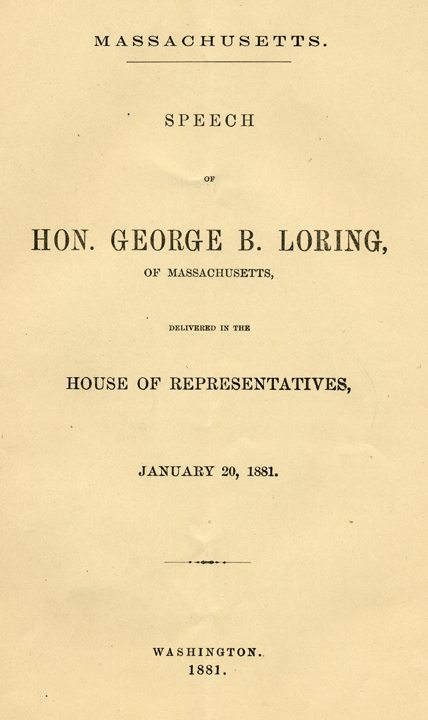
MASSACHUSETTS.
SPEECH
OF
HON. GEORGE B. LORING,
OF MASSACHUSETTS,
DELIVERED IN THE
HOUSE OF REPRESENTATIVES,
JANUARY 20,1881.
Washington.
1881.
SPEECH
OF
HON. GEORGE B. LORING.
The House having under consideration the contested-election case of Loring vs. Boynton.
Mr. LORING said:
Mr. Speaker: I ask the indulgence of the House at this time, not for the purpose of defending myself, but for the purpose of defending the Commonwealth which I in part represent on this floor.
I have noticed, sir, that Massachusetts is quite liable to be sharply criticized here and elsewhere. In this matter now before the House she is charged by the gentleman from Iowa, [Mr. Weaver] the minority of the Committee on Elections, with resorting to an act of dishonesty, to a petty trick, in order to retain her representation in Congress and her electoral vote in spite of the deliberate disfranchisement of her citizens. I think, moreover, her civil policy and the record she has won by her relations to the Federal Government and to her sister States have been somewhat misunderstood on a former occasion. And notwithstanding the prompt and vigorous vindication she then received from abler and worthier sons than I am, I must beg the House to bear with me while I set forth what I conceive to be her true record as an independent State and as a part of the American Republic, her character and the course she has pursued, to do which I must go beyond the simple question before the House.
The right to hold the seat I now occupy having been confirmed by an almost unanimous vote of the Committee on Elections, I am entirely satisfied to leave the final decision of the question to the House, before whom the arguments on both sides have been liberally spread, without debate so far as I am concerned; and were there no unusual circumstances attending these arguments, I should not now step out of the course commonly pursued by contesters in the election cases, and ask to be heard. During the two years in which I have been bound and burdened by this contest, and in which a Congress of unparalleled interest and importance has nearly passed away, every effort has been made by recount and investigation, involving a single vote in this town and that in my district, and the application of critical rules to the form of the ballot, and by fancy sketches of personal oppression and wrong, to deprive me of my legally declared election. I think, and in this the committee seem almost unanimously to agree with me, that the questions, of this description involved in the case have been satisfactorily settled by the testimony in my behalf and by the argument of my counsel.
SUFFRAGE.
The case, however, has been carried further than this, beyond the mere details of personal controversy and of casting and challenging and counting the ballot, into an unwarrantable attack on the Commonwealth of Massachusetts, on her constitutional provisions relating to suffrage, the principles on which her laws are founded and administered, the suffrage qualifications she has imposed upon her citizens. It is charged upon her not only that her citizens have been exposed to what is called “civilized bulldozing” but that they have been largely disfranchised by legal enactment and constitutional provision. It is alleged in the minority report presented by the gentleman from Iowa, [Mr. Weaver,] in which is published an elaborate statement of the wholesale disfranchisement of citizens taken from the brief of the counsel of the contestant in this case, that of the 490,158 ratable polls in 1878, 113,657 are disfranchised on account of being aliens, illiterates, paupers, non-taxpayers, convicts, idiotic, and insane; and that inasmuch as only 256,332 actually voted, it follows that one-third of the voting population of the State was disfranchised.
“All those citizens of the United States,” says the report, “i.e., whose who cannot read and write, who had not paid their taxes, or are so unfortunate as at sometime in their lives to have required aid from the public, are by the laws in force in Massachusetts deprived of their vote.”
“Leaving out the idiots, insane, aliens, and convicts, it appears demonstrable that 134,256 citizens of the United States have their immunities and privileges abridged and are deprived of their right to vote in that State,” adds the report in chorus with the brief.
We are reminded, moreover, that under article 14 of the amendments to the Constitution, and under section 6, chapter 11 of the acts of 1872, “the number of Representatives apportioned in this act to such State shall be reduced in the proportion which such male citizens shall bear to the whole number of male citizens twenty-one years of age in such State,” should such State “deny or abridge these rights,” “after the passage of this act;” and it is charged upon Massachusetts that in violation of this act and the amendment on which it is founded, and for political purposes, by an act of 1874, two years after the passage of the act of Congress, she so disfranchised her citizens as to substantially diminish her delegation in Congress from eleven to eight Representatives, and her electoral vote from thirteen to ten.
In other words, the State took advantage of the apportionment according to the whole number of people granted by Congress in 1872, in order to get the representation, and then deliberately disfranchised, in the face of the law, quite two-fifths of her voters, so that a few – scarcely half – of her citizens might control it.
Now, the answer to all this is easy. The disqualification in Massachusetts on account of illiteracy was created by the article 20 of the amendments to the constitution, adopted in May, 1857, and enforced by statute in 1860, twelve years before the apportionment of 1872 was made. For twenty years this statute has been known and recognized of all men. Various attempts to repeal it have failed. The learned counsel for the contestant, Hon. B. F. Butler, whose steps the gentleman from Iowa, the minority of the committee, has endeavored to follow, knew this when on December 21, 1869, three years before the act of Congress of 1872 was passed, he declared in this House –
Everybody in Massachusetts can vote, irrespective of color, who can read and write. The qualification is equal in its justice. It is well that Massachusetts requires her citizens should read and write before being permitted to vote. And there are hundreds and thousands in this country who would thank God on bended knees if it could be provided that the voters in the city of New York should be required to read and write. They would then believe republican government in form and fact more safe than now.
Nor does this measure of disqualification, together with all those which are by the laws of Massachusetts added to it, produce the starling effect presented by the figures of the gentleman from Iowa [Mr. Weaver] or convict Massachusetts of bad faith in the matter of apportionment for Representatives in Congress and presidential electors. Taking his figures, namely, 134,256, and of that number, according to his tables, 86,258 are aliens and therefore not citizens. Now, add to this last the number of paupers, idiots, criminals, and insane, namely 9.271, and we have 95,529 disqualified for the above reasons, leaving 38,727 to be otherwise accounted for. Of these 14,691 naturalized citizens and 3,437 natives, or only 18,128, are disqualified for illiteracy.
It is upon these figures that the charge of wholesale disfranchisement is based, and the demand for the reduction of the representative and electoral vote of Massachusetts is made by the minority of the committee and by one of her former representatives in this House, one who accepted the apportionment as a candidate for Congress in 1874, and witnessed as a member elect the counting of her thirteen electoral votes in the great contest of 1876-’77.
There is no ground for this charge, no foundation for this demand. Massachusetts in recognizing the propriety of qualified suffrage has done no more than has been done by all her sister States in this Union. The right of a State to disqualify is not demanded and recognized by her alone. With the exception of natural disqualifications, such as minority, insanity, and idiocy, the obstacles interposed by law between the citizen and the ballot-box are easily surmounted; but still they exist and enter into the system of suffrage everywhere. In every State the citizen attains the right to vote not until he has reached his majority. Most of the States disqualify paupers and inmates of asylums; several provide in their constitutions that they shall not be disqualified or their residence lost. Many States require a residence of two years; some of one year, some of three months. Persons under guardianship are, in several States deprived of the right to vote; in one, “persons excused from paying taxes at their own request;” in two, Indians not taxed.
The constitution of one of the youngest States provides that the Legislature “may at its discretion make the payment of a poll-tax a condition to the right of voting.” Another of the youngest States, Texas, has provided that “in all elections to determine expenditures of money or assumption of debt only those shall be qualified to vote who pay taxes on property” in the city or town where the expenditure is to be made or an existing debt assumed. In Massachusetts the constitution has provided from the beginning that every male citizen twenty-one years of age, except paupers and persons under guardianship, who shall have resided in the Commonwealth one year, and shall have paid any State or county tax within two years, may vote. In 1857 the reading and writing clause was added.
By one of her immediate neighbors, the State of Vermont, it is provided that a citizen who is twenty-one years of age, “and is of a quiet and peaceable behavior,” may exercise the right of suffrage as his prerogative, and the political career of this well-ordered Commonwealth bears abundant testimony to the principal on which her suffrage is based. The constitution of Connecticut requires the voter to be able to read any article of the Constitution or any section of a statute.
The variety of disqualification found in the State constitutions is interesting and important. So far as residence is concerned some of the requirements are as follows, namely: Michigan, two and a half years; Kentucky, two years; Alabama, Delaware, Florida, Illinois, Maryland, Missouri, New Jersey, New York, North Carolina, Pennsylvania, Ohio, Rhode Island, Texas, West Virginia, Virginia, one year; Maine, three months; California, Colorado, Indiana, Iowa, Kansas, Mississippi, Nebraska, Nevada, six months. The payment of State, county and capitation taxes is required in Delaware, Pennsylvania, Massachusetts, Tennessee, Virginia, and some other states. Educational qualifications exist in Massachusetts and Connecticut, the Legislature of California being empowered by the constitution to impose this qualification after 1890. Now it will be noticed that all disqualifications arising from provisions like those to which I have referred partake in no sense of the nature of disfranchisement under the fourteenth amendment of the Constitution. None of them are insurmountable. None of them are analogous to disqualification on account of race or color, which is insurmountable. And on this account they cannot be brought under any provision of the Constitution which reduces State representation or the electoral college for the reason of disfranchisement.
In the collected constitutions, therefore, of all her sister States may be found in various forms and combinations the disqualifications which Massachusetts originally engrafted on her own. In her more recent history, however, she has added one more, a disqualification which is easily accounted for when we consider her long and eventful career in the work of founding popular government. To the founders of her civil institutions suffrage was the highest privilege which the State could bestow upon its most worthy citizens. In the Plymouth colony this privilege was enjoyed only by those who were connected with the church, a hard provision for these days I fear, sir; and it was accordingly ordered “to the end the body of commons may be preserved of honest and good men, that, for the time to come, no man shall be admitted to the freedom of this body-politic but such as are members of the churches of the same;” and so “it debarred from the exercise of the elective franchise all, however honest, who were unwilling to conform to the standard of colonial orthodoxy.”
In the colony of Massachusetts Bay the people, “bent on exercising their absolute power,” were obliged to resist the influence of Cotton and Winthrop, who, with all their love of freedom, had not yet learned the true intent and meaning of popular government as we understand it. And as late as 1778, Theophilus Parsons, afterward the great chief-justice of the Commonwealth, in his famous essay, known as the Essex Result, upon the proposed constitution of Massachusetts, suggested a senate as a body representing the property of the State, and recommended that “each freeman who is possessed of a certain quantity of property may be an elector of senators” – a proposition which was rejected by the people, who were in advance of their leaders, as their fathers were in colonial days, and who already insisted that a legislative body should represent he people and not the property of the Commonwealth.
EDUCATION.
Call this what you will, it indicated a desire and determination to lay the foundations of the State upon the best elements of society. And it is not surprising that in later years, after a long trial of the free suffrage confirmed by the constitution, and at a time when illiteracy seemed to cast a shadow over the Commonwealth, a new qualification should have been added to those already in existence – a qualification which under the light of schools and colleges on every hand, seemed to be by no means insurmountable. Whoever doubts the justice or wisdom or expediency of this measure cannot be unmindful that it is a crop easily grown on Puritan soil; for we cannot forget that it was the education of youth in “literature and sound doctrine” – intellectual, moral, and religious culture – which occupied the attention of those who founded the two immortal colonies which united to form the Commonwealth of Massachusetts. They had learned the importance of this at home from the experience of their own firesides, from the dialectic necessities which attended non-conformism, from the obligation which every dissenter laid upon himself to defend his faith, from the natural impulse of a mind freed from civil and ecclesiastical bonds and left to its own independent search for truth, from the declaration of the great reformer that “Government, as the natural guardian of all the young, has the right to compel the people to support schools”.
More than two hundred years ago the feeble towns of Massachusetts, actuated by this principle even while holding a precarious existence in a savage wilderness, made grants of land for educational purposes. Amidst the hardships and in the gloomy isolation of colonial life, the stern ascetic fathers knew and felt the first approach of sin. Satan came among them, not clad in all the allurements and charms of cultivated and fashionable society, but appealing at once to their grosser passions, which the severe and rigorous restraints of their laws and a somewhat hard and discouraging philosophy irritated to a spirit of defiance and rebellion. They believed in his personality, and in my own district they fought him accordingly. They knew how prone to barbarism is a life in the wilderness. They knew the value of that cheerful courage with which education and religion fill the heart amidst the refinements of civilized life.
And while the dark cloud hung over them, and the weight of the stern endeavor pressed upon them, and the tempter assailed the secret and hidden recesses of their hearts, and there was no relief to the gray and somber coloring of life, and there was no external beauty to cheer the soul, either of song, or picture, or church, or symbol, they frowned upon their gross and human weaknesses and turned to the school-house and the meeting-house for their support and inspiration. They believed in an educated commonwealth and in the power of an enlightened mind to dispel the gloom of the wilderness and to diffuse a vital heat through the coldest and darkest caverns of the human heart – the heat given to more ardent souls by music and poetry and eloquence and art and the luxurious sublimity or architecture, expressive of human aspirations and desires.
The bestowal of gifts upon schools and colleges was the sacorifice which the Puritan made on the altar at which he worshipped. An educated man he respected; an ignorant man he despised; believing that it was “one chief project of ye old deluder, Satan, to keep men from the knowledge of the Scriptures.” And he even witnessed with composure the operation of the school-house in bringing men to the enjoyment of suffrage – that sacred right which he had reserved to the church alone. His school-house, moreover, brought men to a level. It revolutionized town after town, until the right to vote became as universal as the right to hold property. The right to civil position became general, and the graduate of the district school passed on into the town meeting to take his part in that controversy and debate which developed the popular powers of the times into a capacity for the largest civil duty.
In many a Massachusetts town the problem of free government was worked out long before it became a national question. The equality of all boys in the school-house, the equality of all men in the town meeting – this original colonial condition created a necessity for larger and higher declarations. And so in one town they struck for suffrage in the beginning; in another they resolved that “all men are created equal, and have a right to life, liberty, and the pursuit of happiness,” and recorded the resolve on their “town-book” more than three years before the declaration of our national independence. I am confident it was the school-house which did this raising the popular mind up to a general standard, of which the great men of our past history are but individual representatives, developing a people of whom Washington as a warrior and Jefferson as a civilian were the leaders, and verifying in its noblest sense that saying of Lord Bacon, that “in the management of practical affairs the wisdom of the wisest man is less reliable than the deliberate and concurrent judgment of common minds.”
It was in accordance with this idea that Massachusetts while yet in her infancy placed upon her statute-book an act to provide for the instruction of youth and for the promotion of good education. In that act the popular estimate of the value of education is embodied. With felicity of speech unusual, with a regard for religion and human elevation worthy of all praise, with an intellectual fervor which illumines the statutes and which stands out in delightful contrast with the usual chilling expressions of the law, her Legislature passed an act in May, 1647, which established the system of common schools.
To the end that learning may not be buried in the graves of our forefathers in church and Commonwealth, the Lord assisting our endeavors, it is therefore ordered by this court and authority thereof, that every township in this jurisdiction, after the Lord hath increased them to fifty householders, shall then forthwith appoint one within their towns to teach all such children as shall resort to him to write and read.
It is the spirit of this act which has directed the educational system of Massachusetts from its passage until now. Starting forth as she did with this high resolve, her institutions of learning have increased in number and prosperity until she has become literally the nursery of education and educated men. In the advance-guard of civilization, as it travels westward, may be found her young men, graduates of her schools, prepared to plant the school-house within the fortifications and palisades of the frontier. Within her limits no branch of science, or thought, or speculation on education goes unexplored; and when from the schools of the Old World the energetic and enterprising scholar turns his eye toward this country as toward a new field for investigation, and looks for that spot where he may find a genial atmosphere it is often the Commonwealth of Massachusetts which presents the most alluring charms. I cannot forget the encouraging and flattering fact that Massachusetts presented the most attractive home for Agassiz when he determined to bring his scholarship and his science to America.
And how faithful has Massachusetts been in this great enterprise of popular education. In peace and in war she has never faltered. Notwithstanding the heavy drafts made upon her treasury during the civil was her expenditures for education steadily increased; and when peace came, with its accumulated indebtedness, the schools received, if possible, still more earnest care.
In 1878, her population was about one million seven hundred thousand, and for this community there were provided 5,730 public schools with 310,181 pupils, taught by 8,508 different teachers. Included in the number of public schools are 216 high schools, having 595 teachers and 19.574 pupils. There were also in the Commonwealth 399 private and parochial schools, with 15,574 pupils, and 64 academies with 8,454 pupils, making the entire number of pupils in the public schools, private schools, and academies 334.175.
The amount raised by local taxation for the support of schools was $4,191,510.77, the amount appropriated by the towns was $60,833.58.
The whole amount expended for public schools, including wages of teachers, fuel, care of fires and school room, superintendence and printing, repairs and building, was $5,166.987.92.
In addition to this her colleges have been liberally supported; and it has been estimated that her sons have bestowed more than a million dollars, in private subscription and bequest, upon the fortunate recipients of their bounty.
I present these facts, Mr. Speaker, not for the purpose of glorifying any one State in this Union, nor for the purpose of drawing contrasts and comparisons between herself and her associates. The influence of the Puritan fathers has spread too far and wide to make such comparisons possible.
In the business of education in our country there is no rivalry, but rather a universal desire to complete the original design of an educated republic and to lay the foundations of society and state everywhere on sound learning. If this ambition leads to errors, they are errors and mistakes which can easily be remedied and removed. To oppression and wrong it cannot lead. If it establishes a disqualification, it at the same time provides a cure. And if it is a natural impulse created by long and earnest devotion to the cause of education, it is an impulse which can easily be forgiven even by those who would place the right of suffrage beyond the reach of qualification or restraint. The gentleman from Iowa, [Mr. Weaver], the minority of the committee calls upon this House to remedy the wrongs which are perpetrated in that Commonwealth by an oppressive system of suffrage qualification. I doubt not the House now understands the full extent of the wrong, and appreciates the liberality and earnestness with which Massachusetts herself provides the remedy. “
Wholesale disfranchisement of citizens in Massachusetts and other States calls for prompt action by Congress,” says the other gentleman from Iowa, [Mr. Gillette,] in his appeal to this House to lay aside the funding bill and attend to pleura-pneumonia and its apparently kindred disease, bulldozing. But Massachusetts points to her record and congratulates herself and the country that Congress is even now manifesting a disposition to endow and encourage popular education, and to follow the example of the Puritan fathers and the founders of all the new and rising States of the Union, by dedicating the public lands to the cause of education. As one of the Representatives of Massachusetts in this House, I would suggest to the gentlemen from Iowa that this is the lesson taught by Massachusetts in her honorable career of more than two hundred and fifty years.
THE PURITANS.
I have dwelt somewhat elaborately, Mr. Speaker, and perhaps somewhat tediously on the working of the puritan element in Massachusetts, in the direction of popular education especially, because it is now generally considered to be one of the vital forces of our country. It is an element on which the historian never ceases to dwell. It has inspired some of the most brilliant paragraphs of the most powerful English essayists. It has inspired the poet with some of his his loftiest thought, the artist with some of his noblest conceptions. It has arrested the attention of the most thoughtful and progressive statesmen of our own day, and has drawn forth the warmest tributes of gratitude and praise from the reformer and the philanthropist. The great liberal leader of England, struggling with the difficult and trying problems of state and society which vex the mind of his own country today, and searching with eager eye for some firm and substantial foundation of human government, has declared that “the Puritan element has given the American Republic its permanency and power.”
Without large possessions they established the system of citizen-proprietorship and of a division and conveyance of lands which has been adopted and promised by political reformers everywhere. Not socially powerful, they destroyed all fixed classification, caste, and legitimacy, and built up society with equality as its cornerstone. Recognizing an ecclesiastical power in the State, they nevertheless insisted on the enjoyment of the highest civil opportunity by all men; and out of the stern necessities which rested upon them, they learned the real value of labor as the source of man’s true prosperity and happiness. Powerful as their influence was in the land from whence they came, it has been vastly more powerful in our own country where the strength of our Republic consists in the energy and strength and force of each of its component parts. The defiant earnestness of those men whose faith neither the storms of ocean nor the gloom of the wilderness could quench is the American characteristic still engaged in peopling and developing this continent from latitude to latitude and from sea to sea. [Applause.]
Now, sir, how could a State animated by this force fail to make itself felt in all the great crises which have attended the formation and growth of that free republic of which it forms a part? As a colony, Massachusetts was always heard when the great occasion called for great utterance – and always responded to the high and honorable appeal of others. Torn and driven by internal contentions, tossed on a sea of ecclesiastical controversy, this colony of school-houses and meeting-houses, presented always a solid front for popular right and privilege. The people of Plymouth and Massachusetts Bay were a valiant as well as a godly people. They carried “the sword of the Lord and of Gideon,” as their comrades and brothers did at Marston Moor and Naseby, and they believed as much in the courage of Miles Standish as they did in the holiness of Elder Brewster. [Applause.] During the two centuries and a half of their existence on this continent they have been ready at any time to gird on the sword. In the early Indian wars they traversed the forests with the fatal persistency of the slow-hound from the waters of the bay to the slopes of the Green Mountains, and from the blazing towns of Bristol and Essex to the eastern lakes upon whose bosoms fall the shadows of Agamenticus and Mount Washington.
In the last great struggle of France to retain her foothold on this continent the soldiers of Massachusetts stormed the Heights of Abraham with Wolfe, and cherished his memory for generations in their households; the merchants of Massachusetts supplied the outfit for the siege of Louisburg, and left behind them as a proud memento for their sons the tokens of regard for their devotion bestowed upon them by the colonial legislature; and today the Senate of Massachusetts as it assembles in its chamber passes beneath the Puritan drum which beat the tattoo and the Puritan musket which blazed in the line when the power of the mother country was established along the waters of the Saint Lawrence and far on toward the frozen seas.
Is there an American in this House or out of it, whether a native or an adopted son, where-so-ever his home may be within the limits of the Republic, who is not proud to stand on the green at Lexington, in the early sunlight of that spring morning, or at the bridge at Concord, where“the embattled farmers stood and fired the shot heard round the world,” a Puritan soldiery, and a series of heroic events commenced which, ending at Yorktown, gave us a common country? The history of mankind is radiant with its record of great deeds and inspiring endeavor, but not one can outshine that wonderful picture of devotion and valor where a little band of Puritan rustics defied the military authority of Great Britain and fired that first gun whose echoes roused the colonies and brought New England and New York, New Jersey and Delaware, Pennsylvania and Virginia, Maryland and the Carolinas and Georgia, into a sacred association whose memories are still fondly cherished and whose bond is not yet broken.
WAR OF 1812.
That there should have been differences of opinion among a people so filled with an earnest purpose is not surprising. Their teachers and orators had stored their minds with the profoundest civil and religious problems drawn from the few somber and didactic volumes which filled their narrow libraries, and which were brought even into the early years of the Puritan’s education. While they fought they discussed also; and from the time when Adams and Otis and Quincy and Warren inflamed their hearts with a love of freedom and moved them to respond to the words of Henry and Mason and Lee of Virginia, down to the hour when the constitutional powers were all adjusted, and the State and the Republic had entered upon their career, the intellectual activity of Massachusetts was felt throughout the land, and her schools and colleges were educating statesmen for the councils and soldiers for the armies of the country even while her political differences were positive and sometimes bitter – so that she has often been misunderstood. So true is this that when the war of 1812 broke out it was for a time difficult to decide where the battle raged most hotly, whether between the two political parties which divided Massachusetts in those days or between the hostile armies on the battle-field and between the contending navies on the high seas. The people were exasperated by the political proscription of the party in power. Their commerce was swept from the high seas; their ports were closed by the embargo.
But in the midst of their distress they never forgot that the impressments of American seamen by the commanders of British ships of war; their doctrine and system of blockage; their adoption of the orders in council which destroyed American commerce, together with a long and unsatisfied demand for remuneration on account of depredations committed by the subjects of Great Britain on the lawful commerce of the United States, were causes of war which a high-toned and spirited people should not overlook. It is rue the condemnation of the war was bitter and unreasonable, but the support it received was warm and patriotic. Said John Adams from his dignified retirement, “I have thought it both just and necessary for five or six years.” In the Legislature the house disapproved and the senate ably sustained the war measures, stating in an eloquent and powerful appeal to the people –
When engaged with this same enemy our fathers obeyed the calls of their country, expressed through the authority of their edicts. In imitation of their example, let the laws everywhere be obeyed with the most prompt alacrity; let the constituted authorities be aided by the patriotic attempts of individuals; let the friends of the Government rally under committees of public safety in each town, district, and plantation; let a common center be formed by a committee in each county, that seasonable information may be given of the movements of the enemy; let our young men who compose the militia be ready to march at a moment’s warning to any part of our shores in defense of our coast. And relying on the patriotism of the whole people, let us commit our cause to the God of battles and implore his aid and success in the preservation of our dearest rights and privileges.
Notwithstanding the views of Governor Strong and the party which he represented, the records of the Commonwealth are filled with the deeds of popular devotion to the cause of the country and with hearty responses to the valor of her defenders on land and sea. The long coastline extending from Eastport to Cape Cod was carefully guarded by State and national authorities alike, and the governor, who had declared that there was no intention on his part to resist the laws of the Federal Government, ordered a portion of the militia to march to Passamaquoddy for the defense of the ports and harbors of the eastern borders of the State; measures were taken for the defense of the State by large appropriations, and the General Government was called on for arms and ammunition to be used in the defense; the Senators and Representatives in Congress were instructed to use their influence in the national legislature for an immediate augmentation of the naval force of the United States; and the Legislature was disposed also to view with favor the proposition previously made that the State should build a 74-gun ship to be presented to the United States. That there was a response to the anti-war resolutions passed at a meeting in New York attended by the most distinguished men of the State, among whom were John Jay, Rufus King, and the Governor Morris, I am well aware; but there was also a strong feeling of loyalty and devotion which found expression in the pulpit, in the halls of legislation, at the town-meetings, among all ranks and orders of men.
Said the wise and thoughtful Dr. Channing, just then rising to his great distinction as the prophet of a new faith: All wanton opposition to the constituted authorities; all censures of rulers originating in a factious, aspiring or envious spirit; all unwillingness to submit to laws which are directed to the welfare of the community, should be rebuked and repressed by the power of public indignation.
While one party charged the war to a base spirit of devotion to France, and the other party charged the opponents of the war with being under British influence, the people defended their coasts, manned the decks of our Navy, rejoiced with Hull in his victory, and took the gallant old frigate to their hearts forever: brought the ashes of Lawrence tenderly home, and buried them in the soil of my own county of Essex, and sacredly laid the remains of the two contending commanders who fell in the sea fight of the coast of the province of Maine, side by side in the cemetery of Portland. Clergymen who had denounced the war left their pulpits to lead their flocks to the contest with the invaders.
The State furnished more than five thousand soldiers, and more sailors, five regiments of infantry, being second only on the list, New York having furnished six, Pennsylvania with four, and Vermont with four standing next, all the other States furnishing from one to three. Of the officers of the army at the opening of the warm Massachusetts had one major-general of the two commanding three brigadier-generals of the ten, the adjutant general, three quartermaster-generals of the six, one hospital surgeon of the six, one garrison surgeon of the two, and the colonel of engineers. Of the number of men she sent into the Navy it is impossible to speak, the hardy men of her maritime owns, from Eastport to Capt Cod, thronging the decks of the Navy wherever an emergency required, and when the war ended it was found that the bold, defiant, and patriotic town of Marblehead alone, in my own congressional district, had five hundred men confined in the dungeons of Dartmoor prison.
I refer to this record, sir, because the loyalty and bravery of the Commonwealth have been called in question; and as an illustration of the value of actual service over that of partisan utterances in the great conflicts of both peace and war. Of her more recent deeds on the battlefield it is unnecessary for me to speak. There are many on the floor of this House who have stood side by side with her sons, and many who have met them face to face in mortal combat; and they can bear witness whether the reputation of the fathers has been sustained or not.
INFLUENCE OF MASSACHUSETTS.
In conclusion, Mr. Speaker, I desire to call the attention of the House to the manifest influence which this Commonwealth of free schools and protesting churches has exerted upon the States which have grown up around her since the days of her colonial condition – an influence which I trust no American citizen desires to repudiate or deny. The existence of Puritan modes of thought, Puritan habits, Puritan theories of government, the system of education, the constitutions and laws born of Puritan ambition and Puritan protests, in that great cluster of States occupying the northern and northwestern section of our Republic, indicates the fountain from which this great current of civilization sprang. Among the noble deeds which have contributed to the power and commanding presence of this Republic I know of none which is more admirable on account of its princely bestowal, or more striking on account of its influence, than the gift of the Northwest Territory to the United States by the Commonwealth of Virginia. And next to this comes the impressive fact that a son of Massachusetts dedicated this vast territory to the social and civil policy of his native State.
When Virginia gave the land and Massachusetts gave the law which, united, have fed and guided the intelligent and enterprising population of that great section, they performed an act second only to the work which they accomplished as they went hand in hand in the early days of the Revolution; and to that region thus bestowed and thus dedicated, the sons of Massachusetts have carried those institutions and habits and customs which neither time nor trial has destroyed in the spot from whence they sprang. There may be found the civil systems of the pilgrim fathers, the school-house, the town-meeting, the division and conveyance of land, the individual independence, the frugality and thrift, the manners and customs, the freedom of thought, the abiding faith, which were planted early in New England. And these characteristics still endure, in fact I sometimes think they have been strengthened by being transplanted, notwithstanding their association with many differing nationalities and the antagonistic influences which have beset them on every hand.
To the growth and power of one of these great States our attention has been recently called by some of the most stirring political events of our day. The State of Ohio has risen somewhat suddenly into conspicuous importance. As an organized civil community she is not surpassed in the world. As a fortunate political community she has hardly been equaled since the days when Virginia furnished four and Massachusetts two Presidents of the United States. The diligence and industry and intellectual ambition of her people have, in three quarters of a century, constructed an empire of industry and education whose wealth and influence can hardly be estimated. I may be mistaken, but it seems to me she is the New England of the West. The tides of New England life which have flowed into her fertile valleys have been made apparent by the founders of her colleges, her teachers, her scientists, her merchants, her statesmen, who are the immediate sons of New England or trace their blood back to the old fountain through a few generations. This influence began early and has never ceased.
Nearly a hundred years ago Menasseh Cutler, who, as well as Nathan Dane, represented my own district in Congress, left his home in Hamilton, Massachusetts, to establish a colony in Ohio. In his covered wagon, on the canvas top of which was inscribed “Ohio, for Marietta, on the Muskingum,” he carried the foundation of the great empire State of the West. He was a Massachusetts scholar, scientist, theologian, politician, statesman. In that wilderness he left the impression of his character and purposes, which has never been obliterated, and which has been strengthened and cherished by the innumerable host of young men who have left just such a home as he left behind and have sought new homes and a new opportunity in the valleys of the West.
MASSACHUSETTS AND MAINE.
But not in the West alone has the influence of Massachusetts been felt. Among the most valuable of her colonial possessions was that vast territory extending to the northeast, clothed with the richest forests, intersected by the noblest rivers, with a sea-coast indented in every league with innumerable bays and harbors, with a strong and fertile soil and a climate capable of developing the strongest mental and physical qualities of man. It was settled by the sons and brothers of the people of Massachusetts Bay. The relations between Massachusetts and this eastern province were like the relations between members of the same family – bound by the same bond, divided by the same antagonisms. In the early heroic period the radiance of the great deeds performed in Massachusetts was shared by her children in the province of Maine. In her Legislature sat the statesmen and counselors of that eastern shore. The instinctive sagacity and sturdy sense and manly wit of the province gave additional power in the halls of Congress to the commanding influence of the immediate representatives of the Bay State in both branches of the Federal Legislature.
The brilliant sons of Massachusetts found a home beneath the ray of that eastern star which, as they boasted, would never set. From the shore of Plymouth, the province of Maine drew one of her profoundest jurists, with the blood of the Puritan running in his veins, her first truly great Senator, whose proud record she rejoices to call her own and whose example is worthy of all imitation by those who may follow in his illustrious footsteps. There were, indeed, strong differences of opinion and interest between Massachusetts and the province; but in reply to earnest petitions for separation shortly after the Revolution, the Legislature passed many popular and necessary acts relating to the eastern country, and effectually quieted and lulled asleep the desire for independence.
It was, indeed, not without deep reluctance that the people of Massachusetts ultimately resigned their rich possession; and many of the people of Maine slowly assumed the responsibilities of an independent State. Not grudgingly, however, did Massachusetts do her share of the work. The legislative act of separation was promptly passed, and the farewell of the executive partook largely of the nature of sound advice and a warm benediction. Said Governor Brooks, of Massachusetts, in his message of January 13, 1820;
The time of separation is at hand. Conformably to the memorable act of January 19, 1819, the 15th of March next will terminate forever the political unity of Massachusetts proper and the district of Maine. And that district, which is “bone of our bone and flesh of our flesh,” will assume her rank as an independent State in the American confederacy. To review the transactions which have immediately preceded and effected the separation and to recollect the spirit of amity and mutual accommodation that has distinguished every step of its progress must be truly and lastingly satisfactory. It is at the same time highly gratifying to every friend of republican government to observe the unanimity and disposition to mutual concession with which a constitution founded on the broadest principles of human rights has been formed and adopted.
That the district of Maine was destined to independence has long foreseen and acknowledged. But it has been delayed until her internal resources and her capacity for self-government being fully developed public opinion, emanating from a competent and increasing population, decidedly invoke a fulfillment of her destination. Having yielded by assent to the act of separation, it remains for me to obey the impulse of duty as well as of personal feeling and of acknowledging to the gentlemen of the district who have been particularly associated with me, either in civil or military departments of government, the able support which on all important occasions they have readily afforded, and to the citizens of the district generally the candor and liberality and respectful attention I have experienced in the discharge of my official duties.
And in the “able, intelligence message,” as it was called at the time, of Governor King to the first Legislature of Maine under its constitution, he alludes to “the equitable and just principles” and to “the correct and wise course of policy pursued by the executive and legislative departments” of Massachusetts proper in giving their assent to the formation of the State of Maine which, he adds, “have laid the foundation of a lasting harmony between the two States.”
When the governor of Massachusetts proclaimed the separation, the distinguished son of Maine who had led on the work enrolled himself among the conditores imperiorum, and guided the new State in a path of constitutional freedom and equality which developed free institutions within her own borders, in conformity with the policy of civil rights and religious freedom which he had engrafted on the laws of the State he left behind him.
William King learned his lesson in the Legislature of Massachusetts; he applied it as the chief magistrate of the new State of Maine. And true to the spirit of that province in which the statutes of Massachusetts were always subjected to the severe scrutiny of a freedom loving people, in which the citizens were allowed to vote or to hold any office without qualification of property, and difference in religious opinions produced no difference in political rights, and in which religious toleration was the law, he framed a constitution which he Puritans recognized as the true intent and meaning of the principles which they proposed to incorporate into all human government, and he wrought into the fundamental law of the new and independent State the system of civil and religious freedom planted by the pilgrim fathers in the colony of Plymouth. The civil doctrines laid down in Massachusetts were liberally interpreted in Maine for the mutual benefit of these two Commonwealths, as they learned of each other amidst trials and antagonisms the best constitution for a free and independent people.
It is no part of my purpose, Mr. Speaker, to discuss here the material condition of Massachusetts. Her financial integrity and honor, her industry and prosperity, the comfort and contentment of her people, the activity of her capital, the constant employment of her labor, are well known to all men. Her civil organization has been assailed, and I have endeavored to defend it. Her relation to the Federal Government, and to that family of States of which she is an illustrious member, has evidently been misunderstood. I have endeavored to explain it. For her I have attempted to do no more than every man on this floor would do for the State he represents were she placed in a false attitude before the country and the world. I rejoice now with he great brotherhood of American citizens in the supremacy of the Federal Constitution, the power of the flag, the commanding strength of our nationality, the massive structure of the Union. But I rejoice also in that sensitive regard for the honor and renown of each State which finds ever a prompt and fervid expression from those who represent her in the national councils.
I have no fear now, sir, of a State ambition which may result in assuming new powers; no fear of those dissensions and antagonisms which will force themselves into every strong and powerful system – none of dissolution and disruption. But disregard of the responsibilities of an educated Commonwealth, indifference to the duties which belong to a community forming a part of the American Republic, and to the lofty position which each State is bound to maintain in the confederacy – this indifference and disregard we cannot too carefully avoid.
The triumph of popular government will not be complete if its duties are neglected and its privileges are forgotten and denied by any member of this family of States. In speaking for Massachusetts therefore, I have spoken for her sister States also, and for the honor of the Republic of which she forms a part.
I have recited a chapter in history which belongs now to the American people, and constitutes a portion of that wonderful story of popular progress in which every State in this Union has performed her part, from the trials and sufferings of colonial life to the last bold and defiant adventure which planted our institutions on the remotest western frontier. It is not now the brilliant record of the Puritan of Massachusetts, or the Huguenot of Carolina, or the Cavalier of Virginia, or the Quaker of Pennsylvania – but of the American whose services and achievements are no longer bounded by State lines, but belong to a proud and powerful people.
And as I pass from my service in this House to duties elsewhere, I congratulate myself and my country that in political energy, in educational ambition, in material prosperity, the States of this union have entered upon a career of activity and strength which gives promise of great power and an unequaled opportunity to those into whose hands the destinies of this nation may be entrusted in the years that are to come. And standing here, at the opening of the second century of our national existence, I thank God, as we all do, that I behold not a cluster of discordant States, prostrate and driven by a tumult of passion, but a Union of rival commonwealths engaged in an ambitious contest to attain the lofty eminence assigned to every civilized community which is warmed by religion and illumined by education and built on the imperishable foundations of human right and equality.
END.