First American Bible Society Bible

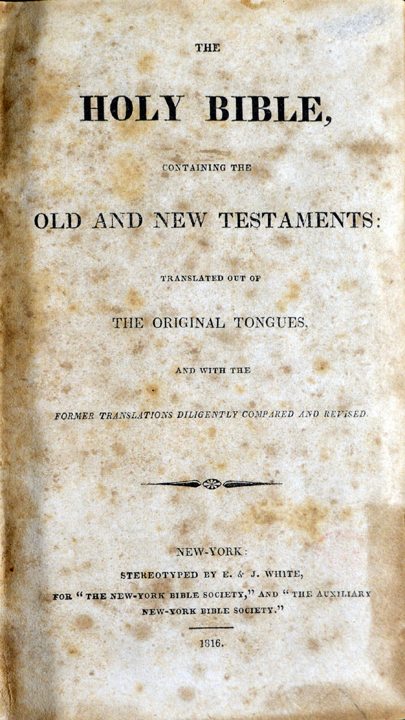
The 1816 American Bible Society Bible
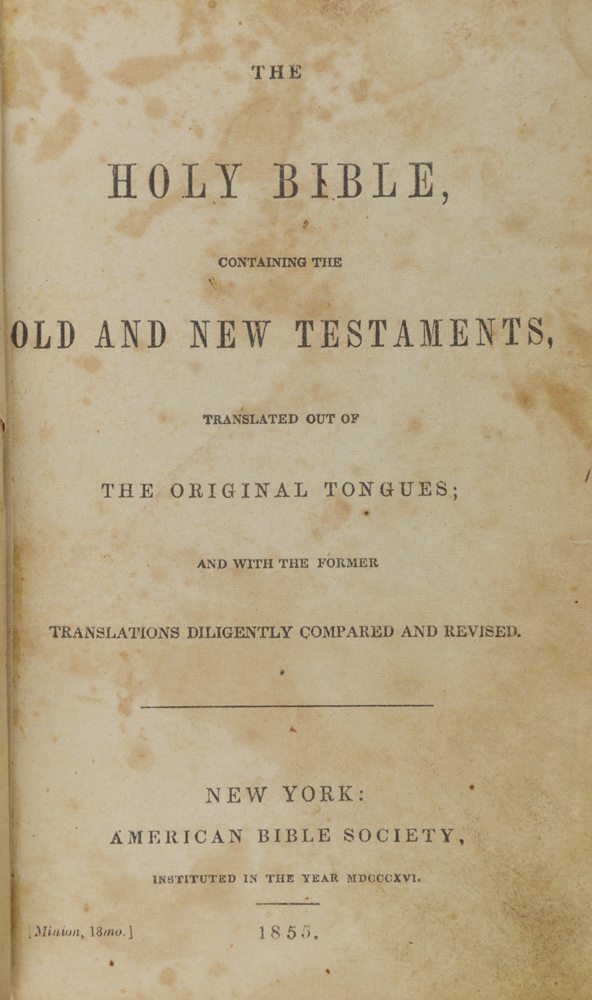
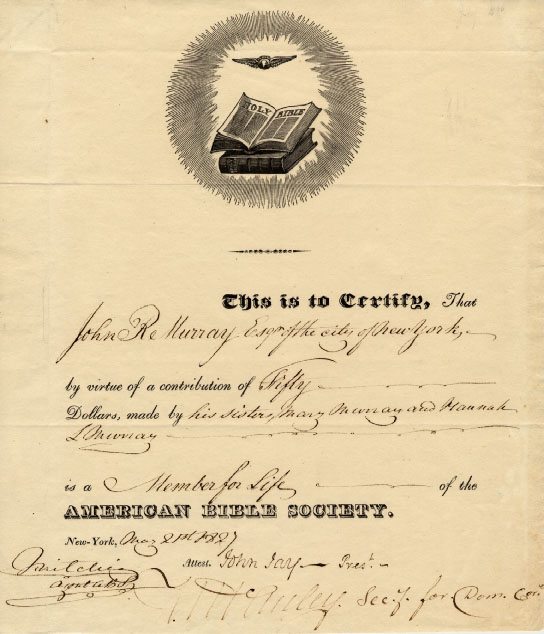
The American Bible Society, founded in 1816, was the first national Bible society in America. The original officers of the Society included: signers of the U. S. Constitution, revolutionary generals, U.S. Supreme Court Justices, a U.S. Attorney General, a U.S. Secretary of the Treasury, state governors, and others. WallBuilders vast collection of original documents includes an original constitution of the American Bible Society as well as a first Bible printed by that society. Below is the title page for this society’s first Bible, printed in 1816.


first-american-bible-society-bible-1

Philadelphia Bible Society Bible

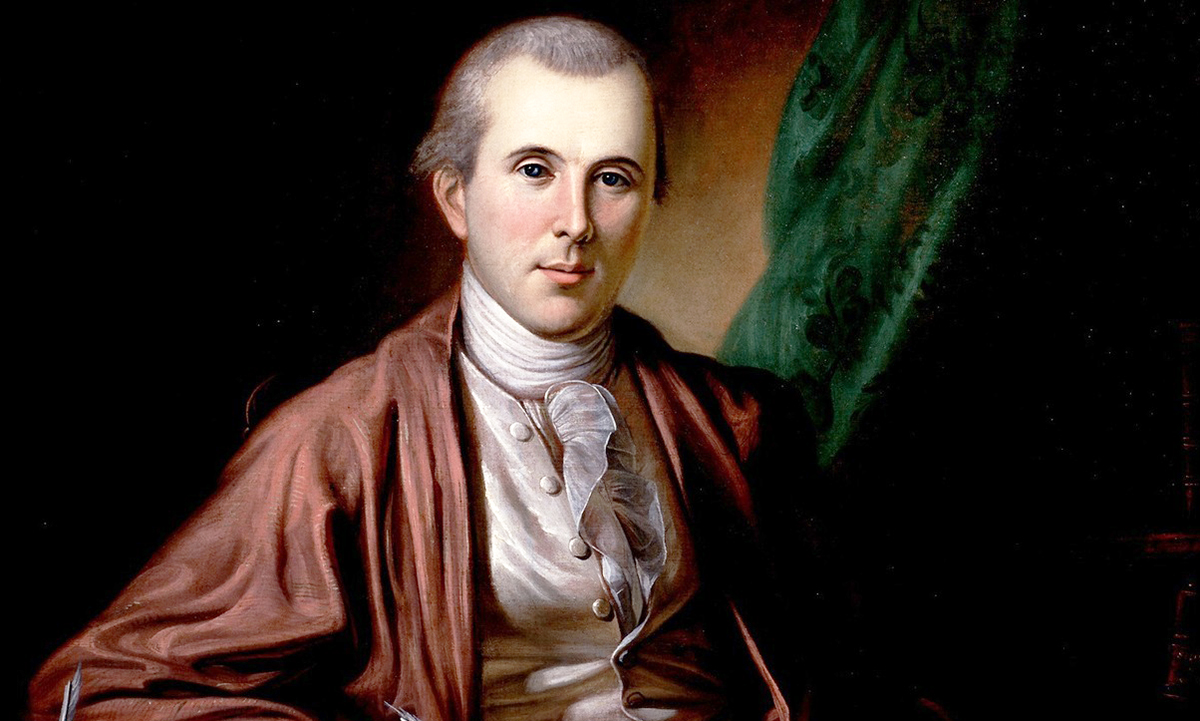
The Philadelphia Bible Society, America’s first Bible society, was officially organized on December 12, 1808. Rev. Dr. William White was president of the society and Declaration signer Benjamin Rush was a vice president. By 1816, 121 more Bible societies had been started across the nation.

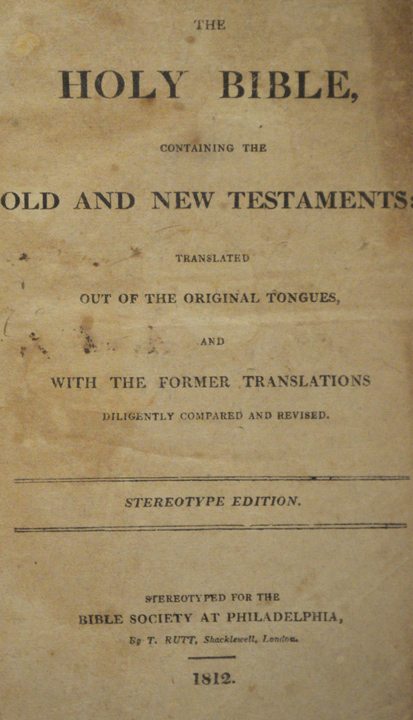
Below, from WallBuilders’ Collection, is the title page of an original Bible published by the Philadelphia Bible Society in 1812. This was the first Bible printed in America to use stereotype plates.


philadelphia-bible-society-bible-1

Abigail Adams’ Letter

abigail-adams-letter-1

Abigail Smith Adams (1744-1818) was the second of three daughters born to a well-respected family, her father being a Congregationalist minister in Massachusetts.1 Due to her poor health in her early life Abigail had no formal education.2 In fact, at a time when female education was “neglected” and it had become “fashionable…to ridicule female learning,” 3 Abigail rose above this to become “qualified for eminent usefulness in her distinguished position as the companion of one great statesman, and the guide of another.” 4

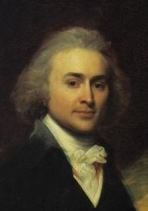
Her strong religious convictions and intellect led her to be considered her husband’s “trusted advisor” 5 as she regularly wrote him information concerning what was happening in America throughout the Revolution. 6  Her Christian faith is evidenced not only by a statue of her and John Quincy Adams that has been placed outside the church in Quincy, Massachusetts where she was buried, 7  but also by her many religious references throughout her letters. 8

For example, as Abigail Adams reported to her husband, John Adams after the Battle of Bunker Hill:

The race is not to the swift, nor the battle to the strong; but the God of Israel is he, that giveth strength and power unto His people. Trust in Him at all times, ye people, pour our your hearts before Him; God is a refuge for us.” Charlestown is laid in ashes. The battle began upon our entrechments upon Bunker’s Hill, Saturday morning about three o’clock, and has not ceased yet, and it is now three o’clock Sabbath afternoon. It is expected they will come over the Neck tonight, and a dreadful battle muse ensue. Almighty God, cover the heads of our countrymen, and be a shield to our dear friends!9

In 1778, when John Quincy was 11 years old and accompanying his father on a diplomatic mission to France, Abigail gave him the following advice:

abigail-adams-letter-2Adhere to those religious sentiments and principles which were early instilled into your mind and remember that you are accountable to your Maker for all your words and actions….

[D]ear as you are to me, I would much rather you should have found your grave in the ocean you have crossed, or that any untimely death crop you in your infant years, than see you an immoral, profligate, or graceless child….

Young as you are, the cruel war, into which we have been compelled by the haughty tyrant of Britain and the bloody emissaries of his vengeance, may stamp upon your mind this certain truth, that the welfare and prosperity of all countries, communities, and, I may add, individuals, depend upon their morals. 10

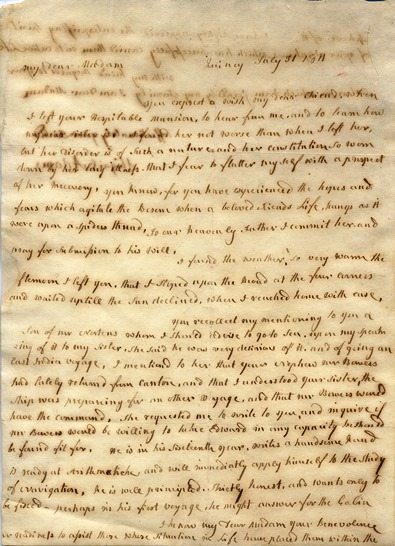
Another reflection of Abigail’s strong Christian faith is seen in a handwritten letter of Abigail’s that WallBuilders possesses.

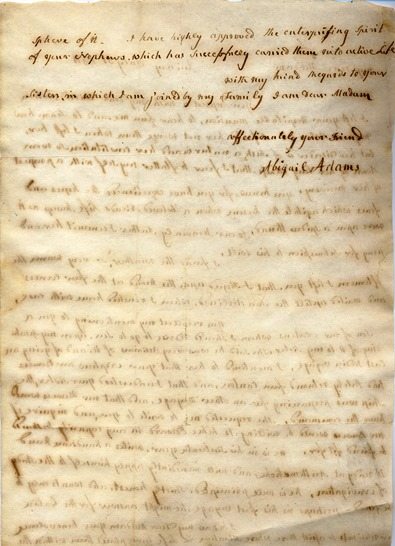
In this letter to a friend on July 31, 1811, Abigail spoke a little about her older sister (Mary Cranch) and the illness that eventually resulted in her death later that year, 11 acknowledging that “to our heavenly Father I commit her.” The handwritten letter, along with its transcription is included below.

In 1818, Abigail contracted typhoid fever and passed away on October 28, 1818, but she left a legacy as a woman who “exercised great and far-reaching influence in her day and generation.” 12 For additional information about Abigail Adams, see the book Wives of the Signers, published by WallBuilders.


abigail-adams-letter-3

abigail-adams-letter-4

Quincy July 31, 1811

My Dear Madam,

You expressed a wish my dear friend when I left your hospitable mansion to hear from me and to learn how my dear sister is. I found her not worse than when I left her, but her disorder is of such a nature and her constitution so worn down by her long illness that I fear to flatter myself with the prospect of her recovery. You know, for you have experienced the hopes and fears which agitate the bosom when a beloved friends life hangs as if were upon a spiders thread.

To our heavenly Father I commit her and pray for submission to His will.

I found the weather so very warm the [a]fternoon I left you, that I stayed upon the road at the four corners and waited until the sun declined, when I reached home with ease.

You recollect my mentioning to you a son of Mr. Nortens whom I should advise to go to sea. Upon my speaking to my sister she said he was very desirous of it and of going on an East India voyage. I mentioned to her that your son had lately returned from Canton and that I understood your sister, the ship was preparing for another voyage and that Mr. Bowers would have command. She requested me to write to you and inquire if Mr. Bowers would be willing to take Edward in any capacity he should be found fit for. He is in his sixteenth year, writes a handsome hand, is ready at arithmetic [sic] and will immediately apply himself to the study of navigation. He is well principled, strictly honest, and wants only to be fixed – perhaps in his first voyage, he might answer for the cabin.

I know my dear madam your benevolence in readiness to assist those whose situation in life have placed them within the sphere of it. I have highly enjoyed the enterprising spirit of your nephews which has successfully carried them into active life.

With my kind regards to your sister, in which I am joined by my family, I am dear madam

Affectionately your friend,

Abigail Adams


Endnotes

1 Letters of Abigail Adams, the Wife of John Adams with an Introductory Memoir by her Grandson Charles Francis Adams, ed. Charles Francis Adams (Boston: Wilkins, Carter, and Company, 1848), xxiv; Elizabeth Ellet, Women of the Revolution (New York: Baker and Scribner, 1849), II:26; Charles Francis Adams, Familiar Letters of John Adams and His Wife Abigail Adams, During the Revolution (New York: Hurd and Houghton, 1876), xi.
2 Letters of Abigail Adams, ed. Adams (1848), xxiv; Adams, Familiar Letters (1876), xi.
3 Abigail Adams to John Adams, June 30, 1788, Letters of Abigail Adams, ed. Adams (1848), 99.
4 Ellet, Women of the Revolution (1849), II:31.
5 “John Adams and the Massachusetts Constitution,” Mass.gov, accessed November 1, 2023, https://www.mass.gov/guides/john-adams-the-massachusetts-constitution; Ellet, Women of the Revolution (1849), II:31.
6 See for exampleLetters of Abigail Adams, ed. Adams (1848); Adams, Familiar Letters (876).
7 “Abigail Adams Historical Marker,” The Historical Marker Database, accessed November 1, 2023, https://www.hmdb.org/m.asp?m=18502.
8 See for exampleLetters of Abigail Adams, ed. Adams (1848); Adams, Familiar Letters (1876).
9 Abigail Adams to John Adams, June 18, 1775, Letters of Mrs. Adams, ed. Adams (1848), 40.
10 Abigail Adams to John Quincy Adams, June, 1778, Letters of Mrs. Adams, ed. Adams (1848), 122-125
11 Ellet, Women of the Revolution (1849), II:34.
12 Harry Clinton Green and Mary Wolcott Green, The Pioneer Mothers of America (New York: G.P. Putnam’s Sons, 1912), 3:32.

Noah Webster’s “The Peculiar Doctrines of the Gospel Explained and Defended”

The following document is actually a copy of a letter written by Noah Webster in 1809. The letter was so well received that Noah Webster was asked to publish the letter. This letter was then edited by Noah Webster and published in The Panoplist and Missionary Magazine (a magazine created to encourage Americans by sharing stories and letters from missionaries).
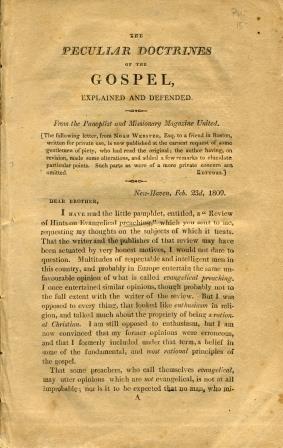

nwpeculiardoctrines

THE
PECULIAR DOCTRINES
OF THE
GOSPEL,
EXPLAINED AND DEFENDED
From the Panoplist and Missionary Magazine United
[The following letter, from Noah Webster, Esq. to a friend in Boston, written for private use, is now published at the earnest request of some gentlemen of piety, who had read the original; the author having, on revision, made some alterations, and added a few remarks to elucidate particular points. Such parts as were of a more private concern are omitted Editors.]

New-Haven, Feb. 23d, 1809
DEAR BROTHER,

I have read the little pamphlet, entitled, a “Review of Hints on Evangelical Preaching,” which you sent to me, requesting my thoughts on the subjects of which it treats. That the writer and the publisher of that review may have been actuated by very honest motives, I would not dare to question. Multitudes of respectable and intelligent men in this country, and probably in Europe entertain the same unfavorable opinion of what is called evangelical preaching. I once entertained similar opinions, though probably not to the full extent with the writer of the review. But I was opposed to everything that looked like enthusiasm in religion, and talked much about the propriety of being a rational Christian. I am still opposed to enthusiasm, but I am not convinced that my former opinions were erroneous, and that I formerly included under that term, a belief in some of the fundamental, and most rational principles of the Gospel.

That some preachers, who call themselves evangelical, may utter opinions which are not evangelical, is not at all improbable; nor is it to be expected that no man, who ministers in holy things, should go too far in depreciating the moral duties. Minds, impelled by zeal, may acquire a momentum that may carry them beyond the Gospel mark, at which they aim. But, if I understand the reviewer, he not only censures what may be really wrong in zeal, but aims to make the moral duties the essence of the Gospel, which the publisher of the pamphlet calls the benevolent and moral religion of Jesus. And this I understand to be the creed of many respectable men in this country. I am probably as sincere a frien[d] to the moral duties as the reviewer; but that these constitute the ground-work of the Gospel, I believe to be a fatal error; a rock on which perhaps more intelligent men are shipwrecked than on any other. Were there no other defect in this creed, this alone would overturn it, that no man destitute of a principle of holiness, or a supreme love and regard to his Maker, can perform the moral duties, in the manner which the laws of God require. His motives cannot be pure; they cannot spring from the right source; nor will any man, without a higher principle than a mere regard to social happiness, ever be able to perform all the moral duties with steadiness and uniformity.

But let us examine this scheme of religion on other grounds. It is the principle of our religion, and of all true religion, that there is a God of infinite perfection, who is the Author of whatever has been created. This Being is man’s Creator and, of course, his sovereign Ruler; and if his Sovereign Ruler, He has a right to give laws to man for his government. From God’s sovereignty, or his character as Creator and Governor of the universe, results necessarily his right to the supreme reverence of all the rational beings he has created; and from this sovereignty, and from the perfection of His nature, as well as from His benevolence to man, in creating him, and supplying him with all the means of happiness, results God’s right to man’s highest love and gratitude. For nothing is more obvious than that supreme excellence is entitled to the first place in our esteem. Our first class of duties then respects our Maker, our Preserver, our Benefactor, and Redeemer. These duties, I apprehend, are dictated by reason and natural religion, as well as commanded in the Scriptures. They result necessarily from our relation to the Supreme Being, as the head of the universe.

In the next place, men are made for society. Our natural propensities lead us to associate with each other; and society is necessary to the continuation of the species, as well as to our improvement, protection, and happiness. From this association of men, and the various interests involved in it, result numerous social duties, which we comprise under the general term, morality. These constitute the second class of the duties of men. This distribution of our duties is precisely that which Moses has made in the Ten Commandments, which were originally divided and engraved on two tables. The first table contained our duties to God; the second our duties to each other; and this distribution is expressly recognized by our Savior, who declares that the first and great commandment is to love the Lord our God with all the heart, with all the soul, and with all the mind; and that the second, which is like to it, is to love our neighbor as ourselves.

Now let me ask the advocates of a moral religion, with what propriety, or by what authority, can we dispense with the first table of the law, or even postpone it to the second? Are not the duties of piety as necessary, and as positively commanded as the duties of morality? and more, are they not placed at the head of the list? The command, “thou shalt have no other God before me,” [Exodus 20:3] which enjoins supreme love, reverence, and adoration, as duties to the Creator of the universe, precedes all the other commands, not only in the order of arrangement, but in the order of propriety, resulting from God’s character and supremacy. The Scriptures inculcate this doctrine from beginning to end; and it is as consonant to reason, and the moral fitness of things, as it is to the Scriptures.

To illustrate great things by small, let me state the following case. The father of a family, wishing to furnish his children with the means of enjoying happiness, tells them, “I have the means of supplying you with everything you can desire. I will build, for each of you, a house in my neighborhood, and I will send you every day whatever you want or can enjoy; and you shall have no trouble in living, except in dressing and preparing the provisions and materials I shall send, to suit your own desires. But to secure to yourselves the continuance of my favors, it is necessary that you comply with two conditions…the first is that you shall treat me with the respect due to a parent and call daily at my house to thank me for the benefits you receive. The second is that you shall treat each other with the utmost kindness and justice.” Suppose then that these children, placed in this eligible situation, and living in profusion on their father’s daily supplies, do actually comply, in a good degree, with the second condition; performing all their social duties, with tolerable, or even with strict punctuality; but pass thirty, forty, or fifty years, without once calling upon their benefactor, to make to him their grateful acknowledgments. What shall we say to such base ingratitude? But suppose further, that these children, instead of H pious veneration, and daily expressions of gratitude to their kind father, should declare that they owe him no immediate duties: that to be kind and just to each other is all that is necessary to fulfill the conditions, on which they hold their estates and enjoyments, and some of them even reproach their father as a hard master, and treat him with open contempt! What can be said in vindication of such conduct? Can such children claim from their insulted benefactor a continuance of his kindness? Much less can they expect, or even hope from him, further means of enjoyment, and a more splendid establishment! I leave this case, my dear brother, to be decided by the advocates of a religion consisting of moral duties; referring you, however, to a single passage of Scripture in which Jehovah, as the Father and Ruler of men, claims His rights with the affecting benignity [kindness] of a God. “A Son honoreth his father, and a servant his master; if then I be a Father, where is my honor? And if I be a Master, where is my fear?” Mal. i. 6.

If I understand anything of God’s character and moral government, and of our relation to Him, as His dependent creatures, a supreme regard to Him, as the first great cause and last end of all things, is the foundation of all true religion in the heart…as indispensable to the perfection of His moral government, as it is to the happiness of His rational creatures. Perfect excellence being entitled to supreme love and regard, and God being perfect excellence and the only Being of that character in the universe, it results that intelligent creatures must give to Him the first place in their hearts, or they do not conform to the standard of moral rectitude which God has established; and if they do not conform to that standard, they cannot be entitled to the happiness which results from such conformity. Hence, we are repeatedly informed in the Scriptures, that “the fear of God is the beginning of wisdom;” [Ps. 111:10, Prov. 9:10] the foundation on which the whole system stands. God then claims from us, as the first duty, a supreme regard to His character and laws, which is to be manifested by the duties of piety, prayer, worship, fear, love, attendance upon His instituted ordinances, and a reference to His will as the only rule of our moral and religious conduct; in short, an unreserved submission to His laws and government. He, as the Sovereign of the universe, has a right to this regard; He demands it as His right; and according to my view of His character and government, He cannot dispense with it. It should even say, with reverence, it would be an imperfection in His government if He could.

But this is not all. While God makes His own glory the chief object of His works and government, He has made holiness or conformity to His image, the condition on which His rational creatures are to enjoy supreme happiness. The connection between holiness and future felicity is inseparable. The happiness of a future life is represented as consisting in the enjoyment of God’s favor and presence. How, let me ask, can a soul enjoy the Divine presence without supreme love to the divine character? What joy can a soul experience in the presence of a God to whose attributes and laws it is not previously reconciled? How can a soul be delighted with the favor of God in heaven, which has never loved him supremely on earth? Is the heart to be changed after death? This we are forbid to believe. A man may, in this life, perform moral duties without any particular regard to his Maker and without any particular relish for His character and government. He may perform good works to his fellow-men, even from a sense of their fitness and propriety, without performing a single act of homage to the Supreme Being, although, as I have before remarked, without a reference to God’s will, he will rarely perform them with uniformity, even in the view of the world. But the natural heart is enmity against God; and if such moral man dies without a change in the affections of his heart, what qualification will he possess for that heaven, whose employment consists in loving and praising God? How will he relish the joys of pure and holy spirits? It is impossible. Even in this life, nothing is more painful to a man than the presence of a kind benefactor whom he has injured. Were a man of mere morality to be instantly transferred to the presence and favor of a pure and Holy Being, Heaven itself would be a hell. An unholy being cannot be happy in the immediate presence of a Holy God; at least, in my apprehension, it appears to be impossible. Hence it appears that regeneration and holiness of heart are in the very nature and fitness of things necessary to the enjoyment of Heaven; and the Gospel doctrines really stand as well on the immutable order of things in the universe, as on the positive declarations of Christ and His apostles. We are placed on this earth in a state of trial and probation, furnished with intellectual powers to learn the character of God and our own duty; with the Word of God to direct us and a free will to accept or reject the offers of salvation. To complete the means of salvation a Mediator has been provided to make an offering of Himself for our sins and satisfy that law which we have violated and which we ourselves are certainly unable to satisfy. In this state, the seeds of holiness are to be planted in the heart and are destined to grow and ripen into a full harvest of felicity in a future life. Holiness, in this life, is the germ of Heaven. But holiness, in a Scriptural sense, and indeed in any sense, is a distinct thing, from a principle of morality. Morality, or good works, respect our fellow-men; holiness respects God. It is that state of the heart which proceeds from supreme love to God, faith in Christ, and entire submission to the Divine commands. Without this holiness, the Bible informs us, no man shall see the Lord. And this holiness is indispensable to the performance of good works. As faith without works is dead; so good works are the fruit of faith [James 2:14-26]. And according to the Gospel, it is not possible for moral duties to be acceptable to God unless they proceed from faith and holiness or from a supreme regard to God’s will as their spring or motive.

These doctrines involve the necessity of regeneration, a doctrine which many men, called Christians, deny; and which the morality-system utterly excludes. I know not how men who believe the Scriptures can reason away a doctrine so fully and expressly revealed as that of the new-birth. The passages of Scripture which directly assert the necessity of such a change, I need not recite; they must be familiar to you, but I will make a few remarks on this subject.

That the heart of man is naturally destitute of holiness, or true love to God, is equally provable from the Scriptures and from observation. That the natural heart is at enmity with God, one would think any person must admit who reads history or observes the state of society within his own view. But I want no other evidence of the fact than that which is furnished by the men who make morality or good works the basis of all religion, and the ground of acceptance with God. The disposition to exclude the duties of piety as of primary importance in a scheme of religion; or a disposition to obtain salvation, by the merit of moral duties in exclusion of the merits of Christ’s righteousness, without a supreme love to God and His laws and an entire dependence on sovereign grace, is to my mind a demonstration that the natural heart is “enmity against God.” [Romans 8:7] Indeed, it is an astonishing proof of pride and ingratitude, that men who acknowledge themselves to have been created without any agency of their own and who cannot raise an arm or draw a breath without the agency of their Creator, should attempt to prove that they can obtain salvation by their own works, without Divine aid and without the infusion of a principle of holiness by the same Spirit which first breathed into man the breath of life. Why is it more improbable that God should exert His sovereign power in regenerating the soul to make it a suitable being to dwell in immortal glory, than that he should form the body as a suitable being to inhabit the earth? It should be observed that the Supreme Being reserves to Himself exclusively the glory of creation. He created man and the universe with all its furniture. He has placed the animals, plants, and minerals of this globe at the disposal of man. We have the means, under His providence, of multiplying the number of animals and plants at pleasure; we can modify and use the species which He has made; but observe, we can create nothing. We cannot add a single new species to those which God has made. If the heart of man, in its natural state, is not qualified to be an inhabitant of Heaven and must be renovated, how is the change to be effected? The Scriptures everywhere represent the change of affections in the heart, as a new birth or creation; and if such is the change, who but God is to be the Creator?

Regeneration consists in an entire change of the affections. The natural man’s affections are placed on temporal enjoyments and objects of this life. Hence the social duties are the sum of his religion. The affections of the regenerate heart are placed on God, as the first and noblest object of love; on Christ as the Redeemer, through Whom man has access to God and happiness; and on the will of God as the only rule of his conduct. It looks to God as the Author of all good; trembles at the thought of offending Him; submits cordially to his commands and dispensations; and reposes with delight and unshaken confidence on his promises. The real Christian does not, in his moral conduct, make his own honor, interest, or reputation the primary rule of decision; but endeavors to regulate his actions by God’s law; “for of Him, and through Him, and to him are all things.” [Romans 11:36] In short, his heart recognizes the great truths delivered by our Savior, that the first and great commandment is to love the Lord our God with all the heart, soul, strength, and mind; and that the second is to love our neighbor as ourselves. This is unquestionably the order of pious affections; the order of nature; the order of moral fitness; and the order of the Gospel. And how is it possible for men who study the universe and read the Scriptures, to attempt to invert this order? From what cause proceeds this unnatural perversion of truth, as immutable as God himself? Is it not the natural pride and the evil propensities of the human heart? Why does man wish to dispense with the duties of piety and obtain salvation upon the strength of duties performed to his fellow-men? Is there anything painful or mortifying in piety and a dependence on Divine grace for salvation? If there is, the heart is wrong. There is certainly no durable pleasure in sin. Long before I had these views of the Gospel scheme of salvation, I was convinced that sin, even in this life, produces more pain and misery than real pleasure. No, my friend, there is no substantial satisfaction in this life, except in conforming to the laws of the Supreme Lawgiver. As His laws and character are the most excellent, and as intellectual happiness can proceed only from truth and excellence, it results that man must enjoy the most happiness, when his heart is reconciled to the Divine laws and most conformed to the Divine character.

So far are the duties of piety and religion from being painful that the human mind, roving from one temporal object to another, unsatisfied with the pleasures they afford, perplexed with doubts, and, like Noah’s dove, finding no solid ground on which to rest, never enjoys permanent peace until it has sought a refuge in that ark of Divine safety, the Redeemer’s kingdom. The soul of man is, I am persuaded, never tranquil till the will is subdued and has yielded, with implicit submission, to God’s sovereign grace. This submission, however humiliating it may appear to the natural man, is accompanied or followed with unspeakable satisfaction. The most dignified attitude of feeble, sinful man is that of a penitent at the foot of the cross, imploring pardon from an offended God; and I firmly believe that every man must be brought to this posture before he can enjoy any permanent tranquility of mind in this life, or possess any qualification for the happiness of the next.

These sentiments may perhaps expose me to the charge of enthusiasm. Of this I cannot complain, when I read in the Gospel that the apostles, when they first preached Christ crucified, were accused of being full of new wine; when Paul was charged by Felix with being a madman; and when Christ Himself was charged with performing miracles through the influence of evil spirits. If, therefore, I am accused of enthusiasm, I am not ashamed of the imputation. It is my earnest desire to cherish evangelical doctrines and no other. That the opinions here expressed are substantially true, I firmly believe; and I number it among the strong arguments in favor of the truth of these doctrines and of revelation, that pious men in every age have entertained similar views and experienced corresponding affections of the heart. In every period of the church and in every country where the true religion has been professed, men of piety have had substantially the same views of the character of God and of the duty of man; the same supreme love to their Maker; the same submission to His will, faith in His promises, and zeal in His cause, as were manifested by Abraham, by David, and the apostles. This uniformity of affections among pious men, in distant countries and periods of time, affords a solid proof of the truth of their religion and of its Divine original; for nothing is uniform but truth; nothing unchangeable but God and His works.

Nor is the opposition to this scheme of religion, in my apprehension, less an argument of its truth. In every age, men who are unwilling to submit to God’s sovereignty and who desire to have as little dependence as possible on His power and mercy, have opposed the religion which gives to God His true place in the universe. The men who now reject the doctrines of the divinity of Christ, of regeneration, of the atonement, of saving faith, and of free grace; follow the footsteps of the chief priest, scribes, and Pharisees; substituting external duties for the doctrines of the cross. But, in my apprehension, we must receive these doctrines or reject the Scriptures as a forgery and Christ as an impostor. To reject the Scriptures as forgeries is to undermine the foundation of all history; for no books of the historical kind stand on a firmer basis than the Sacred Books. The correspondence of the geographical descriptions, interspersed in various books, with the real state of the countries described as it now exists, will demonstrate the historical truth of the Scriptures beyond the possibility of cavil [objection].

If then the Scriptures are ascertained to be faithful histories or relations of many facts still capable of unequivocal proof, we have a pledge that the writers have not deceived us in regard to facts not now equally susceptible of proof; and we have the strongest ground to believe that they are what they are declared by the writers themselves to be, the records of God’s revealed will. No historical facts are better attested than the miracles performed by Jesus Christ; and to deny the facts is to set afloat all history. If Christ then performed the miracles ascribed to Him, He must have been a Divine person or a mere man possessed of Divine powers for particular purposes; but He could not have been a mere man, for He expressly declares, that “Before Abraham was, I am,” John viii. 58. “And now, O Father, glorify thou me with thine own self, with the glory which I had with thee before the world was,” John xvii. 5. We must therefore admit with the apostle that Christ was “God manifest in the flesh,” [1 Timothy 3:16] or place these declarations to the account of falsehood, and hold Christ for an impostor; which no believer in the Scriptures will have the hardiness to do. I once had doubts on this subject; but my mind is now satisfied of the divinity of our Savior. “Never man spake as He spoke.” [John 7:46] The prophecies respecting Christ and the astonishing train of events recorded in the Jewish history, as preparatory to his appearance, have had no small effect in satisfying my mind on this subject. Let any man attend, among other prophecies, to the clear predictions of Christ, in the ninth and fifty-third chapters of Isaiah and he will find abundant evidence of Christ’s divinity and the inspiration of the Scriptures. It cannot be said that these predictions are forgeries, for we have ample proof that they were written several centuries before the birth of Christ. A part, if not the whole of the Old Testament, was translated into Greek by the seventy, nearly three centuries before Christ appeared, for the benefit of the Jews who, after their captivity and dispersion, had lost a knowledge of the Hebrew language; and this translation is now extant. In addition to this, it has been justly remarked, that the quotations from the Old Testament by the apostles and evangelists are taken from the Greek copy. If, then, the predictions of the prophets are genuine, as I firmly believe, they must have been dictated by the Spirit of God. Now the prophets apply to Christ not only the attributes, but the title of Jehovah [ ] Jehovah our righteousness, Jer. xxiii.6, and xxiii. 16. I have long regretted that, in the common version of the Bible, the original word Jehovah has not been generally retained in the translation. I think the original loses much of its force in the English word Lord and, when applied to Christ, the evidence of the Divinity of Christ contained in the title is to an ordinary reader, entirely lost or much impaired.

To those who object to this doctrine of Christ’s divinity on account of its mysteriousness, I would reply, that there is nothing more mysterious in this doctrine than in everything else respecting God and His works. Men should not stumble at mystery after having disposed of the difficulties attending the belief of a preliminary mystery, the least comprehensible of all. The existence of a God, infinite, eternal, and unchangeable in His being and perfections is, in my apprehension, by far the greatest mystery that can be presented to the human mind. Yet few men hesitate to believe in the existence of such a Being. Men who are not staggered at this first and greatest mystery, one would think, could not hesitate to give their assent to doctrines involving less difficulties; for when once the existence of a God of unlimited power is admitted, we may safely admit the existence of any facts, however mysterious and astonishing, that do not involve an absolute contradiction. I am not perfectly satisfied with the terms used in creeds, “three persons in one God;” the terms are not Scriptural and may not assist the understanding in its contemplations on this subject. I receive the doctrine just as the Scriptures represent it without attempting to explain it in terms of my own. I bow to this, as to all other mysteries in the kingdoms of nature, providence, and grace. All creation is full of mystery; indeed the constitution of man is, perhaps, as great a mystery as any other. The union of an intelligent principle with a certain organic structure of bones, flesh, vessels, and nerves, is perhaps as really incomprehensible by us as the existence of God or the Divinity of Christ; for we cannot compare degrees of incomprehensibility. Explain to my understanding, how a man, by an act of the will, can move a finger, and I think I may safely undertake to unfold any mystery in the Gospel. Explain to me the natural cause of attraction, in gravitation, cohesion, or magnetism; describe to me the process of vegetation on the earth, and of mineralization beneath its surface; attend the chemist in his laboratory, and see two invisible colorless gases combined in a certain proportion, producing that visible substance, water, and the same substance decomposed and converted into gases; in short, unfold to my comprehension the cause of heat, the operations of light, and of congelation [thickening], before you complain of the mysteriousness of Christ’s divinity. What is there, my dear friend, in Heaven above or on the Earth beneath, which we do comprehend? Surely, beings of our limited capacities have no right to expect we shall be able to understand all the works and counsels of the infinite Jehovah. It is our duty to admire and adore, to love and obey. In short, it is the duty of man to be humble. Indeed, it is a remarkable fact, that God rarely communicates to man the consolations of His grace and evidences of His favor till severe convictions have reduced him to a strong sense of the feebleness of his powers as well as the sinfulness of his heart. “God resisteth the proud, but giveth grace to the humble.” [Proverbs 3:34, James 4:6]

Men who depend on their own works for salvation, appear to question the special influences of the Divine Spirit in renewing the heart. It is difficult to reconcile this skepticism with a belief in the Scriptures, which repeatedly and unequivocally assert the fact. Real Christians have the witness within themselves; that is, they have evidence from their views of divine things and the affections of the heart, which leave little or no room to doubt the divine influence which produced them. The operations of the Spirit are very various. In some persons convictions produce anxiety and error, which drive them almost to despair. In others, convictions are less violent but produce a solicitude which leads the subjects of them to read the Scriptures; to inquire the way to Zion; to attend to the means of grace and gradually to renounce all reliance on themselves, and to seek God through Christ with humility, prayer, and submission. In some cases, though less frequently, persons without much previous distress, have opened to their minds, most luminous views of the excellence of the Divine character, of God’s love and mercy in Christ; and seem to pass at once from death to life; and from the most determined enmity of heart and opposition to the Christian scheme of salvation, to the most cordial delight in the doctrines of the Gospel. These facts, which are within the observation of every honest inquirer, correspond with the account of Christ Himself has given of the operations of the Spirit, which are compared to the blowing of the wind, whose effects only are perceived. Many persons, whose views and affections are evidently changed, are not sensible of any particular operation on their hearts. They have new affections and views, but know not the time or the manner in which they received them. In others, the impressions are too sensible not to be recognized. I know there are men who denominate such impressions enthusiasm and spiritual delusion. But the instances of such sensible changes of the heart, in persons of sound judgment and cool, dispassionate minds, not prone to yield to fanciful suggestions and transient feelings, furnish evidence of the reality of such special agency of the Divine Spirit on the heart which I cannot think it right to reject.

That the operations of the Holy Spirit are sometimes accompanied with a light exhibited to the imagination, is not generally believed; but I am inclined to believe the fact on the authority of well authenticated cases. I see no more reason for disbelieving the fact, than for rejecting the account of St. Paul’s conversion; for the soul of man is undoubtedly the medium through which the Supreme Being makes His communications. At the same time, there is so much danger of deception, in the force of the imagination, that I think the evidence of such facts should be very clear to encourage confidence. The proof of a real change of heart should rest on the subsequent life; for “the tree is known by its fruit.” [Matthew 12:33, Luke 6:44] But that God does make special communications of His favor to man, through the intellectual and spiritual principle, or soul; and that He often grants the requests of His children, by a direct agency, independent of visible means, are facts fully revealed in the Scriptures and well known to Christians.

“Whatsoever ye shall ask in my name, that will I do, that the Father may be glorified in the Son,” [John 14, 13] is the repeated promise of our Savior; a consolatory promise that many pious souls have known to be fulfilled, to their unspeakable joy and to the great confirmation of their faith.

These are points which I am sensible are not generally believed. But why should they be questioned? For what purpose was the soul infused into man? Why was man distinguished from the brute? If man was made to perish like the beast of the field, of what use is his intellectual part? The animal appetites of the brute afford, perhaps, in the gratification, as much pleasure as those of man. Surely, then, man was endowed with superior powers and faculties for some important purpose. For what purpose? The soul bears some resemblance to divinity and is evidently designed for enjoyments of a superior rank. To direct the intellectual powers of man to their proper objects, it was doubtless necessary for him to have a revelation of God’s will and such revelation requires a direct communication from God. It may be said that such communications were undoubtedly made but having been made and the substance of them recorded, further communications are unnecessary. This may, in a sense, be true; but I see no improbability in God’s continuing to make special communications of His will to man, by illuminating the mind, in the present, as well as in former periods. The instances in which such revelations are distinctly recognized, may be rare; but some well authenticated facts of this kind may serve to confirm the truth of former revelations, and fortify the faith of Christians. Such instances now, as in former ages, may be intended to answer some important purposes in the economy of Providence and grace; and are, probably in most instances, given in answer to fervent prayer.

It is no objection to these opinions that such communications are not general or common, any more than it is to the special infliction of punishment by Divine wrath on some heinous crimes, while other crimes, apparently as offensive, are suffered to pass, for the present, unpunished. If a blasphemer, riding in company, should, with an oath and a lie upon his tongue, declare that the horse he is on never stumbles, and his horse should instantly fall and break the man’s neck, no person could hesitate to believe it at least probable that the Almighty had interposed, by His agency, to execute sudden vengeance on the offender. Yet many other men, committing a like offence, may escape present punishment without, in the least, impairing the evidence of God’s special interference in the case stated. For it is the character of God as represented in the Scripture, and manifested every day, to exercise mercy rather than vengeance and, by a few instances of His wrath, to give examples and evidences of His power and government, to recall other offenders to their duty. It is equally probable, that special communications of His will, and of His favor, may be made to strengthen the faith and animate the hopes of those who confide in him. Not to believe in such instances, is to discredit all human testimony. If you will take the trouble to converse with experienced Christians, and read the written accounts of their lives, you must, I think, be satisfied that God does, at times, as directly interpose in behalf of those who ask Him in faith, as He did in restoring health to the sick, and sight to the blind, under the ministration of our Savior on earth.

Such facts serve to establish the doctrine of a special Providence, the truth of which I once questioned, but now fully believe. Indeed, it is surprising I could ever entertain a doubt on the subject; for it is as unphilosophical as unscriptural to admit a general Providence without a special one; as a general Providence implies particular providences. I was probably led into this error by the false philosophy which prevails in the world and of the universe. This philosophy substitutes for the mighty hand of Deity, the operations of second causes and laws of nature. We are taught in our youth that nature, or created things, are subject to certain laws, such as attraction, gravitation, and repulsion; and with the help of these we pretend to account for all the phenomena of the universe, without the direct agency of a supreme, intelligent Cause.

But what are the laws of nature? Nature, in its most comprehensive sense, means all that is made or produced; and laws, when applied to such created things, signify the regular motions, operations, and changes of these things, or the causes by which they are produced. If the laws of nature are the motions and changes of bodies, then they are effects and not causes, and we ascribe the phenomena of the universe to the effects of something else. If these laws are the producing or primary cause, they must be the supreme Author Himself, whom all rational men must admit to be an intelligent Being. Is it possible that laws or principles, competent to carry on the stupendous operations of the universe, can be attached to matter and not immediately dependent on the Almighty Author! Is matter susceptible of such active principles independent of an intelligent mind? I would not dare to circumscribe, even in thought, the power of Jehovah; but I have given up this philosophy and am compelled to resolve all the laws of nature into the direct agency of the almighty First Cause. The operations of nature are evidently the effects of that power constantly exerted, which first called all things into existence. Hence their uniformity; for nothing can be uniform but God and His operations.

The Jews were an illiterate people, cultivating neither arts nor sciences, to any considerable degree; yet, surprising as it may appear, they were, for ages, the only people whose history has come down to us, who appear to have had just ideas of the only true philosophy which, mounting to the true source of all created beings and their operations, ascribes all vents to Jehovah. Upon this scheme of philosophy, the difference between miracles and natural events is that natural events are usual, constant, and regular operations of Divine Power and supernatural events are the unusual and special operations of the same power which astonish men merely because they are not frequent. It cannot be the magnitude of the event which excites our wonder; for we have no ground to suppose the raising of the dead is a greater act of divine power, as it regards the Supreme Being, than the growth of a tree. If any person should incline to allege that the difference between a miracle and a natural event is that a natural event takes place by means of some medium or instrument and a miracle without such medium; this would only compel us to mount one step higher, to find the immediate agency of God. The waters of the Red Sea were removed to make a passage for the Israelites [Exodus 14], by a “strong east wind;” but it was “God who caused that wind to blow,” and the effect produced may have been as really supernatural as the revival of Lazarus from the dead [John 11].

I see nothing, therefore, in reason, to make me doubt, that God’s moral government may admit and even require, in every period of the world, special interpositions of power, divine and supernatural; nor can I see, in such special interpositions, anything more improbable than in the first formation of man, by molding matter into a particular organic frame and infusing into it an intelligent principle. The God who created the universe governs it, and all the things that inhabit it by such exertions or operations of power, general or particular, as best suits His own purposes.

The doctrine of predestination and election, is one which is much opposed by some denominations of Christians. But I see not how this doctrine can be separated from the being and attributes of an infinite God. If God is infinite, there can be no such thing as past and future, or a succession of ideas in the Divine Mind. The terms predestination and foreknowledge, are therefore inapplicable to the Supreme Being; and are used only in reference to finite beings, who have a succession of ideas. An Infinite Being must know with certainty every event, future as well as past; and if events are certainly known to Him, they must be unalterably determined: for how can He know them but in consequence of His own determination? If they are not certain, He cannot know them; and this supposition involves both a limitation of His knowledge and an imperfection in His attributes. I conceive, therefore, the Scriptural doctrine of election stands on the very character and attributes of that Being, “with Whom is no variableness, neither shadow of turning.” [James 1:17] Yet we are conscious of free agency in our determinations. That man is not, in a strict sense, perfectly free, that is, independent of God in determining his actions, we must believe; for there can be but one such Being in the universe as a perfectly independent mind; but I see no contradiction nor absurdity in the doctrine of a predetermined order of events in the universe and, at the same time, the possession by man of such a freedom of will as to render him accountable for his actions. The first is affirmed in the Scriptures and, in my apprehension, is inseparable from the sovereignty and infinite perfections of the Deity; while the last is equally affirmed in the Scriptures and authorized by our own experience. The terms, unconditional election, I think, are inapplicable to the subject; for we have the Scriptures for our authority, supported by every principle of reason, that every man’s future state will be determined by his voluntary obedience or disobedience. I think it better to submit and obey, than to perplex our minds with abstruse [difficult to understand] reasonings on subjects beyond our comprehension.

To many men, the doctrine of free, unmerited grace in the salvation of sinners is very offensive. Such persons seem to suppose they can merit salvation and claim it as a right. But was not our first formation an act of free grace and uncontrolled sovereignty? Was not the gift of an intelligent mind to man, distinguishing him from the brutes, an act of Sovereign grace? Did a man ever plant a field with corn and claim from the Almighty, as a right, a fruitful harvest? Why then object to free grace in the work of salvation? Surely man, a feeble, frail being, who holds his life and all his powers at Divine sufferance, should be more humble.

But is there nothing for man to do? He is commanded to “work out his salvation with fear and trembling.” [Philippians 2:12] Yes, my friend, man has much to do…he must work out his salvation with fear and trembling; but the misfortune is a great part of the world wish to work out their salvation without fear and trembling. They are willing to be honest and just to their fellow-men and then confidently claim salvation from their Creator, without fearing His laws, or trembling at his judgments; without performing the duties of piety, submitting to His will, or accepting a Savior: in short, without that humility which gives God all the glory, and that holiness, without which there can be no enjoyment in Heaven. The condition of salvation, which God has imposed, is that the heart must be right with God; not with man, for man is not the Lawgiver or Judge—but with God, the only Being who has the right to judge and the power to punish or reward.

Man comes into the world without any knowledge of his Maker, and with a heart opposed to His law. His business is to learn the character of God, from the Scriptures and from the works of nature and Providence; then to learn his own sinfulness and frailty and his obligations to love and serve his Maker. Being convinced of his own sinfulness and utter helplessness without Divine aid, it is his duty to abandon every sin, to humble himself before his Maker, repent of all His transgressions, bow to God’s sovereign will, implore his pardon, and cordially accept of the Savior as his only hope and refuge. On such conditions salvation is freely offered; and those who comply with them, may expect the consolations of the Spirit and good hope through grace of their acceptance with God. But men cannot expect these consolations until they are humbled. Those who proudly rely on their own good works, virtually tell their Maker they do not want His assistance and grace; and God gives His Holy Spirit to those only who ask it in humility. God is the Sovereign of the universe. He does govern it; He has a right to govern it; and men, if saved, can be saved only on the conditions which He has prescribed. He reserves to Himself the whole glory of saving sinners and the hearts of His children rejoice in the Divine determination.

I am therefore of opinion that the doctrines of Divine sovereignty, the Divinity of Christ, regeneration by the Holy Spirit, and free grace through Christ, are fundamental in the Gospel scheme of salvation. Those who reject these doctrines appear to me to tear out the vitals of Christianity, leaving nothing but a lifeless skeleton. The cold doctrines of Arminianism almost exclude the Divine agency in man’s salvation. They supersede the necessity of a Redeemer and of public worship, for morality may be taught in families and schools. In short, they never reach the heart and appear not to alter the life and character.

Such are not the doctrines of the Gospel. These elevate the soul to God, the Fountain of light, life, and blessings; they subdue the natural pride of the heart, control the passions, and change the affections. They infuse a principle of supreme love to God and create a faith in Christ which tranquilizes the soul, dispels the gloomy anxieties of skepticism, alleviates the cares, and enlivens the joys of life; and to crown all, reposes, with delightful confidence, upon the Almighty Arm of a Redeemer for salvation.

Nor are the temporal benefits of real religion less conspicuous in the effects they produce in families and in society. In minds the best regulated by family discipline and the rules of civility, there will at times break forth sallies of envy, jealousy, petulance, and discontent, which annoy the peace of families and of neighborhoods. Nothing seems effectually to restrain such passions but Divine grace. The fear of man and a regard to decorum, will not produce the effect in minds of a particular structure. But the humbling doctrines of the Gospel change the tiger to a lamb. Real religion, which implies a habitual sense of the divine presence, and a fear of offending the Supreme Being, subdues and controls all the turbulent passions; and nothing is seen in the Christian but meekness, forbearance, and kindness, accompanied by a serenity of mind and a desire to please as uniform as they are cheering to families and friends. On this subject I speak with delight from observation.

At the same time, real religion inspires mutual confidence, it establishes a guard over the heart, and creates a security for fidelity and affection, in husband and wife, parents and children, brothers and sisters, neighbors and friends, which cannot be derived from authority or instruction, from the force of law, or the influence of example.

These, my dear brother, are some of my views of the Calvinistic doctrines and their effects. These doctrines, in the main, I do believe to be evangelical; and my belief is not the effect of education, for formerly my opinions were unfavorable to some of these doctrines. My belief is the fruit of some experience and much inquiry and reflection.

It is with heart-felt regret that I see a large portion of the world so inattentive to religion. Men often live for many years, gazing upon the stupendous fabric of the universe, apparently without a sentiment of piety; and wander among the charming beauties of the earth, where the power, the wisdom, and the beneficence of the Creator are displayed on every flower, and every leaf, with as little admiration and gratitude as the beasts that graze on the field. Equally insensible are they to the beauties of the Divine Character, unfolded in the works of Providence and grace; forgetting that the same God who arrays the lilies of the field with more than Solomon’s glory [Matthew 6:28-29], is ready to clothe his children with the splendid robes of the Redeemer’s righteousness [Isaiah 61:10]. And what is astonishing, but often true, the more temporal blessings men enjoy, the less disposed are they to love and obey their heavenly Benefactor: a truth which gave occasion for our Savior to remark, how difficult it is for a rich man to enter into the kingdom of God [Matthew 19:23-24, Mark 10:25, Luke 18:25]. It is a melancholy proof of the depravity of the human heart that men often invert the order of things and suffer their gratitude to abate in proportion as their wealth increases. Indeed it is extremely painful, to a reflecting mind, to observe men in affluence, who live amidst a profusion of everything the bounty of Heaven bestows, indulging in sensual gratifications and rolling in splendor; but forgetting, or insulting the Benefactor, while they riot on the benefit.

But I must come to a conclusion; or instead of a letter, I shall write a book. I could dwell on subjects of this kind with pleasure; but if what I have written is the truth, it is enough: if not, it is too much. If my opinions are erroneous, I should be happy to be corrected; if they are substantially true, I hope they will have their due weight. As pilgrims on the same journey, it would be for our mutual happiness on the road, “so to be agreed as that we might walk together,” [Amos 3:3] and be united in principle as well as by the most endearing of all ties, Christian love.

I am, with sincere affection, Yours, &c.

NOAH WEBSTER, jun.

Noah Webster & The Bible

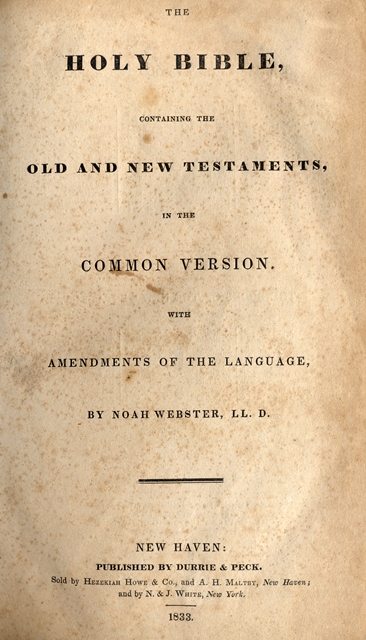
Even though, Noah Webster is most widely known for standardizing spellings and meanings of words through his Webster’s Dictionary, printed in 1828, he soon began an even greater task, which was to update The Holy Bible to exchange outdated and misunderstood words for more common ones. His belief in the inerrancy of Scripture was so strong, that he wrote an introduction to explain the changes that he made and the Scriptural integrity that was preserved. In fact, besides the introduction (transcribed below) to the Bible, WallBuilders has several notes and letters that discuss Noah Webster’s desire to preserve the accuracy of Scripture.


webster1833bible

The English version of the Sacred Scriptures, now in general use, was first published in the year 1611, in the reign of James I. Although the translators made many alterations in the language of former version, yet no small part of the language is the same, as that of the version made in the reign of Queen Elizabeth. In the present version, the language is, in general, correct and perspicuous [clear, comprehensible]; the genuine popular English of Saxon origin; peculiarly adapted to the subjects; and in many passages, uniting sublimity with beautiful simplicity. In my view, the general style of the version ought not to be altered.

But in the lapse of two or three centuries, changes have taken place, which, in particular passages, impaired the beauty; in others, obscure the sense, of the original languages. Some words have fallen into disuse; and the signification of others, in current popular use, is not the same now as it was when they were introduced into the version. The effect of these changes, is, that some words are not understood by common readers, who have no access to commentaries and who will always compose a great proportion of readers; while other words, being now used in a sense different from that which they had when the translation was made, present a wrong signification or false ideas. Whenever words are understood in a sense different from that which they had when introduced, and different from that of the original languages, they do not present to the reader the Word of God. This circumstance is very important, even in things not the most essential; and in essential points, mistakes may be very injurious [causing harm, hurt, damage, or distress].

In my own view of this subject, a version of the Scripture for popular use, should consist of words expressing the sense which is most common, in popular usage, so that the first ideas suggested to the reader should be the true meaning of such words, according to the original languages. That many words in the present version, fail to do this, is certain. My principal aim is to remedy this evil.
The inaccuracies in grammar, such as which for who, his for its, shall for will, should for would, and others, are very numerous in the present version.

There are also some quaint and vulgar phrases which are not relished by those who love a pure style, and which are not in accordance with the general tenor of the language. To these may be added many words and phrases, very offensive to delicacy and even to decency. In the opinion of all persons with whom I have conversed on this subject, such words and phrases ought not to be retained in the version. Language which cannot be uttered in company without a violation of decorum of the rules of good breeding, exposes the Scriptures to the scoffs of unbelievers, impairs their authority, and multiplies or confirms the enemies of our holy religion.

These considerations, with the approbation of respectable men, the friends of religion and good judges of this subject, have induced me to undertake the task of revising the language of the common version of the Scriptures, and of presenting for the public an edition with such amendments, as will better express the true sense of the original languages, and remove objections to particular parts of phraseology.

In performing this task, I have been careful to avoid unnecessary innovation and to retain the general character of the style. The principal alterations are comprised in three classes.

  1. The substitution of words and phrases now in good use, for such, as are wholly obsolete, or deemed below the dignity and solemnity of the subject.
  2. The correction of errors in grammar.
  3. The insertion of euphemisms, words and phrases which are not very offensive to delicacy, in the place of such as cannot, with propriety, be uttered before a promiscuous [consisting of parts, elements, or individuals of different kinds brought together without order] audience.

A few errors in the translation, which are admitted on all hands to be obvious, have been corrected; and some obscure passages, illustrated. In making these amendments, I have consulted the original languages, and also several translations and commentaries. In the body of the work, my aim has been to preserve, but, in certain passages, more clearly to express, the sense of the present version.

The language of the Bible has no inconsiderable influence in forming and preserving our national language. On this account, the language of the common version ought to be correct in grammatical construction, and in the use of appropriate words. This is more important, as men who are accustomed to read the Bible with veneration, are apt to contact a predilection for its phraseology, and thus to become attached to phrases which are quaint or obsolete. This may be a real misfortune; for the use of words and phrases, when they have ceased to be part of the living language, and appear odd or singular, impairs the purity of the language, and is apt to create a disrelish for it in those who have not, but long practice, contracted a like predilection. It may require some effort to subdue this predilection; but it may be done, and for the sake of the rising generation, it is desirable. The language of the Scriptures ought to be pure, chaste, simple, and perspicuous, free from any words of phrases which may excite observation by their singularity; and neither debased by vulgarisms, nor tricked out with the ornaments of affected elegance.

As there are diversities of tastes among men, it is not to be expected that the alterations I have made in the language of version will please all classes of readers. Some persons will think I have done too little; others, too much. And probably the result would be the same, were a revision to be executed by any other hand, or even by the joint labors of many hands.  All I can say is, that I have executed this work in the manner which, in my judgment, appeared to be the best.

To avoid giving offense to any denomination of Christians, I have not knowingly made any alteration in the passages of the present version, on which the different denominations rely for the support of their peculiar tenets.

In this country there is not legislative power which claims to have the right to prescribe what version of the Scriptures shall be used in churches, or by the people. And all human opinions are fallible it is doubtless for the interest of religion that no authority should be exerted in this case, except by commendation.

At the same time, it is very important that all denominations of Christians should use the same version, that in all public discourses, treatises, and controversies the passages cited as authorizes should be uniform. Alterations in the popular version should not be frequent; but the changes incident to all living languages render it not merely expedient, but necessary at times to introduce such alterations as will express the true sense of the original languages, in the current language of the age. A version thus amended may require no alteration for two or three centuries to come.

In this undertaking, I subject myself to the charge of arrogance; but I am not conscious of being actuated by any improper motive. I am aware of the sensitiveness of the religious public on the subject; and of the difficulties which attend the performance. But all men whom I have consulted, if they have thought much on the subject, seem to be agreed in the opinion, that it is high time to have a revision of the common version of the Scriptures; although no person appears to know how or by whom such revision is to be executed. In my own view, such revision is not merely a matter of expedience, but of moral duty; and as I have been encouraged to undertake this work, but respectable literacy and religious characters, I have ventured to attempt a revision upon my own responsibility. If the work should fail to be well received, the loss will be my own, and I hope no injury will be done. I have been painfully solicitous that no error should escape me. The reasons for the principal alterations introduced, will be found in the explanatory notes.

The Bible is the chief moral cause of all that is good, and the best corrector of all that is evil, in human society; the best book for regulating the temporal concerns of men, and the only book that can serve as an infallible guide to the future felicity. With this estimate of its value, I have attempted to render the English version more useful, by correcting a few obvious errors, and removing some obscurities, with objectionable words and phrases; and my earnest prayer is, that my labors may not be wholly unsuccessful. N.W.

New Haven, September, 1833


Noah Webster Letters

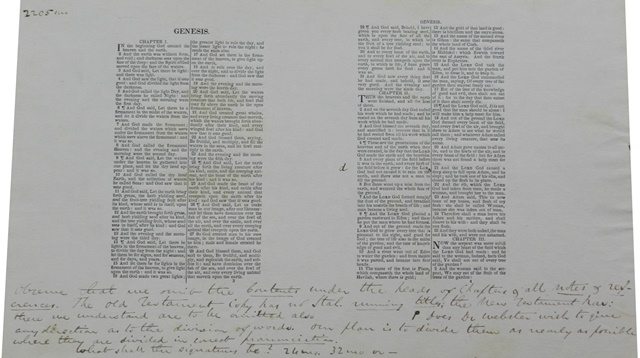
Below are some of the handwritten letters and notes Noah Webster wrote regarding his research surrounding his edition of The Holy Bible. These notes were written on the galleys, or proofs, of his Bible about to be printed. The letters also contain information regarding the printing of the Bible.


noah-webster-letters-1

Observe that we omit the Contents under the head of Chapter 9 all notes & references. The Old Testament copy has no Ital. running titles; the New Testament has: there we understand are to be omitted also. Does Dr. Webster wish to give any direction as to the division of words. Our plan is to divide them as nearly as possible where they are divided in correct pronunciation. What shall the signatures be? 26 mo. 32 mo or -.


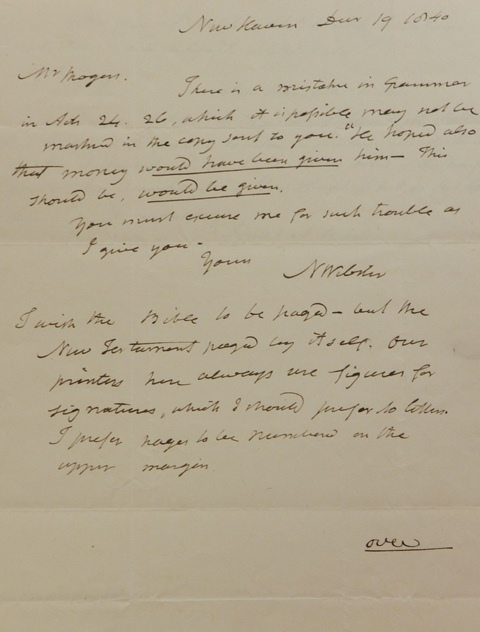
noah-webster-letters-2

New Haven, December 19, 1840

Mr. Morgan.

There is a mistake in Grammar in Acts 24. 26, which it is possible may not be marked in the copy sent to you. “He hoped also that money would have been given him” – This should be, would be given.
You must excuse me such trouble as I give you.
Yours,
N Webster

I wish the Bible to be paged – but the New Testament paged by itself. Our printers have always use figures for signatures, which [I would] prefer to letters. I prefer pages to be numbered on the upper margin.

noah-webster-letters-3


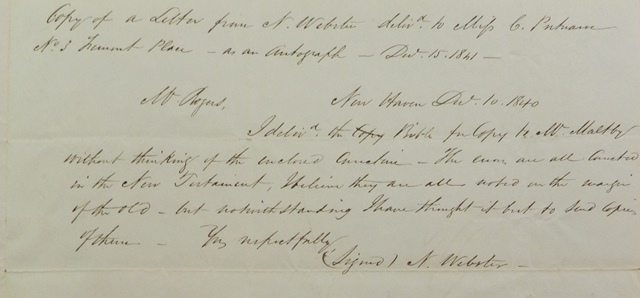
Copy of a letter from N. Webster delivered to Msrs. C. [Pertuasse] No. 3 Tennant Place – as an autograph – Dec. 15. 1841 –

New Haven Dec. 10, 1840

Mr. Rogers,
I delivered the Copy Bible for Copy to W. Maltby without thinking of the enclosed Correction – The errors are all Corrected in the New Testament. I believe they are all noted in the margin of the old – but notwithstanding I have thought it best to send copies of them.
Yrs. respectfully,
(Signed) N. Webster


noah-webster-letters-4


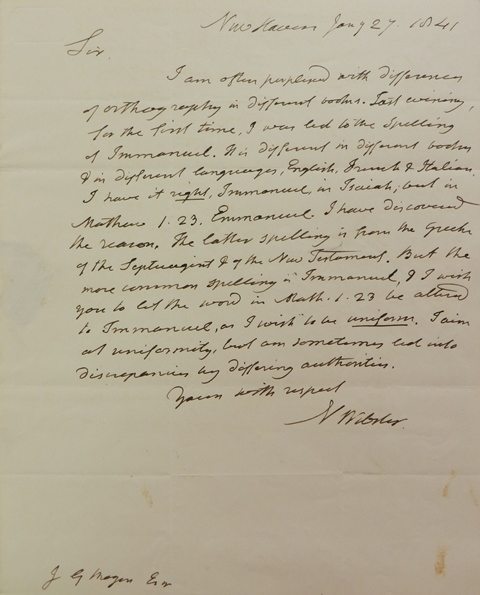
New Haven Jany 27. 1841

Sir.
I am often perplexed with differences of [orthog. (abbreviation of orthography: the study of correct spelling)] regularly in different books. Last evening, for the first time, I was led to the spelling of Immanuel. It is different in different books & in different languages, English, French & Italian. I have it right, Immanuel, in Isaiah, but in Matthew 1. 23. Emmanuel. I have discovered the reason. The latter spelling is from the Greek of the Septuagint & of the New Testament. But the more common spelling is Immanuel, & I wish you to let the word in Math. 1. 23 be altered to Immanuel, as I wish to be uniform. I aim at uniformity, but am sometimes led into discrepancies by differing authorities.
Yours with respect
N Webster.

Dwight D. Eisenhower’s Inaugural Prayer

Written on the back of hotel stationary, this is the hand-written version of the prayer that Dwight Eisenhower prayed before giving his 1953 Inaugural address.


dwight-d-eisenhowers-inaugural-prayer-1

Almighty God,

As we stand here, at this moment, my associates in the Executive Branch of government join me in beseeching that Thou will make full and complete our dedication to the service of the people in this throng and their fellow citizens everywhere.

Give us, we pray, the power to discern clearly right from wrong and allow all our words and actions to be governed thereby and by the laws of this land.

Especially we pray that our concern shall be for all the people, regardless of station, race or calling. May cooperation be permitted and be the mutual aim of those who hold to differing political beliefs, so that all may work for the good of our beloved country and for Thy glory. Amen.

*Note: To see the final version of this prayer, visit the Eisenhower Presidential Library website.

The Founding Fathers on Jesus, Christianity and the Bible

For decades accusations against the Founding Fathers have abounded. One of the common criticisms is that the Founding Fathers were a collective group of atheists, agnostics, and or deists who wanted a strict separation of church and state, resulting in a secular government and public square. Some go as far as foolishly writing that these allegations are so evident that no actual evidence or proof is needed to substantiate their claims. While these charges are blatantly false, it can likewise be acknowledged that not every Founding Father or early American leader would fit in the category of born-again Christian (although most of them would). However, the overwhelming majority of Founding Fathers and early leaders wrote openly, and often about the influence of Christianity, the Bible and Jesus on their lives. While the following examples do not give the complete story of the faith journey of the individuals included in this list, these quotes and excerpts do give a glimpse into the thinking of these men. We encourage you to follow the footnotes and dig deeper into the writings of the Founding Fathers!

John Adams

SIGNER OF THE DECLARATION OF INDEPENDENCE; JUDGE; DIPLOMAT; ONE OF TWO SIGNERS OF THE BILL OF RIGHTS; SECOND PRESIDENT OF THE UNITED STATES

The general principles on which the fathers achieved independence were the general principles of Christianity. I will avow that I then believed, and now believe, that those general principles of Christianity are as eternal and immutable as the existence and attributes of God.1

Without religion, this world would be something not fit to be mentioned in polite company: I mean hell.2

The Christian religion is, above all the religions that ever prevailed or existed in ancient or modern times, the religion of wisdom, virtue, equity and humanity.3

Suppose a nation in some distant region should take the Bible for their only law book and every member should regulate his conduct by the precepts there exhibited. . . . What a Eutopia – what a Paradise would this region be!4

I have examined all religions, and the result is that the Bible is the best book in the world.5

John Quincy Adams

SIXTH PRESIDENT OF THE UNITED STATES; DIPLOMAT; SECRETARY OF STATE; U. S. SENATOR; U. S. REPRESENTATIVE; “OLD MAN ELOQUENT”; “HELL-HOUND OF ABOLITION”

My hopes of a future life are all founded upon the Gospel of Christ and I cannot cavil or quibble away [evade or object to]. . . . the whole tenor of His conduct by which He sometimes positively asserted and at others countenances [permits] His disciples in asserting that He was God.6

The hope of a Christian is inseparable from his faith. Whoever believes in the Divine inspiration of the Holy Scriptures must hope that the religion of Jesus shall prevail throughout the earth. Never since the foundation of the world have the prospects of mankind been more encouraging to that hope than they appear to be at the present time. And may the associated distribution of the Bible proceed and prosper till the Lord shall have made “bare His holy arm in the eyes of all the nations, and all the ends of the earth shall see the salvation of our God” [Isaiah 52:10].7

In the chain of human events, the birthday of the nation is indissolubly linked with the birthday of the Savior. The Declaration of Independence laid the cornerstone of human government upon the first precepts of Christianity.8

Samuel Adams

SIGNER OF THE DECLARATION OF INDEPENDENCE; “FATHER OF THE AMERICAN REVOLUTION”; RATIFIER OF THE U. S. CONSTITUTION; GOVERNOR OF MASSACHUSETTS

I . . . [rely] upon the merits of Jesus Christ for a pardon of all my sins.9

The name of the Lord (says the Scripture) is a strong tower; thither the righteous flee and are safe [Proverbs 18:10]. Let us secure His favor and He will lead us through the journey of this life and at length receive us to a better.10

I conceive we cannot better express ourselves than by humbly supplicating the Supreme Ruler of the world . . . that the confusions that are and have been among the nations may be overruled by the promoting and speedily bringing in the holy and happy period when the kingdoms of our Lord and Savior Jesus Christ may be everywhere established, and the people willingly bow to the scepter of Him who is the Prince of Peace.11

He also called on the State of Massachusetts to pray that . . .

  • the peaceful and glorious reign of our Divine Redeemer may be known and enjoyed throughout the whole family of mankind.12
  • we may with one heart and voice humbly implore His gracious and free pardon through Jesus Christ, supplicating His Divine aid . . . [and] above all to cause the religion of Jesus Christ, in its true spirit, to spread far and wide till the whole earth shall be filled with His glory.13
  • with true contrition of heart to confess their sins to God and implore forgiveness through the merits and mediation of Jesus Christ our Savior.14

Josiah Bartlett

MILITARY OFFICER; SIGNER OF THE DECLARATION OF INDEPENDENCE; JUDGE; GOVERNOR OF NEW HAMPSHIRE

Called on the people of New Hampshire . . .
to confess before God their aggravated transgressions and to implore His pardon and forgiveness through the merits and mediation of Jesus Christ . . . [t]hat the knowledge of the Gospel of Jesus Christ may be made known to all nations, pure and undefiled religion universally prevail, and the earth be fill with the glory of the Lord.15

Gunning Bedford

MILITARY OFFICER; MEMBER OF THE CONTINENTAL CONGRESS;
SIGNER OF THE CONSTITUTION; FEDERAL JUDGE

To the triune God – the Father, the Son, and the Holy Ghost – be ascribed all honor and dominion, forevermore – Amen.16

Elias Boudinot

PRESIDENT OF CONGRESS; SIGNED THE PEACE TREATY TO END THE AMERICAN REVOLUTION; FIRST ATTORNEY ADMITTED TO THE U. S. SUPREME COURT BAR; FRAMER OF THE BILL OF RIGHTS; DIRECTOR OF THE U. S. MINT

Let us enter on this important business under the idea that we are Christians on whom the eyes of the world are now turned… [L]et us earnestly call and beseech Him, for Christ’s sake, to preside in our councils. . . . We can only depend on the all powerful influence of the Spirit of God, Whose Divine aid and assistance it becomes us as a Christian people most devoutly to implore. Therefore I move that some minister of the Gospel be requested to attend this Congress every morning . . . in order to open the meeting with prayer.17

A letter to his daughter:

You have been instructed from your childhood in the knowledge of your lost state by nature – the absolute necessity of a change of heart and an entire renovation of soul to the image of Jesus Christ – of salvation through His meritorious righteousness only – and the indispensable necessity of personal holiness without which no man shall see the Lord [Hebrews 12:14]. You are well acquainted that the most perfect and consummate doctrinal knowledge is of no avail without it operates on and sincerely affects the heart, changes the practice, and totally influences the will – and that without the almighty power of the Spirit of God enlightening your mind, subduing your will, and continually drawing you to Himself, you can do nothing. . . . And may the God of your parents (for many generations past) seal instruction to your soul and lead you to Himself through the blood of His too greatly despised Son, Who notwithstanding, is still reclaiming the world to God through that blood, not imputing to them their sins. To Him be glory forever!18

For nearly half a century have I anxiously and critically studied that invaluable treasure [the Bible]; and I still scarcely ever take it up that I do not find something new – that I do not receive some valuable addition to my stock of knowledge or perceive some instructive fact never observed before. In short, were you to ask me to recommend the most valuable book in the world, I should fix on the Bible as the most instructive both to the wise and ignorant. Were you to ask me for one affording the most rational and pleasing entertainment to the inquiring mind, I should repeat, it is the Bible; and should you renew the inquiry for the best philosophy or the most interesting history, I should still urge you to look into your Bible. I would make it, in short, the Alpha and Omega of knowledge.19

Jacob Broom

LEGISLATOR; SIGNER OF THE CONSTITUTION

A letter to his son, James, attending Princeton University:

I flatter myself you will be what I wish, but don’t be so much flatterer as to relax of your application – don’t forget to be a Christian. I have said much to you on this head, and I hope an indelible impression is made.20

Charles Carroll

SIGNER OF THE DECLARATION OF INDEPENDENCE; SELECTED AS DELEGATE TO THE CONSTITUTIONAL CONVENTION; FRAMER OF THE BILL OF RIGHTS; U. S. SENATOR

On the mercy of my Redeemer I rely for salvation and on His merits, not on the works I have done in obedience to His precepts.21

Grateful to Almighty God for the blessings which, through Jesus Christ Our Lord, He had conferred on my beloved country in her emancipation and on myself in permitting me, under circumstances of mercy, to live to the age of 89 years, and to survive the fiftieth year of independence, adopted by Congress on the 4th of July 1776, which I originally subscribed on the 2d day of August of the same year and of which I am now the last surviving signer.22

I, Charles Carroll. . . . give and bequeath my soul to God who gave it, my body to the earth, hoping that through and by the merits, sufferings, and mediation of my only Savior and Jesus Christ, I may be admitted into the Kingdom prepared by God for those who love, fear and truly serve Him.23

Congress, 1854

The great, vital, and conservative element in our system is the belief of our people in the pure doctrines and the divine truths of the Gospel of Jesus Christ.24

Congress, U. S. House Judiciary Committee, 1854

Had the people, during the Revolution, had a suspicion of any attempt to war against Christianity, that Revolution would have been strangled in its cradle… In this age, there can be no substitute for Christianity… That was the religion of the founders of the republic and they expected it to remain the religion of their descendants.25

John Dickinson

SIGNER OF THE CONSTITUTION; GOVERNOR OF PENNSYLVANIA; GOVERNOR OF DELAWARE;
GENERAL IN THE AMERICAN REVOLUTION

Rendering thanks to my Creator for my existence and station among His works, for my birth in a country enlightened by the Gospel and enjoying freedom, and for all His other kindnesses, to Him I resign myself, humbly confiding in His goodness and in His mercy through Jesus Christ for the events of eternity.26

[Governments] could not give the rights essential to happiness… We claim them from a higher source: from the King of kings, and Lord of all the earth.27

Gabriel Duvall

SOLDIER; JUDGE; SELECTED AS DELEGATE TO THE CONSTITUTIONAL CONVENTION;
COMPTROLLER OF THE U. S. TREASURY; U. S. SUPREME COURT JUSTICE

I resign my soul into the hands of the Almighty Who gave it, in humble hopes of His mercy through our Savior Jesus Christ.28

Benjamin Franklin

SIGNER OF THE DECLARATION; DIPLOMAT; PRINTER; SCIENTIST; SIGNER OF THE CONSTITUTION; GOVERNOR OF PENNSYLVANIA

As to Jesus of Nazareth, my opinion of whom you particularly desire, I think the system of morals and His religion as He left them to us, the best the world ever saw or is likely to see.29

The body of Benjamin Franklin, printer, like the cover of an old book, its contents torn out and stripped of its lettering and guilding, lies here, food for worms. Yet the work itself shall not be lost; for it will, as he believed, appear once more in a new and more beatiful edition, corrected and amended by the Author.30 (FRANKLIN’S EULOGY THAT HE WROTE FOR HIMSELF)

Elbridge Gerry

SIGNER OF THE DECLARATION OF INDEPENDENCE; MEMBER OF THE CONSTITUTIONAL CONVENTION; FRAMER OF THE BILL OF RIGHTS, GOVERNOR OF MASSACHUSETTS, VICE PRESIDENT OF THE UNITED STATES

He called on the State of Massachusetts to pray that . . .

  • with one heart and voice we may prostrate ourselves at the throne of heavenly grace and present to our Great Benefactor sincere and unfeigned thanks for His infinite goodness and mercy towards us from our birth to the present moment for having above all things illuminated us by the Gospel of Jesus Christ, presenting to our view the happy prospect of a blessed immortality.31
  • And for our unparalleled ingratitude to that Adorable Being Who has seated us in a land irradiated by the cheering beams of the Gospel of Jesus Christ . . . let us fall prostrate before offended Deity, confess sincerely and penitently our manifold sins and our unworthiness of the least of His Divine favors, fervently implore His pardon through the merits of our mediator.32
  • And deeply impressed with a scene of our unparalleled ingratitude, let us contemplate the blessings which have flowed from the unlimited grave and favor of offended Deity, that we are still permitted to enjoy the first of Heaven’s blessings: the Gospel of Jesus Christ.33

Alexander Hamilton

REVOLUTIONARY GENERAL; SIGNER OF THE CONSTITUTION;
AUTHOR OF THE FEDERALIST PAPERS; SECRETARY OF THE TREASURY

Following his duel with Aaron Burr, in those final twenty four hours while life still remained in him, Hamilton called for two ministers, the Rev. J. M. Mason and the Rev. Benjamin Moore, to pray with him and administer Communion to him. Each of those two ministers reported what transpired. The Rev. Mason recounted:

[General Hamilton said] “I went to the field determined not to take his life.” He repeated his disavowal of all intention to hurt Mr. Burr; the anguish of his mind in recollecting what had passed; and his humble hope of forgiveness from his God. I recurred to the topic of the Divine compassion; the freedom of pardon in the Redeemer Jesus to perishing sinners. “That grace, my dear General, which brings salvation, is rich, rich” – “Yes,” interrupted he, “it is rich grace.” “And on that grace,” continued I, “a sinner has the highest encouragement to repose his confidence, because it is tendered to him upon the surest foundation; the Scrip¬ture testifying that we have redemption through the blood of Jesus, the forgiveness of sins according to the richness of His grace.” Here the General, letting go my hand, which he had held from the moment I sat down at his bed side, clasped his hands together, and, looking up towards Heaven, said, with emphasis, “I have a tender reliance on the mercy of the Al¬mighty, through the merits of the Lord Jesus Christ.”34

The Rev. Benjamin Moore reported:

[I]mmediately after he was brought from [the field] . . . a mes¬sage was sent informing me of the sad event, accompanied by a request from General Hamilton that I would come to him for the purpose of administering the Holy Communion. I went. . . . I proceeded to converse with him on the subject of his receiving the Communion; and told him that with respect to the qualifications of those who wished to become partakers of that holy ordinance, my inquires could not be made in lan¬guage more expressive than that which was used by our [own] Church. – [I asked], “Do you sincerely repent of your sins past? Have you a lively faith in God’s mercy through Christ, with a thankful remembrance of the death of Christ? And are you disposed to live in love and charity with all men?” He lifted up his hands and said, “With the utmost sincerity of heart I can answer those questions in the affirmative – I have no ill will against Col. Burr. I met him with a fixed resolution to do him no harm – I forgive all that happened.” . . . The Communion was then administered, which he received with great devotion, and his heart afterwards appeared to be perfectly at rest. I saw him again this morning, when, with his last faltering words, he expressed a strong confidence in the mercy of God through the intercession of the Redeemer. I remained with him until 2 o’clock this afternoon, when death closed the awful scene – he expired without a struggle, and almost without a groan. By reflecting on this melancholy event, let the humble believer be encouraged ever to hold fast that precious faith which is the only source of true consolation in the last extremity of nature. [And l]et the infidel be persuaded to abandon his opposition to that Gospel which the strong, inquisitive, and comprehensive mind of a Hamilton embraced.35

One other consequence of Hamilton’s untimely death was that it permanently halted the formation of a religious society Hamilton had proposed. Hamilton suggested that it be named the Christian Constitutional Society, and listed two goals for its formation: first, the support of the Christian religion; and second, the support of the Constitution of the United States. This organization was to have numerous clubs throughout each state which would meet regularly and work to elect to office those who reflected the goals of the Christian Constitutional Society.36

John Hancock

SIGNER OF THE DECLARATION OF INDEPENDENCE; PRESIDENT OF CONGRESS;
REVOLUTIONARY GENERAL; GOVERNOR OF MASSACHUSETTS

Sensible of the importance of Christian piety and virtue to the order and happiness of a state, I cannot but earnestly commend to you every measure for their support and encouragement.37

He called on the entire state to pray “that universal happiness may be established in the world [and] that all may bow to the scepter of our Lord Jesus Christ, and the whole earth be filled with His glory.”38

He also called on the State of Massachusetts to pray . . .

  • that all nations may bow to the scepter of our Lord and Savior Jesus Christ and that the whole earth may be filled with his glory.39
  • that the spiritual kingdom of our Lord and Savior Jesus Christ may be continually increasing until the whole earth shall be filled with His glory.40
  • to confess their sins and to implore forgiveness of God through the merits of the Savior of the World.41
  • to cause the benign religion of our Lord and Savior Jesus Christ to be known, understood, and practiced among all the inhabitants of the earth.42
  • to confess their sins before God and implore His forgiveness through the merits and mediation of Jesus Christ, our Lord and Savior.43
  • that He would finally overrule all events to the advancement of the Redeemer’s kingdom and the establishment of universal peace and good will among men.44
  • that the kingdom of our Lord and Savior Jesus Christ may be established in peace and righteousness among all the nations of the earth.45
  • that with true contrition of heart we may confess our sins, resolve to forsake them, and implore the Divine forgiveness, through the merits and mediation of Jesus Christ, our Savior. . . . And finally to overrule all the commotions in the world to the spreading the true religion of our Lord Jesus Christ in its purity and power among all the people of the earth.46

John Hart

JUDGE; LEGISLATOR; SIGNER OF THE DECLARATION

[T]hanks be given unto Almighty God therefore, and knowing that it is appointed for all men once to die and after that the judgment [Hebrews 9:27] . . . principally, I give and recommend my soul into the hands of Almighty God who gave it and my body to the earth to be buried in a decent and Christian like manner . . . to receive the same again at the general resurrection by the mighty power of God.47

Patrick Henry

REVOLUTIONARY GENERAL; LEGISLATOR; “THE VOICE OF LIBERTY”;
RATIFIER OF THE U. S. CONSTITUTION; GOVERNOR OF VIRGINIA

Being a Christian… is a character which I prize far above all this world has or can boast.48

The Bible… is a book worth more than all the other books that were ever printed.49

Righteousness alone can exalt [America] as a nation…Whoever thou art, remember this; and in thy sphere practice virtue thyself, and encourage it in others.50

The great pillars of all government and of social life [are] virtue, morality, and religion. This is the armor, my friend, and this alone, that renders us invincible.51

This is all the inheritance I can give to my dear family. The religion of Christ can give them one which will make them rich indeed.52

Samuel Huntington

SIGNER OF THE DECLARATION OF INDEPENDENCE; PRESIDENT OF CONGRESS;
JUDGE; GOVERNOR OF CONNECTICUT

It becomes a people publicly to acknowledge the over-ruling hand of Divine Providence and their dependence upon the Supreme Being as their Creator and Merciful Preserver . . . and with becoming humility and sincere repentance to supplicate the pardon that we may obtain forgiveness through the merits and mediation of our Lord and Savior Jesus Christ.53

James Iredell

RATIFIER OF THE U. S. CONSTITUTION; ATTORNEY GENERAL OF NORTH CAROLINA;
U. S. SUPREME COURT JUSTICE APPOINTED BY PRESIDENT GEORGE WASHINGTON

For my part, I am free and ready enough to declare that I think the Christian religion is a Divine institution; and I pray to God that I may never forget the precepts of His religion or suffer the appearance of an inconsistency in my principles and practice.54

John Jay

PRESIDENT OF CONGRESS; DIPLOMAT; AUTHOR OF THE FEDERALIST PAPERS;
ORIGINAL CHIEF JUSTICE OF THE U. S. SUPREME COURT; GOVERNOR OF NEW YORK

Condescend, merciful Father! to grant as far as proper these imperfect petitions, to accept these inadequate thanksgivings, and to pardon whatever of sin hath mingled in them for the sake of Jesus Christ, our blessed Lord and Savior; unto Whom, with Thee, and the blessed Spirit, ever one God, be rendered all honor and glory, now and forever.55

Unto Him who is the author and giver of all good, I render sincere and humble thanks for His manifold and unmerited blessings, and especially for our redemption and salvation by His beloved Son. . . . Blessed be His holy name.56

Mercy and grace and favor did come by Jesus Christ, and also that truth which verified the promises and predictions concerning Him and which exposed and corrected the various errors which had been imbibed respecting the Supreme Being, His attributes, laws, and dispensations.57

By conveying the Bible to people . . . we certainly do them a most interesting act of kindness. We thereby enable them to learn that man was originally created and placed in a state of happiness, but, becoming disobedient, was subjected to the degradation and evils which he and his posterity have since experienced. The Bible will also inform them that our gracious Creator has provided for us a Redeemer in whom all the nations of the earth should be blessed – that this Redeemer has made atonement “for the sins of the whole world,” and thereby reconciling the Divine justice with the Divine mercy, has opened a way for our redemption and salvation; and that these inestimable benefits are of the free gift and grace of God, not of our deserving, nor in our power to deserve. The Bible will also [encourage] them with many explicit and consoling assurances of the Divine mercy to our fallen race, and with repeated invitations to accept the offers of pardon and reconciliation. . . . They, therefore, who enlist in His service, have the highest encouragement to fulfill the du¬ties assigned to their respective stations; for most certain it is, that those of His followers who [participate in] His conquests will also participate in the tran¬scendent glories and blessings of His Triumph.58

I recommend a general and public return of praise and thanksgiving to Him from whose goodness these blessings descend. The most effectual means of securing the continuance of our civil and religious liberties is always to remember with reverence and gratitude the source from which they flow.59

The Bible is the best of all books, for it is the word of God and teaches us the way to be happy in this world and in the next. Continue therefore to read it and to regulate your life by its precepts.60

[T]he evidence of the truth of Christianity requires only to be carefully examined to produce conviction in candid minds… they who undertake that task will derive advantages.61

Providence has given to our people the choice of their rulers, and it is the duty as well as the privilege and interest of our Christian nation, to select and prefer Christians for their rulers.62

Thomas Jefferson

SIGNER OF THE DECLARATION OF INDEPENDENCE; DIPLOMAT; GOVERNOR OF VIRGINIA; SECRETARY OF STATE;
THIRD PRESIDENT OF THE UNITED STATES

The doctrines of Jesus are simple, and tend all to the happiness of man.63

The practice of morality being necessary for the well being of society, He [God] has taken care to impress its precepts so indelibly on our hearts that they shall not be effaced by the subtleties of our brain. We all agree in the obligation of the moral principles of Jesus and nowhere will they be found delivered in greater purity than in His discourses.64

I am a Christian in the only sense in which He wished anyone to be: sincerely attached to His doctrines in preference to all others.65

I am a real Christian – that is to say, a disciple of the doctrines of Jesus Christ.66

William Samuel Johnson

JUDGE; MEMBER OF THE CONTINENTAL CONGRESS; SIGNER OF THE CONSTITUTION;
FRAMER OF THE BILL OF RIGHTS; PRESIDENT OF COLUMBIA COLLEGE; U. S. SENATOR

[I] . . . am endeavoring . . . to attend to my own duty only as a Christian. . . . let us take care that our Christianity, though put to the test . . . be not shaken, and that our love for things really good wax not cold.67

In an address to graduates:

You this day. . . . have, by the favor of Providence and the at¬tention of friends, received a public education, the purpose whereof hath been to qualify you the better to serve your Creator and your country. You have this day invited this au¬dience to witness the progress you have made. . . . Thus you assume the character of scholars, of men, and of citizens. . . . Go, then, . . . and exercise them with diligence, fidelity, and zeal. . . . Your first great duties, you are sensible, are those you owe to Heaven, to your Creator and Redeemer. Let these be ever present to your minds, and exemplified in your lives and conduct. Imprint deep upon your minds the principles of piety towards God, and a reverence and fear of His holy name. The fear of God is the beginning of wisdom and its [practice] is everlasting [happiness] . . . . Reflect deeply and often upon [your] relations [with God]. Remember that it is in God you live and move and have your being, – that, in the language of David, He is about your bed and about your path and spieth out all your ways – that there is not a thought in your hearts, nor a word upon your tongues, but lo! He knoweth them altogether, and that He will one day call you to a strict account for all your conduct in this mortal life. Remember, too, that you are the redeemed of the Lord, that you are bought with a price, even the inestimable price of the precious blood of the Son of God. Adore Jehovah, therefore, as your God and your Judge. Love, fear, and serve Him as your Creator, Redeemer, and Sanctifier. Acquaint yourselves with Him in His word and holy ordinances. . . . [G]o forth into the world firmly resolved neither to be allured by its vanities nor contaminated by its vices, but to run with patience and perseverance, with firmness and [cheerfulness], the glorious career of religion, honor, and virtue. . . . Finally, . . . in the elegant and expressive language are honest, whatsoever things are just, whatsoever things are pure, whatsoever things are lovely, whatsoever things are of good report, if there be any virtue, and if there be any praise, think on these things” – and do them, and the God of peace shall be with you, to whose most gracious protection I now commend you, humbly imploring Almighty Goodness that He will be your guardian and your guide, your protector and the rock of your defense, your Savior and your God.68

James Kent

JUDGE; LAW PROFESSOR; “FATHER OF AMERICAN JURISPRUDENCE”

My children, I wish to talk to you. During my early and middle life I was, perhaps, rather skeptical with regard to some of the truths of Christianity. Not that I did not have the utmost respect for religion and always read my Bible, but the doctrine of the atonement was one I never could understand, and I felt inclined to consider as impossible to be received in the way Divines taught it. I believe I was rather inclined to Unitarianism; but of late years my views have altered. I believe in the doctrines of the prayer books as I understand them, and hope to be saved through the merits of Jesus Christ. . . . My object in telling you this is that if anything happens to me, you might know, and perhaps it would console you to remember, that on this point my mind is clear: I rest my hopes of salvation on the Lord Jesus Christ.69

Francis Scott Key

U. S. ATTORNEY FOR THE DISTRICT OF COLUMBIA; AUTHOR OF THE “STAR SPANGLED BANNER”

[M]ay I always hear that you are following the guidance of that blessed Spirit that will lead you into all truth, leaning on that Almighty arm that has been extended to deliver you, trusting only in the only Savior, and going on in your way to Him rejoicing.70

James Madison

SIGNER OF THE CONSTITUTION; AUTHOR OF THE FEDERALIST PAPERS; FRAMER OF THE
BILL OF RIGHTS; SECRETARY OF STATE; FOURTH PRESIDENT OF THE UNITED STATES

A watchful eye must be kept on ourselves lest, while we are building ideal monuments of renown and bliss here, we neglect to have our names enrolled in the Annals of Heaven.71

I have sometimes thought there could not be a stronger testimony in favor of religion or against temporal enjoyments, even the most rational and manly, than for men who occupy the most honorable and gainful departments and [who] are rising in reputation and wealth, publicly to declare their unsatisfactoriness by becoming fervent advocates in the cause of Christ; and I wish you may give in your evidence in this way.72

James Manning

MEMBER OF THE CONTINENTAL CONGRESS; PRESIDENT OF BROWN UNIVERSITY

I rejoice that the religion of Jesus prevails in your parts; I can tell you the same agreeable news from this quarter. Yesterday I returned from Piscataway in East Jersey, where was held a Baptist annual meeting (I think the largest I ever saw) but much more remarkable still for the Divine influences which God was pleased to grant. Fifteen were baptized; a number during the three days professed to experience a change of heart. Christians were remarkably quickened; multitudes appeared.73

Henry Marchant

MEMBER OF THE CONTINENTAL CONGRESS; ATTORNEY GENERAL OF RHODE ISLAND; RATIFIER OF THE U. S. CONSTITUTION; FEDERAL JUDGE APPOINTED BY PRESIDENT GEORGE WASHINGTON

And may God grant that His grace may really affect your heart with suitable impressions of His goodness. Remember that God made you, that God keeps you alive and preserves you from all harm, and gives you all the powers and the capacity whereby you are able to read of Him and of Jesus Christ, your Savior and Redeemer, and to do every other needful business of life. And while you look around you and see the great privileges and advantages you have above what other children have (of learning to read and write, of being taught the meaning of the great truths of the Bible), you must remember not to be proud on that account but to bless God and be thankful and endeavor in your turn to assist others with the knowledge you may gain.74(to his daughter)

George Mason

DELEGATE AT THE CONSTITUTIONAL CONVENTION; “FATHER OF THE BILL OF RIGHTS”

I give and bequeath my soul to Almighty God that gave it me, hoping that through the meritorious death and passion of our Savior and Redeemer Jesus Christ to receive absolution and remission for all my sins.75

My soul I resign into the hands of my Almighty Creator, Whose tender mercies are all over His works. . humbly hoping from His unbounded mercy and benevolence, through the merits of my blessed Savior, a remission of my sins.76

James McHenry

REVOLUTIONARY OFFICER; SIGNER OF THE CONSTITUTION; RATIFIER OF THE U. S. CONSTITUTION;
SECRETARY OF WAR UNDER PRESIDENTS GEORGE WASHINGTON AND JOHN ADAMS

[P]ublic utility pleads most forcibly for the general distribution of the Holy Scriptures. Without the Bible, in vain do we increase penal laws and draw entrenchments around our institutions.77

Bibles are strong protections. Where they abound, men cannot pursue wicked courses and at the same time enjoy quiet conscience.78

Thomas McKean

SIGNER OF THE DECLARATION OF INDEPENDENCE; PRESIDENT OF CONGRESS; RATIFIER OF THE U. S. CONSTITUTION; CHIEF JUSTICE OF THE SUPREME COURT OF PENNSYLVANIA; GOVERNOR OF PENNSYLVANIA; GOVERNOR OF DELAWARE

In the case Respublica v. John Roberts,79 John Roberts was sentenced to death after a jury found him guilty of treason. Chief Justice McKean then told him:

You will probably have but a short time to live. Before you launch into eternity, it be¬hooves you to improve the time that may be allowed you in this world: it behooves you most seriously to reflect upon your past conduct; to repent of your evil deeds; to be incessant in prayers to the great and merciful God to forgive your manifold transgressions and sins; to teach you to rely upon the merit and passion of a dear Redeemer, and thereby to avoid those regions of sorrow – those doleful shades where peace and rest can never dwell, where even hope cannot enter. It behooves you to seek the [fellowship], advice, and prayers of pious and good men; to be [persistent] at the Throne of Grace, and to learn the way that leadeth to happiness. May you, reflecting upon these things, and pursuing the will of the great Father of light and life, be received into [the] company and society of angels and archangels and the spirits of just men made perfect; and may you be qualified to enter into the joys of Heaven – joys unspeakable and full of glory!80

Gouverneur Morris

REVOLUTIONARY OFFICER; MEMBER OF THE CONTINENTAL CONGRESS;
SIGNER OF THE CONSTITUTION; “PENMAN OF THE CONSTITUTION”; DIPLOMAT; U. S. SENATOR

There must be religion. When that ligament is torn, society is disjointed and its members perish… [T]he most important of all lessons is the denunciation of ruin to every state that rejects the precepts of religion.81

Your good morals in the army give me sincere pleasure as it hath long been my fixed opinion that virtue and religion are the great sources of human happiness. More especially is it necessary in your profession firmly to rely upon the God of Battles for His guardianship and protection in the dreadful hour of trial. But of all these things you will and I hope in the merciful Lord.82

Jedidiah Morse

HISTORIAN OF THE AMERICAN REVOLUTION; EDUCATOR; “FATHER OF AMERICAN GEOGRAPHY”;
APPOINTED BY SECRETARY OF STATE TO DOCUMENT CONDITION OF INDIAN AFFAIRS

To the kindly influence of Christianity we owe that degree of civil freedom and political and social happiness which mankind now enjoys. All efforts made to destroy the foundations of our Holy Religion ultimately tend to the subversion also of our political freedom and happiness. In proportion as the genuine effects of Christianity are diminished in any nation… in the same proportion will the people of that nation recede from the blessings of genuine freedom… Whenever the pillars of Christianity shall be overthrown, our present republican forms of government – and all the blessings which flow from them – must fall with them.83

John Morton

LEGISLATOR; JUDGE; SIGNER OF THE DECLARATION

With an awful reverence to the Great Almighty God, Creator of all mankind, being sick and weak in body but of sound mind and memory, thanks be given to Almighty God for the same.84

James Otis

LEADER OF THE SONS OF LIBERTY; ATTORNEY & JURIST; MENTOR OF JOHN HANCOCK AND SAMUEL ADAMS

Has [government] any solid foundation? Any chief cornerstone?… I think it has an everlasting foundation in the unchangeable will of God… The sum of my argument is that civil government is of God.85

Robert Treat Paine

MILITARY CHAPLAIN; SIGNER OF THE DECLARATION OF INDEPENDENCE; ATTORNEY GENERAL OF MASSACHUSETTS; JUDGE

I desire to bless and praise the name of God most high for appointing me my birth in a land of Gospel Light where the glorious tidings of a Savior and of pardon and salvation through Him have been continually sounding in mine ears.86

I am constrained to express my adoration of the Supreme Being, the Author of my existence, in full belief of His Providential goodness and His forgiving mercy revealed to the world through Jesus Christ, through whom I hope for never ending happiness in a future state.87

I believe the Bible to be the written word of God and to contain in it the whole rule of faith and manners.88

William Paterson

ATTORNEY GENERAL OF NEW JERSEY; SIGNER OF THE CONSTITUTION; U. S. SENATOR; GOVERNOR OF NEW JERSEY; U.S. SUPREME COURT JUSTICE

When the righteous rule, the people rejoice; when the wicked rule, the people groan. [invoking Proverbs 29:2 to instruct a grand jury].89

Timothy Pickering

REVOLUTIONARY GENERAL; JUDGE; RATIFIER OF THE U. S. CONSTITUTION; POSTMASTER GENERAL UNDER PRESIDENT GEORGE WASHINGTON; SECRETARY OF WAR UNDER PRESIDENTS GEORGE WASHINGTON AND JOHN ADAMS; SECRETARY OF STATE UNDER PRESIDENT JOHN ADAMS

Pardon, we beseech Thee, all our offences of omission and commission; and grant that in all our thoughts, words, and actions, we may conform to Thy known will manifested in our consciences and in the revelations of Jesus Christ, our Savior.90

[W]e do not grieve as those who have no… resurrection to a life immortal. Here the believers in Christianity manifest their superior advantages, for life and immortality were brought to light by the gospel of Jesus Christ [II Timothy 1:10]. Prior to that revelation even the wisest and best of mankind were involved in doubt and they hoped, rather than believed, that the soul was immortal.91

Charles Cotesworth Pinckney

REVOLUTIONARY GENERAL; LEGISLATOR; SIGNER OF THE CONSTITUTION; DIPLOMAT

To the eternal and only true God be all honor and glory, now and forever. Amen!92

John Randolph of Roanoke

CONGRESSMAN UNDER PRESIDENTS JOHN ADAMS, THOMAS JEFFERSON, JAMES MADISON, JAMES MONROE,
JOHN QUINCY ADAMS, ANDREW JACKSON; U. S. SENATOR; DIPLOMAT

I have thrown myself, reeking with sin, on the mercy of God, through Jesus Christ His blessed Son and our (yes, my friend, our) precious Redeemer; and I have assurances as strong as that I now owe nothing to your rank that the debt is paid and now I love God – and with reason. I once hated him – and with reason, too, for I knew not Christ. The only cause why I should love God is His goodness and mercy to me through Christ.93

I am at last reconciled to my God and have assurance of His pardon through faith in Christ, against which the very gates of hell cannot prevail. Fear hath been driven out by perfect love.94

[I] have looked to the Lord Jesus Christ, and hope I have obtained pardon.95

[I] still cling to the cross of my Redeemer, and with God’s aid firmly resolve to lead a life less unworthy of one who calls himself the humble follower of Jesus Christ.96

Benjamin Rush

SIGNER OF THE DECLARATION OF INDEPENDENCE; SURGEON GENERAL OF THE CONTINENTAL ARMY; RATIFIER OF THE U. S. CONSTITUTION; “FATHER OF AMERICAN MEDICINE”; TREASURER OF THE U. S. MINT; “FATHER OF PUBLIC SCHOOLS UNDER THE CONSTITUTION”

The Gospel of Jesus Christ prescribes the wisest rules for just conduct in every situation of life. Happy they who are enabled to obey them in all situations! . . . My only hope of salvation is in the infinite tran¬scendent love of God manifested to the world by the death of His Son upon the Cross. Noth¬ing but His blood will wash away my sins [Acts 22:16]. I rely exclusively upon it. Come, Lord Jesus! Come quickly! [Revelation 22:20]97

I do not believe that the Constitution was the offspring of inspiration, but I am as satisfied that it is as much the work of a Divine Providence as any of the miracles recorded in the Old and New Testament.98

By renouncing the Bible, philosophers swing from their moorings upon all moral subjects… It is the only correct map of the human heart that ever has been published.99

[T]he greatest discoveries in science have been made by Christian philosophers and . . . there is the most knowledge in those countries where there is the most Christianity.100

[T]he only means of establishing and perpetuating our republican forms of government is the universal education of our youth in the principles of Christianity by means of the Bible.101

The great enemy of the salvation of man, in my opinion, never invented a more effective means of limiting Christianity from the world than by persuading mankind that it was improper to read the Bible at schools.102

[C]hristianity is the only true and perfect religion; and… in proportion as mankind adopt its principles and obey its precepts, they will be wise and happy.103

The Bible contains more knowledge necessary to man in his present state than any other book in the world.104

The Bible, when not read in schools, is seldom read in any subsequent period of life… [T]he Bible… should be read in our schools in preference to all other books because it contains the greatest portion of that kind of knowledge which is calculated to produce private and public happiness.105

Roger Sherman

SIGNER OF THE DECLARATION; SIGNER OF THE CONSTITUTION; “MASTER BUILDER OF THE CONSTITUTION”; JUDGE; FRAMER OF THE BILL OF RIGHTS; U. S. SENATOR

I believe that there is one only living and true God, existing in three persons, the Father, the Son, and the Holy Ghost, the same in substance, equal in power and glory. That the Scriptures of the Old and New Testaments are a revelation from God, and a complete rule to direct us how we may glorify and enjoy Him. . . . That He made man at first perfectly holy; that the first man sinned, and as he was the public head of his posterity, they all became sinners in consequence of his first transgression, are wholly indisposed to that which is good and inclined to evil, and on account of sin are liable to all the miseries of this life, to death, and to the pains of hell forever. I believe that God . . . did send His own Son to become man, die in the room and stead of sinners, and thus to lay a foundation for the offer of pardon and salvation to all mankind, so as all may be saved who are willing to accept the Gospel offer. . . . I believe a visible church to be a congregation of those who make a credible profession of their faith in Christ, and obedience to Him, joined by the bond of the covenant. . . . I believe that the sacraments of the New Testament are baptism and the Lord’s Supper. . . . I believe that the souls of believers are at their death made perfectly holy, and immediately taken to glory: that at the end of this world there will be a resurrection of the dead, and a final judgment of all mankind, when the righteous shall be publicly acquitted by Christ the Judge and admitted to everlasting life and glory, and the wicked be sentenced to everlasting punishment.106

God commands all men everywhere to repent. He also commands them to believe on the Lord Jesus Christ, and has assured us that all who do repent and believe shall be saved… [G]od… has absolutely promised to bestow them on all these who are willing to accept them on the terms of the Gospel – that is, in a way of free grace through the atonement. “Ask and ye shall receive [John 16:24]. Whosoever will, let him come and take of the waters of life freely [Revelation 22:17]. Him that cometh unto me I will in no wise cast out” [John 6:37].107

[I]t is the duty of all to acknowledge that the Divine Law which requires us to love God with all our heart and our neighbor as ourselves, on pain of eternal damnation, is Holy, just, and good. . . . The revealed law of God is the rule of our duty.108

True Christians are assured that no temptation (or trial) shall happen to them but what they shall be enabled to bear; and that the grace of Christ shall be sufficient for them.109

“The volume which he consulted more than any other was the Bible. It was his custom, at the commencement of every session of Congress, to purchase a copy of the Scriptures, to peruse it daily, and to present it to one of his children on his return.”110

Richard Stockton

JUDGE; SIGNER OF THE DECLARATION OF INDEPENDENCE

[A]s my children will have frequent occasion of perusing this instrument, and may probably be particularly impressed with the last words of their father, I think it proper here not only to subscribe to the entire belief of the great and leading doctrines of the Christian religion, such as the being of God; the universal defection and depravity of human nature; the Divinity of the person and the completeness of the redemption purchased by the blessed Savior; the necessity of the operations of the Divine Spirit; of Divine faith accompanied with an habitual virtuous life; and the universality of the Divine Providence: but also, in the bowels of a father’s affection, to exhort and charge [my children] that the fear of God is the beginning of wisdom, that the way of life held up in the Christian system is calculated for the most complete happiness that can be enjoyed in this mortal state, [and] that all occasions of vice and immorality is injurious either immediately or consequentially – even in this life.111

Thomas Stone

SIGNER OF THE DECLARATION OF INDEPENDENCE; SELECTED AS A DELEGATE TO THE CONSTITUTIONAL CONVENTION

Shun all giddy, loose, and wicked company; they will corrupt and lead you into vice and bring you to ruin. Seek the company of sober, virtuous and good people… which will lead [you] to solid happiness.112

Joseph Story

U. S. CONGRESSMAN; “FATHER OF AMERICAN JURISPRUDENCE”; U. S. SUPREME COURT JUSTICE APPOINTED BY PRESIDENT JAMES MADISON

One of the beautiful boasts of our municipal jurisprudence is that Christianity is a part of the Common Law. There never has been a period in which the Common Law did not recognize Christianity as lying at its foundations.113

I verily believe that Christianity is necessary to support a civil society and shall ever attend to its institutions and acknowledge its precepts as the pure and natural sources of private and social happiness.114

Caleb Strong

DELEGATE AT THE CONSTITUTIONAL CONVENTION TO FRAME THE U. S. CONSTITUTION; RATIFIER OF THE CONSTITUTION; U. S. SENATOR; GOVERNOR OF MASSACHUSETTS

He called on the State of Massachusetts to pray that . . .
all nations may know and be obedient to that grace and truth which came by Jesus Christ.115

Zephaniah Swift

U. S. CONGRESSMAN; DIPLOMAT; JUDGE; AUTHOR OF AMERICA’S FIRST LEGAL TEXT (1795)

Jesus Christ has in the clearest manner inculcated those duties which are productive of the highest moral felicity and consistent with all the innocent enjoyments, to which we are impelled by the dictates of nature. Religion, when fairly considered in its genuine simplicity and uncorrupted state, is the source of endless rapture and delight.116

Charles Thomson

SECRETARY OF THE CONTINENTAL CONGRESS; DESIGNER OF THE GREAT SEAL OF THE UNITED STATES; ALONG WITH JOHN HANCOCK, THOMSON WAS ONE OF ONLY TWO FOUNDERS TO SIGN THE INITIAL DRAFT OF THE DECLARATION OF INDEPENDENCE APPROVED BY CONGRESS

I am a Christian. I believe only in the Scriptures, and in Jesus Christ my Savior.117

Jonathan Trumbull

JUDGE; LEGISLATOR; GOVERNOR OF CONNECTICUT; CONFIDANT OF GEORGE WASHINGTON AND CALLED “BROTHER JONATHAN” BY HIM

The examples of holy men teach us that we should seek Him with fasting and prayer, with penitent confession of our sins, and hope in His mercy through Jesus Christ the Great Redeemer.118

Principally and first of all, I bequeath my soul to God the Creator and giver thereof, and my body to the earth to be buried in a decent Christian burial, in firm belief that I shall receive the same again at the general resurrection through the power of Almighty God, and hope of eternal life and happiness through the merits of my dear Redeemer Jesus Christ.119

He called on the State of Connecticut to pray that . . .

God would graciously pour out His Spirit upon us and make the blessed Gospel in His hand effectual to a thorough reformation and general revival of the holy and peaceful religion of Jesus Christ.120

George Washington

JUDGE; MEMBER OF THE CONTINENTAL CONGRESS; COMMANDER-IN-CHIEF OF THE CONTINENTAL ARMY; PRESIDENT OF THE CONSTITUTIONAL CONVENTION; FIRST PRESIDENT OF THE UNITED STATES; “FATHER OF HIS COUNTRY”

You do well to wish to learn our arts and ways of life, and above all, the religion of Jesus Christ. These will make you a greater and happier people than you are.121

While we are zealously performing the duties of good citizens and soldiers, we certainly ought not to be inattentive to the higher duties of religion. To the distinguished character of Patriot, it should be our highest glory to add the more distinguished character of Christian.122

The blessing and protection of Heaven are at all times necessary but especially so in times of public distress and danger. The General hopes and trusts that every officer and man will endeavor to live and act as becomes a Christian soldier, defending the dearest rights and liberties of his country.123

I now make it my earnest prayer that God would… most graciously be pleased to dispose us all to do justice, to love mercy, and to demean ourselves with that charity, humility, and pacific temper of the mind which were the characteristics of the Divine Author of our blessed religion.124

Daniel Webster

U. S. SENATOR; SECRETARY OF STATE; “DEFENDER OF THE CONSTITUTION”

[T]he Christian religion – its general principles – must ever be regarded among us as the foundation of civil society.125

Whatever makes men good Christians, makes them good citizens.126

[T]o the free and universal reading of the Bible… men [are] much indebted for right views of civil liberty.127

The Bible is a book… which teaches man his own individual responsibility, his own dignity, and his equality with his fellow man.128

Noah Webster

REVOLUTIONARY SOLDIER; JUDGE; LEGISLATOR; EDUCATOR; “SCHOOLMASTER TO AMERICA”

[T]he religion which has introduced civil liberty is the religion of Christ and His apostles… This is genuine Christianity and to this we owe our free constitutions of government.129

The moral principles and precepts found in the Scriptures ought to form the basis of all our civil constitutions and laws.130

All the… evils which men suffer from vice, crime, ambition, injustice, oppression, slavery and war, proceed from their despising or neglecting the precepts contained in the Bible.131

[O]ur citizens should early understand that the genuine source of correct republican principles is the Bible, particularly the New Testament, or the Christian religion.132

[T]he Christian religion is the most important and one of the first things in which all children under a free government ought to be instructed. No truth is more evident than that the Christian religion must be the basis of any government intended to secure the rights and privileges of a free people.133

The Bible is the chief moral cause of all that is good and the best corrector of all that is evil in human society – the best book for regulating the temporal concerns of men.134

[T]he Christian religion… is the basis, or rather the source, of all genuine freedom in government… I am persuaded that no civil government of a republican form can exist and be durable in which the principles of Christianity have not a controlling influence.135

John Witherspoon

SIGNER OF THE DECLARATION OF INDEPENDENCE; RATIFIER OF THE U. S. CONSTITUTION; PRESIDENT OF PRINCETON

[C]hrist Jesus – the promise of old made unto the fathers, the hope of Israel [Acts 28:20], the light of the world [John 8:12], and the end of the law for righteousness to every one that believeth [Romans 10:4] – is the only Savior of sinners, in opposition to all false religions and every uninstituted rite; as He Himself says (John 14:6): “I am the way, and the truth, and the life: no man cometh unto the Father but by Me.”136

[N]o man, whatever be his character or whatever be his hope, shall enter into rest unless he be reconciled to God though Jesus Christ.137

[T]here is no salvation in any other than in Jesus Christ of Nazareth.138

I shall now conclude my discourse by preaching this Savior to all who hear me, and entreating you in the most earnest manner to believe in Jesus Christ; for “there is no salvation in any other” [Acts 4:12].139

It is very evident that both the prophets in the Old Testament and the apostles in the New are at great pains to give us a view of the glory and dignity of the person of Christ. With what magnificent titles is He adorned! What glorious attributes are ascribed to him!… All these conspire to teach us that He is truly and properly God – God over all, blessed forever!140

[I]f you are not rec¬onciled to God through Jesus Christ – if you are not clothed with the spotless robe of His righteousness – you must forever perish.141

[H]e is the best friend to American liberty who is the most sincere and active in promoting true and undefiled religion, and who sets himself with the greatest firmness to bear down profanity and immorality of every kind. Whoever is an avowed enemy of God, I scruple not to call him an enemy to his country.142

Oliver Wolcott

SIGNER OF THE DECLARATION OF INDEPENDENCE; MILITARY GENERAL; GOVERNOR OF CONNECTICUT

Through various scenes of life, God has sustained me. May He ever be my unfailing friend; may His love cherish my soul; may my heart with gratitude acknowledge His goodness; and may my desires be to Him and to the remembrance of His name….May we then turn our eyes to the bright objects above, and may God give us strength to travel the upward road. May the Divine Redeemer conduct us to that seat of bliss which He himself has prepared for His friends; at the approach of which every sorrow shall vanish from the human heart and endless scenes of glory open upon the enraptured eye. There our love to God and each other will grow stronger, and our pleasures never be dampened by the fear of future separation. How indifferent will it then be to us whether we obtained felicity by travailing the thorny or the agreeable paths of life – whether we arrived at our rest by passing through the envied and unfragrant road of greatness or sustained hardship and unmerited reproach in our journey. God’s Providence and support through the perilous perplexing labyrinths of human life will then forever excite our astonishment and love. May a happiness be granted to those I most tenderly love, which shall continue and increase through an endless existence. Your cares and burdens must be many and great, but put your trust in that God Who has hitherto supported you and me; He will not fail to take care of those who put their trust in Him….It is most evident that this land is under the protection of the Almighty, and that we shall be saved not by our wisdom nor by our might, but by the Lord of Host Who is wonderful in counsel and Almighty in all His operations.143


Endnotes

1 John Adams to Thomas Jefferson, June 28, 1813, The Writings of Thomas Jefferson (Washington D. C.: The Thomas Jefferson Memorial Association, 1904), XIII:292-294.

2 John Adams to Thomas Jefferson, April 19, 1817, The Works of John Adams, ed. Charles Francis Adams (Boston: Little, Brown and Company, 1856), X:254.

3 John Adams diary entry for July 26, 1796, Works, III:421.

4 John Adams diary entry for February 22, 1756, Works, II:6-7.

5 John Adams to Thomas Jefferson, December 25, 1813, Works, X:85.

6 John Quincy Adams to John Adams, January 3, 1817, The Selected Writings of John and John Quincy Adams, eds. Adrienne Koch & William Peden (New York: Alfred A. Knopf, 1946), 292.

7 Life of John Quincy Adams, ed. W. H. Seward (Auburn, NY: Derby, Miller & Company, 1849), 248.

8 John Quincy Adams, An Oration Delivered Before the Inhabitants of the Town of Newburyport at Their Request on the Sixty-First Anniversary of the Declaration of Independence, July 4, 1837 (Newburyport: Charles Whipple, 1837), 5-6.

9 From the Last Will & Testament of Samuel Adams, attested December 29, 1790; Samuel Adams, Life & Public Services of Samuel Adams, ed. William V. Wells (Boston: Little, Brown & Co, 1865), II:379.

10 Samuel Adams to Elizabeth Adams, December 26, 1776, Letters of Delegates to Congress: August 16, 1776-December 31, 1776, ed. Paul H. Smith (Washington DC: Library of Congress, 1979), 5:669-670.

11 From a Fast Day Proclamation issued by Governor Samuel Adams, Massachusetts, March 20, 1797, in our possession; Samuel Adams, The Writings of Samuel Adams, ed. Harry Alonzo Cushing (New York: G. P. Putnam’s Sons, 1908), IV:407.

12 Samuel Adams, A Proclamation For a Day of Public Fasting, Humiliation and Prayer, Governor of Massachusetts, from an original broadside in our possession; Samuel Adams, Writings, IV:385.

13 Samuel Adams, Proclamation for a Day of Fasting and Prayer, March 10, 1793.

14 Samuel Adams, Proclamation for a Day of Fasting and Prayer, March 15, 1796.

15 Josiah Bartlett, Proclamation for a Day of Fasting and Prayer, March 17, 1792.

16 Gunning Bedford, Funeral Oration Upon the Death of General George Washington (Wilmington: James Wilson, 1800), 18.

17 Elias Boudinot’s Speech First Provincial Congress of New Jersey, The Life, Public Services, Addresses, and Letters of Elias Boudinot, ed. J. J. Boudinot (Boston: Houghton, Mifflin & Co., 1896), I:19, 21.

18 Elias Boudinot to his daughter Susan, October 30, 1782, The Age of Revelation, or the Age of Reason Shewn to be An Age of Infidelity (Philadelphia: Asbury Dickins, 1801), xii-xiv; Elias Boudinot, The Life Public Services, Addresses, and Letters of Elias Boudinot (Boston and New York: Houghton, Mifflin, and Company, 1896), I:260-262.

19 Boudinot to his daughter Susan, October 30, 1782, Age of Revelation (1801), xv.

20 Jacob Broom to his son, James, on February 24, 1794, written from Wilmington, Delaware, from an original letter in our possession.

21 From an autograph letter in our possession written by Charles Carroll to Charles W. Wharton, Esq., September 27, 1825.

22 Lewis A. Leonard, Life of Charles Carroll of Carrollton (New York: Moffit, Yard & Co, 1918), 256-257.

23 Kate Mason Rowland, Life of Charles Carroll of Carrollton (New York: G.P. Putnam’s Sons, 1890), II:373-374, will of Charles Carroll, Dec. 1, 1718 (later replaced by a subsequent will not containing this phrase, although he reexpressed this sentiment on several subsequent occasions, including repeatedly in the latter years of his life).

24 Journal of the House of the Representatives of the United States of America (Washington, DC: Cornelius Wendell, 1855), 34th Cong., 1st Sess.:354, January 23, 1856; B. F. Morris, The Christian Life and Character of the Civil Institutions of the United States (Philadelphia: George W. Childs, 1864), 328.

25 Reports of Committees of the House of Representatives Made During the First Session of the Thirty-Third Congress (Washington: A. O. P. Nicholson, 1854), 6-9.

26 From the Last Will & Testament of John Dickinson, attested March 25, 1808.

27 John Dickinson, The Political Writings of John Dickinson (Wilmington: Bonsal and Niles, 1801), I:111-112.

28 From his last will and testament, attested on September 21, 1840.

29 Benjamin Franklin to Ezra Stiles, March 9, 1790, Works of Benjamin Franklin, ed. John Bigelow (New York: G.P. Putnam’s Sons, 1904), 185.

30 Benjamin Franklin, Works of the Late Doctor Benjamin Franklin (Dublin: P. Wogan, P. Byrne, J. More, and W. Janes, 1793), 149.

31 Elbridge Gerry, Proclamation for a Day of Thanksgiving and Praise, October 24, 1810, from a proclamation in our possession.

32 Elbridge Gerry, Proclamation for a Day of Fasting and Prayer, March 13, 1811, from a proclamation in our possession; Shaw #23317.

33 Elbridge Gerry, Proclamation for a Day of Fasting and Prayer, March 6, 1812, from a proclamation in our possession; Shaw #26003.

34 John M. Mason, A Collection of the Facts and Documents Relative to the Death of Major General Alexander Hamilton (New York: Hopkins and Seymour, 1804), 53.

35 Mason, Collection of the Facts and Documents, 48-50.

36 Alexander Hamilton to James A. Bayard, April, 1802, The Works of Alexander Hamilton, ed. John C. Hamilton (New York: John F. Trow, 1851), VI:542.

37 Independent Chronicle (Boston), November 2, 1780, last page; Abram English Brown, John Hancock, His Book (Boston: Lee and Shepard, 1898), 269.

38 John Hancock, A Proclamation For a Day of Public Thanksgiving 1791, Governor of Massachusetts, from an original broadside in our possession.

39 John Hancock, Proclamation for a Day of Public Thanksgiving, October 28, 1784, from a proclamation in our possession; Evans #18593.

40 John Hancock, Proclamation for a Day of Public Thanksgiving, October 29, 1788, from a proclamation in our possession; Evans #21237.

41 John Hancock, Proclamation For a Day of Fasting and Prayer, March 16, 1789, from a proclamation in our possession; Evans #21946.

42 John Hancock, Proclamation for a Day of Thanksgiving and Praise, September 16, 1790, from an original broadside in our possession.

43 John Hancock, Proclamation for a Day of Fasting and Prayer, February 11, 1791, from a proclamation in our possession; Evans #23549.

44 John Hancock, Proclamation for a Day of Fasting, Prayer and Humiliation, February 24, 1792, from a proclamation in our possession; Evans #24519.

45 John Hancock, Proclamation for a Day of Public Thanksgiving, October 25, 1792, from an original broadside in our possession.

46 John Hancock, Proclamation for Day of Public Fasting, Humiliation and Prayer, March 4, 1793, from a broadside in our possession.

47 From his last will and testament, attested April 16, 1779.

48 A. G. Arnold, The Life of Patrick Henry of Virginia (Auburn and Buffalo: Miller, Orton and Mulligan, 1854), 250.

49 William Wirt, Sketches of the Life and Character of Patrick Henry (Philadelphia: James Webster, 1818), 402; George Morgan, Patrick Henry (Philadelphia & London: J. B. Lippincott Company, 1929), 403.

50 Patrick Henry addendum to his resolutions against the Stamp Act, May 29, 1765, Patrick Henry: Life, Correspondence and Speeches, ed. William Wirt Henry (New York: Charles Scribner’s Sons, 1891), II:632.

51 Henry to Archibald Blair, January 8, 1799, Life, Correspondence and Speeches, II:592.

52 Will of Patrick Henry, attested November 20, 1798.

53 Samuel Huntington, A Proclamation for a Day of Fasting, Prayer and Humiliation, March 9, 1791, from a proclamation in our possession; Evans #23284.

54 James Iredell, The Papers of James Iredell, ed. Don Higginbotham (Raleigh: North Carolina Division of Archives and History, 1976), I:11, from his 1768 essay on religion.

55 William Jay, The Life of John Jay (New York: J & J Harper, 1833), I:518, Appendix V, from a prayer found among John Jay’s papers and in his handwriting.

56 Jay, Life of John Jay, I:519-520, from John Jay’s Last Will & Testament.

57 Jay, Life of John Jay, II:386, John Jay to John Murray, April 15, 1818.

58 John Jay, “Address at the Annual Meeting of the American Bible Society,” May 13, 1824, The Correspondence and Public Papers of John Jay, 1794-1826, ed. Henry P. Johnston (New York: Burt Franklin, 1890), IV:494, 498.

59 Jay, Life of John Jay, I:457-458, to the Committee of the Corporation of the City of New York, June 29, 1826.

60 John Jay to Peter Augustus Jay, April 8, 1784, John Jay: The Winning of the Peace. Unpublished Papers 1780-1784, ed. Richard B. Morris (New York: Harper & Row Publishers, 1980), II:709.

61 Jay, Life of John Jay, II:266, John Jay to the Rev. Uzal Ogden, February 14, 1796.

62 Jay, Life of John Jay, II:376, John Jay to John Murray Jr., October 12, 1816.

63 Thomas Jefferson to Dr. Benjamin Waterhouse, June 26, 1822, The Writings of Thomas Jefferson, ed. Albert Bergh (Washington, D. C.: Thomas Jefferson Memorial Assoc., 1904), XV:383.

64 Jefferson to James Fishback, September 27, 1809, Writings, XII:315.

65 Thomas Jefferson to Benjamin Rush, April 21, 1803, Memoir, Correspondence, and Miscellanies from the Papers of Thomas Jefferson, ed. Thomas Jefferson Randolph (Boston: Grey & Bowen, 1830), III:506.

66 Jefferson to Charles Thomson, January 9, 1816, Writings, XIV:385.

67 Edwards Beardsley, Life and Times of William Samuel Johnson (Boston: Houghton, Mifflin and Company, 1886),184.

68 Beardsley, Life and Times of William Samuel Johnson, 141-145.

69 William Kent, Memoirs and Letters of James Kent (Boston: Little, Brown, and Company, 1898), 276-277.

70 Hugh A. Garland, The Life of John Randolph of Roanoke (New York: D. Appleton & Company, 1853), II:104, Francis Scott Key to John Randolph.

71 James Madison to William Bradford, November 9, 1772, Letters and Other Writings of James Madison (New York: R. Worthington, 1884), I:5-6.

72 James Madison to William Bradford, September 25, 1773, The Papers of James Madison, ed. William T. Hutchinson (Illinois: University of Chicago Press, 1962), I:96.

73 James Manning to Robert Carter, June 7, 1786, Letters of Delegates to Congress, ed. Paul H. Smith (Washington DC: Library of Congress, 1995), 23:337.

74 Henry Marchant to Sarah Marchant on September 9, 1777, Letters of Delegates to Congress, 7:645-646.

75 Kate Mason Rowland, Life of George Mason (New York: G. P. Putnam’s Sons, 1892), I:373, Will of Colonel George Mason, June 29, 1715 (this will was later replaced by the will below.)

76 Will of George Mason, attested March 20, 1773.

77 Bernard C. Steiner, One Hundred and Ten Years of Bible Society Work in Maryland, 1810-1920 (Maryland Bible Society, 1921), 14.

78 Steiner, Bible Society Work in Maryland, 14.

79 A. J. Dallas, Reports of Cases Ruled and Adjudged in the Courts of Pennsylvania (Philadelphia: P. Byrne, 1806), 39, Respublica v. John Roberts, Pa. Sup. Ct. 1778.

80 William B. Reed, Life and Correspondence of Joseph Reed (Philadelphia: Lindsay and Blakiston, 1847), II:36-37.

81 “An Inaugural Discourse Delivered Before the New York Historical Society by the Honorable Gouverneur Morris, (President,) 4th September, 1816,” Collections of the New York Historical Society for the Year 1821 (New York: E. Bliss and E. White, 1821), 32, 34.

82 Gouverneur Morris to General Anthony Wayne on May 21, 1778, Letters of Delegates to Congress, 9:729-730.

83 Jedidiah Morse, A Sermon, Exhibiting the Present Dangers and Consequent Duties of the Citizens of the United States of America, Delivered at Charlestown, April 25, 1799, The Day of the National Fast (MA: Printed by Samuel Etheridge, 1799), 9.

84 From his last will and testament, attested January 28, 1777.

85 James Otis, The Rights of the British Colonies Asserted and Proved (London: J. Williams and J. Almon, 1766), 11, 98.

86 Robert Treat Paine’s Confession of Faith, 1749, The Papers of Robert Treat Paine, eds. Stephen T. Riley & Edward W. Hanson (Boston: Massachusetts Historical Society, 1992), I:48.

87 From the Last Will & Testament of Robert Treat Paine, attested May 11, 1814.

88 Robert Treat Paine’s Confession of Faith, 1749, Papers of Robert Treat Paine, I:49.

89 United States Oracle (Portsmouth, NH), May 24, 1800.

90 Charles W. Upham, The Life of Timothy Pickering (Boston: Little, Brown, and Company, 1873),  IV:390, from his prayer of November 30, 1828.

91 Thomas Pickering to his son John Pickering, May 12, 1796, Mary Orne Pickering, Life of John Pickering (Boston: 1887), 79.

92 From his last will and testament, attested October 8, 1807.

93 John Randolph to John Brockenbrough, August 25, 1818, Collected Letters of John Randolph of Roanoke to Dr. John Brockenbrough, ed. Kenneth Shorey (New Brunswick: Transaction Books, 1988), 17.

94 John Randolph to Francis Scott Key, September 7, 1818, Hugh A. Garland, The Life of John Randolph of Roanoke (New York: D. Appleton & Company, 1853), II:99.

95 Garland, Life of John Randolph, II:374.

96 John Randolph to Francis Scott Key, May 3, 1819, Garland, Life of John Randolph, II:106.

97 Benjamin Rush, The Autobiography of Benjamin Rush, ed. George W. Corner (Princeton: Princeton University Press, 1948), 165-166.

98 Benjamin Rush to Elias Boudinot, July 9, 1788, Letters of Benjamin Rush, ed. L. H. Butterfield (Princeton, New Jersey: American Philosophical Society, 1951), I:475.

99 Rush to John Adams, January 23, 1807, Letters of Benjamin Rush, II:936.

100 Benjamin Rush, “Thoughts upon Female Education,” Essays, Literary, Moral and Philosophical (Philadelphia: Thomas and William Bradford, 1806), 84.

101 Benjamin Rush, “A Defence of the Use of the Bible as a School Book,” Essays, Literary, Moral & Philosophical (Philadelphia: Thomas & Samuel F. Bradford, 1798), 112.

102 Rush to Jeremy Belknap, July 13, 1789, Letters of Benjamin Rush, I:521.

103 Rush, “A Defence of the Use of the Bible as a School Book,” Essays (1798), 93; Rush to Jeremy Belknap, March 2, 1791, Letters of Benjamin Rush, I:578.

104 Rush, “A Defence of the Use of the Bible as a School Book,” Essays (1798), 93; Rush to Jeremy Belknap, March 2, 1791, Letters of Benjamin Rush, I:578.

105 Benjamin Rush, “A Defence of the Use of the Bible as a School Book,” Essays (1798), 94, 100.

106 Lewis Henry Boutell, The Life of Roger Sherman (Chicago: A. C. McClurg and Company, 1896), 271-273.

107 Roger Sherman to Samuel Hopkins, June 28, 1790, Correspondence Between Roger Sherman and Samuel Hopkins (Worcester, MA: Charles Hamilton, 1889),9.

108 Roger Sherman to Samuel Hopkins, June 28, 1790, Correspondence, 10.

109 Roger Sherman to Samuel Hopkins, October, 1790, Correspondence, 26.

110 The Globe (Washington DC: August 15, 1837), 1.

111 Will of Richard Stockton, dated May 20, 1780.

112 Thomas Stone to his son, October 1787, John Sanderson, Biography of the Signers to the Declaration of Independence (Philadelphia: R. W. Pomeroy, 1824), IX:333.

113 Joseph Story, Life and Letters of Joseph Story, ed. William W. Story (Boston: Charles C. Little and James Brown, 1851), II:8.

114 Story, March 24, 1801, Life and Letters, I:92.

115 Caleb Strong, Governor of Massachusetts, Proclamation for a Day of Fasting, Prayer and Humiliation, February 13, 1813, from a proclamation in our possession; Shaw #29090.

116 Zephaniah Swift, The Correspondent (Windham: John Byrne, 1793), 135.

117 The Autobiography of Benjamin Rush; His “Travels Through Life” together with his Commonplace Book for 1789-1813, ed. George W. Carter (New Jersey: Princeton University Press, 1948), 294, October 2, 1810.

118 Jonathan Trumbull, Proclamation for a Day of Fasting and Prayer, March 9, 1774, from a proclamation in our possession; Evans #13210.

119 Last will and testament of Jonathan Trumbull, Sr., attested on January 29, 1785.

120 Jonathan Trumbull, Governor of Connecticut, A Proclamation for a Day of Public Thanksgiving, October 12, 1770, from a proclamation in our possession.

121 George Washington speech to the Delaware Indian Chiefs, May 12, 1779, The Writings of Washington, ed. John C. Fitzpatrick (Washington: Government Printing Office, 1932), XV:55.

122 Washington, General Orders, May 2, 1778, Writings, XI:342-343.

123 Washington, General Order, July 9, 1776, Writings, 5:245.

124 George Washington, The Last Official Address of His Excellency George Washington to the Legislature of the United States (Hartford: Hudson and Goodwin, 1783), 12; The New Annual Register or General Repository of History, Politics, and Literature, for the Year 1783 (London: G. Robinson, 1784), 150.

125 Daniel Webster, Mr. Webster’s Speech in Defence of the Christian Ministry and in Favor of the Religious Instruction of the Young. Delivered in the Supreme Court of the United States, February 10, 1844, in the Case of Stephen Girard’s Will (Washington: Printed by Gales and Seaton, 1844), 41.

126 Daniel Webster, A Discourse Delivered at Plymouth, December 22, 1820 The Works of Daniel Webster (Boston: Little, Brown and Company, 1853), I:44.

127 Daniel Webster, Address Delivered at Bunker Hill, June 17, 1843, on the Completion of the Monument (Boston: T. R. Marvin, 1843), 31; W. P. Strickland, History of the American Bible Society from its Organization to the Present Time (New York: Harper and Brothers, 1849).

128 Webster, Address Delivered at Bunker Hill, 31; Strickland, History of the American Bible Society.

129 Noah Webster, History of the United States (New Haven: Durrie and Peck, 1832), 300, ¶ 578.

130 Webster, History of the United States, 339, “Advice to the Young,” ¶ 53.

131 Webster, History of the United States, 339, “Advice to the Young,” ¶ 53.

132 Webster, History of the United States, 6.

133 Noah Webster, “Reply to a Letter of David McClure on the Subject of the Proper Course of Study in the Girard College, Philadelphia. New Haven, October 25, 1836,” A Collection of Papers on Political, Literary, and Moral Subjects (New York: Webster and Clark, 1843), 291.

134 Noah Webster, The Holy Bible . . . With Amendments of the Language (New Haven: Durrie & Peck, 1833), v.

135 K. Alan Snyder, Defining Noah Webster: Mind and Morals in the Early Republic (New York: University Press of America, 1990), 253, Noah Webster to James Madison, October 16, 1829.

136 John Witherspoon, “The Absolute Necessity of Salvation Through Christ,” January 2, 1758, The Works of John Witherspoon (Edinburgh: J. Ogle, 1815), V:255.

137 Witherspoon, “The Absolute Necessity of Salvation Through Christ,” January 2, 1758, Works, V:245.

138 Witherspoon, “The Absolute Necessity of Salvation Through Christ,” January 2, 1758, Works, V:248.

139 Witherspoon, “The Absolute Necessity of Salvation Through Christ,” January 2, 1758, Works, V:276.

140 John Witherspoon, “The Absolute Necessity of Salvation Through Christ,” January 2, 1758, Works, V:267.

141 Witherspoon, “The Absolute Necessity of Salvation Through Christ,” January 2, 1758, Works, V:278.

142 John Witherspoon, The Works of the Reverend John Witherspoon (Philadelphia: William W. Woodward, 1802), III:42.

143 Oliver Wolcott to Laura Wolcott, April 10, 1776, Letters of Delegates to Congress, 3:502-503.

Advice from Thomas Jefferson – “Adore God”

As the Founding Fathers retired and grew old in the nation they had worked so hard to create, many people wrote to them from all over the world for a wide variety of reasons. In fact, it is estimated that Thomas Jefferson wrote at least 19,000 letters throughout the course of his life. And that’s a conservative estimate, in all likelihood he wrote a vast number more that have not survived.1

Several times in his later years, Jefferson received letters from parents who named their children after the aged president. The mothers would ask Jefferson to leave some kind advice to the newborn child for them to read whenever they got old enough.

One such parent was Sarah Grotjan, the daughter of an officer from the War for Independence, who wrote to Jefferson on January 1, 1824. She explained that he is the namesake and godfather for her son, and requested that Jefferson leave guidance for him. Grotjan expressed that:

This testimony of one of the fathers of our blessed country, will be to me the most invaluable bequest; and should, which God grant, my son grow up to manhood, and inherit the spirit of his father & mother, it will be to him a talisman, calculated to operate on him through the course of his life. It will stimulate him to imitate the virtues of those heroes and sages, whom it was not his fate to know, but to whom he will feel himself drawn as by consanguinity [blood relation], being in possession of the only posthumous testimony in the power of mortals to give.2

Thomas Jefferson was apparently moved to write back with advice and encouragement. So, nine days later he wrote back to the newborn Thomas Jefferson Grotjan:

Your affectionate mother requests that I would address to you, as a namesake, something which might have a favorable influence on the course of life you have to run. Few words are necessary, with good dispositions on your part. Adore God; reverence and cherish your parents; love your neighbor as yourself, and your country more than life. Be just; be true; murmur not at the ways of Providence—and the life into which you have entered will be one of eternal and ineffable bliss. And if to the dead it is permitted to care for the things of this world, every action of your life will be under my regard. Farewell.3

1834 Facsimile

Jefferson highlights the eternal principles which resonate throughout the Bible. He summarizes and recalls several of Jesus’s most poignant teachings. Jefferson points quite plainly to Matthew 15:4, where Jesus recites the commandment to, “honor thy father and mother.” Additionally, Jefferson quotes Mark 12:31 where Jesus orders His follows that, “thou shalt love thy neighbor as thyself.”

Jefferson’s words offer timeless advice which one would do well to follow today. By pointing the child to follow God, Jefferson gives him the best advice known to man.

Something which makes Jefferson’s letter to his namesake even more historically significant is that several years after the Grotjen’s received it Andrew Jackson passed through town while he was president. The family presented Thomas Jefferson’s letter to Jackson and asked him to add any advice of his own. The new president, after reading what his predecessor wrote, added below:

I can add nothing to the admirable advice given to his son by that virtuous patriot and enlightened statesman, Thomas Jefferson. The precious relic which he sent to the young child, contains the purest morality, and inculcates the noblest sentiments. I can only recommend a rigid adherence to them. They will carry him through life safely and respectably: and what is far better, they will carry him through death triumphantly; and we may humbly trust they will secure to all, who in principle and practice adopt them, that crown of immortality described in the Holy scriptures.4

To have two presidents both taking the time to write to a small child and then to both express a total reliance on God seems to have resonated powerfully with the family and their community. Shortly thereafter facsimile copies were made and distributed with some explanatory information in the margins so that people could read and share the same principles with their own children and families.


Endnotes

1 J. Jefferson Looney, “Number of Letters Jefferson Wrote,” March 24, 2008, Monticello, https://www.monticello.org/site/research-and-collections/number-letters-jefferson-wrote.

2 Sarah Grotjan to Thomas Jefferson, January 1, 1824, National Archives, https://founders.archives.gov/documents/Jefferson/98-01-02-3954.

3 Thomas Jefferson o Thomas Jefferson Grotjan, January 10, 1824, The Works of Thomas Jefferson, ed. Paul Ford (New York: The Knickerbocker Press, 1905), XII:331.

4 Andrew Jackson to Thomas Jefferson Grotjan, June 9, 1833, Library of Congress, https://www.loc.gov/item/maj013172/.

A member of the American military stands beside a US flag raised after the Battle of Iwo Jima.

Proclamation – Thanksgiving Day – 1944


The following is the text of a national Thanksgiving proclamation issued by President Franklin D. Roosevelt on November 1, 1944. The Thanksgiving day was to take place on November 23, 1944. The images of the Proclamation are from the National Archives and Records Administration.


Red # 26058 13-A1-019 Research Request

Red # 26058 13-A1-019 Research Request


THANKSGIVING DAY, 1944

BY THE PRESIDENT OF THE UNITED STATES OF AMERICA
A PROCLAMATION

In this year of liberation, which has seen so many millions freed from tyrannical rule, it is fitting that we give thanks with special fervor to our Heavenly Father for the mercies we have received individually and as a nation and for the blessings He has restored, through the victories of our arms and those of our Allies, to His children in other lands.

For the preservation of our way of life from the threat of destruction; for the unity of spirit which has kept our Nation strong; for our abiding faith in freedom; and for the promise of an enduring peace, we should lift up our hearts in thanksgiving.

For the harvest that has sustained us and, in its fullness, brought succor to other peoples; for the bounty of our soil, which has produced the sinews of war for the protection of our liberties; and for a multitude of private blessings, known only in our hearts, we should give united thanks to God.

To the end that we may bear more earnest witness to our gratitude to Almighty God, I suggest a nationwide reading of the Holy Scriptures during the period from Thanksgiving Day to Christmas. Let every man of every creed go to his own version of the Scriptures for a renewed and strengthening contact with those eternal truths and majestic principles which have inspired such measure of true greatness as this nation has achieved.

NOW, THEREFORE, I, FRANKLIN D. ROOSEVELT, President of the United States of America, in consonance with the joint resolution of the Congress approved December 26, 1941, do hereby proclaim Thursday the twenty-third day of November 1944 a day of national thanksgiving and I call upon the people of the United States to observe it by bending every effort to hasten the day of final victory and by offering to God our devout gratitude for His goodness to us and to our fellow men.

IN WITNESS WHEREOF, I have hereunto set my hand and caused the seal of the United States of America to be affixed.

DONE at the City of Washington this first day of November in the year of our Lord nineteen hundred and forty-four and of the Independence of the United States of America the one hundred and sixty-ninth.

By the President:
Franklin Roosevelt

Edward Stettinius Jr.
Acting Secretary of State.