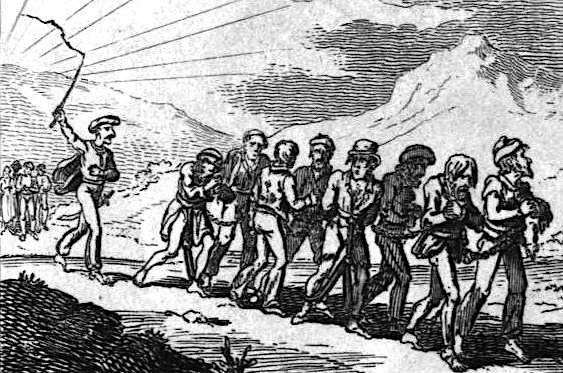
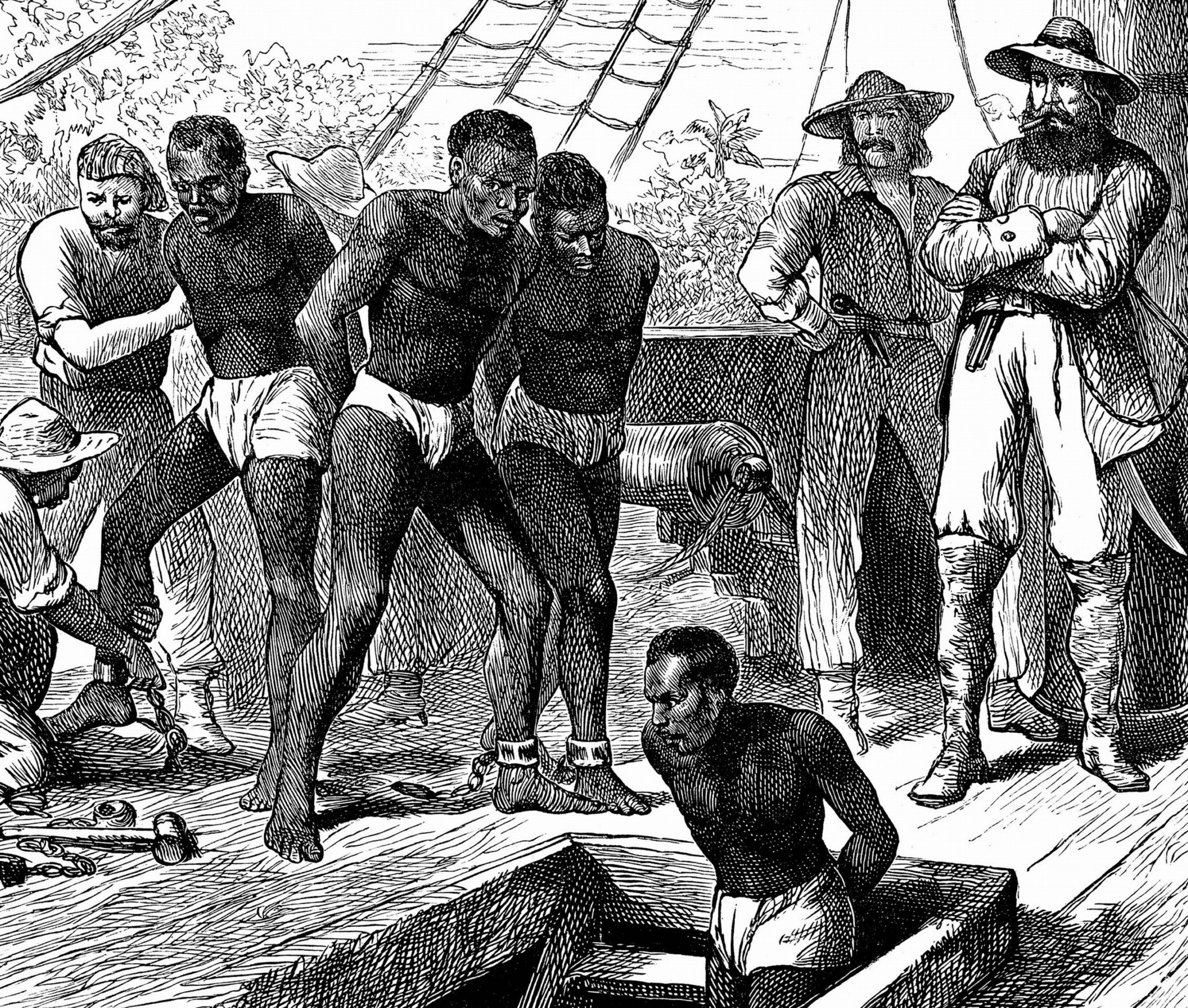
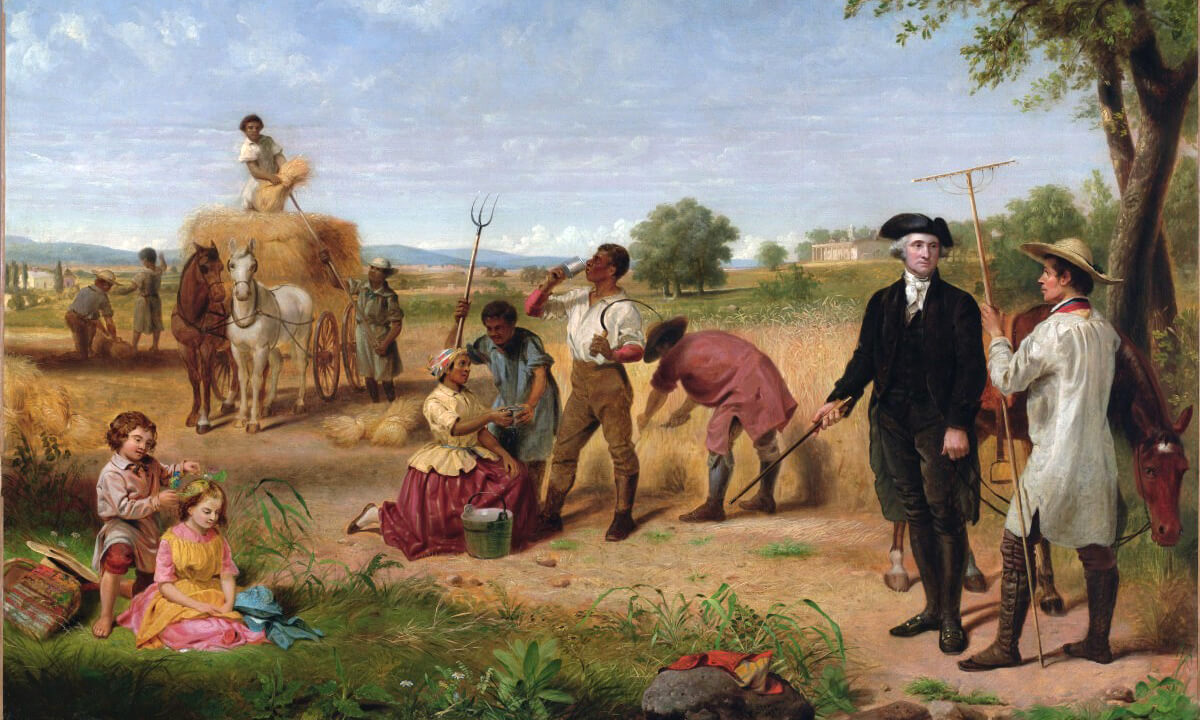
The issue of slavery in America’s Founding Era was complex. Initially, many people saw slavery as a normal part of life; this perspective is acknowledged by Chief Justice John Jay, who stated that, before the War for Independence, very few “doubted the propriety and rectitude of it.”1
However, the changing attitude towards slavery was evident even before the War for Independence when several colonies passed anti-slavery laws.2 (Each of these were overturned by King George III.3) Notably, a section of the Declaration of Independence written by Thomas Jefferson criticized the king for maintaining slavery and the slave trade.4
After the Declaration of Independence, states such as Massachusetts, Rhode Island, Connecticut, New Hampshire, Vermont, New York, and New Jersey abolished slavery.5 Additionally, Virginia, in 1778, outlawed the further importation of slaves.6
Among the Founders themselves, some slave-owners, such as Thomas Jefferson and George Washington, openly spoke against slavery.7 Conversely, others were demonstrably pro-slavery.8 There were also Founders involved in abolition movements. For example, Benjamin Franklin and Benjamin Rush helped establish the first abolition society in 1774.9 Furthermore, John Jay served as president of the New York abolition society.10
Again, this was a complicated issue for Americans during the Founding Era, but the actions of many demonstrate that this reprehensible practice had much opposition among the Founders. For more information on this topic, please see these additional resources.
1 John Jay, The Correspondence and Public Papers of John Jay, ed. Henry P. Johnston (New York: G.P. Putnam’s Sons, 1891), 3:342, to the English Anti-Slavery Society, June 1788.
2 W.O. Blake, The History of Slavery and the Slave Trade (Columbus: J. & H. Miller, 1858), 386; George M. Stroud, A Sketch of the Laws Relating to Slavery in the Several States of the United States of America (Philadelphia: Kimber and Sharpless, 1827), 137; Thomas F. Gordon, The History of Pennsylvania from its Discovery by Europeans to the Declaration of Independence in 1776 (Philadelphia: Carey, Lea & Carey, 1829), 554-555.
3 Benjamin Franklin, The Works of Benjamin Franklin, ed. Jared Sparks (Boston: Tappan, Whittemore, and Mason, 1839), 8:42, to Dean Woodward on April 10, 1773; Benson J. Lossing, Harpers’ Popular Cyclopaedia of United States History (New York: Harper and Brothers, 1892), 1299.
4 Thomas Jefferson, The Writings of Thomas Jefferson, ed. Albert Ellery Bergh (Washington DC: Thomas Jefferson Memorial Association, 1903), 1:34, from Jefferson’s original draft of the Declaration of Independence. This section was removed on the objection of two states: Thomas Jefferson, Memoir, Correspondence, and Miscellanies, ed. Thomas Jefferson Randolph (London: Colburn and Bentley, 1829), 1:16, from his Autobiography.
5A Constitution or Frame of Government Agreed Upon by the Delegates of the People of the State of Massachusetts-Bay (Boston: Benjamin Edes and Sons, 1780), 7; An Abridgement of the Laws of Pennsylvania, ed. Collinson Read, (Philadelphia: 1801), 264-266; The Public Statute Laws of the State of Connecticut (Hartford: Hudson and Goodwin, 1808), Book I, 623-625; Rhode Island Session Laws (Providence: Wheeler, 1784), 7-8; The Constitutions of the Sixteen States (Boston: Manning and Loring, 1797), 50, New Hampshire, 1792; The Federal and State Constitutions Colonial Charters, and Other Organic Laws of the States, Territories, and Colonies Now or Heretofore Forming The United States of America, ed. Francis Newton Thorpe (Washington DC: Government Printing Office, 1909), 6:3762, Vermont, 1793; Laws of the State of New York, Passed at the Twenty-Second Session, Second Meeting of the Legislature (Albany: Loring Andrew, 1798), 721-723; Laws of the State of New Jersey Compiled and Published Under the Authority of the Legislature, ed. Joseph Bloomfield (Trenton: James J. Wilson, 1811), 103-105.
6The Statues at Large; Being A Collection of all the Laws of Virginia From the First Session of the Legislature in the Year 1619, ed. William Waller Henning (Richmond: J & G Cochran, 1821), IX:471-472, “An act for preventing the farther importation of Slaves,” October, 1778.
7 Paul Leland Haworth, George Washington: Farmer (Indianapolis: Bobbs-Merrill Company, 1915), 192; Mary V. Thompson, “The Only Unavoidable Subject of Regret,” Mount Vernon, 1999; The Works of Thomas Jefferson, ed. Paul Leicester Ford (New York: G.P. Putnam’s Sons, 1905), 11:417, to Edward Coles on August 25, 1814; Thomas Jefferson, The Writings of Thomas Jefferson, ed. H.A. Washington (New York: Riker, Thorne, & Co., 1855), 6:378, to Thomas Cooper on September 10, 1814; Thomas Jefferson, Notes on the State of Virginia (Philadelphia: Mathew Carey, 1794), 236-238, “Query XVIII.”
8 See, for example, Jeffrey Crow, “Liberty to Slaves: The Black Response,” Anchor, accessed August 23, 2023; James Madison, The Writings of James Madison, ed. Gaillard Hunt (New York: G.P. Putnam’s Sons, 1903), 4:267-268, “Journal of the Constitutional Convention,” August 22, 1787; The Debates and Proceedings in the Congress of the United States, ed. Joseph Gales (Washington DC: Gales and Seaton, 1834), 1:1242-1243, February 12, 1790.
9Constitution of the Pennsylvania Society for Promoting the Abolition of Slavery, and the Relief of Free Negroes, Unlawfully Held in Bondage. Begun in the Year 1774, and Enlarged on the 23rd of April, 1787 (Philadelphia: Joseph James, 1787), 8.
10 “Race and Antebellum New York City: The New York Manumission Society,” New York Historical Society, accessed August 23, 2023; The Works of Samuel Hopkins (Boston: Doctrinal Tract and Book Society, 1854), 2:548, Advertisement page for “A Dialogue Concerning the Slavery of the Africans.”
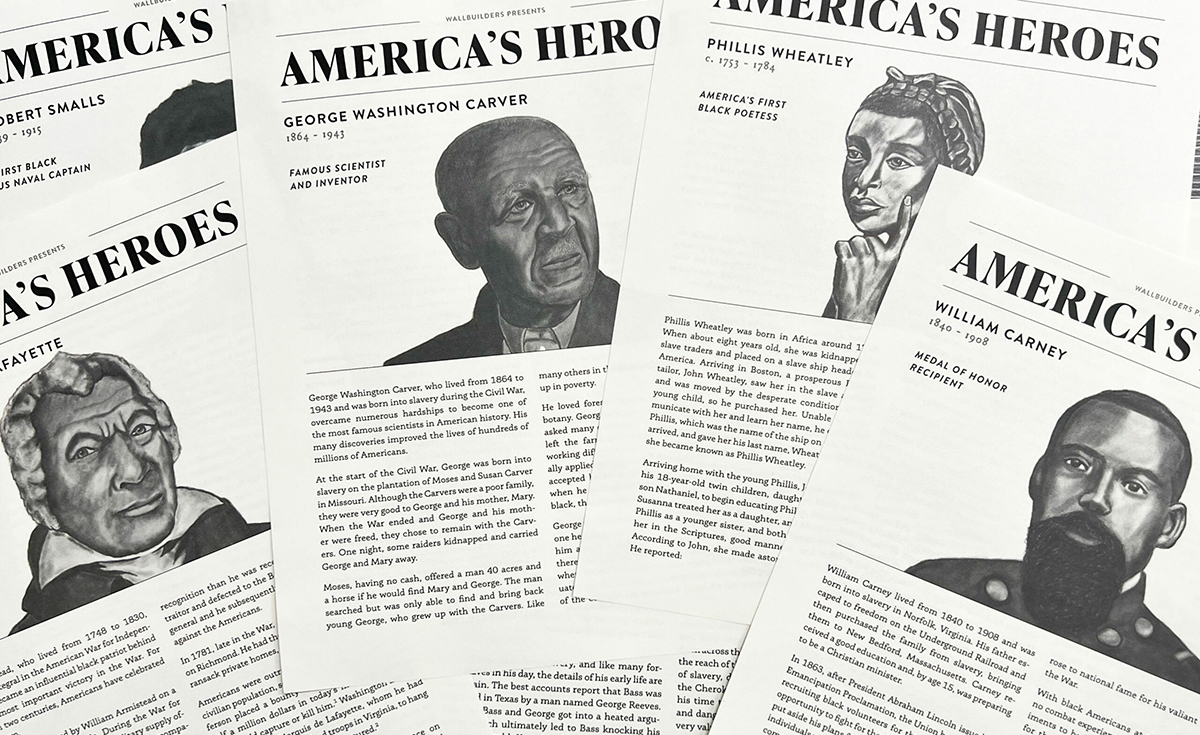
James Armistead, who lived from 1748 to 1830, played an integral role in the American War for Independence and became an influential black patriot behind America’s most important victory in the War. For more than two centuries, Americans have celebrated him as a hero.
James was a slave owned by William Armistead on a farm near Richmond, Virginia. During the War for Independence, William became a military supply officer for the Continental Army and James accompanied him. In the latter stages of the War, both personally witnessed the vicious and brutal attack on their friends and neighbors in Richmond led by British General Benedict Arnold.
In the early part of the War, Arnold was an American general and a military hero from the Battle of Saratoga, the first major American victory in the Revolution. But Arnold’s wife and family supported the British, and Arnold was arrogant and wanted more recognition than he was receiving, so he became a traitor and defected to the British. They made him a general and he subsequently led a number of battles against the Americans.
In 1781, late in the War, Arnold led a surprise attack on Richmond. He had the British troops burn the city, ransack private homes, and loot personal valuables.
“Stagecoach” Mary Fields lived from 1832 to 1914 and embodied the American Old West qualities of hard work, toughness, and faith.
Born into slavery in Tennessee, she was enslaved by a pro-slavery Unionist Democrat, Judge Edmund Dunne. He traveled the country extensively throughout his life. He moved from New York to Tennessee, became a California legislator, served as a Chief Justice of the Arizona Territory, a member of the convention that wrote the original constitution of Nevada, and he helped found a Catholic colony in Florida. Judge Dunne’s activities literally carried him from coast to coast.
After slavery ended with the passage of the 13th Amendment, Mary was freed but chose to continue living with the Dunne family. When the judge’s wife died in 1883, Mary took the judge’s five children to his sister, Mother Amadeus, a nun who headed a convent in Toledo, Ohio. The following year, Mother Amadeus was sent to Cascade, Montana, to start a school for Native American girls alongside a school for the Blackfeet Tribe run by Jesuit priests. When Mother Amadeus became deathly ill, Mary hurried to Montana to nurse her back to health.
Bass Reeves, who lived from 1838 to 1910, is one of the most famous lawmen of the Old West. He served in a region, that at that time, was perhaps one of the most dangerous in the country, and the story of his life is filled with fascinating events and incredible moments.
Reeves was born into slavery, and like many former slaves in his day, the details of his early life are uncertain. The best accounts report that Bass was enslaved in Texas by a man named George Reeves. One day Bass and George got into a heated argument, which ultimately led to Bass knocking his master out cold. Knowing that he would likely be killed or at least brutally punished for what he had done, Bass fled across the Texas border to the wild and rugged Indian Territory, which would later become Oklahoma.
Few were inclined to pursue anyone into that Territory, not only because of the direct danger from Native Americans but also because of the countless outlaws and bandits who lived there. The Territory had little organized justice, so for years criminals from across the nation fled there to be safely beyond the reach of the law. Bass, fleeing from the injustice of slavery, did the same. He became friends with the Cherokee, Creek, and Seminole tribes. During his time there, he learned much about that wild and dangerous region, something which would be very valuable to him later.
Robert Smalls, who lived from 1839 to 1915, was a slave in Charleston, South Carolina. He piloted steamboats along the Atlantic seaboard and earned a reputation for his exceptional navigational skills. At the outbreak of the Civil War, he was forced into naval service on a boat called the Planter, which was the flagship of Confederate General Roswell Ripley. Although Robert was the pilot of the ship, he did not hold that title since a slave in the Confederate South was not allowed to have such an important post.
One evening, the officers went ashore to attend a party. Robert and the rest of the slave crew decided this was a perfect time for their escape. The Union navy had surrounded and blockaded Charleston, so if they could get the ship safely out of the harbor and reach those Union ships, they would be free from slavery. Robert headed the ship toward the open sea. Knowing he would have to pass Confederate checkpoints along the waterway, Robert donned the Confederate captain’s clothing and hoisted the Confederate flag. Moving the ship along and blowing its usual signals, he avoided unwanted attention but still faced two major obstacles: Fort Johnson and Fort Sumter. They safely passed the first, but as they neared Sumter, the starting place of the Civil War, some of the crew, fearing the great danger they now approached, urged him to turn back.
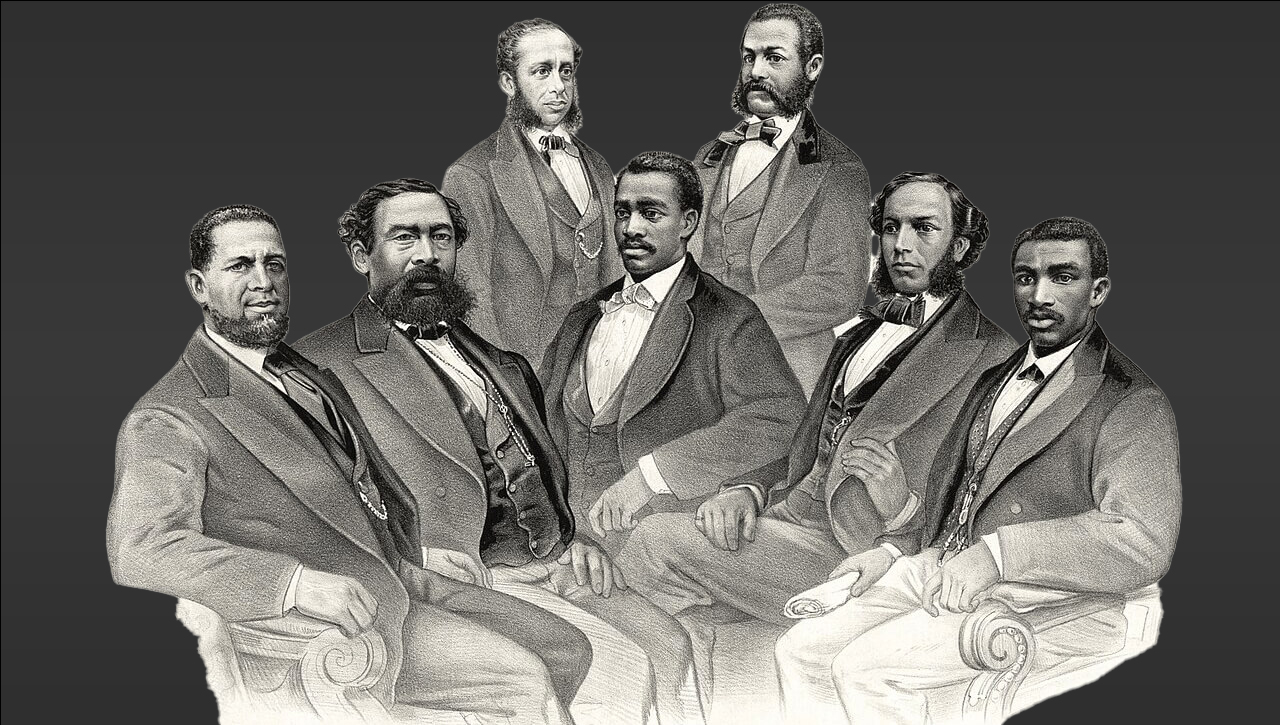
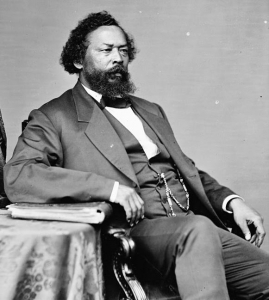
Born a slave in North Carolina in 1825, the “fair” education Benjamin Turner1 received was more than most slaves. Turner, who had helped manage his owner’s hotel and stable, had enough of his own money to purchase property in Selma, Alabama around the time the Civil War started. When the town was captured during the war, much of the city was burned leaving Turner with $8,000 in damages as the result. Turner’s elected positions included: tax collector (1869), councilman for Selma (1869), and US Congress (1871-1873). After his Congressional term, Turner2 returned to business pursuits and ran a farm until his death in 1894.
Josiah Walls3 was born into slavery in Virginia in 1842. He was a private servant to a Confederate soldier until he was emancipated by Union soldiers in 1862. Walls received some education before he decided to serve with the Union Army from 1863-1865. After his wartime service, he lived in Florida and used his earnings from working as a teacher to buy a farm. His elected positions included: state senator (1869-1872, 1876-1879) and US Congress (1871-January 1873; March 1873-1875 & 1875-1876). Walls4 returned to his farm after his political career ended and later ran the farm for Florida Normal College (now Florida A&M) until his death in 1905.
Jefferson Long5, born a slave in Georgia in 1836, was self-educated and ran his own successful tailoring business. Long worked to promote literacy/education opportunities for blacks in Georgia after the Civil War and was known as a great orator. He became the second black American elected to the House of Representatives, and though he only served for 3 months (January-March 1871) Long was the first black representative to speak on the House floor. Long6 went back to his tailoring shop after his time in Congress and opened other businesses before his death in 1901.
It’s important for all of us to learn more about other black history heroes7 to keep alive the memory of these American heroes!
In the 1800s, February 22 was annually celebrated as George Washington’s Birthday in many localities throughout the new American nation. An official federal holiday recognizing this day, however, was not declared until 1879.
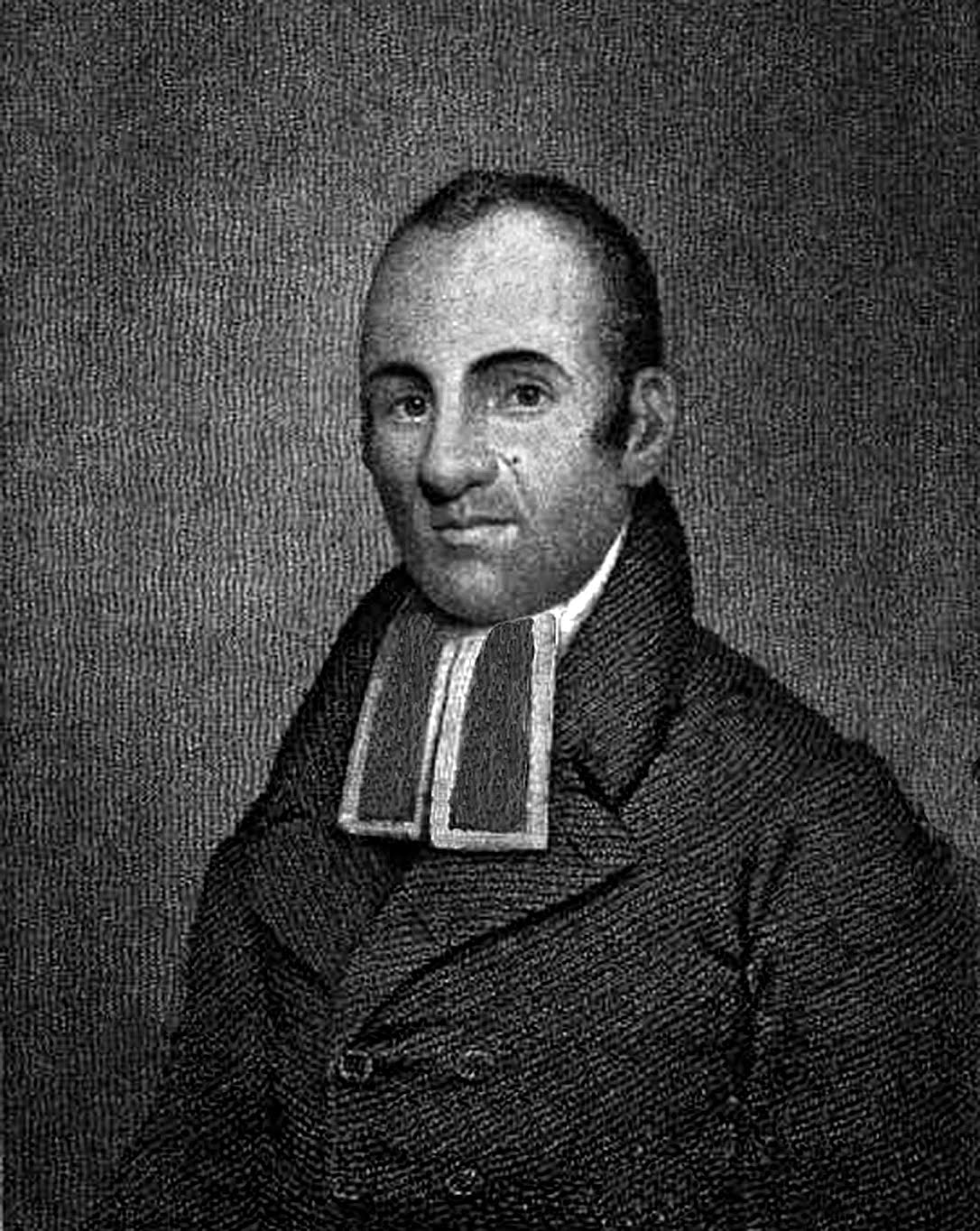
Black hero Lemuel Haynes has an interesting tie to Washington’s Birthday celebrations. Haynes was a Minuteman in the War for Independence and participated in the expedition against Fort Ticonderoga. After he became a minister in 1785, he preached for both all-white and mixed congregations. About 40 years after his participation in the War, Haynes preached a sermon on Washington’s Birthday, noting:
Perhaps it is not ostentatious [bragging] in the speaker to observe that in early life he devoted all for the sake of freedom and independence, and endured frequent campaigns in their defense, and has never viewed the sacrifice too great.
In 1968, a Congressional Act was passed that moved the celebration of Washington’s Birthday to the third Monday in February. This holiday is now called PresidentsDay and celebrates all of America’s presidents.
Democratic Senator Tim Kaine announced on the floor of the Senate that:
“The United States didn’t inherit slavery from anybody. We created it.”1
For even the most basic student of world history such a statement ought to immediately be recognized as incomprehensively ridiculous. Historically, every single people, nation, culture, and race has at various times been both the slave and the master. Indeed, “all have sinned and fallen short” (Romans 3:23). Sen. Kaine, just like the famously inaccurate 1619 Project, must ignore documented history and create his own fantasy world to arrive at such a conclusion.
For example, in ancient Greece—which existed thousands of years before America—nearly 30% of their population were slaves. The Roman Empire reached a staggering 40%.2 In fact, one of the most significant and widely known aspects of the Bible centers around the Israelites being delivered out of slavery in Egypt through the famous Exodus. We could walk through every nation in human history and find a tragic past riddled with slavery.
Arab Slavers
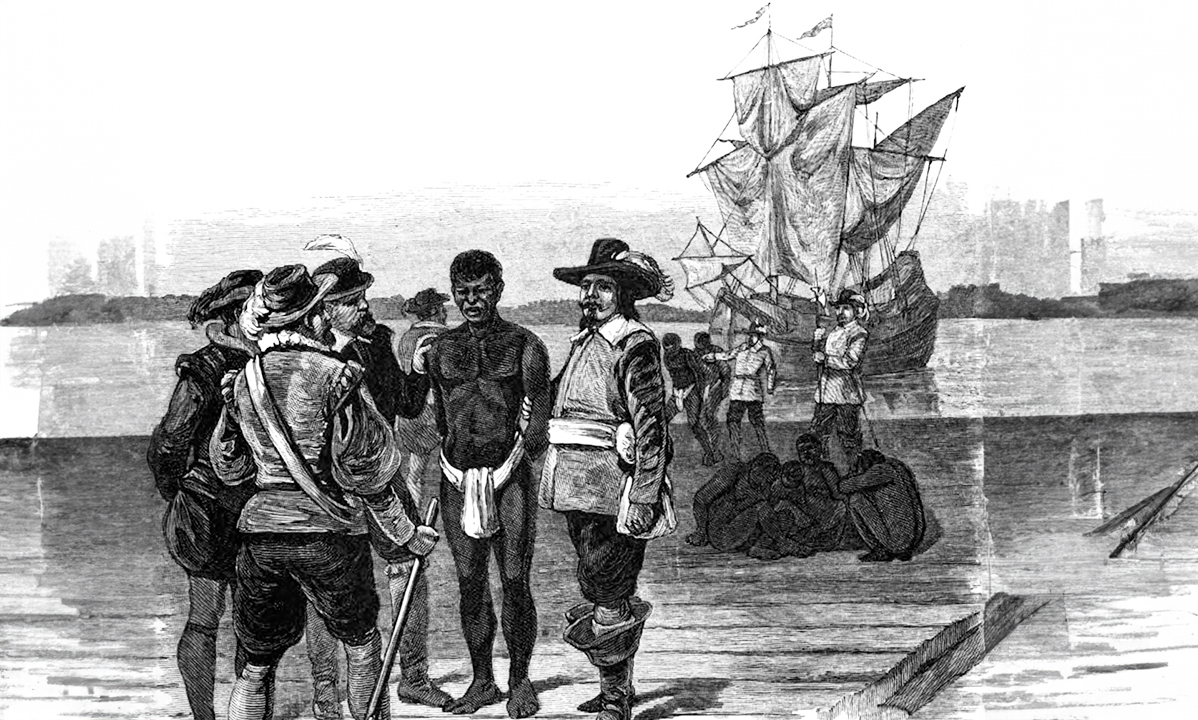
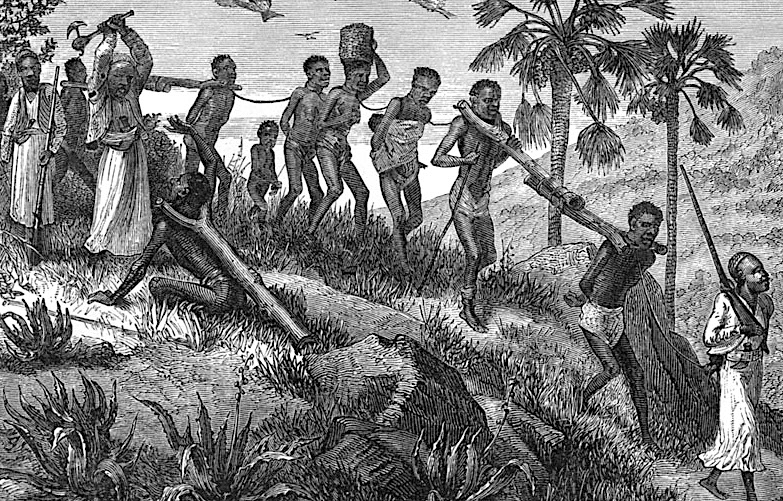
Prior to the creation of the Trans-Atlantic Slave Trade by the Spanish from Africa to South America in the early 1500s, Africa already participated in a robust trans-Saharan and Indian Ocean slave trade. Black tribes would raid, capture, and enslave other black tribes for profit, selling them across the continent and beyond. Many of these slaves were sold into the Islamic Middle East, and “medieval Arabs came to associate the most degrading forms of labor with black slaves.”3 Most likely it was this racial bias which was translated to the Iberian Peninsula (i.e., Spain and Portugal) when the Muslims conquered parts of that area in the 8th century. When the Spanish became the first European nation to significantly colonize the New World, they seemingly brought this bias with them which was thereby disseminated through the Americas, North, Central, and South. In this sense, America very literally inherited racial slavery—from the Arab Middle East through Spain.
Christian Slaves
What is perhaps even more astounding is that a larger number of white Europeans were captured and sold into African slavery than the number of Africans sold into the land that would become the United States. Just over 300,000 black slaves landed in the North American colonies which became America4 but 1,250,000 white Europeans were captured and shipped to slave markets in Northern Africa.5 This Barbary Coast Trade lasted longer than American slavery and was only stopped through the naval efforts of the British and Americans. Furthermore, it was not until the late 17th century that black slaves in the New World outnumbered white slaves in the Old.6
Additionally, for hundreds of years before Christopher Columbus ever conceived of the idea to sail westward, the Native Americans practiced mass slavery amid other practices including human sacrifice and cannibalism. This pre-Columbian native slave trade was so prolific that “wherever European conquistadors set foot in American tropics, they found evidence of indigenous warfare, war captives, and captive slaves.”7 Indeed, indigenous cultures saw slavery rates so prevalent that up to 20-40% of all Indians were enslaved by other Indians.8
Trans-Atlantic Slave Trade
Even today, nearly 160 years after America became one of the first nations to abolish slavery, there are still 94 nations that do not have laws criminalizing slavery.9 This has led to the enslavement of over 40 million people in the world right now. In a stroke of tragic irony, Africa has the highest rate of slavery today, closely followed by Asia,10 while North America has the lowest.11 Currently, Africa holds some 9,240,000 people in chains and slavery today,12 which is nearly identical to the total number of slaves disembarked in the entire New World (North, Central, and South America) throughout the almost four centuries of the Trans-Atlantic slave trade.13
So, clearly Sen. Tim Kaine must either be completely ignorant about the history of slavery or maliciously intentional in his presentation of “facts.” America in no way created slavery—in fact, if we were to say anyone “created” slavery in America we must conclude that the indigenous people did so. By contrast, the United States, despite its well-known shortcomings, ought to receive credit for having done more than nearly any other nation in the history of the world to fight slavery both in the past and today.
(Our book, The American Story: The Beginnings, has extensive information on the history of slavery not only in the United States but also the world.)
Endnotes
1 Tobias Hoonhout, “Dem Sen. Kaine Claims United States ‘Created’ Slavery and ‘Didn’t Inherit Slavery from Anybody,’” National Review, June 16, 2020. 2 Fernando Santos-Granero, Vital Enemies: Slavery, Predation, and the Amerindian Political Economy of Life (Austin: University of Texas Press, 2009), 226-227. 3 Philip Morgan, “Origins of American Slavery,” Organization of American History Magazine of History (July 2005), 19:4:53. 4 “Summary Statistics,” Slave Voyages, accessed June 16, 2020. Summary Statistics with the Principle Place of Slave Landing being restricted to Rhode Island, Maine, New Hampshire, Massachusetts, Connecticut, New York, New Jersey, Pennsylvania, Maryland, Virginia, North Carolina, South Carolina, Georgia, Florida, the Gulf Coast, and “Other North America.” 5Past & Present (Aug., 2001), No. 172, 118, Robert C. Davis, “Counting European Slaves on the Barbary Coast”; Robert C. Davis, Christian Slaves, Muslim Masters: White Slavery in the Mediterranean, the Barbary Coast, and Italy, 1500-1800 (NY: Palgrave MacMillan, 2004), 23-24. 6 Morgan, “Origins of American Slavery,” American History Magazine (July 2005), 19:4:53. 7 Santos-Granero, Vital Enemiese (2009), 1. 8 Santos-Granero, Vital Enemies (2009), 226-227. 9 Sonia Elks, “Slavery is Not a Crime for Almost Half the Countries in the World,” Reuters (February 12, 2020), accessed June 16, 2020. 10 “Prevalence Across the Regions,” Global Slavery Index (2018), accessed June 16, 2020, here. 11 “Regional Highlights: Americas,” Global Slavery Index (2018), accessed June 17, 2020, here. 12 “Region Highlights: Africa,” Global Slavery Index (2018), accessed June 16, 2020, here. 13 “Summary Statistics,” Slave Voyages, accessed June 16, 2020.
* This article concerns a historical issue and may not have updated information.
In the midst of all the passion, division, and activism, there should be at least one central premise that every American can agree on—that life matters. But increasingly the truth is becoming clear that only certain lives matter. Specifically speaking, leftist activist group “Black Lives Matter” says one thing but then works to destroy the lives of thousands of black people.
For example, on the BLM “What we Believe” page they claim to be:
Guided by the fact that all Black lives matter, regardless of actual or perceived sexual identity, gender identity, gender expression, economic status, ability, disability, religious beliefs or disbeliefs, immigration status, or location (emphasis added).[i]
In every location, that is, except the womb.
Since nearly the beginning of the organization, BLM has associated themselves with anti-life groups, while in the same breath ironically declaring that, “our lives are at stake.”[ii] One co-founders of BLM explained that, “we certainly understand that BLM and reproductive justice go hand in hand.”[iii]
Calling abortion “reproductive justice” cannot hide the fact that for every successful abortion there is a victim whose life apparently didn’t matter enough. Such double-speak only attempts to deflect the attention away from the ideological hypocrisy rampant in the organization.
Overall in America, there were 862,000 babies killed by abortion in 2017, which means an average of 2,362 a day.[iv] Statistically, in 2016 (the most recent year for which data exists), 38% of abortions were by black women.[v] Thus, an estimated 898 black babies die every single day, and as many as 327,560 per year.
To expand our inquiry even further, there have been over 60,000,000 abortions since Roe v. Wade in 1973.[vi] Just how many millions of black children didn’t matter? Certainly more than the total number of slaves ever brought from Africa. It should, therefore, come as no surprise that in New York a higher percentage of black babies are aborted than born.[vii] This is an odd kind of justice.
Paradoxically, the main group claiming to champion black lives supports those institutions that kill more black people daily than the police have killed—whether justified or not—in the last three years combined.[viii] Comparatively, a black person is 1,187 times more likely to never be born than they are to be killed by a police officer.[ix] Historically speaking, it takes abortion clinics less than four days to kill more black people than all of the Jim Crow lynchings combined.[x]
So, do black lives really matter? I believe they do, and that is why we must abolish abortion.
Endnotes
[i] “What We Believe,” Black Lives Matter (accessed June 19, 2020).
[ii] “Black Lives Matter Partners With Reproductive Justice Groups to Fight for Black Women,” Color Lines (February 9, 2016), accessed June 19, 2020, here.
[iii] “Black Lives Matter Partners With Reproductive Justice Groups to Fight for Black Women,” Color Lines (February 9, 2016), accessed June 19, 2020, here.
[iv] “The U.S. Abortion Rate Continues to Drop: Once Again, State Abortion Restrictions Are Not the Main Driver,” Guttmacher Institute (September 18, 2019), accessed June 19, 2020, here.
[v] “Abortion Surveillance — United States, 2016,” Centers for Disease Control and Prevention (November 29, 2019), accessed June 19, 2020, here.
[vi] “The State of Abortion in the United States,” National Right to Life Committee (January 18, 2018), accessed June 19, 2020, here.
[vii] “Abortion Reporting: New York City (2016),” Charlotte Lozier Institute (December 19, 2018), accessed June 19, 2020, here.
[viii] “National Trends,” Mapping Police Violence (accessed June 19, 2020), here. More specifically there were 783 black Americans killed by police in both justified and unjustified situations in the years, 2017 (276), 2018 (248), and 2019 (259).
U.S.C.T. and the Symbolism of the Flag in the Civil War
The flag of the United States of America is the perennial symbol of the nation, but its meaning is constantly under debate. Recently, several major media incidents have questioned the true value of the Stars and Stripes—specifically whether the flag symbolizes racism or freedom.[1] Certain high-profile activists and revisionists claim that since the American flag flew over the nation while slavery remained active, it still condones racism today.
Such a perspective, interestingly, is not entirely unheard of in our nation’s past. Several years before the Civil War, great abolitionist leader Frederick Douglass (himself an escaped slave) summarized the sentiments of black Americans towards the federal banner at that time, saying:
“While slavery exists, and the union of these states endures, every American citizen must bear the chagrin of hearing his country branded before the world as a nation of liars and hypocrites; and behold his cherished national flag pointed at with the utmost scorn and derision.”[2]
As long as slavery was permitted and protected by the Union flag Douglass carried an attitude similar to those of recent critics. However, Douglass’s statement is conditional upon the existence of slavery, thereby suggesting that abolition would elevate the symbolic nature of the flag and improve its reception by black Americans.
History reveals that Douglass was correct. Throughout the Civil War the men of the United States Colored Troops and those closely associated with the fight for freedom began to see the national flag in a different and positive light. Their patriotism and sacrifice redeemed the meaning of the flag, changing its reception in the black community from a symbol of slavery to one of liberty.
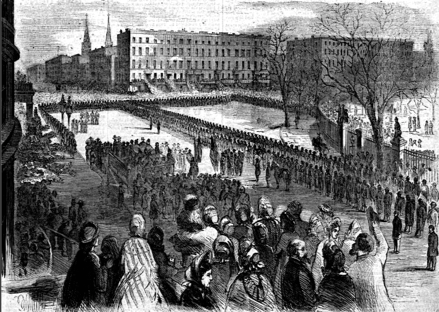
20th Regiment Receiving Flag
The journey of the flag and the black community during the Civil War largely began once black units were formed after the military opened its ranks to all people. Following custom, the Colored Troops, like many white units, received both a regimental and national flag, often from their local town, before going off to war.
For example, when the 20th US Colored Regiment was sent out of their native New York, Charles King, the son of Founding Father Rufus King, bestowed, “the flag of the Union and of Liberty to the first regiment of colored troops that has marched from this city to defend both.”[3] One paper considered the scene so important that an engraving was made, saying that, “no scene of the war has been more striking or significant.…[as] the flag of the country waved over them in benediction.”[4]
In his speech, Charles King imbued the national flag with a special meaning before passing it into the protection of its freshly “sworn defenders and guardians.”[5] King relates the flag’s significance to that of their shared faith, explaining that:
“The religion to the flag is second only to the religion of the altar.…Hence he who is false to his flag is false to his altar and his God.”[6]
To imply a spiritual significance to the defense of the flag most certainly would have affected the listeners. He went on to explain that by joining the military and risking their lives for those still bound by slavery, they not only elevate the flag but themselves also. Declaring that:
“When you put on the uniform and swear allegiance to the standard of the Union, you stand emancipated, regenerated, and disenthralled—the peer of the proudest soldier in the land.”[7]
The speech received a warm reception by both the citizens in attendance and the soldiers of the 20th Colored Regiment. The officer in charge received the flag saying:
“This beautiful banner symbolizes our country. It is this that makes death glorious beneath its starry folds—it is this that rouses the feelings of outraged honor when we see it trailed in the dust. How base and how dead to all sense of honor, must that wretch be whose brow burns not with shame and rage at the dishonor of the flag of his country.”[8]
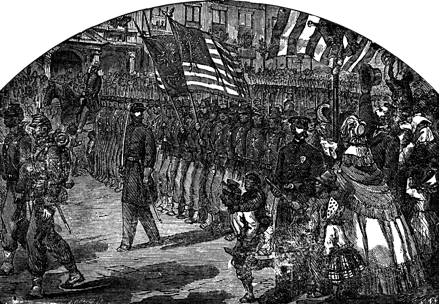
20th Regiment on Parade
Furthermore, in the lunch and procession following the presentation the soldiers of the 20th praised the speeches of Charles King and Col. Bartram, reflecting on how, “that flag is a big thing, boys.”[9] The men were beginning to see the Union flag not as the banner which had allowed slavery and oppression, but rather as the standard by which they could personally advance freedom’s cause.
The 20th were far from the only black soldiers to recognize the symbolic significance of receiving the national flag. For example, the 29th Regiment out of Connecticut enjoyed a bestowal ceremony, where, “to the surprise of the regiment we were presented with the United States national colors, which greatly pleased the boys.”[10] The 1st African Descent Regiment from Iowa were also presented with “a beautiful silk national flag” by the women of their state, “which was carried through the storms of battle, and returned at the close of the war to the State.”[11]
Most notably, however, the 1st South Carolina Volunteer Regiment (later the 33rd Colored) revealed their elevated affection to the national flag on many occasions. One evening a month before the Emancipation Proclamation went into effect, several men from the 1st began to give speeches to encourage the troops. Their commanding officer, Col. Thomas Higginson (a pastor and abolitionist) recorded the speech of Corporal Prince Lambkin, who was, “one of our color-guard, and one of our ablest men.”[12] Lambkin told his fellow slaves-turned-soldiers:
“Our masters they have lived under the flag, they got their wealth under it, and everything beautiful for their children. Under it they have ground us up, and put us in their pocket for money. But the first minute they think that ol’ flag meant freedom for we colored people, they pulled it right down, and run up a rag of their own. [Immense applause.] But we’ll never desert they ol’ flag, boys, never; we have lived under it for eighteen hundred sixty-two years [sic], and we’ll die for it now.”[13]
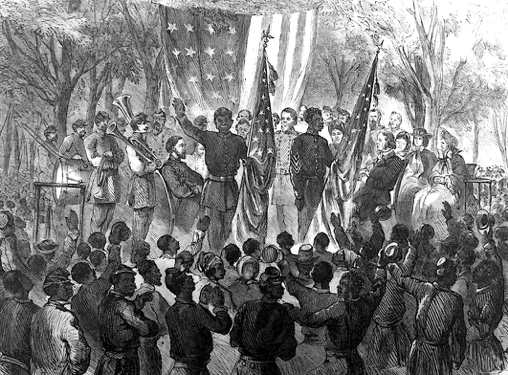
1st South Carolina Flag Ceremony
The speech was remembered by the Colonel as, “one of the few really impressive appeals for the American flag that I ever heard.” Less than a month after Lambkin’s speech, the 1st South Carolina were presented the national flag on the day, “Lincoln’s immortal proclamation of freedom was given to the world.”[14] Col. Higginson explained that after receiving the large silk flag:
“Then followed an incident so simple, so touching, so utterly unexpected and startling, that I can scarcely believe it on recalling, though it gave the keynote to the whole day. The very moment the speaker had ceased, and just as I took and waved the flag, which now for the first time meant anything to these poor people, there suddenly arose, close beside the platform, a strong male voice (but rather cracked and elderly), into which two women’s voices instantly blended, singing, as if by an impulse that could no more be repressed than the morning note of the song-sparrow: “My Country, ‘tis of thee, Sweet land of liberty, Of thee I sing!”
People looked at each other, and then at us on the platform to see whence came this interruption, not set down in the bills. Firmly and irrepressibly the quavering voices sang on, verse after verse; others of the colored people joined in; some whites on the platform began, but I motioned them to silence. I never saw anything so electric; it made all other words cheap; it seemed the choked voice of a race at last unloosed. Nothing could be more wonderfully unconscious; art could not have dreamed of a tribute to the day of jubilee that should be so affecting; history will not believe it; and when I came to speak of it, after it was ended, tears were everywhere. If you could have heard how quaint and innocent it was!
Just think of it! The first day they had ever had a country, the first flag they had ever seen which promised anything to their people, and here, while mere spectators stood in silence, waiting for my stupid words, these simple souls burst out in their lay, as if they were by their own hearths at home! When they stopped there was nothing to do for it but to speak, and I went on; but the life of the whole day was in those unknown people’s song.”[15]
The men of the 1st South Carolina bravely bore those flags throughout the war and, after victory, recalled with pride that, “it has never been disgraced by a cowardly faltering in the hour of danger, or polluted by a traitor’s touch.”[16] The success of the black divisions was measured, both by themselves and others, by their steadfast protection of the national flag through unflinching heroism and endless courage.
Nothing displays this more clearly than the numerous moments of bravery by black soldiers protecting the flag. No less than seven African Americans received the Medal of Honor for valiantly defending the national flag in battle.[17] The most famous example remains that of Sgt. William Carney who, though wounded twice, led the Massachusetts 54th through the Battle of Fort Wagner despite the overwhelmingly desperate situation.[18]
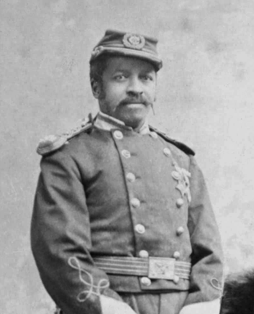
Christian Fleetwood
Additionally, several men at the Battle of Chaffin’s Farm received the Medal of Honor for not allowing the colors to touch the ground. Sgt. Alfred B. Hilton took up both the flag and the regimental standard once the original color bearers were shot. Thereafter, when Hilton himself was severely wounded, Sgt. Christian Fleetwood caught the national flag before it fell to the ground, and carried it through the rest of the fight—with General Butler himself allegedly witnessing their bravery.[19]
Such noble actions, however, were far from rare in the black units. At the Battle of the Crater the 43rd Colored Regiment gave ample proof of this for, “as each brave color bearer was shot down, another and another would immediately grasp the National emblem, all riddled with balls and plant it further on the enem[y’s] line,” until the flag was, “almost entirely cut up by the fire, and the Color Staffs splintered and broken.”[20] The list of heroic deeds in defense of the flag extends well beyond the few stories mentioned above, a fact which led USCT veteran and Civil War historian George Washington Williams to rejoice that, “the one flag of a great nation will float as the sovereign symbol of a free and united people.”[21]
The officers of these units particularly were struck by the devotion black troops showed to the flag under which so much oppression had been so recently practiced. For example, Lieutenant Joseph G. Golding of the 6th Colored Infantry recalled that his men bravely fought and nobly sacrificed, “to the utmost, even to the laying down of their lives for us, for the flag, [and] for the perpetuation of the grandest nationality the sun shines upon.”[22] That unit specifically suffered a 57% casualty rate throughout the War. Similarly, when the 33rd USCT mustered out at the end of the war, their commanding officer, Lt. Col. Trowbridge, explained in his final order that as a result of their efforts:
“Millions of bondsmen have been emancipated, and the fundamental law of the land has been so altered as to remove forever the possibility of human slavery being established within the borders of redeemed America. The flag our fathers, restored to its rightful significance.”[23]
Trowbridge explicitly applauds the USCT for helping to redeem the national symbol, elevating it finally to the standard which the Founding Fathers had envisioned.
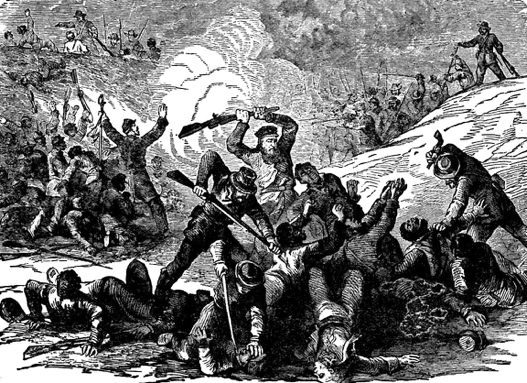
Fort Pillow Massacre
A natural result following the tireless devotion of the soldiers to the flag was that the nation as a whole also began to judge the flag by the way the government pursued liberating the slave population and the treatment of the African American soldiers. A major issue surrounded the revelation that Confederates would mistreat, brutalize, and kill the black troops if they were captured through the course of the war. One officer remarked that, “they fought with ropes round their necks,” because for them it was either victory or death.[24]
In response to the tragedy of Fort Pillow and the growing evidence that black prisoners were systematically treated horribly, an article in Harper’s Weekly demanded retaliation on the honor of the national flag. The author concluded that:
“After due delay, if the Government should find that the natural suspicion of foul play is correct, then if its retaliation is not swift, sure, and deadly, if the rebels are not taught, as by fire, that every man who fights beneath the national flag is equally protected by the people whose sovereignty that flag symbolizes, we are simply unworthy of success.”[25]
Through the course of the Civil War the status of the flag and the meaning it carried directly corresponded to the issue of abolition and equal rights.
After the war, the black men who fought under the American flag and were freed by that banner reflected this redeemed symbolism through both word and deed. Significantly in the years immediately following, many of the newly elected black congressmen pointed to the brave service of the USCT and their valiant defense of the national flag as evidence of their patriotism and rights.
One of the first to do so was Representative Richard Harvey Cain. A prominent pastor as well as one of the first African Americans elected to national office, Cain explained in a speech supporting increased civil rights that he had hoped to fight in the War due to his desire to, “vindicate the Stars and Stripes.”[26]
For the redemption of the flag, Cain, and thousands like him, sought to serve under that standard in order to effect such a change. Speaking on behalf of the black community which elected him, Cain explained:
“We propose to identify ourselves with this nation….We will take the eagle as the emblem of liberty; we will take that honored flag which has been borne through the heat of a thousand battles.[27]
Now, after the Civil War, the national flag finally stands as a suitable symbol for his constituents. Cain suggests that the Star-Spangled Banner rightfully encompasses both black and white, concluding that:
“Under its folds Anglo-Saxon and Africo-American can together work out a common destiny, until universal liberty…shall be known throughout the world.”[28]
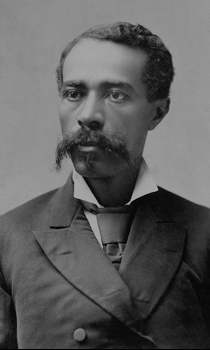
John Roy Lynch
In the following session of Congress, another black Representative—John Roy Lynch—confirmed Cain’s sentiments through his defense of the Civil Rights Act of 1875. Born into slavery and freed only through the Emancipation Proclamation, Lynch’s perspective on the flag carries significant weight as he was once enslaved under its authority, then freed by it. In an eloquent expression Lynch proclaimed:
“I love the land that gave me birth; I love the Stars and Stripes. This country is where I intend to live, where I expect to die. To preserve the honor of the national flag and to maintain perpetually the Union of the States hundreds, and I may say thousands, of brave, and true-hearted colored men have fought, bled, and died. And now, Mr. Speaker, I ask, can it be possible that that flag under which they fought is to be a shield and a protection to all races and classes of persons except the colored race? God forbid!”[29]
Such a sentiment poignantly reflects the increasing veneration and regard for the national flag due to the results of the Civil War. Lynch had been born into slavery under the national standard, then liberated by those fighting for it, and now is himself defending the newfound meaning of the flag through the very institution of Congress which once had so powerfully operated against him.
Similarly, the continued importance of the aforementioned Medal of Honor recipient Sgt. Christian Fleetwood in the national black society gives valuable insight into how drastically the communal reception of the flag had changed on account of the war. Fleetwood’s bravery brought him public recognition to such a degree that he was, “known from one end of the Country to the other.”[30]
Settling into the Washington DC area once peace had been achieved, he capitalized on his influential standing and used his fame to train the next generation of black Americans to see the nation and flag the way he did. In addition to advocating for the role of African Americans in the military, he even formed and trained a black cadet corps. Fleetwood’s effort eventually led to the formation of the first black National Guard unit—paving the way for later units.[31]
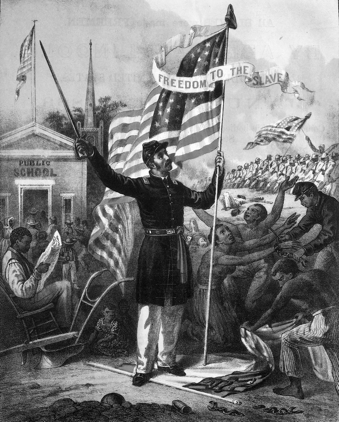
Freedom to the Slave Broadside
However, perhaps Frederick Douglass, with whom we began, most resoundingly displayed how the actions of the USCT and the end of slavery redeemed the symbolism of the national flag and its reception by black Americans. Once abolition became an official war goal, Douglass began, in his own words, “to persuade every colored man able to bear arms to rally around the flag, and help save the country and save the race.”[32]
After victory and the successful emancipation of all slaves, the famed orator relates a story of sailing on the USS Tennessee specifically noting that for the first time he could rejoice to finally live, “under the national flag, which I could now call mine, in common with other American citizens.”[33]
In a later speech, Douglass ventures even further and announces that that the national flag truly is, “a glorious symbol of civil and religious liberty, leading the world in the race of social science, civilization, and renown.”[34] Douglass, like many others, realized that the American flag of 1865 was radically different than the one of 1855—its destiny proved one not of derision, as first believed, but rather of deliverance.
Ultimately, the brave sacrifices from the United States Colored Troops, and those who stood alongside them, successfully redeemed the symbolism of the Stars and Stripes—purging from its folds any sanction of slavery. America could now march into the next era under a unified flag fulfilling the promise of the Founding Fathers that all men were created equal.
Furthermore, the reception of national standard in the black community was revolutionized. Leaders like Douglass, Fleetwood, Lynch, and Cain all rallied to the flag instead of railing against it. After generations of steadfast resolve and four years of unimaginable courage, the entire nation—black and white—could join with the men of the 20th and confidently say: “that flag is a big thing.”[35]
[2] Frederick Douglass, My Bondage and My Freedom (New York: Miller, Orton, and Mulligan, 1855), 438.
[3] “The Twentieth U.S. Colored Regiment,” Harper’s Weekly, March 19, 1864, 178.
[4] “The Twentieth U.S. Colored Regiment,” Harper’s Weekly, March 19, 1864, 178.
[5] “Twentieth U.S. Colored Regiment—Reception by the Union League—Speeches of Charles King and Colonel Bartram—Departure for the Seat of the War.” First Organization of Colored Troops in the State of New York, To Aid in Suppressing the Slaveholders’ Rebellion (New York: Baker and Goodwin, 1864), 16.
[6] “Twentieth U.S. Colored Regiment—Reception by the Union League—Speeches of Charles King and Colonel Bartram—Departure for the Seat of the War.” First Organization of Colored Troops in the State of New York, To Aid in Suppressing the Slaveholders’ Rebellion (New York: Baker and Goodwin, 1864), 16.
[7] “Twentieth U.S. Colored Regiment—Reception by the Union League—Speeches of Charles King and Colonel Bartram—Departure for the Seat of the War.” First Organization of Colored Troops in the State of New York, To Aid in Suppressing the Slaveholders’ Rebellion (New York: Baker and Goodwin, 1864), 17.
[8] “Twentieth U.S. Colored Regiment—Reception by the Union League—Speeches of Charles King and Colonel Bartram—Departure for the Seat of the War.” First Organization of Colored Troops in the State of New York, To Aid in Suppressing the Slaveholders’ Rebellion (New York: Baker and Goodwin, 1864), 18.
[9] “Twentieth U.S. Colored Regiment—Reception by the Union League—Speeches of Charles King and Colonel Bartram—Departure for the Seat of the War.” First Organization of Colored Troops in the State of New York, To Aid in Suppressing the Slaveholders’ Rebellion (New York: Baker and Goodwin, 1864), 19.
[10] J. J. Hill, A Sketch of the 29th Regiment of Connecticut Colored Troops (Baltimore: Daugherty, Maguire, and Co., 1867), 21-22.
[11] Joseph Wilson, The Black Phalanx: A History of the Negro Soldiers of the United States (Hartford: American Publishing Company, 1897), 223, here.
[12] Thomas Higginson, The Writings of Thomas Wentworth Higginson (Cambridge: The Riverside Press, 1900), 3.149, here.
[13] Thomas Higginson, The Writings of Thomas Wentworth Higginson (Cambridge: The Riverside Press, 1900), 3.31, here. Higginson records the speech in the original spoken dialect, but the spelling has been updated above.
[14] Susie King Taylor, Reminiscences of My Life in Camp with the 33d United States Colored Troops, Late 1st S. C. Volunteers (Boston: Susie King Taylor, 1902), 48-49.
[15] Thomas Higginson, The Writings of Thomas Wentworth Higginson (Cambridge: The Riverside Press, 1900), 3.54-56, here.
[16] Susie King Taylor, Reminiscences of My Life in Camp with the 33d United States Colored Troops, Late 1st S. C. Volunteers (Boston: Susie King Taylor, 1902), 48-49.
[17] Cf., “Who Were These Heroes?” Negro History Bulletin 23, no. 3 (1959): 50-70.
[18] George Washington Williams, A History of the Negro Troops in the War of the Rebellion, 1861-1865 (New York: Harper and Brothers, 1888), 199-202.
[19] Walter Beyer, and Oscar Keydel, Deeds of Valor: How America’s Heroes Won the Medal of Honor (Michigan: The Perrien Keydel Company, 1901), 434-435; James Clifford, “Christian Fleetwood.” On Point 13, no. 3 (2007): 21-24.
[20] Jeremiah Marion Mickley, The Forty-Third Regiment United States Colored Troops (Gettysburg: J. E. Wible, 1866), 74-75.
[21] George Washington Williams, A History of the Negro Troops in the War of the Rebellion, 1861-1865 (New York: Harper and Brothers, 1888), 199-202, 236-237, 326, 333, 336-337.
[22] Candice Zollars, “6th U.S. Colored Infantry: They Laid Down Their Lives for the Flag,” Military Images 33, No. 3 (2015): 28.
[23] Susie King Taylor, Reminiscences of My Life in Camp with the 33d United States Colored Troops, Late 1st S. C. Volunteers (Boston: Susie King Taylor, 1902), 48.
[24] Thomas Higginson, The Writings of Thomas Wentworth Higginson (Cambridge: The Riverside Press, 1900), 3.337-338, here.
[25] “Treatment of Captured Colored Soldiers,” Harper’s Weekly, August 15, 1863, 515.
[26]The Congressional Record Containing the Proceedings and Debates of the Forty-Third Congress, First Session (Washington: Government Printing Office, 1874), 2.566.
[27]The Congressional Record Containing the Proceedings and Debates of the Forty-Third Congress, First Session (Washington: Government Printing Office, 1874), 2.903.
[28]The Congressional Record Containing the Proceedings and Debates of the Forty-Third Congress, First Session (Washington: Government Printing Office, 1874), 2.903.
[29]The Congressional Record Containing the Proceedings and Debates of the Forty-Third Congress, Second Session (Washington: Government Printing Office, 1875), 3.945.
[30] Roger D. Cunningham, “‘His Influence with the Colored People Is Marked:’ Christian Fleetwood’s Quest for Command in the War with Spain and Its Aftermath.” Army History, no. 51 (2001): 23.
[31] James Clifford, “Christian Fleetwood.” On Point 13, no. 3 (2007): 21-24.
[32] Frederick Douglass, The Life and Times of Frederick Douglass Written by Himself (Hartford: Park Publishing Company, 1882), 382.
[33] Frederick Douglass, The Life and Times of Frederick Douglass Written by Himself (Hartford: Park Publishing Company, 1882), 456.
[34] Frederick Douglass, The Life and Times of Frederick Douglass Written by Himself (Hartford: Park Publishing Company, 1882), 471.
[35] “Twentieth U.S. Colored Regiment—Reception by the Union League—Speeches of Charles King and Colonel Bartram—Departure for the Seat of the War.” First Organization of Colored Troops in the State of New York, To Aid in Suppressing the Slaveholders’ Rebellion (New York: Baker and Goodwin, 1864), 19.
American liberty is being eroded, and our Biblical foundation is under constant attack. Here at WallBuilders, we provide education, training, and resources to equip people to know and defend the truth to protect our freedom.
 Born a slave in North Carolina in 1825, the “fair” education Benjamin Turner
 Jefferson Long