Why Christians Must Vote in This Election

why-christians-must-vote-in-this-electionDespite the remarkable progress made in 2006 on pro-faith and pro-family issues, virtually all the mainstream media news about Washington politics has been almost completely negative. Apparently, the liberal media does not consider progress on traditional religious and moral values to be newsworthy, but only news about the Mark Foley scandal, being bogged down in Iraq, conservative voter discouragement, etc.

Unfortunately, highlighting the negative news while ignoring the substantial progress made in the culture war tends to disengage values voters (which, by the way, certainly might be part of the reason for their selective reporting). Nevertheless, many good bills have been signed into federal law:

     ØThe Internet Gambling Prohibition Act closes down a huge anti-family industry. Four federal laws already prohibit Internet gambling, but since all major gambling sites operate outside the United States, federal enforcement is virtually impossible. This Act now requires financial institutions to block credit card and other payments to Internet gambling sites. The impact of the bill was immediate: the value of stock in Great Britain’s online gambling companies dropped fifty percent upon passage of the bill; two Internet gambling firms sold their American operations for only $1; the directors of a major Internet gambling company simply resigned and walked off, leaving the company in the hands of creditors. Internet gambling – one of the fastest growing forms of addiction in America – is now dramatically curtailed, if not completely stopped.

 ØThe Broadcast Decency Act imposes significant penalties on networks and stations for public broadcasts of indecent incidents (such as the infamous “wardrobe malfunction” at the halftime of the Super Bowl) and indecent speech (such as the egregious language used by Howard Stern on his programs). Instead of a maximum FCC fine of $32,500 per program, the fine is now raised to $325,000 per incident/word, with no cap on the amount of total fines per program. Already, Howard Stern has been dropped from broadcast TV, and many other programs and networks are also cleaning up their act.

ØA religious liberty measure was signed into law that reverses the current Pentagon policy preventing military chaplains from praying according to their faith – a policy that specifically kept them from using words such as “Jesus” or “Christ” in their prayers. Military chaplains once again have the freedom to pray in the manner they choose – as they did during the first 230 years of American history.

ØThe Fetal Farming Ban prohibits the creation of fetuses solely to be aborted for research purposes. As embryonic stem-cell research continues to falter and persists in proving unsuccessful, researchers are seeking new sources of embryonic stem cells; this bill shuts off one significant venue by prohibiting the creation of human embryos for the purpose of harvesting their stem cells. (Incidentally, during the past decade, congressional leadership has allowed over 170 votes on pro-life issues, the overwhelming majority of which have ended favorably.)

ØThe Stem Cell Therapeutic and Research Act increases availability to patients of cord blood stem-cell treatments, a rich source of stem cells (a source obtained without destroying any human embryo) that has already successfully been used to treat at least 85 diseases.

ØThe Disaster Recovery Personal Protection Act prohibits government at any level from using federal funds to confiscate guns from law-abiding citizens during emergencies (as happened in Louisiana after Katrina, when 1,300 guns were confiscated from law-abiding citizens, directly resulting in many of those specific homes and businesses being stripped by looters).

ØThe defunding of a $300 million grant to build a gay-lesbian center in Los Angeles.

ØThe Freedom to Display the American Flag Act ensures that an individual has the right to display the U. S. flag on residential property, even if condominium associations and homeowner groups object.

ØThe Child Pornography Prevention Act strengthens and enhances prosecution of child pornography. Previously, interstate pornography (i.e., instances where child pornography is transmitted from one state to another) was prohibited, but this Act now prohibits intrastate child pornography (i.e., material that stays within the same state). Additionally, it prohibits prosecutors from making additional copies to distribute to defendant’s attorneys, thereby limiting its use and exposure of exploited children even in appropriate prosecutions.

ØThe Mount Soledad Veterans Memorial Act transfers possession of a 29-foot high cross (part of a Korean War memorial in San Diego under assault from the ACLU) to the federal government. A federal judge ruled that the cross violated the California constitution and ordered it be torn down or the City of San Diego to pay $5,000 per day in fines until it was removed. With this Act, the Memorial will no longer be subject to that judge’s opinion of the California constitution and thus will remain proudly standing, as it has for the past fifty years.

There have also been many other good bills passed during Congress, including bills strengthening faith-based programs, limiting judicial powers and thus restraining judicial activism, etc. Furthermore, there have been some very, very close “near misses,” whereby only one individual has prevented complete success. For example:

ØThe “Child Custody Protection Act” prohibits minor girls from being transported across state lines for an abortion without their parents’ knowledge. This bill passed the House twice this session, and the Senate once; yet, despite the 4-1 margin of support from the American public, one member of the Senate prevented a Conference Committee with the House on this measure, thereby effectively killing the bill. If not for the procedural maneuver, this bill would now be law.

ØThe House passed a constitutional amendment to prevent flag desecration, and the vote in the Senate was 66-34 – one vote short of the two-thirds needed for final approval. This constitutional amendment would forever prohibit activist federal judges from addressing this issue.

ØThe House voted (for the fourth time) to abolish the immoral Death Tax, and the Senate came within one vote of passing the repeal. Only 50 Senators are needed to rescind this outrageous anti-family tax, and 59 Senators currently support the repeal; but the measure has been filibustered, and the vote to break the filibuster failed by one vote as anti-family liberals hung together to keep the filibuster alive.

Furthermore, one of the most significant (and unheralded) successes in this Congress has been the confirmation of scores of strict-constructionists to the federal bench – an achievement that may be directly attributed to increased Christian voter activity in the past two elections. Over the last four years, Christian voter turnout increased 82 percent, and the result of that increase has been apparent in the changed composition of Congress.

For example, of the 94 freshmen elected to the House in those two elections, 61 were pro-life, pro-faith, and pro-family (i.e., about two-thirds of the new members). Similarly, of the 19 freshmen elected to the Senate during that time, 15 were pro-life, pro-faith, and pro-family (about 79 percent of new members). These new Senators provided the margin of victory needed to confirm the appointment of two new strict-constructionist pro-life Justices to the Supreme Court; and the Court has already begun to change, including this year’s decision reversing a pro-abortion policy implemented twenty-five years ago in 1981. In addition to these two Justices, those Senators have confirmed dozens of other strict-construction judges to the federal Courts of Appeal.

These are just some of the many pro-faith and pro-family measures that have recently passed through Congress – measures very encouraging to most Americans, but measures almost completely ignored by the national media. Nevertheless, be encouraged! Good things are happening! Therefore, encourage your friends in states across America to stay engaged in this election! The results of this year’s contest will determine whether America will keep moving forward in winning the culture war, or whether we will start retreating. Be active this election! Much is at stake!

In closing, while I’ve approached this article from a positive viewpoint, allow me to offer a thought for those who are better motivated by negatives than positives: What will Christians say to themselves (and to the Lord) if: (1) they don’t vote this election, (2) we lose pro-family champions in the House and Senate, (3) after the election, a Supreme Court Justice announces his retirement (two-thirds of the Court is now older than 65), and (4) we no longer have the necessary votes to confirm a fifth strict-constructionist Justice to the Supreme Court and thus begin bringing the culture war to its well-deserved demise? I certainly wouldn’t want to try to explain that one to my friends or family (or especially to the Lord!). Just a thought for those who might need additional motivation!

(If you do not know where your federal candidates stand on pro-family issues, you can find candidate positions at websites such as Project Vote Smart and On The Issues, where you can see what each says about abortion, judges, marriage, etc.; or you can go to WallBuilders’ “Election Resources and Information” for links to voting sites and other organizations that provide information about candidates’ views on pro-family issues.)

Meet The ACLU

The ACLU aggressively pursues an agenda in many different areas that seeks to undermine the values and beliefs of most Americans in those areas. (Unless noted otherwise in the footnotes, the sources are from the ACLU’s website: www.aclu.org

Criminal Justice Issues

The ACLU opposes:

  • The use of drug-sniffing dogs1
  • Attempts to strengthen DUI alcohol laws2
  • Laws restricting areas where the sexual offenders of children can live3
  • Life sentences for juveniles convicted of extremely violent crimes4
  • The “Three Strikes” law mandating harsher sentences for those with three felony convictions5
  • Withholding voting rights for felons6

The ACLU opposes the death penalty, and:

  • Claims: “The death penalty is contrary to fundamental notions of human rights. The United States is the only major country of the Western world that tolerates the death penalty.”17
  • Seeks to halt death penalty executions,8 claiming that “death by lethal injection is extraordinarily painful and [can] constitute cruel and unusual punishment.”9

Illegal Drug Issues

The ACLU opposes:

  • Mandatory sentencing laws for crack-cocaine possession10
  • Shutting down Methadone clinics11
  • Laws stipulating where half-way houses may be located12
  • Drug testing of welfare recipients13
  • Federal faith-based drug treatment programs14
  • Federal laws banning student loans to convicted drug addicts15

The ACLU supports:

  • “Medical” marijuana laws16

Abortion Issues

The ACLU supports:

  • Abortion and abortion-on-demand17
  • Increased funding for pro-abortion groups such as Planned Parenthood18
  • Euthanasia19

The ACLU opposes:

  • Abstinence-only sex education for students20
  • Conscience protection rights for medical providers21
  • Informed consent and “Women’s Right to Know” laws22
  • Pro-life state license plates23

Immigration & Illegal Alien Issues

The ACLU supports:

  • Government services for illegal aliens24

The ACLU opposes:

  • Federal immigration laws targeting border security and preventing entrance of illegal aliens205 as well as the enforcement of those laws26
  • Denying drivers licenses to illegal aliens27
  • Federal laws identifying citizenship status of those receiving treatment at medical facilities28

Homosexual Issues

The ACLU supports:

  • Homosexuality29
  • Gay marriage30 and benefits for gay “families”31
  • Adoptions by gays,32 gays as foster parents,33 “parental” rights for gay “parents,”34 and gay parent family training35
  • Gay clubs on school campuses,36 gay campus publications and articles on campus,37 and forcing straight students to attend gay sensitivity training38
  • Gays in the military39
  • Pro-gay state license plates40

The ACLU opposes:

  • Marriage between only a man and a woman41
  • A school competition asking “students to explain why preserving marriage between men and women is vital to society and why unborn children merit respect and protection.”42

The ACLU supports:

  • Bigamy and polygamy43
  • Pedophilia and legalizing sex between children and adults44
  • Transgender rights45

Religious Expression Issues

The ACLU opposes:

  • Ten Commandments displays46
  • Use of government facilities by the Boy Scouts47
  • Religious symbols in public parks48
  • Prayers at military academies49

At the federal level, the ACLU opposes:

  • Keeping “under God” in the Pledge of Allegiance50
  • Keeping the national motto (“In God We Trust”) on currency51
  • Faith-based programs52
  • The observance of religious holidays53

At the state level, the ACLU opposes:

  • The mention of God in a state motto54
  • Prayers to open legislatures55
  • Moment-of-silence laws at schools56
  • Religious sales tax exemptions57
  • Educational choice and vouchers58
  • Prayer in judicial arenas59

At the local level, the ACLU opposes:

  • Character cities60
  • Mayor’s prayer breakfasts61
  • City council prayers62
  • School board prayers63
  • Nativity scenes64
  • Religious symbols in city seals65
  • Voluntary distribution of Gideon Bibles66

In schools, the ACLU opposes:

  • Graduation prayers67
  • Athletic prayers68
  • Intelligent Design or any mention of creation or a Creator69
  • Prayers at school70 or at school events71
  • School choirs singing religious songs72

Miscellaneous Issues

  • Opposes library policies blocking access of minors to sexual content, gambling, and illegal activities73
  • Opposes denying visas to foreigners who oppose the United States government74
  • Opposes one federal agency from sharing with another federal agency the information that it has on Arabs in America75
  • Supports anti-American foreign terrorists captured on the battlefield having the same constitutional protections as U. S. citizens,76 even though the guarantees in the U. S. Constitution apply only to American citizens
  • Supports activists disrupting military funerals and confronting the distraught family members with offensive and inappropriate language77
  • Opposes banning convicted sex offenders from having access to parks where children play78
  • Supports the notion that the “separation of church and state” trumps students’ freedom of speech79
  • Supports prison inmates being permitted to view pornography80

Endnotes

1 ACLU.org, “ACLU of Illinois Disappointed with High Court Ruling on Drug Dog Searches,” January 24, 2005 ; ACLU.org, “Nine Mile Falls School District Abandons Drug-Sniffing Dog Searches,” March 30, 2006.

2 ACLU.org, “New Report Challenges Rhode Island Drunk Driving Statistics,” January 9, 2006.

3 ACLU.org, “ACLU Asks U.S. Supreme Court to Review Iowa’s Sex Offender Residency Restriction,” September 29, 2005; ACLU.org, “ACLU of Washington Files Lawsuit over Issaquah Housing Ordinance” August 31, 2005.

4 ACLU.org, “Children Sentenced to Life Without Parole Bring Plea to Human Rights Body,” February 22, 2006.

5 ACLU.org, “After High Court Upholds Harsh ‘Three Strikes’ Sentencing Law,” March 5, 2003.

6 ACLU.org, “ACLU of WA Supports New Legislation to Restore Voting Rights to Ex-Felons,” February 24, 2003.

7 ACLU.org, “ACLU of Massachusetts Decries Federal Imposition of Death Penalty Charge in Local Murder Case,” December 23, 2003.

8 ACLU.org, “ACLU Says California’s Use of Paralytic Drug During Executions is Unconstitutional,” January 13, 2005; ACLU.org, “Kansas Supreme Court Strikes Down Death Penalty Law,” December 21, 2004; ACLU.org, “NYCLU Hails New York Appeals Decision Invalidating State Death Penalty,” June 24, 2004; ACLU.org, “ACLU of Massachusetts Decries Federal Imposition of Death Penalty Charge in Local Murder Case,” December 23, 2003; ACLU.org, “ACLU Sues Ohio Officials to Expose Hidden Procedures in Execution of Death Row Inmates,” September 25, 2003.

9 ACLU.org, “ACLU Challenges Maryland’s Death Penalty,” January 20, 2006; ACLU.org, “Tennessee’s Use of Lethal Injection Chemical Blocks Public’s First Amendment Right to Know, Says ACLU,” June 8, 2005.

10 ACLU.org, “ACLU Says Mandatory Minimums are Discriminatory and Urges Inter-American Commission to Condemn Unfair Practice,” March 3, 2006; ACLU.org, “ACLU and Sentencing Experts Urge Federal Court to Uphold Judges’ Right to Reject 100-to-1 Crack/Powder Ratio,” January 20, 2006.

11 ACLU.org, “ACLU of Virginia Offers Legal Aid to Methadone Clinics Barred From Opening Under New Law,” March 3, 2005.

12 ACLU.org, “ACLU of Florida Asks Court to Strike Down Ban on Residential Housing for Recovering Addicts,” March 7, 2003.

13 ACLU.org, “Settlement Reached in ACLU of Michigan Lawsuit Over Mandatory Drug Testing of Welfare Recipients,” December 18, 2003.

14 ACLU.org, “ACLU Decries House Legislation that Earmarks $100 Million For Unproven Faith-Based Drug Treatment Programs,” July 10, 2003.

15 ACLU.org, “ACLU Challenges Federal Law That Refuses Financial Aid to Students With Drug Convictions,” March 22, 2006.

16 ACLU.org, “Round Two Begins in Legal Fight to Force Feds to Honor States’ Medical Marijuana Laws,” January 31, 2006; ACLU.org, “ACLU of Alaska Calls on Attorney General to Clarify State’s Commitment to Uphold Medical Marijuana Statute,” June 16, 2005; ACLU.org, “ACLU of Oregon Urges State Officials to Immediately Resume Medical Marijuana Card Program,” June 9, 2005.

17 ACLU.org, “ACLU Applauds Defeat of Abortion Ban in Mississippi,” March 28, 2006; ACLU.org, “ACLU Calls on South Dakotans to Join the Effort to Stop Extreme Abortion Ban,” March 24, 2006; ACLU.org, “ACLU Says South Dakota’s Extreme Abortion Ban Will Endanger Women’s Health and Lives,” March 6, 2006; ACLU.org, “ACLU and National Abortion Federation Call On U.S. Supreme Court to Hold Women’s Health Paramount,” February 21, 2006; ACLU.org, “ACLU and National Abortion Federation Hail Two Appeals Court Rulings Holding Federal Abortion Ban Unconstitutional,” January 31, 2006; ACLU.org, “Planned Parenthood and ACLU Ask Supreme Court to Protect Women’s Health in First Abortion Case Before the Roberts Court,” November 30, 2005; ACLU.org, “ACLU Applauds Supreme Court Decision Allowing Access to Reproductive Healthcare Services for MO Prison Inmate,” October 17, 2005; ACLU.org, “ACLU and National Abortion Federation Ask Appeals Court to Uphold Ruling Striking Down Federal Abortion Ban,” October 6, 2005; ACLU.org, “Federal Court Strikes Michigan Abortion Ban for Third Time; Reproductive Rights Groups Hail the Decision,” September 15, 2005; ACLU.org, “ACLU Praises Court Decision Striking Arizona Jail Policy Denying Inmates Access to Timely, Safe and Legal Abortions,” August 25, 2005; ACLU.org, “ACLU and National Abortion Federation Hail First Appeals Court Ruling Holding Federal Abortion Ban Unconstitutional,” July 8, 2005; ACLU.org, “ACLU and Planned Parenthood Applaud Court Decision Striking Idaho’s Third Attempt at Restricting Teenagers’ Access to Abortion,” July 1, 2005; ACLU.org, “ACLU Launches Web Site for Reproductive Rights Activists,” June 23, 2005; ACLU.org, “Groups Ask Court to Block Michigan’s Abortion Ban,” June 14, 2005; ACLU.org, “ACLU Calls Upon Congress to Protect the Health and Reproductive Rights of Women in the Military,”; ACLU.org, “ACLU Confident the U.S. Supreme Court Will Uphold Lower Court Decision Striking New Hampshire Law Restricting Teenagers’ Access to Abortion”; ACLU.org, “ACLU Awarded 2005 Christopher Tietze Humanitarian Award for Its Work on Challenge to the Federal Abortion Ban”; ACLU.org, “Planned Parenthood and ACLU Applaud Decision by U.S. Supreme Court Refusing to Review Idaho Law Restricting Teenagers’ Access to Abortion”; ACLU.com, “ACLU Denounces Teen Endangerment Act”; ACLU-Mn.org, “Michigan Abortion Ban Put on Hold While Challenge Proceeds”; ACLU.org, “As House Convenes Hearings, ACLU Says Teen Endangerment Act Puts Vulnerable Lives at Risk”; CLRP.org, “Women’s Health Care Providers Challenge MI Law Banning Virtually All Abortions”; ACLU.org, “ACLU and National Abortion Federation Vow to Defend Federal Abortion Ban Victory As DOJ Pursues Appeal”; ACLU.org, “Federal Appeals Court Strikes Down New Hampshire Law Restricting Teens’ Access to Abortion”; ACLU.org, “Federal Abortion Ban Struck Down Today in Nebraska”; ACLU.org, “Federal Abortion Ban Struck Down Today in New York”; ACLU.org, “ACLU Warns Legislation Would Put Lives of Young Women at Risk”; ACLU.org, “Planned Parenthood and ACLU Hail Appeals Court Decision Striking Down Idaho’s Extreme Parental Consent Law”; ACLU.org, “Closing Arguments in Federal Abortion Ban Trial Heard Today in New York”; ACLU.org, “ACLU Says Adults Helping Frightened Teens Should Not Become Outlaws”; ACLU.org, “Reproductive Rights Groups Hail First Ruling To Permanently Block Federal Abortion Ban”.

18 ACLU.org, “ACLU Hails Amendment to Increase Funding to Prevent Unplanned Pregnancies” (at https://www.aclu.org/reproductiverights/gen/24612prs20060316.html).

19 ACLU.org, “ACLU Applauds Federal Court Decision Upholding Oregon’s Death with Dignity Law” (at https://www.aclu.org/disability/gen/10634prs20020417.html).

20 ACLU.org, “ACLU Hails Rhode Island Department of Education Efforts to Stop the Use of Harmful “‘Abstinence-Only-Until-Marriage’ Curriculum in Public Schools” (at https://www.aclu.org/reproductiverights/sexed/24721prs20060322.html); ACLU.org, “ACLU Announces Settlement in Challenge to Government-Funded Religion in the Abstinence-Only-Until-Marriage Program the “‘Silver Ring Thing'” (at https://www.aclu.org/reproductiverights/sexed/24246prs20060223.html); “ACLU Announces Nationwide Action Aimed at Combating Dangerous Abstinence-Only-Until-Marriage Curricula in the States” (at https://www.aclu.org/reproductiverights/gen/20117prs20050921.html); ACLU.org, “ACLU Applauds Federal Government’s Decision to Suspend Public Funding of Religion by Nationwide Abstinence-Only-Until-Marriage Program” (at https://www.aclu-mass.org/news/08.22.05%20SilverRing.pdf); LAACLU.org, “ACLU Troubled by Court’s Refusal to Hold Louisiana Governor’s Program on Abstinence in Contempt for Continuing to Preach with Taxpayer Dollars” (at https://www.laaclu.org/News/2005/June24GPADecision.htm); ACLU.org, “ACLU Challenges Misuse of Taxpayer Dollars to Fund Religion in Nationwide Abstinence-Only-Until-Marriage Program” (at https://www.aclu.org/reproductiverights/gen/12602prs20050516.html); LAACLU.org, “ACLU Asks Court to Stop Louisiana Governor’s Program on Abstinence From Continuing to Preach with Taxpayer Dollars” (at https://www.laaclu.org/News/2005/March24AbstinenceHearing.htm); ACLU.org, “ACLU Asks Court to Hold Louisiana’s Abstinence-Only Program in Contempt” (at https://www.aclu.org/reproductiverights/gen/12754prs20050120.html); ACLU.org, “ACLU Calls On Lawmakers to Stop Spending Taxpayer Dollars on Dangerous Abstinence-Only Sex Education” (at https://www.aclu.org/reproductiverights/gen/12740prs20041201.html); ACLU.org, “ACLU Asks Louisiana to Remove Religious Content from Abstinence-Only Website” (at https://www.aclu.org/reproductiverights/sexed/12734prs20041117.html); ACLU.org, “NYCLU Criticizes Ban on Condom Demonstrations in Sex Education Classes in New York” (at https://www.aclu.org/hiv/prevention/11572prs20040827.html).

21 ACLU.org, “ACLU Condemns Passage of Measure That Allows Religiously Affiliated Health Care Institutions to Jeopardize Women’s Health” (at https://www.aclu.org/reproductiverights/gen/12737prs20041120.html).

22 ACLU.org, “Planned Parenthood and ACLU Hail Florida Appeals Court Decision Striking Down Law that Would Have Forced Physicians to Give Patients Irrelevant Information” (at https://www.aclu.org/reproductiverights/medical/12731prs20041013.html).

23 ACLU.org, “ACLU Troubled By Appeals Court Decision Allowing Anti-Choice License Plate in Tennessee” (at https://www.aclu.org/reproductiverights/gen/24696prs20060317.html); ACLU.org, “ACLU Asks Appeals Court To Uphold Ruling Blocking Anti-Choice License Plate in TN” (at https://www.aclu.org/reproductiverights/gen/21253prs20051102.html); ACLU.org, “Tennessee Court Blocks Anti-Choice License Plate; ACLU and Planned Parenthood Say Decision Protects Free Speech” (at https://www.aclu.org/reproductiverights/gen/12711prs20040924.html); ACLU.org, “ACLU and Planned Parenthood Ask Tennessee Court to Block Anti-Choice License Plate” (at https://www.aclu.org/reproductiverights/gen/12709prs20040923.html).

24 ACLU.org, “New Report Challenges Rhode Island Drunk Driving Statistics ACLU.org, “Ohio’s Proposed Immigration Plan Will Disadvantage Community” (at https://www.aclu.org/immigrants/discrim/24486prs20060307.html) ACLU.org, “Leaving Immigrants Out of Census Will Result in Funding Shortfalls, ACLU Says” (at https://www.aclu.org/immigrants/discrim/24486prs20060307.html); ACLU.org, “ACLU of Indiana Urges Rejection of Anti-Immigrant Bill” (at https://www.aclu.org/immigrants/gen/23963prs20060127.html).

25 ACLU.org, “New Report Challenges Rhode Island Drunk Driving Statistics ACLU.org, “ACLU Calls Flawed House Border Security Bill An Assault on Privacy” (at https://www.aclu.org/safefree/general/22437prs20051208.html).

26 ACLU.org, “New Report Challenges Rhode Island Drunk Driving Statistics ACLU.org, “Community Members Express Concerns Over Orange County Plan to Involve Local Police in Federal Immigration Enforcement” (at https://www.aclu.org/immigrants/gen/23230prs20051216.html).

27 ACLU.org, “New Report Challenges Rhode Island Drunk Driving Statistics ACLU.org, “ACLU of Rhode Island Sues DMV Over Driver’s License Procedures For Immigrants” (at https://www.aclu.org/immigrants/gen/11746prs20050523.html).

28 ACLU.org, “New Report Challenges Rhode Island Drunk Driving Statistics ACLU.org, “ACLU Urges Rhode Island Hospitals to Protect Patients’ Privacy” (at https://www.aclu.org/immigrants/gen/11817prs20040921.html).

29 ACLU.org, “New Report Challenges Rhode Island Drunk Driving Statistics ACLU.org, “About Us” (at https://www.aclu.org/about/index.html).

30 ACLU.org, “ACLU Urges New York’s High Court to End Unfairness Against Gay Couples in Marriage” (at https://www.aclu.org/lgbt/relationships/24354prs20060303.html); ACLU.org, “ACLU of Tennessee Files Appeal Over Passage of Anti-Marriage Amendment” (at https://www.aclu.org/lgbt/relationships/24349prs20060223.html); ACLU.org, “ACLU Promises to Appeal Marriage Case for Same-Sex Couples to New York’s Highest Court” (at https://www.aclu.org/lgbt/relationships/24175prs20060216.html); ACLU.org, “Oral Arguments Held in Federal Appeals Court: ACLU and Lambda Legal Urge Court to Uphold Prior Ruling Striking Down Extreme Antigay Nebraska Law Banning All Protections for Same-Sex Couples” (at https://www.aclu.org/lgbt/relationships/24136prs20060213.html); ACLU.org, “Six Same-Sex Couples Urge Florida Supreme Court to Strike Initiative Threatening Families of Same-Sex Couples” (at https://www.aclu.org/lgbt/relationships/24103prs20060208.html); ACLU.org, “ACLU of Pennsylvania Calls Proposed Constitutional Amendment Anti-Family and Discriminatory” (at https://www.aclu.org/lgbt/relationships/24079prs20060124.html); ACLU.org, “Maryland Court Says State Cannot Bar Same-Sex Couples from Marriage Protections” (at https://www.aclu.org/lgbt/relationships/23558prs20060120.html); ACLU.org, “Religious and Civil Rights Groups Support Same-Sex Couples in Legal Battle to Marry” (at https://www.aclu.org/lgbt/relationships/23411prs20060110.html); ACLU.org, “ACLU of Utah Files Friend-of-the-Court Brief in Support of Domestic Partner Benefits for Salt Lake City Employees” (at https://www.aclu.org/lgbt/relationships/21623prs20051111.html); ACLU.org, “Senate Panel Must Rebuff Discriminatory Amendment to Constitution, ACLU Says Measure Must be Stopped Again” (at https://www.aclu.org/lgbt/gen/21213prs20051109.html); ACLU.org, “ACLU, NCLR, and Lambda Legal Urge California Appeals Court to Affirm Decision Ending Unfairness Against Same-Sex Couples in Marriage” (at https://www.aclu.org/lgbt/parenting/21204prs20051109.html); ACLU.org, “ACLU and Lambda Legal Urge Federal Appeals Court to Uphold Ruling Striking Down Extreme Nebraska Law Banning All Protections for Same-Sex Couples” (at https://www.aclu.org/lgbt/relationships/21251prs20051101.html); ACLU.org, “ACLU Calls on Lawmakers to Reject Discriminatory Marriage Amendment Again” (at https://www.aclu.org/lgbt/gen/21165prs20051020.html); ACLU.org, “ACLU Urges New York Appeals Court to Strike Down Law Barring Same-Sex Couples from Marriage Protections” (at https://www.aclu.org/lgbt/relationships/21150prs20051017.html); ACLU.org, “Proponents of Anti-Gay Initiative Concede It Would Ban Civil Unions and Domestic Partnership Laws” (at https://www.aclu.org/lgbt/relationships/21139prs20051012.html); ACLU.org, “Six Same-Sex Couples File Challenge to a Florida Anti-Gay Initiative Threatening all Protections for Families of Same-Sex Couples” (at https://www.aclu.org/lgbt/relationships/19955prs20050921.html); ACLU.org, “ACLU of Massachusetts Praises Legislators for Voting Down Discriminatory Marriage Amendment” (at https://www.aclu.org/lgbt/relationships/20044prs20050914.html); ACLU.org, “ACLU Urges Maryland Court to Strike Down Law Barring Same-Sex Couples from Marriage Protections” (at https://www.aclu.org/lgbt/gen/19936prs20050830.html); ACLU.org, “Maryland Religious Leaders Join Together to Support Marriage for Same-Sex Couples” (at https://www.aclu.org/lgbt/gen/19866prs20050829.html); ACLU.org, “ACLU Urges New York Appeals Court to End Unfairness Against Gay Couples in Marriage” (at https://www.aclu.org/lgbt/relationships/12202prs20050519.html); ACLU.org, “Federal Court Strikes Down Nebraska’s Anti-Gay-Union Law Banning Protections for Same-Sex Couples” (at https://www.aclu.org/lgbt/relationships/12201prs20050512.html); ACLU.org, “ACLU of Tennessee Files Lawsuit Challenging State Amendment Banning Marriages for Same-Sex Couples” (at https://www.aclu.org/lgbt/relationships/12233prs20050421.html); ACLU.org, “ACLU Applauds California Judge’s Decision Ending Discrimination Against Same-Sex Couples in Marriage” (at https://www.aclu-mn.org/16Mar20052.html); “Massachusetts ACLU and Town Clerks Challenge Governor’s Discriminatory Ban on Marriage Licenses for Non-Resident Same-Sex Couples” (at https://www.aclu.org/lgbt/relationships/12138prs20050311.html); ACLU.org, “ACLU Urges Washington Supreme Court To Uphold Marriage Equality” (at https://www.aclu.org/lgbt/relationships/12144prs20050308.html); ACLU.org, “ACLU Applauds Decision by New York Trial Judge Striking Down Laws Banning Same-Sex Couples from Marrying” (at https://www.aclu.org/lgbt/relationships/12432prs20050204.html); ACLU.org, “ACLU Criticizes Reintroduction of Federal Marriage Amendment” (at https://www.aclu.org/lgbt/relationships/12431prs20050124.html); ACLU.org, “ACLU Urges California Trial Court to End Discrimination Against Same-Sex Couples in Marriage” (at https://www.aclu.org/lgbt/relationships/12446prs20041222.html); ACLU.org, “ACLU to Ask the Oregon Supreme Court to Provide Same-Sex Couples With Protections of Marriage” (at https://www.aclu.org/lgbt/relationships/12443prs20041215.html); ACLU.org, “New York Trial Court Decision Denying Marriage for Same-Sex Couples Advances ACLU Lawsuit to Appeals Court” (at https://www.aclu.org/lgbt/relationships/12456prs20041207.html); ACLU.org, “New CD Marry Me Supports the ACLU’s Efforts to Win Marriage for Same-Sex Couples” (at https://www.aclu.org/lgbt/gen/12427pr
s20041112.html
); ACLU.org, “Following Passage of Gay Marriage Bans in 11 States, ACLU Vows to Continue Striving for Equality” (at https://www.aclu.org/lgbt/relationships/12430prs20041103.html); ACLU.org, “Prominent Legal Scholars Join ACLU Lawsuit Challenging Georgia Marriage Amendment” (at https://www.aclu.org/lgbt/relationships/12420prs20041020.html); ACLU.org, “ACLU and Lambda Legal Urge Federal Court To Strike Down Nebraska Law Banning Recognition of Gay Couples” (at https://www.aclu.org/lgbt/relationships/12417prs20041015.html); ACLU.org, “ACLU Disappointed with Arkansas Supreme Court’s Decision on Misleading “Marriage” Ballot Initiative” (at https://www.aclu.org/lgbt/relationships/12422prs20041007.html).

31 ACLU.org, “Unanimous Alaska Supreme Court Says It Is Unconstitutional to Deny Equal Benefits to Lesbian and Gay State Employees” (at https://www.aclu.org/lgbt/relationships/21248prs20051028.html). ACLU.org, “Michigan Marriage Amendment Does Not Reach the Workplace, Judge Rules” (at https://www.aclu.org/lgbt/relationships/20055prs20050927.html?ht); ACLU.org, “ACLU Sets Record Straight on Costs of Domestic Partner Benefits” (at https://www.aclu.org/lgbt/relationships/19859prs20050714.html); ACLU.org, “California Supreme Court Clears the Way for Comprehensive Domestic Partnership Protections for Same-Sex Couples” (at https://www.aclu.org/lgbt/relationships/12248prs20050629.html); ACLU.org, “ACLU Launches Marriage Campaign to Move Americans to Treat Families of Same-Sex Couples More Fairly” (at https://www.aclu.org/lgbt/gen/12210prs20050516.html); ACLU.org, “ACLU Seeks Health Insurance and Family Leave for Lesbian and Gay Wisconsin State Employees” (at https://www.aclu.org/lgbt/parenting/12232prs20050420.html); ACLUFL.org, “ACLU Says Florida’s Proposed Marriage Ban Threatens Health Benefits for Thousands of Families” (at https://www.aclufl.org/news_events/?action=viewRelease&emailAlertID=961); ACLU-SC.org, “ACLU Cheers Decision by California Appeals Court Removing Legal Challenge to Domestic Partnership Law” (at https://www.aclu-sc.org/News/Releases/2005/100848/); ACLU.org, “ACLU of Michigan Files Lawsuit of Behalf of 21 Couples Who May Lose Same-Sex Partner Benefits Under Proposal 2” (at https://www.aclu.org/lgbt/relationships/12192prs20050321.html); ACLU.org, “ACLU Files Discrimination Lawsuit on Behalf of Couple Kicked Out of Health Care Center Because They Are Lesbian” (at https://www.aclu.org/lgbt/discrim/12133prs20050224.html); ACLU.org, “NYCLU Files Same-Sex Benefits Lawsuit on Behalf of Rochester Woman” (at https://www.aclu.org/lgbt/discrim/12436prs20050113.html); ACLU.org, “Montana High Court Says University System Must Provide Gay Employees with Domestic Partner Benefits” (at https://www.aclu.org/lgbt/relationships/12451prs20041230.html); ACLU.org, “ACLU Ends Discrimination Lawsuit Against the University of Pittsburgh Following Decision to Provide Equal Benefits to Gay Employees” (at https://www.aclu.org/lgbt/discrim/12404prs20041005.html).

32 ACLU.org, “ACLU and NCLR Halt Legal Action After Promise from California Adoption Agency that It Won’t Discriminate” (at https://www.aclu.org/lgbt/parenting/20088prs20051005.html); ACLU.org, “ACLU Disappointed the Supreme Court Will Not Hear an Appeal in Case Challenging Florida’s Anti-Gay Adoption Law” (at https://www.aclu.org/lgbt/parenting/12438prs20050110.html); ACLU.org, “Child Welfare League of America Backs ACLU in Challenging Florida Gay Adoption Ban” (at https://www.aclu.org/lgbt/parenting/12454prs20041209.html).

33 ACLU.org, “Missouri Judge Rules That Lesbian Can Be Foster Parent” (at https://www.aclu.org/lgbt/parenting/24195prs20060217.html); ACLU.org, “ACLU Urges Arkansas Supreme Court to Uphold Ruling” (at https://www.aclu.org/lgbt/parenting/23094prs20051219.html); ACLU.org, “ACLU Argues Challenge to Missouri’s Anti-Gay Foster Care Ban” (at https://www.aclu.org/lgbt/parenting/21258prs20051103.html); ACLU.org, “ACLU Asks Missouri Judge to Let Lesbian Become Foster Parent” (at https://www.aclu.org/lgbt/parenting/19858prs20050721.html). ACLU.org, “Lesbian Challenges Missouri Policy Barring Gay People from Foster Parenting” (at https://www.aclu.org/lgbt/parenting/12196prs20050502.html); ACLU.org, “Arkansas Anti-Gay Foster Care Ban Overturned” (at https://www.aclu.org/lgbt/parenting/12448prs20041229.html); ACLU.org, “Trial Concludes in ACLU Challenge to Arkansas Anti-Gay Foster Care Ban” (at https://www.aclu.org/lgbt/parenting/12444prs20041220.html); ACLU.org, “ACLU Resumes Challenge to Arkansas Anti-Gay Foster Care Policy” (at https://www.aclu.org/lgbt/parenting/12403prs20041005.html).

34 ACLU.org, “ACLU Applauds Child Custody Award For Surviving Lesbian Mom in West Virginia” (at https://www.aclu.org/lgbt/parenting/12242prs20050617.html); ACLU.org, “ACLU Urges West Virginia High Court Not to Take Four-Year-Old From His Surviving Lesbian Mom” (at https://www.aclu.org/lgbt/parenting/12433prs20041206.html).

35 ACLU.org, “Just in Time for Mother’s Day, ACLU Launches Toolkit for LGBT Parents” (at https://www.aclu.org/lgbt/parenting/12197prs20050503.html).

36 ACLU.org, “ACLU Files Federal Lawsuit Against White County, Georgia School District for Illegally Blocking Gay-Straight Alliance Club” (at https://www.aclu.org/lgbt/youth/24284prs20060227.html); ACLU.org, “ACLU of Florida Warns School Board Not to Deny Students’ Right to Form Gay-Straight Alliances” (at https://www.aclu.org/lgbt/youth/24119prs20060206.html); ACLU.org, “Federal Judge Rules That High Schools Cannot Out Lesbian and Gay Students” (at https://www.aclu.org/lgbt/youth/22068prs20051201.html); ACLU.org, “Following ACLU Lawsuit, Colorado Springs High School Ends Second-Class Status for Gay-Straight Alliance” (at https://www.aclu.org/lgbt/youth/21730prs20051122.html); ACLU.org, “ACLU Asks Judge to Reopen Kentucky Gay-Straight Alliance Case” (at https://www.aclu.org/lgbt/youth/12240prs20050706.html). ACLU.org, “ACLU Applauds Georgia Students’ Gay-Straight Alliance Victory” (at https://www.aclu.org/lgbt/youth/12180prs20050322.html).

37 ACLU.org, “As a Result of Lawsuit, School Agrees to Allow Publication of Articles on Sexual Orientation” (at https://www.aclu.org/lgbt/youth/21200prs20051104.html); ACLU.org, “ACLU of Alabama Condemns Proposed Bill that Would Ban State Funds for Lesbian and Gay Books” (at https://www.aclu.org/freespeech/gen/11527prs20041202.html).

38 ACLU.org, “ACLU Hails Federal Court Ruling on School Trainings Aimed at Reducing Anti-Gay Harassment” (at https://www.aclu.org/lgbt/youth/24215prs20060218.html); ACLU.org, “ACLU Asks Court to Uphold Kentucky School’s Training Aimed at Reducing Anti-Gay Harassment” (at https://www.aclu.org/lgbt/youth/23156prs20051220.html); ACLU.org, “ACLU Tells Federal Court That Mandatory Anti-Gay Harassment Training Does Not Violate Students’ Freedom of Religion” (at https://www.aclu.org/lgbt/youth/12236prs20050428.html); ACLU.org, “ACLU Asks Court to Let Students Join in Kentucky Anti-Gay Harassment Training Case” (at https://www.aclu.org/lgbt/youth/12149prs20050401.html).

39 ACLU.org, “Law Schools Shouldn’t Be Forced to Accommodate Military Recruiters, Says ACLU” (at https://www.aclu.org/scotus/2005/rumsfeldv.fair041152/22304prs20051206.html); ACLU.org, “ACLU Expresses Disappointment Over Supreme Court Ruling in Military Recruitment Case” (at https://www.aclu.org/scotus/2005/rumsfeldv.fair041152/24377prs20060306.html).

40 ACLU.org, “ACLU Persuades Utah to Approve Personalized License Plates with Gay-Positive Messages” (at https://www.aclu.org/lgbt/gen/20186prs20050727.html).

41 ACLU.org, “ACLU Urges New York’s High Court to End Unfairness Against Gay Couples in Marriage” (at https://www.aclu.org/lgbt/relationships/24354prs20060303.html); ACLU.org, “ACLU of Tennessee Files Appeal Over Passage of Anti-Marriage Amendment” (at https://www.aclu.org/lgbt/relationships/24349prs20060223.html); ACLU.org, “ACLU Promises to Appeal Marriage Case for Same-Sex Couples to New York’s Highest Court” (at https://www.aclu.org/lgbt/relationships/24175prs20060216.html); ACLU.org, “Oral Arguments Held in Federal Appeals Court: ACLU and Lambda Legal Urge Court to Uphold Prior Ruling Striking Down Extreme Antigay Nebraska Law Banning All Protections for Same-Sex Couples” (at https://www.aclu.org/lgbt/relationships/24136prs20060213.html); ACLU.org, “Six Same-Sex Couples Urge Florida Supreme Court to Strike Initiative Threatening Families of Same-Sex Couples” (at https://www.aclu.org/lgbt/relationships/24103prs20060208.html); ACLU.org, “ACLU of Pennsylvania Calls Proposed Constitutional Amendment Anti-Family and Discriminatory” (at https://www.aclu.org/lgbt/relationships/24079prs20060124.html); ACLU.org, “Maryland Court Says State Cannot Bar Same-Sex Couples from Marriage Protections” (at https://www.aclu.org/lgbt/relationships/23558prs20060120.html); ACLU.org, “Religious and Civil Rights Groups Support Same-Sex Couples in Legal Battle to Marry” (at https://www.aclu.org/lgbt/relationships/23411prs20060110.html); ACLU.org, “ACLU of Utah Files Friend-of-the-Court Brief in Support of Domestic Partner Benefits for Salt Lake City Employees” (at https://www.aclu.org/lgbt/relationships/21623prs20051111.html); ACLU.org, “Senate Panel Must Rebuff Discriminatory Amendment to Constitution” (at https://www.aclu.org/lgbt/gen/21213prs20051109.html; ACLU.org, “ACLU, NCLR, and Lambda Legal Urge California Appeals Court to Affirm Decision Ending Unfairness Against Same-Sex Couples in Marriage” (at https://www.aclu.org/lgbt/parenting/21204prs20051109.html); ACLU.org, “ACLU and Lambda Legal Urge Federal Appeals Court to Uphold Ruling Striking Down Extreme Nebraska Law Banning All Protections for Same-Sex Couples” (at https://www.aclu.org/lgbt/relationships/21251prs20051101.html); ACLU.org, “ACLU Calls on Lawmakers to Reject Discriminatory Marriage Amendment Again” (at https://www.aclu.org/lgbt/gen/21165prs20051020.html); ACLU.org, “ACLU Urges New York Appeals Court to Strike Down Law Barring Same-Sex Couples from Marriage Protections” (at https://www.aclu.org/lgbt/relationships/21150prs20051017.html); ACLU.org, “Proponents of Anti-Gay Initiative Concede It Would Ban Civil Unions and Domestic Partnership Laws” (at https://www.aclu.org/lgbt/relationships/21139prs20051012.html); ACLU.org, “Six Same-Sex Couples File Challenge to a Florida Anti-Gay Initiative Threatening all Protections for Families of Same-Sex Couples” (at https://www.aclu.org/lgbt/relationships/19955prs20050921.html); ACLU.org, “ACLU of Massachusetts Praises Legislators for Voting Down Discriminatory Marriage Amendment” (at https://www.aclu.org/lgbt/relationships/20044prs20050914.html); ACLU.org, “ACLU Urges Maryland Court to Strike Down Law Barring Same-Sex Couples from Marriage Protections” (at https://www.aclu.org/lgbt/gen/19936prs20050830.html); ACLU.org, “Maryland Religious Leaders Join Together to Support Marriage for Same-Sex Couples” (at https://www.aclu.org/lgbt/gen/19866prs20050829.html); ACLU.org, “ACLU Urges New York Appeals Court to End Unfairness Against Gay Couples in Marriage” (at https://www.aclu.org/lgbt/relationships/12202prs20050519.html); ACLU.org, “Federal Court Strikes Down Nebraska’s Anti-Gay-Union Law Banning Protections for Same-Sex Couples” (at https://www.aclu.org/lgbt/relationships/12201prs20050512.html); ACLU.org, ACLU of Tennessee Files Lawsuit Challenging State Amendment Banning Marriages for Same-Sex Couples” (at https://www.aclu.org/lgbt/relationships/12233prs20050421.html); ACLU-MN.org, “ACLU Applauds California Judge’s Decision Ending Discrimination Against Same-Sex Couples in Marriage” (at https://www.aclu-mn.org/16Mar20052.html); ACLU.org, “Massachusetts ACLU and Town Clerks Challenge Governor’s Discriminatory Ban on Marriage Licenses for Non-Resident Same-Sex Couples” (at https://www.aclu.org/lgbt/relationships/12138prs20050311.html); ACLU.org, “ACLU Urges Washington Supreme Court To Uphold Marriage Equality” (at https://www.aclu.org/lgbt/relationships/12144prs20050308.html); ACLU.org, “ACLU Applauds Decision by New York Trial Judge Striking Down Laws Banning Same-Sex Couples from Marrying” (at https://www.aclu.org/lgbt/relationships/12432prs20050204.html); ACLU.org, “ACLU Criticizes Reintroduction of Federal Marriage Amendment” (at https://www.aclu.org/lgbt/relationships/12431prs20050124.html); ACLU.org, “ACLU Urges California Trial Court to End Discrimination Against Same-Sex Couples in Marriage” (at https://www.aclu.org/lgbt/relationships/12446prs20041222.html); ACLU.org, “ACLU to Ask the Oregon Supreme Court to Provide Same-Sex Couples With Protections of Marriage” (at https://www.aclu.org/lgbt/relationships/12443prs20041215.html); ACLU.org, “New York Trial Court Decision Denying Marriage for Same-Sex Couples Advances ACLU Lawsuit to Appeals Court” (at https://www.aclu.org/lgbt/relationships/12456prs20041207.html); ACLU.org, “New CD Marry Me Supports the ACLU’s Efforts to Win Marriage for Same-Sex Couples” (at https://www.aclu.org/lgbt/gen/relatedinformation_press_releases.html); ACLU.org, “Following Passage of Gay Marriage Bans in 11 States, ACLU Vows to Continue Striving for Equality” (at https://www.aclu.org/lgbt/relationships/12430prs20041103.html); ACLU.org, “Prominent Legal Scholars Join ACLU Lawsuit Challenging Georgia Marriage Amendment” (at https://www.aclu.org/lgbt/relationships/12420prs20041020.html); ACLU.org, “ACLU and Lambda Legal Urge Federal Court To Strike Down Nebraska Law Banning Recognition of Gay Couples” (at https://www.aclu.org/lgbt/relationships/12417prs20041015.html); ACLU.org, “ACLU Disappointed with Arkansas Supreme Court’s Decision on Misleading “Marriage” Ballot Initiative” (at https://www.aclu.org/lgbt/relationships/12422prs20041007.html).

42 ACLU.org, “Civil Rights Groups in New Mexico Denounce High School Contest Soliciting Anti-Gay, Anti-Choice Student Essays” (at https://www.aclu.org/studentsrights/gen/21792prs20051122.html).

43 ACLU.org, “ACLU of Utah to Join Polygamists in Bigamy Fight” (at https://www.aclu.org/religion/frb/16163prs19990716.html).

44 GETACLU.org, “The ACLU needs to get A CLU” (at https://www.getaclu.org/).

45 ACLU.org, “Federal Court Rules Transgender Discrimination Lawsuit Against Library of Congress Can Proceed” (at https://www.aclu.org/lgbt/transgender/24851prs20060331.html); ACLU.org, “ACLU and Lambda Legal Challenge Law Barring Transgender People Access to Medical Treatment in Prison” (at https://www.aclu.org/lgbt/transgender/23913prs20060124.html); ACLU.org, “ACLU Files Lawsuit on Behalf of Army Veteran Against Library of Congress for Transgender Discrimination” (at https://www.aclu.org/lgbt/transgender/12256prs20050602.html).

46 ACLU.org, “Georgia County Agrees to Remove Ten Commandments Display from Courthouse” (at https://www.aclu.org/religion/tencomm/20163prs20050719.html); ACLU.org, “ACLU of Ohio Victorious in Another Ten Commandments Case” (at https://www.aclu.org/religion/tencomm/16351prs20040714.html); ACLU.org, “Supreme Court Agrees to Review Two Challenges to Government-Endorsed Ten Commandments Displays” (at https://www.aclu.org/scotus/2004/13970prs20041012.html); ACLU.org, “Citing Religious Freedom, Appeals Court Bars Government Placement of Ten Commandments Monument in Nebraska Park” (at https://www.aclu.org/religion/tencomm/16107prs20040218.html); ACLU.org, “Federal Appeals Court Hears ACLU Argument Against Government Endorsement of Ten Commandments” (at https://www.aclu.org/religion/tencomm/16203prs20030407.html); ACLU.org, “Federal Appeals Court Rejects KY’s Ten Commandments Monument as Government-Endorsed Religion” (at https://www.aclu.org/religion/tencomm/16153prs20021009.html); ACLU.org, “High Court Again Refuses to Review Ban on Government Endorsement of Ten Commandments” (at https://www.aclu.org/religion/tencomm/16175prs20020225.html); ACLU.org, “Acting on Behalf of Concerned Residents and Clergy, ACLU of TN Challenges Posting of Ten Commandments in County Buildings” (at https://www.aclu.org/religion/tencomm/16054prs20020129.html); ACLU.org, “ACLU of Kentucky Files Lawsuit Over Government-Endorsed Ten Commandments Postings in Four Counties” (at https://www.aclu.org/religion/tencomm/16045prs20011127.html); ACLU.org, “County Officials in IA Agree to Remove Ten Commandments from Courthouse Grounds” (at https://www.aclu.org/religion/tencomm/16126prs20010315.html); ACLU.org, “ACLU of Montana Settles Lawsuit Over Ten Commandments” (at https://www.aclu.org/religion/tencomm/16298prs20001012.html); ACLU.org, “ACLU of GA Sues Local Officials Over Ten Commandments Image in County Seal” (at https://www.aclu.org/religion/tencomm/16292prs20000515.html); ACLU.org, “ACLU of Illinois Lauds Officials’ Decision to Remove Religious Postings in Harrisburg Schools” (at https://www.aclu.org/religion/schools/16168prs19991207.html); ACLU.org, “ACLU Action Prompts School Board to Abandon Posting of Ten Commandments” (at https://www.aclu.org/religion/schools/16109prs19991124.html); ACLU.org, “Commandments Come Down In West Virginia School” (at https://www.aclu.org/studentsrights/religion/12801prs19990827.html).

47 ACLU-IL.org, “Prominent Chicago Religious Leaders Applaud Court Order Ending Pentagon’s Special Funding for Boy Scout Jamboree” (at https://www.aclu-il.org/news/press/000286.shtml; ACLU.org, “Pentagon Agrees to End Direct Sponsorship of Boy Scout Troops in Response to Religious Discrimination Charge” (at https://www.aclu.org/religion/discrim/16382prs20041115.html); ACLU.org, “In Final Chapter of San Diego Park Lease Case, Court Rules Against Boy Scouts on All Issues” (at https://www.aclu.org/lgbt/discrim/12115prs20040414.html); ACLU.org, “ACLU of San Diego Secures Landmark Settlement in Boy Scout Lease Case” (at https://www.aclu.org/lgbt/discrim/11950prs20040108.html).

48 ACLU.org, “San Diego Ends Nine-Year Effort To Keep Christian Cross in a Public Park” (at https://www.aclu.org/religion/govtfunding/16058prs19990903.html); ACLU.org, “Federal Appeals Court Upholds ACLU Charge That Cross in Mojave Federal Preserve Violates Constitution” (at https://www.aclu.org/religion/gen/16225prs20040607.html); ACLU.org, “ACLU Sues Federal Government Over Christian Cross in Mojave National Preserve” (at https://www.aclu.org/religion/discrim/16319prs20010322.html).

49 ACLU.org, “School-Sponsored Prayers at VA Military Institute Wrongly Entangle Government and Religion, Court Declares” (at https://www.aclu.org/religion/schools/16120prs20020124.html); ACLU.org, “Supreme Court Lets Ban on Coerced Prayer at Virginia Military Institute Stand” (at https://www.aclu.org/scotus/2003/13910prs20040426.html).

50 ACLU.org, “ACLU Praises Appeals Court Decision Striking Down Pennsylvania’s Mandatory Pledge of Allegiance Law” (at https://www.aclu.org/religion/schools/16350prs20040819.html); ACLU.org, “ACLU Urges Supreme Court to Uphold Ruling Removing the Phrase “Under God” From Pledge of Allegiance Recited in Public Schools” (at https://www.aclu.org/scotus/2003/13914prs20040324.html).

51 AFA.net, “Judge OKs Controversial “‘In God We Trust’ Poster” (at https://www.afa.net/journal/february/religiona.asp); see also https://orig.clarionledger.com/news/0104a/12/a2.html)

52 “ACLU Calls On Providence Police Department To Halt Faith-Based “Prayer” Program” (at https://www.aclu.org/religion/govtfunding/16310prs20001128.html); ACLU.org, “ACLU Decries House Legislation that Earmarks $100 Million For Unproven Faith-Based Drug Treatment Programs” (at https://www.aclu.org/religion/govtfunding/16078prs20030710.html).

53 ACLU.org, “ACLU Files Challenge to Religion-Themed Post Office in Connecticut Town” (at https://www.aclu.org/religion/govtfunding/16343prs20031003.html); ACLU.org, “ACLU Sues Over Ohio School District’s Policy on Religious Holidays” (at https://www.aclu.org/religion/schools/16111prs19990825.html).

54 ACLU.org, “Ohio Appeals Court Strikes Down Christian State Motto as Unconstitutional” (at https://www.aclu.org/religion/govtfunding/16291prs20000425.html).

55 ACLU.org, “Indiana Court Upholds Challenge to House’s Exclusionary Sectarian Prayers” (at https://www.aclu.org/religion/govtfunding/22088prs20051130.html).

56 ACLU.org, “U.S. Supreme Court Asked to Strike Down Virginia’s “‘Minute of Silence’ Law” (at https://www.aclu.org/religion/schools/16043prs20010831.html).

57 ACLU.org, “High Court Rejects Sales Tax Appeal on Religious Goods” (at https://www.aclu.org/religion/govtfunding/16165prs19991012.html).

58 ACLU.org, “Parents, Educators Denounce Florida Voucher Scheme, Say Program Hurts Public Schools” (at https://www.aclu.org/religion/govtfunding/16266prs20050606.html); ACLU.org, “Maine Civil Liberties Union Urges High Court to Keep Government Out of Religion Business” (at https://www.aclu.org/religion/schools/16255prs20050324.html); ACLU.org, “ACLU Applauds Appeals Court Decision Striking Down Florida School Voucher Program” (at https://www.aclu.org/religion/vouchers/16349prs20040816.html); ACLU.org, “High Court Hears Arguments on Ohio Vouchers” (at https://www.aclu.org/religion/vouchers/16124prs20020219.html); ACLU.org, “ACLU Denounces Voucher, Block Grant Schemes; Says Congress Should Reject Divisive Amendments” (at https://www.aclu.org/religion/vouchers/16328prs20010521.html); ACLU.org, “ACLU of Michigan Celebrates Sound Defeat of Voucher Program” (at https://www.aclu.org/religion/vouchers/16309prs20001108.html); ACLU.org, “New ACLU Report Says CA’s Proposed Voucher Program Leaves Neediest Behind” (at https://www.aclu.org/religion/vouchers/16297prs20001011.html).

59 ACLU.org, “ACLU Lawsuit Seeks to End West Virginia Judge’s Courtroom Prayer Sessions” (at https://www.aclu.org/religion/discrim/16290prs20000511.html).

60 ACLU.org, “ACLU Warns Against “Character Cities” (at https://www.aclu.org/religion/govtfunding/16134prs19990902.html).

61 ACLU.org, “Five Georgia Residents Sue to Block Extremist City-Sponsored Prayer Breakfast” (at https://www.aclu.org/religion/gen/16041prs20020103.html).

62 ACLU.org, “ACLU of Virginia Defends Fredericksburg’s Decision to Ban Sectarian Prayers at Open City Council Meetings” (at https://www.aclu.org/religion/frb/24227prs20060216.html); ACLU.org, “ACLU of San Diego Challenges Sectarian Prayers at City Council Meetings on Behalf of Resident” (at https://www.aclu.org/religion/gen/16234prs20040505.html); ACLU.org, “ACLU Challenges Sectarian Invocation at San Diego County Board of Supervisors Meetings” (at https://www.aclu.org/religion/govtfunding/16285prs20000629.html); ACLU.org, “Federal Court Says that Virginia County’s Prayer Policy Violates Religious Freedom Rules” (at https://www.aclu.org/religion/discrim/16100prs20031113.html).

63 ACLU.org, “ACLU Sues PA School District to Stop Official Prayers at Graduation and School Board Meetings” (at https://www.aclu.org/religion/gen/16269prs20050526.html); ACLU.org, “Louisiana School Board Repeatedly Defied Federal Court Order, Charges ACLU” (at https://www.aclu.org/religion/schools/16261prs20050405.html); ACLU.org, “ACLU Asks Virginia School Boards Not to Open Meetings with Prayer” (at https://www.aclu.org/studentsrights/religion/12795prs19991001.html).

64 ACLU.org, “ACLU of Rhode Island Sues On Behalf of Town Resident’s Objection to City Hall Religious Display” (at https://www.aclu.org/religion/gen/16093prs20031222.html); ACLU.org, “ACLU Monitoring New Rule Regarding Nativity Scene Display in Iowa Town” (at https://www.aclu.org/religion/gen/16092prs20031203.html); ACLU.org, “ACLU of Montana Challenges County Creche Display” (at https://www.aclu.org/religion/gen/16139prs19991221.html).

65 ACLU.org, “The Fish Must Go: Court Rules Missouri Must Remove Religious Symbol from City Logo” (at https://www.aclu.org/religion/gen/16114prs19990709.html).

66 ACLU.org, “Missouri School District Agrees to Stop Distributing Bibles to Students” (at https://www.aclu.org/religion/schools/16228prs20040603.html).

67 ACLU.org, “As Graduation Approaches, Colorado Family Asks Court to End School-Sponsored Religious Exercises” (at https://www.aclu.org/religion/schools/16048prs20020523.html); ACLU.org, “Louisiana Family Seeks ACLU Help in Ending Sponsored Prayers in Public Schools” (at https://www.aclu.org/religion/schools/16159prs20020517.html); ACLU.org, “ICLU Brings Lawsuit On Behalf of Students Required to Sing Lord’s Prayer at Graduation” (at https://www.aclu.org/religion/schools/16044prs20020401.html; ACLU.org, “ACLU of Nebraska Sues Over Graduation Prayer” (at https://www.aclu.org/religion/schools/16053prs20011129.html); ACLU.org, “ACLU of Illinois Hails Judge’s Decision Blocking School-Sanctioned Prayer at Graduation Ceremony” (at https://www.aclu.org/religion/schools/16327prs20010517.html); ACLU.org, “Supreme Court Sets Aside Appeals Court Ruling in Jacksonville School Prayer Case” (at https://www.aclu.org/religion/schools/16300prs20001002.html).

68 ACLU.org, “ACLU Supports Parents in Demanding that Coach Stop Leading Prayer Before Football Games” (at https://www.aclu.org/religion/schools/16307prs20001030.html); ACLU.org, “Warning of Legal Consequences, ACLU Urges South Carolina School to End Prayer Broadcasts” (at https://www.aclu.org/religion/schools/16301prs20000901.html); ACLU.org, “ACLU Hails “‘Total Victory’ for Religious Liberty In High Court’s Rejection of School Stadium Prayers” (at https://www.aclu.org/scotus/1999/16294prs20000619.html); ACLU.org, “ACLU Sues Ohio School District Over Football Team Prayers” (at https://www.aclu.org/religion/schools/16123prs19990628.html).

69 ACLU.org, “ACLU of Ohio Demands Schools Stop Teaching Intelligent Design as Science” (at https://www.aclu.org/religion/schools/24147prs20060214.html); ACLU.org, “ACLU Applauds Decision in “‘Intelligent Design’ Case” (at https://www.aclu.org/religion/schools/23144prs20051220.html); ACLU.org, “ACLU Applauds School Board Vote to Remove Evolution Disclaimers From Science Textbooks” (at https://www.aclu.org/religion/schools/20126prs20050714.html); ACLU.org, “Federal Judge Orders Georgia School District to Remove Evolution Disclaimers” (at https://www.aclu.org/religion/schools/16376prs20050113.html); ACLU.org, “Pennsylvania Parents File First-Ever Challenge to “Intelligent Design” Instruction in Public Schools” (at https://www.aclu.org/religion/schools/16372prs20041214.html); ACLU.org, “Parents Challenge Evolution Disclaimer In Georgia Textbooks” (at https://www.aclu.org/religion/schools/16381prs20041112.html). ACLU.org, “ACLU Urges Kansas Public Schools to Reject Religion-Based Evolution Teachings in Science Classes” (at https://www.aclu.org/religion/schools/16121prs19990813.html).

70 ACLU.org, “In Victory for Religious Liberty, Unanimous Appeals Court Finds LA’s School Prayer Law Unconstitutional” (at https://www.aclu.org/religion/schools/16155prs20011212.html).

71 ACLU.org, “ACLU of Nebraska Files Complaint Against School Official Who Lead Prayers at Assembly” (at https://www.aclu.org/religion/schools/16320prs20010321.html); ACLU.org, “In Long-Awaited Victory, High Court Vacates Alabama Decision Allowing Public School Prayer” (at https://www.aclu.org/religion/schools/16286prs20000626.html).

72 ACLU.org, “ACLU of Ohio Demands Cancellation of Government-Sponsored “‘Faith-Based’ Concert” (at https://www.aclu.org/religion/govtfunding/16348prs20040816.html).

73 ACLU.org, “Following ACLU Action, Rhode Island Public Libraries Agree to Give Patrons Increased Access to Internet” (at https://www.aclu.org/freespeech/censorship/20153prs20051007.html).

74 ACLU.org, “ACLU Challenges Patriot Act Provision Used to Exclude Prominent Swiss Scholar from the United States” (at https://www.aclu.org/safefree/general/23908prs20060125.html); ACLU.org, “U.S. Scholars and Writers Say Government Should End Censorship at the Border” (at https://www.aclu.org/safefree/general/23908prs20060125.html).

75 ACLU.org, “After Latest Data Release Controversy, ACLU Urges Census Bureau to Create Privacy Advisory Committee” (at https://www.aclu.org/privacy/spying/15739prs20040805.html); ACLU.org, “Request Follows Report that Bureau Shared Data on People of Arab Descent With Homeland Security Officials” (at https://www.aclu.org/privacy/spying/15739prs20040805.html).

76 USAToday.com, “ACLU: FBI ruse used in Guantanamo abuse (at https://www.usatoday.com/news/washington/2004-12-21-gitmo-probe_x.htm).

77 Washingtonpost.com, “ACLU Challenges Ky. Funeral Protest Law” (at https://www.washingtonpost.com/wp-dyn/content/article/2006/05/01/AR2006
050101936.html
).

78 Chicago Tribune, “Sex Offenders Sue Over City’s Ban” (at https://www.chicagotribune.com/news/nationworld/chi-0606010152jun01,
1,5132453.story?coll=chi-newsnationworld-hed
); ACLU Indiana, “Legal Docket: Doe v. City of Plainfield” (at https://www.iclu.org/subpage.asp?p=32).

79 Amarillo Globe-News, “Court of appeals dismisses school prayer case”.

80 ABC News, “ACLU wants porn to be allowed for South Carolina inmates” (at https://abc7.com/archive/8162220/).


A Christian Voter Intimidation Letter from Americans United for Separation of Church and State

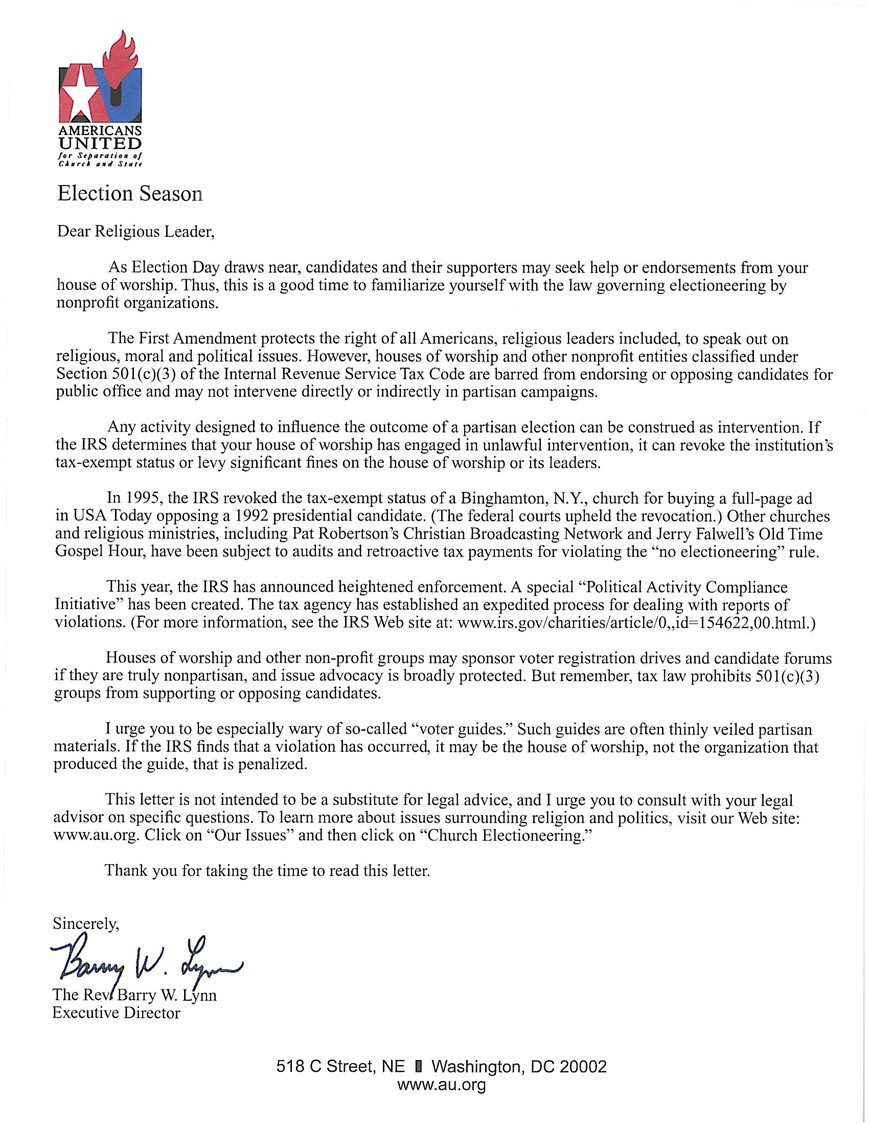
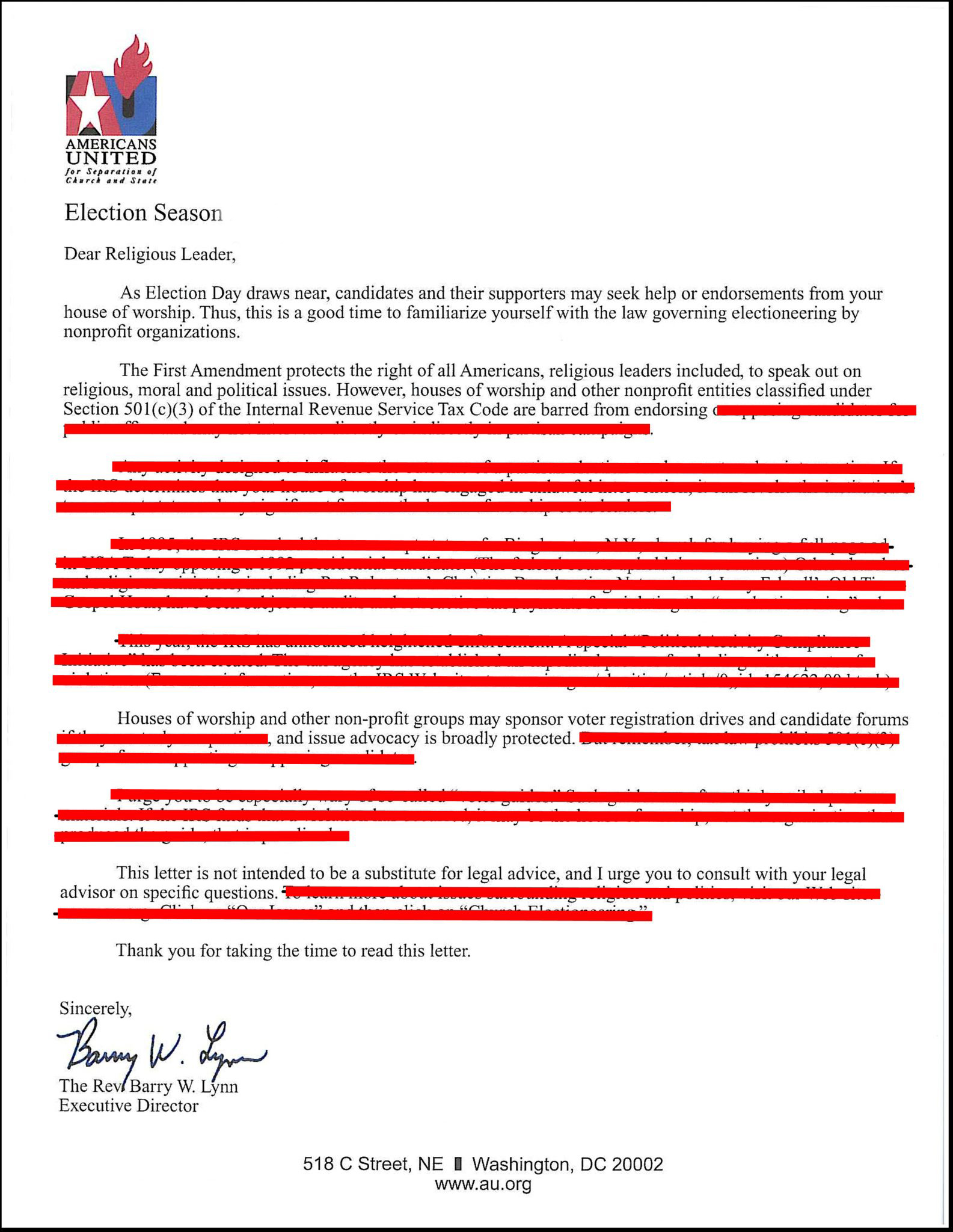
Letter from Americans United for Separation of Church and State.Numerous militant secular groups want to see people of faith and churches silenced and kept from exercising any influence in the public sphere, even if that influence is legal and constitutionally permissible. One such group is Americans United for Separation of Church and State. It seems that each election cycle, they send out an ominous letter to pastors and churches, warning them that they can face legal problems for something as innocuous as providing a non-partisan voters guide to their parishioners.

People of faith should not rely on such agenda-driven adversarial secularist groups for advice on what they can do in relation to elections; they should instead rely on neutral and even supportive groups to help navigate these relatively simple waters. For example, the IRS has issued a very easy-to-understand letter of guidance (link to this letter provided here) explaining what churches and non-profit organizations can do at election time, and a number of national legal groups which specialize in this area have provided even easier-to-understand letters of guidance (link also provided here).

Just to illustrate how straightforward and uncomplicated this issue really is, we have taken the threatening letter sent by Americans United for Separation of Church and State to pastors in 2006 and have crossed out their editorial comments designed to intimidate pastors and churches, leaving intact the actual legal guidance which is confirmed by the IRS and supportive attorneys; as you can see, the difference is stark! Don’t be intimidated! Maximize your constitutional influence by obtaining and following the clear guidelines provided by legal groups that specialize in helping people of faith.

Futile Intimidation Attempts

February 6, 2008

Greetings!

On February 5, 2008, nearly two dozen states made their voice heard in the presidential primaries. To help equip Christian voters to fulfill their role during the election season, WallBuilders produced a Voters’ Guide that was distributed to millions of homes.

That Voters’ Guide proved to be a great threat to anti-Biblical secularists. Americans United for the Separation of Church and State therefore filed an official complaint requesting that the IRS investigate both WallBuilders and the American Family Association (then headed by Don Wildmon) for distributing that Voters’ Guide.

We had absolutely no intention of backing down or altering our message, nor would we allow ourselves to be intimidated. Benjamin Franklin observed, “Make yourself sheep, and the wolves will eat you,” and Thomas Jefferson wisely advised, “In matters of principle, stand like a rock!” WallBuilders is determined to never be intimidated from exercising our constitutional rights and encouraging other Christians to do so.

Because the real intent of the secularists was to keep Christians out of the civil arena, the Rev. Barry Lynn (head of Americans United), warned that “Any church that distributes these biased guides is risking its tax exemption and casting aside its integrity.” He was dead wrong. The Voters’ Guide was reviewed by numerous constitutional attorneys before it was released.

Some often marvel that the head of such a secularist group as AU goes by the title of “Reverend,” yet Barry Lynn is indeed an ordained minister in the United Church of Christ (the same denomination of which Barack Obama is a member) – considered the most liberal (and fastest declining) of all American denominations.

The UCC was the first denomination to ordain an openly gay minister in the early 1970s, and to call for recognition of homosexual marriages; and over 200 of its churches are led by openly homosexual ministers. The UCC is also a strong advocate of abortion and openly endorsed abortion a full two years before the Roe v. Wade Supreme Court abortion decision in 1973. They even opposed the ban on partial-birth abortions.

The UCC does not accept fixed absolutes from the Bible, but instead believes that the Bible should be defined by the current culture and context. You can certainly understand why individuals with this worldview would not want Christians to vote Biblically.

“The hottest places in hell are reserved for those who, in a time of moral crisis, maintain their neutrality.” Dante, The Inferno (circa 1315 A.D.)
Thank you for being involved. If you feel our efforts are worthy of support, would you consider making a small tax-deductible contribution?

God bless!

David Barton

H.RES. 888

110th
CONGRESS

1st
Session

H.
RES. 888

Affirming the rich spiritual and religious history of our Nation’s founding and subsequent history and expressing support for designation of the first week in May as `American Religious History Week’ for the appreciation of and education on America’s history of religious faith.

IN
THE HOUSE OF REPRESENTATIVES

December 18, 2007

Mr. FORBES (for himself, Mr. MCINTYRE, Mr. AKIN, Mr. BARRETT of South Carolina, Mr. CULBERSON, Mr. DOOLITTLE, Mr. FEENEY, Mr. GINGREY, Mr. GOHMERT, Mr. HAYES, Mr. HENSARLING, Mr. HERGER, Mr. JONES of North Carolina, Mr. MCHENRY, Mrs. MUSGRAVE, Mr. PEARCE, Mr. PENCE, Mr. PITTS, Mr. RYAN of Wisconsin, Mrs. SCHMIDT, Mr. WALBERG, Mr. WILSON of South Carolina, Mr. WOLF, and Mr. YOUNG of Florida) submitted the following resolution; which was referred to the Committee on Oversight and Government Reform

RESOLUTION

Affirming the rich spiritual and religious history of our Nation’s founding and subsequent history and expressing support for designation of the first week in May as `American Religious History Week’ for the appreciation of and education on America’s history of religious faith.

Whereas religious faith was not only important in official American life during the periods of discovery, exploration, colonization, and growth but has also been acknowledged and incorporated into all 3 branches of American Federal government from their very
beginning;

Whereas the Supreme Court of the United States affirmed this self-evident fact in a unanimous ruling declaring `This is a religious people … From the discovery of this continent to the present hour, there is a single voice making this affirmation’;

Whereas political scientists have documented that the most frequently-cited source in the political period known as The Founding Era was the Bible;

Whereas the first act of America’s first Congress in 1774 was to ask a minister to open with prayer and to lead Congress in the reading of 4 chapters of the Bible;

Whereas Congress regularly attended church and Divine service together en masse;

Whereas throughout the American Founding, Congress frequently appropriated money for missionaries and for religious instruction, a practice that Congress repeated for decades after the passage of the Constitution and the First Amendment;

Whereas in 1776, Congress approved the Declaration of Independence with its 4 direct religious acknowledgments referring to God as the Creator (`All people are endowed by their Creator with certain unalienable rights, that among these are life, liberty and the pursuit of happiness’), the Lawgiver (`the laws of nature and nature’s God’), the Judge (`appealing to the Supreme Judge of the world’), and the Protector (`with a firm reliance on the protection of Divine Providence’);

Whereas upon approving the Declaration of Independence, John Adams declared that the Fourth of July `ought to be commemorated as the day of deliverance by solemn acts of devotion to God Almighty’;

Whereas 4 days after approving the Declaration, the Liberty Bell was rung;

Whereas the Liberty Bell was named for the Biblical inscription from Leviticus 25:10 emblazoned around it: `Proclaim liberty throughout the land, to all the inhabitants thereof’;

Whereas in 1777, Congress, facing a National shortage of `Bibles for our schools, and families, and for the public worship of God in our churches,’ announced that they `desired to have a Bible printed under their care & by their encouragement’ and therefore ordered 20,000 copies of the Bible to be imported `into the different ports of the States of the Union’;

Whereas in 1782, Congress pursued a plan to print a Bible that would be `a neat edition of the Holy Scriptures for the use of schools’ and therefore approved the production of the first English language Bible printed in America that contained the congressional endorsement that `the United States in Congress assembled … recommend this edition of the Bible to the inhabitants of the United States’;

Whereas in 1782, Congress adopted (and has reaffirmed on numerous subsequent occasions) the National Seal with its Latin motto `Annuit Coeptis,’ meaning `God has favored our undertakings,’ along with the eye of Providence in a triangle over a pyramid, the eye and the motto `allude to the many signal interpositions of Providence in favor of the American cause’;

Whereas the 1783 Treaty of Paris that officially ended the Revolution and established America as an independent begins with the appellation `In the name of the most holy and undivided Trinity’;

Whereas in 1787 at the Constitutional Convention in Philadelphia, Benjamin Franklin declared, `God governs in the affairs of men. And if a sparrow cannot fall to the ground without His notice, is it probable that an empire can rise without His aid? … Without His concurring aid, we shall succeed in this political building no better than the builders of Babel’;

Whereas the delegates to the Constitutional Convention concluded their work by in effect placing a religious punctuation mark at the end of the Constitution in the Attestation Clause, noting not only that they had completed the work with `the unanimous consent of the States present’ but they had done so `in the Year of our Lord one thousand seven hundred and eighty seven’;

Whereas James Madison declared that he saw the finished Constitution as a product of `the finger of that Almighty Hand which has been so frequently and signally extended to our relief in the critical stages of the Revolution,’ and George Washington viewed it as `little short of a miracle,’ and Benjamin Franklin believed that its writing had been `influenced, guided, and governed by that omnipotent, omnipresent, and beneficent Ruler, in Whom all inferior spirits live, and move, and have their being’;

Whereas from 1787 to 1788, State conventions to ratify the United States Constitution not only began with prayer but even met in church buildings;

Whereas in 1795 during construction of the Capitol, a practice was instituted whereby `public worship is now regularly administered at the Capitol, every Sunday morning, at 11 o’clock’;

Whereas in 1789, the first Federal Congress, the Congress that framed the Bill of Rights, including the First Amendment, appropriated Federal funds to pay chaplains to pray at the opening of all sessions, a practice that has continued to this day, with Congress not only funding its congressional chaplains but also the salaries and operations of more than 4,500 military chaplains;

Whereas in 1789, Congress, in the midst of framing the Bill of Rights and the First Amendment, passed the first Federal law touching education, declaring that `Religion, morality, and knowledge, being necessary to good government and the happiness of mankind, schools and the means of education shall forever be encouraged’;

Whereas in 1789, on the same day that Congress finished drafting the First Amendment, it requested President Washington to declare a National day of prayer and thanksgiving, resulting in the first Federal official Thanksgiving proclamation that declared `it is the duty of all nations to acknowledge the providence of Almighty God, to obey His will, to be grateful for His benefits, and humbly to implore His protection and favor’;

Whereas in 1800, Congress enacted naval regulations requiring that Divine service be performed twice every day aboard `all ships and vessels in the navy,’ with a sermon preached each Sunday;

Whereas in 1800, Congress approved the use of the just-completed Capitol structure as a church building, with Divine services to be held each Sunday in the Hall of the House, alternately administered by the House and Senate chaplains;

Whereas in 1853 Congress declared that congressional chaplains have a `duty … to conduct religious services weekly in the Hall of the House of Representatives’;

Whereas by 1867, the church at the Capitol was the largest church in Washington, DC, with up to 2,000 people a week attending Sunday service in the Hall of the House;

Whereas by 1815, over 2,000 official governmental calls to prayer had been issued at both the State and the Federal levels, with thousands more issued since 1815;

Whereas in 1853 the United States Senate declared that the Founding Fathers `had no fear or jealousy of religion itself, nor did they wish to see us an irreligious people … they did not intend to spread over all the public authorities and the whole public action of the nation the dead and revolting spectacle of atheistical apathy’;

Whereas in 1854 the United States House of Representatives declared `It [religion] must be considered as the foundation on which the whole structure rests … Christianity; in its general principles, is the great conservative element on which we must rely for the purity and permanence of free institutions’;

Whereas, in 1864, by law Congress added `In God We Trust’ to American coinage;

Whereas in 1864, Congress passed an act authorizing each State to display statues of 2 of its heroes in the United States Capitol, resulting in numerous statues of noted Christian clergymen and leaders at the Capitol, including Gospel ministers such as the Revs. James A. Garfield, John Peter Muhlenberg, Jonathan Trumbull, Roger Williams, Jason Lee, Marcus Whitman, and Martin Luther King Jr.; Gospel theologians such as Roger Sherman; Catholic priests such as Father Damien, Jacques Marquette, Eusebio Kino, and Junipero Serra; Catholic nuns such as Mother Joseph; and numerous other religious leaders;

Whereas in 1870, the Federal government made Christmas (a recognition of the birth of Christ, an event described by the U.S. Supreme Court as `acknowledged in the Western World for 20 centuries, and in this country by the people, the Executive Branch, Congress, and the courts for 2 centuries’) and Thanksgiving as official holidays;

Whereas beginning in 1904 and continuing for the next half-century, the Federal government printed and distributed The Life and Morals of Jesus of Nazareth for the use of Members of Congress because of the important teachings it contained;

Whereas in 1931, Congress by law adopted the Star-Spangled Banner as theofficial National Anthem, with its phrases such as `may the Heav’n-rescued land Praise the Power that hath made and preserved us a nation,’ and `this be our motto, `In God is our trust!’;

Whereas in 1954, Congress by law added the phrase `one nation under God’ to the Pledge of Allegiance;

Whereas in 1954 a special Congressional Prayer Room was added to the Capitol with a kneeling bench, an altar, an open Bible, an inspiring stained-glass window with George Washington kneeling in prayer, the declaration of Psalm 16:1: `Preserve me, O God, for in Thee do I put my trust,’ and the phrase `This Nation Under God’ displayed above the kneeling, prayerful Washington;

Whereas in 1956, Congress by law made `In God We Trust’ the National Motto, and added the phrase to American currency;

Whereas the constitutions of each of the 50 states, either in the preamble or body, explicitly recognize or express gratitude to God;

Whereas America’s first Presidential Inauguration incorporated 7 specific religious activities, including–

(1) the use of the Bible to administer the oath;

(2) affirming the religious nature of the oath by the adding the prayer `So help me God!’ to the oath;

(3) inaugural prayers offered by the President;

(4) religious content in the inaugural address;

(5) civil leaders calling the people to prayer or acknowledgement of God;

(6) inaugural worship services attended en masse by Congress as an official part of congressional activities; and

(7) clergy-led inaugural prayers, activities which have been replicated in whole or part by every subsequent President;

Whereas President George Washington declared `Of all the dispositions and habits which lead to political prosperity, religion and morality are indispensable supports’;

Whereas President John Adams, one of only 2 signers of the Bill of Rights and First Amendment, declared `As the safety and prosperity of nations ultimately and essentially depend on the protection and the blessing of Almighty God, and the national acknowledgment of this truth is not only an indispensable duty which the people owe to Him’;

Whereas President Jefferson not only attended Divine services at the Capitol throughout his presidency and had the Marine Band play at the services, but during his administration church services were also begun in the War Department and the Treasury Department, thus allowing worshippers on any given Sunday the choice to attend church at either the United States Capitol, the War Department, or the Treasury Department if they so desired;

Whereas Thomas Jefferson urged local governments to make land available specifically for Christian purposes, provided Federal funding for missionary work among Indian tribes, and declared that religious schools would receive `the patronage of the government’;

Whereas President Andrew Jackson declared that the Bible `is the rock on which our Republic rests’;

Whereas President Abraham Lincoln declared that the Bible `is the best gift God has given to men … But for it, we could not know right from wrong’

Whereas President William McKinley declared that `Our faith teaches us that there is no safer reliance than upon the God of our fathers, Who has so singularly favored the American people in every national trial and Who will not forsake us so long as we obey His commandments and walk humbly in His footsteps’;

Whereas President Teddy Roosevelt declared `The Decalogue and the Golden Rule must stand as the foundation of every successful effort to better either our social or our political life’;

Whereas President Woodrow Wilson declared that `America was born to exemplify that devotion to the elements of righteousness which are derived from the revelations of Holy Scripture’;

Whereas President Herbert Hoover declared that `American life is builded, and can alone survive, upon … [the] fundamental philosophy announced by the Savior nineteen centuries ago’;

Whereas President Franklin D. Roosevelt not only led the Nation in a 6 minute prayer during D-Day on June 6, 1944, but he also declared that `If we will not prepare to give all that we have and all that we are to preserve Christian civilization in our land, we shall go to destruction’;

Whereas President Harry S. Truman declared that `The fundamental basis of this Nation’s law was given to Moses on the Mount. The fundamental basis of our Bill of Rights comes from the teachings which we get from Exodus and St. Matthew, from Isaiah and St. Paul’;

Whereas President Harry S. Truman told a group touring Washington, DC, that `You will see, as you make your rounds, that this Nation was established by men who believed in God. … You will see the evidence of this deep religious faith on every hand’;

Whereas President Dwight D. Eisenhower declared that `Without God there could be no American form of government, nor an American way of life. Recognition of the Supreme Being is the first, the most basic, expression of Americanism. Thus, the founding fathers of America saw it, and thus with God’s help, it will continue to be’ in a declaration later repeated with approval by President Gerald Ford;

Whereas President John F. Kennedy declared that `The rights of man come not from the generosity of the state but from the hand of God’;

Whereas President Ronald Reagan, after noting `The Congress of the United States, in recognition of the unique contribution of the Bible in shaping the history and character of this Nation and so many of its citizens, has … requested the President to designate the year 1983 as the `Year of the Bible’,’ officially declared 1983 as `The Year of the Bible’;

Whereas every other President has similarly recognized the role of God and religious faith in the public life of America;

Whereas all sessions of the United States Supreme Court begin with the Court’s Marshal announcing, `God save the United States and this honorable court’;

Whereas a regular and integral part of official activities in the Federal courts, including the United States Supreme Court, was the inclusion of prayer by a minister of the Gospel;

Whereas the United States Supreme Court has declared throughout the course of our Nation’s history that the United States is `a Christian country’, `a Christian nation’, `a Christian people’, `a religious people whose institutions presuppose a Supreme Being’, and that `we cannot read into the Bill of Rights a philosophy of hostility to religion’;

Whereas Justice John Jay, an author of the Federalist Papers and original Justice of the United States Supreme Court, urged `The most effectual means of securing the continuance of our civil and religious liberties is always to remember with reverence and gratitude the Source from which they flow’;

Whereas Justice James Wilson, a signer of the Constitution, declared that `Human law must rest its authority ultimately upon the authority of that law which is Divine … Far from being rivals or enemies, religion and law are twin sisters, friends, and mutual assistants’;

Whereas Justice William Paterson, a signer of the Constitution, declared that `Religion and morality … [are] necessary to good government, good order, and good laws’;

Whereas President George Washington, who passed into law the first legal acts organizing the Federal judiciary, asked, `where is the security for property, for reputation, for life, if the sense of religious obligation desert the oaths in the courts of justice?’;

Whereas some of the most important monuments, buildings, and landmarks in Washington, DC, include religious words, symbols, and imagery;

Whereas in the United States Capitol the declaration `In God We Trust’ is prominently displayed in both the United States House and Senate Chambers;

Whereas around the top of the walls in the House Chamber appear images of 23 great lawgivers from across the centuries, but Moses (the lawgiver, who–according to the Bible–originally received the law from God,) is the only lawgiver honored with a full face view, looking down on the proceedings of the House;

Whereas religious artwork is found throughout the United States Capitol, including in the Rotunda where the prayer service of Christopher Columbus, the Baptism of Pocahontas, and the prayer and Bible study of the Pilgrims are all prominently displayed; in the Cox Corridor of the Capitol where the words `America! God shed His grace on thee’ are inscribed; at the east Senate entrance with the words `Annuit Coeptis’ which is Latin for `God has favored our undertakings’; and in numerous other locations;

Whereas images of the Ten Commandments are found in many Federal buildings across Washington, DC, including in bronze in the floor of the National Archives; in a bronze statue of Moses in the Main Reading Room of the Library of Congress; in numerous locations at the U.S. Supreme Court, including in the frieze above the Justices, the oak door at the rear of the Chamber, the gable apex, and in dozens of locations on the bronze latticework surrounding the Supreme Court Bar seating;

Whereas in the Washington Monument not only are numerous Bible verses and religious acknowledgements carved on memorial blocks in the walls, including the phrases: `Holiness to the Lord’ (Exodus 28:26, 30:30, Isaiah 23:18, Zechariah 14:20), `Search the Scriptures’ (John 5:39), `The memory of the just is blessed’ (Proverbs 10:7), `May Heaven to this Union continue its beneficence’, and `In God We Trust’, but the Latin inscription Laus Deo meaning `Praise be to God’ is engraved on the monument’s capstone;

Whereas of the 5 areas inside the Jefferson Memorial into which Jefferson’s words have been carved, 4 are God-centered, including Jefferson’s declaration that `God who gave us life gave us liberty. Can the liberties of a nation be secure when we have removed a conviction that these liberties are the gift of God? Indeed I tremble for my country when I reflect that God is just, that His justice cannot sleep forever’;

Whereas the Lincoln Memorial contains numerous acknowledgments of God and citations of Bible verses, including the declarations that `we here highly resolve that … this nation under God … shall not perish from the earth’; `The Almighty has His own purposes. `Woe unto the world because of offenses; for it must needs be that offenses come, but woe to that man by whom the offense cometh’ (Matthew 18:7); `as was said three thousand years ago, so still it must be said `the judgments of the Lord are true and righteous altogether’ (Psalms 19:9); `one day every valley shall be exalted and every hill and mountain shall be made low, the rough places will be made plain, and the crooked places will be made straight and the glory of the Lord shall be revealed and all flesh see it together (Dr. Martin Luther KingÌs speech, based on Isaiah 40:4-5);

Whereas in the Library of Congress, The Giant Bible of Mainz, and The Gutenberg Bible are on prominent permanent display and etched on the walls are Bible verses, including: `The light shineth in darkness, and the darkness comprehendeth it not’ (John 1:5); `Wisdom is the principal thing; therefore, get wisdom and with all thy getting, get understanding’ (Proverbs 4:7); `What doth the Lord require of thee, but to do justly, and to love mercy, and to walk humbly with thy God’ (Micah 6:8); and `The heavens declare the Glory of God, and the firmament showeth His handiwork’ (Psalm 19:1);

Whereas numerous other of the most important American government leaders, institutions, monuments, buildings, and landmarks both openly acknowledge and incorporate religious words, symbols, and imagery into official venues;

Whereas such acknowledgments are even more frequent at the State and local level than at the Federal level, where thousands of such acknowledgments exist; and

Whereas the first week in May each year would be an appropriate week to designate as `American Religious History Week’: Now, therefore, be it

Resolved, That
the United States House of Representatives—-

(1) affirms the rich spiritual and diverse religious history of our Nation’s founding and subsequent history, including up to the current day;

(2) recognizes that the religious foundations of faith on which America was built are critical underpinnings of our Nation’s most valuable institutions and form the inseparable foundation for America’s representative processes, legal systems, and societal structures;

(3) rejects, in the strongest possible terms, any effort to remove, obscure, or purposely omit such history from our Nation’s public buildings and educational resources; and

(4) expresses support for designation of a `American Religious History Week’ every year for the appreciation of and education on America’s history of religious faith.


* This article concerns a historical issue and may not have updated information.

American Voters and the Abortion Issue

Some may be surprised to learn that a 2008 Fox News poll found that abortion was an important issue to 45 percent of voters,1 yet, that number is consistent with what other polls have been documenting since 2002. And statistics further affirm that when voters not only identify abortion as an important issue but when those voters — especially Christian voters — actually vote accordingly, there is a direct impact on election results. (Although many pro-life voters are not Christians, and many Christians who are not pro-life, Christians nevertheless tend to be more pro-life in percentage than any other group, therefore, for the sake of simplifying the correlation and the statistics in the following summary, “Christian voters” will be considered likely pro-life voters.)

Significantly, in the four elections from 1992-2002, Christian voter turnout steadily declined. In 2002, however, that trend reversed and there was actually a 2 percent increase over the 2000 numbers (which is actually fairly sizable since 2002 was a non-presidential year, when voter turnout is traditionally much smaller). Exit polling in 2002 demonstrated that 41 percent of those who voted said that abortion was an important issue affecting their vote.2 The total effect was that 23 percent of all voters said they voted a pro-life ticket, and 16 percent said they voted a pro-abortion ticket,3 thus giving a 7 percent generic advantage to those running as a pro-life candidate. The result was evident: of the 54 freshmen elected to the U. S. House in 2002, 36 were pro-life4 (67 percent), and of the 10 freshmen elected to the U. S. Senate, 8 were pro-life5 (80 percent).

In 2004, Christian voter turnout increased 93 percent over the 2002 numbers6 (part of this surge was due to the fact that it was a presidential year, when turnout typically rises, and part to the fact that the percentage of Christian voters actually increased). In that election, 42 percent of voters identified abortion as an important issue,7 with the total effect being that 25 percent of voters said they voted pro-life, and 13 percent said they voted pro-abortion,8 resulting in a 12 percent generic advantage for pro-life candidates. The 2004 elections sent 40 new freshmen to the U. S. House, of whom 25 were pro-life9 (63 percent), and 9 new freshmen to the U. S. Senate, of whom 7 were pro-life10 (77 percent).

In those two elections in which Christian voter turnout rose, a total of 94 freshmen were sent to the House, of whom 61 were pro-life (65 percent), and 19 freshmen were sent to the Senate, of whom 15 were pro-life (79 percent). The result was the congressional enactment of the first four major stand-alone pro-life laws since Roe v. Wade: the Infants Born Alive Protection Act, the Unborn Victims of Violence Act, the Partial-Birth Abortion Ban, and the Fetal Farming Ban.11 (Prior pro-life congressional activity typically addressed funding measures, such as the Hyde, Kemp-Casten, Dickey, etc. amendments, and the Mexico City policy.12 Furthermore, the addition of so many new pro-life Senators resulted in the confirmation of two new pro-life Supreme Court Justices13 and dozens of pro-life court of appeals and federal district court judges.14

In 2006, however, the trend reversed: Christian voter turnout fell by 30 percent.15 Of the 54 new freshmen sent to the U. S. House in the last election, only 17 were pro-life16 (31 percent), and of the ten freshmen elected to the U. S. Senate,17 only 1 was pro-life (10 percent). The Baltimore Sun identified this as “the most pro-choice Congress in the history of the Republic.”18

Not surprisingly, given the 30 percent drop in Christian voter turnout, the exit polling indicating the percentage of voters who considered abortion as an important issue showed a commensurate drop, plummeting from 42 percent in 2004 to only about 30 percent in 2006. (In the last election, most exit polling did not separate out abortion as a single issue but instead combined it with marriage and other issues to call it “values”; in that exit polling, the “values” numbers ranged from 27 to 36 percent.19 For polls that did break abortion out as a single issue, it was the driving issue for only 6 to 12 percent of voters.20

Significantly, polling reveals that liberals are much more focused on abortion as a single issue than are Christians. A 2005 survey affirmed that among liberals, “no other issue rivals abortion in importance,” but that among Evangelicals, “three-quarters . . . view abortion as very important, [and] nearly as many place great importance on court rulings on the rights of detained terrorist suspects (69%) and whether to permit religious displays on government property (68%).”21 Therefore, while the 45 percent identified by a Fox News poll is a significant number, that high number really has no meaning unless those who hold pro-life values vote in high percentages .

By the way, for those who wonder why the 2008 Congress was so aggressively pro-homosexual, actually pushing through two stand-alone pro-homosexual bills,22> it might be instructive to note that at the same time that Christian voters experienced a 30 percent decline in the last election, 92.5 percent of homosexual men and 91 percent of lesbian women voted in that same election.23 As President James A. Garfield so accurately pointed out a century ago:

Now, more than ever before, the people are responsible for the character of their Congress. If that body be ignorant, reckless, and corrupt, it is because the people tolerate ignorance, recklessness, and corruption. If it be intelligent, brave, and pure, it is because the people demand these high qualities to represent them in the national legislature. . . . [I]f the next centennial does not find us a great nation . . . it will be because those who represent the enterprise, the culture, and the morality of the nation do not aid in controlling the political forces.24

In short, Congress never reflects the values of the nation; rather, it only reflects the values of those who voted in the last election.


Endnotes

1 FoxNews.com, “FOX News Poll: Half of Voters Eye Candidates Abortion Stance”, October 26, 2007.

2 National Right to Life, “The Pro-Life Advantage for Candidates”.

3 National Right to Life, “The Pro-Life Advantage for Candidates”.

4 Numbers provided by the House Pro-Life Caucus.

5 National Right to Life, “Senate Results Cause for Rejoicing,” November 2002.

6 In the 2004 elections, a total of 125,736,000 votes were cast; twenty-three percent of voters were “Evangelicals,” thus translating into 28.9 million votes. See sources at New York Times,“Religious Voting Data Show Some Shift, Observers Say,”; and U. S. Census Bureau, “Voting and Registration in the Election of November 2004”.

7 National Right to Life, “Statement by Carol Tobias: National Right to Life Political Director, November 4, 2004.”

8 National Right to Life, “Statement by Carol Tobias: National Right to Life Political Director, November 4, 2004.”

9 Numbers provided by the House Pro-Life Caucus.

10 National Right to Life, “Statement by Carol Tobias: National Right to Life Political Director, November 4, 2004;” Library of Congress, “CRS Report for
Congress: Freshmen in the House of Representatives and Senate by Political Party: 1913-2005”.

11 National Right to Life, “President Bush Signs Born Alive Infants Protection Act in Pittsburgh Ceremony Attended by NRLC Officials”; National Right to Life, “President Bush Signs Unborn Victims of Violence Act into Law, After Dramatic One-vote Win in Senate,” April 6, 2004; Office of the Press Secretary, “President Signs Partial-Birth Abortion Ban Act of 2003,” November 5, 2003; GovTrack.us, “S. 3504: Fetal Farming Prohibition Act of 2006” (at https://www.govtrack.us/congress/bill.xpd?bill=s109-3504).

12 American Family Association, “Loretta Sanchez of California Amendment; National Defense Authorization Act for Fiscal Year 2004”; University of Maryland, “CRS
Report for Congress: Abortion Services and Military Medical Facilities”, pp. 17-18; National Women’s Health Network, “The Women’s Health Activist: The Hyde Amendment’s Prohibition of Federal Funding for Abortion — 30 Years is Enough”; National Committee for a Human Life Amendment, “The Hyde Amendment: Fact Sheet”; Ontario Consultants on Religious Tolerance, “US ‘Mexico City’ Policy: Abortion funding in foreign countries,” last updated April 27, 2007 .

13 United States Senate, “U.S. Senate Roll Call Votes 109th Congress-2nd Session” (at https://www.senate.gov/legislative/LIS/roll_call_lists/roll_call_vote_cfm.cfm?congress=109&session=2&vote=00002); United States Senate, “U.S. Senate Roll Call Votes 109th Congress-1st Session” (at https://www.senate.gov/
legislative/LIS/roll_call_lists/roll_call_vote_cfm.cfm?congress=109&session=1&vote=00245
).

14 See for example: Christian Life Resources, “President Bush Will Nominate 20 Pro-Life Judges, Democrat Fight Looms”; Lifenews.com, “President Bush Renominates Pro-Life Judges, Senate Abortion Battle Begins”, etc.

15 In the 2006 elections, a total of 85,251,089 votes were cast; twenty-four percent of voters were “Evangelicals,” thus translating into 20.5 million votes. See sources at George Mason University, “United States Elections Project: 2006 Voting-Age and Voting- Eligible Population Estimates”; New York Times, “Religious Voting Data Show Some Shift, Observers Say”.

16 Numbers provided by the House Pro-Life Caucus.

17 See for example: Wikipedia.com, “List of Freshmen Class Members of the 110th United States Congress” (at https://en.wikipedia.org/wiki/List_
of_freshman_class_members_of_the_110th_United_States_Congress
).

18 Thomas F. Shaller, Baltimore Sun, February 28, 2007.

19 See for example: The Pew Forum, “Religion and the 2006 Elections: Exit Poll Results — The ‘God Gap’ Widens”; FoxNews.com, “National Exit Poll: Midterms Come Down to Iraq, Bush”, November 8, 2006.

20 See for example: Faith in Public Life, “Exit Poll Shows Shift in Religious Vote Driven By ‘Kitchen Table’ Moral Issues”, November 15, 2006; People for the American Way, “The American Values Survey”, August 2006.

21 The Pew Research Center, “Abortion and Rights of Terror Suspects Top Court Issues” (at https://people-press.org/reports/display.php3?ReportID=253), August 3, 2005.

22 GovTrack.us, “Local Law Enforcement Hate Crimes Prevention Act of 2007” (at https://www.govtrack.us/congress/bill.xpd?bill=h110-1592); Library of Congress, “S. 1284: Summary”.

23 Numbers from a study by San Francisco-based Community Marketing Inc. reported in the Los Angeles Times online blog on August 8, 2007 (at https://latimesblogs.latimes.com/washington/2007/08/
gay-power.html
).

24 John M. Taylor, Garfield of Ohio: The Available Man (New York: W. W. Norton and Company, Inc., 1970), 180, quoted from “A Century of Congress,” by James A. Garfield, July 1877.

The 2010 Election: The News Inside the News

David Barton
Traditional media coverage on Election Night provided a general overview of the most obvious political shifts but largely ignored the massive pro-life, pro-family, and conservative gains that occurred. This report will provide a general summary of the elections and will also report many results of particular interest to God-fearing conservative voters.

Federal Election Results: An Historic Shift

On the surface, Republicans did well, gaining more U. S. House seats than in any election for the past 72 years:1

  • In 1938, Republicans picked up 80 seats in the House
  • In 1946, 56 seats
  • In 1966, 47
  • In 1994, 54

Republicans gained 63 seats – the most since 1938. But it would be a mistake to assume that voters simply chose Republicans in this election. To the contrary, like the four previous landmark elections cited above, voters decisively chose to reject the liberalism exuded by national Democrat leaders; Republicans were simply the beneficiaries:

  • In 1938, following six years of President Roosevelt’s “New Deal” expansionism, voters overwhelmingly rejected further growth of the federal government.
  • In 1946, they rejected the revival of the “New Deal” under President Harry Truman.
  • In 1966, following three years of President Johnson’s “Great Society” federal growth, voters halted any further expansion of government.
  • In 1994, they put a stop to President Bill Clinton’s attempt to expand the federal government through “Hillarycare,” also ending his radical social agenda (e.g., lifting the ban on homosexuals in the military, protecting partial-birth abortions, etc.).

Election 2010 was a similar voter repudiation of the explosive growth of federal government under national Democrat leaders (i.e., the takeover of health care and student loans, government bailouts of private businesses, “stimulus” spending bills, etc.); it was also a resounding affirmation of limited government and conservatism, both economic and social.

While some national pundits argued that the Republican victories were the result of an “enthusiasm gap” (that is, Republican voters were highly motivated to go to the polls but Democrat voters were not), such was definitely not the case. In this election, the numbers of voters from each side was exactly equal: 35% of voters were Republican, and 35% were Democrat.2 (In recent elections, the comparative percentage of Democrat and Republican voters has remained relatively close.3) The difference in this election was not a greater turnout of Republicans or a suppressed turnout of Democrats but rather that non-affiliated independent voters overwhelmingly chose conservative candidates (running primarily as Republicans) and rejected liberal ones (represented primarily by Democrats)4 – a 37-point swing in their decision from only four years ago.5

Some additional interesting election statistics:

  • In every state in the nation, self-identified conservatives outnumber self-identified liberals; and in 25 of the states, conservatives outnumbered liberals 2 to 1.6
  • Overall, 42% of voters self-identified as conservative, and 20% as liberal7– a 22% gap. (In 2006 and 2008, it was only a 12% gap.8)
  • Tea Party supporters made up 41% of voters.9
  • Voter turnout was slightly higher in 2010 than in 2006, projected at 42% in this election (i.e., 90 million), which is 6.2 million more than voted in 2006 in the last mid-term election (83.8 million).10 (Mid-term elections are always smaller in turnout than presidential elections, so comparisons are best made of mid-term to mid-term, and presidential to presidential.)
  • Voter turnout increased in nine states, especially Florida, Minnesota, and Texas, but decreased in other states, such as Ohio and Pennsylvania.

Given the conservative nature of voters this election, it is not surprising that the average new freshman in the House and Senate is more conservative than the Member he replaced. In fact, in several states not traditionally conservative, numerous congressional seats switched from liberal to conservative, including Republicans gaining 6 congressional seats in New York; 5 each in Pennsylvania and Ohio; 3 in Illinois; and 2 each in Colorado, Michigan, and Wisconsin. They even gained ground in traditionally conservative states, including 4 more seats in Florida; 3 each in Virginia, Tennessee, and Texas; and 2 each in Arizona, Arkansas, Indiana, Mississippi, and New Hampshire. By the way, in traditionally liberal Wisconsin, not only did liberals lose 2 congressional seats, they also lost a U. S. Senate Seat, the Governorship, the State Senate, and the State House – the only state to lose control of so many levels of government in this election.

While the changes toward conservatism were substantial, nearly all of the national news coverage focused only on fiscal conservatism; but statistics affirm that the election was also about social conservatism. For example, exit polling showed that among conservative voters:

  • When asked what was needed to get America back on track, reducing spending and restoring values were equally important.11
  • A majority of voters said members of Congress and political leaders are ignoring our religious heritage.12
  • 53% of the voters opposed homosexual marriage.13
  • Christian conservatives comprised 28.8 million, or 32% of all voters14– the highest recorded percentage of any election.15

Furthermore:

  • 30% of all voters said that the abortion issue affected their vote; 22% said they voted for pro-life candidates, and 8% for pro-abortion candidates, thus providing pro-life candidates a 14-point advantage over abortion voters.16 That large advantage provided the margin of victory for pro-life candidates in many otherwise close races.

Interestingly, exit polling has long demonstrated that the frequency of church attendance is the best indicator of whether an individual will vote conservative or liberal. As Washington Post writer Thomas Edsall had reported: “Pollsters are finding that one of the best ways to discover whether a voter holds liberal or conservative value stands is to ask: How often do you go to church? Those who go often tend to be Republican, those who go rarely or not at all tend to be Democrat.”17 In 2010, that tendency was again reaffirmed:

  • Among Born-Again or Evangelical voters, 77% voted for Republicans – up 7% from four years ago.18
  • White Protestants voted for Republicans over Democrats by a 69% to 28% margin – up 8% from four years ago.19
  • White Catholics voted for Republicans over Democrats by a 59% to 39% margin – up 10% from four years ago;20 and among all Catholic voters, 54% voted for Republicans, an increase of 12% from two years ago.21

But on the other hand:

  • Those who have no religious affiliation supported Democrats over Republicans by a 68% to 30% margin (although this is an 8% improvement from four years ago).22

Exit polling from this year’s election makes clear that conservative people of faith carried their values with them into the voting booth – something that they did not do two years ago in 2008 (as will be seen below).

Another disappointing number from two years ago was that only 14% of churches provided voter guides or urged parishioners to vote, compared to 27% in 2006. In 2008, WallBuilders created a website (www.ChristianVoterGuide.com and www.Judeo-ChristianVoterGuide.com) in order to make conservative, pro-family state voter guides available to voters in every state. This year, a mailing was sent to 285,000 of the 325,000 houses of worship in America, urging pastors, rabbis, and priests to get voter guides from those websites and distribute them to their congregations or synagogue, resulting in more than 140,000 website hits from that mailing.

Because values mattered to voters, there was more cohesion between economic and social conservatives than in recent elections. Consequently, nearly all the conservative candidates who won this year were not only economic but also social conservatives.

For example, in the U. S. Senate, 16 new freshmen were elected: 3 Democrats and 13 Republicans. (The 3 Democrats all replaced Democrats, and 7 of the 13 Republicans replaced Republicans, with the other 6 replacing Democrats). Of the 13 freshmen Republican Senators, 12 are conservative and pro-life (Mark Kirk of Illinois is not); and of the 3 Democrat freshmen, 1 is pro-life. Thus, 13 of the 16 new Senators are pro-life – an 81% pro-life class. (Compare this year’s freshman Senate class with that of 2008, which was only 14% pro-life.)

Similarly, of the 97 new freshmen in the U. S. House, 81 are pro-life – an 84% pro-life class. In fact, this election resulted in a net gain of 52 pro-life seats in the House! (Of the 97 freshmen, 33 seats showed no change, with 26 pro-life freshman replacing pro-life predecessors, and 7 pro-abortion freshmen replacing the same. There were 3 seats where a pro-abortion freshman replaced a pro-life predecessor, 40 seats where a pro-life freshman replaced a pro-abortion predecessor, an additional 15 seats where a solid pro-life freshman replaced a predecessor with a mixed pro-life voting record, and 6 where the pro-life positions of the freshman are unknown.)23 As a result of the election, Congressman Chris Smith (R-NJ), co-chair of the House Pro-Life Caucus, announced that “January will mark the beginning of the arguably most pro-life House ever.”24 (Compare this year’s freshman House class with that of 2008, which was only 40% pro-life.)

While voters overwhelmingly chose pro-life candidates in this election, apparently, Democrats became increasingly less tolerant of pro-lifers in their own ranks. For example, Democrats for Life raised only $7,989 and gave only $7,309 to 14 candidates,25 while the Republican National Coalition for Life raised almost ten-times as much ($67,152), and gave $77,045 to 60 candidates.26 And in states such as Hawaii, during the Democrat primary in September, most pro-life Democrat incumbents were defeated and replaced with a pro-abortion Democrat. But outside of Democrat-only circles, the general population did elect some proven conservative pro-life Democrats, including Congressmen Mike McIntyre and Heath Shuler of North Carolina.

(By the way, non-liberal Democrats appear to be a shrinking group. Before the election, there were 54 Democrats in the Blue Dog Caucus, which is composed of conservative to moderate Democrat House Members. Only 26 from that group were re-elected.)27

Some other interesting facts about the new Republican freshman class:

  • 2 black Republicans were elected to positions never before held by any black representative. There are 6 new Latino Republicans in Congress (5 in the House, 1 in the Senate), and 9 new female Republicans (8 in the House, and 1 in the Senate). All of these new freshmen are pro-life; and the addition of these new women increases by 60% the number of pro-life women in the U. S. House.
  • 8 freshmen are military veterans, most of whom served in Iraq and Afghanistan.28 They all support victory on the battlefield in both countries and also hold a very strong national security position.29 These 8 more than double the number of like-minded War on Terror veterans already serving in Congress and will form the new Victory Caucus. Significantly, however, every War on Terror veteran who ran as a challenger and who held an anti-war position was defeated, as were 2 incumbent anti-war Iraqi war veterans.30
  • All of the new Republican Latino members ran on the Arizona-style immigration position that the media and liberals so denounce – that is, securing the borders, enforcing existing laws, controlling immigration, and opposing amnesty.
  • The new freshman class is very strongly pro-Israel, replacing many incumbents who were openly critical of Israel.
  • 3 of the new Republican Senate Freshmen (Marco Rubio, Pat Toomey, and Ron Johnson) are openly and unabashedly pro-American Exceptionalism, boldly advocating Americanism, God-given unalienable rights, the Free Market, and constitutionalism.

And finally, there is the Congressional Prayer Caucus. Most citizens are unaware that every week Congress is in session, as votes begin, dozens of congressional Members meet in Room 219 of the Capitol (directly across from the House Chamber) to join together in extended prayer for the country. The Prayer Caucus has been bold in defending religious liberties and public religious expressions, including at the Washington Monument, the Capitol Visitor Center, veterans’ funeral ceremonies, and many other areas where officials had ordered the removal of public acknowledgments of God. (To see something of their admirable work, www.CPCFoundation.com.) Significantly, of the 62 Members of the Congressional Prayer Caucus running for re-election, 61 were returned – a percentage much, much higher than the House at large.

State Election Results

Clearly, the federal election results went heavily in favor of conservatives (and Republicans), but the state level results were even more dramatically pointed in that direction.

There are a total of 99 State legislative chambers (Nebraska has a unicameral government with only one chamber). As the 2010 election began, the balance of power in 25 of those chambers was such that it could change hands. When Election Night ended, Republicans lost control of no chambers but Democrats lost control of 20.

Heading into Election Day, Democrats held 783 more state legislative seats than Republicans, but when the night ended, Republicans held a 523 seat advantage.31 Republicans gained 690 state legislative seats (with several still undecided).32 They not only gained 134 seats in New Hampshire, 41 in Minnesota, 28 in Maine, etc., but they also made massive gains even in chambers where they already held control. For example, Republicans held a slim 77 to 73 majority in the Texas State House, but on Election Night jumped to a 99 to 51 majority. And in Tennessee, the State House went from a 2 seat majority to a 31 seat supermajority. Amazingly, Republicans lost seats in only 5 of the 99 legislative chambers (the Senates of Hawaii, Mississippi, Maryland, and Massachusetts, and the House in Delaware; Republicans were already in the minority in all 5 states).

Republicans currently control both chambers in 25 states, and one chamber in 6 more states. They have not controlled this many legislatures since 1928.33

And just as a number of state legislative chambers changed control, so too did a number of Governors’ Mansions: 15 switched hands, 11 to Republican, 3 to Democrat, and 1 to Independent (one is still undecided). Republican governors currently outnumber Democrat governors by a margin of 29 to 19, with 1 Independent.

Republicans now hold a trifecta (that is, they control the state house, senate, and governorship) in 20 states, while Democrats hold a trifecta in only 11. Several of these new trifectas are historic. For example, the last time Republicans controlled Alabama government, Robert E. Lee was still alive. (Since the election, thirteen Democrat legislators have switched to Republican in states including Alabama, Georgia, Maine, South Dakota, and Louisiana; expect this pattern to be repeated in other states as conservative Democrats feel less and less at home in the Democrat Party.) Minnesota government had never been under Republican control before this election, and North Carolina is now in Republican control for the first time since 1870.

As an interesting aside, the Louisiana House also flipped to Republican control as a result of this year’s election, even though there were no state legislative races in Louisiana. (Louisiana is one of five states, along with Mississippi, Kentucky, Virginia, and New Jersey that hold state elections in the years between federal elections.) Nevertheless, following the nationwide conservative tsunami, a Democrat State House member announced that he was changing parties, thus giving Republicans control of that chamber for the first time since Reconstruction.

State Effects on the Federal Congress

State legislative results have a direct effect on the composition of the federal Congress through the process of decennial redistricting – a process required by the Constitution in Art. 1, Sec. 2, Par. 3. Every ten years, a census is conducted to determine the national population, and the total population is then divided by 435 (the number of Members in the House) to determine the number of citizens in each congressional district. Once that number is ascertained, new congressional lines are drawn and elections are held. In this case, the census was conducted in 2010; state legislatures will redraw lines in 2011; and congressional elections under the new lines will be held in 2012, and those lines will remain in place for the next decade.

Because state legislatures draw the lines in most states, the party that controls the legislature will draw the lines in a manner more favorable to their party. Thus, states like New York make it easier for Democrats to be elected, and states like Texas make it easier for Republicans to be elected. However, redrawing lines becomes especially significant when the population has shifted in such a manner that a state either gains or loses a congressional seat.

Over the past decade, millions of citizens in the north have moved toward the south where the economy is much better. As a result, Texas is gaining 4 congressional seats and Florida 2; Arizona, Georgia, Nevada, South Carolina, Washington, and Utah will each gain 1. Since most of those states are controlled by Republicans, it is likely that lines will be drawn to make it easier to elect Republicans to Congress in these new districts. States losing a congressional seat include Illinois, Iowa, Louisiana, Massachusetts, New Jersey, Michigan, Missouri, and Pennsylvania, and New York and Ohio will lose 2 seats. Since most of the seats to be eliminated are currently held by Democrats, it is likely that Democrat numbers in Congress will be reduced.

As a result of the state legislative changes on election night, the redistricting process could result in a 20-25 seat federal congressional gain for Republicans – a gain that could last for the next decade.

State Judicial Races

Just as conservatives gained control of state legislatures and governorships, they also re-gained control of judiciaries in Alabama, Michigan, North Carolina, Texas, and other states.

One of the most dramatic wins of the night (and one of my personal favorites) was in Iowa, where 3 of the Iowa Supreme Court Justices who handed down a 2009 decision to allow same-sex marriage were turned out of office by the voters. This is the first time in the nearly fifty year history of judicial retention elections in Iowa that any Supreme Court justice was defeated, and in this case, all 3 that appeared on the ballot were defeated.

Significantly, the removal of any judge in a retention election is so rare (99% of all state judges facing retention elections are retained34) that their positions are essentially lifetime appointments. The removal of these liberal judges sent shockwaves throughout the judiciary across the nation, delivering a clear message that voters can and will hold judges accountable if they abandon their traditional role and instead try to become judicial legislators. (To see something of the story behind this remarkable victory, go to DallasBlog.com and read the article by Dr. Richard G. Lee on “Behind the Fall of Iowa’s Judicial Gods.”35)

State Ballot Initiatives

With very few exceptions, voters across the nation expressed conservative positions in their decisions on 160 ballot initiatives in 37 states. For example:

  • Oklahoma said that their judges must base their rulings on federal and state law, not international or Sharia law. (However, an Islamic group has already filed suit against the measure, and a federal judge has granted a temporary injunction in their favor.)
  • Arizona and Oklahoma joined Missouri in allowing their citizens to say “no” to federal health care.
  • Arkansas, South Carolina, and Tennessee approved a constitutional right to hunt, thus pushing back against liberal animal rights groups.
  • California rejected the legalization of marijuana, and Oregon and South Dakota rejected medical marijuana.
  • Arizona, South Carolina, South Dakota, and Utah passed constitutional amendments to protect the right to secret ballots in union elections, pushing back against President Obama’s promise to allow workers to unionize without a secret ballot.
  • Washington rejected a state income tax.
  • Indiana placed a cap on property taxes.
  • Kansas passed a constitutional amendment securing the right of citizens to bear arms.
  • Missouri and Montana voted to prohibit new taxes on the sale of property (i.e., no capital gains taxes on property).
  • California and Washington passed measures making it harder to tax citizens by requiring a legislative supermajority to approve a new tax.
  • Missouri passed a measure that allows citizens to decide on the taxes on their earnings.
  • Nevada rejected a measure to allow lawmakers to change taxes without a vote of the people.
  • Rhode Island overwhelmingly rejected a name change for its state. (This was the second of my personal favorites of the night. The official title of Rhode Island is “State of Rhode Island and Providence Plantations,” given when the two colonies merged in 1663. Liberal legislators asserted that the use of “plantation” was a racist term, despite the fact that Rhode Island’s Governor Stephen Hopkins – a Founding Father and signer of the Declaration – signed America’s first anti-slavery law; and the colony’s founder Roger Williams had excellent relations with American Indians. Rhode Island was long a model of early American justice and civil rights; and citizens overwhelmingly rejected – by a 78% to 22% margin – the liberal attempt to rewrite their state’s history!)

A Few State Disappointments

Despite the numerous conservative victories in states across the nation, there were a few underperforming states, including Arizona, Colorado, Washington, California, and Hawaii. For example, in Arizona, many of the congressional seats that were expected to change hands from liberal to conservative failed to do so, and the state also passed a measure legalizing medical marijuana. Colorado experienced similar statewide underperformance, and their initiative on the unborn failed by a large margin (it was the only pro-life initiative in the nation this year). This is not to say that some conservative gains were not made in most of those states; they were; it is just that they were not nearly as broad as in other states. (By the way, as noted earlier, Hawaii was one of only a handful of states in which conservatives and Republicans actually lost ground. As a result, the current composition of Hawaii’s 25 member state senate is now 24 Democrats and 1 Republican. What a lonely senator!)

A few of the disappointments included:

  • Colorado did not opt out of federal health care mandates, pass tax limitation amendments, approve the personhood amendment, or prohibit the increase of state debt through loans.
  • Massachusetts did not reduce state sales tax from 6.25% to 3%.
  • Arizona passed medical marijuana, and did not protect the right to hunt and fish.
  • Maine narrowly allowed a casino (but opponents have announced a call for a recount).
  • California did not suspend the “Global Warming Act.”
  • Washington voted to allow the state to run its own liquor stores.

Yet notwithstanding these few losses, Election Day was an overwhelming success for God-fearing conservatives, both social and fiscal.

An Interesting Side Note – “Hollywood Stays Home”

Compared to the presidential election of 2008, Hollywood stars stayed out of this election. According to Stephen Zunes, a professor at the University of San Francisco, the Obama administration has not been living up to Hollywood expectations. As he explains, “The more left-wing of the celebrities feel that Obama and the Democrat Congress haven’t been liberal enough (i.e., still in Iraq, escalating in Afghanistan, no single-payer health care (or even public option), no climate legislation, etc.) and are therefore part of the ‘enthusiasm gap’.”36

A Big Loser

Liberals and Democrats were the election’s biggest collective loser, but perhaps the biggest individual loser was George Soros.

Soros is the secularist billionaire who has invested so heavily into severing America from its traditional religious, moral, and constitutional foundations. He has been tactically brilliant, advancing his dangerous agenda through scores of well-coordinated but seemingly unconnected groups, gaining control over numerous powerful but relatively unglamorous political positions that exercise tremendous influence over the direction of the states and thus the nation.

Considered one of the most powerful men on earth, Soros has sought to further his secularist, progressive, socialist agenda by distributing (so far) more than $5 billion through numerous allied groups (e.g., Open Society Institute, Tides Foundation, ACLU, America Coming Together, Media Matters, America Votes, Center for American Progress, MoveOn.org, etc.). Soros unabashedly opposes free market economics, the American military, and our constitutional form of government; seeks a massive expansion of government, including welfare programs, socialized medicine, and amnesty for illegal aliens; supports the elimination of all prisons and the release of all inmates; supports abortion and opposes traditional marriage and all forms of traditional morality; supports anti-American Arab groups and defends anti-American terrorists; opposes tax cuts of any type; opposes American sovereignty and supports complete globalism; promotes radical environmentalism; supports unilateral disarmament and the placing of American foreign policy under the control of the United Nations and the placing of American criminal policy under the control of the World Court; etc.37

Much of Soros’ effort to fundamentally transform America has occurred at the state level by seeking to place his like-minded operatives into the more unglamorous but nevertheless influential political positions of state judges and secretaries of state, and he also works heavily for the passage of specific state ballot initiatives. Soros had experienced almost unbridled success in recent elections, but in 2010, his agenda became one of the biggest election losers.

For example, he has already spent over $45 million38 to “remake the judiciary and fundamentally change the way judges are selected.”39 His plan is to move state judges as far away from voters as possible, having judges chosen instead by groups of elitist lawyers appointed by the governor or some other state official.40 After being appointed, the judges only have to face the voters in periodic retention elections – a plan that, as noted above, amounts essentially to a lifetime appointment.41 Soros wants judges to be unaccountable to, and independent from citizens – much in the same way that federal judges in recent decades have also wrongly become independent and unaccountable. But not only did Soros suffer a setback with the Iowa judges being turned out, but in Nevada, the Soros-backed initiative on appointing rather than electing judges was overwhelmingly rejected by a 57% to 42% margin.42

(By the way, other Soros-supported ballot initiatives that lost on Election Night included California’s plan to legalize marijuana, and its plan to keep redistricting in the hands of the extremely liberal Democrat state legislature rather than in the hands of a citizens’ commission.43 Gratefully, several Soros-backed measures went down at the hands of the people.)

In addition to Soros’ judicial activities, another area in which he is heavily involved is his “Secretary of State Project,”44 which is his effort “to elect Secretaries of State around the country willing to impose Democrat-friendly election laws in an attempt to tilt the playing field in their favor on Election Day.”45 Soros clearly understands the axiom delivered long ago by Communist leader Joseph Stalin, who declared: “The people who cast the votes decide nothing. The people who count the votes decide everything.”46

Consider how Soros’ involvement with secretaries of states impacted the 2008 U. S. Senate race between Democrat Al Franken and Republican Norm Coleman. The Secretary of State who oversaw the recount was Mark Ritchie, a Soros-backed official. Ritchie was so overtly partisan during the recount that even national newspapers questioned the integrity of the recount process, noting that almost all of the voting “errors” that Ritchie “discovered” in the state went in Franken’s favor.47 As the Wall Street Journal reported:

Mr. Franken’s gains so far are 2.5 times the corrections made for Barack Obama in the state, and nearly three times the gains for Democrats across Minnesota Congressional races. . . . Mr. Franken’s “new” votes equal more than all the changes for all the precincts in the entire state for the Presidential, Congressional and statehouse races combined.48

Soros’ “Secretary of State Project” was undertaken to “tilt the playing field in the Democrats’ direction,” and Soros’ Mark Ritchie certainly did that.

Another example is Soros-backed Colorado Secretary of State Bernie Buescher. When the attempt was made to place a pro-life personhood initiative on the ballot this election, Buescher unilaterally changed the normal rules of engagement, actually shortening the normal time allotted to collect signatures for that measure, thus making it much more difficult to get it before the people.49

It is clear why Soros has focused so much money on gaining the positions of secretaries of state (as well as of judges and ballot initiatives): they have significant impact in moving forward a secular progressive agenda with less interference from the people. Nevertheless, despite Soros’ efforts, 17 of the 26 secretaries of state up for election this year were won by Republicans;50 and several Soros-backed candidates lost or were voted out of office.

Thankfully, at the level of state judges, secretaries of state, and state ballot initiatives, George Soros’ anti-American agenda was one of the biggest losers on Election Night!

Some Other Pro-Family Victories

The biggest winner on Election Night was definitely America’s conservative pro-family voter. And in addition to the numerous gains already mentioned (e.g., in the federal Congress, state legislatures, and ballot initiatives), there were also many other momentous pro-family victories that night.

For example, last year in 2009, Maine legislators passed and the governor signed a gay marriage law, but citizens objected and mounted a drive to place the issue on the ballot. The necessary signatures were gathered, and in November 2009, citizens vetoed the gay marriage law passed by the legislature. In this election, voters continued to make their voice heard on this issue, replacing 22 of the legislators who had voted for same-sex marriage last year with 22 who supported traditional marriage; they also elected a new governor who supports traditional marriage. With this change, traditional marriage in Maine is now safe for the foreseeable future.

Similarly, New Hampshire passed a gay marriage law in early 2010; but this election likewise removed dozens of legislators who had supported the law (recall that an amazing 134 seats changed hands), placing both the House and the Senate into the hands of conservative Republicans. Plans are currently underway to secure a vote on a constitutional amendment to permanently ban homosexual marriage.

In Minnesota, the new Republican controlled house and senate now ensure that a homosexual marriage initiative will not make it through that legislature.

In El Paso, Texas, city leaders had given medical benefits to gay partners of city employees, but voters rolled back that policy by a 55% to 45% margin.51

And because of the gains in Missouri, of the 34 members of the state senate, 29 are now pro-life; and of the 163 members of the state house, at least 126 are now pro-life, thus making Missouri a rock-solid, pro-life, veto-proof legislature.

— — — ◊ ◊ ◊ — — —
Reviewing this year’s election results makes it seem as if citizens had taken their marching orders from President Ronald Reagan’s speech of March 8, 1985, in which he declared:

I said, “This is a wonderful time to be alive,” and I meant that. I meant that we’re lucky not to live in pale and timid times. We’ve been blessed with the opportunity to stand for something – for liberty and freedom and fairness. And these are things worth fighting for – worth devoting our lives to. And we have good reason to be hopeful and optimistic. We’ve made much progress already. So, let us go forth with good cheer and stout hearts – happy warriors out to seize back a country and a world to freedom.

Voters this year did indeed seem to be happy warriors, taking back their country to freedom.

But as voters, we have to remember that this election was not an event – it was only a single step in a lifelong process of involvement and civic engagement, requiring us not only to be involved in every election but also to always carry our conservative religious, moral, and constitutional values with us as we vote (and we must also stay actively involved between elections). To use President Reagan’s phrase, “we’ve made much progress”; but really we have only just begun. So let’s stay engaged and finish the job, no matter what happens or how long it takes.

God bless!

David Barton


Endnotes

1 “The Four-Year Majority,” Wall Street Journal, November 3, 2010 (at: https://online.wsj.com/article/SB10001424052748704462704575590871101994524.html?mod=WSJ_hpp_RIGHTTopCarousel_1).

2 “CNN National Exit Polls, Election 2010,” CNN.com (at: https://www.cnn.com/ELECTION/2010/results/polls/#USH00p1) (accessed on November 19, 2010).

3 See “CNN National Exit Polls, Election 2006,“ CNN.com (at:
https://us.cnn.com/ELECTION/2006/pages/results/states/US/H/00/epolls.0.html
);
“CNN National Exit Polls, Election 2008,” CNN.com (at:
https://www.cnn.com/ELECTION/2008/results/polls/#USP00p1
).

4 In 2010, 37% of Independents voted Democrat and 56% voted Republican. See “CNN National Exit Polls, Election 2010,” CNN.com (at: https://www.cnn.com/ELECTION/2010/results/polls/#USH00p1). This was quite a reversal from previous elections. For example, in 2008, 52% of Independents voted Democrat and 44% voted Republican. See “CNN National Exit Polls, Election 2008,” CNN.com (at:
https://www.cnn.com/ELECTION/2008/results/polls/#USP00p1
). In 2006, 57% of Independents voted Democrat and 39% voted Republican. See “CNN National Exit Polls, Election 2006,” CNN.com (at:
https://us.cnn.com/ELECTION/2006/pages/results/states/US/H/00/epolls.0.html
).

5 From the 2006 midterm elections to the 2010 elections, there was a 37 point swing in favor of the Republican Party; and from the 2008 to the 2010 elections, there was a 27 point swing in favor of the Republican Party. It was these Republican-voting independents who gave the winning margin to conservatives, represented especially by Republicans, in the 2010 elections. See “CNN National Exit Polls, Election 2010,” CNN.com (at: https://www.cnn.com/ELECTION/2010/results/polls/#USH00p1); “CNN National Exit Polls, Election 2006,” CNN.com (at:
https://us.cnn.com/ELECTION/2006/pages/results/states/US/H/00/epolls.0.html
). “CNN National Exit Polls, Election 2008,” CNN.com (at:

https://www.cnn.com/ELECTION/2008/results/polls/#USP00p1
).

6 Lydia Saad, “Political Ideology: “Conservative” Label Prevails in the South,” Gallup.com, August 14, 2009 (at: https://www.gallup.com/poll/122333/Political-Ideology-Conservative-Label-Prevails-South.aspx#2).

7 CNN National Exit Polls, Election 2010, CNN.com (at: https://www.cnn.com/ELECTION/2010/results/polls/#USH00p1) (accessed on November 19, 2010).

8 CNN National Exit Polls, Election 2006, CNN.com
https://us.cnn.com/ELECTION/2006/pages/results/states/US/H/00/epolls.0.html
, (accessed on November 19, 2010);
“CNN National Exit Polls, Election 2008,” CNN.com (at:
https://www.cnn.com/ELECTION/2008/results/polls/#USP00p1
) (accessed on November 19, 2010).

9 “CNN National Exit Polls, Election 2010,” CNN.com (at: https://www.cnn.com/ELECTION/2010/results/polls/#USH00p1) (accessed on November 19, 2010).

10 Matthew Daly, “Voter turnout increases from last midterm in 2006,” WashingtonPost.com, November 3, 2010 (at: https://www.washingtonpost.com/wp-dyn/content/article/2010/11/03/AR2010110305169.html).

11 “FFC National Survey,” FFCoalition.com, November 3, 2010 (at: https://www.ffcoalition.com/2010/11/03/ffc-national-survey/).

12 “FFC National Survey,” FFCoalition.com, November 3, 2010 (at: https://www.ffcoalition.com/2010/11/03/ffc-national-survey/).

13 “CNN National Exit Polls, Election 2010,” CNN.com (at: https://www.cnn.com/ELECTION/2010/results/polls/#USH00p1) (accessed on November 19, 2010).

14 “FFC National Survey,” Faith and Freedom Coalition, November 3, 2010 (at: https://www.ffcoalition.com/2010/11/03/ffc-national-survey/).

15 “FFC National Survey,” FFCoalition.com, November 3, 2010 (at: https://www.ffcoalition.com/2010/11/03/ffc-national-survey/).

16 Dave Andrusko, “Abortion, Abortion Funding, Public Opinion, and the Mid-Term Elections,” National Right to Life News, November 3, 2010 (at: https://www.nrlc.org/News_and_Views/Nov10/nv110310part2.html).

17 Thomas B. Edsall, “Voter Values Determine Political Affiliation,” Washington Post, March 26, 2001 (at: https://www.washingtonpost.com/ac2/wp-dyn/A56905-2001Mar25).

18 Pew Forum on Religion & Public Life, “Religion in the 2010 Elections,” Pew Research Center Publications, November 3, 2010 (at: https://pewresearch.org/pubs/1791/2010-midterm-elections-exit-poll-religion-vote).

19 Pew Forum on Religion & Public Life, “Religion in the 2010 Elections,” Pew Research Center Publications, November 3, 2010 (at: https://pewresearch.org/pubs/1791/2010-midterm-elections-exit-poll-religion-vote).

20 Pew Forum on Religion & Public Life, “Religion in the 2010 Elections,” Pew Research Center Publications, November 3, 2010 (at: https://pewresearch.org/pubs/1791/2010-midterm-elections-exit-poll-religion-vote).

21 Pew Forum on Religion & Public Life, “Religion in the 2010 Elections,” Pew Research Center Publications, November 3, 2010 (at: https://pewresearch.org/pubs/1791/2010-midterm-elections-exit-poll-religion-vote).

22 Pew Forum on Religion & Public Life, “Religion in the 2010 Elections,” Pew Research Center Publications, November 3, 2010 (at: https://pewresearch.org/pubs/1791/2010-midterm-elections-exit-poll-religion-vote).

23 Dianne Edmondson, “Pro-Life Victories Are Sweet!” Republican National Coalition for Life E-Notes, November 5, 2010 ( at: https://www.rnclife.org/e-notes/2010/nov10/10-11-05.html).

24 “Rep. Smith: New U.S. House Arguably Most Pro-Life Ever,” LifeSiteNews.com, November 5, 2010 (at: https://www.lifesitenews.com/ldn/2010/nov/10110501.html).

25 “Committee (C00414219) Summary Reports – 2009-2010 Cycle, DEMOCRATS FOR LIFE OF AMERICA INC PAC,” Federal Election Commission (at: https://query.nictusa.com/cgi-bin/cancomsrs/?_10+C00414219) (accessed on November 21, 2010); “Committees And Candidates Supported/Opposed, DEMOCRATS FOR LIFE OF AMERICA INC PAC,” Federal Election Commission (at: https://query.nictusa.com/cgi-bin/com_supopp/2009_C00414219) (accessed on November 21, 2010).

26 “Committee (C00255406) Summary Reports – 2009-2010 Cycle, REPUBLICAN NATIONAL COALITION FOR LIFE POLITICAL ACTION COMMITTEE,” Federal Election Commission (at: https://query.nictusa.com/cgi-bin/cancomsrs/?_10+C00255406) (accessed on November 21, 2010); “Committees And Candidates Supported/Opposed, REPUBLICAN NATIONAL COALITION FOR LIFE POLITICAL ACTION COMMITTEE,” Federal Election Commission (at: https://query.nictusa.com/cgi-bin/com_supopp/2009_C00255406) (accessed on November 21, 2010). A letter from Dianne Edmondson, Executive Director of the Republican National Coalition for Life, confirmed that the RNCL PAC contributed to 60 candidates in this election cycle.

27 Matthew Shaffer, “Blue Dog Dems: How Did They Fare?” National Review Online, November 3, 2010 (at: https://www.nationalreview.com/corner/252400/blue-dog-dems-how-did-they-fare-matthew-shaffer).

28 “Elected Candidates from Operation 10-in-10,” Vets for Freedom Political Action Committee (at: https://www.vetsforfreedom.org/pac/Operation10-in-10/) (accessed November 24, 2010).

29 All eight freshmen veterans were endorsed by the VFF-PAC, whose mission is “to help Iraq & Afghanistan veterans – who believe in succeeding on the battlefield and in advancing strong U. S. national security policies – get elected to the United States Congress.” “VFF-PAC Mission,” Vets for Freedom Political Action Committee (at: https://www.vetsforfreedom.org/pac/about/) (accessed November 24, 2010).

30 Pete Hegseth, “The New Victory Caucus in Congress,” National Review Online, November 4, 2010 (at: https://www.nationalreview.com/corner/252476/new-victory-caucus-congress-pete-hegseth).

31 Greg Janetka, “Most states which saw legislative chambers switch to Republican were won by Obama in 2008,” Ballotpedia, November 4, 2010 (at: https://ballotpedia.org/wiki/index.php/Most_states_which_saw_legislative_chambers_switch_to_Republican_were_won_by_Obama_in_2008).

32 “Republicans Exceed Expectations in 2010 State Legislative Elections,” National Conference of State Legislatures, November 3, 2010 (at: https://ncsl.org/?tabid=21634); see also “Dem State Lawmakers Defecting To GOP Post-election,” CBSNews.com, November 29, 2010 (at: https://www.cbsnews.com/stories/2010/11/29/ap/national/main7100495.shtml).

33 Huma Khan, “Will Redistricting Be a Bloodbath for Democrats?” ABC News, November 4, 2010 (at: https://abcnews.go.com/Politics/republicans-historic-win-state-legislatures-vote-2010-election/story?id=12049040).

34 David W. Neubauer and Stephen S. Meinhold, Judicial Process: Law, Courts, and Politics in the United States, Fifth Edition (Boston: Wadsworth Cengage Learning, 2010), p. 187 (at: https://books.google.com/books?id=qG9K5q7Q9NQC).

35 Dr. Richard G. Lee, “Behind the Fall of Iowa’s Judicial Gods,” DallasBlog.com, November 23, 2010 (at: https://www.dallasblog.com/201011231007382/guest-viewpoint/behind-the-fall-of-iowa-s-judicial-gods.html).

36 Hollie McKay, “Liberal Hollywood Quiet for 2010 Midterm Elections, Experts Say,” Fox News, October 26, 2010 (at: https://www.foxnews.com/entertainment/2010/10/26/hollywood-celebrities-vote-elections-midterms-enthusiasm-gap/).

37 “Guide to the George Soros Network,” Discover The Networks (at: https://www.discoverthenetworks.org/viewSubCategory.asp?id=589) (accessed on November 19, 2010); Glenn Beck, “Soros Exposed: Research on the Progressive Puppet Master,” GlennBeck.com, November 11, 2010 (at: https://www.glennbeck.com/content/articles/article/198/47856/);
“Organizations Funded Directly by George Soros and his Open Society Institute,” Discover The Networks, July 2007 (at: https://www.discoverthenetworks.org/Articles/orgsfundeddirectly%20.html).

38 “Justice Hijacked,” A report published by American Justice Partnership, September 2010 (at:
https://www.americanjusticepartnership.com/hijacked.php
).

39 Bob Unruh, “Report: Soros spent millions to ‘undermine’ judiciary,” WorldNetDaily,
September 09, 2010 (at: https://www.wnd.com/?pageId=201409).

40 Bob Unruh, “Exposed! George Soros’ scheme for ‘elite’ judiciary,” WorldNetDaily, October 30, 2010 (at: https://www.wnd.com/?pageId=220849).

41 David W. Neubauer and Stephen S. Meinhold, Judicial Process: Law, Courts, and Politics in the United States, Fifth Edition (Boston: Wadsworth Cengage Learning, 2010), p. 187 (at: https://books.google.com/books?id=qG9K5q7Q9NQC).

42 Tom McClusky, “Altered States: Pro-family victories were seen everywhere,” The Cloakroom, the Blog of FRC Action, November 5, 2010 (at: https://www.thecloakroomblog.com/2010/11/altered-states-pro-life-victories-were-seen-everywhere/).

43 “Soros-Sponsored Candidates, Ballot Initiatives Go Down on Election Day,” Fox News, November 4, 2010 (at: https://www.foxnews.com/politics/2010/11/04/soros-sponsored-candidates-ballot-initiatives-election-day/).

44 “‘Secretary of State Project’ Website” (at: https://www.secstateproject.org/).

45 Mark Hemingway, “You know who was a big loser in this election? George Soros.” Washington Examiner, November 3, 2010 (at: https://www.washingtonexaminer.com/opinion/blogs/beltway-confidential/you-know-who-was-a-big-loser-in-this-election-george-soros-106640398.html).

46 Matthew Vadum, “Soros-supported ‘Secretary of State Project’ dealt blow in midterm elections,” The Daily Caller, November 9, 2010 (at: https://dailycaller.com/2010/11/09/soros-supported-secretary-of-state-project-dealt-blow-in-midterm-elections/).

47 Ed Lasky, “The Soros Connection in the Minnesota Senate Race Vote Count,” American Thinker, November 17, 2008 (at: https://www.americanthinker.com/2008/11/the_soros_connection_in_the_mi.html).

48 “Mischief in Minnesota?” Review & Outlook, The Wall Street Journal, November 12, 2008 (at: https://online.wsj.com/article/SB122644940271419147.html).

49 “Colorado deadline for personhood amendment moved up,” Ballotpedia, January 25, 2010 (at: https://www.ballotpedia.org/wiki/index.php/Colorado_deadline_for_personhood_amendment_moved_up). There were so many complications created by Buescher, including the failure to communicate ID rules to notaries, that it resulted in a voter lawsuit against him over his actions on this initiative.

50 Mark Hemingway, “You know who was a big loser in this election? George Soros.” Washington Examiner, November 3, 2010 (at: https://www.washingtonexaminer.com/opinion/blogs/beltway-confidential/you-know-who-was-a-big-loser-in-this-election-george-soros-106640398.html).

51 Marty Schladen, “City ready to reverse partner benefits vote,” El Paso Times, November 16, 2010 (at: https://www.elpasotimes.com/news/ci_16613774).

Steps for Viewing Candidates Scorecards

Steps for Viewing Candidates Scorecards:1. Go to Project Vote Smart.

2. Type in the name of any candidate about whom you are seeking information.

3. When the page comes up for that candidate, click on the “Ratings” folder at the top of the page.

4. Dozens of scorecards on the candidates will appear, listed alphabetically by categories. To see where the candidate stands on abortion, go to the “Abortion” section at the top; scroll down to “Civil Liberties and Civil Rights” to see the ratings of groups like the ACLU and AU and other secular groups that oppose public religious expressions and the ratings of pro-homosexual groups such as the Human Rights Campaign and the National Gay and Lesbian Task Force; scroll down to “Conservative” to see the ratings of many pro-family Christian groups, such as Christian Coalition, Concerned Women for America, Christian Action Network, scroll down to “Family and Children Issues” to find the ratings of Christian groups such as the Family Research Council; etc.

5. Realize that secular and religious, liberal and conservative groups are all mixed in each category; make sure that you know the philosophy of each group to understand whether its rating is good or bad for a Biblical viewpoint. (For example, National Right to Life is against abortion whereas Planned Parenthood, Pro-Choice America, and NARAL and for abortion. And pro-family groups that embrace Biblical values will include Family Research Council and Eagle Forum while Pro-homosexual marriage groups will include Human Rights Campaign and Gay-Lesbian-Straight Education Network (GLSEN). Therefore, from the “bad” groups, you want to see a low score on the candidate, while from the “good” groups, you want to see a high score.


*For additional voting resources, visit our Voter Resource page for voting guides,
instructions on registering to vote and much more.

An Article V Convention of the States

By David Barton

Article V of the Constitution provides the means whereby a so-called “Constitutional Convention” can be convened to amend the Constitution of the United States:

The Congress, whenever two thirds of both houses shall deem it necessary, shall propose amendments to this Constitution; or on the application of the legislatures of two-thirds of the several states, shall call a convention for proposing amendments, which in either case shall be valid to all intents and purposes as part of this Constitution when ratified by the legislatures of three-fourths of the several states, or by conventions in three-fourths thereof.

If thirty-four (that is, two-thirds) of the states issue a formal call for a convention to propose an amendment(s) to the Constitution, then such a Convention must be assembled. (Any such Convention is not led or supervised by Congress, but rather by delegates selected by the state legislatures.) Some 10,000 amendments to the Constitution have been proposed in Congress,1 but in two centuries, two-thirds of the states have never requested the same amendment. But that began to change in 1957.

History

Under the growing economic difficulties of the 1940s following World War II and the widespread implementation of Progressive economic policies under President Franklin Roosevelt, Indiana sought to curb uncontrolled congressional spending and growing national debt by issuing the first call for a Balanced-Budget Amendment to the federal Constitution. As federal economic problems only increased across subsequent decades, other states joined the call,2 and eventually thirty-four – the required two-thirds – did request such a Convention, but apparently the threshold was not met, for during that same time, some states had rescinded their call for an amendment.3

Some conservatives had begun to loudly warn that if a gathering to write a Balanced Budget Amendment were ever convened, it could result in a “runaway convention.” As proof, they pointed to the original Constitutional Convention, claiming that it had met only for the purpose of repairing the Articles of Confederation but ended up writing a new Constitution instead. It was therefore argued that if a gathering was convened to write a Balanced Budget Amendment, that the entire Constitution could be set aside and replaced with an entirely new one – and that liberals had already written a substitute and were awaiting an opportunity to implement it. (Of course, subsequent experience has proven that Progressives don’t write a new constitution; they simply ignore the old one and have their judges rewrite it through activist decisions.)

I had heard these arguments for years and even repeated them to express my opposition to an Article V “Constitutional Convention,” but I now support such a Convention. Why? Because I personally researched the documents related to Article V and discovered that the portrayal of history I had been told was wrong – and it is a proven lesson that if you get your history wrong, then public policy positions based on that bad history will also be wrong.

The US Constitution

As a point in fact, the 1787 gathering to write the U. S. Constitution was definitely not a runaway convention – the delegates did not ignore their state’s instructions about revising the Articles of Confederation and then come up with a renegade Constitution. This is affirmed by the fact that the states ratified the Constitution after it was written – they supported what occurred at the Convention. Furthermore, history also shows that throughout the construction of American government, the states had full control over their delegates.

For instance, during the Second Continental Congress (which, like the Constitutional Convention, was a gathering outside the normal governmental bodies of the time), Pennsylvania instructed its delegates not to support any separation from Great Britain,4 and their delegates followed those instructions. But Pennsylvania later changed its instructions and authorized their delegates to vote with the other states,5 and thus for the Declaration of Independence. When several of their delegates ignored those instructions and voted against the Declaration, Pennsylvania recalled them and replaced them with new ones.6 Clearly, the states had control of their delegates and could stop any runaway convention.

(There are many excellent resources available to bring an accurate historical perspective to any examination of Article V. See, for example, the historical information at www.conventionofstates.com, particularly under “Convention of States Handbook” and “Opposition Response.”)

Support for a Convention?

So both history and the explicit language of the Constitution make four points evident:

1. The original Constitutional Convention was not a runaway convention

2. The current proposed gathering is not a “Constitutional Convention,” for it is not a gathering to write a constitution; rather, it is a “Convention of the States” convened for the purpose of suggesting a specific constitutional amendment(s) to limit the federal government

3. The Constitution itself specifically stipulates that any such Convention can only “propose Amendments to this Constitution,” not produce a new one

4. The states have extensive authority to control their delegates and prevent them from going afield from the purpose for which they were sent to the convention

One other crucial point that conservative opponents of an Article V Convention have failed to acknowledge is that it does not endanger the Constitution to use the Constitution. The Founders specifically placed Article V into the Constitution as a tool whereby states could enforce federalism and limit federal overreach, and to not use this part of the Constitution for fear of losing the Constitution is like not using the First Amendment for fear of losing the First Amendment, or not using the Second Amendment for fear of losing the Second Amendment, or not using Trial by Jury for fear of losing Trial by Jury. If something is in the Constitution, then conservatives can’t be like Progressives and pick and choose which parts they embrace.

Furthermore, it is time to change our mindset about using the Constitution. Long ago, Founding Father John Jay, an author of the Federalist Papers and the original Chief Justice of the U. S. Supreme Court, wisely advised:

Every member of the State ought diligently to read and to study the constitution of his country, and teach the rising generation to be free. By knowing their rights, they will sooner perceive when they are violated and be the better prepared to defend and assert them.7

We have been defending the Constitution. It is now time to assert it.

Assert the Constitution

Significantly, the National War College in Washington, D. C., teaches the brightest American military officers both the philosophy and the tactics necessary not just to engage in war but to win that war. A course central to that training is “The Nine Principles of War,” and offense is one of those key doctrines of war, but defense is not. In fact, defense is only considered a temporary condition during which assets are reorganized in order to go back onto offense. Going on offense, and then sustaining a strong offense, is the key to ultimate victory. It is time for states to go on the offensive to limit the overreach of the federal government.

Bad history not only engenders bad policy, it also produces straw-men arguments that inflame the emotions and limit offensive aggressiveness by raising fears of what MIGHT happen – that if an Article V gathering is convened, it MIGHT turn into a runaway convention, and it MIGHT replace the Constitution with a new one (and it is alleged that George Soros is currently funding such efforts). But we also MIGHT be wiped out by a falling meteor tomorrow afternoon at 3PM; or Hawaii MIGHT experience a blizzard on July 18th; or in the last two years of his presidency, Barack Obama MIGHT become the greatest constitutional conservative in American history. There are too many “MIGHTS” – too much fear – and fear keeps citizens on defense rather than offense. Because of what MIGHT happen, then nothing is done.

By the way, suppose for a moment that all of history and the explicit language of the Constitution is wrong, and that the critics’ worst fears do come to pass, and that the Convention does write an entirely new Constitution. What then? The new document could take effect only after it was ratified by BOTH bodies of the legislature in three-fourths, or 38 of the states. Thus, it takes only one legislative body in thirteen different states – either the house or the senate – to stop such any such new document.

There are 99 state legislative chambers in America (Nebraska has a unicameral legislature with only one body), so then this means that 87 of the 99 legislative bodies would have to vote to dump the current Constitution before a new one could be implemented. No Progressive – no matter how optimistic – can identify anywhere close to 87 state legislative bodies that would support such a plan. Similarly, no conservative – no matter how pessimistic – should have any trouble naming 13 States in which either the House or Senate would refuse to ratify and thereby put that state in the “no” column. Again, only 13 States saying “no” would stop such a plan. But it will not come to this, for the Constitution explicitly stipulates that an Article V gathering can only propose amendments to the Constitution, not replace it.

Statement

These are some of the many reasons why I support an Article V Convention of the States. It is time to reject straw-men arguments, relearn our history, and embrace what the Constitution authorizes. It is time to act on the Constitution and limit the federal government before it becomes so large and intrusive that it can no longer be restrained.

I was recently asked to provide a letter of support for a state legislature that was voting on a call for an Article V Convention of the States. Here are my comments to that body:

Fellow Patriots,

It is exciting to see such a renewed interest in basic constitutional principles. Liberty lovers across America are studying their past in order to find ways to stop our federal government’s explosive growth and sprint towards socialism.

Fortunately, our Founding Fathers, with their thorough understanding of human nature, created constitutional means to restrain the federal government when it exceeded its jurisdiction. One specific means was the Constitution’s Article V amendment process by means of a Convention of the States. This is a proper solution.

We have not come to this conclusion lightly. Like many of our conservative friends, we initially avoided this constitutionally-specified process due to a fear of what might occur, or what could happen. But after years of research and studying the Founders’ original intent for this amendment process – and after years of witnessing an unconstitutional reshaping of our federal government – we are confident that this is the correct course of action.

The Federalist Papers declare that the Constitution specifically furnishes each part of government “with constitutional arms” for its own “effectual powers of self-defense.” One such arm of self-defense that the Constitution gives to the states is an Article V Convention of States. For states to refuse to use this tool would be like going into a street fight, but refusing to use one of your biggest and most effective weapons. And it is illogical to consider the use of any constitutional provision as a threat to the Constitution. It makes as much sense as violating the free-market system to save it, or breaking health care to fix it.

We urge you to support all of the Constitution, and thus the efforts of the Convention of States to pass their extremely well-thought-out and strategic legislation in your home state and thus join us in a call to restore our constitutional republic.

David Barton

Founder and President, WallBuilders


Endnotes

1 “Measures Proposed to Amend the Constitution,” Senate.gov (accessed on June 5, 2014).

2 Russell Caplan, Constitutional Brinkmanship: Amending the Constitution by National Convention (New York: Oxford University Press, 1988), 78-89. So far, 34 states have issued such a call, including Alabama, Alaska, Arizona, Arkansas, Colorado, Delaware, Florida, Georgia, Idaho, Indiana, Iowa, Kansas, Louisiana, Maryland, Michigan, Mississippi, Missouri, Nebraska, Nevada, New Hampshire, New Mexico, North Carolina, Oklahoma, Ohio, Oregon, Pennsylvania, South Carolina, South Dakota, Tennessee, Texas, Utah, Virginia, Wyoming, Michigan, and Ohio.

3List of Rescissions of Article V Convention Applications,” Wikipedia (accessed on June 5, 2014). Alabama, Florida, Louisiana, North Dakota, and Georgia have resubmitted calls for convention starting in 2011. The rescinded states include Alabama (rescinded 1988; new call 2011); Arizona (rescinded 2003); Florida (rescinded 1988 ; new call issued 2010, renewed in 2014 with 2 other provisos); Georgia (rescinded 2004; new call issued 2014); Idaho (rescinded 1999); Louisiana (rescinded 1990; new call issued 2008; renewed in 2011 and 2014); New Hampshire (rescinded 2010; new call issued 2012); North Dakota (rescinded 2001; new call issued 2011); Oklahoma (rescinded 2009); Oregon (rescinded 1999); South Carolina (rescinded 2004); South Dakota (rescinded 2010); Tennessee (rescinded 2010; new call issued 2014); Utah (rescinded 2001); Virginia (rescinded 2004); and Wyoming (rescinded 2009).

4 Peter Force, American Archives: Four Series. Containing a Documentary History of the English Colonies in North America, from the King’s Message to Parliament of March 7, 1774, to the Declaration of Independence (Washington: M. St Clair Clarke & Peter Force, 1840), III:1792-1793, instructions to the Delegates from the Province [of Pennsylvania] in Congress, November 9, 1775.

5 Force, American Archives (1840), VI:862-863, instructions to the Delegates [of Pennsylvania] in Congress, June 14, 1776.

6 Thomas F. Gordon, The History of Pennsylvania from Its Discovery by Europeans to the Declaration of Independence in 1776 (Philadelphia: Carey, Lea, & Carey, 1829), 537-538. See also Force, American Archives (1848), I:1586, Pennsylvania’s appointment of new delegates, July 20, 1776.

7 John Jay, The Correspondence and Public Papers of John Jay, ed. Henry P. Johnston (New York: G. P. Putnam’s Sons, 1890), I:163-164, Charge to the Grand Jury of Ulster County, September 9, 1777.

Letter to Pastors about Welfare Comment on Beck Radio Show

Background

Immediately following the U. S. Supreme Court’s decisions on homosexual marriage in June 2013, David Barton was a guest on a popular national radio program. He pointed out that by the striking down of DOMA (the Defense of Marriage Act) and thus the federal definition of what constitutes a marriage, there would be three immediate repercussions.

The first would be in the military, for even when there still was a definition of marriage, chaplains were being pressured to violate their own religious conscience and perform homosexual marriages; that would only increase with the removal of DOMA.

The second would be in the State Department, for even when the definition of marriage was still in place, it was pressuring foreign nations to accept homosexual marriage in order to receive U. S. foreign aid; that would only increase following the Court’s decision.

The third would be in those states that had already legalized homosexual marriage. Already in those state, citizens who because of their religious beliefs had refused to participate in activities associated with homosexual marriages (e.g., photograph the wedding, provide the cake or flowers, make available a religious wedding chapel, etc.) were already being legally persecuted by those states, including the revoking of their tax-exempt statuses.

The radio host then asked David when pastors were going to stand up and walk away from their government-granted tax exemptions and simply stand for Biblical truth. In the course of explaining that many pastors were doing that, but most were not, David mentioned that some pastors were simply on church welfare. A few pastors took objection to that phrase, so David wrote the piece below to clarify his use of that term.

❋    ❋    ❋    ❋    ❋

Statement by David Barton

It was brought to my attention that there were some issues with statements I recently made on a national radio program. I regret any misunderstanding that may have occurred over my reference to “welfare” as associated with pastors. There are multiple meanings of the word, and some may have assumed it to be used in the context of laziness, which certainly was not my intent. Others may have made other assumptions unrelated to the way that I was using the word “welfare.” While the Godly pastors that I know are incredibly hard working in a very difficult job, I used the term “church welfare” to refer to an entirely different phenomenon: those pastors who neither believe in nor stand up for Biblical principles but nevertheless receive a check for not fulfilling their Biblical responsibilities as a pastor.

I meant it in the historic European sense of the term – such as with Anglican pastors in England who received their salary and would not jeopardize it by making anyone uncomfortable by teaching what the Bible said; the same with many of the Scandinavian nations, not to mention (as confirmed by Martin Niemoller and Dietrich Bonheoffer) even Nazi Germany. These pastors received their checks but did not hold forth Biblical teachings and did nothing to challenge or help move people or the culture in a Biblical direction.

Sadly, from a statistical standpoint, almost 90 percent of current American pastors do NOT believe that the Bible is God’s infallible Word, or that it applies to every aspect of life, or even that Jesus is Divine (see documentation below). We now have entire denominations of millions that endorse homosexual marriage, oppose Israel’s right to exist and defend itself, don’t oppose and in fact even support abortion, assert that God’s Word is not inspired, teach that one’s own effort can get him to heaven, etc. In fact, national polling affirms that in more than seventy categories, pollsters now find no statistical difference in the moral behavior of professed Christians and that of non-believers. Indisputably, much of this can be attributed to the teachings that Christians receive – or rather, don’t receive – at church. Nevertheless, these pastors receive a salary for teaching millions of people the exact opposite of what God’s Word says in so many areas – or in their efforts to not offend anyone, they water it down until it is no longer a clear and unequivocal message.

My objection therefore occurs when the concern for one’s salary alters the clarity or strength of message, or when someone takes a salary but does not hold forth even the most basic tenets of the Bible (which is the indisputable statistical condition of most of the Christian church in America today). However, I definitely do not include the ten percent of Biblical churches and pastors in the category of “church welfare.”

Finally, let me point out that I know the scope and demographics of the audience that listens to the program on which I appeared and who heard my interview; I appear on that program and network regularly. That audience knows my full body of work – how highly supportive of Biblical pastors that I have consistently been, and how that for nearly two decades, including some five years on that specific program, I have championed not only the role but also the important position of Biblical pastors, and they therefore understood my intent.

I hope that this clears up any confusion, but please be aware that currently, ministers who believe in and teach the full Bible are in the extreme minority right now in America. We need pastors to get back to the Acts 4:19-20 model of boldly proclaiming the truth of God’s Word without fear of man, their congregation, or their paycheck.

Again, my apologies for any misunderstanding with my use of the phrase “church welfare.” May God continue to prosper you and your endeavors for Him!
David Barton

P. S. Please check out the pledge we encourage pastors to sign on our Black Robe Regiment website (brr.wallbuilders.com), where we also provide tools to help pastors take a bold and informed stand for Biblical principles as related to every facet of culture.

P. S. S. By the way, if anyone wonders about the statement above that “almost 90 percent of current American pastors do NOT believe . . .”, here is some information on the documentation for that statistic.
Consider information from the Center for the Study of American Culture and Faith.1 This organization identifies churches that are considered to be a “culturally-impacting church” – that is, churches that:

  1. Believe the Bible is God’s holy infallible Word
  2. Preach and teach the Bible
  3. Believe life is sacred
  4. Believe marriage is only between one man and one woman
  5. Encourage the congregation to vote Biblical values
  6. Believe that prayer is key
  7. Believe that the church is responsible to be actively engaged in helping the community

Significantly, each day the Center individually contacts some 500 of America’s more than 350,000 churches to identify those which hold these seven beliefs. Of the tens of thousands of churches they have thus far contacted, only about ten percent embrace these positions. Having currently identified over 6,000 of these Biblically-conservative churches, noted national pollster George Barna conducts surveys solely among this group. Consider recent findings:

  • 97% of theologically conservative pastors believe that the Bible provides principles that relate to the morality of abortion
  • 95% say the Scriptures offer moral principles related to same-sex marriage
  • 92% argue that the Bible describes principles regarding the morality of environmental care
  • 71% say that there are moral principles related to immigration policy in God’s Word2

Nevertheless:
In 2012 – an ideologically-charged election year in which the four issues in question were in the forefront of political discussions – none of those four issues was preached on by even half of the theologically-conservative pastors.3

So even though these pastors strongly believed that the Bible speaks to these issues, they themselves refused to publicly speak about those issues. In fact:

The survey found that, of the four issues, abortion was most often the subject of a sermon in a theologically-conservative church in 2012. Overall, 42% of the surveyed pastors preached about abortion, which was higher than the numbers who preached about same-sex marriage (36%), environmental care (21%), or immigration issues (10%). In 2013, even fewer pastors plan to preach on these four issues. While 42% of those pastors preached on abortion in 2012, pastors’ responses suggest that the figure is likely to drop to 34% in 2013. Same-sex marriage was taught about from 36% of these pulpits in 2012, but will likely drop to 26% in 2013. The frequency of preaching about environmental care is expected to drop almost by half (from 21% to 12%). Only immigration is anticipated to hold steady (10% in 2012, 10% planned in 2013).4

So, only around ten percent of America’s churches believe that the Bible is true and provides guidance on such issues, but only about one-third of that ten percent – or only about 3-4 percent of total churches nationally – will speak publicly about these issues. The CEO of the Center conducting the polling accurately observed, “Without such guidance [from pastors], the mass media takes the lead on providing the worldview that shapes cultural choices, producing lowest common denominator lifestyles and spineless leadership.”5


Endnotes

1Center for the Study of American Culture and Faith,” culturefaith.com.
2 “Survey Says: Conservative Pastors Don’t Always Preach What They Practice,” culturefaith.com, June 10, 2013.
3 “Survey Says: Conservative Pastors Don’t Always Preach What They Practice,” culturefaith.com, June 10, 2013.
4 “Survey Says: Conservative Pastors Don’t Always Preach What They Practice,” culturefaith.com, June 10, 2013.
5 “Survey Says: Conservative Pastors Don’t Always Preach What They Practice,” culturefaith.com, June 10, 2013.

* This article concerns a historical issue and may not have updated information.